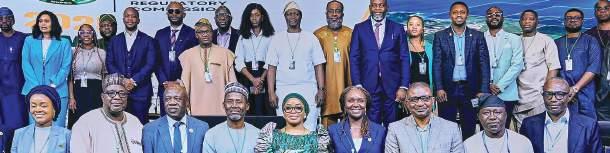
WINNERS OF NUPRC’S 2025

WINNERS OF NUPRC’S 2025
All conditions must be met within 90 days, says
Call for the protection of my life, the lives of my children, the protection of my privacy, an end to the misleading media trial on my person and the companies I have built with credibility and capacity over several years, the respect of Court Orders, and the protection of over $100 Million I have within the Oil & Gas sector, and several sectors both in Nigeria and International I, Aisha Achimugu (OFR), an Accountant and law-abiding citizen of Nigeria, (I was a wife) and now a widow of the late Engr. Sulaiman Achimugu, a man whose life was a testament to the Nigerian dream. My husband was a paragon of integrity who rose to lead the Pipelines and Product Marketing Company (PPMC), retiring with a record so unblemished that it served as a beacon of transparency for the entire industry, throughout this impactful Journey I was beside him as his wife, being his wife was an addition to the values I already had from the foundation that I was born into, a foundation that had consequence to any wrongdoing. I am a mother, a daughter, a philanthropist, an entrepreneur, a proven business developer, with visible progressive track records on all my businesses and visible impact in the labour space, and a contributor to national economy, who has spent decades building indigenous capacity and employing hundreds of my fellow citizens. Our family name has always been synonymous with service, yet today, that legacy is being systematically dismantled by an unrelenting and unjust assault.
Today, I am compelled to address both the local and international press in connection with what can best be described as a sustained campaign of calumny that threatens not just my personal rights to life and property, but the lives of my young children, aged parents, extended family and staff, and also the enabling environment for Foreign Direct Investment (FDI) in Nigeria.
For nearly two years now, I have been subjected to the worst kind of oppression, character assassination, intimidation and the deliberate dissipation of my lawfully acquired personal property through the malicious actions of agents of the Economic and Financial Crimes Commission (EFCC), led by its current Chairman. Such actions, which I have carefully outlined below, constitute an affront to the principles of the rule of law and natural justice, as provided in the Constitution of the Federal Republic of Nigeria.
Many have misinterpreted my long silence as fear or guilt resulting from the misleading and malicious information targeted at me. I state categorically that I refrained from speaking out purely out of personal restraint and national interest. I have always appreciated the enabling environment Nigeria provided for me to thrive over the last three decades. An example of this commitment was the immense collaboration I experienced during an international roadshow to over 30 countries to promote the then Ibaka Deep Sea Port project, that brought the visible birth of Ibom Deep Sea port a massive infrastructure initiative I proposed to the Federal Government to drive national growth. With a mere letter of expression of interest to the Ministry of Transport in port development without knowing who I was or a test to my capacity but trusted in my representation of professionalism.
Nonetheless, sometime in 2023, the Port Harcourt zonal office of the
Commission Chief Executive, NUPRC, Mrs. Oritsemeyiwa Eyesan (4th from right) poses with winners of 2025 Licensing Round at the Commercial Bid Conference in Abuja … yesterday ADVERTISEMENT

EFCC wrongly froze all my personal bank accounts, those of my children, my companies within the Felak Group, and the group account itself, having misled the Federal High Court (FHC) into granting an order of interim forfeiture, on the mistaken premise that I was a partner, associate, director or shareholder of a company called MBA Forex and Capital Investment.
In January 2024, a separate invitation letter from the EFCC raised the same MBA Forex matter again. My legal counsel and I honoured the invitation and clarified the true, limited nature of my company’s dealings with MBA. We had simply carried out and been paid for a single transaction on the company’s behalf, because the CBN had publicly declared MBA a Ponzi scheme. I held no ownership stake in MBA Forex. To close the matter, we refunded N58,000,000 relating to that transaction by bank draft to the EFCC recovery account, which I was told settled my company involvement on the investigation on the petition of the aggrieved people. which cleared the mistaken impression that I, my children and my companies were part-owners of MBA or had any stake or involvement with them.
A situation escalated rapidly in March 2025. On 4 March 2025, I received a two-line WhatsApp message from an unknown number inviting me to the EFCC’s Port Harcourt office the following day the 5th of March 2025, I called the unknown number to explain my unavailability, until third week of April , because I was abroad when I received the message. My legal counsel followed up by hand-delivering an official letter to the Port Harcourt office on 5 March 2025, on the same position with as my earlier phone call stated above, which was duly received and stamped. Despite this, I received a series of aggressive calls and further WhatsApp messages on 9 March 2025. To ensure full transparency, my lawyer wrote directly to the EFCC Chairman in Abuja on 12
March 2025, attaching the earlier correspondence and confirming my availability for 27 and 28 April 2025. This record of correspondence definitively refutes any suggestion that I absconded, rather, I remained in constant, documented communication with the EFCC.
Yet on 10 March 2025, even as this cooperative exchange of letters was ongoing, what looked at first like an ordinary social media rumour was revealed to be a carefully planned, targeted and malicious campaign of blackmail, slander and defamation against my person, my children, my family and my businesses, flooding local and international platforms with my name and image under a false narrative. This malicious, deliberate action was orchestrated with no regard for my contributions to the national economy and my International representation of a Nigerian Citizen.
The malicious nature of the EFCC’s actions became undeniable on 28 March 2025. On that day, my company, Oceangate Oil & Gas Limited, the winning bidder for PPL 302-DO and PPL 3007, submitted proof of payment to the NUPRC totalling $20,000,000 ($10,000,000 per block). Remarkably, just four hours after these payments were confirmed, the EFCC Chairman declared me a “Wanted Person” for “conspiracy and money laundering,” and promoted aggressively amongst all social platform across the globe, despite my whereabouts being well-documented and known to them. Immediately following this declaration, at about 5pm over 30 armed operatives invaded my home, terrorized my family, embarrassed my environment and carted away all my jewelleries , safes, and personal funds in a cruel and unprofessional manner for reasons best known to them. And with no reason for my offence. But what seemed like a clear show of power
In April 2025, while seeking the protection the courts could offer, I filed a fundamental rights suit at the Federal High Court in Abuja. The matter was heard even in my absence and was adjourned to 29 April 2025, with the court ordering that the status quo be maintained until that date. The adjourned date of 29 April 2025 fell within the same window my lawyers had already communicated to the EFCC that I would be returning to Nigeria. It cleared the way for my return to the country on 28 April 2025. Yet upon my arrival in the early hours of that day, EFCC operatives were waiting for me at the airport, and, notwithstanding the court’s standing order, took me to their headquarters. I did not resist. I was placed in an interrogation room and, at 5pm, presented with an asset declaration form, which I half filled, because I did not understand the context, so to avoid any false information, even though told them it did not apply to me as a private sector individual, but they insisted that that was the instruction given. At 5:30pm, I was given a bail form with conditions requiring two Level 16 civil servants and two identified properties with original Certificates of Occupancy, then detained overnight and taken to court the next day in an EFCC vehicle. The judge granted me bail and ordered my release within 24 hours. Yet, this release was inexplicably delayed by five days, needlessly prolonging my detention upon meeting my bail condition. They also disobeyed the bail granted with stipulated bail condition by instructing that I submit my International passport which I did not resist as a law abiding citizen.
Continued on page 17





expor tdeskdepar tment@zenithbank.com OR Visit



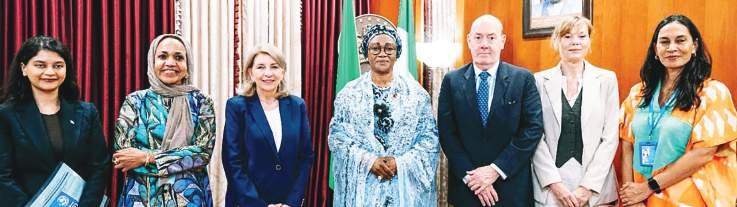
L-R Senior Adviser, Communication, Malene Kamp Jensen, UNICEF Nigeria’s Country Representative, Wafaa Saeed Abdelatef, UNICEF’s Executive Director of Mission to Nigeria Catherine Russell, First Lady of Nigeria Senator Oluremi Tinubu, Chief of Staff and Director of the Office of the UNICEF Executive Director, Mr. Ted Maly, Project Planning Officer, Maline Serrano and Executive Specialist, Office of the Executive
Director UNICEF, Nabila Jamshed during the courtesy visit of the UNICEF delegation to the First Lady at the State House Abuja on Thursday 16th July, 2026
NUPRC targets 500m additional barrels to crude reserves Fulfil all conditions within 90 days or lose award, Eyesan tells winners
Investors fail to bid for 13 blocks Firms to get final awards after payment of signature bonus
Ekpo: Nigeria’s licensing regime anchored on fairness Lokpobiri: Nigeria one of most attractive investment destinations globally
Emmanuel Addeh in Abuja and Peter Uzoho in Lagos
Thirty-one companies yesterday emerged winners of 37 oil and gas blocks offered by the Nigerian Upstream Petroleum Regulatory Commission (NUPRC) under the 2025 Licensing Round, a development expected to support Nigeria’s ambitious plans to increase crude oil production and significantly expand its hydrocarbon reserves.
The successful conclusion of the commercial bid conference, held in Abuja, marked the culmination of an eight month process that attracted about 300 expressions of interest at inception before narrowing to 143 qualified companies that submitted 200 technical and commercial bids for 37 of the 50 assets originally put on offer.
The remaining 13 blocks failed to attract bids, with the Commission explaining that many of the assets are located in frontier basins that require additional geological work and de-risking before they can become commercially attractive to investors.
The assets on offer were spread across the Niger Delta Onshore, Niger Delta Shallow Water, Niger Delta Deep Offshore, Benin Basin, Anambra Basin, Chad Basin and the Benue Trough.
But the commission said the winning companies will only receive their final Petroleum Prospecting Licences (PPLs) after paying the applicable signature bonuses, obtaining the approval of
the Minister of Petroleum Resources, and fulfilling all post award conditions stipulated under the Petroleum Industry Act (PIA) 2021 and the licensing guidelines.
After a rigorous process witnessed by the industry, the successful companies that emerged were: SSonic Petroleum Limited (PPL 2A29), CFP Pipeline and Flowlines (2A30), Dutchford E&P Limited (2A32), Attabanson Global Company Limited (2A33 and PPL 901), Rosem Energy Limited (2A38), Pivot GIS Limited (2A39), Network E&P (2A40) and Asharami (2A41).
Others were: LexOil (2A42), BVOF (2A43), Gupsco Energy Limited (2A44 and 2A51), Saratoga (2A45), Volante (2A46), Concept Reel Petroleum Services Limited (2A47 and 2A55), Clinton Oil Field (2A48 and 2A62), Nuway Oaklane Limited (2A49), Ramec (2A50), Italia (2A53), Blueridge E&P (2A54), Up Energies Limited (2A56), AYM Shafa (2A57) as well as Blackrock Holdings Limited (2A58).
In the same vein, Funtay Integrated Business Limited (2A59), Riparian Development and Production Limited (2A60), Nikstallis (2A61 and PPL 900), Stardeep Petroleum (PPL 2010), Dakoda & U Limited (PPL 308 and PPL 800), Southborne Oil and Gas Limited (PPL 902), Lanaka Petroleum (PPL 903), Highban Resources Limited (PPL 700) and Eyre Energy Limited (PPL 801) also emerged winners.
In her opening remarks, the Commission Chief Executive (CCE) Mrs Oritsemeyiwa Eyesan, described the
event as a major milestone in Nigeria’s upstream petroleum sector, saying the process had been conducted strictly in line with President Bola Tinubu’s directive for transparency, fairness and global best practice.
Eyesan stated that the assets on offer have the potential to increase Nigeria’s crude oil and condensate reserves by about 500 million barrels, raising existing reserves from 37.01 billion barrels, while complementing the country’s 215.19 trillion cubic feet of proven gas reserves.
She further disclosed that, once developed, the assets are expected to contribute at least 300,000 barrels per day of additional crude oil and condensate production within three years, supporting the federal government’s target of producing three million barrels per day by 2030.
“This licensing round represents a vital step for Nigeria in achieving its goal of reaching three million barrels per
day by 2030. These projections represent more than additional barrels. They represent increased government revenue, improved foreign exchange earnings, greater utilisation of infrastructure, opportunities for indigenous service companies, employment creation, technology transfer and broader economic growth,” she stated.
Eyesan stressed that the Commission’s objective was not merely to allocate acreage but to place the country’s petroleum assets in the hands of investors capable of delivering long term value through exploration, development and production.
Issuing a stern warning to the successful companies, Eyesan emphasised that winning the bid did not automatically translate into ownership of the assets. She declared: “An award is not a trophy to be held. It is an obligation to invest, drill, develop and produce. Our message is therefore clear: drill
or drop.”
She further warned that any company that fails to satisfy all post bid requirements within the stipulated period would automatically forfeit its award.
“A winning bidder that fails to fulfil the prescribed conditions within 90 days of receiving its offer letter will lose its entitlement to the asset. The Commission may thereafter invite the reserve bidders in their order of ranking to fulfil the conditions of the award. The government is not seeking speculative holders of acreage; it is seeking partners with the capacity, discipline and commitment to deliver measurable production and economic value,” she said.
Speaking with journalists after the exercise, Eyesan explained why 13 blocks received no bids, noting that the assets are located mainly in frontier basins that require further
geological work before they become commercially attractive.
“So when we launched the bid, we were very transparent and open and explained that some of these assets are in frontier basins. Frontier means that they have not yet been de-risked and so we were not surprised when we saw that some of these assets returned with no bidders.
“What it therefore means is that we will go back and do some more work to de-risk these assets and bring them back to the market. I’m sure from the studies that we’ve been doing and the work that we need to do, these assets will come up and definitely be picked up,” she stated.
In his remarks, Minister of State for Petroleum Resources (Gas), Ekperikpe Ekpo, described the commercial bid conference as another important milestone in Nigeria’s petroleum licensing process.
The Association of Meter Manufacturers of Nigeria (AMMON) has withdrawn its lawsuit against the federal government, clearing the way for the deployment of 1.55 million smart meters under various government-backed intervention
programmes aimed at closing the country’s metering gap.
The withdrawal, effected through a ‘Notice of Discontinuance’ filed at the Federal High Court in Kano, followed the intervention of the Minister of Power, Joseph Tegbe, who convened a high-level meeting
Folalumi Alaran in Abuja
Nigeria Hydrological Services Agency (NIHSA) on Tuesday placed 17 states on medium flood alert, warning that rising river levels have reached critical thresholds capable of triggering localised flooding in hundreds of vulnerable communities over the next seven days. The agency urged state govern-
ments, emergency management authorities, and residents in floodprone areas to commence immediate evacuation from floodplains, warning that any delay could endanger lives, damage critical infrastructure, and worsen humanitarian conditions.
In its National Flood Advisory (Alert No. NFA-2026-200), which took effect from July 21 to July 27, NIHSA said hydrological data from
its nationwide monitoring network showed that water levels at key river stations had exceeded both watch and warning thresholds, with 16 gauging stations now recording dangerously elevated river stages.
Director-General and Chief Executive Officer of NIHSA, Umar Mohammed, said the affected stations included Saminara on the Karam River, Waya Dam Site on the Waya
River, and Amber on the Amber River.
Mohammed warned that communities located along major river channels faced imminent localised flooding.
He stated, “Our hydrological monitoring network indicates that river stages at critical monitoring stations have exceeded watch and warning thresholds.
involving AMMON and key government agencies to resolve the dispute, a statement from the minister’s office said.
The legal action resulted in an injunction secured by AMMON in April 2026, halting bidding processes for major metering initiatives, including the Distribution Sector Recovery Programme (DISREP), Meter Acquisition Fund Phase 3 (MAF 3) and the Presidential Metering Initiative (PMI).
In the statement, the Federal Ministry of Power said the resolution brought an end to the impasse and would enable the stalled procurement process to resume, allowing the government to accelerate efforts to bridge the country’s longstanding electricity metering deficit.
The ministry explained that the resolution was achieved through collaboration between the Ministry of Power, the Bureau of Public
Enterprises (BPE), the Transmission Company of Nigeria (TCN) and other relevant stakeholders.
According to the ministry, this resulted in a mutually acceptable solution that addressed the concerns of local meter manufacturers while remaining consistent with local and international competitive procurement rules.
The ministry stated that the agreement reflects the government’s commitment to promoting indigenous industrial participation without jeopardising the financing arrangements required to implement the metering programmes. It noted that the outcome aligns with the federal government’s ‘Nigeria First’ policy on local industrial development as well as President Bola Tinubu’s Renewed Hope Agenda, which seeks to deepen local manufacturing while accelerating reforms in the electricity sector.
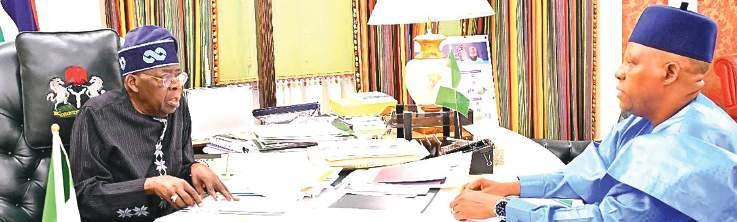
SHETTIMA BRIEFS TINUBU ON ECOWAS SUMMIT HE ATTENDED IN SIERRA LEONE...
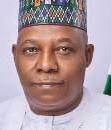
Vice President Kashim Shettima briefing President Bola Ahmed Tinubu on the outcome of just concluded ECOWAS Summit he attended in Sierra Leone recently.
Says misinformation currently poses significant threats to banking systems, adds public trust, crisis preparedness crucial
James Emejo and Deborah Adekoya in Abuja
Cardoso: bank recapitalisation has strengthened financial safety net; public awareness remains key stability Says stronger bank capital reduces failures, protects deposit insurance fund, others NDIC boss urges coordinated crisis response as fintech reshapes Africa’s banking landscape Warns confidence built over years can disappear in days if misinformation spreads the greater the confidence, the more resilient our financial systems become; and the more resilient our financial systems, the stronger our economies and the greater the prosperity we can create for our people.
Minister of Finance and Coordinating Minister for the Economy, Mr. Taiwo Oyedele, yesterday declared that deposit insurance was a strategic pillar for preserving public confidence and financial stability.
Oyedele warned that misinformation in the digital age now posed one of the biggest threats to the banking system. He spoke at the opening of the 2026 International Association of Deposit Insurers (IADI) Africa Regional Committee (ARC) Annual Meeting and Workshop.
The forum, hosted by Nigeria Deposit Insurance Corporation (NDIC), in Abuja, had the theme, “Safeguarding Stability:
Public Awareness and Crisis Readiness for a Stronger Future.”
Oyedele said while technological innovation, fintech, and cross-border financial integration presented enormous opportunities for financial inclusion and economic growth, they also exposed financial systems to new vulnerabilities that required stronger crisis preparedness.
He stressed that no economy could achieve sustainable growth without a stable financial system founded on public trust.
The minister said in an era where rumours and misinformation could spread across digital platforms within seconds, triggering liquidity pressures even in fundamentally sound institutions, public awareness had become a core risk management strategy rather than
a public relations exercise.
He said depositors who understood that their savings were protected were less likely to panic during periods of uncertainty, adding that crisis preparedness must become an institutional culture rather than a reaction to emergencies.
According to him, effective crisis management requires seamless coordination among ministries of finance, central banks, deposit insurers, and regulatory agencies long before crises emerge.
Oyedele stressed, “Confidence cannot be legislated, purchased, or imposed. It must be earned - through strong institutions, transparency, effective communication, preparedness, and consistent action.
“The stronger our institutions, the greater the confidence they inspire;
A day after replacing Keir Starmer in Downing Street and purging the government of his predecessor’s loyalists, UK’s new Prime Minister, Andy Burnham morning said he was cutting Value Added Tax (VAT) on consumer electricity bills.
The new business minister Jonathan Reynolds told Sky News this was a “tremendous announcement for the first day of the new cabinet”, which was due to meet Tuesday afternoon.
The measure cuts the 5 per cent tax from October and will trim about £45 ($61) a year off, and will be initially funded by cancelling a plan to introduce digital IDs.
It came after Burnham promised to “give people some breathing space now, some help with the cost of living”.
Burnham pledged to re-industrialise Britain and decentralise power as well as end sleeping rough on the streets after he met King Charles III at Buckingham Palace to become the head of government following Starmer’s departure.
The monarch’s fourth prime minister since he acceded to the
throne in 2022 and Britain’s seventh in just over a decade, Burnham said the country needed to show the world it could “regain stability”.
Standing outside his new official residence at Number 10, he vowed to create “a new political model” and “build a new economy”, a report by AFP stated.
In his first call with US President Donald Trump, Burnham underlined his “commitment to defence and security”, a UK government spokesperson said.
Trump said he had a “very good conversation” with Burnham and that the two leaders would meet “in the not too distant future”.
Burnham “has got a big job ahead of him, but he will be able to do it and, of course, the U.S.A. will be there to help!” Trump posted on Truth Social, noting they discussed trade, military cooperation and demining the Strait of Hormuz.
To Ukrainian President Volodymyr Zelensky, Burnham reaffirmed Britain’s “resolute commitment” to Ukraine in its defence of Russia’s invasion, according to Downing Street.
French President Emmanuel Macron sent congratulations, urging Burnham
to “give new momentum to the partnership” with the European Union.
Burnham moved swiftly to stamp his authority on the new government by sacking several Starmer loyalists from his cabinet, including Rachel Reeves and former Deputy Prime Minister David Lammy, while moving some ministers to other jobs and promoting allies.
Ex-defence Secretary John Healey replaced Reeves as finance minister, Ed Miliband became foreign minister and left-wing figurehead Angela Rayner returned to government.
Wes Streeting, who abandoned plans to run against Burnham for the Labour leadership, is now defence minister. Shabana Mahmood was reappointed interior minister to see through her hardline reforms of Britain’s asylum system.
In his brief speech, Burnham said he would “bring forward a new plan for Britain, a 10-year plan”, without giving specifics.
Starmer had similarly talked of his intention to lead a “decade of national renewal” before Labour MPs ditched him last month in favour of Burnham, who only returned to parliament four weeks ago.
“I commend the International Association of Deposit Insurers, the Africa Regional Committee, and the Nigeria Deposit Insurance Corporation for convening this important dialogue.”
Highlighting Nigeria’s ongoing economic reforms under President Bola Tinubu, Oyedele pointed to the successful conclusion of the banking sector recapitalisation programme, under which 33 of the country’s 37 banks met the new capital requirements, raising about N4.65 trillion in fresh capital.
He said stronger bank balance sheets had significantly reinforced the country’s financial safety net by reducing the likelihood of bank failures and limiting potential exposure of the deposit insurance system.
Oyedele also cited Nigeria’s removal from the Financial Action Task Force (FATF) grey list in October 2025 as another milestone that had strengthened confidence in the country’s financial system.
He described deposit insurance as an important driver of financial inclusion, pointing out that increased
public confidence encourages savings, expands lending, and ultimately supports investment, job creation and inclusive growth across Africa.
In his remarks, Governor of the Central Bank of Nigeria (CBN), Mr. Olayemi Cardoso, said safeguarding confidence had become the foremost responsibility of financial authorities as banking systems underwent rapid transformation driven by technology and digital finance.
Cardoso said the effectiveness of deposit insurance extended beyond sound legal frameworks to ensuring that the public clearly understood how those protections worked.
According to him, public awareness should no longer be viewed as a communication exercise, but as a strategic component of financial stability, particularly at a time when misinformation can spread rapidly through social media and digital platforms.
Represented by CBN’s Director, Other Financial Institutions Supervision Department (OFISD), Mr. Solaja Mohammed-Jamiu Olayemi, Cardoso also warned that perceptions amplified online could undermine confidence in financial institutions within a short time, making timely, accurate and credible communication indispensable.
The apex bank boss underscored the
importance of crisis preparedness, saying recent episodes of financial stress across different jurisdictions demonstrate that institutions that invest in contingency planning, crisis simulation exercises, and operational resilience are better positioned to minimise disruptions. He stressed that effective crisis management required close coordination among central banks, deposit insurers, supervisory authorities, and other regulators.
Cardoso added that the strength of any financial safety net depended not only on individual institutions but also on how effectively they worked together. The central bank governor stated that innovation had transformed financial services, expanding inclusion, while simultaneously exposing institutions to cyber threats and other emerging risks. He said regulators must, therefore, continuously strengthen operational resilience and update crisis management frameworks to remain effective in the evolving digital environment.
Cardoso highlighted CBN’s banking sector recapitalisation programme as one of its most significant reforms, saying the higher capital thresholds for banks are designed to ensure stronger institutions capable of absorbing shocks, supporting economic growth, and competing globally.
Oghenevwede
Ohwovoriole in Abuja
The Director, Regional African Satellite Communications Organisation (RASCOM), Timothy Ashong, has underscored the need for African countries to collectively invest in telecommunications infrastructure with border areas to improve connectivity.
Ashong made the call, Tuesday during a roundtable meeting at the ongoing African Telecommunication Union (ATU) conference, Abuja 2026 Ashong said Africa needed collective efforts to provide good connectivity on the. continent.
“No single institution is able to provide good network on its own. It requires collective effort. And therefore,
we always say that Africa should rely on only one connectivity solution, beginning with broadband fibre coming into the country.
“We need to invest heavily on both the terrestrial and also the satellite aspects. This will be able to provide seamless connectivity in our border areas. Most of our border areas are hard to reach because, you know, the telecom operators on the terrestrial line also have to coordinate a lot with the next country.
“Satellite provides connectivity for entire Africa. And this is what we have to rely on. We have to invest heavily on the satellite platform,” he said. Ashong also called for the collaboration of all satellite communication
organisations to bridge the digital gap. He said, “As a regional African satellite communications organisation, we are ready to collaborate with the African institution to ensure that we make that happen to Africa, to bridge the digital divide to the rest of the world and make Africa connectivity very strong.”
Speaking at the conference, the Executive Vice Chairman (EVC), Nigerian Communications Commission (NCC), Dr. Aminu Maida called on African telecom regulators to have a stronger collaboration to build a robust network with intelligence ecosystem that supports evidencebased regulatory decisions across the continent
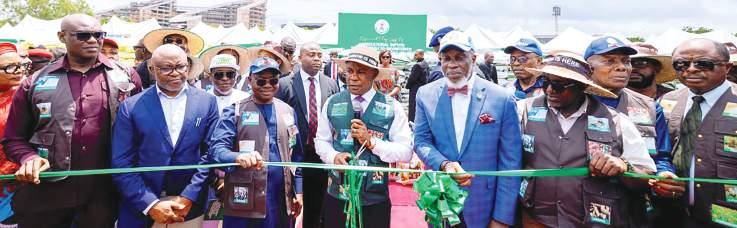
... yesterday
Hails economic team, says NRS remains ‘one of our best partners’, tasks FG to raise growth to 7% from 4% Adedeji credits UK support for strengthening tax reforms strategic economic partnership
Outgoing British High Commissioner to Nigeria, Richard Montgomery, yesterday backed President Bola Tinubu’s economic reforms.
Montgomery said despite the short-term hardship the reforms had imposed on citizens, they remained critical to positioning the country on a stronger economic path.
Speaking during a farewell visit to the Nigeria Revenue Service (NRS) headquarters in Abuja, Montgomery praised the administration’s economic management team for undertaking politically difficult but necessary reforms that, he said, were already improving investor confidence and strengthening the country’s fiscal outlook.
According to a statement issued by Special Adviser to Chairman of NRS, Mr. Dare Adekanmbi, the UK envoy described his three-year diplomatic tour in Nigeria as a period during which the country witnessed significant positive changes.
He acknowledged that policies, such as exchange rate reforms and efforts to tame inflation, had come with immediate costs for Nigerians but maintained that they were indispensable for long-term economic stability.
Montgomery said he had consistently briefed Britain’s new
Prime Minister, Andy Burnham, on the importance of the reforms and the progress being recorded under the Tinubu administration.
He specifically commended the contributions of Central Bank of Nigeria Governor Olayemi Cardoso, former finance minister Wale Edun, NRS Chairman Dr. Zacch Adedeji, and Minister of Finance and Coordinating Minister of the Economy, Taiwo Oyedele, for driving monetary, fiscal, and tax reforms.
Montgomery said, “To be in Nigeria over a three-year period where so much has happened for the good was awesome.
“And I know that a lot of the economic reforms are tough, and they can cause short-term pain for ordinary people— you know, devaluation, inflation, and so forth.
“But I stand by and continue to brief, including our new Prime Minister (Andy Burnham), who’s hoping to speak to His Excellency, President Bola Tinubu at some point in the next couple of weeks, about how fundamental the reforms have been, whether the monetary work done by Yemi Cadoso at the Central Bank of Nigeria (CBN) or initially by Mr Wale Edun at the Ministry of Finance, and, of course, the work that you (Zacch Adedeji) and Taiwo Oyedele, now Minister of Finance
and Coordinating Minister of the Economy, had done on tax reform and the fiscal management.”
He said the reforms had demonstrated both technical competence and political dexterity, particularly in navigating Nigeria’s complex fiscal environment and budgetary processes.
Montgomery said the work of the country’s economic managers had been central to putting Nigeria on a firmer economic footing.
He stated that beyond fiscal reforms, the administration had
taken important steps to reposition the Nigerian National Petroleum Company (NNPC), attract fresh investments and improve Nigeria’s international credit, ratings.
Describing the efforts as fundamental to Nigeria’s future, Montgomery said the next challenge for the government would be to accelerate economic expansion by raising growth from about four per cent to seven per cent to deliver more tangible benefits for ordinary Nigerians.
He expressed confidence that the
country’s economic management team possessed the capacity and vision to achieve the objective.
He also singled out NRS as “one of our best partners”.
He applauded the agency for sustaining strong collaboration with His Majesty’s Revenue and Customs (HMRC), particularly through peer reviews and technical cooperation aimed at strengthening tax administration.
He commended Adedeji for steering difficult reforms, stating that the partnership between both revenue
agencies has continued to deepen institutional capacity and modernise revenue collection processes.
The British envoy said, “And I know that Nigeria is complicated. I know that budget and fiscal management are always particularly difficult because of the way the budget works in the National Assembly.
“So, I think what the finance ministers and you personally and your team have done to try and put Nigeria on a better footing and also just manage the money better have been fantastic.
Nigeria on Tuesday signalled its readiness to deepen economic, security, and diplomatic ties with the United Kingdom following the emergence of Right Honourable Andy Burnham as the country’s new Prime Minister.
Nigeria described Burnham’s assumption of office as an opportunity to strengthen one of Africa’s most strategic bilateral partnerships. The federal government, in a
congratulatory message delivered by Minister of Foreign Affairs, Ambassador Bianca Odumegwu-Ojukwu, welcomed the peaceful democratic transition in the United Kingdom and expressed confidence that Burnham’s administration would open a new chapter of cooperation between Abuja and London.
In a statement issued by the Ministry of Foreign Affairs, Odumegwu-Ojukwu commended the British people and institutions for their enduring commitment to
Ndubuisi Francis in Abuja
The Fiscal Responsibility Commission (FRC) has expressed concern over the failure of the Nigeria Customs Service (NCS) to submit its audited financial statements since 2019, saying the trend violates the provisions of the Fiscal Responsibility Act (FRA), 2007.
The Acting Executive Chairman of the Commission, Charles Chukwuemeka Abana, stated this while receiving a delegation from the NCS in his office in Abuja. Section 23 of the Fiscal Responsi-
bility Act, 2007 (Part IV, Budgetary Planning of Corporations) compels Government-Owned Enterprises (GOEs) and related agencies to prepare, publish, and submit their audited financial reports not later than three months after the end of the financial year.
Abana underscored the need for the NCS to fully comply with the provisions of the FRA by submitting its outstanding audited accounts and ensuring the timely remittance of its operating surplus into the Consolidated Revenue Fund (CRF) as required by law.
In a statement issued by Bede Ogueri Anyanwu, FRC’s Deputy Director, Strategic Communication Directorate, Abana urged the NCS to intensify its revenue generation efforts while upholding the principles of transparency, prudence, and accountability in the management of public finances.
According to him, the continued non-compliance of some government agencies with the Fiscal Responsibility Act has negatively impacted the federal government’s fiscal management and operations. He noted that FRC’s template
for calculating operating surplus is explicit and easy to implement, adding that agencies that adhere to it make meaningful contributions to Nigeria’s economic development and fiscal sustainability.
Drawing a comparison with the Nigeria Immigration Service (NIS), Abana recalled that following FRC’s capacity-building programme on the implementation of the Fiscal Responsibility Act, the NIS recorded significant improvements in compliance and financial reporting, and encouraged the NIS to emulate this example.
constitutional democracy, saying the orderly transfer of power further reinforced UK’s democratic credentials.
She stated that Burnham was taking office at a critical period marked by economic pressures and global uncertainties, expressing optimism that his plans for economic renewal, decentralisation of governance, and tackling the cost-of-living crisis would strengthen the United Kingdom and improve the lives of its citizens.
The minister said, “Nigeria and the United Kingdom share deep historical ties, robust people-topeople connections, and a strong partnership across trade, investment, security, education and cultural exchange.”
She stressed that both countries, as members of the Commonwealth, remained committed to advancing bilateral relations while working together on shared global priorities, including climate change, sustainable development, peace and security in Africa, and reforms of multilateral institutions.
Odumegwu-Ojukwu said the federal government looked forward to working closely with Burnham and his administration to consolidate existing areas of cooperation and identify new opportunities capable of delivering tangible economic and
strategic benefits to both nations. The message comes as Nigeria seeks to expand foreign investment, strengthen security cooperation, and diversify international partnerships amid ongoing economic reforms at home.
Britain is one of Nigeria’s most important diplomatic and economic partners. The relationship, which dates back to Nigeria’s colonial history and independence in 1960, has evolved into a broad strategic partnership encompassing trade, defence, intelligence sharing, migration, education, healthcare, energy and climate cooperation. The United Kingdom is home to one of the largest Nigerian diaspora communities in the world, with remittances from Nigerians living in Britain contributing significantly to household incomes and the Nigerian economy.
British companies also maintain substantial investments across Nigeria’s financial services, oil and gas, manufacturing, telecommunications, and consumer sectors.
In recent years, both countries have intensified collaboration in combating terrorism, organised crime, cybercrime and corruption, while also partnering on initiatives aimed at improving governance, promoting education and strengthening healthcare systems.
Deji Elumoye in Abuja
Nigeria has received the final report of the National Technical Working Group on the World Bank-supported $500 million Sustainable Agricultural Value Chains for Growth Programme (AGROW), marking the conclusion of the programme’s design phase and its transition to implementation.
Vice President Kashim Shettima said government, through the AGROW programme, was bridging the gap between farmers and national planning as well as policy decisions at the centre.
Speaking on Tuesday when he received the report during a briefing at State House, Abuja, Shettima stated that while the challenge in
the agricultural sector had been the distance between farmers, who tilled the earth, and the systems that determined what their labour was worth, the government was set to implement the process of shortening the distance.
The US$500 million World Bank-supported programme was developed through seven zonal consultations involving 32 states, reflecting the increasing commitment of subnational governments to agricultural development and their readiness to assume greater responsibility for productivity, infrastructure, extension services, and market development.
Speaking at the meeting, the vice president described the AGROW
programme report as “the conclusion of a design process that restores the farmer to the centre of our national economic reasoning, where he has always belonged”.
He added, “Today marks the transition of AGROW from programme design to implementation.”
Shettima maintained that the World Bank’s US$500 million Nigerian agriculture programme was targeted at “developing a programme rooted in the realities of farmers, delivered through our states, and capable of attracting the private investment required to move agriculture from subsistence to scale”.
Shettima observed that agricul- ture, a sector that accounts for 23
per cent of the country’s GDP and sustains 34 per cent of its workforce, must not be treated as “a negligible sector, attended to at leisure and financed at the margins”.
Stating that most Nigerians earned a living from the tilling of the soil, he said no other sector carried as many livelihoods or touched as many households as the agriculture sector.
According to him, “When yields rise, food prices ease, rural incomes recover, industries receive raw materials, and the pressure on our cities and foreign reserves begins to relax. When yields fall, the entire economy discovers the price of hunger.
“Productivity on the farm is
therefore a question of growth, employment, food security and poverty reduction. What we do to the farm, we do to the nation.”
The vice president expressed satisfaction with the response from states, saying it reveals the scale of the opportunity before the country.
He stressed that the participation of 32 states in seven consultations to shape AGROW reflected “both the urgency of the challenges confronting agriculture and the growing appetite across Nigeria for agricultural development and investment”.
On the method of implementa- tion, Shettima said, “Of the US$500 million financing envelope, US$355 million, representing 71 per cent,
will be implemented through participating states. This rightly places state governments at the centre of delivery because agriculture ultimately takes place within our communities, local government areas and states.
Oyedele: Model will be replicated in housing, transport, agriculture, others Power minister urges investors to back ongoing reforms
Verheijen: FG converting legacy debt into bankable investment Babalola says government targeting stronger sector liquidity
The federal government yesterday intensified efforts to raise a fresh N729 billion from the capital market to deepen liquidity in the power sector, following the successful N501 billion maiden issuance earlier this year, assuring investors that reforms underway in the electricity industry are already yielding results.
The assurances were given at the Project Hoover Series II Investor Forum in Abuja, attended by top government officials, including the Minister of Power, Joseph Tegbe; Minister of Finance and Coordinating Minister of the Economy, Taiwo Oyedele as well as the Special Adviser to the President on Energy, Olu Verheijen.
Others in attendance included:
The Special Adviser to the President
on Power, Lanre Babalola, erstwhile Acting Chief Executive Officer of the Nigerian Bulk Electricity Trading Plc (NBET), Johnson Akinnawo, Director General of the Debt Management Office (DMO), development partners, financial institutions and other market participants.
Speaking at the event, the Minister of Finance and Coordinating Minister of the Economy,
Oyedele, said the bond programme represented a tested model for mobilising long-term capital into critical infrastructure.
He noted that the N501 billion maiden issuance had been fully subscribed and subsequently listed on both the Nigerian Exchange and FMDQ Exchange before successfully meeting its repayment obligations. “We return not with promises but with evidence,” Oyedele said.
He explained that persistent tariff shortfalls, settlement gaps, mounting debts to generation companies and weak liquidity had constrained investment in the electricity sector for years, necessitating a market-based solution.
According to him, President Bola Tinubu approved a comprehensive review of power sector liabilities in July 2024, leading to the establishment of the Presidential Power
President’s re-election done deal, says north-central group Debate over Muslim-Muslim ticket settled since 2023, TSG tells Kwankwaso
The Secretary to the Government of the Federation (SGF), Senator George Akume, yesterday stressed that the economic reforms of President Bola Tinubu may not produce instant results but would secure the future of the country.
Akume said this at a one-day conference on the North-central region’s development under the Renewed Hope Agenda.
He was represented at the occasion by his Senior Assistant, Technical, Prof. Babatunde Benard.
The conference convened by the North Central Agenda had in attendance delegates from all the six states of the North Central and the Federal Capital Territory (FCT).
Akume said President Tinubu has placed Nigeria firmly on the path of recovery through bold and sometimes difficult policy decisions.
He stated: “The President is a trailblazer. He is taking decisions that may not produce instant results, but they are the kind of reforms that will secure Nigeria’s future.”
Akume cited the Student Loan Scheme as one of the administration’s landmark achievements, add-
ing that while children of political leaders in previous administrations benefited from student loans abroad, Tinubu has made similar opportunities available to ordinary Nigerian students at home.
He urged Nigerians to support leaders focused on building lasting infrastructure rather than seeking short-term handouts.
“We should leave those who give us peanuts and keep us in poverty. We should support the man who is digging up the ground and creating the conditions for Nigeria to blossom,” he added.
The SGF commended the administration’s investment in infrastructure, particularly the ongoing road projects across the country.
He recalled that the Calabar to Abuja highway corridor had been conceived as far back as 1958, but had remained largely unrealised until the current administration.
According to him, “how do you develop a country without critical infrastructure? What President Tinubu is doing today is laying the foundation for economic growth.”
Akume pointed out that the Sokoto to Badagry Super Highway
project incorporates 32 dams that would significantly boost agriculture, irrigation, water supply and economic activities along the corridor.
“Think about what we can do with those dams. They are not just roads; they are economic assets that will transform communities and create wealth,” he said.
Sector Debt Reduction Committee (PPSDRC).
He said the initiative had helped create an investable framework supported by government guarantees while leveraging private capital to finance critical infrastructure.
Oyedele disclosed that the government intends to replicate the financing model across other strategic sectors, including housing, transportation, agriculture and technology.
“Stability is only the beginning. The next phase is investment, productivity, and shared prosperity. We need to finance our growth differently because public resources alone will never be sufficient to meet the scale of infrastructure investment Nigeria requires.
On her part, the Convener of the North Central Agenda, Dr. Ene Ogbole described the victory of President Tinubu in next year’s presidential election as a “done deal.”
She stressed that the current administration was laying a solid foundation for Nigeria’s long-term prosperity through critical reforms and infrastructure development.
Ogbole noted that prior to the current administration, the North-central Nigeria had been plunged into an “abyss of huge infrastructural deficit and major security crisis.”
“Private capital must play a larger role, and our responsibility as government is to create investable opportunities supported by sound policy, credible institutions, and appropriate risk allocation. The bond is exactly that model. The government provides the policy framework and the guarantee. The capital market mobilises long-term
The First Lady, Senator Oluremi Tinubu, has canvassed the preservation of the rich heritage of Nigerians for posterity and prosperity.
Speaking yesterday while on a visit to Akwete, the production site of the local hand-woven historic Akwete fabric in Abia State, the First Lady said the tradition of the Akwete handmade fabric was dear to the hearts of women, who made it, adding that they should be encouraged to pass it on to the next generation.
Mrs Tinubu commended the craft
which she said was transferred from generation to generation.
Her words: “It is a sacred craft done with love, patience, endurance and that should not be desecrated. When we saw a building there, we said we would lift the structure. We can build on it, which will tell the story.
“For the women of Akwete, I heard your cry, am here to announce to all Nigerians and the Igbo should take Akwete to the nations. For me and all the notable sons of Igbo land, rise up to preserve this.”
She further said: “Our young people need to also be encouraged to get used to our tradition and cultural outfits. It is the culture that raised me and
there is nowhere that I stand in the world without wearing African wears.
“These women while they hold their craft very dear, it is a spiritual thing for them, one of the good things that I saw, were young people in their families doing exact thing.
“I love traditional outfits because our tradition, our culture tells us who we are, the moment we lose that, we won’t remember where we come from.”
She subsequently donated N2 billion to the state for the development of the Akwete production site in Abia State.
The First Lady called on all Igbo to promote Akwete nationally the
way Yorubas promote Aso Oke and tie and dye, urging that the fabric be modernised into bedspreads, iro and buba for wider use.
Governor Alex Otti of the state thanked the First Lady for “inviting herself” to Abia, noting that her visit came at a strategic time as the state has been engaging Akwete women since 2023 to break barriers of tradition and scale production.
“We believe, just like you do, that there is a lot that Akwete can do. If we don’t accept technology and move very swiftly, others will take over the market. Today you have Akwete being made in India and China,” he said.
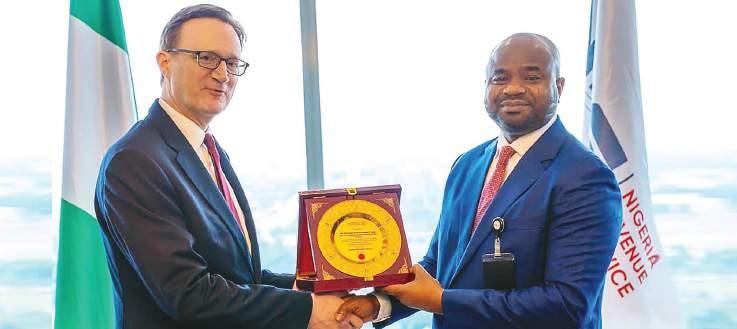
Outgoing British High Commissioner to Nigeria, Richard Montgomery (left) and Executive Chairman, Nigeria Revenue Service (NRS), Dr. Zacch Adedeji, during Montgomery’s farewell visit to Adedeji at the NRS new headquarters in Abuja… yesterday
Michael Olugbode in Abuja
In a major push to reclaim, protect, and project one of Africa’s oldest civilisations, Nigeria and the United States have launched a technologydriven heritage preservation initiative that will digitally secure hundreds of ancient Nok artefacts, combat international trafficking of cultural treasures, and bring Nigeria’s forgotten history to a global audience.
The landmark project, unveiled on Tuesday in Abuja, had digitally catalogued more than 250 Nok
artefacts, upgraded the Nok Museum, trained young Nigerians in advanced heritage technology, and introduced innovative tracking systems designed to authenticate and trace cultural objects.
The initiative, implemented by the Wheyham Report Foundation under the United States Ambassadors Fund for Cultural Preservation, is seen as a turning point in Nigeria’s battle to protect its archaeological heritage from theft, illegal trade, and neglect.
The launch also featured the premiere of Nok Culture: History,
Art and Civilisation, a documentary chronicling the significance of the ancient civilisation that reshaped global understanding of Africa’s technological and artistic achievements.
Speaking at the event, Chargé d’Affaires of the U.S. Embassy, Keith Heffern, said the project demonstrated how technology could become a powerful weapon in protecting cultural identity and disrupting criminal networks involved in the illegal movement of heritage objects.
“The results speak for themselves:
over 250 Nok artefacts digitally preserved, a fully upgraded museum, 50 Nigerian youths trained in cuttingedge digital skills, and 50,000 people reached nationwide,” Heffern said.
He disclosed that the platform used Non-Fungible Token (NFT)-based tracking technology to improve the authentication and traceability of artefacts, providing a digital record that can help authorities identify stolen or illegally traded cultural objects.
According to him, the United States has invested about $1.2 million in cultural preservation projects across
Nigeria’s correctional reform agenda has received a major continental endorsement as Heads of Correctional Services from 11 African countries described the country’s technology-driven custodial system and inmate rehabilitation initiatives as a benchmark for modern corrections in Africa.
The endorsement followed an inspection of the Medium Security Custodial Centre (MSCC), Kuje, by delegates attending the African Correctional Services Association (ACSA) Regional Conference in Abuja.
They commended Nigeria’s shift from a punitive prison system to one focused on rehabilitation, skills acquisition, and digital management of inmates.
The delegation, led by Deputy Chairman of ACSA’s West African Region, Mr. Sabila Sawadogo, said the Kuje facility demonstrated how technology and structured rehabilitation could transform correctional institutions into centres that prepared inmates for productive reintegration into society.
The delegates, who on Monday toured the facility’s inmate
admission unit, observed biometric registration through the Correctional Information Management System (CIMS), inspected the control room, and visited educational and vocational training centres where inmates were being equipped with practical skills in tailoring, carpentry, ICT, building technology, shoe and cap production, bag making, and solar installation.
Speaking after the inspection, Sawadogo said the centre’s operations conform to international correctional standards and reflect global best practices in offender management.
He particularly praised the deployment of digital technology in inmate management and the emphasis placed on education, vocational training, and rehabilitation, describing them as critical pillars for reducing recidivism and improving public safety across Africa.
Sawadogo also commended Minister of Interior, Hon. Olubunmi Tunji-Ojo, and Controller-General of the Nigerian Correctional Service (NCoS), Sylvester Ndidi Nwakuche, for providing the leadership driving the transformation of Nigeria’s custodial centres.
He said the reforms represented
a significant departure from the traditional prison model towards a correctional philosophy centred on reformation, rehabilitation and successful reintegration.
Welcoming the delegates, Controller of Corrections, Federal Capital Territory Command, Peter Jen, reaffirmed the Nigerian Correctional Service’s commitment to innovation, professional excellence and international cooperation.
According to Jen, the service has prioritised inmate education
and vocational empowerment as part of efforts to ensure that persons leaving custodial centres possess employable skills that will enable them to rebuild their lives and contribute positively to society.
The visit formed part of the practical sessions of the ACSA Regional Conference, allowing correctional leaders from across Africa to examine Nigeria’s reform initiatives first-hand and exchange ideas on strengthening correctional systems on the continent.
21 Nigerian states in the past five years through the Ambassadors Fund for Cultural Preservation.
“When Nigeria’s heritage is protected, criminal networks are disrupted and the foundation for prosperity—for both our nations—is secured,” he said.
The Nok civilisation, believed to have flourished between about 1500 BC and 500 AD in parts of present-day Kaduna, Plateau and neighbouring areas, remains one of Africa’s most remarkable ancient cultures.
The civilisation gained international attention after the discovery of its terracotta sculptures in 1928 during mining activities in present-day Kaduna State.
Subsequent archaeological discoveries revealed that the Nok people possessed advanced artistic skills and were among the earliest communities in sub-Saharan Africa known to have mastered iron technology.
Their terracotta figures—characterised by sophisticated human and animal forms, detailed facial features, and remarkable craftsmanship—challenged outdated narratives that portrayed ancient Africa as lacking advanced technological and artistic traditions.
However, decades of illegal excavation and trafficking had placed many
Nok artefacts at risk, with some pieces ending up in foreign collections and private markets around the world.
The new digital preservation initiative seeks to create a permanent record of Nigeria’s heritage while strengthening efforts to recover and protect stolen cultural materials.
Minister of Arts, Culture, Tourism and Creative Economy, Hannatu Musa Musawa, described the project as a significant achievement in the federal government’s efforts to preserve Nigeria’s cultural assets. Musawa said the initiative fulfiled part of the agreement signed between Nigeria and the U.S. Embassy in February 2025 to document and preserve Nok terracotta heritage. Musawa said the technology would ensure that Nigeria’s cultural treasures remained accessible beyond physical museum walls.
She stated, “Digital preservation does not replace the physical work of guarding a site or conserving an object.
“It makes sure that work reaches people who will never visit Kaduna State, and that the record survives even where the objects themselves are at risk.”
The minister added that the government intended to replicate the model across other cultural heritage sites and traditions in Nigeria.
Peter Uzoho
Nigeria is targeting a minimum of 300,000 barrels per day (bpd) of crude oil and condensate as well as additional 500 million barrels reserve within the next three years from the 37 assets bided by oil firms in the ongoing Licensing Round being conducted by the Nigerian Upstream Petroleum Regulatory Commission (NUPRC) Commission Chief Executive
of NUPRC, Mrs. Oritsemeyiwa Eyesan, stated this yesterday in Abuja at the Commercial Bid Conference for the Nigeria 2025 Licensing Round in which 50 oil blocks were initially put on offer but received interest in only in 37.
Eyesan explained that the bid round, which commenced eight months ago on the directive of President Bola Tinubu, was designed to open new opportunities and integrate Nigeria with
the global community through a transparent process aligned with international best practices.
The NUPRC boss noted the journey was initiated by her predecessor, Mr. Gbenga Komolafe, and that her team had pledged to conclude both the technical and commercial bidding phase on July 21, 2026, as scheduled. She said the Commission had kept that promise, turning the President’s guidance into tangible
action. She disclosed the licensing round attracted interest from about 300 companies across 50 available assets at inception. After prequalification, 196 applicants were deemed eligible to advance to the bidding stage. Eyesan added that by the submission deadline, 143 companies had submitted 200 technical and commercial bids covering 37 assets.
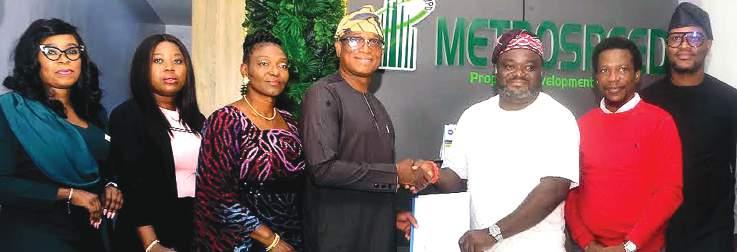
L-R:
Legal and Company Secretary MetroSpeed Group, Mirabel
Francis Adeoye; Vice President, COOPLAG Cooperative, Mr. Levious Ngerebara and Finance Director, COOPLAG Cooperative, Mr. Opeyemi Adepoju, at the Contract Signing Ceremony in commitment to the Metro Smart City, in Lagos... recently
Grants Orji Kalu committee three-week extension to conclude investigation To scrutinise intervention funds, student loans, school security, social welfare programmes
The Senate yesterday expanded its ongoing investigation into the Safe Schools Initiative (SSI) to key federal agencies handling education funding, student welfare and social intervention programmes in what lawmakers described as a determined effort to establish accountability in the management of billions of naira earmarked for the protection and welfare of Nigerian students.
In a move that broadens one of the National Assembly’s most farreaching oversight exercises, the upper chamber approved the inclusion of the Tertiary Education Trust Fund (TETFund), Nigerian Education Loan Fund (NELFUND), Universal Basic Education Commission (UBEC), Federal Ministry of Humanitarian Affairs and Poverty Alleviation, and the National Social Investment Programme Agency (NSIPA) in the investigation.
The Senate also granted its Adhoc Committee on the Safe Schools Initiative, chaired by former Senate Chief Whip, Senator Orji Uzor Kalu (APC, Abia North), an additional three weeks to conclude its assignment and submit a comprehensive report.
The resolution followed the adoption of a motion sponsored by Kalu pursuant to Orders 41 and 51 of the Senate Standing Orders, 2026 (as amended).
Leading the debate, Kalu told lawmakers that preliminary findings by the committee had revealed extensive links between the implementation of the Safe Schools Initiative and several government institutions responsible for financing education, supporting vulnerable students and administering humanitarian intervention programmes.
According to him, restricting the investigation to the Safe Schools Initiative alone would leave critical gaps in the Senate’s oversight responsibilities.
He said, “The issues surrounding student security, educational infrastructure funding and social intervention schemes for vulnerable learners across the country are deeply interwoven.
“Investigating the Safe Schools Initiative without reviewing these complementary bodies will result in fragmented legislative oversight.”
Kalu maintained that the expansion of the committee’s mandate had become necessary to enable the
Senate produce a report capable of strengthening transparency, improving accountability and ensuring that intervention funds allocated for the education sector were effectively utilised.
He added that the committee intends to carry out a comprehensive assessment of financial flows, operational challenges and accountability mechanisms across all the affected institutions.
The expanded investigation will examine social safety-net allocations linked to school feeding programmes, emergency support for displaced students and educational rehabilitation initiatives implemented through the Ministry of Humanitarian Affairs and NSIPA.
The committee will also scrutinise infrastructure and security projects financed by TETFund in tertiary institutions nationwide,
assess NELFUND’s student loan disbursement process, operational readiness and administrative efficiency, and evaluate UBEC’s interventions in the basic education sector.
Explaining why the committee required additional time, Kalu disclosed that the panel had yet to conclude investigations in four critical areas because of its demanding schedule and other legislative engagements.
“We’re supposed to submit our
report, and there are four key areas that were not done. I needed the permission of the Senate so that we can conclude it in the next two or three weeks and come back with a report,” he said.
Following Kalu’s presentation, Senate President Godswill Akpabio put the request to a voice vote, with lawmakers overwhelmingly approving both the extension and the expanded terms of reference.
Linus Aleke in Abuja
As part of efforts to tackle unemployment and improve the welfare of police families, the Nigeria Police Trust Fund (NPTF) has launched its Maiden Skills Acquisition and Empowerment Programme for Spouses of Junior Police Officers, reaffirming its commitment to promoting economic self-reliance and sustainable livelihoods.
The nationwide initiative, implemented in collaboration with the Nigeria Police Force (NPF) and
The Federal Ministry of Health and Social Welfare said it will Monday join the global community to commemorate the 2026 World Breastfeeding Week with a series of activities including community outreach programmes, media campaigns and other advocacy activities across the 36 states and the Federal Capital Territory.
As part of the 2026 commemoration, the ministry said that series of activities will be held nationwide, including community outreach programmes, health worker training, media campaigns and other advocacy activities across the 36 States and the Federal Capital Territory.
It said the Coordinating Minister of Health and Social Welfare, Prof. Ali Pate, will address the media during the National Commemoration on Monday.
In a statement signed by Assistant Director, Information & Public Relations, Mr. Ado Bako, the Ministry called on all Nigerians to join the campaign by supporting mothers to breastfeed according to national recommendations.
Collective action to protect, promote and support breastfeeding is an investment in healthier children, stronger families and a more prosperous Nigeria.
The theme for this year’s celebration, “Breastfeeding for a
Sustainable Start in Life: Strengthen What Works,” highlights the need to build on proven strategies that have improved breastfeeding practices while evaluating progress towards better nutrition, food security and poverty reduction.
“Breastfeeding remains the foundation of lifelong health. It provides optimal nutrition for infants, strengthens immunity, supports healthy brain development, improves child survival, and contributes significantly to human capital development and national productivity.
“Promoting and protecting breastfeeding also reduces healthcare costs and advances food security and social equity.”
the Police Officers’ Wives Association (POWA), is designed to equip beneficiaries with vocational skills and start-up packs to establish sustainable businesses and improve household livelihoods.
Speaking at the flag-off of the programme at the MD Abubakar Police Barracks, Dei-Dei, Abuja, the Executive Secretary of the NPTF, Mohammed Sheidu, described the initiative as a practical demonstration of President Bola Ahmed Tinubu’s Renewed Hope Agenda on inclusive development.
He said empowering police families was critical to building a stronger and more effective Nigeria Police Force, while commending the President,
the Minister of Police Affairs, Senator Ibrahim Gaidam, the Inspector-General of Police, IGP Olatunji Disu, and the President of POWA for their support in advancing the welfare of police personnel and their families.
“The welfare of every police officer is closely linked to the well-being of the family that stands behind them. Today, we are not merely distributing equipment; we are investing in opportunities, promoting self-reliance and creating pathways for lasting economic independence,” Sheidu said.
He noted that although the Trust Fund had continued to invest in training, infrastructure and operational support for the Nigeria Police Force, empowering spouses with practical
vocational skills and start-up packs would enable them to establish sustainable businesses and improve household incomes.
He urged beneficiaries to maximise the opportunity with determination and discipline, assuring them of the Fund’s continued partnership with the Nigeria Police Force and POWA to strengthen families, communities and the Police Force.
Representing the Minister of Police Affairs, Senator Ibrahim Gaidam, the Director of Police Reforms and Services, Bola Aderele, said the wives of police officers provided invaluable support to their husbands in the discharge of their constitutional responsibilities.
Kasim Sumaina in Abuja
The Director-General and Chief Executive Officer of the Nigerian Meteorological Agency (NiMet), Prof. Charles Anosike, Tuesday paid a courtesy visit to the National Council on Climate Change (NCCC), where he was received by the DirectorGeneral of the Secretariat, Dr. Tenioye Majekodunmi, to strengthen collaboration on climate services, climate data management, and national climate resilience initiatives.
During the meeting in Abuja, Prof. Anosike highlighted NiMet’s role as the custodian of Nigeria’s long-term meteorological records, noting that the Agency provides the baseline atmospheric data required for climate trend analysis, climate risk assessment, and the development of reliable climate projections. He emphasised the need for closer collaboration between both institutions in co-developing climate projections, strengthening early warning systems, standardizing
climate data, and undertaking joint research to support evidence-based climate policies and informed decision-making. According to the NiMet DG, enhanced collaboration would provide policymakers with localized, science-based information needed to implement effective climate adaptation and mitigation strategies while improving the downscaling of global climate projections into practical advisories for communities and climate-sensitive sectors.

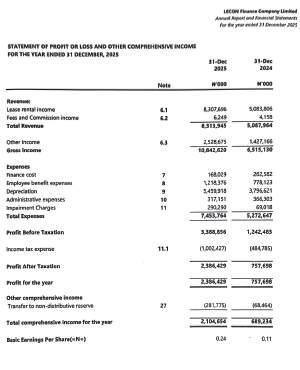
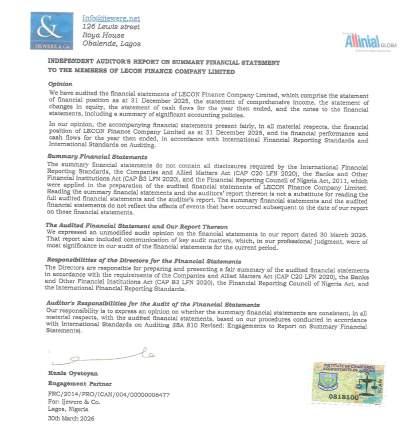
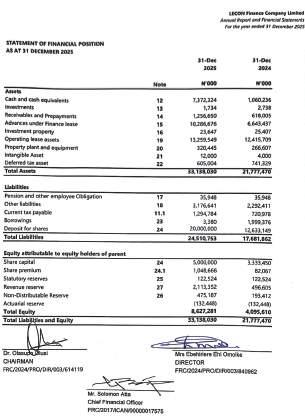
Company Limited Audited Performance For The Year Ended December 31, 2025 Performance Highlights:
1. 215% growth in Profit After Tax (PAT) to ₦2.39 Billion
2. 63.4% revenue growth to ₦8.31 Billion
3. 172.7% increase in Profit Before Tax (PBT) to ₦3.39 Billion
4. 52.2% growth in total assets to ₦33.14 Billion
5. Top-tier credit ratings secured: Aa- (long-term) and A1+ (short-term)
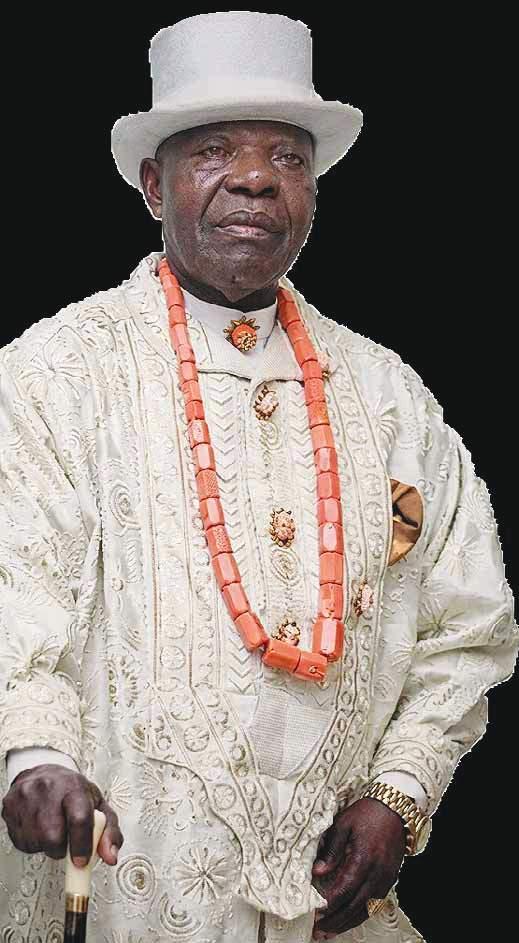
“A great soul never dies. It brings us together again and again.” — Maya Angelou
Today, we lovingly remember our beloved father, grandfather, and patriarch, Chief Dr. M.T.B. Memberr, who departed this life on 22nd July 2018.
A distinguished leader, gentleman, and man of integrity, wisdom, and compassion, he dedicated his life to serving his family, community, and humanity. His values, love, and legacy continue to inspire us and live on through the many lives he touched.
Though deeply missed, he will forever remain in our hearts. We celebrate a life well lived and pray that his gentle soul continues to rest in perfect peace.
Fondly remembered by:
Ineagogo Caroline Memberr
Sotonye Nwabuoku
Tariboba Memberr
Ibiye Ukoko
Ibifubura Ibe
Fabiawari Memberr
Tamunosaki Memberr
Signed:
Chief Tamunosaki Malcolm Memberr
For the Chief Dr. Malcolm Taribo Beddie Memberr Family





s
Acting Group Politics Editor DEJI ELUMOYE
Email: deji.elumoye@thisdaylive.com
08033025611 sms only
While Economic and Financial Crimes Commission has been receiving commendations for securing the forfeitures of properties worth billions of naira linked to former public officers and others, it is hoped it will sustain the momentum by ensuring that all corruption cases are diligently prosecuted without fear, political consideration and distractions, Wale Igbintade writes.
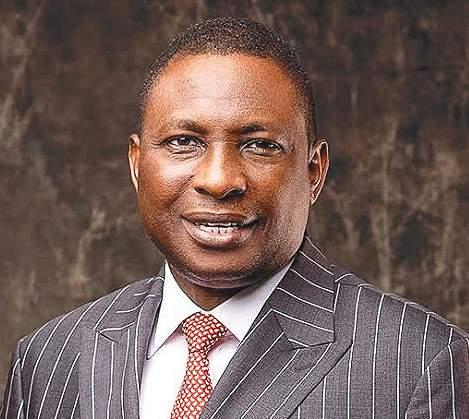
One of the current puzzles arising from developments associated with the ongoing anti-corruption battle in Nigeria is how the once powerful former Attorney-General of the Federation (AGF), Abubakar Malami (SAN), has fallen so lowly following allegations of massive fraud against him and the staggering results of the investigations allegedly indicting him - a development that has led to his arrest and detention by the Economic and Financial Crimes Commission (EFCC).
Another puzzle surrounding Malami is the sheer number of properties considered today as parts of the proceeds of his alleged corruption activities - properties which have been calculated in hundreds of billions of naira.
Already, the Federal High Court in Abuja, has ordered the final forfeiture of 48, out of 57 properties, worth N212 billion, linked to the former AGF.
The 57 properties, including hotels and luxury homes, were initially seized by the EFCC through an interim forfeiture order.
According to the court, 48 of the said properties would be handed over to the federal government.
Justice Joyce Abdulmalik who granted the final forfeiture application filed by the anti-graft commission, ruled that the objections filed by Malami, his family members and some companies, claiming ownership of the properties, “lacked merit.”
Investigations show that beyond Malami’s eventual fall, Nigerians are more in shock over the humongous sums that is the value of the properties in question, as they wonder aloud how a human being, more so, a professional lawyer and a chief law officer of the country, not a known concrete business personality would illegally acquire and keep such seemingly endless number of physical properties for himself and his family, not to talk of other illicit investments that may still be breathing in the shadows.
Just as the Malami’s scandal was still trending, the report on the Federal
Capital Territory High Court in Abuja ordering the final forfeiture of multi-billion naira properties, jewelry and exotic cars linked to a businesswoman, Ms Aisha Achimogu’s to the federal government broke. The properties include: jewelry worth N4.6billion, 11 exotic cars worth N4.23billion, $50,000 and N30million cash.
Delivering judgment on the EFCC’s application for final forfeiture, Justice Jude Onwugbuzie held that Achimogu failed to discharge the legal burden of proving that the assets were acquired through legitimate means.
As if that was not enough, a Federal High Court in Lagos equally ordered the final forfeiture of 52 terrace and maisonette housing units in the Lekki area of Lagos to the federal government after ruling that the properties were reasonably suspected to be proceeds of unlawful activities.
Before that, Justice Aluko had directed the anti-graft agency to publish the interim forfeiture order in a national newspaper to allow any interested parties to show cause why the properties should not be permanently forfeited to the federal government.
But when the alleged owners of the properties could not sufficiently prove how they came about the resources to possess the properties, Justice Owoeye ordered that the forfeiture of the assets.
The EFCC went back to court to establish that it reasonable grounds to suspect that the properties were proceeds of unlawful activities and urged the court to grant the application for permanent forfeiture. It contended that the second respondent, Ifeanyi Nweke, was a fugitive facing criminal charges.
In her ruling, Justice Owoeye rejected the respondents’ affidavit, describing it as contradictory. She held that the EFCC had successfully established a legal basis for the forfeiture but rejected the respondents’ affidavit, describing it as contradictory.
“The consequence is that there is no opposition to the motion filed by the 1st and 2nd Applicants for the grant of an order of final forfeiture,” the judge ruled.
The assets forfeiture scandals have opened up the debate on how some Nigerian have been stealing the country dry without giving thought to the plight of over 150million unfortunate citizens that are not sure where or how to get their next meals. It also shows crazy sleaze through which Nigerian wealth is consistently diverted into the pockets of a few privileged citizens.
This is why many are commending the EFCC for its diligence in the investigations and prosecution of the cases. They posited that if the trend is maintained, the anti-corruption battle would once again be geared towards the right route.
For instance, two anti-corruption crusaders and advocates of good governance, the Centre for Anti-Corruption and Open Leadership (CACOL) and the Human Rights Writers Association of Nigeria (HURIWA) have commended the EFCC and the judiciary over the court’s order grant-
The nigerian people are no longer interested in headline-grabbing recoveries alone. They want accountability after recovery. They want transparency after forfeiture. They want justice they can see and development they can feel.
ing the final forfeiture. They encouraged the commission to sustain the momentum by ensuring that all corruption cases are investigated and prosecuted without fear, favour, or political consideration.
In a statement signed by the organisation’s Director of Administration and Programmes, Tola Oresanwo on behalf of the organisation’s Chairman, Debo Adeniran, he applauded the anti-corruption agency for its painstaking investigation, professionalism, and resilience in diligently pursuing the matter to its logical conclusion.
Also, HURIWA’s National Coordinator, Comrade Emmanuel Onwubiko, while describing EFCC feat as one of the most significant anti-corruption actions in recent years, cautioned the federal government against allowing recovered assets to be diverted to politically connected individuals.
The group questioned the justification for such extensive property ownership by a single individual, asking: “In how many houses can one man genuinely live in one lifetime?” The group praised the anti-corruption agency for pursuing the case, stressing that no public official should be above the law.
Also, a political scientist and secondary school teacher, Mrs. Toyin Oba, while reacting to the current predicament of those who have forfeited their assets and the incredible number of physical assets they has been ordered to forfeit to the government, said: “We all can see today, from the revelations and their current humiliations, that nobody is really above the law and that what we sow on this earth as human beings is what we would reap during the time of harvest.
“Considering the kind of huge sums and assets being mentioned in this scandal, we Nigerians, who, daily stake our lives to do honest works and are unfairly paid pittance by government and other employers, cannot but feel angry and betrayed in a country we have repeatedly come to see is really blessed.
NOTE:
20th July, 2026 - Abuja, Nigeria
Upon finally returning home, I was confronted by the trauma my ordeal had caused my family. My mother, who only returned 24 hours from a spine surgery abroad and was still in recovery stage, she ordered to sit for hours and emotionally humiliated by the EFCC operatives with no consideration for her age or health, and the shock of that experience has left her health permanently compromised to this day. In response, I have since filed a further fundamental human rights action against the EFCC for breach of my rights to privacy and property.
Rather than answer for that conduct, the EFCC responded by widening its pressure on my finances. It compiled and froze every bank account linked to me and my businesses, and for nearly two years my personal and corporate accounts have remained frozen amid continuing litigation across multiple courts. When that failed to achieve its aim quickly enough, the EFCC turned to Section 17 of the Advance Fee Fraud Act, embarking on the tracing, seizure and forfeiture of assets connected to me, without any criminal complaint, petition, or legal foundation whatsoever. As part of the same push, a further media campaign attempted to link me to US$7,000,000 allegedly abandoned in a bank, a claim contradicted by the same clear payment tellers already submitted to NUPRC, showing $2,000,000 paid through a South African Bank in South Africa directly to NUPRC’s designated account on PPL 3007 and $5,000,000 on PPL 302 as part of Oceangate’s proof of payment, yet the EFCC nonetheless continued to press the allegation in court filings and in the social media space. In the continuous campaign to smear my character.
Having failed to sustain that particular allegation, the EFCC turned its attention to the remainder of the same NUPRC payment that my company submitted. Thirteen Million Dollars ($13,000,000) out of the total Twenty Million Dollars ($20,000,000) combined payment for both PPL 302-DO and PPL 3007 by Oceangate Oil & Gas Limited into NUPRC’s federal government account, which EFCC also acknowledged in the motion submitted to their claim which was made subject to an ex-parte forfeiture order obtained by the EFCC at the Federal High Court, without any established case or existing petition. That order has been challenged on appeal, and I await the outcome.
On 20 January 2026, while both that appeal and my earlier suit over the first home invasion were still pending, EFCC operatives, at the directive of the Chairman, invaded my private home a second time and removed all vehicles on the premises by crane and flatbed, without regard to ownership, damage, or safety, abandoning them recklessly to the weather, with no record of offence committed. When I sought the court’s intervention for the return of all my vehicles, after 6 months and other seized personal items for almost 2 years, the EFCC, rather than defend that suit at the Federal High Court, instead again obtained a further ex-parte order of forfeiture from the High Court of the Federal Capital Territory on the same suit before them.
In nearly two years, I have lost over nine international bank accounts, some with 35 years of operating history, and some less than that, without any history of suspicion on my financial activities including my children’s international upkeep allowance account. Several financing opportunities have been cancelled as a direct consequence of the continuous, calculated smearing of my name. This has kept me in constant fear for the safety and emotional wellbeing of my young children. My parents have visibly aged beyond their years because of the trauma caused by the relentless and unjustified attacks against their daughter. Without a crime identified or offence committed. Beyond the deliberate and sponsored media campaign that has sought to misrepresent my identity, I struggle with fears of the safety and the mental states of my young children, my parents have aged 3 times ahead because of the trauma of the no reason smear of their child, apart from the misleading representation by the deliberate and sponsored damaging impact media trial of my person, I have lost valued friendships because many fear being associated with someone falsely branded with allegations of money laundering and financial conspiracy. My reputation has been unfairly questioned, while my investments and businesses have suffered severe setbacks arising solely from the dissemination of misleading information to the Nigerian public and the international community.
This is despite the fact that, in the last five years alone, I have invested almost $90,000,000 in Nigeria’s Oil & Gas sector, funds I committed because I believe in Nigeria and in the promise of its Local Content Act and Petroleum Industry Act, both designed to support indigenous operators like myself.
I have attracted over $100,000,000 worth of investments into the Nigerian economy, because I believed and trusted in my country, I have directly employ close to 200 Nigerians, And I invested in several charity projects through My foundation SEF (SAM EMPOWERMENT FOUNDATION) that has successfully implemented and impacted over 1,000 health programmes, oxgen supply programmes across health centers empowered more than 1 million people through its various interventions, medical bill intervention programme, built primary health centers, schools, modern sanitary facilities for schools, water projects for communities, in various states in Nigeria ,built several mosques and churches, over two thousand Nigerians on scholarship, operating food bank for low income families, conducted over 3,000 successful community outreach initiatives, and provided educational sup-

port to more than 10,000 children.
I made these investments in my country without ever imagining that it would become the basis upon which I would be defamed, my companies discredited, and my children made to live with diminished confidence and constant fear for the safety of their mother.
The EFCC did not stop at nothing, they also directed that my visa be revoked by the American Embassy in Abuja Nigeria, for a mere declaring me wanted which was unjustified.
It is a known information that Visa revocations are initiated by department of State in Washington and not by reason of alleged unconcluded investigation . i received the email of the revocation on the 4th April 2025, 7 days after I was declared wanted by the EFCC.
The most devastating and heartbreaking extended malice was communicated to the American Embassy in Bridgestone (Barbados ) the Embassy that covers my second citizenship. I discovered the most devastating information when could not proceed with an application for a visa on my Grenada passport which was to enable me attend my already booked and scheduled Harvard executive program, when I already knew that my American visa revocation was showing active only from the records in Nigeria. So I thought I could get a waiver, but the worst was discovered, when I was told I could not, until I clear with my birth country.
This was the record:
“NIGERIAN WITH GRENADIAN CITIZENSHIP WANTED FOR MONEY LAUNDERING AND CRIMINAL CONSPIRACY. BUSINESS WOMAN AISHA ACHIMUGU, ONE OF THE THOUSANDS OF NIGERIANS APPROVED AS CITIZENS OF GRENADA UNDER THE CITIZENSHIP BY INVESTMENT (CBI) PROGRAM BY THE DICKON MITCHELL ADMINISTRATION, WAS RECENTLY DECLARED WANTED BY NIGERIA’S ECONOMIC AND FINANCIAL CRIMES COMMISSION (EFCC). ACHIMUGU’S COMPANY, OCEANGATE OIL AND GAS ENGINEERING, SIGNED A $1.5 BILLION OIL DEAL IN GRENADA BEFORE SHE WAS DECLARED WANTED. PUBLISHED IN ‘NOW GRENADA’ MARCH, 2025.”
What could have been so bad, that will led to this level of hate and total destruction of a fellow human being and your fellow citizen who is not a harm to you, to the extent of wanting to destroy investments and relationships outside of your alleged crime .
I have never been known to be a troublemaker. I am not a criminal, and I have never been convicted of any offence. I have never been confronted with any crime that I did not own up to. I have honored over 20 EFCC invitations, and even when it was obvious that I was being oppressed, I still respected the Constitution without being informed of my alleged crime, even as it was circulated to the public through the media. I have lost hard-earned incomes, investments, businesses, personal reputation and long credible goodwill’s, my international collaborators have grown hesitant to work with me,
due to the smear impact has caused on my person .
The deep consequences on this sustained, damaging media trial against my person and my companies have extended far beyond Nigeria without letting me know my crime or offence.
I have asked myself repeatedly what I have done to Nigeria, to Nigerians, or to the EFCC and its Chairman to deserve this. I cry out today not because I have lost faith in the Nigerian judiciary or in the power of the Nigerian State to do justice without fear or favour, but because if it can happen to me today, no one knows who may be next tomorrow.
On Thursday the 16th of July 2026, The EFCC under the leadership of the current Chairman took a different dangerous media trial, by the displays of several jewelries and several luxury cars with huge figures of monies displayed without any sympathy to my young children who has me as their only parent, what could have caused this level of hate without a consideration to everything and any thing.
At this point, it is obvious that the objective is not merely to wear me down, but to put my live at public danger and risk, the lives of my young children, and the safety of my parents, By constantly deliberating exposing me to continuous danger by media trial.
For all these reasons, I call on all meaningful Nigerians, the National Assembly, the Judiciary, the security services, Local and International Human Right Activists, our local and international partners to look into my situation with an open mind and demand that this continuous, malicious misleading, dangerous, and damaging public campaign/media trial against my person and the values I have stood for be corrected. Nigeria already contends with enough challenges of insecurity and economic hardship. Legitimate investors and lawabiding citizens should not have their assets seized in defiance of court orders, without any established court proceedings.
This persecution has not diminished my patriotism. I remain a proud Nigerian, grateful for the decades I spent building businesses without ever breaching the law. Not until the year 2024, my Nigeria that gave me the wing to fly and discover my capacity, under the current EFCC Chairman leadership, that my Nigeria became misrepresented to me. I have faced this concerted effort to criminalize my existence, destroy all my investments, constantly malign my character, suffered business setbacks, loss of timely return on investment on investment already in existence , and have my life and privacy at risk.
I believe that justice delayed is justice denied, and I am not afraid to face the law provided due process is followed. My lawyers are pursuing all legal remedies locally and internationally. I call on the media and the global business community to support a fair business environment in Nigeria and to reject the spread of defamatory and damaging information that harms the national economy.
Nigeria is our great country. Let us build it together, without hate, mischief, malice, politics or anything that would distract or divide us. There is only one option, and it should remain the only option: protect your citizens, protect the economy of our nation, and encourage and support visible businesses. No nation thrives without the involvement of its private sector. It is well established that the private sector drives every nation’s economy.
TODAY, I DECLARE WITH THE URGENCY OF A MOTHER , TO YOUNG ADULTS, PHILANTROPIST, A PATRIOTIC CITIZEN, AN EMPLOYER OF LABOUR, AND A CONTRIBUTOR TO NATIONAL ECONOMY.
MY VERY EXISTENCE AND LIFE ARE IN DANGER.
MY PRIVATE LIFE AND PRIVACY INVADED.
THE INNOCENCE AND SAFETY OF MY CHILDREN ARE UNDER THREAT.
THE HEALTH AND PEACE OF MY AGED PARENTS ARE BEING SACRIFICED.
THE LIVES OF ALL MY STAFF ARE IN DANGER.
MY IDENTITY GLOBALLY IS IN TERRIBLE DANGER.
MY SECURITY IS IN TERRIBLE DANGER.
MY DECADES OF INVESTMENTS IN NIGERIA ARE BEING STRANGLED.
MY COMPANIES ARE IN DANGER.
MY IMMIGRATION RIGHTS GLOBALLY ARE IN DANGER.
MY REPUTATION, MY PRIVACY, AND MY DIGNITY ARE UNDER CONSTANT SIEGE.
I bring all of this to the notice of the general public and the global community as a record, before it is too late.
MY LIFE IS AT RISK
By Gloria Fraser
The call by the Arewa Consultative Forum (ACF) on President Bola Ahmed Tinubu to replicate the intelligence-led operation that secured the release of the abducted pupils and teachers of Oriire Local Government Area of Oyo State is not merely a northern demand; it is a national challenge. Every Nigerian child, irrespective of ethnicity, religion or geography, deserves the same urgency, determination and operational excellence that brought 44 abducted pupils and teachers home after 56 harrowing days in captivity. If the Oriire operation has demonstrated anything, it is that Nigeria possesses the capacity to rescue its citizens. The challenge before the nation now is how to reproduce that success across every part of the country still under the shadow of terrorism and mass kidnapping.
The Oriire rescue was far more than another security operation. It represented one of Nigeria’s most significant intelligence-led hostage rescue missions in recent years. The operation reportedly brought together the Department of State Services (DSS), the Armed Forces, the Nigeria Police Force, the National Intelligence Agency, the Nigeria Security and Civil Defence Corps, Amotekun Corps, local hunters and other security assets in a coordinated mission that eventually secured the freedom of the abductees without the payment of ransom. It demonstrated the value of patience, intelligence gathering, inter-agency coordination and political leadership.
It also demonstrated something equally important: military power alone rarely wins the battle against terrorism.
The ACF is therefore right to challenge the Federal Government to replicate the Oriire model in Borno, Zamfara, Katsina, Niger, Sokoto, Kwara and every other state where innocent Nigerians remain in captivity. Senator Ali Ndume echoed that appeal after the Oyo rescue, urging the military to extend similar attention to Borno where dozens of citizens, including schoolchildren, are still being held by terrorists. The demand is legitimate because every Nigerian life carries equal constitutional value.
However, replicating the Oriire operation requires far more than deploying additional troops or issuing presidential directives. Counter-insurgency experts across the world have long argued that intelligence, local cooperation and community trust are the decisive ingredients in defeating insurgency. Where terrorists enjoy freedom of movement, access to intelligence, local logistics or protection through fear and intimidation, military operations become infinitely more difficult.
That distinction is central to understanding why security conditions differ across Nigeria.
The Southwest has certainly experienced kidnapping, armed robbery and violent crime. Yet it has not developed the entrenched insurgent ecosystem that has confronted parts of the North-East and North-West for well over a decade. Communities in Oyo State responded to the Oriire abduction with extraordinary unity. Families refused to allow the tragedy to disappear from public attention. Traditional rulers, religious leaders, labour unions, civil society organisations, professional groups and the media sustained pressure throughout the 56-day ordeal. Every passing day increased the national determination that the children must return alive.
Equally significant was the cooperation between President Bola Tinubu and Governor Seyi Makinde despite belonging to different political parties. Security operations were not reduced to partisan competition. Instead, the rescue became a common national objective. That unity sent a powerful message to the security agencies that failure was not an option.
The lesson is profound. Intelligence-led operations flourish where governments, security agencies
and communities work towards one objective.
This does not mean northern communities are indifferent to the suffering of their people. On the contrary, thousands of northerners have paid the ultimate price resisting Boko Haram, ISWAP and bandit groups. Soldiers, traditional rulers, Islamic clerics, community volunteers, farmers and ordinary citizens have kbeen murdered because they refused to submit to terrorist violence.
Yet years of relentless conflict have also created conditions that are fundamentally different from those that existed in Oriire.
In many affected rural communities, terrorists have established long-standing networks sustained by fear, coercion and, in some instances, local collaboration. Security agencies have repeatedly warned about intelligence leaks that compromise military operations. Criminal groups exploit difficult terrain, porous borders and isolated settlements. In some locations, villagers cooperate because they fear immediate reprisals; in others, criminal economies built around kidnapping, cattle rustling and illegal mining have created financial incentives that sustain insecurity. These realities do not excuse terrorism, but they illustrate why defeating it requires more than conventional military deployments.
The scale of the challenge confronting the Armed Forces also deserves recognition. During coordinated insurgent attacks across Borno earlier this year, security reports estimated that more than one hundred soldiers were killed within days, while independently verified international reporting confirmed at least dozens of fatalities. Senior officers have been killed in ambushes, military formations have come under repeated assault and sophisticated weapons have been seized by insurgent groups. These are not merely tactical setbacks; they reveal the operational complexity of fighting an enemy that has spent years embedding itself within difficult terrain and exploiting intelligence advantages.
The Oriire operation therefore offers Nigeria an important lesson. It shows what becomes possible when intelligence superiority shifts decisively in favour of the state. The question before the nation is how to create those same conditions wherever terrorism still thrives.
One of the most instructive lessons from the Oriire operation is that successful counterinsurgency begins long before the first soldier enters the battlefield. It begins with intelligence. Intelligence, in turn, depends on trust between communities and security agencies. Terrorists rarely
operate in complete isolation. They require food, fuel, medicine, logistics, informants, safe routes, financial networks and local knowledge. The moment those support systems collapse, their operational capability begins to diminish.
This is where the real national conversation should begin.
The challenge before communities affected by terrorism is not merely to demand more troops but to become active partners in defeating those who have held them hostage for years. Every community must deny terrorists sanctuary, expose criminal collaborators and reject every attempt to normalise kidnapping, banditry and violent extremism. Fear is understandable, but history demonstrates that insurgencies are ultimately defeated when citizens, traditional institutions, religious leaders, civil society organisations and governments unite behind one objective.
International experience supports this conclusion.
Colombia’s decades-long war against the FARC insurgency began to turn when improved intelligence, sustained military pressure and stronger community cooperation deprived insurgents of the freedom to operate. In Iraq, the Sunni Awakening transformed the fight against Al-Qaeda when tribal leaders openly rejected extremist violence and began sharing intelligence with government forces. Rwanda rebuilt social stability after one of history’s darkest tragedies through strong institutions, community participation and national reconciliation. In each case, military operations succeeded because society itself rejected violent extremism.
Nigeria is no different.
The country cannot expect security agencies alone to defeat terrorism if criminal networks continue to enjoy intelligence, logistics and concealment within affected environments. Equally, communities should never be abandoned to confront terrorists without adequate protection. Government must guarantee the safety of those who provide intelligence, strengthen witness protection, improve surveillance technology, deploy more special forces, expand aerial reconnaissance, improve border security and intensify intelligence-led operations. The Oriire rescue has demonstrated that such capabilities already exist within Nigeria’s security architecture. The operation also reinforced another important lesson: political unity saves lives.
Throughout the 56-day ordeal, President Bola Ahmed Tinubu and Governor Seyi Makinde maintained a cooperative relationship despite
belonging to different political parties. There was no public contest over credit while innocent children remained in captivity. The rescue became a national mission rather than a political contest. That example deserves emulation across Nigeria because terrorism recognises neither political party nor ethnicity.
The media equally has a responsibility. Responsible journalism keeps public attention focused on victims without compromising operational security. The sustained national attention given to the Oriire abductees ensured that their plight never disappeared from public consciousness. Every Nigerian child held captive deserves the same visibility and national concern, whether in Oyo, Borno, Zamfara, Katsina, Niger, Sokoto, Kaduna or Kwara.
The Arewa Consultative Forum was therefore right to ask President Tinubu to replicate the Oriire rescue model. The Federal Government should indeed deploy every available intelligence and operational resource to secure the freedom of every Nigerian still held by terrorists. But there is an equally important challenge for political leaders, traditional rulers, religious authorities, opinion moulders and communities across every affected region.
Terrorism cannot become a permanent feature of national life. Criminality must never be explained away as culture, poverty, destiny or an unavoidable consequence of geography. Every influential voice must speak clearly and consistently against those who murder soldiers, abduct schoolchildren and destroy rural communities. Silence, fear and social accommodation only prolong the suffering of innocent citizens.
The ultimate lesson from Oriire is therefore not simply that Nigeria successfully rescued abducted schoolchildren. It is that the operation demonstrated what becomes possible when intelligence, political leadership, community vigilance, inter-agency coordination and national determination converge behind a single objective.
President Tinubu has been challenged to replicate that success across Nigeria. He should accept that challenge. Governors should equally accept theirs.
Traditional rulers should accept theirs.
Religious leaders should accept theirs.
Communities should accept theirs.
The Armed Forces and security agencies have shown that they possess the professionalism, courage and operational capacity to execute complex rescue missions under extremely difficult circumstances. What they require in return is an environment where communities reject terrorism completely, intelligence flows freely and criminals are denied every opportunity to hide behind fear, silence or divided loyalties.
The successful Oriore hostage rescue demonstrates the courage, professionalism, and coordination of Nigeria’s security forces.
The National patriots advocates replicating this model nationwide through improved intelligence sharing, rapid response capabilities, community cooperation, and modern security strategies to protect lives, strengthen national unity, restore public confidence, and enhance national security.
The Oriire operation should therefore not be remembered merely as the successful rescue of 44 pupils and teachers. It should be remembered as a national blueprint for defeating kidnapping and terrorism through intelligence-led operations supported by united communities and courageous political leadership.
Every Nigerian child still in captivity deserves nothing less.
•Princess G Adebajo-Fraser MFR President, The National Patriots. Special Adviser to Former President Goodluck Jonathan.
Bennett Oghifo
The Nigerian Institute of Quantity Surveyors (NIQS) commended the DirectorGeneral of the Bureau of Public Procurement (BPP), Dr. Adebowale A. Adedokun, for progress in the Bureau’s ongoing procurement reforms.
Speaking on behalf of the Institute, during a courtesy visit to the agency’s headquarters in Abuja, NIQS President Dr. Aminu Muhammad Bashir, FNIQS, cited recent developments under Dr. Adedokun’s leadership, including the July 13 launch of the National Guidelines for Public Procurement of Food and Related Services and a May 2026 circular mandating final designs before contract awards — a measure aimed at curbing recurring problems such as excessive contract variations and cost overruns.
QS Bashir also pointed to
the Bureau’s reported savings of approximately ₦1.1 trillion for the Federal Government in 2025, attributed to improved price intelligence and budget evaluation, describing the outcomes as consistent with cost management principles long advocated by the quantity surveying profession.
NIQS Welcomes Presidential Decision on CIPSMN Bill
The NIQS President further conveyed the Institute’s appreciation to President Bola Ahmed Tinubu for declining assent to the proposed amendment of the Chartered Institute of Purchasing and Supply Management of Nigeria (CIPSMN) Act. NIQS said the decision addressed concerns it had raised over potential overlap between the bill’s proposed provisions and the statutory mandates of established procurement-related professions, warning that such
duplication risks weakening public accountability.
Dr. Bashir urged the BPP, as regulator, to ensure the roles of existing statutory bodies, including quantity surveyors, remain clearly defined as new procurement frameworks are developed.
BPP Welcomes Continued Collaboration
Responding, Dr. Adedokun welcomed the delegation, stating that the visit “gladdens his heart.” He acknowledged the contributions of NIQS members to the Bureau’s reforms and said the current phase of procurement reform was focused on outcomes rather than process alone. The Bureau’s approach, he said, was now centred on “output, value for life and value for money,” rather than input measures alone.
Both parties discussed continued collaboration, with
NIQS reaffirming its readiness to participate in the National Procurement Strategy Development Committee and offering to make available its Standard Methods of Measurement
and the International Cost Management Standard (ICMS) framework to support the Bureau’s work.
The meeting concluded with both sides expressing commit-
ment to further engagement on procurement policy and professional regulation matters going forward.
Elan Expo, organisers of Mega Project Nigeria Expo 2026, has announced that preparations are in top gear for the landmark 10th Edition of Nigeria’s premier infrastructure, construction, engineering and real estate exhibition, scheduled to hold from 25–27 August 2026 at the Landmark Centre, Victoria Island, Lagos.
Themed “Building the Future: A Decade of Infra-
structure, Innovation and National Development,” this year’s edition celebrates ten years of connecting government, investors, developers, contractors, engineers, manufacturers, consultants, financial institutions and technology providers to drive sustainable infrastructure and economic growth in Nigeria.
Speaking ahead of the event, the Convener of Mega Project Nigeria Expo said: “As we celebrate our tenth edition, we
are proud of the impact Mega Project Nigeria Expo has made in advancing collaboration, promoting innovation and creating business opportunities across Nigeria’s built environment. This milestone is not just a celebration of our journey but a renewed commitment to supporting the nation’s infrastructure and housing agenda.”
Over the past decade, Mega Project Nigeria Expo has grown into a strategic platform
for promoting investment, technology transfer, business networking and policy dialogue within Nigeria’s construction and infrastructure ecosystem.
This year’s Expo will feature an international exhibition, high-level conferences, investment forums, business-to-business (B2B) and business-to-government (B2G) meetings, product launches, networking sessions and strategic discussions focused on infrastructure financing,
housing development, smart cities, sustainable construction and public-private partnerships.
Strategic Partnerships
A major highlight of the 2026 edition is the strengthened collaboration with the Real Estate Developers Association of Nigeria (REDAN) and the Mortgage Banking Association of Nigeria (MBAN). These partnerships underscore the Expo’s commitment to supporting housing develop-
ment, expanding access to mortgage finance, encouraging investment in the real estate sector and fostering stronger collaboration between developers, financial institutions and policymakers.
The organisers are also working closely with public institutions, professional bodies and private-sector stakeholders to ensure the event delivers meaningful outcomes that contribute to national development.
Bennett Oghifo
The President of the Green Building Council Nigeria (GBCN), Danjuma Waniko, has called for stronger collaboration among governments, developers, financiers, researchers and other stakeholders to bridge the fragmentation slowing the country’s transition to sustainable cities, saying Nigeria’s challenge is no longer a lack of innovation but the inability to connect existing efforts for greater impact.
Speaking at the opening of the fourth edition of the Future Cities Summit 2026 in Lagos, Waniko said the theme, “Building the Future: Advancing Sustainability for Greener Cities,” reflects the need to move beyond identifying urban challenges to understanding the underlying reasons sustainable solutions have yet to achieve nationwide scale.
He said although many people believe little progress is being made in sustainable urban development, evidence
from across the country suggests otherwise.
According to him, state governments, private developers, financial institutions, researchers, innovators and professional bodies are implementing numerous initiatives aimed at promoting green buildings, climate resilience and sustainable infrastructure.
Waniko, however, noted that the various initiatives remain largely disconnected, limiting their collective impact.
“The real issue is not the
absence of activity, but one of disconnectedness and fragmentation,” he said.
“We have many individuals and organisations doing remarkable work, yet there is no clear framework linking our efforts together. They remain scattered, not visible enough, and as a result, they fail to reinforce one another.”
He stressed that one of the summit’s primary objectives is to explore practical ways of connecting the many ongoing initiatives within Nigeria’s build-
ings and construction ecosystem to create greater momentum for sustainable development.
Welcoming participants to the two-day event, Waniko expressed appreciation to the summit’s partners and sponsors, including the Global Building Performance Network (GBPN), GNZ, PIKU and the Nigeria Energy Support Programme, for supporting the initiative.
He also commended the Lagos State Government for its sustained partnership with GBCN on several projects and
praised Governor Babajide Sanwo-Olu’s administration for providing leadership in sustainable urban development. Waniko thanked the governor, represented by his Senior Special Assistant at the event, alongside speakers, exhibitors, volunteers and participants attending both physically and virtually.
Reflecting on the summit’s evolution over the last four years, he recalled that previous editions focused on issues such as decarbonisation, resilience, energy, water and smart cities.
Fadekemi Ajakaiye
Technology experts, educators and creative professionals have stressed the need for Nigeria to embrace artificial intelligence (AI) responsibly to prepare young people for the future, insisting that the technology should be viewed as a tool for innovation rather than a replacement for human creativity.
The position was canvassed at Claiming Tomorrow: The NextGen Collective, a thought leadership event focused on education, technology and storytelling, held
on Thursday, July 16, 2026, at the Alliance Française de Lagos, Mike Adenuga Centre, Ikoyi, Lagos.
The gathering was conceived to address some of Africa’s most pressing questions around education, emerging technologies and creative storytelling by bringing together industry leaders and innovators to examine how technology can transform learning and unlock opportunities for the next generation.
Speaking during the event, the Chief Executive Officer of Nsibidi Fables, Mr. Ifeanyi Ezefuna,
reflected on the company’s journey and the challenges it encountered while introducing technology-driven learning to Nigerian schools.
According to him, when the company commenced operations about two years ago, many schools viewed its programmes as a threat to their existing curriculum and educational model.
He, however, said a number of schools eventually embraced the initiative, enabling the organisation to demonstrate tangible results and earn the
confidence of educators and parents.
Ezefuna explained that the organisation’s mission extends far beyond teaching animation.
He said the company exposes young people to software development, application design, storytelling, digital creativity and other technology-driven skills aimed at nurturing future animators, filmmakers, software developers, writers and innovators.
“Our vision is to help raise the next generation of creators and innovators. AI is simply one
of the tools helping us achieve that vision,” he said. He described artificial intelligence as an emerging workplace competency that future professionals cannot afford to ignore.
According to him, the objective of the summit was to familiarise participants with emerging technologies while demonstrating how innovation could strengthen Nigeria’s education sector.
He noted that many educational institutions across the country remain underfunded, understaffed and underdevel-
oped, adding that digital tools could complement existing systems by expanding access to quality learning in schools, homes and workplaces.
Addressing concerns over AI’s growing influence in education, Ezefuna argued that responsible use of the technology actually demands critical thinking rather than discouraging it. He maintained that instead of debating AI’s existence, greater attention should be devoted to teaching ethical use, intellectual property protection and originality.


Oborevwori’s recognition by the BPP and ICPC highlights foresight and accountability, writes PIUS OGBAMREMU
See page 21
SAMBO TURAKI urges ADC to allow due process to prevail
See page 21

KALU OKORONKWO pays tribute to Peter Obi, presidential candidate of the Nigeria Democratic Congress in the 2027 general elections
"The true measure of a leader is not found in the office he occupies, but in the values, he leaves behind, the institutions he strengthens, and the hope he inspires in those who never meet him." --Anonymous
Political history often remembers leaders by the offices they held, the elections they won, or the power they exercised. Time, however, is a far sterner judge. It asks not how long they occupied power but what they did with it. Did they strengthen institutions or merely consolidate personal influence? Did they elevate public discourse or diminish it? Did they leave behind a culture of accountability or one of entitlement? Above all, did they inspire citizens to believe that leadership is ultimately defined by character rather than convenience?
Those are the enduring questions that frame any serious reflection on Mr. Peter Gregory Obi, the presidential candidate of the Nigeria Democratic Congress (NDC) in the 2027 general elections, as he marks his 65th birthday.
Born on 19 July 1961 in Onitsha, Anambra State to a devout Christian family with roots in Agulu, Obi received his secondary education at Christ the King College, Onitsha, before studying Philosophy at the University of Nigeria, Nsukka, where he graduated in 1984. Over the years, he broadened his education through executive programmes at institutions including Lagos Business School, the International Institute for Management Development (IMD), Switzerland; Harvard Business School; Saïd Business School, University of Oxford; Cambridge Judge Business School; and the Kellogg School of Management. Those experiences complemented his business background and helped shape the leadership philosophy for which he later became known.
To many Nigerians, Obi is the former Governor of Anambra State whose emphasis on fiscal prudence, accountability, and disciplined public finance reshaped conversations about governance. To others, he is the Labour Party's presidential candidate in the 2023 election, whose campaign evolved into an unprecedented civic movement that mobilised millions of young people, professionals, first time voters, and citizens seeking a different model of political leadership. Admirers regard him as a symbol of competence,
integrity, and restraint in public office. Critics question whether his cautious, managerial approach is sufficiently suited to the complex compromises required in national politics.
Such contrasting assessments are neither unusual nor unhealthy. Every influential political leader attracts admiration and scrutiny in equal measure. What ultimately distinguishes statesmen from ordinary politicians is not universal approval but their ability to reshape public expectations and influence national conversations long after campaign slogans have faded.
Measured against that standard, Peter Obi has become more than a perennial presidential contender. He has emerged as one of the central figures in Nigeria's endless debates about leadership, governance, and public accountability.
His public journey mirrors, in many respects, the aspirations and contradictions of contemporary Nigeria. It is the story of a businessman who ventured into politics without the traditional machinery of political godfatherism; a governor who challenged conventional assumptions about public finance; a presidential candidate who transformed electoral participation into a broad civic movement; and a public figure whose influence increasingly transcends party affiliation.
Whether one agrees with his politics or not, few would dispute that Obi has compelled Nigerians to confront difficult questions about governance, public expenditure, institutional integrity, and the relationship between leadership and character. In a political culture often shaped by patronage and personality, that contribution alone has secured him a distinctive place in Nigeria's democratic evolution.
However, beyond the applause and
the criticism lies a larger reality: Obi has become one of the defining political figures of contemporary Nigeria. He has forced the nation to revisit an enduring question: what qualities should truly define leadership?
When Singapore's founding Prime Minister, Lee Kuan Yew, insisted that integrity mattered more than popularity, he transformed a resource poor island into one of the world's most efficient economies. When José Mujica, the former President of Uruguay, rejected presidential extravagance in favour of personal simplicity, he demonstrated that public office could co-exist with humility. When Angela Merkel governed Germany with disciplined accountability and restraint rather than political theatrics, she earned international respect for stability over spectacle. When Nelson Mandela chose reconciliation over revenge, he showed that moral authority could become a nation's greatest political asset.
Different continents, different political systems and different historical circumstances, yet they shared one defining principle: the legitimacy of leadership ultimately does not rest on electoral victory alone, but on public trust, Obi's political journey invites Nigerians to engage in that same conversation.
Unlike many Nigerian politicians whose careers were shaped within the traditional machinery of party politics, Obi arrived in public life through the private sector. Long before election campaigns turned him into a national figure, he had established himself as a successful businessman and corporate executive, serving on the boards of several companies and earning a reputation for financial discipline, strategic thinking, and sound corporate governance.
The private sector became his first classroom in leadership. There, he learned lessons that would later define his political philosophy: resources are finite, waste carries consequences, and institutions endure only when accountability becomes a culture rather than an occasional slogan. Those convictions would eventually distinguish both his style of governance and his public identity.
Okoronkwo is a communications strategist, a leadership and good governance advocate
recognition by the
Public procurement may sound like a technical government function reserved for accountants, lawyers and procurement specialists. Yet it is arguably where governance succeeds or fails. Every road, school, hospital, bridge, water project or healthcare facility begins with procurement. It is the process through which taxpayers’ money is converted into tangible development.
That is precisely why the recent Award of Excellence presented to Delta State Governor, Rt. Hon. Sheriff Oborevwori, by the Bureau of Public Procurement (BPP) and the Independent Corrupt Practices and Other Related Offences Commission (ICPC) deserves closer attention. Unlike many ceremonial recognitions, this award is rooted in one of the most important pillars of governance which is the transparent and prudent management of public resources.
The Governor who was represented by his Deputy, Sir Monday Onyeme, received the award during the opening ceremony of a two-Day Public Procurement and Enlightenment Workshop for Executive Council members and top government functionaries at the Unity Hall, Government House, Asaba.
"Our administration recognises that an efficient procurement system is essential to good governance," said the governor.
"This has informed our efforts to strengthen institutional frameworks that promote openness, fairness, competition, and value for money in project execution."
Oborevwori also disclosed that Delta State spent over ₦654.5 billion on 362 strategic projects in 2025 without borrowing. This is significant. Even more noteworthy is his insistence that the expenditure followed due process under the Delta State Public Procurement Law, 2020. The achievement deserves recognition for several reasons.
First is the issue of fiscal discipline. Across Nigeria, many state governments depend heavily on borrowing to finance infrastructure. Loans are not inherently bad, especially when the borrowing is for productive capital projects can stimulate economic growth. But the challenge arises when governments borrow excessively to finance recurrent expenditure or projects that generate little economic value. Against this backdrop, Delta State’s ability to finance over ₦654 billion worth of procurement activities without accumulating fresh debt reflects a deliberate commitment to prudent financial management.
Secondly, procurement transparency has become increasingly recognised worldwide as one of the strongest weapons against corruption. Accord-
ing to organisations such as the World Bank and the Organisation for Economic Co-operation and Development (OECD), public procurement accounts for a substantial proportion of government expenditure globally. It is also one of the sectors most vulnerable to abuse through inflated contracts, bid manipulation, conflicts of interest and poor project execution. Oborevwori’s administration appears to appreciate this reality and its decision to organise a procurement enlightenment workshop for members of the State Executive Council and senior government officials demonstrates an understanding that good procurement is not merely about laws but also about capacity. Capacity building is often overlooked in governance discussions, yet many procurement failures arise not solely from corruption but also from inadequate technical knowledge.
Thirdly, the award reflects an important institutional shift. One of Nigeria’s long-standing governance challenges has been the tendency to personalise government achievements. Strong institutions, however, outlive individual office holders. By strengthening the Delta State Public Procurement Commission and continuously investing in its capacity, the Oborevwori administration appears to recognise that procurement reforms must become institutional rather than personality-driven. This approach mirrors international best practices.
Countries like Singapore, Finland and New Zealand that consistently rank among the world’s least corrupt owe much of their success not simply to honest leaders but to institutions that enforce transparency irrespective of who occupies political office. Nigeria’s own procurement reforms have followed a similar philosophy since the enactment of the Public Procurement Act in 2007. The legislation established the Bureau of Public Procurement to regulate procurement processes across federal government institutions, promote competition and ensure value for money.
Ogbamremu writes from Asaba
SAMBO TURAKI urges ADC to allow due process to prevail
When politicians can no longer defend the facts, they often resort to propaganda. When evidence becomes inconvenient, they manufacture conspiracy theories. And when criminal prosecution begins to follow due process, they suddenly discover the language of political persecution.
This appears to be the unfortunate strategy now being deployed by the African Democratic Congress (ADC) over the ongoing prosecution of its embattled chieftain and former Kaduna State Governor, Mallam Nasir El-Rufai.
The recent claim by the party's National Publicity Secretary, Bolaji Abdullahi, that the federal government intends to keep El-Rufai in custody until after the 2027 general election is cheap political propaganda, false alarm and an attempt to intimidate institutions charged with administering justice.
The first principle that ADC conveniently ignored is that President Bola Ahmed Tinubu neither files criminal charges nor grants bail. Nigeria operates a constitutional democracy founded on the doctrine of separation of powers.
The Independent Corrupt Practices and Other Related Offences Commission (ICPC) is a statutory investigative and prosecutorial agency created by law. The Department of State Services (DSS) equally exercises powers granted under relevant legislation.
The courts determine bail applications independently. Judges evaluate evidence. Judges interpret the law. Judges determine whether bail conditions have been satisfied.
To suggest that President Tinubu personally controls judicial decisions is an affront to the independence of Nigeria's courts. Ironically, the ADC claims to defend democracy while simultaneously implying that judges merely carry out presidential instructions.
That allegation is insulting. If the party genuinely believes the judiciary lacks independence, it should produce credible evidence instead of relying on political speculation masquerading as analysis.
Even more disturbing is the attempt to portray El-Rufai as a "political prisoner." Political prisoners are individuals incarcerated solely because of their political beliefs or peaceful political activities. El-Rufai is not standing trial for belonging to the ADC.
He is not before the courts because he criticised government policies. He is not being prosecuted for contesting elections. He is answering criminal charges filed by competent law enforcement agencies regarding allegations arising from his tenure as governor of Kaduna State and in a separate matter involving alleged unlawful interception of communications.
Whether those allegations are true
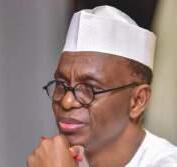
or false is precisely what the courts exist to determine. That is due process. ADC's repeated attempts to substitute courtroom proceedings with political rhetoric betray a profound misunderstanding of constitutional democracy.
Perhaps the most revealing statement came when the party declared that it believed El-Rufai would remain in custody because his release would strengthen the opposition ahead of the 2027 elections.
That statement inadvertently exposes the party's real concern. Its focus is not justice. Its focus is electoral arithmetic. The implication is unmistakable: criminal proceedings should somehow be adjusted to accommodate opposition political calculations.
That proposition is both dangerous and unconstitutional. Justice cannot be suspended because elections are approaching. Public officers cannot become immune from prosecution simply because they occupy influential political positions.
Democracy would collapse if criminal accountability became subordinate to electoral convenience. Equally troubling is ADC's attempt to personalise the judicial process by threatening to hold President Tinubu personally responsible should anything happen to El-Rufai in custody. Such rhetoric amounts to emotional blackmail.
Nigeria's criminal justice system operates under established legal procedures. Correctional authorities have responsibilities. Medical services are available subject to court directives. Indeed, courts have reportedly granted access to medical attention where appropriate.
To transform every procedural issue into presidential responsibility is nothing more than political theatre designed to generate public sympathy.
It is worth recalling that when El-Rufai wielded enormous political power as governor of Kaduna State, he consistently defended the supremacy of institutions whenever his administration exercised authority.
writes from Kubwa, Abuja
Editor, Editorial Page PETER ISHAKA
Email peter.ishaka@thisdaylive.com
The insertion of unrelated projects in the Commission’s budget is misguided
The National Assembly has repeatedly been accused of abusing the federal budgetary process by inserting questionable constituency projects. The latest victim of the disturbing trend is the National Commission for Almajiri and out-of-school Children's Education (NCAOOSCE), an agency saddled with tackling the world’s largest out-of-school children crisis. Out of its N22.8 billion total budget for 2026, N8.4 billion was earmarked for unrelated initiatives, including road construction in Ekiti, Ogun, and Katsina States. Besides, parts of the money would also be used for procuring ambulances, solar streetlights, and other infrastructure which have no link to the education of the vulnerable children.
Expectedly, the revelation has triggered widespread outrage. Several individuals and civil society groups have condemned the diversion. It is unconscionable that the little resources intended to educate out-of-school children would be taken away from their primary purpose. “Whether conceived by the commission or inserted by lawmakers,” said the IA-Foundation, a United Kingdom registered educational charity, “every naira spent on roads, boreholes or ambulances through an education agency’s budget is a naira that does not reach a child who cannot read, write or count”.

madu Buhari established the Almajiri Commission so that the homeless children could be taken from the streets to schools. Earlier efforts by his predecessor, President Goodluck Jonathan, for an integrated Almajiri education programme aimed at preserving Islamic education while equipping children with modern knowledge and skills were largely abandoned after he left office. In 2024, President Bola Ahmed Tinubu reconstituted the leadership of the Commission, but also with the core mandate of reducing out-of-school children.
It is unconscionable that the little resources intended to educate out-of-school children would be taken away from their primary purpose
However, the impact of the Commission is hardly felt. Last week, the Minister of Education, Dr. Tunji Alausa said the ministry is partnering with the National Bureau of Statistics (NBS) to conduct a comprehensive nationwide survey to establish a more accurate figure for the country’s out- of- school children. For now, the numbers are still more of a guesswork, estimated at between 18 to 20 million. Yet, the consequences of having such huge numbers of children out of school are obvious everywhere, from security to social impact.
At a recent symposium in Abuja with a focus on the security and socio-economic challenges that now define northern Nigeria and their impact on the people, one of the conclusions was that youth populations constitute Northern Nigeria’s greatest strategic asset. However, without adequate investments in education, skills development, entrepreneurship, technology, and job creation, this demographic advantage risks becoming a development challenge.
The Almajiri system, as currently practiced, is a major embarrassment. Without homes or any discernible means of survival except begging, millions of children are confined to the street which exposes them to all forms of abuse. In 2023, the late President Muham-
EDITOR SHAKA MOMODU
DEPUTY EDITOR WALE OLALEYE
MANAGING DIRECTOR ENIOLA BELLO
DEPUTY MANAGING DIRECTOR ISRAEL IWEGBU
CHAIRMAN EDITORIAL BOARD OLUSEGUN ADENIYI
EDITOR NATION’S CAPITAL IYOBOSA UWUGIAREN THE OMBUDSMAN KAYODE KOMOLAFE
EDITOR-IN-CHIEF/CHAIRMAN NDUKA OBAIGBENA
GROUP EXECUTIVE DIRECTORS ENIOLA BELLO, KAYODE KOMOLAFE, ISRAEL IWEGBU
DIVISIONAL DIRECTORS SHAKA MOMODU, PETER IWEGBU, ANTHONY OGEDENGBE
DEPUTY DIVISIONAL DIRECTOR OJOGUN VICTOR DANBOYI
SNR. ASSOCIATE DIRECTOR ERIC OJEH
ASSOCIATE DIRECTOR PATRICK EIMIUHI
CONTROLLERS ABIMBOLA TAIWO, UCHENNA DIBIAGWU, NDUKA MOSERI
DIRECTOR, PRINTING PRODUCTION CHUKS ONWUDINJO
TO SEND EMAIL: first name.surname@thisdaylive.com
Nothing manifests this challenge better in the last decade than the all-pervading violence across the country. Many of the street kids have become easy recruits over the years in sustaining the bloody Boko Haram insurgency. Many politicians and others use them as cannon fodder to advance their interests. Also, as a corollary of the problem, millions of Nigerians are falling increasingly into extreme poverty, a phenomenon worsened by corruption, including in the education sector. The Almajiri Child Rights Initiative (ACRI)–an advocacy and support platform that holds government accountable on the issue of out-of-school children–said that corruption is playing a large role in keeping Nigerian children out of school.
It is therefore unacceptable that some unscrupulous politicians seek to deprive these children of the meagre resources allotted to them through dubious ‘constituency projects.’ We urge the president to intervene on this vexatious matter by calling the National Assembly members and their collaborators in the Almajiri Commission to order.
Letters in response to specific publications in THISDAY should be brief (150-300 words) and straight to the point. Interested readers may send such letters along with their contact details to opinion@thisdaylive.com. We also welcome comments and opinions on topical local, national and international issues provided they are well-written and should also not be longer than (750- 1000 words). They should be sent to opinion@thisdaylive. com along with photograph, email address and phone numbers of the writer.
Former Catholic pontiff, Pope John Paul II, once said: “Among all unimportant subjects, football is by far the most important”. Without any doubt, football is a global crowd puller, and the game’s most amazing spectacle is the FIFA World Cup.
Since Uruguay hosted the first edition of the World Cup in 1930, during the era of revered FIFA President Jules Rimet, the competition has continued to grow in leaps and bounds. From a 13- team event in 1930, it grew to become a 48-team affair. Today, the World Cup commands a global TV audience in excess of one billion.
Sadly, however, many experts are of the view that the 2026 edition was not really a good advertisement for the game. They argue that, from an over-expanded format to unnecessary commercialization, logistical confusion, and creeping political influence, the 2026 World Cup might actually be the worst in history.
The most obvious change to the 2026 Mundial was its expansion from 32 to 48 teams—the largest in history. Though FIFA said it was designed to develop the game, it actually harmed it. With 104 matches spread over weeks, the tournament risked fatiguing spectators as fixtures piled up. Not every match felt important— and that is a problem for a tournament built on drama.
Experts reason that increasing the number of games can reduce competitive intensity and create “meaningless matches” with inconsequential outcomes.
To experts, the group stage, once a high-stakes battleground, became diluted with mismatches and predictable outcomes. Lower-ranked teams were often outclassed, leading to lopsided games that lacked excitement.
Many stakeholders, who also align with this school of thought, argue that the tournament only truly “started” in the knockout rounds. In effect, the early stages—once
filled with spectacles and volatility—became a protracted prologue rather than a competition in its own right.
To compound the situation, the expanded format was characterised by structural defects. With third-placed teams advancing, the system created scenarios where teams could progress without winning a single match, undermining meritocracy. This, analysts believe, raised risks of foul play and undue advantages in qualification pathways.
Besides this, the 2026 World Cup was over-commercialized. From corporate patronage overload to the introduction of a Super Bowl-style halftime entertainment, the tournament gradually looked a lot like an entertainment event rather than a sporting tourney. Tayo Ogunbiyi is Director, Public Enlightenment and Community Relations, Ministry of Information & Strategy, Alausa, Ikeja
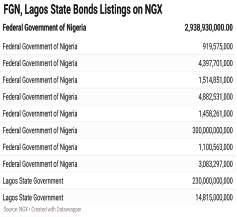
Kayode Tokede
The federal government and Lagos State government bonds listings on the Nigerian Exchange Limited (NGX) increased to N6.93 trillion between January and July 16, 2026 amid playing a critical role in capital formulation in Nigeria’s economy.
The federal government through the Debt Management Office (DMO) has Bonds and Sukuk listed on the bourse.
Government bonds are listed on the NGX to provide investors with a highly liquid, tradable marketplace
where they can buy and sell previously issued bonds.
By listing these bonds, the government establishes a benchmark yield curve to help price private-sector debt while ensuring retail and institutional investors have constant access to a low-risk, tax-exempt investment option.
According to the X-compliance report obtained by THISDAY, the FGN Bond/ Sukuk new listings so far far contributed 96.46per cent or N6.68 trillion out of the N6.93 trillion, while Lagos state government accounted for 3.5per cent or N244.82 billion
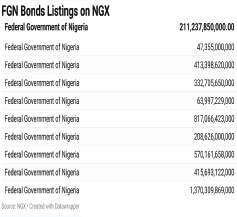
in the period under review.
The report revealed that NGX admitted a supplementary listing of additional 1,370,309,869 units of 7.95% FGN JUN 2032 bond, an equivalent of N1.37 trillion on April 24, 2026. This is the highest value of FGN’s listings on the bourse.
For Lagos State Government bond, the report showed that on February 9, 2026, the state listed N230 billion series 4, 10 Years 16.25% fixed rate bond due 2035 under the N1 trillion debt and
hybrid instruments issuance programme and N14.815 billion Series 3, 5 years 16% fixed rate green bond due 2030 under the N1 trillion debt and hybrid instruments issuance programme.
The state government, had announced plans to utilize the proceeds from its recent bond issuance, into critical infrastructure development.
The combined transaction represents the largest bond issuance ever by any state government in Nigeria and the first subnational Green Bond in the country’s history.
The funds will be invested
in key sectors such as transportation, housing, environmental sustainability, healthcare, and education, aiming to drive sustainable and inclusive growth in the state.
The Lagos State Governor, Babajide Sanwo-Olu had expressed gratitude to investors for their confidence in Lagos State and pledged to ensure prudent management of public resources.
He said, “we are here to finalize the documentation for the issuance of our Green Bond and Conventional Bond as part of the Lagos
State N1 trillion Debt and Hybrid Instruments Issuance Programme.”
According to him, since our administration took office, our journey in bond issuance has been pioneering. The first bond we issued in 2020, valued at approximately N100 to N110 billion, marked a record at the time. Each subsequent bond has surpassed its predecessor, and today we embark on another groundbreaking opportunity.”
The Centre for the Promotion of Private Enterprise (CPPE) has stated that reducing the structural cost of doing business in Nigeria and ensuring export competitiveness should become the foremost objectives of the country’s industrial policy.
According to CPPE, international markets reward firms that consistently deliver competitive prices, superior
quality, reliable supply, timely delivery and compliance with global standards.
The Chief Executive Officer of CPPE, Dr. Muda Yusuf, stated this in a paper titled, “Industrial Policy, Manufacturing Competitiveness and the Future of Nigeria’s Production Economy,” which he presented last week during the Lagos Chamber of Commerce and Industry (LCCI) mid-year economic review and outlook.
Yusuf said that Nigeria’s
manufacturing strategy should rest on five mutually reinforcing pillars in order for the country to emerge as one of Africa’s leading industrial economies.
He identified these pillars as competitive production costs, productivity and innovation, competitive value chain, export competitiveness and institutions that enable enterprise.
He said: “Taken together, these five pillars constitute more than an industrial policy
framework. They provide a national competitiveness strategy capable of transforming manufacturing into the principal engine of productivity, investment, exports and inclusive economic growth.”
According to him, “these are not theoretical constructs. Rather, they reflect the practical experience of economies that have successfully industrialised. Together, they provide a comprehensive framework
for lowering production costs, raising productivity, strengthening industrial capability and positioning Nigerian firms to compete successfully within Africa and global markets.”
Yusuf asserted that industrial competitiveness begins with the economics of production, adding that, “No manufacturing economy can achieve sustained competitiveness where firms face unreliable electricity, high logistics costs, expensive
finance, multiple regulatory charges and deficient infrastructure. Under such conditions, improvements within individual firms are often overwhelmed by structural disadvantages beyond their control.”
He, therefore, said that “reducing the structural cost of doing business should therefore become the foremost objective of industrial policy.
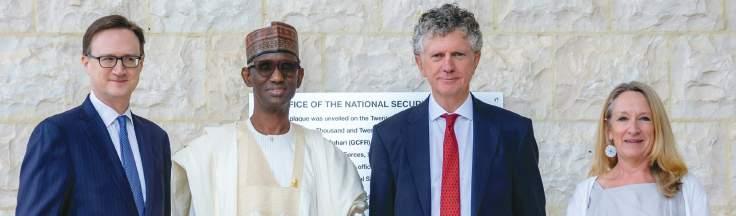
Kayode Tokede
A renowned capital market economist, Prof Uche Uwaleke, has stated that the Nigerian stock market is expected to deliver a more modest but still attractive return to investors in the second half of 2026.
His comment followed the extraordinary 47.4 per cent return in H1 2026.
Uwaleke, who was speaking at the ASAM webinar series with the theme, “Mid-year Macroeconomic Review & Outlook for H2 2026,” listed Dangote Refinery listing, FTSE Russell Decision, cross-border listings and corporate earnings as the major catalysts to drive the market.
He expressed the possibility of the Central Bank of Nigeria (CBN) increasing its Monetary Policy Rate (MPR) in the penultimate election year amid
its move to tackle inflation in the country.
He noted that 2026 is a penultimate election year, stressing that the preponderance of the historical evidence is that inflation is usually slightly higher caused by pre-election spending.
“If inflation is demand driven, as a result of money supply, of course you will expect that the central bank will hike the interest rate. If the interest rate is further increased, the impact on the equities segments would be negative.
“There is an inverse between the interest rate and the stock market performance. Of course, the fixed income market will benefit once there is a hike in interest rate,” he explained.
In his goodwill message, the Director-General, Securities & Exchange Commission (SEC), Dr. Emomotimi Agama, yesterday
revealed that the capital market community has engaged with foreign investors to address FTSE Russell, a global institutional
investors and custodians to address concerns over Nigeria’s T+1 settlement.
The MD/CEO, Arthur
Asset Management, Mr.
in his presentation titled, “Navigating Opportunities in a Changing
Ebere Nwoji
Pension and retirement planning expert, Mrs Rahinatu Omolamai, has advised Nigerians to embrace early retirement planning as a critical tool for combating old-age poverty.
Omolamai, who is the head of Personal Pension Plan at Leadway Pensure PFA, gave the advice at a one day training programme organised by Leadway Group for
Dike Onwuamaeze
The National President of the Nigerian Association of Chambers of Commerce, Industry, Mines and Agriculture (NACCIMA), Mr. Jani Ibrahim, has commended President Bola Ahmed Tinubu for banning the export of raw cocoa beans.
Ibrahim described the ban as a timely and strategic
intervention that aligned with NACCIMA’s long-standing advocacy for value addition, industrialisation, and the development of competitive local industries capable of creating jobs, increasing export earnings, and strengthening Nigeria’s economy.
He said that Nigeria could no longer afford to remain primarily an exporter of raw agricultural commodities while other countries reap the
greater economic benefits of processing and manufacturing finished products.
“The decision to prioritise local cocoa processing represents a significant step towards transforming Nigeria’s agricultural value chain. Beyond increasing foreign exchange earnings, it will stimulate investments in processing facilities, create thousands of direct and indirect jobs.
The new President of the Chartered Insurance Institute of Nigeria (CIIN), Mr Akinjide Orimolade has said that his administration as the 53rd President of the institute would focus on three key agenda of deepening technology adoption, strengthening insurance
awareness and commencing the construction of the institute’s permanent secretariat.
He also said his administration would build on the achievements of his predecessor, Mrs Yetunde Ilori, through the aforementioned three-point agenda termed Technology, Enforcement and Building (TEB).
“The agenda is designed
to reposition the institute and prepare insurance professionals for the rapidly evolving global insurance landscape. The institute will complete the transition to hybrid computer-based examinations. This is to enable candidates across the country write professional examinations without geographical constraints,” he said.
First City Monument Bank (FCMB) and 247 Travels have launched Book Now, Fly Later, a financing programme that allows eligible customers to borrow up to N10 million for international flight tickets
and repay over three to nine months.
The programme is designed to help Nigerians spread travel costs for business, education, healthcare,
tourism, and family commitments.
The facility, powered by FCMB Premium Banking, is available exclusively for airline tickets purchased through 247 Travels.
members of National Association of Pension and Insurance Editors (NAIPE) in Lagos, warned that rising living costs, unstable incomes and changing work patterns have made financial preparedness more urgent than ever.
In a paper titled: “Building
Financial Wellness: The Role of Retirement Planning,” Omolamai said retirement planning should no longer be viewed as an option reserved for salaried workers but as a necessity for everyone who earns an income.
According to her, the
current economic realities facing Nigerians including persistent inflation, declining purchasing power and unpredictable income streams, have redefined financial wellness and underscored the need for long-term financial planning.
A Multi-National Construction Company with its Head office in Ikeja, Lagos and branch offices in Abuja and Ibadan required the services of the following staff to fill vacant positions in the company.
1. Quarry Manager (Expatriate)
Location: Ibadan, Oyo State. Experience: 15 years
2. Asst. Quarry Manager (Nigerian)
Location: Ibadan, Oyo State. Experience: 15 years
3. Accountant (For Hotel)
Location: Lagos State. Experience: 10 years
4. Technical Officer (Nigerian)
Location: Abuja Experience: 5 years
5. Sales Representative (Male or Female)
Interested and qualified applicant should send in their CV to this email: ethelbert.njoku@samcocitynigeria.com samco.nigeria@samco-egypt.com
James Emejo posits that with the launch of a $3.05 billion World Bank assisted package of programmes focused on poverty reduction and human capital development, the federal government prioritising is strategic investments in people, not just policy reforms, a development that will determine whether its economic agenda ultimately succeeds
For the Tinubu administration, stabilising Nigeria’s economy was only the first phase of a much broader agenda. Tough fiscal and monetary reforms may have helped restore investor confidence, strengthen external reserves and gradually ease inflationary pressures, but government officials acknowledge that the reforms can only be judged successful when they improve the welfare of ordinary Nigerians.
That reality explains the significance of the federal government’s unveiling of a $3.05 billion package of World Banksupported programmes aimed at tackling poverty, strengthening human capital and expanding economic opportunities across the country, which the president launched recently.
More than another development intervention, the package reflects government’s attempt to connect macroeconomic reforms with tangible improvements in household welfare—ensuring that the gains of economic restructuring extend beyond impressive statistics to communities, farmers, schools, health centres and vulnerable populations.
The package comprises the $1.25 billion Nigeria Community Action for Resilience and Economic Stimulus Additional Financing (NG-CARES AF), the $300 million Solutions for Internally Displaced Persons and Host Communities (SOLID)
Programme, and the $1.5 billion Human Capital Opportunities for Prosperity and Equity (HOPE) Programme.
Together, they represent one of the administration’s most ambitious investments in inclusive growth, signalling a shift from stabilising the economy to ensuring that recovery is felt where it matters most—inside
Nigerian homes.
President Bola Tinubu said the programmes represent promises fulfilled under the Renewed Hope Agenda.
Represented by the Minister of Finance and Coordinating Minister of the Economy, Mr. Taiwo Oyedele, the president insisted that economic reforms should ultimately be assessed by improvements in citizens’ welfare rather than macroeconomic indicators alone.
According to him, while Nigeria’s economic outlook has improved—with stronger GDP growth, moderating inflation, higher foreign reserves and improving investor confidence—the administration remains focused on ensuring that those gains translate into better living conditions.
Tinubu noted that government had already reached about 15 million vulnerable households through expanded cash transfer programmes, helping lift an estimated 7.5 million Nigerians out of poverty.
The new interventions, he said, are expected to build on those achievements by supporting farmers, expanding opportunities for small businesses, improving healthcare and education
and strengthening resilience across vulnerable communities.
He described the three programmes as complementary pillars of one national development strategy rather than separate interventions, urging state governments and implementing agencies to focus on measurable outcomes.
Tinubu said, “These three programmes are not separate efforts - they are one coordinated national strategy for poverty reduction, human capital development, and community resilience. Livelihoods, healthcare, education, social protection, and support for displaced communities reinforce one another where it matters most: at the grassroots.
Through our ward-centric approach, we are aligning federal, state, and local government around a single goal - making every ward a place of real service delivery, real opportunity, and real improvement in people’s lives.
“I commend the Honourable Ministers of Budget and Economic Planning, of Education, and the Coordinating Minister of Health and Social Welfare for their leadership in bringing this vision to life.”
The story continues online on www.thisdaylive.com
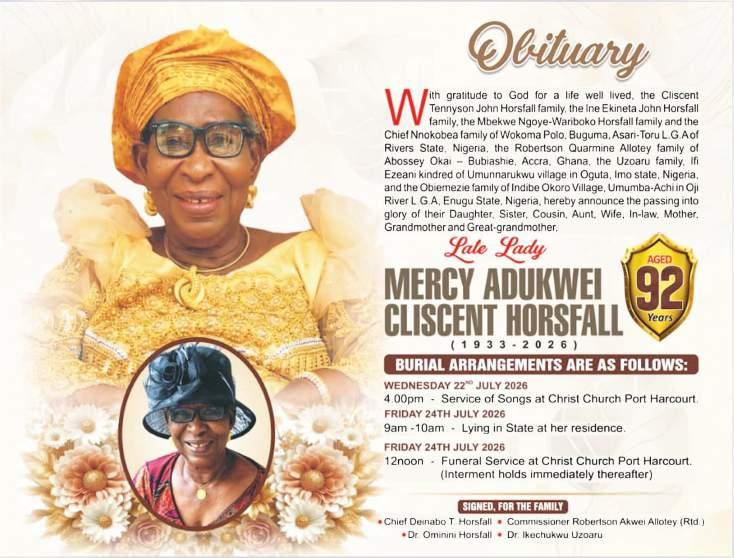
Kemi Olaitan in Ibadan
The Nigeria Deposit Insurance Corporation (NDIC) has called on youths especially students in the country to imbibe the culture of saving, financial discipline, and investment as part of efforts to drive national prosperity and financial inclusion.
The call was made during the 2026 Financial Literacy Day celebration held at Lagelu Grammar School, Agugu, Ibadan, organised by the NDIC.
The Assistant Director, Communication and Public Affairs of the Corporation, Mr. Adegbenga Fabuyi, while delivering a paper on, “Smart Money Talk,” said the programme was designed to orient young
people on spending wisely by prioritising needs over wants, urging the students on the importance of saving with banks, setting financial goals, maintaining financial discipline, and keeping good company.
According to him, the financial literacy programme was part of activities marking Global Money Week, adopted by the Bankers’ Committee in Nigeria to mentor young people on savings and investment.
Speaking at the event, the Oyo State Commissioner for Education, Science and Technology, Hon. Olusegun Olayiwola, represented by the Permanent Secretary, Education Inspectorate, Ibadan 1, Alhaji Lukuman
Kareem, appreciated the NDIC for selecting a school in Ibadan for its sensitisation programme, stating that such initiatives must go beyond the classroom to shape young minds.
“Young children cannot do what is expected of them unless they are properly guided. Not everything can be taught in the classroom. Sometimes, issues like this are better addressed outside the classroom,” he said.
The Principal of Lagelu Grammar School (Senior), Mr. Gbolagade Adeyanju, in his remarks, commended the NDIC for selecting the school as a beneficiary of the 2026 edition, stating that the programme would be of immense benefit to both students and teachers.
Ebere
Sovereign Trust Insurance Plc, has reaffirmed its unwavering commitment to delivering on its promise to policyholders through the prompt settlement of genuine claims, maintaining its reputation as a dependable insurer in Nigeria’s dynamic insurance industry.
The underwriting said as at June 30th, 2026, it had paid claims worth over N2.7billion across its various lines of business, underscoring its capacity
to stand by customers when they need it most.
It said the sustained level of claims settlement reflected the company’s strong operational discipline, sound underwriting practices and healthy financial position affirmed by the GCR international rating agency.
“This commitment comes on the heels of the successful conclusion of the Company’s Rights Issue, which attracted an impressive level of participation from
existing shareholders. The strong response further demonstrates the confidence of investors in the company’s strategic direction, corporate governance and long-term growth prospects”.
Speaking on the company’s performance, the Managing Director and Chief Executive officer of the company, Dr Lucas Durojaiye, noted that prompt claims payment remained one of the strongest indicators of an insurer’s financial strength and reliability.
Ebere Nwoji
emPLE Nigeria, one of the licensed insurance underwriting firms, in partnership with Ecobank Nigeria, has reinforced its commitment to financial inclusion through its “Protecting Little Dreams” Initiative.
According to the company, the initiative is Children’s financial literacy campaign aimed at promoting financial literacy and insurance awareness among children.
Speaking on the initiative, Managing Director, emPLE
Life Assurance Limited, Jolaolu Fakoya, said, “One of the company’s key priorities this year was to deepen insurance penetration by making insurance easier to understand, more accessible and more relevant to Nigerians on daily basis.”
Commenting on the initiative, Head, Bancassurance, emPLE Nigeria, Aderonke Smith, said, “At emPLE, we believe financial security starts with intentional planning. Through our partnership with Ecobank, we are making it easier for parents to take
meaningful steps towards securing their children’s future. By combining financial education with accessible insurance solutions, we are helping families understand that preparing for tomorrow starts with the decisions we make today. Our goal is not only to protect lives but also to empower families with the confidence to build a more secure future for the next generation”, she explained.
According to her, as part of the initiative, families received the emPLE Term Life Plan, securing their loved ones’ financial future should the unexpected occur.
Ebere Nwoji
Prudential Zenith Life Insurance, has commended the Nigeria Insurers Association (NIA) for achieving the recent historic milestone of producing its first female President, Mrs Ebelechukwu Nwachukwu, in its 55 years of existence as a body. The investiture ceremony, held in Lagos, honoured Nwachukwu’s exceptional leadership and contributions to the insurance sector. She
assumed office with a strong track record of innovation, strategic excellence, and a commitment to advancing the industry.
The Executive Director and Chief Financial Officer of Prudential Zenith Life Insurance, Afolabi Lawal commented on the company’s gold sponsorship and support to the event saying “Prudential Zenith Life Insurance congratulates Ebelechukwu Nwachukwu on her well-deserved appointment as the first female Chairman of the NIA.
“We are proud to support
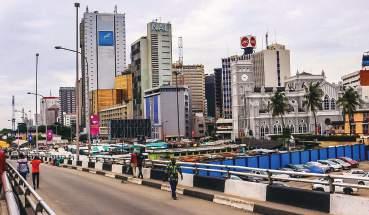
this historic milestone through our gold sponsorship. Her appointment is both a personal achievement and an important step forward for gender representation, inclusive leadership, and excellence in Nigeria’s insurance industry”, he stated
He said Prudential Zenith Life, remained committed to working with partners in genuine collaborations that strengthened the sector and contribute to the sustainable growth of Nigeria’s economy and are keen on creating greater value for all stakeholders.
Kayode Tokede
The Nigerian stock market continued its positive run, with stocks repricing across major sectors as investor confidence drove market capitalisation above the N159 trillion mark.
The Nigerian Exchange Limited All-Share Index
(NGX ASI) gained 475.60 basis points or 0.19 per cent
to close at 246,659.56 basis points from 246,183.96 basis points it opened for trading with the Month-to-Date and Year-to-Date returns edged higher to +7.5per cent and +58.5per cent, respectively.
The market capitalisation rose by N307 billion to close at N159.119 trillion from N158.812 trillion it closed the previous day.
On sectors, performance was broadly positive as the
Insurance (+0.5per cent) and Consumer Goods (+0.5per cent) indices advanced while the Industrial Goods, Banking, and Oil & Gas indices closed flat.
The upturn was driven by price appreciation in large and medium capitalised stocks amongst which are; Nigerian Exchange, MTN Nigeria Communications (MTNN), BUA Cement, Ikeja Hotel and The Initiates Plc
(TIP).
Investor sentiment remained upbeat, with 33 gainers outperforming 20 losers. Thomas Wyatt Nigeria emerged the highest price gainer of 9.73 per cent to close at N3.72, per share.
Ikeja Hotel followed with a gain of 9.53 per cent to close at N46.55, while The Initiates Plc up by 9.52 per cent to close at N33.95, per share.
Neimeth International Pharmaceuticals appreciated by 9.47 per cent to close at N9.25, while FTN Cocoa Processors rose by 8.72 per cent to close at N10.10, per share.
On the other side, MeCure Industries led others on the losers’ chart with 9.95 per cent to close at N76.95, per share. Haldane McCall followed with a decline of 9.86 per cent to close at N3.29, while
Critical Minerals Financing Corporation (CMFC) declined by 9.85 per cent to close at N3.02, per share. Trans Nationwide Express lost 9.68 per cent to close at N2.80, while Academy Press depreciated by 9.38 per cent to close at N5.80, per share. The total volume traded advanced by 11.4 per cent to 932.45 million units, valued at N49.28 billion, and exchanged in 50,059 deals.
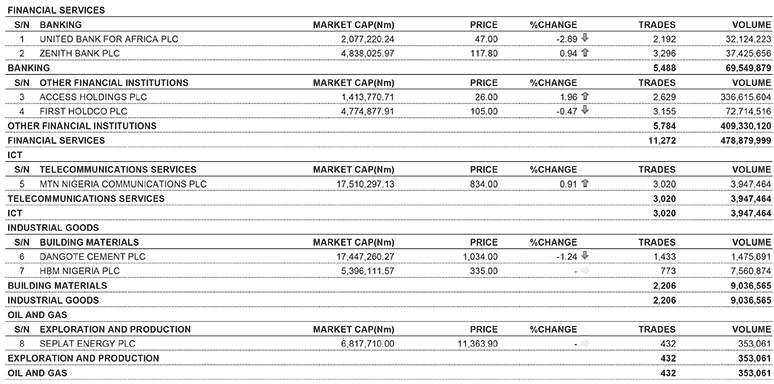
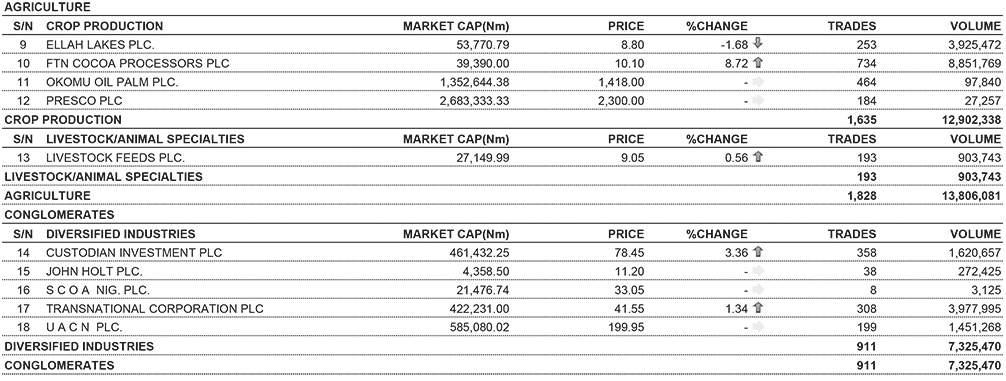
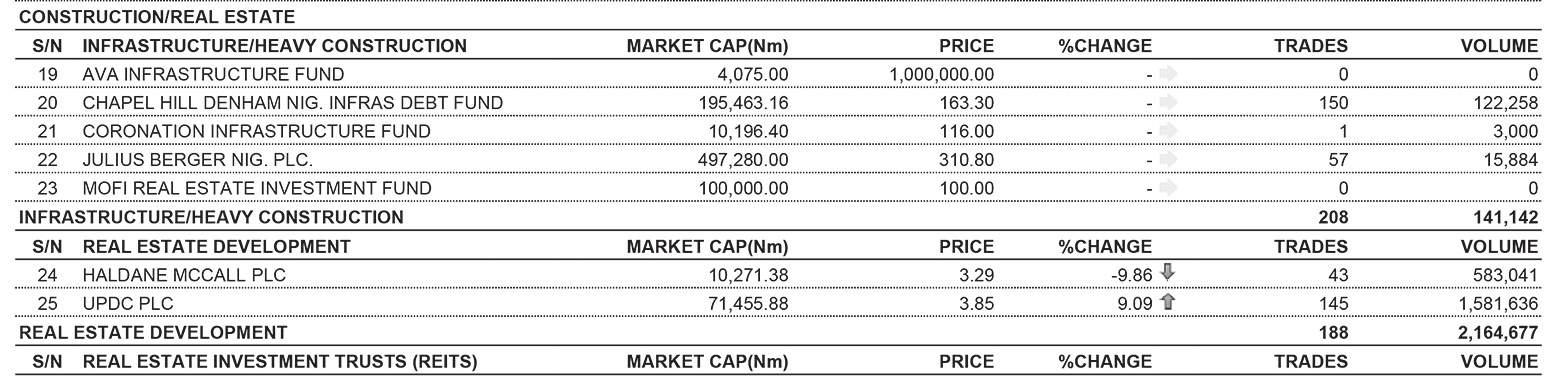
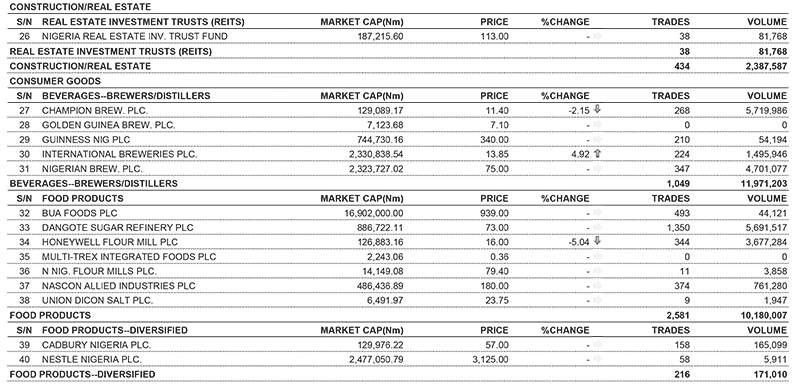
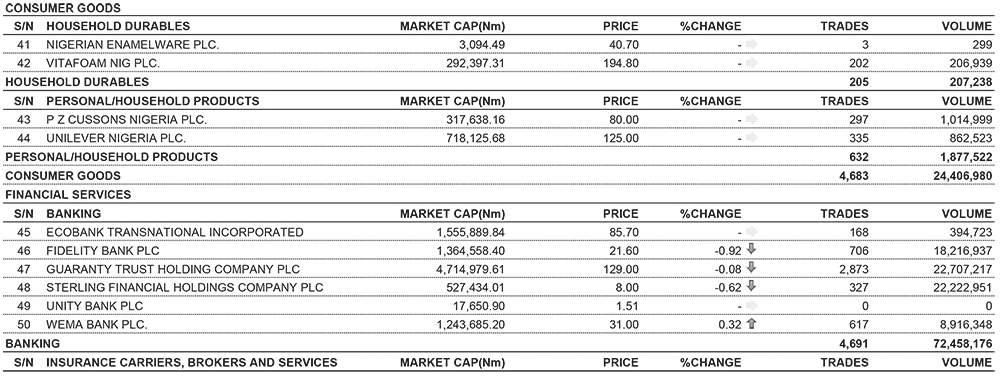
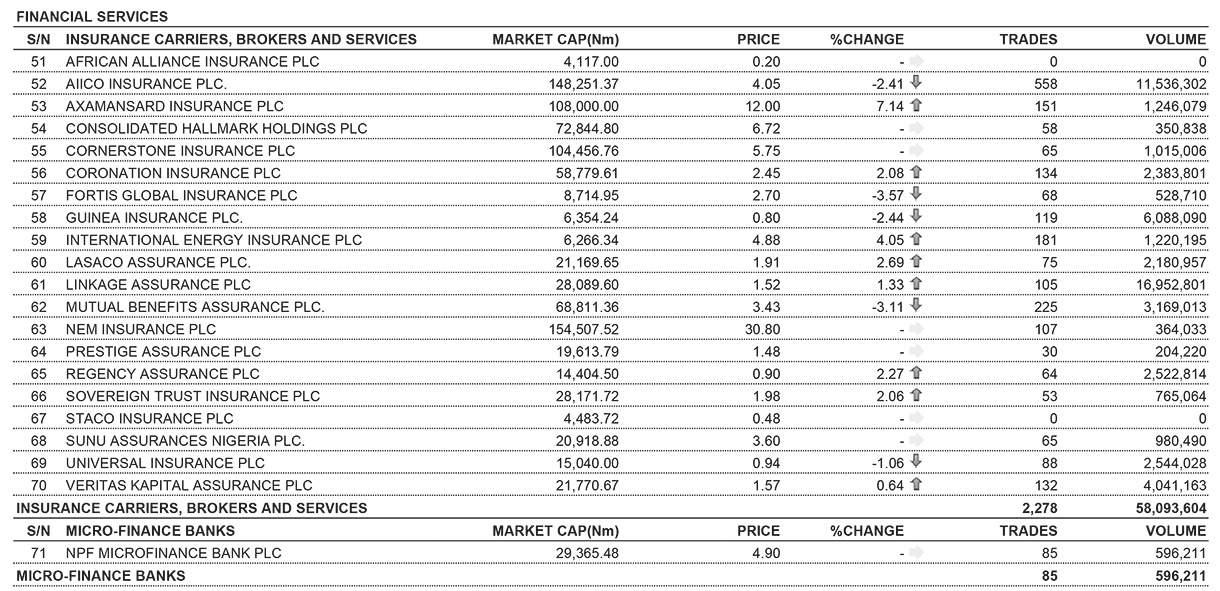

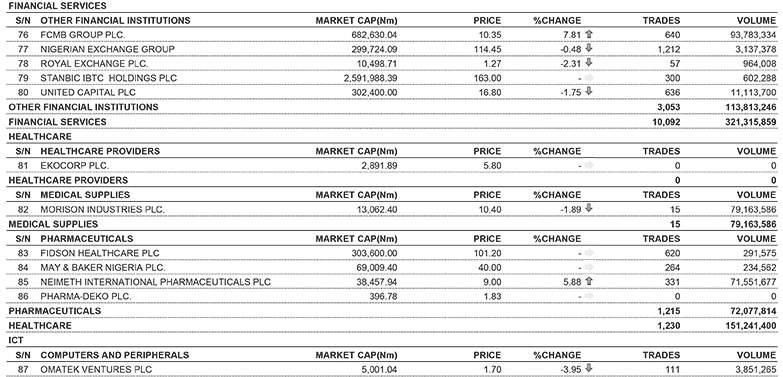
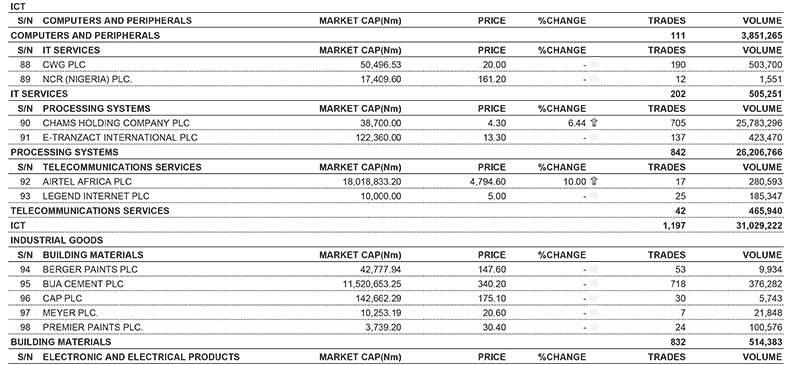
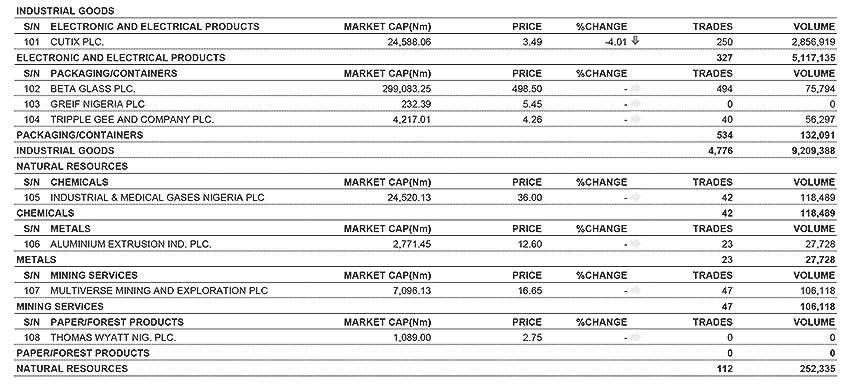
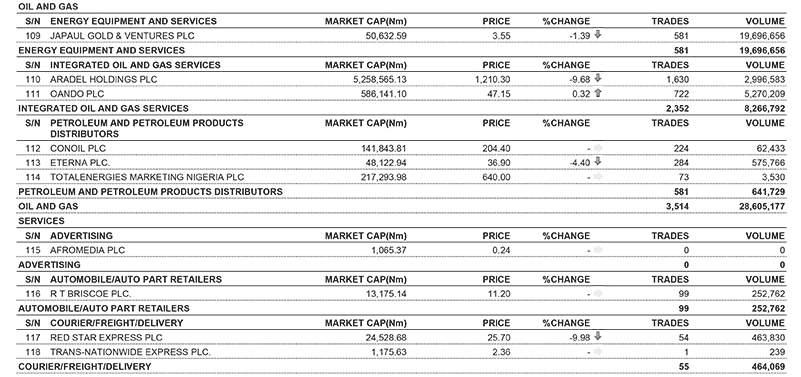

A Mutual fund (Unit Trust) is an investment vehicle managed by a SEC (Securities and Exchange Commission) registered Fund Manager. Investors with similar objectives buy units of the Fund so that the Fund Manager can buy securities that willl generate their desired return.
An ETF (Exchange Traded Fund) is a type of fund which owns the assets (shares of stock, bonds, oil futures, gold bars, foreign currency, etc.) and divides ownership of those assets into shares. Investors can buy these ‘shares’ on the
floor of the Nigerian Stock Exchange.
A REIT (Real Estate Investment Trust) is an investment vehicle that allows both small and large investors to part-own real estate ventures (eg. Offices, Houses, Hospitals) in proportion to their investments. The assets are divided into shares that are traded on the Nigerian Stock Exchange.
GUIDE TO DATA:
Date: All fund prices are quoted in Naira as at 17th July 2026, unless otherwise stated.
Since 2016, the Lagos Free Zone has been organising the annual Tolaram Science Challenge for secondary schools in the Ibeju-Lekki axis of the state. As the competition marks its 10th anniversary, the Chief Executive Officer of Lagos Free Zone, Adesuwa Ladoja, reiterates the organisation’s commitment to investing in Nigeria’s future competitiveness by supporting STEM education. Uchechukwu Nnaike presents excerpts
The Tolaram Science Challenge (TSC) is celebrating its 10th edition this year. What does this milestone represent for Lagos Free Zone and Tolaram?
The 10th edition represents consistency, partnership and our enduring belief in the potential of young Nigerians. Many initiatives begin with enthusiasm, but sustaining a programme for a decade requires commitment, collaboration and a clear sense of purpose. This milestone is evidence that, for Lagos Free Zone, the Tolaram Science Challenge is not a temporary intervention. It has become an enduring platform through which we support students and schools in our host communities.
It is also a reminder that development must be measured by more than infrastructure and investment. It must include the opportunities we create for people and communities to progress. As we celebrate the impact that the Tolaram Science Challenge has had over the past ten years, we are also looking ahead with renewed commitment to the next generation of STEM champions who will contribute to Nigeria’s future.
Why have you chosen to invest in science education?
We chose to focus on STEM because it is the bedrock of any society and a foundational investment in economic resilience, talent development and sustainable progress. STEM education teaches young people how to question, analyse, experiment and solve problems. These capabilities are essential in a world increasingly shaped by technology, engineering, data and innovation.
At a more micro level, a focus on STEM education creates a pipeline of skilled talent for enterprises within Lagos Free Zone and the wider Lekki Economic Corridor. This enables young people from our host communities to participate meaningfully in technical and specialised roles across our operations.
Nigeria’s ambition to build a more productive and industrialised economy will depend on the quality of its people. We need young Nigerians who can improve manufacturing processes, strengthen healthcare, develop new technologies, make logistics more efficient and solve challenges that affect everyday life.

We therefore see education as a form of human capital infrastructure. Roads, ports, factories and power systems are important, but their full value can only be realised when skilled people are available to operate, improve and innovate around them. Supporting science education is both a social responsibility and a practical investment in Nigeria’s future competitiveness.
How has this initiative helped to shape Nigeria’s future, and how does it align with Lagos Free Zone’s broader vision for development?
No single programme can shape a country’s future on its own, but initiatives such as the Tolaram Science Challenge make an important contribution. Every student who becomes more curious, confident and interested in science represents future potential for Nigeria. Some may go on to become engineers, researchers, healthcare professionals, entrepreneurs or technology leaders. Others will carry the analytical and practical skills they have developed into different fields.
This aligns closely with the broader
vision of Lagos Free Zone. We are building an enabling ecosystem where businesses can succeed, opportunities can be created, and communities can thrive. Attracting investment is one part of that vision; developing people who can participate meaningfully in the resulting growth is equally important. By connecting education, industry and community development, the Tolaram Science Challenge helps ensure that the progress taking place around Lagos Free Zone is locally rooted and capable of creating lasting value.
What skills do you believe young people need to succeed in today’s world?
The first is the ability to keep learning. Knowledge and technology are changing so quickly that what matters is not only what young people know today, but how effectively they can acquire new knowledge tomorrow. They also need critical thinking and problem-solving skills. This means being able to examine information, ask the right questions and develop practical solutions. Scientific and digital literacy will be increasingly important, but these technical capabilities must be combined with communication, collaboration and emotional intelligence. Finally, young people need adaptability, resilience and integrity. Careers will not always follow a straight path, and setbacks are inevitable. Those who can learn from failure, work well with others and remain trustworthy will be better prepared to succeed in a changing world.
What message would you like participating students to take away from this year’s Challenge?
My message is that the value of the Tolaram Science Challenge goes beyond winning. By participating, you have already demonstrated curiosity, courage and a willingness to test yourself. Those qualities will remain valuable long after the competition has ended. Do not think of science simply as a school subject or a collection of facts to memorise. See it as a way of understanding the world and improving it. Continue asking questions, experimenting with ideas and learning from mistakes. You do not need to have every answer today, but you should never lose the confidence to search for one. I hope you leave this year’s Tolaram Science Challenge
believing that you matter, your ideas matter, and you belong in this space as you harness your ability to contribute meaningfully to your community and to Nigeria’s future.
Many young Nigerians are concerned about opportunities. What would you say to them?
Their concern is understandable. However, I would encourage young Nigerians to focus on what they can continue building: relevant skills, practical experience, strong relationships, adaptability and a reputation for integrity. Opportunities are emerging across manufacturing, logistics, technology, healthcare, energy and the creative economy, although the pathway may not always be immediate or conventional. At Lagos Free Zone, our role is to attract investment and help businesses succeed so that more sustainable economic opportunities can be created, which in turn will lead to thousands of jobs. Initiatives such as the Tolaram Science Challenge complement this effort by helping young people develop the capabilities required to participate in that growth over the long term.
As Lagos Free Zone continues to attract global investment, what role will innovation play in sustaining growth?
Innovation will be fundamental. Global investors are looking not only for incentives or physical infrastructure, but also for speed, reliability, transparency, efficiency and access to skilled people. Meeting those expectations requires continuous improvement. For Lagos Free Zone, innovation applies to every aspect of the ecosystem: how infrastructure and utilities are delivered, how goods move, how administrative processes are managed, how resources are used and how people are trained. The objective is to make it easier for businesses to establish operations, scale efficiently and remain globally competitive.
Innovation will also help our tenants respond to changing markets, localise products, improve productivity and operate more sustainably. Strong infrastructure may attract investors initially, but it is the ability to keep improving the business environment that will retain them and sustain growth over the long term.
The Vice-Chancellor, Federal University Oye Ekiti (FUOYE), Prof. Joshua Ogunwole, has lauded what he described as the path of dialogue and peace, being prioritisead by the current leadership of the Academic Staff Union of Universities (ASUU) while seeking a better welfare for its members in the country, applauding the union for the prevalent peaceful academic environment in the country.
Ogunwole also thanked the present administration in the country for ensuring that academic activities in tertiary institutions, particularly universities were not interrupted, singling out the Education Minister, Dr. Tunji Alausa for
his proactiveness in handling labour matters in the university system and not allowing them to fester.
The vice-chancellor, who turns 59 tomorrow, stated that he will not only celebrate his birthday, but the prevailing tranquility in Nigerian universities and the ongoing reforms introduced by his administration to fast-track growth and development in FUOYE.
The reforms include the ongoing re-classification of the university to the college system, each to be headed by a provost. Under the reform, Ogunwole
warned that the university has zero tolerance for sexual hasassment among students and staff, particularly lecturers to students.
The VC reiterated his administration’s intolerance for corruption and extortion of students by lecturers under whatever guise. While stressing that the classroom is not for money making, he disclosed that a discreet body had been set up in the Vice-Chancellor’s Office where victims could make complaints, adding that the body is also charged with monitoring and enforcement.
To reduce distraction from unnecessary visits by members of the public to the VC, he said
that he appointed a director to handle visits to his office so that he can have quality time to work
Prof Ogunwole while receiving the leadership of the Akure Zone of ASUU in his office recently, urged the union to find a way to reconcile with its sister union, Congress of Nigeria University Academics (CONUA), which broke away from ASUU few years ago, while noting that both unions share a common goal and aspiration for the welbeing of the university system in the country.
The team was led by Prof. Lawan Anbubakar of ASUU’s National Resource Persons Group.
Aga Khan University Hospital, Nairobi, has called for a coordinated Africa-led strategy to tackle the continent’s healthcare challenges by strengthening health systems, improving quality of care, investing in specialist training, expanding clinical research and making access to advanced healthcare services easier within Africa.
The Chief Operating Officer, Khurram Jamal, stated at a media roundtable in Lagos that Africa possesses the expertise, human capital, and resources needed to build healthcare systems capable of earning patients’ confidence and
significantly reducing the growing dependence on medical treatment outside the continent.
According to him, Africa continues to lose billions of dollars annually to outbound medical tourism, a trend that weakens local health systems and diverts much-needed investment away from the continent.
Jamal disclosed that an estimated $7 billion leaves Africa every year as patients seek treatment abroad, with more than
300,000 Africans travelling to India alone for specialist healthcare.
He noted that the exodus is fuelled by inadequate specialist services, inconsistent quality standards, fragmented referral systems and the widespread perception that superior healthcare can only be accessed outside Africa.
He stressed that reversing the trend would require deliberate investments in quality healthcare delivery, skilled professionals, research and stronger regional partnerships.
“True shared prosperity means building health
systems that Africans can trust, access and rely on right here at home,” Jamal said.
He added that Africa must retain both its patients and healthcare investments by developing institutions capable of delivering globally benchmarked services.
Speaking on the importance of quality healthcare, Jamal said confidence in African hospitals could only be restored through internationally recognised standards, patient safety and continuous improvement in service delivery.

By Ugo Uzuegbu
For decades, global climate governance has been driven primarily by national governments through multilateral negotiations. Yet as climate impacts intensify, the gap between commitments and implementation has become more apparent. With nearly 200 countries pursuing different economic interests, political priorities, and development needs, consensus has become increasingly difficult to achieve. The result is a growing pattern of stalemate across the multilateral institutions responsible for negotiating global environmental agreements.
A review of major UN environmental and climate negotiations since 2024 shows that at least six have been deadlocked: negotiations on the Global Plastics Treaty have stalled twice, the UN Biodiversity Conference in Cali was suspended without agreement on finance, the International Seabed Authority has failed across successive sessions to conclude a Mining Code, COP29’s climate finance outcome was rejected by many developing countries as inadequate, COP30 failed to include fossil fuel phase-out language in its final decision, and the June 2026 Bonn climate talks ended without progress on emissions reductions and adaptation finance.
As confidence in multilateral negotiations has waned, governments, cities, businesses, and civil society are now turning to complementary platforms that prioritise collaboration and implementation over consensus.
Arguably, the most influential model in recent years has been set by London Climate Action Week (LCAW). The brainchild of Nick Mabey, co-founder & CEO of E3G, and Malini Mehra, CEO of GLOBE Legislators, both veterans of international climate and environmental movements, the LCAW model was established in 2019 to provide a platform for climate action, going beyond discussion fora such as the annual New York Climate Week at the United Nations.
Mehra says, “we put the word ‘action’ deliberately. It is not London Climate Week; it is London Climate Action Week. The emphasis on ACTION, whole-of-society mobilisation, and being grounded in the reality of place, are what make the LCAW model distinctive and why it has caught on around the world.After COP30 in Belém, we arenowinanewera:oneofimplementation. This is what makes the ClimateAction Weeks sopowerfulandrelevant.TheClimateAction Weeks have now spread around the world to include Sydney, Baku, Rio de Janeiro, and Bangkok. We are proud to be working with the Governor of Lagos State to bring the first CAW to Africa’s most dynamic and fastest-growingmetropolissoon.”
Lagos Climate Action Week (LAGCAW) was conceived as an official outcome of the inaugural Nigeria Climate Investment Summit (NCIS), a flagship EVENT of London Climate Action Week, the first and most influential citywide climate action week, held from 20 to 28 June 2026.
Organised by GLOBE Legislators, in partnership with SOStainability, and supported by a range of London, Commonwealth, and international bodies, the Nigeria Climate Investment Summit is the latest LCAW innovation to link London’s financial capital and global markets with Africa’s burgeoning climate investment needs to match national ambitions.
Recognising the barriers that often limit
TEAM OKE EPIA
oepia@sostainability.co.uk I 08034000706
COMFORT ADAORA OKAFOR
cokafor@sostainability.co.uk | 080670983738
AUGUSTINA AUGUSTINE
aaugustine@sostainability.co.uk | 08174522218
OKHAI AKHIGBE
oakhigbe@sostainability.co.uk | 09121425989
DANIEL EKIYE
ekiye@sostainability.co.uk | 08033110470
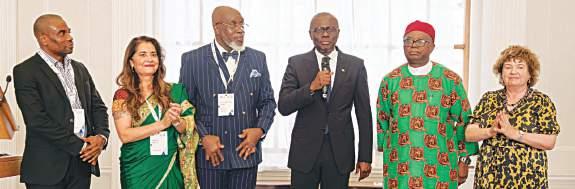
the meaningful participation of stakeholders from developing countries in large international climate conferences, NCIS connected Nigeria to a model that is particularly valuable for countries on the frontlines of climate change. For developing countries, where the greatest challenge is often not ambition but access to capital, capacity, and collaboration, this model provides a faster and more effective pathway from commitments to concrete development outcomes. The NCIS demonstrated the value of an implementation-focused platform where partnerships could be forged, investment mobilised, and ideas translated into action.
With Lagos Climate Action Week designed as a key outcome of the Nigeria summit, it was a proud moment when the Lagos State Governor, Babajide Sanwo-Olu, announced the inaugural Lagos Climate Action Week (LAGCAW), set to take place in Lagos—Nigeria’s economic hub and sub—Saharan Africa’s most populous city— in September/ October 2026.
If Climate Action Weeks are to accelerate implementation, they must be rooted in cities where climate risk, economic influence, and political leadership intersect. Lagos, with its over 20 million residents and status as one of the
world’s most vulnerable coastal cities to sea-level rise, is an ideal location for Africa’s climate implementation agenda.
As Nigeria’s commercial capital and one of Africa’s leading financial centres, Lagos sits at the intersection of economic influence and acute climate vulnerability, making it uniquely positioned to demonstrate how cities can translate climate ambition into implementation.
The LCAW model has shown the success of carefully designed, independent city-level climate convenings, which work in partnership with the UN’s COP Presidencies but operate outside the formal UN system, bringing together stakeholders in ways traditional multilateral negotiations often cannot.
Nick Mabey, Chair and co-founder of London Climate Action Week (LCAW) has noted how the climate action weeks offer platforms to advance climate action free from the tensions of negotiations that characterise UN conferences. Cities are where climate policies are implemented, infrastructure is built, investment decisions are made, and citizens experience the impacts of climate change most directly. Rather than being constrained by the need for universal consensus, these platforms create opportunities for state and non-state actors to
By Eugene Itua
As floodwaters continue to threaten the lives, livelihoods, and safety of more than 20 million Lagos residents, a new, comprehensive educational exposition is pushing back against emerging narratives that label the city’s flood history as a “convenient lie”.
Authored by Dr. Eugene Itua, Executive Director of the Africa Green Economy and Sustainability Institute (AGESI) and Chief Executive Officer of Natural Eco Capital, the newly released article, “Epistemology of Lagos Flood Occurrence, Studies, Adaptation, and Resilience,” meticulously bridges hydrology, history, philosophy, and policy to set the public record straight.
The publication arrives at a critical juncture, particularly amid public discourse surrounding major infrastructure developments like the Lagos–Calabar Coastal Highway (LCCH). Dr. Itua argues that dismissing decades of verified climate data as political fabrication is not just intellectually dishonest, but actively dangerous to the city’s future resilience.
The Historical Reality: 1968 to Present
A cornerstone of the exposition is the dismantling of the myth that Lagos flooding is a recent phenomenon. Drawing on a landmark 2024 study presented at the American Geophysical Union (AGU) Fall Meeting by Ndimele et al., the historical record confirms a stark reality: flooding has occurred in Lagos every single year since 1968, with the sole exception of the 1973 Sahelian drought year.
While sceptics point out that modern districts like Lekki did not exist in 1968, the data confirms that older, low-lying communities—including Ikorodu, Lagos Island, Surulere, Ikeja, and Apapa—bore the brunt of these historical floods. Aerial photography from the pre-independence
colonial era and the early 1980s further validates that areas like the Eti-Osa and Ibeju-Lekki LGAs were naturally flooded wetland environments and mangrove forests long before they were paved over for urban expansion.
The ‘Flood Machine’: A Compound Crisis
The report cautions against reducing the crisis to a single cause. Lagos is currently battling “compound flooding,” a deadly overlap of multiple drivers:
• Climate Change & Ocean Dynamics: Steady sea-level rise and intense rainfall interact with tidal influences that back up into the lagoon, impeding rainwater discharge.
• Subsidence: The land itself is sinking due to groundwater extraction.
• Infrastructural Hubris: Aggressive land reclamation often displaces floodwaters into previously safe neighbourhoods, overriding nature’s historical water pathways.
• Urbanization & Waste: Impermeable concrete surfaces block natural water absorption, while improper solid waste disposal chokes critical
move from negotiation to implementation.
From London to Baku and Bangkok to Rio de Janeiro, these Climate Action Weeks have proven the power of diverse stakeholder collaboration around shared objectives with a clear focus on implementation. This is not to suggest that international negotiations are not important. Global agreements on emissions reductions, technology transfer, and climate finance remain important. But Lagos—a city confronting recurrent flooding, coastal erosion, heat stress, and rapid urbanisation— has little time to wait for international consensus. More importantly, decisions made in Lagos have implications far beyond the city itself, shaping investment flows, business practices, and public policy across Nigeria and the wider region. The climate crisis does not negotiate, wait for consensus, or respect diplomatic calendars or procedural objections. The only rational response is to build systems that can act with the same urgency that the crisis demands. Climate Action Weeks embody this approach. Lagos now joins this growing network of climate action weeks and will serve as a watershed moment for climate governance on the African continent.
•Ugo Uzuegbu, Program Officer INDUS Advisory, writes from Abuja
drainage channels.
The economic toll of ignoring this compound crisis is staggering. According to World Bank data cited in the exposition, floods, erosion, and pollution in Cross River, Delta, and Lagos States cost society an estimated USD 9.7 billion in 2018 alone, equating to 2.4 percent of Nigeria’s GDP. Furthermore, over 1.35 million people in Lagos are currently exposed to the 10-year flood hazard zone.
From Denial to Action: The Integrated Resilience Pathway
Dr. Itua’s publication pivots firmly from diagnosing the problem to demanding a solution.
Acknowledging that “water never forgets its path,” the report outlines a multi-tiered resilience strategy for state and federal governments:
• Blue-Green Infrastructure: Beyond the 69 kilometres of constructed secondary stormwater drainage and shoreline protection works, Lagos must legally protect and restore natural wetland buffers, which act as the city’s natural sponges.
• Data and Early Warning: Leveraging the Nigeria Hydrological Services Agency (NIHSA) and the Lagos State Resilience Office (LASRO) to translate forecasts into immediate, community-level action.
• Financial Safety Nets: Addressing the critical absence of homeowner flood insurance, treating adaptation finance as a cost-avoidance investment rather than an unfunded mandate.
• Infrastructure Accountability: Ensuring that major projects, including the LCCH, integrate drainage and wetland-buffer designs from their inception, rather than treating flood risk as an afterthought.
The exposition concludes with a clear warning and a call to action: “Flooding in Lagos is not a myth, not a fabrication, and not a recent invention... Accepting this truth is not an admission of defeat; it is the first step toward resilience”.
•Dr. Itua, MD of Natural Eco Capital, writes from Lagos .

Dangote Cement has been in the news lately. This time, it is not about the debate over competitive product pricing or corporate rivalry. Or about some ugly stories involving its trucks and haulage. It is a news item that is easy to gloss over, except, of course, the reader has a strong interest in sustainability, decarbonization, net zero, and the rest of the jargon that has made the most important conversation on earth and the future of humanity and the planet an elitist affair. (Unfortunately, not being a didactic article, this piece will stick to the use of specialised terminology to drive home the point.)
It is sweet melody to the ears that such a big player in the built environment is committing to carbon reduction. According to the news report, the Group Managing Director of Dangote Cement Plc, Arvind Pathak, reaffirmed the
• Aliko Dangote
company’s commitment to sustainable manufacturing and low-carbon production at the Global Cement and Concrete Association
(GCCA) dialogue held in Madrid, Spain.
“With Africa’s infrastructure demand continuing to rise, the
Professor Yemi Osinbajo, teacher, pastor, and politician, surely understands the wisdom of times and seasons. That he has arguably made the crucial transition to statesmanship is no longer news. After all, some leaders in contemporary times retire from the peak of public service into the sublime realm of mentorship, memoir-writing, and measured advocacy for often non-partisan causes. However, it is the nature of Osinbajo’s post-public office engagement that is in focus here.
Shortly after leaving office, Osinbajo pivoted fully to championing climate action, focusing on the work he had started as vice president. While in office as the country’s number two citizen, he took charge of several significant national assignments on climate change and Nigeria’s energy transition efforts.
A few days ago, the former vice president was announced as president of the Board of Trustees of the Nigerian Conservation Foundation (NCF). This was at the foundation’s 37th Annual General Meeting (AGM), which was held in Lagos.
The NCF is Nigeria’s “premier non-governmental organisation dedicated to nature conservation and sustainable development in Nigeria.” It is one of the oldest, most respected and formidable NGOs in the country, attracting accomplished individuals with unimpeachable integrity to serve in its leadership. Osinbajo has taken over the reins of leadership from Chief Philip Asiodu, a nationalist bureaucrat of unblemished fame. He knows fully well what the task ahead is and how to approach it.
“We are basically building on the work that has been done. Now we have better resources, better technology, and the enthusiastic support of young people committed to climate action. I think we are in a very good place to advance the great work that has been done by the Foundation,” he said in accepting the mantle of leadership. This page wishes Prof. Osinbajo a productive tenure at the NCF.
sector must pursue growth while embracing innovative pathways to reduce carbon emissions,” the chief executive reportedly said, adding: “A key takeaway, especially for the African cement sector in the context of the evolving global economic and regulatory landscape, is the need to accelerate our decarbonisation pathway through increased utilization of alternative fuels, reduction of clinker content in cement and investment in innovative cement technologies suited to local realities.”
A follow-through of this commitment will be more important than its expression. This is because the built environment plays a critical role in Nigeria’s energy transition plan. The building and construction sector, as the backbone of infrastructure development, is expected to achieve net zero by 2060. But the current reality is daunting: It is estimated that the construction sector accounts for up to 40 percent of greenhouse gas (GHG) emissions in Nigeria. Cement production alone is said to account for about half of that figure. This means several important steps have to be taken in product design, production and deployment, including cement. Reduction in embodied carbon is a major step in this direction. And this is where the commitment by Dangote Cement kicks in. The ripple effect of walking the talk of this commitment would be decisive in determining whether the next zero target for the sector is achieved or not. This makes it imperative for other cement companies to toe the same path of bold ambition on carbon reduction. It is worth noting, according to the reports, that Pathak is an elected member of the GCCA Board. This means that Dangote Cement is represented in the policy and decision-making echelon of global decarbonisation efforts. This leadership position matters in mobilizing whole-of-industry action to move towards greener, less polluting, and sustainable cement manufacturing in Nigeria and Africa as a whole.
For 10 years, the Tolaram Science Challenge has done more than test students' knowledge of science by inspiring ambition, nurturing critical thinking and opening doors to new opportunities for young people across Ibeju-Lekki. As Iwerekun Community Senior High School clinched its third consecutive title at the competition's landmark 10th edition, the event highlighted not only academic excellence but also the enduring impact of a decade-long investment in STEM education, with scholarships, success stories and transformed lives underscoring its growing legacy. Chiemelie Ezeobi reports
For a decade, the Tolaram Science Challenge has been quietly changing the narrative for young people in Ibeju-Lekki.
In communities where many students once struggled to see education as a pathway to opportunity, the annual competition has become a platform that rewards excellence, nurtures innovation and inspires confidence in science, technology, engineering and mathematics (STEM).
Its impact was once again on display as Iwerekun Community Senior High School, Ibeju-Lekki, emerged winner of the 10th edition of the Tolaram Science Challenge (TSC), securing an impressive third consecutive title and reinforcing the competition's growing legacy of academic excellence.
Sponsored by Lagos Free Zone, the Tolaram Science Challenge is an annual science competition for secondary schools in the Ibeju-Lekki axis of Lagos. Since it was launched in 2016, the initiative has grown into one of the flagship Corporate Social Responsibility programmes of Lagos Free Zone, providing students with an opportunity to demonstrate innovative ideas and practical solutions to real-world challenges through STEM education.
Rewarding Excellence and Healthy Competition
This year's competition brought together 16 participating secondary schools, with each school represented by six students. Contestants tested their knowledge across Physics, Chemistry, Biology, Mathematics and General Knowledge, competing for honours in what has become one of the most anticipated academic events in the area.
At the end of the keenly contested grand finale, Iwerekun Community Senior High School defeated Magbon-Alade Senior Grammar School to lift the coveted trophy.
Ibeju Senior High School, Lekki, finished in third place, while Community Senior High School, Lekki, came fourth.
Individual excellence was also celebrated. Nyong Jebson, Adekunle Ephraim and Ashikodi Chukwu emerged first, second and third respectively among the outstanding students, with each receiving a cash prize.
In addition, 32 students were awarded Unified Tertiary Matriculation Examination (UTME) scholarships in recognition of their exceptional performances throughout the competition.
The Tolaram Science Challenge is a brainchild of Lagos Free Zone. Designed to promote science education among secondary school students in Ibeju-Lekki, each participating school is represented by five pupils, while five others serve as audience members, giving more students an opportunity to participate in the learning experience.
Speaking at the grand finale, Director, Zone Development, Binay Saraf, who represented the Chief Executive Officer, Lagos Free Zone, Adesuwa Ladoja, described
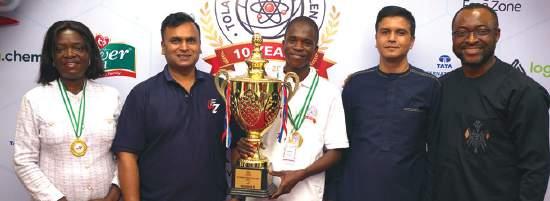
Deputy Director, Schools
Development, Lagos
Director and Chief Sustainability
Fadumiye,
the competition's 10th anniversary as an important milestone.
She said: "Over the past decade, we have seen this event grow in scale, participation, and impact. Each year, more schools, more students and more teachers have joined us on this journey of discovery and learning.
"Today, the Tolaram Science Challenge has become a platform that encourages curiosity, innovation, critical thinking and healthy competition. More importantly, it has become a symbol of our commitment to investing in the future of our communities."
According to Ladoja, Lagos Free Zone believes community development extends beyond infrastructure and employment.
"At Lagos Free Zone and Tolaram, we believe that developing communities goes beyond building infrastructure or creating jobs. It also means creating opportunities for young people to learn, grow and discover their potential," she said.
She encouraged participants to view the competition as more than a race for prizes.
"Whether you receive a prize today or not, the knowledge you gain, the friendships you build and the experience you take away will remain with you for life."
Also speaking, Director and Chief Sustainability Officer, Lagos Free Zone, Vishal Shah, reaffirmed the organisation's commitment to improving the quality of education across the Ibeju-Lekki axis, noting that over the last 10 years, the initiative has encouraged healthy competition among students and improved performance in qualifying examinations.
Changing Lives Beyond the Classroom
For Olakunle Fadumiye, the Visioner of the Tolaram Science Challenge, the competition was born from a desire to transform communities through education.
Reflecting on the programme's beginnings in 2016, he recalled that many young people had little motivation to
pursue science because opportunities appeared limited.
"When we started in 2016, many students had little motivation to pursue science subjects. Some preferred fishing and informal work instead of going to school because they saw few opportunities through education. University seemed unattainable to many. Yet we believed that if we could inspire even a few students to dream bigger, we could begin changing the future of an entire community."
He commended the leadership of Tolaram and Lagos Free Zone for laying foundations that have become symbols of economic transformation and national development, while urging the organisation to give TSC alumni preference for industrial training, internship and National Youth Service Corps (NYSC) placements within the Zone to strengthen the bridge between education and employment.
Similarly, Mrs Olubunmi AjibolaMorebise, Deputy Director, Schools Support Unit, Education District 3, Ikoyi, Lagos, praised Lagos Free Zone and Tolaram for sustaining the initiative over the past decade, noting that it has improved reading culture among students while promoting healthy competition among teachers.
Perhaps the clearest measure of the competition's success is found in the stories of its alumni.
Samuel Chiemeka, who participated in the competition, said the experience fundamentally changed the way he approached science and problem-solving.
"That moment changed everything because it made me realize that science is not just about reading books. It is about how you apply what you have read and how quickly you can think."
For Edah Freedom, who competed during the first and second editions, the competition represented more than
answering scientific questions.
"What inspired me was my love for science and the realization that this competition is not just about stating facts, writing equations, or giving correct answers but about critical thinking. It is about what you can do with the knowledge gained through practical experiments."
Now living in the United Kingdom, Ayenuro Damilola, who competed in 2021 and 2022 with the International School, credited the challenge with shaping both her academic and professional journey.
"The competition played such an important part in my academic journey; it really strengthened my confidence, abilities, self-worth, and sense of self."
Currently pursuing a career in nursing with the ambition of becoming an emergency medicine physician, she added that the confidence developed through the competition continues to guide her.
"Winning is wonderful, but the knowledge, confidence, and growth you gain along the way are even more valuable than the trophy or prize."
For the champions, the victory was both a reward for hard work and a reflection of collective effort.
Speaking after receiving the trophy, the team captain of Iwerekun Community Senior High School, Fawaz Alayo, attributed the school's success to the dedication of its teachers and the unwavering support provided by the school.
As the Tolaram Science Challenge marks its first decade, its legacy is increasingly evident not only in trophies won or scholarships awarded but in the ambitions it has ignited. From producing confident students and future scientists to inspiring entrepreneurs, healthcare professionals and innovators, the initiative continues to prove that sustained investment in education can reshape communities. For many young people across Ibeju-Lekki, the challenge has become more than a competition—it has become the beginning of a future defined by possibility.

L-R: Secretary to the Ogun State Government, Mr. Tokunbo Talabi; former Governor of Ekiti State, Mr. Niyi Adebayo; Ogun State Governor, Prince Dapo Abiodun; Mrs Ajibola
the celebrant and wife of the Ogun State governor, Mrs. Bamidele Abiodun; wife of former Governor of Ogun State, Chief (Mrs) Aderinsola Osoba; former Governor of Ogun State, Chief Olusegun Osoba and the gubernatorial candidate of the All Progressives Congress (APC) in Ogun State, Senator Solomon Olamilekan Adeola during the 60th birthday of Mrs. Abiodun on Thursday.
The Senate yesterday recorded two major milestones in Nigeria’s financial sector, passing a landmark Insurance Regulatory Commission Bill to replace the nearly three-decadeold National Insurance Commission (NAICOM) Act of 1997.
Also in a separate development, the Committee on Banking Insurance and other Financial Institutions, overwhelmingly cleared former Director-General of the Securities
and Exchange Commission (SEC) and current Deputy Governor of the Central Bank of Nigeria (CBN), Mr. Lamido Yuguda, for appointment as Chairman of the Board of the Asset Management Corporation of Nigeria (AMCON).
The insurance reform legislation, described by lawmakers as one of the most comprehensive overhauls of Nigeria’s insurance regulatory framework in decades, seeks to modernise regulation, strengthen consumer protection, enhance
financial stability and align the nation’s insurance industry with global best practices.
The bill, passed during plenary presided over by the President of the Senate, Senator Godswill Akpabio, followed the adoption of the report of the Senate Committee on Banking, Insurance and Other Financial Institutions chaired by Senator Mukhail Adetokunbo Abiru (APC, Lagos East).
The legislation repeals the National Insurance Commission Act, 1997
and establishes a new Insurance Regulatory Commission with broader supervisory and enforcement powers designed to respond more effectively to the changing dynamics of the insurance industry.
Presenting the committee’s report, Abiru told senators that the existing legal framework had become grossly inadequate for regulating a rapidly evolving insurance sector.
He said, “The current National Insurance Commission Act 1997 is outdated and does not adequately
Justice Joyce Abdulmalik of a Federal High Court in Abuja has ordered the Economic and Financial Crimes Commission (EFCC) to arrest and produce an Abuja-based estate agent, Mrs. Rebecca Omokamo in court at the next adjourned date.
The judge issued the order on Tuesday, following the failure of the defendant to appear in court for her trial on alleged land fraud, forgery and money laundering.
At the resumed trial, her counsel Christopher Oshomeghie, SAN, had informed the court that men of the EFCC had laid siege on the home of his client for 23 days running
and so she has not been outdoors for all that period as she fears for her life.
The Senior lawyer informed the court that the EFCC siege on her house was the reason for her absence.
In a short ruling, the trial judge ordered the EFCC to arrest and keep the defendant in their custody till Thursday July 23 for the continuation of trial.
The other defendants in the suit are Homadil Realty Limited, Idakwogi Richard John, and Rychado Homes Limited.
Only the third defendant, Richard John, the CEO of Rychado Homes Limited was available in court at the resumed hearing.
Proceedings began with counsel for the prosecution, Benedict Ubi informing the court that the first defendant (Rebecca Omokamo) was in ‘self-imposed house arrest sequel to the order of the court for an interim forfeiture of a disputed land.’
The prosecutor said the defendant is obstructing officers of the EFCC from carrying out the order of the court.
Ubi accused Mrs. Omokamo of breaching the terms of her administrative bail by traveling repeatedly out of jurisdiction.
In a counter-argument, counsel for the defendant claimed that “menacing, gun-wielding officers of the EFCC took over the property of his clients in a 23-day siege”.
Ibrahim Oyewale in Lokoja
The Kogi State Livestock Productivity and Resilience Support Project (Kogi L-PRES) has flagged-off an awareness campaign for the implementation of a Mass Artificial Insemination (AI) Program, aimed at boosting livestock productivity across the livestock value chain clusters in Kogi State.
Speaking at the event in Lokoja yesterday ,the Commis-
sioner for Livestock Development, Dr. Olufemi Bolarin said the programme reflects the commitment of the administration of Governor Usman Ododo to modernize livestock production and strengthen food security in Kogi State
Bolarin explained that Artificial Insemination offers key advantages over natural mating, including access to superior genetics for higher milk yields and faster growth, reduced disease transmission,
and lower production costs for the livestock farmers.
“We are providing technical support through trained technicians and capacity building to ensure farmers succeed with this new technology.
“The goal is simple: healthier animals, higher productivity, and better income for the livestock farmers. With the right training and support, Kogi livestock farmers can compete nationally,” Dr. Bolarin said.
He said she is in a very poor state of health for having to be indoor for that long.
The prosecutor interjected by clarifying that the defendant has the keys and that it was she who locked herself in her apartment and not the EFCC officers on enforcement duty.
Responding, the court ordered the commission to produce the defendant in court after her counsel confirmed that she had the keys to the apartment and not the men of the EFCC.
address the emerging economic growth, needs and development of the insurance business.”
According to him, although NAICOM had made significant contributions to regulating insurance companies, brokers and loss adjusters while protecting policyholders and enforcing industry standards, its enabling law had failed to keep pace with international developments.
Abiru explained, “Despite its significant contributions, the enabling law has become obsolete, failing to align with current realities and global best practices, and unable to keep pace with the evolving nature of the insurance industry, exposing numerous gaps in the law, necessitating urgent amendments.”
He disclosed that the proposed law guarantees the independence of the Insurance Regulatory Commission while substantially expanding its powers to supervise operators and safeguard the stability of the financial system.
According to him, the commission would have authority to issue regulations, standards, guidelines and directives, collaborate with domestic and international regulatory institutions, exchange supervisory information and intervene promptly in troubled insurance companies before their problems escalate.
He stressed that the strengthened
intervention powers would remove bureaucratic bottlenecks that had previously delayed regulatory actions against distressed insurance firms.
Abiru said the legislation also introduces stricter corporate governance requirements by prescribing higher qualifications for members of the commission’s governing board. He explained that only individuals with proven competence in insurance, finance, law, risk management and corporate governance would qualify for appointment, thereby ensuring more professional oversight of the industry. The committee chairman further revealed that the bill significantly strengthens enforcement mechanisms by imposing stiffer sanctions on erring operators.
According to him, the law provides for heavier financial penalties, suspension of operating licences, additional liabilities for defaulting operators and disqualification of persons responsible for the collapse or regulatory failure of insurance institutions from occupying positions within the industry.
Abiru also noted that the legislation broadens the commission’s mandate beyond regulation to include the effective administration, supervision, control, integrity and overall development of insurance business in Nigeria.
The federal government has that henceforth it’s actions against proliferation child labour will be driven by reliable national data.
It expressed its commitment to work with the International Labour Organisation (ILO) using evidencebased policies and Intervention to eradicate child labour in the country.
The Permanent Secretary, Federal Ministry of Labour and Employment, Dr. Kamil Shoretire, stated this on Tuesday in Abuja at the validation workshop of the 2024 National Child Labour Survey Report.
Shoretire said that credible
statistics remains indispensable for evidence-based policymaking, effective planning and efficient resource allocation in tackling child labour, forced labour, human trafficking and modern slavery.
He described child labour as a violation of children’s rights and obstacle to sustainable development, adding the practice denies children education, exposes them to hazardous work and perpetuated poverty.
“Child labour deprives children of education, exposes them to hazardous conditions and perpetuates poverty, particularly in agriculture, domestic work, mining, construction and street trading,” he said.
Apart from providing deeper insights into the magnitude and trends of child labour, Shoretire said the survey findings will enable stakeholders to target interventions, prioritise vulnerable sectors and strengthen collaboration nationwide.
“Reliable statistics are essential for evidence-based policy, effective planning and resource allocation,” Usman said.
Shoretire said Nigeria’s ratification of ILO Conventions Nos. 138 and 182, alongside the reviewed National Action Plan for the Elimination of Child Labour (2026–2030), demonstrated government’s resolve to achieve Sustainable Development Goal (SDG) Target 8.7.

L-R: (Back Row) Head Commercial Banking, Union Bank of Nigeria, Mrs. Ogechi Enudi; Ag. Head Legal, Union Bank of Nigeria, Mrs. Jennifer Halim-Ubahakwe; Head Internal Control, Union Bank of Nigeria, Mrs. Remilekun Anjorin; Head Corporate and Business Banking, Union Bank of Nigeria, Mrs. Mary Oduemi; (Front Row) Head Corporate Services, Union Bank of Nigeria, Mrs. Dupe Ogunbiyi; Head SME, Union Bank of Nigeria, Mrs. Gloria Omereonye; Team Lead Corporate Banking/President wehub, Union Bank of Nigeria, Mrs. Chioma Nwokike; Managing Director/Chief Executive Officer, Union Bank of Nigeria, Mrs. Yetunde B. Oni; Head Retail Business, Union Bank of Nigeria, Mrs. Vivian Imoh-Ita; Head Procurement, Union Bank of Nigeria, Mrs. Edirin Hugbo, and Chief Talent Officer, Union Bank of Nigeria, Mrs. Omayuli Wale-Ajayi during the wehub Lean-in Circle engagement session with the MD/CEO held on July 17, 2026 at Union Bank’s Head Office, Marina ... Lagos
Cardoso: Nigerian economy largely resilient to external shocks, reflects gains from prior reforms by fiscal, monetary authorities
Says unforeseen global headwinds delay CBN’s single-digit inflation target by January 2027, banks to sustain efforts to reign in prices Declares painful reforms yielding positive outcomes, paving way for better days ahead, insists current exchange rate supports competitiveness External reserves hits $52.52bn as of July 17, 2026, from $50.47bn in May
James Emejo, Deborah Adekoya in Abuja and Nume Ekeghe in Lagos
The Central Bank of Nigeria (CBN), yesterday, decided to leave the Monetary Policy Rate (MPR), the benchmark interest rate, unchanged at 26.5 per cent, as well as the standing facilities corridor around MPR at +50/-450 basis points.
CBN also left the Cash Reserve Requirement (CRR) for Deposit Money Banks (DMBs) unchanged at 45 per cent, merchant banks at 16 per cent, and 75 per cent for non-TSA public sector deposits.
Speaking at the end of the two- day meeting of the Monetary Policy Committee (MPC) in Abuja, CBN Governor, Mr. Olayemi Cardoso, said the decision to maintain the current policy stance followed a thorough assessment of the balance of risks.
Cardoso said although headline inflation moderated marginally in June 2026, global uncertainties had heightened due mainly to the renewed hostilities in the Middle East.
He said, “In view of the evolving developments, maintaining a cautious monetary policy stance remains appropriate.”
The central bank governor highlighted the recent resurgence of hostilities in the Middle East with particular attention to its spill-over effects on global energy prices and the potential pass-through to domestic inflation.
Nonetheless, he stated that available evidence indicated that the Nigerian economy had remained largely resilient to the external shocks, reflecting the gains from prior reforms implemented by the fiscal and monetary authorities.
Cardoso stated that maintaining the current monetary policy stance will provide an opportunity to closely monitor incoming data and assess the trajectory of inflation to guide future policy decisions.
According to him, “The MPC acknowledged the federal government’s renewed commitment to strengthening policy coordination, with particular emphasis on the ongoing collaboration with the monetary authority which has helped to moderate the impact of
the Middle East crisis on the domestic economy.”
He stressed that the committee recognised that greater alignment between fiscal and monetary policies would enhance policy effectiveness and support the achievement of overall macroeconomic objectives.
To further strengthen macroeconomic fundamentals, the apex bank also underscored the potential benefits of Executive Order 9.
The CBN also commended government’s renewed efforts to improve crude oil production and encouraged relevant agencies to strengthen the implementation of reforms to maximise the potentials in other sectors, including solid minerals, to complement government earnings.
MPC further welcomed the positive outcome of the banking sector recapitalisation exercise, acknowledging the improvement in the resilience of the banking system as reflected in key prudential and financial soundness indicators.
MPC urged the central bank to sustain effective surveillance to preserve financial sector soundness and mitigate potential risks to financial stability.
The committee observed that headline inflation (year-on-year) eased marginally to 15.91 per cent in June 2026, from 15.93 per cent in May 2026, ending the three consecutive months of uptick in price levels.
Cardoso, who read the committee’s communique, stressed that the decline resulted from a decrease in the non-food component, which offset the increase in food inflation.
Food inflation rose to 17.52 per cent in June 2026, from 16.96 per cent in May 2026, reflecting supply constraints.
However, core inflation moderated to 15.92 per cent in June 2026, from 16.82 per cent in May 2026, largely on the back of exchange rate stability.
Similarly, the 12-month average inflation rate sustained its decline to 17.63 per cent in June 2026, from 18.36 per cent in May 2026, marking the sixth month of consecutive moderation and reflecting a slower pace of price increases over the medium term.
Cardoso said gross external reserves rose to $52.52 billion as of July 17, 2026,
from $50.47 billion as at end-May 2026, mainly as a result of receipts from crude oil-related taxes and third-party inflows. He said this was sufficient to finance about 11 months of imports of goods and services, surpassing the international benchmark of three months cover.
Cardoso also projected inflation to moderate further in the medium term on the back of continued stability in the foreign exchange market, lagged effect of previous monetary policy tightening and improved food supply conditions as the harvest season approached.
According to him, “Risks to global inflation remain on the upside, driven mainly by the increasing prices of crude oil and other commodities. Inflationary pressures are likely to be further
amplified by supply chain disruptions and climate-related shocks inhibiting food production.
“Additionally, exchange rate volatility and fiscal constraints pose upside risks to inflation in most emerging and developing economies.”
Cardoso added, “The key risk to the outlook, however, remains the severe and prolonged escalation of the Middle East conflict.
“In the light of these considerations, the committee reaffirmed its commitment to preserve price and financial system stability and remains prepared to take appropriate policy measures, guided by evolving macroeconomic conditions.”
However, answering questions from journalists, the central bank governor admitted that unexpected global shocks
disrupted the apex bank’s earlier projection of returning inflation to a single-digit trajectory by early 2027, but maintained that monetary tightening was yielding results as headline inflation continued to moderate.
He said Nigeria had recorded 11 consecutive months of disinflation before fresh external shocks altered the inflation outlook, stressing that the central bank remains fully committed to restoring price stability.
Cardoso said, “From every indication, we were expecting that by early 2027 we would be where we want to be in terms of inflation and firmly on track for single digits.”
He said the renewed inflationary pressures were largely driven by unforeseen developments outside the control of policymakers.
AKUME: TINUBU’S REFORMS MAY NOT PRODUCE
Cardoso said, “These were shocks that were not anticipated and have gone on much longer than could have been expected. It is not something we can wish away. It is something we have to deal with.”
Cardoso said the moderation in headline inflation, though gradual, showed that the monetary measures implemented by the apex bank were beginning to produce results. He also stressed that closer coordination between fiscal and monetary authorities had become even more critical in tackling persistent structural rigidities fuelling inflation.
“We will do what we need to do to contain rising inflation and bring it to the single-digit level we have spoken about. We continue to stand by that,” he added.
INSTANT RESULTS, BUT WILL SECURE NIGERIA’S FUTURE
“However, since assuming office on the 29th of May, 2023, President Tinubu has demonstrated courage in making difficult decisions aimed at securing the region’s long-term all-round prosperity.
“For the people of the North Central region, these efforts have brought renewed hope and visible progress,” she added.
Ogbole highlighted extensive investments spanning agriculture, security, education, and road transport infrastructure across the zone.
She commended the administration’s interventions in education, pointing to expanded investments through the Tertiary Education Trust Fund (TETFund) and stipend support for students via the Nigerian Education Loan Fund (NELFUND).
Ogbole declared that the administration’s spread of capital projects had fundamentally altered the region’s political alignment.
“The fair and judicious spread of capital projects to all the geopolitical zones by the administration of President Bola Ahmed Tinubu has changed the narratives from negative to positive, from neglect
to recognition... and now to socio-economic structural and infrastructural transformation of the entire North Central zone,” she remarked.
Ogbole assured of the group’s aggressive voter mobilisation campaign across every state in the region to guarantee the President’s reelection.
“Consequently, we are pledging to mobilise massively like never before across the entire North Central states to support the reelection of the President that has brought us from doom to the dawn of a new era,” she said.
Speaking on the sidelines of the conference, the Director General of the Tinubu Support Group (TSG), Dr. Umar Yakasai said Nigerians had already settled the debate over the Muslim-Muslim ticket in the 2023 presidential election by electing Tinubu despite sustained opposition to the arrangement.
The Vice presidential candidate of Nigerian Democratic Congress (NDC), Senator Rabiu Kwankwaso had in a recent interview said the Muslim-Muslim ticket of the All Progressives Congress (APC) would
remain an issue in the 2027 election.
But the TSG Director said the North Central, which has a significant Christian population, has emerged as one of the biggest beneficiaries of the Tinubu administration through strategic appointments and infrastructure projects.
Yakassai stated: “In the 2023 general election, many people thought the Muslim-Muslim ticket would stop Tinubu. He won.
“Today, the North Central has become one of the major beneficiaries of President Bola Tinubu’s administration.
“INEC is headed by someone from the North Central, the APC National Chairman is from the North Central, key security institutions are headed by people from the North Central, and the Secretary to the Government of the Federation is also from the zone.
“You cannot talk about religion without talking about the North Central because they constitute a significant proportion of Christians in Northern Nigeria. They have moved from marginalisation to integration and from exclusion to inclusion.
“Kwankwaso should know better.
President Bola Ahmed Tinubu has proven that he is President for all Nigerians irrespective of tribe or religion. If he were President only for Muslims, Kwankwaso himself would not have accepted to serve as running mate to a Christian presidential candidate,” he said.
Yakasai also rejected allegations that the Tinubu administration favours the South-west in federal appointments, arguing that the President has ensured equitable representation across regions and religions.
He cited the recent appointment of Ogbole as Commissioner in the National Wages Commission and the large number of federal appointees from Kano State as evidence that appointments are spread across the country.
“The President has spread his appointments across all tribes, all regions and all religions. It is the opposition that wants to shift attention from the successes of this administration to issues that have already been settled by Nigerians,” he added.
L-R: Vice President, Science Association of Nigeria (SAN), Prof. Mariam Aminu; President, SAN, Prof. Adeniyi Ogunjobi; Lagos State Commissioner for the Environment and Water Resources, Dr. Tokunbo Wahab; and Permanent Secretary, Office of Environmental Services, Lagos State Ministry of the Environment and Water Resources, Dr. Tajudeen Gaji, during the opening of the 58th Annual (Hybrid) Conference of the Science Association of Nigeria, themed “Science, Coastal Cities, Public Health, and Social Equality in the Blue Economy,” held in Lagos…recently
Tasks new NBA president to sustain legal profession’s role as vital pillar of democracy Says her career is distinguished by integrity, professionalism, commitment
Deji Elumoye in Abuja
President Bola Tinubu has congratulated Mrs. Oyinkansola Badejo-Okusanya (SAN) on her election as the first elected and second female President of the Nigerian Bar
Association (NBA). He described her emergence as a watershed in the legal profession and a triumph for merit, excellence, and gender inclusion. The President, in a release by his Adviser on Information and
Strategy, Bayo Onanuga, noted that Badejo-Okusanya’s remarkable career, distinguished by integrity, professionalism, and commitment to justice, has earned her the confidence of her colleagues across the country.
Tinubu affirmed Mrs Badejo-
Okusanya’s emergence reflected the growing recognition of women’s invaluable contributions to nationbuilding and the administration of justice. He, however, expressed confidence that her leadership would further
strengthen the legal profession by upholding the rule of law and promoting reforms that enhance access to justice for all Nigerians.
Tinubu urged the new NBA president to collaborate with all stakeholders to advance judicial
Linus Aleke in Abuja
The Inspector-General of Police (IGP), Olatunji Disu, has warned Commissioners of Police across the country against illegal detention of suspects, abuse of office and other forms of misconduct, stressing that such actions would not be tolerated under his leadership.
He charged police commanders to uphold professionalism, respect human rights and ensure strict adherence to due process, noting that effective policing depended on
disciplined leadership, accountability and public confidence.
Speaking during the InspectorGeneral of Police Meeting with Police Strategic Managers at the Goodluck Ebele Jonathan Peacekeeping Hall in Abuja, Disu said commissioners of police, as strategic commanders, had a responsibility to set the right standards and maintain the trust of the communities they served.
“Effective policing starts with effective leadership. As commissioners of police and strategic commanders, you are custodians of public
confidence in your commands.
“Leadership is not measured by the authority you hold, but by the standards you set, the confidence you inspire and the results you deliver,” the IGP said.
He urged the CPs to ensure their commands remained operationally ready while holding officers to high standards of professionalism, discipline and respect for citizens’ rights.
He warned: “Corruption, extortion, abuse of authority, unlawful detention and other unethical
conduct undermine the efforts of the Nigeria Police Force to deliver effective service.”
The IGP also directed commissioners to strengthen community policing through deeper engagement with traditional leaders, religious leaders, youth and women groups, community associations and other local stakeholders, describing such partnerships as essential to preventing crime.
“Community policing is not a side programme; it is the foundation on which effective policing rests. Our
engagement with the communities we serve must be genuine, because their partnership is central to crime prevention,” Disu said.
He added that modern policing required leaders, who combined operational competence with effective communication, emotional intelligence and sound judgment.
Earlier, Disu decorated 13 newly promoted Assistant InspectorsGeneral of Police and 17 newly promoted Commissioners of Police in a ceremony attended by their spouses and well-wishers.
reforms, protect the sanctity of the Constitution, and sustain the legal profession’s role as a vital pillar of a democratic society.
The president wished her a successful tenure and assured her of his government’s continued commitment to working with the Nigerian Bar Association to deepen democratic governance, promote justice, and build a more prosperous and united Nigeria.
“I extend my hearty congratulations to the President-elect of the NBA for her victory. As the first elected female president of the Association of Lawyers in Nigeria, Mrs BadejoOkusanya has made history.
“She has once again shown that our women can attain any heights in pursuit of excellence in their careers and ambitions, both in the private sector and in public service.
“I urge you to reach out to the other contestants, unify the bar and make efforts to correct issues that arose during your election. I wish you a successful tenure and service to the legal profession and our country at large,” Tinubu stated.
savings, institutional investors provide patient capital, and the power sector receives the liquidity it needs to grow. Everybody wins.
“This is precisely the type of partnership we intend to replicate across key infrastructure, including housing, transportation, agriculture, and technology,” the minister maintained.
In his remarks, the Minister of Power, Tegbe, said the government was creating a financially sustainable electricity market capable of attracting long-term private capital, stressing that reliable electricity remained indispensable to Nigeria’s economic transformation.
“There can be no sustained economic growth without reliable electricity, and there can be no reliable electricity without financially sustainable markets. That is the philosophy underpinning the reforms we are pursuing in the Nigerian Electricity Supply Industry,” Tegbe said.
According to him, unresolved historical obligations had remained a major impediment to fresh investment, making Project Hoover an economic reform initiative rather than merely another financing transaction.
“Our destination is clear: a financially sustainable, investmentled electricity market that powers Nigeria’s industrial renaissance. I encourage you to see this offering beyond a mere fixed-income instrument. It should be viewed as an opportunity to partner with the federal government in writing the next chapter of our economic story,” the minister said.
Recalling the success of the maiden issuance, Tegbe noted that investors had demonstrated confidence in the reform agenda by oversubscribing the N501 billion Series I bond.
Also speaking, the Special Adviser to the President on Energy, Olu Verheijen, said the administration
had deliberately prioritised execution over expansion, arguing that governments seeking private capital must first demonstrate credibility by honouring their own obligations.
Providing details of the programme, Verheijen disclosed that the federal government deployed approximately N501 billion under Series I, comprising N300 billion in cash and roughly N201 billion through non-cash bond instruments, representing about 22 per cent of verified settlement obligations.
Verheijen added that N333.12 billion had already been settled to eight participating Generation Companies (Gencos) covering 17 power plants that signed participation agreements.
“Series I delivered on its promise. In February 2026, the federal government deployed approximately N501 billion, N300 billion in cash and roughly N201 billion through non-cash bond instruments, addressing approximately 22 per cent of
the settlement obligations under executed Settlement Agreements, with the balance to be covered through Series II and subsequent issuances.
“To date, N333.12 billion has been settled to the eight participating generation companies, covering 17 power plants that have executed participation agreements. We met our obligation on schedule. The first Series I coupon of about N63.5 billion was paid in full on 14 July 2026,” she added.
The presidential aidemaintained that the programme was already producing tangible results, with participating generation companies now meeting payment obligations to gas suppliers, lenders and operations and maintenance contractors.
Representing the Nigerian Bulk Electricity Trading Plc (NBET), its erstwhile acting CEO, Akinnawo, said the inaugural issuance had demonstrated that Nigeria’s legacy electricity debts could be resolved
through disciplined capital market instruments instead of repeated government promises.
“The proposition was that Nigerian legacy power sector debt, the kind that has sat on generation companies’ books for years, could be resolved through disciplined, transparent capital market instruments rather than endless promises.
“You answered that call. The N501 billion answered that call, and we met our promises. When the coupon and principal repayments fell due on July 14, the federal government ensured they were met on time,” he said.
Akinnawo disclosed that Series II had been structured at about N729 billion, maintaining that it retained the same discipline and governance standards that characterised the first issuance.
“I will not pretend to you that the power sector challenges are behind us. They are not. But I
can tell you without hesitation that the federal government remains committed to fixing the market from its foundation,” he added.
Besides, the Special Adviser to the President on Power, Lanre Babalola, described the transaction as a landmark initiative aimed at restoring investor confidence and strengthening the commercial foundations of the electricity market. According to him, reliable electricity underpins industrialisation, productivity, innovation, employment and improved living standards, making power sector reforms central to Nigeria’s development strategy.
“Our reforms are directed towards building a wholesale electricity market in which market participants compete fairly, contractual obligations are honoured, settlement discipline is strengthened and private capital invests with greater confidence,” Babalola stated.
R-L: The new Chairman of the Board of Directors of the Asset Management Corporation of Nigeria (AMCON), Mr. Lamido Yuguda Abubakar (second right); the Managing Director/Chief Executive Officer, AMCON, Mr. Gbenga Alade; the Head, Inter-Governmental Department, AMCON, Mr. Sa’ad Ahmed (right); and the Head, Corporate Communications Department, AMCON, Mr. Jude Chiedozie Nwauzor (left), after the screening of the new AMCON Board Chairman at the Senate Building, National Assembly Complex, Abuja, on Tuesday
Information sharing, intelligence, key to fighting crimes in subregion, says EFCC
African leaders and security chiefs have called for stronger regional cooperation, intelligence sharing and community engagement to tackle the continent’s growing security challenges, warning that terrorism, organised crime, cybercrime and violent extremism could no longer be addressed by individual countries acting alone.
The Gambian President, Adama Barrow; Nigerian Chief of Army Staff, Lieutenant General Waidi Shaibu; the Inspector-General of Police, IGP Olatunji Rilwan Disu; Prof Thean Potgieter of the Centre of Military Studies, Faculty of Military Science, Stellenbosch University, South Africa, and others, made this call yesterday in The Gambia.
The call was made at the 19th Africa Security Watch Conference and Awards held at the Sir Dawda Kairaba Jawara International Conference Centre, Banjul, The Gambia, where speakers stressed that Africa’s evolving security threats required coordinated responses anchored on stronger institutions, technology, professionalism and public trust.
Speaking on behalf of Gambian president, the country’s Minister of Interior, Abdoulie Sanyang, said the continent was facing increasingly interconnected threats, with the Sahel now emerging as the epicentre of global terrorism.
He identified terrorism, transnational organised crime, irregular migration,
cybercrime, maritime insecurity, climate-induced conflicts and youth unemployment as major threats confronting Africa, noting that no country could tackle them in isolation.
Sanyang said The Gambia had continued to reform and modernise its security institutions through integrated border management, digitalisation, community policing and stronger legal frameworks since its democratic transition in 2017.
“The security of one African state is inseparable from the security of all,” he said, urging African governments to strengthen intelligence sharing, joint operations, cybersecurity cooperation, border management and legal harmonisation while ensuring security operations remain rooted in human rights and the rule of law.
Representing the Nigerian Chief of Army Staff, the Director General of the Nigerian Army Heritage and Future Centre, Major General TE Gagariga, said security agencies must continue working together across borders despite changing political dynamics within the region.
Drawing from Nigeria’s experience in counter-insurgency operations, he stressed the importance of community engagement, intelligence gathering and sustained collaboration among security institutions to counter terrorism and transnational crime.
“If you do not have that one-on-one with the community, and you do not give them that trust where you can win the hearts and minds of the populace,
you are fighting in vain,” Gagariga said, adding that “insecurity has no borders” and security cooperation must extend beyond political differences.
In a paper titled, “Engaging Global Best Practices in Policing Internal Security: The Nigeria Police Force Example,” the IGP Disu, who was represented by CP Akwa Ibom, Baba Azare, outlined reforms aimed at making the Nigeria Police Force more professional, accountable and technology-driven.
Disu said the force had strengthened intelligence-led policing, expanded community policing, improved officer training and welfare, enhanced human
rights compliance and increased the deployment of digital policing tools, including CCTV surveillance, forensic laboratories, cybercrime investigation platforms, drone technology and artificial intelligence-supported crime analysis.
He also called for stronger collaboration among law enforcement agencies, intelligence services, INTERPOL, AFRIPOL and ECOWAS institutions to address cross-border crime and terrorism.
“Security is everybody’s responsibility, and public trust remains our greatest operational asset,” he said.
Also, the Inspector General of Police
of The Gambia, Seedy Touray, urged African nations to strengthen solidarity and coordination in confronting shared security threats.
“The continent has never lacked courage. What it has sometimes lacked is coordination,” Touray said, urging participants to leave Banjul with practical commitments that would strengthen peace, security and cooperation across Africa.
The conference brought together ministers, military officers, police chiefs, diplomats and security experts from across the continent to discuss practical strategies for addressing emerging
security threats and strengthening regional security cooperation.
Information Sharing, Intelligence, Key to Fighting Terrorism in W’Africa, Says EFCC Chairman of the Economic and Financial Crimes Commission (EFCC), Mr Ola Olukoyede, has stressed the need for collaboration among anti-corruption institutions in West Africa in the fight against terrorism financial, illicit financial flows and other crimes affecting development in the subregion.
Okocha
Presidential candidate of the African Democratic Congress (ADC), Atiku Abubakar, has expressed grave concern over reports that the federal government has earmarked about N8.05 billion in the 2026 Budget for church- and mosque-related projects while millions of Nigerians grapple with poverty, collapsing public services and an unprecedented debt burden.
In a statement issued by his Senior Special Assistant on Public Communication, Phrank Shaibu,
Atiku said while faith occupies a sacred place in national life, it must never become a sanctuary for opaque budgeting or questionable public expenditure.
An analysis by the public accountability organisation, Tracka, stated that about N1.91 billion has been allocated to church-related projects and N6.14 billion to mosque-related projects.
Atiku said despite this, the most fundamental information remained conspicuously absent.
The former vice-president said under Nigerian law, religious bodies generally operate as Incorporated Trustees with distinct legal identities.
“If public funds are appropriated
for projects involving such bodies, Nigerians have a right to know exactly which churches, which mosques, and in which communities those projects will be executed.
“Unlike roads, schools, hospitals and other public infrastructure that are ordinarily identified by location and beneficiary, these allocations reportedly fail to identify many of the specific beneficiary churches and mosques.
“While some line items mention broad locations, the budget does not sufficiently disclose the identities of many beneficiary worship centres, making independent verification difficult and raising legitimate concerns about transparency and
accountability.
“Though we tread with profound meticulousness in matters that relate to the Almighty, so as not to attract spiritual jabs from the overly sensitive faithful, it is a desecration of faith to commit public funds in God’s name while withholding the information that would enable citizens to verify where their money is going.
“Government cannot invoke the sanctity of religion to evade the standards of openness demanded in the management of public resources. The Tinubu administration has crossed the moral red line by dragging the altar and the minbar into the marketplace of opaque budgeting.
Kolawole in Osogbo
The Director-General of the All Progressives Congress (APC) Campaign Organisation, Hon. Wole Oke, yesterday, questioned Governor Ademola Adeleke’s educational qualification, alleging that the governor lacked the academic requisite to govern effectively. He, however, maintained that Osun people deserved a competent, visionary and educated leader.
According to him, “Don’t vote for a governor who can’t read or write. Rather, vote for competence and someone with a good educational background,” Oke added.
He urged residents and
Stakeholders of Awo in Egbedore Local Government Area of Osun State to vote massively for the APC governorship candidate, Asiwaju Munirudeen Bola Oyebamiji (AMBO), in the August 15 governorship election.
Speaking at the party’s campaign rally in Awo, Oke called on the people of Egbedore to unite behind the APC candidate, saying the election presented an opportunity to usher in a new direction for Osun State.
Oke said the APC was determined to reclaim Osun State, recalling that the party lost Egbedore Local Government in the 2023 election.
He appealed to voters to correct what he described as the mistake of the last election by delivering overwhelming votes for Oyebamiji.
According to him, the APC has gained significant momentum across the state, citing the large turnout of supporters at campaign rallies in Ede and Awo as evidence that the party is on course for victory.
The campaign director-general reiterated that the governor lacked the educational capacity required to govern effectively and argued that Osun deserved competent and visionary leadership.
Earlier, Oyebamiji assured residents that better days lay ahead if he elected governor.
Deji Elumoye in Abuja
Minister of Defence, General Christopher Musa, has described as false, speculations making the rounds that he planned to exit the cabinet of President Bola Tinubu.
Speaking with newsmen after meeting with President Tinubu at the State House, Abuja, yesterday, Musa expressed surprise at the rumour, saying he has no intention of going anywhere yet.
The Minister also threatened to initiate legal action against those
behind the rumour.
“I am not going anywhere. I have never discussed this. We are surprised. I was shocked when I saw that. I don’t know where that came from.
“I don’t even know who the person is that brought that information. But whoever it is, we will take legal action against them. He will come and explain who gave him such information.”
Musa stated that the rumours might be from those not comfortable with the recent gains by the present administration in its fight against insecurity.
“But you always expect that there will be people who will not be happy when things are going well. Security is improving, things are getting better, and for them, that is a sad point. They always want to make it look as if it is not so,” he said.
Musa said his meeting with the president was a routine security briefing, saying, “I just came back from briefing Mr President on the current security situation, and he is very happy with us. We are going to continue doing well.
L-R: Engr. Abraham Oshadami, Executive Commissioner, Technical Services, Nigerian Communications Commission, NCC; Ms Nonkqubela Jordan-Dyani, Director General, Department of Communications and Digital Technologies, South Africa; Dr Aminu Maida, Executive Vice Chairman/CEO, NCC; Mr. John Omo, Secretary General African Telecommunications Union, ATU; Engr. Nadungu Gagare, Permanent Secretary, Federal Ministry of Communications Innovation and Digital Economy, during the Opening ceremony of the 7th Ordinary Session of Plenipotentiaries in Abuja on Monday
Lagos State Governor, Mr Babajide Sanwo-Olu, Monday, unveiled a book titled: “Sanwo-Olu: Against All Odds - A Photo Story of Resilience in the Face of Adversity.”
The book is a photographic documentation of his administration’s journey through some of its most defining moments during his first term as Governor of Lagos State. Sanwo-Olu described the book authored by his Executive Assistant and official photographer, Mr Ademola Olaniran, as a visual account of resilience, leadership, continuity and the enduring spirit of Lagos.
The book captures key moments from Sanwo-Olu’s first term and the early years of his second term, including the COVID-19 pandemic, the EndSARS protests, infrastructure development, economic reforms and social interventions.
The ceremony held at Eko Hotels and Suites, Victoria Island, Lagos, was attended by the Senate President, Senator Godswill Akpabio, who was represented by the Deputy Senate President, Barau Jibrin; Governors Hope Uzodinma (Imo) and Babagana Zulum (Borno).
Others there were Senate Leader, Senator Opeyemi Bamidele; Deputy Speaker of the House of Representatives, Hon Benjamin Kalu, Lagos State Deputy Governor, Dr Obafemi Hamzat; and Speaker of the Lagos State House of Assembly, Rt. Hon. Mudashiru Obasa.
Also there were the First Lady of. Lagos, Dr. (Mrs) Ibijoke Sanwo-Olu; members of the Lagos State Executive Council, political, traditional and religious leaders, captains of industry, and members of the diplomatic community, among others.
Sanwo-Olu said the publication was unique because it documented an administration while it was still in office, adding that the book tells more than the story of a governor, Lagos and its people.
“I find myself in an unusual position because books about leaders are usually written when the story has ended, when the man has left the stage and history has had time to render its verdict. This one is different, and deliberately so.
“Look closely, and you will find the true subject of this book — Lagos itself. The market woman rebuilding her store, the nurse who had not seen her family for weeks during the pandemic, the young person demanding to be heard, the engineer on a bridge project, the school child walking into a classroom that did not exist a year before. This is the Lagos story.”
Reflecting on some of the challenges that defined the first term of his administration, Sanwo-Olu recalled the outbreak of COVID-19 pandemic, the EndSARS protests, the Abule-Ado explosion, building collapses and other emergencies that tested the resilience of both government and residents.
“Trial upon trial, grief upon grief, anyone of which could have defined an entire tenure, yet we were given all of them in a single term. But Lagos never stopped building. Lagos never stopped moving forward,” he said.
He further highlighted key achievements of his administration, including the completion of the Blue and Red Rail Lines, the commencement of operations at the Lekki Deep Sea Port, investments in housing, healthcare, education and food security, as well as efforts to preserve the state’s cultural heritage.
Sanwo-Olu described continuity in governance as the greatest secret behind Lagos’ success, noting that
successive administrations had built on the achievements of the previous ones rather than dismantling them.
He acknowledged the contributions of President Bola Tinubu, former Governors Babatunde Fashola and Akinwunmi Ambode, describing them as key architects of modern Lagos.
He said: “There is one photograph in this book that I treasure above all the others. It shows four Governors of this State — the 12th, the 13th, the 14th, and the 15th — jointly holding a single model of a single train aloft. Four administrations. One dream. Eight hands. That image is the deepest secret of the Lagos success story, and it is called
continuity.
“In this state, we do not tear down what our predecessors built; we build upon it. I inherited dreams, and I have laboured to hand over foundations. The rail lines, the port, the homes, the schools — these are proud achievements.
“But if you ask me what I most want my legacy to be, it is this: that the relay continued; that the baton was carried at full speed and passed on unbroken; and that the trust between the people of Lagos and their government left this administration stronger than it met it.”
Sanwo-Olu praised Olaniran for his commitment and passion,
saying, “No photograph can capture what I owe you. Ademola Olaniran has walked beside me through rain and shine, dawn and dusk, across thousands of miles — into rooms of triumph and rooms of grief, and moments I would not myself have chosen to be seen. He has been generous enough to call me his chief encourager.”
Speaking, Akpabio, Kalu, Uzodinma and Zulum commended Sanwo-Olu’s giant strides in Lagos and praised his administration for taking bold steps at critical moments. They described the book as a valuable visual archive of governance and development in Lagos State.
Deji Elumoye and Chuks Okocha in Abuja
A former National Chairman of the All Progressives Congress (APC), Abdullahi Ganduje, has declared that sitting with bandits to negotiate was not a good strategy.
Ganduje warned that negotiating with bandits would further enrich the terrorists, thereby worsening insecurity in the country.
He made the remark at a press conference yesterday in response to
claims by the vice-presidential candidate of the Nigeria Democratic Congress (NDC), Rabiu Kwankwaso, that he and the party’s presidential candidate, Peter Obi, would hold talks with terrorists if elected into office in 2027.
In the same breath, Kogi State Governor, Usman Ododo, has hailed President Bola Tinubu’s security strategy, saying the government’s firm stance against negotiating with criminals had significantly improved security in his state.
Ganduje, however, said, “The role
The House of Representatives Ad-hoc Committee investigating the activities surrounding the alleged establishment and operations of the Presidential Foreign Investment Promotion Council (PFIPC), has expressed its disappointment in the failure of some Ministries, Departments and Agencies (MDAs) to honour the Committee’s invitations.
This was as the Federal Ministry of Foreign Affairs, has dissociated itself from the controversial PFIPC, stating that it had never officially engaged
with the organisation or its purported Director-General, Adeniyi Adeyemi, who security authorities reportedly confirmed was not known to the federal government.
The House Committee in a statement yesterday said it viewed the conduct as a serious affront to the constitutional oversight powers of the House of Representatives.
“It must be clearly understood that invitations issued by a duly constituted Committee of the House of Representatives are not matters of discretion.
“They are issued pursuant to the constitutional powers vested
in the National Assembly under Sections 88 and 89 of the Constitution of the Federal Republic of Nigeria, 1999 (as amended). Compliance is therefore a legal obligation, not an act of courtesy.
“Accordingly, the Committee hereby issues this as the final notice to all defaulting Ministries, Departments and Agencies. They are directed to appear before the Committee on Thursday with all relevant officers and documents requested in the Committee’s correspondence.
“Let there be no misunderstanding: Thursday is the final opportunity for every defaulting agency to comply voluntarily
with the lawful directives of this Committee.
“Any Ministry, Department or Agency that fails to appear without lawful justification will leave the Committee with no alternative but to invoke every constitutional and statutory power available to the House of Representatives to compel compliance and ensure accountability,” it stated.
The Committee added that it would not hesitate to recommend and pursue every sanction permitted by law against any person or institution that deliberately obstructs or frustrates this investigation.
of the security agencies depends on the strategies that have been adopted.
The Air Force helps to do its own due diligence, alongside the Army, Navy, the police, and the DSS. So, the issue of sitting with bandits to negotiate with them personally, I don’t appreciate that.
“Because, in Nigeria, having a gun without approval is illegal. How do you expect hundreds of bandits to come from the forests with their guns to sit down with local chiefs, chairmen of local governments, traditional rulers, or even the police and start negotiating?
I think that system has failed, and it will continue to fail.
“This is because we are giving room to the bandits; we are arming them because the negotiation is that they should be allowed to operate here and there, they should be given money, transportation, motorcycles, and money for logistics. So, in a way, we are giving them an enabling environment to operate.
“And by so doing, they would enrich themselves through kidnapping, as that would give them more financial power to purchase weapons, which would be used against us to cause panic and then call them for negotiation. I don’t think that is a good strategy.”
Ododo: Tinubu’s Security Strategy of Not Negotiating With Criminals Paying Off Kogi State Governor, Usman Ododo, has hailed President Bola Tinubu’s security strategy, saying the government’s firm stance against negotiating with criminals has significantly improved
security in his state.
Ododo, who spoke with newsmen in the company of ex-Kogi West Senator, Smart Adeyemi, after meeting with the president at the State House, Abuja, said he was in the Villa to sppreciate the government’s efforts in tackling insecurity and for the support that had contributed to recent security successes.
“I came here with my brother to appreciate Mr President for what he is doing in terms of security and fighting insecurity. I have come to appreciate him for the success we have recorded in the successful rescue of our students and, of course, that of Kogi State,” he said.
The governor described insecurity as an inherited challenge, noting that the President had confronted it directly since assuming office.
He said, “The issue of insecurity today that we are faced with is an inherited problem. We all know, except we don’t want to tell ourselves the truth. And he faced it head on.”
Ododo disclosed that President Tinubu had advised him against negotiating with criminals when he assumed office, a strategy he said Kogi State had adopted.
“He told me when I assumed office, ‘Look, don’t negotiate with criminals. Negotiating with criminals indirectly, we are empowering them against yourself,’ and that is what we are doing. Today, in Kogi State, we are safe. I don’t play with them. I don’t negotiate with them.”
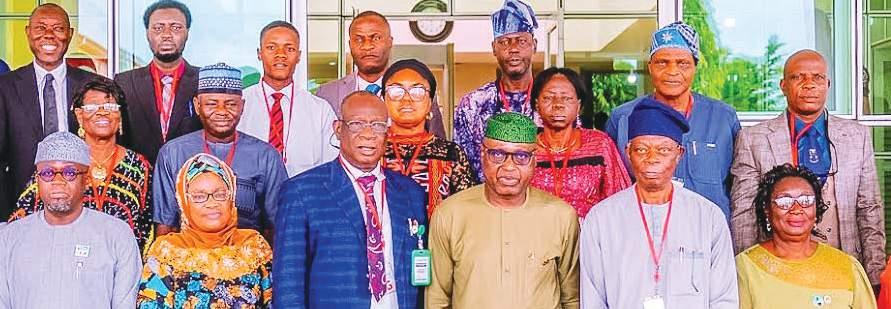
L-R(front row): Chief of Staff to the Governor, Mr. Niyi Adebayo; Secretary to the State Government, Prof Habibat Adubiaro; Vice Chancellor, Bamidele Olumilua University of Education, Science and Technology, Ikere-Ekiti (BOUESTI), Prof Babatunde Omojola; Ekiti State Governor, Mr Biodun Oyebanji; Pro -Chancellor and Chairman, Governing Council, BOUESTI, Prof Patrick Aina, and Commissioner for Education, Dr (Mrs) Bimpe Aderiye, with some council members, during a meeting in Ado-Ekiti...recently
Wale igbintade
The Federal High Court in Lagos has cast fresh doubt on the legal status of five firms approved by the Federal Competition and Consumer Protection Commission (FCCPC) to provide airtime and datacredit services under its Digital, Electronic, Online or Non-traditional Consumer
Lending (DEON) Regulations after ruling that the commission lacks the power to issue telecommunications licences.
Justice Ambrose LewisAllagoa, who delivered judgment on Monday in Suit No. FHC/L/CS/760/2026, however, upheld the FCCPC’s powers to regulate Nigeria’s consumer lending and competition landscape,
Blessing ibunge in Port Harcourt
The Nigeria Customs Service (NCS) has called for stronger collaboration with the media to enhance public trust, promote transparency, and support ongoing reforms aimed at boosting trade facilitation, border security and national economic development.
The Service made the call yesterday at a press conference held in Port Harcourt, Rivers State, ahead of its 2026 Public Relations Week with the theme: ‘Realigning Corporate Communication as a Strategic Driver of Institutional
Effectiveness and Public Trust’.
Speaking at the event, the National Public Relations Officer of the NCS, Deputy Comptroller of Customs, Abdullahi Maiwada, said trust remains the foundation upon which the Service operates, stressing that the media plays a strategic role in shaping public perception and communicating government policies to citizens.
Maiwada, who is the host for the event, thanked journalists for their continued support and described the media as a critical partner in nation-building rather than a mere observer of government activities.
Tinubu’s Commitment to State Police
Kemi Olaitan in Ibadan
The Chairman of the All Progressives Congress (APC), Mpumalanga Province, South Africa, Dr. Oluwatosin Ademola Ojo, has commended President Bola Ahmed Tinubu for his commitments toward the establishment of state police, describing the development as a landmark step in strengthening internal security architecture in the country.
Ojo, a medical practitioner and prominent APC leader in the diaspora, said the establishment of state police would complement the efforts of the Nigeria Police Force
and other security agencies in tackling insecurity across the country.
He stressed that for the initiative to achieve its intended objectives, funding for state police must be placed on a first-line charge, thereby guaranteeing a secure and sustainable source of funding for personnel, training, logistics, intelligence gathering, and operational effectiveness. According to him, adequate and uninterrupted funding is essential to ensuring that state police remain professional, efficient, and independent in discharging their constitutional responsibilities.
affirming the validity of the DEON Regulations while drawing a clear distinction between regulatory oversight and licensing authority.
The judgement reaffirmed the legal principle that
regulations cannot supersede Acts of Parliament, the court held that the DEON Regulations remain lawful because they derive their authority from the FCCPA
The judge held that
Sections 104, 105, 106 and 163 of the Federal Competition and Consumer Protection Act empower the FCCPC to investigate anti-competitive conduct, protect consumers and make regulations.
Consequently, the court dismissed the suit filed by the Wireless Application Service Providers Association of Nigeria (WASPAN), which had challenged the legality of the DEON Regulations.
Michael Olugbodeinabuja
As the 2027 general election draws closer, the Centre for Social Justice (CSJ) has challenged political parties and aspirants seeking elective positions to place the economy at the centre of their campaigns by presenting realistic and measurable plans capable of tackling poverty, unemployment,
and declining living standards.
The advocacy organisation warned that Nigerians could no longer afford election campaigns built around slogans, personalities, and unfulfilled promises, insisting that the next electoral contest must be defined by serious debates on economic recovery, job creation and improved welfare.
The call was made in Abuja
during a high-level political and governance dialogue on the economy organised by CSJ with support from the Friedrich-Ebert-Stiftung (FES) Nigeria.
The forum brought together representatives of political parties, civil society groups, policy experts, professional bodies and the media to deliberate on how economic development
can become the driving force of political campaigns ahead of the 2027 elections.
The CSJ Executive Director, Eze Onyekpere, said elections should no longer be treated as contests of personalities but as opportunities for citizens to examine competing policy ideas and determine which political platforms offer realistic solutions to Nigeria’s challenges.
segun awofadeji inBauchi
The Bauchi State All Progressives Congress (APC) Elders Group has accused former Zamfara State Governor and Senator representing Zamfara West, Abdul’aziz Abubakar Yari, of allegedly sponsoring the governorship ambition of Senator Shehu Buba of the
Peoples Redemption Party (PRP).
The group described the move as anti-party activity capable of destabilising the APC ahead of the 2027 general election.
In a statement issued yesterday and signed by the group’s Zonal Secretary, Dr. Mustafa Babayo Tunga, the elders described the alleged actions of Senator Yari, a prominent APC chieftain, as
a calculated attempt to weaken the party’s campaign structure and electoral prospects in Bauchi State.
The statement, which was made available to journalists in Bauchi, vowed to resist any individual using influence or financial resources to sow division within the party.
“We are aware of Senator
Abdul’aziz Yari’s alleged efforts to build a political structure through financial inducements to some APC supporters across the state in support of Senator Shehu Buba of the PRP against our party’s governorship candidate, Mohammed Abdullahi Abubakar, ahead of the 2027 general election,” the statement read.
sylvester idowu in Warri
FOOG Women Support Group yesterday empowered over 250 men and women in Delta Central senatorial district as part of efforts to mobilise grassroots support for President Bola Ahmed Tinubu and Delta State Governor, Rt. Hon. Sheriff Oborevwori,
ahead of the 2027 general election.
The programme with the theme: ‘Men/Women Empowerment Programme in Line with the Renewed Hope for MORE Initiative’, was aimed at promoting the ideals of President Tinubu’s Renewed Hope Agenda and Governor Oborevwori’s
MORE Agenda, and supporting the livelihoods of beneficiaries through the distribution of empowerment items.
The FOOG Women Support Group for President Bola Tinubu and Governor Sheriff Oborevwori 2027 Continuity and Empowerment Programme was held at Okpe
Hall, Orerokpe in Okpe Local Government Area of Delta State.
The Director-General of FOOG, Chief (Mrs.) Esther Okotie-Eboh, described the event as more than a political gathering, stressing that it was a platform to promote continuity, stability and sustained development.
Oshodi Art Gallery, one of Nigeria’s leading art and cultural institutions, has announced its official partnership with the GLOWFUX Charity Concert, committing an additional N100,000 towards the ongoing GLOWFUX @ 10 Theme Song Challenge.
The partnership is a demonstration of Oshodi
Art Gallery’s commitment to youth empowerment and creative development.
Also, the strategic partnership has doubles the competition’s grand prize from N100,000 to N200,000, making the challenge one of the most rewarding youth-focused creative contests currently running in anticipation of a major social impact event
in Nigeria.
The collaboration represents another important milestone in preparations for the 10thAnniversary of the GLOWFUX Charity Concert, as more organisations continue to identify with the initiative’s mission of promoting compassion, creativity, youth development and community transformation.
Commenting on this development,, the Chief Executive Officer of Oshodi Art Gallery, Dr. Seyi Paul Oshodi, explained that supporting the competition aligns perfectly with organisation’s long-standing philosophy of discovering, nurturing and celebrating creative talents.
region and empower local entrepreneurs. All the above created mass decent full employment that kept youths out of criminality. Security,whether local or regional, is indispensable to achieve the development agenda. Let’s get it right. The recent security challenges once again raise the noise level of the importance of the Development Agenda for Nigeria.Ungoverned spaces without factories are inevitable sanctuaries for insurgents and criminals. Nigeria is undoubtedly under policed. But much more worrisome is Nigeria’s economic underperformance with growth rates lagging behind population rate and mounting grafts/grabs’ rates. Hundreds of thousands of police state and Federal policemen cannot halt the tide of crimes associated
with unemployed and un-employable youths. Replace light arms in the hands of children out of schools with working tools on farms and factories. The governor of Zamfara State Dauda Lawal, should revive scores of cotton farms and Zamfara textile mills which once employed thousands of direct and indirect youths and kept them off crimes. Zamfara has a comparative advantage in the Cotton value chain through farming, ginning, spinning, weaving, and sewing that is vital for boosting economic growth and creating jobs in agricultural regions.
The governor of Ogun State Prince Dapo Abiodun, a panelist rightly established the nexus between food security crisis and general insecurity. I agree
with Senator Adams Oshiomhole that President Tinubu is an uncommon statesman committed to reform the police as an instrument for peace and security for development through phased devolution to the states. Some Presidents would not let go. But even at that it is because President Tinubu prioritizes security within the context of Renewed Hope Development Agenda that focuses on eight areas:Reforming the Economy:National Security, Food Security:Energy and Natural Resources: Infrastructure:Education and Health: Diversification: and Good Governance: To help the President and Nigeria succeed in managing the security challenge, therefore, there is the urgent need for a pan-Nigerian, non- partisan commit-
ment and consensus building to the Development Agenda with Security as a critical success factor! President Tinubu recently unveiled the Renewed Hope National Development Plan (2026–2030), a five-year economic blueprint targeting a $1 trillion economy by 2030, a successor Plan to the previous Medium-Term National Development Plan (2021–2025). Key Focus Areas include double-digit GDP growth and Social Protection. The plan is also designed to achieve the long-term objectives of the Nigeria Agenda 2050 of which is national security and policing.
•Issa Aremu is a Member National Institute Kuru Jos/ Direct General Micheal Imoudu National Institute for Labour Studies (MINILS) Ilorin.
Babcock University, Ilishan-Remo, Ogun State, yesterday, graduated a total of 665 postgraduate students comprising 70 Postgraduate Diploma (PGD) graduates, 391 Master’s degree holders, 21 Master of Philosophy (MPhil) graduates, and 183 Doctor of Philosophy (PhD) graduates across various schools and colleges. Awards were presented to outstanding graduating students
across the postgraduate diploma, master’s, MPhil, PhD and MBA programmes in recognition of their exceptional academic performance.
At the master’s level, Christianah Ojelabi and Ibitola Osikomaiya, who both graduated with a perfect Cumulative Grade Point Average (CGPA) of 5.0, alongside Daniella Okangba, who earned a CGPA of 4.85, each received a cash award of N2 million donated by the Ogun
State Governor, Dapo Abiodun.
Juliet Idume-David, who graduated with a CGPA of 4.84, received N1.5 million. At the doctoral level, Deborah Segun-Adeniran, who recorded a CGPA of 4.95, was awarded N2.5 million for emerging as the best PhD graduating student.
Speaking at its hooding and 15th convocation ceremony, Abiodun, who was the Commencement Speaker, urged graduates to combine innovation
with integrity, warning that while Artificial Intelligence and other emerging technologies were reshaping the world, they could not replace moral responsibility, compassion and ethical judgment.
He stated that the future belongs not merely to those who master technology, but to individuals who unite innovation with integrity, excellence with humility and intelligence with character.
“Artificial Intelligence can process information with astonishing speed. It can recognise patterns and support remarkable discoveries. However, it cannot
replace integrity. AI cannot replace compassion.
“It cannot replace moral responsibility or ethical judgment. The future will belong not merely to those who master technology, but those who unite innovation with integrity, excellence with humility, and intelligence with character.”
Abiodun described the convocation theme, ‘Breaking New Ground’, as timely and profound, noting that it represented more than a ceremonial slogan but a philosophy for purposeful living that challenges individuals to reject complacency, embrace
discovery and expand the frontiers of knowledge, leadership and human development. He urged the graduates to see their degrees not as the end of their academic journey but the beginning of greater responsibilities to society.
“The word commencement is especially meaningful. Every worthwhile ending is also the beginning of a new assignment. While degrees are being conferred today, responsibilities are equally being entrusted. Your certificates recognise your accomplishments, but your life will reveal the value of your education,” he said.
Chuks Okocha in Abuja
The National Leadership of the Labour Party, yesterday, held an interactive session with the Party’s Vice Presidential Candidate for the 2027 general election, Hajja Bintu Konto, at its National Secretariat in Abuja, during which the leadership reaffirmed its confidence in the presidential ticket of Dr. Chibuzo Sunday Okereke and Hajja Bintu Konto.
Speaking at the session, the National Chairman of the Labour Party, Senator Nenadi Usman, expressed profound satisfaction with the choice of Hajja Bintu Konto as the Party’s Vice Presidential Candidate, describing her nomination as a
reflection of the party’s enduring commitment to equity, inclusion and social justice.
According to Senator Usman, the choice of Hajja Konto aligned with the party’s enduring philosophy of “Mama, Papa, Pikin,” which embodies the humane character and inclusive ideals of the Labour Party.
She noted that by presenting a woman as its vice presidential candidate, the party has demonstrated its unwavering belief in equal opportunity and social justice, standing out as the only major political party in the 2027 presidential race to accord women such a strategic and prominent place on its presidential ticket. She expressed confidence that
Hajja Konto’s credentials, professional accomplishments and humanitarian experience would greatly enrich governance when she and her principal assume office in 2027.
Presidential candidate of the party, Okereke, expressed delight at being paired with Hajja Bintu Konto, whom he described as a humble, dependable and highly experienced partner.
Konto, on her part, expressed profound appreciation to the leadership and members of the Labour Party for the confidence reposed in her, describing Usman as a woman with a golden heart whose unwavering commitment to justice, fairness and national service continued to inspire countless Nigerians.
Hammed Shittu in Ilorin
Kwara State Governor and Chairman of Nigerian Governors’ Forum (NGF), AbdulRahman AbdulRazaq, has lauded President Bola Tinubu for the establishment of a new army battalion in the state.
He said the establishment would effectively commit more boots and military hardware to neutralise security threats in the state.
The army battalion is to be located in Omu Aran in Irepodun Local Government Area of the State.
In a statement in Ilorin by the governor’s Deputy Chief Press
Secretary, Mashood, AbdulRafiu Agboola, the governor said the new military formation would boost security response to the threat of banditry and terrorism.
“Specifically, I express our appreciation to the Chief of Army Staff Lieutenant General Waidi Shaibu for the swiftness with which he graciously processed our request for more hands to strengthen the presence of the Army in the state,” he said.
AbdulRazaq also acknowledged support of the ONSA and the gallantry of all the security forces, including the Defence, DSS and
the police, in the campaign against terrorism, banditry, and other violent crimes.
“On behalf of the people and government of our state, I wholeheartedly thank Mr. President for yet another promise kept to the state.
“We are confident that the new battalion will greatly strengthen counterterrorism and anti-kidnapping operations across various theatres.
“Of particular note are the other discreet, multi-agency efforts of government to stamp out kidnappings, free all victims, and clear all unwanted elements from our forests,” he said.
Nnamdi Azikiwe University (UNIZIK) has appointed veteran investment banker and capital markets expert, Nicholas “Nicky” Okoye, as a Visiting Senior Lecturer in a move aimed at strengthening its capital markets and digital assets curriculum amid the growing global adoption of virtual assets and blockchainbased finance.
The appointment, which takes immediate effect, is expected to deepen the university’s capacity to train enterprise executives, entrepreneurs and policymakers in emerging areas such as cryptocurrencies, stablecoins, Central Bank Digital Currencies (CBDCs), tokenisation of realworld assets and other digital
financial innovations.
UNIZIK, which hosts one of Africa’s few dedicated Capital Markets faculties, said the appointment aligns with its strategy of equipping students and professionals with the knowledge and practical skills required to navigate the rapidly evolving financial ecosystem.
The university in its statement, described the appointment as a significant milestone for the institution.
“Securing someone of Nicky Okoye’s calibre is a game-changer. As global finance evolves, we must equip enterprise executives, entrepreneurs and policymakers with the technical knowledge required to build long-term capital formation strategies. His real-world experience is
invaluable.”
Okoye brings decades of experience across global and Nigerian financial institutions. His career includes serving as a Financial Consultant at Merrill Lynch in the United States, Chief Strategy Officer at the Nigerian Exchange Group, and Founding Group Executive Director of Operations and Strategy at Transcorp Group Plc, where he led fundraising initiatives that collectively exceeded $1 billion.
He currently leads the Global Investment Advisory Community (GIAC), a coalition of local and international banks, asset managers and fintech firms working to develop a digital assets ecosystem across Africa and the Caribbean.
Beyond the private sector, Okoye has contributed to public
policy, providing advisory support to the Central Bank of Nigeria (CBN) and the Securities and Exchange Commission (SEC) on capital market regulatory frameworks.
Stakeholders in the financial services sector have welcomed the appointment, expressing optimism that his academic engagement would help build capacity among investors and professionals as Nigeria expands its digital finance ecosystem.
Okoye also holds an honorary Doctor of Business Administration from Enugu State University of Technology, awarded in recognition of his contributions to enterprise development and business excellence.
He previously served on the Presidential Jobs Board and the
National Council of Small and Medium Scale Enterprises, where he provided strategic advice on economic development. Between 2014 and 2018, he advised the Nigeria Content Development and Monitoring Board (NCDMB) on Project Triple E, an initiative designed to strengthen indigenous participation in the upstream oil and gas value chain by integrating community-based contractors.
The appointment comes as Nigeria intensifies efforts to establish a robust regulatory framework for digital assets.
The Federal Government recently inaugurated a National Virtual Assets Council to coordinate the oversight and regulation of virtual and digital assets in the country.
The council is chaired by the Central Bank of Nigeria, with
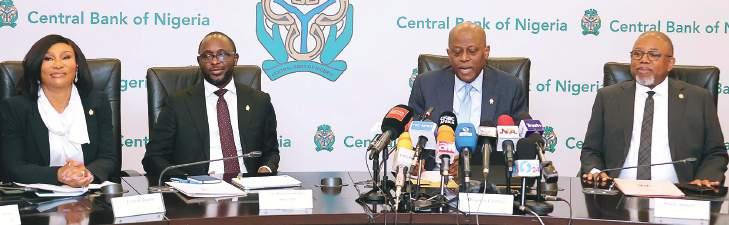
Last Thursday (9th July 2026) Arise TV hosted a Dialogue on building national consensus for state police and national security. Commendably timely. It undoubtedly promoted the much needed literacy about the imperatives of state/community/decentralized policing as distinct from the current assumed centralized National Police Force (NPF). At times like this, Arise Dialogue offered a worthy platform for reaffirmations and even some rethinking of positions by key state actors. Almost all panelists are state governors and legislators. The conclusions of the Dialogue would enrich the rapidly advancing process audaciously initiated by President Bola Ahmed Tinubu. On June 24, 2026, he transmitted the historic executive bill aimed at moving policing to the Concurrent Legislative List and establishing a dual federal-state policing structure via the proposed State Police Bill (Constitution Alteration Bill). Critical takeaways from Arise platform include Safeguards Against Political Abuse, Technological Integration through smart security infrastructure and imperatives of Local Government Autonomy and Funding.
The Platform further reopens the healthy debate about how to improve on our approaches to inevitable reforms. The Dialogue reveals that gradual, inclusive and consensual dispositions to reforms could benefit from the inputs by all stakeholders resulting in their collective ownership and support. The on-going police security sector reform just as the just concluded tax reform rightly departs from the shock therapy approach that heralded Fuel Subsidy Removal and the Foreign Exchange Unification.
However as a participant-observer at the Dialogue, I bear witness to an elitist top-down consensus building towards an emerging “Nigeriasecurity/state”. And why not? More than ever before, quantity as much as quality control of the existing national policing structure capture the imagination of policy makers and citizens alike. What with the legacy of glamorized insecurity challenges like insurgencies, robberies, banditry ? With hundreds of abductions yearly, (a significant
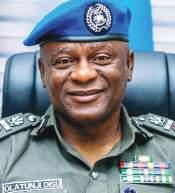
number of victims being schoolchildren and rural working community citizens, the most recent being the rescued students and teachers of Oyo state after a 56-day in captivity), the overarching protection of citizens from both internal and external security threats cannot be overstated.
In any case, notwithstanding the discordant views about the efficacy of the Constitution, every body is at home with Section 14(2)(b) of the 1999 Constitution of the Federal Republic of Nigeria (as amended: that the “security and welfare of the people shall be the primary purpose of government”. And that is the real issue! The Arise Dialogue commendably threw up a bagful of policy ideas almost repetitively on policing but inexplicably almost nothing on the welfare and development component of Section 14(2)(b.
Are we for a developmental or police state? Nigeria is not a debating society. The promise of independence in 1960 was to reverse century long British colonial underdevelopment. Secu-
rity undoubtedly is a critical success factor for a developing Nigeria. But it is the means, the end is growth and Development as a necessary precondition for poverty and crime eradication. The founding fathers (and mothers) were clear on this. Which explains why after lowering the Union Jack, in 1960 they launched in earnest Development Plans in quick successions: First National Development Plan (1962–1968), Second National Development Plan (1970–1974), Third National Development Plan (1975–1980) and Fourth National Development Plan (1981–1985). Indeed the Second National Development Plan (1970–1974) was revolutionary. It Introduced five core national objectives (enshrined in both 1979 and 1999 Constitutions ) “targeted post-Civil War reconstruction and balanced rural-urban development” .The five core national objectives namely “A united, strong, and self-reliant nation:.A great and dynamic economy: A just and egalitarian society:A land of bright and full opportunities for all citizens: A free and democratic society” added up to a compulsory mantra of undergraduates of Economics and social sciences in the then fast developing Nigeria of 70s and 80s. 1999 constitution actually emphasizes security and welfare within the context of the broader inherited legacy of national Development Agenda. Two Core Constitutional Provisions are relevant here for national security. First , all government powers and authority are derived from the people, and that the protection of citizens’ lives and property alongside the provision of basic needs remains the fundamental duty of the state. Secondly on Social and Economic Welfare: Chapter II under the Fundamental Objectives and Directive Principles of State Policy, the constitution directs the state to ensure: Adequate means of livelihood and suitable employment for all citizens. Just and humane working conditions. Adequate medical and health facilities.Equal pay for equal work. Apart from occasional references to new fashionable buzzwords:“kinetic and non-kinetic” by some panelists, almost all discussants were mute on socio economic factors of mass youth
unemployment and unemployability, poverty and new illiteracy that fuel criminality of varying hues. To tame factors that fuel wholesale insecurity, we just must name them. And show what we done to address the problems. The governor of Zamfara State Dauda Lawal, a panelist disclosed he bought as many as 500 vehicles for the police since his inauguration on May 29, 2023. He is certainly more than prepared for the state police if he had expended as much on Federal police. But that is assuming security is all about spending billions on vehicles for police men who suffer wage income poverty and crisis of pension after work. “High poverty rates (exceeding 70%), widespread illiteracy, and a lack of economic opportunities for young people make rural populations highly vulnerable to recruitment by criminal gangs” fuel insecurity in Zamfara state than shortage of vehicles for the police . The star of the Arise Dialogue was the veteran Local Police statesman- activist BUKAR USMAN.He generously distributed 400 copies of his published “Case of Local Police” for those who still care to read. Bukar Usman is strong on nostalgia for post-colonial “era of community policing at its best: simple, inexpensive and yet effective”. Bukar USMAN’s case however suffers the same limitations of security discourse devoid of Development context. You cannot be romantic with crime- free Northern Nigeria under the legendary Premier AHMADU Bello (1954–1966) without contextualizing the development agenda of Northern Nigeria which he commendably championed. He focused on rapid modernization, through industrialization, regional self-reliance, and educational advancement. Aggressive Education policy frontally tackled mass illiteracy through secular and integrated Koranic schools. The Premier founded the prestigious Ahmadu Bello University Zaria and Kaduna Polytechnic to produce indigenous professionals. He also established financial and development drivers like Northern Nigeria Development Commission and the Bank of the North to industrialize the
Continued on page 39
