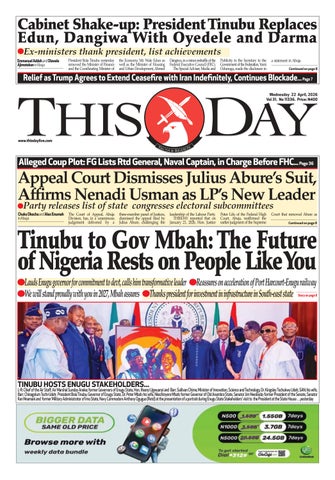
Cabinet Shake-up: President Tinubu Replaces Edun, Dangiwa With Oyedele and
Ex-ministers thank president, list achievements
www.thisdaylive.com
The Court of Appeal, Abuja Division, has, in a unanimous judgement delivered by a three-member panel of Justices, dismissed the appeal filed by Julius Abure, challenging the leadership of the Labour Party. THISDAY reported that on January 21, 2026, Hon. Justice Peter Lifu of the Federal High Court, Abuja, reaffirmed the earlier judgment of the Supreme Alleged Coup Plot: FG Lists Rtd General, Naval Captain, in Charge
Tinubu
Appeal Court Dismisses Julius Abure’s Suit, Affirms Nenadi Usman as LP’s New Leader Party releases list of state congresses electoral subcommittees
to Gov Mbah: The Future of Nigeria Rests on People Like You
Lauds Enugu governor for commitment to devt, calls him transformative leader Reassures on acceleration of Port Harcourt-Enugu railway We will stand proudly with you in 2027, Mbah assures Thanks president for investment in infrastructure in South-east state Relief as Trump Agrees to Extend Ceasefire with Iran Indefinitely, Continues Blockade...
TINUBU HOSTS ENUGU STAKEHOLDERS...
L-R: Chief of the Air Staff, Air Marshal Sunday Aneke; former Governors of Enugu State, Hon. Ifeanyi Ugwuanyi and Barr. Sullivan Chime; Minister of Innovation, Science and Technology, Dr. Kingsley Tochukwu Udeh, SAN; his
Barr.
President
Governor of Enugu State, Dr. Peter Mbah; his wife, Nkechinyere Mbah; former Governor of Old Anambra State, Senator Jim Nwobodo; former President of the Senate, Senator Ken Nnamani and former Military Administrator of Imo State, Navy Commodore Anthony Oguguo (Retd) at the presentation of a portrait during Enugu State Stakeholders’ visit to the President at the State House …yesterday
Emmanuel Addeh and Olawale Ajimotokan in Abuja
wife,
Chinagolum Tochi-Udeh;
Bola Tinubu;
Chuks Okocha and Alex Enumah in Abuja
SUPPORTING OUR GALLANT SECURITY FORCES...
during a getwell soon visit to the soldiers injured in a recent counterterrorism operation in Kaiama LGA of the state … yesterday .
Diezani Tells London Court She Was Made Scapegoat Over Subsidy Crisis
Says she felt betrayed by 2012 policy decision
Wale Igbintade
The trial of former Nigerian petroleum minister, Diezani Alison-Madueke, resumed on Day 23 at the Southwark Crown Court in London, with the ex-minister telling the court she was unfairly blamed and effectively made a scapegoat for decisions taken at the highest levels of government, particularly during the fallout from Nigeria’s 2012 fuel subsidy crisis.
Testifying under cross-examination, Diezani said she felt “betrayed” by the manner in which the subsidy removal was implemented under former President Goodluck Jonathan, noting that the abrupt New Year’s Day announcement triggered nationwide unrest and placed her, as petroleum minister, at the centre of public outrage.
She insisted that the policy had been the subject of prior deliberations and that its sudden execution exposed her to criticism for decisions she did not solely control.
“I felt betrayed to a certain extent,” she said, referring to the decision taken under former President Goodluck Jonathan.
“I felt like a scapegoat because
I was ultimately responsible as oil minister.”
Diezani rejected suggestions by the prosecution that she exercised authority over luxury properties allegedly connected to businessman Ben Peters, insisting that her involvement was limited to offering interior design advice.
“I was giving advice, not instructions,” she told the court, pushing back against claims that she directed refurbishment works or controlled the properties in question.
According to her, communications with contractors and intermediaries were purely advisory and did not translate into ownership or decisionmaking authority.
She further argued that there was no documentary evidence directly linking her to legal ownership of the properties, maintaining that any inference to the contrary was speculative.
On the issue of her alleged use of a property known as Harbour House, she said she did not stay there and, at most, may have visited once.
At several points during the proceedings, Diezani challenged the credibility of witnesses whose
accounts the prosecution relied upon.
She questioned the accuracy of a furniture dealer’s testimony regarding payment arrangements and dismissed attempts to identify her through visitor logs under a different name.
“You are implying that the black woman is me, and I’m telling you that I’m not the one,” she said, firmly rejecting the suggestion.
A key plank of her defence was her insistence that she did not improperly benefit from luxury goods.
While acknowledging that she selected furniture and decorative
Denies control of luxury assets linked to associates
items during the period under review, she maintained that any items used personally were paid for.
“There was always someone to pay at the point of purchase,” she said, explaining that while third parties may have handled payments initially, reimbursements were made in cash.
She told the court that this reflected the realities of Nigeria’s largely cashbased economy at the time.
Diezani also offered explanations for the movement and storage of items cited by the prosecution, describing them as part of a normal interior
design process rather than evidence of personal acquisition.
According to her, items were often moved between locations or placed in storage as part of staging and refurbishment decisions.
Addressing allegations of financial benefits flowing through associates to her family, the former minister distanced herself from such transactions and denied prior knowledge of them.
She told the court she was unaware of donations allegedly made to her brother’s church and had no involve-
ment in its affairs beyond attending an award ceremony.
“I was not involved in any way,” she said, adding that her brother never discussed such matters with her.
On payments made by associates for personal or family-related expenses, including school fees, Diezani framed such gestures within the context of Nigerian social norms.
She explained that it was not unusual for wealthy individuals to assist others financially, and that such actions should not automatically be construed as improper.
NACCIMA: Economic Transformation Without Skills Transformation Unsustainable
As the federal government’s economic reform initiatives strengthen Nigeria’s macroeconomic variables, the Nigerian Association of Chambers of Commerce, Industry, Mines and Agriculture (NACCIMA) has warned that, “economic transformation
NUPRC Charges Independent Oil Producers on Industry Standards, Human Capital Development
Commissions migrates to paperless operation system
The Chief Executive of the Nigerian Upstream Petroleum Regulatory Commission (NUPRC), Mrs. Oritsemeyewa Eyesan, has charged the Independent Petroleum Producers Group (IPPG) to uphold industry standards, strengthen human capital development, and promote good corporate governance. Eyesan gave the charge during a courtesy visit by the IPPG delegation led by its Chairman, Mr. Adegbite Falade, at the Commission’s headquarters in Abuja, according to a statement by the agency’s Head,
Media and Corporate Communica- tions, Eniola Akinkuotu.
In her remarks, Eyesan described the IPPG as a significant force in the industry, particularly following the divestment of international oil companies, noting that the Commission values its relationship with the group.
The CCE emphasised adherence to the provisions of the Petroleum Industry Act (PIA), 2021, stressing the importance of human capital development and strong corporate governance.
She said, “One area I think we need to spotlight is human capital
development. As the industry grows, there is a tendency of default and if we allow that to fester, it will hurt all of us.
“Because we are in a global market, the financiers are rating Nigeria; they are not rating companies, and if we do not bring our human capacity to par, then we will be creating a big problem for ourselves.”
Eyesan urged the IPPG to hold its members to the highest standards just like their foreign counterpart.
“As a pressure group, you should hold yourselves to a standard. I think that is one of the things the IOCs have done very well,” she stated.
without skills transformation is not sustainable.”
It fsaid that “the future of Nigeria’s economy is deeply tied to the quality, relevance and responsiveness of our skills development system.”
NACCIMA gave the warning yesterday in Lagos during the “Technical and Vocational Education and Training (TVET) Stakeholders Summit” with the theme “Building Industry-Ready Professionals for a $1 Trillion Economy: Strengthening TVET Through Public -Private Partnership,” which was convened by NACCIMA.
The National President of NACCIMA, Mr. Jani Ibrahim, in his opening address during the stakeholders’ summit, said Nigeria was standing as
one of the largest labour markets in Africa whose demographic advantage has continued to be constrained by a fundamental challenging mismatch between available skills and industry demand.
Ibrahim said the paradox that should be of concern was that while official unemployment figures appear moderate, the reality was that a significant proportion of the workforce, over 90 per cent, was engaged in informal or vulnerable employment, often lacking productivity, stability, and growth potential.
He added: “At the same time, youth unemployment and underemployment remain persistent, with many young Nigerians unable to
transition effectively from education into meaningful work.
“This is not merely a labour market issue; it is a structural economic challenge.
“And this is where TVET must take centre stage.”
He emphasised that globally, “economies that have successfully industrialised and sustained growth have done so on the backbone of strong technical and vocational systems, systems that are demand-driven, industry-led, and innovation-oriented.
“In Nigeria, however, the story has been different. For too long, our education and training systems have not sufficiently aligned with the needs of the real economy.
FG Inaugurates Inter-ministerial C’ttee on HCDT Fund
The federal government has inaugurated an inter-ministerial committee to strengthen coordination and enhance compliance in the implementation of the Host Community Development (HCD) Programme. The inauguration, which took place in Abuja, was presided over by the Permanent Secretary,
Ministry of Petroleum Resources, Mrs. Patience Oyekunle, and her counterpart in the Ministry of Regional Development, Dr. Mary Ada Ogbe.
A statement by Rotimi Sanusi, on behalf of the head of press and public relations in the ministry, said the committee was established strictly as a collaborative and advisory body.
According to the statement,
the committee is mandated to facilitate coordination and promote effective information sharing among stakeholders in line with presidential directives. Membership of the Committee was drawn from the Ministry of Petroleum Resources, the Ministry of Regional Development, the Nigerian Upstream Petroleum Regulatory Commission (NUPRC).
Dike Onwuamaeze
Kwara State Governor, Abdulrahman Abdulrazaq (CON); with Head, Department of Surgery Intensive Care Unit, Kwara State Teaching Hospital, Ilorin, Dr. Anthony Ajiboye;
Emmanuel Addeh in Abuja
Peter Uzoho
RESUMPTION OF PLENARY AT THE SENATE CHAMBER...
L-R: Chairman, Senate Committee on Defence/former President of the Senate, Senator Ahmed Lawan; Deputy Minority Whip of the Senate, Senator Rufai Hanga; Deputy President of the Senate, Senator Barau I. Jibrin; Leader of the Senate, Senator Opeyemi Bamidele; Chairman, Senate Committee on the National Agency for Science and Engineering Infrastructure, Senator Ezenwa Onyewuchi; and Chairman, Senate Committee on Power, Senator Enyinnaya Abaribe, at the resumption of plenary at the Senate Chamber, National Assembly Complex, Abuja, yesterday
Tunji Bello: State Institutions Indispensable Partners for Credible, Accessible Consumer Protection Framework
FCCPC signs MoU with Lagos rights agency to boost consumer protection Solebo: LASCOPA has recovered over N40 million, $10,000 from local, international airlines on behalf of consumers over infractions expectations, and a stronger culture of fair dealing.”
Executive Vice Chairman/Chief
Executive, Federal Competition and Consumer Protection Commission (FCCPC), Mr. Tunji Bello, yesterday emphasised that state institutions remained indispensable partners in building a credible and accessible consumer protection framework across the federation.
Speaking at the signing of a
Memorandum of Understanding (MoU) between the FCCPC and the Lagos State Consumer Protection Agency (LASCOPA) in Abuja, he said, “We recognise that effective consumer protection cannot be delivered from Abuja alone”.
The partnership seeks to deepen cooperation between both institutions in practical ways, providing a framework for information sharing, complaint referrals, joint consumer education
initiatives, capacity development, market intelligence exchange, and coordinated action where legally appropriate.
This came as General Manager of LASCOPA, Mr. Afolabi Solebo, disclosed that the agency had recovered over N40 million, including $10,000 from local and international airlines on behalf of consumers over rights infringements in recent times.
Bello however, declared that the
MoU was not merely a ceremonial document but an operational instrument designed to improve outcomes for citizens.
He said, “Through this collaboration, consumers should be able to experience quicker responses, clearer pathways for complaints, stronger awareness of their rights, and better coordination between federal and state authorities.
“Businesses should also benefit from more consistent engagement, clearer
Oil Block Sale: Stakeholders Push for More Stakes for Oil Producing States
Want 20% equity for host communities
As part measures to promote Nigerian local content through genuine participation and empowerment of oil producing communities, a concerned group - the Nigerian Local Content Conference (NLCC) has asked the federal government to grant oil bearing states concession to acquire oil blocks in the forthcoming 2026 oil block bid rounds.
It also urged President Bola Tinubu to use his good offices to approve the seeding of 20 percent equity allocation to Nigerians per a state in the 50 oil blocks
being put up during 2026 oil bloc licencing rounds.
Among the requests put forward by the stakeholders under the auspices of the Nigerian Local Content Conference (NLCC) are that the president should consider granting oil producing states concessions to own stakes in oil blocks being offered for bids
They are also demanding for the seeding of 20 percent equity holding for host communities in the oil rich Nigeria Delta and other oil-bearing states.
Regarding the exploration of solid mineral deposits in the northern part of the country,
they suggested that federal government should encourage youths’ participation through formation of cooperative groups.
Addressing journalists in Abuja, the Convener of NLCC and Africa Commodities Conference and Exhibition (ACCE), Michael Akueche said the move enable Nigerians to take advantage of the local content policy of the federal government which seeks to give consideration to indigenous operators greater opportunity to participate in the oil exploration and production business.
Akueche said that Nigeria has for years tried to fashion out ways
Hold FG Responsible for Any Strike in Varsities, NAAT Warns
Onyebuchi Ezigbo in Abuja
The National Association of Academic Technologists (NAAT) has said that federal government is pushing the university workers into embarking on industrial action by ignoring their plea to reconvene and promptly conclude renegotiation of FGN/NAAT 2009 Agreement.
In a statement signed by president of NAAT, Comrade Ibeji Nwokoma the union urged well-meaning Nigerians, clergy, civil society, the
Nigeria Labour Congress, students, and parents to prevail on the federal government to reconvene promptly and conclude renegotiations honorably.
The statement issued at the end of its 62nd National Executive Council (NEC) meeting held on Thursday, at the National Secretariat Complex, Yakubu Gowon University (formerly University of Abuja), said: “Aside from this, the government bears responsibility for impending academic disruptions and loss of institutional peace”.
NAAT noted that one of its major concerns was a letter dated March 30, 2026 from the Office of the Head of the Civil Service to the Salaries, Income, and Wages Commission—approving a 30% allowance increase for non-teaching staff. It said that the letter was issued without NAAT’s concluding renegotiation agreement with the federal government, adding that, “the action undermines the renegotiation process, violates collective bargaining principles, and fosters wage disparities”.
of improving the lives of the people especially those directly suffering the environmental impact of oil and gas production in the Niger Delta area.
He said that President Bola Tinubu has the opportunity of raking millions of votes from the youth support base across the country if he grants the request which is intended to empower the vast population of Nigerians and give them sense of belonging.
The FCCPC EVC pointed out that several consumer issues arise within states and communities, adding that “they are local in character, immediate in effect, and often require rapid intervention”.
According to him, “Lagos State occupies a unique position in this regard. As Nigeria’s leading commercial hub, Lagos is home to an enormous concentration of consumers, businesses, digital enterprises, logistics networks, financial activity, and service providers. It is a dynamic and fast-moving market. It is also a place where regulatory innovation is both necessary and consequential.”
He said, “Having served Lagos State in the past, I understand the scale, energy, and complexity of the terrain. I also understand that public institutions must constantly adapt to keep pace with the realities of such an environment.
“It is also important to note that Lagos hosts the Commission’s South West Zonal Office. This provides a strong institutional foundation for practical, day-to-day collaboration between the FCCPC and LASCOPA.
“I therefore encourage close operational cooperation at that level, particularly in the areas of
complaint handling, intelligence sharing, consumer education, and coordinated interventions where necessary. The work of LASCOPA is therefore important, timely, and worthy of commendation.”
He said the FCCPC remained committed to encouraging states across the federation to enact, strengthen, or renew their consumer protection legal frameworks in ways that reflect local realities and peculiar market conditions. He stressed that while national standards are important, each state also faces distinct challenges requiring tailored responses, adding that “strong state-level consumer protection institutions, working in harmony with federal regulators, will significantly improve confidence in the Nigerian marketplace. This is the model we seek to advance”. Bello commended the teams of FCCPC and LASCOPA whose diligence had brought their efforts to fruition. He said, “Partnerships of this nature succeed not by signatures alone, but by sustained commitment after the signing ceremony.”
According to him, “Today’s event is significant because it reflects a shared commitment to improving the daily experience of consumers and strengthening fair business conduct through practical institutional cooperation.
RMRDC Launches 2G Platform to Boost Transparency, Attract Investments in Raw Materials Sector
The Raw Materials Research and Development Council (RMRDC), has launched a second generation platform to boost transparency as well as local and foreign direct investment (FDI) in the nation’s raw materials sector.
RMRDC Director General, Prof. Nnanyelugo Ike-Mounso stated this on Tuesday in Abuja during the launch of a second generation platform to boost transparency, local and foreign direct investment.
The platform also sets to curb illegal mining, and illicit financial flows.
Ike-Mounso said once the 30 per cent value addition bill is signed into law, the country will be able to curb both illegal mining and illicit financial flows in the raw materials sector.
“This database will disclose locations of some minerals, so people know where these minerals are. And at least, the authorities responsible for licensing or for checking illegal, illicit mining will also take advantage of this.
“The truth is you can’t even do investment without information. The worst thing you can do is to begin to do no good investment. Part of why investors don’t come into this country as much as we expect them to do is because there’s no data.
“You can’t invest blindly; this provides data to enable that kind of investment. So, this will of course improve on foreign direct investment, foreign private investment, and in fact investment influence in the country generally,” he said. On illicit financial flows, Speaking on fighting illic he said, “To fight illicit financial flows is in support of the president’s assent to the bill mandating that you do not export raw materials unless you add at least 30 per cent value to it. “It becomes easy to trace where they’re coming from. It becomes easy to enforce a law that you must at least take it to a local facility where you process it.
Oghenevwede Ohwovoriole in Abuja
Onyebuchi Ezigbo in Abuja
James Emejo in Abuja
PHOTO: OFFICE OF THE LEADER OF THE SENATE
BUDWEISER ROYALE EASTERN LAUNCH...
L-R: Marketing Manager, Budweiser, Olajumoke Okikiolu; Marketing Director, International Breweries PLC, (IBPLC) Bamise Oyegbami; BBNaija alumni, Onyeka Anita Chigbo; BU President, IBPLC, Nick Kade, and IBPLC District Manager, East, Abimbola Olaleye, at the Eastern launch of Budweiser Royale in Asaba, Enugu State...recently
Relief as Trump Agrees to Extend Ceasefire with Iran Indefinitely, Continues Blockade
Pakistan scrambles to get negotiations going Blockade violates ceasefire deal, says Iran Oil price nears $100,
President Donald Trump yesterday agreed to extend the ceasefire with Iran, at the request of Pakistan, but maintained that the U.S will continue the blockade of Iranian ports and stressing that he was awaiting a unified proposal from the Islamic Republic.
The announcement came as lastminute ceasefire talks between the U.S. and Iran looked uncertain and a two-week truce was set to expire Wednesday (today). It therefore came as a relief for the oil market which has experienced uncertainty in the last few weeks.
Earlier, the White House put on hold Vice President JD Vance’s expected trip to Islamabad for a second round of talks as Tehran, at least for the time-being, has balked at further talks.
In a Truth Social post announcing the ceasefire extension, Trump said the U.S. military would “remain ready and able, and will therefore extend the ceasefire until such time as their proposal is submitted, and discussions are concluded, one way or the other.”
Besides, he said the U.S. would continue its blockade of Iranian ports. But both countries have warned that, without a deal, they were prepared to resume fighting.
J.D Vance’s trip put on hold U.S. considers financial support for the U.A.E
“Based on the fact that the Government of Iran is seriously fractured, not unexpectedly so and, upon the request of Field Marshal Asim Munir, and Prime Minister Shehbaz Sharif, of Pakistan, we have been asked to hold our attack on the country of Iran until such time as their leaders and representatives can come up with a unified proposal.
“I have therefore directed our military to continue the blockade and, in all other respects, remain ready and able, and will therefore extend the ceasefire until such time as their proposal is submitted, and discussions are concluded, one way or the other,” he stated on his social media handles.
Pakistan Scrambles to Get US, Iran to Negotiate
Also, Pakistani leaders, including Prime Minister Shehbaz Sharif, worked intensively late Tuesday to get both sides to agree to a second round of ceasefire talks, according to two officials who spoke on condition of anonymity because they were not authorized to speak to the media.
Iranian Foreign Ministry spokesman Esmail Baghaei told Iran’s state TV there has been “no final decision” on whether to agree to more talks because of “unacceptable actions” by the U.S., apparently referencing
its recent blockade in the Strait of Hormuz.
As J.D Vance put on hold a return trip to Islamabad, Pakistan’s capital, Trump’s special envoy Steve Witkoff and son-in-law Jared Kushner were expected in Washington on Tuesday afternoon for consultations about how to proceed, said a U.S. official who spoke on condition of anonymity to discuss internal administration deliberations.
The official cautioned that Trump could change his mind on negotiating with Iran at any time, and declined to predict what would happen if the ceasefire expires without another meeting. The official
said Trump has options short of restarting airstrikes.
The pause in hostilities had been set to expire within hours. The president said Pakistan, which is trying to mediate an end to the war, requested he hold off any attacks.
Trump’s announcement was a marked departure from his comments earlier in the day, when he told CNBC that if Iran did not agree to U.S. demands, “I expect to be bombing.” He also said the blockade of the Strait of Hormuz would continue.
Iran, for its part, had earlier called for the United States to lift its naval blockade of the Strait of Hormuz. Iran’s foreign minister, Abbas Araghchi, called
Nigeria Spends $150m Annually on Vaccines,
The federal government has said that Nigeria is spending approximately $150 million to procure vaccine annually It said that immunisation coverage is currently being scaled up with the expansion of malaria vaccination to more states.
According to statistics reeled out by the Executive Director of the National Primary Health Care Development Agency (NPHCDA), Dr. Muyi Aina, on Tuesday, during the agency’s first quarterly media briefing for 2026 in Abuja, a total of 984,559 children have received at least one dose in Kebbi and Bayelsa, while Ondo recorded about 166,342 vaccination and Bauchi
about 105,890.
Speaking on vaccine procurement, Aina said the federal government has been spending $150 million to purchase vaccines annually
According to Aina, funding for vaccines is sourced from federal government allocations and development partners, particularly Gavi, the Vaccine Alliance, noting that donor support is gradually declining.
“Countries are now expected to increase domestic financing as global donor resources continue to shrink,” he said.
He explained that vaccine financing
the blockade “an act of war.”
Blockade Violates Ceasefire Deal, Says Iran
Iran’s Foreign Minister, Abbas Araghchi, said the U.S. naval blockade of Iranian ports violates a ceasefire and amounts to “an act of war.”
In a post on X, Araghchi said Iran would defend its interests and “resist bullying.”
Araghchi’s comments came as both Iran and the United States have attacked ships trying to pass through the Strait of Hormuz. On Saturday, India said two of its ships came under attack from Iranian forces.
Says NPHCD
covers procurement, outbreak-response vaccines such as cholera, as well as logistics including syringes, waste management systems, incinerators, and cold chain equipment.
According to him, operational costs for nationwide immunisation delivery also form a significant part of government investment.
The NPHCDA boss said that Nigeria has expanded its malaria vaccine rollout from two pilot states, Bayelsa State and Kebbi State, to include Bauchi State and Ondo State, based on readiness assessments. He noted the malaria vaccine
requires a four-dose schedule, which presents challenges in ensuring full compliance.
“What is unique about the malaria vaccine is that it requires four doses, and ensuring children return for all doses remains a key challenge,” he said.
Aina explained that the dropouts between doses have prompted the government to strengthen tracking and follow-up systems.
Giving updates on vaccine stock and utilisation, he said about 600,000 doses are currently stored in the national cold chain system.
1,256,791 children received malaria vaccine in 4 states APC Gains Momentum in Kano as Barau Welcomes Shekarau, Gwarzo from PDP Obi Criticises FG for Prioritising PostElection Spending Over Education
The 2023 Labour Party presidential candidate, Peter Obi, has criticised the federal government for allocating billions of naira to post-election adjudication while failing to adequately invest in Nigeria’s education sector.
Speaking at a public lecture at Coal City University in Enugu State yesterday, Obi described the proposed N135.22 billion budget for electoral adjudication and postelection provisions as a misplaced priority.
He argued that such funds could be redirected towards supporting
graduates and strengthening the education system, which he said remains underfunded despite being critical to national development.
Obi maintained that Nigeria’s poor investment in education is a key driver of widespread poverty, low human capital development, and the country’s high number of out-of-school children.
He further lamented that education funding in Nigeria has consistently fallen below the benchmark recommended by UNESCO, including the proposed 2026 federal education budget of N3.52 trillion which represents only about 6.1 per
cent of the total budget.
Obi warned against overemphasis on physical infrastructure at the expense of human capital.
“We have a government that is concerned about building physical infrastructure without human infrastructure. It is human infrastructure that drives development in countries like China and India,” he said.
In his remarks, the Chairman of the event and former Minister of Power, Prof. Chinedu Nebo, described Obi as a credible voice on education, citing his record as governor of Anambra State where he prioritised educational development.
Sunday Aborisade in Abuja
The Deputy President of the Senate, Senator Jibrin Barau, has declared that the All Progressives Congress (APC) was gaining fresh political momentum in Kano State following the defection of two prominent political figures, former Governor Ibrahim Shekarau and former Senate Chief Whip, Senator Bello Hayatu Gwarzo,
from the Peoples Democratic Party (PDP).
Barau, in a statement by his Media Aide, Ismail Mudashir, described the development as a strategic boost to the ruling party’s strength and electoral prospects, particularly as political alignments began to crystallise ahead of the 2027 general election.
Shekarau and Gwarzo recently resigned their membership of the
PDP in Kano, citing lingering internal crises and leadership disputes that have continued to weaken the opposition party in the state.
Reacting to their defection by the Special Adviser on Media and Publicity, Ismail Mudashir, Barau said the APC remained the natural political home for progressive-minded leaders committed to national development.
Emmanuel Addeh in Abuja
Onyebuchi Ezigbo in Abuja
Gideon Arinze in Enugu
Ex-Top Banker, Mohammed Hayatu-Deen, Declares for 2027 Presidency Under ADC
Vows to fix insecurity, rebuild Nigeria’s economy
Emmanuel Addeh in Abuja
A former chairman of the Nigerian Economic Summit Group (NESG) and ex-banker, Mohammed Hayatu-Deen, has signalled his intention to contest the 2027 presidential election on the platform of the African Democratic Congress (ADC), promising to tackle Nigeria’s deepening insecurity and economic crisis.
Speaking during an interview on Arise Television yesterday, Hayatu-Deen, who previously withdrew from the 2023 presidential race, said his decision to re-enter the political arena was driven by the worsening state of the nation, particularly the intersection between poverty and insecurity.
The Chief Executive of Alpine Investment painted a grim picture of the country’s security landscape, drawing from personal experience and broader national trends. The
TINUBU
former banker revealed that his own family had been directly affected by insurgency, recounting how his sister was kidnapped and held captive for over two years before escaping.
Describing the situation as devastating, he argued that the roots of insecurity in Nigeria stretch back decades, citing poor governance, rising poverty, and structural neglect, particularly in the northern region. According to him, an estimated 105 million Nigerians now live below the poverty line, with a disproportionate concentration in the North.
He further linked the crisis to regional and environmental factors, including the proliferation of arms following the collapse of Libya and the shrinking of Lake Chad, which has displaced millions and eroded livelihoods across the Sahel.
“First and foremost, right from the 1990s, we saw signs of this coming in the sense that governance has been a
very big problem. So there were lots of ungoverned spaces. Secondly, the number of those who are creeping into the poverty bracket has been increasing very, very rapidly.
“Approximately 105 million Nigerians are living below the poverty line. And this is what will shock you, in the sense that approximately 90 per cent of those who are poor actually live in the northern part of the country,” he argued.
Hayatu-Deen also criticised what he described as lapses in governance and security coordination, arguing that national security should be treated with the same urgency as economic management. He maintained that inadequate funding, weak intelligence, and policy missteps have compounded the crisis.
On the political front, the presidential hopeful justified his decision to join the ADC, describing the party as a viable alternative amid what he called the collapse of Nigeria’s traditional op-
position platforms.
He said his former party, the Peoples Democratic Party (PDP), had become a “hollow shell,” while other parties such as the Labour Party were grappling with internal crises.
In contrast, he portrayed the ADC as a growing coalition of experienced politicians and reform-minded leaders capable of mounting a serious challenge in 2027. He highlighted the role of the party’s leadership in stabilising and expanding its base despite what he alleged were systemic obstacles placed by both the government and electoral authorities.
“The thing is that the current government has virtually snuffed out the opposition completely. I’m not an interloper. I went into the PDP. I’m a loyal, engaging partner of the PDP. Over the years, within the last two or three years, I’ve seen the slow undoing of the PDP. And what is left is actually
TO GOV MBAH: THE FUTURE OF NIGERIA RESTS ON PEOPLE LIKE YOU Emmanuel Addeh in Abuja
President Bola Ahmed Tinubu yesterday commended the governor of Enugu State, Peter Mbah, for his developmental strides, declaring that leaders like him are critical to Nigeria’s growth and democratic consolidation.
Tinubu described Mbah as a transformative leader, stating that leaders with clarity of vision and commitment to development remain critical to Nigeria’s progress.
The president spoke at State House, Abuja, during an appreciation visit by Mbah and a large delegation from Enugu State.
virtually a hollow shell, as far as I can see. “It doesn’t mean it cannot be rebuilt in another time. There are all kinds of crises going on within the parties. And we can see an invisible hand that is actually wading into these conversations and creating a lot of crises. Many of the people in the ADC came from some of these parties,” he added.
Addressing concerns about his alleged lack of electoral experience, the economist rejected the notion that he was a political outsider, arguing that his career has consistently straddled both the public and private sectors. He cited his tenure at the New Nigeria Development Company (NNDC), where he rose to become group managing director, overseeing a vast portfolio of companies and navigating complex political and economic environments. He also referenced his advisory roles to past administrations and his involvement
in national policy initiatives, including the Vision 2010 programme.
Despite entering a crowded field that include prominent political figures, Hayatu-Deen insisted that his technocratic background and economic expertise set him apart at a time when Nigeria faces what he described as an existential crisis.
Tinubu stated that the scale and composition of the delegation reflected a significant moment for his administration and underscored the importance of collaboration between the federal and subnational governments.
He said the governor’s efforts in key sectors, such as security, infrastructure, education and healthcare, were already yielding measurable outcomes.
Tinubu said the progress in Enugu demonstrated that reformdriven governance could deliver tangible benefits to citizens.
The president acknowledged the pace of development in Enugu
He described the gathering as symbolic of growing confidence in governance and a shared commitment to national development.
state, stating that the results being recorded are evidence of effective leadership and policy execution.
Tinubu said, “This is a very intimidating delegation. And I will mark this as a very remarkable moment of this administration and the future of this country. The words that you have spoken, Excellency, are quite encouraging and transformative. The work you are doing is extremely important for our democracy to grow and for people to flourish.
“For the state to develop, the future of this country rests on people like you with the commitment, great vision, and seriousness that you have embarked upon since you assumed the office.
“I thank you very much on behalf of the country, the great people of this nation, and Enugu State, in particular. You’ve been a transformative leader, and we genuinely appreciate what is evolving in Enugu today in a manner that we have witnessed a rapid development of the state. Thank you.”
The president added, “The results you have outlined in security, infrastructure, education, and healthcare are not abstract. They are the evidence that reform is working, that difficult decisions are yielding real outcomes, and that Nigeria is moving forward.
“I can assure you we will continue to work together, think
APPEAL COURT DISMISSES JULIUS ABURE’S SUIT, AFFIRMS NENADI USMAN AS LP’S NEW LEADER
the National Chairman of the Labour Party and directed the Independent National Electoral Commission (INEC) to recognise Senator Nenadi Usman as the legitimate leader of the party, to the exclusion of all others.
Dissatisfied with that decision, Abure approached the Court of Appeal in suit No. CA/ABJ/ CV/255/2026 – Barr. Julius Abure & Anor v. Sen. Nenadi Esther Usman & 3 Ors – seeking to overturn the judgment of the lower court.
Yesterday, in the lead judgment delivered by Justice Oyejoju Oyewumi, with Justices A. B. Mohammed and Eberechi Suzzette Nyesom-Wike concurring, the appellate court affirmed the decision of the Federal High Court.
The court held that the Supreme Court had, on 4th April 2025, conclusively settled the leadership dispute within the Labour Party when it nullified the convention that purportedly returned Barr. Abure as National Chairman.
The appellate court agreed with the trial court that the court below had the powers under Section 251 of the Constitution to compel a statutory federal government agency to perform its functions when it ordered INEC to recognise Senator Nenadi Usman as the National Chairman of the Labour Party.
The appellate court also agreed with the trial court that the constitution of the Caretaker Committee of the Labour Party, headed by Usman, was a doctrine
of necessity needed to provide leadership in the party when there appeared to be a vacuum.
The justices criticised Abure for abuse of court process and for engaging in forum shopping at a Nasarawa State High Court on a matter already decided by the Supreme Court, and for persisting in laying claim to the leadership of the party despite the clear and unambiguous pronouncement of the apex court.
The court further held that the appeal was devoid of merit and constituted an abuse of court process.
Consequently, the court, while dismissing the appeal by Abure, imposed a cost of ten million naira
He referenced a memo signed by the Secretary to the Government of the Federation (SGF), Senator George Akume, that the President had ordered Edun to hand over to the Minister of State in the Ministry of Finance, Taiwo Oyedele, as the substantive Minister of Finance. Besides, Dr. Muttaqha Darma, has been named as the ministerial nominee and minister designate for the Housing and Urban Development Ministry. The memo also directed Dangiwa to hand over to the Minister of State in the ministry.
Akume, in the memo, also stated that all handing over and taking over processes should be completed on or before the close of business tomorrow.
against him for wasting judicial time on a matter that had already been conclusively determined.
Reacting to the judgment, Usman, described the ruling as a victory for democracy and the rule of law.
She commended the judiciary for its courage and steadfastness in upholding justice despite attempts by certain elements to undermine its integrity.
LP Releases List of State Congresses Electoral Subcommittees
Meanwhile, the Labour Party has released the composition of chairmen and members of its
“These changes are aimed at strengthening cohesion, synergy in governance as well as achieving more impactful delivery on the economy to Nigerians, through the Renewed Hope Agenda,” Akume said while explaining the President’s decision.
He added that Tinubu approved the cabinet reshuffle in exercise of the powers conferred on him by Sections 147 and 148 of the Constitution of the Federal Republic of Nigeria (1999), as amended).
The memo added that the President also thanked the outgoing ministers for their services to the nation while wishing them the best in all their future endeavours.
Akume also noted that the President assured all cabinet
electoral subcommittees for the forthcoming congresses across the states of the federation.
The party had earlier an- nounced the timetable for its congresses, with ward congresses scheduled for Thursday, 23rd April, local government congresses on Friday, 24th April, and state congresses on Saturday, 25th April 2026.
The subcommittees, made up of experienced and respected party members, have been constituted to oversee the conduct of the congresses in their respective states.
The appointed chairmen were:
members that the reinvigoration process shall be continuous.
In response to the development, Edun yesterday lauded the President for the opportunity to serve the country from the outset of his administration in May 2023; first as head of the Presidential Transition Committee, then in his role as Special Adviser on Monetary Policy, before his appointment as Minister of Finance and Coordinating Minister of the Economy.
Edun, in a statement he personally signed, noted that it had been an honour to contribute to the implementation of the administration’s economic agenda at a pivotal moment in Nigeria’s journey.
Listing some key achievements, Edun stated that Tinubu assumed
together, and build together a nation that will be a pride of place for all our citizens.”
Tinubu emphasised that national development required alignment across all levels of government, urging sustained cooperation between federal, state and local authorities to achieve lasting economic growth and social stability. He assured that the federal government would continue to support Enugu State, particularly in the delivery of critical infrastructure, including rail, power and transport projects that were central to economic expansion.
On the Port Harcourt-Enugu rail line, the president acknowledged the importance of the project and indicated that steps would be taken to ensure its continuation and eventual completion, given its strategic relevance to the South-east and the wider economy.
Tinubu also pointed to longstanding structural challenges in infrastructure financing, and stated that previous attempts to fund long-term projects with short-term resources had hindered delivery, while his administration was working to adopt more sustainable financing approaches.
Tinubu told the Enugu State governor, “On the matter you’ve raised: the rail from Port Harcourt to Enugu, the power sector reforms, the infrastructure that is a backbone of economic development of our country are noted, and we will do more.
“What would be—what has
office with the country facing difficult economic circumstances.
Under his leadership, Edun stated that Nigeria has worked collectively across government to advance critical reforms that stabilised the macroeconomic environment, strengthened fiscal sustainability, and laid the foundation for inclusive and long-term growth.
“Key results of these efforts include: growth improving from a rate of 2 per cent to over 4 per cent, and inflation falling from 35 per cent to 15 per cent. These outcomes were driven by a shared commitment to restoring public trust and enabling faster and inclusive growth; through greater investor confidence and improved economic coordination.
been the problem in the past in Nigeria is that Nigeria was trying to finance long-term projects with short-term funding. We have not embarked upon a serious long-term outlook for our country. And with people like you—a leader that is so committed, so visionary—Nigeria is on the right trajectory to becoming a very successful, leading African nation.”
He maintained that Nigeria was a leading economy in Africa in terms of growth potential, attributing this to the contributions of leaders at various levels of government and the ongoing reforms aimed at stabilising the economy.
The president urged the governor to remain focused on governance despite political distractions, stressing that progress often attracts criticism but should not derail development efforts.
He also referenced challenges in the power sector, linking current difficulties to past policy decisions, while reiterating the commitment of his administration to reforms aimed at improving electricity supply and supporting economic activity.
In his remarks, Mbah expressed appreciation to the president for the federal government’s interventions in Enugu State, stating that increased engagement between the state and the federal government is already producing visible results. He said the visit was intended
“I am proud of what we achieved alongside colleagues in the Federal Executive Council, State Governors, our partners in the public and private sectors, and the many dedicated professionals whose work continues to support the nation’s economic transformation. While much remains to be done, the direction is clear and the foundations are firmly in place.
“I thank, too, all stakeholders, both domestic and international, for their collaboration, engagement, and support throughout this period of service. The work of economic reform is, by its nature, a continuous process; I remain optimistic about Nigeria’s trajectory. I wish my suc-
CABINET SHAKE-UP: PRESIDENT TINUBU REPLACES EDUN, DANGIWA WITH OYEDELE AND DARMA
Mohammed Hayatu-Deen
s
Acting Group Politics Editor DEJI ELUMOYE
Email: deji.elumoye@thisdaylive.com
08033025611 sms only
Can PDP’s Breakaway Bloc and ADC Find Common Ground?
In Nigeria’s ever-fluid political landscape, alliances are often announced long before they are truly forged. Is the visit of the Tanimu Turaki-led People’s Democratic Party to the african Democratic Congress a seeming birth of a coalition, or permutation, or an exploratory alignment of interests rather than a consolidated political front? Jonathan Eze writes.
The recent courtesy and solidarity visit by a faction of the Peoples Democratic Party (PDP), led by Kabiru Tanimu Turaki (SAN), to elements within the African Democratic Congress (ADC) has stirred debate across political circles.
Yet, to characterise the engagement as the birth of a coalition would be premature. At best, what is unfolding is a permutation, an exploratory alignment of interests rather than a consolidated political front.
The language framing the visit, “courtesy” and “solidarity”is itself revealing.
In Nigerian politics, such expressions often serve as diplomatic placeholders, signalling openness without obligation.
For the Turaki-led PDP faction, the move appears less about immediate realignment and more about strategic positioning, testing political waters, gauging receptiveness, and recalibrating ahead of what promises to be a fiercely contested 2027 electoral cycle.
This cautious interpretation has been echoed, albeit in varying tones, by several prominent political actors.
A leading figure within the PDP, Chief Bode George, was recently quoted in media interactions warning against what he described as “premature excursions,” arguing that internal reconciliation within the party should take precedence over exploratory external engagements.
His position reflects a broader concern within the PDP establishment that such moves, if not carefully managed, could deepen existing fractures rather than resolve them.
On the other side of the spectrum, voices within the ADC have struck a more welcoming tone. Former presidential candidate, Dumebi Kachikwu has, in recent remarks, reiterated the party’s openness to “credible Nigerians seeking a platform for national rescue,” a statement widely interpreted as an indirect nod to ongoing engagements with disaffected blocs.
Yet, even within the ADC, there are quiet concerns about the risks of becoming an umbrella for disparate ambitions without a unifying framework.
These divergent reactions underscore a central reality: what is currently unfolding is not an alliance, but a conversation, one shaped by mutual interests but constrained by unresolved tensions.
For the Turaki faction, the motivations are not difficult to decipher. Internal dynamics within the PDP have created pockets of dis-
satisfaction, particularly among actors who feel marginalised in the party’s evolving power structure.
In this context, engagement with the ADC provides leverage. It sends a subtle but unmistakable signal that political loyalty is not absolute and that alternative pathways remain viable.
Political observers, including figures such as Dele Momodu, have hinted at this strategic undertone. Momodu, in his characteristic commentary style, recently suggested that “movements like these are less about departure and more about negotiation,” implying that such engagements often function as bargaining tools within broader intra-party struggles.
The ADC, for its part, continues to position itself as a receptacle for political realignment. Its relative flexibility, absence of entrenched hierarchies, and openness to negotiation make it attractive to actors seeking relevance outside dominant party structures.
However, this openness is both a strength and a vulnerability. While it enhances the party’s appeal, it also raises questions about cohesion, ideological clarity, and long-term stability.
The courtesy visit must therefore be situated within this framework of cautious mutual engagement. Both sides are hedging their bets, keeping options open while monitoring shifts in the broader political environment.
The critical question is whether this permutation can mature into a formidable alliance capable of reshaping the 2027 electoral landscape.
On paper, the arithmetic is tempt-
ing. A coalition that merges disaffected PDP elements with an accommodating platform like the ADC could potentially consolidate opposition energies and present a credible alternative in a fragmented political field.
Yet, history urges caution. Nigeria’s political past is replete with alliances that collapsed under the weight of competing ambitions.
Even among those commenting on the current development, there is a clear recognition of these structural pitfalls.
Former Vice President Atiku Abubakar, while not directly addressing the Turaki-ADC engagement, has consistently emphasised in recent statements the need for “unity of purpose” within opposition ranks, an implicit acknowledgement that fragmentation remains the opposition’s greatest weakness.
Leadership remains perhaps the most formidable obstacle. Nigerian politics is deeply personality-driven, and any viable alliance must reconcile competing ambitions among its actors.
The Turaki faction itself is not monolithic, while the ADC’s openness could attract multiple centres of influence.
Aligning these interests into a cohesive structure would require a level of compromise that has historically proven difficult to sustain.
Organisational capacity is another critical challenge. As a faction, the Turaki bloc does not command the full machinery of a national party, while the ADC, though structurally intact, is still building the grassroots networks necessary for nationwide electoral competitiveness.
Bridging these gaps would require deliberate and sustained effort, far beyond symbolic engagements.
Equally significant is the issue of ideological clarity. The current interaction appears driven more by strategic necessity than by shared policy convictions. While this is not unusual in Nigerian politics, it raises legitimate
on paper, the arithmetic is tempting. A coalition that merges disaffected PDP elements with an accommodating platform like the ADC could potentially consolidate opposition energies and present a credible alternative in a fragmented political field.
concerns about sustainability.
An alliance without a clear governance agenda risks being perceived as opportunistic rather than transformative.
Timing also plays a crucial role. With the 2027 elections still some distance away, early permutations face the risk of losing momentum if not quickly consolidated.
Political alignments that linger in the exploratory phase often dissipate as actors recalibrate in response to shifting realities.
The Turaki-ADC engagement, if not followed by concrete steps, could easily become another fleeting episode in Nigeria’s long history of unrealised coalitions.
Despite these challenges, the development is not without significance. Even as a permutation, it signals a growing recognition among political actors that fragmentation undermines electoral viability.
The willingness to engage, to explore common ground, and to test the feasibility of convergence reflects a more strategic approach within sections of the opposition.
For the PDP, the implications are immediate and complex. While the party remains a major political force, developments such as this highlight underlying tensions that cannot be ignored. Calls for unity from party elders and stakeholders suggest an awareness that internal cohesion will be critical in navigating the road to 2027.
For the ADC, the moment presents both opportunity and risk. Its positioning as a flexible alternative platform enhances its relevance, but it must also guard against being overwhelmed by competing external interests that could dilute its identity.
Ultimately, the trajectory of this engagement will depend on whether its protagonists can move beyond symbolism. Courtesy visits and solidarity gestures may open doors, but they do not build alliances. That requires difficult negotiations around leadership, policy direction, and electoral strategy, areas where consensus is often hardest to achieve.
For now, what exists between the Turaki-led PDP faction and the ADC is not an alliance but a permutation, a tentative exploration of political possibilities.
It reflects both the fluidity and unpredictability of Nigeria’s political environment. Whether it evolves into a coherent political force or dissolves under familiar pressures remains uncertain.
Until then, it stands as a tactical dance rich in symbolism, carefully observed by stakeholders, and still searching for substance.
makinde Turaki
mark
FEaturEs Eleven Years to Justice: How Landmark Baby Factory Conviction Sparked Push for Special Trafficking Courts
Eleven years after the case first entered Nigeria’s justice system, the landmark conviction of a notorious baby factory operation by the duo of Prince Ogundeji Abiodun and Mrs. Ayodele Ogundeji has done more than punish offenders as it has reignited urgent calls for specialised trafficking courts to fast-track justice for victims. Chiemelie Ezeobi writes that for anti trafficking advocates and prosecutors, the case has become a defining example of how delays within the judicial process can prolong suffering for victims and weaken the fight against human trafficking in Nigeria
Justice, when it finally arrived at the Federal High Court in Akure on February 26, 2026, had travelled a long and winding road. This was because for more than a decade, the case involving Prince Ogundeji Abiodun and Mrs. Ayodele Ogundeji moved through Nigeria’s judicial system, reflecting both the persistence of investigators and the deep structural challenges that continue to slow the prosecution of human trafficking cases in the country.
On that Thursday morning, the court delivered a decisive verdict. The couple, once regarded as high-profile socialites in their community, were sentenced to 14 years’ imprisonment without the option of a fine after being found guilty of operating a baby factory in Ilu-Titun, Okitipupa Local Government Area of Ondo State.
Their conviction marked the end of an 11-year legal battle led by the National Agency for the Prohibition of Trafficking in Persons (NAPTIP). But it also reignited a broader debate about delays in trafficking prosecutions and the urgent need for specialised courts that can accelerate justice for victims.
Care Home That Hid a Dark Trade
According to investigators, the couple operated what appeared to be a care home at their country residence in Ilu-Titun. Behind the façade, however, authorities later uncovered a disturbing operation.
Underage pregnant girls were reportedly brought to the facility and detained against their will until they delivered babies that were subsequently sold to buyers.
Addressing journalists in Lagos yesterday, the Lagos Zonal Commander of NAPTIP, Mrs. Comfort Agboko, described the case as one of the most significant convictions secured by the agency in recent years, noting that the case demonstrated the agency’s resolve to pursue traffickers regardless of their social status.
“This press conference underscores the resolve and determination of NAPTIP to ensure diligent prosecution of any offender, no matter the Class, status, or position of the offender in the Society.
“The convicts, a couple, could be best described as high-profile socialites who operate a popular Care Home in Ilu Titun, Ondo State, which was later discovered to be a ‘Baby Factory’, where pregnancies are harvested and babies sold as priceless commodities to the highest bidders.”
The case itself began more than a decade ago. It was first referred to NAPTIP in January 2014 by the Nigerian Immigration Service as part of ongoing collaboration between security agencies to combat human trafficking.
“The case was referred to NAPTIP by the Nigerian Immigration Service in January 2014 in accordance with existing inter-Agency collaboration between the two Agencies of Government,” Agboko explained.
Investigators later carried out a search at the premises where the alleged activities took place.
“Preliminary investigation revealed that the two Convicts operated a baby factory at their Country Home, No.10 Sarajo Street, Ilutitun, in Okitipupa Local Government Area, where underage pregnant girls were brought in, detained against their will, purposely awaiting delivery of their babies to be sold to customers.”
The search uncovered several items that
strengthened the prosecution’s case. “In the course of the investigation, a search was conducted in the house, and numerous items were uncovered, which included: hospital cards, eight (8) cars with their keys, two bungalows, N4m (cash) in the trunk of one of the cars, a poultry farm, various domestic animals, amongst others.”
The Courtroom Verdict
The court, presided over by Justice F. A. Olubanjo of the Federal High Court in Akure, found the defendants guilty on a ten-count charge bordering on unlawful detention and deprivation of personal liberty.
“The Convicts, Ogundeji Happiness Ayodele (F) and Prince Ogundeji Abiodun (M), were, on Thursday 26th February, 2026, sentenced to 14 years imprisonment, without option of fine, by the Federal High Court Akure Ondo State presided over by Hon. Justice F.A Olubanjo, on a ten (10) counts in the charge bothering on offences of detaining victims against their will and deprivation of personal liberty contrary to section 19(c) of the TIPPLEA 2003,” Agboko said.
The judgement went beyond prison sentences. The court also targeted the financial gains linked to the illegal operation.
@In addition, the Court also ordered that Eight (8) Cars and two (2) Bungalows traced to the Convicts as proceeds of the crime be forfeited to the Federal Government of Nigeria through NAPTIP.”
Investigators had earlier recovered N4 million in cash during the probe thus the judge ruled that “In the same vein, the sum of Four Million Naira (N4,000,000) cash, which had been part of exhibits recovered in the course of investigation are to be forfeited to the federal government through NAPTIP”.
0The court also ordered restitution for the victims who testified during the trial. “In addition, other properties of the convicts are to be auctioned/sold, and out of which the sum of one-million-naira (₦1,000,000) should be given to each of the three (3) victims that testified in the case.”
0“A Court Order was obtained on the 12th day of May, 2014, from the Federal High Court, Akure, to seal/attach and
seize the properties of the defendants found within the Premises.”
The Long Road to Justice
While the conviction was celebrated as a major victory, it also exposed the significant challenges facing prosecutors of trafficking cases in Nigeria.
According to Agboko, the case’s 11year duration illustrates how the absence of dedicated courts for trafficking cases can delay justice.
“It takes determination to prosecute TIP cases. Because NAPTIP does not have assigned courts for our cases, most times, some of our cases in court start all over when a judge is posted out of a particular jurisdiction. During such periods, we find it difficult to even have access to the witnesses, that is the victims that initially testified. We also have situations where these prosecutors are being intimidated by SANs.”
Such setbacks can make already fragile cases even harder to prosecute, particularly when victims relocate or become difficult to trace.
“But NAPTIP officers have been trained in such a way that no matter the intimidation or inconveniences, you must hold your head. If we succeed in saving one life, two lives, we have affected humanity. Like in this case, we saw that there were three witnesses, there were more than three that testified, but those were the witnesses we had access to at the time the case started over again.”
The Case for Special Trafficking Courts
For anti-trafficking advocates, the Akure judgement underscores the urgent need for specialised courts dedicated to trafficking cases.
Agboko revealed that NAPTIP has already begun engaging members of the judiciary on the importance of prioritising such cases.
“But we believe we’ll get there, because presently NAPTIP is trying
to sensitise, enlighten and educate the judges on the importance of handling human trafficking cases as priority and some of these judges are trying their best possible to win the collaboration efforts we have together. If NAPTIP is able to get special courts for TIP, we’ll be glad.”
Currently, most trafficking cases are handled by the Federal High Courts.
“But you agree with me that most of our cases are being prosecuted at the Federal High Courts. It is a few of our cases that we make use of state high courts.”
The growing caseload further highlights the challenge. “At present, I want to say that in Lagos, we have more than 50 cases at the federal high courts,” she added.
A Broader Trafficking Challenge
Even as the court delivered justice in the baby factory case, NAPTIP officials say trafficking remains a widespread challenge across Nigeria’s borders and within its communities.
According to Agboko, victims are intercepted regularly at the Seme border. “We get victims of trafficking intercepted at Seme Border two to three times in a week. They (NIS) always forward to us for action.”
She added that traffickers often lure young Nigerians with promises of opportunities abroad. “However, no matter the awareness, some people have made up their minds to rather die in other countries. Victims, especially men are being trafficked to Mali, Cote D’Ivoire and Ghana for internet fraud.”
The scale of the problem is reflected in recent rescue figures. “Just last week, we received about 15 from Ghana. We received 231 victims and 24 suspects of internet frauds that are Nigerians from Ghana last year. And we handed the suspected traffickers to EFCC while the victims were reunited with their families.”
“Also, last year again, we received about 78 victims from Cote d’Ivoire. Last week alone, we received 13 victims from Cote D’Ivoire. We have received two sets of Cote D’Ivoire. 13, 15. Last week we received more than 30 victims from Cote D’Ivoire and Ghana.”
A Warning to Traffickers
Despite the delays, NAPTIP believes the conviction sends a powerful message. “The National Agency for the Prohibition of Trafficking in Persons (NAPTIP) Lagos command is indeed delighted to announce that after over 11 years of trial, justice has finally been secured for the victims,” Agboko said.
“This is a landmark conviction that will surely serve as a deterrent to criminal elements in the Country and also a warning to perpetrators of human trafficking that no matter how long it takes, they will, one day, face the full wrath of the law.”
For the victims whose testimonies helped secure the conviction, the judgement represents more than a legal milestone. It is recognition that their voices mattered, even if it took more than a decade to be heard.
Yet the larger question remains: how many other victims are still waiting for justice in a system where time can often become the trafficker’s greatest ally.
The convicted couple
CITYSTRINGS
How Nigerian Breweries Lit Up Cities in Nationwide Fiesta
To excite consumers during the Easter celebration, Nigerian Breweries recently explored a wide range of inspiring activations to light up the cities during this year's edition. Raheem Akingbolu reports
This year’s Easter celebration in Nigeria went beyond the usual festivities, as Nigerian Breweries Plc transformed the season into a high-impact, culturally immersive experience through its Big Fiesta platform.
Across major cities, the brewer curated a multi-layered celebration that blended music, lifestyle, and community, effectively redefining how brands engage consumers during peak holiday moments.
What emerged was not just a campaign, but a nationwide cultural experience that resonated deeply with modern Nigerian audiences.
At the heart of the Big Fiesta was execution at scale. Rather than concentrating efforts in a single location, Nigerian Breweries activated simultaneously across multiple cities, leveraging concerts, street carnivals, nightlife takeovers, and on-ground brand experiences.
Each activation was carefully designed to reflect local energy while maintaining a consistent national narrative. By deploying a synchronised, multi-city strategy, the company ensured widespread visibility and participation, turning Easter into a shared celebration that cut across demographics and geography.
Beyond the spectacle, the initiative signals an important shift for Nigeria’s marketing landscape. In a highly
competitive consumer market, traditional advertising is no longer enough to capture attention or build lasting connections.
The Big Fiesta demonstrates how experiential marketing—where consumers actively participate in brand moments—has become a critical driver of engagement. It
shows that brands willing to invest in immersive, culturally relevant experiences are more likely to earn loyalty and emotional connection, not just awareness.
From a strategic standpoint, the campaign also highlights the power of a “house of brands” approach. Nigerian Breweries effectively
mobilised its diverse portfolio, allowing each brand to express its unique identity while contributing to a unified story.
This coordinated execution enabled the company to connect with varied audience segments—from nightlife enthusiasts to street culture communities—without losing cohesion. It is a model that underscores how portfolio synergy can amplify both scale and impact.
More importantly, the Big Fiesta offers a glimpse into the future of marketing in Nigeria. The era of passive consumption is giving way to experience-led engagement, where consumers seek connection, authenticity, and shared moments. Campaigns are no longer just about messaging—they are about creating environments where people can feel, interact, and belong. For brands, this means thinking beyond media placements to designing cultural moments that live both online and offline.
As Easter celebrations wrapped up, one thing became clear: Nigerian Breweries did not just sponsor the season—it shaped it. By turning a traditional holiday into a dynamic, nationwide fiesta, the company has set a new benchmark for experiential marketing in Nigeria, one that others in the industry will likely study and emulate in the years ahead.
Consumers in their hundreds at the Goldberg Golden Fiesta in Benin
Tubaba at his best entertaining Legend’s consumers at one of the shows
Fans in full excitement
HATS OFF TO OBOREVWORI
Sheriff Oborevwori wins
Outstanding Governor of the Year award, writes DANIEL OGHENE
See page 21
AI GOVERNANCE, COMPLIANCE AND ETHICS
AI governance remains a major concern, writes SONNY ARAGBAAKPORE
page 21
The credibility of 2027 election will not be determined on election day alone, but within party structures, during primaries, and behind closed doors, contends SAMUEL AKPOBOME OROVWUJE
BETWEEN BALLOTS AND BACKROOMS
“Where political parties are weak, democracy is hollow,” Larry Diamond warned in his work on democratic consolidation. Decades later, Nigerian human rights advocate Chidi Odinkalu echoed the concern more bluntly: “In Nigeria, the real election is often decided before the voters ever see a ballot.”
Between these two insights lies Nigeria’s present reality.
As the country edges toward the 2027 elections, the decisive struggle is no longer between political parties but within them. Across Lagos, Ogun, Oyo, and Abia States, the contest is unfolding between direct primaries, as provided under the Electoral Act 2022 as amended, and consensus candidacy, increasingly shaped by elite selfish negotiation rather than genuine agreement.
Section 84 of the Electoral Act permits consensus only where it is voluntary. In practice, that condition has become elastic. What is presented as unity is often managed compliance; what is described as agreement is frequently pre-arranged. The law provides options, but political actors have learned to manipulate outcomes.
Within the All Progressives Congress (APC), particularly in Lagos State, candidate emergence is shaped by elite approval. “Alignment” and “clearance” have become the quiet language of control. Aspirants who insist on open primaries are often edged out long before any vote is cast. In Ogun State, factional struggles have produced parallel primaries, exposing deeper conflicts over who controls party structures. In Oyo State, both the APC and the Peoples Democratic Party (PDP) alternate between direct primaries and consensus arrangements depending on political advantage rather than democratic principle. In Abia State, disputes over zoning, legitimacy, and inclusion continue to destabilise party cohesion.
These patterns are neither accidental nor new. Richard Joseph (1987), in Democracy and Prebendal Politics in Nigeria, described a system in which public office is treated as a resource to be distributed among competing elites. Attahiru Jega (2015) later warned that weak party institutionalisation allows elite capture to thrive, while Okechukwu Ibeanu (2007) argued that Nigerian elections are often shaped more by intraelite bargaining than by voter choice.
At the centre of this system is godfatherism. Scholars such as Adeoye Akinsanya, Readings in Nigerian Government and Politics (2005) and Eghosa Osaghae, Work Crippled Giant (1998) have shown how political patrons influence candidate selection through control of finance, party machinery, and
access. In such a system, primaries risk becoming ceremonial formal processes that legitimise decisions already taken elsewhere.
The implications extend beyond internal party dysfunction. When dominant parties begin to operate through similar mechanisms—restricting competition, centralising decisions, and recycling elite networks—the distinction between them narrows. As Maurice Duverger, Political Parties: Their Organization and Activity in the Modern State (1954) argued, democracy depends not merely on the number of parties but on the quality of competition between them. Where competition is managed, pluralism weakens. This is how a de facto one-party reality can emerge not through law, but through convergence in political practice.
Yet the story is not entirely one of decline.
The African Democratic Congress (ADC) and other smaller parties present a more complex and potentially transformative dynamic. They have positioned themselves as reformoriented platforms, advocating internal democracy, transparency, and grassroots participation. In states like Oyo and Abia, the ADC has publicly aligned itself with direct primaries, seeking to distinguish itself from the dominant parties.
More importantly, an emerging— though still inchoate coalition is forming around these smaller platforms. This includes political upstarts, disaffected actors from major parties, and segments of civil society increasingly committed to electoral credibility. Civil society organisations, advocacy groups, and reform networks are becoming more vocal, insisting that credible elections must begin with credible primaries.
However, this alternative remains fragile.
Smaller parties face structural constraints: limited funding, weaker organisational capacity, and the constant risk of fragmentation. As Kura (2011) and Omotola (2010) have demonstrated, such conditions often compel even reform-minded parties to resort to negotiated candidacies to remain viable.
In this context, consensus is sometimes less about imposition and more about survival.
This creates a defining tension. The ADC and similar parties must decide whether to institutionalise transparent, competitive primaries or gradually replicate the same opaque arrangements they criticise. Their credibility ahead of 2027 depends on that choice.
At the same time, public trust in the electoral process continues to decline. Repeated disputes over primaries, candidate substitutions, and courtimposed outcomes have deepened voter scepticism. For many Nigerians, elections increasingly appear as formal endorsements of decisions already taken within party structures. If this perception persists, voter apathy may deepen, and the legitimacy of electoral outcomes may weaken further.
The Independent National Electoral Commission (INEC), under the leadership of Joash Amupitan, remains central but constrained. The Commission monitors primaries and enforces procedural compliance, but it does not conduct party primaries. In large-scale direct primaries, effective oversight is logistically challenging. In consensus arrangements, verifying genuine voluntariness is inherently difficult. INEC can ensure that procedures are followed, but it cannot guarantee that they are meaningful.
The judiciary has also played a corrective role. In Amaechi v. INEC (2007) and Lado v. CPC (2011), the Supreme Court affirmed that political parties must comply strictly with their constitutions and the law. Yet judicial intervention is reactive. It addresses violations after they occur; it does not build a culture of internal democracy.
As 2027 approaches, the signs are already visible. Across parties, negotiations are intensifying. Alliances are forming. Aspirations are being adjusted, merged, or quietly abandoned. Candidate selection is increasingly shaped in private spaces, far removed from public scrutiny. The parties are, in effect, rounding up and closing ranks ahead of a contest that may be substantially determined before it formally begins.
Nigeria stands at a critical juncture.
The All Progressives Congress (APC) and the PDP must decide whether to deepen internal democracy or continue to manage outcomes. The ADC and other emerging parties must choose whether to disrupt the system or be absorbed into it.
Orovwuje is public Affairs Analyst and founder, Humanitarian Care Displaced Persons, Lagos. Orovwuje50@gmail.com
AI governance remains a major concern, writes SONNY ARAGBA-AKPORE
AI GOVERNANCE, COMPLIANCE AND ETHICS
The future of technology is getting more interesting as the adoption of Artificial Intelligence (AI) and internet of things (IoT) takes centre stage.
But while the fast adoption creates excitement for scientists and those who desire to deploy technology for everyday use, there are manifest fears of possible abuse of AI if strategies are not put in place to guide both promoters and users.
Questions of ethics and compliance are being raised and these have created worries for everyone.
And to douse these fears and create a semblance of comfort for all, AI governance is becoming necessary to stem a potential unwholesome practice.
“AI governance encompasses the frameworks, policies and practices that promote the responsible, ethical and safe development and use of AI systems. It establishes the guardrails that enable innovation while protecting stakeholders from potential harm,” analysts agree.
Responsible AI governance considers among others: Ethical standards which define AI governance policies to promote human-centric and trustworthy AI and ensure a high level of protection of health, safety and fundamental human rights.
On regulations and policies, Boards consider compliance with applicable legal frameworks that govern AI usage where they operate, or intend to operate, such as the European Union (EU) AI Act.
The governance treats accountability and oversight to ensure organizations assign responsibility for AI decisions to ensure human oversight and prevent misuse and abuse.
Chief technology officers, risk officers, chief legal officers and their boards must develop a governance approach that protects data, prevents unauthorized access to ensure that AI systems don’t become a cybersecurity threat.
As AI governance fast emerges as one of the most pressing strategic challenges facing boards and everyday living today, its governance remains a major concern.
In the Q4 2025 Business Risk Index conducted by Diligent Institute and Corporate Board Member, “60% of legal, compliance and audit leaders now cite technology as their top risk concern — well ahead of economic factors (33%) and tariffs (23%). Yet despite this urgency, only 29% of organizations have comprehensive AI governance plans in place.”
Although there's currently no widescale governing body to write and enforce these rules, many technology companies have adopted their own version of AI ethics or an AI code of conduct.
AI ethics are the set of guiding
principles that stakeholders (from engineers to government officials) use to ensure artificial intelligence technology is developed and used responsibly. This means taking a safe, secure, humane, and environmentally friendly approach to AI.
A strong AI code of ethics can include avoiding bias, ensuring privacy of users and their data, and mitigating environmental risks. Codes of ethics in companies and government-led regulatory frameworks are two main ways that AI ethics can be implemented.
By covering global and national ethical AI issues, and laying the policy groundwork for ethical AI in companies, both approaches help regulate AI technology.
The future will see large parts of our lives influenced by Artificial Intelligence technology. Machines can execute repetitive tasks with complete precision, and with recent advances in AI, machines are gaining the ability to learn, improve and make calculated decisions in ways that will enable them to perform tasks previously thought to rely on human experience, creativity, and ingenuity.
“AI innovation will be central to the achievement of the United Nations' Sustainable Development Goals (SDGs) by capitalizing on the unprecedented quantities of data now being generated on sentiment behavior, human health, commerce, communications, migration and more,” according to the International Telecommunications Union (ITU) documents.
ITU said it will provide a neutral platform for government, industry and academia to build a common understanding of the capabilities of emerging AI technologies and consequent needs for technical standardization and policy guidance.
“Countries must put in conscious efforts to mitigate the dangers of deployment if they want to achieve positive results.” ITU said.
AI governance is calculated to prevent bias whereby AI models can inherit biases from training data, leading to unfair hiring, lending, policing and healthcare outcomes.
The report states that Governance proactively identifies and mitigates these biases.
Aragba-Akpore is a member of THISDAY Editorial Board
Sheriff Oborevwori wins Outstanding Governor of the Year award, writes DANIEL OGHENE
HATS OFF TO OBOREVWORI
In a political landscape where performance is often contested and public trust can be fragile, recognition grounded in verifiable impact stands out. That is precisely why the recent honours bestowed on Sheriff Oborevwori at the Silver Jubilee Awards of Independent Newspapers carry a significance that goes beyond ceremonial applause. They represent a growing consensus that Delta State, under his leadership, is undergoing a transformation that is both visible and measurable.
The awards—Outstanding Independent Governor and Best Independent Governor in Urban Renewal (2025)— were not handed out lightly. According to the organisers, the selection process combined public voting with a rigorous evaluation by a jury and the board of the media organisation. In a country where accolades are sometimes viewed with skepticism, this layered approach lends credibility to the recognition. More importantly, it underscores a simple truth: performance speaks louder than rhetoric.
Since assuming office in 2023, Governor Oborevwori has anchored his administration on a development philosophy that prioritises infrastructure as the backbone of economic growth. Delta State, one of Nigeria’s most urbanised regions, presents unique challenges, rapid population growth, pressure on existing infrastructure, and the need to modernise ageing urban centres. Yet, within a relatively short time, his administration has demonstrated a capacity to respond decisively.
Perhaps the most compelling evidence lies in the scale of infrastructure delivery. The construction of approximately 300 kilometres of roads within a year is not just a statistic; it is a reflection of deliberate planning and execution. Roads are more than physical structures, they are economic arteries. They connect communities, facilitate trade, reduce travel time, and improve access to essential services. In cities like Warri, Effurun, and Ughelli, these interventions have begun to reshape daily life, easing congestion and enhancing mobility.
Urban renewal, however, goes beyond road construction. It is about reimagining cities as functional, livable spaces. The ongoing development of flyovers at strategic locations such as Enerhen Junction and Effurun has significantly improved traffic flow in areas that were once notorious for gridlock. These projects are not merely aesthetic upgrades; they are practical solutions to longstanding urban challenges.
What distinguishes Oborevwori’s approach is the integration of these projects into a broader vision. His administration recognises that urban development must be holistic. Roads, bridges, drainage systems, and public utilities must work together to create sustainable environments. This is particularly important in
a state like Delta, where environmental factors such as flooding can undermine infrastructure if not properly managed.
The awards also highlight the governor’s ability to translate policy into tangible outcomes. In many instances, governments announce ambitious plans that remain on paper. In contrast, the Oborevwori administration has focused on execution. The visibility of projects across the state has reinforced public confidence and created a sense of shared progress among residents.
Deputy Governor Monday Onyeme, who represented the governor at the ceremony, captured this sentiment succinctly when he noted that the transformation is “visible and undeniable.” His remarks reflect a broader perception among Deltans, that the state is experiencing a shift from promise to performance.
Recognition from independent bodies often serves as both validation and motivation. For Oborevwori, these awards appear to function as a catalyst for further action. His administration has consistently emphasised that development is an ongoing process, not a destination. The commitment to sustain and expand current projects suggests that the recent honours are not seen as an endpoint but as encouragement to do more.
It is also worth noting the political implications of such recognition. In a federal system where states compete for investment and attention, a reputation for effective governance can be a significant advantage. Awards like these enhance the state’s profile, signalling to investors and stakeholders that Delta is a place where projects are not only initiated but completed.
Beyond infrastructure, the governor’s leadership style has contributed to his growing reputation. His emphasis on inclusivity and service has resonated with many residents. Governance, at its core, is about improving lives, and the administration’s focus on practical outcomes aligns with this principle. By addressing everyday challenges transportation, accessibility, and urban functionality, the government is directly impacting the quality of life of its citizens.
Oghene writes from Asaba, Delta State
Editor, Editorial Page PETER ISHAKA
Email peter.ishaka@thisdaylive.com
ISSUES WITH FAVOUR OFILI
Sporting authorities should put their house in order
The World Athletics’ Nationality Review Panel recently refused the applications of Nigerian sprinter, Favour Ofili and 10 other athletes seeking to transfer their allegiance to Türkiye. In reaching that decision, the world track and field ruling body frowned at government-backed strategies to recruit foreign athletes with lucrative contracts. Such move, according to WA, “Undermines the integrity of national competitions; discourages countries from developing homegrown talent and risks replacing local athletes with imported competitors.” These are genuine reasons.
The failed Ofili’s bid has for now denied the athlete the opportunity that she has been looking for to get back at the Athletics Federation of Nigeria (AFN) officials who scuttled her participation in two Olympic Games’ 100 metres event that she qualified for - Tokyo 2020 and the Paris 2024. According to World Athletics, the decision to reject the switching of Ofili and the 10 other athletes (five Kenyans, four Jamaicans and One Russian), followed a review of the applications submitted by the Türkiye Athletics Federation, all linked to a government-backed recruitment drive ahead of the Los Angeles 2028 Olympic Games.
not sow. Governments should support homegrown talents and fund the development of sports at the grassroots rather than look for readymade athletes to poach for glory. Attempting to poach 11 athletes in one swoop is a desperate move by the Turkiye Athletics Federation to cut corners to victory at the next Olympic Games in Los Angeles in 2028. It seeks to benefit the way Bahrain did with Eid Naser who won gold medal for the country at the 2019 World Championship in Doha, Qatar.
Governments should support homegrown talents and fund the development of sports at the grassroots rather than look for readymade athletes to poach for glory
EDITOR SHAKA MOMODU
DEPUTY EDITOR WALE OLALEYE
MANAGING DIRECTOR ENIOLA BELLO
DEPUTY MANAGING DIRECTOR ISRAEL IWEGBU
CHAIRMAN EDITORIAL BOARD OLUSEGUN ADENIYI
EDITOR NATION’S CAPITAL IYOBOSA UWUGIAREN THE OMBUDSMAN KAYODE KOMOLAFE
Over the years, several nations have fought against this nationality eligibility rule that allows athletes that have disagreements with their federations to switch to other countries. In the past, Nigeria had lost such talents as Glory Alozie to Spain; Francis Obikwelu to Portugal; Ebelechukwu Agbapuonwu (now Salwa Eid Naser) to Bahrain, Femi Ogunode to Qatar; and countless others. These athletes won laurels for their adopted countries even when Nigeria brought them out of obscurity.
It is therefore a bold move by the World Athletics to block countries from reaping where they did
T H I S D AY N E W S PA P E R S L I M I T E D
EDITOR-IN-CHIEF/CHAIRMAN NDUKA OBAIGBENA
GROUP EXECUTIVE DIRECTORS ENIOLA BELLO, KAYODE KOMOLAFE, ISRAEL IWEGBU
DIVISIONAL DIRECTORS SHAKA MOMODU, PETER IWEGBU, ANTHONY OGEDENGBE
In the case of Ofili, those familiar with her case may feel she deserves every move to dump Nigeria for Turkiye given the manner she was treated by the Athletics Federation of Nigeria (AFN) in two instances. Ofili was one of the nine Nigerian athletes who were refused participation at the Tokyo Games because of the negligence of the AFN to conduct three out-of-competition pre-Olympics drug tests. That explains why at Paris 2024, Ofili was not entered to run the women’s 100 metres race that she had qualified for. And she was not informed until she discovered just hours to the event that she was not eligible to run because the AFN failed to register her. Till date, nobody has been held accountable for this negligence or deliberate act of denying Ofili the chance to race in the event she sweated to qualify for at the Games.
Sporting authorities in Nigeria must put their house in order. There is no reason why there should be no better handling of welfare of elite and upcoming athletes by the National Sports Commission (NSC) through its national federations. Officials found culpable in the poor handling of athletes’ welfare must also be held accountable to serve as deterrent to others. Only this can minimise issues of Nigerian athletes switching to other countries. But now that the World Athletics has blocked Ofili from switching to Turkiye, there should be a deliberate move to sort out her grievances and reintegrate her back to the Nigerian track and field family.
Letters in response to specific publications in THISDAY should be brief (150-300 words) and straight to the point. Interested readers may send such letters along with their contact details to opinion@thisdaylive.com. We also welcome comments and opinions on topical local, national and international issues provided they are well-written and should also not be longer than (750- 1000 words). They should be sent to opinion@thisdaylive. com along with photograph, email address and phone numbers of the writer.
FINTIRI AND ADAMAWA RENEWED HOPE MOVEMENT
The most structured, coordinated, and grassroots-driven grassroots campaign architecture currently taking shape in Adamawa State is the Adamawa Renewed Hope 2026 Movement (ARH226M), a political masterstroke engineered by Governor Ahmadu Umaru Fintiri in support of President Bola Ahmed Tinubu and the Adamawa APC.
At a time when many political actors are still grappling with fragmented structures and disjointed mobilization efforts, ARH226M stands out as a deliberate, calculated, and deeply strategic intervention designed to dominate the political space from the ground up.
Unlike conventional campaign models that rely heavily on elite endorsements and other optics, ARH226M is built on a bottom-up philosophy, anchored firmly at the ward and polling unit levels, where elections are not just contested but decided. This is not just another support group; it is a political ecosystem.
The movement seeks to harmonize and collapse the often
chaotic array of support groups, political factions, and interest blocs into a single, formidable, and highly disciplined structure. By doing so, it eliminates duplication of efforts, reduces internal rivalry, and channels energy into one unified direction. The result is a machine, cohesive, efficient, and battle-ready.
Through this structure, every ward becomes a command center, every polling unit a mobilization hub, and every stakeholder, youth, women a strategic actor in a broader electoral design. Messaging, logistics, voter engagement, and turnout operations are all expected to flow seamlessly through this coordinated network, giving the APC an unprecedented grassroots advantage in Adamawa.
This is where the strategic brilliance of Ahmadu Umaru Fintiri becomes undeniable. Known for his calculated political moves and ability to read the terrain with precision, Fintiri is not merely preparing for an election, he is engineering a system designed to win it decisively.
What makes ARH226M particularly potent is its adaptability. While it operates as a unified structure, it deploys multiple strategies simultaneously, targeted engagement, localized messaging, coalition building, and voter activation, ensuring that no demographic or political bloc is left untouched.
In many ways, this initiative signals a shift from traditional campaign culture to a more sophisticated, data-aware, and structure-driven approach to politics in Nigeria. It raises the bar and sets a new template for political organization. The implication is clear: if effectively executed, ARH226M could redefine electoral outcomes in Adamawa and potentially serve as a blueprint for national replication. It is no surprise that political observers are already hinting that the APC at the national level may look closely at this model as a winning formula ahead of future elections. Zayyad Muhammad, Abuja
RATES AS AT Ap R il 21, 2026
Increased Capital Inflows,
Stories by Kayode Tokede
On the back of increased capital inflows, enhanced lending strategies, and ongoing recapitalisation, seven listed banks on the Nigerian Exchange Limited (NGX), recorded N147.2 trillion total assets in 2025, about 11.4 per cent increase over N132.14 trillion reported in 2024.
The seven banks are: Zenith Bank Plc, Guaranty Trust Holding Company Plc (GTCO) and Ecobank Transnational Incorporated. Others are: Stanbic IBTC Holdings Plc,
National
After obtaining a national license from the Central Bank of Nigeria (CBN), Alert Group has unveiled plans to expand its loan disbursement to N180 billion in 2026 financial year from N130 billion reported in 2025 financial year.
Group Chief Executive Officer, Dr. Olarewaju Kazeem, disclosed during an exclusive media chat in Lagos.
Wema Bank Plc, FCMB Group Plc and First Holdco Plc.
A breakdown of their audited/unaudited result and accounts showed that deposits from customers contributed about 71.13 per cent of the N147.2 trillion while loans & advances to customers contributed 32.25 per cent.
Further analysis showed that customers showed confidence in the banks as deposits closed 2025 at N104.68 trillion, about 15.2 per cent increase over N90.87 trillion reported in 2024.
The seven banks’ loans & advances to customers moved
He outlined the organisation’s performance, strategic direction, and impact across its business portfolio.
He stated that the group is targeting total assets of N250 billion by the end of 2026, a significant leap from its current position.
He expressed that the national licence by CBN, which required the company to increase its shareholders’ funds to over N5 billion, removes previous geographic limitations and positions the bank to expand its footprint nationwide.
He explained that the new status would enhance market penetration, enable
from N42.8 trillion in 2024, about 10.9 per cent increase to N47.47trillion in 2025.
A breakdown of their total assets revealed that Ecobank Transnational Incorporated led others as its total assets closed 2025 at N49.66 trillion ($34.49 billion), nearly 15 per cent increase over N43.3 trillion ($27.96billion) in 2024.
Ecobank recorded N36.44 trillion deposits from customers as against N31.64 trillion in 2024.
In a presentation, Ecobank said, “Customer deposits increased by $4.9 billion ($2.2 billion in constant currency),
the opening of new branches across the country, and allow the institution to serve a broader customer base, particularly micro, small, and medium enterprises.
Kazeem stated that the bank plans to establish at least 15 additional branches across the six geopolitical zones before the end of 2026, noting that the expansion would not only improve access to financial services but also stimulate economic activity and create employment opportunities in host communities.
He added that the national
to $25.3 billion as of December 31, 2025. In CIB, deposits increased by $1.8 billion to $10.2 billion, reflecting robust transaction flows from large corporations and public sector entities, as well as deposit campaigns. CCB deposits rose by $3.1 billion to $15.1 billion, driven by deepening customer engagements and growing primary banking relationships.
“Overall, customer deposits are stable and diversified, with the proportion of ‘sticky’ and low cost CASA deposits as a percentage of total customer deposits rising to 87.1 per cent
licence would also allow the bank to increase its loan capacity, enabling it to offer larger credit facilities to customers.
The group also used the forum to present its first quarter performance, which it described as strong across key financial indicators.
Kazeem revealed that total assets grew from N63 billion to N90 billion within the first three months of the year, while the gross loan portfolio increased from N50 billion to N64 billion.
Shareholders’ funds rose
in 2025 from 86.4 per cent in 2024. This improvement reflects management’s continued efforts to optimise the deposit mix and reduce reliance on higher-cost funding sources.”
“In the UEMOA region, gross loans rose by $895 million (+281 million in constant currency), driven by strong growth in CCB loans. Conversely, in Nigeria, loans decreased by $43 million ($166 million in constant currency), reflecting management’s strategic decision to reduce lending while addressing legacy asset quality issues
significantly from N3 billion to N7.7 billion, reflecting investor confidence in the business, while the branch network expanded from 20 to 24 locations.
He noted that despite the rapid growth, the company maintained a disciplined approach to risk management, with its Portfolio at Risk standing at 3.4 percent, one of the lowest in the industry. Profit for the first quarter stood at nearly N700 million, with expectations of improved performance in subsequent quarters.
and pursuing its capital restoration plan.
“In the AWA region, loans increased by $558 million ($223 million in constant currency), reflecting healthy growth in consumer loans, partly driven by digitally enabled lending in Ghana. Finally, the CESA region recorded gross loan growth of $732 million ($545 million in constant currency), mainly from commercial lending,” Ecobank added. On its part, Zenith Bank Plcthat closed the 2025 financial year with a total
As part of its digital transformation strategy, the group announced the launch of its savings and investment application, Goldbucks, designed to promote a savings culture and enable users to build wealth through accessible financial products. Kazeem described the platform as a convenient and secure solution that allows users to save and invest from anywhere in the world, adding that it is available on both Android and iOS devices.
Doro: Humanitarian Response Requires a Unified National Approach
In this interview, Nigeria’s Minister of Humanitarian Affairs and Poverty Reduction, Dr. Bernard Doro, said the country is shifting toward a more coordinated and results-driven approach to humanitarian response and poverty reduction, with a focus on moving vulnerable Nigerians toward productivity and long-term stability. He speaks on the need to end fragmented interventions, strengthen the National Social Register, and build a unified system that connects humanitarian support to measurable outcomes. Oluchi Chibuzor presents the excerpts
Can you speak on your mission and mandate as Minister of Humanitarian Affairs and Poverty Reduction?
Iassumed office in November 2025 with a clear mandate aligned with the core responsibilities of the Ministry, which include coordinating humanitarian response, disaster management, and social protection for vulnerable populations.
Our focus is on building a system that is structured, accountable, and responsive. This involves strengthening policy coordination, improving inter-agency collaboration, and deploying technology to enhance service delivery. Ultimately, the goal is to ensure that interventions are not only timely but effective and measurable.
How is the Ministry coordinating poverty reduction efforts under the current administration?
We are strengthening the National Social Register as the foundation for targeting and coordination. A unified social protection system is critical if we are to achieve meaningful results.
In the past, fragmentation has reduced the impact of interventions. What we are doing now is aligning programmes, deepening collaboration with state and local governments, and creating clear pathways that allow beneficiaries to move from vulnerability to productivity. Poverty reduction must go beyond relief. It must be structured in a way that leads to economic inclusion and long-term stability.
Why was the recent National Council on Humanitarian Affairs and Poverty Reduction important?
The Council represents a shift from isolated efforts to coordinated action. It brings together federal, state, and local actors, along with development partners, to align strategies and responses.
Nigeria’s challenges are interconnected. Poverty, displacement, and vulnerability cannot be addressed in silos. The Council provides a platform for joint planning, shared responsibility, and collective execution.
It is designed to ensure that everyone is working within a common framework.
What role does the Ministry play within this framework?
The ministry provides leadership and coordination. Since its establishment, it has been responsible
Doro
for aligning humanitarian response, disaster management, and social protection efforts across the country.
Through its agencies, the Ministry supports millions of Nigerians affected by conflict, economic hardship, and climaterelated challenges, providing assistance that ranges from food and shelter to healthcare and livelihood support.
Our role is to ensure that these efforts are coordinated and aligned with broader national objectives.
Can you point to measurable progress so far?
Yes. The Conditional Cash Transfer programme, which is anchored on the National Social Register, has reached over 8.3 million households, impacting more than 35 million Nigerians.
We are working to expand this to 15 million households. But beyond the numbers, the focus is on outcomes. The objective is to ensure that support leads to improved livelihoods and greater economic participation.
What are the key challenges you have identified?
The biggest challenge is fragmentation. When institutions
operate independently without coordination, resources are not used efficiently, and the overall impact is reduced.
Nigeria’s scale of need is significant, and no single institution can address it alone. That is why coordination, shared data, and aligned policies are essential. Without these, we risk duplicating efforts and failing to reach those who need support most.
Is this what informed the creation of the National Council?
Yes. The Council was established to address fragmentation and provide a structured platform for coordination. Its approval by the Federal Executive Council reflects the importance of humanitarian response and poverty reduction as national priorities. It is not symbolic; it is intended to drive alignment, improve efficiency, and deliver measurable outcomes.
What does success look like for this Council?
Success means moving from parallel interventions to a unified system, what we describe as “One Humanitarian, One Poverty Response System.”
It means shared data, coordinated financing, aligned policies, and clear outcomes across all levels of government. In practical terms, it means that every intervention contributes to a common goal.
How urgent is the situation Nigeria faces today?
The situation is urgent. Over 25 million Nigerians require humanitarian assistance annually, and a significant portion of the population lives in multidimensional poverty. States and local governments are on the frontline of this challenge. Strengthening their capacity, through funding, data systems, and technical support, is essential. At the same time, all stakeholders must be involved. The government alone cannot address these challenges. The private sector, civil society, development partners, and communities all have a role to play.
You have spoken strongly about integration. What does this mean in practice?
Integration means connecting humanitarian response with longterm development. It ensures that interventions are not isolated, but part of a broader system that supports recovery, resilience, and economic inclusion. When systems are integrated, they are more accountable, more sustainable, and more effective.
What are your immediate priorities?
First, strengthening the National Social Register as the backbone of targeting and coordination. Second, deepening ownership at the state and local levels, because solutions must be driven from within communities. Third, creating clear pathways that enable individuals and households to move from vulnerability to productivity.
What message would you leave with stakeholders?
The focus must be on action, collaboration, and accountability. If we work together within a shared framework, we can build a system that responds effectively to humanitarian needs while creating real opportunities for people to improve their lives. No Nigerian should face a crisis alone. That is the direction we are working toward.
Of Terrorism and FG’s Intervention for Insurers
Heightened killings by terrorists across Nigeria has made it imperative for the federal government to have a re-think on insurers’ request for collaboration to provide terrorism insurance cover for Nigerians writes Ebere Nwoji
When the United States of America witnessed the tragic incidents of September 11, 2001 terrorists’ attack on the world Trade centre, which claimed over 3000 lives, it cost insurers between $32.5 billion and $39.4 billion claims across many different lines of insurance businesses.
But Nigeria and some other countries were less concerned about what to do to prevent that from happening or to cover the damages if such happened, believing that terrorist attack could be peculiar to the developed world and also felt that the terrorism risks were uninsurable.
But with subsequent terrorists’ attacks in other parts of the world, such as the 2002 Bali bombings, the 2004 Russian aircraft crash due to bombing and Madrid train bombings, the London transportation bombings of 2005, the Mumbai bombings of 2008 and the Mosco subway bombings, as well as the elevated terrorism threat levels issued by a number of countries, terrorism was pushed to the front burner in the media.
They also brought to the fore that terrorism risk has become a constant and perhaps growing threat today and for the decades ahead. For a country like Nigeria, today terrorism is no longer a threat but a major problem starring on the faces of both government and the insurers themselves.
Recent Cases
Recently, a Global Terrorism Risk Insurance Report indicated that at the global level, terrorist attacks and their specific consequences for insurers have become a rising trend.
For instance, in Sydney, Australia (2025) there was report of an armed assault at Bondi Beach, demonstrating that terrorist tactics are evolving and can occur across diverse global locations.
In Puerto Vallarta, Mexico (2026), violence classified as both terrorism and civil disorder at the airport and within the city, showing the blurring line between political violence and terrorism.
But despite these threats, the global insurance market remains stable. However, insurers are facing several specific financial and operational pressures.
Undoubtedly at the global market arena, there is massive accumulation of risks as a result of this. The biggest fear may not just be one attack, but one event triggering losses across multiple policies such as property, aviation, business interruption, and cyber risk simultaneously. The result, according to global insurers, is that assets in politically sensitive regions or high-profile urban centers such as hotels, malls are facing higher premiums, lower coverage limits, or exclusions for war-related risks.
Also rising cyber threats are making insurers to be scrambling to handle cyber terrorism, as attacks on critical systems can halt supply chains and amplify economic damage instantly. Internationally, because of continued evolvement of these terrorism risks there is a kind of reliance on government support.
Government support
For stability, insurers rely heavily on programs like the US Terrorism Risk Insurance Programme Reauthorisation (TRIPRA) which serves as federal terrorism insurance backstop that ensures the availability of terrorism risk coverage for property and casualty insurance in the US. It was created after the 9/11 attacks to provide a federal reinsurance
backstop, sharing risks of terrorism losses between the government and the private insurance industry.
Under the TRIPRA, insurers are required to make terrorism insurance coverage available to policy holders who have the right to accept or reject it. It preserves an industry aggregate loss trigger of $200 million for federal compensation to begin. In short, while balance sheets are strong enough to absorb current losses, the industry is tightening underwriting for high-risk areas as geopolitical tensions rise.
Effects on Nigerian insurers
In Nigeria, the menace of terrorism is no longer news as it has become daily occurrence especially in Bornu, Benue, Kwara and other northern states.
Though an insurer once said Nigerians’ negative attitude towards insurance has turned to be a blessing in disguise as the entire industry’s assets would have been wiped off as a result of frequent claims filings on account of terrorists’ activities, the insurgency and its activities did not in any way leave insurers unaffected financially.
On the part of government, it has faced substantial fiscal pressure due to claims from terror-related deaths. For example, families of soldiers killed by Boko Haram filed claims of about N1.5 billion in the first half of 2013 alone under the Group Life Insurance policy.
With increasing rate of killings of soldiers including generals, one can imagine how much group life insurance claims hanging on the neck of both government and the insurers themselves in recent times.
On the part of the deceased families, delays often occur because the government fails to pay premiums on time, leaving beneficiaries waiting for compensation. A major gap was also exposed by the 2022 Kaduna train bombing, where experts noted that assets and passengers were largely uninsured against terrorism, placing the full financial burden on the government and families. One of the most direct financial consequences of terrorists activities on Nigeria is the “War Risk Insurance” (WRI) surcharge imposed by international shipping lines on Nigeria-bound cargoes. This covers potential losses from acts of war and insurrection.
Due to past insecurity (piracy/militancy), Nigeria has paid over $1.5 billion in WRI premiums to foreign insurers like Lloyd’s of London in just three years. Shockingly, experts noted that Nigeria pays higher
rates than Pakistan at the height of its terror crisis, describing the assessment as arbitrary exploitative.
In fact, experiences of citizens who fall victims of the terrorists’ attack has identified the need for Nigerian Government and the insurers to join hands together and set up an initiative like the US TRIPRA.
Leaving victims of the terrorist act to the mercy of the public to contribute funds for their release is fast not yielding positive results as people no longer respond to such requests due to its frequent nature and the huge amount requested by the captors.
Insurers’ Stand
At the initial stage of the insurgence in Nigeria, insurance operators insisted that terrorism risk was uninsurable. They placed terrorism in the same risk profile with climatic change losses insisting that the duo was uninsurable and that it was only government that could come to the rescue of victims of such risks.
The reason for their argument is not farfetched, the fact that acts of terrorism was intentional and that the frequency and severity of attacks could not be reliably assessed makes terrorism risks extremely problematic from the insurance stand point. While the general public and the media in particular continued to question whether terrorism could not be insured to provide remedy to the magnitude of damages caused, many insurers continue to give reasons why terrorism risk remained uninsurable.
“In a terrorist prone country, large segments of the economy and millions of workers are exposed to significant terrorism risk, but the ability to determine precisely where or when the next attack may occur is limited. This perhaps makes it uninsurable,” an insurance expert has said.
But with the Boko Haram’s insurgency in Nigeria which has left more than 12,000 people dead since 2012; terrorist attacks have become a regular occurrence in Nigeria hence the need for insurance policy design to mitigate against the losses.
Few years back, insurers said though they believe that terrorist attack was uninsurable, but the frequency of its occurrence demanded for coverage of victims through extensions. Recently, insurers came up with the idea of government considering creating an insurance intervention fund for victims of terrorism attack.
According to them, this has become
necessary since it has become clear that the insurance industry doesn’t have the capacity to cover risks associated with terrorism.
NAICOM’s Effort
The National Insurance Commission (NAICOM), once carried the campaign to the media when at an interactive session, the commission called on both federal and state governments to set up intervention fund for insurers to go into terrorism insurance.
According to the commission, premium subsidy can help to make terrorism insurance cover available and increase demand while maintaining fundamental principle of risk-based premium even as public risk mitigation can make risk insurable and cover available.
An official of the commission cited example of what is obtained in the US in which government set up National Flood Insurance Programme where the state offers insurance capacity and insurance is distributed by private companies while some policies are subsidised by government.
“Nigerian government can subsidise premium in an economy as ours. If we have the kind of USA arrangement, it will help us because we need insurance to sustain development,” he stated.
He also said for victims of terrorism to be fully rehabilitated, there should be premium subsidy by government through the creation of an intervention fund is the last resort.
Insurers’ request from government in this regard did not start today. At the beginning of the Boko Haram activities in Nigeria, a former president of Chartered Insurance Institute of Nigeria, Dr. Wole Adetimehin, had made similar call in Lagos urging government to come up with intervention fund that would serve as a relief and support to insurance firms willing to underwrite terrorism.
“We have called on the government to come up with a sort of intervention fund that will provide relief to insurance companies and stakeholders willing to underwrite this terrorism insurance risks,” he said.
Terrorism Underwriters
In recent times few insurance underwriters have ventured into partial terrorism underwriting but this involves a mix of specialised local insurers, global reinsurers, and strict anti-money laundering regulations.
Axa Mansard Insurance Plc, a major local underwriter, once paid the highest terrorism claims of N167.9 million to Dangote Cement in 2018.
Continental Reinsurance plc, provides critical backup capacity, helping local insurers manage risk by taking on portions of policies.
Africa Specialty Risks (ASR), is a specialised reinsurer offering tailored political violence and terrorism coverage to businesses in Nigeria.
The Nigerian Insurance Industry Reform Act (NIIRA) 2025 introduces strict requirements on Anti-Terrorism Financing. It said insurers must enforce Know Your Customer (KYC) and combating the financing of terrorism (CFT) policies.
Meanwhile some chief executive officers of insurance firms who spoke to THISDAY said single claims from terrorism insurance was capable of wiping off all the assets of the industry at a swoop. This being the case, they supported the idea that government support perhaps through funds and activities of the National Emergency Management Commission was needed.
VASPA Unveils $92bn Digital Project to Anchor Crypto in Nigeria
Oluchi Chibuzor
The Virtual Asset Service Providers Association (VASPA), a Pan-African industry association, has unveiled a multi-billion dollar digital frontier roadmap designed to integrate an estimated $92.1 billion in annual virtual asset volume into the formal economy.
In a statement, the Executive Chair of VASPA and CEO/Founder of Boundlesspay, Franklin Peters, said that they are no longer waiting for the future of finance to happen to Nigeria.
According to him, “We are architecting it. One of our country-specific, practitioner-led projects for the constructive realignment of the virtual asset sector, Project Green-White-Green is the definitive roadmap for any serious operator or investor who wants a stake in the next decade of our digital economy. While Project Green-White-Green is designed for Nigeria, similar projects will be designed for other key African markets as well. This is because the
regulatory landscape is fundamentally shifting.
“Those who align with this framework will lead in what we consider Nigeria’s most massive growth phase. As the Federal Government pursues an ambitious goal of a $1 trillion economy by 2030, the question of where will the revenue come from?
“The whitepaper reveals that between July 2024 and June 2025 alone, Nigerians conducted over $92 billion in transactions—most of which generated zero tax revenue due to a lack of infrastructure.”
Speaking on the architect’s development of the framework, Project Manager for Project Green-White-Green and Star Associate at Infusion Lawyers, Favour Uche, said the initiative was not just an industry wishlist, but an exercise in deep technical and legal alignment.
According to him, “This whitepaper is the culmination of meticulous legal, technical, and economic engineering. We didn’t just compile industry feedback, but
articulated and aggregated them into the frameworks proposed, ensuring alignment with national interest. We are now fully prepared to take this blueprint to the highest levels of government. The groundwork is officially laid, and the execution phase begins now.
“This pilot includes a 24-Month Sovereign Integration Roadmap, specifically designed to bring global offshore exchanges into the fold as digital residents, eventually requiring them to localize operations, pay taxes, and partner with indigenous firms to upskill Nigerian talent.”
Peters further explained that the whitepaper aims to end the fragmented oversight that sees operators bouncing between the SEC, CBN, and CAC.
“By resolving the chicken-and-egg paradox—where the CAC won’t incorporate a business without a SEC license, and the SEC won’t license without incorporation—the project clears the path for indigenous Web3 startups to flourish legally,” he said.
CITN Summit to Assess Tax Reforms, Explore Path to Inclusive
Omolabake Fasogbon
With Nigeria’s new tax laws expected to reshape fiscal outcomes, the Chartered Institute of Taxation of Nigeria (CITN) has said its forthcoming 28th Annual Tax Conference will be assessing reforms, while exploring pathways for taxation to drive inclusive development.
The Institute noted that the conference, in its 28th edition themed, “Tax Reforms and Global Relevance: Positioning Nigeria’s Tax System for a
Sustainable Future,” will convene key stakeholders, including policymakers, tax administrators, legislators, private sector leaders, and development partners at the Bola Ahmed Tinubu International Conference Centre in Abuja.
The conference focus is deemed apt considering Nigeria’s repositioning of its fiscal architecture in line with recent reforms.
President and Chairman of the Council of CITN, Innocent Ohagwa, described the event, kicking off May 11 as a premier platform
Growth
for national dialogue, stressing that taxation must be harnessed not only to raise revenue but to foster fairness, competitiveness, and sustainable development.
“This conference offers a convergence point for professionals and policymakers to engage deeply on how taxation can be better aligned with inclusive development,” he noted.
Plenary sessions will assess early outcomes of Nigeria’s 2025 tax reforms, their impact on business competitiveness, and the efficiency of tax administration. WEDNESDAY,
BIC Reinforces Long-term Investment in Nigeria, Expands Distribution
BIC, a global leader in stationery, lighters, and shavers, has reaffirmed its long-term commitment to Nigeria’s economy, advancing investments across its local supply chain, expanding its distribution network, and strengthening partnerships that support business growth and job creation nationwide.
As a longstanding player in Nigeria, BIC continues to contribute to economic activity by enabling access to its products through an extensive distribution system and footprint that supports businesses across wholesale, logistics, and informal retail channels.
Speaking at the conference, General Manager, BIC Nigeria,
Anthony Amahwe said: “Nigeria remains a strategically important market for BIC, and our focus is on building a sustainable business that contributes meaningfully to the economy, and supports the community. Our growth is driven by strong local partnerships and an extensive distribution network that enables us to reach consumers across diverse communities.”
“We will continue to invest in the systems, partnerships, and capabilities that support long-term growth, while contributing to job creation, strengthening local supply chains, and expanding opportunities across the markets in which we operate.”
Anthony added.
BIC’s distributor network currently supports thousands of retail touchpoints across Nigeria, enabling the company to reach consumers in both urban and underserved communities while generating economic activity across the value chain. By prioritizing local partnerships and investing in operational capacity, BIC continues to support enterprise growth, strengthen supply chain efficiency and contribute to job creation across its ecosystem.
The company also recognized high-performing distributor partners for their role in expanding BIC’s footprint and deepening its presence across the country.
The price of OPEC basket of twelve crudes stood at $63.14 a barrel on Monday, according to OPEC Secretariat calculations.
The OPEC Reference Basket of Crudes (ORB) is made up of the following: Saharan Blend (Algeria), Djeno (Congo), Zafiro (Equatorial Guinea), Rabi Light (Gabon), Iran Heavy (Islamic Republic of Iran), Basrah Medium (Iraq), Kuwait Export (Kuwait), Es Sider (Libya), Bonny Light (Nigeria), Arab Light (Saudi Arabia), Murban (UAE) and Merey (Venezuela).
OPEC DAILY BASKET PRICE As At 24 t H n OV e M be R , 2025
Stock Market Sustains Positive Run on Gains in Dangote Cement, Others
Kayode Tokede
The Nigerian stock market sustained its positive run yesterday as investors’ investments rose by 0.06 per cent on gains in Dangote Cement Plc and 24 others.
The Nigerian Exchange Limited All-Share Index (NGX ASI) rose by 135.97
basis points, 0.06 per cent, to close at 218,249.81 basis points. Similarly, the overall market capitalisation value gained N87 billion to close at N140.523 trillion. Market breadth remained negative, with 25 gainers against 43 decliners. NASCON Allied Industries recorded the highest price gain of 10 per cent to close at
N171.60, per share. Union Dicon Salt followed with a gain of 9.92 per cent to close at N19.95, per share, while Lafarge Africa rose by 9.64 per cent to close at N273.00, per share.
Trans-Nationwide Express appreciated by 8.27 per cent to close at N7.20, while UACN rose by 7.84 per cent to close at N110.00, per share.
On the other hand, Legend Internet led the losers’ chart by 9.92 per cent to close at N5.63, per share. Abbey Mortgage Bank followed with a decline of 9.59 per cent to close at N6.60, while Stanbic IBTC Holdings shed 8.96 per cent to close at N154.50, per share. Access Holdings shed 8.83 per cent to close at N29.95, while Veritas
Kapital Assurance lost 7.50 per cent to close at N1.85, per share. Meanwhile, the total volume of trade declined by 18.20 per cent to 842.476 million units, valued at N44.862 billion, and exchanged in 61,617 deals. Transactions in the shares of Access Holdings topped the activity chart with 110.813 million shares valued at N3.552
billion. FCMB Group followed with 57.651 million shares worth N751.491 million, while Fidelity Bank traded 44.809 million shares valued at N1.004 billion. Zenith Bank traded 44.163 million shares valued at N5.507 billion, while United Bank for Africa (UBA) transacted 43.577 million shares worth N2.192 billion.
PRICES FOR SECURITIES TRADED AS OF APRIL 21/26
SOStainability Week ly
Edited by Oke Epia
Trends and Threads
Our Power, Our Planet: London Summit Anchors Nigeria’s Energy Opportunities
Every year on April 22, Earth Day reminds the world of what is at stake.
But in 2026, the theme “Our Power, Our Planet” feels less like a slogan and more like a direct challenge, especially for countries like Nigeria, where energy is not just an environmental issue, but a daily struggle. This is why the Nigeria Climate Investment Summit (NCIS), billed to take place during the London Climate Action Week (LCAW) in June, matters now more than ever. It brings Nigeria’s energy story into a global spotlight not as a problem to be amplified, but as a system that must be fixed, funded, and transformed. At the center of this transformation is one unavoidable truth: Nigeria’s energy sector is under pressure, and the cracks are visible everywhere.
Nigeria’s energy reality
For millions of Nigerians, energy is unreliable, expensive, and often out of reach. The national grid struggles to deliver consistent electricity, leaving homes and businesses dependent on fossil-fueled generators. This is not just inconvenient; it is costly, inefficient, and harmful to both health and the environment. Even more concerning is that a significant portion of the population still lacks access to electricity altogether. This directly challenges the goals of United Nations Sustainable Development Goal (SDG) 7, which aims for universal access to affordable and clean energy. The issue is not that Nigeria lacks energy resources. In fact, the country is rich in solar potential, gas reserves, and renewable opportunities. The problem lies in how these resources are managed, financed, and delivered to the people.
Nigeria’s energy challenges are layered, and they cannot be solved with a single policy or silver bullet project. One major issue is infrastructure. The national grid is outdated and fragile, unable to handle the demands of a growing population and economy. Power generation does not always translate into power distribution, and transmission losses remain a persistent problem. There is also a financing gap. Clean energy projects require significant upfront investment, but investors often hesitate due to regulatory uncertainty, fiduciary risks, and concerns about returns. Without strong investor confidence, many renewable energy opportunities remain untapped. Policy inconsistency adds another layer of difficulty. While reforms like the Electricity Act 2023 have opened the door for decentralized and off-grid solutions, implementation remains uneven. Policies exist, but translating them into real impact is still a work in progress. Then there is the issue of access and inequality. Rural communities are disproportionately affected, often left out of national energy planning. This deepens existing social and economic divides, linking energy poverty to broader issues captured in SDGs 10 (Reduced Inequalities) and 11 (Sustainable Cities and Communities).
Why NCIS London matters
This is where the Nigeria Climate Investment Summit (NCIS) becomes more than just another meeting. It is, in fact, a well-thought-out response. Designed into the core of LCAW- the largest, most diverse, and influential gathering of climate change and investment professionals in the world - the NCIS will convene senior Nigerian officials, including the leadership and members of the National Assembly, Heads of Ministries, Departments and Agencies, Governors and subnational leaders, key regulators, corporates, and other pertinent actors. They will be joined by members of the UK and global investment community, intergovernmental organisations, Development Finance Institutions, regulators, institutional investors, businesses with innovative
investment plans in Nigeria, and diaspora capital networks. By focusing significantly on power, energy, and renewables, NCIS is designed to tackle Nigeria’s energy challenges head-on. It creates a space where policymakers, investors, and industry leaders can move beyond acknowledging problems to actively designing solutions and activating investments and funding.
One of its strongest contributions is bridging the gap between policy and finance. Nigeria already has frameworks like the Climate Change Act and its Nationally Determined Contributions (NDCs) under the United Nations Framework Convention on Climate Change (UNFCCC). NCIS aims to connect these policies to real investment opportunities, making them visible and credible to global investors. The summit also emphasizes practical pathways on how to turn energy ambitions into bankable projects. This includes scaling renewable energy solutions such as solar mini-grids, supporting off-grid communities, and expanding energy access without over-reliance on the national grid.
Importantly, NCIS brings two critical stakeholders into the conversation: Legislators and subnational actors -state governments and regional development commissions- into the conversation. This is critical because energy solutions in Nigeria cannot be holistically tackled without closing the gaps between legislation, regulation, and implementation. Having legislators in the room is therefore a pertinent step. The solutions cannot also be one-size-fits-all. What works in Lagos may not work in rural Kaduna or riverine communities in the Niger Delta. Subnationals will therefore have a dedicated session at NCIS London.
Trust is critical to the energy transition
One of the less visible but deeply important challenges in Nigeria’s energy sector is trust. Investors need confidence that policies will be consistent, contracts
will be honoured, and projects will deliver returns. At the same time, citizens need to trust that reforms will actually improve their daily lives. NCIS addresses this by showcasing Nigeria’s progress; its policies, reforms, and institutional frameworks, while also being honest about the gaps. By placing Nigeria within a global investment ecosystem, the summit helps rebuild credibility and attract the kind of long-term capital needed for energy transition.
The conversation at NCIS goes beyond the climate: it is about development. Energy is directly linked to economic growth, job creation, healthcare, education, and overall quality of life. Without reliable power, industries cannot thrive, and communities cannot fully participate in the economy. This is why the summit aligns closely with multiple Sustainable Development Goals. Beyond SDG 7, it touches on SDG 8
(Decent Work and Economic Growth), SDG 9 (Industry, Innovation, and Infrastructure), and SDG 13 (Climate Action). It also reinforces Nigeria’s broader climate commitments, including its national climate policies and transition plans, showing that energy reform is not happening in isolation but as part of a larger national and global agenda.
Hosting NCIS in London within LCAW is strategic. London is a global hub for climate finance, and placing Nigeria’s energy transition in that space sends a clear message: the country is ready to engage, ready to attract investment, and ready to scale solutions. At the same time, it connects global ambition with local reality. It ensures that discussions about clean energy are not abstract, but grounded in the lived experiences of Nigerians.
From crisis to opportunity
If there is one thing this year’s Earth Day theme makes clear, it is that power is not just about electricity; it is about control over our future. Nigeria’s energy challenges are real, but so is its potential. The Nigeria Climate Investment Summit (NCIS) is a significant step toward turning that potential into progress. It creates the much-desired platform conditions for real change by aligning policy, finance, funders, and investors around a shared goal. And that is what makes it significant, because in the end, “Our Power, Our Planet” is not just a global message. For Nigeria, it is a practical imperative. It is about finally building an energy system that works for everyone.
NCIS is being convened by SOStainability, a sustainability consulting firm with head offices in the UK, and GLOBE Legislators—Focal Point of the United Nations Framework Convention on Climate Change (UNFCCC) Parliamentary Group. The strategic partnership between both organisations ensures that lawmakers at the national and sub-national levels are closely involved from the inception, formulation, and iteration of legislative frameworks, while ensuring effective oversight and accountability. While GLOBE will build on its pioneering Parliamentary Guide to Carbon Markets and Article 6 (2025) to foster the role of legislatures in the climate policy and implementation loop, SOStainability will unveil its Sustainability Policy & Practice Spotlight (SPPS), a structured accountability initiative profiling ESG performance and compliance, climate policy alignment, and sustainability integration across corporate Nigeria.
•Story by Augustina Augustine
Edited by Oke Epia | e-mail:
Spotlight
Lagos: Sanitation and the Clean Cities Challenge
Lagos has always been a city of contradictions, economic ambition sitting side by side with fragile infrastructure, rapid growth colliding with environmental strain. For years, its climate story was not told through policy documents or global summits, but through everyday realities: flooded streets after a few hours of rain, polluted waterways, and, perhaps most tellingly, the quiet persistence of open defecation in parts of a megacity. But today, that story is beginning to shift, and interestingly, one of the clearest entry points into Lagos’ climate progress is something as ordinary and as revealing as the reform of public toilets.
To understand why the current reforms matter, you have to confront what Lagos looked like before now. For decades, sanitation in Lagos reflected a deeper structural failure. Access to clean water was limited; only a small percentage of households had reliable, safe water sources within their premises. That gap forced people to depend on informal systems: boreholes, water vendors, or contaminated sources. Sanitation followed the same pattern. Public toilets were few, often poorly maintained, and in many cases unsafe or too far from where people lived. As a result, open defecation became a coping mechanism rather than a choice.
Harsh realities of Lagos life
Waste routinely found its way into drainage systems, worsening the city’s already fragile flood management. During heavy rains, blocked drains turned streets into rivers, destroying homes and livelihoods. Water contamination increased the spread of diseases like cholera and diarrhoea, conditions that disproportionately affected children. Women and girls faced an even harsher reality. The lack of safe sanitation exposed them to risks of harassment and violence, particularly at night. It also affected dignity and education; girls often missed school during menstruation because there were no safe facilities available. At a broader level, poor sanitation contributed to environmental degradation. Polluted lagoons, methane emissions from unmanaged waste, and public health crises all fed into Lagos’ climate vulnerability. But this is where the narrative begins to change.
Toilets as climate infrastructure
The Lagos State government is pushing to expand public toilets with over 1,700 installed across the state as part of efforts to end open defecation. This signals more than a hygiene campaign: it represents a shift in thinking that sanitation is no longer just a social service but a climate infrastructure. When waste is properly managed, it reduces contamination of water bodies, protects ecosystems, and prevents drainage blockages that worsen flooding, especially in a coastal city like Lagos, where rising sea levels and extreme rainfall are growing threats. The reform also reflects a broader strategy outlined in the Lagos resilience and climate frameworks, which explicitly link sanitation, wastewater management, and urban planning to climate adaptation. The goal is not just to build toilets, but to integrate them into a system that supports a healthier and more climate-resilient city.
Beyond the toilets story
Something has shifted in Lagos.
It did not happen instantly, and the transformation is far from complete. But the direction of travel has changed and changed decisively enough to demand serious attention from the rest of Nigeria and from Africa’s policy community more broadly. Under Governor Babajide Sanwo-Olu, the Lagos State Government has moved from reactive crisis management toward something more deliberate: a suite of interconnected climate and environmental initiatives that, taken together, represent the most ambitious urban sustainability programme any Nigerian state has mounted. The toilet reform sits at the centre of this story not because toilets are glamorous, but because they are foundational. They reveal where a government’s stated priorities and its lived reality either converge or diverge.
What makes Lagos’ approach noteworthy is that sanitation reform is part of a wider ecosystem of climate-aligned projects. Take the Ojodu Infrastructure Improvement Project, a model initiative that combines sanitation, water access, and clean energy. In Ojodu, new public toilets are being installed in markets and healthcare centers, directly reducing open defecation and improving hygiene for thousands of daily users. But the project
goes further; it integrates solar power into public health facilities, replacing diesel generators and cutting emissions. It also introduces sustainable water systems, ensuring that sanitation facilities actually function as an often-overlooked challenge. This layered approach reflects a deeper understanding: infrastructure cannot be isolated. Water, sanitation, energy, and health systems must work together.
Across the state, other efforts reinforce this direction. The strengthening of enforcement agencies like the Lagos State Environmental Sanitation Corps has helped tackle indiscriminate waste dumping, a major contributor to flooding and pollution. Environmental sanitation exercises, urban clean-up campaigns, and waste regulation policies are gradually reshaping public behaviours, even if inconsistently. Meanwhile, Lagos’ climate adaptation plan outlines over 30 major projects spanning waste management, transport, water systems, and community resilience—an ambitious attempt to position the city as a model for urban sustainability in Africa.
The UN SDGs at the core
The government itself has acknowledged as much and is attempting to address the gap through several significant partnerships
and approvals. In November 2024, the Lagos State Government approved the construction of 100 new public toilet units across the state, embedded within the Lagos State Resilience Strategy, which aims to ensure toilet and bathroom access in every one of the state’s 57 Local Governments and Local Council Development Areas. Governor Sanwo-Olu personally committed to this during World Toilet Day 2024, whose theme, “Use the Toilet and Have Peace,” was described as underscoring the urgent global sanitation crisis.
Then in March 2025, the state went further still. In collaboration with WaterAid Nigeria, Plan International, and private operators, the government announced plans to construct 350 additional public toilets across Lagos. WaterAid’s Lagos State Programme Lead, Dr. Adebayo Alao, projected that the partnership’s interventions would directly reach 10 million Lagos residents and indirectly benefit another 17 million by 2028, a scale of impact that, if delivered, would reshape the sanitation landscape of the city. According to the Lagos State Ministry of the Environment and Water Resources, construction had already commenced at some identified locations by the time of the roundtable in March 2025.
The government has also professionalized the sector. A training programme for public toilet operators has been held at Ikeja, with the state registering over 635 operators, training 250 toilet operators and janitors, and upgrading 16 private-public toilet facilities. The state’s four-pillar sanitation roadmap, spanning advocacy, standardization, and regulation, bridging the infrastructure gap, and monitoring with enforcement, now provides a policy framework that, at least on paper, treats sanitation as a governance priority rather than an afterthought. Between June and July 2025, at least 21 individuals were prosecuted for open defecation, demonstrating that enforcement is being taken seriously alongside infrastructure expansion.
What is striking is how closely these efforts align with global development priorities. At the centre is Sustainable Development Goal 6, which directly addresses access to safe water and sanitation—long a challenge in Nigeria. Poor sanitation is not just an environmental issue; it is a public health crisis that fuels disease outbreaks. But the impact extends further. These reforms support SDG 11 & 13 by making Lagos more livable and resilient and by reducing environmental risks and strengthening adaptation systems.
They also connect to SDG 3, particularly in reducing disease burdens linked to poor sanitation, and SDG 10, given how disproportionately these issues affect low-income communities. Lagos itself has identified sanitation, energy, and urban resilience among its priority SDGs, signaling a deliberate alignment with global frameworks.
There are, however, real accountability concerns that honest reporting must surface. A media report cited the Lagos State Government Budget Implementation for the third quarter of 2025, which showed that only 11.4 percent of the allocated sum for toilet construction was spent within nine months. The implementation report did not specify how many facilities had been completed or in which locations they were installed. Additionally, most public toilets currently in operation are run by private individuals who reportedly charge users N200 per visit, meaning a person who needs the toilet five times in a day pays a N1,000, a sum that is far from trivial for the urban poor. The Lagos State House of Assembly in February 2025, called specifically for the availability of free public toilets statewide. It is not clear if that demand has been met.
• Tokunbo Philip Wahab, Hon. Commissioner for Environment and Water Resources
• Governor Babajide Sanwo-Olu, Lagos State
CIoTh Celebrates Publication of Two New Papers Advancing Psycho Intelligence for Autism Related Innovation
Oluchi Chibuzor
The Centre of Intelligence of Things, (CIoTh), at the University of Greater Manchester, has announce the publication of two new research papers focused on autism related innovation, developed using Psycho Intelligence, a new area of research pioneered at CIoTh.
The publications, according to the centre, mark an important step in its ongoing commitment to developing more human-centred, responsive and intelligent systems that better support autistic individuals.
It stated that the work reflects the centre’s growing interdisciplinary research strength at the intersection of artificial intelligence, psychology and communication.
Psycho Intelligence is an emerging field developed within the lab to explore how AI systems can become more sensitive to human behaviour, emotion, communication patterns and cognitive needs. Its application to autism-related innovation opens new possibilities for inclusive design, personalised support systems and socially impactful intelligent technologies.
Commenting on the achievement, Head of the centre, Professor Celestine Iwendi, said, “this marks an important step in our effort to build more human-centred, responsive and intelligent systems that can better support autistic individuals through interdisciplinary research at the intersection of AI, psychology and communication. I am proud of the team and excited by the possibilities this emerging field opens for inclusive innovation and meaningful real world impact.
The two newly published papers can be accessed here:
Paper 1: https://lnkd.in/ dyJGE88n
Paper 2: https://lnkd.in/ dxXpKM4Z.
“This achievement reflects the dedication and collaborative effort of the research team, including: Salome Uwah, Negin Aboutorabi, Austin Orumwense, Collins Lemeke, Dr. Vandana Sharma, Adedeji Adesola, Gladys Chisom Okoro, Babatope Makinde, Akande Afeez. CIoTh congratulates all authors and collaborators on this important contribution to inclusive innovation and emerging AI research,” he said.
A professor of Parasitology at Ekiti State University (EKSU), Samson Adewole, has warned that the rising burden of parasitic diseases poses a serious threat to Nigeria’s workforce and economic stability, calling for urgent and coordinated national intervention.
Delivering the university’s 105th inaugural lecture titled ‘Conflict Between Man and Parasites: Who Wins?’, Adewole described parasitic infections as a silent but persistent crisis undermining productivity, increasing healthcare costs, and weakening the country’s human capital base.
He noted that the continued prevalence of these diseases, particularly in rural and lowincome communities, reflects deep-rooted challenges in sanitation, access to clean water, and public health infrastructure.
According to him, the impact goes beyond health, as infections among farmers, fishermen, traders, and other informal-sector workers—who form a significant part of the nation’s labour force—translate directly into reduced economic output and lost man-hours.
“Parasitic infections are not just a medical concern; they have far-reaching implications for national development and
Olanipekun Seeks Urgent Intervention to Halt BOUESTI’s Declining Support
Gbenga Sodeinde in Ado Ekiti
The Chancellor of Bamidele Olumilua University of Education, Science and Technology (BOUESTI), Chief Wole Olanipekun, SAN, has called for urgent, collective intervention to sustain the institution’s growth, warning that dwindling support could undermine its long-term prospects.
Speaking at the university’s second convocation ceremony in Ikere-Ekiti, Olanipekun stressed that BOUESTI’s success cannot rest on the shoulders of a few individuals, urging the Ekiti State government, stakeholders and the host community to rekindle their commitment to the university’s development.
According to him, while the institution enjoyed strong backing at its inception, that momentum has gradually
faded, creating gaps that must be urgently addressed.
He restated that higher education thrives on collaboration, describing BOUESTI as a shared responsibility that requires sustained investment and partnership to reach its full potential.
Olanipekun also drew attention to critical infrastructure needs, reminding the state government of its commitment to rehabilitate internal campus roads and support the furnishing of the senate building he donated in 2024.
He noted that functional infrastructure remains central to the university’s expansion and competitiveness.
Addressing the graduating students, the chancellor encouraged them to embody excellence, integrity and service, noting that education should inspire purposeful and impact-
ful living.
The Vice-Chancellor, Prof Andrew Omojola, highlighted pressing challenges facing the university, particularly in student accommodation.
He stated that the growing student population has overstretched existing hostel facilities, forcing many students off-campus, where they face security concerns and exploitative housing conditions. He appealed for support in developing additional hostels to bridge the gap.
Despite these constraints, Omojola noted that the university has made notable strides, including the construction of a multi-purpose hall, the establishment of the College of Postgraduate Studies, and the launch of a solar-powered technology hub with 24-hour internet access.
He added that plans are
underway to introduce new programmes such as Law and Nursing Science.
The university graduated 1,645 students, with 60 earning first-class honours, 563 earning second-class upper division, 854 earning second-class lower division, and 168 earning third-class honours.
In his remarks, Governor Biodun Oyebanji reaffirmed his administration’s commitment to education as a catalyst for sustainable development. Represented by the Secretary to the State Government, Prof. Abibat Adubiaro, the governor stated that continued investment would position BOUESTI as a globally competitive institution producing innovative and value-driven graduates. He urged the graduates to embrace entrepreneurship and adaptability in a rapidly changing world.
economic growth,” he said. Adewole identified poor environmental sanitation, unsafe water sources, and weak disease surveillance systems as major drivers sustaining transmission across communities, warning that failure to address these factors could lead to a gradual erosion of the country’s productive population.
He called for a comprehensive national response that prioritises prevention, early diagnosis, and effective treatment, stressing that fragmented or short-term interventions would not yield sustainable results.
The don also urged governments at all levels to scale up investment in water, sanitation, and hygiene (WASH) infrastructure, noting that access to clean water and proper waste management are critical to breaking the cycle of infection.
He advocated intensified public awareness campaigns to improve hygiene practices and ensure that citizens are better informed about the risks and prevention of parasitic diseases.
Highlighting vulnerable groups, Adewole stressed the need for targeted interventions for school children, rural dwellers, and mobile populations, including routine screening and access to affordable healthcare services.
YABATECH Boosts Digital Skills with Stop-Motion Animation,Visual Storytelling
Funmi Ogundare
Yaba College of Technology (YABATECH) has intensified efforts to equip students with skills for the digital economy through a specialised stopmotion animation workshop organised by its TETFund Centre of Excellence in Skills, Entrepreneurship and Sustainable Development (TETCoE), in collaboration with Radioxity Stop Motion Animation Academy.
The two-day programme, which climaxed the weekend at the college, brought together students, academics and international creative experts to
build practical competencies in animation and visual storytelling.
The Rector, Dr Ibraheem Abdul, who declared the workshop open, described the initiative as a deliberate strategy to bridge the gap between classroom learning and industry requirements.
Abdul, who was represented by the Deputy Rector (Academics), Dr Ismail Badmus, noted that animation, particularly stopmotion, remains a powerful tool for storytelling and innovation in the creative economy.
“The programme aligns with the institution’s mandate to produce graduates who are not only employable but capable of
creating jobs through innovation and entrepreneurship,” he said, and commended the TETCoE team for driving the initiative.
The Chief Executive Officer of Radioxity Media, Esther Gbadamosi, expressed concern about the absence of a coordinated cultural movement from Nigeria, noting that despite the richness of African stories, many are produced and interpreted by foreign creators.
Gbadamosi urged young creatives to take advantage of animation to project authentic African narratives to global audiences.
She added that stop-motion animation offers significant opportunities, particularly in children’s programming, but it is lacking in Nigeria.
According to her, incentives tied to the workshop include access to startup classes, a six-week paid internship programme and professional training opportunities sponsored by the French Embassy and Access Bank.
Also speaking, the Regional Audiovisual Attaché for West and Central Africa, Christophe Pécot, said that the collaboration extends beyond training, positioning Nigeria within the global animation ecosystem.
NANS Honours LASU VC, Others for Contributions to Higher Education
Funmi Ogundare
The National Association of Nigerian Students (NANS) recently honoured the Vice-Chancellor of Lagos State University, Ibiyemi Olatunji-Bello, and 44 other distinguished Nigerians, as part of activities marking its 45th anniversary.
The association described
her as a steady, people-focused administrator whose humane and welfarist style has earned her the affectionate title ‘Senior Abiyamo of Nigeria’ within the university community.
The award ceremony, held at the Nicon Luxury Hotel, attracted dignitaries from academia, public service and civil society.
Presenting the award,
NANS President, Olushola Oladoja, commended the VC for exemplary leadership in higher education, commitment to academic excellence, and transformative contributions to university administration.
He noted that her efforts in advancing research, innovation and human capital development have strengthened tertiary education and inspired young
Nigerians.
“Her recognition highlights the vice-chancellor’s leadership and contributions to higher education,” he said.
In her acceptance speech, the professor of Physiology thanked the student body for the honour, saying that her primary focus as vice-chancellor remains shaping the lives of young people.
L-R: The Chairman, TETCOE, Technical Advisory Committee, TAC, Dr. Lauretta Ofodile, TAC’s Secretary, Dr. Tortola Coker, Chief Executive Officer, Radioxity Stop Motion Animation Academy, Esther Kemi Gbadamosi, Deputy Rector Academics, Dr. Ismail Badmus, French Attache on Audio-Visual, West African Region, Christophe Pécot and Director, TETFund Centre for Excellence in Skills, Entrepreneurship and Sustainable Development, TETCoE, Sherifdeen Ayodele-Oja at the workshop on Stop Motion Animation held at Yaba College of Technology...recently
UZODIMMA RECEIVES REPORT ON CHARTER OF EQUITY...
Governor Hope Uzodimma of Imo State (left), receives the report on Charter of Equity from the Chairman, Imo Elders Council, HRH, Eze Cletus Ilomuanya at the Government House Banquet Hall, Owerri... yesterday.
Amid Strong Fundamentals, GCR Upgrades Coronation Group to
A/A1 with Stable
Outlook
GCR Ratings has upgraded Coronation Group Limited’s national-scale long- and short-term issuer ratings to A and A1, respectively, from BBB+ and A2, with a stable outlook.
The upgrade, announced by coronation in a statement, marked a significant milestone in the Group’s
credit profile, reflecting sustained improvements in capitalisation, earnings resilience, and overall balance sheet strength. It further underscored its solid competitive positioning within Nigeria’s financial services sector and its ability to deliver consistent performance across market cycles.
According to GCR, the rating
action was driven by Coronation’s stronger capital base, improved earnings capacity, and disciplined risk management framework.
The agency also highlighted the Group’s diversified operating model, which spans asset management, investment banking, securities trading, trusteeship, and insurance.
In its assessment, GCR noted that
the upgrade reflected the “Group’s improved capitalisation, enhanced earnings capacity, and disciplined risk management, which collectively support a stronger credit profile and underpin the stable outlook.”
The stable outlook indicates expectations that Coronation will maintain its current financial profile over the medium term, supported
Oil-rich communities of Delta State have urged relevant government agencies, including the Nigeria Upstream Petroleum Regulatory Commission (NUPRC) to prevail on the Asset Management Team and Sterling Global Oil--operators of OML 26 to quickly meet their full obligations on 3 per cent Operating Expenditure (OPEX) Host Community Development Trust (HCDT) or risk shutdown of their operations.
The communities under the aegis of Isoko Grassroots Mobilisers, in a statement signed on their behalf by their coordinators - Erere Okpako and Angela Akpofa - and made available to THISDAY, noted that Chapter 3 of the Petroleum Industry Act (PIA) is very clear about the responsibility of
the Settlor to the host communities, adding that 3 per cent of the settlors’ yearly Operating Expenditure (OPEX) is set aside for community development through the Host Community Development Trust (HCDT).
“The statement said, “Having waited patiently for the Asset Management Team and y Sterling Global Oil Exploration and Energy Company, working with the NNPC Exploration and Production Limited (NEPL) to operationalise the Petroleum Industry Act (PIA), Delta State host communities under OML 26 have said they can no longer wait and are now prepared to take their destinies in their hands.
“But strangely, the settlor only made a paltry remittance to the HCDT of OML 26 contrary to the PIA.
“This was in October 2025, nearly
two years after the inauguration of the HCDT. Curiously, the remittance was short paid by about #2.4 billion.
“The Board of Trustees (BOT) raised an alarm over the short payments by drawing the settlor’s attention to the shortfall in November 2025 but the company didn’t respond until December 22, 2025 when a virtual meeting held without any resolution despite the assurance of the company that it would respond within two weeks.”
According to the statement, a petition to the Nigerian Upstream Petroleum Regulatory Commission (NUPRC) followed in January 2026 which now hosted a tripartite meeting of NEPL, the HCDT BOT at the NUPRC Abuja office on April 15, 2026 where the operator categorically said the shortfall was allegedly spent on Special
Uyi Osagie: IEI on Sustainable Growth Path to Impact Insurance Sector
James Emejo in Abuja
The Chief Financial Officer (CFO), International Energy Insurance (IEI) Plc, Uyi Osagie, has said the company remained confident that it is firmly on a sustainable growth path, and well positioned to play a more significant role in the nation’s insurance sector.”
Speaking at its Capital Markets Day event in Lagos, over the weekend, Osagie, who took the company’s stock, said, “Over the past five years, IEI has undergone a disciplined and deliberate transformation anchored
on governance, capital efficiency, and operational restructuring.
“This has translated into a stronger balance sheet, improved underwriting quality, and renewed market confidence. The 700 per cent growth in our share price since 2023 is not incidental-it reflects the market’s recognition of the fundamentals we have rebuilt.
“As the industry aligns with evolving regulatory expectations and recapitalisation requirements, we see this as a validation of our early positioning. Our focus has been to stay ahead of
policy direction, strengthen our capital base, and ensure we are structurally sound to deliver long-term value.”
IEI is authorised, licensed and regulated by the National Insurance Commission (NAICOM) to administer insurance in the country.
One of the key highlights of the event was the discussion about the firm’s exceptional performance on the Nigerian Exchange as stakeholders affirmed its remarkable valuation trajectory, with its share price having grown by an impressive 700 per cent between 2023 and the present.
Intervention Projects contrary to the PIA 2021 and the Global Memorandum of Understanding (GMoU) before the advent of the PIA.”
The statement explained that although the PIA allows for a one-year transition, the one-year post-PIA elapsed in August 2022.
“But we the stakeholders under the Isoko Grassroots Mobilizers are worried that the company, Asset Management Team (AMT) led by Sterling Global Oil Exploration and Energy Company is playing games and we can no longer accept this.
by internal capital generation, a controlled risk appetite, and consistent strategic execution.
Commenting on the development, Managing Director/Chief Executive, Coronation Group, Wole Onasanya, described the upgrade as a defining moment for the Group.
He said, “This upgrade affirms the strength of our strategy, governance, and execution discipline. It reflects the deliberate steps we have taken to reinforce our capital base, improve earnings quality, and build a resilient, diversified financial services platform.”
Onasanya reaffirmed the group’s commitment to delivering sustainable, long-term value to clients and stakeholders, while maintaining prudent risk management and positioning for continued growth across its core markets.
Essentially, the upgrade places Coronation within the upper tier of nationally rated financial institutions, strengthening its credibility with investors, regulators, and counterparties.
It also enhances the Group’s ability to access funding on more competitive terms as it continues
Wole Onasanya, Managing Director/CEO
to expand its operations. Coronation reiterated its commitment to deepening its integrated platform, leveraging innovation and expertise, and maintaining strong governance standards to drive sustainable growth in an evolving macroeconomic environment.
Coronation Group Limited is a diversified Nigerian financial services group that helps individuals, businesses, and institutions manage money, grow investments, and access financial solutions.
Launches guide to human rights litigation
Onyebuchi Ezigbo in Abuja
The Policy and Legal Advocacy Centre (PLAC) has developed a guide that will empower Nigerians to seek justice when their rights are violated.
The organization yesterday launched the “Guide to Human Rights and Public Interest Litigation in Nigeria” in Abuja, designed to provide a comprehensive roadmap for advancing human rights within country’s justice system.
The document was put together by PLAC with support from the UK Foreign, Commonwealth and Development Office ((FCDO).
Speaking at the official launch of
the document, Executive Director of the Policy and Legal Advocacy Centre (PLAC), Clement Nwankwo, said the guide on Human Rights and Public Interest Litigation in Nigeria was developed to strengthen citizens’ access to justice and provide practical tools for enforcing constitutional rights.
He said the publication examined rights guaranteed under the Constitution, the International Covenant on Civil and Political Rights, as well as economic rights recognised under international instruments.
According to him, civil rights are protected under the African Charter on Human and Peoples’ Rights and other legal instruments in the
country, while the major procedure for instituting such cases remains the Fundamental Rights Enforcement Procedure Rules.
He explained that through the guide, PLAC seeks to equip practitioners, civil society actors and citizens with the tools needed to use the law effectively to protect rights, challenge abuses and promote a more just and accountable society.
He said, “We have examined all the different rights in the Constitution, starting from the rights recognised in Chapter Two and those outlined in Chapter Four of the Constitution, and we have explained some of those rights for people to look at.”
Ndubuisi Francis in Abuja
James Emejo in Abuja
INTERNATIONAL CONFERENCE FOR MINISTERS AND LEADERS...
the International Conference for Ministers and Leaders (ICML) 2026 held at Campground Ajebo, Ogun State, yesterday
Court Moves Against Anyanwu, INEC Chairman Over Alleged Disobedience of Judgment
Wale Igbintade
A High Court of the Federal Capital Territory (FCT), Abuja, has issued a Form 48 Notice of Consequences of Disobedience to Court Order against Senator Samuel N. Anyanwu and the Chairman of the Independent National Electoral Commission (INEC), Prof. Joash Ojo Amupitan, over alleged failure to comply with a subsisting court judgment.
The notice, a preliminary step towards contempt proceedings, warns that both men risk imprisonment if they continue to disregard the judgment delivered on January 12, 2026, in Suit No. CV/1050/2025.
In the suit, Anyanwu is listed as the Judgment Debtor/Respondent, while Amb. Iliya Umar Damagum, representing himself and the National Executive Committee of the Peoples Democratic Party (PDP), alongside the party and several chieftains, are named as Judgment Creditors/Applicants.
The court had dismissed Anyanwu’s suit challenging his expulsion from the PDP, effectively upholding the party’s decision. However, the applicants alleged that the judgment has not been complied with.
The Form 48 notice cautioned
that unless the parties “cease further disobedience and comply forthwith” with the court’s order, they may be held in contempt and committed to prison.
The development comes amid mounting legal pressure on INEC to withdraw its recognition of Anyanwu as the PDP’s National Secretary.
In a letter dated April 16, 2026, counsel to the PDP and its members, Abdullahi Ibrahim, SAN, argued that the commission is constitutionally bound to enforce the court’s judgment affirming Anyanwu’s expulsion.
The lawyers explained that the PDP’s National Disciplinary Committee had, on March 10, 2025, recommended Anyanwu’s expulsion for alleged anti-party activities, a decision subsequently ratified by the party.
They noted that Anyanwu challenged the decision in court, but his suit was dismissed in its entirety on January 12, 2026.
Although a Notice of Appeal has been filed, the lawyers stressed that it does not operate as a stay of execution, meaning the judgment remains valid and binding.
They argued that, by implication, Anyanwu has ceased to be a member and officer of the PDP
and lacks the legal capacity to act on behalf of the party.
Citing Section 287(3) of the 1999 Constitution, the legal team maintained that INEC is obligated to comply with and enforce court decisions, warning that continued recognition of Anyanwu undermines judicial authority. They further accused the commis-
sion of breaching its constitutional duty by maintaining his recognition despite the subsisting judgment.
The PDP’s lawyers demanded that INEC expunge all recognitions accorded to Anyanwu since January 12, 2026, including official correspondences and documents, and immediately delist his name from its records.
They also warned that failure to comply would result in contempt proceedings against the INEC Chairman and additional legal action against the Commission. Meanwhile, the issuance of the Form 48 notice signals a possible escalation in the dispute, with contempt proceedings likely if compliance is not secured.
Chairman at its Maitama headquarters.
As of the time of filing this report, it remains unclear whether the affected parties have taken steps to comply with the judgment.
NDLEA Secures Court-Ordered Forfeiture of N33.6bn Opioid Haul Intercepted at Onne Port
The National Drug Law Enforcement Agency (NDLEA) has recorded a major breakthrough in its sustained crackdown on drug trafficking, securing an interim forfeiture order for 17 containers loaded with illicit opioids valued at over N33.6 billion. The order was granted by the Federal High Court sitting in Port Harcourt, following a motion ex parte filed by the agency. The ruling, delivered by Justice Adamu Turaki Mohammed, transfers custody and control of the seized containers and their contents to the federal government pending the final determination of the case.
Gasoline Associates Reaffirms Commitment to Ipokia Refinery Project Despite Delays
Gasoline Associates International Limited has reaffirmed its commitment to completing its petroleum refinery project in Ipokia, Ogun State, despite delays that have slowed the anticipated commencement of operations.
The company said the project remains firmly on course, even as it acknowledged that progress has not met earlier expectations due to challenges within the operating environment.
In a statement signed by its Executive Director, Corporate Affairs, Lola Ogunbambi, the firm noted that while the delay has raised concerns
among stakeholders, the refinery project is still active and genuine.
“We understand that people expected faster progress and we appreciate the patience shown so far. The project undoubtedly remains on track. The support and commitment we have received are deeply valued,” Ogunbambi said.
She explained that the refinery initiative is a long-term investment and that the company has continued to work steadily behind the scenes, with significant groundwork already completed.
According to her, Gasoline Associates had initially planned to hold a symbolic sod-turning ceremony in the fourth quarter of 2025 to mark
the formal start of implementation. However, the event could not take place due to factors beyond the company’s control.
Ogunbambi added that the company is now focused on commencing full-scale on-site activities in 2026, expressing confidence in the eventual delivery of the project.
“We are making steady progress and expect to begin full on-site work in 2026. We remain committed to delivering this project and meeting expectations,” she stated.
The company assured stakeholders that it would continue to provide updates as work progresses and appealed for continued patience as it works through existing challenges.
The containers were intercepted at the Port Harcourt Ports Complex in Onne, Rivers State, across multiple operations between April and September 2025.
Inside them were a massive cache of 19.6 million pills of Tramadol, Tafrodol, Tapentadol, and Carisoprodol, alongside 2.49 million bottles of Codeine syrup.
The total weight of the seized psychotropic substances stood at 365,657 kilogrammes.
In his ruling, Justice Mohammed ordered the interim forfeiture of the containers, describing them as illegally imported consignments brought into Nigeria by unidentified persons. He also directed that the NDLEA retain custody of the exhibits until the case is fully resolved.
Reacting to the development,
NDLEA Chairman and Chief Executive Officer, Buba Marwa, described the forfeiture as a decisive blow to drug cartels.
He said the action goes beyond a routine seizure, amounting to the dismantling of critical financial resources used by criminal networks.
“This is not just a seizure; it is a total dispossession of resources meant to fuel destruction, addiction, and criminality. By stripping these syndicates of assets worth over N33.6 billion, we have struck at the very core of their operations,” Marwa said.
He further emphasized that the move sends a strong signal that Nigeria will not tolerate the circulation of proceeds from illicit drugs, particularly those linked to organized crime and terrorism financing.
Marwa commended the judiciary for its timely intervention, noting that collaboration between the courts and enforcement agencies remains vital in the fight against drug trafficking.
He also praised NDLEA officers at the Onne Port Command for their vigilance and professionalism, which led to the discovery of the concealed shipments.
The NDLEA boss acknowledged the support of the Nigeria Customs Service and other port stakeholders, as well as international partners whose intelligence-sharing and technical assistance contributed to the success of the operation.
He reaffirmed the agency’s resolve to intensify efforts to dismantle drug networks and curb substance abuse across the country.
Court Adjourns Hearing on El-Rufai’s Bail to June
John Shiklam in Kaduna
The Kaduna State High Court has fixed the first week of June for hearing on the bail application filed by Nasir El-Rufai, a former governor of the state.
When the matter came up on Tuesday, Darius Khobo, the presiding judge, said the court will review the bail application and deliver ruling in the first week of June.
The judge also added that the matter would be given accelerated hearing.
El-Rufai is being prosecuted by the Independent Corrupt Practices and Other Related Offences Commission (ICPC) on a 9-count charge bordering on allegations of corruption and abuse of office Speaking to journalists after the
court proceedings, counsel to the former governor, Ukpon Akpan, kicked against the repeated adjournment of the bail hearing, describing it as politically motivated.
Akpan said the defence team would challenge the court’s position on the bail application.
He said the court’s refusal to grant bail was based on concerns that the defendant could interfere with investigations, a position he strongly disagreed with.
“The court in its wisdom decided that because Nasir El-Rufai is a former governor, he is going to interfere with the investigation.... “We respectfully disagree,” he said.
Akpan said, “The next step is to take the legal steps required to challenge the
decision of the court.
“We will respond through the proper legal process. That is what the law requires.”
He alleged the case carried political undertones, stressing that the defence would remain focused on legal argu- ments before the court.
He said, “From the beginning, everything about Nasir El-Rufai’s travails have always been political. This is mainly the legal arm of it”. He however urged supporters and associates of the former governor to remain calm and be steadfast in the face of the ongoing proceedings.
“Don’t allow fear take over. Don’t act as if something fatal has happened. Nobody has died.
The notice was issued by Jephtha Musa, Esq., of Maxim Law Firm, Abuja, and served on Anyanwu at his Wuye District residence, as well as on the INEC
Michael Olugbode in Abuja
L-R: Guest Speaker/Founder, Living Seed Ministry, Gboko, Benue State, Brother Gbile Akanni; his wife, Dr. Sade Akanni; wife of General Overseer, Foursquare Gospel Church in Nigeria, Rev. Dr. Olabisi Aboyeji; and General Overseer, Rev. Dr. Sam Aboyeji, during
Sunday Ehigiator
MEDIA BRIEFING ON UPDC’S DEVELOPMENT...
L-R: Head of Human Resources, UPDC Plc, Mr. Oluwatoyin Egwaikhide; Chief Commercial Officer, UPDC Plc, Mr. Priye Johnson; Company Secretary, Mrs. Kaloro Falake; President/CEO, PR Africa, Prince Dapo Adelegan; Chief Executive Officer, Mr. Odunayo Ojo; Chief Financial Officer, Mr. Francis Falola; and and Head of Development, Mr. Olatunde Jajun, at a media briefing on UPDC’s growth, in Lagos, yesterday
Nigeria Pushes for UN Security Council Seat as Jimoh Ibrahim Assumes Envoy Role
Highlights economic reforms, security priorities at global stage
Sunday Ehigiator
Nigeria has renewed its call for a permanent seat on the United Nations Security Council as its new Permanent Representative to the UN, Jimoh Ibrahim, formally assumed office, outlining the country’s priorities on global security and economic reforms.
FG
Nnah
Speaking in New York during the presentation of his Letter of Credence to UN Secretary-General, António Guterres, Ibrahim said Nigeria would intensify efforts, alongside other African nations, to secure representation for the continent on the council.
He stressed that Africa’s growing
role in global peace and security makes its inclusion in the Security Council imperative, describing it as a historic necessity that would strengthen collective security.
“A positive outcome on this front would be celebrated as a significant historical achievement and could greatly enhance our collective security,” he said.
The envoy conveyed the commitment of President Bola Tinubu to addressing both domestic and international challenges, noting that Nigeria would continue to play a leading role in promoting peace, particularly across Africa and conflict-prone regions such as the Sahel.
According to him, Nigeria is also seeking broader global collaboration to tackle security threats linked to longstanding regional grievances, which he said remain at the core of many conflicts.
On the economic front, Ibrahim highlighted key reforms introduced
to Rehabilitate 18 Medical Schools, Expand Simulation Labs
The federal government will rehabilitate medical education in 18 colleges of medicine across the country and is investing “so much funds” in simulation labs nationwide, Dr. David Atuwo, Special Adviser (Technical) to the Minister of Education, Dr. Maruf Tunji Alausa, has announced this in Lagos.
Atuwo who represented the minister at the 2026 Medical Education Conference of the Association of Medical Schools in Africa (AMASA), held recently in Lagos, said the interventions are part of deliberate reforms to increase capacity and retention of health workers under President Bola Tinubu’s Renewed Hope Agenda.
“At the Federal Ministry of Education, they are even, so to say, accusing us that we are laying too much emphasis on medical education, and we are not apologetic for it,” Atuwo told delegates gathered for the conference, held in partnership with the World Health Organisation, Africa Region.
drew deans, professors, regulators, and the incoming and outgoing Executive Secretaries of AMASA to Lagos to confront a deepening challenge.
by the Tinubu administration, including the removal of fuel subsidy, the unification of the foreign exchange system, tax reforms, and tighter monetary policies aimed at stabilising the economy.
“All reforms in the short run come with one form of pain or the other, but the results have been remarkable,” he said, citing improvements in debt sustainability and a decline in inflation.
began at the College of Medicine, University of Ibadan in 1961.”
He added that Nigeria is positioning itself to lead conversations on international tax reforms, climate action, and the restructuring of the global financial architecture amid rising global economic pressures.
He pledged that Nigeria would continue to collaborate with the UN to advance justice, reduce inequality, and strengthen international cooperation. Ibrahim concluded by affirming that “Nigeria remains committed to the ideals of the United Nations, while leveraging its leadership role in Africa to promote sustainable development, peace, and security worldwide.” As AMASA 2026 tackles Africa’s health workforce crisis
“As a lot of you would have known, we have put so much funds in simulation labs across the country, we want to rehabilitate medical education in about 18 of our colleges of medicine all over the country, and we are doing so much more. For that, I think, if you can kindly applaud the Honorable Minister of Education.”
The conference, themed - Increasing Capacity and Retention of the Global Health Workforce -
US-based
Reading the Minister’s address, Atuwo said, “Africa stands today at a critical inflection point in health and medical education. Our continent bears nearly a quarter of the global disease burden, yet we are supported by only a fraction of the global health workforce.
“This imbalance is further compounded by the persistent challenge of migration of our skilled professionals and systemic inefficiencies within our training ecosystems. This reality calls for bold, coordinated and forwardlooking action.”
Atuwo, a medical doctor,
Pedeatrician Suggests Ways to Crash Nigeria’s Child Mortality Rate
Onyebuchi Ezigbo in
A United States-based Associate Professor of Pedaetrics and a House of Representatives aspirant on the platform of the All Progressives Grand Alliance (APGA), Dr. Odiraa Nwankwor, has advocated measures to address high child mortality rate through the establishment of fully equipped special intensive care units in public hospitals across the country.
Nwankwor who is aspiring for the ticket of APGA to contest for the Orumba North and South
Federal Constituency of the House of Representatives in 2027 General election also outlined an ambitious legislative agenda aimed at transforming Nigeria’s healthcare system, with a strong focus on reducing child mortality
Explaining why urgent reforms are needed in the health sector, the aspirant described Nigeria’s under-five mortality rate as alarming, saying that it currently stands at 111 per 1,000 live births.
“What that means is that one out of every eight Nigerian children will
not live to see their fifth birthday,” he said.
Nwankwor who spoke during an interactive session with members of the League of Anambra Journalists (LAJA) in Abuja, said he hopes to leverage on his nearly two decades of medical practice abroad to push for healthcare reforms if elected into the National Assembly.
He stressed that poor health indices persists because Nigeria is presently focusing largely on primary healthcare without commensurate attention to secondary and tertiary care systems.
was direct about the role of the educators in the room. “I’m a medical doctor myself, and it is an honour to be amongst our teachers. Without you, personally, I would be nothing here today.
“I’d probably be a fisherman in my state, Bayelsa. So, I thank you, all of you, medical educators. Without you, I don’t think the world would be a better place. So, congratulations for what you do for us and for humanity.”
”The minister’s message, delivered by Atuwo, commended AMASA for “successfully convening this important conference and for sustaining a legacy that
It added, “That enduring vision to strengthen the nexus between research, education, and service remains as relevant today as it was over six decades ago.”
The address also acknowledged “the remarkable journey of AMSA’s rebirth, as we have been told by the president, which was initiated in 2008 and strengthened through strategic partnerships with global institutions, including the WHO African Region, the World Federation for Medical Education, and the World Medical Association.”
The envoy also reaffirmed Nigeria’s support for ongoing United Nations efforts to maintain global peace, including initiatives to address tensions in critical regions affecting the world economy.
2027: BWSO Presents 24
Vehicles to APC for
Segun Awofadeji in Bauchi
As its contribution to the reelection bid of President Bola Ahmed Tinubu, for a second term under the ruling All Progressives Congress (APC), Bala Wunti Support Organization (BWSO), has donated 24 branded busses to the All Progressives Congress (APC) as operational vehicles for the Renewed Hope Agenda initiatives in Bauchi State.
The buses which are to be used as mobilization vehicles are for the entire APC campaign structures at all levels in support of the National leadership of the APC and strengthen grassroots mobilization in Bauchi State.
While handing over the vehicles
to the National Chairman of the APC, Prof. Nentawe Yilwatda, yesterday, the CEO of Bala Wunti Support Organisation (BWSO), Arch. Mukhtar Jarmajo, stated that, “It is with a deep sense of responsibility and commitment that I stand before you today on behalf of the Bala Wunti Support Organisation to formally hand over twenty-four vehicles to the Bauchi State All Progressives Congress (APC) as a contribution to the President Bola Ahmed Tinubu campaign in Bauchi State.
He added, “We are particularly honored by the presence of the APC National Chairman, His Excellency Nentawe Yilwatda, ably represented by the APC North-East Zonal Chairman, Barr. Idris Shu’aibu,
who is here with us to witness this important occasion.”
He added that,” This modest but strategic contribution is our way of strengthening the party structure and enhancing its operational capacity as we collectively work towards the success of the Renewed Hope Agenda.” According to him,” Political parties remain the backbone of any democratic system. Their strength, organization, and reach directly determine the effectiveness of governance and the ability to connect leadership with the people. It is in recognition of this critical role that BWSO has taken this step—to support, mobilize, and reinforce the structures that sustain our democracy.”
Abuja
Mary
INAUGURATION OF THE PUBLIC SANITATION FACILITY IN ABULE EGBA...
L-R: Head, External Communications, Media and Partnerships, Reckitt West and East Africa, Mrs. Cassandra Uzo Ogbugh; Director, Sanitation Services, Lagos State Ministry of Environmental Services and Water Resources, Dr. Hassan Sanuth; Vice Chairman, Agbado Oke Odo LCDA, Hon. Shobayo Kehinde; and Co founder, MN Environmental Services, Jife Williams, at the inauguration of the Public Sanitation Facility in Abule Egba, Lagos State ... recently
ADC: 7% of Funding of Army’s Equipment
Reflects APC Govt’s Lip Service to Security
States full funding of presidential fleet while military aircraft languish is misplacement of priority AbdulRazaq doles out N90m support to families of fallen, injured soldiers in Kwara Security committee urges IPOB, ESN to lay down arms, quit banditry NAF air interdiction eliminates multiple terrorists in Sambisa forest
72-hour ultimatum and a chilling threat that the victims may be dispersed and never seen again if the government fails to act.”
The African Democratic Congress (ADC) has criticised the federal government following reports that only about seven per cent of Nigerian Army’s budget for security equipment was released in 2025.
ADC said it was outrageous that out of N336.76 billion approved for security equipment in the year, only a paltry N16.71 billion was released, while nothing was released for key logistics, such as transport and aircraft fuel, as well as military barracks.
In a statement signed by its National Publicity Secretary, Bolaji Abdullahi, the party lamented that at a time when the country faced unprecedented security challenges, the federal government chose to concentrate resources on the maintenance of the presidential fleet while military aircraft languished due to lack of funds.
The party described the situation as an unpardonable misplacement of priority.
ADC said the underfunding of military equipment and operations significantly explained why the security situation in the country continued to deteriorate, with insurgents and terrorists becoming more emboldened by the day.
The party pointed to the recent abduction of over 400 women and children in Ngoshe, Borno State, where Boko Haram issued a N5 billion ransom demand and a 72-hour ultimatum, as evidence that the APC government had lost control of the fight against terror.
It stated that in the month of April 2026 alone, more than N12 billion was demanded in ransom by various insurgent groups.
The statement said, ‘’At a time when Nigeria is battling widespread insecurity, this is not just disturbing, it is indefensible. It is yet another example of a government that talks tough on security but fails to back it up with action.
‘’Even more alarming is that this disclosure comes as Nigerians confront yet another national tragedy.
“Reports indicate that over 400 women and children abducted in Ngoshe, Borno State are now the subject of a N5 billion ransom demand by Boko Haram, with a
ADC stated, ‘’This is the painful reality of our country today: a country where terrorists feel bold enough to issue deadlines to the state; a country where hundreds of citizens can be held hostage while the government underfunds the very military meant to protect them.
‘’The connection between these two realities is direct. When only a fraction of security funds is released, when nothing is provided for logistics like mobility and fuel, and when equipment procurement is delayed, the result is predictable: a weakened security system.
“And when the state looks weak, those who threaten it grow stronger, with devastating consequences for ordinary Nigerians. Even more troubling is the contrast in priorities.”
Abdullahi stated, “While the military struggles with chronic underfunding, the federal government has reportedly ensured full funding for the luxurious presidential air fleet enjoyed by President Tinubu and his immediate family, even as military aircraft remain grounded due to a lack of resources.
“This paints a troubling picture of a government that is more concerned with comfort at the top than safety on the ground.’’
Kwara: AbdulRazaq Doles out N90m Support to Fallen Families, Injured Soldiers
Kwara State Governor and Chairman, Nigeria Governors Forum (NGF), AbdulRahman AbdulRazaq, yesterday, supported the families of fallen soldiers with N90 million.
AbdulRazaq announced the support in Ilorin, when he paid a get-well soon visit to six soldiers injured in a counterterrorism operation in Kemanji, Kaiama Local Government Area of the state.
He said N20 million was given to each of the families of the fallen soldiers.
The governor also announced a N5 million donation to each of those injured, saying, “The sacrifices of the security forces are priceless.”
Terrorists had launched a pre-dawn
attack on the Nigerian Army Military camp in Kemanji village, but suffered heavy casualty, as the soldiers repelled the attackers, pushing them back without casualty or abduction of civilians.
It was gathered that several of the terrorists were eliminated in the fierce encounter in which three gallant soldiers paid the supreme price.
Commending the quality of care and the facilities at the Intensive Care Unit of the Kwara State University Teaching Hospital, one of his many projects, AbdulRazaq thanked the security forces for their services to their fatherland.
The governor had earlier on Monday evening, in a post shared on his social media pages, commiserated with families of the victims.
H stated, “About 3am today (Monday), our gallant soldiers courageously beat back a terrorists’ attack on their position in Kemanji, Kaiama. Many of the terrorists were neutralised by the gallant troops.
“Our brave men not only repelled the terrorists and prevented them from
accessing the community, but they also ensured that no one was kidnapped as the terrorists had intended.
“In the course of repelling the attack, we lost three courageous men. My sincere condolences are with the families and loved ones of these great men who have paid the supreme price in the service of our fatherland.
“We will never forget them and others like them in various theatres across the country.”
Security Committee Urges IPOB, ESN to Lay Down Arms, Quit Banditry
A security group, Odimma Orsu Initiative Security Committee, urged Indigenous People of Biafra (IPOB) and its militia arm, Eastern Security Network (ESN), to lay down their arms and abandon banditry, calling on members to embrace dialogue and lawful means in pursuing their grievances.
The committee warned that continued violence and criminality not only threat-
ened lives but also eroded peace and hindered development across affected communities.
It, however, renewed its appeal to President Bola Tinubu and the military authorities to establish a base at Udeke Valley—now infamously known as “Murder Valley”—located in Uda village, Orsu Ihiteukwa, in Orsu Local Government Area of Imo State.
According to the group, the onceancient Udeke Valley has become the supreme headquarters and tactical base of IPOB.
It alleged that the enclave had been used as an abattoir where victims were killed and body parts traded for ritual purposes.
Speaking at a press conference in Abuja on Tuesday, the spokesperson of Odimma Orsu Initiative Security Committee, Bon Okwuasoanya, reiterated the call for disarmament.
Okwuasoanya said the pursuit of self-determination must not come at the cost of turning Igboland into a wasteland.
NAF
Air
Interdiction
Eliminates Multiple Terrorists in Sambisa Forest Nigerian Air Force (NAF), under the Air Component of Operation Hadin Kai, eliminated multiple terrorists in Sambisa Forest following a precision air interdiction conducted on April 19. The air strike targeted fighters concealed within the Yuwe axis of the forest, after credible intelligence—supported by Intelligence, Surveillance and Reconnaissance (ISR)—confirmed the presence of active terrorist elements operating from fortified structures and bunkers.
In a statement, Director of Public Relations and Information, Air Commodore Ehimen Ejodame, disclosed that NAF air assets engaged the targets using precision munitions.
The operation resulted in the destruction of the identified structures, the neutralisation of multiple terrorists, and the elimination of key logistics facilities, as confirmed by subsequent Battle Damage Assessment.
Jonathan Replies Atiku, Defends Record
Onuesoke blasts ex-vice president
in Warri
Former President Goodluck Jonathan has responded to recent remarks by a former Vice-President Atiku Abubakar, defending his record in office and acknowledging that leadership inevitably comes with challenges and mistakes.
Atiku, a chieftain of the African Democratic Congress (ADC), had criticised Jonathan’s tenure, describing him as inexperienced and suggesting that this affected his ability to effectively manage the country during difficult periods.
Speaking during an interview on Arise Television, Atiku said Jonathan’s “inexperience” contributed to his struggles in effectively managing the affairs of the country.
“I know Goodluck Jonathan very well. He is a decent young man, but also inexperienced, and I believe that contributed to his inability to manage the affairs of the country, particularly when he was faced with challenges,” Atiku said.
Reacting during the 2025 awards ceremony of the Association of Retired Career Ambassadors of Nigeria in Abuja, Jonathan dismissed the claim that his age or experience level defined his performance while in office.
“So not too long ago, a very senior politician said, ‘Oh, Jonathan was too young and probably that’s why he made mistakes.
“If I made mistakes, yes, nobody who becomes a governor or a president will say you did not make mistakes. Even when you elevate yourself to the level of a god, you become a
deity. All human beings must make mistakes,” he said.
Jonathan further questioned the basis of the criticism, noting that he was already in his fifties when he assumed office.
“I became president in 2010 at the age of 53. I left in 2015 at the age of 58, and they say I was too young. Must it have been 100 years before I ran the affairs of the state?” he added.
Defending his administration’s foreign policy achievements, Jonathan pointed to Nigeria’s successful election into the United Nations Security Council, stressing that such accomplishments required strategic leadership.
“I’m talking to diplomats, so I can say that during my period, I knew what I did for us to appear in the UN Security Council two times. If I
were so naive, I don’t think I would have been able to navigate through that process,” he stated.
Beyond the exchange, Jonathan expressed concern over the persistent political instability in West Africa, warning that it remained a major obstacle to economic growth in the region.
“We cannot progress economically if we are very unstable societies politically,” he said.
Referring to the vision of the Economic Community of West African States (ECOWAS), he noted that ongoing governance crises have slowed regional integration efforts. “That means that ECOWAS must interfere with the internal affairs of the states, and the issue of sovereignty becomes a problem,” Jonathan explained.
Deji Elumoye, Chuks Okocha, Linus Aleke in Abuja and Hammed Shittu in Ilorin
Chuks Okocha in Abuja and Sylvester Idowu
NOSA FRANCIS EDO OSAGIE GETS UNIBEN AWARD...
L-R: Former Director of Alumni Relations, University of Benin, Dr. Stephen Obeki Obeki; Awardee, Chief Nosa Francis Edo Osagie; Chairman, University of Benin Alumni Association (UBAA) Benin Mother Branch, Barr. Charles Aideyan; and Financial Secretary, Uniben Alumni Association (UBAA) Benin Mother Branch, Mr. Uyi Omosefe, during the Distinguished Alumnus Award of the University of Benin to Chief Nosa Francis Edo Osagie at the University Auditorium in Benin City … recently
Shettima: Agents of Chaos, Profiteers of Conflict Sabotaging Tinubu’s Peace Efforts
Ododo vows not to negotiate with criminals
Sunday Aborisade in Abuja
Zulum:
job creation, infrastructure, social amenities critical to security Dangote, Geregu power, governors, others donate billions complacency because the agents of chaos and profiteers of conflict are always lurking in the shadows, determined to sabotage every effort to build peace and restore order.”
Vice President Kashim Shettima, yesterday, raised the alarm over what he described as “agents of chaos and profiteers of conflict” working to undermine the administration of President Bola Tinubu.
That was as government and private sector stakeholders rallied support for Kogi State’s ambitious security initiative. Shettima, who was represented by
Minister of State for Regional Development, Uba Maigari Ahmadu, spoke at the Kogi State Security Summit and Fundraising held in Abuja. Bllions of naira were pledged to strengthen the state’s security architecture through its Security Trust Fund.
The summit, which aimed to raise N500 billion, attracted top government officials, governors, captains of industry and security experts. It underscored growing concerns over insecurity and
the need for coordinated responses.
In his address, titled, “Staying Ahead of the Storm,” Shettima warned that Nigeria could not afford complacency in the face of evolving security threats.
“A serious nation does not wait for danger to mature before it begins to think. It reads the weather before the storm and studies the fault lines before they crack,” he said.
He commended Kogi State Governor, Usman Ododo, for convening the sum-
mit, stating that the state’s strategic location as a gateway between Nigeria’s northern and southern regions makes proactive security planning imperative.
The vice president said the country’s security challenges were compounded by years of neglect, economic pressures, communal tensions and criminal opportunism, stressing that those benefiting from instability remain determined to frustrate government efforts.
He stated, “We cannot retreat into
Orji Kalu: APC Not Crushing Opposition Despite Rising Political Tensions in Nigeria
Sunday Aborisade in Abuja
A former governor of Abia State and Senator representing Abia North, Orji Uzor Kalu, yesterday, dismissed allegations that the ruling All Progressives Congress (APC) was working in concert with the Independent National Electoral Commission (INEC) to suppress opposition parties.
He insisted that Nigeria’s electoral body remained independent and deserving of respect.
Speaking with journalists at the
National Assembly complex in Abuja during an interaction to mark his 66th birthday anniversary, Kalu also weighed in on the state of the economy under President Bola Tinubu, the prospects of the 2027 general election, and internal political dynamics within the APC.
Reacting to claims by opposition elements, including the African Democratic Congress (ADC), that the ruling party was manipulating the system through INEC, Kalu described such allegations as “frivolous” and harmful to Nigeria’s democratic image.
“The APC as a party has nothing to
do with INEC. INEC is an independent body and we have a lot of respect for the Chairman.
“He is an erudite Professor of Law, a Senior Advocate of Nigeria, and a teacher to many lawyers. Let us stop this frivolity. People should take the electoral process and democracy seriously,” he said.
The senator warned that persistent attacks on public institutions risk undermining confidence in governance and democracy.
“We are not taking democracy seriously; we are de-marketing our country. People should start taking
APPEAL COURT DISMISSES JULIUS ABURE’S SUIT, AFFIRMS NENADI USMAN AS LP’S NEW LEADER
Hon. Iheanacho Obioma (Abia), Francis Kim (Adamawa), Ekong Philip Solomon (Akwa Ibom), Chief Tony Asuoha (Anambra), Malam Mustapha Adamu (Bauchi), Beredugo Ebimonyo (Bayelsa),Chief John A. A. Ochoga (Benue) and Comrade Buratai (Borno).
Also there were Urom P. Iyang (Cross River), Hon. Chuks Onitsha (Delta), Chief Mitchell Nwabueze (Ebonyi),Comrade Dr. Saliu Edogiawerie (Edo), Comrade Usman Mohammed (Niger), Owolabi Ezekiel (Ogun), Charles Afolabi (Ondo) and Balogun Ibrahim (Osun).
institutions of government seriously,” he added.
On allegations that the ruling party was coercing politicians, particularly governors, to defect to the APC, Kalu denied any form of intimidation, maintaining that political realignments were based on voluntary negotiations.
CABINET
cessor and the entire government the very best as they continue the work of improving the lives of Nigerians,” he stated .
Ododo, in his remarks, took a tough stance against criminality, declaring that his administration will not negotiate with criminals under any circumstance.
“I was not elected to pamper the enemies of our peace. Those who choose the path of crime must be prepared to face the full weight of the law,” he said.
He described security as the foundation of development, stating that investment, economic growth and social stability depend on a safe environment.
Ododo highlighted the evolving nature of security threats, including kidnapping, terrorism and cybercrime, stressing that Kogi’s central position makes it vulnerable to infiltration by criminal elements.
He said his administration had already made significant investments in security infrastructure, including
access to affordable housing for Nigerians,” he said.
surveillance systems, communication equipment and operational support for security agencies.
The governor emphasised that government alone could not shoulder the burden, hence, the need for publicprivate partnership through the Security Trust Fund.
“Security is not just a responsibility; it is a shared obligation. Contributions made today are investments in peace, stability and prosperity,” he said.
On his part, Borno State Governor, Babagana Zulum, stressed that sustainable security went beyond military action, highlighting the importance of addressing socio-economic factors, such as poverty, unemployment and infrastructural deficits.
“Without peace, there will be no security, and without security, there will be no development,” he said.
Drawing from Borno’s experience in combating insurgency, Zulum revealed that the state had reduced its security challenges by over 90 per cent through a combination of military efforts and socio-economic interventions.
Others were Pastor Ishaku Izang (Plateau), Hon. Amaobi Ogah (Rivers), Professor Muhamuda Muhammad (Sokoto),Barrister Jesse Williams (Taraba), Mukhtar Hassan (Yobe),Haila Ayuba Baja (Zamfara) and Comrade Ismail Bello (Katsina).
Lastly, on the list were, Comrade Muh’d H. Birnin (Kebbi),Hon. Samuel Ajare (Kogi), Bodunde David Adebayo (Kwara), Chukwuemeka Ogbanna (Lagos),
There were also Babatunde Yusuf (Oyo), Fakorede Matthew (Ekiti), Dr. David Ogba (Enugu), Comrade Adoga S. Knaabayi (Gombe), Hon. Chinagorom Nwankpa (Imo),Comrade Mustapha Garba (Jigawa), Dr. Emmanuel Barau (Kaduna), and Comrade Kabiru Said (Kano).
Comrade Dr. Muttaqa Yushau (Nasarawa), and Comrade Rose Uba-Anarah (FCT).
In a message to the subcommittee chairmen and members, Usman charged them to carry out their responsibilities with utmost fairness, transparency, andSheintegrity.reminded them of the party’s core values of equal opportunity and social justice, urging them to reflect these principles in the discharge of their duties. Senator Usman further emphasized the need for diligence and commitment, noting that the credibility of the Party must be upheld throughout the congress process.
Besides, the erstwhile Minister of Housing and Urban Development, Dangiwa, yesterday expressed gratitude to Tinubu for the opportunity to serve in FEC and contribute to the delivery of the ‘Renewed Hope Agenda’.
Reacting to the cabinet reshuffle approved by the president, Dangiwa described his time in office as a privilege and a call to national service, noting that he remains deeply honoured to have been entrusted with the responsibility of leading reforms in Nigeria’s housing and urban development sector.
“I wish to sincerely thank Mr. President for the confidence he reposed in me to serve as Honourable Minister of Housing and Urban Development. It has been a rare privilege to contribute to the advancement of policies and programmes aimed at expanding
The outgoing minister noted that under the leadership of the president the ministry recorded significant strides in repositioning the housing sector as a key driver of economic growth, job creation, and social inclusion, a statement signed by his Special Assistant (Media & Strategy) Mark Chieshe, noted.
He highlighted the rollout of the Renewed Hope Housing Programme, the strengthening of public-private partnerships in housing delivery, and ongoing reforms in land administration and housing finance as key milestones achieved during his tenure.
Dangiwa also expressed appreciation to members of the FEC, colleagues in government, heads of housing institutions, development partners, and staff of the ministry for their support and collaboration throughout his time in office.
“I am grateful to my colleagues in the Federal Executive Council,
stakeholders across the housing value chain, and the dedicated staff of the ministry and its agencies for their commitment and hard work. Together, we laid strong foundations for a more structured and sustainable housing delivery system in Nigeria,” he added. While acknowledging the directive to hand over in line with the president’s decision, he assured of a smooth and orderly transition, reaffirming his commitment to the continued success of the ministry and the broader objectives of the Renewed Hope Agenda.
He further extended his best wishes to the incoming leadership, expressing confidence that the ministry will continue to build on the progress made and accelerate delivery in the sector.
Dangiwa reaffirmed his unwavering commitment to national development and pledged to continue supporting efforts that advance housing, infrastructure, and economic growth in Nigeria.
SHAKE-UP: PRESIDENT TINUBU REPLACES EDUN, DANGIWA WITH OYEDELE AND DARMA
2026 INTERNATIONAL WOMEN’S DAY CELEBRATION...
L-R: Deputy Speaker, Lagos State House of Assembly, Hon. Mojisola Lasbat Meranda; Former Deputy Speaker, Lagos State House of Assembly, Rt. Hon. Adefunmilayo Tejuosho; Member, Lagos State House of Assembly, representing Lagos Island Constituency I, Hon. Omolara Olumegbon; and Permanent Secretary, Health District III, Dr. Monsurat Adeleke, during the Year 2026 International Women’s Day Celebration held at the Mobolaji Johnson Arena, Onikan, Lagos Island ... recently
Alleged Coup Plot: FG Lists Rtd General, Naval Captain, in Charge Before FHC
Accused charged with alleged treason, terrorism, failure to disclose security intelligence, money laundering for terrorism Ex-minister Sylva mentioned in charge sheet
Alex Enumah in Abuja
The federal government has formally filed charges against six persons for their complicity in an alleged coup plot to overthrow the administration of President Bola Tinubu, sometime last year.
Those accused in the charge brought before the Abuja division of the Federal High Court included two retired military personnel, a serving police inspector, former Bayelsa State governor, Timipre Sylva, who was said to be at large, and three others.
The charge marked: FHC/ ABJ/CR/206/2026, was filed on April 20, 2026 by the Office of the Attorney-General of the Federation and signed by Director of Public Prosecutions of the Federation, Rotimi Oyedepo, SAN.
Listed as 1st to 6th defendants were Major General Mohammed Ibrahim Gana (Rtd), Captain Erasmus Ochegobia Victor (Rtd), Inspector Ahmed Ibrahim, Zekeri Umoru, Bukar Kashim Goni, and Abdulkadir Sani.
The six defendants in the 13-count charge were accused
of plotting to levy war against the Federal Republic of Nigeria to overthrow Tinubu.
The alleged offence was said to be punishable under Section 37 (2) of the Criminal Code.
The defendants were scheduled for arraignment on April 22, before Justice Joyce Abdulmalik of the Federal High Court, Abuja. They were charged with alleged treason, terrorism and failure to disclose security intelligence, and money laundering linked to terrorism financing.
According to one of the counts, the defendants allegedly “conspired with one another to levy war against the state to overthrow the President of the Federal Republic of Nigeria,” an offence punishable under Section 37 Subsection 2 of the Criminal Code.
The prosecution further alleged that the defendants had prior knowledge of a planned treasonable act involving one Colonel Mohammed Alhassan Ma’aji and others but failed to alert the authorities.
Beyond treason, the federal government is prosecuting the
defendants for terrorism-related offences under the Terrorism Prevention and Prohibition Act, 2022.
Count one read, “That you, Major General Mohammed Ibrahim Gana (Rtd), Captain Erasmus Ochegobia Victor (Rtd), Inspector Ahmed Ibrahim, Zekeri Umoru, Bukar Kashim Goni and Abdulkadir Sani, Timipre Sylva
to convey gratitude on behalf of the people of Enugu State for infrastructure investments and policy decisions that had supported development efforts within the state.
Mbah highlighted several federal initiatives, including improvements in road infrastructure, the concessioning of Akanu Ibiam International Airport, and the establishment of regional development frameworks aimed at accelerating growth in the South-east.
He said the interventions were helping to unlock economic opportunities, enhance connectivity and improve the overall quality of life for residents.
Atiku: I’m Concerned About Election Manipulation at Collation Centres in 2027
Chuks Okocha in Abuja
Former Vice-President Atiku Abubakar, yesterday, raised concerns over alleged election manipulation at collation centres, stressing the urgency of implementing effective countermeasures to address the issue.
Atiku made the remark when he met with members of the Coalition for Democracy Movement, led by Dr. Jibril Shehu Mustapha, while discussing issues focused on strengthening electoral integrity and nationwide political coordination.
Posting on X, Atiku disclosed
that the group presented details of its organisational structure across the country and reaffirmed its commitment to supporting his political efforts, particularly in safeguarding the credibility of the electoral process and protecting votes.
He expressed appreciation for the coalition’s backing and commended its consistency, assuring members that their contributions and sacrifices would be recognised.
Atiku added that their efforts would be remembered as part of the broader struggle to defend democratic principles.
“This afternoon, I met with
the Coalition for Democracy Movement, led by Dr. Jibril Shehu Mustapha, who outlined their nationwide structure and commitment to supporting our cause, especially as it’s the move credible and also protecting the votes.
“I highlighted growing concerns about election manipulation, especially at collation centres, and stressed the need for effective countermeasures, while expressing gratitude for their support and commending their consistency.
(still at large) and others, sometime in the year 2025, in Abuja within the jurisdiction of this Honourable Court, conspired with one another to levy war against the state to overawe the President of the Federal Republic of Nigeria and thereby committed an offence contrary to and punishable under Section 37(2) of the Criminal Code Cap C38 LFN 2004.”
The governor drew attention to the Port Harcourt-Enugu rail project, stressing its importance to regional trade and mobility, while urging sustained commitment to its completion in order to realise its full economic value.
He also acknowledged national economic reforms, including fiscal and monetary adjustments, stating that such measures have expanded the capacity of states to invest in development and deliver services to citizens.
According to him, Enugu State has leveraged the reforms to strengthen security, increase internally generated revenue, and expand investments in healthcare, education and infrastructure.
Mbah said improvements in public safety had created a more stable environment for economic activity, while ongoing investments in social services were beginning to deliver measurable outcomes for residents.
He stated, “We have come to state, boldly and without ambiguity, that this relationship has earned our trust and support. On that basis, we will stand proudly with you on election day in January 2027. At our backs are millions of men, women, and children whose lives are shaped, for better or worse, by our governance and by the decisions you make at the centre.
Count 2 read, “That you, Major General Mohammed Ibrahim Gana (Rtd), Captain Erasmus Ochegobia Victor (Rtd), Inspector Ahmed Ibrahim, Zekeri Umoru, Bukar Kashim Goni and Abdulkadir Sani, Timipre Sylva (still at large) sometime in the year 2025, in Abuja within the jurisdiction of this honourable Court, knowing that Colonel
to build a life. For many, this is a question of basic survival. But there is a strong sense that things are changing.”
Mbah said, “The relationship between Enugu State and the federal government is producing results that are beginning to define a path for our people. It is early, but it is real, and we value deeply the direction it sets.
“Mr. President, you are a true friend of Enugu State. This was evident in January 2025, when you visited Enugu.
“You broke a long-standing political distance between this region and the federal government. You crossed party lines. At a time when the Enugu electorate did not favour your party, yet you chose to invest in our state because you recognised what we were building.”
Mbah added that road construction, agricultural development and tourism initiatives were contributing to broader economic growth within the state.
He said the people of the state were increasingly seeing the impact of coordinated governance, expressing confidence that continued collaboration would yield even greater development outcomes.
Mohammed Alhassan Ma’ajt (N/10668) and others intended to commit treason, did not give the information thereof with all reasonable dispatch to either the President of the Federal Republic of Nigeria, or a Peace Officer and thereby committed an offence contrary to and punishable under Section 40(b) of the Criminal Code Cap C38 LFN 2004.”
the applause for one hardly dies down before another similar grand gesture emerges. With the South East Development Commission, you have established a structure for coordinated regional development.
“Its inauguration, reinforced by the South-East Vision 2050 forum, marks a turning point – bringing the region behind a single, long-term plan. For the first time in decades, there is a shared framework to coordinate infrastructure, investment, and growth across state lines, at a scale no single state could achieve alone.”
The governor said, “The extension of the gas pipeline to Enugu will connect the state to the national gas grid and, critically, unlock our own gas reserves. Those assets can then be evacuated and brought to market, making power generation viable, and shifting Enugu from sitting on stranded resources to becoming an energy hub for the South-east.
“The Port Harcourt-Enugu rail line, once a vital corridor, had been abandoned for decades. You have approved its reconstruction, and we are grateful. Work has reached Aba, but its full value depends on completion to Enugu.
“I assured them that their sacrifices will not be forgotten, and that history will remember their role in defending democracy.”
Mbah reiterated the state’s commitment to sustaining its partnership with the federal government, emphasising that unity and policy alignment remain essential for achieving long-term national development objectives.
“Your imprints on roads have been no less remarkable. You have carried out several critical interventions.” TINUBU TO GOV MBAH: THE FUTURE OF NIGERIA RESTS ON PEOPLE
“They carry the weight of those decisions in real terms. Whether they have access to water, food, sanitation, education, what they earn, how far they must travel
“We note, however, that contractors are yet to return to site due to funding delays, and we respectfully draw your attention to the need for continuity so this critical link can be realised.
He said, “So remarkable are your deeds, Mr. President, that
Maids MiCROiNsURaNCE LiMiTEd PREss CONFERENCE…
L-R: Manager, Legal and Technical, Mutual Aid Specialist (MAIDS) Microinsurance Limited, Ms. Elizabeth Afemikhe; Divisional Managing Director, Ms. Geraldine Umeche; Non-Executive Director, Mr. Sola Solarin; Chief Executive Officer/Founder, Ms. Adetola Adegbayi, and Head, FHA, Mrs. Betty Olotu, during a press conference by company in Lagos…recently
Rights Group Gives Reasons Why South-east Youths are Not Enlisting in the Military
david-Chyddy Eleke in awka
The International Society for Civil Liberties and Rule of Law (Intersociety) has given reasons that the youths of the South-East region are reluctant to enroll in the Nigerian military.
The group, in a statement jointly signed by its principal officers, led by its Board of Trustees (BOT) Chairman,
Mr. Emeka Umeagbalasi, attributed these to “major atrocity policies and conduct”. According to the army, the region accounted for only 123 enlistments out of 38,000 recruitment slots nationwide. It recently decried the poor figures.
But Intersociety in the statement raised fresh concerns over what it described as reasons for the low enlistment,
2027: Oyedele Alao Joins Oyo Guber Race
Kemi Olaitan in ibadan
A governorship aspirant on the platform of the All Progressives Congress (APC) in Oyo State, Oyedele Hakeem Alao (aka Allow Alao), has formally declared his intention to contest in the 2027 governorship election, calling on President Bola Tinubu to ensure credible candidate selection within the party.
He made the call during his gubernatorial declaration at the Emmanuel Alayande Teachers Resource Centre, Samonda, Ibadan, where
he addressed party leaders, stakeholders, and supporters.
Also stressed that the party must prioritise competence, capacity, and compassion in choosing its candidates, warning against decisions driven by sentiment or financial influence.
According to him, “Our leader, President Bola Ahmed Tinubu, showed us in Lagos that when progressives pick right, the people benefit for decades. Oyo State deserves that same fortune.”
WapTV Licences Fresh Batch of Nigerian Movies
s unday Okobi
Nigeria’s foremost family entertainment TV channel, WapTV, has concluded a ground-breaking acquisition of the broadcast rights of hundreds of top-notch English, Hausa, Igbo, and Yoruba movies produced by prominent Nigerian film-makers.
This new batch of movies, which would commence airing from May 2, 2026, features top-notch performances by some of the biggest stars across Nigeria, including Rita Dominic, Jumoke Odetola, Odunlade Adekola, Segun
Arinze, Yinka Quadri, Ali Nuhu, Tina Mba, Victor Osuagwu, Allwell Ademola, Fausat Balogun, Yetunde Wunmi, Belinda Effah, Ifeanyi Kalu, Ayo Olaiya, Divine Answer, Don Brymo, Tijani Faraga, and a host of others, WapTV management said in a statement made available to THISDAY yesterday.
Among the prominent producers of the movies are Bolaji Ahmed Kuforiji, Alhaji Hissa Yusuf, Yousuph Olawale, Lynda Clems, Ishola Saheed Ayedun, Divine Answer, and Isman’il Usman.
including forced disappearance of personnel, claims of unequal treatment of insurgents in different parts of the country, and fears of renewed military crackdowns during national protests.
The group said: “These alleged actions have significantly eroded trust in the armed forces and contributed to declining enlistment of youths from the Southeast into the military, police, and
intelligence services.
“This is the consequence of systematic structural, physical, and cultural violence against citizens of the Southeast since July 2015.
“Repeated complaints and
investigative reports had been ignored by successive administrations, while critics and authors of such reports were allegedly subjected to intimidation, denial, and public discrediting.”
A’Ibom Stakeholders Reject Assembly Speaker’s Third Term Bid
Okon Bassey in Uyo
Stakeholders of the All Progressives Congress (APC) in Abak Local Government Area of Akwa Ibom State have passed a vote of no confidence in the incumbent Speaker of the state House of Assembly, Hon Udeme Otong.
The stakeholders equally
rejected an alleged plot by the Speaker, who represents Abak state constituency at the Assembly, to circumvent the zoning arrangement earlier agreed and endorsed by political leaders of the constituency in 2023.
At a press briefing yesterday in Abak LGA, the spokesperson of the group,
Hon Rock Dick, expressed disappointment with the Speaker, whom he alleged signed the agreement and became the first beneficiary of the agreement.
“Democracy thrives on the principles of fairness, equity, justice, and respect for collective agreements freely entered into by stakeholders,” he said. He explained that in 2023, stakeholders of Abak, in recognition of the need to ensure justice, peace, and even development in the Abak state constituency, held a crucial stakeholders’ meeting at the instance of the immediate-past Deputy Governor of Akwa Ibom State, Mr. Moses Ekpo.
Airport Police Command Arraigns 14 Suspects over Theft
Chinedu Eze
The Nigeria Police Command at the Murtala Muhammed International Airport (MMIA), Lagos, has arraigned 14 suspects arrested for stealing building materials at the facility.
According to Police Public Relations Officer, Airport Police Command, ASP Mohammed Adeola, the suspects were
apprehended on April 20, 2026, between 1900hrs and 2000hrs at the Terminal 1 building, currently undergoing renovation, by the Joint Monitoring Task Force (JMTF), a collaborative security team comprising personnel of the Airport Police Command and other key security agencies, during a routine patrol.
Adeola said that before the arrest, project managers overseeing
the renovation works had reported persistent instances of missing building materials along the Terminal 1 axis. This prompted intensified surveillance and patrol operations around the area. On the evening of the incident, credible intelligence showed unauthorised individuals in the restricted construction zone, so security intervened immediately.
According to him, “Upon
arrival at the scene, 14 suspects, namely: Muhammed Sadiq, Aliu Umaru, Nuhu Muhammed, Adam Muhammed, Husaini Garuba, Suleman Umaru, Muhammed Musa, Ali Ali, Haruna Adamu, Umaru Musa, Henry Kumasen, Aliu Umaru, Idris Umaru, and Bakura Mustapha, were apprehended in possession of high-value copper wires, iron components.
House Aspirant Hails Aiyedatiwa over Arrest of 100 Suspected Kidnappers
A stalwart of the All Progressives Congress (APC) in Akure South Local Government Area of Ondo State, Hon. Dare Aliu, has commended the state Governor, Lucky Aiyedatiwa, over the arrest of more than 100 suspected kidnappers across the state.
Governor Aiyedatiwa had recently intensified security operations across Ondo State, leading to the arrest of several suspects linked to kidnapping and related crimes in a bid to curb rising criminal activities and restore public confidence.
Aliu, while reacting to the development, said the governor’s decisive action had rekindled hope among
residents and demonstrated a firm commitment to safeguarding lives and property.
The APC chieftain, who is aspiring to represent Akure North/South federal constituency in the House of Representatives, said: “The arrest of over 100 suspected kidnappers is not a small achievement.
“It clearly shows that the
Aiyedatiwa administration is serious about confronting insecurity head-on and restoring sanity across Ondo State.”
He maintained that the renewed security push would have a ripple effect on the state’s economy, particularly by boosting the confidence of investors who had been wary of security challenges.
Afthonia, Lagos SDG Office to Stage a Play on Textile Industry Future
Nume Ekeghe
Afthonia, in collaboration with the Office of the Sustainable Development Goals (SDG), Lagos State, is set to present a thought-provoking stage play themed ‘Weaving Sustainability,’ aimed at deepening conversations
around sustainability in Nigeria’s textile and fashion industry.
The performance, scheduled to hold on May 19, 2026, at the Alliance Française de Lagos/Mike Adenuga Centre in Ikoyi, will run from 1:00pm to 2:15pm, bringing together stakeholders, creatives,
and the wider public for an immersive storytelling experience.
Organisers said the initiative seeks to move “beyond the usual panels and conversations” by using theatre as a medium to explore pressing challenges within the industry, including
overproduction, waste, and the urgent need for more responsible practices. According to them, “Sustainability in the textile industry is an ongoing conversation, but understanding what it means in practice is just as important as talking about it.”
Fidelis david in akure
CELEBRATING OUR MILITARY’S HEROIC ACTIONS ACROSS MULTIPLE THEATRES
out abductions.
On Saturday night, April 18, troops were alerted by gunshots along the Kpashio-Ansa Road in Bassa LGA of Plateau State. They rapidly responded and found three wounded victims of the gun attacks by the roadside. They were travelling on a motorcycle when they came under a burst of gunfire. The gunmen stole the motorcycle. The troops evacuated the three victims to a nearby hospital. One died, and two survived.
On the same April 18, troops under Sector 1 of Operation Enduring Peace arrested two suspects in Jos North Local Government, one of them, Khalid Usman, for stabbing a police inspector. The other suspect, Ali Izang, was arrested at about 0615 hrs near the Correctional Centre. He had a round of 7.62mm ammunition.
Troops of Operation Enduring Peace also arrested nine ethnic militiamen responsible for targeted killings. They recovered arms and ammunition following an operation in Riyom Local Government Area of Plateau State, amid ongoing security concerns linked to recurring attacks and cycles of violence in the area.
The suspects were arrested at about 0135 hours on April 18, 2026, when troops deployed at Ganawuri responded to reports of the suspects moving towards the Danwal area.
The troops intercepted and apprehended the suspects, who were found with blood stains on their bodies, raising suspicion of recent involvement in silent killings. Items recovered from them include three motorcycles, one pistol, one submachine gun, one locally made revolver rifle, 20 rounds of pistol ammunition, and one locally fabricated rifle, among other items.
The arrest came amid sustained insecurity in parts of Plateau State, where communities in Riyom, Barkin Ladi, Bokkos, Mangu and surrounding areas have witnessed repeated incidents of violent attacks and reprisals. Across these flashpoints, the patterns are consistent, which suggests that perpetrators of violence are not faceless outsiders operating in isolation.
“Sources said that the suspects were currently in custody, providing information, and are responsible for carrying out a series of attacks in recent months, which have escalated violence and reprisal attacks in Plateau State,” Zagazola reported.
In recent months, security reports have indicated a pattern of violence involving Fulani bandits and armed elements of the Berom operating within local communities.
The most recent development occurred on April 13 at about 0700 hrs, when troops under Operation Enduring Peace (OPEP) conducted a search-and-rescue operation in Ariri and Kwasha villages of Bassa LGA following reports of a missing herder. During the operation, troops discovered the corpse of the herder and recovered 32 cattle alive, while three others were found dead. The troops handed the remains of the herdsman and livestock to community leaders.
On the same day, troops responded to intelligence on an illegal settlers’ camp in Ungwan Doki, Riyom
LGA, where four suspected migrants were arrested.
On April 12, at about 1440 HOURS, troops restored calm after a clash between farmers and herders in Rakum village, Barkin Ladi LGA. Five locals, two herders, and a police officer sustained injuries after being attacked by the Berom Militia. The troops arrested one suspect.
Earlier, at about 1222 HOURS in Rasa village, troops foiled another attack on a herder by suspected armed Berom elements and evacuated the injured victim to the hospital. At about 2100 HRS, troops responded to sporadic gunfire along Hukke–Rewienko road in Bassa LGA, repelling attackers and rescuing an injured civilian.
In a related development, at about 1800 HOURS, troops foiled an attempted cattle rustling incident in Kpashio village, recovering 92 cattle reportedly abandoned by fleeing suspects.
Within the same period, armed Berom Militia engaged troops of Operation Enduring Peace in a heavy gun battle in Barkin Ladi. The troops killed five of the attackers. Later that same day, the corpses were hastily buried by the community to avoid the determination of the identity of the attackers.
On April 11 at about 2145 HOURS, troops responded to an ambush in the Tanjol community, where a 21-year-old resident, Joseph Irmiya, was attacked by Fulani bandits. The victim later died from injuries.
Shortly after, troops intercepted an attempted attack on the Rim community by Berom militants, where one youth sustained gunshot wounds. Separately, troops conducting stop-and-search operations in Kuru, Jos South LGA, at about 2030 HOURS, arrested two suspects in possession of a pistol and ammunition.
Troops have continued operations across flashpoints in Riyom and neighbouring LGAs, with authorities maintaining that sustained patrols, arrests and
recovery of arms are aimed at restoring lasting peace in the area.
Still in Plateau, troops of Operation Safe Haven reported the suspected poisoning of nine cattle in Rakum Village, Kassa District of Barkin Ladi Local Government Area. The cattle belonged to one Dauda Jalo. Some Berom youths were suspected of poisoning the grazing field. An incident like this is usually the precursor of a reprisal attack in the community, as the cattle owner wants to take the blood of humans as a form of revenge for his dead cattle. This is one incident, along with cattle rustling, that has made peace elusive on the Plateau for decades.
In Borno state, troops of Operation Hadin Kai neutralised two terrorists on April 18 as they foiled an attempted attack by Boko Haram/ISWAP along the Kirawa-Pulka axis. The insurgents, riding on bikes, along with others, were trying to infiltrate the Ngoshe axis when the troops of 153 Task Battalion confronted them. The others escaped, as their comrade in arms fell to our troops’ superior firepower. The troops recovered a walkie-talkie radio set from the neutralised insurgents.
In Yobe, troops arrested three ISWAP logistics suppliers during an operation in the Damaturu Local Government Area. The suspects, believed to be linked to ISWAP and Boko Haram elements, were apprehended at about 3:00 p.m. on April 15, 2026, by troops of 233 Battalion in collaboration with members of a local hunters’ group.
Also in Borno on 16 April, troops of Operation Hadin Kai repelled a terrorist attack in Benisheikh, Kaga Local Government Area of Borno State. The incident occurred at about 8:30 a.m. on April 16, 2026, when the terrorists launched an assault on troops of Headquarters 29 Task Force Brigade, the second time in recent days.
According to the sources, the troops engaged the attackers in a firefight, forcing them to retreat in disarray. The soldiers pursued the fleeing insurgents but did not make further contact.
On April 17, troops of Operation Hadin Kai discovered and detonated an improvised explosive device (IED) in Mairari town along the Gajiram axis of Borno State.
The device was detected at about 9:00 a.m. by an Explosive Ordnance Disposal (EOD) and route-scanning team deployed from a Forward Operating Base in the area. The IED, found at the edge of the town’s exit gate, raises concerns about potential threats to both civilians and security personnel using the route.
In Auchi, Edo state, troops of 195 Battalion, responding to a distress call, foiled a kidnap attempt on the morning of August 16 at Iyuku in Jattu. Before the troops arrived, three of the kidnapped victims had overpowered one of the kidnappers and seized his Ak 47, loaded with nine rounds of 7.62mm ammunition. The troops pursued the rest of the kidnappers. They rescued other kidnapped victims, arrested five of the kidnappers, and handed them to the DSS for justice.
In the North West, soldiers of 8 Division repelled an attack by suspected terrorists in Garin Hillo Village, Sabon Birni Local Government Area of
Sokoto State. The incident occurred in the early hours of April 17, when troops deployed at a Forward Operating Base (FOB) in Gatawa responded to reports of terrorist activities in the area.
On arrival, the troops made contact with the attackers and engaged them in a shootout, forcing the attackers to retreat.
Further inquiry revealed that about 30 armed terrorists had stormed the village on foot, firing sporadically and causing panic among residents. As a result of the attack, six civilians sustained gunshot wounds.
The injured victims were evacuated to the General Hospital in Sabon Birni for medical attention. Troops continue to dominate the area to prevent further attacks and ensure the safety of residents.
In central Nigeria, troops of 12 Brigade under Operation MESA destroyed a suspected terrorist camp and intercepted a logistics courier in Yagba West Local Government Area of Kogi State.
The operation on April 16 was carried out in the early hours following credible intelligence on the presence of a suspected terrorist camp between Ejiba and Ofi communities. The troops, in conjunction with Police and members of the Civilian Joint Task Force (CJTF), mobilised from their Forward Operating Base (FOB) in Egbe and advanced to the location.
During the operation, the troops intercepted a suspected courier on a motorcycle who was delivering food items to the camp. However, the suspect fled on sighting the troops, abandoning the motorcycle and the items.
The troops proceeded to locate and destroy the suspected camp. No firefight between the troops and the terrorists. Again, this incident shows how civilians collaborate with the terrorists.
In the East, on April 16, Joint security forces comprising personnel of the Nigerian Army, Navy, Air Force, Police, Department of State Services, and Civil Defence Corps conducted a fighting patrol in Orsu Local Government Area of Imo State, leading to the discovery and safe disposal of improvised explosive devices.
The operation took place at about 9:50 a.m. within the Uda general area. An Explosive Ordnance Disposal (EOD) team discovered two improvised explosive devices during the patrol and safely defused them.
On the international front, Nigeria’s Minister of Defence, Christopher Musa, participated in a high-level counterterrorism panel at the Antalya Diplomacy Forum 2026 in Türkiye, where leaders and experts discussed strategies for countering violent extremism, stressing international cooperation and intelligence sharing.
I have taken the time to present this comprehensive account of the recent heroic exploits of the Nigerian armed forces to underscore that our troops are resolutely prosecuting this asymmetric war, fearlessly defending us all, and making sacrifices—some paying the supreme price. Challenges remain, and the battle is far from over. However, what the armed forces and government deserve from us is appreciation and commendation, not condemnation and vilification.
•Onanuga is Special Adviser to President Bola Tinubu on Information and Strategy
A REJOINDER AND A CLARIFICATION: ON SUNDAY DARE, ECONOMIC REFORM, AND THE NIGERIAN PUBLIC SQUARE
move to VWoN as a result of being “whitemailed.” The record is clear.
As for BankPHB, where I served as a NonExecutive Director—often on a leave of absence while running for public office—it is telling that the same smear campaign never targets the actual Chairman of the Board, Kola Abiola, or esteemed figures like Akin Kekere-Ekun. This selective outrage reveals a desperation to find something unpleasant about those who speak truth to power. Other directors who were far more involved in daily operations have gone on to occupy larger roles in the industry, a testament to the fact that governance could not have been the caricature some paint. The conclusion is obvious: they simply cannot find anything of substance. It takes grace to operate in the manner I have been privileged to do. To God be the glory.
The Core Issue: Stabilisation or Ponzi Scheme?
What truly seems to have gotten under Sunday Dare’s skin is my characterisation of certain economic stabilisation reforms as a “Ponzi scheme of sorts.”
Perhaps Sunday forgets easily. If memory serves, he was present at a programme organised by Alim Abubakar at Oxford University over a dozen years ago. I was on the faculty. Had he been in my class for all the presentations, he would have heard me use those exact words even back then.
Let me be clear: I supported the Washington Consensus and Structural Adjustment Programme
(SAP) in the late 1980s and early 1990s. The promise then was that the pain would precede the gain. I even employed the J-curve to explain the lag between policy implementation and economic results.
However, the reality I observed was starkly different. I watched a select few become fabulously wealthy through financial-sector reforms and privatisation, yet sustainable, broad-based growth never materialised. Reading Nobel Prize-winning economist Joseph Stiglitz’s critique of the IMF as a
debt collector for Wall Street banks—and witnessing firsthand how SAP decimated our education and healthcare systems, the very bedrock of human capital development—forced a reckoning. I began to see such stabilisation outcomes as akin to a Ponzi scheme: they free up frozen credit lines and create an illusion of market vitality, but they offer little in terms of genuine entrepreneurship stimulation or frameworks for making markets work efficiently.
As a personal initiative, I began teaching Entrepreneurship at the Lagos Business School
and collaborated with colleagues at Harvard Business School to design a course on Making Markets Work. By contrast, stabilisation programmes naively assumed that markets would naturally follow liberalisation, ignoring the lessons of strategic industrial policy in Asia. We ended up as the world’s poverty capital, having missed the growth those policies promised. A few months ago, BusinessDay published extracts from a book I am currently writing on this very subject.
When the Asian Financial Crisis erupted in 1997, I embedded myself in Malaysia and Indonesia and was present at the World Bank Annual Meetings in Hong Kong, where the ideological battle came to a head. My op-ed in The Guardian, written from Jakarta in October 1997 and titled ‘The End of Anwar Ibrahim,’ should still be available for those who care to educate themselves. I suspect Sunday Dare would be even more shaken if he were to read Bad Samaritans by the South Korean-born Cambridge economist Ha-Joon Chang.
To be alive and watch Nigeria repeat the same mistakes is painful. To see individuals like Sunday, who have the background to interrogate these ideas more effectively, resort to abuse instead of learning is profoundly discouraging.
Having made the basic point, I welcome a rigorous debate on this matter with anyone. I promise to turn the other cheek to any further insults. Freeing our children from the road to serfdom is a cause worth being insulted for.
•Pat Utomi Founder, Centre For Values
in Leadership
Gen. Oluyede
President Tinubu
Again, D’Tigress Draw France, S’Korea, Hungary at the 2026 FIBA World Cup
Ogunade Insists Nigeria will be ready for the challenges at the World Cup
Duro Ikhazuagbe
Nigeria’s senior women’s basketball team, D’Tigress, have been drawn with European powerhouse France, Hungary and South Korea in a tough FIBA Women’s World Cup 2026 Group B. The tournament is set to run from September 4 through September 13 in Germany.
At the draw ceremony in Germany yesterday, the 2024 Olympic Games quarterfinalists D’Tigress were handed the tough group stage challenge.
The five consecutive African champions are no longer rookies given their performance at Paris 2024 when they defeated Australia and Canada and and only bowed out to Team USA in a game that the Americans sweated to secure their
Kano Pillars Fined N15m for Fans’ Misconduct against River Utd
Pillars have been fined N15million by the Nigeria Premier Football League (NPFL), for misconduct.
The Sai Masu Gidawere charged by the NPFL for falling to provide adequate, and effective security in their matchday 35 encounter against Rivers United.
Kano Pillars further breached league rules following the encroachment of their supporters into the pitch.
Supporters of the club also engaged in gross misconduct against match officials, a conduct that undermined the integrity of the league.
Kano Pillars will also play their next three home matches behind closed doors, the only one remaining this season, and the other two at the start of next season.
They have within 48 hours of the date of notice to appeal these sanctions.
Meanwhile, clubs in the Nigeria Premier Football League (NPFL) will be observing a break this weekend which is for the Nigeria Football Federation (NFF) President Cup
window.
The Chief Operating Officer of the NPFL, Davidson Owumi, said that the window created at the start of the season was to ensure a seamless operation devoid of the disruptions experienced in past seasons.
“We synergised with the NFF Competitions Department at the start of the season to create windows for the Federation Cup. It has been in effect since January and we are running our calender as designed,” Owumi told the NPFL Media.
Matchday 36 and 37 of the NPFL will now be played on May 3 and May 10 respectively while another President Federation Cup window will be observed on May 16/17.
Owumi said the last games of the season will be played on May 24 as stated during the draw for the season.
“We have been intentional to maintain fixture fidelity and it took a lot of planning and cooperation from the clubs to achieve this”, concludes Owumi.
hard-earned victory.
D’Tigress lost 93-86 to world No. 3 France at the FIBA World Cup qualifiers in Lyon last month. They put up a spirited second half comeback fight but still succumbed to the French ladies who are likely the favourites to win the group at the World Cup proper in September in Germany.
The African champions are also not new to the South Koreans who ran away with a 77-60 victory at the World Cup qualifiers in Lyon.
The third team in the group, Hungary, presents another stern European challenge. The east Europeans are known for their disciplined structure and physical play similar to what they will expect from the Nigerian team. However, in his reaction to Nigeria’s draw against France, Hungary and South Korea, First Vice President of the Nigeria Basketball Federation (NBBF), Babs Ogunade, told THISDAY last
night that D’Tigress will be adequately equipped to face the battle at the World Cup in Germany.
“All hands are on deck to strengthen the team ahead of the FIBA Women’s World Cup. We understand what is at stake. The World Cup is notches higher than Afrobasket that we have dominated in the African continent for years as you are aware,” began the NBBF Vice president.
He admitted also that at the World Cup, “There are no push overs. We will always put our best foot forward.”
Ogunade further insisted that D’Tigress will not approach the World Cup like any tournament.
“We are not going into a gun fight with a pen knife. We will give it our best shots.”
Expectedly, the D’Tigress are expected to embark on an American Women’s NBA Tour ahead of the World Cup.
The NBBF has stressed that it will use the opportunity of the WNBA Tour to assess and evaluate potential coaching and personnel additions as preparations intensify for the World Cup.
“Head Coach, Rena Wakama, will not be with the team during the tour due to her WNBA commitments with the Chicago Sky. During this period, the team will be led by Assistant Coach, Wani Muganguzi, as the Federation continues to strengthen and expand the coaching crew ahead of the World Cup,” concludes a statement issued by the federation yesterday.
In the other pairings released at the draw ceremony in Germany yesterday, Group A will feature Spain, Japan, Germany, and Mali, while defending giants USA headlines Group D alongside China, Italy, and the Czech Republic.
Group C includes Belgium, Australia, Puerto Rico, and Turkey.
The Grand Finale of MTN CHAMPS Season 4 in the city of Ibadan finally ended, after a fitting four days of high-octane competition, one where no single school won multiple team trophies.
Most impressive in the Youth Boys’ category was Corona School Agbara, whose strength was particularly in their numbers. They were runaway winners of the category, scoring a massive 86 points, buoyed by a Triple Jump sweep where they won Gold, Silver and Bronze medals.
Athletes such as Ayatullahi Kareem also played crucial roles, reaching the finals of both the 100m and 200m, and earning Bronze in the latter. Their collective strength across events sealed a comprehensive team victory.
Christ Church High finished 2nd with 28 points, with their biggest performance coming courtesy of Afeez Lasisi who won 400m Gold, while Bodija International finished 3rd overall with 20 points
The Youth Girls’ team trophy race proved far more competitive, but the title ultimately went to Ado Girls Onitsha, who amassed 51
points. Much like their triumph at the Calabar leg of MTN CHAMPS, Blessing Ukoha once again led the charge with a double Gold in the Shot put and Discus throw.
Despite fielding a small squad, Ado Girls delivered an impressive performance, claiming the title with just three athletes. Bright Linus and Faith John were instrumental, swapping podium positions in the 400m and 800m to secure both Silver and Bronze medals.
They finished ahead of Faith Academy Gowon, whose Adesuyi twins – Favour and Faith -combined for two Gold medals, one Silver, and one Bronze to total 44 points. Queen of Apostles placed 3rd with 31 points.
Ogbogbo Baptist Grammar gathered the second highest point tally of the competition to win the Cadet Girls’ school title, totalling 59 points and getting major points in the 4x100m relay to trump the competition from Queen of Apostles and Ado Onitsha who had Chigozie Faith Ndokwu on their side, winning Gold medals in the 100m, 200m and Long Jump. Both schools tied at 39 points.
Osimhen’s Expected Return Today Doubtful
Will Nigeria international, Victor Osimhen, make his much-awaited return to action today as Galatasaray take on Genclerbirligi in a Turkish Cup quarterfinal at home?
The Super Eagles striker has not featured for the Turkish champions since sustaining a fractured right forearm during the first half of their UEFA Champions League encounter with Liverpool on March 18.
Osimhen was expected to feature in last weekend Turkish Super Lig clash with the same Genclerbirligi but it turned out a ruse as Coach Okan Buruk did not field him.
According to the leading Turkish newspaper Sabah, Osimhen will get some minutes of action in the cup tie on his return from the arm injury.
Galatasaray insider, Ali Naci Küçük, has shared his view on Osimhen’s absence from the squad for last weekend’s Super Lig clash against Gençlerbirlii.
He was initially included in Galatasaray’s travelling party to Ankara but
was left out of the matchday squad.
Despite the setback, his recovery has progressed smoothly, with the forward recently returning to full
training as he edges closer to making his comeback.
A day before Galatasaray’s match, title rivals Fenerbahçe were frustrated by Rizespor in a goalless draw.
Offering his opinion on the situation, Küçük suggested that Osimhen’s omission was a strategic decision by manager Okan Buruk.
In quotes relayed by baba ocagi,he claimed: “The reason Victor Osimhen didn’t play in the away game against Gençlerbirlii was because Fenerbahçe had dropped points.
“Osimhen will have participated in eight training sessions with the team before the Fenerbahçe derby. He will not play in the cup match against Gençlerbirlii on Wednesday (today). He is expected to start directly in the first eleven against Fenerbahçe.” Galatasaray have struggled without their marquee centre-forward, failing to win games against Trabzonspor and Kocaelispor.
Nigeria’s D’Tigress were handed a tough draw in Germany yesterday as they will fight France, South Korea and Hungary in the Group Stage of the FIBA Women’s World Cup in September
Victor Osimhen...return to action doubtful today
Kano
NIGERIA’S PERMANENT REPRESENTATIVE TO THE UNITED NATIONS (UN)...
BAYOONANUGA
Celebrating Our Military’s Heroic Actions Across Multiple Theatres
Some Nigerians and armchair analysts are often quick to criticise the Federal Government for perceived shortcomings in security, highlighting isolated incidents such as kidnappings, improvised explosive devices, suicide bombings, and attacks in parts of the country.
Such perceptions, however, tend to downplay and discount the heroic exploits of members of the Nigerian armed forces, saddled with the responsibility of countering the evil machinations of God-forsaken non-state actors, who operate like guerrillas.
My position is reinforced by the security reports I receive daily from Zagazola Makama, a journalist who has emerged as a counter-insurgency expert in Nigeria. This past week alone, Zagazola inundated me with reports from multiple theatres, indicating that our troops are making significant gains in the asymmetrical war against insurgents, terrorists,
Let’s begin with some heartening news that made headlines on Monday.
A few days ago, some newspapers sensationally reported that gunmen kidnapped 14 passengers of a Benue Links bus travelling from Makurdi to Otukpo. Seventeen passengers were in the bus, among them eight youngsters going to write the UTME. Three of the passengers escaped from the clutch of the abductors.
On Sunday, April 19, troops of Sub-Sector 1B, OPWS rescued the remaining 13 passengers following a search-and-rescue operation conducted in a forested area in Ohimini Local Government Area.
“Security sources,” according to Zagazola, “clarified that the perpetrators were local criminal elements in Benue and not Fulani bandits as initially speculated in some quarters. The media hastily attributed the attack to external groups without proper verification”.
PATUTOMI
A Rejoinder and a Clarification:
Iwas genuinely thrilled to read Sunday Dare’s response to my recent commentary on the management of the economy. Setting aside a regrettable touch of incivility, his engagement could have served as a stellar contribution to the marketplace of ideas—the very essence of a functioning democracy.
I know Sunday Dare well. For many years, he was often the one who welcomed me at the door of the Tinubu residence on Bourdillon. I have always rated him as considerably more polished than those in that orbit who are quick to descend into ad hominem barbs and base insults. Consequently, I do not mind the name-calling or the attempts at denigration; it goes with the territory of public discourse in Nigeria. More importantly, his intervention provides an opportunity to elevate the conversation on economic management with
better
and a
Too many
and intelligent discussion of this matter.
Setting the Record Straight: A Rebuttal of Innuendo
Before returning to the core economic debate, let me dispel the predictable disinformation attempts. I remain grateful to God that, after nearly fifty years of public life, those who wish to be nasty are forced to recycle two tired references: my time at Volkswagen of Nigeria (VWoN) and my role as a Non-Executive Director on the BankPHB Board. Consider the Volkswagen narrative. Notice that no one ever points to a single infraction I committed there. It is always an innuendo—the vague insinuation that a company I worked for failed at a later point in its history. By that logic, one might as well accuse Bola Tinubu of culpability for
The victims were evacuated to the General Hospital in Otukpo for medical attention, as some of them sustained varying degrees of injuries during their captivity. Later, some of the victims had a photo-op with Governor Hyancinth Alia, who appealed to JAMB to set another examination for the traumatised youngsters.
The incident illustrated a growing trend of locally grown criminality, where local elements exploit familiar terrain and community networks to carry
Continued on page 38
Mobil’s eventual exit from Nigeria. I would never say anything so intellectually dishonest. Yet this is the flimsy weapon his supporters wield whenever they are unable to offer a reasoned response.
It is a historical fact that virtually all motor assembly plants in Nigeria collapsed. Even if we were so uncharitable as to blame the staff on whose watch an industrialisation strategy crumbled, it is noteworthy that two German Managing Directors—Piech and Bublitz—and another Nigerian ran the company after I left, of my own volition. My thoughts on the company’s challenges before and after my joining are fully documented, including in a This Week magazine piece I wrote when headhunters approached me in 1985. In my book To Serve is to Live, I described my
Continued on page 38
ISWAP, Boko Haram, IPOB, bandits, kidnappers, and crude oil thieves.
information
clearer context.
lives hang in the balance for us to avoid an honest
Those rescued include Hycent Oko (56), Elaiguli Joshua (25), Orili Raphael (29), Sunday Augustine (18), Emmanuel Elaicha (21), Gbile Nguyor Daniel (18), Ukacha Tersoo (18), Nyikwagh Aoridakator (22), Iornav Ngukuhan (18), Nyikwagh Benjamin (18), Buker Agatha (19), Paul Wende (29) and Akor Jessica (19).
Chief of Defence Staff, Gen. Olufemi Oluyede
President Bola Tinubu
Nigeria’s Permanent Representative to the United Nations (UN), Senator Jimoh Ibrahim (right), presenting his Letter of Credence to the UN Secretary General, Antonio Guterres, in New York, United States, yesterday