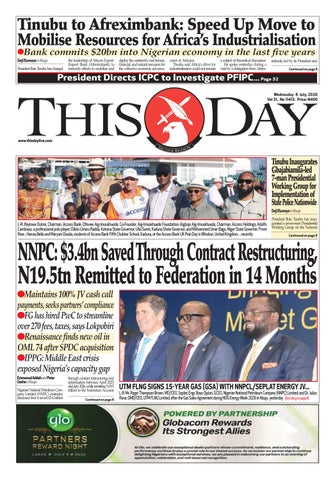
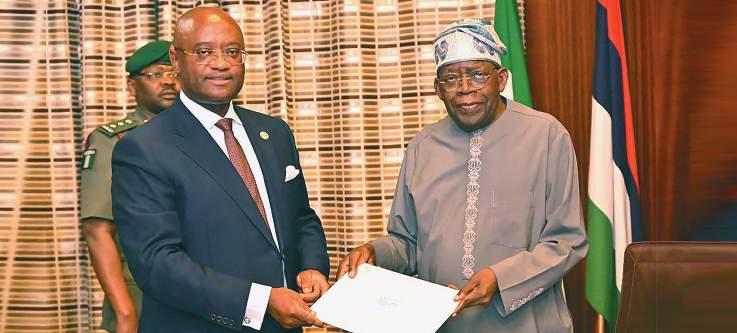
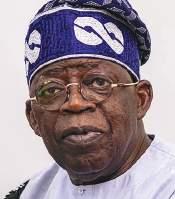
Tinubu to Afreximbank: Speed Up Move to Mobilise Resources for Africa’s Industrialisation
Bank commits $20bn into Nigerian economy in the last five years
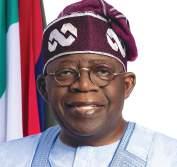
Deji Elumoye in Abuja President Bola Tinubu has charged
the leadership of African ExportImport Bank (Afreximbank) to intensify efforts to mobilise and
deploy the continent’s vast human, financial, and natural resources for the collective economic advance-
ment of Africans. Tinubu said Africa’s drive for industrialisation could not remain
a subject of theoretical discussion. He spoke yesterday during a visit by a delegation from Afriex- Continued on
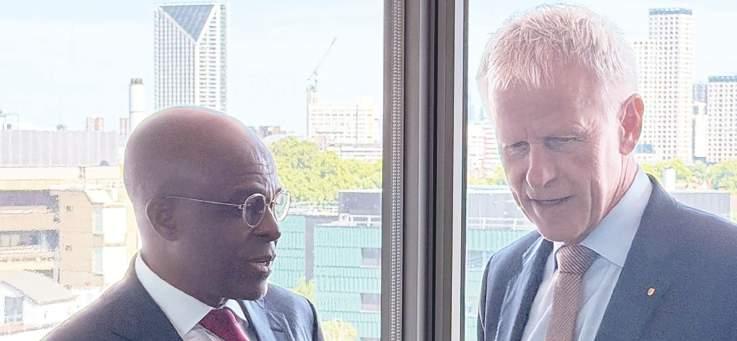
imbank, led by its President and
President Directs ICPC to Investigate PFIPC
www.thisdaylive.com
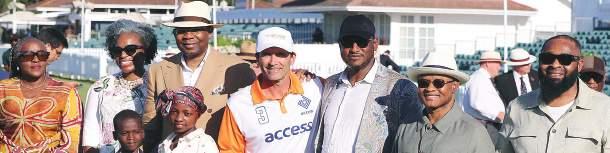
L-R: Ifeyinwa Osime, Chairman, Access Bank; Ofovwe Aig-Imoukhuede, Co-Founder, Aig-Imoukhuede Foundation; Aigboje Aig-Imoukhuede, Chairman, Access Holdings; Adolfo Cambiaso, a professional polo player; Dikko Umaru Radda, Katsina State Governor; Uba Sanni, Kaduna State Governor, and Mohammed Umar Bago, Niger State Governor. Front Row: , Hamza Bello and Maryam Dauda, students of Access Bank Fifth Chukker School, Kaduna, at the Access Bank UK Polo Day in Windsor, United Kingdom…recently
Tinubu Inaugurates Gbajabiamila-led 7-man Presidential Working Group for Implementation of State Police Nationwide
President Bola Tinubu has inaugurated a seven-man Presidential Working Group on the National
NNPC: $3.4bn Saved Through Contract Restructuring,
FG has hired PwC to streamline over 270 fees, taxes, says Lokpobiri Renaissance finds new oil in OML 74 after SPDC acquisition
IPPG: Middle East crisis exposed Nigeria’s capacity gap
Addeh and Peter
Nigerian National Petroleum Company Limited (NNPC) yesterday disclosed that it saved $3.4 billion
to Federation in 14 Months
Continued on page 8 through contract restructuring and optimisation between April 2025 and July 2026, while remitting N19.5 trillion to
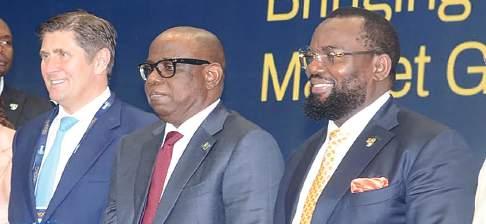
UTM FLNG SIGNS 15-YEAR GAS (GSA) WITH NNPCL/SEPLAT ENERGY JV...
and Dr. Julius Rone, GMD/CEO, UTM FLNG Limited, after the Gas Sales Agreement during NOG Energy Week 2026 in Abuja, yesterday (See story on page 6)
L-R: Mr. Roger Thompson Brown, MD/CEO, Seplat; Engr. Bayo Ojulari, GCEO, Nigerian National Petroleum Company (NNPC) Limited;
Deji Elumoye in Abuja
Emmanuel
Uzoho in Abuja
SANWO-OLU RECEIVES MINISTER OF WORKS, ENGR UMAHI...
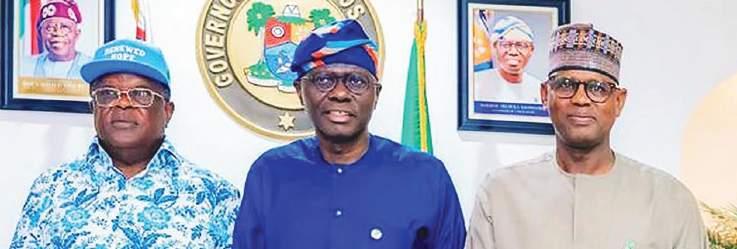
Governor of Lagos State, Mr. Babajide Sanwo-Olu, flanked by the Minister of Works, Engr. David Umahi (left) and Minister of State for Works, Bello Muhammad Goronyo, Esq., during a courtesy visit by the minister alongside members of the National Assembly, at the Lagos House, Marina, on Monday
Dele Oye’s Alliance Seeks Single-digit Loans, Commends BOI’s Impact-driven Lending
Says
funding remains inadequate for industrial transformation Urges CBN to clear $2.4bn forex forwards Seeks capping of lending rates at 15% for productive sectors
Emmanuel Addeh in Abuja
The Alliance for Economic Research and Ethics Ltd/GTE has called for sweeping policy reforms to revive Nigeria’s struggling manufacturing sector, arguing that although the Bank of Industry’s (BOI) record N644.9 billion disbursement in 2025 marked a significant milestone, it remains insufficient to drive the country’s industrial transformation.
In a policy brief titled: “From N644.9 Billion to a Trillion-Dollar Dream: Why Nigeria’s Manufacturers Need More Than Applause,” the group praised BOI’s maiden Development Impact Report for shifting attention from the volume of loans disbursed to their economic impact, while urging the federal government and the Central Bank of Nigeria (CBN) to address structural constraints undermining manufacturers.
The Alliance, led by Dele Oye, commended BOI under its Managing Director, Dr. Olasupo Olusi, for disbursing N644.9 billion in 2025, supporting 1.68 million jobs and financing projects across 14 strategic
sectors.
It also lauded the CBN Governor, Mr. Yemi Cardoso, for policies supporting productive sectors and President Bola Tinubu for prioritising manufacturing under the Renewed Hope Agenda and the 2026 Nigeria Industrial Policy.
Describing the report as “a watershed moment,” the group said BOI had demonstrated that development finance should be measured by its impact on jobs, infrastructure and industrial growth rather than loan volumes alone.
However, it argued that the intervention represented only “a drop of water in a desert of industrial thirst,” stressing that Nigeria needs to create at least four million jobs annually to keep pace with population growth while manufacturers continue to operate at below 50 per cent of installed capacity.
According to the Alliance, the sector remains constrained by chronic electricity shortages, commercial lending rates exceeding 35 per cent, the unresolved $2.4 billion foreign exchange forward obligations owed to manufacturers, persistent
government borrowing and the absence of single-digit financing for productive sectors.
“The manufacturing sector, which should be the engine of this transformation, is gasping. Q1 2026 has delivered a decline in manufacturing tax revenue. When manufacturers pay less tax, it is because they are producing less, selling less, and slowly suffocating,” the report stated.
The group urged the CBN to
immediately resolve the outstanding forex forward contracts, warning that the delay had eroded confidence in Nigeria’s financial system and imposed huge losses on manufacturers. “A central bank that breaks its word breaks the economy,” it said.
Among its recommendations, the Alliance called on the government to fast-track implementation of the 2026 Nigeria Industrial Policy, restore tax incentives for businesses operating in Free Trade Zones and strengthen the
National Credit Guarantee Company.
The group also called for the reduction of fiscal deficits and domestic borrowing, cap lending rates for manufacturing, agriculture and technology at 15 per cent, deepen the capital market for manufacturers and establish industrial clusters with dedicated power supply.
It maintained that Nigeria’s longterm prosperity would depend on expanding production rather than increasing taxation.
“No nation has ever taxed itself into prosperity; nations produce their way to greatness. Nigeria’s revenue problem is not a tax collection problem; it is a production problem,” the group added. It stressed: “We offer the following policy recommendations, not as criticism, but as a pragmatic roadmap to achieve the President’s stated destination, acknowledging the commendable steps already taken,” it noted.
Reps Summon Accountant-General, Six MDAs Over Failure to Honour Invitations
Juliet Akoje in Abuja
House of Representatives Public Accounts Committee has expressed displeasure over what it described as the non-responsive attitude of Accountant-General of the Federation (AGF), Mr. Shamseldeen Babatunde Ogunjimi, saying his conduct falls short of the expectations of the country’s chief accounting officer.
The committee said its concerns stemmed from the accountantgeneral’s repeated failure to honour invitations extended to him as well as his inability to provide critical documents required for the committee to carry out its oversight responsibilities and other constitutional duties.
At its sitting on Tuesday, the committee, chaired by Hon. Bamidele Salam, issued what seemed like a
Reducing NCAA’s Revenue Dangerous to Aviation Safety, Agency Warns
Kasim Sumaina in Abuja
Nigeria Civil Aviation Authority (NCAA) has warned that any move to reduce its statutory revenue could undermine aviation safety by weakening its capacity to carry out effective regulatory oversight. Director of Public Affairs and Consumer Protection at NCAA, Mr Michael Achimugu, gave warning during a chat with journalists in Abuja. It followed a proposed legislation to reduce NCAA’s share of Ticket Sales Charge (TSC) in favour of Nigerian Airspace Management Agency (NAMA), even though NAMA, by law, should be a self-sustaining agency.
The bill is already under consideration at the National Assembly.
Achimugu warned that such a move, if actualised, could weaken the authority’s financial position and made it unable to meet its regulatory oversight. He added that safety could be compromised and all travellers, regardless of status, would be at grave risk.
By law, NCAA collects five per cent TSC and remits to NAMA, NiMet, NCAT, and NSIB based on what the law prescribes.
Experts say countries where air navigation service providers (ANSPs), like NAMA, are commercialised or privatised ought not
to be funded by the government.
Thus, the concept for the creation of NAMA ab-initio was that it should be self-funded and not dependent on government treasury. NCAA, as a safety regulator, was to be funded by the government. The five per cent TSC was introduced to absolve the government of that responsibility.
Yet, from this major funding window of the authority, the government still ceded a significant portion to other aviation agencies to aid their revenues.
Achimugu stated, “The NCAA even requires more money. Let’s not forget that the federal government makes deductions from what even
comes to the NCAA, in the first place.
“Any way you look at it, this move by a revenue-generating agency to cut even more into the NCAA’s cost recovery is a very unnecessary move. The reason planes are not falling from the sky today under this administration, unlike in the past, is because of the NCAA.”
He added, “The staff of the regulatory agency must be better trained than the service providers they regulate.
“If inspectors do not possess superior technical knowledge, they cannot effectively enforce safety standards.”
final invitation to the accountantgeneral, directing him to appear in person before the panel on Monday, July 13, 2026.
During the session, Salam and other members decried the accountant-general’s consistent absence, despite several letters sent to his office over the past few months, stating that requests for vital documents have not received adequate responses.
According to the committee, the accountant-general has also failed to demonstrate the diligence expected in rendering the accounts of his office and preparing the country’s consolidated financial statements, warning that such conduct sets a poor example for other government agencies.
The lawmakers described the accountant-general’s disposition as disappointing, stressing that the office of the accountant-general is expected to maintain a cordial and cooperative working relationship with the National Assembly, particularly the Public Accounts Committee, which is constitutionally mandated to oversee public financial management and ensure accountability in the utilisation of public funds.
Salam stated that the office of the accountant-general occupied a strategic position within Nigeria’s public financial management
framework and, as the institution responsible for managing the country’s finances, should work closely with the committee in carrying out its oversight functions.
He said the current accountantgeneral had not exhibited the level of cooperation expected from the office.
The committee chairman reaffirmed the determination of the panel to enforce strict compliance with legislative oversight, insisting that no public officer or institution is above accountability to the Nigerian people through their elected representatives. In a related development, the committee also issued final invitations to six Ministries, Departments and Agencies (MDAs) whose accounting officers had repeatedly failed to honour previous invitations extended by the panel.
The affected institutions are Nigerian Meteorological Agency (NiMet); Federal Cooperative College, Ibadan; Cocoa Research Institute of Nigeria (CRIN); Federal Ministry of Education; Federal Ministry of Innovation, Science and Technology; and Federal Ministry of Police Affairs.
The committee also directed the accounting officers of the affected agencies, as well as the permanent secretaries of the ministries, to appear before it without fail on Monday, July 13, 2026.
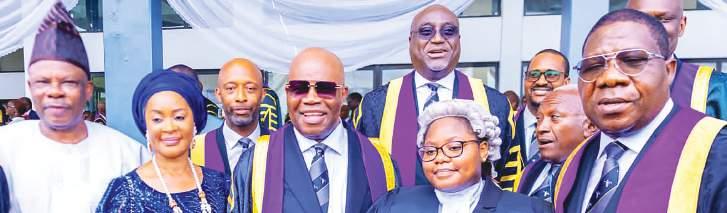
AT THE 2026 CALL TO BAR CEREMONY YESTERDAY IN ABUJA...
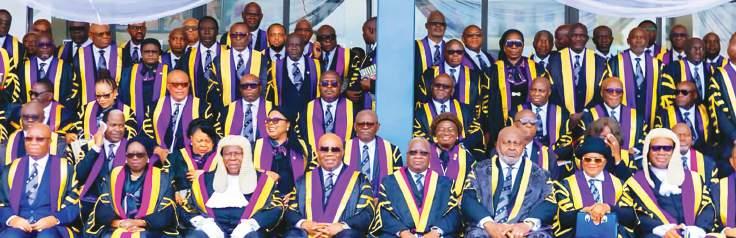
L-R: Life Bencher, Chief Wole Olanipekun (SAN); Chief Justice of the Federation, Kudirat Kekere-Ekun; Chairman, Body of Benchers, Albert Akpomudje (SAN); President of the Senate and Bencher, Godswill Akpabio; and other Benchers at the 2026 Call to Bar ceremony in Abuja, yesterday
UTM FLNG, NNPC, Seplat Sign
15-Year Gas Sale Deal for 200mmscf/d
Agreement expected to pave way for FID in Q4 2026
Project to monetise stranded gas, boost LNG exports and industrialisation
Emmanuel Addeh in Abuja
Nigeria moved a step closer to monetising its vast natural gas resources yesterday as UTM FLNG Ltd signed a 15-year Wet Gas Sale and Purchase Agreement (WGSPA) with the NNPC Ltd/Seplat Energy Producing Nigeria Unlimited (SEPNU) Joint Venture for the supply of 200 million standard cubic feet of gas
per day (mmscf/d) to its floating liquefied natural gas project.
The agreement, executed on the sidelines of the Nigeria Oil and Gas (NOG) Energy Week 2026 in Abuja, provides the long-term feed gas certainty required to advance financing for the project and positions it for a Final Investment Decision (FID) in the fourth quarter of 2026.
Speaking at the signing ceremony,
the Group Chief Executive Officer of NNPC Ltd, Mr. Bayo Ojulari, described the agreement as a major milestone in the implementation of President Bola Tinubu’s mandate to deepen gas utilisation and advance the Decade of Gas initiative.
“This agreement is more than a commercial transaction; it is a strategic commitment to harness Nigeria’s gas resources for economic growth, in-
dustrial development, energy security, and shared prosperity,” Ojulari said.
He noted that besides increasing domestic gas utilisation, the project would create jobs, deepen local content, strengthen Nigeria’s competitiveness in global LNG markets and contribute to lower carbon emissions through the expanded use of natural gas.
Ojulari stressed that the agreement
Oloworaran: Pension Infrastructure Fund at Advanced Stage of Implementation
Initiative to channel assets to financing critical infrastructure while improving retirement earnings Declares ongoing pension act review to protect interests of ordinary Nigerians, address implementation gaps Talks underway to settle police pension concerns, others
Director General, National Pension Commission (PenCom), Ms. Omolola Oloworaran, yesterday disclosed that the long-awaited Pension Industry Infrastructure Fund (PIIF) has reached an advanced stage of implementation.
The initiative forms part of broader reforms aimed at deploying pension assets to support national development while improving retirement outcomes for Nigerians.
Oloworaran spoke at the 3rd Pension Industry Leadership Council (PILC) meeting and press conference in Abuja.
She said the industry had made significant progress on establishing the infrastructure investment vehicle first announced earlier this year, with a comprehensive framework already developed for consideration by Pension Fund Administrators (PFAs) and other stakeholders.
She said stakeholders are expected to review the framework over the coming weeks, after which decisions on the next phase of implementation are expected within one or two months.
The PenCom DG also stated that the initiative is designed to provide a structured platform
through which the pension industry can participate more effectively in financing critical infrastructure without compromising the safety of contributors’ funds.
She noted that the pension industry manages the country’s largest pool of long-term domestic savings, making it well positioned to support investments capable of stimulating economic growth while generating sustainable returns for Retirement Savings Account (RSA) holders.
Oloworaran who read the PILC communique at the end of its meeting further stated that discussions also focused on strengthening the pension industry’s engagement with the capital market to ensure long-term pension assets are deployed more efficiently in support of national development and economic expansion.
She stressed that the commission remained committed on improving retirement outcomes, adding that PenCom is developing a more sophisticated, data-driven investment framework that draws from international best practices while adapting them to the unique economic realities in the country.
According to her, the objective is to ensure contributors earn better
returns over their working lives and retire with greater financial security and dignity.
Oloworaran announced that PenCom had commenced a comprehensive review of the Pension Reform Act (PRA), the first major overhaul of the legislation in about 12 years.
She explained that the review seeks to modernise the legal framework governing the Contributory Pension Scheme (CPS) to reflect emerging realities within the financial sector and address implementation challenges identified since the last amendment.
She said, “The objective of the current review is to modernise the Act, reflect current realities and introduce reforms that will improve outcomes for Nigerians under the pension system.”
She added that the exercise would also close identified implementation gaps while strengthening the efficiency and sustainability of the CPS.
According to her, consultations are currently ongoing with organised labour and other stakeholders to ensure the review reflects broad national consensus before the proposed amendments are made public.
She assured contributors that protecting the interests of ordinary Nigerians remained the overriding consideration throughout the review process.
The PenCom DG also reassured police personnel and retirees that the commission is working to address their concerns under the CPS.
had provided a clear pathway towards achieving FID on the UTM FLNG project before the end of this year.
In his remarks, the Group Managing Director and Chief Executive Officer of UTM Offshore Ltd, Mr. Julius Rone, said the agreement establishes the commercial framework for supplying feed gas to the floating LNG facility and provides the longterm certainty required by investors, lenders and LNG buyers.
“The execution of this agreement establishes the long-term feed gas framework needed to advance project financing, construction and operations. It provides certainty for investors, confidence for lenders and assurance for LNG buyers through a reliable long-term gas supply,” he stated.
Also speaking, the Minister of State for Petroleum Resources (Gas), Ekperikpe Ekpo, described the agreement as further evidence of growing investor confidence in Nigeria’s gas sector and the success of reforms being implemented by the federal government.
According to him, the partnership demonstrated the increasing role of indigenous companies and private sector investment in unlocking Nigeria’s gas potential, adding that policy stability, fiscal incentives and
regulatory reforms were making the country increasingly attractive to investors.
Ekpo reiterated the federal government’s commitment to providing an enabling environment through improved infrastructure, regulatory clarity and investment incentives to ensure Nigeria fully realises its ambition of becoming a gas-powered economy.
The UTM FLNG project, which commenced in 2021, will source feed gas from OML 104 (Yoho Field), offshore Akwa Ibom State, where it will be processed aboard a floating LNG facility with a production capacity of 1.8 million tonnes per annum (MTPA).
Project development has advanced steadily, with Pre-Front End Engineering Design completed in 2021, FEED completed in October 2023 by JGC and Technip Energies, while KBR serves as Owner’s Engineer. In 2024, the Nigerian Midstream and Downstream Petroleum Regulatory Authority (NMDPRA) granted the project a Licence to Construct (LTC), while the Nigerian Content Development and Monitoring Board (NCDMB) approved its Nigerian Content Plan for the engineering, procurement and construction phase.
Zedvance Appoints Pius ‘Deji Olanrewaju Board Chairman
Nume Ekeghe
Zedvance Finance Limited has announced the appointment of Professor Pius ‘Deji Olanrewaju as Chairman of its Board of Directors, with effect from July 1, 2026, pending regulatory approval from Central Bank of Nigeria (CBN).
The firm, in a statement, said the appointment underscored Zedvance Finance’s commitment to building a robust governance structure capable of supporting its next phase of growth. It said with an enhanced board structure and strengthened oversight capabilities, Zedvance was positioned to accelerate its growth ambitions, deepen innovation, and create
sustainable value for all stakeholders.
The company said Olanrewaju was bringing “extensive boardroom experience, exceptional leadership credentials, and deep expertise in governance, strategy, and organizational transformation” to the role, further strengthening its leadership and governance framework.
Commenting on his appointment, Olanrewaju stated, “I am honoured to assume the role of Chairman of the Board of Zedvance Finance. The company has established a strong reputation as a trusted financial partner, leveraging innovation and technology to create meaningful impact. I look forward to working with the board and management
to support the company’s strategic aspirations and deliver sustainable value for our stakeholders.”
Olanrewaju is a distinguished legal scholar, banking expert, and accomplished corporate leader with over four decades of experience spanning banking, finance, academia, and institutional governance. He holds an LLB (Hons) BL, BA, M.Sc, LL.M and a PhD, and is a Fellow of the Chartered Institute of Bankers of Nigeria (FCIB), a Fellow of the Institute of Capital Market Registrars (FIMA), a Fellow of the Institute of Management and Administrative Technology (FCMR), and a Fellow of the Enterprise Risk Management Professionals (FERP).
PHOTO: SENATE PRESIDENT’S OFFICE
James Emejo in Abuja
16TH AFRICAN BUSINESS LEADERSHIP AWARDS...
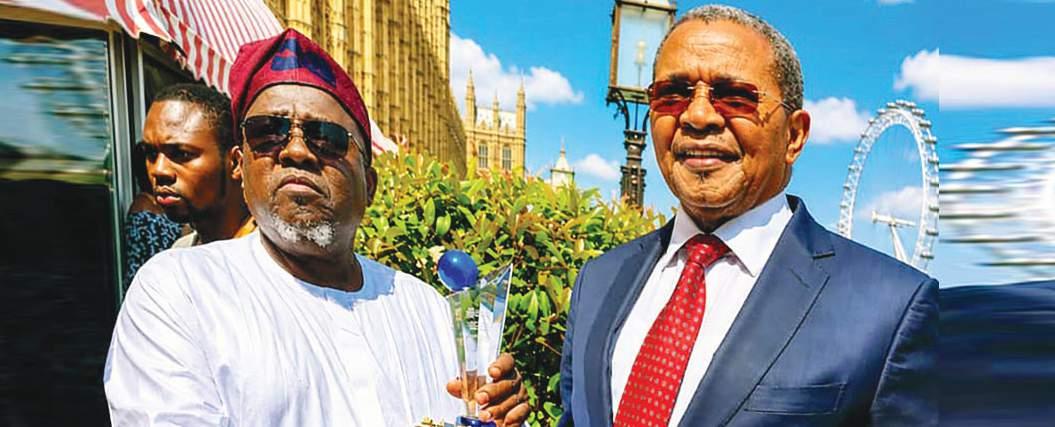
Dr. Jakaya Mrisho Kikwete, former President of the United Republic of Tanzania and Chairman of the African Leadership Organisation (ALO) Global Advisory Board, (right) presenting the African Business Leadership Awards to Alhaji Ibrahim Kabiru Masari, Special Adviser, Political & Other Matters to President Bola Tinubu, at the 16th African Business Leadership Awards held in London, United Kingdom ...recently
CJN to New Judges: Shun Unsolicited Gifts, Throwing Unnecessary Birthday Parties
Chief Justice of Nigeria (CJN), Justice Kudirat Kekere-Ekun, has advised newly appointed judges of the lower courts to shun unsolicited gifts, as well as holding unnecessary celebrations to avoid creating problems for themselves in the future.
Kekere-Ekun gave the advice during the opening ceremony of an induction course for new judges, in Abuja.
She challenged the new judges to ensure speedy trial of cases brought before them, stressing that only expeditious hearing of cases would ensure the continued confidence of litigants in the judiciary.
Represented at the event by Administrator of the National Judicial Institute (NJI), Justice Babatunde Adejumo, the CJN emphasised the importance of synergy between judges and court officials, especially Registrars and Exhibit keepers.
She stated, “You must work harmoniously with all the officials under you and ensure that you manage them diplomatically and technically.
“You must also read the rules of courts so that lawyers will not take you for a ride. Read everything that
comes before you.
“Most importantly, do not allow unsolicited gifts. You must equally avoid throwing unnecessary birthday parties. People will seize the opportunity to bring unsolicited gifts that can lead to petitions.
“As judges of the lower courts, you play a key role in the judiciary.
Ensure that you are not rude to your heads of court.
“I will also enjoin you not to use your power of contempt too much. It should be used sparingly, otherwise it may backfire.”
In his welcome address, the NJI administrator congratulated the new judges, and urged them to be mindful
of the fact that they had been entrusted with the sacred duty of upholding constitutional supremacy, entrenching the rule of law, and shaping the course of justice in the nation.
Adejumo stated, “By virtue of your appointments, you now form part of a judicial tier that is absolutely vital to the effective functioning of our
legal system.
“Beyond being the primary facilitators of grassroots justice, by resolving the vast majority of cases directly affecting ordinary Nigerian citizens, the Lower Courts act as crucial filters that streamline the workload of the Superior Courts, thereby enhancing overall efficiency.
“Consequently, the competence of those chosen to man these courts is of paramount importance to the administration of justice.
“As you step forward to discharge your statutory functions, capacity-building initiatives like this are structured to provide the solid foundation needed to ease your transition to the Bench.”
FG: Universities Must Become Hubs for Enterprise Development
Okoro in Umuahia and Kuni Tyessi in Abuja
The federal government says its vision is to transform Nigerian universities into innovation ecosystems that will drive industry, enterprise, and national prosperity.
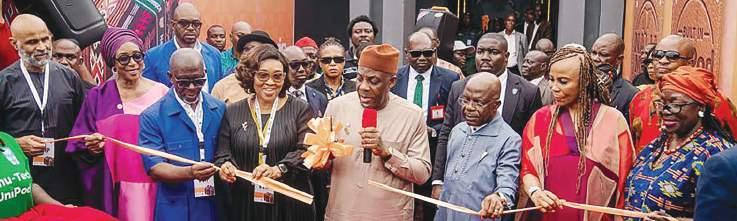
Vice President Kashim Shettima stated this on Monday, during the formal launch of Nigeria’s first Manufacturing Technology University Innovation Pod, Manu-Tech UniPod, at Michael Okpara University of Agriculture, Umudike (MOUAU), Abia State.
Shettima, represented by Minister of Education, Dr. Olatunji Alausa, said the inauguration signalled, “Nigeria can no longer afford to separate education from production, research from enterprise, or knowledge from national prosperity.”
He said the project aligned with President Bola Tinubu’s Renewed Hope Agenda and the target of building a $1 trillion Nigerian economy by 2030.
He stated, “The launch of this ManuTech Innovation Pod is, therefore, not the end of a
project. It is the beginning of a national movement, a movement where a university becomes an innovation ecosystem, where research creates industries, where education creates productivity, where undergraduates become creators of wealth.”
Describing Manu-Tech as a “strategic investment in Nigeria’s future,” the vice president said universities must evolve beyond teaching and research to become hubs for enterprise development, technology transfer, and industrial competitiveness.
manufacturers, and employers of labour. The university must become a workplace of industries,” Shettima said.
He explained that UniPod connected research laboratories directly with manufacturing enterprises by integrating artificial intelligence, advanced manufacturing, agro-processing, digital design, industrial automation, and entrepreneurship into one ecosystem.
path bridges the gap. It connects the ingenuity of Aba with the research excellence of MOUAU. It links classrooms with factories, researchers with entrepreneurs, students with investors, ideas with markets.”
Communities
HYPPADEC Lauds FG’s N80bn Intervention, Seeks More Funding for at-risk
“The university of the future must produce innovators, entrepreneurs, inventors,
Shettima said Abia was chosen because Aba had earned international recognition as one of Africa’s most dynamic manufacturing clusters.
He stated, “This innovation
In his keynote address, Abia State Governor, Dr. Alex Otti, said siting the Manu-Tech UniPod in Abia reflected the institutional faith UNDP and the federal government had in the state as an engine of growth. Otti stated that Umudike’s proximity to Aba and Ariaria International Market attested to the sincerity and potential for success of the project.
World Rural Devt Day: Wunti Urges Political Leaders to Mainstream Rural Communities Flooding:
The Hydroelectric Power Producing Areas Development Commission (HYPPADEC), yesterday lauded the present efforts of federal government for approving N80 billion to mitigate the impact of anticipated flooding across vulnerable communities this year.The managing director of the commission, Abubakar Sadiq Yelwa, stated this in Ilorin on Tuesday while speaking with journalists on the sideline of a three-day management consultative meeting with state coordinators and area officers of the commission in Ilorin.
Yelwa however said that more funding is required to effectively tackle the expected floods across the country.
“The amount may not be sufficient considering the magnitude of the challenge, but it is better to begin than to do nothing at all.
“I commend President Bola Tinubu and the federal government for taking this proactive initiative and I hope additional resources will be made available to further protect vulnerable communities”, he said.
The HYPPADEC boss said the commission has sustained its annual flood preparedness campaign by embarking on early sensitisation programmes several months before
the onset of the rainy season in flood-prone communities.
He said the commission works closely with state governments, traditional institutions and the media to educate residents on impending flood risks and encourage those living in vulnerable areas to relocate to safer locations.
Yelwa said the commission has commenced construction of resettlement houses in some communities to accommodate residents expected to be severely affected by flooding.
On the commission’s performance, the managing director said that HYPPADEC has continued to fulfil its statutory mandate despite facing significant financial constraints.
Segun Awofadeji in Bauchi
As the world commemorates World Rural Development Day, a chieftain of the All Progressives Congress (APC) and Bauchi-based philanthropist, Dr. Bala Maijama’a Wunti, has called on political leaders at all levels to fundamentally rethink Nigeria’s development model by placing rural communities at the centre of economic planning through strategic investments capable of reversing the growing trend of rural-urban migration.
Dr. Wunti said Nigeria’s villages
should no longer be viewed merely as centres of agricultural production but as engines of industrial growth, innovation, entrepreneurship and human capital development.
According to him, deliberate investments in agriculture, agroallied industries, rural manufacturing, digital infrastructure, quality education, healthcare, renewable energy and small-scale enterprises would not only create sustainable employment but also make rural communities attractive places to live and work.
This wsa contained in a press
He noted that many developed and emerging economies have successfully transformed their rural communities into thriving economic hubs through purposeful investments in infrastructure, technology and value-chain industries, thereby attracting both investment and skilled manpower from urban centres.
Alex Enumah in Abuja
Boniface
release issued by Abubakar AlSadique, Chief Communication Officer, Bala Wunti Support Organisation (BWSO) and made available to journalists on Tuesday in Bauchi.
Hammed Shittu in Ilorin
Report: Africa Attracted $70 Billion as Global FDI Rose 6% to $1.6tn in 2025
Egypt remains continent’s largest investment recipient
Ndubuisi Francis in Abuja
The African continent attracted about $70 billion in foreign direct investment (FDI) as global FDI rose six per cent to $1.6 trillion in 2025, ending two consecutive years of decline.
That was according to the just-released World Investment Report 2026 by the UN Trade and Development (UNCTAD).
The report disclosed that Africa was attracting investment in strategic industries but faced the challenge of not turning same into broader industrial development.
The report revealed that Africa’s $70 billion FDI in 2025 was the
third-highest level since 1990, and remained roughly one-third above the continent’s long-term average.
According to the World Investment Report, $70 billion 2025 FDI inflows to Africa was below the exceptional $94 billion 2024 record, when a small number of large transactions boosted regional totals.
Egypt remained Africa’s largest FDI recipient, with inflows of about $15 billion, helping the North Africa sub-region to remain the continent’s largest recipient, despite a sharp decline from the exceptional 2024 level.
The report said at a time when competition for investment was increasingly centred on energy,
UN says despite attracting investment in strategic industries, Africa fails to transit into broader industrial devt
infrastructure, technology and critical resources, Africa continued to attract investor attention, including from the Gulf and other Asian economies.
It stated, “The question is whether that interest can translate into broader economic gains.
“Despite a decline from the exceptional level reached in 2024, inflows remained roughly one-third above the continent’s long-term average.
“Greenfield project values fell by almost one third, but the number of announced projects increased, pointing to broader engagement through smaller projects.
“Investors from the Gulf and other Asian economies are
becoming important sources of greenfield investment, especially in energy, logistics, real estate and infrastructure.”
The report added, “African LDCs (Least Developed Countries) received about $33 billion in FDI, with inflows concentrated in a few economies linked to natural resources, energy, infrastructure and selected manufacturing projects.
“Energy, infrastructure and critical minerals are drawing investment, but benefits remain concentrated in a limited number of countries and sectors.”
The report underscored the fact that much of the investment interest
in Africa was focused on sectors that were becoming more important in the global economy. This, the report stated, reflected three overlapping drivers: demand for energy infrastructure, interest in critical minerals needed for batteries and advanced manufacturing, and the search for new industrial and logistics locations as supply chains were reconfigured.
According to the report, “Parts of Africa are well positioned to benefit from these trends. The continent holds major reserves of minerals essential for renewable energy technologies, battery manufacturing and advanced industrial production.
“Copper, cobalt, lithium, manganese, graphite and rare earth minerals
are becoming increasingly important to global investors seeking to secure future supply chains.
NNPC: $3.4BN SAVED THROUGH CONTRACT RESTRUCTURING, N19.5TN REMITTED TO FEDERATION IN 14 MONTHS over the period.
Group Chief Executive Officer, Bayo Ojulari, made the revelation while highlighting the impact of ongoing reforms aimed at improving operational efficiency, reducing costs, strengthening partnerships, and enhancing value delivery to the federation.
Ojulari also stated that the national oil company had maintained full compliance with its joint venture cash call obligations.
He spoke in Abuja at the opening of the 25th Nigeria Oil & Gas (NOG) Energy Week, with the theme, “Advancing Energy Ambitions for Competitive and Resilient Economies.”
Minister of State for Petroleum Resources (Oil), Senator Heineken Lokpobiri, at the same event, said the federal government had commissioned renowned financial advisory and audit firm, PricewaterhouseCoopers (PwC) to undertake
a global benchmarking of the over 270 fees, taxes, and rents imposed on oil and gas operators, as part of sweeping efforts to eliminate fiscal bottlenecks and make Nigeria competitive for capital.
The minister’s remarks followed comments by Chairman of Independent Petroleum Producers Group (IPPG), Mr. Adegbite Falade, that over 270 fees, rents, and taxes existed in Nigeria’s oil and gas industry. Falade called on government to address the challenge.
Then, in a major boost to reserves growth, Renaissance Africa Energy Company Limited announced, at the forum, a significant hydrocarbon discovery at the JK-004 exploration well in shallow water Oil Mining Lease (OML) 74, less than one year after completing its acquisition of Shell’s onshore assets.
Chief Executive Officer of Renaissance, Mr. Tony Attah, said preliminary evaluation showed that
the well encountered “approximately 1,000 feet of hydrocarbon-bearing column across seven reservoirs,” adding that “initial log interpretation and fluid analysis confirm excellent reservoir quality and light oil.”
For his part, Chairman of IPPG and Managing Director of Aradel Holdings, Falade, said geopolitical shocks had repeatedly exposed Nigeria’s inability to seize market windows. Falade recalled that when the Russia-Ukraine crisis disrupted European gas and refined product supplies from 2022, global buyers scrambled for alternatives.
He said Nigeria, with the 10th largest gas reserves in the world, held real leverage but capacity constraints and delayed Final Investment Decisions (FIDs) meant the county could not scale exports quickly enough to meet the new demands.
According to the scorecard presented by NNPC, the $3.4
billion cost savings were realised through contract restructuring and optimisation initiatives across the company’s operations. The reforms also contributed to an increase in government revenue, with NNPC reporting a government take of N19.5 trillion, representing a 21.8 per cent year-on-year increase.
Besides, a major highlight of the report was NNPC’s 100 per cent compliance with its joint venture cash call obligations across all its joint ventures from Financial Year 2025 to June 2026. However, the company’s partners recorded a blended compliance rate of just 61 per cent.
Of the 27 joint venture partners, only six were fully current with their obligations, while 13 recorded partial compliance with an average payment rate of 72 per cent, and eight remained in significant default, paying an average of only 14 per cent, and prompting Joint Operating
TINUBU INAUGURATES GBAJABIAMILA-LED 7-MAN PRESIDENTIAL WORKING GROUP FOR IMPLEMENTATION OF STATE POLICE NATIONWIDE
Policing Bill to prepare the legal framework for the implementation of state police across the country.
Tinubu, represented by his Chief of Staff, Hon. Femi Gbajabiamila, inaugurated the panel on Tuesday at State House, Abuja.
Gbajabiamila was the committee’s chairman, while members included Attorney-General of the Federation, President of Nigerian Bar Association (NBA), Chairman of Nigeria Governors’ Forum (NGF), National Security Adviser, Inspector-General of Police, and Chairman of NGF Committee on State Police.
There was also a secretariat that would offer administrative assistance to the committee.
The panel’s inauguration was sequel to National Assembly’s recent passage of the Constitution Alteration (State Police) Bill, 2026, in which the president proposed a dual policing structure comprising the Federal Police Service and 36 State Police Services.
According to the president, while the constitutional amendment creates the framework for state police, the National Policing Bill would provide the legal structure for its implementation.
He stated, “The constitution amendment bill establishes the framework for dual policing, but it does not operationalise it. That work is left to the National Policing Bill.”
He said the proposed legislation would address issues necessary for a smooth operationalisation of the
State Police system.
According to the president, “The proposed National Policing Bill will include provisions on minimum policing standards, state readiness certification, federal-state coordination, accountability, human rights safeguards and fiscal conditions.”
Tinubu said the committee will produce an implementation-ready draft bill immediately after the constitutional amendment process.
“The Working Group has been constituted to produce a technically robust, implementation-ready draft National Policing Bill for transmission to the National Assembly,” the president said.
He stated that the committee was necessary to avoid delay after the passage of the state police bill.
“We must not wait until the constitutional process is concluded before beginning this important assignment,” he said.
Speaking on behalf of NGF, Governor Dapo Abiodun of Ogun State pledged governors’ support for the speedy implementation of the reform.
Abiodun said the plan was for the 36 state governors to accelerate work on the bill once it reached their respective Houses of Assembly and was passed unanimously.
Abiodun described the proposed state police as a response to Nigerians’ long-standing demand for community-based policing
He said, “This bill has answered the cries of Nigerians about cascading policing and removing it from the Exclusive Legislative List.”
The governor said the initiative validated the success of regional security outfits, such as Amotekun in the South-west.
Abiodun said state police would significantly increase the number of security personnel nationwide.
“If each state deploys about 6,000 personnel, we will add nearly
Chairman of Board, Dr George Elombi, to State House, Abuja.
The president said his administration’s recent economic reforms, such as ending the fuel subsidy and tackling multiple exchange rates, were essential steps to combat corruption and ensure economic survival.
Tinubu stressed that Africa possessed enormous potential and must move beyond endless conversations about development to practical actions that drive industrial growth, expand trade, create jobs, add value, and improve the living standards of its people.
A structured financial backing and reliable infrastructure, he explained, were essential for building the continent.
The president stated, “The conscience and the future of Africa depend on what you and your team can do and will do for Africa as a whole, and the time has come for us to start doing things together as Africans.
“We have what it takes to build this continent. Do we continue to
200,000 officers to complement the existing federal police,” he said.
The governor commended Tinubu for initiating implementation plans before the constitutional amendment process was completed.
“This inauguration demonstrates
Continued on page 33
exploit and export raw materials without value addition? That answer is no.
“We have solid mineral deposits such as lithium and others that can be used, and you, as the financial partner, should be able to come with investment guarantees for the production and value addition in batteries and other manufacturing ecosystems.”
Commenting on farmer-herder clashes, the president told the visitors that his government had turned the longstanding conflict between farmers and herders into an economic opportunity for citizens through the introduction of the Federal Ministry of Livestock Development.
He stated, “I created the livestock ministry to create economic opportunities for Africans.
“The cotton, ginnery and garment industries are job creators. If we partner well and incorporate these ideas and do less talking and really put our heads into developmental programmes, we can turn it around.”
Agreement remedies. NNPC said it remained committed to sustaining its cash call obligations to support Nigeria’s target of achieving two million barrels of oil production per day.
Operationally, the company reported a six per cent increase in crude oil production year-onyear and an 8.1 per cent rise in gas production over the same period, reflecting improvements in upstream operations.
Ojulari also highlighted several strategic partnerships concluded since the last Nigeria Oil and Gas Conference, including a long term gas supply agreement with Nigeria LNG, progress on deepwater investments valued at over $20 billion, refinery related partnerships, industrial gas projects, and new gas supply arrangements.
Looking ahead, the company identified seven priority projects expected to drive production and gas infrastructure growth through 2027. These, it said, included the UTM Floating LNG project, the OB3 East West Connector, the AKK gas pipeline, refinery technical enhancement projects, the Zabazaba deepwater development, the Owowo field, and the BSWAP project.
The company said the combination of cost optimisation, stronger operational performance, improved infrastructure reliability, and strategic partnerships would
Tinubu stressed the need for Afreximbank to synergise with the Bank of Agriculture, make more investments in the production of crops, such as cocoa, palm kernel, and palm oil, among others, and ensure that agricultural value chains translated into tangible benefits for the future.
In his remarks, Minister of State for Industry, Senator John Enoh, explained the president’s bold economic diversification policies, describing the administration’s Eight-Point Renewed Hope Agenda as a transformative blueprint that is repositioning Nigeria for sustainable economic growth, industrial expansion, and shared prosperity.
Enoh said the Tinubu’s commitment to industrialisation, particularly through the development of the solid minerals sector, oil and gas, manufacturing, agriculture, the digital economy, and value-added exports, was laying the foundation for a resilient economy less dependent on crude oil revenues.
reinforce Nigeria’s energy security, boost government revenues, and support sustainable growth in oil and gas production.
Ojulari said the national oil company achieved 98 per cent recovery across five crude export terminals between April 2025 and May 2026, up from one per cent at Bonny in June 2022. He put current output at 1.71mbpd, the highest in five years, with NNPCL Exploration and Production Limited (NEPL) hitting a record 365,000 bpd. Gas production, he said, reached 7.5 billion standard cubic feet per day (bscf/d) following the River Niger crossing on the AjaokutaKaduna-Kano (AKK) Pipeline and inauguration of the ANOH Gas Plant.
Ojulari added that NNPC had “zero tolerance for partners who are not able to fund their Cash-call” and had begun invoking default clauses.
He stressed collaboration over control, saying, “We have rid ourselves of any pseudo-regulation. We are not the super-regulator. Let them regulate. We want to work.” Meanwhile, the federal govern- ment disclosed that it commissioned PwC to undertake a global benchmarking of the over 270 fees, taxes, and rents imposed on oil and gas operators. Lokpobiri said this was part of comprehensive efforts
Continued on page 33
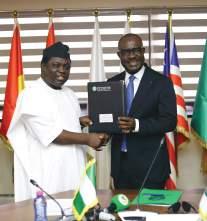
Elombi said he and his team were at State House to thank the president for his support, which led to his election as the president of the bank, as well as to brief him on the bank’s portfolios and activities in Nigeria. According to him, the bank has investments across trade, agricultural processing, value chain, and healthcare.
He informed Tinubu of the bank’s efforts to reverse health tourism on the continent, highlighting that the bank has invested between US$15 and US$20 billion in the Nigerian economy over the last five years.
Elombi, while inviting the president to visit the African Medical Centre of Excellence (AMCE) located in Abuja, also disclosed that Afreximbank had committed US$2 billion to support Nigeria’s cotton and garment industry.
He also briefed the president on the bank’s investment in the Lagos-Calabar Coastal Highway and the Kano-Maradi Railway line.
TINUBU TO AFREXIMBANK: SPEED UP MOVE TO MOBILISE RESOURCES FOR AFRICA’S INDUSTRIALISATION
Minister of Finance & Coordinating Minister of the Economy, Taiwo Oyedele
TINUBU RECEIVES PRESIDENT OF AFREXIMBANK...
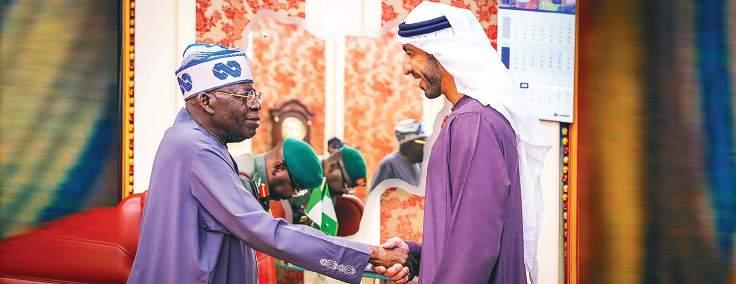
President and Chairman of the Board of Directors, African Export-Import Bank (AFREXIMBANK), Dr. George Elombi (L), and President Bola
courtesy visit to the President at the Presidential Villa, Abuja, yesterday
NIMC Enrols Over 136m Nigerians as New Identity Law Takes Effect
Michael Olugbode in Abuja
National Identity Management Commission (NIMC) has announced that more than 136 million Nigerians and legal residents have been enrolled into the National Identity Database (NIDB), marking a significant milestone in the country’s drive towards a unified and secure digital identity system.
The disclosure was made by Director-General of NIMC, Engr. Abisoye Coker-Odusote, during a courtesy visit to the Federal Ministry of Budget and Economic Planning as part of the commission’s stakeholder engagement on the implementation of the newly enacted NIMC Act 2026.
According to the commission, the new legislation repeals the National Identity Management Commission Act of 2007 and introduces a comprehensive legal framework designed to modernise Nigeria’s digital identity architecture.
Coker-Odusote said the act reinforced the National Identification Number (NIN) as the country’s single foundational identity under the federal government’s “one person, one identity” policy. She stated that the law also des-
Agriculture, energy, blue economy, solid minerals to highlight event
Omon-Julius Onabu in Asaba
The Delta State Government has said that 25 prospective investors from Brazil and a host of others from China have indicated interest in the forthcoming Delta State Investment and Economic Summit, Vice-President Kashim Shettima and Director-General of the World Trade Organisation (WTO), Dr. Ngozi Okonjo-Iweala, and Dr. Patrice Lumumba, are expected to headline a high-powered list of participants.
Secretary to the State Government (SSG) and Chairman of the Summit Main Organising Committee, Dr. Kingsley Emu, disclosed this during an interactive session with stakeholders in Asaba on Monday, stressing the summit would connect the state’s vast economic potential with local and international capital.
Emu said the summit themed, “Harnessing Our Strengths, Unlocking our Potential”, would also attract the Minister of Finance and Coordinating Minister of the Economy, Mr. Taiwo Oyedele, development finance institutions and leading private-sector players, while renowned oil and gas industry leader, Engr. Austin Avuru, would serve as chairman.
Addressing the stakeholders, Dr.
Emu said, “To date, 25 potential investors are coming in from Brazil and many others from China. They have indicated interest and we are already making preparations for them.
“Our sister, Dr. Ngozi OkonjoIweala, Director-General of the WTO, will be the keynote speaker; Engr Austin Avuru is the chairman of the summit. The Minister of Finance has personally acknowledged his attendance, while the Vice President, Senator Kashim Shettima, has also confirmed his attendance.
“So, it is going to be a starstudded programme, with participation from the national level, development finance institutions and a host of others.
“For every potential investor who has expressed interest, they are talking about local partners, and those partners will come from among our people.
“The significant success we will achieve on this journey will depend on your cooperation, collaboration and positive disposition to what we want to do.”
The SSG said Delta was approaching the summit with clearly defined and bankable investment propositions rather than a broad promotional agenda, identifying agriculture, aquaculture, power,
oil and gas, solid minerals, manufacturing and the blue economy as priority sectors.
According to him, Delta possesses strong economic fundamentals, including a youthful population, extensive land and waterways, abundant oil and gas resources, expanding infrastructure and a broad network of tertiary, technical and vocational institutions.
The Delta SSG said, “We have a lot of strengths. We are one of Nigeria’s leading subnational economies, with a youthful population and enormous consumption potential.
“We have vast land and water resources that give us a competitive advantage, particularly in the blue and marine economy.
“We have four universities owned by the state, so we are providing a new level of manpower. Potential investors can partner freely and easily with our institutions and technical colleges to train manpower tailor-made to suit their operations.
“This presents enormous opportunities in human capital development and availability of skilled manpower.
ignated NIMC as the root certificate authority for Nigeria’s digital identity infrastructure while strengthening data protection, cybersecurity, and the deployment of secure digital credentials.
She reaffirmed the federal government’s determination to ensure that every Nigerian and legal resident was enrolled and issued a National Identification Number within the shortest time possible.
The NIMC boss said the commission was prepared to work closely with the Ministry of Budget and Economic Planning to maximise the use of NIN in economic planning, social intervention programmes, and broader national development initiatives.
She also commended the Minister of Budget and Economic Planning, Senator Abubakar Bagudu, for his support towards the implementation of the legislation and the realisation of President Bola Tinubu’s Renewed Hope Agenda.
Responding, the minister described NIMC Act 2026 as a landmark reform that would deepen Nigeria’s digital identity ecosystem and provide a stronger foundation for national planning and governance.
Bagudu praised the NIMC leader-
ship for steering the legislation to fruition, stating that the new law establishes a credible legal framework for a trusted, secure, and inclusive national identity management system.
He, however, stressed that the success of the legislation would depend largely on its effective implementation and the tangible benefits it delivered to citizens.
The minister called for greater collaboration among federal, state, and local governments to strengthen public confidence in the national identity system and eliminate the proliferation of multiple identity databases across public institutions.
He maintained that the National Identification Number should become Nigeria’s single, universally recognised identity standard capable of improving service delivery, enhancing governance, and supporting evidencebased national planning.
The enrolment of over 136 million people represents one of the largest expansions of Nigeria’s identity database since the establishment of NIMC. It is expected to bolster government efforts to improve planning, financial inclusion, security, taxation, and the delivery of public services through a unified digital identity system.
ACPN Rallies Stakeholders for 45th International Scientific Conference
Esther Oluku
The Association of Community Pharmacists of Nigeria (ACPN) will host its 45th Annual International Scientific Conference, “Unity 2026,” from July 27 to August 1 at the Bola Ahmed Tinubu International Conference Centre, convening political leaders, health policymakers and pharmaceutical experts to move practical steps toward expanded healthcare access and a stronger national health system.
The conference, themed “From
Local Pharmacy Practice to Global Impact: Managing Complex Political Systems,” aims to turn professional recommendations into implementable policy.
Organisers say the meeting will prioritise universal health coverage (UHC), strengthen medical supply chains and catalyse policy and action towards broadening healthcare access to underserved communities.
In a statement made available to THISDAY, ACPN noted the week–long event will begin with an awareness walk on July 27th
themed “Health Insurance for All: Leaving No One Behind” to be led by the Director General of the National Health Insurance Authority (NHIA), Kelechi Ohiri, alongside ACPN National Chairman, Ezeh Igwekamma. Ohiri is also scheduled to present a paper on “Leveraging NHIA–Community Pharmacists Collaboration as a Catalyst for Universal Health Coverage,” detailing how stronger partnerships between insurers and community pharmacists can expand access to affordable, timely services.
Executive Director of the National Primary Health Care Development Agency, Muyi Aina, will speak on “Healthcare System Strengthening and Universal Health Coverage in Nigeria,” focusing on practical steps to improve primary care delivery and resilience.
ACPN Central Planning Committee Chairman, Chidi Dozie, said ACPN is prepared to receive local and international delegates and expect the conference to be one of the largest gatherings of community pharmacists.
Ahmed Tinubu during the
PHOTO: GODWIN OMOIGUI
COMMUNIQUÉ ISSUED AT THE MEETING OF FIRST-TERM GOVERNORS IN KEBBI
STATE
IN
SUPPORT
OF
NATIONAL
STABILITY, CONTINUITY OF REFORMS AND INCLUSIVE DEVELOPMENT UNDER PRESIDENT BOLA AHMED TINUBU, GCFR
Tuesday, 7 July 2026
1. We, the undersigned first term Governors, having met in Kebbi State, issue this communiqué in the spirit of patriotism, responsibility, accountability and national duty.
2. We acknowledge the sacrifices Nigerians have made in this period of economic adjustment. Families, workers, farmers, traders, transporters, young people, women and vulnerable citizens have all felt the weight of current realities. We do not dismiss these difficulties. Leadership requires truth, and the truth is that Nigeria is undergoing a necessary period of correction after years of accumulated fiscal, security, productivity and development challenges.
3. We are persuaded that the reforms being undertaken by President Bola Ahmed Tinubu, GCFR, are necessary to stabilize the economy, restore public finance, attract investment, strengthen national productivity, expand infrastructure, deepen food security and secure a more sustainable future for the Nigerian people.
4. Our support for President Tinubu is not based on politics alone. It is based on the conviction that Nigeria requires courageous leadership, policy continuity, stronger federal-state collaboration and a development path that rewards production, enterprise, agriculture, innovation and hard work.
5. Accordingly, we declare our total support for President Bola Ahmed Tinubu, GCFR, and for the continuity of the Renewed Hope agenda beyond 2027. We make this declaration as a commitment to national recovery, shared prosperity, democratic stability and the protection of the Nigerian federation.
6. We believe in national unity and therefore call on Nigerians across all regions, religions and communities to look beyond temporary discomfort and consider the larger national picture. The question is not whether the journey has been difficult; it has been difficult. The real question is whether Nigeria should abandon reform midway or stay the course, correct what needs correction, expand relief for the vulnerable, and allow the foundations being laid to produce lasting results.
7. We note the challenges of insecurity that have lasted over two decades. We commit ourselves individually and collectively to the preservation of lives and property of Nigerians, we wish to express deep concern over the continuing threats to the safety of citizens, especially incidents of kidnapping, school abductions, attacks on educational institutions, terrorism, banditry and criminality in parts of the country.
8. We condemn, in the strongest terms, the abduction of children, kidnapping of innocent citizens, attacks on schools, killing of vulnerable persons and all acts of terror and criminality that undermine education, economic life, public confidence and national peace. We commit to the pursuit of stronger collaboration among the Federal Government, State Governments, security
agencies, traditional institutions, community leaders, school authorities and local intelligence networks to secure schools, protect communities, rescue victims, prosecute perpetrators and restore confidence.
9. We also express concern over reported attacks, killings and hostility directed at Nigerians and other African nationals in South Africa. While we respect the sovereignty of the Republic of South Africa and the brotherly relations between our two countries, we condemn all forms of xenophobia, mob violence, unlawful killings and abuse of foreign nationals anywhere in the world. We urge the appropriate authorities to investigate such incidents transparently, protect law-abiding Nigerians and other African residents, and ensure justice in accordance with law and diplomatic norms.
10. We appeal to Nigerians at home and abroad to remain calm, law-abiding and guided by official diplomatic channels. Nigeria and South Africa are important African nations, and their relationship must continue to be anchored on mutual respect, protection of citizens, justice, accountability and the shared destiny of the African continent.
11. As first term Governors seeking renewed mandates from our people, we recognize that our support for the President must be matched by performance in our states. We shall not merely ask Nigerians to support the President; we shall give Nigerians reasons to believe by working harder, delivering visible results and ensuring that federal reforms translate into local benefits.
12. We therefore commit ourselves to practical action in agriculture and food security, rural infrastructure, education, healthcare, youth and women empowerment, security collaboration, energy access, investment promotion, revenue reform, job creation and transparent governance.
13. We commend President Bola Ahmed Tinubu, GCFR, for taking difficult decisions in the national interest, for giving states greater space to participate in national development, and for sustaining engagement with Governors as partners in governance. We also urge the Federal Government to continue expanding interventions that directly reduce hardship, especially in food production, transportation, small businesses, rural livelihoods, energy, social protection and security.
14. We resolve that our reelection efforts shall be anchored on performance, not propaganda; service, not sentiment; unity, not division; and results, not noise. We shall go to our people , present our records, listen to their concerns, correct our shortcomings and seek their continued trust in the interest of stability and development.
15. We believe that the task before Nigeria is bigger than one election. It is about the future of our country. It is about protecting democracy, securing our communities, feeding our people, creating jobs for our youth and ensuring that the sacrifices of today become the prosperity of tomorrow.
16. May God bless the Federal Republic of Nigeria.
Kebbi State, Nigeria
Outrage a gainst t ech Multinati O nals a s h P e , i BM u nder M ine n igeria d igital aMB iti O n
By Ola Adegbite
While President Bola Tinubu has envisioned to build a $1 trillion Nigeria economy by 2030, some Big Tech multinationals, namely Hewlett Packard Enterprise (HPE) and IBM are working in reverse order to undermine both the President’s efforts and the economy.
It is on record that Microsoft is in advanced stage of doing same, an action viewed by concerned Nigerians as unpatriotic and an assault on Nigeria’s tech development and its march to tech sovereignty.
Here is how: In human capital hiring and placement, these Big Tech companies treat Nigerian staffers as second-class citizens in Nigeria, subjugating them under less qualified and far less competent foreigners. Some Nigerian staffers in the employ of these Big Tech say they feel frustrated by the discriminatory treatment being meted out to them. They want Nigeria government to investigate and put an end to the practice of disenfranchising Nigerians.
There is yet another and even bigger threat to Nigeria by these tech multinationals. In recent years, they have increasingly disenfranchised Nigerian corporates from representing them in the country. In place of these indigenous corporates who helped to grow these multinational brands in Nigeria and across the sub-region, the Big Techs have appointed foreign companies as their Nigeria representatives. Some have moved their operational bases out of Nigeria even when Nigeria remains one of their biggest markets in Africa.
Currently, two big tech multinationals have whittled their physical and direct presence in Nigeria. Hewlett Packard Enterprise (HPE) and IBM have quietly handed over their operational oversight on Nigeria to third party foreign consultants, a sharp departure from the old order where indigenous companies drove the markets in Nigeria and even across the West Africa subregion.
In 2025, IBM exited and ended direct operations in Nigeria, transferring its local business functions to MIBB, a subsidiary of the Midis Group. This ended the direct representation of IBM in Nigeria by Nigerian corporates. In their stead, MIBB now handles the sale of software, hardware, and services in Nigeria.
The 2025 IBM decision followed the 2018 pathway of HPE which handed the management of Nigeria market to a third-party foreign company, MIDIS, through its local Selectium affiliates, to manage and operate HPE´s local market presence within Nigeria.
IMPLICATIONS OF THEIR DECISIONS
CAPITAL FLIGHT: The action of HPE and IBM has triggered massive capital flight on the Nigeria economy. These multinationals move huge volumes of forex out of Nigeria thus putting immense pressure on the naira. If this trend is allowed to fester, President Tinubu’s well thought out vision to grow the nation’s economy including the forex reserve will be jeopardised.
RE-COLONISATION: Substituting Nigerian corporates with foreign corporates from representing the big tech multinationals is clearly another form of enslavement and colonial
exploitation. Taking responsibilities from Nigerian corporates and handing them over to foreign corporates is against nationalism and patriotism. It is an affront on Nigeria’s local content policy. IBM, HPE and Microsoft should be made to rethink their decisions including other anti-local content decisions they are still proposing. Nigerian corporates who developed the market deserve respect. So does Nigeria. Multinationals must be made to play by the rules and respect the local content policy of the country. Psychologically, Nigerians have become subservient slaves to these foreign corporates who disdain extant local content policy in the nation’s tech space. Paying Nigerian employees working in these foreign firms lower wages than their less qualified foreigners is modern day re-colonisation. It is completely against every sound development logic.
NIGERIA A DUMPING GROUND: This makes Nigeria a dumping ground for technology despite the availability of tech-savvy Nigerian youths. Experts predict that if the Nigerian government does not intervene, the nation would be reduced to a digital dumpsite by 2027. This will psychologically destroy Nigerian corporates and employees, robbing them of the confidence and self-belief they acquired over the past decades while growing the markets for these big tech multinationals.
TREAT NIGERIA AS SPECIAL MARKET
These developments are part of a new push to undermine the nation’s digital economy and clip the wings of the high-flying Nigerian tech companies. This Nigeria story became a major matter of concern on the sidelines of a recent conference in Rwanda. A South African tech CEO projected that if such trend continues, Nigeria will be digitally irrelevant in the coming years. The case of Nigeria has triggered more curiosity. Some of the techies who voiced their angst against the development said Nigeria ought to be treated as a special market that should be left in the hands of Nigerian corporates and Nigerians. They cited two reasons: Nigeria is the biggest single market in Africa; secondly, these same Nigerian corporates being pushed aside grew the Nigerian market from infancy to where it is today, a progressive bourse with obvious potential to deliver more returns on investment. Some African experts fear that if the Big Techs succeed in Nigeria, they will use the same substitution template to overrun the rest of Africa.
President Tinubu’s $1 trillion economy vision is premised on strong digitallydriven economic diversification. However, this ambition will be grossly undermined when the control dynamics in the nation’s tech space are taken away from Nigerian corporates and handed over to foreigners.
JOBS AND SKILLS ADAPTATION
The benefits of allowing Nigerian corporates to drive the Nigerian market are many. It creates more local jobs; boosts technology transfer; upskills Nigerian ICT personnel; encourages technology transfer as is evident in Asia; and over the years, it reduces importdependency. It is capable of turning Nigeria into a globally-recognised outsourcing market just like some Asian countries.
So much can be gained from keeping Nigeria digital market in the hands of Nigerians. It’s on this note that President Tinubu, Minister of Communication and Digital Economy Dr. Bosun Tijani, Minister of Labour and Employment, Muhammadu Maigari Dingyadi and NITDA, should step out and arrest this descent to digital enslavement.
It’s time Big Techs begin to treat Nigeria with respect. Nigeria has bragging rights. Its unassailable market size in Africa, the growing army of tech-savvy youths and a clement business climate that has over the years boosted the fortunes and portfolios of other multinationals in the ICT and non-ICT sectors are enough indices to earn the country respect.
ENOUGH OF ABUSES
The recent Federal Competition and Consumer Protection Commission’s (FCCPC) imposition of $220 million fine on Meta (WhatsApp/Facebook) for data privacy breaches and discriminatory practices highlights one of such abuses.
There is also the Nigeria Data Protection Commission (NDPC) case against Meta for breaching data privacy. This led to a $32.8 million fine against Meta for alleged data abuse which affected 60 million users. A huge chunk of the fine was later waived in favour of compliance commitments with a smaller undisclosed amount paid to NDPC. These two cases underscore the disdainful manner Big Tech have continued to relate with Nigeria. And credit to FCCPC and NDPC for rising to protect Nigerians and ensure that the country is treated with respect.
IBM, HPE, Microsoft and other Big Tech companies doing businesses and earning revenue from Nigeria should be made to conform to the minimum requirements of the Nigeria Local Content Policy in ICT championed by National Information Technology Development Agency (NITDA) through its guidelines (2013/2019) and backed by Executive Order 003/005.
The same local content, consumer protection and jobs protection rules should be applied to rein in IBM, HPE and Microsoft. The nation’s local content policy must be respected and adhered to. That is justice, fairness and commercial responsibility.
· Adegbite, a public policy analyst, writes from Abuja
SPEECH BY HIS EXCELLENCY, DR. AGBU KEFAS, GOVERNOR OF TARABA STATE, AT THE SIGNING CEREMONY
OF THE THREE (3) FACILITY AGREEMENTS OF USD268 MILLION BETWEEN THE GOVERNMENT OF TARABA STATE AND THE ECOWAS BANK FOR INVESTMENT AND DEVELOPMENT (EBID)
Mr. President of the ECOWAS Bank for Investment and Development, Members of the Board of Directors, Directors of the Bank Distinguished Guests, Ladies and Gentlemen,
There are moments in public service that remain with you forever. For me, today is one of those moments.
As I stand here, I do not only stand as the Governor of Taraba State. I stand as a son of Taraba who understands both the incredible blessings of our State and the burdens our people have borne for far too long.
I have travelled across every part of Taraba. I have sat with farmers whose harvests depend entirely on the rains with lack of adequate means of processing.
I have met young graduates with enormous talent but without opportunities. I have visited communities where businesses close before nightfall because electricity is unreliable. I have listened to parents whose only dream is for their children to enjoy a better life than they do.
Those encounters have shaped every major decision of my administration. They remind me every day that leadership is not measured by the speeches we make, but by the lives we change.
When I assumed office, I made a promise to the people of Taraba State that our government shall place the people at the centre of development. That promise became action when we introduced free education for every child in public primary and secondary schools, because no child should be denied the right to learn due to poverty.
We reduced tuition in our state-owned tertiary institutions by 50 percent, because education is not an expense, it is an investment in the future of our State.
We strengthened our security architecture and worked tirelessly with our security agencies, traditional institutions and local communities to restore confidence, improve safety and create a more peaceful environment across Taraba State. These were not isolated policies. They were the foundation. Because an educated child deserves a job; A peaceful community deserves investment; A talented young graduate deserves an economy that can reward hard work; That is why we are here today.
Today, we move from investing in people to investing in the economy that will sustain them. Today, we are not simply signing three agreements with EBID, we are signing hope for millions of people.
On behalf of the government and the good people of Taraba State, I express our heartfelt appreciation to the President, the Board of Directors, the Management of the ECOWAS Bank for Investment and Development (EBID), and the EBID technical mission to the state led by Ms. Maïmouna Sidibe.
I say to you openly
- Thank you for believing in Taraba.
- Thank you for believing in our vision.
- Most importantly, thank you for believing in our people.
This achievement is a testament of what can be accomplished when visionary leadership is matched with committed public service under my administration.
I also wish to commend the exceptional team from the Government of Taraba State, led by the Honourable Commissioner of Energy and Economic Development, Engr. Naomi Tanko Agbu, and our transaction advisers Deutsche Partner Holdings (DPH), led by Dr. Onuoha Nnachi, whose technical expertise together, steadfast commitment and conclusion of these Facility Agreements have been invaluable.
EBID has become one of Africa’s leading development finance institutions because it understands that meaningful development requires long-term partnerships. Across West Africa, the Bank has financed strategic investments in energy, transport, agriculture, healthcare and industry. Its support for projects such as the Kano–Maradi Railway, regional transport corridors such as the Lagos Calabar highway, renewable energy initiatives and industrial development has been loudly heard. It shows that the bank commits to building economies, not merely financing infrastructure.
Nigeria itself has benefited immensely from development finance. Landmark projects such as the Abuja Light Rail, the Lagos–Ibadan Railway, the Second Niger Bridge and many nationally significant power and transport projects became possible because governments chose to invest in the future rather than settle for the limitations of annual budgets.
That is exactly the choice we have made. When we assumed office, we asked ourselves one difficult question. Should we continue managing scarcity, or
should we build prosperity?
The answer was obvious. A government that truly believes in its people must be willing to invest wisely in their future. We know that power plants cannot be built through routine budgetary allocations. Industrial parks cannot emerge from yearly recurrent spending. Modern agriculture cannot flourish without irrigation, processing and reliable electricity.
If we genuinely desire industrialisation, food security and sustainable employment, then we must embrace the kind of patient capital that development finance provides. Transformational infrastructure requires transformational financing.
The three (3) Agreements we are signing are not for consumption, but they are investments in productive assets.
- The 50-megawatt Solar Power Plant will provide the energy that industries require to grow.
- Our Integrated Rice Production and Processing Programme will ensure that our farmers earn more from what they cultivate.
- Our Industrial Park will create a home for manufacturers, entrepreneurs and investors who will employ our young people. Together, they are assets that will serve generations yet unborn and they
represent one vision.
- A Taraba where our children no longer leave home because opportunities exist elsewhere.
- A Taraba where our farmers become agribusiness owners.
- A Taraba where industries thrive because power is reliable.
- A Taraba that contributes even more meaningfully to Nigeria’s economic growth. As the governor, I often think about the young boy or girl growing up today in a remote village in Taraba. That child may never know the negotiations that brought us here today. They may never read these agreements. But years from now, they will switch on a light powered by the investments we are making today. They will find employment in a factory built because of the Industrial Park. Their parents will earn more because agriculture has become more productive or become an entrepreneur processing rice grown on farms supported by this programme. That, to me, is the true meaning of leadership.
Leadership is planting trees under whose shade you may never sit.
I also wish to acknowledge the strong support and policy direction of the Federal Government under the leadership of President Bola Ahmed Tinubu, GCFR. As a State, we remain committed to complementing the national development agenda by investing in energy security, food production and industrialisation. When the Federal Government and sub-national governments pursue the same development objectives, the entire nation benefits.
To the President and Management of EBID, I give you my personal assurance that Taraba State will honour this partnership with integrity. We will implement these projects responsibly, transparently and efficiently because we recognise that every resource invested carries with it the trust of the people we serve and the hopes of the people we represent.
Finally, to the people of Taraba State, this day belongs to you. This partnership is for you. These investments are for your children, and this future we are building will endure long after all of us have left public office.
Taraba is open for business.
History will remember today not because agreements were signed, but because leaders chose courage over comfort, vision over hesitation and investment over excuses.
Together with EBID, we are laying the foundation for a stronger, more prosperous and more resilient Taraba State.
May God bless the ECOWAS Bank for Investment and Development. May God bless the Federal Republic of Nigeria. And may God continue to bless the great people of Taraba State.
Thank you
His Excellency DR. AGBU KEFAS Executive Governor of Taraba State
Acting Group Politics Editor DEJI ELUMOYE
Email: deji.elumoye@thisdaylive.com
08033025611 sms only
Barau: President’ll Have Power to Suspend State Police that Violates the Law
Deputy President of the Senate and Chairman of the 10th Senate Committee on Constitution Review, Senator Jibrin Barau, in this interview speaks on the proposed constitutional amendment to establish state police. He explains why the National a ssembly backed the bill, the safeguards against political abuse, funding, operational structure and the next legislative steps. sunday Aborisade brings excerpts.
Why did the Senate overwhelmingly support the proposed State Police Bill?
The purpose of this interview is to enlighten Nigerians on what the Senate passed before we proceeded on recess. The bill was an Executive Bill sponsored by President Bola Tinubu after extensive consultations with key stakeholders across the country.
For years, Nigerians have agitated for the establishment of state police through constitutional amendment. During the constitutional review exercise in the Ninth Senate, similar proposals came up but failed to secure the required votes.
Since then, the agitation has intensified because many Nigerians believe that strengthening our security architecture requires introducing state police alongside the existing federal policing system.
As a democratic institution, we must listen to the people. Several constitutional amendment bills on state police were introduced in both the Senate and the House of Representatives. They were subjected to comprehensive public hearings across the six geopolitical zones and at the national level, where state governments, civil society organisations, security experts, professional bodies and individual citizens made presentations.
While that process was ongoing, President Tinubu also engaged extensively with the Inspector-General of Police, security experts and other stakeholders before forwarding a carefully drafted Executive Bill to the National Assembly.
The proposal reflects extensive consultations and takes into account the two major schools of thought on state policing.
One group believes state police will strengthen Nigeria’s security architecture and improve the fight against insecurity. The other supports the idea but fears it could be abused for political persecution, ethnic intimidation or human rights violations.
The President deserves commendation because the bill addresses both concerns. It creates state police while simultaneously providing strong constitutional safeguards against abuse.
That explains why the proposal received overwhelming bipartisan support in the Senate. Members across party lines recognised that the safeguards sufficiently addressed earlier concerns. What are the safeguards against governors using state police to intimidate political opponents?
That has been one of the major concerns raised over the years. The bill ensures that no governor will have absolute control over the state police. Appointments into the leadership of the State Police Service will not be at the sole discretion of governors. The State Police Service Commission will make appointments based on recommendations from the National Police Council.
The National Police Council itself comprises the President, state governors, the Inspector-General of Police and other experienced policing professionals. That guarantees professionalism in the appointment process.
Those appointed will also enjoy legal protections that prevent political
interference or intimidation while carrying out their constitutional responsibilities.
There are also operational safeguards. The standards for policing will be guided by both the Constitution and Acts of the National Assembly. State Houses of Assembly may enact additional laws, but such laws must not conflict with the Constitution or federal legislation.
Most importantly, if a state police service acts in a manner that threatens national security, violates constitutional provisions or undermines Nigeria’s sovereignty, there are constitutional provisions empowering the Federal Government to intervene.
In extreme circumstances, the President may suspend the operations of the affected state police service, while the Federal Police Service temporarily assumes responsibility for policing in that state. These safeguards make abuse extremely difficult.
Some Nigerians compare state police with the State Independent Electoral Commissions, which are often accused of lacking independence. Why
should Nigerians believe this will be different?
We have learnt from those experiences, and that is precisely why this bill was carefully drafted. One major innovation is the introduction of a national minimum operational standard that every state police service must comply with. That minimum standard will be contained in an Act of the National Assembly. No state police service can operate below that national benchmark.
Although state legislatures may enact laws regulating their police services, such laws cannot contradict the Constitution or federal legislation. Any conflicting provision automatically becomes null and void.
This framework ensures uniform professional standards nationwide while allowing states sufficient flexibility to address local security challenges.
How will funding and operational jurisdiction be handled?
Those details will be contained in the implementing legislation after the constitutional amendment process is completed.
Generally speaking, the Federal Police Service will continue to handle national security, interstate crimes, cybercrime, organised crime, terrorism and offences with international implications.
In extreme circumstances, the President may suspend the operations of the affected state police service, while the Federal Police s ervice temporarily assumes responsibility for policing in that state. These safeguards make abuse extremely difficult.
State police services will focus primarily on maintaining law and order within their respective states, protecting lives and property, and enforcing state laws that are consistent with the Constitution and federal legislation. The implementing law will clearly define funding arrangements, operational responsibilities, intelligence sharing, command structures and other technical details.
We intend to eliminate institutional rivalry and intelligence gaps that could undermine effective policing.
Why are you confident state police will improve security?
Effective policing requires local knowledge. People who know the terrain, understand the language and are familiar with the communities are naturally better positioned to combat criminal activities.
The Federal Police Service will continue to exist and discharge its constitutional responsibilities.
However, complementing it with state police personnel who understand the local environment will significantly strengthen Nigeria’s overall security architecture.
Take Zamfara State, for example. Officers who know the forests, the communities and the terrain where bandits operate are better equipped to support security operations. That local knowledge, working together with the resources and capabilities of the Federal Police Service, should produce better security outcomes. Many federal systems around the world operate similar policing arrangements successfully. We are optimistic that Nigeria can also make it work. What gives you confidence that the reform will succeed?
It is not merely optimism. It is based on political commitment and careful planning.
President Tinubu has demonstrated strong political will. The National Assembly is committed to making the reform successful. State governors have also shown considerable support, while security institutions have actively participated in the drafting process. Everybody understands the urgency of strengthening Nigeria’s security architecture.
With that level of commitment, I believe this reform will significantly improve security across the country. What are the next legislative steps?
The Senate has passed the bill.
Once the House of Representatives concludes its consideration, the proposal will be transmitted to the 36 State Houses of Assembly for concurrence, as required for constitutional amendments.
I cannot determine the exact timeline because each legislative institution operates independently, but I know there is strong commitment across all stakeholders to conclude the process as quickly as possible.
After the constitutional amendment is completed, the National Assembly will proceed to enact comprehensive implementing legislation that will address funding, administration, operational guidelines, command structures and every other practical aspect of the new policing system. That legislation will provide the detailed framework for implementing state police across the federation.
Barau
FOCUS
Tony Elumelu’s 12-Year UBA Odyssey: The Man, The Bank, The Legacy
Oladapo Sofowora
In the annals and the glittering pantheons of African banking, few stories are as improbable, as audacious and as profoundly transformative as the journey of Dr Tony Onyemachi Elumelu CFR and the United Bank for Africa. When Elumelu took his first bold step into the Nigerian banking scene, naysayers dismissed him as a “joker” for acquiring a struggling financial institution and daring to dream of something bigger. That “joke” has now become one of the most remarkable turnaround stories in the history of African enterprise. As Elumelu prepares to formally step down as Chairman of UBA on August 21, 2026, after a 12-year tenure that redefined what an African bank could be, the full arc of his visionary leadership has come into sharp focus. His departure is not an ending but rather the final, most powerful demonstration of a philosophy he has championed throughout his career; that Africa’s greatest challenge is not a shortage of brilliant minds but a shortage of enduring institutions designed to outlast the brilliant men and women who build them.
The seeds of UBA’s modern identity were planted and watered long before Elumelu assumed the chairmanship position. In 1997, young Elumelu acquired the distressed Crystal Bank, a bold move that seemed quixotic to many observers at the time. He rebranded it as Standard Trust Bank STB and adopted a symbol that would come to define his entire career philosophy. He famously declared that the bank would become the largest in Nigeria within seven years, and, remarkably, he achieved that goal in just five years, beating his own expectations. His tall dreams and aspirations were never confined to Nigeria’s borders; he had always seen Africa not as 54 separate markets divided by colonial borders but as one vast, interconnected continent waiting to be unlocked. This conviction reached its defining moment in 2005, during the Soludo-era banking consolidation, when Elumelu engineered what was then described as the largest financial services transaction in Africa’s history: the audacious merger of Standard Trust Bank with the larger, more established UBA. It was a move that shocked the industry, combined two banking giants into a formidable institution and created the foundation upon which Elumelu would build his continental dream on and will today be celebrated and also enter the history books.
When Elumelu assumed the chairmanship of UBA, the groundwork for expansion had already been laid, but his leadership over the next 12 years would supercharge that platform beyond anything the industry had ever witnessed. He drove an aggressive pan-African expansion strategy that transformed UBA from a Nigerian powerhouse into a truly global institution, serving more than 50 million customers across 20 African countries with a presence on four continents. Under his stewardship, UBA became known as “Africa’s Global Bank,” a moniker that reflected not just its geographical reach but its philosophical ambition to facilitate trade and investment within Africa while connecting the continent to the broader world. He envisioned a bank that could compete with international institutions on their own terms while remaining fiercely committed to its African-rooted development. He delivered on that vision with a ferocity that left competitors scrambling to keep pace. The bank’s global footprint became a bridge for investment flows, enabling African businesses to access international capital and international investors to discover the vast opportunities that the continent has to offer.
But Elumelu’s most significant contribution to UBA was perhaps not the scale of its operations but the philosophical framework he embedded into its very DNA. He inflicted the workforce with the ‘can-do-spirit’ virus, championing a doctrine he called “Africapitalism,” the belief that the private sector must lead Africa’s development
by simultaneously creating economic and social wealth for its people. This was not abstract theory; it was a practical operating principle that guided every major decision at UBA. He insisted that the bank should not merely be a financial intermediary but a catalyst for broader economic revolution, actively engaging in conversations on the global stage and moving from being a passive participant to a thought leader on Africa’s future. At the 2025 World Bank and IMF Annual Meetings, Elumelu used UBA as a platform to launch a white paper on mobilizing Africa’s estimated $4 trillion in untapped domestic capital, arguing forcefully that true transformation would come not from foreign aid but from internal resource mobilization. He spoke of Africa’s youth demography not as a statistic to be managed but as a powerful force held back by systems that needed reform and he aligned UBA with this narrative, repositioning the brand as a partner in the continent’s rise rather than merely a beneficiary of it. He championed youth entrepreneurship through the Tony Elumelu Foundation, which
has funded and mentored thousands of young African entrepreneurs and he ensured that UBA itself became a major employer of young talent across the continent, giving practical expression to his belief that Africa’s demographic dividend could become its greatest competitive edge.
The resilience of UBA under Elumelu’s chairmanship was tested on multiple occasions and each time, he demonstrated a leadership philosophy that prioritized the institution over individual ego. In 2010, when regulatory policy forced him to step down as Managing Director, he made the difficult but principled choice to accept the change rather than fight the regulator in court, choosing the bank’s stability over his personal ambition. This decision, which seemed costly at the time, allowed him to build a broader ecosystem through Heirs Holdings while maintaining a strategic grip on UBA as Chairman. It was a masterclass in institutional thinking, a recognition that the bank’s long-term success depended on governance structures that could withstand the departure of any single
individual without its foundation being tampered with. He built formidable teams, developed talent and created systems that would ensure continuity regardless of who occupied the corner office. This philosophy of institutional endurance became the hallmark of his leadership, distinguishing him from the many African business leaders whose enterprises crumble the moment they step away. The structure in place will ensure stability and continuity thereby providing more room for the continuity of shared vision.
As TOE as he is fondly called by his friends prepares to hand over the baton, Elumelu has done what few founders and visionary leaders manage to do; he has engineered a succession that prioritizes the institution over his own legacy. His successor, Emmanuel N. Nnorom, a chartered accountant with over four decades of experience and a director of UBA since 2010, has been publicly endorsed by Elumelu and is positioned to carry forward the vision with the full weight of the board’s confidence. The transition, mandated by Central Bank of Nigeria governance guidelines that limit non-executive directors to 12-year tenures, reflects precisely the kind of institutional rigour that Elumelu himself championed throughout his career. In his farewell statement, Elumelu expressed his confidence in UBA’s future, noting that the bank has established a unique competitive position across Africa and globally and that he leaves the board with great assurance about the institution’s trajectory. It is a graceful exit, a recognition that the bank has grown beyond its founder and now possesses the depth, the systems and the talent to thrive independently even without his influence.
The staggering numbers Elumelu leaves behind tell a story of unprecedented achievement; 50 million customers, presence in 20 African countries and four continents also armed with a balance sheet that commands respect in the world’s most sophisticated financial capitals. But the true measure of his legacy is not in the metrics; it is in the demonstration that an African institution, built on African vision and values, can compete and succeed on the global stage without losing its soul. He has shown that the mustard seed of a small bank can indeed become a mighty oak, spreading its branches across continents and providing shelter for millions of customers and thousands of employees. The Afri-Capitalist founder has proven that African capitalism can be a force for social good that profit and purpose are not mutually exclusive and that the continent’s future will be written not by foreign aid agencies or international institutions but by Africans themselves, building their own institutions with their own resources and their own vision.
As Elumelu bows out, he leaves behind not a personality cult but a governance structure designed to thrive long after his tenure has ended. The bank he inherited has been repositioned for a future he can only glimpse but has worked tirelessly to make possible. His philosophy of Africapitalism has been institutionalized in UBA’s operating principles. His commitment to youth and entrepreneurship has become part of the bank’s identity. His conviction that Africa’s destiny must be shaped by Africans has become the foundation upon which the bank’s continental strategy is built. The transition to Nnorom represents not a break with the past but a continuation of a vision that Elumelu has carefully curated and nurtured. In the end, Tony Elumelu’s greatest achievement at UBA may not be the bank he built but the bank he is leaving behind; an institution that no longer needs him, precisely because he gave it everything within his disposal. From a local player to a global force, from a leader’s dream to an enduring institution, the story of UBA under Tony Elumelu is in the final analysis, the story of a man who refused to accept that Africa’s best days were behind it. He proved that they are just beginning and he built a bank to prove it.
Tony Elumelu
Bodo-Bonny Road: How NLNG, FG Turned a 70-year Dream into Reality
For nearly 70 years, Bonny Island remained one of Nigeria's most economically strategic yet physically isolated communities, accessible only by water or air despite its immense contribution to the nation's oil and gas industry. Today, that long-standing isolation has finally come to an end with the completion of the Bodo-Bonny Road, a landmark project delivered through a partnership between the Federal Government and Nigeria LNG Limited (NLNG). From decades of unfulfilled promises to the engineering feat that made it possible, Blessing Ibunge writes that the road is transforming mobility, trade, investment and livelihoods, while reconnecting Bonny to the Nigerian mainland
For decades, Bonny Island occupied a unique position in Nigeria's economic history. Despite serving as one of the country's most strategic oil and gas hubs and contributing enormously to national revenue, the island remained physically isolated from the mainland.
Access to Bonny, home to Nigeria LNG (NLNG), the Bonny Oil Terminal and several other critical energy assets, was restricted to waterways and, for a privileged few, air travel and for generations of Bonny residents, a road connection to the mainland remained an elusive dream.
For decades, logistics to Bonny depended entirely on waterways stretching more than 50 nautical miles to Port Harcourt. The route was not only costly but dangerous, exposing residents, workers, and supply chains to piracy, harsh weather, and avoidable loss of lives and cargo.
As one community leader put it, travelling to Bonny by sea often required "prayer and preparation," because of the unpredictability of the waters.
Life Before The Road
For many Bonny residents, travelling to Port Harcourt was more than a routine journey.
Adolf Ransom Pepple, Chief Press Secretary to the Amanyanabo of Grand Bonny Kingdom, described the anxiety that accompanied every trip. He said "Before this road, travelling to Bonny required prayers and fasting. You prayed against rough waters, against criminal attacks and against every uncertainty associated with sea travel."
His recollection resonates with many residents.
Chief John Osondu, Chairman of the Bonny Ultramodern Market Association, vividly remembers losing goods worth millions of naira to sea pirates in 2017 while returning from Aba.
"They ambushed us on the waterways, seized our goods and held us captive," he recounted. "Many traders suffered similar experiences."
Victor Tamunosaibibam Pepple, another resident, shared a similar ordeal.
"Sea pirates captured us and took us to their hideout. I know what I suffered during that period," he said. "The advantages of this road cannot be compared to what we experienced travelling by water."
A Vision Delayed
According to Bonny elders and community leaders, the idea of a road connecting Bonny to the mainland dates back to the early 1950s. It was learnt that the idea of a road linking Bonny Island to the mainland first emerged during the early oil era, when Shell's export terminal turned the island into a strategic petroleum hub. But despite its importance, successive administrations struggled to move beyond drawings and promises.
By the Second Republic, portions of infrastructure had begun on the Bodo axis, including an abandoned bridge span that symbolised repeated policy reversals.
Adaobu Blue-Jack, Assistant Secretary of the Bonny Consulate, recalled that as far back as 1953, shortly before Shell commenced major operations in Bonny, the father of the current Amanyanabo of Bonny Kingdom raised concerns about the island's isolation.
"He asked a simple question," BlueJack said. "'If there is an emergency or disaster, how will my people escape?'
The answer then was by sea. He insisted there should be a road."
That request remained largely unanswered for decades.
Although the Federal Military Government under General Yakubu Gowon approved designs for the project in the early 1970s, the proposal remained trapped on drawing boards. Successive administrations made promises, but little progress followed.
A bridge span constructed during the Second Republic was abandoned, becoming a monument to unfulfilled political commitment, meanwhile, Bonny residents continued to rely on water transportation, often navigating dangerous waterways vulnerable to bad weather, accidents and piracy.
"The risks and losses suffered over the years cannot be fully quantified," Blue-Jack said.
That Dream Has Become Reality
The completion of the 37.9-kilometre Bodo-Bonny Road, linking Bonny Island to the mainland
through Bodo in Gokana Local Government Area of Rivers State, stands as one of the most significant infrastructure achievements in the Niger Delta in recent times.
With the completion of the Bodo-Bonny Road, a project conceived in the early 1950s, approved in principle in 1973 under the military government of General Yakubu Gowon, and finally delivered under a publicprivate financing arrangement involving the Federal Government and Nigeria LNG Limited (NLNG), Bonny is no longer an isolated industrial enclave at the edge of the Atlantic. It is now physically tied to the mainland.
More importantly, it represents the fulfillment of a vision first articulated over seven decades ago.
The Breakthrough
The turning point came when the Federal Government and NLNG adopted a structured financing arrangement, anchored on tax credits and cost-sharing, to deliver the project.
The arrangement was later strengthened after high-level engagements involving the Amanyanabo of Bonny Kingdom and the Presidency, culminating in approval for NLNG to finance the road as part of its long-term operational efficiency and community development obligations.
The breakthrough came through a unique public-private partnership involving the Federal Government and NLNG. Under a tax-credit arrangement approved by the Federal Government, NLNG undertook substantial financing of the project, while Julius Berger Nigeria Plc handled construction.
A member of the Bonny Chiefs' Council described the arrangement as "symbiotic," noting that NLNG's investment logic aligned with both corporate efficiency and national development priorities.
The project was eventually awarded to Julius Berger Nigeria Plc, whose engineering capacity proved critical in navigating the swampy terrain, tidal creeks, and unstable soil conditions that define the Niger Delta coastline.
A major turning point came on October 12, 2017, when then Acting President Yemi Osinbajo performed the ground-breaking ceremony for the project.
For Bonny residents, it was a moment of cautious optimism.
"It was like a festival," recalled Adolf Pepple. "People felt that freedom had finally arrived." Yet, funding challenges and difficult terrain threatened to slow progress.
Blue-Jack credited the current Amanyanabo of Bonny Kingdom, King Edward Asimini William Dappa Pepple III, for relentlessly pursuing the project.
"The King engaged President Muhammadu Buhari and advocated strongly for NLNG to utilise tax credits to fund the road," he said. "That intervention was crucial."
Chief Abel Attoni, Chief and Head of Attoni House in Finima, a member of the Bonny Chiefs Council, also praised the monarch's role.
"The King saw the future," Attoni said. "He understood that Bonny's development required accessibility."
Engineering Through The Swamps
Constructing the road was anything but straightforward. The project traverses difficult marshland, swamp forests and tidal waterways.
According to Julius Berger, the scope included construction of nearly 39 kilometres of roadway, major bridges across Afa Creek, Nanabie Creek and the Opobo Channel, as well as extensive dredging and specialised soil stabilisation works.
Project Manager, Engr. Tim Nippert, recently confirmed that the road itself has been completed. "The project is completed," he stated. "What remains are tree planting, streetlight foundations and some finishing works."
He noted that despite the engineering complexities, Julius Berger completed the project within budget and generated savings now being deployed for additional infrastructure such as street lighting and landscaping.
Minister of Works, Senator David Umahi, described the project as a remarkable engineering achievement.
"This is a coastal route through marshy terrain," Umahi said during an inspection. "If we were to award this project today, it would cost well over N15 billion per kilometre."
Newly constructed Bodo-Bonny link road in Rivers State
Chief Abel Attoni, Chief and Head of Attoni House in Finima, a member of the Bonny Chiefs Council
Amaopusenibo Fred Stephen Pepple, Vice-President of the Titled Citizens of Bonny Kingdom
Boma Benibo, a female driver at Bonny motor park
Adolf Ransom Pepple, Chief Press Secretary to the Amanyanabo of Grand Bonny Kingdom
A VOTE FOR TINUBU
JACK OKUDE writes that the Tinubu administration has done exceedingly well for the North
A people denied justice will eventually deny the society peace, argues UMAR ARDO
HOW NIGERIA'S RULING CLASS MANUFACTURED ITS OWN DESTRUCTION
DIGITAL SWITCH OVER AND FREE-TO-AIR BROADCASTING
The DSO may free up premium frequency bands, but can it compete? asks SONNY ARAGBAAKPORE
See page 21 See page 21
In May, 2013, I wrote an article titled “Co-Relation Between Democracy, Poverty and Insurgency in Nigeria” which central essence was to argue that Nigeria’s persistent insurgencies and insecurity are fundamentally rooted in the failure of democratic governance to deliver social justice, equitable distribution of economic wealth and credible political participation, rather than being driven solely by religion, region or ethnicity. I explained that lasting national security could only be achieved through inclusive economic development, reduction of poverty and inequality, and genuine democratic reforms that restore public trust in government.
Between 2013 when I wrote that article and now, the insecurity and violence have metastasized across the country proportionate to the increase in leadership failures over the years at all levels of government. The present discourse, therefore, is an epilogue to that article. In other words, it is a treatise on the nexus between elite corruption, institutional decay and the proliferation of violence in Africa's most populous nation.
First, is the shredding by our political class the binding Social Contract between the State and the Citizen. By shredding this contract, the political class has invariably created a violence that precedes the bullet and the bomb - the violence of broken promises, of stolen futures, of a social contract torn to pieces by the very hands that swore to uphold it! Nigeria thus stands today as a monument to this pre-emptive violence where the ruling class has so thoroughly betrayed the covenant of governance that the governed have been left with no language but rage, no recourse but rebellion and no sanctuary but the barrel of a gun.
When the military handed over power to democratic rule in 1999, under the generic parlance of "dividends of democracy”, Nigerians were assured of a high standard of living: peace, security, education, healthcare, power, clean water, economic prosperity, political rights, social justice, transparency and honest leadership. The people trusted. They fought for democracy. They embraced their politicians. They elected them into public offices in
the fervent hope that positive change would follow.
What followed was not change. It was plunder. The democratic constitution delivered liberty and freedom, but the promised high standard of living woefully failed to materialize. Instead, large-scale poverty and hardship spread across the land, chiefly brought about by failed public policies, high-level corruption, electoral malpractices, a compromised bureaucracy, a docile judiciary and a litany of other vices. The result was a glaring disparity never before seen in the history of economic mobility anywhere in the world, with Nigeria ending up as “the poverty capital of the world”! Yet, the massive material wealth of the country became acquired by the very politicians elected into office, while the mass of the citizens struggle daily to survive below poverty level. This is not inequality. This is economic apartheid created and nurtured by the political class.
The renowned criminologist Ted Gurr captured the mechanics of this catastrophe with surgical precision: "When expectations go up and realities go down, men rebel." The insurgencies ravaging Nigeria are thus not spontaneous eruptions of primordial hatred. They are calculated responses to failed expectations. Whether it is the militants in the SouthSouth, the IPOB in the Southeast, the cultists in the Southwest, the ethnic fratricide in the Middle Belt, the Boko Haram insurgency in the Northeast or the banditry in the entire North, the driver is identical: the failure of democracy
to deliver its promised dividends!
The contrast between the freedoms ushered in through constitutional democracy and the failed promises of economic improvement has sown the seeds of these crises.
Add to this the polarization and great disparity of wealth, the overt corruption by public servants, the increasing spread of poverty and deprivation, the extreme election fraud and the relationship between government and governed comes under severe stress. Because Nigeria's civic cultures cannot withstand these pressures, they breed disappointment, despair and instability. It then takes very little for civil resistance to go virulent. The insurgencies and violence are not merely political, socio-economic or religious. They are all of the above. They are the multifaceted symptoms of a single disease: the moral bankruptcy of the Nigerian ruling class!
This is not a story of wellintentioned policies gone wrong. It is a story of systematic, deliberate and sustained extraction where corruption has become almost a state policy. For instance, it is reported that Nigeria has lost an estimated $550 billion to corruption since independence - an amount larger than the GDP of many developed nations. Transparency International consistently ranks Nigeria among the most corrupt countries on earth. This is not a failure of oversight; it is the design! The machinery of government is deliberately structured to facilitate extraction rather than service delivery. Then electoral fraud has systematically become a political strategy. Since the return to democracy, elections in Nigeria have not been contests of ideas but auctions of power. With the probable exception of the 1999 and 2015 elections, all general elections in Nigeria have been massively rigged. Despite the introduction of technological reforms like BVAS and IReV, still it has been demonstrated that even technology failed to break institutional and political barriers to credible elections.
Dr. Ardo is a Researcher and Business Consultant
The DSO may free up premium frequency bands, but can it compete?
asks SONNY ARAGBA-AKPORE
DIGITAL SWITCH OVER
AND FREE-TO-AIR BROADCASTING
With an ambitious move to generate nearly N600bn in revenue yearly, the Digital Switch Over (DSO) programme launched recently by the Federal Government may not be as smooth as envisioned despite its promise of free-to-air broadcast systems. The government also anticipates nearly $1bn from Spectrum sales alone, and other speculated income streams. The Information and National Orientation Minister, Mr Idris Mohammed, and his Communications, Innovation and Digital Economy counterpart, Mr Bosun Tijani, are very enthusiastic that DSO will certainly be a game changer.
Nigeria is about 20 years behind the schedule announced by the International Telecommunications Union (ITU). With a wobbling analogue television broadcasting believed to be inefficient and massive misuse of radio frequency bands, the government feels that the transition to DSO, no matter how late, will boost government revenues. “Turning off analogue transmitters frees up high-value frequencies in the 700MHz and 800MHz bands,” it said.
Government intends to sell this freed-up space—known as the "Digital Dividend"—to telecommunications companies for 4G and 5G rollout and mobile broadband expansion to boost internet connectivity, and this single process is projected to generate over $1 billion in direct auction revenue. 40 million homes are expected to pay minimal yearly fees to keep their converter boxes active, thus creating a recurring, high-volume pool of capital, and the government takes a regulatory cut of these administrative fees.
But is revenue generation the ultimate purview of the government? Apart from the Information and Communications Ministries' involvement at policy formulation levels, the National Broadcasting Commission (NBC) and Nigerian Communications Satellite Limited (NIGCOMSAT) are expected to play key roles as regulators and service providers.
Already, Nigcomsat has a Direct to Home (DTH) centre where it is expected to warehouse programmes with the help of content creators, beam signals of about 100 programmes to multiple radio stations nationwide via its satellite, the Nigcomsat 1R, at no cost to subscribers.
Although there are expected free set-top boxes to track signals for radio stations and TV with no monthly fees, NBC has structured the setup boxes to include a yearly access or activation fee (often called a "Free TV Carriage Fee" or smartcard renewal fee, as the case may be. But that is where the excitement stops.
Millions of homes paying a minimal
yearly fee to keep their converter boxes active creates a recurring, high-volume pool of capital. The government takes a regulatory cut of these administrative fees. Analysts say that under the old analogue regime, individual TV stations owned and managed their own expensive transmission masts. By the DSO model, TV channels focus only on making content. They must pay licensed National Signal Distributors (like ITS or Pinnacle) to transmit their channels to the public.
The government generates direct revenue by licensing these signal distributors and takes a percentage-based regulatory levy on the carriage fees paid by the TV stations to remain on the Free TV network. The free set-up boxes are internet-enabled, and so users will have unfettered access to crisp digital signals for optimal content. There will be an advertisement boom projected to hit over N600 billion, from which the government will have cuts as tax. But beautiful as the initiative is, it will not gain currency until December 31, 2028.
Although the DSO programme appears populist, can it compete with DSTV and Star Times even though their tariffs are prohibitive? We just hope DSO is not a wild goose chase. ITU initiated DSO in 2006 with a mandate to migrate tv and radio broadcasts from analogue to digital terrestrial broadcasting.
The 2006 decision was reached at the Regional Radiocommunication Conference held in Geneva. Member nations signed the Geneva 2006 (GE06) Agreement, which originally set a global switch-off deadline for June 2015. Because many regions struggled to meet this target, it was subsequently extended to 2020. Nigeria officially began its DSO journey with a pilot programme in Jos, Plateau State, on April 30, 2016. Following a steady progression, the Federal Government initiated a major nationwide rollout of the DSO but was stifled by a lack of political will laced with alleged personal interests.
Aragba-Akpore is a member of THISDAY Editorial Board
JACK OKUDE writes that the Tinubu administration has done exceedingly well for the North
A VOTE FOR TINUBU
The Minister of State for Defence, Bello Matawalle, recently made a statement that was profound in all contexts. Matawalle, an unflinching supporter of President Bola Tinubu said any political pitch to the effect that the north will not vote for Tinubu is both untrue and defective. Such, he says, only dwells in the imagination of opposition politicians and their recruits. To him, the north is for Tinubu and Tinubu is for the north.
Matawalle, a former governor of Zamfara State, was unequivocal when he said that Tinubu will sweep northern votes in the 2027 election. He believes that unlike in 2023 when the All Progressives Congress (APC) Presidential candidate shared votes with the PDP and Labour Party in a few states in the north, the 2027 election will see Tinubu exceeding his 2023 performance across the north by very wide margin.
This sentiment has been echoed by different politicians and groups not least is the Northern Elders Progressive Movement (NEPM) which commended President Tinubu for his efforts in tackling insecurity, developing infrastructure, and fostering political cohesion in the country.
Secretary-General of the movement, Mallam Yusuf Abubakar, in a press statement said Nigerians should be appreciative of a political leader like Tinubu, who has exhibited both the courage and the capacity to introduce policies for a prosperous tomorrow. These policies favour both the north and the south.
The movement specifically mentioned Tinubu’s efforts in addressing insecurity in the North, particularly in the Northwest. It lauded the efforts of the nation’s gallant troops. The recent successes in Katsina, Zamfara, Sokoto, Kebbi, Niger, and Kwara states where bandits’ enclaves were destroyed and their leaders eliminated caught the attention of the Elders as reason to believe that the fight against insecurity is not a mere slogan.
Another leverage for Tinubu was the endorsement of his presidential re-election by the influential Christian leaders from the North at the presentation of Tinubu’s three-year scorecard to Northern Christian communities. The event which held in Abuja was organised by the Christian Northern Nigeria Progressive Forum (CNNPF) under the theme: “Renewed Hope - Three Years of Impact on Northern Christian Communities”. It witnessed the assemblage of prominent Christian clerics and thought-leaders from the north.
In endorsing Tinubu for second term, the group insists that the South should be allowed to complete an eight-year tenure in the interest of national unity and political stability. CNNPF National Chairman Ibrahim Gabriel Itodo urged politicians to adhere to the unwritten but equity-driven logic of swinging pow-
er between the north and the south. He argued that respecting the unwritten North-South power rotation arrangement was essential for national cohesion. He told the audience that as Northern Christians and Nigerians, they believe in fairness, equity and in keeping their word. Itodo defended Northern Christians’ support for the APC in 2023 as a strategic political decision with a firm commitment for an encore in 2027.
Ordinarily, perspectives like this should not elicit further validation or explanation. As someone who has toured the north recently, it is hard to find any reason why the north will not vote for Tinubu. The Tinubu momentum is building in the north. From north-west through the north east to north-central, the Tinubu effect is profoundly felt. Farmers say they now feel a sense of safety enough to make them commit more to farming. The on-going partnership between Nigerian military and the United States security apparatchik has become a huge source of confidence for the farmers. They believe that more than ever before, the federal government under Tinubu has succeeded in putting the issue of insecurity on the national priority list. This commitment has earned global confidence and solidarity with the United States leading the charge.
They argue that if previous governments had confronted the issue of insecurity with as much zeal and sincerity since 2002 when Boko Haram slipped into the country in Borno state or in 2009 when insurgents formally started violent attacks on Nigerians and security formations, Nigeria would have by now overcome the terror scourge.
There is a groundswell of confidence among the northerners on the ability of President Tinubu to continue to deliver on his electoral promises, to lead without bias and without fear. They point to Tinubu’s well curated courage in leadership which he exhibited in Lagos as governor; his ability to lead from the front and above all, his raw audacity to envision a prosperous future and take decisions that would help to actualize that future.
Okude writes from Abuja
Editor, Editorial Page PETER ISHAKA
Email peter.ishaka@thisdaylive.com
THE CRACKDOWN ON MICROFINANCE BANKS
The microfinance sector deserves better attention
In line with Sections 12 and 13 of the Banks and Other Financial Institutions Act (BOFIA), 2020, the Central Bank of Nigeria (CBN) recently revoked the operating licences of 46 microfinance banks (MFBs), citing their failure to adhere to regulatory requirements. The curtains were drawn on the banks for being in breach of one or more operational provisions, including insufficient assets to meet liabilities, closure of operations without CBN approval, prolonged inactivity and cessation of financial intermediation. Some also had their licences revoked for failure to commence operations within 12 months of licence approval as well as inability to maintain minimum capital requirements.
Regulated by the CBN and the Nigeria Deposit Insurance Corporation (NDIC), the MFBs sector relies heavily on both unit and state microfinance banks. And in taking the latest decision, the apex bank's motive is to save depositors and ensure sanity in the sector. However, beyond the adduced reasons for the hammer on the 46 banks, there is a deeper concern -the continuing mortality rate of operators in the sector. In May 2023, the CBN had carried out a similar revocation exercise when it axed no fewer than 132 microfinance banks, three finance companies and four primary mortgage banks.
policy and regulatory framework was launched in 2005 have almost completely disappeared. Over the years, some of the common complaints against microfinance banks include unauthorised deductions, failed electronic transactions, excessive interest rates, hidden charges, and unapproved branch closures. In severe cases, poor asset management and prolonged inactivity had led regulators to revoke licences and subsequent liquidations.
While some of the sector's leading players have made a modest impact, the success story cannot be compared with the more robust performance of their peers in other developing countries such as Bangladesh, India and Indonesia, among others. Many operators in the MFBs sector, including those in the latest CBN hammer, have been bogged down by operational challenges that make it increasingly difficult for them to mobilise funds.
Microfinance banks have served as one of the most potent channels of bridging the poverty gap and ensuring inclusive growth
T H I S D AY
EDITOR SHAKA MOMODU
DEPUTY EDITOR WALE OLALEYE
MANAGING DIRECTOR ENIOLA BELLO
DEPUTY MANAGING DIRECTOR ISRAEL IWEGBU
CHAIRMAN EDITORIAL BOARD OLUSEGUN ADENIYI
While it is correct to take out the MFBs for non-adherence to regulatory requirements, we implore the CBN, and by extension, NDIC, to take a closer look at many of the reasons why the licences of the banks are revoked from time to time. Licence revocations bordering on insufficient assets to meet liabilities, closure of operations without CBN approval, prolonged inactivity and cessation of financial intermediation as well as inability to maintain minimum capital requirements appear to be systemic challenges that need the intervention of the regulators to help the players surmount.
It is true that the expectations and enthusiasm that heralded the sector's emergence in Nigeria when the
EDITOR NATION’S CAPITAL IYOBOSA UWUGIAREN THE OMBUDSMAN KAYODE KOMOLAFE
EDITOR-IN-CHIEF/CHAIRMAN NDUKA OBAIGBENA
GROUP EXECUTIVE DIRECTORS ENIOLA BELLO, KAYODE KOMOLAFE, ISRAEL IWEGBU
DIVISIONAL DIRECTORS SHAKA MOMODU, PETER IWEGBU, ANTHONY OGEDENGBE
DIRECTOR, PRINTING PRODUCTION CHUKS ONWUDINJO TO SEND EMAIL: first name.surname@thisdaylive.com
Besides, the sector has been buffeted by undue competition from the Deposit Money Banks (DMBs), otherwise known as commercial banks, and this needs to be addressed through creative and deliberate policy steps. There is also a very poor buy-in from the Nigerian elite and middle class, who would not place funds or transact their businesses through the MFBs, a development that has made it impossible for the microfinance institutions to raise the required capital.
From available records, the regulators (CBN and NDIC) appear not to have demonstrated active presence in the survival and sound health of the MFBs beyond licensing them and occasional routine supervision. While it is commendable that the CBN and NDIC wield the big stick when there are perceived infractions by players in the sector, we urge the authorities to lend a more purposeful support to take microfinance banking in Nigeria to the heights attained by their peers elsewhere, particularly Asia.
In several climes, the MFBs have served as one of the most potent channels of bridging the poverty gap and ensuring inclusive growth.
Letters in response to specific publications in THISDAY should be brief (150-300 words) and straight to the point. Interested readers may send such letters along with their contact details to opinion@thisdaylive.com. We also welcome comments and opinions on topical local, national and international issues provided they are well-written and should also not be longer than (750- 1000 words). They should be sent to opinion@thisdaylive. com along with photograph, email address and phone numbers of the writer.
THE ALARMING RATE OF ROAD TRAFFIC CRASHES
The rising rate of road traffic crashes in Nigeria has become a national emergency that demands immediate and decisive action. Hardly a week passes without reports of devastating crashes claiming dozens of lives and leaving many families in mourning. These tragedies are not mere statistics. They represent the painful loss of breadwinners, parents, children and productive citizens whose lives are cut short by incidents that are largely preventable. The latest incidents further underscore the gravity of the situation. No fewer than 32 people were killed, while several others sustained varying degrees of injuries in separate road crashes across Kwara, Kogi and Ogun States. The crashes, which occurred between Sunday and Monday, once again exposed the dangerous state of road safety in the country. According to the Federal Road Safety Corps (FRSC), the crashes were caused by driver fatigue,
excessive speeding, wrongful overtaking and other traffic violations. This is one crash too many, and it is deeply unfortunate that such avoidable incidents continue to occur.
Despite the reforms, strategic policies and nationwide campaigns being implemented by the FRSC under the leadership of the Corps Marshal, Shehu Mohammed, many motorists continue to disregard established road traffic rules and regulations. While the FRSC has remained committed to reducing crashes and fatalities through enforcement, public education and stakeholder engagement, the efforts of the Corps can only succeed when road users also embrace responsible driving habits.
Among the leading causes of road traffic crashes in Nigeria are excessive speed, the use of expired and substandard tyres, reckless overtaking and dangerous night journeys. These factors continue to contribute significant-
ly to the high number of fatalities recorded on Nigerian roads each year. Every driver must understand that traffic regulations are not obstacles to movement but safeguards designed to preserve human lives.
Equally disturbing is the attitude of many fleet operators who own a substantial percentage of commercial and articulated vehicles operating across the country. Many have refused to renew their fleets by replacing ageing vehicles, while others are unwilling to grant the FRSC access to inspect their vehicles or provide regular safety training for their drivers. This lack of cooperation weakens efforts aimed at ensuring that only roadworthy vehicles and competent drivers operate on Nigerian highways.
Tochukwu Jimo Obi, Obosi, Anambra state
Kayode Tokede
On the back of improved economic indicators in Nigeria, the overall market capitalisation of all listed securities on the Nigerian Exchange Limited (NGX) recorded a staggering gain of N51.6 trillion in the half year ended June 30, 2026.
The tradable securities that closed 2025 at N149.74 trillion, gained or 34.45 per cent to close June 30, 2026 at N201.3 trillion.
The securities are Bonds,
equities and Exchange Traded Funds (ETF).
The Nigerian economy since 2025 has witnessed stability in the foreign exchange market, companies recovering from foreign exchange losses, improved liquidity, capital inflow, dominance of domestic investors, increasing portfolio investment.
Also, the Central Bank of Nigeria (CBN) banking sector recapitalisation and insurance sector reforms have played a critical role in
overall market capitalisation growth.
Of the N201.3 trillion overall market capitalisation as of June, 2026, the equities market section contributed nearly 73 per cent to N146.8 trillion, followed by debt instruments that contributed 27.03 per cent to close at N54.4 trillion.
In addition, the EFT segment contributed 0.03 per cent to N58.3 billion as of June 2026.
THISDAY analysis of trading numbers showed
that the equities market that closed for trading at N99.18 trillion in 2025, gained 48.6 per cent YtD to close at N146.86 trillion as of June 30, 2026.
While the debt market of the NGX closed June 30, 2026 at N54.4 trillion, which is about 7.72 per cent YtD increase over N50.51 trillion in 2025, ETF market moved from N42.85 billion in 2025, to N58.3 billion, representing an increase of 36.01 per cent YtD.
The equities market section continues to dominate
transactions on NGX amid foreign investors taking advantage of the foreign exchange reforms by the CBN and the National Pension Commission (PenCom) recent upward revision to the permitted allocation to ordinary shares for RSA Funds I, II, III and VI-active.
The surge in local investors’ confidence and impressive corporate earnings by listed companies have also boosted gains.
Corporate earnings also played a pivotal role with
major fundamental companies declaring impressive earnings with MTN Nigeria Communications Plc, Nigerian Breweries Plc, among others migrating to profitability. In the period under review, several stocks listed on the NGX have recorded strong month to date appreciation, reflecting heightened foreign investor confidence driven by improved macroeconomic indicators and robust corporate earnings.
Members of the Monetary Policy Committee (MPC) of the Central Bank of Nigeria (CBN), have warned that election-related fiscal spending ahead of the 2027 general elections poses one of the biggest threats to recent progress in taming inflation, cautioning that excess liquidity from political spending could undermine the effectiveness of monetary policy.
This was contained in
the personal statements of MPC members following the committee’s May meeting, suggest policymakers are increasingly shifting their attention from external inflationary pressures to domestic fiscal risks as inflation gradually moderates.
Although the MPC unanimously voted to retain the Monetary Policy Rate (MPR) at 27.5 per cent, members argued that maintaining a tight monetary stance would be necessary
to guard against inflationary pressures that could arise from pre-election spending by governments at various levels.
CBN Governor, Olayemi Cardoso, warned that fiscal liquidity associated with rising oil revenues and political spending could complicate the bank’s efforts to maintain price stability.
He stated: “We must also handle the fiscal-liquidity channel with care: oil prices above the budget
benchmark will generate a revenue windfall and larger FAAC allocations, while pre-election spending at the sub-national level could add further liquidity. We have to actively sterilise these injections, otherwise they risk amplifying the very pressures we are working to contain.”
The governor’s position was echoed by Deputy Governor, Operations Directorate, Emem Usoro, who noted that while the inflation outlook had
improved, risks remained firmly skewed to the upside.
“The balance of risks remains tilted to the upside. Domestically, disinflation could be interrupted by renewed food price shocks, energy cost pass-through, or pre-election liquidity pressures. Externally, capital flows remain sensitive to global yields and risk sentiment, and a premature easing signal could weaken FX market confidence and revive exchange-rate pass-through
pressures. Fiscal pressures, particularly rising public debt and potential election-related expenditure, also represent upside risks to inflation that monetary policy must remain alert to,” she stated.
Similarly, Deputy Governor, Corporate Services Directorate, Muhammad Sani Abdullahi, identified electionrelated fiscal expansion as a key medium-term risk to macroeconomic stability.
Nume Ekeghe
Nume
Ekeghe
The nation’s financial system is set to receive an estimated N12.39 trillion in liquidity inflows in July, an 8.7 per cent increase over the N11.40 trillion recorded in June, with the ultimate impact on market liquidity expected to hinge on the Central Bank of Nigeria’s (CBN) liquidity sterilisation strategy.
The projection, contained in the Financial Markets
Dealers Association (FMDA) Monthly Market Report for June 2026, showed that Open Market Operations (OMO) bill maturities will account for about 73 per cent of the anticipated inflows, making the CBN’s response a key determinant of liquidity conditions in the banking system.
According to the report, N9.01 trillion of the projected inflows will come from OMO bill maturities, compared
Ecobank Nigeria Wins Deutsche Bank’s Client Excellence Award
Ecobank Nigeria has been awarded the Client Excellence Award by Deutsche Bank in recognition of its outstanding performance, operational excellence, and
Group Business Editor
Eromosele Abiodun
Deputy Business Editor
Chinedu Eze
Comms/e-Business Editor
Emma Okonji
Asst. Editor, Energy
Emmanuel Addeh
Asst. Editor, Money Market
Nume Ekeghe
Correspondents
KayodeTokede(CapitalMarkets)
James Emejo (Finance)
Ebere Nwoji (Insurance)
Reporter
Peter Uzoho (Energy)
commitment to delivering superior Institutional Cash and Trade Finance services.
The award recognises Ecobank Nigeria’s consistent achievement of high standards in transaction processing, service delivery, operational efficiency, and collaboration within the global trade finance ecosystem.
It further reinforces the Bank’s position as a leading financial institution providing innovative financial solutions that support corporates, financial institutions, and businesses engaged in domestic and international trade.
Receiving the award on behalf of Ecobank Nigeria, Segun Anjorin, Coverage Head, Corporate and Investment Bank, Ecobank Nigeria, expressed appreciation to Deutsche Bank for the recognition, noting that the award reflects the Bank’s unwavering commitment to
and innovation.
with N7.77 trillion that matured in June.
Treasury bill maturities, it said, are expected to contribute N647.79 billion, while federal government
bond coupon payments will inject N446.82 billion into the financial system.
Other expected inflows include N72.05 billion from corporate bond coupons,
N30 billion from corporate bond maturities, N185.50 billion from commercial paper maturities, and an estimated N2 trillion in Federation Account
Allocation Committee (FAAC) distributions to the three tiers of government. Together, these are projected to lift total market inflows to N12.39 trillion in July.
Nigeria Targets 2M MT Sugar Output as NSDC Graduates Specialists
Sunday Ehigiator
Nigeria has taken a significant step towards achieving its target of producing two million metric tonnes (MT) of sugar annually as the National Sugar Development Council (NSDC) graduated the
first cohort of specialists trained under its flagship residential capacity-building programme designed to drive the implementation of the National Sugar Master Plan (NSMP) 2.0.
The landmark programme, held at the Nigeria Sugar Institute (NSI) in Ilorin, is
aimed at developing a highly skilled workforce capable of improving efficiency across Nigeria’s sugar value chain, from sugarcane cultivation to industrial processing, as the country intensifies efforts to reduce dependence on sugar imports.
Speaking at the graduation
of the pioneer cohort, the Executive Secretary and Chief Executive Officer of the NSDC, Kamar Bakrin, said the future of Nigeria’s sugar industry depends on building professionals with the technical expertise to improve both farm productivity and factory efficiency.
Women Entrepreneurs Charged on Compliance, Competence
Oluchi Chibuzor
Women entrepreneurs operating in the exporting space have been charged to endeavour to meet regulatory requirements, compliance and
competence in their businesses before attempting exporting their product.
Speaking at the 2026 SheExports conference held recently, the CEO, Made in Africa Brand Ambassador
(MABA), Flora Mbeledeogu, said women entrepreneurs attempting to explore the export market must seek to understand necessary regulatory requirements.
According to her, “Anything
goes in Nigeria, but abroad it’s a different ballgame. So, for you to talk of export, you personally as a Nigerian women entrepreneur, you have a lot of work to do locally first before the certification.
Africa’s beverage industry is attracting increasing investor interest as strong growth across coffee, tea, brewing and value-added beverages positions the continent among the world’s most promising consumer markets. However, industry leaders have
Kayode Tokede
Coronation Insurance Plc and Coronation Life Assurance Limited have unveiled the winners of the Insure & Win 2.0 Grand Raffle Draw,
warned that counterfeiting, currency volatility, supply chain disruptions and weak brand development could undermine the sector’s long-term prospects if left unchecked. These concerns were raised at the launch of the Tosin Balogun organised by Drinkabl Africa, where industry executives, investors and brand experts urged businesses to strengthen innovation, deepen consumer intelligence and invest in building globally competitive African brands.
following a live raffle draw held recently at the company’s Corporate Head Office in Lagos.
The draw marked the culmination of the nationwide customer rewards campaign,
According to projections by
with participants winning exciting prizes worth over N35 million, including the campaign’s grand prize, a brand-new Kia Rio.
Speaking at the event, the Managing Director/CEO of
Mordor Intelligence, Africa’s food and beverage market is expected to expand at a compound annual growth rate of between seven and eight per cent through 2030, driven by rapid urbanisation, a youthful population and rising disposable incomes.
Coronation Insurance Plc, Olamide Olajolo, described the campaign as a reflection of the company’s unwavering commitment to rewarding customers while promoting the importance of insurance.
Nume Ekeghe
excellence
L-R: The Managing Director/CEO of the Nigerian PortsAuthority (NPA) and Vice President, International Association of Ports and Harbors (IAPH), Africa, Dr. Abubakar Dantsoho, and the IAPH President, Jens Meier, after a visit to the Secretary-General of the International Maritime Organisation (IMO), Mr Arsenio Domínguez during the just concluded board meeting of IAPH held in London… recently
As NIA Breaks the Gender Barrier
In its 55 years of existence as a professional body, the Nigeria Insurers Association NIA has produced 26 male presidents. In this report, Ebere Nwoji captures events at the recent investiture of its first female Chairman
History was made in the insurance sector recently with the emergence of Mrs Ebelechukwu Nwachukwu, the Managing Director Rex Insurance Limited as the first female Chairman of Nigeria Insurers Association (NIA). NIA is the umbrella body of insurance underwriting companies in Nigeria.
Nwachukwu at her investiture held recently in Lagos, assembled the who is who within and outside insurance circle among whom were; the Director General World Trade Organisation (WHO), Dr Ngozi Okonjo- Iweala, who attended the ceremony virtually, the representatives of Lagos State Governor, Mr Babajide Sanwo-Olu, representative of Delta State Governor, Chief Sheriff Oborevwori, his Abia state counterpart, Dr Alex Otti and a host of other dignitaries.
The commissioner for insurance, Mr Olusegun Ayo Omosehin was also in attendance personally.
From the banking sector, the founder Zenith Bank Plc, Mr Jim Ovia was the special Guest of Honour. His counterpart, Mr Tony Elumelu, Chairman Heirs Holding was also special Guest of Honour.
Professional Colleagues’ View
Nwachukwu’s rise as the first female Chairman of the 55-year-old NIA was described by some of her friends and professional associates as a landmark achievement that underscored her competence, ability and the confidence reposed on her by her peers. Her rare position was also described as not only a personal mile stone but also a powerful symbol of progress, inclusion, and the evolving leadership landscape within the industry.
Viewed by her professional colleagues as a woman of purpose, integrity and impact, Nwachukwu, going by her past records as Managing Director of several insurance firms before her present position as Rex Managing Director, has continued to inspire a generation of professionals through her dedication to excellence, her passion for people, her drive for transformation and her commitment to advancing the insurance sector in Nigeria.
Her Pedigree
Currently the Managing Director of Rex Insurance, she was formerly Managing Director / Chief Executive Officer NSIA Insurance, Managing Director Zenith General Insurance, Non-executive Director Zenith Life Insurance, Nonexecutive Director West Africa Insurance Corporation, Chairman WAICA Education Conference 2025 among several others. Suffice it to say that Nwachukwu has stood tall as board room guru.
In her inaugural speech, the new NIA Chairman said though she stands today as the first female Chairman of the insurers’ association, she did not just come to make history alone but has
also come to make a difference. She noted that her regime was coming in the final critical weeks of the on-going recapitalisation exercise thrown up by the Nigerian Insurance Industry Reform Act (NIIRA) 2025 which according to her is not merely a regulatory requirement but a defining moment for the future of risk management and financial security in Nigeria.
Tenure intentions
She said during her two-year tenure, her strategic intent was to transform the Nigerian Insurance industry from a low- penetration, fragmented, trusted, accessible and self-regulating industry defined by strong adoption, technical authority and disciplined market conduct.
She said she would pursue this vision through three pillars of awareness, capacity building and enforcement. This, she titled, “The A. C. E Agenda.”
On awareness, Nwachukwu said awareness must no longer stop a visibility but must lead to understanding, confidence and uptake.
She said, “We have all heard the stories, too many Nigerians still view insurance with suspicion not because our products are flawed but because
they have never seen it work for them in a clear, tangible way.”
She called on all insurers, brokers, agents, insuretech and marketers to move beyond isolated campaigns and commit to coordinated industrywide awareness initiatives aligned with national financial literacy objectives and the inclusive insurance frameworks championed by NAICOM.
She also called on insurers to replace jargons in their policy statements with clarity, replace fear with proof.
“When we pay claims quickly and fairly we do not just satisfy customer we recruit a marketer. Every paid claim is a testimony. Every testimony grows our market let us increase our presence in unserved areas of our country,” she stated.
Commissioner’s Charge
In his speech at the investiture, the Commissioner for Insurance, Mr Olusegun Ayo Omosehin, gave Nwachukwu three-point charges mandating her to unite the insurance market, raise the bar on claims payment and expand the pie through taking insurance services to at least 100 million people in Nigeria.
He said Nwachukwu was known for execution, building institutions
as such the association had chosen well in making her take up its mantle of leadership this time. He assured Nwachukwu of NAICOM’s full support and his personal commitment as she leads the association into its new chapter.
“Madam chairman, the commission stands ready to work with you. Our role is to set the rules, supervise fairly and create an enabling environment. Your role is to organise the market, uphold ethics and deliver value to Nigerian people,” the commissioner stated.
To the NIA as a body, Omosehin said at this phase of reforms in the industry, the NIA remained the conscience and the engine room of the underwriting market.
He said the association was faced with three responsibilities of building leadership in trust, leadership in enforcement and leadership in innovation.
In the area of trust, Omosehin noted that the insurance sector’s biggest deficit was not capital but trust.
He said every claim paid promptly, every policy explained clearly every customer treated fairly added a block to the trust the industry must rebuild.
“I charge NIA under Mrs Nwachukwu’s leadership to make claims excellence a market - wide culture. Let us publish our claims ratios. Let us compete on service. Let the Nigerian people feel the difference,” he stated.
On Leadership in enforcement, the insurance commissioner said: “We have six classes of compulsory insurance backed by law. Yet compliance remains below 30 per cent. The Commission cannot enforce alone. We need the market to insist on compliance as a condition for doing business. Partner with us, with state governments, with FRSC, with Nigerian Police Force, and other law enforcement agencies. When we enforce, we protect lives, we protect public funds, and we grow the market.”
On leadership in innovation, the commissioner noted that penetration was below 1 per cent because insurance products and distribution have not met Nigerians where they are.
“The Regulatory Sandbox is open. Digital channels are waiting. Embedded insurance, micro-insurance, Takaful, and parametric covers for agriculture and climate are the future. I urge NIA to drive product relevance and digital scale-up, so that insurance becomes a tool for every farmer, trader, and household,” he instructed.
Describing the emergence of Nwachukwu as “historic and timely,” Omosehin said the new leadership was coming at a defining phase following the signing of the Nigerian Insurance Industry Reform Act, NIIRA 2025, and the impending close of the recapitalisation exercise on 31st July 2026.
“The foundation is set. NIIRA 2025 gave us the legal framework. Recapitalisation is giving us stronger, better-capitalised institutions. Now, leadership must build,” he stated.
NEO Awards N110M Seed Funding to Accelerate Commercialisation of Engineering Innovations
Oluchi Chibuzor
Nigeria’s quest to nurture a new generation of engineering innovators received a major boost as the maiden Nigerian Engineering Olympiad (NEO) awarded N110 million in seed funding to four outstanding studentdeveloped technologies designed to address critical challenges in security, healthcare, agriculture, and energy.
At the Grand Finale held in Lagos recently, MAUT received a N50 million grant as the overall winner, while UI received N30 million for second place. The University of Jos received N20 million for third place, and UNN received N10 million for finishing fourth. Beyond the cash prizes, the winning teams will receive continued technical mentorship, business development support,
industry partnerships, and commercialization opportunities.
Speaking at the occasion, immediate past President of the Nigerian Society of Engineers (NSE), Margaret Oguntola, described the initiative as a bold step toward repositioning young engineers as drivers of sustainable national development.
She explained that the NSE was concerned about how to bridge the gap between the abundant talents in tertiary institutions and Nigeria’s technological advancement and industrialisation aspirations, which NEO is purposely designed to address.
Also speaking, Olutosin Ogunmola, who represented the Nigerian Society of Engineers (NSE) on the NEO Steering Committee, described engineering as the critical difference between developed and developing nations, stressing that the profession remains central
to nation-building.
He observed that sectors such as music and reality television have flourished partly because of healthy competition and public recognition.
In his welcome remarks, Country Director of Enactus Nigeria, NEO implementing partner, Mr. Michael Ajayi said investing in youth-driven innovation is essential to Nigeria’s future, noting that the competition aligns with the organisation’s mission of promoting youth leadership and enterprise development.
Speaking in a similar vein, the Executive Secretary of the Nigerian Content Development and Monitoring Board (NCDMB), initiator of NEO, Engr. Felix Omatsola Ogbe, said the organisation would continue to support the initiative in identifying and developing undergraduate and postgraduate engineering talent.
Africa, one of Africa’s largest youth-led environmental NGOs, has officially relaunched the #iAmPlasticWize Challenge, a first-of-itskind gamified web-app in Nigeria, designed to creatively equip university students with the knowledge to innovate out of plastic.
With over 400 million tonnes of plastic produced globally each year and less than 10per cent successfully recycled,
plastic pollution has become one of the world’s fastestgrowing environmental challenges, particularly in rapidly urbanising regions and educational communities where single-use plastics dominate consumption patterns.
PlasticWize, by U-Recycle Initiative Africa, has been supporting universities to transition to plasticfree, circular economydriven campuses since its inception.
Through PlasticWize 2.0, U-Recycle
Initiative Africa is deploying a range of social innovations across four Nigerian universities, focusing on equipping students and universities to adopt environmentally conscious practices; reducing excessive plastic waste on campuses; influencing behavioral change and addressing policy gaps that fuel pollution; advancing circular economy solutions; and preventing tonnes of plastic waste from entering landfills, streets, and oceans.
Smart Balance Oil Reduces Bad Cholesterol
Every time we sit down for a meal, a silent process is happening inside our bodies that most of us never even think about. We often talk about “cholesterol” as a single boogeyman, but the truth is more nuanced. Your body needs cholesterol to build healthy cells, but it is a delicate balancing act. There is “good” cholesterol, HighDensity Lipoprotein (HDL), and “bad” cholesterol, Low-Density Lipoprotein (LDL).
Low-Density Lipoprotein can be a messy guest that leaves behind sticky deposits along your artery walls. Over time, these deposits harden into plaque, narrowing the pathways your blood needs to travel. When your heart has to pump twice as hard just to get blood through those clogged pipes, the risk of
heart disease and stroke moves from a distant worry to a daily reality.
To help against this, Golden Terra Smart Balance Oil was created. Smart Balance Oil is rich in Gamma Oryzanol to reduce bad cholesterol. Instead of clogging your system, it helps restore your body’s natural equilibrium by lowering LDL levels while supporting High-Density Lipoprotein, the “good” cholesterol, that clears your arteries.
Cardiologists consistently advise that while medication has its place, the first line of defense against cardiovascular decay is what we put on our plates. In many Nigerian households, the kitchen is the heart of the home, but the oils we traditionally use can
be a hidden threat. Many common cooking fats are high in saturated and trans fats which are the primary culprits behind rising LowDensity Lipoprotein levels. Chief Marketing Officer at TGI Group, Probal Bhattacharya, said, “Heart health is shaped by the choices we make every day. Health experts recommend reducing Low-Density Lipoprotein (LDL) or bad cholesterol and choosing oils rich in Monounsaturated Fatty Acids (MUFA) and Polyunsaturated Fatty Acids (PUFA).
Smart Balance Oil was developed with these considerations in mind, offering consumers a cooking oil option that supports healthier lifestyle choices without compromising everyday cooking.”
(Equatorial Guinea),
Light (Gabon), Iran Heavy (Islamic Republic of Iran), Basrah Medium (Iraq), Kuwait Export (Kuwait), Es Sider (Libya), Bonny Light (Nigeria), Arab Light (Saudi Arabia), Murban (UAE) and Merey (Venezuela).
Demand for MTN, Dangote Cement, Others Lift Stock Market by N1.86tn
Kayode Tokede
The Nigerian stock market yesterday sustained its positive momentum, advancing by N1.86 trillion as investors renewed interest in MTN Nigeria Communications Plc, Dangote Cement Plc, and 52 others.
As the stock price of MTN Nigeria Communications gained 2.62 per cent to close
at N780.00 per share, Dangote Cement’s stock price advanced by 5.40 per cent to close at N1,015.00 per share, the market capitalization gained N1.86 trillion to close at N152.136 trillion from N150.271 trillion it opened for trading.
The Nigerian Exchange Limited All-Share Index (NGX ASI) gained 2,905.05 basis points or 1.24 per cent, close at 234,178.23 basis points from 237,083.28 basis points
the stock market closed for trading the previous day.
Consequently, the NGX ASI Month-to-Date and Yearto-Date returns edged higher to +3.3per cent and +52.4per cent, respectively.
On sectors, performance was positive as the Industrial Goods (+3.4per cent), Insurance (+1.2per cent), Oil & Gas (+0.6per cent) Consumer Goods (+0.5per cent and Banking (+0.1per cent) indices advanced.
On market outlook, a group of analysts at United Capital Plc said, “the recovery recorded last Friday maybe sustained during the week. Banking should stay comparatively resilient on the back of the ongoing recapitalisation drive.
“Consumer Goods and Insurance could offer relative safety for investors rotating into more defensive names. Overall direction will likely hinge on stock-specific
earnings positioning ahead of H2 results season.”
Investor sentiment was strongly positive as measured by market breadth, as 54 advancers comfortably outpaced 17decliners.
Cadbury Nigeria and Zichis Agro Allied emerged the highest price gainer of 10 per cent each to close at N61.60 and N26.62 while NACHO followed with a gain of 9.99 per cent to close at N133.65,
per share.
Daarcomm rose by 9.94 per cent to close at N1.99, while Ikeja Hotel up by 9.90per cent to close at N47.20, per share. On the other side, CMFC and Fortis Global Insurance and Trans express led others on the losers’ chart with 10 per cent each to close at N3.33. N2.61 and N2.70 respectively, while ETI followed with a decline of 9.98 per cent to close at N85.70, per share
PRICES FOR SECURITIES TRADED AS OF JULY 7/26
A Mutual fund (Unit Trust) is an investment vehicle managed by a SEC (Securities and Exchange Commission) registered Fund Manager. Investors with similar objectives buy units of the Fund so that the Fund Manager can buy securities that willl generate their desired return.
An ETF (Exchange Traded Fund) is a type of fund which owns the assets (shares of stock, bonds, oil futures, gold bars, foreign currency, etc.) and divides ownership of those assets into shares. Investors can buy these ‘shares’ on the
floor of the Nigerian Stock Exchange. A REIT (Real Estate Investment Trust) is an investment vehicle that allows both small and large investors to part-own real estate ventures (eg. Offices, Houses, Hospitals) in proportion to their investments. The assets are divided into shares that are traded on the Nigerian Stock Exchange.
GUIDE TO DATA:
Date: All fund prices are quoted in Naira as at 6th July 2026, unless otherwise stated.
Oloyede’s JAMB Legacy: Sweeping Reforms, Tough Tests and Lasting Impact
As Prof. Ishaq Oloyede prepares to leave office on July 31 after a statutory 10-year tenure as Registrar of the Joint Admissions and Matriculation Board, his tenure was marked by sweeping reforms that strengthened the integrity of university admissions through digital innovation, improved financial transparency and restored public confidence in the board. However, his administration also faced significant challenges, including the 2025 UTME technical glitches and policy controversies. Funmi Ogundare reviews Oloyede’s achievements, challenges and the legacy of one of Nigeria’s most influential education reformers
Few public institutions in Nigeria have undergone as profound a transformation in the last 10 years as the Joint Admissions and Matriculation Board (JAMB) did under the tenure of the Registrar, Prof. Is-haq Oloyede. His administration has been defined by sweeping reforms, technologydriven innovation, financial transparency and a determination to restore public confidence in the country’s university admissions system.
As he prepares to leave office on July 31, after serving two terms of five years each, Oloyede leaves behind an institution that is marked different from the one he inherited in 2016. Yet, like many reformers in public service, his tenure was not without setbacks, controversies and difficult policy decisions that sometimes drew intense public scrutiny.
Transforming a troubled institution
Before Oloyede assumed office in August 2016, the board faced widespread criticism over examination malpractice, inefficient admissions processes and poor financial accountability. The agency was largely viewed as an examination body with little emphasis on its broader role in coordinating admissions into Nigeria’s tertiary institutions.
However, that narrative began to change within a few years. The board, during his tenure, remitted over N50 billion in operating surplus to the federal government.
Another visible achievement of Oloyede’s administration was strengthening the integrity of the Unified Tertiary Matriculation Examination (UTME). Through expanded biometric verification, tighter monitoring of Computer-Based Test (CBT) centres and greater deployment of technology, JAMB significantly reduced opportunities for impersonation and examination malpractice.
The board also deepened the use of the Central Admissions Processing System (CAPS), making admissions more transparent and limiting the influence of unofficial admission lists. Institutions increasingly embraced CAPS, while candidates gained greater visibility into their admission status.
Financial prudence and transparency
Perhaps no aspect of Oloyede’s tenure attracted more attention than JAMB’s financial performance. The board, which previously remitted relatively modest sums to the federal treasury, began declaring substantial surpluses after plugging revenue leakages and improving operational efficiency. Billions of naira were remitted to the federal government during his tenure, transforming JAMB into a reference point in discussions about accountability in public institutions.
Oloyede consistently argued that prudent management, rather than increased charges, accounted for the agency’s improved financial position.
Digital transformation
Oloyede’s administration accelerated the digitalisation of virtually every stage of the admissions process.
Registration, examination administration, admissions processing, result checking, and candidate verification became increasingly technology-driven. The introduction of cashless payments, electronic PIN purchases and improved online services reduced opportunities for fraud while simplifying many procedures for candidates. The establishment of accredited CBT centres across the country also helped standardise examination delivery, although infrastructure disparities persisted in some locations.
Restoring institutional confidence
Beyond technology, Oloyede sought to reposition JAMB as an admissions regulator rather than merely an examination body. Regular policy meetings involving vicechancellors, rectors, provosts, and other stakeholders served as a platform for determining admission guidelines and minimum entry requirements. He was insistent on adherence to admission regulations, which helped curb practices
such as multiple admissions outside approved channels and irregular admissions that had long plagued the higher education system.
Challenges along the way
Despite these achievements, Oloyede’s tenure was not without significant challenges. The country’s growing youth population meant that the number of UTME candidates continued to rise, placing enormous pressure on examination logistics, CBT infrastructure and personnel. Server failures, network delays affecting portal access, especially for O-level uploads, power outages and technical glitches occasionally disrupted examinations in some centres, leading to frustration among candidates and parents. The situation, according to reports, triggered a wave of accusations between CBT centre operators and JAMB officials, with each side attempting to shift responsibility for the disruptions. Ensuring equitable access for candidates in rural and underserved communities also remained a concern, given disparities in digital infrastructure nationwide.
The 2025 UTME crisis
Perhaps the greatest test of Oloyede’s leadership came during the 2025 UTME, when technical failures affected candidates in parts of the country, resulting in widespread complaints over unusually low scores and examination irregularities. Public confidence in the examination process was shaken as students, parents and education stakeholders demanded explanations.
In an unusual display of public accountability, Oloyede accepted institutional responsibility, apologised to affected candidates, and announced a fresh examination for them.
While many commended his willingness to acknowledge shortcomings rather than shift blame, others argued that the incident exposed weaknesses in JAMB’s quality-assurance systems. Although the board moved quickly to address the situation, the episode remains one of the defining controversies of his tenure.
Policy debates and public criticism
Oloyede’s strict regulatory approach also generated debate.
His insistence on compliance with admission guidelines sometimes put JAMB at odds with tertiary institutions seeking greater flexibility in admissions.
The board’s policies on admission timelines, age considerations, regularisation and cut-off marks occasionally attracted criticism from candidates, parents and school proprietors. However, some experts argued that many of the measures were necessary to protect the integrity of Nigeria’s
admissions process.
Leadership style
Throughout his tenure, Oloyede projected the image of a disciplined administrator committed to institutional reform.
Known for his frank public communication and willingness to defend policy decisions, he combined administrative firmness with frequent engagement with education stakeholders. His background as a former vice-chancellor of the University of Ilorin, according to reports, influenced his emphasis on institutional governance, transparency and accountability.
In his submission on Oloyede’s tenure, Tunde Akanni, a professor of Journalism and Communication at the Faculty of Communication and Media Studies, Lagos State University (LASU), described it as unprecedentedly inspiring and most patriotic, commending the sweeping reforms that have transformed the nation’s tertiary admissions system.
He stated that the registrar’s achievements extend beyond the physical transformation of JAMB’s facilities to a comprehensive overhaul of its operations through sustained digital innovation and institutional reforms.
He noted that the board has undergone relentless digitisation, making its processes more efficient, transparent and candidate-friendly.
According to him, the planned introduction of the use of candidates’ personal devices for the 2027 Unified Tertiary Matriculation Examination (UTME) further demonstrates JAMB’s commitment to innovation and improving the examination experience.
The don also attributed the board’s growing credibility to its adoption by reputable organisations, including the Nigerian National Petroleum Company Limited, for conducting recruitment examinations.
“It is not for nothing that JAMB now enjoys the patronage of NNPC and other self-respecting bodies for their recruitment exams,” he stated.
Akanji further revealed that JAMB’s reforms have attracted international attention, noting that several African countries are studying what he described as the “Oloyede phenomenon” as a model for examination administration and institutional governance.
Expressing admiration for the registrar, he thanked God for Oloyede’s leadership and described him as an excellent example of everything he represents.
NOTE: Interested readers should continue in the online edition on www.thisdaylive.com
The 107th inaugural lecture of Ekiti State University (EKSU), Ado-Ekiti, has highlighted the transformative role of mathematics in national development, as Professor of Industrial Mathematics, Michael Oke, stated that mathematical concepts and optimization techniques remain indispensable tools for solving real-life challenges confronting Nigeria in critical sectors like electricity, healthcare, transportation, engineering and governance.
In his lecture, ‘Seeking the Best Way in Solving Real-Life Problems Using Mathematical Concepts: The Beauty of Optimal Techniques’, Oke said that mathematics is far more than an abstract academic discipline, describing it as the language of science and technology with practical applications in virtually every field of human endeavour. He explained that industrial mathematics bridges
the gap between theoretical mathematical concepts and practical solutions in engineering, manufacturing, finance, logistics, medicine and management sciences, enabling governments and industries to make informed decisions and maximize available resources.
According to him, optimization is the process of obtaining the best possible result under given circumstances by minimizing costs, reducing losses and maximizing efficiency.
“Mathematics is a practical subject best learnt by doing. Every individual, knowingly or unknowingly, applies mathematical reasoning in daily activities and decision-making,” he said.
Presenting highlights of his decades of research, Oke disclosed that he developed
empirical mathematical models for analysing power losses on electricity transmission lines, establishing through regression analysis that transmission losses increase with distance.
He explained that the models, developed using Kirchhoff’s Circuit Laws and solved through advanced mathematical techniques, could help government reduce losses on electricity transmission and distribution networks, improve power supply and restore investors’ confidence in Nigeria’s economy.
The professor also demonstrated how mathematical modelling can be applied in road engineering by determining the surface area and volume of potholes on Nigerian roads using surface and volume integrals.
In the health sector, he explained that optimization techniques were successfully applied to a Susceptible-Vaccinated-Infected-Recovered
(SVIR) epidemic model to determine effective disease-control strategies.
Oke further highlighted the application of optimization models in transportation and management sciences, where mathematical techniques help determine the most efficient and cost-effective routes for vehicle fleets, thereby reducing operational costs and improving service delivery.
He also presented findings from research in fluid dynamics, showing how magnetic fields and thermal radiation affect fluid flow under industrial conditions, with implications for engineering and manufacturing processes.
The don urged governments at all levels to increase investment in mathematics education and research, insisting that sustainable national development cannot be achieved without science, technology and innovation.
Oloyede
ANOH GAS PROCESSING COMPANY’S COURTESY VISIT TO UZODIMMA...
Security agencies have recorded a major breakthrough in efforts to rescue the 39 schoolchildren and seven teachers abducted in Oriire Local Government Area of Oyo State, with intelligence operatives identifying and tracing associates of the kidnappers across different parts of the country.
The development, THISDAY was told, has unsettled the terrorists and increased prospects for the victims’ release, with the kidnappers softening their hard stance on the release of the schoolchildren and teachers.
The latest progress comes less than two weeks after security forces tightened the cordon around the abductors by blocking escape routes and surrounding their hideout in the National Park forest, where the victims are believed to be held.
Security sources said painstaking investigations, backed by credible intelligence from the Department of State Services (DSS), led to the identification of members of the kidnapping gang and the subsequent tracing of several of their associates nationwide.
According to the sources, the discovery has rattled the abductors, who now realise that security agencies have penetrated their network and know the whereabouts of people considered critical to their operations.
“The kidnappers are becoming increasingly apprehensive. Their confidence has been shaken, and they are now showing greater willingness to release the children,” one of the sources said.
The sources added that a combined team of DSS operatives and military personnel continues to close in on the terrorists’ location, expressing optimism that the operation will soon end with the safe rescue of the hostages.
The victims were abducted on May 15, 2026, when armed terrorists attacked Baptist Nursery and Primary School in Yawota and two other schools in Ahoro-Esinle and Alawusa communities in Oriire Local Government Area.
The kidnappers had initially demanded the release of detained terrorist commanders, payment of ransom, two Hilux vehicles and the implementation of Sharia-related laws as conditions for freeing the victims.
Among those they sought to secure were Mahmud Usman, also known as Abu Bara’a or Abbas Mukhtar, and his deputy, Abubakar Abba, alias Isah Adam or Mahmud Al-Nigeri, both identified by security agencies as senior members of Jama’atu Ansarul Muslimeena Fi Biladis Sudan (Ansaru), a breakaway faction of Boko Haram, who were arrested by the DSS last year.
However, security sources said
sustained pressure from the rescue operation has forced the abductors to abandon some of their earlier demands and instead focus on negotiating a safe escape while releasing the captives.
Meanwhile, the Chief of Army Staff, Lt.-Gen. Waidi Shaibu, has expressed confidence that the rescue
mission is making steady progress.
Speaking during an interactive session with journalists in Port Harcourt at the weekend, Shaibu said troops involved in the operation were advancing towards a successful conclusion.
“Operations are currently ongoing to rescue those children abducted
in Oyo State, and we are making tremendous progress,” he said.
The army chief reiterated that the Nigerian Army remained committed to tackling insecurity across the six geopolitical zones, citing major gains against insurgents, bandits and oil thieves.
He disclosed that troops under Operation Hadin Kai had neutralised more than 1,872 insurgents in the North-East, while many others had
surrendered. He also revealed that troops, working with United States partners, recently eliminated a senior Islamic State commander, Abu-Bilal al-Minuki.
Shaibu added that Operations Enduring Freedom, Whirlwind and the newly established Savannah Shield had strengthened security across the North-Central, particularly in Plateau, Benue, Nasarawa, Kwara, Niger and parts of Kogi states.
Umahi: Lagos-Calabar Coastal Highway Mitigating Flooding, Not Causing It
Blames blocked drains, refuse dumping, building on waterways
Sanwo-Olu: Lagos’ geographical location makes seasonal flooding inevitable
Emmanuel Addeh in Abuja
Minister of Works, David Umahi, yesterday dismissed claims that the Lagos-Calabar Coastal Highway is responsible for flooding in parts of Lagos, insisting that the project was specifically designed to reduce flood risks through extensive drainage and coastal protection measures.
Speaking during an interview on ARISE News, Umahi said the highway’s Environmental and Social Impact Assessment (ESIA) anticipated flooding risks and incorporated engineering solutions, including multiple culverts, drainage channels and water
Almajiri Commission Says Non-Mandate Projects Are NASS Constituency Projects
Kuni Tyessi in Abuja
The National Commission for Almajiri and Out-of-School Children’s Education (NCAOOSCE) has clarified that projects in its 2026 budget which fall outside its statutory mandate are National Assembly constituency projects assigned for implementation.
In a press statement on Monday, the Commission said the projects were incorporated into the 2026 Appropriation Act in line with “long-standing budgetary practice” where constituency projects are assigned to Ministries, Departments and Agencies (MDAs) for execution.
Special Assistant on Media and Communications to the Executive Secretary, Nura Muhammad, noted that, “As part of a duly enacted federal budget, every project assigned to the Commission forms part of its implementation responsibilities and will be executed in strict compliance with extant laws, financial regulations and due procurement processes.”
The statement follows public scrutiny over reports that the Commission’s 2026 budget contained projects unrelated to Almajiri and out-of-school children’s education.
NCAOOSCE stressed that its statutory mandate remains unchanged as the Commission
was established to coordinate national efforts to reform the Almajiri system of education and tackle the out-of-school children challenge.
To underscore its focus, the Commission cited recent milestones including profiling over 700,000 out-of-school children nationwide, establishing 119 learning centres, conducting ward-to-ward advocacy and community mobilisation, and working to fully implement the National Policy on Almajiri.
“Addressing the plight of Almajiri and out-of-school children remains our foremost priority,” the statement read.
evacuation corridors, to protect surrounding communities from both ocean surge and stormwater.
According to him, flooding in Victoria Island and adjoining areas long predates the coastal highway, stressing that the road has instead created a barrier against seawater while improving the evacuation of floodwater into the lagoon.
“The coastal highway is addressing flooding within this corridor. Before the project, ocean surges threw water into residential areas. What we have done is raise the highway to a mitigated level and introduce multiple culverts and evacuation channels. It has nothing to do with causing flooding,” Umahi said.
The minister attributed much of the flooding witnessed in Lagos to human activities, including indiscriminate refuse disposal, blocked drainage systems and construction on natural waterways.
“What is happening is that residents are blocking the culverts, dumping refuse inside the manholes and building on waterways. You cannot eat your cake and have it back. Let the residents stop blocking the culverts, stop dumping refuse into drainage channels and stop building on waterways,” he stated.
Besides, Umahi added that the ESIA for the project had undergone local and international scrutiny and adequately addressed environmental concerns. He explained that the final environmental certification would be issued after construction once all mitigation measures had been fully implemented.
The minister also disclosed that over 70 per cent of the 750-kilometre Lagos-Calabar Coastal Highway corridor had either been procured or was under construction, describing the project as one of the Tinubu administration’s legacy infrastructure initiatives aimed at improving connectivity, stimulating investment and strengthening climate resilience along Nigeria’s coastline.
Separately, the Lagos State Governor, Mr. Babajide Sanwo-Olu, has dismissed claims that the ongoing Lagos-Calabar Coastal Highway was responsible for flooding in parts of Lagos, describing the narrative as misinformation being spread on social media.
The governor spoke during a courtesy visit by the minister alongside members of the National Assembly.
Sanwo-Olu, who welcomed the minister of works and lawmakers from both chambers of the national assembly, commended the federal government for embarking on what he described as a transformative infrastructure project that would improve the economy and the quality of life of Nigerians.
He said the coastal highway, which many initially dismissed as a political promise, has become a reality.
He said: “Two years ago, it felt like it was just a political conversation, but today people are already using the road. We thank Mr. President for this landmark project. Lagos has been the first major beneficiary, and we
are indeed grateful because it will enhance the quality of life of our people and improve the economy of the country.”
Addressing concerns over flooding, Sanwo-Olu explained that Lagos’ geographical location makes seasonal flooding inevitable.
According to him, Lagos occupies less than 0.4 per cent of Nigeria’s landmass, with about one-third of the state covered by water, while its rapidly growing population continues to exert pressure on available land and infrastructure.
“Lagos is a coastal city. When people say Lagos has flooded, without mincing words, we will always experience some level of flooding. We only pray that it will not be severe. These are natural occurrences associated with coastal environments across the world,” he stated.
The governor noted that intense rainfall could temporarily overwhelm drainage systems regardless of their size but insisted that floodwaters usually receded after some time. He accused social media users of creating misleading impressions by circulating photographs taken during peak flooding without showing conditions after the water had subsided.
“We cannot allow social media to define who we are. That does not mean we ignore our challenges. Whenever there are problems, we must confront them and solve them, but we must also understand the realities of our environment,” he added.
Emmanuel Addeh in Abuja
State Commissioner for Petroleum, Emeka Mgbudem, Esq; Governor Hope Uzodimma of Imo State, Managing Director, Anoh Gas Processing Company, Mr. James Makinde and the General Manager, Operations, Anoh Gas Processing Company, Mr. Amaechi Nwogbe, when the company paid a courtesy call on Governor Uzodimma at Government House Owerri... Monday
Kwara: Tinubu Loyalists Relaunch Otoge Revolution against AbdulRazaq
Thousands of supporters of President Bola Tinubu under the platform of the Kwara All Progressives Congress (APC) G15 have staged a solidarity walk in Ilorin, declaring the relaunch of the Otoge movement that ended the Saraki political dynasty’s dominance of Kwara politics in 2019.
The coalition said the renewed movement was aimed at confronting what it described as the abandonment
of the ideals of the original Otoge struggle by the administration of Governor AbdulRahman AbdulRazaq.
The G15 is a coalition comprising the ten top governorship aspirants of the APC, the state’s three serving senators, a majority of APC members in the National Assembly, serving members of the Kwara State House of Assembly, the party’s elders caucus, youth and women leaders, and other
stakeholders.
The solidarity procession began at the Geri-Alimi Underpass in Ilorin, passed through the Emir’s Palace and ended at the Post Office, drawing thousands of APC supporters.
Addressing supporters after the march, leaders of the coalition said the turnout reflected growing dissatisfaction within the party and demonstrated that the ideals upon
which the Otoge movement was founded remain alive among many Kwarans.
In a statement issued after the procession, the coalition said it recently concluded consultations in Abuja with senior APC stakeholders and other national leaders on developments within the party in Kwara State.
According to the group, the
COREN Announces 2026 Assembly as NUC, JAMB Approve Quotas for Engineering Courses
President laments activities of unregistered, unqualified practitioners Pushes tougher sanctions, stronger regulation to curb infrastructure failures
The Council for the Regulation of Engineering in Nigeria (COREN) has announced that the National Universities Commission (NUC) and the Joint Admissions and Matriculation Board (JAMB) have approved the enforcement of admission quotas for engineering programmes in Nigerian universities, describing the move as a major step towards improving the quality of engineering education and graduates.
President of COREN, Prof. Zubair Abubakar, disclosed this yesterday in Abuja while briefing journalists ahead of the 34th COREN Engineering Assembly scheduled for July 13 to 15 in Abuja.
Abubakar said the new admission quota regime would place engineering programmes on the same footing as medicine, law and pharmacy by ensuring institutions admit only the number of students they have the capacity to train effectively.
“COREN has obtained NUC endorsement and JAMB approval to enforce admission quota for all engineering programmes in Nigerian universities similar to medicine, law, pharmacy, etc to improve the standards, quality and hands-on competencies of engineering graduates for enhanced employability. COREN also works closely with NBTE for similar results in the polytechnic
system,” he stated.
He explained that the council also secured the reintroduction of oathtaking and indexing of engineering graduates to enhance professional tracking, while reviving the mandatory one-year Engineering Residency Programme (ERP) for degree and Higher National Diploma graduates before the National Youth Service Corps (NYSC).
According to him, the residency programme, which is backed by law, will expose graduates to practical industry experience through structured placements in engineering organisations before their NYSC deployment.
Abubakar, however, expressed concern over the continued activities of unregistered and unqualified engineering practitioners, blaming them for many cases of infrastructure failures, building collapses and industrial accidents across the country.
“The nation continues to witness incidents of infrastructure failures, building collapses, industrial accidents and the activities of unqualified persons engaged in engineering practice. These occurrences not only result in the loss of lives and valuable investments but also diminish public confidence in the engineering profession,” he said.
He stressed that this year’s Engineering Assembly, with the theme: “Advancing Public Safety in
Nigeria through Strategic Engineering Regulation, Enforcement, and a Tiered Sanctioning Regime,” would focus on strengthening engineering governance to protect lives, public infrastructure and national investments.
Abubakar said that the council had intensified nationwide inspections of engineering projects and established five regional steering committees, 22 state technical committees and 22 engineering monitoring committees to improve compliance with engineering standards.
The COREN president added that
the council had also strengthened its enforcement architecture by training and certifying 239 engineering failure investigators and setting up investigation panels in Abuja and several states to handle engineering failures and professional misconduct.
In addition, he said 868 engineering programme implementers in universities and polytechnics, as well as 839 evaluators drawn from academia and industry, had been trained and certified to improve the quality of engineering education and accreditation.
discussions centred on the unity of the APC in the state, the future of Kwara politics and the success of President Tinubu’s Renewed Hope Agenda.
“We have come to the firm conclusion that we owe it to our supporters, to the people of Kwara State, and to generations yet unborn to subordinate our individual political aspirations to one collective ambition—the rescue of our party and the rescue of Kwara State,” the statement said.
The coalition argued that the movement represented a popular struggle against exclusion, impunity, political domination and poor governance, adding that those ideals had gradually been eroded.
It alleged that the APC in Kwara had become increasingly divided and that governance and party administration had become overly centralised.
“Sadly, this is not the Kwara State we all bargained for. This is not the Kwara State we promised our people during the OTOGE Revolution,” the coalition stated. The group maintained that Kwara deserved a government that listens to its citizens, accommodates diverse interests and promotes inclusive leadership.
Despite its criticisms of the state government, the coalition reaffirmed its loyalty to Tinubu
and pledged continued support for his administration.
It, however, urged the President and the National Working Committee (NWC) of the APC to ensure the emergence of leadership in Kwara that reflects what it described as the wishes of the majority of party members.
The coalition also presented a 10-point demand to the President and the APC leadership.
Among other requests, it called for the rejection of what it described as flawed and controversial party primaries in the state, the endorsement of a more popular and credible alternative, and a merit-based succession process that prioritises competence and acceptability over political patronage.
The group also demanded transparent and inclusive party administration, an end to political godfatherism, protection of dissenting voices, accountable governance, genuine reconciliation based on justice and fairness, and an urgent review of the state’s security strategy.
Besides, the group rejected what it described as attempts by a minority within the party to impose its preferences on the majority. “Democracy derives its legitimacy from the consent of the majority, not from the preferences of a select few,” the statement added.
Mining: Gov Adeleke Tackles Banditry in Mining Sector, Sets up Mining Community Intelligence Architecture
Governor Ademola Adeleke has taken bold steps to tackle increasing security challenges within the Osun mining sector, convening a stakeholders’ conference to develop security architecture and curtail inflow of suspected bandits into Osun mining sector.
Addressing the stakeholders involving security chiefs, traditional rulers, mining firms, environmental activists and community actors, the governor, represented by his special adviser on security, Mr. Samuel Ojo, said the conference was convened
because the peace and security of Osun State, particularly the Ife-Ijesa axis, is under threat and immediate action is required.
“The government is concerned about the sudden and unregulated influx of persons from states like Katsina, Zamfara, Sokoto, and Kebbi into our mining communities. While we do not discriminate against Nigerians seeking legitimate work, intelligence shows that this movement is not just about mining.
“Some of these elements are bringing with them the same criminal templates that have destroyed com-
munities in the North West: armed camps, illegal taxation, recruitment of youths, and creation of parallel authority. If we do not act now, the peace Osun is known for will be sacrificed on the altar of gold”, the governor noted.
Commending security agencies and non-state actors for monitoring the troubled mining sector, the governor said his administration is shifting closer attention to emerging security challenges in the mining sector, submitting that there are credible security threats about the presence of suspected bandit elements around Ibodi forests and
movement of suspicious armed persons around the Ilesa corridor.
“We have also observed that some foreign nationals and non-Nigerians are infiltrating our communities. They speak local languages, carry fake IDs, and pretend to be from other Nigerian states. Their mission is not mining. Their mission is to establish a base. Community leaders, you must help us profile everyone. If you did not birth him, if you did not invite him, and you cannot vouch for him, then he does not belong in your community”, the governor was quoted saying.
UAE ENVOY VISITS TINUBU... President Bola Ahmed Tinubu (L) with His Highness Sheikh Shakhboot Bin Nahyan Al Nahyan, Minister of State for Foreign Affairs of the United Arab Emirates (UAE), during the visit of the UAE envoy to the president at the Presidential Villa, Abuja, yesterday
PHOTO: GODWIN OMOIGUI
Yinka Kolawole in Osogbo
Emmanuel Addeh in Abuja
PRESENTATION OF CASH GIFT TO ATHLETES OF LAGOS CONTINGENT...
L-R: Director of Sports, Lagos State Sports Commission, Mr. Nunayon Travih; Managing Director, Parallex Bank, Dr. Olufemi Bakre; Director General, Lagos State Sports Commission, Mr. Lekan Fatodu; Technical Director, Lagos State Sports Commission, Ms Ifeoluwa Ogunlaja; and Head of Treasury and Institutional Banking, Parallex Bank Limited, Mr. Abimbola Ayodeji, during the presentation of cash gifts to the athletes of the Lagos State contingent at the 2025 National Youth Games in Lagos... recently
Tinubu Directs ICPC to Investigate PFIPC
Demands comprehensive report in 30 days Says anyone found culpable should be treated strictly in accordance with extant law Says integrity of presidency, institutions of govt must be protected against impersonation, forgery, abuse of official identity, exploitation of weaknesses in public service
President Bola Tinubu, yesterday, directed the Independent Corrupt Practices and Other Related Offences Commission (ICPC) to conduct a thorough investigation into the activities of the controversial “Presidential Foreign Intervention Promotion Council” (PFIPC) and all related matters.
The president, in a release by his Adviser on Information and Strategy, Bayo Onanuga, directed that the investigation be concluded and a comprehensive report submitted to him within 30 days.
The directive followed the discovery of the fictitious PFIPC, which was never established by the Federal Government of Nigeria and had no basis in any law, presidential instrument, executive approval, or other lawful acts of government.
One Adeniyi Adeyemi Matthew presented himself as Director-General of the so-called PFIPC and falsely claimed to be a presidential appointee, without any proof of appointment by the government.
Among the issues to be investigated by ICPC are the alleged
forged appointment letters and other official government documents; the use of a false claim of presidential appointment to seek or obtain official recognition and diplomatic support, including visa facilitation; and the opening of multiple bank accounts in the names of purported government agencies using allegedly forged documents.
Tinubu directed ICPC to investigate not only the conduct of
the principal individual and other collaborators involved but also the wider circumstances that might have enabled a fictitious body and a false claim of presidential appointment to acquire an appearance of official legitimacy.
The investigation is to examine the provenance and use of false official documents; the processes through which official recognition or diplomatic support might have
been sought or obtained; the opening and operation of any related bank accounts; the source and movement of any funds involved.
It is also to look into the role of any public officer, private individual, financial institution, intermediary or other person or entity that might have facilitated, enabled, or participated in the alleged scheme.
The president further directed the commission to identify any
weaknesses in government and institutional procedures that might have been exploited and to recommend immediate measures to prevent the recurrence of similar abuses.
All ministries, departments and agencies of the federal government have been directed to provide ICPC, upon lawful request, with all relevant information, records, and assistance required for the expeditious comple-
tion of the investigation. Tinubu stated that the integrity of the presidency and the institutions of the federal government must be protected against impersonation, forgery, abuse of official identity, and the exploitation of weaknesses in the public service.
The president directed that all persons found culpable be treated strictly in accordance with applicable law.
Senate to Tinubu: End Boko Haram Reintegration Policy, Seek Tougher Actions
Leadership to meet president over worsening insecurity Demands arrest, prosecution of terrorists
Sunday Aborisade in Abuja
Senate, yesterday, asked President Bola Tinubu to immediately halt the federal government’s policy of rehabilitating and reintegrating former Boko Haram insurgents into society.
It declared that the worsening wave of terrorism, banditry, and kidnappings across the country required tougher measures rather than what lawmakers described as policies that rewarded former
insurgents.
The upper chamber also mandated its leadership to seek audience with Tinubu to formally present Senate’s concerns over the deteriorating security situation and press for more decisive actions to stem the tide of violent attacks nationwide.
The resolutions followed a motion of urgent national importance sponsored by Chairman of Senate Committee on Army, Abdulaziz Musa Yar’Adua, on the escalating
Enrolment Drops in NABTEB National Common Entrance Examination for 2026
Felix Omoh-Asun in Benin
The National Business and Technical Examinations Board (NABTEB) said on Tuesday that enrolment for the examination has dropped significantly.
Dr. Aminu Mohammed, Registrar and Chief Executive Officer of the Board, who said this while releasing the results of the examination conducted nationwide on June 13, noted that 15,290 candidates registered for this year’s examination compared to 29,260 in 2025, representing a decline of 13,970 candidates or 47.74 per cent.
According to him, 13,848 candidates, representing 90.57 per cent of those registered, sat
for the examination, while 1,442 candidates, 9.43 per cent were absent.
“Out of the 13,848 candidates who sat for the examination, 10,426 candidates representing 75.29 per cent scored 50 per cent and above, while 5,708 candidates, 41.22 per cent scored 70 per cent and above.
“3,422 candidates (24.71 per cent) scored below 50 per cent, while 31 candidates (0.22 per cent) attained the highest rank with scores of 96 per cent and above,” he said.
Mohammed disclosed that 75 per cent of candidates who participated in the common entrance examination scored 50 per cent and above for admission into technical colleges.
Mohammed said the examination was conducted across 34 Federal Technical Colleges and 168 State Technical Colleges in the 36 states and the Federal Capital Territory under peaceful conditions and in compliance with the board’s quality assurance guidelines.
He said candidates enrolled in 28 trades grouped into five clusters comprising Mechanical, Electrical, Construction, Creative and Culinary, and Agricultural Technology.
According to him, Electrical Installation and Maintenance Practice recorded the highest enrolment with 3,870 candidates, followed by Computer Hardware and GSM Repairs/Maintenance, 2,857.
attacks, abductions, and killings of serving and retired military personnel across the country.
The senate urged the federal government to ensure that terrorists, bandits, and other violent criminals were arrested and prosecuted, instead of being rehabilitated.
It observed a minute silence in honour of late Major General Rabe Abubakar and other Nigerians who had lost their lives to terrorism, insurgency, banditry, and kidnapping.
It also resolved to constitute a delegation of senators to visit the family of the late military officer, Katsina State Government, and Nigerian Army to convey its condolences.
The chamber commended members of the armed forces and other
security agencies for their sacrifices in defending the country, while calling for improved intelligence gathering, stronger inter-agency collaboration, wider community participation, and accelerated deployment of modern security technologies, including unmanned aerial systems, geospatial intelligence, and integrated command-and-control platforms.
The call to discontinue the rehabilitation programme was introduced by Joseph Ikpea, who stated that the policy had become a source of national concern.
Ikpea stated, “My additional prayer is that the issue of insecurity has become something Nigerians are deeply concerned about.
“One of the issues we need to look at is the rehabilitation of Boko
Haram members. My additional prayer is to stop the rehabilitation of Boko Haram.” His proposal received overwhelming support and was seconded by Adams Oshiomhole.
Backing the proposal, Oshiomhole described the rehabilitation policy as illogical at a time when victims of terrorism and families of fallen security personnel continued to bear the painful consequences of insurgent attacks.
Earlier, while moving the motion, Yar’Adua described Nigeria’s security crisis as increasingly complex, persistent, and alarming.
He stated that criminal groups had become more sophisticated by deliberately targeting serving and retired military officers.
Expert: Nigeria’s Lithium Processing Revolution Will Create New Opportunities for Mineral-producing States
Yinka Kolawole in Osogbo
Mineral economics expert and financial consultant, Dr. Wale Bolorunduro, has made it clear that Nigeria’s Lithium processing revolution would help in creating new opportunities for mineral-producing states in the country. The expert also commended the Nasarawa State Government for moving beyond the export of raw lithium ore to the processing of lithium concentrate and battery-
grade lithium carbonate, describing the initiative as a major milestone in Nigeria’s industrialization and mineral value-addition agenda.
Speaking with THISDAY yesterday in Osogbo, Osun State capital, on the inauguration of West Africa’s largest lithium processing plant in Nasarawa State, Dr. Bolorunduro said the project demonstrated Nigeria’s determination to participate in the rapidly expanding global green-energy economy.
According to him, “the global
shift away from fossil fuels presents a unique opportunity for Nigeria and Africa, which collectively hold about 30 percent of the world’s remaining mineral resources, including lithium and other critical minerals required for renewable energy technologies.” He contended that mineralproducing states should see this transition as an opportunity to expand their economic base through responsible mining environmental development.
Deji Elumoye in Abuja
AT THE WOMEN IN ARTS: POWER, VOICE AND ECONOMIC IMPACT CONVENING...
L-R: Executive Producer and Media Entrepreneur, Temidayo Makanjuola; Director-General of the National Council for Arts and Culture, Obi Asika; President of the National Delphic Council Nigeria and Founder of WISCAR, Amina Oyagbola; Veteran Actress and Director Joke Silva; Founder and CEO of Terra Kulture, Bolanle Austen-Peters; and Founding NDCN Member and International Delphic Council Amphictyony (Ex-Officia), Bayo Oyagbola, at the Women in the Arts: Power, Voice and Economic Impact convening held in Lagos ... recently
ADC Gives Tinubu Ultimatum After Arrest of El-Rufai’s Doctor, Says Govt Totalitarian
Wife: My husband doesn’t deserve persecution after working for Tinubu’s victory
and
The African Democratic Congress (ADC), has accused President Bola Tinubu’s administration of political persecution following the reported arrest of the personal physician of former Kaduna State Governor, Nasir El-Rufai, and the alleged assault on his wife.
In a statement by its National Publicity Secretary, Bolaji Abdullahi, the party alleged that officials of the
NNPC: $3.4BN
to eliminate fiscal bottlenecks and make Nigeria competitive for capital.
Confirming IPPG’s assertion, Lokpobiri said the multiplicity of statutory charges, many as low as “three cents, five cents, one dollar”, had become a major drag on investment despite their small monetary value, because each attracted the same compliance paperwork as million-dollar payments.
Lokpobiri stated, “When the chairman of IPPG was talking, he made mention of the multiplicity of fees and rents.
“It’s been a major concern that Nigeria has over 270 fees, taxes, rents in this sector. It is true.”
He stressed, “But that doesn’t mean we are not doing something about it.”
He said the Oil Producers Trade Section (OPTS), another group within the industry, had earlier alerted the government to the matter, and since then, the government had had several engagements with key stakeholders to address it.
He said the engagement of PwC was part of the solutions.
Lokpobiri stated, “And I’m happy to announce to you, as part of the steps we’ve taken, is to commission PwC to do a global benchmark. IPPG together with NUPRC came together under my directive to commission PwC to do a global benchmark.
“Sometimes, when you hear that you have 270 taxes, levies, the amount may be small. Some could be cents. But it will take you the same paperwork to pay one million dollars as you want to pay one cent.
“From the report I got from OPTS, they said it’s not even the volume of fees they want to pay, but the rigor of processing three cents, five
Independent Corrupt Practices and Other Related Offences Commission (ICPC) prevented El-Rufai from receiving medical treatment at the National Hospital, Abuja, despite medical advice that he should be admitted.
According to the ADC, El-Rufai’s wife and personal physician protested the decision by ICPC officials to return him to custody, leading to a scuffle during which his wife was allegedly assaulted and his doctor arrested.
The opposition party described
cents, one dollar. They said, ‘Why don’t we group all together so that if I’m paying, I pay once, instead of having to make the company process 270 invoices.’
“So, what I’ve directed is that PwC should do the survey, do global benchmarking. What are the fees and rates in other jurisdictions? Nigeria has committed to be globally competitive.
“So let us benchmark it against other jurisdictions in the world. And that report will soon be ready, and I think that will resolve that problem once and for all.”
The minister said the Bola Tinubu administration had shown a pattern of listening and acting, adding that any genuine issue raised has been addressed.
He reiterated that Nigeria’s oil production, including condensate, had climbed to over 1.8 million barrels per day (bpd), according to weekly reports from the Nigerian Upstream Petroleum Regulatory Commission (NUPRC), insisting that the country must return to 2.5mbpd levels.
He linked the output drive to global demand, saying the pressure is even more on him because of what has happened in the Gulf region. He revealed that he received delegations from across the world, including United States, Europe, Middle East, who were scrambling to buy Nigerian oil, but the country did not have enough to sell to them.
Lokpobiri credited the production rebound to policy stability and rig count growth, stating that the rigs have grown from about 14 in 2023 to over 60 active rigs currently. According to him, that is what will guarantee the future growth in the industry and where the new
the development as an abuse of constitutional rights, alleging that the Tinubu administration was using state institutions to target political opponents.
The ADC further claimed that El-Rufai had been denied access to his family and personal physician despite court orders granting him unrestricted access to his lawyers, doctor and family members.
The party called on the ICPC to explain the legal basis for the alleged restrictions imposed on El-Rufai,
barrels will come from.
He stated that years of underinvestment were reversing due to reforms, recalling that there was no investment in the sector for over 10 years.
“Today, I can announce to you that the so-called popular investments in Guyana are not up to one per cent of Bonga North,” Lokpobiri declared, citing Shell’s $5 billion deepwater project as evidence that capital was returning.
Similarly, in a major boost to reserves growth, Africa Energy Company Limited announced a significant hydrocarbon discovery at the JK-004 exploration well in shallow water Oil Mining Lease (OML) 74, less than one year after completing its acquisition of Shell’s onshore assets.
Attah described the discovery as proof that the “Drill or Drop” provision under the Petroleum Industry Acts (PIA) was working.
He said, “One of the things that we did was to encourage companies to comply with the provisions of the PIA.
“PIA has a provision of Drill or Drop. That provision was specifically put there to ensure that we sustain the drilling campaign.”
Equally speaking at the event, Falade said geopolitical shocks had repeatedly exposed Nigeria’s inability to seize market windows.
He called for a shift in government posture “from collector to catalyst”, warning that the Nigerian oil and gas industry remains the most taxed and levied in the country, and, perhaps, globally, with over 270 separate fees, taxes and levies.
Falade stated, “These fees from multiple agencies and the cumulative burden threatens to outpace fiscal
including the denial of access to his family and doctor, as well as the reported arrest of his physician.
The ADC also urged President Bola Tinubu to take responsibility for the actions of the anti-corruption agency, insisting that the President could not distance himself from the matter.
The party demanded immediate and unrestricted access for El-Rufai to his family, legal team and medical practitioners, a review of his bail conditions, improved detention conditions, compliance with constitutional and
incentives introduced under the Petroleum Industry Act to attract and retain investment.”
For smaller producers and operators of mature assets with thinner margin, he said the burden was a direct threat to project viability.
Falade urged a comprehensive harmonisation of fees and a review of PIA to codify presidential directives into law.
“We must ensure that our regulatory framework remains stable, transparent, and investmentfriendly,” he said.
Minister of State for Petroleum Resources (Gas), Ekperikpe Ekpo, declared at the event that Nigeria was positioning itself to become a leading global gas supplier through sweeping reforms, massive infrastructure investments, and policies aimed at transforming the country’s vast gas resources into a catalyst for economic growth.
Ekpo said the country was moving beyond being merely a gas-rich nation to becoming an economy powered by natural gas, leveraging its 215 trillion cubic feet of proven reserves, the largest in Africa.
He attributed the momentum to the PIA and Tinubu’s executive orders, which he said had improved regulatory certainty, introduced fiscal incentives for gas projects, shortened contracting timelines, and restored the commercial viability of deepwater developments, resulting in renewed Final Investment Decisions across the sector.
“Our message to the global investment community is unified and resolute: Nigeria is open for business, and we have established a stable, competitive, and highly predictable investment environment,” the minister said.
international standards governing detainees, full transparency from the ICPC on the restrictions imposed on him, and an end to what it described as the use of state institutions for political intimidation.
The ICPC had not publicly responded to the allegations at the time of filing this report.
“The ADC therefore demands the following:
“Immediate and unrestricted access for Mallam El-Rufai to his wife, children, legal team, and personal medical practitioners.
“An urgent review of the punitive and disproportionate bail conditions imposed on Mallam El-Rufai, with a view to ensuring that they conform with the Constitution and the fundamental principle that bail is intended to secure attendance at trial, not to inflict punishment before conviction.
“An immediate end to the harsh, degrading and unnecessarily restrictive conditions under which he is being held and supervised, and his release from what has become a regime of political persecution masquerading as lawful process.
“Full compliance with all constitutional guarantees and internationally recognised standards governing the treatment of persons in custody.
“Complete transparency from the ICPC regarding the legal and factual basis for every restriction imposed on him.
“An immediate end to the use of state institutions as instruments of political intimidation, vendetta and selective justice,” part of the statement read.
The ICPC arrested Professor Bello Abubakar, the personal physician to former governor Nasir El-Rufai of Kaduna State, recently. In a statement by John Odey, the ICPC spokesperson, Abubakar was arrested on Tuesday after what the commission described as abuse of privilege by El-Rufai and the medical doctor and violation of court order.
El-Rufai’s Wife to Tinubu: My Husband Doesn’t Deserve Persecution After Working for Your Victory One of the wives of a former governor of Kaduna State, Hajiya Asiya El-Rufai, has said her husband did not deserve persecution having worked for the victory of President Bola Tinubu in the 2023 elections. Asiya, who stated this was yesterday in Abuja while addressing journalists alongside El-Rufai’s other wife, Aichatou, appealed to the president to allow El-Rufai to be given a lenient bail condition. She noted that the family was not asking the President to interfere with the judicial process or halt the prosecution of El-Rufai, but to ensure that he enjoys the constitutional rights available to every Nigerian, including access to medical care, family members, lawyers and bail on reasonable terms.
TINUBU INAUGURATES GBAJABIAMILA-LED 7-MAN PRESIDENTIAL WORKING GROUP FOR IMPLEMENTATION OF STATE POLICE NATIONWIDE
the proactiveness of the executive in preparing for effective implementation,” Abiodun said.
Attorney-General of the Federation and Minister of Justice, Lateef Fagbemi (SAN), described the initiative as timely in view of Nigeria’s security challenges.
“There is no denying the fact that we are in a critical moment security-wise, and all hands must be on deck,” Fagbemi said.
He urged governors to ensure speedy ratification of the constitutional amendment by their respective state assemblies.
“I appeal to the governors to do their utmost to ensure the early passage of the constitutional amendment because this is a shared responsibility,” he said.
President of NBA, Mr Afam Osigwe, reaffirmed the association’s support for the state police initiative. Osigwe said, “Nigeria can hardly be effectively policed by one national police. We fully support the constitutional amendment providing for state police.” He, however, stressed the need for adequate legal safeguards to prevent abuse of the state police. Osigwe stated, “We must ensure we do not create a monster. The right legal framework must guarantee accountability and prevent oppression.”
He pledged NBA’s commitment to supporting the committee in producing legislation that will strengthen security while protecting citizens’ rights.
Chuks Okocha
Adedayo Akinwale in Abuja
LAUNCHING OF MANU-TECH UNIPOD AT MICHAEL OKPARA UNIVERSITY, UMUDIKE...
L-R: UNDP Resident Representative in Nigeria, Ms Elsie Attafuah; the UN Assistant Secretary-General and UNDP Regional Director for Africa, Mrs.
Governor Alex Otti; representative of the Vice President and Minister of Education, Dr. Tunji Alausa; Vice Chancellor of
during the inauguration of the university Innovation Pod building on Monday
PDP: Wabara, Wike, Turaki Know Fate
Friday; ADC, Accord, Three Others July 14
Party faction dismisses claims of candidates’ planned suit against its leadership
Chuks Okocha and Alex Enumah in Abuja
Justice Salim Ibrahim has adjourned till July 10, to decide the authentic leadership of Peoples Democratic Party (PDP).
The case is between the faction led by Minister of the Federal Capital Territory (FCT), Nyesom Wike, and the mainstream Interim National Working Committee of the PDP, led by Tanimu Turaki.
Similarly, the Court of Appeal, Abuja, shifted hearing in the appeals filed by African Democratic Congress (ADC), Accord, and three other political parties against their deregistration to July 14.
Ibrahim fixed the date for judgement shortly after taking arguments for and against the suit filed by PDP Board of Trustees Chairman, Senator Adolphus Wabara.
Wabara and eight others in the suit marked: FHC/ABJ/CS/1159/2026, were seeking among others, an order compelling the Independent National Electoral Commission (INEC) to recognise the Interim National Working Committee of PDP, led by Turaki.
They predicated their legal action on the alleged failure of the electoral umpire to upload the names of the Turaki-led interim NWC members on its website for the 2027 general election.
Following the Supreme Court judgement, which in April nullified the Ibadan November 15 and 16, 2025 national convention that produced the Turaki-led national executive, the Wabara-led BOT had put in place the interim leadership to run the affairs of the PDP, pending the election of new leaders.
But at the expiration of the tenure of the Ambassador Iliya Damagun-led NWC of PDP last December, the Wike faction had put in place an interim national executive, which in March this year produced the Abdulrahman Mohammed leadership.
As of today, the recognised leadership of PDP on the website of INEC is the Wike faction, which the plaintiffs are now challenging in court.
The plaintiffs include the BoT Secretary, former Niger State Governor, Muazu Babangida Aliyu; ex-Minister of Information, Prof. Jerry Gana, and PDP chieftain, Olabode George, as first to fourth plaintiffs.
Former Minister of Women Affairs, Hajiya Maryam Ciroma; another ex-Minister of Women Affairs and Social Development, Hajiya Zainab Maina; member of BoT and NEC, Dame Esther Uduehi, and PDP, asked the court for an order directing INEC to forthwith, update its records and publish on its official website the interim NWC of the party as forwarded to it by the plaintiffs and its National Executive Committee (NEC).
According to them, the names of members of the Turaki-led NWC, which was forwarded to the electoral umpire via their letters dated May 4, has not been uploaded by INEC. Ibrahim, in a ruling, granted the joinder applications by the Wike faction, which was opposed to the suit by Wabara.
The Wike faction filed and argued their preliminary objections against the suit, pointing out that the apex court has resolved the issues concerning the leadership of the party as well as the issue of suspension.
Besides, they submitted that the case before the court fell within the category of internal affairs of the PDP, which the court could not entertain.
However, the plaintiffs stated that the case before the court was between PDP and INEC, which the court could look into and take decision.
They added that the case which went up to the Supreme Court started at the Federal High Court, wherein Justice James Omotosho had held that the matter brought against INEC by some parties, which had been joined in the instant case, was not an internal affair of the PDP. Ibrahim after listening to all arguments announced that judgement had been fixed for Friday, July 10.
Appeal Court Shifts ADC, Accord, Three Others’ Appeal Against Deregistration to July 14
The Court of Appeal, Abuja, shifted hearing in the appeals filed by African Democratic Congress (ADC), Accord, and three other political parties against their deregistration till July 14.
The three-member panel of the appellate court adjourned to a new date to enable parties regularise and serve all processes in the various appeals against the judgement of a Federal
High Court, which had ordered INEC to remove their names from the list of political parties in the country and also bar them from participating in the 2027 general election.
The panel, led by Justice Abba Mohammed, had last week fixed July 7 for hearing in all the appeals, shortly after it ordered parties in the various suits to file and exchange their processes in the appeals.
However, when the matter came up yesterday, it was discovered that some of the parties were served with their reply briefs in court, and as such would be needing time to respond.
Mohammed said since service was done today (Tuesday), the appeals are not ripe for hearing.
He accordingly adjourned till July 14, for hearing, warning all parties to ensure they file and exchange processes before the next adjourned date.
PDP Dismisses Claims of Candidates’ Planned Suit Against Its Leadership
The Tanimu Turaki-led PDP has dismissed as false reports that some of its candidates for the 2027 general election were planning to institute legal action against the interim leadership.
The party described the reports as “the product of mischief”, insisting that none of its candidates has lodged
any complaint or threatened legal action against its interim leadership.
It urged the public, particularly media organisations and journalists, to disregard the rumours and rely only on information communicated through the official channels.
The clarification was contained in a statement by the interim National Working Committee (NWC) and signed by its National Publicity Secretary, Ini Ememobong.
According to the statement, there has not been a single complaint from any of the faction’s candidates, contrary to the reports making the rounds.
“On the contrary, all the party’s candidates have remained in constant
communication with the leadership and are regularly briefed on ongoing developments,” the statement read.
The party alleged that those behind the reports were attempting to create confusion and mislead the public. Ememobong stated, “We, therefore, urge the public, particularly media organisations and journalists, to disregard these false reports and rely only on information communicated through the official channels of the Peoples Democratic Party.
“Such rumours are being propagated by ill-wishers and PDP pretenders, who are APC apologists, in a desperate attempt to mislead the public and create unnecessary confusion.”
FG Urges Media to Fight Terrorists, Bandits, Other Criminals With Platforms
The federal government has urged journalists to use their media platforms to sensitise Nigerians and counter the activities of terrorists and bandits threatening national security.
The Minister of Information and National Orientation, Mohammed Idris, made the call at the maiden Arewa Media Summit organised by the Office of the Senior Special Assistant to the President on Media and Public Enlightenment, Abdulaziz Abdulaziz, in Kano.
He said the media has an indispensable role in denying violent extremists the publicity they seek while promoting unity, resilience and hope.
He added that “democracy thrives when government remains transparent, citizens participate responsibly, and the media performs its constitutional role with professionalism, fairness and integrity.”
The minister observed that the digital revolution has transformed communication, making every smartphone a broadcasting platform.
He however warned that the same technology has also increased the spread of fake news and disinformation capable of threatening national unity and public confidence.
Earlier, the Senior Special Assistant to the President on Media and Public Enlightenment, Abdulaziz Abdulaziz, said the summit was conceived to strengthen dialogue between government, citizens and the media through accountability, responsibility and ethical communication.
He said government has a duty to provide timely and transparent information, while citizens must engage constructively and the media should serve as the bridge between leaders and the people through factual and balanced reporting.
Abdulaziz also advised social media influencers, who command enormous audiences to use their platforms responsibly by verifying information before publication and avoiding content capable of creating division, especially ahead of the 2027 general election.
Police Service Commission Dismisses Four Senior Police Officers, Sanctions 31 Others
Linus Aleke in Abuja
The Police Service Commission (PSC), has dismissed four senior police officers and imposed various disciplinary sanctions on 31 others over acts of misconduct, reaffirming its commitment to strengthening discipline and accountability within the Nigeria Police Force.
The decisions were taken at the Commission’s plenary meeting held at its Corporate Headquarters in Abuja, according to a statement by the Head of Protocol and Public Relations, Mr Torty Njoku Kalu.
The Commission said the four officers were dismissed after they were found guilty of gross misconduct, unprofessional conduct and acts unbecoming
of public officers.
“It also approved a range of disciplinary measures affecting several other officers. Ten senior officers were reduced in rank, comprising three Superintendents of Police demoted to Deputy Superintendents of Police, two Deputy Superintendents of Police reduced to Assistant Superintendents of Police, and five Assistant Superintendents of Police demoted to the rank of Inspector. Two other officers were compulsorily retired in the public interest.
“The disciplinary actions also included severe reprimands for 10 officers, reprimands for five officers, warning letters for three officers and a letter of advice to one officer. The Commission, however, exonerated seven
officers after clearing them of any wrongdoing,” the statement revealed.
Chairman of the Commission, DIG Hashimu Salihu Argungu (retd), reiterated the Board’s zero-tolerance policy towards indiscipline in the Nigeria Police Force.
“The current Board of the PSC under my watch will not condone any form of misconduct by police officers. The Commission will continue to uphold discipline in the Force and match all forms of misconduct with commensurate disciplinary actions.
“We would also continue to encourage and motivate hard work for deserving officers through our established reward system,” DIG Argungu stated.
Ahmad Sorondinki in Kano
Ahunna Eziakonwa;
Michael Okpara University of Agriculture, Prof. Ursula Ngozi Akanwa,
Lagos Flood and Sanwo-Olu’s Policy Wisdom
The recent flood disaster in Ghana and the sobering remarks of President John Mahama should serve as a moment of reflection not just for Ghana, but for every rapidly urbanising city in West Africa.
Beyond the immediate tragedy lies a deeper lesson about governance, foresight and the difficult choices leaders must make when confronting environmental realities.
Listening to the Ghanaian President outline measures aimed at preventing future disasters, one is struck by a remarkable observation: many of the interventions he identified as necessary for Ghana's future are interventions that Lagos State, under Governor Babajide Sanwo-Olu, has been implementing for years.
This is not a claim that Lagos has conquered flooding. No serious person would make such an argument. Even some of the most sophisticated cities in the world—including New York, London, Tokyo, Amsterdam and Miami—continue to battle flooding despite investing billions of dollars annually in mitigation measures.
The more relevant question is this: How much worse would Lagos be today if those interventions had never been undertaken? That is the question critics rarely ask.
Uncelebrated Politics of Prevention
There is a fundamental problem with democratic politics. Citizens readily see the consequences of failure but rarely appreciate the value of prevention. When a bridge collapses, government is blamed. When floodwaters overwhelm entire communities, government is blamed. When infrastructure fails, government is blamed.
But when investments made years earlier prevent a catastrophe from becoming far worse, those investments often go unnoticed. Prevention has no ribbon-cutting ceremony. There are no celebratory headlines for disasters that never happened. This is the challenge leaders like Babajide Sanwo-Olu face.
For years, Lagosians have complained about drainage enforcement exercises. They have criticised demolitions along drainage alignments. They have questioned restrictions on construction activities in environmentally sensitive areas.
They have condemned canal clearing operations that disrupted businesses
and residential settlements. Many of those criticisms were understandable. However, nature does not negotiate. Water obeys gravity, not public opinion. Floods respect neither political affiliations nor electoral sentiments. Eventually, every blocked drainage channel extracts a price.
Every encroached waterway seeks reclamation.
Every neglected canal demands attention. The only question is whether governments act before or after disaster strikes.
Climate Change and the New Conversation
The Ghanaian experience underscores a reality that policymakers increasingly acknowledge. Flooding can no longer be treated as a seasonal inconvenience. It has become one of the defining governance challenges of the twentyfirst century.
Climate change has altered rainfall patterns across the world. Storms are becoming more intense. Rainfall events are becoming more concentrated. Coastal communities are becoming increasingly vulnerable. Sea levels continue to rise.
In many cities, infrastructure designed decades ago can no longer cope with present realities. This is particularly true in Africa, where urbanisation is proceeding at a pace that often outstrips infrastructure development. The result is predictable. More people. More buildings. More concrete surfaces. Less natural drainage. More pressure on waterways. More severe flooding. Lagos faces all these challenges simultaneously.
Why Lagos is Different?
Any honest assessment must begin by recognising the unique vulnerability of Lagos. Lagos is not merely another Nigerian city. It is one of the largest urban centres in Africa. It is a coastal megacity. It sits on a complex system of lagoons, creeks and waterways.
It experiences one of the highest rates of urbanisation on the continent. Millions of people live and work within a relatively constrained geographical area.
The city generates a substantial portion of Nigeria's economic activity. If flooding were to spiral out of control in Lagos, the consequences would extend far beyond environmental concerns.
The economic implications
alone would be enormous. This reality explains why successive administrations have invested heavily in drainage infrastructure, shoreline protection, environmental management and urban planning.
Under Sanwo-Olu, these efforts have continued and, in some cases, intensified.
Leadership and Difficult Choices
One of the hallmarks of leadership is the willingness to make decisions that are unpopular in the short term but beneficial in the long term.
History is filled with leaders who paid political prices for reforms that later became widely accepted. Flood management falls squarely within this category.
No governor enjoys ordering the removal of structures. No administration enjoys confronting residents over environmental violations. No politician welcomes accusations of insensitivity. Yet responsible governance sometimes requires exactly that.
The Ghanaian president's remarks reveal a government now confronting the necessity of measures that many citizens may not immediately embrace.
Lagos has been walking that path for years. The lesson is simple: The cost of prevention is always lower than the cost of recovery.
A Regional Perspective
What makes the Lagos story particularly significant is that it should be viewed within a broader West African context.
Across the region, governments are increasingly grappling with the consequences of rapid urban expansion and climate vulnerability.
From Accra to Cotonou, from Abidjan to Freetown, flood management is becoming one of the most pressing policy concerns facing public officials. The challenge is no longer whether floods will occur. The challenge is how prepared cities are when they do.
Measured against that standard, Lagos deserves recognition for attempting to stay ahead of the curve. The city still faces challenges. The work remains unfinished. But the direction of policy has been unmistakable.
Reassessing Sanwo-Olu's Legacy
Perhaps the time has come to reassess some of the criticisms directed at Governor Sanwo-Olu's
environmental policies.
Criticism is healthy in a democracy. Governments should be scrutinised. Public officials should be held accountable.
However, fairness demands that criticism be accompanied by context.
The context here is that Lagos sits at the frontline of climate vulnerability in West Africa. The context is that many of the measures now being discussed elsewhere as future solutions have already been implemented, at varying degrees, in Lagos.
The context is that every canal cleared, every drainage channel expanded, every environmental enforcement exercise undertaken and every infrastructure project completed contributes to a broader strategy of resilience.
These efforts may not eliminate flooding altogether. Nothing can. But they can reduce its impact. They can save lives. They can protect investments. They can preserve economic activity. And they can prevent a difficult situation from becoming a catastrophe.
Vindication
Through Foresight
The flood crisis in Ghana is first and foremost a human tragedy deserving empathy and support. Yet it also provides an opportunity for reflection. It reminds us that governance is not merely about responding to crises after they occur.
It is about anticipating them before they arrive.
It is about making difficult decisions before they become unavoidable. It is about investing in resilience long before the public recognises its necessity.
Governor Babajide Sanwo-Olu's flood mitigation policies have not always been popular. Some have attracted fierce criticism and resistance.
But as climate-related disasters become increasingly common across West Africa, those policies are beginning to look less like political risks and more like evidence of strategic foresight.
The true measure of leadership is not whether a city experiences challenges. Every city does. The true measure is whether a government recognised those challenges early enough to prepare for them.
On that score, the Lagos experience offers a compelling case study—one that may ultimately prove that some of the governor's most criticised decisions were, in fact, among his most important.
•Ocheba wrote in from Lagos.
Governor Babajide Sanwo-olu during the recent flag-off of the monthly environmental sanitation
One of the buildings demolished to give right of way to the canal
Victor Ocheba
sTaRZs iNVEsTMENTs COMPaNy EMPOWERs HOsT COMMUNiTiEs…
L-R: Chief Operating Officer, Starzs Investments Company Limited (SICL), Godson Elekwuwa; Vice President, Rumuadaolu Youth Congress, Olu Atuzie; Assistant General Manager, HR & Corporate Services, SICL, Tari Agiobu; Elder from Ogu Community, Chief Fidelis Opouye; Secretary, Rumuadaolu Youth Congress, Collins Atuzie; CDC Secretary, Onne Community, Bright Ngolo; Founder & Chairman SICL, Greg Ogbeifun; Prince of Onne Community, Prince Andrew Jiala; Ogu Community Representative, Chief Taripaka Gbobbo Amos; Managing Director//CEO SICL, Iroghama Ogbeifun; Head, Research & Development/Projects, SICL, Sofieye Uzor; Deputy Managing Director/CFO, SICL, Adeyi Adeniyi, and General Manager, Internal Audit, SICL, Rex Eholor , during the official announcement of the Maritime Education Scholarship Initiative for host communities corporate social responsibility (CSR) to mark the company’s 40th anniversary in Port Harcourt, Rivers State…recently
Two More High-profile Terrorist Commanders Surrender to Troops in Yobe
Linus aleke in abuja
Troops of the Joint Task Force in North-East, Operation Hadin Kai, have recorded another significant operational success with the surrender of two more high-profile terrorist commanders to troops of Sector 2 in Geidam, Yobe State.
The latest development came barely a month after two senior ISWAP commanders,
Ismail Mohammed, linked to the senior terrorist leader known as Baa Shuwa, and Abu Umar, a senior ISWAP explosives expert and VehicleBorne Improvised Explosive Device (VBIED) specialist, surrendered to troops on June 8.
Confirming the latest surrender, the acting Media Information Officer of Joint Task Force (North East)
TREM Atlanta Celebrates Bishop Okonkwo’s 46th Wedding Anniversary
The Redeemed Evangelical Mission (TREM) Atlanta (God’s Embassy Smyrna) has celebrated the 46th wedding anniversary of the presiding Bishop of TREM, Dr. Mike Okonkwo and his wife Dr. Peace Okonkwo in a lively worship session.
The session included cutting of wedding anniversary cakes, an all star worship, and profound sermon of God’s infinite mercy for believers delivered by Bishop Okonkwo.
Taking his readings from
the books of 2 Samuel 19: 1-7, Roman’s 4: 25, Matthew 22: 29 and 1 Corinthians 6, Bishop Okonkwo recounted the story of Mephiboseth, the surviving lame son of Jonathan and his father’s friend King David. The account of King David in the height of his glory as King of Israel seeking out the surviving son of his friend Jonathan, son of King Saul to bless him not because of any personal merits but the but his ancestral lineage to Jonathan, King David’s friend.
of Operation Hadin Kai, Captain Mohammed Goni, said the two surrendered commanders, identified as Munzirs within the terrorist leadership structure, arrived in Maiduguri at about 1930 hours on July 5, 2026, and are currently in military custody undergoing detailed profiling, debriefing, and intelligence
exploitation.
According to the statement, “Preliminary interrogation indicates that the two surrendered commanders occupied influential positions and possess extensive knowledge of the group’s operational activities, command arrangements and logistics architecture. Initial intelligence
obtained from the debriefing has provided valuable insights into the terrorists’ operational methods, sustainment mec-hanisms and support networks.
The information is expected to significantly enhance ongoing intelligence-led operations aimed at locating, disrupting, and dismantling
the remaining terrorist enclaves across the North-east Theatre.
“The surrender of the two commanders represents another major setback for the terrorist faction and further validates the effectiveness of the sustained offensive operations being conducted by troops of Operation Hadin Kai in conjunction with partners.
BON Inaugurates Ad Hoc Committees to Reposition Industry
ayodeji ake
The Chairman of the Broadcasting Organisations of Nigeria (BON), Senior High Chief, Tony Akiotu, has inaugurated six Ad Hoc Committees aimed at revitalising the nation’s broadcasting industry through innovation, collaboration, capacity building and strategic reforms.
The inauguration which took place yesterday 2026, brought together managing directors, general managers, veteran broadcasters and media professionals from across the
country, marking what Akiotu described as a major step towards fulfilling his campaign promises and repositioning BON for emerging industry challenges.
In his address, Akiotu said the committees were constituted not only to fulfil his policy objectives but also to provide a platform for the exchange of ideas between BON members and experienced broadcasting professionals.
He explained that the initiative is designed to strengthen BON’s operations and ensure the organisation
plays a more meaningful role in shaping Nigeria’s broadcast media landscape.
“The Ad Hoc Committees are essentially meant to strengthen the operations of BON, with the objective of ensuring that the umbrella body of broadcast media houses makes more direct and meaningful impact on the broadcast media industry across the Federal Republic of Nigeria,” he said.
Akiotu also expressed appreciation to veteran broadcasters and pro-fessionals who accepted to serve on the
committees, describing their wealth of experience as invaluable to building a stronger and more effective organisation.
The six committees inaugurated include: Content Collaboration, Programming and Innovation; Training, Skills Modernisation and Talent Development; Industry Sustainability and Cost Optimisation; Digital Transition, Regulation and NBC Engagement; Policy Advocacy, Stakeholder Engagement and National Development and Sports Rights, Investment and Commercial
Tompolo: Tinubu’s Reforms Yielding Results, Support His Re-election
sunday Ehigiator
Niger Delta leader and founder of the President Bola Ahmed Tinubu Doorto-Door Movement, High Chief Government Oweizide Ekpemupolo, popularly known as Tompolo, has urged Nigerians to support the re-election of President Bola Ahmed Tinubu, saying the administration’s economic and structural reforms are beginning
to deliver positive results.
Ekpemupolo made the appeal in a statement issued yesterday by the National Coordinator of the President Bola Ahmed Tinubu Door-toDoor Movement, Comrade Sunday Adekanbi Asuku. He said the reforms introduced by the Tinubu administration had started yielding measurable benefits, citing increased foreign investments, growth in the
Nigerian capital market, and improved fiscal autonomy for sub-national governments as indicators of progress.
According to him, key economic indicators, including the country’s Gross Domestic Product (GDP) and other macroeconomic indices, demonstrate that the reforms are gradually producing tangible outcomes.
“The president has started so many economic reforms,
the benefits of which we are beginning to see.”
“These reforms are now delivering tangible results as shown in key economic indicators including Gross Domestic Product and other macroeconomic indices,” he said.
Ekpemupolo maintained that President Tinubu’s re-election would be crucial to sustaining and consolidating the ongoing reforms.
ADC Guber Candidate Unveils Blueprint to Transform Ogun
James sowole in abeokuta
The governorship candidate of the African Democratic Congress (ADC) for the 2027 election in Ogun State, Dr Biodun Collins Ogundipe, yesterday said he and his team of researchers and analysts have developed a document called ‘Ogun One Economic Blueprint’ aimed at transforming the state if elected
to manage the state’s resources.
Ogundipe, an Artificial Intelligence (AI) and Aerospace expert, said the blueprint, which is a comprehensive development framework, was developed from 19 months of extensive work by a team of policy analysts and researchers.
The candidate, popularly called BCO, disclosed his readiness for the task ahead
of moving Ogun State forward during an interaction with journalists in Abeokuta, the state capital.
According to him, “The blueprint seeks to leverage Ogun State’s strategic location, particularly its proximity to Lagos and the Republic of Benin, while addressing youth unemployment, rural underdevelopment, poor
infrastructure and declining economic opportunities.”
He argued that despite increased federal allocations and enormous economic potential, Ogun State had failed to achieve the level of development expected over the past seven years.
He said: “We have spent the last 19 months studying Ogun State extensively.”
Argentina Survives Egypt’s Scare to Avoid Repeat of Falling to African Opposition 30 Years After Atlanta ‘96
Duro Ikhazuagbe
History was barely 10 minutes away from being repeated in Atlanta yesterday but providence saved Argentina the blushes of losing to another African opposition, 30 years after the Albiceleste were beaten by Nigeria’s Dream Team in the Men’s Football event final of the 1996 Olympic Games.
Although not the championship match, the Last 16 game of the ongoing 2026 FIFA World Cup was clearly in favour of Egypt’s Pharaohs who were two goals up with barely 10 minutes to regulation time. Yasser Ibrahim and Mostafa Zico gave the Pharaohs the two goals edge. Egyptians fans and their admirers were already celebrating knocking out the cup holders from the tournament.
The Argentines’ iconic talisman, Lionel Messi, was looking desolate and on the verge of possibly ending
his international career with defeat with his teammates in the Last 16 stage.
But Christian Romero conjured up a masterclass, pulling back one of the goals.Five minutes later, Messi who missed a first-half penalty, fired the equaliser to set up a nail-biting finish.
Chelsea midfielder, Enzo Fernandez, completed the comeback two minutes into injury time. He headed home Lautaro Martinez’s cross to set up a quarter-final tie against Switzerland who defeated Colombia 4-3 in penalty shootouts after regulation and extra time deadlocked goalless last night.
The winner came on the counter attack just moments after Egypt felt they had been denied a penalty for a trip on Mohamed Salah, to the fury of many on their bench.
It was impossible not to feel for Egypt, who had not won a World Cup match prior to this tournament but were minutes away from eliminating the three-time world champions in Atlanta.
Victors over Australia in the round of 32, the Pharaohs sent their fans into ecstasy on 15 minutes when Ibrahim outjumped Lisandro Martinez
to nod Marwan Attia’s cross into the bottom corner.
But Argentina – and tournament top scorer Messi (on 8 goals now) –were given a golden opportunity to restore parity when Haissem Hassan tripped Nicolas Tagliafico inside the penalty area five minutes later.
Egypt goalkeeper Mostafa Shobeir, however, produced a magnificent save to deny the 39-year-old, who also had a penalty saved in a 2-0 victory over Austria in the group
stage.
Shobeir was outstanding in the first half, saving well from Alexis Mac Allister’s header before delivering a superb one-handed stop from Julian Alvarez’s goal-bound effort three minutes before the interval.
Zico had a goal disallowed by the video assistant referee shortly before the hour mark, but the 29-year-old stroked home Hassan’s delivery midway through the second period to leave Egypt on the brink of an
unlikely quarter-final spot. Argentina had created precious little up to that point, but Romero’s 79th-minute header sparked Lionel Scaloni’s team into life before Messi slammed home his 21st World Cup goal to set up a frantic conclusion to a pulsating contest. Fernandez had the final say, his perfectly placed header completing one of the great World Cup recoveries with the 3,000th goal in tournament history.
...Egypt’s Coach Furious with Referee, Insists Officiating Unfair to Pharaohs
Egypt Head Coach, Hossam Hassan, will not be watching any more of the World Cup, he said on Tuesday, blaming refereeing errors for his country’s heartbreaking elimination from the tournament at the hands of Argentina. Egypt were 2-0 up with 11 minutes
Djokovic Beats Auger-Aliassime to Set up Sinner S’final Clash
Novak Djokovic produced an astonishing performance to beat Felix Auger-Aliassime in a five-set thriller lasting over five hours to set up a blockbuster Wimbledon semi-final against defending champion Jannik Sinner.
Bidding for a record 25th Grand Slam title, having been tied with Margaret Court since the 2023 US Open, it seemed like Djokovic’s latest bid was on the brink when he pulled up with a leg injury in the first set.
But a medical time-out and a massage appeared to solve the problem and the 39-year-old was still fighting hard four sets later against fourth seed Auger-Aliassime.
After entertaining a packed Centre Court for five hours and 15 minutes, it was Djokovic who stood with his arms aloft in triumph after a 7-6 (12-10) 3-6 6-3 6-7 (4-7) 7-6 (10-4) victory.
“I won that match with a racquet and a lot of heart,” an exhausted
that I won.”
Djokovic is now, once again, two wins away from claiming the standalone record for the most Grand Slam singles titles in history.
World number one Sinner, who defeated Jan-Lennard Struff earlier on Tuesday, will be hoping to derail the Serb’s efforts in a repeat of last year’s semi-final.
The Italian dismissed Djokovic effortlessly on Centre Court 12 months ago - a defeat that left the seven-time Wimbledon champion lamenting his age.
“I don’t think it’s bad fortune. It’s just age, the wear and tear of the body,” he said at the time.
But Djokovic, who claimed revenge on Sinner in the semi-finals of January’s Australian Open, showed on Tuesday why he remains a Grand Slam contender by overcoming a man 14-years his junior in the toughest of durability tests.
left of their last 16 clash against the holders Argentina, agonisingly close to one of the great World Cup upsets, only to concede three goals in the closing stages and go out.
They were picked apart at the end of the game by a Lionel Messi-inspired comeback, but Hassan insisted his team were better.
“I’m going home and won’t be watching any more games from the tournament,” he told a press conference last night.
“What happened to us wasn’t fair. We should have had a penalty, a goal was disallowed, and I don’t know why it was disallowed.”
Egypt netted in the 62nd minute through Mostafa Zico, but a VAR check found there was a foul from the Egyptians in the buildup.
They also claimed a late penalty after a tug on Hamdy Fathy, and their anger was exacerbated by Argentina going down the other end and scoring a 92nd-minute winner.
“Even if the goals came from mistakes, the biggest mistake is not getting what you’re entitled to from those responsible for making the decisions,” said Hassan, whose press conference was a long litany of complaints.
“I’m the type of person who hates losing. And when it’s a defeat that feels unjust like today’s, I can only tell the fans not to be upset. We wanted so much to give them more joy,” he added.
“But what made me happy was that my players followed the game plan on many occasions and worked very well.”
Egypt had been surprisingly attacking early on in the game, a departure from Hassan’s usual tactic of playing with a tight defence and looking for counter-attack opportunities.
It helped them take an early lead, but it was the heroics of goalkeeper Mostafa Shoubir that ensured they remained in front by halftime.
“I’m very, very satisfied with the effort they put in. Most of our players come from the Egyptian domestic league, while many players in other national teams are based in Europe and live in that professional environment,” Hassan added.
“Yet with predominantly local players -- besides Mohamed Salah and Omar Marmoush -- we were able to compete with anyone.”
Onana Ruptures ACL, Out of Belgium’s Q’final Fixture against Spain
Villa midfielder Amadou Onana has ruptured the anterior cruciate ligament (ACL) in his right knee while playing for Belgium at the World Cup.
The 24-year-old was substituted 21 minutes into his side’s 4-1 win over the United States in the last 16.
Onana had gone down clutching his right knee after trying to get to the ball before Christian Pulisic.
After being treated on the pitch he limped off and was later seen on crutches and wearing a knee brace.
In a statement, Belgium team doctor Brahim Hacene said the outcome was “devastating news”.
“Unfortunately, the medical examinations have confirmed that
Amadou has suffered a rupture of the anterior cruciate ligament,” he said.
“We immediately consulted with Amadou and with Aston Villato agree on the best approach to his recovery. Over the coming days, we will jointly determine the next steps in his medical treatment and rehabilitation.
“We will continue to provide Amadou with our full support.”
Belgium said Onana would stay with the squad for their quarter-final against Spain in Los Angeles on Friday (20:00 BST).
Partial tears or ruptures of the ACL typically lead to players being unavailable for between six and nine months.
Lionel Messi celebrates Argentina’s comeback win against Egypt...yesterday
Novak Djokovic..sets up semi final
Aston
Hossam Hassan...furious against unfair officiating
THE WAY OUT OF INSECURITY
explored and exploited to pro-mote national harmony, progress and prosperity. Our religious diversity, in particular, is not a curse; rather, it is a blessing if we are determined to make it one. Neither Christianity nor Islam preaches anything other than belief in one God and love of fellow human beings. The mutual co-existence of these two principal faith in Nigeria is, therefore, not only a theoretical nut also a practical reality.
Government will be counting at all times on your wisdom and rich experience to provide positive leadership to the adherents of your respective religious faiths, a leadership which will enhance societal harmony and promote high standards of behav-iour and civic responsibility among the people.
Nigeria must not only be a haven of peace and progress but also a society of hardworking, honest, fair-minded and patriotic citizens. Let this country be a land of love, discipline, mutual respect, hope and fulfilment for all its citizens”.
Inspite of the establishments of the three bodies, there is nothing stopping the President from calling for a meeting with all Presidential candidates and their running mates before or after the coming election. Afterwards, all of them are friends. The proposed meeting will reduce tension. No price is too high to be paid for peace in the country.
In 1979, President Usman Aliyu Shehu Usman Shagari faced a similar problem. He was elected in controversial circumstances but he wanted peace
to reign supreme. He knew there was no need for an accord in a Presidential system of Government, in fact the dispute over his election ended in the Supreme Court and the court gave a ruling in his favour just five days before his inauguration on October 1, 1979 at the Tafawa Balewa Square, Lagos. but he reached out to all other parties to form an all-embracing government. Only the NPP answered his call.
As a result, Chief Edwin Ume-Ezeoke (8 September 1935 – 1 August 2011) from Nnewi in the present Anambra state, an NPP member was made Speaker of the House of Representatives and Mr. John Wash-Pam, an NPP member also was made deputy Senate President.
After his inauguration, he issued a proclamation to the then Clerk of the National Assembly, Alhaji Gidado Idris for the first sitting of the National Assembly which was held on October 9, 1979. It was during the sitting that Chief Ume-Ezeoke defeated Mr. Hamza M. Ngadiwa of the GNPP, from Biu Local Government Area of Borno state, by 245 votes to 201 votes.
As for the deputy Senate President, Mr. John Wash Pam of the NPP from Plateau state defeated Alhaji Barkin Zuwo (PRP) from Kano North Central, Kano state by 51 votes to 43 votes.
Senator Jaja Nwachukwu (NPP) from Aba nominated Senator John Wash-Pam while Alhaji Uba Ahmed from Bauchi East se-conded the nomina-
tion. Alhaji Usman Alto Dambatta (PRP) from Kano North Central nominated Senator Barkin-Zuwo while Senator David Oke (UPN) Ondo West seconded the nomination.
Senator John Wash Pam was born in 1940. He attended the Vom Primary School and Boys Secondary School, Gindiri from 1956-1960. Later, he attended Kings College, Lagos, where he did his Higher School Certificate. He became a Clerical Officer in the Office of the late Prime Minister, Sir Abubakar Tafawa Balewa, of blessed and historic memory, from 1962-1963. He later attended the Ahmadu Bello, University, Zaria from 1963-1966 where he graduated B.A. (Hons.) Second Class in Interna-tional Relations, after which he gathered a number of experiences. He was an Administrative Officer in the Political Division, Secretary to the Military Governor’s Office, Kaduna from 1966 to 1967.
Then, he joined the Foreign Service and was the Press Secretary in the Office of the High Commission of Nigeria in Freetown from 1968 to 1969. On returning home, he became an Administrative Officer in the Statutory Corporations Service Commis-sion, Lagos. Later he worked in the Ministry of Transport and the Ministry of Mines and Power. Again, he changed from bu-reaucratic services to a different line and joined the Nigeria Industrial Development Bank, Lagos, from 1972-1975 where he was the Personnel Manager.
In 1983, Alhaji Sabo Barkin-Zuwo was elected
governor of Kano state
The following NPP Ministers were appointed by President Shehu Shagari. Mr. Paul Unongo, Professor Ishaya Audu, Mr. Demo-la Thomas, Mrs. Janet Akinrinade and others.
On December 27, 1979, President Shehu Shagari sent letters to political party leaders for a meeting to hold on January 8, 1980.
On January 5, 1980, Chief Obafemi Awolowo GCFR said he doubted the genuineness of the motives of the motives behind President Shehu Shagari’s convening of a meeting of leaders of the five registered political parties on January 8. In a letter to the President, Chief Awolowo said as far as he was concerned, the President has destroyed the efficacy of the meeting by mak-ing the intention for the meeting public. He said he would nevertheless attend the meeting in spite of what he called “the President’s political stunts.”
Chief Awolowo, the leader of the Unity Party of Nigeria (UPN) said it was clear that President Shagari or his advisers were out to score a political advantage. Chief Awolowo said when he studied the President’s letter of invitation to the meeting, he (Chief Awolowo) read no ulterior motive of politicking into it. This, he added, was because the letter which was marked ‘secret’ spoke of ‘security’ checks ordered by the President and a desire to establish a forum for a regular consultation at the highest political level.
Senate Demands Safety Guarantees as Xenophobic Attacks Target Nigerians in SA
Lawmakers seek military officers killers’ arrest Queries N943m board allowances, faults governance crisis at n’west devt commission Nigeria to receive fourth evacuation from SA as returnees rise
The Senate, yesterday, condemned the renewed wave of xenophobic attacks against Nigerians and other African nationals in the Republic of South Africa.
It subsequently directed the federal government to immediately secure written assurances from Pretoria on the safety of Nigerians while demanding the arrest and prosecution of those behind the violence.
The upper chamber also warned that Nigeria’s longstanding commitment to African solidarity should not be mistaken for weakness, insisting that the repeated intimidation, displacement, unlawful profiling and attacks on Nigerians had gone beyond immigration enforcement and now amounted to outright xenophobic hostility.
The resolutions followed the adoption of a motion sponsored
by Senator Asuquo Ekpenyong, who lamented the renewed campaign of intimidation against Nigerians after anti-migrant groups in South Africa issued an ultimatum directing undocumented foreign nationals to leave the country by June 30, 2026.
Ekpenyong told the Senate that the expiration of the ultimatum had been followed by widespread reports of fear, demonstrations, displacement, violence and attacks on foreignowned businesses and homes.
According to him, the intimidation had extended beyond undocumented migrants to Nigerians and other foreigners possessing valid residence, work and immigration permits.
“Many have reportedly been threatened, profiled, evicted or harassed by unauthorized vigilante groups. The indiscriminate targeting of foreign nationals, including lawful residents, demonstrates that this campaign goes beyond immigration enforcement and amounts
to xenophobic hostility based on nationality and perceived foreign origin,” he said.
Supporting the motion, Senator Mohammed Tahir Monguno described the recurring attacks as an unfortunate cycle that resurfaced every one or two years.
Senator Orji Uzor Kalu recalled Nigeria’s enormous sacrifices in the struggle against apartheid and commended President Bola Ahmed Tinubu and the Ministry of Foreign Affairs for facilitating the evacuation of Nigerians willing to return home.
Senator Abdul Ningi argued that Nigeria’s foreign policy should place Nigerians at its centre.
Responding, Senate President Godswill Akpabio, said Abdullahi’s intervention had introduced an important dimension deserving careful consideration.
He urged restraint and directed the Senate Committee on Foreign
Affairs to investigate developments in South Africa and submit a comprehensive report within two legislative weeks.
Akpabio also appealed to senators seeking the nationalisation of South African businesses or the severance of diplomatic relations to suspend such proposals pending the committee’s report.
The Senate subsequently adopted the substantive prayers of the motion by urging the federal government, through the Ministry of Foreign Affairs and the Nigerian High Commission in South Africa, to obtain written assurances from the South African government on the protection of Nigerians.
The Senate then demanded the arrest and prosecution of perpetrators of the attacks, strengthened emergency consular services and established a verified register of affected Nigerians for legal redress, restitution and compensation.
APC Legacy Members, Chairmen to Party: Our Loyalty Waning Without Appointment
Adedayo Akinwale in Abuja
The All Progressives Congress (APC) legacy members and founding State Chairmen have told the leadership of the party that their loyalty and commitment to the party had begun to wane without appointments and encouragement from the party.
The party stakeholders spoke under the aegis of G37, a group representing the 36 states of the federation and the Federal Capital Territory (FCT).
Speaking on behalf of the group, former Cross River State Chairman of Action Congress of Nigeria (ACN), Comrade Cletus Obum, made this known in Abuja during a meeting with thr APC
leadership.
He recalled that the history of the merger did not start with the Congress of Progressive Change (CPC) and the new Peoples Democratic Party (PDP).
Obum revealed that it was the former National Chairman of defunct Advanced Congress of Democrats (ACD), late Alex Ameh, that received the faction of Bola Tinubu’s Alliance for Democracy (AD) when the merger talks between the two parties commenced.
Obum stated: “It began as far back as 2004. By September 2006, the merger process had produced the Action Congress (AC), taking the ‘A’ from Advanced and the ‘C’ from Congress.
“Later that year, on December 22 at the Blue Roof in Ikeja, the ‘N’ was added, giving birth to the Action Congress of Nigeria (ACN), ahead of the 2007 general election.
“At that time, Atiku Abubakar, then Vice President, joined forces with the opposition. He went to court 14 times with the support of Asiwaju Bola Ahmed Tinubu, who was then the leader of the opposition.
“You know the hardship endured by the pioneers of the legacy parties that eventually formed the APC—ACN, CPC, the new PDP and others.”
Obum said their members have always been deployed to states where elections were held,
including off-cycle governorship elections, adding that they believed that tradition should continue.
He noted: “We are neither asking for special recognition nor undue patronage. However, it is unfortunate that among the 109 senators and 360 members of the House of Representatives, very few are legacy members of the party.
“A stream must never forget its source. When pioneers are neglected, loyalty is weakened and younger politicians begin to believe that politics is merely transactional.”
Responding, APC Deputy National Chairman (South), Ben Nwoye, said they had not been forgotten, saying they should remain steadfast.
The Senate, yesterday, expressed serious concern over what it described as governance failures in the North West Development Commission (NWDC), querying the payment of about N943 million as board allowances and the prolonged delay in appointing executive directors to the intervention agency.
The upper chamber also questioned the commission’s financial management, internal disputes and slow implementation of projects.
He warned that the agency established to address insecurity, poverty and infrastructure deficits in the North-west must not be crippled by administrative lapses.
The concerns were raised at an investigative session of the Senate Committee on Regional Development with officials of the NWDC and the Federal Ministry of Regional Development.
Lawmakers were particularly disturbed by documents showing that out of N1.19 billion spent by the commission, N943 million was used for board allowances, representing about 79 per cent of the expenditure under the relevant subhead.
The committee also sought explanations for why the NWDC remained the only regional development commission operating without executive directors despite being among the first created by an Act of the National Assembly.
The Minister of State for Regional Development, Alhaji Uba Maigari Ahmadu, told the committee that the ministry had intervened in the lingering dispute over the commission’s office accommodation in Kano, which had fuelled friction between the governing board and management.
According to him, the commission initially operated from offices donated by private organisations before disagreements emerged
over which facility should serve as its headquarters. Ahmadu disclosed that the Kano State Government has now provided a fully furnished office complex, operational vehicles and a parcel of land for the commission.
Nigeria to Receive Fourth Evacuation Flight from South Africa as Returnees Rise to 1,129
The federal government will today receive another batch of Nigerians evacuated from South Africa, as efforts intensify to bring home citizens displaced by the latest wave of xenophobic violence in Africa’s most industrialised nation.
The fourth evacuation flight, operated by Air Peace, was expected to land at the Murtala Muhammed International Airport, Ikeja, Lagos, at about 5:00 a.m., conveying 270 Nigerians, who opted to return following renewed attacks that have heightened fears among foreign nationals.
With the latest operation, the total number of Nigerians evacuated under the emergency exercise will rise to 1,129, underscoring the scale of the humanitarian response mounted by the federal government in collaboration with Nigerian diplomatic missions in South Africa.
Spokesperson of the Ministry of Foreign Affairs, Kimiebi Imomotimi Ebienfa, disclosed the flight schedule in an update issued on Tuesday. He said the Air Peace aircraft assigned to the operation would depart Johannesburg at midnight before arriving in Lagos in the early hours of Wednesday.
“In continuation of the ongoing evacuation of our nationals from South Africa, Air Peace aircraft deployed for the process is expected to depart Johannesburg for Lagos with 270 returnees at 12.00 midnight and the estimated time of arrival at the Murtala Muhammed International Airport, Lagos, is 5.00 a.m. on Wednesday, July 8, 2026, all things being equal,” Ebienfa stated.
Michael Olugbode and Sunday Aborisade in Abuja
AT THE 2026 CALL TO BAR CEREMONY YESTERDAY IN ABUJA...
L-R: Former Governor of Ogun State, Senator Ibikunle Amosun and wife, Olufunsho; former Speaker of Akwa Ibom State and Bencher, Hon Onofiok Luke; President of the Senate and Bencher, Godswill Akpabio; former President Nigeria Bar Association (NBA) and Bencher Yakubu Maikyau; Eniola Amosun; Senate Leader and Bencher,
ERIC TENIOLA
GUEST COLUMNIST
The Way Out of Insecurity
If we assume that kidnapping, insurgency and other security problems are politically motivated, then the solution is political not military and we must tackle these challenges through dialogue.
As Sir Winston Churchill, the former British Prime Minister once said, “to jaw-jaw is always better than to war-war”. The phrase simply means that it is always better to negotiate and talk things out than to result to conflict. But then the initiative must come from the government itself especially the President.
I am not referring to dialogue between the people and the kidnappers, the terrorists and the militants, I am referring to a dia-logue between the government and the opposition leaders.
Every effort must be made by our leaders to bring about peace in this country. Like every other society, we need peace and our leaders must show example that they too want peace.
At present we have three bodies that must be encouraged to bring about the desired peace. We have the Nigeria Inter-Religious Council (NIREC), the National Peace Committee (NPC) and the National Council of State (NCS).
The National Council of State is an organ created by the Constitution. Its functions include advising the executive on policy making. The Council has no executive power, however plays an important advice and consent role in government operations.
The idea of the National Council of State was first introduced by General Murtala Muhammed GCFR (8 November 1938 – 13 February 1976) on 30 July 1975 in a broadcast to the nation after deposing General Yakubu Gowon GCFR (92):
“The structure of government has been re-organised. There will now be three organs of Government, at the Federal level namely: The Supreme Military Council, The National Council of State, and the Federal Executive Council.”
The council has responsibilities in advising the President in the exercise of his/her powers with respect to the following: na-tional population census and compilation, publication and keeping of records, prerogative of mercy, awarding of national honours, the appointment of members of the Independent National Electoral Commission, the appointment of members of the National Judicial Council (other than ex-officio members of that Council), and the appointment of members of the National Population Commission.
It also advises the President whenever requested to do so on the maintenance of public order within the Federation or any part thereof and on such other matters as the President may direct.
The most recent National Council of State (NCS) meeting was held on October 9, last year presided
over by President Bola Tinubu GCFR. It was the second council meeting since he assumed office in May 2023.
The members of the council at present are—President Bola Tinubu GCFR, Alhaji Kashim Shettima GCON, Chief Lateef Olasunkanmi Fagbemi (SAN), the Attorney General of the Federation, Chief Godswill Akpabio GCON, Honourable Tajudeen Abbas GCON, Chief Justice of the Federation, Honourable Justice Kudirat Motonmori Olatokunbo KEKERE-EKUN GCON, former President Goodluck Jonathan GCFR, former President Olusegun Obasanjo GCFR, former head of state, General (rtd.) Abdul-salami Abubakar GCFR, former head of state, General (rtd.) Ibrahim Badamosi Babangida GCFR and former head of state, Gen-eral (rtd.) Yakubu Gowon GCFR. Other members of the Council are all former Chief Justices of the Federation and all the Gov-ernors of the 36 states of the Federation.
The National Peace Committee (NPC) is a nongovernmental initiative conceptualized in 2014 in response to emerging threats occasioned by the 2015 general elections. It is an initiative made up of eminent elder statesmen who undertake efforts to support free, fair and credible elections as well as intervene in critical issues of national concern through high-level mediat-ed and alternative dispute resolution mechanisms. At inception, the NPC had an urgent, broad-based mandate to make modest contributions towards a smooth and peaceful conduct of the 2015 elections, devoid of any breakdown of law and order before, during and after the electioneering process.
Members of the committee are Gen. Abdulsalami A. Abubakar (rtd), GCFR – Chairman, Commodore
Ebitu Ukiwe(rtd.)—Vice Chairman, His Eminence, Alhaji Muhammadu Sa’ad Abubakar III - The Sultan of Sokoto, John Cardinal Onaiyekan, Alhaji Aliko Dangote, Mr. Sam Amuka Pemu, Dame Priscilla Kuye, Prof. Ameze Guobadia, Prof. Ibrahim A. Gambari, Alhaji Mahmud Yayale Ahmed, Honourable Justice Roseline Ukeje (rtd.), Mr John Momoh, Dr. Kabiru Adamu, Bishop Matthew Hassan Kukah - NPC Convener, Ms Idayat Hassan, Prof. Mahmood Yakubu, Gen. Martins Agwai (rtd), Fr Atta Barkindo - Head, NPC Secretariat and Mr Femi Otedola.
Members of the Committee met last in Ado-Ekiti for the last gubernatorial election in Ekiti state.
The third body is the inter-religious council. The Nigeria Inter-Religious Council (NIREC) is a voluntary Association that was made up of fifty (50) Members, (25 Christians and 25 Muslims) formed by the representatives of the two principal Religions – that is Christianity and Islam in Nigeria, on the 11th day of September, 1999. This figure was however reviewed in March 2019 to give room to accommodate more women and youth. The membership now stands at thirty (30) Christians and thirty (30) Muslims, making a total number of sixty (60).
The establishment of NIREC was occasioned by the incessant ethno-religious crisis which punctuated the sociopolitical land-scape of Nigeria as a country.
NIREC, also known as a Council, is a permanent and independent Body established to provide Religious Leaders and Traditional Rulers with a variable forum to promote greater interaction and understanding among the leadership and their followers as well as lay foundations for sustainable peace and religious harmony in the country.
The council was co-ordinated by the then Secretary to the Government of the Federation, Chief Ufott Ekaette (17 April 1939- September 25, 2019), my then boss. Till today, the council is under the office of the SGF. I remember in August1999, when we had communication problem, Chief Ekaette instructed me to fly to Sokoto to meet with the late Sultan, Alhaji Muhammad Mac-cido Abubakar III (20 April 1928 – 29 October 2006, CFR, with a letter, on the details of the establishment of the council.
The Council from inception was Co-Chaired by their Eminences, Alhaji Muhammadu Maccido, CFR, and the then President General, Nigerian Supreme Council for Islamic Affairs (NSCIA) and Dr. Sunday Mbang, CON, the then Primate of Methodist Church of Nigeria/Archbishop J. Akinola, CON, who were one-time Presidents of Christian Association of Nigeria (CAN) respec-tively.
Supported and encouraged by President Olusegun Obasanjo GCFR, who saw the Body as a wonderful Project emanating from the Leadership of both major Faiths. NIREC was inaugurated on the September
29, 1999 by President Olusegun Obasanjo GCFR. The foundation National Coordinator/Executive Secretary of the Council was the then Villa Chaplain, Rev. Professor Yusuf A. Obaje.
The Federal Government under the leadership of the then President, late Umaru Musa Yar’Adua GCFR and later President Goodluck Ebele Jonathan GCFR, like their predecessor continued with the policy of support for NIREC since 2007. Under that dispensation, NIREC was initially Co-Chaired by His Eminence, Alhaji Muhammadu Sa’ad Abubakar, CFR, mni, the Sultan of Sokoto and President-General, NSCIA, and His Grace, Dr. John Onaiyekan, CON, Catholic Archbishop of Abuja and National President, CAN. Professor Is-haq Oloyede, the then Vice Chancellor of University of Ilorin, became the National Coordina-tor/ Executive Secretary. His grace, Pastor Ayo Oritsejafor, CFR a former CAN President was a Co-Chair of the Council from: Jan-uary, 2011 to 2016 while His Eminence Rev. Dr. Samson Olasupo A. Ayokunle CON was President from 2016 to June 2022. At present His Eminence, Alhaji Muhammadu Sa’ad Abubakar, CFR, mni, the Sultan of Sokoto and President General NSCIA and His Eminence Archbishop Daniel Okoh National President CAN Co-Chair the meeting, while Fr. Prof Cornelius Afebu Omonokhua is the Executive Secretary.
All the meetings of the Council from inception were held in Abuja. However, when the present Council was reconstituted in 2007, members resolved that the meetings of the Council should rotate in the Six Geo-Political Zones of the country on quarter-ly basis to impart positively among adherence of the two Principal Religions to further promote religious tolerance, peaceful co-existence, ethical values and good governance in the country.
At such meetings, all Traditional Rulers/Religious Leaders as well as the Governors and Opinion Leaders in the Zone were expected to attend the Formal Opening Ceremony and interactive session with the Council. The Host Governor normally sends invitation to invite the above leaders as well as his colleagues, Honorable Ministers and Members of the National Assembly from the Zone.
In inaugurating the council, President Obasanjo said “It is regrettable that in spite of our religiosity, Nigerian society is highly prone to unacceptable behaviours of various shaded and colouration In other words, our religiosity is devoid of genuine spirituality. Nigeria, indeed, is a country of diversity not only of religion but also of culture and even of natural resources.
However, this diversity is not and should not be a disservice but one that can be judiciously