In Landmark Ruling, US Supreme Court Upholds Birthright Citizenship
Furious Trump turns to Congress for reprieve, blasts ‘dumb judges’ Judiciary blocks attempt to fire federal reserve gov, Lisa Cook
Continued on page 8
www.thisdaylive.com
Dangote to Raise Total Refining Capacity in Africa to 2.1m bpd, Seeks Partnership with Congo
To invest additional $46bn in refining, cement, fertiliser businesses to accelerate industrialisation
Conglomerate moves to strengthen energy security, deepen continent’s industrial integration
APC: Some Initial Primary Winners Now Altered After Appeal, Review by
Adedayo Akinwale in Abuja
The leadership of the ruling All Progressives Congress (APC), yesterday, said after reviewing the report of its appeal committee, which looked into the numerous petitions that trailed the party’s primary elections nationwide, the chances of several initial winners had ultimately been altered.
APC revealed that it received and vetted over 700 petitions from aggrieved members following the conclusion of the party’s primaries. It said the review by the National Working Committee (NWC), following the recommendations of the appeal committee, produced mixed results, leading to outright structural
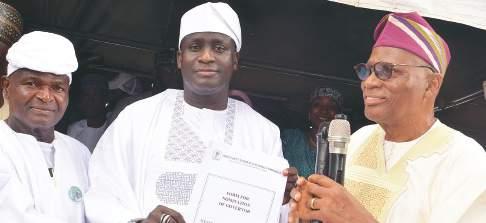
DEMOCRATIC DEVELOPMENT...
L-R: Kwara APC Deputy Chairman, Alhaji Abdullahi Samari; Kwara APC governorship candidate, Rt. Hon. Yakubu Danladi Salihu; and APC State Chairman, Prince Sunday Fagbemi, during the official presentation of the INEC nomination form to the governorship candidate at the party’s secretariat in Ilorin on Tuesday Continued on page 8
Emmanuel Addeh in Abuja
Peter Uzoho
The Dangote Group has outlined
RASAK OKOYA MADE VICE PATRON OF ISLAND CLUB...
L-R: Mr. Jubril Okoya; Vice-Chairman, Island Club, Chief Femi Williams; Managing Director, Eleganza Industrial City Limited, Dr. (Mrs) Folashade Okoya; Chairman, Eleganza Group of Companies, Chief Rasaki Akanni Okoya; Chairman of Island Club, OmoOba Rotimi Martins; Chief Adeniyi Williams; Mr. Idris Okoya; Mr. Subomi Okoya, and Chief Gbenga Obasa, during investiture ceremony of Chief Okoya as vice patron of the Island Club and inductions of his sons as members of the club in Lagos…recently
Fitch: Recapitalisation Eases Capital Strain Despite Rising Bad Loans
Forecasts NPLs to drop to 5% by 2026 year-end
Nume Ekeghe
Fitch Ratings has reported that Nigeria’s banking sector has been able to absorb the capital strain triggered by the Central Bank of Nigeria’s (CBN) withdrawal of regulatory forbearance, as lenders relied on stronger capital buffers built through the industry’s ongoing recapitalisation exercise despite a sharp rise in impaired loans.
In a report released yesterday, the global rating agency stated that the new paid-in capital requirements, which became effective at the end of the first quarter of 2026, enabled many banks to withstand the deterioration in asset quality that followed the central bank’s decision to withdraw longstanding regulatory forbearance at the end of the first half of 2025.
It stated: “Nigerian banks’ impaired loans ratios increased sharply, putting pressure on capitalisation, following the withdrawal of longstanding forbearance at end-1H25. “However, this pressure was offset by good internal capital generation and capital raisings to meet new paid-in capital requirements that became effective at end-1Q26.”
Fitch noted that while the withdrawal of regulatory forbearance led to a sharp deterioration in banks’ asset quality, it expects the increase in impaired loans to reverse, with the industry’s impaired loan ratio falling to about five per cent by the end of 2026 as higher oil production, firmer oil prices and loan write-offs take effect.
It stated: “The regulatory forbearance withdrawal led to some problem loans, particularly oil and gas loans, being reclassified as impaired.
“The banking sector’s impaired loans ratio increased to 8 per cent at end-1M26 from 4.5 per cent at end-2024 but Fitch expects it to decline to about 5 per cent at end-2026 on higher oil production and prices, and write-offs.”
The report also underscored the significance of the banking sector’s recapitalisation drive, noting that fresh equity injections have strengthened lenders’ ability to absorb additional provisioning requirements and regulatory deductions without breaching capital thresholds.
Furthermore, Fitch stated: “Capital raising to meet the new requirements have enabled many banks
to absorb additional provisions, particularly prudential provisions that completely disregard collateral, resulting from higher impaired loans, and capital deductions resulting from single-obligor limit breaches, while generally remaining compliant with their respective minimum total capital adequacy ratio requirements.”
On earnings, Fitch observed that profitability weakened in 2025 as
banks contended with significantly higher loan impairment charges while also losing the sizeable foreign exchange revaluation gains that boosted earnings following the naira devaluations of 2023 and 2024. It stated: “Profitability generally declined in 2025 due to increased loan impairment charges and the lack of foreign-exchange revaluation gains that occurred because of the
devaluation of the Nigerian naira in 2023-2024.”
Nevertheless, the agency expects earnings to recover moderately this year.
It stated that profitability should improve on declining loan impairment charges and net interest margins remaining broadly stable as the CBN pauses its monetary easing in response to renewed
inflationary pressures. Fitch also projected a sharp rebound in credit creation as banks begin deploying the capital raised under the recapitalisation programme. The agency forecasts, “loan growth to accelerate to about 20 per cent in 2026 from two per cent in 2025 as banks begin deploying the fresh capital they have raised.”
Yemi Kale: Data Fragmentation Hindering Nigeria’s Productivity,
Group Chief Economist and Managing Director of Research and Trade Intelligence, African Export Import Bank, Yemi Kale, lamented that data fragmentation was hindering Nigeria’s productivity, employment opportunities, and labour market efficiency.
Kale, a former Statistician General of the National Bureau of Statistics, made that known on Tuesday while speaking via zoom during the National skills and Industry
Employment Opportunities
Alignment Roundtable Q2 Series on the Role of Data in Job Creation, Coordination and Linkages, held in Abuja.
He stressed that Nigeria’s demographic dividend, with 70 per cent of its population under 30, presented both an opportunity and a challenge, requiring quality education, economic absorption capacity, and strong institutions.
Kale highlighted the need for a coordinated data architecture to align skills with economic opportunities, enhance productivity, and foster
FTSE Russell to Review Nigeria’s Frontier Market Upgrade After T+1 Transition
Kayode Tokede
The FTSE Russell, yesterday said it has placed its planned reclassification of Nigeria back to Frontier Market status under “further review.”
The Nigerian capital market, July 1 2026 joined the United States, others to achieve a historic milestone with the successful transition to a T+1 settlement cycle, becoming the first market in Africa to implement the shortened settlement framework designed to enhance efficiency, reduce risk, and improve global competitiveness.
The transition means that securities transactions executed on the Nigerian Exchange Limited (NGX) will now settle one business day after trading, allowing investors to receive cash or securities faster than under the previous T+2 framework.
FTSE Russell, a global index provider in a statement noted that the decision was to allow the index provider to thoroughly assess how Nigeria’s recent transition to a shortened T+1 settlement cycle (clearing and settling trades one business day after execution) affects international
institutional investors.
The global index provider stated that it would provide a definitive update on Nigeria’s potential return to the Frontier Market index by the end of August 2026.
Nigeria had originally been upgraded from “Unclassified” back to “Frontier Market” status during the March 2026 interim review—with an effective implementation date set for September 2026.
FTSE Russell noted that the reclassification would now be decided after its assessment of the T+1 impact on
the market.
“From 01 June 2026, the Nigerian equity market transitioned from a T+2 to T+1 settlement cycle, which could result in Nigeria becoming a de facto prefunded market for international institutional investors.
“A requirement to prefund equity trades is deemed a negative for the ‘Settlement Cycle (DvP)’ criterion, which is one of the five core FTSE Quality of Markets criteria required for attaining Frontier market status within the FTSE Equity Country Classification scheme.
long-term economic competitiveness.
He pointed out that nations that had achieved sustained economic transformation did not do so because they possessed natural resources or lacked religion. He said they succeeded because they were able to systematically align their human capital systems with the evolving needs of the economy.
Kale emphasised that one of the defined characteristics of today’s most competitive economies was not simply the quality of labour, but the quality of the information system that underpinned labour development and the labour market.
He stated, “Across Nigeria today, we have employers that are searching for skill, and at precisely the same time, millions of Nigerians are searching for opportunities they can access. Our educational institutions continue to graduate thousands of young people every year.
“Yet businesses across multiple sectors in the country report persistence shortages in critical technical, vocational, political realms.”
Kale added, “So, across the country, so employers are searching, workers are searching, training institutions are searching, policy makers are searching, investors are searching. The problem, however, is that they are often searching independent rather than collectively, and I think
that’s what we’re looking at.
“The information that should connect them remains fragmented across different platforms, across different databases, across areas of the institution system opportunities that should be visible as a result, remaining skills that should be matched remain under its value, and investment that should create jobs often struggle to find the talents.”
Special Adviser to the Vice President on Workforce Development, Rimam Nuhu, said the National Council on Skills aimed at creating evidence-based policy for skills development in Nigeria to address skills mismatches and shortages.
Nuhu stated that the council would use a new database to identify the gaps and improve workforce planning and enhance national productivity.
He said, “What this does with this database is that it provides government with evidence-based recommendations, when it comes to policy regarding skills development. Skills development is an input for job creation.
“Currently, there are a lot of skills mismatches, there are a lot of skills shortages, and what this database will do is that it will give us the intelligence required for us to identify where exactly those shortages are.”
Adedayo Akinwale in Abuja
CONTRACT SIGNING CEREMONY FOR THE DICE FUND...
L-R: Company Secretary, Bank of Industry (BoI), Olufunmilola Salami; Partner/Chief Investment Officer (CIO), Kuramo Capital Management, Labi Williams; Managing Director/Chief Executive Officer (MD/CEO), Kuramo Capital Management, Wale Adeosun; Managing Director/Chief Executive Officer (MD/CEO), Bank of Industry (BoI), Dr. Olasupo Olusi; Executive Director, Public Sector and Intervention Programmes Directorate, Bank of Industry (BoI), Mabel Ndagi; Vice President, Kuramo Capital Management, Gbolade Okeowo; and National Coordinator, iDICE Programme, Ife Adebayo, during the contract signing ceremony for the DICE Fund (Fund of Funds) under the Federal Government’s iDICE Programme in Abuja. The Fund targets a minimum capitalisation of US$170.6 million to support Nigeria’s technology and creative sectors... on Tuesday
Olowo Urges Firms to Embrace Sustainability Reporting to Unlock Global Capital
Says Nigeria positioned to strengthen competitiveness through reporting reforms
Presents 2026 actuarial practice draft regulations to stakeholders for input
James Emejo in Abuja and Dike Onwuamaeze in Lagos
Executive Secretary/Chief Executive, Financial Reporting Council (FRC), Dr. Rabiu Olowo, yesterday said Nigerian businesses must embrace sustainability reporting as a strategic tool for attracting investment in an increasingly competitive global economy where transparency had become a major determinant of
capitalOlowoallocation. said investors were no longer guided solely by profitability but were placing increasing emphasis on how organisations managed Environmental, Social and Governance (ESG) risks, created long-term value, and demonstrated resilience.
Olowo spoke on “Mandatory Sustainability Reporting: A Catalyst for Competitiveness, Access to Finance and Sustainable Growth in Nigeria”,
at the 5th Annual Nigeria Employers’ Summit in Separately,Abuja. in Lagos, Olowo presented the draft 2026 Nige- rian Actuarial Practice Regulations (NAPRs) to stakeholders in actuarial practice in the country to aid their comprehensive understanding of its provisions, scope, and application before its final enactment.
NAPRs will provide a regulatory framework for all actuaries in Nigeria
offering actuarial services for financial reporting purposes, in compliance with the provisions of the FRC Act, 2011 (as amended).
The FRC boss, who was represented by Head, Sustainability Reporting Regulations Department, Mr. Abuba- kar Rasaq, said the ESG shift was redefining the investment landscape, making credible sustainability dis- closures a key factor in determining which companies attracted financing,
secured strategic partnerships, and gained access to international markets.
According to him, the development presents both an opportunity and a challenge for Nigerian businesses as global investors, lenders, and development finance institutions increasingly channel resources to organisations that provide clear and reliable information on their sustainability performance.
The FRC boss stated that in an environment where access to capital remained constrained, companies with credible sustainability disclosures were more likely to enjoy investor confidence.
Reform,
Says NECA DG
FG Needs Collaboration from Organised Businesses to Effectively Drive
Nigerian Employers Consultative Association (NECA) says the federal government needs the collaboration and support of organised businesses to effectively drive economic policy reforms and to achieve the desired goals.
The umbrella body of employers and top business owners in Nigeria said government also needed to consistently review, reassess, or re-plan reforms to ensure their outcome aligned with the country’s economic objectives Director-General of NECA, Mr. Adewale-Smatt Oyerinde, made the statements on Tuesday, in an interview with journalists at the Nigerian Employers Summit in Abuja.
Oyerinde said the focus of the
Employers’ Summit was to do a thorough review of the reforms being implemented by government and to assess their impact so far.
He said the reforms had apparently become very harsh for Nigerians to bear due to prevailing circumstances.
Oyerinde said, “Removing the fuel subsidy in 2023, I suppose, was a bit late. We would have removed it long ago.
“But it changed the dynamics of doing business. Because as someone says, all of us seem to have been eating our breakfast for dinner. We were living large.
“Past governments were printing money. No economy prints money. We are subsidizing what is not subsidisable.”
He stated, “So we were all living
large, thinking everything is okay. So, and that’s the context of saying we are eating our breakfast for dinner. Then it was dawn.
“It was morning. We were all expecting breakfast. And the president said, look, I won’t borrow to buy breakfast for you again.
“Because everything you’ll have used for breakfast and for lunch, most likely, you have had it for dinner. So, the pain of, the hunger pang of breakfast, we all have to bear it. The hunger pang of lunch, we all have to bear it.”
Oyerinde said the removal fuel subsidy had come with its challenges, which included the distortion of the way citizens did business.
According to him, the cost of doing business increased because everyone has to pay for fuel and diesel.
Nigeria, Singapore Begin Training of TVET Teachers to Strengthen Tech, Vocational Education
Kuni Tyessi
The federal government in collaboration with the Institute of Education, Singapore, has commenced a capacity-building programme aimed at strengthening the delivery of Technical and Vocational Education and Training (TVET) across the country through the training of instructors and educators.
The initiative, tagged the “Train the Trainers (Pedagogy & Assessment) Programme,” is a 10-day intensive
training jointly organised by the Federal Ministry of Education, the National Board for Technical Education (NBTE), and the Institute of Education, Singapore.
The programme is implemented in two cohorts, with the first cohort of 60 TVET teachers at the federal and state levels, currently undergoing training in Abuja, while a second cohort of another 60 teachers is scheduled to participate in Lagos. Speaking with reporters at the
training, National Coordinator, Special Programmes, Office of the Minister of Education, Adebayo Onigbanjo explained the programme is designed to equip Nigerian educators with modern pedagogical and assessment skills.
He noted that participants are expected to transfer the knowledge gained to their colleagues through a cascading training model, enabling the enhanced teaching methods to ultimately benefit students across the country.
Oyerinde said the measure also affected individuals whose disposable incomes had reduced.
He stated, “Somehow, those reforms affect everybody. Businesses, individuals, workers. So, for the reform to be effective, government needs the collaboration and support of organized businesses to drive it and drive it effectively.
“And government also needs to consistently review, reassess, or re-plan these reforms. If at any point in time, we realise that those reforms are not giving us the kind of outcome that we want.”
He described transparency as the foundation upon which investment decisions were increasingly being made.
Olowo stressed that sustainability reporting had evolved beyond a compliance requirement into a business imperative capable of improving governance, strengthening risk management, and enhancing long-term competitiveness.
He said the disclosures enabled businesses to communicate their future growth strategy more effectively, helping investors assess not only current financial performance but also their preparedness for emerging risks and opportunities.
Olowo warned that Nigerian
companies that delayed preparations until sustainability reporting became mandatory could find themselves at a competitive disadvantage as reporting expectations continued to tighten across major economies. He explained that global supply chains, multinational corporations, and financial institutions were becoming increasingly selective, with sustainability information now forming part of investment, lending and procurement decisions. Olowo maintained that for Nigeria, widespread adoption of sustainability reporting had implications beyond individualAccordingcompanies. to him, stronger cor- porate transparency would improve the country’s investment climate, deepen investor confidence, enhance institutional credibility and position Nigerian enterprises to compete more effectively in global markets.
He added that businesses capable of demonstrating sound governance and responsible business practices would be better placed to attract foreign capital, expand exports, and integrate into international value chains.
Olowo urged company boards and executive management to take ownership of sustainability reporting rather than treat it as a routine compliance exercise.
The World Bank-supported HOPE Human Capital Opportunities for Prosperity and Equity–Governance (HOPE-GOV) Program, domiciled in the Federal Ministry of Budget and Economic Planning, is set to disburse $27 million as performance-based incentives to states which successfully achieved the Year Zero DisbursementLinked Results (DLRs).
The federal government, in collaboration with the World Bank implements the HOPEGOV Program, a $500 million credit facility designed to improve financial and human resource
management in basic education and primary healthcare.
Speaking in Abuja yesterday, during a retreat for commissioners, permanent secretaries, and directors of budget and planning in the 36 states and the FCT, the National Coordinator of the HOPE Governance Program, Dr. Assad Hassan said the disbursement was based on the findings and recommendations of the Interim Independent Verification Agent (IVA).
The IVA assessed the performance of states in meeting the Year Zero Disbursement-Linked Indicators (DLIs). He listed the Year Zero Dis-
bursement Linked Results as DLR 2.1, which relates to states’ adoption of comprehensive guidelines for preparation and submission of consolidated work plan for State Basic Education budget by March 31, 2025, a statement issued by the Communications Officer, HOPE Governance Program. Joe Mutah stated. The DLR 2.2 relates to states’ adoption of comprehensive guidelines for preparation and submission of consolidated work plan for the state primary health care budget by March 31, 2025 and DLR 2.3 - local governments adoption of harmonised budget guidelines/chart of accounts.
in Abuja
Ndubuisi Francis in Abuja
Onyebuchi Ezigbo in Abuja
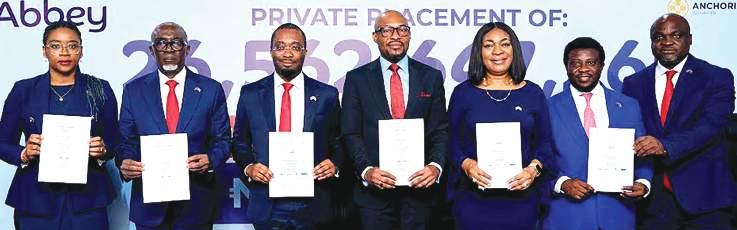
AT THE SIGNING CEREMONY OF ABBEY BANK’S PRIVATE PLACEMENT...
L-R: Independent Non-Executive Director, Abbey Bank Plc. Adenike Kuti; Non-Executive Director, Abbey Bank Plc. Mr.John Obasa; Managing Director/CEO Abbey Bank Plc.Mr. Mobolaji Adewumi;Director, Anchoria Advisory Services,Mr.Sam Chidoka; Independent Non-Executive Director, Abbey Bank Plc, Christabel Onyejekwe; Executive Director, Business Development, Abbey Bank Plc, Mr. Dipo Adeoye;and Executive Director, Finance, Risk, and Operations, Abbey Bank Plc, Mr. John Okonkwo, at the Signing Ceremony of Abbey Bank’s Private Placement in Lagos ... recently
BOI Appoints Kuramo Capital to Manage $170.6m iDICE Fund for Nigerian Startups
Sunday Ehigiator
Bank of Industry (BOI) appointed Kuramo Capital Management as Fund Manager of the $170.6 million DICE Fund of Funds, a landmark investment vehicle aimed at expanding venture capital financing for technology and creative start-ups across Nigeria.
The appointment, formalised at a contract signing ceremony in Abuja between BOI’s Managing Director and Chief Executive Officer, Dr. Olasupo Olusi, and Kuramo Capital Chief Executive Officer, Wale Adeosun, marked a significant milestone in the implementation of the federal government’s Investment in Digital and Creative Enterprises (iDICE) Programme.
Under the arrangement, the federal government will provide an anchor investment of $85.3 million through the iDICE Programme, while Kuramo Capital is expected to mobilise an equivalent amount from private investors, bringing the fund’s minimum capitalisation to $170.6 million.
BOI described the initiative as one of the largest government-backed investments dedicated to technology and creative sector start-ups in Africa.
DICE Fund of Funds will invest through selected venture capital and micro-venture capital funds focused on technology and creative enterprises, with a mandate to reach
founders across Nigeria’s 36 states and the Federal Capital Territory.
The structure is intended to broaden access to venture financing beyond traditional start-up hubs and stimulate innovation nationwide.
Speaking at the ceremony, Olusi said the initiative reflected the federal government’s commitment to strengthening Nigeria’s innovation ecosystem.
He said, “By investing in Ventures Platform’s Fund II, and now by establishing the DICE Fund of Funds with Kuramo Capital, we are deepening the federal government’s objective of upscaling Nigeria’s technology and creative sectors by catalysing strategic investments in high-growth, technology-enabled enterprises.
“The Bank of Industry is proud to be the executing agency driving this historic investment into the hands of Nigeria’s innovators.”
Adeosun described the appointment as a defining moment for venture capital development on the continent.
He said, “The DICE Fund of Funds represents a landmark moment for Africa’s venture capital ecosystem.
“Nigeria is demonstrating that a government can be both a serious anchor investor and a credible market-builder.
“We are honoured to be entrusted with this mandate and committed to deploying every resource at our disposal to raise the matching capital,
invest wisely, and deliver returns that justify this historic confidence.”
The iDICE Programme, cofinanced by African Development Bank (AfDB), Agence Française de Développement (AFD), and Islamic Development Bank (IsDB), is the federal government’s flagship initiative to promote entrepreneurship, drive innovation, create jobs, and position Nigeria as Africa’s leading knowledge economy.
The programme recorded a major breakthrough in November 2025 when it made Nigeria’s first direct government investment in a private venture capital fund through a cornerstone commitment to Ventures Platform’s VP Pan-African Fund II, which closed at $64 million with support from the International Finance Corporation (IFC), British International Investment (BII), Standard Bank of South Africa
and Proparco.
BOI said implementation of the programme was progressing across its three strategic pillars: skills and enterprise development, access to finance, and ecosystem enablement, with activities already underway in all six geopolitical zones.
The iDICE Start-up Bridge has enrolled its inaugural cohort of 185 founders, while applications for the second cohort opened on June 24.
The programme is also expected to launch its Growth Lab in July, providing growth-stage start-ups with potential equity funding of up to $100,000.
In addition, BOI is establishing and upgrading digital and creative hubs in 66 universities and polytechnics nationwide in partnership with National Universities Commission (NUC) and National Board for Technical Education (NBTE).
UBA Rewards Customer Loyalty with Over N400m Bumper Account Anniversary Bonus
United Bank for Africa (UBA) Plc, has rewarded thousands of customers with over N400 million in anniversary bonuses under its flagship UBA Bumper Account.
The cash reward reaffirms the Pan-African financial institution’s unwavering commitment to rewarding customer loyalty and promoting a strong savings culture.
The payout, one of the largest loyalty rewards under the Bumper Account initiative since its launch, saw qualifying customers receive anniversary bonuses directly into
their accounts, demonstrating UBA’s resolve to create lasting value for customers who consistently save with the Bank.
In another development, UBA Plc has reinforced its commitment to sustainability and environmental stewardship by mobilising thousands of employees across its operations in 20 African countries for a coordinated environmental clean-up campaign held under its flagship employee wellness initiative, Jogging to Bond.
The pan-African exercise, which also underscores the bank’s focus on employee wellbeing and community development, saw staff participate
Transport Ecosystem: FRSC, NITT Sign MoU
on Advanced Training, Capacity Development
Kasim Sumaina in Abuja
The Federal Road Safety Corps (FRSC) and the Nigerian Institute of Transport Technology (NITT), Zaria, Tuesday signed a far-reaching Memorandum of Understanding (MoU) on advanced training, capacity development, research and innovation.
The landmark move, the duo said, is set to reshape the future of Nigeria’s transport ecosystem,
The historic agreement, executed by the Corps Marshal, Shehu Mohammed, and the Director General of NITT, Dr. Bayero Farah, marks
the beginning of a transformative partnership designed to raise professional standards, strengthen institutional capacity and position Nigeria’s transport sector on the global stage.
Speaking at the signing ceremony, the Corps Marshal described the occasion as a defining milestone in the history of Nigeria’s road transport sector, noting that the coming together of two foremost institutions represents a bold commitment to building a safer, smarter and more efficient transportation system.
He explained the partnership would deepen collaboration in spe-
cialised training, research, technology, driver training, knowledge exchange and human capital development.
According to him, “FRSC’s longstanding collaboration with NITT has already yielded remarkable results, but the formalisation of the relationship through the MoU opens an entirely new chapter of innovation and institutional excellence.”
The Corps Marshal further stated the partnership would significantly strengthen research capabilities, modernise driver training centres, enhance ICT-driven learning, and produce globally competitive transport professionals equipped
to address emerging mobility and road safety challenges.
He emphasised that the agreement is not merely a ceremonial document but an actionable framework for immediate implementation, capable of accelerating reforms across Nigeria’s transport sector.
In his remarks, the Director General of NITT, Bayero Farah, commended the Federal Road Safety Corps for its visionary leadership and relentless commitment throughout the negotiation process, describing the Corps’ dedication as instrumental to the successful conclusion of the agreement.
in environmental sanitation activities across major cities where the bank operates.
Meanwhile, the UBA Bumper Account is a unique savings product that rewards customers simply for maintaining and growing their savings.
Every year an eligible account reaches its anniversary, customers receive a cash bonus, making disciplined saving both rewarding and beneficial over time.
Speaking on the milestone, UBA’s Head, Retail Products, Tomiwa Sotiloye, said the Bank remains committed to ensuring that customers benefit directly from their relationship with UBA.
“At UBA, we believe customer loyalty deserves meaningful recognition. Every bonus paid is our way of saying ‘thank you’ to customers who continue to trust us with their financial aspirations.
“Surpassing the N400 million milestone reflects our commitment to creating products that not only help customers save but also reward them in tangible ways.
It is another demonstration that when our customers grow, we grow with them.”
He added that both new and existing customers can open a UBA Bumper Account seamlessly through https://on.ubagroup.com/ bumper-tc, any UBA branch, the UBA Mobile Banking App, by dialing *919#, or online, positioning themselves to qualify for future
anniversary rewards. Also speaking, UBA’s Group Head, Brands, Marketing and Corporate Communications, Alero Ladipo, said the Bank’s customercentric philosophy continues to shape its product offerings.
“The UBA Bumper Account reflects our unwavering commitment to putting customers first. We deliberately design products that reward responsible financial behaviour while delivering real value.
“Crediting over N400 million directly into customers’ accounts is not just a payout; it is evidence of our promise to make banking more rewarding and to continually appreciate the confidence our customers repose in us.”
The UBA Bumper Account remains one of the Bank’s flagship retail savings products, combining competitive savings benefits, digital convenience and attractive loyalty rewards. It forms part of UBA’s broader strategy to deepen financial inclusion by encouraging sustainable savings habits while delivering exceptional customer experiences. Meanwhile, this year’s edition of the pan-African exercise was particularly significant as it coincided with the 60th birthday of the Group Managing Director/Chief Executive Officer, Oliver Alawuba, who marked the milestone by joining staff and colleagues in the exercise, reaffirming the bank’s culture of service, teamwork and sustainable impact.
Nume Ekeghe and Kayode Tokede
PHOTO; ETOP UKUTT
FRC’s Facilitation Rallies N1.84 Trillion in Remittances from Operating Surplus to CRF
FG pledges deeper support for commission to strengthen fiscal governance reforms
Ndubuisi Francis in Abuja
The Fiscal Responsibility Commission (FRC) facilitated remittances of about N1.84 trillion from operating surplus and internally generated revenue into the Consolidated Revenue Fund (CRF) as of September 2025. Operating surplus refers to the excess of income over expenditure for Government-Owned Enterprises (GOEs) and parastatals over a fiscal year. CRF is the primary central account of the Federal Government of Nigeria, established under Section 80 of the 1999 Constitution, and serves as the main repository for government revenues, excluding funds designated for specific public purposes, and is used to finance statutory transfers, debt servicing, and government operations.
Acting FRC Chairman, Charles Abana, who made the disclosure when he led top officials of the commission on a courtesy visit to Secretary to the Government of the Federation (SGF), Senator George Akume, in Abuja, on Tuesday revealed that despite lower revenue performance between January and May 2026, the commission had already recorded over N760 billion in remittances from operating surplus and other independent revenues.
“The commission is targeting ₦2.5 trillion in independent revenue for 2026,” Abana said.
In a statement issued by FRC’s Head of Strategic Communication, Bede Anyanwu, Abana disclosed that the commission had completed a revised Operating Surplus Computation Template, incorporating provisions of the Finance Act 2020
and subsequent financial regulations.
He stated that the template was being automated to strengthen evidence-based fiscal oversight and improve public financial management.
Abana said the official presentation of the revised template had been scheduled for July 28 in Abuja.
While requesting the SGF to deliver the keynote address at the event, Abana also highlighted the unveiling of the commission’s 2026–2028 Strategic Plan, which he said aligned with the federal government’s development priorities under the Renewed Hope Agenda.
He explained that the strategic plan focused on institutional reforms, stakeholder engagement, capacity building, international collaboration, and the adoption of global best practices in fiscal governance.
Abana also cited the successful
management retreat held in 2026, describing it as an important platform for reviewing existing programmes, identifying emerging fiscal governance challenges, and developing strategies to improve service delivery.
He said the retreat reinforced the commission’s commitment to innovation, accountability, and excellence, while aligning departmental activities with the objectives of the new strategic plan.
Abana disclosed that FRC was developing the second edition of the Fiscal Responsibility Measurement Index (FRMI), a performance assessment tool designed to measure compliance with fiscal responsibility principles, particularly through budget implementation.
He said the index would support the oversight responsibilities of the National Assembly by providing ob-
jective data on the fiscal performance of MDAs.
The acting chairman said the commission was expanding collaboration with key anti-corruption and accountability institutions, including Economic and Financial Crimes Commission (EFCC), Independent Corrupt Practices and Other Related Offences Commission (ICPC), Code of Conduct Bureau (CCB), Bureau of Public Procurement (BPP), and Office of the Auditor-General for the Federation.
He explained that the partnerships were intended to improve information sharing, strengthen coordinated oversight, and enhance enforcement of fiscal responsibility laws.
Abana said the commission had also agreed with EFCC and ICPC to refer cases involving clear financial breaches for investigation
APC: SOME INITIAL PRIMARY WINNERS NOW ALTERED AFTER APPEAL, REVIEW BY NWC
corrections in certain areas.
As part of the peace building measures ahead of the 2027 general election, the umbrella body of APC governors, Progressive Governors’ Forum (PGF), has proposed a meeting with the party’s national chairman, Professor Nentawe Yilwatda.
APC National Publicity Secretary, Felix Morka, said in a telephone chat that rather than dismissing complaints from the primary elections, the leadership of the party painstakingly audited every grievance, in a move that ultimately altered the fates of several initial winners.
Morka stated, “For those aggrieved, we took our time to undertake a very thorough review of all the petitions that came after the primaries. There were over 700 petitions that were received and were properly vetted.
“Some were successful and some were not. Those successful led to some corrections in some constituencies. Those that were not successful meant that those earlier declared were retained.
“In a few cases, there were upsets based on the outcome of the petitions and decisions were made on them.”
With the petition window now
closed, APC declared its current candidate line-up as absolute, indicating that the window for internal leadership flips is shut.
Morka stressed that the party’s primary objective was to ensure that all validly nominated standard-bearers successfully completed and returned their INEC Form EC9 (the candidate nomination affidavit).
He stated, “We have gone past that. So the people today who are filling the forms are those who emerged originally without challenge and those who emerged out of the appeal process. This is the final position of the review.
IN LANDMARK RULING, US SUPREME COURT UPHOLDS BIRTHRIGHT CITIZENSHIP
Amendment, adopted after the Civil War, makes a citizen of anyone born in the country, with very limited exceptions.
“Citizenship, then and now, was the right to have rights—to freely participate in our political community. The Framers of the Fourteenth Amendment extended that promise to ‘every free-born person in this land,’” Chief Justice Roberts wrote for the court, citing congressional debate over the amendment, “We keep that promise today,” he added.
A sixth justice, Brett Kavanaugh, disagreed about the constitutional ruling, but pointed to a federal law that he said broadly conveys birthright citizenship. Justices Samuel Alito, Neil Gorsuch and Clarence Thomas would have upheld Trump’s proposed restrictions.
“The Court today takes the extraordinary step of holding facially unconstitutional the President’s Order excluding from citizenship the children of foreign temporary visitors and illegal aliens,” Justice Clarence Thomas wrote in a 91-page dissent, more than three times as long as Roberts’ opinion.
“In doing so, the Court adds to the sad history of the Fourteenth Amendment, which was designed and understood to secure equal rights for the freed blacks but has instead been repurposed for political projects that the Reconstruction Congress did not support,”
The Republican president’s restrictions had been blocked by several lower courts and had not taken effect anywhere in the U.S, the Associated Press (AP) reported.
In his reaction, Trump said the decision was “too bad for our Country” and wrongly suggested that Congress could “easily” address it with legislation. The majority decision rests on constitutional grounds. It would take an amendment to overcome the decision, the report added.
During arguments in April, both conservative and liberal justices questioned the order’s legality in a momentous case that was magnified by Trump’s unprecedented attendance in the courtroom.
The case framed another test of Trump’s assertions of executive power that defy long-standing precedent for a court with a conservative majority and a robust view of presidential power that has largely ruled in his favor. In the notable exceptions when the court has not, Trump has responded with starkly personal criticisms of the justices.
The justices ruled on Trump’s appeal of a lower-court ruling from New Hampshire that struck down the citizenship restrictions.
The birthright citizenship order, which Trump signed on the first day of his second term, is part of his administration’s broad immigration crackdown.
Birthright citizenship was the first Trump immigration-related policy to reach the court for a final ruling. The justices previously struck down global tariffs Trump had imposed under an emergency powers law that had never been used that way.
The president said the decision was “too bad”, but appeared unde-
terred in his quest to end birthright citizenship, turning his attention to Congress. Instead of trying to pass a constitutional amendment, Trump is pushing for lawmakers to create new legislation that establishes exceptions to birthright citizenship for children born to parents who do not have permanent legal status in the US.
“Congress should start today to work on ending the expensive and unfair to our Country, Birthright
Continued on page 28
“The priority of the party now is to have all our candidates to fill and complete their INEC nomination form and upload same on INEC platform
“The people who were successful, I mean those who have emerged as the candidates of the party, are being provided with the relevant forms for documentation. They are to fill and return to the party for uploading to the INEC portal.
“The process is already underway, and candidates are actively interacting with the party leadership to ensure smooth transition into the INEC system.”
Morka added that releasing the list of the party’s candidates for the 2027 elections was not a priority now.
He explained, “Having a public release of the list is not our priority now. Though we shall share the list publicly, right now, the priority is to get those who are our candidates to get their forms filled and meet the INEC deadline.
“This is more important to us than the public release of candidates’ list.”
Morka added, “Those who are our candidates, by now, have received their forms. They already know themselves. There is no tension about that.”
2027: APC Govs to Meet Yilwatda
Progressive Governors’ Forum (PGF), the umbrella body of governors elected on the platform of APC, said they had met with the national chairman, Professor Nentawe Yilwatda, in the continued effort to resolve intraparty issues ahead of the 2027 elections.
Chairman of PGF, Imo State Governor Hope Uzodimma, while addressing journalists after the meeting, revealed that the governors reviewed the outcome of the party’s nationwide primaries, the party’s performance in the recent Ekiti State governorship election, and several bye-elections.
The meeting was attended by the governors of Ekiti, Zamfara, Taraba, Lagos, Sokoto, Kano, Kaduna, Gombe, Kebbi, Akwa Ibom, and Borno states, among others.
THISDAY Checks revealed that the ruling party’s nationwide primaries held in May were characterised by controversy, irregular voting processes, allegations of imposition of candidates, and manipulation of delegate lists.
The lack of transparency and fairness in the primaries created uneasy calm in the ruling party. It was against this background
and prosecution under the relevant provisions of their enabling laws. He underscored the commission’s commitment to amending the Fiscal Responsibility Act, 2007, stating that nearly two decades after its enactment, changing fiscal realities require a review of the legislation. Charles Abana
that the APC national leadership refused to release the list of successful candidates following the completion of the primaries to prevent crisis in the party.
APC governors decided to review the process as part of troubleshooting efforts to reconcile aggrieved members.
Uzodimma stated that the forum resolved to engage the APC national leadership to harmonise strategies for the next phase of the party’s campaign and strengthen internal cohesion before the general election. He stressed that beyond electoral preparations, the governors also deliberated on governance and the country’s democratic development, stressing their commitment to ensuring that Nigerians benefit more from APC administrations. Uzodimma said, “The governors expressed satisfaction with the party’s electoral outings, describing the results as encouraging ahead of the 2027 presidential and National Assembly elections.
“We reviewed the outcome of the primaries across the federation, the Ekiti governorship election and the various bye-elections where our party performed impressively,
“We have resolved to work towards solving the challenges facing our democratic space and ensuring that our people are better off.”
DANGOTE TO RAISE TOTAL REFINING CAPACITY IN AFRICA TO 2.1M BPD, SEEKS PARTNERSHIP WITH CONGO
drive to accelerate industrialisation across Africa
This comes as the national oil company of the Republic of the Congo, the Société Nationale des Pétroles du Congo (SNPC) and Dangote Petroleum Refinery & Petrochemicals have commenced discussions on a strategic partnership aimed at strengthening the Republic of the Congo’s supply of refined petroleum products while advancing regional energy cooperation and industrial integration across Africa.
Leading a Congolese delegation on a visit to the Dangote Petroleum Refinery in Lagos, SNPC Managing Director, Maixent Raoul Ominga, described the facility as a strategic asset for Africa and expressed the national oil company’s interest in developing a long-term partnership with Dangote.
“We have visited this remarkable refinery, which represents a major industrial achievement for Africa. The Republic of the Congo has refining capacity and we are keen
to explore strategic cooperation that will help strengthen the supply of refined petroleum products while creating value for both organisations,” Ominga said, according to a statement by Dangote Group.
He said discussions between both organisations focused on opportunities for collaboration in refining, petroleum products supply, energy security, industrial development, and knowledge sharing.
Ominga praised the Dangote Group for demonstrating that Africa could successfully finance, build and operate world class industrial infrastructure, describing the refinery as an important milestone in the continent’s industrial transformation.
He also commended the Group’s investments in the Republic of the Congo, particularly in the cement sector, noting that they have strengthened local industrial capacity, expanded production and improved access to construction materials.
President and Chief Executive of Dangote Industries Limited,
Aliko Dangote, reaffirmed the Group’s commitment to Africa’s industrialisation through value addition, regional partnerships and investment across the continent.
“We are for Africa, not just Nigeria. Tell us what you need, and we will see how we can work together,” Dangote said.
He noted that the refinery has established a new benchmark for fuel quality in Africa by producing petroleum products that meet the highest international specifications, while improving access to cleaner fuels and reducing the continent’s dependence on imported refined products from outside Africa.
During the visit, Group Vice President, Oil and Gas, Dangote Industries Limited, Devakumar Edwin, outlined the Group’s long term expansion strategy, which will increase its total refining capacity to 2.1 million barrels per day, comprising 1.4 million barrels per day in Nigeria and a planned 700,000 barrels per day refining
complex in Kenya to serve East African markets.
He also disclosed plans by the Group to invest additional US$46 billion between 2026 and 2028 across its refining, cement and fertiliser businesses as part of its drive to accelerate industrialisation across Africa.
The engagement underscores the shared commitment of SNPC and Dangote Industries to deepen African energy cooperation, strengthen regional value chains and promote greater self-sufficiency in refined petroleum products as the continent advances towards enhanced energy security and increased intra African trade.
Also present at the meeting were Group Executive Director, Commercial, Oil and Gas, Dangote Industries Limited, Fatima Aliko Dangote; Adviser to the President of the Republic of the Congo, Peggy Ndongo; and advisers to the SNPC Managing Director, Aymar Ebiou and Norbert Mabiala.
TOWARDS A FUNCTIONAL GLOBAL NETWORK...
Participants at the global partnership workshop organised by Konrad Adenauer Foundation (KAF) in Lake Como, Italy. Among the 22 participants is former Senate President, Dr. Abubakar Bukola Saraki.
Federal High Court Issues New Practice Directions for Pre-Election Cases
Repeals 2022 rules, allows filing of election suits on weekends and public holidays
Approves virtual hearings, restricts adjournments, empowers chief judge to transfer cases nationwide
Wale Igbintade
The Federal High Court has issued
a new set of Practice Directions to govern the conduct of pre-election cases, repealing the 2022 guidelines and introducing sweeping reforms aimed at ensuring the speedy, efficient and fair resolution of election-related disputes ahead of future elections.
The Federal High Court (PreElection) Practice Directions, 2026, signed by the Chief Judge of the
Federal High Court, Hon. Justice John Terhemba Tsoho, took effect on June 29, 2026.
The new rules introduce several innovations, including the filing of pre-election cases on weekends and public holidays, virtual hearings, strict limits on adjournments, and expanded powers for the Chief Judge to transfer cases to any judicial division of the court across the country.
In a press statement signed by the Director of Information of the Federal High Court, Dr. Catherine
Oby Christopher, the court said the Practice Directions were issued to enhance the timely disposition of pre-election matters in line with the Constitution of the Federal Republic of Nigeria, 1999 (as amended), the Electoral Act, 2026, and other applicable laws.
According to the statement, the new Practice Directions repeal the Federal High Court (Pre-Election) Practice Directions, 2022, and provide a revised framework to improve the management of pre-election
litigation.
Among the most significant innovations is the directive that registries of the Federal High Court in all judicial divisions across the country will remain open on Saturdays, Sundays and public holidays between 10:00 a.m. and 2:00 p.m. exclusively for the filing of pre-election cases.
The measure is intended to ensure that litigants are not hindered by the constitutional time limits governing election disputes.
The Practice Directions also empower judges handling pre-election matters to leverage technology in conducting proceedings, including holding virtual hearings where appropriate.
In addition, the Chief Judge is authorised to nominate judges to hear pre-election matters in any judicial division and to transfer such cases from one division to another whenever necessary.
The court explained the objective is to promote efficient case management
Osinbajo Urges CSOs Collaboration in Justice Sector Reforms
Alex Enumah in Abuja
Former Vice President, Prof Yemi Osinbajo,SAN, has stressed the need for effective collaboration with Civil Society Organizations (CSOs), for effective implementation and sustenance of institutional reforms in the country.
Osinbajo stated this on Tuesday in Abuja, while speaking during the 20th anniversary celebration of the Centre for Socio-Legal Studies (CSLS).
The celebration which marked an important milestone in the centre’s two decades journey of dedicated service to justice sector reform, promotion of human rights, and the strengthening of the rule of law in Nigeria, attracted critical stakeholders in the justice sector, including former and first female president of the Court of Appeal, Justice Zainab Bulkachuwa, former chairman of the Independent Corrupt Practices and other related offences Commission (ICPC), Prof Bolaji Owasonoye, SAN, among others.
In a speech he delivered as chairman of the occasion, the former VP who was represented by his aide and former Lagos State, Attorney-General, Ade Ipaye, who argued that reforms must be sustained through continuous engagement and collaboration, pointed out that the CSLS has demonstrated this understanding and worked to ensure that reforms translate into meaningful outcomes for citizens.
According to him, the emergence of
the Centre two decades ago coincided with a critical period in Nigeria’s democratic journey.
“At the time, the nation was grappling with profound challenges within the justice sector, including institutional weaknesses, delays in the administration of justice, inadequate accountability mechanisms, and growing concerns about public confidence in the rule of law.
“These challenges underscored the need for sustained engagement. There was a clear need for independent organisations that would provide thought leadership, promote reforms, support institutional development, and serve as a bridge between law, practise, and the public interest. It was against this backdrop that the Centre for Social Legal Studies was established”.
Appraising the past two decades of the CSLS, he stated that the centre has distinguished itself as one of Nigeria’s most respected voices in justice sector reform.
While acknowledging that notable gains have been achieved over the past 20 years, he said the challenges confronting the nation’s justice system continue to evolve, with issues such as access to justice, efficiency, public trust, respect for human rights, and institutional accountability remaining central to democratic consolidation and national development.
“Looking ahead, I encourage CSLS to remain steadfast in its commit-
ment to excellence in innovation and public service. The next 20 years will undoubtedly present new challenges, but they will also offer opportunities to deepen reforms, harness emerging technologies, strengthen institutions, and build a justice system that is more responsive, efficient, and accessible to all.
“The Centre’s experience, credibility, and extensive network of partnerships uniquely position it to continue playing a leading role in this endeavour”, he said
Meanwhile, the President of the CSLS, Prof. Yemi Akinseye-George, SAN, has advised the federal government to introduce measures limiting the daily withdrawal of bank customers, in order to curtail the activities of criminals and worsening insecurity in the country.
The law professor lamented that kidnapping, abductions, banditry, terrorism and other violent crimes have become serious threats to national stability, economic development and collective well-being.
“Although governments at both the federal and state levels deserve commendation for the efforts they have made, much more remains to be done.
“Permit me, therefore, to respectfully propose a number of practical measures which, if implemented, could substantially strengthen our national response to insecurity.
“First, there is an urgent need to
reduce the circulation of large volumes of cash within the economy. Reasonable limits on daily cash withdrawals, coupled with stricter enforcement of anti-money laundering regulations, would significantly constrain the ability of criminal organisations to collect ransom payments and finance illegal operations”, he said.
Akinseye-George added that financial institutions must be required to promptly report suspicious transactions and cooperate fully with law
enforcement agencies.
Other measures he noted could drastically reduced criminality include; institutionalising an effective whistleblower programme specifically targeted at combating terrorism, banditry and kidnapping; comprehensive registration and revalidation of all vehicles, motorcycles and tricycles throughout the country; integration of vehicle registration databases into the National Identity Management System and verified telephone records.
and ensure the timely resolution of disputes arising from party primaries and other pre-election matters.
Under the new regime, every pre-election suit must be commenced by Originating Summons, except where allegations of fraud, forgery or other highly contentious facts are made.
In such instances, parties are required to provide particulars of the allegations, which may be established through oral evidence or documentary exhibits.
The Practice Directions prescribe strict timelines for the filing of court processes.
Respondents are required to enter appearance within seven days of being served and file their defence within 10 days, while applicants may file replies within three days, where necessary.
To discourage lengthy legal arguments, written addresses must be concise, typed in 12-point font, double-spaced and must not exceed 15 pages.
The court also placed fresh obligations on litigants challenging the conduct or outcome of political party primaries by requiring them to join all relevant parties to enable the court effectively determine the dispute.
Eno Receives First Batch of Compressed Natural Gas Buses
The Akwa Ibom State governor, Pastor Umo Eno, has lauded the arrival of the first batch of Compressed Natural Gas (CNG) buses in the state, describing it as a major step towards transforming the state transportation system.
Governor Eno who spoke shortly after receiving and inspecting the buses said the 20 vehicles received were part of the 50 ordered by his administration to provide easier, safer, and more efficient transportation service across the 31 Local Government Areas of the state.
He commended the Ministry of Transport, the contractor, the military,
and other stakeholders involved in the successful delivery of the buses, noting that the next phase is to complete the bus terminal facilities, install tracking devices, and introduce a modern ticketing system.
The governor said the initiative aligns with his administration’s commitment to making transportation “easy and simple” for Akwa Ibom people, adding that the state’s improved road network provides the needed foundation for the new transportation system.
Eno described the project as part of the gradual emergence of a new era of infrastructure delivery in the State, saying that the administration’s
projects are entering a period of visible results.
He urged the people of the state to remain confident in government’s efforts, stressing that “meaningful development requires patience, planning, and consistent execution.”
The governor used the occasion to congratulate the Ministry of Transport and the people of the State for the milestone, describing the new transport intervention as a sign of a brighter future for the state. In his remarks, the Commissioner for Transport, Dr. Anthony Luke, commended the governor for his remarkable vision and the decision to turn-around the State transport sector.
Okon Bassey in Uyo
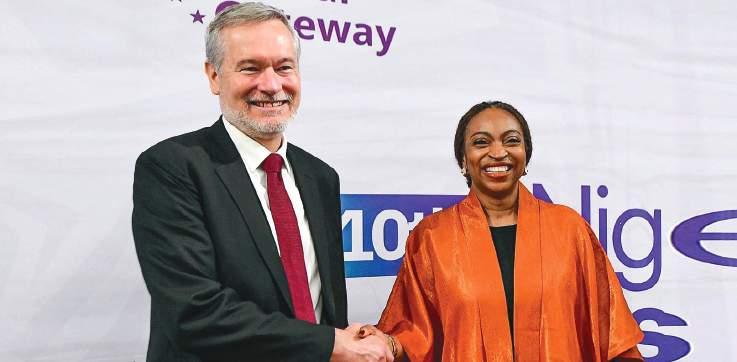
10TH NIGERIA–EU BUSINESS FORUM IN LAGOS...
European Union Ambassador to Nigeria and ECOWAS, Ambassador Gautier Mignot (left) with Honourable Minister of Industry, Trade and Investment, Dr. Jumoke Oduwole, during the 10th Nigeria–EU Business Forum in Lagos... recently
FG Plans Phaseout of JSS, SSS Structure Amid
20m Out-of-school Children
Crisis
Alausa inaugurates national laureate c’ttee, unveils N365m research prize Initiative designed to elevate academic excellence
Emmanuel Addeh and Kuni Tyessi in Abuja
The federal government yesterday announced plans to end the separation of Junior Secondary Schools (JSS) from Senior Secondary Schools (SSS) as part of sweeping reforms aimed at tackling Nigeria’s growing out-of-school children crisis, revealing that more than 20 million pupils who enrolled in primary schools failed to transition to senior secondary education.
Also, the federal government has inaugurated the Tertiary Institutions National Laureate Committee, a development education stakeholders have described as one of Nigeria’s most ambitious attempts to reposition scholarship, innovation and research as national priorities.
Minister of Education, Dr Tunji Alausa, spoke about government’s plan to restructure the JSS and SSS education system in Abuja while inaugurating the Universal Basic Education Commission (UBEC) Ministerial Implementation and Monitoring Committee.
Alausa said the current education structure, which separates junior and
senior secondary schools, had failed to ensure a seamless transition for learners and had significantly contributed to the country’s high school dropout rate.
According to him, government data showed that while Nigeria has about 80,000 public primary schools, there are only about 15,000 junior secondary schools, creating a major gap in the transition from primary to secondary education.
“Where do the children go after primary school? We have 80,000 primary schools but only 15,000 junior secondary schools. Where are those students?” he asked.
He added that the policy had resulted
in overcrowded junior secondary schools while many senior secondary schools remained underutilised.
“We have overflowing junior secondary schools and empty senior secondary schools. I can objectively report today that this disarticulation policy has failed. We will phase it out. We cannot continue creating administrative positions while damaging our education system. It is about doing what is best for every Nigerian child,” the minister said.
Alausa acknowledged that previous administrations had not adequately addressed the challenge but expressed confidence that the current government would reverse the trend.
“The previous governments may have failed in this regard, but this government will not fail. We are fixing this. We need to create more opportunities for children to move seamlessly through the education system,” he said. He added that the proposal to abolish the policy would be presented at the next meeting of the National Council on Education for consideration and possible adoption.
Meanwhile, the federal government has inaugurated the Tertiary Institutions National Laureate Committee, a development education stakeholders have described as one of Nigeria’s most ambitious attempts to reposition
scholarship, innovation and research as national priorities.
The Committee will set in motion a new annual award programme that will reward outstanding undergraduate, master’s and doctoral research with prizes valued at approximately N365 million.
The Committee was inaugurated by the Minister of Education, Alausa, at the Digital Resource Centre of the Universal Basic Education Commission (UBEC) and will oversee the implementation of the programme.
The initiative is a flagship designed to elevate academic excellence to the highest level of national recognition while promoting research commercialisa-
FG Launches Flood Protection Pilot for 100,000 Riverine
in 4 High-Risk
The Federal Government has reaffirmed its commitment to reducing the risk of flooding through its Disaster Risk Reduction strategy, following a review of the 2026 Annual Flood Outlook.
tion and innovation across Nigeria’s accredited post-secondary and tertiary institutions.
Speaking at the inauguration, Alausa said the programme represented a deliberate effort by the federal government to reshape the country’s reward system.
According to him, it will place scholarly achievement, scientific discovery and innovation alongside other nationally celebrated accomplishments.
The minister said the initiative seeks to inspire a new generation of young Nigerians to pursue research capable of solving real-world problems, creating new industries and strengthening the nation’s global competitiveness.
Households
States, as NEMA Partners PULA Advisors
The Director-General of the National Emergency Management Agency, NEMA, Mrs. Zubaida Umar Abubakar, disclosed this on Tuesday in Abuja during a two-day Technical Workshop on
the Riverine Household Flood Protection Pilot Exercise.
The initiative is a partnership between NEMA and PULA Advisors. It will see 100,000 households benefit from the
EFCC Witness: Alleged Fraudster Reneged on $1.5 Million Deal with Adebutu’s Firm
Wale Igbintade
A Lagos State Special Offences Court sitting in Ikeja yesterday heard that an alleged fraudster, Ifoma Immanuel, and his company, Intermediate Investment Holdings Limited, failed to comply with the terms of an agreement reached with businessman Adebisi Adebutu and his company, R28 Holdings Limited, after receiving a $1.5 million investment.
The evidence was presented before Justice Mojisola Dada during the ongoing trial of Immanuel and his company, who are being prosecuted by the Economic and Financial Crimes Commission (EFCC) on a two-count charge of obtaining money by false pretence and forgery involving the sum of $1.5 million.
The defendants were arraigned on March 11, 2026, and pleaded not guilty to the charges.
According to the EFCC, the defendants induced Adebutu and R28 Holdings Limited to invest $1.5 million by representing that the funds would finance projects involving Chappal Petroleum Development Company Limited, Intermediate Investment Holdings Limited and Chappal Energies Mauritius Limited. The anti-graft agency alleged that the investment was secured with assurances that the funds would be
reimbursed, a development capital fee of $2.25 million would be paid, and R28 Holdings Limited would receive a 22.41 per cent equity stake in Intermediate Investment Holdings Limited.
Testifying as the fourth prosecution witness (PW4), Sheriff Oluwo told the court that in 2022, Immanuel approached him to help source investors for what was presented as a foreign oil investment opportunity.
pilot phase in Anambra, Benue, Kebbi, and Kogi states all listed among the high-risk and most vulnerable states.
“This initiative also reflects the federal government’s commitment to strengthening Disaster Risk Reduction and NEMA’s strategic plan 2026-2029 also put priorities on early warning and disaster risk financing.
“The 2026 Annual Flood Outlook again lists about 23 states at high risk of flooding, and the four pilot are in the list of high risk and most vulnerable.
“This reality further demands we move beyond responding to disaster after they occur. We must embrace innovative approaches that anticipate risk, reduce vulnerabilities, and provide timely financial protection for those most at risk,” Abubakar stated.
Speaking on behalf of PULA Advisors, Country Director, Dr.
Mike Enahoro commended the initiative.
“We know the Nigerian government has been on the forefront in mitigating the effects of flood and flooding especially people who live in most vulnerable place. We are at PULA thought how we can partner the federal government, and through NEMA who have been ensuring that we become proactive rather than being reactionary.”
Appreciating NEMA’s leadership, Dr. Enahoro noted that “NEMA leadership has been talking with PULA Advisors in finding a lasting solution and reducing the impact on people vulnerable to floodings.”
Also speaking, the Anambra State Commissioner for Agriculture, Dr. Benjamin Chucks, said the people of the state, who are among the worst hit by flood disasters, would welcome the development.
disCUssiNG PayMENT sECURiTy…
L-R: Executive Director, Business Development, Nigeria Interbank Settlement System (NIBSS) Plc, Ngover Ihyembe-Nwankwo; Managing Director, NIBSS, Premier Oiwoh; Chairman, Committee of e-Business Industry Heads (CeBIH)/Chief Partnership Officer, Wema Bank Plc, Ajibade Laolu-Adewale, and Vice Chairman, CeBIH/ Head e-Business, Premium Trust Bank, Abidemi Asunmo, during a courtesy visit to NIBSS on payment security in Lagos… recently
ADC Youths Protest in Abuja, Demand Removal of Judge over Deregistration Ruling
Chuks Okocha in abuja
Hundreds of youths of the African Democratic Congress (ADC) yesterday staged a protest in Abuja, demanding the removal of a Federal High Court Judge, Justice Peter Odo Lifu, over a ruling ordering the Independent National Electoral Commission (INEC) to deregister the party and four others.
The protesters, led by the ADC National Youth Leader, Hon. Balarabe Rufai, marched
from the party’s national secretariat in Wuse 2 to the Federal High Court in Maitama, chanting, “Justice Lifu must go.”
They carried placards with inscriptions such as ‘Judiciary is not for sale’. ‘Save our democracy now. Don’t force Nigerians into chaos. ’ And ‘No to one-party state’.
The demonstrators insisted that the ADC must remain on the ballot ahead of the 2027 general election and vowed to continue their protest until the Judge is removed.
MACI Flays Return of Gridlock in Lagos Port Corridor
A group, the Media AntiCorruption Initiatives (MACI), has flayed the gradual return of gridlock in Nigeria’s commercial nerve centre, especially on the roads leading to the nation’s seaports in Apapa, Lagos.
MACI, which is known for its advocacy in the maritime sector of the economy, in a statement issued and signed by its Chairman, Captain Adamu MsheIia, and made available to THISDAY yesterday, expressed dismay that articulated trucks and other vehicles have taken over the entire space, making it difficult for the prompt clearance of goods in the seaports.
The non-governmental organisation (NGO) observed that from Coconut Bus Stop on the Apapa-Oshodi expressway and from Constain Bus Stop on the Ijora Causeway, vehicles, especially tankers, are parked indiscriminately on the port corridor.
According to him, “The situation is not different in other entry and exit points into the port city.
“To say the least, the poor traffic situation in the port corridor in recent times has resulted in the loss of valuable man-hours and added to the cost of doing business in the country and the astronomical prices of commodities in the market.
itel Opens 16 One-Stop Stores in Lagos
segun James
As part of efforts to ensure effective quality delivery of products to customers in Lagos, Itel, the Chinese phone and other digital product manufacturer, has opened 16 new service stores in Lagos.
The stores, known as itelHome, becomes Nigeria’s largest one-stop digital home appliance retail chain centre in the country.
Speaking at the simultaneous opening of the stores in Lagos, itel’s Projects Operation Manager, itel, Ms Janet Ayegba, said that the itelHome will manage, besides
smart phones, a chain of smart home appliance brand.
According to Ayegba, with the simultaneous opening of the new stores, the total number of itelHome stores in Nigeria has reached 112, thereby becoming the largest one-stop digital home appliance retail chain brand in Nigeria.
Speaking on behalf of all ItelHome owners, the Managing Director of Ololo Communication, Mr Bernard Amari, said that Itel products have been the most reliable, hence he was dealing strictly on Itel products before becoming an ItelHome owners.
“No ADC, no election,” the protesters chanted.
Speaking with journalists during the protest, Rufai called on former Presidents Olusegun
Obasanjo, Ibrahim Babangida, Goodluck Jonathan and former Head of State, Abdulsalami Abubakar, to intervene, alleging that the country is being pushed
towards a one-party state.
“With the way our judiciary is going in the hands of people like Justice Lifu, Nigerians will lose hope. And when people
lose hope in the judiciary, there will be hopelessness. We are Nigerian youths. This is our country, and we do not want chaos,” he said.
Edo Queries AAU VC over Students’ Failure to Access NELFUND
Felix Omoh-asuninBeninCity
The Vice Chancellor of Ambrose Alli University (AAU), Ekpoma, Edo State, Professor Eunice Omonzejie, was issued a query over the failure of students of the university to access the Nigerian Education Loan Fund (NELFUND).
The query addressed to the vice chancellor by the state Ministry of Education, and dated June 24, 2026, was signed by
A group of serving senators, serving members of the House of Representatives and governorship aspirants of the All Progressives Congress (APC) from Kwara State,has appealed to President Bola Tinubu to urgently intervene in what they described as a deepening crisis threatening the future of the party in the state.
In a joint resolution issued,
P. O. Omionawele, on behalf of the Permanent Secretary of the ministry.
The letter titled ‘Implementation of the Nigerian Education Loan Fund (NELFUND)’ expressed worry that records available to the ministry showed that in the 2025/2026 academic session, no student from the school had benefited from the N242 billion disbursed so far by the Federal Government of Nigeria
the party stakeholders expressed unwavering loyalty to President Tinubu and pledged their full support for his re-election bid in 2027, while commending his administration for what they described as unprecedented economic stability and the solid foundation laid through the Renewed Hope Agenda.
The stakeholders, however,
for the NELFUND programme.
The ministry, which urged the vice chancellor to treat the letter with the urgency it deserves, said her response is expected to reach the ministry on or before July 10, 2026.
The permanent secretary said the vice chancellor’s meeting the stipulated deadline date would enable the ministry to revert and adequately brief the state Governor, Monday Okpebholo.
“I am directed to refer to the
warned that despite the progress at the national level, the APC in Kwara State was facing internal challenges that could undermine its electoral fortunes if left unresolved.
According to the resolution, the political coalition that gave birth to the “Otoge” movement, which ended decades of political dominance in the state, has allegedly been weakened
above subject and to express the ministry’s displeasure over the implementation of NELFUND in your university.
“For clarity, as of the 2025/2026 academic session, available records show that no student from your university has benefited from the over Two Hundred and Forty-Two Billion (N242,000,000,000,00) Naira disbursed so far by the Federal Government of Nigeria for the NELFUND programme.
under the administration of Governor AbdulRahman AbdulRazaq.
The group accused the governor of failing to provide inclusive leadership, alleging that many party leaders, loyalists and stakeholders who contributed to the party’s electoral success had been sidelined from both government and party affairs.
ZLP Unveils Professor as FCT Senatorial Candidate, Targets Tax Reliefs
sunday aborisade in abuja
The Zenith Labour Party (ZLP) yesterday unveiled former All Progressives Congress (APC) chieftain and academic, Professor Festus Uwakhemen Asikhia, as its candidate for the Federal Capital Territory (FCT) Senatorial seat for the 2027 general election. The candidate pledged to
pursue legislative reforms aimed at improving gover-nance, eliminating multiple taxation, and strengthening democratic institutions in the nation’s capital.
At the unveiling ceremony in Abuja, the party’s National Chairman, Dan Nwanyanwu, expressed confidence in Asikhia’s candidacy, describing him as a politician with integrity
and the capacity to effectively represent FCT residents in the National Assembly.
Nwanyanwu said the ZLP had remained stable because of its adherence to internal democracy, constitutional provisions and the rule of law, adding that the party was prepared to offer Nigerians a credible alternative in the
2027 elections.
He said Asikhia’s emergence reflects the party’s commitment to presenting candidates with the competence and character required for public office.
“He is an honourable man. He has character, integrity, and content. He is somebody we can trust,” Nwanyanwu said.
EDC, AGRA, KBS, SMEDAN Graduate Agric-Business Devt Service Providers
The Enterprise Development Centre, Pan-Atlantic University, in partnership with the Alliance for Green Revolution in Africa (AGRA), Kaduna Business School, and the Small and Medium Enterprises Development Agency of Nigeria, has graduated the first cohort of 100 certified Agric-
Business Development Service Providers (Ag-BDSPs).
The graduation ceremony, held at the EDC building in Lagos, marked a significant milestone in strengthening Nigeria’s agricultural enterprise ecosystem.
The inaugural cohort received certificates after completing an
intensive training programme designed to equip them with specialised skills, tools, and practical approaches to support small and medium-sized agribusinesses across Nigeria.
Speaking at the event, Director at the EDC, Pan-Atlantic University, Dr. Nneka Okekearu, highlighted the importance of developing specialised advisory capacity for the agricultural sector. According to her, agribusinesses require tailored support because the sector has unique characteristics and challenges that differ from those of other industries.
sunday Okobi
10TH EDITION OF TOLARAM SCIENCE CHALLENGE CUP...
L-R: Deputy Director, Schools Support Unit, Education District 3, Ikoyi, Lagos, Olubunmi Ajibola-Morebise; Director, Zone Development, Lagos Free Zone, Binay Saraf; Team Captain, Iwerekun Community Senior High School, Lakowe, Fawaz Alayo; Director and Chief Sustainability Officer, Lagos Free Zone, Vishal Shah, and Visioneer, Tolaram Science Challenge, Olakunle Fadumiye, during the 10th edition of Tolaram Science Challenge held in Ibeju Lekki, Lagos at the weekend
Global Air Passenger Demand Fell
2.2% in May Due to Middle East Crisis
African airlines records 8.9% increase
The International Air Transport Association (IATA) has released data for May 2026 global passenger demand indicating that total demand was down 2.2 percent compared to the same period last year.
But despite the global fall in passenger demand, African airlines saw an 8.9% year-on-year increase
in demand, as capacity was up 8.3 percent year-on-year and the load factor was 73.4 percent (+0.4 ppt compared to May 2025).
The global body revealed that total demand, measured in revenue passenger kilometers (RPK) was down, adding that excluding the Middle East, demand grew by 0.7 percent in other parts of the world and the total capacity, measured in available
seat kilometers (ASK), decreased 2.3 percent year-on-year. The load factor was 83.5 percent (+0.1 ppt compared to May 2025), a record high for May.
The major cause for the fall was the crisis in the Middle East which disrupted both domestic and international flights.
IATA also stated that international passenger demand fell by 1.6 percent compared to May 2025, but Excluding
the Middle East, demand grew by 3.1 percent and capacity was down 2.4 percent year-on-year, and the load factor was 83.7 percent (+0.7 ppt compared to May 2025).
Domestic demand contrasted globally to 3.1 percent compared to May 2025. Capacity decreased 2.1 percent year-on-year. The load factor was 83 percent (-0.8 ppt compared to May 2025).
SGF Seeks Greater Collaboration among Oversight Institutions on Fiscal Governance
The Secretary to the Government of the Federation, Senator George Akume has urged stronger collaboration among fiscal and oversight institutions to deepen transparency, accountability and prudent public financial management in line with the Renewed Hope Agenda.
He made the call yesterday in Abuja, while receiving the management of the Fiscal Responsibility Commission (FRC) led by its Ag. Executive Chairman and Chief Executive Officer, Charles Chukwuemeka Abana.
The SGF emphasised the need for stronger institutional collaboration between the Commission and key
government agencies, including the Federal Ministry of Finance, the Budget Office of the Federation, the Office of the Accountant-General of the Federation, the Debt Management Office and other oversight institutions to eliminate duplication of responsibilities and strengthen fiscal governance.
“I want to urge deeper collaboration with the Federal Ministry of Finance, Budget Office of the Federation, Office of the Accountant General and the Federal Debt Management Office, the General for the Federation and other oversight institutions to eliminate duplication and strengthen fiscal governance,” Akume said.
The SGF lauded the Commission for its strategic role in safeguarding
fiscal discipline and promoting transparency and accountability in the management of public finances, saying it is a critical pillar in Nigeria’s fiscal governance architecture.
He described fiscal responsibility as a fundamental ingredient that sustains macroeconomic stability, boosts investor confidence, ensures debt sustainability as well as promotes the efficient utilisation of public resources across all tiers of government.
Speaking earlier, Abana stated that the Commission’s renewed focus was geared towards improving transparency in revenue reporting, ensuring timely remittance of operating surplus into the Consolidated Revenue Fund, and eliminating
Affordable Home Ownership for Soldiers Gets Major Boost as COAS Inaugurates New Estate in Lagos
Yemi Kosoko in Jos
The Nigerian Army on Tuesday commissioned another tranche of housing units under the Affordable Home Ownership Option for All Soldiers (AHOOAS) scheme, marking a significant expansion of the welfare-driven initiative aimed at guaranteeing dignified post-service living for personnel.
The commissioning ceremony, held in Jos, Plateau State, was attended by top military leaders, government officials and beneficiaries.
Speaking at the event, the Chief of Army Staff (COAS), Lieutenant General W. Shaibu, described the project as “a significant milestone in our effort to improve the welfare of Nigerian Army personnel and create a future in which every soldier can look forward to a secure and dignified life after service.”
He emphasized that welfare remains a core pillar of his command philosophy, noting that the Army can only fulfill its constitutional responsibilities when its personnel are “well motivated, properly equipped,
and adequately cared for.”
General Shaibu highlighted the rapid progress of the AHOOAS scheme since he assumed office on 30 October 2025. According to him, the Army has commissioned 60 units in Ibadan, 80 units in Jos, completed 40 units in Benin, and finished 120 units in Abuja awaiting commissioning.
He reaffirmed that 5 percent of all housing units are reserved for soldiers wounded in action, describing it as a moral obligation to honour those who have “borne the physical scars of service.”
revenue leakages and wastage across public institutions.
Abana stressed that the Commission recorded approximately N1.84 trillion in monitored independent revenue as at September 2025 through enhanced monitoring of operating surplus from GovernmentOwned Enterprises (GOEs) and independent revenue generated by Ministries Departments and Agencies (MDAs). He added that the commission was also targeting N2.5 trillion in independent revenue for 2026.
“Air passenger demand was down 2.2 percent year-on-year in May on the impact of war in the Middle East. The decline was cantered on carriers in the Middle East with a 28.4 percent year-on-year fall.
“That’s a significant improvement on the 46.6 percent decline recorded for April, a sign of the region’s resilience. Notably, we also saw year-on-year contractions in demand in both North America and Asia, largely related to domestic market conditions in the US and China.
“Overall, May demand still appeared to be largely resilient in the face of high fuel prices and air fares. While the recent sharp drop in oil prices is an encouraging development, the challenges created by the war will likely persist for some time.
“Oil supply through the Strait of Hormuz remains uncertain and it is likely to take time before the benefit of lower oil prices is reflected in ‘normalized’ jet fuel pricing. In the meantime, airlines who are operating on a two percent margin will have little choice but to continue testing demand resilience with higher fares that attempt to cover elevated fuel costs,” IATA’s Director General, Willie Walsh said.
Reports indicate that the Middle East aviation market contributes approximately six percent to 10 percent of global international air
travel.
The region accounts for about six percent of total worldwide scheduled passenger capacity, but its share of international traffic (Available Seat Kilometers) sits higher at roughly 10% because carriers operate larger aircraft on significantly longer routes IATA stated that international RPK fell 1.6 percent, with capacity falling 2.4 percent.
The pace of decline reduced compared to April and many regions hit record load factors for May, with only the Middle East posting a load factor decline.
However, Asia-Pacific airlines achieved a 1.3 percent year-on-year increase in demand, as capacity decreased 1.1 percent year-on-year, and the load factor was 85.3 percent (+2.0 ppt compared to May 2025). In Vietnam, tighter limits on jet fuel imports led to significant capacity cuts on short haul routes, resulting in a decline in intra-Asia international traffic during the month.
“European carriers saw a 3.8 percent year-on-year increase in demand as capacity increased 2.3 percent year-on-year, and the load factor was 85.4 percent (+1.2 ppt compared to May 2025). Of note is the 15 percent increase in direct traffic to Asia, reflecting a continued shift to direct services between the two regions.
Candidate: APC is one big family, we’ll work as a team
The leadership of the Kwara State All Progressive Congress (APC) on Tuesday presented the party’s nomination form to its gubernatorial candidate and Speaker, Kwara House of Assembly, Rt. Hon. Yakubu Salihu Danladi.
Speaking during the presentation ceremony in Ilorin, Chairman of the party, Prince Sunday Fagbemi, said it was imperative for his executive organ to present the winner the nomination form to fill and submit to the INEC, following the ratification of his victory at the primaries by the APC National Headquarters.
“Before now, we have conducted the primaries. There have been winners
for the House of Assembly, House of Representatives, the Senate and the governorship, but the national headquarters of our party said we should not announce,” he said.
“The National Working Committee of our party has gone through all the processes, especially those that have complaints. People who had complaints have ventilated their complaints to the Appeal Committee who have equally gone through them.
“So, NWC has come out with the candidates. And It is now our duty to give them the forms to fill so that they will be uploaded to the INEC portal. This is what we have done in the office.
“The one that we are unveiling here today is that of the gubernatorial candidate, who is Rt. Hon Yakubu Salihu Danladi. So, on behalf of the national chairman of our party, I am handing this form over to our candidate.”
The presentation attracted wild applause from party elders, stakeholders, lawmakers, cabinet members, and thousands of supporters.
Rt. Hon. Danladi, in his remarks, thanked President Bola Ahmed Tinubu, Governor AbdulRahman AbdulRazaq, and the leadership of the party both at the national and state level for their support and trust to fly the flag of the party in the 2027 general elections.
Olawale Ajimotokan in Abuja
Chinedu Eze
COURTESY VISIT TO THE NIGERIAN ENGINEERING OLYMPIAD BOOT CAMP...
L-R: Country Director, Enactus Nigeria, Michael Ajayi; Lead Local Content Development, FIRST Exploration and Petroleum Development Company (FIRST E&P), Omorinsola Aweda; Deputy General Manager, Supply Chain Management, FIRST E&P, Gboyega Akintobi; Head, Corporate Communications, FIRST E&P, Tomiwa Akande-Ayeni, and Head, Human Capital Development, Renaissance Africa Energy Company, Olabanji Abisiga, during a courtesy visit to the Nigerian Engineering Olympiad finalists boot camp by the Olympiad sponsor companies in Lagos… Friday
Saraki: Why Foreign Aid Can’t Solve Africa’s $170 Billion Infrastructure Funding Gap
Says US retreat from international development chance for continent’s renewal Decries wholesale export of raw materials from Africa Wants governments to implement AfCFTA with greater urgency
Former President of the Senate, Dr. Bukola Saraki, yesterday declared that foreign development assistance can never bridge Africa’s estimated annual infrastructure financing gap of between $130 billion and $170 billion, arguing that the continent must fundamentally rethink its development model by prioritising domestic resource mobilisation, industrialisation and stronger institutions.
Speaking during a panel session at the Global Strategic Advisory Group (GSAG) meeting held at Villa La Collina, Lake Como, Italy, Saraki maintained that the ongoing withdrawal of the United States from international development assistance, though painful in the short term, should be viewed as an opportunity for Africa to redefine its relationship with development partners and pursue greater self- reliance.
Addressing the panel on: “Development Policies—With- drawal of the U.S. from International Development: Opportunities and Challenges,” the former Kwara governor argued that the world was witnessing one of the most significant shifts in the global development architecture since
Tinubu
the end of the Cold War.
According to him, the reduction in American development assistance, restructuring of USAID programmes and Washington’s increasing focus on domestic priorities represent more than a temporary adjustment, but a structural transformation that requires countries, particularly in Africa, to rethink the future of international development cooperation.
Saraki acknowledged that the humanitarian implications of the shift were substantial, citing projec- tions that millions of additional HIV infections could occur if funding gaps remained unaddressed, while noting that developing countries were already facing significant financing shortfalls arising from recent cuts in American assistance.
He pointed out that health supply chains, emergency nutrition programmes and support for civil society organisations had already suffered disruptions following the withdrawal of funding.
However, Saraki argued that concentrating solely on replacing lost donor funding would amount to missing the larger opportunity presented by the changing global order.
Instead, he said Africa should seize the moment to build a
Pays
development framework that is more sustainable, equitable and strategically aligned with the continent’s long-term interests.
According to him, Africa’s challenge is not merely to replace one source of dependence with another, but to fundamentally redefine development cooperation through genuine partnerships, stronger governance and investments in future generations.
“I have witnessed both the transformative impact that development cooperation can achieve and the structural limitations that have too often constrained its effectiveness.
From that perspective, I believe the current moment should not be viewed as a threat to the development enterprise.
“Rather, it represents its great-
est opportunity for renewal. My central argument today is simple: Africa must seize this moment not to replace one dependency with another, but to redefine development cooperation altogether,” he pointed out.
Tracing the roots of Africa’s persistent development challenges, Saraki said that more than six decades after political independence, many African economies still largely reflected colonial structures centred on the export of raw materials while importing expensive finished products.
He argued that donor priorities had often shaped Africa’s development agenda, sometimes at the expense of the continent’s actual needs.
Drawing from his experience as
Senate President, Saraki recalled that efforts to subject foreign borrowing to greater legislative scrutiny often met stiff resistance because many governments viewed external loans as easy options without paying sufficient attention to repayment obligations and long-term developmental impact.
He further contended that many donor-supported programmes primarily created jobs and markets for donor countries instead of helping African economies build sustainable productive capacity.
The former governor of Kwara State identified what he described as three major structural weaknesses in the traditional development assistance model.
First, he noted that aid volumes had always been far below Africa’s
actual financing requirements, stressing that while the continent’s annual infrastructure financing deficit stood between $130 billion and $170 billion, total official development assistance to Africa from all sources amounted to only about $34 billion in recent years.
He argued that development assistance was designed to comple- ment domestic resource mobilisation and private investment, warning that treating aid as a substitute inevitably created dependency instead of development.
Secondly, Saraki criticised the short duration of most donor-funded projects, saying institution-building required decades of sustained investment rather than the typical three-to-five-year project cycles adopted by development agencies.
Lagos Sues for Calm after Flash Floods, Sanwo-Olu Approves Immediate Dredging
Lagos State Government appealed for calm and understanding from residents following the massive flash flooding experienced in many parts of the state over the last two weeks.
In the aftermath of the floods,
Governor Babajide Sanwo-Olu approved immediate dredging maintenance of 28 additional primary channels across the state.
Speaking against the backdrop of the heavy downpours that
Tribute to Veteran Journalist and Long-standing Ally, Tunji Bello, at 65
Describes him as an invaluable and dependable friend
Deji Elumoye in Abuja
President Bola Tinubu has paid glowing tribute to veteran journalist, friend, and age-old ally in the progressive movement, Tunji Bello, as he clocks 65 on July 1.
Tinubu described the celebrant as an invaluable and dependable friend, and one of the most accomplished and tested top public servants of his generation in the Centre of Excellence.
In an 11-paragraph tribute issued on Tuesday, the president stated, “I rejoice with Tunji Bello, as my dependable friend, brother and long-standing ally
in the progressive movement, attains 65 on July 1.
“Tunji and I were engaged in the progressive struggle for more than three decades.
“In Nigeria’s struggle for democracy through the 90s, the era of military dictatorship, to the present time of civil rule, only a few people truly compare to Tunji in terms of his unflinching fidelity to progressive ideals — whether as a fearless journalist with a moral conscience standing up to brutal military juntas, or as a stellar public servant committed to diligence and excellence.”
Tinube added, “As his sterling record clearly illustrates, first as editor of reputable national dailies, later as a Lagos State cabinet member, and most recently as the CEO of the Federal Competition and Consumer Protection Commission, Tunji is a shining example of what is possible when competence meets creativity and character.
“In 2003, when we were confronted with the seemingly intractable challenge of waste management in Lagos State, I, as Governor, pulled him out of his editorial turf to join the Lagos cabinet to help drive the reforms we had outlined.”
He stressed, “True to his reputation, Tunji performed a miracle in a record time, so much so that successive governors found him indispensable and retained him either as Environment Commissioner to consolidate the gains in waste management in Africa’s most populous city or as the Secretary to the State Government (SSG) to help enrich the broader governance framework with great ideas.
‘Tunji brings to the table a unique versatility rooted in diverse competencies spanning political science, law, administration, and strategic communication.”
caused the flash flooding in many communities, Commissioner for Environment and Water Resources, Mr. Tokunbo Wahab, said the rains were an extreme weather event that produced an unusually high volume of water within a short period.
Wahab said the situation had overwhelmed the drainage channels in some locations, resulting in temporary flooding across parts of Victoria Island, Lekki, Ikeja, Gbagada, Mushin, Mafoluku, and other areas.
The commissioner said the incident was not peculiar to Lagos, as similar heavy showers also affected other African countries, even in North America, on the same day, resulting in flooding across cities.
He stated that while Lagos and the other cities had coastal and hydraulic characteristics, Lagos presented a much more complex hydrological system due to its extensive network of lagoons, tidal water bodies, rivers and creeks, as well as significantly higher rainfall intensity.
He explained that the interaction between the Atlantic Ocean, Lagos Lagoon, and numerous rivers and creeks, particularly during periods of high tide, naturally slowed the discharge of storm water into the sea, resulting in temporary inundation in some low-lying areas whenever exceptionally heavy rainfall occurred.
Wahab, however, assured residents that the Lagos State government was fully on top of the situation through continuous monitoring of drainage infrastructure, flood-prone locations, and other critical water channels.
He added that emergency response agencies were on ground to ensure that floodwaters receded as quickly as weather conditions permitted, while providing support where necessary.
The commissioner stressed that while the state government continued to invest significantly in drainage construction, channelisation, desilting, and other flood control infrastructure, residents also had an important role to play in reducing the flooding.
Emmanuel Addeh in Abuja
SSocial Justice and Equity Advocates (SOJEA)
WE DEMAND THE TRUTH INVESTIGATE THE PFIPC CONTROVERSY NOW
"Somebod is not telling Nigerians the tr th, and this m st be in es gated immediatel ."
ocial Justice and Equity Advocates (SOJEA) is alarmed at the
brazenness that allowed Prince Adeniyi Adeyemi (also known as Prince Adeniyi Adeyemi Matthew), the self-appointed Director General of the self-created Presidential Economic Advisory C o u n c
( P E A C ) a
Promotion Council (PFIPC).
The national expectation was that Prince Adeyemi would have retraced his steps
unequivocal disclaimer distancing itself from him and his so-called Presidential Foreign Intervention Promotion Council (PFIPC), declaring that no such body exists under the administration of President Bola Ahmed Tinubu.
In an official statement, the Chief of Staff to the President, Rt. Hon. Femi Gbajabiamila, made it abundantly clear that neither his office nor the Federal Gove
purported organisation or the claims surrounding it.
The statement followed growing concerns over the activities of Prince Adeyemi, who has allegedly been presenting himself to the public as having received an official appointment from the Presidency through the PFIPC. Gbajabiamila described these r e p r e s e
, emphasising that the Federal Government had been alerted to attempts to create a false impression of official backing. To the best of our knowledge, the Secretary to the Government of the Federation (SGF) issues appointment letters to Mr President's appointees, which has left us wondering why Prince Adeyemi has not tendered any such letter but has instead relied on word of mouth as proof of his appointment. Prince Adeyemi has also failed to reference any Federal Government Gazette documenting the creation of the entity he claims to head.
We are worried that Prince Adeyemi's persistence on the existence of the non-existent entity, even when the Chief of Staff has categorically affirmed that the Presidential Foreign Intervention Promotion Council has no legal or administrative existence within the current government, is setting Nigerians up to be scammed.
It is surprising that instead of coming clean about the operations of the illegal entity, Prince Adeyemi is using the curious appearance of PFIPC on the 2026 Budget as proof of its recognition by the Federal Government, even when the Presidency has asserted that no appointment has been made in favour of Prince Adeniyi Adeyemi or any individual under such a structure.
Referenced under the code 0111062001 in the 2026 Budget and with a total allocation of N1,302,978,784 (One billion three hundred and two million, nine hundred nd seventy eight thousand seven hundred and eighty four naira), the appearance of the P re s ide ntial E co no mic Adv is o r y Co unci l/ P re s ide ntial Fore ign Intervention Promotion Council on the national budget is of grave concern.
For an entity that the Presidency has disowned to be captured in the Budget strongly suggests that the country is dealing with a rogue deep state that is creating parallel structures to syphon funds and dupe citizens and international partners. PFIPC could
only have been smuggled into the Budget with the active collusion of persons in the Budget Office of the Federation.
In light of the foregoing, SOJEA asks the following key questions: Why is Prince Adeyemi insisting that “the Presidential Foreign Intervention Promotion Council (PFIPC)” exist? Who are the actors behind this plot to illegally foist PFIPC on the Federal Government and Nigerians? Who is behind the claims and representations? Why the desperate attempt to smear senior officials of the Presidency? Who are Prince Adeyemi's associates in the Budget Office of the Federation? How did they smuggle PFIPC into the 2026 Budget?
Our position is that somebody is not telling Nigerians the truth, and this must be investigated immediately.
It is on this note that we demand:
1. That President Bola Ahmed Tinubu (GCFR) urgently orders an i n v e s t i g a t i o n i n t o t h e P r e s i
Council/Presidential Foreign Intervention Promotion Council, with a view to identifying and prosecuting anyone indicted.
2. That President Bola Ahmed Tinubu (GCFR) directs the anti-graft agencies to track and recover all funds illegally drawn by Prince Adeyemi, and anyone acting in collaboration with him, under the guise of administering the Presidential Economic Advisory Council/Presidential Foreign Intervention Promotion Council.
3. The National Assembly must investigate how the appropriation t h a t f u n d e d t
Council/Presidential Foreign Intervention Promotion Council was passed when there is no record of the entity's existence.
4. An investigation to unravel how the Presidential Economic Advisory Council/Presidential Foreign Intervention Promotion Council made it into the 2026 Budget, when there are no records of its existence as a legal Federal Government agency.
We made these demands because of the urgency of unravelling how many other Prince Adeyemis are parading as DirectorsGeneral of phantom entities, just as Nigerians must also know if t h
Council/Presidential Foreign Intervention Promotion Councils sucking the country dry when they do not legally exist.
May God save Nigeria.
Comr.
Obinna
Francis Executive Director
Bango Thomas Secretary
Aiyemowa Richard Director Media and Public Relations
Adamu Musa Member
How Tantita's Pipeline Surveillance Maintains Peace in N'Delta, Buffers Nigeria Against Falling Oil Prices
As Brent crude prices declined by 4.44 per cent to $71.92 per barrel following easing supply concerns over the Strait of Hormuz, Nigeria's sustained increase in crude oil production is helping to cushion the impact on the economy. Amongst other measures, one of the major factor behind the production surge is the restoration of peace and stability across the Niger Delta championed by Tantita Security Services Nigeria Ltd, whose pipeline surveillance operations has helped curb crude oil theft and pipeline vandalism, thus enabling Nigeria to mitigate some of the revenue losses associated with falling global oil prices. Uzoma Mba reports
With Brent crude prices decline by 4.44 per cent to $71.92pb on easing supply concerns over Strait of Hormuz, Nigeria’s high oil production is cushioning the effects on economy. Amongst other measures, the oil production surge is linked to successful operations by the Tantita Security Services Nigeria Ltd, which for years achieved peace and stability in the the Niger Delta region and in turn accelerated oil production, helping Nigeria manage revenue shortfalls from oil prices decline.
In every thriving economy, there is always the urgent need to protect strategic assets. Doing so comes with so many benefits including building stability and confidence that lead to national prosperity. Nigeria’s experience with pipeline surveillance operations in the Niger Delta region has followed this trajectory.
For decades, Nigeria’s oil pipelines operated under persistent attack, exposed to sabotage, vandalism, illegal refining and outright theft. Aside lost revenue, environmental degradation, social instability, and an economy unable to fully benefit from its oil windfalls were the immediate consequences.
That practice persisted until President Bola Ahmed Tinubu appointed Tantita Security Services Nigeria Limited (TSSNL) led by High Chief, Dr. Government Oweizide Ekpemupolo, alias Tompolo, to protect Nigeria’s oil assets in the Niger Delta region.
The appointment was to enable TSSNL, through its security operations, support the national economy in getting the full benefits of oil resources. The TSSNL works in collaboration with other security outfits to achieve its goals of securing oil assets and ensuring peace and stability in the Niger Delta region.
Tantita’s operations had ensured the security of oil pipelines, ensuring the uninterrupted flow of petroleum resources, and ensuring that Nigeria migrated from a position of constant loss management to stability, planning, growth and development.
Impact on oil production output This impact is already of public knowledge: national crude output climbed significantly. Data released by the Nigerian Upstream Petroleum Regulatory Commission (NUPRC) showed Nigeria’s crude oil production topped its OPEC quota in May, reaching its pinnacle in 15 months and cementing its position as Africa’s leading oil producer. The report said the country produced an average of 1.53 million barrels of crude oil per day (bpd) during the month.
With a condensate production of 170,446 bpd included, the commission put Nigeria’s average total hydrocarbon output at 1.7 million bpd. “Nigeria’s oil production witnessed an upswing in May 2026, averaging 1,530,354 barrels of crude oil and 170,446 barrels of condensates per day, bringing the total combined production to 1,700, 800 barrels per day and consolidating Nigeria’s position as Africa’s largest oil producer,” NUPRC said in a statement.
The figure represents 102 per cent of Nigeria’s OPEC production quota of 1.5 million bpd, according to the regulator. The latest performance marks a significant milestone for the country’s oil sector, with total production standing at its peak since last July, when the combined crude oil and condensate output reached 1.71 million bpd. With the figure for condensates excluded, the 1.53 million bpd in May represents
Nigeria’s strongest performance since January 2025, when output touched 1.538 million bpd. The May figure also represents a 15-month high for crude oil production, excluding condensates.
An economist and policy analyst, Dr. Muda Yusuf, explained that while a price drop in crude oil will naturally translate to a reduction in the pump prices of petrol, diesel, Jet A1 and gas, on the flip side, it portends a drop in revenue for the federal government.
Yusuf said, while security interventions have helped improve production levels compared to previous years, Nigeria still faces significant challenges in attracting the scale of investment required to sustain higher output levels.
Other analysts noted that while government reforms under the Petroleum Industry Act (PIA) have improved the fiscal environment for investors, sustainable production growth require more domestic and foreign investment into the sector.
Michael Otu, an oil magnet based in Abuja, said: “To sell more crude oil requires additional production. The capacity to produce more depends on several factors including fiscal regime, which is much better now than it used to be. The second is investment in the sector”.
Out said that raising crude oil output requires significant capital expenditure and long-term planning by operators, adding that higher oil prices alone do not automatically translate into increased production.
“The PIA policy was to incentivise production. A lot of the amendments made through executive orders were also designed to boost investment and drive output.,” he stated.
The Nigerian Upstream Petroleum Regulatory Commission attributed much of this gain to reduced pipeline
vandalism and improved asset protection. This production recovery has direct fiscal implications: each additional 100,000 barrels per day translates to approximately $2.5-3 billion in annual export revenue at current pricing, funds that flow directly into national development budgets.
In a published report, President General, Niger Delta Progressive Alliance, Nse Victor Udoh, said pipeline protection enabled national institutions to progress from reactive crisis management to strategic foresight, from temporary containment to durable systems-building, and from uncertainty-driven decisions to calculated national ambition.
“It is important to clarify the role of pipeline surveillance within the wider energy landscape. Energy security encompasses the full value chain, from exploration and production to refining, distribution, pricing policy, and subsidy frameworks. Pipeline surveillance does not manage these domains,” he said.
He added: “Its mandate is precise: safeguarding critical infrastructure that transports petroleum resources. Yet this single function has proven foundational. Without secure transportation channels, production targets falter, refining plans collapse, exports decline, and fiscal projections become unreliable.”
Continuing, he wrote: “Asset protection, in this context, is not a supporting activity. It is a precondition for economic order. In effect, the pipeline is the hinge on which the entire petroleum value chain turns. When that hinge is weak, every other link in the chain carries strain. When it is secure, the entire system gains coherence.”
The immediate impact has been operational. Sustained monitoring and rapid response systems have sharply reduced pipeline breaches and illegal tapping. Receipt rates have climbed toward full recovery, with national output rising to levels not seen in recent memory. This redirection has restored Nigeria’s credibility in international
oil markets, allowing Nigeria to reclaim market share lost to Angola and Libya.
“Economic stability follows predictability. When crude flows are secure, refineries can plan feedstock intake with assurance. Export commitments can be met without fear of sudden shortfalls. Gas-to-power projects can operate without recurrent shutdown risks”.
"Investors can assess Nigeria’s petroleum sector with clearer risk profiles. Surveillance therefore does more than stop theft. It reintroduces reliability into national energy planning. And reliability is the bedrock upon which sustainable economic growth is built. With predictable flows, national budgeting becomes more credible, infrastructure planning becomes more precise, and long-term contracts become easier to negotiate. Predictability is the silent currency of modern economies, and pipeline surveillance has begun restoring it,” he stated.
Further benefits extend into public finance. Higher accounted-for production translates directly into increased export revenues, improved foreign exchange inflows, and strengthened fiscal capacity. National oil company performance in recent years illustrates this shift toward profitability and efficiency, driven in part by reduced losses and enhanced operational continuity. As revenues stabilise, government budgeting gains credibility.
Development planning becomes less speculative. The national economy gains breathing space to invest in infrastructure, social services, and diversification. This breathing space matters. It allows policy makers to think beyond survival and begin shaping structural reforms, industrial expansion, and long-term social investment. It also reduces dependence on emergency borrowing and short-term fiscal patchwork. Asset protection has also produced environmental and social dividends, particularly in the Niger Delta. Illegal refining and pipeline sabotage once left waterways polluted, farmlands infertile, and communities trapped in cycles of hazard and insecurity.
With sustained surveillance operations dismantling illegal sites and preventing repeated breaches, ecological recovery has begun. What other stakeholders are saying Chairman of the House Committee on Host Communities, Dekor Dumnamene Robinson had said the contributions of Tantita and its leadership to national security deserve appreciation.
Also, in one of the strongest endorsements yet of the firm’s operations, lawmakers under the Joint Committee of the House of Representatives on Host Communities and Public Petitions and other stakeholders also commended Tantita for what they described as effective and patriotic service in safeguarding Nigeria’s critical oil infrastructure.
“Tantita Security Services Nigeria Limited, in partnership with NNPCL, has rendered demonstrably effective service in the protection of crude oil pipelines and the recovery of national crude oil production,” they stated. The Joint Committee subsequently passed a unanimous vote of confidence on the company and called on the Federal Government and NNPCL to approve a long-term renewal of the surveillance contract to consolidate gains already achieved in the fight against crude oil theft and illegal bunkering.
Dr. Government Oweizide Ekpemupolo, alias Tompolo
ProPerty & environment
Empowering Bayelsa Communities for Climate Resilience: How NCF is Advancing Climate-Smart Agriculture
Bennett Oghifo
Communities in Bayelsa State are increasingly experiencing the realities of climate change, from shifting rainfall patterns to declining soil productivity and pressure on forest ecosystems. In response, the Nigerian Conservation Foundation (NCF), with support from the Ford Foundation, is implementing a targeted intervention to strengthen resilience, improve livelihoods, and promote biodiversity conservation in the support zone of the proposed Edumanon National Park. The initiative will target Idema, Obeduma, and Eboh communities.
The initiative integrates Climate Smart Agriculture (CSA), women-led economic empowerment, youth engagement in forest restoration, and
strengthened community governance systems, creating a holistic model for climate action at the grassroots level.
Mr. Shittu Usman the project officer highlights, “The project is designed to build a strong foundation for community-led climate resilience by combining livelihood support, environmental conservation, and local governance. Through continuous engagement and capacity building, we hope to encourage long-term sustainable practices across the communities.”
Building Climate-Smart Agriculture Capacity At the heart of the intervention is sustainable agriculture. A total of 100 community members, including men, women, and youths, were trained on Climate Smart Agriculture
practices. The training focused on sustainable land preparation, crop diversification, soil fertility management, and climateresilient farming techniques.
To ensure practical application, 1,000 improved plantain suckers were distributed across the three communities. Demonstration farms were also established, serving as local learning hubs where farmers can observe and replicate best practices to improve yields and adapt to climate variability.
Mr. Leslie Odu (CDC Chairman) says, “This programme is helping to deepen awareness within our communities about the importance of conservation and sustainable resource management. The engagement with local leaders is also encouraging stronger community participation in protecting our forests
and Forest Restoration
and mangroves for future generations.”
Women Driving Food Security and Household Income
Recognising the central role of women in food systems and
family nutrition, 40 women were trained in vegetable gardening techniques. The training emphasised small-scale, high-yield production methods, organic manure use, and efficient water management practices. Participants received im-
proved vegetable seeds such as okra, tomato, and pumpkin. This intervention is expected to strengthen household nutrition, enhance food security, and provide an additional source of income for women and their families.
Lafarge Unveils New Corporate Identity, Changes Name to HBM Nigeria
Bennett Oghifo
A new chapter has begun for Lafarge Africa Plc as the company officially unveiled its new corporate identity and name—HBM Nigeria Plc. The transition marks a significant milestone in the company’s transformation journey and strategic alignment with its new shareholder structure.
The change to HBM Nigeria Plc reflects the company’s continued evolution as one of Nigeria’s leading building solutions providers, combining strong local roots with enhanced global industrial collaboration. The company reaffirmed that the name change will not affect its operations, workforce, customers, shareholders, or its unwavering commitment to
Nigeria’s economic growth and infrastructure development. Speaking on the transition, the Group Managing Director/Chief Executive Officer, Lolu Alade-Akinyemi, said the new identity signals a forward-looking phase for the company, driven by operational excellence, innovation, sustainability, and long-term value creation.
“HBM Nigeria Plc represents an exciting new chapter in our journey as a leading building solutions company. While our corporate identity is evolving, our commitment to Nigeria remains unwavering. We remain focused on delivering quality cement, concrete, aggregates, and innovative building solutions that support infrastructure development, housing growth,
Marketsquare at 10: The Making of Nigeria’s
Bennett Oghifo
Ten years ago, the idea seemed ambitious, if not improbable. Nigeria’s retail landscape was dominated by traditional open markets, informal neighbourhood stores, and a handful
of large supermarket operators concentrated in major urban centres. Organised grocery retail was still evolving, and many investors viewed expansion beyond Lagos, Abuja, and Port Harcourt as a risky proposition. Yet in 2015, a new company
made a decision that would challenge conventional thinking about retail growth in Nigeria. Instead of launching in one of the country’s established commercial capitals, Sundry Markets Limited opened its first Marketsquare store in
Plc
and industrialisation. This transition positions us for the future while reinforcing the values of excellence, sustainability, customer satisfaction, and responsible business practices that have defined our legacy for decades,” Alade-Akinyemi said. He explained that the transition to HBM Nigeria Plc will be implemented through a structured, phased process across the company’s nationwide operations. He added that employees, customers, shareholders, investors, host communities, and other stakeholders should expect seamless business continuity, sustained investments across the country, and an even stronger focus on creating long-term economic and social value.
Largest Indigenous Retail Chain
Yenagoa, Bayelsa State. A decade later, that single store has grown into a network of 41 outlets across 19 cities in 15 states, serving more than two million customers every month and employing over 4,000 Nigerians. Today, Marketsquare is widely regarded as Nigeria’s largest indigenous grocery retail chain, a distinction that reflects not only scale but also a story of resilience, vision and disciplined execution.
As the company celebrates its tenth anniversary, its journey offers an important lens through which to examine the evolution of modern retail in Nigeria and the growing capacity of indigenous enterprises to build institutions of national significance.
The Decision That Defined the Journey
Every successful business has a defining moment: a decision that shapes its future trajectory. For Marketsquare, that moment was choosing Yenagoa.
At the time, the decision puzzled many observers. Conventional wisdom suggested that any retail business seeking rapid growth should establish itself first in Nigeria’s largest commercial centres.
Founder and Chief Executive Officer of Sundry Markets Limited, Mr. Ebele Enunwa, remembers the questions clearly. “Many asked, ‘Why Yenagoa?’ My answer was simple - why not? Every community deserves access to quality living.”
The statement captures a philosophy that continues to define the company today. Rather than concentrating exclusively on traditional commercial hubs, Marketsquare
sought to bring modern retail experiences to communities where such offerings were limited or entirely absent. That approach reflected a broader belief that quality retail should not be determined by geography. In many ways, the company’s first decade has validated that conviction.
Identifying a Gap in the Market
When Marketsquare entered the market, Nigeria’s retail sector presented a paradox. The country’s growing population and expanding middle class suggested enormous potential for organised retail. Yet consumers often faced challenges ranging from inconsistent product availability to inadequate shopping environments and limited access to modern grocery stores.
MGE Realty to Deliver 500 Premium Residences in Mainland Lagos
Bennett Oghifo
MGE Realty Limited, the Victoria Island-Lagos based developer of high-end residential communities, has announced its plan to deliver over 500 deluxe residential units across three major new developments on the Lagos Mainland. It is a strategic intervention designed to close the long standing luxury housing deficit in Ikeja GRA and Palmgrove in particular, following a market research conducted in 2024 by Troloppe Property Services Limited.
The initiative comprising 5 Cappa in Palmgrove, Melrose Residences and Melrose Gar-
dens in Ikeja GRA, represents one of the most significant single commitments to the elite Mainland housing by a private developer in recent years and signals a decisive shift in where Lagos’ luxury residential growth story is being written.
In a statement issued by the Company, MGE Realty noted that the 2024 Troloppe Property Services Report drew attention to a structural imbalance in the Lagos residential market: while demand for premium housing on the Mainland particularly in Ikeja GRA remained consistently strong, the supply of new premium develop-
ments in the corridor stayed relatively limited. According to the Report, luxury development capital had for several years tilted overwhelmingly towards Ikoyi,Victoria Island and Lekki, leaving a sophisticated and growing Mainland demographic underserved.
Therefore, the MGE Realty response was deliberate and data-led and according to the General Manager of MGE Realty Limited, Ayokunumi Adebajo,”The Troloppe Report confirmed what our own market intelligence had been telling us that there is a deep, durable demand for world class living on the Mainland that the
market simply hasn’t answered. Executives, professionals and established families in Ikeja GRA and its environs shouldn’t have to cross a bridge to access the standard of living they have earned. We are bringing it to them”.
Conveniently, each of the three projects has been conceived to address a distinct segment of Mainland while upholding a single standard of design, build quality and community living.
The 5 Cappa in Palmgrove consists of boutique top notch residences located in one of the Mainland’s most established neighbourhoods. It is positioned
for professionals and families seeking
L-R: Financial Control Expert, Sterling Oil Limited, Mrs. Uche Onunkwo; CEO, Median Infrastructure Limited, Mr. Olumide Akinsanya; Founder/CEO Sundry Markets Limited, Mr. Ebele Enunwa; Lady Alero Enunwa; Head Audit and Loss Prevention, Sundry Markets Limited, Mr. Chidubem Enunwa, during the 10th anniversary gala of Marketsquare, held in Port Harcourt... recently
proximity to Lagos commercial spine without compromising on quality of life.
Melrose Gardens in Ikeja GRA
Residents of some communities in Bayelsa at the programme... recently
Education
Beyond the Classroom: The Decade-long Mission Empowering Underserved Children
As the Path to Possibilities Resource Centre recently marked its 10th anniversary, the celebration went beyond commemorating a milestone. It became a reflection on a decade of transforming lives through education, digital literacy and vocational skills acquisition for children and youths from underserved communities in Ikota, Lagos. Funmi Ogundare writes
In a modest community tucked away in Ikota, Lagos, where many children face uncertain futures due to poverty and limited access to quality education, a quiet revolution has been unfolding over the past 10 years.
Inside the Path to Possibilities Resource Centre, school children pore over books in a free library, teenagers learn computer skills on internet-enabled laptops, while in another corner, young people carefully stitch fabrics into dresses that could become the foundation of their economic independence.
For the organisation’s founder, Titilolami Bello, these activities represent far more than charity. They are practical solutions to what she describes as one of Nigeria’s greatest development challenges, the alarming rise in the number of out-of-school children.
As the organisation marked the 10th anniversary of its resource centre and celebrated the graduation of five young fashion design trainees, Bello delivered a hopeful and urgent message: Nigeria cannot solve its education crisis by relying solely on conventional classrooms.
“We are failing in the education system. When we started, Nigeria had about 10.5 million outof-school children,” Bello told journalists. “Today, we have over 20 million. There is an investment in education that we need to make.”
For Bello, education should no longer be viewed through the narrow lens of certificates and university degrees. Rather, she believes vocational and digital skills must become central pillars of the country’s education system, noting that “not everyone will go to university, but everyone deserves an opportunity to earn a living”.
She argued that practical skills such as tailoring, plumbing, graphic design, social media management and other technical vocations can transform young people into productive citizens while reducing unemployment and poverty.
L-R: The Executive Director, Trinity Phoenix Charity Foundation, Mr Tunji Ladle, one of the beneficiaries of the Path to Possibilities Tailoring Training Programme, Miss Precious Nefisat and her mother, Mrs Haruna, during the presentation of certificate, tailoring kit and sewing machine at the graduation ceremony of the Path to Possibilities Tailoring Training Programme and 10th anniversary of its resource centre in Lagos... recently
What began as a scholarship programme supporting children from disadvantaged families, Bello said, has gradually evolved into a comprehensive community learning centre that now offers free library services, digital literacy training, vocational education and career development programmes.
Yet while lives continue to change within the resource centre, keeping its doors open has become increasingly difficult.
For the past five months, Bello revealed that the facility has not had access to the public electricity supply.
“Generators now power the computers, internet services and other learning facilities, significantly increasing operating costs,” she stated.
To ensure uninterrupted learning, she stated that the organisation hopes to install a solar energy system estimated at N18 million, which she said “is a lot of money for a small charity like ours”.
Despite the financial hurdles, the initiative’s impact continues to grow.
She disclosed that thousands of children have acquired basic computer literacy through the centre and that girls also receive free sanitary pads through donor-supported programmes, while regular career development workshops expose young people to interview techniques, curriculum vitae writing and workplace readiness skills.
Bello acknowledged the contributions of development partners, including Special Foundation and Trinity, as well as the cordial relationship enjoyed with the local government over the years.
She stated that greater public investment is essential for community-based initiatives to complement the government’s efforts to tackle Nigeria’s education crisis.
One of the trustees and Director of the charity, Funmilayo Akanmu, stated that the expansion became necessary because scholarships alone could not meet the community’s growing educational needs.
The organisation could only sponsor two or three children annually for six years of secondary education, a programme that has so far benefited about 20 students.
“But we wanted to reach many more children,” Akanmu explained.
That vision gave birth to the resource centre, which now opens six days a week and serves hundreds of children from schools across Ikota.
“Many public schools in the area lack functional computer laboratories, making the centre an important digital learning hub. Schools now operate schedules that allow pupils to visit the facility for reading sessions and practical computer lessons under the guidance of a full-time instructor,” Akanmu explained.
She said that every service, from internet access to computer training, is provided free of charge, adding that the newest addition to the centre, the tailoring programme, was introduced barely a year ago to support young people unable to continue formal education.
Five trainees recently completed the inaugural programme, each receiving practical training and a sewing machine to begin life after graduation. Among them is Destiny Okwere Godwin, 18, whose dreams now extend beyond simply gaining admission into university. Raised by a single mother alongside her younger sister, Godwin understands the weight of financial hardship. Godwin recalled learning about the programme through her mother’s fashion designer and immediately embracing the opportunity.
“I like fashion, so when I heard about the programme, I grabbed the opportunity,” she said, admitting that the training was demanding at first, but her perseverance paid off.
NOTE: Interested readers should continue in the online edition on www.thisdaylive.com
Iwerekun Community Senior High School Emerges Three Times Winner of Tolaram Science Challenge
Iwerekun Community Senior High School, Ibeju-Lekki, has emerged the winner of the 10th Tolaram Science Challenge (TSC), marking its third consecutive win.
The school defeated Magbon-Alade Senior Grammar School in a keenly contested grand finale of the competition.
The Tolaram Science Challenge, sponsored by Lagos Free Zone, is an annual science competition for schools in the Ibeju-Lekki axis of Lagos and has become a flagship contest that brings together bright young minds from secondary schools across the area.
The competition enables them to showcase innovative ideas and practical solutions to real-world challenges through STEM education. It features 16 participating secondary schools, each represented by six students. The students were tested in five core subject areas: Physics,
Chemistry, Biology, Mathematics, and General Knowledge. At the end of the competition, Ibeju Senior High School, Lekki and Community Senior High School, Lekki came third and fourth, respectively. Also, three students with outstanding performances- Nyong Jebson, Adekunle Ephraim and Ashikodi Chukwu also secured first, second and third positions respectively. Each was rewarded with a cash prize.
Speaking at the grand finale, Director, Zone Development, Binay Saraf, who represented Chief Executive Officer, Lagos Free Zone, Adesuwa Ladoja, described the decade-old competition as a remarkable milestone, which started as a modest initiative, and has grown into one of the flagship corporate social responsibility
programmes of Lagos Free Zone.
She noted that the company’s commitment to the competition to date reflects its belief that today’s students are tomorrow’s innovators, scientists, engineers, entrepreneurs, and leaders. She urged students to see competitions not as a matter of winning a trophy, but as opportunities to develop confidence, learn to solve problems, work as a team, and discover what they are capable of achieving. “Whether you receive a prize today or not, the knowledge you gain, the friendships you build and the experience you take away will remain with you for life,” she added.
Director and Chief Sustainability Officer, Lagos Free Zone, Vishal Shah, noted that the Zone remains committed to improving the quality of education in the Ibeju-Lekki axis through the initiative.
Shah stressed that over the past 10 years, the initiative has fostered healthy competition among pupils and improved performance in various qualifying examinations.
In his remarks, the visioner of the TSC, Olakunle Fadumiye, said that the intent behind the competition was to ensure that participants return to their schools as ambassadors of excellence and possibility, regardless of whether they are in or not.
“When we started in 2016, many students had little motivation to pursue science subjects. Some preferred fishing and informal work instead of going to school because they saw few opportunities through education. University seemed unattainable to many. Yet we believed that if we could inspire even a few students to dream bigger, we could begin changing the future of an entire community,” Fadumiye said.
Miva Pro-Chancellor Canvasses Rethinking of Higher Education, Backs Open Learning
Funmi Ogundare
The newly appointed Pro-Chancellor of Miva Open University, Dr Tunji Olowolafe, has called for a fundamental rethink of the delivery of higher education in Nigeria, insisting that quality education must be accessible to all, irrespective of geographical, economic or social barriers.
Speaking at the university’s maiden convocation ceremony, held recently in Lagos, Olowolafe described open and distance learning as a transformative model capable of expanding access to higher education while maintaining rigorous academic standards.
According to him, the future of education lies in creating systems that adapt to learners’ realities, rather than compelling students to
fit into outdated educational structures.
“Democratising education does not mean lowering standards. It means refusing to allow the conditions of learning to become a barrier to the quality of learning. It means designing systems that meet students where they are, not systems that demand students rearrange their entire lives to fit a model built for a different era,” he stated.
Olowolafe recalled the vision of the late Chief Obafemi Awolowo, whose free education policy and educational broadcasting initiatives broadened learning opportunities beyond the conventional classroom.
He said that Miva Open University
represents the modern expression of that philosophy by leveraging technology to bridge educational gaps.
“Where the student cannot travel to the classroom, the classroom must learn to travel to the student,” he said.
The pro-chancellor challenged the perception that open and distance learning is inferior to conventional university education, arguing that such misconceptions have contributed to the underinvestment in a system capable of significantly expanding access to higher education across Africa.
He stressed that graduates of the institution underwent rigorous academic training and should be proud of their achievements.
“The graduates before me today did not
receive a diluted education. They were held to rigorous standards. They were assessed, challenged and stretched. They paid for their own data, sat their own examinations and asked no one for permission to be ambitious,” he stated.
Olowolafe identified sustaining quality amid increasing enrolment as one of the greatest challenges confronting higher education institutions globally, noting that maintaining academic integrity while expanding access distinguishes serious institutions from merely ambitious ones.
He commended the institution for preserving academic excellence while pursuing growth, saying that it had resisted the temptation to compromise standards for expansion.
That philosophy, the founder added, has guided Path to Possibilities since its establishment in 2009.
USING TECHNOLOGY TO FIGHT THE TERROR WAR
The recent arrest of seven suspected Boko Haram and ISWAP commanders at the Katsina is a triumph of technology, writes KINGSLEY EBONEKHI
page 21
IN PRAISE OF IBRAHIM MASARI
He is a quiet force behind APC’s political stability, contends ADE SAMUEL
21
ONDAJE IJAGWU pays tribute to Bello, Journalist, Lawyer and Administrator at 65
TUNJI BELLO: A PROFILE IN DILIGENCE
As Mr Tunji Bello marks his 65th birthday on July 1, there is a natural temptation to measure his public life by the offices he has held, the policies he has championed or the regulatory milestones achieved under his leadership. Yet those who have worked most closely with him often tell a quieter story, one found in meetings, conversations and decisions that have gradually reshaped the culture of the Federal Competition and Consumer Protection Commission (FCCPC). It is a story less about the exercise of power than about the judgement required to exercise it fairly.
When Bello resumed as Executive Vice Chairman and Chief Executive Officer in July 2024, he could easily have disappeared into the familiar rituals of a leadership transition: routine briefings, files awaiting signature and meetings with senior officials. Instead, before settling into his office, he walked through the Commission. He stopped in departments, greeted members of staff and introduced himself to the people who would be expected to translate policy into daily work. It was not a choreographed tour for photographers or a symbolic courtesy destined for the next day's newspapers. For everyone who witnessed it, it was an unhurried effort to understand the institution through the people who animated it.
Only afterwards did he take his seat behind the executive desk. His first address to the staff reinforced the same impression. "I have been well received," he said. "I am confident that I am in the midst of people who can accomplish more." He spoke less about himself than about the Commission's obligation to ordinary Nigerians.
"We need to expand our reach. Nigerians need to feel us. How can we be of assistance to the ordinary consumer? We need to do more market surveillance."
Many chief executives spend their opening days defining authority. Bello appeared more interested in defining purpose. The emphasis was not on the office he had assumed but on the institution he believed the Commission should become. One that remained close enough to consumers and markets to respond with credibility.
At a recent meeting, the discussion had turned to staff transfers, one of those routine administrative matters. Operational needs had to be balanced. Managers pondered where officers should be deployed across the Commission's network of zonal and state offices to maximise efficiency.
Then an unexpected question altered
the tone of the discussion. "If someone has stayed for up to ten years in one of the Commission's zonal offices," Tunji Bello asked, "doesn't that simply mean the staff must have built a family out there that should not be disrupted?"
For a moment, the conversation paused. The point was not that transfers should never happen. Public institutions cannot function without movement, and leadership sometimes requires difficult decisions. His intervention simply widened the frame through which the issue was being considered. Behind every transfer file was a family that had found its footing in a particular city, children settled into schools, spouses whose own careers had become rooted, ageing parents accustomed to familiar routines and communities that had slowly become home. The Commission's operational needs remained important, but they were no longer the only consideration.
That brief exchange revealed something official communiqués seldom capture. Bello appeared to approach administration with the conviction that institutions are communities of people as much as systems of process. Efficiency mattered. So did fairness. Leadership required holding both in balance.
Management meetings came to reflect a culture in which ideas were tested, alternative opinions encouraged and disagreement treated as part of sound decision making rather than as a challenge to authority. Although the Executive Vice Chairman retained ultimate responsibility, colleagues recognised that outcomes were genuinely shaped by contributions made during discussions. People contribute more honestly when they know they are expected to think rather than merely agree. That culture of participation would become one of the defining features of Bello's leadership.
Listening, however, is only the beginning of leadership. Institutions are ultimately judged by whether their decisions reflect the breadth of experience within them.
One of the quieter changes under Bello has been the steady widening of participation in the Commission's internal governance. Heads of zonal and state offices now participate in management meetings, ensuring that operational realities from across Nigeria help to shape discussions at headquarters. Separate engagements between management and field leadership have also been introduced, creating a direct forum for practical challenges to be discussed without unnecessary bureaucratic layers. Distance from Abuja no longer necessarily means distance from decision-making.
The same philosophy has informed professional development. Local and overseas training opportunities are now distributed more broadly across the organisation, with officers from zonal and state offices participating alongside colleagues at headquarters. Younger officers have gained opportunities that previously appeared beyond reach, while experienced personnel continue to receive specialised development suited to their responsibilities.
The objective is not equal distribution for its own sake. It is the recognition that institutions grow stronger when knowledge and opportunity circulate widely.
Practical support has accompanied these structural changes. Operational vehicles have been provided, strengthening field activities, while increased operational funding has significantly enhanced the capacity of outstation offices. Institutional assignments have also been distributed more evenly across the Commission.
The same attentiveness extends to staff welfare. When the recent conflict in the Middle East drove up fuel prices and increased transportation costs, Bello approved the procurement of brand new staff buses to support employees' daily commute.
These measures alleviated immediate hardship while providing longer-term support. They reflected an understanding that people are better able to serve institutions when institutions remain attentive to the practical burdens they carry into work.
Mr. Ijagwu is Director, Corporate Affairs Federal Competition and Consumer Protection Commission.
He is a quiet force behind APC’s political stability, contends ADE SAMUEL
IN PRAISE OF IBRAHIM MASARI
With the APC primaries now concluded, one thing has become very clear. President Bola Ahmed Tinubu remains deliberate, strategic, and intentional in the people he appoints to handle sensitive political responsibilities. His choices are rarely accidental. They are often guided by trust, competence, loyalty, and experience.
One of such strategic appointments is Ibrahim Kabir Masari, a trusted political ally of the President and a man whose impact is becoming more visible in the nation’s political space.
While many public conversations often focus on those in the spotlight, politics is also shaped by men and women who work quietly behind the scenes. These are the people who carry out difficult negotiations, build bridges, calm tensions, and help leaders make important decisions. Ibrahim Kabir Masari clearly belongs in this category.
Masari is not new to politics. With over three decades of political experience, he has built deep relationships across different parts of the country and earned respect from many political stakeholders. His understanding of political structures, people, and strategy has made him a valuable asset within the APC and beyond.
What stood out during the recently concluded APC primaries was the role Masari played in ensuring stability, coordination, and peaceful engagement among party stakeholders. Though his work may not have dominated media headlines, his presence was strongly felt.
Reports from within the APC political circle showed that Masari was constantly on the move, traveling across several states within a short period. He engaged with leaders, mediated in tense situations, advised key stakeholders, and worked closely with President Tinubu to reduce friction and resolve difficult political issues.
This kind of responsibility requires
The recent arrest of seven suspected Boko Haram and ISWAP commanders at the Katsina is a triumph of technology, writes KINGSLEY EBONEKHI
USING TECHNOLOGY TO FIGHT THE TERROR WAR
In Nigeria's recent history, it seemed as if the more notorious criminals were the more invincible. Despite the slew of technology available, somehow, some of the country's most dangerous but 'popular' criminals just seemed elusive. Their sightings in public gatherings are often reported. Yet, the law could not nab them. They simply disappeared into the shadows and easily crossed borders, rubbishing the country's security architecture and diminishing public confidence of a secure country.
more than political knowledge. It demands patience, discipline, emotional intelligence, and trust. These are qualities Masari has consistently demonstrated.
One of his greatest strengths is loyalty. His relationship with President Tinubu is built on years of trust and mutual understanding. That level of trust is not built overnight. It is earned through consistency, competence, and commitment.
Masari’s ability to operate effectively behind the scenes while maintaining discipline and focus speaks volumes about his character. He is calm, strategic, and deeply committed to the success of the President’s political vision.
As Nigeria gradually moves toward the 2027 elections, strong political coordination will remain critical. The APC will need experienced hands, steady minds, and trusted voices to maintain unity and strengthen its position across the country.
This is why figures like Ibrahim Kabir Masari matter greatly.
In politics, not every important contribution happens in public view. Sometimes, the most powerful work happens quietly, through conversations, strategy sessions, conflict resolution, and relationship building.
President Tinubu’s decision to entrust important political responsibilities to Masari reflects sound judgment. It also shows the President understands the importance of having tested and trusted hands around him.
With leaders like Tinubu providing direction and experienced political minds like Masari supporting strategic engagements, the future of the APC looks promising.
The road ahead may come with challenges, but with capable hands working both in public and behind the scenes, there is strong reason to remain confident that all will be well.
Samuel writes from Abuja
Hence, the recent arrest of seven suspected Boko Haram and ISWAP commanders at the Umaru Musa Yar’Adua International Airport in Katsina while returning from the 2026 Hajj pilgrimage is significant. A game changer into how criminality can be arrested. It is a demonstration of what is possible when institutions begin to communicate with one another, when technology replaces bureaucracy, and when intelligence is treated as dynamic and interconnected.
According to Minister of Interior, Dr. Olubunmi Tunji-Ojo, the breakthrough was possible because the National Identity Management Commission (NIMC) database is now integrated with the Nigeria Immigration Service and linked to international law enforcement platforms, including Interpol. The suspects were reportedly identified immediately upon arrival and handed over to the Department of State Services. The development coincided with President Bola Tinubu’s signing of the new NIMC Act, legislation designed to strengthen identity management and improve cooperation among government agencies.
“With this law, our security architecture can be enhanced,” Tunji-Ojo said, while disclosing the arrest of the terrorist commanders.
“When Mr. President came on board, we had a disconnected system within our identity data management system. At that time, getting a passport and getting a driving permit were completely disconnected from our identity database. But today, you can’t get a Nigerian passport without pulling data from NIMC.”
This represents exactly the direction Nigeria should have taken many years ago. Modern terrorism is no longer fought solely with guns, fighter jets and military offensives. It is increasingly fought with data. Around the world, intelligence-led policing has become the defining feature of successful counter-terrorism operations. Governments now understand that identifying a suspect before an attack is infinitely more valuable than responding after innocent lives have already been lost.
For decades, Nigeria’s security architecture has operated in a scattered manner. Telecommunications companies collect one set of data. Banks collected. For drivers' license, it was another. Immigration had their own records. Same with NIMC. Intelligence agencies possessed their own databases. International security organisa-
tions had yet another. Information existed, but often in isolated files. Agencies found it difficult to share. And the criminals effectively exploited just as government institutions closed them. But things are changing as the recent arrests show.
Since assuming office, National Security Adviser Nuhu Ribadu has repeatedly emphasised the importance of inter-agency collaboration and intelligence-driven operations. Rather than allowing military, intelligence and civilian institutions to operate independently, the emphasis has shifted towards coordination. The objective is that every relevant agency should see the same picture at the same time. That philosophy appears to be producing measurable results.
The Interior Ministry under Tunji-Ojo has simultaneously embarked on reforms with profound security implications. Passport automation, immigration reforms, border surveillance upgrades, digital identity integration, and the establishment of an Integrated Operations Centre are not merely civil service improvements. Many Nigerians focus on the visible aspects of security, by seeing soldiers deployed to troubled communities, hearing reports of air strikes against terrorist camps and celebrating the elimination of notorious kingpins. Those achievements matter enormously. But invisible victories are often even more consequential.
When a terrorist is quietly identified through biometric verification before boarding an aircraft, when immigration software silently flags a wanted individual without human interference, or when an intelligence officer receives instant alerts because databases communicate in real time, those victories rarely make dramatic headlines. Yet they often prevent tragedies. That is precisely why the Katsina Airport arrests deserve attention. Instead of relying on luck or chance recognition, the detection reportedly emerged through automated systems. Technology performed what it should have done before human officers completed the operational response. That is how modern border security functions in advanced societies.
Ebonekhi writes from Abuja
Editor, Editorial Page PETER ISHAKA
Email peter.ishaka@thisdaylive.com
WHY BUILDINGS CONTINUE TO CAVE IN...
Regulators should do well to enforce building codes
Within a period of 24 hours last week, there were two fatal building collapses in Rivers and Lagos States. First, a five-storey building under construction collapsed in the Woji area of Port Harcourt, trapping several persons. A day later, a three-storey structure similarly collapsed in the Alakija area of Lagos. While no fewer than nine people have been reported dead from the two tragedies with dozens of others wounded, industry data reveal that between 60 and 75 major construction-related accidents occur in the country annually, with Lagos State accounting for half the number. As experts continue to cite weak regulatory oversight and non-compliance with approved building standards as factors for these building collapses, authorities in the sector must find a solution to this menace.
In other climes, buildings don’t just collapse every other day. That is because there are procedures to follow when constructing a building. But in Nigeria, these conventions/regulations are hardly adhered to because of poor enforcement of laws. “Most building collapses are not sudden incidents. They are known risks. The failure is not in detecting the problems but in enforcing the laws that should prevent them,” a chartered quantity surveyor and construction contracts administrator, Bolarinwa Dejonwo, said. “Buildings are designed for specific purposes. Once you change the use without proper structural assessment and regulatory approval, you expose occupants to serious danger.”
building industry for all sorts of reasons that even professionals in the sector recognise as avoidable.
Lack of professionalism in the industry has led to unethical dealings like the use of cheap and inferior materials, improper supervision, distortion of original building plans
T H I S D AY
EDITOR SHAKA MOMODU
DEPUTY EDITOR WALE OLALEYE
MANAGING DIRECTOR ENIOLA BELLO
DEPUTY MANAGING DIRECTOR ISRAEL IWEGBU
CHAIRMAN EDITORIAL BOARD OLUSEGUN ADENIYI
EDITOR NATION’S CAPITAL IYOBOSA UWUGIAREN THE OMBUDSMAN KAYODE KOMOLAFE
T H I S D AY N E W S PA P E R S L I M I T E D
Cases of building collapse cut across offices, schools, residential areas, churches, and business premises. Yet, the construction of a building, according to the Nigerian Society of Structural Engineers, “is expected to be managed by qualified professionals including structural engineers, mechanical engineers, electrical engineers, architects, quantity surveyors,” among others. Authorities at all levels should therefore be concerned that too much blood is being spilled needlessly in Nigeria's
EDITOR-IN-CHIEF/CHAIRMAN NDUKA OBAIGBENA
GROUP EXECUTIVE DIRECTORS ENIOLA BELLO, KAYODE KOMOLAFE, ISRAEL IWEGBU
DIVISIONAL DIRECTORS SHAKA MOMODU, PETER IWEGBU, ANTHONY OGEDENGBE
When 22 students died in Jos following the collapse of a two-storey building, the preliminary report of an investigating panel instituted by the Nigerian Building and Road Research Institute (NBRRI) was quite revealing. Headed by Frederick Job, a professor in the Building Department at the University of Jos, the panel revealed that the physical observation of the building looked distressed while weak materials were used for the building. The report also observed that the quality of the concrete used to construct the two-storey building was in doubt, as there was no boundary between the concrete and the steel reinforcement. Besides, the report noted the slab reinforcement anchorage provided for the structure was inadequate. Meanwhile, lack of professionalism in the industry has led to unethical dealings like the use of cheap and inferior materials, improper supervision, distortion of original building plans. For instance, a 10-year-old two-storey building had five floors added to it without approval. According to a statement by the National Emergency Management Agency (NEMA), preliminary information on the Port Harcourt tragedy “suggests that approval was reportedly granted for a three-storey building, while the ongoing construction had allegedly exceeded the approved design through the addition of extra floors.” This is a recurring story for most of the building collapses that we have witnessed in recent years.
As we have consistently advocated, there is an urgent need for a complete overhaul of the nation’s building and construction regulations. A policy should be put in place whereby any professional connected with a collapsed building should forfeit their license and face the full weight of the law. The land upon which the collapsed building was erected should be forfeited to the government. Buildings marked for demolition by town planning authorities should be demolished without delay. Unless drastic steps are taken and building codes implemented to the letter, the nation will continue to witness these avoidable serial disasters.
Letters in response to specific publications in THISDAY should be brief (150-300 words) and straight to the point. Interested readers may send such letters along with their contact details to opinion@thisdaylive.com. We also welcome comments and opinions on topical local, national and international issues provided they are well-written and should also not be longer than (750- 1000 words). They should be sent to opinion@thisdaylive. com along with photograph, email address and phone numbers of the writer.
LEADERSHIP.: WHY PRESENCE ON THE GROUND MATTERS
In every organization, whether public or private, leadership ultimately revolves around one fundamental question: how can leaders ensure that plans are translated into results?
For decades, leadership has been associated with the image of executives seated behind large desks, reviewing reports, attending meetings, and issuing directives. While these functions remain important, experience has consistently shown that some of the most impactful leaders are those who spend considerable time beyond the confines of their offices, engaging directly with operations, people, and projects.
The difference between these two leadership approaches can significantly influence organizational performance. Leaders who spend most of their time in the office often depend heavily on reports submitted by subordinates. Reports are essential management tools because they provide data, updates, and performance indicators that support decision-making. However, reports
are only as accurate as the information they contain. In large organizations, information frequently passes through multiple layers before reaching the leader, creating the possibility of omissions, distortions, delays, or an incomplete representation of realities on the ground.
By contrast, leaders who regularly inspect projects and engage directly with frontline personnel gain firsthand knowledge of progress, challenges, and opportunities. They are able to verify information independently, identify implementation gaps early, and make timely interventions that prevent minor issues from escalating into major problems.
This leadership approach is strongly supported by Organizational Behaviour theory. One of the most widely recognized concepts is Management by Walking Around (MBWA), which emphasizes direct interaction between leaders and employees. The theory suggests that leaders who maintain visible presence within their organizations build stronger communication channels, increase ac-
countability, improve employee morale, and gain a more accurate understanding of operational realities.
Similarly, Douglas McGregor's Theory argues that employees perform better when leaders create an environment of trust, engagement, and participation. Direct interaction with workers and project teams often promotes ownership, commitment, and higher levels of performance because employees recognize that leadership is actively interested in outcomes rather than merely receiving paperwork.
From a Public Administration perspective, project implementation is often where good policies either succeed or fail. Many governments and organizations have developed excellent policies that produced limited results because implementation was weak, supervision was inadequate, or corrective action came too late.
Dr. Jumai Ahmadu, Director, Reform Coordination and Service Improvement Department, (RC&SID), FCTA.
Nigerian Banks Customers’
Kayode Tokede
Following out of court settlement with most of their customers, a total of 10 banks declared N8.9 trillion litigation and claims by customers in 2025, nearly 40 per cent drop from N14.83 trillion reported in 2024.
Analysis of the banks’ audited result and accounts for year ended December 31, 2025, showed that the litigations were related to alleged breaches of agreements, human omissions / errors, fraud related, among others.
Nigerian banks have over
the years insisted that litigation instituted by customers do not have any impact on their financial positions stressing that provisions are made in case of unforeseen events.
The 10 banks investigated by THISDAY are: Access Holdings Plc, Zenith Bank Plc, Guaranty Trust Holding Company (GTCO) Plc, United Bank for Africa Plc (UBA) and First Holdco Plc.
Others are: Stanbic IBTC Holdings Plc, Fidelity Bank Plc, FCMB Group Plc, Sterling Financial Holdings Company Plc and Wema Bank Plc.
In the year under review,
Stanbic IBTC Holdings declared the highest percentage increase in litigation, while Access Holdings saw its litigation cases drop significantly.
As Stanbic IBTC Holdings declared N2.39 trillion worth of litigation in 2025, about 807 per cent increase over N263.08 billion in 2024, Access Holdings announced in its 2025 result and accounts recorded N1.05 trillion litigation, which is 907 per cent drop from N11.3 trillion in 2024.
Stanbic IBTC Holdings said its litigation portfolio
as at December 31, 2025 consisted of 456 cases and aggregate value of monetary claims at N524,953,490,875.75; $1,301,802,141.61. & GBP £1,556.07.
In 2024, the group announced litigation portfolio that consisted of 431 cases and aggregate value of N263,070,555,801.17; $2,267,141.61 & £1,556.07.
“The claims against the Group are generally considered to have a low likelihood of success and the Group is actively defending same. Management believes that the ultimate resolution of
any of the proceedings will not have a significantly adverse effect on the Group. Where the Group envisages that there is a more than average chance that a claim against it will succeed, adequate provisions are raised in respect of such claim,” the management of Stanbic IBTC Holdings explained.
In 2025, Access Holdings declared a significant drop in its claims and litigation to N1.05 trillion, about 90.7per cent drop from N11.3 trillion reported in 2024. The Group disclosed that it made an aggregate N8.63billion provision as at
December 31, 2025.
“The Company is currently involved in two legal cases as a defendant. The total amount claimed against the company is estimated at N1.05trillion (Dec 2024: N11.3 trillion). These claims are pending resolution, and as of the reporting date, the outcome is uncertain,” Access Holdings explained in 2025 result and accounts released to the investing public on the Nigerian Exchange Limited (NGX).
Latest data from the Central Bank of Nigeria (CBN) has revealed that Currency Outside Banks (COB) rose to N5.19 trillion in May 2026, accounting for 91.3 per cent of the country’s N5.69 trillion Currency in Circulation (CIC).
The amount of cash held outside banks increased by 12.1 per cent from N4.63 trillion in May 2025 and by
2.2 per cent from N5.08 trillion recorded in April 2026.
The figures also showed that only about N497 billion, representing 8.7 per cent of the total currency in circulation, remained within the banking system in May.
Currency in circulation also continued its upward trend, rising to N5.69 trillion in May from N5.65 trillion in April and N5.01 trillion in the corresponding month of 2025.
The latest figure represented a 13.5 per cent year-on-year increase and a 0.8 per cent month-on-month rise.
The trajectory of currency outside banks over the past year reflects persistent demand for cash despite periodic fluctuations. From N4.63 trillion in May 2025, the figure declined to N4.49 trillion in June and N4.42 trillion in July before recovering to N4.45 trillion
in August and N4.47 trillion in September. It continued its upward climb to N4.65 trillion in October and N4.91 trillion in November before surging to N5.41 trillion in December amid heightened festive and commercial activities.
Cash outside banks subsequently moderated to N5.25 trillion in January 2026, N5.19 trillion in February and N5.08 trillion in April before rebounding to N5.19 trillion in
May, the highest level recorded during the 12-month period.
Currency in circulation followed a similar pattern, although with less volatility. It eased marginally from N5.01 trillion in May 2025 to N5.008 trillion in June before falling to N4.92 trillion in both July and August. The figure rose to N4.95 trillion in September and crossed the N5 trillion mark again in October at N5.06 trillion, increasing
further to N5.26 trillion in November and peaking at N5.73 trillion in December.
Currency in circulation remained broadly stable at N5.73 trillion in January, slipped slightly to N5.71 trillion in February and N5.65 trillion in April before edging higher to N5.69 trillion in May, extending the long-term upward trend.
Nume Ekeghe
L-R: Partner, Theophilus Ogbummah & Co., Mr Uduka Umekwe; Partner, Alliance Law Firm, Mr. Gabriel Onojason; Chief Technical Officer, Pivot Integrated Energy Services Limited, Mr. Damilare Ayodeji; ACIA, M.CIod, Co-founder/Director, Pathway Advisors Limited, Mrs. Dolapo Akanbi-Alade; CEO/Managing Director, Mr. Babajide Babatope; Founder/CEO, Mr. Adekunle Alade; Divisional Head, Fidelity Bank Plc, Mr. Samuel Okeke and Mr. Chidera Nwannunu OF Globus Bank Limited
after the execution of programme documentation for a N300 billion Commercial Paper Programme for Pivot Integrated Energy Services in Lagos… recently
CPPE: Call for Ban on Textile Fabrics Imports Threat to N10trn Garment, Tailoring Industry
The Centre for the Promotion of Private Enterprise (CPPE) has warned that the Senate’s resolution calling for a ban on textile fabric imports could impose substantial collateral costs on Nigeria’s over N10 trillion garment-making and tailoring industry, disrupt critical supply chains and jeopardise millions of jobs and livelihoods.
This view was expressed by the Chief Executive Officer of CPPE, Dr. Muda Yusuf, is a public statement titled, “Senate’s Textile Import Ban Resolution Risks Doing More Harm Than Good,” which called for structural reforms
rather than import prohibition.
Yusuf said: “The proposed textile import’s ban risks undermining a vibrant garment and fashion ecosystem that supports millions of Nigerians while generating substantial domestic value addition. It could also adversely affect the furniture industry, encourage smuggling and reduce customs revenue.
“The challenge confronting Nigeria’s textile industry is fundamentally one of competitiveness rather than import penetration. Sustainable revival will require structural reforms that improve productivity, reduce production costs, revive
Union Bank Seeks Stronger
cotton production, expand access to affordable finance and leverage government procurement to stimulate domestic demand.”
He said that while the objective of reviving Nigeria’s textile industry is legitimate and commendable, an outright import prohibition
is unlikely to achieve that objective.
Yusuf argued that the proposal reflected a narrow view of the textile industry’s
challenges and overlooked the extensive linkages within Nigeria’s textile, garment, fashion, furniture and creative economy value chains.
Customs Officers Tasksed on Integrity, Stakeholders’ Trust for Economic Growth
Onuminya Innocent in Sokoto
Assistant Comptroller General of Customs in charge of Zone B, Kaduna, ACG Nsikan Patrick Umoh, has charged officers and men of the Nigeria Customs Service, Sokoto/Zamfara Area Command to uphold the
highest standards of ethical conduct in the discharge of their duties.
He gave the charge during a working visit to the Command Headquarters in Sokoto.
Addressing officers, ACG Umoh stressed that the reputation of the Service rests on the integrity, discipline
and professionalism of individual officers. She warned that misconduct by a few personnel can erode public trust built over years of service.
She quoted the Comptroller-General of Customs as driving reforms to modernize operations and facilitate trade. However, she
noted that no reform can succeed without a workforce committed to discipline and national interest.
“Therefore I urge you to be firm but fair, be courteous to compliant traders and uncompromising against smugglers. Let your character bring honor to the uniform,”he told officers.
Firm Collaborates with Experts to Take Preventive Healthcare Services
Ebere Nwoji
Sustainability
Collaboration on Climate Action, Environmental
Union Bank has called for stronger collaboration among businesses, policymakers and environmental advocates to tackle climate change and accelerate sustainable development, stressing that collective action remains
Group Business Editor
Eromosele Abiodun
Deputy Business Editor
Chinedu Eze
Comms/e-Business Editor
Emma Okonji
Asst. Editor, Energy
Emmanuel Addeh
Asst. Editor, Money Market
Nume Ekeghe
Correspondents
KayodeTokede(CapitalMarkets)
James Emejo (Finance)
Ebere Nwoji (Insurance)
Reporter Peter Uzoho (Energy)
critical to safeguarding Nigeria’s future.
The lender made the call during the 2026 World Environment Day Symposium it hosted in partnership with the Nigerian Conservation Foundation (NCF) at the Lekki Conservation Centre in Lagos.
The symposium brought together environmental experts, corporate leaders, policymakers and students to discuss practical solutions to climate change, biodiversity conservation and environmental stewardship in line with this year’s World Environment Day theme, “Inspired by Nature. For Climate. For Our Future.”
In a statement, Union Bank’s Chief Brand and Marketing Officer, Mrs. Olufunmilola Aluko, said businesses must move beyond commitments by embedding sustainability into their operations and investment decisions, noting that financial institutions have a unique responsibility to support the transition to a greener economy.
The underwriting firm said this underscores its commitment to empowering people beyond commercial solutions.
emPLE General Insurance Managing Director/ CEO, Mr Olalekan Oyinlade, said the
emPLE, one of Nigeria’s fast -growing insurance companies, has partnered with Medplus Pharmacy Limited to provide free preventive and earlyintervention healthcare services to local entrepreneurs at the Badagry International Market.
medical outreach, held on June 17, 2026, served about 100 local entrepreneurs in the Badagry community, providing free blood pressure checks, blood glucose tests, malaria tests, Hepatitis B screening, health consultations, and medication support.
According to him, the
screening results showed that 25 percent of traders had malaria, 22 percent had high blood pressure, 15 percent had elevated blood glucose levels, and 4 percent had Hepatitis B. He said early detection enabled timely intervention, counselling, referrals, and treatment support.
Lagos Leather Fair Opens With Push for Export Readiness
The 9th edition of the Lagos Leather Fair opened on Saturday, June 27, with Hon. Minister of Industry, Trade and Investment, Dr. Jumoke Oduwole, commending the fair for driving industrialisation, creating jobs, and aligning with the federal government’s
economic diversification agenda. She reaffirmed the government’s commitment to scaling local value chains, supporting artisanal craftsmanship, and creating an enabling environment for micro, small, and medium enterprises to compete internationally.
Founder of the Lagos Leather Fair, Mrs. Femi
Olayemi, said the platform was launched in 2017 out of frustration with the structural gaps holding the sector back and belief in the untapped potential of Nigeria’s leather ecosystem. While acknowledging the progress made over the years, she warned that infrastructure alone would
PwC Nigeria Announces Four
Kayode Tokede
PwC Nigeria has announced the admission of four new partners effective 1 July 2026 as part of PwC Africa’s admission of 20 new partners across the region.
The new partners
are Adesola Abiodun (Advisory Services), Oluwadamilola Dada (Assurance Services), Ugochi Ndebbio (Tax & Regulatory Services), and Emeka Chime (Tax & Regulatory Services). Their admission comes
not build an industry. “Buildings do not build industries. Machines alone do not create ecosystems. The right blueprint needs to be put in place,” she told guests, noting that the fair’s focus remains on positioning African leather globally, fostering local talent, and driving sustainable manufacturing.
New Partners
at a pivotal moment as organisations navigate rapid technological disruption, evolving stakeholder expectations, and shifting regulatory and economic realities.
The new partners bring the expertise and leadership needed to
support organisations to thrive in this dynamic environment.
This year’s partner admissions also reflect PwC Africa’s continued commitment to diversity and inclusion, with women representing 55% of the total cohort.
Mary Nnah
Dike Onwumaeze
Nume Ekeghe
The PFIPC Scandal: Looking Beyond Sensationalism
Allegations of bribery-for-appointment against the Chief of Staff to the President, Hon. Femi Gbajabiamila, by one Adeniyi Adeyemi Matthew, is deserving of critical examination away from the current mob approach. Olatunde Alabi writes
By any fair reading of the materials now in circulation, the controversy around a certain Prince Adeniyi Adeyemi Matthew and the so-called Presidential Foreign Intervention Promotion Council is no longer merely a story about allegation and denial.
It is a test of institutional memory, public gullibility, media responsibility, and the disturbing ease with which a determined impostor can weaponise suspicion against public officials.
At the centre of the storm is the Chief of Staff to President Bola Ahmed Tinubu, Rt. Hon. Femi Gbajabiamila. His alleged offence? That he publicly disowned a body which, from the materials available, has no lawful basis, no clear establishing instrument, and no demonstrable appointment letter placing Adeyemi in charge of it.
That should have settled the matter. Instead, Adeyemi has attempted to turn his own exposure into a public prosecution of the man whose office reportedly moved against him.
The first question is brutally simple: where is his appointment letter?
In the Federal Government of Nigeria, appointments are not made by rumour, social media graphics, self-designed letterheads, or loud press conferences.
A person appointed to head a federal agency must have a formal instrument of appointment. Such a letter should ordinarily emanate through appropriate channels, particularly the Office of the Secretary to the Government of the Federation.
If Prince Adeyemi truly headed a presidential council, he should not need theatrical accusations to prove it. He should simply produce the letter. He has not. That omission is fatal.
Even more damaging is the document from the Office of the Secretary to the Government of the Federation dated 21 October 2025, addressed to the Executive Secretary of the Nigerian Investment Promotion Council.
The letter states that PFIPC “is not a recognised body of the Federal Government of Nigeria,” has “no legal or administrative backing,” was not established by any federal instrument, and that its operations are “unauthorised and fraudulent.”
That is not a casual media denial. It is an institutional repudiation. Once such a clarification exists, Adeyemi’s continued claim to legitimacy becomes profoundly suspicious.
His defenders may argue that he has documents showing correspondence, proposals, ministry receipt stamps, summit invitations, and government-facing engagements. But those do not establish legal authority.
A ministry receiving a letter does not make the sender a government appointee. A proposal submitted to a public office does not create an agency. A letterhead, stamp, or invitation does not become an executive instrument.
The same pattern appears in the World Investment Summit materials.
One document presents Adeyemi as Director-General/Convener-General of the World Investment Summit Group and makes
ambitious claims about a 2026 summit, global leaders, international stock exchanges, and collaboration with government offices.
Another invitation to the Minister of State for Foreign Affairs bears receipt stamps, but again, receipt of correspondence is not recognition, appointment, or endorsement.
This distinction is crucial. Adeyemi’s strategy appears to rely on blurring the line between access and authority. He presents contact with institutions as if it were official empowerment by those institutions. But serious governance does not work that way.
There is also the matter of his record. The 2017 World Youth Organisation controversy, the flyer showing him as “President General World Youth United Nations Organization,” and the use of United Nations imagery all raise legitimate questions about a long-running pattern of grand institutional self-presentation.
None of that alone proves the present allegations false, but it makes his credibility a central issue. A man, who makes extraordinary allegations must be prepared for extraordinary scrutiny.
And the allegations here are not small.
Adeyemi claims he paid N400 million upfront, with N200 million outstanding, to secure an appointment. He further claims that the trouble began when he refused an alleged
demand for 48 per cent of a N27.39 billion take-off grant.
These are grave claims. But where are the bank records? Where is the payment trail? Who received the money? Who witnessed the transaction? What account was used? Where are the messages, recordings, letters, or verifiable intermediaries?
Allegation is not evidence. Volume is not proof. Drama is not documentation.
Indeed, the fact that the Chief of Staff reportedly had him arrested last year for impersonating a non-existent office changes the entire moral balance of the story.
If Gbajabiamila’s office had already moved against him for impersonation, then Adeyemi’s current media campaign begins to look less like whistleblowing and more like retaliation. It suggests a man cornered by exposure now attempting to drag down the very official whose office challenged his activities.
That is why the language of blackmail enters the conversation. Not as a casual insult, but as an analytical possibility. The pattern is familiar: a disputed actor faces official repudiation, escalates publicly, throws out sensational allegations, demands investigations into everyone else, and seeks to convert his own credibility crisis into a scandal for
his accusers.
Still, there is one uncomfortable issue that must not be ignored: how did references to this supposed body or its funding allegedly enter budgetary materials?
That question matters. If PFIPC or related funding appeared in official budget documents, then Adeyemi may not have acted alone.
It could point to collaborators, sympathisers, negligent officials, or high-level allies within government, who enabled the appearance of legitimacy around an otherwise unauthorised structure.
That possibility should be investigated thoroughly. But that question does not implicate the Chief of Staff. In fact, it may support his position.
If his office disowned the body and reportedly triggered action against Adeyemi, then the more logical inquiry is not why Gbajabiamila denied PFIPC, but who inside the system may have helped Adeyemi sustain the illusion before the denial became public. That is the real investigation.
Who inserted any budget line? Who processed any file? Who received correspondence? Who allowed office claims? Who gave him access? Who failed to flag the impersonation earlier? These questions should be pursued, not to validate Adeyemi, but to expose the network that may have enabled him.
Gbajabiamila’s reputation should not be casually sacrificed on the altar of social media suspicion. He is not the one claiming to head an agency without producing an appointment letter. He is not the one with a documented history of controversial and false institutional claims. He is not the one circulating sensational allegations without proof of payment.
On the available materials, his office appears to have done what responsible public institutions should do: disown an unauthorised body and warn the public. The burden remains where it belongs: on Prince Adeniyi Adeyemi Matthew. Let him produce the appointment letter. Let him produce the establishing instrument. Let him produce the gazette or executive approval. Let him produce proof of payment. Let him produce evidence of the alleged demand. Until then, what Nigerians are witnessing is not a proven corruption scandal against the Chief of Staff. It is the desperate counteroffensive of a man whose claimed authority appears to have collapsed under official scrutiny.
The Chief of Staff deserves a stout defence, not because public officials are above questioning, but because justice demands that accusation must be anchored on evidence. Reputation is not a toy. Public trust is not a playground. And no serious country should allow a man with unresolved questions around impersonation to convert his own alleged fraud into a weapon against the Presidency.
The PFIPC affair should be investigated, yes. But the investigation should begin with the man who claims to have been appointed. And the first exhibit should be simple: Where is the appointment letter?
•Alabi wrote from Abuja
Hon. Femi Gbajabiamila
Stakeholders Seek Stronger Collaboration to Unlock MSME Growth in Nigeria
Sunday Ehigiator
Stakeholders have called for stronger collaboration among government agencies, financial institutions and the private sector to unlock the growth potential of Nigeria’s Micro, Small and Medium Enterprises (MSMEs), stressing that access to finance alone is insufficient to drive sustainable business growth.
The call was made at the maiden edition of LAPO SME Connect 1.0, organised by LAPO Microfinance Bank in collaboration with the Association of Small Business Owners of Nigeria (ASBON) and the Small and Medium Enterprises Development Agency of Nigeria (SMEDAN) to commemorate the 2026
World MSME Day.
Speaking at the event, the Managing Director and Chief Executive Officer of LAPO Microfinance Bank, Cynthia Ikponmwosa, said entrepreneurs require much more than funding to build resilient businesses.
“At LAPO Microfinance Bank, we recognise that access to finance alone is not enough. Entrepreneurs need the right knowledge, skills, networks and opportunities to build resilient businesses. Through initiatives like SME Connect, we are creating platforms that empower MSMEs to thrive, create jobs and contribute meaningfully to Nigeria’s economic development,” she said.
In his keynote address, National President of ASBON, Dr. Olufemi Egbesola, called for
stronger partnerships among government, financial institutions and the private sector to create an enabling environment for small businesses through supportive policies, improved access to finance and enterprise development programmes.
Representing SMEDAN, Tosin Abajo emphasised that collaboration remains critical to enterprise growth, noting that entrepreneurs need business development support, formalisation, digital skills, market access and continuous capacity building alongside access to finance.
He said: “At SMEDAN, we remain committed to working with stakeholders to create an enabling environment where MSMEs can grow, innovate and contribute meaningfully to national development.
Stanbic IBTC to Take Business Summit Nationwide
Nume Ekeghe
Stanbic IBTC is set to take its Nigeria Business Summit nationwide, launching a regional tour across key commercial cities to strengthen engagement with small and medium-sized enterprises (SMEs) following the successful hosting of the summit’s Lagos edition.
The inaugural summit, held in Lagos, attracted nearly 2,000 physical attendees, delivering strong engagement and positive ratings among participants. The regional tour extends this momentum by taking the experience directly to
business owners within their local markets.
The bank in a statement noted: “The Nigeria Business Summit Regional Tour is designed to deliver targeted, onground engagement in major trading hubs, where SMEs can access tailored insights, advisory support, and networking opportunities.
“The tour will take place in the following cities: Wednesday, 01 July 2026 in Onitsha, Wednesday, 08 July 2026 in Aba, Wednesday, 15 July 2026 in Ibadan and Wednesday, 05 August 2026 in Kano. This phased rollout reflects Stanbic IBTC’s strategy to engage SMEs where they operate and trade, while
addressing region-specific business challenges and opportunities.
“Each regional activation will deliver practical and actionable value for business owners through a structured programme. Sessions will include expert-led discussions on funding readiness, trade opportunities, and enterprise growth, alongside interactive masterclasses and panel conversations.
“Participants will also benefit from enterprise clinics, where Stanbic IBTC relationship managers and specialists will provide oneon-one advisory on access to finance, digital banking solutions, and business expansion strategies.”
Foundation Launches Wigwe University Leadership Series
Nume Ekeghe
The HOW Foundation has launched the Wigwe University Fearless Leadership Series, a flagship initiative aimed at equipping young Africans with the mindset, mentorship and practical skills needed to build sustainable businesses, with entrepreneur and author Tara Fela-Durotoye serving as its inaugural partner.
The initiative, unveiled during an event held at Wigwe University in Isiokpo, Rivers State, forms part of the Foundation’s broader strategy to advance the vision of the university’s founder, the late Dr. Herbert Wigwe, of developing fearless leaders capable of driving Africa’s economic transformation.
According to a statement, the Leadership Series is designed to expose students
and young entrepreneurs to real-life experiences from accomplished business leaders while providing practical insights into entrepreneurship, leadership and innovation.
More than 320 students attended the maiden edition of the programme, drawing participants from Wigwe University, the University of Port Harcourt, Rivers State University and Abia State University, alongside youth leaders from the host community of Isiokpo.
The event also marked the first stop of Fela-Durotoye’s nationwide campus tour to promote her latest book, Building Beyond You: The House of Tara Story.
Moderated by the university’s Public Relations Officer, Dr. Emmanuel Attat, the fireside chat explored the lessons behind Fela-Durotoye’s journey in
building House of Tara International into one of Nigeria’s leading beauty and lifestyle brands. The event was anchored by student master of ceremonies, Wilson M. Richard.
Addressing participants, Fela-Durotoye encouraged young entrepreneurs to embrace uncertainty while remaining committed to their ambitions.
“You may not have the full picture but you must have the courage to take a step,” she said.
Sharing their experiences, student participant Adika Tamarabrakemi said: “You don’t have to start big. You can start small and build a legacy.”
Another attendee, Akpana Lolia, added: “No business blows overnight. You have to keep trying and believe in yourself and what you do.”
Saharan Blend (Algeria), Djeno (Congo), Zafiro (Equatorial Guinea), Rabi Light (Gabon), Iran Heavy (Islamic Republic of Iran), Basrah Medium (Iraq), Kuwait Export (Kuwait), Es Sider (Libya), Bonny Light (Nigeria), Arab Light (Saudi Arabia), Murban (UAE) and Merey (Venezuela).
Dike Onwuamaeze and Kayode Tokede
The Chief Executive Officer of HighCap Securities Limited, David Adonri, yesterday said Nigeria’s stock market is expected to stage a mild recovery in the second half of 2026, supported by improving corporate fundamentals and sustained macroeconomic reforms, despite persistent high
interest rates and mounting political and economic risks, Speaking during the Capital Market Correspondents Association of Nigeria (CAMCAN) Mid-Year 2026 Capital Market Review and Outlook in Lagos, Adonri projected that the equities market would gradually regain momentum as investors respond to stronger corporate earnings, improved economic indicators and growing
confidence in Nigeria’s reform agenda.
He, however, cautioned that inflationary pressures, the build-up to the 2027 general elections, insecurity, simultaneous capital-raising exercises and the ongoing conflict in the Gulf region could pose significant downside risks to market performance in the months ahead.
According to him, the recent
correction witnessed on the Nigerian Exchange should not be interpreted as a sign of structural weakness in the capital market but rather as a normal phase of institutional portfolio repositioning following the strong rally triggered by economic reforms. “The current market correction is a result of institutional investors repositioning their portfolios and not an indication of
a breakdown in market fundamentals,” he said, adding that investor sentiment remains largely supported by improving macroeconomic conditions.
Adonri projected a mild recovery in the equities market in the second half of the year, driven by stronger corporate fundamentals and better earnings prospects across listed companies.
He also predicted that the current high interest rate
FOR
environment would persist, although he expects Exchange Traded Products (ETPs) to witness a realignment in valuations with their underlying fundamentals as market conditions improve. In addition, he said the activation of the commercial papers and derivatives markets would deepen Nigeria’s capital market, broaden investment opportunities and improve liquidity.
Analyst Projects Mild Stock Market Recovery in H2, Warns of Election Risks PRICES
TRADED AS OF JUNE 30/26
BOOSTING PRIMARY HEALTHCARE...
L-R: Commissioner for Health, Enugu State, Prof. George Ugwu; Council Chairman, Nsukka LGA, Engr. Jude Asogwa; Governor of Enugu State, Dr. Peter Mbah; Executive Secretary, Enugu State Primary Healthcare Development Agency, Dr. Ifeyinwa Ani-Osheku and Special Adviser the Governor on Political Affairs (Enugu North Senatorial District), Barr. Peter Okonkwo during the Governor’s Supportive Supervisory Visit and Biannual Meeting at Primary Healthcare Centre, Ihe Ward, Nsukka LGA, ... yesterday
Atiku to FG: Suspend Gbajabiamila Now
Group: he’s better when compared to you
Okocha in Abuja
The presidential candidate of African Democratic Congress (ADC), Atiku Abubakar, has called for the immediate suspension of Chief of Staff to President Bola Tinubu, Hon. Femi Gbajabiamila, over allegations linking him to a N400 million bribery scandal.
Atiku also raised fresh concerns over the allocation of N27.4 billion to what he described as a “nonexistent” government agency.
But a group, Arewa Youth Integrity Forum (AYIF), described Gbajabiamila as a man of integrity,
Citizenship,” he wrote on Truth Social. But that will also be an uphill battle, as any legislation would need to overcome the 60-vote filibuster.
He also seemed to recognise the court was likely to rule against him on birthright citizenship, too, using his Truth Social platform to criticise “dumb judges and justices” and wealthy pregnant women from China and elsewhere who come to the U.S. to give birth so their newborns will have American citizenship.
Trump’s order would have upended widely held views that the 14th Amendment confers citizenship on everyone born in the U.S., excluding only the children of foreign diplomats and those born to a foreign occupying force. The amendment was intended to ensure that Black people, including former slaves, had citizenship, though the Citizenship Clause is written more broadly. “All persons born or naturalised in the United States, and subject to the jurisdiction thereof, are citizens of the United States and of the State wherein they reside,” it reads.
In a series of decisions, lower courts have struck down Trump’s executive order as illegal. The
whose public record shined brightly, in contrast to Atiku’s long trail of corruption controversies.
In a statement by Atiku Media Office, he urged Tinubu to demonstrate commitment to accountability by allowing an independent investigation into the allegations involving Gbajabiamila and ensuring that no public official was shielded from scrutiny.
Atiku was reacting to allegations made by one Adeniyi Adeyemi, a self-appointed Director General of Presidential Foreign Intervention Promotion
decisions have invoked the high court’s 1898 ruling in Wong Kim Ark, which held that the U.S.-born child of Chinese nationals was a citizen.
Roberts, joined by Justice Amy Coney Barrett and the three liberal justices, said the amendment’s language, the historical context and the 1898 case make clear that children born to parents illegally or temporarily in the U.S. “are citizens at birth.” But there was only a bare majority of five justices on the constitutional question.
Kavanaugh sided with the majority because of a federal law that makes those children citizens. But he joined the dissenters in finding that Trump’s order does not violate the Constitution. His view would enable a future Congress to change the law to restrict birthright citizenship.
The Trump administration had argued that the common view of citizenship is wrong, asserting that children of noncitizens are not “subject to the jurisdiction” of the United States and therefore are not entitled to citizenship.
More than one-quarter of a million babies born in the U.S. each year would have been affected by the executive order, according to
Council (PFIPC), who accused the chief of staff of involvement in an alleged N400 million bribery scandal.
He stated that Gbajabiamila’s reported claim that PFIPC did not exist had only deepened public concerns rather than addressing them.
According to Atiku, the explanation raises a more troubling question about the integrity of the 2026 national budget.
“How can you allocate N27.4 billion in the budget to a government agency that doesn’t exist without leaving more questions
research by the Migration Policy Institute and Pennsylvania State University’s Population Research Institute.
While Trump has largely focused on illegal immigration in his rhetoric and actions, the birthright citizenship restrictions also would have applied to people who are legally in the United States, including students and applicants for green cards, or permanent resident status.
Meanwhile, The US Supreme Court has blocked Trump’s attempt to fire a Governor of the US Central Bank, Lisa Cook, in a ruling seen as affirming the Federal Reserve’s independence.
In a 5-4 decision, justices from the country’s top court said the administration had not provided Federal Reserve Governor Lisa Cook sufficient “due process” for her to contest her removal.
The decision sends the matter back to lower courts, where the administration will have to prove its allegations that Cook has committed mortgage fraud if it wishes to proceed with the firing and where Cook would have a chance to challenge the accusation.
Cook has denied the allegations,
than answers?” he asked.
The former vice president maintained that if the chief of staff’s position was correct, it would cast doubt on the credibility of the budget process. He stated that the alleged discrepancy could not be dismissed through weak and unconvincing explanations.
He said the controversy had gone beyond the bribery allegation, and stated that the reported allocation of N27.4 billion to an agency allegedly described as nonexistent amounted to a serious issue of public accountability that
which Fed defenders say are a pretext to allow Trump to assert more control over the bank. By law, a president can only remove governors of the Federal Reserve “for cause”.
That requirement was intended to shield the bank from political pressure and help ensure it sets policy to serve long-term economic goals, rather than short-term interests.
Arguing before the court in January, Cook’s lawyer, Paul Clement, said the administration’s handling of the firing would make Congress’ intended protection for the Fed “kind of a joke”.
Trump announced his plan to remove Cook from the Fed in August on social media, citing claims that she had filed mortgage forms claiming two different principal residences at the same time. Banks typically offer lower interest rates for primary homes.
Solicitor General John Sauer, who argued the case for the White House, told the court in January that the social media post provided sufficient notice and opportunity to respond.
He said the issue, even if inadvertent, amounted to “negligence” that could undermine confidence in
deserved thorough investigation.
Atiku said the alleged budgetary irregularity should not be swept under the carpet, stressing that transparency and accountability remain the cornerstone of good governance.
He recommended the immediate suspension of Gbajabiamila to pave the way for an independent probe into what he described as a national scandal.
Atiku said, “Good governance is based on transparency and accountability and you can’t achieve that by protecting your family and friends. President Tinubu
the Fed and said the courts should defer to the president’s judgement when it comes to finding a cause.
Following the ruling, Cook said in a statement the case was “never about mortgage documents”. She called the allegations a “manufactured pretext” because she refused to bow to political pressure on interest rates.
She added that the central bank must make policy decisions guided by “independent judgement, free from political interference”.
While the Supreme Court’s Cook ruling shielded the Federal Reserve from immediate White House interference, it also delivered a different ruling on Monday weakening the independence of other federal regulators.
In a separate 6-3 decision written by Chief Justice John Roberts, the court ruled that the president can fire members of independent agencies at will, handing a major victory to the Trump administration.
The ruling leaves bodies like the Federal Trade Commission (FTC) far more vulnerable to shifts in administration priorities, effectively overturning a 90-year-old legal precedent known as Humphrey’s Executor.
must lead by example by holding his Chief of Staff to the same standards of accountability as other public officials.
“N27 billion is not a joke. The rule of law must prevail in this issue. Let President Tinubu prove to Nigerians that he is sincerely committed to accountability in his administration.”
Gbajabiamila is a Saint Compared to Atiku’s Public Record, Group Tells Ex-VP
Arewa Youth Integrity Forum (AYIF) described Chief of Staff to the President, Hon. Femi Gbajabiamila, as a man of integrity.
In a statement by its National President, Alhaji Mohammed Aliyu, the group slammed Atiku’s alleged hypocrisy and political desperation ahead of 2027, saying they expose him as unfit to point fingers at anyone.
The statement said, “Gbajabiamila is a saint compared to the mountain of corruption cases that define Atiku Abubakar’s public life. While we support thorough investigation into any allegation, Atiku lacks the moral standing to lecture anyone on integrity.
“His call is nothing but political mischief aimed at distracting Nigerians from his own tainted history. The Arewa Youth Integrity Forum will not sit idly by while a serial controversy magnet pretends to be a crusader.”
AYIF highlighted Gbajabiamila’s contributions to legislative reform and executive efficiency, stating that his service has been marked by dedication rather than the self-enrichment schemes often linked to Atiku.
The group said unproven allegations against sitting officials should not be weaponised by opposition figures with far more damaging records.
Chuks
2026 NIGERIA ENVIRONMENTAL SUMMIT...
L-R: Economist and Sustainability Specialist, Central Bank of Nigeria (CBN), Samuel Wakdok; Director of Enforcement, National Environmental Standards and Regulations Enforcement Agency(NESREA), Christopher Beka; Chairman, Nigerian Environmental Summit (NESt) 2026, Mutiu Sunmonu; Head, Human Resources Commercial, HBM Nigeria Plc, Ronke Apata, and Director, Health, Safety and Environment, HBM Nigeria Plc, Rachel Ezembakwe during the Nigeria Environmental Summit (NESt) 2026 held in Abuja ….recently
Afenifere Hails Sanwo-Olu, Abiodun, IGP, CPs over Anti-Kidnapping, Banditry Efforts
Afenifere, a pan-Yoruba organisation, has commended Lagos State Governor, Babajide Sanwo-Olu and his Ogun State counterpart, Dapo Abiodun, for their decisive response to the menace of banditry and kidnapping in both states.
The organisation also lauded Inspector-General of Police (IGP), Olatunji Disu, as well as the Commissioners of Police in Ogun and Lagos states, Bode Ojajuni, and Tijani Olaiwola Fatai, respectively, for their coordinated efforts in tackling criminal activities along the Ogbere-Sagamu-Ore corridor.
In a letter, titled, “Afenifere Commends Security Chiefs and Governors for Decisive Action Against Banditry and Kidnapping on the Ogbere-Sagamu-Ore Road,” signed by its National Organising Secretary, Kole Omololu, the organisation praised the IGP for
providing strategic leadership and intelligence-driven policing that had strengthened the fight against organised crime.
According to the group, the unwavering political commitment demonstrated by Sanwo-Olu and Abiodun has created an enabling environment for security agencies to effectively discharge their constitutional responsibilities.
The letter, written on behalf of Leader of Afenifere and Asiwaju of Yorubaland, Reuben Fasoranti, stated that the prompt and coordinated response of the security chiefs and governors had significantly restored confidence in public safety across the affected areas.
Afenifere stated that the successful operation underscored the importance of purposeful leadership, professional policing, and robust inter-state collaboration in combating violent crimes.
Afenifere particularly com-
mended Ojajuni for his operational knowledge of the Ogbere-SagamuOre axis, and applauded Fatai for deploying operational resources, specialised equipment, and logistics that contributed significantly to
the success of the exercise.
Reaffirming its commitment to a secure South-west, Afenifere declared that the region would remain a hostile environment for kidnappers, bandits, and other
criminal elements.
The letter stated, “The message is unequivocal: ‘Kò sí àyè’—there is no place for evil in Yorubaland. Those who seek to threaten the peace, security and prosperity of
our people will continue to face the full weight of the law. “The Yoruba people remain profoundly grateful for this exemplary display of courage, dedication and public service.”
Obi Challenges Political Class to Prioritise Survival of Nigeria over 2027 Polls Politics
Says INEC nomination form raises questions on leadership, transparency Urges publication of candidates’ credentials to boost public confidence
Presidential candidate of the Nigeria Democratic Congress (NDC), Mr. Peter Obi, has challenged Nigeria’s political leaders to place the country’s mounting security and economic challenges above partisan political calculations, saying
Pope Leo XIV Appoints Archbishop Martins to Vatican Dicastery, First Nigerian Bishop to Hold Role
Sunday Ehigiator
The head of the Catholic Church and sovereign of Vatican City, His Holiness Pope Leo XIV has appointed the Most Rev. Dr. Alfred Adewale Martins as a member of the Dicastery for Evangelization, Section for First Evangelization and the New Particular Churches, making him the first Nigerian bishop to serve as a member of the Vatican body.
The appointment, which took effect yesterday, June 30, 2026, was announced in a statement signed by the Secretary to the Archbishop of Lagos, Rev. Fr. Paul Ariole, who described it as recognition of Archbishop Martins’ 27 years of distinguished episcopal ministry and outstanding service to the Catholic Church in sub-Saharan Africa.
The statement read: “With this appointment, he becomes the first Nigerian bishop to serve as a Member of this Dicastery.”
According to the statement,
the Dicastery for Evangelization, restructured under Pope Francis through the 2022 Apostolic Constitution Praedicate Evangelium and with its mandate renewed under Pope Leo XIV, is responsible for promoting the New Evangelization in historically Christian societies and supporting the growth of mission Churches across the Global South.
The statement added that Archbishop Martins “brings exceptional experience and competence to both dimensions of this mission.”
Born on June 1, 1959, in Abeokuta, Ogun State, Archbishop Martins was ordained a priest on September 18, 1983, by Anthony Cardinal Okogie. He later became the first Bishop of Abeokuta in 1997 after his appointment by Pope John Paul II, before being named Archbishop of Lagos in 2012 by Pope Benedict XVI.
Since assuming leadership of the Archdiocese of Lagos, he has ordained 84 priests, expanded
the Archdiocese from seven to 20 deaneries and dedicated more than 50 churches and parishes, while shepherding about 3.5 million Catholics.
The statement further noted that Archbishop Martins would continue to serve as Archbishop of Lagos while contributing to the work of the Vatican Dicastery.
It said, “Archbishop Martins will contribute to the Dicastery’s assemblies, consultations, and decision-making processes while continuing to serve as Archbishop of Lagos. Based in Lagos, he will participate in the work of the Dicastery in Rome as required.”
Describing the appointment as historic for the region, the statement declared: “His appointment to the Dicastery for Evangelization marks a significant moment for the Church in Nigeria and West Africa. A Church that once received missionaries now sends one of its most experienced shepherds to help shape the global mission of evangelization.”
the nation’s survival should take precedent over the race for power.
Obi made the remarks after completing his nomination inquiry form at the INEC office in Abuja, an exercise he said prompted him to reflect on the quality of leadership required to address Nigeria’s pressing challenges.
According to a statement by the spokesman of the Peter Obi Media Reach (POMR), Idris Zekeri Jnr., the former Anambra State governor said some of the questions contained in the INEC form underscored the need for greater accountability and transparency in the country’s electoral process.
Writing on X, Obi posed what he described as a fundamental
question to Nigeria’s political class, asking: “What truly should be our priority now as leaders of a nation?”
He said the question had become imperative considering the country’s current situation and the expectations of Nigerians.
Obi explained that while completing the INEC form, one of the questions that drew his attention was whether an aspirant had ever been adjudged a lunatic or declared to be of unsound mind.
According to him, the question inspired a broader reflection on the state of leadership in the country and whether political leaders were demonstrating the sound judgment required to confront Nigeria’s
multiple crises.
The former governor said at a time when insecurity, economic hardship and other national challenges continue to affect millions of Nigerians, leaders should be concentrating on finding lasting solutions rather than allowing political competition to dominate national discourse.
He argued that a leadership committed to the national interest would convene stakeholders across political parties and other critical sectors to collectively address what he described as existential threats confronting the country. Obi maintained that safeguarding Nigeria’s future should rank above the pursuit of political advantage.
Court Grants Sowore Fresh N200m Bail over Alleged Cyberstalking Against the President
Alex Enumah in Abuja
Presidential candidate of the African Action Congress (AAC) and Publisher of Saharareporters, Omoyele Sowore, has been granted bail in the sum of N200 million, in his ongoing alleged defamation trial at a Federal High Court, Abuja.
Justice Mohammed Umar, admitted the defendant to the fresh bail during a ruling on his application.
The court had on December 2, 2025, admitted Sowore to bail on self recognisance but, revoked the bail on June 16, 2016, after the defendant failed to show up for trial without any communication from him or his lawyers.
The judge further ordered security agencies to arrest him and produce him in court at the next adjourned date.
However, the defendant had made himself available on the next proceedings with his lawyers filing a motion seeking a setting aside of the warrant for his arrest.
His lawyer further brought an application for his bail which was heard last week and adjourned to June 30, for ruling.
Delivering ruling yesterday, Justice Umar admitted Sowore to bail in the sum of N200 million Naira bail, and two sureties in like sum.
The judge held that one of the sureties must be a traditional ruler from his community Kiribo, a town
in the Ese-Odo Local Government Area of Ondo State, Nigeria, while the second surety must be a resident of Abuja and an owner of a landed property.
The court further ordered the prosecution to verify the sureties and that the defendant deposits his international passport with the court. Umar disclosed that he had admitted the defendant to bail because the charge against him was bail-able and that he was satisfied with the defendant’s “readiness in the case”, adding that Sowore did not wait till he was arrested.
”He came to court to face his trial”, the judge said, “This shows that he is set to face his trial with all seriousness.”
James Sowole in Abeokuta
Sunday Aborisade in Abuja
NSC Names Enekwechi as Team Nigeria’s Male Captain for 2026 C’Wealth Games
The National Sports Commission (NSC) has named Nigeria’s Shot Put star, Chukwuebuka Enekwechi, as the nation’s male captain for the 2026 Commonwealth Games in Glasgow Scotland.
33 year-old Enekwechi is the current African Champion and he is also the 2019 African Games champion alongside his status as the reigning National Sports Festival Champion.
The Director General of the NSC, Hon.
The U.S-based 2018 Commonwealth Games silver medalist will co-lead the Nigerian team alongside two-time Olympic Champion, Folashade Oluwafemiayowho is the female captain for Team Nigeria at the Games.
Bukola Olopade, said that the choice of both Chukwuebuka Enekwechi and Folashade Oluwafemiayo resonates perfectly with the vision of the Commission to have a clear mentorship pathway for the country’s young athletes to aspire for greatness in their chosen sports.
“We have picked individuals who do not only have a strong track records
in their various sports but are also clear mentors to the young athletes for how they have sacrificially dedicated themselves to the country with utmost integrity and respect throughout their careers.”
“The decision to pick them to lead Team Nigeria to the Commonwealth Games is to also let them know that the
country appreciates them for all they have been doing to put the Nation’s flag on the global map and their labour will not be in vain, especially under the Renewed Hope Agenda for sports of President Bola Ahmed Tinubu, GCFR”, he said.
Team Nigeria is expected to depart Nigeria on Thursday, July 2nd 2026, for a three-week training camp in Aberdeen, before the start of the Commonwealth Games on the 23rd of July 2026 in Glasgow. Team Nigeria athletes and their officials are already basking in the euphoria of the team’s designer Puma apparels that they will be donning at the Games, which will be unveiled on today, (Wednesday, July 1) by the National Sports Commission.
Mbappé Sets New Record as France Oust Sweden
2026 WORLD CUP
Kylian Mbappé broke the record for most goals in World Cup knockout matches last night and moved within a single goal of Lionel Messi’s overall 19 tournament mark, as his two goals led Franceto a dominant 3-0 win over Swedenat MetLife Stadium.
The victory, France’s biggest in a World Cup knockout match since their 3-0 win over Brazil in the 1998 final, sets up a roundof-16 matchup against Germany’s conquerors Paraguayon July 4 in Philadelphia.
After a give-and-go with Ousmane Dembélé, Mbappé scored on a brilliant individual effort in the 45th minute. Mbappé crossed over Viktor Gyökeresbefore firing his shot past Sweden goalkeeper
Jacob Widell Zetterström.
That was the Real Madridstar’s ninth goal in the knockout stage of the World Cup, breaking a tie with Brazilian greats Leonidas and Ronaldo for the most in the history of the tournament.
RESULTS
Netherlands 1-1 Morocco (3-4 penalty shootouts)
Côte d’Ivoire 1-2 Norway
France 3-0 Sweden
TODAY
Mexico v Ecuador
England v DR Congo (5pm)
Belgium v Senegal. (9pm)
...Haaland Breaks Ivorians Hearts as Norway Set up Brazil Clash
Erling Haaland tapped home a dramatic late winner as Norway beat Ivory Coast to set up a last16 showdown with Brazil at the World Cup.
The Manchester City striker had been quiet in Dallas before the 86th minute, as Antonio Nusa and Amad Diallo traded brilliant strikes in a tense game.
But Haaland was in the right place to bobble home the decisive goal from six yards following Patrick Berg’s cutback.
It means Haaland has scored in 13 successive competitive internationals for Norway, his latest goal helping his country win a World Cup knockout match for the first time.
Ivory Coast appeared to have forced extra time thanks to a superb 74th-minute strike by second-half sub Amad - surprisingly left out as manager Emerse Fae lined up his side in a more defensive 4-1-4-1 formation. It proved an error by Fae as the Ivorians struggled to
create before going behind in the 39th minute.
Nusa is less heralded than strike partner Haaland, but the 21-year-old RB Leipzig winger produced a moment of sublime quality by cutting into the box from the left and curling a right-footed shot into the top corner.
After scoring the opener in their three group games, Ivory Coast were forced to chase the game - so Fae sent on Amad in the second half, and the 23-year-old showed his country what they were missing as he cut in from the right, beat two men and slotted home his second goal of the tournament.
Just minutes earlier, the Manchester United man had made a key impact at the other end of the pitch - Norway centre-back Torbjorn Heggem somehow failed to score from four yards when his volley was cleared off the line by Amad.
But in a World Cup so far defined by star strikers, Haaland was never going to be denied.
ONE GOAL SHY OF MESSI’S RECORD...
Kylian Mbappe...just one goal shy of Lionel Messi’s World Cup record after scoring a brace in France’s 3-0 defeat of Sweden last night
after regulation and extra time 1-1 draw in
Justin Kluivert, Quinten Timber and Crysencio Summerville all missed their efforts and were subjected to discriminatory, racist and hateful comments on social media, said the Royal Dutch Football Association (KNVB). Koeman, 63, has stepped down from his second spell in charge of the national side and hinted that he may have ended his managerial career altogether.
He said on Instagram: “Looking back on my career, I feel especially proud. I have worked with clubs and people that shaped me and gave me memories that I will cherish for a lifetime.
Former U16 World Cup Winner, Binaebi Numa, Battling for Life
Duro Ikhazuagbe
Binaebi Carlos Numa, a member of the inaugural FIFA U16 World Cup winning Golden Eaglets, needs urgent help to for him to overcome a debilitating health condition that has affected his daily life.
The Bayelsa-born former footballer who played in the Nigerian topflight league before joining Borussia Neukirchen in Germany, has been battling with Parkinson’s disease for couple of years now but now needs urgent treatment abroad.
According to his younger brother, Mr. Ebbyzymore Numa, who spoke with THISDAY yesterday, Carlos, as the former player was fondly called, needs the treatment by specialist neurosurgeons.
“My brother’s condition has over-
the
the
The neurologists that are handling his case have delivered an unequivocal verdict of Deep Brain Stimulation (DBS) surgery overseas as the only lifeline to help him recover from the constant trembling of his limbs and impaired speech,” observed the younger Numa.
He stressed that such advanced neurosurgical intervention, regrettably, is unavailable within Nigeria.
While appealing to compassionate Nigerians for support, Numa called on the National Sports Commission, the Nigeria Football Federation and the Bayelsa State Government, to rally behind this hero of the 1985 cadet World Cup in China.
Although an unofficial source in Yenagoa hinted last night that support had earlier been extended to the ailing
former footballer by the Bayelsa State Government.
Binaebi Numa was the Team Manager when Bayelsa Queens and Bayelsa United won the Aiteo Cups in Benin City in 2021.
A distinguished son of Ezetu, South Ijaw, and Ayamasa Federated Communities in Bayelsa State, the junior Numa believes that his brother can still regain his speech and use of his limbs if flown abroad urgently for the treatment to commence.
“We know that the cost of surgery, implantation, international travel, and post-operative rehabilitation is substantial, Nigerians who have helped some other ex internationals in the past to return to full health can also do it for my brother,” concludes the junior Numa last night.
Okocha Vows to Avenge Defeat to Potable in ‘Chaos in The Ring’ Rematch
Not satisfied with the outcome of the first encounter with music star, Habeeb ‘Potable’ Badmus, Charles Okocha has activated the rematch clause for a second bout with the ‘Zazoo’ crooner.
Okocha claimed that the results declared by the judges, were not a reflection of what he dished out against Potable.
Interestingly, since that first fight, boxing fans have not stopped yearning for a rematch between the celebrity rivals.
Confirming the rematch in a press conference yesterday at the Balmoral Convention Centre, Sheraton Hotel, Ikeja , Lagos, Balmoral Group Promotions CEO, Dr. Ezekiel Adamu, said the bout had been activated at Okocha’s request following their first encounter. “They fought before. Charles wants
a rematch. He activated a rematch clause. So, we expected that, and we will make it happen,” Adamu said.
True to form, Potable took over the stage upon arrival and issued a fresh threat to his opponent. “You, whom I have beaten before, I will break your bones. The fight is coming,” he said. Okocha, however, was quick to respond, dismissing their first meeting and promising a different outcome this time. “Let me tell you something, I
will kill you in the ring. I am fearless. We will see who the man is on the 31st of July. Everyone knows the first one was not a real fight, but this time it is the real deal. You will not survive two rounds that is if you find a way to escape me in the first round,” boasted Okocha yesterday. It did not come as a surprise to many when the exchange between the pair soon turned physical.
A soda bottle thrown in the heat of
the moment triggered an exchange of fists and flying chairs, with Potable and Okocha at the centre of the melee before security operatives separated all parties after several tense minutes. The chaos was not limited to the celebrity fighters. A long-running social media feud between street-pop artists Mr. Real (Okafor Victor) and Idowest (Adekunle Idowu) also spilled into the venue, with both men exchanging threats before their scheduled bout.
Idowest warned that his opponent would not make it to the second round. Just when everyone inside the centre thought they had seen it all with the show Potable and Okocha put up, WBO Africa cruiserweight champion, Godday Appah,man challenger, Lekan ‘The Engine’ Muibi, required the intervention of security men after an aggressive altercation while waiting to be called to the stage.
Kunle Adewale
Ronald Koeman has resigned as Netherlands manager after their World Cup exit, which led to “appalling” racist abuse aimed at players who missed penalties. Koeman’s side were knocked out by Morocco4-3 in a last-32 shootouts
Monterrey.
Binaebi Carlos Numa...needs urgent assistance of compassionate Nigerians whelmed
capacities of
Federal Medical Centre (FMC) in Yenagoa and the Neurology Clinic at the University of Port Harcourt Teaching Hospital (UPTH).
13TH ANNUAL GENERAL MEETING OF FCMB GROUP...
L-R: Executive Director/Chief Operating Officer, FCMB Group Plc, Mr. Gbolahan Joshua; Independent Non-Executive Director, Ms. Muibat Ijaiya; Group Chief Executive, Mr. Ladi Balogun; Chairman of the Group, Mr. Ladi Jadesimi; Group Company Secretary/General Counsel, Mrs. Funmi Adedibu; Executive Director, Coverage & Investment Banking, Mr. Olufemi Badeji; and Independent Non-Executive Director, Mrs. Adepeju Adebajo, at the 13th Annual General Meeting of FCMB Group held in Lagos, yesterday
Buba Galadima: Those Who Approved State Police Won’t Be Able to Visit Their States Soon
Advocates sanction for controversial judges in political cases Accuses ruling party
of planning to destroy opposition Says ruling against
Emmanuel Addeh in Abuja
A chieftain of the Nigeria Democratic Congress (NDC), Buba Galadima, has warned that lawmakers and other political actors backing the proposed creation of state police may eventually become victims of the system, declaring that many of those supporting the initiative “will never have the chance to visit their states.”
Galadima also called for severe sanctions against judges who deliver controversial political judgments, insisting that some judicial officers were undermining Nigeria’s democracy and should not only be disciplined but prosecuted where necessary.
Speaking on ‘The Morning Show’ on Arise Television while reacting
to the recent Federal High Court judgment in Lokoja, Kogi State, which set aside its earlier order directing the Independent National Electoral Commission (INEC) to register the Nigeria Democratic Congress (NDC), Galadima alleged that the ruling formed part of an attempt to weaken opposition parties ahead of the 2027 general election.
Galadima criticised the recent approval of state police, despite acknowledging that he had supported the idea for decades, saying the current political environment made its implementation dangerous.
He argued that many lawmakers backing the proposal lacked an understanding of how the former Native Authority Police had allegedly been abused before Nigeria’s First
Republic.
“I assure the country that those who have a hand in this will pay dearly in the hands of state police,” he said. “I’m sure some of the members of the National Assembly, when this law is passed, will never have the chance to visit their states,” he predicted.
Explaining his opposition, Galadima alleged that state police would likely be deployed by governors and other political office holders to intimidate opponents during elections rather than address insecurity.
“Nobody ever conceived the idea of state police to sort out security,” he argued. “If the Nigerian Police and the Nigerian military cannot solve security situations in Nigeria, I
wonder how the state police would be able to do that,” he emphasised.
He continued: “All that we know is that the president and the governors are looking for state police before the elections so that they use them as political thugs to attack the opposition and disrupt the election and kill democracy.”
Recalling his experiences during the era of the Native Authority Police, Galadima alleged that opposition politicians were routinely arrested and detained ahead of elections on frivolous allegations.
“When elections approach, three months to election, the Native Authority Police will gather all the opposition elements in their territorial jurisdiction and lock them up,” he claimed.
WHO, UNICEF, Community Leaders Hail Gov Mbah’s Commitment to Primary Healthcare
As Enugu records 80% spike in PHC visits, 88.9% rise in immunisation coverage Mbah tasks community leaders on awareness, monitoring, feedback
The World Health Organisation (WHO), United Nations Children’s Fund (UNICEF), and community leaders have commended the Governor Peter Mbah administration for its huge investment and commitment to primary healthcare in Enugu State. This was even as the Executive Secretary of the Enugu State Primary Healthcare Development Agency (ENSPHDA), Dr. Ifeyinwa Ani-Osheku, revealed the state had recorded an increase in visits to its Primary Healthcare Centres (PHCs) from 800,000 to 1.4 million, representing an 80 per cent increase, as well as an increase in Penta-3 immunisation coverage from 78.5 per cent to 88.9 per cent, surpassing the national target of 85 per cent. They gave the commendations on the occasion of the combined 2026 Biannual Meeting and Supportive Supervisory Visit by Governor Mbah to Type 2
Primary Healthcare Centre, Ihe Ward, Nsukka Local Government Area of the state on Tuesday.
Speaking, the South East Zonal Coordinator of WHO Nigeria, Dr. Chukwumuanya Igbonekwu, described the governor’s continued supervisory visits to the state’s PHC facilities as a powerful catalyst for accountability, motivation, assessment of challenges and progress, and continuous improvement in service delivery.
“Therefore, WHO highly commends the Government of Enugu State for prioritising health sector investments and fostering an enabling environment for implementing key public health programmes,” he said, pledging WHO’s continued support to the administration’s efforts to build resilient health systems capable of addressing current and emerging health challenges.
On his part, the Chief of UNICEF Field Office in Enugu,
Juliet Chiluwe, represented by the Health Logistics Consultant, Dr. Charles Abel, commended the governor for a “steadfast commitment to optimising primary healthcare service delivery across the state.”
“Routine field oversight of this nature is clear evidence of a leadership that prioritises the health, survival, and well-being of its citizens, particularly vulnerable women and children,” she stated, reaffirming UNICEF’s commitment to supporting the government.
Meanwhile, Governor Mbah, who had held separate interactive meetings with traditional rulers and women leaders of Nsukka LGA, said his administration intentionally invested heavily in building 260 PHCs across the 260 wards of the state to ensure that nobody was left behind.
He expressed satisfaction that the investments in the PHCs had
paid off by helping to drastically cut down maternal mortality, insisting that the state targets zero maternal mortality as “no woman should die giving birth in any part of Enugu State.”
The governor charged the traditional rulers, women leaders, and other grassroots leaders to use their influence to create awareness, champion immunisation, antenatal and postnatal care, encourage subscription to universal healthcare coverage, and monitor service delivery at their PHCs, escalating observed gaps to the authorities.
“I have also listened to our elders. We are going to have the MRI, the CT scan, and all the radiological services at the State University of Medical and Applied Sciences (SUMAS) Teaching Hospital so that you do not have to travel to Enugu to get full healthcare services. This I guarantee you,” he assured.
NDC shocking, suspicious
“Some of them, they will just say, ‘You abused the Emir,’ or ‘You abused the chief,’ or ‘You abused the judge,’ or that you were wearing shoes when your village head was seated on a chair. Then they would clamp all of them into detention,” he stressed.
He further claimed that abuses associated with the Native Authority Police contributed to migration from parts of northern Nigeria as many people fled political persecution.
Galadima also warned that state police could deepen ethnic and religious divisions if recruitment was dominated by indigenes of particular states, potentially making non-indigenes vulnerable.
On the NDC deregistration matter, Galadima described the judgment as a “rude shock,” saying its timing was carefully calculated to prevent the party from accessing INEC’s portal for the upload of candidates.
“I thought the judge was very strategic and deliberate in pronouncing that judgment on Friday, so that by Monday we would have been barred from accessing the code or the portal to which we would upload our candidates,” he said.
Although he disclosed that the party had since been given access to the portal and had approached the Court of Appeal, Galadima expressed confidence that the judgment would eventually be overturned.
“We as a political party are taking this calmly, and we presume that we will prevail at the end of the day because I don’t think this judgment can stand any test of time or judicial review by an upper court,” he stated.
The veteran politician, however, said the incident reflected deeper institutional problems, arguing that the judiciary and the electoral commission were sending dangerous signals capable of destabilising the country’s democracy.
According to him, the National Judicial Council (NJC) must undertake serious introspection over the conduct of some judges handling politically sensitive cases. “I think the judiciary needs to do a lot of soul-searching. Some bad eggs within the judiciary will tarnish the image
of the judiciary,” he said. He added: “I think certain actions of certain judges must not go unpunished.” Galadima went further, calling for criminal sanctions against judicial officers found to have deliberately compromised justice.
“I think the NJC, as an institution, should do soul-searching and really look at some of these judges in the face and deal with them. Not only punish them, but send them to jail, because they are destroying the country. Any country where there is no justice is in trouble,” he declared.
Stressing that there were disturbing developments within Nigeria’s democratic institutions, he argued that when citizens increasingly feel alienated and institutions lose public confidence, the country risks serious instability.
On the broader political environment, Galadima accused the ruling All Progressives Congress (APC) of pursuing a deliberate strategy to weaken opposition parties and entrench one-party dominance. According to him, Tinubu began focusing on politics immediately after assuming office instead of governance.
“From the day President Tinubu was inaugurated as Nigeria’s president, he started politicking, not delivering service and democracy dividends to the people of Nigeria,” he said.
Galadima alleged that the executive, legislature and judiciary were gradually becoming part of a coordinated effort to undermine opposition parties.
“He will try to destroy all opposition candidates, all opposition political parties, and he’s being actively supported by the National Assembly. Now they are dragging the judiciary into it as a complementary part of the larger picture that this APC and its government is trying to create for the people of Nigeria,” he alleged.
Nevertheless, he expressed confidence that democracy would outlive the present administration. “It doesn’t matter what they try to do, democracy must outlive them. It will survive, and it will outlive them,” he said.
INAUGURATION OF GOMANI- DAFA, YANGOJI ROAD, KWALI AREA, FCT...
L-R: Chairman Peoples Democratic Party (PDP) BoT, Mao Ohuabunwa; Wike’s children, Federal Capital Territory (FCT) Minister, Nyesom Wike; Representative of President
Ahmed Tinubu and President of the Senate, Godswill Akpabio and Senator Olaka Nwogu, during the commissioning of the Gomani-Dafa,
AMBASSADORYU DUNHAI
GUEST COLUMNIST
The CPC at 105: Staying True to Its Founding Mission, Opening a New Chapter in China-Nigeria Friendship
July 1, 2026 marks the 105th anniversary of the founding of the Communist Party of China (CPC). Under the Party’s strong leadership, China has achieved the twin miracles of rapid economic growth and long-term social stability. In just a few decades,
it has accomplished a development transformation unprecedented in human history, becoming the world’s second-largest economy and a key engine of global growth. Many international friends often ask what lies behind China’s remarkable success. The answer, above all, is the leadership of the Communist Party of China.
At the beginning of the twentieth century, China was plunged into national humiliation, internal turmoil and foreign aggression. The country was weak, its people suffered greatly, and the future of the Chinese nation appeared bleak. Founded in 1921 at this critical moment, the CPC courageously took on the historic mission of national rejuvenation. Since its founding, the Party has remained committed to seeking happiness for the Chinese people and rejuvenation for the Chinese nation. United under the CPC leadership, the Chinese people have overcome immense hardships, transformed the country’s future, and fundamentally rewritten the course of modern Chinese history.
Over the past 105 years, the CPC has led China through an extraordinary transformation from standing up, growing prosperous, and becoming strong, creating one of the greatest epics in the thousands of years of Chinese civilization. Today, China continues to advance high-quality development. Its modern industrial system is becoming increasingly sophisticated, emerging industries are flourishing, and major scientific and technological breakthroughs continue to emerge. As the 14th Five-Year Plan for Economic and Social Development concludes successfully and the 15th Five-Year Plan begins, Chinese modernization is gathering unstoppable momentum toward the long-range objectives set for 2035.
History and reality have fully demonstrated that the leadership of the CPC is the fundamental reason for China’s success in revolution, development and reform. Grounded in China’s national realities, the CPC has led the Chinese people in forging a unique path to modernization that differs from the Western model, thereby breaking the notion that modernization equals Westernization, expanding
the choices available to developing countries in pursuing modernization, and providing practical, replicable Chinese experience for those seeking independent paths to development.
First, the CPC has consistently upheld independence and self-reliance, firmly keeping China’s future in its own hands. The Party has always insisted that the Chinese people should determine their own development path. China’s experience demonstrates that there is no one-size-fits-all model for modernization; simply copying another country’s model or relying on external forces cannot deliver lasting success.
Second, the CPC has always put the people first, laying the foundation for lasting stability and prosperity. The Party remains committed to a people-centered philosophy of development, with improving people’s well-being as its fundamental goal. China has eradicated absolute poverty, lifting more than 700 million rural residents out of poverty. It has established the world’s largest education system and social security system, with the enrollment rate for compulsory education approaching 100 percent, basic medical insurance covering more than 1.3 billion people, and basic old-age insurance benefiting nearly 1 billion people. These tangible improvements have enabled the Chinese people to enjoy an ever-growing sense of fulfillment, happiness and security.
Third, the CPC has maintained its vitality through self-reform. The courage to reform itself is one of its defining characteristics and greatest strengths. By turning the blade inward, exercising rigorous self-governance, and maintaining an unrelenting fight against corruption, the Party has fostered a clean political environment and a healthy social ethos. In the process, it has continued to grow stronger and more mature, remaining the strong leadership core of the cause of socialism with Chinese characteristics.
Fourth, the CPC has consistently pursued theoretical innovation. On the occasion of its 105th anniversary, the Party has established Xi Jinping Thought on Party Building as another major theoretical innovation in the new era, which provides important guidance for advancing Chinese modernization and realizing national rejuvenation. Guided by a global vision and drawing on both the successes and failures of political parties around the world, while offering profound reflections on the challenges of long-term party governance, this thought provides a Chinese solution for political party building and national governance. Guided by the vision of building a community with a shared future for mankind, the CPC and the Chinese Government have put forward the Global Development Initiative, the Global Security Initiative, the Global Civilization Initiative, and the Global
Governance Initiative, and have published a white paper on reform of the global governance system. Together, these efforts contribute Chinese wisdom and solutions to addressing the profound changes unseen in a century and the common challenges facing humanity.
For 105 years, the CPC has remained true to its founding mission. For 55 years, China and Nigeria have stood together through thick and thin as good friends and trusted partners. Since the establishment of diplomatic relations in 1971, our two countries have weathered changes in the international landscape by standing firmly with each other in solidarity and mutual support. Our political mutual trust has continued to deepen, practical cooperation has flourished across a wide range of fields, and our partnership has brought ever greater tangible benefits to both our peoples. No matter how the international landscape evolves, the CPC and the Chinese Government have remained unwavering in their commitment to long-term friendship with Nigeria, steadfast in supporting Nigeria in pursuing a modernization path suited to its own national conditions, and resolute in promoting practical cooperation that improves the well-being of the Nigerian people. China and Nigeria have consistently supported each other’s core interests and major concerns. Through institutional platforms such as the Forum on China-Africa Cooperation (FOCAC), we have strengthened exchanges on governance experience, promoted the alignment of China’s 15th Five-Year Plan with Nigeria’s Renewed Hope Agenda, and ensured the steady and sustained development of bilateral relations, bringing more tangible benefits to the peoples of both countries.
Standing at a new historical starting point, the CPC and the Chinese Government stand ready to work with Nigeria to carry forward our traditional friendship, deepen exchanges on party building and state governance, strengthen strategic communication, and further consolidate political mutual trust. By translating political consensus into practical cooperation, drawing on mutual learning between political parties to support national development, and building an even stronger partnership for mutual benefit, we will continue to advance the China-Nigeria Comprehensive Strategic Partnership to new heights and work together to promote the shared prosperity of China and Africa, as well as lasting peace and common development of the world.
Chinese President Xi Jinping President Bola Tinubu
Bola
Yangoji road, Kwali Area FCT by Akpabio ... yesterday PHOTO: SENATE PRESIDENT’S OFFICE