Approves forest guards for Katsina Senate hails military for rescuing Rabe’s wife, reconvenes over security concerns NHRC condemns general’s death, backs state police Makinde: Oyo is not, will never be Chibok Ododo briefs NSA on security situation
other security agencies involved in the successful operation in Kogi State that led to the elimination of notorious bandit kingpin, Ibrahim
Bastuji. Tinubu, in a release by his Adviser on Information and Strategy, Bayo Onanuga, described the operation
as a significant blow to criminal networks terrorising communities in Kogi and neighbouring states. Relatedly, Tinubu approved the
Appeal Court Suspends Lifu’s Order to Deregister Parties
Blasts trial judge for disregarding court’s hierarchy Mark fumes, says judiciary on trial Democracy under siege, Atiku declares Adebayo offers support for legal challenge NJC urged to probe, sanction judge Order confirms plot to undermine nation’s democracy, Olawepo-Hashim asserts
James Emejo in Abuja and Nume Ekeghe in Lagos
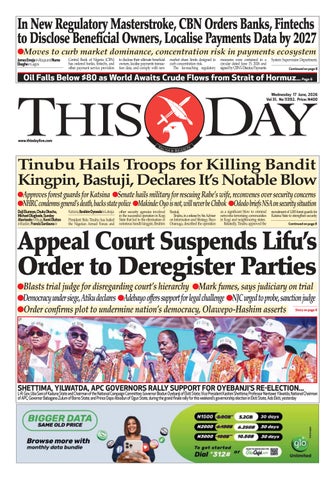
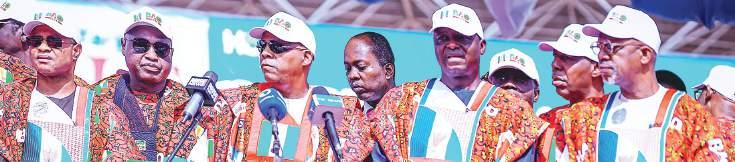
L-R: Gov. Uba Sani of Kaduna State and Chairman of the National Campaign Committee; Governor Biodun Oyebanji of Ekiti State; Vice President Kashim Shettima; Professor Nentawe Yilwatda, National Chairman of APC; Governor Babagana Zulum of Borno State; and Prince Dapo Abiodun
Deji Elumoye, Chuks Okocha, Michael Olugbode, Sunday Aborisade in Abuja, Kemi Olaitan in Ibadan, Francis Sardauna in Katsina, Ibrahim Oyewale in Lokoja President Bola Tinubu has hailed the Nigerian Armed Forces and
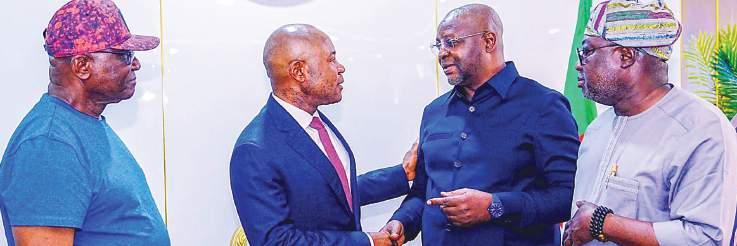
RENEWED HOPE AMBASSADORS ON TOUR OF FEDERAL AND STATE GOVERNMENT FUNDED PROJECTS IN ENUGU...
L-R: Special Adviser to the President on Information and Strategy, Bayo Onanuga; Enugu State Governor, Peter Mbah; Special Adviser on Media and Public Communication, Sunday Dare; and Senior Special Assistant on Media and Special Duties/Director of Media and Publicity, Renewed Hope Ambassadors, Tunde Rahman, at the Government House after a session with Governor Mbah on Federal and State Government funded projects in Enugu State on Tuesday
Seeks stronger regulation, better oversight of digital asset transactions Nigeria accounts for 60% of stablecoin inflows into sub-Saharan Africa
Emmanuel Addeh in Abuja
The International Monetary Fund (IMF) yesterday warned that Nigeria’s rapidly expanding use of stablecoins and other crypto assets, which attracted an estimated $59 billion in inflows between July 2023 and June 2024, could fuel illicit financing and money laundering if left inadequately regulated.
The Fund noted that while stablecoins have emerged as an important channel for cross-border payments, remittances and financial inclusion in Nigeria, their increasing use outside the traditional banking system poses significant risks to financial integrity and monetary stability.
In a publication titled “Stablecoins in Nigeria: A Growing Cross-Border Channel,” released Tuesday and authored by IMF Mission Chief for Nigeria, Axel Schimmelpfennig, and economist Bo Zhao, the institution stressed that the speed and relative anonymity of some digital asset platforms could make them attractive for illicit financial activities.
“Activity that once flowed through banks is moving increasingly to digital wallets and
crypto exchanges. Monitoring systems designed for traditional intermediaries may not capture these transactions effectively. The speed and anonymity of some platforms can also increase risks of illicit finance, including money laundering,” the IMF stated.
It disclosed that Nigeria received approximately $59 billion in cryptoasset inflows between July 2023 and June 2024, making it one of the world’s largest cryptocurrency markets. The country, it said, ranked second globally on Chainalysis’ 2024 Global Crypto Adoption Index and sixth in 2025.
It further noted that Nigeria accounts for about 60 per cent of stablecoin inflows into sub-Saharan Africa since 2019, underscoring the growing importance of digital dollar-linked assets in the country’s financial ecosystem.
The IMF explained that stablecoins, which are crypto assets typically pegged to the U.S. dollar, have become increasingly attractive to Nigerian households and businesses because they offer faster and cheaper cross-border transactions than conventional financial channels.
According to the report, many
users have embraced the technology as a means of receiving remittances, paying overseas suppliers and protecting savings against currency depreciation.
“The appeal is straightforward. Stablecoins allow users with a smartphone and internet access to receive remittances or make cross-border payments in minutes, often at lower cost than traditional channels,” the IMF stated.
The Fund pointed out that domestic economic conditions accelerated adoption, particularly during the period of sharp naira depreciation, elevated inflation and restricted access to foreign exchange in 2023 and 2024.
It argued that stablecoins offered Nigerians both a hedge against currency risks and a practical alternative for obtaining dollardenominated assets.
However, beyond concerns about illicit finance, the IMF warned that widespread use of dollar-pegged stablecoins could evolve into a digital form of dollarisation, reducing demand for the naira and weakening the effectiveness of domestic monetary policy.
“One is monetary sovereignty. As stablecoins are typically denominated in U.S. dollars, widespread use can resemble a digital form
of dollarisation. By reducing demand for the local currency, it could weaken the transmission of domestic monetary policy,” the report stated.
Nevertheless, the IMF acknowledged the benefits associated with stablecoin adoption, including lower transaction costs, faster settlement times, enhanced financial inclusion and support for trade and remittance flows.
Nigeria Reaping Record Revenue Gains from Tax, Oil, Mining Reforms, Says Group
Bennett Oghifo
Nigeria has recorded significant increases in government revenue, foreign reserves, banking sector capital, and non-oil earnings following a series of fiscal and structural reforms introduced under the President Bola Tinubu administration, the convener of Bola Ahmed Tinubu Ideological Group (BAT-IG), Bamidele Atoyebi, has said.
Atoyebi said the reforms had strengthened revenue collection across
UK Appoints Peter Vowles as New High Commissioner to Nigeria
The United Kingdom Government has appointed Peter Vowles as the new British High Commissioner to Nigeria, to succeed Richard Montgomery.
The announcement was made yesterday through a statement from the consulate, with Vowles expected to assume duties in Abuja in September 2026, while Montgomery was expected to remain in office until the end of the transition.
Vowles brings decades of diplomatic and international development experience to the position. He most recently served
as UK’s Ambassador to Zimbabwe from 2023 to 2026 and previously held the role of Ambassador to Myanmar between 2021 and 2022.
His career included several senior leadership roles within UK’s Foreign, Commonwealth and Development Office (FCDO), and its predecessor, Department for International Development (DFID).
Among the positions were Transformation Director and Director for Asia, Caribbean, and Overseas Territories.
Vowles has also amassed extensive field experience in international development, having worked across South Asia,
Central Africa, and East Africa. His previous postings included assignments in Bangladesh, India, Democratic Republic of the Congo, and Kenya. He began his professional career in Zimbabwe, where he worked on education and development programmes.
Speaking on his appointment, Vowles said, “I am honoured to be appointed as British High Commissioner to Nigeria. Nigeria is a country of immense importance to the United Kingdom, and I look forward to working closely with Nigerian partners to strengthen our relationship across trade, development and security.”
key government agencies, reduced reliance on oil receipts, and improved the country’s fiscal outlook.
“President Tinubu is applying the same reform-driven approach that transformed Lagos into an economic powerhouse,” a statement quoted Atoyebi as saying.
The statement added, “True nation-building often requires difficult decisions and structural adjustments before the benefits become visible.
“The results emerging across revenue generation, foreign reserves and investment flows suggest that those reforms are beginning to yield measurable outcomes.”
It said Federal Inland Revenue Service (FIRS) recorded substantial
growth in tax collections over the period.
Atoyebi said revenue rose from N4.95 trillion in 2020 and N6.41 trillion in 2021, to N10.1 trillion in 2022, comprising N4.09 trillion from oil taxes and N5.96 trillion from non-oil sources. Collections increased further to N12.37 trillion in 2023 before reaching N21.7 trillion in 2024, exceeding government targets by 11 per cent, he stated.
He said the momentum continued through a rolling two-year period between October 2023 and September 2025, when total collections reached N47.39 trillion. Non-oil taxes accounted for more than 76 per cent
of the total revenue generated during the period.
Atoyebi said the figures reflected the growing importance of economic diversification and stronger tax administration.
He stated, “The shift toward non-oil revenue is one of the most important developments in Nigeria’s fiscal landscape. It demonstrates that government revenue is increasingly being supported by broader economic activity rather than dependence on crude oil earnings alone.”
Atoyebi said Nigerian National Petroleum Company Limited (NNPC) also witnessed significant changes in remittance structures following reforms in the petroleum sector.
First Lady Oluremi Tinubu Inaugurates Projects, Canvasses Benue Support for Tinubu, Alia
George Okoh in Makurdi
Wife of the president, Senator Oluremi Tinubu, has inaugurated the newly established RHI/NITDA Community ICT Training Centre in Ihugh, Vandeikya Local Government Area of Benue State. The facility was built by National Information Technology Development Agency (NITDA), in partnership with the first lady’s Renewed Hope Initiative (RHI), to expand grassroots digital literacy. Mrs. Tinubu also commissioned 10 selected intra-city road projects in Makurdi Metropolis embarked upon by
the Governor Hyacinth Alia administration. Performing the ceremonies in Ihugh and Makurdi on Tuesday, the first lady stated that the commissioning of the completed projects formed part of the renewed hope agenda of the federal and state governments. She stated, “I am, indeed, delighted to be in the venue today to officially commission the National Information Technology Development Agency ICT centre and selected intra-city road projects in Makurdi Metropolis embarked upon by the Governor Hyacinth Alia administration.”
Mrs. Tinubu said the completed roads
were part of the over 45 road projects delivered by the Alia administration within his three years in office. She stated, “These roads with a combined length of 11.5 kilometres, including the Ishaya Bakut Road dual carriageway, Abu King Shuluwa Road, Mama Mbateren Alia streets, Dabo plaza to fashion hub road, Sir James Iorpuu street, Tega Bar Street, Jato Aka road, and the connecting spur roads, are pathways to economic growth, improved mobility, enhanced security, and a better quality of life for the people of Makurdi and beyond.”
Sunday Ehigiator
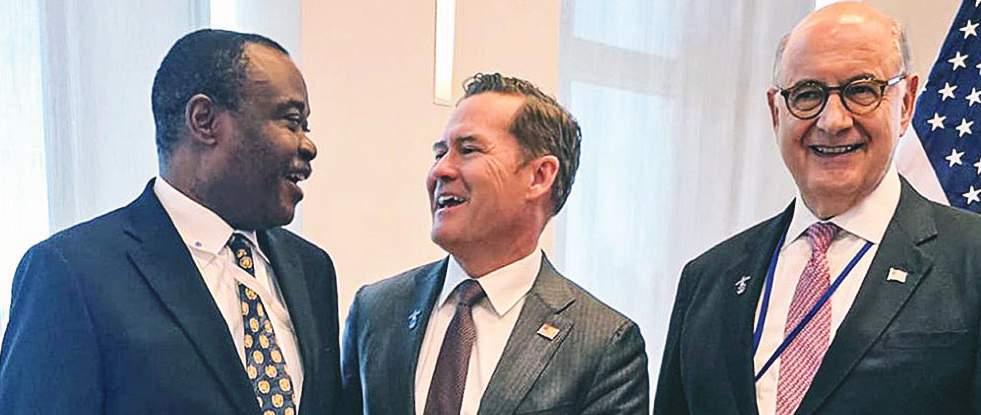
MOBILISING SUPPORT FOR NIGERIA...
L-R: Nigeria’s Permanent Representative to the
Audit Query: Senate Clears Customs of N62.2bn Infraction
Sets up reconciliation panel to review 76 outstanding others Says levies collected for other agencies do not belong in Federation Account Dankwambo, Wadada, Izunaso fault classification that triggered audit dispute
Senate Public Accounts Committee (SPAC), yesterday, cleared Nigeria Customs Service (NCS) of any wrongdoing in relation to an alleged N62.2 billion under-remittance contained in the 2019 Audit Report of the Auditor-General for the Federation.
The committee, chaired by Senator Ibrahim Dankwambo, reached the decision after an extensive investigative hearing with Comptroller-General of Customs, Dr. Bashir Adewale Adeniyi, who appeared before lawmakers to respond to 77 audit queries raised against the service in the 2019 and 2020 audit reports.
At the end of the session, lawmakers
The senate panel submitted that the funds in question were levies collected on behalf of other government agencies and were not meant for remittance into the Federation Account.
also resolved to set up a reconciliation committee comprising representatives of the senate panel, Auditor-General’s Office, and Nigeria Customs Service to review and reconcile the remaining 76 audit queries before further legislative action.
The decision effectively vacated one of the most prominent audit allegations against the customs service after senators agreed that the auditor-general’s report had wrongly classified certain statutory
levies as revenue due to the Federation Account.
The disputed query arose from records showing that Customs collected N691.242 billion in 2017 but remitted only N629.23 billion, leaving an apparent balance of N62.2 billion.
The Auditor-General’s Office had classified the difference as an unremitted amount and directed the agency to account for the funds.
Responding to the allegation,
CPPE: Geopolitical Tensions in Middle East Behind Rise in Inflation Rate
Dike Onwuamaeze
The Chief Executive Officer of Centre for the Promotion of Private Enterprise (CPPE), Dr. Muda Yusuf, has stated that the marginal increase of 0.24 per cent in headline inflation from 15.69 per cent in April 2026 to 15.93 per cent in May 2026, reflected the continuing impact of recent geopolitical tensions in the Middle East on global energy markets and supply chains.
Yusuf, who said this yesterday, noted that the surge in crude oil prices, elevated marine insurance costs,
as well as disruptions to shipping routes and higher import costs have all combined to exert upward pressure on domestic prices.
He, however, said that beneath the year-on-year increase lies a more encouraging trend as headline inflation moderated on a month-on-month basis from 2.13 per cent in April to 1.75 per cent in May, while food inflation eased from 3.63 per cent to 2.98 per cent.
“This suggests that although inflationary pressures persist, the pace of price escalation is slowing.
“It is also noteworthy that the current inflation rate remains significantly below the 26.06 per cent recorded in May 2025, underscoring the substantial disinflation achieved over the past year,” Yusuf said.
According to him, food and beverages, transportation, housing, energy, health and education remained the major drivers of inflation rem, which collectively account for about 87 per cent of headline inflation.
“This highlights the reality that the inflation burden is concentrated in the basic necessities consumed by
ordinary Nigerians.
“Food inflation at 16.96 per cent remains particularly concerning, as it continues to outpace headline inflation and weaken household purchasing power,” he added.
Yusuf said the major structural factor behind elevated food prices was the persistent insecurity in key food-producing regions.
According to him, “insecurity has displaced farming communities, reduced cultivated acreage, disrupted agricultural supply chains and increased transportation costs.
Adeniyi told the committee that the figure represented levies collected by Customs on behalf of designated agencies and intervention funds, rather than revenues constitutionally required to be paid into the Federation Account.
According to him, “The under- remittance of N62.2 billion levelled against Customs in the 2019 audit report was wrongly arrived at through misclassification of levies collected.
“While most of the levies are to be collected and remitted into the Federation Account, others, like the ones on local production of wheat, textiles, and wines, do not go into the Federation Account, the totality of which accounted for the alleged unremitted N62.2 billion.”
The customs boss further explained that most of the issues raised in the audit report stemmed from either misclassification of revenue heads or misunderstanding of the nature of Customs collections.
He said, “When we read through most of the queries, a good number of them were mixed up either by miscalculation or misclassification.
The N62 billion are all levies and do not go to the Federation Account.”
Adeniyi added that Customs revenue collection processes had since become fully digitised, making direct remittances into designated government accounts automatic and transparent.
He stated, “Customs operations are digitalised. As we receive revenues, they immediately go into the Federation Account. The issue of non-remittances does not arise.”
The explanation received broad support from members of the committee, many of whom agreed that revenues collected on behalf of third-party agencies could not be treated as Federation Account receipts.
Dankwambo, a former AccountantGeneral of the Federation and twoterm governor of Gombe State, said the distinction between federation revenues and non-federation levies was well established in public finance administration.
“There are various levy accounts which are accounted for independently. There are non-federation revenues and levies. This issue is clear enough,” he said.
Former chairman of the committee, Senator Aliyu Wadada, also backed the customs service.
Wadada stated that the present Customs management inherited most of the issues under review and had shown willingness to resolve them.
He said, “At the time it happened, the present leadership of Customs was not in charge, but at the last meeting they promised to look into the auditor-general’s observations and provide detailed explanations.” Further pump price slump expected amid 3-month low
Oil Falls Below $80 as World Awaits Crude Flows from Strait of Hormuz
Emmanuel Addeh in Abuja
Crude oil prices fell below $80 a barrel yesterday for the first time since March, in a sign of traders’ growing confidence that the deal struck between the US and Iran will restore the flow of crude through the Strait of Hormuz.
Brent crude, the international
benchmark, slumped 5.5 per cent to $78.58 a barrel, its lowest level since March 3, while West Texas Intermediate (WTI), the US benchmark, dropped 6.3 per cent to $75.66 a barrel.
The development is coming after Washington and Tehran agreed late on Sunday to extend their ceasefire and reopen the strait, which in effect
has been shut since late February, after several weeks of fraught negotiations brokered by Qatar and Pakistan. Also, Middle Eastern oil prices have slumped since the peace deal was announced. Abu Dhabi’s Murban crude fell as low as $72.74 a barrel on Tuesday, just 49 cents higher than before the war began, after surging to as much as $160.50 in
March. Prices of Dubai and Oman oil also fell this week.
Two Iranian tankers, the Hero II and the Diona, sailed out of the Gulf of Oman and passed the nominal US blockade line on Tuesday, the first sign of Iranian oil beginning to move unchallenged by the US military since the restrictions began. Neither was signalling its final destination but both
appeared to be heading south-east around India, an FT report said.
The price of crude surged after the US and Israel launched their assault on Iran on February 28, sending the price from $72 a barrel on the eve of the conflict to as high as $126 in April. Hopes of a peace deal have repeatedly been dashed in recent weeks, causing dramatic fluctuations in the price of oil.
Oil traders have consistently warned that it could take as many as
three months for ship traffic through the crucial chokepoint to return to pre-war levels.
“Markets clearly welcome the latest development, although how quickly traffic through the strait can normalise remains to be seen,” said analysts at UBS. “Given worries about sea mines in the waterway, markets will look for clearer evidence that shipping companies and insurers have sufficient confidence to traverse the strait,” they said.
Sunday Aborisade in Abuja
United Nations, Jimoh Ibrahim; United States Permanent Representative to the United Nations, Ambassador Michael Waltz; and U.S. Representative to the United Nations Economic and Social Council and as an Alternate Representative of the United States, Ambassador Dan Negrea, during Ibrahim’s visit to the US Mission House in New York for strategic cooperation ahead of the election of the Deputy Secretary General of the International Telecommunication Union, yesterday
L-R: Non-Executive Director, InfraCredit, Kolawole Owodunni; Associate Vice President, Transaction Legal, InfraCredit, Damilola Durosinmi-Etti; Chairman, Craneburg Construction Company Limited, Femi Edun; Commissioner for Finance, Ekiti State Government, Hon. Akintunde Oyebode; Managing Director/CEO, InfraCredit, Chinua Azubike; Chief Executive Officer, Anchoria Advisory Services Limited, Sam Chidoka; General Manager, Craneburg Construction Company Limited, Yejide Taiwo; and Deputy Head, Origination and Structuring, InfraCredit, Osaze Osaghae, during the presentation of the Best Project Bond in Africa Award to InfraCredit at the 2025 EMEA Finance Achievement Awards in London... recently
FG: Escalation in Cooking Gas Prices Caused by FX Volatility, Logistics Costs, Others
Insists current situation not as a result of failed govt policy Nigeria’s daily gas output rises to 7.93bcf, domestic sales hit 2.18bcf/d
Emmanuel Addeh in Abuja
The federal government has attributed the recent increase in the price of cooking gas across the country to foreign exchange volatility, rising logistics, transportation costs, as well as other supply chain challenges, rather than failure of government policy.
Minister of State Petroleum Resources (Gas), Ekperikpe Ekpo, in a statement in Abuja signed by his spokesman, Louis Ibah,while noting the concerns expressed by Nigerians over the recent increase in the price of Liquefied Petroleum Gas (LPG), further blamed infrastructure constraints and fluctuations in international prices for the skyrocketing prices.
The minister reassured Nigerians that the federal government remains fully committed to ensuring adequate, reliable and affordable gas supply for households, industries and power generation across the country.
According to him, this commitment is reflected in ongoing interventions designed to stabilise the domestic LPG market, including the directive that all LPG produced in Nigeria be prioritised for local consumption.
This policy, according to him, has already strengthened domestic supply, reduced dependence on imports and improved market resilience.
“The recent price adjustments are driven largely by prevailing market realities such as foreign exchange volatility, rising logistics costs, infrastructure constraints and fluctuations in international LPG prices. These factors should not be misinterpreted as evidence of policy failure,” Ekpo emphasised.
To address the situation, the minister said he has directed the Nigerian Midstream and Downstream
Petroleum Regulatory Authority (NMDPRA) to intensify engagement with producers, marketers and other stakeholders to sustain supply and enhance market stability.
Marketers have also committed to increasing import volumes to complement domestic production, he pointed out.
Furthermore, he stated that the commencement of LPG deliveries from the new Seplat gas facility in
July will significantly boost national supply, confirming that no producer is exporting LPG volumes designated for the domestic market, as regulatory measures remain firmly in place to prioritise local needs.
“The outlook for LPG supply remains positive, and the federal government will continue to pursue measures that enhance availability, affordability and long term energy security for Nigerian consumers,”
he stated.
Meanwhile, Nigeria’s gas production rose to 7.93bcf/d in May 2026, representing a 0.63 per cent yearon-year increase from the 7.88bcf/d recorded in the corresponding period of 2025.
A breakdown of May’s production data showed that Associated Gas (AG) accounted for 3.96bcf/d, while Non-Associated Gas (NAG) contributed 3.98bcf/d. This indicates
that non-associated gas is increasingly carrying its own weight in the production mix and reflects the maturation of dedicated gas development initiatives. On a month-on-month basis, gas production declined marginally by 0.12 per cent from 7.94bcf/d recorded in April, the Nigerian Upstream Petroleum Regulatory Commission (NUPRC) said in a statement yesterday.
Mission 300: Over 4.5m Nigerians, 50m Africans Supplied Electricity, Say World Bank, AfDB
$15bn financing deployed, $4.5bn co-funding attracted for projects Development partners pledge over $7bn in support
Emmanuel Addeh in Abuja
The World Bank Group and the African Development Bank (AfDB) yesterday announced that Mission 300, a joint initiative by the organisations, has connected 4.5 million Nigerians and over 50 million Africans to electricity across 40 countries on the continent.
Describing it as a major milestone toward the initiative’s goal of reaching 300 million people by 2030, they stressed that Mission 300 is now delivering electricity access at nearly double the pace recorded at the start
of the initiative.
In a joint statement, the lenders stated that by investing across the full energy value chain — from generation and transmission to last-mile distribution, the initiative has driven gains in both on-grid and off-grid access, connecting households, businesses, and institutions to power faster than before.
Where past efforts often worked in parallel, the Mission 300 proponents said the programme aligns governments, partners, and private sector investors around a single shared
agenda, driving faster results, including stronger political commitment, deeper policy reform, and the mobilisation of resources needed to accelerate electrification and deliver impact on the ground.
To date, the AfDB and the World Bank Group said they have committed nearly $15 billion in financing and attracted about $4.5 billion in co-financing for mission 300-related projects, while additional development partners have pledged more than $7 billion in support of Africa’s energy sector.
According to the institutions, Mission 300’s unique approach is also changing the conditions under which private investors participate in African energy markets. By combining
government reforms with layered public financing, including grants, guarantees, and concessional loans, the platform, they said, is mitigating risks for private providers to serve communities that were previously too costly or difficult to serve.
In Nigeria, the statement said more than 4.5 million people have been connected through private sector-led initiatives, demonstrating how well-designed public support and partner financing can help create commercially viable markets.
Similarly, in Tanzania, it stated that 7.5 million people have gained access to power under Mission 300, a five-fold increase in the average annual pace of electrification prior to the initiative, driven by increased financing and
growing policy momentum.
Same in Ethiopia, where the world bank and AfDB stated that 4.6 million people have been connected, supported by reforms that made grid connections more affordable.
To date, 30 countries, according to the lenders have launched National Energy Compacts, country-led plans to strengthen energy systems, expand affordable power generation, scale renewable energy solutions, promote regional integration, and increase private sector participation.
Additional compacts are expected to be launched by Burkina Faso, the Central African Republic, Djibouti, Gabon, Rwanda and Uganda at the Africa Energy Forum this week, the statement added.
Managing Director of Financial Derivatives Company Limited, Bismarck Rewane, yesterday projected that Nigeria’s Gross Domestic Product (GDP) might reach four per cent by the end of 2026.
Rewane also projected that Central Bank of Nigeria (CBN) might likely maintain its benchmark monetary policy rate around 26.5 per cent throughout 2026 as it continued efforts to contain inflationary pressures.
Rewane, who spoke at the 2026 PEARL Awards Corporate Summit in Lagos, said meaningful monetary policy rate cuts might not occur until 2027, after the conclusion of national
elections.
According to him, pre-election liquidity has historically supported stock market activity as investors seek capital gains ahead of major political transitions.
Rewane spoke on the theme, “Policy Reform and Corporate Competitiveness: Navigating Towards a Sustainable Edge.”
He said sustained policy reforms were critical to improving corporate competitiveness and creating an environment that supported business growth.
Rewane stated, “Reform is a process, not an event. Sustainable reforms are necessary for long-term corporate competitiveness.
“While reforms do not automatically guarantee successful companies, businesses are more likely to emerge, grow and thrive in a well-reformed environment.”
He stated that reforms helped create an enabling environment for businesses, while strong institutions were equally important in driving economic growth and competitiveness.
According to him, companies operating in stable and reform-driven economies are better positioned to expand and create value for shareholders.
H said Nigeria’s future competitiveness would depend largely on its ability to sustain and deepen ongoing economic reforms.
Data Critical to Solving Employment Challenges, Says FG
Onyebuchi Ezigbo in Abuja
The federal government under the auspices of the National Employment Council on Tuesday facilitated the signing of Memorandum of Understanding between key line ministries and agencies on Labour market information sharing meant to promote creation of decent jobs. It said the MoU is to promote more collaboration among the ministries and agencies enabling
them to use evidence-based data in their decision-making.
Speaking during signing of the agreement, Minister of Labour and Employment, Alhaji Mohammed Maigari Dingyadi said the event marked, “A collective resolve to move beyond fragmented labour market information systems towards a coordinated national framework capable of generating timely, reliable, and actionable labour market intelligence”.
The minister said the Employment Council remains one of the most important platforms for stakeholder engagement on employment governance in Nigeria.
“Since its establishment, the Council has served as a strategic mechanism for promoting collaboration among government institutions, employers, workers’ organizations, academia, development partners, and other stakeholders in the labour market ecosystem.
Kayode Tokede
Dangote to Build Nigeria’s Biggest Industrial Zone in Ondo State
Ondo set for industrial revolution, says Aiyedatiwa AFC, Dangote Group deepen partnership, seal $600m loan deal for fertiliser expansion Nigeria will benefit over $4bn in FX from company’s fertiliser export, says Aliko Dangote
Peter Uzoho in Lagos and Fidelis David in Akure
The President of Dangote Group, Alhaji Aliko Dangote, yesterday revealed plans to develop a largescale industrial and free trade zone at Olokola in Ondo State, describing it as a power-driven investment hub designed to attract manufacturers and reduce infrastructure constraints for investors.
Dangote disclosed this during a courtesy visit to Governor Lucky Aiyedatiwa in his office in Akure, where he outlined a renewed investment framework covering power generation, cement production, gas infrastructure and industrial manufacturing.
This comes as the Dangote Group has strengthened its strategic partnership with the Africa Finance
Corporation (AFC) with the signing of a $600 million loan agreement to support the expansion of its fertilizer production capacity, in a major boost to food security across Nigeria and the African continent.
In Akure, Aliko Dangote, said the proposed Olokola project would go beyond a conventional free trade zone, stressing that it would be fully equipped with power, water and logistics infrastructure to enable investors to operate without delays associated with basic utilities.
“We want to create the biggest free trade zone where investors can just come and plug in. We will generate power, provide infrastructure and remove the bottlenecks around doing business,” he said.
Dangote said the initiative was designed to address Nigeria’s longstanding power deficit, which he
described as the country’s biggest industrial constraint for over 30 years, noting that most manufacturers currently rely on self-generated electricity.
He explained that the absence of reliable power had slowed industrial expansion across the country, adding that the new model would integrate dedicated energy supply into the industrial zone.
He also disclosed plans to integrate gas infrastructure through an east-west gas corridor to support energy-intensive industries within the zone.
Dangote said the group had previously attempted to develop investments in Olokola but was constrained by operational challenges at the time, leading to the concentration of projects in Lagos.
According to him, contractors
are expected to mobilise to site within three to four months, with full construction scheduled to commence in the last quarter of the year.
He also indicated that the project structure would include government participation, requesting the nomination of a state representative to the board of the industrial zone to facilitate coordination and execution.
Dangote said the initiative would stimulate large-scale job creation and industrial expansion across Ondo State and surrounding regions, noting that similar projects in Lagos had delivered significant employment and export revenues.
Responding, Governor Aiyedatiwa welcomed Dangote’s renewed investment drive, describing it as a major milestone in Ondo State’s industrialisation agenda.
He said the project aligns with his
administration’s efforts to position the state as a leading industrial destination in the South-West, noting its strategic location along the LagosCalabar Coastal Highway corridor.
Governor Aiyedatiwa also highlighted the state’s deep seaport licence, describing it as a key logistics advantage capable of handling large vessels without transshipment.
He disclosed that limestone deposits in the state had been tested and found suitable for industrial use, signalling potential for cement production expansion.
The Governor said a technical committee had been established to engage with Dangote Group on legal, land, community and operational frameworks, while confirming readiness to nominate a state representative to the project board.
APPEAL COURT SUSPENDS LIFU’S ORDER TO DEREGISTER PARTIES
Chuks Okocha, Alex Enumah and Sunday Aborisade in Abuja
Meanwhile, the Dangote Group has strengthened its strategic partnership with the AFC with the signing of a $600 million loan agreement to support the expansion of its fertilizer production capacity, in a major boost to food security across Nigeria and the African continent.
The loan facility to GreenView Fertilizer Corporation (Greenview), the Dangote Fertlizer Holding Company, will part-finance the expansion of its urea fertilizer production capacity in Nigeria and the development of the plant in Ethiopia.
Dangote Group announced this in a statement yesterday.
A three-member panel of the Court of Appeal in a unanimous ruling, yesterday, suspended the execution of the judgement of the trial court on the grounds that it was delivered without jurisdiction.
Temporary relief came the way of former Vice President Atiku Abubakar, Osun State Governor, Senator Ademola Adeleke, and other candidates from five political parties, following the suspension of an order of a Federal High Court, which ordered their deregistration.
operations in the state.
Governor Dikko Radda announced the president’s approval while briefing journalists after a stakeholders’ meeting with Islamic clerics at Government House, Katsina.
The approval came as Senate Committee on Army commended the military and other security agencies for the rescue of Mrs. Amina Abubakar, widow of the late Major General Rabe Abubakar.
That was as the senate announced plans to reconvene for an emergency sitting to deliberate on pressing national security issues.
Chairman of Senate Committee on Army, Senator Abdulaziz Yar’Adua, said the rescue operation demonstrated the growing professionalism and coordination among the security services.
National Human Rights Commission (NHRC) also condemned Abubakar’s abduction and death in the custody of bandits, describing the incident as a gross violation of the fundamental rights to life and personal security.
In a statement, Executive Secretary of the commission, Tony Ojukwu, reiterated calls for the establishment of state police as part of broader efforts to address insecurity.
In Oyo State, Governor Seyi Makinde, yesterday, assured residents that the pupils and teachers abducted in Oriire Local Government Area would be rescued safely, declaring that the state would never experience a situation similar to the Chibok schoolgirls’ abduction.
Makinde gave the assurance while addressing protesters led by social media activist, Martins Otse, popularly known as VeryDarkMan, at his private residence in Ikolaba, Ibadan.
Still on security, Kogi State Governor, Usman Ododo, briefed National Security Adviser (NSA), Nuhu Ribadu, on the operation that led to the elimination of
While Atiku is the presidential candidate of the ADC for the 2027 general election, Adeleke is the governorship candidate of Accord in the off-circle election slated for August this year.
Justice Peter Lifu had in a judgement on Monday ordered the Independent National Electoral Commission (INEC) to deregister
African Democratic Congress (ADC), Accord, Action Alliance (AA), Action Peoples Party (APP), and Zenith Labour Party (ZLP) for failing to win any electoral seat in the 2023 general election.
Lifu delivered the judgement not minding an earlier order of the Court of Appeal directing him to
Battijo in the state, according to a statement by the Commissioner for Information and Communications, Kingsley Fanwo.
In furtherance of efforts to curb insecurity, particularly banditry and kidnapping, the Katsina State governor, Dikko Umaru Radda, rolled out fresh security measures.
The measures were contained in a new Executive Order issued after an emergency security meeting on Monday with security agencies, traditional rulers, and other key stakeholders at Government House, Katsina.
The new security measures included the ban on the sale, storage, and transportation of petroleum products in jerry cans.
Inspector-General of Police (IGP), Olatunji Disu, unveiled a technologydriven policing strategy aimed at strengthening the operational capacity of the Nigeria Police to combat security challenges in the country.
The new approach was conveyed to officers and men of the Katsina State Police Command by Deputy Inspector-General of Police (DIG), Sulaiman Muhammad, during a two-day operational visit to the command on Monday.
Tinubu said Bastuji’s reign of violence, kidnapping and attacks on civilians had caused untold hardship for residents, and his neutralisation would restore confidence and give respite for residents of the area.
He stated, “I congratulate our gallant troops on this decisive milestone. Nigeria will not surrender any part of its territory to criminals.
“Those who choose the path of violence against innocent citizens will find no hiding place. This success reflects the renewed determination of our security forces to secure every inch of our land.”
The president, who also commended the troops for another successful operation that led to
the rescue of the widow of the late former Chief of Defence Information, General Rabe Abubakar (rtd), said the rescue demonstrated a high standard of professionalism and the needed determination to confront forces of evil.
He said, “The safe return of Hajiya Amina Rabe Abubakar is a source of relief to her family and to all Nigerians. I commend the intelligence coordination and bravery of the officers and men who executed the rescue operation. We owe a debt of gratitude to our troops who risk their lives daily to keep us safe.”
The president reassured Nigerians that the government would continue to provide the armed forces with the resources, training and support needed to end banditry, kidnapping and all forms of violent crimes.
He urged citizens to continue to cooperate with security agencies by providing timely information and necessary support.
IN
Tinubu Approves Recruitment of 1,000 Forest Guards for Katsina
Tinubu approved the recruitment of 1,000 forest guards for Katsina State to strengthen security operations in the state.
Governor Dikko Radda announced the approval while briefing journalists after a stakeholders’ meeting with Islamic clerics.
Radda said the forest guards would be properly trained and equipped to complement the efforts of the military, police, Department of State Services (DSS), and local vigilante groups to protect communities, particularly those located in forested and remote areas that had become hideouts for criminal gangs.
He stated that the initiative formed part of broader collab-
NEW REGULATORY
stay further proceedings pending the hearing and determination of an appeal filed by Accord.
Miffed by the order of the trial court, the affected political parties, and INEC, approached the appellate court for an order halting their deregistration.
The appellants informed the panel of justices that the trial judge acted in total disregard of the orders of the Court of Appeal, directing him to stay further proceedings in the matter, pending the hearing and determination of an interlocutory appeal before the appellate court.
The electoral umpire, which aligned itself with the submissions of the appellants, claimed that they were only aware that the trial court would deliver judgement in the suit filed by Incorporated Trustees of the National Forum of Former Legislators (NFFL) through media reports.
INEC submitted before the three-member panel of the Court of Appeal, “My Lords, we are aware of an order that this court made on May 22, which stopped the delivery of the judgment of the lower court, which was initially reserved for delivery on June 5.
“We were not aware of any notice from the court regarding the delivery of the judgement. We only saw it as breaking news in the media.
MASTERSTROKE,
“We, therefore, do not oppose the
application of the appellant to stay the execution of the judgement.”
Reacting, members of the panel, who took turns to lambast Lifu for his disregard for the orders of the appellate court, subsequently ordered a stay of the execution of the judgement directing the de-registration of the affected parties. According to the justices, the trial court exhibited judicial rascality by going ahead to hear and make the order, despite the order of the Court of Appeal and the pendency of the matter before the court.
Reacting to the appeal court court’s suspension of the controversial order by the trial court, National Chairman of ADC, Senator David Mark, said the Nigerian judiciary was on trial. Mark said this yesterday at the ADC Strategic Communications Retreat in Abuja. Atiku said Lifu’s order was a dangerous assault on constitutional democracy.
In a statement by his Senior Special Assistant on Public Communication, Phrank Shaibu, Atiku said the judgement was further evidence of a coordinated effort to eliminate political opposition ahead of the 2027 general election. Presidential candidate of Social Democratic Party (SDP) in the 2027 general election, Adewole Adebayo, condemned the order directing the
CBN ORDERS BANKS, FINTECHS TO DISCLOSE BENEFICIAL OWNERS, LOCALISE PAYMENTS DATA BY 2027
Dr. Rakiya Yusuf. The regulatory intervention represents one of the most significant interventions by the CBN in the payments industry in recent times, aiming at restructuring the country’s fast-growing digital payments ecosystem.
The circular, addressed to Deposit Money Banks, Microfinance Banks, Mobile Money Operators, switching companies, Payment Terminal Service Providers, Payment Solution Service Providers, Super Agents, and other licensed operators, comes amid rapid expansion of electronic payments and increasing dominance of a few players across critical segments of the market.
According to CBN, while the growth of digital financial services has boosted innovation, efficiency
and financial inclusion, it has also heightened concerns over market concentration, systemic importance, operational dependence, ownership transparency, and location of critical payments data.
The apex banking regulator said the new framework sought to improve transparency, strengthen oversight and promote a more competitive and resilient payments ecosystem.
The new framework requires all DMBs, payment service providers, and other financial institutions with digital payments operations to disclose the Ultimate Beneficial Ownership (UBO) of significant shareholders.
CBN also directed affected institutions to maintain accurate and up-to-date records of beneficial
ownership and make such information available to the regulator whenever requested.
The bank explained that the directive aligned with existing Anti-Money Laundering, Combating the Financing of Terrorism and Counter-Proliferation Financing regulations and was expected to strengthen transparency around ownership structures in the financial system.
Beyond ownership disclosure, the apex bank also introduced a mandatory data localisation policy requiring all payments transaction data generated within Nigeria to be stored and managed within the country.
The circular stipulated that all financial institutions and participants facilitating payments in the country
must ensure full compliance with the requirement by January 1, 2027. The move is expected to deepen regulatory oversight of payment transactions, strengthen data security, and reinforce compliance with Nigeria’s data protection framework.
The central bank further introduced market structure rules aimed at preventing excessive dominance by individual institutions across key payment segments.
Under the new framework, any licensed financial institution engaged in consumer issuing activities that controls more than 25 per cent of market share in consumer issuing over a rolling 12-month period will be prohibited from holding more than 15 per cent market share in
Dangote
STRATEGIC ENGAGEMENT BETWEEN THE ONDO GOVERNMENT AND AfDB...
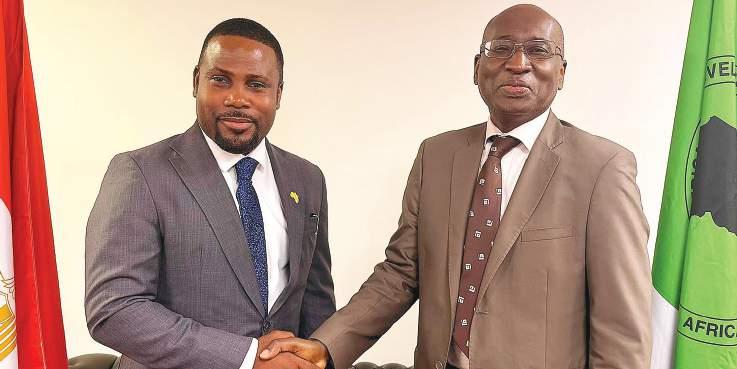
Dr. Summy Smart Francis, Special Adviser on Entrepreneurship, Innovation and Investment to Governor Lucky Aiyedatiwa (left), and Mr. Abdourahmane Diaw, Country Manager, African Development Bank Group, Egypt, during a strategic engagement between the Ondo State government and AfDB... recently
NHRC Raises the Alarm as 390 Killed, 202 Kidnapped, 268,787 Rights Complaints Raised in One Month
Says attacks on schools, worshippers, security personnel threaten human dignity
National Human Rights Commission (NHRC) on Tuesday painted a grim picture of Nigeria’s human rights situation, revealing that 268,787 complaints were recorded across the country in May 2026 amid escalating killings, kidnappings, attacks on schools and places of worship, and growing insecurity.
Presenting the commission’s May Human Rights Situation Dashboard in
Abuja, Executive Secretary of NHRC, Dr. Tony Ojukwu, described the month as one of the most devastating periods for human rights in recent times, warning that the country is witnessing a humanitarian crisis requiring urgent national attention.
According to the dashboard, no fewer than 390 persons were killed, while 202 others were kidnapped during the month under review, with children, worshippers, security personnel, and rural communities
among the worst affected.
Ojukwu said the scale of violations recorded within just 31 days underscored the fragile state of human rights protection in the country.
He stated, “May 2026 has been a devastating month for human rights in Nigeria. Within the span of thirty-one days, we witnessed incidents that deeply challenged our collective commitment to human dignity and fundamental freedoms.”
He said civilians were killed in differ-
ent parts of the country, schoolchildren were abducted from classrooms, worshippers came under attack in places of prayer, while members of the armed forces and other security agencies lost their lives while carrying out their constitutional responsibilities.
The commission expressed particular concern over the increasing attacks on educational institutions, citing the abduction of more than 45 pupils and teachers from schools in Oyo State, many of whom remained in captivity.
Media, Civil Society Groups Seek Stronger Partnerships to Protect Nigeria’s Electoral Integrity
Stakeholders drawn from media organisations, civil society groups, election observation networks and communication institutions have called for stronger collaboration, improved transparency and enhanced protection for journalists to safeguard the credibility of future elections in Nigeria.
The resolutions were contained in a communiqué issued at the end of a Media-CSO Roundtable on Building Stronger Media-CSO Partnerships for Credible, Peaceful and Inclusive Elections, held on Tuesday at the United Nations House in Abuja.
The event was convened by Journalists for Human Rights (JHR) and the Office of the United Nations High Commissioner for Human Rights (OHCHR).
Participants examined challenges confronting election coverage in Nigeria and explored ways of strengthening collaboration between media organisations and civil society
actors to promote transparency, accountability and public trust in the electoral process.
A major recommendation from the meeting was the establishment of a verified central platform for timely electoral information that would be accessible to both journalists and civil society organisations.
Participants also urged the Independent National Electoral Commission (INEC) to conduct mandatory mock tests of election technologies before elections and formally recognise the media as a critical stakeholder in the electoral process.
The communiqué further recommended that post-election reports should document incidents of journalist harassment, denial of access to information, polling units and collation centres to strengthen accountability and transparency.
To improve collaboration, stakeholders proposed the creation of a joint media-CSO platform for sharing information, resources and verified content.
They also advocated the mapping of CSOs according to their thematic expertise to improve sourcing by journalists and called for greater direct information sharing between civil society organisations and media houses. Participants suggested that CSO personnel operating in remote communities could serve as correspondents in areas with limited media presence, thereby expanding access to election- related information.
On funding and resource mobilisation, the meeting recommended exploring structured support mechanisms through civil society organisations and development partners to enhance election coverage. It also endorsed a proposal by the Broadcasting Organisations of Nigeria (BON) for a shared resource pool that would allow media organisations to access information, photographs, footage and other election-related content.
NHRC also highlighted the abduc- tion of more than 40 schoolchildren in Borno State, warning that the attacks are a painful reminder of Nigeria’s long-running struggle to protect schools and guarantee children’s right to education.
“What should have been a place of learning became a scene of fear and uncertainty,” Ojukwu lamented, adding that such incidents raise serious questions about compliance with constitutional guarantees, child protection laws, and school safety policies.
The commission further condemned attacks on religious communities, recalling an incident in Kwara State where worshippers were attacked during prayers, resulting in deaths and the abduction of 15 persons.
According to Ojukwu, the growing trend of targeting religious worshippers represents a direct assault on freedom of thought, conscience and religion, and threatens the social fabric of affected communities.
The commission also drew attention to reports of civilian casualties resulting from military operations, including a military airstrike that reportedly struck a civilian market in Tumfa, Zurmi Local Government Area of Zamfara State.
While acknowledging efforts by the Nigerian Air Force to investigate
allegations of civilian harm, NHRC renewed its call for the adoption of a National Policy for the Protection of Civilians in Conflict and urged a coordinated government-wide approach to civilian harm mitigation.
At the same time, the commission condemned attacks on military formations and the killing of security personnel, insisting that the country’s armed forces require greater support and equipment to effectively confront the multiple security threats facing the country.
Ojukwu stressed that the incidents recorded during the month constituted violations of fundamental rights guaranteed under the Nigerian constitution and international human rights instruments, including the rights to life, dignity, personal liberty, education and freedom of religion.
Despite the grim statistics, NHRC commended ongoing military opera- tions that had led to the neutralisation of terrorists and the rescue of abducted victims in Borno and other parts of the country.
The commission called on government institutions and security agencies to strengthen civilian protection measures, improve operational accountability, invest more in school safety, and provide psychosocial support to victims and affected families.
IsDB Institute, Labuan FSA Sign MoU to Explore Awqaf Free Zones Concept Implementation for Member Countries
Sunday Okobi in Baku, Azerbaijan
The Islamic Development Bank Institute (IsDBI) has signed a Memorandum of Understanding (MoU) with the Labuan Financial Services Authority of Malaysia (Labuan FSA) to explore collaboration on the potential implementation of the
Awqaf Free Zones concept within Labuan International Business and Financial Centre (Labuan IBFC).
The acting Director-General of IsDB Institute, Dr. Sami AlSuwailem, and Mr. Affendi Rashdi, director-general of Labuan FSA, signed the MoU yesterday on the sidelines of the IsDB Group Annual
Meetings in Baku, Azerbaijan.
The MoU, according to both parties, marks an important milestone in advancing innovative, Shari’ah-compliant development solutions that leverage the potential of Awqaf (Islamic endowments) to support sustainable economic growth and social development
across IsDB Member Countries, including Nigeria.
The IsDB stated that the Awqaf Free Zones are an innovative concept developed by the IsDB Institute to integrate the principles of Waqf with the legal, regulatory, and economic framework of free zones.
Michael Olugbode in Abuja
Michael Olugbode in Abuja
metric tonnes of ra materials sec red ahead of global disr p ons.
sa ed thro gh earl proc rement and strategic inter en on.
kg bags eq i alent s pplied into the prod c on chain.
kg bags distrib ted ahead of peak plan ng season.
President of the Federal Rep blic of Nigeria
metric tonnes released to blending plants na on ide.
WHX MEDIC EXHIBITION IN LAGOS...
L-R: B2B Channel Development Manager, Simba Power, Suresh Kumar;
2026 WHX Medic Exhibition in Lagos... recently
Ekiti Guber: Shettima Drums Support for Oyebanji’s Re-election At APC Mega Rally
Describes governor’s second term bid as a ticket that deserves renewal, an investment in state’s progress, peace, future
Stresses FG’s resolve to work with state in deepening development, expanding opportunity, strengthening security
Deji Elumoye in Abuja and Gbenga Sodeinde in Ado Ekiti
Vice President Kashim Shettima, Tuesday, embarked on a last-minute campaign for the re-election of the All Progressives Congress (APC) governorship candidate, Governor Biodun Oyebanji, for a second term ahead of Saturday’s governorship election in Ekiti State.
Shettima told the people that the joint ticket of Oyebanji and his deputy, Mrs. Monisade Afuye, was a ticket of balance, experience, and continuity that deserved renewal.
He said instead of a routine contest in Saturday’s governorship poll, Ekiti was standing at the gate of a larger Nigerian journey.
Addressing party faithful in AdoEkiti, the Ekiti State capital, during the APC Grand Finale Mega Rally, Shettima, who represented President Bola Tinubu, maintained that continuity for Oyebanji was an investment in the peace, progress, and future of the state.
Joined at the mega rally by APC governors, party leaders, National Assembly members, and ministers,
among others, the vice president said, “The task before you is simple, sacred, and historic. Go out and vote. Speak to your neighbours. Speak to your families. Speak to your wards, your unions, your communities, and your friends. Tell them that continuity in Ekiti is not a favour to one man. It is an investment in the peace, progress, and future of this state.
“And so I ask you, sons and daughters of this proud land, to march to the polling units in your numbers and cast your votes for Biodun Oyebanji and his worthy Deputy, Mrs. Monisade Afuye. Give them the mandate to finish the work they have so faithfully begun. Stand with them as steadfastly as they have stood with you.”
Shettima stated that the mammoth crowd that gathered at the Ekiti Parapo Pavilion, venue of the mega rally in Ado Ekiti, was an indication that the people of the state were together with APC and the government at the centre, in the journey to make Nigeria better. He extended the goodwill of Tinubu, stating that Ekiti State remains dear to the government.
Drumming support for Oyebanji and
Tinubu’s Daugher Rallies Clerics to Pray for Nigeria, Lagos
Raheem Akingbolu
Muslim clerics drawn from all the South-West states on Tuesday assembled at the LTV Blue Roof Arena, to pray for Nigeria, Lagos State and President Tinubu to commemorate 2026 Hijra celebration in memory of the late mother of the President, Alhaja Abibatu Mogaji.
The event which was organised by the daughter of the President, the Iyaloja-General of Nigeria, Mrs. Folasade Tinubu-Ojo was attended by dignitaries, scholars, and market women from various states. The speaker of Jigawa State House of Assembly is Rt. Hon. Haruna Aliyu Dangyatin and the wife of Lagos State Deputy Governor, Alhaja Lateefat Oluremi Hamsat, were special guests of honour.
The clerics, who took turn to pray
for Nigeria, Lagos and the first family, charged all Nigerians, regardless of their religious beliefs, to see payer for their dear nation as a collective responsibility that should be given special priority.
A Professor of Islamic Studies at the University of Abuja, who also doubles as Chief Imam of Ansar-Ud-Deen, Abuja chapter, Prof. Musa Olaofe, described President Tinubu as a man of foresight who believes in Nigeria.
“Nigeria is a great country, and we are currently under a leader who is committed to making a positive impact despite our numerous challenges. Yes, it has always been like this, but with prayer, I know we will overcome our challenges. Let all of us go back home and continue with prayer as well as fulfiling our civic responsibilities so that we can all achieve the Nigeria of our dream.”
his deputy, Shettima said rather than approaching leadership as a theatre, the governor understood that “government must touch the market woman, the teacher, the civil servant, the farmer, the student, the driver, the trader, and the family waiting for hope at the end of each month”.
The vice president stated that Oyebanji had shown dedication to the welfare of Ekiti people, carried himself with humility, governed with
patience, and listened with respect, while working “with the calm strength of a man who knows that power is a loan from the people”.
According to Shettima, “In Governor Oyebanji, Ekiti has a son who did not come to experiment with the state. He came prepared. He came with knowledge of the land. He came with respect for elders, with regard for institutions, and with a heart open to the young.
“He has not spent his time fighting shadows. He has spent it building bridges, strengthening trust, and keeping the machinery of government focused on service.”
He described the joint ticket as one of balance, experience, and continuity that had worked, and, therefore, deserved renewal.
Shettima said APC’s stability was not an accident but a “product of sacrifice by noble leaders like Governor Oyebanji,
leaders who understand that politics without discipline becomes confusion, and ambition without order becomes injury to the people”. He stated that while other political parties “are busy fighting themselves, quarrelling over chairs, tearing their roofs in the rain, and asking the people to trust them with a house they cannot keep standin,”, APC stayed together, disagreeing with maturity, and resolving its differences with purpose.
Joseph Ikpea: Senate to Enact Stronger Laws to Tackle Rising Drug Abuse
Michael Olugbode in Abuja
Senate Committee on Drugs and Narcotics has thrown its weight behind the National Drug Law Enforcement Agency (NDLEA), pledging stronger legislative backing and tougher laws to support the country’s escalating battle against substance abuse and illicit drug trafficking.
The commitment came on Monday during a courtesy visit by the newly appointed chairman of Senate Committee on Drugs and Narcotics, Senator Joseph Ikpea, to Chairman/Chief Executive Officer of NDLEA, Brigadier-General Mohamed Buba Marwa (rtd), at the agency’s national headquarters in Abuja.
In a move that signalled renewed collaboration between the National Assembly and the anti-narcotics agency, Ikpea assured Marwa that Senate would provide the legal and policy support needed to strengthen drug control efforts, expand rehabilitation programmes, and intensify preventive campaigns among Nigerian youths.
The senator for Edo Central Senatorial District said his visit was aimed at fostering a closer partnership with NDLEA and learning from Marwa’s experience in public service.
“I am here to learn and partner with you so that our children who have gone into drug abuse can be rehabilitated, while others are prevented from falling
into the drug trap through massive awareness creation and sensitisation programmes,” Ikpea said.
He praised Marwa’s record as former military governor of old Borno State and former military administrator of Lagos State, as well as his leadership of NDLEA, describing him as a committed and result-oriented public servant.
According to Ikpea, the senate is ready to support the agency through legislative interventions and reforms capable of addressing the growing drug menace in the country.
Responding, Marwa described drug abuse and trafficking as a major threat driving several social and security challenges in Nigeria and across the world.
He said NDLEA had recorded significant successes in recent years, including dismantling major transnational drug cartels, arresting high-profile drug barons, and weakening criminal networks through the seizure and forfeiture of assets linked to illicit drug operations.
He stated, “We are happy to work with you and support you in all of these because we know you are already doing a great job but not getting as much as you need to do the work. We will partner with you through legislative support and necessary laws to subdue the drug problem in our country.”
2026 Batch B Stream: 1,700 Corps Members Deployed to Bauchi Take Oaths of Allegiance, Service
Segun Awofadeji in Bauchi
A total of 1,700 Corps members deployed to Bauchi State by the management of National Youth Service Corps (NYSC), for the 2026 Batch B Stream I service year, have been sworn in for the compulsory two weeks camping.
They were sworn in by the State Chief Judge, Justice Rabi Talatu Umar, represented by Justice Abubakar Yerima, at the
NYSC Permanent Orientation Camp, Wailo in Ganjuwa Local Government Area on Monday.
The Corps members were administered with the oaths of allegiance to the country and service to their fatherland.
While addressing the Corps members, Governor Bala Abdulkadir Mohammed of Bauchi State challenged the Corps members to take the lead and advocate for national development and transformation.
Represented by Adamu Babayo Gabarin, Commissioner for Youths Development and Sports, Bala Mohammed urged them to take the noble call with utmost seriousness and commit themselves to achieving the scheme’s objective of national unity and development.
The governor said, “I encourage you to start contemplating the initiation of meaningful Community Development Service projects in your areas of primary assignment right
from the camp.” He added, “I believe this should occupy your thoughts and prevent you from engaging in inappropriate behaviors while in camp and during your service.”
Speaking earlier before the swearing-in exercise, Umoren Kufre, Bauchi State Coordinator of NYSC, said there has not been any serious problem as the prospective Corps members were participating actively in all camp activities.
B2B Sales Manager, Healthcare Segment, Simba Power, Nneka Maureen Nwafor; Marketing Manager, Simba Group, Oluwatosin Odiagbe; and Profit Centre Head, Simba Power, Debdeep Mukherjee, during a new product presentation at the
OFFICE OF THE PERMANENT SECRETARY
MINISTRY OF AVIATION AND AIRPORT DEVELOPMENT
June 15, 2026.
INVITATION TO TENDER
The Akwa Ibom State Government, through the Ministry of Aviation and Airport Development, hereby invites suitably qualified and experienced Facility Management Companies to submit bids for the: FACILITY MANAGEMENT (CLEANING & JANITORIAL) OF THE INTERNATIONAL TERMINAL BUILDING AT VICTOR ATTAH INTERNATIONAL AIRPORT (VAIA), UYO
ii. Apron and airside general cleaning (Foreign Object Debris control).
iii. Glass panel cleaning (internal & external – building height up to 25m with glass façade/cladding).
iv Floor polishing, carpet cleaning, high-level dusting.
v Waste collection & disposal (including segregated waste streams).
vi. Landscaping, cleaning of landscaped access area, apron and grass height management of access road verges and car park.
The new VAIA International Terminal Building, Car Park, including the supporting Maintenance & Security Buildings cover an area of 27,173 m². The additional required landscaped area including car park grass height management and road verges cover an area of about 10,000m2. Interested bidders are required to demonstrate:
1. Proven experience in large-scale cleaning/janitorial services, preferably at airports or similar hightraffic facilities.
2. Technical and financial capacity
3. Relevant equipment and qualified personnel (OEM Certifications preferred).
Further details, including tender requirements, may be obtained from:
Office of the Permanent Secretary, Ministry of Aviation and Airport Development Akwa Ibom State.
Note that all submissions (including security, eligibility criteria, and evaluation method) must comply with applicable procurement guidelines.
All tender submissions and application must be received by the undersigned within 2 weeks from this advert.
Signed:
Engr ANIEMA UKPONG, mnse, mnim, iap
Ag. Permanent Secretary
Acting Group Politics Editor DEJI ELUMOYE
Email: deji.elumoye@thisdaylive.com
08033025611 sms only
Ekiti Guber Poll: Oyebanji’s Rating and Clamour for Continuity
From flyovers and functional airport to hospitals, schools and social inclusion, Governor Biodun Oyebanji’s first term has become a key reference point in Ekiti’s development debate. Raheem Akingbolu reports.
Politics is judged not by promises but by proof. In Ekiti today, the proof is visible and evidence - based: roads that ease movement, hospitals that save lives, schools that nurture learning, and opportunities that empower citizens.
As the June 20, 2026 governorship election approaches, the conversation has shifted from rhetoric to reality. The question echoing across the state is no longer abstract, it is whether the progress already achieved should be consolidated into a second term.
Every election cycle carries a moment when citizens pause to weigh ambition against evidence. For Ekiti, that moment has arrived. Governor Biodun Oyebanji’s first term has become the central reference point in this debate, not because of slogans, but because of projects, policies and programmes that have reshaped daily life and altered the state’s developmental trajectory.
Since assuming office on October 16, 2022, Oyebanji has governed under the banner of Shared Prosperity. This philosophy insists that growth must be balanced with social investment, and that development must be felt not just in statistics but in the lived experiences of ordinary people. Three years on, that philosophy has translated into a broad programme of interventions across infrastructure, healthcare, education, agriculture, energy and inclusion, redefining the contours of Ekiti’s economy and society.
Infrastructure Revolution
Perhaps the most visible aspect of the administration is its extensive infrastructure drive. Over 350 kilometres of roads have been awarded and completed. Flagship
projects include the Asiwaju Bola Tinubu Flyover in Ado Ekiti and the 17.8km Ring Road Phase One, linking communities to the airport and connecting and northern and
the central senatorial zones. These are not just roads; they are arteries of commerce, symbols of modernisation, and catalysts of urban expansion.
Completing the Airport Dream
The Ekiti Agro-Allied International Cargo Airport, once stalled for years, is now operational. With flights to different parts of the country, it has positioned Ekiti as a hub for trade, tourism and agro-export. Ongoing expansions including staff quarters and aviation fuel facilities are expected to deepen its role as a strategic economic asset.
Expanding Electricity and Digital Economy
Recognising energy as the backbone of growth, the administration has reconnected communities to the national grid, established a 2.6-megawatt Independent Power Project, and installed solar-powered street lights that extend economic activity into the evenings. The Ekiti Knowledge Zone, whose ground breaking was done a week ago, is designed to attract technology firms and research institutions, positioning the state as a digital economy hub and provide 20,000 jobs.
Strengthening Healthcare Delivery Healthcare has been a critical focus. General hospitals have been renovated, while the 80-bed complex at EKSUTH and the Centre for Newborn Health Research & Innovation are transforming maternal and child health outcomes. Improved infrastructure and equipment availability have expanded access to quality care across the state. No fewer than 106 primary health care centers have been comprehensively renovated and equipped with modern facilities and drugs to make life more meaningful to the people with access to quality health care delivery.
NOTE: Interested readers should continue in the online edition on www.thisdaylive.com
2027: Obanikoro and Battle for Lagos’ Non-Indigene Votes
Non-indigene voters increasingly determine electoral outcomes in Lagos and other cosmopolitan environments. Former Minister of State for Defence, Senator Musiliu Obanikoro, can unlock the bloc votes for President Bola Tinubu, writes Jonathan Eze.
As the political atmosphere gradually gathers momentum ahead of the 2027 general elections, fresh calculations are beginning to emerge within the ruling All Progressives Congress (APC) over how President Bola Tinubu can consolidate and expand his electoral base across strategic urban centres, especially Lagos State.
While much attention has focused on economic reforms, governance and party structures, another major factor is quietly becoming central to APC’s long-term calculations, the battle for non-indigene votes, which resonates with the long standing slogan in Lagos, “Kosi Koro, Kosi Ibo” meaning without Obanikoro, there will be no votes.
Political observers increasingly argue that the 2027 elections in Lagos and parts of the SouthWest may no longer be won exclusively through traditional indigenous political structures.
The demographic realities of Lagos have changed significantly over the years. The state has evolved into a massive melting pot populated by millions of Nigerians from different ethnic nationalities, particularly Igbos, Edos, Urhobos and other South-South communities whose economic influence and voting strength continue to grow steadily.
This changing political reality has forced the APC to rethink its engagement strategy with non-indigene communities, especially after the voting patterns witnessed during the 2023 presidential and governorship polls.
The opposition’s ability to make remarkable inroads among migrant communities exposed a dangerous political gap that the ruling party cannot afford to ignore moving into 2027.
It is within this strategic context that the name of Musiliu Obanikoro has resurfaced prominently in political discussions surrounding Tinubu’s reelection permutations and Lagos APC’s future electoral stability.
Many analysts now believe that Obanikoro may hold one of the most important political assets the APC currently needs, the ability to reconnect the ruling party with non-indigene voters who increasingly determine electoral outcomes in Lagos and other cosmopolitan environments.
Unlike many politicians whose influence remain trapped within ethnic or sectional boundaries, Obanikoro has over the years cultivated a reputation as a bridge builder with unusual acceptance across multiple ethnic blocs. His longstanding relationships with
Igbo, Edo, Delta and Urhobo communities did not emerge from temporary election-season outreach.
Rather, they were built over decades of direct political engagement, accessibility and grassroots interactions.
This is why many within political circles believe the APC may need to strategically empower him ahead of 2027 if the party truly intends to break the growing opposition influence among non-indigene populations.
The Lagos Political Equation Lagos remains Nigeria’s economic nerve centre and perhaps the most politically sophisticated state in the federation. However,
beyond its commercial status lies a deeper political reality — Lagos is no longer controlled by a homogeneous voting bloc.
The state’s economic attractiveness has created large migrant populations from the South-East and South-South regions. Entire commercial districts, market clusters, transport hubs and artisan communities are dominated by non-indigene residents who now possess significant voting strength.
For years, the APC maintained dominance in Lagos partly because of the political machinery established by Tinubu and reinforced by loyal grassroots structures. But the 2023 elections exposed cracks within that dominance.
Feelings of Exclusion
Opposition parties successfully tapped into feelings of exclusion, ethnic anxieties and frustrations among many non-indigene communities, especially among Igbo voters. That development sent an unmistakable message to the ruling party — future victories can no longer be taken for granted without deliberate political inclusion and strategic coalition building. This is where Obanikoro’s political relevance becomes highly significant.
Unlike politicians who engage non-indigene communities only during election periods, Obanikoro spent years cultivating enduring relationships with these blocs. During his tenure as chairman of Lagos Island Local Government, senator representing Lagos Central and later as Minister of State for Defence and Minister of Foreign Affairs, he reportedly maintained strong connections with migrant business communities and grassroots stakeholders.
His political style has always leaned heavily toward inclusiveness and accessibility rather than ethnic exclusivism.
NOTE: Interested readers should continue in the online edition on www.thisdaylive.com
obanikoro
oyebanji
FEaturEs Democracy Day: Governor Mutfwang Fulfilling Promise of a New and Prosperous Plateau
Gyang Bere
In the heart of Nigeria's picturesque Plateau State stands the city of Jos—a city that has over the decades, served as a crucible of political thought, national dialogue, and democratic evolution. It was there that ideas were debated, leadership was nurtured, and statesmen of integrity emerged to shape the course of the nation's democratic journey.
Three years ago, a charismatic leader emerged, not just with a heart of purposeful service, but with a vision fueled my servant leadership, transparency, and unwavering commitment to the people he serves. Governor Caleb Manasseh Mutfwang assumed office with a profound sense of responsibility, armed not only with a strategic blueprint but with a blend of selflessness, character, capacity, above all the fear of God.
As the nation commemorate the 2026 Democracy Day, it is fitting to reflect on the leadership prowes of Governor Caleb Mutfwang, who has translated democratic ideals into tangible development, spreading across rural communities in the three Senatorial Districts of the state. That has, over the past three years, demonstrated that purposeful governance can restore hope, rebuild institutions, and unite a people around a common vision.
This did not come without daunting challenges, as Plateau State, weary from years of political disappointment, economic hardship, and inherited insecurity that tested his leadership acumen. Governor Mutfwang emergence in 2023 followed a keenly contested election, one that was further tested by one year of legal distractions, aimed at undermining the mandate freely and overwhelmingly given to him by the people.
Graciously, he remained firm, focused and undeterred. Propelled by the mantra of "The Time Is Now", he chose not to dwell on blame game, but roll up his sleeves and confronted Plateau's most dreaded challenges, beginning with insecurity. He revitalized community policing, reactivated the security outfits "Operation Rainbow", trained over 2, 000 personnel, launched a modern surveillance command centre with security technology to restore safety across the state. IDPs camps that had long been symbols of despair became places of targeted intervention as his administration welfare and long term resettlement solutions in collaboration with Eden Initiative for Humanitarian Support.
In the civil service, hope returned and the people chose to trust again. Long months of unpaid wages gave way to prompt payments, backlog of salaries cleared, and morale- boosting promotions. Where workers once protested, they now participate actively in policy draft and governance. Governor Mutfwang restored dignity to labour, and rebuild trust with the work force, trust that,
once lost now earned him workers friendly Governor.
The Story of public transportation in Plateau State has been that of transformation. The government introduced a flagship Tin City Metro transport service with 30 brand-new buses that has accelerated urban mobility within Jos Bukuru Metropolis. The initiative has created jobs, ease the burden of transportation by subsidizing transport cost for over 10,000 perssengers daily translating to savings of approximately N50,000 per person monthly. Inter-state travel has been revived with procurement of additional vehicles while several others were refurbished to ply Jos-Abuja route.
On Agriculture, "The Time Is Now" is more than a slogan, it's a call to action. Over 1,600 hectares of farmland previously abandoned due to insecurity has been recovered. The administration distributed subsidized fertilizers worth over N20 billion, procured improved seedlings and agrochemicals worth N4 billion and invested N2 billion in Mechanization from 2023 to date.
Road infrastructure is the bedrock of economic development. Plateau has seen one of its most ambitious development drives in recent history. Every journey begins with a single step. Across the vast and beautiful landscape of Plateau State, massive road projects are ongoing to connect communities, boost commerce, and promote tourism. More than 500 kilometers of roads have asphalted so far, while 2, 000 kilometers are expected to be completed within the next few months alongside more than 70 road projects being executed by various government agencies.
Key roads projects completed
with some ongoing include UtonkonNunku-Keana road with the fly-over bridge; Daisy Lang-Zaramaganda road, Maternity-Moonshine hotel-Chobe road, Building Materials Open-University road; Maternity-Masalacin Juma'a and Zololo Junction road. Farin-Gada road, Reconstructed terminus road; Rukuba-Miango -Farin Lamba road; Mil-Jokkat-Abok-Dung-Lankan road; Fobur -Federe-Nagware road among several others across the state.
Governo Mutfwang's impact on education, preparing minds for the future has been significant. Government reduced tuition fee by 50 percent for Plateau State indigenes in state-owned tertiary institutions and increased scholarship funding by 300 percent. Accreditation of academic courses in state-owned institutions received prompt attention alongside introduction of new faculties and programmes. Through State Universal Basic Education, over 397 classrooms have been constructed, 557 renovated and furniture supplied to schools. Under the Mutfwang Legacy Scholarship scheme, 200 students are currently studying in India while others are in the United States of America and other countries.
The health sector has witnessed remarkable transformation. The Plateau Specialist Hospital has been upgraded with Modern laboratory equipment worth N2 billion, 22 highly qualified consultants and five physiotherapists have been recruited. Additionally, Ultrasound Machines have been supplied to 17 General Hospitals while affordable drugs have been supplied to government-owned hospitals to combat circulation of counterfeit drugs. Through the Mutfwang-Care Initiative, health insurance coverage has increased from 93, 605 beneficiaries in 2023 to 319, 429 beneficiaries in May 2026. 82 Primary Health Care Centers have been renovated and through IMPACT Project and provided with solar power.
Plateau's once-dominant tourism potentials is being revived. The Jos Wildlife Park has been secured with a 17 kilometers perimeter fence, upgraded the Mado Tourist Village, and Rehabilitated the Solomon Lar Amusement Park. The remodeling of Plateau and Hill Station Hotels has reached and advanced stage, with some of the rooms now ready for use. The Urban Renewal Agenda have pave way for the construction of over 200 lock-up shops in Bukuru to support Small-scale traders.
Water is life, government has continued to revive long-neglected Water projects. The N30 billion water project awarded in Langtang North Local Government Area is progressing steadily while Langtang North water scheme has been revamped and is currently serving the population. The Yelwa club Treatment Plant and the installation of a 25 kilometers pipeline have been completed and commissioned in Jos Jos South. Government is upgrading and constructing isolated water infrastructure across various local Governments with the Mado community water scheme awaiting commissioning.
In the energy sector, the administration has begun a partnership with the Rural Electrification Agency and private investigators to scale up minigrid deployment and implement the E-HEART Programme electrification project across 25 communities. Solar Mini-grid in Namu, Bakin Ciyawa, Kwande and Kwa communities in Quan Pan Local Government Area are evidence of government's commitment to the partnership. Government procured and distributed 70 electric transformers to various communities to stimulate economic growth and improve livelihood. Many communities have been lit up with solar streets lights within the Jos greater Master Plan.
One of the most enduring legacy of the past three years is the emphasis on unity, inclusion, and shared prosperity. Governor Mutfwang has consistently called on citizens to rise above ethnic, religious, and political differences in pursuit of a common destiny. His administration's development projects have been implemented across communities without discrimination, reinforcing the principle that government exists to serve all people equally.
Three years ago, Plateau trusted again. And three years on, that trust has not been broken. As Nigeria celebrates Democracy Day, the State offers a powerful example of what focused leadership, inclusive governance, and collective determination can achieve.
While challenges remain, the trajectory is clear: Plateau is steadily reclaiming its place as a beacon of peace, opportunity, and progress. Democracy is ultimately measured not by promises made, but by lives transformed—and on that score, the Mutfwang administration has provided citizens with reasons to look to the future with renewed hope and confidence.
•Dr. Gyang Bere, is the Director of Press and Public Affairs to the Executive Governor of Plateau State
Mutfwang
THE AfCFTA AT FIVE
Africa's free trade promise will be won or lost on the factory floor, argues ADESOJI ADESUGBA
See page 21
TIKTOK
LIVESTREAM AND FIFA WORLD CUP
FIFA and TikTok are in partnership to make football matches more accessible, writes SONNY ARAGBAAKPORE
Green areas in Abuja are being sacrificed for short-term gains, notes GODWIN SOGOLO
ABUJA'S ENVIRONMENT: CASUALTY OF GREED AND POLITICAL ARROGANCE
In saner societies, the media – whether print or electronic, traditional or modern – are accorded respect as guardians of public values and the collective interest. That was largely true of Nigeria before the erosion of institutional standards and public accountability. In such societies, when a reputable media organisation adopts an editorial position on a matter of national importance, it is regarded not merely as the opinion of a newspaper but as a considered reflection of informed public sentiment. Sadly, many political leaders in Nigeria pay scant attention to newspapers and the important public issues they raise, largely because many seldom read them. Those who do but choose to dismiss their editorial interventions often do so at their own peril.
Such, for instance, is The Guardian editorial of Tuesday, June 2, 2026, titled: "Tackling Abuja's Disappearing Green Shield for a Balanced Ecosystem." The editorial decried the Federal Capital Territory (FCT) Administration for its continued violation of the Abuja Master Plan, particularly through the conversion of designated green areas into residential, commercial, and other revenue-generating uses. It warned that these encroachments were degrading the city’s ecological balance and inflicting lasting and potentially irreversible environmental damage.
The issues raised extend far beyond any individual office-holder. Indeed, they involved successive FCT administrations since the inception of the City in 1976. They are of serious concern for the future of Abuja itself, which was conceived not merely as Nigeria's administrative capital but as a carefully planned urban environment in which development, aesthetics, and ecology would co-exist in harmony. The green belts, parks, buffer zones, and open spaces incorporated into the Abuja Master Plan were never intended as decorative luxuries. They were integral components of an environmental vision designed to protect the city from the congestion, pollution, flooding, and unregulated expansion that have afflicted many urban centres across the developing world.
Unfortunately, successive administrations treated these environmental safeguards as expendable. They have increasingly been viewed not as public assets to be preserved, but as commercial opportunities awaiting exploitation. Land originally reserved for ecological protection has gradually yielded to residential estates, office complexes, shopping centres, and other
revenue-generating ventures. The driving forces are not difficult to identify: greed, short-term thinking, and the relentless pursuit of quick financial returns. The consequence is a city steadily drifting away from the vision of its founders. It is against this background that the performance of the present FCT Administration must be assessed. Undoubtedly, considerable effort has been devoted to infrastructure development. Roads are being constructed and rehabilitated, public facilities upgraded, and Abuja projected as a visible symbol of governmental achievement. Yet development that compromises environmental sustainability ultimately defeats its own purpose. No city can indefinitely consume its ecological assets without eventually paying a heavy price.
Environmental degradation is often gradual and therefore deceptively easy to ignore. Trees disappear one cluster at a time; green buffers shrink parcel by parcel, and open spaces are converted plot by plot. The cumulative consequences become evident only years later in the form of rising temperatures, more frequent flooding, deteriorating air quality, loss of biodiversity, and declining quality of urban life. By then, restoration is invariably more difficult and far more expensive than preservation would have been.
The real issue, therefore, is not whether development should occur, but whether it should occur at the expense of the environmental principles upon which Abuja was founded. The choice is not between development and conservation. It is between sustainable development and reckless expansion.
There is also the matter of the prolonged closure of the IBB International Golf and Country Club following internal disputes within its management. For some of us – ordinary retirees with little interest in mansions, estates, or the pursuit of
political influence – the Club provides a welcome space for recreation, social interaction, and the occasional round of golf. Yet beyond the inconvenience suffered by members, the closure of the Club has highlighted a broader issue: the importance of preserving green recreational spaces within an increasingly congested city.
Across the world, modern cities recognise golf courses, parks, gardens, and other open spaces as valuable environmental assets that contribute to public health, ecological balance, and urban livability. In Abuja, where pressure on land continues to intensify, such spaces are becoming increasingly precious. The closure of the Club has therefore reinforced concerns about the vulnerability of recreational and environmental spaces in a city where developmental and political considerations often overshadow ecological concerns.
Ultimately, the matter is larger than the ambitions, achievements, or shortcomings of any individual politician. Ministers will come and go. Governments will rise and fall. Political alliances will be formed and dissolved. Abuja, however, will remain.
The question, therefore, is what kind of capital city we intend to bequeath to future generations of Nigerians. Will Abuja remain faithful to the environmental vision embedded in its Master Plan, or will it become yet another example of a carefully designed city gradually overwhelmed by commercial pressures and political expediency?
That is why The Guardian editorial deserves serious attention. It is not merely an environmental warning; it is a warning about governance itself. When green areas are sacrificed for short-term gains, societies often discover too late that what has been lost cannot easily be restored.
Abuja's environment is not merely a collection of trees, parks, and open spaces. It is an essential part of the city's identity and one of the foundations of its livability. Protecting it is not an act of sentimentality. It is a responsibility owed to future generations of Nigerians
Sogolo
is an Emeritus Professor who has taught and conducted research in Philosophy for over five decades – at the Cardiff University of Wales, University of Ibadan and currently at the National Open University of Nigeria. He also served as a member of the Editorial Board of The Guardian Newspapers in the 1980s and 1990s.
Africa's free trade promise will be won or lost on the factory floor, argues ADESOJI ADESUGBA
THE AfCFTA AT FIVE
Five years after the African Continental Free Trade Area opened for business, it is worth asking a blunt question: what has actually changed for the woman shipping processed foods across a West African border, or the young manufacturer trying to sell into the country next door?
For most of them, the honest answer is: not much. And that gap, between a historic agreement signed with great ceremony and the everyday experience of doing business, is the single most important thing the continent's trade ministers, and their partners, should be losing sleep over.
Let me be clear about the scale of what is at stake, because it is genuinely enormous. The AfCFTA joins 54 economies and 1.4 billion people into the largest single market in the world by membership. The World Bank has estimated that, fully implemented, it could raise continental income by hundreds of billions of dollars and lift tens of millions of people out of poverty within a decade. Tellingly, the Bank found that the biggest gains come not from scrapping tariffs, but from cutting the everyday costs of moving goods across borders.
That last point deserves to be shouted from the rooftops. Because it tells us exactly where the work lies, and it is not where most of the headlines have been.
The test of this agreement is not how many protocols we sign. It is whether a container moves faster, and a firm pays less, to cross a border this year than it did last year.
Consider the starting point. Intra-African trade still hovers at around 15 per cent of the continent's commerce. In Asia the figure is close to 60 per cent, and in the European Union, more than two thirds. West Africa, in plain terms, still trades more with the rest of the world than with itself, selling raw materials outward and buying back finished goods we are perfectly capable of making here.
Why? Not, mainly, because of tariffs. The real wall is the one you cannot see on a customs schedule. One widely cited World Bank estimate puts the cost of non tariff barriers between African states at the equivalent of a 292 per cent tariff. Road transport alone can account for nearly a third of the price of goods traded within Africa, against roughly 7 per cent for goods traded outside it. A three-day delay at a border post routinely costs a trader more than the duty the AfCFTA was designed to remove.
So when we celebrate a zero tariff while the goods sit for a week and change hands at four checkpoints, we are celebrating the wrong thing. Firms do not need ceremony. They need lower costs, faster movement, simpler access, and above all, predictability. A business can plan around a known cost. It cannot plan around a surprise.
Governments sign trade deals. Businesses are the ones that actually trade.
This is the truth too often lost in the communiques. A trade agreement is a promise between states, but it is kept, or quietly broken, by thousands of private decisions: to invest in a new line, to source a part from a neighbour instead of from overseas, to risk selling into an unfamiliar market. No ministry takes those decisions. Companies do. Which is why the private sector cannot be treated as a guest to be consulted once the real choices have been made. Through networks of national chambers of commerce, much of the unglamorous work that makes a trade deal real can be done: explaining to firms, in plain language, what their new rights and obligations are, flagging the barriers that show up in practice, in real time, and connecting a producer in one country to a buyer in another. The machinery to deliver this agreement already exists. It simply needs to be plugged in.
There are encouraging signs. The Secretariat's Guided Trade Initiative, the pilot that first tested whether goods could actually move under the new rules, was judged to have met its objectives and was wound up in 2025, with real shipments now flowing between member states. Intra African trade rebounded by double digits in 2024. These are not trivial. But a successful pilot is a promise, not yet a habit. The task now is to turn the exception into the rule for the ordinary trader.
A trade deal that does not build industry will simply move other people's goods more efficiently. Here is the deeper point. Opening borders without building the capacity to produce does not create prosperity, it just redistributes imports. A market of 1.4 billion consumers is only an opportunity for those with something competitive to sell into it. Integration, rightly understood, is an industrial project, not merely a tariff one.
I have seen what deliberate industrial policy can do. In my years leading Nigeria's export processing zones, I watched how investment facilitation, industrial clusters and special economic zones could pull in capital, accelerate manufacturing and lift export competitiveness, when they were designed with care.
Prof. Adesugba is First Deputy President of the Abuja Chamber of Commerce and Industry and a development economist specialising in trade and investment promotion
FIFA and TikTok are in partnership to make football matches more accessible, writes SONNY ARAGBA-AKPORE
TIKTOK LIVESTREAM AND FIFA WORLD CUP
With an upgraded number of teams from 32 to 48, the game of Football gets more exciting as FIFA and TikTok announce a partnership that will make viewing the matches seamlessly available via livestream. Some 30 content creators have also been appointed to document behindthe-scenes activities, ready for streaming. The partnership between FIFA and TikTok will run until December 2026 in the first instance. This is the first of its kind in football history, making the matches more accessible, with an innovative partnership set to bring millions of fans even closer to the action and excitement at the FIFA World Cup 2026. TikTok, one of the planet’s most influential and dynamic destinations for mobile video content, will become FIFA’s first-ever Preferred Platform. This will lead to enhanced collaboration and integration, enabling TikTok to offer more comprehensive FIFA World Cup 2026 coverage, including more original content, while becoming the go-to place for fans and creators throughout the tournament. This first-of-its-kind Preferred Platform agreement builds on the groundbreaking tie-up between FIFA and TikTok for the FIFA Women’s World Cup 2023, which resulted in tens of billions of views. TikTok says that users can access its FIFA World Cup 2026 hubs within the main TikTok app by searching “FIFA World Cup.” These hubs are powered by TikTok Gameplan, a suite of products designed to help sports teams, leagues, and broadcasters increase discovery and deepen fan engagement. “The hub is where users can go to discover content, creators, and broadcaster highlights from the tournament.” The TikTok innovation is happening for the first time at a time FIFA upgraded the number of teams participating in the 2026 World Cup tournaments from 32 to 48 teams spread in 12 groups of four teams each.
TikTok last week announced the launch of a new stand-alone app in the United States of America (USA). The app will be dedicated to cultural milestones like the FIFA World Cup. The new app is named and styled TikTok Pro Events, and “allows users to engage with other fans, explore trending videos, and access curated creator feeds. TikTok says users aged 18 and above can earn “Stars,” “which can be redeemed for exclusive benefits, by completing fan-focused activities within the app, such as searching for trending hashtags, visiting the FIFA World Cup hub, and sharing content. These exclusive benefits include official FIFA World Cup merchandise through a dedicated in-app redemption store, TikTok Shop coupons, or the opportunity to direct TikTok-funded charitable donations through a partnership with Feeding America. The new concept will elevate access, opportunities and promotion of original content for fans as part of FIFA’s strategy to engage with third-party social platforms. The Partnership will be anchored by TikTok’s FIFA World Cup 2026 hub and include
behind-the-scenes access, a global creator programme and more. Event’s Media Partners to benefit from additional curated content and live-streaming possibilities. FIFA Secretary General Mattias Grafstrom was quoted as saying that “FIFA’s goal is to share the exhilaration of the FIFA World Cup 2026 with as many fans as possible, and we can’t think of a better way to further that mission during the biggest event in sports history than to have TikTok as the tournament’s first Preferred Platform.”
Running until the end of 2026, the partnership also unlocks significant opportunities for official FIFA World Cup 2026 Media Partners on TikTok, including the ability to live-stream parts of matches, post more curated clips and access special content produced by FIFA for TikTok. Broadcasters will also be able to monetise their FIFA World Cup™ coverage through TikTok’s premium advertising solutions. Finally, TikTok will implement anti-piracy policies that support and protect FIFA’s intellectual property. The Preferred Platform partnership will be anchored by TikTok’s immersive FIFA World Cup 2026 hub, a bustling nexus powered by TikTok Gameplan that will enable fans to discover engaging content that brings the 48-team tournament to life alongside match ticket and viewing information, as well as participation incentives like custom stickers, filters and gamification features. For the first time, FIFA and TikTok will build a robust creator programme that will provide a select group of global TikTok creators with game-changing access to incredible behind-the-scenes moments such as press conferences and training sessions - and, in the process, give fans unique, relatable perspectives on the FIFA World Cup experience on TikTok. Additionally, a wide group of creators will receive the opportunity to use and co-create FIFA archival footage. “Football has experienced explosive global growth on TikTok over the past few years, and as FIFA's first-ever Preferred Platform, we're excited for fans to experience the FIFA World Cup 2026 beyond the 90 minutes, with exclusive content and unprecedented creator access," said James Stafford, Global Head of Content, TikTok.
Aragba-Akpore is a member of THISDAY Editorial Board
Editor, Editorial Page PETER ISHAKA
Email peter.ishaka@thisdaylive.com
FOREST GUARDS AND INSECURITY
If well-trained and armed, the guards can make a difference
In response to deep security concerns associated with the country’s vast forests, President Bola Tinubu launched the Presidential Forest Guards Initiative barely a year ago. Some 7,000 trained guards were deployed across Northern states of Borno, Sokoto, Yobe, Adamawa, Niger, Kwara, and Kebbi to secure the forest reserves and flush out terrorists and kidnappers. Following a renewed wave of kidnappings involving over 80 schoolchildren and teachers in Borno and Oyo States, the President announced the recruitment and deployment of additional 1,000 forest guards to take out criminals from Oyo forests. But many are raising questions about the operational efficiency of these forest guards.
Established under the strategic direction of the National Security Adviser in collaboration with the Ministry of Environment, the Nigerian Forest Guard is essentially out to protect the forests from criminal activities. Unlike traditional forest rangers focused on conservation, the guards are supposed to be well-trained, armed and work in tandem with other security agencies including the Nigeria Security and Civil Defence Corps (NSCDC). “The forest guards are not merely individuals in uniform,” said the National Security Adviser Nuhu Ribadu at the graduation ceremony last December. “They serve as first responders, community protectors and crucial elements of Nigeria’s security framework. Their role will be pivotal in ensuring safety, gathering intelligence and assisting other security agencies in reclaiming territories seized by criminals.” To do this effectively, they are also required to collaborate with the Nigerian Hunter and Forest Security Service (NHFSS), renamed the Nigerian Forest Security Service (NFSS), to leverage knowledge of local hunters who are familiar with the local environment.
serves are still under the control of terrorists and kidnappers, who have continued to use them as bases to launch attacks on homes, travellers and schools. As security forces pile pressure on reserves and forests in the Northwest and Northeastern states, many of the terrorists are shifting and invading the forests in the North-central and southern parts of the country, using them to unleash terror day and night. They are camping out in places like the Kainji National Park, Old Oyo National Park, and others.
Today, every Nigerian seems to be living in terror spaces daily, as no time is safe, and no place is sacred. Only last week, former Military spokesman Major General Rabe Abubakar (rtd) died after two weeks in captivity, perhaps in the Rugu Forest along Katsina–Zamfara axis, one of the bandits-infested strongholds in the Northwest.
They will be pivotal in ensuring safety, gathering intelligence and assisting other security agencies in reclaiming territories seized by criminals
T H I S D AY
EDITOR SHAKA MOMODU
DEPUTY EDITOR WALE OLALEYE
MANAGING DIRECTOR ENIOLA BELLO
DEPUTY MANAGING DIRECTOR ISRAEL IWEGBU
CHAIRMAN EDITORIAL BOARD OLUSEGUN ADENIYI
EDITOR NATION’S CAPITAL IYOBOSA UWUGIAREN THE OMBUDSMAN KAYODE KOMOLAFE
EDITOR-IN-CHIEF/CHAIRMAN NDUKA OBAIGBENA
GROUP EXECUTIVE DIRECTORS ENIOLA BELLO, KAYODE KOMOLAFE, ISRAEL IWEGBU
DIVISIONAL DIRECTORS SHAKA MOMODU, PETER IWEGBU, ANTHONY OGEDENGBE
DEPUTY DIVISIONAL DIRECTOR OJOGUN VICTOR DANBOYI
SNR. ASSOCIATE DIRECTOR ERIC OJEH
ASSOCIATE DIRECTOR PATRICK EIMIUHI
Unfortunately, even if it is still in infancy, the impact of the forest guards is hardly felt across the country. Many of the country’s 1,129 forest and re-
In the aftermath of intense rural insecurity, and the Oriire kidnap incident in Oyo, many states are establishing localised forest guard units to curb activities of criminal gangs. Kaduna State, where communities in the Birnin Gwari, Chikun, Kajuru, Giwa and Kachia local government areas have suffered devastating attacks by bandits, has readily embraced the initiative. So is Kwara where the guards were reportedly deployed in Kaiama, Edu, Patigi, Ifelodun and Ekiti local government areas, all security flashpoints where residents have repeatedly faced threats from kidnappers and other armed groups. Perhaps its deadliest incident occurred in September 2025 when armed attackers invaded Oke-Ode in Ifelodun local government area, killing no fewer than 12 forest guards and vigilantes. There is no doubt that the forest guards’ initiative, in collaboration with the security agencies, can help in containing the all-pervasive security challenge. Kenya’s wildlife and forest rangers significantly disrupted Al-Shabaab access to forested border corridors, while Indonesia’s forest police units played a critical role in neutralising extremist cells in dense terrain. If well-equipped, the forest guards can make a difference.
Letters in response to specific publications in THISDAY should be brief (150-300 words) and straight to the point. Interested readers may send such letters along with their contact details to opinion@thisdaylive.com. We also welcome comments and opinions on topical local, national and international issues provided they are well-written and should also not be longer than (750- 1000 words). They should be sent to opinion@thisdaylive. com along with photograph, email address and phone numbers of the writer.
NJC AND CONFLICTING COURT JUDGMENTS
The judiciary remains one of the most critical pillars of democracy, serving as the last hope of the common man and the ultimate arbiter in disputes. Its credibility, independence and integrity are therefore indispensable to the stability of any democratic society. Unfortunately, recent developments within Nigeria’s judicial system have continued to raise serious concerns about the consistency of judicial pronouncements and the growing incidence of conflicting court judgements, a trend that threatens public confidence in the administration of justice. The recent judgement delivered by a Federal High Court in Abuja ordering the Independent National Electoral Commission (INEC) to deregister the African Democratic Congress (ADC), Accord Party (AP), Action Peoples Party (APP), Action Alliance (AA) and Zenith Labour Party (ZLP) has once again brought this issue to the forefront. What makes the judgement particularly troubling is the fact that there was already a
subsisting order of the Court of Appeal directing the trial judge to stay action on the matter pending the determination of the appeal. Such developments naturally raise questions about judicial discipline and adherence to established legal procedures.
Despite repeated warnings and interventions by the Chief Justice of Nigeria (CJN) and the National Judicial Council (NJC), Nigerians continue to witness conflicting pronouncements from courts of coordinate jurisdiction. Even more disturbing are instances where lower courts appear to disregard or act contrary to orders issued by superior courts. These occurrences not only create confusion among litigants but also undermine the hierarchy upon which the judicial system is built.
Another worrying trend is the increasing tendency of some judges to make pronouncements on issues that were neither sought nor canvassed by parties before
the court. The role of the court is to determine matters placed before it by litigants and not to venture into areas outside the reliefs sought. Whenever courts make orders on matters not properly before them, they expose their decisions to controversy and diminish public trust in the judicial process.
Equally concerning is the manner in which parties to court disputes often interpret judgements to suit their individual interests. Rather than complying with the spirit and entirety of judicial pronouncements, many litigants and stakeholders selectively rely on portions that favour their positions while ignoring other aspects of the same judgement. This practice has become increasingly common and contributes significantly to the confusion surrounding many high profile legal disputes.
Tochukwu Jimo Obi, Obosi, Anambra State
Banks Maintain Strong Capital Position as
Kayode Tokede
The Nigerian banking industry has continued to maintain a strong capital positions with average capital adequacy ratio (CAR) closing 2025 financial year above regulatory requirement. This is with the exception of Guaranty Trust Holding Company Plc (GTCO), which closed 2025 with a Capital Adequacy Ratio of 43.82 per cent from 39.31 per cent in 2024.
CAR measures the financial soundness and shockabsorbing capacity of banks by comparing their capital to risk-weighted assets. A higher ratio indicates greater ability to absorb potential losses and protect depositors’ funds.
Recently, the Central Bank of Nigeria (CBN) disclosed that the Nigerian banking industry remained resilient, with most financial soundness indicators staying within prudential regulatory thresholds, affirming financial stability
and institutional soundness.
According to the report, the industry’s Liquidity Ratio (LR) stood at 63.38 per cent, compared with 57.22 per cent in the preceding period, and was above the 30.00 per cent prudential threshold.
“The development highlighted the strong capacity of the industry to meet near-term obligations and an enhanced financial intermediation. The CAR at 12.05 per cent remained above the 10.00 per cent regulatory
minimum, underscoring robust solvency and resilience against credit and market risks.
“Overall, the financial soundness indicators reaffirmed the sector’s resilience, robust capital adequacy, and sustained stability, strengthening confidence in its capacity to uphold financial system stability, “the report added.
THISDAY investigation revealed that although most listed Tier1 banks recorded a decline in CAR in 2025,
their adequacy ratio was well above the 15 per cent CBN requirement.
For instance, GTCO reported CAR of 43.8 per cent; 2800 basis points above the regulatory minimum of 15 per cent, and 2700 basis points if adjusted for 1 per cent loss absorbency ratio.
“Tier 1 capital remained a very significant component of the Group’s CAR closing at 39.5 per cent, representing 90.1 per cent of the Group’s CAR of 43.8 per cent. Strong Capital
generation and robust capital position provides the Group with the needed headroom required for future expansion and risk-taking,”GTCO explained in a presentation to investors and analysts. However, it was not all rosy as First Holdco reported CAR below industry regulatory threshold. First Holdco closed 2025 with CAR of 8.21 per cent from12.99 per cent in 2024.
The nation’s financial system is expected to receive an estimated N1.53 trillion in liquidity this week from maturing fixed-income instruments, providing relief to money market conditions after the Central Bank of Nigeria (CBN) intensified liquidity sterilisation efforts in the last week.
According to the Weekly Market Snapshot released by the Financial Markets Dealers Association (FMDA), the projected inflows are
slightly higher than the N1.48 trillion expected in the preceding week and are expected to support liquidity levels across the banking system.
A breakdown of the expected inflows showed that Open Market Operations (OMO) maturities will account for the largest share at N1.237 trillion, representing about 81 per cent of total anticipated liquidity. Treasury bill maturities are projected at N139.06 billion, while Federal Government bond coupon
payments are expected to inject N145.92 billion into the market. Corporate bond coupon payments and commercial paper maturities are estimated at N10.36 billion and N1.51 billion respectively.
The FMDA stated: “Looking ahead, about N1.53 trillion is expected from maturing securities this week, slightly higher than the N1.48 trillion expected last week. OMO maturities account for approximately 81per centof the projected inflows.”
The anticipated liquidity injection comes after the apex bank withdrew significant funds from the financial system through its liquidity management operations.
According to the report, average system liquidity declined by 1.10 per cent to N4.61 trillion during the review period as the CBN stepped up its liquidity sterilisation activities.
The association noted: “Average system liquidity declined by 1.10per centto N4.61 trillion, as the CBN intensified its liquidity
sterilisation efforts, withdrawing an estimated N3.83 trillion from the financial system.”
Despite the sizeable withdrawals, overnight funding conditions remained relatively stable, with the Nigerian Overnight Funding Rate (NOFR) closing at 22 per cent during the period.
In the fixed-income market, investors continued to demand higher yields amid tighter liquidity conditions and expectations of sustained monetary tightening. Average FGN
bond yields rose by 31 basis points to 16.71 per cent, reflecting bearish sentiment across the market. Treasury bill yields also moved higher, particularly at the longer tenors, pushing the average yield up by 45 basis points to 17.77 per cent.
FMDA said: “FGN bond yields trended higher across most maturities during the week, with the average yield rising by 31bps to 16.71 per cent, reflecting bearish sentiment.”
Nume Ekeghe
WTO: Global Trade in Goods, Services Expanded
The World Trade Organisation (WTO), has revealed that global trade in goods and services expanded approximately by 4.7 per cent in 2025, significantly above the rate of global economic growth at 2.9 per cent.
The Deputy DirectorGeneral of WTO, Jennifer Nordquist, disclosed this at the launch of the Dubai Multi Commodities Centre’s Future of Trade Report 2026. Nordquist emphasised that the WTO would continue to provide the foundation for the large majority of global trade, even as the trading system adapts to new technologies, shifting supply chains and geopolitical uncertainty.
She stressed the importance
of advancing WTO reform while preserving the predictability and transparency on which businesses depend.
She noted that at a time when businesses, governments, and international organizations are all grappling with profound change, initiatives like this one make an important contribution by helping people look beyond the immediate headlines and think more strategically about where global trade is heading.
According to her, “And there is certainly no shortage of issues to discuss, artificial intelligence is transforming production, services, and trade operations, supply chains are adapting to geopolitical tensions, which
United Capital Acquires 5% Stake In NGX Group
United Capital Group has said it has completed the acquisition of a 5 per cent equity stake in the Nigerian Exchange Group (NGX Plc), securing a significant ownership in one of the most important institutions at the heart of Nigeria’s financial system.
Group General Counsel/ Company Secretary, United Capital, Dr Leo Okafor
in a statement said the transaction has been successfully concluded, marking a significant milestone in the Group’s long-term growth strategy.
Speaking on the development, Group Chief Executive Officer, United Capital Group, Peter Ashade in a statement stated: “This acquisition reflects our confidence in Nigeria’s capital markets and our responsibility to contribute to their growth actively. We have always said that United Capital is not just a participant in Nigeria’s capital markets; we are also builders.
Group Business Editor
Eromosele Abiodun
Deputy Business Editor
Chinedu Eze
Comms/e-Business Editor
Emma Okonji
Asst. Editor, Energy
Emmanuel Addeh
Asst. Editor, Money Market
Nume Ekeghe
Correspondents
KayodeTokede(CapitalMarkets)
James Emejo (Finance)
Ebere Nwoji (Insurance)
Reporter Peter Uzoho (Energy)
“This strategic investment in NGX Plc is exactly that: we are building for impact. It is our vote of confidence in the leadership and strategic direction of the NGX, and where the capital market is headed, and this is our commitment to supporting them to get there.
“This strategic investment is consistent with United Capital’s broader vision: to create sustainable, long-term value for its shareholders while playing an active role in advancing the ecosystems in which we operate.
includes dealing with good ol’ fashioned geography, not just technology, new
technologies are changing how goods move, how services are delivered, and
how firms
together, these developments raise important questions
about the future of world trade and the institutions that underpin it.
As Africa braces up to confront the third major Ebola outbreak, the Chief Executive of Financial Derivatives Company Limited (FDC), Mr. Bismarck Rewane, has warned that severe and
‘Oforka
prolonged outbreak of Ebola 3.0 would have a bearish impact on the stock market and may position agricultural, banking, aviation, hospitality and creative industries as losers.
Rewane gave this warning recently in his presentation
where he said that Ebola outbreak is a threat to travel, tourism and creative sector, which may suffer significant losses due to cancellation of live events, concerts and movie premieres.
He said: “For a severe and prolonged outbreak, the
stock market impact would likely be bearish, driven by weaker economic activity, lower investor confidence, and capital outflows. But if the outbreak is quickly contained, the effect would likely be temporary, similar to Nigeria’s experience in 2014.”
Positioning Loveworld Nation as Key Player in Africa’s Trade Landscape’
Africa’s trade and investment landscape is transforming.
With the African Continental Free Trade Area (AfCFTA) now operational across 54-member states, the continent’s economic architecture is shifting in ways that will define the next several decades of development. Into this evolving landscape, a distinctive and often underestimated category of institution is stepping forward: the global faith network.
Head of Commerce at Loveworld Nation, Stephanie Oforka, is one of the most visible architects of this movement.
To the uninitiated, the idea of a faith organisation as an economic actor might seem conceptually awkward. Stephanie Oforka has spent the past several years dismantling that assumption — not through argument alone, but through demonstrated institutional practice.
NAICOM Hands Over African Alliance to New Board, Management
The National Insurance Commission (NAICOM), has handed over the operations of African Alliance Insurance plc to a new Board of Directors and a new management team.
The new board, according to NAICOM, is chaired by Rear Admiral Anthony
Heirs Insurance Group, has announced that its Rewards & Loyalty Programme now includes corporate clients, enabling employers to offer additional lifestyle and wellness benefits to their workforce as part of their employee value proposition.
Ebere Nwoji
The 2026 edition of the West Africa’s leading insurance and technology conference, Insurance Meets Tech (IMT), will hold September 18th, 2026 at the Balmoral Convention Centre, Sheraton Hotel, Ikeja, Lagos.
This year’s edition of the
Odogba Isa while the management team is led by Mr. Abayomi Olakunle Ogunkeye as the Managing Director.
The new board was nominated by the company’s shareholders, following the successful conclusion of a regulatory intervention commenced by NAICOM
in the company in October 2024.
The handover marks a significant milestone in restoring the company’s financial stability, safeguarding the interests of policyholders and annuitants, and repositioning the organisation for sustainable growth.
NAICOM had in October
The expansion, which comes on the heels of the group’s fifth year anniversary, follows the successful rollout of the programme to retail customers and reinforces the group’s commitment to delivering greater value and innovation beyond traditional insurance coverage.
event which is 5th in the series and tagged IMT 5.0 has the theme “Building Insurance That Connects.” Insurance Meets Tech was created by Creato Urban, one of the Africa’s leading strategic communications agencies, in response to the urgent need for a cross-industry dialogue that delivers practical, actionable
2024, intervened in African Alliance Insurance after it faced severe liquidity challenges, a backlog of unsettled claims particularly annuity obligations regulatory breaches, and reputational damage that threatened its continued existence and undermined policyholder confidence.
Speaking on the progress, Heirs Insurance Chief Marketing Officer, Ifesinachi Okpagu, explained that under the enhanced programme, organisations whose Group Life Insurance schemes were administered by Heirs Life Assurance could offer their employees access to an expanding network of partner benefits and exclusive discounts across healthcare, wellness, lifestyle, hospitality, emergency response, and other essential services.
solutions for the insurance sector. By bringing together stakeholders across multiple interconnected industries, the platform has consistently worked to accelerate industry growth through technologydriven collaboration, fostering greater customer acquisition, engagement, and overall value creation.
According to the organisers, since its debut in 2021, IMT has grown into one of the most respected platforms for insurance innovation in West Africa, nurturing partnerships, promoting knowledge exchange, and driving a decisive shift toward digital-first insurance processes across the region.
Dike Onwuamaeze
Ebere Nwoji
Oluchi Chibuzor
Kayode Tokede
compete. Taken
Insecurity Now One of Nigeria’s Biggest Economic Costs
Michael Oladejo
When my National Youth Service Corps (NYSC) posting came out in 2007, the process still had a public ritual around it. You went to where the posting list was pasted, searched for your name, and then looked across the row to see the state that would shape the next year of your life. I do not remember now whether it was on a departmental board or another familiar campus wall, but I remember the feeling of looking for my name and seeing Maiduguri.
My first reaction was not excitement. Maiduguri felt far. Like many young graduates from the South West, I had quietly hoped for somewhere closer, somewhere familiar, somewhere easier to explain to family and friends. Borno sounded distant in every sense. It felt like a long way from Osogbo, from Lagos, and from the life I knew.
Then the journey began. I first travelled from Osogbo to Lagos, then continued from Lagos to Maiduguri by road, in one of those long-distance buses people commonly call Marco Polo buses. It took almost a full day, about 23 hours from Lagos, passing through several states and towns on the way north before arriving in Borno.
Looking back, what is striking is not the distance but the confidence with which we made the journey. We travelled across regions with no serious worry about safety. There was discomfort and fatigue, but fear was not the defining issue. Today, many Nigerians think carefully before making far shorter trips. Some families worry about NYSC postings. Some businesses think twice before moving goods through routes that once felt routine.
What I found in Maiduguri also changed
my first impression. The city was not the distant abstraction I had imagined. It was a functioning place with people, culture, trade, learning, hospitality, movement, and ambition. People studied, worked, worshipped, traded, and planned their futures with a confidence that now feels historically important. The University of Maiduguri was not just an institution. It was part of a wider ecosystem of learning, commerce, public service, small business, transport, food trade, and professional aspiration.
That memory matters because it reminds us that insecurity is not abstract. It does not begin as a statistic. It begins when a place that once worked begins to lose normal economic life. People stop travelling. Markets close early. Schools become risky. Farmers cannot reach land. Traders avoid routes. Banks become cautious. Insurers reprice or withdraw. Government spends more on emergency response and less on development. A whole local economy starts functioning below its real capacity.
Maiduguri became the centre of a much larger national lesson. The post-2009 insurgency in the North East showed how quickly insecurity can convert a functioning regional economy into a zone of humanitarian need, rebuilding cost, and lost productivity. Since then, Nigeria’s security challenge has widened beyond insurgency. Banditry, kidnapping, farmer-herder conflict, oil theft, pipeline vandalism, separatist violence, and organised criminal activity now affect different parts of the country in different ways. The result is no longer only a matter for the police, military, or intelligence services. It is now an economic question.
Insecurity as National Economic Variable
The economy does not wait for total collapse before it starts pricing insecurity. It prices fear gradually: a road becomes more expensive to use, a farm harder to cultivate, a warehouse needs more guards, a lender raises the risk premium, a project is delayed because staff cannot travel, a state budget shifts toward emergency response, and a family sells assets to pay ransom or relocate. That is how insecurity enters the economy. It moves through production, logistics, labour, finance, investment, fiscal spending, human capital, and inflation. It is a hidden tax because it is paid in many places at once — in transport and insurance cost, food prices, project delays, lower farm output, weaker school attendance, higher security budgets, and lower investor confidence.
The evidence is already large enough. UNICEF’s 2023 study on the economic cost of conflict in North East Nigeria estimated that cumulative losses from the conflict were around US$100 billion. It also warned that, even under an optimistic outlook in which the effects of conflict gradually reduce over ten years, cumulative losses could still reach US$150 billion to US$200 billion over that period. That is not a local security incident. It is a development shock.
The World Bank’s recovery work in the North East tells the same story from another angle. It records that violent activities of Boko Haram and armed conflict since 2009 deeply affected the lives of about 15 million people across
the region, with more than 20,000 killed and 2.2 million forcibly displaced at the time of that assessment. The 2016 Recovery and Peacebuilding Assessment estimated recovery and resilience needs at nearly US$6.7 billion. Those figures should change how Nigeria thinks about insecurity. A country that loses output, human capital, infrastructure, food supply, private investment, and fiscal room to violence is not only suffering insecurity. It is compounding underdevelopment. The cost should be understood in three layers. The first is the direct cost: lives lost, property destroyed, farms abandoned, roads avoided, schools closed, and businesses disrupted. The second is the indirect cost: higher prices, weaker output, lower tax collection, more expensive logistics, and greater fiscal pressure. The third is the opportunity cost: the investment that never comes, the child who never returns to school, the market that never expands, the loan that is never approved, and the business that never scales.
Widening Geography of Risk
The North East remains central to the story, but Nigeria’s insecurity problem is no longer only a North East problem. The World Bank’s Nigeria overview, accessed on 4 June 2026, identifies banditry and kidnappings especially in the North West, continued insurgency in the North East, and separatist agitations in the South East as continuing challenges. That spread matters because different parts of the economy are being hit through different channels.
The story continues online on www.thisdaylive.com
‘Governance Determines Whether Wealth Survives across Generations not Capital’
Nume Ekeghe
The Managing Director of Coronation Trustees Limited, Yemi Sadik, has said that while building wealth is a remarkable accomplishment, the ability to preserve it across generations depends largely on governance structures rather than the size of the assets accumulated.
Sadik made the assertion during a panel session titled, “Legal Structures Essential for Global Wealth Transfer,” at the Lagos Private Wealth Conference 2026, where industry practitioners in fiduciary management, estate planning and private wealth advisory discussed strategies for sustaining family wealth across generations.
According to him,
governance failure remains one of the biggest threats to family wealth in Africa, outweighing concerns such as market volatility, economic cycles or business disruptions.
In a statemnet, Sadik noted that many African families already operate some form of governance framework through founders, trusted advisers, family-owned businesses and longstanding professional relationships. However, such arrangements are often informal and centred around individuals rather than institutions.
“Most African families already have some semblance of governance. The difference is that it is informal. Institutionalising that relationship is where the proper structure comes in,” Sadik said.
He explained that
informal governance systems often function effectively while founders remain actively involved because decisionmaking authority, family values and institutional knowledge are concentrated in one individual.
Challenges, however, tend to emerge during succession when future generations are expected to manage family assets without clearly defined governance structures.
Sadik stressed that trusts, private trust companies and other fiduciary arrangements should not be viewed as ends in themselves but as governance mechanisms designed to organise family influence, strengthen accountability and support long-term continuity.
Olowu Expands Food Outreach, Supports Vulnerable Families Through Charity Initiative
Philanthropist and community advocate Mo Olowu has intensified efforts to combat hunger and support vulnerable families through the Food Charity Initiative of the Rooted in Hope Foundation.
According to the foundation, the programme was established to help address food insecurity while restoring dignity and hope to beneficiaries struggling to meet their daily needs.
Speaking on the importance of the
The initiative, which focuses on providing food assistance to widows, elderly persons, single parents, low-income households, and other underserved groups, has continued to reach individuals and families facing economic hardship across various communities.
initiative, Mo Olowu stressed that access to food remains a basic human necessity and called for greater collective efforts to support vulnerable members of society.
“Our ethos is rooted in the belief that every person deserves dignity, stability, and hope,” she said. “Collective action is essential to support vulnerable families and people facing daily challenges.”
Verraki, HEI Equip Over 50 Students with Lifesaving First Aid Skills
Verraki, a member of Andersen Consulting, has strengthened its partnership with Health Emergency Initiative (HEI) to expand access to lifesaving emergency response skills among young people, training over 50 students from two secondary schools in Lagos.
The initiative, delivered under the Education Pillar of Verraki’s Corporate Citizenship programme, saw students from Immaculate Heart Junior High School, Mende Junior High School, Mende Senior High School, Government Senior College, Ikoyi, Wahab Folawiyo Senior High School and Akande Dahunsi Memorial High School receive practical training in First Aid and emergency response. The programme equipped participants with essential knowledge and skills in CPR awareness, bleeding control, choking response, burns management, and emergency preparedness.
Speaking on the initiative, Niyi Yusuf, Managing Partner of Verraki, a member of
Andersen Consulting, said: “At Verraki, we believe education should equip people not only for academic and professional success but also for life. Through our partnership with Health Emergency Initiative, we are helping young people acquire practical skills that can save lives, build confidence, and contribute to safer communities. This reflects our commitment to developing human capital and creating meaningful social impact.”
Commenting on the partnership, Paschal Achunine, Founder and Executive Director of Health Emergency Initiative, said: “Emergency situations can happen anywhere and the ability to respond appropriately in those critical first moments can mean the difference between life and death. Through our partnership with Verraki, we are equipping young people and professionals with practical First Aid and emergency response skills that strengthen community resilience and save lives.
We commend Verraki for its commitment to
investing in people and creating sustainable impact through programmes that empower individuals to become confident first responders within their schools, workplaces and communities.”
According to Marketing and Communications Lead at Verraki, Oizamisi Balogun, the programme demonstrates the power of connecting internal capacity building with community development.
“We deliberately design our community programmes to create impact that endures long after the intervention itself. This partnership with Health Emergency Initiative is a good example. Beyond the recent training of our employees and students, last year’s collaboration equipped 57 students and teachers from 10 secondary schools across Lagos with lifesaving First Aid skills. Today, many of those beneficiaries continue to champion emergency preparedness in their schools, with over 10 percent having directly applied their training to save lives within their communities,” he said.
Saharan Blend (Algeria), Djeno (Congo), Zafiro (Equatorial Guinea), Rabi Light (Gabon), Iran Heavy (Islamic Republic of Iran), Basrah Medium (Iraq), Kuwait Export (Kuwait), Es Sider (Libya), Bonny Light (Nigeria), Arab Light (Saudi Arabia), Murban (UAE) and Merey (Venezuela).
Stock Market Down N782bn on Profit-taking in GTCO, 36 Others
Kayode Tokede
The stock market section of the Nigerian Exchange Limited (NGX) extended its profit-taking run with a decline of N782 billion driven by sell-offs in The NGX All-Share Index (ASI) lost 1.219.93 basis points or 0.50 per cent to close at 241,984.80 basis
points. Market breadth remained negative, as 37 decliners outweighed 19 advancers. Conoil and Prestige Assurance emerged the highest price gainer of 10 per cent each to close at N213.00 and N1.57 respectively, while Neimeth International Pharmaceuticals followed with a gain of 9.74 per cent to close at N8.45, per share.
eTranzact International up by 9.40 per cent to close at N16.30, while Cornerstone Insurance appreciated by 9.09 per cent to close at N5.40, per share.
On the other side, International Energy Insurance and Vitafoam Nigeria led the losers’ chart with 10 per cent each to close at N5.76 and N189.00 respectively, while Austin Laz
& Company followed with a decline of 9.93 per cent to close at N3.90, per share.
SUNU Assurance depreciated by 9.82 per cent to close at N3.58, while Sovereign Trust Insurance down by 8.37 per cent to close at N2.30, per share. The total volume traded declined by 38.5 per cent to 457.92 million units, valued at N27.23 billion,
and exchanged in 50,332 deals. Transactions in the shares of Sterling Financial Holdings Company led the activity with 100.900 million shares worth N782.819 million. UACN followed with account of 49.371 million shares valued at N9.115 billion, while Access Holdings traded 28.762 million shares valued at N699.315 million.
On market outlook, Cowry Assets Management Limited stated that the market outlook remains cautious, with profit-taking pressures and lingering Oil & Gas sector uncertainties likely to weigh on investor sentiment.
PRICES FOR SECURITIES TRADED AS OF JUNE 16/26
A Mutual fund (Unit Trust) is an investment vehicle managed by a SEC (Securities and Exchange Commission) registered Fund Manager. Investors with similar objectives buy units of the Fund so that the Fund Manager can buy securities that willl generate their desired return.
An ETF (Exchange Traded Fund) is a type of fund which owns the assets (shares of stock, bonds, oil futures, gold bars, foreign currency, etc.) and divides ownership of those assets into shares. Investors can buy these ‘shares’ on the
floor of the Nigerian Stock Exchange. A REIT (Real Estate Investment Trust) is an investment vehicle that allows both small and large investors to part-own real estate ventures (eg. Offices, Houses, Hospitals) in proportion to their investments. The assets are divided into shares that are traded on the Nigerian Stock Exchange.
GUIDE TO DATA:
Date: All fund prices are quoted in Naira as at 10th June 2026, unless otherwise stated.
Outside His Debatable Politics, Wike's Road Idea Is "To Get Rich, Build Roads First"
Iyobosa Uwugiaren writes that FCT Minister Nyesom Wike's infrastructure-driven approach bears a striking similarity to a development philosophy that helped transform modern China. Captured in the famous Chinese saying, "To get rich, build roads first," the idea holds that transportation infrastructure is not merely a consequence of economic growth but a catalytic agent for it.
As dawn breaks over Abuja, the sounds of graders, asphalt pavers and construction crews have become part of the city's daily beat. Across the Federal Capital Territory (FCT), Abuja, road construction has emerged as the defining signature of the administration of the FCT Minister, Nyesom Wike.
From the city centre to emerging districts and satellite towns, a network of newly completed and ongoing roads is remodeling the capital's economic landscape.
To many observers, Wike's infrastructure-driven approach bears a striking similarity to a development philosophy that helped transform modern China. Captured in the famous Chinese saying, "To get rich, build roads first," the idea holds that transportation infrastructure is not merely a consequence of economic growth but a catalytic agent for it. In Abuja today, that principle appears to be unfolding in real time.
Since assuming office, the former Governor of Rivers State has placed roads at the heart of his development agenda. While critics may debate the pace, priorities or cost of projects, few dispute the scale of the investment. For the minister, roads are not simply public works projects; they are economic corridors designed to unlock productivity, stimulate investment, increase land values and connect communities to opportunities. The strategy reflects a simple but powerful logic: economic activity thrives where connectivity exists.
To be sure, across the world businesses seek locations that are accessible. Investors gravitate toward areas with reliable transportation links. Property markets flourish where movement is easy. In that regard, roads are much more than strips of asphalt; they are economic infrastructure.
Nowhere is this more evident than in some of the recently commissioned roads across the FCT. One of the most significant is the dual carriageway connecting Gudu Cemetery to Kabusa Junction. For years, residents and businesses in the area struggled with poor access, traffic blockages and long commuting times. The completion of the two main carriageways has transformed a critical transportation corridor linking parts of Abuja's expanding southern districts.
The economic implications
Improved connectivity between Gudu, Kabusa and adjoining communities reduces travel times for
thousands of commuters daily. Businesses transporting goods now enjoy lower vehicle operating costs, while residents benefit from easier access to commercial centres, schools and healthcare facilities. The road also opens up surrounding land for residential and commercial development, creating opportunities for real estate investment and increasing property values.
Urban developers often describe roads as "value creators" because they unlock the economic potential of land. Before road access is established, large portions of urban land remain underutilised. Once a modern road network arrives, that same land can suddenly attract housing estates, shopping complexes, warehouses and industrial facilities.
The Gudu-Kabusa corridor illustrates this principle. Areas previously considered peripheral are increasingly being integrated into Abuja's broader urban economy.
An even more strategic project is the completion of Arterial Road N5, popularly known as Obafemi Awolowo Way, stretching from Life Camp Junction to Ring Road III. For many urban planners, this project represents one of the most economically consequential road investments undertaken in the capital in recent years.
Life Camp has developed into one of Abuja's most vibrant residential and commercial districts. Yet rapid population growth placed increasing pressure on existing road infrastructure. By extending and improving
Obafemi Awolowo Way toward Ring Road III, the FCT Administration has effectively created a major development corridor capable of supporting future expansion.
The economic value of this road extends beyond traffic management. First, it improves access to developing districts that are expected to accommodate future residential, commercial and institutional investments. Second, it enhances connectivity between key parts of the city, making movement more efficient for workers, businesses and service providers. It also provides critical support for urban expansion by ensuring that transportation infrastructure precedes large-scale development rather than lagging behind it.
This is perhaps where the comparison with China's development model becomes most compelling. One of the defining characteristics of China's infrastructure strategy was the construction of transportation networks ahead of anticipated growth. Roads were built not merely to serve existing demand but to create conditions for future economic activity. The extension of Obafemi Awolowo Way appears to follow a similar philosophy. Rather than waiting for congestion and development pressures to become overwhelming, the infrastructure is being put in place to guide and support growth. The result could be the emergence of new economic clusters along the corridor over the coming years.
Perhaps the most economically transformative of the recently commissioned projects, however, is the road linking the Airport Expressway to Kuje Town.
For decades, Kuje was often viewed primarily as a satellite town on the outskirts of Abuja. Despite its strategic location and significant population, transportation challenges limited its integration into the economic life of the capital.
The new road has now changed that equation. By providing a more efficient connection to the Airport Expressway, the project vividly improves mobility between Kuje and the Abuja city centre. The implications for trade, investment and property development are considerable.
For residents, the road reduces commuting times and transportation costs. For businesses, it creates easier access to customers and suppliers. For investors, it enhances the attractiveness of Kuje as a destination for residential, agricultural, commercial and industrial projects. Its strategic significance is amplified by Kuje's growing role within the FCT. With Abuja's population continuing
to expand, satellite towns are increasingly becoming important centres of residential and economic activity.
Efficient transportation links are therefore essential to ensuring balanced urban development. In practical terms, the road helps bridge the gap between the urban core and one of the FCT's fastest-growing communities.
Taken together, these projects reveal a consistent development philosophy. Rather than viewing roads as isolated infrastructure projects, the Wike administration appears to see them as economic assets capable of generating long-term returns. The objective is not simply to move vehicles faster but to stimulate investment, expand economic opportunities and support urban growth. This mirrors the essence of the Chinese philosophy that helped drive one of the most remarkable economic transformations in modern history. The famous saying, "To get rich, build roads first," was based on the understanding that prosperity depends on connectivity. Farmers need roads to reach markets. Manufacturers need roads to move goods. Workers need roads to access jobs. Investors need roads to access opportunities. In Abuja, the same principle is increasingly visible.
Yet, despite the widespread commendation that has greeted the ongoing road revolution in the Federal Capital Territory, many residents and urban development observers insist that significant gaps remain.
While major arterial roads and strategic corridors are receiving attention, they argue that numerous access roads leading to large residential estates across Abuja continue to suffer from neglect, poor drainage and inadequate connectivity.
One area frequently cited is Kafe District, which has emerged as one of Abuja's fastest-growing residential hubs. The district is home to well over 100 mass housing estates accommodating thousands of residents, civil servants, professionals and business owners. Despite its growing importance within the city's housing ecosystem, access to many parts of the district remains difficult, particularly during the rainy season when sections of roads become flooded, deteriorated or nearly impassable.
Residents contend that while flagship projects such as the Gudu Cemetery-Kabusa Junction dual carriageway, the Obafemi Awolowo Way extension and the Airport Expressway-Kuje road have delivered immense economic value, similar attention should be extended to access roads serving densely populated housing clusters.
Glitz, Heritage As Movie on ‘Ojúde Oba’ Festival Premieres in Lagos
Lagos witnessed a rich blend of culture, fashion and cinematic storytelling last week Thursday as ‘Ìwe Àla’ (An Ojúde Oba Story) premiered in grand style at Filmhouse Cinemas Lekki, drawing filmmakers, cultural enthusiasts and other guests from across the industry.
The event, which began with a red carpet reception, was marked by elegance and cultural pride as guests arrived in “aso oke” (native attire) in line with the dress code. The cinema environment was transformed into a celebration of Yoruba heritage, with photography, fashion statements, and vibrant conversations setting the tone for the night.
The Executive Producer of the movie, Yeye Olawumi Fajemirokun, a businesswoman and cultural advocate, whose work in film and philanthropy continues to gain recognition within and outside Nigeria, was on hand to welcome the guests. Her involvement in the project reflects a growing commitment to telling indigenous stories on global platforms.
Speaking in at the premiere, she said the film was inspired by a desire to explore a deeper narrative of the annual Ojude Oba Festival beyond the widely seen public celebration enjoyed by millions of people across the globe each year.
She noted that while the festival is widely known for its colour and grandeur, there are many untold stories behind the scenes, particularly the contribution of tailors and artisans whose work sustains the visual
identity of the celebration.
According to her, “What people usually see is the glamour of the day, but there is a lot that happens behind the scenes. We wanted to bring out those stories so that people can understand the effort and creativity that goes into Ojude Oba, especially from the tailors who work tirelessly to make the festival what it is.”
She further described the film as an extension of her earlier success with Afamefuna: An Nwa Boi Story, adding that Ìwe Àla represents a continuation of her vision to project indigenous narratives to wider audiences. She disclosed that early reception to the project had been
encouraging, with growing interest from audiences within Nigeria and the diaspora.
“People are already asking when it will be released. We are hopeful for a strong national run and international reach because indigenous stories like this deserve to be seen globally,” she said.
On the issue of institutional support, she expressed optimism that government and cultural bodies would increasingly recognise and support such projects. She referenced positive feedback from notable figures, including former President Olusegun Obasanjo, who she said expressed appreciation for the cultural presentation
of the story.
The Executive Producer emphasized that independent filmmakers are often driven by passion rather than influence, stressing the importance of support structures that can elevate Nigerian stories to global standards.
“We are independent storytellers with important stories to tell. We hope for stronger collaboration and support from the government and stakeholders because these stories are a true reflection of our culture and identity,” she added.
The premiere itself stood out as a cultural showcase, merging cinema with heritage in a way that highlighted the richness of Yoruba tradition.
The premiere also attracted a host of notable personalities and cultural figures who stormed the venue in grand style. Among the distinguished guests were Olori Adewunmi Adeyeye, Olori Oni Ile Ife; veteran actor Dele Odule; Farooq Oreagba, and several other dignitaries from the entertainment and cultural sectors, who all came out in support of the production.
The cast of Ìwe Àla (An Ojúde Oba Story) features a rich lineup of talented actors, including Owobo Ogunde, Mercy Aigbe, Dele Odule, Demola Adedoyin, Tobi Makinde, Eniola Ajao, Farooq Oreagba, Aishat Isiaka, and Tolu Otebiyi, who brought the story to life through compelling performances that reflect the richness of Yoruba culture and tradition.
The film is scheduled to begin screening in cinemas nationwide from June 12, offering audiences an opportunity to experience the Ojude Oba story on the big screen for the very first time.
Bennett Oghifo
Wike
L-R: Eniola Ajao, Farooq Oreagba, Owobo Ogunde, Tobi Makinde, and Mrs. Olawumi Fajemirokun (Executive Producer ), during the premiere of the movie, "Iwe Ala" at Filmhouse Cinema, Lekki Lagos...recently.
ISDD 2026: Rethinking Sustainable Development for the Global South
Experts, policymakers and scholars at the 2026 International Sustainable Development Dialogue, organised by the Global Affairs and Sustainable Development Institute, Osun State University, Osogbo, in partnership with Rosa-Luxembourg Stiftung, Germany, and the University of Warwick, UK, examined why many development initiatives have yielded limited results despite significant investments and policy interventions. They called for more inclusive, locally driven and collaborative approaches to sustainable development, anchored on stronger governance, indigenous knowledge and active citizen participation. Funmi Ogundare reports
Scholars, researchers, development and sustainability experts, policy makers, as well as traditional rulers from Nigeria and other parts of the world recently converged on the Osun State University, Osogbo, for the 2026 International Sustainable Development Dialogue, hosted by the university’s Global Affairs and Sustainable Development Institute, in partnership with Rosa-Luxembourg Stiftung, Germany and the University of Warwick, UK.
The three-day conference, with the theme ‘The Problem with ‘Solutions’: SDGs and Global South Development Challenges’, was designed to examine alternative approaches to sustainable development and climate change adaptation, and to explore solutions better aligned with local realities in Africa and other developing regions.
The Vice-Chancellor of UNIOSUN, Prof. Odunayo Adebooye, who declared the conference open, urged stakeholders to champion Africa-led approaches to achieving the SDGs. Adebooye,, who was represented by the Deputy Vice-Chancellor, Academic, Research, Innovation and Partnership (ARIP), Prof. Adetunji Kehinde, noted that while the SDGs provide a noble and necessary roadmap for human progress, their implementation frequently overlooks the historical, cultural and institutional realities of communities in the Global South.
“The problem with solutions to the SDGs and global sustainable development challenges lies in the tendency to mistake uniform solutions for universal realities,” he said.
He argued that societies do not exist within a neutral development framework, but in complex environments where externally designed interventions can unintentionally disrupt local
The Director of Global Affairs and Sustainable Development Institute (GASDI), Osun State University, Prof. John Agbonifo, with sustainability experts and delegates at the 2026 International Sustainable Development Dialogue (ISDD), of the institute, recently
economies, institutions and indigenous knowledge systems.
“Our task is to interrogate these ready-made frameworks and challenge the shift from merely importing solutions to creating alternatives that respect our specific material realities,” he said.
Speaking with THISDAY, the Director of the institute, Prof. John Agbonifo, challenged decades of global development prescriptions, arguing that many of the solutions promoted by international institutions and developed nations have failed to address the realities of countries in the global south.
On the theme, he explained that the conference was convened to interrogate why numerous development initiatives have produced limited results despite significant investments and policy interventions.
According to him, the theme emerged from years of academic inquiry and observations of development practices across the world.
“Since the emergence of modern development theories and the era of globalisation, there have always been top-down prescriptions from global institutions and developed countries on how poorer nations can overcome their developmental challenges. These policies have been implemented, governments and NGOs have invested resources,
yet the results suggest that many countries are not moving forward as expected,” he stated.
Agbonifo noted that the persistent development challenges facing many countries in the global south necessitate a deeper examination of the assumptions underpinning conventional development solutions.
Addressing concerns that a lack of political will is responsible for policy failures, the director acknowledged that political commitment is important but argued that it is only one of many factors. He explained that governments often operate within complex environments shaped by competing interests and external influences that can undermine reform efforts.
Agbonifo further argued that domestic policy decisions are increasingly influenced by international actors and global economic interests, making it difficult for governments in developing countries to pursue policies that may conflict with external priorities.
According to him, even when policies are beneficial to national development, international pressures can discourage their implementation if they are perceived to be contrary to the interests of powerful global stakeholders.
On the way forward, Agbonifo called for greater accountability of governments to their citizens, insisting that sustainable development can only be achieved when governments are genuinely responsive to the people they serve.
Reiterating the prospects of achieving the United Nations SDGs by 2030, Agbonifo expressed scepticism, citing global conflicts and worsening insecurity across many countries.
NOTE: Interested readers should continue in the online edition on www.thisdaylive.com
How Rivers Philanthropist Splashed N15.8m on Students in Ogoni at Science Quiz Competition
Blessing Ibunge reports that as part of his philanthropic gestures, the President of KAGOTE and Chief Executive Officer of Giolee Global Resources Ltd, Chief Lesi Maol, recently doled out over N15 million on schools and students that participated in the Ogoni Secondary Schools Science Quiz Competition, held in Bori, Khana Local Government Area of Rivers State
Chief Lesi Maol, President of KAGOTE, is known for his philanthropy in the Ogoni Kingdom and across Rivers State. This time, to mark his birthday on May 27, the Chief Executive Officer of Giolee Global Resources Ltd decided to host the grand finale of the 2026 edition of the Ogoni Secondary Schools Science Quiz Competition in Bori, Khana Local Government Area of the state.
The highly competitive quiz featured student competitors from across the four Ogoni LGAs of Khana, Tai, Eleme, and Gokana, with eight outstanding secondary schools emerging as finalists. The organisers of the competition disclosed that 60 schools initially registered for the science-based competition, while 37 schools eventually participated in the preliminary round; eight schools progressed to the finals.
The finalists were Birabi Memorial Grammar School (BMGS), Bori; Community Secondary School, Kenpoly, Bori; Government Secondary School, Kpite, Tai; Community Secondary School, Kira; Community Secondary School, Bera; Community Secondary School, Yeghe; Sunshine International Academy, Onne; and Community Secondary School, Akpajo, Eleme LGA. Maol said that the annual competition aimed at promoting science education, intellectual development, and healthy academic competition among secondary school students. He
informed the participants and guests that the competition, first hosted in 2024, has had a great impact on students, stressing that some participants from past years are currently at various higher institutions and excelling academically.
The KAGOTE president said he chose to celebrate his birthday with students rather than travel abroad because education “remains the bedrock of development, adding that education remains one of the greatest investments any society can make”.
“So, I decided not to fly abroad for my birthday because I wanted to celebrate with our children, our future leaders,” said Maol.
He commended the students for displaying intelligence, confidence, and academic excellence, insisting that every participating school deserved recognition.
“From my observation, there was no loser here today. All eight schools are winners because the competition was healthy, inspiring and highly competitive,” he said.
Apart from the monetary declaration for the winners, Maol urged the Chairman of Khana LGA, Dr Thomas Bariere, to identify any dilapidated school in the
area for renovation.
“We are not here to criticise government unnecessarily; we are here to partner with government so that our children can learn in a conducive environment,” stated Bariere.
At the end of the contest, Birabi Memorial Grammar School, Bori, emerged as the winner with a reward of N5 million. Also, CSS Akpajo scored 13 points to occupy second position with an award of N3 million. CSS Kenpoly came third with N2 million. Others were: CSS Yeghe (4th), Sunshine Intl Academy (5th), CSS Bera (6th), GSS Kpite (6th), CSS Kira (7th).
Delighted by the students’ performance, Maol announced N5 million in awards for the schools that placed fourth to seventh. He also announced N400,000 to the four judges led by Nuka Akekue, and also N50,000 each to the 16 participants.
“You agree with me that it was a keen contest and a good competition. And the participation was very encouraging. So, on my birthday, I won’t leave here, and any school will go empty-handed. So, I saw that the fourth position is one million. The other four schools will each go with one million. So, everybody won. They will not go back empty-handed.
“Those of you who sat here, read throughout this week, last night, those of you who searched, come here and sit down to represent your school, I’m going to give each of you here in this room
now, 50 thousand each as participation fee for participating, so that your classmates and other students will fight next year to participate, knowing that there is a participation fee,” Maol explained. Bariere commended Maol for what he described as an extraordinary demonstration of generosity and commitment to education, adding that the philanthropist’s work goes beyond celebration and is an investment in the future of Ogoniland.
“With what we have seen here, we are confident about the secured future of Ogoni. Maol has created a platform that you already know will always be running. So, go prepare so that in subsequent editions you will come out stronger and better. And to those of us who have come to celebrate our friend and brother, may people also celebrate you when it is your time. But sir, rest assured that the Khana local government under our watch is a willing and worthy partner,” Bariere stated.
The Paramount Ruler of the Barako Community in the Gokana Local Government Area, Kadilo Kabari, expressed joy at the educational interventions and commended Maol for his commitment to human capacity development and philanthropy.
and
Coach, Rangers International FC, Fidelis Ilechukwu; Chief Executive Officer, Rangers International FC, Amobi Ezeaku; Group Managing Director, Afrinvest West Africa, Dr. Ike Chioke; Captain, Rangers International FC, Chidiebere Nwobodo; and Commissioner for Youth and Sports, Enugu State, Lloyd Ike Ekweremadu, during a post-match reception in honour of players and officials of Rangers International FC in Lagos… recently
L-R:
L-R: Executive Director, Optiva Capital Partners, Dr. Amaka Okeke, and Chairman, Franklin Nechi, at the Quarterly Media Briefing of Optiva Capital Partners on ‘How Optiva Capital is Driving Wealth, Access, and Social Impact Across Africa’, held in Lagos… recently
L-R: Deputy Chairman, Medical Advisory Committee, Lagos University Teaching Hospital, Dr. Rufus Ojewola; Chairman, Medical Advisory Committee, Dr. Ayodeji Oluwole; guest, Ms. Ogechukwu Ozonweke; HOD, Haematology
Blood Transfusion, Prof. Titilope Adeyemo; and cleric, Rev. Mother Abimbola Esther Ajayi, during the World Blood Donor Day 2026, held at the Lagos University Teaching Hospital (LUTH), Idi-Araba, Lagos… recently
Worldwide President of CMS Grammar School Old Boys, Mr. Lekan Ogunbanwo (centre), flanked by past President, Mr. Olu Vincent, and other set chairmen at the just celebrated 167th Founder’s Day of CMS Grammar School in Lagos… recently
L-R: Dr. Eric Omare; Sir Sunny Mene; National Security Adviser (NSA), Mallam Nuhu Ribadu; former Delta State Deputy Governor, Kingsley Otuaro; Uhrobo leader, Olorogun Victor Okumagba; Chief Robinson Ariyo; and Chief Westham Adehor, during the signing of an MOU between the Ijaw and Itsekiri on power sharing formula in the proposed Warri Constituency 11, held in Abuja… recently
How UBA Foundation is Nurturing Environmentallyresponsible Champions One Tree at a Time
As climate change, shrinking green spaces and environmental degradation continue to threaten communities around the world, the task of protecting the planet is increasingly falling into the hands of a new generation. Recognising this, the UBA Foundation is going beyond corporate social responsibility to nurture environmentally responsible champions from the classroom upwards. In line with this, during the recently commemorated 2026 World Environment Day, Chiemelie Ezeobi writes that the foundation, through its Tree Planting for Sustainability Initiative, visited King’s College, Lagos, and CMS Grammar School, Bariga, to plant trees
“The best time to plant a tree was years ago, the next best time is now.” With those words, borrowed from renowned Kenyan environmentalist and Nobel Laureate Wangari Maathai, Managing Director and Chief Executive Officer of the UBA Foundation, Bola Atta, delivered a message that resonated deeply with students gathered recently to mark the 2026 World Environment Day.
It was a simple statement, yet one that captured the urgency of a global challenge and the hope that lies in collective action.
Cultivating Environmentally- responsible Students
As the world marked World Environment Day 2026, the UBA Foundation, the Corporate Social Responsibility arm of the United Bank for Africa (UBA) Group, chose to celebrate the occasion not with speeches alone, but with action.
At two of Lagos’ most historic educational institutions, King’s College, Lagos, and CMS Grammar School, Bariga, students, teachers and bank officials came together to plant trees and, perhaps more importantly, cultivate a culture of environmental responsibility among young Nigerians.
The exercise marked the commencement of the Foundation’s 2026 Tree Planting for Sustainability Initiative, a programme designed to promote environmental consciousness among young people and encourage climate-positive behaviour across school communities.
More Than Planting Trees
For many of the students who participated, the event was about more than placing seedlings in the ground. It was a lesson in responsibility, stewardship and the power of small actions.
Observed annually on June 5 and coordinated by the United Nations, World Environment Day remains the world’s foremost platform for environmental awareness and advocacy. The 2026 theme, “Inspired by Nature. For Climate. For Our Future,” highlights the growing need for societies, governments, institutions and individuals to respond decisively to climate change and environmental degradation.
Against this backdrop, the UBA Foundation’s initiative seeks to ensure that environmental protection is not viewed as an abstract concept but as a practical responsibility that begins with everyday choices.
Speaking during the exercise at CMS Grammar School, Atta described the programme as a strategic investment in future generations.
“We want young people to understand that the environment needs our collective support and protection.”
“Through initiatives like this, we are encouraging the next generation to embrace sustainable practices that will help create healthier communities and a better future for all,” she said.
Why King’s College And CMS Grammar School?
The choice of venue was no coincidence.
Now in its fourth year, the Tree Planting for Sustainability Initiative is designed to instil environmental responsibility in students by integrating sustainability practices into school life and empowering young people to become environmental ambassadors.
According to Atta, the decision to begin this year’s exercise at King’s College and CMS Grammar School reflected the rich history and enduring influence of both institutions.
“These are iconic institutions with deep historical significance. CMS Grammar School is Nigeria’s oldest secondary school, while King’s College has been shaping leaders for more than a century.”
“We wanted schools where these trees will be nurtured and allowed to flourish for generations to come,” she added.
The symbolism was difficult to miss.
Just as these schools have produced generations of leaders, the trees planted on their grounds are expected to grow alongside future generations of Nigerians, serving as living reminders of the importance of environmental stewardship.
A Response to a Growing Challenge
The initiative comes at a critical time.
Across Nigeria’s major cities, rapid urbanisation continues to shrink green spaces, replacing vegetation with concrete structures and increasing environmental pressures. Rising temperatures, flooding, pollution and waste management challenges have become familiar realities in many communities.
Against this backdrop, environmental restoration efforts are becoming increasingly important.
For UBA, the tree-planting exercise represents part of a broader commitment to sustainability and responsible corporate citizenship.
UBA’s Group Chief Risk Officer, Awele Ajibola, stressed the importance of proactive environmental stewardship in addressing climate-related risks.
She noted that the initiative reflects the bank’s commitment to Environmental, Social and Governance (ESG) principles and its determination to contribute meaningfully to sustainable development across the communities it serves.
Her remarks underscored a growing recognition within the corporate sector that environmental sustainability is no longer optional but essential for long-term economic and social progress.
Taking Environmental Education
Beyond the Classroom
One of the most significant aspects of the programme was its focus on education.
Beyond planting trees, students participated in discussions on environmental stewardship, learning practical ways to contribute to a healthier planet. Topics included proper waste disposal, water conservation, recycling and energy efficiency.
The engagement transformed environmental protection from a distant global issue into a personal responsibility. For school administrators, this practical approach offered a valuable extension of classroom learning.
The Principal of CMS Grammar
School, Revd. Jacob Ayokunle Ogunyinka, described the exercise as a meaningful complement to students’ academic studies, noting that it reinforces lessons on environmental conservation through direct participation.
Similarly, the Principal of King’s College, Magaji Zachariah, commended the UBA Foundation for selecting the institution and investing in environmental education. Their reactions reflected a growing understanding that preparing students for the future requires more than academic excellence; it also requires nurturing environmentally conscious citizens capable of responding to emerging global challenges.
Building a Sustainability Movement
The tree-planting exercise forms part of a wider programme of activities organised by the UBA Group to mark World Environment Day 2026.
These initiatives include UBA’s inauguration as a member of the Finance Taskforce for Plastic Action in Nigeria, Green Talk sessions with customers, the launch of Sustainability Clubs in schools, environmental awareness campaigns and a month-long Green Challenge aimed at encouraging responsible environmental behaviour.
Together, these activities represent an effort to build a sustainability movement that extends beyond a single day or event.
As students carefully watered newly planted seedlings and listened to lessons on environmental responsibility, the significance of the moment became clear. The trees may take years to reach maturity, but the ideas planted alongside them could have an even longer-lasting impact.
In a world increasingly defined by environmental uncertainty, the message delivered at King’s College and CMS Grammar School was both simple and powerful: the future is shaped by what people choose to do today.
And as Wangari Maathai’s timeless words remind us, if yesterday offered a missed opportunity, today still offers a chance to begin.
L-R: Managing Director/CEO, UBA Foundation, Bola Atta; Principal, CMS Grammar School, Jacob Ayokunle Ogunyinka, and Health, Safety and Environment (HSE) Manager, United Bank for Africa (UBA), Khalid Agboola; flanked by students of CMS Grammar School, Bariga, during the UBA Foundation Tree Planting Exercise held at the school, in commemoration of World Environment Day 2026, last Friday
L
– R: Group Chief Risk Officer, United Bank for Africa (UBA), Awele Ajibola; Managing Director/CEO, UBA Foundation, Bola Atta; Director and Principal, King’s College, Magaji Zachariah, and King’s College Teacher, Bello AA., flanked by students and staff members of King’s College, Lagos Island, during the UBA Foundation Tree Planting Exercise held at the school in commemoration of World Environment Day 2026
OFFICIAL LAUNCH OF THE BIOMETRIC STAFF AUDIT SYSTEM...
L-R: Special Adviser to Lagos State Governor on Internal Audit, Dr. Mrs. Oyeyemi Ayoola; representative of the Lagos State Head of Service and the Accountant General/Permanent Secretary, Lagos State Treasury Office, Dr. Muyiwa John Adetola; and Lagos State Permanent Secretary, Office of Internal Audit, Mrs. Monsurat Titilope Alaka, at the official launch of the Biometric Staff Audit System held at Event Centre Limited, Alausa, Ikeja, Lagos... recently
Dawes Island Oil Field: FG Files Appeal Against High Court Ruling
The Ministry of Petroleum Resources and the Minister of Petroleum Resources, as well as the Nigerian Upstream Petroleum Regulatory Commission (NUPRC) have filed appeals at the Court of
Appeal, Lagos Division against the case brought by Eurafric Energy on the contentious Dawes Island marginal oil field. In their briefs of argument filed on Monday June 15 2026,
the ministry, the minister and the NUPRC through their 17 and 20 grounds of appeal respectively affirmed the federal government’s resolve to maintain the sanctity of Nigeria’s oil and gas regulatory
environment.
In the cases marked CA/LAG/ CV/362/2026 and CA/LAG/ CV/625/2026 respectively, the government said it will shield the sector from any form of
NSGF Chairman Inuwa Yahaya Rallies Northern Leaders, Monarchs on New Security Strategy, Bold Action
Segun Awofadeji in Gombe
Chairman of the Northern States Governors’ Forum (NSGF) and governor of Gombe State, Alhaji Muhammadu Inuwa Yahaya, has called on Northern leaders to move beyond rhetoric and adopt coordinated measures to address insecurity, poverty and underdevelopment across the region.
He warned that continued instability poses a grave threat to the North’s unity, prosperity and future.
Governor Inuwa Yahaya made the call on Monday while delivering a goodwill message at the meeting of the Northern Traditional Rulers Council in Dutse, Jigawa State.
Development of Northern Nigeria.”
Describing the security situation in the North as unprecedented and deeply troubling, the NSGF chairman said banditry, insurgency, farmer-herder clashes and communal conflicts have become the greatest threats to the region’s survival, weakening social cohesion, disrupting economic activities and stalling development.
“Without security, there can be no unity. Without security and unity, there can be no development,” he stated.
in the region.
According to him, poverty, illiteracy and youth unemployment have created a fertile ground for criminal networks and violent extremist groups to recruit vulnerable young people.
To reverse the trend, Governor Inuwa Yahaya advocated comprehensive reforms, including the establishment of state police, greater investment in education and skills development, job creation, agricultural revitalization and stronger support for security agencies.
express condolences to the government and people of Katsina State over the death of retired Major-General Rabe Abubakar in the hands of bandits, describing the unfortunate incident as a stark reminder that insecurity spares no one.
“No one is safe until everyone is safe,” he said.
abuse, exploitation, and economic sabotage.
The appeal is coordinated by the office of the Attorney General of the Federation (AGF), Prince Lateef Olasunkanmi Fagbemi (SAN).
Grounds covered in the brief by the ministry and the minister and NUPRC include a Federal High Court usurping the role of the minister of petroleum resources and that of the NUPRC in the January 29, 2026, judgement.
It also cited lack of standing, as Eurafric Energy’s license had expired, and the company being ‘estopped’ due to its participation in the subsequent bid for the asset.
which subsequently invested in drilling activities and commenced production. However, Eurafric challenged the revocation in court, arguing that it had already produced crude from the field, invested substantially in its development and was denied fair hearing before the licence was withdrawn.
Meanwhile, Eurafric Energy’s challenge of the federal government’s revocation of its expired license, which granted it the operatorship of Dawes-Island Marginal Field, has suffered a major setback, as a Lagos Federal High Court dismissed the case brought against the federal government in its entirety.
In its motion and additional authorities cited, the federal government through its Lawyer, F.O Akerele, successfully established issues of abuse of court process, jurisdictional inappropriateness, and misrepresentation of key facts against Eurafric Energy. Declares enough of unproductive meetings, communiqués, promises without action
The meeting was attended by governors, traditional rulers, security chiefs and representatives of the Federal Government to deliberate on the theme, “Peace, Unity and
The Gombe governor linked the worsening security crisis to decades of socio-economic neglect, citing widespread poverty, unemployment and poor educational outcomes.
He noted that about 86 million people in Northern Nigeria live in multidimensional poverty, while the vast majority of Nigeria’s outof-school children are concentrated
The NSGF chairman warned that Northern leaders could no longer afford silence, hesitation or unimplemented resolutions in the face of escalating insecurity.
“Enough of meetings that do not produce results. Enough of communiqués that are not implemented. Enough of promises that are not followed by action,” he declared.
The governor used the occasion to
Akpoveta Receives Health Insurance Excellence Award
Omon-Julius Onabu in Asaba
Director-General of the Delta State Contributory Health Commission (DSCHC), Dr Isaac Akpoveta, has been honoured with an Award of Excellence in acknowledgment of his outstanding contribution towards the successful implementation of the social health insurance programme in Nigeria.
Dr Akpoveta received the prestigious award award during the 2026
National Summit of State Social Health Insurance Agencies (SSHIA) held in Akure, the Ondo State capital. Heads of State Social Health Insurance Agencies, policymakers, development partners and healthcare providers converged at the summit to review progress made in the health sector and explore strategies for promoting effective Universal Health Coverage (UHC) in Nigeria.
Presenting the honours award to Dr Akpoveta, the Chairman of
SSHIA and Director-General of the Katsina State Contributory Healthcare Management Agency, Mr Mohammed Safana, commended the DSCHC D-G for his leadership and commitment to expanding access to healthcare through social health insurance.
Delta State has recorded significant progress in health insurance coverage, enrolment, service delivery and the protection of vulnerable populations under Akpoveta’s leadership, Safana observed.
Governor Inuwa Yahaya also charged traditional rulers to strengthen community vigilance and intelligence gathering, describing them as critical partners in peacebuilding and security management.
“You are not just ceremonial figures; you are essential partners in security, unity and development,” he told the royal fathers.
The Dawes Island Oil Field dispute centres on competing ownership and operating rights between Eurafric Energy Limited and Petralon 54 Limited. Eurafric claims that it was originally awarded the marginal field in 2003 and maintained that it remained the lawful licence holder despite the Department of Petroleum Resources (DPR) revoking the licence in 2020 over non-development of the asset.
Following the revocation, the field was re-awarded to Petralon,
The operatorship license, which expired in June 2003, was previously awarded to Eurafric Energy in April 2019, without bringing the asset to commercial production.
Onyebuchi Ezigbo in Abuja
Federal government has inaugu- rated an altra-modern medical warehouse facility in Abuja as part of its efforts to ensure safe storage of highly sensitive medical commodities.
Known as Abuja Premier Medical Warehouse, the facility located near the Federal Medical Centre in the Federal Capital Territory has 2000 Cold Chain refrigerators where drugs and vaccines can be stored.
Speaking at the commissioning of the expanded medical warehouse, the Coordinating Minister of Health and Social Welfare Pro.
Ali Pate described it as one of the many a key asset in Nigeria’s health commodities supply chain system.
Pate who was represented by the Permanent Secretary of the Ministry, Daju Kachallom said that federal government has also completed the expansion of similar medical warehouses in 21 states of the Federation.
“Today we’re here to witness a milestone, call it milestone, and as the director of food and drugs said in her opening remarks, the foundation was laid in April 2025 and to the Glory of God, we are here today to commission it
“It’s not just about infrastructure at all. It’s about the health workers,
it is about the commodities, it’s about where they are stored, where it will get to the people in good condition, and it’s not just about the health workers, but the technology and the systems for the supply chain as well.
The minister who said that the project was executed with assistance of the Global Fund, noted that the commissioning of the Abuja Premier Warehouse expansion was intended to formally inaugurate the upgrading of the warehouse as a critical national health logistics asset, showcase achievements of government and the global fund, demonstrate progress in storage capacity and logistics efficiency.
LAUNCH OF NEW ENERGY SOLUTION IN LAGOS...
L-R: Technical Support Engineer, TranESS, Mustapha Adesewa Adedigba; Country Manager, Funny Feng; Sales Director, Charlie Wang;
Manager, Anisa Sali Bello; Technical Director, Edward Guo; Business Development
and Technical Support Engineer, Idris Abayomi Akinola, during the launch of a new energy solution
FG: N60bn Spent on DSO Migration without Commensurate Results
Fixes second satellite launch for 2029
The federal government has stated that over N60 billion has been spent on the Digital Switch Over (DSO) without achieving the project plan.
The Director General, National Broadcasting Commission (NBC), Mr. Charles Ebuebu, disclosed this yesterday at a stakeholders meeting convened to resolve outstanding issues around the DSO implementation in Nigeria.
Ebuebu said in spite of the spending, the country has not yet attained Digital Terrestrial Television (DTT) coverage across the country, including the inability of signal distributors to accomplish coverage all over the country.
He added that the DSO only spread in eight cities since the project started 16 years ago, noting that since Nigeria embarked on the migration, it has only sold about 1,300 plus set up boxes as against the 20 million TV households it ought to have accomplished.
“As of today, we are talking about 35 million to 40 million TV households in Nigeria.We’re not casting blames. We’re just saying that the plan that we had in place didn’t work and we have to go back
to the drawing board,” Ebuebu said. He said much has to be done to enable the successful transition to digital switch over, including achieving over N600 billion in advertising revenue.
Also speaking at the stakeholders meeting, the Managing Director/ CEO, NIGCOMSAT Ltd, Mrs. Jane Nkechi Egerton-Idehen, said Nigeria planned to launch a second satellite in the second quarter of 2029, through IAI, the Israeli Aerospace Industry.
Egerton-Idehen noted that the current Satellite One, a geostationary satellite, has a shelf life that ends in 2026, adding Nigeria specifically chose to acquire a new satellite because it planned to carry defense traffic on it as it is going to be a software device.
According to Egerton-Idehen, the tender process for the satellite is technically over to replace Satellite One, which is 2.5 degrees and which Nigeria is currently using. She thanked President Bola Tinubu for giving approval for the acquisition of two satellites.
Meanwhile the federal government has hailed the major breakthrough in Nigeria’s digital broadcasting reform after stakeholders in the media and communications industry reached
broad consensus on the rollout of the DSO Ministerprogramme. of Information and National Orientation, Mohammed Idris, gave the commendation after a high-level stakeholder engagement involving regulators, broadcasters, signal distributors, content creators,
manufacturers, and satellite operators. The meeting ended with wide agreement on key pillars of the transition, including the adoption of a hybrid broadcasting model, continued relevance of DTT, stronger investment protection mechanisms, and sustained stakeholder engage-
ment.
Idris described the consensus as a clear signal of industry readi- ness and shared commitment to repositioning Nigeria’s broadcasting sector for digital competitiveness and economic growth. He noted that stakeholders were
united in the view that the DSO is not merely a technical migration, but a transformational initiative capable of expanding jobs, boosting local content production, attracting investment, and strengthening Nigeria’s creative economy. He stressed that the outcome reflected a mature understanding of national priorities over sectoral interests.
NHEF Seeks Professionalisation of Varsity Advancement Offices to Boost Financial Sustainability
Funmi Ogundare
The Nigeria Higher Education Foundation (NHEF), yesterday, stressed the need for the professionalisation of university advancement offices as part of efforts to strengthen alumni engagement, fundraising capacity and long-term financial sustainability in Nigerian Executiveuniversities. Director of the University Advancement Programme (UAP) of NHEF, Dr. Anastasia Okaomee, stated this at a three-day capacity-building workshop organised for university advancement professionals, in Lagos.
The programme, she noted, was
IN NEW REGULATORY MASTERSTROKE, CBN ORDERS BANKS, FINTECHS TO DISCLOSE BENEFICIAL OWNERS, LOCALISE PAYMENTS DATA BY 2027 merchant acquiring during the same period.
Similarly, institutions with more than 25 per cent market share in merchant acquiring activities will not be permitted to hold more than 15 per cent market share in consumer issuing.
The restrictions will apply whether the activities are carried out directly by an institution or through related entities within the same corporate group, the central bank stated.
Essentially, the new provisions are targeted at reducing concentration risks and preventing dominant players from exercising excessive influence across multiple segments of the payments value chain.
The measures effectively introduce structural safeguards intended to foster competition, create room for smaller operators, and reduce the systemic risks associated with excessive market concentration.
To facilitate monitoring, CBN directed all regulated entities to submit monthly market share returns based on prescribed reporting templates and timelines.
Affected institutions were allowed until December 31, 2026 to fully align their operations with the new market structure requirements.
The apex bank said it would closely monitor implementation and enforce compliance through supervisory measures where necessary.
The latest intervention underscores CBN’s determination to strengthen governance standards within the payments ecosystem while ensuring that the rapid growth of digital financial services does not create vulnerabilities capable of threatening financial stability.
The central bank stressed that it had “Observed significant structural developments within the Nigerian Payments ecosystem, characterised
by rapid growth in electronic payments, increasing adoption of digital financial services, and the emergence of operators with substantial market presence across key payment activities.
“While these developments have supported innovation, efficiency, and financial inclusion, they have also raised concerns relating to market concentration, operational dependence, systemic importance, transparency of ownership structures, and the localisation of critical payment data.
“Accordingly, the CBN hereby issues this circular to improve transparency through beneficial ownership disclosure, address concentration risk, promote a fair, competitive, and resilient payments ecosystem.
“The circular further aims to safeguard the integrity of the Nigerian payments system and ensure the localisation of payments transaction data within Nigeria.”
designed to build the capacity of personnel responsible for alumni relations, fundraising, marketing, communications and advancement services, with the ultimate goal of reducing universities’ overdependence on government funding.
“The programme is intended to professionalise alumni relations and fundraising, and advancement functions in universities in Nigeria. The end result is that we are looking at long-term sustainability for institutions,” she stated.
She explained the initiative begins with foundational training aimed at equipping advancement officers with the skills required to strengthen alumni engagement and attract financial support for their institutions.
One of the major challenges facing Nigerian universities, she said, is the weak relationship between institutions and their alumni, adding that stronger engagement would translate into increased donations and other forms of support.
“By strengthening the capacity of fundraising and alumni relations
professionals, we will improve alumni engagement and the level of donations and financial support that come into the institutions,” the executive director added.
Okaomee identified several gaps hindering effective advancement practice in Nigerian universities, including the absence of a defined career structure for advancement professionals and the frequent turnover of both staff and leadership in advancement offices.
She observed that many universities have operated advancement offices for decades without establishing sustainable systems that support continuity and professional growth.
“There are institutions that have had advancement offices for over 20 years, yet because of the lack of professionalised systems, those offices are struggling today,” she said.
According to her, advancement personnel are often transferred to other departments after receiving specialised training, while directors of advancement are frequently changed due to administrative
transitions, resulting in the loss of institutional knowledge and momentum.
Okaomee called for the creation of a dedicated advancement cadre within the university system to ensure career progression and staff retention.
She also urged university managements to reconsider the practice of appointing academic staff with teaching responsibilities to head advancement units, arguing that the demands of advancement work require full-time attention.
“One of the things we hope to achieve is a career structure for advancement professionals in universities. We also need to begin looking away from having teaching staff head advancement units while carrying teaching loads because advancement requires focused attention,” she stated.
Speaking on the relationship between alumni associations and university advancement offices, Okaomee emphasised the need for collaboration rather than competition.
RMAFC Hails A’Ibom for Purposeful Leadership, Says State’s Impact on Nigeria Significant
Okon Bassey in Uyo
The Revenue Mobilisation Allocation and Fiscal Commission, RMAFC, has hailed Akwa Íbom State Government for good governance and economic value.
Prof. Olusegun Adekunle Wright of RMAFC who made the assertion in Uyo, Akwa Íbom State capital, described the state governor, Umo Eno’s leadership as “purposeful” and the state’s contribution to
Nigeria’s economy as “significant.” Wríght who spoke during a courtesy visit on Governor Eno at Government House, Uyo, noted the significant role played by Akwa Ibom State in the country’s economic well-being.
Prof. Wright described Akwa Ibom State as a symbol of resilience, enterprise, and purposeful leadership, stressing that the state has consistently distinguished itself as one of Nigeria’s foremost contribu-
tors to national development. He commended the people of the state for their exceptional sense of industry, peaceful disposition, entrepreneurial spirit, and unwavering commitment to excellence. He praised the State’s emergence as a model of transformational governance through sustained investment in infrastructure, healthcare delivery, education, aviation, tourism, and human capital development.
Business Development
Manager, Abiodun Wasiu; Business Development Manager, Tayo Richard Adebayo;
orative efforts by the federal and state governments to address the worsening security situation in Katsina and other frontline states affected by banditry.
The governor described the approval as a significant boost to ongoing efforts to restore peace in the state. He expressed appreciation to Tinubu for responding positively to the state’s request.
Radda said, “I want to appreciate Mr. President for approving our request to recruit 1,000 young, ablebodied men and women as forest guards. They will work alongside conventional security agencies and community watch groups.”
He also commended the federal government for the increased deployment of security personnel to the state and described the ongoing collaboration as encouraging and critical to the fight against insecurity.
Radda, however, said security agencies alone could not defeat banditry without the active participation of local communities, stating that criminal groups often rely on collaborators for intelligence, logistics, and the disposal of stolen livestock.
He called on residents of the state to remain vigilant and support security agencies with credible information, adding that restoring peace requires a collective effort from government, community leaders, religious institutions and ordinary citizens.
Senate Hails Military for Rescuing
Rabe’s Wife, Reconvenes
Over Security Concerns
Senate Committee on Army commended the Nigerian military and other security agencies for the rescue of Mrs. Amina Abubakar, widow of the late Major General Abubakar, during Operation Fansan Yamma in Katsina State.
Senate also announced plans to reconvene for an emergency sitting to deliberate on pressing national security challenges.
Chairman of the Senate Committee on Army, Senator Abdulaziz Yar’Adua, said the rescue operation demonstrated the growing professionalism, coordination, and determination of security forces in the fight against banditry and terrorism in the North-west.
In a statement in Abuja, Yar’Adua described the operation as a significant achievement and evidence of the effectiveness of ongoing military campaigns against criminal groups.
He stated, “The successful rescue of Mrs. Amina Abubakar is proof of the renewed professionalism and joint resolve of the Nigerian Army, Air Force and other security agencies
to degrade banditry and terrorism in the North-west.”
The committee also conveyed its condolences to the family of the late Major General Abubakar and prayed for the speedy recovery of Mrs. Abubakar following her ordeal.
According to Yar’Adua, the success of the operation should encourage security agencies to sustain the momentum in the fight against terrorists, kidnappers, and other criminal elements threatening lives and property across the country.
He urged citizens to support security efforts by remaining vigilant and providing credible intelligence to relevant authorities.
Yar’Adua stated, “National security is a collective responsibility. Citizens should monitor their environments and share timely information with the police, local vigilante groups and other security agencies. Such intelligence saves lives and enhances operational success.”
Senate summoned an emergency plenary session to consider matters of urgent national importance, with security expected to feature prominently on the agenda.
In a notice dated June 15, 2026, signed by Clerk of the Senate, Mr. Emmanuel Odo, and made available to journalists, the lawmakers were informed that the senate would reconvene on Tuesday, June 23, 2026, at 11am in the Senate Chamber of the National Assembly Complex, Abuja.
The notice stated that the emergency sitting was convened at the directive of President of the Senate, Senator Godswill Akpabio, to enable lawmakers deliberate on critical national issues requiring immediate legislative attention.
According to the notice, the session is intended “to consider matters of urgent national importance, particularly issues relating to national security and other critical concerns that require immediate legislative attention”.
NHRC Condemns Death of Retired General in Captivity, Backs State Police Debate
National Human Rights Commission (NHRC) condemned the abduction and death of Abubakar in the custody of bandits, describing the incident as a gross violation of the fundamental rights to life and personal security.
Executive Secretary of NHRC, Tony Ojukwu, said in a statement that the killing reflected a disturbing deterioration in Nigeria’s security situation and underscored the urgent need for comprehensive reforms to tackle rising criminality.
Ojukwu said the commission received news of the retired military officer’s death with profound sadness, stating that the tragedy occurred despite reported efforts by the Katsina State government and security agencies to secure his freedom from captivity.
According to him, every citizen, irrespective of social status or background, is entitled to the protection of life, liberty and personal security as guaranteed by the constitution and international human rights instruments to which Nigeria is a signatory.
The NHRC chief observed that the abduction and eventual death of a retired senior military officer highlighted the extent to which insecurity had permeated the Nigerian society, leaving even prominent individuals vulnerable to violent criminal attacks.
Against that backdrop, NHRC renewed calls for serious consideration of the establishment of state police as part of broader efforts to address insecurity.
The commission stated that decentralised policing could improve response times, strengthen intelligence gathering at the community level and bring law enforcement closer to the people.
However, it emphasised that any state policing structure must be backed by strong legal safeguards, civilian oversight and strict adherence to human rights principles to prevent abuse and ensure accountability.
Makinde: Oyo Not, Will Never Be Chibok
Oyo State Governor, Seyi Makinde, yesterday, assured residents that the pupils and teachers abducted in Oriire Local Government Area would be rescued safely, declaring that the state will never experience a situation similar to the Chibok schoolgirls’ abduction.
Makinde declared his readiness to make any sacrifice, including risking his own life, to secure the release of the teachers and pupils.
Makinde gave the assurance while addressing protesters led by social media activist, Martins Vincent Otse, popularly known as VeryDarkMan, at his private residence in Ikolaba, Ibadan.
The protest was organised to demand urgent action over the abduction of pupils and teachers as well as growing insecurity in parts of the state.
The governor said his administration remained committed to securing the release of the victims, stating that every available option is being explored to ensure their safe return.
He described the rescue mission as delicate and unprecedented, explaining that the operation requires caution because the victims are young children.
He disclosed that there was no information indicating that any of the abducted pupils or teachers had died and assured residents that government was actively engaging all necessary stakeholders to secure their freedom.
The governor acknowledged public concerns over the prolonged captivity of the victims and expressed support for peaceful protests aimed at holding leaders accountable.
While responding to the protesters’ request to participate in the rescue operation, Makinde expressed confidence in the security architecture currently deployed. He said it was capable of securing the safe release of the victims with minimal casualties.
He stressed that if it became necessary, he would personally volunteer to join the rescue mission despite the risks involved.
The governor stated, “We will do everything humanly possible to bring our children back. And I am not somebody that leads from the back. Because of the nature of the security situation, I cannot divulge a lot of information.
“We are doing everything possible, including what you have suggested. We have lost a teacher already. If we can avoid losing more, we will do that. But if we get to the point that certain people have to be sacrificed, including myself, we will do it.
“If I were not in government, I would be protesting also. So, I do not have anything against what you are doing. To have a society where leaders are accountable and inclusive may require agitation, protest, people getting up from their comfort zone to do something like this.
“I will not shift blame, but our reality is that a state government is not in charge of all the security agencies. As the governor of Oyo State, I cannot deploy the CP of Oyo State. If I instruct him to go to a location, he will need to get the final say from the IGP in Abuja. Same thing with the military.”
Leader of the protest, Otse, known as VeryDarkMan, said the demonstration was intended to demand answers from the government and accelerate efforts to rescue the abducted pupils and teachers.
He expressed concern over the lack of information regarding the victims’ condition and called on the government to provide updates on the rescue operation.
Ododo Briefs NSA on Security Situation, Neutralisation of Bandits Kingpin in Kogi
Kogi State Governor, Usman Ododo, briefed National Security Adviser (NSA), Nuhu Ribadu, on the successful operation that led to the elimination of notorious terrorist and bandit kingpin, Kachalla Ibrahim Battijo, in Kogi State.
This was contained in press statement signed by the Commissioner for Information and Communications, Kingsley Fanwo.
The statement said, “During the meeting, Governor Ododo gave a detailed account of the intelligence-driven operation that culminated in the neutralisation of the criminal leader, describing it as a product of effective collaboration among federal security agencies, local security structures and the Kogi State government.
“The governor disclosed that highly sophisticated intelligence assets were deployed to monitor the movements and activities of Battijo and his gang, leading to the discovery of their plot to attack and abduct students writing the ongoing West African Senior School Certificate Examination at Government Secondary School, Iluke, in Kabba/Bunu Local Government Area.
“Acting swiftly on credible intelligence, the Kogi State Government relocated the students from a vulnerable location to the heart of Iluke town to guarantee their safety while they continued their examinations.
“Despite the proactive intervention by government and security agencies, Battijo and his gang launched an attack on the community in a desperate bid to execute their criminal mission.
“However, troops of the Nigerian military, working in synergy with other security agencies, the Kogi State Vigilante Service and local hunters, successfully repelled the attack. In the fierce gun battle that followed, the notorious bandit kingpin was neutralized, while his criminal network suffered devastating losses.”
It added, “The operation against the terrorist network did not end with the elimination of Battijo. In a follow-up clearance mission, troops of the Nigerian Army led by the Commander, 12 Brigade, Brigadier General Karim Sidi, successfully exhumed the remains of the slain terrorist leader for further examination and intelligence purposes.
“The operation against the terrorist network did not end with the elimination of Battijo. In
a follow-up clearance mission, troops of the Nigerian Army led by the Commander, 12 Brigade, Brigadier General Karim Sidi, successfully exhumed the remains of the slain terrorist leader for further examination and intelligence purposes.
“The operation also led to the neutralisation of additional members of Battijo’s gang who had been hiding around the area following the initial encounter.
“Security forces had earlier recovered more than fifteen bodies of bandits during clearance operations, underscoring the scale of the victory recorded against the criminal group and confirming the operation as a comprehensive success.”
Radda Rolls Out New Security Measures
Katsina State Governor, Dikko Umaru Radda, rolled out fresh security measures aimed at intensifying the ongoing fight against banditry and kidnapping in the state.
The new security measures included the ban on the sale, storage and transportation of petroleum products in jerry cans across the state with immediate effect.
Others were the closure of Point of Sale (POS) businesses and commercial phone charging centres, and a ban on the use of motorcycles in Musawa and Matazu Local Government Areas of the state.
The directives were contained in a new Executive Order issued after an emergency security meeting with security agencies, traditional rulers and other key stakeholders held on Monday night at Government House, Katsina.
According to a statement by the governor’s Chief Press Secretary, Ibrahim Mohammed, the restriction on petroleum products was intended to prevent the diversion of fuel supplies to bandits and other criminal elements operating in remote locations.
The statement added that security assessments had revealed that POS outlets and commercial phone charging points in Musawa and Matazu were being exploited by criminal networks to facilitate their activities, necessitating their immediate closure.
It said the motorcycle ban was designed to disrupt the movement and operational capabilities of bandits and kidnappers, who frequently rely on such means of transportation to carry out attacks and evade security forces.
The statement read, “As part of the Executive Order, the sale, purchase, transportation, and storage of petroleum products in jerrycans have been banned across Katsina State with immediate effect.
Overseer, Deeper Life Bible Church (DLBC), Nyanya Region, FCT, Abuja, Pastor Abayomi Ejibunu; State Overseer, DLBC, FCT, Pastor Edison Daminabo; Senior Reporter, Guardian Newspaper,
Essen; Daily Sun Reporter, Charity Nwakaudu; and others, during a press conference by the State Overseer on the forthcoming Gospel Crusade with Kumuyi (GCK), titled: “Christ Wonder Working Power”, in Abuja, yesterday
PHOTO: ENOCK REUBEN
LSSTF DONATES BULLETPROOF VESTS AND BALLISTIC HELMETS TO NDLEA LAGOS STRATEGIC COMMAND...
L-R: Director, Admin, Lagos State Security Trust Fund, Mr. Adegbola Lewis
Strategic Command, Assistant Commander General of Narcotics
APPEAL COURT SUSPENDS LIFU’S ORDER TO DEREGISTER PARTIES
deregistration of some political parties.
Adewole pledged support for legal efforts to challenge the move, in a statement posted on X, yesterday.
As public pushback to Lifu’s judgement continued, a civil society group, Tap Initiative for Citizens’ Development, yesterday, called on National Judicial Council (NJC) to probe the judge.
The group made the appeal in a statement by its Executive Director, Mbasekei Obono.
Presidential candidate of Accord, Dr. Gbenga Olawepo-Hashim, described the Federal High Court order directing the deregistration of five political parties as a systematic effort to weaken opposition politics.
Olawepo-Hashim made the assertion in a statement by his campaign office.
The appeal court panel, led by Justice Abba Mohammed, berated Lifu specifically for flouting the appellate court’s order of May 22, which ordered him to suspend further proceedings at the trial court.
Faulting Lifu further, the appellate court observed that his action amounted to an affront on the hierarchy of courts, as well as, “the highest form of judicial impertinence”.
Citing earlier verdicts of the Supreme Court, Mohammed held that a judge, who acted in such manner “is unfit for the bench as it amounts to judicial rascality”.
While enjoining the courts to protect their integrity, Mohammed stated that the Court of Appeal had supervisory authority over the trial court, adding that the decision of the trial court to proceed with the judgement despite the express order of this court is a brazen violation of the hierarchy of the court and the 1999 Constitution.
“This court has the duty to invoke its powers in ensuring that its orders are made. The application for stay of execution is hereby granted. The enforcement of the judgement is stayed,” Mohammed held.
The appellate court subsequently fixed June 25 for definite hearing in all the appeals.
Lifu had taken the decision to order the deregistration of parties after all parties had regularised their processes in the suit marked: FHC/ ABJ/CS/2637/25.
The plaintiff, Incorporated Trustees of the National Forum of Former Legislators (NFFL), had dragged INEC, the Attorney-General of the Federation (AGF), and the affected political parties before the court, seeking an order of the court compelling INEC to deregister the above mentioned party.
The initial originating summons had only ADC as the political party targeted for deregistration,
but was subsequently amended to include the four others whose continued existence were said to have constituted a breach of the constitution.
Lifu on Monday ordered INEC to immediately deregister the five political parties on the grounds of alleged constitutional breaches. He further barred INEC from further according them recognition, nor accepting candidates nominated by the affected parties or giving effects to their activities for the purpose of participating in the 2027 general election.
Lifu, in addition, directed the parties to stop parading themselves as registered political parties in the country, on the grounds that they breached Section 225A of the 1999 Constitution, Section 75 (4) of the Electoral Act, 2022, and applicable provisions of the Federal High Court (Civil Procedure) Rules, 2019.
Lifu held that having failed to secure at least 25 per cent of votes cast in one state in a presidential election, winning a local government area in a governorship election, or clinching at least one seat in elections ranging from councillorship to the National Assembly, INEC was duty bound to deregister them.
Although INEC, in its opposition to the suit, tendered documents showing that the affected political parties were well-qualified to be on the ballot in 2027, having won various elective positions in the 2023 and other recent elections, the court went ahead to order their deregistration.
Judiciary on Trial, David Mark Fumes over Deregistration of Political Parties by Court
National Chairman of African Democratic Congress (ADC), Senator David Mark, said the Nigerian judiciary, and not ADC, was currently on trial over the controversy surrounding the deregistration of the party and four other opposition parties.
Speaking yesterday at the ADC Strategic Communications Retreat in Abuja, the former senate president criticised the handling of matters relating to the party by Lifu, describing the recent judicial actions as unprecedented.
In a statement by his Special Adviser Media and Publicity, Kola Ologbondiyan, Mark said, “The ADC is not on trial. Rather, it is the judiciary that is on trial and the nation is waiting to see how the National Judicial Council (NJC) is going to handle this precarious situation.”
He expressed concern over what he described as unusual judicial conduct, saying it is inconceivable
that Lifu, or any judge for that matter, would permit himself to be used for a “hatchet job,” even to the extent of disregarding an order of the Court of Appeal to stay proceedings.
Mark faulted what he described as contradictory orders by Lifu, and alleged that the judge had directed INEC to pronounce ADC dead and, in less than 24 hours, put the same party on trial in the Nafiu Gombe case, which he sat upon today.
“It is strange that a judge can order the Independent National Electoral Commission (INEC) to pronounce a party dead and in less than 24 hours put the same party on trial,” he said.
The ADC chairman urged party members not to be discouraged by the development, which he attributed to alleged machinations by the ruling All Progressives Congress (APC).
He stated, “Like I have said previously, our members should not worry about the shenanigans of the ruling party.
“We will go through all this turbulence because we are up to the task. By the time we are through with all these, ADC will come out stronger.”
Mark also accused the administration of President Bola Tinubu of attempting to distract the opposition. He said the APC government was “sinking”.
Addressing participants at the retreat, Mark charged the party’s communication strategists to develop messages capable of persuading members, including Tinubu himself, to support ADC.
Democracy Under Siege, Atiku Declares
Presidential candidate of ADC for the 2027 elections, Atiku Abubakar, described the judgement of Lifu seeking to deregister ADC and four other opposition political parties as a dangerous assault on constitutional democracy.
Atiku warned that no amount of political desperation could override the constitution, extinguish the opposition, or silence the democratic aspirations of millions of Nigerians who desire change.
He said the court judgement was further evidence of a coordinated attempt to eliminate political opposition ahead of the 2027 general election.
Atiku, in a statement by his Senior Special Assistant on Public Communication, Phrank Shaibu, stressed that the ruling should alarm every Nigerian who believed in democracy, political pluralism, and the rule of law.
The former vice president stated that the judgment was particularly
troubling because it was delivered in the face of a subsisting order of the Court of Appeal, which had expressly stayed further proceedings in the matter pending the determination of an appeal.
He stated, “The judgment represents a dangerous escalation of authoritarian tactics and a blatant assault on Nigeria’s democracy.
“What makes the situation even more disturbing is that this judgment was purportedly delivered despite a clear and subsisting order of the Court of Appeal.
“On May 22, 2026, the Court of Appeal, Abuja Division, granted an application staying further proceedings in Suit No. FHC/ ABJ/CS/2637/2025 pending the hearing and determination of the appeal before it.”
According to Atiku, “The implication of that order is not ambiguous. A stay of proceedings means precisely what it says. It freezes every further step in the matter, including the delivery of judgment. Any action taken contrary to that order raises serious questions about respect for the hierarchy of courts and fidelity to the rule of law.
“This latest judgment therefore does not merely contradict a subsisting appellate order; it strikes at the very foundation of legal certainty and constitutional governance. If court orders can be treated as optional whenever they become inconvenient to those in power, then the rule of law itself is in grave danger.”
Atiku said Lifu’s judgement fitted into an increasingly obvious pattern of political persecution and institutional manipulation aimed at weakening opposition parties before the next election cycle.
He stated, “It is becoming increasingly clear that the Tinubu administration is singularly focused on eliminating major political opponents ahead of 2027.
“Rather than confronting the mounting crises facing the nation—rampant insecurity, economic hardship, rising poverty, unemployment, and the declining purchasing power of ordinary Nigerians—the government appears consumed by a desperate quest to neutralise every viable opposition platform.
“This is not governance. It is political elimination by other means. The Nigerian people can see what is happening. Opposition parties are being targeted. Democratic institutions are being pressured. State power is increasingly being deployed not for national development but for political survival.”
Atiku urged members of ADC and supporters of democratic governance across the country not to be discouraged by the ruling.
He stated, “We wish to reassure all
members of the ADC, our supporters, and all Nigerians who believe in democratic competition that we will not be intimidated by these desperate manoeuvres.
“The battle before us transcends political parties. It is a battle for the soul of Nigerian democracy. It is a battle between those who believe in freedom of choice and those who seek to impose political uniformity through intimidation and institutional capture.”
Atiku added, “We shall continue to pursue all lawful and constitutional avenues to defend our party, protect democratic freedoms, and preserve the multiparty system which remains the cornerstone of our constitutional order.
“We call on the judiciary, civil society organisations, the media, and all patriotic Nigerians to remain vigilant and resist every attempt to subvert democratic institutions for partisan advantage.
“Nigeria’s democracy was not won cheaply. It must not be surrendered cheaply.”
Adebayo to Support Legal Challenge
Presidential candidate of SDP, Adewole Adebayo, condemned the attempted deregistration of some political parties and pledged support for legal efforts to challenge the move.
Adebayo described the development as unconstitutional, undemocratic, and potentially harmful to Nigeria’s democratic growth, insisting that no political platform should be arbitrarily excluded from the country’s political process.
In a statement on X, he stated that there was no constitutional, legal, or moral justification for suppressing alternative political parties through government action or court-backed decisions.
“There is no constitutional, legal or moral justification for alternative political platforms to be suppressed through government action backed by judicial orders,” he stated.
The SDP presidential candidate expressed concern that the development was unfolding shortly after the country marked Democracy Day with declarations of commitment to democratic ideals and inclusive governance.
Although SDP was not among the parties affected, Adebayo said silence in the face of injustice would amount to abandoning core democratic principles.
NJC Urged to Probe, Sanction Justice Lifu
National Judicial Council (NJC) was called upon to investigate Lifu
over his judgement in a matter on which the Court of Appeal had pronounced stay of proceedings.
A civil society group, Tap Initiative for Citizens’ Development, called on the leadership of the judiciary to commence immediate investigation of Lifu in relation to the judgement.
In a statement by its Executive Director, Mbasekei Obono, the group requested NJC to, among others, “Determine whether the decision was delivered in disregard of pending appellate proceedings and a subsisting order of stay.
“Examine possible breaches of the judicial code of conduct; Take appropriate disciplinary action if misconduct is established; and Reaffirm the authority of appellate courts and the supremacy of due process within the judiciary.”
The group recalled that Chief Justice of Nigeria (CJN), Justice Kudirat Kekere-Ekun, had consistently emphasised the need for accountability, discipline, and ethical conduct within the judiciary.
Deregistration Confirms Plot to Undermine Nation’s Democracy, Says Olawepo-Hashim
Presidential candidate of Accord, Dr. Gbenga Olawepo-Hashim, condemned the Federal High Court order directing the deregistration of political parties as a systematic effort to weaken opposition politics and undermine democracy ahead of the 2027 general election.
Reacting to the court ruling, in a statement by his campaign office, Olawepo-Hashim said the development validated concerns he had repeatedly raised since 2024 regarding a coordinated strategy to make President Bola Tinubu the only viable presidential contender in 2027.
According to him, recent developments in the country’s political landscape indicated a deliberate and multi-layered effort aimed at weakening opposition parties and restricting political competition.
Olawepo-Hashim recalled that he had consistently warned that opposition governors were being pressured to defect to the ruling APC, alleging that those who resisted faced political intimidation and blackmail.
“Those who refused are hunted and blackmailed,” he stated, stressing that after securing the defection of several opposition governors, attention shifted to weakening the structures of opposition political parties at the national level.
The presidential hopeful also alleged that individuals sympathetic to the ruling party had been deployed to destabilise major opposition platforms through internal disputes and leadership crises.
(second left), presenting bulletproof vests and ballistic helmets to the State Commander, NDLEA Lagos State
(ACGN) Abubakar Liman Wali, at the LSSTF Headquarters, Alausa Secretariat, Ikeja, Lagos, yesterday PHOTO: SUNDAY ADIGUN
ENGaGEMENT ON NaTiONaL POsTCOdE sysTEM…
L-R: National Coordinator of the National Counter Terrorism Centre (NCTC), Major-General Adamu Garba Laka; Minister of Communications and Digital Economy, Dr Bosun Tijani, and Postmaster General and CEO, Nigerian Postal Service, Tola Odeyemi, at a stakeholders’ engagement on the National Digital Alphanumeric Postcode System (NDAPS) in Abuja…
Journalists Forum Call for Rescue of Ariko Worshippers, Others Abducted in Southern Kaduna
KuniTyessi inabuja
The Southern Kaduna Journalists Forum (SKJF) has called on the Kaduna State Government and security agencies to intensify efforts to rescue worshippers abducted during Easter celebrations in Ariko Village, Kachia Local Government Area.
This is contained in a communique signed by the forum’s Chairman, Ango Bally, at the end of its congress, where the congress also reviewed
issues affecting the region and the general state of the association.
The Journalists’ Forum said that the insecurity was disrupting farming and commercial activities, thereby threatening livelihoods and slowing socio-economic development in affected communities.
According to the communiqué, also signed by Bosan Yakusak and Israel Bulus, Chairman and Secretary of the Communique Drafting
Researchers, Others Seek Policy Reforms on Climate
Hammed shittu in Ilorin
Researchers, policymakers, development practitioners, and community stakeholders have called for urgent policy reforms that would strengthen climate resilience, food security, and livelihood protection among the rural dwellers in Kwara State and the nation in general.
This, they said, would go a long way to addressing food shortage in the country, thereby boosting the socio-economic growth of the populace.
The discussion tagged ‘Strengthening Climate Resilience, Food Systems, and Livelihood Security in Kwara State through Evidence-
Informed Policy Action’ provided an opportunity to develop research, policy adaptation, and sustainable socioeconomic livelihood for the rural dwellers in the state.
Speaking at the event, a lead Researcher from the Nigeria Institute of Social and Economic Research (NISER), Ibadan, Oyo State, Professor Andrew Onwuemele, said that findings from the PALMTREEs Project had revealed increasing vulnerability of rural communities to droughts, flooding, food insecurity, weak climate information systems, declining agricultural productivity, and livelihood disruptions.
Gankco Energy Donates Equipment to Abuja Hospital
As part of its annual Corporate Social Responsibility (CSR) initiative, an oil industry servicing firm, Gankco Energy Services Limited, has donated medical supplies to the Paediatric Unit of Garki Hospital in Abuja.
The initiative featured the donation of essential medical equipment and supplies aimed at improving healthcare delivery for children, as well as the distribution of beverages and other amenities to patients admitted to the unit.
At the event, the Chief Operating Officer of Gankco Energy Services Limited, Ms. Naomi Peters, emphasized the company’s commitment to giving back to society and supporting vulnerable communities. She noted that this year’s CSR project was specifically focused on children’s healthcare, reflecting the company’s belief that every child deserves access to quality medical care, comfort, and hope during their healing journey.
Committee, respectively, reported that some communities were “negotiating with bandits for survival, reflecting growing desperation among residents.”
The forum said that the development underscored the need for stronger government intervention and improved security measures across the
region. It called for increased security presence in vulnerable communities through additional operational bases and closer collaboration among security
agencies, traditional rulers, religious leaders, and recognised vigilante groups. The congress also advocated strengthened intelligence
IsDB Approves US$ 2.8bn to Finance Devt for Nigeria, Others
sunday Okobi in Baku, azerbaijan
As the Islamic Development Bank (IsDB) Group officially commenced its 2026 Annual Meetings in Baku, Azerbaijan, yesterday under the high patronage of the President of the Republic of Azerbaijan, His Excellency Mr. Ilham Aliyev, the Board of Executive Directors (BED) of the Bank chaired by
Nume Ekeghe
Great Nigerian Insurance Plc has received approval from the Securities and Exchange Commission (SEC) to proceed with its proposed rights issue of 6,000,000,000 ordinary shares of 50 Kobo each at N2.60 per share.
The rights issue, valued at N15.6 billion, is being offered
IsDB President, H.E. Dr. Muhammad Al Jasser, has approved a significant development financing package of US$ 2.8 billion in major development financing for member countries.
The bank leaders stated that the approvals highlight IsDB’s ongoing commitment to supporting transformative projects that enhance connectivity, energy security,
on the basis of six new ordinary shares for every seven existing ordinary shares held as at the close of business on 4th June 2026.
This was made known in a notice to shareholders, stakeholders, the National Association of Securities Dealers and the investing public, stating that the company had obtained approval from SEC for the
food systems, climate resilience, and multiple Sustainable Development Goals(SDGs) across Member Countries, including Nigeria.
For Nigeria, the IsDB leader disclosed that US$ 150 million was approved for the Niger State Solar Energy Development Project to expand clean electricity generation, enhance power reliability, diversify the energy mix, and support
proposed offer and would proceed with the rights issue in line with the terms approved by the Commission.
Prior to this rights issue, the company successfully concluded a private placement of N8.2 billion, which improved its combined capital base to N21.3 billion and thereby enhancing its capital position into full compliance with
climate mitigation efforts. Also, in Uganda, a EUR 650.75 million financing was approved to construct the Standard Gauge Railway (Malaba–Kampala) project, to create a modern, highcapacity, low-carbon railway network that will lower transport costs, reduce travel times, improve passenger safety, cut CO emissions, and generate an estimated 3,000 jobs.
the National Insurance Commission (NAICOM)’s N10 billion minimum capital requirement for life business operations.
The company stated that the qualification date for the rights issue was 4th June 2026 and, the application list opened on Monday 15th June 2026 and remain open till Friday 26th June 2026.
CSOs Want Urgent Action on Gas Bubbles in Rivers
Blessing ibunge in Port Harcourt
Civil Society Organisations have called for urgent action on gas bubbles largely sighted in Bille Community in Degema Local Government Area of Rivers State.
The CSOs, including Social Action, Kebetkache
Women Development and Resource Centre, Chikoko Movement, Civil Rights Action, MiiDeekor, Health of Mother Earth (HOMEF), the IYC Eastern Zone, Center for Gender Equity and Sustainable Development, among others, lamented the persistent gas leak that poses grave health, environmental, and safety risks
to residents of the area.
The call was made when the CSOs toured several spots in Bille where gas was seen bubbling from the ground, water, and residential wells, as the people of the community urged the federal government to declare a state of emergency in the area.
Residents disclosed that
they first observed signs of the gas leak last year when bubbles began appearing on surrounding water bodies, while fumes emerged from water wells and cracks developed in parts of the community. Investigations later indicated that underground gas was escaping to the surface.
DAWN, NITDA Sign Digital Tech Projects in South-west
The Development Agenda for Western Nigeria (DAWN) Commission and the National Information Technology Development Agency (NITDA) have signed a five-year partnership for establishment of digital technology projects that will accelerate digital transformation, innovation, and inclusive economic growth across South-west Nigeria.
The projects will position the region as Nigeria’s digital hub, opening access to millions of citizens as part of the efforts to realize the national digital agenda.
The Memorandum of Understanding (MoU), was signed in Abuja, with the partnership running from 2025 to 2030, covering Ekiti, Lagos, Ogun, Ondo, Osun, and Oyo states.
The partnership encompasses digital literacy programmes, and extends to NITDA’s entire portfolio of initiatives, ranging from innovation hubs and technology development centres to startup ecosystem support and regulatory frameworks for the digital economy.
Brilliant Mbappe Becomes France’s All-time Leading Scorer as Les Bleus Beat Senegal
Duro Ikhazuagbe
Kylian Mbappe became France’s all-time leading goalscorer last night as Les Bleus hammered Senegal’s Teranga Lions 3-1 in a thrilling 2026 FIFA World Cup Group I clash at the MetLife Stadium in New Jersey.
The Real Madrid forward at just 27 years, scored two goals in the victory to surpass Olivier Giroud’s 57 goals to now become the record holder at 58 goals for France.
Now, Mbappe is knocking on the door to also surpass Miroslav Klose’s World Cup record of 16 goals. His brace on Tuesday night now puts him just two goals short of Klose’s record at the Mundial.
Substitute Bradley Barcola netted either side of a pair of exquisite strikes from Mbappe to move Les Bleus, who were finalists at the last World Cup in Qatar four years ago, to the top of Group I on three points.
2026 WORLD CUP
If Mbappe was the winner of the game last night with his performance, Michael Olise who was moved into a more central position after the break, ran the show for Les Bleus. He was the creative hub around which everyone charged. Didier Deschamps’ replacement of Ousmane Dembélé with Barcola was a game changer. It lifted Les Bleus mood and they became absolutely unstoppable.
All talks of a possible repeat of Senegal’s feat 24 years ago in South Korea fizzled the moment Les Bleus found their rhythm. For a team that arrived at the tournament with this spectacular front line of: Ballon d’Or holder, Dembele and his fellow European champion, Desire Doue, star of the season, Michael Olise, and Mbappe, any opponent was bound to feel the
Partey’s Visa Appeal Rejected, to Miss Ghana, Panama Clash
Thomas Partey will miss Ghana’s World Cup opener against Panama in the early hours of Thursday after an appeal against the decision not to grant the midfielder a visa into Canada was turned down.
Partey, 33, was denied entry to Canada before the match in Toronto because of ongoing criminal proceedings in the UK.
The Ghanaian government sought permission for Partey to enter the country briefly to take part in the game, with the appeal heard at a federal court in Ottawa on Tuesday.
A judge ruled there was “no seri-
ous issue in the underlying refusal” of the visa because Partey had “failed to disclose in his application that he is the subject of multiple criminal charges for sexual violence in the UK”.
Former Arsenal player Partey pleaded not guilty to seven charges of rape and one count of sexual assault relating to allegations by four different women between 2020 and 2022 and is due to stand trial next year.
Immigration, Refugees and Citizenship Canada told the BBC: ‘’Canada has been consistent that hosting major events does not change Canada’s immigration laws.
Tunisia Turn to Herve Renard after Lamouchi’s Sack
The Tunisia FA is moving swiftly to appoint a permanent Manager following the sacking of Sabri Lamouchi, Monday, at the ongoing FIFA World Cup.
Lamouchi was given the axe after his side’s 5-1 defeat to Sweden in their opening group match on Monday.
Since then, the Carthage Eagles have been linked with several coaches including Herve Renard who is now considered to be the frontrunner for the vacant role.
According to multiple reports
Tunisia FA Technical Director, Mondher Kebaier, was expected
to step in on interim basis.
However, Brila.net has gathered that Renard is favored to resume the role before Tunisia’s next game, against Japan on June 21 at the Monterrey Stadium.
The appointment has not been officially confirmed.
Nobody saw this coming. Not after the qualifying campaign they had. Not after the rocky road that brought them here.
But on Monday night in Monterrey, Sweden walked onto the World Cup stage and absolutely took it apart.
effect of such positive force!
It was therefore surprising that Sénégal succeeded in stifling the game in the middle in the first half where the two Gueyes (Idrissa and Pape) held sway. The two full backs,
El Hadji Diouf and Krepin Diatta had more than enough work to do in conjunction with the central defenders aging Kalidou Koulibaly and Moussa Niakhate.
But the moment France clicked in the second stanza, there was nothing Sadio Mane and his colleagues could do.
Of course, it was not as if Sénégal didn’t make efforts to snatch a possible win against France. A few brilliant moments like when Nicolas Jackson had to watch his shot crash back off the post, and Ismaïla Sarr missing glaring chances by falling and hoping for penalties, were not enough to upstage this Les Bleus on the night.
MAGNIFICENT MBAPPE ENDS GIROUD’S REIGN...
Kylian Mbappe (second, left) ended Olivier Giroud’s reign as France’s all-time leading scorer with his brace in Les Bleus 3-1 defeat of Senegal in Group I fixture of the 2026 FIFA World Cup
As the first African country to host the senior Commonwealth Fencing Championship, after South Africa hosted the junior edition in 2022, the Nigeria Fencing Federation (NFF) has promised to host a memorable Commonwealth Fencing Champion-
CBN Senior Tennis: Men’s Top Seed, Abua Cannice, Zooms into Q’finals
Men’s top seed at the on-going 47th edition of the Central Bank of Nigeria (CBN) Senior Tennis Championship, Abua Cannice, on Tuesday qualified for the Round of 16 of the championship by defeating hard-fighting Number 11 seed Sani Musa seed 2-1 ( 6-4, 6-3) while seed 2, Adeleye Daniel beat Ogunjiofor Onyekachi 6-4,6-1 to also advance. Another Round of 16 qualifier is
Sani-Inabo Yahaya whose opponent, Ahli 6-0, 3 retired. In the women’s category, top seed, Mohammed Khadijat, continues to justify her number one rating in Nigeria’s women tennis when she defeated Maxwell Timipre by two sets to love, 6-1, 6-1. Tournament’s seed 6, Ogunjobi Success sent wide card entrant, Samuel packing with a 2-0 defeat of 6-0,6-3.
In other women’s single’s results, Udofia Mary beat Blessing Otu by two sets to love, 6-1,6-1 to join top seed Mohammed Khadijat and Ogunjobi Success in the quarter final. Seed 2, Emmanuel-Essien Bright ran home with a 2-0 victory over her opponent also. Godwin Mary outclassed Benjamin Indifreke 6-1, 6-2 as Bamidele Abosede dismissed Ogah Loveth 6-2, 6-2.
ship come August this year.
Speaking during a press conference to herald the championship and unveil the competition’s mascot and logo yesterday at the Rugby School, Eko Atlantic, Lagos, President of the Nigeria Fencing Federation, Adeyinka Samuel said the event is far more than just announcing a sporting event. It
is about announcing an ambition.
“For many years, nations around the world have used sport not only as a platform for competition, but as a vehicle for education, economic growth, international cooperation, tourism, and national development and the Commonwealth Fencing Championships presents Nigeria with exactly such an opportunity.
“This August 2026, Lagos will welcome athletes, coaches, officials, and delegates from across the Commonwealth. Many of these visitors will be coming to Nigeria for the very first time. They will experience our hospitality, our culture, our innovation, and our determination to compete and collaborate on the global stage.
“For fencing in Nigeria, this moment represents the culmination of years of hard work. What began as a small and relatively unknown sport has grown into one of the country’s most exciting Olympic disciplines, creating opportunities for children, young people, coaches, officials, and athletes from diverse backgrounds,”
the NFF boss said.
One of the participants, Teniayo Erinle, said she’s both excited and worried ahead of the championship.
“I believe at the end of the competition, I would have gathered a lot of experience,” she noted.
On what the championship meant to him, Nabel Oseni, a male participant, who has been fencing for eight years said, “It is a big privilege to represent my country at the global stage.”
For the Vice President of NFF, Rachael Samuel, the occasion presented an opportunity to celebrate a significant achievement for Nigerian sport.
“The awarding of the 2026 Commonwealth Fencing Championships to Nigeria is a recognition of the progress we have made as a federation and as a nation. It reflects the confidence that the international fencing community believes in our ability to host a worldclass event and deliver an unforgettable experience for athletes and visitors from across the Commonwealth.”
Abua Cannice
John Terry Backs England for Glory Ahead of Croatia Clash Tonight
DR Congo to open also campaign against Cristiano Ronaldo’s Portugal
As England prepare to begin their FIFA World Cup 2026 campaign against Croatia this Wednesday night, former England Captain, John Terry, believes the Three Lions have a genuine opportunity to end decades of hurt and bring football’s greatest prize home.
Terry, who is part of SuperSport’s star-studded FIFA World Cup analyst team, has been closely following England’s preparations and is optimistic about what lies ahead for his country.
The Chelsea legend believes England arrive at the tournament with one of the strongest squads in world football and a growing sense of belief that they can go all the way.
“I’m extremely excited to see England at this World Cup,” said Terry.
“We have had a couple of good tournaments over the last few years. We have a really good squad of players and, more importantly, I feel like we have a real chance of going on to win this World Cup.”
“I think Harry Kane is pivotal to that. If we can keep Harry fit, he’s our captain, our goalscorer, and he plays a big role for us both on and off the pitch. So, I’m very positive when it comes to England.”
England’s World Cup journey begins against Croatia on Wednesday, 17 June at 22:00, a fixture that promises to provide an early indication of whether Thomas Tuchel’s side can live up to the lofty expectations that continue to surround one of football’s traditional powerhouses.
For Terry, optimism is not simply built on emotion or patriotism. It stems from the quality that exists throughout the England squad and the progress made over recent years.
“We do kind of preach that and sing it before tournaments,” Terry said with a smile, referencing England’s famous “It’s Coming Home” anthem.
“But I think there’s definitely a connection with the supporters now. They can see the transition under Gareth Southgate and the great work he did.”
“I think they’re hopeful that Thomas Tuchel can make the difference as well.”
“In England, we’re positive, which is always a good place to be. The first objective is to get out of the group and, if possible, top the group. After that, it becomes knockout football. You need a little bit of luck as well as quality.”
“I’ve said this all along. I think the strength of our squad surpasses that of many other countries, so hopefully that’s going to be a big plus for us.”
While Terry is encouraged by England’s prospects, he admits there were a few notable omissions from the final squad that will compete in North America.
Among them is Manchester United defender Harry Maguire, a player Terry believes could still offer significant value at tournament level.
“I’m happy with the squad, but obviously I would have personally included a couple of others,” he said.
“I think Harry Maguire would have been in my squad for sure, and Cole Palmer as well.”
“Palmer hasn’t had his best season for Chelsea, but I think players who have that bit of brilliance about them — and he certainly does — are
important.”
“He scored for us at the last Euros against Spain as well. He’s a player who can produce on the big stage and, for me, you want those players on the plane.”
Another player Terry believes could have made a major impact is Trent Alexander-Arnold, whose recent move to Spanish giants Real Madrid has once again placed him among the most talked-about footballers in Europe.
“I think he offers a really solid option,” Terry explained.
“He’s very good going forward and his delivery becomes a big factor as well, whether that’s in the final 10 minutes of games or in other situations.
“Set pieces are such a big part of
Nigeria Cricket Federation Names 16- Man Squad for Namibia Tour Tri-Series
The Nigeria Cricket Federation (NCF) has announced a 16-man squad for the upcoming Namibia Tour, where the YellowGreens will compete in a T20 and 50-Over Tri-Series featuring hosts Namibia and Hong Kong China. The squad, which departed
Nigeria yesterday, forms part of the national team’s continued preparations for future international assignments as the YellowGreens seek to build on recent performances and strengthen their standing on the global stage. Leading the squad is captain
Sulaimon Runsewe, who will spearhead Nigeria’s campaign against two formidable opponents in what promises to be a highly competitive series. The selected squad combines experienced internationals with emerging talents, providing the technical crew an opportunity to assess player development and team combinations in both the T20 and 50-over formats.
A notable highlight of the squad announcement is the return of Chima Akachukwu and Miracle Akhigbe to the national team setup. Both players make their way back into the YellowGreens fold after periods away from the side and will be eager to contribute their experience and quality as Nigeria pursues success in Namibia.
The team will be led on tour by Coaches Leke Oyede and Tamuno John, who will oversee preparations and match operations during the opening phase of the series. Joining the squad later in Namibia will be the newly appointed Head Coach and High Performance Manager, Stephen Magongo, whose arrival marks another significant step in the Federation’s commitment to strengthening the national team structure and enhancing player development pathways.
Supporting the coaching staff are Team Analyst Jamal Okechukwu, Strength and Conditioning Coach Seye Olympio, and Team Physiotherapist Timothy Adesomowo, forming a wellrounded technical crew focused on maximizing player performance and welfare throughout the tour.
The Nigeria Cricket Federation views the Namibia Tri-Series as an important platform for the continued growth of the national team, offering valuable international exposure and competitive match experience against quality opposition. The series will provide the players and technical crew with another opportunity to evaluate progress, fine-tune strategies, and build momentum ahead of future international competitions.
The YellowGreens will face Namibia and Hong Kong China in both T20 and 50-over contests, with the matches expected to test the team’s adaptability, discipline, and resilience in challenging conditions.
The Nigeria Cricket Federation remains optimistic about the squad’s prospects and encourages cricket fans across the country to rally behind the YellowGreens as they proudly represent Nigeria on the international stage.
football now, and I think he could have played quite a significant role.
“Of course, if England are to lift the trophy on 19 July, they will have to overcome some of the world’s elite footballing nations.”
When asked who he believes stands between England and World Cup glory, Terry did not hesitate.
“I would see France as the favourites,” he said.
“Their attacking options and threat are so vast and so deep. They’ve got so much talent, and we’ve seen that
in the Champions League and across European football this year.”
“The weather is going to play a big part. Teams that dominate possession and are comfortable on the ball are going to frustrate and tire other teams, so that is going to be an important factor as well. France and Spain are particularly strong in that area.”
As one of SuperSport’s leading analysts during the FIFA World Cup 2026™, Terry has provided viewers with expert insight, tactical analysis and unrivalled experience throughout the tournament.
The former England captain is among a world-class lineup of football experts assembled by SuperSport to bring fans closer to the game’s biggest stars, stories and moments.
Terry is also enjoying his return to South Africa, a country he last visited during the unforgettable 2010 FIFA World Cup.
“I’m super excited to be back,” he said. “The last time was in 2010, so a very long time ago.”
“I’m hoping to come back in the not-too-distant future with my family because this trip is work related, so it’s a bit difficult to do much sightseeing. But I’m enjoying the weather.”
“I know this is your winter, but it feels like summer to me, so I’m enjoying the sunshine.”
With England’s World Cup adventure about to begin, Terry believes the ingredients are there for something special. “The quality is unquestionable. The belief is growing. And if Harry Kane remains fit and firing, England’s hopes of ending their long wait for global glory may be more realistic than ever,” he concluded.
League Bloggers Awards Announces Strategic Partnership with The Cordis Hotel for 2026 Awards
The League Bloggers Awards (LBA), Nigeria’s foremost independent football awards platform, is pleased to announce a landmark partnership with The Cordis Hotel, Ikeja, for the 2026 edition of the awards, dedicated to celebrating excellence among players, coaches, and administrators in the Nigeria Premier Football League (NPFL). The event is scheduled for Wednesday, July 8, 2026.
Established in 2009, the League Bloggers Awards was conceived as an indigenous initiative to recognize and celebrate outstanding performers in the NPFL while promoting personal branding and professional development among football stakeholders.
The collaboration with The Cordis Hotel marks an exciting new chapter for the awards as preparations begin for what is expected to be the most prestigious edition in the event’s history.
Located in the heart of Ikeja, The Cordis Hotel combines contemporary elegance with exceptional Nigerian hospitality, offering a premium experience for guests and event attendees alike.
Speaking on the partnership, LBA Co-founder and Chief Executive Officer, Ojeikere Aikhoje, expressed enthusiasm about the development.
“Recognising and celebrating NPFL stars has remained our tradition since the League Bloggers Awards was conceived in 2009. As
a key player in Nigeria’s hospitality industry, The Cordis Hotel shares our commitment to contributing to national development through impactful partnerships,”Aikhoje said.
“We are proud to collaborate with The Cordis Hotel, providing football stars and stakeholders with the opportunity to experience their unmatched comfort, premium service, and world-class hospitality,” he added. Since its inception, the League Bloggers Awards has grown into one of the most respected platforms for recognising excellence in Nigerian football, rewarding players, coaches, and administrators whose contributions continue to elevate the domestic game.
The partnership with The Cordis Hotel further reinforces the organisers’ commitment to delivering a worldclass awards experience that reflects the growth and professionalism of the NPFL.
Additional details regarding nominations, award categories, event programming, and timelines for the 2026 edition will be announced in the coming weeks.
The Player of the Seasonaward remains the most coveted honour of the ceremony.
Former Kano Pillars midfielder, Reuben Gabriel,made history as the inaugural recipient of the award in 2012, setting the benchmark for future winners.
Harry Kane (centre) leading England’s Three Lions in their final training yesterday ahead tonight’s clash with Croatia in the 2026 World Cup
Nigeria’s YellowGreen departed Lagos on Tuesday for the Namibia Tour Tri-Series with high hopes
PRAYER FOR THE NATION...
FEMI FALANA
June 12 and the Pursuit of Justice for Abiola
The June 12, 1993, pro-democracy struggle in Nigeria is widely remembered for the resistance to military rule and the eventual transition to civilian governance. However, dominant narratives often overlook two critical aspects: the foundational role of the Campaign for Democracy (CD) and the post June 12 Struggle’s international human rights litigation in a U.S. court which remains a benchmark for assessing access to justice in weak legal systems through foreign courts.
The National Democratic Coalition (NADECO) was established in May 1994 largely by politicians who supported Chief Abiola’s plan to claim his mandate. While NADECO is frequently credited for the later stages of the struggle, it was the CD that initiated and sustained grassroots mobilization from the outset, keeping the momentum alive until the Joint Action Committee of Nigeria was formed and led by Chief Gani Fawehinmi SAN. Their contributions remain underrecognized in mainstream historical accounts.
Equally overlooked is the international legal case filed against General Abubakar for human rights violations by the military junta. Though he is often commended for facilitating the 1999 civilian transition, the case against him represents more than a legal challenge: it is a crucial part of Nigeria’s democratization story and the global campaign to end impunity and authoritarianism.
Acknowledging these neglected dimensions is essential to understanding the full scope of the June 12 legacy and reinforcing the global principles of justice and democratic accountability. Thus, Abiola v. Abubakar or Enahoro V Abubakar has become a leading authority in global legal discussions involving international law, particularly in human rights and universal jurisdiction. It underscores the evolving concept of universal jurisdiction, where certain crimes (e.g., torture, extrajudicial killings) are considered so serious that they can be tried anywhere.
This paper therefore, explores the intersection of Nigeria’s June 12 democratic struggle and transnational human rights litigation through the lens of the case brought before a U.S. federal court. It is also an attempt to present an analysis of the litigation arising from the brutal detention and death of the winner of the 1993 Presidential election in Nigeria, Chief Moshood Kashimawo Olawale Abiola, the wrongful death of his wife, Kudirat Abiola as well as the unlawful detention of Chief Anthony Enahoro and Dr. Arthur Nwankwo.
A related article entitled: “ The Docking of the Nigerian Legal System in the U.S.” by Funke Aboyade (published in This Day of May 9, 2006), gave a vivid analysis of the case that tested the limits of international jurisdiction, human rights accountability, and the credibility of Nigeria’s judicial system. In February 2001, Gen. Abdulsalami Abubakar
traveled to Chicago ostensibly to deliver a public lecture at Chicago State University (CSU). While prodemocracy activists led by Omoyele Sowore and several other US based Nigerian activists trooped to the venue of the program to prevent the lecture from taking place, some notable members of the Nigerian Pro-Democracy Network (NPDN) led by Prof. Eddie Oparaoji, Dr. Kienuwa Obaseki and Dr. Kofi Egbo as well as National Democratic Coalition (NADECO) chieftains, Chief Anthony Enahoro and Dr. Arthur Nwankwo including Hafsat Abiola - Costello (daughter of M.K.O. Abiola).
The Plaintiff’s lawyer who was also a member of the NPDN and NADECO, Kayode Oladele saw a unique opportunity to establish personal jurisdiction under U.S. procedural rules over Gen. Abdusalami Abubakar since the international human rights violation case they wanted to file against him and Gen. Ibrahim Babangida whom they thought would be accompanying Gen. Abubakar to the US for the program required defendants to be properly served within U.S. jurisdiction. To them, Gen. Abubakar’s physical presence in Chicago, Illinois became legally significant.
While Gen. Abubakar was comfortably seated in the hall and exchanging pleasantries with other guests, the process server, who also disguised like a guest entered the venue and handed over the Court processes to him. Before Gen. Abubakar knew what was giving to him, the process server took his pictures with the Summons and Complaints in his hands and immediately dashed out of the venue. That was how General Abdulsalami Abubakar found himself at the center of an unexpected legal storm. He became subject to U.S. jurisdiction, enabling the case to proceed - one that would unfold not in a courtroom in Nigeria, but in Chicago, Illinois in a protracted litigation that would take about seven years to resolve.
Writing on the unlikely venue, the US Court of Appeals for the Seventh Circuit in Chicago summarized it as follows: “A courtroom in Chicago, one would think, is an unlikely place for considering a case involving seven Nigerian citizens suing an eighth Nigerian for acts committed in Nigeria. It sounds like the sort of fare that would be heard in a courtroom on the African continent. But this case ended up in Chicago, and that leads us to consider the claims of seven Nigerian citizens against a Nigerian General over alleged torture and murder in Nigeria”.
The plaintiffs and Complainants, Hafsat Abiola, Chief Anthony Enahoro, and Dr. Arthur Nwankwo initially filed the lawsuit against former Nigerian Heads of State, General Ibrahim Babangida and General Abdusalami Abdulsalami Abubakar but the case against Babangida was later dropped because Babangida could not be served in the US. He did not make the trip.
In the Complaint, they alleged wrongful death, torture, arbitrary detention, and inhumane treatment ostensibly orchestrated by the Military during the regimes of Generals Babangida, Sani Abacha and Abubakar.
The complaint further alleged that the Nigerian regime under General Abacha maintained a “hit squad” targeting pro-democracy activists, with M.K.O. Abiola and his wife, Alhaja Kudirat Abiola, among its casualties. Abiola died in military custody under suspicious circumstances, and Kudirat was assassinated in 1996. The plaintiffs contended that the Nigerian legal system was incapable of holding the perpetrators accountable or delivering justice, thus justifying resort to U.S. jurisdiction under the relevant US laws, the Alien Tort Claims Act (28 U.S.C. § 1350) and Torture Victims Protection Act (TVPA).
In order to support their Claim, the Plaintiffs paraded a long list of witnesses which included President Bola Tinubu, Dr. Beko Ransome-Kuti, Prof. Wole Soyinka, Chief Gani Fawehinmi (who was initially listed as a co-Plaintiff but later dropped because he couldn’t attend his deposition as required by the Court) and me amongst others.
Originally enacted in 1789, the ATCA confers jurisdiction on U.S. federal courts over legal actions filed by foreign nationals for torts committed in violation of international law while the Torture Victim Protection Act ( TVPA 1991) further codifies a civil cause of action for victims of torture and extrajudicial killing by individuals acting under authority of a foreign government.
In order to defend Gen. Abubakar, the Nigerian government hired a team of defense lawyers led by Kevin B. Duckworth of the law firm of Jenner & Block, regarded as one of the topmost law firms in the US and a US based Nigerian lawyer, Mr. Ephraim Ngwuonye. The plaintiffs lawyers were led by a prodemocracy activist , Kayode Oladele
who later became a member of the Nigerian House of Representatives, assisted by Austin Agomuoh and Akin Ogunlola.
The US government represented by the US Department of Justice also entered an appearance and filed a statement of interest (at the Court of Appeals).
Abubakar filed a motion to dismiss raising two key defenses: (i.) Lack of subject-matter jurisdiction — arguing, among other things, that his alleged acts fell outside the court’s jurisdiction under the TVPA and ATCA without exhaustion of Nigerian domestic remedies and (II.) Sovereign or head-of-state immunity, claiming he could not be sued in U.S. courts under the principle of Sovereign immunity.
The District Court Judge rejected these defenses and also noted that the US State Department had not intervened to suggest immunity for General Abubakar, thus allowing the case to proceed to trial.
General Abubakar subsequently appealed. At the Court of Appeals, the U.S. government, through a Statement of Interest filed by the Department of Justice, urged caution in allowing foreign officials to be sued for acts conducted in their official capacities. However, the US Department of Justice did not oppose the court’s jurisdiction. The intervention only reflected U.S. concerns about the potential foreign policy implications of allowing human rights suits against foreign heads of state but acknowledged the legitimacy of the statutory framework under ATCA and TVPA. It did not provide any serious defense in favor of Abubakar.
The Seventh Circuit US Court of Appeals decision, Abubakar v. Abiola (No. 03-3089) addressed Gen. Abubakar’s immunity defense under the Foreign Sovereign Immunities Act (FSIA). The court held individuals do not qualify for FSIA protection, hence, Gen. Abubakar could be sued in his personal capacity despite being a former head of state. Separately, the Court affirmed that he could not rely on sovereign immunity for acts of torture and extrajudicial killing. It also clarified that TVPA claims require domestic exhaustion. The Court of Appeals further ruled that exhaustion of remedies under TVPA is a question of fact for the judge, not a jury, which must be addressed before the case moved forward . As a result, the Court of Appeals remitted the case back to the lower court to determine whether Abiola had satisfied exhaustion requirements.
Abubakar filed a stay of proceedings before the District Court and further appealed the Court of Appeals decision to the US Supreme Court through a Petition for Certiorari (under the US Constitution, appeal to the Supreme Court is not by right) but his Petition for Certiorari was denied by the Supreme Court and the case was remanded to the District Court for evidentiary hearing in accordance with the decision of the Court of Appeals as required by the Torture Victims Protection Act.
Late MKO Abiola
L-R: Wife of Lagos State Deputy Governor, Alhaja Lateefat Oluremi Hamzat and Iyaloja General of Lagos and Nigeria, Mrs. Folashade Tinubu-Ojo, during a special prayer for Nigeria organised by Mrs. Tinubu-Ojo in memory of her predecessor and grandmother, the late Alhaja Abibat Mogaji, in Lagos, yesterday