David Mark: Our National Convention is Beginning of the Process to Change Nigeria
ADC declares self ‘unstoppable force’, says APC, INEC undermining democracy INEC chair being used to subvert democracy, Atiku warns Nigeria so divided, we need unity now, Obi states Amaechi: APC is shameless
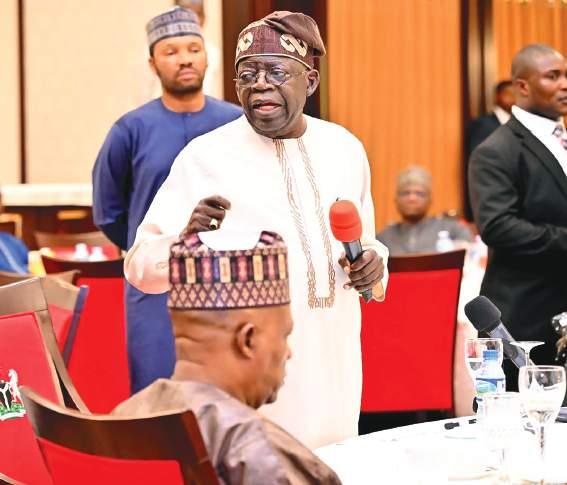
Tinubu: No Serious Nation Can Prosper With Weak, Fragmented Revenue System
Says old tax laws made Nigerians poor, assuring new systems will create opportunities, prosperity Mocks opposition parties saying he may commission Akpabio to destabilise them, as Senate President blames opposition for worsening insecurity
Zacch Adedeji says President’s economic policies saved Nigeria from the brink Declares net reserves would have been $2bn, inflation 120%, exchange rate N3,000/$ at parallel segment, debt service over 100% of revenues without reforms
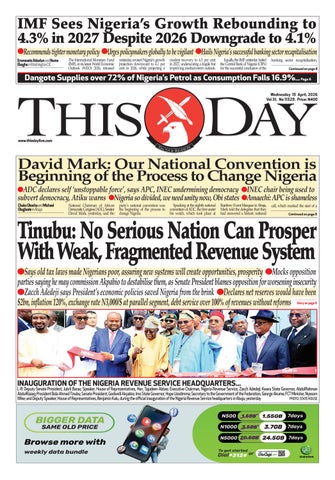
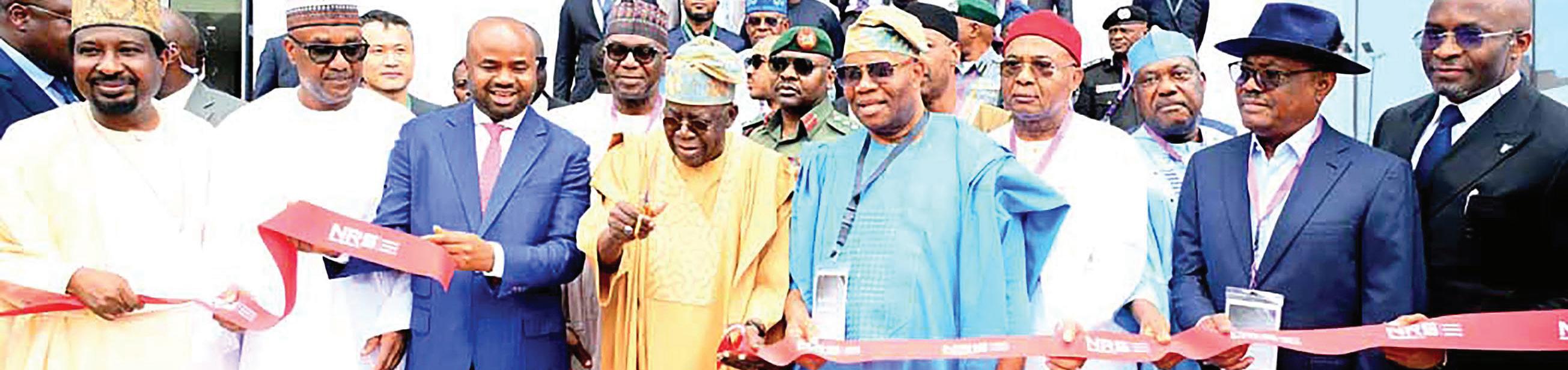
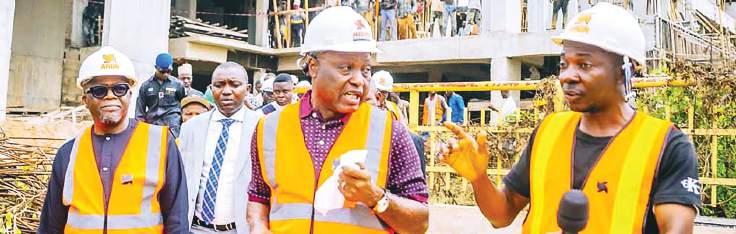
INAUGURATION OF THE NIGERIA REVENUE SERVICE HEADQUARTERS...
Abiodun and Nume
in Washington DC
L-R: Deputy Senate President, Jubril Barau; Speaker, House of Representatives, Hon. Tajudeen Abbas; Executive Chairman, Nigeria Revenue Service, Zacch Adedeji; Kwara State Governor, AbdulRahman AbdulRazaq; President Bola Ahmed Tinubu; Senate President, Godswill Akpabio; Imo State Governor, Hope Uzodimma; Secretary to the Government of the Federation, George Akume; FCT Minister, Nyesom Wike; and Deputy Speaker, House of Representatives, Benjamin Kalu, during the official inauguration of the Nigeria Revenue Service headquarters in Abuja,
Chuks Okocha and Michael Olugbode in Abuja
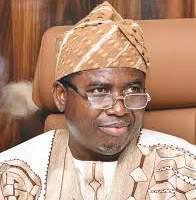
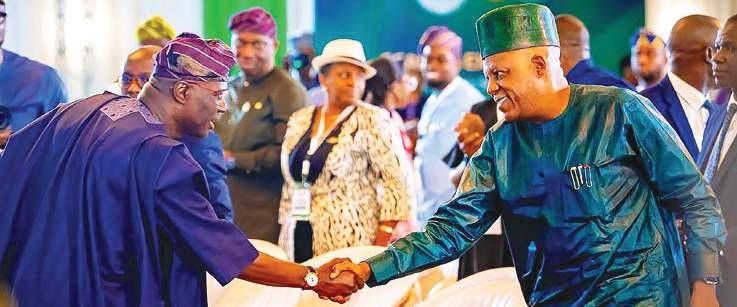
National Chairman of African Democratic Congress (ADC), Senator David Mark, yesterday, said the party’s national convention was the beginning of the process to change Nigeria.
Speaking at the eighth national convention of ADC, the first under his watch, which took place at
Rainbow Event Marquee in Abuja, Mark told the delegates that they had answered a historic national
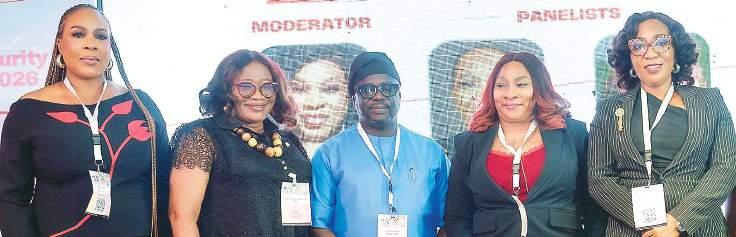
WOMEN IN SECURITY CONFERENCE...
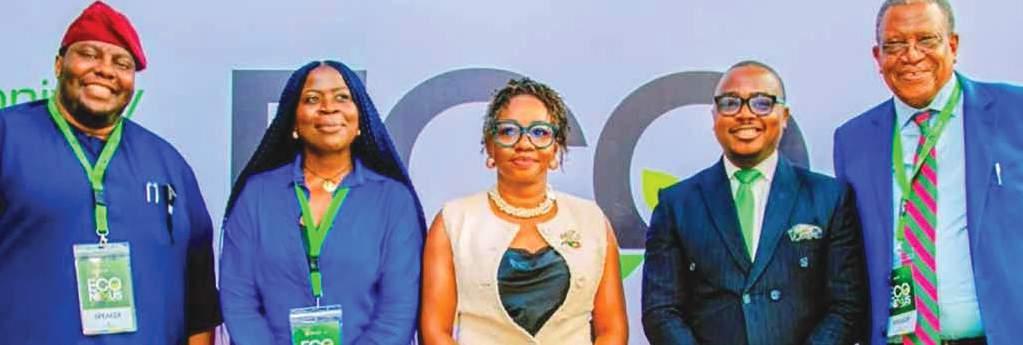
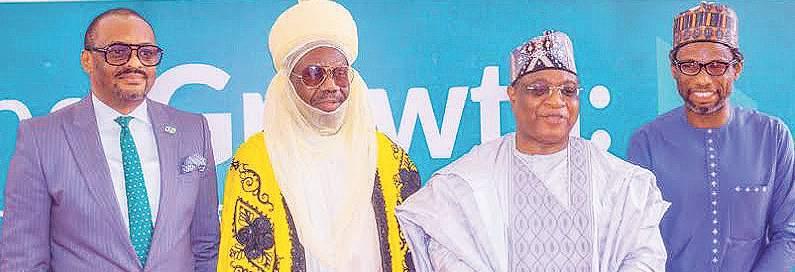
L-R: Vice President, Operations and Business Growth, Bulwark Intelligence and Chairperson, WIS 2026 Conference, Chisom Lilian Emenalom; Board Director, ASIS Sub-Saharan, Africa Region Chairman, Gbenuade Joko Olanitori; Chairman, ASIS Chapter 206, Lagos, Olufemi Kayode; Relationship Coach and Family Therapist, Dr. Lauretta Ogbum; and Principal Partner, Eagles Height Attorneys and Treasurer, Nigerian Bar Association (NBA), Lagos Chapter, Ogechi Olisa-Mokelu, at the Women In Security Conference (WIS 2026) organised by ASIS International Chapter 206, held in Victoria Island, Lagos… recently
IFRS Sustainability Standards Opportunity for Nigeria to Close
Dike Onwuamaeze
$31.5bn SDG Financing Gap, Enhance National Devt
Federal regulatory agencies and private organisations have described adoption of the IFRS sustainability disclosure standards by Nigerian businesses as a capital attraction strategy that would enable Nigeria to close its $31.5 billion Sustainable Development Goals (SDGs) financ- ing gap and accelerate national development.
The view was advanced yesterday in Lagos at the “IFRS Sustainability Standards (ISSB) Capacity Building Workshop” by Financial Reporting Council of Nigeria (FRC), Securities and Exchange Commission (SEC), National Council on Climate Change (NCCC), Impact Investors Founda- tion (IIF), and NGX Regulations Limited.
In his keynote speech, Executive Secretary/Chief Executive Officer of FRC, Dr. Rabiu Olowo, said the IFRS sustainability standard “is a strategic pathway to national development and global competitiveness”.
Olowo said the recognition was why FRC’s adoption style for sustainability reporting was not cosmetic.
He said, “We are really inten- tional about it. The ISSB framework presents a unique opportunity for Nigeria to align with global best practices while addressing our unique local priorities.
“For us at the FRC, this is a pivotal moment for us because sustainability reporting is no (1:28) longer optional, but “a strategic imperative for build- ing resilient organisations, attracting
responsible investment, and driving long-term economic growth.”
In her welcome address, CEO of IIF, Ms. Etemore Glover, said as sustainability-related financial disclosures gained prominence, investors and regulators were increasingly relying on them to assess corporate resilience, market risk, and attract international capital.
Glover said, “By standardising how we communicate environmental and social impacts, we take mean- ingful steps towards closing the $4 trillion annual financing gap required for developing countries to achieve the sustainable development goals.
“In Nigeria, it is valued at about $31.5 billion to achieve the SDGs and that is whopping.
“So, this workshop is a strategic undertaking by the IIF and it reflects our commitment to move beyond awareness towards true market readiness and to see how countries were preparing towards the ISSG era.”
Director-General of NCCC, Dr. Tenioye Majekodunmi, said the work- shop was not merely to discuss a new set of compliance requirements, rather “we are navigating the evolution of corporate transparency and the future of capital allocation that is essential to building a transparent, resilient and sustainable economy.”
Majekodunmi added, “Sustain- ability reporting is therefore not merely a compliance exercise. It is a strategic imperative for achieving sustained growth and creating economic opportunities for Nigerians.”
Director-General of SEC, Dr. Timi
Agama, who was represented by his special assistant, Mr. Tony Iloka, said the physical risks of climate change were not mere abstractions but realities that Nigerians in every political zone were navigating.
He said, “The current administration has signalled clearly its intention to restructure the Nigerian economy, to reduce fossil fuel dependency, attract foreign direct investment, develop a competitive domestic manufacturing and technology base and deploy Nigeria’s economic human capital as the engine of the modern diversified economy.”
Agama explained, “This transformation requires enormous amounts of capital, and here is a fundamental connection to today’s workshop.
“The capital that Nigeria needs from international, institutional investors, sovereign wealth funds, development finance institutions and global asset managers is increasingly governed by sustainability criteria.
“Therefore, ESG integration is no longer a preference among a subset of ethical investors. It is a
mainstream
“Institutionaldiscipline. capital allocators who manage pension funds, insurance reserves and endowments across North America, Europe, and Asia are legally and judicially obligated to assess and disclose sustainability risks.
“They cannot deploy capital into markets where the disclosure infrastructure does not allow them to make that assessment.
“This is not a complete compliance exercise. It is a capital attraction
strategy.”
He said every Nigerian listed company that adopted ISSB-aligned sustainability reporting expanded its potential investors’ universe.
Agama said, “Every issuer that demonstrates credible climate transition planning signals to global investors is ready for the future“Andeconomy. every element of Nigeria’s regulatory infrastructure that aligns with international sustainability frameworks reduces the perceived risk premium that investors attach
to Nigerian assets.
“The Securities and Exchange Commission understands this clearly and it is why sustainability reporting has been positioned as a strategic pillar, not a peripheral annex of a regulatory reform agenda under the Investment and Securities Act 2025.”
He said SEC was developing a revised sustainability reporting framework that adopted IRS S102 as the baseline standard for sustainability-related financial disclosures with appropriate modifications to reflect Nigerian
market conditions and capacity realities.
He added that the commission will adopt a phased implementation approach, beginning with large capitalisation companies and progressively extending to mid-cap issuers, capital market operators, and public companies across a defined multi-year timeline.
Agama said from a regulatory standpoint what struck him most about ISSB architecture was its design as a global baseline, a floor, not a ceiling.
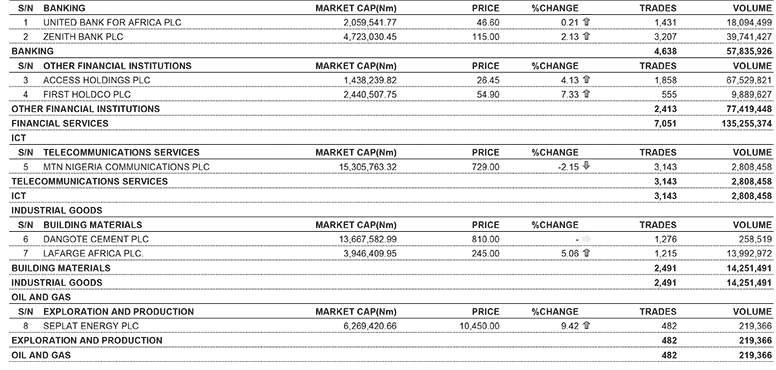
Seplat Energy Makes History as First to Cross N10,000 Mark on NGX
Seplat Energy Plc, yesterday, made history as the first listed company on the Nigerian Exchange Limited (NGX) to cross the N10,000 per share price mark.
The stock price of Seplat Energy sustained positive momentum following FTSE Russell reclassification of Nigeria from unclassified to Frontier Market status in its interim review.
As at the close of trading activities on April 14, the stock price of Seplat Energy gained 9.42per cent or N900 per share to close at N10,450.00 per share, from N9,550.00 per share it opened for trading.
When Nigeria’s reclassification was announced April 7, the stock
price of Seplat moved from N9,099.90 per share to N9, 550.00 per share April 8, 2026.
So far in 2026, the stock price of Seplat Energy had appreciated by 79.89 per cent or N4,641.00 per share growth in its Year-till-Date (YtD) from N5,809.00 per share it closed for trading in 2025.
A group of analysts at Cordros Research in a report stated that Nige- ria’s return to Frontier Market status was expected to improve market flow dynamics, with inflows projected in the conservative range of $840.00 million to $1.04 billion (N1.15 trillion to N1.42 trillion), underpinned by benchmark-driven rebalancing and incremental discretionary allocations. Cordros Research stated, “Price
FG Tasks NCC on Network Connectivity for Emergency Medical Services
500 emergency ambulances currently operational
Onyebuchi Ezigbo in Abuja
The federal government has charged the Nigerian Communications Commission (NCC) to ensure improvement in network connectivity at the Medical Emergency Call Centres.
On Emergency Medical infrastructure deployment, the government said that Nigeria currently operates about 500 functional emergency medical ambulances, which is far short of the estimated 4,000 needed
to adequately serve the population
The Federal Ministry of Health and Social Welfare gave the charge through Nigerian Emergency Medical Services and Ambulance System (NEMSAS) at a Two-Day Media Cell Capacity Building Workshop in Abuja on Monday and Tuesday.
Speaking at the Workshop organised by NEMSAS in collaboration with the Solina Center for International Development and Research (SCIDaR), the National Coordinator of NEMSAS,
Dr. Doubra Emuren, said that poor telecommunications connectivity is significantly hampering emergency response operations across Nigeria,
“Unreliable network coverage continues to disrupt emergency call systems and coordination nationwide and this has slowed down public patronage of the emergency ambulance service,” he said.
The two-day training, themed “Strengthening Communications for Emergency Medical Services
in Nigeria,” is aimed at improving media engagement and deepening public understanding of emergency medical systems.
Emuren explained that inconsistent telecommunications infrastructure remains a critical barrier, particularly in remote and hard-to-reach areas, where emergency interventions are often delayed due to poor connectivity.
He noted that although the National Emergency Number 112, coordinated by the Nigerian
Communications Commission (NCC), was introduced to streamline emergency calls, its functionality is still inconsistent in several parts of the country.
According to him, weak integration between telecommunications systems and emergency response frameworks has led to delays in accessing life-saving services.
“Connectivity is critical to emergency response. When networks fail, response time is affected, and lives are put at risk,” he said.
discovery should improve further in the market’s liquid leadership cohort: The second-order implication is on price discovery, particularly at the large-cap, liquid end of the market. Historically, foreign capital does not move evenly across the board.
“Rather, it tends to concentrate where liquidity, free float, governance visibility, and execution capacity are strongest. Specifically, the Nigerian constituents of the FTSE/JSE All Africa 40 Index comprised Dangote Cement Plc, GTCO Plc, MTN Nigeria Plc, Nestle Nigeria Plc, Seplat Energy Plc, and Zenith Bank Plc, with the MSCI Nigeria Index further incorporating Nigerian Breweries Plc and Stanbic.IBTC Holdings Plc.” The report said, “As such, the primary beneficiaries are likely to remain the highly liquid names across the Banking, Industrial Goods, and select Consumer Goods and Oil & Gas counters.
“As foreign participation rises, we believe market efficiency should improve, with prices clearing more effectively around earnings quality, balance sheet strength, dividend credibility, and sector-specific policy leverage.
“Put differently, the reclassification should enhance the quality of pricing in the names that dominate benchmark attention. For investors, this raises the premium on owning liquid market leaders with clean earnings visibility, a credible capital return trajectory, and the capacity to withstand institutional positioning.
Kayode Tokede
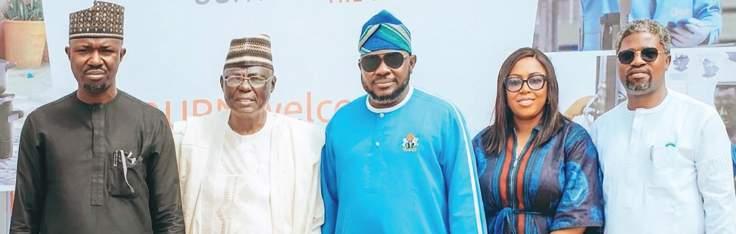
PRESIDENCY’S VISIT TO BURN FACTORY IN KANO...
L-R: Snr. Special Assistant to the President on Climate Technology and Operations, Hon. Olamide Fagbuji; Director and Special Envoy on Climate and Carbon Market, BURN, H.E. Ambassador Ajisomo; Special Adviser to the President on Climate Matters, Hon. Yussuf Olatunji Kelani; Regional Carbon Policy Lead, West Africa, BURN, Sola Fatoba; Regulatory Manager, BURN, Damilola Dada, during the Presidency’s visit to the BURN Factory. BURN Manufacturing operates a 3,700 m2 clean cookstove assembly plant in Kano
Dangote Supplies over 72% of Nigeria’s
Petrol as Consumption Falls
16.9%
Import share jumps 96.7% to 5.9m litres/day from 3m litres in February Rise in imported fuel is despite NMDPRA’s denial of license issuance
The Dangote Refinery supplied about 72.3 per cent of Nigeria’s total domestic demand for petrol in March, but with consumption falling by approximately 16.9 per cent during the period under consideration from 56.9 million litres per day in February to 47.3 million litres last month.
Besides, although still modest
compared to last year’s massive importation, the share of petrol imports in the supply mix surged by 96.7 per cent month-on-month, rising from 3 million litres per day to 5.9 million litres/day during the period.
Data from the March 2026 fact sheet on midstream and downstream petroleum operations provided by the Nigerian Midstream and Downstream Petroleum Regulatory Authority
(NMDPRA) yesterday, showed that the 47.3 million litres per day consumption for march fell below the national average of 50 million litres per day.
Overrall, the data indicated that total domestic petrol supply stood at 34.2 million litres per day in March. When measured against total consumption of 47.3 million litres per day, this placed Dangote Refinery’s contribution at approximately 72.3
LPG demand exceeds supply by 396MT per day
per cent of the domestic market, reaffirming its dominant role in the country’s fuel supply chain.
However, the supply mix also reflected a sharp increase in the role of imports. The fact sheet showed that petrol import contribution rose from 3 million litres per day in February to 5.9 million litres per day in March, equivalent to a 96.7 per cent jump in import share.
However, this increase in imported
Despite Missing OPEC’s 1.5m Bpd Quota, Nigeria’s Oil Output Grows 69,000 Bpd in March
of aging infrastructure, security issues, and technical disruptions.
Nigeria’s crude oil production recorded a modest recovery of 69,000 barrels per day in March 2026, even though output remained below the 1.5 million barrels per day quota given by the Organisation of Petroleum Exporting Countries (OPEC)
Data from the latest OPEC’s Monthly Oil Market Report, showed that Nigeria’s production rose to 1.383 million bpd in March from 1.314 million bpd in February, representing an increase of 69,000 bpd month-on-month.
This gain, according to OPEC, was based on direct communication figures reported by member countries, of which Nigeria is key, rather than secondary estimates. However, the 1.383 million bpd figure was far less than Nigeria’s OPEC output of 1.459 million bpd recorded in January.
But across Africa, production trends were largely mixed. Algeria recorded a slight uptick, increasing to 973,000 bpd in March from 971,000 bpd in February, while Congo increased production from 291,000 bpd to 307,000 bpd. Nigeria has struggled without success to meet its OPEC production quota, with the challenge driven mainly by a combination
Despite the mild recovery, Nigeria continues to fall short, although it briefly met the requirement in January, June and July last year. The inability to meet these quotas has created a double-edged sword for the Nigerian economy.
The government is leaving billions of dollars in potential revenue on the table, while local refineries have occasionally had to look for international crude supplies because domestic production is insufficient to meet their full capacity.
Elsewhere, the data showed that Saudi Arabia recorded a decline to 7.763 million bpd in March from 10.111 million bpd in February, according to direct communication data, indicating a significant month-on-month adjustment. Iraq also saw a sharp reduction to 1.906 million bpd, while Kuwait fell to 1.2 million bpd.
Besides, the United Arab Emirates posted a decline to 1.908 million bpd, continuing its downward adjustment trend for the month. Iran, by contrast, remained relatively stable at 3.060 million bpd, showing only a marginal decline.
Meanwhile, an Intergovernmental Agreement (IGA) on a planned $25 billion Nigeria-Morocco gas pipeline will be signed this year, the
head of Morocco’s hydrocarbons and mining agency (ONHYM), Amina Benkhadra, has said.
Agreed a decade ago, the project - known as the African Atlantic Gas Pipeline - would run 6,900 km on a hybrid offshore-onshore route with a maximum capacity of 30 billion cubic metres (bcm), including 15 bcm to supply Morocco and support exports to Europe, ONHYM’s Benkhadra told Reuters by email.
The pipeline, which has the back-
ing of the Economic Community of West African States (ECOWAS), has completed its feasibility study and front-end engineering design (FEED) stages.
Following the intergovernmental agreement, a high authority for the pipeline will be established in Nigeria, bringing together ministerial representatives from each of the 13 participating countries to provide political and regulatory coordination, Benkhadra told Reuters.
petrol between February and March was despite the downstream regulator’s insistence that it has halted the issuance of import licenses to oil marketers for months.
For over a year, owner of the 650,000 barrels per day facility in Lagos, Aliko Dangote, has pushed to end petrol imports in order to, according to him, protect local refining and grow the economy. Dangote’s refinery, which began production of petrol in 2024, has argued that Nigeria’s import licensing regime undermines local refining by allowing marketers to continue bringing in petrol even when domestic supply is increasing.
The company has maintained that under the Petroleum Industry Act (PIA), imports should only be permitted when there is a clear supply shortfall, not as a parallel system competing with local production.
On the other hand, oil marketers and a cross section of Nigerians believe that leaving the market solely for Dangote, without any competition from any other refinery, especially from NNPC’s defunct Port Harcourt and Warri refineries will lead to a monopoly and inflated pump prices.
The NMDPRA fact sheet further showed that other domestic refining sources contributed only marginal volumes, specifically diesel refining.
The three operational modular refineries: Walter Smith, Edo Refinery, and Aradel collectively supplied about 0.629 million litres per day of diesel during the month.
Walter Smith refinery operated at an average capacity utilisation of 59.56 per cent, supplying 0.241 million litres per day. Edo Refinery recorded 64.69 per cent utilisation with 0.051 million litres per day, while Aradel posted 58.84 per cent utilisation, delivering 0.337 million litres per day.
Average diesel consumption during the period stood at 14.5 million litres daily, slightly above the 14 million litres per day national benchmark, despite the rising prices as a result of the Middle East crisis, indicating sustained demand from industrial and commercial users. Similarly, in March, aviation fuel consumption remained lower at 2.1 million litres per day compared to the 3 million litres per day benchmark for the country and against the 2.9 million litres per day supplied in February.
In the whole gas market segment, total supply averaged 4.888 Billion Standard Cubic Feet Per Day (Bscf/d). Of this, 3.033 Bscf/d was supplied to the Nigeria LNG (NLNG), representing approximately 62 per cent of total gas supply.
Court Grills Developer’s Title as Firm Seeks Joinder in High-Stakes Ikoyi Land Dispute
Wale Igbintade
A Lagos State High Court sitting in Osborne, Ikoyi, yesterday entertained fresh arguments in a protracted land ownership dispute between Net Construct Nigeria Limited and Amytorix Company Nigeria Limited, as Casafina Capital Limited applied to be joined as a party.
Presiding over the matter, Justice Kayode Ogunjobi scrutinised the basis of the applicant’s title while hearing submissions for and against the joinder application.
Casafina Capital Limited, in its
application, told the court that it acquired a portion of the disputed land measuring about 13,000 square metres from Alma Beach Estate Limited (in receivership) under a development agreement dated July 10, 2020.
The firm stated the land formed part of a larger expanse covered by a Certificate of Occupancy in Eti-Osa Local Government Area of Lagos State.
Through an affidavit deposed to by its litigation clerk, the applicant argued that it had a direct and substantial interest in the property
and that the outcome of the suit would affect its proprietary rights.
It urged the court to grant its joinder application in the interest of justice, warning that failure to do so could lead to irreparable loss and a multiplicity of suits.
Equally, counsel to the applicant told the court that his client had been in undisturbed possession of the land since 2020 and had developed 22 housing units on it.
“We purchased the property under receivership and have remained in possession since then. We have built about 22 units on the land. Suddenly,
our interest is being threatened without being heard,” counsel said. The counsel added that the portion acquired by the client was clearly defined and covered by a deed of assignment, stressing that the matter cannot be fairly determined without the applicant’s participation.
“If the existing parties decide to settle, that decision will directly affect us, despite our substantial investment,” he argued. However, Ogunjobi raised concerns about the root of the applicant’s title, stating that it is derived from the second defendant.
Emmanuel Addeh in Abuja
Emmanuel Addeh in Abuja
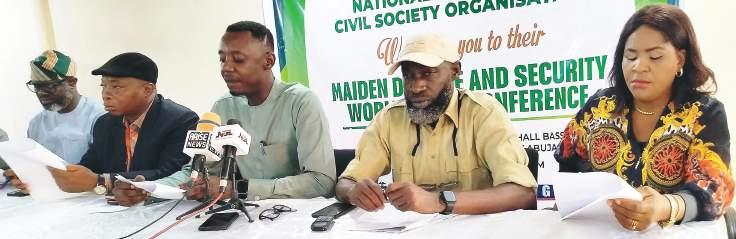
CSOS SUMMIT ON BORDER SECURITY...
L-R: Executive Director, Centre for Peace Transparency and Accountability, Patrick Onomuodeje; Regional Vice President, West Africa Action Network on Small Arms (WAANSA), Mr. Igwe Martin; Director General, National Council for Civil Society Organisation, Comrade Emmanuel Johnny; Convener, Social Transparency and Youth Leadership Advancement Initiatives, Okpanachi Jacob; and National Women Leader, Young Women Initiative for Peace and Productivity, Chief/Mrs. Lilian Cosmas, during a press conference organised by Civil Society groups on the summit on border security and continued support for the war against insurgency held in Abuja, yesterday
Edun Rules Out Subsidy Return Despite Oil Windfall, Cites Mounting Global Pressures
Insists high borrowing costs threaten development goals in emerging markets
Nigeria’s Minister of Finance and Coordinating Minister of the Economy, Wale Edun, yesterday warned against policy reversals such as a return to broad-based subsidies, even as global economic pressures intensify.
Edun, who spoke in his capacity as the Chair of the Intergovernmental Group of 24 (G24), said during during a G24 media briefing, at the ongoing IMF/World Bank spring meetings in Washington DC, said emerging economies must resist the temptation to unwind recent reform gains, stressing that fiscal responses should remain targeted and temporary rather than distortive.
He also pointed out that central banks face a delicate balancing act in navigating inflation risks without undermining fragile recoveries across developing economies.
Edun said: “For the oil-producing countries, the Ecuador and Nigeria, you may say, there is the transmission of higher oil prices into higher revenues. All of that is meaningful for the governments at this time, which is totally different from oil-importing countries, who clearly face escalated costs.
“But I must say that it’s also not a one-way street, in the sense that even an oil-producing country does have transmission of the higher costs,
which feeds through from gas prices to fertilizer to food prices and so forth. So it is on both sides that this current energy crisis is affecting countries.
“I think that the idea is to be able to have the resilience to weather the current shocks, and that means the buffers that have been built have to be used. But I think that it is a question of using targeted and temporary relief, particularly for the poor and the most vulnerable, to help them through the cost-of-living spike, as opposed to rolling back the transformations which economies have taken.
“As you know, in the case of Nigeria, that moved very rapidly under the President who came in in 2023 to remove subsidies on petroleum products, and to also remove subsidies that were related to the foreign exchange markets. And so those gains, which, if we look at them, were moving at pace and have now been negatively affected by an external shock, which had nothing to do with Nigeria or developing countries as a whole.
“Having made so much progress, it is important that we don’t have a return to generalised subsidies, a sort of relapse into policies that have not proven successful in the past.”
Commenting on monetary policy in the G24 countries, he said: “Central banks and monetary policy at this time, the overriding message is that there’s a critical balancing role here, where if interest rates are raised too early and
too high in an effort to curtail or see potentially rising inflation, that too can do damage to the transformation which are taking place in economies, whereas, on the other hand, if interest rates are not moved on time, that too can do damage in terms of allowing too lax monetary policy or too lax expansion of the economy at the wrong time.”
He noted that the transmission of global shocks differs across economies, particularly between oil exporters and import-dependent countries, but stressed that even oil-producing nations are not insulated from inflationary spillovers.
Speaking to the G24 countries’ financing conditions, Edun warned that rising debt service obligations and shrinking external inflows were tightening fiscal space across developing economies.
He added: “We are in a period where developing countries, emerging and developing economies, are facing a net outflow. When you look at debt service and diminished net official development assistance (ODA), and even foreign direct investment (FDI), the debt service in 2024 of developing countries at about $163 billion
outweighed overseas development assistance of about $47 billion, plus even foreign direct investment. When you add those inflows, the outflow from debt servicing because of elevated interest costs outweighs what came in.
“I think that whilst looking to see what can be done by the developed world, multilateral development institutions should also step up at this time with support, liquid support, as well as thought leadership to help countries navigate this period.
“The most important lesson is that there has to be a reliance on domestic
resource mobilisation within these countries, the public sector, as in Nigeria, comprehensive tax regimes that not only improve resource mobilisation but at the same time reduce the cost to the lowest earners, both individually and as governments. It is this type of self-help, self-reliance and domestic resource mobilisation, including the private sector, that countries need to look to, both through this shock and going forward, as the sustainable basis for transformation of economies that need to grow and take their people out of poverty.”
Nigeria’s Steel Minister, Audu Signs $1bn Investment MoU with Rashmi Steel Group in India
Kasim
Minister of Steel Development, Shuaibu Abubakar Audu, Tuesday signed a Memorandum of Understanding (MoU) with Indian conglomerate, Rashmi Metaliks Group, in Kolkata, India, for a projected investment of $1 billion over a three-year period. This followed Audu’s tour of the Rashmi Metaliks Steel Plant in Kolkata, where he commended the scale of the operations and advanced technology deployed
at the facility.
He also lauded the company’s integrated operations — spanning Direct Reduced Iron (DRI), pig iron, billets and finished ductile iron pipes — describing them as a strong a example of industrial efficiency and excellence in modern steel production.
The minister, in a statement issued by Head, Press and Public Relations of the ministry, Salamatu F. Jibaniya, stated that Nigeria’s proactive investment drive was already attracting significant
Marwa Warns Varsity Students Against Drug Abuse, Says it Destroys Future Prospects
Michael Olugbode in Abuja
Chairman/Chief Executive Officer of National Drug Law Enforcement Agency (NDLEA), Buba Marwa, has warned Nigerian youths against drug abuse, describing it as a dangerous habit capable of ruining their future and career prospects.
Marwa gave the warning on Tuesday while delivering the convocation lecture at the 29th and 30th combined convocation ceremony of the University of Abuja.
Speaking on the topic, “High
Today, Lost Tomorrow: The Real Cost of Drug Abuse on Campus,” the NDLEA boss said substance abuse had moved beyond the streets and was now a growing problem within lecture halls and campuses. He stated that the drug scene had evolved from the use of traditional substances, like cannabis, to more dangerous synthetic opioids and designer drugs, such as Colorado, Loud and Methamphetamine.
Marwa raised concerns over the increasing use of social media platforms for drug distribution, as well as the involvement of students
in trafficking.
“A criminal record for drug offences is a life sentence on your career before it even begins. You cannot practise law, medicine or engineering with a drug-related conviction,” he said.
Marwa explained that drug abuse affected the brain by altering neurotransmitters, leading to poor memory and impaired critical thinking.
He added that substance abuse was often linked to cultism and campus violence, warning that arrest and conviction can permanently
end professional ambitions.
Citing statistics, he said over 77,000 drug offenders were arrested in the past five years, with more than 60 per cent being young people. He also disclosed that most of the over 48,000 individuals treated in NDLEA facilities within the same period were youths.
The NDLEA chairman referenced findings from the 2018 National Drug Use and Health Survey, which showed that many Nigerians began experimenting with drugs around the age of 19, while cases involving younger teenagers were on the rise.
global capital.
He stated that the MoU signed with Rashmi Metaliks Group represented a major milestone in Nigeria’s effort to reposition the steel sector, reaffirming President Bola Tinubu’s commitment to revitalising the industry, creating employment opportunities, and conserving foreign exchange through strategic import substitution.
Audu added that the efficiency of the facility underscored the importance of value addition, innovation, and sustainability in modern steel production.
He emphasised that the visit further reflected the strengthening of economic ties between Nigeria and India in the areas of steel, mining and manufacturing.
In signing the MoU, Audu highlighted Nigeria’s vast steel potential, stating that the country is transitioning from a raw minerals’ exporter to a value-adding industrial economy.
He disclosed that Nigeria possessed well over three billion tonnes of iron ore reserves, with some deposits grading as high as approximately 67 per cent iron content (Fe), while domestic steel consumption was estimated at about $10 billion annually.
Audu said Nigeria aimed to become a leading steel hub in Africa under Tinubu’s Renewed Hope Agenda, targeting crude steel production of approximately 10 million tonnes per annum by 2030.
He said, “Recent Foreign Direct
Investments in the sector includes: A $400 million Stellar Steel plant in Ewekoro, Ogun State — a Chinese-Nigerian joint venture for a modern hot-rolled coil steel plant scheduled to commence operations by November 2026.
“African Industries Group (AIG) is completing a fully integrated ironand-steel plant at Gujeni in Kaduna State. The company has invested $300 million in the Direct Reduced Iron (DRI) and steel unit of the project; and the galvanising and fabrication plant in Ikorodu, Lagos.
“Energy infrastructure is also being developed to support the growth of the industry. The Nigerian National Petroleum Company Limited (NNPC), the Ministry of Steel Development and their partners recently broke ground on five mini-LNG plants in Ajaokuta, Kogi State — a $500 million project aimed at boosting gas supply to the steel industry, with a combined capacity of approximately 97 million standard cubic feet per day.”
Audu used the visit to invite additional Indian investors to explore opportunities within Nigeria’s steel sector.
He highlighted prospects for establishing integrated steel plants in Nigeria, deploying Direct Reduced Iron and electric-arc furnace technologies, and developing full value chains for automotive, construction and infrastructure steel.
Eromosele Abiodun and Nume Ekeghe in Washington DC
Sumaina in Abuja
PHOTO: ENOCK REUBEN
Fitch Affirms Nigeria at ‘B’ Rating with Stable Outlook, Cites FX Reforms, Others
Flags fiscal pressures, external risks, data quality concerns Predicts budget deficit driven by election spending, others Sees $2.4bn fall in external reserves by end of 2026
Emmanuel Addeh in Abuja Fitch Ratings has affirmed Nigeria’s Long-term Foreign-Currency Issuer Default Rating at “B” with a Stable Outlook, citing a mix of improving macroeconomic reforms and persistent structural weaknesses in Africa’s most populous nation.
Essentially, the latest rating is Fitch’s judgement on how likely Nigeria is to meet its debt obligations that are denominated in foreign currencies like US dollars or euros, over an extended period.
In its latest review, the rating agency said Nigeria continues to benefit from a large and diversified economic base, a relatively developed domestic debt market, and significant oil and gas reserves.
It also acknowledged recent improvements in the monetary and exchange rate policy framework, particularly reforms introduced since mid-2023 aimed at stabilising the foreign exchange market and restoring investor confidence.
However, Fitch warned that these gains remain constrained by deep governance challenges, high dependence on hydrocarbons, elevated inflation, security risks, and persistently weak revenue generation compared to peer economies.
A key positive highlight in the report was the continued normalisation of the foreign exchange market.
According to Fitch, recent Central Bank of Nigeria (CBN) measures, including the removal of restrictions on the repatriation of oil
export proceeds by international oil companies, are expected to further improve FX liquidity and support relative naira stability.
The agency noted that the naira still experienced a significant 40 per cent depreciation in 2024, but said ongoing reforms should help reduce volatility, even though mild depreciation risks remain due to fiscal pressures and external shocks.
Besides, Fitch pointed to a strong improvement in external reserves, which rose to $49.4 billion at the end of March 2026, up from about $32 billion in April 2024. The agency projected a slight decline to $47 billion by end-2026, a $2.4 billion fall, but said reserve buffers remain comfortable, covering about seven months of external payments, well
above the “B” median of 4.3 months. It further noted improvements in Nigeria’s external position, including expectations that the current account surplus will widen in 2026, driven by higher hydrocarbon earnings, modest remittance inflows, and reduced fuel imports due to increased domestic refining capacity. These gains, it said, are expected to be partly offset by rising external debt servicing and recovering non-oil imports.
On fiscal performance, however, Fitch struck a more cautious tone, forecasting that Nigeria’s general government deficit will widen to nearly 5 per cent of Gross Domestic Product (GDP) in 2026, driven by higher spending on security, social interventions, and election-related expenditure ahead of the 2027
political cycle.
The ratings agency also noted that the newly approved federal budget raises total spending to about 14 per cent of GDP, with a significant portion allocated to capital projects, although execution risks remain high.
“The authorities have continued to build on reforms implemented since May 2023 to restore macroeconomic stability and enhance policy credibility. Recent measures by the Central Bank of Nigeria (CBN), including the removal of FX restrictions on the repatriation of oil export proceeds by international oil companies, should support further FX market normalisation, improve confidence and support relative naira stability after a 40 per
Wale Edun
cent depreciation in 2024.
“However, we expect modest depreciation in the near term amid rising fiscal pressures, as well as heightened external risks, while data quality concerns continue to weigh on policy credibility.
TINUBU: NO SERIOUS NATION CAN PROSPER WITH WEAK, FRAGMENTED REVENUE SYSTEM
Deji Elumoye and James Emejo in Abuja
President Bola Tinubu, yesterday, declared that no serious nation can prosper under a weak and disjointed revenue system.
Speaking at the inauguration of the 16-storey Nigeria Revenue Service (NRS) Headquarters in Abuja, Tinubu said colonial-era tax laws impoverished Nigerians through fragmentation, multiplicity, and inconsistencies. He assured that the new reforms will deliver greater prosperity and inclusivity.
Speaking on the same occasion, Senate President, Senator Godswill Akpabio, blamed the opposition political parties for what he called the resurgence and heightened insecurity in the country.
He stressed, “No government can demand trust from its citizens when taxation is opaque, inefficient or unjust.”
Akpabio said the president’s adversaries were envious of his achievements and bent on denting his reputation before the coming elections.
Executive Chairman of NRS, Mr. Zacch Adedeji, hailed Tinubu’s leadership in steering the country out of its economic woes.
Adedeji described the president as a truly visionary reformer and the greatest gift bestowed on the country by God.
He said without the president’s
DAVID MARK: OUR NATIONAL CONVENTION IS BEGINNING OF THE PROCESS TO CHANGE NIGERIA
journey of democratic change in Nigeria.
He stated, ‘’Today answers that question of changing the way things are in Nigeria. You will be amongst those who answered loud and clear that you were here. And your presence alone is an act of courage.
‘’This is the first National Convention of the African Democratic Congress under my leadership as National Chairman and let me be clear: it is one of the most significant gatherings in recent Nigerian democratic history.
“Not because of who stands on this podium, but because of what this convention represents: the unyielding survival of opposition democracy in Nigeria.”
Mark explained, “The African Democratic Congress was founded on conviction and a strong belief that politics must be a call to service and not a ladder for personal ambitions. I am deeply honoured by the confidence reposed in me to lead this great party at this critical time.
“I accepted this responsibility with humility. I accepted it with a clear sense of duty. And I accepted it with an unshakable commitment to reposition the ADC as the platform through which Nigeria will be rescued and rebuilt.
‘’Since we started this journey, we have faced many challenges, and faced many hurdles. Our party has faced fierce and unprecedented betrayal. Let us not pretend otherwise.”
He said recent developments involving the Independent National Electoral Commission (INEC) had raised fundamental questions about the process that governed Nigeria’s democracy.
According to the ADC national chairman, ‘’Forces that feared what a united ADC represents came for us through the courts, through institutions, through bureaucratic obstruction. They sought to stop this convention from happening.
They removed our names from official portals.
‘’They denied us preferred venues. They deployed every instrument available to them to ensure that you – the delegates, the members, the owners of this party – will never gather.
‘’But we are here. At our recent press briefing, we made it clear that the integrity of democratic institutions must be protected at all times. We also made it clear that in an ever-shrinking democratic space that is orchestrated by those in the ruling party, the ADC will not bow, we will not cower, and we will not retreat.”
Calling for resilience among ADC members, Mark stated, “Dear party members and leaders, let me remind all of us that strong political movements are not built in moments of ease and in comfort.
They are built in times like this, when a broken nation cries out for change and the people look for those, who would lead with commitment and honesty.
‘’We will not surrender, because what is at stake is not just about the ADC or the opposition. It is the very survival of our democracy. To surrender, therefore, is to yield to tyranny and, therefore, become complicit in the destruction of our democracy.
‘’Let us here be the answer to every doubt, every threat, and every shenanigan designed to keep Nigeria trapped in a one-party future.”
The former senate president declared, “The ADC cannot be wished away. The ADC cannot be litigated into silence. The ADC belongs to the Nigerian people – and the Nigerian people have spoken by showing up today.
‘’I say to those who orchestrated these obstacles: you have not weakened us. You have welded us together. Every attempt to suppress this party has only deepened the resolve of our members, widened our coalition, and reminded Ni-
gerians why a strong opposition is not optional; it is essential to democracy’s survival.”
Mark added, ‘’Across Nigeria, there is a growing awareness, by a generation that desires a different country, a country that nurtures their talents and support their ambitions. This generation is asking tough questions of leadership and those who seek to lead.
“We are greatly delighted to see that under the harsh light of this scrutiny, the African Democratic Congress is emerging as a credible alternative, not necessarily because of who we are, but because our vision and ambition align with their own.
“The reason we are here, the genuine re-commitment to putting the people first, is the very reason that they continue to believe, despite the daunting challenges that they face today, that Nigeria, this great
country, will rediscover itself.”
Acknowledging the responsibility and opportunity of preserving democracy, Mark said, “We in the African Democratic Congress recognise this moment as a moment of great opportunity, as well as a moment of great responsibility. Our objective is not merely political success or a mere quest for power.
“We see it as a duty to ourselves and to posterity to demonstrate to all Nigerians that something good can come out of politics, and that democracy can actually deliver a better life that they seek. This is the fundamental goal of our party.
‘’We view this as a generational challenge. And this is why we say to all opposition leaders in the country, regardless of your political party, come, let us work together to save our country.
“The challenges that we are
Continued on page 35
bold economic reforms implemented on his assumption of office in 2023, Nigeria would have been paralysed amid current global headwinds.
Tinubu emphasised that the new tax system was designed to be people-centred and investmentfriendly, and ultimately advance the country’s development goals.
He explained that the new tax laws, which became fully operational in January, were intended to liberate the economy from the constraints of archaic laws and make it more globally competitive.
He stated, “On my inauguration day, I made a solemn pledge that we will move Nigerians from the dimness of uncertainty into the clear light of renewed hope. I committed to confronting structural weaknesses, restoring financial stability, and building an economy anchored in discipline, equity, and opportunity.
“Today, I stand before you to reaffirm that these words were not rhetoric; they were a covenant with the Nigerian people.”
Tinubu commended Adedeji for his exceptional performance and the successful completion of the NRS head office, saying it provides a conducive working environment for 3,000 staff, complete with a data processing centre, clinic, auditorium, training facilities, a gym, and a library.
He expressed delight that the
NRS headquarters was completed in 30 months, after more than two decades since the foundation was laid.
The president stated, ‘We are not gathered here merely to commission an edifice. We are here to mark a milestone in a larger national journey: the deliberate strengthening of our fiscal foundation and rebuilding of confidence in public institutions.
“No government can demand trust from its citizens when taxation is opaque, inefficient or unjust.
“That is why this administration took the bold decision to embark on far-reaching tax and fiscal reforms.”
Tinubu also thanked Minister of State for Finance, Taiwo Oyedele, for his leadership in modernising colonial-era tax laws into “manage- able, realisable, and understandable levels”.
Addressing concerns about the new tax reforms, Tinubu assured that NRS had repositioned itself as a revenue hub, equipped with capacity and technology, backed by research and data-driven policies, and sensitive to the needs of the people, particularly, the vulnerable. According to him, “The reforms are designed to simplify our system, eliminate distortions, and create a fair, transparent and investmentfriendly environment.
Continued on page 36
IMF SEES NIGERIA’S GROWTH REBOUNDING TO 4.3% IN 2027 DESPITE 2026 DOWNGRADE TO 4.1%
noting that stronger capital buffers were already proving effective in cushioning the financial system against external shocks.
The revision of the WEO reflects growing external headwinds, even as the Washington-based institution signalled that underlying conditions could support a gradual rebound beyond the near-term shocks.
The Fund in its January WEO had previously forecast Nigeria’s economy to grow by 4.4 per cent in 2026 and 4.1 per cent in 2027.
The current update, therefore, marks a downward revision for 2026, highlighting intensifying near-term pressures while lifting the 2027 forecast, suggesting that some of these shocks could ease over time, allowing for a modest recovery.
Responding to THISDAY’s question, the Division Chief in the IMF’s Research Department, Deniz Igan, reiterated that Nigeria’s outlook reflects a balance of op-
posing forces.
She pointed out that while on one hand, rising fuel and fertilizer prices, alongside elevated shipping costs linked to geopolitical tensions, were expected to weigh on non-oil activity, on the other, higher crude oil prices offer a partial cushion, preventing a sharper slowdown.
She said: “We have revised Nigeria’s growth as well by 0.3 percentage point to 4.1 in 2026, and that is reflecting a balance of two forces. One is that the war-related higher fuel and fertilizer prices and higher shipping costs that I mentioned are going to weigh on oil activity in Nigeria. There’s some offset coming from higher oil prices, but the end of the day, the balances are for weighing growth in 2026 with some recovery built in 2027.”
On inflation and macroeconomic management, the IMF stressed the importance of maintaining tight monetary policy, with a data-
dependent approach that closely monitors exchange rate movements and inflation expectations, as policymakers navigate a more volatile external environment.
“As far as inflation movements go, we believe that tight monetary policy and remaining data dependent and watching very carefully, both exchange rate movements and inflation expectations is going to be crucial to achieve the inflation target of central bank.”
Speaking on Sub-Saharan Africa, IMF Chief Economist Pierre-Olivier Gourinchas, said the downgrade of the continent’s projection was part of a broader trend across Sub-Saharan Africa, where economies are facing weaker growth and rising inflation amid global uncertainty, particularly from energy market disruptions.
He said: “We are seeing some downgrade of growth, and we are seeing some uptick in inflation in a number of countries in the region.
“So, the impact is very much
along the lines of what we see more broadly, which is for a lot of the countries, especially the ones that are energy importers, but there are also energy exporters in the region.
“So, there’s some differentiation in terms of the in terms of the impact on the fund engagement, more than, I mean, we are certainly following with a number of countries what their needs must be in the current environment.”
Meanwhile, the IMF endorsed Nigeria’s banking sector recapitalisation drive, noting that stronger capital buffers were already proving effective in cushioning the financial system against external shocks.
The Fund stressed that stronger fiscal positions remained essential for emerging markets to withstand volatile global capital flows and reduce vulnerability to sudden market shifts.
Speaking at the presentation
Continued on page 33
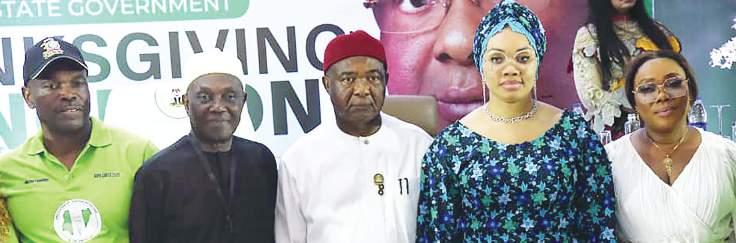
INAUGURATION OF ANPA 2026 MEDICAL WEEK...
L-R: President of Association of Nigerian Physicians in the Americas, Dr. Cliff Eke; member, Dr. Ngozika Nwaneri; Governor Hope Uzodimma of Imo State; his wife, Chioma; and the Imo State Commissioner for Health, Dr. Chioma Egu, during the inauguration of the ANPA 2026 Medical Week at the Banquet Hall, Government House, Owerri, on Sunday
I Was Only a Rubber Stamp, Diezani Tells London Court, Says She Had No Control Over Oil Contracts
Claims real authority over oil contracts rested with NNPC management, not her office Denies involvement in $20bn oil revenue controversy
Wale Igbintade
The trial of former Nigerian Petroleum Minister, Diezani Alison-Madueke, continued on Day 18 at the Southwark Crown Court, where she mounted an extensive defence of her tenure, insisting she had limited direct control over oil contract awards and describing herself as largely a “rubber stamp” operating within a highly layered bureaucracy.
She told the court that contract decisions in the oil sector were processed through multiple agencies before reaching her desk, arguing that
by the time files were presented to the minister, “the choice had been made.”
According to her, operational authority rested mainly with the Group Managing Director of the Nigerian National Petroleum Corporation (NNPC), while the ministry performed an oversight function.
Diezani said the size and complexity of Nigeria’s petroleum industry made direct ministerial control impossible, stating that the sector involved thousands of employees, hundreds of oil fields, multiple pipelines and depots, and several parastatals operating under
different reporting structures.
“It was not a one-man state,” she told the court.
She maintained that she personally rejected only about one to two per cent of contracts during her tenure, adding that interference with alreadyapproved transactions was rare and often politically sensitive.
Diezani also told the court that in 2014 she uncovered an alleged crude oil lifting arrangement involving multiple companies, which she said was allegedly linked to businessman Igho Sanomi.
She said she moved to cancel the
contracts after a whistle-blower alert but faced strong political backlash, including direct complaints to then President Goodluck Jonathan.
Diezani also revisited the widely reported $20 billion oil revenue controversy, linked to claims raised by former central bank governor, Sanusi Lamido Sanusi, telling the court that the matter had been misrepresented in public discourse.
She said what was initially described as “missing money” was later reviewed through audits and parliamentary scrutiny, which clarified that a significant
Attackers of Don Pedro Obaseki Tender Apology, Beg for Forgiveness
In a dramatic twist of events, those who attacked Dr. Don Pedro Obaseki in Benin, yesterday, begged for forgiveness from the renowned playwright.
The group, led by Osazee Adun, known as Kapuepue, younger brother to the All Progressives Congress (APC) state youth leader, Tony Adun, pleaded with Obaseki to let go of the matter.
They met Obaseki in his Benin residence, begging for forgiveness and pledging loyalty.
Adun said he was sorry for his action and vowed that never will such happen again.
He said they had come to realise that Obaseki had been promoting the cause of the Benin nation and was never an enemy of the palace.
Obaseki, in his response, said he had forgiven them.
The cousin to former Edo State Governor, Godwin Obaseki, was on December 28, 2025 dragged and assaulted at Uwa Primary School, Benin, while playing football.
He was beaten by a group of thugs led by Osaze Adun, stripped naked, and dragged to the palace of the Oba of Benin in broad daylight.
Human rights activist and lawyer, Femi Falana (SAN) had already filed a case of abduction, public dehumanisation, and fundamental
human rights abuse against Adun and others.
While receiving his assaulters, Obaseki disclosed that he was highly traumatised by the incident; but having listened to appeal from various quarters, he had no choice than to let it go.
According to him, “Everybody is aware of the events of the 28th of December and it’s almost four months now. Myself and my children were very pained but there is a proverb in Benin that only the leopard’s cub can lick the leopard’s underside.
“I’m an Edo man, I’m an Obaseki and I wanted to use this as an affirmation that we are not the enemies of the Edo people.
“So that is the only validation I need. The only thing I wanted to say, which I will say maybe in a larger forum, is, I want to thank a few very close friends. I want to thank my family because we didn’t fall from the sky.
“Ironically, the young one behind me, (Kapuepue ) his mother is also from my family.
“The Obaseki clan, we have spoken to my brothers because they have been on this for a while. We realised that we need to move forward.
“I would have seen myself as the sacrificial ram, meant to put everybody together. It is to repair, not to spoil. So, I’m angry, I was very angry and bitter.
“I was traumatised, I was sick because when you are beating a 60-year-old man on the streets and making him walk almost two and a half, three kilometres, that’s after playing 90 minutes of football. It is the grace of God.
“But I’m coming from the farm now. When they called me, I said they were on their way. So, I just wanted to do that as a respect to my
own father, and my uncles and my parents because to err is human, but to forgive is divine.
“I am not a polarising figure in this state. I’m the only one who can walk into an APC party and not bother, and enter any PDP party and not bother.
“Me, I’m the chieftain of the ADC, I don’t bother. I always sacrifice my party-ness for my Edo-ness. You get my point? So, Edo is paramount to me.”
portion related to subsidy payments and operational expenditures.
She insisted that she was unfairly associated with allegations of theft, describing the media fallout as politically driven and damaging to her reputation.
Diezani further told the court that subsidy investigations later revealed misuse within the system, including “round-tripping” practices where marketers allegedly submitted multiple claims for payment.
She said she escalated concerns to anti-corruption agencies and restructured aspects of the downstream sector, which she said led to a sharp reduction in subsidy claims but also triggered threats against her.
In an emotional moment, Diezani told the court that resistance to her reforms exposed her and her family to serious danger.
She revealed that her younger sister was kidnapped in 2013 and held for two weeks, while her nephew was also abducted in a separate incident.
She broke down in tears while describing how her son required military protection to attend school due to security threats.
The former minister also told the court that political and business figures frequently pressured her of-
fice for favours in oil allocations and financial matters, citing a letter from businessman and politician Ifeanyi Ubah as an example of such lobbying.
She said she rejected all such requests.
On her personal finances, Diezani acknowledged using credit cards issued by Nigerian banks, including Zenith Bank and UBA, and confirmed that some transactions were made abroad during official travels.
She told the court that Nigerian ministers were barred from maintaining foreign accounts, which sometimes created logistical challenges during overseas assignments.
She also admitted that, on a few occasions, her cards were declined abroad, which she said led to arrangements for third parties to cover expenses in some situations.
The court was shown travel records, diplomatic correspondence, and passport stamps covering her international movements between 2011 and 2015.
Diezani said she typically travelled with an entourage of about 30 staff members, including technical assistants and protocol officers, and insisted that all official movements were documented in ministry diaries later archived by government authorities.
Nigeria Receives Civil Aviation Master Plan from ICAO at Global Symposium in Morocco
Kasim Sumaina in Abuja
Minister of Aviation and Aerospace Development, Festus Keyamo has officially received Nigeria’s Civil Aviation Master Plan (CAMP) from the International Civil Aviation Organization (ICAO) during the opening session of the ICAO Global Implementation Support Symposium (GISS) in Marrakech, Morocco.
Keyamo, who was also a special guest at a Ministerial Round Table where he spoke on the, ‘Future of Aviation Workforce in Nigeria’, highlighted the country’s efforts to address the issue of skills gap within the aviation ecosystem.
The presentation of the landmark document, he said, marks a major milestone in Nigeria’s aviation sector, signaling a bold and structured pathway for the industry’s transformation over the next few decades.
The minister in a statement on Tuesday by his Special Adviser On Media and Communications, Tunde Moshood, had earlier approved the development of the Master Plan with the project undertaken by ICAO’s Capacity Development and Implementation (CDI) unit.
According to him, “Work on the initiative formally commenced in September 2024, beginning with a
comprehensive training programme on civil aviation master planning, which brought together key stakeholders across Nigeria’s aviation ecosystem.
“The CAMP, which spans a 20-year period (2025–2045), is strategically aligned with Nigeria’s National Development Plan and other key policy frameworks, ensuring coherence with the Federal Government’s broader economic and infrastructural objectives.”
The Civil Aviation Master Plan, Keyamo further asserted is anchored on globally recognized pillars critical to building a modern, competitive, and resilient aviation sector such
as infrastructure and technology development.
This includes the modernization of airport infrastructure to accommodate increasing passenger and cargo traffic, alongside the deployment of advanced technologies, including unmanned aerial systems (drones).
“It also addresses the need to sustain Nigeria’s commitment to a zero-fatality aviation environment through strict adherence to international safety and security standards. Also in focus is the transformation of Nigerian airports into aerotropolis hubs to drive economic activities, create jobs, and enhance national connectivity.”
Felix Omoh-Asun in Benin
THE KNIGHTHOOD OF SAINT JOHN INTERNATIONAL...
Chibok Abduction Has Become Blueprint for Mass School Kidnappings in Nigeria, Says
BBOG
Says ‘a school child is abducted every two days, killed every 20 days’ Laments missing girls, slams ‘cycle of impunity’
Sunday Ehigiator
The #BringBackOurGirls (BBOG) Movement has declared that the 2014 abduction of schoolgirls from Government Secondary School, Chibok, has evolved into a “blueprint” for mass school kidnappings across Nigeria, as it decried what it described as a persistent cycle of impunity where a school child is now abducted every two days.
In a statement issued yesterday to mark the 12th anniversary of the attack by Boko Haram insurgents on Chibok school girls, the group said the failure to decisively address the Chibok incident has emboldened perpetrators and normalised the targeting of schools nationwide.
“12 years ago, the abduction of our #ChibokGirls was a shock to the conscience of Nigeria and the world. Today, it has become a template,” the movement said, warning that what should have triggered a lasting national response has instead opened the door to recurring atrocities.
BBOG lamented that 83 of the abducted girls remain missing more than a decade later, noting that some may have died in captivity
without any official confirmation or identified graves. “83 #ChibokGirls remain missing. Some have died in captivity, yet there is no official confirmation. Their families deserve truth. They deserve closure. They deserve more than silence,” the statement read.
The group also revealed that at least 48 parents of the abducted girls have died over the years without knowing the fate of their children, describing the situation as a prolonged tragedy for affected families and communities.
It further raised concerns over continued attacks on Chibok and neighbouring communities by insurgent groups, including ISWAP, which have led to killings, displacement, and destruction of livelihoods.
According to the movement, the Chibok abduction has set a dangerous precedent, with more than 80 similar attacks on schools recorded across the country since April 2014.
These incidents, it said, have resulted in the abduction of over 1,800 students and 64 teachers, while at least 184 students and 15 teachers have been killed.
“In the 4,383 days since the night our girls were taken, a school child has been abducted every two days and one killed every 20 days. This is not just a security failure. It is a governance failure and a moral failure,” the group stated.
BBOG criticised the lack of accountability and transparency
surrounding the incident, calling on the federal government to release all investigation reports related to the abduction and prosecute those found culpable.
It also demanded an immediate update on efforts to rescue the remaining girls, alongside a comprehensive report on the rehabilitation and reintegration of those who have returned.
While acknowledging that some of the rescued girls are gradually rebuilding their lives through education and economic empowerment, the group stressed that many still require sustained psychosocial support and tailored assistance.
Reaffirming its commitment to advocacy, the movement insisted it would not relent until all the abducted girls are accounted for.
“Our hope has endured for twelve years. Our demand remains unchanged: #BringBackOurGirls, Now and Alive,” it said.
El-Rufai Granted Bail at FederalCourt, Case at State Court Adjourned to April 21
John Shiklam in Kaduna
A Federal High Court sitting in Kaduna has granted bail to former governor, Nasir El-Rufai, who is standing trial on allegations of corruption.
El-Rufai is being prosecuted by the Independent Corrupt Practices and Other Related Offences Commission (ICPC) on a 10-count charge bordering on alleged corrupt practices.
Ruling on the bail application, the trial judge, Rilwan M. Aikawa, held that the offences for which
the defendant is being prosecuted are bailable.
The court, however, ordered that the former governor be remanded in the custody of the ICPC pending the fulfilment of his bail conditions. Journalists were denied access to the courtroom during the proceedings, while counsel to the defendant declined comments.
Speaking with journalists after the session, Bello El-Rufai, son of the former governor and a member of the House of Representatives representing Kaduna North Federal Constituency, disclosed that the bail
conditions include a N200 million bond with two sureties in like sum.
According to him, the sureties must include a recognised traditional ruler and a federal civil servant not below Grade Level 15.
He further stated that the conditions require the submission of landed property documents, the deposit of international passports with the court, and a restriction preventing the former governor from making public comments related to the case, as well as an undertaking to attend all court proceedings.
“The conditions are many, close to 10 or more, but we hope to fulfil them,” Bello said. Meanwhile, ruling in El-Rufai’s bail application in a separate suit involving him at the Kaduna State High Court was adjourned to April 21, 2026.
The adjournment followed the absence of the trial judge, Darius Khobo, who was said to be bereaved.
In the 9-count charge before the state court, the former governor is also facing allegations of abuse of office and corruption.
Nigeria Partners Other W/African Countries to Strengthen Social Security System
Onyebuchi Ezigbo in Abuja
Nigeria Social Insurance Trust Fund (NSITF) has said Nigeria will be hosting ISSA West African Technical seminar on how to strengthen and improve inclusiveness and accessibility of Social Security Service through effective communication.
The event will bring together social security institutions in West Africa, policymakers, employers and workers representatives and development partners to really brainstorm as to how best and how effective to deliver social security initiatives for the benefit of workers.
He said the seminar, themed “Improving Inclusiveness and Accessibility of Social Security Services through Effective Communication”, is very deliberate and not just an event but part of a broader effort to strengthen social protection systems across West Africa.
Faleye explained that Nigeria has made significant progress in strengthening its social security architecture, particularly through the Employees’ Compensation Scheme, expanded workplace injury coverage, stressing that they, however, recognise that coverage must deepen, access must become simpler and
Addressing journalists on Tuesday, ahead of the 2026 ISSA West Africa Technical Seminar scheduled to hold in Abuja, the capital city, next week, Managing Director of the NSITF, Barr. Oluwaseun Faleye, said the Fund is set to collaborate with key stakeholders and development partners to entrench social security in workplaces.
engagement with employers and workers must improve”.
The MD stated, “We look forward to welcoming stakeholders from across the region to Abuja. What we began in Abuja is not just a conversation, it is a commitment to strengthening protection for millions of workers across West Africa.
“This Seminar comes at a time when social protection systems globally, and particularly in West Africa, are under pressure to evolve. Across our region, millions of workers, especially in the informal sector, remain outside formal social security coverage”.
According to the NSITF boss, “The question is no longer whether social security is important, but how effectively we are delivering it”, adding that “Nigeria, through
NSITF, is honoured to host the ISSA West Africa Technical Seminar 2026.
“The Seminar will bring together: Social security institutions, policymakers, employers and workers’ representatives. The objective is simple but critical: to strengthen how social security systems work in practice, not just in policy”, he stated.
Speaking further, the MD noted that in many cases, the challenge is not the absence of schemes, but limited awareness, complex processes, and low trust in institutions, adding that “Communication is therefore not an add-on, but it is central to expanding coverage and building confidence”.
He stressed that hosting the seminar reflects Nigeria’s commitment to continuous improvement
and regional leadership as “West Africa shares common structural realities: Large informal economies, young and mobile populations, evolving labour markets. This makes it essential to learn from one another and adapt solutions to our realities, not copy models blindly”.
Faleye further noted the ISSA platform provides exactly that opportunity for peer learning and collaboration.
The managing director, who explained that strengthening social security is a shared responsibility, said development partners also play a key role in supporting innovation and capacity building. He listed organisations and institutions that will be participating in the conference, including
the Federal Ministry of Labour, PENCOM, NECA, MAN, NLC, TUC, UNESCO, and the ILO. Many other organisations will also participate.
He requested that governments provide enabling policies, institutions must deliver efficiently, employers must comply and engage, and workers must be informed and empowered.
On the expected outcomes from the conference, the managing director said the conference is expected to generate practical insights for improving service delivery, strengthen institutional collaboration across the region and highlight communication strategies that work in real contexts, stating that “Ultimately, the goal is to move from coverage in theory to coverage in reality”.
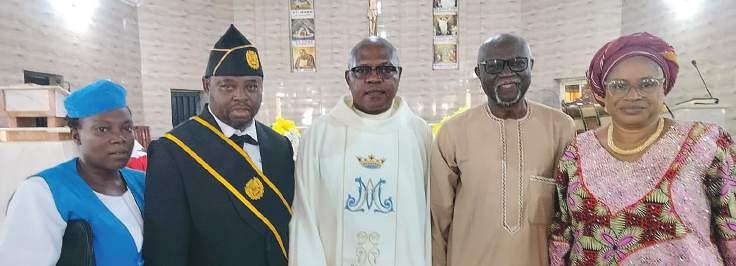
L-R: Lady Theodora Okhumale; Knight of Saint John International (KSJI), Benedict Okhumale; Parish Priest, Catholic Church of Presentation, Abule-Egba, V. Rev. Fr. Gasper Olanrewaju; immediate past Rotary District 9111 Governor, Dr. Wole Kukoyi; and his spouse, Rev. Mrs. Sola Kukoyi, at the Knighthood of Saint John International of the Okhumales…recently
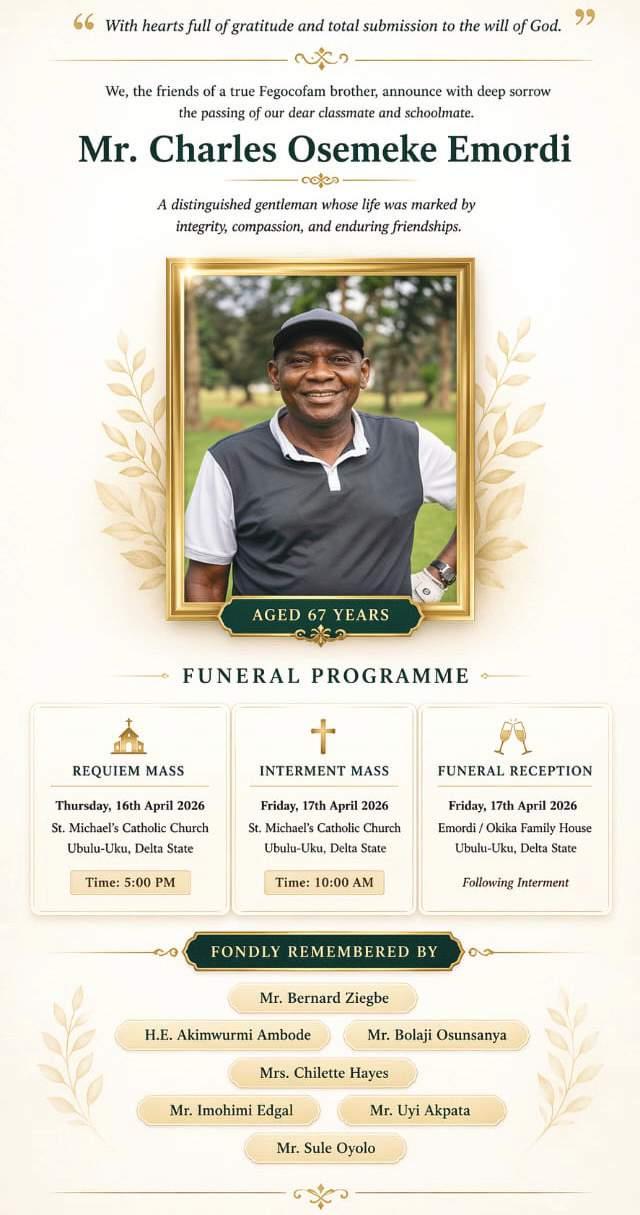
With hearts full of gratitude and total submission to the will of God.
We, the friends of tr ue Fegocolian brother, announce w ith deep sorrow the passing of our dear classmate and schoolmate.
Mr. Charles Osemeke Emordi
, , .
AGED 66 YEARS
Mr Ben Ziregbe
H.E. Akinw unmi Ambode Mr. Bolaji Osunsanya
Mrs Chileme Hayes
Mrs Chileme Hayes Mr. Uy i Akpata
Mr Imohimi Edgal
Mr Sule Oyofo
"Forever in our hearts. May his soul rest in perfect peace"
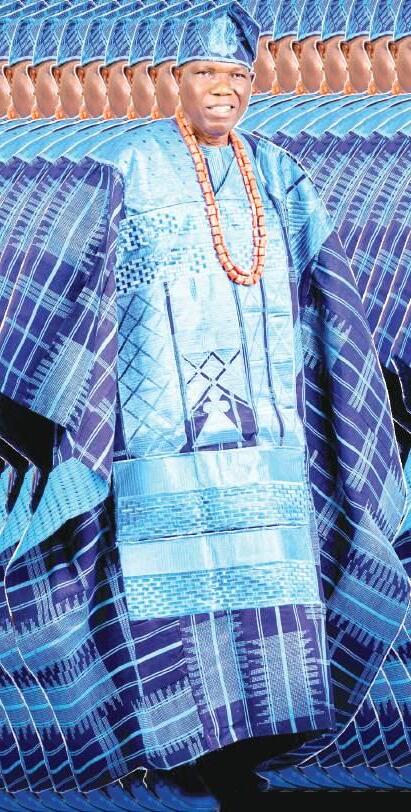
Double celebrations Alhaji Najeedeen Usman Yasin to
Happ th Birthda and Heart Congrat la ons on o r installa on as Bashor n of Offaland to o r esteemed friend and brother, Alhaji Najeedeen Usman Yasin, toda , th April, .
We celebrate o r remarkable life, achie ements, and dedica on to o r comm nit .
We pra that Almight God blesses o ith long life, good health, happiness, and con n ed s ccess. this ne chapter be filled ith jo , peace, and f lfillment.
As o embark on this ne jo rne , e pra that Allah's blessings and g idance con n e to shape o r path.
Ma o r leadership inspire and pli� o r omm nit , and ma o r legac be a shining e ample for genera ons to come.
Signed:
Alhaji Taj deen O o emi (Asi aj of Offaland)
Alhaji Demola Balog n (Dembal)
Alhaji Bola M stapha (Olo ogada)
Alhaji Ra ak Shi
Alhaji A ee B ko e
Alhaji K nle Ajeigbe
s
Acting Group Politics Editor DEJI ELUMOYE
Email: deji.elumoye@thisdaylive.com
08033025611 sms only
Adamu: Insecurity Needs Political, Not Just Military Solutions
Former Inspector-General of Police, Mohammed abubakar adamu, in this interview, speaks on his governorship ambition in Nasarawa State, his plans for security, infrastructure, and economic development, as well as his views on state police, zoning and grassroots governance. sunday Aborisade brings excerpts.
What informed your decision to contest the Nasarawa State governorship election?
My decision is rooted in my experience and understanding of the challenges facing not just Nasarawa State, but the entire North-central region. Security issues are not isolated; what happens in Nasarawa affects neighbouring states like Benue, Kogi, Plateau, Kaduna and Niger.
Having worked at the highest level of policing in this country, I have been part of advising and implementing strategies to tackle insecurity. I now believe the time has come for me to be in a position where I can directly apply political solutions to these challenges. Security is not just about force; it requires political will, economic planning and community engagement.
You mentioned political solutions to insecurity. Can you elaborate on what you mean?
Yes. The mistake we often make is to think that security can be solved purely through force. That is not sustainable. The root causes of insecurity which are, poverty, unemployment, and social dislocation, must be addressed. When people do not have legitimate means of livelihood, they resort to crime. So, political solutions involve creating opportunities, addressing grievances, and building trust within communities. If we do that, the pressure on security agencies will reduce significantly.
What are the key security challenges in Nasarawa State, and how will you address them?
The major issues in Nasarawa are farmerherder conflicts and kidnapping. These are not unique to the state, but they are particularly pronounced in the Northcentral region. To address them, we must first understand their causes. For instance, conflicts between farmers and herders often arise from competition over resources and, in some cases, deep-seated mistrust.
My approach is multi-layered. First, we will create jobs, especially for the youth, through agriculture and mining. Second, we will promote dialogue and conflict resolution at the community level, bringing farmers and herders together to agree on acceptable norms. Third, we will strengthen community policing by working closely with traditional institutions. They understand their people and can provide valuable intelligence.
What is your position on the controversial issue of state police?
The Constitution provides for one police force, but in reality, we already have different forms of policing. When you look at vigilante groups, neighbourhood watch, and other local security arrangements, they are performing policing functions. So, whether we formally call it state police or not, it already exists in practice.
The real issue is not whether to create state police, but how to strengthen and regulate these existing structures to make them more effective and accountable. Some people fear that governors may misuse state police, but even now, local security outfits are being used in various ways. What we need is a proper framework to ensure professionalism and oversight.
Beyond security, what are your priorities for the state?
Economic development is a major priority. Nasarawa State has enormous potential, particularly in agriculture and solid minerals. Unfortunately, these resources are not being fully utilised. With the right investments and policies, we can create jobs, increase revenue and improve living standards.
During my consultations, I visited all 147 wards in the state. I saw the challenges firsthand including youth unemployment, lack of opportunities for women, and inadequate infrastructure. These are areas that require urgent attention. If we empower
the youth and women, we will not only improve the economy but also reduce insecurity. You mentioned infrastructure. What specific challenges did you observe?
The infrastructure deficit is significant. For example, electricity supply is unreliable, even in the state capital. Small businesses depend on power to operate, and when it is not available, their livelihoods are affected.
Road infrastructure is another major issue. While there are some good roads in urban areas, rural roads are in poor condition. Farmers find it difficult to transport their produce to markets, which affects both their income and food supply.
Water supply is also a challenge. In many parts of the state, including the capital, residents cannot rely on public water systems and have to depend on boreholes. This has implications for public health and overall quality of life.
What are your plans for the state capital, Lafia?
Lafia does not reflect the status of a state capital. It still looks more like a glorified local government headquarters. This is largely due to the lack of consistent focus on urban development by previous administrations.
My plan is to transform Lafia into a modern city with proper infrastructure and urban planning. We will also develop satellite towns to accommodate the growing population, especially given the state’s proximity to Abuja. This presents a unique opportunity that has not been fully exploited.
How do you intend to address the situation in Mararaba and other densely populated areas?
Mararaba is a product of historical developments. It started as a temporary settlement during the construction of Abuja, but it has grown into a densely populated area without proper planning. However, that does not mean it cannot be improved.
We will focus on urban renewal by creating new, well-planned settlements and upgrading existing ones. We will also develop alternative road networks to ease congestion and improve connectivity. With proper planning and investment, Mararaba can be transformed.
What is your position on zoning in
When people do not have legitimate means of livelihood, they resort to crime. so, political solutions involve creating opportunities, addressing grievances, and building trust within communities. If we do that, the pressure on security agencies will reduce significantly.
Nasarawa politics?
Historically, Nasarawa State has not strictly practised zoning. Leadership has emerged based on political dynamics rather than regional rotation. While some stakeholders advocate zoning, I believe the position of governor should be open to any competent individual from any part of the state.
What matters most is the ability to deliver good governance. Restricting leadership based on zoning may limit the pool of capable candidates.
Do you have the support of key political stakeholders in the state?
In politics, the most important stakeholders are the people. I have taken my campaign directly to the electorate. I visited all the wards, engaged with party officials and community leaders, and listened to their concerns.
While political endorsements are important, they are not decisive. Ultimately, it is the people who determine the outcome of an election. I am confident in the support I have received at the grassroots level. Critics say you are more of a technocrat than a politician. How do you respond to that?
Politics is not limited to campaigning or holding political office. It involves understanding systems, managing relationships, and resolving conflicts. Throughout my career, I have engaged in these activities at various levels.
Even as a police officer, I was involved in negotiations, conflict resolution and strategic decision-making. These are all elements of politics. So, I would say I bring both technocratic experience and political understanding to the table.
What is your stance on local government autonomy?
Local government autonomy is essential for grassroots development. In any functional democracy, the three tiers of government must operate effectively. Unfortunately, in Nigeria, local governments are often dependent on state governments, which limits their ability to deliver services. If the law provides for autonomy, it should be implemented fully. Local governments should have access to their resources and be held accountable for how they use them. This will bring development closer to the people.
Will you probe your predecessors if elected?
Governance should not be driven by vendetta. If there are issues that require investigation, there are established institutions to handle them. My focus will be on moving the state forward. However, accountability is important, and due process should always be followed.
What have you personally contributed to Nasarawa State?
I was born and raised in Lafia, and my roots are firmly in the state. As InspectorGeneral of Police, I contributed to national security efforts that also benefited Nasarawa. Specifically, I facilitated recruitment into the police, established a Police Mobile Training School in the state, and supported the development of police secondary schools and hospitals. I also contributed to infrastructure development. So, I have already given back to the state in various ways.
Why should the people of Nasarawa State vote for you?
Leadership is about service and results. I bring experience, vision and a deep understanding of the challenges facing the state. I have a clear plan to address insecurity, create jobs, improve infrastructure and promote development.
I have also engaged directly with the people and understand their needs. If given the opportunity, I will work tirelessly to improve their lives and move Nasarawa State forward.
Adamu
Tinubu At 74: Between Hardship And Hard Choices In Northern Nigeria
By Mohammed Musa Zango
As President Bola Ahmed Tinubu marks his 74th birthday, Nigeria, particularly the North, faces a difficult but defining moment.
The hardship Nigerians feel today is not accidental; it is the price of correcting years of deep economic distortion. The reality is stark: rising hardship alongside far-reaching economic reforms. This moment demands assessment not through emotion or regional sentiment, but through facts, constitutional responsibility, and a clear understanding of Nigeria’s federal structure.
Across Northern Nigeria, the pressures are real and immediate. Food prices have surged, transport costs have risen, and small businesses are under strain. Insecurity continues to disrupt farming communities, limiting production and livelihoods. These are lived realities. Recognising this hardship does not weaken the case for reform; it reinforces the urgency for those reforms to translate into visible relief.
President Bola Ahmed Tinubu assumed office at a time when Nigeria’s economy was burdened by deep structural distortions—an unsustainable fuel subsidy regime, multiple exchange rates, weak infrastructure, and a governance culture that avoided difficult decisions. His administration chose a different path defined by structural correction rather than short-term comfort.
Two policies have defined this shift: the removal of fuel subsidies and the unification of the foreign exchange market. These decisions have been painful, but they have also freed significant fiscal resources. Between March 2024 and August 2025, over N2.45 trillion was made available to states and the Federal Capital Territory to support infrastructure, security, and social interventions.
These funds were not discretionary disbursements, but statutory allocations derived from increased Federation Account revenues following subsidy removal and exchange rate reforms. Data from the Federation Account Allocation Committee (FAAC) shows a clear rise in monthly distributions to states. The issue, therefore, is not the absence of funds, but the effectiveness of utilisation.
This underscores a critical point often misunderstood. Under Nigeria’s federal system, the President sets national direction, but he does not run the states. Governors hold primary responsibility for how federal allocations are utilised and how policies impact daily life. If increased funding does not translate into better healthcare, education, roads, agricultural support, and local security, accountability must follow responsibility at the state level.
Kano State under Governor Abba Kabir Yusuf offers a useful example. Recent initiatives in education, healthcare, infrastructure, agriculture, and youth empowerment reflect efforts to translate public resources into visible outcomes. While challenges remain, the state demonstrates how leadership at the subnational level can shape how federal reforms are experienced. It reinforces the broader point that national progress depends heavily on state-level execution.
The rising cost of Premium Motor Spirit has understandably generated concern. For many Nigerians, the increase appears sudden and burdensome. However, with subsidy removal, domestic fuel prices are now influenced by global oil markets, exchange rate fluctuations, and supply chain realities. Geopolitical tensions and disruptions in global logistics have further compounded volatility. These pressures are global, not uniquely Nigerian. What is required is clearer communication and targeted relief measures to ease the transition.
Within this context, a modest portion of subsidy savings could be strategically ringfenced for targeted interventions in historically disadvantaged regions, including parts of Northern Nigeria where poverty indicators
remain high. This would reinforce equity within the reform framework without undermining national policy direction.
Beyond macroeconomic reforms, infrastructure remains central to long-term growth. Several major road projects are ongoing across Northern Nigeria, including the Abuja–Kaduna–Kano Expressway, Kano–Maiduguri Road, Kano–Katsina Road, Zaria–Funtua–Gusau–Sokoto corridor, and Kano–Hadejia Road. According to official briefings from the Ministry of Works, a significant share of federal road investments is concentrated in the region, reflecting a deliberate effort to improve connectivity, trade, and mobility.
The Ajaokuta–Kaduna–Kano (AKK) gas pipeline stands out as a transformative project. By enabling reliable gas supply, it has the potential to support power generation, revive manufacturing—particularly in Kano’s textile sector—stimulate petrochemical industries, and create large-scale employment opportunities.
In light of these realities, there is a compelling appeal to the Federal Government under President Bola Ahmed Tinubu to prioritise and fast-track the completion of critical infrastructure projects across Northern Nigeria. The Abuja–Kaduna–Kano Expressway, the Kano–Maiduguri corridor, the Ajaokuta–Kaduna–Kano (AKK) gas pipeline, and other strategic routes are economic lifelines that directly influence the cost of food, transportation, energy, and trade. Accelerating their delivery would provide immediate relief, reduce inflationary pressures, and demonstrate the tangible impact of reforms. In this regard, there is a strong case for a targeted Executive Order to fast-track these projects, streamline approvals, enforce inter-agency coordination, and prioritise funding flows.
In the North-East, federal interventions are focused on recovery and stabilisation. Road rehabilitation,
housing projects, and community infrastructure are gradually restoring livelihoods disrupted by years of insurgency. Agricultural programmes, including the $158.15 million Value Chain Programme, are supporting states such as Kano, Katsina, Jigawa, Sokoto, and Zamfara to improve productivity and rural incomes.
Equally important is the effective utilisation of intervention agencies such as the North-West Development Commission (NWDC), established to address developmental gaps in the region.
Despite receiving funding, concerns around internal disputes and delayed implementation risk undermining its mandate. There is a clear need for firm administrative direction and accountability to ensure the Commission delivers tangible safety nets and development outcomes.
As the administration advances its reform agenda, priority projects such as the Kaduna–Kano rail line and the Abuja–Kaduna–Zaria–Kano highway must be fast-tracked due to their direct impact on mobility, trade, and the cost of living. The next phase of reform must focus on measurable outcomes through disciplined execution, transparency, and accountability across all levels of government.
President Bola Ahmed Tinubu has consistently projected himself as a leader for all Nigerians, emphasising unity and reform. Concerns about regional balance and the pace of relief are valid and should be addressed through inclusive policies and clear communication. At the same time, it is important to distinguish between structural reform and immediate outcomes. Transformational policies often come with initial hardship, but their success depends on how quickly they deliver tangible benefits.
Ultimately, these reforms will be judged not by policy announcements, but by their visible impact on daily life.
constructive appeal to President Bola Ahmed Tinubu to match the boldness of reform with the speed and urgency of execution. Fast-tracking infrastructure, strengthening oversight of intervention agencies, and ensuring relief reaches the most vulnerable will ease hardship and reinforce public confidence. The North is ready to respond positively to reform, but it requires visible and measurable progress to translate policy into hope and stability.
The National Patriots acknowledge the necessity of these reforms and urge Nigerians to assess them with objectivity. While hardship is real, effective utilisation of resources lies largely with state governments and intervention agencies. Accelerated infrastructure delivery, stronger oversight, and targeted social investments are essential to cushioning the impact and ensuring inclusive progress.
If the hardship of today is the price of reform, then the urgency of execution must be the promise of tomorrow.
“The reforms we are undertaking may bring temporary hardship, but they are necessary to secure long-term stability and prosperity for Nigeria.” — Bola Ahmed Tinubu May Almighty Allah grant President Bola Ahmed Tinubu wisdom, strength, and good health. May his leadership guide Nigeria toward greater stability, unity, and prosperity.
May the collective efforts of all levels of government translate into meaningful progress for every Nigerian. Amen •Dr. Mohammed Musa Zango, FPSN 2027 APC Senatorial Aspirant, Kano Central Constituency
Founder, Fatah Zango Foundation
Recipient, National Patriots Distinguished Service Award for Humanitarian Excellence
President Bola Tinubu
Mohammed Musa Zango
FEaturEs
GMAP: Systematically Grooming Africa’s Next Generation of Young Talents
At a time when unemployment and skills shortages continue to test Africa’s economic resilience, United Bank for Africa (UBA) Plc is charting a deliberate path towards the future by investing heavily in young talent. Through its Graduate Management Acceleration Programme (GMAP), the bank is not merely recruiting fresh graduates but systematically building a leadership pipeline designed to sustain growth, drive innovation, and secure its competitive edge across the continent. With over 5,000 graduates trained since inception and more than 700 newly inducted into its workforce, the initiative underscores UBA’s long term strategy of positioning human capital at the centre of its expansion and transformation agenda. Chiemelie Ezeobi reports
United Bank for Africa (UBA) Plc is steadily positioning itself for long term growth and continental leadership through deliberate investment in young talent, as its Graduate Management Acceleration Programme (GMAP) continues to produce a new generation of skilled banking professionals.
With over 5,000 graduates trained since inception and more than 700 newly inducted into its workforce, the initiative reflects the bank’s strategic response to youth unemployment, leadership succession, and the growing demand for competent professionals across Africa’s financial sector.
The programme has steadily evolved into one of the continent’s most recognised private sector initiatives for youth empowerment, providing graduates with world class training, hands on experience, and a clear pathway to leadership in the financial services industry. With each graduating cohort, UBA continues to strengthen its human capital base while contributing meaningfully to economic transformation across Africa.
The graduation ceremony, held at the Landmark Events Centre, Lagos last Thursday, was graced by esteemed guests, including UBA’s top management, faculty members, mentors, and the graduating class, highlighting the culmination of an intensive journey towards leadership excellence.
Strong Female, Continental Representation
Cohort 19 of the GMAP graduates consisted of 306 exceptional young professionals comprising 192 females and 114 males. A breakdown of the cohort shows that 298 of them are Nigerians, while eight others are from different African countries namely Sierra Leone (3), Uganda (2), Republic of Benin (1), Tanzania (1), and Côte d’Ivoire (1). Cohort 20, on the other hand, comprised 414 talented Nigerians, including 243 females and 171 males.
With the new cohort of 720 trainees, 435 of whom are women and account for over 60 per cent of the intake, the programme stands as a powerful testament to the bank’s unwavering commitment towards women’s empowerment and gender inclusion in leadership development.
The milestone induction, which welcomed Cohorts 19 and 20 into the bank’s dynamic workforce, underscores the institution’s strategic focus on nurturing Africa’s next generation of high performing talent equipped to drive innovation and sustainable growth.
Bridging the Talent Gap Across Africa
With Africa’s youth population growing rapidly, investing in human capital has become more crucial than ever. Recognising this reality, United Bank for Africa took a proactive approach to bridging the talent gap through its Graduate Management Accelerated Programme, a flagship initiative equipping young Africans with the skills and experience needed to excel in banking and finance.
GMAP has produced graduates who will embark on careers within the UBA Tribe, bringing energy, innovation, and fresh perspectives to the organisation and represents the next generation of banking leaders who will drive financial inclusion and sustainable growth across the continent.
Undoubtedly, the role of the private sector in shaping Africa’s economic future cannot be overstated. With increasing demand for skilled professionals and rising
competition in the financial services sector, investment in training has become a necessity rather than a choice.
Recognising this responsibility, UBA positioned GMAP as more than just a training initiative. The programme stands as a beacon of youth empowerment, equipping young Africans with the knowledge, discipline, and practical experience required to succeed in a dynamic banking environment.
Responsibility of the Private Sector
UBA’s Group Chairman, Mr. Tony Elumelu, highlighted the significance of the initiative in bridging the unemployment gap and equipping young professionals with the skills needed to thrive in Africa’s evolving financial landscape.
“This milestone is more than just numbers. It signifies UBA’s commitment to youth empowerment. Unemployment remains one of Africa’s greatest challenges, and while governments play a role, the private sector must also contribute meaningfully. GMAP is our way of taking action to improve lives and drive economic transformation,” Elumelu stated.
Since its inception, GMAP has successfully trained and graduated 5,000 young professionals across several cohorts, many of whom have progressed into key roles within UBA.
The programme provides graduates with hands on experience in areas such as Sales, Credit Analysis, Group Finance, and Treasury, ensuring their preparedness for leadership positions within the bank.
As part of its long term vision, UBA ensures that GMAP graduates are provided with structured career growth opportunities, comprehensive training and mentorship, innovation driven work environments, performance based recognition systems, and early leadership exposure designed to prepare them for senior responsibilities.
While welcoming and addressing the fresh intake, Elumelu reiterated the importance of ambition, discipline, and institutional pride, describing the gathering as living proof that Africa’s future belongs to its youth.
“I am so happy to see smiling, young faces. You know, they say the future of Africa belongs to our youth, and as I see all of you, I see that in action. Welcome to UBA Group. Congratulations on being part of our family,” he stated.
Elumelu challenged the graduates to take personal ownership of their performance and to exhibit the discipline that distinguishes great institutions
from average ones.
“Selecting the right people, training them, developing them, nurturing them, and getting them to align with the vision is not easy. But it is critical for sustained success. What we must do is institutionalise our approach, to build an organisation that can deliver and create systems that endure, so that perpetuity is achieved,” Elumelu said.
Counseling them on the imperativeness of hard work, he added: “With hardwork, you can achieve your potential. Discipline and hard work are the routes to success. Hard work, passion and relentlessness are very critical to success. It is your ability to achieve your destiny that will count. We are humans and sometimes we derail but when you derail, bring yourself back. Make early life sacrifices for a better future.”
Building Careers through Consistency
Group Managing Director and Chief Executive Officer, Mr. Oliver Alawuba, reflected on his professional journey from a young banker to the head of the institution, reminding the graduates that leadership is earned through discipline, competence, and perseverance.
“Our young Africans are equipped to drive Africa into excellence. Your current role is not your final destination. If we could rise, you can rise too, because the journey is not reserved for a special class of people. It is reserved for people who decide to grow and then do the work,” he said.
He described the diversity of the GMAP graduates as “a beautiful representation of our pan African dream,” emphasising that the programme continues to strengthen the bank’s leadership pipeline.
Alawuba anchored his address in UBA’s corporate ethos — the 3Es of Excellence, Enterprise, and Execution — and the SRG persona of Simplicity, Responsiveness, and Goal orientation, challenging each new hire to make these values visible in their daily conduct.
The GMD further told the graduates that: “Together, you are 720 new leaders joining our UBA family. When we add you to the 3,926 graduates from Cohorts 1 through 18 and look at the 395 bright talents currently in Cohort 21 training (232 females, 163 males), we see a powerful movement: over
5,000 young Africans equipped and deployed to drive excellence across our continent.
“This is not just a programme –it is UBA’s living commitment to Africa’s future. So today, we are not just graduating individuals. We are strengthening a leadership supply chain – one that keeps UBA competitive, resilient, and future ready.”
He reminded them that graduation represents the beginning of a new phase of responsibility. “The real work starts now. The GMAP has prepared you with classroom learning, simulations, field assignments, and mentorship from senior executives. But now comes a more demanding test: The test of consistency.”
Rigorous Selection Process that Reflects High Standards
Providing insight into the selection process, the Group Head, Human Resources, Mrs. Modupe Akindele, disclosed that a staggering 14 million young Africans applied for the GMAP, demonstrating the programme’s popularity and credibility across the continent. She explained that the rigorous selection process ensures that only the most qualified candidates are admitted into the programme.
“We have six weeks academic session and we then have on the job training. So, it’s a combination of the academic six weeks programme and on the job training they did that accumulate into what you see today,” she said.
Akindele expressed confidence that the programme would continue to produce future leaders within the organisation.”
“We are hoping that as the programme continues because it doesn’t stop here, in three years time, branch managers, head of departments etc will surface from the GMAP graduates because it’s a continuum. They are our future leaders meant to succeed the executive management. This is the beginning of a great journey.”
Celebrating Excellence and Outstanding Performance
The ceremony also provided an opportunity to recognise outstanding performance among the trainees, with several graduates receiving awards across different categories.
While Israel Olaloye of Cohort 19 emerged best in Finance and Management, Anthony Akpela of Cohort 20 also emerged best in the same category and in the Sales category, Kafayat Orelope of Cohort 19 came tops, while Favour Eda of Cohort 20 emerged the best.
In the Treasury category, Ismail Lateef of Cohort 19 came tops, while Zainab achieved the same distinction in Cohort 20 while on The Job Performance category, Ismail Lateef representing Cohort 19 carried the day, with Ekenenna Nwobodo achieving the same feat in Cohort 20.
Overall performance awards went to Gift Okoh and Nurudeen Musa of Cohorts 19 and 20 respectively, while the second best performers were Gift Michael of Cohort 19 and Favour Eda of Cohort 20.
The Overall Best Performance awards were carted home respectively by Ismail Lateef of Cohort 19 and Anthony Akpela of Cohort 20 as the best graduating students. Through initiatives such as GMAP, UBA continues to demonstrate that sustained investment in young people remains one of the most reliable pathways to institutional resilience and long term growth across Africa.
Group Chairman, United Bank for Africa, Tony Elumelu (6th left); Group Managing Director, UBA, Oliver Alawuba, (5th Left) and Group Head, Human Resources, Modupe Akindele, flanked by some of the graduands of the 2026 Graduate Management Accelerated Programme(GMAP) class of UBA Academy, during the graduation ceremony held for over 700 trainees cut across Africa, in Lagos
How NDDC is Engaging Stakeholders on Project Ownership, Protection
In spite of the numerous drawbacks, the Niger Delta Development Commission (NDDC) has, over the last two decades, featured as the key driver of critical interventions that have changed the narrative of the Niger Delta region. However, some of the projects that highlight development in the region are either being stolen or vandalised. Sunday Okobi writes that the commission recently called on the people in the region (mostly the youths) to protect these projects meant in good faith for the region
Through the interventions of the NDDC in its 25 years of existence, significant milestones in project implementation and delivery have been recorded across the Niger Delta region. The nine states under the mandate of the NDDC, namely: Abia, Akwa Ibom, Bayelsa, Cross River, Delta, Edo, Imo, Rivers, and Ondo, have witnessed various inaugurations of landmark projects manifesting in transforming the landscape of the region.
There is no doubt that commitment to the transformative agenda by the NDDC towards deepening sustainable development has been instrumental in changing the narrative of neglect and squalour that hitherto dominated the story of the Niger Delta region.
Experts and observers have pertinently stated that the Dr. Samuel Ogbukuled management of the NDDC has demonstrated unwavering commitment towards improving the standard of living across communities in the Niger Delta region in line with the Renewed Hope Agenda of President Bola Ahmed Tinubu.
For instance, the ‘Light Up the Niger Delta Initiative’ has delivered hundreds of thousands of solar-powered street lights to communities across towns and rural areas, leading to improved security, access to renewable energy, and enhanced nighttime socio-economic activities.
Rising Threat of Vandalism and Community Responsibility
Regrettably, some of the projects initiated and completed by the NDDC and handed over to communities for utilisation in partnership with other critical stakeholders are vulnerable to vandalism and other forms of abuse that are detrimental to the objective of the projects.
Apart from undermining the objective of interventions, vandalism results in avoidable waste of revenue with attendant negative impact on the community and the prospective beneficiaries.
Unless the negative trend of destructive behaviour is curtailed, the region’s developmental efforts run the risk of setbacks and diminishing returns on resources committed for the benefit of the people.
To address these unpleasant occurrences, the Corporate Affairs Directorate of the NDDC embarked on a process-led engagement with stakeholders aimed at strengthening collaboration for community ownership of projects at the grassroots.
The engagement sessions, in partnership with a team of consultants, drew the participation of stakeholders across the nine mandate states. The engagement activities provided platforms for stakeholders to brainstorm on the need for shared responsibility towards ownership and protection of development projects and public infrastructure in their domains.
In his address to participants at the stakeholders’ engagement tagged: ‘Capacity Building Programme for Stakeholders across the Niger Delta
t he process-led engagement with stakeholders aimed at strengthening collaboration for community ownership of projects at the grassroots
Region on Community Ownership and Protection of NDDC Projects’, the Executive Director, Corporate Services, Hon. Ifedayo Abegunde, decried the destruction of government projects initiated by the NDDC in host communities.
According to Abegunde, cases of vandalism, theft, neglect, and insufficient community engagement have compromised valuable assets intended to improve the collective well-being of the people.
Stakeholder Engagement
Across the Nine States
Also, the Director of Peace and Development Projects (PEDEP) and Lead Consultant, Mr. Francis Abayomi, said the programme was designed to mobilise inclusive engagement towards enhancing the development initiative of the Niger Delta Development Commission for the optimal benefit of the community and the people.
Speaking on behalf of the team of consultants, Abayomi expressed optimism that the knowledge shared, as well as the interactive engagement provided through the initiative, will help promote awareness and help raise consciousness regarding mutual responsibilities in the protection of projects and facilities of the NDDC.
The engagement sessions were held as follows: Ondo State (Okitipupa – February 25, 2026), Bayelsa State (Yenagoa – March 3, 2026), Cross River State (Calabar –March 6, 2026), Akwa Ibom State
(Uyo – March 9, 2026), Abia State (Aba – March 11, 2026), Imo State (Owerri – March 13, 2026), Rivers State (Port Harcourt – March 16, 2026), Delta State (Warri – March 24, 2026) and Edo State (Benin – March 25, 2026).
In Port Harcourt, Rivers State, the Director of Rivers Operations of the NDDC, Okezie Ule, said the capacitybuilding training was designed to equip participants with the knowledge and strategies needed to protect projects provided by the Commission. Ule noted that the stakeholders’ engagement became imperative, considering the rising cases of vandalism of completed projects across the region.
He lamented that several projects, including solar-powered street lights installed to improve security in communities, have been vandalised by criminals shortly after installation.
“We have seen with dismay how many of our lofty projects, which communities strongly solicited for, are left to ruin. Vandals go in and destroy them, including solar lights that illuminate our communities,” Ule said.
According to him, some facilities have been vandalised barely a week after they were completed and handed over to the benefiting communities. Ule attributed the development partly to the perception among some residents that the projects belong solely to the NDDC rather than the communities benefiting from them.
Also speaking, the Rivers State representative on the NDDC Board, Sir Tony Okocha, said the capacitybuilding programme was necessary to strengthen community participation
It is in recognition of this reality that we have convened this campaign. Our objective is clear: to deepen awareness, encourage a sense of shared responsibility, and promote a culture of ownership that ensures every completed project is protected, maintained, and optimised for present and future generations
in safeguarding development projects. Okocha, who was represented by his Special Assistant on Technical Matters, Mr. Chibuzor Kwelle, noted that several NDDC projects, particularly solar street lighting initiatives, have contributed significantly to reducing crime in many communities. He commended communities that have already taken steps to protect projects within their areas and encouraged others to follow suit.
Call for Youth Participation and Project Sustainability
Speaking at the stakeholder engagement held in Okitipupa, Ondo State, the Ondo State Director of the Commission, Kunle Karaki, who described the trend of vandalism and other forms of vices as a major setback to development in the Niger Delta region, said community ownership goes beyond simply using facilities, stressing that it requires active stewardship, vigilance against threats to public assets, prompt reporting of irregularities, participation in monitoring processes, and collaborative maintenance efforts.
He explained that the engagement programme was organised to deepen awareness among stakeholders and foster a sense of shared responsibility in securing public infrastructure.
According to him: “It is in recognition of this reality that we have convened this campaign. Our objective is clear: to deepen awareness, encourage a sense of shared responsibility, and promote a culture of ownership that ensures every completed project is protected, maintained, and optimised for present and future generations.
“Our objective is clear: to encourage a culture of ownership that ensures every completed project is protected, maintained, and optimised for present and future generations.”
Across the mandate states, the participants unanimously expressed their willingness to prioritise attention to the protection of projects implemented by the NDDC through sustained sensitisation for collective responsibility within the communities.
IN DEFENCE OF JOASH AMUPITAN
The INEC chairman is a man of repute, writes SAMSON BUKAR MSHEMBULA
Skills that enable change within government may not be visible, but shape how institutions function, and how policies are implemented, writes CHIOMA NJOKU
MAKING PUBLIC SECTOR REFORM POSSIBLE
Public sector reform is often discussed in terms of policies, programmes, and institutional frameworks. Yet for those who work within government, experience quickly reveals something else: the success of reform rarely depends on design alone. More often, it depends on leadership.
Every year, the Aig-Imoukhuede Foundation receives applications from accomplished public servants across Africa for its flagship public sector executive training programme, the AIG Public Leaders Programme. Their credentials reflect years of dedication to public service: advanced degrees, extensive professional experience, and responsibility for complex government functions. On paper, they arrive well prepared.
for change over time. Through these discussions, participants begin to view reform not simply as a technical exercise, but as a leadership practice.
‘SIXTY
PAGES OF GLORIOUS POETRY’ SYL CHENEY
COKER takes a veteran’s look at Woman of a Woman, a book of poems by Funke Awodiya
See page 21 See page 21
But as the programme progresses, an important insight begins to surface in conversations among participants: the most difficult part of reform is rarely technical. It lies in navigating the institutional realities that determine whether good ideas move from proposal to practice.
The Things to Learn: Public servants are typically trained in areas such as economics, law, engineering, public administration, or sector policy. These technical competencies are essential for effective governance. But implementing change inside large institutions often requires another set of capabilities that are less frequently taught.
It requires building cooperation across departments that may have different priorities. It requires sustaining initiatives through administrative transitions and evolving policy cycles. It requires recognising that institutions are shaped not only by formal mandates but also by relationships, incentives, and organisational culture.
These dimensions of leadership become particularly visible during the AIG Public Leaders Programme, delivered in partnership with the University of Oxford’s Blavatnik School of Government.
What I See in the Classroom: Participants engage in modules on negotiation in the public interest, strengthening public organisations, digital transformation, integrity in public life, and strategic communication, especially storytelling. These provide valuable analytical frameworks. But some of the most meaningful learning happens in the exchanges between participants themselves.
When leaders from different sectors and countries share experiences, a common pattern often emerges. Challenges that appear unique to one institution frequently mirror those faced elsewhere: aligning stakeholders around reform priorities, navigating complex organisational environments, and sustaining momentum
The Skill of Reading Power: One exercise illustrates this well. Participants are asked to map the formal decision-making structure within their institutions and then reflect on how decisions are actually influenced and implemented in practice. The two do not always perfectly align.
Somewhere in many organisations, there is a person who holds no senior title but whose opinion shapes outcomes. Somewhere there is a committee that exists on paper but never meets, and a corridor conversation where real decisions are made. Somewhere, there is a stakeholder who will not voice opposition openly, but will quietly ensure that implementation fails.
This is not unusual. Institutions are living systems, shaped by both formal authority and informal dynamics. Leaders who understand this complexity are often better positioned to advance reforms in ways that are both practical and sustainable.
The Skill of Strategic Patience: Another recurring lesson concerns the pace of change. Public life rewards action. There is pressure to announce, to launch, to show progress. But reform that moves too fast often collapses. It outruns its coalition, achieves visibility, and then fails.
In public institutions, progress often requires sequencing reforms carefully, building consensus where possible, and recognising that durable change sometimes develops incrementally rather than instantaneously.
The most effective reformers I have watched are not the fastest. They are the ones who understand that timing matters. They know when to wait for a stakeholder to come around. They know when to pilot quietly before scaling publicly. They know that a reform implemented in year three is better than a reform announced in year one and abandoned in year two.
People don’t often applaud leaders for waiting. But waiting, when done strategically, is not passivity. Strategic patience can be as important as urgency.
The Skill of Absorbing Resistance: Equally important is resilience. Reform initiatives frequently attract scrutiny, differing perspectives, and legitimate
debate. Navigating these dynamics constructively while maintaining focus on long-term outcomes is an essential part of public leadership. Perhaps the hardest skill, and the one I think about most often, is the ability to absorb resistance without breaking.
Reform attracts criticism. Some of it is fair. Some of it is not. Either way, it lands on the same person. Day after day. Meeting after meeting. I have watched participants describe moments when they wanted to stop. When the weight of opposition felt heavier than their will to continue. When they questioned whether any of it was worth it. What kept them going, in most cases, was not heroic resolve. It was something smaller. A colleague who listened. A peer who said, "I know that feeling." A small win that reminded them why they started.
The programme does not give public sector leaders a thick skin, but it gives them something more valuable: a network of people who understand. People who have absorbed the same resistance and kept going. People who can then say, "Keep going," and mean it.
The Invisible Difference: Over the past five cohorts of the AIG Public Leaders Programme, more than three hundred public servants have participated in this shared learning journey. They leave not only with new perspectives but also with a network of peers across sectors and countries who understand the realities of institutional reform.
The public may never see many of the leadership skills that enable change within government. They are rarely visible in headlines or official announcements. Yet they shape how institutions function, how policies are implemented, and how public systems gradually improve.
The 69 public servants who recently graduated from the fifth cohort of the AIG Public Leaders Programme now return to their respective institutions across Africa. The challenges they face will remain complex. But they do so with a deeper understanding of the leadership dimensions that underpin successful reform.
Njoku is Director of Programmes, AigImoukhuede Foundation
The INEC chairman is a
man
of repute, writes SAMSON BUKAR MSHEMBULA IN DEFENCE OF JOASH AMUPITAN
I had the rare privilege of being taught by Professor Joash Ojo Amupitan at the University of Jos. As a student in the Faculty of Law, I completed my Diploma in Law programme ending in 1999 and later obtained my LLB degree in 2005. Those were formative years, and Prof. Amupitan stood out as one of the most excellent lecturers I ever encountered. He was brilliant, meticulous, fair-minded, and deeply principled – a man who demanded excellence from his students while demonstrating integrity in every lecture, tutorial, and interaction. He taught with passion and clarity, never playing favourites, never compromising standards. To those of us who sat in his classes, he was more than an academic; he was a role model of intellectual honesty and moral uprightness. It is therefore with profound conviction that I rise in his defence amid the current orchestrated campaign of calumny against him as Chairman of the Independent National Electoral Commission (INEC).
The recent controversy – centred on alleged old social media posts from 2023, long before his appointment as INEC Chairman in October 2025 – is nothing but a desperate, politically motivated smear. At the time those posts were supposedly made, Prof. Amupitan was a private citizen and respected professor of law at the University of Jos, not a public electoral official. INEC has categorically stated that the account in question is fake, the posts fabricated by “digital imposters” and cybercriminals. The Commission is working with security agencies to prosecute those responsible. Even if one were to entertain the wildest assumption that the posts were authentic (which they are not), they would still hold no legal or moral weight against him today.
Let us be clear on the law, as any right-thinking Nigerian should demand. The 1999 Constitution (as amended) sets the qualification for INEC Chairman in the Third Schedule, Part I, Paragraph 14(2):
“A member of the Commission shall— (a) be non-partisan and a person of unquestionable integrity; and (b) be not less than 40 years of age in the case of the Chairman….”
This requirement was rigorously scrutinised and satisfied during Prof. Amupitan’s nomination by President Bola Ahmed Tinubu, consultation with the Council of State, and confirmation by the Senate under Section 154. There is no provision in our laws that retroactively disqualifies a person for private expressions of opinion made years earlier as an ordinary citizen.
The stricter neutrality rules often cited by critics apply exclusively to serving election officials during the actual conduct of elections. Section 26 of the Electoral Act 2022 is explicit:
“(1) All staff, electoral officers, presiding officers, returning officers and security officials taking part in the conduct of an election shall affirm or swear to an
oath of loyalty and neutrality as in the Second Schedule… (2) Any person who violates subsection (1), commits an offence…”
The prohibitions in Section 27(1) against appointing persons who are members of political parties or who have “openly expressed support for any candidate” are limited to ad-hoc and lower-level electoral officers for specific elections – not to the constitutionally appointed Chairman, and certainly not retroactively to a professor’s private activity in 2023.
Removal of an INEC Chairman is governed solely by Section 157 of the Constitution, which requires the President to act only on an address supported by a twothirds majority of the Senate for “inability to discharge the functions of the office… or for misconduct.” Old, alleged private posts –even if real – do not constitute such misconduct. To suggest otherwise is to rewrite the Constitution for political expediency.
Compare this to what past INEC Chairmen endured. Prof. Attahiru Jega, who served from 2010 to 2015, faced vicious accusations of bias and tribalism from the then-ruling PDP during the 2015 elections. Former Minister Godsday Orubebe publicly called him “tribalistic, selective and partial” in a now-infamous meltdown. Yet Jega conducted what many still regard as one of Nigeria’s most credible polls. No one demanded his resignation over pre-appointment views or private opinions; he was allowed to serve out his tenure with dignity.
Similarly, Prof. Mahmood Yakubu, who succeeded Jega and served from 2015 until October 2025, operated under a constant barrage of partisan accusations from the opposition. Critics repeatedly alleged bias towards the ruling APC in both the 2019 and 2023 general elections. Yet Yakubu completed a full ten-year tenure without being removed. The same voices now hounding Prof. Amupitan raised no constitutional alarm over Yakubu’s tenure despite far more serious and contemporaneous claims of institutional bias during actual elections.
Prof. Amupitan, by contrast, brings an even cleaner slate: a lifetime academic and legal practitioner with no history of political office, no party membership, and – according to INEC – no personal social media footprint at all.
Mshembula is a legal Professional
‘SIXTY PAGES OF GLORIOUS POETRY’
Once in a while, a new voice emerges in poetry. Its subject is not new- Humankind, the environment, love and hate, death and rebirth: all of which have been sung or written about since Humanity learnt to walk and talk. When this new voice comes to us, we must sit down read and re-think our perspectives on or about her subject.
In Woman of a Woman, Funke Awodiya's subject is WOMAN, in all her manifested forms and aspects. There is no expressive form of this subject that does not resonate with her! She is mother earth ( think of Lucy: the Tanzanian from whom all humanity is believed to have derived; her back straightening out on the plains of Kilmanjaro). Then, from that anthropological being came the giver of life-woman, in all her perspectives; without whom, there would be no MAN! So we are asked, by the poet, to see ourselves anew, in what is still a male, egocentric world: one in which woman is subjected to the dictates of traditions, skewed in favour of the male!
Whereas conformity is expected of woman, in this male dominated society, the poet begs to differ. In sixty pages of glorious poetry, she says 'I am woman, you must see me from my perspective; not from what society has fashioned out for me; not from your imagination, but from my mystique, my aura and dignity. In the very first poem “Stand Up”, lies the underlying theme ringing throughout this volume: She writes: '
We are bringing forth NATIONS within our fragile MIGHTY bodies mapping present and future dreams Stand tall!'
No one can fail to see the juxtaposition between the fragile she and the mighty giver of life; the nurturing goddess/ builder of nation; this mysterious creature that men have never understood!
The title poem Woman of a Woman is a celebration of the physical essence of a woman: that glorious picture, that so many of them possess. Reason for which, in spite of their denial, men have always sought to cage women, in purdah, the harem and, most strange and sinister of all, the chastity belt, while lusting after the sometimes exquisite form!
This multi-faceted portrait of a woman does not end here; in fact the entire woman is about the multi-dimensional image of her; hard to define, wildly desired, long suffering, sometimes conformists; at other times, quietly revolting, but always standing tall, unbroken: Look at me, look at us who and what do you see?
Melanin goddesses!
Her dark hue admired, in its shimmering form and many shades! It is worth noticing that, in this poem, the
poet pays homage to some trail-blazing women, whose daring helped to shape modern-day Nigeria!
One of my favourite poems in the volume is “Every Day Is Mother’s Day”. Never was a statement truer of women, in spite of their perceived status, on the African continent! Unlike what happens in the Western world, we celebrate our mothers every day, with girl children sometimes going the whole hog, to appreciate them, as well as their fathers! If the central theme in this volume is the celebration of the woman, it is worth pointing out that her very fertile and resilient life has also sometimes been the source of suffering and death. For example, the poem “She Died” is dedicated to an ordinary clinic orderly, who died the way she lived pains in her veins trickles of sweat on her forehead
Some of Funke Awodiya's poems have a lyrical beauty that reminds me the early Leopold Sehghor, extolling the beauty of African women, as in 'Femne Noir." Her lines have the colours and resonance of that Negritude poet, without the declamation of heritage; which, in this poet's case, is almost a totalitarian bondage to be removed! In other poems, she reminds me of the Chilean Gabriella Mistrial and the Russian Marina Tsvetaeva, two of the greatest poets of the 20th century, whose themes were basically that of the tragic beauty of being a woman in a man's world, where expectations are very different. In many of these poems , we see the firm figure of a woman standing tall, even as tradition and events seem to unravel her composure. We are left in no doubt that she is the salt of the earth, the grease in the cog of the wheel, the blood in the forge of life; the oxygen without which we cannot survive. For, as Funke Awodiya says in the last line of the last poem, in this wonderful volume, the Woman has risen women arise for change.'
Professor Coker, poet, novelist, and public intellectual, is one of Africa’s preeminent writers
SYL CHENEY COKER takes a veteran’s look at Woman of a Woman, a book of poems by Funke Awodiya
Editor, Editorial Page PETER ISHAKA
Email peter.ishaka@thisdaylive.com
JILLI MARKET BOMBING AND MATTERS ARISING
Care should be taken to ensure innocent citizens are protected from collateral damage
uary 2023.
The airstrike by the Nigerian Air Force (NAF) on a weekly market along the Borno–Yobe border, which reportedly killed dozens of innocent civilians, mostly traders, has continued to elicit outrage and serious concerns. The incident occurred last Saturday evening at Jilli Market, located between Gubio and Geidam local government areas of Borno and Yobe States, respectively. The airstrike was reportedly carried out during a military operation targeting suspected Boko Haram insurgents operating in the area. While the exact number of the dead remains a matter of speculations, Amnesty International and several other organisations have put the figures at more than a hundred. Scores of other people were injured.
We commiserate with the families of all those who lost their lives in this unfortunate incident. We also call on the federal government and authorities in the two affected states to ensure adequate compensation for families of the victims and provide the survivors with necessary care and attention. We also express our commiseration with the military that has lost many gallant officers in recent weeks.
In condemning the Jilli Market tragedy, Amnesty International says that “launching air raids is not a legitimate law enforcement method by anyone’s standard”, while calling for an immediate and impartial investigation. “Such reckless use of deadly force is unlawful, outrageous and lays bare the Nigerian military’s shocking disregard for the lives of those it supposedly exists to protect”. An investigation would help to identify lapses, especially in terms of training deficits, and how to put more efficient command and control system in place to guarantee double checks on targets before a strike decision is taken.
An investigation would help to identify lapses, especially in terms of training deficits, and how to put more efficient command and control system in place
EDITOR SHAKA MOMODU
DEPUTY EDITOR WALE OLALEYE
MANAGING DIRECTOR ENIOLA BELLO
DEPUTY MANAGING DIRECTOR ISRAEL IWEGBU
CHAIRMAN EDITORIAL BOARD OLUSEGUN ADENIYI
In discharging its constitutional mandate to defend the country and protect its citizens, the military must be careful in the selection of their targets. We are particularly concerned that this tragedy of accidental bombings keeps recurring. In December 2023, no fewer than 88 people were killed, following a military airstrike in Tudun Biri village, Igabi Local Government Area of Kaduna State. Similar unfortunate strikes killed several people in Rann Borno State in 2017; Sububu area of Zamfara State in 2021; Kurebe village in Shiroro local government of Niger State in April 2022; Southern Kaduna in June 2022; Mutunji community in Zamfara State in December 2022, and Kwatiri, a rural community in Nasarawa State in Jan-
EDITOR NATION’S CAPITAL IYOBOSA UWUGIAREN THE OMBUDSMAN KAYODE KOMOLAFE
T H I S D AY N E W S PA P E R S L I M I T E D
EDITOR-IN-CHIEF/CHAIRMAN NDUKA OBAIGBENA
GROUP EXECUTIVE DIRECTORS ENIOLA BELLO, KAYODE KOMOLAFE, ISRAEL IWEGBU
DIVISIONAL DIRECTORS SHAKA MOMODU, PETER IWEGBU, ANTHONY OGEDENGBE
The military has insisted that the operation was conducted following intelligence, surveillance, and reconnaissance (ISR) missions over the Bindul-Jilli axis. They described the operation as a precision strike on a suspected terrorist enclave, logistics hub, and their collaborators in the affected area. According to military spokesman, Lt Colonel Sani Uba whose statement has been corroborated by Borno Governor Babagana Zulum, the area has long been identified as a movement corridor and convergence point for fighters of the Islamic State West Africa Province (ISWAP) and other terror groups. While we do not dispute that account, adequate measures should always be taken to protect innocent citizens from such a heavy collateral damage.
Meanwhile, it is time for the federal government to carry out a detailed account of the security callenges across the country, and institute an effective long term strategic plan capable of ending the threat that has plagued the nation for nearly two decades. How Sri Lanka ended its war with the Tamil Tigers provides a model on how to permanently deal with insurgency and banditry in Nigeria. Until we take a bold step to deal with the threat, we will continue to witness such ugly incidents that put the life of our people in peril.
Letters in response to specific publications in THISDAY should be brief (150-300 words) and straight to the point. Interested readers may send such letters along with their contact details to opinion@thisdaylive.com. We also welcome comments and opinions on topical local, national and international issues provided they are well-written and should also not be longer than (750- 1000 words). They should be sent to opinion@thisdaylive. com along with photograph, email address and phone numbers of the writer.
THE CASE FOR KWARA NORTH IN 2027
Kwara State was created on May 27, 1967, under the administration of General Yakubu Gowon. For nearly six decades, it has proudly borne the title “State of Harmony.”
Yet, true harmony cannot thrive without justice, fairness, and inclusion. As the state approaches the 2027 political transition, it is important to reflect on its leadership history and address a growing concern about equitable representation.
Civilian governance in Kwara State began in 1979 with Alhaji Adamu Atta, an Ebira from present-day Kogi State, who served as governor under the National Party of Nigeria (NPN) from October 1979 to October 1983. He was succeeded briefly by Chief Cornelius Olatunji Adebayo of Kwara South, who governed from October to December 1983 under the Unity Party of Nigeria (UPN), before the military coup of January 1984 brought civilian rule to an abrupt end.
Between 1984 and 1991, the state was governed by a series of military administrators, including Group Captain Salaudeen Latinwo, Wing Commander Mohammed Ndatsu Umaru, Brigadier General Ahmed Abdullahi, Air Commodore Ibrahim Alkali, and Major General Alwali Kazir.
The return to civilian rule during the Third Republic saw Alhaji Shaaba Lafiagi from Kwara North emerge as Governor under the Social Democratic Party (SDP), serving from January 1992 until November 1993, when another military intervention occurred.
From December 1993 to May 1999, the state again came under military rule, with administrators such as Colonel Mustapha Ismail, Group Captain Baba Adamu Iyam, Colonel Peter A.M. Ogar, and Colonel Rasheed Shekoni.
Since the return to democracy on May 29, 1999, Kwara State has enjoyed uninterrupted civilian gover-
nance. However, a closer look at leadership distribution reveals a significant imbalance: Rear Admiral Mohammed Lawal (1999–2003) – Kwara Central; Dr. Bukola Saraki (2003–2011) – Kwara Central; Dr. Abdulfatah Ahmed (2011–2019) – Kwara South; and Mallam AbdulRahman AbdulRazaq (2019–Present) – Kwara Central Out of these four democratic governors, three have come from Kwara Central, one from Kwara South, and none from Kwara North.
Even at the deputy level, representation has not sufficiently balanced the scale: Simon Sayomi (1999–2003); Joel Ogundeji (2003–2011); Elder Peter Kisira (2011–2019) and Kayode Alabi (2019–Present).
While these roles are important, they do not substitute for the symbolic and executive significance of producing a governor.
Babajide Awoyale, Awoyaleezekiel1@gmail.com
RATES AS AT Ap R il 14, 2026
2025FY: Dangote Cement,
Kayode Tokede
Shareholders of Dangote Cement Plc, Guaranty Trust Holding Company Plc (GTCO), BUA Foods Plc and 10 other companies listed on the Nigerian Exchange Limited (NGX) are set to receive a combined dividend payout of N3.2 trillion for the 2025 financial year.
This represents about 131.8 per cent increase over N1.36 trillion paid in 2024 financial year.
The 2025 significant growth in dividend payout is on the backdrop of improved economic indicators that translates into strong corporate earnings for listed firms and improved capital gains for investors.
THISDAY analysis of their financial results showed that they reported a combined N7.63 trillion profit before tax in 2025 financial year, about 109 per cent increase over N3.6 trillion reported in 2024.
The dividend distribution to shareholders for 2025, compiled from company filings and corporate disclosures on the NGX, highlights robust profitability across key sectors, including banking, cement, consumer goods, telecommunications, and energy.
With about 109.2 per cent increase in profit before tax to N1.53 trillion in 2025, Dangote Cement Plc leads the dividend chart with N759.31 billion
dividend payout in 2025, about 50per cent growth over N506.21 billion paid to shareholders in 2024.
The cement maker saw its share price also recorded strong gains during the year, supported by revenue growth driven by government and individual infrastructure demand and product price adjustments.
BUA Foods Plc also recorded a strong outing as its dividend payout moved from N234 billion in 2024 to
N504 billion in 2025.
The agro-allied company generated a profit before tax of N521.53 billion iin 2025, up by 83 per cent from N284.3billion reputed in 2024.
The profit growth is a reflection of strong consumer demand and pricing power, which also supported bullish sentiment in its equity valuation on the Exchange.
Guaranty Trust Holding Company Plc (GTCO) came third with N466.38 billion dividend payout to
shareholders in 2025, up by 70.13 per cent from N274.14 billion paid in 2024. Despite a 2.7 per cent drop in profit before tax, the management of GTCO maintained the culture of rewarding shareholders as its stock price in 2025 attracted investor interest amid the just concluded Central Bank of Nigeria (CBN) new minimum capital requirement.
Ebere Nwoji
The National Insurance Commission (NAICOM) has said that the insurance sector posted a gross premium income of N2.302 trillion in year 2025.
In its Bulletin of Insurance Industry for Q4 2025, the commission said the sector statistics for the period showed an impressive quarter on quarter market performance.
The premium growth, it said, represents about 36 per cent and 47 .3 per cent year on year (YoY) increase.
According to the commission, within the period under review, the industry statistics also indicated an increased market retention capacity compared to the prior period.
It said, “It also reflects increased industry size and improved business quality and profitability as well as exceptional performance reflective of the ongoing regulatory measures aimed at fostering market deepening.”
The commission said the industry’s impressive performance was largely
influenced by the Oil & Gas business in the non-life and the growing Annuity funds in the life segments of the market respectively.
It added, “Indeed, the industry’s performance during the period has recorded many folds higher compared to the national output (3.9 percent underscoring its increasing relevance and structural importance in Nigeria’s financial ecosystem”.
The commission described this as a commendable progress attributing it to increasing public confidence
in the insurance market.
Giving a breakdown of the performance, the commission in the bulletin document said the non-life insurance segment continued to lead the market, contributing 68.4 percent performance to the total premium pool, following its pattern in the corresponding quarter of 2024 while the Life Insurance business accounted for 31.6 per cent during the period.
“Insights into the non-life category reveals the Oil & Gas business as leading portfolio, representing 30.3
percent of all the non-life premiums generated. The Fire Insurance followed with a notable position of 20.4 percent share while Motor Insurance accounted for 16.1 percent as Miscellaneous, General Accident, Marine and Aviation businesses also contributed 11.9 percent, 9.5 percent 8.7 percent and 3.2 percent respectively.
“On the other hand, the Life Insurance segment was led by Annuity funds in contrast to the behaviour reported in the prior quarter, contributing about 44.3 percent
of all premiums recorded in the business,” NAICOM said. NAICOM noted that Individual Life business accounted for 36.2 percent while group life contributed 19.5 percent during the quarter under review. It further said notwithstanding the events within the financial services sector, underwriters exhibited undoubted certainty and confidence as reflected in the robust retention levels across the market.
Otunuga: Naira Second Best Performing African Currency Against Dollar YtD
Nume Ekeghe
Nigeria’s currency has emerged as one of Africa’s top performers in 2026, defying a volatile global backdrop, even as underlying pressures on the country’s external buffers continue to moun t.
Head of Market Research at FXTM, Lukman Otunuga, who disclosed this in a statement said the naira ranks as the second best performing African currency against the dollar year-to-date, trailing only the Zambian kwacha. He noted that the currency’s resilience has been particularly striking given the heightened geopolitical tensions that have unsettled global markets and weighed
on emerging market assets. Otunuga stated, “The Naira is the second best performing African currency against the dollar year-todate, only surpassed by the Zambian Kwacha. Its stability through conflictinduced volatility is commendable, but such has come at a heavy cost. Nigeria’s foreign-exchange reserves have fallen for 16 consecutive days through April 8 – falling to its lowest since mid-Feb to $48.94 billion. The CBN followed its pledge to defend in the local currency in March as deepening geopolitical risk punished emerging market assets.”
Nigeria’s CPI is expected
to have eased to 13.4% yoy from the 15.1% in February. Persistent signs of easing inflationary pressures may encourage the CBN to cut rates in an environment where other central banks are considering hiking to tame conflict-induced inflation.
In the commodities market, crude oil benchmarks rallied strongly, with Brent crude climbing as much as 9 per cent to around $104 per barrel, as concerns over supply disruptions resurfaced.
He added: “In the commodity space, oil
As the recent Nigeria Development Update (NDU) report by the World Bank continues to raise dust, energy economist, Professor Ken Ife, has criticised the report, which urged Nigeria to deepen fuel importation and fully liberalise its downstream petroleum sector.
Ife described the advice
as “ill-timed, backward and inconsistent with Nigeria’s own laws.”
Speaking in an interview on Nigeria’s economic outlook, Ife argued that while parts of the World Bank’s latest Nigeria Development Update were analytically sound, its position on fuel importation undermines the country’s push
benchmarks surged as the US vowed to blockade all vessels passing through the Strait of Hormuz. Brent rallied as much as 9% to roughly 104$ a barrel as supply shock fears returned with a vengeance. Deepening conflict may keep oil prices elevated, with triple digits potentially becoming a new normal amid extreme supply tightness.
“Gold initially declined on rising inflation concerns as oil prices surged. Despite prices jumping back above $4700 bears remain in control amid rising inflationary risks.
Economist: World Bank Fuel Importation Advice Ill-timed
for energy independence and local refining capacity.
“You cannot come to a country that is struggling and has suddenly developed a vision of becoming economically independent, and then advise it to reverse course and start importing again,” he said.
According to him, such
recommendations run contrary to the provisions of the Petroleum Industry Act (PIA), which prioritises domestic crude supply for local refiners under the Domestic Crude Obligation framework.
“The law is very clear; priority must be given to local refining capacity.”
ASIS 2026 to Mobilise Capital for Africa’s Devt Mutual Benefit Designs Savings, Investment Solution
The Africa Social Impact Summit (ASIS) 2026 will convene global leaders, investors, policymakers and innovators to drive financing for sustainable development across the continent.
Organised by the Sterling One Foundation in collaboration with the United Nations in Nigeria and the Federal Ministry of Budget and National Planning, the summit has emerged as a leading platform for advancing market-led solutions to Africa’s development challenges.
Held under the theme, “Financing for Development: Building Resilience and Transforming Emerging Economies,” the summit will take place in Lagos.
Comms/e-Business
Asst.
Asst. Editor, Money Market
Nume Ekeghe
Correspondents
KayodeTokede(CapitalMarkets)
James Emejo (Finance)
Ebere Nwoji (Insurance)
Speaking ahead of the event, United Nations Resident Coordinator in Nigeria, Mohamed Malick Fall said: “The Africa Social Impact Summit provides a powerful platform for bringing together governments, the private sector and development partners to accelerate progress toward the Sustainable Development Goals. By mobilising capital, innovation and partnerships, platforms like ASIS help unlock the transformative solutions Africa needs for inclusive and sustainable development.”
Ebere Nwoji
Mutual Benefit Assurance
Plc has said it has built a special savings and investment solutions targeted at helping individuals and families build financial discipline while enjoying the added advantage of protection.
Heirs Insurance group, and United Capital Plc, recently hosted the Yoga and Money Meet Up, an exclusive wellness and financial empowerment event for ambitious women.
The event, which was held in Lagos, offered a curated
Ebere Nwoji
Universal Insurance Plc, has said that it was actively reshaping the landscape of the Nigerian insurance sector by placing the younger generation at the heart of its operations.
Managing Director and CEO, Dr. Japhet Duru,
The underwriting firm said it was motivated into building the savings and investment package after studying a recent savings and investment study tagged PiggyVest Savings report 2025.
The firm said insights from the PiggyVest Savings Report 2025 revealed a concerning
experience combining guided yoga and stress management sessions with expert-led conversations on insurance, investment and asset protection. Speaking on the initiative, Chief Marketing Officer at Heirs Insurance Group, Ifesinachi OkoliOkpagu, underscored the
highlighted this strategic shift at the 2026 BusinessToday Annual Conference and Exhibition, emphasising that youth integration was the primary engine behind the company’s recent success.
He said Universal Insurance has moved beyond mere rhetoric by ensuring that
trend of declining savings culture among Nigerians.
According to the report, significant segment of the country’s population either does not prioritise saving or lacks the discipline to maintain consistent savings, with many unable to cater for emergencies or achieve meaningful
strong link between insurance and wellness. “Self-care is not just about indulgence; it is about making deliberate choices that safeguard one’s physical, mental, and financial well-being – and insurance is fundamental to that. For many women juggling careers, businesses, and family, this
approximately 40 per cent of its workforce now consists of young talents.
According to Duru, this demographic shift is not just about numbers; it is the catalyst for the firm’s modern identity. These young professionals are the architects of the company’s tech-driven
financial satisfaction.
Speaking about the package, Managing Director of Mutual Benefit, Mr Femi Asenuga, said Mutual Benefits’ savings and investment products were designed to help individuals and families build financial discipline while enjoying the added advantage of protection.
event addresses a significant pain-point: how we protect our assets while still juggling life”.
Also speaking, Managing Director, United Capital Asset Management, Dr. Odiri Oginni, added that the collaboration reflected a shared commitment to women’s empowerment.
initiatives. Universal Insurance has successfully pivoted its image to resonate with a more modern, dynamic audience. “The youth-led approach resulted in the creation of ShopInsure, a digital-first product tailored for the specific needs of small business owners,” he said.
Nume Ekeghe
Ebere Nwoji
X-raying Insurance Sector Stellar Growth
The insurance sector has in the past three years witnessed continuous growth due to several factors that have repositioned the industry as the fastest growing part of the finance services sector of the economy. Ebere Nwoji reports.
For the insurance sector, 2023,2024 and 2025 have been years of high growth record despite economic headwinds.
This consistent growth started in 2023 when the sector, despite all odds, achieved a recordbreaking advancement and realised its dream
of transforming from billion Naira market to trillion-naira market. In 2022, the insurance industry was able to
achieve its 14 year-long dream of trillion Naira
Continued on page 26
premium income ascension given to it by NAICOM in 2009 by growing its annual premium from N726.2 billion, a 16-18 per cent year on year growth to an all -time high of N1.003 trillion.
Since the year 2023, the industry has been growing its premiums in high margins.
For instance, after the 2023 growth, in 2024, the sector delivered another record-breaking performance growing its premium by 49.4 per cent to close the year at N1.558 trillion in gross written premium.
In Q1 2024, premium grew by 51 per cent from N311 billion in Q1 2023 to N470.7 billion in Q1 2024. In second quarter 2024, the sector grew its gross premium from N551.4 billion in Q1 2023 to N813.1 billion. The sector’s total premium for 2024 stood at N1.562 trillion showing 56 per cent growth from the 2023 figure.
In Q1, 2025 the industry premium stood at N769.2 billion showing 63.4 per cent year-on-year growth. In Q2 2025, the sector recorded N1.21trillion premium a 49.3 per cent increase from the figure it recorded in the corresponding period in 2024. These results were contained in the Bulletin -of -the – Insurance- Market Performance published by NAICOM.
Sector’s Performance
A breakdown of the sector’s performance showed that major growth drivers in the non-life segment of the market were oil & gas and fire insurances, which contributed 27.3 per cent and 24.1 per cent respectively. Motor insurance contributed N114.8 billion, general accident generated N59.1 billion, marine N69.1 billion.
Net motor insurance premium stood at N100.3 billion, fire N75.3 billion, general accident 39.0 billion marine 33.5 while oil and gas stood at N54.6 billion. In terms of market performance percentages, motor insurance polled 66.5 per cent, fire polled 46.9 per cent, general accident 6.7 per cent, marine 30.9 per cent oil and gas 25.5 per cent. In the latest report of the industry’s performance in 2024 released by NAICOM on Monday,
Sustained Growth
Going by the regulator’s market performance review across the insurance sector, 2024 was described as one of the strongest growth years for the industry in recent history, reinforcing insurance as one of the fastest-expanding segments within Nigeria’s financial services industry.
NAICOM in areport said despite inflationary pressures, exchange rate volatility, and broader macroeconomic uncertainty, the sector maintained consistent upward momentum across all key performance indicators, including premiums, claims, assets, and retained earnings. As usual, the report said the industry in 2024 witnessed a non-Life Insurance Dominated Market Structure.
According to the report, non-life insurance segment remained the backbone of the industry, accounting for N1.060 trillion, representing 68 per cent of total gross premiums written in 2024.
Life insurance
The life insurance segment contributed N498.2 billion, or 32 per cent, reflecting the industry’s long-standing structural composition, where general insurance lines continue to dominate due to compulsory insurance classes and high-value commercial risks. The report said within the non-life portfolio,
oil and gas insurance emerged as the leading contributor, accounting for 33.7 per cent of total non-life premiums, followed by fire, motor, marine and aviation, general accident, and miscellaneous insurance classes.
Claims paid
Claims paid by the industry during the year (2024) rose by 50.9 per cent reflecting market expansion. The report also showed a significant increase in claims payments across the industry, which rose by 50.9 per cent year-on-year in 2024.
Non-life claims stood at N635.5 billion (68.6 per cent) and life insurance claims totalled N290.7 billion.
According to NAICOM, the rise in claims reflects both increased underwriting activity and expanded risk exposure, particularly in energy, transportation, and corporate insurance segments.
However, the Commission noted that claims levels remained within sustainable thresholds, reflecting strong underwriting discipline and improved risk management practices across the industry.
Total assets of the insurance sector rose by 31.7 per cent, reaching N3.957 trillion in 2024, underscoring continued financial strengthening and capital accumulation within the industry.
Non-life insurers held N2.395 trillion (60.5 per cent) and life insurers accounted for N1.562 trillion (39.5 per cent).
NAICOM stated that this structure reflects a stable and maturing market with improving balance sheet resilience across underwriting firms.
Growth Trajectory
NAICOM said between 2020 and 2024, the insurance industry recorded consistent double-digit growth, with no negative annual performance during the period. Gross written premium grew from N514.6 billion (2020) to N1.558 trillion (2024) — a 202.9 per cent increase. Non-life insurance expanded by 275.1 per cent. Life insurance grew by 114.9 per cent. Fire insurance recorded the highest five-year growth at 397.9 per cent, followed by Oil & Gas (288.7 per cent), Marine & Aviation (287.3 per cent), and Motor insurance (238.1 per cent).
NAICOM attributed this sustained performance to improved regulatory oversight, product diversification, and gradual expansion in insurance adoption across corporate and retail markets. The commission said life insurance recorded a 21.5 per cent growth rate in 2024, supported by rising demand for long-term savings, retirement planning, and group life schemes. Analysing market composition under life insurance, NAICOM said individual life policies took 45 per cent share, group life policies 30.6 per cent, annuity products 24.4 per cent. The commission noted there was steady expansion in life insurance uptake, though observation was made at low penetration levels compared to global averages. Despite this growth, NAICOM acknowledged that insurance penetration in Nigeria remains low relative to the size of the economy. However, the commission expressed optimism that
Background
The United Nations World Food Programme (WFP) is the leading humanitarian organization saving lives and changing lives, delivering food assistance in emergencies and working with communities to improve nutrition and build resilience across the world.
Objective
As part of its humanitarian assistance activities in Nigeria and the region, WFP hereby seeks reputable and legally registered service providers for logistics services to express their interest in the provision of below services, for the update of its vendor shortlists.
Service Requirement
1. Transportation services to various locations:
i. Within Nigeria (inland)
ii. Outside Nigeria (overland) to neighboring countries - Chad, Niger, Cameroun, Benin, Lome, Togo, Ghana, Burkina Faso, etc.
2. Pest control services for food commodities and food storage facilities:
i. Fumigation,
ii Spraying and fogging and
iii. Pest management (rodent, reptiles, etc.)
3. Lease of warehouses/ food grains storage facilities across Nigeria.
4. Warehouse management services:
I. Labor provision
ii. Handling of food and non-food items
iii. Third-party warehouse management
iv Quality and Quantity (Q&Q) Inspection services
v Warehouse waste management etc.
5. Ancillary Services:
i. Food reconditioning,
ii. Food grains cleaning and bagging
iii. Food repacking
iv Milling
v Rental of warehouse equipment
vi. Disposal of food and non-food items by sale/destruction/recycling).
6. Clearing and forwarding services (import and export) for bulk/break-bulk/containerized shipments at:
i. Seaports, ii. Airports,
iii. Land borders,
iv Free-trade zones
v Inland container deports
vi. Bonded warehouse services across Nigeria, etc.
7. Port superintendant services (Q&Q inspection services)
Eligibility Criteria
The evaluation criteria for shortlisting are as follows:
v Relevant experience (3 years minimum experience in provision of the service(s) of interest)
v Legal status to conduct the service(s) of interest (Valid business license etc.)
v Financial status (Minimum annual turnover of NGN250 Million)
v Office presence in Nigeria
How to prepare and submit your Expression of Interest
Interested companies MUST request for the logistics services questionnaire by writing to indicate interest to the email –logisticscontracting.nigeria@wfp.org with the mail subject “Request for Questionnaire- Logistics Services” not later than 26 April 2026. Requests after this date may NOT be considered. The questionnaire is NOT to be shared/transferred.
Submission MUST include the following documents:
1. Completed WFP Logistics questionnaire, signed and stamped
2. Letter of Expression of Interest on official letterhead.
3. Supporting documents:
I. Proof of legal registration of the business/company with relevant authorities. In the Nigerian context, proof of registration with the Corporate Affairs Commission-CAC: Certificate of Incorporation, Particulars of Directors and Shareholders, Memorandum and Article of Association reflecting the relevant nature of business for which interest is being expressed, etc.
ii. Company profile including contact details, organizational structure/organogram and a brief overview of the area(s) of interest.
iii. Audited financial statements for the last three (3) years: 2023, 2024 and 2025: duly stamped, sealed, and endorsed by a licensed Auditor
iv Valid tax clearance certificate (TCC): 2023,2024 and 2025
v Three (3) reference letters from organizations/ entities with whom you have executed/have ongoing relevant contracts, within the last 5 years.
Submission MUST specify the area(s) of interest, and the company's functional locations. submissions without these will not be considered for the selection process. All documents should be presented in English All responses and supporting documentation received will be treated as strictly confidential and will not be made available to the public.
All requested documents should be returned by e-mail to not later than logisticscontracting.nigeria@wfp.org
23:59 hours Nigeria local time on 4 May 2026 with the subject WFP-SC-LOG-ABJ-EOI-2026-001 Logistics Services”
OR Sealed envelopes must be hand-delivered to the WFP registry in Abuja not later than 5:00 PM on 4 May 2026 with the subject clearly written on the envelope “WFP-SC-LOG-ABJ-EOI-2026-001 Logistics Services” at:
UN WFP Abuja Office, 23 Ibrahim Tahir Street, Cadastral Zone B05, Utako Abuja, Federal Capital Territory, Nigeria Att. Head of Logistics
Submissions will be reviewed by WFP and only selected applicants will be contacted for further processing.
This is not an invitation to tender nor does it imply an
A Mutual fund (Unit Trust) is an investment vehicle managed by a SEC (Securities and Exchange Commission) registered Fund Manager. Investors with similar objectives buy units of the Fund so that the Fund Manager can buy securities that willl generate their desired return. An ETF (Exchange Traded Fund) is a type of fund which owns the assets (shares of stock, bonds, oil futures, gold bars, foreign currency, etc.) and divides ownership of those assets into shares. Investors can buy these ‘shares’ on the
floor of the Nigerian Stock Exchange. A REIT (Real Estate Investment Trust) is an investment vehicle that allows both small and large investors to part-own real estate ventures (eg. Offices, Houses, Hospitals) in proportion to their investments. The assets are divided into shares that are traded on the Nigerian Stock Exchange.
GUIDE TO DATA:
Date: All fund prices are quoted in Naira as at 7 April 2026, unless otherwise stated.
DAILY PRICE LIST FOR MUTUAL FUNDS, REITS and ETFS
LCCI Urges Exploitation of Nigeria’s Potential to Achieve Emerging Export Hub
Dike Onwuamaeze
The President of Lagos Chamber of Commerce and Industry (LCCI), Mr. Leye Kupoluyi, has declared that Nigeria’s export potentials must now be fully explored to establish Nigeria as an emerging export hub for new markets needing supplies from new routes and supply chains.”
Kupoluyi made this declaration during the LCCI Export Group 2-Day Exporters Development Programme with the theme, “From Indigenous Production to Global Market.”
According to him, “Nigeria’s pathway to economic resilience and prosperity lies in its ability to transition from an oildependent economy to a diversified, export-driven one. The challenges posed by geopolitical tensions, oil price volatility, and supply chain disruptions are real, but they also present a compelling case for structural transformation. By
investing in export capacity, promoting value addition, and strengthening competitiveness, we can build an economy that is not only resilient but also globally relevant.”
He said recent trends in non-oil exports, particularly in agro-commodities, fertilizers, and selected manufactured goods exports, have demonstrated that Nigeria possesses the capacity to broaden its export base.
He, however, remarked that this potential is still under-optimised due to gaps in value addition, quality standards, and market access.
“It is precisely in response to these realities that the LCCI, through its Export Group, has designed this programme. The objective is to technically equip Nigerian businesses with the competencies required to compete effectively in international markets. Export development in today’s world is a sophisticated
process that demands compliance with stringent standards, deep market intelligence, efficient logistics, and strategic positioning within global value chains,” he said He added, “Critical dimension of this programme is its focus on moving businesses beyond primary production to value-added exports. For Nigeria, this transition is essential. Exporting raw cocoa, for instance, yields only a fraction of the value compared to processed chocolate products; similarly, exporting unprocessed agricultural produce limits our participation in global value chains. By contrast, value addition enhances competitiveness, improves foreign exchange earnings, and strengthens domestic industrial capacity. This is the pathway through which Nigeria can achieve sustainable export-led growth.”
He added that the evolving global trade landscape presents new opportunities that Nigeria must strategically position itself to exploit.
Guinness Nigeria Plc has achieved a landmark milestone, surpassing the N1 trillion mark in market capitalisation on the Nigerian Exchange (NGX), underscoring strong investor confidence and a sustained track record of value creation.
As of April 10, 2026, the company’s market capitalisation stood at approximately N1.01 trillion, with an enterprise value of N1.05 trillion.
This milestone reflects a significant re-rating of the business by the market, driven by improved fundamentals and a renewed growth trajectory. This achievement caps a remarkable 18-month
period during which the company has delivered substantial improvements in shareholder value. As of April 12, 2026, Guinness Nigeria’s share price closed at N462.90, reflecting strong upward momentum and sustained investor confidence in the company’s strategic direction and performance outlook.
The company’s latest audited financial results for the 18-month period, ended 31 December 2025, further underscore this transformation.
Guinness Nigeria delivered revenue of N730.80 billion, while gross profit rose by 152 per cent to N230.48 billion, demonstrating strong margin expansion and improved operational efficiency.In a significant
turnaround, the company recorded a net profit after tax of N41.16 billion, recovering from a loss position in the prior period.
Commenting on the milestone, Chairman of the Board, Prof. Fabian Ajogwu in a statement said: “This is a defining moment for Guinness Nigeria and a strong validation of the strategic direction we are pursuing.
“Crossing the N1 trillion market capitalisation threshold reflects the resilience of our business, the strength of our brands, and the renewed confidence of the investment community in our long-term prospects. We remain committed to disciplined governance, sustainable growth, and long-term value creation for all stakeholders.”
Lagos Set For 100-hour Youth Event
Kayode Tokede
Young Nigerians are demanding a new type of social experience, and from April 22- 26, all roads will lead to Lagos for what is being billed as Nigeria’s largest youth link-up: The Gathering on 100. With youths making up over 60 per cent of the nation’s population, Gen Zs and millennials are no longer waiting for a cultural shift - they are actively driving it. From tech and finance to fashion and lifestyle, the traditional ways of gathering are getting a massive, much-needed
upgrade. Moving away from profit-driven venues, young people are leaning into creative communities built on pure intention and good vibes. Spearheading this movement is the youth movement known as The Gathering. They are curating a 100-hour uninterrupted experience of networking and expression. This mother of all link-ups promises something for everyone, regardless of background or interest. For the tech community and hustlers looking to learn how to secure funding, a dedicated space called ‘The Plug’ will offer peer-led
advisory sessions and a networking lounge built for actual co-creation, officially moving past the era of exchanging dead business cards. Attendees can participate in various activities such as curated fashion showcases, content creation hubs, style stations, spa treatments, and even tattoo and piercing popups. They can also explore the movie pod, game arcades, or five-a-side football matches.
Also, there will be a ‘Rant Show’ and confession booth readily available, alongside a silent disco for pressure-free dancing.
The price of OPEC basket of twelve crudes stood at $63.14 a barrel on Monday,
according
Secretariat calculations.
OPEC Reference Basket of Crudes (ORB) is made up of the following: Saharan Blend (Algeria), Djeno (Congo), Zafiro (Equatorial Guinea), Rabi Light (Gabon), Iran Heavy (Islamic Republic of Iran), Basrah Medium (Iraq), Kuwait Export (Kuwait), Es Sider (Libya), Bonny Light (Nigeria), Arab Light (Saudi Arabia), Murban (UAE) and Merey (Venezuela).
OPEC DAILY BASKET PRICE As At 24 t H n
2025FY: Ecobank Group Reports 21% Increase in PBT to $801m
Kayode Tokede
Ecobank Group has delivered strong financial results for the year ended December 31, 2025, reflecting continued execution of its Growth, Transformation, and Returns (GTR) strategy and deliberate growth across its businesses. In 2025, the group
declared a profit before tax of $801 million, about 21 per cent increase over $661.86 million declared in 2024, while net revenue moved to $2.45 billion, an increase of 17 per cent from $2.09 billion reported in 2024.
The growth in net revenue was driven by solid performances in both Corporate and Investment Banking, and Consumer and
Commercial Banking. Growth was supported by increased client activity, higher trade volumes, and continued expansion in payments and lending across the Group’s extensive network.
The group’s diversified Pan-African business model continued to underpin our resilience and our operational and financial performance. Central,
Eastern and Southern Africa (CESA) emerged as the fastest-growing region, while Anglophone and Francophone West Africa delivered strong profitability supported by improved funding costs, trade flows, and treasury activities.
This resilience drove sustained value for our shareholders, marked by a return on tangible equity (ROTE) of 27.8per
cent. Reflecting this strong financial position, the ETI Board has recommended a dividend payout of $40 million or 0.16 US cents ($0.0016) per share, subject to shareholder approval at the Annual General Meeting.
The Chief Executive Officer of Ecobank Group, Jeremy Awori in a statement said: “Our 2025 performance has further
demonstrated that our Growth, Transformation and Returns (GTR) strategy, along with our diversified pan-African business model, is yielding positive results. “This includes a return on tangible shareholders’ equity of 27.8per cent and a record cost-to-income ratio of 48.3 per cent, down from 52.8 per cent a year ago, with improvements across various businesses and regions.”
PRICES FOR SECURITIES TRADED AS OF APRIL 14/26
TENDER OPPORTUNITY: PROVISION OF SLICKLINE SERVICES TENDER REF: CW67348 | NIPEX/TENDER NUMBER: SR2979496995 NCDMB CERTIFICATION OF AUTHORIZATION NUMBER: ES/NCDMB/UPD/RAEC-DA-100684/080126
1.0 INTRODUCTION
Renaissance Africa Energy Company Limited hereby invites reputable and competent Nigerian Companies with the requisite expertise, experience, skilled manpower and technology to apply to be considered for inclusion in the bid list for the above contract.
2.0 SCOPE OF WORK
Contractor shall provide slickline services as follows:
• Electronic BHP/BHT surveys
• Electronic Downhole Tools shut in tools operations
• SCSSV changeouts
• Wax cutting
• Gas lift valves changeouts
• Zone changes
• Plugs setting and pulling
• Leak investigations TRSSV lockouts
• Sand Bailing and Kinley Calliper Services
• Fishing
• Servicing of Sub Surface Flow Contract Equipment
• Securing and un-securing
• Upfront Slickline operations – drift run, HUD investigation etc.
• High Pressure High Temperature (HPHT) services
• Specialized and emerging Slickline service
» Module 1 – Land (incl. truck mounted slickline units and skid units/power packs)
» Module 2 – Swamp (incl. of barges and skid unit/power packs)
» Module 3 – Big Bore Equipment
» Module 4 – High Pressure, High Temperature (HPHT) (up to 20,000psi
• To be eligible for this tender exercise, interested contractors are required to be pre-qualified as essential service vendor in the NJQS Product Code 3.04.20 – Slickline Services Category A, B, C, D & U in NipeX Joint Qualification System (NJQS) data base. Only successfully pre-qualified suppliers in this category will receive combined Technical & Commercial Invitation to Tender (ITT).
• To determine if you are pre-qualified and view product/service category you are listed for, Open https://vms.nipex.org/login and access NJQS with your login details. Click on Products/Services Status tab to view your status and product code.
• If you are not listed in a product/service category you are registered with DPR to do business, contact NipeX office at 2nd Floor, 32 Ozumba Mbadiwe Avenue, Victoria Island, Lagos (Antan Office Building), with your NUPRC certificate as evidence for verification and necessary update.
• To initiate the JQS prequalification process, access www.nipex-ng.com click on services tab followed by NJQS registration.
• To be eligible, all tenders must comply with the Nigerian Content Requirements in the NipeX system.
NCDMB CERTIFICATION OF AUTHORIZATION NUMBER: ES/NCDMB/UPD/RAEC-DA-100684/080126
4.0 NIGERIAN CONTENT REQUIREMENTS
Tenderers are to note that they will be requested during the technical tender to give full details of their relevant strategy to ensure that they fully comply with the
Please
Nigerian Oil & Gas Industry Content Development (NOGICD) Act, 2010 as non- compliance will constitute a FATAL FLAW in all tender evaluations. In line with the above, Tenderers will be required to ensure that information on the following, among others, is included in their technical submission:
1. Tenderer shall demonstrate that entity is a Nigerian registered company with greater than 51% Nigerian shareholding. Submit certified true copies of CAC forms 10, 02 & 07 (or its equivalent; CAC 2.3, 2.4, 2.5, etc.) including company memorandum & article of association and/or evidence of entity’s incorporation, shareholding & ownership structure in Nigeria. Tenderer shall provide evidence of registration with the NCDMB NOGIC JQS and NUPRC.
2. Provide evidence of what percentage of your key management positions is held by Nigerians and what percentage of the total work force are Nigerians. Also, show overall percentage of work to be performed in Nigeria and those by Nigerian resources relative to total work volume.
3. Provide a Nigerian Content Execution Plan providing a detailed description of the role, work scope, man-hours and responsibilities of all Nigerian companies and personnel that will be involved in executing the work. Also provide details of Nigerian content focal point or manager.
4. Submit corporate or project/contract specific organograms.
5. Provide evidence of NCEC category SS (Services & Support) NCEC to demonstrate ownership of Slickline services equipment.
6. Tenderer shall provide Location of in-country facilities (not limited to administrative office) to execute the work scope.
7. Tenderer shall comply with the latest approved version of NCDMB HCD guideline by committing (via a letter of undertaking) to providing ProjectSpecific training, man-hour, budget, skill development and understudy plan for Nigerian personnel utilizing OGTAN registered trainer(s) or other approved NCDMB training institution(s).
5.0 CLOSING DATE
Only tenderers who are live in the NJQS Product Code 3.04.20 Slickline Services Category A, B, C, D & U as at 16:00 hrs on the 30th of April 2026, being the advert closing date shall be invited to participate in the tender.
6.0 ADDITIONAL INFORMATION
• Expected Contract Award Date: Q3 2026
• Contract duration: 3 years firm with extension option of 4 years.
• All costs incurred in registering and prequalifying for this and other product/ service categories shall be borne solely by suppliers.
• Suppliers that are prequalified for this product/service category in NJQS must ensure that the name and contact details (physical address, email address and telephone number) of their company and authorized/responsible personnel are up to date in their company profile in the NJQS database.
• RENAISSANCE shall communicate only with authorized/responsible personnel of pre-qualified companies and not through unauthorized individuals or agents.
• All respondents to RENAISSANCE must ensure full compliance with the Nigerian Oil and Gas Industry Content Development Act, 2010. (NOGICD) All respondents should educate themselves on the requirements of the NOGICD and ensure full compliance. Non-Compliance is a FATAL FLAW.
• Technical details and specifications of the rigs required will be issued to prequalified vendors in the relevant categories via Technical ITT.
• This advertisement of “Invitation to Tender” shall not be construed to be a commitment on the part of NNPC/RENAISSANCE to award any form of contract to any company and/or associated companies, sub-contractors, or agents; nor shall it entitle any company submitting documents to claim any indemnity from NNPC/RENAISSANCE and/or any of its partners. NNPC/ RENAISSANCE reserves the right to take final decisions on any of the documents received in the pre-qualification/ Technical package.
Special Adviser to Lagos State Governor on Enterprise Geographic Information Service (E-GIS), Dr Babatunde Olajide; Lagos State Commissioner for Agriculture and Food System, Ms Abisola Olusanya; state Commissioner for Information and Strategy, Mr. Gbenga Omotoso; and the Special Adviser to the Governor on Works, Dr Adekunle Olayinka, during a news conference on the forthcoming two-day visit by President Bola Tinubu, to inaugurate some projects in Lagos...recently
L-R: Teacher, Girls Senior Secondary Grammar School, Ikoyi, Alabi Michael O.; Head of Investment Advisory, First Asset Management, Anne Oragwu; Principal, Girls Senior Secondary Grammar School, Ikoyi, Akinmutimi C. B.; and Head of Science Department, Girls Senior Secondary Grammar School, Ikoyi, T. A. Olaore, during a financial literacy activity to mark the 2026 Global Money Week in Lagos...recently
President Ahmed Bola Tinubu and Osun State Governor, Senator Ademola Adeleke, at the inauguration of the Gateway International Airport, Ilishan -Iperu, Ogun State… recently
L-R: Sales Director, International Breweries Plc (IBPLC), Diaan Kruger; Marketing Director, IBPLC, Bamise Oyegbami; and Sales Manager, IBPLC, Felix Adesoye, at the 2026 Castle Lite Unlocks D’Banj at the CREAM Experience held in Lagos...recently
L-R: Chief Executive Officer, Carbonivity, Adebola Odunsi; COO, FBNQuest, Funke Shobanjo; Special Adviser to Lagos State Governor on Climate Change and Circular Economy (OCCE), Titi Oshodi; Head of Marketing, AXA Mansard Insurance Plc, Olusesan Ogunyooye; and former Deputy Vice Chancellor, University of Lagos, Emeritus Professor Babajide Alo, at the Carbon Monetisation event organised by the OCCE in Lagos… recently
The West Africa Regional Manager, Bord Bia, Ese Okpomo, with the finalists of the Irish Mixers Club Mixology Contest Season 5 at the grand finale in Lagos…recently
Fawehinmi and the Iron Will to Make UNIABUJA World-Class Institution
a s the Vice-Chancellor of the University of a buja, Prof Hakeem Fawehinmi, presided over his maiden congregation meeting, where he shared his vision for the institution, Raheem Akingbolu , who has been following the activities of the professor of Clinical a natomy and Biomedical a nthropology since he took the mantle of leadership, reckons that he appears to be getting it right despite hurdles.
From January to December 2025, the University of Abuja, otherwise known as the University of National Unity, was constantly in the news, albeit for the wrong reasons. As a result of internal bickering and petty politics, the university produced four vice-chancellors within 11 months, two of them in substantive capacity, while two were appointed by the federal government basically to fill in the gap while the government was seeking a lasting solution to the leadership tussle that had almost crippled the 38-year-old institution.
On November 7, the university’s 11th council summoned the courage and announced Prof. Hakeem Fawehinmi, a University of Port Harcourt professor of Clinical Anatomy and Biomedical Anthropology. Given what the stakeholders had experienced in months before his appointment, only a few envied him. In fact, sources within the university revealed that a few individuals were setting off legal fireworks to stall his resumption, which was originally slated for February 10. However, before the disgruntled individuals could obtain the court injunction intended to stop him from assuming office, the council played a fast game and beckoned Fawehinmi to start work in the second week of December, 2025. The rest is history.
Prior to his emergence, the university was polarised along the lines of various groups. But the most prominent of these groups was the pro-Abdulrasheed Na’Allah, which believed that the university needed a forward-looking, administratively savvy scholar like the former VC, Na’Allah, and the pro-ASUU group, which advocated a fresh path free of any attachment
to Na’Allah. Of course, the university was also divided along religious and ethnic lines.
It was on the basis of the argument that the university needed a leader who understood the institution, knew its challenges, and could build on Na’Allah’s achievements that Prof. Aisha Sani Maikudi was given an edge in her appointment on December 31, 2024. Unfortunately, her tenure was short-lived, and she was removed unexpectedly. Prof. Lar Patricia Manko was appointed by President Bola Tinubu as acting VC in February 2025
for a six-month term, following Maikudi’s removal. She was followed by Prof Mathew Adamu, also in acting capacity, until Fawehinmi came in as a substantive VC.
Fast-forward to last week when Fawehinmi presided over his maiden congregation meeting, where he shared his vision for the university and called for greater cooperation and unity among staff. Peace has returned to the institution which once wore a toga of bickering, mistrust and suspicion among teaching and non-teaching staff.
Fawehinmi said that his administration would be anchored on the core values of excellence, accountability, innovation, inclusiveness, and staff welfare. He also highlighted major achievements in teaching, research, and infrastructure development. He also reviewed progress made in his first 100 days in office, noting that his administration has stabilised the university, strengthened partnerships, improved service delivery, and positioned the institution for global relevance.
Expressing gratitude to the university council, led by Senator Olanrewaju Tejuoso, the senate, and the entire university community for their support, Fawehinmi urged staff to work together to help realise the university’s vision of becoming a world-class institution.
Looking back on the last 100 days, the university administrator has taken the bull by the horns in his desperate move to unite the warring parties. As a first step, he did well in co-opting various interests among the staff, especially the Academic Staff Union of Universities (ASUU), culminating in the appointment of many of them to various academic/non-academic positions and
committees to strengthen partnership and cohesion. One of such was the appointment of the renowned professor of Energy Law, Olanrewaju Aladeitan, as chairman of the combined 29th and 30th convocation ceremonies.
Fawehinmi has also taken a step towards addressing the endemic accommodation challenge facing the university by forming alliances with government agencies and participating in various public-private partnership initiatives. In line with this, the university community recently gathered to witness the groundbreaking ceremony of a 1,152-bed capacity female hostel, to be developed through a public-private partnership with Royal Dynasty Homes Ltd.
The vice-chancellor described the project as an important step toward addressing the institution’s accommodation challenges. With a student population of about 40,000 and fewer than 7,000 currently housed on campus, the new hostel is expected to help bridge part of the accommodation gap and improve students’ welfare, Fawehinmi stated. Following the same approach, the campus branch of the Matrix Energy filling station, constructed under a public-private partnership, has been inaugurated at the university. Unveiling the project, located along the University Gate, Iddo axis of the campus, Fawehinmi stated that the facility represents a key step in advancing the university’s infrastructure and development agenda.
Albouze: Nigeria’s Digital Learning Revolution is Transforming Higher Education
Nigeria’s higher education system is undergoing a far-reaching digital transformation through the nationwide deployment of the Blackboard Learning Management System across public tertiary institutions. In this interview, the Vice-President, Middle East and a frica at a nthology Blackboard, Nicolas a lbouze, reflects on the broader implications of this initiative, recent high-level engagements, and how data, inclusivity, and innovation are shaping the future of hybrid learning in Nigeria. Uchechukwu Nnaike presents excerpts
Nigeria has remained a key focus for Anthology Blackboard. What are the highlights of your latest visit to the country?
Nigeria continues to demonstrate remarkable momentum in its digital transformation of higher education. One of the most encouraging aspects of this visit has been witnessing the strong level of strategic alignment between government institutions and the universities themselves. The conversations we held during this visit went well beyond the question of technology deployment. Instead, they focused on how digital platforms can generate meaningful insights that support national education priorities, particularly around quality assurance, transparency, and scalability.
There is a shared understanding among stakeholders that technology is not simply a tool for delivering courses online; it is also a powerful mechanism for strengthening governance, improving educational outcomes, and enabling data-driven decision-making across the entire higher education ecosystem. That level of alignment is a very positive development for the future of Nigerian education.
During this visit, you met with the National Universities Commission and TETFund. What were the key outcomes of those engagements?
Our engagement with the National Universities Commission focused primarily on how the Blackboard ecosystem can support the commission’s regulatory mandate through the responsible use of data. NUC plays a critical role as both a regulator and a catalyst for innovation within the Nigerian university system. During our discussions, we explored how aggregated and anonymised data from the platform could support national
oversight without compromising institutional autonomy or data privacy.
For instance, we discussed the potential for customised national dashboards that can help the commission monitor accreditation readiness and compliance with Minimum Academic Standards. These dashboards could also provide insights into ICT adoption and digital maturity across institutions, allowing the commission to track how universities are progressing in their digital transformation journey. Another important area of discussion was the ability to compare engagement metrics, such as course activity, faculty participation, and student interaction, using standardised indicators. Over time, these insights can help the commission move from periodic evaluations to more continuous, data-informed oversight.
Our discussions with the Tertiary Education Trust Fund (TETFund) were focused more on the operational side of the programme and how to strengthen adoption at scale. Today, the Blackboard Learning Management System supports more than 250 public tertiary institutions and over two million users across Nigeria. That makes it one of the largest coordinated LMS deployments anywhere in the world. A key outcome of our discussions with TETFund was the decision to further reinforce adoption through additional capabilities. One of those is the provision of Anthology Video Studio, which is now being made available
to participating institutions at no additional cost, to help lecturers create engaging digital content and accelerate student participation in hybrid learning.
How would you assess the impact of the Blackboard initiative over the past two years?
In higher education, meaningful transformation usually takes time, so two years is actually a relatively short period. That said, the progress we have seen in Nigeria has been exceptional. Since the nationwide rollout began, all institutions supported by TETFund are now live on the Blackboard platform. We have also seen a dramatic increase in course creation and digital content development, particularly between 2025 and 2026.0
Faculty participation has grown steadily, and the data show increasing levels of student engagement across institutions. What this tells us is that Nigeria is not just adopting digital learning technology; it is doing so rapidly and at a national scale. That kind of coordinated progress is very rare, and it reflects both the commitment of the government and the willingness of Nigerian educators to embrace new ways of teaching and learning.
Fawehinmi
Albouze
AIYEDATIWA’S SYMPATHY VISIT TO FAMILIES OF VICTIMS OF WAVE OF ATTACKS AND KILLINGS...
R-L: Ondo State Governor, Lucky Aiyedatiwa; the Olumafon of Imafon, Oba Samuel Adegbehingbe Aliu; and Chairman of Akure North Local Government, Johnson Ogunbolude, when the governor visited the monarch, yesterday, to sympathise with families of victims affected by the recent wave of attacks and killings in the community
Alleged Chinese, Iranian Ships Pass Hormuz
Strait, US Says No Evidence of Movement
American forces reveal six vessels turned back so far China maintains blockade dangerous, irresponsible
A U.S.-sanctioned Chinese tanker tested President Trump’s new blockade on travel through the Strait of Hormuz, passing through the trading corridor to the Gulf of Oman, a new report has said.
Under Trump’s blockade, which began on Monday morning, the U.S. military said it was blocking Iranian ports and stopping vessels that paid tolls to Iran.
Rich Starry, a medium-range tanker, traveled through the strait on Monday afternoon, making it through the waterway on a second attempt, according to shipping data from Kpler. The ship was carrying around 250,000 barrels of methanol,
Reuters reported. The ship flies under the Malawi flag, but the African country has stated that it has no official registration for ships. The vessel has a Chinese crew on board, according to the report.
In 2023, the U.S sanctioned the tanker and its owner, Shanghai Xuanrun Shipping Company Limited, for its dealings with Iran. It is unclear whether the vessel stopped at Iranian ports during its recent journey through theAnotherwaterway.U.S.-sanctioned Chinese tanker, Murlikishan, passed through the strait from the opposite direction and is currently located in the Persian Gulf, the report said. The second tanker flies under Madagascar’s flag and is heading to Iraq to load fuel on April
16, according to Kpler.
Trump’s blockade followed lengthy talks between U.S. and Iranian negotiators this past weekend, which ended without an agreement to end the conflict between the two countries. The president said that Tehran refused to meet the U.S.’s demands on a nuclear enrichment and other issues.
There are reportedly diplomatic efforts underway to hold a second round of talks as soon as this week.
The war has driven up global energy costs, after Iran retaliated with counterstrikes on Gulf states and closing the Strait of Hormuz.
During a temporary ceasefire period, Tehran has sought to impose pricey tolls on oil-carrying vessels traveling
through the major oil trading corridor — a move opposed by the Trump administration.
US: No Ships Passed, Six Turned Back
But the US said no ships made it past its blockade of Iranian ports and coastal areas in the first 24 hours.
US Central Command (Centcom) said more than 10,000 military personnel, along with dozens of warships and aircraft, are involved in the blockade. It said six merchant vessels complied with direction from US forces to turn around and re-enter an Iranian port.
The update followed tracking data showing four Iran-linked ships crossed the Strait of Hormuz after the blockade
Senate 2027: Okowa Vows to Unseat Nwoko
A former senator representing Delta North and immediate past governor of Delta State, Dr Ifeanyi Okowa, has indicated his intention to again run for the Senate come 2027, vowing to unseat the current occupant, Ned Nwoko.
Nwoko has apparently been trying to showcase his achievements as a senator in order to justify his bid for reelection in 2027.
However, Okowa, a political ally of Nwoko, Sunday night made public
his interest in seeking the senatorial ticket of the All Progressives Congress (APC) in the 2027 general election amid claims of unsatisfactory performance by the incumbent.
THISDAY gathered that Okowa’s declaration followed intense pressure on him to run “by political leaders in Delta North Senatorial District,” a situation that climaxed with key stakeholders storming his residence in the state capital to make the demand.
The leaders, who included former and serving National Assembly members and top government officials and politicians, were led
by the Deputy Governor of the State, Sir Monday Onyeme, a source close disclosed.
The deputy governor hails from Delta North with both Okowa and Nwoko – an-all APC members area.
Those who witnessed the meeting with Okowa were said to number at least 50, drawn from the nine local government areas that make up the senatorial district.
The source also disclosed that the leaders had earlier met at the deputy governor’s lodge before proceeding to Okowa’s residence to urge him to contest the the seat,
IMF SEES NIGERIA’S GROWTH REBOUNDING TO 4.3% IN 2027 DESPITE 2026 DOWNGRADE TO 4.1%
of the Global Financial Stability Report at the Spring Meetings, IMF Financial Counsellor and Director of the Monetary and Capital Markets Department, Tobias Adrian, said recapitalisation efforts tend to show their value most clearly during periods of stress.
He noted that building a wellcapitalised banking system remains central to global financial stability, particularly as economies navigate heightened uncertainty.
He said: “Concerning bank recapitalisation, it is in times of stress where the value of bank capital really comes to the fore. So, what
we are aiming at for global financial stability is a banking sector that is capitalised against adverse shocks.
“So yes, the banking recapitalisation is welcome and are paying off, particularly under times of stress concerning debt to GDP and what the IMF is doing.”
On capital flows to Sub-Saharan Africa, he explained that the ongoing Middle East conflict has triggered a stronger-than-usual shift in the movement of funds compared to past crises. He noted that the scale of capital flow reactions was roughly twice what was seen in the early months of the Ukraine war.
He said: “When we are looking at capital flows since the beginning of the war in the Middle East, and compare that to previous episodes of conflict, we do see a sort of outsized reaction in terms of capital flows, but at the same time.”
Commenting on capital flows, the Assistant Director of the Monetary and Capital Markets Department at the IMF, Jason Wu, said reliance is increasingly skewed towards debt rather than FDI and equity. He noted that across emerging markets, those with stronger fiscal positions tend to have better access to international markets and lower debt spreads.
following a resolution reached at the meeting.
In what appeared a no-confidence vote on Nwoko’s representation, the stakeholders were reportedly unanimous about the need for Delta North to have better representation.
Trump says US, Iran may hold talks in next two days began. Centcom said the blockade was being enforced against vessels of all nations entering or leaving Iranian ports, while it says it continues to support freedom of navigation for those not travelling to or from Iran.
“During the first 24 hours, no ships made it past the U.S. blockade and six merchant vessels complied with direction from U.S. forces to turn around to re-enter an Iranian port on the Gulf of Oman,” the U.S. military’s Central Command said in the statement.
“The blockade is being enforced impartially against vessels of all nations entering or departing Iranian ports and coastal areas,” the statement added.
In a note sent to seafarers about the blockade on Monday, the U.S. military said: “Any vessel entering or departing the blockaded area without authorisation is subject to interception, diversion, and capture.”
The note said the blockade would include all of Iran’s coastline, but humanitarian shipments including food, medical supplies and other essential goods would be permitted, subject to inspection.
Trump announced the blockade following the breakdown of weekend
talks to end the six-week-long U.S.Israeli war with Iran. Oil prices jumped back above $100 a barrel before easing on Tuesday in hopes of further talks, Reuters reported.
The United Kingdom Maritime Trade Operations agency said it had been informed of maritime restrictions, but was told that “neutral vessels” currently within Iranian ports had been granted a grace period to leave.
The blockade adds to uncertainty around how ships will transit the Strait of Hormuz, a crucial waterway used to move one-fifth of the world’s oil and gas supplies. Iran’s threats to shipping have caused global oil prices to skyrocket about 50 per cent since the U.S. and Israel launched the war on February 28.
China: US Blockade Dangerous, Irresponsible
China’s foreign ministry has condemned the US blockade of Iranian ports as “dangerous and irresponsible”. The blockade came into force on Monday, a day after peace talks between the US and Iran broke down in Pakistan.
Education, Business Leaders to Honour Prof Nduka at 100
Blessing Ibunge in Port Harcourt
Nigeria’s education and business communities has concluded plans for a grand two-day centenary celebration honouring Emeritus Prof. Otonti Nduka, one of Africa’s foremost pillars of education and a tireless champion of values-based learning.
According to the statement made available to journalists in Port Harcourt, Rivers State, the event is fixed to hold on Friday May 8, 2026.
Recognised as a distinguished Professor of the Century by the National Universities Commission (NUC) and former President of the Nigeria Academy of Education, Prof. Nduka’s 100th birthday will spotlight his enduring contributions to intellectual rigor, moral education,
and nation-building.
According to the statement, the Minister of Education, Dr. Tunji Alausa, will serve as Special Guest of Honour, with Governor Siminialayi Fubara as Chief Host- Special Guest of Honour.
The event promises to draw top minds from academia, government, industry, and civil society, underscoring Prof. Nduka’s cross-generational influence.
“This centenary is not just a birthday; it’s a national reckoning with the values that define our progress,” said event organiser Prof. Hilary Wordu, spokesperson for the Otonti Nduka Centenary Committee.
Renowned economist and former Deputy Governor of the Central Bank of Nigeria (CBN), Prof. Kingsley Moghalu, will deliver
the keynote address, “Trends and Challenges in Upholding Values Education in Nigeria.”
His speech will dissect the erosion of ethical foundations amid rapid globalisation, technological disruption, and socio-political turbulence, advocating curricula reforms that prioritize integrity, critical thinking, and cultural resilience core tenets of Prof. Nduka’s philosophy.
Chairman of the Ramec Group of Companies, Grant Offor, will serve as Chief Launcher for the Otonti Nduka Foundation for Values Education Endowment Fund.
The initiative aims to raise N5 billion for scholarships, teacher training programs, and research centers dedicated to values education across Nigerian universities.
Omon-Julius Onabu in Asaba
Emmanuel Addeh in Abuja
DISTRIBUTION OF LIFE SAVING COMMODITIES TO PRIMARY HEALTHCARE CENTERS...
L-R: Director, Planning, Research and Statistics, Dr. Akintoba Akintayo; Director, Pharmaceutical Services, Ololade Oloyede; Permanent Secretary, Health District III, Dr. Monsurat Adeleke; and Director, Medical Services and Disease Control, Dr. Adenike Oguntuase, during the official distribution of life saving commodities to all Primary Healthcare Centers in Eti-Osa, Ibeju-Lekki and Epe, held at the District III Office in Ikoyi, Lagos…recently
We Will Not Abandon You, Shettima Assures Families of Fallen Heroes
Deji Elumoye and Olawale Ajimotokan in Abuja
Vice President Kashim Shettima assured families of military and police officers killed during a recent attack in Shanga Local Government Area of Kebbi State of federal government’s continued support.
He reiterated President Bola Tinubu’s resolve not to allow the efforts and gallantry of officers of the armed forces and other security agencies go in vain.
Shettima gave the assurances yesterday in Birnin Kebbi, the Kebbi State capital, when he led a delegation of the federal government on a condolence visit to Governor Nasir Idris, over the killing of some security officers as well as the passing of Speaker of Kebbi State House of Assembly, Alhaji Muhammad Zuru, in Cairo, Egypt, on Monday, April 7.
The vice president stated, “We are here in Kebbi at the behest of President Bola Tinubu to commiserate with you, and to register our profound condolences and empathy over the sad developments in your state in the past couple of days.
for you to do your duties as you ought to do.”
He prayed for the repose of the souls of the deceased, asking the Almighty Allah to grant them peace and eternal rest as well give the government and people of the state the fortitude to bear the irreplaceable loss.
He told the governor, “Your Excellency, please, accept, on behalf of President Bola Tinubu, our profound condolences over the loss of lives and properties. May Allah grant the souls of the deceased eternal rest and reward them with his Aljannah Firdaus.
“May Allah also give the government and people of Kebbi State the fortitude to bear the irreparable losses. Please extend the condolences of Mr. President to the families of our fallen heroes. May their souls rest in perfect peace.”
Shettima commended Idris for the infrastructure development and improved investment in education in the state over the past three years.
condole with the people of Kebbi State.
He told the vice president that the state government had already donated N60 million to the families of the 11 slain officers to support them.
He also announced that the communities recently displaced by bandits had been resettled by the state government, adding that adequate security measures are being put in place to prevent the reoccurrence of such ugly situation.
Expressing gratitude to the vice president for leading a federal government delegation to condole with the people of Kebbi State, Emir of Zuru, His Royal Highness, Alhaji Sanusi Mikailu Sami, prayed for
peaceful coexistence in Kebbi State and the entire nation.
FG: NAF Strike on Jilli Intelligence-led
The federal government has defended the precision counterterrorism strike by the Nigerian Air Force on Jilli in Gubio Local Government Area of Borno State, on April 11, which resulted in the death of scores of civilians.
In a statement, yesterday, Minister of Information and National Orientation, Mohammed Idris, said the NAF strike, conducted under Operation HADIN KAI, was not indiscriminate.
Rather, he said the strike was a
deliberate, intelligence-led operation carried out in one of the most active insurgent corridors in the North-east.
Idris explained that the notorious axis had been designated as a high-risk zone with clear security advisories restricting civilian presence.
He stated that Borno State Governor Babagana Zulum had corroborated that Jilli and Gazabure markets had been officially closed five years ago due to insurgent control, describing the area as a known hub for terrorist operations.
The minister added that Zulum’s assessment was absolutely in sync with intelligence that informed the strike.
Idris stated, “The government
extends its deepest condolences to the families of those affected and sympathises with the injured. Every Nigerian life is sacred, and any loss of civilian life is deeply regretted.
“The operation followed sustained intelligence, surveillance, and reconnaissance. The Jilli axis, locally known as ‘Kasu Daulaye’ (the terrorists’ market), has long functioned as an insurgent-controlled enclave.
“Intelligence confirmed that Boko Haram and ISWAP operatives used the area to collect levies, procure supplies, and coordinate attacks.”
The statement asserted that the assessment was reinforced on April 12, when troops apprehended a 15-year-old ISWAP courier, Tijjani, in Ngamdu.
Allegations of Impeachment Rock Oyo as Lawmaker Fingers Tinubu in Development
Says welfare of military personnel, relatives remains top priority of Tinubu’s govt FG: NAF strike on Jilli intelligence-led APC, Ajimobi deny alleged involvement Fayose insists Makinde plotting to dethrone Ladoja Olubadan: Reports of crisis are hearsay
“The demise of the speaker of the Kebbi State House of Assembly, the late Hon. Muhammed Usman Zuru, the destruction of our communities in Shanga Local Government Area, and, of course, the loss of our 11 gallant officers.
“We are here to condole with you, the security establishment in Kebbi State and the government and people of Kebbi. Our hearts are with you.”
Shettima disclosed that Tinubu had already instructed the National Emergency Management Agency (NEMA) to provide relief materials to families of the fallen heroes and the displaced communities affected by the developments.
He stated, “The president also instructed me to come with the Director General of the National Emergency Management Agency (NEMA) to ensure that adequate measures are put in place to give succour and support to the displaced communities.
“We are going to support you. We appreciate you, we adore you, we respect you, and we will take whatever measures that are necessary
He said, “Kebbi is home. I would have loved to come on a much more joyous occasion to celebrate with his Excellency. He has done outstandingly well within the last three years.
“The infrastructure development is excellent- very good investment in education, and, of course, his sense of inclusivity, making all tendencies within Kebbi to have a sense of belonging.
“Your Excellency, the president appreciates you, the president loves you and most importantly the president respect you.”
Shettima also commiserated with Minister of Budget and Economic Planning, Senator Abubakar Bagudu, on the demise of his sister recently.
On his part, Idris said security agencies in the state were doing their best and cooperating with state authorities in tackling the challenges in the area.
He said despite the challenges experienced recently, there were improvement in terms of response and tact by security agencies deployed to the state.
The governor expressed appreciation to the federal government for sending a high powered delegation, under the leadership of Shettima, to
The political tension in Oyo State deepened yesterday as fresh allegations and counterclaims continued to trail an unfolding impeachment saga involving Governor Seyi Makinde, the Olubadan of Ibadanland, Oba Rasidi Ladoja, and the Speaker of the House of Assembly, Hon. Adebo Ogundoyin.
The controversy began after a former Ekiti State governor, Ayodele Fayose, alleged that Makinde was plotting to remove Oba Ladoja as Olubadan. However both Makinde and Ladoja swiftly dismissed the claim, describing it as baseless and unfounded.
But in a counter twist, separate reports alleged that Oba Ladoja was working with Speaker Ogundoyin, former First Lady of the state, Mrs. Florence Ajimobi, to impeach Governor Makinde, while another claim suggested the governor was considering moves against the Speaker over alleged political alignment with the monarch’s camp.
Reacting, Ogundoyin denied any
involvement in the impeachment plots, insisting his loyalty to the governor remained intact. He also dismissed claims of inducement, stating he rejected offers aimed at destabilising the administration.
A member of the state House of Assembly, Hon. Olasunkanmi Babalola added a new dimension to the controversy, alleging that President Bola Tinubu offered between N250 million and N1 billion to facilitate the impeachment of Makinde.
Babalola in a claim circulating on social media alleged that the offer was made during a meeting involving chieftains of the All Progressives Congress (APC) and Hon. Ogundoyin in Lagos.
The state chapter of the APC has however described the story of an impeachment plot against Governor Makinde as a badly written script aimed at distracting the general public and also attracting undue sympathy to the governor, who faced imminent political retirement as a result of his own ego and naivety.
The party, in a statement by its
Publicity Secretary, Olawale Sadare, dismissed the alleged involvement of President Tinubu and others whose names were mentioned.
He, however, added that, “Governor Makinde ought to have been impeached long ago if the State House of Assembly members were alive to their responsibilities in view of several cases of abuse of office, which have been recorded against him since May 2019.
“Gov. Makinde just decided to get some of his yes men to implement a badly written script aimed at offering him a soft landing in the minds of some gullible supporters including those who have put their political future in his hands especially now that it is almost certain that he (Makinde) might not have a political party to sponsor any candidate in the 2027 general election.
“Sad enough, an informed source had it that the impeachment story was sold to mitigate the effects of the revelation made by the former governor of Ekiti state, Mr. Ayodele Fayose, about the plan to dethrone the
Olubadan of Ibadanland, Oba Rashidi Ladoja (Arusa 1) but the fact remains that no external person is interested in an impeachment process against a governor who has already reached a cul de sac.
“Meanwhile, no amount of blackmail or propaganda can save Gov. Makinde from impeachment as we believe that his false alarm would serve as an eye opener to the whole world that he has skeletons in the cupboard.
“For the avoidance of doubt; misappropriation of the 33 local government council funds, land scams, contract cost inflation, diversion of the federal government’s N50 billion Relief Fund meant for the victims of Bodija Explosion among others are impeachable offences which shall come to bear sooner than later.”
Mrs. Ajimobi, in a statement by her Media Office, maintained that the attempt to link her name to the allegations was a malicious, political propaganda aimed at bringing her into disrepute, particularly among the people of Oyo State and beyond.
Kemi Olaitan in Ibadan
INSPECTION OF ONGOING STADIUM CONSTRUCTION AT ADO EKITI...
L-R: Chief of Staff to the Governor, Mr. Niyi Adebayo; Ekiti State Governor, Mr. Biodun Oyebanji; with Project Engineer, inspecting ongoing work at the Indoor Sports Complex, during the Governor’s tour of projects in Ado-Ekiti, on Saturday
confronted with goes beyond partisanship, it is a patriotic duty to rescue our country from creeping dictatorship and exploitative governance.”
Mark congratulated ADC members on the successful conduct of the party’s state congresses.
He said, “Despite the obstacles put on our way, we have stayed focused on the bigger picture, and together, we scaled through those difficulties to deliver a successful and credible congress across the country.
“This shows that we are successfully planting our roots in villages and communities across the length and breadth of our country; that we are providing platforms for millions of our people to participate in the process of governing their own country. This is the very essence of democracy.”
Speaking to those who emerged leaders at the local and state levels, the ADC chairman said, ‘’I extend my congratulations. Your emergence carries responsibility. Leadership within this party must always be defined by service and accountability.
“You must also recognise that we are a coalition, a coming together of diverse voices, experiences, and aspirations. Therefore, you must lead with a deep sense of responsibility, openness, and inclusion.
‘’Your doors must remain open to all members of this coalition, and to others who are inspired to join us on this journey. Leadership in this moment demands not exclusion, but expansion; not control, but coordination; not narrow interest, but a broad commitment to unity and shared purpose.
‘’To those who did not emerge, I encourage you to remain committed. Political contests are part of democratic life, but the unity and progress of the party must always come first.’’
He explained that they were engaged in the task of building a party that could stand the test of time, stating that the foundational principles of ADC are clear.
Mark said, ‘’They are transparency, accountability, and participa- tion. These are not abstract ideals. They are principles that must guide our daily actions and the standards by which we will judge ourselves.
‘’In the ADC, the constitution will be supreme. The party will be supreme. Every member, regardless of position, will be accountable to the rules and values that define us. No member of this party, no matter how highly placed, will be bigger than the party, and no member no matter how lowly placed, will be ignored. This is my personal
commitment to you all.
‘’In ADC, we shall return politics to its true purpose; to improve the lives of the people. This is the central ideology of our party: to make life better for the people.
“The resources of Nigeria will be deployed in the service of the majority of Nigerians. We will invest in our people, and make them more productive and more competitive. We will protect people and provide the environment for them to thrive.”
Mark expatiated on the principle of party supremacy, saying, ‘’Let me, therefore, reiterate. No one elected or appointed on the platform of the ADC will have the discretion to decide what to do with power. Ours is a solemn commitment. To fly the banner of the ADC is to fly the banner of commitment to service.
“We will hold every elected and appointed official of our party accountable. This party will insist that you deliver on the promises that we have made to the people.
‘’Great moments of transformation do not announce themselves with a bang. They reveal themselves through the decisions that people make and the direction that political parties and the politicians choose to take.
“I, therefore, habour no doubts, that if we remain disciplined, if we remain united, and if we remain committed to our principles, this party will play a defining role in shaping the future of this country.
‘’Future generations may look back at this period as the point when, regardless of what has happened in the past, we chose a different path, defined by the realisation that this great country has to rise and meet its destiny as the greatest black nation on earth.”
ADC: We’re Unstoppable Force, Accuses APC, INEC of Undermining Democracy
ADC declared itself an unstoppable political force, likening its rise to the certainty of the sun, while launching a scathing attack on the ruling All Progressives Congress (APC) and Independent National Electoral Commission (INEC) for making themselves a growing threat to Nigeria’s democracy.
In its secretariat report presented by the national secretary, Ogbeni Rauf Aregbesola, at the party’s eighth National Convention in Abuja, yesterday, ADC said no individual, group, or institution could determine its existence. The party insisted that its legitimacy stemmed from the will of Nigerians.
ADC stressed that it was founded
on constitutional guarantees of freedom of association and driven by what it called widespread public frustration with economic hardship and governance failures.
Describing its mission as a “national rescue effort,” ADC accused the APC-led federal government of presiding over worsening economic conditions, including currency depreciation, rising fuel prices, and declining living standards.
According to the report, naira’s fall from about N700 to the dollar in 2023 to roughly N1,400 currently represents a severe blow to an import-dependent economy.
It also cited the sharp rise in petrol prices—from below N238 per litre to about N1,400—as a major driver of hardship, making transportation unaffordable for many workers.
The party further criticised government’s handling of electricity supply, alleging that power conditions have deteriorated, with some areas receiving only a few hours of electricity daily.
On governance, ADC warned against what it described as “kakistocracy,” and accused the ruling party of attempting to weaken electoral accountability.
It also faulted the administration’s education record, saying the number of out-of-school children has increased to about 20 million, while multidimensional poverty affects over 130 million Nigerians.
The report stated that the current administration had failed to meet key promises and should be held accountable by voters.
ADC accused INEC of failing in its statutory duty by refusing to monitor its convention, describing the move as “dereliction of duty” and evidence of partisan bias.
Citing provisions of the Electoral Act, the party maintained that the commission was legally required to observe political party conventions, especially those involving leadership elections, candidate selection, or merger decisions.
It warned that any attempt to delegitimise its activities would undermine democratic norms and called on the international community to closely monitor developments in Nigeria’s political space.Despite the tensions, ADC expressed confidence in its growth, saying it has rapidly evolved into a major opposition force within months of restructuring and coalition-building efforts.
The party reaffirmed its readiness to contest and provide leadership ahead of the 2027 general election, urging Nigerians to support what it described as a movement to reclaim the country.
Atiku: INEC Chairman Being Used to Subvert Democracy
Former Vice President Atiku Abubakar accused INEC of allowing itself to be used to subvert democracy in the country.
Atiku, a chieftain of ADC, spoke while addressing delegates to the national convention of the party held in Abuja.
He warned that the chairman of INEC, Professor Joash Amupitan, will not get away with his alleged deliberate manipulation of the political system to suit his ambition.
Atiku charged ADC members and Nigerians, in general, to rally together to ensure that the APC government was defeated in the 2027 election.
He stated, “Therefore, it is a struggle for all Nigerians. But I will not end these remarks without indicting the chairman of INEC and INEC itself, because it is clear, it is obvious, the evidence is there.
“Now, INEC is being used to undermine democracy in this country. Let the federal government know that we fought the military to bring democracy in this country, and we are going to fight them to bring democracy in this country.
“Let the chairman know we are not going to let him get away with his illegalities. We will not. And I hope we will have your support and cooperation to make sure we return to true democracy, to true development in all aspects of human endeavour.”
Atiku added that with the successful national convention, issues, challenges, and problems confronting the country and the citizens had been addressed.
The former vice president also recalled how he was lured into APC during its formation, regretting that the ruling party has worsened the country’s challenges.
He said, “What I would like to appeal to Nigerians, and particularly members of the ADC, is to make sure that this time around, we really need to change the situation in the country.
“I remember when the APC was being formed, the entire political leadership in this country came to my house. If you don’t come into the APC, this is not going to be possible.
“They literally compelled me to join the APC. Only for us to enter the APC, our economy is gone, our sovereignty is gone, our security is gone, our education is gone, our infrastructure is gone. The healthcare is gone.
“Now, people like me, we must rise and make sure that there is change, genuine change, a serious
change to rectify all these challenges that are happening in the country. I am in this game. We are going to win. Because of you, the young men and women, our children and our grandchildren, this country has been good to us.”
Atiku said there will be no room for corruption in the government of ADC, just as criminals and terrorists will be tacked head on.
Obi: Nigeria So Divided, We Need Unity
Presidential hopeful, Peter Obi, decried the level of division among Nigerians, saying there should be a concerted effort to reunite the country.
Obi spoke at the national convention of ADC.
He said the government of Tinubu had deliberately encouraged the division as a means of distracting the people from the realities of a collapsing nation.
Obi stated, “We need to work as a united Nigeria for the sake of Nigeria. The country is so divided; we need unity. The present government has ensured that it will remain more divided. Your unity is important. Your country is collapsing, and if you allow it to go further, it will be worse.
“If you check your indices today, when the present government came into being Nigeria’s ranking in terrorism was number eight, today we are number four. So in the next four years, we will be number one.
“But when he told you about our poverty, when this government came into being, if you go and check World Bank records, our poverty rate was 41.6 per cent, 88 million people. Today, we are 63 per cent, 140 million. So they have almost doubled that.”
Amaechi: APC is Shameless
Former governor of Rivers State, Chibuike Amaechi, described the APC government as one without shame.
Amaechi doubted the sincerity of President Bola Tinubu’s involvement in the pro-democracy movement that fought the military for the return of constitutional democracy in 1999.
He stated, “So, when you call me to speak, honestly, I don’t know what to say to them, because they have no shame. You call them thieves, they say they are thieves. They won’t even deny that they are thieves.
“You call them land grabbers, they say, yes, we grab land. So, what are you going to tell them?
“How can a man who said he is a democrat –fought on the side of NADECO – be stopping
democracy? Tell me what to tell President Tinubu?
“If you accuse me of what I did not do, I will go to any length to defend myself. These guys won’t care. What they care about is money. That’s all they care about. They are using the institutions of government against the people of Nigeria. He doesn’t care.
“Let him address the issues. In one of his statements, I don’t know whether he will have a view. He said let the poor be allowed to breathe. Are the poor breathing?
“What are they doing with the money? I watched yesterday, Nasarawa, people were running away from their community like in a civil war.”
Amaechi advised ADC members to be dispassionate in choosing a candidate that would make it easier for the party to defeat APC.
Galadima: Even a Corpse Will Defeat Tinubu in 2027 Opposition party chieftain, Alhaji Buba Galadima, declared that even a corpse would defeat President Bola Tinubu in the 2027 presidential election.
Galadima stated, “Even if there is no living human being in Nigeria and we bring a corpse in a coffin and put it against President Tinubu, I assure you that that corpse will win the election in 2027.”
The former Muhammadu Buhari ally hailed ADC for holding its convention, despite “threats and intimidation,” alleging attempts by the government to frustrate the event.
Stating that the threats almost derailed the convention, Galadima alleged pressure on the owner of the facility used for the event. He said, “Yesterday, around 1am, we got a message that this venue that was acquired for this convention was actually cancelled because the owner was threatened by the powers that be, that if he allowed us to be here, they will revoke his certificate of occupancy.”
Despite the development, the organisers insisted on proceeding with the event, a decision Galadima described as a stand against intimidation.
“The person with whom I was sitting asked me for my opinion, and my opinion was simply that even if Abuja will burn to ashes today, we will hold this convention in this hall. And so we did,” he added.
The politician described the successful hosting of the convention as a “test case” of the opposition’s resolve, warning that further restrictions could be imposed on political activities.
DAVID MARK: OUR NATIONAL CONVENTION IS BEGINNING OF THE PROCESS TO CHANGE NIGERIA
DIALOGUE 2026 ON YOUTH LEADERSHIP DEVELOPMENT...
Governor of Lagos State, Mr. Babajide Sanwo-Olu (left) exchanging greetings with Vice President Kashim Shettima during the Abuja Dialogue 2026 on Youth Leadership Development, organised by the Office of the Vice President and the Lateef Jakande Leadership Academy, held at the Presidential Villa, Abuja, on Monday
TINUBU: NO SERIOUS NATION CAN PROSPER WITH WEAK, FRAGMENTED REVENUE SYSTEM
“Our direction is clear: to have a revenue system that rewards enterprise, supports growth, and ensures that every contribution to the national cause is matched by feasible value for the people.”
Tinubu said, “The early results are encouraging and fantastic. Mr Adedeji, thank you very much. We are witnessing improved fiscal stability, strength, stronger foreign reserves, a more efficient trade ecosystem, and increased investor confidence in Nigeria’s economic direction.”
He added, “These gains are not incidental. They are the products of deliberate policy, sustained effort, and a commitment to doing what is right for the long-term prosperity of our nation. It is within this context that we commission the headquarters of the Nigerian Revenue Service.
“The building is more than concrete and steel. It is a symbol of a new standard of professionalism, transparency, efficiency, and service. It reflects our resolve that institutions must rise to meet the demand of reforms and the expectations of the Nigerian people.
“We must thank all Nigerian people for enduring and persevering.”
Tinubu urged the executive chairman of NRS to ensure that the institution upheld the highest standards.
He stated, “It must not only collect revenue, but it must also build trust, ensure fairness, and demonstrate that the government can be accountable, efficient, and responsible.
“It must become a model institution that earns confidence at home and respect abroad. Let the future be better than the past. Let’s make and keep that promise sincerely for the future. Let those who will come after us, politics apart, be ready to build on history that is greater than the achievements of their forebears.”
The president used the forum to mock the opposition political parties, saying he will not hesitate to send Akpabio to destabilise them.
Tinubu teased Akpabio, saying he could be sent to the opposition camp to confuse them.
“Senate President, I will send you to the other side to represent me. And then you can scatter them any way you want,” he joked.
“They’re confused!” he added.
The president concluded his speech with a light remark, saying, “God bless Nigeria, God bless the Federal Republic of Nigeria, and the tax collectors.”
Earlier, Akpabio urged Nigerians to be patient with the Tinubu administration, stating that the economic reforms are already yielding results.
He stated, “Nobody has noticed that since we came on board, we have not had 3-5 km of vehicles lined up at fuel stations to buy petrol. There was a time that we were prepared to pay even N10,000 per litre for fuel, but they could not see the fuel. But today, there is no single fuel queue in Nigeria.
“Nobody is saying that because we encouraged and partnered with the private sector for the first time, we are now producing what we consume and consuming what we produce. We even go to the extent of sending it to other countries.”
The senate president predicted that the current spate of bombings in the country was likely to abate as soon as the elections were over next year, doubling down on his allegation that the opposition has a hand in the worsening security situation in the country.
He said, “We are seeing incidents today. It’s even increasing because the election is coming. As soon as the election is over, watch out. The first two weeks, you will not hear any single bomb blast.”
The remarks came on a day speakers, including Minister of Finance and Coordinating Minister of the Economy, Mr. Wale Edun; Akpabio; Speaker of the House of Representatives, Hon. Abbas Tajudeen; and Managing Director, CCECC Nigeria, Mr. Guan Shuai, among others, showered accolades on Adedeji over his exemplary leadership and achievements at NRS.
Abbas commended Tinubu for strengthening the economy with new reforms.
He stated, “For many years, our revenue system struggled less from a lack of effort than from a lack of coherence. We operated multiple regimes, overlapping mandates and fragmented legal frameworks. The result was predictable—high effort, low yields, limited public confidence.
“What has come under your administration is not only the policy directive, but also the underlying
logic of the system. The reforms have sought to align rules, institutions and incentives within a single framework.”
Adedeji: Nigeria Fortunate to Have Tinubu as Leader at Such Critical Time
In his welcome address, Adedeji stated that if the subsidy regime had continued, the country’s net external reserves, currently at $34 billion, would have remained below $2 billion.
He also said inflation, now below 15 per cent, could have surged to about 120 per cent if the trends continued unchecked.
The NRS boss added that debt service, which is currently below 50 per cent, would have exceeded 100 per cent of total revenue if actions were not taken by Tinubu.
He said, “Simply put, if 78 per cent of the total budget is already committed, alongside legacy debts accumulated long before my birth, the burden would have risen to about 150 per cent of the total budget.”
He pointed out that without the unification of the exchange rate by the president, the “official exchange rate would still be hovering between N460 and N700, depending on the segment, while the parallel market could have reached between N3,000 and N4,500 per dollar.”
Adedeji said, “Today, the exchange rate stands between N1,300 and N1,500—relatively stable—and for the first time in over a decade, the gap between official and parallel markets has virtually disappeared.
“In fact, there is hardly any incentive to operate in the parallel market anymore because the disparity no longer exists.”
Adedeji declared that Nigeria was fortunate to have Tinubu as leader at such a critical time.
He said but for the president’s decisive action, petrol supply would have been severely constrained, with hash consequences, including high petrol prices and scarcity of the product.
He said, “Today, however, we enjoy a steady supply. This has been made possible because it is now easier to rely on local refining than external supply chains.
“Mr. President, as you have always emphasised, policy must be data-driven. That is why I have
come with data—because I believe in presenting facts, not assumptions.
“Globally, petrol prices tell an interesting story. In Europe, prices are around $1.70 per litre; in the United States, about $1.70—roughly 22 per cent higher than our current levels. In India, prices are about 25 per cent higher, and in South Africa, about 35 per cent higher.
“On a global average, Nigeria’s petrol price is approximately 50 per cent lower. This is largely because you enabled local refineries to operate. From an economic and historical perspective, it is rare to see refined petroleum products sold in local currency without reliance on foreign exchange. This innovation has made what once seemed impossible, possible.”
Adedeji added, “I recall vividly that Sunday—about 50 days into your administration—when you called and said, ‘Put your pen and notes aside; I want to tell you something.’ You stated that oil is always benchmarked in dollars, and yet you directed us to rethink the model. That decision has transformed the landscape.
“Today, not only do we have availability, but we are also moving from being a net importer to a net exporter of refined petroleum products. This is a remarkable achievement.”
He said, “Mr. President, this is what efficient leadership looks like—the ability to take difficult decisions, align institutions, and translate reforms into measurable outcomes that position a nation not just for the present, but for the future.
“Only a leader with clarity of purpose, courage of conviction, and commitment to long-term national interest can drive reforms at this scale.”
He stated that at the inception of the current administration, the country faced a critical inflexion point, marked by constrained fiscal space, weakened investor confidence, and structural distortions across key sectors.
However, through reforms approved by the president, the macro-economy had stabilised.
Among other things, the NRS chairman said over 60 fragmented tax laws were streamlined into a simplified and more coherent framework, enabling efficiency in administration.
He said the country recorded
a historic domestic revenue performance, demonstrating that disciplined reform yields sustainable results.
According to him, revenues more than quadrupled between 2021 and 2025 collections, reflecting sustained upward momentum.
Adedeji stated that year-on-year growth stayed positive, with sharp accelerations in 2021-22 and 2023-24, adding that achieving the 2026 forecast will require enhanced enforcement, expanded compliance efforts, and continued operational excellence under NRS.
He said beyond taxation, fiscal governance had been strengthened through improved remittance systems and tighter controls on public financial flows, as total tax revenues to government rose to N3.635 trillion in September 2025, from N711 billion in May 2023.
He described the commissioning of the NRS headquarters building as “the culmination of a defining institutional journey”.
Adedeji explained, “When this administration assumed office, Nigeria faced a critical inflexion point marked by fiscal constraints, weakened investor confidence and structural distortion across key sectors. What followed was not an incremental adjustment but a comprehensive concept of the nation’s economic and financial architecture.
“Through your decisive actions, you restored microeconomic credibility, unified foreign exchange markets, cleared long-standing backlogs and re-established confidence in Nigeria’s ability to operate a transparent and market-driven system.”
Adedeji thanked Tinubu for providing visionary leadership and support to NRS.
He said, “These were not easy decisions, but they were necessary. History will recognise and be kind to you. Building on this foundation, your administration undertook one of the most significant revenue reforms in Nigeria’s history.
“To put this in perspective, the first tax laws in this country were enacted in 1903, 133 years ago. We changed that. Over 60 fragmented tax laws were streamlined into a simplified and more coherent framework, strengthening compliance, improving predictability, and enabling efficient administration.”
He emphasised that the new tax
laws were not “driven by a higher tax burden, but by a better system with broadened coverage and improved structural governance”. According to Adedeji, “Five years ago, the total collection for Nigeria’s revenue was N6.8 trillion, and by 2025, we ended the year with N28.7 trillion.”
He added that fiscal governance had been strengthened to improve remittances, enhance transparency, and tighten control over public finance flows.
The NRS chairman stated, “To put this in perspective, Mr President, in May 2023, when you assumed office, the total money available for the federation was N711 billion. By September 2025, it was N3.6 trillion, which is 400 per cent above what we inherited, and you can see that from the commissioning you’ve done in the states. They allude to the fact that you’ve given them what no government in the history of Nigeria has given to them.
“Trade has been modernised through the recently launched National Single Window (NSW), reducing inefficiency and boosting revenue. Ten years ago, we tried to implement the National Single Window six times. In less than three years under your leadership, in collaboration with the Nigeria Customs Service, we launched the National Single Window on March 27th.”
Guan Shuai, on behalf of the construction company, congratulated Tinubu on his impactful economic policies that meant well for the people.
He said, “And now Looking at the policy of removing fuel subsidies, unifying the exchange rate and the whole Renewed Hope Agenda, all the things he (Tinubu) has done are not easy jobs. But he decided and insisted on doing them.
“A leader who dares to change, who dares to reform, who brings the country development and hope. That’s truly great. And we are so lucky to have a leader like that.”
He said the completion of the NRS headquarters was not merely the delivery of a project but “stands as a powerful testament to the Renewed Hope Agenda. It marks a new chapter in the nation’s development under the leadership of our president.
“As we look ahead, let us remain united along with him to build a stronger, more hopeful country.”
WORKsHOP ON sMaLL aNd MEdiUM sCaLE ENTERPRisEs…
L-R: Chief Executive Officer, Nigerian Exchange Limited (NGX), Jude Chiemeka; Sarkin Shanun Kano and Counselor of Finance, Kano Emirate Council, Alhaji Shehu Muhammad Dankadai; Group Chairman, Nigerian Exchange Group (NGX Group), Alhaji (Dr) Umaru Kwairanga; Executive Director, Micro, Small and Medium Enterprises (MSME), Bank of Industry (BOI), Oluwatoyin Ahmed Edu, at the second edition of the NGX/BOI SME Workshop Series in Kano…recently
NHRC Demands Justice, Independent Probe of Deadly Yobe Market Airstrike
Michael Olugbode in abuja
The National Human Rights Commission (NHRC) has strongly condemned the recent airstrike on a civilian market along the Borno–Yobe State border, describing the incident as a grave violation of human rights and demanding full accountability from authorities.
The airstrike, which occurred last Sunday,
reportedly left more than 56 people dead and scores injured, sparking outrage and renewed concerns over civilian protection in Nigeria’s conflict zones.
Reacting to the development, the Executive Secretary of the Commission, Tony Ojukwu, said the loss of civilian lives under such circumstances violates the fundamental rights to life,
Braimoh Tasks New Kogi ADC Executives to Lead with Integrity
ibrahim Oyewale in lokoja
The former candidate of Action Alliance (AA) in the November 2023 governorship election in Kogi State and the chieftain of the African Democratic Congress (ADC), Olayinka Braimoh, has congratulated the newly elected and inaugurated executives of the party in Kogi State, charging them to lead with integrity .
In a statement made available to journalists in Lokoja yesterday, Braimoh said their emergence reflects the confidence and trust party members have placed in their
leadership.
“At this critical time in our nation’s journey, the responsibility before you is both great and noble,” the statement read in part.
“I encourage you to lead with integrity, unity, and a clear commitment to the ideals of justice, equity, and people-centered governance that define our party.
“May your tenure usher in renewed strength, cohesion, and purposeful direction for the ADC as we continue to build a credible alternative for our nation. I wish you wisdom, courage, and success in the task ahead.”
Adeoye to Be Installed 18th Oluoke
Kemi Olaitan in i badan
A legal practitioner, Oba Akintoye Felix Adeoye, will be crowned the 18th Oluoke of Okeigbo and the paramount ruler of Okeigbo Kingdom with a historic and epoch-making series of events.
A statement issued by the Chairman of the Coronation Committee Central Working Group, High Chief Moshood Funmi Ogunlowo, said the week-long celebration is scheduled to take place from April 20 to 26, 2026. According to him, the activities will begin with a football competition on April 20 at the Okeigbo
Grammar School playing field, followed by a series of engaging events throughout the week.
He stated further that the grand finale would hold on April 25, while a thanksgiving service is scheduled for Sunday, April 26, at St. Luke’s Anglican Church, Okeigbo, at 10 a.m.
The statement read:
“The event is expected to attract the Special Guest of Honour, the Governor of Ondo State, Dr. Lucky Orimisan Ayedatiwa, alongside other dignitaries from across the country, including traditional rulers, government officials, and members of the public.
dignity, and security as guaranteed by Nigeria’s Constitution, the African Charter on Human and Peoples’ Rights, and international humanitarian
law.
Ojukwu stressed that labeling the strike as “accidental” does not absolve the state of responsibility, noting that repeated incidents
of this nature raise serious concerns about adherence to core principles of military engagement, including distinction, proportionality, and precaution.
He warned that the recurrence of such tragedies continues to erode public trust and weakens the legitimacy of ongoing counter-terrorism operations.
Ogun: Odebiyi Hails Adeola’s Emergence as APC Consensus Guber Candidate
sunday aborisade inabuja
Senator Tolu Odebiyi, who represented Ogun West Senatorial District in the ninth National Assembly, has congratulated his successor in the current 10th Senate, Senator Solomon Olamilekan Adeola, on his emergence as the consensus governorship candidate of the
All Progressives Congress (APC) in Ogun State.
He described the development as historic and a major boost for unity within the party.
In a statement issued and personally signed by him on Tuesday and made available to THISDAY in Abuja, Odebiyi said Adeola’s adoption as the
party’s standard bearer signalled a new chapter for Ogun West senatorial district, noting that it ended a long-standing quest for the zone to secure the governorship ticket of a major political party.
He said the consensus arrangement underscored the deepening of internal democracy within the Ogun APC and
reflected a shared commitment among party leaders to equity, fairness, and cohesion ahead of the forthcoming general election. Odebiyi commended President Bola Ahmed Tinubu for his role in fostering unity and ensuring a smooth process, which he said culminated in Adeola’s emergence as the consensus candidate.
Vunobolki Dumps APC, Accuses Fintiri of Manipulating Congresses
daji sani in yola
A governorship aspirant in Asamawa State, Chief Maurice Vunobolki, has resigned from the All Progressives Congress (APC), citing a breakdown of trust and accusing the state Governor, Ahmadu Umaru Fintiri, of abandoning the equity and fairness he promised when he joined
the party.
Addressing a press briefing in Yola, the state capital, yesterday, Vunobolki said he and his supporters across the 21 local government areas of the state left the Peoples Democratic Party on February 23, 2026, to join the APC in good faith.
He noted that the decision was based on assurances from
Fintiri that the APC would uphold transparency, internal democracy, and a level playing field for all aspirants.
The former APC chieftain said recent developments in both the state government and the party have shown a complete departure from those agreed terms. He alleged that the committee set up by the governor to
produce the framework for the ongoing party congresses was populated with members who are favoured aspirants for certain elective offices.
According to Vunobolki, there are credible and evidential indications of irregular membership registrations, including the use of people’s NINs without their consent.
Planet Talk Expands Services to Migrants in Ireland, United States
sunday Okobi
Planet Talk, a technologydriven platform dedicated to supporting migrant communities, has announced the availability of its services in Ireland and the United States, marking a significant milestone in its global growth journey.
The move, according to a statement by the organisation, reinforces its commitment to making cross-border communication and family support more seamless and accessible. The expansion follows successful launches in France and Canada.
The organisation noted that in just one year, Planet
Talk has grown from being a UK-only app to a multimarket platform, a rapid trajectory that underscores rising demand for its services among migrant communities.
Founded over two decades ago in the UK, Planet Talk has evolved from a low-cost international calling service into a comprehensive digital platform. The Managing Director, Mr. Tope Ayedun, in the statement said: “Today, its app enables users to make affordable international calls, send airtime and data, and pay utility bills for family and friends across more than 150 countries, all within a single, easy-to-use platform.
Guinness Nigeria Plc Shareholders to Receive N2.00
Guinness Nigeria Plc has announced an interim dividend of N2.00 per ordinary share for the quarter ended 31 March 2026, signalling a strong earnings recovery and renewed focus on shareholder returns.
The company delivered
Profit After Tax (PAT) of N10.39 billion in FY2026, representing a 48 per cent year-on-year increase from N7.03 billion in FY2025. Earnings per share rose to N4.74 from N3.21 in the prior period.
Revenue grew by four per cent to N122.77 billion, while
operating profit remained resilient at N17.18 billion despite margin pressures. Notably, net finance costs declined significantly to N1.43 billion from FY2025 of N7.72 billion, supporting bottom-line growth.
The interim dividend translates to a total payout of approximately N4.38 billion, based on 2.19 billion shares outstanding. The qualification date is April 20, 2026. The dividend will be paid from distributable profits in line with Sections 426–428 of the Companies and Allied Matters Act 2020.
Ademola Lookman Fires Atlético into Champions League S’finals
Dembele’s magic stuns Liverpool as PSG hit
Duro Ikhazuagbe
Ademola Lookman scored a vital goal in the thrilling second leg of the quarterfinal fixture of the UEFA Champions League last night as Atlético Madrid defeated Barcelona aggregate 3-2 to qualify for the semifinal.
After Hansi Flick’s men cancelled out Atlético’s two goals advantage from the first leg in the first 24 minutes of the explosive fixture through Lamine Yamal and Ferran Torres that silenced rancorous home crowd inside Atlético’s Metropolitano ground, Lookman dug deep into his
Chelle Plans Super Eagles First XI Line up for Portugal, Poland Friendlies
To try out new players at the Unity Cup tournament in London
Duro Ikhazuagbe
Super Eagles Head Coach, Eric Chelle, has insisted that he would play his first XI in the international friendly against Poland and Portugal in June before the World Cup.
While Portugal will be heading to the World Cup to play in alongside DR Congo, Uzbekistan and Colombia in the group stage, Poland missed the cut just like Nigeria.
Speaking yesterday to NFF Media, Chelle insisted that he needs the fixture to shore up Super Eagles FIFA ranking.
“For the big warm up games in June against Poland and Portugal, I will feature my first team players.
“These are games that can push us up the global ranking if we win them,” observed the French-Malian gaffer.
He however revealed that the in the Unity Cup four-nation tournament,
it was perfect for his to try out new players .
“The Unity Cup (in London) provides a platform to assess new players. I will comb Europe and invite new players of Nigerian descent, alongside those who were previously called up but never got the chance to feature.
Chelle also pledged to give look in to some outstanding players from the Nigerian topflight NPFL .
“Top players from the Nigeria Premier Football League will also be considered as I will be watching a number of domestic league games from now until the end of the season,” assured the Super Eagles supremo.
Super Eagles who missed World Cup ticket back-to-back have been kept busy with some international friendlies. The team beat Iran 2-1 and were held 2-2 by Jordan. Both teams from the Middle East are World Cup bound later in summer.
Playing like someone infused with the winning bug, Rasaq Muritala tore through the Ikeja Golf Club fairways on his way to winning the Institute of Chartered Accountant of Nigeria (ICAN) 60th anniversary golf tournament.
Playing off Handicap-8, Muritala grossed a score of 74 for 66-net, to win the tournament. Happy with the results, Muritala thanked the sponsor and organizers for putting the tournament together.
Also on the winners chart include; Goke Akinboro, who shots 70-net score to emerge 1st Runner up, while Kehinde Kassim with net score of 71 came second. Olatinwo Oluyomi
was further down on the winners chart with 72 net score while Charles Onwude completed the top five in the net category for men Perennial winner, Chichi Alamu won in the Guest category for Ladies with a score of 72-net, followed by Shade Opawumi with a net score of 75 while lady Nta Ekpo came in third.
Happy at the success of the competition, Chairman, Planning Committee of the competition, Oluwaseun Aderibigbe, expresseed satisfaction at the turnout of golfers from across the country.
“‘I am very happy to be the chairman of this landmark ICAN 60th anniversary golf tournament.
of tricks
Last Four
With Barca trailing 2-0 from the first leg, Lamine Yamal halved the aggregate deficit with just five minutes
GAME WINNER...
Ademola Lookman scored the vital goal that sent Atlético Madrid to the semifinal of the Champions League against Barcelona last night. Barca won 2-1 but Atletico qualified 3-2 aggregate
on the clock when he slid the ball under Atleti goalkeeper Juan Musso following a loose touch from former Barcelona defender Clement Lenglet. Nineteen minutes later the tie was level - Ferran Torres latched onto a Dani Olmo pass and drilled a fine left-footed strike into the top corner. But Diego Simeone’s men didn’t give up. Barca should have gone 3-0 up on the night just five minutes earlier, but Musso spread himself to block a diving header from an unmarked Fermin Lopez. Lookman’s goal of the night proved the difference as Barcelona now have only the LaLiga title to contest in the remaining part of the season.
Elsewhere, Ousmane Dembele scored twice as Paris St-Germain beat Liverpool 2-0 (4-0 aggregate) to book their place in the semi-finals of the Champions League, where either Bayern Munich or Real Madrid await Luis Enrique’s side. PSG came into the second leg with a two-goal advantage but were made to work at a raucous Anfield until Dembele scored in the 72nd minute with a wonderful left-footed finish. In added time, the Ballon d’Or winner added a second.
Adegoke, Omokwe Lead Charge on Day 1 of MTN CHAMPS Finals in Ibadan
It was an action-packed and electrifying opening day of the MTN CHAMPS Grand Final at the Lekan Salami Stadium in Ibadan, with the spotlight firmly on qualification rounds in the 400m across all four age categories, alongside the men’s and women’s 100m events.
The athletes delivered impressive performances across the board, with MTN CHAMPS Ibadan Ambassador Enoch Adegoke leading the men’s 100m heats, posting the overall fastest time of 10.30s, a Season’s Best (SB). He was closely followed by Tejiri Godwin and Chidera Ezeakor, who both clocked
Sanwo-Olu Hails Suleimon Over World Sambo Cup Gold Medal in Armenia
The Governor of Lagos State, Mr. Babajide Sanwo-Olu, has congratulated Rukayat Suleimon for becoming the first female blind sambist in the world to win a Gold medal at the World Sambo Cup, held in Yerevan, Armenia.
The Governor praised Suleimon, one of the pioneering group of female sambists to compete in an international tournament organised by the International Sambo Federation (FIAS), for etching her name into sporting history by making Lagos
and Nigeria proud at the competition. Governor Sanwo-Olu, in a statement issued on Monday by his Special Adviser on Media and Publicity, Mr. Gboyega Akosile, commended Suleimon, a Lagos State judo champion, for defying the odds to claim gold after defeating opponents from Uzbekistan, Kazakhstan and Kyrgyzstan in the women’s 54kg category.
He said: “Congratulations to Rukayat Suleimon for making
Nigeria and Africa proud by winning a gold medal at the World Sambo Cup, held in Yerevan, Armenia. I am so proud of her becoming the first Nigerian and African to win gold at an international sambo event and the first female blind sambist globally to achieve such a feat. “The record set by Rukayat Suleimon is commendable and shows the world what Nigerian excellence looks like. Winning a gold medal during an international debut is no small feat.
an identical time of 10.32s.
In the women’s 100m heats, Maria Thompson Omokwe set the pace with a time of 11.42s to emerge as the fastest overall qualifier. Reigning National Champion Chioma Nweke followed in 11.70s, while Lydia Ajayi Bibilomo placed third overall with a time of 11.81s.
In the men’s 400m, Sisan Efejuku recorded the fastest time overall, stopping the clock at 47.70s. He narrowly edged Ezekiel Asuquo (47.71s), with Sikiru Adeyemi next in 47.93s in a tightly contested field.
The women’s 400m qualifiers were led by Pemisire Adedoyin Adepoju, who ran a Personal Best (PB) of 54.28s. Udo Udot finished closely behind in 54.39s, while Comfort James also dipped into a PB of 54.87s to place third overall.
Ghana’s Kazali Iddrisu topped the Junior men’s division with a time of 47.83s, finishing ahead of Muhammad Mumuni Abdul (48.10s) and Perfect Faye (48.14s).
Treasure Okereke delivered a dominant performance in the Junior girls’ category, leading the field with
Maria Thompson Omokwe leading the women’s 100m sprint in the heat events of the ongoing MTN Champs grand finale in Ibadan...yesterday
53.15s. Becky Ebiyade (53.85s) and Faustina Obi (54.33s) completed the top three.
Lasisi Afeez led the Youth boys’ 400m with a lifetime best of 51.13s. He was followed by Team MVP’s Zikirullahi Ibrahim (51.91s) and Abdulmuhiz Abefe (52.31s). In the Youth girls’ event, Team MVP’s Chisom Ezeh controlled proceedings with a winning time of 57.27s. Faith John finished second overall in 58.23s, while Team MTN’s Chizoba Onyemauwa followed in 58.39s.
In the Cadet boys’ 400m, Miracle Ebube Odi posted the fastest overall time of 1:00.64, finishing ahead of David Odunsaya (1:02.44) and Joshua Mankinde (1:04.13).
Sidiqut Taiwo Baruwa dominated the Cadet girls’ 400m, running 1:01.39 to finish well clear of Aderemi Deborah (1:04.29) and Treasure Omenonye (1:05.86).
Ruqqayah Kemi Mustapha won the women’s Discus Throw with a mark of 45.34m, ahead of Benin Republic’s Brigitte Tchede (42.88m) and Emurieze Esther (40.71m).
Babatunde Smith claimed victory in the
bag
to score the vital goal. Marcos Llorente broke down Barcelona’s right flank and found Ademola
Lookman in the box unmarked only for the former Atalanta man to tap in to restore Atlético’s aggregate lead.
Killings Highlight Critical Need for Instant Action on State Police
The legislature must act fast to equip states with capacity to stabilise security within their territories, writes Vincent
Obia
As residents of Jos marked Palm Sunday on March 29, gunmen struck, in an attack replete with all the hallmarks of the enduring cycle of violence in Plateau State.
The attack in Angwan Rukuba community, Jos North Local Government Area, left more than 30 persons dead, with many more injured.
Eye witnesses said the assailants rode on motorcycles, exposing the proximity of the attackers to their victims, and laying bare the gathering storm of demand for local policing.
President Bola Tinubu, who visited Plateau State in the aftermath of the murders, directed increased security presence and surveillance systems, vowing, “I promise you that this experience will not repeat itself.”
But more bloody assaults followed in several states within 48-72 hours of the president’s April 2 condolence visit to Plateau State, challenging his vow.
There were fresh attacks on April 3 in Nyamgo Gyel, Jos South Local Government Area, by armed men, who were said to have ambushed their victims, resulting in fatalities. On Easter Sunday, April 5, armed bandits attacked churches in Ariko community, Kaduna State, leading to deaths and abductions of worshippers.
There were also reports of attacks in Benue and Nasarawa states, which resulted in killings.
Chairman of Berom Youth Moulder Association, Solomon Dalyop, said, following the April 3 attack, “We were informed about suspicious movements around Gero, Rafin Bauna, and Dutsen Kura, and we warned our people to be vigilant.”
Dalyop warned that armed groups were taking over bushes in Plateau State. This is the experience in many states.
In several of the incidents, locals could trace the trail of the attackers through the woods. But they are handicapped by the farness of the security agencies, despite the dangerous nearness of the assailants to the communities.
The forest guards recently established by the federal government have proved too ill-equipped to confront the emerging security challenges.
That is why Tinubu’s ramp-up of his pre-2023 promise of state police in the country is widely seen as a major intervention in the Nigerian security dilemma.
The president told an interfaith breaking of the fast meeting in Aso Rock in February, “We will establish state police to curb insecurity. This is not about politics; it is about practicality.
“It is about empowering states with the tools to protect their people while strengthening our national framework.”
Tinubu added, “We must be bold enough to reform what is not working. We must be united enough to protect what we hold dear.”
The National Economic Council (NEC) announced in December 2024 that all the 36 states had submitted their status reports on state police, with an overwhelming majority, including the 19 northern states, backing the idea. Kaduna State Governor Uba Sani stated at the time that only the Federal Capital Territory (FCT) was yet to submit its position on the subnational policing arrangement.
The states called for constitutional amendments to allow for state police to tackle banditry, terrorism, and kidnapping.
The Nigeria Police, too, has actively supported the state police arrangement, with Inspector-General of Police Tunji Disu describing it as “inevitable”.
Disu has submitted a framework on state police to the senate. He constituted a committee to develop a comprehensive framework for the new police structure.
Special adviser on media and publicity to Deputy Senate President Barau Jibrin, Ismail Mudashir, said in a release on March 26 that the “Nigeria Police Force’s input on the subject
matter” of state police was presented to Jibrin by chairman of the police committee constituted to examine modalities for the establishment of the policing arrangement, Professor Olu Ogunsakin.
Disu stated that the report, “Covers the considered views, professional insights, and strategic recommendations of the force, derived from extensive consultations and a careful assessment of the operational, legal, and administrative implications of instituting state police in Nigeria.”
The 75-page document submitted to the deputy senate president, who is also Chairman of the Committee on the Review of the 1999 Constitution, contains modalities on devolution of power, accountability mechanisms, and modernisation of the policing system in line with global best practices.
Across the country, focus is shifting from fears of state police as a dangerous accession to the tyranny of state governors to its acceptance as
a necessary tool for combating security threats, which are mostly localised.
The spotlight is currently on the National Assembly to galvanise the extensive support for state police into practical reforms for decentralised policing in its amendment of the 1999 Constitution.
The proposed policing system requires approval from Senate and House of Representatives, as well as ratification by at least two-thirds of the 36 state assemblies to be enacted.
Leader of the Senate and Vice Chairman of Senate Committee on Review of the 1999 Constitution, Senator Opeyemi Bamidele, confirmed in March that the National Assembly was developing a legislative framework for the setting up of state police.
Bamidele stated, “The parliament is committed to drafting a framework for a decentralised police model that will serve the interests of all, regardless of their status.”
“Across the country, focus is shifting from fears of state police as a dangerous accession to the tyranny of state governors to its acceptance as a necessary tool for combating security threats, which are mostly localised.”
He assured that the new policing structure would include exhaustive “guardrails” to prevent abuse by politicians.
As members of the National Assembly settle down to their work after the Easter break, Nigerians will be expecting robust action on the constitutional reforms needed to deliver the much-desired policing structure.
Tinubu may not have difficulty getting the proposed policing system approved by the federal and state legislatures. But it is doubtful if the government can push the changes through before the general election next year.
Some Nigerians also nurse reservations about the seriousness of Tinubu’s state police drive, amid the looming presidential poll, where he would be seeking a second term.
Lawyer and chieftain of African Democratic Congress (ADC), Kenneth Okonkwo, echoed the doubts recently, when he said on a national television programme, “I told you that state police will not come. Tinubu will continue to play the politics of it. Tinubu is incapable of solving the insecurity problem.”
It is now up to the president and his All Progressives Congress (APC), which has an overwhelming majority in the National Assembly, and more than 30 state governors, to prove the critics wrong through their actions on the state police question.
Tinubu hosted an interfaith breaking of fast with state governors at Presidential Villa, Abuja, February 23, 2026. PHOTO: STATE HOUSE
CITY BOY MOVEMENT LANDS IN BAYELSA GOVERNMENT HOUSE...
L-R: Bayelsa State Coordinator, City Boy Movement, Chief Osomkime Blankson, the Deputy Governor, Dr. Peter Akpe, Governor Douye Diri, and Director-General, City Boy Movement, Oluwatosin Shoga, during the courtesy visit of the group to Government House, Yenagoa ... yesterday
PAT UTOMI GUEST COLUMNIST
Why This Moment Frightens
When in 2019 I chose the rather long subtitle for my book, Why Not; few saw what I was seeing. Citizenship, State Capture, Creeping Fascism and the Criminal Hijack of Politics in Nigeria; is truly long for a book subtitle. But I wanted to leave no doubt about what was crystallizing before my stunned gaze.
The prophetic alarm was needed not because this army of evil people were arrayed before Nigeria but because I realized the trailblazers to perdition were not fully conscious of what they were doing, nor see where they were going. The harm not primed for leaves the bigger scar.
For most of the lot it was all just a little silly game to corral power by free or fowl means. Just grab it. They were not the authors of ignoring free and fair. Arthur Nzeribe wrote one of the rule books long before them. Just have your name announced winner, even if no one voted, take office and use public money to meet them in court, he used to advise the apparently naive.
Today we now know that in this hustle for power they take money from foreign actors and powers to cause the deaths of thousands of innocents for that purpose. In the process they unwittingly sacrifice the progress of a country they actually love to say they love.
Many of them were people I got along with but knew them well enough to know they were limited in understanding the full import of what they thought were mere power games.
Bertrand Russell’s weary wisdom modulated much of my peep at the future back then and why I thought alarm was necessary. He had warned that men were born ignorant, not stupid. They were made stupid by education. Profound words hard to argue with. What education made our elite so stupid.
I saw a rentier state ‘educate’ its emerging participants in public life into the stupidity of Ghandi social sins, like wealth without work, and politics without principles, and I could see a class able to gamble away the future of a people for the glamour of siren escorts and the ease of corrupt enrichment in public life. I warned. I shouted. I pointed to the better examples in Singapore, Dubai and even Botswana. But they said I was an idealist. Even after misery changed its mailing address to Nigeria they continued to believe that if they stole enough for their children and sent them abroad they would be ok. Now they have visa troubles for their grandchildren and bother those of us who sacrificed to erect decent places for learning.
Why Not : Citizenship, State Capture, Creeping Fascism and the Criminal Hijack of Politics in Nigeria, was a manifesto on halting a frightening future foretold.
It was important to make the point that fascism is often not an ideological putsch, for as Russell again explains ‘fascism is not an ordered set of beliefs, like laissez faire or socialism…(but) is essentially an emotional protest…partly of anarchic (actors) whose love of power has grown into megalomania….if it could succeed the result would be widespread misery’. It has nearly succeeded in Nigeria and can still reach heights of damage if we let it.
Even more troubling is one of Bertrand Russell’s most famous quotes about how fascism starts. First they fascinate the fools. Then they muzzle the intelligent.
I saw fools lining up to be fascinated a few years ago and knew the time to muzzle the intelligent was around the corner.
As they fascinated the fools they unleashed dim wits on social media and scared those who could think but had not the moral fibre to stand with principles.
Even those whose education did not move close to chronic stupidity began to rationalize the emerging consensus. I told those who bothered to listen that the one party state would soon be fashionable. Some said I was alarmist until APC chairman Ganduje said China was doing great as a one party state so why not. The Governors, almost all worthy of a place in Jail, lined up to kiss the Kings ring as the ‘China model’ was declared in vogue.
When reminded that if China were the model almost all of the top of the APC would long have been executed by Firing Squads for how they use public resources the silence became louder than thunder.
The worst part of the advance of creeping Fascism is how the media gets sucked in.
Several times in the last few years I pointed to how Paul Joseph Goebbels rose in Berlin and hooked up with Adolf Hitler to take fascism to its apogee. But the pointers were shrugged off. Then they subtly forced Patito’s Gang off the air. I smiled and waited for what was coming. Hagiographers became praetorian guard columnists, huffing and puffing. Journalists got big brown envelopes that renewed their hope. Commerce became the excuse as media owners allowed thugs in public life full coverage to insult the intelligence of citizens. After all they paid for it. No one asks if the money came from the Treasury or savings of departed rich parents. Who should ask. Values now count for naught in Nigeria. Does not matter that where progress is the norm they say values shape human progress. But that s grammar for where people like Daniel Patrick Moynihan had a voice. So we carry on.
But all through history it has ended the same way. The muzzled German intelligentsia emerge from World War 11 in a daze wondering what happened. The Martin Niemoller’s are remembered for pointing that eventually all become victims who lacked the moral courage to speak truth to creeping fascism.
Dante may remind that the hottest part of Hell belongs to those who in the face of a moral crisis take refuge in neutrality but the real problem that makes this Nigerian moment so frightening is not in joining the ‘ruling party’ or being neutral about the moral crisis in Nigeria, it is that those who aid and abet are not wicked or greedy people as their opponents suggest. They are just fascinated fools as Bertrand Russell suggests. Their numbers rise to legions. But history waits to remind. It is the weak consciousness of the weight of simple games of muscle and ‘chesting out’ not to be left out in power games that butter our bread, that makes these moments frightening. When the ignorant and the stupid are one and same the Salvation Army may need new musical equipment.
The truth is that Nigeria is walking into the Lion’s den with eyes fully open but manages to say to itself that it is the Cats pet shop that is where it’s making a big leap into. The creeping nature of the advance of fascism and emotions fanned by those who play down the meeting point of modernity and democracy which Jurgen Habermas advertises as rational public conversation add speed to this tragic journey. Unable and unwilling to engage in rational conversation on policy and public accountability, government by propaganda sedates the public consciousness and facilitates this sleep walking into the Lion’s den.
But let us not cry over spilt milk. I saw today coming years ago and raised the alarm. But the narcissism that has been the blinder for Nigeria’s
emergent elite got in the way of preventive action. Now that we are here what can we do.
Every good family has elders who see from their sitting position what many who stand cannot see. It is they who frame doctrines of necessity and who alert sensibilities to the dysfunctions of a current order which make yield to a new order imperative.
These elders must now dorm the toga of truth. What are the troubling issues they must speak to.
The Nigerian State suffers from a crisis of legitimacy. Its redemption lies in credible, transparent and credible electoral process.
A system that put politicians ahead of the people must be dismantled.
An incentive system that shifts effort away from production in favour of scammers and those who game the system must be scorned.
Culture must celebrate the principled people of character who invest in procuring competences that elevates the human condition. The sad litmus test of how Nigerian society has failed is found easily in how it has rewarded Doctors and Academics of distinction relative to public office holders.
Corruption is of course the big elephant in the room. Until shame becomes a dreaded thing again and the corrupt feel shame and ostracized, Airport officials will embarrass with their petty begging, policemen will do the unthinkable to extort, and those who negotiate contracts will sign off collective well being for a mesh of pottage.
The rule of law and a truly Independent judiciary have to be non negotiable items even as the principle of subsidiarity pushes back on over centralization. Most importantly those who preach hate should be called out and care and concern for people, simple love, has to be the banner of public life.
Many times I have considered the cost of this current darkness of our backwardness and the ‘gain’ for those who got us here and it is clear even they by the material cravings they seek would have been better off doing the right things. And society would have been far further forward.
In what practical ways can we proceed on these matters?
INEC must be immediately dissolved and a high trust council involving no politician be appointed to plan the next election.
Massive voter education that elevate civility in public life and call the violent to order has to be promoted through a rejuvenated civil society.
Importantly all must feel a great urgency for ownership of the movement for reversal of course.
I continue to take solace in where I saw India in 1991 and where India is today. It surely is possible to pull Nigeria back and save a race.
•Pat Utomi, Professor at the LBS, is a Political Economist and Founder of the CVL