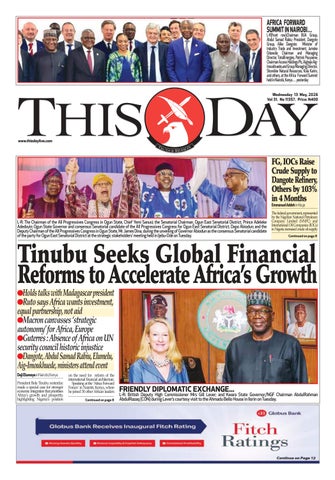
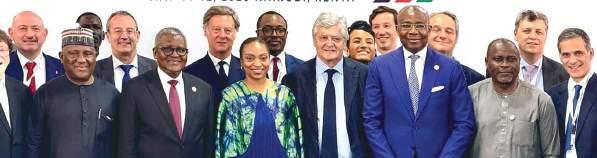
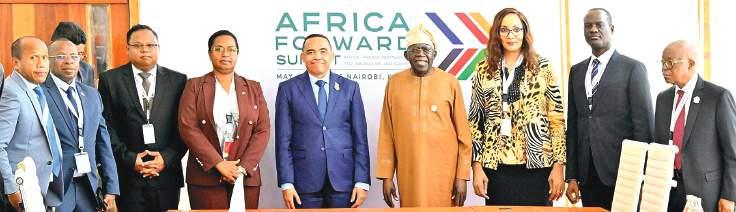
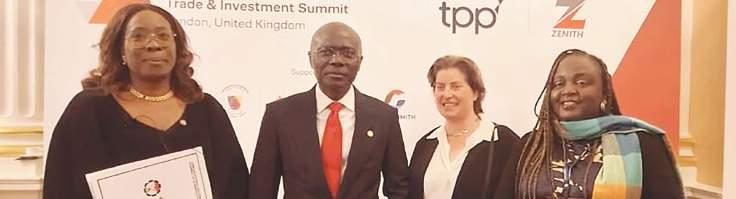
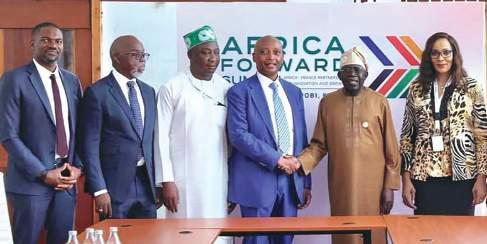
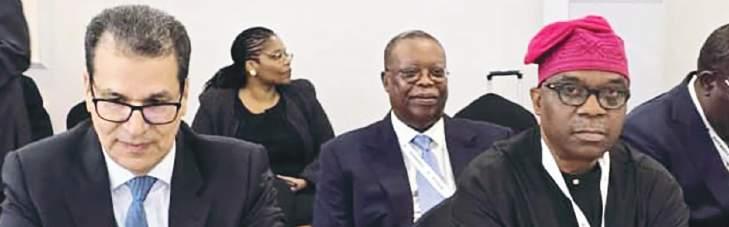
L-R(front row):Chairman BUA Group, Abdul Samad Rabiu; President, Dangote Group, Alike Dangote; Minister of Industry Trade and Investment, Jumoke Oduwole; Chairman and Managing Director, TotalEnergies, Patrixk Pouyanne; Chairman Access Holdings Plc, Aigboje AigImoukhuede,and Group Managing Director, Shoreline Natural Resources, Kola Karim, and others, at the Africa Forward Summit held in Nairobi, Kenya … yesterday
www.thisdaylive.com
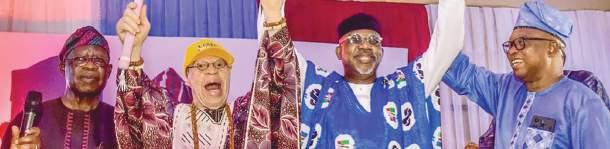
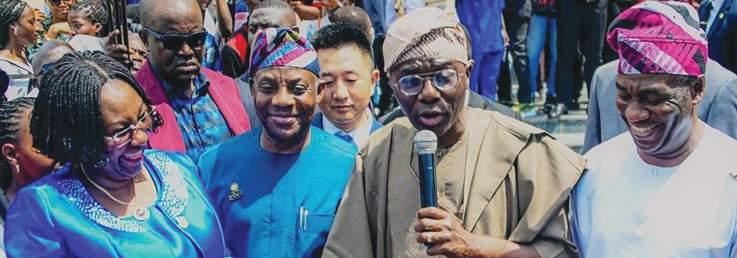
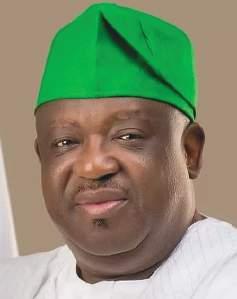
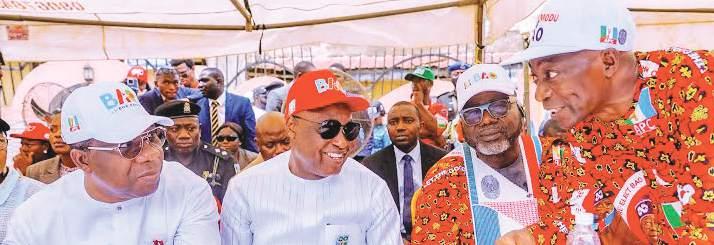
L-R: The Chairman of the All Progressives Congress in Ogun State, Chief Yemi Sanusi; the Senatorial Chairman, Ogun East Senatorial District, Prince Adeleke Adedoyin; Ogun State Governor and consensus Senatorial candidate of the All Progressives Congress for Ogun East Senatorial District, Dapo Abiodun; and the Deputy Chairman of the All Progressives Congress in Ogun State, Mr. James Dina, during the unveiling of Governor Abiodun as the consensus Senatorial candidate of the party for Ogun East Senatorial District at the strategic stakeholders’ meeting held in Ijebu-Ode on Tuesday.
FG, IOCs Raise Crude Supply to Dangote Refinery, Others by 103% in 4 Months
Emmanuel Addeh in Abuja
The federal government, represented by the Nigerian National Petroleum Company Limited (NNPC) and International Oil Companies (IOCs) in Nigeria increased crude oil supply
Continued on page 8
Tinubu Seeks Global Financial Reforms to Accelerate Africa’s Growth
Holds talks with Madagascar president Ruto says Africa wants investment, equal partnership, not aid Macron canvasses ‘strategic autonomy’ for Africa, Europe
Guterres : Absence of Africa on UN security council historic injustice
Dangote, Abdul Samad Rabiu, Elumelu, Aig-Imoukhuede, ministers attend event
Deji Elumoye in Nairobi, Kenya
President Bola Tinubu yesterday made a special case for stronger economic integration that prioritises Africa’s growth and prosperity, highlighting Nigeria’s position
on the need for reform of the international financial architecture.
Speaking at the ‘Africa Forward Forum’ in Nairobi, Kenya, where he joined 30 other African leaders
Continued on page 8
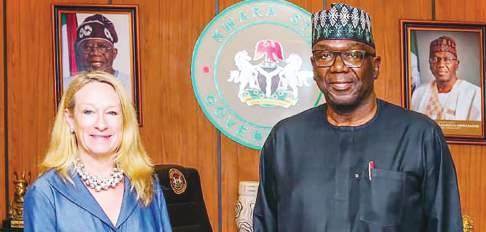
FRIENDLY DIPLOMATIC EXCHANGE...
L-R: British
Bello House in Ilorin on Tuesday.
Deputy High Commissioner Mrs Gill Lever; and Kwara State Governor/NGF Chairman AbdulRahman AbdulRazaq (CON) during Lever’s courtesy visit to the Ahmadu
INAUGURATION OF NEWLY BUILT LIBRARY COMPLEX NAMED AFTER SANWO-OLU...
L-R:
Sanwo-Olu and his Deputy, Dr. Obafemi Hamzat, during the inauguration of the newly built library complex named after the Governor at the LASU Ojo Campus, yesterday
Diezani’s London Trial: Defence Alleges Missing Evidence, Selective Prosecution in Dramatic
The trial of former Minister of Petroleum Resources, Diezani AlisonMadueke, took a dramatic turn at the Southwark Crown Court in London yesterday as her lead counsel, Jonathan Laidlaw, KC, launched a sweeping attack on the credibility of the prosecution’s case.
Laidlaw accused investigators of relying on questionable evidence, engaging in selective prosecution, and failing to preserve critical materials that could have supported the former minister’s defence.
The proceedings marked the beginning of the defence’s closing submissions in a trial that had drawn global attention and remained one of the most closely watched corruption cases involving a former Nigerian public official.
Addressing the jury, Laidlaw painted a picture of what he described as a fundamentally unfair prosecution, questioning why several wealthy oil businessmen alleged to have paid bribes were never charged, while Alison-Madueke had spent years battling criminal allegations in the United Kingdom.
The senior defence lawyer specifically named businessmen Kola Aluko, Jide Omokore, Benedict Peters, Igho Sanomi, and Kevin Okyere, arguing that despite being identified by prosecutors as central figures in the alleged
bribery arrangements, they continue to live freely without prosecution.
“One can be forgiven whether parliament, in its wisdom, when enacting the Bribery Act, could have contemplated this absurd situation where the people who are alleged to have paid the bribes are free, while the accused has been held prisoner for 11 years,” Laidlaw told the jury.
His remarks appeared to be aimed at reinforcing the defence’s longstanding argument that the prosecution had unfairly isolated Alison-Madueke while declining to pursue those allegedly responsible for making the payments at the centre of the case.
The defence also mounted a frontal challenge against the handling of evidence by Nigeria’s Economic and Financial Crimes Commission (EFCC), raising concerns over the integrity and reliability of materials relied upon by prosecutors.
Laidlaw informed the court that officers of the United Kingdom’s National Crime Agency were absent when Alison-Madueke’s Abuja residence was searched in October 2015, adding that none of the items allegedly recovered during the operation were photographed in their original locations.
According to him, NCA does not even possess the original materials now being relied upon in court.
He further alleged that crucial documents capable of supporting
Alison-Madueke’s defence had disappeared, including records relating to reimbursements and official documentation connected to her ministerial duties.
“If the position were not so serious, it would be laughable,” Laidlaw said while criticising the evidential gaps.
In one of the most pointed moments of the proceedings, the defence accused prosecutors of taking contradictory positions regarding the credibility of EFCC.
Laidlaw argued that the prosecution was willing to rely heavily on EFCC-generated evidence against Alison-Madueke, while simultaneously
dismissing EFCC correspondence tendered in support of co-defendant Olatimbo Ayinde as unreliable.
“Either you trust the EFCC, or you don’t. You can’t have it both ways,” he said.
The defence also disputed prosecution claims concerning ministerial records and diaries.
Laidlaw dismissed as “arrant nonsense” testimony suggesting that no ministerial diaries existed, insisting that such records would have demonstrated Alison-Madueke’s official movements and provided evidence of reimbursements relevant to several allegations before the court.
Observers in court noticed that the defence strategy appeared carefully structured to raise doubts about the consistency, preservation, and credibility of the prosecution’s evidence before the case is handed to the jury for deliberations later this week.
Earlier in the day, lead prosecutor, Alexandra Healy, KC, concluded the prosecution’s closing submissions by revisiting allegations involving several Nigerian oil executives and associates linked to the former minister.
On Count 3, concerning an alleged conspiracy involving Alison-Madueke and her brother, the prosecution focused on a £1 million payment alleg-
edly made by businessman Benedict Peters shortly after a mortgage linked to a London property was cleared.
Healy argued that the funds were channelled through a defunct furniture company instead of being paid directly to Agama’s church, describing the arrangement as an “extraordinary device” allegedly designed to disguise the payment.
The prosecution also maintained allegations that certain oil executives provided improper benefits to Alison-Madueke while their companies benefited from lucrative state contracts during her tenure as petroleum minister.
No Passenger Was Abandoned in London by Air Peace, NCAA Boss Insists
Frowns on de-marketing of Nigerian carrier
Director-General of Nigeria Civil Aviation Authority (NCAA), Capt. Chris Najomo, has defended Air Peace against allegations that the airline abandoned passengers in London without accommodation following a flight disruption caused by a bird strike on May 1. Speaking to journalists during a
stakeholders’ engagement on the digital transformation initiative at Murtala Muhammed International Airport, Lagos, yesterday, Najomo dismissed the claims that passengers were “stranded” in the United Kingdom, insisting that the airline acted responsibly and in full compliance with aviation safety protocols. He said all affected passengers
Nigeria Loses $1bn Yearly to Marine Litter, as Environment Ministry, PROTEGO Launch Policy Brief
Olawale Ajimotokan in Abuja
Federal Ministry of Environment, in collaboration with PROTEGO, has launched a Policy Brief on Policies, Institutional Set-Up and Financing of Marine Litter Prevention in Nigeria. It was part of efforts to strengthen the country’s response to the growing environmental threats posed by waste pollution in waterways and coastal communities.
The launch, held on Tuesday, brought together government
officials, environmental experts, development partners, and stakeholders to chart a pathway for preventing marine litter, particularly plastic pollution, from entering the rivers and oceans.
The initiative was supported by Adelphi, Nigeria Climate Innovation Centre, and WASTE Africa.
Speaking at the event, on behalf of Minister of Environment, Balarabe Abbas Lawal, Mrs. Omotunde Adeola, Director II, Pollution Control and Environmental
Health at the Federal Ministry of Environment, described marine litter as one of the most urgent environmental challenges confronting the world today.
According to the minister, marine litter threatens biodiversity, disrupts ecosystem functions, undermines livelihoods in coastal communities, and poses significant risks to public health and economic sustainability. He stated, “As a coastal nation, Nigeria is not exempt from these impacts. Our rivers and waterways
often serve as pathways through which waste enters the marine environment. This makes it crucial for us to adopt a comprehensive, coordinated and forward-looking strategy to address the problem.”
He explained that the newly launched policy brief provided an evidence-based assessment of Nigeria’s current policies, institutional frameworks, and financing mechanisms for preventing marine litter, while identifying gaps and recommending practical steps for improvement.
were promptly accommodated at Hilton Hotel, near Gatwick Airport, after the operating aircraft suffered a bird strike that was discovered during post-landing inspection procedure.
He stated, “There was no case of abandonment. The passengers were taken care of. In fact, my wife was on that flight and they were all accommodated by Air Peace.”
The director-general explained that the aircraft had landed safely in London and passengers had already disembarked when the pilot conducted a routine ramp inspection and discovered evidence of a bird strike. Following the discovery, Air Peace immediately contacted aircraft manufacturer, Boeing, which advised that the aircraft be grounded pending further checks.
Najomo stated that the airline swiftly informed passengers of the development and provided several alternatives, including hotel accommodation and arrangements to move passengers on the next available Air Peace flight arriving from Abuja later that day.
“Delays and cancellations hap-
pen to all airlines. What happened to Air Peace was taken out of context, and it is unfair. No airline deliberately leaves its passengers stranded,” he said.
Najomo also criticised individuals posting viral videos about the incident, questioning what more the airline could reasonably have done under the circumstances. He said, “At this point, what did you expect Air Peace to do? I am not here to defend Air Peace. If they go wrong, I will criticise them. But the NCAA investigated this incident and found that Air Peace did the right thing and followed all necessary protocols.”
The aviation regulator further condemned what he described as efforts to “de-market” Nigeria’s leading indigenous carrier, urging Nigerians to support local airlines rather than amplify negative narratives.
He said, “We should support our own. Incidents like this happen globally. It happened to Delta. It happened to British Airways. Nobody made noise about it or posted endless videos online. Why should Air Peace be treated differently?”
Chinedu Eze
Vice Chancellor, Lagos State University (LASU), Prof. Ibiyemi Tunji-Bello; Minister of Education, Dr. Tunji Alausa; Governor of Lagos State, Mr. Babajide
TINUBU IN BILATERAL MEETING WITH PRESIDENT OF MADAGASCAR...
President Bola Ahmed Tinubu (fourth right) and Madagascar President, Colonel Michael Randrianirina (fifth left), during a bilateral meeting on the sidelines of the ongoing Africa Forward Summit in Nairobi. With them are Nigeria’s Minister of Foreign Affairs, Amb. Bianca Odumegwu-Ojukwu (third right); Minister of Finance and Coordinating Minister of the Economy, Taiwo Oyedele (second right); Minister of Blue Economy, Adegboyega Oyetola (immediate right), and Madagascar ministers in Kenya, yesterday
Shettima: Amid Tax Reforms, Debt Service Burden Slumped to 68% in 2025 from 120% in 2022
Vice President Kashim Shettima, yesterday said the country’s debt service-to-revenue ratio declined sharply from 120 per cent in December 2022 to 68 per cent in 2025 amid ongoing tax reforms introduced by President Bola Tinubu’s administration.
This came as Minister of Finance and Coordinating Minister of the Economy, Mr. Taiwo Oyedele, said the reforms were aimed at building a “stronger fiscal foundation for longterm national development” rather than increasing taxation.
Both spoke at the opening of the 2026 Tax Conference with the theme, “Tax Reforms and Global Relevance: Positioning Nigeria’s Tax System for a Sustainable Future” which is organized
by the Chartered Institute of Taxation of Nigeria (CITN), in Abuja.
Shettima said the reforms had become a major tool for strengthening government revenues, improving fiscal sustainability and supporting the administration’s ambition of growing the economy to $1 trillion by 2030.
Represented by Special Adviser to the President on Economic Affairs, Dr. Tope Fasua, the vice president said, “Many pundits have complained about our high revenue to debt servicing ratio. But the only antidote to this anomaly is to drive revenue for the government, based on well-thoughtthrough and properly-established fiscal laws.
“We are on a solid course, as our current tax reforms are the primary engine for this leap and we have been
able to close that chasm by bringing down this ratio from a galling high of 120 per cent in December 2022, to 68 per cent as at the close of 2025.”
The vice president said the reforms, which took effect from January 1, 2026, represented Nigeria’s first comprehensive tax overhaul in more than 35 years and were designed to reposition the economy for long-term growth.
He said the federal government was already streamlining tax administration and broadening the tax base to improve the country’s balance sheet and reduce pressure from debt obligations.
Shettima said, “Every Naira recovered from inefficiency and every kobo brought into the net from previously untapped sectors is a brick
in the bridge toward that $1 trillion milestone”, adding that reforms would also help government shift from a “nation that borrows to survive to one that invests to thrive”.
The vice president also stated that the current administration remained determined to “break the shackles of high-interest burdens that stifle our ability to fund education, healthcare, social services and infrastructure”.
He stressed that Tinubu had inaugurated the tax reform committee then headed by Oyedele, shortly after assuming office in May 2023 to address weak revenue generation and widespread informality in the economy.
He described the reforms as part of a broader effort to rebuild public infrastructure and improve Nigeria’s
competitiveness globally. Shettima also defended the reforms against criticism, adding that many Nigerians were unaware of their “pro-poor” provisions, stressing that many Nigerians remained unaware that anyone earning N1 million and below will go tax free in the country.
He said, “Some simply cannot believe that small businesses turning over N100 million and below every year are totally tax exempt.”
The vice president however added, “But it is not yet uhuru. We face daunting challenges in our quest for a new, greater Nigeria. The innards of the tax reform must be disseminated far and wide. Many Nigerians are yet unaware, even of the pro-poor nature of the reforms and how it favours the underprivileged amongst us.
Ahead of Lagos State Governments hosting of over 1,000 investors from the Commonwealth of Nations the state has boasted it is now the destination of choice on the African continent, during a two-day summit themed “Lagos: Business Gateway to Africa.” Speaking at a press conference yesterday, the State Commissioner for Commerce, Cooperatives, Trade and Investment, Folashade Bada Ambrose-Medebem, who disclosed this said the summit is being organised by the state government in partnership with the Commonwealth Enterprise
and Investment Council and other strategic public and private sector stakeholders and will hold from June 8 and 9, 2026, at Eko Hotels & Suites.
According to the commissioner, the summit has evolved beyond a conventional investment conference into a strategic platform for policy dialogue, capital mobilisation, investment matchmaking and global investor engagement.
She noted that participation from delegates across the Commonwealth and other regions reflects growing international confidence in Lagos as a prime destination for trade, investment and enterprise development.
Ambrose-Medebem said the summit would attract policymakers, multinational corporations, development finance institutions, entrepreneurs, innovators and trade missions from Africa, Europe, Asia and the Middle East.
She added that this year’s edition would feature keynote addresses, plenary sessions, executive roundtables, sector-specific investment dialogues, exhibitions, business networking sessions, as well as Business-to-Business and Business-to-Government meetings.
Discussions at the summit, she said, would focus on sectors including infrastructure, manufacturing, agriculture, technology,
Jigawa Assembly Approves Namadi’s Request to Access N84bn FG-backed Facility
Ibrahim Shuaibu
The Speaker of Jigawa State House of Assembly, Haruna Aliyu Dangyatin, has announced the approval of Governor Umar Namadi’s request to access an N84 billion federal government-backed financing facility for infrastructure development across the state.
Dangyatin said the facility was part of a federal government intervention programme under which the 36 states
are expected to receive N7 billion monthly over a 12-month period.
The speaker announced the approval on Tuesday during plenary after reading the governor’s correspondence before lawmakers and explained the cumulative allocation for each state would amount to N84 billion to support infrastructure and other development projects.
He added that participating states are expected to obtain the facility through their chosen commercial
banks, while the federal government will handle the monthly repayments.
The facility is expected to support the execution of critical projects in Jigawa State, including road construction, healthcare, water supply, education, agriculture and rural electrification.
The funding is also expected to strengthen the state government’s efforts to improve public services and enhance the living standards of residents through sustainable infrastructure
blue economy, tourism, energy transition, logistics, transportation, financial services, real estate and SME development.
The commissioner further disclosed that one of the major highlights of the summit would be the governors’ investment showcase, designed to facilitate direct engagement between state governments, sovereign institutions, global investors and development partners.
She described Lagos as a major
economic corridor connecting Africa to global markets, citing its large consumer population, expanding infrastructure, thriving innovation ecosystem and strategic maritime assets.
“With a GDP ranked among the largest city economies in Africa and a population exceeding 23 million people, Lagos remains uniquely positioned as the preferred destination for investment, manufacturing, finance, technology and enterprise development,” she said.
“Many Nigerians don’t know that anyone earning N1 million and below will go tax free in Nigeria. Some simply cannot believe – because it has never happened before – that small businesses turning over N100 million and below every year are totally tax exempt. They must be constantly reminded that President Tinubu is not anti-people or anti-business, but pro-people and pro-business.
“He wants Nigerians to thrive and succeed, and we shall work to ensure this. Information dissemination on these reforms is key and we must never yield the entire space to the traducers of government who seek to impugn the good efforts of our leader, by substituting progressive information with concocted information and falsehood.”
Shettima stressed, “Tax reform is often seen as a technical burden, but I urge you to see it as an act of patriotism. We are not just reforming a system; we are reclaiming our destiny.” Earlier, Oyedele, said the reforms were aimed at building a stronger fiscal foundation for long-term national development rather than increasing taxation.
He said the country’s previous tax system had been weakened by fragmented administration, multiple taxation, weak compliance and unstable revenues.
According to him, “Countries that fail to modernise their fiscal
Continued on page 37
Adamawa 2027: Haske Commences Statewide Grassroots Engagement Tour
The Governorship aspirant of the All Progressives Congress (APC) in Adamawa State, Abdulrahman Bashir Haske, has embarked on a statewide grassroots appreciation and engagement tour across the 21 Local Government Areas (LGAs), aimed at strengthening citizen engagement and aligning leadership priorities with the aspirations of the people.
The five-day strategic tour, which commenced on Monday, May 11, 2026, has so far covered nine LGAs. At each stop, Haske reiterated his commitment to inclusive governance, youth empowerment, educational development, agricultural revitalisation,
and sustainable economic growth, a statement explained.
He also emphasised that the voices, needs, and expectations of the people would remain central to his political vision.
The tour began in the Southern Senatorial Zone, with visits to Ganye, Toungo, Jada and MayoBelwa LGAs. The aspirant was received by large gatherings of traditional leaders, stakeholders, youth and women groups, and party faithful, reflecting strong grassroots support and community engagement.
On Tuesday, the tour extended to Lamurde, Guyuk, Shelleng, Numan and Demsa LGAs, where
stakeholders described the engagements as impactful and inspiring. Haske and his delegation held consultative meetings with royal fathers and local leaders, fostering dialogue on unity, development, and shared prosperity.
“In recognition of traditional institutions, Haske first paid a courtesy visit, on Monday, to the Gangwari Ganye, presenting utility vehicles to the royal father as a gesture of respect and partnership,” it added.
He highlighted the importance of sustaining a strong relationship between leadership and traditional authorities in advancing peace and development.
in Dutse
James Emejo in Abuja
GOVERNOR ENO VISITS
Oshiomhole to Akpabio: Rushing Bills, Withholding Copies from Senators Dangerous
Insists every word, clause must be thoroughly scrutinised Warns of drift toward dictatorship
The Senator representing Edo North, Adams Oshiomhole, yesterday warned that the recent handling of amendments to the Senate Standing Rules could weaken constitutional order and open the door to authoritarian tendencies in Nigeria’s legislative process.
Speaking in an interview on Arise News, Oshiomhole criticised what he described as a rushed approach to lawmaking in the Senate, arguing that legislators were not given adequate time or access to properly scrutinise proposed changes before passage.
Oshiomhole had recently on the floor of the Upper Chamber accused the leadership senate of rushing processes, saying senators were not given advance copies or enough time to properly scrutinise the proposed changes. He argued that this undermined proper legislative procedure and risked producing rules that could conflict with the Constitution.
However, tensions escalated on the Senate floor when Oshiomhole attempted to raise a point of order during the debate but was reportedly not recognised by the presiding officer. He also objected to certain provisions he believed could affect eligibility for key leadership positions, including the Senate presidency.
During the interview, he said the
hasty consideration of amendments had already led to avoidable errors, including provisions later found to be inconsistent with the Nigerian constitution and subsequently reversed.
Oshiomhole stressed that senators ought to receive advance copies of proposed amendments to allow for detailed study before deliberation on the floor, warning that failure to do so undermines legislative responsibility.
According to him, the manner in which the amendments were processed also deprived some lawmakers of the opportunity to properly raise procedural objections during plenary. He cited an instance where he attempted to raise a point of order but was not granted recognition.
Oshiomhole further argued that the subsequent reversal of parts of the amended rules underscored the dangers of rushing complex legislative decisions. He said such reversals amounted to institutional embarrassment that could have been avoided with more rigorous scrutiny.
“My view is that we must not rush in making laws. Every clause, every word deserves scrutiny. So rushing…At the end of the day, we have made a couple of mistakes a couple of times.
“Making laws that are in conflict with existing laws that the National Assembly has made or even more seriously, making laws that are in conflict with the Nigeria constitution.
And the only way to avoid those avoidable errors is to have a proper debate.
“Anything you want to do, whether it is rule-changing or lawmaking, it is important that senators have the benefit of advanced copies. Read it, study it, that is what we are supposed to have.
“As you can see, there is no better evidence of the danger of rushing than having to revise rules that conflict with the Nigerian Constitution,” he argued on Arise Television.
He also cautioned against what he described as the use of internal rules to shape political outcomes or
target individuals, warning that such practices could distort democratic governance and encourage authoritarian rule-making within institutions.
“You don’t make laws either for yourself or against specific individuals that you fear will come. That is the beginning of the road to life presidency and dictatorship,” he warned.
Oshiomhole insisted that leadership in the Senate should remain a product of collective confidence among lawmakers rather than restrictive procedural or eligibility interpretations.
He maintained that what matters
is the support of colleagues, not rules designed to exclude or entrench particular interests.
Oshiomhole also referenced provisions in the Senate Standing Orders, suggesting that they raise questions about the eligibility of Senate leadership under current interpretations. However, he stated that he never directly asked Akpabio to resign.
He stated that Akpabio, who previously served in the chamber, had not met what he described as an eight-year threshold when combining his past and current tenures. According to him, if such
a benchmark is applied, it could raise concerns about eligibility to preside over the Senate.
The former labour leader argued that ambiguous or inconsistent interpretations of standing rules could fuel institutional tension and weaken democratic norms, adding that such issues should be resolved through clear, transparent and constitutionally grounded processes.
Oshiomhole maintained that his intervention was driven by principle rather than political interest, insisting that his concern was to preserve due process and safeguard legislative integrity within the National Assembly.
Banking Sector Litigation: NJI, NDIC Hold Seminar for Appeal Court Justices
Wale Igbintade
Justices of the Court of Appeal gathered in Lagos for a sensitisation seminar aimed at strengthening judicial understanding of bank liquidation processes, depositor protection, and the growing complexities of financial sector litigation in Nigeria.
The seminar, themed, “Enhancing the Efficacy of Bank Liquidation and Depositors’ Protection,” was organised by Nigeria Deposit
A governorship hopeful in Bayelsa State representing the All Progressives Grand Alliance (APGA), Dr Domor Mienye, has called on the people of Bayelsa to support credible and youthful candidates from all political parties in the upcoming elections.
Mienye emphasised that the future of Bayelsa hinges on the emergence of a new breed of leaders equipped with the necessary skills, vigour, and genuine dedication to steer the state towards sustainable progress and development.
His remarks came following his endorsement of Mr. Joel Ebiegberi Ileberi as the APGA candidate for
the Southern Ijaw Constituency Assembly seat.
He stressed the importance of voters looking beyond party affiliations and identifying candidates who exhibit the vision, integrity, and capability to bring about positive change in their communities.
Mienye underscored the need to shift focus from blind party loyalty towards prioritising competence, credibility, and a sincere commitment to Bayelsa’s advancement.
“We must begin to move away from politics driven purely by party loyalty and focus more on competence, credibility, and genuine commitment to the development of Bayelsa. This election should not
simply be about political structures or familiar names. It should be about the future of Bayelsa and the kind of leadership we want to see going forward,” he stated.
While expressing his support for Joel Ileberi as the APGA candidate for Southern Ijaw Constituency IV, Mienye urged Bayelsans to also recognise and back credible young candidates from other parties who genuinely prioritise the welfare of the people.
He emphasised that the upcoming election should not solely revolve around political structures or familiar names but should center on shaping the future of Bayelsa through visionary leadership.
Insurance Corporation (NDIC), in collaboration with National Judicial Institute (NJI).
Speakers at the event stressed the critical role of the judiciary, particularly the Court of Appeal, in resolving banking disputes, shaping financial jurisprudence, and sustaining public confidence in Nigeria’s banking system.
Opening the seminar, Administrator of NJI, Justice Babatunde Adejumo, said the programme reflected a deliberate effort to deepen institutional understanding between the judiciary and financial sector regulators.
According to Adejumo, the stability of financial institutions remains
a matter of national importance because banking systems thrive on public confidence in both financial institutions and the legal frameworks governing them.
He warned that the collapse or distress of financial institutions often had far-reaching implications for depositors, creditors, businesses, and the wider economy.
“The stability of financial institutions remains a matter of considerable national importance,” he said.
Adejumo stated, “Banking systems function effectively where there is confidence in the institutions that support them and in the legal processes that govern their operations.
“Hence, when financial institutions experience distress or collapse, the consequences are often far-reaching, affecting depositors, creditors, businesses, and public confidence in the broader financial system.” He said bank liquidation proceedings frequently involved complex legal and regulatory issues relating to creditor priorities, depositor reimbursement, statutory powers, and recovery mechanisms.
Managing Director and Chief Executive Officer of NDIC, Thompson Sunday, said the success of bank liquidation and distress resolution processes depended largely on the quality, consistency, and timeliness of judicial decisions.
Nigerian School Wins Guinness World Record for Longest Speech Marathon
Esther Oluku
The School of Eloquence, a Nigerian public speaking academy, has won the Guinness World Record for the longest speech marathon by a group after completing a 20-day event that ran from April 1 to April 21, 2026.
Making the announcement yesterday, Senior Adjudicator at Guinness World Records, Lena Khulman, stated the school secured the title after reaching a total of 480 hours of speaking, toppling the previous New Zealand record
of 127 hours, 31 minutes, and 4.23 seconds.
Khulman described the attempt as a test of endurance, extraordinary organization, consistency, teamwork, and commitment across the 20-day stretch, making the school the current record holder.
She said: “Before this attempt, the existing record stood at 127 hours, 31 minutes, and 4.23 seconds, achieved by Toastmasters District 112 in New Zealand in April 2018.
“After a thorough review of all submitted evidence including video
footage, livestream archives, operational logs, witness documentation, and continuity verification material, I can now officially confirm that the School of Eloquence reached a total of 480 hours.”
Speaking shortly after the official declaration, the Dean of the School of Eloquence, Mr. Ubong Essien, explained that the attempt was inspired by the institution’s 20th anniversary adding that the declaration is a moment of great pride not just for the school, but for the nation.
Emmanuel Addeh in Abuja
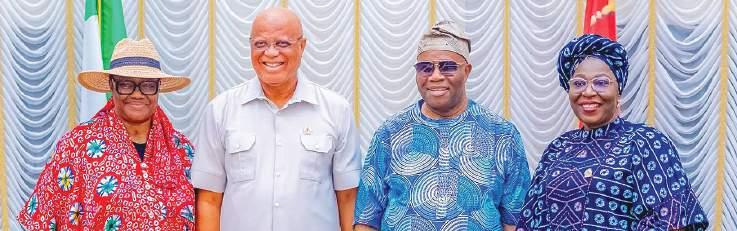
L-R: Wife of the Senate President, Mrs. Unoma Godswill Akpabio; Governor of Akwa Ibom State, Pastor Umo Eno; President of the Senate, Godswill Akpabio; and Deputy Governor of Akwa Ibom State, Senator Akon Eyakenyi, when Eno led APC stakeholders in the state to consult Akpabio over his return bid for the governorship of Akwa Ibom State in 2027 in Uyo, yesterday PHOTO: SENATE PRESIDENT’S OFFICE.
2027: British Government Will Be Neutral in Nigeria’s Elections, Says Envoy
Commends Gov. AbdulRazaq on gender inclusion, women’s rights
Hammed Shittu in Ilorin
British Deputy High Commissioner in Nigeria, Gill Lever, yesterday, said the British government would not interfere in the conduct of Nigeria’s 2027 general election.
Lever stressed that the British government had no preferred political party ahead of the elections.
She spoke in Ilorin while paying a courtesy visit to Kwara State Governor and Chairman, Nigeria Governors’ Forum (NGF), Alhaji AbdulRahman AbdulRazaq, at Government House.
Lever, who was on a three-day official visit to Kwara State, said, “British Government would support a free, peaceful, and credible election in Nigeria next year.
“Downing Street has no favourite political party and will not be seen interfering in local political matters.
“We all want to see elections that
are peaceful, that are inclusive, that are credible, with space for participation, with respect for institutions.”
The British envoy added, “The British government, as you’ll understand, Excellency, is entirely neutral. We do not favour one party or another, and we would never be in the business of telling Nigerian people how to vote.
“But peaceful and credible elections, of course, are not only a democratic objective. This is not only about the Commonwealth values and the values of democracy that we’ve long shared, they’re also an economic objective or imperative as well.”
While commending AbdulRazaq for the quest to make life worth living for the people of Kwara State, the British envoy said, “Kwara under Governor AbdulRahman AbdulRazaq has become a model for gender equity.” She called the governor a
trailblazer for women’s rights and participation in politics.
Addressing the governor, the deputy high commissioner stated, “First of all, you’re a strong advocate for women’s representation in governance, and I think Kwara, under your leadership, has been a trailblazer for women’s rights and women’s participation in the political life of your state,
“We know that you’ve appointed over 50 per cent of your cabinet roles to women. So women’s representation in political life and law-making is essential to Nigeria’s economic development.
“I think we all see that. So, I strongly commend you, Your Excellency. You are a model state for gender equity, and your endorsement of the special seats bill for women has earned you a ‘HeForShe’ Ambassador.”
Lever stated that the British
government was working in many states to help improve digital skills and nurture young talents in the tech industry.
She said, “We’re visiting the Ilorin Innovation Hub today to see the progress of that particular set of UK assistance, see how it’s helped to develop skills and develop aspirations in the tech sector. This is allowing innovators to access global networks and opportunities.
“So we’re very keen through our digital access programme to help improve digital skills, nurture talents, and further the aspirations of young men and women in tech, and help them into employment opportunities.
“You may also know that we launched, a couple of months ago, a community hub in Olayinka (Ifelodun local government), which we hope will benefit over 50,000 people in the local government with tech skills and digital access.”
Responding, AbdulRazaq said his administration had turned around the fortunes of the state, with significant progress made in different sectors of the economy.
He said, “We have made significant progress in different sectors of the economy, from health, education, to agriculture and road infrastructure.
When we came in 2019, things just weren’t working in the state.
“From backlogs of pensions and gratuities to payment of half-salaries to blacklist of Kwara by Universal Basic Education Commission (UBEC).”
The governor added, “When we came in, 99 per cent of schools did not have WASH facilities and no fencing of schools; teachers were in fact owed months in salary arrears. Today, we are up-to-date in investment in basic education with payment of counterpart funds to UBEC.
“We have expanded access to education, healthcare and we are making prompt payment of salaries as well as improving the welfare of the workforce.
“We have cleared the backlog of salaries we met. In fact, we are planning to raise the minimum wage again this year to N100,000.”
AbdulRazaq explained that his administration’s investment in education and health sectors had yielded positive results, with improved ratings of the sectors and expansion of access to education and health care delivery.
TINUBU SEEKS GLOBAL FINANCIAL REFORMS TO ACCELERATE AFRICA’S GROWTH
and global partners to discuss economic transformation, innovation, strategic partnerships, and sustainable growth across the continent, the president warned that the international system must reform or risk irrelevance.
The summit, co-chaired by French President Emmanuel Macron and Kenyan President William Ruto, brought together heads of state, policymakers, investors, and business leaders to also deliberate on key issues, including energy transition, industrialisation, digital transformation, climate action, and reforms of the global financial architecture.
“Last September, from the podium of the United Nations General
Assembly, Nigeria warned that the international system must reform or risk irrelevance. We spoke not only of the Security Council but of the financial and trade structures that quietly de-industrialise our nations. The evidence is before us. Despite decades of independence, Africa’s share of global manufacturing value added remains below two per cent.
“We export raw minerals, crude oil, and agricultural commodities, and we import processed goods at a premium. This pattern is not an accident. It is the product of a global financial architecture that starves our industries of affordable capital, tolerates massive illicit financial flows, and imposes policy constraints that our competitors
FG, IOCS RAISE CRUDE SUPPLY TO DANGOTE REFINERY, OTHERS BY 103% IN 4 MONTHS
to domestic refineries, led by the Dangote Refinery, by over 103 per cent between January and April 2026, THISDAY has learnt.
An analysis of the data released by the Nigerian Midstream and Downstream Petroleum Regulatory Authority (NMDPRA) yesterday showed that crude supplied locally to domestic refineries rose from 8.83 million barrels in January to 17.96 million barrels in April, reflecting a rise of 103.4 per cent.
In contrast, imported crude and feedstock supplied to the refineries dropped from 9.43 million barrels in March to just 0.41 million barrels in April, representing a decline of approximately 95.6 per cent within the period.
The data underscored a major shift in Nigeria’s downstream petroleum sector as the Dangote refinery increasingly relies on locally supplied crude oil for the production of refined petroleum products, especially Premium Motor Spirit (PMS), commonly known as petrol.
Overall crude receipts by domestic refineries stood at 20.92 million barrels in March before declining to 18.37 million barrels in April. However, the structure of refinery feedstock changed significantly during the four-month period.
The NMDPRA data also showed that local supply of petrol rose substantially during the period, reflecting increased production from the Dangote refinery, currently the only refinery producing PMS in Nigeria.
According to the report, domestic petrol supply rose from 34.2 million litres per day in March to 40.7 million litres per day in April, indicating an increase of approximately 19 per cent.
At the same time, imported petrol products volumes declined from 5.9 million litres daily in January to 3.7 million litres daily in April, representing a drop of about 37.3 per cent.
The figures indicated that locally refined petrol is steadily displacing
imported fuel in the Nigerian market as output from the Dangote refinery expands.
The NMDPRA data disclosed that average refinery capacity utilisation by the Dangote refinery reached 99.12 per cent in April, achieving 100 per cent utilisation “for most of the days in April.”
The sharp increase in crude allocation to domestic refineries reflected improved collaboration among upstream producers, regulators and refiners following persistent concerns over inadequate crude supply for local processing.
The increase in local refining came amid elevated global crude prices triggered by geopolitical tensions involving Iran and the United States. According to the NMDPRA report, dated Brent crude averaged $120.55 per barrel in April, while international petrol prices rose to $1,074.97 per metric tonne during the month. The increase in global oil prices translated into higher domestic petrol prices across the country despite the rise in local refining activity.
The report showed that average actual pump prices stood at N1,271.50 per litre in Lagos, N1,326 per litre in Abuja, N1,340 in Kano and N1,371.50 in Maiduguri during April. Maximum retail prices reached N1,400 per litre in Sokoto and N1,413 per litre in Maiduguri.
Despite the increase in fuel prices, petrol demand remained relatively resilient. The NMDPRA stated that average daily petrol truck-out into the domestic market stood at 51.1 million litres in April, slightly above the agency’s benchmark national consumption estimate of 50 million litres per day.
Petrol production averaged 53.6 million litres daily during the month, while domestic PMS supply stood at 40.7 million litres daily. Besides, diesel production averaged 23.6 million litres per day, while aviation fuel production stood at 22.9 million litres daily.
Nigeria’s fuel reserve position also remained stable during the period despite volatility in international oil markets. According to the report, the country maintained average stock sufficiency levels of 18 days for petrol, 39 days for diesel and 70 days for aviation fuel in April.
The report further showed that the three modular refineries currently in operation, namely WalterSmith Refinery, Edo Refinery and Aradel Holdings continued to produce diesel during the month.
Collectively, the modular refineries supplied an average of 0.559 million litres of diesel daily in April.
WalterSmith operated at 56.14 per cent capacity utilisation and produced 0.250 million litres of diesel daily, while Edo Refinery achieved 79.20 per cent
utilisation with output of 0.086 million litres daily. Aradel operated at 33.95 per cent utilisation with production of 0.181 million litres daily.
In the gas sector, total average gas supply stood at 5.142 billion standard cubic feet per day (Bscf/d) in April. Out of the volume, 2.012 Bscf/d was supplied to the domestic market. Also, gas supplied to the power sector averaged 0.549 Bscf/d, while commercial consumers utilised 0.671 Bscf/d and gas-based industries consumed 0.468 Bscf/d.
Liquefied Petroleum Gas (LPG) supply averaged 4,545 metric tonnes daily, while consumption stood at 4,818 metric tonnes daily. Retail LPG prices ranged between N1,100 and N1,450 per kilogramme during the period.
themselves never observed when they built their own industrial bases.
“Nigeria does not come to this discussion as a supplicant. We come as a nation that has taken painful, homegrown decisions to put our house in order — removing fuel subsidies, unifying our exchange rate, recapitalising our banking system with over US$3.4 billion, and exiting the FATF grey list,” the Nigerian leader stated.
According to him, these reforms were sovereign choices, not external conditions, pointing out that they have delivered a declining debt-toGDP ratio, now projected at 32.3 per cent in 2026.
Besides, he noted that the reforms have delivered stronger external reserves of $45.5 billion, and a return of investor confidence, but explained that even a reforming nation like Nigeria is being forced to de-industrialise by a financial system that is stacked against it.
Tinubu added that in 2026, Nigeria will spend about US$11.6 billion on debt service — nearly half of projected revenue.
“Every single dollar that leaves our treasury to pay punitive interest rates is a dollar that did not go into our steel sector, our textile mills,
our agro-processing plants, or our digital industries. It is a dollar that did not train a young Nigerian engineer or provide affordable power for our factories.
“Our industrial base is being starved of the blood it needs — long-term, affordable finance — while creditors and rating agencies treat African sovereigns as permanent high-risk borrowers, regardless of our fiscal performance.
“So, I ask this gathering: How can an African manufacturer compete with a competitor in Europe, Asia, or North America when the cost of borrowing in our nations is five to 10 times higher? How can we build cross-border industrial value chains under the African Continental Free Trade Area when our infrastructure projects face a financing gap deepened by the very institutions meant to bridge it?
“The answer is plain: we cannot. The international financial architecture, as currently constituted, is an instrument of industrial disarmament for Africa. Nigeria is not asking for charity. We are demanding a financial system
2027: Ogun East APC Presents Abiodun as Consensus Choice, Daniel Insists on Primary
Some All Progressives Congress (APC) stakeholders in Ogun East Senatorial District, yesterday, presented Governor Dapo Abiodun as the consensus candidate of the zone for the 2027 senatorial election.
The formal presentation of Abiodun came just as former governor of the state and incumbent senator for the district, Otunba Gbenga Daniel, declared that a primary election among senatorial aspirants in the area would determine the APC candidate.
Abiodun’s announcement as consensus candidate and Daniel’s counterpoint occurred at parallel events in Ijebu Ode, headquarters of Ogun East Senatorial District.
Daniel spoke during the PBAT/ OGD Movement Mid-Term Assessment Tour and Empowerment Programme for residents of the
senatorial district.
But at the event where Abiodun was presented, the organisers said their action was based on a decision to ensure quality representation and sustain party unity in the senatorial district.
The occasion was witnessed by top APC chieftains, including the party’s consensus governorship candidate in Ogun State, Senator Olamilekan Adeola, and other senior stakeholders across Ogun East.
The event had in attendance former deputy governors, Yetunde Onanuga, Segun Adesegun, and Gbenga Kaka; Ogun State APC Chairman, Chief Yemi Sanusi; Deputy Chairman, Chief James Dina; Chairman of Ogun East Senatorial District, Senator Lekan Mustapha; and Chairman of APC in Ogun East Zone, Dr. Adeleke Ogundoyin.
While presenting Abiodun
to leaders and stakeholders of the zone, Adesegun said party members across the district had unanimously endorsed the governor as the APC consensus candidate for Ogun East Senatorial District.
Mustapha corroborated, saying the adoption of Abiodun is a collective decision of the people of the district to ensure effective and quality representation at the National Assembly.
Daniel, however, said he had reached a point of no return in his bid to return to the National Assembly as senator for Ogun East, declaring that he is ready to face other Ogun East senatorial aspirants in a primary to elect the APC candidate for the senatorial district.
Daniel’s programme was attended by APC leaders, members, and residents of Ijebu Ode, some of whom benefitted from his
economic empowerment items, like sewing machines, fertiliser, farm implements, and freezers. The senator, who had obtained the nomination form for Ogun East Senatorial primary election, had been screened and cleared by the APC Screening Committee. He said in line with the provisions of the Electoral Act, the power to choose the party’s candidate rested with all card carrying members of APC. Daniel, who highlighted some of the development projects he facilitated in Ijebuland, both as governor and while in the senate, said Ogun East had a lot to still benefit from his interventions if re-elected.
He enjoined members of the party to go to their different wards on the day of the primary election and vote for who they wanted as the candidate of APC for the Ogun senate seat.
Gill Lever
James Sowole in Abeokuta
Days After Osogbo Attack, TCN Reports
Attempted Security Breach at Ogbomosho Facility
Company begins phase 2 compensation for Kaduna transmission project
Just days after an attack on one of its facilities in Osogbo, Osun State, the Transmission Company of Nigeria (TCN) has announced another security incident at its Ogbomosho Transmission Substation in Oyo State, raising renewed concerns over the safety of critical national power infrastructure.
In a statement issued yesterday
by TCN’s General Manager, Public Affairs, Ndidi Mbah, the company disclosed that armed men attempted to invade the Ogbomosho substation in the early hours of May 10, 2026, but were repelled by security personnel on duty.
TCN said preliminary reports indicated that the attackers gained unauthorised access into the premises by scaling the perimeter fence near the gate between late Saturday night
and early Sunday morning.
According to the company, the intruders advanced towards the gate house with the intention of attacking and immobilising the vigilante operatives stationed at the facility.
However, the security personnel reportedly resisted the attack by firing warning shots, forcing the suspected criminals to abandon the operation and flee through the same route they
used to enter the premises.
“During their escape, the suspects abandoned some of their tools and personal items near the fence wall,” the statement said.
The company explained that an early morning inspection of the premises revealed implements suspected to have been intended for use in the attempted attack, as well as traces of blood and footprints leading towards the escape route.
Sanwo-Olu Excited as LASU Retains Position as Most Sought-after Varsity in Nigeria
Reiterates goal to make LASU one of top 10 varsities globally
Governor Babajide Sanwo-Olu of Lagos State has expressed excitement as Lagos State University (LASU) once again solidified its status as a beacon of academic excellence and national relevance by emerging as the most sought-after university in Nigeria in the 2026 Unified Tertiary Matriculation Examination (UTME).
Sanwo-Olu applauded LASU for topping the list of most sought-after institutions in the 2026 UTME, reiterating his administration’s goal to make LASU one of the top 10 universities in the world.
He said LASU’s improved performance was a direct result of Lagos State Government’s focus on fostering an academic environment that led to prosperity.
According to data released by Joint Admissions and Matriculation Board (JAMB), LASU, the state-owned varsity, attracted an overwhelming 84,426 applicants, placing it at the top of the list of Nigeria’s most preferred institutions for tertiary education.
The milestone marked a
historic moment in the citadel of knowledge’s 41-year journey, further affirming its growing reputation as a centre of academic innovation, discipline, and global competitiveness.
According to the data released by JAMB, LASU claimed the top spot with 84,426 applicants, while the University of Lagos (UNILAG) ranked second with 78,240 applicants.
Obafemi Awolowo University (OAU) ranked third with 60,370 applicants, and University of Ibadan and University of Benin followed closely in fourth and fifth places with 58,895 and 55,425 applicants, respectively.
Sanwo-Olu applauded LASU for its high ranking as a beacon of excellence and the most sought-after institution in Nigeria. He attributed the remarkable achievements of LASU to “visionary leadership, dedicated faculty, and students”, supported by the THEMES Plus Agenda, which focuses on funding and technological advancements.
The governor commended LASU for its improved academic performance, high-quality graduates, and top-tier infrastructure, assuring that the state-owned tertiary institution will continue to shape the future of the young people.
He praised the Vice-Chancellor of LASU, Professor Ibiyemi OlatunjiBello, for her role in improving the school’s rankings.
Sanwo-Olu said Olatunji-Bello’s
leadership had been a game-changer in university administration by introducing innovative approaches to learning and elevating LASU to greater heights, which had attracted both national and international recognition.
Sanwo-Olu also encouraged staff and students to continue the hard work to maintain the status of the most sought-after institution in Nigeria.
TCN added that a further search conducted after daylight led to the recovery of a bag containing additional tools believed to belong to the fleeing suspects.
The latest development comes amid growing concerns about repeated attacks, vandalism and theft targeting Nigeria’s electricity infrastructure, which industry operators say have continued to undermine power supply reliability and increased operational costs across the sector.
The company noted that the incident had already been reported to relevant security agencies and that investigations were ongoing to identify and apprehend those behind the attempted breach.
TCN stated that no personnel were injured during the incident and reiterated its commitment to protecting critical transmission infrastructure across the country.
“The incident has been reported to the relevant authorities, and TCN is working closely with security agencies to investigate the matter and prevent a recurrence. No personnel were“TCNinjured.remains committed to safeguarding its installations and ensuring the safety of staff and infrastructure nationwide. The
company has directed a formal report of the incident to the Oba’s Palace,” the company stated.
The attempted attack at Ogbomosho comes only days after another reported security breach involving a TCN installation in Osogbo, underscoring the mounting pressure on electricity infrastructure nationwide.
Nigeria’s power assets, particularly transmission installations, have in recent years come under increasing attacks from vandals, cable thieves and organised criminal groups seeking to cart away high-value electrical components.
Sector stakeholders have repeatedly warned that the destruction of transmission towers, cables and substation equipment not only disrupts electricity supply but also imposes huge replacement costs on the government and electricity consumers.
Meanwhile, in a separate development, TCN announced the commencement of the second phase of compensation payments to Project Affected Persons (PAPs) under the 330kV Double Circuit QUAD Conductor Mando–Rimin Zakara Transmission Line Project in Kaduna State.
NIMC Unveils WhatsApp, Live Chat Platforms to Revolutionise NIN
Michael Olugbode in Abuja
The National Identity Management Commission (NIMC) has launched new WhatsApp and live chat support channels to improve customer service and ease access to National Identification Number (NIN) enquiries for Nigerians and legal residents. In a statement issued on
Monday, the Commission said the initiative forms part of its ongoing digital transformation and service reform agenda under the leadership of Director-General and Chief Executive Officer, Abisoye Coker-Odusote.
According to NIMC, the newly introduced platforms are designed to provide faster, more convenient and real-time support services
Customer Support
to the public, while reducing the need for physical visits to its offices.
The Commission stated that users can now access support through the live chat feature on its official website, NIMC Official Website, as well as through its official WhatsApp support line at +234 701 566 6971.
NIMC noted the move aligns
with the Renewed Hope Agenda of President Bola Tinubu, which seeks to improve efficiency in public service delivery through technology-driven solutions. The commission explained the platforms would offer prompt responses to enquiries, real-time guidance, and verified information relating to NIN services and identity management matters.
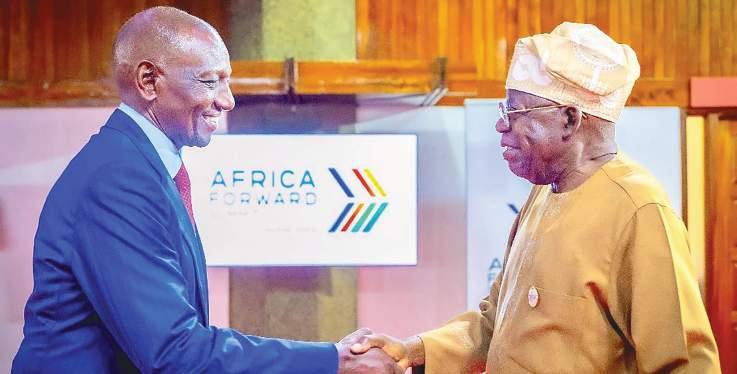
TINUBU AT AFRICAN FORWARD SUMMIT IN NAIROBI... President Bola Ahmed Tinubu (R) and Kenya President, William Ruto, during the African Forward Summit in Nairobi, Kenya, yesterday
Emmanuel Addeh in Abuja
NATIVE ARTICLE PROPOSAL
What is a Native Article?
ARISE NEWS is Africa’s leading business and financial news website, providing a unique blend of international and pan‑African business and economic news.
Native Article is the innovative way of strategically packaging content to blend in with editorial.
This allows for content to appear as more credible, as it reads naturally without the marketing agenda of the company coming across as obvious.
How it works
Client to provide Arise News with an article, Arise News Editorial team will then re‑write this to fit the consumer content behaviour.
The Article will be posted on the website, and the article page will have full advertiser branding.
The Article link will be embedded on the homepage for one week.
The article will get a social post dedicated to drive users to the article page on the day it is released.
The article will be archived on the site and can be accessed for 6 months thereafter.
Are Plateau Elders Ready to Implement Tinubu’s Peace Mandate?
yemi Kosoko, in this piece, explores how President Bola Tinubu has placed the burden of ending Plateau state’s relentless cycle of bloodshed squarely on the shoulders of its elders, demanding leadership over excuses.
For nearly three decades, Plateau State has lived with a painful paradox: a land celebrated for its beauty, diversity, and hospitality, yet repeatedly scarred by cycles of violence that refuse to fade. Generations have grown up knowing both the warmth of its people and the cold shock of sudden conflict. Entire communities have rebuilt homes more times than they can remember. And through it all, one question has lingered: why does the violence keep returning?
In late April 2026, that question once again reached the highest levels of government. President Bola Tinubu summoned Plateau elders, political leaders, traditional rulers, and religious figures to the State House in Abuja. His message was unmistakably direct and unusually blunt. The time for excuses is over. Plateau must break the cycle of violence and deliver lasting peace.
The meeting followed the March 29, 2026 attack in Angwan Rukuba, one of several recent incidents that have shaken the state. But the President’s tone made it clear that he was not merely reacting to the latest tragedy. He was addressing a crisis that had festered for nearly 30 years, a crisis that had outlived administrations, outlasted commissions of inquiry, and outpaced the political will to confront it.
That urgency has only deepened in recent days. At least 11 people were killed in a renewed attack on Ngbra Zongo community in Kwall District of Bassa Local Government Area, plunging the area into fresh mourning. The assault, which occurred around midnight, was carried out by gunmen who reportedly invaded the community in coordinated groups, shooting sporadically and attacking residents with machetes and other weapons. Several others sustained injuries, while many families fled into nearby bushes to escape the violence. Community members described attackers moving from house to house, leaving residents in panic. Among the dead were three pregnant women, a community leader, and children as young as three. Survivors, including a pregnant woman, are receiving treatment for gunshot wounds and machete cuts.
Earlier last week, another wave of violence struck Barkin Ladi LGA, where gunmen attacked mourners during a mass burial in Nding Sesut community. The mourners had gathered to bury six victims, five members of the same family and another resident, killed in a late-night assault the previous day. According to community sources,
the attackers stormed the burial ground and opened fire, sending people fleeing in panic. In neighbouring Riyom LGA, an attempted attack on Rim community was repelled by local vigilantes and personnel of Operation Rainbow. These repeated assaults have heightened fears among residents, many of whom say they are uncertain about returning to their homes or farms.
These fresh tragedies underscore the urgency of the President’s intervention and the need to confront the deeper forces driving Plateau’s instability.
Plateau’s recurring violence did not begin in 2026. Its roots stretch back to the 1994 Jos riots, the 2001 citywide clashes, the 2008 local government election crisis, and the waves of rural attacks that followed. Each outbreak left behind not only destruction and displacement but also a familiar ritual: the establishment of a commission of inquiry.
Over the years, these commissions have included the Fiberesima Commission of 1994, the Niki Tobi and Galadima Commissions of 2001, the Ajibola Commission of 2009, and several federal panels and reconciliation committees between 2009 and 2010. These bodies interviewed witnesses, documented grievances, identified perpetrators, and recommended reforms. Their reports were detailed, their findings consistent, and their recommendations clear. Yet, despite their thoroughness, implementation was rare. The result was a predictable pattern: crisis, commission, White Paper,
no implementation, and then a new crisis. It is this pattern that President Tinubu now wants Plateau’s elders to break.
The Abuja meeting brought together one of the broadest delegations of Plateau leaders in recent memory. Among those present were former Military Governor, Rear Admiral Samuel Atukum (Rtd); former Governors Fidelis Tapgun, Joshua Dariye, Jonah Jang, and Simon Lalong; former Minister, Dame Pauline Tallen; incumbent Governor, Caleb Mutfwang; APC national chairman, Prof Nentawe Yilwatda; traditional rulers, religious leaders, and legislators.
According to participants, the President’s message was both stern and urgent.
He approved N2 billion in federal support for victims of recent attacks, a gesture aimed at addressing immediate humanitarian needs and signalling federal commitment.
He challenged Plateau’s leaders to identify those behind the killings, warning that political convenience must not stand in the way of justice. He reminded them that if people are being recruited for conflict, leaders must examine themselves. It was a pointed reminder that violence does not grow in a vacuum. It requires enablers, financiers, and influencers, and some of them, the President implied, may be closer to home than many admit. He directed security agencies to pursue the planners and financiers of attacks, not just the foot soldiers.
For many observers, this was the strongest federal intervention in Plateau’s crisis in years.
The President’s remarks echoed the findings of every major commission of inquiry on Plateau State. Across 1994, 2001, and 2008, the commissions identified the same root causes: weak security coordination, politicized local
If Plateau leaders seize this moment, the state could finally begin to close the chapter on decades of violence. If not, the cycle may continue, and future generations will inherit the consequences. For now, the mandate is clear: break the cycle, finish the work, and deliver the peace Plateau has long been promised.
governance, indigene–settler tensions, youth militia mobilization, land disputes and territorial pressures, a culture of impunity, and deepening mistrust between communities. The commissions also offered solutions, many of which remain relevant today.
Yet, year after year, administration after administration, the recommendations gathered dust. Tinubu’s intervention, therefore, is not just a call to action. It is a call to finish the unfinished work of past commissions.
Experts say the President’s mandate aligns with long-standing recommendations that Plateau has yet to implement. Governance reform will require making local government elections transparent, depoliticizing sensitive appointments, and strengthening conflict-management capacity at the local government level.
It also demands addressing identity and structural issues by standardizing indigene certificate processes, guaranteeing basic rights for long-term residents, and clarifying land and district boundaries. In addition, social cohesion and peacebuilding must be prioritized through the institutionalization of interfaith and interethnic councils, the integration of peace education into schools, the expansion of youth programs across diverse communities, and a deliberate effort to avoid inflammatory rhetoric. These are not new ideas; they are simply the unfinished work of past commissions.
By placing responsibility squarely on Plateau’s elders and leaders, the President has reframed the crisis. This is no longer just a security issue. It is a leadership issue. The elders who sat before the President represent decades of Plateau’s political, cultural, and spiritual authority. They have the influence to calm tensions, expose perpetrators, and rebuild trust, or to allow the cycle to continue. Tinubu’s message was clear: the federal government can support, but Plateau must lead.
Plateau stands at a moment of rare possibility. The President has opened a door. The commissions have mapped the path. The people have paid the price. What remains is the political will and the moral courage to act.
If Plateau leaders seize this moment, the state could finally begin to close the chapter on decades of violence. If not, the cycle may continue, and future generations will inherit the consequences. For now, the mandate is clear: break the cycle, finish the work, and deliver the peace Plateau has long been promised.
Tinubu
muftwang
yilwatda
Bauchi 2027: The Amb Tuggar Scenario
As he enters the 2027 Bauchi governorship fray, LOUIS ACHI asks – will the urbane, consummate diplomat, Ambassador Yusuf Maitama Tuggar, the immediate past Minister of Foreign Affairs, weaponize diplomacy to transform Bauch State’s development quandary
Today, Nigeria is uncertain about its values, its leadership and its safety. Clearly, this is a scenario unsettling conventional governance playbooks and upending received wisdom. This has created an enervating fog caging critical human and infrastructural transformation and crippling socio-economic stability.
Incidentally, the land of unfulfilled promise, agriculture-rich Bauchi State in the nation’s north-east geopolitical zone is part of this unflattering landscape. To reframe and alter the circumstances that have conspired to bruise and confine this 50-year-old potential diadem and propel it into a different developmental trajectory require a new kind of leadership.
Indisputably, to properly engage these disruptions and liberate Bauch State require a tested trailblazer with vision, knowledge and courage who can provide inclusive, bold leadership to ensure both progression and stability.
It is against this backdrop that the immediate past Minister of Foreign Affairs, Ambassador Yusuf Maitama Tuggar firmly put himself forward, under the All Progressives Congress (APC), pledging to decisively lead the imperative charge and construct a New Bauchi going forward.
As it were, a powerful vision draws in ideas, people and other resources. It creates the momentum and will to make change happen. It inspires individuals, complementary organizations and institutions to commit, to persist and to give their best. These are Ambassador Tuggar’s forte.
Tuggar has framed his declaration as a necessary intervention to restore Bauchi’s former glory and build a “sustainable, vibrant and safe” state. His words: “I’m stepping forward not for power but for service, not for privilege but for progress”. He pledged to “build on the good legacies of previous leaders and to correct the mistakes of the past where they occurred”.
Tuggar, whose declaration on April 25, 2026 to contest the 2027 governorship election, supported by prominent APC leaders, stated his experience as a minister has prepared him to deliver development to Bauchi State, focusing on creating a, “sustainable, vibrant and safe” state. His words: “No farmer in Bauchi State should fear going to the farm, no trader should fear the road, and no child should fear going to the school.”
The immediate past foreign affairs minister who also was Nigeria’s Ambassador to Germany subsequently, on April 29, 2026, picked the APC expression of interest and nomination forms at the party’s sales center in Abuja accompanied by a large crowd of supporters.
Tracking back, on March 17, a brusque presidential directive had informed all political appointees under Bola Tinubu’s administration seeking elective office to resign by March 31, 2026. While many dithered and quibbled, Ambassador Yusuf Tuggar’s subsequent decisive resignation as Nigeria’s Minister of Foreign Affairs on Monday, March 30,
2026, to pursue his 2027 governorship ambition in Bauchi State sent a clear message to both friends and foe that a very principled and focused player has entered the fray.
Tuggar made the declaration on Saturday April 25 at the Games Village Field in Bauchi where he unveiled a 10-point agenda focused on economic growth, security, education and infrastructure development.
Outlining his agenda, Tuggar said he would prioritise agriculture and rural development by investing in farming across both rainy and dry seasons, improving livestock production, and modernising grazing corridors. “We will move from subsistence to prosperity, making agriculture a business, not just survival.”
He also promised to revitalise local markets, including Soro, Dindima, Darazo, Alkaleri, and Liman Katagum markets, noting their importance to livelihoods and regional trade.
On the critical security arena, Tuggar pledged to strengthen collaboration between communities and security agencies, deploy community policing, and address root causes such as youth unemployment, poverty, and drug abuse. His words: “Our core message is that no farmer should fear going to the farm, no
trader should fear the road, and no child should fear going to school.”
Further outlining plans to tackle outof-school children through inclusive education policies, expand vocational training, and promote digital innovation and entrepreneurship among youths, he also promised timely payment of salaries, improved healthcare delivery, urban development, and support for women and vulnerable groups.
Correctly looking at the disorganized mining sector in Bauchi, he stressed the need to harness the state’s solid mineral resources for economic development, citing deposits of tin, granite, zinc, and other minerals across the state.
For good measure, he pledged that if given the party’s ticket he would lead the APC to victory in Bauchi where the party is currently in opposition at the state level.
Many see diplomacy as a profession largely conducted through discreet negotiations, confidential communications and carefully managed engagements.
Nigerian diplomat and scholar Boladei Igali appointed by President Umaru Musa Yar Adua as Ambassador to the Scandinavian countries largely confirms this perception.
“Diplomacy is often conducted quietly -
behind closed doors, through confidential dispatches and delicate negotiations. As a result, the public rarely understands how policies are shaped or how critical decisions are made.”
As Bauchi State navigates an increasingly socio-economically challenging environment and associated uncertainties, Tuggar, a consummate diplomat with profound public sector exposure simply needs to weaponize diplomacy to resolve the multi-faceted crises besting his native Bauchi and pull it back from the brink. His pedigree speaks for him.
It is worth recalling that the Ministry of Foreign Affairs, under the leadership of Ambassador Tuggar, made significant strides in strengthening Nigeria’s international engagement and attracting foreign investors through holistic bilateral negotiations that have led to impressive outcomes in under three years since he assumed office in August 2023.
Tuggar’s diplomatic exploits and sustained diplomacy backed by President Bola Ahmed Tinubu’s economic restructurings have increased investors’ interest in Nigeria despite the global financial crises occasioned by the array of challenges such as the COVID-19 Pandemic, climate change, the US-Israel-Iran War and trade disruptions, Nigeria has remained resolute in weathering the storm and finding a pathway to overcoming the deluge of development challenges confronting the country.
Tuggar’s role as Nigeria’s foreign investment czar has led to remarkable partnerships with key foreign investors marked by the signing of strategic memoranda of understanding aimed at revamping the economy and solidifying Nigeria’s development drive. So far, a total of 87 memoranda of understanding have been signed between Nigeria and its development partners amounting to $50,826,000,000 between August 2023 and January 2025.
These agreements are not only strategic to Nigeria’s economic pursuit but are critical to fostering sustainable development anchored on President Tinubu’s “Renewed Hope Agena.”
For example, at the G20 Leaders’ Summit in 2023, Nigeria signed $14 billion worth of investment deals with three Indian investors, covering a range of sectors such as ICT, Power, Steel/ Manufacturing, Agriculture, Defence, Telecom, Space Communications, Digital solutions, Insurance, Processed foods, Real estate, and Hospitality.
Equally, at the Third Belt and Road Initiative (BRI) Forum marking the 10th anniversary of the BRI in 2023, Nigeria secured an investment commitment of $4bn from Chinese companies intended to finance two major railway projects in Nigeria – the Abuja-Kano and Port Harcourt-Maiduguri railways and other major projects in the country.
Cloning these templates and deploying them for the socio-economic transformation of Bachi State is certainly not a stroll in the park. But for a leader honed in the stern crucible of international diplomacy and who has engaged the toughest players in the book, revamping Bauchi State and powering it into its next imperative development trajectory, it is game on.
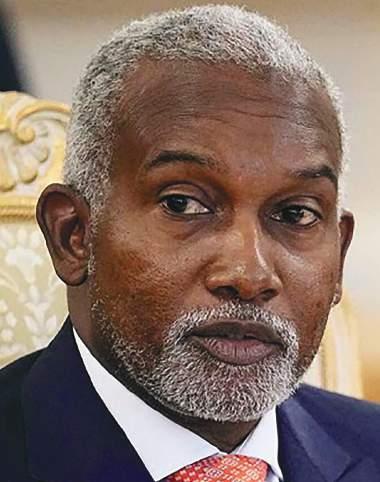
Ambassador Yusuf Tuggar
Email
FEaturEs How the Ogunsan Family Turned Grief into Hope Through AKEM Foundation
Four years after launching AKEM Foundation in honour of their late parents, Chiemelie Ezeobi reports that the Ogunsans are building more than just a charity, rather they are creating a culture of giving, enterprise, and lasting social impact through the lives changed
For many families, the passing of parents leaves behind memories, photographs, and stories told at reunions. For the Ogunsans, it became the beginning of a mission.
What started as an emotional decision by four siblings determined to preserve the values of their late parents has gradually evolved into a growing social institution impacting lives across Lagos and beyond.
At the 4th Anniversary of the AKEM Foundation held in Lagos on May 9, the gathering was more than a celebration of milestones. It was a reflection of what can happen when family values are transformed into a structured platform for public good.
Founded by Dr. Ayodele Ogunsan alongside his siblings, Abiodun, Aduke, and Folorunsho Ogunsan, the AKEM Foundation was created in honour of their late parents, Engr. Akinola Ogunsan and Madam Emiola Ogunsan, whose lives revolved around discipline, education, enterprise, compassion, and community service.
Four years later, the initiative has grown from supporting just four organisations at inception in 2023 into a broader intervention platform focused on education, entrepreneurship, youth mentorship, business empowerment, and social welfare.
Remembering Parents Through Service
In his opening remarks, Chairman of AKEM Foundation, Dr. Ayodele Ogunsan, said: “Twenty-two years ago, on the 5th of May, we lost our mum, Mrs. Emiola, and four years after, our father died. If one couple dies, except there is no love, that is the day the other couple also dies".
Recalling conversations with his late father after his mother’s passing, he added: “I remember how he would tell me, ‘Ayo, look at the time, is it right for a woman to leave home and not be back by now?’ I was naïve and not well-informed about how to be mature in such circumstances.
I would just tell him straight, ‘Dad, our mother is dead.’ It was later that I realised that I should have used wisdom to talk to him during such emotional moments.”
According to him, those experiences became the foundation for a family decision to preserve their parents’ values in a meaningful way.
“This is why about five years ago, myself and my siblings decided that we must keep this legacy alive, having been tutored by these wonderful beings. We are a product of good parenting. The parents we are celebrating today got it right. We are four children and we are all doing what they taught us to do.”
Dr. Ogunsan explained that the foundation was deliberately designed around the passions of both parents.
“One of my parents, my dad, was passionate about education and the other, my mother, was passionate about entrepreneurship. So we started this journey by putting our resources together to help people who do not have opportunities to progress either academically or sustain their business.”
He also stressed that the selection process for beneficiaries remained transparent and merit-driven.
“It is an open competition, we do not try to influence it. This year, we got 71 applications which were reduced to 46, then to 21, and now five finalists. These are young Nigerians not known to us. We have never met them. We just threw the
L-R: CEO, AKEM Foundation, Mr. Abiodun Ogunsan; Gen Secretary, AKEM Foundation, Mr. Folorunsho Ogunsan; Wife of CEO, Mrs. Ogunsan; Wife of the Secretary, Mrs. Nelly Ogunsan; Wife of the Chairman, AKEM Foundation, Dr. Mrs. Ajoke Ogunsan; Winner of 4th edition AKEM Foundation Business Grants, Miss Adetolani Amokaye; Mrs. Bankole; Patron, AKEM Foundation, AIG Lanre Bankole rtd; Madam May Ma; Chairman, AKEM Foundation, Dr. Ayodele Ogunsan; Prof. Tunde Ope-Davies and Mr. Tope Ojeme during the presentation of grand prize of N1,500,000 to the Winner at the 4th edition of AKEM Foundation Business Grants for five Start-ups held at Oriental hotel, V/I Lagos
L-R: Board Member, Lagos State Security Trust Fund, DIG Agboola Oshodi-Glover Rtd; CEO, AKEM Foundation, Mr. Abiodun Ogunsan; Secretary, AKEM Foundation, Mr. Folorunsho Ogunsan; 2nd Position Winner, Miss Adeola Deborah; Deputy Inspector General of Police, DIG Operations, DIG Bode Adeleke Rtd and Chairman, AKEM Foundation, Dr. Ayodele Ogunsan during the 4th edition of AKEM Foundation’s Five Million Naira Support Grants to 5 Business Start-ups Winners in honor of late Engr. Akinola and Madam Emiola Ogunsan held at Oriental hotel, V/I Lagos
opportunity into the public space.”
Empowering Young Entrepreneurs
One of the major highlights of the anniversary was the business pitch competition involving five finalists selected from the 71 applications received by the foundation.
The finalists presented their business ideas before a four-man panel comprising Ezekiel Ishola, Manager at Standard Chartered Bank; Prof. Festus Ope Davies; Dr. Wunmi Alabi from LUTH; and Dr. Moses Oladimeji, LSSTF-CACCOV State Coordinator.
The competition produced Adetolani Amokaye as the first-place winner. Her N1.5 million grant was later upgraded to over N2 million through additional support from dignitaries at the event.
Adeola Deborah Agboola emerged second and saw her N1.25 million prize upgraded to almost N2 million.
The third-place winner, Nkechi Gift, not only received N1 million but also secured immediate support from members of the Chinese business community, including 100 orders for her sweet potato products alongside assistance with agricultural products, sales, and packaging.
Ekom Gideon Fidelis, who emerged fourth, received N750,000 and additional support for his house rental business, while Ajala Tiyinoluwa Busola received N500,000 after finishing fifth.
For many in attendance, the
competition represented more than financial assistance. It reflected a growing effort to support young Nigerians struggling with limited access to capital, mentorship, and opportunity.
Building Hope Beyond Charity
Speaking further on the vision behind the initiative, the Managing Director and Chief Executive Officer of AKEM Foundation, Mr. Abiodun Ogunsan, said the organisation was focused on sustainable empowerment rather than temporary intervention.
“We are not just building an organisation. We are building hope, transforming lives, and shaping a future where no dream is limited by lack of opportunity. Our mission is rooted in education, entrepreneurship, and sustainable empowerment to ensure that youths are equipped to rise above challenges and become catalysts of change in their communities.
"At AKEM Foundation, we remain committed to creating pathways for growth, dignity, and self-reliance. We believe empowerment is not just about giving. It is about enabling people to stand tall, thrive, and impact others positively.”
Dignitaries Commend the Initiative
The event attracted dignitaries from the security sector, academia, business community, diplomacy, faith organisations, and civil society.
Among those present were the MD/ CEO of First Bank Nigeria Plc, Mr. Olusegun Alebiosu; Deputy Chief of Staff
to Governor Babajide Sanwo-Olu, Dr. Sam Egube; Patron of AKEM Foundation, AIG Lanre Bankole (retd); Board Member of LSSTF, DIG Agboola Oshodi-Glover (retd); DIG Bode Adeleke (retd); AIG Hakeem Odumosu (retd); AIG Yetunde Longe (retd); AIG Moshood Jimoh; AIG Simeon Udofia Akpanudom; CP Fatai Tijani; Brig. Gen. A.O. Owolabi; Air Commodore Mohammed Asuekome Imam; Commodore Aiwuyor Adams-Aliu; CP Toyin Agbaminoja; CP Saadat Ismail (retd); Comptroller Christopher Uzoma; Prince Ifalade Oyekan; Dr. Mrs. Abiola Olorede; Madam May Ma; Prof. Tunde Ope-Davies; Mrs. Lai Koiki; Pastor Johnson Sehinde; and several others. In their goodwill messages, many of the dignitaries described the foundation as a model worthy of emulation.
While Dr. Sam Egube expressed excitement about the foundation, he said it showed how everyone can contribute to society no matter how little.
DIG Bode Adeleke (rtd) on the other hand said it was a brilliant initiative while DIG Agboola Oshodi-Glover (rtd) added: “This kind of foundation is what we need to grow our young ones.”
Patron of the foundation, AIG Lanre Bankole (rtd), said it was a noble idea in immortalising their parents and helping others to navigate life.
Brig. Gen. A.O. Owolabi described the foundation’s focus on youth empowerment as “wonderful,” while Air Commodore Imam commended the family for supporting youths “especially in this season where capital and mentoring is a challenge.”
Commodore Adams-Aliu said the consistency of the initiative had challenged others to contribute more towards social impact while Mr. Olusegun Alebiosu, MD/CEO of First Bank Nigeria Plc, noted that "the heart that gives is the heart of gold. Everything that we have is useless if we do not give out".
Madam May Ma of the Chinese community pledged continued support for the foundation, while Dr. Mrs. Abiola Olorede described Dr. Ayodele Ogunsan as “someone who amazes me every time because every aspect of life that he enters, he strives to excel there.”
Pastor Johnson Sehinde captured the emotional essence of the foundation when he described it as “a double-edged sword to empower lives and honour parents.”
For the Ogunsan siblings, the journey is no longer simply about preserving the names of their parents. It is about extending the values they inherited into the lives of people they may never meet.
With every scholarship awarded, every business supported, and every young entrepreneur encouraged to dream again, the legacy of Engr. Akinola and Madam Emiola Ogunsan continues to live on.
Samuel Ajose: Championing Free Healthcare, Better Wages and Modern Transport for Lagos
Dr. Samuel Mayuyon Ajose, popularly known as SMA, is one of the governorship aspirants in Lagos State under the All Progressives Congress (APC). In this interview, he outlines his vision for Lagos, including free healthcare, improved education, better welfare for civil servants, youth empowerment, and alternative transportation to ease congestion across the state. He also speaks on grassroots mobilisation and his plan to help deliver 3.5 million votes for President Bola Tinubu in the 2027 elections. Uzoma Mba brings excerpts
Can you tell us more about your agenda in the coming election?
One of the things we are looking at is the Civil Service of Lagos State. We have been talking about minimum wage. Lagos is a pioneer state. It is a state that other states look up to. What we are saying is that by now Lagos should have started paying a living wage.
We are talking about a wage that is able to take care of housing, take care of transport, and still leave money to take care of the family. And once we introduce that, I am sure corruption will drop by 90 per cent. So, when a staff member wakes up to go to work and he or she is sure that the money they are going to go home with will take care of their bills, the staff member will not be involved in corrupt activities. So, that is our target.
Secondly, we are looking at healthcare for every Lagosian living in Lagos. Lagos is too rich not to be giving its citizens good healthcare. A healthy state is a prosperous state, so what we are saying is that every Lagosian will be given that basic free healthcare. So, it is going to be free for everybody. So, if you have malaria, typhoid and other ailments, you should not be bothered about how to get yourself treated.
And when we talk about education, we are talking about free education all the way in those institutions owned by the Lagos State Government, even to university level. We are going to subsidise tuition fees by 70 per cent for every indigene of Lagos State. So, these are some of the benefits they should be looking forward to.
Another thing we are looking at is, if you look at Epe to Badagry, all the communities that are on the banks of the waterways, we want to see how we can decongest traffic by looking at alternative transportation. We are going to create automotive jetties like you have in Falomo for every community from Epe to Ikorodu to Ketu to Mile 2 to Alakija, all the way to Badagry. Once we have that and bring in ultra modern ferries, ferries that even when you enter premium class, you are comfortable, you will not have any reason to want to take your vehicle to work because you have a cheaper means of getting to work. By doing that on that axis, traffic will be decongested.
Also, one of the areas we are looking at is the area of Small and Medium Enterprises (SMEs). We are looking at a situation where we are going to pick a lot of bright minds. Look at what is happening in Nigeria. When you see a bright Chinese investor coming into Nigeria, they are being sponsored by the Chinese government, so why would the Chinese government sponsor their own people into Nigeria and we are not sponsoring our own people to go and take over other economies?
So, we are going to start with West Africa. We are going to empower Lagosians that are extremely brainy. We will give them the funds to go into Togo, Benin Republic, Ghana and Cameroon, and when they take over their economies, they become part of the governance of those countries. And when all of that happens, money will start returning back in foreign exchange. The interest will be coming back to our country and will improve our economy because it is not going to be done for free.
You can imagine what Lagos will become in four years if we do that. So, we want to empower our youth, and once many of our youth become rich, they will build our economy and the living standards will improve. And that will reduce the level of poverty in Lagos State and contribute to the success and protection of Lagos State.
What have you done in terms of grassroots mobilisation as a governorship aspirant in Lagos State?
When you go to the grassroots, we have energised the base and we have been able to bring a whole lot of people from other parties like the Labour Party and ADC to become members of APC. So, what we are saying is that the people of Lagos want something new. They want fresh breath, and we are the ones that are that fresh breath. We are the ones that understand their language and we are the ones that have empathy for them. And come 2027, we know that the election
is going to be extremely easy for the President because we are the ones that are going to give him 3.5 million votes from the people. He should rest assured, and it will come to pass.
We sponsored a whole lot of our candidates and every person that we supported was elected chairman of their local government from our party.
But what are you going to do to subdue the Deputy Governor of the state who is claimed to have been anointed by the President?
The same way you saw it on TV, I saw it too. The President has not spoken. Like I always say, the party laws are supreme, the constitution of the party is supreme. Whatever Mr President says, we will all abide by it, but as of today, I can still tell you that forms are still being sold and more people are coming in and, by the grace of God, we are energised for the primaries. We are all doing the work of the party to see the re election of our President in a seamless manner, so come 2027, we will get to know who the President will be supporting.
I am representing the good people of Lagos State. I came here on the orders of my people and I have just been screened for the governorship primaries that are coming up on 21 May.
I went in for the screening, the normal questions that needed to be asked were asked, and I told them the things that I hope to achieve. And we promised President Bola Ahmed Tinubu that come the 2027 election, we are giving him 3.5 million votes. We have the structure, we have done the work, and the work is just waiting to be manifested.
What do you have to say to Lagosians to support you in the coming elections?
Lagosians actually know their candidate. I have been the one engaging them in the past one and a half years. They don’t know any other candidate than Dr Samuel Mayuyon Ajose (SMA) and they are there waiting for us. Even if you go there to lure them, they know who they are voting for and they believe that during the primaries, they are going to see the magical turnaround. It is beginning to look like the people gathered against SMA are gathered against the masses. The masses will come out and show their strength. Look at the rally we had last Saturday at Ijinake. That is one small town, yet we had thousands of people turn out. And when they came out, we saw every one of them waving their PVCs and showing their party registration. So, what they are trying to tell the leaders is that they are not a paid crowd.
They are members of SMA and we cut across the 57 local governments of Lagos State. So, you will see them come out and the magic will be performed. You can see that 3.5 million votes are going to be the starting point of what we are going to deliver for APC and Mr President in the coming election come 2027.
How do you hope to get the support of other people who are not from your constituency?
I have been the only candidate that has been in this race. I have been doing this in the past one and a half years. In fact, more of our support has been coming from Epe, Ikorodu and even more than the Badagry Local Government Area. So, we have the support base.
And don’t forget that my father is from Badagry and my mother is from Ikorodu, which means I am representing two local governments. And for me, growing up in Lagos Island means I still have Lagos Central as part of my base zone. If you look at the rallies we have had, we gather more than 4,000 supporters. These are people that have PVCs and have the power to vote. You will see what they will do in 2027.
If you become the Governor of Lagos today, what is the first change we are going to see?
The number one thing is to make life comfortable for Lagosians by decongesting traffic. Traffic has been a whole lot of nightmare. People wake up as early as 4 a.m. to go to work, and they do not get back until between 9 p.m. and 11 p.m. That alone can reduce your lifespan as a human being. People do not have time to rest because how many hours do they have to sleep?
We do not want Lagosians to continue to live that way. So, we want Lagosians to be healthy and happy. So, the first thing we are looking at is how to decongest traffic in Lagos State.
jose
THE HIGH COST OF IMPOSITION
KAYODE SULEIMAN argues that democracy thrives in an atmosphere where choices are freely made
REDIFINING THE CORRECTIONAL MANDATE
The Correctional farms are aiding productivity and food security, writes HENRY UDUTCHAY
GUNMEN AND VARSITY
The defence pact with Türkiye is a milestone, argues CHRISTOPHER GWABIN MUSA
THE NIGERIA-TURKEY STRATEGIC ALLIANCE
I was in the Republic of Türkiye recently to attend the 5th edition of the Antalya Diplomacy Forum (ADF2026), hosted by the country’s Ministry of Foreign Affairs. It was such a robust gathering of representatives of several countries. It was one of the few instances where I had to wear a suit. I read some comments about my attire, and they were indeed funny and devoid of mischief in my opinion. A friend jokingly suggested that I wear suits more often. I disagreed with him, arguing that I don’t feel comfortable in them. And we all joked about it. Just as there were comments about my attire, there have been comments about the defence pact Nigeria entered with the Republic of Türkiye.
I consider myself a privileged Nigerian who has been fortunate to hold some sensitive and top positions in the defence sector in the country. And my technical judgment holds the ace. I rose through the ranks to become a four-star General in the Armed Forces of Nigeria and am now the Minister of Defence. I am better positioned to know when to pull the brakes on defence partnerships with other countries. This is an attribute that I hold jealously.
The 200 marksmen: One of the key takeaways from my trip was that 200 military personnel from our Armed Forces are scheduled to travel to Türkiye for advanced training in counterinsurgency operations. This is not the first of its kind, and it won’t be the last either. I recall that, as a senior officer between 2012 and 2013, I travelled to China with other officers for training at the International College of Defence Studies, National Defence University. Why is this information necessary? It is to highlight the fact that overseas training in the military is routine. As a General who once participated in such foreign training under a particular defence pact with foreign nations, I won’t authorise 200 military personnel to travel to Türkiye if the experience and exposure won’t be beneficial to the country. In this case, if I had my way, I would have sent a higher number to Türkiye.
As we depend on other countries for our defence capabilities, other countries also depend on us for their defence capabilities. For example, Nigeria has been a major contributor to the defence capabilities of Liberia. This is part of a long-term bilateral agreement where Nigerian military personnel help oversee the transformation of the Armed Forces of Liberia (AFL) into a professional force. Interestingly, we do
not have a military base in Liberia. But we have a high-level military advisory and training team in Liberia. This is standard protocol in international defence diplomacy. The strength of a military is often measured by the strength of its alliances.
Irregular warfare: There is a segment in the country that believes military might is enough to address the security challenges in the country. And they are vocal about it. In warfare, to pull the trigger is one thing; to aim at the target is another thing. Several factors interrelate to make a mission successful or otherwise. The Armed Forces of Nigeria have evolved tremendously. I understood this trend very early, and I elected to put issues in proper perspective whenever the need arises. The military is my turf. And this is not happenstance. I was a former commander in the Theatre of Operations in the Northeast, Commander of the Infantry Corps of the Nigerian Army, and Chief of Defence Staff of the Armed Forces of Nigeria. This is why I speak often.
I recall that while I was the Chief of Defence Staff, I travelled for an official engagement in Doha, and after the engagement, I was approached by Al Jazeera if I could spare a few minutes in their studio to talk about the security situation in Nigeria. I could not say no to the offer because I had “something to say” as the Chief of Defence Staff of Nigeria about the efforts in addressing our security challenges. I also recall that it was also whispered in some quarters that I went all the way to Doha for a TV engagement. This has been the case most of the time. There is a concept called information warfare. It is as crucial as infantry warfare. It is the strategic use of information to achieve a competitive advantage over an opponent. I am conversant with this, and Nigerians should expect to hear more from me. It is intentional and strategic.
The Antalya Diplomacy Forum
(ADF2026) was an instance where I justified my military medals and position as Minister of Defence. I had “something to say” about the defence pact with Türkiye. The agreement to send 200 Nigerian military personnel to Türkiye was not deliberated and signed at the Antalya Diplomacy Forum. It was a forum that explored how to “best manage uncertainties and address pressing issues while preparing for future challenges.” My Turkish counterpart, Yaşar Güler, an incredible gentleman at the head of the Turkish National Defence Ministry, was also in attendance. The forum allowed us to speak about the ongoing defence pact between both countries at that global stage.
Speculation and reality conflict: The conversation around setting up a Turkish Military Base in Nigeria is a good example of when speculation and reality conflict. A defence pact with a foreign country has several components. For example, the need to travel to the base of the defence partner or for the defence partner to come to your base. These are standard protocols that don’t violate sovereignty. The defence pact with Türkiye is not structured to violate our sovereignty. Let’s desist from speculating about what is not. Signing a defence pact with Türkiye is a milestone. Its defence capabilities are ranked top-tier in the global firepower index. It is one of the largest exporters of arms and ammunition in the world.
What is a military base? This is the question we should ask ourselves. What does it translate to, and what are the fears around it? For example, if tomorrow a detachment of Turkish military personnel is dispatched to Nigeria to train our officers and men in counter-insurgency strategies, is that a military base? Would it require the hoisting of the Turkish flag at military formations around the country? Our defence pact with Türkiye is classified as a Security Force Assistance (SFA) and not the establishment of a military base. This is the A-Z of the defence pact that was signed.
We are experiencing several layers of security threats across the country, and there are sustained efforts to address them. This is why I have to “speak often”. With Türkiye, we didn’t just sign a defence pact. We got a great partner in our efforts towards addressing the security situation in the country.
General Musa, OFR, GSS, rtd, former Chief of Defence Staff, is the Minister of Defence
KAYODE SULEIMAN
argues that democracy thrives in an atmosphere where choices are freely made THE
HIGH COST OF IMPOSITION
The growing tension within the Surulere chapter of the ruling All Progressives Congress over alleged intimidation, coercion and attempts to impose a preferred aspirant ahead of the Lagos State House of Assembly primaries once again exposes one of the biggest threats to Nigeria’s democratic culture — candidate imposition.
Although the allegations against party leaders in Surulere remain unverified and the party leadership has yet to officially respond, the controversy has already triggered wider conversations about internal democracy, abuse of political structures and the long-term consequences of denying party members a free and fair contest.
At the heart of the dispute are claims that some influential political actors had allegedly settled for a preferred aspirant long before the primaries, while allegedly mobilising party structures, empowerment programmes and political patronage to force support for that choice.
For many observers, the crisis goes beyond Surulere. It reflects a recurring pattern within Nigerian political parties where power blocs, political godfathers and influential office holders often determine candidates before delegates or party members cast their votes.
One of the strongest pillars of democracy is competition. Political parties are expected to provide platforms where aspirants can freely test their popularity, competence and acceptability before party members.
Once party leaders begin to dictate outcomes or intimidate members into supporting a preferred candidate, the credibility of the process immediately comes into question.
The allegations from Surulere suggest that some party executives and grassroots members allegedly felt pressured to align with a predetermined political direction.
If true, such developments could weaken trust in the primary election process and discourage participation by ordinary party members.
Internal democracy is not merely a procedural requirement; it is essential for party stability and legitimacy.
When aspirants believe that outcomes are already decided before primaries are conducted, contests become symbolic exercises rather than genuine democratic processes.
This is often the beginning of deeper political crises.
Across Nigeria, several political disputes that later degenerated into defections, litigation and anti-party activities frequently started with allegations of imposition during party primaries.
Aggrieved aspirants who feel cheated often withdraw their loyalty, sponsor internal rebellion or quietly work against their own party during general elections.
Perhaps more disturbing are allegations that some party appointees and
members were allegedly threatened with loss of appointments if they failed to support the preferred aspirant.
Even though these claims remain unproven, such allegations raise serious concerns about the weaponisation of political appointments and state influence within party contests.
Democracy thrives in an atmosphere where political choices are made freely, not under fear or intimidation. The moment appointments, empowerment schemes or political patronage become tools for coercion, political participation ceases to be voluntary.
The implication is dangerous.
Party members may publicly endorse candidates they privately do not support simply to protect their positions or political survival.
This creates artificial popularity around aspirants and suppresses honest political engagement.
Over time, this culture produces weak democratic institutions where loyalty to powerful individuals becomes more important than competence, ideas or public service.
Political parties across the world adopt consensus arrangements from time to time. Consensus itself is not illegal or undemocratic if it emerges through broad consultation, negotiation and voluntary agreement among aspirants and stakeholders.
The problem begins when “consensus” becomes a euphemism for exclusion or force.
The controversy in Surulere highlights this delicate distinction. Some stakeholders insist there was no genuine consensus process and that support structures had allegedly been directed to work for one aspirant before other contestants were given equal opportunities.
Where aspirants are pressured to step down or where delegates fear punishment for independent choices, consensus loses its democratic legitimacy.
For any political party, especially one that prides itself as progressive, the integrity of the process is often more important than the eventual winner.
A transparent primary election where contestants freely compete is more likely to produce unity after the contest than a process perceived as manipulated from the beginning.
Suleiman is a public affairs analyst
The Correctional farms are aiding productivity and food security, writes HENRY UDUTCHAY
REDIFINING THE CORRECTIONAL MANDATE
The Nigerian Correctional Service (NCoS) is currently undergoing a remarkable transformation, evolving from a traditional key-andlock institution into a dynamic engine for offenders’ rehabilitation, optimal productivity and national development. Under the visionary guidance of the Minister of Interior, Dr. Olubunmi Tunji-Ojo, and the Controller-General of Corrections (CGC), Sylvester Ndidi Nwakuche, MFR, mni, the Service is redefining and recalibrating its mandate in ways that align with the socio-economic priorities of our beloved country, particularly in agriculture and food security.
A cornerstone of this transformation is the renewed focus on agricultural development across correctional farm centres nationwide. With the official commencement of the 2026 farming season, the Service has taken bold steps to reposition its vast land resources and inmate population as productive assets in the agricultural value chain. This initiative, flagged off on 24th April 2026 by the Controller-General of Corrections at the Correctional Service Farm Centre, Dukpa in Gwagwalada-Abuja, represents a coordinated nationwide effort to scale up food production and expand agribusiness activities in correctional farms and facilities.
The Service currently operates over 20 farm centres strategically located across the country, forming a vast and underutilized agricultural asset with immense capacity and future prospects.
Notable among these are the farm centres in Gwagwalada (FCT), Ozalla (Edo State), Ibite-Olo (Enugu State), Lakushi (Plateau State), Jato-Aka (Benue) and Kujama (Kaduna State), among others, each contributing to a coordinated agricultural training framework. Collectively, these farm centres span over 12,263 hectares of arable land, offering significant opportunities for large-scale crop production, livestock development and agro-industrial activities.
At the heart of the 2026 farming initiative is a paradigm shift from mere custody of inmates to effective rehabilitation through productivity and industriousness. The agricultural programmes in correctional farms integrates crop cultivation, livestock farming, poultry and other agro-based ventures, providing inmates with practical skills that will enhance their employability and self-reliance upon release. According to the Controller-General, the goal is to transform inmates into “assets” rather than liabilities, equipping them with the tools needed to contribute meaningfully to society.
The impact of this agricultural rev-
olution extends beyond correctional facilities. By leveraging large expanses of land, organized manpower and the youthful energy of inmates, the Service is actively contributing to food security in Nigeria. Increased agricultural output from correctional farms is expected to help stabilize food supply, reduce pressure on market prices and support national efforts to achieve self-sufficiency in food production. This aligns seamlessly with broader government policies aimed at strengthening the agricultural sector as a driver of economic growth and development.
Furthermore, the early commencement of the 2026 farming season signals improved planning, coordination and commitment to achieving higher yields. With better strategies in place, the Service is optimistic about increased productivity and enhanced returns from its farming activities. The initiative also opens avenues for collaboration with the private sector and other stakeholders, particularly in areas such as mechanization, financing, and the adoption of modern agricultural technologies. With improved mechanization, investment and technical expertise, the Service will be better positioned as a formidable player in the agricultural sector, with the potential to boost food production, support agro-based industries and contribute meaningfully to national food security as well as economic growth.
Beyond food production, the agricultural programmes in correctional farms play a critical role in inmate reformation, rehabilitation and reintegration. Meaningful engagement in farming activities instils discipline, responsibility and a sense of purpose among inmates. It reduces idleness in correctional centres and fosters a culture of productivity, accountability and responsibility, thereby addressing one of the root causes of recidivism and crime generally.
Inmates who acquire agricultural skills are better positioned to reintegrate into society as entrepreneurs, farmers, or skilled workers, ultimately reducing the likelihood of reoffending.
Chief Udutchay, Public affairs commentator, writes from Abuja
Editor, Editorial Page PETER ISHAKA
Email peter.ishaka@thisdaylive.com
GUNMEN AND VARSITY STUDENTS
The authorities must do more to safeguard schools
The abduction of six Nasarawa State University students has again raised fears over the safety of education spaces, especially in the North. The students were reportedly abducted in Keffi after armed hoodlums stormed an off-campus lodge in Gudi, Akwanga Local Government Area of the state. Six victims have been identified, all students of the Faculty of Engineering, Gudi Campus of the University, alongside one other victim who was reportedly visiting one of the students at the time of the incident.
From Federal University of Lafia in the same Nasarawa State where students were abducted from their residential area to the University of Jos (UNIJOS) where gunmen seized seven students from a private hostel to the University of Abuja (UNIABUJA) where staff quarters were attacked, resulting in the kidnapping of lecturers and members of their families, attacks on the universities are becoming all too rampant. At the secondary level, the killings, abductions of staff and students as well as the wanton destruction of school structures have already impacted negatively on education.
of children and their teachers and to discourage the parents from sending their wards to school. On that tragic night, no fewer than 51 students were murdered. Attacks on other schools were to follow across many states. Thousands of boys and girls abducted from several schools, particularly at the peak of the conflict, were used as suicide bombers, while the girls were also subjected to all kinds of violence, including forced “marriages”.
When schools are under repeated attacks and students become targets not only are their lives shattered, but the future of the nation is also stolen
H I S D AY
EDITOR SHAKA MOMODU
DEPUTY EDITOR WALE OLALEYE
MANAGING DIRECTOR ENIOLA BELLO
DEPUTY MANAGING DIRECTOR ISRAEL IWEGBU
However, while many secondary schools have in recent years been targeted by these criminal gangs, that they would carry their dastardly operation to tertiary institutions is why the authorities should be concerned. Indeed, Manuel Fotaine, who currently serves as the Special Adviser, Child Rights, in the office of the United Nations Children’s Fund (UNICEF) Executive Director, has long noted that when schools are under repeated attacks and students become targets “not only are their lives shattered, but the future of the nation is also stolen.”
That’s precisely the situation in Nigeria today.
It all started with the 25th February 2014 brutal attacks on Federal Government College, Buni Yadi, Yobe State. It was designed to instil fear in the minds
CHAIRMAN EDITORIAL BOARD OLUSEGUN ADENIYI
EDITOR NATION’S CAPITAL IYOBOSA UWUGIAREN THE OMBUDSMAN KAYODE KOMOLAFE
EDITOR-IN-CHIEF/CHAIRMAN NDUKA OBAIGBENA
GROUP EXECUTIVE DIRECTORS ENIOLA BELLO, KAYODE KOMOLAFE, ISRAEL IWEGBU
DIVISIONAL DIRECTORS SHAKA MOMODU, PETER IWEGBU, ANTHONY OGEDENGBE
In 2018, some criminal gangs abducted 108 schoolgirls from Dapchi before most were eventually returned after a controversial deal in which a girl (Leah Sharibu) was left behind reportedly on account of her faith. In 2019, gunmen killed three people at the College of Agriculture and Animal Science in Bakura, Zamfara State, and kidnapped 15 students and four staff. In December 2020, motorbike-riding bandits attacked Government Secondary School, Kankara in Katsina State to ferry away about 300 students. Some weeks later, they also snatched pupils and a teacher of an Islamic seminary heading home after school in the same state. In February 2021, a school pupil was killed, and 27 others were abducted by armed men from their school in Kagara, Niger State.
The spate of violence has prompted many to look out for ways of safeguarding students and teachers from physical threats. The Safe Schools Initiative launched in 2014 after the Chibok kidnap was meant to counter the growing attacks on the right to education and to build community security groups to promote safe zones for education, consisting of teachers, parents, police, and community leaders. Endorsed by the federal government in May 2015, the Safe School Initiative, with the support of national and international organisations, has developed several measures to rebuild schools and provide improved security for schools.
Now that these criminal gangs are targeting universities in the North, critical stakeholders must find workable solution to deal with the challenge.
Letters in response to specific publications in THISDAY should be brief (150-300 words) and straight to the point. Interested readers may send such letters along with their contact details to opinion@thisdaylive.com. We also welcome comments and opinions on topical local, national and international issues provided they are well-written and should also not be longer than (750- 1000 words). They should be sent to opinion@thisdaylive. com along with photograph, email address and phone numbers of the writer.
SOUTH AFRICA: WHO IS IN CHARGE?
South Africa, Africa’s “rainbow nation” is casting unsightly clouds over Africa, which threaten to trigger in some of its key allies a painful reminder of its difficult past and the sacrifices made to support it.
Horrifying videos and images have broken across the internet of some South Africans harassing, assaulting, and looting the goods of so-called foreigners and bluntly asking them to go back to their country. What is most troubling, though, is that South African authorities have not been known to do anything to prosecute some of those caught on video.
For years, as South Africa toiled under the stygian darkness of apartheid with the legendary Nelson Mandela languishing in jail, Nigeria especially did not hold back in its support for a beleaguered country. Together with many other African countries, Nigeria’s moral, diplomatic, political, and even eco-
nomic support greatly contributed to finally breaking the hold of apartheid in the country.
Problems persist, though. The wounds of South Africans run deep. Economic inequality persists in a country with some of the widest fault lines in the world, but should the frustrations be filed into a file with which to gouge out the eyes of other Africans?
That these attacks keep happening is testament to the pathological xenophobia of some South Africans. The government of South Africa may argue that only a handful of criminal elements are doing this, but what is it doing about it?
It is not like South Africans do not live and run businesses in other countries. If they were to be paid in their coins, they would predictably soon be short of coins.
If South Africans are resentful of their government
and its inability to tackle corruption and crime, they should take out their frustrations on their government using the proper channels.
The world has become a global village where boundaries are blurred for a whole host of purposes.
The disgusting cycle of shameful attacks on Africans from other countries also indicts the government of South Africa, which bears the weighty responsibility to unmistakably remind renegade and xenophobic South Africans of the debt they owe to the rest of Africa. Despite public posturing from the South African government, it is clear that the authorities are simply not doing enough to clamp down on a xenophobic horde.
Kene Obiezu is a lawyer, writer, and social commentator
RATES AS AT M A y 12, 2026
Kayode Tokede
On the back of improved macro economic indicators, a total of 20 companies listed on the Nigerian Exchange Limited (NGX) declared an estimated N6.61 trillion revenue in the first quarter (Q1) end March 31, 2026.
This represents about 11.7 per cent increase over N5.9 trillion reported in the same period in 2025.
The companies posted N1.3 trillion profit, representing an increase of 71.3 per cent from N782.91billion reported in the corresponding period of 2025.
The 20 companies cut across cement manufacturing, petroleum marketing, power generating, telecommunication, breweries makers, among other companies operating in the country.
Nigeria’s headline inflation rate eased significantly to 15.38 per cent in March 2026, from 27.35 per cent March 2025, following a methodological revision by the National Bureau of Statistics (NBS).
The NBS shifted the base year from 2009 to 2024 to better reflect consumer spending. The sharp decline also reflects CPI rebasing
to a 2024 base year using a 12-month average, which helped smooth base effects.
The Monetary Policy Rate (MPR) of the Central Bank of Nigeria (CBN) dropped to 26.50 per cent as of March 2026 from 27.50 per cent in March 2025, alongside adjustments to the corridor and Cash Reserve Ratio (CRR).
The naira closed March 31, 2026 at N1,387.00 against the dollar, appreciating by 9.8per cent Year-on-Year from N1,538.26 against the dollar March 2025.
After weakening to N1,602 against the dollar in April
2025, the currency rebounded from May, with momentum strengthening in Q4 2025 and sustained through year-end. The turnaround reflects the impact of CBN foreign exchange reforms, tighter monetary policy, improved foreign exchange inflows, and reduced speculative demand.
In the period under review, THISDAY can report that MTN Nigeria Communications Plc, followed by Dangote Cement Plc and Seplat Energy Plc reported an average N1 trillion revenue.
The telecommunication giant declared N1.5 trillion
revenue in Q1 2026, up by 41.56 per cent from N1.06 trillion reported in Q1 2025.
The CEO, MTN Nigeria, Karl Toriola in a statement stated: “The first quarter of 2026 underscores the strength of our execution and the resilience of our business model in a complex and evolving operating environment.
“Elevated geopolitical tensions towards the end of the period drove higher energy prices and renew ed inflationary pressures. Encouragingly, this was partly mitigated by a relatively
stronger naira, which closed at N1,387/US$ (December 2025: N1,436/US$).
“Within this context, we sustained strong commercial momentum, maintained disciplined cost management and accelerated investment in our network —translating underlying demand into robust financial performance and continued value creation.
“As a result, we delivered service revenue growth and EBITDA margin performance in line with our medium -term guidance.”
Nume Ekeghe
Nigeria’s foreign exchange market recorded a sharp increase in trading activity in April 2026, with total turnover on the Nigerian Foreign Exchange Market (NFEM) rising to $8.51 billion.
Also, the naira appreciated across both official and parallel markets despite persistent global pressures.
According to the April 2026 Monthly Market
Report released by the Financial Markets Dealers Association (FMDA), the naira closed the month stronger at N1,361.22/$ at the official market and N1,403.60/$ at the parallel market, appreciating by 1.36 per cent and 1.18 per cent month-on-month respectively.
The report revealed that the financial system will receive about N1.06 trillion from maturing securities this week, a development likely to support liquidity
conditions in the money market despite sustained liquidity mop-up operations by the Central Bank of Nigeria (CBN).
The reports also projected inflows will be driven largely by Open Market Operations (OMO) maturities, which account for about 89 per cent of the expected liquidity injection.
It stated: “The naira appreciated across both official and parallel markets, with total NFEM turnover rising to $8.51
billion in April, highlighting improved FX market activity even as external reserves continued to face pressure.”
FMDA noted that the improvement in the foreign exchange market came amid sustained liquidity management by the Central Bank of Nigeria (CBN), which continued aggressive open market operations to mop up excess liquidity from the financial system.
Analysis of market activity showed that average system
liquidity declined by 25.22 per cent month-on-month to N4.84 trillion in April, driven largely by the apex bank’s tightening measures. Interbank rates, however, remained relatively stable, with the Nigerian Overnight Funding Rate (NOFR) at 22.05 per cent and Open Repo Rate (OPR) at 22.00 per cent.
Despite the tighter liquidity conditions, the report projected stronger inflows into the financial system in May. FMDA estimated total
inflows of N10.53 trillion for the month, representing an increase of about 16 per cent from April levels.
According to the report, Open Market Operation maturities are expected to account for about 68 per cent of the projected inflows, with N7.17 trillion expected to mature in May, compared to N5.88 trillion in April. Treasury bills maturities are also projected at N1.05 trillion.
NAICOM Collaborates With Police, Relevant Institutions for NIIRA Implementation
The National Insurance Commission (NAICOM), has aid that it is leaving no stone unturned in its efforts to ensure full implementation of the Nigerian Insurance Industry Reform Act (NIIRA 2025) and protecting the interest of the insuring public from fraudulent activities of fake insurance institutions.
To this end, the commission said it is currently collaborating with the police as well as
engaging members of the Association of Registered Insurance Agents (ARIAN) to ensure implementation of the Act.
Recently the Commissioner for Insurance, Mr. Olusegun Ayo Omosehin, met with the Inspector General of Police (IGP), Olatunji Disu, to discuss strategies for deepening collaboration on the implementation of the NIIRA 2025 and its accompanying reforms.
Speaking during the
CIIN Kicks off Insurance Week With Students as Prime Targets
Ebere Nwoji
The Chartered Insurance Institute of Nigeria (CIIN), said it would utilise the opportunity of this year’s edition of its Insurance Week which runs between May 15th to 26th to sensitise the public especially the youths on the relevance of insurance to their daily lives.
The institute said this year’s edition of the Insurance Week which is the second in the series would be utilised to extend insurance awareness even to primary school children through creation of insurance
as fun among them.
According to the CIIN President, all CIIN chapters across the country are participating simultaneously, making this the most geographically inclusive insurance awareness campaign in Nigeria’s history.
“This is not just a celebration. It is a call to action. Without insurance, our economy remains vulnerable and our people less secure. We have no choice but to deepen penetration and broaden participation — and Insurance Week is our vehicle for doing so.” Ilori stated.
SWDC Sets Up Committee to Drive TransComs Delivery
The South-West Development Commission (SWDC) has inaugurated an Action Committee tasked to turn TransComs, its rural transformation programme, from concept into delivery, executing pilot projects and laying the groundwork for regional scale-up within 180 days.
The Managing Director/ Chief Executive Officer (MD/CEO), SWDC, Dr. Charles ‘Diji Akinola, while inaugurating the committee at the close of the TransComs
co-creation roundtable at the International Institute of Tropical Agriculture (IITA), Ibadan, said the committee would serve as the Commission’s delivery engine, ensuring the project moves rapidly from stakeholder engagement to measurable impact on the ground.
The committee will be coled by Dr. Akinola and Prof. Oyebanji Oyelaran-Oyeyinka, Programme Director of the Foundation for Technology Innovation and Sustainable Development (FTID), SWDC’s technical partner on the initiative.
meeting, the insurance commissioner Omosehin, pointed out that NIIRA 2025 was enacted to modernise Nigeria’s insurance landscape, promote transparency, and safeguard the interests of millions of Nigerians who rely on insurance for financial security. He stressed that
NAICOM could not achieve full compliance and market discipline without the active support of law enforcement agencies.
In his response, Disu, reaffirmed the commitment of the Nigeria Police Force to partner with He assured that the Police would provide
the necessary operational and legal backing to ensure that offenders were brought to justice and policyholders’ rights fully protected.
In a related development, NAICOM and ARIAN recently agreed to strengthen colollaboration to enforce NIIRA 2025 and Protect
Insurance Consumers.
NAICOM at the meeting reaffirmed its commitment to strengthening the enforcement of the NIIRA 2025 framework and protecting Nigerian insurance consumers from unauthorised and predatory practices, through strategic engagement with ARIAN.
Shettima Backs ICSAN’s Bill on Governance Reforms, Secretariat Project
Omolabake Fasogbon
Vice-President Kashim Shettima has pledged support for the passage of the Chartered Governance Institute of Nigeria (CGIN) Bill currently before the National Assembly, and the ongoing construction of the national secretariat of the Institute of Chartered
Secretaries and Administrators of Nigeria(ICSAN) in Lagos.
The CGIN bill seeks change of name for ICSAN to better reflect modern governance practices and expand its mandate beyond traditional secretarial duties.
Shettima gave the assurance while receiving a delegation of ICSAN, led by its President and Chairman of the
Governing Council, Mrs. Uto Ukpanah, during a courtesy visit to the Presidential Villa in Abuja, recently.
Speaking during the visit, Ukpanah briefed the Vice-President on the institute’s efforts to deepen corporate governance practice, promote ethical leadership, and strengthen institutional capacity across both the public
and private sectors of the economy.
She drew attention to the CGIN Bill, awaiting listing for second reading at the National Assembly, noting that the proposed legislation would strengthen governance practice, enhance professionalism and align the country with evolving global governance standards.
Greenwich Registrars Enhances Shareholders’s Access to AGMs via Platform
Kayode Tokede
Greenwich Registrars & Data Solutions (GRDS) has introduced new enhancements to its G-Ease platform aimed at improving shareholder access to Annual General Meetings (AGMs) by making proceedings more accessible and convenient for shareholders regardless of location.
The development comes at a time when expectations around shareholder engagement are evolving, with increasing demand for more flexible and technologyenabled access to corporate information and engagement platforms.
Commenting on the development, Acting Managing Director of Greenwich Registrars & Data Solutions Ltd, Anne Mutuah said the enhancement reflects the company’s commitment to improving shareholder experience through innovation and accessibility.
“AGMs remain one of the most important engagement platforms between companies and their shareholders,” she said. “Our objective is to make access to AGM proceedings easier and more convenient for shareholders, particularly those who may be unable to attend physically.”
FCMBAM Secures SEC Approval for Mutual Funds Name Change
FCMB Asset Management Limited (FCMBAM), the Asset Management arm of FCMB Group Plc, announced that it has received approval from the Securities and Exchange Commission (SEC) for the
execution of the supplemental Trust Deeds of the FCMBAM’s mutual funds.
The approval includes the change of name of its Legacy mutual funds and reduction in the minimum subscription units of the Funds and follows the
successful conclusion of unitholders’ meetings at which investors in each of the affected mutual funds voted in favour of the proposed changes.
The changes mark a deliberate step in FCMBAM’s ongoing brand
consolidation, aligning the company’s publicfacing products with the FCMBAM identity that has become synonymous with disciplined, transparent, and internationally benchmarked asset management services in Nigeria.
Heirs Insurance Launches Multi-language Generative AI Assistant
Ebere Nwoji
Heirs Insurance group, has launched a multi-language generative AI assistant, Prince AI, marking a major milestone in its digital transformation journey and reinforcing its commitment to making insurance simple,
accessible, and inclusive.
The group said with Prince AI, Heirs Insurance becomes the first insurer in Nigeria to deploy a multi-language generative AI assistant, setting a new benchmark for customer engagement in the industry.
Speaking on the launch,
Heirs Insurance Chief Digital Officer, Peace OkhianmhensePhilips, said Prince AI represents the next phase of the group’s digital evolution. He said by embedding generative AI into the group’s customer experience, Heirs group
was not only improving speed and efficiency but also humanising insurance. “This innovation allows us to connect more meaningfully with our customers, anticipate their needs, and deliver support that is instant, intelligent, and accessible,” he stated,
Kayode Tokede
Ebere Nwoji
Kemi Olaitan in Ibadan
L-R: Commissioner, Ministry of Commerce, Cooperatives, Trade and Investment (MCCTI), Folashade Bada Ambrose-Medebem; Governor, Lagos State, Mr. Babajide Olusola Sanwo-Olu; Global Advisory Board member, Commonwealth Enterprise and Investment Council, (CWEIC), Rosie Glazebrook and CEO, Sterling One Foundation, Olapeju Ibekwe, at the commonwealth trade and investment summit organised by the commonwealth Enterprise and Investment council held in London… recently
NPA: FG’s Reform Powers Trade Growth in Q1 2026
Driven by ongoing port reforms, infrastructure upgrades, and rising export activity, the maritime sector posted strong growth in the first quarter of 2026 as the Nigerian Ports Authority recorded a 19.5 per cent increase in Gross Registered Tonnage to 46.75 million and cargo throughput of 32.38 million metric tons, reinforcing the country’s ambition to position its ports as a major trade hub under the African Continental Free Trade Area, Sunday Ehigiator writes
President Bola Tinubu has been praised across the world for his bold reforms aimed at turning the Nigerian economy around. The bold reforms are now yielding results as Nigeria’s maritime sector posted strong growth in the first quarter of 2026 as the Nigerian Ports Authority (NPA) recorded higher cargo throughput, rising export activity, and increased vessel tonnage across the nation’s ports.
Despite fewer vessel calls, Gross Registered Tonnage for ocean-going vessels rose by 19.5 per cent to 46.75 million, reflecting a shift toward larger and more efficient ships, while stronger cargo and container exports reinforced the growing role of Nigerian ports in driving trade and economic activity.
The strong first-quarter performance did not emerge in isolation. Rather, it reflects the early outcomes of Nigeria’s broader maritime reform agenda under the administration of President Bola Ahmed Tinubu, which is increasingly focused on repositioning the country’s ports to compete aggressively under the African Continental Free Trade Area (AfCFTA).
The Transformation
At the centre of that strategy is a coordinated effort to modernise port infrastructure, improve cargo handling efficiency, deepen digital transformation, strengthen maritime security, and position Nigeria as the leading maritime logistics hub in West Africa.
Managing Director of the Nigerian Ports Authority, Abubakar Dantsoho, had recently warned that Nigeria risks losing regional cargo opportunities if its ports fail to match the speed, efficiency, and reliability required in a rapidly integrating African market.
“The time has come for a paradigm shift in the structure of Nigeria’s economy towards the full utilisation of our marine resources. Our port system, if properly harnessed, can serve as a major driver of economic growth,” Dantsoho said while addressing stakeholders in Lagos.
For decades, Nigeria’s ports handled the bulk of the country’s international trade but struggled with congestion, poor infrastructure, operational inefficiencies, and bureaucratic bottlenecks that weakened competitiveness and diverted cargo traffic to neighbouring countries.
Despite accounting for over 60 per cent of West Africa’s Gross Domestic Product (GDP), Nigeria currently handles only about 25 per cent of the region’s cargo traffic; a disparity Dantsoho described as evidence that the country has not fully optimised its maritime potential.
Under AfCFTA, however, the competition for cargo dominance across Africa is expected
to intensify, making efficiency and infrastructure increasingly critical.
“Nigeria’s geographical advantage alone is no longer sufficient,” Dantsoho said. “Efficiency, speed, innovation and reliability will define leadership in this new era.”
Necessary Reforms
That urgency appears to be shaping ongoing reforms within the maritime sector. Early in the Tinubu administration, the creation of the Federal Ministry of Marine and Blue Economy under Adegboyega Oyetola signalled a major institutional shift designed to consolidate maritime governance and unlock what the government estimates to be a $3 trillion blue economy opportunity.
Since then, the administration has pursued an aggressive mix of policy reforms, infrastructure upgrades, financing initiatives, and digitalisation programmes aimed at transforming the country’s maritime architecture.
The improving operational figures recorded in Q1 2026 suggest some of those reforms may already be beginning to yield results.
Bigger Ships Signal Changing Port Dynamics
Perhaps the clearest sign of transformation is the sharp rise in Gross Registered Tonnage (GRT) recorded during the quarter. Although Nigerian ports handled 1,092 ocean-going vessels in Q1 2026, slightly lower than the 1,102 vessels recorded during the same period in 2025, vessel tonnage surged significantly from 39.11 million GRT to 46.75 million GRT.
The implication is clear: Nigerian ports are increasingly attracting larger-capacity vessels capable of moving greater cargo volumes more efficiently. This shift aligns with global maritime trends where ports
compete not merely on the number of ships they receive, but on their ability to accommodate deeper-draft vessels, improve turnaround efficiency, and support larger-scale cargo operations.
The emergence of the Lekki Deep Sea Port is playing an increasingly important role in that transition.
The report specifically linked the rise in vessel tonnage partly to the impact of Lekki Port, which has significantly expanded Nigeria’s ability to receive larger international vessels. The development also reflects improved economies of scale, stronger shipping line confidence, and growing cargo demand. Across the continent, deep seaports are becoming critical infrastructure in the race for AfCFTA-related trade flows. Countries capable of handling larger vessels efficiently are likely to capture a greater share of intra-African commerce as regional trade barriers continue to fall. Nigeria’s maritime authorities appear determined not to be left behind.
Beyond vessel tonnage, cargo throughput figures further demonstrate the growing scale of maritime trade activity. Total cargo throughput excluding crude oil terminals rose by 11.6 per cent to 32.38 million metric tons during Q1 2026, compared with 29.02 million metric tons during the corresponding period of 2025. The increase reflects rising trade volumes, stronger import and export activity, improved port productivity, and sustained demand for maritime services. Import cargo traffic rose moderately by 3.3 per cent to 18.11 million metric tons, supported by continued demand for industrial inputs, machinery, consumer goods, and raw materials.
But the more striking growth came
from export cargo movement. Outward cargo traffic surged by 23.7 per cent to 14.13 million metric tons, highlighting stronger export competitiveness and deeper integration into regional and international supply chains. For a country seeking to reduce dependence on oil revenues, the rise in exports through Nigerian ports carries major economic significance.
The report linked the increase to expanding industrial and agricultural production, improved trade facilitation, and stronger export logistics. These developments align closely with the federal government’s broader economic diversification strategy and AfCFTA ambitions. If sustained, stronger export performance could help strengthen foreign exchange earnings, stimulate local production, and improve Nigeria’s position within continental trade networks.
Container Exports Record Exceptional Growth
Container operations during the quarter also revealed important shifts within Nigeria’s trade ecosystem. Although total container traffic remained largely stable at 541,229 TEUs, outbound container movement expanded dramatically. Outward laden container traffic jumped from 61,332 TEUs in Q1 2025 to 102,803 TEUs in Q1 2026, representing an extraordinary growth of 67.6 per cent. Compared with the previous quarter, outbound container traffic more than doubled. The surge reflects growing expansion in containerised exports and improving terminal efficiency.
Containerised exports are particularly important because they are often associated with processed goods, manufactured products, and higher-value agricultural exports. Growth in this segment, therefore, suggests gradual strengthening of Nigeria’s non-oil export economy.
Oyetola
Dantsoho
The Rise and Transition to Glory of NPA’s Paul (Texas) Erakhifu
Ikechukwu Onyemekara
From humble beginnings at the Nigerian Ports Authority (NPA) when he was employed on October 17th 1994 (Same month of his birth) as a junior staff on Grade Level 3, Paul Ikherovba Erakhifu popularly known as “Texas” by dint of diligence, determination, discipline and desire rose to the defining role of senior staff Grade Level 13 in a career marked by sterling contributions and indelible impact till his return to his maker on Friday 1st May, 2026. Although we cannot determine our appointed date of birth and death, we definitely can determine how we want to be remembered, Texas by his uncommon commitment to his craft (Photography) and his contagious sense of humor which he generously doled out to all who came in contact with him definitely and intentionally set out to remembered for good. Looking back, it is plausible that with his popular refrain “you have made my day” and “powerful” which were his default response to most of those who encountered him on and off duty, late Texas was informing us that he would make his days on earth powerful, which he did with grace and honor as can be gleaned from his professional and career trajectory.
Not one to squander opportunities for career growth and personal
development, Texas proceeded to earn a Bachelor of Arts degree in Literature in the year 2005, Master Degree in International Relations in 2012 and a Master of Science (MSc.) in Mass Communication.
Poised to get ahead and be equal to the exigencies of his chosen craft Texas trained at the London Film Academy, London Academy of Media, Film & Television and the Texas School of Photography USA in fulfillment of his lifelong admiration for the American city of Texas for which he adopted the sobriquet “TEXAS”.
The life and times of Texas validated the Biblical truism that “that a man diligent in his business shall stand before kings and not mean men”. Indeed, Texas was diligent in his business and stood before kings both in Nigeria and Internationally as he was widely travelled for high level official engagements in company of various chief executives of the Authority to Belgium, Netherlands, Germany, United Kingdom, USA, Japan, Ghana, Togo, Congo, Guinea, South Africa, amongst others.
Although Texas will be sorely missed and has left a vacuum so wide and difficult to fill, we will take solace in the immortal words of James Wrubel that “no one truly dies who is remembered”. We continue to remember and celebrate his good deeds, exceptional sense of humor and his contribution to the advancement of knowledge evidenced his authorship of two books with which he lighted paths and lightened burdens.
•Ikechukwu Onyemekara is the General Manager, Corporate Affairs at the Nigerian Ports Authority (NPA)
Paul Erakhifu
A Mutual fund (Unit Trust) is an investment vehicle managed by a SEC (Securities and Exchange Commission) registered Fund Manager. Investors with similar objectives buy units of the Fund so that the Fund Manager can buy securities that willl generate their desired return.
An ETF (Exchange Traded Fund) is a type of fund which owns the assets (shares of stock, bonds, oil futures, gold bars, foreign currency, etc.) and divides ownership of those assets into shares. Investors can buy these ‘shares’ on the
floor of the Nigerian Stock Exchange. A REIT (Real Estate Investment Trust) is an investment vehicle that allows both small and large investors to part-own real estate ventures (eg. Offices, Houses, Hospitals) in proportion to their investments. The assets are divided into shares that are traded on the Nigerian Stock Exchange.
GUIDE TO DATA:
Date: All fund prices are quoted in Naira as at 7th May 2026, unless otherwise stated.
NECA Launches ESG Implementation Guide to Strengthen MSME Sustainability
Oriarehu Bonny
The Nigeria Employers’ Consultative Association (NECA) in partnership with the International Labour Organization (ILO), has officially launched the Environmental, Social, and Governance (ESG) Implementation Guide for Micro, Small and Medium Enterprises (MSMEs) in Nigeria, in a bid to strengthen sustainable business practices and enhance the competitiveness of small businesses across the country.
The launch, which was held in Lagos is designed to help MSMEs integrate ESG principles into their operations, enabling them to adopt more responsible, transparent, and sustainable business practices.
Speaking at the
launch, the Director General, Nigeria Employers’ Consultative Association(NECA), Adewale-Smatt Oyerinde, explained that ESG has evolved into a critical global business conversation that determines longterm sustainability, competitiveness, and access to opportunities for organizations across sectors.
Oyerinde noted that many MSMEs struggle to understand and practically implement ESG requirements costeffectively, which has driven NECA and its partners to develop the guide based on extensive research into the level of ESG awareness and adoption among Nigerian businesses.
“From investors and regulators to consumers
and global value chains, there is a growing expectation for businesses, regardless of size, to demonstrate responsible and sustainable practices. This guide is designed to be practical, accessible, and action-oriented. It provides MSMEs with clear guidance on understanding ESG concepts, implementing sustainable business practices, identifying ESG risks and opportunities, and positioning their businesses for improved access to finance and market opportunities,” he said.
He reaffirmed NECA’s commitment to supporting businesses beyond the launch of the guide through continuous engagement, training, advisory services, and strategic partnerships to deepen ESG adoption across sectors.
emPLE Insurance Pays over N7billion Claims
emPLE Insurance
Nigeria, said it paid over N7 billion claims in 2025 to mitigate losses incurred by individuals, families, and businesses who constitute its customers.
The underwriting firm reaffirmed its commitment to continue to empower individuals, families, and businesses with the financial support needed to rebuild after
losses caused by life and business uncertainties.
According to the company, amid evolving industry dynamics and regulatory expectations under the new Insurance Industry Reform Act (NIIRA 2025), emPLE has demonstrated resilience and operational strength, serving its policyholders across its Life and General Insurance businesses. Speaking about the company’s performance, emPLE
General Insurance
Managing Director, Olalekan Oyinlade, said, “Insurance, at its core, is a promise, a sacred obligation to provide support in times of adversity, and in 2025, we honoured that promise”.
Also speaking, Managing Director of emPLE Life Assurance Limited, Jolaolu Fakoya, said, “In Life Insurance, our role in providing reassurance in moments of uncertainty is close to our heart.”
Universal Insurance Set for N3.2bn Rights Issue
Ebere Nwoji
Universal Insurance Plc, has formally signed N3.2 billion Rights Issue in preparation to meeting the new capital regime stipulated by the insurance sector regulator, the National Insurance Commission ( NAICOM)
At the signing ceremony held in Lagos, the insurer executed the transaction documents for the proposed offer effectively concluding the preparation phase of the offer and paving the way for existing shareholders to participate in the capital raise ahead of an anticipated market launch in the coming weeks.
However,this is subject to final approval by the Securities and Exchange Commission (SEC).
Under the proposed rights issue, the company plans to issue 2,666,666,667 ordinary shares of 50 kobo each at N1.20 per share on the basis of one new ordinary share for every six ordinary shares currently held by shareholders. The Company disclosed that only shareholders whose names appeared on the register of members as of the close of business on March 30, 2026, would qualify to participate in the offer.
Speaking at the event, the Chairman of Universal Insurance Plc,Jasper Osita
Nduagwuike , said the company had maintained steady growth over the past five years and expressed confidence in its future prospects.
He described the offer as a strong investment opportunity, noting that the company’s resilience over more than six decades demonstrates its enduring strength within the Nigerian insurance industry.
“We have a very solid foundation. For a company that has spent over 60 years in the industry, survived economic cycles and industry challenges, and is still standing strong, it speaks volumes about our resilience,” he said.
NIA Recognises Mutual Benefit’s Contributions to Insurance Sector
EbereNwoji
Mutual Benefits Assurance
Plc , said it witnessed special recognition at the recent Leadership recognition Awards instituted by the Nigerian Insurers Association( NIA) as two of its foremost leaders were honoured at the event.
The company said this underscored its enduring
contributions to the growth and development of Nigeria’s insurance industry.
Speaking on the significance of the honours, Head, Corporate Communications, Mutual Benefit Assurance, Gideon Ayogu noted that the recognitions were a testament to Mutual Benefit’s longstanding dedication to excellence, integrity and industry
development.
“These honours reflect not just individual achievements, but a collective commitment to strengthening the insurance industry and building public confidence in its value. At Mutual Benefits, we remain focused on driving innovation, deepening trust and contributing meaningfully to the growth of the sector,” he said.
price of OPEC basket of twelve crudes stood at $63.14 a barrel on Monday, according to
Saharan
Djeno (Congo), Zafiro (Equatorial Guinea), Rabi Light (Gabon), Iran Heavy (Islamic Republic of Iran), Basrah Medium (Iraq), Kuwait Export (Kuwait), Es Sider (Libya), Bonny Light (Nigeria), Arab Light (Saudi Arabia), Murban (UAE) and Merey (Venezuela).
Ebere Nwoji
Stock Market Gains N1.52trn in One
Kayode Tokede
The Nigerian stock market yesterday maintained its positive momentum as investors’ return advanced by an estimated N1.52 trillion to bring the total market capitalisation above the N161 trillion mark.
The Nigeria Exchange Limited All-Share Index (NGX ASI) rose by 1,926.13
basis points or 0.77 per cent, to close at 252,411.67 basis points with Month-to-Date and Yearto-Date returns settled higher at +4.2per cent and +62.2per cent, respectively.
Similarly, the overall market capitalisation value gained N1.52 trillion to close at N161.775 trillion.
The market positive performance was driven by price appreciation in large and medium capitalised stocks which are; Aradel Holdings,
Day
Unilever Nigeria, PZ Cussons Nigeria, Nigerian Breweries and Vitafoam Nigeria.
Sectoral performance was mixed as the NGX Oil & Gas (+3.4per cent), NGX Banking (+1.9 per cent) and NGX Consumer Goods (+1.7per cent) Indices closed higher, while the NGX Insurance (-1.4per cent) and NGX Industrial Goods (-0.5per cent) indices closed lower.
Investor sentiment remained upbeat, with market breadth
to Lift Capitalisation Above N161tn
closing positive as 45 stocks advanced against 32 decliners. Ikeja Hotel and University Press recorded the highest price gain of 10 per cent each to close at N39.60 and N4.40 respectively, per share.
Zichis Agro Allied Industry followed with a gain of 9.98 per cent to close at N40.35, while FTN Cocoa Processors and Chams Holding Company appreciated by 9.97 per cent each to close at N10.04 and N3.75 respectively, per share.
On the other hand, Fortis Global Insurance led the losers’ chart by 9.65 per cent to close at N1.03, per share. Custodian Investment followed with a decline of 9.52 per cent to close at N81.25, while NPF Microfinance Bank dipped by 8.33 per cent to close at N5.50, per share. AIICO Insurance shed 7.74 per cent to close at N4.41, while Honeywell Flour Mills lost 5.41 per cent to close at N17.50, per share.
The total volume increased by 36.48 per cent per cent to 2.028 billion units, valued at N87.709 billion, and exchanged in 80,888 deals. Transactions in the shares of CWG topped the activity chart with 431.631 million shares valued at N9.495 billion. United Bank for Africa (UBA) followed with 403.087 million shares worth N16.607 billion, while C & I Leasing traded 152.118 million shares valued at N1.005 billion.
SOStainability Week ly
Edited by Oke Epia
WashingandHushing
Mitigating the Carbon Cost of GDP Growth
Nigeria needs growth. With inflation biting hard, unemployment remaining stubbornly high, infrastructure gaps widening, and millions slipping deeper into poverty, economic expansion is no longer a political slogan; it is a national necessity. From Lagos to Kano, from Port Harcourt to Abuja, the race for roads, factories, housing estates, industrial parks, and transport infrastructure reflects a country desperate to modernize. But beneath the optimism lies a troubling contradiction: almost every major sign of economic growth in Nigeria still comes with a rise in greenhouse gas emissions.
Nigerians are often told that things are getting better, that GDP is rising, that the numbers are moving in the right direction. In 2024, Nigeria’s economy grew by approximately 3.4 percent, an improvement on prior years. In the second quarter of 2024 alone, GDP expanded by 3.19 percent year-on-year, driven by the services and industry sectors. The government and its cheerleaders call this progress. What they rarely mention is what this progress costs the planet, people and local communities.
In 2024, Nigeria’s fossil CO emissions climbed to approximately 131.9 million tonnes — up from 125.9 million tonnes in 2023, a rise of 4.8 percent in a single year, according to data from Worldometer. To put that plainly: the year Nigeria celebrated improved economic output, it also released six million additional tonnes of carbon dioxide into the air. The compound annual growth rate of Nigeria’s greenhouse gas emissions, at 1.4 percent, has been running at more than double the country’s compound annual GDP growth rate of 0.62 percent over the past decade, according to data from the World Resources Institute. Nigeria is not just growing; it is growing dirty, and the gap between economic ambition and environmental reality is widening with every new policy announcement that goes unimplemented. The relationship is becoming impossible to ignore; Nigeria’s GDP growth, rather than becoming cleaner and more efficient, continues to move almost hand-in-hand with carbon emissions. This is the carbon cost of growth, and Nigeria is paying heavily for it. Nigeria may contribute a relatively small share of global emissions compared to industrial giants like China or the United States, but that does not erase the seriousness of the challenge. Recent estimates place Nigeria’s greenhouse gas emissions at over 350 million tons of COequivalent in 2024, continuing an upward trend. The uncomfortable reality is that Nigeria is urbanizing, industrializing, and expanding using one of the dirtiest development pathways possible.
Transport: The silent engine of Nigeria’s carbon crisis
Few sectors capture Nigeria’s carbon dilemma more clearly than transportation. Nigeria’s transport system is overwhelmingly dependent on fossil fuels. Petrol-powered cars dominate urban mobility while diesel trucks carry most commercial goods across the country. Public transportation remains weak, rail infrastructure is underdeveloped, and non-motorized mobility receives little policy attention. The result is a transport economy built almost entirely around combustion engines. Every day, Lagos alone loses enormous productive hours to traffic congestion. Millions of vehicles idle for hours, burning fuel while barely moving. In Abuja, Port Harcourt and Kano, rapid urban expansion has outpaced transport planning, forcing dependence
on private vehicles and informal transport systems and the climate consequences are severe.
The International Energy Agency (IEA) notes that transport energy use in most countries remains dominated by oil consumption, especially through passenger vehicles and freight movement. In Nigeria, this dependence is intensified by poor fuel quality, aging vehicle fleets, and weak emission enforcement. Imported second-hand vehicles, many with outdated emission standards, continue flooding Nigerian roads. Diesel generators powering logistics facilities, transport hubs, and warehouses further deepen emissions intensity. Ironically, economic growth itself worsens the problem. As incomes rise modestly, more Nigerians aspire to own cars. As trade expands, more trucks move goods nationwide. As cities spread outward without effective urban planning, commuting distances become longer and more carbon-intensive. Nigeria is therefore trapped in a vicious cycle: growth increases mobility demand, and mobility demand increases fossil fuel consumption.
The country’s railway modernization efforts and emerging electric mobility conversations remain too slow to fundamentally alter the trajectory. Without aggressive investment in
mass transit, clean mobility and urban redesign, transport emissions will continue rising alongside GDP.
Industrial growth without industrial transition
Nigeria’s industrial ambitions are understandable. No country develops without manufacturing. The desire to strengthen cement production, steel, petrochemicals, fertilizer, manufacturing, and processing industries reflects a legitimate push for economic transformation. But industrialization in Nigeria remains overwhelmingly fossil-fuel dependent. Factories rely heavily on diesel because of unreliable electricity supply. Many industrial clusters operate almost like self-powered energy islands, running generators for long hours daily. This creates a hidden but massive carbon burden. Energy inefficiency also remains widespread. Outdated machinery, poor production technologies, and limited energy management systems mean industries consume more energy than necessary for each unit of output.
The IEA emphasizes that sectors such as cement, chemicals and steel remain among the most energy-intensive industrial activities globally because they require high-temperature heat processes still largely powered by fossil fuels. Nigeria’s cement boom perfectly illustrates
this contradiction. Cement production has become central to Nigeria’s economic narrative because construction demand is soaring. Roads, bridges, housing projects, and urban expansion all depend heavily on cement. Yet cement manufacturing is one of the world’s largest industrial sources of carbon emissions due to both fuel combustion and chemical production processes.
So, while new infrastructure boosts GDP figures, it simultaneously locks in higher emissions. The same applies to petrochemicals, plastics and fertilizer industries. Global climate experts increasingly warn that petrochemical expansion could become one of the fastest-growing sources of industrial emissions worldwide.
Nigeria’s industrial policy still prioritizes output growth more than decarbonization. Clean industrial transition remains largely absent from mainstream economic planning and this is where the real danger lies. The country risks building an economy that may become globally uncompetitive in the future as international markets tighten carbon regulations. Europe is already moving toward carbon border adjustment mechanisms that could penalize carbon-intensive imports. Global investors are increasingly screening projects through environmental standards. An industrial strategy that ignores carbon efficiency is therefore not only environmentally risky; it is also economically risky.
The dangerous illusion
One of the most common arguments in Nigeria’s climate debate is that emissions reduction should not be prioritized because the country contributes little to global emissions. This argument sounds politically attractive, but it ignores two critical realities. First, climate change is already damaging Nigeria’s economy. Floods, desertification, erosion, heat stress, and agricultural disruptions are imposing enormous economic costs. Productivity losses, displacement, and infrastructure destruction are becoming increasingly severe.
Second, the future global economy will reward low-carbon competitiveness. Countries that continue expanding through dirty energy systems risk becoming stranded in outdated economic models. Investors, development finance institutions, and export markets are increasingly shifting toward cleaner production systems. Nigeria, therefore, faces a strategic choice: either modernize now through cleaner growth pathways or risk expensive transitions later under global economic pressure.
The dangerous assumption that development must automatically mean pollution is no longer defensible. Several economies are gradually decoupling emissions from growth through renewable energy investments, cleaner public transportation, industrial efficiency, and green building standards. Discussions around carbon pricing and emissions regulation are also becoming more mainstream globally. Nigeria cannot afford to remain stuck in twentieth-century growth models while the rest of the world moves toward low-carbon economies.
• Omotenioye Majekodunmi, DG NCCC
• Sen. Sai’du Alkali, Minister of Transportation
• Balarabe Abbas Lawal, Minister of Environment
SOStainability Week ly
Edited by Oke Epia | e-mail: sostainability01@gmail.com
Trends and Threads
Nigeria Grows Food but Still Goes Hungry
Nigeria is blessed with fertile land, vast rivers, a huge farming population, and one of the largest agricultural economies in Africa. Yet, in a painful contradiction, millions of Nigerians are struggling to afford basic meals. In many homes today, food is no longer about nutrition or choice; it is about survival. Rice has become a luxury for some families, tomatoes disappear from kitchens during price spikes, and farmers increasingly fear the weather more than pests. The question now confronting the country is both urgent and uncomfortable: can Nigeria truly feed itself sustainably in an era of climate change, which has exacerbated insecurity and economic instability?
The warning signs are no longer distant forecasts from scientists. They are already visible in flooded farmlands across Kogi and Benue, dried-up soils in the North, rising food prices in city markets, and worsening hunger in rural communities. What used to be occasional climate shocks have become a permanent feature of Nigeria’s food system. According to the Food and Agriculture Organization of the United Nations (FAO), about 33.1 million Nigerians are projected to face food insecurity during the 2025 lean season. The drivers include inflation, conflict, floods, and climate-related disruptions. This is no longer simply an agricultural problem. It is an economic crisis, a governance crisis, and increasingly, a national security crisis.
When the rain comes and goes without pattern
For decades, Nigerian farmers relied on seasonal patterns they understood. The rains came at predictable periods, planting seasons followed familiar rhythms, and harvests, though imperfect, remained somewhat reliable. That certainty has collapsed. Today, climate change is disrupting nearly every stage of food production. Floods wash away hectares of farmland in one region while drought destroys crops in another. Heatwaves reduce yields. Pests spread faster. Livestock struggle with water shortages. Fishing communities are also battling changing water conditions. The most worrying part is that Nigeria’s agriculture is still overwhelmingly rain-fed. This means millions of farmers depend almost entirely on weather conditions they can no longer predict.
In 2024 alone, flooding reportedly affected over 9 million people and submerged around 1.6 million hectares of farmland, according to FAO assessments. Production losses for major staples like maize, rice, and sorghum were estimated at over one million tonnes. This explains why food prices now react almost instantly to climate disasters. A flood in one farming belt quickly translates into higher prices in Lagos, Abuja, and Port Harcourt markets. Climate change is no longer an environmental issue sitting on the margins of policy debates. It is already sitting at Nigerian dining tables.
Hunger in the midst of abundance Nigeria has over 70 million hectares of agricultural land, yet food imports continue to rise while local production struggles to meet demand. The country grows cassava, yams, maize, rice, millet, and sorghum on a massive scale, but post-harvest losses, poor storage systems, and weak infrastructure continue to cripple food availability. This is one of the deepest ironies of Nigeria’s food crisis: the country produces food, but cannot efficiently preserve, transport, or distribute it. Large quantities of
tomatoes rot before reaching markets because of poor cold-chain systems. Rural farmers lose harvests due to bad roads and a lack of storage facilities. Fertilizer prices remain unstable. Access to credit is weak. Irrigation coverage is still painfully limited despite years of policy promises. Climate change is now amplifying these structural failures. When floods destroy roads, food transportation becomes more expensive. When extreme heat reduces harvests, scarcity drives inflation. When insecurity forces farmers away from their land, production declines further. The result is a vicious cycle where climate vulnerability and economic hardship feed each other.
The real cost of food inflation
Food inflation in Nigeria has become one of the clearest indicators of national distress. The average Nigerian household now spends a huge portion of its income simply trying to eat. FAO and National Bureau of Statistics (NBS) data show food inflation reached alarming levels in 2024, with staple foods such as beans and local rice recording massive year-on-year increases. But beyond the statistics lies a deeper reality. Rising food prices are changing social behavior across the country. Families are reducing meal portions. Nutrition quality is declining. Protein consumption is dropping among low-income households. Many people now skip meals entirely. For children, this carries long-term consequences. Malnutrition weakens learning outcomes, health development and future productivity. A country battling food insecurity today may ultimately pay for it through a weakened workforce tomorrow.
Climate change affects every country, but not every country is equally prepared. Nigeria’s vulnerability comes from a dangerous combination of dependence on rain-fed farming, weak infrastructure, poverty, and governance failures. The poorest farmers often have the least access to irrigation, insurance, climate information, or financial support. Research on climate-induced food insecurity in Nigeria shows that floods and droughts are increasingly undermining agricultural productivity, especially in vulnerable northern regions.
Many farmers are adapting on their own through local innovations, changing planting dates or diversifying crops. But adaptation at the individual level cannot replace coordinated national action. The country still lacks sufficient investment in climate-smart agriculture. Irrigation expansion remains slow. Agricultural extension
services are weak. Early warning systems are inadequate in many rural communities. Nigeria often responds to food crises after damage has already occurred rather than preparing before disasters strike.
Food security and the SDGs Nigeria’s food crisis is directly linked to the failure to achieve several key United Nations Sustainable Development Goals (SDGs). The most obvious is SDG 2 - Zero Hunger: But Nigeria is clearly struggling to meet that target as millions continue to face acute food insecurity, rising malnutrition and worsening food inflation.
The crisis also threatens SDG 1 - No Poverty. This is because food inflation pushes vulnerable households deeper into economic hardship. When families spend most of their income on food, poverty becomes harder to escape.
SDG 3 - Good Health and Well-being is also under pressure: Poor nutrition is rising quietly across many households as families reduce protein intake and substitute nutritious foods with cheaper alternatives. Climate change itself links directly to SDG 13 - Climate Action: Floods, droughts, desertification, and extreme heat are already damaging agricultural productivity across Nigeria. Without serious climate adaptation, food insecurity will worsen significantly. Perhaps most importantly, Nigeria’s food crisis also connects strongly to SDG 16 — Peace, Justice and Strong Institutions. Insecurity in farming regions, weak policy implementation, and poor governance continue undermining agricultural productivity nationwide. This is why food security must stop being treated as an isolated agricultural discussion. It is now a core governance issue. A climate issue. An economic issue. And increasingly, a national security issue. Because no country can truly develop sustainably when millions of its citizens are uncertain about their next meal.
The crisis is beyond a temporary response Nigeria’s food crisis is not simply about farming. It is about system failure, and unless the country’s major institutions begin to respond deliberately and strategically, climate change will continue exposing those weaknesses with devastating consequences. One of Nigeria’s biggest problems is that food insecurity is still treated as an emergency issue instead of a long-term structural issue. Every year, after major floods destroy farms, government officials visit affected communities, announce relief packages,
and promise interventions. But when the floodwaters disappear, the structural problems remain untouched. This cycle is unsustainable.
The Federal Ministry of Agriculture and Food Security must move beyond seasonal interventions and aggressively pursue climate-resilient agriculture policies. Nigeria still irrigates only a small fraction of its cultivated land despite increasing drought risks. The country remains dangerously dependent on rainfall at a time when climate patterns are becoming more unpredictable. The government should prioritise large-scale irrigation investments in states like Kebbi, Kano, Jigawa, Niger, and Sokoto, where rice, wheat, and vegetable production can expand significantly under stable water systems. Nigeria also urgently needs a functioning national grain reserve system. It is unacceptable that food prices spiral uncontrollably after every climate shock because reserves are weak or poorly managed. Countries serious about food security do not wait for shortages before acting.
The Federal Ministry of Environment must equally stop treating climate policy as separate from agricultural policy. Flood management, desertification control and water conservation should now be directly tied to food security planning. Most importantly, Nigeria’s annual budgets must start reflecting the scale of the crisis. Agriculture continues to receive far less funding than sectors with far less direct impact on human survival.
Many state governments speak proudly about agriculture during political campaigns but fail to build real food systems after elections. Benue calls itself the “Food Basket of the Nation,” yet farmers there continue facing insecurity, poor rural roads and post-harvest losses. In states like Kogi and Niger, yearly flooding repeatedly destroys farmland with little long-term mitigation strategy. In the North-East, conflict continues disrupting farming activities while millions remain dependent on humanitarian support.
Governors must stop seeing agriculture as symbolic politics and begin treating it as economic infrastructure. States should invest directly in: climate-resilient rural roads, modern storage facilities, agro-processing centres, local irrigation systems, farmer insurance schemes, and extension services that teach climate-smart farming techniques. Many farmers still rely on outdated information despite worsening climate conditions. Extension systems across several states are either weak, underfunded, or nearly absent. Without local implementation, federal agricultural policies will continue failing on the ground.
• Gov AbdulRahman AbdulRasaq, Chairman Nigeria Governors Forum
• Sen. Abubakar Kyari, Minister of Agriculture and Food Security
• i Sen. Atiku Bagudu, Mnister of Budget and National Planning
Education
Ovuoba: How AI, Visual Development Tools Can Simplify Tech Learning for Students
as technology continues to reshape education and digital skills development, Sampson Ovuoba, a software engineer and founder of Windframe, explained in this interview with Funmi Ogundare how visual and aI-assisted development tools can help students learn UI/UX design and front-end development more easily by reducing the complexity of coding. He also highlighted how Windframe was built to simplify product creation, make tech more accessible to learners from diverse backgrounds, and help bridge the digital skills gap, particularly in developing countries. Excerpts:
How did your background influence your approach to building Windframe?
I’ve always been more of a builder in the traditional sense. Most of my background was in engineering, building products, and spending a lot of time inside codebases. But one thing that kept frustrating me was how slow UI work could feel sometimes, especially when you already knew what you wanted to build in your head. A lot of tools at the time either gave you beautiful designs with poor code output or good code with terrible editing experiences. I kept feeling like there had to be a middle ground where developers could visually build things without losing control of the actual code. That thinking heavily shaped Windframe. I approached it less like a design tool and more like an engineering tool for UI building. Even today, a big part of the product philosophy is reducing friction between idea and working interface.
You built Windframe before AI became mainstream. What challenges did that present?
Honestly, one of the biggest challenges was that people didn’t immediately understand the vision.
Back then, visual development tools for developers were still looked at with a bit of scepticism. A lot of developers associated visual builders with bloated code, limited flexibility or ‘no-code’ platforms that serious engineers
wouldn’t touch. So there was this constant balancing act of proving that you could have a visual workflow and still produce clean, production-ready code. Another challenge was that many of the things AI now makes easier had to be built manually. Things like component generation, layout suggestions, etc., all required a lot more handcrafted logic and engineering work. But in hindsight, building before the AI wave ended up being a good idea. The core product had to stand on its own without relying entirely on AI prompts. That foundation
is still useful now.
At what point did you decide to integrate AI into Windframe?
It happened pretty naturally. Once large language models started getting better at generating structured output and code, it became obvious that AI could massively reduce the amount of repetitive UI work developers do. But I never wanted AI to become the entire product. A lot of tools started becoming basically prompt boxes. You type something, get a result, and if the result is wrong, you’re stuck prompting again and again. I didn’t think that was enough.
So the decision was really: how do we combine AI generation with an actual editing environment where developers still feel in control? That’s why Windframe evolved into this mix of AI generation plus visual editing. AI helps you get started quickly, but the visual editor helps you refine and ship things properly instead of endlessly re-prompting.
How can tools like Windframe change the way students learn UI/UX design and front-end development?
I think one of the biggest barriers for students is that modern frontend development can feel overwhelming at first. You’re learning HTML, CSS, JavaScript, frameworks, accessibility, and design principles, all at once. Visual development tools can shorten that feedback loop. Instead of spending three hours debugging
FCET Umunze Gets New Principal Officers
The eighth Governing Council of the Federal College of Education (Technical), Umunze, Anambra State, has approved the appointment of Dr Virginia Nonye Ejezie as the new Provost of the institution. The council also appointed Joachim Eze as Registrar, Philip Oguegbulu as Bursar, and Ameh Godfrey Shaibu as Librarian.
The appointments were made following a rigorous screening and interview process conducted by the council, led by Dr Gani Azeez. Letters of appointment were issued to the successful candidates on May 7, 2026, by the outgoing Registrar/Secretary to Council, Dr Bessie Nkah, at the directive of the chairman.
The outgoing Provost, Prof. Theresa Okoli, congratulated the newly appointed officers and wished them successful tenures in their respective positions. She also urged staff to give their full support to the new leadership to sustain the institution’s development.
The emergence of the new leadership was met with widespread excitement among staff, who expressed optimism about the college’s future under the new administration.
Prior to her appointment as provost, Ejezie served as the teaching staff representative on the eighth governing council, where she played a central role in policy formulation and
institutional governance.
She joined the college in 1992 as an assistant lecturer and rose through the ranks to become a chief lecturer in 2011.
Over the years, Ejezie has served the institution in several strategic capacities, including Dean, School of Sciences (2015–2016); Director, Academic Planning and Statistics (2010–2012); Coordinator, College Pre-NCE Programme (2009); acting Dean, School of Sciences (2014–2015); Cognate Dean, School of Agriculture and Home Economics Education (2015–2016); and many times Head, Department of Chemistry Education, among others.
She has chaired and served on over 40 committees, with 40+ academic publications in both national and international journals. Her administrative experience is both extensive and diverse, having served as Vice Chairman of the institution’s chapter of the Colleges of Education Academic Staff Union (COEASU). She has also served as an external examiner for institutions and as a resource person for the National Commission for Colleges of Education (NCCE) during accreditation exercises, demonstrating her deep
expertise in quality assurance and academic standards in teacher education.
She attended Girls High School, Ihite, where she obtained her West African School Certificate (WASC). She later earned the Nigeria Certificate in Education (NCE) in Biology/Chemistry from the College of Education, Nsugbe (now Nwafor Orizu College of Education), and subsequently obtained a Bachelor of Science Education degree in Chemistry and a Master’s in Science Education (Chemistry) from the University of Nigeria, Nsukka. She obtained her PhD in Science Education (Chemistry) from Nnamdi Azikiwe University, Awka.
In her quest for diversification, Ejezie further obtained a Postgraduate Diploma in Business Administration and a Master’s in Business Administration and Management.
She is a member of several professional bodies, including the Teachers Registration Council of Nigeria (TRCN), Science Teachers Association of Nigeria (STAN), Association of Women in Colleges of Education (WICE), Chemical Society of Nigeria (CSN), Fellow, Institute of Human and Natural Resources, World Council for Curriculum and Instruction, and the National Association for the Advancement of Knowledge, among others.
why a div is misplaced, students can focus more on understanding layout, spacing, hierarchy, typography, and how interfaces actually work. It also helps make learning more interactive. When students can visually tweak something and instantly see the underlying code change, they start connecting the visual side with the engineering side much faster. That bridge is really important.
Do you think reducing heavy coding requirements makes tech more accessible to students?
To an extent, yes. I don’t think coding disappears. I still think understanding logic, systems thinking, and problem-solving matters a lot. But I do think we sometimes gatekeep technology unnecessarily by making the entry point harder than it needs to be.
There are a lot of incredibly creative people who get discouraged before they even get to the fun part because the initial learning curve feels too steep. Reducing some of the repetitive or low-level complexity gives more people room to experiment, build confidence, and stay curious long enough to improve.
The interesting thing is that many people who start with visual tools eventually become better technical builders anyway because they gain confidence through creating things.
NOTE: Interested readers should continue in the online edition on www.thisdaylive.com
The newly appointed registrar previously served as the congregation’s representative for non-teaching staff on the eighth governing council. Before his appointment, he was deputy registrar in charge of the admissions unit.
With over 30 years of service in the institution, Eze joined the college in 1996 as an administrative officer and rose through dedication and diligence to the rank of deputy registrar. He has served on several college committees and maintained an outstanding service record throughout his career.
Before his appointment as bursar, Oguegbulu served as deputy bursar. He joined the institution in 2003 as an accountant and was promoted to deputy bursar in 2025.
He obtained a Higher National Diploma in Accountancy from the Federal Polytechnic, Oko, Anambra State, in 1998 and later earned a Postgraduate Diploma in Management from the University of Calabar in 2000. He also obtained a Postgraduate Diploma in Education from Usmanu Danfodiyo University, Sokoto, in 2012, a Bachelor of Science degree in Business Education from Enugu State University of Science and Technology (ESUT) in 2023, and a Master of Business Administration (MBA) in Accountancy from Imo State University, Owerri, in 2008.
ICOBA Holds 90s Reunion, Emphasises Collaboration to Improve Standards
The Igbobi College Old Boys’ Association (ICOBA) recently organised a colourful reunion for the 90s decade, with the theme ‘Reconnecting and Strengthening the ICOBA 90’s Decade’. In his remarks, chairman of the decade, Noble Habeeb Abdul-Quadri, described the gathering as a homecoming for members of the 90s set to strengthen fellowship and reawaken the bond that has sustained ICOBA through the years.
The National President of ICOBA, Chief Yomi Badejo Okunsanya, stated that the sound of the school anthem stirred a nostalgic feeling in him and commended his mother for allowing him to be part of Igbobi College. He also urged
members not to lose their identity after leaving school, reminding them that they are “elephants”.
The festive atmosphere reached its peak when the school song reverberated through the venue. Old boys sang with unmistakable joy, a moment participants described as both nostalgic and instructive, reminding them of the discipline, camaraderie and ideals that set Igbobi men apart.
Aside from from the songs and fellowship, the reunion provided a wholesome blend of health, recreation, and community bonding, with activities
such as medical checks, indoor sports events, food, and entertainment.
Delivering a keynote on the event theme, The Sheriff Adekoya spoke on ‘Reinvention, Relevance and the Power of our Network: Shaping What we Can Achieve Together in the Next Decade’.
He stressed the need for the 90s set to move beyond celebration into purposeful engagement, leveraging their experience, influence and networks to chart fresh initiatives for ICOBA and the college.
In the health and wellness session, Dr Ekpo Ezechinyere educated participants on prostate enlargement and general wellness, urging alumni
to be proactive about health matters rather than wait for illness to manifest.
At the legal awareness segment, Barr. Abiola Ladipo spoke on ‘Benefits of Writing a Will: Protecting Your Loved Ones,’ highlighting how estate planning can protect family members and ensure one’s wishes are carried out in accordance with the law.
In a chat with journalists, the first National Vice-President of ICOBA, Femi Soremkun, stated that the essence of the reunion was to bring old boys together, especially members of the 90s decade, to build stronger connections that would drive the college’s interconnection and development.
PRESENTATION OF 1ST POSITION TROPHY TO MASTER AYODELE...
L-R:
State Environmental Protection
School, 1st position winner of the 2026 International Noise Awareness Day Inter-District Essay Competition; LASEPA General Manager, Dr. Babatunde Ajayi; and District Officer, Education District I, Mrs. Olasupo Bolanle Ibironke, during the presentation of the 1st position trophy to Master Ayodele at the 11th Noiseless Lagos Summit held in Alausa, Ikeja, Lagos, yesterday
Estimated Billing: FCCPC Backs Lagos
Crackdown on Unmetered Power Supply
Tunji Bello: consumers must be protected from unfair billing practices where electricity consumption cannot be accurately measured
Federal Competition and Consumer Protection Commission (FCCPC) yesterday threw its weight behind efforts by Lagos State Electricity Regulatory Commission (LASERC) to enforce stricter measures against estimated electricity billing.
FCCPC said the reforms were critical to restoring consumer confidence and accountability in the power sector.
The commission particularly welcomed LASERC’s position in the 2025 Lagos Electricity Market Report, supporting the enforcement of existing legal provisions relating to electricity supply without meters, alongside the phased rollout of universal smart metering across the state.
Essentially, the state electricity regulatory commission is pursuing a broad reform programme aimed at strengthening consumer protection and improving electricity market performance in Lagos.
The measures include the phased enforcement of compulsory metering from 2026, feeder by feeder deploy-
ment of universal smart meters, tighter oversight of distribution companies, improved complaint resolution standards, and enforcement action against non-compliant operators.
Executive Vice Chairman and Chief Executive, FCCPC, Mr. Tunji Bello, described the initiative as a major intervention to improve transparency in electricity billing and strengthen consumer protection.
Bello declared that estimated billing
was one of the biggest sources of consumer dissatisfaction in the country’s power sector, stressing that accelerated metering would help curb exploitation and improve market accountability.
He said consumers must be protected from unfair billing practices, particularly where electricity consumption cannot be accurately measured.
In a statement issued by FCCPC
Director, Corporate Affairs, Ondaje Ijagwu, Bello stated that effective metering would promote fairness, reduce billing disputes, improve accountability among operators, and boost public trust in the electricity market.
The FCCPC boss also urged other state electricity regulators and subnational governments undertaking electricity market reforms to emulate Lagos by prioritising transparent
metering systems, stronger service standards, and effective consumer complaint resolution frameworks.
The commission called on electricity distribution companies and other market participants to cooperate with metering initiatives and comply fully with consumer protection obligations introduced by regulatory authorities.
It stated that findings contained in the LASERC report highlighted persistent service delivery gaps, poor
complaint resolution performance, and electricity supply challenges within the state, underscoring the need for stronger consumer safeguards and sustained infrastructure investment.
FCCPC reaffirmed its commitment to supporting reforms that promoted transparency, accountability, fair market practices, and improved service delivery across Nigeria’s electricity sector.
Jobberman, Partners, Other Stakeholders Champion Collaborative Action for Youth, Women’s Employment in Nigeria
Leaders and stakeholders across the private sector, government, civil society, and development organisations at the inaugural Partners’ Convening hosted by Jobberman Nigeria have called for a reflection on progress, shared insights, and co-created pathways that strengthen dignified and inclusive employment opportunities for young Nigerians
as well as women.
With the theme: ‘From Impact to Action: Collectively Designing the Future of Youth Employment in Nigeria’, the call was made at the convening, which brought together ecosystem actors and high stakeholders at an event held over the weekend at the Eko Hotels in Lagos under the Young Africa Works strategy in partnership with the Mastercard Foundation.
Constitutional Lawyer Raises Alarm over Govt’s Inability to Adequately Reform Health Sector
A constitutional and human rights lawyer, Bar. Ikenna Ahumibe, has raised alarm over the federal government’s inability to adequately reform the health care for the general benefit of Nigerians. He argued that access to healthcare is not a luxury but a basic right of every citizen, stressing that if government is unable to cater for the well-being and health of her citizens, it then means that such government has failed.
Ahumibe, who is also a human rights advocate maintained that healthcare is a fundamental obligation of the state and an integral component of the right to life, but regretted that the Nigerian government has already failed
to fulfil this obligation, as the healthcare system continues to operate in chains, crippled by neglect, inadequate infrastructure and policy failures.
In a statement he released to the press yesterday titled “Nigeria’s Constitutional Crisis in the Health Sector, a Direct Call to President Bola Ahmed Tinubu for Comprehensive Health Sector Reforms,” Ahumibe decried the level of decay in the health sector.
He noted that, “with only about 4.2% of the 2026 National Budget devoted to Healthcare, the allocation remains manifestly insufficient and far below established international benchmarks.”
He said, “this systemic failure is further underscored by the increasing exodus of medical
professionals from the country.
Nigerian doctors continue to emigrate in significant numbers, driven by poor remuneration, persistent non-payment of salaries resulting in incessant industrial actions, and the deplorable state of medical infrastructure.
“The burden of excessive workload, professional burnout, and limited opportunities for career advancement further compounds this trend.
“Insecurity and policy inconsistency have created an unstable environment for medical practice. Recent data indicates that dozens of Nigerian doctors are kidnapped annually, with incidents on the rise, further underscoring the state’s failure to guarantee the security of healthcare providers.
Speaking at the event, the Group Chief Executive Officer, The African Talent Company (TATC), Jobberman’s Parent Company, Hilda Kabushenga, reaffirmed the organisation’s commitment to building scalable systems of opportunity for young people.
According to her, “Nigeria’s young people hold immense potential, but potential alone does not guarantee prosperity. What we have built through partnership is not just a programme, it is an ecosystem that connects skills, employers, innovation, and inclusion. Today is a reminder that when we work together, millions can access the dignity of work, and entire communities can be transformed.”
In his opening remarks, Head
of Programmes Impact and Partnerships at TATC, Ahmed Alaga, emphasised the importance of collaboration.
He said: “Our journey has taught us that no single institution can solve youth unemployment. It takes collective ownership - from training partners to employers, government ministries, and local community networks. The impact we celebrate today is a shared achievement, and the work ahead requires even stronger cooperation.”
On the journey so far, and the most significant shift in how Jobberman and TATC have approached youth employment in Africa? Alaga said: “I think the most significant shift is understanding the requirements that support transitions for
young people, not just in Nigeria but across Africa. And then being able to provide interventions that are able to address them. There are two sides to a coin: the supply side and the demand side.
“The supply side basically focuses on the gaps that young people actually have and how we can fill those gaps. Because many times with employers, young people who come fresh out of the universities do not have exactly what it takes to hit the ground running. So, we want to close that gap.”
Among the employers, the Head of Programmes, Impact and Partnerships at TATC, said many of them, even though they want to hire young people, initially realise there are certain risks involved.
KESL Announces Rebranding to PMT7 to Reflect Next Phase of Strategic Growth
KESL yesterday announced its official rebranding to PMT7, marking a significant milestone in the company’s ongoing evolution and long-term strategic development.
The name change is primarily administrative and reflects the organization’s transition as it aligns with key operational and strategic milestones.
The new identity, PMT7, better represents the company’s current direction and future ambitions.
As part of this transition, all
business communications, correspondence, and official engage- ments will now be conducted under the name PMT7.
During the interim period, existing formal documentation will reference the company as PMT7 (formerly KESL) until the full phase-out of the previous name is completed. Importantly, this rebranding does not affect the company’s ownership structure, operations, or ongoing commitments to
stakeholders and partners.
“We are entering a new phase of growth, and the transition to PMT7 reflects our continued commitment to building a stronger, more aligned organization for the future,” said Abayomi Awobokun, Chairman PMT7.
PMT7 is an indigenous energy services company delivering fully integrated, onshore turnkey drilling solutions designed to meet today’s demanding operational, safety, and schedule requirements.
James Emejo in Abuja and Dike Onwuamaeze in Lagos
Sunday Okobi
Director, Noise Control Unit, Lagos
Agency (LASEPA), Mrs. Abosede Natufe; Master Ayodele David from Alimosho Senior Grammar
Amby Uneze in Owerri
LAUNCH OF THE GREEN FINANCE INVESTMENT FACILITY...
L-R: Managing Partner, Barton Heyman Limited, Olumide Lala; Head, Renewable Energy, First City Monument Bank (FCMB), Mr. Olujide Adesanya; Managing Director, Rural Electrification Agency (REA), Mr. Abba Aliyu; Chief Investment Officer, ARM Harith Infrastructure Investment Limited (ARMHIIL), Mr. Derek Chime and Senior Partner, Barton Heyman Limited, Mr. Anthony Feyitimi, at the launch of the Green Finance Investment Facility (GFiF), a blended finance mechanism designed to mobilize funds for renewable energy in Lagos...recently
Atiku: APC and Its Governors Are Diverting Public Funds for 2027 Campaigns
It’s criminal and cruel, says ADC ActionAid wants culpable governors impeached Ex-vice president sad over death of former Jigawa lawmaker in bandits’ den
Former Vice President Atiku Abubakar has accused the governing All Progressives Congress (APC) and its governors of diverting public funds for campaigns both at the party’s primary elections and the 2027 general election.
African Democratic Congress (ADC) described the alleged diversion as shameless, cruel, and criminal, especially as millions of Nigerians were sinking deeper into poverty, hunger, and hopelessness due to the bad policies of the ruling party.
At the same time, human rights and anti-poverty organisation, ActionAid Nigeria, called for the impeachment of any governor found guilty of using state resources to fund political campaigns ahead of the elections.
There were reports recently alleging financial disputes within the APC governors’ forum over the handling of Federation Account Allocation Committee (FAAC) funds and alleged political spending ahead of the 2027 elections.
The forum had, however, denied any claims of internal crisis, and no formal investigation was announced by relevant anti-corruption agencies regarding the allegations.
Nevertheless, Atiku, in a statement by his media aide, Paul Ibe, accused the President Bola Tinubu administration of colluding with state governors to divert public resources into accounts allegedly earmarked for the president’s
2027 re-election campaign.
In the statement posted yesterday, Atiku alleged that funds that should have been used for governance and public welfare were being redirected into “dedicated accounts” for political mobilisation ahead of the 2027 elections.
He stated that the development was worsening the economic hardship, insecurity, and poverty across the country, stressing that citizens are bearing the consequences of the mismanagement of national resources. According to him, the alleged diversion of funds explains both the deepening economic crisis and growing tensions within the ranks of APC governors.
Atiku said, “The Tinubu-led APC administration is in cahoots with APC governors to divert your resources to dedicated accounts for Tinubu’s 2027 presidential campaign.”
He further suggested that disagreements within the Progressive Governors’ Forum were linked to disputes over access to and management of the alleged diverted funds.
Atiku also warned that citizens would ultimately be responsible if they “reward” the ruling party with another term in office despite current economic realities.
ADC: Diverting FAAC is Criminal, Cruel
ADC reacted to reports alleging that governors elected on the platform of APC diverted funds from the Federation
Account Allocation Committee (FAAC) to finance Tinubu’s re-election campaign.
It described the action as shameless, cruel, and criminal, especially as millions of Nigerians were sinking deeper into poverty, hunger, and hopelessness due to the bad policies of the ruling party.
The party said the report alleging that over N800 billion was raised through deductions from FAAC allocations for political purposes confirmed what Nigerians had long suspected: while the administration continued to tell the people to endure the pains of its ill-fated economic reforms, APC had been converting public resources into a war chest for 2027 politics.
In a statement by its National Publicity Secretary, Bolaji Abdullahi, ADC said it was morally indefensible that state governments receiving record-breaking allocations were unable to improve the lives of the people, yet could divert money to fund the president’s re-election ambitions.
According to the ADC spokesman, ‘’Under this APC government, states are receiving more money than at any other period in Nigeria’s history, yet Nigerians are poorer, hungrier, and more desperate than ever before.
“Roads are still collapsing. Hospitals are still empty. Schools are still underfunded. Workers are underpaid. Communities remain unsafe. The only thing growing is the political appetite of the ruling party.
‘’If the allegations published by THEWILL are true, then what has occurred is not just political corruption, but a direct theft of resources belonging
2027: PEDU Decries Umar’s Third Term Bid
Hammed Shittu in Ilorin
The Patigi Emirate Development Union (PEDU) in the Kwara North senatorial district of Kwara State, yesterday, kicked against the purported plan by the Senator representing the senatorial at the Senate, Senator Umar Sadiq, to return to the Senate for third in 2027.
Umar was elected into the Senate in 2019 and recently obtained Senate form to represent the Kwara North senatorial district at the Senate come 2027.
to the Nigerian people.
“FAAC allocations are meant for development, salaries, healthcare, education, infrastructure, security, and the welfare of citizens, not for financing the re-election plans of one man. To divert public allocations into political accounts while citizens cannot afford food is wickedness on an industrial scale.”
The statement said, ‘’These revelations explain why many APC governors appear more interested in political calculations than governance, despite unprecedented inflows into state coffers following subsidy removal and currency devaluation policies that have inflicted severe hardship on Nigerians.
‘’The same government that told Nigerians there is no money to reduce suffering somehow found a way to allegedly mobilise over N800 billion for politics.
“The same government asking citizens to endure sacrifice is allegedly supervising one of the largest political funding operations in Nigeria’s democratic history. This is not leadership. This is exploitation.
‘’The APC government has effectively turned governance into a fundraising machine for 2027 while Nigerians battle inflation, unemployment, insecurity, collapsing purchasing power, and rising poverty.’’
ADC called for immediate independent investigation into the allegations, including the reported use of FAAC deductions and any related accounts or structures allegedly linked to the operation.
The party said Nigerians deserved to know whether money belonging to states and local governments was diverted for partisan political purposes.
Abdullahi stated, “If these allegations are true, then this represents a dangerous abuse of public trust and a scandal of enormous national consequence. No amount of political spending can save a government that has lost the confidence of the people.
‘’You cannot impoverish the people to fund your own re-election. Nigerians are not blind. Nigerians are not fools.
And Nigerians will remember.’’
ActionAid: Affected
Governors Must Be Ousted
Human rights and anti-poverty organisation, ActionAid Nigeria, called for immediate impeachment of any governor found guilty of using state resources to fund political campaigns ahead of the 2027 general election.
The organisation made the demand in a statement in Abuja by its Country Director, Andrew Mamedu, following growing public concerns over alleged
movement of huge sums of money by some political actors for campaignrelated activities.
ActionAid Nigeria said the allegations had raised serious questions about the source of the funds allegedly being deployed for political mobilisation and consolidation of power ahead of the next election cycle.
Mamedu described the reports as disturbing and unacceptable, especially at a period when millions of Nigerians were grappling with economic hardship, rising inflation, insecurity, unemployment, and worsening living conditions. According to him, it would amount to grave abuse of public trust if state resources meant for governance and development are diverted for partisan political purposes.
Mamedu stated, “It is appalling that at a time when Nigeria is drowning in debt, workers are struggling with the rising cost of living, public hospitals are underfunded, schools are collapsing, insecurity is spreading, and millions of Nigerians are battling hunger and extreme economic hardship,” suggestion were emerging of public resources “being diverted or deployed for political campaigns.” The organisation stressed that governors were elected to serve the people and not to convert state resources into “political war chests”.
Osun State Police Command Condemns Vandalism of Billboards Within
Addressing a press conference in Ilorin, Chairman of the union, Mr. Sulaiman Bologi Umar, stated that, “The alleged move by the serving Senator in the senatorial district of the state is self serving, injustice and lack political cohesion.
“The Kwara North senatorial seat should be zoned to Patigi Local Government Area in line with the district’s long-standing rotational arrangement.”
The chairman said the zoning
The development, it was gathered, has continued to create political tension in the senatorial district of the state.
principle in Kwara North had over the years promoted political harmony, fairness and mutual trust among the constituent local government areas.
Umar explained that the arrangement allowed each area to occupy the senatorial seat for two terms or eight years before power rotates to another local government.
“The people of Patigi Local Government Area consider it both justifiable and appropriate that the 2027 Kwara North Senatorial mandate be ceded to Patigi LGA,” he said.
The Osun State Police Command yesterday strongly condemned recent acts of vandalization and destruction of billboards and other government symbols within the state.
The command in a statement made available to THISDAY yesterday by DSP Abiodun Ojelabi, police image-maker viewed these as a criminal act and a direct attack on public property, constituted authority, and the relative peace currently being enjoyed in Osun State.
He said such criminal activities are capable of inciting tension,
causing unnecessary unrest, and undermining efforts aimed at promoting the relative peace of the state.
The command therefore urged all political parties, candidates and their supporters to conduct their activities within the ambit of the law and in strict compliance with the provisions of the Electoral Act.
He also reminded political actors to play politics according to the rules by embracing peaceful engagement, political tolerance, and lawful conduct, while refraining from acts capable of causing breakdown of law and order in the state.
The Commissioner of Police, Osun State Command, CP Ibrahim
Gotan, warned all individuals or groups involved in these acts to desist forthwith, as the command will not tolerate any form of criminality capable of disrupting public peace.
He said the police have commenced discreet investigation into the incidents with a view to identifying, arresting, and prosecuting the perpetrators in accordance with the law.
He enjoyed members of the public to remain law-abiding, refrain from taking law into their hands and report suspicious movements or persons involved such act and other related crimes to the nearest police station.
Yinka Kolawole in Osogbo
Chuks Okocha and Michael Olugbode in Abuja
OMOEKOH WEALTH AND IMPACT SUMMIT 2026...
L-R: Founder, Jabulani Express, Afeez Mustapha; GM, Arkland Properties & Investment Limited, Evelyn Edumoh; Principal Image and Style Consultant, Kuartz, Bayode Ketiku; Honorable Commissioner for Wealth Creation and Employment, Lagos, Hon. Akinyemi Bankole Ajigbotafe; Convener, OmoeKOH Wealth & Impact Summit, Imran Hamzat; and Principal, ASHER BLACKTHORN, Rotimi Williams, during the OmoeKOH Wealth and Impact Summit 2026, held at the National Theatre, Iganmu, Lagos....recently
Tunji Alausa: Over One Million Street Kids Returned to School in 30 Months
Defends UTME exemption for NCE candidates
The Minister of Education, Tunji Alausa, yesterday disclosed that the federal government has returned more than one million children from the streets to classrooms in the last 30 months as part of efforts to address Nigeria’s out-of-school children crisis.
Alausa, who spoke during an appearance on Channels Television, said the widely quoted figures by international organisations estimating Nigeria’s out-of-school population at about 18.3 million were outdated and failed to reflect ongoing interventions by the Bola Tinubu government.
According to him, the federal government has embarked on a comprehensive state-by-state mapping and geotagging exercise aimed at generating more reliable data on children currently outside the formal education system.
“Talking about data, this UNESCO data, UNICEF data, 18.3 million, is the same number that has been quoted for 10 years. We do not need to challenge it, and I do not need to get into rhetoric.
“What we are doing is data mapping of our out-of-school children as we continue aggressive interventions to move children back to school.
Today, I can tell you that we have moved over one million children on the streets back to school in the last 30 months,” Alausa said.
The minister explained that the ongoing exercise involves physically locating and geotagging out-of-school children across the country to obtain exact figures and addresses, rather than relying solely on broad international estimates.
He noted that preliminary findings from Kaduna State for instance had already shown significant discrepancies between existing global estimates and figures obtained through the federal government’s verification process.
“UNICEF data says Kaduna has 1.8 million out-of-school children. We have completed the data mapping in Kaduna, and we found about 700,000 children who are out of school. Is that still high? Yes. But do we now have a more realistic number? Absolutely,” he stated.
Alausa maintained that once the nationwide exercise is completed, Nigeria’s out-of-school population would likely fall below eight million.
“We are going to continue mapping all 36 states and then present our numbers. By the time we are done, we will have fewer than eight million
out-of-school children,” he said.
A 2024 UNICEF report had ranked Nigeria as the country with the highest number of out-of-school children globally, estimating that 10.2 million children of primary school age and another 8.1 million of junior secondary school age were not in school.
The report further indicated that about 66 per cent of the affected children are concentrated in the North-west and North-east regions of the Tinubucountry. had described the situation as unacceptable and pledged to prioritise education reforms, school
reintegration and skills acquisition under his administration.
Also, the minister defended the federal government’s decision to exempt colleges of education as well as non-technology agricultural courses in polytechnics and monotechnics from the Unified Tertiary Matriculation Examination (UTME), saying the move would significantly boost tertiary admissions and support national food security goals.
According to Alausa, the policy could raise annual admissions into tertiary institutions to about 1.5 million, nearly double the figure recorded two years ago.
“Guess what, this year alone, with the changes we are making through eliminating UTME requirements for college of education and UTME requirement for non-technology agricultural courses in our polytechnics and monotechnics would increase the number of people being admitted throughout tertiary institutions to about 1.5 million.
“That is literally doubling it from two years ago. This has created opportunities for young Nigerians,” Alausa added..
The minister argued that exempting students seeking admission into agriculture-related programmes was
necessary to strengthen the country’s food production capacity.
“The exemptions are for people going into colleges of education and people going to monotechnics or polytechnics to study non-technology agriculture courses and there is a reason for that. We need that to help food security in our country,” he explained. Alausa further disclosed that the ministry had commenced plans to overhaul agricultural curricula across universities, polytechnics and colleges of education to align them with modern realities and emerging farming technologies.
Lagos Reconstitutes 14-man Appeals Committee to Arbitrate Disputes in Physical, Urban Planning System
Charges C’ttee to be fair to all parties in the discharge of their duties
Segun James
Governor Babajide Sanwo-Olu has reconstituted Lagos State Physical Planning and Building Control Appeals Committee charged with the responsibility to oversee regulatory
activities and investigate professional wrongdoing within the urban planning system.
The governor on Tuesday inaugurated the 14-man committee whose members were drawn from different sectors within the physical planning
Court Begins Trial-within-trial in Prosecution of Alleged Coup Plotters
Admits defendants’ statement as exhibits
Alex Enumah in Abuja
Justice Joyce Abdulmalik of a Federal High Court in Abuja, on Tuesday, commenced a ‘trial-within-trial’ in the ongoing prosecution of six persons accused of plotting to overthrow the administration of President Bola Tinubu.
At Tuesday’s proceedings, the federal government called first witness to defend the voluntariness of the extra-judicial statements made by the defendants.
Recall that all defendants during arraignment pleaded not guilty to all the counts and also claimed that the statement made during investigations were not done voluntarily, thereby necessitating the trial-within-trial.
It should be noted that judges
usually order for a trial-within-trial in other to determine whether statements allegedly made by a defendant during investigation were obtained voluntarily or under duress, coercion, torture or inducement as may be alleged by the defendant.
Meanwhile, Justice Abdulmalik cautioned parties to restrict themselves strictly to issues relating to voluntariness of the statements and avoid delving into substantive matters already pending in the main trial.
Speaking, prosecution counsel, Mr. Rotimi Oyedepo, SAN, informed the court there are three witnesses ready to testify during the trial-within-trial.
Oyedepo then went ahead to call his first witness, an officer of the Nigerian Army Corps of Military
Police, who is the 4th prosecution witness in the main trial.
According to the witness, the defendants were calm, unagitated and fully aware of their constitutional rights before making their statements.
He maintained the investigation process complied with standard operating procedures and best investigative practices as stipulated by the Administration of Criminal Justice Act 2015.
The prosecution thereafter tendered the statements of the six defendants allegedly obtained by the Special Investigative Panel (SIP) and the Military Police.
Statements relating to the 1st to 5th defendants were admitted as Exhibits series A to series E, while that of the 6th defendant
was admitted as Exhibit F.
The prosecution also tendered a black external hard drive and a flash drive said to contain video recordings of the defendants’ extra-judicial statements alongside certificates of identification.
Lawyers to the defendants however did not object to the admissibility of the materials during the trial-within-trial and the court admitted the devices as Exhibits G, G1, H and H1.
While being led in evidence, the witness repeatedly insisted that no defendant was denied access to legal representation and that all suspects were informed of their rights, including the right to remain silent and the right to engage counsel of their choice.
and legal ecosystem, appointing Town Planner Funmi Osifuye to head the team for a three-year term.
After their two-term tenure, former members submitted reports detailing their activities to the governor.
Section 79 of the Lagos State Urban and Regional Planning and Development Law of 2010 (as amended) provided the statutory basis for the creation of the committee as an independent adjudication body. Its full operations began in 2019.
Following the swearing-in of the new members at a ceremony held in the Banquet Hall of the State House, Marina, Sanwo-Olu granted the committee full executive authority to cleanse the planning environment and scrutinise operations within regulatory Ministries, Departments and Agencies.
The governor emphasised that no well-intentioned regulatory system could be immune to error, noting that a government that solely focused on regulation without providing a mechanism for reviewing its activities would essentially place itself above accountability.
“Under Section 82 of the Urban and Regional Planning and Development Law (as amended), this Appeals Committee has the statutory authority to investigate and decide on matters relating to planning permit applications, development plans and layouts, changes of use, approvals-in-principle, demolition orders, the conduct of planning and building control officials, and the service of regulatory notices.
“It may call for documents, summon witnesses, and consult the full body of physical planning law and regulations in the State. Its orders are binding, the Law requires that relevant agencies enforce them, just as they would enforce orders of the High Court. This is a significant mandate. I want the members of this Committee, and the public to understand what this means in practice.”
The reconstitution of the committee, Sanwo-Olu said, would address public concerns in the State’s physical planning system, adding that the development would further aid the transitioning of the state regulatory oversight from a mere text to an institution. He said: “No system administered by human beings is infallible. Where decisions can be wrong, there must also be a pathway for redress. It is, therefore, right and necessary to have an independent body to which any aggrieved developer, professional, property owner, or institution may turn when they believe a decision has been made unfairly, incorrectly, or without due regard to their rights. That body is this committee.
Emmanuel Addeh in Abuja
LAUNCH OF ABLE2RUN CAMPAIGN TO ADVANCE POLITICAL INCLUSION OF PWDS...
L-R: Founder/Chief Executive Officer, TAF Africa, Jeke Epelle; Senior Programme Manager, Kukah Centre, Esrom Ajanya; Executive Director, Persons with Disabilities (PWDs), IPAC, Abdlkarim Okolo; Representative of the Senior Special Assistant to the President on Special Needs and Equal Opportunities, Mr. Lanre Oloyede; and North Central Coordinator, Joint National Association of Persons with Disabilities (JONAPWD), Comrade Mike Maikumo, during the launch of the ABLE2RUN campaign to advance political inclusion of PWDs held in Abuja, yesterday
Hayatu-Deen: I Won’t Step Down for Anyone
Deji Elumoye and Linus Aleke in Abuja
A presidential hopeful in the African Democratic Congress (ADC), Alhaji Mohammed Hayatu-Deen, has said he would not step down for any aspirant ahead of the party’s presidential primary, insisting that his ambition was driven by a clear vision for national development, economic transformation, and inclusive leadership. He, however, said he would support whoever emerges as the party’s flag-bearer through a transparent and credible process, while reaffirming his commitment to offering Nigerians what he described as a credible alternative for the country’s future.
Speaking during a media chat with political editors in Abuja, Hayatu-Deen said, “I will not step down for anybody. However, whoever emerges as our flag-bearer through a transparent and credible process will have my full support.”
Addressing the issue of zoning in political parties, the ADC presidential
aspirant argued that competence and capacity should take precedent over regional considerations.
“What we need are the best and brightest individuals who understand what it takes to govern a country effectively — people who are passionate about national development and committed to placing the country on the global
map. Those are the considerations that should matter most,” he said.
Questioning the relevance of zoning to governance and national development, he asked: “How does zoning provide quality healthcare, education, employment opportunities, and ultimately improve the lives of citizens?”
Hayatu-Deen described the
TINUBU SEEKS GLOBAL FINANCIAL REFORMS TO ACCELERATE AFRICA’S GROWTH
that intentionally enables Africa to industrialise — to process its own minerals, refine its own crude oil, manufacture its own pharmaceuticals, and compete fairly in global markets.
“We will continue to borrow responsibly, but we insist that our creditworthiness be measured by our economic fundamentals and our industrial potential, not by outdated stereotypes,’’ he noted.
Besides, the president stated that immigration issues must be addressed by expanding safe, orderly, and legal pathways to improve security, adding that cooperation must address root causes in countries of origin.
“People who have jobs, security, and hope at home do not typically risk their lives in the back of a smuggler’s truck. That is why Nigeria has embedded migration management within our broader economic transformation agenda— removing fuel subsidies to invest in infrastructure, recapitalising banks to fund enterprise, and modernising agriculture to create rural livelihoods, among other initiatives.
“But we cannot do it alone. International partners must move beyond rhetoric and match words with investments that make staying at home a genuine choice—investments in climate adaptation, energy access, digital skills, and the productive sectors that employ young people.
“As we intensify the implementation of these domestic measures, I therefore call on our development partners to ring-fence a portion of Official Development Assistance (ODA) for programmes that demonstrably reduce the desperation that fuels irregular migration,’’ he stated.
On Nigeria’s position on peace and security, Tinubu urged African countries to work together in building a global migration governance architecture that is fit for purpose.
The president also highlighted Nigeria’s potential in the blue economy as one of the cornerstones of Africa’s development. Govern-
ments and the business community had long neglected this potential due to insecurity and uncertainty.
He stressed that Nigeria’s maritime sovereignty and ocean governance are the non-negotiable foundations of Africa’s Blue Economy transformation.
“We will continue to earn that sovereignty — through institutions, through assets, through law, and through iron-clad regional solidarity that turns our waters from a theatre of risk into a story of shared resilience,” he emphasised.
Tinubu also welcomed the outcomes of the 10th France-Nigeria Business Council Meeting, held at the Africa Forward Summit in Nairobi, Kenya, describing them as a clear signal that Nigeria and France are moving from dialogue to delivery.
With trade between both countries reaching $4.7 billion in 2025 and Nigeria remaining the top destination for French investment in sub-Saharan Africa, the president said the relationship now carries real economic weight and must be translated into more jobs, industries, infrastructure, and shared prosperity.
The meeting, which was also attended by Nigeria’s Minister of Industry, Trade and Investment, Dr Jumoke Oduwole, and France’s Minister Delegate, Nicolas Forissier, saw leading Nigerian and French businesses provide updates on key projects and commit to further expanding collaboration between both countries.
Tinubu, at the summit, commended the current Chairman of the France-Nigeria Business Council, Aigboje Aig-Imoukhuede, for convening a productive session that brought together leading Nigerian and French private-sector players.
The president also acknowledged the participation of Aliko Dangote, Abdul Samad Rabiu, Tony Elumelu, Wale Tinubu, Kola Karim, Kashim Bukar, Patrick Pouyanné of TotalEnergies, Rodolphe Saadé of CMA CGM, Danone, Accor, and other partners, whose presence he
said reflected growing confidence in Nigeria’s reform direction and long-term competitiveness.
Tinubu particularly welcomed the signing between Accor and Shoreline Group for Nigeria’s first national hotel platform, describing it as a major vote of confidence in Nigeria’s hospitality, tourism, services and investment future.
On the sidelines of the summit, Tinubu held bilateral engagements with the President of Madagascar, Col. Michael Randrianirina, as both leaders explored avenues for strengthening diplomatic and economic cooperation between Nigeria and Madagascar.
Speaking during the meeting, the president reiterated the need for stronger intra-African collaboration and strategic partnerships capable of accelerating economic growth, expanding trade opportunities, and promoting innovation-driven development across the continent.
Highpoints of the bilateral meeting included emphasis on the need for stronger continental cooperation as both leaders discussed ways to deepen Nigeria-Madagascar ties as part of broader African cooperation. The focus was on leveraging the summit platform to advance intra-African partnerships.
The talks also centred on economic growth, sustainable development, and exploring new avenues for trade and investment between the two countries.
The meeting between the two leaders was framed as part of Nigeria’s commitment to building strategic alliances across Africa and advancing its leadership role in shaping the continent’s future.
Also, Tinubu met with Confederation of African Football (CAF) President, Patrice Motsepe, on the sidelines of the Africa Forward Summit in Nairobi, Kenya.
On its verified X handle, CAF yesterday, disclosed that its president discussed with the Nigerian president on ways to strengthen collaboration between governments, the football ecosystem, and the
private sector to drive development initiatives in Nigeria and across the African continent.
It wrote: “CAF President, Dr. Patrice Motsepe and the Nigerian Head of State, His Excellency Bola Tinubu, met today on the sidelines of the Africa Forward Summit in Nairobi. They discussed several topics, particularly cooperation between the government, football, and the private sector in Nigeria and in Africa.”
Tinubu was accompanied by the Minister of Foreign Affairs, Bianca Odumegwu-Ojukwu, Minister of Finance and Coordinating Minister of the Economy, Taiwo Oyedele, Minister of Agriculture and Food Security, Senator Abubakar Kyari, Minister of Marine and Blue Economy, Adegboyega Oyetola, Minister of Environment, Balarabe Abbas Lawal, Minister of Industry, Trade and Investment, Dr Jumoke Oduwole and Minister of Communications, Innovation and Digital Economy, Bosun Tijani.
Chairman of the Dangote Group, Aliko Dangote; Chairman of BUA, Abdulsamad Rabiu; Chairman of the UBA Group, Tony Elumelu; and Chairman of Access Holdings Plc, Aig-Imoukhuede, attended the summit.
Others were the Chief Executive Officer of the Nigerian Investment Promotion Council (NIPCO), Aisha Rimi; the Minister of State designate for Foreign Affairs, Sola Enikanolaiye; the Director General of the National Council on Climate Change (NCCC), Mrs Omotenioye Majekodunmi; and the Nigerian Ambassador to France, Ayodele Oke and Director General of the National Intelligence Agency (NIA), Mohammed Mohammed.
In his remarks at the summit, Kenya’s Ruto declared that African nations no longer want aid from Europe or any global funding institutions, insisting instead on investment, fair trade, and equal partnerships that will unlock the continent’s vast economic potential and drive sustainable development.
Speaking at the official opening of the summit, Ruto stressed that Africa wants investment and equal partnership, not aid. According to him, the continent was tired of one-sided relationships and was ready for African-led economic transformation.
The Kenyan president also pushed for reform of the international financial architecture so that Africa would no longer be penalised with high borrowing costs. He argued that credit rating agencies overstate Africa’s risk, driving up interest rates.
Setting the summit tone, Ruto described the summit with the theme: “Africa-France Partnerships for Innovation and Growth” as a turning point toward a better partnership with France.
Ruto also welcomed the 30 heads of state and framed Africa as a “continent of solutions” capable of driving innovation and industrialisation, not just receiving aid.
Also, in his speech as co-host of the Summit, Macron canvassed “strategic autonomy” for Africa and Europe, saying both continents face the same challenge of reducing dependence on the US and China for technology, AI, and critical minerals.
He said: “A lot of solutions are made in the US or made in China... we have a common fight, a common battle together to build our strategic autonomy for Europe and Africa.”
Macron stressed that AI and digital growth can’t happen without energy, calling for more investment in renewables and grid capacity.
On youth and digital skills, the French president announced plans to expand ‘Orange Digital Centres’ to train one million young Africans by 2030 through 50 new centres.
Emphasising on moving past the old relationship, Macron reiterated that the Françafrique model is over. According to him: “Previously European chiefs would lecture African leaders on what they needed, but this is no longer what Africa needs or wants to hear.”
zoning debate as an elite-driven agenda that often divides people for the political and financial interests of a few.
“We should have moved beyond sentiments rooted in regionalism and tribalism. The responsibility of leadership is to improve the living conditions of the people and lift millions out of poverty,” he added.
He also said colonialism can’t explain all of Africa’s current challenges, and called on African leaders to improve governance. He also commented on cultural restitution declaring that the return of looted African artworks remains “unstoppable,” referencing a new French law passed days before the summit.
Macron told the African leaders that France is a co-investor in Africa’s tech and energy future, not a donor. In his goodwill message, United Nations Secretary General, Antonio Guterres, called for reform of global institutions saying, “we live in a situation that is deeply unfair,” pointing to high borrowing costs for African countries despite strong potential.
He pushed for permanent African seats on the UN Security Council, adding for emphasis that, “There will be no justice before there will be permanent African members in the Security Council.”
According to him, the lack of African representation on the United Nations Security Council is a “historic injustice”. On finance and climate justice, Guterres expressed concern at Africa being labeled “high-risk”, which drives up borrowing costs.
He stated that climate-vulnerable African countries are “still waiting for the support they were promised,” while calling for deeper reforms to the international financial architecture and more investment on fair terms.
Commenting on the issue of peace and Sudan, the UN scribe flagged the worsening crisis in Sudan, saying civilians are paying “an unconscionable price” and called for an immediate ceasefire and Sudanese-led civilian transition. Guterres used the summit to link Africa’s economic potential with the need to fix an “80-year-old” global system that excludes Africa from decision-making. He said his message at the summit would focus on multilateral reform and strengthening UN-AU partnership.
PHOTO: ENOCK REUBEN
PRESS BRIEFING IN COMMEMORATION OF THE 7TH YEAR IN OFFICE OF GOVERNOR SANWO-OLU...
L-R: Permanent Secretary, Lagos Health District II, Dr. Monsurat Adeleke; Permanent Secretary, Lagos State Ministry of Health, Dr. Dayo Lajide; Special Adviser to the Governor on Health, Dr. (Mrs.) Kemi Ogunyemi; Commissioner for Health, Lagos State, Prof. Akin Abayomi; and Permanent Secretary, Ministry of Information and Strategy, Mr. Olanrewaju Bajulaiye, at the 2026 Ministerial Press Briefing by the Lagos State Ministry of Health in commemoration of the 7th year in office of the Governor of Lagos State, Mr. Babajide Sanwo-Olu, at the Bagauda Kaltho Press Centre, Secretariat, Alausa-Ikeja, Lagos, yesterday
The All Progressives Congress (APC) State House of Assembly Screening Appeal Committee for Rivers State, said it has received about 19 petitions from some assembly aspirants, who were not cleared during the screening exercise held last week.
Chairman of the APC appeal panel, Abdul Mahmud, disclosed this yesterday, while addressing journalists at the APC state secretariat along Aba Road, Port Harcourt.
Recall that at the end of the screening exercise, of the 98 aspirants that declared interest for the primaries, 33 were cleared, while 65 aspirants were not cleared.
The report by the Screening Committee led by Dr Ajibola Muraina, explained that some aspirants were disqualified for contesting as candidates for seats in the State House of Assembly on the ground that their nominations were conducted or endorsed by persons who were not financially up to date members of the Party, contrary to the Constitution and established practices of the party.
“The petitioners contended that a number of persons who
frameworks risk losing competitiveness, discouraging investment, widening inequality, and weakening economic resilience. These are risks Nigeria cannot afford to take, and opportunities we cannot afford to lose.”
The minister pointed out that the reforms were designed to simplify taxation, reduce compliance burden, encourage investment and strengthen public trust in government.
He disclosed that minimum wage earners had been exempted from personal income tax, while measures were also being implemented to reduce the burden on low-income earners and improve business competitiveness, among others.
He said, “Our tax reforms became necessary because, for many years, Nigeria’s tax system suffered from structural weaknesses — from nonharmonised taxes to fragmented administration, scarce and unstable revenues, weak compliance, and high
participated in the nomination of the affected aspirants had failed to discharge their financial obligations to the Party as prescribed by the Party Constitution regulating membership rights and participation in Party affairs.”
Relying on Article 9.3 of the Party Constitution, which provides as follows: “Only fully registered and financially up to date members of the Party shall have the right to vote and be voted for into any elective position, subject to the provisions made for such elections pursuant to this Constitution or other laws or regulations. Consequently, non-financial members shall not enjoy the above rights.”
Other reasons included “Inducement and attempted bribery of Committee members. Submission of unsworn affidavits. Failure to present voters cards. Failure to present Party membership slips or cards. Conflicting dates of birth.
“Failure to confirm payment of membership dues by nominators. Irregular party membership numbers of nominators. Inconsistencies in names appearing on submitted documents.
“Insufficient nominators with required numbers which fall short of the nominators per ward,
levels of informality.
“Businesses faced numerous impediments from inefficient enforcement and rising compliance costs. Citizens often perceived the tax system as unfair because the burden was unevenly distributed. At the same time, revenues remained insufficient relative to our development targets.
“This model became untenable, and the system was simply unsustainable. The reforms we are implementing are therefore not about additional points of taxation. They are about building a stronger fiscal foundation for long-term national development.”
Oyedele stressed that the government’s approach was guided by a simple conviction that a good tax system should enrich the real economy, support economic growth, protect vulnerable demographics, and strengthen trust between government and citizens.
According to him, the reforms seek
and invalid affidavits that failed to disclose material particulars relating to NECO certificates.”
The committee disclosed that the 65 other aspirants who were mostly loyalists of the state governor were not cleared because they did not satisfy the requirements of the screening exercise.
Meanwhile at the State secretariat of the party, yesterday, chairman of the Appeal panel, Mahmud, an Abuja-based legal practitioner, who said he was not a member of the party, explained that he was contacted by the national leadership of APC to carry out the assignment for justice and equity, saying he
was not partisan but worked for the interest of the country.
Mahmud alongside other panellists said the committee’s responsibility was to review the issues raised against the affected aspirants by the screening committee.
He assured that the panel would carry out its assignment in a transparent manner, explaining that some aspirants had appeared before the panel with documents relating to why they were not cleared and were advised to provide the necessary documents before the end of the appeal process.
PDP, APM Form ‘The Great Alliance’, Pledge to Secure United, Prosperous Nation
New alliance to be unfolded Thursday in Ibadan Oyo APM denies aspirants forms purchase
Chuks Okocha and Adedayo Akinwale in Abuja
The Peoples Democratic Party (PDP) led by Tanimu Turaki’s Interim National Working Committee and the Bauchi State Governor, Senator Bala Mohammed-led Allied Peoples Movement (APM) will Thursday announce the formation of a new group, ‘’The Great Alliance’’.
The alliance spearheaded by Makinde of the Turaki faction and Mohammed of the APM will be unveiled in Ibadan on Thursday
Already, Governor Mohammed is contesting the 2027 senatorial election
to simplify the tax system, improve coordination, reduce disruptions, encourage investment, promote voluntary compliance, and align taxation with productivity.
He said, “We are moving from a framework driven by discretion and fragmentation to one anchored on clarity, certainty, and fairness.
“We do not operate in isolation. We must remain competitive, and competitiveness today depends significantly on the quality of a country’s fiscal architecture.
This is why our reforms incorporate internationally recognised best practices while remaining sensitive to Nigeria’s realities.”
According to the minister, one of the strongest complaints from businesses had been multiple taxation across different levels of government, adding that the government is working to modernise tax administration, improve coordination, and reduce the burden on taxpayers, especially low-income earners.
on the platform of the APM.
According to a statement on the Turaki-led PDP platform, ‘’In a historic move to redefine the nation’s political landscape, the Peoples Democratic Party (PDP) and the Allied Peoples Movement (APM) are joining forces to form ‘The Great Alliance’.
‘’This strategic partnership will mark a unified commitment to restoring economic stability, ensuring national security, and fostering inclusive growth for all Nigerians.
‘’The Great Alliance represents a partnership of shared values and
He said, “If our tax system and laws are to facilitate a globally competitive economy, we must continue strengthening implementation across the federation.
“We are grateful to the states that have adopted tax modernisation laws in their various jurisdictions, and we encourage others to do the same sooner rather than later.”
Also, speaking at the conference, President/ Chairman of Council, Chartered Institute of Taxation of Nigeria (CITN), Mr. Innocent Ohagwa, described taxation as a central pillar of Nigeria’s transition away from oil dependence.
Ohagwa commended the Tinubu administration, the National Assembly and other stakeholders for delivering the new tax laws, saying the reforms reflected a firm and collective commitment to sustainable economic development.
He urged tax professionals to support implementation of the reforms by promoting transparency,
a singular vision: to move beyond partisan divides and prioritise the collective well-being of the Federal Republic of Nigeria.
‘’The Great Alliance will immediately begin engaging with stakeholders, youth organisations, and civil society organisations. This collaborative roadmap will serve as a formal contract (Manifesto) with the Nigerian people.
‘’The manifesto will detail specific, measurable goals to be achieved within the first 100 days of the new administration. We invite all Nigerians who believe in a brighter, more stable future to join us. The
accountability and compliance across the system.
He said, “As Nigeria shifts from a long-standing dependence on oil toward a more sustainable fiscal model, taxation has rightly emerged as a central pillar of our national revenue strategy.
“CITN has convened this 28th ATC under the theme to provide a critical platform for tax professionals, policy makers, administrators, members of the academia, business leaders and stakeholders-alike to rigorously interrogate the ongoing reforms, evaluate the challenges and identify how best they can strengthen our tax system for long-term sustainability, global competitiveness and enduring fiscal relevance.”
Ohagwa said, “As tax professionals, our contributions have never been more crucial than now, particularly with reference to Sections Section 33(1) and Section 147 of the Nigeria Tax Administration Act (NTAA) 2025.
“As President of CITN, I call on
time for fragmentation has passed; the era of The Great Alliance has begun,’’ the Oyo APM Denies Aspirants Forms Purchase Meanwhile, the APM has been accused of denying several aspirants the opportunities of purchasing nomination and expression of interest forms ahead of primaries. THISDAY gathered that aspirants affected by the situation had fulfilled all stipulated requirements, but were denied access without explanation, raising concerns over fairness and transparency.
all members across the public and private sectors to rise to the demands of this moment and support the implementation of the reforms.
“Every CITN member must become a stakeholder of the reform agenda by deepening their technical knowledge, upholding the highest ethical standards and providing sound, objective guidance to taxpayers, institutions, employers and government.”
He said, “We must firmly reject practices that undermine compliance and instead uphold the principles of transparency, fairness, and accountability in all our engagements. As professionals, we must lead by example by ensuring full compliance with our own tax obligations before encouraging others to do the same.
“CITN stands ready to support the government, including the NRS, State Internal Revenue Services, the JRB, National Tax Policy Implementation Committee, office of the Tax Ombuds and all stakeholders, in achieving the objectives of these reforms.”
Blessing Ibunge in Port Harcourt
CaMPaiGNiNG FOR BiOdUN OyEBaNJi’s RE-ELECTiON…
L-R: Senate Leader/ Chairman, Ekiti All Progressives Congress (APC) Governorship Campaign Council, Senator Opeyemi Bamidele; Ekiti State Governor, Mr. Biodun Oyebanji; Director General, Campaign Council, Senator Cyril Fasuyi, and Deputy Director-General, Campaign Council, Senator Yemi Adaramodu, during the governor’s re-election campaign rally in Ilawe-Ekiti...yesterday
LASEPA Seeks Stakeholders’ Collaboration as Noise Complaints Rise in Lagos
Funmi Ogundare
The Lagos State Environmental Protection Agency (LASEPA) yesterday disclosed that about 65 per cent of complaints received from residents are related to noise pollution, underscoring the urgent need for stronger stakeholders’ collaboration
and sustained public advocacy to tackle the challenge.
The General Manager of the agency, Dr. Babatunde Ajayi, made this known at the 11th noiseless Lagos summit with the theme: ‘Advancing Sound Control and Technology in an Emerging Smart City’.
He stated that the agency was prioritising dialogue
Three Killed as Gunmen Attack Kano Community
ahmad sorondinki in Kano
Panic gripped Yankamaye community in Tsanyawa Local Government Area, Kano State, after armed attackers raided the area on Monday night, leaving three dead and forcing residents to abandon their homes.
According to residents, the assailants invaded the community, shooting sporadically at residents and homes, which sparked widespread fear and confusion.
One of the residents, Saifullahi Sulaiman Sorodaya, said many villagers abandoned their homes as the gunmen
continued firing indiscriminately.
“The attackers entered the town shooting without stopping, and people had no option but to run for their lives,” he said.
Another resident, Madahuru Isah Ibrahim, disclosed that several people sustained injuries during the attack and were taken to hospital for treatment.
Following the incident, residents of Yankamaye and neighbouring communities appealed to security agencies to intensify surveillance and deploy additional personnel to prevent further attacks in the area.
Alake, Mining Giants for Historic SOMEA Awards
Some of the nation’s responsible and innovative mining companies, industrial giants, policymakers, investors, and sector pacesetters have been nominated for the maiden edition of the highly anticipated award night slated for Thursday, May 14, 2026 in Abuja.
The landmark industry event is being organised in collabouration with the Federal Ministry of Solid Minerals Development and it is already generating major national attention.
Stakeholders across the mining ecosystem have prepared for what is being described as an influential recognition platforms dedicated to advancing excellence, sustainability,
innovation, leadership, and responsible mining practices in Nigeria.
The Honourable Minister of Solid Minerals Development, Dele Alake is expected to deliver the keynote address at the high-level gathering, which has already attracted confirmations from top government officials and industry stakeholders from across the country.
According to a statement, the maiden edition of SOMEA 2026 is proudly sponsored by dGold (a Nigerian-based real world asset tokenization and digital infrastructure company) as the headline sponsor, further reinforcing growing private sector confidence in the future of Nigeria’s solid minerals industry.
and advocacy as part of efforts to reduce the need for enforcement actions across the state.
According to him, while regulation and enforcement
remain critical tools, they are not sufficient on their own to address the growing concerns around excessive noise in Lagos.
“As the Environmental
Protection Agency, one of our core responsibilities is regulating noise pollution, and it accounts for about 65 per cent of complaints we receive from the
public. This shows why it is important for us to continuously engage stakeholders and advocate responsible practices,” Ajayi said.
Coronation Asset Management Unveils Equity Fund to Tap Rally in Nigerian Stocks
Nume Ekeghe
Coronation Asset Management has launched the Coronation Equity Fund, an open-ended collective investment scheme aimed at giving investors structured access to the longterm growth opportunities in Nigeria’s equities market amid renewed momentum on the Nigerian Exchange.
In 2025, the NGX All-Share Index delivered a 51.19 per cent return, reaching historic highs on the back of stronger corporate earnings, macroeconomic reforms, and renewed investor confidence. For those who stayed invested, the gains were real. For those who stayed on the sidelines, the cost of inaction was equally real.
The firm in a statement noted that the Coronation Equity Fund is designed for investors seeking professionally managed exposure to longterm opportunities within the Nigerian equities market - not just for one cycle, but over time.
Commenting on fund, Managing Director of Coronation Asset Management, Aigbovbioise Aig-Imoukhuede,
said: “Nigeria continues to reward patient, disciplined investors. The Coronation Equity Fund exists for those who are building something that lasts, wealth that compounds over time, guided by rigorous research and active portfolio management. Our role is to help clients transform their financial aspirations into enduring legacies.”
Obasanjo, Adedoyin, Others to Call for Stronger Leadership at Rotary Confab
sunday Okobi
Former President, Chief Olusegun Obasanjo, District Governor, Rotary International District 9112 2025–2026 Rotary Year, Lanre Adedoyin, the global President of the club, and other important local and global personalities will take advantage of this year’s Rotary
conference to call for higher service, stronger leadership, greater impact, deeper partnerships, and sustainable community transformation in Nigeria and globally.
While addressing journalists yesterday at a press conference held in Lagos to usher in the Rotary Conference, Adedonyin disclosed that President Obasanjo would deliver the
keynote address as the chief guest speaker. He further stated that the much-anticipated Elevate Discon 2026, the annual District Conference of Rotary International District 9112, is scheduled for May 14 to 17, 2026, at the Olusegun Obasanjo Presidential Library, Abeokuta, Ogun State.
The district governor told
journalists that this year’s conference has a special theme: ‘Elevate’ which is “a call to higher service, stronger leadership, greater impact, deeper partnerships, and sustainable community transformation. It reflects our collective resolve as Rotarians to rise above limitations and elevate humanity through purposeful service.
Six Council Chairmen Endorse Kekemeke for Ondo South Senate Seat
The chairmen of the six local governments councils within Ondo South Senatorial District have formally declared their support for senatorial ambition of D. I Kekemeke for the vacant seat.
The chairmen of the six councils who attended the meeting were Hon. Ogunsakin Andrew Soja( Okitipupa), Hon Adegoroye
Taiwo (Odigbo), Hon .Jedi Akinfe(Irele) .
Others are Hon. Maurice Openaya(Ilaje), Hon. Ojo Hon. Ebis Molos( Ese-Odo) and Hon Adebare Adebayo(Ile Iluji/Oke Igbo).
Making the declaration during a strategic meeting at Okitipupa, Ondo State, the chairmen disclosed that their decision is hinged on the “
proven pedigree of Kekemeke “ which, according to them, stands him out amongst others vying for the seat.
The chairmen further stressed that for the purpose of maintaining party stability and cohesion, they completely aligned with the All Progressives (APC)’s position on consensus arrangement fully mediated by the
Governor, His Excellency, Lucky Orimisan Ayedatiwa and the party leaders in the state.
According to them, having made this decision in the overall interest of the party , “they have vow not to give audience to the few individuals that are yet to embrace the consensus arrangement.”
Sokoto Youths Raise N10m to Back Yabo’s Re-election Bid
Onuminya innocent in sokoto
In a rare display of grassroots political mobilisation, youths from Yabo and Shagari Local Government Areas of Sokoto State have raised N10 million to purchase
nomination forms for a lawmaker, Umar Yusuf Yabo, urging him to seek a second term in the House of Representatives in 2027.
The fundraising ceremony, organised under the coordination of Malam Maliki, took place in Yabo town, the administrative
headquarters of the Yabo/ Shagari federal constituency.
The event drew dozens of young people from both LGAs who said they wanted to see their representative return to the ‘Green Chambers’ of the National Assembly.
According to Maliki,
the funds will be used to buy the African Democratic Congress (ADC) Expression of Interest and nomination forms for the lawmaker. He explained that the gesture was a direct response to what the youths described as quality representation since Yabo assumed office.
Tinubu Approves Nigeria’s Hosting of CAF Awards, CAF Ordinary Congress
Deji Elumoye in Nairobi, Kenya
President Bola Ahmed Tinubu GCFR has approved for Nigeria to host this year’s CAF Awards and
the 48th Ordinary General Assembly. While the prestigious CAF awards meant to reward Africa’s best players, coaches and teams is scheduled to hold in December this year, the 48th
13 Years After, Mourinho in Final Talks to Return to Real Madrid
Mourinho is in final negotiations to become Real Madrid’s next head coach, 13 years after his first spell at the Bernabeu.
The 63-year-old is the clear favourite - and currently the only candidate Real are in talks with over the role.
He would replace current head coach Alvaro Arbeloa, who only took charge in January following Xabi Alonso’s departure.
Real Madrid president Florentino Perez first considered the possibility of Mourinho’s return two days after Xabi Alonso left the club, during initial conversations with the Portuguese coach’s representatives.
Mourinho has been manager of Benfica, in his native Portugal, since joining on a two-year contract last September, and only yesterday told media he did not want to talk about his future just yet.
“There’s a match against Estoril, and from Monday onwards I’ll be able to answer questions about my future as a coach and Benfica’s future,” he said.
Saturday’s game against Estoril Praia is Benfica’s last of the season.
From Sunday, Real Madrid will have a window to complete a deal for Mourinho at a relatively low cost.
A clause in his contract allows him to leave for 3m euros (£2.6m) up to 10 days after Benfica play their final match of the season.
He was in charge at Real between 2010 and 2013, winning La Liga, the Copa del Rey and the Spanish Super Cup.
After leaving the club he returned to England for a second stint at Chelsea, winning the third of his three Premier League titles, plus the EFL Cup, in the 2014-15 season.
Following his departure from the Blues by mutual consent in 2015, Mourinho then joined Manchester United on a three-year deal in 2016.
He won the Europa League, EFL Cup and Community Shield during his first season at Old Trafford but was sacked in December 2018 after a poor run of results.
Mourinho also had spells at Tottenham, Serie A side Roma, where he won the Europa Conference League in 2022, and Turkish club Fenerbahce, before taking over at Benfica last year.
Meanwhile, Real have ended their 2025-26 campaign trophyless, with rivals Barcelona sealing the La Liga title with a 2-0 El Clasico victoryand by a 14-point margin.
Los Blancos’ Champions League run ended with a 6-4 aggregate defeat by German champions Bayern Munich in the quarter-finals.
Off the pitch, the club fined midfielders Aurelien Tchouameni and Federico Valverde a combined 1m euros this month following a dressing room row.
Ordinary General Assembly will take place earlier in October.
The President announced this yesterday at the Africa Forward Summit ongoing in Nairobi, Kenya, following a meeting with CAF President, Dr Patrice Motsepe.
Also in Kenya for the summit include; Nigeria’s Foreign Affairs Minister, Mrs Bianca Odumegwu-
Ojukwu; President of Nigeria Football Federation, Ibrahim Musa Gusau (MON), Special Adviser to the CAF President, Amaju Melvin Pinnick (OFR) and CAF Acting General Secretary, Samson Adamu.
The CAF Awards is an annual showpiece event that celebrates the best performers in African football in an atmosphere of glitz, glamour and
sheer panache. Nigeria last hosted the awards in 2017.
Some of the country’s finest footballers like Rashidi Yekini, Emmanuel Amuneke, Kanu Nwankwo, Victor Ikpeba, Victor Osimhen and Ademola Lookman won the continent best players honours while the likes of Mercy Akide-Udoh, Cynthia Uwak, Perpetua Nkwocha, and
Asisat Oshoala have dominated the women’s version of the award. The CAF Ordinary General Assembly on the other hand, brings together leading figures in African football, including presidents of CAF’s 54-Member Associations, representatives from the six zonal unions and senior football officials from across the continent.
the ongoing Africa Forward Summit in Nairobi, Kenya...yesterday
In a swift move to restore the integrity of the Nigeria Premier Football League (NPFL), Yakubu Adamu, the referee at the centre of the controversial penalty awarded to Enugu Rangers during their weekend’s home fixture against Bendel Insurance, has been suspended indefinitely by the league body.
The Match-day 37 fixture inside the Nnamdi Azikiwe Stadium in Enugu ended 2-1 in favour of the home team, courtesy of the controversial penalty awarded to the Flying Antelopes.
The Nigeria Football Federation (NFF) Refereeing Development Committee, announced Adamu’s suspension on its social media handle yesterday. It stated that the suspension takes immediate effect after Mr Adamu awarded a penalty during
Nigeria Cricket Federation Unveils Franchise Squads for Historic Super League
The Nigeria Cricket Federation (NCF) through the Nigeria Super League LOC has officially unveiled the franchise squads, captains, and coaching crews set to compete in the maiden edition of the Nigeria Super League (NSL), scheduled to hold from May 16 to May 31, 2026.
The launch of the Nigeria Super League marks a defining moment for cricket development in the country.
Created as a high-performance domestic franchise competition, the league is designed to strengthen Nigeria’s cricket structure by creating a clear
pathway from grassroots development to international representation.
For the first time, Nigeria’s finest cricket talents will compete in a professionally structured franchise environment that combines elite competition, player development, fan engagement, and national pride.
Speaking on the vision behind the league, the NCF President, Mr Uyi Akpata, described the NSL as a bold step toward raising the standard of domestic cricket while giving emerging players the opportunity to thrive on a bigger stage.
“The Nigeria Super League is not just another tournament. It is a platform built to inspire the next generation, sharpen elite talent, and position Nigerian cricket for greater international success,” he stated.
Six competitive franchises will battle for glory in the inaugural edition, each led by experienced captains and supported by accomplished coaching teams.
The tournament will bowl off on Saturday, May 16, 2026, with matches scheduled in a round robin format: Morning Session: 9:30 AM; and Afternoon Session: 1:00 PM.
the encounter that was deemed inconsistent with the provisions of the Laws of the Game.
According to the committee, the controversial call directly influenced the outcome of the match after the resulting penalty led to a goal.
The decision has further intensified concerns surrounding officiating standards in the Nigerian topflight league, particularly at a crucial stage of the season where the title race, continental qualification and relegation battles remain fiercely contested.
The official statement from the committee confirmed the disciplinary action against the referee.
“Referee Yakubu Adamu has been suspended indefinitely with immediate effect by @thenff Refereeing Development Committee from all league & football matters,” the statement read.
“Mr Adamu is sanctioned for his decision to award a penalty during the Rangers vs Bendel Insurance match which is not in line with the provisions of the Law of the Game.
“The referee’s action did not only result in a goal but also affected the outcome of the match & brought the game into disrepute.”
The development comes at a sensitive point in the NPFL campaign, with Rangers currently involved in a tense
battle for the league title. The Enugu-based side remain one of the strongest contenders for the championship heading into the final round of fixtures, making every result increasingly significant. The Flying Antelopes on 65 points are just one point ahead of second placed Rivers United FC with one more game to end the 2025/2026 season.
Officiating controversies have repeatedly dominated discussions across Nigerian football in recent seasons, with clubs, coaches and supporters frequently raising concerns over refereeing consistency and accountability.
NSSF, NOC Empower Physical Health Education Teachers in Kano
The Nigeria School Sport Federation (NSSF), in partnership with the Nigeria Olympic Committee (NOC), has launched a three-day capacitybuilding programme for Physical and Health Education (PHE) teachers in Kano State, reinforcing a nationwide drive to strengthen grassroots sports development.
Sponsored by Olympic Solidarity, the training follows successful editions in Ogun and Plateau States as over 100 PHE teachers from across Kano are participating at Government Girls College, Dala, where they are being equipped with modern tools in Olympic Values Education (OVEP), sports psychology, coaching, sports science, talent identification, and athlete
development.
The OVEP framework, developed by the International Olympic Committee (IOC), integrates the core values of excellence, friendship, and respect into both classroom and sports instruction.
Speaking at the opening ceremony, NSSF President, Olabisi Joseph, emphasized that the programme is more than a workshop—it is a strategic investment in Nigeria’s sporting future.
“Everything starts from school. If we want Nigeria to produce world-class athletes, we must start with world-class teachers,” Joseph said. “This programme empowers teachers to nurture young talent, build character, and create engaging sports strategies that inspire students and
foster a culture of excellence.” She expressed gratitude to the Engr. Habu Gumel-led NOC for its collaboration, and to the Government and people of Kano State for their support in hosting the programme. IOC-certified expert, Prof. Abiodun Morofolu, is serving as the lead resource person, while NOC’s OVEP Programme Coordinator, Kemi Obidahunsi, urged participants to actively apply the knowledge gained and continually update their skills to better influence students.
The Kano seminar is part of a series designed to transform school sports delivery across Nigeria, with similar trainings scheduled for Bayelsa and Lagos States later this month.
R-L: Nigeria’s Foreign Affairs Minister, Mrs Bianca Odumegwu-Ojukwu; President Bola Ahmed Tinubu; CAF President, Patrice Motsepe; NFF President, Ibrahim Musa Gusau; Former NFF President and currently, Special Adviser to CAF President, Amaju Melvin Pinnick and CAF’s Ag. General Secretary, Samson Adamu, at
Jose
Jose Mourinho...in final talks to return to Real Madrid, 13 years after he left as Manager of the top Spanish team
HITTING THE GROUND RUNNING...
RICHARDIKIEBE GUEST COLUMNIST
Negotiation, Only Viable Path to a Stable Nigerian Union
Public debate about Nigeria’s future has grown increasingly crowded with competing prescriptions. Two of the suggested remedies dominate the discourse: the demand for outright dissolution and the call for a Sovereign National Conference. Both are emotionally and politically potent. Neither is constitutionally valid, logically sustainable, nor practically persuasive. More critically, they distract from the real challenge, and, tellingly, from the people most responsible for the situation: the elite. Nigeria is now under heavy strain because its elites have repeatedly refused to complete the arduous work of negotiating it.
A “Sovereign National Conference” is routinely invoked as though its utterance alone constitutes a solution. Such a conference would stand above the existing constitutional order, carrying authority to redesign the state and impose binding outcomes without reference to any prior legal framework. Nigeria has never convened such a conference in any strict sense. If we must be candid, we have lacked the discipline, the maturity, and the organisational capacity to manage such a process.
What Nigeria has held, at various intervals, are consultative constitutional conferences, the kind that operate within established legal boundaries, generate proposals, and depend entirely on political will for implementation.
It is useful to distinguish between two broad eras of our constitutional engagement. The late colonial period from 1946 to 1960 was concerned with creating and structuring a new state; the post-independence period has been concerned with managing, repairing, and renegotiating it.
The pre-independence years offered a coherent model of elite statecraft: leaders gathered in structured settings to negotiate Nigeria’s future on their own terms. The contrast between what those earlier gatherings
achieved and what the post-independence equivalents have largely failed to deliver is, by itself, a damning commentary on the quality of post-independence leadership.
The Ibadan Conference of 1950, for example, established the principle that Nigeria’s political structure would be determined through dialogue among its leaders, not by colonial decree. The London Constitutional Conferences and Lancaster House negotiations built on the foundation of Ibadan, ultimately delivering the Independence Constitution of 1960.
The conferences did not resolve every tension: they could not have. They may have been imperfect by entrenching ethno-regional blocs and deferring minority concerns. However, they shared some defining
characteristics. They were conducted seriously; they demanded genuine compromise, and their outcomes were implemented.
Conversely, the post-independence conference records are uneven; they are chronicles of studied evasion and squandered opportunities. In moments of acute national crisis, attempted negotiations were rarely sustained with sufficient discipline or openness.
For instance, the Aburi (Ghana) Accord of 1967 stands as the most sobering illustration. An agreement was reached at the highest levels of leadership, only to unravel within weeks under the weight of bad faith, divergent interpretations, and institutional cowardice. Nigeria descended into a civil war that claimed over a million lives - a direct indictment of what elite negligence costs ordinary Nigerians.
However, in more formally structured settings, Nigeria has demonstrated a capacity to generate workable frameworks when its leaders choose to engage honestly. The Constituent Assembly produced the 1979 Constitution and introduced a presidential system designed to stabilise competitive federalism. But even then, many questions, like the real meaning of federal character, were not fully resolved.
With later experiments, including the Vision 2010 Committee and the 2014 National Conference, Nigeria’s elites demonstrated that they could diagnose problems and reach consensus on solutions. Reports from these national conferences are substantive and remarkably sophisticated. But they also revealed a perennial lack of political will for implementation. Recommendations were produced, volumes ceremonially received, but somehow, momentum was allowed to dissipate.
The pattern of failures has acquired the markings of deliberate choices made repeatedly, by identifiable people in positions of power who benefit from the very disorder the efforts were set up to resolve.
Records clearly point to a conclusion that Nigeria suffers from a deficit of political courage among those entrusted to act on the outcomes of dialogue or implement solutions.
In contrast, although America’s Philadelphia Constitutional Convention of 1787 had its compromises, the conference was not morally unblemished. But it is often cited because it established a durable habit of structured elite bargaining and, critically, an institutional follow-through. The longevity of the American union rests less on any single document than on a governing elite that accepted accountability for what it agreed. Crucially, Nigeria’s ruling elite has not accepted accountability in a consistent manner, and when it mattered most. The current national debate must therefore move beyond reductive binaries of breakup versus unity, or sovereignty versus consultation. Our elite must confront the bitter truth that a credible negotiation process requires a defined scope and a binding pathway to implementation. They must understand that convening a national conference and honouring its outcomes are not the same act, and that they must not confuse the theatre of dialogue with its substance.
Eighty years of struggling to build Nigeria have been a long, arduous task. The country cannot be rebuilt by sporadic slogans in broken tongues. The foundation was set through hard negotiations and will only be sustained the same way. This responsibility belongs squarely and without qualification to those who hold power. Nigeria’s elite must return to the table. They must speak candidly across divides, and this time, with full awareness of what evasion has already cost. They must see dialogue and negotiation through.
•Dr Richard Ikiebe is a Media and Management Consultant, Teacher and Chairman, Board of Businessday Newspaper
President Bola Tinubu
Minister of State for Foreign Affairs, Ambassador Sola Enikanolaiye at the Meeting of the Reform of the UN Security Council at which the Minister of Foreign Affairs, Ambassador Bianca Ojukwu delivered a statement on behalf of Nigeria. Sitting behind Enikanolaiye is Nigeria’s envoy to France, Ambassador Ayodele Oke.