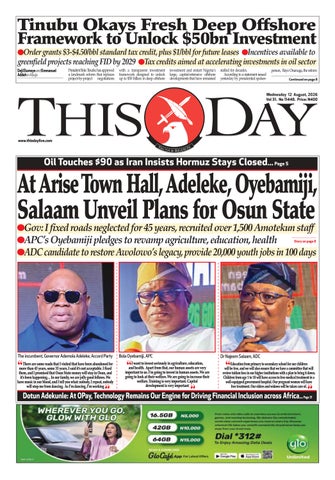
Tinubu Okays Fresh Deep Offshore Framework to Unlock $50bn Investment Order grants $3-$4.50/bbl standard tax credit, plus $1/bbl for future leases Incentives available to greenfield projects reaching FID by 2029 Tax credits aimed at accelerating investments in oil sector
Deji Elumoye and Emmanuel Addeh in Abuja
President Bola Tinubu has approved a landmark reform that replaces project-by-project negotiations
with a transparent investment framework designed to unlock up to $50 billion in deep offshore
investment and restart Nigeria’s large, capital-intensive offshore developments that have remained
stalled for decades. According to a statement issued yesterday by presidential spokes-
person, Bayo Onanuga, the reform Continued on page 8
Wednesday 12 August, 2026 Vol 31. No 11448. Price: N400
www.thisdaylive.com TR
UT H
& RE A S O
N
Oil Touches $90 as Iran Insists Hormuz Stays Closed... Page 5
At Arise Town Hall, Adeleke, Oyebamiji, Salaam Unveil Plans for Osun State Gov: I fixed roads neglected for 45 years, recruited over 1,500 Amotekun staff APC’s Oyebamiji pledges to revamp agriculture, education, health ADC candidate to restore Awolowo’s legacy, provide 20,000 youth jobs in 100 days Story on page 8
The incumbent, Governor Ademola Adeleke, Accord Party There are some roads that I visited that have been abandoned for more than 45 years, some 35 years, I said it’s not acceptable. I fixed them, and I promised that Osun State money will stay in Osun, and it’s been happening… In our family, we are jolly good fellows. We have music in our blood, and I tell you what: nobody, I repeat, nobody will stop me from dancing. As I’m dancing, I’m working
Bola Oyebamiji, APC I want to invest seriously in agriculture, education, and health. Apart from that, our human assets are very important to us. I’m going to invest in human assets. We are going to look at their welfare. We are going to increase their welfare. Training is very important. Capital development is very important
Dr Najeem Salaam, ADC Education from primary to secondary school for our children will be free, and we will also ensure that we have a committee that will review tuition fees in our higher institutions with a plan to bring it down. Children from age 1 to 18 will have access to free medical treatment in a well-equipped government hospital. Our pregnant women will have free treatment. Our elders and widows will be taken care of.
Dotun Adekunle: At OPay, Technology Remains Our Engine for Driving Financial Inclusion across Africa... Page 31
2
WEDNesday , AUGUST 12, 2026 • T H I S D AY
WEDNesday , AUGUST 12, 2026 • T H I S D AY
3
4
WEDNesday , AUGUST 12, 2026 • T H I S D AY
5
THISDAY • WEDNESDAY, AUGUST 12, 2026
NEWS
Group News Editor: Goddy Egene Email: Goddy.egene@thisdaylive.com, 0803 350 6821, 0807 401 0580
SOFURATU SEGHOSIME RECEIVING A SOUVENIR FROM SANWO-OLU...
President and Chairman of Council, Institute of Chartered Accountants of Nigeria (ICAN), Queensley Sofuratu Seghosime (left) receiving a souvenir from Governor of Lagos State, Mr. Babajide Sanwo-Olu during a courtesy call at the Lagos House in Marina, Lagos, yesterday
CBN Opens Sandbox to Virtual Assets, Data-Driven Financial Innovations Says initiative will shape regulatory frameworks amid evolving digital financial ecosystem, others National Payment Stack records 26.55m transactions worth N1.4trn one year after launch by NIBBS
James Emejo in Abuja and Nume Ekeghe in Lagos The Central Bank of Nigeria (CBN) yesterday announced it has opened the second cohort of its Regulatory Sandbox Programme, creating dedicated testing channels for virtual asset-related innovations and data-enabled financial services. The apex bank move seeks to balance financial technology development with stability and consumer protection. Under the new cohort, eligible innovators, financial institutions, Virtual Asset Service Providers (VASPs), fintechs and technology companies will be able to test new products, services, business models and enabling technologies within a controlled environment supervised by the central bank. The apex bank disclosed the development in a statement issued by its acting Director, Corporate Communications and Investor Relations Department, Mrs. Hakama Sidi Ali in Abuja. This came as the National Payment Stack (NPS), the country’s nextgeneration payment infrastructure, said it processed 26.55 million transactions valued at N1.4 trillion across 48 participating institutions,
about one year after it was launched by the Nigeria Inter-Bank Settlement System (NIBSS) Plc. The sandbox initiative is expected to provide a structured pathway for emerging financial technologies to be tested under real-world conditions without exposing the wider financial system to unmanaged risks. The CBN further stated that the programme formed part of its broader commitment to building an innovative, resilient and inclusive financial ecosystem capable of supporting sustainable economic growth while preserving the safety, soundness and integrity of the nation’s financial system. The second cohort introduces two dedicated testing tracks – the Virtual Asset Service Provider (VASP) Track and the Data-Enabled Financial Services (Non-VASP) Track. The VASP Track will cater to innovations involving virtual assets, stablecoins, payments, settlement, custody, wallets and other related financial infrastructure requiring supervised live testing. On the other hand, the Data-Enabled Financial Services Track, will focus on innovations leveraging secure digital infrastructure and permission-based data sharing to advance financial inclusion, payments, credit, risk
management, operational efficiency and consumer outcomes. According to Sidi-Alli, the regulatory sandbox is designed to enable innovators and the regulator to engage throughout the testing process, allowing both sides to learn from the practical application of emerging technologies. She said the approach would support regulatory learning while encouraging innovations capable of delivering tangible benefits to
consumers and the broader financial system. Also, commenting on the launch, CBN Director, Payments System Policy Department, Mr. Musa Jimoh, said financial innovation was continuing to transform the way individuals and businesses access and use financial services. He said, “The CBN Regulatory Sandbox, which is powered by technology in partnership with EMTECH,
President Bola Tinubu has felicitated renowned entrepreneur, energy-sector leader, and Group Managing Director of Sahara Group, Mr Kola Adesina, on his birthday on August 12, 2026. In a birthday tribute issued on Tuesday, the President acknowledged Adesina’s outstanding
contributions to Nigeria’s private sector over the past 25 years, especially his pivotal role in advancing investment, entrepreneurship and innovation in the nation’s energy sector. Tinubu noted Adesina’s distinguished leadership as Chairman of the Board of Ikeja Electric and Egbin Power, along with his stewardship at Sahara
environment continues to support responsible, transparent innovation that is aligned with the long-term development of our financial system.” The central bank said the launch of the second cohort was consistent with its commitment to establishing a transparent, proportionate and risk-based regulatory environment that promotes innovation without compromising monetary and financial stability.
Oil Touches $90 as Iran Insists Hormuz Stays Closed How US leader secretly switched planes over Tehran threat
Emmanuel Addeh in Abuja Iran has warned that the Strait of Hormuz will remain closed to shipping until the United States changes its position and accepts Tehran’s conditions for ending the war, raising fresh concerns over the global supply of crude oil and liquefied natural gas. The new development comes as the price of oil was choppy yesterday, reaching $90 a barrel for the first time in two weeks before falling back, as the stalemate over the Iran war
hardened and commercial shipping in the Strait of Hormuz dwindled. Brent crude, the global benchmark, jumped 1.6 per cent, touching $90 a barrel before receding to settle just below $89. West Texas Intermediate (WTI), the U.S. benchmark, was up 1.8 per cent to a little over $83 a barrel. The US-Iran war has dragged on into a sixth month, while shipping in the strait, a narrow path between Iran and Oman that once carried as much as one-fifth of the world’s oil supply, has been brought to a
Tinubu Rejoices With GMD Of Sahara Group, Mr Kola Adesina On His Birthday Deji Elumoye in Abuja
enables innovators and regulators to engage in a structured and collaborative manner, allowing promising solutions to be tested responsibly while maintaining appropriate safeguards for consumers and the financial system. “The introduction of dedicated tracks for Virtual Asset Service Providers and data-enabled financial services reflects the evolving nature of financial innovation and our commitment to ensuring that Nigeria’s regulatory
Group, which have significantly advanced the growth and development of Nigeria’s energy sector and fostered greater private sector participation. The President also commended Adesina’s commitment to nationbuilding, describing his career as a testimony to the vital role Nigerian entrepreneurs and business leaders play in driving economic growth,
creating opportunities, and supporting national development. His words: “As you celebrate your birthday, I commend your remarkable journey in entrepreneurship and your enduring commitment to Nigeria’s economic development. Your contributions to the energy sector and the wider business community remain worthy of recognition.”
near standstill. The warning, issued by Iranian Mohsen Rezaei, the newly appointed secretary of Iran’s Supreme National Security Council, represented the strongest indication yet that a potential agreement between Iran and Oman over maritime transit may not be enough to immediately restore normal shipping through the strategic waterway. “As long as America does not change its behaviour and does not accept Iran’s conditions, the Strait of Hormuz will not be opened,” Rezaei, a close ally of Supreme Leader Ayatollah Mojtaba Khamenei, was quoted by semi-official Tasnim news agency as saying. He said Iran’s demands included an end to the war, the release of its frozen assets and an end to the conflict across the region, including in Lebanon and Gaza. “America must end the war, pay Iran’s frozen assets, the war must end throughout the region, including in Lebanon and Gaza,” Rezaei said. He added that any agreement
reached between Iran and Oman concerning the passage of vessels through the strait would be separate from the broader issue of reopening the waterway. The development has renewed uncertainty over one of the world’s most important energy corridors. Before the war, about one-fifth of global oil and liquefied natural gas supplies passed through the Strait of Hormuz, making any prolonged disruption a major threat to international energy markets. Iran’s position also appeared to complicate recent hopes of progress in negotiations. Pakistan, which has played a key mediating role alongside Qatar, had suggested that Tehran and Washington were moving towards an arrangement that could lead to the reopening of the strait. “The signals in the last two, three days are that we are close to some sort of an arrangement,” Pakistan’s Defence Minister Khawaja Asif said in an interview with Bloomberg News. However, the latest statements from Tehran suggest that significant differences remain.
6
WEDNESDAY, AUGUST 12, 2026 • THISDAY
NEWS
50TH/15TH BIENNIAL CONFERENCE OF METHODIST CHURCH NIGERIA...
L-R: Archbishop of Ibadan, Methodist Church Nigeria, Most Rev. Olugbenga Fafeyiwa; Secretary of Conference, Bishop Babatunde Taiwo; Prelate, Methodist Church Nigeria, His Eminence Dr. Oliver Aba; Conference Lay President, Sir. Ifeanyichukwu Okechukwu and Bishop Utuk Otuekong, during the media briefing to bring the 50th/15th Biennial Conference of Methodist Church Nigeria to a close in Ibadan, Oyo State on Monday
Insurance Recapitalisation: Coronation Insurance, Life Assurance Scale Capital Hurdles Fresh capital to support innovation, digital transformation, distribution, bancassurance Oversubscribed private placement signals strong investor confidence in firms’ growth strategy
James Emejo in Abuja Coronation Insurance Plc and Coronation Life Assurance Limited yesterday announced the successful conclusion of their recapitalisation exercise through an oversubscribed private placement. The development significantly strengthened their capital base, positioning both firms to meet the new minimum capital requirements under the Nigerian Insurance Industry Reform Act (NIIRA) 2025. The capital raise, which involved the issuance of 4.2 billion ordinary shares,
attracted strong investor participation, underscoring market confidence in the companies’ strategic direction, governance framework, and long-term growth outlook. Commenting on the development, Managing Director/Chief Executive, Coronation Insurance, Olamide Olajolo, said the successful capital raise reflected strong investor confidence in the company’s strategy, governance standards, and long-term vision. According to Olajolo, the enhanced capital base would enable the company to accelerate innovation, deepen customer
Olamide Olajolo, MD/CEO, Coronaon Insurance Plc
Adebowale Adesona, MD/CEO Coronaon Life Assurance Limited
engagement, expand distribution capacity, and better position itself to capture
emerging opportunities within the insurance sector.
Senate Threatens Seplat, Three Oil Firms with Legislative Sanctions Gives companies 48 hours to appear over NEITI audit queries Dubri disputes $3.03m royalty, gas flare debts Sunday Aborisade in Abuja Senate Public Accounts Committee (SPAC) on Tuesday gave Seplat Energy Plc, Network E&P Nigeria Limited, All Grace Energy Limited, and Aradel Energy Limited 48 hours to appear before it over queries raised in the 2021, 2022 and 2023 audit reports of Nigeria Extractive Industries Transparency Initiative (NEITI). The committee, chaired by Senator Ibrahim Dankwambo, warned that failure by the affected oil companies to honour the fresh summons would trigger the full invocation of National Assembly’s constitutional powers. The ultimatum followed the displeasure of members of the com-
mittee over the repeated failure of some of the companies to appear before it and respond to queries contained in the NEITI reports. Network E&P Nigeria Limited came under particular scrutiny after it allegedly failed to honour the committee’s invitation on two previous occasions. The development prompted Senator Abdul Ningi (PDP, Bauchi Central) to call for sanctions against the company, describing a letter written by Network E&P to the committee as “disturbing and provocative”. Ningi had taken exception to the company’s position that its regulatory relationship was primarily with Nigerian Upstream Petroleum Regulatory Com-
mission (NUPRC), rather than the senate committee. He insisted that National Assembly was constitutionally empowered to summon any person, company or government agency to provide explanations on matters under investigation. According to him, Sections 88 and 89 of the 1999 Constitution empower the National Assembly to conduct investigations and summon relevant persons or institutions where necessary. “The senate and, by extension, the National Assembly, is the custodian of Nigeria’s laws and has the power to invite anybody or agency for explanations on issues raised against them,” Ningi said.
Supporting the call for sanctions, Senator Shehu Kaka Lawan (APC, Borno Central) urged the committee to invoke its constitutional powers against the managements of companies that continued to disregard its invitations. Responding to the lawmakers’ concerns, Dankwambo directed Managing Director of Network E&P Nigeria Limited to appear before the committee unfailingly on Thursday.
Laleye Dipo in Minna The Japanese Government has released $3.5m grant to Nigeria for rice seed production across the country because the government believes “good seed is the beginning of good harvest” Japanese Ambassador in Nigeria, Mr. Hideo Suzuki said the investment in the project will boost agricultural production and food security in the Nigeria. Mr. Hideo Suzuki who disclosed this at the handing-over ceremony of
the Project for the Enhancement of Rice Seeds Production System at the National Cereals Research Institute (NCRI), Badeggi, Niger State said the project will be replicated in all NCRI stations across the country. In addition, he said the grant would finance procurement of 20 modern agricultural equipment comprising 20 medium-sized tractors, three rice transplanters, four small combine harvesters and two excavators for seed cultivation and production. Other equipment he said include
four constant-temperature germination testers, three sets of automatic weather observation systems for testing purposes and seven small flat drying machines for post-harvest processing. Mr. Hideo Suzuki explained the project would “strengthen NCRI capacity to produce high-quality breeder and foundation rice seeds, thereby improving the quality of certified seeds supplied to farmers nationwide and ultimately increase yields, productivity and confidence in Nigeria’s seed system”.
effectively for the future. Adesona said, “This milestone marks the beginning of our next phase of growth. The additional capital enhances our ability to invest in our people, technology and product development, while strengthening our commitment to delivering innovative life insurance and wealth solutions that help our customers protect what matters most and plan confidently for the future.” The exercise comes as both insurers prepare for their next phase of expansion, with the fresh capital expected to drive product innovation, accelerate digital transformation, enhance customer experience, and broaden distribution. The companies stated that the strengthened capital position would further enable them to deepen market penetration while sustaining a disciplined approach to long-term value creation. They said the additional capital would also support the expansion of their bancassurance partnership with Access Bank, through which insurance products are distributed across one of the country’s most extensive banking networks. They stressed that the successful recapitalisation had further consolidated their standing as well-capitalised, well-governed insurers committed to sustainable value creation. It had also positioned the firms to accelerate growth, deepen customer relationships, and contribute meaningfully to the continued development of the insurance industry, they stated.
NCC Identifies 5,000 Optic Fibre Breaches in Six Months Seeks improved stakeholder collaboration during road constructions
Japan to Boost Rice Seed Production in Nigeria with $3.5m Grant Oghenevwede Ohwovoriole inAbuja Says good seed Is the beginning of good harvest
Olajolo reaffirmed the company’s commitment to sustainable growth and delivering insurance solutions that respond to the evolving needs of individuals, businesses, and institutions. In a statement, Olajolo said, “This successful capital raise is a strong endorsement of our strategy, governance and long-term vision. It reflects the confidence investors have in our ability to build resilient insurance businesses that create lasting value for our customers and shareholders. “With a stronger capital base, we are well positioned to accelerate innovation, deepen customer relationships, expand our distribution capabilities and capture the opportunities emerging across Nigeria’s insurance sector. “Our focus remains on delivering sustainable growth while providing insurance solutions that meet the evolving needs of individuals, businesses and institutions.” Managing Director/Chief Executive, Coronation Life Assurance Limited, Adebowale Adesona, described the recapitalisation as a defining step into the company’s next growth phase. Adesona stated that the additional capital would strengthen the firm’s ability to invest in talent, technology, and product development. He said the improved financial position would reinforce Coronation Life Assurance’s commitment to delivering innovative life insurance and wealth management solutions that help customers protect their interests and plan
Executive Vice Chairman (EVC) of Nigerian Communications Commission (NCC), Dr. Aminu Maida, has called for greater collaboration among major stakeholders, especially Ministry of Works, to reduce the high rate of fibre optic cables’ cut arising from road constructions. Maida made the appeal on Tuesday in Abuja at a stakeholders’ workshop for the protection of fibre optic cables during road construction. The workshop was themed, “Secure Today: Connect Tomorrow.” Maida said there were over 5,000 optic fibre cuts in the last six months
due to road constructions and rehabilitation across the country occasioned by inadequate collaboration. He said, “In the first six months of this year alone, over 5,000 fibre cut incidents were reported from road excavation, construction and related civil work. “Many occurred because there was little or no coordination between works before they began, or before the first shovel entered the ground. For this, I must emphasise that this is not about assigning blame.” Maida added that measures had been put in place to reduce such incidents. He stated, “To close this gap, the permanent secretaries of the Federal
Ministry of Works and the Federal Ministry of Communications, Innovations and Digital Economy inaugurated the Standing Committee on the Protection of Fibre Optic Cables. Its mandate is to develop practical coordination mechanisms before, during, and after roadblocks. “Recognising the security dimension of this work, the committee’s membership was recently expanded to include officials of the Office of the National Security Adviser and the Nigerian Security and Civil Defence Corps (NSCDC). This brings additional strategic oversight to our collective efforts to protect these vital national assets.”
7
THISDAY • WEDNESDAY, AUGUST 12, 2026
NEWS
QEDNG CREATIVE POWERHOUSE SUMMIT 2...
L-R: Chief Executive Officer, Rivers State Tourism Development Agency, Yibo Koko; Co-Founder/CEO, Narrative Landscape Press Ltd, Anwuli Ojogwu; Managing Director, SmartCity Plc, Gabriel Ukachukwu; former Lagos State Commissioner for Information and Strategy, Steve Ayorinde; QEDNG Publisher, Olumide Iyanda; Chief Executive Officer, X3M Ideas, Steve Babaeko, and National Coordinator, Investment in Digital and Creative Enterprises (iDICE), Ife Adebayo, at the QEDNG Creative Powerhouse Summit 2.0 in Lagos, yesterday
Aviation Unions Picket Air Peace Operations, Assault Workers over Refusal to Join Associations Over 80 flights cancelled as airlines lose about N1.8 billion Aviation roundtable condemns picketing, says it tarnishes Nigeria’s image United Nigeria Airlines grounds operations in protest Chinedu Eze Over 80 flights were cancelled yesterday, with airlines losing about N1.8 billion, as National Union of Air Transport Employees (NUATE) and Air Transport Service Senior Staff Association of Nigeria (ATSSSAN) picketed the operations of Nigeria’s leading carrier, Air Peace, at Murtala Muhammed International Airport (MMIA), Lagos, and Nnamdi Azikiwe International Airport, Abuja. At the General Aviation Terminal (GAT) of the Lagos airport, where Air Peace conducts its major domestic flights, members of the unions blocked access to the halls. This caused workers of the airline to protest against the action of the unions, insisting they do not want to join the unions. But the protest by Air Peace workers drew violent reaction from the unions, allegedly assaulting some of the airline’s ground services staff. The disruption forced United Nigeria Airlines to temporarily suspend its operations, and later, Enugu Air also suspended its operations from Abuja in protest. Air Peace was forced to cancel half of its 75 flights a day, while United also cancelled 32 flights. Other airlines, like Aero Contractors, were forced to delay flights in Abuja. The unions said they were protesting against the five per cent Ticket
Sales Charge (TSC) owed Nigeria Civil Aviation Authority (NCAA) by the airlines. But NCAA had earlier confirmed that it had agreed on a payment arrangement with the airlines to offset the debt, which accrued when jet fuel prices spiked from N900 per litre to N3, 500 during the recent US-Iran war. The unions also said they picketed the airlines because of their refusal to allow their workers to join the labour organisations. But they did not explain why Air Peace operations appeared to be targeted, because besides Aero Contractors and Arik Air, other domestic airlines’ workers are not members of any of the unions. Air Peace, in a statement, said, “We wish to inform our esteemed passengers and the general flying public of temporary disruptions to our flight operations arising from the picketing of our airline and the ongoing industrial action by members of the Nigeria Labour Congress (NLC), the Air Transport Services Senior Staff Association of Nigeria (ATSSSAN), and the Trade Union Congress (TUC). “The ongoing industrial action has resulted in the barricading of the entrances to our departure terminals at Murtala Muhammed Airport Terminal 1 (Alpha and Zulu Terminals) and Terminal 2 in Lagos, as well as the
Nnamdi Azikiwe International Airport Terminal in Abuja.” The airline further explained that the blockade had restricted access to the terminals, preventing the departure of scheduled flights from Lagos and Abuja. It stated, “Consequently, passengers scheduled to travel across our network have been significantly affected by the disruption to flight operations. “Air Peace sincerely apologises to all affected and stranded passengers for the disruption and inconvenience caused by circumstances beyond the airline’s control. Passengers scheduled to travel later today are
being contacted and provided with relevant updates as the situation evolves.” Meanwhile, Head of Media and Communications at United Nigeria Airlines, Chibuike Uloka, said the picketing severely crippled their operations. Uloka disclosed that all of the eight serviceable aircraft of the airline were fully booked and scheduled to operate 32 flights during the window the picket lasted. He said the fleet—comprising two Boeing 737s (175 seats each, scheduled for 8 flights), one CRJ 190 (100 seats, 8 flights), two CRJ aircraft (80 and
MTN Nigeria, in collaboration with the Worldwide Fund for Nature (WWF) through its local partner, the Nigerian Conservation Foundation (NCF), the United Nations Development Programme (UNDP) and Deloitte Nigeria, has announced the “2026 Nigeria PachiPanda Challenge,” which seeks to stimulate innovative solutions to pressing environmental challenges while supporting the growth of Africa’s green economy. The theme of this year’s PachiPanda Challenge is “Nature Meets Innovation: Unlocking Africa’s Green
Economy,” which MTN Nigeria and its partners intend to empower young innovators to transform bold ideas into practical solutions that address environmental challenges while contributing to the growth of Nigeria’s green economy. This year’s edition “invites young innovators, entrepreneurs and SME founders aged 18 to 35 to develop solutions that address environmental challenges specific to Nigeria.” Speaking on the challenge, Chief Corporate Services and Sustainability Officer, MTN Nigeria, Mr. Tobe Okigbo, said: “As a business deeply connected to the communi-
lines who would not want his name mentioned said he was supposed to have a visa interview scheduled for 11am in Abuja yesterday morning. The passenger lamented, “This development is so devastating for me. What do I do? Where do I start from? I can’t even get a flight at the moment to Abuja as all other airlines say they are fully booked. This is, indeed, a missed opportunity for me.” The blockade by the aviation unions left hundreds of domestic and regional passengers stranded at the terminals, with check-in counters abandoned and scheduled flights halted.
FCCPC Counsels Bakery, Confectionery Operators on Safe Products, Ingredients Review, Production Process Dike Onwuamaeze
Federal Competition and Consumer Protection Commission (FCCPC) has advised operators in the bakery and confectionery industry to ensure the delivery of safe products and regular review of their ingredients, production processes, marketing information, and complaints handling. The advice was outlined yesterday by Executive Vice Chairman of FCCPC, Mr. Tunji Bello, in his
remarks during a stakeholders’ engagement with bakery and confectionery operators in Lagos State. The meeting had the theme, “Building Consumer Trust Through Quality and Safety: A Regulatory Compliance Mandate for Industry Operators.” Bello said, “I, therefore, ask every operator here to return to your business after this engagement and examine your product from beginning to end.
MTN Nigeria, WWF/NCF, UNDP, Deloitte Launch 2026 Nigeria PachiPanda Challenge Dike Onwuamaeze
90 seats, 4 flights each), and an ERJ (50 seats, 8 flights) – was set to airlift a total of 3,280 passengers. With ticket prices averaging N150,000, United Nigeria Airlines alone lost an estimated N492 million in gross revenue due to the sudden disruption. THISDAY learnt from a source close to Air Peace that with over 75 flights a day, including domestic, regional, and international flights, the airline generated about N1.3 billion in revenue daily, but more than half of the projected amount was lost to the disruption. A passenger on United Nigeria Air-
ties we serve, we recognise that environmental responsibility and economic development must go hand in hand. “The Nigeria PachiPanda Challenge provides an opportunity for young innovators to develop solutions that address local environmental challenges, strengthen youth entrepreneurship and contribute long-term sustainability. “We are excited to see how young people across the country will respond to this year’s theme and demonstrate that eco-innovation can be a powerful force for positive change.” Speaking in the same vein, the
Director-General, NCF, Dr. Joseph Onoja, added that, “innovation works best when young people lead it. By backing the PachiPanda challenge, we are handing the next generation the tools to protect nature and the confidence to act. Their ideas today will safeguard our planet for the generations that follow.” Similarly, Chief Innovation Officer, UNDP Nigeria, Dr. William Tsuma, said: “Innovation for development is at the heart of what we do. When young innovators co-create solutions to real problems, they drive inclusive growth and push us closer to a sustainable society for all. That is exactly what this challenge unlocks.”
“There are five areas that deserve particular attention. First, review your ingredients and inputs. Know where they come from, establish their quality and ensure they are properly stored and handled. “Second, examine your production process. Review hygiene, equipment, personnel practices and the controls designed to protect the safety and quality of what you produce. “Third, audit what you tell the consumer. Check your labels, advertisements, weights, quantities and other representations, and make sure the consumer receives what has been promised.” He added, “Fourth, strengthen traceability and complaint handling. Ensure that you can identify an affected product or batch, determine where it was distributed and recognise patterns emerging from consumer complaints. “Fifth, prepare for the possibility that something may go wrong. Have a clear procedure for isolating affected products, investigating problems, protecting consumers, notifying the appropriate authorities where required and taking corrective action.” He also said, “The commitment I ask you to take away from this engagement is, therefore, practical. Make quality part of your everyday operations. Treat safety as non-negotiable. Be truthful with consumers and give them what you have promised.
“Above all, make compliance part of the way you do business, rather than something you prepare for only when a regulator is coming. “If we can establish that culture across this industry, consumers will be safer, responsible businesses will be stronger and public confidence in the sector will grow.” Bello, represented by the Coordinator, South West Zonal Office, FCCPC, Dr. Olubunmi Otti, said one useful question for every producer was “if I knew everything about how this product was made, would I confidently serve it to my own family? “If the answer is yes, maintain that standard. If there is any hesitation, identify the reason and address it.” He said consumers did not ordinarily know where the ingredients came from, how they were stored, or the conditions under which the products were made. They depended on the producer to maintain proper hygiene, use appropriate ingredients, represent the product truthfully and supply the quantity promised, Bello stated. He said, “Our purpose here today is to reinforce a simple principle: that trust must be justified by conduct.” Bello said another area that deserved attention was product labelling that contained representations made by the producer to consumers who were entitled to rely on those representations.
8
WEDNESDAY, AUGUST 12, 2026 • THISDAY
EIGHT
In Historic Milestone, AfCFTA Adopts Nigeria’s PPP Model for $3.1bn Customs Modernisation Drive Ewalefoh says properly structured PPPs can drive investment, boost revenue, support $1 trillion economy target
James Emejo and Deborah Adekoya in Abuja Director-General of Infrastructure Concession Regulatory Commission (ICRC), Dr. Jobson Ewalefoh, yesterday, disclosed that the country’s Public-Private Partnership (PPP) model for customs modernisation was currently being adopted as template for a $3.1 billion continental customs project under the African Continental Free Trade Area (AfCFTA). Ewalefoh said the development represented a significant validation of Nigeria’s PPP framework, particularly the Customs Modernisation Project, which had produced an indigenous digital solution for Nigeria Customs Service (NCS), and was now being replicated across the continent. He made the revelation while react-
ing to the recent signing of a 20-year concession agreement by the AfCFTA secretariat with Bergmans Security Consultants and Supplies Limited, the parent company of Trade Modernisation Project Limited (TMP). The agreement is expected to deploy the AfCFTA Customs Modernisation Project across about 50 member countries, supporting trade within the continental market of about 1.3 billion people. Ewalefoh said the critical development in the deal was not merely the deployment of customs technology across Africa, but the decision by the AfCFTA secretariat to replicate a PPP model that was developed, structured, and regulated in Nigeria. He said the Nigerian experience demonstrated that a properly structured PPP could mobilise private capital and expertise to deliver strategic public
infrastructure while strengthening government revenue and operational efficiency. He said, “Africa is not just adopting a piece of technology. Africa is adopting a Nigerian idea, built by Nigerians, proven on Nigerian soil, and now trusted to carry the trade ambitions of an entire continent.” The ICRC boss stated that Nigerian Customs Modernisation Project, also referred to as the e-Customs Project, was itself developed as a PPP, with the commission playing a central role in facilitating, structuring, and regulating the arrangement. The project is operated by TMP, a special purpose vehicle established for the partnership with government, while Bergmans serves as its parent company. Essentially, the AfCFTA arrangement
represents the replication of the underlying PPP model rather than merely the adoption of the B’Odogwu digital platform deployed in Nigeria. B’Odogwu is the digital platform developed under the Customs Modernisation Project and deployed for customs operations. Ewalefoh said the roots of the Nigerian project could be traced to its formative years when he served as ICRC’s desk officer on the initiative, long before his appointment as Director-General of the commission. He recalled that the project initially faced considerable doubts and resistance, particularly over whether the private sector partner had the capacity to deliver the proposed transformation. He said, “When this project came on board, there were a lot of doubts. We
asked ourselves: will this work, can we trust the capacity of the proponent? But today, what we are seeing is amazing.” He said the success of the project demonstrated that institutional resistance to change, rather than funding or lack of ideas, remained one of the major impediments to implementing transformative infrastructure projects. He said resistance, not ideas or funding, was the biggest challenge to change. Ewalefoh commended NCS for opening up its operations to private-sector expertise and capital, saying the synergy between the government agency and TMP has contributed significantly to the progress recorded under the project. He commended the Comptroller General of Customs, Bashir Adeniyi, for his sustained support for the rollout of
AT ARISE TOWN HALL, ADELEKE, OYEBAMIJI, SALAM UNVEIL PLANS FOR OSUN STATE
Emmanuel Addeh, Adedayo Akinwale in Abuja and Yinka Kolawole in Osogbo
The three leading contenders in Saturday’s Osun State governorship election went head to head yesterday over their records and economic plans, with the incumbent Governor, Senator Ademola Adeleke, the All Progressives Congress (APC) candidate, Bola Oyebamiji, and the African Democratic Congress (ADC) candidate, Dr Najeem Salaam, offering their different visions for the state. At the Arise News town hall, held in collaboration with the editorial board of Tribune Newspaper and the Osun State Broadcasting Corporation (OSBC), in Osogbo, Adeleke defended his three-and-a-half-year record, maintaining that he has done enough to earn a second term, and insisting that his government has transformed infrastructure in the South-west state. On his part, Oyebamiji presented himself as an investment and public finance expert
capable of turning around the state’s economy, while Salaam promised to revive social programmes associated with earlier administrations and create 20,000 jobs within his first 100 days in office. The election, scheduled for Saturday, August 15, has recently attracted intense political attention, marked by allegations of political violence, arrests, federal interference and disagreements among major political blocs.
Adeleke Defends Stewardship, Alleges Intimidation
Adeleke, who appeared first during the programme which stretched several hours, said his administration had transformed infrastructure across Osun, particularly through road construction, while also investing in education, healthcare and security. He said the state had constructed about 350 kilometres of roads since he assumed office, with another 150 kilometres under construction, including roads
that had remained abandoned for decades. “There are some roads that I visited that have been abandoned for more than 45 years, some 35 years, I said it’s not acceptable. I fixed it, and I promise that Osun State money will stay in Osun, and it’s been happening,” Adeleke said. He said his administration had also installed solar lights across the state, arguing that the projects were contributing to economic activity and improving the appearance of major towns. The governor dismissed allegations by the APC that the roads constructed by his administration were substandard, saying certified Nigerian and international engineers had been engaged to ensure quality. “Talking about substandard roads, it’s a sin, why would I come and do substandard roads. I use certified engineers; I use Nigerian engineers and in fact, we invited an international engineer. I don’t just sit in the office. I move around to double check it,” he said.
Adeleke also highlighted what he described as improvements in education, saying Osun had moved from a poor position in national examination rankings to seventh in the country. He said his administration had also invested in agriculture, including the purchase of 31 tractors and provision of seedlings and other farm inputs to farmers. On healthcare, the governor said his administration had rehabilitated about 200 healthcare centres after discovering that an earlier $20 million grant secured for the sector had not produced the desired results. “As of today, we have fixed and rehabilitated about 200 healthcare centres. We put boreholes, we put solar light, and beds and everything is looking so beautiful, as if you are in America,” he said. Adeleke also said security had received attention under his administration, disclosing that more than 1,500 Amotekun personnel had been recruited and trained to protect lives and property. On allegations that his
TINUBU OKAYS FRESH DEEP OFFSHORE FRAMEWORK TO UNLOCK $50BN INVESTMENT
establishes a transparent, rules-based investment framework capable of supporting the next generation of deep offshore developments, beginning with the approximately $10 billion Bonga South West project, while strengthening Nigeria’s competitiveness for globally mobile investment capital. The decision, the statement said, builds on Tinubu’s engagement with the Chief Executive Officer of Shell plc, Mr Wael Sawan, during which the President directed the development of the next wave of measures required to unlock Nigeria’s deep offshore investment pipeline. Rather than pursuing projectspecific solutions, the federal government transformed that directive into a comprehensive investment framework applicable across multiple categories of qualifying developments, it said. Given effect through the Deep Offshore Oil and Gas Projects Incentives (Tax Remission) Order, 2026, the framework replaces project-by-project negotiations with transparent eligibility criteria, clear implementation processes and a durable investment architecture that provides greater certainty for investors while safeguarding long-term national value.
The approval also enables NNPC Limited, as the government’s nominated counterparty under the Production Sharing Contracts (PSCs) to proceed with the necessary amendments to eligible Production Sharing Contracts required to implement the framework. Tinubu commended the Federal Ministry of Justice, the Federal Ministry of Finance, the Federal Ministry of Petroleum Resources, the Nigeria Revenue Service (NRS), NNPC Limited, the Nigerian Upstream Petroleum Regulatory Commission (NUPRC), the Nigerian Content Development and Monitoring Board (NCDMB), investing partners and other industry stakeholders whose collaboration, technical expertise and commitment helped shape the framework. Tinubu said: “The countries that attract long-term investment are not necessarily those with the greatest natural resources. They are the ones that provide the greatest certainty. This reform reflects our determination to build an investment environment defined by clear rules, strong institutions and enduring partnerships. “We are creating the conditions for capital to flow, for Nigerian businesses to grow, for our people to prosper and for our natural
resources to deliver lasting national value.” On her part, Special Adviser to the President on oil and gas, Olu Arowolo-Verheijen, said a defining feature of the reform is its emphasis on Nigerian industrial capability. “Projects qualifying under the framework will maximise execution within Nigeria wherever commercially and technically feasible, strengthening domestic engineering, fabrication, marine logistics, technical services and project management. The objective is not only to increase investment and production, but also to create skilled jobs, deepen local supply chains and position Nigeria as Africa’s regional hub for deep offshore project execution,” she stated. A THISDAY review showed that the new fiscal incentive regime for deep offshore oil and gas projects, signed on August 6, 2026 and published in the Federal Government Official Gazette on August 10, offer production tax credits of up to $11.50 per barrel for qualifying oil developments. Under the Order, existing deep offshore leases where a Final Investment Decision (FID) is taken between the effective date and December 31, 2029, as well as future leases, are eligible for the
Standard Production Tax Credit (PTC), subject to the conditions prescribed by the government. The Order states that the Standard PTC is intended to “incentivise investments in the deep offshore developments” and to “exclusively benefit parties to a production sharing contract who are directly providing the funding for developments that lead to production.” For crude oil projects with producible reserves not exceeding 400 million barrels of crude oil equivalent, the government will provide a production tax credit of $3 per barrel or 20 per cent of the fiscal oil price, whichever is lower, up to cumulative production of 150 million barrels. In the same vein, for projects with producible reserves exceeding 400 million barrels, the Standard PTC rises to $4.50 per barrel or 20 per cent of the fiscal oil price, whichever is lower, up to cumulative production of 500 million barrels. The Order further provides an additional $1 per barrel Standard PTC for future leases from commencement of production up to the applicable cumulative production threshold. Continued on page 44
administration had relied more on entertainment and dancing than governance, Adeleke said his personality should not be confused with his approach to public administration. “In our family, we are jolly good fellows. We have music in our blood, and I tell you what: nobody, I repeat, nobody will stop me from dancing. As I’m dancing, I’m working,” he said. “When you come to my office, I’m a very prudent person, and I’m a very serious person. There’s time for everything. There’s time to dance, and there’s time to work,” he maintained. The governor also rejected claims that he was responsible for the militarisation of the state ahead of the election, saying he lacked the constitutional authority to deploy federal security agencies. “I did not militarise. I don’t have that capacity. I am not the Commander-in-Chief of the Armed Forces, Mr President is the Commander in Chief of the Armed Forces,” he said. Adeleke said he had consistently advocated a peaceful and credible election, urging his supporters not to retaliate if provoked. “My people, let me talk to you, this election is going to be a free and fair election. No violence,” he said. On his chances of retaining the governorship despite contesting on the platform of the Accord Party, Adeleke expressed confidence, describing himself as a “bulldozer”. “You don’t know me. I’m a bulldozer. They don’t call me Action Jackson for nothing. I’m a bulldozer,” he said. He urged voters to turn out and protect their votes, insisting that his achievements would secure his re-election. “There’s no amount of intimidation. The work that I’ve done speaks for itself. Come this Saturday, I’ll be victorious,” he said.
Oyebamiji to Prioritise Agriculture, Education, Health
When it was his turn, the APC candidate, Oyebamiji, said his administration would make agriculture its first priority while simultaneously investing heavily in education, healthcare and human capital development. “I will prioritise agriculture. That’s my number one,” he said. The former Commissioner for Finance said his background in banking, investment management
Comptroller General of Customs, Bashir Adewale Adeniyi B’Odogwu across Customs commands, describing the digital transformation as a major factor behind the confidence the Nigerian model has now earned at the continental level.
and public finance would help him attract capital and build businesses capable of expanding Osun’s economic base. “As an investment banker, it won’t be difficult for me to actually attract funds, work on ensuring business to attract investors to Osun so that our people can enjoy the dividends of the state,” he said. Oyebamiji said his administration would focus on the welfare of the entire population, rather than concentrating development in particular areas. “Governance is about people. It’s not about segments. It’s not about an area. It’s not about a city. It’s not about a town. It’s the entirety and the entire people of Osun that I want to serve,” he posited. He promised to improve the state’s healthcare infrastructure, arguing that the absence of key diagnostic equipment needed urgent attention. “Our health care now is more important in Osun. There is no single MRI (Magnetic Resonance Imaging). There is no such equipment,” he said. Oyebamiji also cited an estimated deficit of 28,000 teachers, saying education would be a major focus of his administration. “As of today, we have 28,000 deficits of teachers in Osun. And education is just the bedrock of any form of achievement in the world,” he said. He also promised to improve workers’ welfare and invest in training and human capital development. “I want to invest seriously in agriculture, education, and health. Apart from that, our human assets are very important to us. I’m going to invest in human assets. We are going to look at their welfare. We are going to increase their welfare. Training is very important. Capital development is very important,” he said. Oyebamiji used his previous public service experience to make a case for his ability to manage Osun’s finances, recalling that he inherited a moribund Osun State Investment Company with negative shareholders’ funds of about N300 million and left after increasing the shareholders’ funds to N6 billion. He also recalled how, as Commissioner for Finance under former Governor Rauf Aregbesola, he helped secure N16 billion from funds withheld under the Paris Continued on page 45
9
THISDAY • WEDNESDAY, AUGUST 12, 2026
NEWS
LAUNCH OF MTN YELLO STREET MUSEUM IN COMMEMORATION OF IT’S 25TH ANNIVERSARY...
L-R: Chief Customer Relations and Experience Officer, MTN Nigeria, Ugonwa Nwoye; General Manager, Network Access Planning and Optimisation, MTN Nigeria, Nasiru Hayatu; Chief Financial Officer, MTN Nigeria, Modupe Kadri; Chief Marketing Officer, MTN Nigeria, Onyinye Ikenna-Emeka; and Chief Digital Officer, MTN Nigeria, A’isha Umar Mumuni, during the launch of the MTN Y’ello Street Museum in commemoration of the company’s 25th anniversary celebration, held in Ikoyi, Lagos, yesterday
FG to Establish Six Modern Ranching Settlements in Fresh Push to End Farmers-Herders Clashes Plans rehabilitation of 417 grazing reserves Says open grazing no longer sustainable
Deji Elumoye in Abuja The federal government has finalised plans to rehabilitate grazing reserves and establish modern ranching settlements in six areas identified as major conflict flashpoints nationwide. The move is part of efforts aimed at ending recurring clashes between crop farmers and herders across the
country. Minister of Livestock Development, Idi Mukhtar Maiha, disclosed the plan Tuesday evening after briefing President Bola Tinubu at State House, Abuja, on the activities of his ministry and implementation of the National Ranching Policy. Speaking with newsmen after the meeting with Tinubu, Maiha identified
Adamawa, Kaduna, Benue, Plateau, and Nasarawa states, as well as the Federal Capital Territory (FCT), as priority areas for the intervention because of their history of farmers-herders conflicts. The minister said government had identified 417 grazing reserves nationwide and had begun a pilot scheme in Plateau State, which would serve as a proof of concept for a new
livestock production model designed to reduce the movement of cattle and address one of the major triggers of rural conflicts. Maiha added that government had also opened consultations with pastoral communities, engaging about 34 organisations as part of efforts to secure their support for the transition from nomadic livestock production
2027: Kogi Central PDP Targets Every Household, Polling Unit for Victory Natasha inaugurates campaign organisation, charges team on grassroots mobilisation Etudaiye emerges DG, Karaku Campaign Chairman, vows to deliver decisive victory
Sunday Aborisade in Abuja Peoples Democratic Party (PDP) in Kogi Central Senatorial District has begun mobilisation for the 2027 general election with an aggressive grassroots strategy targeting every ward, polling unit, and even household across the district. The party, under the leadership of Senator Natasha Akpoti-Uduaghan, inaugurated its Kogi Central Campaign Organisation with a mandate to coordinate an extensive grassroots campaign aimed at securing victory for all PDP candidates in the senatorial district. A statement by her Media Office on Tuesday explained that at the inauguration, Akpoti-Uduaghan charged the campaign team to move
beyond conventional political rallies and establish direct and sustained contact with voters across the district. She said the party’s campaign must be taken directly to the people through house-to-house and polling-unit-bypolling-unit mobilisation. She stated, “This campaign must be house-to-house and polling-unit-bypolling-unit. We must reach our people directly, listen to them, engage them and explain clearly why the PDP remains the best platform for the development and progress of our people.” The senator also called on members of the party to open their doors to new entrants and reconcile existing differences in the interest of PDP’s 2027 electoral prospects. Akpoti-Uduaghan said, “We must open our doors for everyone who
wants to join this moving train and this winning team. There is room for everyone who believes in the PDP and in the future we are building for Kogi Central.” She tasked the campaign organisation with ensuring that every ward and polling unit was adequately covered, stressing that the task would require discipline, unity, and commitment from all stakeholders. Akpoti-Uduaghan said the campaign could not be left to a few individuals, stating that party leaders, women, youths, ward executives, campaign coordinators, and volunteers must work together to achieve the desired result. The senator’s charge came as the newly inaugurated campaign Director-General, Dr. Salami Etudaiye, declared that PDP was prepared to
build a formidable political movement capable of penetrating every part of Kogi Central. Etudaiye, who described his appointment as a “sacred responsibility”, said he accepted the assignment with the determination to organise a disciplined and effective campaign machinery for the party. He said, “This is not a ceremonial title. This is a call to battle. I did not accept this assignment to manage a campaign of polite handshakes and quiet meetings. I accepted it to organise a movement.”
to ranching. According to him, the ministry recently met pastoralists, led by the grand patron of Miyetti Allah and Sultan of Sokoto, Muhammadu Sa’ad Abubakar, with another round of engagement scheduled for the next two weeks. Maiha said the federal government’s assessment showed that the traditional system of moving large herds across the country had become increasingly unsustainable because grazing routes had disappeared due to expansion of farms, rapid urbanisation, and growing demand for land for infrastructure. He stated, “Large number of cattle on the move is crisis-prone because, number one, the grazing routes have disappeared. Farms, large farms have come up, aggressive urbanisation, demand for land for infrastructure development, so many other things have made nomadism not sustainable.” Maiha explained that nomadism had largely survived as a means of moving livestock from areas where feed and water were scarce to locations where they were available, stating that providing those resources within designated settlements would remove the need for constant cattle movement. He said, “Why don’t you provide these resources in situ and stop these animals from moving? Human beings can move; they don’t cause crisis. It’s the animals’ movement that normally generates this crisis.”
The minister said government was consequently promoting commercial pasture cultivation and a model under which grass could either be grown around livestock settlements or harvested elsewhere and transported to the animals. Breed improvement, he also stated, would enable pastoralists to keep fewer but more productive animals, reducing pressure on land while improving milk and meat production. The minister said the ranching model would go beyond restricting cattle to designated areas, as the government planned to turn grazing reserves into integrated economic communities equipped with housing, veterinary clinics, primary schools, primary healthcare facilities, solar power, and earth dams for irrigating pasture fields. According to Maiha, concentrating livestock in properly developed reserves could also attract milk processors, modular abattoirs, bio-digesters, and other businesses along the livestock value chain. He stated, “At the end of the day, each of those grazing reserves will become an economic hub. Imagine what you are going to have if you have 30,000 heads of cattle in one area. The milk collection alone will attract milk processors. “They will attract modular abattoirs. They will attract bio-digesters. They will attract so many things that will come there. That is our concept, and that’s what we have been selling to them.”
Mukhtar Shagari Applauds Aliyu’s Drive in Education, Health, Agriculture
He added that the impact is has demonstrated clear Ogun Deputy Gov Backs New Lions DG Patience Okosi Onuminya Innocent inSokoto tion determination to improve the being felt in both urban and rural Former deputy governor of Sokoto living conditions of the people communities. Shagari highlighted investment Mukhtar Shehu Shagari has and create a stronger foundation Ngene, Confirms State Will Host 2027 National Convention State commended Governor Ahmed for sustainable development. Ac- in the education sector, including Mary Nnah
Deputy Governor Noimot SalakoOyedele of Ogun State on Saturday pledged the full support of the Ogun State Government for the new District Governor of Lions Club International, District 404B4, Lion Patience Okosi Ngene, and confirmed that Abeokuta will host the 2027 Multiple District Convention. Speaking at the Fundraising & Public Presentation of DG Ngene,
the Deputy Governor, who is also a Lion, described the new DG as a tested leader with “experience, energy, and commitment” to drive humanitarian service across the district. “I first met her about 13 to 14 years ago when I was District Cabinet Secretary II. She was a Region Chair at the time. We worked very well together. She chartered a new club and supported the redistricting of District 404B as it was then,” she recalled to applause.
She added: “And I can see that the passion is still in her so that 13, 14 years down the line, she is today being presented to the Lions of Nigeria as a District Governor in Lions Club 404B4. “As we all know, Lionism is ultimately about service and making a difference in the lives of others. And I’m confident that Lion Patience will bring her experience, her energy, and her commitment to this district as she leads it for the next year.”
Aliyu Sokoto for what he described as a remarkable and far-reaching transformation of the state. In a statement made available to journalists by his Media Aide, Musa Ubandawaki, Shagari said the governor’s sustained interventions in education, agriculture, healthcare, religious affairs, social welfare, environmental sanitation and infrastructure development are already changing the fortunes of Sokoto. Shagari said the administra-
cording to him, programmes and projects initiated by the government are designed to touch lives directly and lay groundwork for long-term progress across the 23 local government areas. The former deputy governor noted the governor’s achievements are becoming increasingly visible across the state, particularly in education, healthcare delivery, agriculture, infrastructure, social intervention and environmental management.
the rehabilitation and upgrading of schools, provision of learning facilities, and other interventions aimed at improving access to quality education. He described the move as “an investment in the future of Sokoto State,” saying it will equip the next generation with the tools to compete nationally. On agriculture, Shagari commended the governor’s initiative of making fertilizer and pesticides free to farmers.
10
WEDNesday , AUGUST 12, 2026 • T H I S D AY
WEDNesday , AUGUST 12, 2026 • T H I S D AY
11
12
WEDNesday , AUGUST 12, 2026 • T H I S D AY
WEDNesday , AUGUST 12, 2026 • T H I S D AY
13
14
WEDNesday , AUGUST 12, 2026 • T H I S D AY
WEDNesday , AUGUST 12, 2026 • T H I S D AY
15
16
WEDNesday , AUGUST 12, 2026 • T H I S D AY
WEDNesday , AUGUST 12, 2026 • T H I S D AY
17
18
WEDNesday , AUGUST 12, 2026 • T H I S D AY
WEDNesday , AUGUST 12, 2026 • T H I S D AY
19
T H I S D AY WEDNESDAY AUGUST 12, 2026 20 TR
UT H
& RE A S O
N
ONE TERM PRESIDENCY
See page 21
A MEASURE OF CIVILISATION
PAT ONUKWULI celebrates ENUGWU-UKWU's near millennium of unbroken ritual
See page 21
EDITORIAL
YOUNG NIGERIANS AND THEIR ASPIRATIONS
YOUTHS
UNEMPLOYMENT
See page 22
1
opinion@thisdaylive.com
www.thisdaylive.com
Peter Obi can make a difference in four years, argues KALU OKORONKWO
Wednesday August 12, 2026 Vol 27. No 11440
Osun needs a leader with a plan to tackle the troubling tasks ahead, writes ABIODUN KOMOLAFE
OSUN ELECTION: BETWEEN HOPE AND FEAR Hope springs eternal, and with elections just days away to determine the next governor of Osun State, we should strive to keep the hope alive. The saber-rattling, threats and counterthreats should stop because everyone in the state is a bonafide stakeholder. Whatever the outcome of the election, it is meant to prepare for the future. For those who care to know, the future is important for, right now, Osun State - to be fair, like a lot of states - is socioeconomically wounded, and the task of finding its bearing is daunting. Like every other subnational, our dear state faces a demographic nightmare: there are simply too many young people to take care of, educate and prepare for a future of hope. The state therefore does not need violence. Osun needs a visionary - a thinkerleader, gentle as a dove but wise as a serpent, not an autocrat drunk on power or privilege - with a plan to tackle the very troubling tasks ahead. For him, authority will be about service in love, and leadership as the sincere desire and commitment to seek the good of those entrusted to his care. For example, the state has to redefine the structure and texture of its education system so that pupils entering primary school in the next school year are prepared, some seventeen or so years down the road, to be competitive in a fast-changing international economy. This should begin with computer literacy, as is already the case in California and the Scandinavian countries, and perhaps China. Again, a very critical issue here is to re-examine the cautionary note sounded by The Economist magazine that Africa is weighed down by an over-abundance of uncapitalized, stagnant micro-enterprises. Rather than an indictment, this rigorous analytical thinking must become the catalyst for Osun's new economic policy, reshaping the wider Nigerian narrative as well. I have argued repeatedly that no subnational can create hundreds of thousands of jobs without upscaling hundreds, eventually, thousands of its small businesses. For Osun, I hold firmly to this position. Coincidentally, this is the sort of framework developed in California starting from the 1950s under Governor Edmund G. “Pat” Brown, and it worked. Today, if it were an independent country, California, with its $4 trillion GDP, would be the world’s fourth-largest economy. This model should be studied in-depth, with the possibility of adaptation to Osun State.
The sentiment for slimming down and recalibrating the shape and size of the machinery of the government is perfectly understood. Nevertheless, there are exceptions to prove the rule. Therefore, it is advisable that the new government has a Commissioner for Small Businesses who will serve as a coordinator of the upscale businesses in the state. Properly handled, it should be the most important portfolio, apart from that of the governor and the Commissioner for Finance, in the next four to ten years. Such a proposition will lead into gently formalizing large segments of the informal sector which will lead to modernized and better capitalized sustainable economic activity. It must be the number one priority, and they should also work with the South West Development Commission (SWDC). The state should set up a N1 billion annual investment fund, seeking equity investments from private companies in Nigeria, sovereign wealth funds abroad, agencies such as the World Bank’s private sector arm, the International Finance Corporation (IFC), the African Finance Corporation (AFC), the Development Finance Corporation of the Netherlands (FMO), and similar bodies like that. The new government must go for broke in this area. The ripple effects will cut across all sectors, making the modernisation of agriculture feasible. This will transform subsistence agriculture into commercial agriculture, thereby achieving the objective of turning Osun into an export-oriented economy with all of its attendant benefits. The same goes for health, information technology, tourism, the hospitality sector and every other area. The health sector must also be revamped to produce healthy minds in healthy bodies. This means that the fiscal framework must be adjusted to retain and attract medical professionals
in the state. This is not going to be easy at all, for no state in Nigeria appears to have developed an appetite for paying attention to the massive increases in remuneration and conditions of service carried out recently by the British government the now-departed British Prime Minister Sir Keir Starmer. The award is certainly going to entice medical professionals from developing countries, including Nigeria. The incoming state government must therefore develop a counteractive strategy to retain medical professionals in the state, otherwise, a looming catastrophe in the health service sector is in the waiting. That’s not all! Any serious economic blueprint must incorporate telemedicine to bridge the ruralurban divide. This in effect is the future even in the developed world. Mechanisms should be established to link Osun medical doctors abroad to work with their local counterparts via digital health platforms. To revamp education, health, agriculture and other areas concurrently, the incoming government must anchor its economic policy firmly on production. It is not only disappointing but also disconcerting that, in the course of the present electioneering campaigns in Osun, we have not heard even a perfunctory attempt to examine why the Action Group, led by Chief Obafemi Awolowo, placed free education at the heart of its socioeconomic development paradigm. With federation allocations and internally generated revenue swelling, uncomfortable questions must be asked: Why is every contending camp fleeing from our ideological history and why should a serious administration abandon the sick to predatory healthcare costs? For God’s sake, who feeds the schoolchild if the government washes its hands? To put it bluntly, who did this to us that we have so completely amputated our politics from Awolowo’s progressive hue and reduced governance to a sterile scramble for power? Th e fear of insecurity also introduces a subtle tension on the road to August 15. Nigerians can only ask the security agencies to step up their game, particularly by deploying intelligence frameworks to preempt clear plans to disrupt the democratic process. There is little to gain from superficial peace pacts and appealing to rapacious disruptors hell-bent on decapitating the process. ijebujesa@yahoo.co.uk.
T H I S D AY
321
WEDNESDAY AUGUST 12, 2026
Peter Obi can make a difference in four years, argues KALU OKORONKWO
PAT ONUKWULI celebrates ENUGWU-UKWU's near millennium of unbroken ritual
ONE TERM PRESIDENCY A MEASURE OF CIVILISATION In a political environment where the presidency is often treated as the ultimate prize: an office to be captured, consolidated and, where possible, retained, the proposition that a president could deliberately limit himself to a single term sounds less like conventional politics and more like a provocation. Yet, that is precisely what former Anambra State Governor and the presidential candidate of the Nigeria Democratic Congress (NDC), Mr. Peter Obi, has put on the table. Predictably, the proposition has generated skepticism. Can four years be enough to govern Nigeria? Can a president confront insecurity, corruption, unemployment, infrastructure deficits, educational decay, healthcare challenges and an increasingly complicated economy within a single term? The answer to these questions is obviously no, but that may be a wrong question by all permutations. But there is a “but”. I shall come back to this. The more important question is: Can one term of four years be enough to restart the country, repair her institutional decay and place her on a trajectory that succeeding administrations would find difficult to reverse? Or, put differently, what if four years is not enough to solve Nigeria’s problems but is sufficient to change the conditions that makes going back to the years of infamy practically impossible? This is at the core of Obi’s one-term proposition: when leadership is measured by the tangibility of what is left behind at the end of an administration that makes it sacrilegious or treasonable by a new administration to go back to the old order. History has a peculiar way of exposing the difference between occupying power and using power. Some leaders spend years protecting the office they hold; others use the limited time available to them to transform institutions, enthrone higher values and change the trajectory of the countries they lead away from the precipice to a more prosperous and egalitarian path. Nelson Mandela epitomizes this type of leadership. When Mandela became South Africa’s first democratically elected president in 1994, he inherited a country emerging from the ruins of apartheid; a nation deeply divided along racial, political and economic lines. His presidency became one of the most consequential transitions in modern political history. Yet Mandela did not remain in office indefinitely. After a single term, he voluntarily relinquished the presidency. His major achievement was that he restored peace and set the nation on a path of irreversible healing after years of white supremacist regime. Some may argue that South Africa was still deeply unequal when he left.
Poverty had not disappeared, and the economic scars of apartheid remained. But Mandela had helped establish the foundations of a democratic order capable of outliving him. That distinction offers an important lens through which Nigeria should examine Peter Obi’s audacious one-term proposition. At first glance, Obi’s proposition seems like a political harakiri in an environment where the campaign for a second term in office starts almost immediately as the rugs for the ceremonial swearing in of the president (and other elected office holders) is being rolled away from the venue. It is rarely regarded as a fouryear national assignment. Most often, it is treated as an eight-year project, an entitled sacrosanct that is acceptable to all. We hear such statements as “there is no vacancy in Aso Rock Villa”; “the President should be allowed to continue the good work he has started”, etc., even in the face of obvious none performance by the incumbent. Obi, however, appears to frame the presidency differently: as a finite national assignment rather than an indefinite political entitlement. And this is why his unprecedented one-term pledge is generating animated discourse in the polity. The proposition deserves more than the predictable partisan dismissal that four years is too short, or that a politician promising not to seek a second term must really be desperate to occupy the office. The more serious issue is whether the quality of leadership can compensate, at least in part, for the brevity of tenure. Murtala Mohammed, a military head of state, ruled Nigeria for approximately six months (July 1975 to February 1976), yet his tenure is still a reference point in pragmatic leadership. His short term was extraordinarily consequential by the remarkable achievements recorded. He created new states, from 12 to 19; he proposed and established a panel to relocate all the federal capital from Lagos to Abuja, he carried out comprehensive civil service reforms, he committed to return Nigeria to civil rule in 1979, among others. Okoronkwo is a communications strategist, a leadership and good governance advocate
In an age when speed is mistaken for progress and appetite often outruns gratitude, Enugwu-Ukwu offers a different measure of civilisation. Its 950th annual Ikpọ Ji, the announcement of the new yam, observed on Thursday, 30 July 2026, marks nearly a millennium of unbroken ritual continuity. More than a colourful return to the past, it affirms an enduring principle: consecration should precede consumption, harvest should answer to heritage, commerce to conscience, and celebration to restraint. That distinction matters because Ikpọ Ji is often confused with Ili Ji, the New Yam Festival. They are related yet distinct. Ikpọ Ji is the sanctification of the new yam, the solemn rite that clears the Igbo people's most revered crop for sale in the markets. Ili Ji comes later, after seven native weeks, which is exactly four Gregorian weeks. One authorises; the other celebrates. One is measured silence; the other is communal song. One opens the market; the other opens the feast. This rhythm reflects a broader Igbo understanding of life. In Igbo society, farming was never divorced from morality, and the market was never merely a place of exchange. The land fed the household, but it also imposed obligations. The market rewarded enterprise, yet it also tested fairness. Wealth carried prestige, yet generosity determined whether that prestige was honourable. Yam stands at the centre of this moral economy. In the Igbo agrarian era, cultivating yam was the ultimate test of industry, patience and disciplined labour. A full barn signified not only wealth but also the ability to sustain a household and serve the wider community. Today, that dignity lives in every honest endeavour that sustains families and strengthens society. Occupations change; the honour of productive labour endures. Accordingly, before the new yam passed from ridge to pot, prayer, communal sanction and ancestral memory had to precede appetite. This is why Enugwu-Ukwu's observance deserves to be understood beyond spectacle. Rooted in the Umunri heritage, it recalls a civilisation whose influence spread less by conquest than by ritual authority, persuasion and shared ethical codes. Through Okpalanakana, Enugwu-Ukwu inherited a custodial responsibility that treats the first fruits of the soil not as merchandise but as gifts that must be acknowledged before they are enjoyed. At the centre of this year's rite stood Ọzọnkpụ Chief Sir Benito Macman Ozigbo, Ebubemba Enugwu-Ukwu na Umunri Ji Di Ebube, nominated by HRM Sir Ralph Obumneme Ekpeh, Eze Enugwu-Ukwu na Igwe Umunri, Okpalanakana Ukabia Nri IV. The nomination itself embodied an important principle: in Umunri tradition,
responsibility is conferred, not seized; authority is tested by service, not amplified by noise. Chief Ozigbo used the occasion to call for peace, unity and loyalty to the throne. He praised the monarch's wisdom and leadership and urged the people to resist divisions that weaken communities from within. His prayers to Chi-Ukwu and Chi-Okike sought purification and blessing for farm produce, protection for consumers, and prosperity for buyers and sellers at Nkwo Nshi Market. That fusion of sacred duty and commercial life is distinctly Igbo. It does not condemn profit; it subjects profit to principle. The ceremony also shifted from symbolism to social intervention. Market women received support; selected youths from the town's four quarters were given start-up assistance; and community bodies, cultural groups, elders and titleholders benefited from encouragement. Exact figures matter less than the philosophy behind them: abundance should circulate, opportunity should be planted, and honour should produce practical good. The same philosophy is evident across Igbo communal institutions. Age grades mobilise labour and development. Umuada mediate disputes and uphold the lineage's moral balance. Title societies preserve standards of conduct and public responsibility. The kola nut opens conversation, while Ofọ embodies truth and legitimate authority. At its best, tradition is not mere decoration. It is an operating system for belonging. At the palace, Igwe Ekpeh commended Chief Ozigbo's generosity and commitment, urged the youths to remain focused on unity and development, and presented certificates of recognition to those who performed the sacred rites. Accountability completed the ritual. Even a revered duty had to be reported, acknowledged, and integrated into the community's order. There is a temptation in modern Nigeria to treat heritage as either entertainment or obstruction. Ikpọ Ji rejects both extremes. It is ancient yet useful; solemn yet life-giving; restrictive yet liberating. By delaying consumption, it deepens appreciation. Dr. Onukwuli is a legal scholar and public affairs analyst. patonukwuli2003@yahoo.co.uk
22 4
T H I S D AY WEDNESDAY AUGUST 12, 2026
EDITORIAL
Editor, Editorial Page PETER ISHAKA Email peter.ishaka@thisdaylive.com
YOUNG NIGERIANS AND THEIR ASPIRATIONS Government should do more to empower the youths
T
he United Nations has picked as its theme for the 2026 International Youth Day being observed today, ‘Different Contexts, Common Aspirations.’ With a focus on global solidarity, it is disappointing that there are no government activities around such agenda in Nigeria. Yet, according to the UN population prediction, by the year 2050, three of the 10 most populous countries in the world will be in Africa with more than a quarter of them in Nigeria. Against the background that population growth is already stretching the few infrastructure facilities in the country and contributing in large measure to the poor standards of living, there can be no better time than now to reflect on the plight of our young people. For decades, the nation has been unable to provide sufficient jobs for its growing population. As a result, millions of young Nigerians are consistently exposed to large scale economic hardship and poverty. In choosing the theme for this year, the UN states that wherever they may be across the world, young people face common pressures, including limited access to quality education, barriers to decent work, unequal digital connectivity, climate change, social exclusion, and concerns about their mental well-being. “Yet young people in these countries are also leading innovative solutions through entrepreneurship, digital technologies, community action, climate adaptation, and social innovation,” the UN stated. “By investing in youth everywhere and supporting those facing the greatest barriers, the international community can help ensure that no young person is left behind.” That Nigeria is not investing in its young people can be glimpsed from the growing numbers of outof-school children and unemployed graduates. The poor output in the education sector also contributes to deepening the challenge of unemployment as the nation continues to churn out a crop of uncompeti-
YOUTHS
UNEMPLOYMENT
tive youth in a world driven by technology. Unfortunately, this crisis of unemployment has led to the creation of bubble jobs as political office holders appoint thousands of assistants with no job schedules. In July 2021, the Bank published a very instructive report, ‘Of Roads Less Travelled: Assessing the Potential for Migration to Provide Overseas Jobs for Nigeria's Youth’. The report particularly raised the alarm over the nation’s expanding working-age population combined with scarce domestic employment opportunities amid dwindling resources. A combination of rising unemployment, booming demography, and unfulfilled aspirations, according to the World Bank, result in increasing pressure on young Nigerians to migrate in search of gainful employment overseas. President Bola Tinubu has blamed the high unemployment rate in the country on a rapidly growing population that has outpaced the creation of job opportunities. “Nigerians are not lazy; the problem has been a lack of job opportunities. As the population grew, service providers did not expand proportionately,” said the president last year while arguing that the solution lies in aiding small businesses. “People should have been incentivised to establish small and medium enterprises instead of seeking opportunities abroad.” While we hope the federal government and authorities in the 36 states will work together to address the crisis of unemployment among our young citizens, Nigeria also has a lot to worry about concerning a population that continues to bulge exponentially. A population growth that is not matched with commensurate socio-economic development can only breed chaos. A sustainable society is one with a population growth that enables its members to achieve a high quality of life in ways that are ecologically sustainable. On a day such as this, therefore, we call on the government to design appropriate policies that will improve the productive capacities of our young people.
A population growth that is not matched with commensurate socio-economic development can only breed chaos T H I S D AY
EDITOR SHAKA MOMODU DEPUTY EDITOR WALE OLALEYE MANAGING DIRECTOR ENIOLA BELLO DEPUTY MANAGING DIRECTOR ISRAEL IWEGBU CHAIRMAN EDITORIAL BOARD OLUSEGUN ADENIYI EDITOR NATION’S CAPITAL IYOBOSA UWUGIAREN THE OMBUDSMAN KAYODE KOMOLAFE
T H I S D AY N E W S PA P E R S L I M I T E D
EDITOR-IN-CHIEF/CHAIRMAN NDUKA OBAIGBENA GROUP EXECUTIVE DIRECTORS ENIOLA BELLO, KAYODE KOMOLAFE, ISRAEL IWEGBU DIVISIONAL DIRECTORS SHAKA MOMODU, PETER IWEGBU, ANTHONY OGEDENGBE DEPUTY DIVISIONAL DIRECTOR OJOGUN VICTOR DANBOYI SNR. ASSOCIATE DIRECTOR ERIC OJEH ASSOCIATE DIRECTOR PATRICK EIMIUHI CONTROLLERS ABIMBOLA TAIWO, UCHENNA DIBIAGWU, NDUKA MOSERI DIRECTOR, PRINTING PRODUCTION CHUKS ONWUDINJO TO SEND EMAIL: first name.surname@thisdaylive.com
Letters to the Editor Letters in response to specific publications in THISDAY should be brief (150-300 words) and straight to the point. Interested readers may send such letters along with their contact details to opinion@thisdaylive.com. We also welcome comments and opinions on topical local, national and international issues provided they are well-written and should also not be longer than (750- 1000 words). They should be sent to opinion@thisdaylive.com along with photograph, email address and phone numbers of the writer.
LETTERS STILL ON OSUN GOVERNORSHIP ELECTION The political tension that has enveloped Osun State ahead of this Saturday’s governorship election has reached a disturbing level and must be urgently addressed before it claims more lives. Elections are meant to provide citizens with the opportunity to freely choose their leaders, not become a battleground where political differences are settled through violence. The relevant authorities must therefore act decisively to de-escalate the situation and restore confidence among the people of the state. Reports that about 29 people have been killed as a result of political violence across Osun State are deeply troubling. Each of these deaths represents a Nigerian life that has been cut short because of political differences. This is in addition to reports of unexplained abductions and arrests involving politicians and supporters of different candidates. Such developments are capable of creating fear among voters and undermining the credibility of the electoral process.
Even more disturbing are allegations concerning the conduct of some security agencies, particularly the Nigeria Police, in the build up to the election. Reports that politicians and supporters perceived to be loyal to certain candidates are being arrested on what appear to be flimsy grounds raise serious questions about the neutrality of the security architecture. The police must understand that their constitutional responsibility is to protect all citizens, regardless of their political affiliations, and not to become instruments in the hands of political actors. The Nigeria Police Force must therefore remain completely neutral before, during and after the election. The Inspector General of Police should, as a matter of urgency, direct a comprehensive investigation into the reported deaths and other acts of political violence in Osun State. Anyone found to have sponsored, organised or participated in these criminal acts should face prosecution, irrespective of his political status or connections. There must
be no sacred cows. Nigeria cannot continue to shed blood over elections. Political office is temporary, but the lives being lost are permanent. No candidate, political party or political ambition is worth the life of a Nigerian. Politicians must therefore caution their supporters against violence, while security agencies must send a clear message that anyone who threatens the peace of the state will be held accountable. As the good people of Osun State file out to elect their next governor, they must also play their part in ensuring a peaceful election. Voters should resist every attempt to induce them with money or other material benefits. Their votes are their most powerful instrument for determining who governs them, and that instrument should be used wisely. Tochukwu Jimo Obi, Obosi Anambra State.
WEDNesday , AUGUST 12, 2026 • T H I S D AY
23
24
WEDNesday , AUGUST 12, 2026 • T H I S D AY
WEDNesday , AUGUST 12, 2026 • T H I S D AY
25
26
T H I S D AY • WEDNESday AUGUST 12, 2026
Politics
Acting Group Politics Editor DEJI ELUMOYE Email: deji.elumoye@thisdaylive.com 08033025611 sms only
Zacch Adedeji: When Academic Brilliance Runs Ahead of Judgment
The recent outing by the Chairman of Nigeria Revenue Service, Mr. Zacch Adedeji, on Sunday Politics, was a blanket verdict on the characters of persons in the President Bola Tinubu administration. Olawale Olaleye writes.
A
fter watching the Chairman of the Nigeria Revenue Service (NRS), Mr. Zacch Adedeji, fumble on simple questions around basic principles of good governance and sound leadership, it’s easy to come to terms with the reality that, there are moments in public life when a single sentence tells you considerably more about an official than an hour-long interview ever could. His recent outing on Sunday Politics, a Channels Television programme dedicated to Politics, Governance and Current Affairs, has just given credence to the saying that, it’s better to stay quiet and remain unassuming than to open one’s mouth and clear all doubts, sadly, shamefully. For Adedeji, unfortunately, that moment arrived last Sunday. Appearing on Channels Television’s Sunday Politics, Adedeji undertook what ordinarily should have been an uncomplicated assignment: defend the economic policies of President Bola Tinubu. His job was clearly cut out without equivocation. Explain the administration’s thinking, provide context to some of its difficult choices and, perhaps most importantly, reassure a population carrying an extraordinary burden that those in government understand their sacrifices. Instead, somewhere along the way, the defence escaped him. What Nigerians got was something altogether different: a remarkable exhibition of how very easily intelligence can become separated from judgment. Asked about the cost of governance and the lifestyle of those in power at a difficult economic moment, Adedeji offered, among other things, the fact that President Tinubu walks from his residence to his office as evidence that the President is not living extravagantly. He said the President eats once a day, has spent long stretches without travelling abroad and hardly attends parties. Then came the sentence that ought to be studied in schools of public communication. “How much is an Escalade that the president of Nigeria cannot afford?” he asked. How much is an Escalade? Really? That question, coming from the man who heads the institution charged with collecting revenue from Nigerians, was perhaps more revealing than Adedeji intended. It was not merely the answer that was troubling. It was the frame of mind from which such an answer could emerge. Nigeria is living through a severe cost-ofliving squeeze. Even where macroeconomic indicators have begun to improve, the relief has yet to reach millions of households in anything resembling proportion to the sacrifices demanded of them. Reuters reported only this week that many Nigerians continue to struggle with food, fuel and other essentials despite improving investor sentiment and other signs of macroeconomic stabilisation. That is the audience Adedeji was addressing. Not economists at a seminar. Not a gathering of investment bankers. Not presidential aides sitting around a conference table in the Villa. Ordinary Nigerians. Men and women, who calculate transport fares before leaving home. Families that revise food lists several times before reaching the market. Salary earners for whom the last week of the month has become an exercise in improvisation. Small-business owners confronted simultaneously by electricity costs, fuel costs, rent, taxes and weakening purchasing power. And the chairman of the country’s revenue service looks into a television camera and asks them, in effect: How much is an Escalade anyway? Therein lies the tragedy. The question was never whether Tinubu could afford an Escalade. Adedeji either misunderstood the question put to him or chose to answer a more convenient one. The issue is not whether Bola Tinubu, as a private citizen, possesses sufficient personal
Adedeji
wealth to buy a Cadillac Escalade. That is beside the point. A President may personally be able to afford 50 Escalades. He may be capable of buying a private aircraft, a yacht and whatever else catches his fancy. If lawfully acquired with private resources, that would be a different conversation entirely. The question about the cost of governance concerns public resources. It asks whether a government demanding sacrifice from its citizens is itself demonstrating restraint. It asks whether the political class appreciates the moral obligation to share, or at least visibly recognise, the burden of economic adjustment. It asks whether official expenditure reflects the gravity of the times. It asks why the belt appears permanently tightened around the waist of the citizen while government always seems to find another hole through which its own waist may expand. These are questions of leadership, symbolism and accountability. They cannot be answered by announcing the president’s personal purchasing power. Indeed, “the President can afford it” is precisely the wrong defence where public expenditure is concerned. The Nigerian state is not Bola Ti-
nubu’s private estate. Government vehicles are not justified by the personal net worth of their occupants. Public expenditure is justified by necessity, value, prudence and the public interest. For the head of the nation’s revenue service, of all people, that distinction should require no explanation. Walking inside the Villa is not an economic policy. Then there was Adedeji’s fascinating evidence of presidential frugality: President Tinubu, he said, walks from his residence to his office. One hardly knows where to begin. The President’s residence and office are within the heavily secured presidential complex. Walking between two points within that precinct may be healthy. It may even be admirable as a personal habit. But what, exactly, does it tell us about the cost of government? Does the President’s walk reduce the number of official vehicles purchased by government? Does it shrink recurrent expenditure? Does it reduce the size of the bureaucracy? Does it eliminate waste? Does it cut the cost of maintaining government fleets? Does it reduce the burden imposed on taxpayers? Does it put food on anybody’s table? The answer is obvious. But Adedeji just didn’t get it. Imagine telling a man who has had to abandon his car because he can no longer comfortably afford fuel that the government understands sacrifice because the President
Adedeji’s television appearance suggests this is a lesson some people in government still need to learn. A first class is not a licence for first-class insensitivity. This is what ultimately makes the episode painful. Adedeji is supposed to represent one of the administration’s brighter technocratic faces. That is why more should be expected of him.
walks from his residence to his office inside Aso Rock. Imagine telling a woman rationing food portions for her children that the compelling evidence of government frugality is that the President eats once daily. These, interestingly, are personal choices, made sometimes on health ground. They may have been intended as sympathetic anecdotes about the President’s work ethic. In another conversation, they might even have humanised him. But as answers to questions about the cost of governance, they were astonishingly tone-deaf. There is a difference between defending a principal and embarrassing him with the defence. In this case, his defence became a damage to the president and the administration. President Tinubu did not need that defence. Indeed, Adedeji’s intervention arguably created a problem where a more thoughtful answer might have earned the administration some credit. He could have acknowledged the concern. He could have said that Nigerians were entitled to expect government to demonstrate the same discipline being demanded of citizens. He could have provided figures showing reductions in particular areas of expenditure. He could have identified measures being implemented to rationalise government assets, travel, overheads or procurement. He could have argued that some expenditure associated with the presidency is dictated by security rather than luxury. He could even have conceded that government must do more. Any of those responses would at least have engaged the substance of the question. Instead, Nigerians were invited to contemplate the affordability of an Escalade. And that is where education collides with emotional intelligence. Adedeji is no academic lightweight. The Presidency itself announced him in 2023 as a first-class graduate of Accounting from Obafemi Awolowo University. His résumé includes service as Oyo State Commissioner for Finance, head of the National Sugar Development Council and presidential adviser on revenue before taking charge of the federal revenue authority. This is exactly why the interview was so disappointing. Nobody disputes that a firstclass brain can understand balance sheets. The question is whether it understands people. Public administration is not an accounting examination. Nation-building is not solved by graduating at the top of a class. Leadership requires something that no university transcript can fully certify: judgment. It requires knowing not only whether something is technically correct, but whether it is appropriate. Knowing when an argument, though available, should never be made. Knowing when triumphalism is dangerous. It is also knowing the difference between explaining hardship and appearing to mock those experiencing it. That is the difference between book intelligence and public wisdom. And this is where Adedeji’s “book brain” appears surprisingly empty. It is not empty of knowledge, but empty, in that particular moment, of perspective. Government cannot preach sacrifice from a luxury car. There is also a larger issue that Adedeji inadvertently reopened. One of the enduring weaknesses of the Tinubu administration’s reform narrative has been the difficulty of persuading Nigerians that sacrifice is equitably distributed. The administration can make a defensible economic case for removing distortions. Adedeji himself used the same interview to argue that subsidy removal, foreign-exchange reforms and other measures were necessary to address NOTE: Interested readers should continue in the online edition on www.thisdaylive.com
27
T H I S D AY • WEDNESday AUGUST 12, 2026
POLITICS
Adeleke: I’m the Candidate to Beat in Saturday’s Guber Poll in Osun
Governor Ademola Adeleke of Osun State in this interview speaks about his chances in the coming Saturday, August 15, 2026 gubernatorial poll in the state and the development his administration has brought to the state in close to four years. Folalumi Alaran presents excerpts.
I
n your 2022 governorship debate, there were arguments about half salary and pension debt. What is the situation now? It is true that in 2022, my predecessor, Governor Gboyega Oyetola said it was not possible to pay those accumulated half salary and pension debt. But I have shown the world that if there is political will, difficult issues can be resolved. Our government has paid over two third of the half salary debt. We have paid over N80 billion of inherited pension debt. We have reformed the public service. I implement several measures for workers welfare. Osun workers appreciated it. They have endorsed me for re-election. You dance and sing. It is your signature point. Is it not affecting your performance on the job? Not at all. My dancing has two reasons. I have every reason to thank God all the time. My God has been very good to me. So like David in the Bible, I use every opportunity to praise God. Secondly, I take singing as my hobby. Everybody has something that makes him happy. Mine is praise singing. Does it affect my job as a Governor? Nooooo. There are times to work and time to play. In the almost four years of my governorship, I have delivered beyond expectations. I am a very serious, focussed leader of this great state. This has shown in how I touched every corner of the state. You have been in office for almost four years, what areas of your achieve-
Adeleke
ments make you so fulfilled? I am proud of all I have achieved in the last four years. But specifically, I am happy about workers welfare. We did a lot to redeem our pensioners and workers of Osun
state. I am truly happy about how we address problems and challenges facing Osun public workers. The pensioners, senior citizens are happy with me. The workers love me. The first job of a government is the welfare of the people. I
fulfilled that responsibility. You have governed for almost four years. What should Osun people expect if you are re-elected? Before talking about the next tenure, let me list what I have achieved so far: 350 kilometres of roads; three flyover bridges; six dualised roads; rehabilitation of over 200 primary health care centers; rehabilitation of 150 schools; the making of University of Ilesa; buying of 31 new tractors; disbursement of almost N2 billion cooperatives fund, among many others. Osun has been in the news for a long time over political violence. Why is the election process turning to killings and gun attacks? Election is about the people making their choice. I believe candidates should campaign about their programmes or achievements. But my opponents have nothing to campaign with. They were in government for 12 years and their party lost the confidence of the people. So the APC became desperate and launched a campaign of violence. I have lost seven members of my party with over 20 having several gun injuries. Over 60 Accord members are in various illegal police detention. The people of Osun know the aggressors are the APC. To make matters worse, police are aiding APC thugs to kill and maim Accord members. NOTE: Interested readers should continue in the online edition on www.thisdaylive.com
Issues that May Influence Outcome of Osun Guber Election
Four years after a coalition of Peoples Democratic Party chieftains helped propel him to power, Governor Ademola Adeleke is watching that same coalition crumble with just 72 hours to the polls. The defection of former Governor Olagunsoye Oyinlola, ex-Secretary to Osun State Government, Fatai Akinbade, and other party stalwarts to the All Progressives Congress has not only depleted the governor’s political war chest, but also handed the opposition a template eerily similar to the one that culminated in Ogbeni Rauf Aregbesola’s victory in 2014, writes Ismail Omipidan.
Oyinlola
G
Governor’s Home Front overnor Ademola Adeleke has two wives. Both have been assigned offices. One is Igbo, the other is Yoruba. At the onset of the administration, both struggled to attend state functions. At some point, they were reportedly engaged in public altercations at official events. Sources say Yeye Dupe Sani, the governor’s elder sister, stepped in to mediate. The matter has since simmered. While the state’s former First Lady, Hajia Kafayat Oyetola, and the wife of the APC candidate, Dr. Sekinat Oyebamiji, have been busy mobilising voters house-to-house, marketto-market and street-to-street, the governor’s
Aregbesola
wives were not seen doing same until Monday, August 10, when they led a protest in Osogbo, the state capital. They acquitted themselves well. Unfortunately, their protest came barely 24 hours after the governor’s camp lost some heavyweights whose presence would have influenced voters in their favour. PDP Heavyweights Jump Ship They are former Governor of Osun State, Prince Olagunsoye Oyinlola; former Secretary to the Osun State Government, Alhaji Fatai Akinbade; former National Vice Chairman of the PDP and Oluomo of Osogboland,
Alhaji Tajudeen Oladipo; and former Senator representing Osun West, Senator Olasunkanmi Akinlabi, who also served as Minister of Youth. At an elaborate ceremony to formally endorse the APC candidate, Alhaji Bola Oyebamiji, Prince Oyinlola said Governor Adeleke had failed to fulfil his electoral promises to the people of Osun, warning that allowing the governor another term could spell doom for the state. While describing Oyebamiji as an Omoluabi -who possesses the character, competence and vision required to fulfil the aspirations of Osun people, Oyinlola expressed confidence that AMBO’s 7-Point Prosperity Agenda would reposition the state and place it on the path
of sustainable economic prosperity. Responding, Oyebamiji promised not to let the people of Osun down. He said his administration would focus heavily on education, healthcare, agriculture, women and youth empowerment, wealth creation and industrialisation. He pledged that transparency and accountability would be the foundation of governance. -Omipidan writes from Ila Orangun, Osun State. NOTE: Interested readers should continue in the online edition on www.thisdaylive.com
28
WEDNesday , AUGUST 12, 2026 • T H I S D AY
29
T H I S D AY • Wednesday, August 12, 2026
BUSINESSWORLD R A T E S MONEY MARKET
A S
REPO
A T
Group Business Editor Eromosele Abiodun Email oriarehu.eromosele@thisdaylive.com
08056356325
A u g u st
S & P INDEX
1 1 ,
2 0 2 6
S & P INDEX
EXCHANGE RATE
OPR
25.34%
CALL
23.25%
INDEX LEVEL
595.26
1/4 to daTE
0.24%
N1,382/ 1 US DOLLAR*
OVERNIGHT
25.18%
1-MONTH
21.37%
1-DAY
0.10%
YEAR TO DATE
-10.99%
*AS AT Tues., August 11, 2026
3-MONTH
22.41%
MONTH-TO-DATE
0.24%
Inflation: 12 Companies’ Cost of Sales, OPEX Up 16.9% to N10.14tn
Kayode Tokede Following double digit inflation and the exchange rate between the naira and U.S dollars, 12 companies listed on the Nigeria Exchange Limited (NGX), recorded spike in cost of sales and operating expenses (OPEX) to N10.14 trillion in the first half (H1) ended June 30, 2026. The increase is about 16.9 per cent increase over the N8.67 trillion cost of sales and operating expenses reported in the same period in 2025. Analysis of their unaudited result and accounts showed that the 12 companies cost of
sales stood at N7.67 trillion in H1, about 16.96 per cent increase over N6.6 trillion in H1 2025. Also, operating expenses moved to N2.47 trillion in H1 2026, from N2.2 trillion in 2025. The 12 companies’ growth in cost of sales and OPEX is higher than the 15.91 per cent June 2026 inflation figure released by National Bureau of Statistics (NBS). However, the naira was stronger and relatively more stable during the period, closing at N1,380 against the dollar at the end of H1 2026 when compared to N1,530
against the dollar June 30, 2025. Although these companies were able to drive revenue in H1 2025, their cost of sales and operating expenses slowed profit before tax that closed at N4.95 trillion as against N2.84 trillion reported in 2025. Aside from inflationary pressure, and value of Naira at the foreign exchange market, other key factors that contributed to these companies’ cost of sales and OPEX include high cost of power, transportation of goods & services, materials cost, among others. The prolonged Russia/
Ukraine, USA-Israel/Iran war have induced strain in the global supply chain and has continued to cause an increase in the cost of raw materials for manufacturers, particularly as both countries rank among the top 10 producers of wheat. Further analysis of unaudited result and accounts showed that Oando Plc, followed by Seplat Energy Plc, Dangote Cement Plc and MTN Nigeria Communications Plc recorded the highest of cost of sales and OPEX. Oando declared N1.96 trillion cost of sales, about 15.6 per cent increase over N1.7 trillion in 2025, while its
administrative expenses stood at N77.8 billion, a drop of 4.5 per cent from N81.4 billion reported in H1 2025. Eventually, the indigenous oil & gas company closed H1 2026 with N32.84 billion loss before tax as against N145.74 billion loss before tax declared in H1 2025. On its part, Seplat Energy reported N1.38 trillion cost of sales in H1, a drop of 2.47 per cent from N1.42 trillion in H1 2025, its OPEX also dropped to N166.36 billion or 21 per cent from N209.44 billion in 2025 Dangote Cement in the period under review declared
N924.31billion cost of sales, about 8.3 per cent increase over N853.6billion reported in the corresponding period of 2025. The cement maker declared N540.5billion OPEX during the period, which is about 21.2 per cent increase over N445.67 billion reported in 2025. Analysts blame the hike in cost of sales and OPEX on inflation, among others, stressing that it impact affected not only their robust profit generation, but dividend payout at the end of the year. The story continues online on www.thisdaylive.com
NFEM Turnover Hits $3.80bn in One Week, 1,514 Deals Executed Nume Ekeghe
Foreign exchange turnover at the Nigerian Foreign Exchange Market (NFEM) stood at $3.80 billion in the week ended August 7, 2026, as market activity increased towards the end of the week, with 1,514 deals executed across the five trading sessions. Analysis of NFEM data showed that total turnover between Monday, August 3 and Friday, August 7 stood at $3.80 billion, with Friday
recording the highest daily turnover of $1.25 billion. The Friday turnover accounted for about 32.8 per cent of total transactions recorded during the week, reflecting the stronger activity in the market towards the end of the trading period. Thursday followed with $878.55 million in turnover, while Tuesday recorded $684.60 million. Monday and Wednesday recorded $532.25 million and $460.14 million respectively.
Friday recorded 273 deals, despite posting the highest turnover for the week, while Thursday recorded the highest number of deals at 292. Monday followed with 333 deals, Tuesday recorded 343 deals, while Wednesday recorded 273 deals. Overall, the five trading sessions produced an average of about 303 deals per day, with Tuesday recording the highest daily number of transactions at 343 deals. Interbank activity accounted
for a significant portion of the transactions during the week. A total of 572 interbank deals were executed, representing about 37.8 per cent of the 1,514 deals recorded across the NFEM. Interbank turnover stood at $860.92 million during the week, representing approximately 22.6 per cent of total NFEM turnover. Friday recorded the highest interbank turnover at $393.48 million, accounting for almost half of the week’s interbank
transactions. Tuesday followed with $156.23 million, while Monday recorded $137.05 million. Thursday and Wednesday recorded $98.80 million and $75.36 million respectively in interbank turnover. The relationship between the number of deals and turnover also varied considerably across the week. For instance, Tuesday recorded the highest number of deals at 343, but its total turnover of $684.60 million
was below Friday’s $1.25 billion from 273 deals. Similarly, Thursday recorded 292 deals and generated $878.55 million, indicating relatively higher transaction values compared with some of the other sessions. Overall, the weekly data points to sustained activity in the official foreign exchange market, with turnover averaging about $760.90 million per trading day. The story continues online on www.thisdaylive.com
M a r k e t d ata A s at T u e s d ay, A u g u s t 1 1 , 2 0 2 6 BONDS Description Price Yield Change Updated Time (%) ^13.98 23August 95.14 17.58 0.00 2026 11, FEB-2028 August 11, ^21.00 20104.63 17.60 0.00 2026 MAR-2028 ^19.30 17August 11, 102.96 17.84 0.00 2026 APR-2029 ^14.55 26August 11, 92.93 17.87 0.00 2026 APR-2029 ^18.50 21August 11, 102.15 17.78 -0.20 2026 FEB-2031
BILLS Maturity NTB 6-Aug26 NTB 3-Sep26 NTB 8-Oct26 NTB 5-Nov26 NTB 3-Dec26
Discount Yield
CPs
Change (%) Updated Time
Maturity
16.22
16.34
August 11, 0,00 2026
15.39
15.68
August 11, -0.33 2026
15.80
16.36
August 11, -0.01 2026
16.45
17.28
August 11, -0.01 2026
17.66
August 11, -0.01 2026
HAAI CP X 7-SEP-26 PCLL CP V 25-SEP-26 AGRO CP IV 7-DEC-26 DAIL CP II 26-NOV-26 JVIL CP XXIV 29-DEC-26
16.45
Discount Yield 22.10
22.76
21.75
22.63
20.93
22.74
19.44
20.86
20.53
22.56
CLEARED NAIRA-SETTLED NDFS Change (%)
Updated Time
August 11, 0.05 2026 August 11, 0.10 2026 August 11, 0.11 2026 August 11, 0.13 2026 August 11, 0.08 2026
Contract Tenor Contract (Month)
Current Rate ($/₦)
Updated Time
–
–
–
–
–
–
–
–
–
–
–
–
–
–
–
–
–
–
–
–
30
Wednesday, August 12, 2026 • T H I S D AY
BUSINESSWORLD
NEWS
Sales Director, Mikano Motors, Chijioke Michael Mbonu; Regional Manager, Victoria Island, United Bank for Africa, Adaeze Nnama; Executive Director designate, Personal and Business Banking, UBA, Chidi Okpala; General Manager, Mikano Motors, Tarek Mostafa; Regional Manager, Lagos Island, UBA, Hauwa Sadiq-Adamu and Group Head, Consumer Lending, Frank Okoh during a partnership signing between both parties, on Flexible vehicle financing solutions in Lagos… recently
NAICOM to Clear More Insurance Companies as NIA Hails Successful Recapitalisation Exercise Ebere Nwoji
There are indications that the National Insurance Commission(NAICOM), has completed the verification of five out of the eight insurance companies which the commission last week after the release of list of 43 insurance companies that scaled through the recapitalisation hurdle, said were still undergoing their verification exercise. NAICOM, after releasing the list of the 43 successful companies said because the
eight companies had already paid in their recapitalisation money and submitted their documents for verification before the expiration date of July 31, 2021, it would confirm their recapitalisation status in a fortnight, effect from the day it released the list of the successful companies after due verification of their documents. This is as the Nigerian Insurers Association (NIA) has commended NAICOM for the transparent and structured implementation of the minimum capital
‘Digital Payments Critical to Growth of Nigeria’s SMEs’
Nume Ekeghe
eTranzact International Plc has called for increased adoption of digital payment solutions among micro, small and medium enterprises (MSMEs), saying access to technology is critical to improving business efficiency, financial inclusion and growth. The company also said it was deepening its partnership with the Small and Medium
Group Business Editor Eromosele Abiodun Deputy Business Editor Chinedu Eze Comms/e-Business Editor Emma Okonji Asst. Editor, Energy Emmanuel Addeh Asst. Editor, Money Market Nume Ekeghe Correspondents KayodeTokede(CapitalMarkets) James Emejo (Finance) Ebere Nwoji (Insurance) Reporter Peter Uzoho (Energy)
Enterprises Development Agency of Nigeria (SMEDAN) to expand digital access and financial literacy among small businesses across the country. In a statement, the Divisional Head, Merchant Services, eTranzact, Mrs. Abimbola Reis, stated this on Wednesday at the SMEDAN/eTranzact Town Hall Engagement in Lagos recently, themed, “Financial Literacy and Inclusion for MSMEs Leveraging on Fintech Innovation.” Reis described MSMEs as the backbone of Nigeria’s economy, noting that the sector comprises almost 40 million businesses and contributes significantly to economic growth and job creation. However, she said many businesses continue to face challenges including limited access to finance, inefficient payment systems, weak financial reporting, cash-flow constraints and inadequate access to digital platforms. She added that trust concerns also affect businesses’ ability to access finance, while heavy reliance on cash increases exposure to theft and makes payment reconciliation more difficult.
requirements under the Nigerian Insurance Industry Reform Act (NIIRA) 2025. In a statement, the Chairman of the NIA, Mrs. Ebelechukwu Nwachukwu, commended NAICOM’s structured approach, highlighting that clear regulatory guidelines, systematic verification, defined timelines, and rigorous supervisory oversight
provided operators with a credible framework to navigate the recapitalisation exercise successfully. Nwachukwu noted that the exercise underscored NAICOM’s commitment to regulatory fairness and orderly market development, marking a pivotal milestone in bolstering the financial capacity, stability, and
global competitiveness of the Nigerian insurance sector. Meanwhile, THISDAY checks showed that out of the eight companies, so far the successful five are Sovereign Trust Insurance plc, Regency Alliance plc, Tangerine Life Insurance Nigeria Limited, emPLE Life Assurance Limited and EmPLE General Insurance Limited.
These according to sources close to NAICOM have successfully scaled through the verification process and will soon be listed by the commission among the successfully recapitalised insurance operators bringing to total 48 fully recapitalised insurance and reinsurance firms instead of the initial 60 firms.
Nume Ekeghe and Jessica Erobomhan
and Finance Conference of the Chartered Institute of Bankers of Nigeria (CIBN). The organisers also disclosed that the World Bank Country Director for Nigeria, Mr. Matthew Verghis, will deliver the keynote address at the conference scheduled to hold in Abuja, with virtual participation from across Nigeria and around the world.
Speaking at a media briefing in Lagos yesterday, the President and Chairman of Council, CIBN, Dr. Dele Alabi, said the theme was timely given the growing geopolitical, technological and economic disruptions confronting the global financial system. He said the conference would provide a platform for stakeholders to examine the challenges and opportunities facing the banking industry
while developing practical solutions to strengthen the economy. According to him, “As the global economy continues to navigate technological disruption, geopolitical uncertainties, evolving customer expectations, cyber security risks, and climaterelated challenges, resilience has become the defining attribute of successful financial systems and economies.”
presented to them by the company’s board at the meeting. According to the company, the milestone meeting, which was convened virtually and streamed live to shareholders and stakeholders, was chaired by Mr. Adesoye Olatunji, a member of the Board of Directors, who stood in for the Chairman of the Board, Dr. Akin Ogunbiyi.
Speaking through Olatunji, Ogunbiyi, the company expressed appreciation for the shareholders’ continued trust, loyalty and active participation in the affairs of the company. He noted that the successful conclusion of the 30th AGM reflected Mutual Benefits’ enduring commitment to sound corporate governance, regulatory compliance and
sustainable value creation. He commended the board, Management and employees of the company for their dedication and contributions to the company’s continued growth and assured shareholders that Mutual Benefits remained focused on delivering long-term value, while strengthening its market position in an evolving insurance landscape.
Tinubu, Oyedele, Cardoso, Verghis Others to Headline CIBN Conference President Bola Ahmed Tinubu, Vice President Kashim Shettima, Minister of Finance and Coordinating Minister of the Economy, Mr. Taiwo Oyedele, Governor of the Central Bank of Nigeria (CBN), Mr. Olayemi Cardoso, and other key stakeholders are expected to headline the 19th Annual Banking
Shareholders Reaffirm Confidence on Mutual Benefit
Ebere Nwoji
Shareholders of Mutual Benefit Assurance Plc, at its recent 30th Annual General Meeting held virtually, reaffirmed their confidence in the company’s strategic direction, governance framework and long-term growth agenda. This, they did, through the approval of all resolutions
Leadway Urges Nigerians to Prioritise Estate Planning for Lasting Legacy
Ebere Nwoji
Leadway Group has called on Nigerians to move beyond the pursuit of wealth accumulation and embracing estate planning and structured wealth transfer to safeguard families, businesses and future generations. The call was made by one of the senior staff of the company Adedoyin
Aiyeola, during a paper presentation titled “Moving Beyond Wealth Accumulation to Wealth Transfer” at a one-day training workshop organised by Leadway Group for insurance and pension journalists in Lagos recently. Aiyeola said while many individuals focus on creating wealth through investments and business growth, only a few adequately prepare
for the transfer of their assets, exposing families and businesses to avoidable disputes, financial losses and operational disruptions after the death or incapacity of a founder. According to her, wealth creation alone does not guarantee a lasting legacy, stressing that effective wealth management consists of three stages—creating wealth,
protecting it and transferring it. “Most people master the first journey. Few prepare for the third. The most enduring legacies are built by completing all three,” he said. She noted that rising personal wealth, expanding family businesses, global investments and increasing digital assets have made estate planning more important than ever.
31
T H I S D AY • Wednesday, August 12, 2026
BUSINESSWORLD
INTERVIEW
Dotun Adekunle: At OPay, Technology Remains Our Engine for Driving Financial Inclusion across Africa
In this interview with Sunday Ehigiator, the Chief Operating Officer/Chief Technology Officer of OPay, Dotun Daniel Adekunle, reiterates that technology remains the driving force behind the company’s push to deepen financial inclusion across Africa, as the fintech deploys artificial intelligence, advanced security systems and digital infrastructure to expand access to fast, secure and seamless financial services OPay has grown into one of Nigeria’s largest digital banking platforms, serving tens of millions of users. What technological architecture has enabled the platform to scale while maintaining reliability and speed? ur architecture was designed around a simple customer promise: when a Nigerian taps “Send,” the money must move, every time, in seconds. Everything else flows from that. Technically, we run a distributed, microservices-based platform. Each service- wallets, transfers, cards, bills, agent banking- scales independently, so during salary weekends or festive peaks, we scale what’s under pressure without touching the rest. Three principles guide us: redundancy at every layer, so there’s no single point of failure; asynchronous processing, so a spike in one product never queues behind another; and relentless performance engineering; we measure latency in milliseconds, because a customer at a POS terminal feels every one of them. But customers don’t buy architecture. They buy trust. The architecture is simply how we keep our promise at the scale of tens of millions.
I enjoy this question because the best engineering in payments is the engineering nobody sees. When you tap “Send,” a few things happen very quickly. First, we confirm it’s really you, your credentials, your device, and increasingly the way you behave on your phone. At the same time, our fraud systems are scoring the transaction against hundreds of signals. Then, before anything moves, we deliberately pause you at a preconfirmation step: we resolve and display the recipient’s name and the exact amount, and ask you to look at both: is this the person you intended, is this the figure you meant? You can go back and re-check before you commit. People sometimes see that screen as a small formality, but it prevents an enormous amount of wrong transfers and fraud every single day. Then the money moves. If the person is on OPay, we settle it internally almost instantly. If they bank elsewhere, it routes through NIBSS Instant Payments, and our systems track it end to end, handling any timeouts or reversals automatically, until your notification arrives. All of that happens in the time it takes to blink twice, and it has to happen correctly millions of times a day. You see one word: “Successful.” Behind that word are thousands of engineering decisions.
O
System downtime can significantly impact customer trust in digital banking. What measures has OPay put in place to ensure high system availability, business continuity, and operational resilience? We treat availability as a product feature Ad e ku n le because we are very much aware that Digital fraud remains one of the downtimes are not just technical inconveniences biggest challenges in the fintech but a breach of trust. We cannot afford to ecosystem. How is OPay leveraging allow a customer to be locked out of their artificial intelligence, machine learning, own money for minutes - they will remember or other emerging technologies to detect it for years. Our resilience rests on redundant and prevent fraudulent activities in infrastructure across multiple availability real time? zones, progressive software rollouts that Fraud today is industrialised, catch defects before they become incidents, organised, adaptive, fast. Rules-based real-time monitoring of thousands of health systems can’t keep pace because signals with automatic failover, and live disaster fraudsters study the rules. Machine recovery drills. Beyond our over 99 per cent learning studies the fraudsters. Our availability, the metric I personally watch is fraud engine scores every transaction how fast a transaction completes during our in real time, in milliseconds, before it busiest hour, because that is where customers completes, using hundreds of signals: actually experience resilience. behavioural patterns, device fingerprints, transaction velocity, deviations from a Cyber threats are becoming increasingly customer’s habits. Graph-based analysis sophisticated. How does OPay protect then lets us fight fraud at the network customer data and financial transactions level, identifying and dismantling webs against evolving cybersecurity risks? of connected mule accounts, not just Guarding people’s life savings demands single bad transactions. And the goal that security be engineered in, not bolted on, is that honest customers never notice a point I made on cybersecurity at the CBN’s any of it; the fraudulent transaction Payments System Vision 2028 launch. At the stops, the legitimate one sails through. platform level, our defence is layered: advanced threat detection, encryption in transit and at Innovation often involves balancing rest, independent penetration testing, Industry speed with security. How does OPay Standard certification, and zero-trust access ensure that new products and features internally. But security must also live where are introduced without compromising the customer lives, so we built the now wellplatform stability or customer known nine OPay security features that protect protection? customers at the frontline: Large Transaction I reject the idea that it’s a trade-off. Shield, Large Transaction Double Check, USSD Speed without safety is recklessness; Lock, Online Subscription Control, Location safety without speed is irrelevant. The Guard, Emergency Lock, Scam Alert, Safety discipline is to build safety into the PIN and Night Guard. Powerful protection, delivery pipeline, so moving fast and directly in the customer’s hands, from our data moving safely become the same motion. centres to their fingertips. And because many Every product passes security review and breaches begin with social engineering, not threat modelling at the design stage; it’s clever code, we invest heavily in awareness cheaper to fix a flaw on a whiteboard for staff, merchants, agents and customers: than in production. Our pipeline enforces we will never ask for your PIN or OTP, and automated testing, security scanning and we say so constantly. staged rollouts as non-negotiable gates.
The evidence: we’re releasing faster than ever, and the platform has become more stable, not less. Nigeria’s financial ecosystem continues to evolve rapidly. How has OPay’s technology infrastructure adapted to changing regulatory requirements while maintaining seamless customer experiences? First, let me say plainly: we see the CBN and other regulators as partners. OPay contributed to the working groups behind the Payments System Vision 2028, and we prefer to engage early rather than react to circulars after they land. On the technology side, we planned for regulatory change from the start. All our compliance logic, KYC tiers, transaction limits, screening, and reporting sit in configurable services rather than being hard-coded all over the platform. So when a directive changes something, we adjust it centrally, test it, and roll it out without shaking the customer experience. Where it really shows is in execution. Take an identity verification upgrade; that can feel like a wall to a customer, or a doorway, depending on how you build it. We work hard on the doorway version: clear guidance in the app, plain language, and our agents helping customers who are less comfortable with technology. When compliance is done well, customers actually trust you more, because they see the same rules that protect the system protecting them. Many customers interact with OPay daily without fully appreciating the complexity behind the platform. Can you walk us through what happens behind the scenes when a customer initiates a transfer or payment?
Data has become one of the most valuable assets in financial services. How does OPay manage, secure, and responsibly utilise customer data to improve products while maintaining privacy and regulatory compliance? My philosophy on this is simple: the customer’s data belongs to the customer. We’re custodians, nothing more. We operate under the Nigeria Data Protection Act and CBN requirements, with a dedicated data protection function, access on a strict need-to-know basis with everything logged and audited, encryption everywhere, and tokenisation so sensitive identifiers don’t spread across systems. Now, used responsibly, data genuinely serves customers. It powers our fraud protection. And it does something remarkable for inclusion: a customer’s transaction history becomes, in effect, a financial passport. Someone with no payslip and no collateral can access credit because their own behaviour vouches for them. Traditional lending could never do that. But we hold a hard line. We use data to serve customers, never to exploit them. In this business, privacy isn’t a compliance checkbox. It’s trust, and trust is the entire business. Cloud computing, automation, and AI are reshaping financial services globally. Which of these technologies has had the biggest impact on OPay’s operations, and why? If you force me to pick one, I’ll say AI, but let me be fair to the others, because AI only works standing on their shoulders. Elastic cloud-era infrastructure is what lets our capacity grow with demand, and automation is what allows a platform serving tens of millions of people to be run safely by a focused engineering team rather than an army. What makes AI different is that it changed what the platform can do, not just how cheaply it runs. The story continues online on www.thisdaylive.com
32
MARCH 11, 2026 • T H12, I S2026 D AY T WEDNESDAY, H I S D AY • WEDNESDAy, AUGUST
business/MOnEYGUIDE
UBA, Mikano Ease Vehicle Ownership With Auto Financing Scheme
Nume Ekeghe
United Bank for Africa (UBA) Plc, has partnered Mikano Motors to launch an auto financing scheme, themed: ‘Drive Your Dream Today’, specifically designed to ease the purchase of new vehicles by making them more accessible to Nigerians. The flexible Financing solutions Initiative, requires customers to make an initial payment of just 30 percent while the Bank finances the remaining 70 percent. Unveiled at the Mikano Motors showroom in Lagos, the scheme allows eligible customers to repay the financed amount in instalments over a period of 36 months at an interest rate of 23 percent. The financing is available to a broad range of customers, including individuals who are not on a salaried income, providing entrepreneurs, and other eligible Nigerians with a structured pathway to vehicle ownership. Speaking at the launch,
UBA’s Group Executive Director, designate, Personal and Business Banking, Chidi Okpala, said the partnership reflects the Bank’s commitment to making everyday aspirations more attainable while promoting a stronger credit culture and advancing financial inclusion. “Owning a car should not be out of reach for hardworking Nigerians, and this partnership makes it far more achievable,” Okpala said. “A customer puts down 30 per cent, we finance the rest, and they pay us back comfortably over a three years period. By removing the single biggest barrier to vehicle ownership where a customer just commits with an upfront cost, we are showing what customer-first banking looks like in practice, which is making their lives easier.” Also speaking, UBA’s Group Head, Consumer Lending, Frank Okoh, said the scheme was designed to make vehicle financing straightforward
and accessible to both salaried and self-employed customers. “We have kept the entry simple and the terms clear, whether you earn a salary or run your own business,” Okoh said. “A short eligibility check at any branch or by email is all it takes to begin, and our team guides the customer through every step to the moment they collect their keys.” For Mikano Motors, the partnership provides an opportunity to extend its vehicle ownership proposition to a wider pool of Nigerians The company’s General Manager, Tarek Mostafa, said the collaboration aligns with Mikano Motors’ vision of providing customers with a high-end ownership experience supported by reliable after-sales services. “Mikano Motors was established to give Nigerians a high-end ownership experience, from the showroom to years down the road,” Mostafa said.
Enactus Engineers Economic Sustainability, Provides Support to Tertiary Students Enactus Nigeria has said that it has over the past 25 years, supported and empowered over 20,000 tertiary students with entrepreneurial, leadership, and innovation skills aimed at equipping young Nigerians to develop solutions to pressing social and economic challenges and driving economic sustainability. Country Director of Enactus Nigeria, Michael Ajayi, disclosed this in a statement against the backdrop of growing debates among Nigerian
youths on the relevance of formal education to wealth creation and success. Ajayi said while entrepreneurial success could be achieved through different pathways, the increasing perception that education was no longer important because of a few exceptional success stories could undermine investment in human capital and the development of skilled professionals, entrepreneurs and responsible leaders. He explained that Enactus Nigeria’s
approach combines education with innovation, entrepreneurship, creativity, discipline and problem-solving to equip students with practical skills for addressing social, economic and environmental challenges. According to him, through experiential learning, Enactus students work in multidisciplinary teams to identify community needs, develop innovative solutions, mobilise resources and implement projects that create measurable social and economic impact.
Heirs Life Appoints Eze as Independent Non-executive Director Nume Ekeghe
Heirs Life Assurance, the specialist life insurance company of Heirs Insurance Group, has appointed the Founder and Lead Pastor of Streams of Joy International Ministry, Pastor Jerry Eze, as an Independent NonExecutive Director on its Board, effective August 10, 2026. The company in a statement noted that the appointment would strengthen its efforts to deepen financial inclusion and accelerate insurance adoption in Nigeria through greater public trust, consumer education and improved financial resilience. The appointment comes against the backdrop of Nigeria’s low insurance penetration, which
remains below one per cent despite the size of the country’s economy, highlighting the need to expand access to financial protection and improve public confidence in insurance products. According to Heirs Life, Eze’s appointment would bring to the Board extensive experience in community engagement, value-based leadership and initiatives focused on broad societal impact, as the company seeks to make insurance more accessible to Nigerians. Eze is the Founder and Lead Pastor of Streams of Joy International Ministry, which has 34 branches across West Africa, Southern Africa, Europe and North America. He is also the convener of New Season Prophetic
Prayers and Declaration (NSPPD), a digital prayer platform with millions of daily viewers globally. Commenting on the appointment, Chairman, Heirs Life Assurance, Tony Elumelu, said: “Pastor Jerry brings an exceptional combination of integrity, influence, and a deep understanding of people and communities. As we continue our mission to democratise access to insurance, his insight will help strengthen consumer trust, deepen financial inclusion, and reinforce our commitment to protecting the financial future of millions of Nigerians. We are delighted to welcome him to the Board of Heirs Life Assurance and the broader family of Heirs Insurance Group.”
MARKET INDICATORS MONEY AND CREDIT STATISTICS (MILLION NAIRA) October 2025
Month
Money Supply (M3)
119,037,577.07
-- CBN Bills Held by Money Holding Sectors
9,291.49
Money Supply (M2)
119,028,285.58
Quasi Money
79,681,419.97
-- Narrow Money (M1)
39,346,865.60
---- Currency Outside Banks
4,646,794.28
---- Demand Deposits
34,700,071.33
Net Foreign Assets (NFA)
34,804,442.84
Net Domestic Assets(NDA)
84,233,134.23
-- Net Domestic Credit (NDC)
99,199,655.08
---- Credit to Government (Net)
24,787,980.96
---- Memo: Credit to Govt. (Net) less FMA
0.00
---- Memo: Fed. and Mirror Accounts (FMA)
0.00
---- Credit to Private Sector (CPS)
74,411,674.12
--Other Assets Net
2,603,854.03
Reserve Money (Base Money)
36,641,142.21
--Currency in Circulation
5,057,881.01
--Banks Reserves
31,583,261.21
--Special Intervention Reserves
284,361.95 • Source - CBN
Money Market Indicators (in Percentage) Month
October 2025
Inter-Bank Call Rate
October 2025
Minimum Rediscount Rate (MRR) Monetary Policy Rate (MPR)
27.00
Treasury Bill Rate
15.07
Savings Deposit Rate
7.43
1 Month Deposit Rate
11.37
3 Months Deposit Rate
11.32
6 Months Deposit Rate
11.12
12 Months Deposit Rate
11.78
Prime Lending rate
18.89
Maximum Lending Rate
29.56
NSE MARKET INDEX CAP
0.75%(52%YoY)
Index
0.9% (29%Y/D) • Monetary Policy Rate - 27%
OPEC DAILY BASKET PRICE As At 24TH NOVEMBER , 2025
The price of OPEC basket of twelve crudes stood at $63.14 a barrel on Monday, according to OPEC Secretariat calculations. The OPEC Reference Basket of Crudes (ORB) is made up of the following: Saharan Blend (Algeria), Djeno (Congo), Zafiro (Equatorial Guinea), Rabi Light (Gabon), Iran Heavy (Islamic Republic of Iran), Basrah Medium (Iraq), Kuwait Export (Kuwait), Es Sider (Libya), Bonny Light (Nigeria), Arab Light (Saudi Arabia), Murban (UAE) and Merey (Venezuela).
33
T H I S D AY • WEDNESDAy, AUGUST 12, 2026
mARKET NEWS
Stock Market Plummets by N1.17trn on Renewed Profit-taking in MTN, Others
Kayode Tokede
The stock market closed the trading session on a negative note, as losses in MTN Nigeria Communications (MTNN) Plc and 25 others caused the overall capitalization to close lower by N1.17 trillion. About 4.73 per cent drop in MTN Nigeria shares, 4.11 per cent depreciation
in Dangote Sugar Refinery Plc and 1.41 per cent downward movement in First Holdco Plc influenced the market capitalisation decline. As a result, the Nigerian Exchange Limited All-Share Index (NGX ASI) declined by 1,806.18 basis points or 0.73 per cent, to close at 246,723.57 basis points from 248,529.75 basis points it opened for trading, while the market’s year-to-date (YTD) return moderated to 58.55per ent,
P R I C E S MaiN Board
from 59.71per cent in the previous session. Similarly, the overall market capitalisation value shed N1.17 trillion to close at N159.256 trillion from N160.422 trillion it closed for trading the previous day. Y Sectoral performance was mixed, as the NGX Consumer Goods (-per cent per cent) and NGX Banking (-0.5per cent) indices declined while the NGX Insurance Index (+0.2per
F O R
S E C U R I T I E S
DEALS
Market Price
quantity traded
cent) index advanced. The NGX Industrial Goods and Oil & Gas indices closed flat. As measured by market breadth, market sentiment was positive, as 27 stocks gained relative to 26 losers. FTN Cocoa recorded the highest price gain of 9.88 per cent to close at N8.90, per share. C&I Leasing followed with a gain of 8.26 per cent to close at N5.90, while Sovereign Trust Insurance up by 6.74 per cent to close
T R A D E D
value traded ( N )
MaiN Board
A S
O F
at N1.90, per share. Regency Alliance Insurance appreciated by 6.33 per cent to close at 84 kobo, while Universal Insurance rose by 6.02 per cent to close at 88 kobo, per share. On the other hand, Thomas Wyatt Nigeria led the losers’ chart by 9.97 per cent to close at N2.89, per share. AVA Capital followed with a decline of 9.60 per cent to close at N8.95,
AU G U ST DEALS
while International Energy Insurance declined by 6.32 per cent to close at N4.00, per share. International Breweries down by 5.98 per cent to close at N11.00, while Guinea Insurance declined by 5.13 per cent to close at 74 kobo, per share. The total volume traded advanced by 270.4 per cent to 3.91 billion units, valued at N32.38 billion, and exchanged in 45,608 deals.
1 1 / 2 6 Market Price
quantity traded
value traded ( N)
34
BusinessSpecial
T H I S D AY • WEDNESDAy, AUGUST 12, 2026 Editor: Goddy Egene goddy.egene@thisdaylive.com 0803 350 6821
Ma king Risk Management a Growth Strategy in the Nigerian Pension Industry Lolade Aiyepola
T
he future of Nigeria’s pension industry will not be determined solely by investment performance or regulatory compliance. It will be determined by how effectively institutions anticipate uncertainty, build resilience, and transform risk into a strategic advantage. For many years, risk management in Nigeria's pension industry has largely been viewed through the lens of compliance, an essential function designed to satisfy regulatory requirements, prevent operational failures, and avoid sanctions. This approach has undoubtedly strengthened governance and contributed to the credibility of Nigeria’s Contributory Pension Scheme (CPS), widely regarded as one of Nigeria’s most significant financial sector reforms since the enactment of the Pension Reform Act and its subsequent strengthening under the Pension Reform Act 2014. Today, however, the industry operates in a far more dynamic environment than it did when the Contributory Pension Scheme was first introduced. Over the years, pension assets have grown significantly, while millions of Nigerians have been enrolled into the scheme, reflecting increasing confidence in the nation's retirement savings framework. At the same time, Pension Fund Administrators (PFAs) are navigating rapid technological advancement, evolving customer expectations, cybersecurity threats, economic uncertainty, changing regulatory requirements, and increasing efforts by the National Pension Commission (PenCom) to expand pension coverage through financial inclusion. These realities demand a broader view of risk management, one that goes beyond protecting institutions from loss to positioning them for sustainable growth. Risk management should no longer be seen as a back-office control function that simply identifies problems or ensures adherence to policies. Instead, it should become an integral part of business strategy, enabling institutions to make informed decisions, embrace innovation responsibly, and build long term resilience. This shift requires a fundamental change in mindset. Rather than asking, How do we avoid risk? organisations should increasingly ask, How do we understand and manage risk in ways that create value? Every strategic decision, whether entering new markets, introducing digital products, improving customer experience, or expanding pension coverage, carries an element of uncertainty. The role of risk management is not to eliminate that uncertainty but to help organisations navigate it with confidence. Trust remains the most valuable asset in the pension industry. Millions of Nigerians entrust PFAs with safeguarding their retirement savings over several decades, often making pension contributions throughout their working lives without immediate visibility of the benefits. That trust is built gradually through consistent service delivery, sound investment management, operational excellence, and transparency. It can also be weakened by a single operational disruption, cybersecurity incident, data breach, or service failure. For this reason, effective risk management plays a direct role in protecting institutional reputation and customer confidence. More importantly, it creates value by strengthening governance, improving operational efficiency, enhancing service quality, and reinforcing the confidence that contributors place in the pension system. Institutions that consistently demonstrate resilience during periods of uncertainty are often those that enjoy stronger
customer loyalty and greater stakeholder confidence. Digital transformation further reinforces the need for strategic risk management. Across the industry, PFAs continue to invest in digital onboarding platforms, mobile applications, selfservice channels, automation, and data driven customer engagement. These innovations are improving accessibility and convenience for contributors while creating opportunities to reach previously underserved populations. However, every technological advancement introduces new risks. Cybersecurity threats continue to evolve in sophistication, digital fraud is becoming increasingly complex, and greater reliance on technology creates new operational vulnerabilities. As institutions embrace artificial intelligence, automation, cloud computing, and advanced data analytics, risk management must evolve alongside these innovations. Importantly, a mature risk management framework should never be viewed as an obstacle to innovation. On the contrary, it provides the structure that allows innovation to flourish responsibly. When risk professionals are involved from the earliest stages of product development and technology implementation, organisations are better positioned to identify emerging threats, strengthen controls, and deploy solutions that are both innovative and secure. The pace of regulatory and market evolution further reinforces this need. PenCom continues to introduce reforms aimed at strengthening governance, improving operational efficiency, broadening investment opportunities, and expanding pension participation. As regulations evolve alongside technology and customer expectations, institutions that embed risk thinking into strategic planning will be better positioned to adapt
quickly while maintaining the confidence of contributors and other stakeholders. The same philosophy applies to investment decision making. The responsibility of risk management is not simply to challenge investment opportunities or focus solely on downside scenarios. Rather, it is to provide balanced, forward-looking insight that enables institutions to pursue sustainable returns while maintaining prudent levels of risk. In periods of economic volatility, characterised by inflationary pressures, fluctuating interest rates, foreign exchange movements, and evolving market conditions, informed risk intelligence becomes increasingly valuable. It enables investment teams to evaluate changing market dynamics more effectively, assess potential vulnerabilities, and make decisions that align with long term investment objectives. This collaborative approach ultimately strengthens portfolio resilience and contributes to better retirement outcomes for contributors. As pension funds continue to play a growing role in Nigeria's economic development, conversations around infrastructure financing, alternative investments, and long-term capital mobilisation will become increasingly important. Navigating these opportunities successfully will require risk functions that are capable of balancing innovation with prudent governance, ensuring that investment decisions remain aligned with fiduciary responsibilities while delivering sustainable value for contributors. One of the greatest opportunities before the industry today lies in expanding pension coverage. Although the Contributory Pension Scheme has transformed retirement savings in Nigeria, millions of workers, particularly within the informal sector, remain outside the pension system. Recognising this gap, the Pension Reform
Act 2014 created opportunities for broader pension participation, while PenCom's Personal Pension Plan (PPP) initiative has become a key vehicle for extending retirement security to self-employed individuals and workers in the informal economy. Achieving meaningful pension inclusion, however, requires more than innovative products. It demands robust risk management frameworks capable of supporting sustainable expansion into new customer segments. As PFAs develop products tailored to these markets, risk professionals should actively contribute to designing solutions that are accessible, resilient, and responsive to the realities of informal sector workers. Understanding behavioural risks, operational risks, fraud risks, digital adoption challenges, and customer protection considerations will be critical to ensuring these initiatives succeed over the long term. Equally important is the need to build a stronger risk culture across organisations. Effective risk management should never be confined to a single department. Every employee, regardless of function, contributes to an institution's risk profile through the decisions they make each day. Whether in customer service, operations, technology, investments, finance, or business development, employees influence how risks emerge, are identified, and ultimately managed. Creating this culture requires leadership commitment. Boards and executive management must consistently reinforce that managing risk is a shared responsibility rather than the sole responsibility of the Risk or Compliance function. When employees understand that effective risk management supports better decision making rather than slowing business activity, organisations become more agile, resilient, and responsive to change. Collaboration between business leaders and risk professionals is therefore essential. The most effective risk functions are no longer viewed as policing units that become involved only after decisions have been made. Instead, they serve as strategic advisers who participate early in planning discussions, challenge assumptions constructively, provide independent insight, and help leadership evaluate both opportunities and uncertainties. This collaborative approach enables organisations to make better informed decisions while balancing innovation with prudent governance. It also encourages a culture where risks are openly discussed, appropriately managed, and integrated into strategic planning rather than treated as obstacles to progress. Boards and executive management should also reconsider how they measure the success of risk management. Traditionally, success has often been defined by the absence of regulatory breaches, audit findings, or operational incidents. While these remain important indicators, they should not be the only measures of effectiveness. The true value of risk management can also be seen in stronger customer trust, improved service delivery, enhanced operational resilience, better strategic decisions, successful innovation, and sustainable organisational growth. Institutions that effectively integrate risk intelligence into business planning are often better equipped to anticipate emerging challenges, respond to market changes, and seize new opportunities with confidence. • Aiyepola is Head, Risk Management, Access ARM Pensions The story continues online on www.thisdaylive.com
35
T H I S D AY • WEDNESday AUGUST 12, 2026
Education
FUOYE Reform: Group Calls for Federal Funding Boost, Hails Anti-extortion Drive
Gbenga Sodeinde in Ado Ekiti
A civil society organisation, the Partnership for Ethical Governance (PEG), has called on the federal government to increase funding for the Federal University Oye-Ekiti (FUOYE), saying that sustained investment in infrastructure, research, digital technology and energy is critical to consolidating the institution’s ongoing reform drive. The group also commended the Vice-Chancellor, Prof. Joshua Ogunwole, for what it described as decisive steps to strengthen institutional governance and enforce a zero-tolerance policy against extortion and other unethical practices in the university. The position is the outcome of an independent assessment of the university conducted by the organisation and presented to journalists in Ado-Ekiti by a representative of the delegation,
Olawole Oladapo. The group said its assessment showed that FUOYE is undergoing “a deliberate, systematic and measurable process of institutional renewal” under Ogunwole, who assumed office on February 11, 2026. According to PEG, the developments at FUOYE go beyond a response to recent controversies, reflecting a broader attempt by the university management to strengthen governance, rebuild public confidence and address institutional weaknesses. Oladapo said that the organisation was particularly impressed by the administration’s response to allegations of extortion, especially the demand for illegal payments from students by lecturers. He said the university’s zero-tolerance policy, backed by senate approval and
clearly defined sanctions, represented a significant step towards entrenching accountability and ethical conduct within the institution. The group said its assessment followed years of negative publicity surrounding FUOYE and was undertaken to independently verify reports of reforms under the new administration. “However, our observations during the assessment present a significantly different narrative, one that deserves to be shared with the Nigerian public,” Oladapo said. He added that interactions with principal officers, management, academic and non-academic staff, students and other stakeholders, as well as inspections of projects across the university’s two campuses, revealed significant improvements in administrative discipline, transparency and institutional direction. PEG also commended FUOYE’s eight-point covenant with the university community, describ-
ing it as evidence of an intentional approach to institutional transformation through measurable reforms. The organisation noted that FUOYE is also seeking to strengthen its research profile, with part of its IGR being committed to research activities. It further highlighted plans for an independent energy plant to improve the reliability of power supply for academic activities, as well as ongoing digital transformation initiatives. According to the group, the university’s migration towards an artificial intelligence-driven portal and plans for a major education research library with access to about 501 international research databases could significantly enhance its research capacity and global competitiveness. It also lauded the university’s renewed emphasis on community engagement, saying that the institution appeared to be repositioning itself as not only a centre of learning, but also a partner in the development of its host communities.
NGO Partners Lagos, Others for 6th Inter-Public Schools Championship Mary Nnah
The Shamadean Imole Charity Foundation has commenced the sixth edition of the Lagos State Inter-Public Schools Championship, an initiative aimed at promoting academic excellence, creativity, sportsmanship, and the overall value of education among students in public secondary schools across the state. The championship, organised in partnership with the state government through the Ministries of Basic and Secondary Education and Information, brings together public junior and senior secondary schools from the six education districts, covering communities across Badagry, Epe, Ikorodu, Ikeja and Lagos division respectively. According to the organisers, the competition is designed to provide students with opportunities to showcase their talents while encouraging healthy competition, teamwork and leadership. It features a wide range of activities, including debate, Chess, Scrabble, table tennis, male and female football, and cooking competitions for both teachers and students. The event also includes the Lagos State High School Creatives (LSHSC), a platform dedicated to nurturing artistic talents through miming, acapella performances and cultural presentations. The organisers said that the initiative seeks
to revive the value of education by engaging students in activities that promote intellectual growth, creativity and character development beyond the classroom. Preliminary rounds have already commenced in several parts of the state, including Epe, Kosofe, Somolu-Bariga, Mushin, Oshodi-Isolo and Ikeja, with schools participating in the debate category. The competition is expected to continue in September following the resumption of schools, when other events and subsequent stages of the championship will be held across the state’s education districts. The foundation urged public secondary schools, students, teachers and other stakeholders to support the initiative, noting that the championship has continued to serve as a platform for discovering and nurturing young talents while reinforcing the importance of quality education in Lagos State. “We started in 2021, and our main goal is to bring back the value of education to Lagos State through engaging events like sports and debate that will attract the students and out-of-school kids to education. So far, we’ve been able to
return over 700 students to school. “We were inspired by the drop in value of education. We want to win the souls of those who do not come to school,” Aderemi Oki, the convener of the foundation said. When schools resume in September, the championship will continue with series of
major events across the state. The cooking competition for teachers and students will hold on October 27, at the Ikeja Senior Grammar School Hall, Bolade, Oshodi. This will be followed by the male and female football finals on November 19, at the Campos Mini Stadium, Lagos Island.
From left: Governing Board Chairman, Corona Schools Trust Council, Mr. Olaniyi Yusuf; Chairman, Corona Secondary Schools Board, Mrs. Fifelomo Dawodu; 2026 valedictorian, Corona Day Secondary School Lekki, Ms. Chioma Chime; President, Board of Trustees, Corona Schools Trust Council, Dr. Myma Belo-Osagie; and CEO, Corona Schools Trust Council, Mrs. Adeyoyin Adesina, at the maiden graduation ceremony of Lekki Day Secondary School... recently
Babcock University, PMI Nigeria Partner to Boost Students’ Global Employability Funmi Ogundare
Babcock University, Ilishan-Remo, Ogun State, recently partnered the Project Management Institute (PMI) Nigeria to equip students with globally recognised project management skills and improve their competitiveness in the international job market. The partnership, formalised through a Memorandum of Understanding (MoU), will provide students with access to professional development opportunities, globally recognised certifications and PMI’s international community of project professionals. The collaboration will also facilitate the establishment of a sustainable PMI student club at the university, while promoting evidence-based
project management, thought leadership and regional research. Speaking at the signing ceremony, PMI Africa Head of Community, Mrs. Adeola Akande, explained that the partnership would help expand student membership across Africa and provide aspiring project professionals with greater access to global certifications. According to her, the initiative would empower students with capabilities needed to drive innovation, digital transformation and entrepreneurship. The Vice-Chancellor of Babcock University, Prof. Afolarin Ojewole, expressed excitement about the collaboration, stressing that the partnership
is consistent with the institution’s commitment to developing people. “We are about growing and building people, and this is about growing people. Let’s do this,” Ojewole said. Also speaking, PMI Nigeria President, Dr. Gbolahan Oyelakin, described the MoU as historic, noting that PMI student clubs provide opportunities for networking, leadership development and access to professional certification programmes. As part of the partnership, PMI also announced an all-expenses-paid trip to Cape Town for one Babcock University student to attend an upcoming regional programme later this year. The signing ceremony, held at the ViceChancellor’s Boardroom, was attended by senior
university officials, including the Senior Vice President Academics, Prof. Jonathan Nwosu; Vice President, Advancement and Development, Dr. Olaniyi Arije; Director of Legal Services, Dr. Joseph Agada; and Chief of Staff, Dr. Joshua Suleiman. The PMI delegation was led by its team lead and accompanied by seven other members. The partnership aligns with Babcock University’s GRACE mandate, which focuses on producing globally relevant graduates who are research-focused, Adventist-rooted, competent and entrepreneurial. The university said that the collaboration represents a significant step towards preparing its students for professional success and greater opportunities in the global marketplace.
Greensprings’ IB Class of 2025 Secures Over $16m in University Scholarships Uchechukwu Nnaike
Greensprings School’s International Baccalaureate Class of 2025 has secured more than US$16 million in university scholarships, reinforcing the school’s position as one of the leading institutions for globally competitive education. The scholarships offered by universities across multiple countries, represent a significant milestone for the graduating class.
The achievement reflects years of academic dedication, intellectual curiosity and preparation for higher education at some of the world’s most competitive institutions. For Greensprings, the scholarship value is not simply a financial milestone, but evidence of the quality of education, mentorship and student development that defines the school’s approach.
“Scholarships of this magnitude are awarded to students who demonstrate exceptional promise, academic excellence and leadership potential. This achievement reflects the commitment of our students, the expertise of our faculty and the strength of the Greensprings educational experience,” the school said. The International Baccalaureate Diploma Programme at Greensprings is designed to cultivate critical thinking, independent inquiry, global citizenship and interdisciplinary learning,
preparing students to thrive in university environments and beyond. “The class of 2025 joins a growing community of Greensprings alumni who have gained admission into prestigious institutions around the world while attracting substantial scholarship support,” the school said, while restating its commitment to equipping future generations with the tools, opportunities and mindset required to excel in an increasingly global society.
36
T H I S D AY • WEDNESday AUGUST 12, 2026
Property & environment
Nigeria’s Elephants: Conservationists Warn of Extinction as Habitat Loss, Human Conflict Threaten Remnant Population
Bennett Oghifo For generations, elephants once moved freely through Nigeria’s forests and savannahs, forming huge herds that were an unmistakable part of the country’s natural landscape. But today, the sight of an elephant in the wild has become an increasingly rare experience, with conservationists estimating that only about 400 remain across the country. The shrinking population, fragmented habitats, humanwildlife conflicts and continuing pressure on forests have raised fresh concerns over the survival of Nigeria’s elephants. As the world prepares to mark World Elephant Day on August 12, conservationists have warned that the country’s remaining elephant population is at a critical point and requires urgent and sustained intervention to prevent its disappearance from Nigeria’s forests and savannahs. The warning came during a World Elephant Day media chat organised in partnership between Wild Africa, a conservation communication organisation, and the Nigerian Conservation Foundation (NCF), regarded by conservationists
as one of Nigeria’s oldest and foremost conservation organisations. The annual World Elephant Day provides an opportunity to draw attention to the plight of elephants globally, while advocating policies and practical measures to protect the species and its habitats. Speaking during the media interaction, NCF’s lead for biodiversity pillar programmes, Dr. Stella Egbe, said the occasion offered conservationists an opportunity to take the elephant conservation message beyond the traditional conservation community and into the wider public space. According to her, Nigeria still has remnant populations of elephants that could recover if adequately protected, but their survival depends largely on protecting their habitats and maintaining the ecological corridors through which they move. “We want to have a conversation about their plight, about the need to protect them and about their importance,” she said. Wildlife veterinarian and conservationist, Dr. Mark Ofua, who represents Wild Africa in West Africa, painted a picture
of how dramatically Nigeria’s elephant population has declined within a generation. He recalled stories told to him by his father about growing up in the Niger Delta, when large herds of elephants were so common that people travelling to school sometimes had to wait for the animals to cross the road. “My father would tell me that growing up, there were times he would leave home and be going to school early, but get to school late because on his way they would come across large herds of elephants,” Ofua said. “They would have to wait for the entire herd to cross before they could continue.” But the situation has changed significantly. Ofua said that although he grew up in Delta State, he never saw an elephant there because the population had disappeared. Nigeria, according to current estimates cited during the discussion, has about 300 forest elephants and approximately 100 savannah elephants in the wild. The forest elephants are mainly found in southern Nigeria, including Omo Forest Reserve in Ogun State, Okomu
in Edo State, Cross River National Park and Andoni in Rivers State. Savannah elephants are found predominantly in northern Nigeria, with Yankari Game Reserve in Bauchi State hosting the major population. There are also elephant movements across Nigeria’s international borders, particularly between Nigeria and Benin Republic and Nigeria and
Cameroon. Egbe explained that elephants do not recognise political boundaries and historically moved across extensive landscapes in search of food, water and suitable habitats. However, the fragmentation of forests and other natural habitats has increasingly restricted these movements. “Many of these movements
that used to be vital to preserving our healthy elephant population and preventing inbreeding are facing the challenge of fragmentation,” she said. Habitat fragmentation occurs when large, continuous natural habitats are divided into smaller, isolated areas by human activities such as agriculture, settlements, roads and other developments.
Herd of Elephants
Umahi: Lagos-Calabar Coastal Highway on Course, Will Transform Niger Delta Bennett Oghifo The Minister of Works, David Umahi, has declared that the Lagos-Calabar Coastal Highway is firmly on course, dismissing criticisms of the project and describing it as a strategic investment capable of transforming commerce, employment and connectivity across the Niger Delta. Umahi spoke during an inspection of Section 4B of the coastal highway in Ondo State, where he expressed satisfaction with the progress of work and commended HITECH Construction for its efforts in navigating difficult terrain and constructing
access routes to facilitate movement along the corridor. The minister said the Ondo section covers 52 kilometres, while the adjoining Ogun Section 4A spans 28 kilometres, with concrete pavement already being laid in parts of the Ogun section. He said the contractor had indicated that the foundation of the Ondo section would be completed by December, after which concrete pavement would be laid within six months. Umahi said the scale and complexity of the coastal road could not be properly assessed from an office, urging critics of the project to visit construction sites before questioning its cost.
“You have to come here and see what the cost per kilometre looks like,” he said, stressing that the project involved difficult terrain, water bodies and other engineering challenges. The minister also defended the Federal Government’s financing arrangement for the Lagos-Calabar Coastal Highway, explaining that the government’s direct contribution was 30 per cent, while the remaining 70 per cent was being financed under the Engineering, Procurement, Construction plus Finance (EPC+F) model. According to him, the arrangement demonstrated that the project was an investment
rather than simply a conventional government road project. Umahi said the Federal Government was only undertaking two major new roads under the current administration—the Lagos-Calabar Coastal Highway and the Sokoto-Badagry Super Highway—while several other projects being cited were rehabilitation or reconstruction of existing roads. He listed the 260-kilometre dual carriageway from Makurdi to Ninth Mile in Enugu, the Bodo-Bonny Road, Enugu roads and the Mararaba-Keffi road among projects that were not entirely new. The minister said the
Makurdi-Ninth Mile project, valued at $954 million, was about 70 per cent completed. He also noted that the completed Bodo-Bonny Road had, for the first time, provided a road connection between Bonny Island and the mainland. Defending the coastal highway against critics, Umahi said the project would open up economic corridors for agriculture, commerce and education, while creating thousands of direct and indirect jobs. He disclosed that more than 1,000 workers had already been employed by HITECH within the Ondo section alone. The project, he added, was
also contributing to improved security, as security personnel and local vigilantes were deployed along construction corridors. Giving an update on the highway, Umahi said construction was progressing in Lagos, Ogun, Ondo, Akwa Ibom and Cross River states. According to him, 27 kilometres were under construction in Calabar, while the first 47-kilometre section in Akwa Ibom was more than 60 per cent completed. He added that the longest section in Akwa Ibom covers 180 kilometres on each carriageway, translating to 360 kilometres.
Atoyebi Tasks Youths on Turning Passion into Careers Fadekemi Ajakaiye The convener of the Bola Ahmed Tinubu Ideological Group (BAT-IG), Bamidele Atoyebi, has urged the nation’s
Atoyebi
youths to transform their passions into meaningful careers by actively contributing to society instead of remaining critics of government and national challenges.
In an intervention titled, “Turn your passion into your job,” the commentator argued that many young Nigerians possess the talent, ambition and dedication required to succeed but often fail to channel those qualities into productive ventures. Saying unemployment extends beyond absence of jobs to include individuals who are dissatisfied with their current economic conditions despite being employed, he also maintained that lasting career satisfaction can only be achieved when people work in fields of interest they are genuinely passionate about. Atoyebi observed that many Nigerian youths remain trapped in jobs they have little interest in, adopting the mindset of simply “surviving” instead of pursuing careers that gives them purpose, fulfillment, long-
term impact and satisfaction. He urged young people passionate about governance and public service to channel that interest into practical engagement by joining civil society organisations, volunteering with political parties or participating in initiatives that promote accountability and policy reforms. Such involvement, he said, enables individuals to contribute meaningfully to the structural changes they desire while gradually building careers rooted in service rather than the pursuit of quick wealth. To illustrate his position, Atoyebi recounted the story of a basketball enthusiast who, despite being unable to pursue a professional playing career because of age, volunteered with the coaching staff of Nigeria’s national basketball team. His dedication eventually coincided
with the team’s emergence as African champions, after which members of the delegation received national recognition and various rewards. The volunteer, he noted, was honoured with a house in Abuja, a new vehicle, the Officer of the Order of the Niger (OON) national honour and permanent employment, demonstrating how commitment to service can produce life-changing opportunities. Atoyebi also cited founder of Living Faith Church Bishop David Oyedepo as an example of passion evolving into purpose. He explained that the cleric devoted himself to advancing the growth of Christianity without initially aspiring to become a pastor. During a mission to a village without a church, Oyedepo remained there for 72 days until a church was established and
residents embraced Christianity. The experience, Atoyebi noted, reflected the passion that later developed into a global ministry with more than 22,000 church branches across 146 countries. He further referenced another episode in which Oyedepo enthusiastically promoted the books of Christian author Kenneth E. Hagin. Atoyebi said the commitment eventually inspired Oyedepo’s emergence as one of the world’s most prolific Christian authors, with thousands of publications distributed internationally. Specifically, drawing another example from public service, he noted President Bola Ahmed Tinubu left a successful accounting career at Mobil to pursue politics despite warnings that the decision would amount to career suicide.
37
T H I S D AY • WEDNESday, AUGUST 12, 2026
FEatures
Group Features Editor: Chiemelie Ezeobi Email chiemelie.ezeobi@thisdaylive.com,
CAS Aneke's Strategic Partnership Yield Enhanced Air Power Effects, Strength National Security Air Commodore Ehimen Ejodame
L
ess than a year after assuming office as the 23rd Chief of the Air Staff (CAS), Air Marshal Sunday Kelvin Aneke has strategically leveraged international partnerships and defence diplomacy to significantly enhance the operational effectiveness of the Nigerian Air Force (NAF), resulting in improved mission readiness, stronger regional cooperation and increased pressure on terrorists, bandits, economic saboteurs and other criminal elements threatening national security. Guided by his command philosophy of enhancing and sustaining a highly motivated, professional and mission-ready force capable of delivering decisive air power effects in synergy with surface forces, the CAS has pursued strategic partnerships as critical force multipliers for strengthening operational capability, institutional resilience and Nigeria's overall security architecture. Since assuming office, the Chief of the Air Staff has undertaken carefully targeted strategic engagements with key international partners, including high-level visits to the United States and Tunisia, alongside other bilateral and multilateral interactions across Africa, Europe and the Middle East. These engagements have not been ends in themselves, but deliberate initiatives aimed at securing tangible benefits for the Nigerian Air Force and the nation. Through these interactions, the Service has expanded opportunities for advanced training, intelligence cooperation, technology transfer, logistics support, aircraft sustainment, research collaboration and enhanced interoperability with partner air forces. Particular emphasis has also been placed on emerging technologies, including unmanned aerial systems, intelligence fusion, aerospace innovation and other capability enhancements required to effectively confront contemporary and future security challenges.
The Chief of the Air Staff (CAS), Air Marshal Sunday Kelvin Aneke, poses for a group photograph with fellow Air Chiefs from across Africa during the 2026 African Air Chiefs' Symposium in Tunis, Tunisia. The symposium was organised under the auspices of the Association of African Air Forces (AAAF), bringing together Air Force leaders to strengthen collaboration, enhance regional security cooperation, and promote collective airpower development across the continent
One of the major outcomes of these strategic engagements has been the strengthening of the NAF's operational capacity through increased access to global best practices and emerging aerospace technologies. The engagements have reinforced Nigeria's strategic relationships with partner nations and international defence institutions, opening new avenues for cooperation in areas such as precision targeting, intelligence-led operations, air safety, predictive maintenance and human capacity development. Significantly, Air Marshal Aneke's emergence as Chairman of the Association of African Air Forces (AAAF) has further positioned Nigeria at the forefront of continental air power cooperation, providing the Nigerian Air Force with a unique platform for shaping regional security discourse, expanding strategic networks and promoting collaborative responses to transnational threats. This leadership role has further
enhanced Nigeria's strategic profile and reaffirmed the country's commitment to collective security and stability across Africa. The dividends of these partnerships are increasingly evident in the enhanced tempo and effectiveness of NAF operations nationwide. Since November 2025, the Nigerian Air Force has sustained an aggressive operational posture across various theatres, conducting over 1,800 sorties and flying more than 4,100 operational hours in support of counter-terrorism, counter-banditry and other internal security operations. The improved operational effectiveness has been underpinned by enhanced mission planning, better intelligence integration, increased precision in targeting and strengthened force sustainment capabilities. Consequently, the Service has continued to maintain sustained pressure on criminal elements while improving support to surface forces and enhancing the protection of civilian populations and critical national infrastructure. Beyond the operational sphere, these strategic partnerships are also contributing
significantly to the long-term transformation of the Nigerian Air Force. They have facilitated broader opportunities for personnel development, strengthened research and development initiatives, supported efforts towards revitalising the NAF's order of battle and promoted indigenous aerospace capability development. The partnerships have equally created pathways for institutional innovation and enhanced maintenance capabilities, all of which are essential for building a technologically advanced and future-ready Air Force. More importantly, these gains are translating into improved security outcomes for Nigerians through more effective air support operations, enhanced responsiveness to emerging threats and strengthened protection of lives, communities and strategic national assets. As security challenges continue to evolve in complexity and scope, the Nigerian Air Force under the leadership of Air Marshal Sunday Kelvin Aneke remains committed to deepening strategic partnerships, embracing innovation and strengthening regional and international cooperation in pursuit of national security objectives. The gains recorded thus far affirm that purposeful international engagements, when aligned with clearly defined operational priorities, constitute strategic investments in national defence rather than mere diplomatic exercises. Through visionary leadership, strengthened partnerships and sustained institutional transformation, the Nigerian Air Force is consolidating its position as a highly professional, agile and globally respected air force, capable of delivering decisive air power in defence of Nigeria while contributing meaningfully to peace, stability and collective security across Africa and beyond. •Air Commodore Ejodame is Director of Public Relations and Information, Headquarters, Nigerian Air Force.
81 Division GOC Tasks Commanders on Operational Efficiency, Troops Welfare •Inaugurates barracks projects in Lagos
Chiemelie Ezeobi
T
he General Officer Commanding (GOC), 81 Division, Nigerian Army, Major General Adebayo Abdulrahman Babalola, has charged commanders under the division to make their leadership count by delivering projects that improve operational efficiency, enhance troop welfare and leave measurable results in their units. Babalola gave the charge during the recent inauguration of several strategic infrastructural projects at the Headquarters, 81 Division Garrison, Dodan Barracks, Obalende, Lagos. The projects include the renovation of the Arm Store, Commanding Officer’s Administrative Office, Garrison Commander’s Office, Personal Assistant’s Office and Commander’s Waiting Room. Also inaugurated were the refurbished Garrison Headquarters Complex and renovated Training Shed, while the ceremony featured the groundbreaking of a modern children’s playground within the barracks. Commending the Commander, 81 Division Garrison, Brigadier General AI Getso, Babalola described the projects as a demonstration of purposeful leadership and commitment to improving operational readiness and the welfare of personnel. He said the initiatives aligned with the
GOC 81 Division, Major General Adebayo Babalola with the Commander, 81 Division Garrison, Brigadier General AI Getso, Babalola as well as other senior officers and former commanders at the recent inauguration of several strategic infrastructural projects at the Headquarters, 81 Division Garrison, Dodan Barracks, Obalende, Lagos
Chief of Army Staff’s “Soldier First Culture” command philosophy, which places the well-being and morale of soldiers at the heart of military leadership. The GOC reminded commanders that leadership should be measured by visible achievements, declaring, “Every month, I must see the impact of what you are doing in your units and formations.” According to him, the proposed children’s playground reflects the
Nigerian Army’s commitment to the welfare of military families, while the renovated Arm Store would strengthen accountability and operational preparedness. He also urged officers and soldiers to properly maintain the facilities, stressing that infrastructure could only remain valuable through discipline, responsibility and professionalism. Earlier, Brigadier General Getso said the projects were undertaken to improve the Garrison’s operational effectiveness and create a better working and living environment for personnel.
He disclosed that the children’s playground would provide a safe recreational space for children residing in the barracks and would be named the Major General Adebayo Abdulrahman Babalola Children’s Playground, in recognition of the GOC’s leadership and support. He also expressed appreciation to the Chief of Army Staff, Lieutenant General Waidi Shaibu, for his strategic leadership and unwavering support, we well as the GOC, former Garrison Commanders, friends of the barracks, officers and soldiers for their contributions to the successful execution of the projects.
38
WEDNESDAY, AUGUST 12, 2026 • T H I S D AY
ARISE TOWN HALL DEBATE ON THE BATTLE FOR OSUN STATE GOVERNORSHIP ELECTION Participants at the Arise Town Hall Debate on the forthcoming Osun State governorship election, held in Osogbo, Osun State, yesterday
L-R: Osun State Governor/Accord Party Gubernatorial Candidate, Governor Ademola Adeleke; Arise Morning Show Co-host, Dr. Reuben Abati; Arise News Anchor, Adesuwa Omoruan; and Saturday Editor, Tribune Newspaper, Lasisi Olagunju, during the Arise TV Town Hall meeting for the Osun Governorship Election, yesterday
APC Governorship Candidate for Osun State, Munirudeen Oyebamiji fielding questions from the panelists
ADC Governorship Candidate for Osun State, Dr. Najeem Salaam reeling out his manifesto
L-R: Senior Special Assistant to the President on Digital/New Media, Engagement, and New Media Strategy, O’tega Ogra; Special Adviser to the President on Media and Public Communication, Sunday Dare; Senior Special Assistant to the President on Media and Special Duties, Tunde Rahman; and Senior Special Assistant to the President on Media and Publicity, Temitope Ajayi
ADC Gubernatorial Candidate, Dr. Najeem Salaam, fielding questions from the panelists… L–R: Arise Morning Show Co-host, Dr. Reuben Abati; Arise Anchor, Adesuwa Omoruan; Saturday Editor, Tribune Newspaper, Lasisi Olagunju; Director of Programmes, OSBC 104.5FM, Mrs. Titilope Ajiboye; and Board Member, Tribune Newspaper, Festus Adedayo
Party faithfuls listening raptly to the respective candidates
L-R: THISDAY Managing Director, Mr. Eniola Bello; Arise Morning Show Co-host, Dr. Reuben Abati; and ADC Gubernatorial Candidate, Dr. Najeem Salaam
39
T H I S D AY • WEDNESDAY, AUGUST 12, 2026
ARISE TOWN HALL DEBATE ON THE BATTLE FOR OSUN STATE
L-R: THISDAY Managing Director, Mr. Eniola Bello; Arise Morning Show Co-host, Dr. Reuben Abati; APC Governorship Candidate for Osun State, Munirudeen Oyebamiji; Director of Programmes, OSBC 104.5FM, Mrs. Titilope Ajiboye; Arise Anchor, Adesuwa Omoruan; Saturday Editor, Tribune Newspaper, Lasisi Olagunju; and Board Member, Tribune Newspaper, Festus Adedayo
Governor Ademola Adeleke
Dr. Najeem Salaam
Opeyemi Adamolekun, pioneer Executive Director, Enough is Enough Nigeria/ Arise News Analyst
Party faithfuls
Party members listening in on the debate
More party faithfuls providing support for their candidate
40
PERSPECTIVE
WEDNESDAY, AUGUST 12, 2026 • THISDAY
Unpacking Saraki/PDP’s ‘feel good’ Analysis
Bukola Saraki
By Suleiman Ibrahim
M
uch of what we read these days on Kwara politics are mostly ‘feel good analyses, authored out of insufficient considerations of all variables, misunderstanding, or to paint a picture that amounts to shadow-chasing. Many of them simply do not add up. Many of the writers had in fact written before May 2026 that Kwara APC tickets had been decided in a particular way and that the Governor was already castrated. If I were Senator Saliu Mustapha, for instance, I will be asking for a refund from these shallow writers who made him to overrate himself and self-sabotage. As far as Kwara politics is concerned this hour, the political map remains heavily tilted in favor of Governor AbdulRahman AbdulRazaq. Except for Senator Salihu Mustapha who is himself a beneficiary of the Governor’s political support in 2023 and Amb. Yahya Seriki whose mining business has enjoyed state patronage, 8 in 10 of the people who are up in arms against the Governor now did not support him in 2023. Yet he led the APC to a resounding victory across board.
Here was the lineup of the opposition in 2023 in the South: Bashir Omolaja Bolarinwa (BOB), Senator Suleiman Makanjuola Ajadi, Gbenga Power, Saheed Popoola, and a few others. In the North, Adamu Manko, Kolo, Hon. Bio, Makama Lafiagi, and many others took up arms. In Central, Oloriegbe and his boys did not campaign for the Governor. Hon. Moshood Mustapha was half PDP, half APC as he openly worked for Atiku in 2023. Senator Gbemisola Saraki was also in the opposition against the Governor. Yet the Governor and APC won massively with the support of mostly party loyalists and the masses of the state. Ask yourself a question: how many of the battle-tested gladiators in Saraki’s camp in 2023 are still with him today? Do the counting in the North, South, and Central. In the South, his backbones were former Governor Abdulfatai Ahmed, Hon. Gbenga Makanjuola, Sir Bisi Fakayode, and the late Rafiu Ibrahim Adebayo. The four are no longer with him, including Senator Rafiu who is now late. Who were his soldiers in the North? Prof. Gana, Hon. Ahman Patigi, Hon. Zakari Mohammed, Hon. Bio Ibrahim, and a few others who have since left for other political parties, except
for Hon. Ahman Pategi who is now late. It is worse in Central where several of the field commanders have since left: Bolaji Abdullahi, Hon. Bibire Ajape, Hon. Razaq Lawal, Engr. Musa Yeketi, Hon. Amuda Kannike, among several others. So emaciated is the Saraki dynasty that more than 70% of its electoral tickets are held by inconsequential placeholders who have self-confessed to holding the ticket pending when more suitable candidates will be attracted. In other words, Saraki’s political platform is at the mercy of potential defectors, including APC’s G15. I have laughed myself to stupor over one analysis of how PDP seeks to distribute its tickets. A careful analysis of the tickets, if true, shows how naive some people could be. It is not my business to point out the errors. But is it really an error or the PDP/ Saraki simply doesn’t have anything more viable? If the analysis is correct, more than 70% of its ticket holders will be persons who were not PDP members as of today, at least in public knowledge. It says a lot if more than two-thirds of your tickets are without viable holders as of today. So much for being ready for election when your competitors are more than 40% ahead of you.
Apart from the issues of G15 members whose potential entry into PDP will come with its own life-threatening migraine in PDP, I fail to see any bright opening for PDP/Saraki in the coming polls. Whether in financial war chest or record of achievements, Saraki does not stand a chance in this coming election. Those waiting to restore his ‘dynastic’ rule can wait till another election cycle. I’m sure Saraki knows he is hardly a factor in the coming election. There is time for everything. Today’s sun, if hard core political analysis is anything to go by, doesn’t have Saraki written in its shine. And for G15, I wait to see how the National HQ of the APC and the President will receive their bitter brand of politics when they are openly rebelling against the decision of the National Working Committee of the party which decided who flies its ticket at all levels. Their rebellion is not against the Governor, as they tried to portray; it is against the President who I’m certain has listened to their accounts of the issues and yet stands by the decision of the party. G15’s pledge of votes to the President is a deceit and the Villa knows it. •Suleiman writes from Ilorin East
41
THISDAY • WEDNESDAY, AUGUST 12, 2026
NEWS
LSSTF CEO PAYS WORKING VISITS TO BRITISH HIGH COMMISSION...
L-R: Executive Assistant, Lagos State Security Trust Fund, LSSTF, Mrs. Adaobi Nwankwo; Director, Admin, LSSTF, Mr. Adegbola Lewis; Regional Director, Anglo West Africa, British Deputy High Commission Lagos, Mr. Mark Smithson; Deputy Head of Mission, British Deputy High Commission Lagos, Mr. Simon Field; Executive Secretary/CEO, LSSTF, Dr. Ayodele Ogunsan; and Home Office Program Manager, British Deputy High Commission, Anne Yakubu during LSSTF’s ES/CEO, Ogunsan’s Courtesy Visit to British High Commission Lagos at Ikoyi ... recently
NHRC Demands Arrest, Prosecution of Sheikh Jingir for Alleged Hate Speech Mahdi Shehu: Uninformed statement triggering fresh animosity
Chuks Okocha and Michael Olugbode in Abuja The National Human Rights Commission (NHRC) yesterday called for the immediate arrest and prosecution of prominent Islamic cleric, Sheikh Sani Jingir, over what it described as hateful and inciting remarks capable of aggravating religious tensions ahead of the 2027 general elections. The Executive Secretary of the Commission, Tony Ojukwu, made the demand after the NHRC reviewed a viral video in which the cleric allegedly canvassed religiously exclusive politics and urged his supporters to obtain their Permanent Voter Cards to “show their limit.” Ojukwu who condemned the remarks, said the cleric’s reference to people of other faiths as “infidels”, coupled with his political exhortations, constituted a dangerous attempt to mobilise citizens along religious lines. According to him, the statements amounted to hate speech and incitement to religious hatred, with the potential to trigger violence at a time Nigeria is preparing for another politically sensitive electoral cycle. The NHRC boss said the remarks were inconsistent with the constitutional principles of equality, non-discrimination and peaceful coexistence, as well as Nigeria’s obligations under international human rights instruments. “The Commission finds these remarks to be hate speech and incitement
to religious hatred and potential violence. At a time when we are preparing for another general election, such utterances are reckless and dangerous. Ojukwu warned that failure by the authorities to respond decisively could encourage other influential religious and political actors to make increasingly provocative statements as the 2027 elections draw closer. “We cannot afford to look away. If we fail to speak and act now, we embolden both Christian and Muslim clerics and other influential persons to make worse statements in the coming months. That path leads only to crisis,”
he said. Consequently, the Commission called on the Inspector-General of Police, the Director-General of the Department of State Services and other relevant authorities to immediately arrest and prosecute Jingir for alleged hate speech and incitement. The NHRC insisted that any prosecution should be pursued irrespective of the cleric’s status or political affiliation, arguing that equal application of the law was necessary to deter others from exploiting religious sentiments for political purposes. The Commission’s intervention
NCYP warns against reopening of old wounds
comes as political actors, religious leaders and civil society groups increasingly turn their attention to the potential impact of identity-based mobilisation on the 2027 electoral process. Ojukwu further urged religious leaders, traditional rulers and politicians to abandon divisive rhetoric and instead encourage Nigerians to assess political leaders on the basis of competence, service delivery, integrity and respect for fundamental human rights. He also called on Nigerians to reject identity politics and resist attempts to turn religious affiliation into a tool for political mobilisation.
Nigeria has recorded 237 deaths from Lassa fever in the first 30 epidemiological weeks of 2026, with the disease continuing to spread across 23 states and 116 Local Government Areas, according to the Nigeria Centre for Disease Control and Prevention (NCDC). The latest Lassa Fever Situation Report, covering July 20 to 26, 2026, showed that the country recorded 17 new confirmed cases during epidemiological week 30, bringing the cumulative number of confirmed cases this year to 1,000. The report, however, indicated a slight decline in new infections
statement reckless and contrary to Islamic teachings. Shehu made the comments in a post on X, where he accused Jingir of making “unguarded, inciting and reckless statements.” He said Jingir’s description of Christians as infidels was not only un-Islamic but also irresponsible. “His venomous statement is contrary to the dignified name of AHLIL-KITAB given to Christians in the Quran by Allah himself as can be found in various verses of the Quran, such as in Sura Al-Ma’ida 5:19, 5:59 and 5:68 and many other places,” Shehu said.
UNESCO, FG, NBTE Seek Human-Centred Digital Transformation of Nigeria’s Technical,Vocational Education, Training System Michael Olugbode in Abuja United Nations Educational, Scientific and Cultural Organisation (UNESCO), the federal government, and National Board for Technical Education (NBTE) have called for fundamental digital transformation of Nigeria’s Technical and Vocational Education and Training (TVET) system. They stressed that technology must ultimately translate into jobs, productivity, innovation, and greater opportunities for young Nigerians.
The call was made on Tuesday in Abuja at the Validation Workshop on the National Strategy for the Digital Transformation of TVET and Skills Development System in Nigeria. The two-day workshop, holding from August 11 to 12 at the United Nations House, Abuja, brought together senior government officials, regulators, TVET institutions, development partners, the academia, industry, and other stakeholders to review and validate the proposed national strategy.
Head of UNESCO Office and UNESCO Representative to Nigeria, Dr. Isaias Barreto da Rosa, said the world of work was changing at an unprecedented pace, as digital technologies, automation, and artificial intelligence transformed occupations and altered the skills required by economies and societies. Barreto da Rosa, who was making one of his first official engagements since assuming office as UNESCO Representative to Nigeria, said TVET could no longer remain static.
Lassa Fever: Nigeria Records 237 Deaths, Fatality Rate Rises to 23.7%
Ayodeji Ake
“The Commission will continue to monitor compliance and will engage with security agencies, INEC, and civil society to ensure that the 2027 elections are free from hate and violence,” he said. Jingir has previously been involved in controversies surrounding politically charged religious messaging. In the run-up to the 2019 general elections, he attracted criticism over a video message to followers concerning voting and religious identity. Meanwhile, activist Mahdi Shehu, has criticised Islamic cleric, Sheikh Sani Jingir, over his recent description of Christians as infidels, calling the
compared with the preceding week, when 20 confirmed cases were reported. Despite the decline in weekly infections, the fatality rate remains a major concern. The NCDC reported a cumulative Case Fatality Rate (CFR) of 23.7 per cent, higher than the 18.8 per cent recorded during the same period in 2025. The latest figures represent a significant increase in the burden of the disease compared with last year. By epidemiological week 30 in 2025, Nigeria had recorded 825 confirmed cases and 155 deaths, with 21 states and 105 Local Government Areas affected. In 2026, the number of suspected
cases has also risen to 6,960, compared with 6,731 recorded during the corresponding period last year. The NCDC said six probable cases had also been recorded. Five States Account for 86 per cent of Confirmed Cases. The outbreak remains concentrated in a handful of states, with five states accounting for 86 per cent of all confirmed Lassa fever cases recorded in the country. According to the NCDC, Ondo State accounts for 32 per cent of confirmed cases, followed by Bauchi with 25 per cent, Taraba with 13 per cent, Edo with 10 per cent and Benue with six per cent. The latest 17 confirmed cases
reported during week 30 were recorded in Ondo, Bauchi, Edo and Benue states. The NCDC said the predominant age group affected by the disease was people aged between 21 and 30 years, although cases have been recorded among people aged from one to 93 years. The median age of confirmed cases was 30 years, while the male-to-female ratio stood at one to zero point nine. The health agency also reported that one healthcare worker was infected during the latest reporting week, further highlighting the occupational risk faced by frontline medical personnel.
“TVET must anticipate change rather than simply react to it,” he said. According to him, Nigeria’s TVET system has enormous potential to expand opportunities for young people, strengthen employability and entrepreneurship, support innovation, and contribute to inclusive and sustainable economic growth. He however said the potential could only be realised if there was a strong connection between what people learn, the skills employers require and opportunities created by the changing economy. The UNESCO representative described the national strategy as an important roadmap, but warned that its validation should not become an end in itself. Barreto da Rosa said, “Our task is not simply to validate a document. It is to ensure that Nigeria has a strategy that is relevant, realistic and capable of producing measurable results.” He said a strategy became meaningful only when it changed what happened in institutions, classrooms, workshops, communities, and workplaces. Barreto da Rosa identified some of the challenges that must be addressed, including poor connectivity and unreliable electricity, inadequate access to digital infrastructure and devices, limited digital competencies
among teachers, instructors and learners, sustainable financing, weak institutional coordination and insufficient alignment between training and labour-market needs. He also warned that digital transformation must not deepen existing inequalities. According to him, learners from disadvantaged and low-income communities must have access to opportunities created by digital technologies. He said the central principle guiding the transformation should be that “digital transformation must ultimately be about people, not technology”. Barreto da Rosa said, “Technology is a means, not an end.” The UNESCO representative said the success of the strategy should, therefore, not be measured by the number of computers acquired or digital platforms created, but by whether young Nigerians acquired relevant skills and found decent work, whether instructors became better equipped to teach, whether institutions responded more effectively to industry needs, and whether technology expanded opportunities for people who might otherwise be excluded. He further emphasised partnership, saying no single institution could achieve digital transformation of TVET alone.
42
WEDNESDAY, AUGUST 12, 2026 • THISDAY
NEWS
INAUGURAL NBA REC UNIVERSITY TOURNAMENT...
L-R: Commissioner, Ministry of Youth and Social Development, Mr. Mobolaji Ogunlende; Events Sponsorships and Partnerships Manager, Tolaram, Frankie Ohwo; Country Head, NBA Nigeria, Mr. Fola Folowosele; Chief Operating Officer, Future Concerns Nigeria Limited, Mr. Ernest Ugwuzor; and Senior Special Assistant to the Lagos State Governor on Sports Marketing, Mr. Onaopepo Adu, at the inaugural NBA REC university tournament held at the University of Lagos...recently
Atiku Questions N144.86 Billion Safe Schools Fund as Insecurity Shuts 40 LGAs Says his govt will replace Abuja bureaucracy with intelligence-led, community-based security
Chuks Okocha in Abuja Former Vice President of Nigeria and the presidential candidate of the African Democratic Congress (ADC), Atiku Abubakar, has described reports that schools across about 40 local government areas have been shut because of insecurity as a damning indictment of the Bola Tinubu administration’s failure to protect Nigerian children and guarantee their right to education. In a statement issued by his Senior Special Assistant on Public Communication, Phrank Shaibu, Atiku said the development raises serious
questions about the N144.86 billion National Plan on Financing Safe Schools for 2023–2026, particularly when the schools the programme was designed to protect are still being forced to close because of terrorists, bandits and other armed groups. “At a time when Nigeria is already battling a severe out-ofschool crisis, insecurity is driving even more children from the classroom. If schools across about 40 local government areas cannot operate because government cannot guarantee the safety of pupils and teachers, Nigerians are entitled to ask a simple question: Where is
the N144.86 billion Safe Schools programme in all of this? “Budgeting money is not the same thing as securing schools. Announcing programmes is not the same thing as protecting children. “The true measure of a Safe Schools programme is whether our children can actually go to school safely. By that elementary test, the present approach is failing.” Atiku demanded that the Tinubu’s administration should publish a comprehensive account of the programme, including how much has been mobilised and released, the agencies and contractors that
received funds, the schools covered, security infrastructure delivered and measurable outcomes achieved. He warned, however, that accounting for the money alone would not solve the deeper problem. “What Nigeria requires is a completely different security philosophy. Under my administration, school security will not be treated as another Abuja contract-awarding programme. “It will be integrated into a decentralised, intelligence-led security architecture built around the communities where these schools actually exist.
“We will establish functional earlywarning and rapid-response systems around vulnerable schools, strengthen intelligence sharing between schools, communities and security agencies, and ensure that identified high-risk schools have clearly defined security and emergency-response plans. “Local communities know their terrain. They know when unfamiliar people enter their communities and often see the warning signs before Abuja does. Our security architecture will make that local intelligence part of the national response rather than leaving communities helpless until an attack has already occurred.
Injustice, Cause of Nigeria’s Faltering Democracy, Says Gov Diri Governor of Bayelsa State, Senator Douye Diri, has again identified the absence of justice, equity and fairness as the three pillars responsible for Nigeria’s tottering democracy. The Bayelsa governor also stated that without the practice of fiscal federalism and the preponderance of the rule of law, democracy would continue to struggle in the country. Delivering a goodwill message at the 2026 Goodluck Jonathan Foundation Democracy Dialogue at the International Conference Centre, Bauchi, on Tuesday, Senator Diri contended that having long taken the wrong turn in its democratic journey, Nigeria needed to correct some of its structural imbalances
to make the country beneficial to its citizens. Citing Bayelsa as case study, he said the injustice in resource exploitation, particularly crude oil, and the attendant lopsidedness in national revenue distribution had continued for decades. He stated that oil-bearing areas in the state and the Niger Delta still lacked commensurate development more than 60 years after oil exploration began despite generating so much revenue for the country. The Bayelsa helmsman equally faulted a situation where the state with only eight local government areas had revenue from its resources shared in Abuja to states without oil
but had more local governments. According to him, there was also a relationship between resource exploitation and insecurity in the country, noting that the mining of gold in some states in the north had been followed by heightened insecurity in those states. He commended former President Goodluck Jonathan and his foundation for organising and sustaining the annual dialogue, saying the country required such platforms to jaw-jaw in order to develop a truly democratic culture. His words: “We are gathered here again today because of this annual discourse, which I recall had also been held in Bayelsa State when our
leader started moving it to the states. “The topic is about democracy and I like to bring it home to Bayelsa State. Democracy has been well-defined by former President Olusegun Obasanjo, and it is about the rule of law. “To my mind, democracy is built on three pillars - justice, equity, and fairness. And I believe that we missed the road of democracy in Nigeria long ago because there is no justice. There is injustice where Oloibiri, the oil community in Bayelsa that made
Nigeria a commercial oil producing country, remains a shadow of itself. “It is ironical that at the end of every month, all our states go to Abuja to share oil money. I do not think that is what democracy is all about. For instance, Southern Ijaw, an oil-rich local government area in my state that brings so much money to Nigeria, had no road access for more than 60 years until I invited former President Obasanjo, who graciously came to inaugurate a project there.
“We will also insist on measurable outcomes for every naira committed to school security. Nigerians will know which schools have been protected, what infrastructure has been provided, who is responsible for maintaining it and which security formations are accountable for responding when threats arise. “Safe Schools will be measured by children in classrooms, not billions in government documents.” Atiku said the consequences of allowing insecurity to empty classrooms extend far beyond education. “Every school that closes creates another opening for poverty, child labour, early marriage, exploitation and radicalisation. “Every child driven from the classroom becomes more vulnerable to the same criminal and extremist networks the government claims to be fighting. Protecting education is therefore itself a national security strategy.” He said it was indefensible that Nigeria, after repeated attacks and abductions involving educational institutions, could commit enormous resources to a Safe Schools programme and still reach the end of its implementation period with armed groups determining whether schools open or close.
AfDB Office Complex: Imo Women Protest Over Lack of Open, Transparent, Inclusive Consultations
Egbema, the LG headquarters with State, Nigeria, are protesting today UNICEF: Unregistered Children Risk Losing Tony IchekuinOwerri placards, chanting songs that the to formally communicate our strong women of Mgbara Community project cannot proceed until the objection to, and rejection of, any Access to Education, Healthcare, Social Protection The of Ohaji/Egbema Local Government community is properly consulted proposed project or development Funmi Ogundare in Lagos and Fidelis David in Ondo
United Nations Children’s Fund (UNICEF), yesterday warned that children without birth registration could face difficulties accessing education, healthcare and social protection, while the consequences could extend into adulthood, affecting their ability to vote and inherit property. The Chief of Field Office, Lagos, Celine Lafoucriere, who made this
known at a two-day media dialogue on birth registration organised by the National Population Commission (NPC) in collaboration with UNICEF, stressed that legal identity was a foundational right of every child and critical to accessing essential services throughout life. According to her, birth registration provides the identity through which children can be recognised by government and included in planning and social protection programmes.
Lafoucriere disclosed that about 3.5 million children in Nigeria remained without birth registration, warning that their absence from official records could have serious implications for government planning, budgeting and the delivery of social protection interventions. She said children who were not registered were effectively excluded from the social register, making it difficult for government to adequately account for them when designing and funding programmes.
Area of Imo State has taken to the streets in protest against what they described as lack of open, transparent and inclusive consultation with the community in the appropriation of land for the siting of African Development Bank (AfDB) office complex within their community. They alleged that a clique of individuals have hijacked the negotiation of acquisition of community land for the project The women, in their hundreds stormed the streets of Mmahu-
and carried along. The immediate past Youth President of the community, Mr. Modrich Ajunwa, who addressed newsmen on behalf of the women said the women have the backing of the entire community as the future, ancestral heritage and common interests of an entire community cannot legitimately be decided behind closed doors by two individuals or a small group of persons. According to him: “We, the people of Mgbara Egbema, Imo
initiative associated with the AfDB within our community, where the project has not received the genuine and collective acceptance of the people. “We respectfully urge AfDB to exercise caution and suspend any engagement or implementation of the proposed project in Mgbara Egbema, until concerns of the wider community have been properly addressed through an open, transparent and inclusive consultation process.
43
THISDAY • WEDNESDAY, AUGUST 12, 2026
NEWS
LAUNCH OF THE AI ASSISTANT TO MAKE TRAVELLING EASY...
The Chairman Safety Travels Ltd. Hon. Chidi Nwogu (centre), Frank Edoho, fourth right; the Managing Director, Safety Travels Ltd, Joseph Agofure (second right); and the management and staff of Safety Travels Ltd on the launch of the AI assistant to make traveling itinerary easy for travelers in Abuja
Obasanjo: There’s No Democracy in Africa, But the Forced Western Liberal Democracy
Jonathan seeks debate on Africa’s democracy Obi questions democracy practiced in Nigeria Opposition, ruling parties now the same in Africa, Kenyan Professor Kanyinga, declares LP chair says nation’s democracy surviving because of ex-president’s sacrifices Chuks Okocha in Abuja and Segun Awofadeji in Bauchi
Former Nigeria President, Olusegun Obasanjo, yesterday, declared that there was no democracy in Africa but the forced western liberal democracy. Obasanjo spoke as African leaders, jurists, scholars and development partners converged in Bauchi for the Goodluck Jonathan Foundation Democracy Dialogue 2026 to reflect on governance, elections and institution building, Also, former President Goodluck Ebele Jonathan, has called on African countries to re-examine their democratic structures, warning that excessive concentration of power in the presidency was affecting governance and development on the continent. Similarly, the presidential candidate of Nigeria Democratic Congress (NDC), Peter Obi, has questioned the democracy being practiced in Nigeria and other African countries, saying the institutions of government required overhaul. In the same vein, the Research Professor of Development Studies at the Institute for Development Studies (IDS), University of Nairobi, Prof Karuti Kanyinga, warned that African democracy was being hollowed out from within because ruling parties and opposition parties had become almost indistinguishable. National Chairman of the Labour Party, Senator Nenadi Usman, however, urged Nigerian politicians to emulate the non-violent approach to politics that has come to be associated with the guiding principles of former President Goodluck Jonathan. Obasanjo, who was chairman of the dialogue held at the Ahmadu Bello International Conference Centre (ICC), Bauchi, yesterday, addressed the theme: “Beyond Elections, Can Political Parties and the Judiciary Save African Democracy? According to him, “There is no democracy in Africa but borrowed and forced Liberal Democracy that has caged Africans. “Is there African democracy? Let us not deceive ourselves. There’s nothing like African democracy. We were given Western Liberal Democracy by our Colonial Masters. I will come to that as I go along.” The former President said,
“Former President Goodluck Ebele Jonathan, You have the Foundation that promotes peace and prosperity, this annual conference, generally titled Democracy Dialogue. But this year, a theme on which we are to deliberate is beyond election, can political parties and the judiciary save African democracy? That is handy. “For quite some time, I have been increasingly worried about the performance of democracy in Africa, and indeed in other regions of the world. And I believe that Goodluck Jonathan Foundation was also worried about it, and that was why your theme last year was talking about the death of democracy or words to that effect. “Let me emphasise that we are referring to Western Liberal Democracy, because the Chinese will not agree with you that their own democracy is dying. And maybe the Swiss, who have practiced some form of direct democracy, may also not agree with you that their democracy is dying. “Liberal Western democracy is practiced in Europe, the Americas, substantial part of Southeast Asia, and Australia, and of course, here on the continent of Africa. “Since our European Colonial Masters had nothing else to give us, what they are, we swallowed it, lock, stock, and barrel. Has it delivered, or is it delivering, or will it deliver? These are the questions that we must ask ourselves. And these are the questions that are very, very important. According to him, “It doesn’t matter whether political parties remain as they remain, but I hope they will not remain as they remain. Or the judiciary is captured, controlled, or independent. “Of what need is judiciary in government making? What purpose does it serve that when millions of people have voted, then five people will come to decide either in favour or against the decision of millions of people? Is that democracy? It cannot be democracy. And if that cannot be democracy, what is the judiciary role in democracy? “It’s like when the Prime Minister, Late Akintola was dealing with the Midwesterners in the Western region of those days after Midwestern region had been created. And Akpata came
and said, that, ‘Prime Minister, I shouldn’t be going to the Midwest because my name is Akpata, it’s a Yoruba name’. “And he said, ‘spell your Apata. And he said, A-K-P-A-T-A. That Yoruba spelling of Apata has no K in it’. So, the Prime Minister said, what is K doing in Apata? And same, we can ask ourselves, what is the judiciary doing in government and democracy? But why has it not delivered?” “Let me go a little bit back. A simple definition of democracy, simple. It’ss a system of government where power belongs to the people. Simple, Citizens exercise their power either by voting directly on laws, which is still practiced in Switzerland by and large, or through representative democracy, have chosen leaders to make rules for them and on their behalf. “So, what we are practicing is representative democracy. But what is the objective of true working and delivering democracy and governance? I am complete that it is in good governance, which take care of the welfare and well-being of the people, all the people, including the guarantee, equity, sense and feeling of belonging, and is taking them forward at the nations’ life and activity, protection of life and
property, no marginalization, no discrimination, no exclusion.” “Democracy that works is meant to deliver dividends of democracy in terms of quality of life and living for all the people in a geographical entity, all the nation. “So, we have no African democracy. The West, or the Western liberal democracy that we inherited, grew from monarchy. Hence, you can have government and loyal opposition, loyal to the monarchy. But when you talk of loyal opposition in an African setting, and I have gone into many of African languages, opposition means enemy. That’s the word. “Then you have a loyal enemy. So what do you do with your enemy? You crush him and destroy him. And that’s what we have. But when Western democracy was developing, the monarchy was there. And the government and opposition were all loyal to the monarchy. Democracy without opposition has no African context, no African content. “And if you try to use what is not meant for you to serve your purpose, it’s like a dress for which you are not measured. You trying to put it on. It’s either too small for you or too big for you. It will not fit, and it will not serve your purpose.
“In practice, what we have, we have one party form, press half-boost. If you win by one vote, then you take it all. And whatever I have does not matter. See, poor management of diversities. “You cannot have a democracy that completely rides roughshod over diversity, because you have civil society and mass society. The core is diversity. Nigeria is what it is because of our diversity. “Remove diversity out of Nigeria, they will probably have the Republic of Odudua. That will not be Nigeria. Or Republic of Danfodio. That will not be Nigeria. That diversity must be nourished and must be taken care of,” he added. Jonathan, on his part, has called on African countries to re-examine their democratic structures, warning that excessive concentration of power in the presidency is affecting governance and development on the continent. He said the conversation must focus on models that promote power-sharing, accountability and stability. While noting that the dialogue was timely given ongoing debates about democracy in Africa, he added: “We will listen to critical conversations here about the brand of democracy that could be good for
Africa, whether we have one at all. “I think an earlier conversation was held at the Obasanjo Library. So, probably we can partner with them and see whether we can review it. If you look at the structure of government alone, do we really continue with one man having maximum power to cut the yam anyhow he likes? “Or do we dilute the powers and adopt a model similar to the Swiss model, where any major decision that will affect the country is hardly possible unless members of that team take that decision?” The chairman who delivered the vote of thanks on behalf of the Foundation, argued that collective decision-making contributes to stability. “Or if the country must spend big money on a big project, it must be agreed by everybody that the project is meaningful to the country. And probably that is why, even without resources, Switzerland has one of the strongest economies in the world because it is politically stable. No one person dictates what happens in the country and the parliament is very, very strong.” He, however, suggested that Africa considers a return to aspects of the parliamentary system practiced at independence.
Atiku Raises Concern over Plans to Use Alleged Outdated BVAS in Osun Guber Poll Chuks Okocha in Abuja
Presidential candidate of the African Democratic Congress (ADC), Atiku Abubakar, has raised concern over the alleged use of outdated Bimodal Voter Accreditation System (BVAS) in the Saturday governorship election in Osun State. The former vice-president said the Osun State mock-accreditation failures of August 1, 2026 and Monday’s revelation by the Independent National Electoral Commission (INEC)’s Director of ICT, Dr Lawrence Bayode, has exposed the inadequacies of the BVAS (Bimodal Voter Accreditation System), a critical asset in the conduct
of elections in Nigeria. Speaking on Arise TV on Monday, Bayode said BVAS, which was first introduced into our elections in 2021, was currently running on Android version 10. Atiku, in a statement by his media office, said “What the INEC ICT Director did not say, however, is that the Android version 10 is outdated as it reached end of life in 2023, meaning that it is no longer getting updates or security patches.” The ADC Presidential candidate said running an election technology platform like BVAS on an outdated operating system posed severe cyber and operational risks. He wondered why INEC with its
humongous budget could not update the BVAS software long before the 2027 general election or even before the series of off-season elections like the Osun State governorship election during which the updated version would have been test-run. Atiku said the nonchalant attitude of handling the BVAS issue was suspicious and a deliberate attempt to subvert the integrity of the country’s elections. “This vulnerability could allow criminal elements or hackers to bypass the BVAS application entirely, gain root access to the device file system, and potentially alter cached voter logs or polling unit result files before they are transmitted.”
He noted that since BVAS machines must necessarily transmit polling unit results over weak public telecommunication networks to the INEC Result Viewing (IReV) portal, outdated cryptographic foundations elevate the risk of Man-in-the-Middle (MitM) attacks, where sophisticated actors could intercept, block, or manipulate data packets over the air. The former Vice President pointed out that because BVAS handles both fingerprint and facial recognition, an outdated biometric framework (such as INEC is still using), has the potential of “reducing the system’s accuracy and resilience against spoofing methods such as fingerprint and photo bypasses.”
44
WEDNESDAY, AUGUST 12, 2026 • THISDAY
NEWS
SANWO-OLU RECEIVES CANADIAN HIGH COMMISSIONER TO NIGERIA...
L-R: Deputy Chief of Staff to the Governor, Mr. Sam Egube; Counsellor, Management & Consular Officer, Mrs. Joumana Hanna; Canadian High Commissioner to Nigeria, Mr. Pasquale Salvaggio; Governor of Lagos State, Mr. Babajide Sanwo-Olu; Canadian Deputy High Commissioner to Nigeria, Mr. Carlos Rojas-Arbulu and SSG, Barr. ‘Bimbola Salu-Hundeyin, during a courtesy visit by the High Commissioner at the Lagos House in Marina, yesterday
Dangote Refinery: High Cost Forced Rejection of 15.5m Barrels of Crude Says facility facing challenges in securing local supplies
Peter Uzoho
Dangote Petroleum Refinery and Petrochemicals has clarified its position following reports referencing data released by the Nigerian Upstream Petroleum Regulatory Commission (NUPRC), which suggested that the refinery rejected 15.5 million barrels of crude oil offered by local producers in the second quarter of 2026. In a statement issued last night by Dangote Group, the company emphasised that it remains fully committed to sourcing Nigerian crude oil and supporting the objectives of the Domestic Crude Supply Obligation (DCSO) framework. The data released by NUPRC on Monday said the Dangote Refinery accounted for the overwhelming majority of the crude supplied to domestic refiners during the second quarter of 2026. The NUPRC said the refinery
required 63 million barrels during Q2, while producers offered it 68.1 million barrels, adding that the volume represented about 98 per cent of the total 69.3 million barrels offered to all domestic refiners during the quarter. The commission however reported that Dangote refinery accepted 52.6 million barrels, about 77 per cent of the crude offered to it and 10.4 million barrels below its stated requirement. NUPRC added that the refinery’s intake also represented about 98 per cent of the 53.7 million barrels eventually supplied to local refiners during the period But reacting to the data, Dangote stressed that crude oil must be available in adequate volumes and offered on commercially competitive terms to ensure the sustainability of domestic refining and the supply of affordable petroleum products to Nigerians.
Commenting on the issue, the Group Vice President, Oil & Gas and Fertiliser, Dangote Industries Limited, Devakumar Edwin, said the central issue was not the volume of crude nominally offered under the DCSO arrangement, but the quantity that is genuinely available for purchase under commercially viable conditions. According to him, the refinery has consistently raised concerns about inadequate availability of domestic crude and, more recently, has encountered situations where crude is offered at prices that are significantly above prevailing market benchmarks. “Our position is straightforward. We are ready and willing to purchase Nigerian crude oil, provided it is available in sufficient volumes and at competitive market prices. Like every refinery, we must procure crude that supports sustainable operations and value creation.
This is essential to maintaining the economics of domestic refining and enabling us to deliver petroleum products to Nigerians at affordable and competitive prices,” Edwin said. He explained that since the commencement of the DCSO framework, the refinery has faced significant challenges in securing crude supplies directly from domestic producers. “As a result, a substantial portion of the crude allocated under the
content is above 30 barrels but does not exceed 100 barrels per million standard cubic feet, the incentive is reduced to $0.50 per mscf or 30 per cent of the fiscal gas price, whichever is lower. The incentive will not apply where hydrocarbon liquids content exceeds 100 barrels per million standard cubic feet. Beyond the tax credits, the government has also altered the profit-oil economics for eligible deep offshore developments through what it calls a ‘Profit Oil Reset’. Under the provision, where a reset is approved, the applicable profit-oil sliding scale will restart for the approved project, with the contractor and government commencing at a 70:30 profit-oil ratio. The Order specifically stated that this will apply “notwithstanding that existing production elsewhere in the same contract area has already graduated the profit oil ratios to a higher step in the profit oil sliding scale.” The provision effectively allows an eligible new development within a mature contract area to be treated separately for profit-oil sharing purposes. The eligible development
will also be “ring-fenced for cost recovery and tax purposes.” However, the Profit Oil Reset is restricted to qualifying projects. The Order stated that it applies where the project is a greenfield development for which an FID had not been taken when the Order commenced and the FID is taken on or before December 31, 2029. The government has also established a profit-gas sharing formula for existing non-associated gas deep offshore production sharing contracts. Under the formula, government’s minimum profit-gas allocation will be 20 per cent for production up to 1 trillion cubic feet (TCF), 35 per cent for production above 1 TCF and up to 3 TCF, 45 per cent for production above 3 TCF and up to 5 TCF, and 50 per cent for production above 5 TCF and up to 7 TCF. For production exceeding 7 TCF, the government’s profit-gas allocation will rise to 60 per cent. The Order also attached local-content conditions to the supplementary incentives and Profit Oil Reset. It provided that “all activities
cases, this has made domestically sourced crude less competitive than alternative supplies available on the international market. “When additional layers of intermediaries introduce premiums, the cost of crude acquisition increases significantly, affecting the overall economics of domestic refining. Ultimately, higher crude costs translate into higher costs of refined petroleum products for the local market,” he added.
FMBN Launches Diaspora Mortgage Product for Nigerians Abroad Emmanuel Addeh in Abuja The Federal Mortgage Bank of Nigeria (FMBN) has launched its National Housing Fund (NHF) Diaspora Mortgage Loan in
TINUBU OKAYS FRESH DEEP OFFSHORE FRAMEWORK TO UNLOCK $50BN INVESTMENT However, where the fiscal oil price for a qualifying project falls below $50 per barrel in a particular month, the tax credit incentives for that month will apply at 50 per cent of the applicable rate. The government also introduced a Supplementary Production Tax Credit which could take the total incentive to as much as $11.50 per barrel of crude oil for qualifying oil projects and $8 per barrel of oil equivalent for non-associated gas projects. The Order states that the Nigeria Revenue Service will determine and grant the Supplementary PTC “on a case-by-case basis”, taking into account the economic profile of the project. However, the combined Standard and Supplementary PTC cannot exceed the prescribed ceilings. For gas projects, the Order provides a Standard PTC of $1 per thousand standard cubic feet (mscf) of gas sold or 30 per cent of the fiscal gas price, whichever is lower, for projects with hydrocarbon liquids content not exceeding 30 barrels per million standard cubic feet. Where the hydrocarbon liquids
arrangement has had to be sourced through International Oil Companies (IOCs) and third parties rather than directly from Nigerian upstream producers”, he said. According to him, this process often introduces additional premiums and transaction costs that can drive crude prices above internationally recognized benchmarks published by agencies such as Platts and Argus. Edwin maintained that in many
relating to the project development shall be performed in Nigeria”, except activities that are on the critical path, such as long-lead items that significantly affect the project timeline, or activities that are more than 10 per cent more expensive to execute in Nigeria. Even where activities are carried out outside Nigeria under those exceptions, they must comply with a Nigerian Content Plan approved by the NCDMB. Companies seeking the supplementary incentives must submit a “full open-book economic model” containing relevant cost, price, production and fiscal assumptions. Besides, the Nigeria Revenue Service is required to consider a complete application within 45 days, in consultation with the Federal Ministry of Finance and other relevant institutions, and determine the applicable level of Supplementary PTC. Importantly, the Order stipulated that the tax credits are not refundable, transferable, assignable, saleable or convertible to cash, and cannot be used to offset another person’s tax, levy, royalty, penalty or other liability.
London, opening a secure and institutional pathway for Nigerians living abroad to own homes and invest in Nigeria’s housing sector. The Minister of Housing and Urban Development, Dr. Muttaqha Darma, was the guest of honour at the launch and was represented by the Minister of State for Housing and Urban Development, Yusuf Ata, a statement in Abuja by FMBN Group Head, Corporate, Communications, Joe Abuku, said. Also at the event were the Nigerian High Commissioner to the United Kingdom, Ambassador Amin Dalhatu; the Permanent Secretary of the Ministry of Housing and Urban Development, Dr. Shuaib Belgore; the Chairman of the Nigerians in Diaspora Commission (NiDCOM), Hon. Abike Dabiri-Erewa and the Director, Development Finance Institutions Department, Central Bank of Nigeria (CBN), Mr. Ali Baba. Also present were FMBN’s Board Member, Mr. Momoh Jubril; FMBN’s Executive Directors of Finance and Corporate Services, Mr. Ibidapo Odojukan and Loans and Mortgage Services, Dr. Muhammad Sani Abdu; the President of the Mortgage Banking Association of Nigeria (MBAN), Mr. Ayo Olowookere; alongside other senior government officials, housing and mortgage finance stakeholders and representatives of the Nigerian diaspora. Speaking at the event, the minister described the initiative
as a significant step towards strengthening the relationship between Nigeria and its citizens abroad, while creating new opportunities for diaspora participation in Nigeria’s housing sector. He observed that many Nigerians abroad had long aspired to own homes in Nigeria but faced challenges including fraudulent transactions, uncompleted projects, unreliable intermediaries and inadequate financing arrangements. “The NHF Diaspora Mortgage Loan represents the federal government’s commitment to restoring confidence through credible institutions, transparent processes, and secure financing,” he stated. The minister urged Nigerians in the diaspora to take advantage of the new mortgage window, stating: “Register. Contribute. Participate. Invest. Own your home.” In his Welcome Address, the Managing Director/Chief Executive of FMBN, Shehu Osidi, expressed appreciation to President Bola Tinubu, for his leadership and commitment to expanding access to affordable housing and promoting inclusive economic growth through the Renewed Hope Housing Agenda. Osidi also commended the Ministry of Housing and Urban Development, NiDCOM, the CBN, the Nigerian High Commission in the United Kingdom, technology partners and other stakeholders for their collaboration in developing the product.
45
THISDAY • WEDNESDAY, AUGUST 12, 2026
NEWS
GAS INDUSTRY AUDIT REPORT FOR YEARS 2021, 2022 AND 2023...
L-R: Chairman, Senate Public Accounts Committee (SPAC), Senator Ibrahim Dankwabom; members of the Committee, Senator Simon Lalong; and Senator Ogoshi O. Nasarawa, during a public hearing on a Legislative Oversight by Public Accounts Committee on the Nigeria Extractive Industries (NEITI) Oil and Gas Industry Audit Report for the years 2021, 2022 and 2023 held in Abuja, yesterday PHOTO: JULIUS ATOI
Terrorists Kill 10 Cops, Lose 17 Fighters in Kebbi, IGP Grieves Over Loss of Personnel Linus Aleke in Abuja
The Nigeria Police Force has confirmed the loss of 10 police personnel during an encounter with heavily armed terrorists along the Rafin Makuku axis of Sakaba Local
Government Area, Kebbi State. The Force also confirmed the killing of no fewer than 17 terrorists during the gun duel in Kebbi, while four motorcycles belonging to the extremists were destroyed. In a statement, the Force Public
Relations Officer, CSP Anietie Iniedu, revealed that the incident took place on Monday August 10, 2026, at about 0925 hours. He stated that police operatives intercepted and engaged the suspected terrorists moving between
Zamfara and Kebbi States. “Tragically, 10 police personnel lost their lives in the encounter, while two others sustained injuries and are receiving medical attention. Two civilians also lost their lives during the engagement,” the statement
Sultan, Yilwatda Lead Call for Religious Tolerance, Unity to Build Greater Nigeria Adedayo Akinwale in Abuja Sultan of Sokoto, Muhammad Sa’ad Abubakar and the National Chairman of the All Progressives Congress (APC), Prof. Nentawe Yilwatda, have called on all religious faithful in Nigeria, irrespective of their beliefs, to come together in unity and promote inter-religious harmony and peaceful coexistence to achieve a greater Nigeria. They made the call during an international conference on “Diversity and Social Peace: A Partnership for a Promising Future,” organised by the Muslim World League in Abuja. Sultan commended the organisers of the conference for providing a platform for religious leaders, policymakers and other stakeholders to engage in meaningful discussions on diversity, peace and global security. Abubakar recalled that the Nigerian Inter-Religious Council (NIREC) was established by Christian and Muslim leaders as a platform for dialogue and interaction towards peaceful coexistence, rather than as a government creation. He urged Nigerians to stop insulting and demonising one another, stressing that all human beings were created equal by God and that no individual or group was inherently superior to another.
According to the Sultan, one of the major challenges confronting Nigeria is the absence of honesty and trust among citizens. “We lack honesty and trust. We don’t trust ourselves, and that is where the problem is. Nobody is better than another person,” he said. Yilwatda, who described diversity as a defining reality of Nigeria’s national existence, said the country’s different faith, ethnicities, languages, cultures and traditions should be transformed from potential sources of division into instruments of national strength and development. He challenged Nigerians to look beyond religious and ethnic identities and recognise their shared humanity and common destiny. The chairman stressed that the fundamental question confronting the country was not whether Christians and Muslims could live together, but “what kind of nation are we building by the way we live together?” Yilwatda in a statement by his Special Adviser on Media and Information Strategy, Abimbola Tooki, said from his personal experiences growing up in Yobe State and later witnessing communal conflicts in Plateau State, recalled the close friendship between his late father, a pastor, and the Chief Imam of Nguru.
According to him, the relationship between the two religious leaders demonstrated that religious
differences should never become barriers to friendship, mutual respect and peaceful coexistence.
further revealed. In a reaction, the InspectorGeneral of Police, Olatunji Disu, expressed profound grief over the loss and extended his deepest condolences to the families and loved ones of the fallen officers. The IGP described their death as a painful loss to the Force and the nation, noting that they paid the ultimate price while defending the people they swore to protect. He assured the families that their sacrifice will never be forgotten and will continue to be honoured by the Nigeria Police Force. “The remains of the fallen officers have been conveyed to Birnin Kebbi,
while the area has been brought under control. Security has been reinforced, with additional personnel deployed to sustain operations and pursue fleeing elements of the criminal group. “The Nigeria Police Force remains deeply mindful of the pain and loss suffered by the families of the fallen officers. The Force will continue to stand with the bereaved families, provide every necessary support to them and the injured personnel, while honouring the memory and sacrifice of our fallen heroes through sustained efforts to bring the fleeing suspects to justice,” the statement said.
AT ARISE TOWN HALL, ADELEKE, OYEBAMIJI, SALAM UNVEIL PLANS FOR OSUN STATE Club debt arrangement. “I did a cash flow analysis that would bring Osun to us to pay salaries, to pay outstanding pensions. And that is how we started paying full salary until we left the government in 2022,” he said. Oyebamiji said the state now had substantially greater monthly revenues than when he served as finance commissioner, and argued that the increased resources should be translated into investment and better living conditions. “At the time I left the government as a commissioner for finance, I know that our last revenue from Abuja was N3.5 billion. At that time, our wage bill was about N3.7 or N3.8 billion. As of today, the least revenue that is accrued to the state every month is in the region of N17 billion and N20 billion,” he said. He promised to run an accountable government anchored on established institutions and rules. “I’m going to run a very serious business. You know governance is a serious business. And I’m going to give my people a serious and rewarding business of governance. I’m going to be transparent. And I’m going to be accountable to
my people,” he said.
Salaam: I’ll Continue with Awolowo’s Legacy, Create Jobs
Also speaking, the ADC standard bearer in the upcoming poll, Salaam, stated that he would prioritise job creation, electricity, education, healthcare and social welfare, promising to create 20,000 jobs for young people within his first 100 days in office. “Today, to create 20,000 jobs, provision of 24 hours electricity across the state, N1 billion support for women for empowerment would not be difficult based on government proactive actions,” he said. He said his administration would take advantage of the electricity provisions of the Electricity Act to develop a state-level power system capable of providing reliable electricity across Osun. Salaam also promised free education from primary through secondary school and said his administration would review tuition fees in the state’s higher institutions with a view to reducing them. “Education from the primary
to the secondary school for our children will be free, and we will also ensure that we have a committee that will review the tuition fees in our higher institutions with a plan to bring it down,” he said. According to Salaam, Healthcare would also be free for children and pregnant women under his administration. “Children from age 1 to 18 will have access to free medical treatment in a well-equipped government hospital. Our pregnant women will have free treatment. Our elders and widows will be taken care of,” Salaam said. The ADC candidate said his administration would also revive social intervention programmes introduced under previous governments, including O’YES for youth empowerment, O’MEALS for school feeding and O’REAP for agriculture. “We invested in healthcare, social welfare, and emergency response systems like O-AMBULANCE. We introduced O’YES for youth empowerment, O’MEALS for school feeding, and O’REAP for agriculture. These and many more laudable programmes will be back,” he said. On agriculture, Salaam said the
sector offered the strongest route to rebuilding the state’s economy and promised to provide farmers with the tools and support required to increase production. “I know what the farmers need and my government will provide it to improve their business,” he said. He said farm settlements would also be encouraged, alongside the provision of infrastructure and social amenities needed to connect farmers to markets. On security, Salaam proposed community policing involving traditional rulers and community leaders, saying the system would complement the state police structure. He also dismissed concerns that federal political influence could frustrate his ambition, arguing that the ADC had remained peaceful and coordinated throughout the campaign. “APC, Accord are already in crisis. If any of them wins, they will continue in war, election is not a war, carrying guns and dangerous weapons should not be our priorities by now. But ADC is the only party that can change the ugly development,” he said.
WEDNESday August 12, 2026 • T H i s d ay
46
NEWS
ROTARY YOUTH LEADERSHIP ACADEMY…
L-R: Assistant Governor, Rotary International District 9127, Zainab Omowumi Owonikoko; the District Governor, Sikiru Adetona Owonikoko; the Minister of Youth Development, Mr. Ayodele Olawande; the Chairman of the 2026 Rotary Youth Leadership Academy (RYLA), Kayode Olushola Fasua; and past District Governor, Larence Okwor, at the opening of RYLA Camp for 600 youths in Abuja...recently
We ‘ll Not Tolerate Professional Misconduct, PSC Warns Officers Deployed for Election Duty Linus Aleke in Abuja
The Police Service Commission (PSC) has urged all police officers assigned to Osun State for election duty to display exemplary conduct, remain apolitical, and protect the rights of all citizens to vote freely and peacefully, warning that it will not tolerate any form of professional misconduct by the officers before, during or after the election. The Commission also reassured Osun voters
and Nigerians that it will not hesitate to sanction any officer found compromising the credibility of the election. According to a statement issued by the Head of Protocol and Public Relations, Police Service Commission, Torty Njoku Kalu, the Commission has deployed a high-powered monitoring delegation to observe the conduct of police personnel on election duty across the state in a decisive move to safeguard the integrity of the August
Foundation Launched to Remember Late Mrs. Esther Adeyinka Ojo To commemorate the first anniversary of the passing of late Mrs. Esther Adeyinka Ojo (1945–2025), her family and loved ones have officially announced the establishment of a philanthropic organisation, the Adeyinka Esther Ojo Foundation. Mrs. Ojo, who transitioned into glory on August 12, 2025, is fondly remembered by her community for her profound compassion, generosity, and strength. According to a statement released by the newly formed organisation, her passing left a significant void, but her unwavering love continues to inspire those she left behind. The Adeyinka Esther Ojo Foundation, according to the statement, has been dedicated to serving humanity in order to preserve her legacy and ensure her values continue to impact future generations. The foundation’s core mission is to support those in need, bring hope to the less privileged, and create
tangible opportunities for marginalized people to thrive. “Through this foundation, her kindness will continue to touch lives,” the statement read. “It is our sincere prayer that her memory will forever be associated with love, service, and positive change,” it said. The organisers emphasised that while Mrs. Ojo is no longer physically present, her legacy will live on through every individual the foundation is privileged to impact.
13 governorship election in Osun State. “The delegation, led by DIG Taiwo Lakanu (rtd), Board member and chairman of the PSC
Standing Committee on Police Matters, will ensure that officers deployed for the election strictly adhere to the guiding principles governing election duties
and uphold the highest standards of discipline and professionalism before, during and after the polls,” the statement said. Kalu said the Commission
was committed to deepening public confidence in the electoral process by ensuring that police conduct remained impartial, rule-based, and civil at all times.
Tinubu Urged to Complement Armed Forces Pay Rise with Adequate Modern Equipment
Emmanuel Ugwu-Nwogo in Enugu
President Bola Tinubu has been urged to complement the salary increase he recently approved for the Armed Forces by also providing adequate military gadgets and hardware needed in modern warfare for the military. A foundation member of the All Progressives Congress (APC), Mr. Osita Okechukwu, made
the call in a press release he issued in Enugu, where he expressed his view on the substantial pay rise for the armed forces and expansion of the Nigerian Army Divisions from eight to 12. He said that combining enhanced remuneration with the provision of adequate modern equipment for operational efficiency would encourage them to win the war against terrorism, banditry,
kidnapping, and other security threats. “Like millions of Nigerians, I wholeheartedly applaud the president for improving the welfare of our gallant members of the Armed Forces, who daily risk their lives in defence of our nation,” he said, adding that more incentives were still needed in the area of providing modern equipment for the Armed Forces. In the new salary increase
announced last week, which would take effect from September 1, armed forces personnel from the rank of Privates to Staff Sergeants would now earn 80 percent more than their current salaries. Warrant Officers to Colonels would receive a 50 percent pay rise, while a 30 percent increment was added for Brigadiers to Generals, alongside the creation of four additional army divisions.
APP Senatorial Candidate, Amadi, Advocates End to Poverty Cycle in Imo Ayodeji Ake
The Action Peoples Party (APP) candidate for Imo East Senatorial District, Mazi Chima Matthew Amadi, has called for an end to the cycle of poverty in Imo State, saying poor Nigerians should not be condemned to remain poor in a country endowed with abundant human and material resources. Amadi also tasked women in Imo East to use their numerical strength and grassroots influence
to demand accountable and effective representation through the ballot. He spoke at the annual August Meeting of the Women’s Wing of the Okpulla Amakaohia Development Union (OADU) in Ikeduru Local Government Area of Imo State, where he commended the women for their contributions to community development. The academic and social entrepreneur from Umuekwenne, Ngor Okpala, lamented what he described as
the worsening socioeconomic conditions across communities in the state. He listed poor healthcare delivery, infrastructural deficits, declining standards in public schools, bad roads, unemployment and economic hardship among the challenges confronting residents. According to Amadi, the situation reflects years of poor representation and misplaced priorities, stressing that governments and elected representatives at all levels must
be more responsive to the needs of ordinary citizens. He said: “The poor can’t continue to remain poor while a privileged few continue to prosper from our collective resources. Our mothers cannot continue to struggle with medical bills, our children cannot continue to learn in dilapidated schools, and our young people cannot continue to roam the streets without jobs and opportunities. Government must work for the ordinary people.”
Per Second News Boosts Digital, Health, Entertainment Coverage
Late Mrs. Esther Ojo
Online news and current affairs publication, Per Second News, has appointed Joycelyn Ellakeche Adah as Digital Content Editor and Producer, Dr Emily Howswirthz as Health and Wellness Editor, and Oluwasegun Adebayo as Entertainment and Lifestyle Editor. The appointments are part of the medium’s strategy to strengthen its editorial
operations, expand multimedia production and deepen coverage across key sectors. In a statement, the Managing Director/Managing Editor of the platform said Adah is an accomplished broadcast journalist and producer with more than two decades of experience across television, radio and digital media. She has worked with
leading media organisations, including African Independent Television, Aso Television and Radio, Advocate Broadcasting Network and BenTV Europe. The statement read: “She also produced and presented NNPCL Energy Today, a specialised energy programme aired on Channels Television. “A specialist in energy and environmental journalism, Adah also serves as Producer
of The Exchange, Per Second News’ flagship podcast, where she leads content development, editorial planning and production. “Her extensive experience and passion for impactful storytelling, public affairs and amplifying Nigerian voices will play a central role in advancing the organisation’s digital and multimedia strategy.
47
THISDAY • WEDNESDAY, AUGUST 12, 2026
WEDNESDAYSPORTS
Group Sports Editor: Duro Ikhazuagbe Email: duro.ikhazuagbe@thisdaylive.com
0811 181 3083 SMS ONLY
Group Demands FG’s Intervention in NFF’s Elective Congress as Deadline for Submission of Forms Ends Today Duro Ikhazuagbe
Ahead of the September 27, 2026 elective congress of the board of the Nigeria Football Federation (NFF) scheduled to hold in Lafia, Nasarawa State, Chairman of Advocacy for Nigeria Football Reforms Initiative, Prince Harrison Jalla, has painted a gloomy picture for the future of football in Nigeria.
Jalla’s position is in tandem with same stand of some aspirants that are also crying blue murder that the procedure is skewed to favour incumbent President, Ibrahim Musa Gusau, to have a smooth sail to a second term unopposed. Speaking yesterday, Jalla, insisted that “all indicators are pointing to a gloomy picture for the future of Nigerian football, mainly due to
Diamond League: Tebogo, Gout to Light up Lausanne on August 21 Athletissima will feature a thrilling 200m clash between Letsile Tebogo and Gout Gout at the Wanda Diamond League meeting in Lausanne on 21 August. Tebogo lit up Lausanne’s Pontaise Stadium two years ago with a stunning 19.64 victory. It came just two weeks after the sprinter from Botswana won the Olympic title in Paris with an African record of 19.46. Australian teenage prodigy Gout set a world U20 record of 19.67 in April.
administrative ineptitude, while the gladiators remain engrossed and fixated on an election scheduled for September 27, 2026.” He insisted that the forthcoming election “is already sub-judice before the Court of Appeal in Suit No. CA/ABJ/CV/1120/2026 and the Federal High Court in Suit No. FHC/ABJ/CS/1755/2026, with both cases demanding for reforms and the enforcement of pending court judgments.” Jalla further stressed that both the National Sports Commission (NSC), which is the supervisory body of the Nigeria Football Federation (NFF), and
the Federal House of Representatives Committee on Sports and the Senate Committee on Sports, “which have constitutional oversight functions over the activities of the Nigeria Football Federation, are watching from the sidelines as Nigerian football is being led to the slaughterhouse.” The Advocacy Initiative Chairman further emphasised that there “are also two pending Presidential directives on comprehensive reforms. What more evidence does the NSC and the two chambers of the National Assembly need to perform their statutory functions, when our football is already heading towards the abyss?”
Jalla believes that Nigerian football has been hijacked since 2008. “The State Football Association chairmen have shown clearly over the years that they lack the capacity to move Nigerian football forward, simply because they cannot give what they do not have.” He was fully in support of those previously interested in contesting for positions on the NFF board but were forced to jettison the idea because the outcome of the elections are already predetermined by the statute of the federation. One of the initial candidates who spoke with THISDAY on condition of
The 18-year-old has faced Tebogo only once so far, in the semi-finals of the 2025 World Championships in Tokyo, where Tebogo came out on top. The women’s 800m is also shaping up to be one of the highlights of the evening. Following her incredible 1:53.98 performance on Sunday in Stockholm – the third-fastest time in world history – Audrey Werro will compete in front of a home crowd with the ambition of producing another unforgettable moment.
New Katsina United Player Dies in Training The football community in Katsina State and beyond has been thrown into mourning following the sudden death of Ozoh Chinedu, a newly signed player of Katsina United Football Club and former Kano Pillars player. Chinedu reportedly died in the early hours of Tuesday, August 11, 2026, after suffering a medical emergency during a pre-season friendly between Katsina United and Niger Tornadoes at the Muhammadu Dikko Stadium, Katsina. According to a statement issued by the Katsina United Media Directorate, the player was immediately attended to before being rushed to K-Dara Specialist Hospital for urgent medical attention. According to the statement despite efforts to save his life, Chinedu died
at the hospital. His death has sent shockwaves through the club, coming shortly after he joined Katsina United ahead of the new season. However, teammates, coaches, club officials, supporters and other members of the football community have expressed grief over the loss of the young player, whose promising career has been cut short. Chinedu previously played for Kano Pillars before joining Katsina United, where he was expected to contribute to the club’s campaign in the forthcoming season. The circumstances surrounding the medical emergency and his death have yet to be fully established, with further details expected from the club, medical authorities or his family.
Ibrahim Gusau... coast clear for second term in office as NFF President despite the crumbling state of football in the country
anonymity insisted that the guidelines in place makes it very difficult for any other candidates to secure endorsement from across the six geopolitical zones to challenge Gusau. “Tomorrow Wednesday August 12, 2026 (today) is the deadline for the submission of forms but as I speak with you, I have been unable to secure endorsement in the North, South-South, South-East or South-West, with Lagos State the only body willing to sign my nomination form so far,” wailed the angry football administrator. He alleged further that those who would have willingly endorsed his candidature are declining to sign out of fear of political victimisation, This source challenged Gusau and his co-travellers to allow for free and fair elections without encumbrances if they are truly sure of their popularity amongst football stakeholders in the country. “Why are they scared of allowing others to come into the race if they are really popular? If they are confident of their numbers, they should let all aspirants into the ballot and allow delegates decide on election day, rather than filtering the field beforehand,” queried the prospective aspirant who has now shelved his plan to take a shot at the leadership of Nigerian football. In his final submission, Jalla, wants the Federal Government and relevant agencies to “intervene in the administrative crisis and entrenched corruption within Nigerian football, the better. Otherwise, we may soon find ourselves in a situation where self-help could lead to a breakdown of law and order.”
Over 600 Athletes for Dynamic Athletics Meet in Lagos
SuperSport Unveils Feast of Football, Sports Action A blockbuster week of sporting action awaits DStv and GOtv subscribers, with the decisive stages of the Women’s Africa Cup of Nations (WAFCON), UEFA Super Cup, FA Community Shield and Trophée des Champions among the major attractions. Football takes centre stage as WAFCON reaches its business end in Morocco, with the semi-finals scheduled for Wednesday. Defending champions Nigeria will not be involved after the Super Falcons were eliminated by Cameroon in the quarter-finals, losing 1-0. Their exit means a new champion will be crowned when the tournament concludes on Sunday. The first semi-final will see Algeria face Malawi today before hosts Morocco take on Cameroon at 21:00 WAT, later in the day. Both matches will be broadcast live on SuperSport. The third-place play-off is scheduled for Saturday, with the final taking place in Rabat on Sunday at 20:00 WAT.
European silverware will also be at stake on Wednesday when Paris Saint-Germain face Aston Villa in the UEFA Super Cup at Stadion Salzburg in Austria. The fixture pits Champions League winners PSG against Europa League winners Aston Villa and will be shown live on SuperSport 20:00 WAT. The action continues on Sunday with the FA Community Shield, as Arsenal take on Manchester 15:00 WAT. The traditional curtain-raiser for the English season will be broadcast live on SuperSport. French football will also have early-season silverware at stake when Lens host PSG in the Trophee des Champions on Sunday at Stade Bollaert-Delelis. The match kicks off at 20:00 WAT and will be live on SuperSport. The new La Liga season gets underway on Saturday, with Barcelona, Real Madrid, Atletico Madrid and the other leading Spanish clubs beginning their campaigns.
Some of the faces expected at the Dynamic Athletics Meet in Lagos on Saturday A total of 693 athletes from nine countries have registered for the Dynamic Athletics Meet scheduled for August 15 at the Yabatech Sports Ground in Lagos, with the registration figures revealing a heavily sprintdominated competition and an overwhelming Nigerian presence. The registration data showed 1,054 athlete-event entries across the 693 competitors, giving an average of approximately 1.52 events per athlete. Nigeria accounts for the vast majority of the field with 658 entries, followed by Benin with 28, while Côte d’Ivoire, Togo, Qatar, Chad, Bahrain, Cameroon and the United Kingdom have one entry each. The event’s international character is therefore evident, but Nigeria’s dominance is unmistakable, ac-
counting for almost 95 per cent of the registered athletes. The figures underline the growing importance of the August 15 meeting as a major platform for Nigerian athletes, while also attracting competitors from across Africa and beyond. The 100m is by far the biggest event, with 482 entries, followed by the 400m with 246. The long jump has attracted 76 entries, while 800m has 62, 1500m 33 and 400m hurdles 29. The shot put has 26 entries, while the discus throw and triple jump have 19 each. The remaining programme includes 16 entries in the 5000m, 13 in the 100m hurdles, 10 each in the hammer throw and javelin throw, seven in the men’s 110m hurdles, five in the 4x100m relay and one
in the 4x400m relay. Interestingly, the 200m currently has no registered athlete, according to the registration data. The figures also highlight the depth of the sprint programme, with the 100m and 400m alone accounting for 728 of the 1,054 athlete-event registrations, or roughly 69 per cent of all entries. This makes Dynamic Athletics particularly significant for athletes seeking competitive opportunities in Nigeria’s traditionally strongest track disciplines. The registration also provides an interesting picture of the age structure of the field. While 595 entries carry the Senior category, the registration includes 24 athletes in the U11 category, 82 in U15, 46 in U18 and 10 in U20. These categories overlap
because some athletes are registered across multiple classifications. When the overlapping registrations are taken into account, the data indicate that 547 athletes are senior-only, while a significant youth component is embedded within the overall field. The presence of athletes across the U11, U15, U18 and U20 categories gives the meeting an important developmental dimension beyond the senior competition. Another notable feature is the number of athletes competing without club affiliation. Fifty-one athletes, representing about 7.4 per cent of the entire field, are registered without a club. Of these, 37 are Nigerian, 11 are from Benin, while Côte d’Ivoire, Togo and Qatar have one unattached athlete each.
THISDAY • WEDNESDAY, AUGUST 12, 2026
Price: N400
BACK PAGE LEAD PHOTOGRAPH
LIVE STOCK DEVELOPMENT ON THEIR MINDS...
Minister of Livestock Development, Idi Mukhtar Maiha (L ) with President Bola Ahmed Tinubu during a meeting with the President at the Presidential Villa Abuja, yesterday
PHOTO: GODWIN OMOIGUI.
FEMIGBAJABIAMILA GUEST COLUMNIST
Nigeria Must Fix Policing and Get It Right
N
igeria has debated state police for decades. We are now closer than ever to creating it. Yet the harder question is not simply whether policing should be brought closer to the people. It is how to do so without replacing one set of weaknesses with another. That is the purpose of the reforms now under way. The constitutional amendment will create the legal authority for a dual policing system. The National Policing Bill will provide the rules, standards and safeguards that make such a system workable. The two processes are connected, but they are not the same. Nigeria’s Constitution currently permits only one police force. Section 214 establishes the Nigeria Police Force and prohibits the creation of another police force for the Federation or any part of it. State police cannot therefore be created by executive order, political agreement or an ordinary state law. Both chambers of the National Assembly have approved proposed constitutional changes to allow a Federal Police Service and State Police Services, but the process is not complete. The National Assembly must complete any remaining harmonisation, settle a common text and transmit to the State Houses of Assembly, where it must then be approved by at least 24 of the 36 state parliaments before it can proceed for presidential assent. Until those steps are completed, state police remains a proposal. Thhe Presidential Working Group is preparing the National Policing Bill while the constitutional process continues. The Bill can be prepared now, but it cannot create state police unless the Constitution is first amended. If the required number of State Houses of Assembly do not approve the amendment, the constitutional basis for state police will not exist. If they do approve it, government should not begin only then to answer questions that can and should be addressed now. The Bill is intended to be the main law governing the new system. It will set national standards for recruitment, vetting, training, pay, pensions, equipment and professional conduct. It will also establish rules for the use of force, complaints, discipline, independent oversight, intelligence sharing, cooperation between police services, sustainable funding and the transition to a dual system. State police will not appear automatically across the country even after the constitutional amendment and the National Policing Bill become law. Each state that chooses to establish a service will still need its own enabling law, institutions and
President Bola Tinubu funding. It must also meet the national conditions for operation before its officers can begin policing. A state that is not ready will continue to be served by the federal police.
Building a system Nigerians can trust The purpose of this reform is to provide policing that is closer, faster and better informed by local conditions, while protecting every Nigerian from abuse. Officers who understand a community’s language, geography and patterns of crime are better placed to gather intelligence and respond quickly. State governments will also have a clearer responsibility for the security needs of the people they govern. But proximity does not guarantee justice. The concern that governors might use state police against political opponents, minority communities or dissenting voices is serious and must be answered in the design of the law. State police services must have genuine authority within their lawful jurisdiction, while every police service remains bound by the Constitution, human rights and the rule of law. The standards should ensure that officers are properly recruited, trained, equipped and supervised, and that citizens have access to credible complaints and oversight mechanisms. President Bola Ahmed Tinubu established the Presidential Working Group to prepare the
executive proposal for this framework. Our mandate is to examine the legal, operational and financial questions raised by dual policing and translate the resulting policy choices into a coherent draft for the President’s consideration. The Policy Advisory Committee supports that work. It brings together experienced Nigerians from across policing, security, law, public policy, technology, civil society and government. Its role is to test the policy choices, guide the drafting, identify weaknesses and validate the content of the emerging Bill. The Working Group holds the presidential mandate and remains responsible for the package presented to the President. The Policy Advisory Committee provides expert scrutiny and validation. The Secretariat supplies the research, legal analysis, stakeholder engagement and drafting that turn policy decisions into legislative text. On Monday, 3 August 2026, we announced the Policy Advisory Committee, launched a public information portal: nationalpolicingbill.com and opened a national call for memoranda and submissions. The initial submission period closes at 5 p.m. on 13 August 2026. We opened the process at this stage because public participation is most useful while the important choices are still being made. Some Nigerians have expressed concern that the constitutional amendment process did not give them enough opportunity to be heard. Our response is to make this next stage as open as possible. The call for memoranda, the Policy Advisory Committee and the national consultation will bring professional expertise and lived experience into the drafting process before the executive proposal is finalised. Consultation does not mean that every recommendation will be accepted. It means that submissions will be read, tested and considered. This work does not diminish the National Assembly. The executive has a duty to prepare the legislative proposals it places before Parliament. Parliament has the authority to scrutinise those proposals and decide whether they should become law. As a former Speaker of the House of Representatives, I understand the importance of that distinction. When the National Policing Bill is transmitted, senators and members of the House may debate it, hold public hearings, amend it, rewrite its provisions or reject it. Both chambers must pass the Bill before it can be presented for presidential assent. Consultation before transmission gives Parliament a more
coherent and better-tested proposal to examine. It does not replace parliamentary scrutiny.
Why Nigeria should act now
Some concerns have focused on the timing of this reform and the approach of another election season. Those concerns are understandable because Police power can shape political competition, and the risk of partisan misuse must be taken seriously. But that is an argument for stronger safeguards, not for indefinite delay. There is no election-free season for governing. Nigeria holds general elections and frequent off-cycle elections. If government pauses every necessary reform whenever an election approaches, we cede more of our civic space to politics at the expense of governance. In Nigeria, ‘after the election’ can easily become another word for never. The law must protect citizens regardless of who holds office. It must protect opposition parties, peaceful protesters, journalists and minority communities. It must make unlawful orders easier to resist, misconduct easier to investigate and political interference harder to hide. This is why public participation matters. How should police services be protected from political interference? Who should investigate serious misconduct? How should federal and state forces share intelligence across state boundaries? How can states fund professional police services without weakening their independence? These questions should not be answered by government alone. We need the experience of police officers and victims of crime, state governments and political parties, lawyers and civil society, traditional institutions, businesses, universities, young people, minority communities and Nigerians in the diaspora. For too long, the debate has been framed as a choice between effective local policing and protection from political abuse. Nigeria needs both. We can bring policing closer to the people while building strong national standards, independent oversight and firm safeguards for every citizen. The time to fix policing in Nigeria is now, and we must see the work through. For more information on the National Policing Bill and the Call for Submissions, please visit nationalpolicingbill.com. •Rt Hon Femi Gbajabiamila, CFR, is Chief of Staff to the President of the Federal Republic of Nigeria and Chairman of the Presidential Working Group on the National Policing Bill.
Printed and Published in Lagos by THISDAY Newspapers Limited. Lagos: 35 Creek Road, Apapa, Lagos. Abuja: Plot 1, Sector Centre B, Jabi Business District, Solomon Lar Way, Jabi North East, Abuja . All Correspondence to POBox 54749, Ikoyi, Lagos. EMAIL: editor@thisdaylive.com, info@thisdaylive.com. TELEPHONE Lagos: 0802 2924721-2, 08022924485. Abuja: Tel: 08155555292, 08155555929 24/7 ADVERTISING HOT LINES: 0811 181 3085, 0811 181 3086, 0811 181 3087, 0811 181 3088, 0811 181 3089, 0811 181 3090. ENQUIRIES & BOOKING: adsbooking@thisdaylive.com (ISSN 1117-871X)