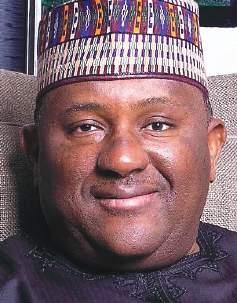
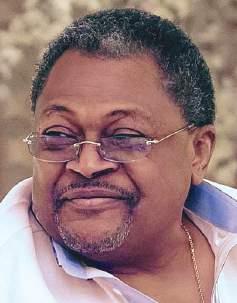
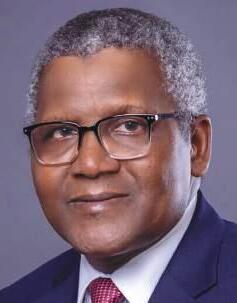
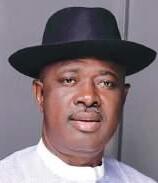
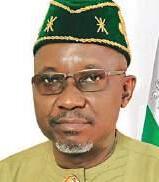
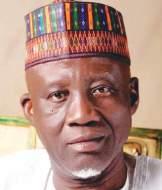
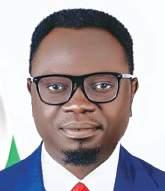
Dangote Dominates, Rabiu’s Wealth Doubles, Adenuga, Otedola Shine on Forbes 2026 Billionaires List
Nigeria’s billionaire class has delivered a powerful showing on the 2026 Forbes global rich
www.thisdaylive.com
list, with industrial mogul, Aliko Dangote, maintaining his grip as Africa’s richest man while fellow entrepreneur Abdulsamad Rabiu recorded the most dramatic surge
in wealth and Mike Adenuga as well as Femi Otedola, remained on the billionaire leaderboard.
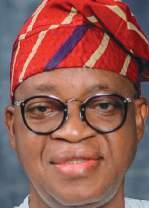
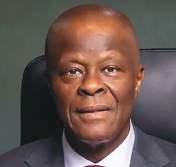
The latest ranking places Dangote 86th among the world’s richest
individuals with a net worth of $28.6 billion, reaffirming his status as the continent’s wealthiest person.
The Lagos-based tycoon built his fortune through the Dangote Group,
a sprawling industrial conglomerate anchored by Dangote Cement, Africa’s largest cement producer.
Dangote controls about 85 per cent of the publicly traded company
through a holding structure, Forbes said.
With an annual production capacity of 48.6 million metric
Continued on page 10
Dangote
NNPC: Presidential Approval Secured for $20bn FID on Bonga Deepwater Project
It’s first FID on a Nigeria deepwater PSC asset since 2008 Project expected to
Emmanuel Addeh in Abuja and Peter Uzoho in Lagos
The Nigerian National Petroleum Company Limited
NNPC (NNPC Ltd) yesterday announced that it had secured presidential approval for a targeted fiscal incentive package aimed at unlocking the longdelayed Final Investment Decision (FID) on the Bonga Southwest Aparo (BSWA) deepwater project.
The national oil company, in a statement in Abuja by its spokesman, Andy Odeh, stressed that the development is expected to attract about $20 billion in Foreign Direct Investment (FDI) and revive large-scale offshore oil investments in the country.
The approval, granted by
Continued on page 10
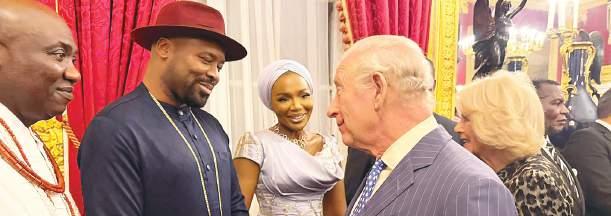
OGIAME ATUWATSE III MEETS KING CHARLES III...
The
Emmanuel Addeh in Abuja
L-R:
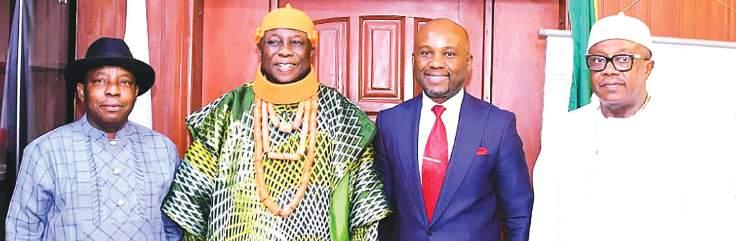
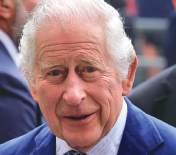
Oluyemi of Warri Kingdom, Chief Samuel Amatotsero; His Majesty Ogiame Atuwatse III, CFR, the Olu of Warri Kingdom; Queen Consort of Warri Kingdom, Olori Atuwatse III and Head of Commonwealth of Nations, His Majesty, King Charles III of United Kingdom during Commonwealth Day Celebrations in London … yesterday
Deji Elumoye, Emmanuel Addeh in Abuja, Peter Uzoho in Lagos, Ahmed Sorondinki in Kano and
A ROYAL SUPPORT VISIT...
L-R; Permanent Secretary Federal Ministry of Innovation, Science and Technology, Philip Ndiomu; His Royal Majesty, the Asagba of Asaba, Prof. Epiphany Azinge, SAN; Hon. Minister of Innovation, Science and Technology, Dr. Kingsley Tochukwu Udeh, SAN; and member representing Aniocha/Oshimili Federal Constituency, Delta State, Hon. Lawrence Ngozi Okolie, during a royal support visit by the Asagba of Asaba to the office of the Minister in Abuja...recently
February Records Lowest Petrol Imports, Local Refining Dominates Supply
Nigeria maintains 31-day petrol sufficiency
Emmanuel Addeh in Abuja
Nigeria recorded its lowest petrol import levels in February 2026 as domestic refining led largely by the Dangote Petroleum Refinery accounted for the overwhelming share of fuel supplied to the local market, according to the latest industry data.
An official factsheet on Nigeria’s midstream and downstream petroleum operations showed that total daily supply of petrol fell sharply from 64.9 million litres per day in January to 39.6 million litres per day in February.
The decline represented a 25.4 million litres per day reduction, equivalent to a 39.1 per cent drop in total supply during the period.
The report attributed the decline primarily to a significant drop in petrol imports, indicating that Nigeria relied far less on foreign refined products in February than it did in the previous month.
Despite the reduction in total supply, domestic refining contributed the bulk of available petrol in the country. The factsheet showed that average domestic petrol supply in February stood at 36.5 million litres per day, meaning that locally refined fuel accounted for roughly 92 per cent of the total product supply during
the month.
This indicates that imported petrol represented only about 3.1 million litres per day, or roughly 8 per cent of total supply, underscoring the growing role of domestic refineries in Nigeria’s fuel supply chain.
The figures reflect an emerging structural shift in the downstream sector as local refining capacity, particularly from the Dangote refinery, gradually reduces the country’s dependence on imported fuel.
The document also stated that the calculation of national fuel sufficiency for February included gross PMS stock held at the Dangote refinery, further highlighting the refinery’s role in stabilising domestic supply.
As a result, Nigeria maintained a 31-day petrol sufficiency level during the month, meaning the country held enough fuel stocks to meet demand for approximately one month. Fuel consumption data indicated that domestic demand remained relatively stable.
Average daily petrol consumption stood at 36.6 million litres, which is slightly below the total daily supply of 39.6 million litres. This suggested that available fuel volumes were sufficient to meet market demand despite the sharp decline in imports.
However, broader consumption
FGN/NDDC/Imo
Federal Government of Nigeria (FGN), Niger Delta Development Commission (NDDC), Imo State Government, and International Fund for Agricultural Development (IFAD) co-funded Livelihood Improvement Family Enterprises – Niger Delta (LIFE-ND) project has disbursed starter capital to about 900 incubatees in Imo State.
The flag-off of the second and third batches of incubatees working capital disbursement, which took place in Owerri, the state capital, on Tuesday, was witnessed by officials
of the co-funding parties, traditional rulers, community leaders, and other stakeholders.
The specific objective of the project was to enhance income, food security, and job creation for rural youth and women through agri-enterprise development on a sustainable basis in the nine Niger Delta states of Abia, Bayelsa, Cross River, Delta, Edo, and Ondo (IFAD coverage) and Akwa-Ibom, Imo and Rivers (NDDC coverage).
It was also aimed at reducing crime in the region by way of empowering youths to be selfsufficient.
statistics show that overall petrol demand across the economy remained elevated. Based on the national consumption benchmark of 50 million litres per day, actual petrol usage measured through truck-out volumes averaged 56.9 million litres per day, representing about 13.8 per cent higher than the benchmark level.
In the same vein, diesel demand also exceeded projections by a wide margin. While the benchmark for
diesel consumption was 14 million litres per day, actual average daily usage reached 20.3 million litres, meaning diesel consumption was approximately 45 per cent above the expected level.
Besides, aviation fuel demand remained largely stable relative to projections. The benchmark consumption level for aviation turbine fuel was 3 million litres per day, while actual daily usage averaged 2.9 million litres, representing a marginal 3.3 per
cent shortfall.
Domestic refining activity also extended beyond petrol production.
Local refineries supplied an average of 8.2 million litres per day of diesel during February, although operational disruptions affected some facilities.
In addition, three modular refineries collectively supplied an average of 0.368 million litres per day, contributing modest but steady volumes to domestic fuel supply.
Meanwhile, the WalterSmith
refinery continued the introduction of hydrocarbons into its processing system, signalling ongoing efforts to ramp up refining activity within Nigeria’s modular refinery segment. Across the broader petroleum products market, consumption remained robust.
Cooking gas demand also remained strong, with average daily consumption reaching 4,194 metric tonnes. Nigeria’s strategic fuel reserves remained adequate across key products.
Edo Assembly to Okpebholo: Take Over MOWAA, Radisson Blu Hotel
Felix Omoh-Asun in Benin
Edo State House of Assembly Ad hoc Committees on Museum of West African Art (MOWAA) and Radisson Blu Hotel have asked the state governor, Senator Monday Okpebholo, to take over the two institutions.
The committees were constituted by the Assembly to look into the ownership of the two projects, initiated by the Governor Godwin Obaseki’s administration, but had been mired in controversy.
The Okpebholo government had consistently insisted that there was no handover note from his predecessor, Obaseki, which would have clarified the ownership of the projects.
On Tuesday, the chairmen of the committees on MOWAA and Radisson Blu Hotel, Hon. Addeh Isibor and Hon. Ibhamawu Aigbokhan, respectively, officially made public the committees’ findings.
Isibor, who presented the report on MOWAA, said claims by MOWAA’s management that it raised N37 billion was in direct contrast to MOWAA’s
audited financial statement.
Isibor said the committee, in its recommendation, asked Okpebholo to take possession of the entire premises on which MOWAA was built since the state government funded the entire project.
Another recommendation, according to Isibor, was that the property remained that of the Central Hospital, as it was never revoked.
He said the committee recommended, “That the Edo State Government should immediately take all steps to put the property to
good use in the best and overriding public interest of the people.”
On his part, Aigbokhan said the committee recommended full and total control of Radisson Hotel because it did not receive a kobo for the hotel.
He said the title to the hotel was never transferred from Edo State Government to either Ministry of Finance Incorporated (MOFI) or Hospitality Investment and Management Company (HIMC).
Aigbokhan said the committee recommended, “The Edo State Government should contract competent hands to complete the renovation of the hotel and take all steps to put the hotel to use for the benefit of the good people of Edo State, in particular, and the world, in general.
Flagging-off the ceremony, Imo State Governor, Senator Hope Uzodimma, expressed satisfaction with the first batch of beneficiaries, which were already enjoying full agribusiness enterprise ownership in their respective fields.
Uzodimma, represented by Commissioner for Agriculture and Food Security, Chief Cosmas Maduba, described the project as one of the most viable and potent empowerment programmes supported by the state government. He said the project had captured the attention and interest of the youth and women in the selected
rural communities.
In her opening remarks, Imo State Project Coordinator of LIFEND, Mrs. Victoria Igboanugo, stated that the programme targeted youths between the ages of 18 and 35 years and women not above 50 years, especially from female-headed households.
She added that through the provision of starter kits, essential tools, and capital grants, the young entrepreneurs were being equipped to begin their independent agribusiness journeys with a close mentorship by their incubators.
She said the beneficiaries
comprised second and third batches of 307 and 590 incubatees, respectively, out of which 68 were people with disabilities (PWDs).
According to Igboanugo, the incubatees are linked to various input dealers that would sell to them at affordable prices, hence, the direct disbursement so that they would purchase their inputs directly from dealers at subsidised rates.
She warned the incubatees not to misuse the money, adding that measures have been put in place to track them and prosecute those who divert the funds from what
“The Edo State Government should immediately revoke the fraudulent Certificate of Occupancy to the property issued in the name of Hospitality Investment and Management Company Limited and revert same to the Edo State Government that purchased the property.
“That the Edo State Government initiate legal action and work with relevant anti-graft agencies to retrieve the balance of the N17.5 billion proceeds still in the possession of the Escrow Agents, Meristem Trustees Limited and Emerging Africa Trustees Limited.”
Amby Uneze in Owerri
These Frequently Asked Questions below provide a clear over view of Nigeria’s new tax law coming into effec t in 2026. They are designed to help individuals and businesses understand the key changes, who they apply to and how the new rules will affec t filing, payments and compliance.
WHO IS ELIGIBLE TO PAY TAX IN NIGERIA?
Any individual or entity that earns income or derives economic benefit in Nigeria and abroad is eligible and required to pay tax.
WHAT IS A TAX IDENTIFIC ATION NUMBER ( TIN)?
A TIN is a unique identifier issued by FIRS or SBIR and is required for all tax-related transactions.
WHO IS REQUIRED TO FILE TAX RETURNS?
Nigerian residents aged 18+ with income from Nigerian sources including employees, self-employed individuals, and non-residents earning from Nigeria must file returns.
C AN I PAY TAXES IN ANY BANK BR ANCH?
Yes. Approved banks can collect payments for all tax types and tax offices.
WHY DOES IT TAKE LONG TO GET A TAX CLEAR ANCE CERTIFIC ATE ( TCC )?
A TCC is issued only after all taxes for the past 3 years are fully paid. The standard two-week processing time starts from the date of application, not the date of payment.
WHAT IF I FAIL TO FILE OR PAY TAXES ON TIME?
Late filing or late payment attracts penalties and interest charges.
WHO DOES THE NEW 2025 TAX LAW APPLY TO?
Resident individuals are taxed on worldwide income; nonresidents are taxed on Nigerian-sourced income.
WHAT IS THE TAX R ATE FOR LOW-INCOME EARNERS?
Individuals earning N800,000 or less per year are fully exempt from personal income tax.
ARE TR ANSFERS AND DEPOSITS INTO MY BANK ACCOUNT AUTOMATIC ALLY TAXED?
No. Transfers and deposits are not taxable by themselves, but the source of the income may be taxable.
WHAT IS THE NEW RENT RELIEF?
From 2026, individuals can claim 20% of annual rent (up to N500,000) as rent relief, provided actual rent is declared to tax authorities.
WILL SMALL COMPANIES PAY TAX?
Companies with N50 million or less in annual turnover are exempt from Companies Income Tax (CIT).
ARE AGRICULTURE COMPANIES TAXED?
Agriculture businesses, including crop farming, livestock, cocoa processing, forestry, and dairy enjoy a 5-year tax holiday.
WHAT IS THE C APITAL GAINS TAX R ATE (CGT )?
CGT is a flat 30% on chargeable gains from asset disposal
HOW ARE NON-RESIDENT COMPANIES TAXED?
Non-residents are taxed on income sourced from Nigeria. If profits are hard to verify, FIRS may apply a minimum tax of 4% on Nigerian income.
ARE GAINS FROM CRYPTOCURRENCIES TAXABLE?
Yes. The 2025 Act applies CGT to digital asset disposals, including cryptocurrencies.
WHAT IS THE CURRENT VAT R ATE?
VAT remains 7.5%. Non-resident suppliers (e.g., ecommerce platforms) must register and remit VAT in Nigeria.
IS INCOME FROM BONDS OR GOVERNMENT SECURITIES TAXABLE?
No. Income from federal or state government bonds is fully exempt.
BE A LAW ABIDING CITIZEN. PAY YOUR TAX.
OPENING CEREMONY OF A THREE-DAY ANTI-COMPETITIVE AND CONSUMER LAWS CONFERENCE...
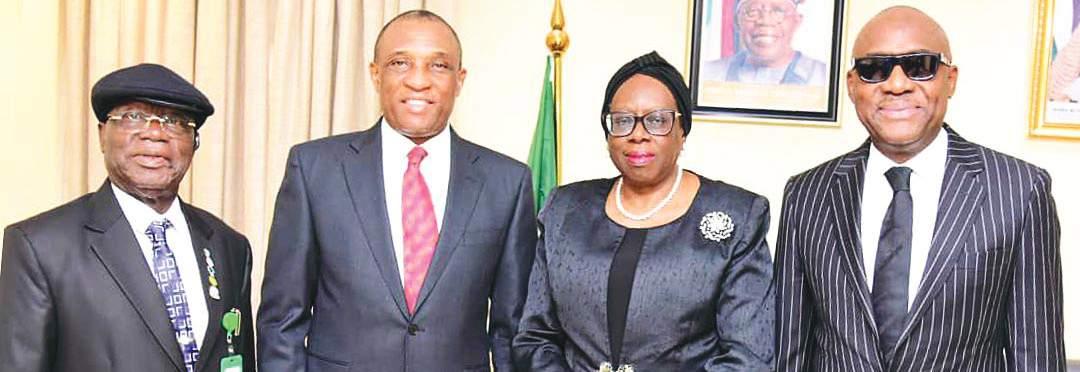
L-R: Honourable Justice B. A. Adejumo, Administrator of the National Judicial Institute; Mr. Tunji Bello, EVC/CEO of the Federal Competition and Consumer Protection Commission (FCCPC); Honourable Justice Kudirat Kekere-Ekun, GCON, Chief Justice of Nigeria; and Mr. Louis Odion, Executive Commissioner (Operations) of FCCPC, at the opening ceremony of a three-day Anti-Competitive and Consumer Laws Conference at the National Judicial Institute, Abuja
Kekere-Ekun: FCCPC Remains Bulwark Against Consumer Rights
Tunji Bello: role of courts key in interpreting provisions of consumer protection framework for coherent, predictable competition jurisprudence disputes involving competition law, regulatory enforcement, and consumer rights.
Chief Justice of Nigeria (CJN), Justice Kudirat Kekere-Ekun, yesterday, declared that Federal Competition and Consumer Protection Commission (FCCPC) remained a worthy safeguard against anti-competitive practices, consumer rights abuse, market distortions, and unfair business conducts that undermined consumer confidence and economic stability in the country.
Kekere-Ekun described the consumer rights agency as a critical institution for safeguarding the country’s business environment, and protecting the integrity of the marketplace.
She made the comments in her keynote address at the opening ceremony of a threeday Competition and Consumer Protection Law Conference, with the theme, “Addressing Legal and Adjudicatory Issues in Competition
and Consumer Protection under the Federal Competition and Consumer Protection Act, 2018,” in Abuja.
Executive Vice Chairman/ Chief Executive, FCCPC, Mr. Tunji Bello, said the role of the courts was critical in interpreting the provisions of the consumer protection framework for coherent and predictable competition jurisprudence in Nigeria.
The CJN stated that FCCPC occupied a pivotal position within
the country’s regulatory architecture, with statutory authority responsible for enforcing competition and consumer protection laws.
She stated, “Across jurisdictions, competition and consumer protection law has rapidly evolved into one of the most dynamic and litigated fields of legal practice.”
According to the CJN, the increasing complexity of modern markets means that courts may witness a growing number of
She stressed the importance of sustained engagement between regulatory institutions and the judiciary to ensure effective interpretation and enforcement of the Federal Competition and Consumer Protection Act (FCCPA) 2018.
Kekere-Ekun said, “The competition mandate of the commission is directed at promoting fair, transparent, and efficient market structures that encourage innovation, productivity, and sustainable economic growth.
lence of greenwashing litigation, which exposes regulatory gaps in industries such as fashion, travel, and retail, to regulatory challenges within digital markets and the rising demand for collective consumer redress through class actions, the global legal landscape is undergoing significant transformation.
“These developments have important implications for the judiciary. As the enforcement environment expands, courts may witness a substantial increase in the volume and complexity of cases arising from competition and consumer protection disputes.”
Michael Olugbode in Abuja Ministry of Interior has strengthened its collaboration with Federal Ministry of Information and National Orientation to improve public awareness of key government reforms in passport services, border security, identity management, and national safety.
The engagement took place during a high-level visit by Minister of Information and National Orientation, Mohammed Idris, to Ministry of Interior, where he was received by the Minister of Interior, Olubunmi Tunji-Ojo.
Tunji-Ojo stated that Ministry of Interior oversaw key agencies, including Nigerian Immigration Service, Federal Fire Service, Nigerian Security and Civil Defence Corps, Nigerian Correctional Service, and National Identity Management Commission.
He described the last two and a half years as a period of transformative reforms across the agencies, resulting in significant improvements in service delivery, security, and citizen engagement.
Among the ministry’s notable achievements Tunji-Ojo highlighted were the rapid clearance of over 204,000 pending passport applications, the introduction of contactless
Tunji-Ojo, while welcoming the delegation, highlighted the critical need for coordinated communication to ensure Nigerians were fully informed about government achievements under the Renewed Hope Agenda.
passport renewals for Nigerians abroad, and the establishment of Nigeria’s first centralised passport personalisation centre in Abuja.
He also pointed to advanced border management technologies, including the deployment of Advanced Passenger Information (API) and Passenger Name Record (PNR) systems, and the introduction of electronic immigration gates at major airports.
In the area of identity management, Tunji-Ojo announced that over 130 million Nigerians had been enrolled in the National Identity Database, while the launch of ECOWAS National Biometric Identity Card now facilitated regional travel within West Africa without passports.
The minister further highlighted
correctional reforms, skills development for inmates, the construction of a National Fire Academy, and deployment of Mining Marshals to protect critical mining sites.
Tunji-Ojo emphasised that the reforms required strong public communication, and urged the information ministry to collaborate on a coordinated strategy to ensure accurate and timely dissemination of information to Nigerians and the international community.
In his response, Idris commended Ministry of Interior for the remarkable reforms, stressing that consistent government messaging on security and development initiatives would boost Nigeria’s international image and attract foreign investment.
“At the same time, its consumer protection mandate ensures that individuals are shielded from exploitative practices across critical sectors of the economy, including the financial services sector, telecommunications, transportation, energy, healthcare, and pharmaceuticals.
“Given the breadth and importance of this mandate, the FCCPC necessarily occupies a strategic institutional space that requires vigilance, integrity, and proactive engagement with key stakeholders.”
She stressed, “Continuous dialogue and knowledge exchange between regulators and the judiciary are therefore, indispensable…
“Contemporary developments illustrate the growing complexity of the field.
“From the increasing preva-
The CJN added, “This, in turn, has the potential to exert additional pressure on already demanding judicial dockets.
“Within the framework of the Federal Competition and Consumer Protection Act, it is noteworthy that while Section 146(1) provides for administrative mechanisms for resolving consumer complaints, Section 146(2) allows consumers to approach the courts directly without first exhausting these administrative remedies.
“This legislative design underscores the importance of judicial readiness to address disputes arising under the Act.”
She stated, “I must emphasise, however, that this observation should not be interpreted as suggesting any reluctance on the part of the courts to discharge their adjudicatory responsibilities.
IWD: NDPHC Provides Gender-friendly Work Environment for Staff, Says MD Interior, Information Ministries Forge Partnership
Emmanuel Addeh in Abuja
Managing Director and Chief Executive of the Niger Delta Power Holding Company (NDPHC), Jennifer Adighije, has said the company provides a gender-friendly work environment for its staff, enabling individuals to reach their full potential.
Adighije, the first female to lead the company since it was established in 2005, stated this during an event to mark International Women’s Day
2026. She noted that despite being the only woman in the company’s executive management team, she has enjoyed strong support from colleagues across the organisation.
“I am a woman among men in leadership, leading the management as the only woman, but I must say that I receive unprecedented support,” she said. “I truly appreciate the support of the staff, especially on a day like this when the world celebrates the strength, resilience and courage of women,” she added.
Adighije described women as critical drivers of social and national development, noting that empowering women has a far-reaching impact on society.
According to her, while empowering a man may uplift a family, empowering a woman has the potential to transform an entire nation.
Adighije described women as critical drivers of social and national development, noting that empowering women has a far-reaching impact
on society.
Reflecting on the theme of this year’s celebration, she said the idea of “give to gain” highlights the importance of sacrifice, service and mutual support in achieving progress both individually and collectively.
She urged staff to reflect on how their willingness to give, through support, collaboration and commitment, can shape the gains achieved by the organisation and the country at large.
She said: “If our gains are predicated upon our giving, then how we give will determine how we gain,” adding that “this requires sacrifice and recognition that we all have responsibilities toward one another.”
“We need to recognise that we cannot walk our career journeys alone. We must support each other and strengthen each other while also supporting the organisation,” the NDPHC CEO stated.
In her remark, Guest Speaker
and veteran broadcast journalist, Eugenia Abu urged female staff of the company to remove selflimitation and aspire to be the best in the company.
Speaking earlier, the Executive Director, Corporate Services, Omoregie Ogbeide-Ihama observed that women were major contributors to growth of the company. He noted that under the leadership of Adighije, a lot of positive changes have occurred in the company, encouraging the female staff to continue to give their best.
COURTESY CALL ON THE SENATE PRESIDENT BY THE ITALIAN AMBASSADOR...
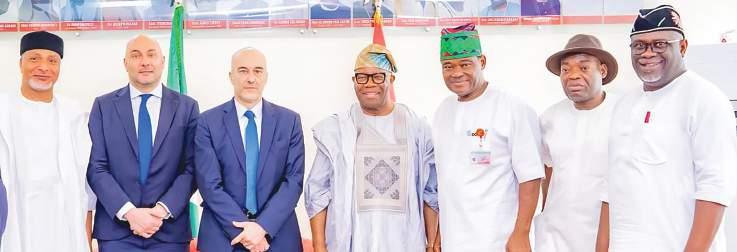
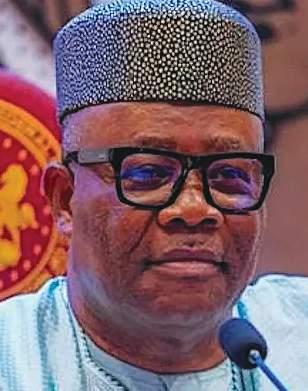
L-R: Chairman, Senate Committee on Agriculture and Productivity, Saliu Mustapha; Italian Deputy Head of Mission to Nigeria, Lacopo Foti; Italian Ambassador to Nigeria, Roberto Mengoni; President of the Senate, Godswill Akpabio; Nigeria’s Permanent Representative to the United Nations, Senator Ibrahim Jimoh; Chairman, Senate Committee on Anti-Corruption, Tony Nwoye; and Chairman, Senate Committee on Diaspora, Aniekan Bassey, during a courtesy call on the Senate President by the Italian Ambassador, yesterday
PHOTO: PRESIDENT’S OFFICE
Sanwo-Olu: Alausa Multi-Agency Building at Completion
Stage, to be Opened by Tinubu
Gov, cabinet members inspect LAGIS Office ahead construction
Segun James
Governor Babajide Sanwo-Olu of Lagos State on Tuesday, led a cabinet delegation on an inspection of two critical projects being developed by the State Government to enhance service delivery to citizens.
The projects - Multi-Agency Office Complex and Lagos Geographic Information Service (LAGIS) Building - are situated within the Central Business District (CBD) in Alausa, in close proximity to the secretariat of the state government.
The multi-agency complex is a multi-storey office development designed to centralise the operations of critical state agencies, thereby reducing congestion in the secretariat campus.
The complex is being designed to offer comfort for civil servants and enhance administrative efficiency. The project is multi-functional building that houses office spaces, relaxation facilities, multi-level car park with capacity for over 600 vehicles, and advanced safety components.
The LAGIS project is a 5-floor purpose-built office building initiated
by the Sanwo-Olu administration to provide one-stop access for all services relating to geospatial mapping, urban planning and land administration. Sanwo-Olu, who described the two projects as a “masterpiece”, expressed satisfaction with their progress, declaring that the construction of multi-agency complex had practically been completed, except the finishing work to be done on the ground floor and setbacks.
The governor disclosed that the formal opening of the buildings would be symbolic, as they were expected to be commissioned by President Bola Ahmed Tinubu in a planned state visit to Lagos coming in a yet to be announced date.
After the completion of work on the complex, Sanwo-Olu said the contractor handling the project was expected to clean it up in the next two weeks in preparation for commissioning.
He said: “We’ve just finished the inspection of multiagency office complex and the LAGIS Building. As has been observed, the multiagency complex is practically completed; all
left to do is finishing work around all of the setback and the ground completion. I am impressed with the level of work the contractor has been able to achieve. In another two week, we believe the contractor should have done extreme cleanup of the complex.
“The LAGIS Building whose construction is more recent is also a unique masterpiece as the complex
because it meets our requirements in spatial and geographic information system deliverables, which are meant to be part of our solutions to land administration in Lagos.
“However, construction work on the LAGIS building needs to advance quickly in the next three weeks to the completion stage.
“What we are planning to do for
deadline
the formal opening of these buildings is a symbolic commissioning. We are expecting presidential visit in the coming weeks, and these buildings are part of the projects that might be inaugurated by the President on that trip.”
Sanwo-Olu said the buildings would positively impact the quality of public service and enhance service
delivery to the citizens. He said the ambience in which the civil servants would now work would be felt in better turnaround time for the services they render to citizens.
“The space in which services are being rendered is critical to us as a government. That is why we are creating better working environment for our staff,” the governor said.
ECOWAS Court Raises the Alarm Over Gender Violence, Low Compliance with Judgements
Michael Olugbode in Abuja
President of ECOWAS Court of Justice, Claudio Monteiro Gonçalves, has called for stronger regional action to combat gender-based violence and ensure justice for women and girls across West Africa, warning that many victims still suffer in silence.
Gonçalves, represented by Acting Deputy Registrar of ECOWAS Court of Justice, Mrs. Marie Sanie, made the call in Abuja during the court’s celebration of International Women’s
FG Seeks to Develop Integrated, Reliable Diagnostic Ecosystem in Nigeria
Onyebuchi Ezigbo in Abuja
The federal government said it is currently implementing measures to promote integrated, reliable and accessible diagnostic services nationwide
It said the steps included strengthening of the national laboratory network, enhancing quality assurance systems, expanding workforce development, and deepening partnerships with the private sector and development partners to ensure equitable access to high quality diagnostic services.
Speaking at the National Summit on Diagnostics held in Abuja on Tuesday, Minister of State for Health and Social Welfare, Dr. Iziaq Adekunle Salako said that government believes that, “accurate and timely diagnosis
is essential for disease prevention, early detection, effective treatment, and continuous patient monitoring. Globally, a significant proportion of clinical decisions depend on diagnostic results”.
The Minister, represented by the Permanent Secretary of Ministry, Mrs. Daju Kachallom said that strengthening diagnostic capacity is not merely a technical requirement but a strategic investment in the efficiency, credibility, and performance of our entire health system.
According to the Minister, a well integrated and coordinated diagnostic system is indispensable for quality healthcare delivery.
“Whether in a primary healthcare centre in a rural community or a tertiary hospital in a major city, access to reliable diagnostic services
empowers healthcare providers to make informed decisions that improve patient outcomes and ensure optimal use of resources.
“The Federal Ministry of Health and Social Welfare recognizes that strengthening diagnostics requires more than infrastructure. It demands strong governance, effective partnerships, a skilled workforce, functional laboratory networks, robust regulatory oversight, and sustainable financing.
“It also requires deliberate investment in local capacity development and domestic production of diagnostic technologies,” he said.
Salako said that diagnostics holds a strategic place under the health sector reform agenda, stating that the Ministry has continued to advance policies and initiatives that strengthen laboratory services nationwide.
Day, organised by the CCJ Women Forum.
The event had the theme, “Rights, Justice, Action for All Women and Girls,” with a sub-theme urging stakeholders to, “Break the Silence: End Gender-Based Violence Now.”
Gonçalves said the protection of women’s rights was central to the court’s mandate of advancing the rule of law and safeguarding fundamental human rights across the ECOWAS states.
According to him, the court has, through its judgements, played a significant role in challenging discrimination, addressing sexual and gender-based violence, and providing remedies for victims across the region.
“These ground-breaking decisions have not only delivered justice to individuals but have also set important legal precedents that reinforce the dignity and protection of women and girls throughout the region,” Gonçalves said.
Among the landmark rulings highlighted by the court’s president was the 2008 case of Hadijatou Mani Koraou v Republic of Niger, which addressed slavery practices in Niger, and the 2017 case of Dorothy Chioma Njemanze & 3
Ors v Federal Republic of Nigeria that condemned discrimination and degrading treatment against women.
Other notable cases cited included WARDC & IHRDA (Mary Sunday) v Federal Republic of Nigeria on domestic violence, WAVES & 1 Or v Republic of Sierra Leone on discrimination based on pregnancy, Adama Vandi v Republic of Sierra Leone on rape and failure to provide effective remedy for victims, and Forum Against Harmful Practices (FAHP) & 2 Ors v Republic of Sierra Leone concerning female genital mutilation.
Gonçalves stressed that genderbased violence was a major obstacle to equality, justice, and sustainable development across the region.
“Too often, survivors suffer in silence due to stigma, fear or lack of support to seek justice. Today we affirm that silence must end and justice must be translated into action,” he stated. The ECOWAS court president also expressed concern over the low level of compliance with the court’s rulings by member states, revealing that only about 20 per cent of its judgements have been fullyHeimplemented. warned that the low enforcement rate could undermine the authority and credibility of the regional court if not addressed urgently.
To tackle the challenge, he said the court recently carried out bilateral engagement missions to several member states, including Sierra Leone, Nigeria, and Guinea-Conakry, as part of activities marking the 50th anniversary of the Economic Community of West African States.
President Tinubu Seeks House’s Approval for 2026 FCT Budget
Adedayo Akinwale in Abuja
President Bola Tinubu has sought the approval of the House of Representatives for the 2026 statutory budget proposal of the Federal Capital Territory Administration (FCTA).
The President’s request was
read by Speaker, Hon. Abbas Tajudeen at the plenary on Tuesday.
The President noted that the submission complies with relevant constitutional provisions and is designed to align with the federal government’s fiscal and development policies, as well as the key
assumptions of the 2026 national appropriation framework and the 2025–2028 Economic Recovery and Growth Plan.
The President urged the House to give the FCT budget proposal expeditious consideration to support development programmes across the nation’s capital.
Introducing
The Evo l ve d Wo m an
A special Business Series edition to celebrate women and launch the gen.w platform
12 March, 2026 11:00 AM (WAT)
Live on @ubagroup
Speakers:
Scan the code to Register
Tobi Bakre Media Personality
MOU SIGNING CEREMONY FOR A 4 BILLION NAIRA BOI-PLSG MATCHING FUND...
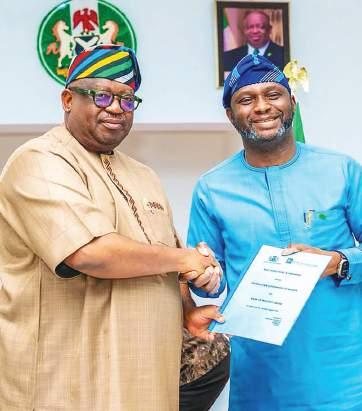
Governor of Plateau State, Barr. Caleb Mutfwang (L) and MD/CEO Bank Of Industry, Dr. Olasupo Olusi, at the MOU signing ceremony for a 4-Billion Naira BOI-PLSG Matching Fund to boost MSMEs in the state….yesterday
Amid Shortfall in Oil Exports, Foreign Trade Declined to N36.21 Trillion in Q4 2025
Recorded N1.71tn surplus, crude oil remains major exported commodity
James Emejo in Abuja
The country’s external merchandise declined to N36.21 trillion, representing a decrease of 8.94 per cent compared to N39.77 trillion in the preceding quarter, the National Bureau of Statistics (NBS) stated yesterday.
Trade further decrease by 1.07 per cent compared to N36.60 trillion in the corresponding period of 2024.
However, the country recorded a trade balance of N1.71 trillion in the review period, the NBS noted.
The NBS stated this in its Foreign Trade Statistics Report for Q4 2025, largely attributing the shortfall to a decline in crude oil exports.
In the review quarter, exports accounted for 52.36 per cent of total trade value at N18.96 trillion, a decrease of 16.88 per cent compared to N22.81 trillion in Q3, 2025 and 5.25 per cent compared to N20.01trillion in Q4 2024.
However, crude oil remained the country’s major exported commodity during the quarter with N9.70 trillion, representing 51.17 per cent of total exports.
Non-crude oil exports stood at N9.26 trillion, accounting for 48.83 per cent of total exports, of which non-oil products contributed N3.15 trillion or 16.59 per centof total exports.
Exports by region showed that Nigeria exported goods mainly to Europe valued at N6.87 trillion
or 36.24 per centof total exports, followed by exports to Asia N5.11 trillion or 26.94 per cent of total exports.
Exports to Africa stood at N3.41 trillion or 18.01 per cent, out of which, goods exported to ECOWAS countries were valued at N1,l. 81 trillion or 52.89 per cent, while exports to America were valued at N3.29 trillion, representing 17.35 per cent of total exports.
The Netherlands stood as the country’s main export destination with N2.03 trillion or 10.72 per cent of total exports, followed by exports to India with N1.83 trillion or 9.64 per cent, Spain N1.71 trillion or 9.02 per cent, France with N1.36 trillion or 7.19 per cent, and exports to Canada #lN1.03 trillion, representing 5.42 per cent of total exports.
According to the statitical agency, these five countries collectively accounted for 41.99 per cent of the value of total exports in Q4.
The value of exports to African countries stood at N3.41 trillion while imports amounted to N696.13 billion.
Nigeria’s exports to Africa were mainly to South Africa with N629.37 billion, Ivory Coast N597.38 billion, Togo N579.34 billion, Ghana N391.78 billion, and EgyptN285.57 billion, altogether representing 72.73 per cent of exports to Africa.
In Q4, total imports were valued at N17.25 trillion, accounting for
47.64 per cent of total trade. The country imported goods mainly from Asia, valued at N8.08 trillion, representing 46.83 per cent of total imports. This was followed by imports from Europe valued at N5.75 trillion or 33.31 per cent, America N2.66 trillion or 15.47 per cent, while imports from Oceania stood at N62.17 billion or 0.36 per cent. Imports from African countries stood at N696.13 billion or 4.04 per cent of total imports: of which imports from ECOWAS countries amounted to N279.83 billion or 40.20 per centof imports from African countries. However, major import partners within Africa in Q4 were from Ghana N150.96 billion, South Africa N131.32 billion, Egypt N130.34 billion, Togo N88.91 billion, and Swaziland N37.19 billion.
NNPC: PRESIDENTIAL APPROVAL SECURED FOR $20BN FID ON BONGA DEEPWATER PROJECT
President Bola Tinubu, it said, is designed to resolve long-standing fiscal and commercial bottlenecks that stalled the project for nearly two decades and pave the way for a major expansion of Nigeria’s deepwater oil production.
The Bonga Southwest Aparo development, operated by Shell through its Nigerian deepwater subsidiary, is expected to deliver about 150,000 barrels of crude
oil per day and 140 million standard cubic feet (Scf) of gas daily once fully operational.
According to the statement, the presidential approval followed months of technical and commercial engagements involving the national oil company, the Nigeria Revenue Service (NRS), the Special Adviser to the President on Energy, Olu Verheijen, and the global leadership of Shell.
“His Excellency, President Bola Ahmed Tinubu, has approved a targeted fiscal incentive designed to unlock the long awaited Final Investment Decision (FID) on the Bonga Southwest Aparo (BSWA) deepwater project, marking a milestone in Nigeria’s ongoing drive to attract strategic investments and accelerate sustainable economic growth. The project is estimated to attract about
NIGERIANS GROAN UNDER RISING FUEL PRICES, TINUBU DIRECTS DEPLOYMENT OF 100,000 CNG CONVERSION KITS
N1,280 per litre of petrol, reflecting a noticeable variation across filling stations in the nation’s capital. The price range, which has remained recent days, is influenced by factors including global crude oil prices, distribution logistics, and demand fluctuations.
But commuters continued to feel the pinch as transportation costs adjusted in response to fuel prices, particularly in key cities where road traffic is heavy and daily commuting distances are significant.
However, President Bola Tinubu yesterday took steps to cushion the harsh impact of the escalating Middle East conflict on Nigerian commuters by directing the immediate deployment of about 100,000 CNG conversion kits nationwide.
The order formed part of efforts by the government at the centre to reduce transportation costs and expand alternative energy options in response to the rising price of petrol and diesel triggered by the ongoing United States–Israel war with Iran.
Executive Chairman of the Presidential Initiative on Compressed Natural Gas (Pi-CNG), Ismaeel Ahmed, who made the President’s directive known to newsmen at the State House, Abuja, after a meeting
with Tinubu said the President was keenly monitoring global developments and their impact on Nigeria’s energy costs, particularly the effect of the Middle East conflict on fuel prices and transportation.
According to him, the President has mandated the Pi-CNG initiative to accelerate the rollout of CNG infrastructure and alternative mobility solutions nationwide.
“The President, as usual, is always trying to get information on what is going on, especially with the war in the Middle East and the rising cost of petrol and diesel. He wanted to know what we are doing at Pi-CNG and EV to scale up the availability of gas and CNG everywhere in the country so that people would have less cost of transportation,” he added.
Ahmed explained that the kits, which will be distributed in collaboration with multiple stakeholders, will enable vehicle owners, including tricycle operators, to convert their engines to run on gas.
“So we have about 100,000 kits that we’re going to deploy in the next two to three weeks. The conversion centres will all be bustling with a lot of activities,” he said.
The Pi-CNG chairman added that the initiative will also fast-track the
development of infrastructure for CNG refuelling and electric vehicle charging across the country.
According to him, the President specifically directed that infrastructure expansion should focus on key transportation corridors, particularly in the northern part of the country.
He explained that the government is already developing a network of refuelling stations and charging facilities to support the transition to gas-powered and electric vehicles. Ahmed disclosed that about 77
$20 billion in Foreign Direct Investment and position Nigeria for a new era of deepwater production.
“The approval followed months of intensive technical and commercial negotiations involving NNPC Limited as the concessionaire, the Nigeria Revenue Service (NRS), the Special Adviser to the President on Energy, Olu Verheijen, and the Shell CEO Mr. Wael Sawan,” it stated.
According to the statement, it represents the culmination of the President’s directive, issued during a courtesy visit by Shell CEO, Sawan, to fast-track the enablers required to move this strategic national asset to FID. Besides, the national oil company said it signals renewed confidence in Nigeria’s policy direction and its resolve to translate reform momentum into tangible investment outcomes.
The NNPC said the approval represented a significant milestone in Nigeria’s effort to reposition itself as a competitive destination for global energy investment, particularly in the
capital-intensive deepwater segment.
Group Chief Executive Officer of NNPC, Bayo Ojulari, described the development as a major breakthrough for the country’s oil and gas sector.
He noted that the project had remained stalled for almost two decades due to fiscal and commercial uncertainties but said the latest approval reflected the government’s commitment to unlocking strategic investments.
Ojulari added that the milestone underscored the company’s commitment to leveraging partnerships with international oil companies to unlock Nigeria’s vast hydrocarbon potential.
“This approval is a testament to the President’s leadership, NNPC’s disciplined execution and our ability to structure complex, bankable transactions that deliver value for Nigeria.
For nearly two decades, the Bonga Southwest project remained stalled. Today, under President Tinubu’s reformdriven leadership and through NNPC’s sustained advocacy, we
have broken that logjam. This is what partnership, persistence, and policy clarity can achieve.
“This milestone further affirms NNPC’s commitment, under the President’s leadership, to unlocking Nigeria’s vast energy potential through partnerships, disciplined innovation and execution excellence,” the NNPC GCEO stressed.
The Bonga Southwest Aparo project will become the first deepwater final investment decision on a Production Sharing Contract (PSC) asset in Nigeria since 2008, signalling renewed confidence among international investors in the country’s policy environment.
Central to the breakthrough is the fiscal package approved by the President, which includes an enhanced Production Tax Credit as well as the resolution of issues arising from the 2021 dispute settlement agreement between the government and contractors.
NNPC said the revised fiscal framework was designed
DANGOTE DOMINATES, RABIU’S WEALTH DOUBLES, ADENUGA, OTEDOLA SHINE ON FORBES 2026 BILLIONAIRES LIST tons and operations across several African countries, Dangote Cement has grown into a dominant force in the continent’s construction materials industry.
Dangote’s wealth has expanded significantly over the past year, rising from $23.9 billion in 2025, reflecting continued expansion across his industrial portfolio.
Two major projects now anchor the group’s strategic vision. The Dangote fertiliser plant, which began operations in March 2022, is designed to support Nigeria’s agricultural sector by supplying large volumes of locally produced
fertiliser. Meanwhile, the longawaited Dangote Refinery began refining operations in 2024, marking a historic milestone for Nigeria’s energy sector.
While Dangote retains the continent’s top spot, the most striking shift in Nigeria’s billionaire rankings comes from Abdul Samad Rabiu. Rabiu’s wealth has surged to $11.1 billion from $5.1 billion a year earlier, a jump of roughly 118 per cent, propelling him to 279th on the global ranking and third in Africa.
empire across cement production, sugar refining and food processing. His controlling interests in BUA Cement and BUA Foods have been central to the rapid rise in his fortune.
Continued on page 35 Continued on page 36 Continued on page 35
The BUA Group founder has steadily expanded his industrial
Rabiu holds about 98.2 per cent of BUA Cement Plc, which was created after the merger of his Obu Cement company with Cement Company of Northern Nigeria in 2020. He also owns approximately 95 per cent of BUA Foods, one of Nigeria’s largest food manufacturing firms. Rabiu’s business journey began in 1988 when he launched
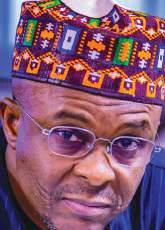
a trading operation importing iron, steel and chemicals, laying the foundation for what would eventually become one of Nigeria’s largest industrial conglomerates. Another familiar name on the Forbes list is Mike Adenuga, Nigeria’s telecom and oil magnate. Adenuga ranks 608th globally with a fortune estimated at $6.5 billion, slightly lower than the $6.8 billion recorded in 2025. Despite the marginal decline, Adenuga remains one of Nigeria’s most influential entrepreneurs.
Jumoke Oduwole, Minister of Industry, Trade and Investment
CAPACITY BUILDING PROGRAMME FOR SCHOOL MANAGERS...
L-R: Chief Executive Officer, Nigeria Education Repository and Databank (NERD), Tunji Ariyomo; Minister of Education, Dr. Tunji Alausa; Director, Educational Planning, Research and Development, Federal Ministry of Education (FME), Mrs. Obianuju Anigbogu; and Director of Press, FME, Mrs. Boriowo Folasade, during a capacity building programme for school representatives organised by NERD in Abuja…recently
Middle East: UN Body Frets over Global Disruptions on Trade, FG Says It’s Monitoring Developments
Economic Management Team meets, identifies three channels of impact on economy
The federal government has declared that it is closely monitoring escalating geopolitical tensions in the Middle East involving the United States, Israel, and Iran. The government expressed its commitment to safeguarding Nigeria’s economic stability.
The federal government’s position followed a meeting of Economic Management Team (EMT), chaired by Minister of Finance and Coordinating Minister of the Economy, Mr. Wale Edun in Abuja, Tuesday.
The meeting came as the United Nations Trade and Development (UNCTAD) raised concerns over global trade disruptions in the Strait of Hormuz following the ongoing hostilities in the Middle East.
The channel is one of the world’s most critical maritime chokepoints,
carrying around a quarter of global seaborne oil trade and significant volumes of liquefied natural gas and fertilisers.
In a statement released by Assistant Director in the Ministry of Finance, Mrs. Uloma Amadi, Edun said the situation in the Middle East remained fluid. He added that the government was closely monitoring escalating geopolitical tensions in the region.
The statement said the economic team, chaired by Edun, had convened a meeting to assess the war’s effect on Nigeria’s economy.
It said, “The Honourable Minister also chaired a Naira-for-Crude policy coordination meeting to review energy market developments and their domestic implications.
“The situation remains fluid, with global market uncertainty driven by concerns over disruptions to
critical energy supply routes, particularly the Strait of Hormuz, already contributing to volatility in crude oil prices and financial markets.”
The statement added that given Nigeria’s integration with global commodity and financial markets, the government had identified three immediate transmission channels through which the crisis could affect the Nigerian economy.
They were via crude oil and gas prices, adding that volatility in global energy markets is already driving increases in domestic prices, including fuel, diesel, cooking gas, and fertiliser.
The statement said the second channel was capital flows and financial markets, stressing that heightened geopolitical risks may prompt a shift to safe-haven assets, affecting capital flows into emerging
markets, including Nigeria, as well as broader financial market conditions.
The last, according to the statement, is global logistics and supply costs, as disruptions to major shipping and energy supply routes could raise international freight and logistics costs, putting upward pressure on domestic prices.
“The Honourable Minister noted that beyond these immediate effects, sustained instability could drive increases in the cost of goods and services, placing further upward pressure on inflation and the cost of living,” the statement said.
It added, “At the EMT meeting, ministers provided sector-specific updates on the evolving situation. Discussions recognised that the ultimate scale of impact on Nigeria will depend on the duration and intensity of the conflict, particularly
Experts Raise Red Flag at Security, Climate Change and Trade Dominate ECOWAS Meeting in Abidjan
Gbenga
Regional policy experts from across West Africa have raised concerns over what they described as the slow pace of implementation of key regional agreements within the Economic Community of West African States (ECOWAS). They warned that continued delay could leave the region lagging behind in the rapidly evolving global economy.
The concerns formed the core of a communiqué issued at the end of a four-day Meeting of Experts held in Abidjan, Côte d’Ivoire, from March 3 to 6.
The summit, which brought together scholars, policy analysts and regional development experts, focused on the theme, “The Future of Regional Trade, Economic Integration and Sustainable Development in West Africa.”
Those who played key roles in drafting the final communiqué included Rt. Hon. Hakeem Jamiu, a former Deputy Speaker of Ekiti
State House of Assembly and current member representing Irepodun/ Ifelodun Constituency II. Jamiu served as a facilitator and member of the communiqué drafting team, alongside other regional experts, including Professor Biodun Bankole, Professor Azeez Olaniyan, Dr. Ben Ukaoha, Mr. James Gadin, Mr. Yomi Odukudu, and Mr. Bebecer Ndiaye.
The experts cautioned that the current state of affairs within ECOWAS presented a real and pressing challenge if urgent steps were not taken to accelerate the implementation of long-standing protocols aimed at deepening economic cooperation among member states.
According to the communiqué, the regional bloc must move decisively to implement core initiatives, such as the ECOWAS Common Market, the proposed regional currency, the free movement of people and goods across borders, and the integrated regional payment system.
They warned that failure to fully implement the frameworks could
significantly weaken West Africa’s competitiveness in the global economic landscape.
Beyond economic integration, the meeting also highlighted a number of emerging threats confronting the region, including climate change, drought, deforestation, desertification, banditry, insurgency, unemployment,
terrorism and widespread insecurity across several parts of West Africa.
The communiqué further stressed the need for greater inclusion of women, youth and persons with disabilities in regional development strategies, stating that sustainable growth cannot be achieved without broad-based participation.
its effect on global oil supply and prices.”
It underscored the areas EMT was closely monitoring developments across key macroeconomic indicators to include global crude oil price movements and supply conditions, exchange rate developments and potential pass-through to domestic prices, and capital flows and financial market conditions.
It said the implications for Nigeria’s fiscal outlook and external reserves were also being considered.
The statement said the federal government emphasised that Nigeria entered this period of global uncertainty from a position of strengthening economic fundamentals.
It stated, “Recent data shows real GDP growth of 4.07 percent in Q4 2025, one of the strongest quarterly performances in over a decade, reflecting the positive impact of ongoing economic reforms and improved macroeconomic coordination.
“The government remains fully committed to protecting these gains.
“Accordingly, the Economic Management Team is maintaining close coordination across fiscal, monetary, and energy policy institutions. Policy options remain under continuous review to mitigate volatility and shield households and businesses from external shocks.”
The finance ministry said, “The Honourable Minister of Finance and Coordinating Minister of the Economy emphasised that careful
policy calibration will remain central to the government’s response, ensuring that recent progress in macroeconomic stabilisation, revenue mobilisation, and economic growth is not undermined by external developments.
“He further noted that the Federal Government will continue to monitor the situation closely and adjust policy measures where necessary to minimise disruptions, sustain investor confidence, and protect the welfare of Nigerians.
“The federal government assures the public that it remains vigilant and proactive, and will take all necessary steps to preserve Nigeria’s economic stability and sustain its growth trajectory,” the statement concluded.
Meanwhile, in a report released yesterday, UNCTAD warned that higher energy, fertiliser and transport costs, including freight rates, bunker fuel prices and insurance premiums, might increase food costs and intensify cost-of-living pressures, particularly for the world’s most vulnerable.
The world body stated that the now blocked Strait of Hormuz was a very vital passage for global trade.
UNCTAD observed that the ongoing military escalation in the region had disrupted shipping flows through the narrow passage, adding that the resulting ripple effects go far beyond the region, affecting energy markets, maritime transport and global supply chains.
Aviation Minister Directs Hybrid Access Gate Payment System at Airports
Kasim Sumaina in Abuja
Following the earlier suspension of the full cashless Access Gate payment system as directed by President Bola Ahmed Tinubu, due to the traffic gridlock it created, the Minister of Aviation and Aerospace Development, Festus Keyamo, on Tuesday met with officials of the Federal Airports Authority of Nigeria (FAAN) and
senior officials of the ministry.
After reviewing the initial implementation and the operational challenges observed, the following decisions were reached: The Ministry has resolved to engage concessionaires in order to introduce a fully automated or electronic system at all access gates at our airports in order to fully and eventually eliminate cash payments.
In the meantime, a hybrid payment system that accommodates both cash and card payments will resume at all airport access gates with effect from Friday, March 13, 2026.
Keyamo, in a statement issued by his SA Media and Communications, Tunde Moshood, added that motorists who already possess FAAN Go Cashless Cards may continue to use them until further notice. According to him, “Other electronic payment options, including POS terminals and other approved digital channels, will also remain available.”
“Members of the public and road users are encouraged to obtain and use the FAAN Go Cashless Card as the Authority continues to enhance and fully optimise the cashless payment system.
Sodeinde in Ado Ekiti
Ndubuisi Francis in Abuja
RENO OMOKRI CONQUERS MOUNT KILIMANJARO...
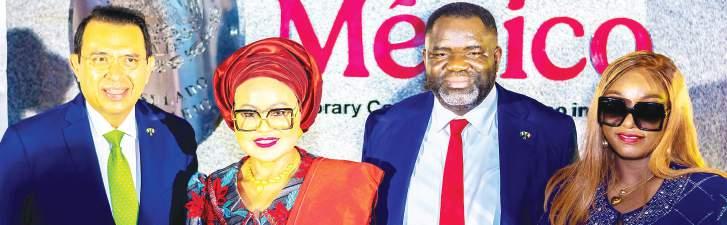
Nigeria’s newly appointed Ambassador to Mexico, Reno Omokri at the top of Mount Kilimanjaro, where he planted the Nigerian flag as a mark of honour to his country.…Mount Kilimanjaro, in Tanzania, is the highest mountain peak in Africa … yesterday
National Assembly to Amend PIA Host Community Provisions, House Member Reveals
The Chairman of the House of Representatives Committee on Host Communities, Dumnamene Deekor, has revealed that Nigeria’s National Assembly plans to review key provisions of the Petroleum Industry Act (PIA).
This comes as stakeholders warned that implementation gaps were weakening the Host Community Development Trusts (HCDTs), designed to deliver development benefits to oil-producing communities.
Deekor, disclosed this in Port Harcourt at the Host Communities Development Forum 2026 and the public presentation of the Gender-Aware Host Community Development Trust Index organised by Policy Alert.
He said lawmakers have already identified several provisions in the PIA that require legislative retooling to ensure the host community framework delivers tangible development outcomes.
“The PIA was a relief to host
communities, but human laws are not without shortcomings,” Deekor said.
“As a committee and in concert with civil society organisations, we have been able to identify some apparent provisions that require legislative retooling for effective implementation of the PIA,” he added.
One of the key concerns, he noted, was the delayed establishment of several Host Community Development Trusts beyond the statutory timeline stipulated in the Act.
“The HCDTs are supposed to be established within 12 months of the PIA being passed, but it is already well beyond this timeframe.
“It is not clear what the new timeframe is, and such timelines should be communicated alongside penalties for further delays”, he said.
Deekor also called for clearer guidelines on how oil companies allocate funds to host communities, particularly in littoral areas where boundary disputes and community delineation issues continue to
complicate implementation.
He further stressed the need for stronger enforcement mechanisms to ensure oil companies comply with their financial obligations to host communities.
According to him, administrative penalties alone may not sufficiently protect host communities affected by delayed or non-compliance with fundingAnotherobligations. critical issue raised by the lawmaker was the lack of transparency on how oil companies calculate their operational expenditure, OPEX, which forms the basis for contributions to host community funds.
“The regulator should specify uniform approaches for oil and gas companies to calculate their operational expenditure,” Deekor said.
Also speaking at the event, Executive Director of Policy Alert, Tijah Bolton-Akpan, said the new index assessed 18 trusts across Rivers and Akwa Ibom states to determine whether the host community framework is delivering on its development mandate.
“This index measures whether the promise of the Petroleum Industry Act is being kept,” Bolton-Akpan said.
He noted that while some trusts have demonstrated strong governance structures and transparency, many still struggle with accountability gaps.
“Too many trusts still operate with opacity, treating transparency as optional and accountability as something to be managed rather than embraced,” he said.
Bolton-Akpan also warned that host communities remain largely unprepared for the global energy transition despite their heavy dependence on the oil and gas sector.
“Not a single trust in this index has developed a comprehensive
strategy for preparing communities for the global shift away from fossil fuels,” he said.
An Assistant Director at Nigerian Upstream Petroleum Regulatory Commission (NUPRC, Mr. Success Ikpe, explained that while the PIA does not mandate gender quotas in the governance structures of Host Community Development Trusts, regulatory guidelines encourage diversity.
“Due consideration shall be given to diversity as it relates to age, gender, and physical disability in determining the criteria for appointment into the governance structures of the Trust,” he said.
Enugu Air Gets Air Operator Certificate in Record Time
Targets regional flights by year end
Enugu Air, on Tuesday, received the Air Operator Certificate, AOC, from the Nigerian Civil Aviation Authority (NCAA), a development it described
Mutfwang Sets Up Advisory Committee on State Police, Seeks to Align With FG’s Push
Yemi Kosoko in Jos
Plateau State Governor, Caleb Manasseh Mutfwang, has inaugurated a 14 member Advisory Committee on State Police, aligning with the federal government renewed drive to strengthen internal security across the country. The inauguration followed President Bola Tinubu’s recent support for the establishment of state police as part of broader reforms to Nigeria’s security
architecture.
Speaking during the ceremony at Government House, Jos, Mutfwang said the committee’s mandate was to undertake a comprehensive review of the concept of state policing within Nigeria’s federal structure and to provide recommendations that would enrich ongoing national policy discussions. He described the assignment as a “patriotic duty,” stressing that Plateau State must be proactive in shaping the emerging national
framework.
The committee was chaired by retired Deputy Inspector General of Police, Habila Joshak, and included seasoned security professionals, academics, and policy experts such as Brig. Gen. Gakji Shipi (Rtd), AIG Bashir Makama (Rtd), Prof. Jamila Nasir, Prof. Chris Kwaja, Prof. Ezekiel Best, and Dr. Julie Sanda, Director General of the Plateau State Peace Building Agency, who would serve as Secretary.
as a significant step in the realisation of Governor Peter Mbah’s vision to position Enugu as a regional hub for commerce, logistics, and aviation in West and Central Africa.
Presenting the AOC to Enugu Air’s Accountable Manager/CEO, Captain Tolu Ita, at the Nigerian Civil Aviation Authority, NCAA, headquarters in Abuja, the agency’s Director General, Captain Chris Najomo, described the development as historic in the Nigerian aviation industry.
He noted that Enugu Air successfully completed the rigorous certification process in just five months and three weeks, significantly faster than the typical industry timeline of 15 to 24 months.
According to the Captain Njomo, the fully state-owned airline also distinguished itself by commencing operations with a complete fleet of six aircraft, which he said was a rare
feat for a newly certified airline in the country.
The DG emphasised the certification process involved extensive evaluation across multiple NCAA departments and confirmed that Enugu Air had met all regulatory requirements, demonstrating full compliance with Nigeria’s aviation safety and operational standards.
He commended the vision and leadership of Governor Mbah, describing the speed and discipline with which the airline project was executed as evidence of purposeful governance.
The DG also acknowledged the dedication of the Enugu State team and urged the airline’s management to continue maintaining the highest standards of safety, regulatory compliance, and operational excellence.
In her remarks, the Accountable Manager/CEO of Enugu Air, Captain
Tolu, expressed appreciation to Governor Mbah for the vision of Enugu Air and also commended him for creating the enabling environment and providing the leadership support that made the record-breaking certification possible.
While thanking NCAA for the professionalism and support shown throughout the certification process, she reaffirmed the airline’s commitment to building a reliable, efficient, and globally competitive carrier that would serve passengers with the highest standards of safety and service.
Speaking, the Commissioner for Transportation, Enugu State, Dr. Obi Ozor, stressed that Enugu Air remained a strategic component of Governor Mbah’s broader transport and logistics transformation agenda aimed at unlocking economic opportunities across Enugu State, the wider South-East region, and Africa.
Blessing Ibunge in Port Harcourt
Acting Group Politics Editor DEJI ELUMOYE
Email: deji.elumoye@thisdaylive.com
08033025611 sms only
Defining Lagos: The King’s College Debate
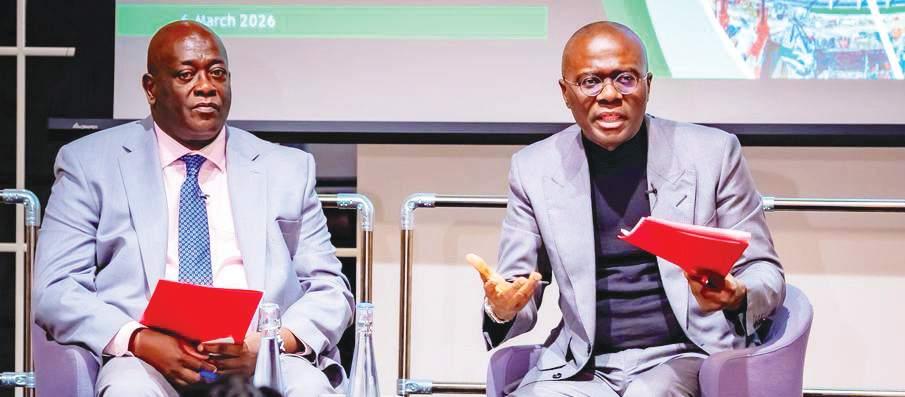
Lagos State Governor, Mr. Babajide Sanwo-Olu, last Friday, spoke at the King’s College in London, during the africa Week, organised by the african Leadership Centre – a moment that gave rise to a redefinition of governance in the state, reports olawale olaleye.
Two days earlier, at Harvard, the United States, the Lagos State Governor, Mr. Babajide SanwoOlu, had taken part in a panel discussion, dissecting trending economic and development issues as they pertained to Lagos State, and Nigeria as well as the connection with the world. This was Wednesday, March 3, 2026.
However, on Friday, March 6, Sanwo-Olu was again at the King’s College in London, to deliver a keynote address titled: “Exercising Agency Beyond the Nation-State” at the Bush House, Central Block.
Beyond the razor-sharp speech was the intentionality behind the marketing of Lagos as the strength of Nigeria as he proudly and aptly put it. His points were direct, pungent and penetrating.
Justifying the mindset that has been largely responsible for his success as governor, Sanwo-Olu said one of his instructive take-off points was because he knew ab initio that Lagos must be governed not as a problem to be managed, but as a platform to be unlocked.
This reality check, he explained, has helped to navigate through the difficult moments and assist to consolidate on some of the profound successes of the Lagos master plan in general.
Sanwo-Olu, who seized the Africa week platform to sell the state and his administration, explained further that, apart from Lagos being the most cosmopolitan urban city in the country, Nigeria equally derived its strength from the state.
According to him, the theme of the speech was both timely and important, because, “for a long time, much of the conversation about power, development and influence has been framed almost exclusively around national governments.”
Situating the topic in context, he said, “But the world we now inhabit is more layered than that. Increasingly, the places where the future is being negotiated in real time are not only capitals and parliaments, but cities. Cities are where demographic change becomes visible.
“They are where technology is tested. They are where climate pressures are felt first. They are where migration, creativity, commerce, inequality, innovation and identity all collide at once. And because of that, cities are no
longer merely administrative units. They are strategic actors.”
Dwelling further on why Lagos mattered in the scheme of things, he said, “Lagos is not simply one state in a federation. Lagos is a living argument about African possibility. It occupies a very small fraction of Nigeria’s landmass, yet it has grown into one of the most economically consequential urban centres on the continent.
“By current estimates, Lagos is now Africa’s second-largest city economy, with GDP at roughly US$259 billion on a purchasing power parity basis.
“It remains Nigeria’s principal commercial gateway, a major destination for capital, enterprise, talent and ideas, and one of the clearest examples anywhere in Africa of how a sub-national government can shape not only local outcomes, but wider regional and global conversations.
“But Lagos is not important only because of its size. It is important because of what it represents. It is youthful. It is restless. It is diverse. It is globally connected. It is a city that absorbs people, ambition and pressure at extraordinary speed.
“We currently estimate a median age of just 23.5, a very large workingage youth population, strong female labour- force participation, and more than 2,000 new migrants arriving daily. Those numbers are not abstract.
“They mean that every day in
Lagos, the demands on transport, housing, health systems, schools, security, the environment and jobs are renewed in real time. That is the context in which we govern.
“So, when we speak of agency in Lagos, we are not speaking in the abstract. We are speaking about the discipline of governing a city that does not pause for theory.
“We are speaking about the choice to act with intention rather than to surrender to scale. We are speaking about refusing the old assumption that African cities are merely sites of deficiency, congestion, informality and endless crisis.”
According to the Lagos governor, “My own conviction, since assuming office in 2019, has been that Lagos must be governed not as a problem to be managed, but as a platform to be unlocked.
“That is the spirit behind our development philosophy in Lagos, captured in our THEMES+ agenda. We needed an operating system that could hold together the complexity of a mega-city: transport and traffic management; health and environment; education and technology; making Lagos a 21st century megacity; environment and tourism; security and governance; and, importantly, social inclusion, gender equality and youth.
“This framework became even more necessary because Lagos, like many global cities, has had to confront overlapping shocks in recent years: the COVID-19 pandemic, rapid population expansion, rising climate risks and a very substantial infrastructure financing gap.
“One of the clearest expressions of urban agency is mobility. A city that cannot move people efficiently cannot unlock productivity,
Justifying the mindset that has been largely responsible for his success as governor, sanwoolu said one of his instructive take-off points was because he knew ab initio that lagos must be governed not as a problem to be managed, but as a platform to be unlocked.
dignity or inclusion. That is why transport has been central to our work.
“In the years since 2019, Lagos has accelerated the building of a genuinely multimodal transport system. The Blue Line rail began passenger operations, the Red Line was inaugurated as a second intra-city rail corridor, and we have continued work around roads, bridges, bus reforms and water transport as part of a broader mobility architecture.”
Taken together, Sanwo-Olu added that, “Another reason Lagos is relevant to this conversation is that it demonstrates how policy and enterprise can reinforce each other. Lagos has emerged as the anchor of Nigeria’s startup landscape and one of the most dynamic technology ecosystems in the world.
“Lagos was recently ranked the world’s fastest-growing tech ecosystem, in that it hosts more than 2,000 startups, and has produced five unicorns across fintech and digital commerce.
“What this tells us is something profound: agency in the 21st century is not exercised only through ministries and memoranda. It is also exercised through enabling platforms, regulation, talent formation, connectivity, payments infrastructure and the confidence to let innovation scale.
“In Lagos, we have tried to create an environment where government does not suffocate enterprise, but rather clears a path for it. That same story is true in the creative economy. One of the great mistakes often made about African cities is to treat culture as an accessory rather than as economic infrastructure. Lagos teaches a different lesson.
“In Lagos, music is industry. Film is industry. Fashion is industry. Design is industry. Digital content is industry. Identity itself becomes productive capital.
“Nollywood’s scale, the density of production companies in Lagos, the global reach of our musicians, the visibility of our fashion ecosystem, and even new frontiers such as technology-themed filmmaking all point to a city in which creativity is not merely expressive, but developmental.
NOTE:
l-R: Visiting Professor at the African leadership Centre, Ambassador manoah Esipisu and lagos state Governor, mr. Babajide sanwo-olu, during the question and answer session at the Africa Week, King’s College, london... Friday
Senate Squares Up with NNPCL over N210trn Oil Revenue
Nigeria’s Senate has ignited a political firestorm over N210 trillion in disputed oil revenues linked to the Nigerian National Petroleum Company Limited (NNPCL). With threats of arrest warrants against former and current officials, the confrontation signals a defining test of accountability, legislative authority and transparency in the management of the nation’s vast petroleum wealth. Sunday Aborisade reports.
Adramatic confrontation is unfolding at the heart of Nigeria’s political and economic establishment. At stake is a staggering N210 trillion, a figure so enormous that it has ignited fierce debate within the corridors of power and raised troubling questions about transparency in the management of the nation’s oil wealth.
The Senate’s Public Accounts Committee (SPAC) has drawn a hard line, threatening to issue a warrant of arrest against former and serving officials of the Nigerian National Petroleum Company Limited (NNPCL) if they fail to explain how the colossal amount surfaced in the company’s audited accounts without clear reconciliation.
For lawmakers, the matter is not merely about accounting irregularities; it is about public trust, institutional accountability and the credibility of Nigeria’s most strategic revenue-generating enterprise. The unfolding standoff has set the stage for one of the most consequential legislative probes in recent years.
At the centre of the storm is the former Group Chief Executive Officer of the NNPCL, Mele Kyari, along with other senior officials who managed the national oil company during the period under investigation.
The Senate committee, chaired by Senator Aliyu Wadada, has summoned Kyari, the former Chief Financial Officer, Umar Ajia Isa, and the former Group General Manager of the National Petroleum Investment Management Services (NAPIMS), Dr. Bala Wunti.
They are expected to appear before the panel alongside the current leadership of the company to respond to audit queries covering the period between 2017 and 2023.
The lawmakers’ message has been unequivocal: failure to honour the invitation could lead to compulsory appearance through an arrest warrant. Wadada, speaking after a committee meeting in Abuja, made it clear that the Senate would not tolerate any attempt to evade accountability.
He said, “The NNPCL should refund the sum of N210 trillion, being the combined figure of N103 trillion and N107 trillion, which were not properly accounted for as contained in the audit reports. NNPCL should and must account for the two figures.”
Wadada was even more emphatic in detailing the committee’s concerns.
He said, “Five billion naira is also lingering on NNPCL. In this day and age, who will comprehend such a figure to be expended just to change the name of NNPC incorporation from NNPC to NNPCL? Five billion naira !
“NNPCL should refund the sum of N210 trillion being the combined sum of N103 trillion and N107 trillion which were not properly explained to the committee as the aggregate sum cannot be netted off in tandem with accounting principles.
“Mele Kyari as the Group Managing Director, Umar Ajia as the Chief Financial Officer and Bala Wunti as the then GGM NAPIMS should and must appear before the committee and be led by the present management with the entire body of the external auditors that served within the period under review that put together this report.
“NNPC paid N2.9 billion for incorporation expenses from petroleum product proceeds while NAPIMS charged another N2.9 billion against crude oil revenue for the same purpose.
“This resulted in a combined total amount of N5.9 billion being expended for incorporation by NNPCL just to change the name from NNPC to NNPCL, which is unacceptable and rejected.”
The committee’s insistence reflects the gravity of the situation. The amount in question dwarfs many of Nigeria’s annual budgets and represents a significant portion of the country’s cumulative public revenues over several years.
The controversy stems from findings contained in the audited financial statements of the NNPCL and queries raised by the Office of the Auditor-General for the Federation.
Two major figures have triggered alarm within the Senate.
The first is N103 trillion, which the NNPCL claimed represents cumulative expenditure by its joint venture partners through cash calls since 2017.
The second is N107 trillion, recorded in the company’s financial statements as subsidyrelated receivables owed by banks and other entities.
When combined, the figures amount to N210 trillion. A number that senators say remains insufficiently explained. For the committee, the explanation offered by the oil company so far has been far from convincing.
Wadada dismissed the response provided by NNPCL officials during earlier interactions with the panel, saying the explanation failed to clarify the origins and legitimacy of the figures.
He said, “NNPCL responded that the N103 trillion represented cumulative amounts expended by NNPCL joint venture partners from JV cash calls since 2017.
“This response is unacceptable and the figure of N103 trillion is still hanging and must be properly explained.”
The committee insists that the public deserves clarity on how such an enormous amount could appear in the financial records of the country’s most critical economic institution without proper reconciliation.
Beyond the massive financial discrepancies, the Senate has also raised eyebrows over a seemingly smaller but symbolically significant expenditure: N5.9 billion reportedly spent on changing the company’s name from NNPC to NNPCL following the implementation of the Petroleum Industry Act (PIA).
The transformation from the Nigerian National Petroleum Corporation to the Nigerian National Petroleum Company Limited was meant to mark the transition of the state oil
The N210 trillion question has opened a new chapter in Nigeria’s ongoing debate over transparency, accountability and the stewardship of its vast oil wealth. And as the Senate presses forward with its investigation, the nation watches closely, fully aware that the outcome may reshape the future of governance in Nigeria’s most vital industry.
company into a commercially driven entity.
However, senators have questioned why such a large sum was required for what they described as a corporate transition exercise.
“To us in the committee, this is unacceptable and satisfactory explanations must be given,” Wadada said.
Tensions between the Senate and the NNPCL escalated further in July 2025 when lawmakers threatened to issue an arrest warrant against the company’s current Group Chief Executive Officer, Engr. Bayo Ojulari.
Ojulari had failed to appear before the committee four consecutive times, prompting outrage among lawmakers who interpreted his absence as an attempt to evade legislative scrutiny.
During one particularly tense session, a letter delivered by the company’s Chief Financial Officer, Dapo Segun, explained that the CEO had been summoned by President Bola Tinubu and could not attend the Senate hearing. But the explanation failed to calm the aggrieved lawmakers.
“This is the fourth time he’s avoiding us,” Wadada said at the time.
“The National Assembly is not an institution to be taken lightly. Enough is enough.”
Several senators echoed similar sentiments, warning that persistent absence from the hearings would be treated as contempt for the legislative arm of government.
The confrontation between the Senate and the NNPCL highlights a deeper institutional struggle: the balance between legislative oversight and executive authority.
Under Nigeria’s 1999 constitution (as amended), the National Assembly is empowered to investigate the finances of public institutions and ensure that government revenues are properly managed.
Section 85 of the Constitution grants the Auditor-General the authority to examine the accounts of public institutions, a provision that the Senate committee has invoked in directing a forensic audit of the NNPCL’s financial statements.
For lawmakers, the probe represents a crucial test of whether Nigeria’s oversight institutions can hold powerful economic actors accountable. “This will not just go down the drain,” Wadada insisted.
The committee has also directed the NNPCL to remit to the treasury all production costs charged against crude oil revenues during the
NOTE: Interested readers should continue in the online edition on www.thisdaylive.com
Akpabio
Wadada
Ojulari
How SWAI’s Spotlight Shone on Governor Umo Eno for Advancing People-centric Governance
For years, the Security Watch Africa Initiatives (SWAI) Network has spotlighted leaders and institutions shaping peace, security, and good governance across the continent. Through its annual Africa Security Watch Conference & Awards, the organisation brings international attention to African leadership that is making measurable impact. This year, amongst other nominees, the spotlight shone on Pastor Umo Eno, Governor of Akwa Ibom State, for promoting inclusion and advancing people-centred governance. Chiemelie Ezeobi reports
The Security Watch Africa Initiatives (SWAI) Network has, over the years, distinguished itself as a premier platform that recognises and showcases African leadership, governance, and innovation. By identifying leaders whose actions advance peace, security, and societal development, SWAI not only celebrates excellence but also sets benchmarks for good governance across the continent.
Its annual Africa Security Watch Conference & Awards convenes high-level dignitaries, policymakers, and thought leaders from across Africa to spotlight transformative leadership that inspires change and promotes stability.
At the forthcoming 19th 2025 Africa Security Watch Conference & Awards, scheduled for May 12–14, 2026 at Story Le Carrousel, Rabat, Morocco, organised in partnership with Stellenbosch University of South Africa and with support from the Kingdom of Morocco, SWAI will continue this tradition of recognising leaders whose governance strengthens security, unity, and social cohesion.
The event will host participants from Nigeria, Ghana, South Africa, Liberia, Kenya, The Gambia, Senegal, Côte d’Ivoire, Tanzania, Ethiopia, Namibia, and Mozambique, bringing together government officials, security experts, and development stakeholders to deliberate on governance, peace, and sustainable development.
Among the distinguished honourees this year is Pastor Umo Eno, Governor of Akwa Ibom State, who has been selected to deliver the keynote address and billed for the “African Leader in People-Centric Governance in the Year 2025.”
Why Governor Umo Eno?
Speaking on behalf of the International Awards Panel, Mr. Patrick Agbambu, President/Chief Executive Officer of SWAI, explained the rationale for the honour.
According to him, “Under the enlightened leadership of Your Excellency, Akwa Ibom State has consolidated its position as a pillar of stability, security, and constructive engagement in Nigeria and beyond.
“Your strategic vision has mobilised capacities in the service of sustainable development, social cohesion, and the promotion of peace and security, both at the State and National levels.
“In accordance with our tradition of recognising African leadership that has made tangible contributions to strengthening security and good governance, we would be deeply honoured should Your Excellency graciously consent to deliver the Awards Keynote Address, with a focus on the Impact of People-Centric Governance on Security and Development at the 19th Africa Security Watch Conference & Awards.”
Agbambu further noted that the Board, Executive Committee, and International Awards Panel of Judges unanimously agreed to confer the distinction on Governor Eno. The award recognises African State, Regional, or Provincial Administrators whose leadership contributes in a sustained and exemplary manner to peace, security, and societal development across the continent.
Governor Eno and People-Centric Leadership in Action
Governor Umo Eno’s recognition reflects a governance philosophy anchored on unity, inclusiveness, and cooperation across political and social divides. Since assuming office in May 2023, he has consistently emphasised that governance must prioritise
the collective interest of citizens over partisan considerations.
This approach has sent a clear message that Akwa Ibom belongs to all residents regardless of political affiliation, ethnicity, religion, or social background.
Promoting Inclusive Governance
Central to Governor Eno’s leadership style is ensuring that government policies and programmes benefit the broadest spectrum of society.
He has repeatedly stated during public engagements that his administration serves all citizens of Akwa Ibom State, not only members of his political party. Empowerment programmes, appointments, and development initiatives reflect participation from diverse communities and political affiliations, reinforcing trust in governance as a shared enterprise.
Governor Eno has also maintained cordial relationships with leaders across political divides. Former governors are frequently invited to state functions and project commissioning ceremonies, an approach that promotes continuity in governance and reduces political hostility.
By recognising the contributions of past administrations and encouraging cooperation among political actors, the government fosters a culture of mutual respect and institutional stability.
Engagement with community leaders, youth organisations, and civil society groups has further strengthened social harmony. Since 2023, the state has maintained a relatively peaceful environment, enabling government to focus on development projects and social welfare programmes.
Recognising the importance of youth in national development, the governor has also implemented initiatives supporting entrepreneurship, skills acquisition, and employment opportunities for young people across the state.
From vocational training programmes to grants for small businesses, these initiatives are designed to empower young people to become self-reliant and active contributors to economic growth. By engaging youths across local government areas, the administration has also helped mitigate potential political tensions while promoting productivity and community development.
Embracing
indigenous and non-indigenous communities, and the administration has actively engaged these groups in economic and social development initiatives.
By encouraging investment and participation across sectors, the government ensures that all residents feel included in the state’s development trajectory.
Governor Eno has also promoted cultural festivals, sporting activities, and community development programmes that bring citizens together across political and social lines. Through these efforts, the administration has strengthened social cohesion, political stability, and inclusive development, reinforcing Akwa Ibom’s reputation as a peaceful and investment-friendly state.
His upcoming keynote address at the 19th Africa Security Watch Conference & Awards in Morocco and the conferment of the African Leader in People-Centric Governance Award highlight this approach to leadership and underscore the state’s growing reputation for unity-driven governance.
Award Nominees and Categories
The nominees include His Majesty King Mohammed IV, The King of the Kingdom of Morocco, who is set to receive the Most Exemplary African Leader of the Year 2025.
His Excellency Pastor Umoh Eno, Executive Governor of Akwa Ibom State, Nigeria, will be honoured with the African Leader in People-Centric Governance in the Year 2025, while His Excellency Dr. Peter Ndubuisi Mbah, Executive Governor of Enugu State, Nigeria, is slated to receive the African Leader in Governance (Security and Human Development) in the Year 2025.
Senator Abubakar Kyari, CON, Honourable Minister of Agriculture and Food Security, Abuja, is expected to be recognised as the African Leader in Governance (Food Security) in the Year 2025, while CGC Bashir Adewale Adeniyi, MFR, Comptroller General of Customs, Nigeria Customs Service, will receive the Best Public Administrator in the Control of Illicit Trade in Africa in the Year 2025 and will also be recognised
for the Best African Customs Service in the Year 2025.
CP Baba Mohammed Azare, FSI, Commissioner of Police, Akwa Ibom State Police Command, Nigeria Police Force, will be honoured as the Best AntiCrime Bursting Police Chief in West & Central Africa in the Year 2025, as well as for Most Proactive Police Command in Nigeria in the Year 2025, while CP Mamman Bitrus Giwa, Commissioner of Police, Enugu State Police Command, Nigeria Police Force, is set to receive the Best Crime Bursting Police Chief in West Africa in the Year 2025.
His Excellency Senator Douye Diri, Executive Governor of Bayelsa State, Nigeria, is expected to receive the African Leader in Governance (Peace and Security) in the Year 2025, while the Nigerian Army, Army Headquarters, is slated to be awarded the African Best National Army in Counter-Terrorism Operations in the Year 2025.
Most Distinguished Senator Barau Jibrin, Deputy President of the Senate, Federal Republic of Nigeria, National Assembly, Abuja, will be recognised with the African Leadership Award for Excellence in Parliamentarian Oversight in the Year 2025, while General Christopher Gwabin Musa, OFR, Honourable Minister of Defence, Federal Republic of Nigeria, Abuja, is expected to receive the African Defence Man of the Year 2025.
The Nigerian Navy, Naval Headquarters, Abuja, will be honoured as the African Most Outstanding Navy in the Year 2025, while the Nigeria Police Force, Force Headquarters, Abuja, is set to receive the Most Outstanding National Police Force in Africa in the Year 2025. Colonel Anele Onyinyechi Appolonia, Acting Director Army Public Relations, Nigerian Army, will also be recognised as the Best Security Spokesperson in West and Central Africa in the Year 2025.
IGP Seedy Mukhtar Touray, Inspector General of Police, The Gambia Police Force, Banjul, The Gambia, is expected to receive the Best Police Administrator in West & Central Africa in the Year 2025, while The Gambia Police Force, Banjul, The Gambia, will be awarded the Best Police Force in West & Central Africa in the Year 2025.
Hon. Gregory O. W. Coleman, Inspector General of Police, Liberia National Police, Monrovia, Liberia, will be recognised as the Best Police Administrator in West Africa in the Year 2025. His Excellency Mr Adama Barrow, GMRG, President of the Republic of The Gambia and Commander-in-Chief of the Gambia Armed Forces, is expected to receive the African Leader in Governance (Security and Infrastructural Development) in the Year 2025, while His Excellency Joseph Nyumah Boakai Sr., President of the Republic of Liberia and Commanderin-Chief of the Armed Forces of Liberia, will be recognised as the African Leader in Governance (Security and Poverty Alleviation) in the Year 2025.
The Commissioner General of the Ghana Boundary Commission is slated to receive the Best Boundary Commission in West & Central Africa in the Year 2025, while the Director General, Department of State Services (DSS), Maitama Avenue, Aso Drive, Abuja, will be recognised as the African Chief Intelligence Officer of the Year 2025.
Finally, an award will also go to the Best Executive Close Protection Police Officer in West & Central Africa in the Year 2025.
L-R: President/Chief Executive Officer, Security Watch Africa Initiatives Network, Mr. Patrick Agbambu; Pastor Umo Eno, Executive Governor of Akwa Ibom; Member, SWAI Network Board, Alhaji Suleiman Uba Gaya; and National Coordinator SWAI Awards, Elizabeth Tanko, when the SWAI team paid a courtesy call to present letter of award and invitation to deliver the keynote address at the 19th Africa Security Watch Conference and Awards scheduled for May 12–14, 2026 in Rabat, Morocco
Photo Credit: Idara a diakpan ( s pecial a ssistant/ Chief Photographer to the Governor of a kwa Ibom)
Lanre Alfred
…truth behind the headlines, conspiracies, cover-ups, trials and triumphs
The Billionaires’ Coup with
Ihave always found billionaire rankings faintly theatrical. They arrive every year with the ceremonious inevitability of a society wedding— glossy, breathless, and full of numbers that make ordinary mortals blink twice.
Wealth lists have a way of turning the serious arithmetic of commerce into something resembling aristocratic genealogy. Who has risen? Who has slipped? Whose fortune has ballooned like a festival balloon, and whose has shrunk like an over-watered soufflé?
The latest Forbes 2026 Africa’s Richest People ranking has delivered a headline that cannot be ignored, even by those who pretend not to care about billionaire scoreboards.
Alhaji Abdulsamad Rabiu has officially become Nigeria’s second richest man and the third richest billionaire in Africa.
Let that sink in for a moment. The Kano-born industrialist, chairman of BUA Group and one of the most quietly formidable businessmen on the continent, now commands an estimated fortune of $11.2 billion. That figure represents not just a modest climb up the wealth ladder but an astonishing 120 percent leap in a single year—an increase of $6.1 billion that has left even seasoned watchers of African capitalism raising their eyebrows.
In the careful language of Forbes, Rabiu is the biggest gainer on the entire continent this year.
In the more conversational language of Lagos drawing rooms, Abuja boardrooms, and Kano business salons, the meaning is simpler: Rabiu has conquered the billionaire league table. And in doing so, he has quietly rearranged the familiar hierarchy of Nigerian wealth.
For decades, the ranking of Nigeria’s richest men has seemed almost carved in granite. At the summit stood Aliko Dangote, the industrial colossus whose cement plants, sugar refineries, fertiliser factories, and now oil refinery have built a fortune so vast it often appears geological in scale. Behind him stood Mike Adenuga, the famously reclusive telecoms tycoon whose Globacom empire and oil investments made him one of Africa’s most enduring billionaire legends.
That order felt almost permanent. Until now. And that is because the new Forbes list places Rabiu squarely between Dangote and the rest of Africa’s tycoon class, occupying the third position on the continent behind only Dangote and South Africa’s luxury goods baron Johann Rupert.
The ranking delivers another striking twist in the Nigerian billionaire drama. Mike Adenuga now occupies the sixth position on the continental list, with a fortune estimated at $6.5 billion, placing him firmly behind Rabiu’s surging $11.2 billion wealth.
To put it plainly, and without delicate circumlocution, Abdulsamad Rabiu is now significantly richer than Mike Adenuga. His estimated fortune of $11.2 billion now sits comfortably ahead of Adenuga’s $6.5 billion. But of course, the real story is not simply the gap between those numbers. The real story lies in the meaning that
people attach to them, and in Nigeria’s rarefied circles of business and influence, those meanings are already generating a thousand conversations, some admiring, some analytical, and a few quietly incredulous.
Because anyone familiar with the psychology of wealth, particularly wealth at this dizzying altitude, knows that rankings such as those released annually by Forbes are never merely numerical curiosities. They function as a kind of social barometer, a map of prestige and power that subtly rearranges the hierarchy of the business aristocracy.
Investors study them with the same attentiveness that political observers devote to election results. Corporate strategists read them for clues about market momentum. And society itself treats them as a scoreboard in the ongoing drama of ambition, rivalry, and industrial achievement.
The Forbes ranking has now formalised what the markets have been quietly signaling for months: Rabiu’s business empire has entered a new phase of expansion and recognition.
What makes this moment particularly intriguing, at least to those who enjoy observing the personalities behind great fortunes, is the curious fact that Rabiu himself appears almost constitutionally uninterested in the spectacle of billionaire rankings. Unlike some members of the global ultra-wealthy who treat such lists as personal trophies, Rabiu has cultivated the reputation of a man who regards them with polite detachment.
Associates who have spent time in his company often remark that he seldom dwells on the public show of wealth. The conversation, when it turns to business, tends instead toward production capacity, infrastructure investment, or the strategic evolution of markets. In other words, the language of industry rather than the theatre of celebrity capitalism.
This temperament sets him apart in an era when many billionaires seem almost compelled to perform their prosperity for the public gaze. And yet, as often happens in the strange ecology of wealth and public attention, headlines have found him anyway. The catalyst for his sudden prominence is not a flamboyant acquisition or a spectacular technological breakthrough but the extraordinary performance of BUA Cement, the industrial flagship of his sprawling conglomerate.
Over the past year, shares of the company have climbed by an astonishing 135 percent, a surge so dramatic that it has outpaced even the already buoyant performance of the Nigerian Stock Exchange. Honestly, in top business schools across the continent and beyond, his financial and market exploits are veritable case-studies for academic researches.
To understand why that matters, one must consider the broader economic context. Nigeria’s equity markets have been enjoying a remarkable rally, driven by a combination of stronger corporate earnings and regulatory shifts that encourage pension funds to allocate a greater portion of their assets to equities. The result has been a powerful influx of institutional investment into the stock market, pushing the benchmark index upward by roughly 81 percent and carrying many listed companies to record valuations.
But even within this environment, BUA Cement has emerged as a standout performer. Investors who once viewed the company as merely another participant in Nigeria’s fiercely competitive cement industry have begun to recognize the scale and strategic coherence of Rabiu’s industrial vision. What they are seeing, in effect, is not simply a cement manufacturer but the nucleus of a much broader economic ecosystem.
Indeed, when one surveys the reach of BUA Group, the scope of that ecosystem becomes strikingly clear.
The conglomerate now operates across a wide array of sectors that form the structural backbone of modern economies: cement production, sugar refining, flour milling, infrastructure development, and port operations. These are not glamorous industries in the sense that Silicon Valley has accustomed the world to glamour. They do not produce viral technologies or social media sensations. They do not inspire breathless headlines about digital disruption.
Yet they produce something far more fundamental: the raw materials upon which economies are built.
Cement, after all, constructs the cities in which modern life unfolds. Sugar and flour sustain the vast networks of food production that feed entire populations. Infrastructure—roads, ports, and logistics systems—makes trade possible and connects markets that would otherwise remain isolated. When viewed through that lens, Rabiu’s fortune appears less like a speculative bubble and more like the byproduct of a carefully constructed industrial architecture.
In other words, his wealth grows out of the bones of the real economy.
That distinction may help explain why his rise carries a certain gravitas that speculative fortunes sometimes lack. This is not the familiar Silicon Valley narrative in which a start-up founder becomes a billionaire overnight through digital innovation. Rabiu’s ascent is the result of decades of methodical expansion, strategic investment, and the steady accumulation of productive assets. His empire has been built, quite literally, brick by brick—an observation that becomes almost poetic when one remembers that cement remains the foundation of the enterprise.
Rabiu’s super ascent signals that another pole of industrial power is taking shape alongside that legacy. The Forbes numbers make this shift particularly vivid. Only a year ago, Rabiu occupied the sixth position on Africa’s billionaire list. Today he stands at number three in Africa, a leap that few observers could have predicted with confidence.
Such dramatic movements are rare in the world of billionaires, where fortunes tend to evolve gradually rather than explosively. To climb three places in a single year requires a convergence of favorable circumstances: market momentum that lifts asset values, corporate performance that exceeds expectations, strategic decisions that pay off at precisely the right moment, and perhaps a measure of luck. Rabiu, it would appear, has benefited from all of these forces simultaneously.
Yet wealth rankings, fascinating though they may be, reveal only part of the picture. To understand Rabiu’s growing stature in African business, one must also
consider the influence he exerts beyond the balance sheets of his companies.
If entrepreneurship were an art, you could call Abdusamad Rabiu, Michelangelo. If it were classical music, you may call him Mozart. If it were philanthropy, you may call him Saint Michael. In recent years he has become one of the continent’s most visible philanthropists through the Abdul Samad Rabiu Africa Initiative, a foundation that has committed billions of naira to projects in healthcare, education, and social development. Universities across Nigeria have received substantial grants for infrastructure improvements, enabling the construction of lecture halls, laboratories, and student facilities that might otherwise have remained dreams on paper. Hospitals have benefited from targeted funding designed to improve medical capacity and patient care. During the COVID-19 pandemic, the foundation financed emergency interventions aimed at supporting overwhelmed health systems.
These philanthropic efforts add a compelling dimension to Rabiu’s public persona. They present him not merely as an industrial magnate but as a figure increasingly invested in shaping the broader developmental trajectory of the continent. In this sense, the Forbes ranking feels less like a personal victory lap than the emergence of an institutional force whose influence extends far beyond commerce.
Within Nigeria’s crowded corporate landscape, BUA Group is no longer simply another conglomerate competing for market share. It is evolving into something larger: a continental industrial platform capable of shaping supply chains, infrastructure networks, and manufacturing capacity across multiple sectors.
The Forbes ranking illustrates how quickly the balance of wealth can change in the modern global economy. Industries evolve, markets fluctuate, and fortunes rise or fall with surprising speed. In this particular moment, Rabiu’s industrial bets, especially his heavy investments in cement and manufacturing, have delivered spectacular results.
For Nigeria, his ascent carries a message that extends beyond the fascination of society gossip. In a country frequently burdened by stories of economic hardship and political turbulence, Rabiu’s rise offers a reminder that large-scale enterprise remains possible. It demonstrates that African entrepreneurs can build industrial organizations capable of competing on a continental stage.
Viewed in that light, Rabiu’s ascent represents more than a personal financial milestone. It is a story about scale, vision, and persistence, the story of an entrepreneur from Kano who patiently constructed an empire that now ranks among the largest in Africa.
And if the latest Forbes list has done nothing else, it has delivered one unmistakable conclusion: Abdulsamad Rabiu now stands as Nigeria’s second richest man and the third richest billionaire on the African continent. Whether he personally cares about the ranking is almost beside the point, because society, with its enduring fascination for hierarchies of wealth, certainly does. This year, at least, the scoreboard belongs unmistakably to Rabiu.
AlhajiAbdulsamadRabiu
MikeAdenuga
AlikoDangote
TUNDE OLUSUNLE pays tribute to Sonny Echono, Executive Secretary of TETFund
IWD: EIGHT ACTIONS FOR A MORE EQUAL
WORLD
Advancing equality is one of the strongest drivers of sustainable development and peace, argues ANTONIO GUTERRES
ECHONO IN TETFUND: FOUR YEARS ON
THE TRIAL OF EL-RUFAI
ABUBAKAR SHEHU contends the need for the law to run its course
See page 21 See page 21
Ours is a society famous for addiction to titular prefixes and grandiose appellations. Single individuals want to be acclaimed "High Chief;" "Rt. Honourable," "Senator;" "Engineer;" "Dr;" "Pastor," and more, in a single fare. The obsession with being addressed as "Dr" albeit honorary, and most probably procured from nondescript, backwoods, recently compelled the National Universities Commission, (NUC), to come very hard on the misuse and desecration of the hallowed title. It can indeed only be publicly worn by those who have attended institutions accredited to run doctorate degrees, who have duly undergone, completed and passed relevant courses and prescribed examinations, whose dissertations have been assessed and adjudged successful, and who have been officially approved as qualified by the awarding citadel, upon internal and external attestation.
That he has elected to maintain the title by which he has been known and addressed for four full decades and more, despite duly earning the highest attainable educational qualification in the academia, is testament to Sonny Togo Echono's uncommon humility. To be sure, he graduated with a bachelor's degree honours and a masters in architecture in 1983 and 1985, respectively. He is also a revered *Fellow* of the profession which umbrella body he presently serves as National President. Through decades therefore, the title by which he has been known and addressed is that of "Architect." He equally holds a string of traditional titles from his homeland in the Idoma country of Benue State. Friday July 18, 2025, the Abuja Leadership Centre, (ATC) of University of Abuja, which has since been rechristened *Yakubu Gowon University,* certified Echono qualified for the award of a doctorate in Public Governance and Leadership. Director of the Centre, Prof Philip Dahida, acknowledged Echono's "excellent presentation, courage and relentless efforts in navigating the challenges of the doctorate programme, despite his schedule as a very notably busy public officer holder in Nigeria."
Echono spent the last five years of his most eventful career as Permanent Secretary in the Federal Ministry of Education. One finding which agitated his mind was the deep-seated controversies and subsequent acrimony which attended the selection of Vice-Chancellors who are chief executives of universities. He was a student at the Ahmadu Bello University, (ABU), back in the early 1980s when selections into university leadership was strictly meritbased and devoid of sentiments, consistent with global best practices, a tradition
which impacted quality and global respect even for Nigerian institutions. This gold standard, however, had been impacted over time, by creeping parochialism and extraneous considerations, such that frictions between university governing councils and university administrations had become prevalent.
Despite the imminence of his retirement from public service nonetheless, Echono reckoned it would be worthwhile to contribute to rectifying this situation by way of a dedicated doctoral engagement. Central to his research findings was the imperative for transparency and inclusiveness in public sector decision making, in relation to selection processes in Nigeria's university ecosystem. Like he noted when he addressed his panel of examiners that July 18, 2025, "My thesis is directly relevant to the selection processes which have accentuated conflicts between governing councils and university administrations, as well as between ministries and governing bodies. Issues of localisation, politics and nepotism are prevalent. By implementing a transparent and accountable template which incorporates stakeholders, which rewards merit and performance, which has inbuilt mechanisms for checks and balances, we can make progress as a nation."
It was as if Echono was clairvoyant that he would still have a role to play in the administration of Nigeria's education sector when he undertook his doctorate.
Just weeks after his retirement from service, former President Muhammadu Buhari recalled him on Friday March 4, 2022, to serve as Executive Secretary of the Tertiary Education Trust Fund, (TETFUND). The organisation was first birthed in 1993 as the *Education Tax Fund,* (ETF), to help stem the decline in the public tertiary education system, encompassing universities, polytechnics and colleges of education. The deafening drop in standards across the deck at the time was attributed to poor
funding by the federal government. The ETF mutated into TETFUND in 2011. It had been administered by Mallam Tijani Ahmed Abdulkadir; Mallam Mustapha Abba Aji; Prof Mamood Yakubu; Mallam Aliyu Na'Iya; Dr Abdullahi Baffa and Prof Suleiman Elias Bogoro, before Echono was beckoned to step forward.
Increasing demand for tertiary education by the nation's rapidly growing population has culminated in the expansion of tertiary institutions across the country. The NUC recently confirmed a total of 309 universities in Nigeria for instance, about 140 of which are publicly owned and almost evenly split between the federal and state governments. Public polytechnics are said to number about 86, and colleges of education around 80. It is the statutory responsibility of TETFUND to intervene in the sustenance of this behemoth in key intervention areas like infrastructure (construction of classrooms, laboratories, theatres and halls); research and publication (funding for research, book development and academic publishing), and staff development (sponsorship of academic staff training and development).
Since his assumption of duties on Friday March 18, 2022, a fortnight after his appointment was announced, Echono has been at the fore of quiet, well reasoned reforms and innovations, which have revolutionised the operations of our tertiary institutions. These include digital transformation through the digitization of TETFund's operations, moving from paper-based processes to electronic systems, reducing processing times and improving transparency in project monitoring. Procurement reforms entail rigorous quality assurance mechanisms, stricter oversight, and enhanced monitoring to ensure projects meet specified standards, curbing practices like contract splitting and job padding. To ensure transparency and accountability, Echono has established a national research bank, launched the Tertiary Education Research and Applications Systems (TERAS) platform, and introduced antiplagiarism software to promote academic integrity.
Capacity building has equally received deserved attention under his watch as he has organized seminars and workshops to reorientate the workforce, emphasizing ethics and best practices, and sponsored thousands of academic staff for advanced training.
Olusunle, PhD, Fellow of the Association of Nigerian Authors, (FANA), is an Adjunct Professor of Creative Writing at the University of Abuja
Advancing equality is one of the strongest drivers of sustainable development and peace, argues ANTONIO GUTERRES
IWD: EIGHT ACTIONS FOR A MORE EQUAL WORLD
Over nearly a decade leading the United Nations, I have seen our world repeatedly tested – by climate shocks, deepening poverty, violent conflict and shrinking civic space.
But I have also watched many solutions take root, and they shared one common denominator: women.
As the world marks International Women’s Day, it is time to recognize that gender inequality is the greatest human rights challenge of our time –and advancing equality is one of the strongest drivers of sustainable development and peace.
Here are eight actions drawn from my own experience, and inspired by the work of the UN system and civil society movements across the globe, to advance women’s rights and deliver results.
One, Fix the Power Gap:
Gender equality is a question of power. But male-dominated institutions still shape our world. A rising tide of authoritarianism is deepening these inequalities, rolling back hard-won protections – from fair work practices to reproductive rights – and entrenching racial and gender biases that hold women back. Gender equality lifts societies. When power is shared, freedom expands.
Two, Make Parity a Priority:
Women are grossly under-represented in governments and boardrooms across the globe. At the United Nations, we set out to make gender parity a priority, starting with senior leadership. We did this by widening the search for qualified candidates, not by lowering standards. The UN is stronger for it, with an enhanced workplace culture and more inclusive decision-making. The lesson is clear. When institutions choose equality, results follow.
Three, Bet on the Highest-Return Investment:
Investment in women delivers outsized returns. Every dollar spent on girls’ education yields nearly triple the gains, while maternal health and family planning generate more than eightfold benefits. Policies that support families such as child care and elder care strengthen communities and unlock even more growth. Taken together, such steps lay the foundation for closing gender gaps – which can boost national income by as much as 20%.
Four, Make Room at the Peace Table Peace agreements are more durable when women take part in negotiating and implementing them. Yet in too many conflicts – including Gaza, Ukraine, and Sudan – women have been largely shut out of the room, even though they carry the heaviest burdens of war. At a time of rising instability, inclusion is not symbolic – it is a shortcut to stabilize our fractured world.
Five, End Legal Discrimination:
Worldwide, women hold only 64 per cent of the legal rights enjoyed by men. In too many places, they cannot own property, work freely, or seek a divorce. Even where protections exist, women face higher barriers to access legal aid or the courts. Every country must commit to dismantling discriminatory laws, and to enforcing rights in practice.
Six, Zero Tolerance for Gender-Based Violence – and Zero Excuses: Violence against women is a global emergency, rooted in inequality and sustained by silence. Every woman and girl has the right to live free from fear. Yet gender-based violence – including sexual exploitation and abuse – remains a horrific breach of trust and humanity. We must confront it everywhere, with zero tolerance, full accountability, and unwavering support for survivors.
Seven Code Out Bias:
With women comprising just one in four tech workers, bias is being hardwired into the systems that shape daily lives. Meanwhile, misogyny is exploding online. Technology companies and governments must act together to build safe, inclusive digital spaces – and the world must do more to remove barriers for girls in science and technology.
Eight, Put Gender in the Climate Plan: Climate change is sexist. Women often eat last in food crises and endure greater danger in emergencies. Girls face higher risks of child marriage when livelihoods collapse. But women are also leading climate solutions – advancing green legislation, powering global movements, and driving change on the ground. A liveable planet demands gender-responsive climate policies, including equal access to green jobs, better protection in emergencies, and full participation in environmental decision-making.
Across the globe, I have seen these eight solutions in action – in war zones and recovery efforts, parliaments and classrooms, organizations and communities. If leaders get serious about gender equality and commit to them now, we will change the world – for women and girls, and for us all.
Guterres is the Secretary-General of the United Nations
ABUBAKAR SHEHU contends the need for the law to run its course
THE TRIAL OF EL-RUFAI
In Nigeria’s political theatre, one script appears again and again: when powerful figures face the scrutiny of anti-corruption agencies, they suddenly rediscover the language of civil liberties, human rights, and the rule of law. It is a curious transformation, one that often arrives only after years of wielding power with little tolerance for dissent.
The latest example of this familiar spectacle is unfolding around the detention of Nasir el-Rufai, who governed Kaduna State from 2015 to 2023. His family has now stepped forward, loudly condemning his continued detention by the Independent Corrupt Practices and Other Related Offences Commission (ICPC) as unlawful.
In a statement issued by his son, Mohammed El-Rufai, the family argued that the 14-day remand order obtained by the ICPC had expired and that the anticorruption body no longer possessed a valid legal instrument to keep the former governor in custody.
On the surface, the argument sounds like a principled defence of constitutional rights. But beneath the rhetoric lies a troubling hypocrisy, one that exposes how some political elites treat justice not as a universal principle but as a convenience.
The irony is difficult to ignore. For years, critics accused El-Rufai’s administration of displaying an authoritarian streak, often dismissing dissenting voices, civil society groups, and political opponents with little patience for dialogue.
When activists protested government decisions, they were frequently labelled troublemakers. When journalists raised uncomfortable questions, they were sometimes portrayed as enemies of progress.
Yet today, the same political circle now positions itself as a champion of civil liberties. Suddenly, the language of “due process,” “lawful detention,” and “constitutional rights” dominates the conversation, not because the political class has discovered a newfound respect for democratic principles, but because the wheel of accountability has turned in their direction.
What makes the family’s outrage particularly troubling is the attempt to recast a corruption investigation as political persecution.
The ICPC is investigating serious allegations against the former governor, including questions surrounding the whereabouts of €1.4 million, suspicious payments totalling more than ₦2.1 billion, and transfers exceeding ₦428 million into undisclosed accounts. These are not trivial accusations.
They are precisely the kinds of financial questions anti-corruption agencies are mandated to investigate.
Yet instead of allowing the investigative process to unfold, the response from the family has been to frame the issue as a political vendetta, accusing the ICPC of acting as a tool of persecution.
Such tactics are hardly new in Nigeria’s
political landscape. When confronted with allegations, powerful individuals often deploy a familiar playbook: attack the investigators, question the legitimacy of the process, and rally public sympathy by claiming victimhood.
It is a strategy designed to shift attention away from the substance of the allegations. What the El-Rufai family’s reaction ultimately reveals is a deeper issue within Nigeria’s political elite, a sense of entitlement that treats accountability as an affront rather than a necessity.
For decades, many public officials have operated under the assumption that political power provides a shield from scrutiny.
When investigations occur, they are often interpreted not as legitimate oversight but as personal attacks. This mindset is deeply corrosive to democratic governance.
In any functioning democracy, former officeholders must be subject to the same legal scrutiny as ordinary citizens. The fight against corruption cannot be selective, nor can it be halted simply because the individual under investigation once occupied a powerful office.
Instead of issuing statements attacking investigative institutions, the more responsible course of action for the family would be to allow the legal process to run its course. If the former governor is innocent, the courts will ultimately determine that. If the detention procedures were indeed flawed, his legal team has the right to challenge them through the judicial system. That is how the rule of law works.
But launching a public relations campaign that paints anti-corruption investigators as political enemies risks undermining public trust in institutions already struggling to establish credibility. It sends a dangerous message: that powerful families believe they can influence public perception whenever accountability knocks on their door.
The controversy surrounding El-Rufai’s detention represents more than just another political dispute. It reflects a broader struggle within Nigeria’s democracy, the battle between accountability and entrenched privilege.
For too long, powerful figures have treated public office as a shield against scrutiny.
Shehu writes from Abuja
Editor, Editorial Page PETER ISHAKA
Email peter.ishaka@thisdaylive.com
THE WORSENING POWER CRISIS
More should be done to improve on transmission infrastructure
In a show of solidarity with residents, Edo State Governor Monday Okpebholo last week joined hundreds of protesters in Benin City over persistent blackouts and a capricious billing system. Likewise, many residents of Nasarawa State poured into the streets of the capital Lafia to protest the prevailing chronic erratic power supply. Their leader, Ibrahim Abdullahi Attama said the power crisis had reached a critical point, significantly impeding businesses, educational activities, healthcare services, and the overall quality of life for residents.
Unfortunately, the power affliction is widespread. Virtually all the states, including the Federal Capital Territory, Abuja are going through terrible times due to prolonged outages, at the peak of the dry season when temperatures are intense. Even the premium electricity consumers, grouped into the so-called Band A, are complaining aloud as they are getting far less than the expected 20 hours of daily supply. Apparently in response to the widespread complaints and frustrations, the Nigerian Independent System Operator (NISO) has said that electricity generation is seriously constrained by gas shortages to the thermal plants which account for the dominant share of Nigeria’s generation mix.
February 2016. In 2026, it is still running in circles, performing below 5,000MW. It tells a compelling story that after billions of dollars have been consistently sunk into the sector since privatisation in 2013, the sordid power trajectory is not about to change. For more than a decade, the quantity of energy generated is stuck at between 4000 and 5000 megawatts for a country of more than 200 million people.
Thus the nation is still being regaled with stories of inadequate gas supply, low water level and “unwheeled” generated power due to outdated and overloaded transmission infrastructure. While installed generation capacity stands above 13,000 MW, barely 5,500 MW can be transmitted at the best of times. It is therefore little surprise that many Nigerians have lost count of cases of grid collapse over the years. In 2024 alone, the grid collapsed more than 10 times. In the first few weeks of 2026, the grid has suffered two collapses, plunging the entire country into darkness.
For more than a decade, the quantity of energy generated is stuck at between 4000 and 5000 megawatts for a country of more than 200 million people
T H I S D AY
EDITOR SHAKA MOMODU
DEPUTY EDITOR WALE OLALEYE
MANAGING DIRECTOR ENIOLA BELLO
DEPUTY MANAGING DIRECTOR ISRAEL IWEGBU
CHAIRMAN EDITORIAL BOARD OLUSEGUN ADENIYI
EDITOR NATION’S CAPITAL IYOBOSA UWUGIAREN
THE OMBUDSMAN KAYODE KOMOLAFE
In the aftermath of the shortages, due largely to huge debts owed by generating companies, the national grid is generating barely 3,940.53 megawatts, prompting a number of generating units to shut down. For a country with over 200 trillion cubic feet of proven gas reserves, the available gas supply reportedly represents less than 43 per cent of the required volume, resulting in constrained generation output. The reduced generation has affected all parts of the country, forcing distribution companies to introduce load shedding to ration the limited electricity available.
As far back as 2012, power supply attained a peak of over 4,500MW, and indeed exceeded 5,000MW in
EDITOR-IN-CHIEF/CHAIRMAN NDUKA OBAIGBENA
GROUP EXECUTIVE DIRECTORS ENIOLA BELLO, KAYODE KOMOLAFE, ISRAEL IWEGBU
DIVISIONAL DIRECTORS SHAKA MOMODU, PETER IWEGBU, ANTHONY OGEDENGBE
The Presidential Power Initiative (PPI) conceived in 2019 and designed to overhaul the country’s transmission and distribution backbone, is mired in bureaucratic bottlenecks and inter-agency rivalries. Within a month of assuming power, President Bola Tinubu had assented to the electricity bill which authorises states, companies and individuals to generate, transmit and distribute electricity. As a result, state governments have been issuing licenses to private investors to operate mini-grids and power plants. There have been other interventions to boost generation, transmission, and distribution. But the situation has not changed.
The adoption of renewable energy is commendable and will likely boost power supply, particularly for those who can raise the necessary capital. Indeed, the seat of power in Abuja is billed to exit the national grid soon. The pressure on the grid will lessen as more take to renewable energy. But more should be done to get the transmission lines working for the benefit of majority of electricity customers.
Letters in response to specific publications in THISDAY should be brief (150-300 words) and straight to the point. Interested readers may send such letters along with their contact details to opinion@thisdaylive.com. We also welcome comments and opinions on topical local, national and international issues provided they are well-written and should also not be longer than (750- 1000 words). They should be sent to opinion@thisdaylive. com along with photograph, email address and phone numbers of the writer.
BWALA, MEHDI HASAN AND REALITY OF GLOBAL JOURNALISM
The recent exchange between Daniel Bwala and Mehdi Hasan on Al Jazeera’s Head to Head has sparked widespread debate across Nigeria’s political and media space. The interview, which quickly went viral on social media, has been interpreted by many observers as a revealing moment about the intersection of political communication, accountability, and the standards of international journalism. Appearances on global platforms such as Al Jazeera are rarely routine engagements. Programmes like Head to Head are built on a tradition of rigorous questioning, where political figures are expected to defend their arguments under intense scrutiny. For journalists such as Hasan, whose interviewing style is known for its directness, the objective is not merely to host a conversation but to interrogate claims with evidence, previous statements, and policy records. It is within this context that the performance of Bwala, a media aide to Bola Ahmed Tinubu, has attracted considerable commentary. Some analysts argue that the controversy surrounding the interview reflects a broader challenge
faced by many political spokespersons when transitioning from domestic media environments to global broadcast platforms. International interviews of this nature often demand a high level of preparation, particularly when the subject has an extensive public record that can be referenced during questioning.
One of the most notable aspects of the interview involved the presentation of Bwala’s earlier criticisms of Tinubu during the period leading to the 2023 Nigerian presidential election. Before aligning with the current administration, Bwala had publicly expressed views that were sharply critical of the president and his political movement. During the interview, those earlier remarks were revisited and contrasted with his present role as a defender of the government’s policies.
In professional journalism, such lines of questioning are neither unusual nor inappropriate. Public figures frequently encounter questions about their previous positions, particularly when those positions appear to contradict their current
stance. The purpose is not necessarily to embarrass the interviewee, but to test the consistency and credibility of their arguments.
Following the broadcast, Bwala reportedly stated in subsequent media interviews that he felt “ambushed,” suggesting that he did not anticipate extensive questioning about his past remarks concerning Tinubu. That explanation has, however, generated further discussion among media commentators. Critics maintain that any appearance on a programme known for its confrontational format should reasonably come with the expectation that past public statements may be scrutinised. Beyond the immediate personalities involved, the episode highlights an important issue in Nigeria’s political communication culture. Many public officials are accustomed to interview formats within the local media environment where questioning can sometimes be less adversarial and more conversational.
Abdulhamid Abdullahi Aliyu, journalist and syndicate writer, Abuja
RATES AS AT M AR ch 10, 2026
Despite
Stories by Kayode Tokede
Despite gradual decline in inflation rate to 15.51 per cent and stability in the foreign exchange market, a total of 20 listed companies on the Nigerian Exchange Limited (NGX) declared N19.81 trillion total operating expenses in 2025. This represents about a 13.8 per cent increase over N17.4 trillion operating expenses reported in 2024.
Operating expenses is mostly considered to include cost of sales, administrative and distribution expenses. The 20 companies
are spread across oil & gas, manufacturing, telecommunications, FastMoving Consumer Goods (FMCG), Power generation, among others.
The significant increase in the operating expenses was against the backdrop of inflationary pressure, exchange rate volatility, and rising input costs.
Aside from inflationary pressure, the plummeting of the naira at the foreign exchange market, the other key factors contributing to these companies’ operating expenses include: high cost
of power, transportation of goods and services, among others.
The average price of naira at the Nigerian Foreign Exchange Market (NFEM) appreciated to N1,436.31 against the dollar in 2025 from N1,536.51 against the dollar in 2024, fueled by the government’s decisions to remove the subsidy on petrol and the Central Bank of Nigeria (CBN) policy on the Naira at the foreign exchange market.
The prolonged RussiaUkraine war induced strain in the global supply chain and has continued to cause
an increase in the cost of raw materials for manufacturers, particularly as both countries rank among the top 10 producers of wheat.
THISDAY analysis of their results showed that Oando Plc, followed by Seplat Energy Plc and Dangote Cement Plc recorded the highest operating expenses by value in the period under review.
Oando, thus declared N3.46 trillion total operating expenses in 2025, down by 23.7 per cent from N4.54 trillion reported in 2024.
On the other hand, Seplat Energy reported N3.17 trillion
total operating expenses in 2025, an increase of 133 per cent from N1.36 trillion in 2024, while Dangote Cement reported N2.58trillion total operating expenses in 2025, about 3.8 per cent increase over N2.48 trillion in 2024.
While these companies have largely returned to profitability after grappling with foreign exchange losses in the previous year, their earnings improvements remain modest for the most part.
The prevailing macro economic headwinds, particularly persistent inflation and a weak naira, continue
to exert downward pressure on margins.
Although there is some level of stability in foreign exchange, the impact of 2023 and 2024 currency depreciation continues to impact input prices and supply chains. Many of the firms continue to feel the ripple effects of high import costs and elevated raw material expenses, which are yet to fully ease despite improved FX liquidity and clearer monetary policy direction.
On the back of low yields and the Central Bank of Nigeria (CBN) reduction of exposure to government securities, the Nigerian Treasury Bills (NTB) total subscription dropped to N6.13 trillion in the first two months of 2026.
According to the CBN’s ‘Primary Market’ data, the N6.13 trillion subscription is
37 per cent drop from the N9.68 trillion recorded in the first two months of 2025.
A breakdown revealed that investors’ total NTB subscription in January 2026 stood at N4.69 trillion, a 197per cent Month-on-Month (MoM) increase over N1.54 trillion declared in February 2025.
Nigerian Treasury Bill or
Treasury Bill is a short-term debt instrument issued by a government at the primary market to raise funds and manage liquidity in the economy. It is considered one of the safest investments because it is backed by the government.
THISDAY learnt from the CBN’s data that the total amount offered to investors
in the first two months of 2026 stood at N2.3 trillion, a 51.8 per cent increase over N1.52 trillion in the first two months of 2025.
The CBN, however, settled for N2.1 trillion, which is about a 23 per cent drop from N2.72 trillion raised in the first two months of 2025.
Amid massive subscription in the period under review,
the spot rates on 364-Day NTB dropped to 16.99 per cent as of the February 2026 auction from 18.43per cent declared by the CBN February 2025.
Also, the stop rate on 182Day moved from 18 per cent February 2025 to 16.65per cent as of February 2026, while the rate on 91-Day NTB closed February 2026 at 15.84per cent
from 17per cent February 2025. The CBN has been scaling back on elevated discount rates offered on the NTB due to strong demand and the fact that the benchmark interest rate has raced ahead of the country’s headline inflation that has seen decline in recent months.
Private Sector Credit Down 2.8% YoY to N75.24trn as Lending Weakens
Credit to Nigeria’s private sector declined by about 2.8 per cent year-on-year to N75.24 trillion in January 2026, reflecting softer lending conditions to businesses and households amid tight financial conditions.
Latest monetary and credit statistics released by the Central Bank of Nigeria (CBN) showed that private sector credit fell from N77.38 trillion recorded in January 2025, representing a decline of about N2.14 trillion over the 12-month period.
On a month-on-month basis, lending to the private sector also weakened, dropping by 0.8 per cent from N75.83 trillion in December 2025, indicating a contraction of roughly N593 billion within the period.
Private sector credit, which comprises loans, non-equity securities, trade credits and accounts receivable extended by banks and other financial institutions to businesses and households, had earlier peaked at N78.07 trillion in April 2025 before gradually trending downward in subsequent months.
Within the period under review, the lowest level of lending to the private sector was recorded in September 2025 at N72.53 trillion, before recovering moderately towards the end of the year.
Meanwhile, credit to government stood at N34.19 trillion in January 2026, slightly lower than the N34.22 trillion recorded in December 2025, suggesting a marginal decline on a monthly basis.
However, on a year-on-year basis, government borrowing
LAPO MfB Leads Push for Climate-resilient Microfinancing
Sunday Ehigiator
LAPO Microfinance Bank
Limited has taken a leading role in advancing climate-resilient financing in Nigeria’s microfinance sector, as stakeholders at its Sustainable Finance Conference 2.0 adopted an 11-point action plan aimed
at strengthening climatesmart financial solutions for vulnerable communities.
With the theme, “Microfinance for Climate Resilience: Empowering Communities, Driving Innovation, Shaping Policies,” the conference resolved that microfinance institutions should expand climate-smart financial products, including renewable energy financing, sustainable agriculture loans and micro-insurance schemes targeted at small businesses and low-income households.
Group Business Editor
eromosele abiodun
Deputy Business Editor
chinedu eze
Comms/e-Business Editor
emma Okonji
Asst. Editor, Energy
emmanuel addeh
Asst. Editor, Money Market
nume ekeghe
Correspondents
KayodeTokede(CapitalMarkets)
James emejo (Finance)
ebere nwoji (Insurance)
Reporter Peter Uzoho (Energy)
Managing Director of LAPO Microfinance Bank Limited, Cynthia Ikponmwosa, said microfinance institutions have a crucial role to play in helping vulnerable communities adapt to climate change and build economic resilience.
“Through innovative financial products and partnerships, we can empower communities to build resilience while creating sustainable economic opportunities,” she said.
from the domestic financial system rose significantly, increasing from N25.03 trillion in January 2025, representing a growth of about 36.6 per cent within the 12-month period.
The data also showed that
The Group Chief Executive Officer (GCEO) of Guaranty Trust Holding Company (GTCO), Mr. Segun Agbaje has been named the winner of the 2025 Banking Pioneer Award by the Texcellence Conference Awards.
A visionary awards platform organised by CWG
‘Nigeria
Nume Ekeghe
Net Domestic Credit declined to N109.43 trillion in January 2026, compared with N110.06 trillion in December 2025, reflecting the moderation in overall lending within the financial system.
Plc and now positioned as the definitive gathering for Africa’s technology leaders and an enterprise community that sets the agenda for the continent’s technological transformation.
Speaking about the Awards, The Chairman, CWG Plc, Mr. Phillip Obioha noted that the
Similarly, broad money supply (M3) eased to N123.36 trillion in January, down from N124.4 trillion in December, indicating a slight contraction in liquidity conditions.
Texcellence Awards were established to recognise leaders and institutions that are actively shaping Africa’s digital competitiveness through deliberate infrastructure development, innovation, and cross-sector collaboration.
With the theme, “Future Forward Africa: Leveraging
The moderation in credit growth comes as the Monetary Policy Committee (MPC) of the CBN continues to balance efforts to tame inflation with the need to support economic growth.
Technology for Global Competitiveness,” the awards spotlighted organisations and executives whose work strengthens the foundational systems that enable secure platforms, scalable enterprise, financial inclusion, and national productivity.
May Benefit from Oil Price Spike Amid Middle East Tensions’
Nigeria could benefit from the recent spike in global oil prices triggered by escalating tensions in the Middle East, provided authorities are able to contain the inflationary pressures that typically accompany rising energy costs, a market analyst has said.
Senior Market Analyst for Africa at FXTM, Matthew Anthony, in a statement noted that crude oil prices surged to just above $120 over the weekend as the conflict involving Israel, the United States and Iran intensified, with key energy installations reportedly targeted.
The rally was further driven by the effective closure
of the Strait of Hormuz, a critical global shipping route through which roughly 20 per cent of the world’s oil supply passes.
Anthony said the development presents a potential fiscal upside for major oil-producing countries such as Nigeria if the country can effectively manage the inflationary impact and deploy
the additional revenue toward critical budgetary needs. He stated: “Major oil producing nations like Nigeria may profit from this conflict provided they are able to put a lid on inflationa major consequence from rising oil prices-and use the windfall for critical budget needs while preparing for potential market shocks.
NSW Secretariat Partners NCS to Sensitise Top Officials in Lagos
Ahead of the phase one launch of the National Single Window (NSW) scheduled for 27th March, 2026, the secretariat commenced a major sensitization drive for Nigeria Custom Service (NCS) in Lagos. The NSW landmark trade facilitation platform gained further momentum as key stakeholders within the
Nigeria Customs Service gathered for a sensitization session at the Customs Training College Ikeja.
The engagement brought together senior officers and operational personnel of the Customs Service to deepen understanding of the National Single Window initiative and its role in transforming Nigeria’s trade
ecosystem. Speaking during the session, the Director of the National Single Window project, Tola Fakolade, clarified misconceptions surrounding the initiative.
He emphasized that the NSW platform is designed strictly to facilitate trade and streamline processes across government agencies involved in import and export operations. According to Fakolade, the platform will not encroach on the statutory revenue functions of any agency. Also speaking at the event, the Deputy ComptrollerGeneral of the NCS, O.A. Adebakin, highlighted the strategic importance of the platform for Nigeria’s global trade competitiveness.
UBA Business Series to Spotlight New Generation of Female Leaders GTCO’s Agbaje Named Banking Pioneer at Texcellence Awards
Africa’s Global Bank, United Bank for Africa (UBA) Plc, is set to host a special edition of its impactful quarterly UBA Business Series, which be specifically focused on celebrating and empowering the modern woman with the theme: “gen w - ‘The Evolved Woman’
The session, which is scheduled to hold today
at UBA House, Lagos, will bring together an array of accomplished female leaders and professionals who will share insights, experiences and practical strategies for navigating ambition, leadership and growth in today’s dynamic environment.
Speaking ahead of the event, UBA’s Group Head,
Marketing and Corporate Communications, Alero Ladipo, explained that the special edition of the Business Series reflects the bank’s firm commitment to supporting women for the critical roles they play in driving economic growth and innovation across Africa.
She said, “The modern
African woman is evolving in remarkable ways. She is bold, visionary, and intentional about the spaces she occupies. Through this edition of the UBA Business Series, we want to celebrate women while also creating a platform where meaningful conversations around leadership, ambition and opportunity can take place.”
Nume Ekeghe
NPA Port Modernisation, NSW as Catalysts for Economic Growth
Nigeria’s maritime sector, the gateway through which over 80 per cent of the nation’s international trade flows, is undergoing a sweeping transformation, which is being midwifed by the Managing Director of the Nigerian Ports Authority, Dr. Abubakar Dantsoho. Anchored on port modernisation, digital trade facilitation and institutional reform, the new maritime policy direction is designed to reposition Nigeria’s seaports as competitive hubs within the global shipping ecosystem, writes Eromosele Abiodun
Last week, the Nigerian Ports Authority (NPA) released its 2025 report showing that the nation’s maritime sector recorded a historic surge in activity, driven by increased cargo throughput, rising container traffic, and a growing export footprint — a development that underscores the federal government’s commitment to economic diversification.
The 2025 Operational Performance Report released by the NPA revealed that total cargo throughput surged by 24.8 per cent rising from approximately 103.6 million metric tons in 2024 to over 129.3 million metric tons in 2025.
The Managing Director of the Nigerian Ports Authority (NPA), Dr. Abubakar Dantsoho, described the growth as one of the most significant annual increases in Nigeria’s maritime history, noting that the milestone strengthens the country’s position as a more competitive and strategic player in regional and global trade. The outstanding performance did not just happen overnight, it is a result of the transformative reforms of the federal government. For decades, the nation’s ports struggled with a lot of constraints.
However, President Bola Tinubu is reversing the trend through an ambitious reform programme driven by the Ministry of Marine and Blue Economy under Adegboyega Oyetola and implemented largely by the Nigerian Ports Authority under the leadership of its Managing Director and Chief Executive Officer, Dr Abubakar Dantsoho.
At the centre of the reform strategy are two interconnected initiatives: the comprehensive modernisation of Nigeria’s port infrastructure and the deployment of the National Single Window (NSW), a digital platform designed to streamline trade documentation and eliminate bureaucratic delays. Ahead of the flag off of NSW, the NPA put the structures in place and is fully ready. The NPA being a critical stakeholder in the NSW initiative has fully aligned its operational processes with the NSW platform. In furtherance of this, NPA has been part of the NSW Committee, which has been working with the NSW Project Team, KPMG, and Crimson-Logic. These engagements have focused on ensuring seamless integration of the Authority’s Revenue Invoice Management System (RIMS 2.0) with the NSW architecture. Several strategic, operational and technical decisions have been taken to align current processes with the national framework. In line with Phase 1 of the NSW go-live, NPA
has participated in a series of technical and strategic engagements with the NSW Project Team and implementation partners, complete initial User Acceptance Testing (UAT), inauguration of Transition Committee of the NSW and the development and delivery of all requested system endpoints (integration codes) to enable process alignment between NPA and NSW platforms. Together, these initiatives represent one of the most far-reaching attempts to unlock the economic potential of Nigeria’s maritime sector and position it as a critical engine of national growth. Nigeria’s ports have long been central to the country’s economic architecture. Yet for many years, they have been constrained by infrastructural decay and operational inefficiencies.
Experts estimate that Nigeria loses more than N1 trillion annually due to the lack of port automation and modern infrastructure, as congestion, delays and administrative duplication increase logistics costs for businesses and discourage shipping lines.
In addition to these financial losses, inefficient port operations have undermined Nigeria’s regional competitiveness. West African ports in countries such as Ghana, Togo and Benin Republic, equipped with modern facilities and digital trade systems, have captured significant volumes of cargo originally destined for Nigeria.
The result has been a paradox: Africa’s largest economy operating with ports that have struggled to match the capacity and efficiency of smaller neighbouring economies.
Addressing this gap has therefore become central to the maritime reform agenda of the Tinubu administration.
Ports Reconstruction and Modernisation
A cornerstone of the reform programme is the large-scale reconstruction and modernisation of Nigeria’s major seaports.
The federal government has initiated an ambitious infrastructure renewal plan targeting key facilities including Apapa, Tin Can Island, Port Harcourt, Warri and Calabar ports. The objective is to upgrade quay walls, deepen channels, modernise cargo-handling equipment and expand terminal capacity to accommodate larger
vessels and increased trade volumes. The strategy reflects a recognition that efficient ports are indispensable to economic growth. Modern ports reduce vessel turnaround time, lower freight costs and enhance supply chain efficiency, factors that directly influence a country’s competitiveness in international trade.
Early indicators suggest that these reforms are already beginning to produce measurable results. Nigeria’s cargo throughput recorded a significant surge in recent years, rising by 45.1 per cent to 103.3 million tonnes, while ship calls increased to more than 4,000 vessels across Nigerian ports. Container traffic also climbed to 1.74 million TEUs, reflecting growing trade activity and increased export shipments. These improvements highlight the economic potential that could be unlocked when infrastructure upgrades are combined with operational reforms.
One of the most immediate advantages of port modernisation is the improvement in operational efficiency. Many of Nigeria’s major ports were constructed several decades ago and have struggled to cope with the demands of modern shipping and cargo handling. Ageing quay walls, shallow drafts, obsolete equipment and limited cargo-handling capacity have often resulted in congestion and long vessel waiting times. Modernisation programmes that involve infrastructure upgrades, channel deepening and the deployment of modern cargo-handling equipment will significantly reduce vessel turnaround time and cargo dwell time. Faster port operations mean ships spend less time waiting to berth, while cargo is cleared more quickly, improving the overall efficiency of the logistics chain.
Inefficient ports often translate to higher logistics costs for importers, exporters and shipping companies. Delays in cargo clearance lead to additional charges such as demurrage, storage and handling fees, which are ultimately passed on to consumers in the form of higher prices. By improving infrastructure and operational processes, port modernisation will lower these costs and make Nigerian ports more attractive to shipping lines and international investors. This could also reverse the long-standing trend of Nigerian cargo being diverted to
neighbouring ports in countries such as Benin Republic, Togo and Ghana.
Digital Transformation Via NSW
Infrastructure alone, however, cannot deliver a competitive port system without complementary digital reforms. This is where the National Single Window (NSW) initiative becomes critical.
Last week, the Chief of Staff to the President, Femi Gbajabiamila, announced that Nigeria will launch the National Single Trade Window platform on March 27. He described the initiative as a monumental reform aimed at transforming the country’s trade ecosystem by simplifying procedures, improving efficiency and enhancing Nigeria’s competitiveness in global trade.
According to him, the initiative, which was first introduced by President Bola Tinubu nearly two years ago, represents a far-reaching fiscal reform designed to modernise Nigeria’s trade processes.
“We are about to launch yet another reform, fiscal reform by this administration, which in its nature will be very transformational,” he said.
The NSW is designed as an integrated digital platform that enables traders to submit all import, export and transit documentation through a single electronic interface rather than interacting with multiple government agencies.
The NSW seeks to eliminate these inefficiencies by creating a unified digital ecosystem that integrates all trade-related processes.
The implementation of the National Single Window adds a critical digital dimension to these reforms. The NSW is an integrated electronic platform that allows traders to submit all import and export documentation through a single portal rather than dealing separately with multiple government agencies. In the traditional system, importers and exporters are required to process documentation with several regulatory bodies, including customs, port authorities and inspection agencies. This fragmented process often leads to duplication, delays and bureaucratic bottlenecks. The National Single Window eliminates these inefficiencies by integrating all trade-related processes into one digital ecosystem.
Tinubu
Oyetola
Dantsoho
Caverton Showcases Operational Excellence, Receives Army War College Course 10
Oluchi Chibuzor
Caverton Offshore Support Group has reiterated its commitment to operational excellence and value-addition to key sectors of Nigeria’s economy, such as aviation, oil and gas, sports, agriculture, among others.
Speaking during the visit of participants of the Army War College Nigeria Course 10, 2026 to Caverton, the company stressed its willingness to partner with the Nigerian Army and other important military, civil and private organisations the latest innovation in aviation and technology.
Welcoming the delegation of senior officers including
officers from South Africa and Cameroon, the Chief Operating Officer of the company, Rotimi Makanjuola, provided a detailed presentation of the company’s operations, highlighting its growing role as a leading indigenous aviation and offshore logistics provider in West Africa.
According to him, the importance of the facility located nearby the international wing of the Murtala Muhammed International Airport, Lagos, is that the simulators help in the training of pilots being prepared to man aircraft and helicopters.
He said, “Training is important and nothing beats having a facility on ground for the training of pilots. Everybody
likes to travel but we have to think of the country first and with this simulator here, obviously, with the aircraft and helicopters coming in already, you need pilots and you also need to have those that will be back-ups. You can imagine having to send all those people out to different places around the world for their training, the cost, the foreign exchange losses and the man hours. This helps to save a lot of time, a lot of money, and it also builds our capacity as a country.”
On the challenges the company faces in Nigeria, Makanjuola said in certain cases, what Nigeria requires are not laws but the implementation of existing laws and policies.
The senior Army officers
visited Caverton Aviation Training Center (Flight Simulator Center), the only certified simulator centre in Africa with AW139 Simulator, AW109 Simulator as well as the Maintenance, Repair, and Operations (MRO) unit, among others.
According to the COO, countries like Ivory Coast, Mozambique and Republic of Benin have worked with Caverton in the past while the economy’s base in Cameroon has been operational for over 10 years. Officials who acted as tour guides added that the company has had clients from far and near, Nigerian Navy, Nigerian Air Force, other African countries including Senegal and even India.
NIA DG Celebrates Women at International Women’s Day
Ebere Nwoji
The Director General, Nigeria Insurers Association (NIA), Mrs Bola Odukale, has congratulated all women in insurance profession and across the globe in this year’s International Women’s Day.
Odukale, said in this year’s edition, her office had joined other organisations to celebrate the extraordinary women whose dedication,
professionalism, and resilience have been instrumental in shaping and advancing the insurance industry over the years.
She informed such women that their ability to balance responsibilities in the home while excelling in their professional endeavours was a testament to their strength, commitment, and unwavering determination.
“In the face of challenges that women often encounter
in the workplace and society, you have continued to rise, breaking barriers, dismantling stereotypes, and demonstrating that excellence transcends gender. Your contributions have not only strengthened the insurance industry but have also inspired a new generation of women to pursue leadership and impact with confidence”, she stated.
She said, as insurance industry navigates the ongoing recapitalisation process,
this year’s theme, “Give to Gain,” resonates strongly with the journey ahead as she encouraged insurance women practitioners to continue to give their best through innovation, dedication, leadership, and collaboration— so that the industry might fully reap the benefits of recapitalisation, ensuring sustainable growth and greater economic impact for our nation.
Exquisite penthouse maisonette on a 2,033 sqm of;
* 7 Bedrooms
* 8 lounges
* 36 seater dining
* 2 Guest room
* 4 rooms Bqs * fitted kitchen * 18 seater cinema
Garden
fitness room
Elevator
house
pool •water treatment plant * paved & caste flooring
A Mutual fund (Unit Trust) is an investment vehicle managed by a SEC (Securities and Exchange Commission) registered Fund Manager. Investors with similar objectives buy units of the Fund so that the Fund Manager can buy securities that willl generate their desired return.
An ETF (Exchange Traded Fund) is a type of fund which owns the assets (shares of stock, bonds, oil futures, gold bars, foreign currency, etc.) and divides ownership of those assets into shares. Investors can buy these ‘shares’ on the
floor of the Nigerian Stock Exchange. A REIT (Real Estate Investment Trust) is an investment vehicle that allows both small and large investors to part-own real estate ventures (eg. Offices, Houses, Hospitals) in proportion to their investments. The assets are divided into shares that are traded on the Nigerian Stock Exchange.
GUIDE TO DATA:
Date: All fund prices are quoted in Naira as at 9th March 2026, unless otherwise stated.
Zedvance Disburses N96bn in Commercial Lending,
Oriarehu Bonny
Zedvance Finance Limited, has said that it disbursed over N96 billion in funding to support commercial businesses across the country, establishing its strong positioning beyond retail lending and reinforcing its commitment to bridging the gap between enterprise growth and access to timely financing solutions.
“Leveraging its 11year legacy, Zedvance’s Commercial Solutions business, launched in 2025, has in just one year become a major driver of credit expansion, achieving one of the highest loan disbursement rates among financial institutions, empowering thousands of local enterprises and boosting economic growth,” it said in a statement.
Group Managing Director of Zedcrest Group, Adedayo
IMG
Amzat, noted that Zedvance Finance, operates a model that is specifically purposebuilt to bridge financing gaps and support business growth.
“We are proud of our accomplishments so far, especially the impact we’ve made in sectors that are critical to economic development. For instance, through solar and asset on-lending, we have helped to expand energy access and improve income opportunities for gig workers by financing mobility asset platforms across Nigeria. Because our customers are at the heart of our business, we were intentional about designing our flagship product, ‘Liquidity Solutions’ to allow businesses unlock faster credit delivery across all high-growth sectors. This has proven impactful as we continue to witness
our clients record great successes,” Amzat said.
Amzat added that Liquidity Solutions provides tailored financing structures such as inventory purchase, invoice financing, and import financing, which empower businesses to optimise cash flow, accelerate turnover, and scale with confidence.
Commenting, Ag. Executive Director, Commercial Solutions, Ayooluwa Oladimeji, explained that Zedvance leverages technology, product innovation, deep sector expertise and riskmoderated structures to deploy diverse funding solutions, including multi-currency credit lines, BNPL facilities, and equipment financing across automotive, renewable energy, manufacturing, fintech, and trade distribution sectors.
Celebrates Women, Reaffirms Commitment to Gender Inclusion
Industrial & Medical Gases
Nigeria Plc has reiterated its commitment to gender inclusion and leadership development, spotlighting the growing role of women in driving innovation and operational efficiency within the industrial and medical gas sector.
The company commemorated International Women’s Day with an internal programme celebrating female employees across engineering, operations, logistics, administration, finance and corporate management. The event was held under the theme “Engineering Excellence: Women Accelerating the Power of Gas.”
In his welcome address, Acting Managing Director of IMG, Abayomi Oke, noted that women across the organisation play a vital
role in sustaining operations that support both industry and healthcare, including the production and distribution of industrial and medical gases supplied to manufacturers and hospitals across Nigeria.
Oke emphasised that the company would continue to expand mentorship, professional development, and leadership programmes to strengthen its talent pipeline and support long-term growth in the sector.
Delivering remarks, Non-Executive Director Dr Patricia Opene-Odili said the 2026 theme “Give to Gain” highlights the strategic value of investing in women through mentorship, skills development and leadership opportunities, particularly in technical industries such as industrial gases where demand for engineering talent continues to rise.
In a separate presentation,
and Kikelomo Opatola, during the International Women’s Day Celebration of Industrial and Medical Gases Nigeria in Lagos recently
Oluwatoyin Naiwo, Chief Executive of the Chartered Institute of Personnel Management of Nigeria (CIPM), noted that women are increasingly influencing the direction of the industrial and medical gases industry through leadership, innovation and the adoption of digital technologies such as automation and data analytics to enhance operational efficiency and sustainability.
Company Secretary and Legal Adviser, Aderounke Segun-Alabi, recognised as the 2026 Face of Industrial & Medical Gases Nigeria Plc, also acknowledged the contributions of women working across safety, laboratory services, logistics and corporate functions, noting that their professionalism and expertise continue to strengthen the company’s operational performance.
Cloudnotte’s National Digital Literacy Competition Takes Centre Stage
In a bold push to transform Nigerian youth from digital consumers into creators, the third edition of the National Digital Literacy Competition has opened registration, inviting students aged 10 to 17 across the country to embark on a nationwide journey of skill-building and innovation. Powered by Cloudnotte, a leading Ai-driven education technology company headquartered in Port Harcourt, the 2026 edition embraces the theme “Digital Builders: Creating the Future with Technology,” urging participants to think critically, create boldly, and innovate responsibly. The competition unfolds as a structured learning experience rather than a conventional contest, blending online modules on artificial intelligence awareness, cyber safety, basic coding, digital creativity, problem-solving, and ethical technology use with rigorous assessments. Entrants progress through three escalating stages from April to June 2026 — foundations, advancement, and a culminating innovation project—before top finalists converge for a grand finale and award ceremony in Port Harcourt in September 2026.
champions from combined scores. A substantial N2,000,000 prize pool rewards the top three performers from both categories, with additional honors for outstanding finalists, schools, and teachers who champion digital integration.
Open to pupils and students in recognized schools, the program divides competitors into junior (10–13 years) and senior (14–17 years) categories, ensuring tailored challenges and separate top-10 recognitions, while crowning overall national
Registration runs from March 1 to April 10, followed by a mandatory virtual orientation to orient families, educators, and coordinators on the platform, guidelines, and expectations.
Cloudnotte CEO, Mary Matthew highlighted the initiative’s deeper purpose: equipping the next generation with foundational skills to thrive in a technologydriven world, beyond mere participation.
The price of OPEC basket of twelve crudes stood at $63.14 a barrel on Monday, according to OPEC Secretariat calculations.
The OPEC
L–R: Guest Speaker/Chief Executive Officer, Chartered Institute of Personnel Management of Nigeria (CIPM), Oluwatoyin Naiwo; Acting Managing Director, Industrial and Medical Gases Nigeria Plc, Abayomi Oke; Aderonke Segun-Alabi; Non-Executive Director, Industrial and Medical Gases Plc, Dr. Patricia Opene-Odili;
Reference Basket of Crudes (ORB) is made up of the following: Saharan Blend (Algeria), Djeno (Congo), Zafiro (Equatorial Guinea), Rabi Light (Gabon), Iran Heavy (Islamic Republic of Iran), Basrah Medium (Iraq), Kuwait Export (Kuwait), Es Sider (Libya), Bonny Light (Nigeria), Arab Light (Saudi Arabia), Murban (UAE) and Merey (Venezuela).
OPEC DAILY BASKET PRICE As At 24 t H n OV e M be R , 2025
FCMB Group Completes N500bn Capital Requirement Ahead of Deadline
Kayode Tokede
FCMB Group Plc, has announced the successful completion of the capital raising programme of the Central Bank of Nigeria (CBN) undertaken for its banking subsidiary, First City Monument Bank Limited.
The Group Chief
Executive, FCMB Group, Mr. Ladi Balogun in a statement revealed that the Group received requisite approvals from the Central Bank of Nigeria (CBN), the Securities and Exchange Commission (SEC), and the National Pension Commission (PenCom) – in respect of 2025 public offer, which raised approximately
N231.8 billion in gross proceeds; and the minority divestment of approximately 10per cent of the issued share capital of FCMB Pensions Limited, which raised an additional N11.0 billion.
According to him, together with the public offer and minority divestment provide sufficient capital for the
Bank to meet the revised N500 billion minimum capital requirement for an international banking licence.
“This is based on verified eligible capital (paid-up share capital and share premium) of N266.5 billion as at December 31, 2025,” the statement said.
He said the Group expressed its sincere
appreciation to the regulatory authorities, investors, and other stakeholders for their continued support in achieving this important milestone.
The recapitalisation exercise, which began in 2024, sets N500 billion for commercial banks with international authorisation, N200 billion for national
banks, and N50 billion for regional banks. For non-interest banks, the thresholds are N20 billion (national) and N10 billion (regional).
The 24-month compliance window ends on March 31, 2026, a regulation that’s triggering a wave of equity issuances, merger talks, and balance sheet restructuring across the sector.
PRICES FOR SECURITIES TRADED AS OF MARCH 10/26
Edited by Oke Epia
WashingandHushing
Nigeria: Climate Commitments and the Gas Flare Paradox
Nigeria’s climate ambitions have become more visible in recent years. The country has pledged to achieve net-zero emissions by 2060, submitted updated climate commitments under the Paris Agreement, and launched an Energy Transition Plan that promises to gradually decarbonize the economy. Yet, at the same time, Nigeria continues to burn billions of cubic meters of natural gas into the atmosphere every year.
This paradox lies at the centre of Nigeria’s energy debate. Gas flaring is one of the most persistent environmental problems in the Niger Delta, and it remains widespread even as the country positions itself as a climate-responsible state. The unavoidable question, therefore, is: does Nigeria’s continued gas flaring not counteract its net-zero ambitions?
Nigeria’s Net-Zero Promise and Climate Commitments
Nigeria’s climate commitments are primarily expressed through its Nationally Determined Contributions (NDCs) submitted under the Paris Agreement. In its updated NDC, the country pledged to reduce greenhouse-gas emissions by 20 percent unconditionally and up to 47 percent conditionally by 2030 relative to business-as-usual projections. A significant portion of these reductions is expected to come from the energy sector, particularly through the reduction of methane emissions and the elimination of routine gas flaring. The government reinforced these commitments in 2021 with the launch of the Energy Transition Plan, which outlines a pathway to achieve net-zero emissions by 2060. In this plan, natural gas is framed as a “transition fuel” that will support economic development while Nigeria gradually shifts toward cleaner energy sources. At first glance, the strategy appears coherent: reduce flaring, use natural gas more efficiently, and gradually transition to renewables. Yet the reality on the ground suggests a much more complicated story.
The Persistent Contradiction of Gas Flaring
Despite decades of regulatory efforts, Nigeria remains one of the world’s largest gas-flaring countries. Satellite monitoring by the World Bank shows that Nigeria still ranks among the top global flaring nations. The scale of the problem is significant. In 2019, Nigeria flared about 7.83 billion cubic meters (bcm) of gas, placing it among the highest-flaring countries in the world. More recently, Nigeria flared 5.83 bcm of gas in 2023, representing energy worth nearly $1.89 billion that was simply burned into the atmosphere instead of being captured or utilised. Rather than declining steadily, the trend has shown troubling reversals. The World Bank’s Global Gas Flaring Tracker reported that Nigeria experienced a 12 percent increase in flaring in 2024, the second-largest increase globally. What makes this increase particularly concerning is that oil production rose only modestly during the same period.
In other words, Nigeria’s flaring intensity—the amount of gas burned per barrel of oil produced actually worsened, reaching levels more than double the global average. This persistence raises serious questions about whether policy commitments are translating into measurable progress.
Deadlines That Keep Moving One of the most striking aspects of Nigeria’s gas-flaring problem is how long the country has been trying and failing to eliminate it. The first major legal attempt to end routine flaring came with the Associated Gas Reinjection Act of 1979, which required oil companies to develop plans for gas utilization. The law set January 1, 1984 as the deadline after which routine gas flaring would be prohibited unless explicitly authorized by the government. The deadline passed without enforcement. Over the following decades, Nigeria repeatedly announced new flare-out targets. Governments declared new deadlines in 2004, 2007, 2008, 2010, and later 2020, each time promising that gas flaring would soon become a relic of the past. Each time the deadline approached, it was postponed. This pattern of shifting deadlines gradually undermined the credibility of the policy itself. Instead of serving as binding regulatory milestones, flare-out dates became flexible targets that could be renegotiated whenever industry constraints emerged. Today, Nigeria’s most prominent commitment is tied to the global Zero Routine Flaring by 2030 initiative, supported by the World Bank and several oil-producing countries. Whether this deadline will finally be enforced remains one of the most important tests of Nigeria’s climate credibility.
The Petroleum Industry Act and the “Gas-Centric Transition”
The Petroleum Industry Act (PIA) of 2021 introduced sweeping reforms to Nigeria’s oil and gas governance structure. It created new regulatory institutions, including the Nigerian Upstream Petroleum Regulatory
Commission (NUPRC), and aimed to attract investment into the sector, but the PIA also reflects Nigeria’s strategic decision to expand gas development. Under what the government calls the “Decade of Gas”, Nigeria intends to increase natural-gas production, expand liquefied natural gas exports, and build new domestic gas infrastructure. Gas is positioned not only as an economic driver but also as a transitional fuel that will help Nigeria reduce reliance on diesel and biomass. To address gas flaring specifically, the government launched the Nigerian Gas Flare Commercialization Programme (NGFCP), which allocates flare sites to private investors who can capture and convert the gas into electricity, cooking fuel, or industrial feedstock. Projects under the programme are expected to capture 250–300 million standard cubic feet of gas per day, potentially generating about 3 gigawatts of electricity while reducing carbon emissions. This framework appears aligned with climate objectives. However, the effectiveness of such programmes ultimately depends on regulatory enforcement and investment in gas-capture infrastructure.
Enforcement Gaps and Structural Incentives to Flare
One of the most persistent problems in Nigeria’s gas-flaring policy is enforcement. For many years, the penalties imposed on companies that flare gas were extremely low compared with the commercial value of the gas being burned. In practice, paying the fine was often cheaper than investing in the infrastructure required to capture and transport associated gas. Even when penalties were increased, enforcement remained inconsistent. Oil companies could obtain ministerial permits allowing them to continue flaring under certain conditions. This created a regulatory paradox in which gas flaring was technically prohibited yet frequently authorised. Infrastructure constraints have also contributed to the problem. In many oil fields, pipelines, gas-processing facilities, and storage infrastructure are insufficient to handle associated
gas. Without these systems in place, companies often resort to flaring simply because there is no alternative outlet for the gas. These structural factors mean that Nigeria’s gas-flaring problem is not merely regulatory; it is deeply embedded in the economics and infrastructure of the oil industry.
Climate Ambition Meets Fossil-Fuel Expansion
The deeper policy contradiction becomes clearer when Nigeria’s climate ambitions are compared with its broader energy strategy. Nigeria’s net-zero pledge implies a gradual reduction in fossil-fuel emissions over the coming decades. Yet the country continues to encourage increased oil and gas production, seeing the sector as essential for economic growth, government revenue, and energy security. Expanding oil production inevitably produces more associated gas. Unless gas-capture infrastructure expands at the same pace, the risk of flaring remains high. This structural tension is what makes Nigeria’s climate policy particularly curious. On the one hand, the country seeks to reduce emissions. On the other hand, it relies heavily on fossil-fuel extraction to fund its economy. Gas, therefore, occupies a paradoxical position in Nigeria’s transition strategy: it is simultaneously presented as a climate solution and a source of ongoing emissions.
Unanswered Questions in Nigeria’s Energy Transition
The debate around gas flaring ultimately raises deeper questions about governance and accountability. If gas flaring has been prohibited in law since the 1980s, why does it remain widespread today? How effectively are regulatory agencies such as the NUPRC enforcing flare-reduction targets across hundreds of oil facilities? Can Nigeria simultaneously expand oil production and still meet the emission-reduction targets outlined in its NDC? And perhaps most importantly, will the 2030 zero-flaring target finally be enforced, or will it join the long list of deadlines that quietly slipped into the past? Nigeria’s climate ambition is not inherently incompatible with economic development. The country has abundant renewable-energy potential, vast natural-gas resources that could replace dirtier fuels within a well-thought-out climate-policy framework. But the credibility of its net-zero ambition will ultimately depend on implementation rather than declarations. Ending routine gas flaring is widely considered one of the fastest and most cost-effective ways to reduce emissions in the oil sector. If Nigeria can successfully capture and utilize the gas that is currently burned, it would not only cut emissions but also unlock billions of dollars in energy value. Until that happens, however, the flames that light up the Niger Delta each night will continue to symbolize a troubling contradiction, one where climate promises coexist with the persistent burning of resources into the atmosphere.
• Sen. Heineken Lokpobiri, Minister of State for Petroleum (Oil)
• Hon. Ekpo Ekperikpe, Minister of State for Petroleum (Gas)
SOStainability Week ly
Edited by Oke Epia |
Trends and Threads
Future-proofing Jobs for the Emerging Green Economy
Public awareness about climate change is growing in Nigeria. There is often the talk about floods devastating communities in the Middle Belt, advancing desertification in the North, and oil pollution that has scarred ecosystems in the Niger Delta. Experts talk about renewable energy opportunities, climate finance, and the need to transition to a low-carbon economy. But there are questions about the skills and competencies to tackle the challenge in a sustainable way. The reality is that a green economy cannot exist without a green workforce, and a green workforce cannot exist without education systems that deliberately prepare people for it. The conversation Nigeria needs to have today is not only about climate awareness, targets or environmental regulations. It is about something more foundational. Is Nigeria educating the generation that will build its green future?
What the Law Says Nigeria may not yet be having this conversation sufficiently enough but the Climate Change Act enacted some helpful provisions. Section 26 of the Act addresses climate change education by mandating the National Council on Climate Change Secretariat to advise the institutions responsible for regulating Nigeria’s educational curriculum to integrate climate change into disciplines and subjects across levels of education. The section also encourages collaboration with universities and research institutions to support scientific studies that contribute to climate mitigation and adaptation. On paper, this may appear like a modest directive. In reality, it represents a profound shift in thinking. For decades, environmental issues in Nigeria were treated largely as technical concerns handled by environmental agencies. Section 26 reframes climate change as something much broader. It recognizes that climate change is not just a policy problem, it is also a knowledge gap problem which can be solved by requiring education systems to evolve with the realities of the world.
Nigeria’s Green Economy Will Be Built by Skills, Not Slogans Across the world, the global economy is undergoing a structural transformation. Countries are investing heavily in renewable energy, sustainable infrastructure, circular production systems, environmental monitoring technologies, and climate-resilient agriculture. The International Labour Organization (ILO) estimates that millions of jobs will emerge globally in sectors linked to sustainability and environmental protection- jobs commonly referred to as green jobs. They range from engineers installing solar systems to analysts working in climate finance, from environmental scientists conducting ecosystem assessments to sustainability professionals helping corporations meet environmental reporting standards. Nigeria has enormous potential to participate in this emerging economy. The country has one of the largest solar energy potentials in Africa. It possesses vast agricultural landscapes that could benefit from climate-smart farming practices. Its rapidly growing urban centers will require sustainable infrastructure and resilient planning systems. But participation in the green economy requires something that Nigeria currently lacks in sufficient quantity: the ‘green expertise.’ Yet Nigeria’s education system is only beginning to respond to this growing
• Muhammadu Maigari Dingyadi , Minister of Labour
demand. Without deliberate intervention, Nigeria risks facing a future where the demand for climate expertise continues to outpace the supply of professionals capable of providing it.
Stipulation for Government Institutions
Another provision in the Climate Change Act hints at how deeply climate thinking is expected to reshape public governance. The law mandates that Climate Change Desks be established across ministries, departments, and agencies. At first glance, this might appear administrative. But in reality, it signals a structural shift in how government is expected to function. Climate considerations are no longer meant to sit inside a single environmental ministry. They must now influence policy decisions across sectors. Agriculture must plan for climate-induced drought and changing rainfall patterns. Urban development must anticipate flooding and extreme heat events. Energy planning must consider the transition toward renewable systems. Infrastructure investments must account for climate resilience. In effect, the Act is asking Nigeria’s public sector
Ayodele Olawande, Minister of Youth Development
to embed climate thinking into the DNA of governance. However, institutions cannot think differently unless the people inside them are trained to do so. Climate desks require professionals who understand environmental policy analysis, sustainability metrics, emissions tracking, and climate risk modelling. For emerging experts in climate, sustainability, and environmental governance, this represents a significant shift. Nigeria’s public institutions will therefore increasingly require climate competence to tackle the climate problems the country is faced with.
New University Signals a New Direction
There are also signs that Nigeria is beginning to recognize the importance of filling the environmental knowledge gap. One of the most symbolic examples is the creation of the Federal University of Environment and Technology in the Niger Delta. The university was established to focus on environmental science, pollution management, ecological restoration, and sustainability research. Its location is deeply symbolic. For decades, the Niger Delta has stood as one of the most visible examples of
environmental degradation associated with resource extraction. Oil exploration brought economic benefits but also left behind damaged ecosystems, polluted water bodies, and communities grappling with environmental injustice. Establishing a university dedicated to environmental and pollution studies within this region sends a powerful message: it acknowledges that Nigeria’s environmental challenges require knowledge institutions capable of generating solutions and such institutions can train the scientists, engineers, and policy specialists who will be responsible for restoring ecosystems, monitoring pollution, and developing sustainable development strategies. If nurtured properly, this university could evolve into a regional centre of excellence in environmental research and climate innovation. More importantly, it represents a shift in Nigeria’s development narrative—from extraction to restoration, from reactive policy to proactive knowledge creation.
A Call to Key Public Entities
Achieving a green economy will require coordinated action across several ministries and government institutions.
The Federal Ministry of Education: The ministry plays the most critical role in implementing the climate education mandate outlined in the Climate Change Act. The ministry must work with relevant institutions to ensure climate education is integrated across Nigeria’s educational ecosystem. This integration should involve curriculum reform in primary and secondary schools, specialized climate programmes in universities, and technical training in renewable energy, environmental monitoring, and sustainable engineering. Without trained teachers and updated curricula, the legal provisions of the Climate Change Act will remain largely symbolic.
The Federal Ministry of Labour and Employment: The ministry has a duty toalign Nigeria’s labour policies with emerging green sectors. This includes recognising and categorizing green jobs in national labour statistics, supporting workforce reskilling programs for climate-related industries, and collaborating with vocational training institutions to prepare workers for renewable energy, environmental restoration, and green infrastructure. In practical terms, Nigeria must begin to treat climate skills as economic assets. A national strategy for green workforce development could help reduce unemployment while positioning Nigeria as a regional leader in sustainable development.
The Ministry of Youth Development: Nigeria has one of the youngest populations in the world, making youth engagement central to climate action. Therefore, the Federal Ministry of Youth Development can play a transformative role by supporting youth-led climate innovation hubs, entrepreneurship programmes in renewable energy and recycling, climate leadership fellowships, and green startup incubators. By empowering young Nigerians to participate in the green economy, the government can transform climate action into an engine for youth employment and innovation.
The Big Opportunity
Nigeria’s transition toward a green economy will not happen overnight. It will take policy reforms, investment in clean technologies, stronger environmental governance, and international collaboration. But above all, it will require people equipped with the knowledge to drive change. The most important infrastructure of the green economy is not solar farms or wind turbines. It is human capital; Nigeria can either prepare its workforce to lead in this emerging economy—or watch other countries take the lead. The difference will depend largely on how seriously the country treats climate education today. Because the most important infrastructure of the green economy is not pipelines, power plants, or industrial facilities, it is people.
•
Nigerian-Canadian Doctor, Kika Otiono, Receives Leading Women, Leading Girls Award
Nigerian-born Canadian urological resident, Dr Kika Otiono, has emerged as one of this year’s recipients of the Orleans Leading Women, Leading Girls Recognition Award in Orléans, Canada, in celebration of International Women’s Day.
The award was presented by Member of Parliament Marie-France Lalonde at a well-attended ceremony in Ottawa. The annual event recognises outstanding women and girls for their achievements and contributions to community development.
This year’s ceremony featured a women’s breakfast, presentation of certificates to 31 honorees, and a memorable rendition of the national anthem by a 10-year-old award recipient.
Otiono’s path to the award is paved with exceptional academic excellence and dedicated community service, as Lalonde highlighted in her brief citation during the presentation.
Her contributions have earned her several academic and leadership honours, including the Government of Ontario Outstanding Volunteer Award – Orléans Ward.
A third-year surgical resident in the University of Ottawa’s Division of Urology, Otiono earned her MD from McMaster University and a Graduate Certificate
in Health Professions Education from the University of Saskatchewan. A Carleton University alumna, she graduated with a Senate Medal and was profiled by the university for her exceptional achievements.
Her leadership spans clinical medicine, advocacy, mentorship, and community engagement. She founded the Black Women in Medicine and Health group at Carleton University and served as the inaugural Director of Advocacy and Representation for the Black Medical Students’ Association of Canada, advancing national conversations on equity in medical education.
Speaking at the award ceremony, Lalonde noted that the annual recognition celebrates women whose contributions strengthen the Orléans community. In the award letter, Lalonde stated that the award was presented to Otiono “in recognition of the passion and dedication you have shown, and the positive impact you have made in our community”.
Reflecting on the award ceremony, Kika’s father, Prof Nduka Otiono, Director of the Institute of African Studies at Carleton University, expressed pride in her accomplishments and thanked MP Lalonde for her continued service to the Orléans ward.
Rotary Club Abuja Sapphire Inaugurates Projects in FCT Schools
Rotary Club of Abuja Sapphire has inaugurated community projects built and donated to public schools in Damangaza, a community in the Federal Capital Territory, Abuja.
The President of Rotary Club Abuja Sapphire, Dr Pat Ifeanyi Oramah, who spoke at the ceremony, said, “By building a six-unit toilet facility at the junior secondary school and renovating the four-unit facility at the primary school, we are restoring dignity, improving hygiene, and creating a safer learning environment for our children.
“Also, by equipping these classrooms with 60 two-in-one desks, we are telling every child here that they matter, that their education matters, and that their comfort and focus in the classroom matter, because they are our hope.”
Oramah described education and sanitation as powerful foundations for economic development, saying that the projects are meant to secure
IWD: Agubata Seeks Stronger Alumni Networks to Expand Opportunities for Women
Funmi Ogundare
Former President of the Association of Professional Women Engineers of Nigeria, Dr Felicia Agubata, has called for stronger, well-structured alumni networks to serve as powerful platforms for mentorship, career growth, and social support.
Agubata stated this at a webinar themed, ‘Investing in Women: Turning Alumni Networks into Opportunity Engines’, organised by the Command Secondary School Ojo Alumni Association, 1994 set, to mark this year’s International Women’s Day (IWD).
She stressed the importance of leveraging school connections to create opportunities for women and girls.
According to the guest speaker, alumni networks should go beyond social reunions and nostalgia, saying that when
properly harnessed, they can become dynamic opportunity engines that provide scholarships, internships, business partnerships and leadership opportunities.
“Connections, mentorship and opportunities often push certain groups forward. When alumni networks are activated with purpose, they become powerful platforms that open doors to scholarships, internships, funding, board seats and partnerships,” she said.
Agubata, a fellow of the Nigerian Society of Engineers (NSE), noted that many women who have broken barriers in education, business, and leadership have benefited from strong support systems built through friendships, mentorship, and alumni connections.
She also highlighted the importance of investing in girls through education, mentorship and strategic support systems,
stressing that such investments yield significant benefits for families and communities.
“When a girl receives quality education, she earns more, marries later, has healthier children and reinvests up to 90 per cent of her income back into her family and community,” she explained.
Agubata, who is an advocate for women and girls in STEM, added that when educated girls grow into empowered women who maintain strong connections, they build networks that uplift others and create opportunities for younger generations.
She stated that investments in girls and women should not be limited to financial assistance, stressing that mentorship, guidance, knowledge sharing and emotional support are equally important.
Highlighting the challenges faced by women at different stages of life, she cited issues
such as academic pressures among young girls, balancing career and family for working mothers, and health concerns and retirement planning among older women.
She said alumni networks could play a critical role in addressing these challenges through peer support, business referrals, internship opportunities and professional mentorship. Drawing on experiences within alumni associations, Agubata recalled how members helped each other secure employment opportunities and financial support during difficult periods, including the COVID-19 pandemic, when some individuals lost their sources of income. She urged alumni groups to organise their networks more strategically by documenting members’ professions and creating structured platforms for easily sharing opportunities.
Regional Bank Head, Abuja 1, Fidelity
Ondo Govt Lauds Manuwa Alumni’s Contributions to Education
their long-term impact in the communities.
He thanked the various partners on the project and urged the pupils and staff of the school to make the most of the opportunity presented by the projects.
The District Governor of Rotary for the North Central, Dame Joy Okoro, described the three-in-one projects donated by Abuja Sapphire as the best donation made by Rotary Club International to the community.
She said the club had done Rotary International proud with the projects, adding that the vital amenities would greatly improve students’ welfare and the hygiene of the entire Damangaza community.
The Chairman of the Universal Basic Education Board, FCT, Mrs Florence Wenegieme, thanked Rotary Club Abuja Sapphire for partnering with the Ministry of the Federal Capital Territory to improve the welfare of its citizenry and promote all-inclusive development.
The Ondo government has commended the alumni of Manuwa Memorial Grammar School, Iju Odo, for collaborating with the government to develop education in the state through its renewed infrastructural interventions and the provision of teaching and learning aids.
The Commissioner for Education, Prof. Igbekele Ajibefun, stated this at the 2026 annual reunion of the MMGS Old Students’ Association (MMGSOSA) held recently at the 72-year-old college’s premises.
Ajibefun said that the state government particularly appreciates the priority that MMGSOSA, under the leadership of Rev (Mrs)
Olugbemisola Onasanya, accorded girls’ education, as demonstrated by the ongoing rebuilding of the moribund girls’ hostel, the first step towards the restoration of the defunct boarding system, which went into extinction several decades ago.
The commissioner noted that the priority accorded to girls’ education by the old students was in line with the state government’s educational agenda and the United Nations Millennium Goal, which he recalled Nigeria had not only subscribed to but had charged all states to domesticate.
Ajibefun underscored the strategic link between academic
excellence, sterling moral virtues, and a functional boarding school system, which had led to the production of many top-performing students in their terminal external examinations, who went on to win laurels and graduated with distinctions in their various university programmes.
“Boarding school system from ages has been the bedrock of sound academic and moral educational excellence, especially when run by God-fearing, faithconscious school principals and monitored by competent, dynamic and committed old students’ associations as you find today in MMGSOSA,” said Ajibefun.
The commissioner who inaugurated the multimillionnaira modern and standard corps members’ lodge built by MMGSOSA lauded the initiative and urged other schools in the state to emulate old students.
Ajibefun, a former vicechancellor of the state-owned Adekunle Ajasin University, Akungba, also acknowledged the vision of the association in the choice of the theme, which he noted was in consonance with the mission statement of Governor Lucky Aiyedatiwa to make Ondo great again, and enjoined MMGSOSA to continue to partner with the governor to realise his mission.
DUFUHS VC Hails Tinubu’s Educational Reforms
Benjamin Nworie in Abakaliki
The Vice-Chancellor of David Umahi Federal University of Health Sciences (DUFUHS), Uburu, Ebonyi State, Prof. Jesse Uneke, has commended President Bola Tinubu for his educational reforms, which have boosted the university’s academic standards.
The VC, who stated this during the university’s fifth matriculation ceremony at the weekend, noted that DUFUHS
has greatly benefited from the federal government’s education sector reforms.
A total of 1,044 students were matriculated into 15 departments.
Uneke said, “It will be recalled that the present administration has signed an agreement with the Academic Staff Union of Universities (ASUU) with the view to maintaining academic stability in Nigerian universities.
“We are also grateful to the federal government for
infrastructural development, equipping of facilities and support for staff development through the Tertiary Education Trust Fund (TETFund).”
He stated that the university was issued a certificate of recognition and approval by the National Universities Commission (NUC) on July 7, 2021, and on October 21, 2021, the NUC approved six faculties with 19 departments to run 17 programmes, including
Medicine and Surgery, Dentistry, Pharmacy, and Nursing Science. Others are Medical Laboratory Science, Physiotherapy, Biomedical Engineering, Radiography and Radiation Science, Optometry, Microbiology/Parasitology, Public Health, Human Nutrition and Dietetics, Computer Science, Industrial/Medical Physics, Industrial/Medicinal Chemistry, Biology/Biotechnology and Industrial Mathematics/Health Statistics.
L-R:
Bank, Mrs. Vanessa Mordi; President, Rotary Club of Abuja Sapphire, Dr. Pat Oramah; District Governor, Rotary District 9127, Dame Joy Okoro; and Chairman, Universal Basic Education Board, FCT, Lady Florence Wenegieme, at the inauguration of community projects donated by Rotary Club Abuja Sapphire in Abuja recently
VISIT TO CAVERTON HELICOPTERS...
L–R: Director, Corporate Services, Caverton Helicopters Limited, Mr. Ayo Omueti; Team Lead, Army War College Nigeria Course 10/2026 Team Lagos, Brig. Gen. Olakunle Olayinka; Chief Operating Officer, Caverton Offshore Support Group (COSG), Mr. Rotimi Makanjuola; Coordinator, Army War College Nigeria Course 10/2026, Brig. Gen. Bala Fakandu. and Member, Army War College Nigeria Course 10/2026 Team Lagos, Colonel G. E. Okodaso, during a visit to Caverton Helicopters Facility, Ikeja, Lagos...yesterday
Northern Nigeria Faces Environmental Crisis as FG Unveils Plans to Revive Dying Rivers, Farmlands
Alarm over worsening desertification and environmental degradation across Northern Nigeria has prompted the federal government to move ahead with new strategic plans aimed at restoring damaged ecosystems and safeguarding the livelihoods of millions of rural residents.
The initiative, supported by the World Bank and implemented under the Agro-Climatic Resilience in SemiArid Landscapes (ACReSAL) Project, focuses on the development and validation of nine Strategic Catchment Management Plans intended to tackle land degradation, water scarcity and declining agricultural productivity in vulnerable communities.
The plans are currently being
reviewed at a multi-stakeholder workshop in Abuja, where government officials, development partners, environmental experts and community representatives are examining strategies to restore critical watersheds and strengthen climate resilience across the region.
Officials said the intervention has become urgent as environmental pressures continue to threaten food production, water supply and the stability of rural communities in the country’s northern belt.
Director of Hydrology at the Federal Ministry of Water Resources and Sanitation, Engr. Abohwo Ngozi, who represented the Minister, Joseph Terlumun Utsev, warned that desert encroachment, erratic rainfall and shrinking water bodies are already affecting livelihoods across the 19 northern states and the Federal
Capital Territory.
She noted that degraded farmlands and drying rivers have become daily realities for farmers and pastoralists who depend on the region’s fragile ecosystems for survival.
According to Ngozi, the catchment management plans will provide a comprehensive framework for coordinating environmental restoration efforts while improving water and land management practices.
She explained that the strategies would help identify priority intervention areas, mobilise resources and guide long-term investments aimed at reversing environmental decline.
National Coordinator of the ACReSAL Project, Abdulhamid Umar, represented by Shettima Adams, said the nine catchment
plans were developed after extensive consultations with communities directly affected by environmental degradation.
He said the catchments include Malenda, Oshin-Oyi, Gurara-Gbako, Aloma-Konshisha, Benue-Mada, Sarkin-Pawa-Kaduna, Zungur-Gongola, Gaji-Lamurde and Hawul-Kilange.
Umar noted the plans would guide practical interventions such as tree planting, soil conservation, climate-smart agriculture and improved water management aimed at restoring ecosystems and boosting rural livelihoods.
“These plans reflect the voices of communities that are already living with the realities of desertification, shrinking water sources and degraded farmlands. They offer practical solutions designed to
Tantita MD Empowers 80 Nigerians with N800m Business Grants in Delta
The Managing Director of Tantita Security Services Nigeria Limited (TSSNL), Chief Kestin Pondi, has empowered 80 Nigerians with a total of N800 million through his business grant initiative.
The empowerment program which targets supporting entrepreneurs and small business owners, saw beneficiaries each receiving N10 million to strengthen and expand their businesses.
The grant ceremony which took place at the MBB Event Center along Refinery Road in Effurun in Uvwie Local Government Area of Delta State, on Monday was witnessed by government officials, business leaders, and community stakeholders to celebrate entrepreneurship and economic empowerment.
The business grant initiative sponsored by Chief Kestin Ebimobowei Pondi was part of activities marking his birthday and reflects his commitment to supporting small and growing businesses within the region.
In the 2026 edition of the programme, 50 entrepreneurs
were initially selected as primary beneficiaries, each receiving N10 million, bringing the initial disbursement to N500 million.
However, in a remarkable show of support for business development, three prominent leaders further strengthened the initiative through additional contributions with the General Manager Operations of Tantita Security Services Nigeria Limited, Chief Godfrey Tare Pondi, donating N100 million, providing N10 million each to 10 entrepreneurs.
Another of Chief Pondi’s ally and Delta State Commissioner for Power and Energy, Michael Ifeanyi Anoka contributed N100 million, also supporting 10 additional businesses while the Managing Director/CEO of the Delta State Oil Producing Areas Development Commission (DESOPADEC), Chief Festus M. Ochonogor, equally donated N100 million, empowering 10 more entrepreneurs.
These contributions expanded the programme from 50 to 80 beneficiaries, bringing the total value of grants awarded during the ceremony to N800
million, making it one of the largest privately funded business empowerment initiatives in the region.
The event was attended by several distinguished guests, including the Hon. Executive Chairman of Uvwie Local Government Area; Hon. Anthony O. Ofoni, Delta State Commissioner for Chieftaincy and Local Government Affairs; Hon. Kelly Penawou, Delta State Commissioner for Power and Energy, Hon. Michael Ifeanyi Anoka, Hon Commissioner for
Humanitarian Affairs and senior officials from DESOPADEC and Tantita Security Services Nigeria Limited, alongside business stakeholders and community leaders.
A special highlight of the ceremony was the presentation of a birthday cake to High Chief Pondi by members of the Business Grant Committee, in appreciation of his continued commitment to empowering entrepreneurs and supporting grassroots economic development.
rebuild the landscapes and support sustainable livelihoods,” he said.
The catchment areas span several states including Adamawa, Bauchi, Benue, Borno, Gombe, Kaduna, Kano, Katsina, Kebbi, Kogi, Kwara, Nasarawa, Niger, Plateau, Taraba, Yobe and Zamfara, as well as the
Federal Capital Territory.
Beyond environmental restoration, experts say improved catchment management could also help reduce tensions linked to competition for land and water resources among farmers, herders and rural communities in parts of Northern Nigeria.
Nigerian Army to Train More Doctors to Boost Medical Support for Troops
Linus Aleke in Abuja
The Nigerian Army has unveiled plans to train more medical doctors in specialised fields as part of efforts to strengthen medical support for troops and improve the quality of healthcare services available to personnel across its formations.
The initiative, according to the Army, is expected to enhance its ability to effectively manage both combat-related injuries and routine medical needs, particularly for troops deployed in various operational theatres.
Chief of Army Staff (COAS), Lt.Gen. Waidi Shaibu, disclosed this during a bilateral meeting with the Chief of the South African Army, Lieutenant General Lawrence Khulekani Mbatha.
He explained the Nigerian Army was exploring opportunities to train additional doctors in specialised areas through collaboration with South African military health institutions.
Shaibu noted the proposed
training would focus on critical medical fields such as forensic pathology and trauma-related critical care, which are essential in managing injuries sustained during military operations.
“These are opportunities that we will bring to the table and also opportunities that we would like to explore in South Africa,” he said.
“Other areas that we can look forward to include training for our medical personnel in South African military health services and institutions. Currently we are looking forward to avenues to train additional doctors in critical areas like forensic pathology as well as critical care, especially relating to trauma injuries.”
He explained the initiative forms part of broader military cooperation between Nigeria and South Africa, particularly in the areas of training, knowledge exchange and capacity building.
Details of the collaboration, he added, would be refined through continued engagements between the two armies.
NHRC Takes Rights Campaign to Grassroots, Holds Women’s Day Town Hall in Abuja Community
Michael Olugbode in Abuja
The National Human Rights Commission (NHRC) has intensified advocacy for the protection of women and girls by organising a community town hall meeting in Bwari as part of activities marking the 2026 International Women’s Day. The sensitisation programme
brought together traditional rulers, youth leaders, women groups and other community stakeholders to discuss the need for stronger action against discrimination and violence affecting women.
Executive Secretary of the Commission, Tony Ojukwu, said the annual commemoration of International Women’s Day provides an important opportunity
to celebrate the achievements of women while drawing attention to the obstacles that still limit their full participation in society.
Ojukwu, who was represented at the event by the Director of the Commission’s Women and Children Department, Ngozi Okorie stressed that the theme of the 2026 celebration, “Rights. Justice. Action. For All Women
and Girls,” calls for practical and sustained efforts to remove barriers confronting women in many communities.
He noted that despite growing awareness of gender equality, women and girls continue to face gender-based violence, discrimination, limited access to justice and socio-economic inequalities.
Sylvester Idowu in Warri
Michael Olugbode in Abuja
MBAH RECEIVES AFRICA SECURITY WATCH INVITATION...
President/Chief Executive Officer, Security Watch Africa Initiatives Network, Mr. Patrick Agbambu, presenting a letter of award and invitation to deliver the keynote address at the 19th Africa Security Watch Conference and Awards scheduled for May 12–14, 2026, to the Executive Governor of Enugu State, Dr. Peter Ndubuisi Mbah, while a member of the SWAI Network Board, Alhaji Suleiman Uba Gaya, looks on. Governor Mbah is billed to receive the African Leader in Governance (Security and Human Development) Award in Rabat, Morocco, …recently
Smarting from Appeal Court Ruling, PDP Mulls Reconciliation, Lays Down Conditions
Declares party won’t die, will never be APC’s appendage Holds BoT meeting yesterday, another today Let’s bury the hatchet, stop litigations to enable party vie in 2027 polls, says Saraki Wabara: we need to find solution Makinde: weeping may continue all night but joy comes in the morning Akpoti-Uduaghan urges PDP leaders to end litigations, rebuild party ahead of 2027 Banigo quits party for APC, backs Tinubu Chuks Okocha and Sunday Aborisade in Abuja
Still smarting from the outcome of the recent Court of Appeal judgement, which nullified its national convention held last year in Ibadan, Peoples Democratic Party (PDP) has indicated interest in reconciliation, but with clear conditions.
The reconciliation with the faction of the party loyal to Minister of the Federal Capital Territory (FCT), Nyesom Wike, ultimately aimed to find a lasting solution to the leadership crisis plaguing PDP.
Briefing newsmen after the expanded Board of Trustees (BoT) meeting, PDP National Publicity Secretary, Ini Emeombong, said, “First and foremost, the PDP must not die. We are open to reconciliation.
“The PDP must be on the ballot for all the elections from the presidential to senators, House of Representatives, and governors. The party must be on the ballot
“The PDP must not be an appendage to any ruling party. These were some of the sentiments expressed at the extended BoT before it adjourned to commence Wednesday morning.”
Emeombong explained that PDP under the leadership of Tanimu Turaki was disposed to reconciliation.
On whether the party will meet the digital e-registration deadline as contained in the 2026 Electoral Act, he said, “We will meet the deadline. So far, we have more than two million members that have registered across boards.”
He added that the expanded BoT meeting would commence discussion on the way forward today
Saraki: Let’s Bury the Hatchet, Stop Litigations to Enable Party Vie in 2027 Polls
Former Senate President, Dr. Bukola Saraki, appealed to all leaders and stakeholders in PDP to stop fighting, accept the Court of Appeal verdict, and move towards
holding a fresh national convention that would comply with all Indepen- dent National Electoral Commission (INEC) guidelines.
Saraki, in his reaction to Monday’s judgement, said it was time for introspection and to see the appeal court decision as an end to all litigations.
In a statement by his Media aide, Yusuf Olaniyanu, Saraki said, “My own position is that the Court of Appeal has ruled. However, with the revised timetable by the Independent National Electoral Commission (INEC), it is obvious that there is no time to wait for the Supreme Court decision.
“Otherwise, we will not meet the deadlines for completing the process of nominating candidates.
‘’Also, uncertainty will continue to hang over the validity of the tickets issued to those nominated on the PDP platform. If our motive is to see that we do not jeopardise the chances of our numerous members who want to contest elections on our platform, then this consideration should be the priority of all of us in the party.”
Saraki said, “One of the key essentials of a political party is to provide a platform for candidates seeking to serve the people by contesting elections. We should not defeat this purpose. It is for these reasons that I believe the only option open to all of us is to end all litigation and work with the arrangements that are on the ground for holding a national convention within the INEC timetable.”
He said, “From the beginning, some of us have warned and advised about the dangers of travelling this route. We know that it will only imperil the party. However, since we have found ourselves here, our focus should be on how to get back on the path of full recovery, stability, and progress.
“I know that at this stage, egos have been bruised. However, the difference between an ordinary man and a statesman, between a person
and a patriot, between a follower and a leader is the ability to rise above the din and ignore personal interests to serve the larger common interests and public good.
‘’Thus, some leaders of the party who did not get what they desired from the courts should now consider the bigger interest of the PDP in the 2027 elections and beyond. This is a more noble, dignified, and responsible position to adopt than to embark on a journey that leads to nowhere.”
The former senate president stated, “My concern is how to save and preserve this great party for the benefit of the numerous members who have hinged their aspirations on the PDP platform. There are many Nigerians in the grassroots who have been investing their time and resources in mobilising support for the party because they want to contest elections on the PDP platform.
“These are members who want to contest elections into the Houses of Assembly, House of Representatives, Senate, Governorship, and the presidency.
“Feuding leaders should not allow their ego and personal differences to jeopardise, undermine, and defeat the aspirations of these honest, devoted and committed party members by depriving them of the opportunity to subject themselves to the verdict of the electorate. That is what these leaders will be doing if anybody continues with the litigation.”
He explained, “The only viable option open to all of us is to sit down, discuss, and work towards holding an all-inclusive national convention at a time that will comply with INEC guidelines.
“What should be paramount to all of us is to adopt a give-and-take attitude that will ensure we accommodate all interests in the election of officers at the national convention. We should let the sleeping dog lie peacefully. There is really no time for continuous bickering and grandstanding.”
Wabara: We Need to Find Solution
Chairman of PDP BoT, Senator Adolphus Wabara, yesterday, told members of the board that solution must be found to the judgement of the Court of Appeal against the national convention of the party.
Wabara said while addressing the expanded meeting of the BoT, ‘’We need to find a solution. We need to talk to the judgement. In fact, the board considers the judgement an order for the party to begin again.
‘’An order for the party to begin again. We are more, we respect the law. So this is an opportunity for us to begin again. And that’s why we are all here.’’
Referring to the opening prayers before the commencement of the BoT meeting, Wabara said, ‘’When Iyom Josephine Anenih prayed for us, she said we should just forget about our personal interests and think about the party.
“Before I came in here this afternoon, I, as an Igbo man, I made contacts with the father of this party, who is late, Alex Ekwueme, and he said he’s very proud of what we are doing and that we should continue to fight.
‘’Having said so, it’s not a day of speech making. It’s a day that we have to be very serious with the decisions we are going to arrive at. As we’ve always done with the board, we obey the constitution. We must work in accordance with the constitution. And you can never go wrong if you abide by the constitution and the rule of law.’’
Wabara urged that the meeting should be brief, alleging that the whole idea was to edge PDP out. ‘’But we will find our way, if we have an open mind. We should, in these meetings, keep an open mind and see how we can get ourselves back on track,’’ he stated.
However, despite the reports of reconciliation within PDP, two separate BoT meetings were scheduled.
The BoT first met yesterday, Tuesday, at Bauchi State Government lodge in Asokoro, at 3pm.
However, a counter BoT meeting of those loyal to the FCT minister, under the chairmanship of Senator Mao Ohuabunwa, was scheduled for today, Wednesday, at 1, Sabo Ago Street, LifeCamp, Abuja, at 2 pm.
The Wabara BoT is loyal to Turaki, whose national convention was annulled by the Court of Appeal Monday in Abuja
THISDAY gathered that Wabara’s objective was to discuss the way forward for the party. But in a counter notice, Wike-led BoT fixed its own meeting for today.
Consequently, the national caretaker committee of Wike’s faction said it remained the legitimate and authentic leadership organ of the party.
The committee announced that the party would hold a national convention at the velodrome of the MKO Abiola national stadium between March 28 and 29 in Abuja.
That was disclosed by Hon. Abdulrahman Mohammed, who addressed a press conference on the outcome of the Court of Appeal judgement.
Mohammed stated, ‘’I want to make it clear at this time that the National Caretaker Working Committee remains the only national leadership recognized by the law and the party. The National Caretaker Working Committee is the only legitimate body that can present a candidate in the build-up to 2027 general elections.
‘’As such, I urge all stakeholders, party leaders, party members and supporters to rally around the National Caretaker Working Committee as we prepare to approach activities towards the 2027 general elec-tion.”
Akpoti-Uduaghan Urges PDP Leaders to End Litigations, Rebuild Party Ahead of 2027
Kogi-born PDP senator, Natasha Akpoti-Uduaghan, called on party
leaders and stakeholders to urgently close ranks and end internal legal battles threatening the party’s future.
In a statement in Abuja, AkpotiUduaghan, representing Kogi Central, urged PDP leaders to treat the recent appellate court verdict on the party’s national convention as an opportunity for reconciliation and rebuilding ahead of the 2027 general election.
She said the party must move beyond the cycle of litigations that had trailed its internal processes and focus on restoring unity and strengthening internal democracy.
“The Court of Appeal has spoken, and as a democratic party that believes in the rule of law, we must now shift our focus from litigation to reconciliation and rebuilding,” she said.
According to Akpoti-Uduaghan, prolonged legal disputes can undermine the aspirations of grassroots politicians preparing to contest elections on the PDP platform.
She warned that continued disagreements among party leaders risked frustrating the ambitions of party members aspiring to contest seats in state assemblies, the National Assembly, governorship offices, and even the presidency.
“Our members across the grassroots — those aspiring to serve in state Houses of Assembly, House of Representatives, Senate, governorship positions and the presidency – must not become casualties of prolonged disagreements among leaders,” she said.
Banigo Quits PDP for APC, Backs Tinubu
Despite new moves by the PDP leadership towards reconciliation following the appeal court judgement, Senator Ipalibo Banigo, the senator for Rivers West Senatorial District, defected to the ruling All Progressives Congress (APC). Banigo also declared that President Bola Tinubu “deserves all our support” to complete ongoing reforms.
IN SUPPORT OF GENDER EQUALITY...
L-R: Chief Executive Officer, NGX, Mr. Jude Chiemeka; Founder, FAAN, Ms. Funke Akindele; Group Managing Director/CEO, Nigerian Exchange Group (NGX Group), Mr. Temi Popoola; Honorable Minister of State for Foreign Affairs, Ambassador Bianca Odumegwu–Ojukwu; Wife of Imo State Governor, Mrs. Chioma Uzodimma; CEO, Ebony Life Group, Ms. Mosunmola “Mo” Abudu, and Chief Executive Officer, NGX Regulation Limited (NGX RegCo), Mr. Femi Shobanjo, during the NGX Group 2026 Ring the Bell for Gender Equality at NGX in Lagos...yesterday
Amupitan: Primary That Excludes Women Fails Test of Our New Regulatory Standards
Chairman of Independent National Electoral Commission (INEC), Professor Joash Amupitan, has warned political parties that any primary election that side-lined women would fail the commission’s regulatory standards ahead of the 2027 general election.
Amupitan added that under the Electoral Act 2026 and the commission’s new guidelines, INEC would be scrutinising the inclusivity of party primaries like never before.
He said the commission believed it was no longer enough to offer
free nomination forms to women while maintaining glass ceilings in the inner caucuses.
He spoke yesterday in Abuja at the commission’s 2026 International Women’s Day celebration held at the INEC headquarters. The chairman stressed that INEC would continue to mainstream gender considerations in its policies, programmes, and operations.
He stated that the commission would also continue to support advocacy efforts and legislative initiatives aimed at expanding opportunities for women’s participation in leadership and governance.
Amupitan stated, “The participation of women in elective positions in
Nigeria still falls short of expectations. Democracy is strengthened when women participate not only as voters but also as candidates, party leaders, legislators and decision-makers.
“Therefore, I would like to use this opportunity to encourage women across the country to dare to step forward and take up leadership responsibilities.
“I urge more women to contest for elective positions at all levels, from local government councils to state assemblies, the National Assembly and beyond.”
The INEC chairman said, “Leadership should not be viewed as the preserve of a few; it should reflect the diversity and strength of our
society.
“To the political parties, the commission, which is your regulator and a custodian of our democratic integrity, believes it is no longer enough to offer free nomination forms to women while maintaining glass ceilings in your inner caucuses.”
He said, “Under the Electoral Act 2026 and our new Guidelines, INEC will be scrutinising the inclusivity of party primaries like never before. A primary that systematically excludes women is a primary that fails the test of our new regulatory standards. There must be internal democracy that caters to women too.”
The commission stressed that there was a need to confront the rising
Akpabio Urges Nigerians to Channel Grievances through Their Representatives, Not Social Media
Sunday Aborisade in Abuja
President of the Senate, Godswill Obot Akpabio, yesterday, urged Nigerians to channel their grievances and policy concerns through elected representatives rather than relying solely on social media.
He, however, said the National Assembly remained the proper institution for resolving national issues and translating public demands into policy.
Akpabio made the call in his address to senators at the resumption of plenary after a short legislative adjournment at the Senate.
In the speech titled: “Faith, Duty
and the Voice of the People,” the Senate President said while social media had amplified public voices in the democratic space, solutions to national problems must ultimately come from the country’s democratic institutions.
“In this age of instantaneous communication, social media has expanded with astonishing speed. It has given voice to millions and enriched democratic conversation.
“Yet we must remind ourselves that while social media may raise an alarm, it is the institutions of democracy that must provide the remedy. The Senate is not merely a theatre of debate; it is a workshop
of solutions,” Akpabio said.
According to him, while digital platforms often magnified emotions and immediate reactions, the legislative process focused on long-term solutions and policy responses capable of addressing citizens’ concerns.
“Where social media magnifies the noise of the moment, the Senate addresses the substance of the problem. Where the digital arena stirs emotion, the legislative process pursues resolution,” he said.
Akpabio, therefore, encouraged citizens to actively engage their elected representatives in the National Assembly, noting that
DANGOTE DOMINATES, RABIU’S WEALTH DOUBLES, ADENUGA, OTEDOLA SHINE ON FORBES 2026 BILLIONAIRES LIST
His telecom company Globacom has grown into the country’s third-largest mobile operator with millions of subscribers.
The company also invested heavily in digital infrastructure, including the Glo-1 submarine cable linking West Africa to Europe through a 6,100-mile fibre optic system stretching to the United Kingdom via Ghana and Portugal. Adenuga’s energy investments are equally significant. Through Conoil Producing, he operates a
number of oil blocks in the Niger Delta and maintains a controlling stake in downstream petroleum company Conoil.
Completing Nigeria’s presence on the list is energy investor Femi Otedola, whose net worth is estimated at $1.3 billion. Otedola ranks 2,858th globally and 22nd among Africa’s richest individuals. He made his first fortune in commodities trading before pivoting into the energy sector. He recently divested from Geregu
Power, a major electricity generation company where he retained more than 70 per cent ownership. Otedola previously held over 95 per cent of the company.
Besides, the billionaire businessman also maintains investments in Nigeria’s financial sector through shareholdings FBN Holdings. Beyond business, Otedola owns luxury properties in Lagos, Dubai, London and Monaco and is known for philanthropy, especially in the education sector.
representation remains the cornerstone of democratic governance.
“I encourage Nigerians everywhere: engage your representatives. Bring your concerns to those whom you have entrusted with the responsibility of speaking for you. It is through representation that grievances are transformed into policy and concerns into action,” he said.
tide of gender-based disinformation and digital violence.
Amupitan said, “As we head toward 2027, the commission is aware that female candidates are disproportionately targeted by online harassment and fake news designed to suppress their ambition.
“We are, therefore, using the occasion of the International Women’s Day 2026 to send a strong message to the peddlers of such toxicity. The electoral space must be a sanctuary for ideas, not a battlefield of gendertargeted character assassination.”
Earlier, National Commissioner and Chairman of the Outreach and Partnership Committee, Professor Abdullahi Abdu-Zuru, described the theme of the celebration, “Give to Gain: Advancing Women Leadership for Inclusive Progress,” as a call to sustained action.
Abdu-Zuru said women in the commission currently served as National Commissioners, Secretary to the Commission, Resident Electoral Commissioners, Administrative Secretaries and Directors, describing their performance as a reflection of competence and equitable opportunity within the institution.
In her presentation on the commission’s journey so far, Secretary to the commission, Dr. Rose Oriaran-Anthony, described the progress made in advancing
women’s participation as steady, structured and policy-driven.
Aremu Seeks National Assembly Support for Women in Govt Director-General of Michael Imoudu National Institute for Labour Studies (MINILS), Ilorin, Comrade Issa Aremu, called on the National Assembly to make deliberate constitutional and policy reforms that would increase women’s representation in governance.
Aremu made the call in Ilorin, the Kwara State capital, on the side-lines of the celebration of the 2026 International Women’s Day, organised by the institute, in collaboration with Development Research and Projects Centre in Abuja.
Aremu also called for the creation of special seats for women in Nigeria’s National Assembly. The event, themed, “Advancing Women Through Unity: The Impact of Collective Support – Give to Gain,” brought together labour leaders, market women, people living with disabilities, government officials, and development partners in a citizenship engagement to discuss strategies for strengthening women’s participation in leadership and national development.
NNPC: PRESIDENTIAL APPROVAL SECURED FOR $20BN FID ON BONGA DEEPWATER PROJECT
to strike a balance between protecting Nigeria’s long-term revenue interests and ensuring the project remains commercially viable for investors.
As concessionaire, the national oil company said it worked closely with Shell Nigeria Exploration and Production Company (SNEPCo) and other contractor parties to design alternative fiscal structures capable of addressing structural challenges that had hindered progress on the project.
The proposal subsequently underwent evaluation by the NRS before recommendations were forwarded to the presidency for final approval. NNPC noted that the breakthrough
aligns with its broader strategy of pursuing partnership-driven growth, particularly in highcapital offshore developments that require collaboration between the national oil company and global energy majors.
The company added that aligning policy reforms with investor expectations is essential to unlocking large-scale investments capable of generating jobs, boosting government revenues and strengthening Nigeria’s long-term energy security.
Once the final investment decision is taken by the project partners, the multi-billion-dollar development is expected to
transform Nigeria’s deepwater production profile while creating significant economic benefits. NNPC estimates that the project will generate over 5,000 direct and indirect jobs during construction and operations. It could also signal the beginning of a new cycle of offshore investments in Nigeria, especially as global oil companies increasingly seek stable fiscal environments before committing capital to large deepwater projects.
With presidential approval now secured, NNPC and its partners are expected to move toward the formal FID, which would trigger the full-scale capital deployment required to develop the offshore field.
Hammed Shittu in Ilorin and Adedayo Akinwale in Abuja
A ROYAL VISIT TO HOSPITALITY INSTITUTE...
The Director-General, National Institute for Hospitality and Tourism, Aare Abisoye Fagade (left) with the Olubadan of
Oba
when the monarch paid a courtesy call on the DG yesterday, being his birthday...
Iran Threatens to Eliminate Trump, As US Casualty Figure Stands at 7 Dead, 140 Injured
UAE’s Ruwais oil refinery hit by drone Hegseth: war won’t be endless, Iranian forces badly losing
Emmanuel Addeh in Abuja
Iran has warned United States President Donald Trump to “be careful not to be eliminated” after Trump said he did not believe the Iranian government’s new Supreme Leader could “live in peace”.
Trump told Iran to brace for “death, fire and fury” for keeping the Strait of Hormuz shut, before threatening its new leader, Mojtaba Khamenei.
He told Fox that the new Supreme Leader will be unable to “live in peace” and he was “not happy with the appointment”, having warned Iran he would have the final say over their leader.
But Iran’s security chief, Ali Larijani, dismissed Trump’s comments, saying Iran “is not afraid of your empty threats”.
Larijani added, “Even those greater than you could not eliminate the Iranian nation. Take care of yourself not to be eliminated!”
Larijani’s threat came just days after an Iranian operative was convicted for an assassination attempt against Trump during the 2024 presidential race.
Trump’s campaign was warned by national security officials that Iran was targeting him and had multiple
kill teams inside the US.
Asif Merchant, a Pakistani national, who was trained by the Iranian Revolutionary Guard Corps (IRGC), was found guilty of the assassination plot on Saturday.
US casualty figure stands at 7 dead, 140 injured, as Attacks Intensify Iranian strikes killed seven American troops, and injured 140 US service members overall, Pentagon said yesterday. Of that number, 108 had returned to duty, it added.
“The vast majority of these injuries have been minor,” Sean Parnell, the chief Pentagon spokesman, said in the statement. “Eight service members remain listed as severely injured and are receiving the highest level of medical care,” Parnel added.
On Sunday, Pentagon announced that a seventh American service member had died in the war with Iran. On Monday, Pentagon identified the service member as Army Sgt. Benjamin Pennington, 26, of Glendale, Ky.
Pennington was seriously injured on March 1 when Iran struck a Saudi military base where American troops were stationed, US Central Command said. He died from his injuries on
Saturday night while military health officials were preparing to transfer him to a US military hospital in Germany for more advanced care, officials said.
He was assigned to the Space Battalion last June, the New York Times reported.
At the weekend, Trump witnessed the return of the bodies of the first six Americans killed in the war, at a solemn ceremony at Dover Air Force Base in Delaware. The six Army Reservists were killed after an Iranian drone strike Sunday at the Shuaiba port in Kuwait.
Hegseth: War Won’t Be Endless
US Defence Secretary Pete Hegseth said Tuesday was the “most intense” day of strikes inside Iran, adding that the country “stands alone, and Iran is badly losing”. He also said in the last 24 hours, Iran had fired the lowest number of missiles since the start of the war.
On the ground, Iranians in Tehran described how they were left “in total darkness” following heavy strikes overnight.
Meanwhile, Ali Larijani, a top Iranian security official, said his country was not scared of what he called “worthless threats” by Trump.
Troops Repel Terrorists Attack, Kill Scores in Borno
Muhammad Kabiru in Maiduguri Troops of Sector 3, Joint Task Force (JTF) North East ‘Operation Hadin Kai’, have repelled Boko Haram/ ISWAP terrorists attack on a military base in Doron Baga, Kukawa Local Government Area, Borno State. This is coming barely 24 hours after the terrorists launched multiple attacks on military formations in Marte, Jakana, Mainok and Kunduga.
Local and security sources said
the insurgents arrived at the military base and engaged the troops at about 2:12am on Tuesday, an encounter that lasted for almost one hour.
“There was no loss of life, and only two people were injured by shrapnel from a Rocket Propelled Launcher (RPG) that landed in a family house,” the source said, noting that many terrorists have been killed and their arms and ammunition recovered by the troops.
“Troops stood their ground and maintained tactical dominance throughout the engagement, which ended around 5:50 a.m. Several terrorists were killed during the encounter, while there were no death or equipment losses on the side of the troop.
‘‘We fought for hours. Unfortunately, one soldier was seriously wounded, while two civilians sustained varying degrees of injuries and are currently receiving treatment,” said a security source.
During a Tuesday morning US defence department update on the operation in Iran, Hegseth said US goals included destroying Iran’s missile stockpiles, their missile launchers, and their defence industrial base; destroying Iran’s navy; and permanently denying the country nuclear weapons.
Chair of the Joint Chiefs of Staff, Gen Dan Caine, said during the news conference that Iranian ballistic missile attacks continued to trend downwards. They are “90 per cent from where they started, and one-way attack drones have decreased 83 per cent since the beginning of the operation”, he said. Hegseth did not give a timeline on the conflict ending, telling reporters that “our will is endless” but it was up to the president on how long it lasts. He also said this would not be a repeat of the past, when the US became involved in drawn-out conflicts in the Middle East.
NIGERIANS GROAN UNDER RISING FUEL PRICES, TINUBU DIRECTS DEPLOYMENT OF 100,000 CNG CONVERSION KITS
CNG refilling stations are currently at various stages of development nationwide.
He noted that several manufacturers have already indicated interest in setting up assembly lines in Nigeria, a move he said would boost job creation and strengthen the local automotive industry.
The Pi-CNG programme is also collaborating with the Rural Electrification Agency (REA) to deploy solar-powered charging stations, he said, that can support electric mobility, particularly in off-grid locations.
Similarly, the Dangote Refinery in response to the slump in global crude oil prices, has reduced its gantry price by N100 per litre. Currently, petrol pump prices in many parts of Lagos and its environ hover between N1,200 to N1,300. The situation has forced transporters to adjust their fares around the city upward while passengers, and other consumers buying petrol for their own uses at high costs are groaning over the new realities.
Brent, the global benchmark for crude oil prices, had hit $115 per barrel before slumping to $90 on Monday. The drop is expected to bring some relief in the area of petroleum products prices as responded by Dangote Refinery that has reduced its petrol gantry and coastal prices to N1,075 and N1,050.
In Lagos, THISDAY learnt that the price of petrol at many filling stations ranged between N1,200 and N1,300, with the exception of Total filling station on Bank Anthony Way, Ikeja, which sold the cheapest price at N1,149 per litre.
NNPC filling station on Governor Road, Ikotun and AP station along Idimu--Ikotun Road sold at the same price of N1,250 per litre. Petrocam at Ejigbo, sold at N1,200 while DB Petroleum on Ikotun--Ejigbo Road sold the highest price at N1,300. MRS filling station at the same axis sold at N1,,230 while NNPC at Egbeda bus--stop sold at N1,240 NIPCO at Dopemu, off Lagos-Abeokuta Expressway, sold at N1,244 while AP retail outlet on Oba Akran, Ikeja, sold at N1,234. The popular Northwest filling station at Maryland bus--stop was selling at N1,235 when THISDAY visited. Before now, petrol was selling cheaper, with the prices ranging between N809 and N835.
Similarly, the price of Automotive Gas Oil (diesel) has been reduced by Dangote to N1,430 per litre at the gantry, down from the previous N1,620 per litre. This represents a decrease of N190 per litre.
The refinery noted that these gantry prices do not include regulatory charges from the Nigerian Midstream and Downstream Petroleum Regulatory Authority (NMDPRA). Dangote Refinery
had raised its gantry petrol price to N1,175 per litre — the third upward adjustment in seven days.
An industry analyst and Chief Executive Officer of Petroleumprice. com, Mr. Jeremiah Olagide told THISDAY that with the reduction of Dangote gantry and coastal prices, petrol pump prices may drop to between N1,110 and N1,120 in the coming days.
In Rivers state, the sudden hike in petrol pump price has made life uncomfortable for days. As of last Saturday, filling stations in Rivers State, especially in the Port Harcourt City, were selling a litre of fuel at about N800, but the price increased to between N1005 to N1095 by Sunday.
A visit to Restopark, NNPC, Nelly Valley, Peterkins, Conoil, and others within Port Harcourt showed that they were selling a litre of fuel between N1,255 and N1385. This development, it was observed, had created sudden hardship as commercial drivers within the state had increased their cost of transport.
In Kano, petrol was selling for N1,350 per litre, while the NNPC outlets were selling at N1,240 per litre. An official of the Independent Petroleum Marketers Association of Nigeria (IPMAN), who did not want to be named, attributed the price increase to supply and logistics challenges, as well as global oil price fluctuations.
Ibadan,
Rashidi Ladoja,
OUR SPECIAL BOND WITH LONDON
1962 to exhibit works of art from the Royal Collection.
For reasons best known to the British, the British Monarch could not have invited some past Nigerians leaders for a state visit. For human rights abuse I could not think of the British Monarch inviting General Sani Abacha or General Muhammadu Buhari or General Olusegun Obasanjo for nationalizing the BPE in August 1979, although President Obasanjo hosted the Queen between December 3 to 6, 2003 when she attended the Commonwealth Heads of Government Meeting in Abuja or General Murtala Muhammed for anti-imperialist policies before he was assassinated.
President Tinubu GCFR will become the fifth Nigerian leader to be hosted by the British Monarch.
The previous four leaders were hosted at Buckingham Palace. The first was the then Prime Minister, Sir Abubakar Tafawa Balewa (December 1912 – 15 January 1966), who was hosted by Queen Elizabeth on December 14, 1965. Twenty-nine days later, he was assassinated in Lagos.
On that visit, he was accompanied by Alhaji Nuhu Bamali, Minister of State for Foreign Affairs, while he was both Prime Minister and Foreign Affairs Minister. Alhaji Tafawa Balewa was literally begged then, by the British Government to help in solving the Rhodesian crisis.
Alhaji Tafawa Balewa had breakfast with Sir Alec DouglasHome, was received by the Queen, and had a visit from Arthur Bottomley. He was infuriated by one reporter who wondered whether Nigeria was calling the conference just to spite Ghana in some way: ‘We don’t work like that!’ Before being flown home in an RAF transport command Comet he said that despite President Julius Nyerere’s final decision to quit, he still did not think Nigeria should break off relations; and in Lagos he told the familiar welcoming crowd that he was almost certain that the Commonwealth conference in Lagos on 10 January, would deal effectively with Rhodesia in a Commonwealth context.
The British Prime Minister, Mr. Harold Wilson, he claimed, had reassured him and heightened his hopes; but he was himself still convinced that economic sanctions alone could not solve the problem. The Daily Times of London called him ‘a knight in shining armour stepping in to confront his dithering counterpart’. As Rhodesia introduced rationing of petrol and diesel fuel, calls were heard for another hasty emergency OAU conference, this time of Heads of State. Alhaji Abubakar demurred that he was considering it, and did later agree to add Nigeria’s name to those willing to meet on January 19; but his hopes rested for the present with Mr. Gooneratne, Arnold Smith’s deputy, who had flown out from London to organize the Commonwealth conference.
On June 12, 1973, Queen Elizabeth (21 April 1926 - 8 September 2022) hosted General Yakubu Gowon (91) and his wife, Victoria (80), for a State visit at Buckingham Palace. The visit lasted till June 15. The Queen also hosted President Shehu Usman Aliyu Shagari (25 February 1925- 28 December 2018) from March 17 to March 20, 1981. I covered the visit for THE PUNCH at that time. The hotel I was, in Central London at that time, housed the National chairman of the NPN, Chief Augustus Meridith Adisa Akinloye (August 19, 1916 – September 18, 2007) and the National Secretary of the party, Alhaji Suleiman Takuma (14 April 1934 – 4 September 2001). The fear of the two men was that the UPN supporters would organise in London to disrupt the state visit of President Shehu Shagari. In interviews I had with them they were so sure that the UPN supporters would sabotage the visit. Their fears did not come to pass, as most Nigerians in London at that time wore native attires with Nigeria’s flags. The state visit was successful in that cold weather.
On May 9, 1989, Queen Elizabeth hosted General Ibrahim Babangida (85) and his wife, Mariam (November 1, 1948 – December 27, 2009) at the Buckingham Palace. The visit ended on May 12, 1989. Nigeria and South Africa are the only countries so far to be hosted in Buckingham Palace, three times, among African nations. Whereas Congo has been hosted once, same with Zimbabwe, Zambia, Tanzania, Sudan, Senegal, Morocco, Malawi, Liberia, Kenya, Ghana, Egypt and Ethiopia.
President Jacob Zuma of South Africa and his wife, Thobeka Madiba-Zuma, were hosted between March 3
to March 5, 2010. President John Kufuor of Ghana and his wife, Theresa Kufuor, were hosted between March 13 to 15, 2007. President Thabo Mbeki and his wife, Zanele Dlamini Mbeki were hosted between June 12 and 15, 2001. President Nelson Mandela of South Africa was hosted between July 9 to 12, 1996. President Robert Mugabe of Zimbabwe was hosted between May 17 to 20, 1994. President Abdou Diouf of Senegal and his wife, Elizabeth were hosted between November 8 to 11, 1988. King Hassan of Morocco was hosted between July 14 to 17, 1987. President Hastings Kamuzu Banda was hosted between April 16 to 19, 1985 President Kenneth Kaunda of Zambia and his wife, Betty, were hosted March 22 to 25, 1985. President Daniel Arap Moi of Kenya was hosted between June 12 to 15, 1979. President Julius Nyerere of Tanzania was hosted between November 18 to 21, 1975. President Mobutu Sese Seko of Congo and his wife, Antoinette, were hosted between December 11 to 14, 1973. President Abboud of Sudan was hosted between May 26 to June 4, 1964. President William Taubman of Liberia and his wife, Antoinette were hosted July 10 to 13, 1962 and Emperor Haile Selassie of Ethiopia October 14 to 16, 1964.
The hosting by King Charles of President Tinubu is no doubt a plus for Nigeria. This country is still a great country in spite of what we have gone through and we are going through now. When President Tinubu was sworn-in on May 29, 2023, the expectation was that Nigeria will be closer to London than any other country. Apart from being our colonial master, we speak the English Language. The British along with the Vatican brought the Christian religion to us. Apart from that, the British/Nigeria relationship had always been very strong.
Over three million Nigerians are presently in the United Kingdom. London was the headquarters of NADECO in the days of General Sani Abacha GCFR (20 September 1943 – 8 June 1998). Even the then Senator Bola Tinubu was living in London during his NADECO years in the same house with my late friend, Dapo Durosinmi-Etti.
But since being sworn-in, courtesy of Gilbert Chagoury (80), the President has moved closer to the Elysee Palace in Paris and extended a little bit of friendship to the Arab world. He has played less role on the African continent, sometimes sending his Vice, Alhaji Kashim Shettima Mustapha (60) GCON to attend ceremonies in the continent. Maybe the March 18 visit, will change the Presidents’ attitude towards London.
On January 11, 1976 in Addis Ababa at extra ordinary meeting of Organisation of Africa Unity (OAU), General Murtala Mohammed GCFR (8 November 1938 – 13 February 1976) spoke on Africa’s struggle. “Africa has come of age. It is no longer under the orbit of any extra continental power. It should longer take orders from any country, however, powerful. The fortunes of Africa are in our hands to make
or mar. For too long have we been kicked around; for too long have we been treated like adolescents who cannot discern their interest and act accordingly. For too long has it been presumed that the African needs outside “experts” to tell him who are his friends and who are his enemies. The time has come when we should make it clear that we can decide for ourselves; that we know our own interests and how to protect those interests; that we are capable of resolving African problems without presumptuous lesson in ideological dangers, which more often than not have no relevance for us, not for the problem at hand”.
The speech was no doubt volcanic. It was a landmark speech. I have listened to arguments that Nigeria’s golden period in foreign affairs was during the era of General Murtala Muhammed GCFR, whose 50th assassination was just observed. No doubt, it was a golden period.
I still want to believe that Nigeria’s golden era in foreign affairs was during the years of Alhaji Tafawa Balewa especially in 1965 when Nigeria hosted the Commonwealth conference. He was put on the cover of TIME MAGAZINE, the American weekly, on December 30, 1960. When he travelled to the United States of American between July 25 to 28 1961, for that electrifying trip, the then US Vice President, Lydon Baines Johnson (27 August 1908- 22 January 1973) personally came to welcome him and his entourage at the airport in Washington. He was the voice of Africa at that time. The pride of the continent.
Alhaji Tafawa Balewa gave us our deserved pride.
We won our independence just five years, yet we were asked to host the Commonwealth conference to solve the Rhodesian issue which we did not create and which Britain itself could not solve.
In terms of accommodation in Lagos, the Prime Minister was occupying a four-bedroom house now opposite Island Club, Onikan, Lagos. And the only reputable hotel in Lagos at that time was the Federal Palace Hotel, Victoria Island, Lagos, which was constructed and originally owned by AG Leventis.
The hotel was acquired by the Nigerian government in 1964 and went through a series of managers in the following years. When Nigeria gained its independence from Britain in 1960, it was in the main boardroom of the newly constructed Federal Palace Hotel that Nigeria’s independence declaration was signed. The official celebration of Nigeria’s independence took place in the hotel’s Independence Hall.
In terms of accommodation, we were handicapped, and this created problem, according to late Chief Benjamin Akinnusi Osunshade (27 March 1926- 27 October 2025), the Bobagunwa of Idanre in Ondo state, the then Chief Private Secretary to the Prime Minister. He told me before he died in Isolo, Lagos, the accommodation problem the Federal Government went through in providing accommodation for the Commonwealth leaders and officials. Twenty-two Commonwealth leaders accepted to attend the conference.
The January 1966 Commonwealth Prime Ministers’ Conference focused on the Rhodesian crisis and was chaired by Nigerian Prime Minister Sir Abubakar Tafawa Balewa. Key attendees included British Prime Minister Harold Wilson, Archbishop Makarios of Cyprus, Milton Obote (Uganda), Lee Kuan Yew (Singapore), and Sir Albert Margai (Sierra Leone).
Others included Borg Oliver of Malta, Dr. E. E. Williams(Trinidad & Tobago), Zambia’s Vice-President R.C. Kamanga, Jamaica’s Acting Prime Minister, Malaysia’s Deputy Prime Minister and Commonwealth Secretariat’s Secretary-General, Arnold Smith.
This was the first Commonwealth conference held outside London.
The conference opened on 11 January, at that time there was fresh communal crisis in Ilesha, Osun state. Alhaji Sir Abubakar Tafawa Balewa and Mr. Harold Wilson led the delegates into the ballroom, accompanied by Mr. Arthur Bottomley. After two minutes’ silence in memory of Mr Shastri, the Nigerian Prime Minister welcomed his guests, gathered ‘to discuss a major problem which has not only assumed global proportions, but is threatening to create a division within our cherished commonwealth organization…Although a few friends and colleagues are not at the meeting, everybody nonetheless has one objective, the speedy solution of the Rhodesian crisis’.
Thereafter he controlled the conference with the unforced dignity of a man in a customary role, rather than as the first African ever to preside over such a gathering’, to quote an onlooker. He was followed by Mr. Lester Pearson, Canada being the oldest dominion of the commonwealth, whom many regarded as an obvious mediator, and Mr. Lee Kuan Yew speaking for the newest member state. Sir Abubakar then delivered a keynote speech, pointing out in a review of the present situation that their task was not only to find a way of crushing the illegal regime but also more emphatically to consider the right long-term solution for the future of the territory.
Although the desire of the African people, the Commonwealth and the United Nations was to ensure an African majority rule in Southern Rhodesia, it would be unwise to neglect the fear of the white majority in the country; the earlier the racists were made to know about their future, the sooner would the rebellion end.
After Smith’s defeat, the release of all nationalists and a conference, the 1961 constitution should be abrogated and give way to a period of direct rule under which the police, armed forces, judiciary and civil service should to a large measure reverts to control by the British, with appointed executive and legislative councils, of all races, presided over by the governor. His present skills and his vision of a Rhodesian future had both been acquired in the old council of ministers’ chamber, observing two Scots governors. Wilson stated Britain’s position in a massive review of his policy to bring down the Smith regime. He insisted that the problem was Britain’s responsibility alone, not a matter for other organisations, that economic sanctions had already cut Rhodesia’s inward and outward trade by half, that the oil embargo was providing more successful than he could have hoped, and that given time sanctions would work. Further than that he would not go, and sat down to hear the same predictable messages of condemnation in the restricted session confined to the leaders (who were supported by three colleagues each from Britain, Nigeria and Zambia, and two each from the others), uttered from Asia, the Caribbean and Cyprus. The Africans in particular, he later wrote, sought one after another ‘to prove how much more African each was than his neighbours’.
Zambia thought there would be no resistance. Canada suggested that if sanctions failed, the UN should be invited to step in and impose mandatory world sanctions. Wilson felt that Britain was again, as before the United Nation a month before, ‘in the dock’, with the difference that most of the Lagos prosecution were their countries’ principals, rather than remote plenipotentiaries voicing other persons’ opinions. He was impressed, if not encouraged, by the sophisticated quality of a 40-minute extempore speech by Lee Kuan Yew, equal in substance to any world leader’s that he had heard and displaying an awareness of ‘what the modern world was really about’.
At the end of the Conference, the Prime Ministers decided on the following measures of commonwealth action: To appoint two continuing committee, composed of representatives of all commonwealth countries, to meet with the Secretary-General in London. The first would review regularly the effect of sanctions, and also the special needs which might from time to time arise in honouring the Commonwealth’s undertaking to come to the support of Zambia as required; the second would co-ordinate a special commonwealth programme of assistance in training Rhodesians Africans as set out below. The sanctions committee would recommend the reconvening of the Prime Ministers’ meeting when they judged that this was necessary. In any case, the Prime Ministers agreed to meet again in July 1966 if the rebellion had not been ended before then. The sanctions committee would advise the Prime Ministers if it considered that action by the United Nations was called for.
Some Prime Ministers indicated that they reserved the right, if need arose, to propose mandatory United Nations action under articles 41 or 42 of chapter VII of the charter. Twenty-four hours after the Conference ended in Lagos, Alhaji Tafawa Balewa was assassinated. Rhodesia, now Zimbabwe became independent on April 18, 1980. I hate to think that the best that has happened to my country, in foreign affairs, occurred only in the past.
NIGERIA CANNOT BUILD WEALTH WITHOUT A COHERENT NATIONAL CREDIT POLICY
Without comprehensive reporting, lenders cannot price risk accurately, regulators cannot monitor systemic exposure, and borrowers cannot build verifiable credit histories that follow them across institutions.
What Nigeria lacks is not regulation, institutions, or private capital. It lacks a unifying national credit policy, one that clarifies priorities, aligns regulators, and defines how consumer and SME credit should support productivity, stability, and long-term wealth creation.
Such a policy would not require new regulators or the repeal of existing laws. Its value lies in coherence. It would articulate national expectations for productive credit, align oversight bodies under shared outcomes, strengthen borrower protections across all lending channels, and extend credible recovery mechanisms to compliant lenders. It would treat credit data as shared national infrastructure, not a commercial afterthought.
Crucially, a national credit policy would introduce discipline alongside access. Sustainable inclusion depends on both. When willful default carries no consequence, responsible borrowers and compliant lenders are penalized. Fair, transparent discipline, clearly distinguishing hardship from abuse, protects the integrity of the system and expands
access over time.
Credit, when coordinated, becomes a multiplier. Households plan with confidence. Small businesses invest and hire. Government interventions reinforce rather than dilute one another. Without cohesion, credit activity continues, but its impact remains uneven and limited.
Nigeria already possesses many of the building blocks required to support a modern credit economy. Banks, regulators, credit bureaus, digital lenders, and enforcement mechanisms all exist in some form. What remains unresolved is how these components are expected to function together within a clearly articulated national framework. In the absence of such alignment, credit-related interventions remain fragmented, and their collective impact on wealth creation and productivity remains limited.
A unified National Credit Policy would provide that missing structure. It would not function as a new regulation or replace existing laws. Instead, it would serve as a formal policy position of government, defining how consumer and SME credit should operate as economic infrastructure and outlining the responsibilities of regulators, lenders, employers, and public institutions within that system. By doing so, it would convert isolated interventions into a coordinated
national credit agenda and formally position consumer and SME credit as a pillar of long-term economic growth.
Such a policy must go beyond high-level intent. It should issue clear directives that anchor credit discipline within public and private life. For example, access to national recovery tools such as the Global Standing Instruction should be explicitly extended to all compliant lenders under a common framework. Credit reporting should become foundational to credit enforceability, with loans required to be reported to licensed credit bureaus before they can be pursued through formal recovery or judicial processes. This would strengthen data integrity, reduce abuse, and improve confidence across the system.
The policy should also embed credit responsibility institutionally. Government employment, appointments, and access to public intervention programs can reasonably incorporate credit bureau checks as part of character and compliance assessments. Employers, particularly in regulated sectors, can be encouraged to adopt similar practices within the boundaries of existing labor and data protection laws. These measures do not criminalize financial distress. They reinforce the principle that access to credit carries obligations, and that persistent abuse weakens the system for everyone.
Finally, a National Credit Policy should explicitly mandate sustained public awareness efforts. Credit remains widely misunderstood in Nigeria, often viewed solely as a last resort or a trap rather than a tool for productivity and stability. Coordinated education efforts, supported by lenders, banks, and public institutions, would help normalize responsible borrowing and repayment as part of economic citizenship. When credit is understood, visible, and consistently enforced, it begins to function as shared infrastructure rather than a contested battleground.
At Nigeria’s current stage of economic ambition, alignment of this nature is no longer theoretical but the difference between credit activity that exists in isolation and a credit system that supports wealth creation at scale.
•Adedeji Olowe is the Founder of Lendsqr, a global loan management and credit infrastructure company serving lenders across multiple markets. He also chairs Paystack and initiated Open Banking Nigeria, the industry movement that led to the country’s open banking regulatory framework. Olowe writes and speaks extensively on credit systems, financial infrastructure, and digital finance, with a focus on expanding responsible access to credit for households and small businesses in emerging markets.
President BolaTinubu
COURTEsy VisiT…
L-R: Attorney General, Law Students’ Association of Nigeria (LAWSAN), University of Abuja chapter, Olarewaju Abubakar Bur’hanudeen; President LAWSAN, Mohammed Akingbolu; Chief Justice of LAWSAN, Badmos Amao Sofiulahi; Vice-Chancellor(VC), University of Abuja, Prof. Hakeem Babatunde Fawehinmi; Speaker of LAWSAN Parliament, Winner Maduabuchi, and LAWSAN Judge, Enem Emelda Mmesoma, during a courtesy visit to the VC in Abuja...recently
Kidnappers Demand N100m Ransom for Abducted Ondo Council Secretary
Residents block highway with kidnap victim’s corpse
Fidelis david in akure
Twenty-four hours after the abduction of Joseph Aladesuyi, the secretary of Okeluju Local Council Development Area (LCDA) under Akoko North West Local Government Area of Ondo State, the kidnappers established contact with the family, demanding N100 million for his release.
Aladesuyi was abducted last Monday at his farm in the Kajola axis of Ilu-Abo in Akure North LGA of the state alongside two other persons.
Family sources told journalists that the abductors reached out to them around 7 a.m. yesterday, barely 24 hours after the incident, insisting on the huge ransom and leaving little room for negotiation.
A member of the family,
who spoke on the condition of anonymity due to the sensitive nature of the situation, described the past 24 hours as a period of intense anxiety for relatives and associates of the abducted council official.
“They called this morning and demanded N100 million before they would release him. The conversation was very brief and tense. They did not even allow us to say much during the call,” the source said.
The family member disclosed that although the contact from the kidnappers brought some hope that the victim was still alive, the financial demand remained overwhelming.
“We have been extremely worried since yesterday, but the call has given us a little
Nigerian Women Challenged to Unlock Full Potential with ‘No More Shrinking’ Play
Dr. Abiola Salami, a renowned performance strategist and author, has stated that through his book ‘No More Shrinking’, and its stage adaptation, he wants to empower Nigerian women as well as challenge them to unlock their potential.
Speaking at a media briefing held yesterday in Lagos, Salami said the initiative goes beyond celebrating women, adding that it is designed to drive leadership development and economic growth.
The stage play, Salami said, is to commemorate International Women’s Day.
The story, which explores subtle ways women are conditioned to reduce their visibility and ambition, also captured the emotional ways of shrinking in professional
and public spaces. According to him, the stage play, ‘No More Shrinking - The Stage Experience’, is aimed at humanising the book further, using the combination of theatre, music, and dance to raise awareness among women about the unconscious compromises they make.
The actors and organisers explain that the play stays close to the spirit of the book, using dialog and character-driven scenes to portray the tension between fear and self-assertion.
The stage production will take place on March 28 at Terra Kulture in Lagos, featuring actors like Imoh Eboh, Chinonso Young Umesiobi, Tosin Adeyemi, Uche Elumelu, Miriam Peters, and Joy Nmezi, and directed by Austine Onuoha.
hope. However, the amount they demanded is enormous. How can a family suddenly raise N100 million?” the source
lamented.
The source also revealed that the abducted council secretary sustained a gunshot injury
during the attack on the farm.
“Our major concern now is his health. We were told that when the gunmen invaded
the farm, he was shot in one of his hands while they were dragging him away,” the family member added.
Osun Farmers Allege Land Grabbing, Seek Govt’s Intervention
Kemi Olaitan in Ibadan
No fewer than 88 farmers in the Wagaji Temidire area, Zone 4, Ifetedo in Ife South Local Government Area of Osun State have accused some traditional leaders of alleged intimidation, land grabbing,g and seizure of farm produce,
calling on the state Governor, Ademola Adeleke, and the Ooni of Ife, Oba Enitan Ogunwusi, to intervene.
The farmers, who addressed journalists through their representative, Mr. Ibrahim Oladipo, alleged that the disputed farmland was originally
allocated to them during the reign of the late Ooni of Ife, Oba Okunade Sijuwade.
According to Oladipo, the farmland forms part of a large agricultural reserve spanning about 30 square miles and covering communities, including Oke-Igbo, Ifewara, Ifetedo, and Ile-Ife within Ife South Local Government Area. He explained that during the reign of the late monarch, a committee was set up to manage the farmland and collect a modest development levy from farmers cultivating the land.
NDDC Organises Capacity Building, Calls for Projects Protection
The Corporate Affairs Directorate of the Niger Delta Development Commission (NDDC) has organised a one-day engagement and capacity building for stakeholders within the Niger Delta, calling for protection and ownership of projects in communities.
The stakeholders meeting with the theme “ Capacity
Benue
Building Engagement Community Ownership and Protection of NDDC Projects for Niger Delta Stakeholders ‘ held in Uyo, Akwa Ibom State capital, emphasized the need for communities and stakeholders across its mandate states to take active ownership and responsibility for safeguarding development projects and public
infrastructure within their domains.
In his message, the Executive Director, Corporate Services (EDCS) of NDDC
Hon Ifedayo Abegunde, urged communities in to protect and take ownership of critical infrastructure provided for them by the commission to prevent vandalism.
Abegunde explained that
for over two decades NDDC has remained steadfast in its mandate to facilitate the sustainable development of the region through the provision of critical infrastructure such as roads, bridges, schools, health facilities, water schemes, solar street lights as well as youth empowerment and capacity-building initiatives.
Intensifies Efforts Towards Rebuilding Yelewata
George Okoh In makurdi
The Benue State Government is making significant strides in its recovery efforts for victims of the 2025 Yelewata attacks. The administration is combining immediate humanitarian support with a structured resettlement programme aimed at
restoring stability, dignity, and livelihoods to affected families.
As part of its urgent relief measures, the Governor Hyacinth Alia government has disbursed N56 million in direct cash aid to 1,000 verified households, providing N50,000 each to support families in meeting essential
needs such as food, medicine, and small-scale trade.
A specialised technical committee was deployed to verify beneficiaries and ensure accountability, guaranteeing that every naira reaches its intended recipients.
The resettlement programme, according to his Technica Adviser,
Solomon Orpev, focuses on returning families to their ancestral lands, with 5,883 internally displaced persons (IDPs) enrolled in the Benue State Health Insurance Scheme. New medical and sanitation facilities are under construction to improve public health and protect against diseases like Lassa Fever.
Demolition: FCT High Court Adjourns FHA, Developer’s Case to May 6
An FCT High Court sitting in Bwari, Abuja, has adjourned the case instituted by Tulwu Integrated Limited against the Federal Housing Authority (FHA) and AIBEN Properties to May 6, 2026.
The defendants were dragged to court in Suit
No: FCT/HC/BW/ CV/227/25 over the alleged encroachment on a property located along 5th Avenue, 52 Road, Gwarinpa Il Estate, Abuja, belonging to Tulwu Integrated Ltd.
The matter came up for hearing on March 4, 2026, over the claimant’s application seeking an order
of the court directing parties to maintain the status quo.
On January 6, 2026, the court, presided over by Justice M. A. Madugu, issued an order restraining the FHA and AIBEN Properties Ltd from encroaching on the Gwarinpa property.
During the sitting, Tulwu
Integrated Properties Ltd, through its counsel Godwin Sunday Ogboji (SAN) and Abdulazeez Ibrahim (SAN), informed the court that it had filed an application for amendment and to vacate the earlier order granting amendment, and that the defendants were still within time to respond.
sunday Okobi
Again, Osimhen Helps Galatasaray Beat Liverpool in Istanbul
Lookman fires blanks in Atlético’s 5-2 defeat of
Duro Ikhazuagbe
Nigerian international striker, Victor Osimhen, last night helped Galatasaray to inflict another defeat on Liverpool at the Rams Park as the Turkish Lig champions gained a slim 1-0 advantage in their UEFA Champions League Last 16 first leg clash in Istanbul
The goal that decided the first leg came early in the seventh minute after Osimhen was allowed to rise unchallenged to meet Gabriel Sara’s corner, and the Nigeria forward
headed it straight to Mario Lemina to finish on a bitterly frustrating night for the visitors from Anfield. Few minutes later, Osimhen thought he had made it 2-0 after a calamitous mistake by Ibrahima Konate, but the close-range free header from the 2023 African Player of the Year was ruled out after Baris Alper Yilmaz was deemed to be offside in the build-up, even though he didn’t touch the ball.
Last September in the League phase, it was Osimhen’s lone winner that earned Galatasaray all three points back then.
If his disallowed goal had been allowed to count, it would have been Osimhen’s eighth goal of the Champions League in this campaign.
Liverpool who kicked off this first leg in the Turkish capital in front of a hostile home crowd, took the game to the hosts at the blast of the
whistle. They fought to make this Arne Slot’s 100th game in charge of Liverpool memorable. They even thought they had equalised after the ball was bundled over the line from Dominik Szoboszlai’s corner, but that was also ruled out for handball against Konate after a lengthy video assistant referee (VAR) check.
In a frantic match, the Reds should have been ahead before Galatasaray’s early breakthrough, but Florian Wirtz fired narrowly wide after an error by home keeper
Wakama Pledges D’Tigress Will Continue to Make Nigerians Proud as Team Battles Colombia
Duro Ikhazuagbe
As seven-time African champions, Nigeria’s D’Tigress open their FIBA Women’s World Cup Qualification tournament against Colombia in Lyon-Villeurbanne, France today, Head Coach of the team, Rena Wakama, has pledged the readiness of the ladies to continue to make the country proud.
The 2024 Olympic Games quarterfinalists are pooled alongside Colombia, Korea, Philippines, host France and Germany in the qualifiers. After the opening game with Colombia today, D’Tigress will next battle Korea before the other fixtures.
Speaking ahead of the opening game yesterday, Wakama said from France that the girls’ preparations for the qualifiers have been great.
“Our preparations have been intense, and this tournament here in Lyon, is an important part of that process. It gives us the opportunity to test ourselves against strong competition and evaluate where we’re as a team.
“The players have shown great commitment, discipline and hunger, so I believe we’re moving in the right
direction as we prepare for the World Cup in Germany,” she remarked.
Going into the tournament in Lyon, France, the roster for the final 12 players, represents a mix of experience, youth and dynamism, and which she described as a balanced team.
“What’s different this time is the balance we have within the squad. We have a strong core of experienced
players who understands the expectations and the culture of D’Tigress, and at the same time, we’ve integrated some younger talents who bring fresh energy and competitiveness.
“Tactically, we’re also evolving, that’s focusing on faster transitions, stronger defensive communication, and better team chemistry,” she noted.
While acknowledging the huge ex-
pectations of the millions of Nigerians home and in the diaspora ahead the FIBA Women’s World Cup qualifiers, the highly-rated female basketball coach, Wakama remarked that her girls are ready, proud to represent Nigeria and play the game they love.
“With everything going on in the world today, we are proud to have the opportunity to play the game we love. The World Cup qualifiers is the only professional women’s basketball games being played and televised in the world this week.
“Representing Nigeria means a lot to every player on this roster, and we want to make our supporters proud. They will see a team that fights for every possession, plays unselfish basketball, and never gives up. Our goal is to compete strongly, showcase the growth of Nigerian women’s basketball, and continue building on the legacy of D’Tigress on the global stage,” she said confidently.
The FIBA World Cup qualifiers are scheduled to hold between from March 11 to March 17, 2026, while the tournament proper will hold in Berlin, Germany from September 4 to 13, 2026.
Tottenham
Ugurcan Cakir.
Even after conceding, they had chances to get themselves back on level terms.
Wirtz forced Cakir into a save before Konate drilled agonisingly over the bar, before Mamardashvili rescued the visitors.
The Georgia keeper produced a fine stop to deny former Spurs defender Davinson Sanchez from doubling his side’s lead.
But the Turkish champions looked hesitant at the back and Cakir stretched out a left hand to make a stunning save to keep out Hugo Ekitike’s chipped finish after a good run by the French forward.
Liverpool thought they had equalised in a goalmouth scramble, only for VAR to intervene and leave Slot’s side with it all to do in the
second leg at Anfield on 18 March. Elsewhere, Ademola Lookman was in action for 69 minutes as Atletico Madrid hammered Tottenham Hotspur 5-2 to have one leg in the quarter final of the Champions League. Lookman was substituted by Pablo Barrios as Diego Simeone’s men went in search of more goals to make the second leg next week safe for the Los Rojiblancos(The Red and White)
President Bola Tinubu has sympathised with the family and associates of renowned football administrator and former Super Eagles Head Coach, High Chief Adegboye Onigbinde, who passed away on Monday at the age of 88.
The President, in a release issued on Tuesday by his Adviser on Information and Strategy, Bayo Onanuga, extended his condolences to the Nigeria Football Federation (NFF), the National Sports Commission (NSC), professional colleagues and fans of the administrator who distinguished himself as the first indigenous coach of the Super Eagles in 1982.
Tinubu commended the contributions of the Modakeke, Osun State high chief to the development of grassroots football and to the strengthening of football administration in Nigeria.
The President acknowledged the historic leadership of Chief Onigbinde, who guided the Super Eagles to the finals of the Africa Cup of Nations in 1984 as well as leading the team to the 2002 FIFA World Cup in Japan/Korea.
Tinubu stated that the accomplished football manager will be remembered for his discipline, integrity, foresight, and passion for the round-leather game.
The President prayed for the repose of the departed and comfort for his family.
Chief Onigbinde became the first indigenous manager of the Super Eagles at football’s flagship tournament, after Dutchman Clemens Westerhof (1994) and Serbian Bora Milutinovic (1998).
Also yesterday, the Nigeria Football Federation described the passing of its former Technical Director and two-time Head Coach of the senior men national football team, Chief Adegboye Onigbinde,
as “the exit of a great man who served Nigeria football wholeheartedly and was diligent and devoted to the development of the game.”
NFF General Secretary, Dr Mohammed Sanusi, said the Modakeke high chief was “an extraordinary achiever who impacted positively not only on Nigeria football, but on the African and the global game at large.”
He added: “Indeed, a big tree has fallen. Chief Onigbinde ate, drank, breathed, slept and lived football development. We will miss him greatly, as he was never tired of giving advice on the game’s development even at his ripe old age. We pray that God will grant him eternal rest, and also grant his family, relations, friends and the Nigeria football fraternity the fortitude to bear the big loss.”
Respected globally for his deep knowledge of the game’s tactics and techniques, Onigbinde served as Technical Director of the Nigeria Football Federation, and also as Technical Adviser of the Trinidad and Tobago Football Federation, in charge of the country’s youth teams.
He was for many years a technical advisor of the Confederation of African Football, and worked on countless Technical Study Groups of both FIFA and CAF at major championships.
Victor Osimhen (left) assisted Mario Lemina (centre) score the lone goal winner against Liverpool in the UEFA Champions League Last 16 first leg clash in Istanbul on Tuesday night
Rena Wakama (left) has pledged D’Tigress will make Nigerians proud at the FIBA World Cup qualifiers starting today in France
The late Onigbinde
INAUGURATION OF THE HONORARY CONSUL OF MEXICO IN LAGOS...
L-R: Ambassador of Mexico to Nigeria, His Excellency Alfredo Miranda; Representative of the
State Governor and Secretary to the State Government,
Honorary Consul of Mexico, ‘Biodun Otunola; and his wife, Mrs. Favour Otunola, during the inauguration of the Honorary Consul of Mexico in Lagos… recently
ERIC TENIOLA
Our Special Bond With London
On Wednesday, March 18, President Bola Tinubu GCFR along with his wife, Remi Tinubu, will be hosted by the British Monarch, King Charles III (77). The State visit will hold at Windsor Castle and not at Buckingham Palace.
Wikipedia informed us that Windsor Castle is a royal residence at Windsor in the English county of Berkshire, about 25 miles (40 km) west of central London. It is strongly associated with the English and succeeding British royal family, and embodies almost a millennium of architectural history.
The original castle was built in the 11th century, after the Norman invasion of England by William the Conqueror. Since the time of Henry I (who reigned 1100–1135), it has been used by the monarch and is the longest-occupied palace in Europe. The castle’s lavish early 19th-century state apartments were described by the art historian Hugh Roberts as “a superb and unrivalled sequence of rooms widely regarded as the finest and most complete expression of later Georgian taste”. Inside the castle walls
is the 15th-century St George’s Chapel, considered by the historian John Martin Robinson to be “one of the supreme
achievements of English Perpendicular Gothic” design.
Originally designed to project Norman dominance around the outskirts of London and oversee a strategically important part of the River Thames, Windsor Castle was built as a motte-and-bailey, with three wards surrounding a central mound. Gradually replaced with stone fortifications, the castle withstood a prolonged siege during the First Barons’ War at the start of the 13th century. Henry III commissioned a luxurious royal palace within the castle during the middle of the century, and Edward III went further, rebuilding the palace to make an even grander set of buildings in what would become “the most expensive secular building project of the entire Middle Ages in England”. Edward’s core design lasted through the Tudor period, during which Henry VIII and Elizabeth I made increasing use of the castle as a royal court and centre for diplomatic entertainment.
Whereas Buckingham Palace is the official residence and the administrative headquarters of the monarch of the United Kingdom in London. Located in the City of Westminster, the palace is often at the centre of state occasions and royal
hospitality. It has been a focal point for the British people at times of national rejoicing and mourning.
Originally known as Buckingham House, the building at the core of today’s palace was a large townhouse built for the Duke of Buckingham and Normanby in 1703 on a site that had been in private ownership for at least 150 years. It was acquired by George III in 1761 as a private residence for Queen Charlotte and became known as The Queen’s House. In the early 19th century, it was enlarged by the architects John Nash and Edward Blore, who constructed three wings around a central courtyard. Buckingham Palace became the London residence of the British monarch on the accession of Queen Victoria in 1837.
The last major structural additions were made in the late 19th and early 20th centuries, including the East Front, which contains the balcony on which the royal family traditionally appears to greet crowds. A German bomb destroyed the palace chapel during the Second World War; the King’s Gallery was built on the site and opened to the public in
Continued on page 37
Nigeria Cannot Build Wealth Without a Coherent National Credit Policy
If Nigeria is serious about becoming a trillion-dollar economy, credit must move from fragmented intervention to coordinated national infrastructure, especially for households and small businesses.
Nigeria’s economic ambition is no longer in doubt. The Tinubu-led administration has been explicit about its goal to build a one trillion-dollar economy and lift millions of citizens out of poverty. Infrastructure, security, education, and productivity all feature prominently in this agenda. Yet history offers a clear lesson: no country has achieved sustained, broad-based growth without a functional and accessible credit system that serves households and small businesses at scale.
Credit is not a peripheral financial product. It is an economic infrastructure which determines whether families can smooth income shocks, whether entrepreneurs can expand beyond subsistence, and whether productivity gains translate into lasting wealth. In Nigeria, this infrastructure remains underdeveloped, shaped by years of fragmented coordination across institutions and stakeholders.
Over recent years, government action has increasingly recognized the importance of credit. Reforms in taxation, initiatives to reduce friction in business operations, the introduction of student loans, and the creation of CrediCorp
all signal intent. The introduction of e-invoicing, while primarily designed to improve VAT and withholding tax visibility, also lays foundational infrastructure for future credit use cases. These are positive steps. However, they exist as individual responses to specific problems rather
than as components of a coherent national credit strategy.
The result is a system that moves in parts but not in unison. Banks, fintechs, moneylenders, state licensing authorities, consumer protection agencies, and credit bureaus all perform legitimate roles, yet they operate without a shared national direction. Credit activity exists across the system, but it is not structured in a way that allows gains in one area to reinforce progress in another. While there are visible pockets of improvement, these advances have not translated into sustained scale or system-wide momentum. Nigeria’s underlying fundamentals are strong. The population is young and entrepreneurial. Digital adoption continues to lower barriers to participation in commerce and finance. Where credit is structured and coordinated, particularly in corporate and infrastructure finance, the system works. Large companies and major projects can access capital through established banking channels, supported by the Central Bank of Nigeria. This is not where the national gap lies.
The real constraint sits at the base of the economy. Consumer and SME credit, the segment that touches the largest number of Nigerians, remains fragmented, inconsistent, and structurally weak. This is the layer that determines whether households build resilience and whether small
businesses transition from survival to growth. Without national alignment, this segment cannot perform its economic role, no matter how active individual lenders may be. Oversight is part of the challenge. Banks and deposit-taking institutions fall under the CBN. State governments license moneylenders. The FCCPC rightly protects consumers from abusive practices. These mandates do not conflict, but they do not converge into a single system designed to support national economic objectives. Fragmentation increases costs, weakens accountability, and limits responsible expansion of credit.
Risk is unevenly distributed. Borrowers benefit from growing consumer protections, while lenders, particularly private and digital lenders, operate without predictable recovery mechanisms. National tools such as the Global Standing Instruction remain limited to commercial banks, even though non-bank lenders now provide a significant share of consumer and SME credit. This imbalance discourages formalization, raises the cost of lending, and ultimately constrains access.
Data is another fault line. Credit bureau coverage remains below 20 percent of Nigeria’s adult population. A modern credit economy cannot function in partial darkness.