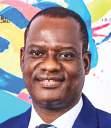
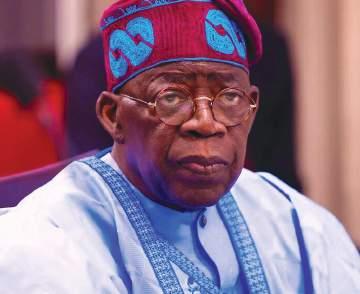
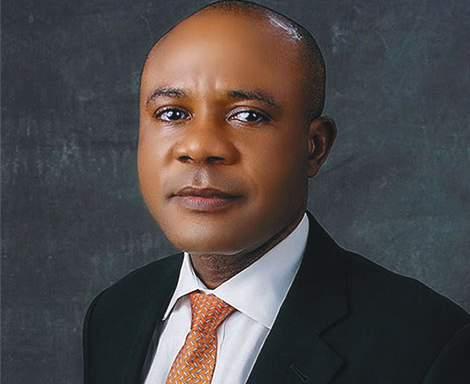
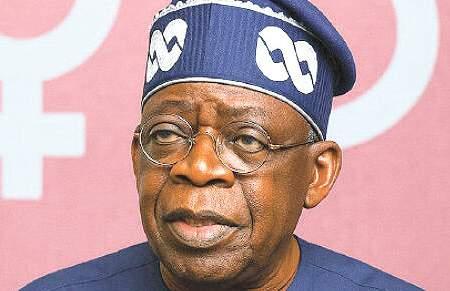
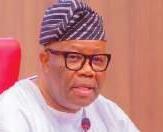
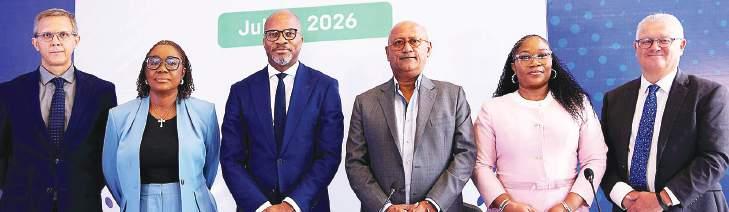
After Completion of 12-year Tenure, Elumelu Retires as UBA Chairman, Nnorom Named Successor
Nume Ekeghe and Kayode Tokede
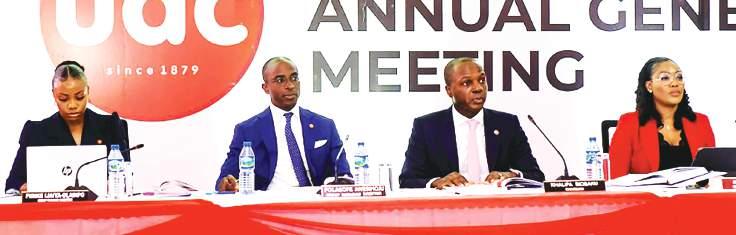
United Bank for Africa Plc (UBA), yesterday announced that its Group
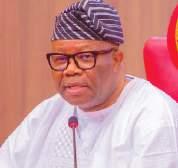
Chairman, Mr. Tony Elumelu will retire from the Board of Directors of the Pan African financial institution on August 21, 2026, upon the completion of the 12-year tenure
limit prescribed for Non-Executive Directors of Banks by the Central Bank of Nigeria (CBN).
In a statement yesterday that was signed by the Group Head,
Marketing and Corporate Communications, UBA, Alero Ladipo, the bank announced the election of Mr. Emmanuel N. Nnorom, a Non-Executive Director as his
successor, with effect from 21 August 2026. According to the statement, the decision was reached at a meeting held yesterday.
It stated: “UBA Plc has announced that Mr. Tony O. Elumelu, Group Chairman of
Continued on page 8
www.thisdaylive.com
UNITED IN OPPOSITION...
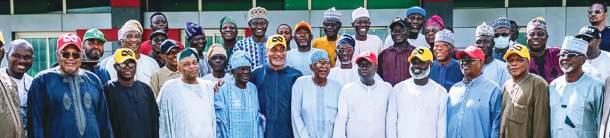
Members of the G15 Group of the Kwara State chapter of the All Progressives Congress (APC), soon after a march in Ilorin to protest
FG Orders Probe of Meta, Google, X, AI Platforms Over Alleged Exploitation of Nigerian Media
President Bola Tinubu, yesterday, directed Federal Competition and Consumer Protection Commission
Lokpobiri Summons Oil Industry Stakeholders, Insists on Fair Petrol Pricing
Minister says disconnect between falling crude prices, local PMS rates must be addressed
NMDPRA declares deregulation not licence for market distortion
IPMAN: With proper depot pricing, marketers can sell petrol below N800
The Minister
Continued on page 8 oil refiner, petroleum marketers, regulators and competition authorities over the persistent high price of petrol, insisting that the recent
on page 8
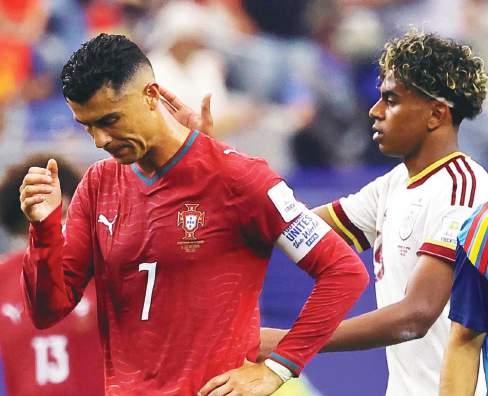
World Cup: Spain Beats Portugal 1-0, Belgium Knocks out Co-hosts USA 4-1 ... Page 30
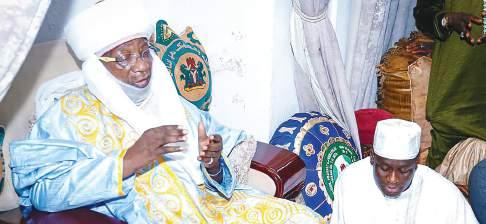
Governorship Candidate Rt. Hon. Salihu Yakubu Danladi and other APC Candidates; following a massive rally and visit to the Emir... yesterday
James Emejo in Abuja
Emmanuel Addeh in Abuja
of State for Petroleum Resources (Oil), Senator Heineken Lokpobiri, yesterday convened an emergency meeting of Nigeria’s key
PANEL SESSION AT THE ENERGY AND TRADE ROUNDTABLE ORGANISED BY PROVIDUSUNITY BANK...
L-R: Practice Leader, Political Risk Alliant Insurance Services, Conal Duffy; Executive Director, International Trade Finance, Thomas Matthias; Government Contractor and Business Solutions Executive, Basim Nasr; Founder and CEO, EQUIPXP, LC, Vernon Darko; and President and CEO, West Africa LNG Group, Cem Hacioglu, during a panel session at the Energy and Trade roundtable organised by ProvidusUnity Bank in Lagos...recently
NRS Report: Tax Reforms, FX Unification, Subsidy
Removal Strengthened Economic Recovery Under Tinubu
Says economy has moved from crisis management to consolidation as revenue collections doubled Laments low tax-to-GDP ratio, high debt servicing obligations, and large number of out-of-school children, others Recommends institutionalising Executive Order 9 in legislation, fiscal framework for emerging gas economy, creation of joint capital-flow monitoring system with CBN, others
James Emejo in Abuja Nigeria Revenue Service (NRS) said the economy made a significant transition from a period of acute macroeconomic distress to a more stable and resilient footing within three years of President Bola Tinubu’s administration.
In its Economic Snapshot Report (ESR) 2023 vs 2026, the service cited sweeping fiscal, monetary and structural reforms as major drivers of the economic turnaround.
The report stated that the country’s economic trajectory had shifted from crisis management to consolidation, following reforms, including the removal of fuel subsidy, foreign exchange market unification, implementation of the Petroleum Industry Act (PIA), tighter monetary policy, and a comprehensive overhaul of the nation’s tax administration framework.
ESR pointed out that these reforms had strengthened macroeconomic stability, rebuilt external buffers, restored investor confidence, and expanded government revenue, while positioning NRS at the centre of Nigeria’s fiscal transformation.
The report acknowledged that challenges remained, particularly
in improving the tax-to-GDP ratio, reducing the share of government revenue devoted to debt servicing, and addressing the country’s large number of out-of-school children.
Despite the positive outlook, NRS urged sustained reforms to lower debt servicing costs, expand the tax-to-GDP ratio towards the government’s 18 per cent target, and strengthen coordination with states to tackle the out-of-school children challenge.
It also recommended institutionalising Executive Order 9 in legislation, developing a fiscal framework for the emerging gas economy, establishing a joint capital-flow monitoring system with Central Bank of Nigeria (CBN), and positioning NRS as a strategic provider of real-time economic intelligence for government policy.
The report said when the current administration assumed office on May 29, 2023, the economy was weighed down by an unsustainable fuel subsidy regime, multiple foreign exchange windows, weak oil production, and an underperforming tax administration system.
Three years later, it said virtually every major macroeconomic indicator had improved.
According to the report, headline
inflation, which peaked at 34.8 per cent in late 2024, had moderated to 15.9 per cent in 2026, while the balance of payments had moved from a deficit to a surplus.
It added that external reserves had climbed from a balance of about $3.99 billion at inauguration to $50.11 billion in June 2026, representing the country’s highest reserve level in 17 years.The NRS report also pointed to the country’s successful return to the Eurobond market in November 2025, saying the record oversubscription
reflects improving international confidence in the country’s fiscal outlook.
It stated, however, that although total public debt rose in Naira terms due largely to exchange rate revaluation, the debt-to-GDP ratio had declined to 32.3 per cent, marking the first sustained reduction in more than a decade.
On the productive sector, the report described developments in the oil industry as one of the administration’s major achievements.
It pointed out that crude oil and
condensate production increased from about 1.2 million barrels per day in 2023 to 1.9 million barrels per day by May 2026, surpassing Nigeria’s OPEC production quota.
The report attributed the improvement to stronger security operations against crude theft, implementation of the PIA, and renewed investor confidence.
It described the country’s emergence as a net exporter of petrol in March 2026 as one of the most consequential developments during the review period.
Domestic refining capacity, it said, had expanded from about 30,000 barrels per day to about 700,000 barrels daily, significantly reducing reliance on imported petroleum products and easing pressure on foreign exchange demand.
The report equally highlighted improvements in external trade and investment. It stated that the country’s trade balance recorded a surplus of N7.55 trillion in the first quarter of 2026, driven by stronger crude exports and growing shipments of refined petroleum products.
ProvidusUnity, Regions Banks Host Roundtable to Unlock Financing for Nigeria’s Oil, Gas Sector
ProvidusUnity Bank, in partnership with US-based Regions Bank, has convened a high-level roundtable to expand access to financing for Nigeria’s oil and gas industry, reinforcing both institutions’ commitment to supporting growth across the country’s energy value chain. Regions Bank boasts extensive experience in trade finance, energy financing and cross-border transactions.
The roundtable with the theme: “Financing Growth Across Nigeria’s Oil & Gas Value Chain,” according to a statement yesterday, was held at ProvidusUnity Bank’s
Report: Power Generation Dropped 9.6% in Q1, Discos Lost N140.6bn to Inefficiencies
Distribution firms billed N756.93bn, recovered N597.56bn ATC&C losses rose to 37.44% from January to March
Emmanuel Addeh in Abuja
Nigeria’s power sector recorded a decline in operational and commercial performance in the first quarter of 2026, with electricity generation falling by 9.64 per cent and distribution companies losing an estimated N140.64 billion to technical, commercial and collection inefficiencies.
The latest report by the Nigerian Electricity Regulatory Commission (NERC) also revealed that average available generation capacity from
the country’s grid-connected power plants dropped to 4,457.96 megawatts (MW) in the first quarter, representing a decrease of 942.42MW or 17.45 per cent from the 5,400.38MW recorded in the fourth quarter of 2025. According to the report, the decline was driven by lower available capacity across 20 of the 28 grid-connected power plants operating during the review period.
The weaker generation capacity translated into lower electricity output, with average hourly genera-
tion on the national grid declining to 4,112.72 megawatt-hours per hour (MWh/h), compared to 4,452.71MWh/h in the preceding quarter. Consequently, total electricity generated during the quarter stood at 8,883.47 gigawatt-hours (GWh), representing a decline of 948.10GWh or 9.64 per cent from the 9,831.58GWh recorded in the fourth quarter of last year.
Beyond generation, the commercial performance of the electricity dis-
tribution companies also remained under pressure. According to the report, the average energy offtake by Discos at their trading points declined to 3,309.48MWh/h during the quarter, down by 309.73MWh/h or 8.56 per cent from the previous quarter’s figure of 3,619.21MWh/h. Overall, the power distributors achieved an energy offtake performance of 97.11 per cent against the available Partially Contracted Capacity (PCC) of 3,408.02MWh/h during the period.
headquarters in Lagos and brought together industry leaders, financial institutions, policymakers, and energy stakeholders to explore innovative financing solutions for projects across the sector.
In an opening remark, the Head of Global Trade and Structured Finance at ProvidusUnity Bank and convener of the roundtable, Dr. Biodun Ariyo, was quoted to have said the initiative was designed to deepen conversations around financing, trade facilitation, and investment within Nigeria’s energy sector.
According to him, beyond deepening meaningful dialogue, the platform sought to connect industry stakeholders with the right financing partners and structures required to accelerate growth across the oil and gas value chain.
“Nigeria’s oil and gas industry faces an estimated annual financing gap of approximately $25 billion, making collaboration between local and international financial institutions increasingly important.
“The roundtable was designed to serve as a gateway to stronger partnerships between Nigeria and the United States across
strategic sectors, including energy, agriculture, and mining.
“By deepening collaboration in these areas, both countries can mobilise capital more efficiently, unlock greater private investment, and accelerate Nigeria’s economic transformation,” it added.
Representing Regions Bank, its Executive Director for International Trade Finance, Thomas Matthias, reaffirmed the institution’s commitment to expanding its presence in Africa through strategic partnerships with credible local financial institutions.
“Africa has been overlooked for far too long, and that must change. Our experience financing transactions in Nigeria has given us the confidence to deepen our engagement in the market.
“We believe Nigeria is well positioned to play a much larger role in Africa’s energy future, and we are committed to partnering with ProvidusUnity Bank to unlock that potential,” he added. He noted that evolving global energy dynamics present significant opportunities for Nigeria to increase production, attract investment, and strengthen its position as a leading energy producer on the continent.
Nume Ekeghe
STAKEHOLDERS MEETING ON PETROLEUM MATTERS IN NIGERIA...
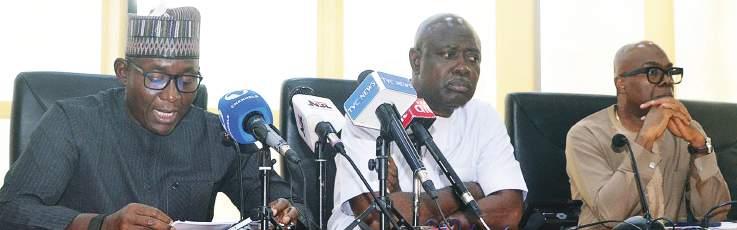
L-R: Authority Chief Executive (ACE), Nigerian Midstream and Downstream Petroleum Regulatory Authority (NMDPRA), Mr. Rabiu Umar; Minister of state for Petroleum (Oil), Sen. Heineken Lokpobiri; and Executive Director, Distribution System, Storage and Retailing Infrastructure, NMDPRA, Mr. Ogbugo Ukoha, during the minister’s meeting on cost reflective pricing of petroleum products with Independent Petroleum Marketers Association of Nigeria (IPMAN) and other stakeholders at NMDPRA headquarters in Abuja, yesterday
Oando Posts N204bn Profit, Records N258.3bn Operating Cash in Audited 2025 Report
Raises daily oil production to 32,482 bpd
Targets 50,000 bpd crude output in 2026 Gas production increases by 24% Company plans capital expenditure of $100m
Oando Plc has reported a Profit After Tax (PAT) of N204.8 billion for the financial year ended December 31, 2025, as the indigenous energy company ramped up crude oil and gas production following the integration of the Nigerian Agip Oil Company (NAOC) Joint Venture assets.
The company also generated N258.3 billion in operating cash during the period, while average daily production rose by 32 per cent to 32,482 barrels of oil equivalent per day (boepd), driven by stronger output across crude oil, gas and
Natural Gas Liquids (NGLs).
In its audited 2025 financial results released yesterday, Oando stated that the year marked a transition from acquisition-led expansion to operational execution and balance sheet optimisation, following the first full-year contribution from the NAOC Joint Venture assets.
Besides, the company disclosed that it closed the year with N422.9 billion in cash and cash equivalents, representing a 172 per cent increase over the 2024 figure, while also strengthening its liquidity through the expansion of its $375 million Reserve-Based Lending (RBL2) facility.
Operationally, crude trading volumes increased by 24 per cent to 25.7 million barrels, crude oil production rose by 36 per cent, gas production grew by 24 per cent, while NGL production surged by 715 per cent following upgrades to its gas processing infrastructure.
Oando said it also completed and brought onstream the Obiafu-44 gas-condensate well, its first operated development well since assuming operatorship of the assets, while recording zero fatalities, zero Lost-Time Injuries (LTIs) and a Total Recordable Incident Rate (TRIR) of 0.05.
Commenting on the perfor-
mance, Group Chief Executive, Oando Plc, Wale Tinubu, said during the year under review, the company strengthened asset integrity, enhanced security across its operating areas, and improved uptime, resulting in a 32 per cent year-on-year increase in production to 32,482 boepd net.
“FY 2025 marked our first full year of operational execution following the acquisition of the NAOC Joint Venture assets and represents an important milestone in Oando’s evolution. Having successfully completed the integration phase, our focus shifted to operatorship, operational excellence, and value
OAGF: No Funds Released to Presidential Foreign Intervention Council
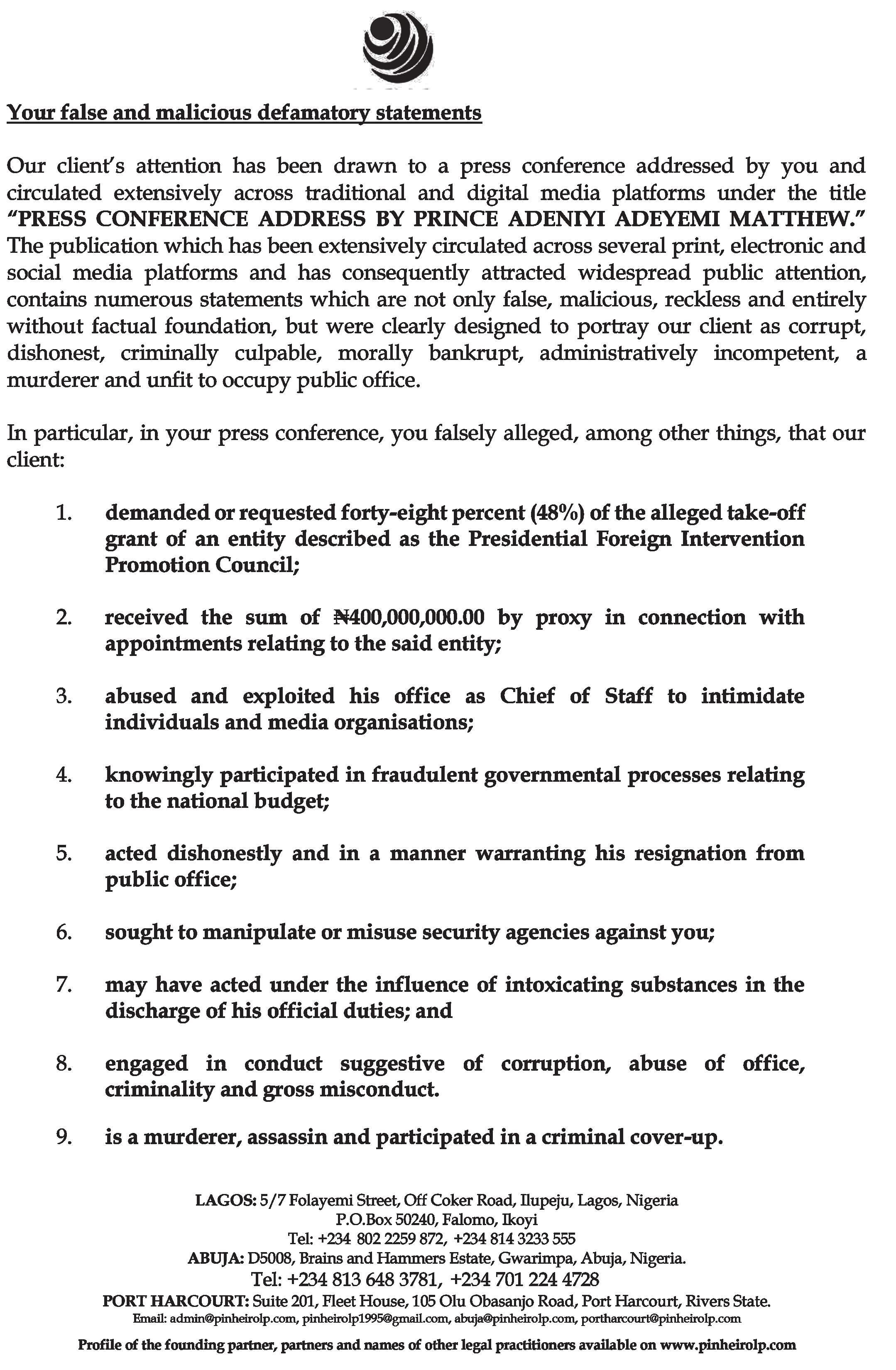
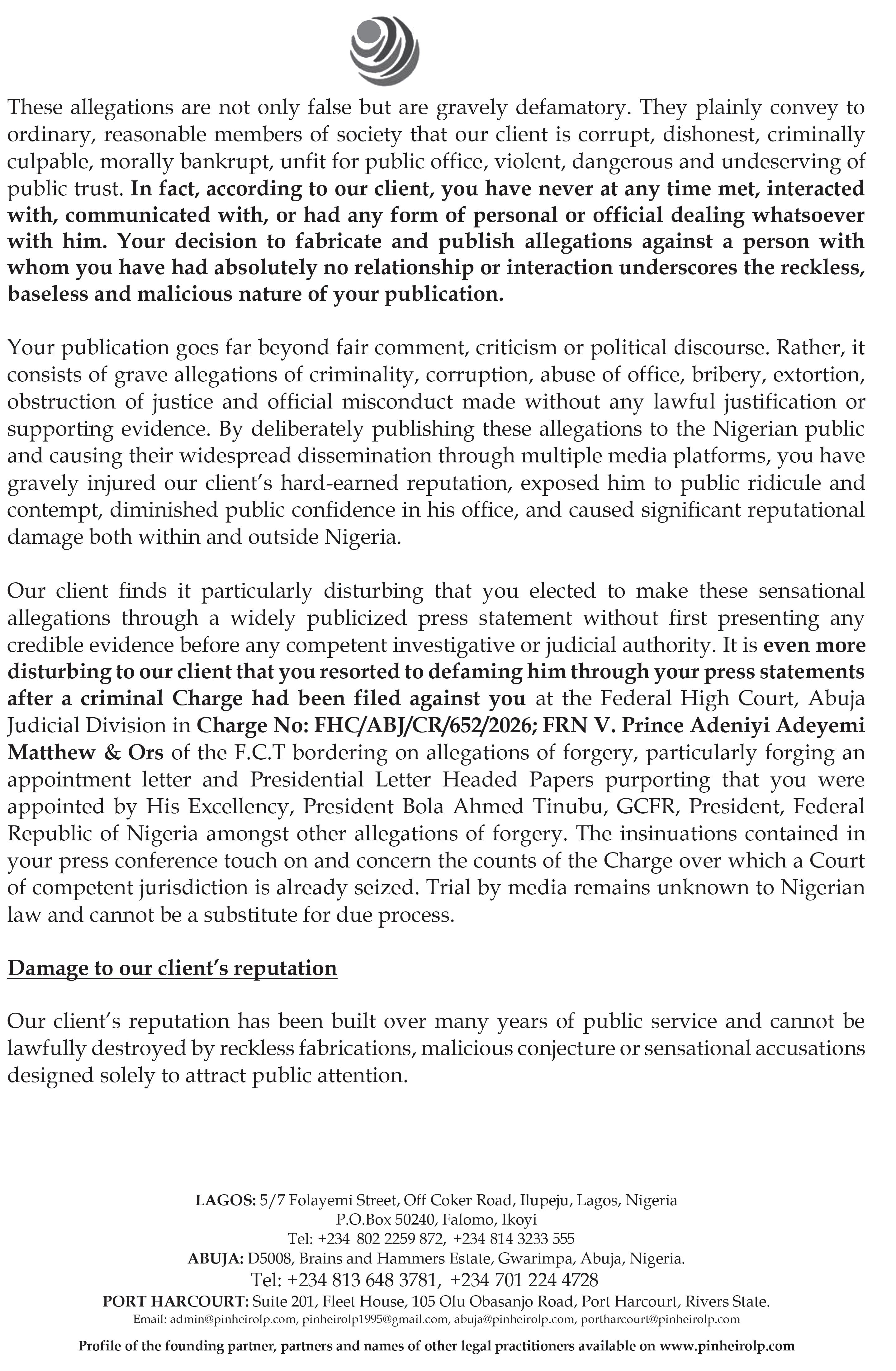
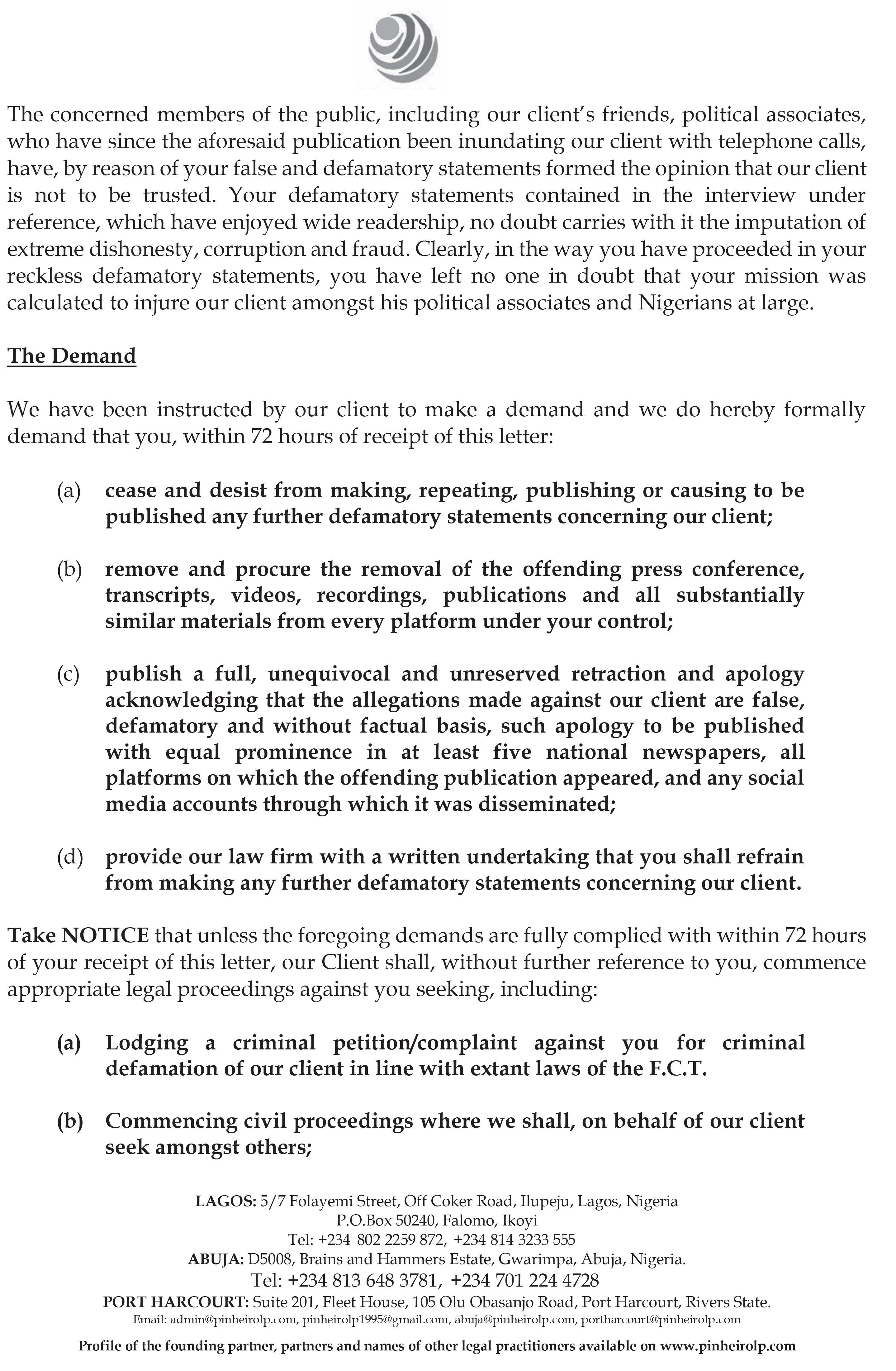
The Office of the Accountant-General of the Federation (OAGF) has declared that no public funds had been released to the controversial Presidential Foreign Intervention Promotion Council (PFIPC).
The OAGF added that the council does not operate an active account with the Central Bank of Nigeria (CBN) contrary to reports.
The clarification came amid reports alleging that government funds and salaries had been paid to the embattled council.
Reacting to the claims, Director of Press and Public Relations, OAGF, Mr. Bawa Mokwa, said the council had neither received any budgetary allocation nor any financial disbursement from the federal government.
He explained that although an application was initiated to open a CBN account for the council, the process was never completed because the required documentation was not submitted.
According to him, no account can be opened with the apex bank without the approval of the AGF.
Mokwa disclosed that the convener of the council, Adeniyi Adeyemi, had approached the OAGF with an
appointment letter, which he said was linked to an already existing agency rather than the PFIPC.
He said the account-opening process commenced based on the document presented but stalled because the names of officials designated as account signatories were never provided. As a result, he stressed that the account never became operational, leaving the government without any channel through which funds could be transferred to the council.
Bawa told reporters, “The account, till today, has not seen the light of day. It has not seen one kobo because the account is not completely operational.
“That portrays that he has not collected a dime. The AccountantGeneral has not released a dime because they don’t even have a place where the money can be paid.”
He further maintained that the PFIPC was not captured in any federal budget for funding, adding that the council’s financing is only expected to come under the 2026 budget and has not reached the implementation stage.
The OAGF also dismissed reports that salaries had been paid to workers of the council, insisting that no staff had been recruited through
the statutory procedures governing federal establishments.
“Based on our knowledge, he has not employed anybody,” Mokwa said.
He explained that before any federal agency can recruit personnel and place them on the Integrated Payroll and Personnel Information System (IPPIS), it must first secure approvals from the Federal Character Commission, the Budget Office and the Federal Civil Service Commission.
Only after obtaining the required waivers and approvals can the names of employees be forwarded to the Office of the Accountant-General for enrolment on the federal payroll and payment of salaries, he stressed.
According to him, “He cannot capture even one name without those approvals because once they are captured, payment will come from the budget,” adding that none of the required processes had been completed by the council.
realisation across the enlarged portfolio.
“During the year, we strengthened asset integrity, enhanced security across our operating areas, and improved uptime, resulting in a 32 per cent year-on-year increase in production to 32,482 boepd net to Oando. This performance was driven by stronger output across crude oil, gas, and NGLs, improved operational reliability, and the successful stabilisation of our expanded asset base,” the Oando
CEO stated.
The company attributed the upstream performance to improved facility uptime, enhanced flow assurance, restoration of previously shut-in wells and targeted infrastructure upgrades across its operated assets.
It explained that beyond higher crude oil and gas production, the successful revamp of its NGL processing plant significantly improved recovery efficiency, leading to the 715 per cent jump in NGL output, while the completion of the Obiafu-44 gas-condensate well demonstrated its capacity to execute complex development projects safely after assuming operatorship.
Oando added that its trading division increased crude trading volumes by 24 per cent to 25.7 million barrels despite changing domestic market conditions, noting
that it reduced exposure to premium motor spirit (PMS) imports while increasing participation in highermargin crude oil and gas trading opportunities. According to the company, the performance reflects the growing capacity of indigenous operators to acquire, integrate and optimise assets divested by international oil companies.
It noted that alongside the performances of Seplat Energy and Aradel Holdings during the year, the results point to a new phase for Nigeria’s upstream industry, with indigenous companies increasingly creating long-term value from strategic acquisitions.
Looking ahead, Tinubu said the company was entering 2026 from a position of strength, backed by improved operational control, a stronger reserves base and enhanced financial flexibility.
“With operational control firmly embedded, a strong reserves base, and improving financial flexibility, we are well positioned to build on the momentum achieved in 2025 and enter 2026 from a position of strength. Our focus remains on executing our development programme, growing production, strengthening cash generation, prudent capital allocation, and delivering sustainable long-term value for our shareholders.”
Lateef Jakande Memorial Lecture: NGE Hosts National Dialogue on Credible Elections July 23
Sunday Ehigiator
The Nigerian Guild of Editors (NGE) yesterday announced that it will host the fourth edition of the Lateef Jakande Memorial Lecture on July 23, 2026, in Lagos, with discussions expected to focus on the role of the media, electoral stakeholders and voters in deepening Nigeria’s democratic process.
The annual lecture, instituted by the Guild in 2023 to honour the enduring legacy of the late Alhaji Lateef Jakande—renowned
journalist, former President of the NGE, former Governor of Lagos State and former Minister of Works—will hold at Sheraton Hotel, Ikeja.
In a statement jointly signed by the President of the NGE, Eze Anaba, and the General Secretary, Onuoha Ukeh, the Guild stated that this year’s lecture is themed: “The Media, INEC, Voters and Path to Credible Elections.”
According to the Guild, Prof. Sylvester Odion Akhaine of the Department of Political Science, Lagos State University, will deliver
the keynote lecture, while former Governor of Ekiti State, Dr. Kayode Fayemi, will serve as chairman of the event.
The Guild stated further that Lagos State Governor, Babajide Sanwo-Olu, was expected as the Chief Host and Special Guest of Honour, while the Minister of Information and National Orientation, Alhaji Mohammed Idris, alongside prominent media personalities and public officials, would also attend.
Other expected guests include elder statesmen of the Guild such as former
Ogun State Governor, Chief Segun Osoba, and the Publisher of Vanguard newspapers, Uncle Sam Amuka, as well as managing directors, editors of print, broadcast and online media organisations, government officials and representatives of civil society organisations.
The statement added that lecturers and students of Mass Communication and Journalism from Caleb University, Lagos State University, Yaba College of Technology and the Nigerian Institute of Journalism have also been invited to participate in the event.
James Emejo in Abuja
Emmanuel Addeh in Abuja
STATE HOUSE INAUGURAL PRESS DINNER...
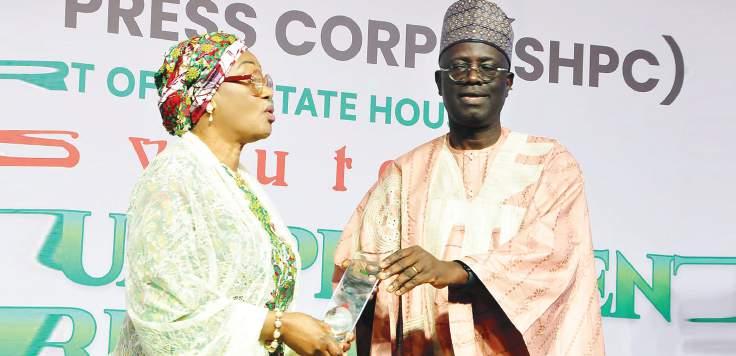
The First Lady, Senator Oluremi Tinubu (left) presenting award to Chairman, THISDAY Editorial Board, Segun Adeniyi, during the State House Inaugural Press Dinner held at the Conference Centre of the Presidential Villa, Abuja... recently
Senate Approves N11.074 Trillion Customs Revenue Target for 2026
Endorses N1.235trn expenditure proposal after budget defence Customs surpasses 2025 revenue target by N674bn
Sunday Aborisade in Abuja
The Senate Committee on Customs and Excise yesterday, approved a revenue target of N11.074 trillion and an expenditure proposal of N1.235 trillion for the Nigeria Customs Service (NCS) for the 2026 fiscal year.
The panel expressed confidence that the agency would consolidate ongoing reforms and sustain its impressive revenue performance despite prevailing global economic uncertainties.
The approval followed the defence of the agency’s 2026 budget proposal by the Comptroller-General of Customs, Mr. Bashir Adewale Adeniyi, before the committee at the National Assembly.
Chairman of the Senate Committee on Customs and Excise, Senator Isah Jibrin, said the committee was impressed by the reforms introduced by the Customs management, particularly in revenue generation, anti-smuggling operations and trade facilitation.
He also commended President Bola Tinubu for extending the tenure of the Comptroller-General of Customs, saying the decision would enable him to consolidate reforms already yielding
positive results.
Jibrin said, “I want to appreciate the President of the Federal Republic of Nigeria for the recent extension of service granted to the ComptrollerGeneral of Customs.
“Since assuming office, he has introduced various reforms which today have manifested in improved revenue generation, improved antismuggling operations and enhanced trade facilitation.
“I believe that within the next six months he will have fully consolidated these reforms and placed the Nigeria Customs Service on a sustainable path.”
The senator noted that the federal government’s ambitious infrastructure programme required enormous financial resources and described the Customs Service as one of the country’s foremost revenue-generating agencies.
“Customs remains one of the major drivers of revenue generation in this country. I therefore urge the Comptroller-General and his management team to work even harder in 2026 to actualise the ambitious revenue target before the Service,” he added.
Presenting the agency’s budget
proposal, the Comptroller-General expressed appreciation to President Bola Tinubu for extending his tenure and thanked members of the committee for sacrificing part of their recess to consider the budget proposal.
“We really appreciate you and we do not take this for granted. We have always relied on the support and guidance of this distinguished
committee, and we believe our relationship will continue to be guided by those principles,” he said.
Reviewing the Service’s 2025 performance, the Customs boss disclosed that although the National Assembly approved a revenue target of N6.584 trillion, the Service generated N7.277 trillion between January and December 2025.
According to him, the figure exceeded the approved target by N674.1 billion, representing 10.24 per cent above projection.
He, however, explained that the Service could have generated even more revenue but for several government policy interventions and global economic challenges.
Among the factors he listed were
the suspension of excise duty on telecommunications services, delayed implementation of the Green Tax, import duty waivers granted on compressed natural gas (CNG) and electric vehicles, healthcare equipment, raw materials and capital machinery, as well as extensive Import Duty Exemption Certificates issued by the Federal Government.
The federal government yesterday intensified efforts to boost food production and strengthen food security with the rollout of 80,640 bags of fertiliser to 20,160 registered smallholder farmers across four South-East States under the Renewed Hope Farm Input Support Programme (FISP). The intervention, implemented by the National Agricultural Development Fund (NADF), was
inaugurated in Owerri, Imo State, with beneficiaries drawn from Imo, Enugu, Anambra and Ebonyi states ahead of the 2026 wet farming season.
Speaking at the launch, Minister of Agriculture and Food Security, Senator Abubakar Kyari, described the programme as a strategic investment in Nigeria’s quest for food self-sufficiency.
He said the fertiliser support demonstrated the federal government’s commitment to reducing
PDP: Building Infrastructure Without Providing Food Will Worsen Poverty
Olusegun Samuel in Yenagoa
The Bayelsa State chapter of the Peoples Democratic Party (PDP) has argued that infrastructure without food on the table has made the people of the state poorer and hungrier than they were before the coming of Governor Douye Diri’’s administration. It also berated the alleged
inability of the government to name any clear wealth creation, employment generation and poverty alleviation programmes, describing it as an admission of failure.
The PDP said despite increased revenues accruing to the state through improved derivation and enhanced federal allocations, the living conditions of many citizens
have worsened, with hunger and poverty becoming daily realities across communities in the state.
The state government had dismissed the claims by PDP that Diri’s administration has failed to address hunger and poverty, insisting it has implemented wideranging programmes and projects aimed at improving residents’ welfare over the past six years.
Responding to the opposition’s criticism in a statement, the Commissioner for Information, Orientation and Strategy, Mrs. Ebiuwou Koku-Obiyai, described the allegations as misleading, saying the administration had made significant investments in infrastructure, education, healthcare, agriculture and youth empowerment.
production costs for farmers while increasing crop yields through direct intervention.
Represented by his Senior Special Adviser, Ibrahim Tanimu, the minuster said the Memorandum of Understanding (MoU) signed by the Imo State Government, the All Farmers Association of Nigeria (AFAN) and NADF would ensure transparency and accountability in the distribution process.
Executive Secretary/Chief Executive of NADF, Mr. Mohammed Ibrahim, said the initiative is designed to close critical farm input gaps, improve productivity and enhance the resilience of smallholder farmers.
Represented by the fund’s General Manager, Technical Services, Mr. Ernest Ihedigbo, he disclosed that each of the 20,160 registered beneficiaries would receive fertiliser grants under the programme, adding that the intervention also seeks to deepen linkages across Nigeria’s agricultural value chain by supporting indigenous fertiliser manufacturers.
According to him, the programme was structured to stabilise
food prices through targeted input support, raise agricultural productivity by improving farmers’ access to essential inputs and strengthen value chains to drive rural economic growth. Ibrahim said the fund would continue collaborating with state governments and development partners to unlock the agricultural potential of the South-East while encouraging sustainable investment in the sector.
However, Governor of Imo State, Hope Uzodimma, described the initiative as a significant boost for agricultural development in the region.
He urged beneficiaries to use the fertilisers strictly for cultivation, warning against diversion of the inputs, noting that the programme has the potential to improve harvests, create jobs and strengthen rural livelihoods.
Represented by Deputy Governor of Imo State, Lady Chinyere Ihuoma Ekomaru, Uzodimma said, “We are planting more than fertilisers today; we are planting food security, jobs and a better future for the South-East,”
The Minister of Finance and Coordinating Minister of the Economy, Mr. Taiwo Oyedele has refuted the International Monetary Fund’s (IMF) position, as well as the attendant public commentary that the federal government spent approximately two per cent of Nigeria’s gross domestic product (GDP), translating to over N8 trillion outside approved budgets.
The minister’s rebuttal followed the recent Article IV Consultation Report on Nigeria as well as the disclosure by the IMF Resident Representative in Nigeria, Christian Ebeke, that the government left public spending, equivalent to about two per cent of GDP unreported in recent official budgets, thereby obscuring the country’s true financing needs and making the fiscal deficit appear smaller than it actually was.
Ebeke who spoke during a recent event in Lagos had said, “So far we think that there are about two per cent of GDP of expenditure that were not reported that should be reported and should be recorded, so that this statistical discrepancy will disappear.”
Following the IMF’s stance, some leading political figures in the country, including the former Vice President and presidential candidate of the African Democratic Congress (ADC), Atiku Abubakar, and the presidential candidate of the Nigeria Democratic Congress (NDC), Mr. Peter Obi, among others, had not only condemned the federal government, but demanded an inquiry into the IMF revelation.
While Atiku Abubakar called on the Economic and Financial Crimes Commission (EFCC), and the Independent Corrupt Practices and Other Related Offences Commission (ICPC) to initiate an
inquest into the allegation that the federal government omitted public spending worth two per cent of GDP from recent budgets, Obi on his part alleged that the growing revelations of “grand corruption” under the current administration has made President Bola Tinubu’s continued stay in office untenable.
He argued that the violation of fundamental rules of public finance management poses a severe threat to national security and the stability of Nigeria.
“The capture of the Nigerian state and the plunder of its resources undermine the foundation of state stability, deepen poverty and risk state failure,” he said.
But reacting to the issues raised by the IMF, Atiku, Obi and other individuals and groups, the Minister of Finance and Coordinating Minister of the Economy, Taiwo Oyedele flawed the public commentary based on references to
the IMF Resident Representative in Nigeria and the Fund’s 2026 Article IV Consultation Report.
He said, “These claims are incorrect and risk misleading the public regarding the government’s financial management
“For the avoidance of doubt, the federal government does not operate a ‘shadow budget’ or expend public funds outside the constitutional and statutory framework established for public finance.
“Under Sections 80 - 83 and 162 of the Constitution of the Federal Republic of Nigeria, 1999 (as amended), public funds may only be withdrawn and expended in accordance with the Constitution and laws enacted by the National Assembly.
“Accordingly, federal government expenditure is incurred pursuant to duly enacted Appropriation Acts, Supplementary Appropriation Acts, and other statutory authorities
enacted by the National Assembly.
“In addition, multi-year capital projects which necessarily span multiple budgets are implemented in accordance with extant laws and approved provisions for capital rollovers where applicable.
“These are recognised features of public financial management and should not be misconstrued as expenditures outside the budget.”
Oyedele argued that it was inaccurate to suggest that trillions of naira have been secretly spent outside legislative approval, adding that such allegations should have identified the specific projects purportedly executed without appropriation or legal authority and present credible evidence in support of the claim.
He noted that to be meaningful, assertions of this magnitude must be supported by verifiable facts rather than conjecture.
Continuing, the minister
explained that for the purpose of public education, it was important to distinguish between appropriation, expenditure authorisation, financing, and fiscal reporting.
According to him, Nigeria’s public finance framework contains several statutory transfers, first-line charges and intervention mechanisms established by Acts of the National Assembly.
LOKPOBIRI SUMMONS OIL INDUSTRY STAKEHOLDERS, INSISTS ON FAIR PETROL PRICING
moderation in international crude oil prices must be reflected in lower pump prices for Nigerians.
The stakeholders’ meeting on ‘Cost-reflective Pricing of PMS’ held in Abuja was attended by officials of the Nigerian Midstream and Downstream Petroleum Regulatory Authority (NMDPRA), the Federal Competition and Consumer Protection Commission (FCCPC), the Dangote Refinery and the Independent Petroleum Marketers Association of Nigeria (IPMAN).
Others included: The Major Energy Marketers Association of Nigeria (MEMAN), Depot and Petroleum Products Marketers Association of Nigeria (DAPPMAN), Petroleum Products Retail Outlets Owners Association of Nigeria (PETROAN) and the Nigerian Association of Road Transport Owners (NARTO).
Despite the recent sustained decline in international crude oil prices, retail petrol prices in Nigeria have remained relatively
sticky, triggering concerns among consumers and policymakers over the pace of price adjustments in the fully deregulated downstream sector.
While crude prices have retreated from peaks above $120 to lower levels of around $70, industry operators argue that the pump price of petrol is influenced by a combination of factors beyond crude oil, including exchange rate volatility, freight and shipping costs, financing expenses, storage and
FG ORDERS PROBE OF META, GOOGLE, X, AI PLATFORMS OVER ALLEGED EXPLOITATION OF NIGERIAN MEDIA
(FCCPC) to investigate major global technology companies and Generative Artificial Intelligence (AI) platforms over allegations of anti-competitive practices and the exploitation of content belonging to Nigerian media organisations.
The directive followed a joint petition submitted to the presidency by Nigerian Press Organisation (NPO), an umbrella body comprising Nigerian Guild of Editors (NGE), Newspaper Proprietors’ Association of Nigeria (NPAN), Nigeria Union of Journalists (NUJ), Broadcasting Organisations of Nigeria (BON), and Guild of Corporate Online Publishers (GOCOP).
The federal government conveyed the president’s directive to FCCPC through a letter signed by Minister of Information and National Orientation, Mohammed Idris.
The commission was expected to investigate allegations against major technology firms, including Meta, Alphabet, X (formerly Twitter), as well as Generative AI platforms operating in Nigeria.
The move came amid mounting concerns by the local media industry over the growing influence of digital platforms on the country’s news ecosystem and the sustainability of media organisations.
The petition alleged that some technology companies had engaged in practices capable of undermining fair competition, weakening the commercial viability of Nigerian media outfits, and infringing on the rights of publishers and content creators.
Executive Vice Chairman/ Chief Executive of FCCPC, Mr. Tunji Bello, said the commission would conduct an independent, transparent, and evidence-based
investigation to establish the facts.
Bello said the commission recognised the strategic role of the media in sustaining the country’s democracy as well as the importance of technology in promoting innovation and economic growth.
Bello stressed that FCCPC’s responsibility was to ensure that competition within the digital ecosystem remained fair, transparent, and consistent with Nigerian law.
In a statement issued by Director, Corporate Affairs, FCCPC, Ondaje Ijagwu, Bello stressed that the investigation should not be interpreted as a presumption of wrongdoing against any company.
Rather, he said the exercise will provide an opportunity for all parties to present relevant information while the commission objectively determined whether any conduct resulted in anticompetitive outcomes or unfair business practices.
Bello explained, “We recognise the strategic importance of the media to Nigeria’s democracy and the equally significant role of technology in driving innovation and economic growth.
“Our responsibility is to objectively determine the facts and ensure that competition within the digital ecosystem remains fair, transparent, and consistent with Nigerian law.
“This inquiry is not directed at any entity by presumption of wrongdoing. Rather, it is an opportunity to carefully examine the facts, hear from all affected parties, and determine whether any conduct has resulted in anticompetitive outcomes or unfair business practices.
“Every party will be accorded a
fair opportunity to present relevant information before any conclusions are reached.”
The commission said the investigation would determine whether the alleged conduct violated the Federal Competition and Consumer Protection Act (FCCPA) 2018 or any other applicable law.
Among the issues under review are allegations of market dominance and anti-competitive conduct by global technology companies.
The investigation will also examine claims of unauthorised extraction, scraping, ingestion, and commercial use of copyrighted news reports, broadcast materials, and other original journalistic content for the development and training of Generative AI models.
Another major area of inquiry is the alleged absence of equitable commercial arrangements between global technology companies and Nigerian news publishers, including claims that media organisations have been denied meaningful opportunities to negotiate fair compensation for the use of their content.
The latest probe followed an earlier investigation of Meta by FCCPC, which culminated in a landmark judgement in 2025.
The company was fined $220 million for violations of FCCPA, including data privacy breaches, although the decision is currently on appeal.
The commission also pointed to developments in South Africa, where investigations by South African Competition Commission resulted in Google agreeing to compensate South African news media with R688 million (about $40 million) annually for between three and five years.
distribution charges, and the cost of maintaining adequate inventories.
The slow response of domestic petrol prices has also renewed calls for greater transparency in the pricing templates of refiners and marketers, particularly as competition in the deregulated market deepens.
But at the Abuja event, the minister warned that deregulation was never intended to permit excessive pricing or market distortions, explaining that all the issues that have kept prices high should be immediately addressed.
Lokpobiri stressed that while the government remained committed to a deregulated downstream market, operators had a responsibility to ensure that lower replacement costs were transmitted to consumers promptly and transparently.
According to him, Brent crude traded at between $61 and $65 per barrel in January before surging to over $118 per barrel in April amid heightened geopolitical tensions in the Middle East, but has since moderated to around $71 per barrel as tensions eased.
He noted that although the initial increase in crude prices understandably pushed petrol prices higher, the subsequent decline in crude prices had not resulted in a corresponding reduction in domestic pump prices.
“Ordinarily, such movements in crude oil prices should be reflected
in the pricing of refined petroleum products. While the initial increase in crude prices understandably exerted upward pressure on PMS prices, the subsequent moderation in crude oil prices has not translated into a commensurate reduction in pump prices across the domestic market with PMS peaking at N1,596/litre in May to N1,296/ litre as at today. This disconnect has understandably raised concerns,” the minister said.
Lokpobiri acknowledged that several factors beyond crude oil prices influence PMS pricing, but maintained that marketers should not continue to reap windfall gains from inventories purchased at higher prices after replacement costs had declined.
“I am aware that PMS pricing is influenced by several factors beyond crude oil prices, but it is equally important to distinguish between genuine replacement cost and windfall gains arising from inventory management.
Temporary gains realised from inventories acquired at higher prices should not become the basis for sustaining elevated pump prices after replacement costs have declined.
“As inventories are replenished at lower costs, the benefits of those lower costs should be transmitted to consumers in a timely and transparent manner. That is the essence of a competitive and
efficiently functioning market,” he stated.
The minister argued that sustaining high energy prices beyond what prevailing market fundamentals justify would continue to fuel inflation and erode the gains already achieved in stabilising the economy.
Lokpobiri reiterated that the administration of President Bola Tinubu remained committed to protecting consumers even under a deregulated market, stressing that deregulation was designed to promote competition, efficiency and investment rather than encourage exploitative pricing.
“The federal government remains unwavering in its commitment to protect public interest post deregulation. Deregulation was never intended to create opportunities for excessive pricing or market distortions but rather promote efficiency, deepen competition and ultimately deliver value to Nigerians,” he said. Besides, he directed the NMDPRA to strengthen market surveillance and enforce pricing transparency across the downstream value chain to ensure that reductions in costs were reflected in ex-depot and retail prices.
The minister also urged the regulator to fast-track the operationalisation of the National
Continued on page 27
AFTER COMPLETION OF 12-YEAR TENURE, ELUMELU RETIRES AS UBA CHAIRMAN, NNOROM NAMED SUCCESSOR
UBA, will retire from the Board of Directors of UBA on 21 August 2026, upon the completion of the 12-year tenure limit prescribed for Non-Executive Directors of Banks by the Central Bank of Nigeria.
“At its meeting held on 6 July 2026, the Board accepted Mr. Elumelu’s retirement and elected Mr. Emmanuel N. Nnorom, a NonExecutive Director of the Bank, as his successor, with effect from 21 August 2026.
“The Board places on record its profound appreciation to Mr. Elumelu for his visionary leadership and exceptional contribution to the strategic vision and institutional strength of the UBA Group.”
It pointed out that Elumelu’s tenure was a defining chapter in the Group’s history, stating that under his stewardship, UBA was transformed into a pan African institution, operating in 20 African
countries and four global financial centres and serving over 50 million customers.
Nnorom is a chartered accountant with over forty years’ experience in banking, finance and audit. He brings to the role extensive leadership experience and deep institutional knowledge of UBA.
Commenting on his retirement, Elumelu said: “Serving UBA has been one of the great privileges of my career. UBA has established a unique competitive position, across Africa and globally, and I leave the Board with great confidence in UBA’s future.
“Emmanuel Nnorom is a leader of integrity, experience and sound judgement, and I am confident that the Bank will continue to thrive under his leadership.”
Commenting on his appointment, Nnorom said: “I am honoured by
the trust the Board has placed in me and deeply conscious of the legacy I inherit.
“I look forward to working with my colleagues on the Board, Management and our staff across all our markets to sustain UBA’s momentum and continue delivering long-term value to our shareholders, customers and stakeholders.”
UBA is Africa’s Global Bank. Operating across 20 African countries and in the United Kingdom, the United States of America, France and the United Arab Emirates, UBA provides retail, commercial and institutional banking services, leading financial inclusion and implementing cutting edge technology. UBA is one of the largest employers in the financial sector on the African continent, with 25,000 employees group wide and serving over 50 million customers globally.
Mr. Taiwo Oyedele
BUBA MARWA’S COURTESY VISIT TO MINISTER OF FINANCE...
L-R: Chairman/Chief Executive Officer of the National Drug Law Enforcement Agency (NDLEA) Brig Gen. Mohamed Buba Marwa (Rtd); Minister of Finance and Coordinating Minister of the Economy, Mr. Taiwo Oyedele; and Permanent Secretary (Special Duties), Federal Ministry of Finance, Mr. Mohammed Sanusi Danjuma, when the NDLEA boss paid the minister a courtesy visit in his office in Abuja ...recently
Ilorin Emir: AbdulRazaq’s Performance
‘ll Ensure Danladi-Salihu’s 2027 Victory
Ahead of the 2027 governorship election in Kwara State, the Chairman of the State Traditional Council and Emir of Ilorin, Ibrahim Sulu-Gambari, yesterday declared that Governor AbdulRahman AbdulRazaq’s performance would pave the way for the electoral victory of the All Progressives Congress (APC) governorship candidate, Yakubu Danladi-Salihu.
Sulu-Gambari, who spoke in Ilorin, while showering royal blessings on Danladi-Salihu and other APC candidates at his Oja Oba palace, described the governor as a man of great achievements.
He commended the governor for his ‘transformative’ programmes and prayed for his continuous success in office as well as the party’s success at the polls next year.
“The forecourt of my palace has been filled up with your supporters since the morning. Is today the voting day or you only came for familiarisation? I pray to God that
whatever steps taken by Sardauna Ngeri (governor) shall be divinely blessed.
“Whoever sees good things and chooses not to say it is insincere and mischievous. There is no hiding place for lies. Let’s call a spade a spade. What we are seeing on the ground is a reality. Whoever does good, let’s say it. The governor has performed well.
“Starting from Governor AbdulRazaq to other candidates of the party, God will grant you all electoral success. May you not be put to shame,” the Emir stated.
Speaking to newsmen shortly after the visit, Danladi-Salihu described democracy as an aggregation of interests and assured that steps are already being taken to bring everyone together.
“By the grace of God, all of us will be guided and we will jointly support Mallam AbdulRahman AbdulRazaq and President Bola Ahmed Tinubu to move Kwara and Nigeria forward,” he told reporters, when asked about some grievances by a few stakeholders.
“Where there is peace, there is development, let us come to the roundtable and by God’s grace, we will carry each and everyone of them along. APC is big and there are a lot of positive things happening in the party. The reconciliation committee has been set up and I know the committee will do justice to it, and peace, as we are witnessing, will continue to reign in APC and Kwara.
“By the grace of God, 35-0 is assured and APC will carry the day once again. We are seeing thousands of our members on the streets of Ilorin doing rallies for us; we are very happy and we thank Kwarans for coming out en masse to support this administration, to support President Bola Ahmed Tinubu and, by His grace, I know what Kwarans have shown yesterday and today, that is what they will show in 2027 by God’s grace,” he added.
Also speaking, the state chairman of the party, Sunday Fagbemi, told the Emir the processes that led to the emergence of the party’s candidates, saying the primaries were conducted
by the national headquarters of the party in accordance with the party’s guidelines.
He presented the candidates before the Emir and sought the support and blessings of the royal father to make them victorious in 2027.
… Tinubu Loyalists Relaunch Otoge Revolution against AbdulRazaq in Kwara
Thousands of supporters of President Bola Tinubu under the platform of the Kwara All Progressives Congress (APC) G15 yesterday staged a solidarity walk in Ilorin, declaring the relaunch of the Otoge movement that ended the Saraki political dynasty’s dominance of Kwara politics in 2019.
The coalition said the renewed movement was aimed at confronting what it described as the abandonment of the ideals of the original Otoge struggle by the administration of Governor AbdulRahman AbdulRazaq.
The G15 is a coalition comprising the ten top governorship aspirants of the APC, the state’s three serving
In the light of the imminent launch of 2026 Licencing Round by Nigerian Upstream Petroleum Regulatory Commission (NUPRC), oil and gas expert, Leesi Gabriel Gborogbosi, has advised that prospective bidders to embrace “a disciplined, long-term approach to investment and risk management”.
The advice came on the heels of the recent announcement by NUPRC that the 2026 bidding process would begin in the third quarter upon the completion of the 2025 round, a decision the commission described as “reflecting renewed investor confidence in Nigeria’s upstream sector”.
Gborogbosi, who is Managing Director, Kalenoor Energy Limited (an E&P oil and gas company), Chief Executive Officer of Gabriel Domale Consulting, and former Shell Nigeria Project Finance Manager, stated that
investors must move beyond mere acquisition and treat licensing “as a complete investment programme”.
He said to understand the full landscape, bidders should study the Petroleum Industry Act 2021, Nigeria Tax Act 2025, licensing guidelines, as well as upstream commercial realities before committing their capital.
According to Gborogbosi, the exercise comprises a whole gamut that includes “registration, pre-qualification, data acquisition, technical submissions, evaluations, and commercial negotiations - each with distinct financial implications”.
He cautioned prospective bidders to watch out for what he termed “hidden asset risks.”.
Drawing from nearly three decades of experience in the industry, Gborogbosi warned that many marginal and brownfield assets often came with technical, historical, and community related challenges.
He said some of the challenges required major infrastructure rehabilitation while host communities often expected immediate social investment after years of inactivity.
He stated, “Investors should understand why previous operators divested and incorporate those factors into their investment decisions. The goal should be to operate assets efficiently, sustain production, and avoid prolonged dormancy.”
On cost and funding strategy, he said bidders must account for pre-licence, “search costs”, such as data, reports, and evaluations, many denominated in foreign exchange, alongside signature bonuses and life-cycle costs.
“A successful bid is not determined solely by the acquisition cost but by the ability to sustain profitable operations,” he asserted.
Gborogbosi recommended blended financing beyond bank debt, including
equity, farm-ins, technical partnerships, vendor financing, drilling-for-equity, and reserves-based lending, adding that a gas-to-power and milestonebased financing can reduce risk and strengthen cash flow.
He called for early preparation, including community engagement, emphasising robust front-end planning covering execution, community relations, compliance, and performance monitoring. These, he said, should reflect in proposals as contributions to reserves growth, energy security, local content, jobs, and government revenue.
Against the backdrop of Gabriel Domale Consulting’s experience in providing advisory support systems for meticulous investors, Gborogbosi counselled bidders, “Understand the economics, secure expert advice, build sustainable partnerships, and approach licensing with a long-term value-creation mind-set.”
senators, a majority of APC members in the National Assembly, serving members of the Kwara State House of Assembly, the party’s elders caucus, youth and women leaders, and other stakeholders.
The solidarity procession began at the Geri-Alimi Underpass in Ilorin, passed through the Emir’s Palace and ended at the Post Office, drawing thousands of APC supporters.
Addressing supporters after the march, leaders of the coalition said the turnout reflected growing dissatisfaction within the party and demonstrated that the ideals upon which the Otoge movement was founded remain alive among many Kwarans.
In a statement issued after the procession, the coalition said it recently concluded consultations in Abuja with senior APC stakeholders and other national leaders on developments within the party in Kwara State.
According to the group, the discussions centred on the unity of the APC in the state, the future of Kwara politics and the success of President Tinubu’s Renewed Hope Agenda.
“We have come to the firm conclusion that we owe it to our supporters, to the people of Kwara State, and to generations yet unborn to subordinate our individual political aspirations to one collective ambition—the rescue of our party and the rescue of Kwara State,” the statement said.
The coalition argued that the movement represented a popular struggle against exclusion, impunity, political domination and poor governance, adding that those ideals had gradually been eroded.
It alleged that the APC in Kwara had become increasingly divided and that governance and party administration had become overly centralised.
“Sadly, this is not the Kwara State we all bargained for. This is not the Kwara State we promised our people during the OTOGE Revolution,” the coalition stated. The group maintained that Kwara deserved a government that listens to its citizens, accommodates diverse interests and promotes inclusive leadership.
Despite its criticisms of the state government, the coalition reaffirmed its loyalty to Tinubu and
pledged continued support for his administration.
It, however, urged the President and the National Working Committee (NWC) of the APC to ensure the emergence of leadership in Kwara that reflects what it described as the wishes of the majority of party members.
The coalition also presented a 10-point demand to the President and the APC leadership.
Among other requests, it called for the rejection of what it described as flawed and controversial party primaries in the state, the endorsement of a more popular and credible alternative, and a merit-based succession process that prioritises competence and acceptability over political patronage.
The group also demanded transparent and inclusive party administration, an end to political godfatherism, protection of dissenting voices, accountable governance, genuine reconciliation based on justice and fairness, and an urgent review of the state’s security strategy.
Besides, the group rejected what it described as attempts by a minority within the party to impose its preferences on the majority. “Democracy derives its legitimacy from the consent of the majority, not from the preferences of a select few,” the statement added.
Also addressing the media, a frontline gubernatorial aspirant and Senator representing the Kwara Central Senatorial District, Senator Saliu Mustapha advised AbdulRazaq to embrace fairness, inclusion and internal democracy, warning that political structures built on exclusion and imposition rarely endure.
“The people of Kwara have spoken before. They are speaking again. And when the time comes, their collective voice will once more determine the future of our state,” the statement stressed.
Others at the rally included: Dr. Bashir Bolarinwa; Ambassador Yahaya Gambari; Senator Yahaya Oloriegbe; Senator Lola Ashiru; Senator Umar Sadiq; Mr Dele Belgore (SAN) and Alhaji Tajudeen Audu.
Also present were: Hon. Omar Bio; Dr. Oluwatoyin Alabi; Dr. Azeez Olaniyi; Capt. Ahmad Mahmud; Hon. Yinka Aluko, Hon. Ismail Tijani, among many others.
Omon-Julius Onabu in Asaba
Hammed Shittu in Ilorin
TUNDE RAHMAN VISITS YUSUF BUBA YAKUB...
Director General/CEO Nigeria Technical Aid Corps, Rt. Hon. (Dr.) Yusuf Buba Yakub (left) and Senior Special Assistant to President Tinubu on Media & Special Duties, Mr. Tunde Rahman, when the SSA visited Hon. Yakub ... recently
Jonathan Denies Alleged N500bn Offer to Contest Against Peter Obi
Former President Goodluck Jonathan has debunked allegations that he was offered N500 billion to contest against the presidential candidate of Nigeria Democratic Congress (NDC), Peter Obi, in the 2027 general election to divide votes in the South-east zone.
A website, “Igbo Times Magazine,” had alleged that Jonathan was offered N500 billion to contest the 2027 presidential election for the main purpose of dividing South-east votes to hurt Obi
But Jonathan dismissed the allegation in a statement by his Special Adviser on Media, Dr. Ikechukwu Eze.
The statement described the speculation as false, baseless, and a deliberate attempt to drag the former president into a needless political controversy.
According to Eze, the report falsely claimed that Jonathan disclosed receiving an offer of N500 billion to challenge Obi in the presidential race.
He stated that the publication failed to provide basic details expected of a credible report, including when and where the alleged statement was made, the identity of those who supposedly made the offer, or any witnesses to support the claim.
The ex-president’s media aide added that the story bore all the characteristics of fabricated news designed to mislead the public and create unnecessary political tension ahead of the 2027 general election.
The statement said, “Jonathan was never involved in the ‘N500
billion offer to divide the South’s votes against Peter Obi in the 2027 general election.
“Nigerians should disregard the report entirely and exercise caution by verifying sensational political claims before circulating them.
“The build-up to every elec-
tion season often witnesses a surge in misinformation and fake attributions, warning that such reports should not be mistaken for verified facts.
“Jonathan has not made any statement suggesting he was offered money to contest the presidency or undermine any candidate.”
Jonathan had neither corroborated nor denied interest in the 2027 presidential race. That was despite the insistence of the Tanimu Turaki-led Peoples Democratic Party (PDP) that the former president would contest on its platform.
Sowore Opens Defence in Suit Alleging Defamation of Tinubu
May return to jail over bail conditions
Alex Enumah in Abuja
The presidential candidate of African Action Congress (AAC), Mr. Omoyele Sowore, on Monday opened his defence in his trial on alleged defamation of President Bola Tinubu.
But the activist and publisher of Saharareporters might be remanded in prison custody again if he failed to perfect the bail conditions granted him last week by Justice Mohammed Umar of the Federal High Court, Abuja. Sowore is standing trial for allegedly calling Tinubu a criminal in his X and Facebook handles, although he pleaded
not guilty and was initially granted bail on self-recognition. But he had his bail revoked after jumping bail last month.
However, the court last week admitted him to bail in the sum of N200 million and two sureties in like sum, upon a fresh bail application.
As part of the bail conditions, the judge ordered Sowore to deposit his international passport with the court, and also directed that one of the sureties should be the traditional ruler of Sowore’s community.
The judge released Sowore to his lawyer to enable him travel to the
United States embassy in Lagos, where he claimed he had his international passport.
When the matter came up on Monday, prosecution counsel, Mr. A. T. Kehinde, SAN, informed the court that the defendant was yet to fulfil the bail conditions, and accordingly asked the court to issue an order remanding Sowore at the Kuje Correctional Centre.
Kehinde submitted that the orders of court were meant to be obeyed and since Sowore had not obeyed the court order by perfecting the bail conditions, the consequence was his remand until the conditions were fully met.
Although Umar released Sowore to his lawyer, pending bail perfection, the lawyer to the Department of State Services (DSS) argued that up till Monday, the defendant had not communicated to him pertaining any challenge in meeting the bail conditions or filed any application for bail conditions variations.
Kehinde stated, “The defendant was released to his lawyer to go and bring his passport to be deposited with the court. That has not been communicated to us, and other conditions of the bail have not been met. The law is trite, no sentiment.
NEPL/Seplat Energy JV Invested over N100m in School Infrastructure, Educational Development
Celebrates academic excellence as PEARLs quiz
Felix Omoh-Asun in Abuja
The NNPC Exploration and Production Limited (NEPL)/Seplat Energy Joint Venture (JV) has reaffirmed its commitment to improving education outcomes and nurturing future leaders across Edo and Delta States.
The Joint Venture which stated this in the just concluded 2026 edition of its flagship PEARLs Quiz Competition, said this year’s competition attracted 476 secondary schools, culminating in a keenly contested grand finale that celebrated academic excellence, innovation, confidence and character among young people.
The oil giant said the programme has impacted over 57,000 students, with more than N100 million invested in school infrastructure and educational development.
Notre Dame College, Ozoro, Delta State, emerged overall winner, receiving the championship trophy and a N10 million education infrastructure grant.
Henson Demonstration School, Benin City, placed second and received N5 million, while Lumen Christi College came third, winning N3 million.
Student representatives and supervising teachers from the top
three schools also received educational support prizes.
Speaking at the event, Samson Ezugworie, Chief Operating Officer, Seplat Energy Plc, said the JV’s education interventions are designed to address foundational gaps and create stronger pathways for young people to thrive.
“Our approach goes beyond conventional educational support. It is about creating opportunities for students, schools and institutions to succeed, while building a stronger and globally competitive education system.
“PEARLs is more than a quiz.
impacts 57,000 students
It builds confidence, discipline, leadership, and problem-solving skills. To date, the programme has impacted over 57,000 students, with more than N100 million invested in school infrastructure and educational development,” she said.
Nicolas Foucart, Managing Director, NEPL, represented by Olubukonla Oyegbami, commended the partnership and urged participants to focus not only on prizes but on the knowledge, discipline and confidence gained through the competition.
“Every participant is a winner. The real value is in the experience
gained and how it is applied in future endeavors,” he said.
Chioma Afe, Director, External Affairs and Social Performance, Seplat Energy Plc, said PEARLs has grown into one of the JV’s most impactful education initiatives since its launch in 2012.
The event also featured a STEAM Innovation Showcase, where students presented practical solutions to realworld problems. Cradle High School emerged overall winner, while Ogbe Secondary School and Meridien Royal Academy placed second and third respectively, receiving cash prizes of N1 million, N500,000 and 200,000.
”Our application is that the defendant be remanded at the Correctional Centre until the bail conditions are met.” Responding, Sowore’s lawyer, Mr. Olumide Fusika, SAN, told the court that bail was not for punishment but for the accused to attend trial, stressing that it is incorrect to say the conditions are yet to be met.
Fusika added that the verification of bail documents submitted by his client had been substantially done. He assured the court that the passport will be deposited in court before the close of work on July 13.
The defence counsel further said there was a slight delay in the passport recovery from the American Embassy in Lagos because last Friday was the country’s 250th Anniversary celebration and they were on holidays.
Fusika prayed the court to allow Sowore to be in his care until the next adjourned date of July 13 as everything will be done to ensure the terms of bail were met.
Meanwhile, Sowore formally opened his defence on Monday by calling his first witness, Abuja-based lawyer, Deji Adeyanju.
Led in evidence by Fusika, the witness told the court that Tinubu, during an official engagement in Benue State, had said citizens had the right to insult, criticise, and call him names and that law enforcement agencies should allow citizens exercise their rights as part of democracy.
Adeyanju also said the president said the judiciary should be the guardian of the public and should not be used as instrument of oppression against critics.
Chuks Okocha in Abuja
Politics
Acting Group Politics Editor DEJI ELUMOYE
Email: deji.elumoye@thisdaylive.com
08033025611 sms only
Gbajabiamila: The Devil is in the Details
a llegations of fraud and impersonation hovering over the non-existent Presidential Foreign Intervention Promotion Council are not difficult to see through only if everyone follows the evidence, and not the noise, writes o lawale o laleye .
One of the greatest ironies of the Adeniyi Mattew Adeyemi saga is that the man being accused by all and sundry may well be the very official, who initiated the process that exposed the alleged fraud. That irony deserves some reflections.
If available records were correct, complaints were received from the Nigeria Investment Promotion Commission regarding suspicious activities linked to the so-called Presidential Foreign Intervention Promotion Council (PFIPC).
The matter was reportedly escalated to the Chief of Staff, Hon. Femi Gbajabiamila, who subsequently referred it to security agencies for investigation.
That referral led to an investigation. That investigation led to an arrest. That arrest led to criminal charges. That prosecution remains before the courts.
Those are not the actions of a man trying to protect a fraudulent enterprise. Those are the actions of someone attempting to uncover one.
The fundamental question therefore becomes: If Gbajabiamila was allegedly involved, why would he be the one initiating security scrutiny that eventually led to the arrest of the principal suspect?
No convincing answer has yet been provided by his critics. But the bigger scandal is the institutional failure. The real scandal may not be Gbajabiamila at all. The real scandal is how a purported organisation managed to acquire layers of apparent government legitimacy before eventually attracting scrutiny. The questions are numerous and uncomfortable.
How did an entity allegedly lacking legal foundation obtain office accommodation?
How did personnel-related approvals allegedly emerge from government structures? How did treasury postings reportedly find their way into documents connected to the organisation?
How did the organisation gain sufficient credibility to convince stakeholders, investors and public officials? How did it remain operational long enough to become known publicly?
These questions point to something larger than one individual. They point to systemic weaknesses. A fraud of this magnitude, if proven in court, would not represent the failure of a single office.
It would represent the failure of multiple gatekeepers. The focus therefore should not be on manufacturing a villain for political convenience. The focus should be on understanding
how so many institutional safeguards appeared to have failed simultaneously.
Situating the NITDA Question
Perhaps the most troubling aspect of the matter concerns the alleged acquisition of a government domain. The images appear to reference a .gov.ng domain associated with the organisation. If independently verified, this raises profound questions.
A .gov.ng domain is not the same thing as purchasing a commercial website. Government domains are generally expected to undergo scrutiny because they carry official credibility.
The ordinary citizen assumes that a website ending in .gov.ng belongs to a legitimate government institution.
That assumption is reasonable, which is why the obvious question remains: How did the domain come into existence? Who processed the request? What documentation was supplied? What verification procedures were undertaken? Who approved them? What due diligence was conducted?
The issue is not whether NITDA intentionally facilitated wrongdoing. The issue is whether established verification procedures functioned effectively. A serious government should be interested in those answers.
The Forgotten Buhari-Era Connection
One of the more revealing discoveries emerging from independent research concerns the name itself. Many Nigerians have assumed that the nomenclature associated with the organisation was entirely fabricated.
The reality appears more complicated. The Presidential Economic Advisory Council was a genuine Buhari-era structure. It was publicly announced. It had
recognised members. It had a chairman. It had official recognition.
When President Bola Tinubu later established the Presidential Economic Coordination Council, the nomenclature changed.
However, questions remained about whether older structures were formally wound down in a manner that eliminated opportunities for confusion or exploitation.
If an individual sought to create an illusion of legitimacy, the existence of a dormant but previously recognised governmental structure could potentially become a useful tool. That possibility deserves investigation. It is a governance question. Not a partisan one.
Why the Portraits Matter
The photographs showing portraits on the office wall may appear insignificant at first glance. They are not. Symbols create legitimacy. Images create authority. Institutional branding creates confidence.
When visitors encounter portraits of recognised public figures alongside those of current occupants, a psychological message is communicated. The message is simple: “This institution has continuity.” “This institution has history.” “This institution is recognised.”
Whether that impression was intentionally cultivated or not is ultimately a matter for investigators. But the significance of such imagery should not be underestimated. Perception is often the first building block of credibility. And credibility is often the first tool of deception.
Curious Evolution of N400m Bribe
Perhaps the most problematic aspect of the public accusations against Gbajabiamila is the shifting nature of the claims. The burden of proof always rests on the accuser.
Extraordinary allegations require extraordinary evidence. If money exchanged hands, evidence should exist. If intermediaries were involved, evidence should exist. If transactions occurred, evidence should exist.
The Adeniyi Adeyemi affair should be investigated thoroughly and fearlessly. Every official who approved documents should answer questions. Every agency connected to the matter should explain its actions. Every procedural failure should be identified. Every institutional weakness should be corrected.
When stories begin to change, when key witnesses become unavailable, when explanations evolve after public scrutiny, scepticism becomes inevitable. That is not a defence of any individual. It is simply a defence of due process. No one should be convicted in the media. No one should be exonerated in the media either. The courtroom exists precisely for that purpose. But it is left to be seen let alone proven, how Adeyemi had a trascation with a man he never met. His closest link to Gbajabiamila was through a middleman, who unfiortunately is no more.
Yet, the same Adeyemi had photographs with practically everyone who is who in the country except of course with Gbajabiamila, the only man he has accused of accomplice in his fradulent ventuture. Interestingly!
The Political Opportunists
A troubling feature of modern politics is the tendency to weaponise allegations before facts are established. Some opposition figures appear to have already reached conclusions. Some activists appear to have already selected villains.
Some commentators appear more interested in political damage than factual accuracy. That is dangerous. If tomorrow evidence emerges against Gbajabiamila, then the law should take its course.
If tomorrow evidence exonerates him completely, the same people demanding his head today should be prepared to apologise. The standard must be consistency. Not convenience. Follow the Evidence, Not the Noise
The Adeniyi Adeyemi affair should be investigated thoroughly and fearlessly. Every official who approved documents should answer questions. Every agency connected to the matter should explain its actions. Every procedural failure should be identified. Every institutional weakness should be corrected. But one conclusion already appears difficult to escape.
For example, it would be nice to hear from the Director General, Budget Office of the Federation, Babangida Hussaini. His office assigns budget codes and processes MDA submissions. Code 0111062001 passed through his office. He needs to produce the submission trail for that entry and explain at what stage it entered the process.
Gbajabiamila
Akume
Adeyemi
Gains of Mbah’s Partnership with Tinubu Now Manifesting
Governor Peter Mbah of Enugu State has demonstrated deep knowledge of how political decisions influence economic outcomes at national and subnational levels. Emmanuel Ugwu-Nwogo examines how Mbah’s relationship with President Bola Tinubu has opened a new vista of economic opportunities for Southeast geo-political zone.
Not a few eyebrows were raised in askance in October, 2025 when Enugu State Governor, Peter Mbah, jettisoned the party on which he rode to the Lion Building. His critics and even his admirers were left wondering why a high performing Governor should jump ship.
Given the generally held belief that some opposition governors were crossing over to the ruling party in order to safeguard their second term bids, it was thought that Mbah was above such desperation.
Even with the huge fracture in the Peoples Democratic Party (PDP), it was still held that Mbah had no plausible reason to be afraid of the hegemonic influence of the ruling party. His admirers readily pointed to his record-setting achievements within the first three years of his four-year term. They strongly believed that the Enugu Governor would have his mandate revalidated without having to be a member of the ruling party.
Nonetheless, Mbah had his reasons for joining the ruling party, and he has been defending his decision at any given opportunity. He continues to insist that it was in the best interest of Enugu State and indeed the entire Southeast geo-political zone for him to connect to the centre. An Igbo adage has it that when a child is crying and keeps pointing to a particular direction, it is either his mother or his father is there. So, Mbah really knew what he was looking for at the centre of Nigeria’s political and economic power.
On Thursday, June 25, 2026 a major event with huge economic impact occurred in Enugu thereby crashing all the theories spinned around Mbah’s defection. They have turned out to be mere conjectures.
The Federal Government formally handed over the Akanu Ibiam International Airport(AIIA) to the concessionaires, Aero Alliance.
The role the Enugu Governor had played to make it happen was never known in the public space. Perhaps, only the members of his kitchen cabinet knew that Mbah had been frequenting the seat of power asking the federal government to make it possible for the Southeast to start reaping the full benefits of the international status of Enugu Airport.
Minister of Aviation and Aerospace Development, Festus Keyamo, revealed Mbah’s deep involvement in the process leading up to the conclusion of the concessioning. The Federal Government was actually prodded by Mbah to actualise the concessioning of AIIA. It wasn’t just a happenstance that tumbled out from the seat of power.
Narrating the process of how the concessioning came about, Keyamo said that Mbah actually ignited the interest of federal government to kick-start the process of making Enugu Airport to become an international hub. He said: “Dr. Mbah went straight to Mr. President a few weeks after his inauguration and said, ‘This is my plan for the airport.’’
Keyamo noted that the Enugu governor had approached Mr President with a clear cut proposal, “explaining that the airport was not maximising its economic potential under standard bureaucratic structures, and requested to bring in private investors to run it”.
Keyamo said President Bola Tinubu was impressed with the proposal presented by the Enugu Governor hence “Mr President gave the green light” and minuted to him a directive that “we should give (Mbah) all the assistance he needs to turn Enugu into an aviation and investment hub”.
The Aviation Minister’s admiration of Mbah for his vision, purposeful leadership, tenacity, and go-getter disposition, was palpable. He lauded the Governor, saying, “Mbah started with Enugu Air, and now he has brought in capital, brought in investors for the airport. So, I just want to say that Dr. Peter Mbah came with a plan for Enugu.
“He did not come and begin to assess the situation. He is a governor who came into office with a plan. And today, we are glad that we have found in him the perfect partnership we need between the federal and the state governments,” Keyamo said while giving his impression of the Enugu Governor. It is an indication that more dividends of Mbah’s connection to the centre of power are on the way, not only for Enugu but for the entire Southeast, courtesy of the Mbah connection.
Mbah corroborated the Aviation Minister, noting that the outcome of his political decision to connect Enugu State to the centre has started to yield the expected dividends. His happiness was palpable as he thanked Mr. President profusely for granting his request to make AIIA live up to its status of an international airport. The successful concession agreement signified that the partnership has really solidified with visible outcome. Mbah highlighted the significant of the concession, noting that it marked the beginning of a new chapter in the journey to unlock the immense economic potential of the Southeast region.
According to him, the airport concessioning “is a dream come true as we herald the promise of a South East that will be more connected, more competitive, more prosperous, and more visible on the global stage”. Mbah listed the benefits of concessioning the AIIA to include opening “a new chapter of economic possibilities (as) businesses across our region have for long grappled with logistics constraints that increased costs, lengthened delivery timelines, and limited competitiveness”.
To Mbah, repositioning the Enugu Airport for international hub for air travels goes beyond passenger traffic. The real deaI is making it international hub for cargo flight. The federal government concurred without hesitation.
In fact, the Aviation Minister had prior to the official handover of Enugu Airport to the concessionaire disclosed that agreement for AIIA to be receiving direct cargo flights was already done and dusted.
On June 18, 2026 while speaking at the unveiling of two Boeing 737-800 aircraft acquired by United Nigeria Airlines, Keyamo disclosed that Nigeria was negotiating direct cargo flight operations between China and the Southeast through Enugu, with plans to begin operations before the end of the year. He stated that “the Enugu governor and I were actively negotiating the first direct cargo flight from Guangzhou, China, straight into Enugu”.
According to him, December has been
Mbah had his reasons for joining the ruling party, and he has been defending his decision at any given opportunity. He continues to insist that it was in the best interest of Enugu State and indeed the entire Southeast geo-political zone for him to connect to the centre.
chosen for the maiden flight. “This will allow our Southeast merchants and traders in China to consolidate their goods into unified cargo accounts twice a week, flying straight into Enugu for seamless delivery to hubs like Onitsha and Aba,” he said.
Before approaching the presidency, Mbah, whose private sector background is rubbing off on his governance style, had already envisioned his plan for Enugu Airport.
He wanted it to be fully privately owned and operated under the direction of the Enugu government, with the clear objective of turning it into a dedicated cargo hub for the entire Southeast. That is exactly what Keyamo said that AIIA has transformed into under a new operational framework that involves privatesector participation.
Though Mbah expressed his vision for the Enugu Airport at the early stage of his governorship, the realisation of this dream was, no doubt, accelerated by his defection to the ruling party. As a member of APC and one of its outstanding governors, Mbah was emboldened enough to press home his demand, which was not only granted but followed with expedited implementation.
He had also, on his own part, made Enugu attractive for investors, thereby making it easy, unlike in the past, for federal government to readily get a concessionaire that agreed to invest in AIIA. In fact, the Aviation Minister enthused that “one of our prides in the South is (now) the Enugu International Airport”. So, it is guaranteed that trade logistics would improve and commercial activities strengthened in the Southeast region, going forward.
That is the envisaged outcome that Mbah had conceptualised when he set out to partner government at the centre to open up a new vista of economic opportunities for the Southeast zone. At the handover ceremony of AIIA, Mbah was visibly pleased with the outcome of his visits to President Tinubu, pleading for the intervention of federal government. He lauded Mr. President for the successful concessioning of the Enugu Airport. The Enugu Governor noted that the concessioning marked the beginning of a new chapter in the journey to unlock the immense economic potentials of the Southeast region.
“So, today is a dream come true as we herald the promise of a South East that will be more connected, more competitive, more prosperous, and more visible on the global stage,” he said.
Tinubu Mbah
FEaturEs Africa Forward Summit: How Nigeria and France are Building a New Business Bridge
The 10th France-Nigeria Business Council, held on the sidelines of the africa Forward Summit in Nairobi recently, underscored the growing economic partnership between Nigeria and France as Paris expands its engagement beyond its traditional Francophone allies. With bilateral trade reaching $4.7 billion in 2025 and Nigeria remaining the largest destination for French investment in sub-Saharan africa, the summit showcased how the two countries are translating diplomatic goodwill into tangible investments spanning banking, energy, hospitality, agriculture and other strategic sectors, Uzoma Mba reports
As France looks beyond its traditional Francophone comfort zone in Africa, Nigeria, a country with no colonial history with Paris, has been quietly deepening its commercial ties to France.
On May 12, 2026, on the sidelines of the Africa Forward Summit in Nairobi, the two countries convened the tenth meeting of the France-Nigeria Business Council (FNBC), the institutional machinery driving the engagement.
The summit itself was a marker of that shift: the first time France had convened such a gathering in an Anglophone African country, and a further sign of Paris intentionally diversifying its Africa strategy toward the continent's larger, English-speaking economies.
President Bola Tinubu was in Nairobi for the two-day event, which paired a programme for Heads of State and Government with a business forum on youth, creative industries, peace and sport, and a side event for First Ladies.
Also on the sidelines was the FrenchNigeria Business Council meeting – chaired for Nigeria by Minister of Industry, Trade and Investment Jumoke Oduwole and for France by Minister Delegate Nicolas Forissier. President Tinubu, whose remarks were delivered by Minister Oduwole, welcomed the Council's tenth outing by declaring the partnership had entered “a new chapter of serious economic execution.”
The numbers agree: bilateral trade hit $4.7 billion in 2025, and Nigeria remains the top destination for French investment in sub-Saharan Africa.
The deals
The clearest evidence that the Council is more than a photo opportunity lies in a series of banking and energy deals over the past few years. In May 2023, Access Bank UK opened a Paris branch, built to finance trade flows, particularly between France and Africa. The launch was attended by the late Herbert Wigwe, then Access group chief executive, and also the newly appointed President of the Business Council.
Eighteen months later, in November 2024, Zenith Bank followed with its own Paris branch, commissioned by Finance Minister Wale Edun on the sidelines of President Tinubu's state visit to France – the culmination of a memorandum Zenith chairman Jim Ovia had signed with French trade minister Olivier Becht a year earlier. UBA has since moved toward full banking operations in France as well, with Tony Elumelu describing it as the natural next step for a bank already present in the United Kingdom and United States.
The energy sector has delivered equally consequential outcomes. TotalEnergies and NNPC took a final investment decision in June 2024 on the Ubeta gas field, whose output is earmarked to feed Nigeria LNG's long-delayed Train 7.
Further downstream, Abdul Samad Rabiu's BUA Group has turned to French engineering house Axens as one of the major technology vendors to build its planned 200,000 barrel-a-day greenfield refinery in Akwa Ibom. And in the other direction, the Dangote refinery has turned France
into one of its more important jet fuel customers.
The Council
The FNBC was inaugurated in June 2021 by Macron himself, part of France's broader push to rebuild economic relevance in Africa beyond the countries it once colonised. It groups thirteen members on the Nigerian side – a roll call of the country's largest private fortunes:
Aigboje Aig-Imoukhuede, Aliko Dangote, Abdul Samad Rabiu, Tony Elumelu, Jim Ovia, Mike Adenuga, Gilbert Chagoury, John Coumantaros, Kola Karim, Leo Stan Ekeh, Daisy Danjuma and Flutterwave's Gbenga Agboola.
Aig-Imoukhuede, the Access Bank co-founder, was appointed the Council's president by Macron at the Choose France Summit in May 2024, following Wigwe’s death, and it was under his chairmanship that the tenth meeting produced its clearest new deliverable: a signed agreement between Accor and Nigeria's Shoreline Group to develop a network of 10 hotels with over a thousand rooms by 2030.
On the French side, the Council draws its weight from the chief executives with the deepest Nigerian exposure – TotalEnergies' Patrick Pouyanné and CMA CGM's Rodolphe Saadé among them, alongside Danone and Accor, plus government ministers. Ten meetings and five years later, the Council is proving itself as a reliable platform for converting ambitions into concrete investment.
Beyond the founders
What that roll call makes plain is that the Council is, for now, largely a single-generation gathering. Dangote, Rabiu, Elumelu, Ovia, Adenuga and Chagoury are in their sixties and seventies, Chagoury is eighty. All are far advanced in their business careers. The membership also skews
heavily toward two industries – banking and energy. Flutterwave's Gbenga Agboola is the outlier, with a business built entirely in and for the Internet era. But him – and others like him – are the obvious answer to the open question of what a second-generation Council might look like, and whether it moves beyond oil, gas and traditional banking into the sectors where Nigeria's younger economy is actually growing: fintech, logistics, creative industries, agritech.
Olawale Rotimi Opeyemi – Founder and Chief Executive of JR Farms belongs to the emerging generation, and has accomplished enough to put him at the vanguard of Nigeria-France business relations, from an agriculture perspective. Among other things his business supplies France with African coffee. This week he’s convening, in collaboration with the Franco-Nigeria Chamber of Commerce and Industry (FNCCI), the inaugural edition of a France-Nigeria Agri-Summit in Lagos.
His summit is one of a growing series of French-Nigeria bilateral platforms that sit outside the Business Council’s own structure, but are no less determined to bolster the bilateral relationship. Another one is the France-Nigeria Business and Human Capital Development Forum that was hosted by the Lagos Business School and the French Embassy in June.
French Ambassador to Nigeria, Marc Fonbaustier, said, at the Forum: “France brings world-class expertise in research, higher education, innovation, sustainable agriculture, technology and industry, while Nigeria offers immense talent, creativity and economic potential. When these strengths come together, they create opportunities greater than the sum of their parts. Our partnership is about building ecosystems, strengthening institutions and empowering people.”
After Macron
The deeper vulnerability embedded within the momentum of recent years is more structural than generational. The FrenchNigeria Business Council is a presidential creation, launched by Macron in 2021, with him appointing the President. President
Macron's own term ends in May 2027, and the French constitution bars him from seeking a third consecutive term, which means whoever succeeds him will inherit a bilateral vehicle they did not build.
However, from a strategic standpoint, any future French administration would be far better served adopting and scaling this pre-built framework. In today's competitive African market, building on established trust is a much smarter play than starting from scratch.
Nigeria finally has an Ambassador in Paris, 3 years after the last one tragically died in office. Ayodele Oke was confirmed in April 2026 as ambassador to France, a second posting to Paris for a career diplomat and intelligence chief whose four decades in the foreign service have also taken him through Bangui, Islamabad, Gaborone, Algiers and London.
An experienced hand in the embassy strengthens the Nigerian side of the relationship, regardless of who occupies the Élysée, but it does not, on its own, answer the question of whether a future French president will keep convening a council named for a predecessor's Africa strategy, or will move on to other pressing priorities.
The Council's defenders would argue that this is precisely why the deals matter more than the diplomacy: Zenith Bank’s presence in Paris, a Total gas field feeding NLNG, a BUA refinery under construction by French engineers, African coffee brands in the French market, or even a possible Flutterwave play – these do not require a summit to keep functioning.
As Ambassador Fonbaustier said at the Lagos Business School in June, “The future of France-Nigeria relations will not be written only in diplomatic meetings. It will be written in laboratories, classrooms, start-ups and partnerships such as the one we celebrate today.”
And in the words of President Tinubu, “We are ready for investment that builds, capital that produces, and an enterprise that creates jobs. Nigeria and France are no longer simply exchanging goodwill.”
Forward look
If the France-Nigeria model works as intended, the attention will shift to the rest of Europe, especially to the bigger economies like Germany and Italy, and how much more they could be doing with Nigeria and other leading African economies at the heights of bilateral business. The Nigerian side of the ledger also looks lopsided in another way: the deals so far run almost entirely in one direction, with French capital and technology moving into Nigerian banking, refining and hotels, and comparatively little Nigerian capital flowing into France beyond the banks' own trade-finance balance sheets.
Dangote's jet fuel exports are the exception that proves the rule. A genuinely mature partnership, a decade from now, would look less like Nigerian banks opening branches to finance French exports, and more like Nigerian firms owning assets in France, and Nigerian exports beyond crude and refined fuel – chocolate, textiles, tech services, and more – finding their way into French shelves and markets.
Nigeria’s Minister of Trade and Investment, Dr. Jumoke Oduwole, and France’s Minister Delegate, Nicolas Forissier, flanked by members of the France-Nigeria Business Council, at the 10th Council Meeting, held during the Africa Forward Summit in Nairobi, Kenya... recently
LAWYER
TUeSday, j U ly 7, 2026
/Users/mac/Desktop/untitled folder/images.jpg
State Police: A Constitutional Imperative and the Question of Federal Intervention
Whether the Supreme Court Can Hear Appeals Directly from the LPDC
Page IV
CJN Unveils Judiciary Digital Reform, Cautions on AI Page V
Babalakin & Co. Backs Young Artists With N9m
Page V
CMSA Summit: Experts Want Stronger Capital Market Reforms
Page V
‘You have a Legislature that is supposed to make laws, check and balance the Executive. If the Legislature cannot stand up to the Executive, it is an arm of the Executive. That is not a strong Legislature' - HH Muhammad Sanusi II, 14th & 16th Emir of Kano and Chairman of Kano Emirate Council
The Return of Grassroots Democracy: How Local Government Administration is Gaining New Relevance in Nigeria
Page X
Nigeria’s Double Standards: Selective Justice, Misplaced Priorities and Erosion of Trust
Introduction
Even though I’m a Lawyer of approximately 35 years standing, I still get confused about the law here. Nigeria is a country of contradictions, double standards, and two-facedness, where the law is applied inconsistently. The disregard for the rule of law is blatant, whether by Government, its agencies, the people or even Judicial Officers and Counsel, who are officers in the temple of justice and expected to have higher standards. Almost on a daily basis, Nigerians wake up to hear reports about incidents that confirm these state of affairs. Even the Banks/Commercial ventures, aren’t left out. Yet, Nigeria is seeking FDI (Foreign Direct Investment). Under this kind of uncertain and inconsistent system, only “dubious or opportunistic type” foreign investors, whose motives are just as questionable as that of their local collaborators, will be interested in coming to Nigeria. For instance, while it is impossible to condemn all Chinese interventions in Nigeria as many of them are legitimate, still the Chinese have become known for their illegal mining activities not only in Nigeria and Ghana, but other African countries, ruining the environment in the process. If the Nigerian system wasn’t as broken as it is, the Mexican Drug Cartel wouldn’t have found it easy to build a factory in the forest of Ogun State, manufacturing methamphetamines. Thank God for the NDLEA, under the leadership of Brigadier General Buba Marwa (Rtd), who got them arrested. Not just foreign opportunists, but foreign hardened criminals want to turn Nigeria into a haven for their illicit activities, because corruption here makes it easy for them, and so do the gaps in our system.
Knowing that some Counsel and Judges go as far as conniving against ongoing commercial concerns to force them into Receivership, even when they may not have breached the terms of their agreements, or take businesses from performers to give to non-performers who have breached the terms of their own agreements, or Judges like Lifu J. and Dashen J. blatantly abuse court process, is a cause for serious concern.
Oil Industry
1) Kepco; Eurafric v Petralon 54
In August 2025, I examined the case of Kepco Energy Resources Nigeria Ltd, in which Kunle Ogunba, SAN, purportedly appointed Receiver/Manager by a consortium of Banks, sought to force Kepco into receivership on a debt that is due in 2034.
Again, in April, 2026, I discussed the case of Eurafric Energy Ltd v Petralon 54 Limited & Ors where the Federal High Court (FHC), Lagos per Awogboro J. in a controversial judgement purported to take a marginal oil field from Petralon 54 that found oil, has been exporting and paying royalties to the Federal Government, to return it to Eurafric Energy Ltd who had been adjudged to have failed DPR’s performance evaluation for not bringing the oilfield to production in about 17 years. The fact that the trial Judge was happy to hear a case where a necessary party, DPR (now NUPRC), the Regulator, wasn’t joined as a party, to arrive at a judgement that appeared to go against the weight of evidence adduced and therefore, failed to meet the standards of a good judgement, giving rise to numerous fertile grounds of appeal, is a cause for great concern on how Judges decide cases.
2) GHL v First Bank
On Friday, the Supreme Court gave judgement in the GHL v First Bank (FBN) case. In that case, we saw FBN and its Counsel weaponise the abuse of court process against GHL, by going to the FHC Port Harcourt to arrest oil cargo belonging to GHL for well over a year, despite a subsisting judgement by the FHC Lagos. FHC Port Harcourt had dismissed FBN’s application, but the Court of Appeal set aside the judgement, which the Supreme Court subsequently reversed.
One of the Counsel to GHL commented that this act of FBN had resulted in a loss of revenue of about $70 million, as the price of oil reached an all-time high during the period the cargo remained seized, and has now dropped significantly. The act of FBN appears to be tantamount to economic sabotage.
While there’s nothing wrong with legitimate, lawful debt recovery and receivership that follows due process, it seems that there are a bunch of notorious Senior Lawyers who specialise in the receivership/abuse of court process style. Yet, they go unpunished for their activities. Officers in the temple of justice, who specialise in meting out injustice!
Arrest of Uche Nnaji
The arrest of former Minister of Innovation, Science and Technology, Mr Uche Nnaji, for allegedly using forged credentials to secure his job. It is interesting to note that, the SSS (DSS) didn’t smell a rat when they did their due diligence on Mr Nnaji, and gave him a clean bill of health to be confirmed as a Minister by the Senate. It is also interesting that, despite the fact that the University of Nigeria, Nsukka where he claimed to have graduated from, and the National Youth Service Corps (NYSC) under which he claimed to have done the mandatory one year post-graduation service, both distanced themselves from the certificates Mr Nnaji had presented, stating that they didn’t issue them, he resigned his Ministerial position under a cloud, he wasn’t arrested then. Now that Mr Nnaji has ported to PDP as their Enugu State Gubernatorial candidate, running against the incumbent who defected to APC sometime ago, the authorities have suddenly realised that Mr Nnaji has a case to answer!
Sections 147(5) & 66(1)(j) of the 1999 Constitution of
onikepo braithwaite
onIkepo BraIThwaITe
onikepo.braithwaite@thisdaylive. com onikepob@yahoo.com
The
Advocate
….was it that, as a member of APC, Mr Nnaji’s alleged offence wasn’t activated until his defection to PDP?….It is rather bizarre, that the EA….allows those vying for political office to get away with the presentation of forged documentation…. The Fulanis are not the only ones responsible for kidnapping; it is now a come-one-come-all commercial affair…expulsion demands, are unconstitutional….. disgruntled Northern politicians…. do not discuss the role they play, in not making the lives of their common man better….While security, economic and educational objectives for the benefit of all are provided for in the Constitution, marrying people off with Government funds is not!….It seems to further entrench the cycle of poverty and criminality….The N1.5 billion budgeted by the Kano State Government for the 2026 marriage event, may be able to purchase about 1,500 brand new AK 47 rifles…. approximately 150 furnished classrooms can be built”
the Federal Republic of Nigeria (as amended) (the Constitution), which were already part of the Constitution when Mr Nnaji was appointed by President Bola Tinubu in 2023, provide clearly that a Ministerial nominee must meet the qualifications for running for member of the House of Representatives, one of the disqualifications being the presentation of a forged certificate. Did the DSS do a sloppy job, in their investigation? Or was it that, as a member of APC, Mr Nnaji’s alleged offence wasn’t activated until his defection to PDP? If the second scenario is the case, then we see the double standards.
Furthermore, despite the fact that apart from Section 66(1)(j) of the Constitution (National Assembly), presentation of forged certificates is also a ground for disqualification for election to other political offices - see Sections 107(1)(j)(State House of Assembly), 137(1)(j) (President and Vice President) & 182(1)(j) (Governor and Deputy Governor) of the Constitution, Section 138(1) of the Electoral Act 2026 (EA) has indirectly rendered the constitutional provisions redundant for politicians, because the presentation of forged certificates is no longer a ground for election petition, and only those who have partaken in the direct primaries with a candidate can raise this issue as a pre-election matter at the Federal High Court (see Section 29(5) of the EA). This shows inconsistency, hypocrisy and two-facedness in the application of the law guiding forged certificates for elective office holders, particularly APC members and everyone else!
Forgery is a serious criminal offence, that can attract up to 14 years imprisonment upon conviction - see Section 362-368 of the Penal Code; Dalyop v State (2025) LPELR-80375(SC) per Jamilu Yammama Tukur, JSC on the definition of forgery. It is therefore,
rather bizarre, that the EA more or less, allows those vying for political office to get away with the presentation of forged documentation.
On the other hand, it could be argued that nothing actually prevents a law enforcement agency such as the Police or ICPC, from immediately charging a person to court for alleged presentation of forged certificates, as their intervention isn’t an election petition, but institution of legal proceeding against someone who stands accused of committing the criminal offence of forgery. It then becomes ‘one kind’, when the security agencies are selective in who or how or when they prosecute.
Local and Foreign Expulsion/Deportation
Last Thursday, I watched a videoclip on Arise TV where some people in Imo State (Imolites) were protesting that Fulanis should leave their area, accusing them of being responsible for the kidnapping there. The fact that there are grave security concerns there and most other places in the country is undeniable, but, it is unreasonable to issue a blanket expulsion on a single ethnicity because of the allegation of criminality against some.
The Fulanis are not the only ones responsible for kidnapping; it is now a come-one-come-all commercial affair. The people who kidnapped the Adelabus are Yorubas. In the past, kidnapping was rife amongst the Niger Delta militants. Boko Haram was initially a group that originated from the Northeast, and is probably now a mixed bag probably of so-called Muslims. Arrest the criminals and prosecute them, instead of generalising. How do these Imolites purporting to expel Fulanis, or the Yorubas that said the Igbos should leave
Lagos, or the Northern Youth who purported to expel the Igbos from the North, giving them a deadline in 2016 (Kaduna Declaration), differ from South Africans who most of the world is condemning, for demanding that other black Africans leave their country?
In the Preamble, the Constitution mentions that its essence is to consolidate the unity of Nigerians. Sections 14(3), 15(2) & (3) thereof provide for Federal Character and National Integration, while Section 42 prohibits discrimination on the basis of ethnicity. Sections 41(1) & 43 of the Constitution guarantee the right to freedom of movement of every citizen to all parts of Nigeria, to settle down where they choose to within the country, and to acquire immovable property there. See Abu v State (2024) LPELR-62381 (SC) per Helen Moronkeji Ogunwumiju, JSC on freedom of movement. Are all these constitutional provisions, simply for decoration?
It is clear that such expulsion demands, are unconstitutional. Yet, people still make them, cause disaffection, hatred and heat up the polity. Inciting disaffection, promoting hostility and feelings of ill-will between different groups of people such as ethnicities, promoting hatred and contempt are seditious offences under the Criminal Code (Section 50-51) and Penal Code (Section 416-417). Yet, even though most times those responsible for spewing such hatred are known, they usually do not face any legal consequences for their actions.
Mass State-Sponsored Weddings in the North
This may be a sensitive topic for some, but the truth, which they say is sometimes bitter, must be told. Almost every time we switch on the television these days, we hear disgruntled Northern politicians say that the North is unhappy with President Tinubu, and won’t vote for him in 2027. They are quick to see the logs in the eyes of others, while ignoring the ‘iroko’ trees in theirs! They do not discuss the role they play, in not making the lives of their common man better. While Sections 14(2)(b), 16 & 18 of the Constitution set out objectives for Government, for the maximum security, happiness, economic well-being and welfare of Nigerians, some Northern States are busy using funds that can be channelled into small scale businesses and more useful endeavours to empower the people to be able to provide for themselves, to conduct mass weddings for people. While those Governments who conduct these weddings may be well-meaning, the initiative appears to have become counter-productive. It seems to further entrench, the cycle of poverty and criminality. Thousands of people who cannot afford to live well or get married, are married off. They start to have children, who they cannot cater for financially. Little boys are thrown into the now corrupted Almajiri system, grow up on the streets and graduate into criminality - no education, nothing. Girls are married off early, and the unfortunate cycle continues. If a culture ceases to be beneficial, or becomes obsolete, it must be discarded. Once upon a time, in parts of the South South, having twins was considered to be an abomination, and the babies were killed. Scottish Missionary, Mary Slessor arrived in Calabar around 1876 and started advocating against twin infanticide. In 1906, twin infanticide was criminalised, throughout the South Nigeria Protectorate by the British.
My point? If culturally, State sponsored marriage for the less privileged was a good social venture in the past, but today, it is a contributor to the cycle of poverty and insecurity, why not put a pause on it for now?
The N1.5 billion budgeted by the Kano State Government for the 2026 marriage event, may be able to purchase about 1,500 brand new AK 47 rifles, and up to double that number for good second hand AK 47s to equip their State Police. A sufficiently well finished classroom for 40 students, complete with furniture shouldn’t cost more than N10 million. With N1.5 billion. approximately 150 furnished classrooms can be built. The North has the highest number of out-of-school children in Nigeria.
While educational objectives for the benefit of all are provided for in the Constitution, marrying people off with Government funds is not! Yet, the Northern State Governments seem to be more interested in the latter, almost as if they are legitimising the cycle of poverty and crime. Education and adult literacy programmes would enlighten the people, particularly about the benefits of family planning, and put them in a better position. Who knows this better than the Northern elite and political office holders, who mostly send their children abroad to be educated, while the children of the masses are out-of-school Almajiris. Double standards! One for themselves and families, and another for the common man.
Conclusion
These contradictions, where the law is vigorously applied against some, but appears dormant for others, and where constitutional rights to movement and dignity are openly flouted without consequence, erode public trust in our institutions. From certificate forgery and oil asset receivership battles, to ethnic expulsion campaigns and misplaced State spending priorities, the pattern is unmistakable.
Until we insist on consistent, impartial enforcement of the law (whether against certificate forgery or incitement to ethnic hatred), regardless of political affiliation, ethnicity or status, the rule of law will remain more aspirational than a reality in Nigeria. The time for selective justice, double standards and institutional hypocrisy must come to an end, if we are to build a nation that truly commands the confidence of its citizens and attracts serious investors.
Whether the Supreme Court Can Hear Appeals Directly from the LPDC
Facts This appeal arose from a Direction of the Legal Practitioners Disciplinary Committee sitting in Abuja, coram: Emmanuel C. Ukala, SAN; Ebenezer Obeya, Esq.; Ahmed Mustapha Goniri, Esq.; Sulaiman Usman, SAN; and Boma Ayomide Alabi, SAN.
The facts giving rise to the appeal are that a petition was filed against the Appellant, a legal practitioner called to the Nigerian Bar in 1992, by one Mr Arisa Chiekweiro (“the Complainant”). The basis of the petition was that the Complainant engaged the services of the Appellant to purchase a property in Festac Town, Lagos State, for the sum of N8 million. However, the Appellant failed to purchase the said property, and was only able to refund the sum of N1 million to the Complainant. Consequent upon which the Complainant submitted a petition to the 2nd Respondent, who investigated the matter and concluded that a prima facie case of professional misconduct had been established against the Appellant. Accordingly, the matter was referred to the 1st Respondent.
At the hearing, the Appellant testified on his own behalf, while the 2nd Respondent called two witnesses, including the Complainant. Thereafter, the 1st Respondent found the Appellant guilty of infamous conduct in the course of performing his duties as a legal practitioner, and ordered that his name be struck off the Roll of Legal Practitioners. The 1st Respondent also directed him, to repay the outstanding sum of N7 million to the Complainant within six months.
Dissatisfied with the direction of the 1st Respondent, the Appellant appealed to the Supreme Court on ten grounds. In his amended brief of argument, the Appellant formulated four issues for determination from the grounds of appeal, bordering on whether the composition of the Committee and proceedings breached the Appellant’s right to fair hearing; whether the Committee had jurisdiction to entertain the complaint; whether its decision was supported by the evidence led; and whether the Committee has the authority to strike the name of the Appellant off the Roll of Legal Practitioners from the date of its direction.
In response, the 1st Respondent formulated three issues, bordering on denial of fair hearing; jurisdiction of the Committee; and whether the decision of the Committee was supported by the evidence before it. Similarly, the 2nd Respondent formulated five related issues for the determination of the court.
Issues for Determination
Before considering the merits of the appeal visà-vis the issues formulated by the parties, the Supreme Court raised the issue of its jurisdiction suo motu, thus:
“Whether the Supreme Court is conferred with jurisdiction to entertain appeals from the direction of the Legal Practitioners Disciplinary Committee?"
Court’s Judgement and Rationale
The Supreme Court noted the general principle of law that where a court raises an issue suo motu, the parties must be afforded an opportunity to address the court before a decision is reached on the issue. This principle was reiterated in I.G.P v Achi (2024) 9 NWLR (Pt. 1943) 273; Angadi v PDP (2018) 15 NWLR (Pt. 1641) 1; Omoniyi v Alabi (2015) 6 NWLR (Pt. 1456) 572. The foregoing notwithstanding, the Supreme Court held that an exception to the general rule, is where the issue raised suo motu touches on the jurisdiction of the court. This is because jurisdiction is fundamental, and directly affects the court’s authority to entertain and determine a matter. Consequently, even where a Respondent fails to challenge the competence of an appeal, the court may do so on its own motion. The court referred to the following decisions: Francis v FRN (2021) 5 NWLR (Pt. 1769) 398; Dickson Ogunseinde Virya Farms Ltd. v Societe General Bank Ltd. (2018) 9 NWLR (Pt. 1624) 230; Garba v Mohammed (2016) 16 NWLR (Pt. 1537) 114, among others.
Honourable Mohammed lawal Garba, JSC
In the Supreme Court of Nigeria Holden at abuja On Friday, the 4th day of july, 2025 Before their lordships Mohammed lawal Garba adamu jauro Moore aseimo abraham adumein Obande Festus Ogbuinya abubakar Sadiq umar Justices, Supreme Court
SC/CV/278/2021 Between
NNaMDI oSUJI
appellaNt And
1. leGal praCtItIoNerS DISCIplINarY CoMMIttee
2. INCorporateD trUSteeS oF tHe NIGerIaN Bar aSSoCIatIoN
reSpoNDeNtS (Lead Judgement delivered by Honourable Mohammed Lawal Garba, JSC)
In further affirming the inherent power of a court to raise the issue of jurisdiction suo motu and determine same without first hearing the parties thereon, the Supreme Court quoted the dictum of Rhodes-Vivour, JSC (as he then was) in OMOKUWAJO v F.R.N., where His Lordship stated as follows:
"The need to give the parties a hearing when a Judge raises an issue on his own motion or suo motu, would not be necessary if:(a) the issue relates to the court's own jurisdiction, (b) both parties are/were not aware or ignored a statute which may have bearing on the case. That is to say, where by virtue of statutory provision, the Judge is expected to take judicial notice. See
“….by a combined reading of Sections 11(7) and 12(5) of the Legal Practitioners Act, a legal practitioner dissatisfied with the direction of the LPDC must first appeal to the Appeal Committee of the Body of Benchers before approaching the Supreme Court. A direct appeal from the LPDC to the Supreme Court is incompetent, and incapable of invoking the appellate jurisdiction of the court”
tuted as regard number and qualification of members of the Bench, and no member is disqualified for one reason or another; (b) the subject-matter of the case is within the jurisdiction of the court, and there is no feature in the case that prevents the court from exercising jurisdiction; and (c) the case comes before the court initiated by due process of the law, and upon fulfilment of any condition precedent to the exercise of the jurisdiction.
Flowing from these principles, the Supreme Court would only be competent to entertain an appeal where the appeal has been initiated in strict compliance with the applicable constitutional and statutory provisions. Therefore, where a notice of appeal fails to comply with the enabling statute or prescribed conditions precedent, the appeal becomes incompetent and the court lacks jurisdiction to entertain it.
The Supreme Court held that under the Legal Practitioners Act, 2004, jurisdiction over disciplinary proceedings against legal practitioners is exercised in a hierarchical manner. First, by the Legal Practitioners Disciplinary Committee (LPDC), the 1st Respondent, by virtue of Section 10(1) of the Act, which establishes the Committee and empowers it to consider allegations of professional misconduct against legal practitioners. Second, Sections 11(7) and 12(1)–(5) further create a statutory appellate structure by vesting jurisdiction to hear appeals from the 1st Respondent in the Appeal Committee of the Body of Benchers, and thereafter conferring jurisdiction on the Supreme Court to hear appeals only from decisions of the Appeal Committee. Accordingly, by a combined reading of Sections 11(7) and 12(5) of the Legal Practitioners Act, a legal practitioner dissatisfied with the direction of the LPDC must first appeal to the Appeal Committee of the Body of Benchers before approaching the Supreme Court. A direct appeal from the LPDC to the Supreme Court is incompetent, and incapable of invoking the appellate jurisdiction of the court.
Section 73 of the Evidence Act. (c) when on the face of the record, serious questions of the fairness of the proceedings is evident".
Having established the foregoing, the court defined jurisdiction as a threshold issue, the nerve centre, and the foundation of adjudication, representing the authority and power of a court to determine any dispute brought before it. Consequently, where a court lacks jurisdiction to entertain a matter, any proceedings or decision reached, regardless of how well conducted, amount to a nullity - CBN v Okojie (2015) 14 NWLR (Pt. 1479) 231; Madukolu v Nkemdilim (1962) 2 SCNLR 341; Umanah v Attah (2006) 17 NWLR (Pt. 1009) 503 SC.
The Supreme Court noted that the jurisdiction of courts is entirely statutory, since courts are creatures of statute and derive their adjudicatory powers solely from the Constitution or enabling legislation, relying on SULAIMAN v F.R.N (2020) 18 NWLR (PT. 1755) 180. Accordingly, where no statute confers jurisdiction on a court, the court cannot assume jurisdiction on its own, nor can parties confer jurisdiction on the court by consent, waiver, or acquiescence. Furthermore, the Court restated the principle established in MADUKOLU vs. NKEMDILIM on the essential conditions for the exercise of jurisdiction as follows: (a) the court must be properly consti-
Relying on principles established in Mato v Hember (2018) 5 NWLR (Pt. 1612) 258 and MOBIL Producing (Nig.) Unltd v Johnson (2018) 14 NWLR (Pt. 1639) 329, the Supreme Court held that where a statute prescribes a specific procedure for doing an act, that procedure must be strictly complied with, and that failure to comply with the appellate procedure prescribed under the Legal Practitioners Act deprives the Supreme Court of jurisdiction to entertain the appeal - Aladejobi v NBA (2013) 15 NWLR (Pt. 1376) 66; Akintokun v LPDC (2014) 13 NWLR (PT. 1423). Their Lordships held further that a Notice of Appeal is the foundation and substratum of every appeal, and where the Notice of Appeal is incompetent, the appellate court lacks jurisdiction to entertain the appeal, as established in Uwazurike v A.G. Federation (2007) 8 NWLR (Pt. 1035) 1; L.G.C Ltd. v Stanbic IBTC Bank PLC. (No. 2) (2022) 14 NWLR (Pt. 1851) 551. Thus, where a Notice of Appeal is incompetent/defective, the court is left with the only option to strike out the appeal.
In the instant case, the Notice of Appeal was filed directly against the direction of the LPDC, without first appealing to the Appeal Committee of the Body of Benchers as mandatorily required by Section 11(7) of the Legal Practitioners Act. Since the condition precedent to invoking the appellate jurisdiction of the Supreme Court was not fulfilled, the appeal was incompetent, thereby depriving the court of jurisdiction to hear and determine the appeal on the merits.
Appeal Struck Out.
Representation
R.O. Isenalumhe with Olugbenga Adeyemi and Kingsley Idahosa for the Appellant.
Dike Udenna with Ibere C. Nzeagwu for the 1st Respondent.
Emeka Onyeka with Tochukwu Aneke, Ebenezer Nkanu and Iheanyichukwu Adiele for the 2nd Respondent.
Reported by Optimum Publishers Limited, Publishers of the Nigerian Monthly Law Reports (NMLR)(An affiliate of Babalakin & Co.)
CJN Unveils Judiciary Digital Reform, Cautions on AI
Stories by Steve Aya
Stories by Steve Aya
Nigeria's Chief Justice, Justice Kudirat Kekere-Ekun, has unveiled a major digital transformation agenda for the nation's Judiciary, declaring that while artificial intelligence is revolutionising legal practice across the world, no technology can replace the constitutional responsibility, moral conscience and independent reasoning required of judges.
Lagos State Governor, Babajide Sanwo-Olu has said the State is investing heavily in forensic science and cybersecurity, to close the evidence gap that often hinders successful prosecution of criminal cases in Nigeria. The Governor made the disclosure while declaring open the 2026 Global Forensics Summit in Lagos, organised by the International Academy of Forensics in collaboration with The Guardian Newspaper Nigeria..
The Chief Justice made the declaration while delivering the Keynote Address at the opening of the Nigerian Bar Association (NBA), Lagos Branch Law Week 2026, where she outlined a comprehensive roadmap for modernising Nigeria's justice system through technology, without compromising the core principles of fairness, judicial independence and the rule of law.
Represented by the Permanent Secretary in the Ministry of Justice, Mrs Aderinsola Olanrewaju, Mr Governor said many criminal cases fail in court, not because suspects are unavailable, but because investigators are unable to present credible scientific evidence capable of withstanding judicial scrutiny. He described the disconnect between investigations and successful prosecution, as one of the biggest challenges facing Nigeria’s criminal justice system.
According to her, the system will improve case scheduling, registry administration, judicial workflow, record management and transparency, while reducing delays associated with manual court processes.
She also disclosed that the Apex Court is set to introduce the Supreme Court Mandatory Upload of Electronic Copies of Processes, Record of Appeal and Other Matters Practice Directions 2026, under which Lawyers will be required to upload electronic copies of court processes and
records, alongside existing physical filing requirements. She said the initiative would create a secure digital repository for court documents, improve access to case materials and accelerate the hearing and determination of appeals.
Speaking on the growing influence of artificial intelligence in legal practice, the Chief Justice acknowledged that AI-powered legal research, automated document drafting, electronic filing systems and virtual court proceedings
have significantly improved efficiency across legal systems. She, however, cautioned that justice remains a fundamentally human responsibility requiring constitutional interpretation, discretion, ethical judgement and the careful balancing of competing rights qualities that no machine can replicate.
The Chief Justice further urged Judges and legal practitioners to acquire knowledge in emerging areas such as artificial intelligence, blockchain technology,
cybersecurity, digital financial transactions and electronic evidence, noting that courts are increasingly handling technologically complex disputes. She maintained that technology should expand, not restrict access to justice, expressing confidence that Nigeria has the capacity to become Africa's leading digital Judiciary if ongoing reforms are successfully implemented, while preserving the integrity, independence and human judgement that remain the
foundation of justice.
Justice Kekere-Ekun warned Lawyers against the uncritical use of artificial intelligence, citing recent international cases in which legal practitioners faced sanctions after relying on fictitious judicial authorities generated by AI. She stressed that technological errors could easily translate into professional misconduct, where Lawyers fail to independently verify legal materials, adding that ethical responsibility can never be delegated to technology.
Babalakin & Co. Backs Young Artists With N9m
submitted across the country. The 2026 competition was held under the theme, "Japa to Japada", encouraging young Nigerians to reflect on migration, homecoming and the opportunities that exist to contribute to national development.
Mr Governor said Lagos has
Justice Kekere-Ekun announced that the Supreme Court is nearing the full implementation of the National Case Management System (NCMS), a digital platform designed to electronically manage cases from the point of filing to final determination.
Leading commercial law firm, Babalakin & Co., has reaffirmed its commitment to strengthening Nigeria's creative economy by rewarding outstanding young artists and promoting the role of law in protecting creativity, intellectual property and artistic innovation.
At the grand finale of the second edition of its Art Competition and Exhibition in Lagos, the firm presented a total of N9 million in prize money to four emerging Nigerian artists selected from 26 finalists shortlisted from more than 100 entries
Speaking at the event, the Managing Partner of the firm, Olawale Akoni, SAN, said the initiative was conceived to bridge the worlds of law, art and social development by creating opportunities for young creatives to thrive in a professional environment. He explained that beyond recognising
artistic excellence, the programme seeks to educate emerging artists on intellectual property rights, contractual relationships and other legal safeguards essential for building sustainable careers. Akoni said the idea for the competition emerged during discussions about decorating the firm's new office, when a suggestion was made that instead of acquiring works from established artists, the firm should create opportunities for young talents to showcase their creativity. He described the initiative as a long-term investment in Nigeria's
creative industry, noting that the sector contributes significantly to Nigeria's economy and supports millions of jobs.
NGO Urges Full Implementation of Anti-Torture Act, End to Impunity
CMSA Summit: Experts Want Stronger Capital Market Reforms
Senior Partner, Dr Bolanle Olawale Babalakin, SAN stated that this year's theme reflects the need for Nigerians, particularly young professionals and creatives, to see the country not only as a place of challenges, but also as a land of opportunities. He urged Nigerians in the diaspora and those considering relocation to continue contributing to nation-building, expressing optimism that the competition would evolve into one of the country's foremost platforms for discovering artistic talent.
winner and received the top prize of N5 million, while Faith Michael won the second prize of N2 million. Ridwanullah Zakariyau claimed the third prize of N1 million, while Joseph Oluebubechukwu received N1 million after emerging winner of the People's Choice Award, bringing the total prize money to N9 million.
Stakeholders in Nigeria's capital market have called for stronger institutional reforms, improved regulatory coordination and enhanced investor protection to sustain market growth and strengthen confidence in the country's financial system.
The call was made at the
The British Nigeria Law Forum (BNLF) on Friday called for deeper legal and commercial collaboration between Nigeria and the United Kingdom, as it opened the second edition of its Nigeria Summit and Conference in Lagos, with participants identifying sound legal frameworks and policy reforms as critical to attracting investment.
The two-day Summit, held at the Oriental Hotel, Victoria Island, Lagos, themed "A New Dawn in Law, Investment and Opportunity in UK-Nigeria Relations", coincided with the Forum's 25th anniversary. The event followed a welcome cocktail and high-level roundtable discussion hosted on Thursday by the Deputy British High Commissioner at his residence,
2026 Annual Business Summit of the Capital Market Solicitors Association (CMSA) in Lagos, where regulators, legal practitioners, policymakers and financial market operators examined strategies for building a resilient capital market capable of supporting long-term economic development beyond
periodic market rallies.
The organisation made the call on Thursday in Abuja, to commemorate the International Day in Support of Victims of Torture, urging the authorities to ensure accountability for perpetrators and strengthen
Human rights organisation, Avocats Sans Frontières France (ASF France), has called on the Federal Government to expedite the implementation of the Anti-Torture Act, 2017, saying the continued delay has denied victims justice, protection and rehabilitation.
support for survivors across the country.
ASF France said although the Anti-Torture Act was enacted more than eight years ago, its Implementing Rules and Regulations (IRR) are yet to be fully
Chairman of the summit planning committee, Muhammed Abubakar (SAN), said sustainable capital market growth depends on effective collaboration among regulators, financial institutions and legal professionals. He noted that stronger legal frameworks,
where participants examined how security influences investment decisions.
In his welcome address, BNLF Chairman, Kash Balogun, said the Forum's 25-year journey reflects the enduring relationship between legal practitioners and business leaders in both countries, adding that the Summit was designed to strengthen crossborder partnerships and unlock new trade and investment opportunities.
Delivering the keynote address, Professor Konyinsola Ajayi, SAN, urged policymakers to sustain reforms that promote regulatory certainty, strengthen institutions and improve the ease of doing business, noting that investor confidence depends largely on predictable laws, efficient dispute resolution mechanisms and strong
commercial relationships.
The Summit featured panel discussions on the investment climate under Nigeria's new tax laws, the future of dispute resolution, intellectual property and the creative economy, cross-border networking, and the impact of divestments on investment and economic growth. Participants stressed the need for legal certainty, innovation and stronger institutions to support sustainable economic development.
The Summit attracted Senior Advocates, Judges, in-house Counsel, business executives, investors, regulators and policymakers from Nigeria and the United Kingdom, to explore practical strategies for enhancing bilateral trade and strengthening legal frameworks that support cross-border commerce.
operational, a development it said has hampered effective investigation, prosecution and victim support under the law.
improved compliance and efficient dispute resolution mechanisms, are essential to attracting investment and preserving market integrity.
At the end of the competition, Segun Owolabi emerged overall
The Organisers expressed appreciation to the panel of judges, partners and staff of the firm for supporting the initiative, reaffirming their commitment to making the annual competition a major platform for discovering young artistic talents, and demonstrating how the legal profession can contribute meaningfully to Nigeria's cultural and creative development.
CMSA Chairman, Simisola Eyisanmi, said the Association was committed to promoting high professional standards within Nigeria's investment and securities sector. She explained that this year's Summit focused on governance reforms, regulatory efficiency, technological innovation, investor protection and sustainable finance as critical pillars for longterm market stability. She also urged investors to transact only with institutions licensed by the Central Bank of Nigeria and other relevant regulators.
Country Director of ASF France Nigeria, Angela Uwandu Uzoma-Iwuchukwu, welcomed the Federal Ministry of Justice's announcement that the IRR was at the gazetting stage, expressing hope that the process would pave the way for full implementation of the legislation.
She urged the Government to follow up the gazetting of the regulations with the training of law enforcement personnel, adequate funding for rehabilitation programmes, and the prosecution of persons responsible for acts of torture, stressing that, survivors had waited too long for justice.
Tribunal Chair Warns on Taxpayers’ Rights
Chairman of the Tax Appeal Tribunal, North Central Zone, Jos, Prof David Agbu, has cautioned that Nigeria's drive to increase public revenue under the new tax regime must not override taxpayer rights and constitutional protections.
Speaking at the Nigerian Bar Association (NBA), Gombe Branch Law Week, Agbu described the 2025 tax reforms as a landmark restructuring of the country's fiscal system aimed at modernising tax administration, simplifying tax collection, expanding the tax base and reducing dependence on oil revenue.
The tribunal Chairman, however, warned that stronger enforcement powers and increased digital monitoring could raise concerns among businesses and citizens, if not implemented fairly. He stressed that revenue generation must always operate within constitutional limits and respect the rights of taxpayers.
Also speaking, Chairman of the Investments and Securities Tribunal, Hon. Junaidu Aminu, said the tribunal continues to play a vital role in strengthening investor confidence, by providing a specialised and efficient forum for resolving capital market disputes. He disclosed that the tribunal handles both original and appellate matters involving regulatory sanctions, listing disputes, compliance breaches and other investment-related cases, with efforts to conclude proceedings within stipulated timelines.
According to the Organisation, it has provided legal assistance to more than 1,000 victims of torture in Nigeria since 2009 through legal aid, advocacy and documentation, while continuing to support efforts aimed at improving access to justice for survivors.
He said the reforms, which took effect on January 1, 2026, introduced key changes, including expanded tax exemptions for low-income earners and small businesses, the establishment of a Tax Ombudsman to handle taxpayer complaints, and the transformation of the Federal Inland Revenue Service into the Nigeria Revenue Service (NRS).
According to Agbu, taxpayers are entitled to fair hearing, due process, access to information, privacy, the right of appeal and protection against multiple taxation. He urged Government to strengthen taxpayer education, simplify compliance procedures and ensure greater transparency and accountability in the management of public funds.
Agbu maintained that the success of the reforms would not be measured solely by the amount of revenue generated, but by Government’s ability to sustain public confidence through fairness, accountability and respect for taxpayer rights.
L-R: Mrs Obosa Akpata; NBA President, Mazi Afam Osigwe, SAN; Chief Justice of Nigeria, Hon Justice Kudirat Kekere-Ekun, GCON, NBA Lagos Branch Chairman, Mrs Uchena Akingbade
L-R: Wale Akoni, SAN; First Place Winner, Segun Owolabi and Tola Oshobi, SAN
State Police: A Constitutional Imperative and the Question of Federal Intervention
Historical Background
Nigeria stands at a constitutional turning point. With the Senate having passed the State Police Bill, the long debate over the decentralisation of policing is at last, close to law. This article by Dr eyimofe Atake, SAN, examines the history of policing in the Nigerian federation, the law as it stands and the amendments required, the arguments for and against State Police, the necessity of the reform, the command relationship between the Federal and State Police,, whether the new structure is true to the Federal principle, the vexed question of the President’s power to assume control of a State Police in a crisis, and the lessons of genuine federations abroad. It concludes that State Police is not merely desirable, but necessary among them. Internal security was, to a significant degree, a regional and local affair.
To understand the present controversy, one must begin with the fact that a single, centralised Police Force is not the natural or original condition of Nigeria. It is a comparatively recent inheritance, and it is in large part, the product of military rule. The national Force itself is a colonial construction, its lineage running from the consular guard of thirty men raised in Lagos in 1861, through the armed Hausa Constabulary of 1879, to the amalgamation of the separate Northern and Southern colonial forces into a single Nigeria Police Force (NPF) on 1 April 1930. Even then, policing remained substantially plural. Alongside that national Force, the regions and the local authorities maintained their own constabularies, established from 1916 onwards under the control of the traditional rulers, the Native Authority Police in the Northern Region and the Local Government Police in the West
The reputation those local Forces acquired, is the taproot of the opposition to State Police to this day. In the bitter politics of the First Republic, and above all in the Western Region crisis of 1962 to 1966, the regional and local Police were notoriously deployed by the parties in power, as instruments against their opponents. The paradigm is the Western Region itself: the constitutional crisis that produced the declaration of a state of emergency on 29 May 1962, and, still more, the regional election of October 1965, so massively rigged in favour of the government of Chief Samuel Ladoke Akintola, that it ignited the wave of arson and killing remembered as ‘Operation Wetie’, which in turn, helped to precipitate the first military coup of January 1966. Throughout
“The reputation those local Forces acquired, is the taproot of the opposition to State Police to this day….That memory, of local Police weaponised for political advantage, is the single most powerful argument that the opponents of State Police still deploy….The opponents are right about the dangers; they are wrong, only if they treat those dangers as reasons to do nothing, when the dangers of doing nothing are now written daily in blood”
that period, the local Police, controlled by the ruling regional party, harassed the opposition, were turned to partisan ends at election time, and came to be seen by many as the private armies of the ruling parties, rather than as servants of the public peace. That this was no mere partisan grievance, is confirmed by the official record: the Federal Government’s own Working Party, set up in 1966, whose 1967 report recommended the abolition of the local Forces, found them to be badly trained and corrupt, and to have been used by the ruling parties in both the Northern and Western Regions for partisan ends, including the repression of political opponents. That memory, of local Police weaponised for political advantage, is the single most powerful argument that the opponents of State Police still deploy, and it cannot be dismissed, for it is grounded in real and painful history.
After the collapse of the First Republic and the civil war that followed, the military governments swept this structure away. The Native Authority and Local Government Police were disbanded and absorbed into the single national Force, a process that began in October 1966 and was complete by the end of 1972, so that policing was centralised entirely in the hands of the Federal Government. That centralisation was then written into the fundamental law, surviving into the 1979 Constitution, and from there into the Constitution of the Federal Republic of Nigeria 1999, which vests policing exclusively in the Federation and forbids the establishment of any other police force. The unitary Police of today is therefore, a legacy of
military centralisation and a reaction against the abuses of the past. The question now before the nation is whether that reaction, however understandable, has outlived its usefulness in the face of a security emergency the centralised model has proved unable to contain.
The Law as It Stands and the Necessary Amendments
The barrier to State Police is constitutional, and this is the first point that must be grasped. It is not enough to pass an Act of the National Assembly, nor a law of a State House of Assembly, because the Constitution itself, which is supreme, presently forbids any police force other than the Nigeria Police Force. Section 214(1) of the 1999 Constitution provides that there shall be a Police Force for Nigeria, to be known as the Nigeria Police Force, and that, subject to the provisions of the section, no other police force shall be established for the Federation or any part thereof. The prohibition could hardly be plainer. Reinforcing that prohibition, the subject of Police and policing is placed on the Exclusive Legislative List in the Second Schedule to the Constitution, which means that only the National Assembly, and not the States, may legislate upon it. Sections 215 and 216 then provide for the command of the Force, for the appointment of the Inspector-General of Police, and for the structure of control. The combined effect of these provisions is a single, centralised, federally controlled constabulary, constitutionally entrenched. It follows that, State Police cannot be introduced by ordinary legislation. It requires an alteration
Dr eyimofe Atake, SAN
State Police: A constitutional Imperative and the Question of Federal Intervention
of the Constitution itself, and a careful one. At a minimum the necessary amendments are these. First, Section 214 must be amended to permit the establishment of State Police Services alongside the Federal Police. Second, the subject of Police must be moved from the Exclusive Legislative List to the Concurrent Legislative List, so that the States may lawfully legislate to establish and regulate their own forces. Third, Sections 215 and 216, together with the relevant provisions of the Third Schedule that govern the Police Councils and Commissions, must be amended to provide for the command, appointment, funding and oversight of the new State Forces and to define the relationship between the two tiers.
An alteration of this kind is governed by the stringent procedure in Section 9 of the Constitution. It requires the support of not less than two-thirds majority of all the members of each House of the National Assembly, the bill must be passed by both chambers in identical terms, and it must then be ratified by the Houses of Assembly of not less than 24 of the 36 States of the Federation, before it receives the assent of the President. This is the path the current reform must travel, and it is already well advanced upon it. The Constitution of the Federal Republic of Nigeria (Alteration) (State Police) Bill, 2026, the Sixth Alteration Bill, an executive bill transmitted by the President, has now been passed by both chambers of the National Assembly, by the House of Representatives on 11 June, 2026 and by the Senate on 24 June, 2026. It substitutes a new Section 214 that creates a Federal Police Service and, in each State, a State Police Service, the latter to commence operations only once established by a law of the State House of Assembly and certified by the National Assembly as meeting prescribed national minimum standards. Because the two chambers have passed differing versions, the differences must first be reconciled by a joint conference committee, expected to be constituted once the House of Representatives resumes from its current recess, before the harmonised bill is transmitted to the State Houses of Assembly for ratification.
The essential point of principle bears repeating here: because the defect is one of constitutional structure, only a constitutional amendment can cure it, for no statute can confer what the Constitution withholds. That the Constitution is supreme, and that any enactment inconsistent with it is void to the extent of the inconsistency, is placed beyond argument by Section 1(1) and Section 1(3) of the Constitution and by a consistent line of Supreme Court authority. In Abacha v Fawehinmi (2000) 6 NWLR (Pt. 660) 228 the Constitution was affirmed as the grundnorm, the supreme law from which every other law derives its validity. In Attorney-General of Abia State v AttorneyGeneral of the Federation (2002) 6 NWLR (Pt. 763) 264 provisions of the Electoral Act 2001 that were inconsistent with the Constitution were struck down as void. And, in INEC v Musa (2003) 3 NWLR (Pt. 806) 72 the Supreme Court held that the National Assembly cannot go outside or beyond the Constitution, so that any enactment which adds to or derogates from what the Constitution has provided is null and void. It follows, inescapably, that what the Constitution presently forbids, a police force other than the Nigeria Police Force, can be brought into being only by altering the Constitution itself, precisely as the present Bill sets out to do.
The Arguments Against State Police
The case against State Police is serious, and it deserves to be stated in its strongest form rather than caricatured, for its proponents argue from real dangers and not imagined ones.
The foremost objection, is the fear of political weaponisation. Nigerian Governors already command formidable power, and the apprehension is that a Governor armed with his own police would turn it upon his opponents, intimidate voters and rig elections, harass his critics, and entrench himself in office, reviving the very abuses of the First Republic that discredited local policing in the first place. The historical memory of the partisan Regional Police is, as already noted, the bedrock of this objection.
The second objection, concerns funding and capture. A great many States cannot reliably pay salaries or function without Federal allocations, and
a police force that is unpaid or underpaid is a danger, not a protection, for it will either prey upon the citizens it is meant to serve or be bought by whoever is willing to pay, whether a godfather, a wealthy interest, or the Governor himself. An impoverished and beholden Force, is a threat to liberty.
The third objection, is the risk to national cohesion. Critics fear that 36 separate armed Forces could deepen the ethnic and regional fault lines of an already fragile federation, that they could be used to harass citizens of other States resident within a State, and that, in the worst imagining, they could become the nucleus of regional militias in a country that has already endured one civil war and faces active agitation in some quarters. A fragmented command, on this view, threatens the unity of the nation.
The fourth objection, is the prospect of jurisdictional confusion and multiplied abuse. With Federal and State Forces operating side by side, questions of primacy and command arise, and there is a fear that the brutality, extortion and unlawful conduct for which the existing single Force is too often criticised, would simply be multiplied across a profusion of new ones.
The Arguments for State Police
The case in favour has been made urgent by the visible and lethal failure of the centralised model, and it is, on balance, the stronger case.
The first and most compelling argument is simply that, the unitary system has broken down. A single Force commanded from Abuja, cannot police a country of more than 200 million people spread across nearly a million square kilometres. The figures are stark: the Nigeria Police Force numbers a little over 370,000 officers for that vast population, a ratio of roughly one Police Officer to 600 citizens, against a United Nations benchmark of about one officer to 450, and the Inspector-General of Police has himself put on record that the Force needs a further 190,000 officers merely to reach that benchmark. It is no surprise, then, that vast rural areas have effectively no Police presence at all. Banditry in the North West, kidnapping for ransom on the highways, the insurgency in the North East, the killings between farmers and herders in the Middle
Belt, violent agitation in the South East, and the daily epidemic of abductions across the country have all outrun the capacity of one centralised constabulary. When whole communities are sacked while the nearest Police are hundreds of kilometres away awaiting instruction from the centre, the claim that the present system protects anyone rings hollow.
The second argument, is that of local knowledge and proximity. Policing is, by its nature, local. An officer who speaks the language, knows the terrain, knows who belongs in a community and who does not, and who can respond in minutes rather than awaiting a distant chain of command, is the foundation of effective policing everywhere in the world.
The individuals who understand the peculiar dynamics of a community, are best placed to detect criminal activity before it escalates. A centralised Force that posts officers far from home, ignorant of the locality, is structurally handicapped against criminals who know every path.
The third argument is one of principle: true federalism. Nigeria calls itself a federation, yet, it reserves to the centre the most basic instrument of internal order, which is anomalous for a genuine federation. Authentic federalism requires that the federating units bear responsibility for their own internal security, and the great federations of the world, as the comparative analysis below shows, all decentralise policing in some measure.
The fourth argument is that State policing is, in truth, already upon Nigeria, in an unregulated and constitutionally ungrounded form. Because the centre has failed, the States have improvised their own security outfits - the Amotekun Corps in the South West, and the various community guard and vigilante formations elsewhere among them. These are State Police in all but name and legal authority, operating in a grey zone without proper constitutional grounding, training or accountability. It is far better to regularise and regulate such Forces under a proper constitutional framework, than to leave them as unaccountable bodies. Reality has already overtaken the law.
Why State Police is Necessary and Must be Done
On weighing the two sides, State Police emerges as not merely desirable but necessary, and as something that must be done. The decisive consideration is that the status quo is not a safe baseline, against which the risks of reform are to be measured. It is itself a failing system, that costs Nigerian lives every single day. To treat the centralised model as the cautious option, is to mistake the nature of the choice. The real choice is not between a safe present and a risky reform; it is between a demonstrably failing centralisation, and a localisation whose worth depends upon how carefully it is designed.
he commands not a single Policeman, for the Commissioner of Police within his State answers to Abuja and not to him. This is a structural mismatch of responsibility without power, and it is an open invitation to the shifting of blame. When the people of a State are slaughtered or abducted, the Governor may throw up his hands and say, with some justice, that security is the business of the Federal Government, because he holds the title, but not the instrument. State Police closes that gap, and aligns power with responsibility. Once a Governor commands his own Force and sets his own local security policy, the alibi evaporates, and the citizen knows precisely whose Police has failed him. The man who holds the instrument, must answer for the result. That realignment is itself a profound argument for the reform.
As for the objections, they are real, but they are design problems to be solved, not reasons for paralysis. Every one of them, the fear of political abuse, the danger of underfunding, the risk to cohesion, the prospect of confusion, can be met by appropriate safeguards: independent State Police Service Commissions to insulate the Force from the Governor’s personal whim, constitutional limits forbidding deployment against political activity, guaranteed and protected funding so that no Force is captured by whoever pays it, clear rules of primacy between the two tiers, uniform national standards of training and human rights, and robust civilian oversight. The funding objection in particular admits of a further and comparative answer, developed below: a State not yet able to field its own Force need not be compelled to do so, for it may contract the Federal Police to police it in the interim, as the provinces of Canada contract the national Force, ensuring that no State is forced to place an underfunded and dangerous body upon its streets. The opponents are right about the dangers; they are wrong, only if they treat those dangers as reasons to do nothing, when the dangers of doing nothing are now written daily in blood.
The Command Relationship Between the Federal and State Police
A reform of this kind raises a practical question of the first importance, upon which its very integrity depends: under the new law, what is the relationship between the Federal Police, commanded by the Inspector-General of Police, and the State Police, headed in each State by a Commissioner of Police? In plain terms, may the Inspector-General give orders to a State Commissioner? The answer the new framework returns, is the key to whether the reform is genuine or merely cosmetic. Under the law as it presently stands, the answer is plainly yes. Section 215(2) of the existing Constitution provides that the Nigeria Police Force is under the command of the Inspector-General, and that the contingent stationed in a State, though under the immediate command of the Commissioner of Police, is so commanded “subject to the authority of the Inspector-General of Police”. The Commissioner is, in short, the Inspector-General’s subordinate, because there is but one Force.
“The unitary Police of today is therefore, a legacy of military centralisation and a reaction against the abuses of the past. The question now before the nation is whether that reaction, however understandable, has outlived its usefulness in the face of a security emergency the centralised model has proved unable to contain…. The centralised model has broken down beyond repair under the weight of banditry, insurgency, kidnapping and mass killing” cont'd on page VIII
There is, moreover, an argument from accountability that is too little discussed and that ranks among the most powerful of all. Under the present arrangement, a Governor is described as the Chief Security Officer of his State, yet,
Speaker, House of Representatives, Rt. Hon. Tajudeen Abbas
Senate President, Godswill Akpabio
State Police: A constitutional Imperative and the Question of Federal Intervention
A word upon terminology is needed before going further, for the two chambers of the National Assembly have not yet settled upon a single name for the office. In the version passed by the House of Representatives, the head of a State Police Service is styled the Commissioner of Police, the familiar title carried over from the present structure. In the version passed by the Senate, that officer is instead styled the Commander, the Senate having retitled the governing section to speak of appointment, command, direction and tenure. The divergence awaits reconciliation in the conference committee that will harmonise the two versions before the Bill is transmitted to the States. Nothing of substance turns upon the word, for whether he is called Commissioner or Commander, the officer is one and the same, the operational head of the State Police Service, appointed by the Governor and answerable to the State. The two terms are accordingly, used interchangeably in what follows.
The amended Section 215 dismantles that subordination, and it must do so if State Police is to mean anything at all. Under the new architecture, the Federal Police Service is headed by an Inspector-General whom the President appoints, acting on the advice of the Nigeria Police Council and subject to confirmation by the National Assembly, while each State Police Service is headed by a Commissioner of Police, also styled the Commander, whom the Governor appoints, acting on the advice of that same Council and subject to confirmation by the State House of Assembly. The Council advises upon these appointments, but does not itself make them: the appointing power rests with the President in the one case and with the Governor in the other, and the power of confirmation with the National Assembly and the State House of Assembly respectively. The two are separate Forces, with separate commands. This State Commander does not hold office at the Inspector-General’s pleasure, and cannot be removed by him; he answers not to the Inspector-General, but to the State authorities, that is, to the Governor, who may issue lawful written directives of a general policy nature on public safety and order, but who is expressly forbidden to direct the arrest, detention, investigation or deployment of the Police against his critics or political opponents, and to the State Police Service Council that oversees the Force. The old formula subjecting the Commissioner to the authority of the Inspector-General, is gone. It follows that, in the ordinary, day to day policing of a State’s domestic affairs, the Inspector-General may not give orders to a State Commissioner. This is not an oversight in the drafting; it is the very heart of the reform. If the Inspector-General could direct the State Commander at will, the State Police Service would be no more than the old centralised force under a new name, and the decentralisation would be an illusion. Genuine state police requires, by definition, that the Commissioner, or Commander, be the servant of the State and not the deputy of the Federal Inspector-General. The routine command of a State Police Service belongs to the State, exercised through that officer under the general policy direction of its Governor and the oversight of its Council.
This independence is not, however, absolute, nor should it be, and here the Federal authority returns by defined and limited gateways.
First, in the matters reserved exclusively to the Federation, namely national security, terrorism, cybercrime, crimes crossing State lines, arms trafficking, and the policing of the Federal Capital Territory, the Federal Police lead, and the State Police are required to cooperate within their own territory rather than to command.
Second, the Federal Police may intervene in a State’s internal security, and may assume temporary operational control of the State Police, in the defined emergencies considered below: a total breakdown of law and order, a request by the governor, the inability of the State force to function, or its abuse by the State authorities.
Third, every State Police Service must meet the national minimum standards prescribed by the National Assembly and must remain certified, and the abuse of a State Force is itself a ground upon which its certification may be withdrawn. Outside these defined gateways, the Inspector-General has no command over a State Commander; within them, Federal primacy or Federal assumption
of command applies. The relationship is therefore, one of coordinate authority in the ordinary case and of Federal primacy in the exceptional one, and not one of standing subordination.
This dual structure carries an evident risk, which the framers and the implementing legislation must address with care, namely the danger of two captains in one theatre. In any State, and above all, in a city, Federal and State officers will operate side by side, and many an incident will straddle the line between the local and the national: a kidnapping that crosses a State boundary, a protest that shades into a threat to national security, a criminal network that is at once a local nuisance and an interstate syndicate. Without a clear demarcation of jurisdiction and a settled protocol for coordination, such overlaps invite confusion, duplication and, at worst, open conflict between the two Forces.
The Nigeria Police Council, upon which both the Federation and the States are represented, is the natural forum in which to settle questions of policy, primacy and coordination, and the enabling legislation should prescribe clear rules for who leads when jurisdictions overlap. The constitutional architecture supplies the skeleton; the protocols of coordination must supply the sinew, lest the very multiplicity that is the strength of the reform become, for want of demarcation, its weakness.
The Council’s Advisory Role and the Federal Principle
A serious objection to the scheme must here be confronted, for it goes to the very heart of the Federal claim. If a single national body, the Nigeria Police Council, tenders advice upon the appointment of both the Federal Inspector-General and the State Commissioner or Commander, can the arrangement truly be called federalism? Does the State’s control over its own Force not cease to be absolute, the moment a National Council has a hand in the choice of the State’s Police head? The objection is a real one, and it deserves an answer rather than a dismissal, for there is force in it.
The first answer lies in the distinction already drawn, and it is decisive. The Council advises; it neither appoints nor confirms. The two substantive acts of the appointment, the choice of the officer and the ratification of that choice, remain wholly within the
“The Bill empowers the Federal Police Service, and through it, the President, to intervene in the internal security of a State and to assume temporary operational control…. in defined emergencies…. Is such a power necessary? It plainly is. It is the indispensable safeguard, against the very abuse that the opponents of State Police most fear”
State. The Governor selects the Commissioner or Commander, and the State House of Assembly confirms him. The Council’s advice is a filter upon the exercise of that power, not a transfer of it. Federalism is concerned with where the substantive power resides, and on the State side it resides with the Governor and the State legislature. A merely advisory national input, conditions the exercise of the appointing power; it does not remove it to the centre. So long as the State chooses and the State confirms, the State controls its Police, which is the substance of the Federal claim.
The second answer turns upon the character of the Council itself. If it retains the composition it has historically had, namely the President as Chairman together with the State Governors, the Chairman of the Police Service Commission and the Inspector-General, then it is no Federal organ imposing upon the States from above; it is an intergovernmental forum upon which the States themselves sit in a body. Advice tendered by a Council of which every Governor is a member, is the counsel of a cooperative assembly of the federating units, not a command from a superior. A caveat is in order, for the precise composition of the expanded Council under the new Bill is still to be settled and the reporting upon it is not uniform, so that the strength of this answer will depend upon the final composition. But, if the Governors remain members, the cooperative character of the body substantially meets the charge.
The third answer is the most important, and it is one of principle. True federalism does not require the hermetic separation of the tiers, each sealed off from the other, for no functioning federation operates in that manner. What is known as cooperative federalism, the sharing of institutions, the setting of national minimum standards, and the use of coordinating bodies that guide the units, is a recognised and respectable form of the federal idea and not a betrayal of it. The United States, Canada, Germany and India alike maintain national standards and intergovernmental machinery alongside genuine subnational autonomy. The presence of a national body that sets standards is therefore, not the antithesis of federalism, but may be a feature of it. And, the national input here serves a plain and legitimate purpose: because the Police wield coercive power over the liberty of the citizen, and policing carries implications for national security, a national filter that ensures the officer a State places in command of an armed Force is a fit and qualified serving professional, and not an unqualified political favourite, is a reasonable safeguard, of a piece with the entire scheme of national minimum standards and certification that the Bill establishes.
The comparative experience confirms that national involvement in the appointment of a subnational Police head, is neither unknown nor inherently hostile to federalism. In India, a federation in which Police is a subject reserved to the States, the Supreme Court in the celebrated case of Prakash Singh and Others
v Union of India and Others (2006) 8 SCC 1 directed that the head of a State Police, the Director General of Police, be selected by the State Government from among the three most senior officers empanelled for that rank by the Union Public Service Commission, which is a national body, the object being to insulate the office from political manipulation. India thus, interposes a national institution into the State’s choice of its own Police Chief, and it did so precisely in order to professionalise the appointment and shield it from political abuse. The advisory role of the Nigerian Council is a gentler form of the same device, directed to the same end.
Candour nonetheless, requires the acknowledgement that all of this establishes the arrangement to be compatible with federalism, not that it is the purest conceivable expression of it. It is a hedged and cautious federalism, distinctively Nigerian, which retains a national check upon the State’s appointment precisely because of the historical fear that Governors will abuse their Police powers. A purist who sought the federal principle in its undiluted form would strip the Council of any role in the State appointment, and leave the choice and its confirmation entirely to the Governor and the State House, as a Governor in the United States appoints the head of a State Police with no national council in the room. The drafters have not taken that course; they have preferred coordination to pure separation. That is a legitimate choice, and arguably a prudent one in Nigerian conditions, but it is a choice, and the objection rightly identifies it as a qualification of the federal principle, rather than its perfect vindication. The arrangement remains federalism, because the State chooses and the State confirms while the Council only advises, and cooperative federalism of that character is a recognised form of the thing; but it is a coordinated and cautious federalism, and the national advisory role is the price the drafters have paid for guarding against the abuse that all concerned have reason to fear.
The Power of the President to Assume Control in a Crisis
This brings the discussion to the question that has most exercised the Senate, and rightly, because it is where a reform of this kind succeeds or fails. The Bill empowers the Federal Police Service, and through it, the President, to intervene in the internal security of a State and to assume temporary operational control, including command, of a State Police Service or any part of it, in defined emergencies. The triggering conditions are an actual or imminent breakdown of public order, the inability of a State Police Service to function effectively, a threat to national security, or evidence of serious human rights abuses, partisan intimidation or unlawful conduct by the State policing authorities themselves.
Is such a power necessary? It plainly is. It is the indispensable safeguard, against the very abuse that the opponents of State Police most fear. If a governor turns his police upon his opponents, that abuse becomes, under this provision, the constitutional trigger for federal intervention.
Inspector General of Police, Olatunji Disu
State Police: A Constitutional Imperative and the Question of Federal Intervention
Without such a power, a State Police could indeed, degenerate into a Governor’s private army; with it, the centre retains the means to restore order and to protect the citizen against a rogue or incapacitated State. The power to intervene is therefore, not a betrayal of federalism but a condition of its safety.
The harder question, and the one on which the design of the reform turns, is whether the exercise of that power should require the prior approval of the National Assembly. The reasoning must be careful, for the matter is finely balanced and the wrong choice would be dangerous in either direction.
The case for requiring the prior backing of the National Assembly, is obvious and respectable. It is a democratic check. It would prevent a President from arbitrarily seizing control of the Police of a State governed by his political opponents, dressing a partisan manoeuvre in the language of emergency. Senators have rightly insisted that there cannot be a situation in which the President simply looks at a State, and decides that he will take it over. The fear is real, and the impulse to subject so grave a power to legislative control, is sound in principle.
Yet, the political problems that would arise if prior legislative backing were made a precondition are severe, and they cut in two directions at once. On the one hand, if the President’s party commands the National Assembly, the requirement of prior approval would be no real check at all, for the legislature would simply ratify whatever the executive desired, and the safeguard would be a formality. On the other hand, and more dangerously, if the opposition controlled a chamber, the requirement could be used to obstruct a genuinely necessary intervention for partisan reasons, leaving a State to burn while the legislature played politics with a real emergency. A safeguard that is either a rubber stamp or an instrument of obstruction, is no safeguard at all. There is, further, the problem of telegraphing: to require a public legislative debate before the President may act, is to alert the very persons against whom the intervention is directed, whether a complicit Governor or the armed criminals themselves, giving them time to react and to frustrate the operation.
The difficulties become acute when one imagines a real emergency. The conditions that would justify a Federal takeover, an insurrection, a sudden collapse of public order, a State Police actively complicit in mass killing, are by their nature, fast moving and require a response in hours, not in the days or weeks that the convening, debate and approval of the National Assembly would consume. The National Assembly may well be in recess when the emergency strikes, and the reconvening of an emergency session is itself a slow business. To make immediate action wait upon prior legislative approval is, in a true emergency, to guarantee that the action comes too late to save lives. The cure would defeat its own purpose.
The resolution of this dilemma is not to choose between a dangerous unchecked power and a fatal requirement of prior approval, for that is a false choice. The Constitution already supplies the better model, in Section 305, which governs the declaration of a state of emergency. There the President may proclaim a state of emergency immediately, acting at once when the conditions demand it, but the proclamation must then be transmitted to the National Assembly and ceases to have effect unless it is approved by the legislature within a short and defined period, and by a substantial majority. Speed in the emergency is preserved; the democratic check is preserved; and the two are reconciled by sequencing them, action first and ratification swiftly after, rather than by placing the check before the action. This is, moreover, the path that mature federations in fact follow, as the comparative analysis below confirms, for in them the executive acts at once in the emergency and answers to the legislature afterwards, not before. That is the model the Federal takeover power should follow. The President should be empowered to assume temporary control of a State Police immediately upon the defined conditions being met, without awaiting prior approval, so that no emergency goes unanswered for want of a legislative quorum. But, the takeover should lapse automatically, unless it is ratified by the National Assembly within a short fixed window, of days rather than weeks, so that an abuse of
the power is swiftly exposed and reversed by the people’s representatives. In this way the reform secures both the speed that a real emergency demands, and the accountability that guards against a partisan seizure. To require prior approval is to court catastrophe in the emergency; to require none at all is to court abuse; to require swift subsequent ratification, is to avoid both.
The Comparative Experience of Genuine Federations It is instructive, and reassuring, to observe that the great federations of the world, those that practise federalism in substance and not merely in name, all decentralise policing in some measure, and that the dangers the domestic critics fear have not destroyed them.
Consider first the United States of America. Its policing is among the most decentralised in the world, comprising some 18,000 separate law enforcement agencies arranged in tiers.
At the federal level sit agencies such as the Federal Bureau of Investigation (FBI) and the Drug Enforcement Administration (DEA), which handle federal crimes, matters crossing State lines, terrorism and organised crime.
Beneath them are the State Police and Highway Patrols, then the County Sheriffs, who are very often elected by the people they serve, and finally the Municipal Police departments of the cities. This profusion of Forces has coexisted for generations without fragmenting the Union, which is the most direct possible answer to the fear that multiple Police Forces must imperil national unity.
The American experience is equally instructive on the question of federal intervention, which is the crux of the present debate. The instrument there is not the Police but the National Guard, the militia of each State, which is ordinarily under the command of the State Governor but which the President may, by law, call into federal service, taking it out of the Governor’s hands. The classic illustration is the Little Rock crisis of 1957, from which came the Supreme Court’s decision in Cooper v Aaron, 358 U.S. 1 (1958).
The Governor of Arkansas had deployed the State’s National Guard to obstruct the desegregation of a school, in defiance of a federal court order resting upon Brown v Board of Education, 347 U.S. 483 (1954). President Eisenhower responded by federalising that very Guard, removing it from the Governor’s control, and
“A true federation must entrust the units of the federation with responsibility for their own internal order, and the great federations of the world, the United States, Canada, India and others, show that decentralised policing is not a danger to be feared but a system that works, and that the power of federal intervention which guards against its abuse is a normal and manageable feature of it”
deploying federal troops to enforce the law, and the Supreme Court, in a joint opinion of all nine Justices, held that no State legislature, Governor or other official might nullify or defy the federal constitutional order. The episode and the decision together are the paradigm of the federal centre overriding a State’s abuse of its own armed Force, and it is precisely the situation the Nigerian Bill contemplates when it makes a Governor’s abuse of his Police a trigger for Federal intervention. The further point, of the highest relevance to Nigeria, is that the American President acts in such cases upon his own authority, swiftly, under the federalising power and the Insurrection Act, and does not await the prior approval of Congress for each deployment. The American model is therefore, one of immediate executive action, exercised within a framework of law and subject to the courts, and not one of prior legislative permission. It vindicates the sequencing urged above.
Consider next Canada, whose model offers a different and, for the funding difficulty, an especially valuable lesson. Canadian policing has three tiers, but with a distinctive feature. The Royal Canadian Mounted Police (RCMP) is the Federal Police, yet, it also serves as the Provincial Police in eight of the ten provinces, and in the territories, under contract to those provinces. Only the two largest provinces, Ontario with its Ontario Provincial Police (OPP) and Quebec with its Sûreté du Québec (SQ), maintain their own dedicated Provincial Forces, alongside the Municipal Forces of the cities. The lesson for Nigeria is direct and practical. A province that lacks the capacity to field its own Force may contract the National Police to do its policing, under provincial direction, until it is ready to stand alone. A poorer Nigerian State need not be compelled to launch an underfunded and dangerous Force of its own; it could, on the Canadian model, contract the Federal Police Service to police it in the interim. And, Canada demonstrates, as the United States does, that federal and subnational Police have coexisted for well over a century without dissolving the bonds of the nation.
Other federations tell the same story. In India, which is in many respects the federation closest to Nigeria’s own circumstances, Police is a subject reserved to the States, each of which maintains its own Force, while the centre keeps specialised armed Forces for particular national duties and retains, under the provision for President’s Rule, an emergency power to assume control of a State’s administration, including its Police, where governance has broken down. Australia and Germany likewise, operate State or Provincial Police alongside a Federal Force.
The comparative lesson is unmistakable. Every serious federation decentralises policing; the apprehension that this must produce fragmentation or chaos has not been borne out in practice; and federal intervention, far from being an exotic danger, is a normal and accepted feature of such systems, exercised swiftly by the executive and disciplined by law and by the courts.
Conclusion
The history of policing in Nigeria explains the fear of State Police, but it does not justify a perpetual paralysis in the face of a present catastrophe. The abuses of the First Republic were real, but they are not a sentence of permanent centralisation upon a country whose centralised Police have manifestly failed to keep its people safe. The objections to State Police are serious, but every one of them is answerable by careful design rather than by inaction, and the dangers of inaction are now counted daily in the lives of the abducted and the slain.
The case for the reform is, in the end, overwhelming. The centralised model has broken down beyond repair under the weight of banditry, insurgency, kidnapping and mass killing. Policing is local by its nature, and only a localised Force can bring to bear the knowledge and the proximity that effective policing requires. A true federation must entrust the units of the federation with responsibility for their own internal order, and the great federations of the world, the United States, Canada, India and others, show that decentralised policing is not a danger to be feared but a system that works, and that the power of Federal intervention which guards against its abuse is a normal and manageable feature of it. The reform also restores accountability, ending the indefensible spectacle of Governors who bear the title of Chief Security Officer without commanding a single officer, and placing the responsibility for a State’s security squarely upon the shoulders of those with the power to provide it.
On the single question that has most divided opinion, the President’s power to assume control of a State Police in a crisis, the recommendation is clear. The power is necessary and must be retained, for it is the ultimate safeguard against a governor who would abuse his force. But it should be exercised on the model of Section 305 of the Constitution: immediate action by the President when the defined emergency conditions are met, followed by swift and mandatory ratification by the National Assembly within a short fixed period, failing which the takeover lapses. To require the prior approval of the National Assembly would be to invite either a rubber stamp or a partisan obstruction, and, in a genuine emergency, to ensure that help arrives too late. To require none at all would be to invite abuse. The sequencing of immediate action and prompt subsequent ratification reconciles the two imperatives of speed and accountability, and it is the course to be urged upon those who will settle the final text.
State police is, in conclusion and without hesitation, a constitutional and security imperative for Nigeria, and it must be done. It should be enacted, with the safeguards identified above and with the power of federal intervention structured as proposed. The reform is overdue. The lives it may save are too many, and the failure it would remedy too grave, for the nation to delay it any longer. Let it be done, and let it be done.
Eyimofe Atake, SAN, PhD (Cantab)
President Bola Ahmed Tinubu, GCFR
Background
For many years, conversations about governance in Nigeria often revolved around the Federal Government and the States, while the Local Government system, the tier of Government closest to the people, appeared increasingly weakened, marginalised and unable to fully perform its constitutional responsibilities. Across the country, many citizens came to view Local Government Councils as little more than administrative extensions of State Governments. Local Government elections frequently attracted limited public interest. Chairmen and Councillors often operated, under severe financial and political constraints. In many instances, local governance lost its attractiveness, vibrancy and capacity to serve as the foundation of democratic participation.
Today, however, a new conversation is emerging. A combination of political will, institutional reforms and a landmark Supreme Court judgement delivered on 11 July 2024 has reignited national attention on grassroots governance and has created fresh opportunities, for the revitalisation of Local Government administration in Nigeria.
The Reality Before the Reforms
Before the recent developments, one of the major concerns regarding Local Government administration was the operation of the State Joint Local Government Account.
Although established under constitutional arrangements, critics argued that the system often enabled excessive control of Local Government finances by State Governments. Consequently, many Local Government Councils struggled to exercise meaningful financial autonomy.
As a result
(a) Local Government administration became increasingly dependent on State Governments
(b) Development initiatives at the grassroots level often suffered delays or limitations.
(c) Many citizens lost confidence in Local Government institutions.
(d) Local Government elections attracted less enthusiasm than they ought to have.
(e) The position of Local Government Chairman, gradually lost much of its appeal and strategic significance.
Over time, concerns grew among scholars, civil society organisations, legal practitioners and democratic reform advocates that the constitutional vision of Local Government as a distinct tier of Government, was being undermined.
President Tinubu’s Intervention
One of the most consequential governance initiatives undertaken during the administration of President Bola Ahmed Tinubu, GCFR, is the Federal Government's decision to approach the Supreme Court seeking the protection of constitutional Local Government autonomy. Through the Attorney-General of the Federation, the Federal Government instituted proceedings against the thirty-six State Governments, asking the Supreme Court to restore the constitutional status of Local Government Councils and ensure that funds allocated to them reach them directly.
This move represented a significant institutional effort, aimed at strengthening democratic governance at the grassroots level.
The Landmark Supreme Court Judgement
On 11 July 2024, the Supreme Court delivered what many observers have described as one of the most important constitutional judgements in Nigeria's democratic history in AGF v AG Abia & Ors (2024) LPELR-62576(SC) per Emmanuel Akomaye Agim, JSC.
The Court held, among other things, that:
(a) Funds allocated to Local Governments should be paid directly to them.
(b) State Governments should not retain or control Local Government allocations.
(c) Democratically elected Local Government Councils must be respected.
(d) Caretaker arrangements cannot replace
The Return of Grassroots Democracy: How Local Government Administration is Gaining New Relevance in Nigeria
This article by Sylvester Udemezue examines the historical challenges that plagued local Government administration, the significance of the 2024 landmark Supreme Court decision which not only freed local Governments from the apron strings of the State Governments by granting them financial independence, but opened the way for emerging opportunities for revitalised grassroots democracy, and the important conditions necessary for these reforms to translate into tangible development and stronger communities across Nigeria
constitutionally recognised elected Councils.
(e) Local Governments are entitled to exercise their constitutional functions, as a distinct tier of Government. The judgement effectively reaffirmed the constitutional place of Local Government administration within Nigeria's Federal system, and sought to address longstanding concerns about financial dependence and political subordination.
The Positive Impact Already Being Felt
Although the reforms are still evolving, several positive developments are becoming increasingly visible.
1. Renewed Interest in Grassroots Politics: Across many parts of Nigeria, Local Government politics is attracting renewed attention. Political actors, community leaders, youth groups and stakeholders increasingly recognise that, Local Government leadership may now possess greater relevance and practical significance than before. The office of Local Government Chairman is once again, being viewed as an important platform for development and public service.
2. Increased Financial Expectations: With direct allocation mechanisms being pursued following the Supreme Court judgement, Local Governments are expected to have greater access to resources intended for
“History may ultimately record the Local Government autonomy initiative, as one of the most significant institutional reforms undertaken during the administration of President Bola Ahmed Tinubu…. If Local Government leaders embrace transparency, accountability and service, and if citizens remain actively engaged in monitoring governance, the result could be a genuine democratic renaissance at the grassroots level”
grassroots development. Where properly managed, this can translate into: better rural roads; improved primary healthcare; enhanced sanitation services; more effective primary education support; expanded agricultural initiatives; stronger community development programmes.
3. Strengthening Democratic Accountability: When citizens know that resources are reaching Local Governments directly, expectations for transparency and accountability naturally increase. Local Government Chairmen and Councillors may now find themselves under greater public scrutiny, thereby encouraging more responsible governance.
4. Revitalisation of Constitutional Democracy: The judgement reinforces an important democratic principle: Government should not be concentrated at a single level. Strong Local Governments create opportunities for broader participation, leadership development and citizen engagement. Democracy becomes more meaningful when it is experienced not only in Abuja and State Capitals, but also in wards, villages, districts and communities.
The FCT Experience: A Sign of Renewed Confidence
The recent Area Council elections in the Federal Capital Territory, offered an indication of the growing relevance of grassroots governance. Political activities surrounding the elections, generated considerable attention among stakeholders and contestants. Many observers believe that one reason for this renewed interest, is the increasing recognition that Local Government institutions may now possess greater authority, visibility and developmental potential than they did in previous years. While competitive elections alone do not guarantee good governance, heightened public interest in Local Government contests is nevertheless, a positive democratic indicator.
It would be premature to suggest that, all challenges facing Local Governments have been resolved. Issues of accountability, capacity building, transparency and responsible management of public funds, remain critically important. Indeed, financial autonomy must be accompanied by financial discipline. Direct funding alone cannot guarantee development. Good leadership, prudent management and active citizen participation, will ultimately determine whether the promise of Local Government autonomy translates into tangible improvements in the lives of ordinary Nigerians.
Nevertheless, it is difficult to dispute that the 2024 Supreme Court judgement and the efforts that led to it, have altered the national conversation about grassroots governance. For perhaps, the first time in many years, Local Government administration is once again occupying a central place, in discussions about democratic development and public service delivery.
Conclusion
History may ultimately record the Local Government autonomy initiative, as one of the most significant institutional reforms undertaken during the administration of President Bola Ahmed Tinubu.
By supporting the constitutional restoration of Local Government authority and pursuing a judicial resolution to longstanding concerns over Local Government finances, the administration helped reopen the door to a stronger and more vibrant grassroots democracy. The task before Nigerians now, is to ensure that this opportunity is not wasted. If Local Government leaders embrace transparency, accountability and service, and if citizens remain actively engaged in monitoring governance, the result could be a genuine democratic renaissance at the grassroots level. A stronger Local Government system, means stronger communities. And, stronger communities ultimately means a stronger Nigeria.
Sylvester Udemezue (Udems), Proctor, The Reality Ministry of Truth, Law and Justice
Sylvester Udemezue
ProPerty & environment
Umahi Hails Progress on Sokoto-Badagry Highway, Defends
Tinubu’s Infrastructure Drive
Bennett Oghifo
Minister of Works, David Umahi, has commended the pace and quality of work on the ongoing Sokoto-Badagry Super Highway project, describing it as evidence of the federal government’s determination to transform Nigeria’s road infrastructure under the administration of President Bola Ahmed Tinubu.
Speaking during an inspection of Section Three of the highway project in Ogun State, Umahi said the consistency in the quality of work being executed across different parts of the country reflected the high standards being maintained by the contractor, High-Tech Construction Company.
According to him, the same level of quality could be seen on projects in Sokoto, Kebbi, Lagos, Calabar, Akwa Ibom, Ondo and other states, adding that Nigerians should appreciate the scale of infrastructure renewal currently underway.
“The beautiful job that High-Tech is doing has now become the standard everywhere. Whether you go to Sokoto, Kebbi, Lagos, Calabar, Akwa Ibom or Badagry, you see the same quality of work,” Umahi said.
He urged Nigerians not to lose sight of the state of the nation’s road infrastructure before the current administration assumed office, stressing that the Tinubu administration had placed priority on
addressing longstanding infrastructure deficits.
The minister also praised the President’s commitment to completing major road projects, including the LagosCalabar Coastal Highway and the Sokoto-Badagry Super Highway, saying they would significantly improve connectivity and economic development across the country.
Umahi dismissed criticisms surrounding some of the ongoing projects, particularly claims that the Lagos-Calabar Coastal Highway was responsible for flooding in parts of Lagos.
According to him, such allegations ignored existing drainage regulations and failed to consider the engineering
designs incorporated into the project.
He noted that Lagos State
laws prohibit direct drainage discharge into the Atlantic Ocean, insisting that attribut-
flooding to the coastal highway was not supported by engineering facts.
Solar Boom – A Looming Bomb?
Ifeanyi Ochonogor
Nigeria’s persistent electricity challenges have driven millions of households, businesses, schools, and institutions to embrace solar energy as a reliable alternative to an overstretched national grid. Across the country, solar panels, batteries, and inverters are rapidly becoming fixtures of everyday life, offering cleaner
energy, reducing dependence on fossil fuels, and powering economic activities. This transition is a welcome development. Solar energy presents immense opportunities for improved energy access, economic growth, and environmental sustainability. However, beneath this success story lies an emerging challenge that demands urgent attention: the management of solar waste.
Like all electronic equipment, solar panels, batteries, and inverters have finite lifespans, typically ranging from 10 to 25 years. As adoption accelerates, increasing volumes of damaged, obsolete, and end-of-life solar equipment will inevitably enter Nigeria’s waste stream. Without proper planning, today’s energy solution could become tomorrow’s environmental problem. Particularly concerning are
lithium-ion batteries and solar panels, which contain materials that require specialized handling and recycling. When improperly discarded, hazardous substances such as lead, cadmium, and lithium can contaminate soil and water, posing significant risks to public health and the environment. At the same time, valuable materials that could be recovered and reused are lost.
The question is not whether
Nigeria should continue to embrace solar energy—it absolutely should. The real question is whether we are adequately preparing for the full lifecycle of the technologies powering this transition.
To avoid a future e-waste crisis, stakeholders across government, industry, and the public must collaborate to establish effective collection, refurbishment, recovery, and
recycling systems for solar equipment. Manufacturers, importers, installers, regulators, and consumers all have critical roles to play in ensuring responsible end-of-life management.
-Dr. Ifeanyi Ochonogor is the Chief Executive Officer of E-Terra Technologies Ltd., Nigeria’s leading e-waste management and circular economy company.
NESt 2026: HBM Nigeria Plc Calls for Accelerated Climate Action, Sustainable Infrastructure Development
Bennett Oghifo
HBM Nigeria Plc, formerly known as Lafarge Africa Plc, a leading Nigerian building solutions company and a member of the Huaxin Building Materials Group, has called for the urgent acceleration of climate action, sustainable infrastructure development and stronger cross-sector collaboration to unlock Nigeria’s greeneconomy potential at the 2026 Nigeria Environmental Summit (NESt), held on Wednesday, June 17 and Thursday, June 18, 2026, at the Abuja Continental Hotel, Abuja.
The Director, Organisation & Human Resources, HBM Nigeria Plc, Gbemiga Owolabi, made this known at the summit, themed “Unlocking Nigeria’s Green Economy: Driving Climate Action and Environmental Governance.” It brought
together government officials, investors, private sector leaders, academia, civil society and international partners, who used the opportunity to advance strategies aimed at unlocking over $5 billion in investment pipelines, strengthening governance reforms and driving equity-
focused climate action across Nigeria.
While commending the organisers for convening a timely platform for national dialogue on climate and sustainability, Owolabi noted that Nigeria’s transition to a green economy presents both a development imperative and an economic opportunity. He explained that achieving Nigeria’s green transition requires collaboration across government, industry, academia, development institutions and civil society, stating that there is a need to move beyond dialogue to measurable action.
Why Public Service Workers are the Quintessential Architects of Nigeria’s AI future
Every major national transformation has an unseen force behind it. In the industrial age, it was
engineers who translated ideas into infrastructure. In the internet era, it was network builders and platform pioneers who turned connectivity into socioeconomic
change. In the age of artificial intelligence (AI), however, it is policymakers and public sector officials who will determine whether AI becomes a driver of prosperity or a missed opportunity.
Across the world, evidence is mounting that the countries making the fastest progress with AI are not necessarily those with the most advanced technology, but those that invested early in institutional capability.
Recent Microsoft research shows that countries accelerating AI adoption deployed AI within the public sector early on, well before generative AI
became widely accessible. It was introduced gradually, embedded into public services and governance processes, and socialized through national conversations. When generative AI arrived, it felt familiar rather than disruptive.
Research from the OECD explains why this sequencing matters. Studies show that AI delivers gains in efficiency, accountability, and responsiveness only when governments have the skills to move beyond experimentation. Where civil servants understand the technology well enough to ask informed questions, coordinate
across agencies and exercise oversight, AI initiatives are more likely to scale.
Many governments today are running AI pilots, but where AI literacy is uneven, projects often struggle to scale or fail to translate into lasting public value.
Keeping pace with the rapid evolution of AI Nigeria’s ambition is clear.
The National AI Strategy sets out a vision of ethical, inclusive AI anchored in local talent, strong governance and strategic partnerships. This reflects a deep understanding that the AI opportunity begins with a
new era of governance. With the country positioning for AI leadership on the continent, the opportunity to accelerate AI diffusion remains palpable. Growth in National AI adoption in 2025 was evident, albeit modest, with studies pointing to skills gaps, particularly in data engineering, machine learning, and AI system optimization. This aligns with broader ecosystem insights that identify skills development as central to accelerating adoption and readiness.
-Nonye Ujam is Government Affairs Director, Microsoft West Africa
How Nsibidi Fables Is Building Africa’s AI-Driven, Human-Led Media Future
Fadekemi Ajakaiye
Under the banner of its new campaign, Claiming Tomorrow, Nsibidi Fables has officially launched its operations in Lagos.
The company in a statement on Wednesday that it is introducing a three-pronged business
model designed to rewrite how African history is told and how the next generation is educated. Operating across AI-driven, human-centered Media & Entertainment, Technology, and Nsibidi Academy, the company ensures that while technology handles the scale, a human eye,
touch, and editorial standard drive the soul of the process.
The studio’s launch anchors on three clear divisions:
Nsibidi Academy: An educational arm teaching children practical skills in custom AI programming, coding, robotics, and animation through flexible
home learning.
Media & Entertainment: A production studio creating original animation rooted in African history, mythology, and culture, while providing high-impact visibility solutions for modern businesses.
Technology: A division
building proprietary software and custom AI workflows to scale local production and bypass traditional distribution bottlenecks.
Grounded in the Lagos Creative Community
To drive this mission forward, Nsibidi Fables is actively collaborating with local Lagos schools. Through Nsibidi Academy, the team shares its internal workflows to train young Nigerians in digital world-building and AI engineering, ensuring local talent is equipped to compete globally.
L- R: Rotary International District 9111 Chairman Public Image, Rotarian Olalekan Otun; District 9111 Governor 2025-2026, Prince Henry Akinyele receiving Public Image Excellence Award; and District Governor 2026-2027, Rotarian Bukola Bakare, held at Rotary Centre, Ikeja, Lagos... recently
The Dangote Cement Plc is targeting 20 per cent emissions reduction as it declared Environmental, Social and Governance (ESG) principles as the heart of its drive towards becoming Africa’s most sustainable and globally competitive cement manufacturer.
It also reaffirmed its commitment to sustainable industrialisation in line with the sustainablity strategies of Dangote Industries Limited (DIL) Vision 2030.
Presenting the company’s 2025 Sustainability scorecard at its 17th Annual General Meeting in Lagos, Chairman of Dangote Cement Plc, Mr. Emmanuel Ikazoboh, highlighted how sustainability has evolved in the company from a compliance requirement into a core business strategy that supported growth, resilience and long-term value creation across Africa.
Ikazoboh said that as part of the company’s decarbonisation agenda, the company in 2024 approved plans to further
reduce net carbon dioxide (CO₂) emissions intensity by 20 per cent, while accelerating the transition to cleaner transportation.
He said: “By 2027, all fleet trucks operating in Nigeria—except at the Gboko plant—will run on Compressed Natural Gas (CNG), with electric trucks scheduled for introduction in 2026.”
The cement giant also announced plans to strengthen its position as Africa’s leading cement exporter through expanded port infrastructure at Apapa, Onne and Lekki, while pursuing capacity expansion programmes that will increase installed production capacity to 80 million tonnes per annum (MTPA) by 2030, including new footprints in Botswana and Zimbabwe.
These initiatives supported Dangote Group’s Vision 2030 ambition of building a globally competitive industrial powerhouse rooted in sustainability and innovation.
On climate action, the company reported measurable progress in reducing its environmental footprint,
achieving a 6.5 per cent reduction in CO₂ emissions intensity from its 2021 baseline. Energy efficiency also improved, with energy intensity reduced by 1.7 per cent and overall energy consumption declining by 4 per cent. Water consumption fell by 8 per cent during the period under review.
These environmental achievements build on Dangote Cement’s decarbonisation strategies such as the use of alternative fuels, energy efficiency and reduction in clinker factor which integrates climate objectives into long-term capital investment decisions and positions the company among Africa’s leading industrial players in the transition towards a lowcarbon economy.
In the governance space, Dangote Cement enhanced its ESG risk management framework through the onboarding of an Artificial Intelligence Risk Management Policy, Biodiversity, Disability Inclusion policy and the integration of 297 local vendors into its ESG-focused supply chain programme.
Firm Set to Demystify Online Shopping, Offers Free Listing
Emma Okonji
2Clicks Nigeria, the nextgeneration mobile-first classifieds marketplace, that is enabling Nigerians across every state to buy and sell anything online, is set to make online shopping a lot much easier for Nigerians by offering a flexible online marketplace.
With over 11,000 verified registered users on its platform, 2Clicks Nigeria is offering free listings spanning every major category on its platform, thus giving opportunities for small businesses to list items on its flexible platform.
Speaking at a press conference in Lagos, its Country Manager, Mr. Bakare Olaoluwa, said Nigeria has one of
the most dynamic gig economies on the continent with entrepreneurial spirit, but lacked accessible, professional-grade tools to reach buyers at scale. He however said 2Clicks was founded to change that scenario.
“We are committed to democratising commerce: giving every Nigerian, from a university student selling textbooks from a hostel room, to a Lagos-based car dealer or an Abuja property developer, access to the same marketing engine that was previously only available to well-funded corporations,” Olaoluwa said.
Speaking about the 2Clicks value proposition, Olaoluwa said listings of items remained completely free of charge, thus
empowering Nigerians to list any item on the 2Clicks platform without any subscription.
“2Clicks is entirely free to use. Every buyer and seller can register, post, and browse at no cost with no listing fees, no caps on the number of items posted, and no paywalls blocking discovery. This is not a temporary promotion, it is a foundational commitment. We believe that access to a powerful sales platform should not be a privilege reserved for those who can afford listing fees. The same tools available to Nigeria’s largest enterprises are available, completely free, to a student entrepreneur,” Olaoluwa further said.
Petralon Energy Appoints Ekeigwe as Chief Operating Officer
Petralon Energy has announced the appointment of Augustine Ekeigwe as Chief Operating Officer. The indigenous oil exploration and production company confirmed that the appointment marks a significant strengthening of its operational leadership as the company enters a more intensive phase of production delivery at its Dawes Island Field and also looks to acquire and operate additional assets.
Earlier this year, Petralon increased production
at Dawes Island to approximately 4,800 bopd following startup of the DI-3 well, its second producing well at the asset. More than 350,000 bbl of oil has been exported from the field through the Bonny Oil and Gas Terminal, located roughly 30 km away. These milestones reflect a company that has transitioned from development to sustained production, a shift that demands deep, experienced operational leadership at the highest level. Against this background,
Petralon Energy described Augustine’s appointment as both timely and strategic. In his role as Chief Operating Officer, he will carry responsibility for operational execution across the company’s asset portfolio, with a direct focus on safe, efficient, and disciplined delivery as production continues to scale.
Augustine brings over 25 years of experience across the oil and gas industry in Europe and West Africa.
(Congo),
(Equatorial Guinea), Rabi Light (Gabon), Iran Heavy (Islamic Republic of Iran), Basrah Medium (Iraq), Kuwait Export (Kuwait), Es Sider (Libya), Bonny Light (Nigeria), Arab Light (Saudi Arabia), Murban (UAE) and Merey (Venezuela).
Gains in Dangote Cement, 53 Others Lift Stock Market by N3.2trn
Kayode Tokede
The Nigerian stock market opened the week on a strong note, extending the gains from the prior session as demand for Dangote Cement Plc and 53 others appreciated investors’ investments by N3.2 trillion.
Following a 8.08 per cent gain in Dangote Cement, the Nigerian Exchange Limited All-Share Index (NGX ASI)
gained 4,937.89 basis points or 2.15 per cent to close at 234,178.23 basis points with the Month-to-Date and Yearto-Date returns settled higher at +2.1per cent and +50.5per cent, respectively. Also, market capitalisation rose by N3.2 trillion to close at N150.271 trillion.
Analysing by sectors, the Industrial Goods (+4.9per cent), Oil and Gas (+4.2per cent), Banking (+3.1per cent),
Insurance (+2.7per cent) and Consumer Goods (+0.6per cent) indices advanced. Investor sentiment was strongly positive as measured by market breadth, as 54 advancers comfortably outpaced 11 decliners. First Holdco and Wema Bank emerged the highest price gainer of 10 per cent each to close at N60.50 and N29.70, while Aradel Holdings followed with a gain of 9.99
per cent to close at N1,403.30, per share.
Nigerian Exchange Group rose by 9.96 per cent to close at N129.75, while Veritas Kapital Assurance up by 9.92 per cent to close at N1.44, per share.
On the other side, Nigerian Aviation Handling Company (NAHCO) and Vitafoam Nigeria led others on the losers’ chart with 10 per cent each to close at N133.65 and N170.10 respectively, while
CAP followed with a decline of 9.99 per cent to close at N157.60, per share
Fortis Global Insurance shed 9.94 per cent to close at N2.90, while Thomas Wyatt Nigeria lost 9.45 per cent to close at N2.75, per share.
Also, the total volume traded gained 18.40 per cent to 538.639 million units, valued at N38.701 billion, and exchanged in 64,065 deals. Transactions in the shares of Zenith Bank
led the activity with 89.456 million shares worth N9.767 billion. Guaranty Trust Holding Company (GTCO) followed with account of 42.477 million shares valued at N5.395 billion, while Fidelity Bank traded 35.783 million shares valued at N636.375 million. Access Holdings traded 31.004 million shares worth N720.995 million, while Jaiz Bank traded 16.619 million shares worth N133.360 million.
6/26
AKPABIO: THREE YEARS ON
The Senate under Akpabio has increasingly sought to position itself as a stable, and policy-driven legislative institution, reckons ESEME EYIBOH
See page XV
TACKLING ENVRONMENTAL MENACE IN KADUNA
The Rigasa/Tudun Wada gully erosion control project will significantly reduce flood risks and safeguard homes, contends HARUNA DAUDA
See page XV
EDITORIAL
ILLICIT MINING AND NATIONAL SECURITY
The Ministry of Defence signs defence cooperation to deepen collaboration and capabilities, argues CHRISTOPHER GWABIN MUSA
DELIVERING ON THE PLEDGE
"I pledge to Nigeria my country. To be faithful, loyal, and honest. To serve Nigeria with all my strength. To defend her unity, and uphold her honour and glory. So help me God.”
I am privileged and honoured to be of service to our great country. Every task I have undertaken reminds me of this national pledge. This vow is the ultimate driver of my policy direction at the Ministry of Defence. I have tasked myself and my lieutenants with a clear operational philosophy: leading by example. The results we have collectively achieved in recent times speak to that commitment.
The Ministry of Defence is central to the implementation of defence policies in Nigeria. This entails strategic thinking because policy formulation and implementation have far-reaching effects on the overall security architecture in the country. I am aware of this burden of expectation, and this is why I recite the national pledge in my subconscious at every given opportunity. This has remained my guiding principle in the past seven months at the Ministry of Defence. We have experienced difficult moments that tested our resolve to address the security threats in the country, and our responses were systematic and tailorfit, given the asymmetric nature of some of these threats.
The transition from military commander to policy strategist happened very fast. The difference for me was essentially that I replaced my woodland camouflage with kaftans and suits. There was little or no effect on my thinking or disposition to issues as a result of the change of attire. I was fully aware of the role of the Ministry of Defence in the security architecture of the country. To this end, I instituted a monthly security operational briefing by the service chiefs to the Ministry of Defence to aid the policy direction and focus of the ministry. This was strategic and intended for an institutional shift aimed at performance reviews to sustain operational momentum in the various theatres of operation across the country. This initiative is a first in the annals of the ministry, and it has ensured that the key drivers of security in the country are all on the same page. In moving forward, we decided to revisit the issue of regional collaboration in the fight against insecurity. The level of insecurity in
the Sahel region is alarming. Therefore, the need to create buffers by entering regional alliances was not lost on us at the Ministry of Defence. In a major step toward creating regional buffers to protect the country from the heating up of the Sahel, the Commander-in-Chief of the Armed Forces of the Federal Republic of Nigeria, President Bola Ahmed Tinubu, graciously granted the Ministry of Defence the authority to sign a Memorandum of Understanding (MoU) with the Republic of Cameroon to deepen bilateral defence cooperation along the shared southern border between both countries.
The key areas in the MoU are enhanced operational coordination, intelligence sharing, logistics support, joint military training, personnel exchange programmes, and strengthened mechanisms for collective responses to emerging security challenges. Signing the defence pact with the Republic of Cameroon was strategic in the sense that both countries are critical stakeholders in enhancing maritime security and safeguarding economic and security interests within the Gulf of Guinea. The Gulf of Guinea has historically been a global hotspot for piracy, armed robbery at sea, oil theft, and other security threats that threaten our collective existence.
The need for international defence collaborations was also not lost on us at the Ministry of Defence. The world is indeed a global village and no country can boast of a monopoly on solutions. Some countries have what we need, and we need what they have. This explains the military pact signed with the Republic of Türkiye some months back.
The Republic of Türkiye is an advanced
country in military technology and innovation. It is a household name in defence capabilities. Therefore, the decision to sign a Defence Cooperation Agreement was to deepen military collaboration and enhance our defence capabilities. There have been tangible gains in this regard.
American forces are in Nigeria. This is one topic that has generated commentaries in the public space. But the success story in the prosecution of the war against terrorism has indeed justified this collaboration. This is a win for Nigeria. It is not, by any stretch of imagination, an infringement on our territorial integrity. Defence pacts are essentially about collaborations and not infringements. This is what the USNigeria Joint Working Group entails. I will find time to write exclusively on this in the future, focusing on the concept of the “Status of Forces Agreement” in international defence collaborations. At the Ministry of Defence, we are expanding our frontiers and revamping old defence alliances. For example, I recently received in audience a highpowered delegation from the United Kingdom, led by Jonathan Powell, its National Security Adviser, for the 4th UK-Nigeria Security and Defence Partnership (SDP4) Dialogue. The United Kingdom is a long-time ally of Nigeria. Our history is shared, and the importance of reviewing our defence understanding to reflect the realities of our security challenges is of great importance, in line with the new policy mandate of the Ministry of Defence as approved by President Bola Ahmed Tinubu.
There are also substantial efforts toward improving indigenous defence capabilities. Some weeks back, I attended the Omniverse Africa 3.0 Summit in Lagos, where I served as the Special Guest of Honour and a keynote speaker. I delivered a paper titled “The 70/30 Rule: Why Nigeria's Security and Innovation Agendas are the Same National Project”. The focus of my paper was that “The future requires us to complement courage with technology, foresight, industrial capability, and innovation to build the capabilities that will secure the nation tomorrow.”
General Musa,(rtd) CFR, is the Honourable Minister of Defence of the Federal Republic of Nigeria.
The Rigasa/Tudun Wada gully erosion control project will significantly reduce flood risks and safeguard homes, contends HARUNA
DAUDA TACKLING ENVRONMENTAL MENACE IN KADUNA
Across the globe, environmental protection is no longer an option but an urgent necessity for any government seeking sustainable development and improved quality of life for their citizens. Across Nigeria, the devastating effects of climate change, which manifest variously as flooding, gully erosion and environmental degradation have continued to threaten lives, destroy homes, cripple infrastructure and undermine economic activities. These challenges have become particularly severe in rapidly expanding urban communities where inadequate drainage systems and uncontrolled development have worsened the impact of heavy rainfall and other agents of denudation.
In Kaduna State, one of the areas that has suffered immensely from these environmental challenges is the Rigasa and Tudun Wada axis. For decades, residents have watched floodwaters sweep through their communities, destroying homes, roads, businesses and playgrounds while exposing thousands of families to untold hardship. Every rainy season brought renewed anxiety as people struggled with the fear of losing their properties and livelihoods.
It is against this backdrop that Kaduna State Governor, Senator Uba Sani, has embarked on what many consider one of the most ambitious environmental intervention projects in the state's recent history.
The Governor recently performed the groundbreaking ceremony for the ₦34 billion Rigasa/Tudun Wada Flood and Gully Erosion Control Project, a massive initiative designed to permanently tackle the environmental problems that have plagued the area for several decades.
Beyond the sheer financial commitment, the project represents a bold declaration that environmental protection occupies a central place in the developmental agenda of the Kaduna State Government.
Speaking during the groundbreaking ceremony, Governor Sani explained that the initiative goes beyond engineering and construction. According to him, it reflects the values upon which his administration is built.
"As part of our unwavering commitment to confronting the longstanding challenges of environmental degradation, flooding, and gully erosion, I had the honour of performing the groundbreaking ceremony for the ₦34 billion Rigasa/Tudun Wada Flood and Gully Erosion Control Project, alongside the presentation of over ₦2 billion in compensation cheques to Project Affected Persons," he stated.
The governor emphasized that true development should never come at the expense of ordinary citizens.
"This important intervention reflects a fundamental principle that guides our administration: that development must not only deliver progress, but must also uphold justice, compassion, and respect for human dignity."
These remarks underline an increasingly important philosophy in public governance, which is that infrastructure development should balance economic advancement with social justice.
Indeed, one of the most remarkable aspects of the project is the decision of the Kaduna State Government to compensate those whose lands and properties are affected by the construction. Alongside the groundbreaking ceremony, Uba Sani presented over ₦2 billion cheques in compensation to Project Affected Persons (PAPs), demonstrating the administration's commitment to fairness and due process.
Compensation in projects of this magnitude serves several important purposes.
First, it protects the rights of citizens whose properties are acquired for public use. Land often represents years of investment, family heritage and the primary source of livelihood for many households. Paying adequate compensation ensures that those affected are not unfairly disadvantaged in the pursuit of broader public interest.
Secondly, compensation helps build trust between government and citizens. Communities are more willing to support developmental projects when they are treated with dignity and fairness rather than being displaced without consideration.
Thirdly, prompt compensation reduces conflicts, litigation and delays that often hamper major infrastructure projects across many developing countries.
Governor Sani's administration certainly recognises these realities.
According to the governor, the project is supported by a carefully designed resettlement programme aimed at protecting affected families.
Dauda, a Regional, Urban Planning and Development Professional, writes from Kaduna, Kaduna State.
The Senate under Akpabio has increasingly sought to position itself as a stable, and policy-driven legislative institution, reckons ESEME EYIBOH
AKPABIO: THREE YEARS ON
When Senator Godswill Obot Akpabio assumed office as President of Nigeria’s 10th Senate in June 2023, expectations were understandably high. Nigeria was grappling with economic headwinds, persistent security challenges, and growing public demand for more responsive and effective democratic institutions. In such a climate, the National Assembly was expected not merely to make laws, but to provide leadership, strengthen oversight, and restore public confidence in governance.
Three years into his tenure, the Senate under Akpabio has increasingly sought to position itself as a stable, proactive, and policy-driven legislative institution. Through a combination of legislative initiatives, institutional reforms, parliamentary diplomacy, and engagement with critical national issues, the Senate has played a visible role in shaping the country’s governance landscape. While critics have raised concerns on certain matters—an inevitable feature of democratic leadership—the overall record presents a legislature that has remained active, cohesive, and focused on its constitutional responsibilities during a period of significant national transition.
The foremost responsibility of any legislature is lawmaking, and in this regard, the 10th Senate has maintained an ambitious legislative agenda. Hundreds of bills have been introduced and processed, many of them directly targeting Nigeria’s pressing economic, fiscal, and governance challenges. According to Senate Leader Opeyemi Bamidele, in a midterm scorecard released in June 2025, the upper chamber introduced 983 bills and passed 108 into law between June 2023 and June 2025. This included 83 bills passed in the 2024/2025 legislative year alone, compared to 25 bills in the 9th Senate in the same period. Official legislative records also indicate a significant rise in legislative activity compared to previous assemblies, suggesting that the 10th Senate has been notably active by legislative output metrics.
More significant than the volume of legislation, however, has been the Senate’s focus on measures with far-reaching national implications. The emphasis has not been on legislative activity for its own sake, but on advancing reforms designed to address some of Nigeria’s most pressing economic and governance challenges. The Senate has prioritised reforms aimed at stimulating economic growth, improving public finance management, strengthening institutions, and expanding social protection.
One of the defining legislative undertakings of the 10th Senate has been its commitment to tax reform and fiscal modernization. Nigeria’s tax system has long been criticised for fragmentation, multiple taxation, weak compliance, and excessive dependence on oil revenue.
Under Akpabio’s leadership, the Senate pursued reforms aimed at simplifying tax administration, broadening the tax base, promoting digital compliance, and providing greater relief for small businesses and low-income earners. In May 2025, the Senate passed four major tax reform bills which, according to the Chairman of the Presidential Committee on Fiscal Policy and Tax Reforms and now Minister of Finance, Taiwo Oyedele, could increase Nigeria’s taxto-GDP ratio from about 10 per cent in 2023 to approximately 18 per cent by the end of 2027.
These reforms are significant because Nigeria’s tax-to-GDP ratio remains among the lowest in Africa, limiting government revenue and public investment capacity. By supporting measures aimed at modernising tax collection and reducing leakages, the Senate sought to create a more sustainable fiscal framework capable of supporting infrastructure, education, healthcare, and social services.
Beyond fiscal reforms, the Senate has devoted significant legislative attention to education, regional development, agriculture, energy, and the digital economy. Bills relating to tertiary education, regional development, commissions, agricultural growth, and public sector modernization have featured prominently on its agenda. Notable examples include the Student Loan (Access to Higher Education) Act, 2024, which reportedly facilitated over one million applications through the Nigerian Education Loan Fund, and the Electricity Act (Amendment) 2023, which expanded the role of states and private investors in electricity generation and distribution.
To strengthen the country’s electoral process, the Senate also pursued amendments to the Electoral Act aimed at improving internal party democracy and clarifying procedures around party primaries and consensus candidacies.
Rt. Hon. Eyiboh is a former Member and Spokesperson in the House of Representatives and currently, the Special Adviser on Media/ Publicity and Official Spokesperson to the President of the 10th Senate
Editor, Editorial Page PETER ISHAKA
Email peter.ishaka@thisdaylive.com
ILLICIT MINING AND NATIONAL SECURITY
The Government should identify and prosecute profiteers of insecurity around the mines
An investigative report, ‘The Shadow Owners,’ published by the Alliance for Economic Research and Ethics Limited (AERE) has alleged that the country’s worsening insecurity in several mineral-rich states is being driven by powerful economic interests seeking control of the country’s vast solid mineral deposits. The report challenged the long-held narratives that ethnic divisions, religious extremism, herder-farmer’s clashes over open grazing are sole reasons for conflicts, arguing that such explanations obscure a much larger bloody enterprise built around resource exploitation. Indeed, the report stated that terror is being used as an effective tool for sacking communities from resource-rich lands.
Chaired by former Nigerian Association of Chambers of Commerce, Industry, Mines and Agriculture (NACCIMA) president, Dele Oye, the AERE Report noted that persistent violence and rural banditry across Zamfara, Kaduna, Plateau, Niger, Nasarawa and Benue States follows the same geographical pattern as the country’s richest deposits of gold, lithium and uranium, contending that the conflict is more or less driven by powerful economic interests. The bandits are merely “expendable foot soldiers”, as the real beneficiaries conceal their identities through offshore shell companies. Besides the devastating conflicts and deteriorating insecurity enabling mass dislocation, Illegal mining comes at a huge cost to the nation, estimated at $9 billion annually.
minerals and the escalating violence in many of the north central states has been established by the AERE Report.
Zamfara in the northwest is undoubtedly the headquarters of banditry in the country. The state has huge deposits of gold and other minerals. Unfortunately, instead of using the proceeds to finance development, these have become more of resource-curse. The illegal exploitation of gold has long been identified as the underlying cause of the state’s perpetual violence, kidnappings and killings. Illicit mining undermines fair access. There have been many reports indicting top military officers and traditional rulers as complicit in the violence. But nobody has ever been brough to justice.
The illegal exploitation of gold has long been identified as the underlying cause of Zamfara’s perpetual violence, kidnappings and killings
T H I S D AY
EDITOR SHAKA MOMODU
DEPUTY EDITOR WALE OLALEYE
MANAGING DIRECTOR ENIOLA BELLO
DEPUTY MANAGING DIRECTOR ISRAEL IWEGBU
CHAIRMAN EDITORIAL BOARD OLUSEGUN ADENIYI
EDITOR NATION’S CAPITAL IYOBOSA UWUGIAREN THE OMBUDSMAN KAYODE KOMOLAFE
However, while the AERE Report may have helped in stressing the scope of the problem, and in confirming that crime is increasingly threatening the sector, the outcome of its investigation is not new. It is public knowledge that there is a strong nexus between banditry and illicit mining. Money drives the crime that has become almost as lucrative as drug trafficking. Most of the mining communities have become a thriving hub for sundry criminal cartels. This illicit trade now manifests in trafficking of firearms and explosives, smuggling and money laundering. The link between land,
EDITOR-IN-CHIEF/CHAIRMAN NDUKA OBAIGBENA
GROUP EXECUTIVE DIRECTORS ENIOLA BELLO, KAYODE KOMOLAFE, ISRAEL IWEGBU
DIVISIONAL DIRECTORS SHAKA MOMODU, PETER IWEGBU, ANTHONY OGEDENGBE
DIRECTOR, PRINTING PRODUCTION CHUKS ONWUDINJO TO SEND EMAIL: first name.surname@thisdaylive.com
Politicians, top government officials and many foreigners are also neckdeep in the crime, thus weakening state structures and making governments less accountable. According to UN Comtrade, about 97 tonnes of gold worth billions of dollars were smuggled out of the country between 2012 and 2018. The authorities were not unaware of the crime. Indeed, the federal government at a time declared a no-fly zone and banned all forms of mining in Zamfara to douse the violence in the area. It had little or no effect. In drawing parallels with the Democratic Republic of Congo, the AERE Report is apt as Nigeria risks replicating a model in which armed groups seize control of mining areas, smuggle these minerals across borders while proceeds flow into private hands. After decades of bloodshed and massacres in the country, driven largely by mineral wealth, President Felix Tshisekedi at the 60th session of the United Nations Human Rights Council in Geneva, pressed the international community to help confront the mass atrocities taking place in the DRC. But Nigeria cannot afford to be another Congo.
Although the Tinubu administration has revoked some dormant mineral licenses and deployed mining marshals to help secure mining sites and dismantle illegal operations, government must do more by identifying and prosecuting profiteers from insecurity around the country’s mines.
Letters in response to specific publications in THISDAY should be brief (150-300 words) and straight to the point. Interested readers may send such letters along with their contact details to opinion@thisdaylive.com. We also welcome comments and opinions on topical local, national and international issues provided they are well-written and should also not be longer than (750- 1000 words). They should be sent to opinion@thisdaylive. com along with photograph, email address and phone numbers of the writer.
NIGERIA AND CHALLENGES OF DEVELOPMENT
What makes other countries continue to develop and achieve sustainable success is their ability to pursue collective and common goals across all socioeconomic sectors. When the people and their leaders share a clear national vision and work towards common objectives, the country naturally excels in development, whether in education, human capital, infrastructure, technology, innovation, or national pride.
Many countries are made up of people from different cultures, races, religions, and ethnic backgrounds. Yet, when it comes to national goals and objectives, they stand united as one nation, driven by a shared sense of purpose and commitment to progress. Their diversity becomes a source of strength rather than division because the national interest comes first.
One of Nigeria’s greatest challenges is the absence of strong national goals and objectives that are genuinely
shared by all citizens. As a nation, we often struggle to build consensus around long-term priorities that transcend politics, ethnicity, religion, and regional interests. Ironically, one of the few areas where Nigerians consistently demonstrate unity is sports; especially football. If Nigeria could cultivate the same level of collective commitment, patriotism, and shared purpose in education, human capital development, innovation, infrastructure, and economic growth as it does in football, the country would make remarkable progress and achieve far greater national development.
Another irony of Nigeria’s politics is that many leaders champion national unity while they occupy positions at the centre of government. They speak the language of inclusion, national cohesion, and collective progress because they represent the entire federation. However, the moment many of them leave office or behind public eyes,
they often retreat into ethnic or regional politics, becoming champions of sectional interests rather than national ones. This inconsistency weakens nation-building, deepens divisions, and makes it difficult to sustain a truly national agenda.
Nigeria’s progress depends not only on good leadership but also on a shared national consciousness. The country needs leaders and followers who will remain committed to national unity and development regardless of whether they hold public office. Likewise, citizens must place the Nigerian project above ethnic, religious, and regional considerations. Only when our collective interest consistently outweighs our individual or sectional interests can Nigeria unlock its immense potential and achieve the level of sustainable development seen in many successful nations. Zayyad I. Muhammad, Abuja
BUSINESS WORLD
RATES AS AT July 6, 2026
The Nigerian National Petroleum Company Limited (NNPC) recorded a cumulative profit after tax of N1.74 trillion from a total revenue of N17.33 trillion for the five-month period spanning January to May 2026.
During this same interval, the company made total statutory payments to the Federation Account totalling N4.858 trillion, a THISDAY analysis of monthly operational summaries during the period indicated.
The NNPC serves as a
pivotal revenue-generating entity for the federal government, a role that has undergone significant transformation following the Petroleum Industry Act of 2021.
While it remains fully owned by the government, this shift aims to foster selfsustainability, efficiency, and greater transparency in its fiscal operations.
According to the review, the fiscal journey began in January 2026 with a revenue of N2.571 trillion and a profit after tax of N385 billion.
By February, the company reported a revenue of N2.680 trillion, an increase
of approximately 4.24 per cent, while profit after tax dipped to N136 billion, a decrease of 64.68 per cent.
March performance showed a revenue of N2.774 trillion, an increase of 3.51 per cent over February, and a profit recovery to N276 billion, a 102.94 per cent increase, the data showed.
However, the company experienced a significant fiscal surge in April, with revenue jumping to N4.971 trillion, a 79.20 per cent increase, and profit after tax rising to N481 billion, a 74.28 per cent increase.
In May, revenue moderated to N4.335 trillion, a 12.79 per
cent decrease from April, while profit after tax settled at N462 billion, a 3.95 per cent decrease compared to the April figures.
Crude oil and condensate production trends were a central driver of these financial shifts. Output was 1.64 million barrels per day (bpd) in January, decreasing to 1.51 million bpd in February.
In March, production reached 1.56 million bpd. By April, production increased to 1.68 million bpd, increasing further to 1.73 million bpd in May, as the company addressed reservoir pressure decline,
and other issues.
Besides, sales of crude oil and condensate fluctuated, moving from 24.75 million barrels in January to 23.08 million in February, dropping to 17.27 million in March, before recovering to 23.65 million in April and 18.95 million in May.
The recent rally in international crude oil prices has significantly strengthened the NNPC’s revenue position, lifting earnings from crude oil sales and improving remittances to the Federation Account. Brent crude surged above $120 per barrel at the height of the Middle East conflict
in April before easing, but it remained well above Nigeria’s 2026 budget benchmark for much of the period.
Higher crude oil prices, combined with improved production and stronger export receipts, enhanced NNPC’s ability to meet statutory obligations while generating more revenue for the federal, state and local governments. Even with oil prices retreating from their recent highs, they remain supportive of the company’s earnings relative to earlier market expectations.
A top official of one of the International Oil Companies (IOCs) operating in Nigeria has called for urgent conversion of recent oil and gas Executive Orders to legislation, warning that failure to do that will lead to the country losing the next wave of deepwater investment to faster, more competitive West African frontiers. In an interaction with
THISDAY, the official, who spoke on condition of anonymity, also said the ongoing licensing round being conducted by the Nigerian Upstream Petroleum Regulatory Commission (NUPRC) holds little appeal for the oil majors, who are now prioritising deep and ultra-deep offshore acreage with clear fiscal terms and one-stop regulatory processes.
Arguing that Nigeria is no longer the favourite and sole
destination for oil and gas investment in West Africa, the oil executive argued that the country’s historical dominance in sub-Saharan Africa has eroded. This, he said, called for a change of approach by the country’s policymakers towards attracting investments.
“Before now, we have not been very competitive. And one thing we are forgetting in Nigeria is this. In those days, when you talk of Nigeria,
then you would be talking of Angola, Congo, Egypt, and Libya. But now, look at the West Coast of Africa. Almost all of them have discovered oil”, he recalled.
The source singled out Cote d’Ivoire as a new benchmark for oil and gas investment climate.
“You talk of Cote d’Ivoire, it’s a very big thing for ENI now, for instance. And that is what is motivating them to get new additional blocks
in Sierra Leone, Gambia, and all the rest. Because these are undiscovered reserves.”
Those countries, he explained, are offering better incentives and faster project cycles. “And when they get to those places, they will be able to get better incentives.
So, in a way, we Nigerians have to be competitive. We have to realize that what this industry used to be in the West Coast, in sub-Saharan Africa, in the whole of Africa,
is no longer the same.”
According to him, the previous stance of “take it or leave it” posture of Nigerian authorities in the past no longer works as oil majors such as Shell, ENI, ExxonMobil, Total, Chevron and the rest, think of the most competitive environment where incentive is better to invest their billions of dollars.
Emmanuel Addeh in Abuja
Peter Uzoho
70 Years After, Electricity is Reshaping Daily Life in Damakusa
Peter Uzoho narrates how the arrival of a solar-powered mini-grid under the Rural Electrification Agency’s (REA) Distributed Access through Renewable Energy Scale-Up project is beginning to change both commercial activity and daily life in Damakusa community.
For generations, Damakusa, a rural community in Yangoji, Kwali Area Council of the Federal Capital Territory, lived beyond the reach of electricity. Darkness shaped when businesses closed, how families cooked, when children studied and how far local enterprise could grow. Today, that reality is beginning to change. As reliable electricity powers homes, businesses and agriculture for the first time in more than 70 years, the community is discovering that the real value of electricity lies not only in lighting homes but in expanding opportunity. THISDAY visited Damakusa to examine how access to electricity is beginning to reshape livelihoods, productivity and hopes for the future.
Vivian used to wrap her drinks in bowls of cold water. It was the only way she knew to keep them cool enough to sell in the heat of northern Nigeria. The method barely worked, her profits were thin and by nightfall her small shop was shut like every other business in Damakusa Community, Yangoji, Kwali Area Council. After dark, the community in FCT simply ceased.
That pattern lasted more than 70 years.
Today, Vivian owns a refrigerator. Her drinks stay cold without effort. Her shop stays open into the evening drawing customers who were once deterred by darkness. Since electricity arrived, her income has grown enough for her to purchase land within the community, an achievement she describes plainly as something she could not have imagined before.
Like many unserved communities across the country, daily life in Damakusa was organised around the absence of power. Once evening
arrived, businesses closed, movement reduced significantly and households relied on kerosene lamps, torchlights and firewood for lighting.
But the arrival of a solar-powered mini-grid under the Rural Electrification Agency’s (REA) Distributed Access through Renewable Energy Scale-Up (DARES) project is beginning to change both commercial activity and daily life within the community.
Launched in 2024, the DARES project is designed to accelerate electricity access across Nigeria through decentralized renewable energy solutions, particularly in unserved and underserved communities.
In Damakusa, the intervention takes the form of a 200kW solar hybrid mini-grid developed by Prado Power Limited.
The mini grid now delivers reliable electricity to more than 5,000 beneficiaries, including households, micro, small and medium enterprises (MSMEs), commercial outlets, agro-processing hubs and public facilities, marking the end of more than seven decades without electricity in the community.
The intervention is increasingly being viewed by residents not simply as an electrification project but as infrastructure capable of supporting productivity, enterprise development
and local economic growth.
While discussions around electricity access in Nigeria often focus on generation figures, transmission constraints and national grid performance, the transformation in Damakusa is proof of the immediate economic vitality unlocked when a community gains reliable power. Across Nigeria, decentralized renewable energy is rapidly shifting from an alternative solution to a primary driver of rural development, offering an efficient, scalable way to energise economic hubs far beyond the reach of traditional grid expansion.
“Since I was born, our community has lived completely without electricity and I am well over 70 years old,” said His Royal Highness Zaman Suleiman, King of Damakusa. “People depended on kerosene lamps, torches and firewood.”
At night, everywhere was dark and movement was difficult.” He said the situation is however different today as the community has become the envy of surrounding communities. “Recently, at a meeting, other community leaders were asking me how they could also access solar electricity,” the King added.
According to him, residents had heard discussions about electrification projects for several years before the mini-grid eventually became operational.
“At some point, many people stopped believing it would happen because it took many years,” he added. “But when the electricity was finally switched on, there was celebration throughout the community.”
The story continues online on www.thisdaylive.com
Dangote Drives Global Jet Fuel Exports to Europe, Shipments Hit Record High
Nigeria’s jet fuel exports to Europe climbed to a record high in June, underscoring the growing influence of the
Dangote Petroleum Refinery in the international aviation fuel market, even as Europe grapples with an oversupplied market and weakening prices. According to market intelligence from S&P Global
FG Begins Repair of Babban Lamba–Sharam Road in Plateau
The federal government has begun the construction works on Phase II of the Rehabilitation of Babban Lamba–Sharam Road in Plateau state, restating its avowed intention to deliver critical infrastructure that promotes economic growth, regional connectivity, national development, and integration.
At the event, President Bola Tinubu, who was represented by the National Chairman of the All Progressives Congress (APC), Prof. Nentawe Yilwatda, described the project as a strategic investment that will drive economic growth, create jobs, boost tourism and culture, and strengthen regional integration.
He noted that the road forms part of the present administration’s infrastructure renewal programme being implemented across Nigeria’s six geopolitical zones.
Tinubu disclosed that the road is of immense national significance, appealing to the contractor to prioritise the employment of indigenes along the project’s corridor throughout the construction period.
In his remarks, the Minister of Works, David Umahi, expressed gratitude to the community highlighting the modest achievements of the administration in the road sector, saying the government welcomed constructive criticism.
Earlier, the Governor of Plateau State, Caleb Manasseh Mutfwang, described the project as “a landmark intervention that would stimulate economic activities, improve connectivity, reduce travel time, and unlock new investment opportunities across Plateau State and beyond.
Commodity Insights, Nigeria exported about 466,000 metric tonnes of jet fuel to Europe in June, almost double the 232,000 metric tonnes shipped in May and the highest monthly volume since the country became a net exporter of aviation fuel in 2024 following the commencement of jet fuel production at the Dangote Refinery.
The sharp increase in exports comes as Europe experiences abundant jet fuel
supplies, driven by elevated refinery production, increased imports from the United States and Nigeria, as well as the gradual resumption of shipments through the Suez Canal.
“Flows from Nigeria rose from 232,000mt in May to 466,000mt in June, the highest volume exported from the country to Europe since it became a net exporter of jet fuel in 2024, when the Dangote Refinery started producing jet fuel,” the organisation added.
Platts, part of S&P Global Commodity Insights, assessed the Northwest Europe jet fuel cargo financial contract for July at $981.75 per metric tonne on June 30, down from a record $1,694.25 per metric tonne recorded on March 30.
Similarly, the August contract declined to $968.25 per metric tonne, compared to $1,507.50 per metric tonne at the end of March.
The report noted that while US exports remained substantial, Nigeria emerged
as one of Europe’s fastestgrowing suppliers of aviation fuel. US shipments to Europe reached about 818,000 metric tonnes in April before easing to 560,000 metric tonnes in May and 399,000 metric tonnes in June.
Nigeria, by contrast, recorded a significant increase during the same period, reflecting the growing export capacity of the 650,000 barrelsper-day Dangote Refinery, Africa’s largest single-train refinery.
REA Performs Groundbreaking of 42 Mini-grids, Solar Power Projects in Kebbi, Adamawa
The Rural Electrification Agency (REA), in collaboration with state governments, has performed the groundbreaking of 42 renewable energy projects in Kebbi and Adamawa States as part of ongoing efforts to expand electricity access, stimulate economic growth, and improve the livelihoods of underserved communities.
The projects comprise 39 mini-grid projects in Adamawa State and a 3.5-megawatt solar power project in Kebbi State, all being implemented under the Federal Government’s rural
electrification programme.
Speaking during the groundbreaking ceremony today, the Minister of Power, Joseph Olasunkanmi Tegbe, described the projects as a major milestone in the Federal Government’s commitment to achieving universal electricity access through President Bola Ahmed Tinubu’s Renewed Hope Agenda.
According to him, the 39 projects will inject nearly 27 megawatts of clean, reliable, and sustainable electricity into communities across
Adamawa State, making it one of the largest decentralised renewable energy programmes implemented in a single state.
In his remarks, the Governor of Adamawa State, Rt. Hon. Ahmadu Umaru Fintiri, expressed deep fulfillment, describing the event as a strategic turning point for the state.
“This is not just a foundation laying; it is the announcement of our collective resolve to launch a strategic onslaught against energy poverty and to
deliberately harness nature’s bounties through alternative energy sources. This project will not only light up our communities but open up the state to more prosperity and economic growth,” Governor Fintiri said.
Also speaking at the Adamawa event, the Managing Director of the Rural Electrification Agency, Dr. Abba Abubakar Aliyu, emphasized that the project reflects the agency’s commitment to ensuring that no community is left behind in Nigeria’s energy transition.
Engineers at the REA-NEP 400kW Solar Hybrid Mini-Grid Project, Damakusa, FCT
Stories by Emmanuel Addeh in abuja
SHETTIMA RECEIVING MEMORABILIA FROM COAS...
L-R: Vice President Kashim Shettima receives a memorabilia from the Chief of Army Staff, Lt Gen Waidi Shaibu, during the 2026 Nigerian Army Day Celebration at the Yakubu Gowon Stadium, Port-Harcourt, Rivers State, yesterday
Army Day: Tinubu Pledges Tech-Driven Military to Tackle Insecurity, Boost Local Defence Industry
As army chief warns of foreign jihadists’ footprints across Nigeria’s borders Governor Fubara: Army Day event debunks negative narratives about Rivers Maj.-Gen. Felix Mujakperuo, Chief Ikenna Okafor, others honoured neighbouring countries across the Sahel region.
Chyddy Eleke in Awka
President Bola Tinubu on Monday pledged to deepen the modernisation of the Nigerian Army through the adoption of emerging technologies, enhanced local defence production, and strengthened regional security collaboration as part of efforts to tackle the country’s evolving security challenges.
Represented by Vice President Kashim Shettima at the grand finale of the 2026 Nigerian Army Day Celebration (NADCEL) held in Port Harcourt, Tinubu said his administration remained committed to building a technologically-driven military capable of responding effectively to contemporary threats.
He said, “My administration is firmly committed to countering contemporary threats through the adoption of emerging technologies and the building of capacity across all battle spaces, thereby improving operational planning and combat readiness.
“Focused research and development efforts aimed at strengthening homegrown innovations are steadily progressing, while the revitalisation of the Defence Industries Corporation of Nigeria (DICON) remains central to this ambition.”
The president said the African Land Forces Forum would provide fresh momentum for local defence manufacturing, intelligence sharing, border security cooperation, counterterrorism efforts, and regional standby forces.
According to him, “This strategic partnership will boost DICON’s
efforts to produce high-end combat enablers, promote local content development, create skilled jobs and strengthen Nigeria’s confidence as a nation capable of producing its own defence equipment.
“The partnership will also create avenues for intelligence sharing and coordinating among nations, collaboration for border security, the building of capacity for counterterrorism operations, and the establishment of regional stand-by forces.”
Tinubu commended the sacrifices of officers and soldiers of the armed forces, stating that their commitment has continued to safeguard national unity and stability.
He stated, “Across our history, Nigerian soldiers have stood where the nation was most vulnerable and held the line so that ordinary life could continue.
“Their sacrifices will never be forgotten, and the families of our fallen heroes will always remain our collective responsibility.”
He commended the Nigerian Army as it celebrated its 163rd anniversary.
The president said, “This gathering has not only created friendship among the services from the various nations, but have also facilitated the cross-fertilisation of ideas among senior military leaders, policymakers, defence industries, and security experts as well.”
Earlier in his address, Chief of Army Staff (COAS), Lieutenant General Waidi Shaibu, warned that the worsening insecurity in parts of the Sahel had begun to spill into Nigeria, revealing that the army has detected the presence of foreign jihadist elements around the country’s borders.
Shaibu stated, “We are not oblivious of the dire security situation in
“We have already noticed the footprints of foreign jihadis across our borders. However, I assure Nigerians that the Nigerian Army is alert and equal to the task.
“Like our forebears who successfully dealt with the challenges of their generations in the two world wars, the Nigerian Civil War, and the economic missions, we shall certainly prevail in confronting the security challenges of our generation.”
Shaibu said despite insurgency, terrorism, banditry, separatist agitations, and transnational crimes, the army had continued to record significant operational successes.
He stated, “Our troops have continued to degrade terrorist networks, reclaim communities and restore
relative peace to troubled regions.
“We remain committed to maximising the effective use of recently procured combat assets while strengthening intelligence, training and collaboration with other security agencies.”
The army chief stressed that over 80 per cent of Nigerian troops were currently deployed in active operations across the country, adding that security challenges require a wholeof-government and whole-of-society approach.
He said, “The multifaceted nature of today’s security environment demands collaboration by every stakeholder. Together, we can build a peaceful and secure Nigeria where every citizen can thrive in safety and dignity.”
Meanwhile, Rivers State Governor Siminalayi Fubara said hosting the Army Day celebration had further
demonstrated that Rivers State was peaceful, despite what he described as negative narratives often circulated about the state.
Fubara stated, “The choice of Rivers State for this important national event signifies peace. It also disproves the numerous negative stories we read in newspapers and on social media that are deliberately sponsored to malign our state and my person.”
He commended the Nigerian Army for its professionalism and technological advancement, while reaffirming his administration’s commitment to supporting security agencies operating in the state.
The governor said, “We will continue to provide every necessary support to security agencies because their success is also our success. At the same time, the welfare of our soldiers
must remain a priority because if we expect the best from them, we must also take proper care of them.”
The event featured the Nigerian Army Outstanding Service Commendation Medal, (NAOSCM) award, where, among other veterans and serving soldiers, three civilians were also honoured.
They included Chief Ikenna Okafor, Chairman of Keves Global Leasing Limited, an oil servicing company with headquarters in Port Harcourt, for his contributions to the development of the service.
In the veteran category, former ECOMOG Force Commander, retired Maj.-Gen. Felix Mujakperuo, who is credited as the only surviving veteran of that operation, was awarded for his contributions to regional peace and security.
KCOBA Hails Concession of School as Evolution of Public Education in Nigeria
Oluchi Chibuzor
The King’s College Old Boys’ Association (KCOBA) has hailed the concession of the King’s College Lagos by the administration of President Bola Tinubu, describing the initiative as an evolution of public education in the country.
This is coming as the First Lady of Nigeria, Oluremi Tinubu, Kashim Ibrahim-Imam, Femi Okunnu and Philip Asiodu collectively raised the sum of one billion, two hundred and ten million Naira to the N100 billion
collegiate fund of the college.
Speaking at the press conference held in Lagos yesterday to announce the collegiate fund, the President, KCOBA, Kashim Ibrahim-Imam, said the event is a defining moment not merely in the history of King’s College Lagos, but in the continuing evolution of public education in Nigeria.
According to him, “The approval by the federal government of the concession of King’s College Lagos to the King’s College Old Boys’ Association represents one of the most consequential
developments since the establishment of our great institution in 1909.
“At the outset, permit me, on behalf of every Kingsman across Nigeria and the diaspora, to express our profound and heartfelt appreciation to His Excellency, President Bola Ahmed Tinubu, GCFR.
“Mr. President’s approval of this concession is an act of innovative leadership. This leadership was also exemplified during his tenure as governor of Lagos State, when schools were returned to Christian
and Islamic missions - St Gregory’s College, Igbobi College, Holy Child College Ansar-u-deen, Anwar Islam to mention a few.
“It reflects courage, trust and a willingness to embrace innovative solutions to longstanding national challenges. Rather than accepting decline as inevitable, Mr. President has chosen to empower those with the deepest emotional investment in the future of the institution and its alumni to become active partners in its restoration.
Deji Elumoye in Abuja, Blessing Ibunge in Port Harcourt and David-
ANNUAL GENERAL MEETING OF UAC OF NIGERIA...
L–R: Group Finance Director, UAC of Nigeria Plc, Funke Ijaiya-Oladipo; Group Managing Director, Mr. Fola Aiyesimoju; Chairman/Non-Executive Director, Mr. Khalifa Biobaku; and Company Secretary/Group General Counsel, Ayomipo Wey, at the 2026 Annual General Meeting of UAC of Nigeria Plc held in Lagos ... recently
Gbajabiamila’s Lawyer Writes Adeyemi, Seeks Public Apology
Over False and Defamatory Statements Against Client
Threatens legal action, including seeking N10bn as damages to be paid to charities of client’s choice, if retraction is not effected within 72 hours
Solicitor to Chief of Staff to the President, Hon. Femi Gbajabiamila, Mr Kemi Pinhero (SAN), has written a formal letter to Prince Adeniyi Adeyemi Matthew, over alleged false and defamatory statements he recently made against his client.
Pinhero, in a five-page letter dated July 6, 2026 and titled, “RE: CEASE AND DESIST INRE: FALSE AND DEFAMATORY STATEMENTS CONTAINED IN YOUR WIDELY CIRCULATED PRESS STATEMENT OF THE 25TH OF JUNE, 2026,” addressed to Prince Adeniyi Adeyemi Matthew, stated that his client’s attention had been drawn to a press conference addressed by Adeyemi and circulated extensively across traditional and digital media platforms under the title “Press Conference Address By Prince Adeniyi Adeyemi Matthew.”
According to the letter, “The publication which has been extensively circulated across several print, electronic and social media platforms and has consequently attracted widespread public attention, contains numerous statements which are not only false, malicious, reckless and entirely without factual foundation, but were clearly designed to portray our client as corrupt, dishonest, criminally culpable, morally bankrupt, administratively incompetent, a murderer and unfit to occupy public office.
“In particular, in your press conference, you falsely alleged, among other things, that our client: demanded or requested forty-eight percent (48%) of the alleged take-off grant of an entity described as the Presidential Foreign Intervention Promotion Council; received the sum of 400,000,000.00 by proxy in connection with appointments relating to the said entity; abused and exploited his office as Chief of Staff to intimidate individuals and media organisations; knowingly participated in fraudulent governmental processes relating to the national budget; acted dishonestly and in a manner warranting his resignation from public
office; sought to manipulate or misuse security agencies against you; may have acted under the influence of intoxicating substances in the discharge of his official duties; and engaged in conduct suggestive of corruption, abuse of office, criminality and gross misconduct; is a murderer, assassin and participated in a criminal cover-up.
“These allegations are not only false but are gravely defamatory. They plainly convey to ordinary, reasonable members of society that our client is corrupt, dishonest, criminally culpable, morally bankrupt, unfit for public office, violent, dangerous and undeserving of public trust.”
Gbajabiamila’s solicitor said
he had been instructed by his client to formally demand that “you, within 72 hours of receipt of this letter: cease and desist from making, repeating, publishing or causing to be published any further defamatory statements concerning our client; remove and procure the removal of the offending press conference, transcripts, videos, recordings, publications and all substantially similar materials from every platform under your control; publish a full, unequivocal and unreserved retraction and apology acknowledging that the allegations made against our client are false, defamatory and without factual basis, such apology to be
published with equal prominence in at least five national newspapers, all platforms on which the offending publication appeared, and any social media accounts through which it was disseminated; provide our law firm with a written undertaking that you shall refrain from making any further defamatory statements concerning our client.”
The solicitor submitted that unless the foregoing demands were fully complied with within 72 hours of receipt of his letter, “Our client shall, without further reference to you, commence appropriate legal proceedings against you seeking, including:
“Lodging a criminal petition/
complaint against you for criminal defamation of our client in line with extant laws of the F.C.T.
“Commencing civil proceedings where we shall, on behalf of our client seek amongst others;
“The sum of N10,000,000,000.00 (Ten Billion Naira Only) as aggravated and exemplary damages which shall be paid to a charity or charities of our client’s choice.
“Perpetual injunction defamatory publication. injunction restraining any further “A mandatory order compelling the publication of an apology and retraction.
We trust you will be guided accordingly.”
COAS Honours 11 Course Mates Who Paid Supreme Price During Training in Onne
Says 1990 Onne boat mishap one of saddest chapters in history of military training
The Chief of Army Staff (COAS), Lieutenant General Waidi Shaibu, has honoured 11 young patriots, whose aspirations to serve Nigeria were tragically cut short on 23 July 1990 during a boat-handling training exercise at the then Nigerian Naval College waterfront.
Lieutenant General Shaibu also unveiled a cenotaph and laid wreaths in honour of the 11 Nigerian Defence Academy (NDA)
Naval Cadets of 41 Regular Course at the Nigerian Navy Basic Training School, Onne, Rivers State.
Stating that the cenotaph stood as an enduring tribute to the 11 young patriots, the COAS described the incident as one of the saddest chapters in the history of military training in Nigeria.
He recalled that 23 first-year NDA naval cadets were undergoing routine training when their boat collided with a stationary jetty and capsized, resulting in the loss of 11
promising officers-in-the-making.
According to a statement by the Acting Director of Army Public Relations, Colonel Appolonia Anele, the Army Chief said the solemn ceremony underscored the enduring commitment of the Armed Forces of Nigeria to preserve the memory of personnel whose service and sacrifice continue to inspire national duty and strengthen the nation’s security institutions.
Addressing dignitaries, military personnel and families of the
departed cadets, the COAS said he stood with profound reverence, deep humility and a solemn sense of duty to honour his course mates who paid the ultimate sacrifice during training at the then Nigerian Naval College, Onne.
He noted that the occasion reflected the Armed Forces’ enduring values of honour, courage, discipline and selfless service in defence of the nation.
Lieutenant General Shaibu stated that the cenotaph stood as
an enduring tribute to 11 young patriots whose aspirations to serve Nigeria were tragically cut short on 23 July 1990 during a boat-handling training exercise at the College waterfront.
The COAS emphasised that remembrance was a strategic military tradition that reinforced esprit de corps, institutional continuity and the resolve of future generations of officers to serve with honour, courage and unwavering devotion to duty.
Land Dispute: Relief as Ogwashi-Uku Kingdom Secures Major Legal Victory
Omon-Julius Onabu in Asaba
The Ogwashi-Uku Kingdom in Aniocha South Local Government Area of Delta State has been thrown into a jubilant mood as it has secured a significant legal victory in a prolonged land dispute with the neighboring Esemese Community of Ibusa in Oshimili North Local Government Area of the state.
This followed a landmark ruling delivered by the Delta State High Court sitting in Ogwashi-Uku, in Suit No. A/M/62/2015, which turned down the principal application by the Esemese Community of Ibusa seeking an order for the execution of
the judgment arising from an earlier litigation between the parties.
The applicants had, through their counsel, P. U. Lotobi, sought among other reliefs, an order permitting the execution of the said judgment and the substitution of several deceased parties to the proceedings.
While the court granted the applications relating to the substitution of deceased parties from the Esemese community, it declined the principal relief seeking an order of execution.
The court, presided over by Hon. Justice Flora Ngozi Azinge, also approved the substitution of the late HRM Obi Professor Chukwuka Okonjo with the pres-
ent Obi of Ogwashi-Uku, HRM Obi (Dr) Ifechukwude Aninshi Okonjo II, represented in the proceedings by his counsel, Chief Arthur Obi Okafor (S.A.N).
In line with applications by the Ogwashi-Uku community before the Supreme Court, the Kingdom asked that the Court restored the original litigation survey plan forming part of the earlier proceedings.
Moreover, the present proceedings, the High Court further gave an order for the litigation survey plan to be duly interpreted by a registered surveyor. Ogwashi-Uku Kingdom had previously raised concerns over the interpretation of the litigation survey
plan associated with the Supreme Court judgment.
The Kingdom had argued that attempts had been made to rely on a survey plan that differed from the original litigation survey plan relied upon by the respected court.
Nonetheless, stakeholders in Ogwashi-Uku community have welcomed the ruling, describing the verdict as an important safeguard against what they termed as mischievous attempts to extend the earlier judgment beyond the land actually litigated.
In the view of the Aboh of Ogwashi-Uku, Chief Jude Obidi, who also a lawyer, the decision is
definitely a remarkable development, noting that the boundary between Ogwashi-Uku and Ibusa is obviously at the Oboshi River.
The ruling reinforces the principle that court judgments must be enforced strictly within the boundaries of the land actually determined by the courts and not beyond them, he noted.
The broader boundary dispute between Ogwashi-Uku and Ibusa remains pending before the Delta State High Court in a separate action instituted by the Obi of Ogwashi-Uku to determine the precise boundary between the two neighbouring communities, he further said.
Obidi commended the Ogwashi-
Uku monarch for his steadfastness in protecting the territorial interests of the kingdom through only lawful avenue and the judicial process.
“The latest ruling is expected to have significant implications for future attempts to enforce the earlier judgment pending the final determination of the boundary dispute between both communities. With this ruling, the claims by Ibusa for the areas around Admiralty University have been thrown into serious doubt”.
Similarly, the Palace of the Obi of Ogwashi-Uku through the Chief of Staff to the Obi of Ogwashi-Uku, Prince Onyema Okonjo welcomed the rejection of the request by the court .
Deji Elumoye in Abuja
Linus Aleke in Abuja
LAGOS INTERNATIONAL FIRE SAFETY CONFERENCE 3.0...
L-R: Chairman of the House Committee on Special Duties and Intergovernmental Relations, Hon. Olawale Rauf Age-Suleiman; Controller General, Lagos State Fire and Rescue Service, Margaret Abimbola Adeseye; Lagos State Deputy Governor, Dr. Kadri Obafemi Hamzat; Commissioner for Special Duties and Intergovernmental Relations, Mr. Olugbenga Oyerinde; and Secretary to the Lagos State Government, Barr. Abimbola Salu- Hundeyin, at the opening of the Lagos International Fire Safety Conference 3.0, held at Ikeja, Lagos, yesterday
Sultan, Vatican Delegation Meet over Rising Global Insecurity, Atheism
Olawale Ajimotokan in Abuja
The Sultan of Sokoto and the President General of the Nigerian Supreme Council for Islamic Affairs (NSCIA), Alhaji Muhammed Saad Abubakar, yesterday, met with the delegation of Pope Leo XIV from the Vatican as well as leaders of the Catholic community in Nigeria.
Bishop Catholic Diocese of Sokoto, Rev. Matthew Kukah.
The Papal entourage, which met with the Sultan in Abuja, was led by the Secretary for Relations with States and International Organisations for the Holy See, Archbishop Paul Gallagher, accompanied by Cardinal John Onaiyekan and the
The Deputy Secretary General of the Nigerian Supreme Council for Islamic Affairs, Prof Salisu Shehu, who spoke on behalf of the Sultan after the meeting, said the visit aimed to foster mutual understanding and cooperation across
religious and faith communities in addition to maintaining security or improving security situation in Nigeria and the world at large.
He added that the Sultan lauded the Nigerian Catholic community for being cooperative and disposed to peaceful co-existence in the country and for collaborating
ADC: 17m Nigerians Pushed into Hunger By Policy Failures of Tinubu’s Administration
The African Democratic Congress (ADC), has accused the Bola Tinubu administration of creating a humanitarian crisis, following reports by the United Nations World Food Programme (WFP) that more than 17 million Nigerians were facing acute hunger across nine conflict-affected northern states.
In a statement by the party’s National Publicity Secretary, Mallam Bolaji Abdullahi, the ADC described the worsening food insecurity as “a government-created humanitarian disaster” caused by insecurity, poor economic policies and what it termed the federal government’s misplaced priorities.
According to the opposition party, the WFP findings showed that over 17 million Nigerians were experiencing crisis, emergency or catastrophic levels of food insecurity, with more than three million affected in Borno State alone, while the combined figure for Borno, Adamawa and Yobe States has risen to 6.2 million.
The ADC stressed that the figures were not politically motivated.
“These are not opposition figures. They are not campaign slogans. They are the findings of the world’s leading humanitarian agency on hunger,” the statement said.
The party argued that the WFP
identified expanding insecurity, attacks on farming communities, mass displacement, restricted humanitarian access and declining support for vulnerable populations as the key drivers of the crisis.
“The hunger confronting millions of Nigerians today is not a natural disaster. It is an APC-inspired government-created humanitarian disaster,” the ADC stated.
The party blamed the Tinubu administration for failing to curb
Strategic Stock (NSS), saying the initiative would improve energy security, reduce supply disruptions and moderate price volatility.
In his opening remarks, the Authority Chief Executive of the NMDPRA, Rabiu Umar, said the meeting was convened at the directive of the minister to address the growing disconnect between declining international crude oil prices and retail petrol prices in Nigeria.
He insisted that although the government remained committed to deregulation, it would not tolerate practices that undermine fair pricing.
“Our domestic retail market has not yet harmoniously adjusted to these downward shifts. As a responsible regulatory authority, it is our duty to step in alongside you, our valued partners, to interrogate the market forces, understand the
banditry and terrorism, which it said had displaced farmers and reduced agricultural production, while harsh economic policies had pushed food beyond the reach of millions of Nigerians.
According to the ADC, the humanitarian situation was “the predictable outcome of a government that has failed to secure Nigerian lives, failed to protect Nigerian farmers and failed to address the cost-of-living crisis that it has created.”
operational bottlenecks, and directly address this disconnect between falling replacement costs and sustained retail prices,” Umar said.
He added that Tinubu has laid a resilient foundation for a deregulated, competitive, and investment-driven market. “But let me be clear: deregulation is not a license for market distortion or unfair consumer pricing. It is intended to drive efficiency, maximise value, and protect the public interest.
“Sustainable profitability for marketers and consumer welfare are not mutually exclusive. We need to build a transparent ecosystem where the benefits of market improvements are passed down to the Nigerian consumer in a timely and fair manner,” he stated.
Umar emphasised that the objective of the meeting was not to impose prices on operators but
The opposition also criticised the federal government’s handling of the economic situation, saying repeated assurances that citizens’ hardship would be temporary had not materialised.
“The WFP has now confirmed what Nigerians have been saying all along: insecurity is spreading, agricultural production is declining, food inflation is worsening and millions of us, the Nigerian people, are being pushed deeper into hunger,” the statement added.
to jointly identify solutions that would ensure both commercial viability and consumer protection.
“Our objective today is not to dictate, but to collaborate. We want to engage in an open, transparent, and solution-oriented dialogue. We want to hear your challenges, discuss market surveillance, look into inventory management, and align on how we can collectively accelerate key mechanisms like the National Strategic Stock (NSS) to protect our national energy security.
“I urge everyone present to engage constructively. Let us work together to find a balanced path forward that keeps your businesses viable while ensuring that the public is fairly protected,” Umar reiterated.
Also speaking, the President of IPMAN, Abubakar Maigandi, said independent marketers were prepared to reduce petrol prices significantly, including to below
with him at different interfaith organisations and activities to ensure the promotion of peace and security in the country.
“One of the things that we discussed was the need to fight hate speech because largely hate speech has been most injurious to peaceful co-existence in the country.
“It has created what you may call perceptual and relational crisis among faith communities in the country.
“So, it is necessary for all religious and faith communities to work together to fight hate speech especially a growing phenomenon, unfortunate one that we’ve been witnessing in the situation whereby some individuals stand up to be insulting religious leaders that are well respected in their own faith communities.
“Therefore, there was a call that we need to tame these kinds of people and to make sure that we stop them from insulting not just important religious figures but even an ordinary person that
N800 per litre, provided they could obtain products directly from refineries at competitive prices.
He explained that one of the association’s major demands was for members to buy products directly from the Dangote Refinery and, where necessary, be allowed to import petroleum products independently.
“Our major concern is that if products are to be distributed, let IPMAN buy directly from Dangote Refinery. If there is a need for importation, let IPMAN also import by itself. But what we are trying to encourage is our local refinery. Let the government allow the local refinery to function properly and assist those who intend to establish refineries too,” he said.
Responding to concerns that petrol prices do not decline as rapidly as they rise, Maigandi argued that marketers had been
should not be insulted.
“Another thing was the need to fight fake news. Fake news is another evil that is being used in the country to precipitate a lot of troubles in the country and therefore this is something that we need to actually fight,” Shehu said.
Fielding questions from reporters, Archbishop Gallagher, who toured the National Mosque with his entourage, said the visit on the invitation of the Sultan was good, adding they both had a very frank and illuminating conversation from religious leaders from both the Catholic and Muslim sides.
“So this is, for me, a reason for, I shall say, optimism, for the religious cohesion of the country, and for working for the good of all Nigerians.
“The observation is that there is a common view, there is a common conviction that the Christians and Muslims, particularly the leadership, must work together for the common good of all Nigerians,” Gallagher said.
reducing prices progressively, just as increases were implemented gradually.
He disclosed that independent marketers had already reduced petrol prices by about N125 per litre nationwide and pledged that further reductions would follow.
“Presently, we have reduced N125 per litre nationwide. At any time when there is a reduction in price, we are ready to reduce the price to even below N800, not even N900. It depends on the way we buy the product from the private depot owners and Dangote Refinery.
“I thank God that Dangote Refinery has accepted independent petroleum marketers to start purchasing their products directly. So, it’s a plus. Very soon, Nigerians will see the change in terms of price,” Maigandi stated.
Chuks Okocha in Abuja
EX NAVY COMMANDER MAIYAKI CELEBRATES WIFE OMONIKE AT 60...
Falana Questions Legality of Police Arrest of Adeyemi’s Father
The arrest of the father of Adeniyi Adeyemi, the self-proclaimed Director-General of the disowned Presidential Foreign Intervention Promotion Council (PFIPC), has ignited fresh controversy, with human rights lawyer Femi Falana describing the action as unlawful and a clear case of substituted arrest.
Police officers reportedly stormed the Adeyemi family residence in Ogbomoso yesterday morning, taking Adeyemi’s father into custody. A family friend, who happened to be visiting at the time was also arrested during the operation.
The incident reportedly left Adeyemi’s elderly mother distressed, as officers searched the premises in what appeared to be an effort to locate the younger Adeyemi.
Reacting to the development, Falana questioned the legal basis
for detaining the father of a suspect, insisting that Nigerian law does not permit the arrest of relatives in place of individuals being sought by law enforcement.
“The father has been arrested. There is no legal basis for substituted arrests. The young man has promised to show up in court, so why arrest his father?”
by the Presidential Foreign Intervention Promotion Council after presenting himself as its Director-General. The police have yet to issue
an official statement explaining the circumstances surrounding the arrest or the legal grounds for detaining Adeyemi’s father and the family friend.
Osun: Adeleke Lists Expectations After Disu’s Visit
Yinka Kolawole in Osogbo
Osun State Governor, Senator Ademola Adeleke, has reviewed the just concluded visit to the state by the Inspector General of Police, and listed some of the expectations of all stakeholders for impartial and fair policing before, during and after the upcoming governorship election.
In a statement issued by his spokesperson, Mallam Olawale Rasheed, the governor commended the police boss for the fact finding visitation
and posited that residents and citizens of the state expected immediate implementation of measures to ensure effective, non-partisan law enforcement.
Noting that the visit must have been an eye opener for the IGP, the governor opined that from the submissions of all political groups and the interaction with other community stakeholders, the police boss must enforce oversight for immediate implementation of agreed positions and conclusions.
“We appreciate the visit of the
2027: INEC, ICPC Train Staff on Corruption-free Elections
Adedayo Akinwale in Abuja
The Independent National Electoral Commission (INEC) and the Independent Corrupt Practices and other related offences Commission (ICPC), have commenced a twoday Anti-Corruption Education and Sensitisation Workshop for members of INEC staff ahead of the 2027 elections. Declaring open the workshop, themed, “Corruption-Free Election: Integrity Matters (C-FEIM),” on Monday, the INEC Chairman, Prof. Joash Amupitan, represented by National Commissioner, Mrs. May Agbamuche-Mbu, said the training was timely, coming ahead of the 2027 General Election.
Agbamuche-Mbu, in a statement by INEC Director, Voter Education and Publicity, Mrs. Victoria
Eta-Messi, said the Commission, as an electoral umpire, bore the responsibility to lead conversations that shape national values, noting that elections remained the foundation of democracy.
She said, “When elections are compromised, public trust is eroded and the nation suffers as a result.”
Agbamuche-Mbu commended the ICPC for facilitating the workshop, describing it as designed to build capacity, share best practices, and produce actionable recommendations to guide staff during elections. She disclosed that ICPC was providing resource persons for the two-day training, and thanked participants for prioritising the exercise over other engagements, urging them to contribute freely,
ask critical questions, and network during the sessions.
In his remarks, the Chairman of ICPC, Dr. Musa Adamu, SAN, represented by the Director of Legal Services, ICPC, Mr. Henry Emore, said corruption remained one of the biggest factors hindering development in the 21st century. Emore said the theme of the workshop reflected ICPC’s commitment to supporting government programmes aimed at ensuring free, fair, and equitable elections.
He noted that when the electoral process was devoid of integrity and marred by malpractice, government spent more to conduct supplementary elections and to maintain law and order, while agencies such as ICPC were stretched by a surge of petitions and litigation.
Inspector General of Police and that of the Deputy Inspector General a week earlier. The facts are out in the public domain.
“The IGP has heard and read from both parties. My only interest is to safeguard the safety of my people and protection of lives and properties ahead of the elections.
“We expect the IGP to hold his men at the Osun state command accountable.
The Commissioner of Police
must as a matter of necessity be compelled to avoid partisanship in both investigation and prosecution of cases of political violence. That is the only way the police can secure and regain the confidence of the people.
“We seek the arrest of any law breaker irrespective of their political affiliation. Those who commit crimes should be arrested and prosecuted. We harbour no thugs in Government House or anywhere. The
police should do its job in line with best policing practices. We are opposed to politicisation of criminal investigations.
“Osun people want a secured environment to cast their votes. The killings and attacks are not conducive to genuine exercise of rights to vote and be voted for. So we expect the IGP and other security agencies to secure Osun state and her people before, during and after the August 15 elections,” the governor stated.
23-year-old Nigerian Medical Student Dies from Injuries Sustained in Russian Airstrike on Ukraine
Chiemelie Ezeobi
Kharkiv National Medical University, on Sunday, announced the death of 23-year-old Nigerian medical student, Adaobi Marian Nnani, who on July 5, 2026, succumbed to injuries sustained during a recent Russian airstrike on Ukraine.
Nnani, who was just days away from graduation, was critically wounded in a Russian strike on Kharkiv while travelling with her friend, Fatima Huseynova, for a graduation photoshoot.
The duo was due to receive their medical degrees the followingFatimaday.was killed in the attack, while Nnani was initially treated in Kharkiv before being transferred to Germany, where doctors fought to save her life.
According to the university,
Nnani enrolled in 2020 to study medicine and distinguished herself as a dedicated, talented and compassionate student with an outstanding academic record.
During her studies, she pursued international academic opportunities, including internships at the University of Cambridge in 2024 and Turkey’s Biruni University in 2025, where she expanded her medical knowledge, strengthened her clinical skills and participated in scientific research.
Online reports indicate that Russian forces dropped aerial bombs on the Kholodnohirskyi district of Kharkiv on June 29, reportedly killing 14 people across the Dnipropetrovsk, Zaporizhzhia and Kharkiv regions and injuring 98 others.
In a statement, the university said, “As a result of enemy shelling, Nnani Adaobi Marian
was seriously injured. Doctors fought for her life until the last moment: first in Kharkiv, and later in Germany.
“Everyone sympathised, helped and hoped for her recovery, but, unfortunately, despite all the efforts of the doctors, they could not save her.”
The institution described her as a capable, responsible and hardworking student who consistently excelled academically.
“Nnani Adaobi Marian was a bright, sincere and kind-hearted person. She easily found common ground with people and was distinguished by her thirst for knowledge, hard work and sincere desire to help others.”
Extending its condolences to her family, friends and classmates, Kharkiv National Medical University said it would honour her memory as an integral part of the university community.
Chuks Okocha in Abuja
the senior lawyer said. The arrest came against the backdrop of the controversy surrounding Adeyemi, who has been publicly disowned
L-R: Amina Maiyaki; Fatima Maiyaki; retired Navy Commander Usman Y. Maiyaki; the celebrant, Princess Omonike Maiyaki; Mariam Maiyaki; and Hadiza Maiyaki, during the cake-cutting ceremony at Princess Omonike Maiyaki’s 60th birthday and retirement thanksgiving reception from the Nigeria Revenue Service (formerly FIRS) at the Air Force Officers’ Mess, Victoria Island, Lagos, on Saturday
RECOGNiTiON aWaRd….
Visioner, stream Magazine, Prof. Omojola Oladokun; dean, College of Management and social sciences, Covenant university, Prof. tayo Osibanjo; and Head of department, Mass Communication, dr. ada Peter(right), presenting a recognition award to the special Guest of Honour, Mr. Joel Nwokeoma (second right), during the 20th anniversary Celebration of stream Magazine of Covenant university in Ota, Ogun state… recently
Northern Groups Condemn Alleged Exclusion of North-west from N3.9tn Federal Road Projects
Folalumi alaran in abuja
The Coalition of Northern Groups (CNG) has condemned the federal government over the alleged exclusion of the North-west geo-political zone from the recently approved federal road projects valued at over N3.9 trillion.
The coalition described the development as a betrayal of the region’s political support for President Bola Ahmed Tinubu in the 2023 general election.
In a statement signed by its National Coordinator, Comrade Jamilu Aliyu Charanchi, the CNG said the omission could not be dismissed as an administrative oversight but reflected what it described as a growing pattern of neglect against the region.
Charanchi said: “The CNG expresses profound disappointment and outrage over the approval by the
Federal Executive Council of 27 federal road projects worth over N3.9 trillion across 15 states while deliberately excluding all seven states of the North-west—Kaduna, Kano, Katsina, Jigawa, Kebbi, Sokoto and Zamfara.
“This unprecedented omission cannot be dismissed as an administrative oversight. It represents a disturbing pattern of neglect against a region that made perhaps the greatest political investment in the emergence of President Bola Ahmed Tinubu in the 2023 presidential election.
“The North-west stood firmly behind President Tinubu when it mattered most when it delivered millions of votes, mobilised its political structures, and defended the APC across difficult political terrain.
“It therefore comes as a rude shock that the same region has now been completely ignored
‘NYSC Overhaul ‘ll Curb Youth Unemployment’
A chieftain of the All Progressives Congress (APC), Hon. Olatunbosun Oyintiloye, has commended the federal government’s comprehensive reform of the National Youth Service Corps (NYSC), describing it as a bold initiative to reposition the scheme as a skills-driven platform for youth empowerment and national development.
Speaking with journalists in Osogbo, Osun State, Oyintiloye said the reform aligns with the federal government’s vision of building a $1 trillion economy by strengthening the capacity of young Nigerian graduates and equipping them with skills relevant to the modern labour market.
He said the newly introduced service streams are designed to provide graduates with practical skills tailored to their academic backgrounds,
career interests and the needs of Nigeria’s workforce.
According to him, the reform will strengthen human capital development by equipping graduates with marketable skills to boost productivity, create employment opportunities, and support economic growth.
Oyintiloye noted that the policy marks a strategic shift from the traditional service model to one that emphasises skills acquisition, innovation, and sector-specific development.
“Under the reforms, corps members will be required to select a specialised service stream after registration.
“The streams include Agriculture Corps, Medical Corps, Education Corps, Tech and Digital Corps, Legal Corps, Public Service Corps, Infrastructure Corps, Green Corps, Enterprise Corps, Creative Economy Corps, and Paramilitary and Security Corps,” he said.
in one of the largest federal road infrastructure approvals since this administration assumed office.
“Even more painful is
the fact that the Northwest is home to some of the country’s busiest and most economically strategic federal highways. From the
Kano-Katsina-Maradi corridor to the Sokoto-Gusau-Funtua axis, from the Kaduna-Birnin Gwari corridor to numerous roads linking many towns
and cities, these routes serve agriculture, trade, industry and national security. Yet none received attention under the latest approvals.
NDC Faults Delta Assembly Over Egbetamah’s Seat, Urges INEC to Reject Action
sunday aborisade in abuja
The Nigeria Democratic Congress (NDC) has condemned the decision of the Delta State House of Assembly to declare the seat of the member representing Udu Constituency, Collins Egbetamah, vacant following his defection from the All Progressives Congress (APC) to the opposition party, describing the action as unconstitutional
and politically motivated.
In a statement issued on Monday by its National Publicity Secretary, Barrister Osa Director, the party accused the Delta Assembly of engaging in “vindictiveness and selective justice” against the lawmaker, insisting that the move violated his constitutional rights to freedom of association and political participation.
The NDC alleged that Egbetamah, who was originally
elected on the platform of the APC, became a target after the Delta State Governor and several lawmakers defected from the Peoples Democratic Party (PDP) to the APC.
According to the party, despite becoming members of the same political party, the governor’s loyalists allegedly viewed Egbetamah as a political rival because of his status as an original APC member and his loyalty to former Deputy
President of the Senate, Ovie Omo-Agege.
The statement further claimed that, for several months before his eventual resignation from the APC, the lawmaker was allegedly denied his salaries and other legislative entitlements by the Assembly.
The party said Egbetamah formally resigned from the APC on April 30, 2026, and joined the NDC.
‘Nigeria Risks Worsening Brain-drain Without Health Sector Reforms’
Kemi Olaitan in Ibadan
The Vice President, West African College of Physicians (WACP), Prof. Benjamin Uzochukwu, yesterday called for urgent reforms to the country’s healthcare system, warning that failure to improve working conditions, funding and infrastructure could accelerate
the migration of skilled medical professionals and further weaken healthcare delivery.
He appealed at a press conference at Theophilus Ogunlesi Hall, University of Ibadan, ahead of the 50th Annual General and Scientific Conference of the WACP Nigeria chapter.
The briefing highlighted
challenges facing the country’s health sector, including inadequate funding, workforce shortages, governance issues and the need for stronger collaboration to improve healthcare delivery.
Uzochukwu, who is the chairman of the Nigeria Chapter of WACP, said addressing the country’s
healthcare challenges requires comprehensive reforms rather than restrictive policies aimed at limiting the movement of health professionals, stating that while artificial intelligence (AI) is becoming increasingly valuable in medical practice, particularly in diagnosis, it cannot replace the human judgement and empathy required in patient care.
Enugu West PDP Stakeholders Reject Amadi’s Nomination
Gideon arinze in enugu
Stakeholders of the Peoples Democratic Party (PDP) in Enugu West Senatorial Zone have rejected the purported nomination of Hon. Dennis Amadi as the party’s senatorial candidate, insisting that no valid primary election was conducted in the zone to produce him.
They also demanded the return of the PDP state chairmanship to Enugu West, saying the continued retention of the office by Enugu North violates the party’s long-standing zoning arrangement.
The resolutions were contained in a communiqué issued after a stakeholders’ meeting attended by party
leaders, former and serving political office holders, women and youth leaders from the five local government areas of the zone yesterday in Enugu.
In the communiqué signed by the Enugu West Zonal Chairman, Martins Emenike; Zonal Secretary, Okey Ozoani; State Treasurer, Nnamdi Onyia, and other executives, the stakeholders
reaffirmed that the office of state chairman should revert to Enugu West in line with the PDP’s zoning principle.
“We are calling on the National Working Committee (NWC) and other relevant organs of the party to restore the position to the zone without further delay in the interest of justice, unity and party stability,” they said.
Three Suspected Members of Vikings Confraternity Arrested in Akwa Ibom
Okon Bassey in uyo
Operatives of the Akwa Ibom State Police Command have arrested three suspected members of the notorious Vikings Confraternity in Uyo, the state capital.
In a coordinated intelligenceled operation, the arrest was achieved during a raid on
a residential building off Abak Road, Uyo, identified as a hideout for cult-related activities and illicit drug abuse.
Dick Udofia, Emem Charles, and Ubong Matthew were apprehended, and substances suspected to be Ice (Methamphetamine), cannabis commonly referred to as Indian hemp, and other items
linked to drug consumption were recovered.
All three suspects admitted membership in the Vikings Confraternity, with one of the suspects, Ubong Matthew, allegedly forcefully initiated into the cult group on July 5, 2026.
The suspects, who are students of a certain
polytechnic (name withheld), are currently assisting the police with useful information to apprehend the fleeing suspects.
In a separate operation, operatives of the Command arrested one Joshua Akpan, a 32-year-old security guard employed by a private security company.
yinka Kolawole in Osogbo
World Cup: Spain Beats Portugal 1-0, Belgium Knocks out Co-hosts USA 4-1
Arsenal and Spain midfielder, Mikel Merino, came off the bench on Monday night to score an injury-time 1-0 winner that knocked Portugal - and Cristiano Ronaldo - out of the World Cup in a heavyweight last-16 tie in Dallas.
The victory has set up a potential La Roja clash with Belgium in Los Angeles on Friday, 10 July @8.00pm.
Before that goal came in the 91st minute, Spain had failed to create clear-cut openings in a poor second half before Ferran Torres laid the pass to Merino to fire the winner beyond the reach of Portugal’s goalkeeper
Diogo Costa
The 1-0 result was also a repeat of their meeting at the same stage at the 2010 edition of the World Cup in South Africa.
Portugal’s defeat also ends 41-year-old five-time Champions League winner Ronaldo’s World Cup career after the superstar confirmed this tournament would be his last.
Spain squandered a gilt-edged chance after just three minutes as
Dani Olmo’s pass helped Mikel Oyarzabal get behind the defence, but the Real Sociedad striker dragged his effort wide.
Costa then produced a double save to deny Spanish duo Lamine Yamal and Alex Baena in quick succession as La Roja probed for an opener, but it was Portugal who went closest next.
Spain were saved by the woodwork in the 41st minute as Nuno Mendes’ venomous left-foot strike took a deflection off Pedro Porro and rattled the crossbar. However, the game remained goalless at the break.
Roberto Martinez’s side continued to grow into the game after the break,
Sagna Insists Nigeria’s Absence Shocking, Tips France to Win the Cup
A former Arsenal and Manchester City defender, Bacary Sagna, admitted yesterday that the absence of Super Eagles from the 2026 FIFA World Cup has been felt throughout the tournament so far.
Sagna who is part of SuperSport’s 2026 FIFA World Cup broadcast team, played at two editions of the Mundial as well as the UEFA Euro 2016, and enjoyed a distinguished career spanning more than a decade at the highest level of European football.
Speaking on the SuperSport’s World Cup virtual media round table yesterday, Sagna stressed that Nigeria as one of Africa’s traditional football powers, it was a big surprise to discover that the Super Eagles failed to qualify for a second back-to-back Mundial.
“Nigeria remains one of the biggest African nations,” recalled the former City defender. He expressed his shock on arriving at the tournament and unexpectedly seeing Alex Iwobi away from the pitch.
“When I landed, I saw Alex Iwobi and I was like, ‘Shouldn’t you be on the field?’ Then I realised they had not qualified.”
He argued that talent alone is never enough to guarantee qualification for the World Cup.
“Having great players doesn’t make a team and doesn’t make you win games.”
However, he urged supporters to remain patient during difficult periods.
“It is not a shame not qualifying. Yes, it is a disappointment, but players need support.”
Sagna believes supporters often underestimate the influence they have on performances. “The fans have no idea how much supporting the team helps the players.”
Drawing on his Arsenal career, Sagna explained that crowd support often changed games. “How many times did we turn situations around because of the fans? Not because of
us,” he also recalled with nostalgia.
Sagna believes African football has reached one of its strongest periods and that the gap between Africa and Europe’s traditional powers continues to narrow.
He was emphatic that Morocco’s recent success is no coincidence but the result of more than a decade of investment in youth football.
Sagna singled out the Mohammed VI Football Academy as one of the continent’s best long-term development projects.
“In 2009 and 2010 they created the Mohammed VI Academy. The fruits of that investment are reflecting now.”
He explained that many of Morocco’s current internationals either developed through the academy or benefited from strong development systems in Europe before representing Morocco.
“Those kids playing now were probably 12, 13 or 14 years old when the investment started.”
According to Sagna, successful national teams are built years before they compete on the biggest stages.
“If you want to have a quality team, you need to focus on development.”
He also stressed that proper infrastructure requires sustained financial backing. “You can have good intentions, but without the funds to create the right environment, good pitches, healthcare and education, it becomes very difficult,” stressed the former French international.
Despite France’s narrow Round of 16 victory over Paraguay, Sagna believes Didier Deschamps’ side remain favourites to win the FIFA World Cup.
He argued that France traditionally grow into tournaments rather than starting at full speed, and that their difficult win over Paraguay actually demonstrated the team’s maturity.
“I still believe France has a good chance to win the World Cup because the national team never started a competition on the high. It has always been a build-up. It was the case in 2018, again in 2022 and again today.”
though Ronaldo cut a frustrated figure up front in a second half that produced little in the way of action in the final third.
UEFA Expresses Disbelief, Says Decision Unprecedented, Unjustifiable
Europe’s football governing body, UEFA, issued a formal statement on the Folarin Balogun case yesterday, describing the decision by FIFA under Gianni Infantino ‘s watch to suspend for one year the red card issue to the USA player so that he can play the Last 16 clash between the co-host nation against Belgium. In line with the decision, Balogun was fielded by USA against Belgium last night.
But in the strong worded statement by UEFA, the body said: “Yesterday’s decision to suspend for a probationary period of a year the implementation of the one-match automatic suspension following the red card issued to the player Folarin Balogun crossed a red line.
“Football, like any other sports, relies on rules, which are the basis for fair, honest and transparent competition. Sometimes rules are open to interpretation. In this case not.
“A minimum automatic suspension of one match following a red card is not a discretionary option and does not require the decision of a competent body to be enacted. It is a principle embedded in regulations, which cannot be made subject to exceptions, let alone in the middle of a tournament
of a dubious FIFA decision on Monday where several other players have been in the same situation and regularly served their suspension.
“When the certainty of rules is no longer guaranteed by its guardians, the integrity of the game is at stake and the credibility of a competition is undermined. Equally, such decision creates a precedent in the ongoing tournament, where similar situations will now require an equal treatment, to the detriment of the competition.
“Football is the most loved sport in the world because it is a beautiful
game and is trusted because it is played everywhere with the same laws.
“A tournament is never a pure standalone and, if the tournament in question is the World Cup, it has the power to drive positive or negative consequences on the game as a whole.
“We express our disbelief at such an unprecedented, incomprehensible and unjustifiable decision.”
But in what appears negative reactions trailing the decision, FIFA President, Gianni Infantino issued a statement on the case.
“I have seen the public comments regarding the decision of the independent FIFA Disciplinary Committee related to the suspension of Folarin Balogun, and I would like to reiterate a fundamental principle of FIFA’s governance.
“FIFA’s judicial bodies are independent. They operate autonomously, apply the FIFA Disciplinary Code, and decide cases based on the applicable regulations and the specific facts before them. Their independence is essential to the credibility and integrity of football, and this must always be respected.
“Yes, I regularly discuss matters
related to the FIFA World Cup with the President of the United States, and on this matter, I did receive a call from President Donald Trump, just as I receive calls from heads of state, government officials, football stakeholders and business executives from around the world on many different issues. During our conversation, I explained that there was an ongoing legal process involving FIFA’s independent judicial bodies and that the case would be decided in due course by the competent bodies. That is how FIFA’s system works, and it is a principle that I will always uphold.
“I read the decisions of the FIFA Disciplinary Committee when they are issued. Sometimes I am surprised by them. Sometimes I agree with them, and sometimes I disagree.
“What I always do, however, is respect those decisions and the autonomy of the bodies that make them. Whether we personally like a decision or not is irrelevant. Respect for independent institutions and the rule of law is what protects the integrity of our competitions and the credibility of FIFA at all times,” concludes the FIFA chief.
THE FOLARIN BALOGUN SAGA
Bruno Fernandes hit the sidenetting in the 76th minute, while at the other end Olmo’s shot from inside the box was blocked by a
brave Ruben Dias before the two Spain substitutes combined to produce the match-winning moment. Elsewhere, Belgium sealed their
pasty into the quarter finals of the FIFA World Cup after claiming a seventh straight head-to-Head victory against USA with a 4-1 win.
Spain’s La Roja ended Cristiano Ronaldo’s international career with the 1-0 win against Portugal...last night
Duro Ikhazuagbe
Folarin Balogun...beneficiary
NOBODY NEEDS NYSC REFORM
corps members now wear graduation gowns? That is not necessary. Will the proposed reforms modernize the NYSC? No. Will they improve employability? I don’t think so.
There are far more important and urgent issues that the Federal Government should be concerned about at this moment. One, the terribly embarrassing disclosure that a certain Prince Adeniyi Adeyemi Matthew set up a fake Presidential Agency - the Presidential Foreign Intervention Promotion Council (PFIPC) and Presidential Economic Advisory Council (PEAC) – which the Presidency now disclaims as a scam operation, and yet the said Prince had been operating openly - meeting with key government officials, receiving ambassadors in audience, and running an office at the Federal Secretariat that was duly allocated to him by the Office of the Sectary to the Government of the Federation. He has over 300 staff including Directors who are all
on government payroll. His fake agency even got N1.3 billion allocation in the 2026 Budget. He runs 39 bank accounts and even has accounts with the Central Bank of Nigeria. He has since been charged to court, and his matter comes up on July 27. The man is in no way apologetic. He says he has a letter of appointment and that he paid N600 million to the President’s Chief of Staff, Rt. Hon. Femi Gbajabiamila, to get appointed. Trouble started when his sponsor wanted a lion share of the budgetary allocation to his office. He says one Babatunde Tanimola facilitated his appointment but now the Tanimola died in a hotel room in Abuja just before he, Adeniyi was arrested in November 2025. Indeed, who knows tomorrow?
What we know today is the spectacle before us: a spectacle of institutional failure, incompetence, collusion, corruption and the failure of due process. If it is possible to manufacture a non-existent
government agency, and operate openly and brazenly, then there are persons within the entire government machinery that must answer questions. A thorough investigation must be conducted to find out if there are other similar agencies in the Federal Capital Territory. Prince Adeniyi’s boldness is so shocking. He should have his day in court. .He should be allowed to say all that he knows, and no attempt whatsoever should be made to intimidate him. It is wrong, as the police reportedly did yesterday, to arrest Adeniyi’s father in lieu. Policemen allegedly stormed his parents’ home in Ogbomoso and arrested his father and a family friend. It is illegal to do so. Criminal liability is personal. It is not transferable in the light of Section 7 of the Administration of Criminal Justice Act (ACJA), 2015. The Nigerian Police not knowing this is scandalous.
The other urgent issue would be the observation
by the International Monetary Fund (IMF) that the Nigerian government has frittered away 2% of GDP (about N8.8 trillion) on off-budget spending. The prompt reaction from the Minister of Finance, Taiwo Oyedele is to deny and insist that Nigeria does not have any ghost budget. This does not call for bluffing. The same government that introduced Executive Order 9 to ensure transparency and accountability in government finances should take allegations of hidden deficit, opaqueness and failure of oversight more seriously. Finally, it is about time Nigeria took South Africa to the International Court of Justice (ICJ) on its request for compensation over xenophobia losses, the genocide in South Africa and that country’s institutionalization of hatred. On the question of NYSC reform, it is in the best interest of the Nigerian government to listen to the people’s responses and retrace its steps forthwith.
FG Backs Full Rollout of New NIMC Act, Seeks Single National Identity System
Bagudu: NIN should become country’s single, universally accepted means of identification
James
Minister of Budget and Economic Planning, Senator Abubakar Bagudu, yesterday declared that the newly enacted National Identity Management Commission (NIMC) Act 2026 would strengthen the country’s digital identity architecture and improve national planning through a more reliable and inclusive identity management system. The minister also reaffirmed the federal government’s commitment to ensuring the full implementation of the legislation, describing it as a major reform capable of transforming governance, public service delivery
and evidence-based policymaking.
Bagudu spoke in Abuja during a strategic meeting with the DirectorGeneral of the National Identity Management Commission (NIMC), Dr. Abisoye Odusote. He commended the NIMC leadership for securing the passage of the legislation after years of efforts, noting that the Act establishes a stronger legal framework for a secure, trusted and inclusive national identity system. The minister, however, stressed that the impact of the legislation will ultimately depend on its effective implementation and the value it delivers to citizens.
In a statement issued by the
ministry’s Director, Infomation and Public Relations, Mrs. Julie Osagie Jacobs, called for closer collaboration among the federal, state and local governments to eliminate multiple identity databases across public institutions and strengthen confidence in the country’s identity management framework.
Bagudu maintained that the National Identification Number (NIN) should become the country’s single, universally accepted means of identification to improve governance and public service delivery.
According to him, a comprehensive national identity database will provide accurate demographic and
socio-economic information needed for evidence-based policymaking, efficient resource allocation, development planning and service delivery down to the ward level.
He also emphasised the need to strengthen data governance, privacy protection and cybersecurity as Nigeria expands its digital identity ecosystem.
With emerging technologies such as Artificial Intelligence reshaping the digital landscape, Bagudu urged NIMC to continually review its policies and safeguards to protect citizens’ data and ensure that the country’s identity management framework remains resilient.
NCC Urges Nigerian Students to Protect Telecom Infrastructure
Sunday Ehigiator
The Nigerian Communications Commission (NCC) has called on Nigerian students to play an active role in protecting telecommunications infrastructure across the country, describing such facilities as critical national assets that drive education, innovation, economic growth and digital connectivity.
The Executive Vice Chairman (EVC) and Chief Executive Officer of the NCC, Aminu Maida, made the appeal during a recent courtesy and familiarisation visit by the newly elected leadership of the National Association of Nigerian Students to the Commission’s headquarters in Abuja.
Represented by the Director of Public Affairs, Nnenna Ukoha, Maida congratulated the newly elected NANS President, Akinteye Babatunde, and members of the association’s executive council on their emergence, while commending the peaceful transition in the leadership of the student body.
He noted that the longstanding relationship between the NCC and NANS had continued to flourish through mutual respect, dialogue and constructive engagement, expressing confidence that the new leadership would consolidate on the achievements of its predecessors.
Maida urged the student body to remain actively involved in the Commission’s stakeholder engagement processes, particularly
public consultations on regulatory and consumer-related initiatives, to ensure that the interests of Nigerian students are reflected in policy development.
Highlighting challenges confronting the telecommunications industry, the NCC boss identified vandalism of telecommunications facilities, theft of fibre optic cables and network equipment, destruction of infrastructure, as well as right-of-way issues, as major factors undermining quality service delivery across the country.
He appealed to NANS to support ongoing awareness campaigns by educating students on the importance of safeguarding telecommunications infrastructure located within and outside educational institutions.
“Telecommunications infrastructure remains the backbone of Nigeria’s digital economy and plays a crucial role in learning, research, innovation and communication. Students can support national efforts aimed at protecting telecommunications infrastructure through awareness and responsible civic engagement,” Maida said.
The NCC chief also outlined several initiatives being implemented by the Commission to deepen digital inclusion and create opportunities for young Nigerians. According to him, these include the deployment of digital infrastructure through the Universal Service Provision Fund (USPF), the establishment of Digital Parks in tertiary institutions nationwide, and ongoing efforts
to promote digital learning and innovation.
He further disclosed that the Commission was consulting stakeholders on a proposed framework that could allow access to approved educational platforms without data charges under specific conditions.
“The Commission is currently consulting stakeholders on a proposed framework that may enable access to certain approved educational platforms under specific
conditions without data charges,” he said.
On consumer protection, Maida reaffirmed the Commission’s commitment to safeguarding telecom- munications consumers under the existing regulatory framework. He encouraged students to take advantage of consumer education resources available on the NCC’s website to better understand data management, consumer rights and complaint resolution procedures.
Also speaking, the Minister of State for Budget and Economic Planning, Dr. Doris Uzoka-Anite, described the
enactment of the NIMC Act 2026 as a landmark achievement following nearly 20 years of legislative reform.
NIPSS DG Apologises to Gbong Gwom Jos, Says TV Remarks Were Misinterpreted
Yemi Kosoko in Jos
The Director General of the National Institute for Policy and Strategic Studies (NIPSS), Professor Ayo Omotayo, has formally apologised to the Gbong Gwom Jos and Chairman of the Plateau State Council of Chiefs and Emirs, His Royal Majesty Da Jacob Gyang Buba, over comments he made during a recent television interview following the attempted attack on the Institute.
In a letter dated Monday, 6 July 2026, the DG expressed regret that his remarks made while responding to questions during a fast moving security situation were misunderstood and caused concern among the Berom Nation.
He clarified that he merely referenced reports already circulating publicly and did not intend to suggest that the Berom people were responsible for the incident or linked to any organised militia.
Omotayo conveyed his “sincere
apologies” to the Berom Nation, appealing to the Gbong Gwom Jos to help communicate his message of goodwill and reconciliation.
He reaffirmed his respect for the Berom people, describing them as one of the Institute’s principal host communities and noting the long-standing cordial relationship built on trust, cooperation and shared commitment to peace and development.
He highlighted several community-focused initiatives implemented under his leadership including annual summer coaching programmes, ICT and digital skills training, mentorship schemes in secondary schools, girl-child education support and other community-impact projects stressing that the wellbeing of host communities remains central to NIPSS’ mission.
The DG appealed for calm and restraint from all stakeholders as security agencies continue investigations into the attempted attack.
Tinubu Spurns Claims of Executive Interference in Judiciary
Says exit of TSA has accelerated FCTA project delivery
Olawale Ajimotokan in Abuja
President Bola Tinubu has again repudiated claims that the provision of infrastructure for the legal community and the judiciary by the executive amounted to interference in the independence of another arm of government.
The president asserted this yesterday at the commissioning of a new Office Annex for the Body of Benchers and 10 units of four-bedroom staff quarters at the Nigerian Law School, Bwari, Abuja.
The President, who was represented at both events by the Secretary to the Government of the Federation, Senator George Akume, insisted that the executive has a constitutional and collaborative duty to ensure that
the judiciary was provided with an environment that fosters operational efficiency and excellence.
He said: “Let me be absolutely clear: the provision of infrastructure for the legal community and the judiciary is not an interference in the independence of another arm of government.
“Rather, it is a constitutional and collaborative duty of the Executive to ensure that those who interpret and uphold our laws are provided with an environment that fosters operational efficiency and excellence.
“When we took the oath of office, we promised Nigerians a ‘Renewed Hope’. We made it clear that democracy cannot thrive in a vacuum; it requires strong, resilient, and well-equipped institutions to
anchor it.”
The president said his administration was deliberately strengthening the institutions that sustain democracy rather than merely erecting physical structures.
He described the new Body of Benchers’ Office Annex as an affirmation of his administration’s steadfast commitment to the rule of law, institutional independenceand the dignity of the Nigerian legal profession.
Tinubu said providing decent accommodation for Law School staff was essential to producing competent legal professionals, stressing that “we cannot build a world-class legal system with dilapidated infrastructure.”
He said the newly commissioned
staff quarters represented only the first phase of broader investments in the institution, adding the Federal Government was funding a new auditorium, constructing additional student hostels and digitising the Law School’s academic and administrative operations.
The president noted that similar interventions were underway across the justice sector, including the construction of the Abuja Division of the Court of Appeal, magistrates’ courts and residential quarters for judges.
He maintained that the projects demonstrated the government’s resolve to translate promises into tangible results through sustained investment in key national institutions.
Emejo in Abuja
INFRACREDIT HOLDS ANNUAL GENERAL MEETING...
L-R: Executive Director and Chief Operating Officer, InfraCredit, Daniel Mueller; Independent Non-Executive Director, Vivien Shobo; Managing Director and Chief Executive Officer, Chinua Azubike; Chairman, Board of Directors, Sanjeev Gupta; Company Secretary, Chidinma Onwubere and Non-Executive Director, Michael Chilton, at the Infrastructure Credit Guarantee Company Plc’s 9th Annual General Meeting held in Lagos…recently
TUESDAY
abati1990@gmail.com
WITH REUBEN ABATI
Nobody Needs NYSC Reform
Peter F. Drucker, the Austrian-American management guru (1909 -2005), it was who opined that change is an inevitable constant in human situations and that innovation is important in the 21st Century where skills become obsolete at the speed of light and what was deemed essential yesterday sooner or later becomes irrelevant, requiring new thinking, new styles, new modes to remain relevant and to gain new knowledge. But the proposed plan by the Federal Government of Nigeria to reform the National Youth Service Corps (NYSC) programme does not fit into this pattern. It is a classic case of majoring in the minors, a misplaced priority, a wasteful adventure whose long-term subliminal objective may be mere self-enrichment that would not change much but rather cause unwanted confusion. The Bola Ahmed Tinubu administration has advertised itself as a reformminded administration. But certain reforms do not come across as a priority and this NYSC reform is one of such thoughtless propositions like, if we may cite an earlier example, the decision to revert to the old Nigerian National Anthem. I watch people at public events, they sing along most reluctantly because there was no consensus nor has there been any buy-in, that Nigeria needed to change its National Anthem. It is important that policies are not enacted or revised simply to satisfy the personal fancy or the whims of anyone no matter how highly placed. In the case of the NYSC, nobody was consulted. We woke up one morning only to be told by the Minister of State for Youth Development, Ayodele Olawande that a decision had been taken to reform the NYSC programme. Nobody needs NYSC reform.
The NYSC is 53 years old. Established in May 1973, by the Yakubu Gowon military administration, it was a post-civil war measure in pursuit of the objectives of the three Rs: Reconciliation, Rehabilitation, and Reconstruction, to reintegrate Nigerians and reunite them and heal the wounds of the civil war. The fratricidal war divided Nigeria and watered the seeds of ethnicity and difference. Over 50 years later, the wounds are yet to heal. The NYSC was an attempt at reconciliation. It started with the posting of graduates of tertiary institutions to cities and states far away from their homes, and places of graduation, to allow them live among other people, get to understand Nigeria and learn to serve Nigeria selflessly. The emphasis was on service. When the late sage, Chinua Achebe wrote that “there was once a country”, the NYSC was part of that effort at the making and remaking of Nigeria. It is the case that when the country began to fail on all fronts in terms of security, institutional integrity, increased ethnic and religious division, a group of Nigerians began to agitate that the NYSC was no longer serving its purpose and it
should be scrapped. Except that the problem is not with the scheme but the Nigerian factor: the inbred tendency by those in charge to minimize every good thing and ruin it. It is instructive that the Tinubu administration is not contemplating an abandonment of the scheme. Apart from the fact that this would be a disservice to the father of the NYSC, General Yakubu Gowon, who is still alive, it would amount to an unconscionable erosion of a significant aspect of collective public memory. Those who participated in the scheme in the earlier days have fond memories.
On Saturday, during a radio programme, Professor Seun Omotayo, a Professor of Sports Psychology, currently based in Ghana, recalled that when he completed his undergraduate studies at the University of Ibadan, he was posted for National Service in Ogun State. He was not happy that he was being sent to his home state. He personally went to the NYSC office in Lagos, and asked to be posted to the Northern part of Nigeria. I doubt if anyone would request for such a change of posting these days. On Sunday, I had a conversation on the NYSC with Emeritus Professor Duro Oni of the University of Lagos in the course of which he held the view that the NYSC remains relevant to Nigeria’s growth and development. The NYSC gave him his wife. He met her when she came to participate in the scheme in Lagos. Today, the woman from Ogoja in Cross River state has given him four sons and six grandchildren. “I probably would never have met her if there was no NYSC.” There are many Nigerians who have a similar experience: inter-ethnic marriages being one of the gains of the NYSC. Those who would probably never have left their home towns discovered Nigeria through the eyes and experience of other Nigerians and communities.
Life-long friendships have been formed over the years. I know Chief Shedrack Akolokwu from Omoku-Ogba in Rivers State, for example. I was a young secondary student when he came to serve Nigeria in Abeokuta, Ogun State. He was so much part of the community. He and I have remained in touch over the years. The last time I saw him in Port Harcourt, he was asking after everybody in the neighbourhood, mentioning each person’s name as if he left Abeokuta yesterday and it has been over 45 years since he participated in the NYSC. My service year was spent in Benin City, old Bendel state. A few years ago, I found myself in Benin, I quickly asked the driver to take me to the compound where I lived. I also went to the Department where I was a graduate assistant at the University of Benin, reliving old memories. I find it shocking therefore that one of the reforms being proposed by the Tinubu administration is that corps members may not be posted to conflict areas where insecurity may be a challenge, to ensure safety and reduce the anxiety of parents. Only indigenes of those areas or graduates of schools in such locations would be sent there. This defeats the fundamental objective of the NYSC: to promote unity and open up Nigeria unto its young persons. And who the hell came up with the twisted logic that graduates and indigenes from conflict zones are better off in those zones? Every life is important. No Nigerian, whether a graduate or not, should be exposed to danger. It is the duty of government to address the challenge of insecurity and make every part of Nigeria safe for all. Minister Olawande also said the NYSC uniform will be changed although a final decision on this has not yet been taken. But the government is considering Ankara or the adire batik fabric. The idea is to promote locally made fabrics and support the Nigerian textile industry. I dare say that there is nothing wrong with the current NYSC uniform. The khaki fabric and the vest are more durable than either Ankara or adire that would start fading, or get torn within a short while. The proposal is also likely to evoke ethnic comparison and sentiments. Adire batik is largely produced in the South Western part oof the country, made for the most part in Ogun, Osun and Kwara states. It may be dismissed as an opportunity to create business for only one part of the country. Igbos are likely to demand that the ishiagu should also become part of the NYSC uniform. Northerners are likely to ask for babanriga in the spirit of Federal Character. Other ethnic nationalities may also make a case for their own local attires. Nobody needs such confusion. What can be done is to improve the quality of the present uniform. In our time, the khaki had better quality, the vest and the boots too, but these days, the uniform is so poorly made, its cheapness is unmistakable.
The orientation camp for the NYSC, we are told, will be extended from four to six weeks, and the deployment will be restructured based on choices and processes during the camp, as the new NYSC will offer 11 specialized streams ranging from agriculture, education, technology and digital, healthcare, infrastructure, public service, legal, paramilitary and the security, the economy to enterprise. Corps members will be required to choose any of these streams where within six weeks they can be trained in entrepreneurial skills and prepared for the job market. We are missing the point. The NYSC orientation camp is not a training school. It is meant to be an experience. If the plan is to teach entrepreneurship, that should have been done at the university level. It is the college curriculum that needs to be reviewed, and entrepreneurship built into the various disciplines in order to ensure a proper alignment between scholarship and the labour market, for a purposeful school to work transition. In its original design, the NYSC was meant to provide para-military training, and inculcate the values of discipline and service. Indeed, there is nothing new about the six-week proposal. During the 1990/91 batch, corps members spent six weeks in camp, and were even taught how to handle small arms and light weapons. But the military government soon abandoned the idea out of fear that the state may have unwittingly been training potential coup plotters. The so-called streams actually exist. In our time, corps members were assigned to specific responsibilities: persons who manned the kitchen prepared the meals and served others, some corps members served as Platoon commanders while everyone marched, we had press club, drama club and it all worked out smoothly. Part of the reform is to place the NYSC under civilian leadership. Under the present arrangement, the Director General may be from the Education Corps of the Nigerian military but at the state level, the NYSC secretariats are manned by civilians, and so changing the headship of the scheme will not make much difference as long as standards are maintained. What the Federal Government needs to do is to make the NYSC experience richer and more exciting for those who participate in it. The monthly allowance for corps members should be increased, feeding at the orientation camps should be improved upon. Scrap the monthly Community Development exercises. Ensure that the orientation camps are properly secured to eliminate the risk of bandits and terrorists attacking those camps to kidnap corps members. Corps members should be deployed to places of primary assignment relevant to their fields of study. There is no point changing from passing out parade to graduation ceremony. Will