FG Moves to Stabilise Jet Fuel Prices as Keyamo, NMDPRA Step
Ibom Air laments hike in aviation fuel price
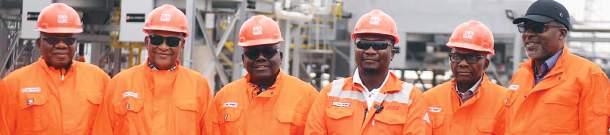
L-R: Executive Director, Hydrocarbon Processing Plants, Installation & Transportation Infrastructure, NMDPRA, Mr. Francis Ogaree; Authority Chief Executive, NMDPRA, Mr Saidu Mohammed; Co-Founder/Chairman, Waltersmith Group, Mr. Abdulrazaq Isa; Chief Executive Officer, Waltersmith Refinery & Petrochemicals Co. Ltd, Mr. Musa Mohammed; Director, Legal Directorate, NCDMB, Mr. Naboth Onyesoh, and Deputy Director, Office of ACE NMDPRA, Abubakar Maigari, during an official facility visit to Waltersmith Refinery Phase 2 at the Ibigwe Integrated Energy Hub, Ibigwe Field, Owerri, Imo State... recently
Onuminya Innocent
Former Attorney General of the Federation (AGF) and Minister of Justice, Abubakar Malami, SAN, yesterday, fired back at the Economic and Financial
Continued on page 8
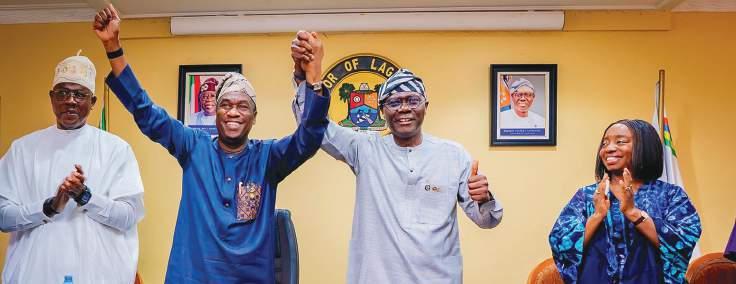
Sanwo-Olu Endorses Hamzat for APC Guber Ticket, No Competition in Sight
Malami Dares EFCC Over Seizure of 50 Properties, Says ‘All Declared, All Legal’ Says Tinubu had long told both of them that he saw 16 years journey for Lagos Deputy Gov: I never knew our relationship would grow to this extent
JULIUS BERGER’S COURTESY VISIT TO THE PRESIDENT...
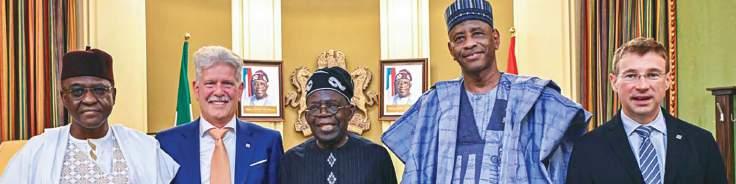
R-L: Managing Director of Julius Berger Nigeria PLC, Dr. Peer Lubasch; Chairman, Julius Berger Nigeria PLC, Engr. Goni Sheikh; President Bola Ahmed Tinubu, GCFR; Vice Chairman Julius Berger Nigeria PLC, Mr. George Marks and Director, Administration, Julius Berger Nigeria PLC, Dr. Abdulaziz Isa Kaita during a courtesy call at the State House, Abuja, Wednesday, April 22, 2026.
Onyebuchi Ezigbo in Abuja, Chinedu Eze in Lagos and Okon Bassey in Uyo
expor tdeskdepar tment@zenithbank.com OR Visit any Zenith Bank branch nationwide and let us suppor t you
wellness within reach
with W Health loan
The W Health Loan provides women with access to financing for eligible healthcare services
*Terms and conditions apply
OKPEBHOLO LEADS EDO APC LEADERS ON COURTESY VISIT TO LEEMON IKPEA...
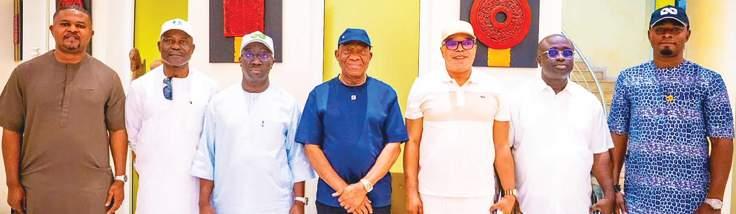
L-R: Dr. Jerry Uwangue, Hon. Commissioner Ministry of Agriculture and Food Security Edo State; Major General Cecil Osolease Esekhaigbe (Rtd.), PhD, APC Chieftain, Edo State; His Excellency, the Executive Governor of Edo State, Distinguished Senator Monday Okpebholo; Chief (Dr.) Leemon Ikpea, Founder/Group Chairman, Lee Engineering & Construction Company; Jarrett Tenebe, APC Edo State Chairman; Hon. Sylvester Aigboboh, APC Edo State Deputy Chairman; and Hon. Sunny Ekpeson, Chairman, Etsako East Local Government Area, Edo State, during a courtesy visit to Chief Ikpea’s residence… yesterday
Iran Offers to Reopen Strait of Hormuz
if US Lifts Blockade, Ends War
Oil price rises to $109/barrel as US-Iran peace talks stall
Emmanuel Addeh in Abuja
Iran has offered to end its chokehold on the Strait of Hormuz if the U.S. lifts its blockade on the country and ends the war, in a proposal that would postpone discussions on the Islamic Republic’s nuclear programme, two regional officials told Associated Press (AP) yesterday.
But the U.S. President Donald Trump seemed unlikely to accept the offer, which was passed to the Americans by Pakistan and would leave unresolved the disagreements that led the U.S. and Israel to go to war on February 28.
White House Press Secretary Karoline Leavitt said Trump’s national security team met Monday and was discussing Iran’s proposal. But she offered no detail about the discussion or how the proposal was received. She said Trump would address it later.
With a fragile ceasefire in place, the U.S. and Iran are locked in a standoff over the strait, through which a fifth of the world’s traded oil and gas passes in peacetime. The U.S blockade is designed to prevent Iran from selling its oil, depriving it of crucial revenue while also potentially creating a situation where Tehran has to shut off production because
it has nowhere to store oil.
The strait’s closure, meanwhile, has put pressure on Trump, as oil and gasoline prices have skyrocketed ahead of crucial midterm elections, and it has pressured his Gulf allies, which use the waterway to export their oil and gas, the AP report added.
Also, frustration among many nations is mounting, with renewed demands Monday to end the blockade that has had far-reaching effects throughout the world economy, including raising the price of fertilizer, food and other basic goods.
The Iranian proposal would push negotiations on the country’s nuclear programme to a later date. Trump said one of the major reasons he went to war was to deny Iran the ability to develop nuclear weapons.
The two officials with knowledge of the proposal spoke on condition of anonymity to discuss the closed-door negotiations between Iranian and Pakistani officials this weekend.
Iran’s proposal was first reported by the Axios news outlet.
It comes as Iran’s foreign minister made a visit to Russia he said was an opportunity to consult with Moscow regarding the war against Israel and the United States. Iran also wants the
US to end its blockade of the country as part of its proposal, said the two officials, who spoke on condition of anonymity to discuss the closed-door negotiations.
Meanwhile, Brent crude, the global benchmark for oil prices, rose over 3 per cent to just under $109 (£80) a barrel on Monday.
Global energy supplies have been under intense pressure since the start of the Iran war as the crucial Strait of Hormuz waterway has been effectively closed by the conflict.
Iranian Foreign Minister Seyed Abbas Araghchi said on Sunday that
“important discussions on bilateral matters and regional developments” were ongoing with Oman, its neighbour along the strait.
He posted on social media: “Our focus included ways to ensure safe transit that is to benefit all dear neighbors and the world. Our neighbors are our priority.”
Araghchi arrived in St Petersburg on Monday “with the aim of meeting and holding talks with Russian President Vladimir Putin”, Iranian state-run news agency Irna reported.
Around a fifth of the world’s crude oil and liquified natural gas (LNG)
usually passes through the Strait of Hormuz. Brent crude has risen by more than 10 per cent since Trump announced last week that he would extend a ceasefire with Tehran to give its leadership a chance to present a “unified proposal”.
Sophie Huynh, a portfolio manager and strategist at BNP Paribas, told BBC the ongoing closure of the strait could affect the price of everything from “bin bags to medicine”.
“I think we’re underestimating the extent of which products could be affected by the oil shortage,” she told the BBC’s Today programme.
“We’re not consuming crude, we’re consuming products.” If the strait remains closed for more than a few weeks, the effects will be “really far reaching in terms of supply chain”, she said. Oil traders appear to be less reactive to the latest headlines and are waiting for “credible” evidence of the conflict easing, said economics lecturer Goh Jing Rong from the Singapore Management University. “I think traders want concrete evidence rather than just a fragile and reversible ceasefire agreement,” Goh said.
Petrol Retailers Seek Accelerated Revival of NNPC Oil Refineries
The Petroleum Products Retail Outlets Owners Association of Nigeria (PETROAN) has called for sustained and coordinated advocacy for the revival of the country’s government-owned refineries, stressing that their full restoration remains critical to strengthening Nigeria’s downstream
Optimus Bank Delivers Strong FY 2025 Results, Records 69.94% PBT Rise to N24.14 Billion
Optimus Bank Limited, a fast-growing Nigerian national commercial bank, has reported strong audited financial results for the year ended December 31, 2025, delivering robust growth across key performance indicators and reinforcing the strength of its business model.
According to the results obtained on Monday, gross earnings rose by 73.53 percent to N50.67 billion from N29.20 billion in 2024, driven by growth in core banking activities, improved asset yields and increasing customer adoption across key segments.
Also, its operating income grew strongly by 82.02 percent to N42.75
billion, demonstrating the strength of the bank’s earnings capacity, while profit before tax increased by 69.94 percent to N24.14 billion, highlighting the bank’s ability to translate revenue growth into stronger profitability. Furthermore, its balance sheet stood at N286.02 billion, while gross loans rose by 137.19 percent to N118.16 billion, reflecting stronger credit support to businesses and key productive sectors of the economy, and customer deposits closed at N114.12 billion. This reflected sustained customer confidence and deepening market acceptance.
The bank maintained a sound liquidity position, with a liquidity ratio of 101.52 percent, providing
headroom to support business growth and strategic initiatives.
Commenting on the results, Managing Director/Chief Executive Officer, , Ademola Odeyemi said: “Our 2025 performance reflects the strength of our execution and the resilience of our business model. We delivered strong growth across key financial indicators while maintaining discipline in risk management and operational efficiency.
“These results reflect the continued success of our digital-first strategy, which is accelerating customer acquisition, deepening engagement and enhancing service delivery across our platforms, while positioning the Bank for sustainable scale.
petroleum sector.
The appeal came as the association congratulated the Nigeria Union of Petroleum and Natural Gas Workers (NUPENG) on its recent leadership transition, which saw the emergence of Salimon Oladiti as president following a delegate election held in Lagos.
In a statement issued by its National Public Relations Officer, Dr. Joseph Obele, PETROAN President, Billy Gillis-Harry, described the leadership change as a significant development that would consolidate stability within the downstream segment of the oil and gas industry. He said Oladiti’s emergence signalled continuity, unity, and a renewed commitment to collaboration among key stakeholders.
According to him, the association expects that under the new leadership, the welfare of petroleum workers would be further enhanced, while the collective voice of industry players would become stronger in shaping policies that drive national development.
PETROAN also commended the outgoing NUPENG President, Williams Akporeha, for what it described as a productive tenure marked by improved staff welfare, salary increases, infrastructural development, including the union’s
national headquarters, and sustained industrial harmony across the sector.
However, the association emphasised that a major priority for the new leadership should be championing robust advocacy for the rehabilitation and full operationalisation of Nigeria’s refineries under the Nigerian National Petroleum Company Limited.
Gillis-Harry argued that functional refineries would promote competition in the downstream market, curb the risk of monopolistic dominance, and create jobs across the petroleum value chain. He added that reviving the facilities would significantly enhance Nigeria’s energy security and reduce the country’s dependence on imported petroleum products.
“He (Gillis-Harry) further urged the new NUPENG President to champion strong and sustained advocacy for the revival and full operationalisation of Nigeria’s government-owned refineries, emphasising that restoring these refineries will promote healthy competition in the downstream sector, prevent monopolistic dominance, create employment opportunities across the value chain, and significantly boost national economic development.
“He stressed that functional refineries will also enhance energy
security and reduce dependence on imported petroleum products. In addition, PETROAN encouraged the new NUPENG leadership to consolidate a productive and mutually beneficial relationship with the Dangote Refinery, noting that strong collaboration between organised labour and major refining operators is essential for operational stability, fair market practices, and the overall growth of Nigeria’s petroleum industry,” the statement added.
The association further urged NUPENG under Oladiti to strengthen engagement with major refining operators, particularly the Dangote Refinery, noting that effective collaboration between organised labour and large-scale refiners is essential for maintaining operational stability and ensuring fair market practices.
PETROAN maintained that such partnerships would support the long-term growth of the industry, deepen stakeholder engagement, and protect the interests of both workers and operators in the downstream sector.
It expressed confidence that the new NUPENG leadership would sustain industrial peace while driving reforms that would reposition Nigeria’s petroleum industry for greater efficiency and shared prosperity.
Emmanuel Addeh in Abuja
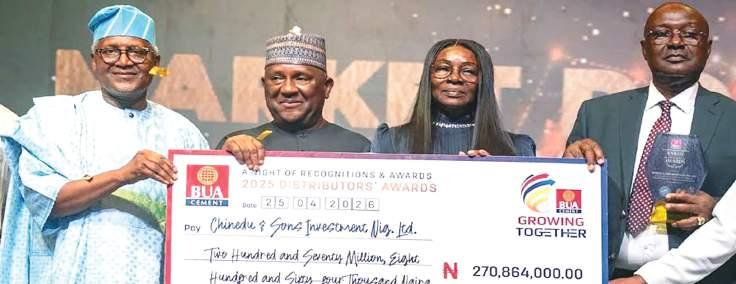
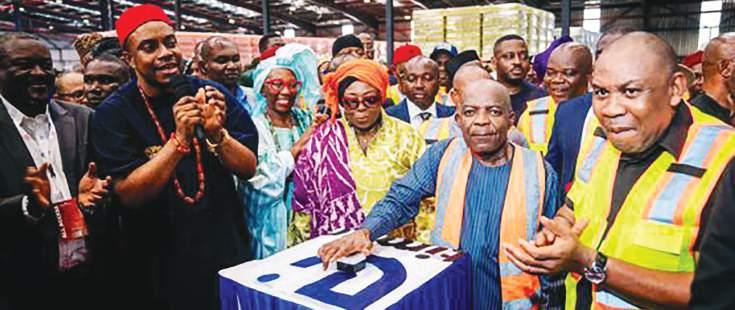
BUA CEMENT NIGHT OF RECOGNITION AND AWARDS...
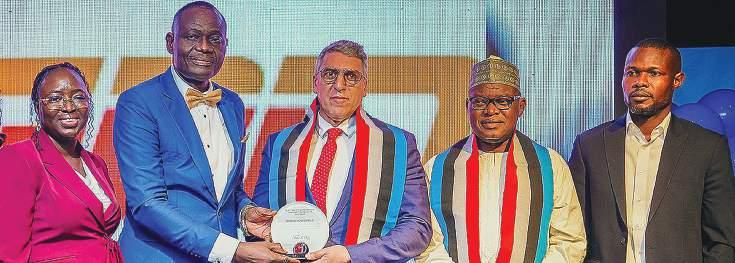
L-R: President, Dangote Group, Alhaji Aliko Dangote; Founder/Executive Chairman, BUA Group, Abdul Samad Rabiu; Director, Chinedu and Sons Investment Nigeria Limited, Mrs. Ezenyili N. Martha; and CEO, Chinedu and Sons Investment Nigeria Limited (Most Outstanding Distributor), High Chief Chinedu Ezenyili, for the year under review at the BUA Cement Night of Recognition and Awards held in Lagos ... recently
First Lady: Child Malnutrition Requires Urgent Govt Attention
Launches community food bank programme for 500,000 households in N’East
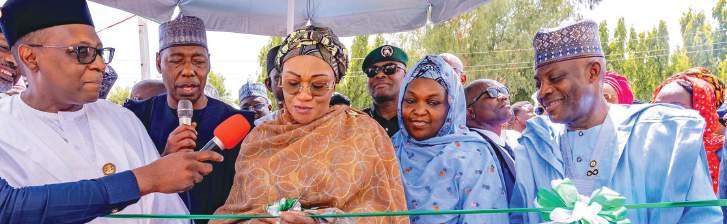
Wife of the president, Senator Oluremi Tinubu, has canvassed urgent government attention to end malnutrition among children in the country.
Speaking on Monday in Maiduguri at the inauguration of the North-east zone of the National Community Food Bank Programme (NCFBP) for vulnerable
malnourished mothers, pregnant women and children between the ages of zero to six years, Mrs Tinubu stressed that child malnutrition was a pressing national priority that required urgent attention.
She said the food bank programme was to put food on the tables of vulnerable groups in the country.According to her, millions of Nigerian children still lack access
to adequate nutrition.
She stated that it was one of the reasons the federal government was expanding the National Community Food Bank Programme across the country to supply food to those who needed it most.
The first lady acknowledged the support of the federal government, state governors, private sector partners, and Nigerians, in general, in the efforts to end malnutrition
in Nigeria children.
she stated, “Their generosity affirms that we are indeed our brothers’ keepers and gives confidence that this programme will endure and thrive for many years to come, beyond this administration.
”Globally, community food banks have proven to be effective mechanisms for delivering nutritious food to those who need it most. By building strong partnerships among
Alleged Procurement Fraud: Emefiele Asks Court to Foreclose Prosecution
Former Governor of Central Bank of Nigeria (CBN), Mr. Godwin Emefiele, has asked a High Court of the Federal Capital Territory (FCT), Maitama, to foreclose the prosecution in his alleged procurement fraud trial, if the prosecution fails to bring their remaining witnesses on the next adjourned date, April 28.
Emefiele made the request during yesterday’s proceedings, through his counsel, Mr. Matthew Burkaa, SAN, shortly after the prosecution counsel, Mr. Rotimi Oyedepo, SAN, told the court that he was not sure of bringing their two witnesses today.
The government lawyer said the prosecution was yet to obtain the subpoena from the court, adding that the witnesses are outside jurisdiction, Benin and Lagos.
The former CBN boss is being prosecuted by Economic and Financial Crimes Commission (EFCC), on an amended 20-count charge bordering on criminal breach of trust, forgery, abuse of office, conspiracy to obtain by false pretence, and obtaining money by false pretence while serving as CBN governor.
Emefiele, in the charge FCT/HC/CR/577/2023,marked: is also alleged to have knowingly
obtained by false pretence the sum of $6,230,000 purportedly meant for international election observers for the 2023 general election.
The anti-graft agency alleged the ex-CBN governor conferred corrupt advantages on two companies—April 1616 Nigeria Ltd and Architekon Nigeria Ltd. He, however, pleaded not guilty to the charges preferred against him.
At the resumed hearing yesterday, Mr. Chinedu Eneanya, Assistant Commander 2 with EFCC, was called to testify as the 13th prosecution witness (PW 13).
But Emefiele’s lawyer frowned on the idea of bringing another Investigative officer (IPO), on the grounds that the witness was coming to say the same thing said by two other IPOs.
“We understand their strategy, seems that they are ridiculing the court, all the same we are ready to go on,” Emefiele’s lawyer stated. When the court asked the prosecution to say how many more witnesses they had remaining, they said two more – Jim Obessa and CP Eloho Okpozikbo. The court then asked the prosecution to bring all their witnesses between Monday and Tuesday (today and tomorrow).
In his evidence in-chief, the witness, Chinedu Eneanya, told the court that his team was assigned to investigate the matter.
“The investigation revealed that the money, $6.3 billion, was removed from the coffers of the CBN for a purported funding of the foreign observer of the 2023 election,” he said.
He told the court that those connected with the movement of the fund were interviewed.
The witness said documents
were recovered from CBN for the release of the money.
Eneanya told the court that the investigations revealed also that the signatures of the then President, late Muhammadu Buhari, and then Secretary to the Government of the Federation (SGF), Boss Mustapha, were forged to collect the money.
He said forensic examination was carried out, which led to the knowledge that the two signatures were forged.
Inaugurates landmark projects in Borno
farmers, food producers, corporate organisations, and communities, food banks bridge the gap between abundance and need.
”The success of this programme will depend on sustained collaboration. We must work together to build a transparent, accountable, and well-structured food bank system that reaches vulnerable households across Nigeria.”
Mrs Tinubu disclosed that the initiative aligned with the Renewed Hope Agenda of President Bola Tinubu, particularly in advancing food security, improved healthcare, and building a stronger and more prosperous Nigeria.
She called for more partnerships for the programme.
She said, “I, therefore, call on individuals, organisations, and institutions across the North-East to support and actively participate in this initiative as we commence zonal rollouts nationwide.
”The choice of Borno State for the North-East launch is strategic. The region has faced security challenges, which have contributed to food insecurity and child malnutrition.
”This programme will complement ongoing efforts by state governments to improve access
to nutritious food, especially for women and children.
”I would like to seize this opportunity to specially commend the Governor Babagana Zulum for his remarkable gesture of empowering 2,000 women, many of whom are potential beneficiaries of the National Community Food Bank Project we are launching today.”
In his address, Borno State Governor, Professor Babagana Zulum, highlighted the support of the president and first lady in various areas, especially, in ameliorating the challenges occasioned by insurgency in the state. He pointed to the recent approval of N68 billion for the purchase of fossil fuels for the state power plant by President Tinubu, establishment of a College of Education, among others.
Coordinating Minister of Health, and Social Welfare, Professor Mohammed Ali Pate, said the programme was designed to establish community-based food banks in every local government area linked to primary healthcare centres supported by the Basic Health Care Provision Fund, in partnership with the Bank of Agriculture.
Commonwealth Secretariat, UN Agency, City of London, Others Back Nigeria’s Climate Investment
Addeh
Prominent global institutions, including the Commonwealth Secretariat, Sustainable Energy for All (SEforAll), and the City of London, as well as the Worshipful Company of Fuellers, have thrown their weight behind the inaugural Nigeria Climate Investment Summit (NCIS), scheduled to hold in London in June 2026.
The summit, a flagship programme of London Climate Action Week, is expected to convene senior Nigerian policymakers, global
investors, development finance institutions, and private sector leaders to deepen engagement on climate finance and energy transition opportunities in Nigeria.
In a statement in Abuja signed by the Chief Executive, SOStainability, Okey Epia, and Melini Mehra, CEO of GLOBE Legislators, the organisers said the event would serve as a structured platform to showcase Nigeria’s evolving climate policy landscape, highlight bankable green investment opportunities, and position the country as a competitive destination for sustainable capital.
SOStainability is a global enterprise dedicated to promoting sustainability and responsible climate action across businesses, communities, governments, and non-governmental entities, while GLOBE Legislators is a non-partisan, cross-party parliamentary organisation dedicated to improving governance for sustainable development.
Participants will include members of the National Assembly, heads of ministries and agencies, state governors, regulators, and corporate leaders, alongside
international stakeholders and diaspora investment networks, the statement said.
The NCIS will focus on emerging opportunities driven by recent policy developments such as Nigeria’s National Carbon Market Framework, updated Nationally Determined Contributions (NDC), and reforms under the Electricity Act 2023. It is also expected to facilitate deal-making, foster partnerships, and strengthen Nigeria’s engagement in global climate diplomacy ahead of COP31 in Antalya, Turkey.
Emmanuel
in Abuja
Alex Enumah in Abuja
Deji Elumoye in Abuja
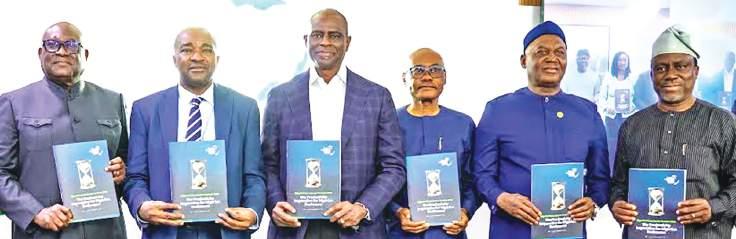
LAUNCH OF THE NIGERIA PRIVATE SECTOR OUTLOOK 2026 REPORT...
L-R: Board Member, Nigerian Economic Summit Group (NESG), Mr. Udeme Ufot; Chairman, NESG, Mr. Olaniyi Yusuf; Board Member, NESG, Mr. Segun Ogunsanya Board Member, NESG, ;Mr. Olakunle Alake; Director General, Nigeria Office, African Development Bank (AfDB) Mr. Abdul B. Kamara; and Board Member. NESG , Dr. Demola Sogunle, at the launch of the Nigeria Private Sector Outlook 2026 Report in Lagos.. recently
Court Strikes Out Suit Challenging 50% Telecom Tariff Hike, Cites Lack of Locus Standi
Wale Igbintade
The Federal High Court in Abuja has struck out a suit challenging the 50 per cent telecommunications tariff hike approved in January 2025, delivering a major legal victory for MTN Nigeria Communications Plc and the Nigerian Communications Commission (NCC).
In a judgment delivered on April 22, 2026, Justice M.G. Umar held that the court lacked jurisdiction to hear the case after finding that the applicant failed to establish locus standi—the legal right to institute the action.
The suit, marked FHC/ABJ/ CS/643/2025, was filed on October 21, 2025, by Barrister Obioma Ezenwobodo.
He sought to nullify the NCC’s January 20, 2025 approval of a 50 per cent tariff increase and compel both the regulator and MTN Nigeria to refund all charges collected under the hike, with interest.
The applicant also demanded
N100 million in general damages, citing alleged hardship, economic deprivation and psychological distress resulting from what he described as arbitrary and unlawful charges.
MTN Nigeria, through its counsel Ituah Imhanze of Kenna LP, challenged the suit at the preliminary stage, urging the
court to dismiss it for want of jurisdiction.
The objection was argued on January 26, 2026.
In his ruling, Justice Umar agreed with the telecoms company’s position, holding that the applicant failed to show any special or personal interest distinct from that of the general public.
The court noted that the tariff hike applied uniformly to all telecom subscribers and did not uniquely affect the applicant.
As such, his complaint amounted to a general grievance, which does not confer the standing required to invoke the court’s jurisdiction.
Having found that the applicant lacked locus standi, the court
ruled that it could not proceed to determine the substantive issues and accordingly struck out the suit.
The judge also ordered parties to bear their respective costs, dismissing claims for refunds and damages.
If the suit had gone the way of the applicant, It would have forced telecom operators including MTN
Nigeria to reimburse subscribers with interest.
The decision effectively upholds the NCC’s regulatory authority and allows telecom operators, including MTN Nigeria, to continue implementing the tariff hike without immediate legal challenge from parties lacking direct personal interest.
Shareholders of Transcorp Power Okay N41.25bn Dividend
James Emejo and Mariam Adedokun in Abuja
Shareholders of Transcorp Power Plc, yesterday approved the sum of N41.25 billion as dividend pay-out for the 2025 financial year.
The total dividend consisted of an interim dividend payment of N11 billion, representing N1.50 kobo per share, which was paid in August 2025, as well as a final dividend of N30 billion, representing N4 per share.
At the company’s 13th Annual
General Meeting (AGM) held in Abuja, shareholders also approved its audited financial statements, commending the board and management for an impressive performance in recent years.
The company grew its revenue to N398.27 billion in the review period from N305.94 billion in 2024, indicating robust growth while operating profit increased to N125 billion from N114.03 billion in 2024. Profit Before Tax (PBT) rose to N120 billion compared to N113.3 billion as Profit After Tax
(PAT) increased by 14.25 per cent to N91.4 billion from N80 billion in the preceding year, aided by cost optimisation and improved generation.
Commenting on the performance at the AGM, Chairman, Transcorp Power, Mr. Emmanuel Nnorom, said, “We remain dedicated to improving lives and transforming Africa, ensuring operational excellence and making strategic investments that deliver sustainable, long-term value to our shareholders while also powering Nigeria’s socio-economic development.
He said, “We reduced our loan obligations by approximately N7 billion during the year, which directly enhanced our bottom line and reinforces our commitment to a stronger, leaner financial position.
in Workforce
WIL Coalition: Nigeria Can Unlock $23bn by Closing Gender Gap
Seeks full salary for maternity, paternity leave, warns fragmented policy leads to lost productivity
limiting, and called for urgent national reform of the parental leave system.
Advocates, policy stakeholders, and parents under the aegis of Nigerian Women in Leadership Coalition (WIL Coalition), yesterday, said the country could unlock about $23 billion in economic value by closing gender gaps in workforce participation.
WIL Coalition stated that bridging gender divides could also lead to improvement in productivity, retention, and long-term child health outcomes through stronger parental support systems.
Addressing journalists at the launch of “Best Start” campaign in Abuja, the coalition described the current framework as unequal, burdensome, and economically
World Bank’s Women, Business and the Law 2026 report revealed most Nigerian states score zero out of 100 on supportive parenthood laws, reflecting a system with no meaningful protections or incentives for working families. Specifically, the coalition called for the adoption of a national parental leave framework that guaranteed a minimum of 16 weeks of fully paid maternity leave as well as two weeks of paid paternity leave across all sectors.
Speaking at the activation at the Federal Ministry of Labour, the advocates criticised current leave policies that left mothers with
only 12 weeks of maternity leave, with half salary, and zero days of paternity leave for fathers, apart from those working in the federal civil service and a few states.
According to the coalition, “This means for most fathers in the private sector, there is no consistent statutory protection, creating unequal access to care during the most critical period of early childhood development.”
Executive Secretary, Women in Successful Careers (WISCAR), Ekemini Akpakpan, told THISDAY, “Nigeria does not have a functioning parental leave system. There is no national standard for paternity leave. And maternity leave provisions are inadequate. We have fragmented rules across states and employers.”
“Our revenue growth in 2025 was underpinned by a deliberate capacity expansion strategy. The commissioning of GT20 added 100MW to our output, lifting our average available capacity from 417MWto 550M, a milestone that meaningfully strengthened our generation profile.”
“Despite macroeconomic challenges, your Company delivered strong performance in 2025, reinforcing its resilience and its position as a leading power generation company in Nigeria and West Africa. The board remains steadfast in its commitment to delivering exceptional value to our shareholders. As we hold our 13th Annual General Meeting, we celebrate our remarkable achievements and remain optimistic about the opportunities ahead.
“Looking ahead, we are confident in the company’s trajectory and our ability to continue to deliver stellar results driven by robust strategies, sound execution mindset, relentless pursuit of excellence and
dedicated team. On behalf of the Board of Directors, I extend heartfelt gratitude to our shareholders for their unwavering support, and confidence. I also wish to commend our management and employees for their dedication and resilience. Together, we will continue to power progress, transform lives and improve Africa.”
In his remarks, Managing Director/Chief Executive, Transcorp Power, Mr. Peter Ikenga, said, “The FY 2025 results reflect our steadfast commitment to operational excellence, sustainable growth, strategic market expansion and enhanced generation capacity, which continue to fuel significant revenue growth.
“Notwithstanding the network transmission line issues, our FY 2025 performance remained strong and reflects our steadfast commitment to operational excellence and sustainable growth.
Dangote Calls for Urgent Government, Private Sector Action to End Malaria
Sunday Ehigiator
Chairman of Nigeria’s National Malaria Elimination Council (NMEC), Aliko Dangote, has called on governments and the private sector to intensify coordinated efforts to eliminate malaria, describing the current moment as critical in the global fight against the disease.
Speaking to commemorate World Malaria Day 2026, Dangote said although notable progress has been recorded in combating malaria, the gains remain uneven, particularly in sub-Saharan Africa, which accounts for over 90 per cent of the global burden. He noted that despite advances
in prevention and treatment, malaria continues to rank among the world’s deadliest diseases, disproportionately affecting children under five, pregnant women, displaced persons, and underserved communities.
“Progress against malaria is real, but it remains deeply unequal. Too many people still lack access to life-saving prevention, diagnosis, and treatment. This gap is unacceptable when the tools to end malaria already exist.”
Dangote stressed that malaria continues to exert significant pressure on health systems, economies, and communities across Africa, but added that recent scientific advancements and stronger partnerships have created a
pathway to elimination that is clearer than ever.
According to him, innovations such as next-generation vaccines, improved diagnostics, and data-driven surveillance systems have positioned the global health community for decisive action, provided there is equitable and large-scale implementation.
Highlighting this year’s theme,
“Driven to end malaria: now we can. Now we must,” Dangote underscored the importance of private sector involvement, noting that corporate interventions through workplace and community programmes can significantly complement governmentled efforts.
James Emejo and Mariam Adedokun in Abuja
David Bird: Dangote Petroleum’s Scale Will Force Inefficient Refineries to Shut
Says
Africa must focus on energy freedom Nnaji: Nigeria has not financed any major power plant for 11 years Geometric Power chair blames policy reversals for stalled projects Lagos to build private sector-led power market
Peter Uzoho
Managing Director and Chief Executive Officer of Dangote Petroleum Refinery, Mr. David Bird has declared that the planet will be the ultimate beneficiary if the scale and efficiency of the 650,000 barrels per day Lagosbased facility forces older, smaller, and less-efficient refineries to shut down.
This comes as the Chairman of Geometric Power Group, Prof. Barth Nnaji bemoaned the ugly state of the Nigerian electricity sector, stating that the country has not financed any major power generating plant in 11 years after the government scrapped key risk guarantees that once attracted global investors.
Bird and Nnaji spoke yesterday in Lagos at the 19th Annual Conference
of the Nigerian Association for Energy Economics (NAEE). Bird argued that global refining must get cleaner and more efficient, and that Africa should not be left behind in that shift.
The Australian CEO of the Dangote Refinery expressed his incredible pride “of being part of the world’s youngest, most modern, most energy efficient, most automated, most data rich refinery.”
“And whatever anyone’s view is on the outlook for our product, which is clean Euro 5, Euro 6 fuels, if at the very least that results in older, smaller, less efficient refineries closing down, then that is a good thing for the planet, because that improves the overall energy efficiency of the refining population”, he stated.
Bird said Africa has a moral obligation to move from energy poverty
to energy abundance, and that the journey starts with clean fuels and pursuing the energy efficiency of the entirety of the energy mix.
He stressed that continued reinvestment in the oil and gas value chain, using best available technology, is an imperative for the African continent.
He welcomed new refining projects across Africa, saying it will be absolute industrialisation if there’s anyone to continue to pursue refining.
He argued that any country that is blessed with natural resources should always look to do the processing and the maximum value capture that comes from that raw material, not just export the raw material for processing in another location.
Bird confirmed that the refinery
is now operating at its full capacity of 650,000 barrels a day, more than meeting the country’s demands, not only of Premium Motor Spirit (PMS), but obviously of diesel and jet fuel, and that any surplus of that is getting exported.
He noted that despite scheduled maintenance in December and January, the plant continued to supply Nigeria all through the festive season, and that there was no fuel scarcity or fuel queues during Christmas.
Amid global supply shocks, he said Nigeria’s position is secure compared to dome other countries grappling with shortages.
“What is worse than $100 or $120 oil is no oil. And that is being faced by both developed and developing import-dependent countries, whether that’s Australia… or developing
countries, Bangladesh, Sri Lanka, Philippines.
“Right now in Nigeria, there remains fuel abundance, and that is a good thing. Obviously, our commodity is exposed to the global price variations. We can’t insulate ourselves from that, but at least we have the product. We have the fuel, we have the fertiliser, as a result of the Dangote investment”, the CEO explained.
Bird reaffirmed Dangote’s “Africa first” export policy for surplus volumes, saying they were proud to have done a direct delivery to Ethiopian Airlines, and will continue to export their product in surplus to Nigeria’s requirements to neighbouring neighbouring African countries.
He said they have done that to more than 11 African countries to
date since the war began. According to him, while sales are on an FOB basis to a wide variety of counterparties, the company has tried to direct and ensure that those surplus molecules were given to African countries as a priority.
SANWO-OLU ENDORSES HAMZAT FOR APC GUBER TICKET, NO COMPETITION IN SIGHT
Segun James
Lagos State Governor, Mr. Babajide Sanwo-Olu, yes-terday, endorsed his Deputy, Dr. Obafemi Kadri Hamzat, for the All Progressives Congress (APC) governorship ticket in Lagos, even as no other indi-vidual has openly indicated any desire to compete for coveted position ahead of the party primary.
Interestingly, it was the first time since the return to civil rule in 1999, that a sitting governor of Lagos State would endorse his deputy to succeed him.
The development also signalled continuity in the re-al sense, but more than anything else, it appeared
Crime Commission (EFCC), filing a 40-page affidavit before the Federal High Court to block the final forfeiture of more than 50 properties linked to him, his family, and 14 companies.
The move came after Justice Emeka Nwite granted EFCC an interim forfeiture order on January 6, 2026, in Suit No. FHC/ABJ/ CS/20/2026.
The order temporarily handed the commission control of houses, hotels, schools, factories, and plots of land across Abuja, Kano, and Kebbi.
the result of the work chemistry between the two, which had seen them cooperate seamlessly in the last seven and half years.
Sanwo-Olu’s endorsement followed series of consultations by Hamzat, who recently met with the Chief of Staff to the President, Hon. Femi Gbajabiamila; former Minister of Finance, Olawale Edun; and the Senator for Lagos East, Tokunbo Abiru.
Before meeting with the trio separately two days ago, Hamzat had also met with the leaders of the Governor’s Advisory Council (GAC), including its chairman, Alhaji Tajudeen Olusi; Alhaji Busura Alebiosu as well as traditional rulers
mission valued at N5.95 billion was bought for N500 million, Malami said, add-ing that Rayhaan University’s permanent site, pegged at N56 billion by EFCC, had receipts showing N150 million, while an independent valuation by Jide Taiwo & Co was attached to back his figures.
Malami tendered four CCB asset declaration forms from 2015, 2019, and 2023, arguing that the disputed properties were already on record before the case began.
in the state.
But the meeting with Sanwo-Olu, seemed like a grand finale of sort, an event expected to be capped soon by President Bola Tinubu before the official affirmation at the proposed APC primary elections in the coming days.
Sanwo-Olu, who received Hamzat and members of the GAC in consultation visit, openly threw his weight behind his deputy’s aspiration to run for governor.
The consultation meeting came immediately after the State’s Executive Council meeting at the State House, Marina, where members of the cabinet and APC leaders in Lagos Central joined the governor
“Allegations are being contested and not determined,” he wrote.
On four Abuja properties tied to businessman Abdulrahman Musa Bashir, Malami said they stemmed from pre-2015 legal and business deals, later settled by set-off.
Another property, he claimed, belonged to his late father’s estate and was held in trust for other heirs.
to receive Hamzat’s entourage.
The governor and his deputy shared an emotional moment, reflecting on their political journey over the past seven years and how their paths had crossed during their public service experience under the tutelage of President Tinubu.
Sanwo-Olu recalled that he and Hamzat used to sit next to each other in ex-governor Babatunde Fashola’s cabinet, recollecting that no cabinet memo would scale through without their input and two others sitting in their row.
“Mr. Deputy Governor has created a personal relationship with me since way back before we’re joined together on a ticket. His family
ownership and lawful source of funds,” Malami’s affidavit concluded.
Nwite is expected to set a hearing date to decide whether to lift the interim order or make it final. For now, the hotels, schools, and mansions remained in EFCC’s custody.
and my family have been close; our relationship was built on mutual respect, trust and dignity,” he said.
Sanwo-Olu said when he picked his governorship eight years ago, he never severed his relationship with Hamzat, who picked his own governorship form two days earlier.
The governor recalled how both of them forged a merger and ran on a joint ticket. After their 2019 electoral victory, Sanwo-Olu famously said Lagosians were getting price of two for one, referring to his deputy as a potential Governor.
“After the merger meeting, our father and leader, who today is ordained by God to be President of Nigeria, told both of us that he saw 16 years journey for Lagos.
“A lot of governors always look for weak deputies, but that was not for me. From day one in my governorship journey, I wanted the best partner to join the journey to build Greater Lagos.
“There was no meeting I could have attended that Mr. Deputy Governor is not fit and proper to attend. He possesses the skills, temperament and temerity to attend.
indebted to our leader and father, Mr. President, the man who God continues to use to shape the political trajectory and destiny of Lagos. People said we have turned Lagos to irreversible construction site since Asiwaju’s era.
“If a competent man like Dr. Hamzat comes in, he will hit the ground running immediately. We are not going to hand over Lagos to charlatans, who are coming to test their luck. Dr. Hamzat is tried and tested; he knows every nook and cranny of Lagos. Mr Deputy is the best man for the job.”
Reflecting on their relationship, Hamzat said: “By some stroke of coincidence, it was (Governor) Sanwo-Olu who took me round the Ministries when I was first appointed as Commissioner in 2005 by our father and leader, President Tinubu, who was then the Governor of Lagos State.
MALAMI DARES EFCC OVER SEIZURE OF 50 PROPERTIES, SAYS ‘ALL DECLARED, ALL LEGAL’ FG MOVES TO STABILISE JET FUEL PRICES AS KEYAMO, NMDPRA STEP IN
EFCC’s ex parte motion claimed the assets were “reasonably suspected to be proceeds of unlawful activities”.
Malami’s sworn response, however, stated that it was not true.
“There is no prima facie evidence,” the affidavit read, insisting every property was bought with legitimate funds and declared to the Code of Conduct Bureau long before the EFCC move.
To prove it, the former AGF laid out N15.5 billion in “lawful income” earned between 2015 and 2023.
That included N374.6 million as AGF salary and allowances, N10.01 billion business turnover, N3.52 billion in bank loans, N958 million in wedding gifts, and N509.8 million from two book launches.
Companies named included Rayhaan Hotels, Zeennoor Hotels, Meethaq Hotels, Rayhaan Bustan Agro Allied, Azbir Arena, and Rayhaan University.
He accused EFCC of inflating values to “mislead the court”.
A Maitama duplex the com-
He also said six assets, including Rayhaan Hotel, Kano, and Malami Support Organisation Building, were acquired between 2006 and 2013 — before he became minister.
The affidavit took a personal turn when Malami said armed EFCC operatives evicted his family from six Abuja homes on March 24, 2026, without a final forfeiture order.
“My wives and children, who are minors, were chased out,” he stated, and added that title documents were seized during his 25-day detention in December 2025.
The interim order might have started to hit his businesses already. For instance, NEXIM Bank recalled a N1.122 billion loan to Rayhaan Bustan Agro Allied days after the court ruling, the affidavit said. Zenith Bank, which guaranteed the facility, also began charging daily interest on the balance, it added.
Malami also addressed the criminal angle. The forfeiture, he stated, leaned on Charge No. FHC/CR/700/2025, where he had pleaded not guilty.
The court had directed any interested party to “show cause” why the assets shouldn’t be permanently forfeited to the federal government.
“I have fully accounted for
Development, Festus Keyamo, and the Nigerian Midstream and Downstream Petroleum Regulatory Authority (NMDPRA) have stepped into the ongoing crisis in the sector, in a bid to broker a truce among key players.
THISDAY learnt that while the government’s intention may be to stabilise fares and shield airlines from volatile fuel costs, price controls in a deregulated environment could have unintended consequences, including product scarcity and supply chain disruptions.
Sources who preferred to remain anonymous agreed that such interventions in the downstream sector to cap aviation fuel prices may further lead to black-market activities without a market-aligned framework, leading to safety issues in the sector.
They believe market forces should be allowed to prevail in the sector, otherwise we may be looking at another potential subsidy regime
Outside the court, Malami’s lead counsel, J.B. Daudu, SAN, told reporters that the interim order was “based on speculation, not evidence”.
EFCC declined comment on the new filings.
in the sector. most airlines just can’t buy Jet fuel at the current market determined prices and at current cost of ticket.
Besides, they argued that it may further result in scarcity, flight disruptions, and broader economic consequences, urging the government to tread cautiously and warning that while price moderation is desirable, rigid controls could ultimately prove counterproductive in a liberalised market.
However, the Minister of Aviation and Aerospace Development, Festus Keyamo, in collaboration with the NMDPRA, has moved to stabilise the aviation fuel market amid mounting tensions between airlines and fuel marketers.
This comes as the Trade Union Congress of Nigeria (TUC) asked the federal government to take immediate measures to check increases in the pump price of petroleum products and the resultant hardship imposed on workers and citizens.
“Some of my governor colleagues privately confided in me, saying ‘your Deputy is highly intelligent’ after noticing the intellectual skills Dr. Hamzat brought to discussions at NGF level.
“For this, we will continue to be
The intervention by Keyamo and the NMDPRA aims to halt escalating jet fuel prices and broker a lasting truce, restoring confidence and operational stability in the country’s aviation sector.
According to an executive summary of the Engagements on the Supply and Pricing of Aviation Fuel, obtained from the NMDPRA, a meeting was convened by the Minister of Aviation and Airspace Management on April 22 and 23 2026 to deliberate on the challenges of supply and pricing of Aviation Fuel.
The minister held a series of meetings with Airline Operators of Nigeria (AON), the NMDPRA, and other government agencies in the aviation sector to agree on how the price of aviation fuel could be reviewed downwards, the executive summary showed.
Sequel to the resolution of the meetings, the minister and the NMDPRA convened a meeting of
“I had never met Governor Sanwo-Olu before my appointment into the government. I never knew our relationship would grow to this extent.
“Most people refer to deputy governors as spare tyres. Deputising Governor Sanwo-Olu in the last seven years, I have never felt or been treated as a spare tyre.
“The Governor did well in car-
Continued on page 29
the Technical Committee on April 24, 2026, to discuss the issues and recommend the way forward.
The executive summary further disclosed that the meeting, which had in attendance the Ministry of Aviation, the Ministry of Petroleum Resources, NMDPRA, FAAN, NAMA, NCAA, Airline Operators and Aviation Fuel Marketers, resolved that a technical committee should be constituted.
Sequel to the resolution, the NMDPRA convened a meeting of the Technical Committee on April 24, 2026 to discuss the issues and recommend the way forward.
The key recommendations from the meeting were that, following the engagements and current market fundamentals, those in attendance agreed that the indicative end-user price should range between N1,760 – N1,988 per litre and N1,809 –N2,037 per litre in Lagos and Abuja
Continued on page 29
Dangote
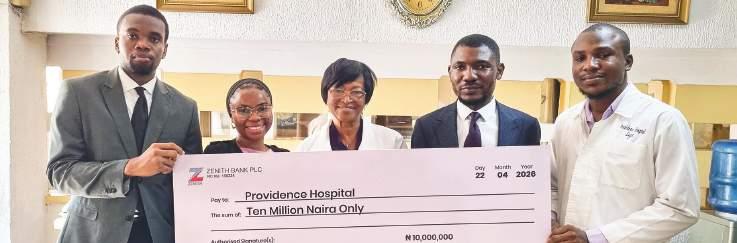
PRESENTATION OF MONETARY SUPPORT BY WOLE OLANIPEKUN & CO...
L-R: Ikenna Nwana and Mariam Oyede of Wole Olanipekun & Co.; Dr. Dorothy Omono Esangbedo, Proprietor of Providence Children Hospital; Akintola Makinde, Partner at Wole Olanipekun & Co.; and Dr. Bright Orji of Providence Hospital during the presentation of monetary support for infrastructure and equipment by the law firm to Providence Children Hospital ... recently
UBA Explains 2025FY Dividend Decision, Recorded N50bn Pretax Profit
United Bank for Africa (UBA) Plc, yesterday provided clarity on its 2025 financial performance and the decision not to declare a final dividend, reaffirming to shareholders strong recovery outlook for 2026 financial year.
The bank ended 2025 financial year with a pretax profit of N50.121 billion as against N486.5 billion in 2024. However, a tax credit of N115 billion improved the profit for the year to print at N165.3 billion, which was still lower than the N564 billion recorded in 2024, showing a decline
of about 71 per cent.
But addressing investor concerns, Group Managing Director/Chief Executive Officer, UBA, Mr. Oliver Alawuba, emphasised that the bank’s dividend track record remains strong, underpinned by consistent double-digit yields in recent years.
The bank paid a total dividend of N2.80 per share in 2023 and N3.25 per share in 2024, reflecting its commitment to shareholder value.
UBA in its audited 2025 Half Year (H1 2025) results, declared an interim dividend of N.25k per share.
However, he explained that the 2025 financial year presented unique
regulatory-driven challenges.
A directive by the Central Bank of Nigeria required banks to exit the regulatory forbearance loan window and fully align with prudential loan classification standards.
“Exiting the forbearance regime necessitated the reclassification of certain credit exposures and the recognition of significant provisions.
In 2025, UBA prudently provided approximately N1.021 trillion, which temporarily elevated our nonperforming loan ratio beyond the threshold required for dividend distribution,” Alawuba stated.
He noted the decision not to declare
a final dividend for 2025 reflects the bank’s disciplined risk management approach and adherence to regulatory standards, rather than any deterioration in its underlying franchise strength.
UBA confirmed it is actively pursuing recovery of impacted loan exposures and has instituted robust mechanisms to drive collections and restructuring.
These efforts are expected to result in write-backs as recoveries materialize, supporting a normalization of asset quality metrics.
“The good news is that these are recoverable assets. As we make progress on recoveries, we expect to see
improvements in our non-performing loan ratio and position the Bank for a return to dividend payments,” Alawuba added.
Providing an outlook for the current financial year, Alawuba highlighted encouraging early indicators from the Bank’s 2026 performance.
However, UBA posted a drop of 22 per cent in first quarter ended March 31, 2026, falling to N146.6 billion from N189.8 billion posted in 2025. The reduction in profit could be attribute to a jump in impairment charges, which rose from N11.1 billion in 2025 to N38.2 billion in 2026.
But the bank recorded approxi-
UNICEF Hands Over 45 Motorcycles to Bauchi to Enhance Immunisation, Maternal, Child Health
Segun Awofadeji in Bauchi
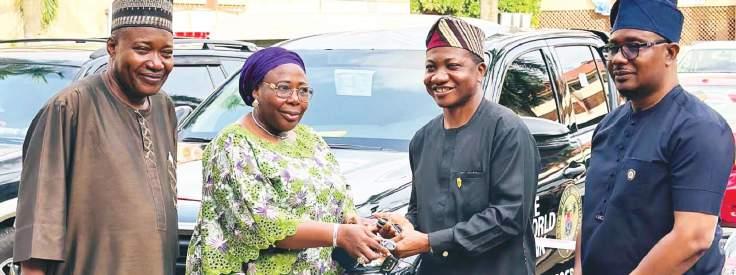
Global Affairs Canada (GAC), in collaboration with the United Nations Children’s Fund (UNICEF) has handed over 45 brand new Boxer motorcycles to the Bauchi State Government to improve the delivery of maternal and reproductive health services in especially hard-to-reach areas in the state.
The motorcycles were officially handed over to the state government through the Ministry of Health and Social Welfare, by the Chief of Office, Dr. Nuzhat Rafique on Monday for effective service delivery in the health sector in the state.
The UNICEF Chief of Field Office during the handover ceremony stated that Global Affairs Canada (GAC) provided the support for adolescent reproductive health in Bauchi State in order to reach the hard-to-reach areas.
According to her, “The purpose of these motorbikes today, which are 45 in number are given for the LGAs, on average two per LGA to reach the most deprived areas, to reach the areas where the children and the mothers and adolescents especially cannot reach the facilities. So that is the purpose, to reach the last child.”
“As you know, UNICEF is always
working for the most vulnerable. And the most vulnerable are those at the end of the LGAs in very remote areas facing financial barriers, facing access barriers. And if it is not possible for them to reach us, we have to reach them. And this is, transport being given to all LGAs in Bauchi for reaching those children, mothers, newborns.
“And as has already been explained, that this immunization is the entry point from all zero dose children. You know, it’s like thousands and thousands of zero-dose children who have never received any vaccine in Bauchi; all the mothers who have never
received any antenatal care, especially adolescents, when the mothers are very young, which is very common in Bauchi. The girls are married at a very early age, which is not good for their health and for their social development.
“But we need to increase the age of marriage as well as who are already married provided best services for their health so they can give birth to healthy children and they can also survive.”
“Maternal newborn mortality is one of the highest in Nigeria among all West African countries and especially in North East. So that is my request that we should have a comprehensive approach to reach every child, every mother in the most deprived areas to save their lives and to realize their rights to health and services. So that is my plea and we can hand over the keys to honorable State representative,” she said.
mately 2% loan growth in the first quarter of 2026, marking a recovery from the flat growth seen in 2025.
The Bank said it has also continued to benefit from a strong funding base, with customer deposits of N27.2 trillion compared to a loan book of approximately N7 trillion, creating significant headroom for risk-calibrated lending expansion.
“With improving macroeconomic conditions and expectations of moderating interest rates, we see a supportive environment for credit growth. Our conservative balance sheet positioning ensures that we can scale lending responsibly while enhancing profitability,” he said.
UBA reaffirmed its long-standing commitment to delivering sustainable shareholder returns and expressed confidence in its ability to resume dividend payments as asset quality metrics improve.
“Our priority is to protect the long-term value of the institution while navigating regulatory changes responsibly. We remain confident that 2026 will mark a return to stronger profitability and dividend capacity,” Alawuba concluded.
UBA has announced its audited financial results for the year ended December 31, 2025 recording total assets growth of 9.4 per cent to N33.2 trillion up from N30.3 trillion at the end of 2024, alongside an 11.8 per cent increase in customer deposits from N24.3 trillion in 2024 to N27.2 trillion.
Kuni Tyessi in Abuja
The Women Advocates Research and Documentation Centre, (WARDC) has intensified efforts to tackle rising cases of online abuse against women and girls with the unveiling of a new research report and stakeholder training in Sub-Saharan Africa.
The report, in partnership with the International Federation of Women Lawyers (FIDA) in Kenya, supported by the United Nations Trust Fund (UNTF), is titled “The Digital Harm
Effect: Confronting Technology-Facilitated Violence Against Women and Girls in Africa: A Case Study of Nigeria and Kenya,”.
Research Lead and Editor of the report, Dr. Abiola Akiyode-Afolabi, derided the increasing misuse of digital platforms to perpetrate abuse across Sub-Saharan Africa.
Akiyode-Afolabi highlighted the prevalence, patterns and far-reaching impacts to include cyberstalking, imagebased abuse and other forms of digital violence which is often targeted against women and girls in the region.
She said project has reached 2,000 people across Nigeria and Kenya, adding that efforts were in place to engage policy makers, the legislators on enactment of laws and policies to address it.
According to her: “Through the research, we engaged a wide range of participants and discovered significant gaps, including widespread stigma and underreporting.
“The findings revealed that many young women face severe online threats, with some even contemplating suicide as a result of the abuse they experience.
The administration of President Bola Ahmed Tinubu has been credited with expanding recruitment across federal institutions, improving infrastructure and stabilising key economic indicators.
This was stated by the Convener of the Bola Ahmed Tinubu Ideological Group, Bamidele Atoyebi, who said the current government had recorded progress in employment generation, education funding, transportation and financial sector reforms.
Atoyebi said federal ministries, departments and agencies, as well as parastatals, tertiary institutions
and research centres, were recruiting Nigerians in significant numbers.
He added that increased allocations to state governments had also enhanced their capacity to implement humanitarian and welfare programmes.
Speaking on education, he noted that the Nigerian Education Loan Fund had provided support for students, while the Tertiary Educa- tion Trust Fund had continued to improve lecturers’ welfare, training and development. According to him, the relative absence of industrial actions by the Academic Staff Union of Universities reflects improved engagement between government and academic
unions.
He also highlighted several ongoing infrastructure projects nationwide, including the LagosCalabar Coastal Highway, rehabilitation works on the Abuja-Lokoja road and road upgrades within the Federal Capital Territory. Other projects he listed include the Sokoto-Badagry road, OyoOgbomoso road, East-West road and the Ilorin-Jebba-Mokwa corridor. On the economy, Atoyebi said reforms had strengthened Nigeria’s foreign reserves, improved the international usability of Nigerian payment cards and supported relative stability in foreign exchange and monetary policy.
Bennett Oghifo
Kayode Tokede
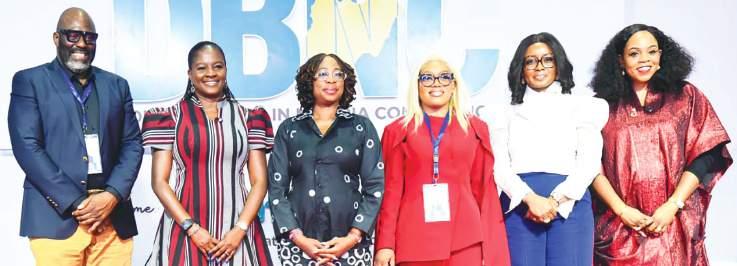
AT DBNC 2026...
L-R: Broadcaster & Media Personality, Chukwuma “Chico” Aligwekwe; Union Bank of Nigeria, MD/CEO, Mrs Yetunde Oni; Mastercard Country Manager, Dr Folashade Femi Lawal; Convener Doing Business in Nigeria Conference (DBNC), Ms Linda Uneze; Ikeja Electric, CEO, Mrs Folake Soetan; and Sahara Group Foundation, Director, Ms Chidilim Menakaya at DBNC 2026 held in Lagos … recently
Nigeria No Longer Safe Haven for Drug Cartels, Says UNODC
The United Nations Office on Drugs and Crime (UNODC) has declared that Nigeria is no longer a permissive environment for international drug cartels, citing a surge in arrests, seizures, and convictions driven by reforms within the National Drug Law Enforcement Agency (NDLEA).
The UNODC Country Representative, Cheikh Toure, made the statement in Abuja on Monday during the handover of newly constructed audiovisual interview rooms to the NDLEA.
The facilities, equipped with modern interrogation technology, were provided by UNODC with funding support from the United States International Narcotics and Law Enforcement Affairs (US-INL).
Toure described transnational drug trafficking as one of the most destabilizing global threats, linking it to corruption, violence, and the exploitation of vulnerable populations.
He noted that Nigeria’s geographic position has historically made it both a target and transit hub for drug networks spanning Latin America, Asia, and Africa.
However, he said recent enforcement efforts have significantly altered that narrative.
“Under the leadership of Mohamed Buba Marwa, the NDLEA has demonstrated remarkable courage and professionalism,” Toure said, adding that the agency’s intensified operations since 2021 have sent a strong deterrent message to organized criminal groups.
He further emphasized that international collaboration remains critical, commending the United States Government for its financial support.
According to him, the newly donated facilities represent more than infrastructure, describing them as an investment in transparency, accountability, and the rule of law.
The UNODC chief also called for the replication of such modern interrogation systems across NDLEA commands nationwide to strengthen investigative capacity.
In his response, NDLEA Chairman, Buba Marwa, expressed appreciation to both UNODC and US-INL for their continued partnership, assuring that the agency is prepared to build on recent gains.
“We are not just commission-
ing rooms; we are strengthening the integrity of our investigative process,” he said.
Marwa highlighted that the agency is undergoing a major digital transformation, and the integration of advanced interrogation technol-
ogy would enhance operational efficiency and align Nigeria’s law enforcement standards with global best practices.
He described the facilities as a symbol of international trust and a boost to the agency’s capacity
to deliver justice effectively, while reaffirming NDLEA’s commitment to professionalism, transparency, and respect for human rights.
The event was attended by senior officials from UNODC, NDLEA, and the US-INL, including Deputy
Director Douglas Grane. The latest development underscores growing international confidence in Nigeria’s anti-narcotics efforts and signals a shift in the country’s role in the global fight against drug trafficking.
Tinubu Charges New Envoys to Reorder Foreign Policy Priorities
President Bola Tinubu has charged Nigeria’s newly appointed ambassadors and high commissioners to reposition the country’s global image in line with evolving diplomatic realities and aggressively pursue foreign investments and strengthen strategic partnerships.
He gave the directive yesterday at the opening of an induction course for the envoys at the Ministry of Foreign Affairs.
Meanwhile, speaking at the opening session of the induction programme, which commenced on
Monday in Abuja, organised by the Ministry of Foreign Affairs, Minister of State for Foreign Affairs, Ambassador Bianca Odumegwu-Ojukwu, described the appointees as critical representatives of Nigeria’s image and interests abroad.
She said their appointments reflect the confidence placed in them by President Bola Tinubu and come with significant responsibility.
According to her, the envoys are expected to drive Nigeria’s foreign policy priorities, particularly the administration’s “4Ds” framework—Democracy, Development, Demography, and Diaspora.
She stressed that diplomacy
Athena Centre Launches 2026 Junior Fellowship to Groom Next Generation of Policy Leaders
Michael Olugbode in Abuja
The Athena Centre for Policy and Leadership has officially announced the commencement of its 2026 Athena-Anchoria Junior Fellowship Programme, marking a significant step in efforts to nurture young leaders in governance and public policy across Nigeria.
The programme, which began on April 25, 2026 in Abuja, is being delivered in partnership with Anchoria Advisory Services Limited.
Speaking on the initiative, the firm’s Managing Director and CEO, Sam Chidoka, emphasized the long-term vision behind the fellowship, noting that investing in
capable young minds is essential to shaping Nigeria’s policy future.
A statement on Monday by the Centre, read that following a rigorous nationwide selection process, 14 exceptional young Nigerians were admitted into the 2026 cohort.
The fellows were chosen based on academic excellence, leadership potential, and a demonstrated commitment to governance and public policy.
The cohort reflects a broad national spread, drawing participants from all six geopolitical zones. Representatives from the Southeast include Kosisochukwu Praise Bosah, Adaobi Patience Ayogu, and Daniel
Kelechi Nnamani.
From the Southwest are Ezekiel Adeshina Adebisi and Eunice Iyanuoluwa Olasunkanmi, while the South-South is represented by Angelica Onagiekhuwemhe Enegbuma and Shedrack James Owen.
The Northwest contingent comprises Yahaya Abubakar, Hassan Suleiman Haruna, and Rashida Bafashi Abubakar.
From the Northeast are Gabriel Mohammed Shuwa and Mohammed Baba Kale, while the North-Central zone is represented by Augustina Enuwa Abakpa and Muhammad Saheed Afodun.
According to the statement,
participants come from diverse academic backgrounds, including political science, law, mass communication, medicine, and other science-based disciplines.
The group consists of undergraduates, postgraduate students, and early-career professionals drawn from top Nigerian universities.
The six-month fellowship is designed as a leadership and policy development programme aimed at building a pipeline of reform-oriented leaders.
It will begin with virtual learning sessions, followed by sustained engagement and mentorship, and conclude with an intensive in-person session.
must go beyond protocol to deliver measurable outcomes, especially in attracting foreign investment, promoting trade, and boosting tourism.
Odumegwu-Ojukwu also highlighted the importance of protecting Nigerians living abroad, urging the diplomats to ensure efficient consular services, rapid crisis response, and sustained engagement with diaspora communities. She warned against misconduct, emphasizing that diplomatic privilege must be exercised with discipline, integrity, and accountability.
Meanwhile, President Tinubu, represented by the Secretary to the Government of the Federation, Senator George Akume, the announced a reordering of Nigeria’s foreign policy framework, known as the 4D Doctrine. Originally anchored on Democracy, Development, Demography, and Diaspora.
He said the priorities had now been rearranged to Demography, Development, Diaspora, and Democracy.
He explained that the adjustment placed Nigerians at the centre of foreign policy and aims to ensure that international engagements deliver tangible benefits to citizens.
“This re-ordering has put the Nigerian people at the centre of our foreign policy agenda and is aimed at harnessing outcomes for their maximum benefit,” he said.
He reminded the ambassadors that their appointments reflected the administration’s confidence in their capacity to advance Nigeria’s interests on the international stage.
He noted the global system was undergoing rapid transformation driven by shifting geopolitical dynamics, economic uncertainties, technological disruptions, climate challenges, and emerging security threats.
The president stressed these developments had made the role of diplomats more critical than ever adding: “The international system is evolving rapidly. We must be prepared to meet these challenges by focusing on how best to protect and promote Nigeria’s national interest”. He urged the envoys to adopt a modern, results-oriented approach to diplomacy, combining traditional methods with digital engagement, public diplomacy and strategic communication.
He emphasised the essence of telling the country’s story in a compelling and credible manner while projecting the achievements of his administration’s Renewed Hope Agenda.
The president stated that safeguarding the welfare of Nigerians in the diaspora must remain a top priority and urged the ambassadors to be proactive and innovative in fostering partnerships, promoting trade and attracting foreign direct investment and technology to Nigeria.
He further stressed the need for professionalism, integrity and patriotism in the conduct of diplomatic duties, reminding the envoys that they serve not only as government representatives but also as custodians of Nigeria’s image abroad.
Michael Olugbode in Abuja
Olawale Ajimotokan and Michael Olugbode in Abuja
Alleged Illegal Detention in Kogi Sparks Opposition Outrage
NDC demands the immediate release of activist
sunday aborisadeinabuja
The Nigeria Democratic Congress (NDC) has condemned what it described as the unlawful arrest and continued detention of one Faruk Ozigi Onimisi in Kogi State, alleging a growing pattern of repression against opposition figures in the state and warning of imminent legal and international action.
In a statement issued in Abuja by its Deputy National Publicity Secretary, Abdulmumin Ohiare Abdulsalam, the party claimed that Onimisi, a recent defector from the All Progressives Congress (APC), was “abducted in a commando-style operation” from his residence in Kubwa,
Abuja, and transferred to Lokoja, the Kogi State capital.
According to the NDC, the activist is currently being held at the State Criminal Investigation Department of the Nigerian Police Force without access to his family, legal representation, or formal charges, a situation it said constitutes a violation of his fundamental human rights.
The party further alleged that Onimisi was arrested over plans to organise a civic protest against the Kogi State Government, describing the move as a “familiar pretext” used to clamp down on dissenting voices. It also accused authorities of subjecting the detainee to inhumane conditions, including
solitary confinement, though these claims could not be independently verified as of press time.
The NDC demanded his immediate release or that he be promptly charged in court if any offence had been committed.
“The continued detention of Mr. Onimisi without due process is unacceptable and unconstitutional,” the statement said, adding that the party would not hesitate to pursue legal redress.
The opposition party warned that persistent harassment of its members, particularly in Kogi Central, could trigger a broader legal confrontation involving both the state government and security agencies.
Nigerian Navy, Spain, US, France, Others Partner to Tackle Sea Piracy
Blessing ibunge in port
Harcourt
The Nigerian Navy on Sunday flagged off the 2026 Exercise Obangame Express, a multinational maritime security operation involving countries in West and Central Africa.
The exercise, conducted under the auspices of the United States, was inaugurated at the Naval Jetty, Federal Ocean Terminal, Onne, Rivers State, by the Chief of Naval Operations, Rear Admiral Patrick Effah, on behalf of the Chief of Naval Staff, Vice Admiral Idi Abbas. Abbas described Obangame
Express as an annual multinational exercise aimed at enhancing coordination in maritime security efforts across the Gulf of Guinea.
He noted that the operation is designed to strengthen regional security, improve information sharing, enhance tactical capabilities, and combat piracy, sea robbery, trafficking, oil theft and other illegal activities at sea.
He stated that Nigeria, which has the largest navy in the region, is participating with 10 naval ships, two helicopters and several special boats.
Abbas disclosed that ships from Spain, Denmark, France,
the United States and other countries are also operating in the Gulf in friendly exercises meant to create good business environment in the region.
According to him, the exercise will further deepen diplomatic ties and naval cooperation among participating nations, while promoting a secure maritime environment necessary for economic growth in the Gulf of Guinea.
The naval chief added that previous editions of the exercise have yielded significant results, including Nigeria’s removal from the list of piracy-prone countries in 2022.
Sule Seeks Increased Dangote Investments in Nasarawa
sunday Ehigiator
Nasarawa State Governor, Abdullahi Sule, has called on the Dangote Group to expand its investment footprint in the state by tapping into its vast mineral resources.
The governor appealed for the opening of the 3rd edition of the Nasarawa Trade Fair and Exhibition (NASTFE), where he was represented by the Director of Trade in the state Ministry of Trade, Industry and Investment, Dr. Ahmed Agbo II.
He noted that the state already enjoys a strong
working relationship with the conglomerate, but stressed the need for deeper collaboration to unlock further economic potential.
Sule said Nasarawa State is endowed with a wide range of mineral resources capable of supporting large-scale industrial ventures, adding that increased investment by the Dangote Group would accelerate economic growth and industrialisation in the state.
He commended the company’s track record in job creation, and expressed optimism that its Vision
2030 target of $100 billion in investments would boost not only small businesses but also the broader Nigerian economy.
The Dangote Group is the major sponsor of the trade fair with the theme: ‘Unlocking Industrial Synergy: Deepening the Value Chain and Driving Inclusive Growth in Nasarawa State’.
The state hosts the company’s Nasarawa Sugar Company Limited (NSCL), a backward integration project in the sugar sub-sector, which is expected to become one of the largest sugar investments in Africa upon completion.
ICGS Alumni Plan N100m Fund for School Devt
Old students of Igbotako Community Grammar School (ICGS), Ondo State will, on September 5, launch a drive to raise N100 million to support the development of their alma mater through the construction of an ultramodern administrative building.
The fund launch is part of activities lined up from September 3 to September 6, 2026, to commemorate the 50th anniversary of the school.
Speaking at a press briefing , President of ICGS, Prof.
Alaba Akinwotu, described the anniversary as a moment for reflection, renewal, and giving back to the institution that shaped many lives.
He said: “This milestone is not just about celebrating our past; it is about shaping the future. We are calling on all alumni, well-wishers, and stakeholders to join us in making a meaningful impact on the next generation of leaders.”
Also speaking, Chairman of the Planning Committee, Dr. Ayo Oladapo said the
anniversary activities were designed to strengthen ties between past and present students while encouraging support for the continued growth of the school.
According to him, “This celebration is a reconnection. It brings everybody together — old students and current students alike. Mentorship remains central to what we do.”
He added: “This is not merely a fundraising initiative; it is a transformational blueprint.”
Ecobank Transnational Incorporated
Extraordinary General Meeting
NOTICE OF MEETING
Notice is hereby given that an Extraordinary General Meeting of Ecobank Transnational Incorporated will be held by video conference on Thursday, May 7, 2026, at 10:30 am GMT, to transact the following business:
1. Issuance of Eurobond
Shareholders who intend to attend the online meeting may register at https://ecobank.com/agm from Friday, April 24, 2026
Shareholders are encouraged to submit in advance the proxy form of the meeting duly completed indicating their voting intentions and deposit same at Ecobank Transnational Incorporated, 2365 Boulevard du Mono, B.P. 3261 Lomé, Togo, or send by email to AGM@ ecobank.com by close of business on Tuesday, May 5, 2026
The proxy form and other relevant documents in connection with the meeting are available to all shareholders from the date of this notice at the Registered Office of the Company situated at 2365 Boulevard du Mono, Lomé, Togo as well as on the Company’s website (www.ecobank.com).
Shareholders may submit questions in advance of the General Meeting by sending an email to AGM@ ecobank.com
Dated this 15th day of April 2026. By Order of the Board of Directors
Madibinet Cisse Company Secretary
e have taken note of the article authored by Onikepo Braithwaite titled “Between a Court’s Perverse Decision
Investment”, published in ThisDay on Tuesday April 21, 2026.
While public commentary on matters of national importance is welcome, the article regrettably falls short of the standards of objectivity factual accuracy and legal clarity expected of such discourse. It is replete with material misrepresentations, selective narration of facts, and conclusions that are inconsistent with both the evidential record and the subsisting judgment of the Federal High Court. The piece does not merely misinterpret the issues—it reflects a fundamentally biased position that appears aligned with one party’s narrative, to the exclusion of verifiable facts on record.
The article reads less like an independent legal analysis and more like an advocacy brief for Petralon. Critical facts that do not support this narrative are either ignored or deliberately downplayed, while speculative assertions are presented as settled truths.
Notably, the author fails to engage with the core illegality at the heart of the dispute—the wrongful revocation and the subsequent selective re-award of a joint venture asset to a single JV party Instead, the article diverts attention through technical arguments that neither address the substance of the case nor withstand scrutiny This selective framing raises legitimate concerns as to whether the commentary was informed by a balanced review of the record or by a predetermined position.
It is therefore necessary, in the interest of truth, investor confidence, and the integrity of Nigeria’s judicial system, to set the record straight.
IS A RESTORATION OF LEGALITY—NOT A “PERVERSE DECISION”
THE COURT’S JUDGMENT
The assertion that the judgment of Awogboro J. is “perverse” is legally unsustainable, misconceived, and inconsistent with established Nigerian jurisprudence on what constitutes a perverse decision. It also constitutes an unwarranted attack on the judiciary
The legal threshold for a “perverse decision” is stringent and Braithwaite fails to meet it in her writeup. Under Nigerian law, a judgment is only deemed perverse in exceptional circumstances. Despite citing Lawal v State (2025)
LPELR-81673 (SC) Braithwaithe fails to establish how the Judgement runs counter to the evidence, or what irrelevant matters the Court took into account, or what relevant evidence the Court ignored, or what miscarriage of justice occurred.
Similarly in Atolagbe v Shorun (1985) LPELR-592 (SC) the Supreme Court defined a perverse decision as one that is “against the weight of evidence” or “wholly unreasonable.” The threshold is therefore high and exacting and the editorial fails to demonstrate how this strict legal standard has been satisfied.
The editorial substitutes disagreement for legal analysis. A decision cannot be termed perverse simply because it is unfavourable to a party Also, mere disagreement with a judgment –as in the case with Braithwaith- does not render it perverse.
In Adeleke v Iyanda (2001) 13 NWLR (Pt. 729) 1, the Supreme Court held: “A decision is not perverse merely because another tribunal would have come to a different conclusion.” This principle is dispositive.
Where a trial court evaluates evidence and ascribes probative value, an appellate court or commentator cannot substitute its own view unless the findings are shown to be perverse.
In Woluchem v Gudi (1981) 5 SC 291, the Supreme Court held: “A trial court which has seen and heard witnesses is in the best position to evaluate evidence, and its findings should not be disturbed unless shown to be perverse.” No such showing has been made
On the contrary, after reviewing the facts, documentary evidence, and applicable law, the Court reached a reasoned conclusion consistent with:
• Presidential directive approving reinstatement of wrongfully revoked marginal fields to original awardees;
• The findings of the House of Representatives Committee on Public Petitions, which declared the re-award to Petralon alone, instead of the JV inequitable and irregular; and The established principle that administrative actions taken in violation of due process are null and void.
• Proof that Eurafric and its partners developed the Dawes Island Field and brought it to production;
• Evidence of substantial capital investment and operational activities;
• Documentary records showing progress on the asset prior to revocation.
• The judgment of Awogboro J. is therefore not a distortion of justice—it is a reaffirmation of it.
BACKGROUND - FUNDAMENTAL MISUNDERSTANDING (OR MISREPRESENTATION) OF THE SUIT
A central flaw in the article is Braithwaite’s failure to correctly identify issues in the Case, as gleaned from her narration of the Background to the case which shows a shocking lack of or little understanding of the case. Her analysis is riddled with gaps and selective omission of key facts underpinning the Courts decision. That she repeated the now familiar but misleading claim that Eurafric “did nothing” with the asset for 17 years is telling to say the least. If she had considered the following facts before the Court, she will have a better appreciation of the Court’s decision: The fact that Petralon is not some new entrant that rescued an idle asset. Rather, Petralon was in a Joint Venture with Eurafric Energy Limited (Eurafric), and Tako E&P Solutions Limited (Tako). Collectively the JV expended funds, and brought the field to production evidenced by 62,000 barrels of crude oil for which the regulator DPR gave requisite permits for the drilling campaign, well tests, crude oil production, storage, evacuation, sale and payment of royalties to the government.
• The fact that for the first 8 years post award in 2004, field operations could not be conducted due to restiveness in the region; a fact which was judicially noticed by the regulator, and stated in its field extension letter in 2011.
The fact that Eurafric did not institute proceedings against Petralon. The suit was properly instituted against the Ministry of Petroleum Resources and the Honourable Minister, challenging the legality of the revocation and subsequent administrative actions. This was deliberate and principled. Eurafric, in recognition of the fact that Petralon was its Joint Venture partner, chose not to adversarially engage it in the first instance. The dispute was, and remains, fundamentally against the State’s administrative action, not against a co-venturer That instead of aligning with Eurafric and Tako to seek equitable reinstatement of the field to the Joint Venture—as supported by The Presidential directive, and The House of Representatives Committee findings, Petralon elected to pursue an adversarial course that sought to exclude its own partners from a shared asset. Petralon voluntarily applied to join the proceedings, effectively inserting itself into the dispute. This intervention, far from aiding resolution, has had the practical effect of complicating the proceedings, prolonging the litigation; and acting as a spoiler to timely resolution.
The writer ’s failure to grasp—or acknowledge—these fundamental facts, interrogate the underlying contradiction in a JV Partner (Petralon) acting against its own JV significantly undermines her credibility
EURAFRICS CASE
1. COMPETENCE OF THE ACTION – A CORRECT STATEMENT OF LAW AND FACT
The commentary by Onikepo Braithwaite correctly identifies the Farm-Out Agreement (FOA) as the governing contractual framework. However, her conclusions on competence, particularly the invocation of arbitration, are fundamentally flawed, both in fact and in law
While the FOA indeed contains provisions for dispute resolution by arbitration, it equally prescribes clear conditions and procedures for termination. These provisions are not ornamental—they are binding. Since the FOA was never validly terminated – the foundation for arbitration never arose.
In the present case: The purported revocation/termination was effected through administrative fiat by the then Minister of State for Petroleum Resources, Timipreye Sylva, and the then Director of DPR, Engr Sarki Auwalu;
• No contractual termination procedure under the FOA was complied with;
H E R E C O R D S T R A I G H T
• No notice, cure period, or contractual mechanism stipulated in the FOA was validly triggered.
In law, where a contract prescribes a mode of termination, that mode must be strictly followed, failing which the purported termination is null and void.
In Nigerian National Petroleum Corporation v Clifco Nigeria Ltd (2011) 10 NWLR (Pt. 1255) 209 (SC), the Supreme Court held that: “Where parties have by their contract prescribed a particular procedure for the determination of their relationship, that procedure must be strictly complied with.”
Similarly, in BPS Construction & Engineering Co. Ltd v FCDA (2017) LPELR-42516 (SC), the Court reaffirmed that failure to adhere to agreed contractual procedures renders such termination wrongful and ineffective.
Accordingly no valid termination of the FOA ever occurred in the eyes of the law as such, no arbitrable dispute arose under the FOA.
Arbitration clauses apply only where there is a dispute arising between parties to the contract. In this instance, there was no dispute between Eurafric and its contractual counterparty (NNPC/NAPIMS) under the FOA. The gravamen of Eurafric’s compla nt was the unlawful administrative revocation by government officials, not a contractual disagreement.
The Supreme Court in Onward Enterprises Ltd v MV “Matrix” (2010) 2 NWLR (Pt. 1179) 530 (SC) held: “An arbitration clause applies only to disputes arising from the contract in which it is contained and between the parties thereto.”
Similarly, in N.N.P.C. v Lutin Investment Ltd (2006) 2 NWLR (Pt. 965) 506 (SC), the Court made it clear that arbitration clauses do not extend to matters involving statutory powers or administrative actions.
Thus, the dispute in question—being one that challenges the legality of governmental action—falls outside the scope of the FOA arbitration clause.
Another critical omission in the editorial is the failure to appreciate that the principal actors responsible for the impugned decision—namely Timipreye Sylva; and Engr Sarki Auwalu (then Director of DPR), are not parties to the FOA.
It is trite that arbitration is consensual and cannot bind or be enforced against non-parties. In Statoil (Nig.) Ltd v NNPC (2013) LPELR-20966 (CA), the Court held: “Arbitration is founded on consent, and only parties to the arbitration agreement are bound by it.” Therefore, Eurafric could not have initiated arbitration proceedings against these officials, nor could arbitration serve as a condition precedent to challenging their ultra vires administrative acts.
The suit instituted by Eurafric was not a contractual claim—it was a public law action challenging the wrongful revocation of its licence, and, the subsequent irregular re-award of a joint venture asset. Such matters fall squarely within the jurisdiction of the Federal High Court.
In Ojukwu v Military Governor of Lagos State (1986) 1 NWLR (Pt. 18) 621 (SC), the Supreme Court affirmed the Court’s role in checking unlawful executive actions: “The rule of law presupposes that the State is subject to the law and that the judiciary has the authority to pronounce on the legality of executive actions.”
Similarly, Section 6(6)(b) of the Constitution vests the courts with jurisdiction over civil rights and obligations, including unlawful acts of government authorities.
Furthermore, the suggestion that the Court ought to have declined jurisdiction in favour of arbitration overlooks a fundamental principle: ‘Arbitration cannot be invoked to legitimise or shield unlawful administrative conduct’.
In Baker Marine (Nig.) Ltd v Chevron (Nig.) Ltd (2000) 12 NWLR (Pt. 681) 393 (SC) the Supreme Court emphasized that arbitration agreements cannot override the Court’s supervisory jurisdiction, particularly where issues of legality arise.
2.
NON JOINDER OF DPR
Onikepo’ s treatment of non-joinder of Department of Petroleum Resources (DPR reflects a fundamental misunderstanding of both the institutional framework of the petroleum sector and settled Nigerian law on joinder of parties. The premise of the argument that the DPR was an indispensable and independent party—is flawed.
Prior to its transition into the Nigerian Upstream Petroleum Regulatory Commission (NUPRC), DPR functioned as a department within the Ministry of Petroleum Resources, under the direct supervision and control of the Minister Its Director reported to, and acted on behalf of, the Ministry Accordingly, DPR was not a separate juristic authority acting outside ministerial control, and, Its actions were derivative of, and attributable to, the Ministry
It is a settled principle that a principal binds its agents, and that it is unnecessary to join every subordinate office or department once the principal is before the Court. Thus, where an act is carried out by a department or agency within a Ministry the proper party to sue is the supervising Ministry or the Government itself.
In Carlen (Nig.) Ltd v University of Jos (1994) 1 NWLR (Pt. 323) 631 (SC), the Supreme Court affirmed that: “An agent acting within the scope of his authority binds his principal, and it is the principal that is the proper party to be sued.”
Similarly in Ibrahim v Judicial Service Commission, Kaduna State (1998) 14 NWLR (Pt. 584) 1 (SC) the Court recognised that acts carried out by officers or departments are legally attributable to the authority under which they operate.
Thus, by instituting the action against the Ministry of Petroleum Resources, Eurafric properly brought before the Court the ultimate decision-making authority responsible for the impugned acts. The suggestion that DPR must be separately joined ignores this well-established principle.
Even assuming (without conceding) that DPR was a desirable party, the law is unequivocal that non-joinder does not defeat an action where the issues in controversy can be effectively and completely determined.
In Green v Green (1987) 3 NWLR (Pt. 61) 480 (SC) the Supreme Court held: “Non-joinder or misjoinder of parties will not defeat a cause or matter, and the court may deal with the matter in controversy so far as regards the rights and interests of the parties actually before it.”
Also, in Peenok Investments Ltd v Hotel Presidential Ltd (1982) 12 SC 1 the Court emphasized that: “A suit shall not be defeated by reason of misjoinder or non-joinder of parties.”
This position is further reinforced by the Federal High Court Rules, which empower the Court to determine matters on their merits notwithstanding joinder objections.
The Federal High Court was therefore perfectly competent to adjudicate on the legality of the Ministry’s actions.
The editorial’s insistence on DPR is a misdirection that ignores the true nature of the dispute. The central issue before the Court was: whether the revocation of the Dawes Island Marginal Field and its subsequent re-award were lawful. These were policy and administrative decisions taken at the ministerial level, not merely operational acts of a department.
The attempt to elevate DPR into the centre piece of the argument is therefore a red herring, designed to distract from the substantive question of legality
Furthermore, the suggestion that the judgment violates fair hearing because DPR was not joined is equally untenable. Fair hearing applies to parties whose rights are directly in issue. Where the Ministry—the supervising authority—was fully represented and heard, the requirement of fair hearing is satisfied.
In Amon v Raphael Tuck & Sons Ltd (1956) 1 QB 357 (applied in Nigerian jurisprudence), a necessary party is one whose presence is essential for the effectual determination of the issues. That threshold was clearly not met in relation to DPR, whose interests were fully subsumed under the Ministry Once the Ministry—being the principal authority—was bound by the judgment, its departments and successor agencies (including NUPRC) are derivatively bound. This flows naturally from the doctrine of agency and administrative hierarchy The editorial’s “shaving a person’s hair in their absence” analogy collapses once this relationship is properly understood.
Furthermore, estoppel by standing by or the doctrine of standing by is based on the principle that if a person (like NUPRC in this matter) was content to stand by and watch the case fought by its supervisory Ministry, NUPRC is to all intents and purposes bound by the judgment. See: Wilson V Oshin (2000) 6 S.C. (Pt. iii) 1 and Bello V Fayose (1999) 11 NWLR (Pt. 627) 510
Ultimately, the non-joinder argument is an exercise in technical obfuscation, not substantive legal reasoning. The Supreme Court has consistently cautioned against elevating technicalities over justice.
In Amaechi v INEC (2007) 9 NWLR (Pt. 1040) 504 (SC), the Court held: “The days when courts placed undue reliance on technicalities are gone. The present trend is to do substantial justice.”
The Federal High Court, in this case, rightly focused on the substantive illegality of the revocation and re-award, rather than being distracted by procedural technicalities.
3. ON WEIGHT OF EVIDENCE AND EXHIBITS: A SELECTIVE AND MISLEADING NARRATIVE
The critique by Onikepo Braithwaite on the alleged “weight of evidence” is fundamentally flawed. It is built on a selective citation of exhibits (very few at that), omission of material facts, and an attempt to construct a narrative that is inconsistent with the totality of evidence before the Court.
A proper legal analysis must consider all relevant evidence holistically, not cherry-pick documents to support a predetermined conclusion. The Supreme Court has consistently warned against such an approach.
In Mogaji v Odofin (1978) 4 SC 91, the Court held: “In deciding which evidence to accept, a trial Judge must put the totality of the evidence on an imaginary scale and weigh one against the other.” The editorial fails this fundamental test.
Contrary to the assertions made, the Court was presented with extensive and uncontroverted documentary evidence establishing that:
• Eurafric Tako, and Petralon operated as a Joint Venture (JV);
• In August 2016, the JV successfully re-entered and side-tracked the DI-1 well;
• The JV conducted Well Tests and Extended Well Tests;
• Production during testing peaked at approximately 4,000 barrels per day;
• The JV produced approximately 62,000 barrels of crude oil;
• About 30,000 barrels were evacuated to the FPSO Tamara Nanaye, with the balance stored pending evacuation approvals;
• All activities were duly reported to and approved by the DPR, including drilling, testing, storage, evacuation, sale, and payment of royalties to the Government;
• Eurafric funded 100% of pre–farm-in costs and 51% of post re-entry costs;
• The field had functional infrastructure, evacuation arrangements, and operational capability at the time of revocation.
These facts were not speculative—they were documented, evidenced, and accepted by the Court. It is settled law that where findings of fact are supported by evidence, they cannot be described as perverse.
In Woluchem v Gudi (1981) 5 SC 291, the Supreme Court held: “A finding of fact supported by evidence cannot be perverse.”
Equally troubling is the editorial’s failure to present a balanced overview of the evidence, particularly where such evidence contradicts its thesis. Notably omitted are evidence of actual production and evacuation of crude oil, evidence of regulatory approvals and oversight by DPR, evidence of substantial financial and operational commitment by Eurafric and the JV (which were all before the Court).
A court is entitled to rely on such evidence, and any critique that ignores them is inherently unreliable.
In Adeleke v Iyanda (2001) 13 NWLR (Pt. 729) 1 (SC), the Supreme Court held: “A decision is not perverse merely because a party disagrees with the evaluation of evidence.”
Ironically the very few exhibits relied upon in the editorial undermine its conclusions.
(a) Exhibit EE1 – DPR Performance Evaluation
The editorial references DPR’s scoring framework but fails to appreciate its implications. Under DPR’s own Quantitative Evaluation Criteria, Fields scoring 70% and above were classified as “on stream or showing significant progress towards production” and were granted permanent extensions for the life of the field. At the time of revocation, the JV had: acquired and reprocessed seismic data; conducted reserves evaluation; re-entered and side-tracked a well; completed well testing; installed early production facilities; established evacuation systems; engaged host communities. On any objective application of DPR’s criteria, the JV’s performance would score well above the threshold, approaching 98%. This exposes a clear inconsistency and double standard in DPR’s classification of the field as “non-performing.”
(b) Exhibits FF1 and GG1 – Extensions and Performance Window
milestones—including well re-entry, testing, production, and evacuation—within the extension period leading up to 2019. This directly contradicts the narrative of prolonged inactivity The law is clear that documentary evidence must be read as a whole, not in fragments.
In A.G. Federation v Abubakar (2007) 10 NWLR (Pt. 1041) 1 (SC), the Court emphasized that: “Evidence must be considered in its totality and not in isolation.”
The editorial’s reliance on alleged “non-performance” is not only unsupported—it is internally contradictory If, as claimed, the JV was non-performing, then Petralon, as a JV partner, was equally part of that alleged non-performance. It is therefore untenable for Petralon to disown the JV’s collective efforts (or failure in the writer ’s opinion), be rewarded, claim sole credit for subsequent developments; and Justify exclusive ownership of a jointly developed asset. Such a position offends both logic and the principles of joint venture law
Far from being perverse, the judgment aligns with the directive of former President Muhammadu Buhari approving the reinstatement of wrongfully revoked marginal fields to original awardees, as well as the findings of the House of Representatives Committee on Public Petitions (9th Assembly), which declared the re-award to Petralon inequitable, suspicious, and irregular, and recommended reinstatement to the JV
A decision that is consistent with executive directive, legislative findings, and documentary evidence cannot, by any legal standard, be described as perverse.
The most critical issue—conspicuously downplayed in the editorial—is the selective re-award of the field solely to Petralon. Despite a clear directive for equitable reinstatement, the then Minister of State for Petroleum Resources, Timipreye Sylva disregarded Presidential directive; approved a unilateral transfer of a joint asset; undermined the rights of co-venturers; and triggered the litigation now being criticized. This is the true controversy—not the artificial question of “weight of evidence.”
4. ON DECLARATORY RELIEFS AND EXECUTORY ORDERS: A MISSTATEMENT OF NIGERIAN LAW
The proposition advanced in the editorial—that a court granting declaratory relief is precluded from making consequential or executory orders and that a fresh action s required to enforce such declarations is a mischaracterization of settled Nigerian law It reflects an incomplete reading of the authorities cited and overlooks a long line of binding decisions of the Supreme Court and Court of Appeal.
It is correct that a declaratory judgment proclaims the legal position. However, it is incorrect to suggest that a court is functus officio thereafter or cannot proceed to grant consequential or ancillary reliefs to give effect to that declaration.
The Supreme Court has consistently held that courts possess the power to make orders necessary to give life and practical effect to their declarations.
In A.G. Federation v Abubakar (2007) 10 NWLR (Pt. 1041) 1 (SC), the Supreme Court held: “Where a court makes a declaration, it is entitled to make consequential orders to give effect to that declaration.”
Similarly, in A.G. Anambra State v A.G. Federation (2007) 12 NWLR (Pt. 1047) 4 (SC), the Court affirmed that: “A court of law is not powerless after making a declaration; it can proceed to make orders necessary to ensure that its judgment is not rendered nugatory.”
These authorities directly contradict the suggestion that a separate action is required before any enforceable relief can arise.
The reliance on Government of Gongola State v Tukur (1989) 4 NWLR (Pt. 117) 592 is misplaced. The oft-quoted “toothless bulldog” remark was made in a specific factual context, not as a universal rule prohibiting courts from granting consequential reliefs alongside declarations. Subsequent jurisprudence has clarified and refined the position, recognising that while declarations may stand alone, courts are not restricted from granting additional reliefs where appropriate.
In Okoya v Santilli (1990) 2 NWLR (Pt. 131) 172 (SC)—ironically cited in the editorial—the Supreme Court also acknowledged that: A declaratory judgment may be sufficient in itself, but this does not preclude the grant of further reliefs where sought and justified.
Thus, the authorities relied upon do not support the rigid proposition advanced.
It is a fundamental principle that courts must not make orders in vain. That have inherent power to prevent their judgments from being rendered nugatory
In Rossek v ACB Ltd (1993) 8 NWLR (Pt. 312) 382 (SC) , the Supreme Court held: “A court of law has inherent jurisdiction to make such orders as are necessary to do justice and prevent the abuse of its process.”
Similarly in Military Governor of Lagos State v Ojukwu (1986) 1 NWLR (Pt. 18) 621 (SC) the Court emphasized that judicial orders must be respected and given effect, reinforcing the authority of courts to issue enforceable directives.
To suggest that a court must stop at mere declaration, even where further relief is necessary to give effect to its findings, would render judicial proceedings inefficient and impractical.
It is settled that where a claimant seeks both declaratory and consequential reliefs (as in this matter), and proves entitlement, the court is fully empowered to grant both.
In Ekpenyong v Nyong (1975) 2 SC 71 the Supreme Court held that: “Where a plaintiff claims a declaration and other reliefs, the court can grant all the reliefs if proved.”
Also, in Egbunike v ACB Ltd (1995) 2 NWLR (Pt. 375) 34 (SC), the Court affirmed that: “A court is competent to grant consequential orders flowing from a declaratory judgment.”
Thus, the key question is not whether the relief is declaratory, but whether further reliefs were sought and justified, which, in this case, they were.
The assertion that a party must institute a fresh action after obtaining a declaratory judgment is unsupported by Nigerian law Such a requirement would multiply proceedings unnecessarily burden the judicial system, and delay justice contrary to the principle of substantial justice.
The modern position of the courts is to avoid multiplicity of suits and resolve all issues in a single proceeding where possible.
In Amaechi v INEC (2007) 9 NWLR (Pt. 1040) 504 (SC), the Supreme Court emphasized that: “Courts are enjoined to do substantial justice and avoid technicalities that defeat the ends of justice.”
Requiring a second suit where the court is already seized of the matter would be the very definition of unnecessary technicality
Finally, The suggestion that the learned trial Judge acted ultra vires by making consequential or executory orders is therefore untenable. On the contrary:
• The Court exercised its full judicial powers under Section 6(6)(b) of the Constitution;
• It granted reliefs necessary to give effect to its findings on illegality;
• It ensured that its judgment was not reduced to a mere academic pronouncement. This is not an excess of jurisdiction, it is a proper exercise of judicial authority
CONCLUSION: DEFENCE OF JUDICIAL INTEGRITY AND CALL FOR RESPONSIBLE ENGAGEMENT
In sum, the article is undermined by a demonstrable bias in favour of one party, a mischaracterisation of the nature of the suit and parties involved, a failure to appreciate the joint venture structure and its implications, and an overreliance on technical arguments to avoid confronting substantive injustice.
The Dawes Island matter is not about one party “taking” from another—it is about restoring a jointly held asset that was wrongfully and selectively reallocated. That is the issue. That is what the Court addressed. And that is what must remain the focus of any honest analysis.
The attempt to recast a well-reasoned judicial decision as “perverse” is not only misguided but risks eroding public confidence in the judiciary The facts remain clear: the revocation was wrongful; the re-award was irregular and inequitable; and the Court has now restored legality in line with established principles of law and justice, and independent executive and legislative pronouncements
The concluding remarks by Onikepo Braithwaite, suggesting that the judgment “raises doubts about the competence of judicial officers” and questioning the process of their selection, are not only unfounded but also deeply troubling from a professional and ethical standpoint.
There is no dispute that judicial decisions are open to criticism. However, such criticism must be measured, factbased, and respectful of the institution of the judiciary The sweeping insinuation that the learned trial Judge was not “alive to her responsibilities” crosses the line from legitimate critique into unwarranted attack on judicial competence.
The Supreme Court in Deduwa v Okorodudu (1976) 10 SC 329 cautioned against imputing improper conduct to judges without clear and compelling basis, emphasizing the need to preserve public confidence in the administration of justice.
Similarly the Rules of Professional Conduct for Legal Practitioners (2007) impose a duty on lawyers to uphold the dignity of the court and refrain from making statements that undermine the integrity of judicial officers without justification. The editorial’s tone and language, unfortunately, fall short of this professional standard.
The reliance on Nwokedi v Ashue (2023) LPELR-59744(SC) is misplaced. That decision reiterates a general principle—that judgments must reflect careful consideration of the issues. It does not provide a licence to substitute personal dissatisfaction for legal analysis, or declare a judgment unsound simply because it does not align with a preferred outcome. The proper legal route for any aggrieved party is well established: appeal, not public disparagement.
In Adegoke Motors Ltd v Adesanya (1989) 3 NWLR (Pt. 109) 250 (SC), the Supreme Court held: “We are final not because we are infallible; rather we are infallible because we are final.”
The implication is clear: disagreements with judicial decisions must be resolved within the judicial hierarchy not through public campaigns that risk eroding confidence in the courts.
A dispassionate reading of the Federal High Court judgment reveals that the learned trial Judge: considered the pleadings and documentary evidence before the Court; addressed the core issues of unlawful revocation and reaward; applied established legal principles; and arrived at conclusions consistent with the weight of evidence and equity That one party finds the outcome unfavourable does not translate into judicial incompetence or miscarriage of justice.
In Ogundiyan v State (1991) 3 NWLR (Pt. 181) 519 (SC) the Court held: “A judgment is not perverse simply because it does not favour one of the parties.”
Perhaps more concerning is the editorial’s implicit endorsement of prolonged litigation as the preferred path forward. Statements suggesting “fertile grounds of appeal” and continued contestation do little to promote investor confidence, preserve asset value, or advance the national interest in stable energy production. The said position is equally ironic. On the one hand, she advocates for the pursuit of further litigation, implicitly affirming the importance of allowing the legal processes to run their full course. On the other, she does not extend that same restraint to her own commentary, choosing instead to publicly opine on a matter that is already sub judice. This undermines the very principle she appears to support. The Dawes Island matter is at a stage where constructive resolution—not media distortion—is required
The Nigerian legal system increasingly encourages amicable dispute resolution, particularly in commercial and energy matters.
In MV Panormos Bay v Olam (Nig.) Plc (2004) 5 NWLR (Pt. 865) 1 (SC), the Supreme Court underscored the importance of efficient and commercially sensible dispute resolution mechanisms.
Protracted litigation delays production, erodes value, entrenches disputes, and ultimately harms all stakeholders, including the Nigerian economy
By contrast, Eurafric has consistently demonstrated openness to constructive, commercially viable settlement options, aimed at restoring stability and unlocking value in the asset. Eurafric has demonstrated good faith by proposing restoration of the pre-revocation Joint Venture structure (inclusive of Petralon), or a regulator supervised jointly appointed third party management of the asset to ensure finality and operational efficiency. These proposals remain on the table and reflect a commitment to stability fairness, and national interest.
Legal commentary plays an important role in shaping public discourse. However, that role must be exercised with intellectual honesty, balance and professional restraint. The issues in dispute are complex, involving contractual rights, administrative law regulatory oversight, and equity among joint venture partners. Reducing such a multifaceted dispute to sweeping assertions about judicial incompetence does a disservice to the legal profession and the justice system.
Ts & Cs apply
Acting Group Politics Editor DEJI ELUMOYE
Email: deji.elumoye@thisdaylive.com
08033025611 sms only
Ize-Iyamu vs Outsiders: Okpebholo’s Defining Test in Edo South
a head of the a ll Progressives Congress’ primaries in May, 2026, what is unfolding in Edo South is more than a political tussle; it is a defining test of leadership. It will reveal whether Governor Monday Okpebholo of Edo State can rise above external factional pressures and act with strategic clarity. This will show whether past alliances can be honored without compromising present realities. Iyobosa Uwugiaren examines the unfolding issues.
The fault lines are opening again in Edo politics—and under the surface of party statements, calculated silences, and public quarrels lies a deeper, more far-reaching question: who truly holds the political keys to Edo South?
What is unfolding within the APC in Edo State, is not just another round of intra-party disagreement, but a high-stakes contest of memory, influence, and survival.
At the center stands Osagie Ize-Iyamu—a figure whose political journey has been marked by patience, resilience, reinvention, and enduring relevance. Opposite him are voices of resistance, including former Governor Adams Oshiomhole and Jarret Tenebe, whose opposition is as strategic as it is symbolic. And hovering above it all is Governor Monday Okpebholo, caught in a tightening web of competing loyalties and future ambitions. And make no mistake about it: this is no longer about a senatorial ticket. This is about 2028
History has a way of returning at difficult moments in politics, and Edo State is a place where political memory is neither short nor forgiving. Not too long ago, Okpebholo stood at a perilous crossroads. His ambition to become governor of Edo State was anything but smooth, challenged by entrenched interests and powerful political actors, led by Oshiomhole -- who were not entirely convinced—or willing—to yield ground.
At that critical moment, when alliances were fragile and outcomes unclear, it was Ize-Iyamu who stepped forward. Not with rhetoric, but with political machinery. Not with ambiguous endorsements, but with structures—tested, mobilised, and deeply rooted in Edo South. His intervention was not symbolic; it was strategic. And it delivered results. That support helped tilt the balance. It transformed a difficult path into a winnable contest for the governor – both during the primary and election proper.
And that is why today’s unfolding resistance to Ize-Iyamu’s ambition carries more weight than a routine political disagreement. It raises a fundamental question: can a structure that once delivered victory to the APC in Edo State, especially the governor, be sidelined without consequence?
Edo South is not just another senatorial district. It is the heartbeat of Edo politics—the largest, most complex, and most decisive electoral bloc in the state. Governorship victories are not merely influenced here; they are determined here. The
district is a layered ground of identities, loyalties, historical affiliations, and political gatekeepers. To misunderstand Edo South is to miscalculate Edo State.
Within this terrain, Ize-Iyamu is not just a participant. He is an institution. His political networks, built over years of engagement, extend beyond party lines and election cycles. They are embedded in communities, reinforced by loyalty, and activated when it matters most.
This is why the current pushback against his senatorial ambition is not without risk. It is not simply about stopping a candidate; it is about confronting a structure. And in Nigerian politics, structures do not disappear. They react.
The resistance itself is telling. When figures like Oshiomhole and Tenebe step into the fray, it signals more than disagreement; it signals recognition. In politics, insignificance is met with silence. Relevance attracts opposition. The intensity of the pushback against Ize-Iyamu is, paradoxically, a confirmation of his continued political weight and influence.
Yet, the situation is far from straightforward. Okpebholo’s challenge is not simply to take sides; it is to manage consequences. He might reason that supporting Ize-Iyamu openly risks alienating other power blocs within the APC. Opposing Ize-Iyamu, however, risks rupturing the very base that made victory possible for him in the first place.
It is a delicate balancing act—one that requires more than political instinct. It demands discipline, foresight, and an acute understanding of timing.
Complicating matters further is the
growing awareness—carefully cultivated by Ize-Iyamu’s camp—that his candidacy is inevitable, and rightly so. Through consultations, strategic endorsements, and sustained grassroots engagement, he is positioning himself not just as a contender, but as the natural choice for Edo South.
A few of his critics might argue that the perception is not universally accepted. But in politics, perception shapes reality. It influences alignments, drives momentum, and forces undecided actors to pick sides. It creates a bandwagon effect that can be difficult to reverse.
Events in the last few days have shown that Ize-Iyamu is a moving train. And for those resisting him, this creates urgency. For the governor, it creates pressure. The real test for Okpebholo is not whether he can stop a political contest—that is neither convincing nor advisable. The test is whether he can manage it without allowing it to spiral into fragmentation.
Edo politics has seen this movie before: internal disputes escalating into factional crises, parallel party structures emerging, defections weakening electoral strength, and ultimately, avoidable losses.
These are not abstract fears. They are lived experiences engraved into the state’s political consciousness. For a governor with re-election ambitions, the lesson is brutally clear: a divided party cannot win a united election.
This is where political memory becomes both a burden and a guide. Ize-Iyamu’s past support is not just a historical footnote; it is a living factor in current calculations. In Nigerian politics, loyalty may not always be permanent, but it is rarely forgotten—especially when it delivers power.
Ignoring that reality is not strategic; it is risky.
But acknowledging it does not mean capitulating
Events in the last few days have shown that Ize-Iyamu is a moving train. And for those resisting him, this creates urgency. For the governor, it creates pressure. The real test for okpebholo is not whether he can stop a political contest—that is neither convincing nor advisable. The test is whether he can manage it without allowing it to spiral into fragmentation.
to it. The governor’s task is more nuanced. It is about creating a framework where competition exists without destruction, where ambition is managed without resentment, and where outcomes do not leave lasting fractures. That requires engagement—not avoidance.
It requires recognizing Ize-Iyamu’s influence without allowing it to overshadow broader party interests. It requires ensuring that other stakeholders feel heard and valued, even as a dominant figure asserts his presence. It requires building a coalition that is not only broad but resilient. Because 2028 will not be won by isolated victories. It will be won by cohesion.
At the center of this equation remains IzeIyamu himself—a politician whose relevance has endured despite shifting alliances and formidable opposition. His resilience is not accidental; it is the product of consistent engagement, strategic adaptability, and a deep understanding of Edo’s political terrain.
His networks are not easily dismantled. His influence is not easily dismissed. And perhaps most importantly, his story is not one of decline, but of persistence. The current resistance by outsiders, therefore, does not diminish him. If anything, it elevates the stakes of his ambition. It transforms his candidacy into a referendum on influence, loyalty, and control of Edo South.
For Governor Okpebholo, the implications are profound. This is not a contest he can afford to watch from the sidelines. The outcome—whether in terms of candidate selection, party unity, or voter sentiment—will feed directly into his own political future.
Mishandle it, and the consequences could reverberate far beyond a senatorial seat. Manage it well, and it could reinforce the foundation for a successful re-election bid in 2028.
Ultimately, what is unfolding in Edo South is more than a political tussle. It is a defining test of leadership. It will reveal whether the governor can rise above external factional pressures and act with strategic clarity. It will show whether past alliances can be honored without compromising present realities. And it will determine whether the APC in Edo State can navigate its internal contradictions without undermining its electoral strength.
One thing, however, is certain: Edo South will not be neutral in 2028. It will decide, shape, and ultimately define the outcome. And within that decisive arena, Osagie Ize-Iyamu remains a force that cannot be wished away.
Ignore him at your peril.
okpebholo
oshiomhole
Ize-Iyamu
FEaturEs Supported as RRS Commander, Received as IGP: How Disu's Visit to LSSTF Reinforced Import of Collaboration
In a symbolic return to an institution that helped shape his policing career, the Inspector-General of Police, IGP Olatunji Rilwan Disu, paid a historic visit to the Lagos State Security Trust Fund (LSSTF) headquarters in Ikeja, where he openly credited the organisation’s operational support during his tenure as Commander of the Rapid Response Squad (RRS) as a major factor in his rise to national leadership. The visit, marked by reflections on partnership, renewed calls for sustained funding, and the donation of an operational vehicle to the Violent Crimes Response Unit, underscored the enduring role of collaboration between government, private sector stakeholders, and law enforcement in strengthening Lagos’ security framework. Chiemelie Ezeobi reports
In the architecture of modern policing, success is rarely the product of uniformed officers alone. It is built on partnerships, sustained investments, and the quiet machinery of support systems that keep security operations running long after headlines fade.
That reality came into sharp focus in Lagos, when the Inspector-General of Police, IGP Olatunji Rilwan Disu, returned to the Lagos State Security Trust Fund (LSSTF) headquarters in Alausa, Ikeja, this time not as a field commander seeking operational backing, but as the nation’s top police officer paying homage to an institution he credits for shaping his journey.
Received by the LSSTF Executive Secretary and Chief Executive Officer, Dr. Ayo Ogunsan, the visit carried symbolism far deeper than protocol. It was, in many ways, a full-circle moment and an encounter between a police chief and the support structure that helped define his leadership philosophy.
For Lagos, it also reaffirmed the enduring strength of a public-private partnership widely regarded as one of Nigeria’s most effective security models.
A Model Built on Partnership, Not Promises
From its inception, the Lagos State Security Trust Fund has stood as a quiet engine behind the state’s security ecosystem, bridging the gap between government resources and operational realities.
Unlike traditional funding systems, LSSTF operates on a collaborative framework that draws support from the private sector, government agencies, and civic stakeholders, an approach that has steadily transformed Lagos into a reference point for security innovation in Nigeria.
That reputation was echoed repeatedly during the visit. IGP Disu did not mince words when he described LSSTF as a template that other states have sought to replicate.
“I am so happy to be here today. This is one of my greatest days because as a Commander of Lagos Rapid Response Squad (RRS), I had a wonderful time with LSSTF. LSSTF is a model that virtually all the states in Nigeria have come to understudy us, even Force HQ came and they started the version of RRS in Abuja FCT,” he said.
His recollections painted a vivid operational picture, one in which logistics, equipment, and rapid response capacity were never left to chance. Instead, they were systematically supported through a funding structure designed to anticipate needs before crises emerged.
Behind the statistics and infrastructure, however, lay a deeper principle: trust. The trust that citizens place in institutions, and the
trust that institutions must earn through performance.
The Tools that Shaped a Career For IGP Disu, the visit was as much personal as it was institutional. His reflections carried the tone of a professional revisiting the formative years of his career, when leadership responsibilities were defined not only by strategy but by the availability of tools.
He recalled commanding a force of about 2,000 officers, supported by an extensive fleet of operational vehicles, armoured personnel carriers, and even helicopters, resources that allowed him to focus on policing rather than logistics.
“The equipment, tools, vehicles are enough to give any Commander worries but I never had to worry because the Lagos State Security Trust Fund is there.
“All I needed to do is to write to them that two of our vehicles have been involved in accidents, two engines are knocked, tyres are needed and all these things are provided," he added.
In a profession where operational readiness often determines the difference between prevention and response, such support proved decisive.
According to the police chief, the stability provided by LSSTF enabled him to concentrate on crime prevention strategies, personnel management, and community engagement, elements that ultimately shaped his leadership credentials.
“If people are talking to you about the efficiency of the RRS, the Lagos State Police Command, I can say that 70 per cent of the achievements came from LSSTF,” he stated.
His words underscored a broader truth about policing in complex urban environments: success depends not only on personnel but on systems that sustain them.
Sustaining the Momentum in a Changing Security Landscape
While the visit celebrated past achievements, it also highlighted emerging challenges. As Nigeria’s commercial nerve centre continues to expand, Lagos faces increasing pressure on its security infrastructure, driven by population growth, urban migration, and evolving crime patterns.
Recognising these realities, LSSTF Executive Secretary and Chief Executive Officer, Dr. Ayo Ogunsan, used the occasion to deliver a candid message about the future of security funding.
While reminding the IGP of the immense love the Executive Governor of Lagos State, Gov. Babajide Sanwo-Olu has for him, he said: "You have shown us a unique style of policing by finding a critical balance between the people and the Police".
Yet behind the commendation lay a strategic concern, sustaining financial support in an era of competing priorities and growing donor fatigue.
“We need money to run the LSSTF and only a few people are doing the job. Donor apathy is setting in over the years, especially now that we have security trust funds springing up all over states,” Ogunsan noted.
His appeal reflected a broader challenge confronting public safety institutions across the country: maintaining momentum in the face of economic pressures and shifting public expectations.
For Lagos, the stakes are particularly high. As Nigeria’s economic hub, the state’s security stability has implications that extend far beyond
its borders, a burden Ogunsan understands and constantly seeks to provide solutions to.
Strengthening Response Capacity on the Frontlines
One of the most tangible outcomes of the visit was the donation of a brand-new operational vehicle to the Nigeria Police Force’s newly established Violent Crimes Response Unit in Lagos State Command, which was received by the Commissioner of Police, Lagos State Police Command, CP Tijani Fatai.
The gesture reinforced LSSTF’s longstanding tradition of equipping security agencies with critical operational assets, from patrol vehicles to surveillance infrastructure.
More importantly, the donation positioned Lagos among the first states in Nigeria to formally support the new policing initiative, signalling a proactive approach to emerging security threats.
Within policing circles, the establishment of specialised response units has become increasingly vital, particularly in urban environments where rapid intervention can prevent minor incidents from escalating into major crises.
By strengthening the logistical backbone of the new unit, LSSTF effectively expanded the state’s capacity to respond to violent crime with speed and precision.
A Shared Responsibility for Public Safety
Beyond the speeches, presentations, and formalities, the visit delivered a clear message: security is not the responsibility of law enforcement alone, rather, a collective enterprise that demands sustained commitment from government institutions, private sector stakeholders, and ordinary citizens.
That philosophy was echoed by stakeholders across the LSSTF board, including business leaders who pledged continued support for the organisation’s mission. Their assurances reflected a recognition that economic growth and public safety are inseparable pillars of urban development.
For IGP Disu, the journey from RRS Commander to Inspector-General represents more than personal advancement. It symbolises the power of institutional support, mentorship, and collaboration in shaping effective leadership.
And for Lagos, the encounter served as a reminder that the city’s security success story is not defined by a single office or individual, but by a network of partnerships working quietly behind the scenes to keep millions of residents safe.
The visit ended with a symbolic exchange of souvenirs between the police chief and LSSTF leadership, which further underscored the mutual respect that has defined their partnership over the years.
IGP Olatunji Disu with team during his courtesy visit to the Lagos State Security Trust Fund (LSSTF) headquarters in Alausa, Ikeja, where he was received by LSSTF Executive Secretary and Chief Executive Officer, Dr. Ayo Ogunsan and management team
IGP Disu presenting the LSSTF donation of an operational vehicle to the Violent Crimes Response Unit to the Lagos State Commissioner of Police, CP Tijani Fatai
IGP Disu with the LSSTF Executive Secretary and Chief Executive Officer, Dr. Ayo Ogunsan
LET’S TALK HUMANITY
Fatima Ganduje is committed to making a difference in young people with disabilities, writes MUKTAR UMAR
See page 21
DEMOCRACY À LA BENINOISE
Elections in Benin hold lessons for Nigeria, argues VICTOR C. ARIOLE
See page 21
NIGERIA
The Nigerian State has never cared for the
AND INSECURITY: WHEN PRAYER IS AN AFFRONT
My ill-fated country, those you have affronted with them you must be equalized by sharing the same affront.
Those you have denied human rights, Allowed to stand before you but never invited in –with all of them you must be equalized by sharing the same affront
Nigeria is a country of pious people and sacred cows. On Fridays, its mosques are filled with prayer and Tafsir. On Sundays, the churches take over with song offerings and evocative homilies. The illegitimate child of the ménage à trois between George Taubman Goldie; his employee, Frederick Lugard; and their shared mistress, Flora Shaw, it was a matter of fate that the country would live in interminably fruitless search of prayer and miracle.
Written in 1959 by Lillian Jane Williams and scored by Frances Benda, Nigeria’s first national anthem was ultimately a failed effort at inventing a civic prayer to expiate for the original sin that afflicted the country’s birth. Its third stanza ended in an invocation to the “God of all creation” to “grant this our one request” and “help us to build a nation where no man is oppressed.” It was as if this prayer forgot that the country had women too, not to mention children.
Under this prayerful invocation, Nigeria raced through a pogrom, a civil war, and four coups (including one unsuccessful one) in its first 20 years of Independence, accounting for the killing of three of its first four Heads of State and three of its first four heads of government. As a prayer, it did not seem to hold God’s attention.
Rather than investigate or address why the prayer appeared to have suffered derailment on its way upstairs, the country sought replacement therapy. In 1978, it retired that anthem in favour of another one.
Invented by committee, the fate of this second anthem was sealed at birth when it was arranged by the Police Band. Like its predecessor, it prays to the “God of creation” to help us “to build a nation where peace and justice shall reign.”
Launched into a transition and bridled under austerity, this second anthem became a totem to treason; and song offering for a succession of military usurpers whose primary vocation was to sow constitutional instability and sunder the nation.
Two decades into its life, it was evident that the second anthem did not cut much ice with the Heavens either as the country’s problems seemed to
multiply in direct proportion to the frequency of its rendition. The response was a multiplicity of prayer projects to save Nigeria. Indeed, Nigeria’s second military ruler and its first four-star army General, Yakubu Gowon, retired to a ministry known as “Nigeria Prays”.
It was, however, Nigeria’s largest Christian denomination, the Catholic Church, which gave full vent to the enterprise of praying for Nigeria. Five days after the military annulled the outcome of the June 12 1993 elections and as the country laboured under existential uncertainty, On 27 June 1993, the Catholic Bishops Conference of Nigeria launched the “Prayer for Nigeria in Distress” as their unique contribution to Nigeria’s search for sovereign safe harbour.
This “prayer” confesses on behalf of Nigerians that “[W]e are sorry for all the sins We have committed and for the good deeds We failed to do”, but pleads with the Almighty to “keep us safe from the punishments we deserve”, without giving any compelling reasons why He should. It admits that “we are weighed down not only by uncertainties, but also by moral, economic and political problems”, begs Him to “be merciful to us your people”, and, with shameless lack of self-awareness, asks Him to “spare this Nation Nigeria from chaos, anarchy and doom.”
This prayer is at once a summary of the Nigerian condition and a brutal piece of self-indictment. Its authors clearly understood that the natural logic of the Nigeria’s trajectory is “chaos, anarchy and doom”. What is not clear is why they believed that the way to spare the country these consequences was through a ritual of gratuitous weekly prayer incantations. Some 33 years of this ritual have not made much dent on the natural logic of Nigeria’s sovereign misadventure. During that period, lots of Catholic priests and bishops have – with full knowledgeblessed politicians who rigged elections and collected car gifts and cathedrals
procured with stolen public funds. Nigeria’s sacred cows continue to receive their benedictions from pious men who offer prayers to save the country from the doom to which their acts logically condemn it.
As if goaded by a clan of shamans, President Bola Ahmed Tinubu disinterred the first anthem in 2024 - 45 years after it was first retired. He has since then turned the country into a gaggle of “prayer warriors”.
Most recently, Kebbi State Governor, Nasir Idris, has called for “divine intervention” to save the country from insecurity. As the last Ramadan season entered its final furlong, Borno State Governor, Babagana Zulum, “called on Muslims and Christians in the state to intensify prayers against rising insecurity issues.” Not to be outdone, Benue State Governor - a Catholic Priest - preaches “sustained prayers” as the answer to insecurity in his state.
When he was Governor of Zamfara State in 2022, Bello Matawalle funded 97 clerics to Saudi Arabia “to go and pray for a stoppage of banditry” in order to “diversify strategies to restore peace and security in the state.” Today, as Nigeria’s Minister of State for Defence, his tried and tested playbook bears remarkable fruit for a country affronted!
But the real prayer for Nigeria was arguably written four years before the Amalgamation that begat it in 1914 and over ten thousands kilometres away, in a collection of chants by Bengali mystic, Rabindranath Tagore, published under the title “Gitanjali.”
The tale of Tagore, India and Nigeria makes for a most unlikely coincidence. Tagore was born in 1861, the same year in which the British possessed Lagos. He died in 1941, just six years before the British project in India ended in that most bloody Partition, the same year in which the Nigerian Regiment helped to restore the Emperor in Ethiopia. From Tagore’s India, the British exported many things to Nigeria, including the Criminal Code, the Verandah, and Frederick Lugard.
It is, therefore, not at all un-natural that Tagore’s prayer for Nigeria was also made in India. Among his collection in Gitanjali, Tagore pens a trilogy of patriotic songs: Gitanjali 106 calls attention to the perils of social exclusion; 107 acknowledges India’s vast under-class of social exclusion in the caste system; and 108 predicts a terrible reckoning: Day after day, you have avoided human touch
Showing your contempt for the deity that dwells in man.
A lawyer and a teacher, Odinkalu can be reached at chidi.odinkalu@tufts.edu
Fatima Ganduje is committed to making a difference in young people with disabilities, writes MUKTAR UMAR
Elections in Benin hold lessons for Nigeria, argues VICTOR
LET’S TALK HUMANITY DEMOCRACY À LA BENINOISE
In a quiet but determined push to reshape the future of disability inclusion in Nigeria, Fatima Ganduje Abiola Ajimobi is advancing a vision that stretches far beyond the present. Her goal is not just to intervene, but to institutionalise change, anchored on a proposed National Resource Centre for persons with sensory impairments that would connect Nigeria to global expertise, innovation and best practices.
Unveiled in Abuja at the premiere of a documentary marking 10 years of the Let’s Talk Humanity (LTH) Initiative, the plan reflects a transition from grassroots intervention to national coordination. It is a vision shaped by years of engagement, observation and, perhaps most importantly, evidence.
For Ganduje, the moment carried both personal and public significance. What began as a modest idea, nurtured through conversations, classroom interactions and encounters with underserved communities, has gradually evolved into a tested model of impact. And now, she believes, the time has come to scale.
The story of LTH is rooted in a simple but urgent concern: the tragedy of unrealised potential. Across Nigeria, particularly in underserved communities, thousands of young people with disabilities grow up without access to education, tools or support systems that could allow them to thrive.
Ganduje saw this gap early and chose to act.
Over the past decade, her intervention has focused on providing access, especially through technology, to students in special schools, with Tudun Maliki Special School in Kano emerging as a key beneficiary. The results, she says, have been transformative.
A 500 per cent increase in tertiary institution enrolment among students from the school is not just a statistic, it is a narrative of changed lives. It is the story of students who once faced exclusion now stepping into higher education with confidence.
“This is no longer about ideas or intentions,” she said at the event. “It is about results, young people who once felt excluded now contributing meaningfully to society.”
Beyond the numbers, the initiative has altered perceptions both within communities and among the students themselves. Where limitation once defined expectations, possibility is beginning to take root.
Central to Ganduje’s philosophy is a rejection of the traditional framing of disability support as charity. For her, inclusion is not an act of kindness; it is a societal obligation.
This belief underpins the next phase of her work, the proposed National Resource Centre. Envisioned as a hub for learning, innovation and collaboration, the centre would serve as a bridge between Nigeria and countries with advanced systems for disability inclusion. It would also address a persistent struc-
tural gap: the absence of a coordinated, knowledge-driven approach to supporting persons with sensory impairments at scale.
The idea is ambitious, but not abstract. It builds on a decade of practical experience, of what works, what doesn’t, and what is possible when intention is backed by structure.
Hitherto, Ganduje is clear about one thing: the vision cannot be realised in isolation. It requires partnerships, policy support and sustained investment.
“We need people who are willing to move from intention to action,” she told the audience, urging stakeholders to see inclusion not as a side issue but as a central component of development.
Her message resonates strongly in a region where the consequences of neglect are visible daily. In many parts of Northern Nigeria, persons with disabilities are among the most marginalised, often lacking access to education, employment and social support.
For some, this exclusion translates into a life on the streets.
Former Kano State Governor and immediate past APC National Chairman, Abdullahi Umar Ganduje, who spoke at the event, did not shy away from this reality. He described the widespread neglect of persons with disabilities as a key factor behind the growing number of beggars across the region.
“In the northern part of this country, people with disabilities are often relegated to the background,” he said. “That is why we see an array of beggars on our streets, day and night.”
For him, the implications go beyond social concern—they touch on human dignity and economic potential. He argued that with the right investments in education and technology, persons with disabilities can transition from dependency to productivity.
“What we have seen here today shows that with the right support, they can become employers of labour,” he added, describing the LTH model as a potential “silent revolution” if adopted more widely.
The conversation on inclusion also drew attention to the role of policy and planning. The Minister of Humanitarian Affairs and Disaster Management, Bernard M. Doro, emphasised the need to rethink how systems are designed.
Umar
Transition with ease or uneventful - as medics say about no-problem birth - was expected; though civil society is doubting the number pronounced by the Constitutional Court as confirmation of what their Independent Electoral Commission (CENI) presented, the election and the electoral process remain peaceful and non-rancorous. In 2021 the turnout was undisputably recorded as 50.17% which gave room to validate the election because their law says that less than 50% turn out automatically invalidates the election. Civil society, as reported, claims a turnout of 36.74%. However, CENI claims a conflicting figure that looks like error of conversion, 58.755% or 68.57%. Whatever be the case, it is like a plebiscite – Yes for the outgoing President (Talon) candidate and, No for past President Yayi Boni’s candidate – with resounding 94% votes of yes for Talon’s candidate. Like most Francophone African countries, it sounds always like a plebiscite, either one man, the incumbent, against other candidates; or mere boycott, leaving the electorate turnout to be less than 50%. Deliberate conversion or reversal error always make it a 50%+ turnout.
Among the Francophone Africa, Benin Republic had fared better than others in democratic governance. Besides the times of Dahomey of post-independence when Brigadier Christophe Soglo took over power in 1963 and 1965 to arrest internal squabbles between presidential candidates of Apithy Sourou Migan and Hubert Maga, the presence of, initially, Major Mathieu Kerekou in 1972 (26th October), turning Dahomey to People’s Republic of Benin, and later as General, remaking it as Republic of Benin, there was a semblance of steady and stable governance. Somehow, in 1991, after National Conference, elections were held and Nicephore Soglo became the president defeating Mathieu Kerekou – still a peaceful transition notwithstanding Kerekou’s incumbency factor. In effect since 1972, all coups d’état attempts had been foiled as, initially, Kerekou had the support of China and Russia, sidelining France but not making France an outcast like current “Association des Etats de Sahel” (AES) of Burkina Faso, Niger and Mali are doing. Just to emphasize that both Benin and Togo had once sidelined France but not declaring it an outcast. President Etienne Gyasingbe Eyadema once claimed that France wanted to assassinate him so as to have exclusive right to phosphorous mining.
Sovereign National Conference was the in-thing at the time supported by France to usher in transition. It was unacceptable to many a sit-tight ruler. Kerekou allowed the convening of National Conference which allowed multi-party system that saw the emergence of Nicephore Dieudonné Soglo as elected President in 1991. After Soglo’s first tenure of five years, the same Kerekou came back to defeat him in a run-off as an Independent Candidate.
In March 2016, in a run-off, Patrice Guillaume Athanase Talon defeated the
candidate of both Soglo and Thomas Yayi Boni. Leonel Zinsou, the prime minister of “The Demcorats” a party of Boni was defeated by an Independent Candidate, Talon. Currently, the in-coming President, a candidate of Talon, Ramuald Wadagni, still remains an Independent Candidate. Talon is affiliated to no party but his money and personality have made the two main parties adopt him.
What seems to be the outlook of the Beninois or Beninese presidential democracy is the consistent acceptance of Independent Candidacy.
According to their law, to present yourself as an independent candidate you must secure the sponsorship of 20% of the Mayors or/and members of their Unicameral legislator – 109 of them. It must also be across 35% of the electoral constituencies, and you must be between the ages of 40 and 70 years. Payment of 250 million CFA (about $450,000) must be deposited. Quite big for small Republic of Benin. Somehow, it gives room to personality worship.
The fact that the sponsors of the independent candidate can come from any party affirms that personality cult remains important in Benin Republic. Again, the huge amount to be paid, is like outsourcing governance to the highest bidder. Benin Republic is financially monitored by Banque Central des Etats de l’Afrique de l’Ouest (BCEAO) with headquarter in Dakar; and to be able to afford such amount your source of income is well known. It is not like Nigeria, where Central Bank of Nigeria (CBN) could operate as just an entity in Nigeria owned by Nigeria. Talon and his protégé, Ramuald, to provide such amount, BCEAO must be very much aware of its source. This is where Francophone Africa shows some relative financial discipline which the Anglophone Africa seems not to have. You could say they are controlled by France but it is also as check that is very much necessary to avoid profligacy and greed of politicians as seen among the Anglophone Africa. For example their member of Parliament earns 4 million CFA per month (about $7,500) and they are 109 members for 17 million Beninois population.
Ariole is a Professor of French and Francophone Studies, University of Lagos
C. ARIOLE
Editor, Editorial Page PETER ISHAKA
Email peter.ishaka@thisdaylive.com
NBC AND THE CONTROVERSIAL DIRECTIVE
The directive on Broadcast Journalists is unnecessary
While democracy entitles citizens to freedom of expression and association, it is also true that authorities in every country have an obligation to mediate and modulate the freedom in order to ensure the survival of the nation itself. But how they do without abusing power is always the issue. In a formal notice issued on 17th April 2026, the National Broadcasting Corporation (NBC) warned broadcast journalists from expressing “personal opinions,” allegedly intimidating guests, or failing to maintain neutrality. The commission also warned that as Nigeria enters a critical electoral period, the airwaves must not be used to propagate misinformation. While we subscribe to the idea that journalists must be professional in their work, what the NBC seeks to do is not in public interest.
From the Socio-Economic Rights and Accountability Project (SERAP) to the Nigerian Guild of Editors (NGE) to Amnesty International, the directive has drawn the ire of several critical stakeholders. According to Amnesty International, targeting anchors of current affairs and political programmes imposes “unduly restrictive and invasive controls” on the media landscape. “Nigeria’s vibrant broadcast media, which editorial content is independent, enable people to freely seek, debate, receive and impart information and ideas as envisaged by the African Charter on Human and Peoples’ Rights and the International Covenant on Civil and Political Rights,” said Isa Sanusi, Executive Director of Amnesty International Nigeria.
principles of press freedom, editorial independence and democratic accountability,” while warning that it is open to multiple interpretations. “Journalism is not designed to place public officials or interviewees in a comfort zone, but to hold power accountable.”
Pertinent questions remain: Why is the NBC obsessed with regulating how broadcast journalists should frame their questions in an environment where there is little accountability? Why should anybody be afraid of scrutiny in the discharge of their public conduct?
Journalism is not designed to place public officials or interviewees in a comfort zone, but to hold power accountable
EDITOR SHAKA MOMODU
DEPUTY EDITOR WALE OLALEYE
MANAGING DIRECTOR ENIOLA BELLO
DEPUTY MANAGING DIRECTOR ISRAEL IWEGBU
CHAIRMAN EDITORIAL BOARD OLUSEGUN ADENIYI
EDITOR NATION’S CAPITAL IYOBOSA UWUGIAREN THE OMBUDSMAN KAYODE KOMOLAFE
EDITOR-IN-CHIEF/CHAIRMAN NDUKA OBAIGBENA
We agree with Sanusi. By cynically taking away rights that are already guaranteed in our constitution, the NBC’s directive seeks to take Nigerians back to the military era and its arbitrariness. And by seeking to suffocate broadcast media operations, the ultimate aim of the NBC directive and its sponsors is to coerce the civic space and destroy dissenting voices. To the NGE, the NBC directive amounts to “a direct assault on the
GROUP EXECUTIVE DIRECTORS ENIOLA BELLO, KAYODE KOMOLAFE, ISRAEL IWEGBU
DIVISIONAL DIRECTORS SHAKA MOMODU, PETER IWEGBU, ANTHONY OGEDENGBE
To be sure, there are obvious excesses by some media professionals not only in Nigeria but across the world. But the good news is that there are laws to tackle this problem. The laws of libel, slander, and others are there for anyone injured to take advantage of. The Cybercrime Act of 2015 also provides jail terms, stiff fines or both, for purveyors of fake news and libelous information. The NBC directive is therefore a clear and deliberate departure from the liberal democratic foundations of our constitution and it must be resisted.
At a period when the Nigerian Press Organisation (NPO) is pushing authorities in the country to protect our information ecosystem from the growing influence of global digital platforms, we find it disturbing that what concerns the NBC is how broadcast journalists should be ‘friendly’ with invited guests. But then, we recall that the NBC code, launched with fanfare in August 2020 by then Information and Culture Minister, Lai Mohammed, has always been seen as an agenda-driven document by industry players who were not carried along in its conception. Meanwhile, several of its provisions have been tested in court and found wanting.
This latest directive which has embedded aspects of the failed government move in the past to enact anti-free press laws will also fail. Democracy, according to the NGE, “does not thrive on timid journalism, but on bold, responsible, and fact-driven interrogation of issues and personalities.” We hope the NBC can understand that.
Letters in response to specific publications in THISDAY should be brief (150-300 words) and straight to the point. Interested readers may send such letters along with their contact details to opinion@thisdaylive.com. We also welcome comments and opinions on topical local, national and international issues provided they are well-written and should also not be longer than (750- 1000 words). They should be sent to opinion@thisdaylive. com along with photograph, email address and phone numbers of the writer.
THE NORTH SELECTIVE OUTRAGE
The North had its golden opportunity under President Muhammadu Buhari. For eight years, he presided over the affairs of the country, yet many of the promises made during his campaigns eventually gave way to grumblings, lamentations, and a culture of blame. Indeed, it reached a point where the President appeared to turn against the very constituency that had consistently given him overwhelming support. He openly rebuked the poor for their poverty, describing many of them as indolent and unwilling to help themselves. What exactly then are we blaming Bola Tinubu for? Nepotism: One of the loudest accusations against Tinubu today is that key positions in government have been concentrated in the hands of his kinsmen and close associates. Yet, the same pattern was evident under PMB. Most of the critical security and revenue-generating institutions were headed by northerners. The heads of the DSS, Customs, Police, and
FIRS were all northerners, while many strategic ministries, agencies, and parastatals were similarly dominated by northern appointees. Despite this visible concentration of power, the sky did not fall, and many of those who now complain remained silent then.
Infrastructural Development: Despite repeated assurances, many of the major infrastructure projects initiated during PMB’s administration remained incomplete at the end of his tenure. The much-publicized rehabilitation of the Kaduna–Abuja road, despite billions of naira committed to it, was still unfinished. This was particularly striking when compared to the Babangida era in the 1980s, when similar strategic road projects were started and completed within a far shorter period. Even within the Federal Capital Territory, the four major gateway roads into Abuja: the Abuja-Lokoja, Minna-Abuja, Abuja-Keffi, and Kaduna–Abuja roads, remained in various stages of abandonment or slow
execution by the time he left office.
Unfulfilled Strategic Projects: Several ambitious national projects that were repeatedly announced never moved beyond rhetoric. The Mambila Hydroelectric Power Project, the dredging of the River Niger, the revitalization of the nation’s refineries, and the improvement of power generation all became recurring promises that yielded little measurable progress. In the end, many of these projects remained pipe dreams rather than transformative achievements.
The painful reality is that many of those who are now quick to condemn the present administration were unwilling to hold the previous one to the same standard. If leadership must be judged fairly, then history demands consistency, not selective outrage.
Tinubu, Soyinka, Sanwo-Olu, to Honour Tunji Braithwaite at 10th Memorial Lecture
Prof Jadesola Akande’s Legacy Celebrated as Pillar of Legal Progress in NIALS Lecture
‘We began to notice some inflow of direct investments, both local and foreign, because people were beginning to have confidence in the peace that we had attained. The incident of Palm Sunday, is a temporary setback.' -
Caleb Manasseh Mutfwang, Lawyer, Governor of
Plateau State
Court of Appeal Order Defied in Ikoyi Property Dispute
MAAN @20: Stakeholders Push Maritime Arbitration Reforms
Chukwudi enebeli,SaN
2027: Parties, High Nomination Fees and Civilian Autocracy
The Reintroduction of Environmental Sanitation in Lagos
Before I go into the word for today, allow me to comment briefly on the reintroduction of the monthly environmental sanitation exercise in Lagos State. While the public health goals of the Lagos State Government (LASG) to improve its environment, by making it cleaner cannot be ignored, such initiatives must be implemented within the ambit of the law.
In Faith Okafor v Lagos State Government & Anor (2016) LPELR-41066(CA) per Biobele Abraham Georgewill, JCA, the Court of Appeal upheld Section 41(1) of the 1999 Constitution of the Federal Republic of Nigeria (as amended) (the Constitution) guaranteeing the right to freedom of movement of Citizen Faith Okafor and every other person, unless they fall within the exceptions set out in Section 41(2) thereof. The Court of Appeal declared the LASG directive to restrict movement in the morning hours every last Saturday of the month, to be illegal and unconstitutional, holding inter alia that Section 41(2) which LASG relied upon was inapplicable, that: “The Respondents, therefore, lack the power in law to direct or order not only the restriction of movement of any and every person who has not committed any offence, or is not reasonably suspected of having committed any criminal offence…..”.
Even if LASG enacted the Lagos State Environmental Management and Protection Law 2017 (LEMPL) and not just a directive as in Citizen Okafor’s time, if it affects the restriction of movement of ordinary citizens, and not those who have committed a criminal offence or are suspected to have done so, such law may still be unconstitutional, as the exceptions to the right to freedom of movement are clearly listed in Section 41(2), and environmental sanitation exercise isn’t one of them. LASG is also bound by the judgement in Faith Okafor v Lagos State Government & Anor (Supra). While some claim that there is controlled movement on environmental sanitation Saturday, others say there is no compulsory restriction of movement.
Weakening Democracy vs Strengthening Civilian Autocracy/Plutocracy
As Nigeria moves closer to the 2027 general elections, it appears that instead of democracy being deepened with the aid of the updated Electoral Act 2026 (EA) and the 27th year of the Fourth Republic, it appears that it is being weakened into a civilian autocracy/plutocracy. For one, placing high price tags on expression of interest and nomination forms, thereby ruling out majority of Aspirants who cannot afford to pay such exorbitant amounts for forms, narrows the pool of Aspirants considerably. This ludicrous practice has always been a part of the electoral process, thereby excluding those of modest means from the race, and it is up to the Independent National Electoral Commission (INEC) to do something about it (see Section 78 of the Constitution).
Now that Nigeria appears to be almost a one-party APC State, the APC price tags must be highlighted. In 2022, Presidential Aspirants in APC paid a total of N100 million, N30 million for expression of interest, and N70 million for nomination; Gubernatorial Aspirants, N50 million; Senatorial, N20 million; House of Representatives, N10 million and State House of Assembly, N6 million. It appears that Nigeria is running a Plutocratic Republic in which only those with means can vie for office, as opposed to an inclusive democracy found in countries like Switzerland and Canada, even Mauritius in Africa. In these countries, certain mechanisms have been put in place to enable those of modest or meagre means contest for political office. This is how democracy is deepened, strengthening the rules that political parties must operate under, for instance, inserting modest ceilings for nomination forms, spending limits for campaigns, while in some countries there are even public reimbursements, based on an Aspirant’s previous performance.
In Nigeria, the opposite obtains - aside from unexplained wealth not being much of an issue, failure in previous performance is a stimulant for promotion to greater heights in office. Maybe because of the exclusion of Chapter II of the Constitution from justiciable matters - see Section 6(6)(c) - government officials and elective office holders are not big on accountability, nor can they be fully held responsible for failure. If not, how does one explain how Governor Bello Maitawalle who failed to secure Zamfara State while in office, also openly accused of being friendly with bandits, become the Minister of State of Defence, of all the Ministries that he could possibly have been assigned to, if at all? Or the former Minister of
onikepo braithwaite
onIkePo BRaIThwaITe
onikepo.braithwaite@thisdaylive. com onikepob@yahoo.com
The Advocate
“… placing high price tags on nomination forms, thereby ruling out majority of Aspirants who cannot afford to pay such exorbitant amounts for forms, narrows the pool of Aspirants.... Plutocracy....instead of inclusive democracy ….the former Minister of Power, Mr Adelabu, who plunged Nigeria into further darkness…..Some have argued that if Mr Adelabu is chosen as the Oyo State APC Gubernatorial consensus candidate, they can only assume that APC probably may not mean well for Oyo State….failure shouldn’t be the stimulant for promotion!… Mike Igini…and while I agreed with a good number of his submissions, including the fact that Section 63(2) of the EA poses a danger to credible elections and should be expunged from the EA, I saw no reason for him to misstate the fact that Section 63(2)…is a fresh reintroduction into the 2026 EA included by the present NASS. It is not”
Power, Mr Adelabu, who plunged Nigeria into further darkness during his tenure, wants to be chosen by APC to run for Governor of Oyo State? Some have argued that if Mr Adelabu is chosen as the Oyo State APC Gubernatorial consensus candidate, they can only assume that APC probably may not mean well for Oyo State. Surely, failure shouldn’t be the stimulant for promotion! For all those who have served in public office, they must be judged by their performance, to determine if they are fit and proper for further responsibilities.
TV Interviews
That said, it doesn’t help matters when guests who come on television talk shows, either do not do their homework properly before they come to discuss issues on air, or they simply seize the opportunity to mislead and inflame the polity even more than it already is, particularly when they seem to be unhappy with the state of affairs in the country, or the government of the day. This is quite common. Truth, accuracy and a correct representation of facts should always be the watchword of discussants, because even a slight misrepresentation or misstatement of facts, no matter how slight, particularly from those who are perceived to have superior knowledge about the issues they are discussing, can be damaging and have far reaching effects, especially in this age of social media where statements can go viral globally in a matter
is more or less the same as Section 63 of the 2022 Electoral Act, with Section 63(2) of the old law starting with the word ’If’ and the new one, ‘Where’. Section 63 of the 2022 Electoral Act was also formerly Section 66 of the 2010 Electoral Act, and Section 49 of the 2010 Act which Mr Igini referred to, has nothing to with marks on ballot papers, but was related to the issue of ballot papers to accredited voters to cast their votes.
I certainly do not seek to downplay the mischief that can arise from the continuous inclusion of Section 63(2) of the EA, seeing as it is certainly an effective tool that can be used to rig elections. I agree with Mr Igini’s submission that such a provision, shouldn’t be part of the EA. He has however, erroneously made this unwelcome section of the EA that has featured in the EA for decades, appear to be a recent re-creation of the 10th NASS, and this inflammatory error has gone viral. Just as Section 63(1) prohibiting the counting of unmarked ballot papers has existed, at least since the 2010 EA, so also has Section 63(2), the exception to 63(1). See Kabir v APC & Ors (2024) LPELR-61712(SC); Buhari v INEC (2008) LPELR-814(SC).
Already, there is dissatisfaction with the 10th NASS’s 2026 EA, because it isn’t a game changer for a more credible electoral process. Though highlighting the deficiencies 2026 EA is absolutely necessary, it is imperative that this is done accurately, particularly in an environment where fake news spreads like wild fire and is capable of rocking an already unsteady boat. I saw a post on social media from the Arise TV programme which highlighted Mr Igini’s display of Section 63, with an accompanying commentary accusing INEC of complicity in the secret inclusion of Section 63(2) of the 2026 EA, a falsehood which can only be seen as another attempt to chip away at INEC’s already dwindling credibility before the next elections, but has nevertheless spread like wildfire. This also doesn’t help matters.
Exclusion of Indirect Primaries
of minutes.
It is true that Nigerians are not happy with the performance of the 10th National Assembly (NASS), particularly the Senate, labelling them as a ’Rubber Stamp’ Legislature, but still, discussants should endeavour to be as accurate as possible with their comments about them. Like I said a few weeks ago, the media is fast becoming a tool for compelling accountability, and it therefore places a responsibility of accuracy on it, in so doing.
I watched the Morning Show interview of Mike Igini last week, and while I agreed with a good number of his submissions, including the fact that Section 63(2) of the EA poses a danger to credible elections and should be expunged from the EA, I saw no reason for him to misstate the fact that Section 63(2) of the EA, the exception to Section 63(1), which gives Returning Officers the discretion to accept ballot papers that do not bear the official mark, as long as they are satisfied that they came from the book of ballot papers supplied to the Presiding Officer at a polling unit, is a fresh reintroduction into the 2026 EA included by the present NASS. It is not. Mr Igini said: “….Section 63, which I just discovered, they have now reintroduced something very terrible…. that was contained in Section 49 of the 2010 Act, that took us 20 years up to 2022 to repeal, remove…..”. This is not correct. The current Section 63 of the EA
We have already started seeing the negative effect of deleting indirect primaries from Section 84(2) of the EA, allowing for only direct primaries and consensus candidacy. Last week, I watched an interview of the former Governor of Nasarawa State, Tanko Al-Makura, in which he complained about how Governor Abdullahi Sule had selected one Senator Wadada as APC’s consensus candidate for the 2027 Nasarawa Gubernatorial election. A consensus candidate is one who is chosen by the major stakeholders, which include all the relevant groups within a party, to be the party’s candidate for elective purposes. The consensus system is supposed to foster unity and harmony (consensus ad idem - meeting of the minds) within a party, as well as being a cheaper option. But, what we are starting to see is the drawbacks of consensus candidacy, such as the imposition of favoured candidates by the Governors or powers that be, thereby further entrenching the narrative of lack of internal party democracy - see Section 85 of the EA. Even though the EA sets out some safeguards that must be followed in selecting a consensus candidate, such as the written consent of other Aspirants and their voluntary withdrawal from the race - see Section 87(1) of the EA - it appears from Governor Al-Makura’s complaint is that this whole process may have been bypassed by Governor Sule, who may have anointed the so-called consensus candidate as his successor, alone.
Nigerian politicians appear to have a way of manipulating or abusing processes, for their own personal benefit. One can certainly not conclude that in a country in which true democracy has been a struggle, and internal party democracy has also been a problem, narrowing down the process of nomination of candidates by removing indirect primaries is the right step to take.
Conclusion
It appears that LASG cites its LEMPL, as the basis for its new monthly environmental exercise. If so, it may be that this law may have to be tested in court if it involves any movement restriction, possibly vis-à-vis Section 45 of the Constitution which allows derogation from fundamental rights on grounds of public health, which the sanitation exercise obviously seeks to address.
It may be apposite for INEC to consider guidelines that insert ceilings on expression of interest and nomination forms, while taking issues of party finances and inclusion of Aspirants of modest means more seriously. As citizens of Nigeria, we must also play our part in deepening democracy, not just by coming out en masse to vote in elections, but by engaging in constructive criticism of the system, as opposed to spreading fake news and heating up the atmosphere.
IneC Chairman, Prof Joash amupitan, San
Fundamental Objective of Doctrine of Res Judicata
Facts
The Appellant instituted the action - Suit No. PLD/P.28CV/2013 - at the trial court, seeking some declaratory and injunctive reliefs against the Respondents. Upon being served with the court process, the Respondents entered appearance and filed their Statement of Defence. Subsequently, the Respondents filed a Notice of Preliminary Objection challenging the competence of the suit, on the ground of res judicata. The objection was predicated on an earlier decision of the Grade I Area Court, Mangu, in Suit No. CV/323/1983, between Mai-Angwa Dawap of Milet (alias Dawamkat) and Sarkin Bungha Denan of Bungha, who are the predecessors-in-title of the present parties. The trial High Court heard arguments on the objection and, in its ruling, upheld the Respondent’s objection. Accordingly, the suit was struck out on the ground that the action had been caught by the doctrine of res judicata.
Dissatisfied with that ruling, the Appellant appealed to the Court of Appeal, which court unanimously dismissed the appeal. Still dissatisfied, the Appellant filed a further appeal to the Supreme Court.
Issues for Determination
The Supreme Court adopted the three issues for determination distilled by the Appellant, in determining the appeal. The issues are:
1. Whether the court below was right when it affirmed the decision of the trial court that Suit No. PLD/P.28CV/2013 between the parties therein was caught upon by the doctrine of Res-Judicata, in view of the decision of the Area Court, Mangu in Suit No. CV/323/1983 between Mai-Angwa Dawap of Millet and Sarkin Bungha Denan, without considering the decision of the upper Area Court in Suit No. CV/79/1985 between Alhaji Shuaibu and Sarkin Bungha Denan before arriving at its judgement.
2. Whether the Court below was right to have affirmed the decision of the trial court that the Suit No. PLD/P.28CV/2013 was caught up by res judicata without looking at the pleadings of the parties and exhibits G, GI, and G2 attached to the Appellant’s Counter Affidavit, wherein the Respondents had admitted that the land in dispute in Suit No. PLD/P.28CV/2013 is different from the land declared in favour of their father in Suit No. CV/323/1983.
3. Whether the learned Justices of the Court of Appeal were right when they failed and neglected to determine issue 2 formulated by the Appellant in his brief, and if the answer is in the affirmative, whether the failure has not occasioned a miscarriage of justice against the Appellant.
Arguments
Arguing the issues, the Appellant submitted that the crux of the appeal concerns the concurrent findings of the two lower courts that the land in dispute in the present Suit No. PLD/P.28CV/2013, is the same as the land litigated upon in Suit No. CV/323/1983. Counsel argued that both courts fell into grave error, because they failed to place the decisions in Suit No. CV/323/1983 and CV/79/1985 side by side, in order to determine the particular land in dispute. Counsel submitted that a careful examination of the judgement of the Grade I Area Court, Mangu, in Suit No. CV/323/1983 shows that the land in dispute therein, between Mai-Angwa Dawap of Millet (Dawakat) and Sarkin Denan Bungha, bears no relationship whatsoever with the land on which the Mangu General Hospital is situated. That it is the latter suit between ALHAJI SHUAIBU BABUJE v SARKIN DENAN BUNGHA, that is connected to the land around the General Hospital. He contended further that the trial court failed to properly consider the evidence and exhibits before it, and instead resorted to speculation, by attempting to determine whether the land in Suit No. CV/323/1983 is located at the right or left of the Jos–Mangu–Pankshin Road. That the lower courts failed to consider the decision in Suit No. CV/79/1985, which would have helped to determine which of the lands relates to the land surrounding the Mangu General Hospital. In conclusion, he urged the Supreme Court to allow the appeal, set aside the decisions of both the Court of Appeal and the trial court, and remit the case to the High Court
In the Supreme Court of Nigeria Holden at abuja
On Friday, the 4th day of July, 2025
Before their lordships uwani Musa abba aji
Ibrahim Mohammed Musa Saulawa emmanuel akomaye agim Chidiebere Nwaoma uwa Obande Festus Ogbuinya Justices, Supreme Court SC/593/2019
Between
aNtHoNY DaMISa tIpUt
(For himself and on behalf of denan Sarkin’ Bungha’s Family) appellaNt
And
1. HalIlU alI DawaMKat (Alias Halilu yasa dawamkat) reSpoNDeNtS
2. IBraHIM VereNGtU (For themselves and on behalf of dawamkat’s Family)
(Lead Judgement delivered by Honourable Ibrahim Mohammed Musa Saulawa, JSC)
for hearing on the merits before another Judge. Responding to the submissions of the Appellant, the Respondents contended that a proper examination of paragraphs 5, 6, and 7 of the Appellant’s Statement of Claim in Suit No. PLD/P.28CV/2013 clearly shows that the Appellant described the land in dispute with reference to identifiable features, namely the Jos–Pankshin tarred road on one boundary and a river or stream on the other. They submitted that these same features were vividly reflected in the description of the land adjudicated upon in Suit No. CV/323/1983, as demonstrated in Exhibit A attached to the Notice of Preliminary Objection. The Respondent argued further that
“The fundamental object of the doctrine of res judicata, is to put an end to a matter that was previously litigated by the same parties, and determined on the merits by a court of competent jurisdiction. The whole purpose of the doctrine is to avoid duplicity of litigation….”
end to a matter that was previously litigated by the same parties, and determined on the merits by a court of competent jurisdiction. The whole purpose of the doctrine is to avoid duplicity of litigation, thereby, saving so much ligation time and expenses. Adopting the rule laid down by Lord Denning L.J in FEDELITES SHIPPING CO.LTD v D EXPORT CHILD (1966) 1QB 630 at 640, the Apex Court held that it is a well settled doctrine, that once an issue has been raised and specifically adjudicated between the parties, neither party can be allowed to litigate the case or issue all over again.
The Supreme Court held that for a plea of res judicata to succeed, the party pleading must satisfy the following conditions: (i) there was an adjudication of the issues joined by the parties; (ii) the parties or their privies must be the same in the present case, as in the previous case; (iii) the subject-matter in both suits are the same in the previous case, as in the present case.; and (iv) the previous decision must be final, and on the merits.
In the instant case, the Supreme Court found that there was no dispute as to the identity of the parties (or their privies), and the competence of the court that delivered the earlier judgement in Suit No. CV/323/1983. The sole point of contention, was whether the subject-matter in the present suit was the same as that in the earlier suit.
The Supreme Court held that the lower courts were right to have held that from the description of the land in dispute in the Appellant’s Statement of Claim, the land in dispute is the same as the property in dispute in Suit No. CV/323/1983. The features, boundaries, and location of the land in both suits are substantially the same. The land in dispute was consistently described with reference to identifiable landmarks such as the Jos–Pankshin Road and adjoining stream boundaries, which corresponded with the land adjudicated upon in the earlier proceedings.
Their Lordships held further that the trial court was right in relying on the affidavit evidence and exhibits, which clearly demonstrated that the subject-matter of the present suit had been litigated upon, and finally determined in Suit No. CV/323/1983 between the predecessors of the parties. The conditions for a successful plea of estoppel per rem judicatam having been satisfied, the lower court was right in upholding the Preliminary Objection and dismissing the Appellant’s suit. The earlier decision was valid, subsisting, and binding on the parties and their privies. The Supreme Court also affirmed that the subsequent decision in Suit No. CV/79/1985, did not detract from the applicability of the principle of res judicata, as the core issue between the parties, which is title to the same parcel of land had already been conclusively settled in Suit No. CV/323/1983.
the Appellant failed to properly appreciate the principles governing res judicata, particularly as enunciated in MAKUN v FUT MINNA (2011) 18 NWLR (PT. 1278) 190 AT 222. The Respondents argued that the Court of Appeal duly considered the earlier judgement in Suit No. CV/323/1983 and rightly came to the conclusion that both suits relate to the same subject-matter. They posited further that, where the jurisdiction of a court is challenged, the court is bound to consider only the statement of claim in determining the issues. On issue 3 raised by the Appellant, the Respondents argued that the Appellant was in error in contending that the Court of Appeal failed to consider the issue 2 raised at the lower court. They submitted that the lower court was right in holding that the resolution of the issues distilled by the Respondents sufficiently addressed all the material questions in controversy, including the Appellant’s issue 2. In conclusion, they urged the Supreme Court to dismiss the appeal in its entirety, and affirm the concurrent decisions of the two lower courts.
Court’s Judgement and Rationale In resolving this appeal, the Supreme Court held that the term res judicata simply denotes “a thing adjudicated” The fundamental object of the doctrine of res judicata, is to put an
On issue three, the Supreme Court relied on its earlier decision in ADEBAYO v A.G OGUN STATE (2008) LPELR – 80 (SC) to hold that “it is trite that when a party submits an issue to a court for determination, that court must make a pronouncement on the issue, except where the issue subsumed is another issue. Where that happens, there shall no longer be the necessity of making a separate pronouncement on the issue subsumed. Flowing from the foregoing, Their Lordships held that the lower court having duly read all the issues raised by the Appellant and the Respondents, was right to have come to the conclusion that the issues are similar, and only two issues from the four issues distilled by the parties were relevant for the determination of the appeal, which were issues one and three. The exercise of the lower’s court discretion in subsuming the issue 2 of the Appellant in the issues 1 and 3, did not in any way amount to a miscarriage of justice.
The Supreme Court agreed with the concurrent findings of the lower courts, that all the conditions for the application of the principle of res judicata had been satisfied. And, that the Preliminary Objection was rightly upheld, and the Appellant’s suit was properly struck out.
In conclusion, the Supreme Court found no reason to interfere with the concurrent decisions of the lower courts. The appeal was accordingly, resolved against the Appellant.
Appeal Dismissed.
Representation
Edwin O. Okoro for the Appellant. S.D. Samchi for the Respondents. Reported by
of the Nigerian
(NMLR)(An affiliate of Babalakin & Co.)
Honourable Ibrahim Mohammed Musa Saulawa, JSC
Tinubu, Soyinka, Sanwo-Olu, to Honour Tunji Braithwaite at 10th Memorial Lecture
Stories by Steve Aya
President Bola Ahmed Tinubu is expected to attend the 10th anniversary remembrance of late legal icon, Dr Olatunji Akintunde Braithwaite, scheduled to hold in Abuja. The confirmation was made by Lucky Orimisan Aiyedatiwa, during a courtesy visit by Dr Braithwaite’s son, Olumide, and members of the Organising Committee, ahead of the commemorative event.
The memorial is slated for
May 2, 2026 at 12 noon at the Transcorp Hilton Conference Hall, Abuja, is organised to honour the life, legacy, and contributions of Dr
Braithwaite to Nigeria’s legal and democratic development.
The event is expected to attract several high-profile dignitaries, including Lagos
A
legal luminary.
Prof Jadesola Akande’s Legacy Celebrated as Pillar of Legal Progress in NIALS Lecture
The Nigerian Institute of Advanced Legal Studies (NIALS) on Wednesday honoured the enduring legacy of Nigeria’s first female Professor of Law, Jadesola Akande, OFR, describing
Court of Appeal Order Defied in Ikoyi Property Dispute
A fresh controversy has emerged, over the alleged disregard of a Court of Appeal perpetual injunction concerning a high-value property in Ikoyi, Lagos, raising serious concerns about compliance with judicial orders and the rule of law. The development comes months after Nigeria’s Chief Justice, Kudirat Kekere-Ekun, GCON, publicly declared that obedience to court orders is “non-negotiable”, and warned that disobedience poses a threat to democracy.
The dispute centres on a judgement delivered on April 11, 2025, by the Court of Appeal, Lagos Division, in Appeal No. CA/LAG/CV/45/2024.
The court issued a perpetual injunction restraining the first Respondent and its agents from selling, assigning, or exercising any form of acts of ownership over the property located at No. 11 Ikoyi Crescent, Ikoyi, Lagos.
In disobedience to the Court of Appeal’s order of injunction, two companies— Diya Fatimilehin & Co and Locke Homes Limited, have allegedly continued
activities on the disputed property. According to a statement concerning the matter, the firms have taken possession of the site, construction works are ongoing, and have commenced the marketing and sale of units under a development known as “Greenville Terraces”, actions that appear to be a blatant breach of the court’s order and existing planning regulations.
The statement further alleges that the companies, while still in alleged contempt of court, have applied for a stay of execution of the judgement they are accused of disobeying. In addition, they have lodged an appeal at the Supreme Court of Nigeria, marked SC/CV/409/2025.
Observers say the situation raises broader questions about the enforcement of judicial decisions, and disrespect/ disregard for the rule of law in Nigeria. Attention is now on the courts to determine the next course of action, as legal stakeholders warn that continued non-compliance could undermine public confidence in the Judiciary.
her impact on legal education and gender advocacy as foundational to the country’s democratic and institutional development.
The tribute was delivered at the Institute’s Annual Memorial Lecture held at the Ayo Ajomo Auditorium, University of Lagos, where scholars and legal practitioners gathered to reflect on her contributions to constitutionalism, rule of law and democratic governance.
Delivering the Keynote Lecture, Olaide Abass
Gbadamosi, a Professor of Law at Osun State University, described Prof Akande as a trailblazer, whose influence on constitutional law and women’s rights advocacy remains unparalleled. He noted that her emergence as Nigeria’s first female Professor of Law in 1981, and later as the first female Vice-Chancellor of Lagos State University, marked a turning point in the nation’s academic and legal history.
Gbadamosi said Prof Akande’s scholarly works
in constitutional law, family law and gender studies, significantly shaped legal discourse while bridging critical gaps within Nigeria’s legal system.
According to him, her contributions extended beyond academia into advocacy, where she championed women’s rights, access to justice and inclusive governance. He further emphasised that her ideals remain relevant to Nigeria’s current democratic journey, urging stronger
institutions, strict adherence to the rule of law, and greater participation of women in leadership positions, as necessary conditions for sustainable national development.
In his remarks, Chairman of the occasion, Dean of the Law Faculty, University of Lagos, Prof Abiola Sanni, SAN, described Akande as a “colossus” in legal scholarship, whose intellectual legacy continues to inspire generations.
C.A.C Data Breach: ASF France Calls for Accountability
Avocats Sans Frontières France has raised alarm over the recent data breach at the Corporate Affairs Commission, warning that the incident poses a serious threat to the privacy rights of Nigerian entrepreneurs and undermines trust in the country’s digital governance framework.
In the statement issued in Abuja, Country Director of ASF France, Angela Uwandu Uzoma-Iwuchukwu, said the breach allegedly
carried out by a threat actor identified as “ByteToBreach”, compromised sensitive data including handwritten signatures, national identity documents and passport photographs. She described the incident as a grave violation of the constitutional right to privacy, and the provisions of the Nigeria Data Protection Act (NDPA).
ASF France criticised the Commission’s handling of public communication, noting that the absence
of clear disclosure on the number of affected individuals has left millions of business owners uncertain. It also faulted the characterisation of the disruption as “scheduled maintenance”, warning that such messaging could erode public confidence and transparency. The group further argued that the CAC’s response falls short of legal requirements, particularly in relation to victim notification. It stressed that under the
NDPA, data controllers must directly inform affected individuals in cases of highrisk breaches, adding that general advisories urging users to monitor their records are inadequate. While acknowledging the involvement of the Nigeria Data Protection Commission and National Information Technology Development Agency, the organisation called for a shift from reactive responses to restorative justice. I
MAAN @20: Stakeholders Push Maritime Arbitration Reforms
A strong consensus on the future of dispute resolution in Nigeria’s maritime sector emerged in Lagos on Friday, as industry leaders advocated a decisive shift towards arbitration, to drive efficiency and competitiveness.
The call took centre stage at the 20th anniversary celebration of the Maritime Arbitrators Association of Nigeria (MAAN), where regulators, legal experts and maritime operators
emphasised the need for faster, cost-effective mechanisms to resolve disputes and sustain growth within the industry.
Delivering the Keynote Address, the Director-General of Nigerian Maritime Administration and Safety Agency, Dayo Mobereola, represented by Mrs Aisha Idris Yakubu, emphasised the need to shift from litigation to arbitration, citing delays, high costs and operational disruptions associated with
court processes. He disclosed plans to establish a dedicated Nigerian Maritime Arbitration Centre, to provide specialised dispute resolution for the sector.
Mr Mobereola said the initiative draws from global best practices such as the Singapore Maritime Arbitration Centre, adding that, Nigeria must develop similar institutional capacity to remain competitive. He also revealed that officials from
the Ministry of Marine and Blue Economy and NIMASA, had undertaken a study visit to Singapore to understudy its arbitration framework.
Representing the Managing Director of Nigerian Ports Authority, Abubakar Dantsoho, Mr Leonard Onoja highlighted the role of arbitration in sustaining investor confidence, and ensuring operational predictability within Nigeria’s ports.
State Governor Babajide Olusola Sanwo-Olu, former Osun State Governor, Chief Bisi Akande, Nobel Laureate, Wole Soyinka, and Benedict
Hope Uzoma Obi, who will serve as Special Guest of Honour.
major highlight of the programme will be
the official launch of a biography chronicling the life, professional journey, and enduring legacy of the late
L-R: Adewale Jones; Dr Omogbai Omo-Eboh, SAN; MAAN President, Chief Jean Anishere, SAN; Hon. Justice Folashade Bankole-Oki (Rtd); MAAN Founding President, Mrs Adedoyin Rhodes-Vivour, SAN; Chairman of the Occasion, Hon. Justice Olabode Rhodes-Vivour, CFR, JSC (Rtd) and Mrs Ifeyinwa Akerele
No. 11 Ikoyi Crescent under construction, contrary to the Court of Appeal's Order Dr Tunji Braithwaite
The Power of a Dream!
about 10 years ago, in 2016, in a brief interview in the Legal Personality of the Week Section in THISday LaWyeR, chukwudi enebeli, SAN affirmed in response to a question that he would like to see himself as Senior advocate of Nigeria and being interviewed onTHISdayLaWyeR’s Cover. eight years after, he was elevated to the Inner Bar at the age of 39, and today he graces our cover as interview personality. That is the power of a vision, one which he has decided to share, particularly with young Lawyers who are aspiring to take Silk. enebeli, SaN took onikepo Braithwaite and Jude Igbanoi through his journey from starting as a Law student to becoming a Lawyer and subsequently, a Senior advocate of Nigeria in 2024. He also shed some light on some issues including the importance of mentorship for young Lawyers, pupillage, the appointment of Receiver/Managers and the electoral act 2026
Learned Silk, what would you say prepared you for your rise in the legal profession, attaining the rank of Senior Advocate of Nigeria before you turned 40?
While I give God Almighty the glory for finding me worthy of being bestowed with such a
privileged rank at a relatively young age, I must also recognise and acknowledge the fact that some persons have attained the rank at a much younger age than myself. I thank my dear parents, Dr & Mrs Paul Osogbe Enebeli who were not only committed to giving me the finest education, but instilled in me the best
“I would say that proper mentoring and my early exposure and dedicated interaction with older, wiser and more experienced seniors in the profession, played a huge role in preparing me for the rank… I remember with nostalgia, my Thisday Lawyer interview of January, 2016; where I was asked where I saw myself in 10 years’ time. My answer was - “By the grace of God Almighty, I see Thisday Lawyer interviewing me as Chukwudi Enebeli, SAN”. That dream, became a reality in 8 years, and today; exactly 10 years later”
of moral values. I would say that proper mentoring and my early exposure and dedicated interaction with older, wiser and more experienced seniors in the profession, played a huge role in preparing me for the rank. I started to hone my advocacy and leadership skills from my University days, where I was privileged to have been elected and served as the President of the Law Students Association of University of Benin, between 2007 and 2008. That position exposed me to meaningful interaction with a lot of Senior Advocates of Nigeria, Judges, Senior Lawyers and Company Secretaries of various institutions. I had the rare opportunity at such an early stage, to tap from their wealth of knowledge and experience, as well as learn from
their past mistakes. Another added advantage was the fact that I started my career with one of the finest minds in the profession, Dr Kemi Pinheiro, OFR, SAN - who believed in me from my very first day in practice. His mentorship, advice, direction and guidance, without a doubt, prepared me for the rank. He also afforded me the opportunity and platform to fly. In my early years, he ensured that colleagues in the firm imbibed the “can-do spirit”. It was on that basis that I drew up my career plan and commenced the journey, by taking little steps daily to achieve my dream of becoming a Senior Advocate of Nigeria. I remember with nostalgia, my Thisday Lawyer interview of January, 2016; where I was asked where I saw myself in 10
chukwudi enebeli, SAN
The Power of a Dream!
years’ time. My answer was - “By the grace of God Almighty, I see Thisday Lawyer interviewing me as Chukwudi Enebeli, SAN”. That dream, became a reality in 8 years, and today; exactly 10 years later, I can say without an iota of doubt, that with a combination of God’s grace, favour, mercy and purposeful planning, we can achieve anything we set our minds to.
Kindly, give us an overview of your journey so far. For the benefit of young members of the profession and new wigs, how would you describe your journey from admission into the Bar to your present rank as Senior Advocate of Nigeria? What can young Lawyers learn from you?
I was called to the Nigerian Bar on November 3rd, 2009. At that time, I was undecided about legal practice, because I had a more reserved personality and public speaking could be sometimes challenging, and being a litigator requires you to be firm, authoritative and outspoken. I developed these skills, as I grew in the profession. I reported to my NYSC camp in Lagos, the very week of my call to bar in Abuja. Placement discussions were ongoing in the NYSC camp, and it was not until two days to the deadline that I decided to reach out to Dr Pinheiro, SAN to make my request to carry out my one-year mandatory youth service in the firm of Pinheiro & Company (now Pinheiro LP). To my surprise, few minutes after I sent the message he called me and informed me to come pick up my request letter that very day. I then resumed in the firm on Monday 30th November, 2009 as a young Lawyer who had no idea of what he wanted to make out of practice, although it was my desire to be successful.
My journey in the last sixteen years, has been all about hard work, 100% commitment to the profession, loyalty, humility and mentorship. From the very start of my career, I have been committed to the profession, and I have been hardworking. Even though I still work round the clock, in my first few years, I worked and physically went into the office seven days a week, at a time some of my mates were all about partying and having fun. I was also never shy to take up leadership roles, within and outside the office. Even when I was a junior associate, I never acted like an ordinary staff. I took ownership of cases and firm
activities, to the best of my abilities. I was also committed and loyal, to the firm and my boss. My loyalty was 100% at all times. I made up my mind from the very first day, that I was never going to break trust. At about the time I clocked 10 years at the bar, I was approached to join the Bench in my State of origin, Delta State. I never hid it from my boss. I walked up to him and we had a one-on-one discussion, and both reached a decision on what was in my best interest. One very important part of my journey, is the impact of mentorship. A lot of young Lawyers today, do not appreciate mentorship. Mentorship is about having someone who has walked through a path hold your hands, as you embark on your own journey. I am a product of mentorship. While I was being mentored by a lot of persons particularly Dr Pinheiro, SAN (whom I met in my undergraduate days, and took special interest in me), I had the opportunity of interacting with people older
“…. Who do we blame? The Seniors - for not taking up their role as mentors, or the juniors for not making themselves available to be mentored? Mentorship requires deliberate efforts, time, sacrifice and commitment from both sides. The decline in mentorship and pupillage, has been occasioned largely because a lot of people go after money rather than knowledge…pupillage is not about salaries. Pupillage is about learning by doing, learning by observing and learning by guidance”
than me. We must appreciate the fact that you can learn from people older than you or people who are even younger than you, but whom by divine providence have gone ahead of you. Unfortunately, the current generation of young Lawyers, do not want to honour the leaders and seniors. I tell people over and over, that we must stop condemning our leaders and seniors. While I agree that they are not perfect and they have their shortcomings, let us look at their strengths and their positive parts and learn from them.
Another problem some young colleagues have, is the sense of entitlement and the abuse of access. Even though I had direct access to two serving Governors and notable Senior Advocates of Nigeria at an early stage in my career, I never abused such access by making demands and requests. A lot of young people today want to use such access, to make all manners of demands and requests – even financially. While the Constitution affords us freedom of speech, such freedom should not be used unwisely, or to condemn and humiliate our seniors.
I also try to remain humble. Humility is a virtue, and even as God blesses and elevates you, never feel bigger than who you were when you were nothing. Also, in all my years of practice, I do not take any case personal, particularly in my relationship with my colleagues at the Bar. My fireworks begins and ends in court, and that is it. The profession remains a brotherhood,
and we must continue to respect each other. Remain courteous to your colleagues, and never get to the stage of verbal or physical altercation with your colleagues. Finally, always ensure you build a name for yourself in the profession. Be seen as an intelligent, serious, hardworking and committed Lawyer. Reputation is key in this profession.
Mentorship in the legal profession appears to have gradually disappeared, along with pupillage. This has no doubt impacted negatively on the quality of Lawyers in the profession. What are your suggestions for ameliorating this?
I will say it again, I am a product of mentorship. On the issue that mentorship appears to be disappearing in the legal profession, the question I will ask is - Who do we blame? The Seniors - for not taking up their role as mentors, or the juniors for not making themselves available to be mentored? Mentorship requires deliberate efforts, time, sacrifice and commitment from both sides. The decline in mentorship and pupillage, has been occasioned largely because a lot of people go after money rather than knowledge. Juniors appear to be more concerned about the money they will be paid, than the knowledge they will acquire as they journey through the profession. Growing up, my Father would always tell us that, “Knowledge is power”, and we all know what power is, and what it can bring. What a lot of people do not understand is that mentorship
chukwudi enebeli, SAN
The Power of a Dream!
enhances skills and knowledge, it also provides career guidance and direction. When I was called to the bar, Mrs Elizabeth Idigbe (wife of Chief Tony Idigbe, SAN), who is a big Sister and mentor to me, and the Company Secretary at African Petroleum at the time, was actually the first person that advised me to try my hands at litigation rather than going in-house within my first year of practice, and here I am today.
The erosion of structured mentorship is therefore, a concern. The Nigerian Bar Association must therefore, do more in promoting mentorship programmes, while Senior Lawyers must consciously invest time in training the younger ones; the younger ones on their part must be open minded, humble and be committed to mentorship.
On pupillage, very few juniors are ready and willing to learn the trade. The legal profession, like other trades, requires some level of apprenticeship. Most juniors are concerned about the prospects for pecuniary benefits in their first few years of practice, rather than learning the requisite skills and tools of legal practice, even though I must admit that the process for becoming a Lawyer is in itself, capital intensive. They make career decisions, based on the salaries being paid in law firms. Unfortunately, pupillage is not about salaries. Pupillage is about learning by doing, learning by observing and learning by guidance. I am an advocate of pupillage, internship and externship programmes. I recommend it to any aspiring Lawyer, from year one in the University.
The Legal Practitioner Bill which proposes a two-year mandatory pupillage for newly called Lawyers is a welcome development, and when passed into law, will without a doubt, improve the standard and quality of legal practice in Nigeria. I am aware that some have condemned this provision, because of what they call the current practical and economic realities facing young Lawyers in the profession.
I may have to say this also, let us focus on sanitising the legal profession and building capacity at the very early stages. Fresh graduates across different professions face various challenges including low wages. It is not peculiar to the legal profession. Whatever you are earning today, is the transport fare to your career destination. There was been a recent call
by Chief Tony Idigbe, SAN, for members of the Inner Bar to take up judicial appointments. Do you endorse such a call?
Coincidentally, Chief Tony Idigbe, SAN, made this call at my pre-conferment dinner organised by Pinheiro LP in my honour on the eve of my swearing-in as Senior Advocate of Nigeria on the 29th of September, 2024, where he was the Guest Speaker. I agree with him and the rationale behind the call, which I regard as being timely and necessary. If we now have persons being conferred with the rank of Senior Advocates of Nigeria in their 30s and early 40s, it is not out of place to have them aspire for the Bench, in their later years. Senior Advocates represent the finest of courtroom advocates, and I believe when a good number of us aspire to the Bench, it will set a standard that persons who have tested the law in practice should also be sworn in as Judges, to enrich the jurisprudence and development of law in Nigeria. This does not diminish the crop of hardworking and brilliant Judges we have today, some of whom are ably qualified for the rank of Senior Advocate of Nigeria. Recently, in Ecobank & 8
“I have had the opportunity of reading the said judgement in Ecobank & 8 Ors v Kepco Energy, and I agree with the wisdom of their law Lords in view of the facts of the case…Since it was a challenge to the appointment of a Receiver/Manager, the Court of Appeal was right to affirm the decision of the Trial Court… The law does not permit the doing of the impossible. How can you expect to obtain the consent of the Receiver/Manager, to maintain an action which seeks to challenge his appointment?”
Ors v Kepco Energy, the Court of Appeal held that “it is better for the Receiver/ Manager whose appointment is still the subject of litigation, not to engage in any act that is capable of destroying the res…. More justice will result in making him not to act pursuant to his appointment, than to allow him to so act”. Do you agree? What elements must exist, before a situation is ripe enough for the appointment of a Receiver/ Manager?
I have had the opportunity of reading the said judgement in Ecobank & 8 Ors v Kepco Energy, and I agree with the wisdom of their law Lords in view of the facts of the case. The Respondent in its pleadings had contended that for certain reasons the Appellant ought not to appoint a Receiver/Manager, and on that basis, sought both declarative and injunctive reliefs restraining the Appellants from appointing a Receiver/Manager. It was apparent that the Plaintiff had challenged the right or powers of the Defendant, to appoint the Receiver/Manager. That was clearly a challenge to the appointment. Since it was a challenge to the appointment of a Receiver/Manager, the Court of Appeal was right to affirm the decision of the Trial Court, that this was not a case that required the consent of the Receiver to commence the suit. The law does not permit the doing of the impossible. How can you expect to obtain the consent of the Receiver/Manager, to maintain an action which seeks to challenge his appointment. On the pronouncement of the
Court and the need to protect the res, Parties cannot be in Court and the res will be destroyed. If there is an action challenging the appointment of a Receiver/Manager to act, even in the absence of an injunction, parties and Counsel are expected not to do anything that will destroy the res. Because of the enormous powers of the Receiver/Manager, there is a real likelihood that irreparable harm would be occasioned, if he continues to act in the face of the Respondent’s case that his appointment was premature, or the condition precedent for his appointment had not arisen.
On the condition precedent for the appointment of a Receiver, putting it simple, there must be a valid debenture or charge with the power to appoint, the charge must have crystallised, there must have been az breach of the terms of the debenture and the money secured must have become due and payable.
How would you rate the 2026 Electoral Act vis-à-vis its predecessor, that of 2022? Some argue that even though Section 84 of the new Act makes it mandatory that voter accreditation must be done by BVAS, thereby bringing some credibility to the electoral process, the deletion of indirect primaries and the old Section 134(3) which allowed petitioners to question the constitutional qualifications of candidates, the fact that Form EC8A remains the primary source of collation and declaration of results, leave the 2026 Electoral Act still wanting. Kindly, share your views on this?
Without a doubt, the Electoral Act
chukwudi enebeli, SAN
The Power of a Dream!
2026 has both its advantages and disadvantages. I do not think it is right to conclude that the qualifications of candidates can no longer be questioned. We must appreciate the fact here that, qualification into any office is Constitutional. Prior to now, qualification disputes could be entertained as a pre or post-election dispute. With the 2026 Act, such dispute can only be determined at the pre-election stage, within the prescribed time frame. I think the rationale for this firstly is that, “qualification” per se has nothing to do with the election or the electoral process itself. Secondly, power belongs to the people, and the people are at liberty to elect who they desire. As it stands today, an election can only be questioned on the grounds of corrupt practice and non-compliance with the Electoral Act, or failure to secure the majority of lawful votes cast.
Another very interesting provision which political parties as well as their members must pay attention to is Section 29(6) & (7) of the 2026 Act, which gives the Court the power to direct the Electoral Commission to conduct a rerun where a pre-election matter bordering on the constitutional eligibility of a candidate is determined after the election has been conducted. In such instance, the rerun is to be conducted excluding the disqualified candidate and the sponsoring party. Political parties must therefore, pay attention to the quality of persons they put forward in any election. It is only a person or aspirant who participated in the primaries, that actually has the locus to maintain such a preelection dispute challenging the qualification of a candidate. The implication of this is that, where the election has been conducted, the Plaintiff will not be declared the candidate of his political party, but the success of his claim will lead to a disqualification of the candidate, and a rerun without the participation of their political party.
On Form EC8A being the primary source of collation and declaration of results, there is nothing new about this. Having had the privilege of being part of the 2023 INEC team at the Presidential Election Tribunal and several other election related disputes, I can state categorically that there is nothing new about that provision, because the Electoral Guidelines 2022 expressly provided for it. Form EC8A is the actual result sheet at the polling units, with copies given to party agents and an officer of the Nigeria Police at the said polling unit. It
remains the primary source of whatever result is transmitted, from that polling unit using the BVAS machine. So, if there is any complaint in relation to the result in any particular unit, it is only logical that recourse must be made to the primary source which is Form EC8A.The Courts have always maintained the fact that polling unit results, form EC8A, remains the foundation upon which the pyramid of the electoral process is built.
In all of this, I would have preferred a situation where the ground relating to challenging the qualification of a candidate was retained, because it is only after the election that another candidate can have the locus to challenge the winner’s qualification. The locus to challenge the qualification in a pre-election dispute, is only vested in an aspirant who participated in the primaries of that political party.
Recent developments indicate that Nigeria appears to be fast moving towards being a one-party State. What does this portend for our democracy?
Though every person has a right to freedom of association and to determine the choice of political party to join, the move towards a one-party State poses a great threat to our democracy. I will however, not conclude that we are already in a one-party State, because the Electoral
“Senior Advocates represent the finest of Courtroom advocates, and I believe when a good number of us aspire to the Bench, it will set a standard that persons who have tested the law in practice should also be sworn in as Judges, to enrich the jurisprudence and development of law in Nigeria”
Commission still maintains a long list of registered political parties. This, however, appears to be one of the disadvantages of a multi-party system like ours. With a multi-party system like ours, we have multiple oppositions, all without any political strength. In any event, there was a time in this country, where one Political Party had about twenty-seven Governors. Today, they have only two Governors. If we must strengthen our democratic process by having formidable opposition, the opposition parties must come together. Not necessarily to takeover power from the ruling party but to serve as a watchdog or a check on them. As the 2027 general elections draw closer, we see a lot of mergers and alignments of political actors. In any event, as a country, we should focus more on having a free, fair and credible election. Then focus will be on the pedigree of the candidates, rather than the political party they belong to. Even though there are some vague timelines set in the Constitution regarding criminal prosecution, accused persons still spend years in custody awaiting trial. What is responsible for this, and what can be done to stem this negative tide that mostly amounts to a breach of the fundamental rights of accused persons who have a right to be presumed innocent until they are proven guilty? It appears that in reality, the Nigerian criminal justice system seems to work the opposite way, guilty until proven innocent. What do you think?
I agree that the Constitution
expressly provides for a maximum period of 48 hours to bring any person believed to have committed an offence before a Court. The Constitution also provides for speedy trial, within a reasonable time. Unfortunately, these provisions are practised more in breach, to the extent that, earlier this year, the Nigeria Correctional Service confirmed that more than 50,000 inmates were awaiting trial nationwide. It is indeed, very sad and painful that some of these individuals who are actually presumed innocent, sometimes spend periods longer than the maximum punishment for the offences they are accused of, while awaiting trial. To curb this problem, I think both the investigative and prosecutorial authorities need to have a form of reorientation. They must understand and appreciate the constitutional provision of presumption of innocence, and the implication of keeping persons in custody for such a long period. I have seen situations where a Defendant is in custody for over six weeks, because the Court refused to deliver its ruling on a bail application. This practice assaults the very essence of the constitutional provision of presumption of innocence.
In the area of investigation, there must be adequate manpower to carry out and conclude investigation, within the shortest possible time. Within the Police Force, there is a need to prevent the sudden and sometimes frequent transfer of Police Officers. We have seen situations where, the Officer investigating a matter is suddenly transferred out. Even in the course of prosecution, Judges are often transferred or elevated, and we have situations of trial de novo. We had thought Section 396(7) of
chukwudi enebeli, SAN
The Power of a Dream!
the Administration of Criminal Justice Act which allowed a High Court Judge elevated to the Court of Appeal to return and conclude part-heard criminal matters had come to the rescue, but the Supreme Court in its wisdom, struck down that provision.
If we are desirous of respecting the rights of persons charged with criminal offences, we must amend the Constitution to provide and permit Trial Judges nominated for elevation to the Court of Appeal a time frame or window to conclude their part heard criminal cases, before they resume in the Court of Appeal. Come to think of it, the Judge to be elevated had been paid from taxpayers’ funds, the Court had been run with taxpayers’ funds during that period, Officers from the correctional centre have been paid, costs have been incurred to bring the Defendants to Court during that period, the State as well as the Defendant have also incurred legal fees, and at the end of the day, all the efforts come to nothing once there is an elevation. Precious judicial time wasted. Efforts of several years come to naught. We cannot continue to be a wasteful country. It is not only unfair to the Defendant, but it is also a waste of time and resources. We have this challenge, and we must do something about it.
Virtual court hearings became inevitable and caught on during the Covid-19 period. It is gradually becoming a norm. Is it a practice that should be retained and strengthened? If so, how can it be made more acceptable and user friendly in all Nigerian jurisdictions, particularly for issues like taking the plea of accused persons instead of ferrying them to court physically, which many a time, due to the failure of logistics, contributes to delays in prosecution
Virtual Court hearing or proceedings was a welcome development during the Covid-19 pandemic. But, we must be careful in applying them fully in criminal proceedings, particularly in view of the provisions of the law that states categorically that the Defendant must be brought before the court unfettered. What the law envisaged in such a situation is the physical presence of the Defendant, and the reading of the charge to him. Unless there is a clear legislative intervention, I will expect a Defendant to be brought to the Court physically, at least for the purpose of arraignment.
Virtual Court hearing, has its
own challenges. We have poor infrastructure, poor connectivity, lack of technological skill, the challenge of tendering documentary evidence and the likelihood of third-party interference when a witness is testifying, and the challenge of assessing the credibility of witnesses. A lot of infrastructure needs to be put in place, if trial of persons in custody is conducted virtually. It means all correctional centres in Nigeria must have several witness rooms or virtual court rooms, where the Defendant will connect to the Court as several Courts or Trials of several inmates will be conducted contemporaneously. With the number of persons in custody standing trial, there must be enough of such facilities in each correctional centre. Also, the challenge of poor connectivity is real, it will be unjust and amount to a travesty if a Defendant, because of poor connectivity, misses a vital part of the criminal proceedings. It will be tantamount to conducting trial in his absence which is prohibited in our jurisprudence, except in certain instances. Yes, virtual court proceedings has gained momentum in Nigeria, but a lot still needs to be done, if our courts are to fully implement it.
Given the present challenges of insecurity, economic downtown and political un-
“On the political uncertainty, I believe we will have some clarity once the Supreme Court delivers its judgement in relation to the ADC and PDP leadership tussles. I think we may have to consider a single term of six years for political office holders. Election has become a distraction to governance in Nigeria. Within two years of every government, we start focusing on the next election…”
certainties, is Nigeria as presently constituted the country of your dreams?
I must state that, this is definitely not the Nigeria of my dreams. I say this because growing up, I had cousins in Kaduna who visited us in Lagos by road up until the early 2000s. We had no fears of kidnapping, terrorists, herdsmen, unknown gunmen and all. All they did was to make a landline call as they set out by 6.30am, and they would arrive Lagos most times just before 7.00pm.
I attended University of Benin, Benin City Edo State. Throughout my time in the University between 2004 and 2008, I went to and from Benin by road. Flying was a luxury, and I cannot remember any student at that time that came to school by flight, whether from Abuja or Lagos. I have on several occasion travelled to Abuja by road from Lagos. We had no fears at all. Unfortunately, we cannot do so today. There is hardly any adult in Nigeria today, that has not experienced the kidnap of a family member, friend or colleague. We never anticipated such a situation. I know the current administration is determined to curb some of these security challenges, but I think a lot still needs to be done to ensure that lives and properties are properly secured in Nigeria.
In the area of the economy, we must recognise the fact that the world economy was affected by the Covid-19 pandemic and Nigeria was just stabilising before the US-Iran war and the closure of the Strait of Hormuz, which has disrupted global trade. As an economy, we are largely dependent on
importation, so anything that affects the economy of the world giants will always affect us. I know the current administration is doing a lot to revive and rejig the economy. Recently the IMF projected that Nigeria’s economy will grow by 4.1% in 2026 and 4.3% in 2027. Also, we are seeing unprecedented growth in the stock market, and the NGX recording a year-to-date growth of about 40%, making it one of the top-performing equity markets globally.
The recent banking recapitalisation exercise, has also helped to strengthen Nigeria’s financial sector. The Central Bank of Nigeria, has also made considerable efforts to bring down inflation and stabilise the Nigerian Naira, but challenges persist. The high cost of fuel and other petroleum prices impacts the cost of food and commodities, largely raising the cost of living for the average Nigerian. To ensure that the projected growth actually translates into better living standards for Nigerians, the Government has to do something about insecurity in the food producing regions..
On the political uncertainty, I believe we will have some clarity once the Supreme Court delivers its judgement in relation to the ADC and PDP leadership tussles. I think we may have to consider a single term of six (6) years for political office holders. Election has become a distraction to governance in Nigeria. Within two years of every government, we start focusing on the next election, and we spend so much both on campaign and the election proper. In any event, there should be some clarity in the next couple of days, once the Supreme Court delivers judgement in the ADC and PDP leadership cases.
Thank you, Learned Silk.
chukwudi enebeli, SAN
BEYOND THE ALGORITHM:
How African Board Leaders Can Turn Artificial Intelligence into Strategic Advantage PERSPECTIVE
Sarah Anderson
Across Africa’s boardrooms, artificial intelligence has rapidly moved from a distant concept to a central strategic concern. Directors approve digital transformation budgets. Executives commission data initiatives. Organisations experiment with automation and predictive tools. Yet many institutions across Nigeria, Kenya and Egypt quietly face the same uncomfortable truth.
Artificial intelligence promises extraordinary capability, but many organisations struggle to convert technological ambition into measurable value.
Technology projects are launched without clear strategic alignment. Data is collected but not translated into insight. Digital initiatives promise efficiency yet fail to transform decision quality. In many cases, boards are left asking an uncomfortable question. How do we ensure that artificial intelligence strengthens institutional performance rather than becoming another costly experiment?
This challenge is now emerging across Africa’s most important institutions.
TEXEM’s executive development programme titled ‘Beyond the Algorithm: AI, Data and Human Judgment’ has been designed precisely to address this leadership challenge.
Why this programme matters for African board leaders
Africa’s leading organisations operate in environments defined by complexity and opportunity. Nigeria’s financial sector continues to innovate at scale. Kenya’s digital economy remains one of the most dynamic on the continent. Egypt’s institutions are investing heavily in infrastructure and national development.
Yet technological progress across these markets has introduced a new strategic responsibility for boards and senior executives. Leaders must ensure that artificial intelligence strengthens organisational capability while preserving accountability, transparency and trust.
Artificial intelligence is not merely a technology issue. It is a leadership issue.
Boards must now understand how algorithms influence strategic decisions. Executives must design governance frameworks that ensure data integrity. Institutions must balance innovation with regulatory responsibility.
This programme equips African leaders to confront these realities with clarity.
Participants explore how to translate artificial intelligence experimentation into measurable operational and financial outcomes. They examine governance frameworks that reinforce credibility in the deployment of AI. They learn how intelligent systems can support, rather than replace, human judgment.
These insights are particularly relevant for African institutions where leadership judgment remains the most valuable strategic asset.
The leadership imperative
Artificial intelligence will transform
how organisations operate. It will accelerate analysis, optimise processes and expand the capacity of institutions to understand complex systems.
Yet technology alone cannot determine strategy.
Machines can process vast quantities of data, but they cannot interpret national priorities, organisational values or ethical responsibility. They cannot weigh social consequences against commercial outcomes. They cannot guide institutions through moments of uncertainty.
Only leadership can perform these functions.
The most successful organisations across Africa will therefore be those whose leaders understand how to guide technological transformation with wisdom and discipline. Leaders who can ensure that innovation strengthens institutional credibility. Leaders who understand that technology must always serve a strategic purpose.
This programme develops precisely these capabilities.
Participants gain the confidence to deploy artificial intelligence in mission-critical environments. They strengthen their ability to integrate data with leadership judgment. They develop the strategic insight required to lead teams through complex technological transitions.
A faculty with global authority
The programme is led by Prof Rodria J. Laline, a globally respected strategist whose
career reflects the intersection of technology, governance and leadership.
Professor Laline previously served as Chief Executive Officer of Oracle Asia Pacific. She has taught as a visiting professor at Harvard, INSEAD and IMD. Earlier in her career, she invented the first microchip used in ATM cards, a technological innovation that helped transform the global banking system.
Today, she advises presidents, central bank governors and chief executives around the world on digital transformation and strategic leadership.
Her experience ensures that participants engage with artificial intelligence not as a theoretical concept but as a strategic tool capable of shaping institutional performance.
The TEXEM difference
TEXEM’s global reputation rests not only on faculty excellence but on a distinctive approach to executive learning.
The organisation’s core competencies combine strategic insight, experiential learning and practical application. TEXEM programmes are carefully designed to ensure that participants do not merely understand concepts but develop the ability to apply them within their institutions.
Participants explore real leadership challenges drawn from global case studies. They engage in collaborative discussions that stimulate reflection and strategic thinking. They experience learning environments that connect academic rigour with practical
decision-making.
This methodology ensures that insights gained during the programme translate into actionable leadership capability.
Voices from leaders who have experienced TEXEM
Senior leaders who have participated in TEXEM programmes often describe the experience as transformative.
Oluwatoyin Edu, Executive Director Corporate Services at the Bank of Industry, reflected on the strategic value of the experience.
“Wow. It is so fully packed, and the quality of the faculty is second to none. The quality of their presentation really stood out to me. I realised that practical and operational issues can be left to middle-level officers while I focus on strategy and ensure my organisation delivers on its objectives,” said Edu. Abel Nsa, Senior Special Adviser to the Minister of Petroleum Gas, restated the relevance of TEXEM’s approach.
“We are dealing with an organisation that is relevant in today’s world and bringing in all that knowledge to bear,” Nsa explained. “It is quite a remarkable organisation.TEXEM will certainly be on my lips for recommendations going forward.”
Ambassador Mustafa Sam, Non-Executive Director of Jaiz Bank, highlighted the unique learning experience.
“I found that the approach was quite different from many workshops I have attended. When I heard that the programme included visits to Shakespeare’s birthplace and a chocolate factory, I was sceptical,” Sam stated. “But after those visits and the discussions that followed, I began to understand the strategic connections. It helped me see collaboration and leadership in a completely different way.”
These reflections illustrate the distinctive impact that TEXEM programmes have on senior decision makers.
Turning technology into strategic value
Artificial intelligence will reshape the future of Africa’s institutions. Financial services, energy, healthcare, telecommunications and public administration across Nigeria, Kenya and Egypt are already experiencing the first waves of transformation.
Yet the organisations that succeed will not simply be those that adopt new technologies. They will be those whose leaders possess the strategic insight to deploy those technologies wisely.
The ‘Beyond the Algorithm: AI, Data and Human Judgment’ programme equips African leaders with precisely this capability. It strengthens the governance frameworks required for responsible innovation. It enhances the ability of boards to guide digital transformation with confidence. It ensures that artificial intelligence becomes a tool for strategic advantage rather than a source of institutional risk.
At a time when many organisations are overwhelmed by the speed of technological change, this programme offers something invaluable: clarity, strategic direction, and the leadership capability required to convert artificial intelligence from an experiment into enduring institutional value across Africa.
Professor Rodria Lalind
NIS: e-Visa Blocks Over 300 High-risk Entrants in First 90 Days
Omolabake Fasogbon
Nigeria’s e-Visa platform identified and blocked over 300 individuals flagged as high security risks within its first three months of implementation, the Permanent Secretary, Ministry of Interior, Dr. Magdalene Adjaye, has revealed.
According to her, the feat is a direct dividend of government reforms for digital border management, noting that deployment of the e-Visa system in September 2025 has provided a technologically fortified shield against advanced criminal techniques.
Adjaye disclosed this at an international roundtable on governance reforms in Nigeria’s immigration and border management sector held in Lagos recently, stressing that with the present system, no one on a watchlist across the globe can enter the country.
The meeting, organised by the Nigerian-American Chamber of Commerce (NACC) and the Nigerian Immigration Service under the theme “Deconstructing the Immigration & Border Management Sector,” gathered stakeholders in the border management space to chart a path forward on security at the country’s entry points.
Adjaye described the e-Visa system as a practical demonstration of the administration’s reform commitment, noting that it has also compressed airport clearance times, with e-gates now processing Nigerian travellers in 40 seconds or less.
Also speaking, Director General of the Department of State Services (DSS), Mr. Adeola Ajayi, said the integration of immigration data has strengthened preemptive intelligence gathering.
He said, “DSS utilises immigration-generated intelligence fields for
early warning, identity verification and migration intelligence. The centralised passenger data has significantly reduced blind spots at entry points.”
Comptroller General of the Nigeria Immigration Service (NIS), Kemi Nandap, added that reforms must balance security with economic growth, stressing that borders must block transnational crimes while enabling trade, investment and tourism.
Earlier, the President of the Nigerian-American Chamber of Commerce (NACC), Sheriff Balogun, said that as the Chamber continues to promote trade between the United States and Nigeria, the gathering was necessary to address key constraints faced by its members, including ease of entry and movement across borders, obtaining expatriate quotas, securing permits and related matters.
Firm Sues Navy, AGF Over Auctioned Vessel, Seeks N771m Damage
Wale Igbintade
A Lagos-based maritime company, Sea Delights Marine Wreckage Limited, has filed a high-stakes suit before a Federal High Court in Lagos against the AttorneyGeneral of the Federation (AGF), the Chief of Naval Staff, and the Nigerian Navy over the alleged obstruction of its lawful acquisition of a vessel bought through a court-ordered auction.
Also joined as first and second defendants in the suit marked FHC/L/ CS/793/2026 are the Chief Registrar and the Deputy Chief Registrar (Admiralty) of the Federal High Court.
The plaintiff is seeking, jointly and severally, a total sum of N771 million, covering the purchase price of the vessel, damages, legal fees, and the cost of instituting the suit.
Sea Delights Marine Wreckage Limited told the court that it paid N130 million for the vessel, MT Dejikun, in
July 2024, but has since been denied possession due to what it described as unlawful interference and disobedience of court orders by the AGF and the Nigerian Navy.
Among other reliefs, the firm is asking the court for a declaration that the Chief Registrar and Deputy Chief Registrar breached the contract of sale by failing to hand over the vessel after completing the auction process.
It also seeks a declaration that the actions of the AGF, the Chief of Naval Staff, and the Nigerian Navy in preventing it from taking possession of the vessel are ultra vires and contrary to subsisting court orders.
The plaintiff is further asking for an order rescinding the contract of sale, citing the failure to deliver the vessel and the resulting deterioration and loss of value.
In addition, the company
wants the court to set aside the auction sale, arguing that the defendants have become incapable of transferring possession due to external interference.
It is also seeking a refund of the N130 million purchase price with accrued interest, alongside an order directing the AGF, the Chief of Naval Staff, and the Nigerian Navy to pay interest on the sum from July 11, 2024, until final judgment.
The firm is demanding N500 million as punitive and exemplary damages for being wrongfully denied possession of the vessel, as well as N10 million as legal fees and N1 million as the cost of the suit.
In its statement of claim, deposed to by its Managing Partner, Bukoye Omoyemi, the company stated that the vessel was sold pursuant to an order of the Federal High Court’s Admiralty Division on July 3, 2023, to prevent further deterioration after years of detention at the Nigerian Navy Kirikiri Anchorage in Lagos.
Nigerdock Celebrates Four Decades of Operational Excellence
Nigerdock has marked its 40th anniversary, in recognition of the company’s achievements in Nigeria’s maritime and industrial sectors.
Commenting on the landmark anniversary, Nigerdock’s CEO, Maher Jarmakani, said: “Our journey has been one of resilience, constant reinvestment, and an unwavering commitment to excellence. From our early days in ship repair and fabrication, to becoming a regional hub for port operations, logistics support, and free zone services, we have
consistently adapted, scaled our operations, and delivered landmark projects to our customers. We have trained thousands in our workforce in specialised skills, and proven that local talent, supported by world-class systems, can deliver global standards. As we celebrate forty years of operational excellence, we acknowledge the decades of collaboration with our clients, employees, and partners, and remain fully focused on driving Nigeria’s economic growth.”
Established in 1986,
Nigerdock has a legacy of driving industrialisation across Nigeria’s economic sectors, and delivering critical port infrastructure, terminal operations, ship repair, real estate, and free zone solutions.
Following the acquisition by the Jagal Group in 2003, Nigerdock embarked on an ambitious expansion programme. The company’s 40th anniversary coincides with the commencement of activities at Snake Island Port, a landmark port development partnership between Nigerdock and the Federal Government of Nigeria.
The price of OPEC basket of twelve crudes stood at $63.14 a barrel on Monday, according to OPEC Secretariat calculations.
The OPEC Reference Basket of Crudes (ORB) is made up of the following: Saharan Blend (Algeria), Djeno (Congo), Zafiro (Equatorial Guinea), Rabi Light (Gabon), Iran Heavy (Islamic Republic of Iran), Basrah Medium (Iraq), Kuwait Export (Kuwait), Es Sider (Libya), Bonny Light (Nigeria), Arab Light (Saudi Arabia), Murban (UAE) and Merey (Venezuela).
OPEC DAILY BASKET PRICE As At 24 t H n OV e M
Market Capitalisation Drops by N1.37trn on Profit–taking in Banking Stocks
Kayode Tokede
Trading activity at the Nigerian stock market commenced the week on a poor note yesterday as the market capitalisation declined by N1.37 trillion to close at N143.970 trillion on sell pressure in banking stocks. Similarly, the Nigerian Exchange Limited All-Share Index (NGX ASI) declined by
2,120.20 basis points or 0.94 per cent, to close at 223,602.29 basis points.
The market negative performance was driven by price depreciation in large and medium capitalised stocks which include; Nigerian Exchange Group, First Holdco, Guaranty Trust Holding Company (GTCO), and Zenith Bank Plc.
Market breadth was negative as 40 losers outpaced 35
gainers. Abbey Mortgage Bank recorded the highest price gain of 9.26 per cent to close at N5.90, per share.
Zichis Agro Allied Industry followed with a gain of 8.91 per cent to close at N16.99, while Wema Bank up by 8.80 per cent each to close at N34.00, per share.
NPF Microfinance Bank up by 8.19 per cent to close at N5.68, while Wapic Insurance rose by 7.26 per cent to close
at N2.66, per share.
On the other hand, First HoldCo, Trans-Nationwide Express and United Bank for Africa (UBA) led the losers’ chart by 10 per cent each to close at N67.50, N7.11 and N49.50 respectively, per share.
Access Holdings followed with a decline of 9.90 per cent to close at N28.20, while Fidelity Bank lost 9.87 per cent to close at N20.10, per share.
Meanwhile, the total volume traded advanced by 8.06 per cent to 678.174 million units, valued at N44.136 billion, and exchanged in 82,838 deals. Transactions in the shares of Zenith Bank topped the activity chart with 76.074 million shares valued at N9.534 billion. Wema Bank followed with 49.932 million shares worth N1.680 billion, while Access Holdings traded 39.129 million shares valued
On market outlook, Cowry Assets Management Limited said, “heading into Tuesday’s session, the market is expected to sustain its negative bias as profit-taking activities continue to weigh on investor sentiment.”
PRICES FOR SECURITIES TRADED AS OF APRIL 27/26
A Mutual fund (Unit Trust) is an investment vehicle managed by a SEC (Securities and Exchange Commission) registered Fund Manager. Investors with similar objectives buy units of the Fund so that the Fund Manager can buy securities that willl generate their desired return.
An ETF (Exchange Traded Fund) is a type of fund which owns the assets (shares of stock, bonds, oil futures, gold bars, foreign currency, etc.) and divides ownership of those assets into shares. Investors can buy these ‘shares’ on the
floor of the Nigerian Stock Exchange. A REIT (Real Estate Investment Trust) is an investment vehicle that allows both small and large investors to part-own real estate ventures (eg. Offices, Houses, Hospitals) in proportion to their investments. The assets are divided into shares that are traded on the Nigerian Stock Exchange.
GUIDE TO DATA:
Date: All fund prices are quoted in Naira as at 23 April 2026, unless otherwise stated.
Offer
Nigeria’s Data Privacy Reckoning: How Simple *303# Code Exposed a Billion-Dollar Blind Spot
By April 2026, every major telecom operator in Nigeria had quietly switched off one of the country’s most used financial lifelines. Here’s the full story behind the shutdown and what comes next.
Every Nigerian with a prepaid SIM knows the ritual. It is 11:00 p.m. Your data runs out mid-scroll, your airtime balance reads N0.00, and your bank app will not load without data. You dial *303#, borrow N200, and carry on. It is seamless, instant, no paperwork, no credit check, and no drama.
In 2023 alone, the industry issued 46 billion airtime advances worth N1.4 trillion. Between 2019 and 2023, MTN alone disbursed over N5.6 trillion in airtime and data loans, a huge amount for a product that most Nigerians never once thought of as a “loan”.
That is exactly the problem regulators decided to fix. In doing so, they triggered the biggest shake-up in Nigeria’s digital lending space in years.
The shutdown that shocked 150m subscribers
On Thursday, April 16, 2026, MTN Nigeria filed a corporate disclosure with the Nigerian Exchange Limited announcing the temporary suspension of XtraTime, its airtime and data credit advance service. Airtel Nigeria followed within 24 hours, suspending its own credit advance product. By the weekend, Globacom and 9mobile (now T2) had also gone dark on the service, making the shutdown industrywide.
The trigger
A new regulatory framework called the Digital, Electronic, Online or Non-Traditional (DEON) Consumer Lending Regulations, 2025, was introduced by the Federal Competition and Consumer Protection Commission (FCCPC).
The regulations, which officially took effect on July 21, 2025, reclassified airtime and data borrowing as consumer lending rather than merely a telecom value-added service. That one definitional shift changed everything.
How USSD code became a lending empire
To understand why regulators were concerned, it is important to understand how lucrative and how quietly powerful airtime lending had become.
The model was elegant in its simplicity: a subscriber dials a code, borrows a small amount, and the debt, plus a 10% to 15% fee, is automatically deducted from their next recharge. No loan agreement, no interest rate disclosure, no credit bureau check, and crucially, no regulatory oversight.
Defaults remained remarkably low, often below five per cent, because repayments were baked into the recharge system. Telcos used customer usage data to set borrowing limits, making the system a self-correcting microcredit engine built on Nigeria’s vast prepaid subscriber base of over 150 million mobile users.
The result was a high-margin, low-risk revenue machine. Analysts estimated that Nigerian telcos collectively earned over N400 billion annually from airtime and data lending through service fees. MTN’s XtraTime alone generated N131.62 billion in the first nine months of 2025, accounting for the dominant share of its fintech revenue.
Core fintech activities, by comparison, contributed only N6.8 billion over the same period, making XtraTime nearly 20 times more valuable than all of MTN’s other fintech services combined.
Airtel told a similar story. In the nine months
to December 2025, the “other” revenue bucket, where airtime credit earnings sit, pulled in $113 million, up 44% year-on-year. Its mobile money product, SmartCash, earned just $6 million in the same period.
Why the FCCPC stepped in
The FCCPC’s intervention followed what the commission described as “a deluge of consumer complaints” involving opaque charges, unexplained deductions, aggressive recovery practices, and poor disclosure standards.
In a country where formal credit remains out of reach for most people, these microloans have become indispensable. But the lack of transparency had made them exploitative in practice.
Borrowers often did not know the exact fee structure, deductions were automatic and sometimes surprising, and because the service was classified as a telecom feature rather than a loan, none of the standard consumer lending protections applied.
The FCCPC’s 2022 interim digital lending framework had already begun tightening the sector, primarily targeting predatory loan apps. But by 2025, the regulator expanded its scope with the DEON regulations, bringing airtime credit squarely under the same oversight umbrella as fintech lenders and buy-now-pay-later providers.
Under the new framework, companies offering digital lending services must register with the FCCPC and obtain a formal licence, disclose all lending models, including interest rates and default charges, submit proof that digital systems meet Nigerian data protection standards, establish formal consumer agreements or service-level agreements (SLAs) for any fintech partnerships and abandon “exclusionary third-party technical arrangements” that lock out local market participants.
The compliance deadline was initially set for October 31, 2025, and later extended to January 5, 2026, due to slow uptake.
A final transitional window running through April was offered, and it was this deadline that ultimately forced the telcos’ hands.
The Blame Game: Who actually pulled the plug?
In the days after the suspension, a sharp public dispute erupted over who was responsible.
The FCCPC issued a statement on April 17, 2026, firmly denying that it had ordered the suspension.
“Any temporary suspension, restriction, or operational change introduced by service providers, including telcos, should be understood as a business or compliance decision by those operators, not a ban imposed by the FCCPC,” the commission said.
The telcos, for their part, framed it differently.
MTN described the pause as necessary to implement compliance processes. Airtel stated it remained “committed to the highest standards of compliance, transparency, and consumer protection”. Neither company specified a timeline for restoring service.
The FCCPC’s position is technically accurate but strategically convenient. The regulations created conditions under which continuing the service without compliance was no longer legally viable. Whether the telcos “chose” to suspend or were effectively compelled to do so, the outcome for subscribers was identical: the service stopped working.
Who gets hurt most
While corporate filings spoke of “no material impact”, the reality for millions of Nigerians was immediate and acute.
For low-income subscribers, students, and small traders, borrowing N100 or N500 to stay connected was not a luxury. It was infrastructure. Many relied on XtraTime not for convenience but out of necessity, using it to take business calls, send payment confirmations, or access
mobile banking apps at times when physical recharging was not possible.
The suspension came without advance public notice. Users attempting to access XtraTime via the *303# USSD code received error messages or service unavailability responses with no explanation. The confusion was so widespread that it trended on social media, with many users initially believing it was a network outage.
Existing borrowers were told they would continue to repay outstanding debts through recharges, but no new advances would be issued. Nigeria’s telecom tariff hike earlier in 2025, which had already pushed up the cost of staying connected, made the timing particularly painful.
The N400 billion power transfer
Perhaps the most consequential development of the entire saga is what happened next. The FCCPC approved five independent companies to take over airtime and data lending services, effectively stripping the telcos of direct control over a market they had built and dominated for years.
Under the new structure, licensed third-party lenders, not MTN, Airtel, Glo, or 9mobile, will manage credit issuance, repayments, and risk. Telcos may partner with these approved entities through formal SLAs, but they can no longer run the services unilaterally.
Analysts estimated that telcos could lose direct earnings exceeding N300 billion if third-party partnerships prove less profitable than running the services in-house. MTN, which reported N5.2 trillion in total revenue in 2025, said it did not expect a material impact, and at scale, it can offset losses through data growth and other services. Smaller operators have fewer buffers.
The Bigger Picture: Nigeria’s digital credit reset
What is happening in Nigeria’s airtime lending market is not an isolated regulatory tussle. It is part of a global reckoning over the boundary between telecommunications and financial services.
As mobile networks evolved into financial platforms, enabling payments, savings, insurance, and credit, the regulatory lines that once separated telecoms from banks became increasingly blurred. Nigeria’s FCCPC is simply drawing those lines more clearly, in a way that the sector’s rapid, largely unregulated growth had made inevitable.
The industry’s own growth data makes the case for oversight almost self-evident. A market that disburses N1.4 trillion in advances in a single year, charges fees without formal disclosure, and operates without consumer recourse cannot remain unregulated indefinitely, particularly in a country where digital credit often substitutes for a banking system that serves only a fraction of the population.
There are questions.
How quickly will the telcos obtain their licences? Will the approved third-party lenders replicate the seamlessness that made XtraTime so essential? And will the regulatory reset ultimately produce a more transparent, consumer-friendly market or simply a more bureaucratic one?
For the subscriber stranded at 11:00 p.m. with no data and no XtraTime, those are not abstract questions. They are the difference between staying connected and going dark.
Special
Ultimum Limited Plant: An Endorsement of Nigeria’s Industrial Potential
n ume e keghe
The inauguration of a new beverage production facility by Ultimum Limited on March 25, 2026 in the Osisioma Industrial Layout in Aba, Abia State,is compelling affirmation that Nigeria remains an attractive destination for long-term investment, particularly within its manufacturing sector.
The plant was formally inaugurated by the Abia State Governor, Dr. Alex Chioma Otti. More than a ceremonial milestone, the event signaled a strong endorsement of Nigeria’s industrial potential and the resurgence of Aba as a credible manufacturing hub of the country.
The facility represents an initial $35 million investment as the first phase of a broader $100 million multi-phase development, underscoring the longterm commitment of the investors, led by the Kadji Group. Designed to serve markets across Nigeria and, in time, West Africa, the plant will produce a growing portfolio of beverages, including Razzl Cola, Orange, Lemon, and Pample mousse as well as KiQ Energy Drink.
Speaking at the inauguration ceremony, Governor Otti described the investment as validation of Abia State’s deliberate efforts to reposition itself as a destination for business. He noted that investors are increasingly drawn to environments that offer stability, infrastructure, and a clear pathway to return on investment.
He said: “I am particularly happy with the event of this afternoon. For the simple reason that it lends credence to our longheld conviction that investors, be they foreign or local, can spot opportunities from thousands of miles away. They would quietly move to where there are assurances of good returns, long-term safety of investments, and a general system of support for industry and innovation.”
Beyond its scale, the project reflects the revival of the Enyimba economic corridor and the growing recognition of Aba as a centre of enterprise and industrial possibility. Long known for its entrepreneurial energy, the city is now
witnessing a return of structured, largescale investments, driven by targeted improvements in infrastructure, enhanced security, and a renewed focus on ease of doing business.
In his speech, the Chairman of Ultimum Limited, Whalen Kadji, emphasised that the decision to site the plant in Aba was both strategic and intentional. According to him, the city’s commercial vibrancy, combined with a supportive policy environment, made it a natural choice for the company’s expansion into Southeastern Nigeria.
Kadji said: “We came here because of the energy of Aba.This is one of the great commercial hubs of West Africa, a place where enterprise lives in the spirit of every trader, every craftsman, and every dreamer.”
The execution of the project further reinforces confidence in local capacity.
Delivered in record time, within 10 months, the facility stands as a testament to efficient planning, collaboration, and technical expertise.
For the Managing Director of Ultimum Limited, Austin Ufomba, the project carries both strategic and personal significance. As a native of the area, he described the investment as the fulfilment of a long-held vision to contribute meaningfully to the industrial development of his hometown community. He noted that the decision to establish the plant in Aba aligns with a broader ambition to build a company capable of competing at global standards while reinforcing the value of locally manufactured products.
Indeed, the project reflects a deliberate effort to reposition “Made-in-Nigeria” goods as symbols of quality, innovation, and competitiveness. By producing at scale within the country, Ultimum Limited is not only improving accessibility of its beverage products, but it is also strengthening local supply chains and reducing reliance on imports.
The economic implications of the new Ultimum Limited plant are significant.
The facility is expected to create hundreds of direct jobs and thousands of indirect employment opportunities across its value chain from raw material sourcing to distribution. In doing so, it will stimulate local enterprise and contribute meaningfully to Abia State’s internally generated revenue.
Governor Otti highlighted that such investments are critical to sustaining development at the sub-national level, particularly as states seek to diversify revenue sources and reduce dependence on federal allocations.
“Increased economic activity”, he noted, “would translate into greater capacity to invest in key sectors such as infrastructure, education, healthcare, and security.”
Beyond immediate economic gains, Ultimum Limited has also signaled a strong commitment to community development and sustainability. The company has outlined plans to invest in youth development initiatives, skills acquisition programmes, and community partnerships aimed at improving livelihoods and fostering inclusive growth.
Kadji further revealed that the inauguration marks only the beginning of a larger vision. Over the next five years, subsequent phases of the project will expand production capacity, introduce new product lines, and position the company as a key exporter within the West African sub-region.
He said: “Let me be clear. What we inaugurate today is only phase one. Over the next five years, phase two and phase three will expand our capacity, introduce new products, and position us to export across West Africa.”
This forward-looking approach reinforces the strategic importance of the investment, not just as a standalone project, but as a catalyst for broader industrial growth. It sends a strong signal to local and international investors that Abia State, and indeed Nigeria, is ready for serious business.
As the country continues to navigate a complex global economic landscape,
initiatives such as the Ultimum Limited plant in Aba offer a clear reminder that opportunity still exists where vision, policy alignment, and private sector commitment intersect. More importantly, they demonstrate that with the right conditions, Nigeria’s manufacturing sector can serve as a powerful engine for sustainable growth.
In this context, the inauguration of the Aba plant is more than a corporate milestone, it is a statement of intent. A statement that Nigeria remains open for investment, capable of industrial excellence, and poised to compete on a regional and global scale.
Ultimum Limited is a fast-growing food and beverage manufacturing company headquartered in Lagos and with its manufacturing centre in Osisioma, Aba, Abia State, Nigeria.
Ultimum Limited operates as a member of the Kadji Group of Companies, a diversified and well-established business conglomerate in Africa with over 50 years of heritage bringing deep expertise, strong operational capabilities, and a long-standing legacy in building and managing successful businesses across multiple sectors.
Ultimum Limited is positioned as a “Future beverages company”, focused on delivering innovative, high-quality alcoholic and non-alcoholic drinks tailored to evolving consumer needs across Africa. The company started operation in Nigeria in 2022. Shortly thereafter in 2023, Razzl, a brand of carbonated soft drinks, was launched in three flavours – Cola, Orange, and Lemon. A few months later, Razzl Pamplemousse, a new, unique, and special CSD Variant, was launched in the market. Razzl is currently produced and sold in 7 SKUs: Razzl Pamplemousse 40cl; Razzl Cola 40cl; Razzl Cola 60cl;Razzl Orange 40cl;Razzl Orange 60cl;Razzl Lemon 40cl; Razzl Lemon 60cl
The company focuses on offering innovative bold flavours, driving affordability, and ensuring accessibility across key markets, positioning its brands to compete strongly in Nigeria’s highly competitive beverage market.
BUSINESS WORLD
RATES AS AT Ap R il 27, 2026
Emmanuel Addeh in Abuja
The Federation Account Allocation Committee (FAAC) saw a significant expansion in the distributable revenue shared among the three tiers of government in the first quarter of 2026, growing by 18.7 per cent on a year-on-year basis.
Data reconciled from official communication from FAAC indicated that the total amount of revenue shared to the Federal, State, and Local Government Councils compared to the corresponding period in 2025, saw a nominal
increase of N928 billion.
Specifically, THISDAY’s checks indicated that the total shared revenue for the first quarter of 2026 reached an aggregate of N5.887 trillion, a marked rise from the N4.959 trillion distributed during the first quarter of 2025.
This growth reflected a broader trend of improved revenue generation, serving as the primary fiscal lifeblood for the 36 states and 774 local government areas, though the quarterly performance was characterised by significant month-on-month volatility in specific tax streams.
A month-by-month
analysis of the quarter under consideration showed that the year-onyear growth was sustained throughout the period, beginning with a robust performance in January.
During the first month of 2026, the committee shared N1.957 trillion, representing a 14.9 per cent increase over the N1.703 trillion distributed in January 2025. This initial momentum was largely underpinned by a historic surge in Value Added Tax (VAT) collections, which briefly crossed the N1 trillion gross threshold.
Although February 2026
saw a slight cooling of this momentum with a distribution of N1.894 trillion, it still outperformed the N1.678 trillion shared in February 2025 by 12.9 per cent.
The quarter concluded with a particularly strong showing in March 2026, which recorded the highest year-on-year jump of the period. The committee distributed N2.036 trillion in March, a staggering 29 per cent increase over the N1.578 trillion shared in the same month of the previous year.
This substantial rise in the final month of the quarter was the primary driver that pushed the overall quarterly
growth beyond the 15 per cent mark. The March figures were bolstered by a significant rise in statutory revenue, which reached N1.699 trillion, alongside a strategic augmentation of N200 billion deployed to stabilise the distributable pool.
The composition of the revenue shared throughout the first quarter of 2026 highlighted several shifting dynamics within the Nigerian economy. Statutory revenue remained the most significant contributor to the federation account, but its growth was heavily influenced by exchange rate differentials.
It was observed that as the Nigerian Naira adjusted against major global currencies between early 2025 and 2026, the ‘exchange difference’ revenue, representing the gains made on foreign currency earnings from oil and gas exports, provided a substantial cushion to the account. This technical gain ensured that even in months where physical oil production faced logistical challenges, the nominal value of the shared revenue remained high.
Nigeria can arrest oil production decline and lift reserves by adopting modern Controlled Source Electromagnetic (CSEM) technology to de-risk deepwater exploration, Global Exploration Advisor at EMGS, Mr. Dag HellandHansen, has said.
Speaking to THISDAY at
the Nigerian Association of Petroleum Explorationists (NAPE) Monthly Technical Meeting held in Lagos, themed: “Unlocking Hidden Value: Re-evaluating Deepwater Nigeria Prospectivity Through Modern CSEM Reprocessing,” HellandHansen said CSEM is now mature enough to transform outcomes in Nigeria.
“CSEM is an independent
geophysical technique, similar to seismic but different. And it works now because the processing has come to interpret the data well, which we could not do before 2020. Nigeria is one of those geologic areas it will work the best”, he said.
He explained that where seismic would define the overall prospectivity, CSEM define the saturation of each block, adding that this helps operators drill the better prospects early on and accelerate production and arrest the decline.
Helland-Hansen said CSEM lowers exploration risk, making projects bankable as financiers shun risky
drilling. According to him, by applying CSEM, operators will get a lower risk exploration portfolio while an investor will have a much higher chance of finding something.
He urged indigenous firms to “take acreage, work it up, do the right work, and then get the super majors to come in and help them drill their well.” Small companies, he noted, cannot survive dry
holes like super-majors. He explained that most will need to be with the super majors due to deepwater capital and competency demands, while the international oil companies (IOCs) need smaller firms looking at new ideas, testing things to generate prospects.
Peter Uzoho
Amid Decrepit Refineries, NNPC Denies Sale of Scrap, Equipment
(NNPC) has denied claims that it is selling scrap materials, equipment, or components from its refineries, describing such reports as false and
The federal government has reaffirmed its strong commitment to the actualisation of the 1028km Lagos–Abidjan Corridor, a major regional highway expected to transform trade and connectivity across West Africa.
This assurance was given by the Minister of Works, David Umahi, during a highlevel meeting in his office in Abuja, with delegations from the ECOWAS Commission and the African Development Bank (AfDB).
The team visited Nigeria in Umahi’s capacity as Chairman
of the Steering Committee for the project and the country’s representative at the ministerial level, to brief him on progress and resolve outstanding technical and financing issues, a statement by the minister’s spokesman, Francis Nwaze stated.
The project connects Cote D’Ivoire from Abidjan, Ghana, Togo, Benin, and Nigeria from Lagos.
Speaking at the meeting, Umahi conveyed the backing of President Bola Tinubu, stressing that infrastructure development remains central to the administration’s agenda.
misleading.
In a statement, the national oil company said it had not issued any request for bids, tenders, expressions of interest, or approvals for the disposal of scrap materials or refinery components from any of its facilities.
The company stressed that no such sales were being conducted from its warehouses or inventories, insisting that any information suggesting otherwise should be disregarded.
Sierra Leone has announced the signing of a petroleum licence agreement with Nigeria based Marginal Energy Limited, granting the company offshore exploration and production rights as the government seeks to revive interest in its under explored upstream sector. The licence, signed through
For years, efforts by the NNPC to fix its three refineries have delivered no tangible progress, despite repeated promises, shifting timelines, and significant financial outlays. Currently all its refineries are comatose.
NNPC also disclosed that it had received reports of individuals falsely presenting themselves as its representatives or agents, claiming to facilitate the sale of so-called scrap metals or refinery equipment. It
the Petroleum Directorate of Sierra Leone (PDSL), covers offshore blocks G 145, G 146, G 147, G 160 and G 161, spanning about 6,800 square kilometres, according to a government statement, a Reuters report said.
Marginal Energy, a Nigerian independent, has committed to a seismic and
warned that such persons were not authorised and were attempting to defraud unsuspecting members of the public.
The company advised the public, corporate organisations, and industry stakeholders to exercise caution and avoid engaging with anyone making such claims.
It said, “NNPC Limited wishes to alert the public to the circulation of misleading and false information suggesting that the company is selling
drilling programme with exploration spending expected to exceed $225 million.
Under the agreement, the state will hold a 10 per cent carried interest in oil projects and 5 per cent in gas during exploration and development, with an option to acquire an
scrap materials, equipment, or components from its refineries to individuals and private companies.
“The company wishes to categorically state that this information is untrue. NNPC Limited has not issued any request for bids, tenders, expressions of interest, or approvals for the sale of scrap materials, refinery components, or any items from the warehouses or inventories of any of its refineries.
additional participating interest on a paid basis of up to 9 per cent once production begins.
The deal was signed at the Invest in African Energy conference in Paris, where Sierra Leone has been promoting offshore licensing opportunities to international investors, the report added.
Marks 10m LTI- Free Manhours Across Operations Expert Urges Lagos to Unlock Idle Captive Power to Ease Energy Crisis
Axxela Limited, a gas and power portfolio company has achieved 10 million Lost Time Injury (LTI)-free manhours across its operations as of April 2026.
The company said the outstanding milestone represents millions of hours of operational activity completed without a single lost-time
injury, a testament to its robust systems and embedded culture of environmental, health, and safety (EHS), driven by strong leadership and safety initiatives.
Group
Deputy
Comms/e-Business
Asst.
Asst.
Correspondents
KayodeTokede
Ebere
Reporter
Speaking on the achievement, Director of Corporate Operations, Tuoyo Ejueyitchie, said, “10 million LTI-free manhours is not just a number; it’s a reflection of who we are as an organisation. At Axxela, we believe everyone deserves to return home safely every day. This milestone underscores the discipline, vigilance, and shared responsibility that define our operations. As we continue to expand our infrastructure across Africa, our commitment to a zeroharm workplace remains non-negotiable.”
Also commenting, Head, Environmental, Health, Safety & Sustainability (EHSS), John Okoro, stated, “Our Environmental, Occupational, Health and Safety objectives, anchored on ISO management systems, continuous hazard identification, and a proactive incident-prevention culture, have been instrumental to this achievement.”
Energy expert and Managing Director of New Hampshire Capital Limited, Mr Odion Omonfoman, has called on the Lagos State government to urgently reform its electricity market rules to unlock thousands of megawatts
The Niger Delta Power Holding Company Limited (NDPHC) has advanced plans to provide dedicated electricity supply to the Nigerian Oil and Gas Park in Odukpani, Cross River State, through a strategic partnership with the Nigerian Content Development and
of idle captive power sitting behind factory walls, hotel basements and gated estates, warning that every unused megawatt is a policy failure.
In an Oped shared with THISDAY, Omonfoman argued that Lagos is sitting on Africa’s most paradoxical energy stockpile, explaining
Monitoring Board (NCDMB).
The collaboration, which began with the submission of an Expression of Interest by the customer in 2025, has now progressed to a major engagement held on 25 February 2026, marking a critical step toward project execution and delivery.
that while the national grid struggles to deliver 5,000 megawatt (MW) of power for over 200 million Nigerians, decentralized private generators provide an estimated 15,000MW to 20,000MW nationwide.
A major Lagos Statebacked study found only about 20 per cent of the
Under the arrangement, as stated in a statement signed by NDPHC’s Head of Corporate Communications and External Relations, Emmanuel Ojor, NDPHC will supply 10 megawatts (MW) of electricity from its Calabar Generation Company Limited.
state’s electricity demand is met by the grid.
The same study estimated household genset capacity alone at 7.3GW–8.8GW, with 72 per cent of households owning at least one generator and 94 per cent of MSMEs owning one, mainly for backup.
The dedicated power provision is expected to ensure a stable, reliable, and sustainable energy supply for industrial operations within the park, addressing one of the key constraints to manufacturing and processing activities in Nigeria.
NGA Charts Path to Investment, Regulatory Clarity in Gas Sector
The Nigerian Gas Association (NGA) successfully convened the maiden edition of its Legal Forum, delivering a landmark platform that is set to redefine the role of legal and regulatory frameworks in unlocking Nigeria’s gas potential. The Forum, themed,
“Strengthening Nigeria’s Gas Legal Framework for a LowCarbon, Commercially Viable Future”, brought together leading legal practitioners, policymakers, regulators, and industry executives in a high-level, solutions-driven dialogue on the future of the gas sector in the country.
Speaking at the session, President of the NGA, Mr. Aka Nwokedi, underscored the urgency of aligning Nigeria’s legal architecture with its strategic gas ambitions, noting that the sector’s next phase of growth will be defined by the strength, clarity, and
credibility of its regulatory environment.
“Nigeria’s gas resources present a defining opportunity for economic transformation, but realising this potential will depend on building a legal framework that is transparent, predictable, and globally competitive,” he stated.
Stories by Emmanuel Addeh in Abuja
The Nigerian National Petroleum Company Limited
Stories by Peter Uzoho
Experts Urge Resource-driven Industrialisation to Revive Nigeria’s Economy
Experts in the raw materials and natural resources value chain have said that without a radical shift toward resourcebased industrialisation, the nation’s quest for economic development remains a distant dream.
This was the crux of submissions articulated at the 10th edition of the Bullion Lecture Series organised by the Center for Financial Journalism themed: “From Resources to Prosperity: How Raw
Materials Development, Value and Addition Innovation can Catalyse Nigeria’s Industrial Renaissance,” held in Lagos.
Presenting the lead lecture at the event, the Director General, Raw Materials Research and Development Council, Prof. Nnanyelugo Ike-Muonso, explained that Nigeria must look towards developing its raw materials as a solution to Industrialization.
He stated that each stage of value addition to raw materials deepens wealth creation and strengthens
RMB Deepen Pan African Creative Dialogue through Exhibition
RMB Latitudes has reinforced its commitment to Africa’s creative economy with the unveiling of its Nigeria Focus exhibition in Lagos, bringing renewed attention to contemporary Nigerian artists within a broader continental and global context.
Hosted at Miliki Private Club in Lagos, the exhibition brought together artists, curators and collectors,
creating a space for connection across Nigeria’s dynamic creative economy, underscoring RMB Latitudes’ commitment to strengthening connections across Africa while amplifying local voices globally.
Speaking at the opening, Chief Executive Officer of RMB Nigeria, Bayo Ajayi, said the exhibition reflects the bank’s sustained commitment to Africa’s creative and cultural sectors.
Ogun State Govt Unveils
Ultra-modern Factory in Ota
Emma Okonji
The Ogun State Government has launched the ultramodern manufacturing facility of Summit Household Solutions Limited in Ota, further strengthening the state’s position as Nigeria’s leading industrial hub while advancing efforts to improve public health and hygiene standards across the country. Speaking at the event, Akintomide described the investment as a strong vote of confidence in Ogun State’s industrial ecosystem, noting that the state hosts over 6,000
manufacturing firms across its industrial clusters, making it one of Nigeria’s leading destinations for manufacturing investment.
He disclosed that the factory has already created employment for over 50 Nigerians, with projections to exceed 250 jobs as operations scale.
He added that the development aligns with both the Ogun State Government’s economic agenda and the federal government’s Renewed Hope initiative aimed at boosting local production and reducing import dependence.
economic stability adding that Nigeria requires an industrial base anchored on strategic value addition to raw materials to attract stronger economic yield.
“We need to go back to developing our resources and use those resources as a lever to industrialize.
‘Access
That is what resource-based industrialization is about: developing a value chain from extraction to processing, from processing to manufacturing and then to export,” he said.
On his part, former Director General of the Nigerian Association of Chambers of Commerce Industry Mines and Agriculture, Mr. Kelvin Oye, argued that value addition to raw materials requires a predictable fiscal environment and access to capital to thrive while calling for policies which supports
players in the agro processing and manufacturing space. He noted that wrong policies yield negative outcomes for indigenous businesses adding that government has a duty to develop policies which empower its citizens.
to Capital, Technology will Define Next Phase of SMEs Growth’
Nume Ekeghe
The Managing Director of Regent Microfinance Bank, Dr. Idris Olugbesan, has reiterated that the future of small and medium scale enterprises (SMEs) in Nigeria will depend largely on three critical factors, namely access to capital, trust within the
financial ecosystem, and the strategic use of technology.
He made this known during a media interaction where he discussed the evolving landscape for small businesses in Nigeria and the role financial institutions must play in supporting sustainable enterprise growth.
According to him, SMEs
remain the backbone of Nigeria’s economy, contributing significantly to employment and economic activity, yet many still struggle with limited access to funding and the financial tools required to scale their operations.
“Small businesses are central to economic growth in Nigeria, but their ability
to grow sustainably depends on how effectively they can access capital, build trust with financial institutions, and leverage technology,” he stated. Olugbesan noted that access to affordable and structured financing remains one of the biggest barriers faced by Nigerian entrepreneurs.
Web3 Growth Accelerates in Nigeria as Startups Attract $43m Investment
Sunday Ehigiator
Nigeria’s Web3 ecosystem witnessed accelerated growth in 2025 as startups attracted $43 million in investment, marking a significant rebound from the $20 million recorded in 2024.
This is according to the Nigeria Web3 Landscape
Report 2025 released yesterday by Hashed Emergent, which highlights renewed investor confidence and increasing real-world adoption of blockchain-based solutions across the country.
The report showed that the finance sector dominated investment flows, accounting for 89 per cent of total
funding at $38 million.
The surge was largely driven by stablecoin-focused startups providing solutions in payments, cross-border transactions, and on/offramp services.
Chief Executive Officer and Managing Partner at Hashed Emergent, Tak Lee, said Nigeria’s Web3 ecosystem has
evolved beyond early-stage experimentation into a more mature, utility-driven market.
“Nigeria’s momentum in Web3 has evolved beyond early adoption into a mature, utility-driven ecosystem, positioning the country as a key force in shaping both local and global Web3 economy,” he said.
Forum Advocates Digital Trust, Innovation to Boost Payment Infrastructure
Industry stakeholders in the payments industry have stressed the need for digital trust among users of digital platforms as well as the need for continuous innovation on the part of payments software developers in order to enhance
payments infrastructure across the country.
They said this during the Payments Forum Nigeria (PAFON) conference, in Lagos, themed: ‘Fair Digital Payments as a Catalyst for Deepening Financial Inclusion in Nigeria’.
Keynote speaker at the conference, Prof. Adewale
Peter Obadare, said new vulnerabilities in the payments industry have necessitated the need for digital trust and continuous innovation, coupled with better regulation that will promote cybersecurity awareness.
Obadare who is also the Chief Visionary Officer (CVO)
of Digital Encode Limited, said the hackers would continue to invade the payments infrastructure for personal and selfish gains, because they will always want to go where the money is, hence the need for innovation and network resilience that will support digital trust.
Swede Control Intertek Charts Strategic Growth Path
Emma Okonji
Swede Control Intertek Limited (SCIL) has reaffirmed its commitment to strategic transformation, operational excellence, and stronger collaboration following the successful conclusion of its 2026 Executive Retreat.
The two-day retreat, which brought together key members of the leadership team and strategic business unit heads, served as a platform for critical reflection, alignment, and forward planning as the organisation positions itself for greater impact within Nigeria’s inspection and
certification sector.
In his opening address, the Managing Director of SCIL, Folarin Familusi, set a deliberate tone for the retreat, and emphasised that the gathering was not a response to failure but a proactive step toward sustained growth and relevance.
“I did not call you here
because things are broken. I called you here because things matter,” he said.
He challenged participants to move beyond functional leadership and adopt an enterprise-wide mindset, urging them to think and act as custodians of the entire organisation rather than individual departments.
Emma Okonji
Esther Oluku
Nume Ekeghe
L–R: Chief Finance Officer of Egbin Power, Yetunde Sorinola; District Overseer, Foursquare Gospel Church, Rev. Dr Wole Adebayo; CEO of Egbin Power, Mokhtar Bounour; Chairman, Editorial Board, Energy Times, Mallam Yakubu Lawal; Head of Enterprise Risk, Egbin Power, Babatope Ajayi, during the presentation of GenCo of the Year 2025 Award to Egbin Power at the Energy Times Awards, at GRA, Ikeja, Lagos...recently
Photo: KoLAWoLE ALLI
13TH ANNUAL GENERAL MEETING OF UNITED CAPITAL...
L-R: Independent Non-Executive Director, United Capital Plc, Oladipupo Fatokun; Group Executive Director/Chief Operating Officer, United Capital Plc, Ayodeji Adigun; Deputy Group Chief Executive Officer, United Capital Plc, Sunny Anene; Chairman, Non-Executive Director, United Capital Plc, Uche Ike; Group Chief Executive Officer, United Capital Plc, Peter Ashade; Independent Non-Executive Director, United Capital Plc, Rose Nat Eshiett; Group Company Secretary/General Counsel, United Capital Plc, Dr Leo Okafor; Non-Executive Director, United Capital Plc, Chiugo Ndubisi; and NonExecutive Director, United Capital Plc, Samuel Nwaeze, at the 13th Annual General Meeting for United Capital Plc held in Abuja ... recently
Federal High Court Launches E-Filing System, Ushers in Digital Justice Era in Lagos
Begins shift from manual filing to fully digital case management
Wale Igbintade
The Federal High Court of Nigeria has formally launched its Electronic Filing (E-Filing) System in the Lagos Division, marking a major shift from manual, paper-based procedures to a digital case management platform designed to improve efficiency, transparency, and accountability in judicial administration.
The reform, unveiled yesterday,
represents one of the most significant technological transformations in Nigeria’s justice system in recent years, with wide-ranging implications for case management, access to justice, and institutional efficiency.
Speaking at the launch, the Chief Judge of the Federal High Court, John Terhemba Tsoho, declared the judiciary was ending what he described as the “era of paper antiquity,” marking a decisive break
from manual filing systems that have long contributed to delays and congestion in court processes.
He said the system had for too long been burdened by excessive paper files and outdated procedures that no longer reflect modern realities.
According to him, the reform is not just technological but structural, aimed at transforming judicial operations.
The initiative aligns with the policy direction of the Chief Justice of Nigeria, Kudirat Motonmori Olatokunbo Kekere-Ekun, who has consistently advocated the integration of technology into judicial processes as essential for efficient and modern justice delivery in a digital age.
Tsoho described technology as the foundation of the future of Nigerian jurisprudence, warn-
Diezani Tells London Court She Had No Control Over Luxury Transactions
Former Nigerian Petroleum Minister, Diezani Alison-Madueke, has told the Southwark Crown Court in London that she neither controlled nor personally benefited from a series of luxury purchases and financial transactions presented by prosecutors in her ongoing trial.
The court continued hearing evidence centred on alleged high-value spending patterns in 2013, with the prosecution presenting emails, travel records, invoices, text messages and Harrods transaction documents as part of its case linking the former minister to luxury goods and property-related purchases.
During cross-examination, prosecutors returned to a series of events in July 2013, including travel movements, communications, and shopping records involving designer items, watches, furniture, and household fittings.
The prosecution suggested the pat- tern of transactions showed coordinated spending involving associates acting on behalf of the defendant.
Diezani, however, consistently maintained that she did not exercise control over the financial activities of key individuals referenced in the case, including Mr Aluko, whom she described as playing an advisory role rather than acting under her direction.
She told the court she was not involved in the execution of transactions attributed to him and did not supervise his financial decisions.
The prosecution confronted her with Harrods invoices and personal shopping records said to include
watches, handbags, candles, luxury clothing, and furniture items purchased around early July 2013.
In response, she repeatedly stated that she either had no knowledge of the transactions or could not recall them.
When asked specifically whether she had received original luxury watches allegedly purchased on her behalf, she denied it, saying, “Not at all,” though she acknowledged owning a Rolex when questioned separately.
On several other Harrods-related transactions dated between 4 and 6 July 2013, she told the court she could not confirm whether the purchases were intended for her, stating, “I have no idea,” when asked if Mr Aluko was shopping on her behalf.
The court was also shown invoices and photographs linked to propertyrelated items, including floor lamps, wall lights, and decorative furniture allegedly purchased during the same period.When asked whether she selected the items, she said she could not clearly remember and suggested that, where design input was required, she sometimes offered general advice based on her background.
She told the court that some of the items shown could be for her while others might not be, adding that she was not in a position to definitively identify each item presented.
She also referred to her architectural training as context for her involvement in discussions about property design and maintenance, stating that she would sometimes advise on aesthetic and structural considerations when asked.
The prosecution further relied
on messages and communications exchanged during the period, including texts relating to meetings, deliveries, and coordination with Harrods and other vendors.
These were presented to suggest she was actively engaged in arranging or directing procurement activity.
However, Diezani disputed the interpretation being placed on the communications, saying she could not clearly recall many of them and that they should not be read as evidence of direct involvement in financial decisions.
Attention was also drawn to the role of individuals such as Mr Momoh, who allegedly facilitated purchases using payment cards later reimbursed through separate arrangements.
The defendant told the court she was aware that aides and facilitators were sometimes used in logistical and administrative support roles but insisted she did not manage or direct their financial transactions.
She said such arrangements were not unusual in official environments where individuals acted in supporting capacities and were later reimbursed depending on circumstances.
The prosecution also questioned her on a series of text messages and travel records suggesting she was present in different locations during key transaction periods.
Diezani referred to the complexity of her schedule at the time, including official duties and international travel, as a reason for her inability to recall specific events in detail.
At several points during crossexamination, she maintained that she could not remember the context of
certain communications or purchases, and cautioned against interpreting lack of recollection as confirmation of involvement.
She insisted that the prosecution’s case relied heavily on inference drawn from third-party actions rather than direct evidence linking her to personal benefit or control of funds.
ing that a judiciary that fails to embrace digital transformation risks inefficiency and declining public confidence.
A key feature of the system is its anti-corruption design. It automatically generates verifiable digital records for every filing, creating an audit trail that eliminates backdating of processes and reduces the influence of unofficial intermediaries in court registries.
The system also integrates electronic payment channels for filing fees, ensuring instant and transparent revenue collection while reducing financial leakages.
Another major reform is the removal of registry working-hour limitations, allowing lawyers and litigants to file processes at any time and from any location with internet access.
This significantly improves access to justice and reduces administrative delays.
The CJ further disclosed that transmission of case files from registries to judges’ chambers has been reduced from days to seconds,
a change expected to accelerate case handling and reduce backlog.
Lawyers were urged to adopt digital tools such as electronic signatures, digital seals, and eaffidavit platforms.
However, the Chief Judge clarified that the transition will be gradual, as hard copies are still required for initial service under existing rules.
Senior lawyers were encouraged to delegate filing tasks to junior counsel or IT personnel, while judges were advised to familiarise themselves with the system and rely on registrars for routine administrative duties.
The launch is part of a wider rollout of the Nigeria Case Management System (NCMS), a digital infrastructure supporting electronic filing and case tracking across superior courts.
The system, developed under the Judicial Information Technology Policy framework, is overseen by the Judicial Information Technology Policy Committee of the National Judicial Council.
Civil Servants Applaud Gov Fubara’s Development Strides in Rivers
Blessing
The Nigeria Civil Service Union (NCSU), Rivers State Chapter, has commended the Rivers State governor, Siminalayi Fubara for his commit- ment to the welfare of workers and developmental strides in the state.
This as the union has appealed to Governor Fubara to personally attend this year’s May Day celebration, assuring that civil servants in the state are fully prepared to give him a rousing reception in recognition of what they described as his labourfriendly administration.
May Day, also known as Workers’ Day, is celebrated annually on May 1 to honour the contributions of workers and highlight issues affecting labour across various sectors.
Speaking with journalists in Port Harcourt, the State Chairman of the NCSU, Chukwuka Osumah, said
the governor’s physical presence at the event would serve as a strong morale booster for workers, particularly after last year’s celebration was reportedly overshadowed by political tensions and the absence of full state participation.
Osumah urged Governor Fubara not to allow any form of distraction or political pressure to prevent him from attending, stressing that workers across the state are eager to celebrate his leadership and achievements.
“The entire workforce is in high spirits. We are ready to receive the governor in grand style because we believe he has demonstrated commitment to workers’ welfare,” he said.
According to him, the labour movement in the state, including the NCSU, the Joint Public Negotiating Council, the Trade Union Congress (TUC), and other affiliated unions, remain firmly
behind the administration and are united in their support for policies aimed at improving workers’ welfare. He further noted that civil servants intend to use the occasion to reaffirm their solidarity with the governor and express appreciation for what they described as reforms and interventions in the public service sector.
“We want to use the May Day celebration to show that civil servants in Rivers State are solidly behind Governor Fubara. We are not going to let him down because his administration has been responsive to workers’ needs,” Osumah stated.
The labour leader commended the administration for what he described as consistent payment of salaries and pensions, settlement of gratuities and bonuses, and infrastructural upgrades in government institutions, including renovations at the state secretariat complex.
Ibunge in Port Harcourt
Wale Igbintade
HAMZAT’S CONSULTATION ON 2027 GOVERNORSHIP ELECTION...
L-R: Governance Advisory Council, GAC member, Senator Musiliu Obanikoro; Deputy Governor of Lagos State, Dr. Obafemi Hamzat; Governor Babajide Sanwo-Olu; and the First Lady, Dr. (Mrs.) Ibijoke Sanwo-Olu, during Dr. Hamzat’s consultation with the Governor on the 2027 Governorship election at Lagos House, Marina, Lagos, yesterday
Obi, Igbo Leaders Consult Jonathan, Ijaw Elders, Media Office Alleges Oppression
Nwodo, Ben Obi, Udenwa in attendance
Presidential hopeful, Peter Obi, yesterday held a private meeting with former President Goodluck Jonathan as part of his consultations towards becoming the presidential candidate of African Democratic Congress (ADC) in the 2027 general election.
At the meeting were Chairman of Pan-Niger Delta Forum (PANDEF), Ambassador Godknows Igali; cousin to the former president, Robert Azigbola; and former Chief of Staff, Mike Oghiadomhe.
On Obi’s entourage were former National Chairman of Peoples Democratic Party (PDP), Dr. Okwesilieze Nwodo; former vice presidential candidate, Senator Ben Obi; former Imo State Governor, Achike Uden-wa; and Senator Victor Umeh, among others.
Speaking on the purpose of the meeting, Obi said, ‘’We, some notable South-east leaders, have come in consultation to our respected former President Goodluck Jonathan, That’s basically what it is.’’
When asked specifically the purpose of the visit, Obi said, ‘’On 2027 elections and it is all about Nigeria. South-east leaders, and you can see all of us here.’’
Asked if Jonathan would join ADC, Obi responded, ‘‘No, it’s not
that. We are not seeing him in the categories of that, we had gone to see former President Olusegun Obasanjo, former president Ibrahim Babangida, and others.
“So, that is the category we are seeing now. They are not defecting. They are fathers now. They are not defecting. They are not involved.
“But we need to consult them, because especially someone like him (Jonathan), who served the country very faithfully, focused, and did what is expected of democracy. In this declining situation, you consult him.
‘’And you know I’m contesting, so I wouldn’t be pleading for his candidacy. ‘’
Asked what the issues discussed were, the former Anambra State governor said, ‘’We just came for consultation on the 2027 election. As a father, he wished the country well.’’ And when asked what Jonathan’s response was, , Obi said, ‘’That’s what I’m saying, he wished the country well. He wished that we have free, fair, credible election. That would be his wish.”
Obi added, ‘’There can’t be one-party system. He cannot support such thing. Nobody can claim to be more of a democrat in this country.
‘’In terms of those who have led this country, he served the
country faithfully. And he was a democrat.’’
When asked if Jonathan endorsed his aspiration, Obi said, ‘’No, we’re not talking about an endorsement yet. When I become a candidate, I’ll come back for endorsement. He wishes the country well. We are here to consult with him.’’
Meanwhile, the Peter Obi Media Reach alerted members of the public and the international democratic watchers to various
surreptitious schemes to try to limit Obi’s freedom and deny him access to the Nigerian people.
The media office, in a statement by its spokesman, Umar Ibrahim, said they were privy to the various schemes being put in place clandestinely to limit Obi’s freedom.
According to the statement, ‘’Already there have been recent and recurring reports of Peter Obi being prevented from speaking at public institutions, specifically
focusing on the recent cancellation of his lecture at Obafemi Awolowo University (OAU) and similar incidents at the University of Nigeria, Nsukka (UNN) and other public institutions.
‘’This worrisome development is not an isolated administrative hiccup, but a symptom of a deepening democratic malaise. This incident follows a disturbing pattern occurring over 10 times in recent months—where public institutions, including his alma
mater, the University of Nigeria, Nsukka (UNN), have revoked platforms for the presidential aspirant at the eleventh hour.
‘’It’s a well-established fact that universities are, by definition, the ‘marketplace of ideas’. Intended to be sanctuaries for critical thinking, rigorous debate, and the free exchange of perspectives, but in an attempt to suppress our principal’s, public institutions are succumbing to external political pressures and intimidation.”
Adeleke: Oyetola, Oyebamiji Using Tinubu’s Name for Anti-people Acts in Osun
Yinka Kolawole in Osogbo
Osun State Governor, Ademola Adeleke, has taken a swipe at the duo of Minister of Blue Economy, Gboyega Oyetola and governorship candidate of the party in Osun, Mr Bola Oyebamiji, for dropping the names of President Bola Tinubu to perpetrate anti-people activities in the state.
Addressing workers of the Osun Teaching Hospital while paying a spot visitation to the hospital, yesterday, the governor declared
that both the minister and the APC candidate orchestrated the current local government crisis in their failed hope to strangulate the state government.
“They plotted against our government. Their goal is to stop Osun development. But despite their evil plans, Osun is growing, our projects are moving.
“Both Oyetola and Oyebamiji dropped the names of Mr.President to do a lot of negative things. They do jobs that the president never sent them. They seized and hijacked almost N300 billion of
Osun money, all in their bid to make us fail.
“But by God and the people, we survive, our government is delivering good governance. I won’t stop serving and delivering good things for our people,” the governor told the cheering workers.
The governor further announced the conversion to permanent staff of casual workers of the hospital, who have been in that position for twelve years.
The governor’s announcement, which was greeted with wild excitement among the workers,
generated further singing of Imole and Accord songs from the gate of the hospital to the VIP wing.
The head of the labour movement of the teaching hospital, Mr Olamide Faniran commended the pro-labour stance of the governor and pleaded labour support for the re-election of the governor.
“We appreciate your support and assistance to the Osun workers. We saw and felt your sacrifices to make life better for Osun people. We will reciprocate by massively voting for your re-election on August 15th,” Faniran vowed.
Court Bars Reporters from Trial of Alleged Coup Plotters, Orders Their Speedy Trial
Alex Enumah and Linus Aleke in Abuja
A Federal High Court in Abuja, yesterday, ordered journalists out of the venue of the trial of six defendants, accused of complicity in the alleged plot to forcefully take over the government of President Bola Tinubu.
Some journalists, who were covering the proceedings had arrived at the court premises around 8am, and as usual secured their seats on the last row in court, awaiting the commencement of trial.
However, a few minutes to 9am, an official of the court announced that those who were unable to secure a seat should vacate the courtroom as the judge did not permit people standing during proceedings. Responding, those without seats, including lawyers, started making their way out of the court room, when another official of the court and a security personnel attached to the court came to where journalists sat and asked them to stand up and exit the courtroom immediately.
According to the court staff, the presiding judge, Justice Joyce
Abdulmalik, gave them the instruction not to allow journalists inside her court.
When told that the trial of the alleged coup plotters was of public importance and that there was no court order that proceedings should be conducted without media presence, the officials insisted they were acting on the judge’s instruction.
Shortly after the journalists were successfully evicted, the security official locked the door, following which the judge commenced sitting thereafter.
Justice Abdulmalik had last week
ordered accelerated trial of the six defendants and adjourned to April 27, for the commencement of trial.
She made the order, shortly after the defendants including Major General Mohammed Ibrahim Gana (rtd), Captain (NN) Erasmus Ochegobia Victor (rtd), Inspector Ahmed Ibrahim, Zekeri Umoru, Bukar Kashim Goni, and Abdulkadir Sani, were arraigned on a 13-count criminal charge.
The six defendants were in the charge marked: FHC/ABJ/ CR/206/2026 alleged to have plotted to levy war against the
state to overthrow the president of the country.
They, however, pleaded not guilty to all the counts contained in the charge.
At the proceedings of April 22, Abdulmalik, who declined to take oral argument in the bail application of the defendants, ordered that the defendants be remanded in the custody of the Department of State Service (DSS).
The defendants, it would be recalled, had been in the custody of the Defense Intelligence Agency (DIA) since their arrest and denied access
to any lawyer or family member. They were brought before a court for the first time last Wednesday, with the 1st defendant, Gana, on a wheelchair.
According to the charge filed by the Office of the Attorney-General of the Federation (AGF), the defendants were alleged to have plotted to levy war against the Federal Republic of Nigeria to overthrow President Tinubu.
The alleged offence, according to the prosecution was contrary to and punishable under Section 37 (2) of the Criminal Code.
Chuks Okocha in Abuja
PRESENTATION OF OPERATIONAL VEHICLES...
L-R: Director, Macro Economic Statistics Division, Lagos Bureau of Statistics, Ministry of Economic Planning and Budget (MEPB), Mr. Basit Baruwa; MEPB Permanent Secretary, Mrs. Olayinka Ojo; her counterpart in Primary Healthcare Board, Dr. Ibrahim Mustapha; and Director, Development Partnership Department and the State’s HOPE PROGRAM Coordinator, Mr. Mobolaji Onimole, during the presentation of operational vehicles for monitoring the implementation of the HOPE PROGRAM initiatives across key sectors, held at the Secretariat, Alausa, Ikeja, Lagos ... recently
Atiku Abubakar Warns Against Campaign Suspension in North
Atiku’s reaction followed reports that the Senate was considering halting political activities in states grappling with escalating violence, including Borno, Benue and Plateau.
THISDAY had reported that
Former Vice-President Atiku Abubakar, has cautioned against alleged moves to suspend political campaigns in parts of the North, warning that such a step could undermine constitutional rights and fuel fears of disenfranchisement amid worsening insecurity.
the 2027 election campaigns were scheduled to officially commence in August.
In a statement by Atiku’s media aide, Phrank Shaibu, the presidential hopeful described the proposal as troubling.
While acknowledging the severity
of insecurity, he stressed that it must not be used as a basis to curtail democratic participation.
“The right to vote and participate in the electoral process is fundamental and cannot be abridged under any guise.
“Any attempt to suppress politi-
cal activities in parts of Northern Nigeria raises legitimate concerns about disenfranchisement,” he added.
Atiku warned that restricting campaigns could deepen mistrust and reinforce long-standing fears of political exclusion in the region.
Kogi 2027: Akpoti-Uduaghan Declares for Another Term, Seeks Reconciliation in PDP
Senator Natasha AkpotiUduaghan, representing Kogi Central, has formally declared her intention to seek another term in the senate, yielding to pressure and endorsements from constituents.
Her declaration, made at the Kogi Central Peoples Democratic Party (PDP) Stakeholders’ Meeting, signalled the culmination of months of political consultations and growing grassroots support within the five local government
areas of the senatorial district.
Addressing party leaders and supporters, Akpoti-Uduaghan, according to a statement by her Media Office, said her decision to re-contest followed persistent appeals from constituents and encouragement from her family.
Tinubu Charges Kalu to Rebuild Abia APC, Mulls Automatic Senate Ticket for Loyalists
Senators being considered are Yari, Aliero, Kalu, Bamidele, Abdullahi, Abubakar, Adebule, Goje, Abiru
Sunday Aborisade in Abuja
President Bola Tinubu has mandated former Abia State governor and Senator for Abia North, Orji Uzor Kalu, to coordinate the affairs of the All Progressives Congress (APC) in Abia State, in a move to reposition the party ahead of the 2027 general election. Kalu, who disclosed this in his official Facebook page, according to a statement by his Media Office, said the directive followed a recent meeting with the president in Abuja.
The former two-time governor of Abia State described the assignment as a call to strengthen party cohesion and electoral readiness in the state.
“I sincerely thank President Bola Ahmed Tinubu for the confidence
reposed in me and the marching order to coordinate activities of our great party in Abia State,” Kalu said.
He pledged to work with stakeholders to unify the party and deliver electoral success.
“I am committed to ensuring that the APC in Abia produces candidates who are widely acceptable, united in purpose, and well-positioned to secure victory for the President’s re-election, while advancing the best interests of Abia State and Nigeria,” he added. Meanwhile, indications have emerged that the president was considering automatic Senate tickets for a select group of highranking lawmakers, in what has been interpreted as a move to preserve legislative stability and reward loyalty.
Kebbi State Governor, Nasir Idris, hinted at the plan during an engagement with political stakeholders, listing senators who might benefit from the arrangement. According to him, they included Adamu Aliero, Abdulaziz Yari, Orji Uzor Kalu, and Opeyemi Bamidele, Yahaya Abdullahi, Yahaya Abubakar, Idiat Adebule, Danjuma Goje, and Adetokunbo Abiru, among others. Idris said the lawmakers had played critical roles in stabilising the National Assembly, strengthening executive-legislative relations, and facilitating the passage of key policies under the current administration. Their contributions to governance and party cohesion, he noted, were central to the consideration for continuity.
“After due consultations and encouragement from my lovely husband, I have accepted your calls to re-contest for my second term as your senator,” she said.
The announcement came amid a wave of endorsements by party faithful and community leaders, reflecting what observers described as a consolidation of her political base ahead of the next electoral cycle.
The senator used the occasion to call for unity within the PDP, urging members to close ranks and reconcile differences in preparation for future elections.
“This is the time to bring everyone back home. We must reconcile with those who may have had one issue or another, for the betterment of our party and the success of our elections ahead,” she said.
“This is not merely about campaigns; it is about representation, inclusion, and the integrity of our democratic process. You cannot cure insecurity by silencing the voices of the people,” he added. He maintained that citizens in affected areas deserved both security and full participation in the democratic process, insisting that neither should be sacrificed. Atiku also called on the Independent National Electoral Commission, security agencies, and the administration of Bola Tinubu to clarify their positions and reassure Nigerians that no region would be denied its constitutional rights. The debate came amid renewed concerns in the Senate over rising attacks in parts of the North-East, North-West and North-Central.
Senator Abdul Ningi from Bauchi Central had last week, urged lawmakers to consider emergency measures, including suspending political activities in frontline states until security conditions improves.
Amby Uneze in Owerri
A former Deputy Governor of Imo State, Eze Madumere, has quit the All Progressives Congress (APC) and pitched tent with the Peoples Democratic Party (PDP). He also used the occasion to reveal his decision that the party remained the most credible platform for rebuilding, purposeful governance, sustainable development and restoration of citizens dignity.
He emphasised that the State needed healing, direction and leadership that is people-oriented, inclusive, and forward looking.
Madumere made this known in his official unveiling into the PDP, stressing that his reunion marked not just a personal decision, but
a renewed commitment to the future of Imo State.
“Imo needs healing, Imo needs direction, and Imo needs leadership that is people-oriented, inclusive, and forward-thinking. I believe strongly that together, under the PDP, we can provide that leadership.
“As I join this great family, I come, believing in real political experience with a clear vision. I will contribute to strengthening party unity, deepening grassroots mobilization, and promoting internal democracy. I will work to attract new
“My decision to formally join the PDP is guided by genuine conviction that this party remains the most credible platform for rebuilding Imo State, restoring
the dignity of our people, and delivering purposeful governance. I have come, not as a stranger, but as a brother and partner, ready to work with you for the progress of our state.
“Our people deserve better, and together, we will make it happen. Let me assure you all: I am here to add value, not division; to build bridges, not walls; and to move this party forward with sincerity of purpose.
“To the people of Imo State, I say the future is bright, if we stand together. Let us rise above differences and work collectively for a better Imo State.
“Once again, I thank the leadership and members of the PDP for this opportunity. I am proud to stand with you today.”
Sunday Aborisade in Abuja
Chuks Okocha in Abuja
INSPECTOR GENERAL OF POLICE VISIT TO LSSTF IN LAGOS...
L-R: Director, Admin, Lagos State Security Trust Fund, LSSTF, Mr. Adegbola Lewis; Board Member, LSSTF, Mr. Ayo Otuyalo; Executive Secretary/CEO, LSSTF, Dr. Ayo Ogunsan; Inspector General of Police, IGP Olatunji Disu; Board Member, LSSTF, DIG Agboola Oshodi-Glover rtd and Board Member, LSSTF, Mr. Ubon Udoh during IGP Disu’s visit to LSSTF Hqtrs at Alausa, in Ikeja, Lagos on Friday
LP Denies Involvement in Consensus Presidential Candidate Against Tinubu
Says improved funding, timely releases critical in war against insurgency
The Labour Party (LP) has distanced itself from reports linking its leadership to recent opposition consultations held in Ibadan, describing such claims as misleading and unfounded.
Speaking to journalists at the Nnamdi Azikiwe International Airport, Abuja, the Deputy Spokesperson of the House of Representatives and Chairman of the Labour Party National Convention Planning Committee Media Sub-Committee, Philip Agbese, clarified that the party was not involved in any coalition discussions ahead of the 2027 general election.
Agbese explained that the party’s attention was currently fixed on its forthcoming national convention scheduled for April 28, as well as ongoing efforts to strengthen its internal structures.
“We were not part of any political summit in Ibadan. Our focus as a party is the national convention and consolidating our internal processes in preparation for the 2027 elections,” he stated.
The lawmaker, who recently left the All Progressives Congress (APC), stressed that the Labour Party was currently prioritising organisational stability, membership expansion, and the deepening of internal democracy.
SANWO-OLU
According to him, any speculation about the party engaging in coalition negotiations at this stage was inaccurate, as internal restructuring remained its primary concern.
“Our immediate responsibility is to put our party in proper shape. The convention is central to that objective and forms part of a broader plan to reposition the Labour Party ahead of the next general elections,” he added.
Improved Funding, Timely Releases to Military Critical in War Against Insurgency
Meanwhile, Hon. Philip Agbese has said timely release of appropriated resources to the military and improved funding remained critical to turning the tide in Nigeria’s war against insurgency and other forms of insecurity.
The lawmaker said while the military has continued to demonstrate courage and resilience in the face of evolving threats, the effectiveness of their operations was closely tied to the availability of adequate and timely funding.
Agbese noted that recent operational improvements in various theatres, including intensified offensives against insurgents and criminal groups, reflected a renewed strategic direction under the current military leadership.
He stated: “Our military is doing an extraordinary job under very demanding conditions. However, no
ENDORSES HAMZAT
FOR APC GUBER TICKET, NO COMPETITION IN SIGHT
rying me along as a partner on this journey to build Greater Lagos. The governor passionately loves Lagos and always fights for the state at every level, to the extent that other governors are jealous of Lagos.
“Lagos is very important to the well-being of our country. God forbid, if anything happens to Lagos, this country will collapse. We must not allow Lagos to be drawn back from the progressive path it has been taken.
“Mr. Governor has worked assiduously to ensure that Lagos continues to progress. Therefore, the progress needs to be sustained.
“One of the things that has fundamentally stabilised the growth of Lagos is the rancour-free
succession process adopted by our progressive party.
“As Lagosians, we must be ready to fight any battle and endure any hardship to protect this state from people who don’t mean well. This is my pledge to our leaders and party faithful.”
He said the experience and knowledge he had garnered deputising Sanwo-Olu in the last seven years could not be quantified, thanking the governor for allowing him to function in the position as a partner.
After the meeting, Sanwo-Olu and others present, presented Hamzat to the State House correspondents in a unanimous pledge to support his aspiration.
matter how committed and professional our troops are, the reality is that military operations require
consistent funding, timely releases, and access to modern equipment.
“What we are seeing today
is a leadership that is not only committed but also strategic. There is better coordination, improved
morale among troops, and a clear determination to confront these threats head-on,” he said.
FG MOVES TO STABILISE JET FUEL PRICES AS KEYAMO, NMDPRA STEP IN
respectively.
“The indicative prices are based on Platts average prices for the period 17th – 23rd April 2026. Products purchased outside this window may be higher due to high volatility in current prices precipitated by the U.S-Iran war and varying operational costs by operators.
“NMDPRA should direct marketers to sell directly to the Airline operators within this period. To ensure price stability, NMDPRA should engage DPRP to adjust the premium on Platts and the cost variation element that was recently increased by the Refinery.
“NMDPRA to work with FAAN and NCAA to validate airside distributors with infrastructures to trim the number of airside operators based on agreed criteria,” it stated.
Furthermore, it was agreed that the Ministry of Aviation should facilitate a consultative meeting between oil marketers and airline operators to resolve outstanding debts, marketers should consider a 30-day credit window for airlines to pay up for supplies made, and the NMDPRA should recommend the inclusion of ATK under the Naira for Crude Initiative.
Meanwhile, the management of the Akwa State-owned airline, Ibom Air, yesterday, expressed worry over the continued increment in the price of aviation fuel in the country, saying the situation is an unprecedented crisis for Nigeria’s domestic airlines.
“At Ibom Air, the cost of fueling our aircraft has more than tripled between January and today. From an average of N2.1 million per flight in January, as of today, the 27th of April, we are paying N7.6 million to fuel every flight.
“This is a more than 350 percent increase since the beginning of March, a space of just seven weeks! And our aircraft are some of the most fuel-efficient in the domestic market.
“At this point, domestic airlines are baffled at why the price of aviation fuel in Nigeria has ballooned to this level, way above the rest of
the world, while the fuel marketers obtain 95 percent or more of their aviation fuel from Dangote Refinery.
A statement by Ibom Air, and signed by the Group Manager, Marketing and Communication, Ibom Airlines Limited, Aniekan Essienette, said a combination of competitive pressures and patriotism have prevented a commensurate increase in their fares.
“We chose to do this believing that the crisis would pass in a week or two, but it has persisted now for nearly two months, continuously increasing, with no reprieve in sight as at today,” it added.
The management of Ibom Airline noted that Worldwide, where fuel price increases are nowhere near what they are facing in Nigeria, airlines are reducing flights to manage the situation.
“We, too, will have to take whatever ameliorating actions we can in the days ahead, including reducing our capacity if necessary, to be able to continue to provide services to our customers and our country.
“We also note that, if this situation persists much longer, airlines will not be able to continue operating just to pay for fuel and nothing else.
“We call on the fuel marketers to seriously reconsider the pricing of aviation fuel to make the airline business model continue to work in Nigeria,” the statement stressed.
In a related development, the TUC has asked the federal government to take immediate measures to check increases in the pump price of petroleum products and the resultant hardship imposed on workers and citizens.
It also restated its earlier call on the federal government to allocate part of the excess crude revenue—earned above the budget benchmark—to subsidise crude oil supplied to domestic refineries,
In a communique issued after its National Executive Council meeting in Abuja, yesterday, the union noted that the combined effects of global crude oil volatility, exchange rate
pressures, and domestic supply constraints have continued to drive up the cost of petrol, diesel, and aviation fuel, thereby worsening transportation costs, food prices, production expenses, and overall living conditions.
As a way of cushioning the hardship, TUC urged the government to grant a 50 percent reduction in taxes on manufacturing companies and workers within this period to ease economic pressure and support productivity.
In the communique signed by TUC President, Festus Osifo and Secretary General, Nuhu Toro, the union noted that despite Nigeria’s status as an oil-producing nation, increases in global oil prices have not translated into relief for Nigerian workers.
Rather than benefiting Nigerians, the TUC stated that, “such crises had often exacerbated hardship through rising fuel prices, increased freight costs, imported inflation, pressure on the naira, and escalating costs of goods and services.
Osifo, who read the communique to journalists, said the meeting “reviewed the persistent hardship arising from rising fuel prices and reaffirmed that urgent government intervention is required to prevent further increases in the pump price of petroleum products”.
He restated the union’s call on the Federal government to allocate part of excess crude revenue—earned above the budget benchmark—to subsidise crude oil supplied to domestic refineries, including the Dangote Refinery and other local refineries.
“This approach represents a transparent, production-linked intervention that can lower the cost of refined products without reverting to the discredited subsidy regime” the union said.
TUC further demanded a 50 percent reduction in taxes on manufacturing companies and workers within this period to ease economic pressure and support productivity.
The TUC also condemned the continuous increase in electricity tariffs without corresponding improvements in service delivery.
The union said Nigerians were being compelled to pay more for unreliable power supply, estimated billing, and poor customer service.
According to TUC, the tariff band system for electricity has further worsened the situation, with many consumers charged premium rates without receiving commensurate electricity supply.
“NEC insists that Nigerians must not be forced to pay for inefficiency. Any tariff regime must be fair, transparent, service-based, and accountable.
“TUC calls on the federal government, NERC, and distribution companies to ensure universal metering, eliminate estimated billing, improve supply, and engage organised labour before implementing policies that impose additional burdens on citizens.”
With regards to the enhanced allowances for workers recently approved by the federal government, including the N10 billion housing loan scheme, TUC said it received it with cautious optimism, adding that it must translate into tangible benefits devoid of bureaucratic bottlenecks.
On insecurity, TUC said it has observed that the situation has evolved into a major economic and labour crisis, lamenting that when farmers are unable to access their farms, food production declines and prices rise.
“When workers cannot travel safely, productivity suffers. When communities are displaced, businesses collapse and jobs are lost,” it said
TUC further condemned what it described as the unfair labour practice in the food and Beverages sector particularly the impasse between NAFDAC and distilled companies.
It appealed to the Minister of Health to intervene by bringing the parties to the negotiating table.
Chuks Okocha and Adedayo Akinwale in Abuja
WEddiNG iNTROdUCTiON/NiKKa CEREMONy…
L-R: Chairman/CeO, Nigerians in diaspora Commission (NidCOM), Mrs. abike dabiri erewa; deputy Governor of Ogun state, engineer Noimot salako-Oyedele; Wife of the deputy Governor of Lagos state, Mrs. Oluremi Hamzat; Wife of Imo state Governor, Mrs. Chioma uzodinma, Bride’s mother, Chief (dr.) Folashade Noimat Okoya;First Lady of Lagos state, dr. Ibijoke sanwo-Olu, and former First Lady of Ogun state, Chief (Mrs.)aderinsola Osoba,during wedding introduction and Nikka ceremony of Imran saro Gobir and Olamide Raheeda Okoya held at alhaji Okoya’s Oluwanishola estate, Lekki-ajah, Lagos...recently
yemi Kosoko in Jos and ibrahim Oyewale in Kogi Security operations across Plateau State intensified over the weekend, with troops rescuing kidnapped victims, recovering ransom payments, arresting suspected kidnappers, and responding to a deadly attack that claimed the lives of a pastor and his family.
family.
Troops of Operation Enduring Peace deployed in Sector 9, Shendam, successfully rescued a kidnapped woman and recovered the N8 million ransom earlier paid by her
Bandits Kill 11, Injure Two in Katsina Village Attack
Francis sardauna inKatsina
Suspected bandits have killed 11 people and injured two others in an attack on Gurbi Village in Kankara Local Government Area of Katsina State.
In a statement issued yesterday by the state Police Public Relations Officer, DSP Abubakar Sadiq Aliyu, the incident occurred at about 2:40 p.m. last Sunday when armed assailants stormed the village and opened fire on residents.
The statement added that the state Commissioner of Police, Ali Umar Fage, has deployed additional tactical teams to the affected community to prevent further attacks by the hoodlums
who fled.
It also quoted the state commissioner of police as directing intensified intelligence-led patrols and closer collaboration with other security agencies and community stakeholders.
The statement called on members of the public to remain calm and provide useful information to aid ongoing investigations to arrest and prosecute the suspected bandits.
It read: “The Katsina State Police Command regrets to inform the public of a bandits’ attack on Gurbi Village, Kankara LGA, Katsina State, which occurred at about 2:40 p.m. on April 26, 2026.
Senate: Abia APC Leaders Urged to Support Onuigbo
Barely two weeks to the All Progressives Congress’s (APC) National Assembly primaries, stakeholders of Abia Central Senatorial zone have urged the leadership of the party to support Sam Onuigbo for the 11th Senate.
Onuigbo, who sponsored Nigeria’s Climate Change Act 2021, represented Ikwuano/Umuahia North and Umuahia South federal constituency in the Eighth and Ninth House of Representatives from 2015 through 2023.
Rising from a meeting in Umuahia, representatives of the six Local Government
Areas of Abia Central Senatorial District, led by Chief Augustine Anyaegbu, disclosed that they met to carefully study the backgrounds, track record and political clouts of all those aspiring to represent the zone in the 11th Senate.
“We have therefore decided to advise the leadership of our great party, APC, to support the aspiration of Sir Sam Onuigbo for the monumental achievements he recorded as a member of the Green Chamber, among other lofty reasons,” Chief Anyaegbu stated.
The operation, conducted on Saturday, April 25, 2026, followed days of intelligence gathering after the victim was abducted from Bauna
community in Shendam Local Government Area on 19 April.
According to military sources, the breakthrough came after the arrest and interrogation of a suspect, who
confessed to participating in the abduction.
His disclosure led troops to Pandam forest in Qua’an Pan Local Government Area, where the victim was found
and safely rescued. The recovered ransom was returned to the family after the victim underwent medical evaluation at the General Hospital, Shendam.
Tension in Delta Council over ‘Unlawful Passage’ of 2026 Budget, Suspension of Councillors
There is palpable tension in Aniocha North Local Government Area of Delta State as disagreement over the approval of the 2026 Budget of the local council has pitted some councillors against the leader of the legislative arm of the local government area.
Kemi Olaitan in Ibadan
Practitioners in research, testing, calibration, schools, and manufacturing laboratories have called on the federal and Oyo State governments to improve the remuneration of laboratory workers while also decrying poor regulation of sachet water production in Iseyin and the Oke-Ogun area
Fourteen of the 20 councillors that constitute the legislative arm of Aniocha North LGA accused Hon. Raphael Uzor Babor, the Leader of the Legislative Arm of the council, of attempting to undermine lawful process in passing or approving the budget estimates for the fiscal year, and for purportedly suspending some
of Oyo State.
The stakeholders attributed the current spread of water diseases, lead poisoning, and deaths attributed to typhoid to the negligence of regulatory bodies like the National Agency for Food and Drug Administration and Control (NAFDAC), Standard Organisation of Nigeria (SON), and Federal
councillors for demanding accountability and transparency.
Specifically, the councillors claimed that the legislative leader had resorted to intimidating the councillors by threatening them with arbitrary suspension and using local security volunteers and other security personnel to “mess them up” simply because of their statutory patriotic demand. They lamented that whereas only about five councillors were present with Hon. Babor in the legislative chamber, he reportedly announced on the councillors’ social media platform that the 2026 Budget for Aniocha North Council had been approved.”
and State Ministries of Health, among others.
This was part of the resolutions at the 2026 World Laboratory Day held in Iseyin with the theme: ‘Rethinking The Role of Laboratories in Global Health and Development’, organised by Lab21 Services Limited in conjunction with the Association of Analytical
and Calibration Laboratory Directors (AACLD).
The Chairman of the occasion, who is the Chief Executive Officer of Berekotry Limited in Iseyin, Taslim Owonikoko, tasked governments at all levels to take the remuneration of laboratory workers into cognizance to stop the current spate of their migration abroad.
Expert: Disu’s Police Shake-Up Pushes Officers to Frontlines to Tackle Crime
sunday aborisade in abuja
A sweeping redeployment of police personnel ordered by the Inspector-General of Police (IG), Olatunji Disu, is a bold and strategic attempt to return policing to the grassroots, rebuild public trust, and strengthen
crime prevention across the country, a Nigeria Police Force/United States consultant and liaison, Busayo Mogaji, has said.
Mogaji, who is also the chief executive officer of Western Eagle Limited, in a statement made available to THISDAY in Abuja yesterday,
spoke against the backdrop of reactions trailing the mass transfer of officers across Commands, describing the development as “a necessary and long overdue recalibration of Nigeria’s policing architecture.”
The security expert said: “The redeployment may look
disruptive on the surface, but in reality, it is one of the most important internal reforms we have seen in recent times.
“What the InspectorGeneral has done is to deliberately move policing closer to the people, where it truly belongs.”
NBA Probes Asaba Lawyer over Alleged Impersonation, Breach of Trust
Wale igbintade
The Nigerian Bar Association (NBA) has commenced an investigation into an Asababased legal practitioner, Mr. Chukwu Mmorwah, over serious allegations of impersonation and breach
of trust, following a formal petition submitted by a Lagos-based architect, Mr. Anthony Chizea.
The probe, being handled by the NBA’s South-South Zonal Ethics and Disciplinary Committee, stems from a petition dated March 12, 2026,
and filed by Chizea through his counsel, Mr. Sanni Murtala of Bondbrief Solicitors.
The petition accused Mmorwah of professional misconduct, including alleged impersonation and acts amounting to breach of trust.
Confirming the development, a member of the disciplinary committee, Mrs. Chiamaka Manulu, disclosed that the petition has been formally served on the respondent, who has been given 14 days to respond to the allegations.
Omon-Julius Onabu in asaba
THE IBADAN SUMMIT, OPPOSITION POLITICS AND 2027
to the state’s values. He had nothing to do with it. The undergarments were distributed to mock Dr. Musa Kwankwaso. They called it Tsula pants. A stunt by overzealous youths trying to heat up Kano politics.”
“Oh, what a relief!”
“This is why I always double check whatever I see or hear this political season. You know, it was actually a female APC member that distributed the panties. She has since apologized for her provocative political conduct.”
“Good to hear that.”
“The Kano Governor is a decent man”
“I don’t take sides. I have no opinion on that. The thing is whatever people choose to do in the name of politics should be seen to be decent, conscience-led and reasonable. When the political season is over, we should still have a country.”
“I agree. Nigeria First. This country is bigger than all of us. Which is why I was surprised when the Ibadan Summit of opposition leaders ended up with Governor Seyi Makinde threatening the APC that they should remember that “Operation We tie’ started in Ibadan, which became the Wild Wild West in 1964/1965, often cited as one of the incidents that led to the collapse of the First Republic.”
“No. That was not a threat. It was a word of caution. A metaphor. A reminder.”
“I have a problem with it. Look at how that single statement has heated up the entire polity. Have you read the statement by Felix Morka, the APC spokesperson? He practically called Makinde an architect of violence, an unworthy Governor, an anarchist inciting rage and lawlessness. Sunday dare dismissed the entire opposition summit in Ibadan as an opportunistic alliance, a collection of recycled politicians, standing on sinking ground, destined to fail. Festus Keyamo has dismissed those who gathered at that event as a bunch of confused people.”
“And what was Mr. Bayo’s comment? And Daniel Bwala?”
“What do you expect them to say? They have all said what they have to say as vigorously as possible. But I insist that I do not think Makinde’s comment should be interpreted the way they have. I have even heard one or two snide comments that Makinde may be a Governor today, but he was not yet born at the time of the “Operation We tie” – the blow out in Western Nigeria - that he is talking about. A legacy of violence, arson and chaos. ”
“But that is a fact. Makinde did not witness that history.”
“It is an irrelevant fact. Historians do not necessarily have to live in the moment. Those who fail to learn from the lessons of history are bound to repeat it, first as a tragedy and then as a farce. Karl Marx. George Santayana. Winston Churchill. Mark Twain.”
“Get to your point. I don’t have the time for a lecture. Must you turn everything into a lecture?”
“History is important. Makinde’s statement is a warning with its roots in history. In the Federal elections of 1965, the Federal Government, then in Lagos thought it could overwhelm the opposition in the regions and impose the Federal will. This
was resisted in the South West. Ibadan at that time was the centre of opposition politics. Chief Samuel Akintola vs. Chief Obafemi Awolowo. Federal vs. Action Group. What followed was a blow out after the sham Federal elections. What Makinde is simply saying is that the APC must learn from the lessons of history. I think all politicians must listen. There were other episodes too in more recent history.”
“Now you are giving a lecture.”
“Let me just say this. In 1983, the ruling National Party of Nigeria (NPN) tried to capture Ondo state by all means. Remember the Omoboriowo and Ajasin saga. The state descended into chaos. We witnessed the failure of Federal Might. The people revolted. They burnt down houses and human beings. Ondo State became what Mr. Dare Babarinsa calls “A House of War” in a book of the same title. He was a correspondent for the National Concord at the time. His book on the crisis is a truthful, eyewitness account. President Tinubu may want the APC to win in all the South West states in the 2027 elections, but it is not always easy to manipulate the South West. Yoruba people can be treacherous. There is danger in one-party domination, and the suppression of the opposition.”
“Hey, Oga, speak for yourself.”
“If I can chip in something…”
“Yes, why not?”
“The way I see this thing. Let us be honest with ourselves. I think the problem is the way the opposition leaders went about it. I do not support the idea of a one-party state. I believe that the opposition must be allowed to flourish. I also think that the 2027 general elections must be free, fair and credible, and
a level playing field must be provided for every stakeholder. But I think the opposition parties went overboard. They were trying to intimidate the Tinubu administration. They were sounding like they were preparing for war. No responsible government will sit idly by and allow anybody to entertain such grand delusions.”
“How? How is it delusionary for the opposition to say that they want to displace the government of the day by beating the ruling party at the polls, by uniting behind one candidate. We have seen opposition party politics at work in Senegal, Ghana, Kenya, The Gambia, Zambia Botswana, Malawi, DR Congo. Why should Nigeria be different?”
“They are calling on the National Assembly to amend the Electoral Act 2026. They want the INEC Chairman, Professor Joash Amupitan removed. They want all political detainees to be released. Who are those? They want party primaries to be extended till the end of July. They should just say they are not ready. They don’t see anything good in what Tinubu has done. It was all about economic hardship, economic injustice, insecurity, collapse of democracy and governance. You say they are uniting. You are quoting other countries in Africa. I don’t see any unity among the opposition leaders. Peter Obi and Kwankwaso have set up their own movement. Obidients are saying it is either Obi or nobody. Atiku’s supporters who call themselves Atikulates are of the view that Atiku has a birthright to the Presidency of Nigeria. I have not heard Rotimi Amaechi conceding that he would step down for anybody. The way I see the Oyo State Governor, he has his own agenda too. The opposition parties or individuals would have to put their own house in order. Let them start from there.”
“These are experienced politicians. You are not the one to teach them what to do. The APC did not see them coming. They used a shock and awe strategy. It is fair in politics.”
“Nobody is talking about the people. The opposition must be seen to be credible.”
“Which people? The people are queuing up to collect undergarments, bags of rice, cash. In Owerri, they made away with campaign items, and fought over television sets and other items. Our people have become cynical, and stomach-driven. Please, give them rice!”
“For me, the big gain of all this is that the APC has been forced to wake up. The opposition leaders have shown them that with all their 31 Governors and two thirds majority in the National Assembly, 2027 elections will not be a walk in the park. There will be fierce competition.”
“The opposition leaders too don’t have it all. What we need is a credible opposition, not mere slogans. Out of 21 political parties, only 14 parties had their representatives in attendance. Omoyele Sowore of the African Action Congress (AAC) says the Ibadan Summit was a collection of failed politicians. APGA stayed away. Some groups within the opposition parties have also dismissed the summit. Wike’s faction of the PDP and factions in the ADC to be specific. They say it is a “coalition of confusion.”
The Labour Party also did not attend.”
“My point is that the APC has been forced to wake up. All that talk about the APC having 31 Governors… Now, they are planning a nationwide media tour to monitor and showcase the achievements of the Tinubu administration. I hear they will pay estacodes.”
“I hope they will be fair about that, and not invite only APC journalists.”
“We have APC journalists?”
“Journalists are human beings. They are all involved in politics.”
“The National Broadcasting Commission (NBC) has warned journalists in print and broadcast media to stay away from politics, reckless and partisan commentaries and stick only to professional standards.”
“Let them go and say that to the people on social media. Those are the ones who pose a threat at a time like this.”
“Social media commentators are not journalists.”
“But they control political narratives.”
“Sorry, I don’t like journalists. Look at those White House journalists at the Correspondents Dinner in Washington DC. They were hearing gunshots, as one Cole Tomas Allen was being apprehended by law enforcement, a so-called “friendly federal assassin”, federal officials were being taken to safety by security, but some journalists sat down there eating, some were recording and reporting, and some were seen rescuing bottles of wine.”
“They were doing their job. In the midst of chaos, the journalist must get the story, tell the story, file the story, stay on top of the story.”
“For how much? I hear most of these media houses don’t even pay their staff or they pay starvation wages.”
“Not in America though. And in Africa, it is the thrill of the hunt that motivates journalists, the courage that is required…”
“With volatile fuel prices, astronomical rent, schools increasing their fees, airlines threatening to shut down operations. I don’t know who is worse between politicians and journalists.”
“Guys, I have to get going...”
“Let me guess. Madam has summoned you.”
“Yes. I am not like some people who are afraid to marry.”
“I will marry when I want.”
“That is what you all say. Let me guess. Your wife-to-be is in the United States, and you are in touch with her via social media. You talk every day. When you get home, switch on your television set. You will see King Charles III, with Queen Camilla beside him, on a state visit to the United States. Dignity. Royalty. To be a King, you must have a Queen. Even in the game of chess.”
“I hear the King and the Queen will not see Prince Harry, Meghan and their children.”
“No. Harry and Meghan are non-working royals. They and their children will watch the King on television just like the rest of us.”
“I am just waiting to hear how Trump will say about how an excellent host he is, and how America is the best country ever visited by King Charles.”
RESPONSE TO ATIKU: JONATHAN’S LEGACY GROUNDED IN EXPERIENCE, EMPIRICAL RESULTS
restoration of the Zaria-Gusau-Kaura Namoda rail line which rutted over time following 26 years of neglect.
His vision for transformational development also found expression in the attention he gave to the education sector. He established no fewer than 12 new federal universities with nine of them in the north and about 165 almajiri schools to enhance access to education across the country. Those of us in government at the time understood that these gains were the result of focused policy execution, not happenstance.
My experience in the diplomatic arena, having previously served as Nigeria’s ambassador to the United Arab Emirates (UAE) and Qatar, further reinforces this perspective. Nigeria’s voice carried weight internationally during President Jonathan’s tenure. The country secured two terms on the United Nations Security Council within a relatively short span, an indication of diplomatic goodwill and strategic engagement. Equally noteworthy was President Jonathan’s knack in the selection of internationally acclaimed professionals and technocrats who served in his cabinet, many of who quickly moved on to other international appointments at the end of his tenure. Some of Jonathan’s ministers and appointees that were quickly snapped up by reputable international organisations include Dr. Ngozi Okonjo-Iweala, Dr. Akinwumi Adesina, Dr. Omobola Johnson, Ms. Arunma Oteh and Bright Okogwu. It is for all these and his endless diplomatic shuttles that Jonathan has continued to bag awards and international recognitions as a great symbol of peace and democracy not only in Africa but globally.
Yet, beyond statistics and milestones, what defined President Jonathan for many of us who served with him was his temperament. He possessed a calmness that steadied governance, even in moments of pressure. I recall numerous occasions when he would discourage any attempt by his appointees to respond sharply to critics, including former leaders. His position was clear: leadership must not descend into unnecessary confrontation.
That disposition was consistent with the loyalty he demonstrated to his own principal, President Umaru Musa Yar’Adua of blessed memory. Even in trying times, he upheld the dignity of that office and the sanctity of that relationship. Even as former President he has continued to visit his successors including President Bola Ahmed Tinubu to consult them on important national and sub-regional issues. It is a standard worth reflecting on, especially when contrasted with the well-known strains that existed between Vice-President Atiku Abubakar and President Olusegun Obasanjo during their time in office.
No leader is beyond criticism, and President Jonathan himself would be the first to acknowledge that he is human and capable of error. But to reduce his presidency to a question of inexperience is to overlook both the depth of his preparation and the substance of his record.
His most enduring legacy, in my view, lies in his respect for democratic values. Despite the security challenges at the time of the 2015 elections, Jonathan did not offer that as an excuse to prolong his stay in office. He did not only ensure that elections were conducted even in areas with the most difficult security challenges, he also pioneered the deployment of technology, to enhance the transparency and credibility of the electoral process. It is obvious that at a critical juncture, he chose the path of honour, conceding power without hesitation and reinforcing the principle that the stability of the nation outweighs personal ambition. That decision alone altered the trajectory of Nigeria’s democratic culture in a profound way.
President Jonathan has remained consistent even out of office, measured in speech, respectful
of institutions, and disinclined toward inflammatory commentary. That is why he has continued to be in high demand in peace negotiations and election observations within and outside Africa. In an era where political discourse is often heated, that restraint is not weakness; it is statesmanship.
Ultimately, Nigerians will judge based on evidence, not assertions. They can differentiate between leadership that left tangible footprints and narratives that seek, after the fact, to redefine it. President Jonathan’s contributions are visible, documented, and enduring.
They do not require embellishment, and they certainly cannot be diminished by revisionist claims, especially by one whose claim to experience in the last two decades has remained an unrealised ambition to be elected President of our great country. Let me end with this thought: we must reflect on what might have become of our nation’s democracy if those who now criticize Jonathan had found themselves in his position when his former boss, President Yar’Adua, of blessed memory fell ill. Would they have acted with the same wisdom, decorum, and restraint that Jonathan demonstrated in the interest of preserving the nation’s fragile democracy, or would personal ambition have driven them to destabilize it?
Lastly, we thank God for His blessings and for sparing the life of Dr. Goodluck Jonathan who was once a young man but now President of the Federal Republic of Nigeria (2010-2015), a highly celebrated national and international statesman.
*Ambassador Bashir Yuguda CON is Nigeria’s former Minister and former Nigeria’s Ambassador to the United Arab Emirates (UAE) and Qatar.
Former President Jonathan
Peter Obi
FIRST LADY INAUGURATES SCHOOLS IN MAIDUGURI...
L-R: Coordinating Minister of Health and Social Welfare, Prof. Mohammad Ali Pate; Borno State
Prof.
abati1990@gmail.com
The Ibadan Summit, Opposition Politics And 2027
“What a country?
“Which country?
“What other country do you think I could possibly be talking about? Nigeria of course”
“Baba Gbeborun. Community Radio! O ya, shoot.
I am all ears”
“What my eyes have seen, what my ears have heard, my mouth cannot tell.”
“Leave that one. Tell me. There is no matter so weighty that it cannot be dissected with the knife of the human mouth.”
“I saw a report from Kano. It was a video. A political rally event”
“So? This is the season of political campaigns.”
“I saw women in Kano, carrying banners, dancing, and displaying panties, red panties that they had been given at an event.”
“Red panties? How? As in female underwear?
What has that got to do with politics? They are no longer sharing bags of rice? It is now female
underwear? What are the women supposed to do with that?”
“Wear the panties of course. And you know the picture of the state Governor was boldly printed on the garments. I do not know how a woman will go home to her husband, wearing an underwear that has another man’s face boldly printed on it.”
“This must be some kind of comedy. Too intimate. A joke carried too far. An invasion of privacy. But I thought they had the Hisbah in Kano. Asking a woman to wear such a branded underwear could result in issues in many relationships. I wonder who will take that. And why a red underwear. Sounds like someone is trying to mock the Kwankwasiyya movement in Kano politics. From red caps to red panties! Politicians and their many games.”
“Nigerian politicians. I understand the underwear was distributed by supporters of the state Governor across the entire state. The Governor is now in the APC. The idea is that even when the women go
BASHIRYUGUDA
to bed, they will think about the APC.”
“You must be kidding me. But this is the thing about the political campaign season. Plenty of entertainment. Africans have a way of making a joke out of everything. I won’t be surprised if tomorrow, another politician comes up with the idea of distributing sanitary pads, brassieres, wigs, make up kits. Women may not be well represented in Nigerian elective positions but they are the ones who turn out in large numbers to vote on election day. This must be a year of fun. Elections. Campaigns and then in June and July, the World Cup. I am going to order a popcorn machine.”
“Hey, hey guys. Both of you are getting it wrong. I was busy on my phone. Stop dragging the Governor into it. What I hear is that the state governor, Governor Abba Yusuf has since condemned the display of women undergarments as disgraceful and contrary
Response To Atiku: Jonathan’s Legacy Grounded in Experience, Empirical Results
Ihave read with interest and, I must admit, some concern the recent comments credited to former Vice-President Alhaji Atiku Abubakar, suggesting that the challenges faced during the administration of President Goodluck Ebele Jonathan were the product of “inexperience.” It is important to acknowledge that, in the same comment, the former Vice President was magnanimous enough to admit that Dr. Jonathan is a decent man. Ordinarily, I would have chosen silence. Having served under President Goodluck Ebele Jonathan in different capacities, as Minister of State for Finance, Minister of State for Works, and Supervising Minister of National Planning, I am well aware of his disposition towards criticism. He consistently counselled restraint, urging members of his cabinet to show respect to past leaders and refrain from engaging in public altercations, no matter the provocation. That was his nature: measured, respectful, and deeply committed to preserving the dignity of public office.
That counsel has stayed with me. But there are moments when silence risks allowing a flawed
narrative to harden into accepted history. This is one of such moments.
Having worked closely with President Jonathan across critical sectors of government, I find the label of “inexperience” not only inaccurate but difficult to reconcile with the facts. Before he ever took the presidential oath, he had traversed the full spectrum of executive leadership, Deputy Governor, Governor, Vice-President, and, at a delicate national moment, Acting President following the illness of President Umaru Musa Yar’Adua of blessed memory. Those were not passive roles; they were defining experiences in governance at the highest levels.
From within the government, I witnessed a leadership style that was deliberate rather than dramatic, thoughtful rather than impulsive. Decisions were weighed, consultations were encouraged, and institutions were given room to function. That approach may not have satisfied those who equate leadership with constant spectacle, but it delivered
results that can be independently verified.
During that period, Nigeria’s economic profile expanded significantly. The country attained the status of Africa’s largest economy, attracted strong investor confidence, and maintained relative stability in key indicators. Poverty levels declined to some of the lowest recorded since the return to democratic rule in 1999. These are not retrospective claims; they are outcomes documented by credible institutions.
In agriculture, the administration moved the conversation from subsistence to sustainability. Reforms in the sector improved food availability and earned Nigeria global recognition for progress toward hunger reduction targets.
The Jonathan administration revived train routes all over Nigeria to provide an inexpensive alternative to road and air travels. On behalf of the President, I personally commissioned the rehabilitation and
Continued on page 31 Continued on page 31
Governor,
Babagana Zulum; First Lady of Nigeria, Senator Oluremi Tinubu; Wife of the Borno State Governor, Hajiya Dr. Falmata Zulum; and Minister for Education, Dr. Tunji Alausa watch while the First Lady commissions one of the two Junior and Senior Secondary Schools in Maiduguri, yesterday