
Nullifying Election Guidelines, Seeks Stay of Execution
Alex Enumah in Abuja
Independent National Electoral Commission (INEC) has asked the Abuja Division of the Court of
Appeal to reverse the judgement of a Federal High Court, Abuja, which nullified part of its guidelines for the conduct of the 2027 general elections.
INEC also filed a motion praying
the appellate court for an order staying the execution and/or further execution of the judgement of the trial court, pending the hearing and determination of its appeal.
Justice Muhammed Umar of the Federal High Court, Abuja, had last week nullified the revised time-table of the commission, which had directed political parties to submit
their membership registers and databases by May 10 as a condition for participation in the 2027 general election.
The trial court’s order was made
while delivering judgement in the suit filed by Youth Party, challenging the legality of the electoral body’s
Continued on page 8
www.thisdaylive.com
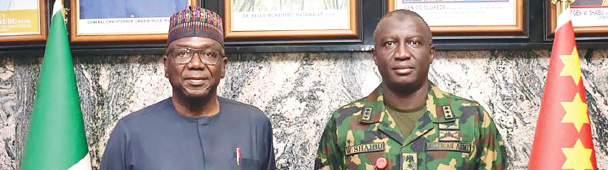
CONTINUOUS SECURITY ENGAGEMENT...
Wike: Fubara Signed Agreement Not to Seek Second Term
Amaechi promises to accept result if exercise is transparent Party condemns Tinubu’s comments that opposition parties are self-serving
Chuks Okocha in Abuja, Onuminya Innocent in Sokoto and Blessing Ibunge in Port Harcourt
Atiku Abubakar, Chibuike Amaechi, and Mohammed Hayatu-Deen, yesterday, commenced their battle for African Democratic Congress (ADC) presidential ticket across
L-R: Kwara State Governor, AbdulRahman AbdulRazaq and the Chief of Army Staff (COAS), Lt. Gen. Waidi Shaibu, after a meeting in Abuja on strategies to strengthen security in Kwara State, yesterday Continued on page 8
Continued on page 8 the federation.
Atiku, Amaechi, Hayatu-Deen in Battle for ADC Presidential Ticket
Results from the primary elec- tion, trickling in from different parts of the country, showed each aspirant leading in their respective strongholds.
For instance, results announced in Bolewa and Potiskum in Yobe
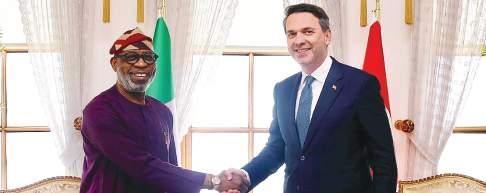
SIGNING OF MOU TO DEEPEN COOPERATION IN SOLID MINERALS...
The Minister of Solid Minerals Development, Dr. Dele Alake (L) and the Minister of Energy and Natural Resources of the Republic of Türkiye, Alparslan Bayraktar during the signing of the Memorandum of Understanding to deepen cooperation in solid minerals in Istanbul, Turkey.

Olawale Ajimotokan in Abuja
Minister of the Federal Capital Territory (FCT), Nyesom Wike, has ascribed the withdrawal of the Rivers State Governor, Siminalayi Fubara, from the All Progressives Congress (APC) governorship race to





expor tdeskdepar tment@zenithbank.com



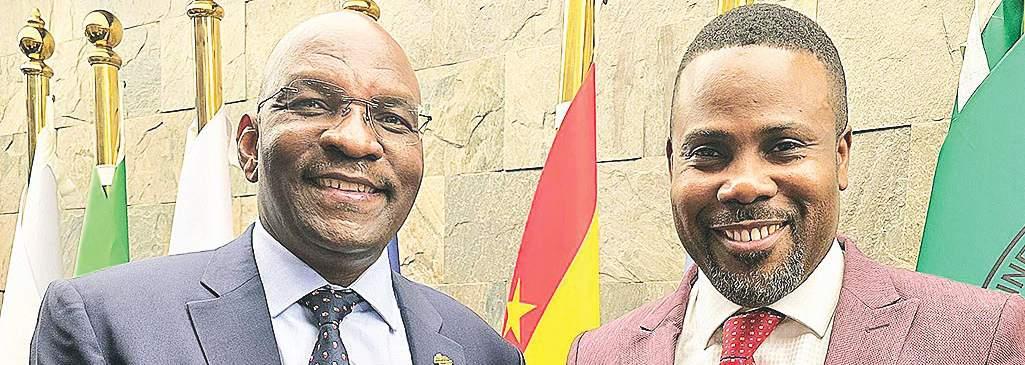
ONDO IN STRATEGIC ENGAGEMENT WITH SENIOR EXECUTIVES OF AFREXIMBANK...
on Entrepreneurship, Innovation and Investment to Governor
NCAA Suspends ’No Pay, No Service’ Directive Over Airlines’ Outstanding Debts
Says suspension doesn’t equate waiver or debts forgiveness Airline Operators:
NCAA not owed, condemn ’media regulation’ of
operators
outside regulatory framework
The Nigeria Civil Aviation Authority (NCAA) Monday announced the temporary suspension of its planned enforcement of the “no pay, no service” directive against airlines with outstanding statutory remittances, citing ongoing consultations and the rising cost of aviation fuel affecting airline operators across Nigeria.
In a statement issued in Abuja, NCAA clarified the suspension does not amount to a waiver, cancellation, or forgiveness of the debts owed by affected airlines, stressing that operators remain fully responsible for settling all outstanding statutory obligations.
The NCAA asserted that structured engagements would continue with individual airlines to ensure debt recovery in a manner that supports compliance while preserving operational stability within the sector.
But in a firm pushback, domestic carriers under the aegis of Airline Operators of Nigeria (AON) have insisted they do not owe any cost
recovery charges to the Nigeria Civil Aviation Authority (NCAA) and advised that the agency should not function as revenue generating agency for government.
NCAA had earlier placed 11 domestic operators on “No-pay-noservice” list over alleged outstanding financial obligations, but it has since rescinded the directive.
However, AON in a statement condemned the directive, saying it portrayed member airlines as being indebted to the regulatory agency for services rendered to operators.
AON explained that airlines pay for regulatory services to NCAA before the agency offers the services but noted that what the airlines may not have paid regularly is the passenger service charge, which payment has been subjected to discussions due to Iran-US war.
It could be recalled that President Bola Ahmed Tinubu had earlier approved a 30 per cent discount on outstanding fees owed by domestic airlines to aviation agencies, including the NCAA, as part of measures aimed at cushioning the effects of
Threaten
to stop collecting passenger service charge for NCAA from June 1, 2026
the high cost of Jet A1 fuel and stabilising the aviation sector.
It further explained that the five per cent Ticket and Cargo Sales Charge remain a statutory requirement under the Civil Aviation Act and is embedded in the cost of air travel and cargo services in Nigeria.
Noting the charge is collected by airlines at the point of ticket and cargo sales on behalf of the aviation ecosystem and is expected to be remitted accordingly, stressing that
the funds do not constitute airline revenue or operating profit.
According to NCAA, “the remitted funds are shared among the regulator and other key aviation service providers responsible for maintaining safe, efficient, and internationally compliant aviation operations.”
It further explained it operates on a cost recovery basis and does not receive direct federal government funding for its routine regulatory responsibilities, making statutory
charges critical for sustaining oversight functions.
The NCAA maintained the temporary suspension of the enforcement measure was carefully calibrated to avoid disruption in the aviation industry while ensuring that airlines eventually fulfil their financial obligations to the sector.
Meanwhile, AON vowed that henceforth NCAA should start collecting its passenger service charge directly from passengers, from June 1, 2026.
The airlines emphasised that the no-pay-no-service publication was not only misleading but represented “a worrisome and unacceptable attempt to use the media to regulate operators outside the established regulatory framework,” and condemned it “in the strongest possible terms”.
”The AON wishes to make it clear that all cost recovery services rendered by the NCAA to domestic airline operators are paid for fully in advance on a cash-before-service basis.
Global IP Body Opens First SubSaharan African Office in Abuja
FG moves to protect Nigerian innovations
Michael Olugbode in Abuja
Nigeria is positioning for a major leap in the global knowledge economy as the federal government intensifies efforts to protect intellectual property, unlock
Alleged N15.7bn Fraud: Court Grants Tunde Ayeni N200m Bail
Alex Enumah in Abuja
A High Court of the Federal Capital Territory (FCT) has admitted former Chairman of the Board of Directors of Skye Bank Plc, Mr. Tunde Ayeni, to bail in the sum of N200 million, in his alleged fraud trial.
Ayeni is standing trial on a 17-count charge bothering on alleged N15.6 billion frauds, brought against him by the Economic and Financial Crimes Commission (EFCC).
He pleaded not guilty to the entire counts in the charge, following which his lawyer, Mr. Dele Adesina, SAN, applied to the court to admit the defendant to bail.
Although, the prosecution,
represented by Mr. G.I. Inde, had opposed the bail.
The trial judge, Justice Jude Onwuzuruike, in his ruling on Monday admitted the defendant to bail of N200 million with two sureties in like sum.
The court in granting the application observed that the essence of bail was to compel the defendant to attend trial. Onwuzuruike pointed out that the claim by the prosecution that the defendant will influence the trial was speculative and could not stop the granting of bail.
The court stated that it was a trite law that an accused is presumed innocent until proven otherwise.
As conditions for the bail, the court
held that the two sureties must be federal civil servants and they must submit their national identification cards and letter of employment, and they must have property worth N500 million.
The court, among other things, held that one of the sureties must write an undertaking of a bank guarantee to the tune of N15 billion.
The court, however, charged the officers of the correctional centre to grant the defendant enough access to his lawyers pending the perfection of his bail conditions.
EFCC had in 2019 tried Ayeni and one Timothy Oguntayo on similar matters in which the duo pleaded not guilty to all counts.
the economic potential of the creative industry, and attract innovation-driven investments.
The push gained fresh momentum yesterday, with the announcement that Director-General of World Intellectual Property Organisation (WIPO), Daren Tang, will arrive Nigeria on June 1 for a three-day high-level working visit.
The visit would culminate in the inauguration of the organisation’s Abuja office — the first and only WIPO office in Sub-Saharan Africa.
The development is being viewed in diplomatic and economic circles as a strategic recognition of Nigeria’s rising influence in Africa’s creative and innovation ecosystem.
Speaking during a meeting with Director of WIPO Nigeria Office, Oluwatobilola Moody, Minister of Foreign Affairs, Bianca Odumegwu-Ojukwu, declared that the federal government was fully committed to strengthening the protection of intellectual property and creating opportunities for Nigerian innovators, creators, and entrepreneurs.
Odumegwu-Ojukwu stressed that Nigeria’s booming creative sector — spanning music, film, fashion, publishing, technology and digital content — must begin to derive greater economic value
from its global cultural influence.
“You talked about Nigeria’s soft power in the creative industry; I expect that hosting the office here in Abuja means there should be a whole lot of openings for young Nigerians,” she stated.
Her remarks came amid growing concerns over piracy, copyright theft, and weak intellectual property enforcement that continued to cost Nigerian creators billions of naira annually.
Analysts say the establishment of a permanent WIPO presence in Abuja could significantly strengthen Nigeria’s capacity to tackle intellectual property violations, modernise its regulatory systems and support local innovators seeking access to international markets.
The WIPO office has already played a critical role in supporting the digitalisation of Nigeria’s trademarks and patents registry through Industrial Property Automation System (IPAS), a reform initiative aimed at improving transparency, reducing delays, and boosting investor confidence.
Beyond administration, the federal government is now pushing for broader collaboration with WIPO in areas of technical assistance, youth empowerment, and commercialisation of Nigeria’s
cultural assets.
Odumegwu-Ojukwu called for expanded capacity-building programmes that would help transform local creativity into globally competitive economic assets capable of generating jobs and foreign exchange earnings.
For years, experts have argued that Nigeria’s creative and technology sectors remain underexploited largely because of weak intellectual property structures, inadequate legal protection, and limited awareness among young innovators.
The WIPO visit is expected to trigger renewed conversations around innovation policy, digital economy reforms, and the monetisation of intellectual assets in Africa’s largest economy.
Briefing the minister, Moody revealed that WIPO under Tang’s leadership had shifted towards a more inclusive intellectual property system designed to support micro, small and mediumsized enterprises, women and young innovators.
He further disclosed that the organisation was actively adapting global intellectual property frameworks to address emerging technologies, such as Generative Artificial Intelligence, while ensuring that technological advancement did not undermine human creativity.
Kasim Sumaina in Abuja and Chinedu Eze in Lagos
R-L: Dr. Summy Smart Francis, Special Adviser
Lucky Aiyedatiwa, and Vice President of African Export-Import Bank, Mr. Denys Denya, during a strategic engagement with senior executives of the bank at its headquarters in Cairo, Egypt
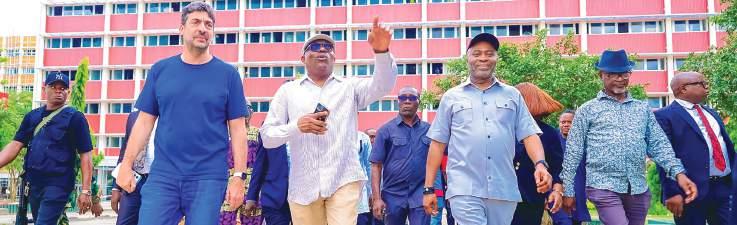
FUBARA INSPECTS THE SECRETARIAT COMPLEX...
L-R: Managing Director, Al-Manson Nigeria Ltd, Mr. Wael; Governor of Rivers State, Siminalayi Fubara; Commissioner for Works, Prof. Temple Nwofor; and Permanent Secretary, Ministry of Works, Dr. Austin Ezekiel Hart, during the inspection tour of the Secretariat Complex in Port Harcourt, yesterday
Broadcasters Challenge Nigeria’s June 17 Digital Switchover Target, Warn Against Illegal Rollout
Migration won’t hurt Nigerians, NBC, NIGCOMSAT assure stakeholders Say policy will unlock N605.2bn national advertising market
Nigeria’s planned June 17 digital switchover target has come under fresh scrutiny as Broadcasting Organisation of Nigeria (BON), yesterday raised concerns over the rollout’s legality, preparedness and potential effect on the industry, warning that the current framework violates existing laws and can waste billions in public funds.
That was as National Broadcasting Commission (NBC) and Nigerian Communications Satellite Limited (NIGCOMSAT), also yesterday, moved to calm growing public anxiety over Nigeria’s proposed Digital Switch Over (DSO), insisting that the country’s longdelayed transition from analogue to digital broadcasting would not impose fresh burdens on Nigerians.
Addressing a joint press conference in Abuja, Director-General of NBC, Charles Ebuebu, and Managing Director of NIGCOMSAT, Jane Egerton-Idehen,
said the new strategy would allow millions of Nigerians with existing decoders to access more than 100 free digital channels without purchasing special set-top boxes.
However, BON, the broadcasters’ body representing public and private television and radio stations across the country, accused NBC of abandoning the legally approved Digital Terrestrial Television (DTT) migration model in favour of what it described as a satellite television packaging operation disguised as digital migration.
In a strongly worded letter dated May 19, 2026 and addressed to Ebuebu, BON warned that the platform scheduled for launch next month did not meet the internationally accepted definition of a Digital Switchover.
The protest came barely one week af- ter Minister of Information and National Orientation, Alhaji Mohammed Idris, alongside NBC officials, announced June 17 as the definitive rollout date for the nationwide migration following an inspection tour of facilities belonging
to Nigerian Communications Satellite Limited in Abuja.
Government officials had unveiled a new “FreeTV” platform expected to distribute over 100 channels nationwide through satellite transmission technology.
However, BON argued that the satellite-first approach fundamentally contradicted both the International Telecommunication Union’s GE06 Agreement and Nigeria’s 2012 Digital Switchover White Paper, which it described as the only legally gazetted framework governing digital migration in the country.
According to the broadcasters, the approved framework clearly defines digital migration as the transition from Analogue Terrestrial Television to Digital Terrestrial Television, not a direct-to-home satellite broadcasting system.
Industry stakeholders warned that the current model could undermine one of the major economic benefits of the DSO project — the release
of the highly valuable 700 and 800 MHz spectrum currently occupied by analogue television signals.
The spectrum, popularly referred to as the “Digital Dividend,” is expected to be transferred to telecom operators for broadband expansion and spectrum auctions capable of generating more than $1 billion in revenue for the federal government.
Critics argue that by moving channels to satellite transmission, instead of migrating terrestrial frequencies, NBC’s new framework risks leaving the spectrum trapped and economically unproductive.
Beyond the technical concerns, BON also accused NBC of stepping outside its statutory role as an independent regulator by allegedly acting as a content aggregator on the newly rebranded FreeTV platform.
The broadcasters warned that the move created a major conflict of interest capable of distorting competition within the industry.
In the letter signed by BON Execu-
AfCFTA: Nigeria Partners RwandAir for Quicker Exports to Eastern, Southern Africa
Federal Ministry of Industry, Trade and Investment (FMITI) has announced a new partnership with RwandAir for the Nigeria–East and Southern Africa Air Cargo Corridor that allows Nigerian goods quicker and affordable exports to the regional markets.
FMITI said the partnership was a major expansion of Nigeria’s implementation of the African Continental Free Trade Area (AfCFTA).
It recalled that on Africa Day 2025, it launched the Nigeria–East and Southern Africa Air Cargo Corridor through a partnership with Uganda Airlines, which provided Nigerian exporters with tiered and rebated rates of up to 70 per cent below those of other commercial carriers for goods exported to Entebbe, Uganda; Nairobi, Kenya; and Johannesburg, South Africa.
FMITI said, “Today one year later, on Africa Day 2026, the FMITI is
pleased to announce a partnership with RwandAir that extends the corridor to Kigali, Harare and Lusaka as new destinations and gives Nigerian exporters a second choice of carrier on the Nairobi and Johannesburg routes.
“Cargo rates on the RwandAir routes are set at under $2 per kilogram for all five destinations, ensuring that Nigerian goods can access destination markets quickly and affordably. The RwandAir partnership will be formally flagged off in June 2026.”
Commenting on the partnership, Minister of Industry, Trade and Investment, Dr. Jumoke Oduwole, said, “One year ago, we promised that the AfCFTA would work in practice for Nigerian businesses, not only on paper. We set out to solve a practical problem: Nigerian businesses have goods that African markets wanted, but the cost of cargo was too high.
“This corridor has kept that
promise, and our whole-of-economy approach to AfCFTA implementation is yielding results. Nigeria’s non-oil exports to other African markets rose from $150 million in 2024 to $207 million in 2025.
“With RwandAir, we are widening
the air cargo corridor, so that more Nigerian exporters can reach more markets at a cost that allows them to compete. These results show what is possible when the government creates the enabling environment and businesses respond with ambition.”
tive Secretary, Dr. Oluyemisi Bamgbose, the association maintained that the 2012 DSO roadmap established a clear separation of responsibilities among regulators, signal distributors, and content providers to prevent monopoly and abuse.
BON stated that if the federal government intended to abandon terrestrial broadcasting in favour of satellite and streaming services, NBC was legally required to suspend unilateral implementation and reconvene all statutory stakeholders to develop and gazette a fresh national framework.
The body said affected stakeholders included licensed signal distributors, set-top-box manufacturers, channel owners, and members of the original DigiTeam that coordinated Nigeria’s migration roadmap.
The broadcasters also raised concerns over what they described as the hidden financial burden the new satellite-based system could impose on millions of Nigerians.
According to industry analysts, unlike conventional terrestrial migration that only requires a relatively affordable decoder connected to existing rooftop antennas, the new satellite model would require citizens to purchase satellite dishes, specialised decoders, and pay for technical installation.
BON urged NBC to immediately educate Nigerians on the true cost implications of the proposed system, particularly for low-income households.
The association warned that proceeding with the rollout without resolving the legal, technical, and economic concerns could further
deepen the controversies that have trailed Nigeria’s digital migration project for nearly two decades. Nigeria’s DSO programme, initially launched to modernise broadcasting and comply with global digital broadcasting standards, had faced repeated delays, policy inconsistencies, and logistical setbacks, despite reportedly gulping over N60 billion in public and private sector investments over the years.
With less than a month to the proposed rollout date, the face-off between the nation’s broadcasters and the broadcast regulator now raises fresh uncertainty over the future of Nigeria’s digital broadcasting transition and the wider digital economy.
Meanwhile, Ebuebu and EgertonIdehen, earlier yesterday, announced that the federal government had fixed June 17, 2026 for the national launch of the new “Big Picture” DSO framework, while complete analogue switch-off nationwide was expected by December 31, 2028.
The development marks a major policy shift in Nigeria’s troubled digital migration programme, which began nearly two decades ago but suffered repeated delays due to funding constraints, litigation, infrastructure deficits and disagreements among industry stakeholders.
Defending the revised framework, Ebuebu said NBC had abandoned the earlier terrestrial-only model in favour of a hybrid broadcasting architecture combining DTT, Direct-to-Home satellite broadcasting (DTH) and internet-based streaming platforms.
Africa Rising in Global Affairs, Putin Tells Leaders Ahead Russia-Africa
Michael Olugbode in Abuja
President of Russia, Vladimir Putin, has declared that Africa is fast emerging as a major force in global affairs, as he reaffirmed Moscow’s commitment to deepening political, economic and strategic ties with countries across the continent.
In a strongly worded message to African Heads of State and Government to mark Africa Day 2026, Putin praised Africa’s growing influence
in international diplomacy and its determination to shape a new global order based on equality and mutual respect.
The Russian leader described Africa Day as a historic symbol of the continent’s triumph over colonialism, saying the celebration reflects the enduring struggle of African peoples for freedom, peace, dignity and prosperity.
Putin stated that African nations had made remarkable progress in
economic growth, regional cooperation, and social development despite global economic pressures and security challenges.
According to him, African countries are increasingly becoming key players in resolving pressing international issues and promoting stability within their regions.
He specifically commended the African Union and sub-regional organisations for strengthening continental integration and developing collective
Summit
mechanisms to tackle conflicts and crises across Africa.
The Russian president said Moscow highly valued its “traditionally friendly relations” with African states, insisting that Russia and Africa share a common vision of a fairer international system free from domination, discrimination, and external interference.
“We are united by the desire to build a just multipolar world based on genuine equality and the supremacy of international law,” Putin stated.
Dike Onwuamaeze
Sunday Aborisade, Oghenevwede Ohwovoriole and Folalumi Alaran in Abuja
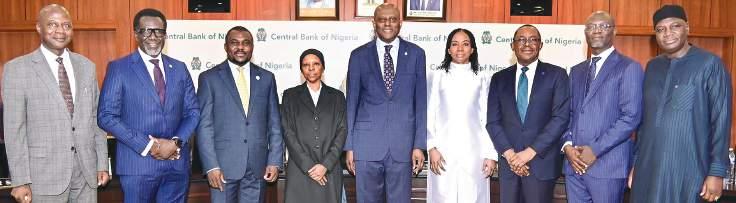
SAFEGUARDING THE NIGERIAN FINANCIAL SYSTEM...
L-R: Mr. Justin Nidiya, Special Adviser representing the Registrar-General, Corporate Affairs Commission (CAC); Mr. Olusegun Ayo Omosehin, Commissioner for Insurance/CEO, National Insurance Commission (NAICOM); Dr. Rabiu Olowo, Executive Secretary/CEO, Financial Reporting Council of Nigeria (FRCN); Ms. Amina Ado, Executive Director, representing the Executive Chairman, Nigeria Revenue Service (NRS); Mr. Olayemi Cardoso, Governor, Central Bank of Nigeria (CBN); Ms. Omolola Oloworaran, Director-General, National Pension Commission (PenCom); Dr. Thompson Sunday, Managing Director, Nigeria Deposit Insurance Corporation (NDIC); Dr. Emomotimi Agama, Director-General, Securities and Exchange Commission (SEC); and Dr. Ali Mohammed, Director, Home Finance, Federal Ministry of Finance, after the 80th meeting of the Financial Services Regulation Coordinating Committee (FSRCC), held at the CBN Head Office, Abuja, on Monday
CPPE: Portraying Dangote Refinery as Monopolistic Threat Simplistic
Says import liberalisation pathway to de-industrialisation
Onwuamaeze
Centre for the Promotion of Private Enterprise (CPPE) yesterday described the attempt to portray Dangote Refinery as a monopolistic threat in order to promote import liberalisations of refined petroleum products as simplistic and a pathway to Nigeria’s de-industrialisation.
CPPE said Nigeria had just witnessed one of the most consequential industrial investments in Africa through the establishment of the Dangote Refinery, alongside growing investments in modular refineries across the country that should be strategically supported, celebrated, and strengthened.
It expressed concern over the growing advocacy for unbridled importation of petroleum products at a time Nigeria should be consolidating domestic refining capacity and accelerating its industrialisation journey.
According to CPPE, the pathway to competition is not the promotion of imports but the encouragement of additional domestic refining investments.
Chief Executive Officer of CPPE, Dr. Muda Yusuf, expressed the views in a press statement, titled, “Import Liberalisation and The Risk of Deindustrialisation in Nigeria.” Yusuf stated that the refinery did not prevent other investors from entering the sector.
He stated, “Attempts to portray
Dangote Refinery as a monopolistic threat are simplistic, fundamentally flawed and grossly unfair. It did not cause the collapse of state-owned refineries. It simply undertook an extraordinary industrial investment at a scale unprecedented in Africa.
“Nigeria should not demonise audacious investment, industrial courage, scale and risk appetite. A country that undermines transformative investment sends deeply troubling signals to both domestic and foreign investors.”
He pointed out that scale created competitiveness, lowered unit costs, deepened value chains, strengthened economic resilience, and should not be criminalised.
He added that large market share, in itself, was not evidence of monopoly abuse, and could be regulated through competition laws and antitrust institutions to prevent abuse of market power.
CPPE said indiscriminate liberalisation regime within a structurally fragile economy was not a pathway to competitiveness but deindustrialisation.
It stated, “It was indiscriminate import liberalisation that precipitated the collapse of many once-thriving domestic industries, including tyre manufacturing giants such as Dunlop and Michelin, as well as textile mills, battery manufacturing firms, automobile assembly plants, pharmaceutical companies and electronics assembly industries.”
CPPE said many of the enterprises were not destroyed by inefficiency alone, but by a policy environment that exposed domestic producers to unfair external competition amid crippling infrastructure deficits, high energy costs, weak logistics systems, prohibitive financing costs, and multiple regulatory burdens.
Yusuf stated, “This is why the implementation of the African Continental Free Trade Area (AfCFTA) could become deeply disruptive for domestic manufacturers if urgent and deliberate steps are not taken to strengthen local production capabilities,
improve competitiveness and address the structural impediments confronting Nigerian industries.
“Trade liberalisation without competitiveness is not integration; it is deindustrialisation.”
Yusuf also stated that Nigeria’s recent experience with food importation illustrated the dangers of excessive liberalisation.
He said, “Large-scale food imports disrupted local agricultural value chains, weakened incentives for domestic farmers and undermined investments in local production.
“Many Nigerian farmers are yet to
recover from the disruptions created by those policy measures. The refining sector must not be subjected to the same policy error. Temporary import advantages should never be permitted to destroy long-term domestic industrial capabilities.”
He said Nigeria could not achieve meaningful industrialisation without deliberate and sustained support for domestic production through strategic protection, policy consistency, strong domestic value chains, support for local investors and reduction in import dependence.
Yusuf said, “No economy becomes
prosperous by importing what it can produce domestically. The future of Nigeria’s economic resilience lies in production, refining, manufacturing and value addition and not in the perpetuation of import dependence.
“Nigeria must, therefore, decide whether it wishes to build a production economy or remain trapped within a consumption economy. History has repeatedly shown that nations which neglect domestic production eventually weaken their currencies, compromise economic sovereignty and expose themselves to severe external vulnerabilities.”
Court Restrains NNPC, Banks from Paying Chinese Firm Over Alleged $117,000 Debt
Wale Igbintade
Justice Stephen Daylyop of the Federal High Court sitting in Port Harcourt, Rivers State, has restrained the Nigerian National Petroleum Company Limited (NNPC Ltd) and all banks in Nigeria from paying any money to Beijing Seajets International Forwarder Company Limited pending the determination of an alleged $117000 debt.
The court specifically restrained NNPC Ltd from releasing funds
Firm Alleges Fraudulent Hijack of Ebonyi RAAMP Project
Folalumi Alaran in Abuja
A construction firm, Enegix Construction JV PMCC Ltd, has accused some officials of Ebonyi State Government and a private individual of fraudulently taking over its Rural Access and Agricultural Marketing Project (RAAMP) contract, diverting project funds, and threatening its personnel.
The allegations were made during a press conference held in Abuja at the weekend, where the company accused officials of unlawful interference, intimidation, abuse of office, and economic sabotage surrounding the execution of the RAAMP road project in Ebonyi State.
Addressing journalists, the company said it was lawfully awarded the contract and had fully mobilised to site with engineers, heavy-duty equipment, and construction materials before the dispute began.
According to the company, it carried out substantial work on the 28-kilometre road project, including full clearance of the road corridor, extensive earthworks, drainage infrastructure, bridge construction, and concrete pavement works.
Enegix stated that a joint measurement exercise conducted with representatives of Ebonyi State Government on September 1, 2025 confirmed that work valued at over
N1.014 billion had already been executed on the project.
The company alleged that despite the verified level of work done, the Ebonyi State Project Coordinator refused to approve the amortisation of its Advance Payment Guarantee (APG), a move it said created severe financial difficulties for the firm.
The firm maintained that it never abandoned the project site, contrary to claims allegedly made by the Ebonyi State Commissioner for Rural Development. It explained that construction activities were only temporarily slowed due to torrential rainfall that affected engineering quality standards.
to the Chinese firm, its directors, shareholders, agents, servants or privies “in whatever form or under any guise” in relation to contractual obligations connected to the dispute before the court.
The court also made an order temporarily freezing of funds and assets belonging to Beijing Seajets International Forwarder Company Limited over alleged unpaid debt of $177, 000, allegedly owned the plaintiff/applicant.
Above were parts of the orders granted by Justice Stephen Daylyop Pam, in suit marked FHC/PH/ CS/55/2026, sequel to an ex parte motion filed by counsel to the
plaintiff, M. K. Chinda, alongside H. Aigbiremolen, from the law firm of Thankgod Nwugha.
In the motion Exparte, the plaintiff/applicant, Wellman Group Limited, has alleged that the defendant failed and refused to pay for the hire of tugboats and barges used in the transportation and storage of heavy cargo within Nigerian territorial waters between December 8, 2025 and January 27, 2026.
The disputed cargo reportedly included a 340-ton gas turbine and 300 tons of Giwu 1 and 2 generators conveyed from the Nigerian Ports Authority facility in Warri to Griniya Jetty, Lokoka, aboard the plaintiff’s
barge, MV Dodi Star. The plaintiff/applicant’s lawyer also informed the court that the outstanding sum represented unpaid hire charges calculated at a daily rate of $12,987.1 USD, for the maritime services rendered during the operation.
In his ruling, Justice Pam granted a Mareva injunction restraining Beijing Seajets International Forwarder Company Ltd, its directors, shareholders, agents and representatives from withdrawing, transferring or dissipating funds held in any Nigerian financial institution pending the hearing of the substantive motion before the court.
Nigeria, Türkiye Sign MoU to Deepen Cooperation in Solid Minerals Devt
Folalumi Alaran in Abuja
The governments of Nigeria and Republic of Türkiye have signed a Memorandum of Understanding (MoU) to strengthen bilateral cooperation in the solid minerals sector, marking a significant step towards deepening economic collaboration between both countries. The agreement was signed on the side-lines of the Istanbul Natural Resources Summit (INRES) in Istanbul, Türkiye.
Speaking during the signing ceremony, Nigeria’s Minister of Solid Minerals Development, Dele Alake, said Nigeria was ready to leverage Türkiye’s technological advancement and expertise in mining exploration, training, digitisation, licencing systems, and capacity building to accelerate reforms and growth within the sector.
According to the minister, President Bola Tinubu has given full backing to efforts aimed at
strengthening bilateral relations with Türkiye in the mining and energy sectors. He stated, “Türkiye is one of the countries we are confident of building strong bilateral cooperation with, particularly in the area of solid minerals development.
“Nigeria is open to working with the Turkish government to strengthen governance structures, improve technical capacity, and advance sustainable mining development in our country.”
Dike
Nigeria’s GDP Slows to 3.89% in Q1, Driven By Services Sector
Non-oil sector contributed 96.08%, oil 3.92% Oil production drops
James Emejo in Abuja
The country’s Gross Domestic Product (GDP) growth rate declined to 3.89 per cent in the first quarter of the year (Q1 2026) compared to 4.07 per cent in the preceding quarter, the National Bureau of Statistics (NBS) revealed yesterday. However, year-on-year, GDP was higher than the 3.13 per cent recorded in Q1 2025.
Growth was led by the services sector which contributed 57.73 per cent to the economy compared to 57.50 per cent in the corresponding quarter of 2025.
According to the GDP Q1 2026 Report, released by the statistical agency, aggregate GDP at basic price stood at N110.78 trillion in nominal terms compared to N94.05 trillion in Q1 2025. Real GDP stood at N51.26 trillion.
was disclosed at a press conference by National Publicity Secretary of the party, Bolaji Abdullahi, and the chairman of the presidential nomination committee, Ikechi Emenike.
to 1.55 million barrels per day
In the review quarter, non-oil sector contributed 96.08 per cent in real terms, lower than 97.13 per cent in Q4 2025 but higher than 96.03 per cent in the corresponding quarter of last year.
On the other hand, the oil sector contributed 3.92 per cent to real GDP in Q1, compared to 2.87 per cent the preceding quarter, and 3.97 per cent in Q1 2025.
Average daily oil production
eminently qualified aspirants who are capable of piloting the affairs of this country at this most difficult time.
dropped to 1.55 million barrels per day (mbpd), compared to 1.58 mbpd in Q4 2025 and 1.62 mbpd recorded in the same quarter of 2025.
According to the NBS, agriculture contributed 23.16 per cent to aggregate GDP in real in Q1, lower than 28.66 per cent in the preceding quarter, and 23.33 per cent in the corresponding period of 2025.
Manufacturing contributed to 9.57 per cent to growth, compared to
transformation.”
Amaechi: I’ll Accept Result If Transparent
the 7.40 per cent in Q4 2025 and 9.62 per cent in Q1 2025.
In addition, trade’s contribution to GDP stood at 17.89 per cent in Q1, compared to 16.84 per cent in the preceding quarter and 18.21 per cent in Q1 2025.
Finance and insurance added 3.76 per cent to growth in the review period compared to 2.56 per cent in the preceding quarter and 3.60 per cent in Q1 2025.
ATIKU, AMAECHI, HAYATU-DEEN IN BATTLE FOR ADC PRESIDENTIAL TICKET State by the returning of-ficer, showed that Atiku polled 740 votes as against Amaechi with 15 votes and Hayatu-Deen who got two Amaechi,votesa former Minister of Transportation, voted at his Ubima Ward in the Ikwerre Local Government Area of Rivers State, while Hayatu-Deen cast his vote in Jare, Borno State.
The ADC presidential primary election took place in 8,809 wards acrossAtiku,Nigeria. who cast his vote in Jimeta area of Adamawa State applauded the conduct of the primary election.
In a post on X, he stated that the outcome of the primary election action would help Nigeria recover.
In Sokoto State, Atiku polled a staggering 68,824 votes to outclass his closest challengers.
The result left little room for doubt as Atiku’s tally dwarfed that of fellow aspirants Hayatu-Deen and Amaechi, who managed 319 and 292 votes, respectively.
Declaring the results at the ADC secretariat in Sokoto, Returning Of- ficer, Professor Aminu Abubakar, announced Atiku as the winner after securing the “highest lawful votes” cast during the exercise.
ADC had said the fate of Atiku, Amaechi, and Hayatu-Deen would be determined by three million and forty-four digitally registered voters.
The party also affirmed that the primary election was ongoing at the 8809 wards across the country. This
ADC mounted a big digital electronic signpost for the collation of results. The results were collated once the votes from the wards were certified by the presidential committee
The digital electronic board was mounted at Congress Hall of Transcorp Hilton Hotel in Abuja.
Giving details of the primary elections, the spokesman of the party said, “INEC supervised all our primaries at all levels including the presidential primary. The name of David Mark and Rauf Aregbesola are in INEC website.
“As we speak, officials of the commission are monitoring all the presidential primary elections.”
Chairman of the ADC presiden- tial primary election committee, Emenike, said, “Unlike the culture of imposition, consensus manipula- tion and predetermined outcomes that have become prevalent in contemporary political parties, the ADC has embraced a credible democratic process that gives every qualified aspirant an equal opportunity to present their vision and earn the support of party members across the country.
“What differentiates ADC from other parties in Nigeria is that it is the only party blessed with three
WIKE: FUBARA SIGNED AGREEMENT NOT TO SEEK SECOND TERM
an agreement with factions opposed to him to shelve his impeachment on the condition that he would not seek re-election in 2027.
Wike spoke yesterday in Abuja during an inspection tour of projects lined up for the third anniversary of the President Bola Tinubu administration.
He insisted that he was not surprised by Fubara’s withdrawal from the primaries, accusing his political protégé of betrayal and lacking principle by obtaining the nomination form in the first instance.
Wike stated, “I’m not surprised that the governor withdrew. In the first place, he ought not to have collected the form, because the agreement was reached that the impeachment should be dropped while he should also not talk about second tenure.
“I’m not surprised that he had to withdraw at that stage. But with collecting form first, he didn’t show sign of gentlemanliness. He didn’t show that sign and that was not expected.
“We thought that Mr. President had been intervening severally and pleading with the legislature not to continue with impeachment
but what it is, he has withdrawn and somebody has emerged as a governorship candidate for the APC.”
The immediate past governor of Rivers State declared Hon. Kingsley Chinda, who emerged the APC governorship candidate, as a good product “that markets itself”.
He stressed that Chinda, a member of the House of Representatives, was quite experienced, having worked with the executive.
Wike described Chinda as someone, whose voice was audible when he was a minority leader on the platform of Peoples Democratic Party (PDP).
Wike declared the Renewed Hope City, Karsana, executed by Lubriks, as 98 per cent completed, while the Old Keffi Road, Dei Dei, which was being asphalted and fitted with street lights was also ready for commissioning.
He stated, “Then we now went to Airport Road to Kuje, which is a very fantastic job. I’m sure anybody who goes there will admire it and that is what is called governance. Very proud of the contractors, that is the Arab contractors. We are very proud of what they have done.”
“Our aspirants are the highly respected former Vice President of the Federal Republic of Nigeria, H.E Atiku Abubakar, GCON. A dedicated democrat, a nation builder and a great unifier; the Rt. Hon. Rotimi Amaechi, the vibrant former Governor of Rivers State and a former Minister of Transportation who led some of the most ambitious transport infrastructure projects across our country; and, of course, Alhaji Mohammed Hayatu-deen, one of our nations’ finest develop- ment economists, businessman and former chairman of Nigeria Economic Summit Group (NESG).
“As you can see, each one of them is a genuine Presidential contender, not some shadowy candidate contrived to confer legitimacy on a process where one man contested against himself.
“Quite significantly, the unhin- dered participation of our three eminent aspirants underscores the commitment of the African Democratic Congress to build a party rooted in democracy, dialogue and open contestations of ideas. It is for this reason that the ADC remains the true platform for democratic rebirth and national
INEC
Presidential hopeful, Chibuike Amaechi, assured ADC members that if the outcome of the party’s presidential primary election was transparent, he would accept it and work with whoever wins.
The former Minister of Transportation, who joined thousands of supporters and party members to participate in the presidential primary election in his ward in Ubima, Ikwerre Local Government Area of Rivers State, warned that if the process and out-come were not transparent, he would contest it.
The former Rivers State governor queued alongside party faithful and supporters to cast his vote at Ward 8 in Ikwerre Local Government Area.
The presidential primary was being conducted using the Option A4 voting method across wards in the Speakingcountry.with journalists shortly after voting, Amaechi expressed confidence in the process and said he hoped the exercise would be free, fair, and transparent.
Amaechi, who acknowledged the huge turnout of party members for the election, said, “There was a huge turnout, in their thousands, to vote. First, there was dancing, celebrations and all that. And then
we got the people involved. I cast my vote and I left the place.”
When asked how he would describe the election process, he said, “I hope that the system will be transparent as it was in my village. If it is transparent, I will accept the “Becauseresult. from the ward, what I believe is that if the primary is free and fair, nobody is going to react. But if the regime is not free and fair, a lot of us will react.”
On why he wanted to be the president of the country, he said, “If you see what I have done in Rivers State, because I changed the face of Rivers; in education, in security.
“By the time I came to Rivers, you knew that people couldn’t go out of their houses. You knew that we had the medical health challenge, men or husbands couldn’t go out at night to have alcohol or drink or have parties because of the level of insecurity.
“So, what they were doing was produce children. When our health sector became a challenge, we had to tap to settle the insecurity so that people could go out. And in less than six months, the protocol became free. So, these security challenges can be tackled. The problem is that as soon as Nigerian politicians get money, they forget that there is responsibility.
“When we came here, all of you from Rivers would agree with us that if we didn’t attend to the economic challenges, probably the insecurity wouldn’t have stopped. So, we awarded contracts of primary schools, of health centres, of roads, electricity. By the time we finished, we had generated 750 megawatts of power.
“One of the reasons the former president and I disagreed was the power issue. We had generated 750 megawatts and we needed to do the distribution. So we went to the president and said, look, we need to do the distribution of this power.
“So, if it wasn’t our responsibility, we needed to have a franchise. So if he gave us a franchise, we would have done the distribution and Port Harcourt would have had regular power supply. At that time, Port Harcourt required 450 megawatts of power. And we had 750 megawatts of power with the power audit.”
ADC Condemns Tinubu’s Comments That Opposition Parties Are Self-serving ADC condemned President Bola Tinubu’s recent comments attacking the opposition, and describing them as self-serving and deeply insensitive.
While delivering his acceptance
ASKS APPEAL COURT TO UPTURN JUDGEMENT NULLIFYING ELECTION GUIDELINES, SEEKS STAY OF EXECUTION
directive.
The trial court held that INEC could not lawfully shorten the timeline already provided under Section 29(1) of the Electoral Act 2026 for the submission of party membership records and candidates’ particulars.
Dissatisfied, the commission, on May 25, approached the appellate court to upturn the decision of the trial court.
The commission, through its team of lawyers led by Chief Alex Izinyon, SAN, in its nine grounds of appeal, argued that the trial court erred in law when it failed to pronounce on the jurisdictional issue of the suit being hypothetic and academic, which failure occasioned denial of fair hearing to the appellant.
Izinyon submitted, “It is clear from the wordings of Sections 29(1), 82 and 84 of the Electoral Act, 2026, the following can be understood, Section 29(1) of the Electoral Act, 2026 mandates political parties to submit the names of candidates in prescribed forms of the candidates who emerged from its valid primaries which such political party intend to sponsor at the elections not later than 120 days before the date of the General election.
“What is required of political parties to do under the Electoral Act, 2026 is to notify the Independent National Electoral Commission (INEC) 21 days before the holding of its primaries, congresses or conventions, days before the holding of its primaries, congresses or conventions, conference or meeting convened for election of its executive committees, other governing bodies or nominating candidates.
“The defendant is not mandated to impose timeframe for political parties to conduct their primaries provided that it will be done and submitted not later than the 120 days provided by the Electoral Act, 2026. See Section 82(1) of the Electoral Act, 2026.”
The senior lawyer also claimed that the judgement of the trial court was against the weight of evidence placed before it and, therefore, prayed the court for an order allowing the appeal and setting aside the judgement of the trial court.
INEC asked the appellate court to strike out the suit on the grounds that the respondent lacked the locus standi to institute and maintain same.
Umar had in his judgement last week held that “going by the
provisions of Section 29(1) of the Electoral Act, 2026 which requires political parties to submit the personal particulars of their candidates not later than 120 days to an election, INEC cannot lawfully abridge or limit that statutory period by prescribing a shorter timeframe in its 2027 election timetable”.
Similarly, citing Section 31 of the Electoral Act, 2026, which permits political parties to withdraw and substitute candidates not later than 90 days to the conduct of an election, the court had held that INEC lacked the powers to abridge or limit that statutory period by fixing earlier deadline for the withdrawal and replacement of candidates in its 2027 election timetable.
Umar in addition held that by the provisions of Section 32 of the Electoral Act, 2026, INEC did not possess the statutory power to publish the final list of candidates for the 2027 general election before the 60 days minimum period prescribed by law. He held, “A Declaration is made that upon the proper construction of Section 98 of the Electoral Act, 2026, the defendant does not possess the statutory authority to fix in
its timetable for the 2027 general elections for campaign to end 2 days before the elections.
“A Declaration is made that upon the proper interpretation to Section 33 of the Electoral Act, 2026, the time frame prescribed by the Defendant for submission of membership registers for the conduct of primary elections is NOT applicable to primary elections conducted for the purpose of replacing withdrawn candidates.”
The judge subsequently made an order, “setting aside or nullifying the time-frames imposed by the defendant in its Revised Timetable and Schedule of Activities for 2027 General Election for the conduct of primary elections by political parties for the 2027 general elections, the submission of personal particulars of candidates by their political parties for the 2027 general elections, the withdrawal and replacement of candidates by political parties for the 2027 general elections, the publication of the final list of candidates for the 2027 general elections and campaigning for the 2027 general elections which is inconsistent with the provisions of the Electoral Act, 2026.”
Prince Semiu Adeyemi Adeniran
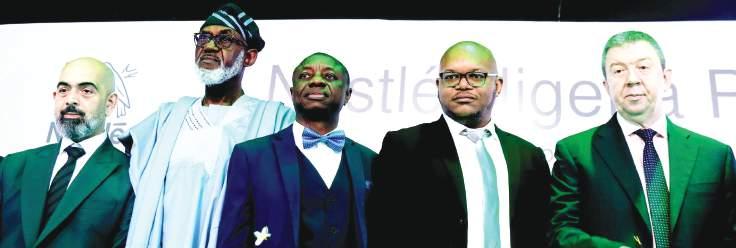
57TH ANNUAL GENERAL MEETING OF THE NESTLE NIGERIA...
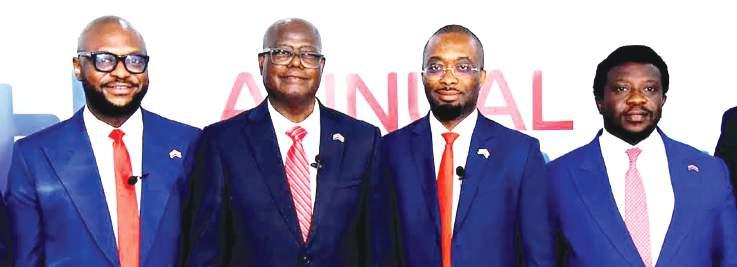
L-R: Managing Director/CEO, Nestle Nigeria Plc, Mr. Wassim Elhusseini; Chairman, Mr. Gbenga Oyebode; Company Secretary/ Legal Adviser, Mr. Bode Ayeku;Director, Mr. Josue Mbassi; and another Director, Mr. Martin Kruegel, at the 57th annual general meeting of the Nestle Nigeria Plc held in Lagos ... yesterday
Pope Makes Historic Apology for Vatican’s Role in Legitimising Slavery
Says Holy See’s
Emmanuel Addeh in Abuja Pope Leo XIV yesterday made a historic apology for the role the Holy See played in legitimising slavery and for having failed to condemn it for centuries, calling the Vatican’s record a “wound in Christian memory.”
Although past popes have apologised for Christians’ involvement in the trans-Atlantic slave trade, but no pope has ever publicly acknowledged, much less apologised for the role that past popes themselves played in giving European sovereigns explicit authority to subjugate and enslave “infidels.”
History’s first U.S-born pope, whose family history includes both enslaved people and slave owners, delivered the apology in his first
record a ‘wound in Christian memory’
encyclical, “Magnifica Humanitas,” (Magnificent Humanity), which was released Monday, AP reported. Leo raised the trans-Atlantic slave trade in relation to what he called the new forms of slavery and colonialism that the digital revolution is fueling, such as the unregulated labour required to procure rare minerals needed for AI chips.
In doing so, Leo responded to decades of calls by Black American Catholics, activists and scholars for the Holy See to atone for its own role in the colonial-era trade in human beings.
“It is impossible not to feel deep sorrow when contemplating the immense suffering and humiliation endured by so many in stark contrast to their immeasurable dignity as
Denounces
persons infinitely loved by the Lord,” Leo wrote. “For this, in the name of the Church, I sincerely ask for pardon,” he added. AP reported that the Vatican has insisted that it always upheld the dignity of all human beings as children of God. But a series of 15thcentury directives from the Vatican authorised Portuguese sovereigns to conquer Africa and the Americas and enslave non-Christians.
In 1452, for example, Pope Nicholas V issued the papal bull Dum Diversas, which gave the Portuguese king and his successors the right “to invade, conquer, fight and subjugate” and take all possessions — including land — of “Saracens, and pagans, and other infidels, and enemies of the name of Christ” anywhere. The bull also
new form of colonialism fueled by rush for AI chips
gave the Portuguese permission “to reduce their persons to perpetual slavery.”
That bull and another issued three years later, Romanus Pontifex, formed the basis of the Doctrine of Discovery, the theory that legitimised the colonial-era seizure of land in Africa and the Americas.
In his encyclical, Leo recalled that his namesake, Pope Leo XIII was the first pope to explicitly condemn slavery in 1888, though that was long after many countries had already abolished it. Before that, in antiquity and the Middle Ages, even church institutions had slaves.
In acknowledging the Holy See’s own role and the 15th-century papal bulls, Leo wrote in his encyclical: “Already in the early modern period, the Apostolic See of Rome, respond-
ing to the requests of sovereigns, intervened several times in order to regulate and legitimise forms of subjugation, and, in certain cases, including the enslavement of ‘infidels.’”
Leo said that it wasn’t possible to judge the morality of the decisions with today’s standards. “Yet neither can we deny or diminish the delay with which both society and the church came to denounce the scourge of slavery,” he said.
The pope said that the church has long affirmed the dignity of every human being as the basis of its doctrine, “even if it took eighteen centuries for its full incompatibility with slavery to be explicitly recognised.”
“This constitutes a wound in Christian memory, one from
which we cannot consider ourselves detached,” he said. Leo said that the church today must firmly condemn all forms of trafficking related to the digital technological revolution “if we want to avoid the need to ask for pardon again in the future for having failed to respect the treasure of human dignity that is required by our faith.”
During a 1985 visit to Cameroon, St. John Paul II asked forgiveness of Africans for the slave trade on behalf of Christians who participated in it, but not for the popes’ own role in it. In a 1992 visit to Goree Island, Senegal, which was the largest slave-trading centre in West Africa, he denounced the injustice of slavery and called it a “tragedy of a civilisation that called itself Christian.”
Chinese-Linked Steel Companies Nationwide Sealed as
Uncovers Alleged Multi-billion Naira Railway Theft Ring
The Nigeria Security and Civil Defence Corps has launched one of the biggest crackdowns on economic sabotage in recent years after sealing all operational facilities belonging to Inner Galaxy Steel Company and Jiuxing Integrity Industrial Ltd over alleged involvement in the large-scale vandalism and recycling of stolen railway infrastructure across the country.
The sweeping operation followed the uncovering of what security operatives described as a highly organised criminal network allegedly responsible for dismantling critical railway assets and converting them into commercial steel products worth billions of naira.
In a statement issued on Monday by the spokesman of NSCDC, Afolabi Babawale, the Corps disclosed that it had secured comprehensive court orders authorising the immediate sealing of the companies’ headquarters, branches and subsidiaries nationwide as investigations intensify into allegations of infrastructure theft, economic sabotage and terrorism financing.
The Corps said suspects linked to the syndicate are facing grave criminal allegations, including conspiracy to commit felony, theft, destruction of railway infrastructure, obstruction of railway operations, concealment of stolen property and providing support for terrorist activities.
Acting on valid court warrants, operatives of the Commandant General’s Special Intelligence Squad stormed the companies’ facility located in Birnin Yero, Igabi Local Government Area of Kaduna State, where large quantities of railway sleepers and tracks allegedly removed from national rail corridors were recovered.
The recovered materials have since been handed over to the Nigerian Railway Corporation and preserved as exhibits for prosecution.
Investigators said preliminary findings exposed an extensive logistics chain through which vandalised railway materials were allegedly transported from different parts of the country to the firms’ facilities for melting and industrial recycling.
According to the NSCDC, confessions allegedly obtained from arrested
workers revealed that stolen railway components were routinely moved to the companies’ headquarters in Aba and other branches where they were converted into roofing sheets, nails and other steel products for commercial distribution.
The Corps subsequently extended its closure order to the companies’ headquarters located at Ahala Ukwa Village, Umuahala Community, Obuzor Ukwu in Ukwa West Local Government Area of Abia State, as well as another major operational
hub in Tasha Rawayyah, Gusau, Zamfara State.
Security sources described the operation as a major breakthrough in the fight against organised economic crimes threatening Nigeria’s fragile infrastructure and national security
architecture.
The NSCDC further disclosed that Chinese nationals linked to the management of the companies have been formally summoned for questioning but are yet to honour the invitation of investigators.
NECA: Labour’s Right to Strike Not
Dike Onwuamaeze
The Nigeria Employers’ Consultative Association (NECA) has clarified that organised labour’s right to strike is not absolute but subject to the national sovereignty of each member country of the International Labour Organisation’s(ILO).
NECA insisted that Nigeria retained the sovereignty to define the limitations of industrial action within the country through its own Labour and Trade Disputes Acts.
The Director General of NECA Mr. Adewale-Smatt Oyerinde, made this clarification yesterday following the International Court of Justice (ICJ)
“Advisory Opinion” that was delivered on May 20, 2026, which ruled that the “right to strike” is protected under ILO Convention No. 87.
Oyerinde, who is a member of the ILO Governing Body, said: “We acknowledge the advisory-opinion of the ICJ that the right to strike is protected under Convention 87 of the ILO.
However, it is very important to note that in the same breath, the ICJ explicitly declined to define the ‘content, scope, or conditions’ of the right to strike.
“Consequently, the advisory opinion does not override national laws. Nigeria retains the sovereignty to define the
limitations of industrial action through its own Labour and Trade Disputes Acts.”
He averred that the right to strike was intentionally excluded from Convention No. 87 during its 1948 drafting.
He said: “Historical ILO records and the dissent of four ICJ judges - who argued that the advisory opinion constituted ‘human rights advocacy’ rather than standard treaty interpretation supports the position that supervisory bodies have historically overreached their mandates.”
Oyerinde stated that NECA remained committed to the principle of social dialogue and tripartism.
He said: “Our association will continue to support the stance previously taken by the Nigerian government, which favoured resolving these complex labour issues through consensus-building rather than judicial determination.”
While acknowledging the ICJ opinion, Oyerinde stressed that “the exercise of strike actions must be balanced against critical factors, including the employer’s right to conduct and manage its business; the protection of essential services (e.g., health, water, electricity); national security and economic stability; existing Collective Bargaining Agreements (CBAs) among other bi-lateral MoUs and agreements.”
Michael Olugbode in Abuja
BANK...
NSITF Committed to Protecting Vulnerable Workers, Says Faleye
Onyebuchi Ezigbo in Abuja
Nigeria Social Insurance Trust Fund (NSITF) said it was committed to preventing and protecting all vulnerable groups, especially people living with disabilities through occupational safety and health.
A statement signed by NSITF’s Deputy General Manager, Corporate Affairs, Alex Mede, said Managing Director of the fund, Mr. Oluwaseun Faleye, gave the undertaking while speaking at the just-concluded International Civil Service Conference in Abuja Represented by Regional Manager, Abuja, Mrs. Bridget Ashang, Faleye said the fund, through its Employees Compensation Scheme (ESC), ensured that vulnerable employees were not left in the cold.
He stated, “NSITF runs the Employees’ Compensation Scheme, a social protection, social security scheme for employees in the course of work. If there is any incident that leads to injury, disability, disease, or even death, we take care of
dependents until the last child is 21 or a graduate of a tertiary institution.
“That’s the vulnerable group we talk about.”
Faleye added, “For NSITF, our core mandate, actually, is compensation for employees if there is any incident in the course of work.
“However, we realize that prevention is better than compensation, and that’s why we are leading when it comes to Occupational Safety and Health. So, yes, we’ve got to carry out this audit to say, yes, this is what is wrong, this should be here, and then there’s something we call corrective actions. We guide you, we advise, and we accommodate.
“I want to specifically talk about a specific vulnerable group that, maybe at times, we don’t even consider as vulnerable. Those who wake up very early in the morning, get ready, no matter the weather, at times wearing suits or certain gowns, commute to work, stay at work, and do all sorts of work.”
He said besides seeking the wellbeing of society, social protection was
also about reducing infant mortality rates.
The managing director stated, “We want to encourage immunisation, vaccinations, mortality care, taking care of pregnant women, and all of that.
“And I told you earlier about school children, free food, free education, and the next thing, if we all agree, we’ll talk about pension. Almost all the time, it goes straight
from children, infancy, straight all the way to pension.
“What about the work group? The most vulnerable group in the world all the time, commutes to work, at work, or putting their shoes on and moving things up and down. And that is where NSITF comes in.”
Faleye said while running the scheme, “We’ve seen that disabilities at times arise from the course of work.
“So, one of the things we ensure first and foremost, and we promote, and we talk about, is safe, healthy, inclusive workplaces. We come around, and we do what we call an Occupational Safety Net in the workplace.
“And one of the things we talk about is accessibility, and other things that are protected, those things that would ensure inclusivity of those who are living with certain disabilities, of
women, of youth, and all of that.” Faleye lamented that the law failed to make provision for sanctions. He stated, “Our law actually says, go out there, make sure the employees are properly taken care of while they are working. And if there’s an incident, we step it, but we like to say we believe in prevention. Prevention is better than cure, so we ensure that. Unfortunately, there are no sanctions.”
All LGAs to Start Receiving Direct Funding from Federation Account
All the
Indication to this effect followed all the LGAs opening accounts with
Experts: Nigeria’s Education System Failing Our Kids
Demand urgent overhaul at Nebo
Nigeria’s education system is failing its students, and the country cannot afford to keep pretending otherwise, speakers declared at the 20th Anniversary and 5th Memorial Public Lecture for the late Col. G.O. Nebo (Rtd), mni, held at Nebo Hall, Abalti Barracks, Surulere.
Under the theme “Rethinking Nigerian Educational System: The Need for a Paradigm Shift,” the annual lecture became a blunt assessment of what experts say is a broken system, outdated teaching methods, and a national mindset that is holding back millions of young Nigerians.
Dr. Dideolu Adekogbe, Lead Consultant at Florish-Gate Global Consult, told the packed hall that
Nigeria’s biggest problem is not just funding or infrastructure, but attitude.
“When thinking about the Nigerian educational system, the need for partnership is an ongoing topic. Because for life, the need for partnership will always be there. There will never be a time to say we are done thinking,” she said.
“Mindset in some of the communities is really bad”, she noted further.
Her critique zeroed in on the government’s role, arguing that education leadership has been reduced to political rewards rather than competence.
“Our governments are leaders for political purposes. They make these kinds of education for the purpose of political benefits. You
Memorial Lecture
know, this person has a desire for law. Let’s give it to him. Somebody doesn’t know anything about administration… We need to shift. We need to do right for these children,” she said.
Adekogbe said the COVID-19 pandemic exposed Nigeria’s dangerous lag in technology adoption and warned that the country risks being left behind if it doesn’t act fast.
“It hit us hard,” she said.
“COVID-19 exposed us badly, and the reason it hurt so much was because we were slow to embrace technology. If Nigeria wants to stay relevant, we have to make technology part of how we teach and learn. I look forward to a time when our children can learn from home without being shuffled around from place to place.“
the Central Bank of Nigeria CBN. Chairman of the Association of Local Governments of Nigeria, Niger State Chapter, Alhaji Ilyasu Zakari, confirmed in Minna last weekend that all the local governments in the country have now opened accounts with the CBN.
Alhaji Ilyasu Zakari who is the chairman of Agwara Local Government Area who spoke to newsmen after attending the Niger State Day at the ongoing 22nd National Trade Fair in Minna said the action has been brought to the notice of the governor’s forum.
“When I had an interaction with the Nigerian Governors Forum, NGF, recently, I told them that all the 774
local governments in the country have opened accounts with the CBN,” Ilyasu Zakari said.
Pressed to say when the direct disbursements to all the local governments will commence Zakari said, “it is a work in progress”
Opening of accounts by the local governments is a compulsory prerequisite for direct disbursements of funds to all the LGAs.
In the meantime, Niger State governor, Alhaji Mohammed Umaru Bago, has approved the deployment of drones across the forests in the state to combat terrorists and bandits hibernating in the forests.
The Commissioner for Investments Alhaji Aminu Sulaiman Takuma
who disclosed this while speaking to newsmen in Minna said the step is to ensure the forests are sanitized to encourage potential foreign and local investors to invest in the state. Niger State is surrounded among others by Kainji Kagara Shiroro forests from where terrorists and bandits have been wreaking havocs on the people of the state and also scaring away investors. Takuma said: “All these will soon be over as the state will be made conducive for investors after the terrorists have been flushed out.
“There will be no more hiding place for bandits and terrorists anywhere in the state,” the Commissioner said.
SEDC Launches $500,000 Venture Capital Programme for Southeast Startups
Gideon Arinze in Enugu
The Southeast Development Commission has launched a merit-based venture capital programme aimed at supporting young entrepreneurs in the Southeast through equity investment.
Speaking at a pitch presentation in Enugu yesterday, the Managing Director and Chief Executive Officer of SEDC, Mark Okoye, said that the initiative seeks to address two major challenges facing startups in the region — limited access to
finance and inadequate founder support.
According to Okoye, the programme aligns with President Bola Tinubu’s Renewed Hope Agenda and is part of efforts to boost innovation, industrialisation, and the digital economy in the Southeast.
“The commission would invest $500,000 in 30 startups,” he said. The programme is not a grant or loan, but an equity investment driven by merit and transparency.n“This is not empowerment. It is a merit-based, transparent, governance-secured
process,”. Okoye explained that startups with existing operations and market traction could receive investments of up to $20,000, while early-stage innovators would receive a minimum of $5,000 to develop minimum viable products. He disclosed that over 1,200 startups applied within the first three weeks of the programme, with the number later reduced to 50 finalists pitching in Enugu for the final 30 slots after independent screenings and interviews.
Laleye Dipo in Minna
774 local governments in the country are set to start receiving direct funding from the federation account.
34TH ANNUAL GENERAL MEETING OF ABBEY MORTGAGE
L-R: Assistant Company Secretary, Abbey Mortgage Bank Plc, Mr. Martins Bakare; Chairman, High Chief Samuel Oni; Managing Director/CEO, Mr. Mobolaji Adewumi; and Executive Director, Mr. Oladipupo Adeoye, during the 34th Annual General Meeting of Abbey Mortgage Bank Plc in Lagos, yesterday PHOTO: ETOP UKUTT
Mary Nnah





AMMON COMMENDS PRESIDENT TINUBU'S MANUFACTURING REVOLUTION AND HIGHLIGHTS THE URGENT THREATS FACING THE METER MANUFACTURING SECTOR
“Let Nigeria Produce What Nigeria Can Already Produce”
The Association of Meter Manufacturers of N i g e r i a ( A M M O N ) , r e p r e s e n t i n g N i g e r i a ' s indigenous meter manufacturing and assembly
industry, commends President B ola Ahmed
T i n u b u ' s M a n u f a c t u r i n g R e v o l u t i o n a n d highlights the urgent threats facing the meter manufacturing sector. Indeed, the President's b o l d a n d v i s i o n a r y e c o n o m i c r e f o r m s a r e repositioning Nigeria toward industrial selfreliance, productive growth, and sustainable national development. However, there are looming dangers that need to be averted for a successful revolution.
Through the:
· Nigeria First Policy,
· Renewed Hope Industrialization Agenda,
· Nigeria Industrial Policy,
· Local Content and Backward Integration Policies,
· A n d r e f o r m s e n c o u r a g i n g d o m e s t i c manufacturing and value retention,
President Tinubu has emerged as the
Manufacturing Czar of our time laying the foundation for a new industrial Nigeria where local capacity is intentionally prioritized, national
p r o d u c t i v i t y i s r e w a r d e d , a n d s o v e r e i g n p r o c u r e m e n t s u p p o r t s N i g e r i a
industries.
A M M O N p a r t i c u l a r l y a p p l a u d s t h e Fe d e ra l
G ove r n m e n t ' s c o m m i t m e n t t o p ro c u re m e n t policies that encourage the patronage of locally m a n u f a c t u r e d g o o d s a n d s e r v i c e s T h e s e p o l i c i e s a r e a l r e a d y t ra n s fo r m i n g N i g e r i a ' s electricity metering ecosystem into one of the c o u n t r y ' s s t r o n g e s t i n d i g e n o u s i n d u s t r i a l success stories.
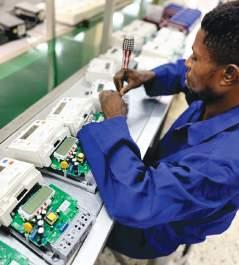
For over six years, the Nigerian Electricity Supply Industry has witnessed sustained growth in local meter manufacturing throug h the visionary implementation of the Meter Asset Provider ( M A P ) a n d M e t e r A c q u i s i t i o n F u n d ( M A F ) frameworks by Nigerian Electricity Regulatory Commission (NERC). Included is the Nigeria Mass Metering Program where AMMON delivered 1 m i l l i o n m e t e r s T h e s e i n i t i a t i v e s e n a b l e d Nigerian manufacturers to deploy 7.8 million STS smart prepaid meters nationwide while building l o c a l i n d u s t r i a l c o m p e t e n c e , j o b s , a n d technology capacity.
A M M O N a l s o c o m m e n d s t h e P r e s i d e n t i a l Metering Initiative (PMI), conceived under the leadership of President Tinubu and vigorously driven by the Special Adviser to the President on Energy, Olu Verheijen, PMI Project Director and Team. The PMI represents a strategic national platform capable of elevating Nigeria's metering i n d u s t r y i n t o a g l o b a l l y c o m p e t i t i v e manufacturing ecosystem. Today, Nigerian meter manufacturers have collectively:
· I n v e s t e d o v e r $ 1 0 0 m i l

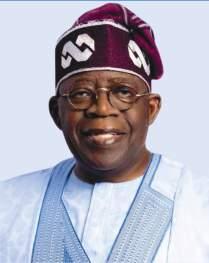
Bola Ahmed Tinubu (GCFR) President of Nigeria,
manufacturing infrastructure,
· Successfully deployed over 7.8 million meters nationwide,
· These 7.8 million meters are entirely selffinanced by AMMON members
· C r e a t e d o v e r 2 5 , 0 0 0 d i r e c t j o b s a n d hundreds of thousands of indirect jobs,
· Built approximately 4 million meters annual production capacity,
· Achieved significant backward integration through local production of:
o Meter boxes,
o Trunking pipes,
o Electrical accessories,
o Wiring components,
o P a c k a g
industrial inputs
Beyond metering itself, AMMON members have stimulated broader industrial linkages through
substantial procurement of:
· Copper cables,
· Personal Protective Equipment (PPE),
· Plastics,
· Electrical fittings,
· Logistics and Engineering Services,
· And other Nigerian-made products and services.
T h i s i
intentionally, in Nigeria's case, give steam to Mr President's revolution.
AMMON respectfully believes therefore, that the next major step in advancing President Tinubu's industrialization vision is the restructuring of the ongoing DISREP II metering programme from its current International Competitive Bidding (ICB) framework into a substantially National Competitive Bidding (NCB) structure that enables qualified Nigerian manufacturers
support.
Nigeria already possesses the manufacturing c
experience required to deliver this
assignment successfully
A localized DISREP II structure would:
· Close the metering gap quicker than an international DISREP
· Create more Nigerian Jobs and deepen Technology Transfer,
· Preserve foreign exchange,
· Expand backward integration,
· Strengthen local industries,
· Increase tax revenues,
· A
industry first.
Nigeria must not continue to borrow externally only to industrialize foreign economies while local factories remain underutilized.
The capacity exists here.
The investments have already been made. The factories are operational.
The workforce is ready.
Let Nigeria Produce What Nigeria Can Already Produce.
SIGNED:
Association of Meter Manufacturers of Nigeria (AMMON) Representing Indigenous Meter Manufacturers and Assemblers Across Nigeria











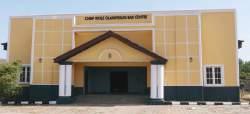
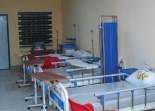
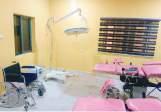



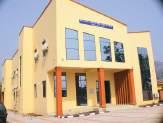











STRENGTHENING HEALTHCARE IN KEBBI
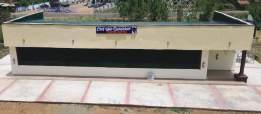
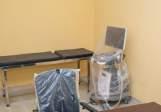
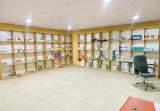
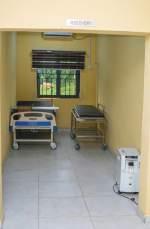
Kebbi state investment in primary healthcare is getting noticed, writes AUWAL JAAFAR
A series of executive orders issued by the Tinubu administration are aimed at speeding up economic recovery, contends AKPANDEM JAMES

RENEWED PUSH IN NIGERIA’S OIL AND GAS SECTOR

EBOLA AND THE WORLD CUP
As long as people are not careless, the World Cup should be a celebration of football, writes PAT ONUKWULI See page 21

It would amount to driving against traffic to suggest that the Nigerian economy has been having a smooth ride. While key indicators show signs of gradual improvement, the strain on livelihoods remains evident. This persistent pressure has heightened expectations on government to accelerate recovery through the most visible channels. In this context, the oil and gas sector, for long the mainstay of the country’s economy, has again assumed strategic importance as the quickest route to stabilisation and growth.
Although the sector contributes less than 10% to the country’s Gross Domestic Product (GDP), it accounts for over 80% of export earnings, making Nigeria highly vulnerable to external shocks. Recent geo-political tensions, particularly the USA-IsraelIraq hostilities, have further disrupted the global energy market with telling effects on economies such as Nigeria’s. These developments underscore a critical reality, and emphasise the imperative of strengthening domestic capacity in the oil and gas sector. It probably could have been worse in Nigeria if the economy had not been on the path to recovery from a debilitating weakness caused by past poor handling.
for results from the goose that lays the nation’s golden eggs. They include: Oil and Gas Companies (Tax Incentives, Exemption, Remission, etc.) Order, 2024; Presidential Directive on Reduction of Petroleum Sector Contracting Cost and Timelines, 2024; Presidential Directive on Local Content Compliance Requirements, 2024; Value Added Tax (Modification) Order, 2024; Upstream Petroleum Operations (Cost Efficiency Incentives) Order, 2025; Presidential Executive Order to Safeguard Federation Oil and Gas Revenues and Provide Regulatory Clarity, 2026.
operational constrains and enhance investor confidence.
Beyond the Orders, a flurry of actions within the period has repositioned critical operations in the sector, including top management changes to align with government priorities in the overall public interest. With policy and regulatory framework taking shape, ramping up oil output has taken centre stage. Authorities have consequently tasked the Nigerian Upstream Petroleum Regulatory Commission (NUPRC) with increasing oil production to two million barrels per day (bpd). Current production levels of about 1.84 million bpd signal steady recovery, though still short of national targets. Of course, the goal is not only to hit the benchmark but to sustain it, requiring stricter oversight, improved operational efficiency and sustained collaboration between regulators and operators.
Arguably, the economy had reached the emergency gate by May 2023, but the shock therapy applied by the government accentuated the impact. Tough as the prescriptions of the petroleum subsidy removal and foreign exchange liberalisation are, they are seen as essential market reforms to stabilise a failing economy. While these reforms triggered shortterm hardship, they also laid the foundation for longer-term stability and prosperity. Even with residual pains, it is evident that better days may be arriving soon, with the intensive policy initiatives in the oil and gas sector aimed at pushing up production levels and increasing revenue.
At the core of this reform momentum is a series of Executive Orders issued by the President Bola Ahmed Tinubu administration to speed up economic recovery. Apart from the Petroleum Industry Act (PIA) 2021, which lays the framework with clear mandates, the sector has seen the highest level of executive reform in the last three years. Between 2023 and last month, nine Executive Orders have been issued, six of which directly target the oil and gas sector, underscoring the urgency
The Order to Safeguard Federation Oil and Gas Revenues and Enhance Regulatory Clarity, issued in February this year, realigns oil and gas revenue flows with Constitutional requirements, reinforcing the country’s 1999 Constitution, which mandates that all resource revenues be paid into the Federation Account. The Order improves fiscal transparency, regulatory clarity and government revenue generation. In the main, it addresses revenue leakages and offbudget deductions linked to the PIA 2021.
Implications include suspending management and frontier exploration fees previously collected by the Nigerian National Petroleum Company Limited (NNPCL); requiring contractors to remit taxes, royalties and profit from oil directly to government authorities; and suspending gas flare penalty payments to the Midstream Gas Infrastructure Fund. The roles of the two main regulators, NUPRC and NMDPRA, have been clarified, while an inter-agency committee led by the Finance Minister oversees implementation. The reforms are to address declining revenue inflows that continue in spite of improved oil production and favourable market conditions. Collectively, these Orders aim to improve fiscal efficiency, reduce
While past declines were linked to disruptions in the Niger Delta and lack of accountability within the system, NUPRC says stability has returned. Ongoing licensing rounds and “drill or drop” enforcement are expected to unlock dormant assets, while indigenous firms continue to expand their role. The broader challenge remains balancing output growth with effective regulation and long-term industry stability. To create a more stable operating environment and grow the economy sustainably, NUPRC is deepening collaboration with other industry operators, setting accountability structures and working to sustain security in the Niger Delta. Leadership has also played a defining role in driving the process. When Mrs Oritsemeyiwa Eyesan assumed duty at the Commission as chief executive officer in December 2025, she emphasised speed, efficiency and collaboration as key drivers for optimising upstream delivery. Her early engagement with stakeholders and push for internal reforms have contributed to renewed investor confidence, positioning the Commission as both regulator and business enabler. As a result of the new business environment, operators are already queuing up.
James, a Fellow of the Nigerian Guild of Editors and Member of the International Press Institute, writes from Abuja
Kebbi state investment in primary healthcare is getting noticed, writes AUWAL JAAFAR STRENGTHENING HEALTHCARE IN KEBBI
Commendations have poured in from international partners in recognition of the healthcare transformation taking place in Kebbi state. From World Health Organization, (WHO), UNICEF, and United Nations Development Programme, Kebbi state is being celebrated for its impactful investments in primary healthcare and sustained efforts toward polio eradication in the state.
The rationale behind this thinking is that health is wealth. Like security and education, healthcare remains one of the most sacred obligations between the people and those who govern them. Yet, across Nigeria, that obligation has too often been treated lightly. Since Gov. Nasir Idris (Kauran Gwandu) assumed office in 2023, inheriting a healthcare system under severe strain, there has been a conscious effort to rewrite that narrative.
From crumbling facilities scattered across communities, clear symbols of neglect that reinforced Kebbi state's poor standing in maternal and child health outcomes, to an acute shortage of personnel in critical centres, the situation was dire. But from the outset, the administration of Gov. Nasir signalled a determination to confront these realities head-on and improve access to healthcare for the people. And, not only the people, but even international partners have taken note.
The hack behind this success comes from understanding that leadership begins with acknowledging the problem. It is on record that governor Nasir did not attempt to mask the depth of the crisis. He openly spoke of hospitals where patients lay on bare floors due to a lack of beds. In hindsight, that candid admission was more than a statement, it was a declaration of intent. It underscored a commitment not to leave the sector as he met it.
That resolve was shaped by an awareness that Kebbi state's healthcare challenges were layered rather than straightforward. At the surface was visibly decayed infrastructure. Beneath that lay a persistent shortage of trained personnel. Compounding both was the long-standing issue of poor welfare for health workers, which had weakened morale and driven some professionals out of the state. Addressing such interwoven problems required more than remedial fixes; it demanded a comprehensive, coordinated response. That is the route the administration has taken, and no wonder, Gov. Nasir is drawing commendation from development partners.
Across Kebbi today, visible changes in health facilities reflect a sector regaining attention. Hospitals are being renovated and upgraded within the limits of available resources, but with a clear sense of urgency. In Argungu, home to the renowned UNESCO-recognised fishing festival, residents have welcomed the transformation of the General Hospital Argungu. Once a symbol of neglect, it
now functions as a modern facility with improved capacity for diagnosis and treatment.
Argungu is only part of a broader effort. In Birnin Kebbi, the Sir Yahaya Memorial Hospital has undergone major rehabilitation and re-equipping, strengthening its role as a key referral centre. Similar interventions have reached the General Hospitals in Yauri and Zuru, alongside multiple primary healthcare centres spread across local government areas.
The attention to primary healthcare centres is deliberate. While tertiary institutions often dominate policy debates, the reality is that healthcare delivery in Nigeria begins at the grassroots. For many citizens, especially in rural areas, these centres are the first, and sometimes only point of access to healthcare. Strengthening them, therefore, reduces pressure on higher-level facilities and ensures that manageable conditions are treated early before becoming severe.
These combined investments are beginning to show impact. Better facilities have improved public confidence in government hospitals, and access to care in previously underserved communities is gradually expanding. The work is ongoing, but the trajectory is becoming clearer.
However, infrastructure alone cannot drive a health system. Skilled personnel remain indispensable, and this has informed the administration’s next phase of reforms. Faced with the option of relying on externally trained professionals or building local capacity, the government has opted for the latter.
A central element of this strategy is the establishment of the Kauran Gwandu College of Nursing and Midwifery Sciences in Ambursa. The institution is intended to boost the training of nurses and midwives, directly tackling workforce shortages, particularly in rural areas. By training locally, the state also improves the chances of retaining professionals who are more likely to serve within their communities.
Still, producing personnel is only part of the equation. Keeping them requires attention to welfare. In recognition of this, the administration has rolled out measures aimed at improving working conditions and stabilising the workforce.
Jaafar writes from Abuja
As long as people are not careless, the World Cup should be a celebration of football, writes PAT ONUKWULI

EBOLA AND THE WORLD CUP
Disease is a silent traveller with no passport. It slips past borders, ceremonies, politics and sport, moving softly where citizens speak loudly, and finding passage through weak surveillance, delayed response, human movement and official complacency.
The recent Ebola outbreak in the Democratic Republic of the Congo should therefore concern Nigeria and the wider world. Not because panic is necessary, but because preparedness is. Not because Congolese citizens or football supporters should be stigmatised, but because public health must never be left to chance.
This concern becomes more delicate because DR Congo is expected to participate in the 2026 FIFA World Cup, scheduled to be held in the United States, Canada and Mexico from 11 June to 19 July 2026. The tournament will bring together millions of people across borders, airports, hotels, stadiums and cities. In such a setting, even a limited outbreak deserves serious attention.
Yet the matter must be placed in a proper context. Ebola is deadly, but it is not COVID-19. COVID-19 spreads widely through the air, often from people with mild or no symptoms. Ebola spreads mainly through direct contact with the body fluids of a person who is already sick or has died from the disease. It is more like a dangerous fire than harmattan dust: devastating where it catches, but not easily carried casually across open spaces.
This distinction is important. A football fan from the DR Congo is not automatically a public health threat. A stadium is not, by itself, an Ebola danger zone. The real risk lies elsewhere: an exposed person may travel while still apparently well, develop symptoms later, and enter a home, hotel, clinic or hospital where the disease is not quickly recognised. In that gap between exposure and detection, danger can grow.
The lesson is therefore not fear, but vigilance. The recent hantavirus concern linked to a cruise ship in Spain reinforces the same point. Hantavirus differs from Ebola; it is primarily associated with rodents and contaminated environments. But both diseases teach one common lesson: in an interconnected world, distance is no longer a guarantee of safety. A ship, a flight, a border crossing or a tournament can test the readiness of any health system.
Nigeria should pay close attention. The country remembers Ebola. In 2014, Nigeria avoided disaster through speed, sacrifice, contact tracing, isolation, and public communication. That success must not become a sleeping tablet. It should be a standing instruction.
The Federal Government, the Federal Ministry of Health, NCDC, Port Health Services, immigration authorities, airport operators and state health officials should immediately strengthen preparedness. Nigeria does not need drama; it needs discipline. It does not need border panic; it needs intelligent screening.

Travellers from affected areas should be assessed for travel history, exposure history and symptoms. Airports, seaports and land borders should have clear procedures for identifying and referring suspected cases. Health declaration systems should be strengthened. Airlines and border officials should know what to ask, who to call and where to send a possible case.
Hospitals are even more important than airports. A suspected Ebola case may not present at the point of entry. The person may first present to a private clinic, a general hospital, or an emergency ward with fever, weakness, vomiting, or diarrhoea. If health workers assume it is only malaria or typhoid, precious time may be lost.
Every state should therefore know its isolation pathway. Every major hospital should refresh infection-prevention protocols. Health workers should be protected with proper training, protective equipment, safe sample-handling procedures and clear reporting channels. One unprotected health worker can become both victim and amplifier.
Public communication must also be clear and humane. Nigerians should be told the truth without being frightened. Ebola is serious, but it does not spread through casual contact with a healthy person. People should report symptoms early, especially after travel to affected areas. They should avoid contact with the body fluids of sick persons and should not handle the bodies of suspected Ebola victims without official guidance.
At the same time, the government must avoid language that defames the Congolese people. Disease control must be firm, but also fair. The issue is exposure, not nationality; symptoms, not identity.
For the World Cup, FIFA, host countries, WHO, Africa CDC and participating nations should coordinate closely. Team delegations should have health protocols. Host cities should prepare designated hospitals, isolation systems and contact-tracing teams. The goal should be simple: detect quickly, isolate safely, trace immediately and communicate responsibly.
Dr. Onukwuli is a legal scholar and public affairs analyst. patonukwuli2003@yahoo.co.uk
Editor, Editorial Page PETER ISHAKA
Email peter.ishaka@thisdaylive.com
POLICE AND THE REPORT ON TORTURE
The ‘Tiger Base’ Police Unit in Owerri should be investigated
Arecent report by Amnesty International on a police unit in Owerri, Imo State capital, deserves attention. The unit is allegedly involved in rampant violations, including extrajudicial executions, torture, and extortion. Titled, ‘Tiger Base of Atrocities: Human Rights Violations by Nigeria Anti-Kidnapping Unit in Owerri’, the report details how “detainees are kept in filthy, windowless cells and subjected to regular beatings,” while “many are locked up for weeks or months, without charge. Others have been shot or forcibly disappeared.” According to the report, a unit established to tackle kidnapping and armed robbery has instead been unlawfully killing suspects, torturing detainees to coerce them into confessing to bogus crimes, and arresting people for the sole purpose of extracting lucrative bribes for their release.
We are surprised by the lack of response to the report. Torture is a violation of human rights, and the country must not be seen to be violating such rights. Section 34 (1) of the 1999 constitution states that: "Every individual is entitled to respect for the dignity of his person, and accordingly, (a) no person shall be subjected to torture, or to inhuman or degrading treatment." But notwithstanding the provision, not a few Nigerians have experienced one form of torture or another in the hands of the police. Therefore, rather than waste efforts on denial, authorities in Nigeria should focus energy on finding a solution by making sure that law enforcement agents do their job without necessarily resorting to torture.
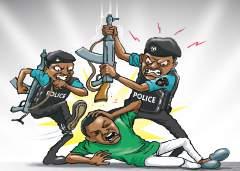
cials, lawyers and representatives of NGOs, the Special Rapporteur concluded that torture and ill-treatment is widespread in police custody, and particularly systemic in the Central Criminal Investigation Department." He concluded by saying that his findings were not new, as many “credible human rights organisations, as well as United Nations human rights mechanisms, have documented and concluded that torture is widespread in the country (Nigeria) and the conditions in detention are unacceptable."
However, it should be stated that most police personnel in the country don't torture suspects because they enjoy inflicting pain on them or just for the sake of doing so: they do so because it is the easiest way available for them to get evidence to prosecute cases. Poorly trained and ill-equipped, the only investigation technique many know is to force out confessions from suspects. So, to stop the police from torturing suspects, we must also enhance their capacity to do their job.
There should be a new reorientation on the investigation of crime beyond ‘confessional statements’ that are most often extracted from suspects under extreme torture
H I S D AY
EDITOR SHAKA MOMODU
DEPUTY EDITOR WALE OLALEYE
MANAGING DIRECTOR ENIOLA BELLO
DEPUTY MANAGING DIRECTOR ISRAEL IWEGBU
CHAIRMAN EDITORIAL BOARD OLUSEGUN ADENIYI
EDITOR NATION’S CAPITAL IYOBOSA UWUGIAREN THE OMBUDSMAN KAYODE KOMOLAFE
EDITOR-IN-CHIEF/CHAIRMAN NDUKA OBAIGBENA
A United Nations Special Rapporteur on torture and other cruel, inhuman or degrading treatment or punishment, Manfred Nowak once undertook a mission to Nigeria, following an invitation to him by the federal government. In his report to the UN Human Rights Council, Nowak wrote as follow: "On the basis of an analysis of the legal system, visits to detention facilities, interviews with detainees, the support of forensic medial evidence, and interviews with government offi-
GROUP EXECUTIVE DIRECTORS ENIOLA BELLO, KAYODE KOMOLAFE, ISRAEL IWEGBU
DIVISIONAL DIRECTORS SHAKA MOMODU, PETER IWEGBU, ANTHONY OGEDENGBE
DEPUTY DIVISIONAL DIRECTOR OJOGUN VICTOR DANBOYI
SNR. ASSOCIATE DIRECTOR ERIC OJEH
ASSOCIATE DIRECTOR PATRICK EIMIUHI
CONTROLLERS ABIMBOLA TAIWO, UCHENNA DIBIAGWU, NDUKA MOSERI
DIRECTOR, PRINTING PRODUCTION CHUKS ONWUDINJO
TO SEND EMAIL: first name.surname@thisdaylive.com
Letters to the Editor
Considering the gravity of the situation, Amnesty International Nigeria Country Director, Isa Sanusi, has called for “an independent, impartial and effective investigation of the atrocities committed by Tiger Base unit police officers in Owerri” to examine the conduct of the Commander and other officers and their involvement in human rights violations, corrupt practices and other misconducts.
We urge the Inspector General of Police, Tunji Disu, to investigate the Amnesty Report on the ‘Tiger Base’ Police Unit in Owerri and take corrective action. Beyond that, there should be a new reorientation on the investigation of crime beyond ‘confessional statements’ that are most often extracted from suspects under extreme torture. Nigeria is a signatory to the International Covenant on Civil and Political Rights (ICCPR) and the Convention Against Torture. The time has come for the country to live up to this commitment.
Letters in response to specific publications in THISDAY should be brief (150-300 words) and straight to the point. Interested readers may send such letters along with their contact details to opinion@thisdaylive.com. We also welcome comments and opinions on topical local, national and international issues provided they are well-written and should also not be longer than (750- 1000 words). They should be sent to opinion@thisdaylive. com along with photograph, email address and phone numbers of the writer.
THE TRIUMPH OF ENUGU RANGERS
The 2025/2026 Nigeria Premier Football League season will be remembered as one of resilience, discipline and renewed hope for domestic football in the country. At the centre of this remarkable campaign stands Rangers International F.C., popularly known as the Flying Antelopes, who once again proved their pedigree by emerging league champions after a dramatic final-day victory away in Lagos. Their triumph has not only reignited pride among their supporters but also strengthened the argument for greater investment in Nigeria’s domestic football structure.
Team captain Chidiebere Nwobodo delivered the decisive performance that secured the title for Rangers. His brace against Ikorodu City FC in a tense encounter ensured a 2-1 victory away from home and crowned Rangers champions of the 2025/2026 NPFL season. Winning such a crucial match on hostile territory demonstrated the team’s determination, tactical discipline and hunger for success.
This latest achievement marks the second league title for Rangers in just three years, having also lifted the trophy in the 2023/2024 season. It is equally a significant personal milestone for Fidelis Ilechukwu, one of the assistant coaches of the Nigeria national football team, who guided the club to both championship victories. His consistency and leadership have shown that Nigerian coaches possess the technical ability and managerial competence to compete at the highest levels when given the right support.
Credit must also go to the club’s management under CEO Amobi Ezeaku, whose resilience and commitment kept the team focused throughout the season. Rangers fought back impressively to close a significant points gap behind Rivers United F.C., who had occupied the top position for several months. Such a comeback reflects not only quality on the pitch but also effective administration, planning and unity within the club.
Beyond Rangers’ success, the just-concluded NPFL
season recorded commendable improvements compared to previous campaigns. There were more away victories, fewer incidents of violence and generally fair officiating across match centres. These developments are encouraging signs that the league is gradually regaining credibility and competitiveness, qualities necessary for attracting fans, sponsors and investors.
The league organisers also deserve commendation for taking disciplinary actions against clubs and match officials involved in misconduct during the season. Such firmness sent a clear message that indiscipline and unethical practices would no longer be tolerated. These measures undoubtedly contributed to the relative success and integrity of the 2025/2026 season and should remain a permanent feature of league administration going forward.
Tochukwu Jimo Obi, Obosi, Anambra State
LAWYER
TUeSday, M ay 26, 2026
/Users/mac/Desktop/untitled folder/images.jpg
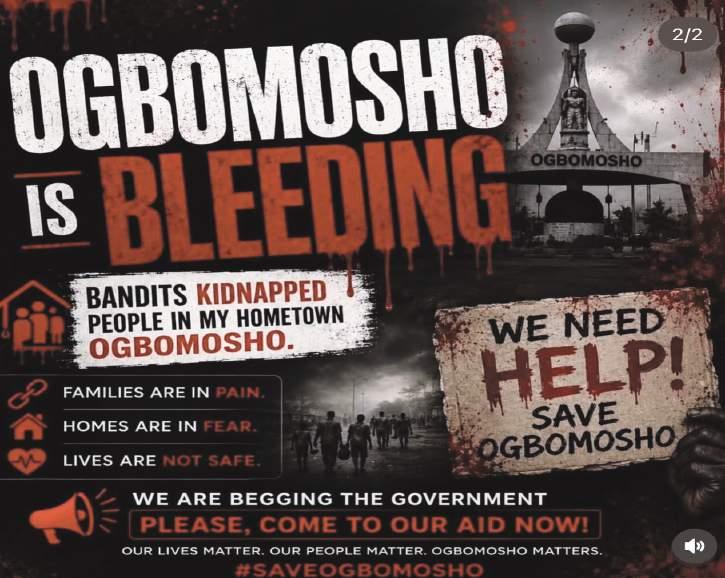
LAWYER
Nationwide Insecurity: A Call for Action
Commencing Action for Maintenance, Welfare and Education Without Divorce Petition
‘A civilian coup does not always suspend the Constitution. Sometimes, it operates through Party Secretariats, Governors’ Lodges, hotel rooms and private homes. It preserves the rituals of democracy, but strips away its essence…..It normalises democracy without choice, unity without consent and leadership without legitimacy.' - Dr Dakuku Peterside, Author
Lagos Judiciary Mourns Justice Oyefeso
V A Critical Analysis of Justice Umar’s Decision Nullifying INEC’s Membership Deadline
ECNBA Publishes NBA Voters’ Register
Why Raul Castro Cannot Stand Trial for Murder America Claimed Was Committed by Fidel Castro
Of Bad Leaders, Unpatriotic Followers
Lack of Love for Country: Vandalism, Imported Pride and Cultural Self-Neglect
The things Nigerians do, whether the elite or masses, point to the fact that many of us have no love for ourselves or our country. The social contract between the State and the Citizens, has long been broken by both sides. Just as successive governments have failed to achieve the Fundamental Objectives and Directive Principles of State Policy set in Chapter II of the 1999 Constitution of the Federal Republic of Nigeria (as amended)(the Constitution), so also have the people failed in the duties set out for citizens in Section 24 of the Constitution, amongst others.
For instance, when governments put in infrastructure such as expressways and trains for the benefit of all, and at inflated costs too (see Section 15 of the Constitution on the State’s mandate to abolish corrupt practices and abuse of power), the people go and steal the metal railings, under the bridge iron rods (which hold up the bridges along with concrete, without which a bridge can collapse), manhole covers and rail track clips (without which the trains can derail). Perpetrators couldn’t care less if fellow citizens die, as a result of bridge collapse or train derailment. I’m not interested in football, but I find it strange that no one talks about Enugu Rangers, IICC Shooting Stars, Kano Pillars or Stationery Stores anymore; it’s all about Arsenal and Manchester City or United! - our local brands that gave us pride back in the day, are nowhere to be found. We have got into the habit of loving imported things, and neglecting our own.
In governance, Nigeria has also adopted foreign styles - laws from the British and the legislative system from the Americans, but they have been adulterated, distorted or spoilt in their implementation, being observed in their breach.
Consensus Candidacy: Elite Anointing Dressed as Democracy Last week. I read Dr Dakuku Peterside’s article, “Elite Capture and the Death of Democracy” He was spot on. He more or less stated that the Nigerian brand of consensus candidacy, not being what consensus candidacy should be in the true sense of the word, is killing democracy, and instead, entrenching autocracy, is fostering division, bitterness and the quest for revenge amongst the unfavoured aspirants who may have felt cheated out of their candidacies, on account of opaque and unfair processes - in short, eliciting the opposite of what consensus candidacy is supposed to achieve.
The Obi/Kwankwaso ticket for the 2027 Presidency, and the candidacy of Alex Otti for Abia State Governor 2027 may be examples of consensus candidacy, where the Obi/Kwankwaso ticket appears to be agreeable to their party, NDC and for Otti, Abia State stakeholders generally.
Dr Peterside also referred to everlasting debts payable by present-day so-called consensus candidates to their godfathers who chose them, to the detriment of the Nigerian people. See Section 84(2) of the Electoral Act 2026 (EA) on direct primaries and consensus candidacy. I concur.
Today, the concept of consensus candidacy has been abused. Many Nigerians watched a video where a direct primary was being conducted, and the person counting the number of those who were in the queue for the favoured candidate, shamelessly jumped from No. 54 to 101 in his count, while another counter in an Akwa Ibom State primary jumped from 12 to 1,000! Openly Cheating! We also saw videos of those who alleged that their supporters were denied access to venues where the direct primaries held, to vote for them. We saw former Minister, Isa Pantami, weeping like a new born baby because he didn’t emerge as the APC consensus Gubernatorial candidate of Gombe State. Will the losers end up engaging in anti-party activities? Or will their parties be able to assuage them, with promises of compensation?
To buttress Dr Peterside’s submissions, it can safely be argued that a combination of the EA’s Sections 29(5) (restriction to only fellow aspirants who partook in primaries, to challenge constitutional qualifications as a pre-election matter - meaning that those who emerge from ‘consensus candidacy’ cannot be challenged); 75 (powers of INEC to register political parties); 84(2)(direct primaries and consensus candidates); 60(3)(counting of votes and transmission of results); 138 (restrictive grounds of election petition) & 139(1) (effect of non-compliance with the provisions of the EA) and/or their faulty implementation, have the ability to make elections less competitive and credible, thereby, further lending credence to the argument of anti-democracy, or civilian autocracy.
Other Laws Observed in their Breach and Twisted Doctrines
It is unfortunate that, whether at the bottom or top of the ladder, many Nigerians appear to have a penchant for observing our laws in their breach, or manipulating provisions to suit their own purposes. Just as we see it in the ongoing election process, we also observe the same pattern in many other areas. How can Nigeria experience true progress, in such circumstances?
Most concepts/doctrines that were developed to improve governance, are twisted in Nigeria. For
onikepo braithwaite
onIKePo BrAIThwAITe
onikepo.braithwaite@thisdaylive. com onikepob@yahoo.com
“The moral of Nigeria’s story of self-sabotage, may have started with a mutual betrayal of the social contract between the Government and the people….the concept of consensus candidacy has been abused….We have instead, elite anointing dressed as democracy…. whether at the bottom or top of the ladder, many Nigerians appear to have a penchant for observing our laws in their breach.… Even INEC isn’t left out of the chicanery…. Progress is possible, with a cultural shift from rewarding incompetence and corruption…. alleviation of poverty of the people thereby reducing desperation….”
example, instead of the doctrine of separation of powers which is part of the Constitution - see Sections 4,5,6 & 7 thereof, some are arguing that today, on a Federal level, the Executive, Legislature and sometimes the Judiciary are one, while on the State level, the four arms of government, Legislature, Executive, Judiciary and Local Government are all rolled into one, so much so that the landmark decision in AGF v AG Abia & 35 Ors (2024) LPELR-80019(SC) per Emmanuel Akomaye Agim, JSC, sought to pry away the Local Governments (LG) from the State Governments by removing the financial impediment caused by Section 162(5) & (6) of the Constitution.
In any event, how can we really expect true, external democracy from people who are unable to practice internal democracy within their associations? We cannot. How can an internal system that is borne out of inequity, ‘elite cartels’, the highest bidder takes all, opaqueness and lack of accountability, give rise to legitimate, optimal democratic governance? It cannot.
INEC Overreach
Even INEC isn’t left out of the chicanery. Recently, we saw a Judgement Order delivered on 20/5/26 per M.G. Umar J. in Suit No: FHC/ ABJ/CS/517/2026 Youth Party v INEC, against INEC. It is at the least bizarre, that INEC would use its Guidelines to attempt abridge (shorten)
statutory timelines, including, but not limited to the submission of the names of candidates (see Section 29(1) of the EA), particularly with a Professor of Law and a Senior Advocate of Nigeria at the organisation’s helm of affairs. It is actions such as this, that paint INEC in a bad light, as it gives the impression that INEC is trying to hem the parties/politicians in as quickly as possible, despite the fact that its actions were inconsistent with the EA. INEC, in its Revised Timetable and Schedule of Activities for the 2027 General Elections, tried to impose earlier timelines on conduct of party primaries; submission of candidates’ personal particulars and lists; withdrawal/replacement of candidates and related processes like membership register submissions - even giving a May 10, 2026 deadline for submission of party membership registers, when they are to be submitted 21 days before each party’s primaries, congresses or conventions (see Section 77(4) of the EA), meaning that there’s even no universal date for submission of registers, as different parties are holding their primaries on different dates.
It is trite law, confirmed by a plethora of authorities, that just as the provisions of a statute cannot supersede that of the Constitution (see Section 1(1) & (3) of the Constitution), the provisions of Guidelines which at best, may be referred to as subsidiary
legislation, cannot supersede that of substantive legislation. In Nyesom Wike v Peterside (2016) LPELR-40036(SC), the Supreme Court held that the directives, guidelines and manual issued by INEC, cannot be elevated above the provisions of the Electoral Act. In INEC v PDP (2022) LPELR-57389(CA) per Ugochukwu Anthony Ogakwu, JCA, the Court of Appeal held inter alia that, though INEC’s timetable has the force of law as it is made subject to the provisions of the Electoral Act, it cannot override the Principal Act (which is the Electoral Act).
For example, only in the case of death or withdrawal of candidates, is substitution of candidates permitted by the EA. Section 31 of the EA gives a candidate a deadline of 90 days before the date of an election to withdraw, while Section 33 thereof gives the political party 14 days within the date of the death or withdrawal of a candidate, to conduct another primary. So, for the Presidential and National Assembly elections scheduled to hold on January 16, 2027, candidates have till sometime in mid-October to withdraw, while those for Gubernatorial and State Houses of Assembly holding on February 6, 2027, have up to early November to withdraw. El Rufai Bail Irony and Rule of Law Hypocrisy I saw a video of our learned colleague, Mrs Nasiru El Rufai, calling the public’s attention to the fact that her husband had been in custody for 89 days, and that his bail conditions are onerous. Her concerns are legitimate. Bail is a constitutional right, based on the presumption of innocence (see Section 36(5) of the Constitution).
However, it appears that one of Malam’s bail conditions is that a Grade Level 17 civil servant who owns a property in Asokoro or Maitama, should be the one to stand surety for him. This is practically impossible, as it would certainly invite EFCC/ICPC scrutiny on such a surety. Granting an individual bail on conditions that may be impossible to fulfill, means that the court wants such a person to stay remanded in custody. Section 162 of the Administration of Criminal Justice Act 2015 (ACJA) provides inter alia that a Defendant charged with an offence whose punishment exceeds 3 years imprisonment upon conviction shall be entitled to bail, except in certain circumstances such as a high likelihood of jumping bail, interfering with the investigation or witnesses.
In Akaolisa v Okuma & Anor (2025) LPELR81140(SC) per John Inyang Okoro, JSC, the Supreme Court held that: “...bail is a constitutional right available to an accused person, which effect is not to set the accused free from the criminal trial, but to release him temporarily from custody and entrust him to attend to his trial upon satisfying the conditions attached thereto”. Also see Suleman & Anor v COP Plateau State (2008) LPELR-3126(SC) per Niki Tobi, JSC. If bail is a constitutional right, then it cannot be taken away through the back door by the courts by setting impossible bail conditions. However, isn’t it ironical that this is happening to Malam El Rufai? I remember in 2019, when the Kaduna State High Court granted bail to the El Zakzakys to travel to India for medical tourism, a trip that subsequently failed, the same Governor El Rufai/Kaduna State Government, under the guise of ‘strict supervision of the bailees’, sought to add their own additional bail conditions to those that the court had set, including asking for two prominent sureties - an Emir or First Class Chief and another, within Kaduna State. Now the shoe is on the other foot.
If we had strong institutions, courts would set bail conditions based on consistent legal principles, not extraneous considerations.
Conclusion: Strong Institutions Over Strongmen
The moral of Nigeria’s story of self-sabotage, may have started with a mutual betrayal of the social contract between the Government and the people. Though the betrayal may be more on the side of government and on a larger scale in this country, it is however, not unique to Nigeria. The country is desperately in need of stronger/strong institutions, not strong persons/personalisation of power. Progress is possible, with a cultural shift from rewarding incompetence and corruption - playing straight mustn’t be allowed to continue to lose to shortcuts; accountability and better enforcement of laws; more autonomy for INEC, political party funding and expenditure reforms; a completely independent Judiciary; alleviation of poverty of the people thereby reducing desperation, by means of job creation/increased opportunities and more economic reforms, and most importantly, restoring security all over the country.
P.S. Governor Uzodinma
The other day, I saw a post that Imo State Governor, Hope Uzodinma’s tenure ends on 15th January, 2028, and yet, he won the Imo West APC Senatorial ticket for an election that will hold almost a year before his tenure ends. The truth of the matter is that Section 66(1)(f) of the Constitution allows this, as it provides that Governor Uzodinma only has to resign 30 days before the date of the election! This type of move however, intensifies the perception that many have about politicians - that they desire perpetual incumbency.
Commencing Action for Maintenance, Welfare and Education Without Divorce Petition
s
Fact
1st Appellant and the Respondent were married under Igbo Native Law and Custom and subsequently, contracted a statutory marriage. The 2nd and 3rd Appellants are children of the marriage. The Appellants alleged that the Respondent subjected them to intolerable conduct, including physical and emotional abuse, despite several interventions by members of the Respondent’s family aimed at resolving the disputes between the parties. It was alleged further that the Respondent sent the Appellants out of the matrimonial home, while undertaking to provide financial support for their welfare and maintenance. The Respondent subsequently failed to fulfil this undertaking. The 1st Appellant made several complaints to the Respondent’s family, his employers at the Lagos University Teaching Hospital, the Lagos State Child Development and Welfare Agency, the Lagos Office of the Public Defender, the Parish Priest of St. Dominic Catholic Church, the Catholic Marriage Tribunal, and the Lagos State Chapter of the International Federation of Women Lawyers (FIDA). The Appellants contended that the Respondent ignored all attempts at settlement and reconciliation, leaving the 1st Appellant solely responsible for the welfare and upkeep of herself and the children. Consequently, the Appellants commenced an action against the Respondent at the High Court of Lagos State by way of a Writ of Summons and Statement of Claim, pursuant to the High Court of Lagos State (Civil Procedure) Rules.
Upon being served with the originating processes, the Respondent filed a Notice of Preliminary Objection challenging the jurisdiction of the court, on the ground that the suit had not been commenced by due process. The Respondent argued that since the claims related to maintenance and welfare arising from a marital relationship and paternal obligations, the action ought to have been commenced pursuant to the Matrimonial Causes Act by way of Petition, rather than by Writ of Summons under the High Court (Civil Procedure) Rules. The trial court dismissed the preliminary objection, holding that the claims before it did not constitute matrimonial causes within the meaning of Section 114 of the Matrimonial Causes Act (MCA), as the 1st Appellant was not seeking dissolution of the marriage, or any other matrimonial relief contemplated under the Act. The court held further that the Appellants were entitled, under the Constitution and the Child Rights Act, to approach the court for reliefs relating to maintenance and welfare, and that the action was therefore, properly commenced.
Dissatisfied with the ruling, the Respondent appealed to the Court of Appeal, which allowed the appeal, holding that the claims for maintenance, education, and welfare are reliefs contemplated under the MCA and the Matrimonial Causes Rules (MCR), and that such proceedings ought to have been commenced by Petition. Aggrieved by the decision of the Court of Appeal, the Appellants appealed to the Supreme Court.
Issues for Determination
The Supreme Court formulated a sole issue for determination of the appeal: to wit:
Whether indeed, during the subsistence of a marriage, a wife and the children of the marriage possesses enforceable rights to maintenance, welfare, upkeep and education against their husband/father, outside the rights to maintenance, welfare and education granted them under Matrimonial Causes Act, 1970.
Arguments
Arguing the sole issue, the Appellants submitted that the reliefs sought by the Appellants for maintenance, welfare and education did not fall within the definition of “matrimonial causes” under Section 114(1) of the MCA, 1970. They argued that there was no pending, concluded or concurrent proceedings between the 1st Appellant and the Respondent for the dissolution of the marriage, nullity, judicial separation, restitution of conjugal rights, or jactitation of marriage. Consequently, the present action could not properly have been commenced by Petition under the MCA and MCR, but rather by Writ of Summons pursuant to the applicable High Court (Civil Procedure) Rules. The Appellants referred extensively to Section 114(1)(a)–(e) of the MCA, 1970 and Order XIV of the MCR 1983, which classify dissolution of marriage, nullity, judicial separation, restitution of conjugal rights and jactitation of marriage as principal reliefs, while maintenance of a wife and the welfare, advancement and education of children are classified as ancillary reliefs. Counsel argued that claims for maintenance, welfare and education would only qualify as matrimonial causes where they are ancillary to proceedings for dissolution, nullity, judicial separation, restitution of conjugal rights or jactitation of marriage. In such circumstances, the proceedings would necessarily be commenced by Petition. However, in the present case, the
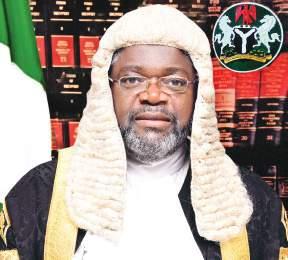
In the Supreme Court of Nigeria Holden at abuja On Friday, the 4th day of July, 2025
Before their lordships John Inyang Okoro Tijjani abubakar Habeeb adewale Olumuyiwa abiru Jamilu yammama Tukur Mohammed Baba Idris Justices, Supreme Court SC/334/2008 Between
1. Mrs Veronica Nneka Ugbah
2. Chukwuemeka Gregory patrick (Infant, suing by his Guardian/next friend, Mrs Veronica Nneka Ugbah)
3. Ifechukwude Brenda patrick
(Infant, suing by her Guardian/next friend, Mrs Veronica Nneka Ugbah)
And
Mr patrick Iwebunor Ugbah
appellaNtS
reSpoNDeNt
(Lead Judgement delivered by Honourable Habeeb Adewale Olumuyiwa Abiru, JSC)
Appellants sought maintenance, welfare and education as substantive and independent reliefs, and not as ancillary claims. They posited that these rights arose as civil rights guaranteed under the Constitution of the Federal Republic of Nigeria and the Child Rights Act 2003, and by Order 3 Rule 1 of the High Court of Lagos State (Civil Procedure) Rules, 2004, actions seeking reliefs or remedies for civil wrongs or breaches of duty, whether contractual, statutory or otherwise, shall be commenced by Writ of Summons, subject to any contrary statutory provision. The Appellants maintained that neither the MCA nor the MCR prohibits a wife or children from independently instituting an action against a husband or father for maintenance, welfare and education simpliciter by way of Writ of Summons. That under family law, a husband owes a legal duty to maintain his wife and provide for the welfare, upkeep and education of his children, and breach of that duty is actionable.
“… a wife can file a stand-alone action for maintenance for herself and the children of the marriage…even if there is no suit for divorce or separation… a claim for education, maintenance and upkeep of a child are a serious and sensitive matter which should not be hamstrung by technicalities…. once the procedure used in a matter brings the issues in contention into focus, it will be of no moment that the procedure used was wrong….”
present action.
Court’s Judgement and Rationale
In resolving the appeal, the Supreme Court identified the different types of marriages under Nigerian law and the rights applicable to the parties under the marriage. The Court identified that Christian marriage and Islamic marriage guarantees a spouse a right to maintenance by her husband, and it is a right that is enforceable. The situation is not clear for customary marriages. The right of a wife of a Christian marriage or Islamic marriage to be maintained by her husband, is independent of the right to maintenance provided under the provisions of the MCA. Where a wife of a Christian marriage and/or of an Islamic marriage proceeds thereafter to conduct a statutory marriage under the MCA, this independent right of maintenance ceases and becomes subsumed in the right of maintenance provided for a wife of a statutory marriage in the provisions of the Act. The 1st Appellant and the Respondent having contracted a subsequent statutory marriage, became subsumed within the statutory framework of the MCA. The court therefore, rejected the Appellants’ contention that the 1st Appellant retained an enforceable independent right to maintenance outside the Act.
Regarding the rights of the children of the marriage, the Apex Court held that the rights of children to maintenance, welfare and education is a fundamental right which all children all over the world are entitled to enjoy. It is constant, irrespective of the nature of the marriage between the parents, or even where no marriage exists. A father bears a primary legal and moral obligation to provide for the welfare, upkeep, education and protection of his children. The child’s right to maintenance is independent of both the mother’s right to maintenance, and the statutory provisions contained in the MCA.
The Supreme Court emphasised that the obligation of the head of the family had long been recognised under Nigerian criminal law, specifically Sections 205 and 339 of the Criminal Code Law of Lagos State, 2003, which imposed criminal liability on persons who failed to provide necessaries of life for children under their care. The subsequent enactment of the Child Rights Act, 2003 and its domestication in Lagos State, merely reinforced and codified pre-existing rights, rather than creating new rights.
Judicial precedents firmly establish that a wife can file a stand-alone action for maintenance for herself and the children of the marriage, without including with it other primary claims like divorce. The Supreme Court relied on the decision in OBAJIMI v OBAJIMI (2011) LPELR-4665(CA), to the effect that maintenance of a wife may be claimed by her from the husband, even if there is no suit for divorce or separation. In other words, the wife of a marriage under the Matrimonial Causes Act, is entitled to claim maintenance in the High Court, if her husband wilfully neglected to maintain her without instituting a matrimonial case. There is no provision in the MCA that prohibits a stand-alone action for maintenance. The court reasoned that requiring maintenance claims to be tied to divorce or other matrimonial reliefs would effectively deny children the ability to seek support from an irresponsible parent, since children themselves cannot institute proceedings for dissolution or nullity of marriage. Their Lordships accordingly, determined that the Court of Appeal erred in holding that the Appellants’ claims, could only be sustained as ancillary reliefs to matrimonial proceedings.
Responding to the submissions, the Respondent argued that at the time the action was commenced in 2006, the Child Rights Law of Lagos State was not in existence and the Family Court had not been established. There was therefore, no legal framework outside the MCA and the MCR under which claims for maintenance, welfare and education of children arising from a marriage could be maintained. He referred to Order 3 Rule 1 of the High Court of Lagos State (Civil Procedure) Rules, 2004, which prescribes commencement of actions by Writ of Summons, and argued that the provision expressly recognises exceptions where another applicable law prescribes a different mode of commencement. He submitted that the only legal avenue available to the Appellants in 2006 for claims relating to maintenance, welfare and education was under the MCA and MCR, and only as ancillary reliefs to proceedings for dissolution of marriage, nullity, judicial separation, restitution of conjugal rights or jactitation of marriage. And such proceedings, ought to have been commenced by Petition. He posited that failure of the Appellants to commence the action through the procedure specifically prescribed by statute was not a mere procedural irregularity, but a fundamental defect affecting the jurisdiction of the High Court to entertain the suit. While he conceded that Section 14 of the Child Rights Act, 2003 imposes obligations on parents to provide for the welfare, upkeep and education of their children, he contended that the Act only became operative in Lagos State upon its domestication through the Child Rights Law of Lagos State, 2007, together with the establishment of the Family Court. Counsel pointed out that these developments occurred, after the institution of the
Regarding the question as to whether a wife of a statutory marriage, can file a stand-alone action for maintenance for herself and the children of the marriage via Writ of Summons under the High Court (Civil Procedure) Rules or by a Petition under the MCA, the Supreme Court held that this is a matter of technicality. It is an issue as to procedure for presentation of the claims, and not the substance of the claims. It does not matter that the Appellants commenced this action under the High Civil Procedure Rules, because a claim for education, maintenance and upkeep of a child are a serious and sensitive matter which should not be hamstrung by technicalities. Relying on its previous decisions, the Supreme Court held that once the procedure used in a matter brings the issues in contention into focus, it will be of no moment that the procedure used was wrong. It was not the complaint of the Respondent at the High Court and at the Court of Appeal, that the use of a Writ of Summons instead of a Petition occasioned a miscarriage of justice to him. Thus, the Court of Appeal placed undue emphasis on technicality in holding that the action was incompetent, merely because it was commenced by Writ of Summons rather than by Petition. The Supreme Court, accordingly, found merit in the appeal. The judgement of the Court of Appeal was set aside, and the ruling of the High Court of Lagos State was restored.
Appeal Allowed.
Representation Mgbereoma Wayo for the Appellant. Bolu Agbaje Akadri with Johnpraise Okudare for the Respondents.
Reported by Optimum Publishers Limited,Publishers of the Nigerian Monthly Law
Honourable Habeeb Adewale Olumuyiwa Abiru, JSC
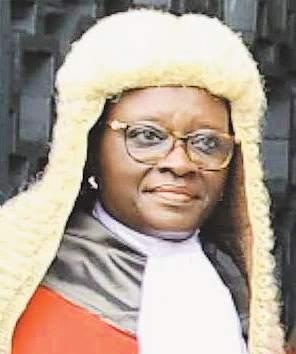
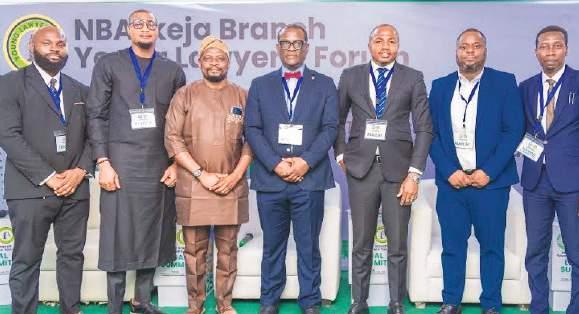
ECNBA Publishes NBA Voters’ Register
Stories by Steve Aya
The Electoral Committee of the Nigerian Bar Association (ECNBA) has released the Preliminary Voters List for the forthcoming Nigerian Bar Association (NBA) General Elections, marking a key step in preparations for the highly anticipated poll.
In a public notice, the electoral body announced that the 2026 Preliminary Voters List is now available for members to verify their details, urging all eligible voters to confirm their information before the verification window closes on 1 June, 2026.
Following the publication, some NBA members who successfully found their names on the register have taken to social media to share screenshots and confirmations of their eligibility, generating early excitement ahead of the elections.
In an official statement titled “ECNBA NOTICE: Publication of the 2026
Preliminary Voters List”, ECNBA Chairman, Mr. Aham Ejelam, SAN, and Secretary, Ibrahim Nasarawa, confirmed the release of the register and called for careful verification by members.
The Committee stated that the publication was made
in line with the provisions of the NBA Constitution (2015 as amended in 2025), which governs the conduct and preparation for the Association’s general elections.
According to the ECNBA, the voters list is accessible through its official website,
where members can click on the “Voter List” section, or directly access the dedicated voters’ portal to search for their details.
The Committee further provided guidelines for corrections, stating that members who notice discrepancies in their records
should submit correction requests via the official support email, including their SCN, full name as enrolled at the Supreme Court, GSM number, and email address for verification and prompt resolution.
The ECNBA reiterated that all correction requests would be reviewed and addressed within 24 hours, urging members to act promptly as the verification exercise remains crucial to ensuring a credible and transparent electoral process ahead of the NBA General Elections.
Lagos Hosts Landmark 10th ICC Arbitration Conference in June
Lagos will once again take centre stage in Africa’s dispute resolution landscape, as the 10th ICC Africa Conference on International Arbitration and Alternative Dispute Resolution (ADR) returns to Nigeria for a two-day gathering of global arbitration experts, business leaders and legal professionals. The Conference, organised by the ICC International Court of Arbitration in collaboration with ICC Nigeria themed “A Decade of Excellence: Shaping the Future of International Arbitration & ADR in Africa”, is scheduled to hold from June 3 to 5, 2026 at the Lagos Continental Hotel. Discussions are expected to focus on strengthening dispute resolution systems across the continent. Speaking
ahead of the Conference, ICC Nigeria described the event as an important platform for strengthening arbitration practice across Africa, while promoting investor confidence and efficient dispute resolution mechanisms essential for economic growth and international business transactions.
Activities will commence on June 3 with an advanced training session on drafting enforceable arbitral awards, hosted by the ICC Institute of World Business Law. The training is expected to provide participants with practical insights into the technicalities of preparing enforceable arbitration awards.
The main Conference on June 4 and 5 will feature
sessions on cross-border commercial disputes, enforcement of arbitral awards, investment arbitration, energy and infrastructure disputes, as well as technology and innovation in arbitration practice.
Among speakers expected at the Conference are the Attorney-General of the Federation, Prince Lateef Olasunkanmi Fagbemi, SAN; President of the ICC International Court of Arbitration, Claudia Salomon; Chair, ICC Nigeria Commission on Arbitration and ADR, Mrs Dorothy Udeme Ufot, SAN; Justice Paul Baffoe-Bonnie; NBA President, Mazi Afam Osigwe, SAN; Lagos State AttorneyGeneral, Lawal Pedro, SAN
Ikeja NBA Organises Young Lawyers Seminar on Data Privacy and AI
Legal practitioner and technology governance advocate, Dr Great Ijeoma, has called on young Lawyers in Nigeria to embrace data privacy and artificial intelligence governance, as emerging areas of specialisation capable of reshaping the future of legal practice and creating new career opportunities.
Speaking to young Lawyers on the rapid evolution of the digital economy, in a seminar organised for them by NBA Ikeja, Dr Ijeoma explained that data has become the foundation of modern technological advancement in the same way oil once powered industrial economies, noting that sectors such as
banking, fintech, healthcare, telecommunications, insurance, e-commerce, education, cybersecurity, and government services now depend heavily on personal data and AI-driven systems.
He observed that although artificial intelligence offers enormous commercial and technological opportunities, it also presents major legal, ethical, and regulatory risks involving privacy breaches, automated decision-making, discrimination, cybersecurity threats, transparency concerns, and accountability issues. According to him, the growing reliance on digital systems has significantly increased demand for Lawyers with expertise in governance frameworks,
cybersecurity compliance, lawful data processing, vendor management, consent management, and cross-border data transfers under the Nigeria Data Protection Act (NDPA) 2023.
Dr Ijeoma stressed that the modern Lawyer must move beyond traditional legal practice by becoming technologyconscious, commercially strategic, and data-aware, as businesses increasingly require legal professionals who can help them innovate responsibly while protecting trust, reputation, and revenue.
He further described data privacy and AI governance as one of the biggest emerging career opportunities for young Lawyers in Nigeria, adding that professionals who
develop competence in the field now would remain highly relevant in an evolving legal market where demand for skilled specialists currently exceeds supply.
The legal expert therefore, encouraged young Lawyers to intentionally study the NDPA and related regulations, participate in trainings and webinars, obtain professional certifications, write consistently on emerging technology issues, and gain practical experience through compliance audits, governance documentation, and advisory work, emphasising that while AI can process information, it cannot replace human judgement, ethics, advocacy, emotional intelligence, and strategic legal reasoning.
and Funke Adekoya, SAN.
The Conference is expected to attract practising Lawyers, arbitrators, corporate counsel, Judges of superior courts in Africa, academics, regulators, policymakers, and other professionals from across the continent to deliberate on emerging trends, challenges, and opportunities shaping
the future of international arbitration and alternative dispute resolution in Africa. With Lagos serving as host city, the Conference further reinforces Nigeria’s growing reputation as a major hub for international arbitration, legal innovation, and commercial dispute resolution on the continent.
Lagos Judiciary Mourns Justice Oyefeso
The Lagos State Judiciary has been thrown into mourning following the passing of a serving Judge of the High Court of Lagos State, Hon. Justice Josephine Efunkumbi Oyefeso (nee Sho-Silva), who passed away on Friday, May 15, 2026, at the age of 65.
Justice Oyefeso, who until her death, was actively serving on the Bench of the Lagos State High Court, was widely regarded within judicial circles for her contributions to the administration of justice in the State.
Her death was announced by the Lagos State Judiciary and her family in two separate statements describing her as a devoted wife, mother, sister, and friend, whose life reflected service, kindness, and commitment to those around her.
In the official statement, the Judiciary described her demise as a painful loss, noting that Justice Oyefeso served with “exceptional dedication, integrity and unwavering commitment to the administration of justice”. Throughout her career
on the Bench, she was widely regarded for her diligence, fairness and deep sense of responsibility in adjudicating cases, contributing significantly to the development of the legal system in Lagos State. The statement, issued on behalf of the Chief Judge, Judges, Magistrates and the entire staff of the judiciary, expressed profound grief over her passing and extended condolences to her family, colleagues and associates.
“Hon. Justice Oyefeso served the Judiciary with exceptional dedication, integrity and unwavering commitment to the administration of justice”, the statement read. Her death marks the end of a distinguished judicial career that spanned several years, during which she earned the respect of members of the Bar and Bench alike.
The Lagos State Judiciary prayed for the repose of her soul, saying, “May her gentle soul rest in perfect peace”. Funeral arrangements are expected to be announced, by the family soon
L-R: Chairman, NBA Ikeja Branch, Young Lawyers' Forum, Prayer Oko; Abayomi Adebayo; Dr Olumide Babalola; Chairman, NBA Ikeja Branch, Adeniyi Quadri; Dr Great Ijeoma; Dr Emmanuel Salami and Ademola Ogunshola
Late Justice Josephine Efunkumbi Oyefeso
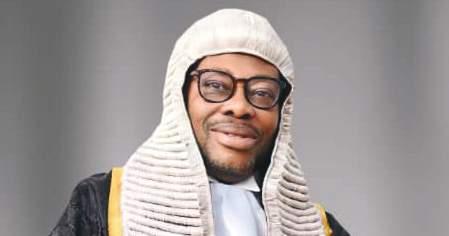
A Critical Analysis of Justice Umar’s Decision Nullifying
INEC’s Membership
Deadline
This article by learned Senior advocate, Monday Ubani examines the recent Federal High Court judgement of Hon. Justice umar, inter alia, nullifying INeC’s deadline requiring political parties to submit their membership registers by May 10, 2026 contrary to Section 29(1) of the electoral act 2026. He argues that even if INeC’s Guidelines may not have been unlawful in purpose, as they sought to bring stability to the electoral process, it has long been established by the Supreme Court that, Guidelines cannot override statutory rights created by legislation
Introduction
The judgement delivered by Justice M.G. Umar of the Federal High Court, Abuja, inter alia, nullifying the Independent National Electoral Commission (INEC)’s deadline requiring political parties to submit their membership registers by May 10, 2026, has introduced a major constitutional and electoral debate in Nigeria’s democratic process.
The Decision
The court held that INEC could not lawfully abridge the statutory period provided under Section 29(1) of the Electoral Act, 2026, which stipulates that political parties shall submit the particulars of their candidates not later than 120 days before the election. Consequently, the court ruled that political parties and intending defectors have until September 2026 to regularise party membership, and submit relevant registers.
Truth be told, this decision appears legally authoritative when examined, against the supremacy of statutory provisions over administrative guidelines.
Section 29(1) of the Electoral Act, 2026 is explicit and mandatory. Once the National Assembly has
fixed a timeline for submission of candidates’ particulars, INEC, being a statutory creation, cannot shorten that period through regulations or administrative directives.
Administrative guidelines must derive validity from the parent statute, and cannot contradict or override it. This principle has long been settled in Nigerian jurisprudence: where there is a conflict between a statute and subsidiary legislation or administrative action, the statute prevails. INEC’s timetable and guidelines are therefore, subordinate instruments which cannot curtail rights granted by the Electoral Act.
Justice Umar’s reasoning therefore, aligns with established constitutional doctrine that delegated powers cannot exceed the enabling law.
Assumptions About INEC’s Nullified Guidelines
INEC’s intention may not necessarily have been unlawful in purpose, though the court appears to have found it repulsive in practice. Permit me to make the following assumptions for the Commission in this matter. INEC
“INEC’s intention may not necessarily have been unlawful in purpose, though the court appears to have found it repulsive in practice….INEC may have intended to sanitise the process, and reduce the abuse associated with politicians maintaining parallel loyalties across parties…administrative convenience cannot override statutory rights created by legislation”
may have been motivated to create electoral stability and administrative convenience, by that guideline. Again, INEC may probably have sought to stabilise party memberships early enough to prevent last-minute defections, confusion in primaries, and manipulation of candidate lists. Additionally, INEC may have intended to sanitise the process, and reduce the abuse associated with politicians maintaining parallel loyalties across parties. And, finally, early submission of membership registers would have allowed INEC sufficient time to verify party memberships, and prepare for primaries.
While these intentions from my assumptions appear reasonable from an administrative standpoint, administrative convenience cannot override statutory rights created by legislation. INEC no doubt possesses powers under the Constitution and Electoral Act to issue regulations, guidelines, and timetables for elections. However, such powers are limited by the doctrine of ultra vires. Once INEC issues a guideline inconsistent with the Electoral Act, that guideline becomes null and void to the extent of the inconsistency. The Supreme Court has repeatedly held that subsidiary legislation cannot amend, vary, or diminish the provisions of a principal statute.
Therefore, if Section 29 grants political parties until 120 days before election to submit candidates’ particulars, INEC cannot indirectly defeat that provision by creating an earlier mandatory membership deadline that effectively forecloses participation.
Implications of the Judgement
The implications of this judgement in the political horizon, are far-reaching. The judgement effectively reopens the political transfer window. Politicians dissatisfied with outcomes in their present parties now, have additional time to
defect and secure nominations elsewhere. This could trigger unprecedented political realignments, before the 2027 elections.
Secondly, this decision significantly limits INEC’s ability to impose administrative deadlines, outside the Electoral Act. It reinforces judicial scrutiny over electoral guidelines, and may compel INEC to strictly align future regulations with statutory provisions. Political parties may now experience prolonged uncertainty in membership structures, candidate negotiations, and internal democracy processes.
Given the national importance of this judgement, the matter may proceed to the Court of Appeal and possibly the Supreme Court for definitive interpretation of the scope of INEC’s regulatory authority under the Electoral Act.
On the positive side, the judgement reinforces a critical democratic principle: statutory bodies cannot govern beyond the powers expressly granted by law.
Conclusion
In conclusion, Justice Umar’s judgement appears substantially consistent with the doctrine of legality, and the supremacy of statutory provisions over administrative regulations. While INEC’s intentions may have been driven by legitimate concerns over electoral orderliness and political discipline, the Commission cannot lawfully curtail timelines expressly guaranteed under the Electoral Act through administrative guidelines.
The ruling is therefore, a strong judicial reminder that electoral management bodies, no matter how powerful, must operate strictly within the boundaries established by the Constitution and the Electoral Act. As Nigeria approaches the 2027 elections, this decision may become one of the most consequential electoral rulings shaping party defections, candidate nominations, and the balance of power between INEC and the Judiciary.
Monday Onyekachi Ubani, SAN, Legal Practitioner, Policy Analyst, Abuja
Monday Ubani, SaN
Background
On February 24, 1996, Cuban Forces shot down two of the Brothers to the Rescue planes near the Cuban coast. Three American citizens and one resident of the US, were killed. President Fidel Castro took responsibility for the incident, saying that he gave orders to his military to shoot down planes violating Cuban airspace. The Cuban Government said that it had proof that prior to shooting down the planes, Cuban authorities had issued warnings to them which he said were ignored.
At the material time, the US government said that "The response chosen by Fidel Castro, the use of lethal force, was completely inappropriate to the situation presented to the Cuban government, making such actions a blatant and barbaric violation of international law and tantamount to cold-blooded murder”.
Consequently, President Bill Clinton signed the Cuban Liberty and Democratic Solidarity (LIBERTAD) Act, also known as the Helms-Burton Act which tightened sanctions on Cuba, and remains the basis of US embargoes on the country. The Act also prohibited the US President from removing trade restrictions on the Caribbean nation until it legalises political activity, and commits to free and fair elections.
Belated Indictment of Raul Castro
Having regard to the facts and circumstances of this case, the belated indictment of Raul Castro has no basis in law. It is trite law that, in all civilised nations including the US, criminal liability is strictly personal, and cannot be transferred to another individual. In other words, criminal law does not allow for vicarious liability. Having accused former President Fidel Castro of resorting to the use of "lethal force" by ordering the shooting down of the two planes, the US government cannot turn round, 30 years later, to transfer the offence of murder and conspiracy to Raul Castro.
In a desperate bid to overthrow the legitimate government of Cuba, the Trump administration imposed an oil blockade since January 2026, in addition to the economic and political sanctions imposed by previous regimes. President Donald Trump has made clear his desire to change Havana's leadership, and has openly boasted that Cuba is "ready to fall". He is however, surprised that the Cuban government has not collapsed despite the serious humanitarian crisis instigated by the Trump administration.
Hence, on May 20, 2026, the US unsealed an indictment against former Cuban President, Raul Castro, charging him with murder, conspiracy to kill US nationals and destruction of an aircraft. The other Cubans indicted by the Justice Department along with Castro, were the airmen allegedly
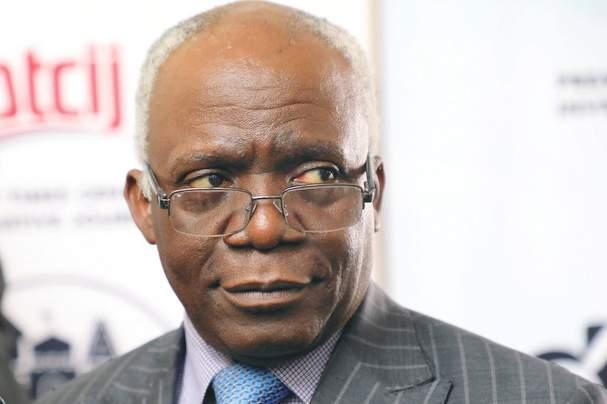
Why Raul Castro Cannot Stand Trial for Murder America Claimed Was Committed by Fidel Castro
This article by Femi Falana, SAN discusses the indictment of former Cuban President, Raul Castro by the united States of america, for an offence which his brother, also a former Cuban President, Fidel Castro, is said to have already taken responsibility for, arguing that the belated indictment of Raul Castro has no basis in law, and instead, is a desperate bid to overthrow the Cuban Government, and also divert attention from what he refers to as the reckless war being waged on Iran by Israel and the uS
involved in the shoot-down. Thus, the US government has concluded its diabolical agenda to invade Cuba, for the purpose of arresting the 95-year old Comrade Raul Castro. Over the past week, the US military has been publicly broadcasting the location of its aircrafts near Cuba, on planetracking websites.
To justify the imminent invasion, President Trump has said that Cuba constitutes "a national security threat" to the United States. US Secretary of State, Marco Rubio, said on Thursday that the White House's preference was "a diplomatic solution", but added that Trump had the right and obligation to protect his country
“….. the belated indictment of Raul Castro has no basis in law. It is trite law that, in all civilised nations including the US, criminal liability is strictly personal, and cannot be transferred to another individual….The planned military aggression is also meant to divert attention from the monumental disgrace suffered by the US, in the reckless war being waged against Iran by the US and Israel”
against any threat. He also called Cuba a "national security threat", and stated that the likelihood of a peaceful agreement is "not high".
However, since the economic strangulation of Cuba has not materialised in the collapse of the Cuban government, the US government decided to cook up the charges of conspiracy and murder against Raul Castro and five other Cubans. The planned military aggression is also meant to divert attention from the monumental disgrace suffered by the US, in the reckless war being waged against Iran by the US and Israel. To that extent, the sole purpose of the indictment of Raul Castro is to justify military aggression against Cuba. It is a shameful replay of the indictment of Venezuelan President, Nicholas Maduro by U.S. courts, which provided a pretext for the large scale military assault in January 2026 resulting in his abduction.
The Bay of Pigs invasion of Cuba in April 1961 authorised by U.S. President, John F. Kennedy, and planned by the CIA, failed because the Cuban people defended their revolution. The reckless military aggression was widely denounced
by governments across the region as a violation of sovereignty and non-intervention principles. Despite the economic strangulation of Cuba, the people have resolved to resist the fresh military aggression by the Trump administration. Since the planned attack of Cuba constitutes a blatant act of aggression contrary to the basic tenets of international law, it ought to be condemned by all members of the United Nations.
Conclusion
With the capture of President Nicholas Maduro of Venezuela, the planned abduction of former President Raul Castro of Cuba, and the unprovoked war being waged against Iran, the US government has demonstrated its readiness to violate the sovereignty of any nation. To that extent, the escalation of economic sanctions, threats of military intervention, and the recent indictment of Raúl Castro, should be challenged by all friends of Cuba. Since the planned attack of Cuba constitutes a blatant act of aggression contrary to the basic tenets of international law, it ought to be condemned by all members of the United Nations.
Femi Falana, SAN
Femi Falana, SAN
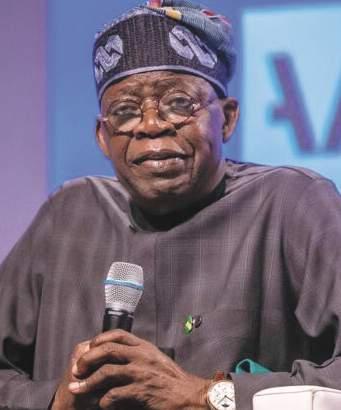
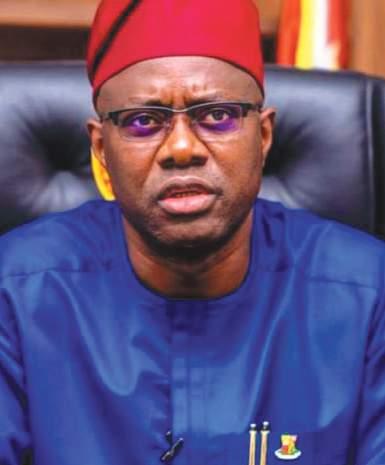
Nationwide Insecurity: A Call for Action
Recent developments across Nigeria, are indicative of a country in a near state of anomy. Some have suggested that the Government should declare a State of emergency. Others have suggested an urgent need for the National assembly and State Houses of assembly, to amend the Constitution and create State Police. Borno, Zamfara, Benue, Plateau, Kwara, Ondo, Oyo, and Imo appear to be the worse hit. How did Nigeria get to this sorry pass? What is the panacea to these myriad of security challenges? THISDAY LAWYer spoke to a crosssection of Lawyers and Public affairs analysts on the issue of insecurity. Here are their views and suggestions, on how to surmount the security challenges plaguing Nigeria
Joseph Bodunrin Daudu, SAN - Nigeria’s romance with corruption resulted in these security challenges
Insecurity and the resurgent acts of criminality, that is, terrorism banditry, kidnapping, abductions etc, though on the rise cannot be restricted or isolated to the Bola Tinubu administration. It predates it, and is a direct consequence of Nigeria’s romance with corruption. By way of example, given the spread of corrupt practices in Nigeria, no security architec-
ture can succeed because of the activities of corrupt persons within the system. This factor coupled with the educational orientation and background of our security agents, is also responsible for the low security cover in our country.
Joseph Bodunrin Daudu, SAN, former President, Nigerian Bar Association
Adeniji Kazeem, SAN - South-West Security Challenge: A Wake-Up Call for Urgent Action
Responsibility
The recent security breaches in the South-West, including the disturbing kidnapping of students in Oyo State,
“Insecurity and the resurgent acts of criminality, that is, terrorism banditry, kidnapping, abductions etc, though on the rise, cannot be restricted or isolated to the Bola Tinubu administration. It predates it, and is a direct consequence of Nigeria’s romance with corruption….worsening insecurity is the product of years of weak governance, poverty, unemployment….porous borders, ethnic tensions….What began as isolated insurgency and banditry has now spread across regions….”
should be regarded as a serious warning signal. The South-West has historically enjoyed relative stability, but no region can remain insulated from wider national security pressures. The spread of organised criminality into the region, reflects a combination of economic hardship, population pressures, movement of criminal elements across States, and weaknesses in preventive security structures.
may improve intelligence gathering and response time.
Suggested Solutions
Why the Authorities Appear Helpless
The perception of helplessness, stems largely from the changing nature of the threat. Criminal groups are increasingly becoming organised, mobile and intelligence-driven, while the security system often appears stretched and reactive. Existing structures were not designed to respond effectively to rapidly evolving local threats, and this has intensified the debate on whether more decentralised policing arrangements
The present situation, requires urgent and coordinated action. The conversation around State policing deserves serious attention, because security closer to the people may strengthen local intelligence and improve response capability. However, until any such reforms materialise, Governors must play a more proactive role, despite constitutional limitations over the command structure of security agencies. Through stronger inter-State collaboration, support for intelligence gathering, investment in surveillance technology, strengthening community-based security initiatives and closer engagement with traditional institutions and local communities, States can significantly improve security outcomes. International cooperation and foreign training partnerships, may also contribute positively through capacity building and technical support; however, enduring security solutions must ultimately be driven by strong domestic institutions and strategies tailored to Nigeria’s peculiar realities. Beyond security measures, governments must also address youth unemployment, poverty and social dislocation, because lasting peace and security depend not only on law enforcement, but also on social and economic stability.
President Bola Ahmed Tinubu, GcFr
oyo State Governor, Seyi Makinde
Nationwide Insecurity: A call for Action
Adeniji Kazeem SAN, FCArb, former Attorney-General and Commissioner for Justice, Lagos State
Jean Chiazor Anishere, SAN – Insecurity requires a comprehensive national strategy Nigeria’s insecurity is driven by a convergence of factors: widespread poverty and unemployment, weak institutions, corruption, porous borders, ethnic and religious tensions, political manipulation, proliferation of small arms, and decades of underinvestment in education and rural development. Terrorism, banditry, kidnapping, oil theft, and separatist agitations thrive where citizens feel economically excluded and where State presence is weak. In many regions, criminal networks have become deeply entrenched, because governance deficits created fertile ground for violence and distrust between communities and security agencies.

The Nigerian Government often appears overwhelmed, because insecurity in Nigeria is not merely a military problem, but also a structural and intelligence problem. Even where foreign military cooperation exists, including support and training associated with the United States Army, external forces cannot substitute for effective local intelligence, political will, institutional discipline, and public trust. Challenges such as corruption within security systems, inadequate coordination among agencies, poor welfare for security personnel, political interference, difficult terrain, and the transnational nature of arms trafficking, significantly limit operational effectiveness. Foreign military presence or partnership alone, cannot resolve internal governance failures.
The solution requires a comprehensive national strategy, rather than reliance on force alone. Nigeria must strengthen intelligence gathering, reform and properly equip security institutions, secure its borders, prosecute corruption decisively, create jobs, improve education, and restore confidence in the justice system. Community policing, economic inclusion, youth empowerment, and credible leadership are essential to reducing recruitment into criminal and extremist groups. Long-term security will depend on building a State that citizens trust, where justice is accessible, opportunities are available, and the rule of law is consistently enforced.
Jean Chiazor Anishere, SAN Boma Alabi, SAN – Nigeria is under siege
The entire country is under siege, not just the Southwest. And, the Government is clearly unable to do anything to secure the lives and properties of Nigerians. The situation has progressively worsened, from 2009 to date. If you recall, over a decade ago when Buhari was first elected, security was really the key selling point. I and so many others voted for him, because we felt he would be best placed to secure the country.
Unfortunately, it didn't get better. I don't see any hope or light at the end of this tunnel, if we do not do things differently. We cannot continue to do the same thing, and expect a different result.
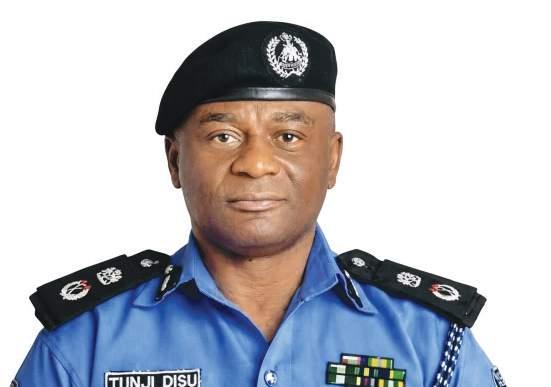
Our soldiers must be properly equipped and funded. The Police also. We have to have local policing, in addition to Federal policing. Without that, you are not going to have any changes in the level of insecurity. A local Policeman will know the bad boys in his area, and will also have the trust of the community.
We must also expand the current narrow window, to enable more Nigerians to carry the necessary weapons to protect themselves, protect their families and protect their property. If Government is unable to carry out its primary responsibility of protecting the citizens, then, it should not stop us from protecting ourselves.
Boma Alabi, OON, SAN Kunle Edun, SAN – Government should declare a state of emergency
The level of insecurity in the country now is very alarming, and it does not seem to be an issue on the front burner presently, because all the politicians seem to be more concerned about politicking in view of the 2027 general elections. Banditry and abductions are now regular use. The South West is now under siege, and we all seem helpless.
State Police, local Government Police and Community Police must be allowed. Security is everybody's business, and the locals must be involved and armed to protect themselves. The few armed Policemen available, are still being used as security escorts for top politicians and public office holders. In fact, let all of the armed Police escorts be withdrawn from these politicians and office holders, so that they will understand what the masses of Nigeria are going through in the hands of kidnappers. No one can safely travel on the roads, without entertaining the fear of being kidnapped.
The Federal Government and the State Governments, should declare a State of emergency on security. Three Schools were invaded in Osun State recently, and several persons kidnapped including the principal and some teachers. Till now no one knows where they are. What kind of country is this? What happened to technology? What do they do with the security votes? Who are those playing politics with the lives of Nigerians? Every reasonable person should be armed, to protect himself and his community. We cannot continue to allow ragtag bandits and kidnappers to be terrorising communities, when the people, if armed, can deal with them.
support, intelligence, and training, but no external force can solve a problem rooted in local governance failures and internal social fractures.
The solution must therefore, go beyond force. Nigeria needs urgent security sector reforms, better intelligence gathering, modern policing, and stronger collaboration with local communities. Government must also confront the economic and social roots of violence by creating jobs, improving education, securing borders, and ensuring justice for victims. Above all, leadership at all levels must inspire confidence through transparency, decisiveness, and fairness, because no nation can defeat insecurity where citizens lose faith in the State itself.
Prof Ernest Ojukwu, SAN Bayo Akinlade - There is no value for life in this country
The lackadaisical approach to the issue of insecurity and State Police, are contributing factors. The Federal Policing structure, has completely failed. Everyone cannot be waiting for Abuja, when kidnappers are at their doorsteps.
“Through stronger inter-State collaboration, support for intelligence gathering, investment in surveillance technology, strengthening community-based security initiatives and closer engagement with traditional institutions and local communities, States can significantly improve security outcomes. International cooperation and foreign training partnerships may also contribute positively, through capacity building and technical support”
Kunle Edun, SAN, former NBA National Publicity Secretary
Prof Ernest Ojukwu, SAN - Nigeria needs urgent security sector reforms, better intelligence gathering and modern policing Nigeria’s insecurity crisis is the result of years of accumulated failures - weak governance, poverty, unemployment, corruption, porous borders, proliferation of arms, and the neglect of communities that feel abandoned by the State. Ethnic mistrust, political manipulation of violence, and the collapse of local intelligence structures, have further deepened the problem. What began as isolated security threats gradually evolved into a nationwide emergency, because early warning signs were ignored and institutions were allowed to weaken.
The authorities often appear helpless, because the security challenge has outgrown a purely military response. Our security agencies are overstretched, coordination among institutions is inadequate, and public trust in Government has declined. In many areas, citizens no longer believe that the State can protect them, while criminal groups have become more organised, better armed, and financially motivated. Foreign military cooperation may provide
The Nigerian security apparatus, has been ruined by corruption and all forms of mismanagement.
There is no value for life in this country. Those who are engaged to protect us, are themselves suffering untold economic hardship, and are not properly equipped to protect the lives of others. The solution is to change our attitudes, reduce corruption, train our Army and Police personnel, and give them all the tools they need to protect the community and themselves from those who seek to reign terror on innocent citizens.
Bayo Akinlade
Adesegun Talabi - A multi-pronged approach is essential The current wave of insecurity in Nigeria
Inspector General of Police, Olatunji Disu
Nationwide Insecurity: A call for Action
is the result of multiple overlapping factors: weak governance structures, porous borders, entrenched poverty, and the proliferation of arms across the country. Kidnap, banditry, and insurgency thrive where the State is unable to project authority effectively, and where communities feel neglected or excluded. The authorities appear helpless, largely because the scale of the challenge has outpaced the capacity of existing institutions, and because corruption and poor coordination undermine the effectiveness of security responses. A multipronged approach is essential. On one hand, there must be decisive military action, extreme force and retaliation against bandits and insurgents, to dismantle their networks and restore deterrence. Alongside this, a dedicated terrorist court should be established to try those accused persons with terrorism and related offences, with swift proceedings and severe penalties to reinforce accountability. At the same time, Nigeria must invest heavily in education, healthcare, and industrialisation, tackling the root causes that make young people vulnerable to recruitment by criminal groups. Finally, strengthening Nigeria’s borders and deepening collaboration with neighbouring countries is critical, since insurgents and arms often flow across frontiers unchecked. Regional intelligence sharing, joint patrols, and coordinated enforcement can help choke off external support to these groups. Only by combining military strength, judicial firmness, social investment, and regional cooperation can Nigeria hope to reverse the tide of insecurity, and restore stability.
Adesegun Talabi, Principal Partner, A.K. Talabi & Co
Okechukwu Nwaguna – Insecurity is a result of failure of governance, weak institutions and poverty
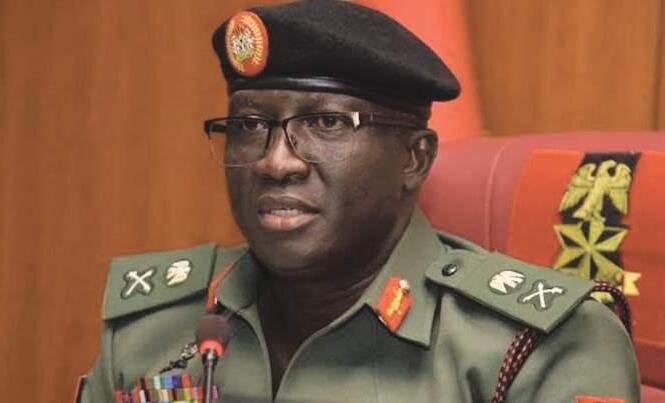
as bandits and terrorists. Parents should give birth to few children they can effectively train, and stop the superstitious beliefs that God will provide. National Orientation Agency and the Nigerian media, should assist to embark on civic education that will ensure that people shun crime.
The frightening escalation of insecurity across Nigeria is the result of years of governance failure, weak institutions, corruption, poverty, unemployment, and the politicisation of security. Successive governments neglected intelligence gathering, community policing, border control, and citizens’ welfare while allowing impunity to flourish. Violent groups, kidnappers, bandits, and criminal networks have exploited public distrust in State institutions, ethnic tensions, and ungoverned spaces. What began as localised security threats, has now metastasised into a nationwide crisis affecting every region, including the South-West once considered relatively secure. The authorities appear overwhelmed because the response has been largely reactive, militarised, and poorly coordinated, rather than intelligence-driven and preventive. Security agencies are overstretched.
Okechukwu Nwaguna, Exucutive Director of RUULAC
Lere Fashola – Governors lack coor-
dinated policing structure required to respond effectively Nigeria’s insecurity crisis is not simply a security failure; it is the consequence of deep institutional, constitutional and moral decline that has accumulated over decades. Weak governance, unemployment, poverty, porous borders and the collapse of local intelligence systems created fertile ground for criminality, but the situation has been worsened by a dysfunctional constitutional structure that centralises security powers, while States remain underpowered despite being closest to the realities on ground. The recent developments in Oyo and across the South-West show that many Governors recognised these dangers long ago, yet lacked the constitutional authority and coordinated policing structure required to respond effectively. At the same time, our “winner-takes-all” political culture has transformed politics from public service into perhaps, the most lucrative enterprise in the country.
Lere Fashola, Publisher, ESQ Legal Magazine
Jide Ojo, Abuja Adam Adedimeji - Over 80% of our insecurity is man-made When Nigeria is ready to end insecurity, I believe it can do it within a short period, but it’s not yet ready. This is because insecurity in Nigeria is not a capacity problem, it’s a willpower problem.
Nigeria is not insecure because we lack soldiers. We are insecure, because we lack sincerity. Over 80% of our insecurity is man-made, funded, and protected by the same system that claims to fight it.
I think if the Federal Government can take the following steps, insecurity can be tamed without shedding blood.
• Since every bandit kingpin, kidnapper, oil thief has Nigerian bank accounts, let Government freeze them, and their names published. When the money stops, the guns go silent.
honest with the people.
•The National Orientation Agency should step up. They should come up with jingles and adverts, that condemn banditry.

•National intelligence gathering should be stepped up so that would-be terrorists and known terrorists are apprehended before they strike
•More combat aircrafts should be procured for the Nigerian Air Force.
Kene Anekwe, Lagos
Jude Ehiedu – Present insecurity is as a result of collapse of effective local intelligence gathering
Jide Ojo - Courts should prioritise prosecution of criminals such as bandits and terrorists Government at all levels should genuinely create job opportunities, and embark on poverty reduction measures. Our courts should prioritise prosecution of criminals, such
• Withdraw all illegal mining licences, shut down the sites, and arrest foreign collaborators.
“The lackadaisical approach to the issue of insecurity and State Police, are contributing factors. The Federal Policing structure, has completely failed. Everyone cannot be waiting for Abuja, when kidnappers are at their doorsteps. State Police, local Government Police and Community Police must be allowed”
• Let NCC switch off their network cover for a certain period, resulting in no phone signal, no ransom negotiation, no coordination. Criminals need networks, more than they need bullets.
The day Nigeria’s ruling class decides that peace is more profitable than war, that security votes should secure lives not pockets, that Nigerian lives are sacred, insecurity will end.
Ustadh Adam Adedimeji, Chairman, NBA Lawyers in the Media (LIM) Forum
Kene Anekwe - More combat aircraft’s needed for the Air Force
Suggested Solutions
•Transparency and political will by the Authorities, in combating the bandits.
•Equip the military with sophisticated and modern weaponry.
•Community engagement and citizen vigilance. The leadership should be
Nigeria’s worsening insecurity is the product of years of weak governance, poverty, unemployment, corruption, and the collapse of effective local intelligence gathering. Criminal groups have exploited porous borders, ethnic tensions, and the absence of justice in many communities. What began as isolated insurgency and banditry has now spread across regions, including the South-West, creating fear and uncertainty nationwide. The authorities appear overwhelmed because the security architecture is overstretched, poorly coordinated, and in some cases, compromised by corruption and political interference. Despite huge security budgets and foreign support, including cooperation with American military advisers, the challenge persists, because insecurity cannot be solved by force alone. A lack of trust between citizens and Government, has also weakened intelligence sharing and community cooperation.
The solution must be holistic and urgent. Nigeria needs sincere political leadership, improved intelligence driven policing, State and community policing structures, stronger border control, and modern equipment for security agencies. Beyond military action, Government must tackle poverty, youth unemployment, and injustice, which continue to fuel crime and extremism. Until citizens feel protected, heard, and economically empowered, insecurity will remain a serious national threat.
Jude Ehiedu
chief of Army Staff, Lieutenant General Waidi Shaibu
Acting Group Politics Editor DEJI ELUMOYE
Email: deji.elumoye@thisdaylive.com
08033025611 sms only
Insecurity as Threat to Nigeria’s 2027 Polls
a s political activities gather momentum ahead of the 2027 general elections, growing insecurity across several parts of Nigeria has become a major source of national concern.The resurgence of terrorist attacks, increasing cases of kidnapping and banditry, and repeated assaults on both civilians and security formations have raised questions about the capacity of security agencies to guarantee a peaceful electoral process, writes l inus Aleke .
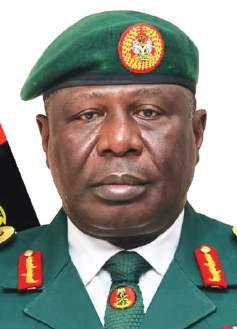
The worsening security situation across Nigeria has continued to raise concerns over the successful conduct of the 2027 general elections. With increasing attacks on civilians, schools, and military formations, many Nigerians are beginning to question whether the elections will hold as scheduled.
Just last week, armed extremist groups invaded several schools in Oriire Local Government Area of Oyo State, abducting students and teachers. In a disturbing development, the terrorists not only demanded ransom but also released a video on social media showing the beheading of one of their captives at a location yet to be identified by security agencies.
Although the incident ranks among the most horrifying attacks recorded in South-West Nigeria in recent years, similar acts of violence have become frequent in parts of Northern Nigeria. The South-East and South-South regions have also witnessed repeated cases of killings and abductions involving innocent civilians, including schoolchildren.
In the North-East, the epicentre of insurgency in the country, ISWAP and Boko Haram fighters have intensified attacks on military formations in addition to assaults on villages, killings, cattle rustling, abductions, and destruction of communities.
Recently, troops of the Joint Task Force (North East), Operation Hadin Kai (OPHK), repelled an attack by ISWAP terrorists on the 120 Task Force Battalion in Gonori under Sector 2. The attack, which began late on 9 May 2026, lasted into the early hours of the following day.
The assault came barely 24 hours after troops foiled another coordinated attack on the Headquarters of 27 Brigade in Buni Gari and the Buni Gari checkpoint. During that operation, no fewer than 50 insurgents were reportedly killed, while a cache of arms and ammunition was recovered.
Within 48 hours, ISWAP fighters attempted attacks on four military formations across the North-East theatre, beginning with the assault on the Forward Operating Base in Magumeri under Sector 3. The attack reportedly claimed the lives of two soldiers, while several terrorists
were also killed.
Security sources described the repeated attacks on military facilities as a disturbing trend requiring urgent action, stressing that troops must intensify offensive operations against terrorist enclaves instead of remaining defensive.
Data from the Global Terrorism Index (GTI) 2025 showed that Nigeria recorded 171 terror attacks in 2025, representing a 43 per cent increase from the 120 attacks recorded in 2024. Terror-related deaths also rose from 513 in 2024 to about 750 in 2025, marking a 46 per cent increase.
These persistent attacks on civilians and military formations have further exposed weaknesses in the country’s security response and heightened fears that insecurity could discourage voter participation if not urgently addressed.
Despite the growing concerns, some analysts remain optimistic that the elections will hold.
A Professor of Political Science and International Relations at Benue State University, Makurdi, Atah Pine, argued that the current level of insecurity was not severe enough to prevent the elections from taking place.
According to him, “It is a perspective to analysing the security crisis. There are many other perspectives of interpretation. In all, as a human phenomenon, we must be dynamic in our interpretations and analysis. The entirety of the security architecture must be intelligence-driven if any tangible and meaningful result
is to be achieved.”
Similarly, Editor-in-Chief of Razor Newspaper, Odita Sunday, said the elections would hold as scheduled if the government and security agencies remained committed to tackling terrorism, banditry, and kidnapping.
To improve public confidence, he said, “the Police and the DSS should up the ante in intelligence gathering, ensure visible deployment of personnel in vulnerable areas, respond promptly to security incidents, and maintain professionalism and neutrality before, during, and after the elections.”
Also speaking, Chairman of the Guild of Public Affairs Analysts of Nigeria, Enugu State Chapter, Dr Ambrose Igboke, expressed confidence that there were no signs suggesting the elections would be postponed.
“So, I am very optimistic that the elections will hold. There were concerns about the elections falling within the Ramadan or Lent period, but these concerns have been addressed by shifting the timelines to January 2027,” he said.
On claims that the growing insecurity was politically motivated, Igboke disagreed, insisting: “This position is a mere excuse by the Federal Government to explain away its failure to deal with insecurity. There was a high rate of insecurity in 2023, 2024 and 2025; were these election years? Absolutely no. So, the government should not be selling that dummy to us. There is insecurity because the government has refused to tackle it head-on. Saying that the insecurity is politically motivated is a lazy excuse.”
He further urged the Police to adopt technology-driven intelligence and counter-insurgency strategies while improving the welfare of person-
These persistent attacks on civilians and military formations have further exposed weaknesses in the country’s security response and heightened fears that insecurity could discourage voter participation if not urgently addressed.
nel and strengthening community policing.
Meanwhile, Inspector-General of Police (IGP), Olatunji Disu, has assured the Independent National Electoral Commission (INEC) of the Nigeria Police Force’s readiness to secure the 2027 elections.
Speaking during a meeting with the INEC Chairman, Professor Joash Amupitan, the IGP said the Force had commenced strategic threat assessments and intelligence mapping nationwide to identify flashpoints and emerging threats ahead of the polls.
He identified political violence, illegal arms proliferation, voter intimidation, cyber manipulation, misinformation, and attacks on electoral infrastructure as key concerns.
“Intelligence-led deployments and preventive policing strategies will be adopted to neutralise threats before they escalate,” he said.
Disu also warned that officers involved in partisan activities or unethical conduct would face disciplinary and legal action.
“We will ensure that we enforce electoral laws firmly and we will do it professionally,” the IGP added.
He further reaffirmed the commitment of the Police and other security agencies under the Inter-Agency Consultative Committee on Election Security (ICCES) to ensuring peaceful and credible elections, including the forthcoming governorship poll in Ekiti State.
The Police disclosed that deployment plans had already been concluded across the state’s 16 local government areas, 154 wards, and over 2,400 polling units to guarantee the safety of voters, electoral officials, and observers.
Disu also urged political actors to abide by the Peace Accord and conduct their activities peacefully while commending INEC and the National Peace Committee, led by former Head of State, General Abdulsalami Abubakar for their efforts in promoting peaceful democratic participation and public confidence in the electoral process.
However, with fear spreading across many communities, concerns are mounting over whether Nigerians will feel safe enough to participate freely in the elections if the security situation continues to deteriorate.
Tinubus
Gen oluyede
IGP Disu
Business Special
United Bank for a frica: Sustaining Stronger regional Growth
Kayode Tokede writes on how regional operations across the continent impacted on the overall growth of United Bank for Africa Plc in the 2025 financial year
Operating in 20 African countries, United Bank for Africa (UBA) Plc in the 2025 financial year declared revenue with a varied performance across the regions, with West Africa countries leading with strong growth, East & Southern Africa demonstrating steady progress, and Central Africa maintaining stability.
Also operating in the United States, United Kingdom (UK), France, and United Arab Emirates (UAE), the group’s pan-African operations continue to be a major growth driver, contributing over 50 per cent of total assets, revenue, and profit.
In the 2025 FY, the group’s West Africa countries posted N1.01 trillion operating revenue, about 19 per cent increase over N852 billion in 2024 FY, while East & Southern Africa countries closed 2025 with operating revenue of about N178billion, representing an increase of five per cent from N169 billion reported in 2024FY.
Also, Central Africa’s operating revenue was at N488 billion in 2025, from N487 billion in 2024.
The momentum seen in 2025 FY indicated opportunities in the market for expansion and deeper market penetration in all regions.
Overall performance showed strong upward momentum in 2025 FY, with most segments delivering solid yearon-year growth. While performance varied slightly across segments, the general trend remains positive and growth-oriented.
UBA in West Africa countries generated N457 billion profit after tax in 2025, a significant increase of 53per cent from N298 billion reported in 2024. Aside from Nigeria, the audited 2025 results showed that, Côte d’Ivoire, Ghana, Guinea, among others declared an impressive growth in profit before tax and profit after tax.
For example, UBA Côte d’Ivoire declared N126.58 billion profit before tax in 2025, about 121.2 per cent increase over N57.24billion in 2024, while profit after tax stood at N125.01 billion in 2025, a growth of 124.2 per cent when compared to N55.76billion reported in 2024.
Also, UBA Ghana posted N78.17 billion profit before tax, about 252per cent increase over N22.2 billion in 2024, while profit after tax closed 2025 at N50.5 billion, representing an increase of 282.15 per cent over N13.2 billion reported in 2024.
The Managing Director of UBA Ghana, Bernard Appiah Gyebi, had disclosed that the Ghana subsidiary will execute a targeted local expansion strategy for the 2026 financial year to increase its number of branches across the country. According to him, the expansion would see the establishment of new
branches in the Eastern, Bono East and Central regions as part of efforts to reinforce the bank’s position as the preferred bank in the country.
East & Southern Africa in 2025 generated N53billion in profit after tax, a growth of 61 per cent from N33 billion in 2024, while Central Africa moved from N206 billion in 2024 to N167 billion in 2025.
Expansion across African market in 2025
In the year under review, the group saw its total assets up by 9.4 per cent to N33.2 trillion from N30.32 trillion in 2024, supported by expansion across African markets. Nigeria, followed by Cameroun, Cote D’ Ivoire and Ghana contributed about per cent of the total assets in 2025.
Extracts from the 2025FY, the Nigerian subsidiary contributed about N16.41 trillion of the total N33.2 trillion in 2025, from N17.29 trillion in 2024. This was followed by UBA Cote D’ Ivoire with about N2.37 trillion total assets in 2025, up by nearly five per cent from N2.26 trillion in 2024.
As UBA Cameroun reported N2.05 trillion total assets in 2025, representing an increase of 11 per cent from N1.86 trillion in 2024, UBA Ghana closed 2025 with N1.59 trillion total assets in 21025, a significant
increase over 52 per cent from N1.04 trillion reported in 2024.
The group declared customers deposits grew by 11.8 per cent to N27.2 trillion in 2025 from N24.3 trillion in 2024, reflecting stronger regional customer activity.
The achieved double-digit growth in customer deposits, underlined savings deposits up 18 per cent year-on-year and term deposits increasing by 30per cent, supported by a five per cent growth in current deposits, reflecting extensive product offerings, preferred banking partner, and service efficiency.
The 27 per cent Compound Annual Growth Rate (CAGR) in customer deposits signifies customer confidence and underscores the bank’s competitive strength and market share expansion across geographies.
Also from the balance sheet position, the group posted loans & Advances to Customers of N7.02 trillion, in 2025, an increase of one per cent from N6.96 trillion reported in 2024.
Strengthening pan-African diversified
The Group Managing-Director, UBA, Mr. Oliver Alawuba, had stated that the group continued to demonstrate the true strength of its Pan-African diversified model.
He stated that this was in spite of the moderation in bottom-line performance compared to the prior year’s highs, as core business engines, especially in the subsidiaries outside Nigeria delivered double-digit growth.
The management expressed that diversification across Africa countries helped cushion pressure from Nigeria’s economic and currency volatility.
Connectivity across banking regions
The group strategic investments in digital infrastructure continue to deliver returns, with efficient digital channels performance in 2025. This growth has been fueled by key initiatives, including: PAPSS on Leo: As the first African chatbot to launch cross-border payments via PAPSS in Nigeria, UBA Leo is revolutionising intra-African trade and remittances.
Alawuba said: “For us, this is what UBA is all about – connectivity and easing transactions. With PAPSS now fully integrated on our LEO platform, we are not just simplifying payments – we are breaking down the barriers to economic collaboration across African markets and allowing Africans to be able to transact using their own local currencies.
“This is aligned with our vision of being at the heart of Africa’s economic transformation, and so, I say, Now, Africa trade begins!!!”
He emphasised that as the future of Africa lies with the youth, UBA as a bank continues to seek ways to support the youth to grow the economy, adding that the integration of PAPPS on the LEO Platform is one of such ways.
Chief Executive Officer, PAPPS, Mark Ogbalu III, who commended UBA for being an excellent partner with Afrexim bank and PAPPS on their pan-African journey towards enabling trade on the continent, explained that UBA was one of the first financial institutions to enter into PAPPS.
Ogbalu said: “Indeed, PAPPS has had an excellent run with UBA, which has now extended from carrying out these transactions from their branches to digital platforms and channels such as LEO. By this, customers can send and receive their monies within seconds. This of course has an accelerated impact on trade as there is now an interplay between convenience and seamless transacting.
The group has also advanced Top-Up on USSD: Our “Buy Now, Pay Later” airtime service is enhancing customer convenience and loyalty.
In addition, introduced innovation in POS Business (RED PAY): Merchants now enjoy instant settlements, dashboard for effective access to services, significantly increasing adoption and transaction volumes.”
Alawuba
PAYE Tax, Stakeholder Concern and Country Development POLITY
Tony Monye
In point of fact, Lagos State is beyond a state. And, that is written without any sense of exaggeration. Lagos is more or less a country. The state can be compared to the other countries in Africa, especially along the continent’s west coast. Take a look at the state’s GDP and compare to Liberia, Sierra Leone and Togo’s figures. The state’s economic indices completely outclass theirs while competing favourably with even Ghana or Cote D’Ivoire’s. Analogously, the Federal Capital Territory - (not yet recognised as a state) - Abuja – perhaps, with no one noticing - is rapidly morphing, racing up the path that shaped the Lagos’ development trajectory. The end outcome is for time to reveal. And, it surely will. Comparatively, the other thirty-five states in the Nigerian federation are less than what one would call a state in terms of revenue generation, infrastructural presence and the other state-determinant economics and features, as they are straddled by very weak eco-financial profiles. In fact, their Treasuries are often said to be in chaos, which I think should be some wake-up call to all their stakeholders. For instance, benchmarking the VAT and IGR (largely driven by consumption and the spate of economic engagements) numbers across the states in Nigeria presents another vivid revelation of immense
size. The disparity between Lagos and Abuja’s VAT and IGR figures, on the one hand and the other 35-states’ is frankly too dizzying for comfort and should raise some concern. Some (constitutional - largely fiscal) arrangements must have led to this. Therefore, truly concerned elected political office-holders and economic planners should know it’s time they spoke up. Their continued silence rewards no one, not even the present benefitting states, especially in the long range. The gap also does not speak in favour of country-wide development, especially when it negates the exact arrangements the nation badly and urgently needs. Of many of the factors driving the unwholesome developmental optics, the structure of the country’s tax (particularly the PAYE system – how this is shared) can be considered to be at the heart of this misnomer.
Nigeria, ConcernsStakeholder and Taxes
Interestingly, Nigeria is a federation of states. Our federating structure is like no other in the world. How most of its holding pillars are defined are not evolving. They are stuck in their original letters, negatively impacting real development. The Nigerian constitution recognises the clearly inflexible dichotomy between state of origin and state of residence for various reasons. There is also an aspect of the Nigerian state that is often de-emphasised in discourses even though it’s an integral part of its politico-administrative architecture – the
local government. Every economicallyengaged Nigeria (especially in the formal sector) is at least a stakeholder in the three politico-administrative jurisdictions of state of residence, state and local government of origin. But of all the three, allegiance is most tightly expressed in one’s state of origin. How deeply true is this when the PAYE-tax structure favours the state of residence while neglecting his supposed allegiance to his state of origin?
To help the government at each of the levels – federal, state and local – meet with their responsibilities and duties, every working/ earning adult is, amongst others, expected to be tax-responsible as a citizen-stakeholder. Nigeria has adopted the PAYE-tax structure for its workers. Don’t we know that tax is a sine qua non for development? The existing PAYE-tax architecture is defective. It directs that PAYE-tax should be on the basis of the state of residence (where the typical worker is domiciled). It does not take into consideration the many ‘fates’ of the Nigerian worker outside his state of origin and his stakeholder responsibility bent. In other words, the PAYE-tax structure demands him to be tax-responsible to a state where he is more or less regarded as a ‘stranger’. That way, he is therefore tax-irresponsible to his state and local government area of origin, where according to the Nigerian constitution he also has some stakes. The drawbacks of this long-standing arrangement are so easily seen and they are enormous, reflecting in the
development hiatus between the two (of Lagos and Abuja) and the rest. The development gap also comes with its socio-economic challenges if we think in terms of migration. On the other hand, a critical evaluation will also reveal that, like some have argued, Lagos and Abuja’s development is at the price being paid by the other 35-states.
For instance, a Deltan living and working in Abuja can be tax-responsible to the FCT while being tax-irresponsible to Delta State – where he is also a stakeholder (isn’t it wrong to be a stakeholder only on paper?). How this insalubrious tilt has remained the case for too long is what I do not know. The existing PAYE-tax arrangement completely turns its back on many of our highly engraved and pronounced peculiarities as a nation, which should not be.
A Fairer PAYE-TAX Structure for Nigeria
It is time everyone - the politicians and economic planners - sat at the roundtable to develop a new and more equitable PAYE-tax sharing arrangement, which must take into reckoning our many oddities as a nation. Furthermore, it must also align with the stakeholder leanings of the average Nigerian worker, which in the final argument will benefit country-wide development. Argue against this if you can. A stitch, like they say, can actually stop the necessary need for nine.
•Tony Monye is Publisher, The TMBC Business
Dr. Zacch Adedeji, Executive Chairman, Federal Inland Revenue Service (FIRS) Dr. Ayodele Subair, Executive Chairman, Lagos State Internal Revenue Service (LIRS)
FEaturEs
Inauguration of the 9th INC NEC and Renewed Clamour for Additional States, LG Creation
On the 14th May, 2026, the ninth National Executive Council of the Ijaw National Congress (INC) was inaugurated following the expiration of the tenure of the last exco. However, the clamour for additional states and more local government areas in Bayelsa State continues. Adedayo Akinwale reports
It is a known historical fact that the southern and northern protectorate of Nigeria were amalgamated in 1914 by Lord Frederick Lugard. In spite of the fusion of the country which happened 112 years ago, it is not unusual to see social political organisations peculiar to some ethnic nationalities advancing their interests through various social-cultural organisations in the Nigeria political scene.
For instance, there is Northern Elders Forum (NEF) — established to protect the interests of the North, Afenifere Renewal Group (ARG) — also berthed to champion the interests of Yoruba people; Ohaneze Ndigbo — came into being to advocate for the interests of the Igbos and the Ijaw National Congress (INC) — advance and protects the interests of the Ijaw nation.
The Ijaw people, also known as the Izon are an indigenous ethnic group numbering over 15 million, predominantly inhabiting the riverine Niger Delta region of Nigeria. The Ijaw is regarded as the fourth or fifth largest ethnic group in the country
As of 2024, Ijaw population is estimated to be approximately 14.39 million, accounting for 6.1 per cent of Nigeria’s 233.9 million people, placing them as the fourth largest ethnic group in Nigeria.
The INC was established in 1991 to foster Ijaw national consciousness, providing platforms for debating sectional challenges such as environmental degradation from oil extraction and unequal revenue allocation, and negotiating on par with other Nigerian ethnic blocs.
Nevertheless, the SMU-TUNS playground, Warri was a beehive of activities last Thursday during the inauguration of the new national executive council of the Ijaw INC. Among those inaugurated were: High Chief MacDonald Igbadiwei, President; Dr. Okubokeme Tuodolo; Vice President 1; Rose Obuoforibo, Vice President 2; Kennedy Odiowei, Vice President 3; and Dr Ayanate Kio, Secretary.
They were elected at the INC national convention which took place at the Ijaw House, Yenagoa, Bayelsa State, in April 2026.
The formal inauguration signalled the end of the five-year tenure of immediate past President of the INC, Prof. Benjamin Okaba.
Dignitaries that grace the occasion were: the Chairman of Tantita Security Services, High Chief Government Ekpemupolo aka Tompolo, the Administrator of the Presidential Amnesty Programme, Dr. Dennis Otuaro, top traditional rulers, federal and state lawmakers, top government officials, officials of the Ijaw Youth Council (IYC), among others.
The outgoing INC President, Prof. Benjamin Okaba, while speaking at the
event recalled that himself and 13 other members on 30th of April, 2021 were elected to lead Ijaw Nation for five years, and they were inaugurated on 14th of May 2021 as the 8th NEC of INC.
He explained that his exco met INC in comatose seven years before they came on board. He said they were able to make remarkable progress.
Okaba pointed out that the 8th NEC ensured a paradigm shift from lamentation to constructive engagement, saying the INC now has international visibility.
He noted: “INC has become an international brand. I'm also very proud to say that today, I feel the fulfilment of a promise I made, which is to extricate the INC from some persons who feel that the Ijaw Nation belongs to them. Some self-styled elites who think that if they are not there, the Ijaw cannot make progress.
“Today, INC belongs to everybody because in the Ijaw land, nobody is more Ijaw than the other person. The INC is the highest body. Nobody dictates to the INC. You can give advice, yes, but the leadership has the responsibility of putting all the options together and taking a decision in the best interest of the Ijaw Nation. It is the Ijaw nation that decides, not even me. No other person takes the decision of the Ijaw Nation.”
“The exco has mentioned quite a number of challenges, but the good thing is that the election that was held on the 13th of April was sanctioned by the Ijaw people. Over 600 delegates from all across the Ijaw nation voted. It is incumbent on exco and the electorate to ensure that those persons are sworn in.
“Yes, there are also other challenges about this swearing-in occasion. Weighing all the options, it is better to swear- in those who have been voted for, so that they can carry on the leadership of the Ijaw Nation and address whatever concerns are before us today.”
“And I've told some persons who have been planning coups to take over the Ijaw nation that were even interested in becoming president, the process is simple, go and buy the form and go and contest the election. Passing through the back door is not permitted. We have defended this mantle and I will hand it over today, ceremoniously, to Chief Macdonald Igbadiwei who will continue from where I stopped.”
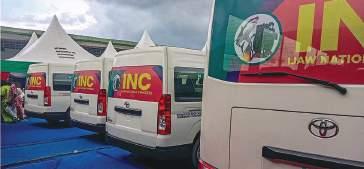
the former President urged the new leadership to consolidate in the progress made by the 8th exco and but should endeavour to correct the mistakes made too.
Okaba further urged the new exco to consolidate on some of the cardinal programmes of the 8th NEC — which include leveraging on the registration of INC as a member of the United Nations un-represented People's Council.
“We have a seat in that body. INC will not pass through anybody to communicate its concerns to anybody. We'll be there to discuss the issues in the same way this NEC had engagement with the European Union, with other agencies in France, in Britain, in so many places, and so on.
“At the same time, I also want to charge you to consider the Ijaw quest for additional states and more local government areas in Bayelsa State as a major concern. It's a battle you must continue,” Okaba added.
In his speech, INC President, Chief Macdonald Igbadiwei said his administration would focus on addressing the critical challenges facing the Ijaw nation — Unity of the Ijaw nation will make the INC work for every member, not just a select few.
According to him, Today is a very historic day and moment in the sense that the first INC congress, where the pioneer president, Joshua Fumudoh, was elected, was in the Western Zone. And that was on November 23, 1991. Today, history has come to stand that the Western Zone should be the one to accommodate, to host, to celebrate the 9th INC president and the executive members.
“It is a historic moment in the life of our great Ijaw nation. It is a day that reminds us that leadership is not about power, but about service. Not about personal ambition, but about sacrifice for the collective destiny of our people. Thank you for the trust you have placed in me and this new executive team. And we shall not take this mandate lightly. We will extend our rights and our fellowship to all of them and together, we can build a better Ijaw nation,” he noted.
Igbadiwei assured that his administration would continue to build on the foundation laid by the previous administration of INC.
The president said while their land is richly blessed with natural resources and is responsible for over 80 per cent of Nigeria's foreign exchange earnings, Ijaw people are not in control of these resources. Instead, he noted, Ijaw people continue to face marginalisation, environmental degradation, and political exclusion, while their language is gradually eroding, whereas many of the youths, despite
being educated, remain unemployed.
He said: “Our unity is continually being tested. These are not mere accusations. They are a call to action. Every policy and programme will be measured by one question, by Ijaw people. They will ask, does it improve the lives and experiences of our people? Far beyond that, we will create opportunities for modern skill acquisitions, networking with our neighbours and development partners, a sustainable impact that will endure beyond our time.
“We shall pursue, to a logical conclusion, the creation of Toru-Ebe State and Oil River State in order to create more political space and address the marginalisation of Ijaw people, especially in Edo and in Ondo states.”
In addition, Igbadiwei pointed out that Bayelsa State, the only homogeneous state and a proud symbol of their shared heritage, continues to face a narrowing political, economical and social landscape.
He emphasised despite persistent calls and sustained advocacy for the expansion of its local government structure from eight local governments to 24 local governments in Bayelsa State.
On marginalisation of Ijaw people in Akwa Ibom, the president assured that they would explore all lawful means to seek redress and ensure justice, fairness and rightful recognitions of Ijaw people in Ibeno as the host community to Mobil producing Nigeria Unlimited, Conoil producing Limited, now Seplat Energy Plc is achieved.
Bearing his mind on Warri Federal Constituency Ward Delineation, Igbadiwei said the Ijaw nation will not remain silent in the pursuit of the enforcement of the judgement of the Supreme Court regarding more delineation in the Warri Federal constituency.
The high point of the event was when the president fulfilled his promise by donating 30 seater bus to Western Zone, one to Central Zone and one to the Eastern Zone. Similarly, four 18-seater buses were given to Lagos, Abuja chapter, Akure chapter and the Benin chapters of the United Nations.
“To our contestants, I would like to use this medium to invite all of you to join us as we work together to build the Ijaw nation of our dreams. The task ahead will not be easy but it will certainly be important. Let history remember this generation as the generation that united the Ijaw nation.
“This is the time for a new beginning because a new Ijaw nation is possible, a new INC is possible. A time to heal old wounds, a time to restore confidence among ourselves, a time to speak with one united voice for the future of the Ijaw nation,” the President said.
Moreso,
INC President, Chief Macdonald Igbadiwei
Buses donated to some chapters of INC
Lodù’s Artistic Evolution Continues as ‘Follow’ Spotlights Clarity Over Complexity
Mary Nnah
Nigerian Afro-soul singer, songwriter, and producer Lodù, born Laura Ayomide Oduwole, is stepping into a quieter, more deliberate chapter of her artistry, and you can hear the shift in every note of her new single “Follow.”
The record arrives as a deeply intimate Afro-pop offering infused with subtle folk elements, and it frames love not as a fleeting impulse but as a conscious, defining choice. It is the kind of song that feels like a late-night conversation with yourself, where emotion is measured against intention.
Lodù has long been known for merging technical discipline with emotional clarity, a skill rooted in her background as a classical violinist. That training still shows in the precision of her compositions, but it never overwhelms the human pulse of her music.
Her sound continues to occupy the space where tradition and modernity meet, where Indigenous storytelling is carried on refined musical structure.
“Follow” sits squarely in that intersection. It operates less as a conventional love song and more as a meditation on commitment and emotional alignment, a reflection on what it means to choose someone and let that choice reshape your life.
The track draws its inspiration from the idea of eloping. It captures the quiet urgency of deciding on one person and reorienting everything around that decision. Freedom and intentional love run through the record, presenting devotion as both an act of surrender

and a form of self-definition. There is a sense of resolve in the lyrics and arrangement, as if Lodù is documenting the moment when romance moves from possibility to responsibility.
Musically, “Follow” is restrained and precise. The blend of Afro-pop and folk influences creates an intimate atmosphere without losing scale. Soft melodic arrangements and understated instrumentation give her vocals room to carry the emotional weight, reinforcing
the song’s core themes without excess or distraction.
Nothing is overplayed, nothing is forced.
The production mirrors the message: love, when chosen deliberately, doesn’t need noise to be powerful. The creation of the record reflects a similarly focused approach. Rather than building around complexity, Lodù leans into clarity, allowing emotion to guide the structure and pacing. That restraint defines the final product, with the record maintaining balance while delivering depth. It’s a deliberate move away from maximalism, a choice to
let feeling do the heavy lifting. The release builds on the momentum of her previous single “Olowo Orimi,” which debuted at No. 32 on the Nigeria Top 50 chart and sustained its run for several weeks. That record marked a clear point of connection with a growing audience, reinforcing her position as an emerging voice within Afro-soul.
With “Follow,” she appears to be consolidating that connection while nudging her sound toward a more minimal, intentional expression. Beyond its sonic identity, “Follow” carries a broader emotional intention. It extends an invitation to embrace love with clarity and purpose, positioning devotion as something active, chosen, and enduring. It’s a perspective that feels increasingly rare in a music landscape often dominated by instant gratification and performative romance. Here, Lodù makes the case for commitment as both personal freedom and identity. The single reflects a continued refinement of her artistic voice. While rooted in the Afro-soul sensibilities that define her work, it moves toward a more distilled sound, placing greater emphasis on storytelling and emotional resonance. With “Follow,” Lodù continues to shape a body of work defined by discipline, identity, and depth. The single serves as both a continuation of her trajectory and a subtle shift toward a more purposeful sound, signaling where she’s headed as she writes the next chapter of her story.
Stepping into the Future with the Power of Data
There is something special about being on the move and still feeling completely in control. That is the energy Globacom brings to life in its latest television commercials, “Road Trip” and “Department of Imagination” currently ruling the airwaves.
One feels close and familiar; the other bold and futuristic. Together, they tell a story that is simple, exciting, and easy to connect with – the power of seamless connectivity which Globacom continues to avail its customers with consistent network upgrade and investments in new technologies and innovative services.
The first advertisement, “Road Trip”, draws you in from the very first moment. A family sets out on a journey filled with excitement, laughter, music, and those little moments that make travel memorable. It feels real. It feels warm. And as the story unfolds, Glo quietly becomes part of everything.
With familiar faces like Toyin Abraham Ajeyemi, Demola Amoo, Bolaji Ogunmola, and Esan Damilola Catherine, the story feels even more alive. It reflects everyday life, where people just want a network that works when they need it. No stress. No second guessing.
The commercial opens with Toyin Abraham Ajeyemi clearly frustrated as she tries to finish watching a series but keeps losing network signal. She even raises her phone in the air in an attempt to reconnect, but nothing changes.
Her niece, played by Bolaji Ogunmola, and other family members suggest she switches to Glo, but she refuses and insists she is fine. Not for long though.
She soon steps out of the car pretending she wants to buy a snack, but her intention is actually to get a Glo SIM. When she returns and switches it on, everything

changes instantly. The signal is strong, the streaming is smooth, and the whole mood lifts. The rest of the trip becomes fun, easy, and stressfree for everyone. Finding the right places becomes effortless. Locations are easy to find. Entertainment flows without interruption. Movies, games, downloads all work seamlessly. It is not loud or dramatic, but that is exactly the point. Glo fits into the moment so naturally, you almost forget it is there.
Along the long stretch of road, the connection stayed strong. That quiet reliability speaks volumes about Glo’s investment in its network and its promise to deliver quality voice and affordable data. With *312#, staying connected remains simple and seamless.
The second commercial, “Department of Imagination”, is equally exciting. It opens a completely different world. From
the laying of cables at the beginning of the advert, you can tell something bigger is coming. The tone shifts from familiar to futuristic, from everyday moments to endless possibilities.
Featuring icons like Richard Mofe-Damijo, Hilda Baci, Bamike Adenibuyan, Obehi Brume, Eso Dike, Uche Ufuoegbunam, and Catherine Onoja, the advert takes viewers into a space where imagination leads and technology follows.
“Department of Imagination” brings a beautiful futuristic feel to life. The legendary Richard Mofe-Damijo takes on the role of the Professor, guiding the audience through different sections of this imaginative world. As it moves from one space to another, everything feels advanced and exciting. Games are played as if they are happening in real time, making the experience feel almost real.
We also see Hilda Baci showing how food processing becomes easier and smarter, while Bamike Adenibuyan
(Bam-Bam) brings the AI character to life in a very engaging way. The entire playout is beautiful, smooth, and truly entertaining, leaving you with a sense of how exciting the future can be. Everything feels upgraded. Gaming pulls you in deeper. Cooking becomes smarter and more creative. Healthcare reaches further. Content flows more freely. It is a world where ideas are not limited, but are instead expanded.
A line in the commercial, “Look What You’ve Started”, brings it all together. It feels personal. It feels powerful. It reminds you that every big idea begins somewhere, and with the right support, it can grow into something remarkable. This is where Glo’s intelligent network comes in not as a buzzword, but as a real step into smarter and more meaningful experiences. It reflects a shift in thinking. It is no longer just about doing more. It is about doing better.
Put both adverts side by side, and the message becomes clear. Glo is present in the moments you live every day, and it is also building for the moments you have not even imagined yet.
With the Glo 1 international submarine cable, linking 16 African nations to the United Kingdom and the broader European network, Globacom has redefined the digital landscape, delivering robust and dependable internet bandwidth across Nigeria and the West African region. This landmark, multimillion-dollar infrastructure is a catalyst for transformation, powering the Internet of Things (IoT), advancing e-governance, accelerating e-commerce, and unlocking the full potential of the digital economy and telemedicine. It is ushering in a new era of innovation, connectivity, and boundless opportunities.
From the present to the future, Globacom shows up with confidence, reliability, and vision. The future is not waiting. It is already here, and it is GLO.
Lodù
Lagos Mainland Emerges New Frontier for Real Estate Investment, Stakeholders Say
Bennett Oghifo
Key players in Nigeria’s real estate sector have identified the Lagos mainland as the next major frontier for property investment and urban regeneration, citing rising infrastructure development, increasing demand for premium residential and commercial spaces, and untapped opportunities across the metropolis.
This position was unanimously echoed at the Exclusive Estate Conference 2026, where developers, financiers, academics, legal experts and government stakeholders gathered to discuss redevelopment trends and investment prospects within mainland Lagos.
Delivering the welcome address, Chairman of Exclusive Estates, Peter Adobamen, said the conference was convened to reshape investment conversations that have historically favoured Lagos Island, stressing
that the mainland now presents stronger opportunities for sustainable returns.
According to him, Lagos mainland is undergoing a major transformation driven by infrastructure upgrades, transit-oriented development and growing demand for quality housing and commercial assets.
Adobamen noted that while investment attention had traditionally been concentrated on the Island, the narrative was rapidly changing as mainland districts continue to demonstrate resilience and high-yield potential.
“Lagos continues to evolve significantly, and the mainland has become a space of enormous opportunities. The mainland has proven to be resilient, highly yielding and rich with untapped potential. Capital only flows where it is welcomed and where investors are well informed, and that is precisely why we are here today,” he said.
He disclosed that the conference also marked the official launch of the Lagos Mainland Real Estate Industry Report, described as a comprehensive analytical document designed to guide institutional and private investors in navigating opportunities within the sector.
According to him, the report goes beyond statistics and charts to examine the interaction between economic indicators and property valuation while promoting transparency and structure within the Lagos mainland real estate market.
He added that Exclusive Estates remains committed to driving the property market through data-driven intelligence, strategic advisory services and industry collaboration.
Adobamen expressed appreciation to sponsors, stakeholders and participants for supporting the initiative and contributing to conversations aimed at repositioning the mainland
property market.
Speaking further on the rationale behind the conference, Adobamen said Exclusive Estates, with offices in Lagos and Abuja, decided to convene industry stakeholders because of the rapid transformation taking
place across mainland Lagos.
He explained that the firm’s interest extends beyond brokerage and investment advisory to include thought leadership and knowledge management within the real estate sector.
“We observed several dynam-
ics happening within the Lagos mainland market. As Professor Timothy Nubi noted, about 85 per cent of Lagosians reside on the mainland. That statistic alone raises several developmental and housing concerns which require strategic attention,” he said.

Trinity Towers Earns EDGE Certification
Fadekemi Ajakaiye
Trinity Towers has earned EDGE certification, the green building certification offered by the International Finance Corporation (IFC).
The certification, presented in Lagos by EDGE certifier GBCI, marks the Tower as one of the commercial office buildings to be EDGE-certified in Nigeria. An innovation of IFC, a member of the World Bank Group, EDGE is an online
platform, a green building standard and a certification system available worldwide. EDGE was created in response to the need for a measurable solution to prove the financial case for building green and help jumpstart the mainstreaming of green buildings. EDGE empowers building professionals to quickly and easily determine the most cost-effective ways to build green based on occupant behavior, building type and the local climate.
Trinity Towers, opened in 2023 is a unique and innovative masterpiece that comprises 3 towers (South, Central and North Towers) in one building and the first of its kind in West Africa. Trinity Towers is an RCCG (Redeemed Christian Church of God) owned mixeduse development, incorporating the City of David Church as well as commercial and leisure spaces. It is built on 12 floors and located strategically at the heart of the fast-developing
commercial center of Oniru, Victoria Island in Lagos, Nigeria. The building development includes a multi-storey car park on split levels for approximately 673 cars, a gymnasium and wellness centre, medical centre, recreational zone, potential for air, land and water access, electric vehicle charging stations for sustainable mobility, seamless transaction and withdrawal of cash via ATM counters, tenantdedicated external and roof-top garden terraces protected by
lattice framework, 12 Passenger lifts, 2 Goods lift, 2 Escalators and a culinary hub offering diverse dining choices.
Commenting on the unveiling, Dr MKO Balogun, Group CEO of GPFI Holding who was the EDGE Expert on the project stated, “the process to achieve this was collaborative, with contribution from the church project, GPFI and IFC teams, we are excited that we achieved the green building certification for the building.
Achievements like this do not happen in isolation. I would like to acknowledge the architects and developers of Trinity Towers for embedding efficiency and sustainability into the project from day one, your technical expertise and commitment to innovation made this certification possible. I must also recognize our previous EDGE Experts who worked on the project, Mrs. Seyi Alabi, & Arc Jonathan, for their hard work.l.”
Ubosi Eleh & Co at 35: How Vision, Resilience Built a Real Estate Legacy
Bennett Oghifo
For the Principal Partners of Ubosi Eleh & Co, Chudi Ubosi and Emeka Eleh, the celebration of 35 years in business is more than an anniversary. It is a testament to resilience, vision, sacrifice and an unwavering belief in building an institution that would outlive its founders.
Speaking during a media interaction to commemorate the firm’s 35th anniversary, the estate surveyors and valuers reflected on the long and often difficult journey that transformed a modest practice founded in 1991 into one of
Nigeria’s notable real estate advisory firms.
According to the partners, surviving and thriving for over three decades in Nigeria’s challenging business environment remains a milestone worthy of celebration.
“We in Nigeria are doing massive business, and we would like to have a few things communicated to the public,” they said. “Thirty-five years later is not a joke. In Nigeria, it is often assumed that if a business survives five years, it will go far. So for us, this is a huge milestone.”
The founders explained that
the vision behind the company predated the formal establishment of the practice. Having known each other for years, both men shared entrepreneurial ambitions and experimented with several businesses that failed before deciding to focus fully on real estate.
They recalled working in different organisations, including banks and other firms, while deliberately preparing themselves for private practice.
“The plan was never to work for anybody for too long,” one of the partners explained. “We knew we needed proper training and exposure in the
marketplace before setting up our own practice.”
That clarity of purpose eventually culminated in the establishment of the firm in 1991 at 104 Awolowo Road, Ikeja, Lagos, with just the two founders and a secretary who joined shortly after.
From the outset, the founders said they were determined to run the practice differently from the conservative structure that characterised many real estate firms at the time.
They recalled how some firms locked office telephones to prevent staff from making calls, a practice they consid-
ered counterproductive in a customer-facing business.
“How do you lock the phone and still expect your staff to reach customers and grow the business?” one of them asked rhetorically.
Driven by a more open and entrepreneurial culture, the company gradually expanded from its Ikeja base to other locations across the country, including Victoria Island, Apapa, Port Harcourt, Enugu, Onitsha and Awka.
Today, the partners said, one of their greatest achievements is not merely the growth of the business, but the retention and
development of staff.
According to them, more than 45 employees have spent over 10 years with the company, while the firm’s pioneer secretary has remained with the organisation since inception 35 years ago.
“That gives us immense joy,” they noted. “We came not just for ourselves, but for everyone around us. We wanted to create value for all stakeholders.”
The founders emphasised that their philosophy has always centred on building enduring relationships rather than pursuing purely transactional business.
CPN, COREN Admitted as Institutional Representatives into CIFCFIN Governing Council
Bennett Oghifo
The Governing Council of the Chartered Institute of Forensics & Certified Fraud Investigators of Nigeria (CIFCFIN), has admitted the Computer Professionals Registration Council of Nigeria (CPN) and the Council for the Regulation of Engineering in Nigeria (COREN), as Institutional Representatives into its Council.
The admission is rooted in the Institute’s broad statutory mandate and recognition that
forensic science is inherently multi-disciplinary, cutting across over 127 professional and knowledge domains globally.
In a statement, CIFCFIN’s Registrar/Chief Executive, Dr. Isa Salifu, highlighted the significance of the development:
“The handshake with CPN, will help to address issues of: Cybercrimes and loss of billions of Naira by individuals and organisations; quacks in the space and protection of national digital infrastructures and pay-
ment gateways - banks, finances etc - while the handshake with COREN will provide solutions to Engineering frauds and failure including use of low/poor quality materials, building collapse, among others.”
According to him, the coming on board of CPN and COREN as integral part of the Institute’s policy making strata, reaffirms its commitment to advancing forensic science, fraud investigation, cybersecurity, and digital intelligence across Nigeria through
an inclusive and multi-sectoral governance framework.
“As forensic applications continue to evolve within digital ecosystems, cybersecurity, financial systems, legal processes, public governance, healthcare, engineering, and other specialised sectors, CIFCFIN remains committed to ensuring broad-based representation and expertise within its governance structure,” he explained.
Salifu said the strategic action also gives practical effect
to Section 6 of the CIFCFIN Establishment Act 2022, which empowers the Institute “to establish Boards of Diplomates and other professional structures aimed at ensuring comprehensive coverage of forensic knowledge across all domain areas.”
Other Institutional Representatives on the Governing Council of CIFCFIN, the sole Forensic Institute Chartered by Statute in Nigeria, are: Federal Ministry of Justice, Federal Ministry of Finance, Federal Ministry of
Trade and Investment, Federal Ministry of Education, Federal Ministry of Interior, the Police Service Commission and the Office of the Auditor General of the Federation (OAuGF). He said the inclusion of representatives from key professional institutions aligns with the spirit and intent of CIFCFIN Establishment Act by promoting inclusivity, professional integration, and cross-sector collaboration in forensic development.
-R: Chapter President, FIABCI Nigeria, Mr Akin Opatola; Director, Centre for Housing Sustainable Development, UNILAG, Prof Timothy Gbenga Nubi; Head, Home Loan, Stanbic IBTC Bank, Helen EmekaNdukwe; and Chairman, Exclusive Estates, Barrister Peter Adobamen, at the maiden Exclusive Estates Conference on investment opportunities in Lagos mainland real estate, held in Lagos... recently
BUSINESS WORLD
RATES AS AT M A y 25, 2026
Nigeria’s Q1 Gas Production Rises Marginally
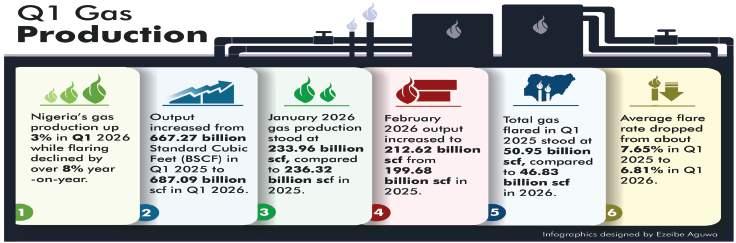
Emmanuel Addeh in Abuja
Nigeria’s gas production rose by about 3 per cent in the first quarter of 2026, while gas flaring declined by over 8 per cent year-on-year, according to data released by the Nigerian Upstream Petroleum Regulatory Commission (NUPRC).
THISDAY analysis of the commission’s gas production status reports for the first
three months of 2025 and 2026 showed that total gas output increased from 667.27
Billion Standard Cubic Feet (BSCF) in Q1 2025 to 687.09 billion scf in Q1 2026.
The increase of approximately 19.81 billion standard cubic feet represented a year-on-year growth of about 2.97 per cent, highlighting continued slow but steady expansion in Nigeria’s gas sector amid the federal government’s push
to deepen gas utilisation and monetisation.
Besides, the NUPRC figures showed that January 2026 gas production stood at 233.96 billion scf, compared to 236.32 billion scf in January 2025. However, production rebounded strongly in the subsequent months, with February 2026 output rising to 212.62 billion scf from 199.68 billion scf in February 2025. March 2026 production also climbed to 240.51 billion scf,
compared to 231.28 billion scf recorded in March 2025, making it the highest monthly production level within the review period.
At the same time, the data showed marked improvement in gas flare management. Total gas flared in Q1 2025 stood at 50.95 billion scf, compared to 46.83 billion scf in Q1 2026. The reduction of about 4.12 billion scf translated to a decline of roughly 8.1 per cent year-on-year.
Similarly, average flare intensity improved significantly during the period. The average gas flare rate dropped from about 7.65 per cent in Q1 2025 to approximately 6.81 per cent in Q1 2026, indicating that a larger proportion of produced gas was captured for productive use rather than burnt off.
In the same vein, monthly flare rates for Q1 2025 were 7.92 per cent in January, 7.94
per cent in February and 7.08 per cent in March. For Q1 2026, the flare rates declined to 7.34 per cent in January, 6.62 per cent in February and 6.48 per cent in March. The data also revealed a significant shift in the structure of Nigeria’s gas production. Associated gas production, which is gas produced alongside crude oil, declined during the review period.
The federal government has mobilised over $1.02 billion worth of investment to push Nigeria’s Compressed Natural Gas (CNG) vehicle conversion programme, with operations now running in 24 states and more than 1,000 vehicles converted to run on gas. The update was given by Strategic Project Advisor for the Presidential Initiative on Compressed Natural Gas (Pi-CNG), Mr. Olayinka

Rufai, during an industry discussion on opportunities in the CNG and electric vehicle conversion space.
The Pi-CNG programme is a key part of the government’s energy transition strategy to reduce petrol dependence, lower transport costs, and leverage Nigeria’s abundant natural gas reserves.
Rufai said the scale of lastmile deployment made local participation unavoidable.
“It is almost impossible to achieve last-mile deployment
without local companies,” he stated, adding that all Original Equipment Manufacturers (ORMs) under the initiative were mandated to transfer technology to Nigerian technicians.
While conversion kits are still imported, Rufai said about 65 components can be manufactured locally, including mirrors, seat fabrics, and cylinder assemblies. To drive this, the government has established a CNG

Industrial Park in Ajaokuta as a manufacturing and assembly hub for natural gas vehicle components, with plans to localise cylinder production. We are essentially importing a lot of air in those cylinders,” Rufai said, arguing that local production would cut costs and boost industrial growth.
According to him, the park, originally planned on 10 hectares, has now expanded to more than four times its initial size.
He said the government is also building standards and certification systems to ensure safety and quality in the growing CNG ecosystem.
He said the National Automotive Design and Development Council (NADDC) has developed National Occupational Standards and certification frameworks for conversion technicians, with the Standards Organisation of Nigeria (SON) responsible for certifying imported equipment.

Rufai said Pi-CNG has partnered with the military, National Youth Service Corps (NYSC), and regional development agencies to train thousands of Nigerians in conversion technologies, and that discussions were also underway with the Nigerian Railway Corporation to transition rail systems from diesel to natural gas.
Peter Uzoho




Explorationists Seek Industry-wide Approach to Curb Oil Drilling Lost Time
The Nigerian Association of Petroleum Explorationists (NAPE) has urged oil and gas operators in the country to adopt a systematic, industry-wide approach to managing Geological Non-Productive Time (GNPT) if the country is to cut drilling costs, improve safety, and move closer to its 3 million barrels per day production target.
Speaking at NAPE’s Monthly Technical Session in Lagos, with the theme: “Unlocking Drilling Through Systematic Management of Geological Non-Productive Time,” Earth Scientist, Dr. Johnbosco Azubuike argued that isolating and tackling GNPT separately
from other drilling delays can save operators millions of dollars per well.
Azubuike explained that systematic GNPT management involves identifying, measuring, tracking, and analysing geological events to understand their cost impact, adding that the process helps set performance metrics, benchmark progress, and reduce drilling incidents.
“GNPT is not merely lost time. It is a measurable indicator of subsurface uncertainty within the operational constraints. By implementing systematic GNPT classifications, analysis playbooks and learning loops, operators can transform geologic chaos into structured improvement. The result is higher drilling efficiency,
NSE, FIDIC Africa Plan Joint Training on Mega Projects’ Delivery
The Nigerian Society of Engineers (NSE) and FIDIC Africa are set to collaborate on a comprehensive training initiative aimed at equipping engineers with the expertise required for the successful delivery of mega infrastructure.
FIDIC Africa is the
African regional body of the International Federation of Consulting Engineers (FIDIC). It represents consulting engineering associations across Africa and promotes collaboration, infrastructure development, professional standards, and engineering best practices on the continent.
reduced rework and faster progress towards targeted objectives,” he said.
In her remarks, NAPE
Group Business Editor
Eromosele Abiodun
Deputy Business Editor
Chinedu Eze
Comms/e-Business Editor
Emma Okonji
Asst. Editor, Energy
Emmanuel Addeh
Asst. Editor, Money Market
Nume Ekeghe
Correspondents
KayodeTokede(CapitalMarkets)
James Emejo (Finance)
Ebere Nwoji (Insurance)
Reporter
Peter Uzoho (Energy)
The initiative formed the crux of discussions when the President of the NSE, Ali Rabiu, received the President of FIDIC Africa, George Okoroma, during an interactive session held at the National Engineering Centre headquarters in Abuja, an NSE statement said.
The capacity-building effort, it said, will also expose participants to international standards in project delivery, contract administration and engineering consultancy practice.
According to the discussions, the training will be designed to position engineers with the requisite technical and professional competence needed to compete effectively for large-scale contracts and execute such projects satisfactorily upon award.
President, Mrs Olajumoke Ajayi stressed that inadequate subsurface data and blind well re-entry operations by new
operators could lead to costly drilling failures. Ajayi harped on the urgent need for improved
drilling efficiency, better geological planning and enhanced technical capacity as indigenous companies
Oil Prices Slump to Six-week Low as US, Iran Near Peace Deal
Emmanuel Addeh in Abuja
Oil prices fell 6 per cent to two-week lows yesterday, as optimism grew that the United States and Iran were moving closer to a peace deal, even though they remain at odds over key issues, such as blockades on the Strait of
Hormuz.
Brent crude futures fell $5.85 or 5.7 per cent, to $97.69 a barrel in early morning trading, while US West Texas Intermediate was at $90.85 a barrel, down $5.75, or 6 per cent. Both contracts touched their lowest since May 7 earlier in the session.
On Saturday, US President
Donald Trump said Washington and Iran had “largely negotiated” an understanding on a peace deal that would reopen the Strait of Hormuz, which had carried a fifth of global shipments of oil and liquefied natural gas before the conflict. However, the two sides remain at odds on several
difficult issues, with Trump saying on Sunday he had told his representatives not to rush into any deal with Iran.
“We’ve been at this stage before, only for talks to break down. Therefore, the market will likely be more cautious about overreacting,” said Warren Patterson, head of commodities strategy at ING.
TCN Sensitises Ogun on Protection of Power Installations, Right of Way
The Transmission Company of Nigeria (TCN) Benin Region, has conducted a sensitisation programme in Ogun State aimed at educating host communities on the importance of protecting transmission
infrastructure from vandalism and promptly reporting suspicious activities around power facilities.
During the engagement, a TCN statement said the company also enlightened residents on the dangers of erecting buildings within transmission line Right of Way (RoW) corridors, emphasising
the consequences such actions pose to both offenders and the power infrastructure.
Speaking on behalf of the General Manager, Benin Region, Charles Iwuamadi, Assistant General Manager, Mathew Ariyibi, explained that the outreach became necessary because transmission lines traverse several rural
communities where vandalism and encroachment continue to pose significant threats. He noted that community members are often the first to observe unusual movements around transmission facilities and urged residents to promptly report such incidents to security agencies or the nearest TCN office.
Kazeem Royal Properties Partners APPN to Introduce Quality Pipes
Kazeem Royal Properties and Constructions Limited has officially partnered with the Association of Professional Plumbers of Nigeria (APPN), joining forces to drive the introduction and widespread adoption of quality pipes across Nigeria’s construction industry. The partnership was formalised at the inauguration of APPN’s national executives, where the Chairman and
Chief Executive Officer of Kazeem Royal Properties and Constructions Limited, Prince Ambassador Kazeem Austin Eletu, was appointed as the association’s National Adviser. It wasn’t just an appointment; it was a statement.
Kazeem used the occasion to advocate passionately for the use of strong, genuine pipes in the construction industry,
sending a clear message that substandard materials have no place in the future Nigeria is building.
Representing the company at the event was the Chief Operating Officer, Basorun Ibraheem Babayeju, who graciously accepted the honour on behalf of the company. His words carried the weight of an organisation that has never seen quality as optional.
“This appointment reinforces our dedication to the development of Nigeria’s plumbing sector. We see it as an opportunity to deepen collaboration between manufacturers, professionals, and policymakers to ensure quality and sustainability in our infrastructure,” said Basorun Ibraheem, COO, Kazeem Royal Properties and Constructions Limited.
SPE Bets on Stability, Home-grown Tech to Fill Oil Supply Gap
Peter Uzoho
Chairman of Society of Petroleum Engineers (SPE) Nigeria Council, Mr Francis Nwaochei, has stressed the need for Nigeria and other African countries to leverage regional stability, existing oil and gas assets, and homegrown technology
to enable the continent to take advantage of the 10 million barrels per day oil supply gap opportunity created by the current crisis in the Middle East.
Speaking to THISDAY at the just-ended Offshore Technology Conference (OTC) in Houston, United States, Nwaochei said
the global conversation was now on an energy mix rather than a single transition path, and that Africa was increasingly in focus.
He stressed that becoming a technology leader, not just a consumer, was critical if Nigeria and Africa were to sustain
production growth and economic gains from the current global supply disruption. He pointed to Guyana as a model for Nigeria, noting how the South American country is managing the entire value chain from production to real estate and infrastructure.
Emmanuel Addeh in Abuja
Peter Uzoho
Emmanuel Addeh in Abuja
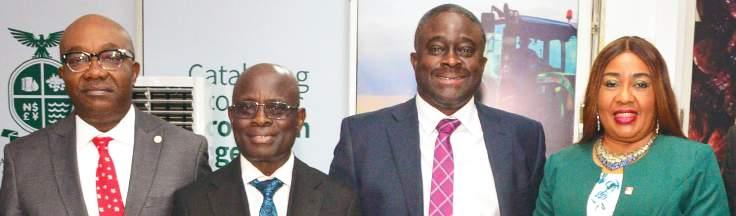
L-R: Head, Lagos Zonal Office, Securities and Exchange Commission (SEC), John Briggs; Chairman, Association of Securities Dealing Houses of Nigeria (ASHON), Sehinde Adenagbe; Managing Director and Chief Executive Officer, Lagos Commodities and Futures Exchange (LCFE), Akin Akeredolu-Ale and 1st Vice Chairman, ASHON, Ify Ejezie during the 6th Induction Ceremony of Commodities Brokers in Lagos… recently
FAAN Strenghtens Ebola Preparedness Measures Across Nation’s Airports
The Federal Airports Authority of Nigeria (FAAN), in collaboration with relevant health and safety agencies, has reinforced its commitment to strengthening surveillance and preventive measures against the possible spread of Ebola Virus Disease (EVD) through the airports.
At a workshop on Ebola Virus Disease Preparedness and Preventive Measures held at the weekend at Murtala Muhammed International Airport, Lagos, relevant health authorities and stakeholders reviewed current preparedness strategies, response mechanisms, and containment procedures
aimed at safeguarding public health and preventing any possible outbreak in the country.
Speaking during the workshop, representatives of health and border control agencies emphasized that surveillance activities have been intensified, particularly at international airports, with special attention placed on passengers arriving from high-risk countries, including the Democratic Republic of Congo (DRC), Uganda, and neighboring regions affected by the disease.
The Port Health Services (PHS) disclosed that advanced screening and monitoring measures are currently in operation across points of
entry. These include active temperature screening, health monitoring protocols, and the deployment of QR code scanners to facilitate efficient passenger health declaration and follow-up procedures.
Stakeholders at the workshop stressed the importance of collaboration among government agencies, aviation authorities, health institutions, and security agencies in ensuring rapid
detection, reporting, and response to any suspected case of Ebola Virus Disease.
The Port Health Services disclosed further that surveillance activities have been intensified at international
airports, particularly for passengers arriving from highrisk countries, including the Democratic Republic of Congo, Uganda, and neighboring countries within affected regions.
Berger Paints Shareholders Applaud 37.5% Increase in Dividend
Kayode Tokede
Shareholders of Berger Paints Nigeria Plc have approved a final dividend payout of N1.25 per share for the financial year ended December 31, 2025, bringing the total dividend for the year to N1.65 per share , a 37.5 per cent increase over the 2024 financial year.
The company had earlier paid an interim dividend of 40 kobo per share in November 2025, reflecting its commitment to rewarding shareholders amid strong financial performance.
At the Annual General Meeting (AGM) held virtually in Lagos recently, shareholders commended the company’s impressive performance and
consistent improvement in dividend payouts.
Speaking at the event, the leader of the Independent Shareholders Association of Nigeria, Moses lgbrude, praised the management for demonstrating strong leadership and strategic direction, which resulted in the outstanding performance and
attractive dividend payout. Also commenting, Adebisi Bakare, National Coordinator of the Pragmatic Shareholders Association of Nigeria, commended the management for the stellar performance across the board, the high dividend payout, and its promotion of gender balance within the organisation.
TotalEnergies donates medications to Lagos government to boost
public healthcare
As part of its commitment to supporting public healthcare in Nigeria, TotalEnergies EP Nigeria Limited has donated several quantities of essential medicines to the Lagos State Health District 3, Ikoyi.
The donation, which is part of the company's larger Corporate Social Responsibility drive in all regions of its operation, comes at a critical period where there is growing demand for quality medical care in many parts of the country.
Presenting the items on behalf of TotalEnergies, Acting General Manager, CSR, Mrs Moyosola Areola said the donation was made to ensure that the most vulnerable in society had access to the type of medications needed whenever they visited any public health facility within the district.
Permanent Secretary, Health District 3, Dr Monsurat Adeleke, who received the donation on behalf of the Lagos State Government, expressed gratitude to TotalEnergies for the gesture, stating that it would help curb needless mortalities occasioned by the inability
of some patients to afford the cost of medication.
TotalEnergies' contribution to the development of Nigeria's healthcare system goes beyond this.
In recent years, the company has built and donated more than 50 world-class health facilities, including mammography centres, mother and child hospitals, emergency and infectious disease centres, medical oxygen plants, helping to curb needless deaths across the country. This gesture by TotalEnergies aligns with the United Nations Sustainable Development Goal 3, which aims to "ensure healthy lives and promote well-being for all by improving access to quality and essential healthcare services."
The delegation from TotalEnergies included Affiliate Occupational Health Physician, Dr Adedayo Adebise; Manager, CSR Strategy and Performance, Mr Lucky Deekor; Manager, Pharmacy Services, Mr Sunny Deekae and Manager, Medical Administration, Dr Ndubuisi Oti.
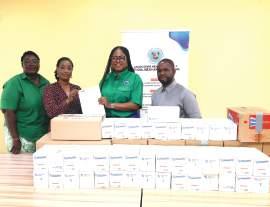
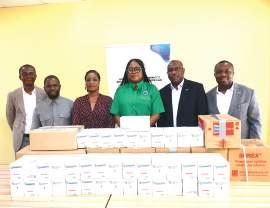
Chinedu Eze
OPay Opens Applications for N1.2bn Scholarship, N10m Innovation Challenge with Google
Sunday Ehigiator
Fintech company, OPay has opened applications for the 2026 edition of its scholarship initiative as part of its N1.2 billion, 10-year education commitment, while unveiling a N10 million
innovation challenge in partnership with Google aimed at equipping Nigerian students with digital and problemsolving skills. The programme, now branded as OPay Scholars, expands beyond financial support to
include technical skills development, innovation exposure and career opportunities for students in tertiary institutions across Nigeria.
As part of the initiative, applications for the Innovation
Foundation Awards Scholarship Worth Millions to Public School Quiz Winner
Kayode Tokede
A Primary six pupil of Sanya Nursery and Primary School, Aguda, Enora Onasanya, has won a fully funded six years scholarship to a private secondary school in Lagos after emerging overall winner of the 14th Annual Quiz and Debate Competition organised by Total Child Educational Foundation.
The scholarship package, which includes tuition, books, stationery materials and a school bag, is worth millions of naira and is
aimed at giving outstanding pupils from public primary schools access to quality secondary education.
Speaking at the event, the Executive Vice Chairman of the foundation, Dr. Bankole Sadipe, said the initiative was designed to discover academically gifted children in underserved communities and provide them with opportunities that could transform their lives.
According to him, the foundation has sponsored more than 15 pupils through secondary school over the past 14 years, with its first
scholarship beneficiary now studying Medicine at the University of Nigeria, Nsukka. “Our very first winner has completed secondary school and is almost finishing university. He is studying medicine. That shows the enduring value of this initiative,” Sadipe said. He added that while the annual competition costs about 1million naira to organise, the six-year the scholarship awarded to the overall winner represents the foundation’s biggest financial commitment and runs into several millions of naira.
Challenge will run from May 25 to June 14, 2026, with participants expected to compete in teams of five and develop technologybased solutions to real-life problems.
According to OPay, teams participating in
the challenge would be required to engage with Google Gemini tools during the process, while winners would receive cash rewards, with the overall winner taking home N10 million, the first runner-up receiving N5 million and the
second runner-up getting N3 million. Speaking on the initiative, Chief Commercial Officer of OPay, Elizabeth Wang, said the company remained committed to investing in the future of Nigerian youths through education and innovation.
WAMCO Records N615.9bn Revenue Growth
Emma Okonji
FrieslandCampina WAMCO Nigeria Plc, has reported a strong financial recovery with significant growth across key performance indicators in its financial year ended 31 December 2025.
The company gave the report at its 53rd Annual General Meeting (AGM), in Lagos, where shareholders, board members, and key stakeholders discussed the company’s 2025 performance and strategic outlook for the future. From the company’s financial results and performance, it delivered a strong rebound in 2025, returning to profitability and
strengthening its balance sheet and liquidity position despite continued macroeconomic pressures within the operating environment.
According to the financial report, revenue increased by 25 per cent from N493.6 billion in 2024 to N615.9 billion in 2025, driven by strong volume growth, targeted pricing initiatives, and sustained market expansion across key product categories. Speaking about the company’s growth trajectory in 2025, Managing Director, FrieslandCampina WAMCO Nigeria Plc Mr. Roger Adou, said: “2025 was a defining year for FrieslandCampina WAMCO Nigeria Plc as we successfully
returned the business to profitability despite persistent macroeconomic and operational challenges. The operating environment remained complex with high interest rates, supply chain disruptions, inflationary pressures. , and foreign exchange volatility continuing to impact businesses across Nigeria. Despite these headwinds, our teams demonstrated exceptional resilience, agility, and commitment. We significantly improved operational efficiency across our factories, strengthened our route-to-market capabilities, enhanced our commercial execution, and optimized our supply chain operations.”

A Mutual fund (Unit Trust) is an investment vehicle managed by a SEC (Securities and Exchange Commission) registered Fund Manager. Investors with similar objectives buy units of the Fund so that the Fund Manager can buy securities that willl generate their desired return.
An ETF (Exchange Traded Fund) is a type of fund which owns the assets (shares of stock, bonds, oil futures, gold bars, foreign currency, etc.) and divides ownership of those assets into shares. Investors can buy these ‘shares’ on the
floor of the Nigerian Stock Exchange. A REIT (Real Estate Investment Trust) is an investment vehicle that allows both small and large investors to part-own real estate ventures (eg. Offices, Houses, Hospitals) in proportion to their investments. The assets are divided into shares that are traded on the Nigerian Stock Exchange.
GUIDE TO DATA:
Date: All fund prices are quoted in Naira as at 22nd May 2026, unless otherwise stated.
UNIBEN Strengthens Students EmployabilityThrough Soft Skills, Career
Oluchi Chibuzor
As part of its commitment to producing careerready and 21st-centurycompliant graduates, the University of Benin (UNIBEN) has successfully organised a Soft Skills and Employability Training Programme for students in the institution.
The programme, delivered through the Centre for Vocational Training and Skills Acquisition (CVTSA) in partnership with Blue Chip Services and Jobberman, reflects the deliberate vision and strategic direction of the Vice Chancellor, Professor Edoba B. Omoregie, SAN.
The training seeks to ensure that UNIBEN graduates are equipped
not only with academic knowledge but also with the practical competencies required to succeed in an increasingly dynamic and competitive global environment.
Speaking on the significance of the initiative, the Director of the Centre for Vocational Training and Skills Acquisition, Professor Andrew Amenaghawon, described the programme as a demonstration of the University’s evolving approach to higher education where academic excellence is deliberately complemented with practical skills, workplace preparedness, and personal development.
He explained that the programme aligns with the mandate of the Centre to enhance
students employability and career readiness and expressed appreciation to the vice chancellor for his foresight, commitment, and support in driving initiatives that prepare University of Benin students for success beyond the classroom while advancing the broader institutional vision of producing employment-ready graduates.
The sessions were interactive and engaging; providing students with practical tools and real-world insights to support informed career planning. Certificates of Competence were presented to participants in recognition of their successful completion of the training.
Oyebanji, Babalola Hail CIS Conference as Catalyst for Collaboration
Ekiti State Governor, Biodun Oyebanji, and Founder of Afe Babalola University, Afe Babalola, have commended the Chartered Institute of Stockbrokers for its maiden International Academic Conference, describing it as a strategic platform for collaboration between capital market stakeholders and academia to strengthen Africa’s financial markets and deepen financial literacy.
The conference, themed “Capital Markets, Sustainable Finance and Economic Transformation in Africa,” held at ABUAD, AdoEkiti, brought together academics, regulators, investors, policymakers and capital market operators to explore ways
of strengthening Africa’s financial ecosystem, promoting sustainable finance, and mobilising long-term investment for economic development.
Speaking on behalf of Governor Oyebanji, the Commissioner for Industry, Trade and Investment, Tayo Adeola, said African capital markets must drive the continent’s economic transformation through infrastructure financing, enterprise growth, and sustainable development.
Oyebanji lauded the initiative and highlighted Ekiti State’s infrastructure financing model, including its N32.5 billion, 20-year infrastructure bond issued in April 2025 to fund a 17.84-kilometre dual carriageway toll road project, which forms part
of a broader road network. Director-General of the Securities and Exchange Commission, Emomotimi Agama, urged African academics to deepen research collaboration with regulators, stressing the need for empirical studies on liquidity, investor behaviour, and market regulation, and noting that “the academy is not a spectator of Africa’s transformation but a co-author.”
Earlier, the 14th President and Chairman of Council of the CIS, Fiona Ahimie, described the conference as a landmark initiative to strengthen academia–industry collaboration and advance sustainable finance and innovation across Africa.
Big Bull Rice Fuels Thrilling Football Season Finale
As the final whistle of the global football season draws near, the energy across Nigeria is anything but quiet. From viewing centres in Surulere to living rooms in Abuja, the passion, the debates, the last-minute goals, everything peaks soon and when the tension rises and the cheers get louder, Big Bull Rice is right there on every match-day table.
Because in Nigeria, football is watched, experienced, shouted, argued, celebrated… and most importantly, shared - shared in bowls passed between friends, in plates served during halftime, and in laughter that lingers long after the match is over.
This season, Big Bull Rice has gone beyond being just a meal. Through its Fuelthe-Pitch campaign, the brand has stepped boldly into the rhythm of football culture, positioning itself as
the Big Bull of Football, a title it has earned not only by showing up, but fully immersing itself in the game football fans love.
Through its array of activities and Match-DayLive content, the brand has created a two-way relationship with fans, one where every opinion counts, every goal sparks a reaction, and every fan feels seen. This consistent engagement has turned everyday supporters into an active community, sharing their voices, their humour, and their passion in real time. Big Bull Rice has tapped into youth culture, making football content more interactive, more entertaining, and deeply Nigerian. The campaign has blurred the line between brand and fan, making Big Bull Rice feel less like a sponsor and more like one of the guys
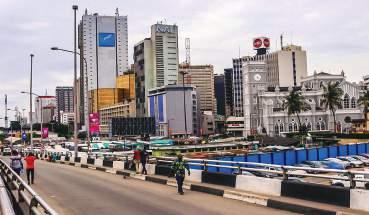
in the room.
According to Chief Marketing Officer at TGI Group, Probal Bhattacharya, “For us, quality is not a claim, it is our commitment. Across Nigeria, we have been intentional about our presence in the football space, not to disrupt the fan experience, but to become a meaningful part of it. By building platforms for predictions and real-time banter, we have seen fans move from being spectators to taking true ownership of the game. Big Bull Rice is the heartbeat of these gatherings, providing the quality nourishment Nigerians need to stay fit and active for the moments that truly count. We understand that football and food are the shared languages of our community, and Big Bull Rice is proud to fuel the energy and memories that bring us all together.”
The price of OPEC basket of twelve crudes
Saharan
Djeno (Congo), Zafiro (Equatorial Guinea), Rabi Light (Gabon), Iran Heavy (Islamic Republic of Iran), Basrah Medium (Iraq), Kuwait Export (Kuwait), Es Sider (Libya), Bonny Light (Nigeria), Arab Light (Saudi Arabia), Murban (UAE) and Merey (Venezuela).
Stock Market Gains N905.57bn on Investors Demand for Airtel Africa
Kayode Tokede
The stock market segment of the Nigerian Exchange Limited (NGX) appreciated by N905.57billion yesterday amid investors’ demand for Airtel Africa Plc.
As the stock price of the telecommunication giant gained 10 per cent or N332.30 to close at N3,655.70 per share,
the market capitalisation moved from N160.077 trillion it closed for trading last week to N160.982 trillion, representing an increase of 0.57per cent or N905.57 billion.
Also, the NGX All-Share Index gained 0.57per cent or 249,712.37 basis points to close at 251,125.02basis points from 249,712.37 basis points it closed for trading last week.
Consequently, the NGX ASI Month-to-Date and Year-
to-Date returns settled higher at +3.7per cent and +61.4per cent, respectively. On Sectors, the NGX Insurance (+0.5per cent) and NGX Banking (+0.1per cent) indices advanced, while the Oil and Gas (-1.8per cent) and NGX Consumer Goods (-0.3per cent) indices closed lower. The NGX Industrial Goods index closed flat.
The total volume traded declined by 30.2per cent to
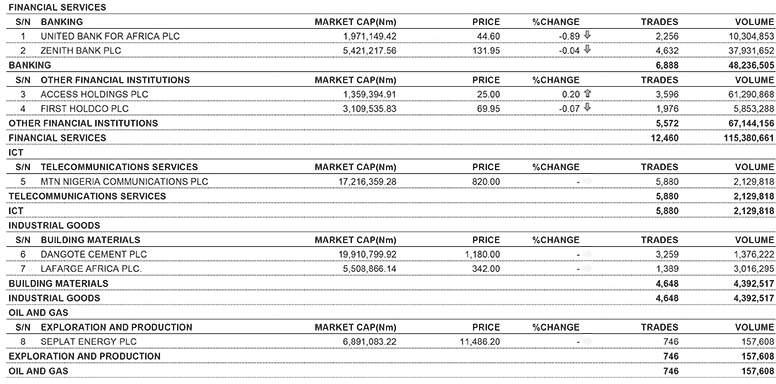
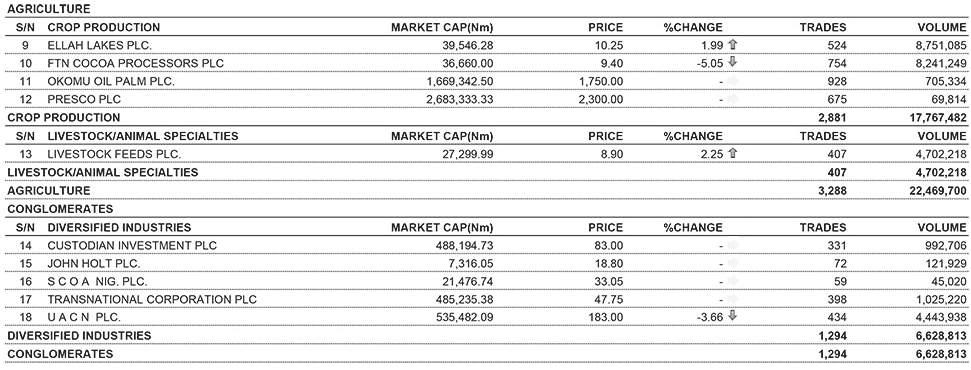
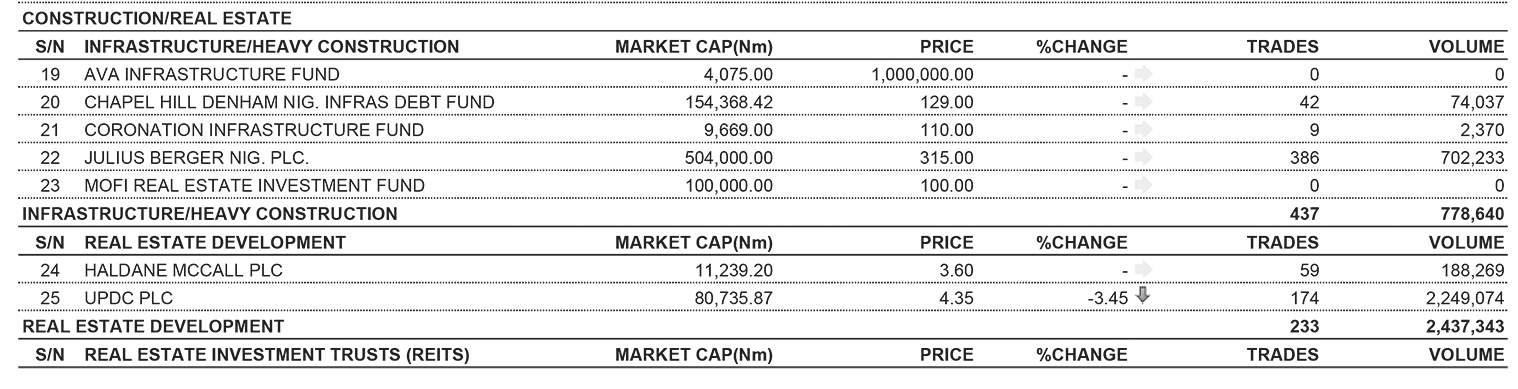
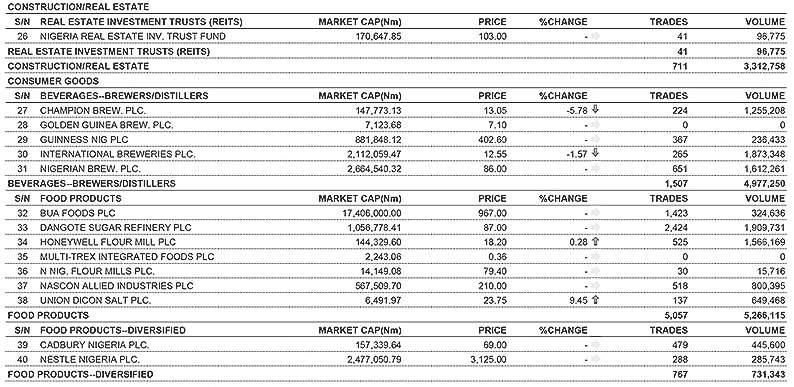
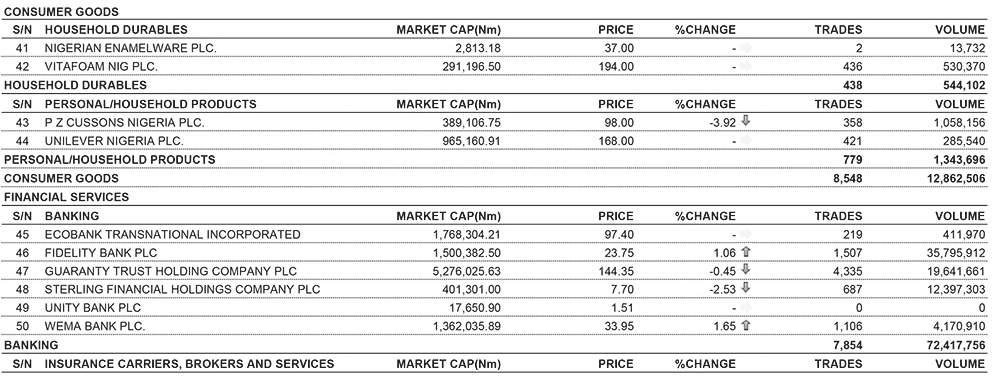
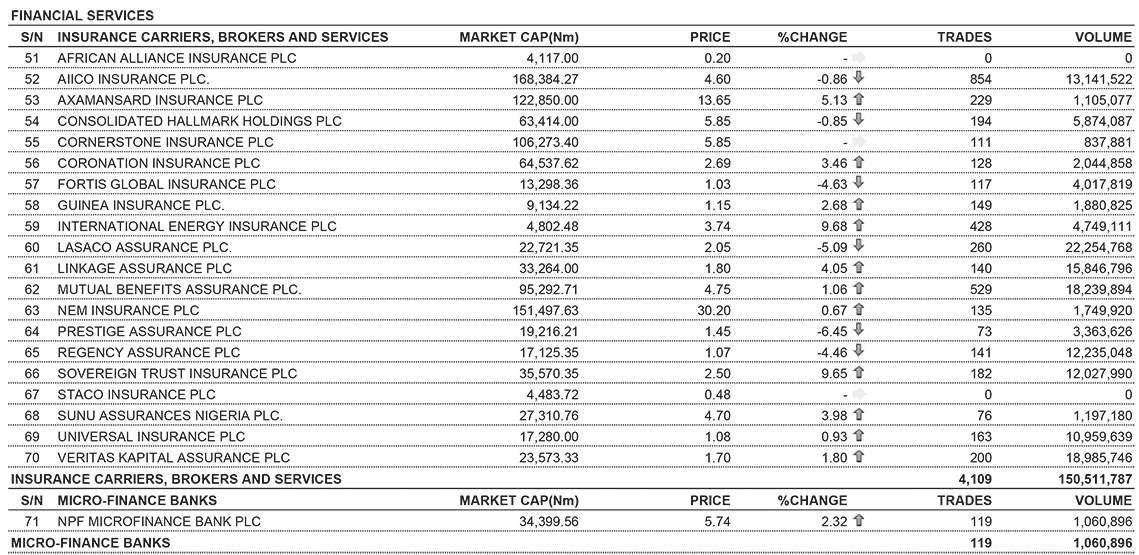
497.09 million units, valued at N31.62 billion, and exchanged in 74,129 deals. Access Holdings Plc was the most traded stock by volume at 61.29 million units, while Aradel Holdings Plc was the most traded stock by value at N11.99 billion. As measured by market breadth, market sentiment was positive (1.2x), as 35 stocks gained relative to 30 losers. Airtel Africa (+10.per cent)
and International Insurance Plc (+9.7per cent) led the gainers, while Mcnichols (-10per cent) and TIP (-9.9per cent) recorded the highest losses of the day.
Capital market analysts expected trading on the Nigerian stock market to remain relatively muted this week, with sentiment lacking a major positive catalyst to drive a broad rebound.
The market closed last week on a subdued note, extending its bearish momentum
as widespread losses in heavyweight counters dragged overall performance. Cordros Securities Limited said, “we expect market activity to remain relatively subdued in the near term in the absence of a major positive catalyst to drive sentiment. Nonetheless, we do not rule out selective bargain hunting across fundamentally sound names following the recent moderation in prices.”

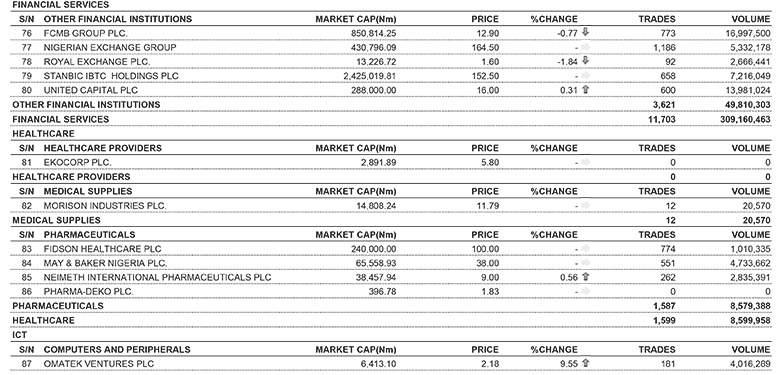
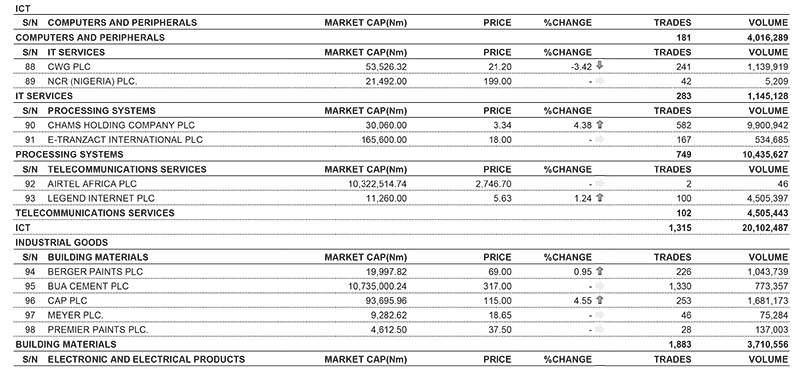
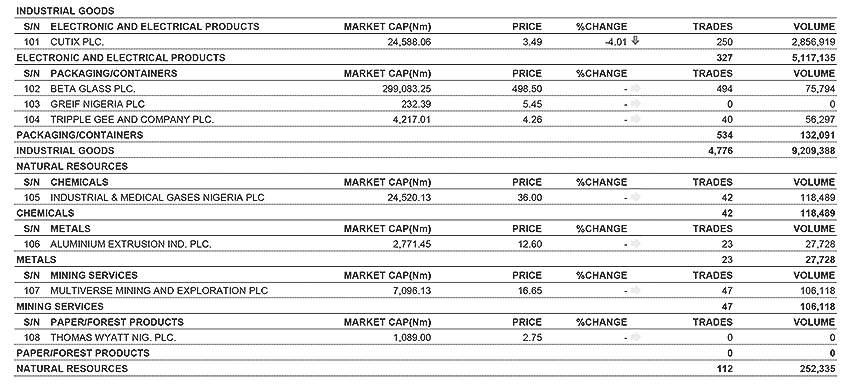
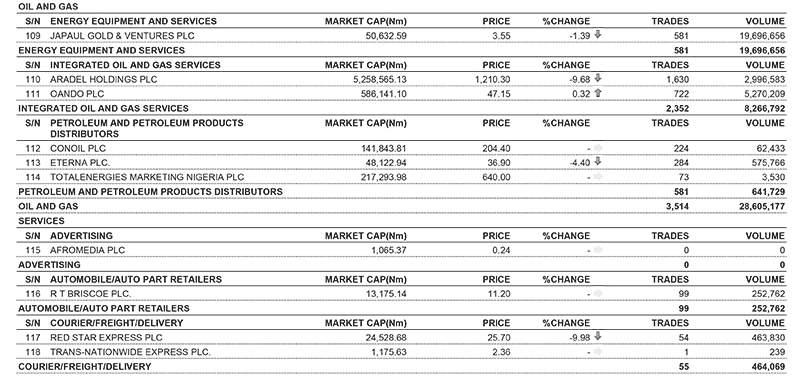

MULTICHOICE MEGA DEALERS REVAMP...
L-R: Chimaobi Eluigwe, Vice President, MultiChoice Nigeria; Cordelia Ikeanyi, Managing Director, Eastland General Resources (South); Kemi Omotosho, CEO, MultiChoice Nigeria; and Ifeanyi Onyibo, CEO, Radac Communications Limited (Lagos), at the MultiChoice Mega Dealers Revamp held in Lagos, yesterday
Works Ministry, Police Deepen Partnership to Secure Highways, Critical Road Infrastructure
Umahi: FG undertaking N34trn road projects nationwide Disu wants patrol bases, drone-monitoring facilities in key expressways
The Federal Ministry of Works and the Nigeria Police Force have agreed to strengthen collaboration on the protection of major highways and critical road infrastructure across the country as ongoing road projects under the Bola Tinubu administration gather momentum.
Minister of Works, David Umahi, disclosed this yesterday while
receiving the Inspector General of Police (IGP), Rilwan Disu, and his delegation at the ministry’s headquarters in Abuja, where they discussed issues bordering on security along major expressways.
Umahi said the support of security agencies had been crucial to the execution of strategic road projects, particularly in areas facing security challenges, and commended the police, military and other security
agencies for safeguarding workers and infrastructure nationwide.
He noted that several major highway projects, including the 240-kilometre dual carriageway project in Sokoto State, would have been difficult to execute without sustained security support.
“Without your assistance and the combined efforts of security agencies, it would have been difficult to forge ahead with many of these projects.
We appreciate the commitment of the police and other security agencies in helping the government deliver these critical roads,” Umahi said.
Highlighting achievements in the road sector, Umahi said the federal government was undertaking road projects worth about N34 trillion nationwide, including inherited projects and four flagship legacy highway projects designed to stimulate economic growth and
NIS Raises Alarm Over Rising Fake Migration Schemes, Human Trafficking Networks
The Nigeria Immigration Service (NIS) has raised fresh concerns over the increasing activities of fraudulent migration syndicates and irregular cross-border networks operating across the country, warning Nigerians against falling victim to deceptive overseas travel schemes.
The Service said criminal groups are increasingly targeting vulnerable citizens, especially young women and girls, with false promises of employment, education, sponsorship and better opportunities abroad, only for many victims to end up trapped in forced labour, human trafficking and other forms of exploitation.
national integration.
According to him, the administration has adopted reinforced concrete pavement technology on many roads to improve durability and reduce future maintenance costs, stressing that the current roads will last between 50 years to 100 years.
“There is no major federal highway corridor in the country that is not receiving attention. These projects are not just road projects; they are investment projects that will drive economic transformation,” he said.
from major roads could help sustain such operations.
Umahi called on Nigerians to support security agencies by providing credible intelligence and assisting the families of fallen security personnel, urged political actors to embrace constructive criticism rather than divisive rhetoric, saying meaningful opposition should provide practical alternatives to government policies.
The minister expressed confidence in the economic reforms being implemented by President Bola Tinubu, arguing that the measures had begun stabilising the economy and would eventually translate into broader benefits for citizens.
The Service stressed that it is illegal and dangerous for anyone to leave Nigeria without valid travel documents, including passports, visas and other required permits, noting that genuine migration processes do not bypass official immigration procedures or authorized border posts.
According to the statement, many criminal networks now exploit social media platforms and informal recruitment channels to lure
In a statement issued by the Service Public Relations Officer, DCI Akinsola Akinlabi, on Monday, the agency warned that irregular migration remains a serious security and humanitarian challenge with devastating consequences for victims and their families.
unsuspecting Nigerians into illegal migration routes under the guise of scholarship offers, jobs and travel assistance.
The NIS urged members of the public to be extremely cautious of unsolicited sponsorships, travel fares or offers of assistance from unverified individuals or groups claiming to facilitate overseas travel opportunities.
It further advised Nigerians to verify all travel and recruitment opportunities through appropriate government channels before making any commitments.
The Service also warned citizens against dealing with agents or persons promoting irregular migration, emphasizing that such activities often expose victims to abuse, detention,
Police Apprehend Chef for Alleged Theft of Items Worth N150m, Drug-Related Offences in Abuja
Linus Aleke in Abuja
The Nigeria Police Force has arrested a chef, John Cosmos Govi, over his alleged involvement in the theft of luxury items valued at N150 million, as well as other drug-related and criminal offences in Abuja.
According to a statement by the Force Public Relations Officer, DCP Anthony Placid, the suspect was apprehended by operatives of the Force Intelligence Depart-
ment–Intelligence Response Team (FID-IRT) in connection with a case involving criminal conspiracy, housebreaking, administering suspected harmful substances, malicious damage to property, and theft.
The statement explained that preliminary investigations revealed that Govi, who reportedly trained at a catering school in Cotonou, Benin Republic, gained employment as a chef at the residence after establishing contact with two
accomplices identified as Peter and Moses, who are currently at large.
Investigators further discovered the suspect allegedly spent time studying the routines, movements, and security structure of the residence before carrying out the operation on April 23, 2026.
Police findings also indicated that food prepared within the residence was allegedly laced with a suspected sedative substance intended to incapacitate both the occupants and security personnel.
exploitation and even death during dangerous journeys across borders.
Parents, guardians and community leaders were specifically called upon to intensify awareness efforts and educate young people on the dangers associated with trafficking in persons and illegal migration.
The NIS appealed to Nigerians to report suspicious movements, activities and individuals linked to fraudulent migration schemes to the nearest immigration office or relevant security agency for prompt investigation and action.
Besides, Umahi revealed plans to enhance security on major highways through the installation of solar-powered street lighting, closed-circuit television cameras, observation posts and designated police monitoring facilities.
He said the initiative would begin on strategic routes across the six geopolitical zones, including the Lagos-Ibadan Expressway, AbujaKaduna-Kano highway, EnuguOnitsha Expressway, Eleme-Onne corridor, Mararaba-Benue route and the Numan-Jalingo road.
The minister also advocated the strengthening of the Federal Highway Patrol unit of the police to focus specifically on highway security, suggesting that toll revenues
Earlier, the Minister of State for Works, Bello Goronyo, praised the IGP for his leadership and called for greater police support in securing road construction sites nationwide. Goronyo noted that the government’s ambitious road infrastructure programme required enhanced security collaboration to ensure timely delivery of projects.
In his remarks, Disu lauded the ministry of works for its ongoing infrastructure drive, describing roads as vital assets that promote economic development, social integration and national security.
FG Offers Free Corrective Surgery for Obstetric Fistula Patients in Edo
The federal government has provided a platform where women suffering from obstetric fistula, will be treated free, including surgery, feeding and transportation support in Edo State. This was disclosed by Professor Ileogben Sunday-Adeoye, the Medical Director of the National Obstetric Fistula Centre, Benin City.
Speaking with journalists, Sunday-Adeoye said the facility was established to provide specialised care for women living with Vesico Vaginal Fistula (VVF) and Recto Vaginal Fistula (RVF), conditions that result in the uncontrollable leakage of urine and faeces through the vagina.
According to him: “The treatment is completely free, including feeding and transportation.
“These women are among the poorest of the poor, and the federal government has made the corrective surgery free because the procedure can ordinarily cost millions of naira,” he said.
He explained that the centre, located along Ugbor Community Road in Benin City, is the fourth and newest National Obstetric Fistula Facility established by the federal government to address the growing burden of obstetric fistula across the country.
Sunday-Adeoye reaffirmed the commitment of the federal
government to reducing the burden of obstetric fistula and restoring hope to affected women through accessible and quality healthcare services.
According to him, the hospital is designed to cater for patients in Edo State, the South-South geopolitical zone and neighbouring states. Sunday-Adeoye noted that contrary to previous assumptions that obstetric fistula was largely a northern Nigeria problem, recent findings have shown that the condition is also prevalent in the southern part of the country. He attributed the condition mainly to prolonged obstructed labour, often caused when the baby’s head is too large to pass through the mother’s pelvis.
Felix Omoh-Asun in Benin
Michael Olugbode in Abuja
Emmanuel Addeh in Abuja
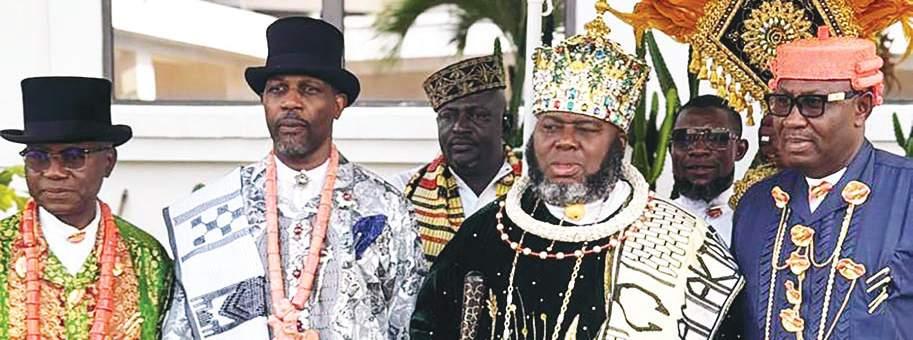
KALABARI DELEGATES AT ROMUALD WADAGNI’S INAUGURATION...
L-R: Chief Dr. Emi Membere Otaji (Deputy National President, Nigerian Chamber of Commerce); Prince Tonye T.J.T. Princewill (Da Ogo VIth, Head of the Queen Elababene/Da Ogo Group of Houses in Kalabari Kingdom); HRH Mujahid Dokubo Asari (Amanyanabo of Torusarama Piri, aka The Source); and Chief Dr. David T. Briggs (Deuin Ala XII of Kalabari, Paramount Chief of the
House), at Romuald Wadagni’s inauguration in Benin Republic, on Sunday
Adeleke: I Need No Persuasion to Back Tinubu as Gov of His Ancestral Birthplace
President’s candidacy will fine-tune reforms for prosperous Nigeria, says Bamidele as Radda felicitates presidential nomination
Yinka Kolawole in Osogbo, Sunday Aborisade in Abuja and Francis Sardauna in Katsina
Osun State Governor, Ademola Adeleke, yesterday, said as the governor of President Bola Tinubu’s ancestral birthplace, he needed no persuasion to endorse him.
Shedding more light on the decision of his government and political group to endorse Tinubu for a second term in 2027, he called it “a moral and development driven action in the best interest of Osun and Yoruba people at large.”
This was as the Leader of the Senate, Senator Opeyemi Bamidele, has described the emergence of Tinubu as the presidential candidate of the All Progressives Congress (APC) as capable of deepening and fine-tuning ongoing reforms to make Nigeria a prosperous nation.
At the same time, the Katsina State Governor, Dikko Umaru Radda, has extended warm congratulations to Tinubu on his emergence as the the APC presidential candidate.
Speaking after a brief check on the ongoing construction of IbadanIle-Ife-Ilesa expressway, the governor described Tinubu as “our own son, father and leader, who deserves our support beyond political considerations.
“I am the governor of the ancestral
birthplace of Mr President. How can I have my own in the saddle and think twice before embracing him? I need no persuasion to act as I have declared repeatedly, our endorsement of Mr President.
“How many governors are as lucky as me? Well, my brother, Governor Sanwo-Olu of Lagos State will claim to be luckier. But we, in Osun State, count ourselves lucky and privileged to have one of our illustrious sons and father at the helm of affairs of Nigeria,” the governor noted.
Describing his decision as beyond partisan consideration, the governor reaffirmed his stance in support of Tinubu and expressed gratitude to the President for the ongoing construction of Ilesa-Ile-Ife-Ibadan Express way.
“I am elated at the speed and quality of work. The reconstruction will further widen and ease access to major centers of Osun State and complement my administration’s accelerated infrastructure deliveries across towns and villages.
“Our administration has also rehabilitated a number of federal roads from 2022 to date. At the state level, over 300 kilometres of state roads have been reconstructed. We are hoping Mr President will soon authorise payment of refund for those rehabilitated federal roads.
“We, however, again convey our
appreciation to Mr. President for the approval of reconstruction of Ibadan-Iwo road-Osogbo as well as Gbongan-Akoda road. I hope to write to Mr President to further approve the Osogbo — Ilesa road for reconstruction.
“As a governor of the president’s ancestral state, we will not allow selfish politicians such as the President’s cousin, Gboyega Oyetola, to tarnish the image of Mr President in Osun State. With God and people, democracy shall triumph on August 15.
“Mr President has repeatedly advocated free and fair elections. As a government, we will deploy all means within the law to ensure free and fair election on August 15 and beyond. We know and believe the President meant well for Osun State,” the governor declared.
Bamidele: Tinubu’s Candidacy Will Fine-tune Reforms for Prosperous Nigeria
Leader of the Senate, Senator Opeyemi Bamidele has described the emergence of President Bola Tinubu as Presidential Candidate of the APC as capable of deepening and fine-tuning ongoing reforms to make Nigeria a prosperous nation.
Bamidele made this remark in a congratulatory message by his Directorate of Media and Public Affairs in Abuja on Monday, pointing out
Haven Pediatrics Launches
Neonatal ICU Facility in Lagos
Bayo Adeoye
Haven Pediatric Practice has launched a state-of-the-art Neonatal Intensive Care Unit (NICU) in Ikeja, Lagos, in a move aimed at improving survival chances for premature and critically ill infants in Nigeria.
The facility is designed to provide specialised neonatal and pediatric intensive care services, addressing what the hospital described as the urgent need for advanced newborn care in Lagos and across the country.
Globally, carrying a pregnancy to full term and delivering a healthy
baby remains the hope of every expectant mother. However, preterm births continue to pose major emotional and medical challenges, particularly in Nigeria, where premature infant survival rates remain among the most concerning worldwide.
To tackle this challenge, Haven Pediatric Practice said it has combined advanced medical technology with highly trained specialists to strengthen neonatal care delivery.
The hospital disclosed that it has assembled a team of experienced neonatologists and pediatric special-
ists, while also investing in modern ventilation systems capable of supporting extremely premature infants weighing as little as 0.4 kilogrammes.
Speaking during the launch, the Chief Medical Director of Haven Pediatric Practice, Dr Adebajo Odedina, said the facility represents more than just an expansion of services.
“We aren’t just launching a ward; we are deploying a lifeline. By combining world-class ventilators with specialised, experienced medical hands, we are significantly increasing the chances of survival for even our smallest warriors,” he said.
key achievements and reforms that the president had recorded within three years.
In his statement, Bamidele celebrated Tinubu’s emergence as the presidential candidate of APC in the just concluded presidential primary election, having secured 10.99 million votes from party members.
“I am therefore confident that your candidacy will help to fine-tune ongoing reforms across all sectors of the country and make us a prosperous nation. Your track records show that you are an agent of change.
“You became President when Nigeria’s economy was at its lowest ebb. You didn’t shy away from taking tough decisions. Rather you prioritised critical actions to secure future generations.
“You took the bull by the horns and confronted the problems head-on. This decisiveness has sparked economic progress in virtually every facet of our national life. No state is borrowing just to pay salaries any longer.
“At the same time, you have turned the country into a construction site, with the ongoing 750-kilometre Lagos-Calabar Coastal Road Project, the 1,068-kilometre Sokoto–Badagry
speech as the presidential candidate of the ruling APC in next year’s election, Tinubu had declared that opposition leaders would only take the country backwards because they lacked alternative vision.
However, in a statement by its National Publicity Secretary, Bolaji Abdullahi, ADC said it was a grand irony that such a statement was coming from a president whose tenure would be remembered as one of the worst periods in Nigeria’s democratic history.Abdullahi stated, “With millions of Nigerians suffering under the president’s catastrophic economic policies, debts spiralling out of control, corruption enjoying unprecedented prosperity, and the nation flowing with the blood of innocent victims, it is indeed astonishing that the president could still attempt to position
highway, and other strategic road infrastructure projects that will connect different cities in the North and South.
“Your administration has introduced the Nigerian Education Loan Fund (NELFUND) to boost access to tertiary institutions across the federation. In three years, no fewer than 1,197,626 students have registered with NELFUND, 3,138,390 loan applications received, 1,613,132 institutional loans processed and 1,525,528 upkeep loans paid. At least, N242 billion had been disbursed to tertiary students since the scheme took off.
“From 1.273 million bpd in April 2023, President Tinubu has provided strategic leadership that increased oil production to 1.71 million bpd. Also, according to the Central Bank of Nigeria, the reserves had increased from $35.09bn in June 2023 to $49.49 billion in May 2026.
“Under his administration, Nigeria’s economy has consistently grown, first by 2.74% in 2023; 3.4% in 2024; 3.9% in 2025 and 3.89% in the 2026 first quarter. So much has been done to reform and transform Nigeria. A lot more will still be done with the emergence of President Tinubu as the standard bearer of the APC.”
his government as a positive benchmark.
“If the opposition is going to take the country backwards, it would be to reset it from the edge of the dangerous precipice that the current administration has placed it on, because to continue on the same trajectory is to plunge the country into theADCabyss.”also raised concerns over the APC presidential primary results, which allegedly gave Tinubu 10.99 million votes, describing the figure as an “unbelievable concoction” and warning that it could provide the basis for rigging the 2027 general elections.
The party said it was genuinely shocked and saddened that Tinubu, whose administration had presided over one of the most painful periods in
“In my capacity as the Leader of the Senate, I assure you of at least 10 million votes from the South-west geopolitical zone of the country. The machinery to deliver those votes is already in motion,” he said.
Radda Felicitates Tinubu on Nomination
Katsina State Governor, Dikko Umaru Radda, has extended warm congratulations to President Bola Tinubu on his emergence as the presidential candidate of the APC following the successful conclusion of the party’s nationwide presidential primaries.
Radda, in a statement by his Chief Press Secretary, Ibrahim Kaula Mohammed, described the outcome as a resounding affirmation of Tinubu’s leadership and a clear signal that Nigerians were ready to consolidate the gains of the Renewed Hope Agenda.
“Mr. President, your emergence is not a surprise — it is a verdict. Nigerians, through their party delegates, have spoken with one clear voice, and Katsina State was proud to be part of that chorus,” Radda said.
Nigeria’s democratic history, would speak so dismissively about the opposition and the Nigerian people while awarding himself a medal for one of the most catastrophic economic policies in recent history.
According to the spokesman of the ADC, “It is both ironic and tragic that a government under whose watch nearly 35 million Nigerians are now projected to face acute food insecurity in 2026 would accuse the opposition of lacking ideas or vision.
“This is a government under which inflation has devastated household incomes, food prices have become unbearable, insecurity has continued to spread across the country, and millions of Nigerians now live with a level of economic anxiety and hopeless- ness never before experienced in recent national history.”
Ancient Deuin Ala Chieftaincy
ATIKU, AMAECHI, HAYATU-DEEN IN BATTLE FOR ADC PRESIDENTIAL TICKET
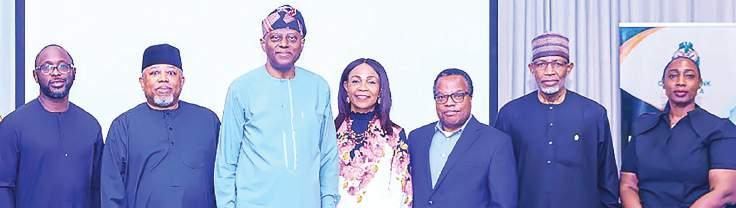
CENTRAL BANK MONETARY POLICY COMMITTEE WORKSHOP...
L-R: Deputy Governor, Economic Policy Directorate, Central Bank Nigeria (CBN), Muhammad Sani; Deputy Governor, Financial System Stability Directorate, CBN, Mr. Philip Ikeazor; Governor, CBN, Mr.Olayemi Cardoso; Member, Monetary Policy Committee (MPC), CBN, Mrs.Aku P. Odinkemelu; Member, MPC, CBN, Dr. Aloysius U. Ordu; Deputy Governor, CBN, Mr. Lamido Yuguda, and Group Chief Strategy Officer, Nigerian Exchange Group (NGX Group), Ms Jumoke Olaniyan, during the 2026 MPC Workshop held in FCT, Abuja...recently
NAF Airstrikes Crush Terrorists, Foil Planned Attack in Niger State Communities
Gumi denies supporting terrorism, insists on amnesty for bandits Family Begs Tinubu to recover murdered teacher’s body for Burial in Oyo school attack
Bandits invade emir’s palace in Kwara, set palace ablaze, abduct emir’s wife, others Radda’s ex-aide arrested for masterminding abduction of eight-year-old child
and 23, 2026, across Rafi and Mariga Local Government Areas of Niger State.
MACBAN condemns killing of nine herdsmen, wives, children in Kogi Kano Pentecostal raises the alarm over insecurity, Chibok girls, Leah Sharibu, others Makeri, successfully engaging the terrorists and restoring operational advantage to friendly forces,” he added.
The Air Component of Operation Fansan Yamma Sector 1,has dealt significant blows to terrorist elements, successfully foiling planned attacks through a series of intelligence-led air operations conducted between May 20
In a statement, the Director of Public Relations and Information, Nigerian Air Force, Air Commodore Ehimen Ejodame, said the coordinated operations targeted terrorists’ movements, hideouts, and planned attacks across several communities within the affected areas.
According to him, the first operation was carried out on May 20 after credible
intelligence revealed the movement and convergence of terrorists around Tungan Bako and Kasuwan Daji in Rafi LGA.
He explained that the Air Component, working in collaboration with the Nigerian Army Space Command Regiment, launched precision air interdiction strikes that neutralised several terrorists and disrupted their operational build-up in the area.
Ejodame further disclosed that
on May 21, terrorists travelling on motorcycles and on foot with rustled cattle from Tungunguna towards Uregi were identified and engaged by air assets.
The operation, he said, resulted in the neutralisation of the terrorists and the destruction of their movement and withdrawal capability.
“On same day, the Air Component also provided close air support to troops in contact with terrorists at Tungan
FG Declares Wednesday and Thursday Sallah Public Holidays
Military warns residents of north-east to avoid crowded areas during celebrations FRSC deploys 581 personnel, ambulances in Jigawa, NSCDC deploys 4,000 in FCT Sokoto police assures adequate security ban gun fire, illegal procession
Shuaibu in Dutse and Onuminya Innocent in Sokoto
The federal government has declared Wednesday, May 27 and Thursday, May 28 as public holidays to mark this year’s Eid-ul-Kabir celebration, one of the most significant festivals in the Islamic calendar.
The announcement was made by the Minister of Interior, Olubunmi Tunji-Ojo, in a statement issued by the Permanent Secretary of the Ministry, Magdalene Ajani.
The declaration came as millions of Muslims across Nigeria and around the world prepare to commemorate the festival, which symbolises sacrifice, obedience to God and compassion for humanity.
In the statement, the federal government extended warm felicitations to Muslim faithful at home and in the Diaspora, urging Nigerians to use the sacred period to pray for peace, unity and national progress.
“The federal government urges all Nigerians to use this period for prayer and sober reflection, asking for divine guidance upon the country as it continues its pursuit of peace, security and prosperity for every citizen,” the statement read.
The government described the celebration as a spiritually significant occasion rooted in faith, sacrifice and shared humanity, stressing the need for citizens to embrace tolerance and national cohesion at a time the country continues to confront economic and security challenges.
The two-day holiday declaration is expected to trigger massive movement of travelers across the country as families gather for the celebration, with transport hubs, markets and livestock centres already witnessing increased activities ahead of the festivities.
The federal government, however, reaffirmed its commitment to promoting peaceful coexistence and national unity, wishing Muslims across the country a peaceful, joyous and spiritually fulfilling Eid celebration.
Military Warns Residents of N’East to Avoid Crowded Areas During Sallah
The Nigerian military has warned residents of the North-East to avoid crowded areas during the Eid El Kabir celebrations amid heightened security concerns in the region.
The military also urged residents to remain vigilant throughout the festive period, comply with security direc-
tives, and promptly report suspicious movements or activities to security agencies to prevent possible attacks.
In a statement by the Media Information Officer of Joint Task Force (North East) Operation Hadin Kai, Lieutenant Colonel Sani Uba, the Theatre Command said extensive security measures had already been put in place ahead of the celebrations.
According to him, “In keeping with its mandate to protect lives and property across the Theatre, the Command wishes to inform the general public that comprehensive security arrangements have been put in place well ahead of the celebrations to ensure a safe and secure environment for all.
“Ahead of Wednesday’s celebrations, troops have been forward-deployed to critical and vulnerable locations across all sectors of the Theatre, surveillance and ISR assets have been fully activated, patrols have been intensified, and security forces are operating in close coordination with sister agencies, the CJTF, and community vigilance groups to forestall any threat and guarantee a secure festive period for all residents.
“In addition, members of the public are strongly advised to observe the following security guidance in the days leading up to and throughout the celebrations.
“Conduct Eid prayers and festivities as close to your homes and familiar localities as possible, and avoid large open gatherings where practicable.”
FRSC
Deploys
581
Personnel, Ambulances for Eid-el-Kabir Operations in Jigawa
The Jigawa State Command of the Federal Road Safety Corps, has deployed 581 personnel, ambulances and patrol vehicles across the state for a special Eid-el-Kabir operation aimed at ensuring safe and hitch-free celebrations.
In a statement issued Monday in Dutse, the command’s spokesman, Yahaya Ibrahim, said the operation would run from May 25 to May 31 to manage the expected increase in human and vehicular movement during the festive period.
According to him, the deployment includes 461 regular personnel, 120 special marshals, eight patrol vehicles and four ambulances stationed at strategic locations for monitoring and rescue services.
Ibrahim said the operation was designed to promote safe road use, reduce road crashes and ease traffic flow on major highways across the state.
The statement noted that the offensive operations continued on May 23 with armed reconnaissance missions over Dogon Dawa and surrounding locations in Mariga LGA following reports of planned terrorist attacks on troop positions.
During the mission, terrorist elements attempting tactical movement within the area were detected and engaged with precision strikes.
The Nigerian Air Force said the operation led to the successful neutralisation of a significant number of terrorists and effectively disrupted the planned attacks.
Gumi Denies Supporting Terrorism, Insists on Amnesty for Bandits
Kaduna-based Islamic cleric, Ahmad Gumi, has dismissed insinuations, suggesting that he supported terrorism.
Addressing a press conference at his residence in Kaduna, Gumi, who has been advocating amnesty for bandits, said there had been several misrepresentations in the media and on social media platforms regarding his position on banditry in Nigeria.
“I have noticed that I am being misquoted in some of my media interviews, public lectures, and discourse on how to address banditry in Nigeria.
“This is being done by certain ethnic interest groups, individuals driven by prejudice, and some sectional internet content creators, who use sensational and outrageous headlines to attract viewership at the expense of human suffering and sacrifice.
“I hereby state unequivocally that any video clip, written statement, or message attributed to me, whether directly or by innuendo, suggesting support for, justification of, protection of, or advocacy for banditry or terrorism in Nigeria or anywhere else does not emanate from me.”
The cleric called on Nigerians to disregard “such fake, manipulated, and doctored materials currently in circulation.
“I am a loyal citizen of my beloved country, a nation whose potential I believe is unmatched anywhere in the world.
“I therefore urge the general public, the media, and the Nigerian state to disregard such fake, manipulated,
and doctored materials currently in circulation,” Gumi said.
He warned that “anyone who continues, from the date of this release, to circulate falsehoods against me shall be liable to legal action.
“I sincerely hope that our great nation will heal, and that all victims affected by this violence will find comfort in the collective determination of the nation and the international community to achieve a lasting solution to the insecurity fueled over time by ignorance, poverty, and widespread social injustice,” he added.
Family Begs Tinubu to Recover
Slain Oyo Teacher’s Body for Burial in School Attack
Family of the Late Mr. Oyedokun Michael Olugbade, recently killed by terrorists in Oyo State, has appealed to President Bola Tinubu to help recover the remains of their son, for a decent burial.
Olugbode is one of the teachers abducted from Community High School, Ahoro Esinle, in Oriire Local Government Area of Oyo State, by suspected terrorists on May 15, 2026. He was reportedly killed by the terrorists few days after their kidnap, however, his remains is yet to be located or recovered for proper burial.
In a letter written to President Tinubu through their lawyer, Mr Deji Adeyanju, the family, stated that beyond personal grief, they were “deeply disturbed that several other innocent Nigerians, including persons abducted alongside Late Mr. Oyedokun Michael Olugbade during the same tragic incident, are still believed to be held in captivity by these terrorists under extremely life threatening conditions.”
They described the Late Oyedokun as a peaceful and diligent teacher at Community High School, Ahoro-Esinle, in Oriire Local Government Area of Oyo State, whose life was cruelly and violently cut short under heartbreaking and inhumane circumstances.
While disclosing that the late teacher was survived by a wife and two sons, who had been traumatised by the gruesome manner of his death, the family lamented that, “Despite widespread national reports regarding
Continued on page 35
Michael Olugbode, Linus Aleke in Abuja, Ibrahim
John Shiklam in Kaduna, Hammed Shittu in Ilorin, Alex Enumah, Linus Aleke in Abuja, Francis Sardauna in Katsina, Ibrahim Oyewale in Lokoja and Ahmad Sorondinki in Kano
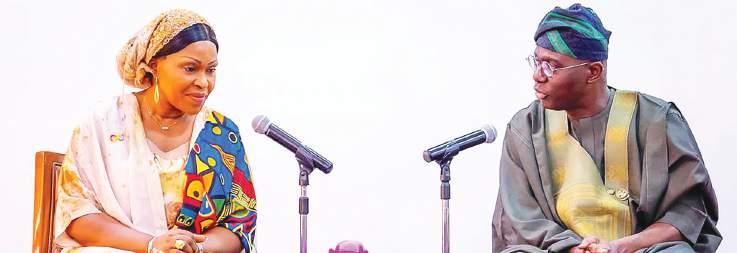
RENEWED HOPE VISITS SANWO-OLU...
L-R: National Programme Manager, Renewed Hope National Home-Grown School Feeding Programme, Princess Aderemi Adebowale and Governor of Lagos State, Mr. Babajide Sanwo-Olu, during a courtesy visit at Lagos House, Alausa, Ikeja, yesterday
FG to Train 100,000 Nigerians on Local Manufacture, Assembly of CNG, Electric Vehicles
Partners China to deepen local capacity, fast-track initiative’s delivery
The federal government says it would train 100,000 Nigerians locally on how to manufacture and assemble Compressed Natural Gas (CNG) and electric vehicle (EV) infrastructure in Nigeria. Vice President Kashim Shettima disclosed this yesterday in Abuja.
Shettima explained that the target of training 100,000 Nigerians – not less than 1,000 in each state – locally and sponsoring 100 of them to China for further training, was part of the inclusivity clause of President Bola Tinubu’s Renewed Hope Agenda.
The federal government has engaged a Chinese firm, New Power Technology (NPT), in a strategic partnership to localise the manufacturing and assembly of CNG and EV infrastructure in Nigeria.
The partnership, which is fully backed by the Chinese government, is expected to focus on the local
production and assembly of CNG dispensers, refuelling stations, and EV charging facilities, as part of Nigeria’s effort to deepen local content, reduce import dependence, and accelerate the adoption of cleaner transport energy.
The initiative was the main outcome of a meeting between Shettima and the management team of Nigeria’s Presidential Compressed Natural Gas Initiative (PCNGi), led by its Executive Chairman and Chief Executive Officer, Ismaeel Ahmed, on one hand, and a delegation from NPT, led by its Chief Executive Officer (CEO), Mr. Liu Shihua, on the other.
The meeting was held at State House, Abuja.
The vice president, who was represented by Deputy Chief of Staff to the President, Senator Ibrahim Hadejia, said the move, which aligned with Tinubu’s directive on mandatory procurement of CNG-powered vehicles by all government institutions in the country, would address transportation challenges.
He acknowledged that while Nigeria was considered the world’s largest emerging market, with an average age of 21.4 years, its market was similar to China’s in the 1980s, and held the promise for replicating China’s successful experience in electrifying transportation.
Shettima stated, “A clean and green transportation transformation can be achieved by introducing China’s high-tech bio-environmental systems.
“Localisation improvements and training are key to replicating success and attracting investor attention.”
Shettima also lauded the Chinese government’s offer to provide policy and financial support for the construction of electric vehicles and charging infrastructure. He said multiple visits to Chinese factories had secured preferential prices for electric vehicles, charging stations, and other equipment.
He also commended the Chinese
firm for promoting the human capital drive of the Tinubu administration through the “development of approximately 10 chip engineering vehicle projects within three years, building an electronic chip industry chain, with emphasis on training local talent, especially women and vulnerable groups, demonstrating social responsibility”.
Earlier, Shihua told Shettima that the target was to build a complete electric vehicle ecosystem, including a vehicle retrofitting and battery swapping networks, digital operation and maintenance platforms.
He stated, “Our plan is to complete the conversion of one million traditional fuel-powered tricycles to electric tricycles within three years, while simultaneously establishing 10,000 charging and swapping stations, directly creating 40,000 to 50,000 jobs in the charging and swapping sector.
“We’ll bring a core team of Chinese
technical experts. We will station experienced Chinese engineers in Nigeria to provide comprehensive technical support and personnel training.
“What’s more, a local government in China – the Science and Technology Bureau of Xi’an, Shaanxi Province – is providing strong policy and talent support through its ‘Thousand Talents Programme.”
Shihua stated that the firm would train local technical backbones for Nigeria in the next three years, and support 60 to 70 outstanding Nigerian students to study in China under fully funded programmes.
He said, “After they return, these technical backbones will act as seed trainers, each helping to train 1,000 local technicians in every state of Nigeria – that means more than 37,000 local engineers across the country. This is how we achieve ‘technology stays, capacity takes root.’”
Shedding more light on the strategic
NAF AIRSTRIKES CRUSH TERRORISTS, FOIL PLANNED ATTACK IN NIGER STATE COMMUNITIES
the death of the late Mr. Oyedokun Michael Olugbade, his remains are yet to be seen or recovered.
“In these distressing circumstances, we respectfully appeal for Your Excellency’s urgent intervention to direct the relevant security and intelligence agencies to intensify efforts toward locating and recovering his body, so that his family may be afforded the solemn opportunity to conduct a dignified burial and rescue other victims still in captivity.”
The family specifically urged the president not to delegate this matter to representatives alone, but should also be at the forefront by personally visiting the affected families.
Bandits Invade Emir’s Palace in Kwara, Burn Palace, Abduct Wife, Women, Others
A few days to Eid el-Kabir celebrations, about 15 uspected bandits reportedly invaded ancient town of Yashikira in Baruten Local Government Area of Kwara State, setting the emir’s palace ablaze, abducting emir’s wife, children, women and several residents of the community.
The incident, according to THISDAY checks, happened on the wee hours of Sunday when the residents of the town have slept.
It was gathered that, the suspected bandits were said to have stormed the town, firing sporadically before launching the assault on the palace and nearby homes.
Sources said the assailants overpowered local vigilantes and operated for hours without resistance as terrified residents fled into nearby bushes for safety.
According to eye witnesses, the gunmen were said to have first attacked the palace, where they reportedly set parts of the building on fire before whisking away multiple victims.
A local source who sought anonymity told newsmen in Ilorin that, “the suspected bandits invaded Yashikira in the night.
“They set the palace on fire and kidnapped women and children, including the emir’s wives.”
Another source said the attack threw the entire community into confusion as families searched for missing relatives after the assailants left the area.
Radda’s
Ex-Aide Arrested for Masterminding Abduction of 8-yr-old Child
A former Senior Special Assistant to the Katsina State Governor on Community Development Programme (CDP), Nura Aliyu, has been arrested by operatives of the Katsina State Police Command for allegedly masterminding the abduction of an eight-year-old boy. Aliyu, 39, according to a statement by the command’s Public Relations Officer, DSP Abubakar Sadiq Aliyu, was nabbed alongside five other suspects for allegedly plotting the kidnapping of the victim.
Although the police spokesperson did not mention in the statement whether Aliyu served as a senior special assistant to Governor Radda, investigations revealed that he previously held the position before resigning to contest for Batsari Constituency seat in the Katsina State House of Assembly.
The police public relations officer explained that the victim was abducted by the syndicate on 13th May, 2026, at about 6:00 p.m. while returning from an Islamic school.
He said the suspects contacted
the family the following day and demanded N50,000,000 ransom, but after negotiations, N17,000,000 was paid to secure the release of the victim.
The Katsina police spokesman noted that N7.5 million being part of the N17 million ransom, one Peugeot 307, boxer motorcycle, among others, were recovered from the suspects as exhibits during investigation.
According to him, the suspects confessed to the commission of the offence during interrogation and mentioned one Abdul, currently at large, as their accomplice.
Aliyu, in the statement, said: “Upon receipt of the report, operatives of the newly established Violent Crime Response Unit (VCRU) of the command swung into action. Acting on credible intelligence, operatives tracked and arrested six members of the syndicate today, May 23rd, 2026.
“Those arrested are: Nura Aliyu, age 39, identified as the mastermind and a neighbour to the victim’s family; Abubakar Aminu, age 37; Ibrahim Muhammad, age 51; Iliyasu Sani, age 51; Abubakar Muhammad, age 27, and Abdullahi Isma’il, age 30.”
While noting that efforts were underway to apprehend the fleeing suspect,
Aliyu said the state Commissioner of Police, Ali Umar Fage, commended the operatives for carrying out what he described as a swift operation.
MACBAN Decries Killings of 9 Herdsmen, Wives, Children in Kogi State Community
The Miyetti Allah Cattle Breeders Association of Nigeria (MACBAN) has condemned the brutal killings of herdsmen, women and children in Ika Community, Ankpa Local Government Area of Kogi State.
In a press statement by the State Secretary of MACBAN Kogi Chapter Suleiman Muhammed, it pointed out that the victims of the unfortunate attack were Isiaka Lawal, Larai Musa (wife of Isiaka Lawal) , Abdullahi lsiaka, Isah Isiaka, Saleh Isiaka, Samsiya Adamu, Asma’u Siuni, Basullube Musa and Bello Musa.
Others who sustained varying degrees of injuries were Husseini Haruna, Abdullahi Abdullahi, Sa’ida Haruna.
“We condemn this barbaric act in the strongest terms and call on security agencies to immediately investigate the
partnership, Technical Adviser to the President on Economic and Financial Inclusion (Office of the Vice President), Dr Nurudeen Zauro, stated that it was part of the president’s mandate for the Presidential Committee on Economic and Financial Inclusion to implement a collaboration and partnership to achieve the $1 trillion economy target.
Zauro said, “We have been engaging with partners locally and internationally who are privileged. I was privileged to be part of the team that visited their factory in China. And we saw very fantastic innovation technology that they have, particularly around electric vehicles, charging solutions, conversion centres, as well as electric tricycles.
“In the light of that, we engaged in conversation with them. Then they gladly accepted to come to Nigeria. They visited our embassy in Beijing, and they came here in order to support the mandate of Mr. President.”
incident, arrest the perpetrators and ensure that justice is served.
“The continued targeting and killing of innocent pastoral communities is dangerous, unacceptable and capable of worsening tensions among peaceful communities.
“MACBAN extends its heartfelt condolences to the families of those killed and prays for the speedy recovery of the injured persons. We also call on government at ail levels, humanitarian organizations and relevant authorities to urgently provide relief and medical assistance to the affected families.
“We urge members of the pastoralists community and all residents of the area to remain calm and law-abiding, while allowing security agencies to carry out their responsibilities.”
Kano Pentecostal Raises the Alarm Over Insecurity, Chibok Girls, Sharibu others
The Pentecostal Fellowship of Nigeria (PFN), Kano chapter, has raised the alarm over the rising spate of insecurity across the country, saying Nigeria has lost its sense of value for human life and its sanctity.
Deji Elumoye in Abuja
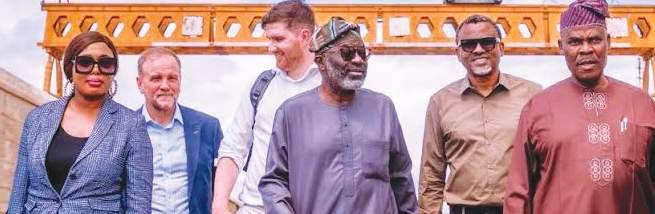
iNsPECTiNG THE sOUTH-WEsT dEVELOPMENT COMMissiON RaiLWay PROJECT…
L-R: director-General, south-west Governors’ Forum, Ms Naomi Olabode; Crossrail International Officials, Jon tindall and steve Long; Managing director/CeO, south-West development Commission (sWdC), dr. Charles ‘diji akinola; director of Operations, Nigerian Railway Corporation (NRC) Mr. akin Osinowo, and sWdC executive director, (Commerce & environmental development), alhaji Fatai Ibikunle, during an inspection of Papalanto Freight yard, Ogun state…recently
NCYP Urges FG to Expand Forest Guard Nationwide, Warns against Security Fragmentation
Michael Olugbode in abuja and sunday Ehigiator in Lagos
The Northern Christian Youth Professionals (NCYP) has warned that Nigeria may be nearing a dangerous security turning point, cautioning against the emergence of fragmented community selfdefence structures while calling for the urgent nationwide expansion of the Forest Guard initiative.
In a statement signed by its chairman, Isaac Abrak, the group commended the Defence Headquarters for sustained efforts against terrorist elements operating within forested areas, including recent operations linked to
‘Lagos
attacks on schools in parts of the South-west.
“While we acknowledge and commend the gallantry and responsiveness of the Armed Forces, we must strongly emphasise that the recurring pattern of dislodging terrorist elements from forest locations without a sustained holding and stabilization framework continues to create a cycle of return, re-infiltration, and renewed attacks,” the statement said.
The group warned that insecurity in Nigeria was not only persisting but adapting geographically and exploiting weak territorial control.
“This evolving spread underscores a deeper structural challenge: insecurity is not only
Spent N2.13bn on Residents’ Welfare in 2025’
segun James
The Lagos State Government has said that it disbursed over N2.13 billion to 3,301 vulnerable residents last year.
The Special Adviser to the Governor on Political, Legislative and Civic Engagement, Dr. Afolabi Tajudeen, who disclosed this said that the amount was spent under “The Eko Cares Financial Assistance Programme” adding this was part of intensified efforts to deepen social intervention, strengthen grassroots governance and expand citizen engagement across the state.
Speaking yesterday during the 2026 Ministerial Press Briefing held at the Bagauda Kaltho Press Centre, Alausa, where he outlined the achievements and impact of the office, Tajudeen stressed that the Eko Cares initiative remained one of the government’s flagship social intervention programmes targeted at indigent residents, students, small business owners, persons living with disabilities, elderly citizens and vulnerable households across Lagos.
According to him, the current cycle of the programme
benefitted 3,301 residents, while cumulative beneficiaries since 2020 have risen to 11,991 households, with total disbursement exceeding N4.6 billion.
He explained that the programme covered direct cash grants, payment of medical bills, educational support, housing assistance and business startup interventions aimed at improving economic inclusion and restoring public confidence in government.
“Women, persons with disabilities and the elderly remain priority beneficiary groups under the intervention,” he said.
The special adviser disclosed that the 2026 budget allocation for the programme stands at N3.14 billion, signaling the government’s commitment to sustaining welfare support amid prevailing economic challenges.
Beyond financial intervention, Tajudeen said the office also expanded its Mother, Infant and Child Development Programme (MICHD), through which 2,315 pregnant women received nutritional support across the six health districts in Lagos during the current cycle.
persisting, but also adapting geographically, exploiting gaps in territorial control and forest governance,” NCYP stated.
According to the group, worsening insecurity across parts of the country has encouraged communities to increasingly turn to local protection mechanisms.
“In response to these persistent security gaps,
there is a growing and understandable trend of communities turning toward self-protection mechanisms.
Across affected regions, local vigilante formations, hunters’ groups, and community defence initiatives have increasingly emerged as immediate responses to insecurity, driven largely by fear, proximity to threat, and
perceived delays or gaps in state response capacity,” the statement added.
Drawing lessons from international examples such as Iraq and parts of the Sahel, the group stressed the dangers of uncoordinated security structures.
“Nigeria is still at a preventable stage of security fragmentation, but the
trajectory is already forming,” it warned.
The organisation, however, distinguished governmentbacked regional security outfits from loosely organised vigilante groups, pointing to the Western Nigeria Security Network, popularly known as Amotekun, as an example of a structured and legislated model.
Ogun Warns AIG against Interference in Land Grabbing Prosecution
James sowoleinabeokuta
The Ogun State Government has warned a senior police officer attached to the Force Intelligence Department, Abuja, Assistant Inspector General of Police, Enyinnaya Adiogu, to immediately stop what it described as a parallel investigation into an ongoing land grabbing case involving the World Mission Agency (WMA), owners of Living Faith Church Worldwide in Sango-Ota.
In a letter dated May 23, the
Ogun State Attorney General and Commissioner for Justice, Oluwasina Ogungbade, warned the officer against investigating allegations of criminal conspiracy, threat to life, and illegal possession of firearms reportedly lodged against the mission by one Ibrahim Gbenga Ibuoye.
The government said Ibuoye is currently facing prosecution before a Magistrates’ Court in Abeokuta over allegations bordering on forceful entry into another person’s land, forceful takeover of land, and the use of
threats and violence in connection with the disputed property.
According to Ogungbade, the matter is already before a competent court, making any parallel police investigation improper and capable of undermining judicial proceedings.
“It is settled law that when a case is pending in court, no person must take any steps calculated to or capable of usurping the jurisdiction of the court,” the Attorney General stated.
He questioned why a
defendant already standing trial since 2025 would suddenly turn himself into a complainant against those involved in the pending criminal matter. The commissioner accused Ibuoye of disregarding the rule of law by approaching the Force Headquarters and presenting himself as a complainant after allegedly trespassing on land belonging to WMA — land which the government said is backed by valid ownership documents and approvals issued by the Ogun State Government.
Seven to Die by Hanging Over Murder of Clergy in Rivers
Blessing ibunge in Port Harcourt
A Rivers State High Court in Port Harcourt has convicted and sentenced twin brothers and five others to death by hanging for the kidnap and murder of Reverend Edwin Isaiah Dokubo-Harry.
The incident, the court revealed, happened in 2013 in Asari Toru Local Government Area of the state.
The court presided over by Justice Boma Diepiri in his judgment discharged and acquitted Emmanuel Isreal and Nephew Philemon of twentyfive count charges bordering on conspiracy, kidnap, murder, possession of an illegal firearm.
The convicts and others now at large had on December 6, 2013, lured Rev. DokuboHarry to a forest at Abalama community in Asari Toru, kidnapped him, tied his eyes
and hands, leading to his deat,h and they later abandoned his dead body in a creek in the area.
The court held that the prosecutiohadas proven the case of conspiracy, kidnap, murder, possession of an illegal firearm, and criminal act against Precious Jack Opara, Answer Dick, Osaki Fubara, Prince Mikado Philip, Tienabeso George, Seleipri Fubara ,and Alaboeriya Fubara.
Justice Diepiri ruled that the convicts should be hanged by their neck until they are confirmed dead and thereafter directed the prosecution to hand over the recovered gun and other exhibits to the Nigerian Police. It was observed in the court that the judgment resulted in emotional and uncontrollable tears from some of the convicts and their family members who were in court in solidarity.
Ofatech College Old Students Seek Stronger Participation, Devt
ayodeji ake
Members of the Ofagbe Technical College Old Students Association (OTCOSA), Lagos Zone, have called for stronger participation among alumni as the association seeks to deepen support for members and contribute more meaningfully to the development of their alma mater.
The call was made during the association’s 2026 Annual
Reunion and Celebration held in Lagos, where the Chairman of the Lagos Zone, Engr. Akpoyibo Isaac, highlighted the achievements, challenges and future aspirations of the body.
Speaking during his welcome address, Akpoyibo traced the origin of the association to 2018, when an old student, Mr. Abanaba Joshua, conceived the idea after reconnecting with a
former classmate, Mr. Eberino Joseph, during a visit to Ikorodu.
According to him, the discussion eventually led to consultations with other alumni, including Mr. Joseph Etemire and Mr. Samuel Iteze, before a WhatsApp platform was created to unite former students of the institution.
“A general meeting was called and held at this same
venue through the assistance of Mr. Ifoge Vincent, where several old students attended and the association was formed,” he said.
He explained that Mr. Ifoge Vincent was elected interim chairman before later emerging as the substantive chairman, adding that the initiative eventually expanded beyond Lagos and connected old students across Nigeria and abroad.
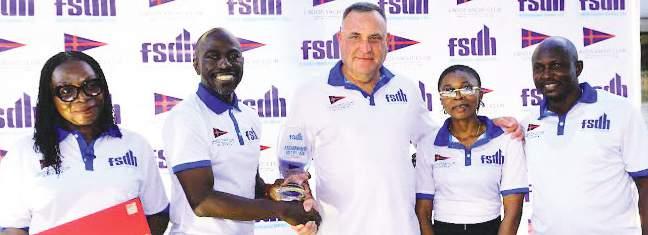
PROMOTING SAILING AND MARINE LIFESTYLE…
Race sponsored by FSDH at the Lagos Yatch Club, Victoria Island, Lagos…recently
UBA Inaugurates Renovated UNILAG Branch, Innovation Hub
N60m professorial chair in finance award for research
Nume Ekeghe and Oluchi Chibuzor
The United Bank of Africa(UBA) Plc has unveiled a renovated four story business office and innovation hub centre at the University of Lagos( UNILAG) to cater to its teeming 80,000 customers within the branch.
This is as the bank equally opened its innovation hub that is aimed at driving ideas and research through its UBA Professorial Chair in Finance Research award.
Speaking at the opening of the UBA Innovation Hub and Business office in UNILAG, yesterday, the Group Managing Director(GMD) of the bank, Oliver Alawuba, said the edifice is a testament to what Industry and Academia can achieve together for the prosperity of the nation.
According to him, “It is indeed an honour for me today to stand before you at the commission of this UBM branch. This is a landmark
project that speaks of the partnership between innovation and education. And shared belief between UBA and the university.
“It is a renewal of our relationship with UNILAG, which we entered for decades now. Like the VC mentioned, in 1969, we were the first bank to open a branch in this university.
“And today, that branch has over 80,000 customers. And that represents the shared trust that the school has in us and the friendship that we have built. This edifice, I don’t want to say the value but if you look at it, it is worth billions. And we believe it is the right investment.
“Because we are investing in Africa’s future which shows the confidence that we have in this university. Yes, indeed, we use 48 per cent and the University of Lagos, will use 52 per cent. But the most important thing is that we are collaborating. And the partnership will extend beyond just having the building.”
However, the Bank also
announced a N60 million Professorial Chair in Finance Research award as part of giving back and driving the relationship between industry and academia.
According to him, the UBA Professorial Chair in Finance,
a university endowment will foster high-level financial research and deepen collaboration.
“As part of our commitment to this institution and driving research we are announcing a N60m donation for the
UNILAG professorial chair in Finance Award to support research,” he said.
On her part, the Vice Chancellor of UNILAG, Professor Folasade Ogunsola, said that the event affirmed something she has always
believed, that the enduring development of the university and the nation is not achieved by government alone, but through genuine, structured, and visionary partnerships between academia and industry.
Womanifesto Condemns Rising Violence against Women in Party Politics
Kuni Tyessi in Abuja
A coalition of over 250 women’s rights organisations in Nigeria has condemned what it described as a growing wave of violence, intimidation, and harassment against women participating in political processes across the country.
In a press statement dated
May 25, 2026, and signed by Convener of Womanifesto Nigeria, Dr. Abiola AkiyodeAfolabi, the groups said the attacks were undermining women’s right to participate in leadership and democracy.
The group cited the violent assault involving Senator Ireti Kingibe, a female aspirant, and officials of the African Democratic Congress (ADC)
in Abuja as particularly alarming.
In Borno State, the group highlighted incidents during the APC primaries in the Bama/Ngala/Kala Balge Federal Constituency, and added that Dr. Zainab Gimba was allegedly attacked by thugs during the primaries.
Womanifesto also raised concern over the role of
security agencies present at some of the incidents and alleged their failed to intervene or protect the women under attack.
“The violent assault involving Senator Ireti Kingibe, a female aspirant, and officials of ADC in Abuja is deeply disturbing and unacceptable. Sadly, this is not an isolated incident,” it stated.
Delta CP, Oyeniyi, Promises More Proactive Security Initiatives
Delta State Commissioner of Police(CP), Mr Yemi Oyeniyi, has assured the people that his command will continue to push aggressive mobilisation and application of measures and strategies that would ensure more protection of lives and property of citizens in the state.
Oyeniyi gave the assurance
while receiving the Editorin-Chief/Managing Director of lagos-based The Supreme Newspaper, Mr Aruga Joe Omokaro, in his office in Asaba.
He noted that since security remained the business of all well-meaning citizens, the police, under his command, will continue to pursue collaborative efforts with all relevant stakeholders, including various security agencies,
to tackle crimes effectively and promote peace in ourr communities.
Oyeniyi acknowledged the invaluable role of media practitioners in the business of safeguarding lives and property in our communities and the promotion of social cohesion for economic and other activities to thrive.
Earlier in an address on behalf of the management of The Supreme Newspaper, Mr Omokaro expressed
delight and confidence in the deployment of Oyeniyi to Delta State some months ago, saying the fact that he has already stamped his authority in the command was evident.
Specifically, he noted that CP Oyeniyi’s adaption of community policing strategy has begun to yield appreciable results in terms of a visible dip in the level of violent crime across Delta State.
NBA-SBL’s Confab to Focus on Measuring Policy Impact
Raheem Akingbolu
The Nigerian Bar Association Section on Business Law has announced its 20th Annual International Business Law Conference.
With the theme: ‘Beyond Reforms: Measuring Policy Impact’, the event is set to take place from June 8 to 10, 2026, in Abuja.
As one of Africa’s foremost
gatherings at the intersection of law, business, and policy, the conference marks a significant milestone in the organisation’s continued commitment to shaping Nigeria’s commercial and regulatory landscape.
For two decades, NBA-SBL has convened leading voices across sectors, building a platform that goes beyond legal discourse to influence business strategy, policy direction, and
economic development.
The 20th edition reinforces this legacy, positioning the conference as a critical forum for evaluating the effectiveness of reforms and charting a path toward measurable outcomes.
Speaking on the significance of the milestone, the Chair of NBA-SBL, Ozofu ‘Latunde Ogiemudia, said: “Twenty years on, this conference has evolved
into more than a gathering of professionals; it is a platform that actively shapes how law supports business growth and economic development in Nigeria. This year’s theme reflects a necessary shift from conversations about reform to a more deliberate focus on impact—what has changed, what is working, and what must be done differently to drive sustainable progress.”
Omon-Julius Onabu in Asaba
L- R: A Trustee of the Lagos Yacht Club, Boma Alabi; Managing Director/CEO, FSDH Capital, Mr. Abimbola Kassim and the first place lighting winning team members during the Boat
Super Eagles, Zimbabwe’s Warriors in Unity Cup Battle Royal
Duro Ikhazuagbe
Nigeria’s Super Eagles will this evening take on Zimbabwe’s Warriors in a 2026 Unity Cup opener at the Charlton Athletic Stadium (The Valley) in London, starting at 7.30pm.
The last time both countries met during last year’s 2026 World Cup qualifying fixtures, it was stalemate both in the home (Uyo) and away fixtures in (Huye, Rwanda). Nigeria’s draw in Uyo was most like defeat as Eagles desperately needed that game to steady their sinking fortunes in the Mundial qualifying race. Both countries missed out as South Africa picked the group’s lone ticket. DR Congo defeated Nigeria in penalty
shootouts in the playoffs for the African ticket to the Inter-confederation playoffs in Mexico where they won the continent’s 10th ticket to the World Cup starting next month in North America.
So tonight, the stakes are less glamorous. The four-nation Unity Cup is more of an invitational friendly tournament where the Super Eagles are the defending champions.
With Head Coach, Eric Chelle, resting almost his entire first XI for the Poland and Portugal international friendlies, he’s going to rely entirely on a new set of players to prosecute this clash.
Expectedly, newly crowned Cypriot champion with Omonia Nicosia,
Francis Uzoho, could be the man to lead out the Super Eagles tonight against the Warriors in the absence of Wilfred Ndidi and Moses Simon.
Uzoho, who was Nigeria’s No 1 goalkeeper at the 2018 World Cup in Russia, gave a hint of this at yesterday’s pre-match press conference.
A total of 20 players took part in the last training session yesterday, with the likes of goalkeepers Uzoho, Arthur Okonkwo and Michael Atata. Defenders were: Igoh Ogbu, Chibueze Oputa, Chibuike Nwaiwu, Obinna Igboke, Tijani Al Ameen and Elias Ochobi while midfielders like Alhassan Yusuf, Tochukwu Nnadi, Samson Tijani, Aderemi Adeoye, Junior Ayobami
and Tosin Oyedokun called the shots in the middle. Terem Moffi, Philip Otele, Rafiu Durosinmi, Owen Oseni and Femi Azeez were the forwards from where Chelle will pick those he expect to do the damage against the Zimbabweans.
After the Nigeria versus Zimbabwe clash, Jamaica and India – the two other teams taking part in the tournament – will on Wednesday battle it out before the winners of both fixtures meet in the final.
Players in Camp in London:
GOALKEEPERS: Francis Uzoho (Omonia FC, Cyprus) Arthur Okonkwo (Wrexham FC, England); Michael Atata (Ikorodu City)
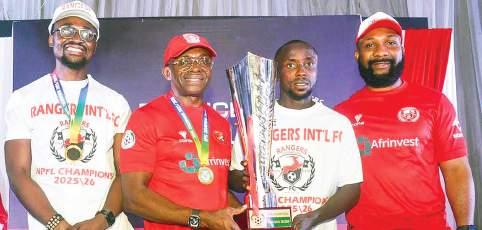
L-R: Chief Executive Officer, Rangers International FC, Amobi Ezeaku; Group Managing Director, Afrinvest West Africa, Dr Ike Chioke; Captain, Rangers International FC, Chidiebere Nwobodo; and Commissioner for Youth and Sports, Enugu State, Lloyd Ike Ekweremadu, during the Rangers International FC post-match reception in Lagos… on Sunday night
Tinubu Felicitates Rangers FC Over Winning NPFL Title Ninth Time
Deji Elumoye in Abuja
President Bola Tinubu has felicitated Rangers International FC of Enugu on winning the Nigeria Premier Football League (NPFL) title for a record equaling ninth time.
The President, in a release issued on Monday by his Special Adviser on Information and Strategy, Bayo Onanuga, congratulated the managers, players,
and fans of the Enugu-based football club for finishing the 2025/2026 NPFL campaign at the top of the table with 68 points from 38 matches, ahead of their closest rival, Rivers United FC.
Tinubu recalled the incredible run of Rangers in the 1970s and 1980s, when the club won multiple league and FA Cup titles, especially in 1975, when they reached the finals of the African Cup of Champions Clubs, and
in 1977, when they won the African Cup Winners’ Cup.
“I must also congratulate Governor Peter Mbah of Enugu State on the victory of Rangers International FC. This victory is an obvious fruit of his administration’s investments in youth and sports in the state. I commend him.
“As one of the oldest clubs in Nigeria, Rangers have produced some of the nation’s finest football players who
went on to make the country proud on the global stage. I am proud of their achievement,” the President said.
Tinubu also commended Rivers United for an excellent performance throughout the season and for demonstrating good sportsmanship.
He wished both Rangers International FC and Rivers United the very best as they represent Nigeria in next season’s CAF Champions League.
GTI Salutes the Flying Antelopes, Commends NPFL Board for Historic Season
Elegbeleye charges winners to represent Nigeria well in CAF competitions
Strategic partners to the Nigeria Premier Football League (NPFL), GTI Asset Management and Trust Limited, have joined millions of football fans across Nigeria and the diaspora in congratulating Rangers International FC of Enugu for emerging champions of the 2025/2026 NPFL season.
In a statement issued on Monday, GTI’s Head of Media and Publicity, Andrew Ekejiuba, praised the Flying Antelopes for securing their ninth league title, describing the achievement as a reflection of resilience, consistency, and the club’s rich football heritage.
He also commended the NPFL Board led by Otunba Gbenga Elegbeleye for its sustained efforts in
repositioning Nigerian football through the creation of a more competitive and commercially attractive league structure capable of restoring fans’ confidence and attracting wider national and international interest.
“The just concluded NPFL season will go down in history as one of the most competitive and exciting campaigns ever witnessed in Nigerian football, with the title race extending to the final day before a winner eventually emerged.
“For GTI, this is a landmark victory for Rangers International and a proud moment for Nigerian football. Winning the league title for the ninth time and equalling the record
held by Enyimba FC is not only a testament to the club’s quality and tradition, but also a clear indication of the growing competitiveness of our elite league.
“We extend our heartfelt congratulations to all 20 clubs that participated in the just concluded season, including those that secured continental tickets and those unfortunately relegated. Next season presents another opportunity for every team to improve and compete more strongly.
“GTI will continue to partner the NPFL as Nigerian football steadily progresses toward greater continental and global relevance, judging by the quality and excitement witnessed
throughout the 2025/2026 season,” Ekejiuba stated.
Meanwhile, Chairman of the NPFL, Otunba Gbenga Elegbeleye, has charged the three clubs that won continental club completion tickets to start earnestly to prepare for the CAF club completions in order to give Nigeria a formidable presence next season.
“The season may have ended, but going to play on the continent means that your preparation starts now.
“I charge you to change the narrative of the recent past to give the country a formidable presence again on the African club completions”, he added.
DEFENDERS: Chibuike Nwaiwu (Trabzonspor AS, Turkey); Igoh Ogbu (Slavia Prague, Czech Republic); Tijani Al Ameen (Shooting Stars); Obinna Igboke (Enugu Rangers); Elias Ochobi (Rivers United); Chibueze Oputa (Enugu Rangers)
MIDFIELDERS: Tochukwu Nnadi (Olympic Marseille, France); Alhassan Yusuf (New England Revolution, USA); Aderemi Adeoye (Ikorodu City); Samson Tijani (FK Dukla Prague, Czech Republic); Ayobami Junior (Shooting Stars); Tosin Oyedokun (Ikorodu City)
Francis Uzoho...expected to wear the captain’s arm band against Zimbabwe tonight
FORWARDS: Philip Otele (Hamburger SV, Germany); Owen Oseni (Plymouth FC, England); Terem Moffi (FC Porto, Portugal); Rafiu Durosinmi (Pisa FC, Italy); Femi Azeez (Millwall FC, England)
Afrinvest Pledges Stronger Partnership with Champions Rangers
Afrinvest West Africa Limited has reaffirmed its commitment to strengthening its partnership with reigning Nigerian Premier Football League champions, Rangers International FC of Enugu, following the club’s historic feat last Sunday.
The financial services firm, which entered into a three-year front-shirt sponsorship agreement with the Flying Antelopes in October 2023, expressed delight over the club’s continued success since the partnership began.
Speaking after Rangers defeated Ikorodu City 2-1 in the final league match to secure the 2025/26 NPFL title, the Group Managing Director of Afrinvest West Africa Limited, Dr Ike Chioke, attributed the club’s achievements to improved player welfare, institutional discipline and financial stability brought by the collaboration.
He said, “We at Afrinvest are particularly proud to be associated with Rangers, and I have seen them lift the cup twice in three years. That says a lot for when finance meets football at its point of need and brings discipline, governance and institutional capacity to support the team and elevate these young men to a platform where they can begin to see themselves on the
global stage and go beyond Nigerian football.”
Chioke noted that the partnership had already begun yielding national recognition for the players, citing two Rangers players who had received invitations to the Nigerian national football team for the Unity Cup in England.
He also advocated broader corporate involvement in Nigerian football and expressed interest in partnering the NPFL to improve the overall structure and management of the domestic league.
“I would like to see Afrinvest partnering with the management of NPFL and bringing some of the values and vision that we have brought into Rangers to the wider league,” he stated.
According to the Enugu Prince, while Nigerian football has improved significantly over the last three seasons, there is still room for growth in areas such as team management, stadium organisation, fan experience, transparency and prize money distribution.
“There has to be equity and fairness in football. We need to bring our local league to international standards. It is that ability to bring transparency and discipline that will attract more corporate sponsorships,” he added.
Top Elite Athletes Arrive for 11th Okpekpe 10km Road Race
Ethiopian star, Lemi Teshome, and Kenyan Fridah Ndinda, are among the top international elite athletes expected to arrive in Lagos on Wednesday en route Auchi for the 11th edition of the World Athletics Gold Label Okpekpe International 10km Road Race scheduled to hold on Saturday, May 30 in Okpekpe, Etsako East Local Government Area of Edo State.
Teshome, who is just 19 years old, is currently ranked as the 11th fastest man over the 10km distance in the world this year, following the blistering 27:17 he ran last month in Lille, France.
He will be aiming to break the Kenyan dominance in the men’s title since 2022, when his compatriot Yasin Haji last won the race.
In the women’s category, Ndinda will be seeking to succeed her compatriot Gladys Kwamboka, who claimed victory in 2024.
Other top elite athletes expected in Lagos include Kenyans Victor Kimosop, Julius Kibowen Kipkwony, and Mazon Kipngetich, who has already broken the 28 minute barrier this year.
Uganda’s Enoch Chebet, Tanzania’s
Jummanne Ngoya and Benjamin Ratsm, as well as Eritrea’s Felicien Muhitira, who clocked 2:06:54 over the full marathon in 2024, are also on the list of international competitors.
For the women, Kenya’s Sharon Chepkemoi and Ethiopia’s Wubrist Aschal are among the elite athletes expected to compete.
On the Nigerian front, men’s defending champion James Musa will be seeking to retain the title he won in 2024, but will face stiff competition from 2023 winner Ismael Sadjo.
In the women’s category, Patience Daylop Mwavwang is aiming for a hat trick of wins after her victories in 2023 and 2024. She will, however, have to contend with multiple champion Deborah Pam Badung, who is seeking a return to the podium as champion for the first time since 2019.
The Okpekpe International 10km Road Race remains a trailblazer in West Africa, being the first road race in the region to be granted a World Athletics Label status and the first in Nigeria to have its course measured by a World Athletics certified course measurer.
charged, and which by its conduct has shown what Nigerians are likely to face in the 2027 elections. In the African Democratic Congress (ADC) there have been two congresses. Dumebi Kachikwu has been declared the Presidential candidate of one faction, even while the David Mark-faction was choosing its own candidate from a list of three: Atiku Abubakar, Rotimi Amaechi and Mohammed Hayatudeen. In the ADC primaries, there were battles and disagreements in Kano, Benue, and Plateau states. In Adamawa in particular, the withdrawal of former Governor, Muhammadu Jibrilla Bindow from the governorship process caused an upset. As at the time of this writing, Atiku Abubakar of the ADC appears to be coasting home to victory in the ADC Presidential Primary in Bauchi, Zamfara, Kaduna, Niger, Kebbi, Abia, Gombe, Sokoto, Enugu states and elsewhere. What next then, for example, for former Governor/Minister Rotimi Amaechi who says he is in the race because he wants to be President? But even the ADC failed the test of simple arithmetic, thus not having the moral right to condemn the rival APC party. It would be interesting to see what happens subsequently in all the other political parties too but one thing is clear: Nigeria’s professional political class is yet to learn any lessons and may never do so. The people are compromised and would rather do the bidding of the highest bidder during political seasons, not minding whatever suffering awaits them in a show of accustomed cynicism
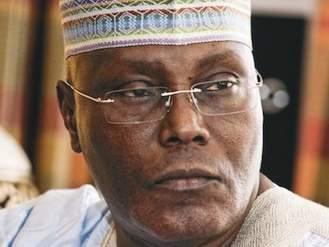
which is the worst thing that can happen to a democratic process. The pundits had predicted voter apathy, but that has not been seen during the primaries across Nigeria. This however does
not guarantee that there will be no apathy during the general elections in 2027. The factions in the ADC and the PDP would soon begin a fresh round of battles, court drama, and defections.
Altogether, the political party primaries on the basis of what has been seen so far is enough reason for concern and anxiety about much of what is to come. The political parties failed their own members. The people failed themselves. A heavy atmosphere of mistrust and anger has been created. They all failed the accountability and integrity test. With President Tinubu’s 11 million votes in the APC, far more than his total votes in the 2023 Presidential election of 8, 805, 475, the suggestion is that he would get more votes in the general election in 2027 out of INEC’s original number of about 94 million voters. Tinubu gained more votes in Imo, Adamawa and Gombe, and scored less in the South West with the exception of Lagos. Look closely, there is already a demonstration effect and an auto suggestion in the strategy. This is without prejudice to the fact that a party primary may not necessarily reflect what happens in a main election which would be guided by competition and other rules of the game: both local and external: in this instance, ethnicity, religion, money, geopolitical external interventions, turn out, institutions and especially, the electoral umpire. The only thing Nigeria has going for it, is its resilience and the people’s endless optimism. Nigeria has a way of drawing close to the precipice and pulling back from the brink at the people’s expense. This pattern may be no different in 2027, when it would be clear that the biggest area in need of reform has been left behind.
Delta Mulls Conversion of 27 Libraries to Community Hubs
Omon-Julius Onabu in Asaba
The Delta state government has disclosed that plans were afoot to convert at least 27 state-owned libraries into community hubs to revive the dwindling reading culture in the state as well as strengthen general literary engagement in schools.
Delta State Head of Service, Dr Mininim Oseji, stated this at the Lightray/Distortion Orientation Festival held at the weekend in Asaba, during which event ‘Project ECHO Chamber’ was inaugurated.
Oseji said that the government remained committed to restoring reading culture and intellectual engagement through the multi-
purpose use of renovated library facilities.
The facilities would serve children, youths, adults, and senior citizens by providing spaces for reading, discussions, and community-based literary activities, she said.
Oseji assured: “Turning our libraries into community halls will benefit the people of Delta of all ages, the children, youth, old and even senior citizens.”
According to her, the initiative was aimed at reducing excessive social media use and encouraging residents to return to reading and literary engagement.
Government and civil society participants also used the occasion
to reflect on nagging structural gaps in youth development, with officials from the Ministry of Justice stressing the importance of instilling values, emotional intelligence, and principles of healthy relationships among adolescents, particularly boys navigating identity formation.
Several participants addressed the discussion around the “boyman crisis” helped them reconsider societal expectations placed on boys, particularly the belief that emotional expression is a sign of weakness.
Nevertheless, organisers described the initiative as more than a festival, but a long-term cultural intervention geared towards reshaping youth identity and
Moniepoint Signs N3bn Innovation Hub Project Across Three Nigerian Varsities
Emma Okonji
Moniepoint yesterday, signed a landmark agreement with three federal universities to build innovation hubs worth N3 billion over the next three years. The universities include Obafemi Awolowo University, Ile-Ife (OAU), the University of Nigeria, Nsukka (UNN), and Ahmadu Bello University, Zaria (ABU).
The agreement, which was signed at the Obafemi Awolowo University, indicated that each of the universities will get N1 billion to build a modern innovation hub onThecampus.signing ceremony was attended by the Co-founder/ Group CEO of Moniepoint, Mr. Tosin Eniolorunda and the ViceChancellors of all three universities, senior leaders from academia and industry, student representatives, alumni, and members of Nigeria’s broader innovation ecosystem.
The three institutions were strategically selected to scale the
impact of the interventions across Nigeria’s geographic regions and each hub will serve as a permanent centre for hands-on training in software engineering, data science, and artificial intelligence; design; robotics; product development; and entrepreneurship.
Open to students across all faculties, the programme will guide participants from curiosity to career readiness through structured, cohort-based learning, mentorship, and real-world project execution.
Speaking on the initiative, Eniolorunda said: “When you look at the success of companies like Moniepoint, it’s easy to forget that it all started with the foundational training we received right here in Nigerian universities.
“This initiative is about paying that trust forward. Nigeria’s digital economy cannot run on potential alone; it requires immense, localized talent density. By launching these Innovation Hubs beginning with OAU, UNN, and ABU Zaria, we are intentionally anchoring world-class
technical skills across the country.
“And this is just the first step as we look across other tertiary institutions. Before we built anything, universities like UNILAG and OAU built people like Felix and I, giving us our first formal training in the disciplines that became our careers.”
Vice Chancellor, Obafemi Awolowo University, Professor Adebayo Simeon Bamire, said: “Obafemi Awolowo University has always stood for excellence, and for the belief that knowledge must serve society. This partnership with Moniepoint Group is a powerful affirmation of that conviction.
“The Moniepoint Innovation Hub will not only expand what our students can learn but also transform what they believe is possible. We are grateful to Moniepoint for choosing to root this investment in our institutions, and we are committed to ensuring that every naira translates into opportunity for our students and for Nigeria.”
value system through literature and structured creative engagement.
Founder of LightRay Media, Lady Ejiro Umukoro, said ‘Phase One of Project ECHO Chamber’, themed “Distortion,” seeks to challenge outdated narratives and amplify young voices.
She said the programme would help to address gender issues, youth development, toxic social influences, human dignity, and self-expression across the state.
Umukoro described the project as a platform for storytelling, ideasharing, and empowering students across all 25 local government areas.
“Project ECHO Chamber is not just an event. It is a movement,”
Umukoro declared, assuring that relevant activities would proceed beyond the maiden festival via book clubs, writer-in-residence schemes, and quarterly student programmes that would amplify the voices of Nigerian students.
Umukoro said that young Nigerians still value reading, but literacy must adapt to modern
communication styles such as spoken word, video, music, and digital storytelling. She described the initiative as a platform promoting literacy, critical thinking, civic participation, and creative expression among students across Delta State.
The event featured “spoken word contests, stage plays, book clubs, book-a-thons, workshops, and a Delta State Book Record attempt”.
Citing Nigeria’s literary giants like Chinua Achebe and Wole Soyinka as examples of writers who transformed society through literature, Umukoro charged students to use writing and storytelling to address social, economic and even political issues bordering on their immediate environment and future.
Umukoro urged literary scholars, authors, teachers and librarians to strive to dismantle obstacles militating against reading culture in order to revitalise reading culture in Nigeria.
She also announced plans for reading-circle campaigns, library awards, teacher training, and literary outreach programmes across schools in Delta.
Also, Curator of Liber Bookclub Asaba, Daluchi Anaka, noted that book clubs have the capacity to “build confidence, critical thinking, and stronger social awareness among members.”
According to him they go a long way in encouraging and assisting members engage intellectually with others and the larger society while driving personal growth vis-a-vis general development of the community, the state and the nation. Anaka said, “Book clubs are not just about building thinkers but also confidence in culture and community.”
Students from participating schools across the state described the programme as impactful, noting that it encouraged them to embrace creativity, better expression of their emotions and building confidence in their abilities.
Asaba Kingdom Honours over 400 Senior Citizens in Historic Ceremony
Omon-Julius Onabu in Asaba
The Delta State capital at the weekend witnessed a historic gathering of more than 400 very senior citizens and indigenes of Asaba for their celebration by the entire Asaba community at the behest of the traditional ruler of Asaba.
The celebration was occasioned by the decision of the Asagba of Asaba, His Royal Majesty, Prof Epiphany Azinge (SAN), to set aside May 23 every year for the formal recognition, appreciation and celebration of senior citizens of Asaba extraction who have attained the respectable age of 80 years and above.
THISDAY observed that the occasion was worth its billing as the maiden edition of the special Elders’
Celebration in Asaba Kingdom of Delta State, in the light of the enthusiastic participation of sons and daughters of Asaba community.
The event, which took place at the Ogwa Ukwu Ahaba in Asaba metropolis, marked the formal inauguration of an annual programme aimed at recognising the contributions of elderly citizens to the social, economic, cultural and historical development of Asaba Kingdom.
Azinge made the proclamation on Saturday at Ogwa Ukwu Ababa, at the maiden event, underscoring the fact that the elders had used their early days of life to serve the community in many diverse and positive ways.
According to Azinge, the idea of celebrating the elders was conceived
in sincere appreciation of the fact that their wise counsel and commitment contributed in guiding and directing the community on a positive and progressive trajectory towards desired greatness.
According to the Asaba monarch, the firm foundation laid by the elders and their legacies could never be ignored or relegated, noting that “some nuances had been applied to certain cultural practices of the past in tandem with the present day realities.”
The Asagba expressed delight that the event also afforded some of the elders the opportunity to reconnect with one another after decades of disconnection, adding that it was a thing of joy to see some of the elders who held sway in their active days.
Former Vice-President Atiku Abubakar
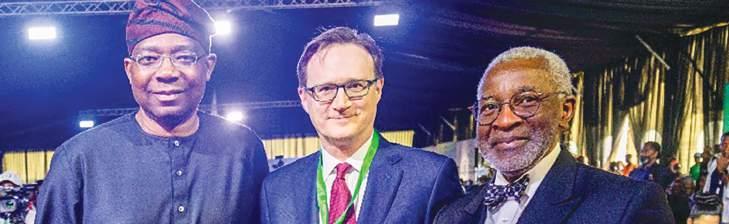
2026 INTERNATIONAL CIVIL SERVICE CONFERENCE...
L–R: Chairman, Aig-Imoukhuede Foundation; Aigboje Aig-Imoukhuede, British High Commissioner to Nigeria, Richard Montgomery and Founder and Chairman, Phillips Consulting Limited (PCL), Folusho Philips, at the 2026 International Civil Service Conference held at Eagle Square in Abuja ... recently
TUESDAY WITH REUBEN ABATI

Party Primaries And Accountability
When the Electoral Act 2026 was passed into law in February 2026, the expectation was that it would be the deus ex machina (the fool-proof, mechanical, solution as in complex Greek tragedies of old) to Nigeria’s electoral problems since the return to civilian rule in 1999, but the newest law merely followed the old pattern, incomplete and inadequate in its provisions, suspicious in terms of its intentions, creating fresh problems of its own, and proving that there is apparently no definite solution to Nigeria’s electoral problems. By this time next year, there can be no doubt that we would be talking about another round of electoral reform, and that still won’t solve our problems with elections because it is now clear that it is not laws that create credible and transparent elections, or democracy. The problem is with the people, the institutions, the processes and the politicians themselves. There is no law, no matter how well framed that Nigerians cannot sabotage, compromise, violate. And we need not seek further afield for proof than the recent, and on-going party primaries in the political parties participating in the 2027 electoral process. What we see is that our politicians have not learnt any lessons. They are not ready to change. Nigeria is a victim of personal ambitions and the greed for power. Nigeria is one country that is resistant to reform even when the incumbent administration mouths reform as a slogan and definitive banner. We must be worried that Nigeria’s 2027 process may end up as a big gamble, where it is the smartest, the most privileged, the most devious that will run away with a special form of calculated elite enrichment, and privilege, while we the people, would have absolutely no input. The game is on, and I have argued elsewhere that President Bola Ahmed Tinubu is emerging as the owner of the game, not because his party, the All Progressives Congress (APC) is the very best, or the ruling party, but because he has used the power of incumbency to create the impression of a swirling momentum that wrongfoots every other political party – 20 additional ones. I have also argued that a Bola Ahmed Tinubu School of Politics and Strategy is in the making before our very eyes. You will have to ask me about the values, the motivations and the curriculum of that school, but that is not the primary purpose of this commentary and you might as well provide your own answers. In the past few days, we have been having party primaries ahead of the January 2027 elections – the PDP, the APC, and the ADC, other parties are bound to follow. Despite a
recent court judgement from the Federal High Court of Justice Mohammad G. Umar, sitting in Abuja, which nullified INEC’s membership deadline, parties are expected to conclude their nomination processes by May 30, and for now the parties are complying with the status quo ante bellum (nobody knows exactly what storm will come after), but for now, the APC has concluded its primaries by May 23, the Peoples Democratic party will follow by May 26, the Labour party on May 29, the NNPP by May 26, the Social Democratic Party (SDP) and the African Democratic Congress (ADC) by May 28. But what have we seen so far? Protests. Confusion. Violence. Intra-party crises. Fears and anxieties about the 2027 process and a reaffirmation of the opening suggestion that Nigeria is a country in search of citizens and patriots. With elite competition reduced to selfish interests, this is a country that is groaning in pain. The people do not matter and the people are their own problems too. How did we end up with this lot who would willingly and gladly trade off their own happiness, so cynically, so carelessly? Hunger? Apathy? Cynicism? Resignation? Acquiescence?
On Saturday, President Bola Ahmed Tinubu and his ever-supportive wife, Senator Remi Tinubu took part in the APC Presidential Primary at Ward E in Ikoyi, Lagos State. He was in town throughout the APC primaries in Lagos, by the way, and has done his best so far not to disrupt traffic, except for some indigent APC supporters who have taken over the frontage of his Bourdillon Street house, and there are so many of them, arriving in buses and with walking sticks, in anticipation of Sallah gifts.
The poor are perpetually begging for food to eat – a sign of the times. They should be attended to promptly and sent off. The President on voting day was said to have described the APC primaries as “peaceful and well-organized,” good evidence of “internal democracy” within the APC, and that he is “very satisfied” with the performance of the state governors from congresses to local government accreditation, membership registration, and delegates accreditation. He scored democracy at a high level and said: “I’m just excited. They challenge me more”. Those reportedly challenging him are his supporters within the APC. With about 31 Governors and the Minister of the Federal Capital Territory, a political amphibian called Nyesom Wike (part PDP, part APC) supporting him, President Bola Tinubu recorded a landslide victory in his party’s presidential primaries. This was expected. It is now certain that President Tinubu will run for a second term and that he is the choice of his party in a landslide victory. The plan by opposition parties to come together and field a single candidate collapsed long ago – another master stroke by President Tinubu.
The APC Presidential primaries took place in 8, 809 wards across 36 states and the FCT. Tinubu won with 10, 999, 967 votes as announced by Senator Pius Anyim Anyim at the Tinubu International Conference Centre in Abuja on Sunday, May 23. They didn’t choose the Eagle Square. The announcement had to be in a building named after Tinubu himself!. To lend the entire process a veneer of legitimacy, competition and credibility, Tinubu was challenged by a relatively unknown Stanley Osifo from Edo State, described in one report as an “obscure businessman”. President Tinubu scored about 11 million votes, Osifo got a meagre 16, 504 votes, and in actual fact, he had zero votes in quite a number of states - Kwara, Ebonyi, Gombe, Sokoto, Rivers, Edo, Delta and Kogi. I consider him a man of courage. He is very bold indeed. He, Stanley Osifo, actually believed that he could challenge President Tinubu. He should be rewarded for his unique sense of humour and self-deprecation. He paid N100 million into APC coffers for the Presidential contest. I think, I am serious, I am actually not joking, he should be given a refund, and if the party is not willing, President Tinubu should appreciate him. It takes some courage for a man in whom blood flows to embrace an exercise in such futility, if not open stupidity, with such brazenness.
But this is not just about Osifo. There were other APC members who left their former parties and joined the APC, in the expectation that they would get due rewards. Many of them
were disappointed. They lost out. Before the primaries, the APC had 242 members in the House of Representatives, and 88 Senators. Over 70 of these persons are not going to be part of the 2027 process. 14 key APC Senators failed to secure return tickets. They were either screened out, outsmarted or defeated. Dr. Ajibola Bashiru, Secretary General of the APC had said all results would be declared centrally from the party secretariat. Nobody listened to him. The results were collated and announced on site. Many of the losers have appealed the outcome, to the party’s administrative system for that purpose, but even when a recent ruling says they can move to other parties till September 2026 because INEC acted ultra vires with regard to Section 29(1) of the Electoral Act, they should not get over-excited. INEC is determined to challenge Justice Umar’s judgment. President Tinubu said the primaries were “peaceful and well organized.” That is not true. The APC primaries were marked by protests, cash inducement and violence. In Ondo Central, for example, Senator Adeniyi Adegbonmire almost lost life at Okilisa Ward 5 in Akure when gunmen hijacked the process. Many party members are also aggrieved. In Rivers State, Gov. Simi Fubara was screened out because he fell out of favour with a Godfather who is not even a member of the APC, but a friend of the APC President. In Surulere Constituency 1 in Lagos, Desmond Elliot has been weeping inconsolably because his local Godfather said he had to be replaced, and so it has been decided. On another note, seven serving Governors and 12 former Governors are planning to go to the Senate on the platform of the APC, a reminder once again that the Senate has become a retirement home for tired Governors who have nothing else to do with their lives. The process is available for the aggrieved to file petitions and many have done so, five so far from Delta state, but the truth is that many APC members have lost faith in the party’s system. In the course of the APC primaries, the officiating teams could not even count properly. There were no registers, no proper checks, party members just showed up and the officiating personnel just jumped from No 1, 11, 20, to 1, 000, 5, 000 in defiance of all known rules of elementary arithmetic. The Electoral Act 2026, at Section 84(2) prescribes consensus and direct primaries to avoid the menace of selected party delegates, and open up the process, but even this new formula is openly fraudulent. But it is not just the APC that is guilty as
President Bola Tinubu