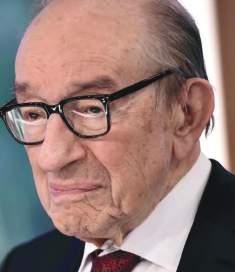
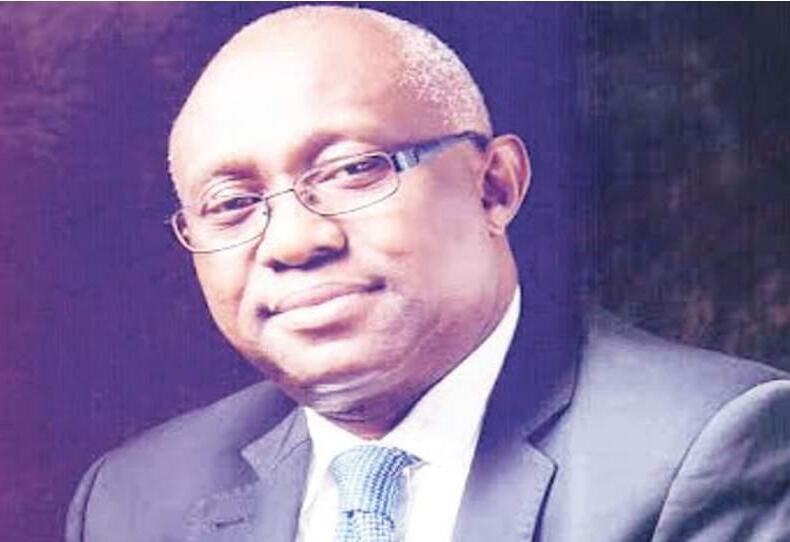
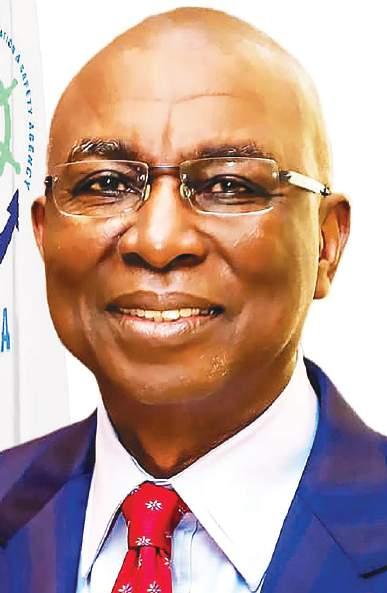
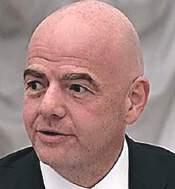
Alan Greenspan, Architect of Modern American Economy, Dies at 100
Emmanuel Addeh in Abuja
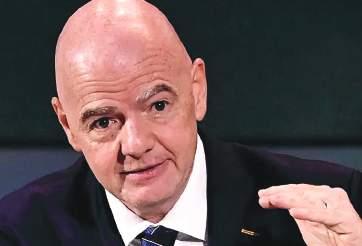
Former US Federal Reserve Chair, Alan Greenspan, died aged 100 yesterday from complications
www.thisdaylive.com
of Parkinson’s Disease, his wife, Mitchell, an NBC News Correspondent said in a statement. Mitchell’s statement said Greenspan was “a giant of a man who
helped shape the US economy for decades under presidents of both parties, but was always honest in acknowledging his mistakes”. For nearly 20 years, Alan
Greenspan was charged with safeguarding the US economy and keeping the dollar sound. As chairman of the Federal Reserve from 1987-2006, a post described
as the second most important after the presidency, he presided over the longest sustained period of US economic growth in a generation.
Described as the “God in the
machine” of American finance, Greenspan declined all requests for interviews during his time at
Continued on
Police Assure Lagos of Safety, Security, Despite Bomb Explosion in Mushin Market
No retreat, no surrender in fight against
Segun James Lagos State Police Command has assured residents of the state of safety and security following a bomb explosion at a busy market in Mushin, a key commercial part of the state. Commissioner of Police, Mr Fatai Tijani, assured residents that the area remained safe. The assurance came as Inspec-
Obi: Tinubu Should Follow Starmer’s
Continued on page 8
Presidency: Your Call Childish, Misplaced, Undemocratic
Emmanuel Addeh, Chuks Okocha and Emmanuel Addeh in Abuja
Former Governor of Anambra state and Nigeria Democratic Congress (NDC) presidential candidate in the 2027 election, Peter Obi, yesterday urged President Bola Tinubu to take a cue from British Prime Minister, Keir Starmer, and step down from office, arguing that the current administration has failed to meet Nigerians’ expectations amid worsening economic and social conditions.
But the Presidency swiftly dismissed Obi’s remarks, describing the call for Tinubu’s resignation as childish, misplaced and undemocratic, insisting that the president was elected through a constitutional process and would continue to pursue his mandate while addressing the country’s economic and governance challenges.
EXPANDING AFRICA’S REFINING CAPACITY AND SUPPORTING INDUSTRIAL GROWTH ON THEIR MINDS...
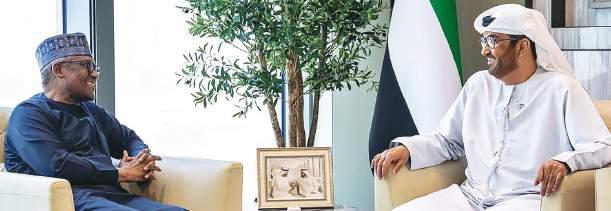
L-R: President/Founder, Dangote Group Alhaji Aliko Dangote and Chief Executive of ADNOC Group, Dr Sultan Ahmed Al-Jaber during Dangote’s visit to ADNOC Headquarters in Abu Dhabi, where they discussed opportunities to expand Africa’s refining capacity and supporting industrial growth. Through partnership and investment … yesterday Continued on page 8
SIGNING CEREMONY BETWEEN WEMA BANK AND EIB GLOBAL...
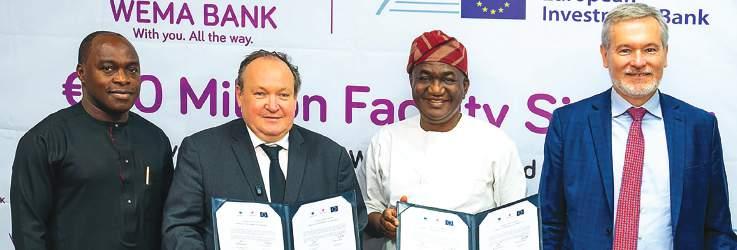
L-R: Executive Director, Corporate, Global Markets Division and North Bank, Wema Bank PLC, Olukayode Bakare; Vice President of European Investment Bank, Ambroise Fayolle; Deputy Managing Director, Wema Bank PLC, Oluwole Ajimisinmi and EU Ambassador to Nigeria and ECOWAS, Gautier Mignot, at the official signing ceremony of a
Naira) SME facility dedicated to youth and women-focused businesses in Nigeria Between Wema
Ekpo: Govt committed to lowering cooking gas rates, vows stricter monitoring NMDPRA moves to bridge projected 165,000MT Q3 shortfall with additional import licences Warns against non-compliance with domestic obligation NALPGAM decries profiteering by middlemen
The federal government yesterday convened an emergency stakeholders’ meeting on the rising price of cooking gas, stressing that key security agencies, including the Department of State Services (DSS), the Economic and Financial Crimes Commission (EFCC) and the Nigeria Police Force, will be involved in tackling product diversion, hoarding, speculative storage and other market practices blamed for escalating prices.
At the meeting in Abuja, the Minister of State for Petroleum Resources (Gas), Ekperikpe Ekpo, said the government remained committed to ensuring moderate cooking gas prices and improving access to cleaner energy for households, stressing that Nigeria’s gas resources must first serve domestic consumers.
The intervention came as the Nigerian Midstream and Downstream Petroleum Regulatory Authority (NMDPRA) said it was putting plans
in place to mitigate the projected supply shortfall of about 165,000 metric tonnes in the third quarter of 2026.
Besides, it warned operators against violating domestic gas supply obligations amid growing concerns over availability and affordability.
Ekpo noted that improved supply alone would not resolve current challenges unless accompanied by efficient distribution and responsible market conduct, identifying hoarding, allocation inefficiencies, logistics constraints, speculative storage and pricing distortions as major impediments to market stability.
Consequently, Ekpo directed the NMDPRA to intensify market surveillance, engage operators across the value chain and collaborate with security agencies to eliminate artificial scarcity, discourage hoarding and strengthen transparency in product distribution and pricing.
The minister stated that there was the need to involve the security agen-
cies in the sector to ensure the return of sanity. “Security agencies (DG DSS, Chairman EFCC, IG Nigerian Police Force: (will) support regulators in preventing diversion, hoarding, illegal storage, and disruption of legitimate supply movement along key LPG corridors,” he stated.
According to him, improved supply must be matched by efficient distribution and responsible conduct, insisting that bottlenecks, hoarding, speculative storage, allocation inefficiencies, logistics constraints, and pricing distortions must not undermine public confidence.
In the immediate term, he ex-
plained that marketers have indicated readiness to increase imports where necessary, while expected deliveries from new domestic facilities, including the Seplat gas facility, will support supply in the coming weeks.
“We are also exploring a local blending initiative with Nigeria LNG Limited, local producers, and the Port Harcourt plant operator to move locally produced LPG closer to the market, reduce import pressure and logistics costs, improve reliability, and support more stable pricing,” the minister assured.
Closing the session, the minister directed that producers and domestic
suppliers must prioritise the Nigerian market, provide reliable supply forecasts, and ensure that domestic allocations reach consumers without diversion or delay.
Besides, he instructed that depot owners and terminal operators should publish clear loading schedules, report stock and evacuation levels, treat marketers fairly, and improve truck turnaround time.
“Marketers and importers (must) bring in additional volumes where required, share arrival and discharge timelines, price responsibly, and avoid withholding product for speculative gain (while) transporters and logistics
operators (must) increase truck availability, clear delivery bottlenecks, keep haulage costs transparent, and move product quickly to areas of high demand,” he instructed.
As for retailers and plant operators, the minister maintained that they must display prices clearly, avoid arbitrary increases, maintain safe dispensing practices, and report supply disruptions promptly. He also urged consumer protection and public communication agencies to keep the public informed, provide reporting channels, counter misinformation, and promote safe LPG handling practices.
Diaspora Nigerians: Contactless Passport Renewal Ends Years of Frustration as Processing Time Drops to Five Days
NLNG Announces Graduation of 70 Professionals from Train 7 Programme
Total number of beneficiaries rises to 401
Emmanuel Addeh in Abuja and
Blessing Ibunge in Port Harcourt
Seventy young professionals have graduated from the NLNG Train 7 project human capacity development basic training programme, completing an intensive one-year programme in Data Analysis and Supply Chain Management, the company announced yesterday.
The milestone, according to the company, underscores NLNG’s commitment to developing a skilled, industry-ready workforce and strengthening Nigeria’s capacity to compete in an increasingly dynamic global energy sector.
Beyond their core specialisations, a statement by the company said
the graduates received practical exposure in key oil and gas support areas, including health, safety and environment, business management, information technology, document management, Nigerian content awareness, among others.
Speaking at the close-out ceremony, NLNG’s General Manager, External Relations & Sustainable Development, Sophia Horsfall, stated that the successful completion of the 12-month programme demonstrated what strategic investment in human capacity can achieve. She noted that the graduates had been equipped with the professional intellect, discipline, and character required to contribute meaningfully
to their chosen fields. She charged them to see themselves as products of a national investment and to apply their skills with integrity, precision, and excellence.
“You started this journey as candidates, and today, we are showing you off as professionals. From here, I urge you to continue to demonstrate the discipline you have learnt and never forget that you are the dividends of a national investment,” she said.
Project Director, NLNG Train 7 Project, Ali Uwais, an engineer, stated that the programme showed the strength of NLNG and NCDMB’s collaboration in closing critical competency gaps in the oil and gas industry.
government’s contactless passport renewal initiative, saying the reform has effectively ended years of frustrating delays and cumbersome procedures that previously forced applicants to wait for months and travel long distances to renew their passports.
The diaspora community said the digital system, introduced by Federal Ministry of Interior and Nigerian Immigration Service (NIS), has cut passport processing time from more than six months to between five days and two weeks, enabling Nigerians abroad to complete renewals from the comfort of their homes and receive their passports by mail.
The contactless passport renewal system, first launched for Nigerians in Canada and later extended to the United Kingdom and other countries, allows eligible citizens to submit applications and biometric details remotely through a dedicated mobile application, eliminating the need for physical appearances at Nigerian missions abroad for renewals.
A Nigerian community leader in Birmingham, Timileyin Gbenga, who experienced both the old and new systems, described the difference as “night and day”.
Gbenga said, “I had to travel from Birmingham to London to the Nigerian High Commission for biometrics and from the time I applied online to when I got my passport, it took more than six months. But when I used the contactless process for a family member, it took less than two weeks from application to delivery.”
He attributed the transformation to the reforms spearheaded by Minister of Interior, Dr. Olubunmi Tunji-Ojo, under the administration of President Bola Tinubu.
“That is the change we are all looking for. We need to appreciate this initiative and the reforms,” he said.
Another UK-based Nigerian, Gbenga Ogunderu, said the initiative marked Nigeria’s transition from an outdated, analogue system to a technology-driven service delivery model.
Ogunderu said, “A couple of years ago, we were experiencing a very funny process - analogue and backward. But now you can stay in the comfort of your home, make applications and get your passport at your doorstep without stress. Within just two weeks, I had my passport. That is what technology
and innovation do.”
A senior lecturer in artificial intelligence and data analytics at Coventry University and president of Nigerians living in Coventry, Dr. Adekunle Shonola, said the reform represented a major leap in efficiency. Shonola stated, “I remember when we used to travel all the way from Coventry to London just to capture biometrics and then go back again to collect our passports. It usually took more than six months. Nowadays, I have seen members of our community get their passports within one week.”
Shonola, who holds both Nigerian and British citizenships, said Nigeria’s passport renewal process was now comparable to what obtained in advanced countries.
“The Nigerian government, in terms of obtaining passports, has been able to level up with the UK and the Western world in that regard. This is a very welcome development,” he added.
An automation engineer with Royal Mail and management staff member of the Nigerian community in Coventry, Engineer Rufus Idowu, said some Nigerians had received their passports within five days.
Emmanuel Addeh in Abuja
Michael Olugbode in Abuja Nigerians living in the United Kingdom have hailed the federal
UNVEILING OF A NEW CORPORATE IDENTITY HBM NIGERIA PLC...
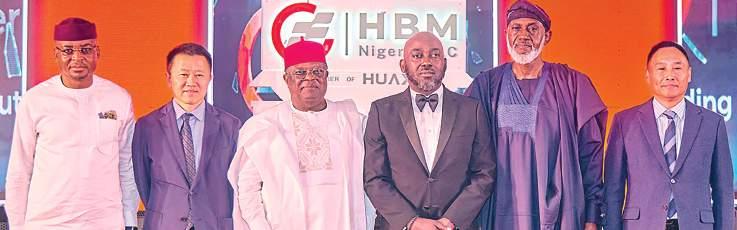
L-R: Deputy Governor, Cross River State, Rt. Hon. Peter Odey; Vice President, Procurement, Logistics, Overseas Trade, Digital Innovation Center, Huaxin, Mr. Wang Jiajun; Minister of Works, Senator Dave Umahi; Group Managing Director/Chief Executive Officer, HBM Nigeria Plc, Mr. Lolu Alade-Akinyemi; Chairman, HBM Nigeria Plc, Mr. Gbenga Oyebode, and Vice President, Overseas Operation, Project, Huaxin, Mr.Tang Jun, during the unveiling of a new corporate identity and change of name to HBM Nigeria Plc(formerly Lafarge Africa Plc) and held in Lagos on Sunday
OPay Drives Financial Inclusion as Nigeria Targets 95% Access by 2028
Sunday Ehigiator
As Nigeria targets approximately 95 per cent financial inclusion by 2028 under Payment System Vision (PSV) 2028 of Central Bank of Nigeria (CBN), fintech company, OPay, is increasingly being recognised as a key enabler of the country’s drive towards a more inclusive and digitally connected economy.
CBN recently unveiled PSV 2028, a comprehensive framework, under the core message, “Empowering People, Connecting Markets, Growing the Economy,” designed to strengthen Nigeria’s
payment ecosystem through enhanced infrastructure, innovation, interoperability, security, and financial inclusion.
At the heart of the vision is the recognition that payments have evolved beyond simple transactions to become a critical infrastructure that supports commerce, entrepreneurship, economic participation, and national development.
Nigeria’s financial services sector has undergone a significant transformation in recent years, moving away from a system largely dependent on traditional banking halls and branch networks
towards one increasingly driven by digital channels.
Tens of millions of Nigerians now rely on digital payment platforms to transfer money, settle bills, receive salaries, purchase goods and services, and conduct business activities without visiting a bank branch.
Industry stakeholders note that technology-driven financial institutions have played a pivotal role in driving this transition, with OPay emerging as one of the companies helping to build the digital infrastructure underpinning the country’s growing economy.
According to analysts, OPay’s
Tinubu Renews Hope
contributions extend beyond facilitating transactions to include advancing financial inclusion, supporting innovation, creating economic opportunities, and strengthening Nigeria’s broader financial ecosystem.
The PSV 2028 framework identifies robust payment infrastructure as a critical requirement for a modern economy, emphasising seamless connectivity among banks, fintech companies, mobile money operators, and payment service providers to ensure reliable, real-time transactions and improved customer experiences. Through sustained invest-
for FCT Satellite Towns, Says Era of Neglecting Suburbs Over
Deji Elumoye in Abuja
President Bola Tinubu on Monday declared that the era of neglecting suburbs of the Federal Capital Territory (FCT) was over under his government’s Renewed Hope Agenda (RHA).
According to him, the Renewed Hope Agenda is his administration’s sacred covenant with the Nigerian people.
The president recalled that he had promised that governance would no longer be a theoretical exercise confined to the boardrooms of city centres while residents in the periphery thirsted for basic amenities.
Speaking in Kurudu, Abuja, when he officially inaugurated the massive Water Supply Network linking Karu, Orozo, Jikwoyi, Kurudu and other adjourning satellite towns, Tinubu, who was represented by Vice President Kashim Shettima, said he “promised a government that listens, a government that plans, and, crucially, a government that delivers”.
He expressed a deep sense of fulfilment and gratitude to God, stating that the massive water supply network is a fulfilment of that promise.
The president stated, “We are here not just to cut a ribbon, but to breathe life into a fundamental human right that has eluded this bustling community for far too long.
“Today, we declare that the era of neglect for our satellite towns is officially over.”
He recalled that just about a year ago, when his administration inaugurated the Greater Abuja Water Supply Project, he stood before the nation and gave a clear directive.
“The metropolitan loops must not end in the elite districts. They must stretch. They must expand into our satellite towns, where the heartbeat of Abuja’s working-class population truly resides,” he recalled.
Tinubu said when the FCT minister, Nyesom Wike, brought the proposal for the Karu Water Supply Project, he did not hesitate, adding that his administration knows that water is life, and that denying people clean water amounts to denying them health, dignity, and economic progress.
To demonstrate government’s unwavering commitment, Tinubu said the government did not allow the traditional shackles of bureaucratic delay to obstruct funding, as payments were approved on time
and the contractor, CGC Nigeria Limited, delivered promptly.
He stated, “And today, we are commissioning over 194 kilometres of secondary and tertiary pipeline networks, bringing treated, safe, and potable water directly to the doorsteps of Karu, Orozo, Jikwoyi, Kurudu, and surrounding communities.”
The president commended the FCT minister for delivering, stressing that leadership is not measured by the eloquence of television commentary or the bitterness of empty rhetoric, but by its tangible and verifiable impact on the lives of ordinary citizens.
Tinubu stated, “Distinguished ladies and gentlemen, what we are witnessing in the FCT today—across transport, healthcare, education, housing, roads, and now massive water infrastructure—is a testament to what happens when vision meets executive capacity.
“Thank you, ‘Mr Projects,’ for your leadership.”
Tinubu regretted that for decades, while residents of Karu watched their community grow into a thriving and teeming population, they were left to depend on unsafe boreholes and water vendors.
He added that previous administrations left promises in their wake,
saying his administration “does not trade in promises” but results.
Charging the people of Karu, Jikwoyi, and other surrounding communities on infrastructure maintenance, the president said, “This infrastructure belongs to you. It was built with your commonwealth and designed for your well-being.
ments in technology, payment infrastructure, and service reliability, OPay has helped tens of millions of Nigerians gain easier access to formal financial services. Customers can transfer funds, pay utility bills, purchase airtime and data, access merchant payment solutions, and perform various financial transactions from virtually anywhere in the country.
Observers say digital payments have increasingly become an everyday utility for many Nigerians, playing a role comparable to telecommunications and transportation in supporting daily life and economic activities.
A major pillar of the PSV 2028 strategy is expanding financial inclusion. To achieve the target of approximately 95 per cent financial inclusion by 2028, the framework prioritises broader digital banking access, increased mobile money adoption, expanded agency banking networks, simplified customer onboarding, and deeper penetration into underserved communities.
Despite progress in recent years, millions of Nigerians, particularly in rural and remote areas, still face barriers to accessing formal financial services. Stakeholders view this as one of the country’s most pressing economic development challenges.
OPay’s operating model has been built around addressing this gap. By combining digital technology with an extensive network of agents and merchants nationwide, the company has expanded access to financial services for individuals and businesses that previously operated on the margins of the formal financial system.
The extensive network enables customers to access essential financial services in their communities, eliminating the need for long, costly trips to bank branches. Analysts say this approach has significantly improved convenience, lowered barriers to financial access, and extended services into historically underserved areas.
Experts stress that financial inclusion extends beyond opening accounts. It also involves empowering individuals to participate actively in economic life through secure payments, savings, business transactions, and access to digital financial services.
The PSV 2028 framework also places considerable emphasis on innovation as a driver of growth within the financial sector. Open banking, digital identity integration, artificial intelligence, emerging technologies, and a stronger fintech ecosystem are among the key areas highlighted in the strategy.
Wema Bank, EIB Global Seal €50m Deal to Boost SMEs, Youth, Women
Bennett Oghifo
Wema Bank has entered into a €50 million (N78.5 billion) financing agreement with the European Investment Bank’s development arm, EIB Global, to expand access to credit for small and medium-sized enterprises (SMEs), with a focus on women- and youth-owned businesses.
The agreement was signed recently at the bank’s headquarters in Lagos, marking the first transaction between EIB Global and Wema Bank, according to a statement yesterday.
According to both institutions, the facility was aimed at supporting eligible businesses across Nigeria,
with at least 50 per cent of the loans earmarked for youth-owned enterprises to promote entrepreneurship, job creation and inclusive economic growth.
The remaining 50 per cent would target businesses owned, managed, employing or primarily serving women.
The initiative is backed by the European Union’s Global Gateway programme and is aligned with Nigeria’s Financial Inclusion Strategy.
In addition to the credit line, EIB Global said it would provide technical assistance to Wema Bank through its Greening the Financial Sector (GFS) Programme.
The support was intended to
strengthen climate-related lending practices and promote environmentally sustainable investments.
Beneficiaries of the fund, according to the statement, would include Wema Bank customers with qualifying businesses, as well as graduates of selected accelerator programmes, including the Investing in Young Businesses in Africa (IYBA) initiative, a Team Europe programme focused on supporting young entrepreneurs, particularly women and youths. Speaking at the signing ceremony, EIB Vice President, Ambroise Fayolle, was quoted to have described the agreement as a step towards promoting youth employment and gender inclusion in Nigeria.
INAUGURATION CEREMONY OF PHARMA GRADE WAREHOUSE...
L-R: Commissioner for Health, Dr. Tomi Coker; Country Portfolio Manager, Global Fund, Dr. Jean-Thomas; Secretary to the Ogun State Government, Mr. Tokunbo Talabi; Executive Director, Global Fund, Mr. Peter Sands; and Ogun State Governor, Prince Dapo Abiodun, during the official inauguration ceremony of the Pharma Grade Warehouse, Oke Mosan, Abeokuta... recently
Dele Oye: FG Retained N1.1 Trillion Before Sharing May FAAC Allocation
Alleges distortion of fiscal federalism Advocates mandatory 10% savings into Sovereign Wealth Fund before distribution
James Emejo in Abuja
Chairman, Alliance for Economic Research and Ethics (AERE), Mr. Dele Oye, yesterday accused the federal government of retaining about N1.1 trillion from the federation account before disbursing the May 2026 Federation Account Allocation Committee (FAAC) revenue to other tiers of government.
Oye described the development as a major distortion of fiscal federalism, and stated that the federal authorities effectively appropriated 32 per cent of total federation revenue at source before sharing the balance among the three tiers of government.
He said FAAC records showed that although the federation generated gross revenue of N3.40 trillion in May 2026, only N2.30 trillion, representing about 68 per cent of the total, was eventually distributed to the federal, states and local governments.
He said the remaining N1.10 trillion was deducted upfront through various intervention and statutory obligations, thereby reducing the amount available to subnational governments.
Oye said the scale of deductions further entrenched fiscal centralisation and weakened the financial capacity of states and local government councils.
In a statement, he stated, “Of the gross revenue, only N2.30 trillion (68 per cent) was distributed among the
three tiers of government, while N1.10 trillion (32 per cent) was deducted at source.
“This high deduction rate, driven primarily by intervention funds, effectively recentralises fiscal resources and constrains subnational fiscal capacity.”
He also proposed a mandatory savings threshold of between five and 10 per cent of gross federation revenue to be channelled into the Sovereign Wealth Fund before distribution.
The economist said the federal government’s influence over federation revenues extended beyond its direct allocation from the distributable pool, given its control over the administration of intervention funds and other deductions.
He stated that while the federal government officially received N818.68 billion, representing 35.4 per cent of distributable revenue, its effective fiscal control was considerably higher when the deducted funds were taken into account.
Oye said, “The federal government’s direct allocation of 35.4 per cent represents only part of its fiscal command. When combined with its administrative control over the N1.10 trillion in deductions, particularly the substantial intervention funds, the central government effectively manages a significantly larger share of the nation’s gross revenue.”
Data from the May FAAC disbursement showed that states received N759.14 billion or 33 per cent of the distributable pool, while the 774 local government councils shared N534.28 billion, representing 23.2 per cent. Oil-producing states also received N188.13 billion as 13 per cent derivation revenue.
Oye particularly drew attention to the N500 billion National Security Emergency Fund, which accounted for the largest component of the deductions.
He said the allocation underscored the enormous fiscal burden posed
by insecurity, stating that the security fund alone is nearly equivalent to the total amount shared by all local governments in the country.
He said the vertical allocation of the N2.30 trillion distributable revenue “underscores structural imbalances in Nigeria’s fiscal federalism”, adding that “the distribution formula continues to heavily favour the centre, even before accounting for federal control over pre-distribution deductions”.
Despite the apparent month-onmonth revenue growth of 6.9 per cent, Oye warned that Nigeria’s fiscal position remained fragile, pointing
to major budget shortfalls across key revenue streams, including a 51 per cent underperformance in mineral revenue and declining Value Added Tax (VAT) collections.
He said the eight per cent drop in VAT receipts was particularly concerning as it signalled weakening consumer demand and reduced household purchasing power amid ongoing inflationary pressures.
The report also criticised the federation’s low savings culture. It said only N50 billion, or 1.5 percent of gross revenue, was saved during the period, a level it described as
inadequate for building buffers against future economic shocks.
Oye said mineral revenues underperformed budget expectations by as much as 51 per cent, while VAT collections declined by eight per cent during the period.
The group called for sweeping reforms to strengthen transparency, accountability, and fiscal sustainability.
Among other recommendations, the group urged the federal government to place statutory limits on predistribution deductions from federation revenue and subject intervention funds to stricter legislative oversight.
Lebara Expands into Digital Entertainment for Nigerian Telecom Users with LebaraPlay
Sunday Okobi
Nigeria’s telecommunications landscape has become increasingly competitive, with global telecoms brand Lebara moving to distinguish itself by offering consumers/ subscribers more than just voice and data services with its launch of LebaraPlay, a mobile-first digital entertainment platform. With a heritage spanning some of the world’s most advanced telecommunications markets,
Tinubu Pays Glowing Tribute to Emir of Lafia, Justice Sidi Bage, At 70
Describes him as an exceptional jurist and revered traditional ruler
Deji Elumoye in Abuja
President Bola Tinubu has paid glowing tribute to Emir of Lafia and Chairman of Nasarawa Stare Council of Chiefs, Justice Dauda Bage Muhammad 1 as he clocks 70. Tinubu described the monarch as an exceptional jurist and highly respected first class traditional ruler. He also appreciated the emir for the support, friendship and spirit of camaraderie extended to him over the years.
Tinubu, in the 11-paragraph tribute stated, “Today, I pay a special tribute to His Royal Highness, Justice Sidi Dauda Bage Muhammad 1, Emir of Lafia and Chairman, Nasarawa State Council of Chiefs, on his 70th birthday on June 22, 2026.
“You are an exceptional jurist and a revered traditional ruler. Your distinguished legal career took you from serving as a Judge of the High Court, to a Justice of the Court of Appeal, and ultimately to the pinnacle of the judiciary as a Justice of the Supreme Court.
“Just as your service in the judiciary was marked by excellence, so too has your reign on the throne of Lafia, now in its seventh year, been remarkable for its achievement.
“Your ascension to the throne of your forebears as the 17th Emir of Lafia on March 26, 2019, was historic in many respects.
“You succeeded Dr Isa Mustapha Agwai, the 16th Emir, who was one of the longest-serving traditional rulers in the country, reigning for over 44 years.
including the United Kingdom, Saudi Arabia, France, Germany, Spain, Switzerland, the Netherlands, Denmark, and Australia, Lebara Nigeria is gradually moving to redefine customer experience in Africa’s largest telecom market.
The company signalled a broader strategy aimed at transforming how consumers interacted with telecommunications brands with its latest offering, LebaraPlay, a mobile-first digital entertainment platform.
Rather than limiting its role to connectivity services, Lebara management stated that it was positioning as a lifestyle and digital services provider capable of delivering value across multiple touchpoints.
The management of the company said at an event yesterday, “For millions of Nigerian consumers who increasingly rely on their mobile devices for communication, entertainment, business, education, and social engagement, the move represents a shift toward a more integrated digital experience.
“Telecommunications companies worldwide are increasingly evolving into digital ecosystem providers, offering entertainment, financial services, content platforms, and other value-added solutions. Lebara’s Nigerian expansion appears to be following this global trend.”
The launch of LebaraPlay introduces premium micro-drama content, music, lifestyle programming, and
other mobile-friendly entertainment options accessible to both Lebara subscribers and non-subscribers.
The platform is designed to meet the growing appetite among young Nigerians for short-form, on-demand content consumed primarily through smartphones.
Speaking on the company’s vision at the launch, Lebara Nigeria Chief Executive Officer, Teniola Stuffman, said the organisation was focused on building a telecommunications ecosystem that combined innovation, connectivity, and customer-centric digital experiences.
Stuffman said, “This platform represents an important step in our vision of building a telecom- munications brand that delivers more than connectivity. We are creating an ecosystem where technology, innovation, and entertainment come together to provide meaningful experiences for customers while unlocking new opportunities for creative talent and content develop- ment across Africa.”
Beyond entertainment, she said, industry stakeholders believed the initiative demonstrated how global telecommunications expertise could be adapted to local market realities.
“Drawing from decades of experience across multiple international markets, Lebara is expected to introduce additional innovative services aimed at enhancing convenience, engagement, and value for Nigerian consumers,” she said.
Stuffman added that the company’s strategy reflected growing recognition that today’s telecom customers demanded more than network access, pointing out that consumers increasingly seek brands that offer seamless digital experiences, personalised services, and access to content that enriches everyday life.
Stuffman stated that LebaraPlay also aligned with the company’s commitment to supporting Africa’s creative economy by creating new distribution channels for content creators, producers, and digital storytellers.
“Through a combination of original productions and strategic partnerships, the platform seeks to create opportunities for talent while delivering quality entertainment to audiences,” she said.
Founder of Forever7 Entertainment, Hamisha Daryani, expressed excitement over the partnership with Lebara Nigeria and the premiere of her latest micro-drama series on the LebaraPlay platform. She stated that Lebara’s customercentric vision aligns closely with the values of Forever7 Entertainment, making the collaboration a natural fit for both organisations.
Daryani revealed that the new microdrama featured a star-studded cast drawn from both Bollywood and Nollywood, in a compelling romantic story designed specifically for mobile audiences.
Report: Africa Needs $15bn Annually to Achieve Universal Electricity Access by 2035
Current investments remain below $2.5bn per year
Emmanuel Addeh in Abuja
A new report has revealed that SubSaharan Africa will require about $15 billion in annual investments to achieve universal access to electricity by 2035, warning that current funding levels remain significantly below what is needed to bridge the continent’s vast energy access gap.
The report, titled: “Structuring for the Last Mile: Financing the Next Era of African Electrification”, was unveiled at the Africa Energy Forum 2026 by the Global Energy Alliance for People and Planet (GEAPP) and the Lightrock Energy Access Platform (LEAP), with support from The Rockefeller Foundation.
According to the report, more than half a billion people, most of them living in rural communities across Sub-Saharan Africa, still lack access to electricity, despite recent gains in electrification efforts across the continent.
It noted that while achieving universal energy access would require
approximately $15 billion annually, current investments remain below $2.5 billion per year, creating a substantial financing shortfall that threatens efforts to deliver electricity to underserved populations.
The report argued that fragmented delivery systems, poor allocation of risks among stakeholders and high financing costs continue to slow the pace of electrification, particularly in rural and remote communities where extending conventional grid infrastructure remains challenging.
It stressed that stronger publicprivate partnerships, improved coordination between governments, financiers, investors and operators, as well as innovative financing models, would be critical to reducing costs and accelerating energy access.
Among its key findings, the report stated that private operators often bear demand, payment and currency risks that could be more effectively managed through government-backed policies and risk-sharing mechanisms. It maintained that reallocating such
risks could significantly lower the cost of capital and attract more private investment into distributed renewable energy projects and rural electrification initiatives.
The report also advocated the establishment of dedicated service territories for energy providers, arguing that granting operators exclusive service areas alongside universal access obligations could reduce market fragmentation, improve economies of scale and make electrification projects in remote communities more commercially viable.
In addition, it called for a shift away from financing focused solely on hardware deployment towards long-term funding models that support operations, maintenance and service reliability, ensuring sustained access to affordable electricity.
The report further highlighted the importance of expanding data collection and analysis to improve demand forecasting, planning and pricing for productive electricity use, thereby enhancing the sustainability
of electrification programmes.
Vice President for Africa at GEAPP, Carol Koech, said recent gains demonstrated that meaningful progress was possible when governments, development partners, philanthropies and the private sector worked together.
“We are making real progress. This week, Mission 300 announced that 55 million people have gained access to electricity across Africa, demonstrating what is possible when governments, development partners, philanthropies and the private sector work together.
“But with population growth continuing to outpace new connections in many countries, we must move faster. This report outlines how we get there: through stronger partnerships, smarter financing and better risk-sharing. As we expand energy access, we must also expand economic opportunity, ensuring that electricity creates jobs and grows incomes in the communities it reaches,” she said.
Mission 300 is a joint initiative of the World Bank and the African Development Bank, supported by GEAPP, The
Rockefeller Foundation and Sustainable Energy for All (SEforALL), with a target of providing electricity access to 300 million Africans by 2030.
Executive Director of LEAP, Hanaan Marwah, said while several countries had made notable progress over the past decade, millions of rural residents remained underserved.
“It is not only important that people have access to an electricity connection, but also that the wider context allows for affordable ongoing use to impact lives for the long term. By reducing fragmentation, allocating risk more systematically and applying proven financing models to effective last-mile solutions and their servicing, governments and development partners can accelerate the path to universal energy access,” Marwah stated.
Also commenting, Vice President of Power at The Rockefeller Foundation, Cassady Walters, said electrification efforts should focus on delivering reliable power rather than on specific technologies.
“We have to stop approaching
electrification as a technology choice and start from the outcome: getting lasting, abundant power to every community, using whatever mix of grid and distributed solutions fits best.
“As initiatives like Mission 300 mobilise billions, we have a rare chance to build the models that deliver energy access to every customer, paying operators for service rather than hardware, holding them to results, and sharing risk across governments, operators and financiers so capital flows at lower cost and greater scale,” Walters added.
OBI: TINUBU SHOULD FOLLOW STARMER’S EXAMPLE, RESIGN; PRESIDENCY: YOUR CALL CHILDISH, MISPLACED, UNDEMOCRATIC
The heated exchange took place as UK Prime Minister, Starmer, yesterday stepped down as leader of the governing Labour Party, with Andy Burnham, the party’s most popular politician, saying he would seek the prime minister’s job and securing the support of a potential rival.
Reacting to the announcement of the British prime minister’s
resignation, Obi, in a tweet titled “Owning Up to Leadership Failures and Political Responsibility”, advised Tinubu to emulate the British PM and save the country from the worsening economic situation, having failed to fulfil his electoral promises.
He argued that in the past, Tinubu had also called on a Nigerian leader, specifically Goodluck
Jonathan, to quit when it appeared he wasn’t measuring up with the people’s expectations, urging the incumbent President to toe the path of honour.
He wrote: “This morning (yesterday), I listened to the British Prime Minister’s speech announcing his planned resignation in July. As a keen observer of global politics, my primary interest lies in examining
POLICE ASSURE LAGOS OF SAFETY, SECURITY, DESPITE BOMB EXPLOSION IN MUSHIN MARKET
were flushed out of the country.
Disu made the declaration in Lokoja, at a stakeholders consultative meeting for North-central zone, where he was represented by Coordinating Deputy InspectorGeneral of Police (DIG) for the zone, Isiyaku Mohammed.
Relatedly, Governor of Lagos State, Mr. Babajide Sanwo-Olu, restated the commitment of his government to working with the IGP to improve the state’s security
architecture.
Sanwo-Olu spoke during a courtesy visit by Deputy Inspector General of Police (DIG) in charge of Information and Communication Technology (ICT) and Supervising DIG for South-west region, Adegoke Fayoade, at Lagos House, Ikeja.
The explosion in Lagos, from an Improvised Explosive Device (IED), occurred during the evening rush hours at the Wey Street Material
Market, and caused panic in the area.
Tijani said, “We promptly deployed our EOD team after receiving reports of an explosion. The area was cordoned off and thoroughly searched.”
One person was reportedly injured.
Tijani stated that the scene of the incident was the Shoe Materials Market in Mushin, assuring that
Continued on page 28
what successful nations do right and the structural factors that cause others to lag or struggle with governance and development.
“The Prime Minister’s planned resignation comes amid mounting public frustration over a stagnant economy, a worsening cost-of-living crisis, and a perceived failure to honour key campaign pledges.
“Looking inward in our dear country, we can recall our own situation. Before 2015, our President on several occasions championed the call for the then President Goodluck Jonathan to resign over economic hardship and insecurity affecting Nigerians.
‘’During the Chibok school kidnapping incident, he demanded the immediate resignation of President Jonathan, arguing that the government had failed in its most fundamental duty of protecting lives,” Obi stated.
The Labour Party (LP) presidential candidate in the 2023 presidential election specifically attacked Tinubu for failing to make
good his pledge to provide reliable electricity for Nigerians, reminding him of having told Nigerians not to vote him in for a second term if he failed on the basis of that promise.
“During the 2023 election campaign, President Bola Ahmed Tinubu made several promises, including improved electricity supply. He also challenged the electorate not to vote for him for a second term if he failed to deliver on those commitments—particularly in providing stable power, fighting corruption, and improving the welfare of Nigerians.”
However, Obi argued that at present, these conditions have worsened, stressing that electricity supply remains unreliable, insecurity has intensified in many areas, including kidnappings, and economic hardship has deepened rather than eased.
“Similar concerns are reflected across other critical sectors such as security, infrastructure, transportation, and anti-corruption efforts, all
of which have regressed. We are in the worst possible condition.
“I, therefore, join Nigerians of goodwill in calling for the resignation of the President over monumental failure in governance. Such a gesture would help enthrone a political culture rooted in accountability and responsibility, rather than further entrenching impunity,” he emphasised.
According to Obi, this would also send a powerful message that public office is a sacred trust, not an entitlement, and help build a society in which future leaders understand that failure carries consequences.
‘’Only by ending the culture of impunity can we secure a better future for the society our children will inherit in a New Nigeria that is possible,” he maintained. But the Presidency yesterday formally reacted to Obi’s call on Tinubu to emulate British Prime Minister, Keir Starmer, and resign
on page 27
ALAN GREENSPAN, ARCHITECT OF MODERN AMERICAN ECONOMY, DIES AT 100
the Fed. But the media and the money markets hung on his few public statements, and a sign in his office said simply, “the buck starts here”.
But critics argue that an overreliance on easy credit fuelled the dot-com bubble of the late 1990s and caused the sub-prime mortgage crisis of 2008, a BBC report said. Greenspan was born in New York City on March 6, 1926. His mother, who worked in a furniture store, brought him up single-handed.
At the age of 19, he enrolled as an economics student at New York University, where he became an apostle of the free market, and eventually found employment as an economic consultant and, later, as a member of the board at JP Morgan.
President Ronald Reagan announced Alan Greenspan as chairman of the Federal Reserve - America’s central bank - in 1987. Having successfully predicted the Eisenhower recession, Greenspan
advised Richard Nixon during his successful presidential election campaign in 1968.
He went on to become head of the Council of Economic Advisers. Greenspan later wrote that he found the president to be “sadly paranoid, misanthropic and cynical”, but the economist’s success at curbing inflation impressed Nixon’s successors.
Gerald Ford asked Greenspan to continue at the Council of Economic Advisers and - in the early 1980s - Ronald Reagan chose him to lead an inquiry into the reform of the America’s state pension system.
In August 1987, Reagan promoted him to chairman of the US Federal Reserve, and - for the next two decades - he became one of the most powerful men in the world.
His astute handling of the October 1987 stock market crash, which saw more than 30 per cent wiped off share prices, earned Greenspan many plaudits. His statement of confidence in the underlying economy calmed frayed nerves, and his facilitation
of cheap credit helped keep the banks afloat.
It was an approach used again and again, whenever the markets had a crisis. Later dubbed “quantitative easing”, such upheavals included the 1980s savings and loan crisis, the first Gulf War, the Mexican peso crisis and - shortly after he had retired - the global credit crisis in 2008.
Greenspan was renominated as chairman of the Federal Reserve by George H.W. Bush, although the president later complained that a sluggish economic recovery had put paid to his chances of re-election.
Surprisingly, Bill Clinton - a Democratic Party president - also asked the driest of monetarists to stay on in post. But his decision was rewarded as, under Greenspan’s direction, there followed a golden era of growth in the late 1990s.
Greenspan later praised Clinton in his memoir for the president’s “consistent, disciplined focus on long-term economic growth” - while complaining that some Republican
administrations simply lost control of public spending.
Away from work, the rather grey-looking banker was a skilled and enthusiastic tennis player.
In 2006, Greenspan stood down as chairman of the Federal Reserve after an unprecedented five terms in office. He was an influential economic voice well into his tenth decade.
In the course of his extraordinary career, he was awarded the Presidential Medal of Freedom in Washington and an honorary knighthood by Queen Elizabeth II. He remained a sought after economic adviser and media pundit into his late 90s. He was no fan of President Donald Trump’s first administration, describing his populist approach as a “shout of pain” that would do little to raise living standards.
He also criticised Britain’s decision to leave the European Union, calling Brexit the “worst outcome”. He celebrated his centenary in March 2026.
Joseph Tegbe
Continued
dEKiNa OLd BOys assOCiaTiON aNNUaL GENERaL MEETiNG…
L-R: Media/Publicity director, dekina Old Boys association (dOBa) Lagos chapter, John Omachonu; Welfare director, yahaya Kashim; Chairman, solomon Musa Ochidi; General secretary, samuel Momoh; Grand Patron, simon Ilabija Okpanachi; Member, thomas yakubu, and director of Welfare, samson Friday, during the association’s annual general meeting, held in alausa, Ikeja, Lagos…recently
Suspected Herdsmen Kill 25 in Plateau’s Bokkos Community Attack
Troops dismantle terrorists enclave, kill two in Katsina
yemi Kosoko in Jos and Francis sardauna
No fewer than 25 persons have been confirmed dead following a late-night attack on Kawel village in Mushere District of Bokkos Local Government Area in Plateau State.
The assault, which occurred around midnight last Sunday, was carried out by suspected herdsmen who stormed the community while residents were asleep. Witnesses said
the attackers fired sporadically, forcing villagers to flee into nearby bushes.
The Chairman of Bokkos Local Government Area, Samuel Amalau, confirmed the incident in a telephone interview, stating that the assailants struck at about 12:00 midnight. He disclosed that the attackers also invaded a Primary Health Care Centre in the community, killing four persons.
Earlier, a youth leader, Christopher Luka, reported
A’Ibom Integrates 2,227 Youths into Security Architecture
Okon Bassey in uyo
Akwa Ibom State Governor, Pastor Umo Eno, has engaged 2, 272 village youth presidents into the state security management architecture as part of efforts to enhance security, peace and development in the state.
Speaking at a strategic town square engagement with the village youth presidents, the governor reaffirmed his administration’s commitment to providing a safe and secure environment for the citizenry.
“While we have done our utmost to ensure that Akwa Ibom State citizens feel
safe and live in a peaceful environment, it has become necessary to take additional measures at the local level to widen, deepen, and retool the State security architecture.
“This idea therefore, requires that we integrate our village youth presidents who are strong, dynamic, and resident in their various villages, into our security mechanism,” he said.
He said the approach will considerably afford the village youth leadership the opportunity to provide security agencies with the necessary intelligence and collaboration for a more efficient security in the State.
Bago, Others Hail Igbokwe as COFFHA President
Governor of Niger State, Mohammed Umaru Bago, has commended the Committee of Friends for Humanity, COFFHA which recently installed Augustina Igbokwe as its new president.
This is as the governor praised the organisation’s commitment to humanitarian service, describing kindness to humanity as one of the highest forms of service to God.
that as many as 30 people might have been killed; however, Amalau clarified that the casualty figure officially stands at 25. Luka explained
that he received a distress call shortly after midnight and immediately alerted security personnel stationed in Bokkos. Residents, including Malo
Bitrus, recounted the horror of the attack, noting that corpses were still being recovered from the bushes hours after the incident. “The
gunmen stormed the village at about 11:40 p.m., shooting sporadically. So far, 19 deaths have been confirmed, but the search continues,” Bitrus said.
Civil Society Coalition Protests Wave of Killings, Political Violence in Osun
yinka Kolawole in Osogbo
A coalition of civil society and students’ organisations yesterday staged a peaceful protest in Osogbo, the Osun State capital, against the rising wave of political violence and killings in the state, as they also passed a vote of confidence in the state Commissioner of Police, Ibrahim Gotan.
The coalition, operating under the umbrella of the Osun Youth and Students’ Coalition Network (OYSCN), comprising the National Association of Nigerian Students (NANS), National Association of Colleges of Education Students (NACES), Osun Youth Network, and other groups, expressed concern over the escalating political
tension ahead of the August 15, 2026, governorship election.
Thousands of protesters marched through the major streets of Osogbo from popular Nelson Mandela Freedom Park, MDS Road, Olaiya Junction, and Oke-Baale Roundabout, calling for an end to political violence and urging stakeholders to support security agencies in
Onyejeocha: I ‘m Running to Complete
Gideon arinze in enugu
Former Minister of State for Labour and Employment, Nkeiruka Onyejeocha, has said that she is seeking a return to the House of Representatives to complete projects and programmes she started for the people of Isuikwuato/Umunneochi Federal Constituency of Abia
State.
Onyejeocha made the disclosure in an interview with THISDAY in Enugu during the consecration and inauguration of John Chimaobi Egbo as the new Bishop and General Overseer of the United Church of Christ (Fountain of Peace).
The former minister resigned her position in April to pursue
maintaining peace and order across the state. The demonstrators condemned what they described as attempts to politicise security issues and called on the Osun State Government to collaborate with law enforcement agencies rather than engage in actions capable of undermining security operations.
Unfinished Work
her bid for the House of Representatives seat, which she represented from 2007 to 2023 before her appointment to the Federal Executive Council.
Speaking with THISDAY, Onyejeocha said that she did not voluntarily abandon her legislative mandate but was denied the opportunity to continue serving her constituents, maintaining that
she won the 2023 election, which she contested on the platform of the All-Progressives Congress (APC). The former minister had challenged the outcome of the election before the National Assembly Election Petitions Tribunal in Umuahia, insisting that she defeated the incumbent lawmaker, Amobi Ogah of the Labour Party (LP).
We Did not Sell Forms to Kwankwaso, Says PRP
alleged that Kwankwaso procured 69 PRP nomination forms to take over the party’s structure ahead of 2027.
“Because you cannot see God, the next thing you do is to be kind to humanity. These great women have chosen humanitarian services in health, education, empowerment and trade so that they can bring support to our people. It is godly and this is what we need,” he said.
The governor described the initiative as a demonstration of corporate social responsibility and pledged continued government support for programmes that uplift vulnerable members of society.
According to Bago, humanitarian initiatives in health, education, empowerment and trade are critical to improving the lives of Nigerians and complementing government efforts.
The Peoples Redemption Party (PRP) has denied allegations that it sold 69 nomination forms to former Kano State Governor, Rabiu Musa Kwankwaso, to “hijack” the party, saying all positions have been filled, and Kwankwaso is not even a member.
One Abdulkadir Guza had
In an interview with THISDAY yesterday, PRP Secretary, Alhaji Musa Maigari, said: “As it stands, all positions in PRP have been filled. Primary elections are over, and every political party has concluded its primaries.”
He further stated that the person behind the allegation has no link to PRP. “The man who raised these allegations is not even our member. It is laughable at this time, when primaries are over, someone is talking about primaries or nomination forms,” he stated
The secretary insisted that there is no record of any form of transaction
with Kwankwaso or his representatives at the party secretariat.
As of press time, Kwankwaso’s camp had not issued an official response to Guza’s allegation. Maigatari noted that the claim appears ill-timed, coming after PRP concluded its primary elections for the next election cycle.
SDN to Track HCDTs Projects Implementation in N’Delta
Stakeholder Democracy Network (SDN) has launched an independent digital platform to monitor the implementation of Host Community Development Trusts (HCDTs) across the Niger Delta, in a move aimed at strengthening transparency, accountability and community participation in the management of funds established under the
Petroleum Industry Act (PIA).
The platform, known as the Independent Host Community Development Trust Monitoring, Evaluation, Accountability, Reporting and Learning Platform, was unveiled during a one-day town hall meeting on “Maximizing the Benefits of Host Community Development Trusts in Host Communities
in the Niger Delta,” in Port Harcourt Rivers State.
Speaking at the event, SDN Country Director, Mrs. Florence Ibok-Abasi, said the initiative was designed to provide real-time information on HCDT implementation and support evidence-based decisionmaking by regulators, trust administrators, host communities and other stakeholders. According to her, while several HCDTs have recorded significant achievements through infrastructure projects, scholarships and livelihood programmes, there is a growing need for stronger monitoring systems to sustain the gains and address existing implementation challenges.
ahmad sorondinki in Kano
Ex-IG Okiro Advocates Special Squads for Schools, Supports State Policing
Linus Aleke in Abuja
Former InspectorGeneral(IG) of Police, Mike Okiro, has renewed his call for the establishment of specialised security squads dedicated to protecting school children across Nigeria, insisting that such a measure would significantly reduce the risk of mass abductions in educational institutions.
proposed the initiative in 2012, but lamented that it was not implemented by the authorities at the time.
Speaking during an interview on Arise Television on strategies to prevent the abduction of schoolchildren, Okiro recalled that he had earlier
Lagos Youths to Represent Nigeria at International Festival in UK
The Official Lagos Youth Cultural Delegation, coordinated by Peekok YouthARTS Initiatives (PYI) is set to represent Nigeria at the prestigious FUSE International Festival 2026 in Kingston upon Thames, United Kingdom, with a multidisciplinary performance production titled “ÀJỌ – The Sojourn,” and supported by the Lagos State Government.
According to Mr Oyetunji Olu Akinloye, Artistic Director, Peekok YouthARTS Initiatives “The delegation, which is supported by the Lagos State Government, comprise talented young artists, performers, cultural practitioners, and creative educators from Lagos State who will showcase
Nigeria’s rich cultural heritage, artistic excellence, and youthful creativity before an international audience.”
Scheduled for presentation on 26 June 2026, “ÀJ – The Sojourn” is a contemporary performance that combines theatre, dance, music, rhythm, movement, and visual storytelling to explore themes of migration, identity, resilience, cultural belonging, and hope.
Akinloye stated that “The production draws inspiration from the journeys and experiences of young people navigating an increasingly interconnected world while remaining rooted in their cultural heritage.”
He stated: “In 2012, I proposed a special squad for all Federal Government Schools. But the government did not implement it. If my proposal was implemented,
abduction of school children would not have been easy.”
According to him, the proposal was formally submitted to the administration of former President Goodluck Jonathan but did not receive the required implementation attention.
He further noted that the consequences of the delay became evident with the abduction of the Chibok schoolgirls in 2014, two years after his recommendation was submitted.
Sunday Aborisade in Abuja
The protracted leadership crisis that has rocked the Social Democratic Party (SDP) for nearly one year appeared to have finally come to an end yesterday as the party’s National Chairman, Prof. Sadiq Gombe, formally assumed control of the party’s
national secretariat in Abuja following his recognition by the Independent National Electoral Commission (INEC). The development came barely a week after INEC updated its records to recognise Gombe and members of the party’s National Working Committee (NWC), effectively ending months of uncertainty, court
Okiro lamented: “If my proposal was implemented, the Chibok girls may not have been abducted easily.”
The former police chief disclosed that former President Muhammadu Buhari later invited him in 2018 to revisit the proposal, following renewed concerns over school security nationwide.
SDP Chairman, Gombe, Reclaims Secretariat
battles, and rival claims to the leadership of the opposition party.
Addressing journalists shortly after taking over the secretariat, Gombe described the moment as a triumph of due process, constitutional order and internal democracy, insisting that the party’s actions throughout the crisis were guided by its
constitution and validated by the courts. He said, “Today is a great day for all of us. It is significant because it comes almost exactly one year after the National Working Committee, acting within the powers granted to it by the party’s constitution, took disciplinary action against some erring members.
TPP Africa Set to Host Festival on Leadership, Strategy Execution
Sunday Okobi
TPP Africa has announced the 2026 edition of The Peak Performer Festival (TPP Fest), a leadership and performance event that will bring together executives, business leaders, Human Resources (HR) professionals, managers, and emerging leaders from
across Africa.
Scheduled for June 24 in Lagos, the festival, with the theme: ‘Strategy Execution in Human Environments: The Emotional Intelligence Advantage in People, Pressure and Performance Leadership’, will feature two key sessions: the Strategy Execution Summit, focused on improving organisational
performance and execution excellence, and the CEO Forum, which will examine the pressures and challenges of leadership in today’s business environment.
Speakers for the event include Dr. Mosun BeloOlusoga; Dr. Ayo Subair, Prof. Obadare Peter Adewale; Cynthia Ikponmwonsa; Omowunmi Adewusi; Jide
According to TPP Africa, the festival is aimed at strengthening leadership effectiveness, improving strategy execution, and fostering cross-sector collaboration to support sustainable organisational performance across Africa.
Adeola; Ajoke Alli; Abu Yahaya; Seni Adio (SAN), and Folasade Femi-Lawal.
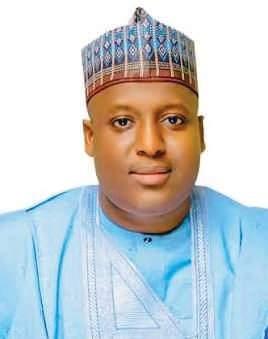
BAUCHI DESERVES THE BEST IN 2027
- Dr Nura Manu Soro
By Our Correspondent
Leading aspirant for the governorship ticket of the All Progressives Congress (APC) in Bauchi State, Dr Nura Manu Soro has insisted that the state deserves the best in terms of leadership in 2027 because it is lagging behind in terms basic indices of d
harnessed.
Dr Soro who made the declaration while speaking w i t h o u r c o r r e s p o n d e n t i d e n t i fi e d s o m e o f t h e potentials the state is blessed with to include the high presence of hydro carbon for oil exploration, major waterways for agriculture and one of the largest land r e s o u r c e s
s m a n d infrastructural development adding that his desire is to consolidate on providing basic education for the people; commercialize agriculture and sustain peace and stability in the state.
He said the state also has the advantage of serving as a gateway to other states in the Northeast and has a vast human capital that could be put to productive use.
APC governorship ticket not foreclosed
H a r p i n g o n t h e f a c t t h a t t h e A P C g o v e r n o r s h i p primaries has not been foreclosed Dr soro said the level of connectivity he has with the people across demographics puts him in a good position to win Bauchi for the APC.
He said, “Fortunately, the party is yet to issue a Certificate of Return to any aspirant, so we are all hoping that the party will use the opportunity to give the ticket to someone that will galvanise the people of Bauchi towards voting for the party in 2027.
“Since we have all agreed to a consensus to support the best amongst us, the point must be made that the party should abide by the decision with an eye on winning the state. The people have confidence in us, so we owe it a duty to give them what serves their best interests.
The age advantage
He added that the youth advantage he has comes w i t h e n e r g y c o u p l e d w i t h t h e u n d e r s t a n d i n g o f modern trends which puts him ahead in terms of ideas and approaches to raising the living standard of the people.
“Apart from the physical and mental agility, I am abreast with current developments across the globe.
B y t h e g r a c e o f A l l a h , I a m a w e l l t r a v e l e d entrepreneur and business owner, so I know where to c o n n e c t t h e d o t s i n a l m o s t a l l s p h e r e s o f developmental needs; where to secure the best
s e r v i c e s a n d q u a l i t y e q u i p m e n t b e i t i n r o a d c o n s t r u c t i o n , h o u s i n g , h e a l t h f a c i l i t i e s , m e d i c a l
s e r v i c e s , e d u c a t i o n , a g r i c u l t u r e o r g e n e r a l infrastructure.
“My age has made me adapt instinctively to modern trends, the type that has made China and Indonesia leap into developed economies.
everyday innovations are being churned out at the speed of light, so as a leader you need that stamina to stay afloat otherwise you would be left behind. Bauchi deserves governance that moves with speed and can catch up with developmental trends with touch button a d a p t a b i l i t y n o t o n e t h a t c o m e s w i t h t h e encumbrance of fatigue and inability to catch up with time.”
Harnessing the human capital in the state
Dr Soro said harnessing the human resources of the state to productivity would not be a problem as that is one area he is good at.
“I recognize talent and drive. In the course of my career, I have been to almost all parts of the world and I appreciate the extent to which the management of human capital can foster development. In Bauchi, we have a good population of youths that we can imbue with skills that make them global champions in their c h o s e n fi e l d s w h i l e a t t h e s a m e t i m e m a k i n g development to penetrate to the grassroots. We will initiate programmes that will harness talents and build the capacity for intellect.We shall put round pegs in round holes in the course of governance.
On who the APC should field in 2027
On who should fly the ticket of the party for the 2027 elections, the young philantrophis said though Bauchi has one of the most qualified persons vying for the ticket of the APC to provide leadership for the people of the state the APC should go for the best.
“Remember that the challenges we have now are much more than what we had in 2015. It requires a l a c r i t y a n d f u l l a t t e n t i o n T h e s e a r e n a t u r a l advantages that come with being young.
While experience matters, it is my belief that the elders among the aspirants should play the role of providing guidance to the younger ones, play fatherly roles by helping to groom new crop of leaders that will take the state to its desired destination.
are not fighting, it is our zeal to develop the state that is driving us. One thing I keep telling them is that our ideas should be harmonised and given to that young person amongst us who has respect for all of them, who they can call and talk to as their younger brother and has the energy to implement the good ideas,” he explained.
‘Bauchi is an APC State’
Dr Soro described Bauchi as an APC State that is temporarily in the hands of another party stressing that the APC needs someone that can deliver the state from the hands of the strange party the current governor has taken it to.
“The people of Bauchi do not know anything like the APM, they never gave it their mandate, they don't know it or what it stands for It was only imposed on them. That is why the APC needs to be serious this time.”
“Look at what is happening globally today where
“We are all in the race to provide service to our people. I have a good relationship with all the aspirants. We
He cautioned that though the APM maybe new in Bauchi, it has the structure of a sitting governor in place hence cannot be toyed with in an election.
“The APC needs someone who understands the current political dynamics in Bauchi State and what matters to the people. The party needs a person that the opposition fears most.”
Why he remains the best among the aspirants
On his chances if he becomes the governorship candidate of the APC, he said his capability is not in doubt.
“At the risk of sounding immodest, I challenge you to go to the streets of Bauchi and to the rural areas to conduct a survey and see how the people would respond.
“As you may know, I'm the leading aspirant because unlike the others who apart from their previous job descriptions are not very conversant with the daily aspirations of the average citizen of Bauchi, I am, by reaso
deeply connected with the people. The people know me and I know them. They relate with me freely and I have been rendering service to the people even before my political aspiration.
“I am aspiring to be governor only to widen the scope of my interactions with them and broaden the service I have been rendering so that all parts of Bauchi from the North to Central to the South would develop to the standard I envisage for the people of my state.
“So going back to your question, I'm aware that the APC is serious about transforming the lives of the people for the better hence I have no doubt that having offered to serve, that the party will give me the chance.
“The other parties know that they stand no chance once I'm the APC governorship candidate. They know the person that has the widest contact and reach with the people. They know the extent of the commitment we made to secure their conviction to believe in the APC.”
CONGRATULATIONS MY BROTHER!
A Well-deserved Renewal Of MANDATE
On behalf of the Gover nment and good people of K atsina State, I war mly congratulate my brother and colleague, His Excellency, Mr Biodun Abayomi Oyebanji, Gover nor of Ekiti State, on his historic re-election for a second ter m in office.
Your overwhelming victor y is a clear testament to the confidence and tr ust reposed in your leadership by the people of Ekiti State.
It also reflects their appreciation of your sterling per for mance, visionar y leadership, and unwavering commitment to the progress and prosperity of the state.
I am confident that your second tenure will consolidate the remarkable gains already recorded and usher in more development, peace, and prosperity for the good people of Ekiti State.
As you begin another ter m, I pray that Almighty Allah grants you the wisdom, strength, and grace to lead Ekiti State to even greater heights.
Congratulations and best wishes for a successful second ter m.
His Excellency
Mr. Biodun Abayomi Oyebanji
Governor of Ekiti State,
PUBLIC NOTICE
RELEASE OF CONSULTATION PAPER AND NOTICE OF PUBLIC CONSULTATION ON ZERO-RATED
ACCESS TO EDUCATIONAL PLATFORMS AND CONTENT
The Nigerian Communications Commission (NCC) hereby notifies industry stakeholders and the general public on the development of a Consultation Paper for a Framework/Criteria for ZeroRated Access to Educational Platforms and Content in Nigeria . The Consultation Paper represents a preliminary stakeholder engagement in line with the Commission’s participatory and transparency-driven regulatory approach.
Interested stakeholders are by this notice invited to make written submissions on the proposed framework via email to: zeroratedconsultations@ncc.gov.ng
Submission Deadline: On or before Thursday, July 9, 2026 .
Document Availability: The Consultation Paper has been published on the Commission’s website at www.ncc.gov.ng and can be downloaded by scanning the QR code.
Invitation to Public Consultation: Stakeholders are hereby cordially invited to participate in the Public Consultation Session on the proposed Framework scheduled as follows:
➢ Date: Tuesday, July 14, 2026
➢ Time: 11:00 AM Prompt
➢ Venue: NCC Head Office Annex, Mbora District, Abuja
Written submissions should be addressed to the Executive Vice Chairman Nigerian Communications Commission Plot 423, Aguiyi Ironsi Street, Maitama, Abuja
(Attention: Director, Policy Competition and Economic Analysis )
Dated this 23rd Day of June, 2026
Signed: Nnenna Ukoha Director, Public Affairs Department
From Kaduna to Ekiti: Gov Sani’s Growing Reputation as APC’S Chief Strategist
Iyobosa Uwugiaren writes that Governor Uba Sani of Kaduna State and Chairman of the all Progressives Congress Campaign Council for the last Saturday’s governorship election in Ekiti State is progressively emerging as one of the party’s most reliable strategists.
For many political leaders in Nigeria, trust is a currency earned through performance, loyalty, and the ability to deliver results when it matters most. And arguably, few political leaders exemplify those qualities today more than Governor Uba Sani of Kaduna State.
From his stewardship of one of the most politically significant states in the country to his increasing role in shaping the electoral fortunes of the ruling All Progressives Congress (APC), Governor Sani has progressively emerged as one of the party’s most reliable strategists and a key ally of President Bola Tinubu.
His recent appointment as Chairman of the APC Campaign Council for the last Saturday’s governorship election in Ekiti State is widely regarded as more than a routine political assignment.
‘’It is a ‘reflection of the growing confidence the party leadership and President Tinubu have in his capacity to mobilize support, build consensus and deliver victory in high-stakes political contests’’, an insider in the presidency stated. ‘’Within the APC circles, the decision is seen as a strategic move by the President who understands the importance of placing trusted hands on critical electoral battles.’’
Indeed, over the last three years, Governor Sani has distinguished himself not only through governance in Kaduna State but also through his ability to navigate the country’s complex political terrain. His deep understanding of voter behaviour, grassroots mobilization and coalition building has made him an increasingly influential figure within the ruling party. And, time and again, he has demonstrated an uncommon ability to connect political strategy with practical results, earning him a reputation as one of the most effective political operators in the country.
His growing prominence within the governing All Progressives Congress has led many political observers to describe him as a leading figure in a new generation of national political leadership.
Since assuming office as Governor of Kaduna State in May 2023, he has placed considerable emphasis on inclusive governance, rural development, and social investment. It is on record that his administration inherited a state confronted by economic challenges, security concerns, and infrastructure deficits. Yet, within a relatively short period, those close to him said the governor had pursued policies aimed at improving public services while strengthening confidence in government institutions.
The governor has repeatedly said in public fora that one of the defining features of his administration had been a commitment to reaching underserved communities. Through investments in healthcare, education, roads, and agricultural support programmes, the government has sought to ensure that development extends beyond urban centres to rural communities where many citizens have long felt neglected.
Political analysts argue that this grassroots-oriented approach has enhanced Governor Sani’s popularity across different segments of Kaduna society. Rather than governing from a distance, he has cultivated a reputation for engaging stakeholders directly and seeking practical solutions to pressing challenges.
Not many political observers doubt that this style of leadership has helped him maintain broad political support while positioning Kaduna State as an important reference point in discussions about governance and development in northern Nigeria.
Sani’s rise did not begin in the governor’s office. His political journey has been shaped by decades of public engagement, advocacy, and legislative experience. Before becoming governor, he served as Senator representing Kaduna Central Senatorial District, where he earned recognition for his involvement in legislative initiatives and public policy debates.
His background as a pro-democracy activist during Nigeria’s democratic struggles also contributed to the political philosophy that guides his public service. Those experiences may have exposed him to the complexities of governance, social justice, and nation-building, helping to shape a leader who understands both the aspirations and frustrations of ordinary Nigerians.
Today, this blend of activism and practical politics has become one of his defining strengths. Supporters often point to his ability to connect policy discussions with the everyday realities of citizens, a quality that has enabled him to build trust across political, ethnic, and religious lines.
Perhaps one of the most significant indicators of Governor Sani’s growing national relevance is the confidence reposed in him by President Tinubu.
Since the beginning of the Tinubu administration, the Kaduna governor has been entrusted with several
strategic responsibilities within the APC and the broader political landscape.
In politics, important assignments are rarely given without careful consideration. They are often reserved for individuals regarded as competent, reliable, and capable of delivering results under pressure. By that measure, Governor Sani’s increasing role within the ruling party reflects the trust he has earned among key stakeholders.
Political insiders note that the governor’s calm disposition, strategic thinking, and ability to build consensus have made him a valuable asset to the party. Unlike politicians who thrive on controversy, he has largely focused on negotiation, coalition-building, and problem-solving.
These attributes have strengthened his relationship with the President and reinforced perceptions that he belongs to a select group of governors playing influential roles in shaping the direction of national politics.
To be sure, across the country, political parties depend on trusted leaders to coordinate campaigns, resolve internal disagreements, and mobilize support during elections. Such responsibilities require organizational skill, political intelligence, and an understanding of voter behaviour.
And Governor Sani has demonstrated these qualities repeatedly. His ability to engage stakeholders, harmonize competing interests, and inspire confidence among party members has made him a preferred choice for strategic assignments.
One of the qualities frequently associated
In politics, important assignments are rarely given without careful consideration. They are often reserved for individuals regarded as competent, reliable, and capable of delivering results under pressure. By that measure, Governor sani’s increasing role within the ruling party reflects the trust he has earned among key stakeholders.
with the governor is his deep understanding of Nigerian political behaviour. Nigeria’s political environment is among the most complex, shaped by diverse ethnic identities, religious affiliations, regional interests, and socio-economic realities.
Successful political leadership therefore requires more than charisma. It demands an appreciation of local dynamics and the ability to build coalitions across multiple constituencies.
Observers argue that Sani possesses this rare combination of political sensitivity and strategic foresight. He understands the importance of dialogue, inclusion, and stakeholder engagement. Equally important, he appreciates the need to balance competing interests while maintaining a focus on broader national objectives.
For many, these skills have helped him navigate the challenges of governance in Kaduna State and have contributed significantly to his growing relevance within national politics.
As Nigeria continues to confront economic pressures, security concerns, and demands for institutional reform, there is increasing interest in leaders capable of combining vision with effective implementation.
And many within the APC view Governor Sani as part of a new generation of leaders who are redefining political leadership through performance and service delivery rather than rhetoric alone. His emphasis on inclusion, development, and collaboration resonates with citizens seeking practical solutions to everyday challenges.
His emergence also reflects a broader trend within Nigerian politics, where governors are playing increasingly influential roles in shaping national conversations and party structures. By leveraging governance achievements and political networks, leaders such as Governor Sani are helping to redefine the relationship between statelevel administration and national political influence.
Today, his political footprint extends far beyond Kaduna State. His voice carries weight in discussions concerning party strategy, governance, development, and national cohesion. His growing visibility at the national level is not merely the result of political appointments; it is also a reflection of the confidence many stakeholders have in his leadership capacity.
From all indications, as preparations intensify for future electoral contests and policy debates, his influence is expected to continue expanding. Whether through governance initiatives, party assignments, or broader national engagement, Governor Sani appears poised to remain a significant figure in the country’s political evolution.
In politics, leadership is ultimately judged by outcomes. The ability to translate promises into tangible benefits for citizens remains the most enduring measure of success. For Governor Sani, the challenge and opportunity lie in sustaining the momentum that has elevated him from a state leader to a respected national figure.
His record in Kaduna State, coupled with the trust placed in him by President Tinubu and the APC leadership, suggest a politician whose influence is on an upward trajectory. As he continues to take on strategic responsibilities and contribute to the advancement of his party and government, many observers believe he is emerging as one of the defining political figures of his generation.
Whether viewed through the lens of governance, party organization, or national leadership, the governor’s journey reflects the rise of a political force whose impact is increasingly being felt across Nigeria.
LAWYER
TUeSday, j U ne 23, 2026
/Users/mac/Desktop/untitled folder/images.jpg
Introducing the Six Contestants for NBA General Secretary
Okey Ohagba
Barth Okoye-aniche
afam Okeke
dr Rapulu nduka
Chidi ezenwafor nnaebuka Onyebuchi nwaeze
LAWYER
Introducing the Six Contestants for NBA General Secretary
Proof of Claim of Title to Land Page IV
NBA Lagos Unveils 2026 Bar Week, Focuses on Lawyering in Digital Age Page V
Babalakin & Co. Completes Judging Session for 2026 Art Competition & Exhibition Ahead of July Showcase Page V
‘The Judiciary, the Press and Civil Society - you are the guardrails of our Republic. Criticise me, disagree with me, but, never stop believing in Nigeria.' - HE Bola Ahmed Tinubu, GCFR, President, Federal Republic of Nigeria
On Judicial Rascality: When Judges Defy the Court Above them and Lawyers Who Enable them Page VI
Okey Ohagba Barth Okoye-aniche
afam Okeke
dr Rapulu nduka Chidi ezenwafor
nnaebuka Onyebuchi nwaeze
From Judicial Defiance to Bar Complicity: Reforming the Legal Profession
The Good Old Days
It is obvious that, in Nigeria, the whole legal profession of today is certainly not like that of the good old days. Whether it is the Bar or the Bench, there has been a marked deterioration in both; things appear to be in disarray. Last week, I discussed the somewhat embarrassing controversies surrounding the preparations for 2026 Nigerian Bar Association election into national offices. This week, it’s the behaviour of Lawyers and Judges.
Abuse of Court Process
I had a conversation with a member of the National Judicial Council (NJC) a couple of years ago, towards the end of CJN Olukayode Ariwoola’s tenure, when forum shopping and conflicting court orders were in high fashion. I agree that it takes two to tango, that in the first place, it is the Lawyers who bring these faulty matters before the Judges, whether it is forum shopping or lack of jurisdiction, whatever type of fundamentally flawed matter that shouldn’t be brought for one reason or the other, and without the Lawyers initiating this abuse of court process, Judges who engage in judicial rascality may not have the opportunity to make the mischief that they do.
I raised the question of why erring Judges can only be brought before the NJC by way of petition, particularly if the case is a high- profile one in the public space. I suggested that the NJC should be able to issue a query to any Judge accused of judicial rascality in such circumstances, to come and explain themselves without having to wait for a petition that may not come, or may be aborted midway, as one of the complaints is that, sometimes, Complainants withdraw their petitions, mostly under pressure. In Obasanjo & Anor v Olugbode & Ors (2025) LPELR-81518 (SC) per Obande Festus Ogbuinya, JSC, the Supreme Court held inter alia that: “The term "abuse of court process" is an elusive concept, in the wide domain of litigation. It exhibits variegated forms, and is disobedient to one single definition….It connotes the proper and improper use of judicial process by a party in litigation, to interfere with due administration of justice. Generally, the employment of judicial process is only regarded as an abuse when a party improperly uses the issue of the judicial process, to the irritation and annoyance of his adversary and the efficient and effective administration of justice”.
Justice Lifu and the Deregistration of Political Parties: Judicial Rascality
Presently, the case that is trending, is that in which Federal High Court Judge, Peter Lifu J. in a case concerning the deregistration of certain political parties, went ahead to order that they be deregistered, despite a Court of Appeal order staying proceedings in the case pending the determination of the interlocutory appeal scheduled to be heard in October 2026. This failure to adhere to judicial hierarchy, has been described as judicial rascality. The Court of Appeal invoked the authority of Owoniyi v Aiyewunmi 2025 16 N.W.L.R. Part 2011 Page 237 per Habeeb Adewale Olumuyiwa Abiru, JSC, on the Supreme Court’s position on the defiance of superior orders/hierarchy, to describe Lifu J’s conduct as “the highest form of judicial impertinence”. Kindly, read a full discussion of this rascality in Dr Eyimofe Atake’s article on Page 6. Another example of judicial rascality is the recent Court of Appeal ruling in the Neconde/Nestoil matter, where a decision on an ex-parte application was reportedly delivered in the absence of the record of proceedings from the trial court.
First Bank and General Hydrocarbon Limited: Counsel’s Rascality
But, Lawyers too, are not really sanctioned for bad behaviour in Nigeria. Again, like the NJC, the Legal Practitioners Disciplinary Committee (LPDC) depends on petitions. This doesn’t necessarily have to be the case, as there are still other ways to seek to enforce discipline at the Bar. In the UK (England and Wales) for example, Judges can refer Solicitors to the Solicitors Regulation Authority, and Barristers to the Bar Standards Board, for pursuing frivolous, vexatious or abusive claims, for disciplinary investigation. Obviously, where the Judges and Lawyers alike are jointly involved in the abuse of court process as is usually the case here, Judges referring Counsel for disciplinary action would be highly unlikely. Recall the case of First Bank (FBN) and General Hydrocarbon Ltd (GHL) that I discussed in January 2025? This is a classic example Counsel’s rascality! After Allagoa J. had delivered judgement on 12/12/2024 in a matter involving both parties, restraining FBN from inter alia, obstructing or preventing any loan facilities or funding for the exploration or operation of OML 20 and from taking steps to enforce any security, receivables etc against GHL, pending the hearing and determination of the ongoing arbitration proceedings between GHL and FBN, instead of going on appeal, the same group of Senior Advocates representing FBN secretly went forum shopping for their gift during the Christmas vacation, and obtained an ex-parte interim order dated 30/12/24 from Allagoa J’s brother Judge of the same Federal High Court Division, Dipeolu J. freezing the accounts of GHL and others, contrary to Allagoa J’s earlier decision handed down based on arguments from both parties. See the case on Okafor & Ors v AG Anambra & Ors (1991) LPELR-2414 (SC) per Adolphus Karibi-Whyte, JSC on multiplicity of actions on the same subject-matter. GHL subsequently filed two motions on notice, praying the court to set aside the abusive ex-parte order of 30/12/24. In his ruling, citing the case of Polaris Bank
onikepo braithwaite
ONIKEpO BraITHwaITE
onikepo.braithwaite@thisdaylive. com onikepob@yahoo.com
“I suggested that the NJC should be able to issue a query to any Judge accused of judicial rascality….to come and explain themselves without having to wait for a petition that may not come…. In the UK…Judges can refer Solicitors…and Barristers….for pursuing frivolous, vexatious or abusive claims, for disciplinary investigation….instead of going on appeal, the same group of Senior Advocates representing FBN secretly went forum shopping for their gift during the Christmas vacation, and obtained an ex-parte interim order…..contrary to Allagoa J’s earlier decision…. withholding material facts….When grieving litigants cremate a body in a clear Coroner’s case, thereby denying the hospital they accuse of negligence the autopsy essential to fair hearing, the rule of law itself is undermined”
Ltd v Bellview Airlines Ltd & Anor (2021) LPELR-56258 (CA) in support of his position, Dipeolu J. stated that FBN had failed to make full disclosure of Allagoa J’s earlier judgement in the course of moving their ex-parte application, thereby withholding material facts which would probably have resulted in the ex-parte order not being granted. What amounts to rascality, professional misconduct and abuse of court process, if not the actions of FBN’s Counsel regarding this matter? If it was in the UK, Justice Dipeolu would have referred FBN’s Lawyers to the LPDC. GHL could also petition against FBN’s Counsel, for this abuse of court process. But, as suggested for the NJC, why can’t the LPDC query Lawyers and ask them to come and explain their actions, where their alleged wrongdoings are in the public space?
What is clear is that, the present processes of discipline of Judges and Lawyers are not particularly effective, as they do not serve as a deterrent to misconduct. These institutional failures are compounded, when extra-judicial tactics enter the equation.
Prejudicial Extra-Judicial Comments: Ms Chimamanda Adichie’s Statement
While the list of what constitutes abuse of court process isn’t exhaustive, it also covers situations where trial Lawyers make extra-judicial comments that may be prejudicial to the court proceedings, or may interfere with the fair trial of a case. Such behaviour is a breach of the ‘sub judice’ rule, that is, Section 33 of the Rules of Professional Conduct for Legal Practitioners 2023 (RPC). Usually, one finds that it is Lawyers who want to garner support from the unknowing public because their cases may be weak in law, that deploy such tactics to win sympathy. Nevertheless, it appears that Section
33 of the RPC only applies to Counsel who are trial Lawyers in a matter, and are prohibited from making prejudicial statements (fair comments are allowed by all), and don’t directly apply to litigants and others. Therefore, Counsel can decide not to discourage their clients from making statements that they as trial Lawyers are prohibited from making, as some type of tactic to win in the court of public opinion, at the very least, even if they can’t win in a court of law. See for instance the 2023 Presidential election petitions, and the parallel court of public opinion trials.
As unseemly as prejudicial extra-judicial statements of a litigant may be, I’m not sure if or where it falls when it comes to abuse of court process - maybe ‘contempt ex-facie curiae’? I suppose opposing Counsel can issue and file in court, a “Cease and Desist Notice” to demand that such litigant refrain from making categorical, inflammatory, prejudicial statements and stop acting as the Prosecutor, Judge and Jury in their own case, so that the Judge may be constrained to issue a gag order if necessary, as was done to Donald Trump during his trial before he became President.
Recently, my attention was drawn by several people, to a statement allegedly issued by Ms Chimamanda Adichie which apparently made the rounds on social media, about the events surrounding the death of her son, Nkanu. She started by stating that losing a child is a parent’s worst nightmare. I agree with her entirely, on that point. Only God can bring comfort and healing, for such an indescribable loss. As a Parent, I empathise and sympathise deeply, that such an awful thing has happened.
I was referred to Paragraph 15 of Ms Adichie’s statement particularly where she stated thus: “Not
long after, an article appeared in the Nigerian press which any reasonable person would assume was orchestrated by Euracare, claiming our son had died of meningitis. It was a cheap and ugly strategy to deflect from the truth”. Ms Adichie could certainly not have been referring to my article of January 20, 2026: “Baby Nkanu: Negligence or Meningitis?”, because firstly, she was the one who brought the sad death of her son to the public space, thereby making it a topical legal issue for discussion; secondly, as a Lawyer, I am trained to stick to the facts and evidence, not avoid them. Thirdly, nowhere in my article did I state that Meningitis was the cause of Nkanu’s death. Even the title of my aforementioned article is a question, not a statement of fact. What I did say was that Ms Adichie had in an earlier statement, mentioned that in anticipation of Nkanu’s evacuation to Johns Hopkins Hospital, USA (JH), they had requested for a Lumbar Puncture (LP) and an MRI. I said: “The request shows that Nkanu was in a serious condition, and JH suspected that he may have had Meningitis or some neurological symptoms, which is what LP diagnoses, with the MRI to provide detailed images of the brain and spinal cord to check a possible spread, if indeed, that was the case”. I also said: “And, to determine whether a Propofol overdose was indeed, the cause of Nkanu’s death, or what the cause of his death is, an Autopsy, that is, a postmortem examination upon his death would be required”. This is self-explanatory.
Counsel to Ms Adichie was given a right of reply to my aforementioned article, and in my response to it, I concluded vehemently thus: “Finally, I restate the fact that I have only sought to examine the highlights of this unfortunate occurrence vis-à-vis the provisions of the law. I, in no way, attempt to apportion any blame, nor did I ever state that I know Nkanu’s cause of death. I simply asked pertinent questions”. I submit that my article was simply a statement of legal principles and an interrogation of issues, and I take exception, if anyone describes it as otherwise.
In her recent statement recalling the events surrounding Nkanu’s death, Ms Adichie notably omitted reference to the fact that contrary to Section 48(1) of the Coroner’s System Law of Lagos State 2007, he was cremated before any autopsy could be performed, to determine the cause of his death. Would they have been able to carry out such cremation, if the unfortunate death had occurred in USA where they reside? I think not. That act of wilfully destroying his body in what qualifies as a Coroner’s case, is a serious offence that carries a 15 year imprisonment sentence upon conviction. It was therefore bizarre, to read in paragraph 19 of her statement that Euracare wasn’t approaching the Coroner’s Inquest scheduled for sometime in April, with the seriousness the process demands. This is a classic example of deflecting from the truth, gaslighting, transferring the blame, diverting attention from the fact that by virtue of Section 36(1) of the 1999 Constitution, all parties are entitled to a fair hearing, which, on the part of the hospitals involved in this case, particularly Euracare, must necessarily involve an autopsy, in order for them to defend themselves by attempting to disprove the allegation of negligence/administering an overdose. This fundamental right may have been breached by those who cremated Nkanu, and are also the Petitioners in the case. If an autopsy had been performed, Nkanu’s cause of death would have been definitively established, and this discourse may have been needless.
Would any reasonable party sit and fold their arms in light of such serious allegations levelled against them, or seek to establish the fact that they may be unable to effectively challenge the allegations or have access to relevant information, because an autopsy cannot be performed? In Maikaba v Arto Pharmaceutical Chemist Ltd & Ors (2026) LPELR-83073(SC) per Tijjani Abubakar, JSC, the Supreme Court held: “This Court again, in Obasan v Abudu & Ors ((2023) LPELR-59944(SC)), emphasised that the right to fair hearing is so fundamental that its breach renders any proceeding, decision, or judgement null and void, irrespective of how well-conducted the proceedings might otherwise appear….a nullity ab initio, and cannot be salvaged”.
Conclusion
The persistent culture of forum shopping, judicial defiance of hierarchy, and unbridled extra-judicial commentary, demonstrated by the cases of Justice Lifu, the FBN/ GHL saga, and the public discourse surrounding Baby Nkanu’s death, erodes public confidence in the administration of justice. When grieving litigants cremate a body in a clear Coroner’s case, thereby denying the hospital they accuse of negligence the autopsy essential to fair hearing, the rule of law itself is undermined. The attempt by the party levelling the accusations, to dismiss such a fundamental breach of a right that is critical in legal proceedings as a mere diversionary tactic, only compounds the injustice.
It is time for structural reform. The NJC and LPDC must move beyond a purely petition-driven regime, by incorporating ‘suo motu’ powers to query erring Judges and Lawyers in notorious, high-profile matters. Discipline that fails to deter, is no discipline at all. Only proactive accountability anchored in due process and professional integrity, can restore the Bar and Bench to the standards of the “good old days”, and rebuild the citizenry’s faith in the justice system.
NBa president, Mazi afam Osigwe, SaN
Proof of Claim of Title to Land
Fact
s The Respondent filed an action against the Appellant at the High Court of Ondo State, seeking inter alia, a declaration that the Respondent’s family is the rightful owner of a parcel of land known as Akanyin Land, Ikakumo-Akoko and therefore, he is entitled to the customary right of occupancy thereof. The Respondent sought in the alternative, a declaration that on the basis of the judgement in Suit No. IK/56/73 – Chief Daniel Olusi v Adamu Olojo & Ors decided at Owo/ Ikare Grade ‘A’ Customary Court and Suit No. HAD/19/74 – Chief Daniel Olusi v Adamu Olojo & Ors decided at the High Court of Justice, Ado-Ekiti on 27th January, 1978, he is entitled to the customary right of occupancy of the said land. The Respondent also sought an order of injunction against the Appellant, restraining him from further acts of trespass on the land, as well as damages. The Appellant filed his defence, and also counter-claimed for declaration of title on the subject land.
After the conclusion of trial and adoption of final written addresses, the trial court delivered its judgement in which it granted all the reliefs sought by the Respondent, and dismissed the Appellant’s counter-claim. Aggrieved, the Appellant appealed to the Court of Appeal. However, the Court of Appeal dismissed the appeal, and affirmed the judgement of the trial court.
The Appellant thus, lodged a further appeal before the Supreme Court. Counsel for respective parties filed and exchanged their respective briefs of argument. Counsel for the Respondent raised a Preliminary Objection in the Respondent’s brief, challenging the competence of the Appeal.
Arguments on Preliminary Objection
Counsel for the Respondent argued that the Appellant’s appeal was incompetent, because the Appellant formulated issues for determination of the appeal before the Supreme Court based on the judgement of the trial court, instead of the decision of the Court of Appeal.
In reaction, Counsel for the Appellant argued that the issues raised in the objection had no nexus or link with the grounds of appeal, and for this reason, the preliminary objection should be dismissed.
Court’s Ruling on the Preliminary Objection
The Supreme Court held that the process of a preliminary objection should only be employed or used, to challenge the competence of an appeal or cross-appeal which is so fundamentally incompetent that the court is prevented from hearing, and not where the Respondent’s grouse is on how the issues identified by the Appellant are couched. The Apex Court held that the main purpose of formulating issues for determination is to enable the parties to narrow down the issues in controversy in the grounds of appeal filed, and an issue may be limited to one ground or traverse more than one ground of appeal, therefore, formulation of issues cannot be an issue for preliminary objection as in the instant case. The Supreme Court held further that from its record, the appeal before it is against the decision of the Court of Appeal, and not the High Court as contended by the Appellant. The Court found that the preliminary objection was unsustainable, and consequently dismissed it.
Thereafter, the Supreme Court proceeded to consider the main issues in the appeal.
Issues for Determination:
1. Whether from the pleadings and available evidence on record, the Respondent proved his case, and whether the counter-claim was not proved.
2. Whether the land adjudged the Respondent’s was ascertainable in extent and boundaries, and whether the Appellant did not ascertain the land claimed by him.
3. Whether an action in trespass can lie from the pleadings and available evidence on record.
Arguments
On the first issue, Counsel for the Appellant
Honourable Stephen Jonah adah, JSC
IIn the Supreme Court of nigeria Holden at abuja
On Friday, the 4th day of july, 2025 Before their lordships
Mohammed Lawal Garba
Moore abraham aseimo adumein
Stephen jonah adah jamilu yammama Tukur
Mohammed Baba Idris Justices, Supreme Court SC/65/2018
Between
Mr Sunday olusi appellant
And
Mr Julius olaitan obaniyi respondent (For himself and on behalf of other members of aparisu Family of Ikakumo akolo)
(Lead Judgement delivered by Honourable Stephen Jonah Adah, JSC)
reproduced the five ways of proving title to land, and argued that there is no evidence about how the descendants of Akanyin which the Respondent claimed he belonged to, came into ownership of the subject land. He argued further that a party who relied on traditional history as his root of title but failed to prove same, cannot rely on act of possession to claim title to land. Counsel submitted that the Respondent failed to establish his ownership of the land in dispute, whereas the Appellant established his ownership of the land.
On the second issue, Counsel for the Appellant argued that the Respondent failed to ascertain the exactness and extent of the land claimed by him, hence, his claim ought to have been dismissed.
On the third issue, Counsel for the Appellant argued that a customary tenant cannot be a trespasser on a land granted to him by his landlord, and that a customary tenant is only enjoined to sue for forfeiture of his tenancy and not for
“…a Claimant may make a choice on which way he wants to direct his evidence to establish his title, and a Claimant may also rely on one or more of the ways to establish his title. However, one mode of proving title will suffice, if the Claimant adduces credible evidence to substantiate his claim”
Court’s Judgement and Rationale
Deciding the first and second issues together, the Supreme Court held that in a claim for declaration of title to land, the law requires the Claimant to put before the court evidence of his claim, and prove his case on the balance of probabilities or on the preponderance of evidence. The Supreme Court referred to the provisions of Sections 131 and 132 of the Evidence Act, 2011. The Apex Court reiterated the long-standing position of the law that the five ways of proving title to land are: (a) Traditional evidence; (b) Production of title document (c) Proof of acts of ownership extending over a sufficient length of time, numerous and positive enough as to warrant the inference that the persons exercising such acts are the true owners of the land; (d) Acts of long possession and enjoyment of the land; (e) Proof of adjacent land to the land in dispute, in such circumstances which render it probable that the owner of the adjacent land.
The Court held that a Claimant may make a choice on which way he wants to direct his evidence to establish his title, and a Claimant may also rely on one or more of the ways to establish his title. However, one mode of proving title will suffice, if the Claimant adduces credible evidence to substantiate his claim. The Court referred to the cases of Idundun v Okumagba (1976) 1 NMLR 200 and Olukoya v Ashiru (2006) All FWLR (Pt. 322) 1479.
The Supreme Court held that, in the instant case, the Respondent majorly elected to establish his title through traditional evidence as set out in his amended statement of claim before the trial court, and had presented four witnesses and submitted five documentary exhibits in support thereof. The Court held that the Respondent’s witnesses gave detailed evidence of how Akanyi, the forefather of the Respondent and leader of the Aparisu Family first settled on the land, and how ownership of the land devolved on his descendants and also passed to the Respondent’s grandfather by succession, after which the land passed to the Respondent’s father, and is currently being held by family head of the Respondent’s family, Simeon Obaniyi.
an action in trespass. Counsel submitted that the reliefs granted to the Respondent were irregular, inappropriate and invalid.
Reacting on the first and second issues, Counsel for the Respondent argued that the Respondent, via the testimony of PW1, clearly identified the land in dispute and stated the exact description of the land, including all the boundary marks, such as streams, rivers, rocks, as well as surrounding land belonging to other families. Counsel maintained that PW1 was never discredited under cross-examination, and his testimony was buttressed by the evidence of PW2 and the Respondent who gave detailed evidence of ownership of the land. Counsel submitted that the testimonies of PW1, PW2, PW3 and PW4, as well as the documentary evidence in Exhibits P1, P2 and P3, showed that the Respondent overwhelmingly identified and successfully established title to the land, and it was based on this that the lower courts held that the Respondent had duly established his case on the balance of probabilities.
Responding on the 3rd issue, Counsel for the Respondent argued that the activities of the Appellant by entering on the land and felling trees amounted to an act of trespass, hence, the judgement of the trial court against the Appellant for trespass and the affirmation of the trial court’s decision by the Court of Appeal, were unassailable.
The Court held further that the trial court and the Court of Appeal also found concurrently, that the identity of the land in dispute was well known to the parties and well established from the survey - Exhibit P3 and other exhibits before the trial court, as well as the testimony of PW1 who testified exclusively on the location and identity of the land. The Court held that Exhibits P1 and P4 in particular, which were judgements of court, also gave overwhelming weight to the case of the Respondent. The Supreme Court found that there was clearly no error in the concurrent findings made by the two lower courts that the Respondent established his claim and the identity of the land in dispute.
On the third issue, the Court held that it is a well-established position of the law that possession entitles a party to sue for trespass to land, however, where there are conflicting claims of possession by both parties before the court, trespass will be at the suit of the party that can show that title is with him. The Court referred to the case of Motunwase v Sorungbe & Anor. (1988) LPELR – 1920 (SC).
The Supreme Court found that in the instant case, the Respondent has proved a better title to the land, so the Court of Appeal cannot be faulted for affirming the issue of trespass against the Appellant. Appeal Dismissed.
Representation
T. M. Ogunmoroti with Ayetunde Adeleke for the Appellant. Victor U. Udeh with Ekere E. Bassey for the Respondent.
Reported by Optimum Publishers Limited, Publishers of the Nigerian Monthly Law Reports (NMLR)(An affiliate of Babalakin & Co.)
NBA Lagos Unveils 2026 Bar Week, Focuses on Lawyering in Digital Age
Stories by Steve Aya
The Nigerian Bar Association (NBA), Lagos Branch, has announced plans for its 2026 Annual Bar Week, with legal practitioners set to examine the impact of technology on legal practice under the theme, “Lawyering in a Digital Age: Navigating Technology, Justice and Innovation”. The week-long event is scheduled to hold from June 27 to July 3, 2026, and was formally unveiled at a press conference held at the offices of Babalakin & Co. in Lagos.
Addressing journalists at the briefing, Chairman of the NBA Lagos Branch, Mrs Uchenna OgunedoAkingbade, said this year's Bar Week is designed to stimulate meaningful conversations on the rapidly evolving legal landscape, and the role of technology in shaping the future of legal practice and the administration of justice. She stressed the need for Lawyers to embrace innovation while upholding the profession’s ethical standards and commitment to the rule of law.
Also speaking, Chairperson of the Bar Week Planning Committee, Mrs Obosa Akpata, described the theme as timely, noting that artificial intelligence, cybersecurity, digital
transformation and other emerging technologies are redefining legal services globally. She said the Conference would provide a platform for Lawyers, policymakers, academics, business leaders and technology experts to engage on the opportunities and challenges presented by the digital age.
Mrs Akpata disclosed that the Chief Justice of Nigeria, Hon. Justice Kudirat KekereEkun, GCON, will deliver the Keynote Address at the opening ceremony, and lead
discussions on the future of the legal profession in an increasingly technologydriven world.
Providing further details on the programme, Dr Kubi Udofia and the Head of Information Technology of the Planning Committee, Mr Babajimi Ayorinde, outlined activities lined up for the week, and the technological innovations being deployed to enhance participants’ experience throughout the event.
According to the organisers, the programme
will feature two days of plenary sessions focusing on issues such as artificial intelligence, digital evidence, cybersecurity, data protection, innovation, access to justice and the future of legal practice in Nigeria.
Beyond the plenary sessions, other activities scheduled for the week include a health walk, sporting events, masterclasses, a town hall meeting, elders’ night, visits to selected institutions including the Ikoyi Correctional Centre,
and a closing party aimed at promoting networking and professional bonding among members of the legal community.
While the opening ceremony and plenary sessions will take place at Jewel Aeida Event Centre, Lekki Phase 1, other activities will be hosted at various locations across Lagos, including the MUSON Centre and the Ikoyi Correctional Centre. The Organisers said the programme has been carefully structured to combine intellectual
engagement, mentorship, wellness and community service.
The NBA Lagos Branch, one of the largest and most influential Branches of the Association, said this year's Bar Week will provide a valuable opportunity for stakeholders to reflect on the future of legal practice in Nigeria and explore how technology can be leveraged, to strengthen the administration of justice while preserving the core values of fairness, ethics and the rule of law.
Babalakin & Co. Completes Judging Session for 2026 Art Competition & Exhibition Ahead
It is that time of the year again when art is celebrated, and creativity is rewarded. Babalakin & Co.’s Annual Art Competition & Exhibition enters its second year, with a promise to celebrate and promote Nigeria’s most promising young artistic talents.
On Saturday, June 6th, a panel of six eminent and distinguished judges, came together to carefully review and evaluate the remarkable entries submitted by artists from across the country. The impressive lineup of judges-Dotun Sulaiman, Mairo Bashir,
Duke Asidere, Ifeyinwa Momah, Kola Aina and Nana Aumah Sonoiki - had the difficult task of selecting the most outstanding works from a pool of exceptional submissions inspired by this year’s theme - ‘Japa to Japada: Beyond Borders, Within Boundaries’. The entries demonstrated creativity, technical skill, originality, and powerful storytelling. Throughout the session, the artworks sparked thoughtful discussions, reflection, and admiration, highlighting the depth of talent that exists within Nigeria's vibrant
creative community.
More than a competition, the Babalakin & Co. Art Competition & Exhibition is a Corporate Social Responsibility initiative, aimed at creating opportunities for artists to amplify their voices, create a platform for sustainability, and to drive the continuous growth of the arts ecosystem. This initiative, birthed by the Managing Partner, Mr Olawale Akoni, SAN, reflects the firm’s belief that art has the power to inspire, preserve culture, challenge perspectives and foster
NBA-SBL Conference Urges Lawyers to Embrace
Legal practitioners have been urged to embrace artificial intelligence, strengthen their negotiation skills and adopt strategic networking practices, to remain competitive in a rapidly evolving legal and business environment.
The call was made on Monday, at the opening of the 20th Annual International Conference of the Nigerian Bar Association Section on Business Law (NBA-SBL) in Abuja. The Conference, themed “Beyond Reforms – Measuring Policy Impact”, brought together legal professionals, business leaders and policy experts, to examine emerging trends
shaping legal practice and commercial transactions.
Leading the opening session on negotiation, Mr Ayuli Jemide challenged conventional assumptions about dealmaking, arguing that human behaviour accounts for nearly 70% of negotiation outcomes, outweighing legal positions, facts and strategy. Drawing from real-life transactions, he highlighted factors such as anchoring, scarcity, reciprocity, venue and time pressure, while urging Lawyers to thoroughly research their counterparts, identify common interests and build trust through authenticity.
A separate session on
business development and networking featured Abena Poku of XOI Marketing, Andrew Skipper, former Head of Africa at a leading international law firm, and Toyin Ojo of the African Legal Support Facility. The Speakers agreed that, while technical competence remains important, clients increasingly make decisions based on trust, relationships and a Lawyer’s understanding of their business needs.
Poku noted that artificial intelligence is already influencing how legal professionals are discovered online, explaining that AI-powered search tools increasingly rely on LinkedIn
of
July Showcase
meaningful conversations within society.
As part of its commitment to supporting the long-term success of creative talent, Babalakin & Co. will also provide reference materials to support artistic research and basic training on contracts and image rights to the finalists, through its Creative Industries Practice.
The Firm is well-positioned to advice artists and creative professionals on a range of legal and commercial matters across the arts, entertainment, media, sports, and broader creative sectors, including intellectual
AI, Strategic Networking
activity and digital footprints when ranking Lawyers and law firms. She therefore, encouraged practitioners to prioritise consistent content creation, while Skipper urged Nigerian Lawyers to leverage opportunities arising from regional integration and growing cross-border commercial activities across Africa, through strategic networking.
Offering a client perspective, Ojo advised Lawyers to focus less on promoting firm credentials, and more on demonstrating a clear understanding of client needs. According to her, the most successful proposals are those that provide value, show partnership and align closely
with the objectives of clients.
The spotlight later shifted to artificial intelligence and the future of legal practice during a presentation by Mr Ope Olugbasa, who identified due diligence, document review, contract drafting, legal research, law firm structures and billing models, as areas being transformed by AI. While acknowledging the opportunities created by technology, he warned against over-reliance on AI, stressing that Lawyers who fail to adapt, risk being displaced by those who effectively combine technological tools with critical thinking, professional judgement and institutional knowledge.
property protection, contract negotiations, licensing, brand partnerships, and other business-related legal issues. Through this support, the Firm aims to help emerging talents not only showcase their creativity, but also build sustainable and successful careers.
The winning entries will be officially unveiled during the Babalakin & Co. Art Competition & Exhibition, scheduled to hold on 3 July 2026, where guests will have the opportunity to experience the shortlisted works firsthand and witness the announcement of the competition’s winners.
As anticipation builds toward the exhibition, Babalakin & Co. remains proud to champion creativity and support the next generation of artistic talent. Through initiatives such as this, the Firm continues to demonstrate that meaningful corporate citizenship extends beyond business, embracing culture, community, and the transformative power of the arts.
The Firm looks forward to welcoming artists, clients, stakeholders, and members of the public, to what promises to be an inspiring celebration of creativity, excellence, and artistic expression.
L-R Mr Babajimi Ayorinde; Chairman Planning Committee of the NBA Lagos Bar Week, Mrs Obosa Akpata; Chairman NBA Lagos Branch, Mrs Uchenna Ogunedo Akingbade and Dr Kubi Udofa
L-R: Ifeyinwa Momah; Kola Aina; Mairo Bashir; Dotun Sulaiman; Nana Asumah Sonoiki and Duke Asidere
Introduction
The administration of justice in any constitutional democracy rests upon a foundation of hierarchy, discipline, and the unqualified obligation of every court to obey the orders of the court above it. When a Judge deliberately flouts that obligation, he does not merely commit a legal error, he strikes at the very architecture of the rule of law. It is that species of conduct that demands the most unsparing condemnation. But, the Judge who commits the error does not always act alone. Behind him, there is often a Lawyer, and sometimes a senior one, who has provided the vehicle, the processes, and the arguments that made the error possible. Both must be called to account, and it is the purpose of this piece to do so.
Background
The recent proceedings before the Court of Appeal in Abuja, arising from the matter concerning the deregistration of five political parties, namely the African Democratic Congress (ADC), the Action Peoples Party (APP), the Action Alliance (AA), the Accord Party (AP), and the Zenith Labour Party (ZLP), has brought this problem into sharp and uncomfortable public focus. It is important to state at the outset, that this piece takes no position on the merits of the deregistration proceedings, or on the political fortunes of any of the parties concerned. The point of principle engaged here transcends any particular party or political interest. What is in issue is the integrity of the judicial process, and the constitutional obligation of every court to obey the orders of the court above it.
On 22 May, 2026, a three-member panel of the Court of Appeal comprising Justices Mohammed A. Danjuma, Adebunkunola A. Banjoko, and Oyejoju O. Oyewumi made an express order in Appeal No. CA/ABJ/ CV/569/2026, staying further proceedings in Suit No. FHC/ABJ/CS/2637/2026 before the Federal High Court, pending the hearing and determination of the appeal. That order was enrolled, signed by the Deputy Registrar of the court, and communicated to all parties. Notwithstanding that subsisting order, Justice Peter Lifu of the Federal High Court in Abuja proceeded to deliver judgement in the matter. It is further reported that a Lawyer sought to bring the Court of Appeal order to the attention of the learned Judge before the judgement was delivered. The Judge was therefore, not merely aware of the order in a general sense, he was confronted with it, and he proceeded regardless.
A separate three-member panel of the Court of Appeal led by Justice A. B. Mohammed found it necessary to condemn that conduct in the strongest terms available to it, characterising it as the gravest form of judicial misconduct, a brazen violation of the hierarchy of the court and the 1999 Constitution, and the highest form of judicial impertinence. The panel further invoked the Supreme Court’s own characterisation of such conduct, namely that a Judge who acts in this manner is unfit for the Bench, and that it amounts to judicial rascality. A stay of execution was granted, and the judgement rendered unenforceable.
This piece does not set out to make a personal example of Justice Lifu, nor of any individual Judge. The members of the Bench include some men and women of learning and distinction, and it would be unfair and ungenerous to reduce a discussion of this gravity to the castigation of any one judicial officer. The concern here is larger and, it is ventured, more urgent than that.
The conduct that attracted the Court of Appeal’s censure in this instance, is not an isolated aberration. It is a recurring and
On Judicial Rascality: When Judges Defy the Court Above Them and Lawyers Who Enable Them
This incisive article by Dr eyimofe atake, SaN examines the recent proceedings in justice Peter Lifu’s court vis-à-vis the deregistration of some political parties, despite the Court of appeal’s order staying proceedings in the case until their determination of a pending appeal in the matter. The article is focused on institutional reform rather than any personal attack, but firmly and clearly states the expectations from judicial officers in such circumstances, as well as Lawyers and Senior advocates
deeply troubling feature of judicial practice in Nigeria, one that the legal community and the institutions of judicial governance have for too long addressed with insufficient resolve. And, it is a problem that has two equally culpable faces: the Judge who defies the order of the court above him, and the Lawyer who furnishes him with the means and the arguments to do so.
The Judicial Dimension Time and time again, when an appeal has been entered in the Court of Appeal in respect of proceedings before a lower court, Judges of the lower court continue to adjudicate on the very matter that is the subject of that appeal. They take evidence. They
“…..it is a problem that has two equally culpable faces: the Judge who defies the order of the court above him, and the Lawyer who furnishes him with the means and the arguments to do so… the Lawyer who induces a lower court Judge to proceed in defiance of an appellate court order, is a co-author of the judicial rascality that follows, even if it is the Judge who ultimately bears its name in the law reports”
make rulings. They deliver judgements of far-reaching consequence, as though the appeal had never been filed and the appellate court had never spoken. This pattern of conduct is inimical to the integrity of the appellate process, and must be confronted directly.
The problem manifests, across a spectrum. At one end are those Judges who, though no express order of stay has been made by the appellate court, continue to deal with the substantive issues that form the subject-matter of the appeal without adequate regard for the implications of the pending appellate proceedings. The proper course, as a matter of sound judicial practice and basic constitutional fidelity, is for a lower court Judge to stay his hand in relation to those issues pending the determination of the appeal, at least where proceeding could prejudice the subject-matter of the appeal or render it nugatory. If the appellate court ultimately finds in favour of the Appellant, orders made by the lower court in the interim may create hardship and irreversible consequences that no subsequent order can adequately remedy.
At the other and far more serious end of the spectrum, are those Judges who not only know that an appeal is pending, but who are aware of a specific and express
order made by the appellate court directing them to suspend proceedings, and who proceed regardless. It is this category that attracts the characterisation of judicial rascality that the Supreme Court has employed, and it is this category that demands the most serious institutional response. A Judge in that position, cannot claim ignorance. He cannot claim honest error. He cannot invoke judicial independence as a shield, because judicial independence has never meant, and cannot mean, independence from the constitutional hierarchy of courts. It means independence from improper external influence. It does not confer upon any Judge, any licence to disregard an order of a superior court, made in the lawful exercise of that court’s supervisory constitutional jurisdiction. It must be stated plainly: a Judge who is aware of a stay order made by the Court of Appeal and who proceeds to conduct proceedings, make rulings, or deliver judgement in defiance of that order is acting in a manner that the Supreme Court has described as rendering him unfit for the Bench. The pronouncements made in such circumstances are not merely voidable. They are void. They have no legal effect. But, their legal nullity does not exhaust the mischief they cause. They create confusion. They cause hardship to the parties who relied upon the appellate court’s intervention. They communicate to litigants and to the public
eyimofe atake, SaN, PhD (cantab)
at large, that court orders are negotiable, and that the appellate process may be circumvented by the simple expedience of a determined Judge acting quickly enough to present the higher court with a fait accompli.
Judges must learn, and learn firmly, how to take their hands off a case when an appeal has been entered. This is not a counsel of timidity, or an invitation to judicial passivity. It is a counsel of constitutional fidelity. The moment a competent appeal is lodged in the Court of Appeal in respect of a matter before a lower court, the lower court Judge’s role in relation to that matter is, at minimum, substantially circumscribed. Where the Court of Appeal has gone further and made an express order of stay, there is nothing further to consider, and no discretion to exercise. The order must be obeyed. That obligation is absolute and unconditional. A Judge’s personal convictions about the correct outcome of the litigation before him are wholly irrelevant, once the court above him has ordered him to stand down. The system of appellate review exists precisely because no Judge, however learned and however experienced, is immune from error. A Judge who proceeds in defiance of a stay order is not expressing confidence in his own judgement. He is denying the appellate court, the opportunity to perform the function the Constitution assigns to it. That is an act, not of judicial courage, but of judicial insubordination, and it must be called by its proper name.
The Legal Dimension
A Judge does not, in the ordinary course, proceed in defiance of an appellate court order in a vacuum. Behind every such pronouncement there is almost invariably a Lawyer, or Lawyers, who filed the processes that brought the matter before the court, who appeared and addressed the Judge, and who proffered arguments designed to persuade the Judge to proceed, notwithstanding the existence of the stay order. The Lawyer who does this is not an innocent bystander, to the constitutional mischief that follows. He is an active and indispensable participant in it. Without his processes and his advocacy, the Judge would have had no vehicle through which to commit the error. In the most meaningful sense, the Lawyer who induces a lower court Judge to proceed in defiance of an appellate court order, is a co-author of the judicial rascality that follows, even if it is the Judge who ultimately bears its name in the law reports.
It is of course necessary to draw an important distinction here. A Judge is not a passive instrument, to be played by whatever Lawyer happens to appear before him. Every Judge is a mature, learned, and experienced judicial officer who has taken a solemn oath to administer justice without fear or favour, affection or ill will, and to uphold and defend the Constitution of the Federal Republic of Nigeria. That oath is not a ceremony. It is a lifelong professional and constitutional commitment. A Judge who has taken that oath, and who is presented with processes inviting him to proceed in defiance of an order of a superior court, is not without resources. He knows the law, or ought to. He knows his obligations. He knows that the order of the appellate court is binding upon him and that no argument of Counsel, however ingenious, can relieve him of the obligation to obey it. If a Lawyer appears before him and urges him to proceed in defiance of a stay order, the Judge’s duty is clear: he must decline, he must record the existence of the order, and he must stay his hand. A Judge of sufficient learning and character
will do precisely that, and will do so without hesitation.
Indeed, the facts of the very case that prompted this discussion make the point with particular force. It is reported that a Lawyer sought to bring the Court of Appeal’s order, to the attention of the learned Judge. The Judge did not pause, to consider the implications. He proceeded, regardless of his own motion, to deliver judgement. That fact strips away entirely any argument that the Judge was led astray by the advocacy of Counsel. In that instance, there was no leading astray. There was a deliberate and unilateral judicial act taken in full knowledge of, and in conscious defiance of, the appellate court’s order. The culpability in that case is therefore, the Judge’s alone, and it is the more serious for that reason. The Lawyer who drew the order to the Judges’s attention, cannot be faulted. He did what professional duty required of him.
The susceptibility of a Judge to the advocacy of a Lawyer in a situation where the law is clear and the obligation unambiguous is not, in any event, a mitigation of judicial responsibility. It is an additional indictment. Judges are not impressionable. They are not junior members of the Bar, who may be forgiven for deferring to a more experienced advocate. They are sworn officers of the Constitution, appointed after years of professional formation, and they are expected to bring to every sitting the independence of mind and the constitutional consciousness that their office demands. A Judge who allows himself to be persuaded by Counsel to defy an appellate court order has not merely been misled, he has made a conscious choice to abandon his constitutional obligations, and he must be held to account for that choice in full.
The Culpability of the Bar
None of this is to say that the Bar escapes
“A Judiciary whose members obey the orders of superior courts only when they find it personally convenient to do so, is not a Judiciary worthy of the name. A Bar whose members use their professional skills to subvert the appellate process, is not a Bar worthy of the trust the public reposes in it… The case…must serve as a catalyst: for judicial discipline, for professional accountability….”
scrutiny. It does not. The duty of a legal practitioner, is not confined to his client. He owes a duty to the court, and to the administration of justice as a whole. These are not rhetorical flourishes. They are enforceable professional obligations enshrined in the Rules of Professional Conduct for Legal Practitioners. A Lawyer who, knowing that an appeal is pending and that a superior court has made an order staying proceedings, nonetheless files processes in the lower court and appears before the Judge to urge him to proceed, has actively subverted the constitutional order. He has used his professional standing, as a vehicle for the destruction of the very appellate process whose integrity he is professionally bound to uphold. This indictment falls with particular and unsparing force, upon senior members of the Bar.
A person who has attained the rank of Senior Advocate of Nigeria, has been recognised by the Legal Practitioners Privileges Committee as having demonstrated, among other things, a mastery of the law and a commitment to its integrity. For such a person to appear before a lower court and argue that it should proceed in the face of a stay order, is a profound betrayal of the rank he holds and the obligations that accompany it. It is not open to a Senior Advocate, to plead that he was merely acting on his client’s instructions. Every advocate, and most especially every Senior Advocate, owes duties that transcend his client’s immediate interests. Those duties include the duty not to mislead the court, and the duty not to subvert the administration of justice. Advising and appearing in support of proceedings that fly in the face of an appellate court’s order, violates both duties simultaneously. Seniority in this context must be treated as an aggravating factor in the assessment of culpability, not as a shield against it. The Nigerian Bar Association and the Body of Senior Advocates of Nigeria must be prepared to say so plainly, and to act upon it with the same resolve that one calls upon the National Judicial Council to bring to bear upon errant Judges. The Legal Practitioners Disciplinary Committee has jurisdiction to inquire into the conduct of practitioners, and to impose sanctions up to and including striking off the roll. Conduct that actively subverts the constitutional hierarchy of courts and induces judicial officers to violate their oaths, is conduct incompatible with the status of a legal practitioner. It falls squarely within that jurisdiction,
and that jurisdiction must be exercised without hesitation, and without regard to the professional standing of the practitioner concerned.
Conclusion
The persistence of this twin problem, judicial defiance of appellate court orders on the one hand and professional enablement of that defiance on the other, points to a failure of institutional accountability on two fronts simultaneously. Verbal condemnation by the Court of Appeal, however forceful and however warranted, has plainly not proven sufficient to deter recurrence on the judicial side. Equally, the absence of consistent professional discipline has emboldened Lawyers who know, or ought to know that what they are doing is professionally unconscionable.
The National Judicial Council and the Legal Practitioners Disciplinary Committee, must each discharge their respective responsibilities with greater consistency and resolve. Where a Judge has proceeded in knowing defiance of an appellate court order, the matter goes directly to his fitness to continue to hold judicial office. Where a Lawyer has appeared before a lower court and argued in support of proceedings that fly in the face of a superior court’s order, the matter goes directly to his fitness to continue to hold his practising certificate. Neither institution should treat the seniority or the standing of the officer or practitioner concerned, as a reason for restraint. It should treat it as a reason for greater vigilance.
A Judiciary whose members obey the orders of superior courts only when they find it personally convenient to do so, is not a Judiciary worthy of the name. A Bar whose members use their professional skills to subvert the appellate process, is not a Bar worthy of the trust the public reposes in it. The distinction between a court of law and an instrument of individual will, and between a profession and a trade, lies precisely in the unconditional submission of every participant in the legal system to the hierarchical constitutional order. That submission is not optional. It is the very foundation upon which the authority of every court and the integrity of every advocate in this country rests.
The case that has recently attracted the Court of Appeal’s condemnation must therefore, serve as more than a cautionary tale. It must serve as a catalyst: for judicial discipline, for professional accountability, and for the restoration of the constitutional order that both the Bench and the Bar exist to uphold.
Chief Justice of Nigeria, Hon. Justice Kudirat Kekere-Ekun, GCON
Eyimofe Atake, SAN, PhD (Cantab)
Introducing the Six Contestants for NBA General Secretary
Come july 20th, 2026, nigerian Lawyers will be voting their choice candidates for various national offices of the nigerian Bar association (nBa). The office of General Secretary is without doubt, one of the most strategic and the most highly contested. onikepo Braithwaite and Jude Igbanoi, in the usual tradition of THISday LaWyeR, last weekend, asked the six contestants okey ohagba, Barth okoye-Aniche Afam okeke, Dr rapulu Nduka, chidi ezenwafor and Nnaebuka onyebuchi Nwaeze, to speak to nigerian Lawyers about their plans on how they will run the national Secretariat of the nBa if they get elected
1. Kindly, tell us briefly about your career as a legal practitioner, what roles, if any, you may have played in the NBA in the past, and what support you have given to our Association
2. The office of the General Secretary is often described as the “Engine Room” of the Nigerian Bar Association, given its critical role in overseeing the day-to-day operations of the National Secretariat. What specific skills and experiences do you possess that equip you to effectively shoulder this weighty responsibility?
3. With over 130 NBA Branches spread across 36 States and the FCT, it’s no doubt a huge logistics challenge navigating and administering this number of Branches. What mechanism do intend to deploy to surmount these challenges?
4. Disseminating minutes of National Executive Committee (NEC) meetings and other critical reports, has been a persistent challenge for many past General Secretaries, leading to frequent complaints from members about the length of time it takes to make information available to members. That gap in communication has always stood out like a sore thumb. How do you plan to address this issue, if elected?
5. In the past few administrations, there has been a noticeable no-love-lost relationship between the NBA President and General Secretary. How would you handle your relationship with the President and other national officers?
6. Artificial Intelligence and digital tools have become integral to modern legal practice. Running an efficient National Secretariat
therefore, demands a technologically proficient General Secretary, particularly as a good number of NBA members are of the Gen-Z generation. Do you consider yourself sufficiently IT-savvy to meet the demands of this office, and how would you leverage technology if elected?
7. Many Lawyers continue to complain about the prolonged delays in processing Stamp and Seal applications, with some waiting for several months. How do you intend to tackle this longstanding challenge if elected as General Secretary?
8. Lawyers frequently report difficulties in obtaining Continuous Legal Education (CLE) points for programmes they have attended. This has often been linked to the Secretariat’s inability to efficiently monitor and record participation. How would you address this issue, if elected?
9. What level of confidence do you have in the ECNBA to deliver a credible, free and fair election that will usher you into office?
10. What legacy would you like to leave as NBA General Secretary, and how will you measure the success of your two-year tenure?
Okey Leo Ohagba – I’ll ensure Lawyers can resolve all queries, at the click of a button on the NBA portal
1) My name is Okey Leo Ohagba. I was called to the Bar in 2007. I am a Notary
Public of the Federal Republic of Nigeria. My professional life and career trajectory have been defined by service, innovation, and quiet excellence. I learnt the ropes in the firm of N. Ajie & Company of Port Harcourt, and now, I’m Principal Partner in the firm of O. L. Ohagba & Company (Pax et Caritas Chambers), a commercial litigation and ADR consultancy firm in Port Harcourt, established in 2012. I am a Chartered Mediator and Conciliator (ChMC) of the Institute of Chartered Mediators and Conciliators (ICMC)
At the NBA level, I have served in various capacities at different times- at both branch and national levels, including, but not limited to, the following;
- National Secretary, NBA Young Lawyers’ Forum Governing Council (2012–2014)
- Member, NBA National Executive Committee (NEC) (2012–2014; 2016–2018; 2020 till date)Member, NBA Port Harcourt Branch Executive Committee (2012–2014)
- Secretary, NBA Constitution Review Committee, Port Harcourt Branch (2012–2016).
- Member, International Conferences and Opportunities Committee, Port Harcourt Branch (2014–2016)
- Member, NBA National Litigation Committee (2024 till date)
- Member, Executive Committee, NBA-SPIDEL (2025 till date)
- Member, NBA National Elections Appeals Committee (2020-2022)
- Member, Eastern Bar Forum (EBF)
okey ohagba
Barth okoye-Aniche
Afam okeke
Dr rapulu Nduka
chidi ezenwafor Nnaebuka onyebuchi Nwaeze
Introducing the Six Contestants for NBA General Secretary
- Member, International Bar Association (IBA)
- Member, Commonwealth Lawyers Association (CLA)
- Member, NBA Sections – Section on Business Law (SBL), Section on Legal Practice (SLP) and Section on Public Interest and Development Law (SPIDEL)
I have served in many Bar Committees, too numerous to mention.
And, I have attended numerous local and international Bar Conferences.
2) When evaluating the experience and requisite skills needed to administer the NBA Secretariat, I stand out as primus inter pares among the contestants for the office of NBA General Secretary. Having served as the 1st Assistant General Secretary of the NBA from 2016 to 2018, I possess an unmatched proximity to the inner workings and institutional memory of the Secretariat. I am IT-savvy and innovative-minded. In a tech-driven world, the NBA Secretariat must innovate to stay in tune with globalisation.
3) Firstly, I must draw your attention to the fact that the NBA now has well over 130 Branches following recent additions. My mission is to advance NBA administration through an innovative e-governance framework that delivers a transparent, responsive, and member-centric Secretariat. I envision an IBA-model Secretariat for the Nigerian Bar Association, complete with all necessary technological and innovative advancements.
I demonstrated this capability at the Corporate Affairs Commission, where I vigorously spearheaded the e-revolution that ended the analogue era of company registration and birthed the present-day, fully automated incorporation processes via CAC Online. This was between 2013 and 2015, when I served as a member of the Board of the CAC, representing the NBA.
4) I have already proven my capacity to tackle these challenges. As the NBA's 1st Assistant General Secretary (2016–2018), I ensured our administration maintained a consistent record of delivering flawless, accurate minutes for all NEC meetings. This achievement was a direct result of my dexterity and sharp attention to detail, when executing assignments delegated by the General Secretary at the time, Aare Isiaka Abiola Olagunju, SAN. We also introduced the electronic distribution of NEC/AGM bundles before meetings, enabling more robust and qualitative deliberations.
By the special grace of God, I intend to expand on these digital innovations when I assume office as your next General Secretary.
5) Loyal, cordial, respectful and professional.
6) As previously noted, my commitment to innovation and technological advancement remains unyielding. This is precisely why my manifesto is built around establishing an innovative, IT-driven Secretariat, the IBA model. The NBA deserves nothing less, in this era of globalisation. To prove that I walk the talk, and to demonstrate my IT savviness first-hand.
7) Digitalisation is the future. While commending the incumbent administration's bold launch of the NBA Digital Stamp, I pledge to optimise its efficiency for every Lawyer. We will guarantee instant access to the Digital Stamp, through personalised portal dashboards and the NBA Mobile App. At the same time, we will accelerate manual stamp processing during the transition period. Under my administration, manual stamp delivery will not exceed 72 hours. All relevant departments must be responsive.
8) A dedicated Membership Directorate as proposed in my manifesto, will handle this efficiently.
9) I have confidence in the leadership of the ECNBA, to deliver credible elections that will reflect the will of the people.
10) I look forward to the legacy of a professionalised, innovative, and IT-driven Secretariat that aligns with international best practices, providing seamless accessibility to members globally. I will be fulfilled when Lawyers can resolve all queries at the click of a button on the NBA portal, or via the new NBA Call Centre that I pledge to launch.
Barth Nnaemeka Okoye-Aniche - As an inclusive leader, I will actively partner with our brilliant Gen-Z members to drive the NBA’s digital future
1) My name is Barth Nnaemeka Okoye-Aniche, called to the Bar in 1991 and Principal Partner at Barth Okoye-Aniche & Co. since 1993. With over two decades of NEC experience (2003–2010; 2012–2024), I served as National Welfare Secretary (2006–2008), facilitating the NBA's rebranding, and as National 3rd Vice President (2008–2010), acting as "Chief Mediator" to resolve Branch crises. My candidacy is built on over 30 years in legal administration, including roles as National Publicity Secretary of the NBA and Eastern Bar Forum.
2) The office of General Secretary requires structural stability, institutional memory, and
proven administrative competence.
• Institutional Memory: Having served three terms as a National Officer, I understand the inner workings of the National Secretariat.
This eliminates any learning curve.
• Administrative Governance: I have managed diverse national committees, synchronised regional interests within the Eastern Bar Forum (EBF), and executed national policies with precision.
• Crisis Management: As Past Welfare Secretary, I managed nationwide welfare programmes and large-scale national events, sharpening my ability to maintain continuity under pressure.
3) I will blend practical communication with targeted tech upgrades:
• Hybrid Communication: We will deploy a secure cloud Branch portal alongside a low-data WhatsApp Helpdesk, for Branch Secretaries to instantly upload documents and track urgent approvals.
• Zonal Desk Officers: We will assign staff as Zonal Desk Officers (North, East, and West) with direct phone lines for Branch executives, to ensure fast troubleshooting.
• Logistics and Virtual Mediation: We will partner with commercial transport networks, to cut stamp delivery times in half. To resolve Branch disputes quickly, we will deploy instant video-arbitration via Zoom or Teams.
4) We will respect the traditional email approach, but optimise it alongside modern digital pathways:
•48-Hour Executive Summaries: My Secretariat will blast a concise, bulleted "NEC Executive Summary Email" within 48 hours of every meeting, while verbatim minutes are prepared.
•Website vs Portal: The public NBA Website will host general news. For confidentiality, verbatim minutes and financial reports will reside under a secure "NEC Archive" tab inside the NBA Portal, accessible only via verified lawyer logins.
•Smart Broadcasting: We will utilise official WhatsApp and Telegram channels to broadcast direct, secure portal download links straight to members' phones.
5) I am uniquely positioned to ensure absolute harmony, because I have long-standing, collaborative relationships with all frontline
Presidential aspirants from past service.
•Personal Chemistry: Having executed national tasks alongside the current contenders, there is zero suspicion. We will establish a routine of weekly pre-consultation briefings.
•Constitutional Boundaries: The President is the chief spokesperson, while the General Secretary is the custodian of the Secretariat. My focus remains entirely on administrative precision.
•Collaborative Synergy: I will not micromanage other national officers. I will use my office to provide the logistical and budgetary support that the Publicity, Welfare, and Section Secretaries need to succeed.
6) As an inclusive leader, I will actively partner with our brilliant Gen-Z members to drive the NBA’s digital future:
• Gen-Z Tech Advisory Council: I will set up a team of young, tech-savvy Lawyers to help design, audit, and upgrade our digital workflows.
•Team-First Approach: I will actively listen to and collaborate with younger colleagues who possess advanced technical skills to maintain a modern, paperless Secretariat interface.
•Support Tools: We will introduce a secure document repository on the portal for quick access to basic templates, alongside affordable training webinars on legal tech, data protection, and AI.
7) My administration will eliminate delays, by shifting focus from physical logistics to digital adoption and rapid training.
•Digital Stamp Caravan: The Secretariat will partner with local Branch ICT Committees to run hands-on, step-by-step practical training sessions at monthly meetings.
•Engaging Court Registries: I will directly engage Chief Judges and Court Registrars nationwide, to ensure clear administrative directives are issued to accept documents bearing verified digital stamps.
•Fast-Tracking Physical Applications: For practitioners preferring physical stamps, we will track production on the Portal and dispatch completed sheets in bulk directly to Branch Secretaries using reliable commercial transport networks.
8) I will transform CLE from a punitive burden, into a voluntary, attractive benefit:
•Automated Tracking: We will eliminate manual logs using scannable QR codes, for all national and branch seminars. Points will credit to profiles instantly, upon session conclusion.
•Global Competitiveness: Voluntarily accumulated CLE points will be highlighted on the NBA's public verified directory, to boost member visibility to international corporate clients.
9) My confidence in the ECNBA, is rooted in my respect for the rule of law. While we cannot ignore past systemic glitches, we must constructively support our institutions.
•Constructive Engagement: I have high confidence, in the character of the ECNBA leadership. My campaign engages them through official channels, to offer proactive solutions.
• Systemic Audits: We encourage the ECNBA to carry out thorough stress tests and independent security audits on the voting portal well ahead of time, to eliminate server failures.
10) I want my legacy to be that of the General Secretary who permanently fixed administrative frictions, and successfully bridged tradition and technology. Success will be measured by four real-world benchmarks:
1. Zero Correspondence Delay: A guaranteed 48-hour response time for routine Branch inquiries via the Zonal Desk system.
2. 80% Digital Stamp Adoption: Drastically reducing physical backlogs through mass training on the digital seal system.
3. Automated Info-Dissemination: Ensuring secure, instant download access to NEC minutes, via the portal archive within 48 hours.
4. Unified National Leadership: Presenting a harmonious, conflict-free administrative partnership that raises the bar for the legal profession.
Afam Okeke - I am also highly focused oriented, technology-conscious, accessible, and results-driven
1) I was called to the Nigerian Bar in 2003, and have had the privilege of building a rewarding legal career spanning over two decades. Throughout my professional journey, I have remained actively involved in Bar activities, and have consistently contributed to the growth and development of the legal profession.
My most notable service to the Association was when I became the Chairman of the NBA Abuja Branch (Unity Bar), one of the largest and most vibrant Branches of the NBA. Under my leadership, the Branch witnessed increased members engagement, improved welfare initiatives, strengthened institutional structures, and impactful professional programmes.
Beyond my service at the Branch, I have served on several committees, supported Branches and national development activities, mentored young Lawyers, sponsored professional development trainings; and contributed to initiatives that
Chairman, Electoral Committee of the Nigerian Bar Association (ECNBA), Aham Ejelam, SAN
Introducing the Six contestants for NBA General Secretary
strengthened the NBA as the foremost professional association in Africa.
My commitment to service has always been driven by my belief that the NBA must remain strong, efficient, inclusive, and responsive to the needs of its members.
2) The Office of the General Secretary requires administrative competence, organisational discipline, strategic thinking, effective communication, and the ability to coordinate diverse stakeholders.
As a former Chairman of NBA Abuja Branch, I had the opportunity to successfully manage a large and complex Branch with thousands of members, numerous committees, and multiple programmes running simultaneously and diverse cultural people. This experience has prepared me for greater heights, while executing this role, I had practical knowledge of administration, records management, policy implementation, diverse stakeholder engagements, and that provided the platform for institutional leadership growth within the Branch.
Additionally, I served as Secretary of the NBA Abuja Branch from 2012 to 2014. In that role, I gained first-hand practical experience in the day-to-day administration of a Secretariat.
I am also highly focused oriented, technologyconscious, accessible, and results-driven. These qualities will be essential for ensuring that the National Secretariat functions are efficiently, transparently, and responsively executed to members, Bar Associations (regional and International), Government Institutions and the Public.
It is imperative to highlight that, I understand the office belongs to members and the position is for one of the principal executive officers of the Association.
My responsibilities are combined into various perspectives; it is to ensure strategic oversight with feasible implementations through organisational operations of effectiveness, excellent and seamless service delivery to the members, society and general public.
3) My approach would be to build around decentralisation, digitisation, and coordination.
First, I intend to establish a structured Branch Liaison Framework, where the Branches have a dedicated communication channel with the National Secretariat through the 1st, 2nd and 3rd Vice Presidents.
Second, there will be need to deploy digital dashboards that allow Branches to track correspondence, requests, approvals, reports, and activities in real time.
Third, quarterly virtual stakeholders’ engagements with Branch Chairmen and Secretaries will be institutionalised, to identify challenges and bridge the communication for a robust system for seamless services.
Members deserve timely access to information. Transparency improves trust, and trust strengthens institutions.
4) This challenge requires both process reform and technology.
If elected, I will ensure clear timelines for the preparation, review, approval, and dissemination of NEC minutes to NEC members.
My target is that draft minutes should be prepared within three to five days of every NEC meeting, and circulated promptly for necessary observations before final publication.
I also intend to deploy digital minute-taking and document management systems, that significantly reduce processing time.
Members deserve timely access to information. Transparency improves trust, and trust strengthens institutions.
5) The NBA Constitution clearly defines the roles of elected officers. My approach will be guided by mutual respect, institutional loyalty, professionalism, and adherence to constitutional responsibilities.
I believe personal differences should never interfere with official duties and service. The success of any administration depends on teamwork.
As General Secretary, I will maintain open communication with the President and all National Officers, offer honest advice, support collective decisions, and always prioritise the interest of the Association above personal considerations.
Strong institutions are built when officers work collectively, while respecting their respective constitutional mandates.
6) Absolutely. Technology is no longer optional; it is essential for efficient administration.
As General Secretary, I intend to champion a fully digitised National Secretariat. This includes electronic document management, automated correspondence tracking, online Branch reporting systems, virtual meeting integration, techy administrative processes, and improved member communication platforms. I will also support the deployment of technology tools to improve efficiency while maintaining confidentiality, security, and professional ethics.
The future NBA Secretariat must be data-driven,
paper-light, responsive, and accessible.
7) The Stamp and Seal process requires urgent reform.
First, I will conduct a comprehensive audit of the current workflow to identify bottlenecks.
Second, I will push for a fully automated application and tracking system, where applicants can monitor progress in real time.
Third, service delivery benchmarks will be established, ensuring that applications are processed within clearly defined timelines.
Fourth, collaboration with Branch leadership will be strengthened to facilitate verification processes where necessary.
Our objective must be simple: no Lawyer should wait for several months for a Stamp and Seal application to be processed.
8) The solution lies in automation and integration. It is also important to note that knowledge is power, and knowledge-based members will have more global participation. I will work closely with NBA-ICLE to establish a centralised digital platform, where attendance at accredited programmes is captured electronically and CLE points are automatically updated. Promote more free CLE training for members for integration.
Participants should be able to log into their member portal, and view accumulated points instantly.
This will eliminate unnecessary delays, reduce disputes, improve record accuracy, and enhance confidence in the CLE system.
9) I have confidence in the electoral process, and in the ability of the ECNBA to conduct a credible election.
As Lawyers, we must continue to support and strengthen our institutions.
While no process is perfect, I believe that transparency, accountability, stakeholder engagement, and strict compliance with electoral guidelines will enhance confidence in the outcome.
My focus remains on presenting my vision to members, and allowing them to make an informed decision.
10) My vision is to leave behind a modern, efficient, transparent, technology-driven, and member-focused National Secretariat. I want to be remembered as the General Secretary that passionately ensured that all the Branches are IT savvy for efficiency and to improve service delivery, reduced bureaucratic delays, strengthened Branch coordination, and institutionalised systems that outlive individual office holders.
Success for me will not be measured, merely by occupying the office. It will be measured by whether member(s) can feel a tangible impact on Secretariat deliverables.
If, at the end of my tenure, members can access information faster, obtain services more efficiently, interact seamlessly with the Secretariat, and feel more connected to the NBA, then I
would consider my tenure a success!!
Dr Rapulu Nduka - My academic background is directly aligned with the demands of a modern Secretariat
1) I was called to the Nigerian Bar in 2005, and have since been in active legal practice, with a strong focus on litigation. Over the years, I have handled several matters across various cadres of court, including appellate courts, culminating in appearances at the Supreme Court.
Notably, I was involved in the celebrated case of Nnaduaka v. Anunobi (2025) 9 NWLR (Pt. 1994) 65; [SC/1245/2019], where the Supreme Court of Nigeria made a landmark pronouncement on limitation of actions, and clarified the law on the proper signing, endorsement, and competence of court processes. The Apex Court affirmed that a court process signed by a known legal practitioner on behalf of another, constitutes a competent process. This decision has had significant impact on legal prac-
tice and procedural law in Nigeria.
Beyond litigation, my professional journey has been defined by a deep commitment to service within the Nigerian Bar Association. Within the NBA, I have served in three key capacities that give me a comprehensive understanding of the Association. First, as Secretary of the Onitsha Branch, I managed a fully functional Secretariat—handling minutes, correspondence, governance processes, and member engagement on a daily basis. I did not merely observe the Secretariat; I ran it, reformed it, and digitalised it. I pioneered the digitalisation of the Branch Secretariat, introduced electronic dissemination of minutes, and established a reliable membership database—bringing efficiency, transparency, and speed to administration.
Second, as a member of the General Council of the Bar, I participated in high-level policy deliberations shaping the direction of the profession.
Third, I served as National Publicity Secretary under Olumide Akpata from 2020 to 2022. In that role, I transformed the NBA’s communications framework and worked closely with the Secretariat. It was a role that required teamwork at the highest level, and I actively
supported the Secretariat to ensure that minutes of meetings and key information were released to members in a timely manner. Having performed strongly in that national role, I am confident that my service as General Secretary will be even more impactful and result-driven.
2) The office of General Secretary is too critical for experimentation—it requires proven capacity. First, my academic background is directly aligned with the demands of a modern Secretariat. I obtained my LL.M in Information Technology Law from the University of Strathclyde, Glasgow, United Kingdom, and my Doctorate in Cyberlaw from the University of South Africa, Pretoria, South Africa. I am also actively engaged in Artificial Intelligence, and my academic writings in technology and AI speak directly to my competence and capacity in this area.
Second, I bring hands-on secretarial experience. As Branch Secretary, I executed the core responsibilities of a Secretariat daily and reformed them through digitalisation and structured processes.
Third, my tenure as National Publicity Secretary provided national-level executive exposure, and a deep understanding of how the Secretariat operates.
The NBA tenure is just two years, it is not a place to learn on the job. From the very first day, I will build and enforce a culture of professionalism that ensures efficiency, accountability, and consistent performance.
3) The challenge is not the number of Branches—it is the absence of coordinated systems and enforceable standards.
My approach will focus on optimising existing digital infrastructure, to ensure seamless communication and service delivery across all Branches. I will introduce standard operating procedures and clearly defined timelines, to guide interactions between the National Secretariat and branches.
4) This is a process issue, that can be resolved with discipline and structure.
Having successfully implemented electronic dissemination of minutes at the Branch level—and having supported timely release of minutes at the national level—I understand both the problem and the solution.
I will introduce defined timelines for drafting, approval, and circulation of minutes, supported by structured workflows and digital distribution channels.
These timelines will be backed by the NBA Service Charter, ensuring that they are not merely aspirational,o but binding and monitored.
The objective is straightforward: once a meeting is held, members should receive its minutes within a clearly defined and respected timeframe.
5) Strong institutions are built on professionalism, mutual respect, and effective communication. I possess strong interpersonal and social skills, that enable me to build and sustain productive working relationships. My approach is collaborative, respectful of roles, and focused on institutional
NBA President, Mazi Afam osigwe, SAN
introducing the Six contestants for NBA General Secretary
objectives.
Where there is clarity of responsibility and open communication, unnecessary conflicts do not arise. My focus will be to ensure that such squabbles are avoided, by maintaining a cooperative and professional working environment at all times.
6) Yes, and my record clearly supports that.
Beyond my academic qualifications in IT Law and Cyberlaw, I am actively engaged in Artificial Intelligence, and my academic writings in technology and AI speak directly to my competence and capacity in this area.
More importantly, I have applied technology in practice—digitising secretarial processes, introducing electronic communication systems, and improving data management.
If elected, I will focus on maximising existing digital platforms, integrating services into the NBA portal, introducing request tracking systems, and automating communication with members.
Technology must deliver results—speed, transparency, and efficiency—and that is exactly how I intend to deploy it.
7) The issue stems from a lack of clear timelines and accountability.
I will introduce enforceable turnaround times, through the NBA Service Charter. Every application will be tracked using a unique reference number, with real-time updates provided to applicants.
Workflows will be streamlined, and escalation mechanisms will be triggered automatically when delays occur.
The principle is simple: once an application is submitted, the applicant should know when it will be completed—and that timeline must be respected.
8) This is fundamentally a data management and tracking issue.
I will implement a centralised digital system, where CLE participation is recorded in real time and automatically reflected in members’ profiles.
9) I have confidence in the ECNBA, and its responsibility to deliver a credible electoral process.
10) My legacy will be a Secretariat that works—efficiently, transparently, and consistently.
I want to move the NBA from uncertainty and delays to predictability and performance. From “process” to “performance”.
Success will be measured through adherence to service timelines, reduction in delays, improved communication, and increased member satisfaction.
Beyond institutional reforms, I will remain personally accessible. During my service, my phone numbers were available across multiple law platforms, and members could reach me at virtually any time. There are several testimonies to the fact that I responded to calls at all hours and provided solutions to inquiries promptly. That level of accessibility and responsiveness, will continue in this role.
Most importantly, I will, from day one, build a culture of professionalism that ensures the Secretariat operates at a high standard throughout the twoyear tenure and beyond.
If, at the end of that tenure, members can confidently say, “If it enters the Secretariat, it exits on time”, then I would have fulfilled my mandate.
Chidi Ezenwafor - I’ll introduce electronic documentation and records management
1) I have been in active legal practice, for nearly two decades. The Founder/Managing Partner of Ezenwafor & Co., Abuja, I am also a Notary Public for the Federal Republic of Nigeria and a member of the Nigerian Institute of Chartered Arbitrators (MCArb).
My service to the NBA, spans several years and levels. I served at different times as Secretary and Treasurer of NBA Abuja Branch, Secretary of the Bar and Bench Relations Committee, Member of several Branch and national committees, National Council Member of the NBA Young Lawyers Forum, particularly as Treasurer, and Member of the National Executive Committee of the NBA.
Following the crisis that affected the Abuja Branch, I played a major role in rebuilding institutional memory, restoring members’ confidence and repositioning the Branch.
Beyond the NBA, I am rostered Counsel under the Legal Aid Scheme of the African Court on Human and Peoples’ Rights, Arusha, Tanzania, providing pro bono legal assistance to indigent persons.
2) The office of General Secretary requires sound administration, discipline, communication and innova-
tion. I possess these attributes. I am a Fellow of the Institute of Management Consultants, and a Certified Management Specialist with Distinction in Time Management. This and my experience as Branch Secretary and member of the National Executive Committee, has given me a practical understanding of NBA administration and stakeholder management. I have managed institutions, built systems and delivered results under challenging circumstances.
3) I believe that the answer to effectively administering over 130 Branches, lies in technology and collaboration. I intend to strengthen Branch relations through structured engagement, digital communication channels, standardised templates and quarterly interactive forums with Branch leadership. By leveraging technology, distance will no longer constitute a barrier to effective administration and service delivery.
4) Information is the lifeblood of any institution. I intend to introduce electronic documentation and records management systems, with clearly defined timelines for the preparation and circulation of minutes and reports. Members deserve timely information, and transparency will be a defining feature of my administration.
5) I believe in teamwork and institutional loyalty. The NBA Constitution clearly delineates responsibilities. My relationship with the President and other National Officers will be guided by mutual respect, consultation and the overriding interest of the Association. I have worked with diverse leaders throughout my career, and understand that institutions flourish when individuals subordinate personal interests to collective goals.
6) I am sufficiently IT-savvy to run a modern Secretariat. During my tenure as Secretary of NBA Abuja Branch and faced with the Covid-19 restrictions which posed serious challenges to physical meetings, I introduced virtual monthly Branch meetings, the first in the Branch’s history. I have always embraced technology, as a tool for efficiency. If elected, I will pursue the digital transformation of the Secretariat through electronic records, online service portals, mobile applications and automated communication systems that will bring the Secretariat closer to members.
7) The challenge of delays in Stamp and Seal processing, requires automation and accountability. I will work towards introducing digital application tracking systems, process efficiency and service-level timelines that will enable members monitor the status of their applications, while significantly reducing delays.
8) Attendance and accreditation processes for Continuing Legal Education, should be fully digitised. I will advocate for integrated systems that capture participation in approved programmes and automatically update members’ records. This will eliminate avoidable delays, and improve confidence in the Continuing Legal Education framework.
9) I have confidence in the Electoral Committee, to deliver a credible process. The integrity of NBA elections, is fundamental to the legitimacy of our leadership. I believe that with transparency, technology and the vigilance of stakeholders, the wishes of members will prevail.
10) Ultimately, I want to leave behind an NBA Secretariat that is efficient, transparent, responsive and technology-driven. Success for me will be measured by stronger Branch engagement, timely communication, improved records management, faster service delivery and increased member satisfaction. My desire is to build enduring systems, and strengthen the institutional capacity of the NBA so that every Lawyer, regardless of location, feels the impact of belonging to the Association.
Nnaebuka Onyebuchi Nwaeze - My training and practical experience has granted me much needed managerial experience, to effectively discharge the responsibility of the office of General Secretary
1) My name is Nnaebuka Onyebuchi Nwaeze. I was called to Bar in 2008, having graduated with Second Class (Upper Division) at both the University (Nnamdi Azikiwe University) and the Nigerian Law School. After my Youth Service, I joined the firm of Adegboyega Awomolo & Associates in September 2009. My training and passion for the profession was greatly moulded under pupillage, and I grew through the ranks in the firm to become the Deputy Head of Chambers before I resigned in 2016 to establish the law firm, Touchstone & Lightheight, which I have led since then.
I was elected as the Financial Secretary of the Unity Bar in 2016 and subsequently, elected as the Branch Secretary in 2018. I was also a member of the National Executive Council of the NBA from 2020 till 2022. I was elected as the NBA Representative in the General Council of the Bar from 2022 to 2024.
I have served in several Branch Committees, and currently serve as the Chairman of NBA Garki Branch Public Interest Litigation Committee. I have been privileged to serve the Bar in these various capacities, which have cumulatively given me great insight as to what can be done to strengthen the reach of the Bar in the service of its members and the society.
2) The office of the General Secretary, is truly the engine room of day to day service of the NBA to its members. It makes and keeps vital records and coordinates general activities of the Bar, in collaboration with the President. It requires a person with hands-on experience and capacity, to make and keep records. That I have demonstrated in various ways over the years. I know that my training and practical experience has granted me much needed managerial experience, to effectively discharge the responsibility of the office of General Secretary.
3) Technology has advanced commendably in the last decade, especially information technology. I can also confirm from my knowledge of the workings of the Secretariat that relevant technology is increasingly being adopted in the administration and management of the Secretariat, and all that is needed is to continually strengthen the reforms in that direction, to close time lags and improve access to timely information to members.
4) Similar to this, is the question about Artificial Intelligence. The AI technology is speedily evolving, and as long as we are alive, we will continue to keep up with same and adapt same as much as necessary, in the effort to make the Secretariat efficient in delivering in its role of service.
5) Friction and poor management of same between the President and General Secretary, is as a result of the inability of the actors to understand and keep to their assigned roles. I have not been known to be overzealous or ego driven, so I do not see any possibility of overstepping my roles and having relational difficulty, with either the President or other members of the team.
7) The difficulties in the production of seal, has substantially been addressed. It is no longer as pronounced as it was, a few years ago. Great efforts have been made in resolving that, and added to it also, is the commendable digital seal innovation. We will continue to find practical ways to continue to improve on the gains already made.
8) Also, the CLE certification has been digitised and has since the digitisation, not had any significant complaints in the nature of delays. The Institute has done commendably well in the CLE so far. I shall join in the effort to surmount the current challenge and promote the CLE, as our fast evolving society requires an up to date Legal Practitioner as a matter of necessity.
9) The ECNBA is comprised of notable and distinguished members of the Profession. I have no basis to cast aspersions, or to doubt their sincerity. If anything, I do commend them on the much they have done so far, to bring the process to this stage.
10) The success or otherwise of the holder of the Office of the General Secretary, is to be measured by the stability of the Secretariat and the seamless delivery of the service expected by members. I will leave a legacy of stability, good working environment for the staff, and improvement in the speed and efficiency of Service to the Bar.
NBA National Secretariat, Abuja
Sterling Bank,Experts Identify Commodity Processing, Others as Path to Resilient Non-oil
Dike Onwuamaeze
The Sterling Bank and economic experts have identified processing of raw materials, manufacturing, compliance to trade rules and export standards as the path to resilience in non-oil exports for Nigeria’s economy.
They argued that this would accelerate Nigeria’s transition from a commodity-dependent economy to a globally competitive industrial powerhouse.
According to them, the nation’s economy remained heavily exposed to external shocks, with crude oil continuing to dominate over 80 per cent of foreign exchange earnings even though Nigeria’s non-oil export sector reached a historic $6.1 billion (N12.36 trillion) in
2025, representing 11.5 per cent year-on-year growth.
These views were expressed recently at “Excel in Non-Oil Export’ Forum” with the theme, “Reclaiming Sovereignty: Value Addition, Compliance, and the Future of Nigeria’s Non-Oil Export,” which was organised by the Sterling Bank in collaboration with Sunbeth Global Concepts Limited.
Speaking at the forum, Divisional Head, Commercial Banking at Sterling Bank, Mr. Akporee Idenedo, emphasised the urgent need for a paradigm shift from raw commodity exports to value added exports.
Idenedo said: “We are still exporting potential instead of full value. For example, while Nigeria is the 4th largest producer of cocoa beans
globally, earning billions in export value while the finished chocolate market is an even bigger market that has not been fully maximised.”
Delivering the forum’s keynote address, a Senior Fellow at the Lagos Business School (LBS) and former Chief Economic Adviser to the President Muhammadu Buhari, Dr. Doyin Salami, challenged the audience to rethink trade sovereignty by moving away from historical import-substitution models toward building practical capabilities to participate in global trade on better terms.
Salami said that Nigeria currently ranked 130 out of 140 countries on the Economic Complexity Index because the country overwhelmingly exports raw materials rather than processed and finished goods.
Austin Laz Sets for Expansion, to Raise N2.1bn Capital
Felix Omoh-Asun in Benin
Shareholders of Austin Laz and Company Plc, have authorised the Board of Directors to raise additional capital of N2.1billion or equivalent through private placement.
The shareholders said all the terms and conditions for the raising of the capital are subject to the determination of the directors, and should also either be through business combination, merger or hybrid. The shareholders gave the directors the nod at an extraordinary general meeting held at the
corporate Headquarters of the company in Benin City.
Under the resolutions the shareholders who unanimously voted in favour of the decision empowered the directors to use the unissued shares capital of the company to issue the new shares.
Speaking after the resolutions, Chairman, Board of Directors of the company, Mr Christopher Itua described the authorisation as laudable, noting that the raising of the share capital would make the company one of the best in the country.
On his part, Managing Director/Chief Executive Officer of the company, Dr
Austin Lazarus Asimonye, described the resolutions as a step in the right direction that would turn the company around for the better.
According to him, the Extraordinary General Meeting of today is meant to authorize the board to use the capital for an investment/ merger. The capital is for the company to buy into another flourishing business.
“We are very hopeful that the company is going to turn around greatly, which will bring joy to the investors, to the shareholders, and to the country at large,” he added
Dewale Opens “Gateway to East Africa” Kenya Real Estate Investment
‘Dewale Consulting Limited (DCL), a data-driven real estate advisory firm, has announced its signature Kenya Real Estate Investment Tour, tagged “Gateway to East Africa”, designed to give Nigerian investors structured access to Kenya’s high-growth property markets.
In a statement made available to the media, the tour is scheduled to commence on July 20th to July 25th, 2026, and it is themed; ‘Real Estate Investment Safari: Experience Kenya on the Ground”.
Managing Director/CEO of the company, Mr. Adewale Ajibade, said, “The tour is inspired by Africa’s move toward regional integration under the African Continental Free Trade Area (AfCFTA)
and the need for Nigerians to diversify beyond local markets. “
According to him, “Diversification is nonnegotiable for smart investors. As Africa accelerates toward ‘One African market’, Kenya is a preferred destination because its real estate market offers clearer regulation, a more stable macroeconomic environment with low currency volatility, and greater market maturity.
“Pan-African diversification is key to hedging Naira volatility and building resilience and wealth. Kenya is a preferred destination because its real estate market offers clearer regulation, a more stable macroeconomic environment with low currency volatility, and greater market maturity,”
Ajibade said.
He highlighted Nairobi’s status as East Africa’s institutional hub, Kenya’s mature REIT market, and the “Silicon Savannah” tech ecosystem as major drivers. Improved cross-border payments via PAPSS and the presence of Nigerian banks like Access Bank, UBA, and GTBank also simplify acquisition and repatriation for investors, he added.
For the on-ground inspections, due diligence, and 9%-12% rental yields on offer, the CEO of DCL said, “Participants will get three core outcomes: Exclusive site inspections of vetted, investable developments across Nairobi and the coast, with data on development types, demand drivers, rental yields, and price trends.
Djeno (Congo), Zafiro (Equatorial Guinea),
Light (Gabon), Iran Heavy (Islamic Republic of Iran), Basrah Medium (Iraq), Kuwait Export (Kuwait), Es Sider (Libya), Bonny Light (Nigeria), Arab Light (Saudi Arabia), Murban (UAE) and Merey (Venezuela).
Skyway Aviation Handling Company (SAHCO) Plc has reported a strong financial performance for the year ended December 31, 2025, posting revenue of N44.46 billion, driven by increased passenger and cargo handling activities, improved operational efficiency, and sustained investment in
modern Ground Support Equipment (GSE), workforce development, and infrastructure expansion.
The company disclosed this at its 16th Annual General Meeting. In terms of profitability, SAHCO recorded a Profit Before Tax (PBT) of N12.01 billion, compared with N6.49 billion in 2024, reflecting strong year-on-year growth. Profit After Tax (PAT) stood
at N9.74 billion for the 2025 financial year. Revenue rose to N44.46 billion from N28.94 billion in 2024, underscoring robust growth across its core operations.
Earnings per share increased to N7.20, up from N3.57 in the previous year, indicating improved shareholder value.
Chairman of the company, Dr. Taiwo Afolabi, attributed the performance to the resilience of
SAHCO’s business model, the dedication of its workforce, and its sustained focus on operational excellence, customer satisfaction, and strategic expansion.
“The 2025 financial performance reflects the resilience of our business model, the commitment of our workforce, and our unwavering focus on operational excellence, customer satisfaction, and strategic expansion,” he said.
He added that the results
demonstrate the company’s ability to navigate a challenging operating environment while sustaining growth and delivering value to shareholders.
Shareholders’ equity rose to N62.21 billion, reflecting strong financial positioning and longterm value creation, while total assets increased to N82.69 billion, supported by investments in property, plant, and equipment as well as improved liquidity.
Looking ahead, Afolabi disclosed that SAHCO is pursuing expansion into the United Arab Emirates (UAE) and other African markets as part of its long-term growth strategy.
According to him, the move is aimed at strengthening the company’s regional and international footprint, diversifying revenue streams, and leveraging opportunities in the growing aviation industry.
PRICES FOR SECURITIES TRADED AS OF JUNE 22/26
A Mutual fund (Unit Trust) is an investment vehicle managed by a SEC (Securities and Exchange Commission) registered Fund Manager. Investors with similar objectives buy units of the Fund so that the Fund Manager can buy securities that willl generate their desired return.
An ETF (Exchange Traded Fund) is a type of fund which owns the assets (shares of stock, bonds, oil futures, gold bars, foreign currency, etc.) and divides ownership of those assets into shares. Investors can buy these ‘shares’ on the
floor of the Nigerian Stock Exchange. A REIT (Real Estate Investment Trust) is an investment vehicle that allows both small and large investors to part-own real estate ventures (eg. Offices, Houses, Hospitals) in proportion to their investments. The assets are divided into shares that are traded on the Nigerian Stock Exchange.
GUIDE TO DATA:
Date: All fund prices are quoted in Naira as at 15th June 2026, unless otherwise stated.
Honouring the Unsung Heroes of the Sea on Day of the Seafarer 2026 PERSPECTIVE
By Obiageli Chuma Ugbo
There are burdens borne quietly and sacrifices made far from public view. Among those who shoulder such responsibilities are seafarers, the men and women whose dedication keeps the world moving. Every year on June 25, the global maritime community marks the International Day of the Seafarer, an observance established by the International Maritime Organization (IMO) to recognize the invaluable contributions of seafarers to global commerce and human well-being. In 2026, the commemoration carries added significance under the theme, “Carrying World Trade. Carrying the Risks.” The theme aptly captures the reality of millions of seafarers who spend months at sea, often under challenging and hazardous conditions, ensuring that the lifeblood of international trade continues to flow uninterrupted.
Despite their indispensable role, seafarers remain among the most invisible workers in the global economy. The food on dining tables, medicines on pharmacy shelves, fuel that powers industries, and countless consumer goods all reach their destinations through maritime transport. Industry estimates indicate that more than 80 percent of global trade is carried by sea, making shipping the backbone of world commerce. Yet while consumers interact daily with imported products, few pause to consider the human beings navigating vast oceans, enduring isolation, harsh weather, security threats, and other occupational hazards to deliver these goods, sometimes paying the ultimate price in the process.
The IMO continues to celebrate these people and this year’s theme rightly highlights the dual burden borne by seafarers. They do not only carry world trade; they also carry enormous risks. Modern seafaring involves exposure to piracy, armed conflicts, severe weather conditions, mechanical hazards, fatigue, mental stress, and prolonged separation from family. Merchant mariners often work under physically demanding and psychologically draining conditions while ensuring the uninterrupted movement of cargo across continents. Even amid growing automation, the human interphase in seafaring remains a vital component of efficient shipping and indeed maritime business. Beyond the dangers of the sea that many seafarers grapple with, there are also man-made challenges that they need to also navigate including poor welfare conditions, wage disparities, contract uncertainties, and limited shore leave. Discussions within maritime communities continue to reveal concerns about burnout, inadequate compensation, and insufficient global recognition for the profession. Despite these realities, seafarers continue to report for duty, understanding fully that the global economy depends largely on their sacrifices.
It is instructive to recall the impact of these essential workers during the COVID 19 pandemic. Their importance became unmistakably clear during the pandemic, when the entire world virtually came to a standstill.
Airports shut down, factories closed, borders were sealed, and cities entered lockdown. Yet amid the uncertainty and fear, ships continued to sail across oceans carrying food supplies, medical equipment, fuel, and essential commodities needed for survival. While billions of people stayed safely indoors, seafarers remained on the frontlines of global trade, ensuring that nations did not suffer total economic paralysis.
During the height of the pandemic, seafarers faced extraordinary hardships. Thousands became stranded at sea for months beyond their contractual periods because of travel restrictions
and port closures. Crew change crises left many unable to reunite with their families, while others endured mental exhaustion and uncertainty about their health and safety. Despite these immense pressures, maritime workers demonstrated uncommon courage and professionalism, sustaining global supply chains when humanity needed them most.
The pandemic also exposed how heavily the world depends on maritime transportation. Empty supermarket shelves, delayed medical supplies, and disruptions in industrial production reminded governments and businesses that shipping is not merely another industry; it is the bloodstream of global commerce. Seafarers became essential workers in the truest sense of the word, quietly ensuring that economies survived one of the greatest
crises of the twenty-first century. Their sacrifices during that period remain one of the defining examples of service and resilience in modern history. Their commitment reaffirmed the strategic importance of maritime labour to international stability and human welfare.
As the world commemorates the Day of the Seafarer 2026, there is a growing call for governments, shipping companies, and international organizations to improve the welfare of maritime workers. Better mental health support, fair remuneration, enhanced safety measures, stronger labour protections, and humane working conditions are increasingly being recognized as necessities rather than privileges. The sustainability of global shipping depends not only on ships and technology, but also on the wellbeing of the people operating them and their wellness should always be at the front burner.
The observance also presents an opportunity to inspire younger generations to appreciate and possibly embrace careers in maritime professions. Seafaring demands discipline, technical expertise, endurance, and courage. It is a profession that connects nations and sustains economies, yet it often receives limited public attention. Recognizing seafarers as global economic enablers can help restore the dignity and visibility the profession deserves.
Furthermore, the 2026 commemoration serves as a reminder that maritime security and global trade stability remain interconnected. Rising geopolitical tensions, attacks on commercial vessels, and threats to major shipping routes continue to expose seafarers to danger. Whether navigating conflict-prone waters or operating under difficult climatic conditions, maritime workers consistently place themselves at risk to guarantee the uninterrupted movement of goods around the world. Available data shows that more than 20,000 seafarers have been left stranded due to the US-Iran conflict in the Strait of Hormuz.
The Day of the Seafarer is therefore more than a ceremonial observance. It is a global acknowledgement of human sacrifice, endurance, and dedication. Seafarers may work far from public attention, but their impact is felt in every nation, city, and household. From transporting life-saving medicines to delivering industrial raw materials and consumer goods, they remain the silent force sustaining modern civilization.
The 2026 Day of the Seafarer is another reminder that behind every cargo vessel, chemical tanker, Very Large Crude Carrier (VLCC) or even a cruise ship crossing the oceans are individuals whose labour keeps economies alive. In celebrating them today, the world also renews its responsibility to protect, support, and honour these unsung guardians of international commerce.
•Obiageli Chuma Ugbo is Assistant Director, Public Relations Unit, NIMASA
Dr Dayo Mobereola
ProPerty & environment
Ubosi Eleh & Co Celebrates 35 Years of Integrity, Professional Excellence in Real Estate Advisory
Bennett Oghifo
One of Nigeria’s foremost real estate advisory firms, Ubosi Eleh & Co, has marked its 35th anniversary with a gala dinner, celebrating a journey defined by resilience, integrity, professionalism and an unwavering commitment to excellence in service delivery.
Speaking at the firm’s 35th Anniversary Gala Dinner, the Managing Partner, Emeka D. Eleh, reflected on the company’s humble beginnings and remarkable growth over the past three and a half decades, describing the milestone as a testament to vision, perseverance and divine grace.
According to him, the firm, which began operations in May 1991 from a modest office located at 104 Obafemi Awolowo Way, Ikeja, with only two founding partners,
has evolved into a leading real estate advisory organisation with nearly 200 professionals spread across several offices nationwide.
“It has been a journey enabled by God’s grace and driven by a vision. It has been a journey in pursuit of excellence, sustained by a resilient spirit and a determination to serve our customers with exceptional integrity, diligence and commitment,” Eleh said.
He noted that despite numerous challenges encountered over the years, the firm remained steadfast in its founding objective of building a real estate advisory company that would endure beyond its founders and serve as a benchmark for quality service in the industry.
Tracing the company’s early years, Eleh recalled how the founders traversed the streets of Lagos in search of clients, painstakingly building trust
and nurturing professional relationships that have endured for decades.
Many of the clients served during the early 1990s, he revealed, remain loyal to the firm today, attributing that longevity to a culture of integrity, professionalism and quality service.
“Our clients stayed because we served them well and treasured their trust. We worked hard to ensure that trust was never broken,” he stated.
The managing partner stressed that the firm’s commitment to professionalism often extended beyond completing transactions. He disclosed that there were occasions when the company advised clients against transactions that were not in their best interests, despite the potential loss of professional fees.
According to him, such decisions underscored the
firm’s enduring commitment to putting clients first.
Over the years, Ubosi Eleh & Co has built a multidis-
ciplinary team comprising estate surveyors and valuers, marketing professionals, quantity surveyors, information technol-
ogy specialists and other allied professionals who collectively provide innovative solutions to clients.
& Co’s 35 years of Service, in Lagos... recently
IIM Bolsters Africa’s Digital Economy through SA, Nigeria, Ghana Conferences
Bennett Oghifo
The Institute of Information Management (IIM) Global Network has held its 2026
African conferences, induction and investiture ceremonies in South Africa, Nigeria and Ghana where it advanced discussions on Artificial Intelligence (AI),
data governance, digital trust and information management in a bid to bolster Africa’s digital economy.
The conferences, which
L-R: Business Unit Executive/Senior Solutions Architect, CoCre8 Technology Solutions, Mandre Stander; Managing Director, Zaria Business Enterprise, Nkhensani Maswanganyi; International President/ Chairman, Institute of Information Management (IIM), Africa, Amb. (Dr) Oyedokun A. Oyewole; Regional Manager, Southern Africa, Kodak Alaris, Yolanda Huebner; and Founder COR Concepts, South Africa, Dr Mullon A. Paul, at the IIM Global Network’s conference in South Africa... recently
focused on three interconnected themes that reflect Africa’s growing digital ambition and the critical need for governance frameworks capable of supporting sustainable innovation, held respectively in Midrand, South Africa on Saturday, May 9, 2026; Lagos, Nigeria on Saturday, May 16, 2026 and Accra, Ghana on Saturday, May 23, 2026.
Policymakers, regulators, academics, technology leaders, information management professionals, data governance practitioners, cybersecurity experts, researchers and digital transformation stakeholders were invited for robust deliberations to facilitate achievement of the main objective of the strategic conferences that underline the Institute’s commitment to professional excellence, capacity-building, international collaboration and advancement of trusted digital ecosystems across the African
continent.
Speaking at the conferences, Ambassador (Dr) Oyedokun Ayodeji Oyewole, FIIM, International President/Chairman of the Institute, said, “Africa’s digital future will be determined not merely by technology adoption but by our ability to govern information, data and artificial intelligence responsibly. Without trusted data, there can be no trusted AI. The future of our continent requires strong governance frameworks, ethical leadership, professional collaboration, and sustained investment in digital capacity.”
Oyewole added that information management professionals must evolve beyond traditional record administration roles to become architects of digital trust, responsible AI governance, institutional resilience and sustainable development.
Specifically, the South
Africa edition had as its theme, “Bridging the Digital Divide: Leveraging AI and Data Governance for National Development and Public Sector Efficiency”. The event which featured a keynote presentation by Jayshree Mallaya, Founder and CEO of Third Vision AI, who spoke on the topic, “Who Authorised AI to Act? Rethinking Governance in Real World Systems.” The session also addressed the growing role of AI and data governance in public sector modernisation and national development.
The South Africa conference also highlighted strategic industry engagement through sponsored presentations delivered by Kodak Southern & Anglo-West Africa, CoCre8 Technology Solutions and supporting technology partners committed to advancing digital transformation initiatives across the region.
As Lagos continues to grapple with rapid urbanisation, traffic congestion and rising property prices, a growing number of homebuyers and investors are shifting their attention from the traditional luxury destinations on the Island to strategically located developments on the mainland. At the centre of this renewed interest is Ilupeju Gardens Phase 2, a residential development by Design Union Limited in partnership with the Lagos State Developers and Property Corporation (LSDPC), which is positioning itself as a compelling option for families seeking quality living and investors looking for stable returns.
Located at 13–20 Esther Oshiyemi Street in the heart of Ilupeju, the development is emerging as one of the most talked-about residential projects on the Lagos mainland. Built
adjacent to the fully completed and occupied Ilupeju Gardens Phase 1, the new phase leverages existing infrastructure, established security systems and community facilities while introducing additional residential and recreational features.
With completion scheduled for the second quarter of 2027 and construction already advancing across several blocks, the project offers prospective buyers an opportunity to secure units at current prices while monitoring progress on site.
Unlike many high-density urban developments, Ilupeju Gardens Phase 2 has been conceived as a low-density residential community designed around family living. The estate comprises 17 residential blocks, integrating green spaces and leisure facilities intended to create a serene environment away from the bustle of Lagos.
Residents will have access to
amenities including a swimming pool, children’s playground, gymnasium, spa and community hall, creating an environment that balances comfort, recreation and convenience.
The development offers a variety of housing options tailored to different lifestyles and budgets. These include four-bedroom maisonettes with one-bedroom penthouses on selected upper floors, oneand two-bedroom apartments suited to young professionals and couples, as well as threebedroom apartments designed for growing families.
According to the developers, every block is equipped with elevators and dedicated parking spaces, while the architectural layouts prioritise natural lighting, functionality and efficient use of space.
Beyond its appeal as a residential community, the project is also attracting interest from
investors who recognise Ilupeju’s strategic location within Lagos. Situated within close proximity to major commercial hubs such as Maryland, Yaba and the central business district, the area enjoys strong demand
from professionals and families seeking quality accommodation close to workplaces and key transportation corridors.
Industry observers note that the combination of location, modern infrastructure
and controlled access makes developments such as Ilupeju Gardens particularly attractive in a market where demand for secure and professionally managed housing continues to outstrip supply.
L-R: Principal Partner, Ubosi Eleh & Co, Emeka Eleh; founder, Centre for Value in Leadership, Pat Utomi; Uchenna Emeka-Eleh; Special Adviser to Lagos State Governor on works and infrastructure, Adekunle Olayinka; former Vice President of Nigeria, Prof. Yemi Osinbajo; Deputy Governor, Abia State, Ikechukwu Emetu; Nigerian High Commissioner to Canada,Isaac Adewole; founder, Ibeto Group, Cletus Ibeto; Chairman, Comet Group of Companies, Musa Danjuma; Isioma Ubosi; Principal Partner, Ubosi Eleh & Co, Chudi Ubosi; and Attorney General and Commissioner for Justice, Anambra State, Tobechukwu Nweke, at the gala dinner of Ubosi Eleh
Ilupeju Gardens Phase 2, Lagos
BUSINESS WORLD
RATES AS AT Jun E 22, 2026
At
Local Supply, Dangote Sells
of PMS to Nigerians Amid Import Dispute
Emmanuel Addeh in Abuja
The Dangote Petroleum Refinery supplied about 5.84 billion litres of petrol to the Nigerian market in the first five months of 2026, accounting for about 81.4 per cent of total supply, a THISDAY trend analysis of statistics from the Nigerian Midstream and Downstream Petroleum Regulatory Authority (NMDPRA) for the period has shown.
This is as the legal battle instituted by the Dangote Refinery over the continued
importation of the product into the country gathers momentum in Nigerian courts.
A review of supply data for January to May showed that while the refinery supplied approximately 5.836 billion litres of petrol during the period, oil marketers imported about 1.330 billion litres, bringing total market supply to roughly 7.166 billion litres.
Further checks indicated that for every litre of imported petrol, Dangote supplied about 4.4 litres, reinforcing the refinery’s growing dominance of Nigeria’s
downstream market.
According to the data, the refinery supplied an average of 40.1 million litres per day in January, translating to about 1.243 billion litres for the month, while marketers imported 24.8 million litres daily or approximately 768.8 million litres during the same period.
This means that during that month, Dangote accounted for 61.8 per cent of combined supply, while imports represented 38.2 per cent. Besides, national petrol consumption averaged 60.2 million litres per day during
the month, while the refinery operated at 61.27 per cent capacity utilisation.
In February, the data showed that Dangote supplied 36.6 million litres daily, equivalent to about 1.025 billion litres for the month, while imports plunged to 3 million litres per day or 84 million litres in total. The refinery’s share of market supply rose sharply to 92.4 per cent, leaving imports with just 7.6 per cent. Consumption averaged 56.9 million litres daily, while capacity utilisation increased significantly to 78.24 per cent.
The figures come amid an ongoing court case initiated by the Dangote Refinery seeking to halt the issuance of import licences for petrol and other refined petroleum products that can be sufficiently produced locally. The refinery has argued that continued importation undermines investments, discourages domestic refining and weakens the country’s drive towards energy independence.
Also, Dangote and supporters of the refinery’s position contend that by banning imports, Nigeria would conserve scarce
foreign exchange, create jobs and deepen industrialisation. They maintain that allowing substantial imports into a market where local production capacity exists sends the wrong signal to investors.
However, the oil marketers and other stakeholders opposed to a complete halt in imports have argued that maintaining access to foreign supplies remains necessary to guarantee competition and prevent excessive market concentration.
Energy Expert Raises Questions over NERC’s Spending, Seeks Probe
An energy expert and Chief Executive Officer of New Hampshire Capital Limited, Mr. Odion Omonfoman has accused the Nigerian Electricity Regulatory Commission (NERC) of operating a “black-box” internal finance system despite mandating detailed transparency from electricity distribution companies (Discos) under the Electricity Act 2023.
He also called on the Minister of Power, Mr. Joseph Tegbe, to use his oversight role to direct the commission to upload corporate audited financial statements for 2023 and 2024, and previous years, onto its public website immediately.
In his opinion piece obtained by THISDAY, Omonfoman said NERC publishes meticulous quarterly and annual reports that show Discos’ billing efficiency,
energy collection metrics, market remittance tracking, and Aggregate Technical, Commercial, and Collection (ATC&C) losses.
But he argued that beneath that “mountain of industry data lies an important data gap”, which is that NERC’s own financial statements are missing from public reports.
Omonfoman said NERC’s quarterly and annual reports do not include the Commission’s Internally Generated Revenues (IGR),
operational costs, executive remunerations, and final net surpluses.
“In my opinion, NERC’s internal finances can be best described as a black-box to the public,” he stated. NERC did not respond to these allegations as of the time of filing in this report.
The expert referenced Section 53 of the Electricity Act 2023, which details NERC’s statutory funding sources.
According to him, they include core operating funds
made up of fees and charges from licensees, National Assembly allocations, and other operational funds such as technical assistance and grants from the World Bank and other Development Finance Institutions.
He said NERC also administers regulatory funds such as the Meter Asset Finance scheme and the Transmission Infrastructure Fund.
Despite this, Omonfoman said NERC’s 2023 and 2024
Annual Report & Accounts, while claiming to present audited financial statements in Chapter 8, do not contain the actual documents in downloadable public versions on its website.
He noted the 2024 report said KPMG audited accounts for the year ended December 31, 2024, and the 2023 report said PricewaterhouseCoopers audited accounts for year ended 31 December 2023.
Peter Uzoho
Pri C e t oday
FAO-WFP Warns of Worsening Hunger, Puts 13 Hotspots at Significant Risk
Oluchi Chibuzor and Uyanwanne Hephzibah
The Food and Agriculture Organisation of the United Nations (FAO) and the United Nations World Food Programme (WFP), yesterday warned that acute food insecurity is expected to worsen further for millions of people across 13 countries deemed “hunger hotspots” between June and November 2026.
This was disclosed in the latest edition of the Hunger Hotspots report, released twice a year through the Global Network Against Food Crises (GNAFC), identifies Sudan, South Sudan, Yemen and Palestine as the world’s most critical hunger hotspots in terms of severity and magnitude of hunger.
However, Nigeria,
according to the report has been added to the list of countries of highest concern, following projections indicating that populations in Borno State may face catastrophe levels of acute food insecurity (defined as an extreme lack of food/ other basic needs, with starvation, death, destitution and extremely critical acute malnutrition levels evident) during the upcoming period covered by the report. Similarly, Somalia has also been placed in this category with populations in the Bay region of Burhakaba District facing a risk of Famine.
The report noted that armed conflict and violence remain the primary drivers of acute food insecurity, affecting 12 of the 13 hotspots.
Energy Access: NERC Strengthens Partnerships with AfDB, ECN
The Nigerian Electricity Regulatory Commission (NERC) has strengthened its engagement with key stakeholders in the energy sector, following separate meetings with delegations from the African Development
Group Business Editor
Eromosele Abiodun
Deputy Business Editor
Chinedu Eze
Comms/e-Business Editor
Emma Okonji
Asst. Editor, Energy
Emmanuel Addeh
Asst. Editor, Money Market
Nume Ekeghe
Correspondents
KayodeTokede(CapitalMarkets)
James Emejo (Finance)
Ebere Nwoji (Insurance)
Reporter
Peter Uzoho (Energy)
shocks, severe funding shortfalls and growing risks linked to a forecast El Niño event, which is expected to bring uneven rainfall, droughts, and flooding
across countries with already high vulnerability, the report pointed out.
Calling for urgent action, FAO and WFP warned that the report comes at a time
of unprecedented funding shortfalls for humanitarian response.
According to the statement, funding for food assistance, emergency agricultural
assistance and nutrition in food crises has declined by an estimated 59 percent between 2022 and 2025, returning to levels last seen nearly a decade ago.
FG Reaffirms Commitment to Digital Land Administration
The Minister of Housing and Urban Development, Rabe Darma, has inspected the Centralised Land Repository & Management System (CLRMS), a digital platform developed in preparation for its official launch and commencement of operations, with a commitment to ensure its full operation.
A statement in Abuja by the Director, Press and Public Relations, Badamasi Haiba,
said it was part of ongoing efforts to modernise land administration and improve service delivery in the housing sector,
The inspection, according to the statement, underscores the ministry’s commitment to deploying technologydriven solutions aimed at transforming land administration processes, enhancing transparency
and improving ease of doing business in the housing sector.
The CLRMS platform, designed by Messrs. Barnksforte Technologies Limited, is expected to streamline the process of land titling, accelerate issuance of Certificates of Occupancy (C of O), improve records management and significantly boost government revenue generation through a more
efficient and accountable system.
Speaking during the inspection, the minister emphasised that efficient land administration remains critical to unlocking the nation’s housing and economic potential, noting that the federal government remains committed to embracing digital innovation that delivers faster, more transparent and citizen-focused services.
TCN Sensitises Host Communities on Protection of Power Installations
These pressures are compounded by economic The Transmission Company of Nigeria (TCN), Enugu Region, has undertaken a community sensitisation campaign to Umuhuali, Ezillo, and Nkalagu communities in Ebonyi State to address rising incidents of vandalism, erection of illegal structures on TCN’s Right of Way (RoW), and excavation of soil near transmission tower bases.
Bank (AfDB) and the Energy Commission of Nigeria (ECN), aimed at advancing electricity access and renewable energy deployment.
During a working visit to the commission, an AfDB delegation led by Mr. Chigoziri Egeruoh provided updates on the implementation of the Nigeria Electrification Project (NEP), highlighting major achievements recorded under the programme as well as ongoing efforts to extend electricity access to underserved and unserved communities across Nigeria.
A note from the commission said the delegation also introduced NERC to the bank’s Desert to Power initiative, a flagship renewable energy programme designed to accelerate the deployment of clean energy solutions across Africa and expand access to sustainable electricity for millions of people.
In a separate engagement, NERC received a delegation from the Energy Commission of Nigeria (ECN) led by its Director General, Dr. Mustapha Abdullahi, during a visit to the commission.
Speaking at the event, the General Manager (Transmission), Enugu Region, Dr. Thomas Inugonum, stated that the initiative seeks to foster stronger relationships with communities hosting TCN infrastructure. He outlined five critical areas requiring immediate community intervention,
including the dangers of vandalising 330kV and 132kV high-voltage power lines as well as the illegal erection of structures within TCN’s RoW.
Others, according to him, include excavation of soil around transmission tower bases; the risks of trading, farming, or residing directly under 330kV/132kV towers;
and the practice of burning waste materials beneath transmission lines. Inugonum noted that similar sensitisation campaigns in Makurdi, Benue State, and Agbogugu and Ihe communities in Enugu State yielded positive outcomes, expressing confidence that Ebonyi State would record similar success.
Gas Union Advocates W’African Market Integration for Energy Security
Stories by Peter Uzoho
The International Gas Union (IGU) has called for unified regional cooperation, accelerated cross-border infrastructure development, and regulatory harmonization to unlock West Africa’s vast natural gas resources and anchor long-term economic transformation.
IGU Regional Coordinator for Africa, Mr. Akachukwu Nwokedi, made the call during his Opening Keynote Address at the 2026 West Africa Gas Summit 2026 in Accra, Ghana, where he represented IGU President, Andrea Stegher.
Addressing an international delegation of policymakers, regulators,
and energy executives, Nwokedi noted that the global energy landscape was being radically reconfigured by shifting alliances, supply chain realignments, and resource competition. He highlighted that escalating global disruptions—including tensions in the Middle East and the Strait of Hormuz
crisis—have accelerated Africa’s positioning as a vital, strategic gas supply alternative.
Nwokedi cautioned, however, that the continent must transition away from fragmented national markets to insulate itself from risk and fully capture these emerging global opportunities.
Axxela Appoints Ogbe Board Chair to Strengthen Corporate Governance
Axxela Limited has announced the appointment of new nonexecutive Board members to deepen strategic oversight and strengthen corporate governance in support of the company’s next phase of exponential growth.
The newly appointed Board members include: Founder/ pioneer Chief Executive Officer of Levene Energy Holdings, Nzan Ogbe, who
is now Chairman of the Axxela’s Board, according to a statement signed by the Manager, Corporate Communications & Branding, Omolara Shitu.
Other members of the board are Eric Idiahi, Dolu Olugbenjo, Olufemi Okin, Moshood Olajide, Kaat Van Hecke and Jeremy Bending.
Axxela said their combined experience
in business leadership, financial management, and infrastructure development will strengthen the company’s post-divestment governance framework and guide the company as it expands its gas infrastructure footprint and delivers sustainable energy solutions across industries and markets.
Chairman of the Board, Ogbe, is the founder and
first CEO of Levene Energies and the chairman of LPV Energies. He is a serial entrepreneur with over 30 years of experience building businesses across sectors, including commercial trading, energy, real estate, and telecoms. His leadership and commitment to sustainability have established him as one of Africa’s most resourceful business leaders.
Stories by Emmanuel Addeh in Abuja
Business Special
Driving Inclusion to Close Pension Coverage Gaps Through Technology
Technology has continued to redefine industries across the world, transforming the way businesses operate, governments provide services, and people access opportunities. In the financial services sector particularly, technology has emerged not only as a driver of efficiency, but also as a powerful tool for inclusion.
This transformation has become increasingly important in the Nigerian Pension industry as operators and regulators actively seek sustainable opportunities to close pension coverage gaps and extend retirement security to millions of underserved people. While significant progress has been made over the years, a large proportion of workers, particularly within the informal sector, remain outside the pension net. Technology presents a unique opportunity to change that reality.
In many developing economies, pension penetration remains relatively low when compared to the size of the working population. The challenge of expanding pension access extends beyond mere logistics and is driven by several interconnected barriers.
A widespread lack of awareness means that millions of workers outside the formal economy remain uninformed about pension products, their benefits, and even their eligibility to participate, leaving long-term financial security completely off their radar. Even where awareness exists, low acceptance poses a deeper cultural and behavioural hurdle. Many informal sector workers distrust formal financial institutions, prioritise immediate income needs over future planning, or simply do not see retirement savings as relevant to their current circumstances.
Compounding these challenges is the evident technology gap. Limited access to smartphones, inconsistent internet connectivity, and inadequate digital financial infrastructure makes it difficult to onboard and engage underserved populations effectively. Together, these barriers have made reaching the informal sector one of the most critical yet underserved frontiers in pension inclusion.
Historically, pension administration was largely a manual, paper-driven enterprise — one heavily dependent on physical presence and in-person interaction. Core functions such as opening Retirement Savings Accounts (RSAs), updating contributor records, processing requests, and resolving enquiries were almost entirely office-bound, requiring contributors to physically present themselves at service centres to conduct even the most routine transactions.
For the average formal sector worker, this model was inconvenient. For workers living in remote or underserved communities, it was prohibitive. Geographic distance from service centres, protracted waiting times, cumbersome documentation requirements, and a pervasive lack of awareness about the pension scheme and processes collectively erected formidable barriers to participation and slowed industry growth.
Today, technology is gradually dismantling many of the barriers that existed.
The rise of digital platforms, mobile applications, self-service portals, artificial intelligence, biometric verification systems, and data analytics has significantly improved accessibility and service delivery within the pension ecosystem. Contributors can now register, update records, monitor account balances, access statements, and initiate requests from the convenience of their mobile
devices without needing to visit a branch physically.
This level of convenience is particularly important in driving inclusion among younger and digitally savvy populations who increasingly expect seamless and instant service experiences.
One of the most impactful ways technology is helping to close pension coverage gaps is through the growing penetration of mobile phones.
Across Africa, mobile phone usage has grown exponentially over the last two decades. Even in communities where traditional banking infrastructure remains limited, mobile connectivity continues to expand rapidly. This provides pension operators with an unprecedented opportunity to reach previously underserved populations.
Through mobile technology, pension awareness campaigns can reach millions of people instantly through SMS campaigns, digital advertisements, social media platforms, and mobile applications. More importantly, contributors can carry out pension-related activities directly from their phones, eliminating the need for frequent visits to pension offices.
For workers within the informal sector, whose schedules often do not permit time away from work, this accessibility can be transformational.
Technology has also played a major role in simplifying onboarding processes.
Traditionally, account opening procedures were often perceived as tedious due to documentation requirements and verification processes. Today, digital identity systems, biometric verification, and integration with national databases have significantly reduced onboarding friction.
With innovations such as facial recognition, digital Know Your Customer (KYC) processes, and online verification systems, contributors can complete
registration processes faster and more securely.
Similarly, the introduction of self-service platforms by regulators and pension operators has further strengthened accessibility and convenience by allowing contributors to update personal records, upload documents, complete data recapture exercises, and monitor requests online without unnecessary delays. These advancements not only improve customer experience but also help pension operators maintain more accurate and reliable contributor data, which is critical for effective pension administration.
Beyond accessibility, technology is also playing a key role in improving trust and transparency within the pension industry.
One of the reasons many individuals, especially within the informal sector, remain hesitant about pension participation is lack of trust or understanding of how pension schemes operate. Digital platforms are helping address this challenge by providing contributors with greater visibility into their retirement savings.
Contributors can receive instant transaction notifications, access account statements in real time, monitor contribution history, and track the growth of their retirement savings digitally. This level of transparency helps build confidence in the system and encourages more people to participate.
When contributors can easily see and understand the status of their retirement savings, pension participation becomes more tangible and relatable.
Artificial intelligence and data analytics are also beginning to reshape customer engagement within the pension industry.
Pension operators can now leverage data insights to better understand contributor behaviour, identify underserved demographics, and design more targeted awareness campaigns. Rather than relying
solely on generic communication, organisations can personalize engagement strategies based on customer profiles, age demographics, income categories, and communication preferences.
This becomes particularly important when addressing pension coverage among the younger demographics and informal sector participants. Social media campaigns, educational videos, interactive digital content, webinars, and online financial literacy initiatives have become important tools for increasing pension awareness among these segments of the population.
Beyond improving the contributor experience, technology has fundamentally strengthened the operational backbone of pension administration. Automation has significantly reduced manual processing errors, compressed turnaround times, and elevated service delivery standards across the industry. Intelligent digital workflows can now execute processes that previously demanded days or even weeks of administrative effort within hours. The beneficiary of this efficiency is ultimately the contributor, who receives faster responses, fewer errors, and a smoother and more seamless service experience.
Data management and security represent another frontier where technological advancement is yielding critical dividends. Pension administration is, by nature, a data-intensive undertaking which involves the custodianship of vast volumes of sensitive contributor information over decades. Mismanagement can have severe consequences. Advances in cybersecurity architecture, encryption technologies, and digital identity verification are reinforcing data integrity, mitigating fraud exposure, and building the institutional trust that long-term pension participation demands. As digital adoption deepens, the robustness of these frameworks will remain a cornerstone of public confidence in the system.
Perhaps the most consequential impact of technology lies in its potential to address one of the pension industry’s most enduring challenges: the exclusion of informal sector workers.
Across much of Africa, a substantial portion of the working population operates entirely outside formal employment structures. Traditional pension systems, which were built around steady payrolls, employer deductions, and formal registration processes, were never designed with these workers in mind.
Riders, traders, artisans, freelancers, and small business owners have historically remained outside the retirement savings architecture, not due to a lack of aspiration for financial security, but because the system lacked the infrastructure to reach them.
Technology is rewriting that reality
Mobile wallets, digital payment platforms, fintech partnerships, and micro-pension solutions are lowering the barriers to entry and offering flexible contribution structures that align with the irregular income patterns characteristic of the informal economy.
Participation no longer requires navigating complex processes, Pension products can increasingly be as accessed through the same digital channels that workers already use for communication, payments, and business transactions.
• Adaora Ude, Head, Business Development, Access ARM Pensions, writes from Lagos
u de
Adaora ude
ENDING RIGASA’S ENVIRONMENTAL NIGHTMARE
Kaduna State is committing huge resources to solve a longstanding environmental problem, writes SALISU YUSUF
WHEN WILL NIGERIA BE SAFE?
Nigeria cannot afford to fight insecurity with obsolete equipment, argues EKPA STANLEY EKPA
The true significance of foreign reserve depends on the extent to which they support broader economic transformation and improve the welfare of citizens, argues FELIX OLADEJI
FOREIGN RESERVES AND NIGERIA’S ECONOMIC OUTLOOK
The recent announcement that Nigeria’s foreign exchange reserves have risen to $51.03 billion, their highest level since January 2009, has once again brought questions of economic stability and fiscal management to the forefront of national discourse. The development has been welcomed by policymakers and financial analysts as evidence of improving external balances and growing confidence in the economy. Supporters view the increase as a positive signal that recent economic reforms are beginning to yield results, while critics caution that reserve accumulation alone does not necessarily translate into broad-based economic progress. The development therefore raises an important question: does the growth in Nigeria’s foreign reserves signal a more resilient economy, or does it conceal deeper structural challenges that remain unresolved?
The argument in favor of rising foreign reserves is rooted largely in their role as a buffer against economic uncertainty. Foreign reserves constitute a country's stockpile of external assets, typically held in major international currencies, which can be used to stabilize exchange rates, meet international obligations, and cushion the economy against external shocks. For developing economies vulnerable to fluctuations in commodity prices and global financial conditions, strong reserves are often regarded as a key indicator of economic resilience.
Advocates of the current trend argue that the increase reflects growing confidence in Nigeria’s economic management. In recent years, the government has implemented a series of reforms aimed at improving the efficiency of the foreign exchange market, attracting investment, and strengthening macroeconomic stability. Supporters contend that rising reserves suggest these measures are helping to improve the country's external position while enhancing its capacity to withstand global economic volatility.
Recent developments within the global economy have strengthened these arguments. Uncertainty surrounding international trade, geopolitical tensions, fluctuating energy prices, and shifting monetary policies in major economies continue to create risks for emerging markets. In this environment, countries with stronger reserve positions are generally better equipped to manage external pressures. Nigeria’s improved reserve level may therefore provide policymakers with greater flexibility
in responding to economic disruptions while enhancing investor confidence in the country's financial stability.
Furthermore, stronger reserves can contribute to exchange rate stability. Nigeria’s economy has experienced significant currency pressures in recent years, with fluctuations in the value of the naira affecting inflation, investment decisions, and business operations. A healthy reserve position can strengthen the confidence of market participants by demonstrating the country's ability to meet foreign exchange obligations and manage periods of volatility. From this perspective, reserve accumulation can be understood as an important component of broader efforts to restore macroeconomic stability.
Yet the case for caution remains equally significant. Critics argue that reserve accumulation, while important, should not be mistaken for comprehensive economic transformation. One of the most frequently cited concerns is that improvements in macroeconomic indicators do not automatically translate into better living conditions for ordinary citizens. High foreign reserves may strengthen a country's financial position, but they do not necessarily reduce poverty, create employment opportunities, or address the rising cost of living.
This concern is not merely theoretical. Despite improvements in several economic indicators, many Nigerians continue to face significant economic challenges, including inflationary pressures, declining purchasing power, and persistent unemployment. For households struggling with rising food prices, transportation costs, and utility expenses, the growth of foreign reserves may appear distant from the realities of daily economic life. The disconnect between macroeconomic achievements and lived experiences therefore remains a critical issue in assessing economic
progress.
Another challenge relates to the sustainability of reserve growth. The long-term significance of rising reserves depends not only on their size but also on the sources from which they are accumulated. Economists often distinguish between reserves generated through productive economic expansion and those supported primarily by temporary capital inflows or favorable commodity price cycles. If reserve growth is driven largely by short-term factors, its benefits may prove difficult to sustain in the face of changing global conditions. Questions of economic diversification also deserve attention. Nigeria's economy remains heavily dependent on hydrocarbon exports despite longstanding efforts to diversify revenue sources. While rising reserves may strengthen financial stability, they do not eliminate the vulnerabilities associated with reliance on oil earnings. Fluctuations in global energy markets can still exert significant influence over the country's fiscal and external positions. Sustainable economic resilience therefore requires continued investment in manufacturing, agriculture, technology, and other productive sectors capable of generating long-term growth.
The debate also reflects broader tensions within Nigeria's development strategy. Policymakers often face the challenge of balancing macroeconomic stability with immediate social and developmental needs. Strong reserves can improve investor confidence and support fiscal management, but citizens also expect economic policies to deliver tangible improvements in employment, infrastructure, healthcare, and education. Managing these competing priorities remains one of the central challenges of economic governance.
International experience offers lessons for both sides of the debate. Several countries have successfully utilized strong reserve positions to enhance economic stability and support longterm development. However, others have accumulated significant reserves without achieving meaningful structural transformation. The difference often lies in how financial stability is leveraged to support productive investment, institutional reform, and economic diversification.
Oladeji writes from Lagos
Kaduna State is committing
huge resources to solve a longstanding environmental problem, writes SALISU YUSUF
ENDING RIGASA’S ENVIRONMENTAL NIGHTMARE
For more than 30 years, the people of Rigasa and adjoining communities in Kaduna State have lived with an environmental catastrophe that successive administrations acknowledged but never fully confronted. Deep gully erosion, land degradation, flooding, and the gradual destruction of homes and livelihoods became a permanent feature of life for thousands of residents. Entire communities watched helplessly as fertile land disappeared, roads collapsed, properties were swallowed, and lives were put at constant risk. Today, that long season of neglect appears set to end.
In what is being described as one of the most ambitious environmental remediation initiatives ever undertaken by a subnational government in Nigeria, Governor Uba Sani has approved a massive N34 billion intervention project aimed at tackling the devastating erosion crisis affecting Rigasa and neighbouring communities.
Beyond the impressive financial commitment, the project represents something far more significant: a decisive demonstration of leadership that prioritises long-term solutions over temporary fixes and places vulnerable communities at the centre of governance.
Environmental challenges often develop gradually before reaching catastrophic proportions. This is precisely the story of Rigasa.
For decades, uncontrolled erosion has carved deep gullies across vast stretches of land in the area, creating dangerous landscapes that threaten homes, businesses, schools, and public infrastructure. What began as a manageable environmental issue gradually evolved into a major humanitarian and developmental challenge.
The affected communities, many of which are populated by low-income and working-class families, have borne the burden of this neglect for generations. The consequences have been severe.
Families have lost valuable property. Businesses have suffered. Access roads have deteriorated. Agricultural activities have been disrupted. Most tragically, lives have been lost as a result of the environmental hazards created by the expanding erosion corridors.
The crisis became a painful symbol of what happens when environmental management is relegated to the background of public policy.
For years, residents waited for meaningful intervention. For years, little happened. Until now.
What distinguishes Governor Uba Sani's intervention is not merely the size of the investment but the seriousness with which he has approached
the problem.
Rather than relying solely on reports and briefings, the governor personally inspected the affected areas to gain firsthand understanding of the scale of destruction and the urgency of intervention.
That visit appears to have reinforced what many residents already knew: the situation could no longer be postponed.
Following the inspection, Governor Sani announced a comprehensive environmental restoration programme that will address the root causes of the erosion while reclaiming degraded lands and restoring affected communities. His words reflected both urgency and empathy. “The challenge has persisted for over 30 years, causing immense hardship for communities along the corridor. Our administration is determined to bring lasting solutions to the affected areas,” the governor stated.
This commitment represents a departure from the culture of temporary responses that has often characterised environmental management in many parts of the country.
Instead of treating symptoms, the administration is pursuing a structural solution.
With an approved contract sum of N34 billion, the intervention ranks among the largest environmental remediation projects ever executed by Kaduna State.
The project will cover a 17-kilometre corridor stretching across Igabi and Kaduna South Local Government Areas, encompassing Rigasa and several adjoining communities.
This extensive coverage is crucial because environmental challenges rarely respect administrative boundaries.
Erosion in one community often affects neighbouring settlements through interconnected drainage systems and water channels. Addressing only isolated sections would merely shift the problem elsewhere.
Yusuf writes from Kaduna State
Nigeria cannot afford to fight insecurity with obsolete equipment, argues EKPA STANLEY EKPA
WHEN WILL NIGERIA BE SAFE?
Nigeria is lethargically fighting an untelevised war, with human causalities far more than the televised war in Russia/ Ukraine. A war that compels every sane mind to question the value of human life in Nigeria. The Office of the United Nations High Commissioner for Human Rights puts verified death figures in Ukraine to 16,000 civilians, while Ukraine military and independent international media estimates roughly 43,000 to 140,000 Ukrainian soldiers killed. On March 22, 2026, Vanguard news referenced the International Society for Civil Liberties and Rule of Law’s report that no few than 190,150 Nigerians were killed by bandits, Boko Haram insurgents, and suspected armed herdsmen and unknown gunmen between July 2009 and March 19, 2026. Surpassing the total figure of causalities recorded in Ukraine.
Since 2009, Nigeria has battled insecurity with increasing failure to secure the state. We have faced the war with a reactionary model, with attacks occurring first, troops mobilized later, and a matching order from a top hierarchy for an investigation and resolute results. In most cases, there is neither a concluded and transparent outcome of investigation nor the victims all rescued, like the cases of the Chibok girls, the Oyo abducted children and thousands of individuals taken in smaller, localized kidnappings or mass raids that are unaccounted for. Presidents have fired service chiefs, allocated approximately N34.5 trillion from 2009 through 2026 to defence and security architecture, and thousands of Nigerians kidnapped, killed and dehumanized. All manners of solutions have been proffered, promised and assurances made on securing Nigeria. Notwithstanding and without undermining their efforts, Nigeria’s security system has failed to achieve the single most important reason for the existence of Nigeria – to ensure the security and welfare of Nigerian citizens.
As always, Nigerian policymakers have elected to go the easy route on the crisis: the establishment of state police, without clear institutional insights on how the system will work efficiently, within the Nigerian socio-political realities and context. While decentralizing policing to the subnational governments is a fundamental constitutional and legal framework for long-term security in Nigeria, it cannot be an immediate response to the unrelenting and embolden insurgency economy and criminal affront to safety in our country. This was the same route taken in the power sector. Notwithstanding the revolutionary provisions of the Electricity Act 2023, in decentralizing the power sector, only two to three states are seriously taking advantage of the new legal frame that has shifted control from a rigid central monopoly to localized state electricity markets designed to improve power access and reliability. While we all welcome state police, the federating units cannot abandon its responsibility under
Section 153 and the Third Schedule of the 1999 Constitution, in providing general supervision over the Nigeria Police Force - which is a police force for the federation and not the federal government police force. The state police legal framework must explicitly enshrine accountability clauses to ensure that governors do not take advantage of state police institutions as units or extension of their political parties or pet projects that can easily be deployed to dissenting voices. While expert push and call for endless declaration of state of emergency on insecurity, the real solution starts with security sector internal audit. From the grand strategic to the strategic levels of leadership in the security sector, the sector must enforce accountability in procurement, ensure resources reach the frontlines with purchased military hardware, and weed out corruption. This will ensure that defense and security funding translate directly into operational capability, reinforce readiness and equip officers in theatre operations with modern and functional tools rather than obsolete gear. More importantly, the security sector must purge itself of internal saboteurs, through counterintelligence approach and swift legal consequences for officers found guilty of compromising operational efforts against insurgency. There must be painful consequences for both compromised officers and for convicted terrorists: we have to reintroduce public execution of convicted criminals like bandits, insurgents and kidnappers by firing squad as was the case with military regimes in the 1970s, 80s and 90s. If we must win this win in a sustainable way, Nigeria cannot afford to fight insecurity with obsolete equipment, technological tools or without institutional collaboration with the telecommunication sector. When the federal government in 2020 mandated the SIM-NIN linkage, it was meant to address insecurity by tracking down criminal elements involved in terrorism, kidnapping, banditry, illegal arms movement, cybercrime and financial fraud, and other organized criminal networks.
Ekpa, a lawyer and leadership consultant writes via ekpastanleyekpa@gmail.com
Editor, Editorial Page PETER ISHAKA
Email peter.ishaka@thisdaylive.com
SPARING A MOMENT FOR NIGERIAN WIDOWS
All stakeholders must do more to safeguard widows from social injustices
The 2026 International Widows Day (IWAD) which comes up today should compel critical stakeholders in the country to the unique challenges of widowhood, especially at a period when many women are losing their husbands to sundry criminal cartels. These challenges of widowhood include poverty, cultural stigmatisation, lack of inheritance rights and others that have been highlighted by the United Nations which has adopted the campaign message, 'Invisible Women, Invisible Problems'. As Nigerians therefore join the rest of the world to mark the 2026 IWD, critical stakeholders must work to end the impediments against women who lose their husbands.
Access to justice and poverty combine to leave many widows in the country suffering from silence, stigma and shame, and education does not seem to insulate any woman. Across many communities, according to Ochiawunma Akwiwu-Ibe, a United States-based public health pediatrician with over 20 years of experience, Nigerian widows continue to suffer ritual seclusion and isolation, forced mourning rites, public humiliation, property dispossession, emotional and psychological abuse and coercive rituals to prove that they were not responsible for their husbands’ death. “The details vary. The outcome is the same,” Akwiwu-Ibe stated. “Women who are already grieving are made to suffer even more.”
ows’ rights. But most of these laws are observed in breach. From being made to undergo barbaric ritual practices to being disposed of joint property by greedy in-laws or losing their inheritance if they remarry, the patriarchal nature of our society makes life difficult for widows.
The International Widows Day was established by the United Nations General Assembly in 2010, to address the social injustices faced by millions of widows around the world and to promote their rights. To safeguard Nigerian widows from denial of property rights, forced marriage and other practices that undermine their dignity and general wellbeing, there have been moves by some members of the National Assembly to amend the VAPP Act 2015 to incorporate more provisions.
Nigerian widows continue to suffer ritual seclusion and isolation, forced mourning rites, public humiliation, and property dispossession
H I S D AY
EDITOR SHAKA MOMODU
DEPUTY EDITOR WALE OLALEYE
MANAGING DIRECTOR ENIOLA BELLO
DEPUTY MANAGING DIRECTOR ISRAEL IWEGBU
CHAIRMAN EDITORIAL BOARD OLUSEGUN ADENIYI
EDITOR NATION’S CAPITAL IYOBOSA UWUGIAREN THE OMBUDSMAN KAYODE KOMOLAFE
The Violence Against Persons Act (VAPP) signed into law in 2015 by President Goodluck Jonathan includes provisions on the plight of widows. According to Section 15 of the law, any person who subjects a widow to harmful traditional practices commits an offence and liable on conviction to a term of imprisonment not exceeding two years or a fine not exceeding N500,000 or both. The law also criminalises attempts to subject widows to such harmful practices. A few states have also enacted legislation in support of wid-
EDITOR-IN-CHIEF/CHAIRMAN NDUKA OBAIGBENA
GROUP EXECUTIVE DIRECTORS ENIOLA BELLO, KAYODE KOMOLAFE, ISRAEL IWEGBU
DIVISIONAL DIRECTORS SHAKA MOMODU, PETER IWEGBU, ANTHONY OGEDENGBE
In many communities in Nigeria today, widowhood is associated with trauma and isolation. Some of the customary laws and cultural norms that affect our widows, according to the founder of Widows Development Organisation (WIDO), Dr Eleanor Nwadinobi, include harmful traditional practices such as forced shaving of the hair, varying periods of confinement and stigmatising dress codes. We are also increasingly dealing with wives of the disappeared in the context of conflicts, for whom there is no closure. But beyond socio-cultural factors, what is more concerning is that there seems to be a conspiracy by commercial banks in the country to deny widows their claim to the money left behind by their husbands.
While we enjoin Nigerians to imbibe the idea of having a Will in case of sudden unexpected death, it is unfortunate that many banks in the country are still introducing stringent conditions for widows to access money in their husbands’ accounts, even when they are designated as next-of-kins. We hope the Central Bank of Nigeria (CBN) will intervene on this vexatious matter. We also call on authorities, at all levels, and members of the civil society to rise in defence of widows in Nigeria.
Letters in response to specific publications in THISDAY should be brief (150-300 words) and straight to the point. Interested readers may send such letters along with their contact details to opinion@thisdaylive.com. We also welcome comments and opinions on topical local, national and international issues provided they are well-written and should also not be longer than (750- 1000 words). They should be sent to opinion@thisdaylive. com along with photograph, email address and phone numbers of the writer.
RECLAIMING NIGERIA’S VISION BEYOND 2027 ELECTIONS
Oath of allegiance and oath of office are the two declarations borrowed from the ancient Scottish oath-taking into the Nigerian constitution that swears-in every president, governor or council chairman into power in the country. Nonetheless, for any country to move forward; the leader must first imagine the nation’s future before it could be built. Where vision is clear, sacrifice can be justified; where vision is absent or narrow, even sacrifice becomes punishment. As Nigeria approaches 2027, the most visible and predictable national preoccupation appears to be one thing; the countdown to the 2027 General Elections. For a country of Nigeria’s size, history, talent, and strategic importance, this narrowing of imagination is troubling. Leadership is not defined merely by policy instruments, but by the breadth, coherence, and moral force of its vision. When vision shrinks, governance becomes mechanical; when governance becomes mechanical, people feel exploited rather than led.
Many working Nigerians already feel that a substan-
tial portion of their income is absorbed directly and indirectly by local, state, and federal government obligations. Personal income taxes, consumption taxes, levies, tariffs, and fees accumulate in a way that makes the average citizen feel like a financier of a state that delivers too little in return. In Nigeria, many citizens struggle to identify tangible improvements that justify heavier fiscal burdens. Roads remain dilapidated, power supply unreliable, healthcare underfunded, and security fragile. When taxation becomes the clearest vision a government offers, it signals an inability or unwillingness to imagine development beyond revenue collection.
While Nigerians continue to innovate, hustle, and adapt, the Nigerian state appears to lag behind peer nations in translating potential into performance. Several African countries, even some with smaller populations and fewer natural resources have made notable gains in infrastructure, industrial policy, and global perception. Nigeria’s persistent underperformance suggests systemic
failures in planning, execution, and accountability rather than a lack of talent or opportunity. Since 1967, Nigeria has been governed by a mix of military and civilian leaders, each inheriting the unresolved tensions of the civil war and the burdens of nation-building. From Yakubu Gowon through successive regimes to the present administration under Bola Ahmed Tinubu emerges a pattern of centralized power, elite bargaining, uneven development, and weak institutional accountability. Great leadership traditions embodied by figures such as Churchill, MacArthur, or even non-political icons like Beethoven and Lombardi were not defined by tribal loyalty but by clarity of mission, moral courage, and institutional legacy. Nigeria’s tragedy is not that it lacks capable people, but that its political culture often rewards survival over service and loyalty over competence.
Obiotika Wilfred Toochukwu, Lagos
21ST NIEEE FELLOWSHIP CONFERMENT...
L-R: Executive Secretary, Nigerian Institute of Electrical and Electronic Engineers (NIEEE), Engr. Kazeem Lawal; Vice President, Engr. Dr. Atinuke Owolabi; Provost, College of Fellows, Engr. Dr. Isaac Adekanye; President and Chairman in Council of the Nigerian Institute of Electrical and Electronic Engineers (NIEEE), Engr. Dr. Felix Adegboye; Vice President, Power and Clean Energy, Engr. Olalekan Olabode; and Board of Fellows Member, Adetunji Obakeye, during the 21st NIEEE Fellowship Conferment in Abuja... recently
CISLAC: Diezani Acquittal a Wake-Up
Call for Nigeria’s Anti-Corruption Fight
Questions failure of Nigerian institutions to conclude local cases Urges EFCC, judiciary to pursue outstanding cases diligently Seeks
for stronger asset
recovery
and
governance
reforms
Sunday Ehigiator
Civil Society Legislative Advocacy Centre (CISLAC)/Transparency
International Nigeria (TI-Nigeria) has described the acquittal of former petroleum resources minister, Diezani Alison-Madueke, by a United Kingdom court as a major setback to international anti-corruption efforts, warning that the verdict should spur Nigeria to strengthen its domestic accountability institutions.
Reacting to the verdict of the Southwark Crown Court, which cleared Alison-Madueke of six counts of bribery and conspiracy, CISLAC said while it respected the
unanimous decision reached by the jury after 46 hours of deliberation, the outcome exposed critical weaknesses in Nigeria’s anti-corruption framework.
In a statement signed by its Executive Director, Auwal Ibrahim Musa, the organisation said, “The verdict underscores the challenges associated
with securing criminal convictions against politically exposed persons based largely on circumstantial lifestyle evidence.
“The prosecution was unable to establish beyond reasonable doubt that the benefits allegedly received by the former minister, including luxury properties, private jet travel,
Navy Uncovers Massive Hidden Fuel Cache, Seizes Vehicle in Rivers Anti-Bunkering Raid
The Nigerian Navy has recorded another significant breakthrough in its ongoing campaign against oil theft and illegal petroleum activities, uncovering a large cache of suspected illegally refined petroleum products and intercepting a vehicle allegedly linked to an illicit fuel distribution network in Rivers State.
The operation, conducted under Operation Delta Sentinel, followed actionable intelligence on the movement and storage of suspected illegally refined petroleum products within the Orashi Forest corridor in Abua-Odual Local Government Area.
Disclosing the development in a statement, the Director of Naval Information, Navy Captain Abiodun Folorunsho, said personnel of Nigerian Navy Ship (NNS) SOROH were deployed to the Okolomade Community axis after receiving credible intelligence regarding the activities of suspected operators involved in the illegal petroleum trade.
According to him, the naval team intercepted a silver Toyota Camry suspected to have been used to transport illegally refined Automotive Gas Oil (AGO). A search of the vehicle led to the discovery of 17 sacks containing suspected illegally refined AGO.
The operation was subsequently
expanded as personnel carried out further exploitation of the area. This led to the discovery of additional stockpiles concealed beneath dense vegetation at different locations within the forest corridor.
Further ground searches uncovered 56 more sacks of suspected illegally refined AGO strategically hidden across the area.
Altogether, the operation resulted in the recovery of 73 sacks containing an estimated 63,290 litres of suspected illegally refined AGO, alongside the vehicle believed to have been used for transportation.
The Navy said the discovery underscores the growing use of forest corridors and concealed stor-
FG Unveils 2026 Civil Service Week Programme
Olawale Ajimotokan in Abuja
The Office of the Head of the Civil Service of the Federation has announced activities for the 2026 Civil Service Week in celebration of the African Public Service Day that is observed annually on June 23.
A statement yesterday by the Director, Press and Public Relations Office of the Head of the Civil Service of the Federation, Eno Olotu, said the week will feature the Mentoring Marketplace, slated for Thursday, which will serve as a strategic platform to sensitise stakeholders on the Federal Public Service Policy and Guidelines on Mentoring recently approved by the Federal Executive Council.
It is also expected to deepen understanding of the importance of mentoring as a tool for leadership development, knowledge transfer, succession planning, and institutional sustainability across the Federal Civil Service.
Also scheduled for the day is the presentation of the improved IPPISHR module Employee Self-Service Application, which will showcase new digital functionalities aimed at improving operational efficiency, employee experience, and service delivery across Ministries, Departments and Agencies. The day’s activities will culminate in the 2026 Rewards and Recognition
Awards Ceremony, where deserving civil servants will be honoured for outstanding performance, dedication to duty, professionalism, and contributions to the transformation of the Federal Civil Service.
All the events will take place at the Rotunda Hall, Ministry of Foreign Affairs, Abuja.
On Friday, 26 June 2026, a Special Juma’at Prayer will be held at the National Mosque, Abuja, while a Special Thanksgiving Service will take place on Sunday, 28 June 2026. These spiritual engagements will provide an opportunity to thank God for the past year and to seek divine guidance for the continued growth and effectiveness of the Civil Service.
age locations by criminal elements seeking to move illegally refined petroleum products from remote areas into distribution channels.
By uncovering the hidden stockpiles and intercepting the suspected transport vehicle, the operation effectively disrupted another critical segment of the illicit petroleum supply chain.
Captain Folorunsho stated the recovered products were handled in accordance with extant regulations, while the vehicle was secured for further necessary action.
and high-end shopping expenses, were directly linked to abuse of public office.”
CISLAC stated that although the acquittal brought an end to the UK criminal proceedings, it did not erase concerns about governance failures and systemic weaknesses exposed during the trial.
According to the organisation, “The outcome should serve as an urgent wake-up call for Nigeria to strengthen domestic accountability mechanisms and pursue justice within its own institutions.”
The anti-corruption group further questioned why allegations connected to Alison-Madueke’s tenure in office had yet to be conclusively addressed by the Nigerian authorities.
it stated, “The fact that foreign institutions took the lead in pursuing this matter reflects longstanding weaknesses in Nigeria’s anti-corruption architecture and the inability of relevant agencies and the judiciary to effectively prosecute high-profile corruption cases.”
CISLAC also observed that the case highlighted how major international financial centres could become destinations for illicit financial flows,
unexplained wealth, and money laundering through luxury real estate and professional intermediaries. While commending collaboration between international anti-corruption agencies and Economic and Financial Crimes Commission (EFCC), the organisation lamented what it described as the lack of political will that initially undermined efforts to prosecute the former minister in Nigeria.
To restore public confidence in anti-corruption efforts, CISLAC urged EFCC and the judiciary to ensure all outstanding civil and criminal cases involving Alison-Madueke were pursued to their lawful conclusion.
The organisation also called for stronger investigations backed by credible and admissible evidence, reforms aimed at reducing dependence on foreign jurisdictions for accountability, and greater use of civil asset recovery mechanisms.
Reaffirming its commitment to transparency and integrity in governance, CISLAC urged Nigerian authorities to learn from the UK proceedings and strengthen domestic institutions to better safeguard public resources and combat corruption.
The South East Electricity Consumers Association(SEECA) has called for the compensation of Band A electricity consumers in the zone in line with the directive of the Nigerian Electricity Regulatory Commission(NERC).
The Coordinator of SEECA, Dr. Sebastine Chukwuebuka Okafor, made the call Monday in a chat with journalists in Enugu, saying that Band A electricity consumers in the Southeast should not be overlooked in the compensation arrangement.
NERC had recently approved special compensation for eligible Band A electricity customers affected by power interruptions due to grid generation constraints between
February and March 2026.
But in contrast, instead of compensating customers, some electricity regulatory agencies have adopted what they consider as easy way out by downgrading electricity feeders to lower tariff bands due to failure to meet the minimum required daily hours of power supply.
Okafor said that the compensatory approach adopted by NERC was a welcome development, describing the directive as “a progressive and consumer-oriented decision aimed at protecting electricity users”.
He noted that the implementation of such compensatory intervention by NERC would ensure stability in the Nigerian electricity supply industry.
According to him, the decision by NERC to compensate Band
A customers who experienced inadequate electricity supply despite paying higher tariffs “demonstrates the importance of balancing consumer protection with the operational realities facing electricity distribution companies”.
Okafor noted the generation shortfalls experienced within the period of disruption were largely attributed to inadequate gas supply and the vandalism of critical gas and transmission infrastructure.
He said that such occurrences were beyond the direct operational control of Distribution Companies (DisCos), hence NERC’s decision not to automatically downgrade affected Band A feeders but rather provide compensation was a well-thought-out regulatory intervention.
Emmanuel Ugwu-Nwogo in Umuahia
Linus Aleke in Abuja
PHOTO: KINGSLEY ADEBOYE
SIGNING OF THREE YEAR PARTNERSHIP BETWEEN TGI GROUP AND UNHCR...
L-R: Group Head, Tax and Transfer Pricing, TGI Group, Mark Akpaibor; Partnership and External Relations Officer, UNHCR, Flavia Faria; Country Representative, UNHCR, Arjun Jain; Head, Strategic Partnerships, Habiba Suleiman; Research Analyst, Rafiat Suleiman; Senior Analyst, Habiba Sidi; and Assistant Manager, Strategic Partnerships, Abdullahi Sani, all of TGI Group, during the signing of a three year partnership between TGI Group and UNHCR to support over 5,000 farmers and create more than 10,000 jobs in Benue and Cross River States in Lagos... recently
El-Rufai Admitted Wire-tapping NSA’s Phone During TV Interview, Witness Tells Court
Enumah in Abuja
A witness for Department of State Services (DSS) in the trial of former governor of Kaduna State, Nasir Ahmad El-Rufai, on the alleged wiretapping of the telephone lines of National Security Adviser (NSA), Mallam Nuhu Ribadu, has admitted that El-Rufai confirmed the wiretapping remarks during a television interview.
The witness said El-Rufai had appeared for an interview programme on Arise Television on February 16, the same day the former governor made the confession on the same television.
Deji Adeyanju, who testified as the second Prosecution Witness (PW2) on Monday, told Justice Joyce Abdulmalik of a Federal High Court that the former governor admitted during the television interview that “we listened to the conversations of the NSA”.
Adeyanju, who was led in evidence by prosecution counsel, Oluwole Aladedoye, confirmed he knew El-Rufai as a former governor of Kaduna State and recalled issuing a public statement after reports emerged that the former
governor was to be arrested by security operatives.
The prosecution tendered the subpoena used to summon Adeyanju, which was admitted and marked as Exhibit G.
Meanwhile, the court viewed the Arise Television interview involving El-Rufai, after which Adeyanju confirmed the recording and the statements allegedly made during the programme.
The prosecution subsequently tendered Adeyanju’s own interview contained in a flash drive alongside a certificate of compliance. Both were admitted in evidence as Exhibits H and H1.
While giving evidence, Adeyanju told the court that he was later invited by the Department of State Services (DSS), where he was asked to recount what transpired at the television studio.
According to him, he confirmed to investigators that he was present when El-Rufai made the statements on air and that when further questioned during the interview, the former governor stated that someone carried out the phone tapping and passed the information to him.
Emami, Itsekiri
Under cross-examination by
defence counsel, Paul Erokoro, SAN, the witness stated that while he did not hear El-Rufai specifically say he hacked the phone lines of the NSA, he heard him say, “we listened to the conversations of the NSA.”
When asked whether he knew the means through which the
NSA made calls, and if he would be surprised to learn that DSS investigators did not ask the NSA which of his devices was allegedly compromised, he replied that those were not his business.
Meanwhile, the prosecution tendered an official gazette without
objection from the defence. The document was admitted and marked as Exhibit I.
The matter was adjourned until June 23 for continuation of trial.
El-Rufai is standing trial over his alleged involvement in wiretapping the telephone lines of the NSA,
Mallam Nuhu Ribadu. In the three-count charge marked: FHC/ABJ/CR/99/2026, the former governor was alleged to have breached the Cybercrimes Prohibition Act, (2024), and the Nigerian Communications Act (2003).
MDCN Inducts 70 Babcock Doctors, Warns Against Professional Misconduct
Funmi Ogundare
The Medical and Dental Council of Nigeria (MDCN), yesterday, inducted 70 newly qualified doctors from Babcock University, Ilisan-Remo, Ogun State.
At the ceremony, Miss Esther Tope-Awe emerged as the overall best graduating doctor, having earned distinctions in all 10 courses undertaken during her training. In recognition of her outstanding academic performance, she received a cash prize of N500,000 from the Nigerian Medical Association (NMA).
Leaders Kick Against
Speaking at the 11th induction ceremony of the ORION XI Class of newly qualified medical doctors of the Benjamin Carson (senior) College of Health and Medical Sciences, Babcock University, IlisanRemo, Ogun State, the Registrar and Chief Executive Officer of MDCN, Prof. Fatima Kyari, underscored the council’s commitment to increasing both the number and quality of medical doctors in the country, noting that improved infrastructure has created opportunities for greater training capacity.
She urged the new doctors to recognise that the medical
INEC’s Retention of Controversial Ward Names in Warri Delineation
Sylvester Idowu in Warri
A prominent Itsekiri leader, Chief Ayirimi Emami, has warned that President Bola Tinubu might have to resort to the Supreme Court to re-interpret its judgement over the ward delineation exercise in Warri Federal Constituency in Warri South Local Government Area.
He noted this became necessary since the Independent National Electoral Commission (INEC) is manipulating the recent presidential directive on the ward in the constituency.
Chief Emami, while addressing the Ologbotsere family yesterday, maintained there was no Ijaw community in Warri South contrary to what INEC uploaded on its website.
He vowed that the Itsekiri people would resist the retention of disputed ward names in the area.
The Itsekiri leader noted the Itsekiri nation was not opposed to compliance with the Supreme Court judgment on delineation, but rejected attempts to attribute Itsekiri lands in Warri South Local Government Area to Ijaw communities.
“The Supreme Court did not direct INEC to allocate our lands to them, neither did it tell INEC to allocate their lands to us. INEC are not town planners that will come and rename Warri. We will not sleep until that name is changed. We, the Itsekiri and Urhobo of Warri will not accept it,” he stated.
Emami maintained there should be a recourse to the Supreme Court for interpretation of the ordered delineation should the parties fail to reach an agreement, adding “we will not be blackmailed to shortchange the Itsekiri.”
He stated the disputed locations
being claimed by the Ogbe-Ijoh people were historically Itsekiri lands ceded to the Nigerian Navy and Nigerian Ports Authority (NPA) noting that compensations were paid to occupants when the land was acquired.
While stating he will never allow Itsekiri, Ijaw and Urhobo to be shortchanged in the delineation exercise, Chief Emami, who was a prominent figure in the 7-man delegation that represented Itsekiri Nation, during the peace meeting convened by President Tinubu at the Presidential Villa on June 11, declared:
“The Supreme Court didn’t direct INEC to allocate our land to any ethnic nationality or that of other ethnic nationality to Itsekiri. I won’t allow any of the tribes I’m biologically connected to, short-change each other, but it is obvious the others, want to take what belongs to Itsekiri.”
Emamiwho reiterated his
commitment to peace among the ethnic nationalities in Warri Federal Constituency said he would continue to support equity and harmonious coexistence among Itsekiri, Urhobo and Ijaw communities.
“I am from all three tribes, Itsekiri, Urhobo and Ijaw and I am committed to the peace and development of Warri. I will not take what belongs to one and give it to another,” he stated.
Similarly, the Itsekiri ethnic nationality, in a statement at a press conference and read by Comrade Alex Eyengho and signed by Chief Ayirimi Emami, Prince Yemi Emiko and Sir Amorighoye Mene alleged that INEC was selectively implementing understandings reached during President Bola Tinubu’s intervention over the contentious delineation exercise in Warri South, Warri South-West and Warri North local government areas.
profession is both procedural and hierarchical, stressing the need to apply knowledge beyond what was acquired in the classroom.
She noted that the university had provided an enabling environment for them to excel and achieve their aspirations, but emphasised that success in medical practice would also require empathy, compassion and the skills needed to navigate the constantly evolving healthcare landscape.
“The vice-chancellor has given you the environment to excel in your studies and fulfil your goals. You need empathy, compassion and the skills to navigate the ever-evolving society and healthcare system. You need to rise to challenges and turn them into opportunities. Be leaders in your communities, which will require adaptability,” she stated.
The registrar urged the newly inducted doctors to devote themselves fully to their housemanship, describing the programme as a crucial phase in shaping their careers and honing their clinical skills.
She also charged them to strictly abide by the rules and regulations of the Medical and Dental Council of Nigeria (MDCN), warning that breaches could attract disciplinary sanctions, including appearances before the council’s investigative panel.
Kyari commended parents and guardians for their moral upbringing, prayers and unwavering support, which she said had contributed significantly to the success of the new medical graduates.
The President/Vice-Chancellor of the University, Prof. Afolarin Olutunde Ojewole, urged newly qualified medical doctors of the
institution to uphold integrity, compassion and professional excellence as they begin their careers, stressing that medicine is a sacred trust rather than merely a profession.
He stated that the graduates must be prepared to navigate evolving healthcare challenges, technological advancements, widening health disparities and complex ethical questions while remaining committed to lifelong learning.
He urged the new doctors to combine scientific competence with empathy and unwavering respect for human dignity, noting that society places immense trust in the medical profession.
“Medicine is more than a career; it is a sacred trust. Let your knowledge be guided by wisdom, your competence by compassion, and your ambition by integrity. The future of healthcare will require professionals who are not only clinically excellent but also ethically grounded, research-minded, adaptable and committed to lifelong learning,” he stated.
Congratulating members of the ORION XI class on the completion of their rigorous academic and clinical training, the VC said they were joining the global community of healthcare professionals entrusted with preserving life, promoting health and restoring hope.
“The achievements of the graduating doctors reflected the university’s vision of producing globally competitive, ethically grounded and professionally competent healthcare practitioners capable of providing innovative solutions to contemporary health challenges,” Ojewole said.
Alex
STAKEHOLDERS’ ENGAGEMENT MEETING BETWEEN ECLAT INTERSWITCH AND ABIA STATE MINISTRY OF HEALTH...
L-R: Special Assistant to the Abia State Governor on IGR, Dr. Emmanuel Okpechi; Permanent Secretary, Abia State Ministry of Health, Dr. Mrs. Ifeyinwa Blossom Uma Kalu; Honourable Commissioner for Power, Abia State, Engr. Ikechukwu Monday; Honourable Commissioner for Health, Abia State, Professor Enoch Ogbonnaya; Vice President, Health Ecosystem and Industry Ecosystems, Interswitch Group, Babatunde Fadeyi; and Chief Information Officer, Abia State Government, Mr. Gerald Ilukwe, at the stakeholders’ engagement meeting between ECLAT Interswitch and the Abia State Ministry of Health to review the project status of the pilot phase of the digitalisation of six health facilities, held in Umuahia, Abia State... recently
Umahi: High Cement Prices Putting Pressure on Funding of Road Projects
Seeks reduction to curb incessant contract variation
The Minister of Works, David Umahi, has called on cement manufacturers across the country to reduce the price of cement, insisting that the current cost of the product is placing pressure on ongoing road projects and increasing demand for contract variations.
Umahi made the call while delivering a keynote address at the official unveiling of the new corporate identity of Lafarge, now rebranded as HBM, a member of the HUAXIN Group, held at the Lagos Continental Hotel.
A statement by Umahi’s spokesman, Francis Nwaze, said that the minister emphasised
that the federal government would engage cement manufacturers from July 1 to address the issue of cement prices.
“I want to insist that Lafarge now HBM and other manufacturers of cement should reduce their prices. We shall be engaging on this from the 1st of July. Manufacturers of cement must reduce their prices because
the contractors are choking me to review their contracts. But nobody is reviewing anybody’s contract. It’s the manufacturers of cement that should review their cost,” he stated.
The minister noted that President Bola Tinubu’s administration is investing heavily in critical infrastructure across the country, creating unprecedented
opportunities for manufacturers and investors. He urged HBM and other industry players to expand their capacity to meet the growing demands of the nation’s infrastructure revolution.
Commending the company on its transition and renewed commitment to the Nigerian market, Umahi assured the
Family Announces Passing of Matriarch, Dorothy Theresa Wilkinson at 92
Sunday Ehigiator
The family of Madam Dorothy Theresa Wilkinson has announced the passing of the respected matriarch, who died peacefully on Monday, June 15, 2026, at the age of 92.
In a statement yesterday, signed by Dr. (Mrs.) Ajoritsedere Josephine Awosika, on behalf of the family, the late Wilkinson was described as a woman whose life embodied grace, dignity, faith and unwavering devotion to family and communi-ty.
“It is with profound sadness, yet with gratitude to
Almighty God for a life well lived, that the family of the late Madam Dorothy Theresa Wilkinson announces the peaceful transition to eternal glory of our beloved matriarch, mother, grand-mother, and great-grandmother,” the statement said.
Born on July 29, 1933, in Jos, Plateau State, Wilkinson was the daughter of the late Mr. Wilkinson of Scotland and the late Mrs. Utseaghan’awumi, popularly known as “Nene Diden” Wilkinson. She was among the pioneer graduating set of Queen Amina College, Kakuri, Kaduna, and spent
much of her life in Zaria, Ibadan and Benin City.
The family paid tribute to her enduring legacy, describing her as a source of inspiration and support to generations.
“Madam Dorothy Theresa Wilkinson was a woman of remarkable strength and wisdom whose legacy of love, kindness, resilience, and service touched countless lives. Through her guidance, generosity, and steadfast commitment to family values, she inspired generations and remained a pillar of support to all who had the privilege of knowing her,” the state-ment
noted.
While mourning her passing, the family expressed gratitude for her fulfilled life and Christian faith.
“While we mourn her departure, we take comfort in the assurance that she lived a fulfilled life and has gone to rest in the bosom of her Creator.”
The family also thanked God for the blessings of
children, grandchildren and great-grandchildren who continue to up-hold her legacy of love and unity.
“The family respectfully requests the prayers, support, and understanding of friends, associates, well-wishers during this period of mourning.”
Funeral and burial arrangements, according to the family, will be announced in due course.
management of government support and partnership.
The minister used the occasion to highlight the ‘progress’ being recorded under Tinubu’s administration, particularly in the area of infrastructure development. He pointed to the Lagos-Calabar Coastal Highway as one of the evidence of the administration’s bold vision and commitment to national transformation.
According to him, the quality and scale of the project have continued to attract global attention and admiration.
“When the Deutsche Bank came to evaluate our project, they said it was undervalued and that the project is of topmost quality. Today, our neighbouring nations are coming to steal the technology of the coastal highway,” he boasted.
Umahi expressed gratitude to Tinubu for providing the ‘leadership and political will’ driving the country’s infrastructure renaissance, assuring Nigerians that the administration remains firmly on course to restore national prosperity.
Fever Casualties Hit 214, Says NCDC
The Nigeria Centre for Disease Control and Prevention (NCDC) said that Nigeria has lost total of 214 deaths to Lassa Fever as at Week 23 of 2026.
The immediate past governor of Delta State, Senator Ifeanyi Okowa, has been seen at the Lagos Directorate 1 office of the Economic and Financial Crimes Commission (EFCC), on Awolowo Road, Ikoyi.
A top source within the commission, hinted that the former governor’s presence could be related to his ongoing investigation on abuse of office and fraud allegations.
Recall that the anti-graft agency has been investigation
Okowa, since he left office, over alleged diversion of N1.3 trillion in 13 per cent derivation funds from the Federation Account between 2015 and 2023. He was first arrested on November 4, 2024 and detained for questioning at the EFCC’s Port Harcourt Zonal Directorate.
According to the source, the former governor was seen at the Lagos office making frantic efforts to secure the release of his international passport, to enable him travel abroad for urgent medical treatment.
As at the time of this report it could not be ascertain if the commission granted his request and returned the travel document.
Meanwhile, attempts to get an official reaction from the EFCC’s spokesperson, Mr Dele Oyewale, proved abortive as his phone rang out without response when contacted.
The probe into the N1.3 trillion derivation funds is one of the commission’s high-profile cases targeting alleged mismanagement of oil revenue by past officials.
In it’s Lassa Fever Situation Report for Week 23 (1st - 7th June, 2026), NCDC said the country recorded, “ a total of 855 confirmed cases, 214 deaths have been recorded with case fatality rate of 25.0 percent (higher than 18.9 percent same period in 2025).
The report said that 23 states have recorded at least one confirmed case across 109 Local Government Areas.
It said that 84 percent of confirmed cases are from Bauchi, Ondo, Taraba, Benue and Edo State, while the predominant age group affected is 21- 30 years.
NCDC however said that no new healthcare worker was affected in
Week 23.
The report showed that both suspected and confirmed cases have increased compared to the corresponding period in 2025.
The Centre said it has continued to work with its partners implementing a range of response activities, including infection prevention and control training, active case searches, contact tracing, community sensitisation campaigns and laboratory testing.
“Other interventions include the activation of Incident Management Systems in several states, distribution of personal protective equipment, support for treatment centres, and capacity-building programmes for healthcare workers in endemic areas.”
“The agency, with support from partners such as the World Health Organisation, United States Centers for Disease Control and Prevention,
UNICEF, Médecins Sans Frontières and other stakeholders, has also intensified risk communication and community engagement activities to improve awareness and promote early reporting of symptoms.
It identified several challenges hampering effective control of the disease, including late presentation of cases, poor health-seeking behaviour driven by the high cost of treatment, inadequate environmental sanitation, low public awareness in affected communities and infections among healthcare workers.
The NCDC urged state governments to strengthen year-round community engagement and public education on Lassa fever prevention. It also advised healthcare workers to maintain a high index of suspicion for the disease, ensure timely referral and treatment of suspected cases, and strictly adhere to infection prevention and control measures.
Alex Enumah in Abuja
Onyebuchi Ezigbo in Abuja
Emmanuel Addeh in Abuja
FLAG OFF OF DISTRIBUTION OF FOOD BASKETS DONATED BY KSRELIEF FOR VULNERABLE HOUSEHOLDS IN DAMATURU...
L-R: Yobe State Commissioner for Humanitarian Affairs and Disaster Management, Dr. Mairo Ahmed Amshi; Secretary to the Yobe State Government, Dr. Mohammed Goje; King Salman Humanitarian Aid and Relief Centre (KSrelief) representative, Mr. Majeed Alanazi; beneficiary, Malam Yawudima Barma; and Director General, National Emergency Management Agency (NEMA), Mrs. Zubaida Umar, during the flag off of the distribution of food baskets donated by KSrelief for vulnerable households in Damaturu, Yobe State... recently
Shettima: Selfless, Patriotic Leaders Guide Path to Peace
Says
traditional institutions vital to national cohesion Describes Lafia Emir’s leadership as exemplary, inaugurates projects in Nasarawa
Vice President Kashim Shettima, yesterday, declared that Nigeria’s path to lasting peace and development depended on leaders, who placed justice, unity, and public welfare above personal power. Shettima stated this in Lafia, the Nasarawa State capital, during the 70th Birthday and Valedictory Celebration of the 16th Emir of Lafia, Justice Sidi Bage Muhammad I.
The vice president stated that Nigeria’s future would be stronger if every region and community had leaders who chose peace over provocation and service over personal gain.
He said, “I have come to believe, after years of reflection upon the condition of our country, that Nigeria will rise to the fullness of her promise on the day every region, every state, and every community is blessed with leadership of this calibre.
“Where there are leaders, who heal rather than divide, who build rather than burn, and who serve rather than seize, the greatness of this nation ceases to be an aspiration and becomes a destiny we author with our own hands.”
He described the royal father as a rare national figure whose life had been defined by integrity, scholarship, justice, and service.
Shettima described the emir as a model of the type of leadership Nigeria needed in every region.
The vice president, who was on a one-day working visit to the state, had a road, Kashim Shettima Road, and a hall named after him.
He said the emir’s journey from the legal profession to the traditional institution offered Nigeria an important lesson on the value of disciplined, principled and peoplecentred leadership.
He stated, “Justice Bage had made his mark in the nation’s judicial system long before ascending the throne of his forefathers. His service at the Supreme Court of Nigeria placed him among jurists entrusted with interpreting the foundations of the republic.
“Long before the people of Lafia welcomed him to the throne of their
ancestors, this remarkable son of the soil had already inscribed his name into the records of our national life.
“From the lecture halls of Ahmadu Bello University to the corridors of the Nigerian legal profession, he built a reputation upon the bedrock of integrity, scholarship, and an uncompromising fidelity to justice.”
Shettima said the emir did not abandon the discipline of the bench when he became a traditional ruler, but brought the same clarity, fairness and steadiness of character to the service of his people.
“When he ascended the throne of his forefathers, he did not abandon the discipline of the bench. He brought it with him, and the people of Lafia have been the better for it,” he said.
The vice president also praised Muhammad’s role as Chairman of Nasarawa State Council of Chiefs, saying his leadership has helped strengthen harmony in a state marked by diversity of languages, faiths, and traditions.
He said the emir had championed culture, supported religious institutions, protected local heritage and promoted peaceful coexistence, thereby proving that traditional institutions remain critical to national unity.
“He has shown that traditional authority, when exercised with wisdom, remains among the most powerful instruments of national cohesion that we possess,” the vice president said.
Shettima commended the governor of Nasarawa State, Abdullahi Sule, for creating an environment of stability, tolerance, and development across the state.
He added that the President Bola Tinubu administration, through the Renewed Hope Agenda, recognised the importance of collaboration between traditional rulers and elected authorities in building national renewal.
According to him, the emir’s life and reign represent the kind of moral authority and stabilising leadership required to hold diverse communities together.
Shettima stated, “President Bola Tinubu under whose Renewed Hope Agenda this administration labours, recognises that the partnership
between traditional institutions and elected authority is among the surest foundations upon which national renewal can be built.”
Sule described the Emir of Lafia as a person who showed humility and contentment at all times, and wished the royal father more fruitful years on the throne of his ancestors.
Borno State Governor, Professor Babagana Zulum, commended the vision of the organisers of the 70th
birthday celebration for the royal father.
Zulum, on behalf of the government and people of Borno State, wished the emir long life, prosperity and good health, praying that he continues to serve his people with a sound mind.
Earlier, Muhammad explained why the hall was built and named after the vice president. He said it was due to the historical ties between the
Borno and Lafia emirates.
According to him, the emirate in Lafia has links to the Borno Empire, and there is a need to sustain the relationship.
Going down memory lane, the monarch recalled that at eight years old, his father, the then Emir of Lafia, took him to a function, where the late Sir Ibrahim Kashim from Borno shook hands with him even at that tender age, an experience he said he
would forever cherish. Meanwhile, upon his arrival in Lafia, the vice president inaugurated the Maimatasa-Gemeri-Federal University road in Lafia. Speaking on the road directly opposite the gate of the federal university, which covers a length of five kilometres, Sule said the road was constructed to help address insecurity and also boost economic activities in the area.
Bandits Kidnap OPC Leader, Two Others During Ransom Payment Trip in Kwara
Protesters ground commercial activities in Ibadan over Oriire abduction Suspected members of Lakurawa terrorist group spotted in Niger community Muslim students demand tougher action
Ibadan and Laleye Dipo in Minna
Suspected bandits have reportedly kidnapped a factional leader of Oodua Peoples Congress (OPC) in Kwara State, Chief Bayo Fabiyi, and two other members of the group.
Fabiyi, according to THISDAY checks, was kidnapped when he led other two members of OPC to deliver a N30 million ransom, five motorcycles, and three bags of rice demanded by bandits.
It was gathered that the incident happened last Sunday at Oko Irese town in Irepodun Local Government Area of the state, when the OPC leader led other two members to the thick forest in the town to deliver the ransom.
One of the aides of the OPC leader, who spoke with newsmen in Ilorin, the Kwara State capital, on the condition of anonymity, said, “Unknown to the OPC chieftain and his team, the abducted victim that they wanted to deliver the ransom for had been killed by the terrorists.
“They took the items to a faraway hill inside the thick forests in Oko-irese, that leads to Kogi State, after which they were suddenly abducted at gun
point.”
THISDAY further learnt that the OPC leader had earlier done spiritual findings from another OPC woman in Ilorin before he embarked on the journey to take ransom to the bandits.
The OPC woman, after her findings, according to sources, reportedly warned Fabiyi not to embark on the adventure.
“I was surprised that our boss still went on that trip. We didn’t even know that he went until this abduction incident happened,” a source said.
When contacted yesterday, the state police commissioner, Mr..Ojo Adekimi, said nobody informed the police of any kidnap incident involving an OPC member.
“Nobody informed the police of any kidnap incident involving any OPC member, so we weren’t aware that anyone went to deliver ransom items to terrorists,” the police commissioner said.
Protesters Ground Commercial Activities in Ibadan over Oriire Schools Abduction
Commercial activities and traffic were paralysed yesterday in Ibadan, as civil society groups stormed the streets of the Oyo State capital in continuation
of the protest demanding the release of the 38 school children and teachers being held in captivity by terrorists.
The protests, which caused a shutdown of commercial activities at the ever busy Iwo Road, Ibadan, also led to a barricade of the road leading to Ife by the aggrieved youths.
Challenge Roundabout leading to the Lagos expressway was also barricaded by the protesters calling on government to end worsening insecurity across the state.
Led by a human rights group, Take It Back Movement, the protest held at different locations in the city was peaceful.
The protest also caused a gridlock at other major roads within the Ibadan metropolis, as a mix of youths, artisans, and market men and women marched on the streets.
The demonstrators blocked busy intersections from about 8:30am, and carried placards with various inscriptions, such as, “Bring back our children now,” “Oyo Blood is Not Cheap,” and “End Kidnapping Now.”
Suspected Members of Lakurawa Terrorist Group Spotted in Niger Community
Scores of suspected members of the Lakurawa terrorist group have allegedly invaded some communities in Mashegu Local Government Area of Niger State.
The terrorists were seen in Zugurma town riding on motorcycles with many of them clutching sophisticated weapons, especially AK47 rifles. Residents were said to have watched helplessly as the terrorists made away with food items and other valuable materials.
One of the residents pleaded with the state government and the security agencies to quickly save the community before members of the group wreaked more havoc.
The resident, speaking on condition of anonymity, said the community believed that the members of the group were on surveillance preparatory to an attack on the villagers.
Police Public Relations Officer, Superintendent of Police (SP) Wasiu Abiodun, confirmed to a media outfit (not THISDAY) that some bandits had blocked Mokwa-Bussa road, and invaded Zugurma village. Abiodun, according to the report, said the terrorists attacked the police post in the village, but he did not elaborate.
Deji Elumoye in Abuja
Hammed Shittu in Ilorin, Segun James in Lagos, Kemi Olaitan in
80TH BIRTHDAY CELEBRATION OF ENGR. SUNDAY AYINDE
ASHAOLU...
L-R: Chief Executive Officer, Passionate Wheel Company Limited, Mr. Femi Osilaja; Chairman, Arco Group Plc and former Chief Executive Officer, Nigerian Petroleum Refining Company, Engr. Joseph Akpieyi; celebrant, Engr. Sunday Ashaolu; and former Vice Chancellor, University of Lagos (UNILAG), Prof. Ramon Bello, at the 80th birthday celebration of Engr. Sunday Ayinde Ashaolu held in Lagos... recently
Yilwatda, AbdulRazaq Describe Oyebanji’s
Victory as Confidence Vote in APC, Tinubu
Be magnanimous in victory, RHA urges governor Firm reveals technologydriven strategy behind victory Oluyede rejects result, alleges irregularities
Deji Elumoye, Chuks Okocha, Adedayo Akinwale in Abuja, Wale Igbintade, Sunday Ehigiator in Lagos and Gbenga Sodeinde in Ado Ekiti
National Chairman of All Progressives Congress (APC), Professor Nentawe Yilwatda, has described the victory of Governor Biodun Oyebanji in the Ekiti State governorship election as a clear vote of confidence in the ruling party.
Chairman of Nigeria Governors’ Forum (NGF) and Governor of Kwara State, AbdulRahman AbdulRazaq, also congratulated Oyebanji on his re-election, describing the electoral outcome as a strong endorsement of his leadership and developmental vision.
Yilwatda also described the party’s performance in the recent by-elections across the country as a reward for performance of the administration of President Bola Tinubu and the ongoing reforms being implemented to reposition Nigeria for sustainable growth and prosperity.
Yilwatda, in a statement by his Special Adviser on Media and Information Strategy, Abimbola Tooki, said the Ekiti result had further strengthened APC’s belief that performance-based governance remained electorally rewarding, even amid difficult economic
forthwith from office.
Presidential spokesperson, Bayo Onanuga, in a statement described Obi’s call for Tinubu’s resignation as childish, misplaced, undemocratic and unnecessary distraction.
He said: “Peter Obi’s call for President Tinubu’s resignation is childish and hollow. It is not a call to hold the leader accountable. It is merely a political grandstand and an unworthy distraction just hours after President Tinubu’s party recorded resounding victories in the weekend polls.”
According to the Presidency, Obi’s latest comments calling for Tinubu’s resignation, based on a comparison with the British Prime Minister’s voluntary exit, are not only misplaced but also reflect a selective and distorted view of It stated that Obi’s comparison is not
transitions.
He maintained that the outcome of the elections demonstrated that Nigerians were able to distinguish between temporary economic challenges associated with reforms and the longterm benefits of responsible governance, economic restructuring, infrastructure development, and institutional renewal being championed by APC at both federal and state levels.
Yilwatda stated, “The overwhelming victory recorded by our great party in Ekiti State and our remarkable success in the bye-elections across the country represent a powerful endorsement of the APC’s governance philosophy.
“These results affirm that Nigerians appreciate leadership that prioritises development, accountability, stability and the welfare of the people.
“The people of Ekiti State have once again demonstrated that performance remains the most potent campaign message in democratic politics.”
NGF Chairman Greets
Oyebanji
AbdulRazaq congratulated Oyebanji on his re-election, describing the victory as a strong endorsement of his leadership and vision.
based on facts saying while Nigeria does not run a parliamentary system like the United Kingdom the electorate are passing a vote of confidence on the Tinubu government going by the resounding victory recorded by the ruling All Progressives Congress in all the off season elections held in some states last Saturday.
“His view is also simplistic, as is often the case anytime he opens his mouth. Obi forgets our country does not run a parliamentary system of government like the UK. We run a presidential system, with the president elected to a fixed four-year term. The people of Ekiti State and the Senatorial constituents in Nasarawa, Enugu, Ondo, and Rivers have just delivered a resounding victory for President Tinubu and his party.
“ The election results, some
In a congratulatory message dated June 21, 2026, AbdulRazaq said the overwhelming mandate secured by Oyebanji at the polls reflected the confidence and trust the people of Ekiti State had in his administration and its commitment to the state’s progress.
The NGF chairman stated that the governor’s victory was a testament to the goodwill he had earned through dedicated service and impactful governance.
He expressed confidence that Oyebanji would consolidate on the achievements of his first term by deepening reforms and implementing policies aimed at promoting prosperity, inclusiveness and improved welfare for the people of the state.
AbdulRazaq also reaffirmed the forum’s commitment to working with the Ekiti State governor in advancing subnational governance and supporting national development goals.
Be Magnanimous in Victory, RHA Urges Gov
Renewed Hope Ambassadors (RHA) urged Oyebanji to remain inclusive and magnanimous in victory as he worked to unite all Ekiti people for greater progress.
early referendum of sorts, show that President Tinubu and his party are popular with Nigerians. This should be more concerning for Peter Obi and his new Special Purpose Vehicle, NDC, as we move towards the January 2027 election.
RHA’s Director, Media and Publicity, Tunde Rahman, in a statement, also congratulated South-west Zonal Coordinator of RHA, who is also Chairman of Nigerian Ports Authority (NPA), Chief Dayo Adeyeye, Ekiti State Coordinator, and the 16 local government coordinators on the victory.
“We urge the governor to remain inclusive and magnanimous in victory as he works to unite all Ekiti people for greater progress,” RHA said.
The support group applauded the people of Ekiti State for a peaceful, transparent, and well-attended poll.
It commended Tinubu, whose bold reforms and policies created the enabling environment for victory at the polls.
Rahman stated that Director-General of Renewed Hope Ambassadors, Imo State Governor Hope Uzodimma; Deputy Director-General, Governor Uba Sani of Kaduna State; Secretary, Governor Mohammed Inuwa Yahaya of Gombe, and other governors also deserved commendation for their relentless efforts towards the victory of APC in the election.
He added, “The decision of the Ekiti people reflects strong confidence in Governor Oyebanji’s Shared Prosperity Agenda and its alignment with
security challenges we face today are longstanding and deeply rooted.
President Tinubu’s Renewed Hope vision for Nigeria.”
Oluyede Rejects Ekiti Guber Poll Result
The candidate of Peoples Democratic Party (PDP) in the Ekiti governorship election, Dr. Wole Oluyede, rejected the result declared by Independent National Electoral Commission (INEC), alleging that the exercise was fraught with irregularities.
Oluyede, through his campaign organisation, said the declared outcome did not reflect the true will and democratic aspirations of the people of Ekiti State.
In a statement by Director of Media and Communications of Oluyede Campaign Organisation, Chief Sanya Atofarati, the Oluyede alleged that the election was characterised by vote buying, voter intimidation, harassment of opposition supporters, and other practices that undermined the credibility of the poll.
The campaign organisation also alleged that some security operatives failed to maintain neutrality during the election, claiming that their actions and inactions contributed to an atmosphere of fear, intimidation, and unfairness
in parts of the state. Oluyede said the circumstances surrounding the election suggested that its outcome was predetermined, thereby denying Ekiti voters the opportunity to freely choose their leaders. He, however, urged his supporters and members of the party to remain calm, peaceful and law-abiding, assuring them that he would pursue justice through all lawful and democratic means available.
Oyebanji’s victory was linked to the strategic deployment of technology, data analytics, and targeted voter engagement initiatives. The strategy, it was learnt, was implemented by political consulting and campaign management firm, Monan Innovation, engaged by APC to enhance campaign operations and voter outreach.
The firm allegedly deployed a data-driven campaign model that combined voter research, grassroots intelligence, and direct engagement with communities to complement traditional mobilisation efforts.
PRESIDENCY: YOUR CALL CHILDISH, MISPLACED, UNDEMOCRATIC policies that his predecessors had shied away from. Since then, the Nigerian economy has posted positive GDP growth every quarter, surpassing the global average.
“Obi should wait until the presidential election to know what the people think of Tinubu’s government. Moving to use X to harangue the President out of office is off the mark and anti-democratic.
The Presidency was also quick to explain that the President upon assuming office in May, 2023 inherited a country not in the best shape but had since taken steps to move the nation forward especially as regards security challenges.
“It is important to note that President Tinubu did not inherit a country in perfect shape. The
Yet under President Tinubu’s leadership, Nigeria has made significant, measurable progress. Hundreds of people have been rescued from captivity, including high-profile operations in Borno and the Northwest.
“Our gallant troops have neutralised terrorist kingpins, sometimes with the help of our foreign allies. Over 15,000 terrorists have been taken off the streets and forests, and security operations have intensified nationwide. President Tinubu has not only sustained but also expanded investments in security by deploying advanced technologies and drones, and by appointing a Special Adviser on Homeland Security to ensure a holistic approach.
“These actions demonstrate commitment, not failure. It is laughable that Obi, who, as governor, was a colossal failure, unable to secure lives and property in his small state of Anambra, as documented by his successor, Willie Obiano, is now the one calling for President Tinubu’s resignation over security breaches in some parts of the country.
On the economic front, the Presidency posited that Obi’s depiction of decline and his verdict that “we are in the worst possible condition” ignore verifiable data and global plaudits for President Tinubu’s economic and social policies.
It said: “President Tinubu inherited what another successor of Peter Obi described as ‘a dead horse economy’. When he came on board in May 2023, President Tinubu introduced bold, courageous
“Trade surpluses have been recorded consistently, and foreign reserves have hit new highs—over $50 billion. Oil production has risen from less than one million barrels per day to about 1.8 million, reversing years of decline. Federation revenue is projected to hit over N30 trillion this year, far above the 2022 level of N7.7 trillion. By May this year, N15.7 trillion has already been collected, more than twice the entire revenue collected in 2022.
“State governments now have more resources to pursue development projects in educa-
Continued on page 28
OBI: TINUBU SHOULD FOLLOW STARMER’S EXAMPLE, RESIGN;
UNVEILING OF YEWA FESTIVAL 2026...
L-R: Chief Executive Officer, KT Communications, Mr. Keni Akintoye; Chairman of the Yewa People Development Council (YPDC), Prof. Rahaman A. Bello; Chairman, Carnival and Tourism Advancement Board of Yewaland (CATABY), Otunba Lekan Asuni; Secretary, CATABY, Mr. Fatogun Semiu Oladinmu; Secretary General of the YPDC, Pastor Femi Akinola; and Chief Executive Officer, Enhance360 Limited, Mr. Seun Adeleye, during the sponsors and media parley and official unveiling of Yewa Festival 2026 held in Lagos... recently
POLICE ASSURE LAGOS OF SAFETY, SECURITY, DESPITE BOMB EXPLOSION IN MUSHIN MARKET
security operatives have conducted a comprehensive sweep of the area.
He said the police received information about an explosion and immediately deployed Explosive Ordnance Disposal (EOD) operatives to cordon off and secure the area.
He explained that preliminary findings indicated that the explosion was caused by an IED planted under a vehicle.
Tijani said the device was placed beneath the passenger side of the vehicle and detonated when the engine was started.
“The IED was under the vehicle, by the passenger side. It exploded when the vehicle was started,” he said.
The police commissioner disclosed that only one person sustained injuries in the incident and was taken to a hospital for treatment.
He added that the victim was in a stable condition.
Tijani stated that after a detailed sweep by EOD experts, no additional explosive devices were discovered in the area.
He urged members of the public, especially residents and traders in the affected commercial area, to remain calm and go about their normal activities.
IGP: No Retreat, No Surrender in Fight Against Terrorism
In Lokoja, IGP Olatunji Disu declared there was no retreat, no surrender in the war against terrorism until criminal elements were flushed out of the country.
Disu spoke at a stakeholders consultative meeting for Northcentral zone.
The IGP, who was represented by Coordinating DIG for the zone, Isiyaku Mohammed, said the meeting was held to assess the security situation following recent bandit invasions and the subsequent neutralisation of bandit kingpin, Kachalla Ibrahim, a.k.a Batijo, in Kogi State.
He said the Nigerian Police was more determined to eliminate all forms of criminality from Nigeria, including banditry, and kidnapping. Disu stated that the best way to tackle the current spate of insecurity was community policing, which required the collaborative efforts of the police, traditional rulers, community leaders, and all members of the communities.
He said traditional rulers, leaders, and residents of communities must “say something when they see something”.
Kogi State Governor, Usman Ododo, who was represented the state’s security adviser, Jerry Omodara, said the visit was strategic following the security situation in Kogi State.
Ododo disclosed that the determination to win the war against banditry in the state was yielding positive results, with the killing of Batijo by the security operatives.
Sanwo-Olu Reaffirms Lagos’ Commitment to Security
Governor of Lagos State, Mr. Babajide Sanwo-Olu, restated his government’s commitment to working with IGP Olatunji Disu to improve security in the state. Sanwo-Olu also expressed the willingness of his administration to deepen collaboration with the Nigeria Police and other security
agencies for joint operations and sustained efforts to address security challenges in the South-west.
The governor spoke during a courtesy visit by DIG in charge of Information and Communication Technology (ICT) and Supervising DIG for South-west region, Adegoke Fayoade, at Lagos House, Ikeja.
Represented by his Chief of Staff, Mr. Tayo Ayinde, Sanwo-Olu said the Lagos State government took security with utmost seriousness, stressing that the state remains the safest in the country.
While appreciating the IGP for his continuous support and efforts at making Lagos safe for all, the governor said his administration remained steadfast in its commitment to security, describing it as a critical pillar of governance in the state.
He stated, “We do not joke
with security. We are not taking security lightly in Lagos State. We are going to continue to support the police and other security agencies to ensure that Lagos remains the safest State in Nigeria.”
Fayoade said the visit was in line with the IGP’s policy thrust to strengthen operational readiness, strategise on the fight against crimes, and seek improved logistics support for the Lagos State Police command. He said findings from the visit would be presented to the IGP to enhance operational efficiency and strengthen security across the region.
Fayoade, who had previously served in Lagos as Commissioner of Police and Assistant InspectorGeneral of Police, praised the Lagos State government for its sustained support for the police, describing the state as a model of security partnership.
OBI: TINUBU SHOULD FOLLOW STARMER’S EXAMPLE, RESIGN; PRESIDENCY: YOUR CALL CHILDISH, MISPLACED, UNDEMOCRATIC
tion, infrastructure, health care, housing, and so on. The stock market has soared, with the AllShare Index rising from 50,000 to over 250,000, creating wealth for about 6 million Nigerian investors.
The Naira-to-dollar exchange rate has been stable. Foreign Direct and Portfolio Investments are at record highs, reflecting renewed investor confidence, especially in the oil and gas sector.
According to the Presidency, Tinubu has also set records in infrastructure delivery, building concrete roads that will last 100 years or more across all the country’s geo-political zones and actualising the Lagos-Calabar and Sokoto-Badagry superhighways, roads dreamt of for decades.
The release further shed more light on the achievements of the President in the last three year. It said: “Unlike leaders before him, President Tinubu has proven not only to be a reform-minded and courageous leader but also an innovator, for instance, replacing expensive petrol and diesel with CNG and offering close to two million Nigerian tertiary students interest-free loans to pursue their education.
“Are conditions worsening in our country when, in three years of Tinubu’s leadership, we have recorded no disruption of the academic calendar by trade unions such as ASUU or NASU? That is one of President Tinubu’s campaign promises to our students: a four-year programme will be a four-year programme. It has been a promise well kept, which Obi,
in his penchant for bad news, has never sung about and will never acknowledge.”
Concerning Tinubu’s campaign promises on power supply, the Presidency said it was misleading for Peter Obi to parrot the claim that candidate Tinubu guaranteed 24-hour electricity for all.
It stated that what he actually said, on that occasion in Lagos and which Obi and his followers have consistently misquoted, for the sake of mischief, was: “Whichever way, by all means necessary, you will have electricity, and you will not pay for estimated bills anymore. A promise made will be a promise kept. If I don’t keep the promise and I come for a second term, don’t vote for me—unless I give you adequate reasons why I couldn’t deliver.”
It added: “The first policy President Tinubu implemented upon taking office was to sign the Electricity Act, which enables states to generate, transmit, and distribute electricity independently of the centralised grid system.
“To end the fraudulent estimated billing, his administration has rolled out millions of prepaid meters and plans to install seven million more. Power generation is increasing. The government has intensified its provision of off-grid solar power to schools, hospitals, and markets in many parts of the country. The real challenge remains transmission infrastructure and sustainable pricing, which are now being addressed, to attract fresh investment into the sector.
“No one denies that Nigeria has
challenges, especially regarding the high cost of living. But any honest politician will agree this is a global problem resulting from the tensions in the Middle East. Just recently, as inflation was receding in Nigeria, a disruption to the global economy occurred when America and Israel attacked Iran, and Iran responded by closing the Strait of Hormuz, creating disruption in the global supply system and high prices of many commodities, including crude oil.
“Leadership is about determination to confront the challenges facing our country and the economy.
President Tinubu focuses on solutions, not rhetoric—investing in reforms, stabilising the economy, improving security, and laying the groundwork for a more prosperous Nigeria. He is not waiting to learn from Bangladesh, Rwanda or Egypt. He has a team of thinkers and doers. And Nigeria, under him, has been an exemplar for other nations to copy.
“True leadership means staying the course, learning, adapting, and delivering results. President Tinubu has shown he is up to the task, and Nigeria is on the path to progress.
‘With his puerile tweet on X, we are now convinced that Peter Obi lives in his self-constructed echo chambers, where he reels off lie after lie to himself and believes his self-created reality about the situation in Nigeria. We sympathise with him. That reality he fantasises about is mostly a figment of his imagination.”
Earlier, Starmer had bowed to a mutiny inside his Labour Party
and paved the way for Andy Burnham, the former mayor of Greater Manchester, to likely become the country’s next leader.
The UK leader said that he would remain as prime minister until a new party leader is selected, by September, rather than fight to remain in the job he won almost two years ago. His decision means that Britain will have its seventh prime minister in a decade, extending a period of political turmoil for the country since it voted to leave the European Union in 2016.
“Every decision I’ve taken has been about putting the country I love first. That is why I will resign as leader of the Labour Party,” Starmer said in front of No. 10 Downing Street, his voice breaking with emotion as he thanked his wife for being “a rock by my side.”
Burnham is a popular Labour politician whose resounding victory last week in a special election energised his bid to become prime minister. He said on social media on Monday that he would formally seek to replace Mr. Starmer, calling the transition “a positive process of renewal for our party and our country,” the New York Times reported.
Moments later, Burnham received the endorsement of Wes Streeting, a former health secretary and another potential challenger in Labour’s leadership race — meaning the party will most likely avoid a bruising and divisive contest. “We could spend the summer exaggerating small differences, or we can roll up our sleeves and help him to deliver the change our party
and our country needs,” Streeting wrote in a statement, referring to Mr. Burnham.
Starmer became prime minister in 2024 when Labour won a large parliamentary majority and ended 14 years of Conservative Party government. But Labour earned a record-low vote share in that election, prompting one analyst to call the victory a “loveless landslide.”
Starmer’s standing was damaged this year by revelations about his decision to appoint Peter Mandelson as ambassador to the United States despite his ties to the convicted sex offender Jeffrey Epstein. But it was Labour’s devastating losses in local elections in May that were the breaking point for many in the party.
Part of his resignation letter read: “ Six years ago, I inherited a Labour Party that was politically, financially, and morally bankrupt. I was told time and time again that my party was finished, that we were consigned to history, that a majority at the general election - let alone a landslide majority - was impossible.
“But we proved those people wrong because we changed our party, ripping out the poison of antisemitism, restoring trust on the economy, defence, and national security, and becoming a party that once again stood proudly with, not against, our national flag.
“The hard work of change was with a singular purpose: not power for power’s sake, but to change Britain for the better. To build a fairer country, with dignity and
respect, where everyone is seen and everyone is valued. Wealth and opportunity for all, not just the privileged few.
“And look at what we’ve achieved in just two years: an economy that is stronger, growing faster than our peers; wages rising faster than inflation in every single month since we came to power; investment secured; infrastructure being built; an end to austerity; with the fastest fall in NHS waiting lists for 17 years; the biggest improvement in rights for workers and renters in a generation; the biggest uplift in defence spending since the Cold War; small boat crossings falling; asylum hotels closing; protecting young people from social media; and half a million children being lifted out of poverty because of the choices that I made.
“Our reputation in the world restored, with Britain once again standing up for decency, respect, and the rule of law. Securing trade deals, standing with Ukraine, standing up for our values, and rebuilding our relationship with our allies in Europe.”
However, the outgoing prime minister stated that the question being asked now is not who was best placed to change the Labour Party to take power and to begin the vital work of improving lives for millions of people, but whether he’s best placed to lead the party into the next general election.
“I have heard the answer of my parliamentary party to that question, and I accept that answer with good grace,” he stressed.
Photo Editor Abiodun Ajala
L-R: President St. Kizito Commandery 727, Sir Barnabas Bem Vangerwua; first Vice President, Lagos Grand Ladies Auxiliary, Dorothy Remi-Eluyefa; President, Lagos Grand Commandery, Brig. Gen. Paulinus Nwankwo; Secretary, Lagos Grand Ladies Auxiliary, Chinwe Nnalugha; and Secretary, Lagos Grand Commandery, Col. Philips Kanu, at the second quarter joint Grand Board of Trustees (GBOT) meeting of St. John International (KSJI) and Ladies Auxiliary (LAUX) held at St. Kizito Catholic Church, Iju in Lagos… recently
Email
L-R: Deputy Director Community, Prevention and Care Services (CPCS), Mrs. Ezinne OkeyUchendu; National Agency for the Control of AIDS (NACA), Dr. Segun Oyedeji; Principal Partner; Kent Consult Limited, Mr. Adeleye Taofeek; Senior Prevention Programme Manager; AIDS Healthcare Foundation (AHF), Miss. Josephine Aseme; Chairperson Key Population (KP) Secretariat, Mrs. Dooshima Okonkwo (Assistant Director, United States Government- The Henry M. Jackson Foundation for the Advancement of Military Medicine); and Director, Community Prevention Care and Support Services (CPCS), NACA, Dr. James Anenih, at the Key Population training of trainees (TOT) in Abuja… recently
L-R: Registrar/Chief Executive, ICAN, Dr. Musibau Lanre Olasunkanmi; past Chairman, ICAN, Lekki and District Society, Mr. Gbenga Oyewole; Group Chairman, Odu’a Investment Company Limited/Special Guest of Honour, Otunba Bimbo Ashiru; Member, ICAN Governing Council and District Coordinator, Associate Professor Obal Usang; wife of the new Chairman, Mrs. Itoro Adediran; fifth Chairman, ICAN, Lekki and District Society, Mr. Adeyemi Richard Adediran; immediate-past Chairman, ICAN, Lekki and District Society, Mr. Patrick Akamiokhor; Member, ICAN Governing Council and Past Chairman, Lekki and District Society, Mrs. Funmi Olaniyi; Group CFO, NNPC, Mr. Adedapo Segun; and Member, ICAN Governing Council, Otunba Tobi Abiola, during the investiture ceremony of Adediran as the 5th Chairman of ICAN, Lekki and District Society in Lagos… recently
L-R: Medical Director, Federal Medical Centre, Epe, Dr. Adeleke Kaka; Head of Clinical Services, Federal Neuro-Psychiatric Hospital, Yaba, Lagos, Dr Funmilayo Akinola; Chief Medical Director of LUTH, Prof Wasiu Adeyemo; Medical Director, Federal Medical Centre, Ebute Metta, Dr Saheed Ogunme; and Medical Director, National Orthopaedic Hospital, Igbobi, Dr. Wakeel Lawal, at a press conference on the ‘State of Healthcare’ funding under the President Bola Tinubu administration, held in Lagos… recently
L-R: National Chairman Accord Party (AP), Maxwell Mgbudem; Osun State Governor, Senator Ademola Adeleke; and others at the launching of the reelection campaign of Governor Adeleke for second term held at the Freedom Park, Osogbo, Osun State… recently
Messi Becomes World Cup’s Alltime Record Scorer With 18 Goals
His brace against Austria sends Argentina to Round of 32
Duro Ikhazuagbe with agency report
Argentina and Inter Miami forward, Lionel Messi, confirmed his position yesterday as football’s Greatest of All Times (GOAT) when his brace against Austria sent the Albicelesteinto the Round of 32 of the ongoing FIFA World Cup in North America.
The former Barcelona and PSG forward, who will turn 39 years old on Wednesday, scored his 17th and 18th goals at tournaments to move two clear of Germany striker Miroslav Klose, whose tally came between 2002 and 2014.
Messi’s milestone moment came in the 38th minute of the Group J encounter in Dallas, sweeping home a first-time finish from just inside the penalty area after Thiago Almada had cleverly let Facundo Medina’s pull-back go through
his legs to tee up his team-mate.
The talismanic frontman’s second came in second-half stoppage time as he fired home from a tight angle past two Austrian defenders after Julian Alvarez had been denied by keeper Alexander Schlager. However, Messi could have broken the record earlier in the match.
After only eight minutes, Argentina were awarded a penalty following Stefan Posch’s foul on Lautaro Martinez, with Austria defender Xaver Schlager also making a challenge, but Messi fired the spot-kick wide.
That disappointment soon turned to celebration, though, in another display of his class on a historic night.
He is now the top scorer in the 2026 competition, with five goals in two matches following a hat-trick in the 3-0 win over Algeria in their opening
Ghana’s Partey Ready for England’s Three Lions Clash Tonight in Boston
Ghana midfielder Thomas Partey says he is ready to face England after being denied entry to Canada for the Black Stars’ World Cup opener.
The former Arsenal player, 33, missed Ghana’s win against Panamalast week because of ongoing criminal proceedings in the UK.
Partey pleaded not guilty to seven charges of rape and one count of sexual assault relating to allegations by four different women between 2020 and 2022 and is scheduled to stand trial next year.
He was denied entry to Canadaafter telling officials he had never been arrested or charged with a crime, but is expected to feature against England in Boston on Tuesday.
“It’s part of football,” the Villarreal player said.
“Things happen outside football that you cannot control. For me now, I feel OK and ready to play.”
In a statement, US customs and border protection (CBP) said last week: “The US is aware of the pending court case for Mr Partey.
“However, at this time, he has not been convicted of a crime and was admitted to the United States after being issued a visa.”
Ghana head coach Carlos Queiroz said his players were “fully motivated” to face England.
“This is the easiest type of match, because when you’re about to play against England, France or Germany, you don’t need to say anything to the players,” he added.
“Everybody is fully switched on and everybody wants to perform well.”
group game.
Messi has now scored in six consecutive World Cup matches, a feat only achieved by two other players - France’s Just Fontaine in 1958 and Brazil’s Jairzinho in 1970. No player has ever scored in seven straight matches.
Before Messi’s second, Austria - man-
aged by former Manchester United boss Ralf Rangnick - had a chance to make it 1-1.
But Aston Villa goalkeeper Emiliano Martinez pushed away a powerful free-kick from Marcel Sabitzer, who was making his 100th international appearance.
Argentina, with six points, now
The fourth edition of the Prime Atlantic Squash Tournament served off yesterday at the Teslim Balogun Stadium, Surulere, Lagos, with over 190 players, consisting of 125 male players for senior and U19 and 65 female players for senior and U19 categories jostling for the N8.1 million total prize money at stake.
According to the Chairman of the Lagos State Squash Association, Tomi Falase, winners in both male and female in the senior categories would cart home half a million naira each, while in the the boys and girls categories, the winners will go home with fifty thousand naira each. Just as he said that no player would be going home empty handed as every participant will be earning some financial reward.
Asked why there is a sharp increase in the number of participants in this year’s edition, Falase said, “More
players are showing interest in squash now and more states are also participating because of the interest the tournament is generating.”
In all, nine states including the Federal Capital Territory, FTC, are participating in this year’s championships.
The states are Lagos, Ogun, Edo, Akwa Ibom and Bayelsa. Others include Kwara, Abia, Rivers and Oyo states.
For Falase, the successes recorded in the Prime Atlantic Squash Tourney is significantly robbing off on squash development in Nigeria.
“This is the fourth edition and we’ve been seeing growth continuously. We’ve been seeing a lot of development-new players emerging every year, so we are expecting another round of strong competitive games going on and maybe one or two upsets again is expected, and that shows a lot of development going on.
join Mexico, the United States and Germany in having qualified for the last 32, and they will be confirmed as Group J winners if Jordan do not beat Algeria in the later game early hours of Tuesday.
Having beaten Jordan in their opener, Austria still remain in contention on three points.
ALL HAIL THE G.O.A.T....
Lionel Messi...Greatest Of All-Times (GOAT). He scored a brace as Argentina defeated Austria 2-0 to qualify for Round of 32 of the ongoing FIFA World Cup in North America. He now holds the record of all-time highest scorer in the World Cup with 18 goals
Ogundiran Wins Women’s 100m Title at Nigeria’s Commonwealth Games Trials
Duro Ikhazuagbe
Werner University Florida USA athletics team member, Blessing Ogundiran, stormed to the Nigerian women’s 100m title at the 2026 Commonwealth Games Trials in Lagos on Monday evening.
Ogundiran clocked an impressive 11.12 seconds (-0.5m/s) to emerge the fastest lady over the 100m event that held on the Yaba College of Technology Sports Complex in Lagos.
Miracle Ezechukwu, who delivered a career-best performance of 11.15 seconds finished second. Her outstanding run not only earned her a podium finish but also saw her meet the benchmark required for the Ben Aghazu Excellence in Athletics Prize, a special initiative designed to reward and encourage outstanding performances by homebased athletes.
Olayinka Olajide, another USA base sprinter completed the top three, stopping the clock in 11.28 seconds after another strong display.
Speaking with reporters after the race, Ogundiran said: “When I was at the start block, I was thinking of what my coach told me that I should
just execute my race and not panic, and that was what I did,” began the Florida-based sprinter.
“It was a tough time getting here after traveling for almost four days due
to what happened in the US (storm) but I am grateful to God that I am going back with the title.”
In other events of the day, Olympian Chukwuebuka Enekwechi, threw 21.46
Blessing Ogundiran claimed the women’s 100m title of the 2026 Commonwealth Games Trials in Lagos yesterday.
metres to win the men’s shot put for the record fifth time since he started competing for Nigeria while Oyesade Oyetayo won the Hammer throw with 65.07 metres.
In the 400m semifinals race for both women and men, some of the top athletes are already through to the final scheduled for the today. The likes of Patience Okon-George, IyanuOluwa Aderemi, who ran a new Personal Best of 51.86secs, Taiwo Kudoro, Faith Ezechukwu, Jacinta Lawrence, Becky Ebiyadi, are already through to the final in the women’s event, while Emmanuel Ojeli, Sikiru Adeyemi, Victor Sampson, Samson Nathaniel, Victory Achakpoekri, Tyler Johnson all through to the final in the men’s quarter-mile.
With the women’s 100m champion crowned, attention now shifts to the men’s version of the shorter sprint, with Favour Ashe, Chidera Ezeakor, Fakorede Adekalu, Tejiri Godwin and Enoch Adegoke, all through to the semifinal after winning their various heats yesterday. The semi final and final will be decided today as curtain falls on the Trial.
Kunle Adewale
A UNIQUE 2026 WORLD CUP
smallest country in the tournament, has also so far surprised everyone with its performance in Group H alongside Spain, Uruguay and Saudi Arabia. This small country caused a major upset, by drawing 0-0 with Spain, a global football powerhouse, in their first ever World Cup match. In their second group match, they drew 2-2 with Uruguay, another giant and a two-time World Cup winner. Cape Verde’s talisman is a 40-year-old goalkeeper called Vozinha who saved seven onslaughts by Spain and was so remarkable that the United States had to waive the visa bond for his mother to enable her travel to the United States to watch her son, making history at the World Cup. Everyone is talking about Cape Verde, and it is not just about the players but also the beautiful ladies from this island country who have shown so much beauty, charm, colour and enthusiasm off the pitch.
This is a World Cup of emerging surprises. Apart from Cape Verde, another country of interest is Curacao, the smallest country to reach the World Cup. It has a population of just 156, 000 people. The small Caribbean Island country is a self-governing entity of the Kingdom of the Netherlands. Most of its players were either born in the Netherlands or elsewhere, but this team, known as the Blue Wave, managed to put their island on the map. They lost 7-1 to Germany, but they held their own in a draw with Ecuador. Their main star is Eloy Room, the goalkeeper who made 15 saves in one match, and gained the attention of the
world!. The defeat by Germany, the draw with Ecuador, and the one point that they gained already looks like victory to the Curacao team. The Dutch king was so excited, he danced with the team.
This is perhaps the most culturally diverse World Cup ever, and the celebrations in the streets, the joyfulness of the fans and the excitement in the stadiums provide the necessary evidence. It is also
likely to turn out as a profitable enterprise with the United States, hosting 78 of the104 matches, pocketing most of the returns from tourism and hospitality. With the exception of Ronaldo who is still working hard to make a difference, the usual stars are standing up to be counted: Harry Kane (England), Lionel Messi (Argentina), Erling Harland (Norway), Kylian Mbappe (France), Folarin Balogun (United States) , Vinicius Junior (Brazil), and Lamine Yamal (Spain).
History is also being made. Messi is now the all- time top scorer at the World Cup after scoring goal No. 17 in his country’s match against Austria. Mohammed Salah helped Egypt to secure their first ever World Cup win to beat New Zealand, 3-1 and was player of the match for the first time in his career. Jeremy Doku (Belgium) took time off from the World Cup to witness the birth of his son, Praise, and hence missed the Belgium vs. Iran match on Sunday. Harry Kane drew level with England’s all-time scorer, Gary Lineker with ten goals at the World Cup. But as the Three Lions face Ghana today, Kane has to worry not about football, but a famous Ghanaian shamanist, Nana Kwaku Bonsam, who has vowed that he would target Kane spiritually to prevent him from scoring a goal against Ghana. This. is what makes this World Cup so unique: the competitiveness across all fronts - from the field of play, to street dramas and voodoo, the beautiful game remains what it is: a fine blend of culture, fun, politics and excitement.
Sanwo-Olu: With Size Bigger Than Many Countries, Lagos is Firm on Climate Issues
Lagos State Governor, Mr. Babajide Sanwo-Olu, yesterday, reiterated the resolve of the state to address climate change concerns.
Sanwo-Olu said with its size bigger than many countries, both in Africa and Europe, Lagos took climate changerelated issues seriously.
Speaking at a roundtable in the Basinghall Suite 2, Guildhall, London, where the topic, “Financing StateDetermined Contributions: Connecting Climate Change Capital to Africa’s Most Investment-Ready Cities,” was deconstructed, the governor
hinted at some of the efforts of the state on climate change.
Sanwo-Olu, who declared the session open with brief remarks on the steps so far taken by the state in meeting climate change demands, said Lagos mostly faced natural challenges that were vulnerable to climate change because of its size.
He said it was difficult for Lagos, especially under his leadership, to fold its arms and look away from the many challenges posed by climate change, given its mega city status.
“With 15 thousand metric
of wastes to contain, we can’t fold our arms and not take action. We have to make our city liveable,” he said, adding that the state has to do more in finding equality.
The governor explained that the job was straightforward, and simply finding partners and investors, stressing, “Almost all the countries in Europe are half our size.”
While stating that Lagos and its leadership must continue to compare notes with other cities with similar challenges, Sanwo-Olu said Lagos had long taken several initiatives on climate change.
They included being the first subnational to issue a green bond, investment in the auto industry, and installing solar lights that lit up the state.
Discussing the topic, “Financing State-Determined Contributions: Connecting Climate Change Capital to Africa’s Most InvestmentReady Cities,” Dr. Adebola Odunsi spoke to the problems of climate change in Africa.
Odunsi stated, “Africa does not have a shortage of climate ambition. Africa does not have a shortage of climate opportunities.
“Africa has a shortage of
Adeleke to APC: Osun Not Afraid of Your Brigandage, You Cannot Kill to Get Guber
Osun State Governor, Ademola Adeleke, yesterday, visited the family of the late Ezekiel Olapade, who was killed on Sunday by thugs suspected to be loyal to the opposition All Progressives Congress (APC), who drove in a branded Ambo bus.
Adeleke warned that Osun State was not scared of the APC brigandage and violence.
The governor, accompanied by top government officials, wept alongside the family of the victims, declaring, “Osun APC and its
candidate, Bola Oyebamiji, cannot kill their way into governorship.”
Expressing anguish over a life cut short for political reasons, the governor affirmed that Osun people could not be cowed by gunshots.
He declared, “We are not afraid as we remain resolute in our re-election bid.
“We are a courageous people. We cannot be silenced. We hold our heads high as we seek the support of our people.
“I wonder who is behind APC strategy. You are attacking and maiming people you are seeking
to govern. How is that a way to secure power?
“You killed the innocents whose votes you need. They are attacking the people thinking that will give them the governorship. They cannot kill their way to power. Osun won’t be captured by brute force.”
The governor, who was also at the Osun State Teaching Hospital, visited and consoled John Mathew, who survived gunshots, calling the attack “barbaric and a demonstration of man’s inhumanity to man”.
He said, “I have talked to the
police authorities. They must arrest and prosecute the killers. This criminal conduct has to stop. That was how APC thugs attempted an attack on my son.
“We will not rest until justice prevails. Osun people will not bow to agents of violence. We will vote and by God’s grace, I shall be re-elected.”
The deputy governor, Kola Adewusi, who was also on the condolence visit, condemned killing of innocent people by political thugs, and declared, “God will avenge the death of Ezekiel.”
Tinubu Names Ex-UNILAG VC, Toyin
Deji Elumoye in Abuja
President Bola Tinubu has appointed former Vice Chancellor of the University of Lagos (UNILAG), Professor Oluwatoyin Temitayo Ogundipe as chairman of the governing board of the National Universities Commission (NUC).
According to a release issued on Monday by presidential spokesperson, Bayo Onanuga, Ogundipe succeeds Emeritus Professor Olufemi Raphael Aina, who resigned his appointment after less than one year in office having been appointed in July, 2025 by President Tinubu while the board members were
inaugurated in November, 2025.
As NUC Chairman, Professor Ogundipe will oversee the regulatory body of the Nigerian university system, focusing on funding, global competitiveness and academic stability.
Tinubu expects Ogundipe to provide visionary leadership at the NUC and sustain the credibility of the Nigerian
institutional mechanisms capable of converting climate commitments into investmentready projects and measurable outcomes.”
Dissecting the climate finance paradox, he introduced and dwelt on the State Determined Contributions (SDCs), ideas he said were a fiscal, economic
planning and climate investment framework.
The governor later left the Guildhall for Chatham House, where he featured in a podcast and was later treated to an engagement session by Director, Africa Programme, Chatham House, Tighisti Amare.
Fayose: We Will Teach Makinde a Lesson
Former governor of Ekiti State, Ayodele Fayose, has said he would challenge the Oyo State governor, Seyi Makinde, politically ahead of the 2027 elections.
Fayose made the statement during an interview on Channels Television, where he accused Makinde of taking control of the Peoples Democratic Party (PDP) structure in the South-west and pushing him aside.
The former governor said he would not ignore the unfair treatment, and promised to respond politically.
“Makinde destroyed the South-west Peoples Democratic Party and took my structure. When we are in politics, we are meant to be fair,” he said. He also criticised Makinde’s reported plan to contest for the presidency, describing it as a decision that affects their political relationship.
Fayose said although Makinde had the freedom to seek the highest office in the country, political loyalty and trust should not be broken.
Fayose stated regarding Makinde, “Declaring for presidency was his undoing. He has the right to contest for president, but we don’t betray trust. Elections are not far away again. We will get there.”
Fayose stated, “We will teach Makinde a political lesson. If you respect me, you will get all my values and support, but if you disrespect me, you will get the downside of Fayose. I’m not a politician that is taken for granted.” He claimed that Makinde had taken over the political network he built within PDP in the South-west.
Ogundipe NUC Chairman
university system, in alignment with the administration’s Renewed Hope Agenda, by advancing quality, access, and integrity in the education sector.
Ogundipe, ex-VC of UNILAG (2017–2022), is a professor of Botany with expertise in molecular plant taxonomy, biosystematics, ethnobotany, cytogenetics,
forensic botany, and ecological conservation.
He holds a PhD in Botany from Obafemi Awolowo University and an MBA from the University of Lagos.
Currently, Ogundipe, 66, who serves as Pro-Chancellor of Redeemer’s University, Ede, Osun State, is a fellow of several professional bodies,
including the Nigerian Academy of Science, the Linnaean Society of London, and the Royal Society of Biology, London.
He has also served as President of the Botanical Society of Nigeria and Chairman of the Lagos State Science, Research and Innovation Council (LASRIC).
Infantino
Yinka Kolawole in Osogbo
Chuks Okocha in Abuja
DISTRIBUTION OF RELIEF ITEMS TO IDPS TO COMMEMORATE THE DEMOCRACY DAY...
L-R Acting Chief of Staff, Dr Babagana Mustapha Mallumbe, Governor Babagana Umara Zulum, Member representing Jere at the State Assembly, Abba Kyari Kolo, at the occasion of the distribution of relief items to IDPs to commemorate the Democracy Day on June 12.
TUESDAY WITH REUBEN ABATI
abati1990@gmail.com
A Unique 2026 World Cup
The World Cup 2026 kicked off June 11, and as of today, 13 match-days after, in the middle of the second round of the group matches, we have witnessed the beautiful game on display - the first World Cup to take place in three countries: the US, Canada and Mexico, 16 cities, 104 games, over a period of 39 days, and the most expansive with 48 teams instead of the 32 in the last World Cup in Qatar, and arguably also the most expensive World Cup ever. This is also the most controversial World Cup in recent memory, organized against a background of complex issues: including US immigration policies, high cost of tickets with FIFA President Gianni Infantino not properly offering any explanation beyond the mercantilism of the world football body, geopolitical conflict between the United States and Iran, both at war, and the menace of the hostility of the immigration, border and customs officials in the United States.
Some of the participating countries were subjected to the worst humiliation ever on their arrival in the United States, and before then, officials and fans were denied visas and entry. The Senegal national football team, The Teranga Lions, were subjected to very strict, hands-on security screening as they alighted from their aircraft. Somalia’s FIFA-graded referee Omar Artan, Africa’s Men’s CAF Referee of the Year who would have been the first Somali official at the World Cup, was turned back and repatriated at the Miami International Airport, Florida. He comes from a country considered a piece of garbage by President Trump, his possession of valid documents did not matter. The players from Uzbekistan were received, as if they were common criminals, with drug-sniffing dogs, and metal detectors when they arrived at their training venue in New York! Players from Iran, whose country has been at war with the United States were told that they could not enter the United States. This was reviewed and they were only allowed to go to Mexico, and for their matches, they could only come in and go out after, strictly not allowed to sleep over in the United States. They have now played two Group G matches against New Zealand (2-2) and Belgium (0-0) at the Los Angeles Stadium in Inglewood, California, Los Angeles only to cross the border back to Tianjun in Mexico. Their final upcoming group-stage match is against Egypt on Friday, is in much farther-away Seattle. Iran has remained unbeaten after two games, and that was without their officials who were denied entry. This is a statement of defiance, and self-assertion in the face of hardship by the most oppressed team in the tournament so far. When the Iranian team arrived in Mexico, there was even an ongoing internal protest by activists fighting the government of President Claudia Sheinbaum.
In their two matches, Iranian dissidents in the US displayed the country’s pre-revolution lion and the sun flag. The World Cup is called the most beautiful game for a purpose given its place as a symbolism and a celebration, a melting pot, of global unity, friendship and togetherness. Ian Wright, the former Arsenal and England striker, now a pundit, had however described this year’s tournament as “a World Cup of chaos”. Wright was referring to the pre-tournament drama: the visa denials/controversies, the travel disruptions and the high-ticket prices.
The New York Times in an editorial described the World Cup 2026 as “Trump’s nightmare”. This is one World Cup tournament in which Gianni Infantino’s FIFA has acted and behaved so far like a lickspittle, lackey of the United States and President Donald Trump. It is a shame and an even bigger one considering the fact that this same Infantino’s FIFA gave President Donald Trump a Peace Prize on December 5, 2025 for having taken “exceptional and extraordinary steps for peace and global unity.” Trump called the prize “one of the great honours of my life”. It is doubtful if he has lived up to that honour with his country’s hosting of the 2026 World Cup Tournament and the hostile and discriminatory conduct of US immigration, border and customs enforcement officials. Nor has he done so with his upending of the global order and diplomacy with the role of the United States in the geopolitical crisis in the Middle East. The good news is that it is football that is winning nonetheless. Founded in 1930, the prestigious game has continued to write its own history against all odds, in a unique and memorable manner and it is no different with what we have seen so far this year, after more than 36 matches and about 123
goals, and what we may still see before Sunday, July 19, when the final match is played at the Metlife Stadium in East Rutherford, New Jersey, near New York in the United States.
For the Nigerian reader, the main concern would be that the country’s national team, the Super Eagles did not make it to the 2026 World Cup. The Eagles lost their wings during the preliminary, qualifying stages due mainly to the gross incompetence of the Nigeria Football Federation, a congenital ailment that no one can confirm as having been cured, and of course the casual approach of the average Nigerian to everything that requires seriousness, a habitual ailment in its own special category. The result is that Nigerians are spectators at this year’s World Cup and the provider of special talents for more serious countries. There are at least about 15 players of Nigerian descent at the World Cup fighting for the glory of other nations. They include Bukayo Saka, Eberechi Eze and Noni Madueke (England), Jamal Musiala, Felix Nmecha (Germany), Folarin Balogun (United States), Michael Olise (France); Manuel Akanji, Noah Okafor (Switzerland), Tani Oluwaseyi, Promise David, Owen Goodman (Canada), David Alaba, Carney Chukwuemeka (Austria), Antonio Nusa (Norway), and Ime Okon (South Africa). These are global elite players who were either born abroad by a Nigerian parent, or who left Nigeria for greener pastures elsewhere and made good, and of course as we always do, we are quick to claim any Nigerian DNA doing well in any part of the world be it in sports, politics or academics. Back home, Nigeria does not provide an enabling environment for its people to shine and excel. The country is blessed with an abundance of talents in all fields of human endeavour but there is a perennial leadership crisis that rewards the dregs of society and frustrates the gifted and committed. And the country pays a heavy price. Nigerian newspapers have of course been busy lamenting Nigeria’s absence at the World Cup. Martins Oloja of The Guardian says it is “a shameful absence”. He cannot be more correct. Premium Times newspaper in an editorial titled “Another World Cup without Super Eagles” (June 15, 2026), laments that “this is the Super Eagles’ second failure in a row, to participate in the global football tournament.” It is indeed, the newspaper adds, “a true and poignant reflection of the abysmal depths our football has plumbed, and the incompetence of those entrusted with its administration.” Again, I concur. On June 11, 2026, Vanguard newspaper published an editorial: “2026 World Cup without Nigeria” noting that “Nigeria fell short during the two-year qualification journey and got eliminated in Africa’s playoff final.” Earlier, Nigeria’s Punch Newspaper had also written an editorial titled “An Uncertain World Cup” (March
9, 2026) in which it also noted that Nigeria’s Super Eagles “failed miserably”.
But now that the World Cup 2026 is in full swing, it is not so uncertain anymore. Nigerians who are now bystanders at the year’s most important cultural event are not just spectators, they have also shifted their passion to the fumbling performance of South Africa at the World Cup. There is no love lost between South Africans and other Africans on account of the wave of xenophobia targeted at other Africans in South Africa who have now been given a June 30 deadline to leave or face the wrath of the indigenous people. When South Africa lost their first game to Mexico in the opening match of the tournament at the Mexico City Stadium on June 11, there was jubilation across Nigeria. About 258 Nigerians resident in South Africa had just been evacuated, the same June 11, and brought to Lagos by the Nigerian authorities. There has been no information about a second batch that is meant to be evacuated a week later, and that speaks to the typical shabby manner in which the Nigerian government is wont to handle such serious matters of public interest. When will the second batch return? South Africa lost their first game against Mexico, and got a point in their second match against Czech Republic. But there is no strong indication that the Hugo Broos men would make it to the knock-out stage, even after facing South Korea on Thursday, and that makes Nigerians very happy, a major comment indeed on the so much-vaunted idea of African brotherhood and solidarity. Nigerians however are not as contrarian with the performance of the nine other African countries in this year’s World Cup or the fact that Africa has benefitted from the expansion of representation at the World Cup after Qatar in 2022: Senegal, Tunisia, South Africa, Algeria, Morocco, Cote d’Ivoire, Ghana, Egypt, Cape Verde and DR Congo. So far, Africa has tried to put up a good showing. Tunisia is out, after a poor performance. Algeria lost 3-0 to defending champions, Argentina in a match that did more to advertise Lionel Messi’s GOAT status in football. Morocco has been impressive against Brazil and Scotland. Cote d’Ivoire stood up to Germany but lost. Senegal lost 3-1 to France but they were not disgraced. Ghana managed to beat Panama. Egypt trounced New Zealand. Cape Verde and DR Congo have been impressive. DR Congo held Portugal to a 1-1 draw despite the presence of Cristiano Ronaldo in the Portuguese squad. In fact, Ronaldo was close-marked out of the game. He has been sulking since then. Cape Verde, a country of just 525, 000 people appearing at the World Cup for the first time, the second