Oil Price Rises 5% to $95 as Collapse of US-Iran Ceasefire Deal Looms
Emmanuel Addeh in Abuja
Oil prices jumped more than 5 per cent yesterday on fears that a
www.thisdaylive.com
the Strait of Hormuz remained largely halted. Brent crude futures, Nigeria's oil benchmark, advanced $4.61, or
over 5.1 per cent, to $95.1 a barrel while U.S. West Texas Intermediate (WTI) was up $4.33, or 5.16 per cent at $88.1 per barrel.
Both prices tumbled by over 9 per cent on Friday for their largest daily declines since April 18 after Iran said that passage for Continued on page 8
all commercial vessels through the Strait of Hormuz was open
Uncertainty over resumption of talks, Iran sends mixed signals Trump: ceasefire expires Wednesday, extension unlikely UAE discusses with U.S. for possible financial lifeline America seizes Iranian ship trying to pass naval blockade fragile ceasefire between the United States and Iran could break down after the U.S. seized an Iranian cargo ship and traffic through
2027: APC Fixes Presidential Primary for May 15, 16,
Governorship May 25
Pegs forms at N100m, N50m, respectively
Adedayo Akinwale in Abuja All Progressives Congress (APC) has released the official dates for its presidential primary, outlining the full schedule for May 15 and 16, while slating its governor-ship primaries for May 25, ahead of the 2027 general election. The ruling party also announced that the sale of forms for elective offices would commence on April 25, with presidential nomination forms pegged at N100 mil-lion and N50 million fixed
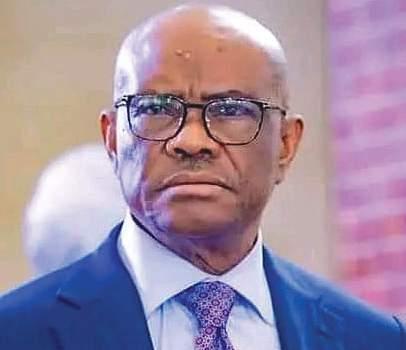
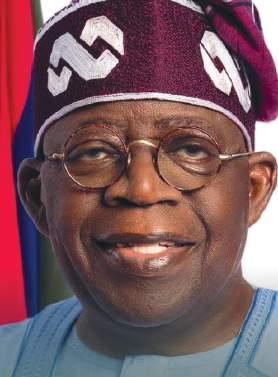
President Tinubu Disconnected from Nigerians’ Hardship, Says Baba-Ahmed
Chuks Okocha in Abuja
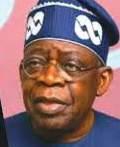
National Chairman of Peoples Redemption Party (PRP), Hakeem Baba-Ahmed, has expressed worry over what he called a widening gap between leadership actions under President Bola Tinubu and citizens’ realities.
Speaking on Arise TV’s “The Morning Show”, Baba-Ahmed, a former Special Adviser on Political Matters to Vice President Kashim Shettima, said many politicians were now showing interest in joining PRP ahead of future elections.
He condemned remarks by the president suggesting that Nigerians who did not see progress under his administration were either biased or unable to recognise development.
Tinubu had, last week, dismissed critics of his administration, saying those who fail to see the “hope” in his policies may need prescription glasses.
“If they don’t want to see for the governorship forms.
Continued on page 8
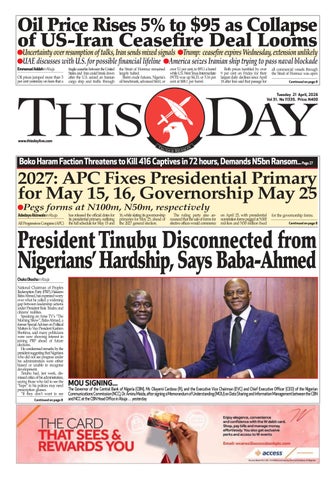
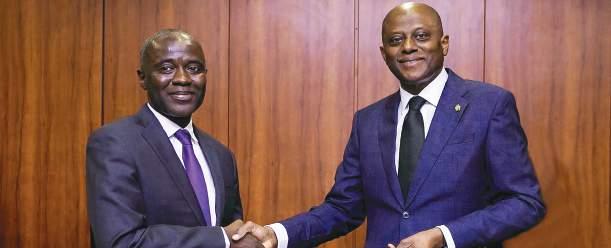
MOU SIGNING...
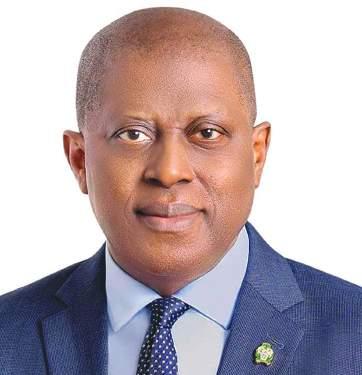
The Governor of the Central Bank of Nigeria (CBN), Mr. Olayemi Cardoso (R), and the Executive Vice Chairman (EVC) and Chief Executive Officer (CEO) of the Nigerian Communications Commission (NCC), Dr. Aminu Maida, after signing a Memorandum of Understanding (MOU) on Data Sharing and Information Management between the CBN and NCC at the CBN Head Office in Abuja … yesterday
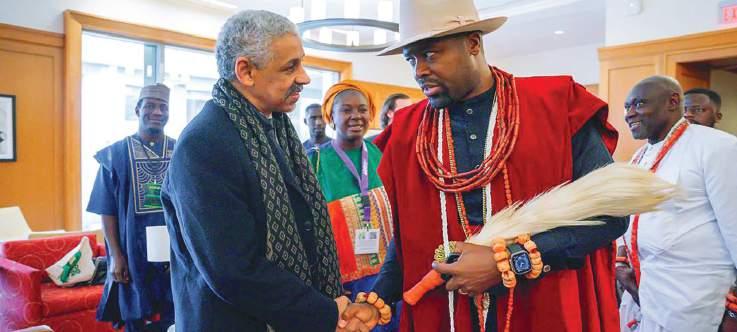
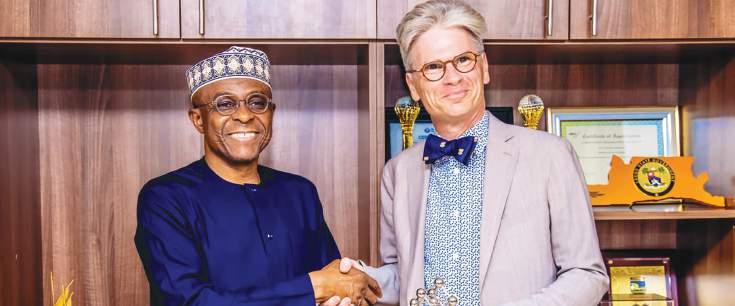
L-R: President, African Development Bank, Dr. Sidi Ould Tah in hand
Development
in Boston, USA where
with
Dangote Refinery to Begin Large-scale Production of High-margin Chemicals
Strikes deal with Honeywell for additional 750,000MT of propylene New agreement to enable refinery manufacture plastics, detergents Business group seeks N500bn capital raise for sugar company
Emmanuel Addeh in Abuja
The Dangote Group is deepening its push into higher-value petrochemicals, with its refinery in Lekki, Lagos set to begin large-scale production of key industrial chemicals, including the ones for plastics and detergents.
The petrochemical expansion followed a new agreement between Dangote Petroleum Refinery and Petrochemicals and Honeywell, under which the American firm will supply advanced process technologies and catalysts to boost output of critical feedstocks used in plastics and detergents.
In a statement seen by THISDAY issued from Charlotte, North Carolina, Honeywell said the collaboration would enable the refinery to significantly scale up production of propylene and linear alkylbenzene (LAB), both considered high-margin petrochemical products with strong global demand.
Under the agreement, Dangote will deploy Honeywell UOP’s Oleflex™ technology to produce an additional 750,000 metric tonnes of propylene annually. Propylene is a key input in the manufacture of packaging materials, consumer goods and a wide range of industrial products.
The refinery will also integrate a
suite of petrochemical technologies to produce 400,000 metric tonnes per year of LAB, a major ingredient in detergents and other cleaning agents. At full capacity, the Lekki facility is expected to rank among the largest LAB production plants globally.
“Honeywell will provide industry-leading petrochemical process technologies and catalysts to Dangote Petroleum Refinery and Petrochemicals FZE (Dangote) to create plastics and detergents, helping the region strengthen energy security by reducing reliance on imports, stimulating industrial growth and strengthening regional supply chains.
“Dangote will use Honeywell UOP’s Oleflex™ technology to produce an additional 750,000 metric tons of propylene annually at the refinery, supporting the manufacturing of packaging materials, consumer goods and industrial products. Additionally, Dangote will deploy a suite of Honeywell UOP’s petrochemical technologies and catalysts to make 400,000 metric tons per year of linear alkylbenzene (LAB), a key ingredient in detergents and surfactants for household and industrial cleaning products. Once at full production, Dangote’s Lekki LAB plant will be one of the largest in the world,” the Honeywell statement said.
In his comments, President of the Dangote Group, Aliko Dangote, said the partnership reinforces the company’s ambition to strengthen Nigeria’s industrial base and reduce dependence on imports.
He noted that the adoption of advanced processing technologies would not only meet rising domestic and regional demand for petrochemical products but also position the group as a competitive global supplier.
“Our continued collaboration with Honeywell advances our vision to strengthen Nigeria’s industrial sector, supporting the nation’s supply chain independence and economic growth,” said Aliko Dangote, President of Dangote Petroleum Refinery and Petrochemicals.
“Honeywell’s technologies enable us to help the region meet rising demand for consumer and industrial goods, positioning Dangote as a global
supplier and driving viable economic development throughout West Africa,” he added.
The development marks a strategic shift for the refinery from primarily fuels production into higher-value chemical manufacturing, a segment that typically offers stronger margins and more stable long-term demand.
Honeywell, which has maintained a long-standing relationship with the Dangote refinery project, said
its technologies would improve operational efficiency, reliability and output across both existing and new processing units. According to the company, the broader collaboration is also expected to support Dangote’s plan to expand refining capacity from 650,000 barrels per day to about 1.4 million barrels per day by 2028, potentially making it the largest petroleum refinery in the world.
Tinubu Okays N15bn Take-off Grant for New Campus of Nigeria Police Academy in Ogun
Deji Elumoye in Abuja
President Bola Tinubu has approved the establishment of a new campus of the Police Academy in Erinja, Yewa South Local Government Area in Ogun State. Presidential spokesperson, Bayo Onanuga, in a statement issued on Monday, said the President also approved a special take-off
grant of N15billion for the college.
The president’s approval was in fulfilment of the provisions of the Nigeria Police Academy (Establishment) Act, 2021, particularly with respect to the expansion of the Police Academy based in Wudil, Kano State, into multiple campuses across the country.
The intervention fund will be sourced from the TetFund 2026
FCT Education Secretary Slams NUT, Warns of Looming WASCE Crisis Over Strike
Olawale Ajimotokan in Abuja
The FCT Education Secretariat Mandate Secretary, Danlami Hayyo, has warned the Nigeria Union of Teachers (NUT) to suspend its ongoing industrial action so as not to demoralise students scheduled to write their West African School Certificate Examinations (WASCE) today.
He spoke of the likely psychological effects on the students yesterday during a school inspection following reports that union members were forcibly removing students and teachers from classrooms.
“I was initially impressed by the high turnout of both students and teachers ready for learning.
“However, the NUT has chased pupils out of some schools. I do
not believe it is constitutionally right for a union to forcefully eject students who are eager to learn”, Hayyo said.
He questioned the union’s commitment to the welfare of their own children and the timing of the strike when the examinations conducted by the West African Examinations Council (WAEC) were set to commence nationwide.
He warned that the development could lead to mass failure as WAEC will not reschedule its calendar specifically for FCT students.
Defending the current administration’s record, Hayyo further clarified the financial standing of the government regarding union demands, stating the FCT Minister Nyesom Wike had paid 40 per cent of teachers ‘entitlements last year.
allocation to finance priority infrastructure, academic facilities, student accommodation, and core training assets.
A high-level consultative meeting involving the Minister of Police Affairs, Ibrahim Geidam; his education counterpart, Dr Tunji Alausa; officials of the Federal Ministry of Education, the Inspector-General of Police and the Executive Secretary of the National Universities Commission (NUC) recommended the siting of the new campus in Erinja.
The meeting considered student intake capacity, funding realities, academic quality assurance, and the long-term needs of the Nigerian Police Force, which is currently recruiting more men.
Tinubu believed the expansion will strengthen institutional governance, modern policing education and national security.
The president also reconstituted the 16-member governing council of the Nigeria Police Academy, Wudil, Kano State, appointing the
Minister of Police Affairs, Senator Ibrahim Geidam, as the chairman. Other members of the council include the chairman of the Police Service Commission, the Inspector-General of Police, and one representative each from the Federal Ministry of Education, the Federal Ministry of Finance, and the Federal Ministry of Justice. Tinubu also appointed six persons to represent the six geopolitical zones.
They are Babagana Zannah Adam (DCP Rtd.) – North East; Emmanuel Torkuma Manger –North Central; Maigari Abati Dikko (DIG Rtd.) – North West; Dubem A. Obaze (KSM) – South East; Ajibogere Toyin – South West and Udom Udo Ekpoudom (DIG Rtd.) – South South.
Commandant of the Academy, the Provost, and Deputy Inspector-General of Police in charge of training are ex-officio members while the Registrar of the Academy will serve as the council’s secretary.
shake
His Majesty, Ogiame Atuwatse III, CFR, the Olu of Warri kingdom at Harvard Law School during Africa
Conference
His Majesty delivered a keynote address titled “A New Era of Leadership in Africa: Values, Institutions and Influence” on Sunday
Names Geidam as chairman of reconstituted 16-member governing council of police academy, Wudil
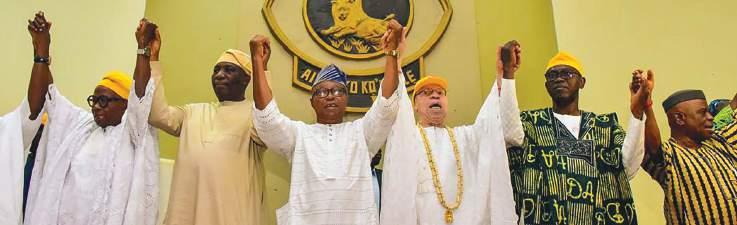
OGUN EAST SENATORIAL DISTRICT CAUCUS MEETING...
L-R: A leader of the All Progressives Congress in Ogun East; Chief Kola Ogunjobi,former Senator,Ogun East Senatorial District; Senator Lekan Mustapha,Senatorial Chairman,Ogun East Senatorial District; Chief Adeleke Adedoyin, Secretary to the Ogun State Government; Mr Tokunbo Talabi, former Deputy Governor of the state; Senator Gbenga Kaka, a member of the Governor’s Advisory Council; Chief Pegba Otemolu, during the Ogun East Senatorial District Caucus meeting held at the Adeola Odutola Hall, Ijebu-Ode on Monday.
Amid Emerging Complexity in Digital Financial Ecosystem, CBN, NCC Seal MoU to Safeguard Consumers
Cardoso: agreement not merely administrative document, but practical statement of national interest, inaugurates committees to operationalise MoU Maida: with this handshake, consumers who experience airtime recharge issues are assured of prompt resolution
James
Governor of the Central Bank of Nigeria (CBN), Mr. Olayemi Cardoso, and Executive Vice Chairman/Chief Executive, Nigerian Communications Commission (NCC), Aminu Maida, yesterday, formalised a Memorandum of Understanding (MoU) between both institutions to deliver a safer, more resilient, and inclusive digital financial system that supports national productivity, protects consumers, and strengthens trust in the country's digital economy.
Speaking at the signing ceremony held at the CBN Headquarters in Abuja, Cardoso said given the scale and complexity of today’s digital financial ecosystem, there was a need for a more comprehensive, forward-looking, and enduring framework to address emerging issues.
He emphasised the need to reinforce stability and integrity of the country’s payment system, strengthen collective response to electronic fraud, and improve
consumer protection.
He said the ability to verify mobile number status in real time across banks, fintechs, and other digital platforms remained a critical layer of protection for consumers and for the financial system.
The CBN governor stressed that the MoU will ensure that the use of the capability was governed by clear standard operating guidelines and strict compliance with Nigeria’s data protection requirements, including appropriate safeguards, encryption, and consent protocols.
In addition to the formalisation of the agreement, Cardoso also inaugurated the Joint Committee on Payment System and Consumer Protection, and Joint Committee on Telecom Identity Risk Management Portal (TIRMP), a secure, regulatory-backed data-sharing platform designed to help prevent fraud linked to churned, swapped, or blacklisted mobile numbers.
He said the committees will provide structured coordination, resolve operational frictions, recom-
mend improvements, and report progress, "so that this partnership delivers measurable outcomes, not just good intentions.”
He stated that the MoU further sent a clear signal to regulated entities, including financial institutions, payment service providers, mobile network operators, and other stakeholders, that regulatory collaboration will be predictable, coordinated, and anchored on the public interest going forward.
Cardoso said, “We will continue to encourage innovation, but we will also insist on responsibility: robust infrastructure capacity, strong controls, responsive complaint handling, and full compliance with applicable laws and regulatory directives.”
He added, “First, we are reinforcing the stability and integrity of Nigeria’s payment system. As we deepen instant payments, expand QR-based payments, and advance open banking and API interoperability, it is essential that infrastructure across both sectors is aligned so that transactions are
Osinbajo Inaugurates 6.72km Road in Bayelsa, Lauds Diri for Fulfilling Promises
Former Vice-President, Prof. Yemi Osinbajo, has officially opened the 6.72km Agbura Oxbow Lake Road in Bayelsa, yesterday.
The newly completed AgburaOxbow Lake road would serve as a convenient bypass for residents of Agbura, Ogbia communities, and motorists traveling to road in Nembe and beyond from Swali Market.
During the inauguration, Osinbajo expressed his appreciation to Diri for his efforts to improve the lives of the people of Bayelsa through enhanced infrastructure.
Thanking Diri for the invitation to commission the project, he said that it was not often in politics that people keep to their words.
He said Diri was a straightforward person that kept to his promise.
"I was here four years ago for
groundbreaking, but today the project has been actualised, for this is a man of his words.
"This road is very special to the people of this area, which open access to the Federal University Otuoke, and Oloibiri where oil was first discovered in large quantity.
"This road is an access to many Communities and even the state capital. I want to thank Diri for making life easier for the people of Bayelsa," he said.
Diri expressed gratitude to the people of Bayelsa and Osinbajo for honouring the invitation to inaugurate the project, which was initially groundbreaking in 2022.
"You hourned us during the groundbreaking in 2022 as the vice-president, but today the projects have been commissioned by President Bola Ahmed Tinubu, early this month and today you are here coming another road project.
"Sitting by you today that you
are a real Bayelsa man, as you said you eat plantain everyday. Development must be felt in every part of Bayelsa State, as for us their is nothing like difficult terrain, we must follow it squarely," he said.
reliable, services scale smoothly, and consumers enjoy safe and seamless experiences.
“Through this MoU, we will strengthen coordination on approvals, technical standards, and innovation trials, including sandbox testing that supports market-led solutions while safeguarding stability.”
Cardoso stated, “Second, we are strengthening our collective response to electronic fraud and improving consumer protection. The rise in digital adoption has also attracted increasingly sophisticated fraud schemes.
“Addressing these threats requires joined-up action—shared intelligence, clearer escalation paths, stronger operational readiness across regulated entities, and consistent public education.”
The CBN governor stated, “Across Nigeria, our citizens and businesses increasingly depend on digital channels to save, pay, trade, access credit, and build livelihoods. Those channels, in turn, depend on resilient telecommunications networks, trusted identity systems, and secure data flows.
“Put simply: when the communications sector is strong, the financial system is more inclusive and more efficient; and when the financial system is sound, investment and innovation in the digital economy can thrive.
“That is why this MoU is not merely an administrative document—it is a practical statement of national interest.”
The apex bank boss further explained that the agreement will support measures, such as strengthened authentication for higher-risk transactions, effective transaction monitoring, functional fraud reporting channels, and a harmonised consumer sensitisation programme, particularly for underserved segments and MSMEs who are often most exposed to these risks.
In his remarks, Maida said the MoU provided a structured framework for cooperation in critical areas, including payment system integrity, fraud mitigation, digital inclusion, and the protection of consumers, micro, small and medium-sized enterprises, which will translate into practical outcomes that strengthen trust, deepen inclusion, and support a secure and resilient digital economy.
He described the signing as an important milestone in regulatory stewardship of Nigeria’s digital economy, saying it reflects a shared commitment to collaboration in strengthening financial system stability, advancing digital inclusion, and protecting consumers in an increasingly interconnected ecosystem.
Maida He highlighted protection of Nigerian consumers as the principal goal of the MoU, saying both NCC and CBN have consistently pursued it.
“With this handshake, consumers who experience issues, such as airtime recharges that do not deliver
value can be assured of prompt resolution within the shortest possible time,” he said.
The NCC boss stressed, “The commission places significant importance on collaboration. Indeed, many of the critical milestones we have achieved in addressing some of our industry’s challenges—and even in leapfrogging our sector—have been made possible through strategic partnerships and sustained collaboration. Our collaboration with the central bank is not new.
“Over the years, our two institutions have demonstrated the value of close regulatory coordination. A notable and recent example is our collective effort in resolving the long-standing USSD debt impasse—an intervention that restored confidence, preserved service continuity, and safeguarded the interests of consumers, telecom operators, and financial institutions alike. That experience reaffirmed a simple truth: that complex, crosssector challenges are best addressed through structured collaboration.”
Maida said the MoU provided a clear framework for collaboration in critical areas, like “payment system integrity, consumer protection, fraud mitigation, and the responsible use of digital infrastructure.”
He said, “In particular, it supports initiatives that promote secure digital payments, enhance trust in mobile-enabled financial services, and extend safe access to underserved populations and MSMEs."
Court Affirms FCCPC’s Powers to Investigate Consumer Complaints
James Emejo in Abuja
The Federal Competition and Consumer Protection Commission (FCCPC) , yesterday welcomed the Federal High Court, Abuja judgement dismissing the suit filed by Air Peace Limited, challenging the commission’s authority to investigate consumer complaints. and issue summons in the exercise of its statutory mandate.
The judgment, delivered by Justice James Omotosho, affirmed the commission’s powers under the Federal Competition and Consumer Protec-
tion Act, 2018 (FCCPA) to receive complaints, assess matters brought before it, and take appropriate lawful steps, including investigation where necessary.Executive Vice Chairman/Chief Executive, FCCPC, Mr. Tunji Bello, said the judgment provided useful clarity on the importance of regulatory oversight in protecting consumers and promoting fair market practices. He noted that the matter arose from complaints relating to unrefunded ticket fares, cancelled flights, and other service concerns
affecting passengers.
In a statement issued by FCCPC Director, Corporate Affairs, Ondaje ljagwu, Bello stressed that consumers who pay for services are entitled to fair treatment, transparency, and redress in accordance with applicable law.
He further emphasised that investigation is an administrative process intended to establish facts and determine whether further action is warranted. It does not amount to a finding of liability or wrongdoing.
According to him, the commission is committed to engaging all market
participants in a fair, professional, and transparent manner, while ensuring due process at every stage of its proceedings.
He encouraged businesses operating in Nigeria to cooperate with lawful regulatory processes and to maintain effective complaint resolution systems that address consumer issues promptly and fairly. The FCCPC will continue to act within its statutory mandate to protect consumers, promote competitive markets, and strengthen confidence in essential service sectors, including aviation.
Olusegun Samuel in Yenagoa
Emejo in Abuja
INVESTITURE OF OLAPADE-OLAOPA AS THE PRESIDENT-ELECT OF WFME...
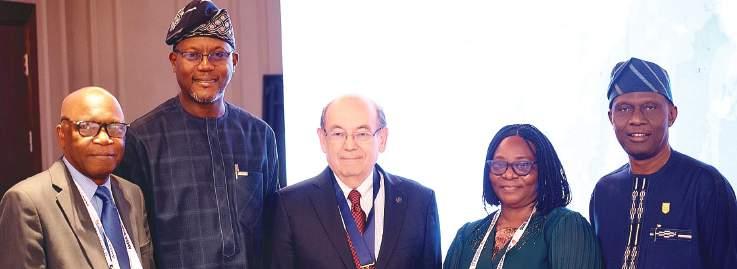
L-R: President of AMSA, Professor Temidayo Ogundiran; President-Elect of the World Federation for Medical Education (WFME), Professor Oluwabunmi OlapadeOlaopa; WFME President, Ricardo Leon-Borquez; Professor Bernice Adegbehingbe; and SSA to the Minister of Health, Dr. David Aturo, during the investiture of Professor Olapade-Olaopa as the President-Elect of WFME, in Lagos... recently
In London, Gov Sanwo-Olu Seeks Foreign Investments, Partnerships
Charges
Commonwealth states to bring capital, technology, expertise to Lagos
Segun James
Governor Babajide Sanwo-Olu of Lagos State on Monday charged the Commonwealth’s 56-member states to invest in Africa, particularly Lagos.
Sanwo-Olu said Commonwealth member states should bring their capital, technology, and other expertise, promising that they will find not just market and opportunity, but also partnership and relationship.
He said the Commonwealth's greatest advantage was not simply its shared language, shared laws or shared history but also its people. He said nowhere was that advantage more vivid, dynamic or consequential than in Africa.
Addressing the opening ceremony of the Commonwealth Trade and Investment Summit held at Mansion House, London, on Monday, Sanwo-Olu said Lagos was ready for partnerships and relationships with global investors.
The theme of the opening session was, “The Commonwealth's Advantage."
The event was attended by Chairman of the Commonwealth Enterprise and Investment Council,
Lord Marland; Secretary-General of the Commonwealth, Shirley Botchwey; Deputy Prime Minister of Malta, Dr Ian Borg; Lady Mayor of the City of London Corporation, Dame Susan Langley; Heads of Government; Ministers; High Commissioners; Captains of Industry; Global Investors; and Business Leaders, among others.
Sanwo-Olu, who was the keynote speaker, stated, "Africa is home to the world's youngest population. By 2050, one in four people on this earth will be African. The Commonwealth already counts 56-member states with a combined population of 2.7 billion.
“A significant and growing share of that number lives on our continent. If the Commonwealth is to remain relevant — not merely as a sentimental compact, but as a genuine engine of global trade and investment — then Africa must be central to its strategy. And within Africa, Lagos must be part of that conversation.
“We live in an age of fracturing - of retreating globalisation, of tariff walls rising like storm barricades, of geopolitical uncertainty that rattles supply chains and spooks
investors. In such a moment, the Commonwealth offers something rare and valuable: a network built not on fear, but on trust.”
Sanwo-Olu explained, “Fifty-six nations that share foundational commitments — to the rule of law, to democratic governance, and to open markets — constitute a remarkable platform for doing business with confidence.
“The Commonwealth's advantage will only be fully unlocked when we treat emerging markets not as recipients of investment but as partners in shaping the terms of it.
"That is why we welcome frameworks like blended finance and support AfCFTA — the African Continental Free Trade
Area — which has the potential to create the world's largest single market by GDP coverage.
“And that is why Lagos is investing in its port, its airport, its rail corridors, and its technology infrastructure — because we understand that to attract global capital, you must first build the foundations that make capital feel at home."
Speaking on Lagos State and his administration’s commitment to delivering the dividends of democracy to over 20 million residents through the THEMES+ developmental agenda, Sanwo-Olu said, “Lagos is Nigeria's economic capital. It generates roughly a third of Nigeria's GDP, and, were it a
standalone economy, it would rank among the top five in sub-Saharan Africa.
“In 2023, we were re-elected on a mandate to deepen what we had started – to transform Lagos into a twenty-first-century megacity that works for its people.
“We are delivering on that mandate. Amongst many other things, our Blue Line and Red Line rail projects are now operational — the first metro rail system in West Africa. We are about to commission one of the continent's largest children's hospitals, and we are digitising our revenue and land administration systems.”
He stated, “We have invested heavily in road infrastructure, in
water, in security, and in social inclusion. And we are doing this not simply by waiting for government budgets but by actively courting, structuring, and sustaining publicprivate partnerships with investors from across the Commonwealth and beyond.
“Our T.H.E.M.E.S.+ Agenda — covering Transportation, Health, Education, the Economy, the Making of a 21st Century State, Entertainment and Tourism, Security, and critically, the '+' of social inclusion, gender equity, and youth empowerment — is not a campaign document. It is a governance architecture. And I say to every investor in this room: that architecture is open for business.”
Court Rejects Akintoye's Document in Defence
Alex Enumah in Abuja
of Alleged $35m NCDMB Fraud
A Federal High Court in Abuja has rejected a document sought to be tendered by Akintoye Akindele, in his defence of fraud allegations
Nigeria–South Africa Navies Deepen Ties on Maritime Security
Linus Aleke in Abuja
The Nigerian and South African Navies have strengthened their partnership on maritime security across Africa, a cooperation stemming from their inaugural Naval Staff Talks at Naval Base, Simon’s Town in Cape Town, South Africa.
In a statement, Director of Naval Information, Navy Captain Abiodun Folorunsho, stated the talks aimed to build a strong framework for naval cooperation. He said this would protect both nations’ maritime interests and bolster continental security.
He revealed the Nigerian delegation was led by Rear Admiral A. A.
Mustapha, Flag Officer Commanding Western Naval Command, while Rear Admiral S. Makhanya headed the South African side.
Endorsed by Vice Admiral Idi Abbas, Chief of the Nigerian Naval Staff, and his counterpart Vice Admiral Monde Lobese, the discussions covered maritime domain awareness, joint training, operational cooperation, and capacity building.
He stressed these efforts target threats like piracy, illegal fishing, and transnational crime, adding the Nigerian team also toured the Institute of Maritime Technology and the South African Naval Museum, gaining insights into local innovations and heritage.
“To build on this, the South African Navy will join Nigeria’s 70th Anniversary celebrations in June 2026, offering chances to seal agreements and explore further collaboration,” the Naval Spokesperson disclosed.
Captain Folorunsho stated: “The Nigerian Navy reaffirms its commitment to strategic partnerships that enhance maritime security, promote regional stability, and support Africa’s collective prosperity.”
In a related operation, personnel from Nigerian Navy Ship (NNS) Beecroft rescued three suspected stowaways from the merchant vessel Msc Stella (IMO No. 9279988) off the Lagos Fairway Buoy.
regarding the Nigerian Content Development and Monitoring Board (NCDMB) local refinery project.
Justice Akpan Ekerete refused to accept the document on the grounds that it was a photocopy of an original, and ought to be certified before being tendered as exhibit.
Economic and Financial Crimes Commission (EFCC) is prosecuting Akindele and two companies linked to him over alleged complicity in the conversion of the sum of $35 million belonging to NCDMB.
According to the charge, the said sum was allegedly converted from the money paid by NCDMB Capacity Development Intervention Company Ltd to Atlantic International Refinery and Petrochemical Limited as investment in the establishment of a modular refinery, a jetty amongst others in Brass, Bayelsa State.
Akindele pleaded not guilty to the entire charge, and had been admitted to bail.
At the proceedings of March 10, during the cross examination of the Fourth Prosecution Witness (PW4),
Isaac Yalah, the first defendant had informed the court that he did offer to buy off NCDMB from the project and sought to tender a copy of the offer letter through his lawyer, E.O. Adekwu, SAN.
But EFCC had through its lawyer, Iheanacho Ekele, SAN, objected to the admissibility of the letter, arguing that being a public document it must be duly certified before it can be admitted by the court as evidence.
Ekele said, “I have an objection to the admissibility of this document. The ground is that this document is a photocopy of an original and it is addressed to NCDMB which is a public institution and such document should have been certified.
“The only admissible document in law of a copy of a public document is a certified true copy. We rely on Section 89 of the Evidence Act and Section 102 of the Evidence Act, and we also commend the case of Adeyefa against Bamgboye 2013, 10NWLR, part 1863 page 532.
“We also commend the case of Onwuzuruike against Edoziem 2016 6NWLR Part 1508, Page 205. We urge the court to discountenance
it and dismiss it.”
After the argument of lawyers on the admissibility of the document, the court fixed April 14 for ruling, and May 18 for the continuation of cross examination of the prosecution witness.
Delivering his ruling on the admissibility of the document, Ekerete agreed with the submissions of the prosecution that the said documents, being public document, ought to have been certified.
The judge subsequently refused to accept the purported letter to buy off NCDMB from the project because it was a photocopy rather than the original.
The trial continues on May 18, 2026.
Akindele was arraigned alongside two others on a four-count charge bordering on retaining and using NCDMB's funds, despite having knowledge that they emanated from an unlawful active.
The two other defendants in the suit marked: FHC/ ABJ/ CR/ 641/2024, are Platform Capital Investment Partners Ltd and Duport Midstream Company Ltd.
Akpabio, Ivorian Counterpart Rally West Africa Behind Integration Drive, Flag Strategic Coastal Highway
Sunday Aborisade in Abuja
President of the Senate, Godswill Akpabio, has led a renewed push for deeper West African integration, urging coordinated regional action as Nigeria and Côte d’Ivoire strengthened bilateral and multilateral ties at the 152nd Assembly of the Inter-Parliamentary Union (IPU) in Istanbul, Turkey.
Akpabio, according to a statement by his Media Office on Sunday, made the call during a high-level meeting with the Speaker of the Ivorian National Assembly, Patrick Jérôme Achi, where both leaders stressed the urgency of forging a united regional bloc to withstand growing global fragmentation and economic pressures.Declaring Côte d’Ivoire a
historic partner, Akpabio warned that failure to integrate could expose the region to new forms of neocolonialism. He maintained that only a united West Africa could maximise trade, political cooperation, and cultural exchange.
The two leaders aligned on the need to strengthen the Economic Community of West African States (ECOWAS) and prioritise the reintegration of Sahel countries, describing regional cohesion as critical to economic survival and political stability. At the centre of their discussions was the Abidjan–Accra–Lagos Coastal Highway, a flagship infrastructure project expected to transform mobility and trade across the subregion. The corridor, linking major
economic hubs and over 300 million people, will cut travel time between Lagos and Abidjan from three days to about eight hours upon completion.
Designed as a modern dual carriage superhighway, the project will operate under a supranational legal framework and eliminate bottlenecks through harmonised cross-border regulations.
Five ECOWAS member states have already enacted enabling laws to support seamless movement along the corridor.
Describing the initiative as a game-changer, Akpabio said "the highway would serve as a major economic artery for West Africa, commending President Bola Ahmed Tinubu for backing the project."
In his remarks, Achi shifted
focus to economic strategy, insisting that sustainable growth must be driven by the private sector, with governments providing policy direction and legislative support.
He called for reforms to unlock investment, expand markets, and tackle unemployment, particularly among the region’s growing youth population.
He identified peace, education, and economic opportunity as essential pillars for development, cautioning that Africa risks stagnation if these fundamentals are neglected.
Both leaders acknowledged structural barriers to integration, including language divides, weak infrastructure, fragmented markets, and brain drain.
They urged African countries to better harness their human and
natural resources, noting the continent remains underutilised despite its vast wealth.
On security, they advocated technology-driven border management, enhanced intelligencesharing, and coordinated regional surveillance systems to safeguard open-border arrangements.
They also raised concerns over emerging threats such as digital and economic recolonisation, calling for proactive investments in technology and innovation to protect Africa’s future.
The meeting, according to the statement, ended with a firm commitment to deepen parliamentary collaboration, align legislative frameworks, and strengthen oversight of regional initiatives.
Akpabio and Achi, the statement added, described Nigeria and
PRESIDENT TINUBU DISCONNECTED FROM NIGERIANS’ HARDSHIP, SAYS BABA-AHMED
the hope… we shall lend them ‘jigi-bola’… (Bola’s eyeglasses),” the president said.
Reacting, Baba-Ahmed said the comment raised serious concerns
about the government’s awareness of prevailing economic and security challenges.
“There is no way you can live in this country, see the level of
poverty and unaccountability, and still expect Nigerians to applaud your performance,” he said.
The national chairman of PRP added that the administration’s
2027: APC FIXES PRESIDENTIAL PRIMARY FOR MAY 15, 16, GOVERNORSHIP MAY 25
National Organising Secretary of APC, Sulaiman Argungu, in a notice issued yesterday, said the expression of interest form for the presidential election was N30 million, while the nomination form was N70 million.
Argungu stated that Expression of Interest form for governorship was N10 million, while the nomination form was N40 million.
He said Expression of Interest form for senatorial elections was N3 million, while the nomination form was N17 million.
For the House of Representatives, Argungu said Expression of Interest form was N1 million, while the nomination form was N9 million.
He said Expression of Interest form for House of Assembly was N1 million, while the nomination form was N5 million.
Argungu said the sale of forms would commence on April 25 and end May 2, 2026, with May 4 being the last day for the submission of completed forms.
The party added that the screening of aspirants would
take place between May 6 and 8, while publication of screening results was scheduled for May 9.
Argungu added that the primary election for House of Representatives seats would hold on May 18 and that for Senate would be held on May 20, 2026.
The ruling party stated that its House of Assembly primary was scheduled to hold on May 23.
APC assured members, stakeholders, and Nigerians, generally, of its commitment to conducting a credible and transparent primary election.
reforms had not translated into improved living conditions for citizens.
He stated, “We are more insecure, more hungry, and more desperate. The reforms on paper do not reflect the reality Nigerians face. There is no way you can live in this country, see the level of poverty, seeing the level of unaccountability, we’re not accounting for the funds we’re getting, and still say that Nigerians should see what you’re doing and applaud you.”
Baba-Ahmed expressed confidence that All Progressives Congress (APC) would be defeated in a free and fair election, citing what he described as a disconnect between government perception and public sentiment.
He stated, “If the president goes into an election with this mind-set and allows a free and fair process, then we are home and dry.
“One of the reasons why
we feel confident that we can defeat APC is exactly this kind of mind-set. You have 10, 12, 20 failings of an administration that is saying we have done fantastic.”
Addressing the fact many politicians were showing interest in joining the party ahead of future elections, Baba-Ahmed described PRP as a viable political option, saying its doors are open to new members.
“In the last three or four weeks, you will be amazed at how many people have reached out to us and said, ‘We’re coming over to your party’,” he said.
He said the party was ready to receive anyone willing to join.
“Our doors are open to anybody, who wants to come in, either on their own or because the system has blocked and virtually destroyed their party,” he said.
Baba-Ahmed added that the party’s role in the coming months would be much bigger than before, stating that the growing interest
Akpabio
regional growth.
shows confidence in PRP.
“We see our role in the next few months as far, far greater than anything we have done before,” he said.
He explained that those coming into the party were not doing so out of desperation but because of its long-standing values.
“They are not just coming as political refugees. They are coming because we are a party of principles,” he said.
The PRP chairman described the party as one of the oldest in the country.
“We are about 70 years old. We have always stood on certain principles,” he added.
While acknowledging that time might be a challenge in the attempt to build momentum, Baba-Ahmed expressed confidence that the party would overcome it.
“We know Nigerians are ready for real difference, real change in the way this country is run,” he said.
OIL PRICE RISES 5% TO $95 AS COLLAPSE OF US-IRAN CEASEFIRE DEAL LOOMS
for the remainder of the ceasefire.
But as of last night there was uncertainty over whether the planned peace talk which would have begun today would go ahead, even as the United States President, Donald Trump foreclosed the likelihood of an extension beyond Wednesday (tomorrow).
The escalation of the crisis is coming after the US said on Sunday that it had seized an Iranian cargo ship that tried to break through its blockade while Iran said it would retaliate, heightening fears of a resumption in hostilities.
There have been mixed signals for Iran attending the peace talks, as a senior Iranian official told Reuters on Monday, but no decision had been made. But Vice President JD Vance and the U.S. delegation were set to land in Pakistan within hours for talks on Iran, Trump said on Monday.
Shipping traffic through the Strait of Hormuz remained at a virtual standstill yesterday, with only three crossings in the 12 hours, shipping data showed. More than 20 ships passed through the strait on Saturday, carrying oil, liquefied petroleum gas, metals and fertilisers, Kpler data showed. That was the highest number of vessels crossing the waterway since March 1.
Trump: Ceasefire Expires
Wednesday, Extension Unlikely
US President Donald Trump has said he now considers the ceasefire with Iran over “Wednesday evening Washington time” but that it’s “highly unlikely” he would extend it further if a deal is not reached.
It’s “highly unlikely that I’d extend it” Trump told Bloomberg in a phone interview. The ceasefire was originally slated to last two weeks and began the evening of April 7.
“I’m not going to be rushed into making a bad deal. We’ve got all the time in the world,” Trump said in the interview.
When asked if he would expect the fighting to resume immediately if they fail to reach an agreement, Trump said, “If there’s no deal, I would certainly expect.”
Previously, Trump has gone back and forth on whether he would agree to extend the ceasefire. In the course of one question-and-answer session with reporters last week, he was asked five separate times whether he would extend the ceasefire, and offered three different answers.
UAE in Talks with U.S. for Possible Financial Lifeline
Also, the United Arab Emirates has begun talks with the US about a financial backstop in case the Iran war plunges the country into further crisis, the Wall Street
Journal reported, citing US officials it didn’t identify.
UAE Central Bank Governor Khaled Mohamed Balama raised the idea of a currency swap line with Federal Reserve and US Treasury officials, including Treasury Secretary Scott Bessent, during meetings in Washington last week, according to a Wall Street Journal report.
The Emirati leaders said they have avoided the worst economic effects of the conflict but might still need a financial lifeline, the officials told the Journal.
The discussions underscore UAE’s growing anxiety that the war could harm its economy and position as an international financial centre, draining foreign currency reserves and triggering capital flight, according to the WSJ. Emirati officials haven’t formally requested a swap line, the Journal said.
The war has inflicted damage on the UAE’s energy infrastructure and blocked oil shipments through the Strait of Hormuz, cutting off a critical stream of dollar income.
In an interview Sunday on ABC’s This Week, Reem Al Hashimy, the UAE’s minister of state for international cooperation, said the sheikhdom has been hit with more than 2,800 missiles and drones since the US-Israeli war with Iran began on February 28.
Iran Not Planning to Attend Talks with U.S. in Pakistan
Iran isn't planning to attend talks with the United States, the regime said, after President Trump said he was sending U.S. negotiators to Pakistan to take part in renewed talks on Monday, just days before a ceasefire in the Middle East expires.
The ongoing U.S. blockade of Iranian ports has been a significant sticking point, an issue further complicated by an American destroyer on Sunday firing on and seizing an Iranian ship that tried to evade it.
Tehran said it would retaliate, with the state-run Tasnim news agency reporting that Iran had sent drones in the direction of U.S. military ships after its vessel was seized.
Iran Foreign Ministry spokesperson Esmaeil Baqaei said in a weekly press briefing Monday that, "As of now ... we have no plans for the next round of negotiation, and no decision has been made in this regard."
State broadcaster IRIB cited Iranian sources as saying "there are currently no plans to participate in the next round of Iran-U.S. talks." The Fars and Tasnim news agencies had earlier cited anonymous sources as saying "the overall atmosphere cannot be assessed as very positive," adding
that lifting the U.S. blockade was a precondition for negotiations.
State-run IRNA meanwhile pointed to the blockade and Washington's "unreasonable and unrealistic demands," saying that "in these circumstances, there is no clear prospect of fruitful negotiations."
Iran and the United States, along with Israel, are just days away from the end of the two-week ceasefire that halted the Middle East war, ignited by surprise US-Israeli strikes on Iran on February 28.
There has so far been only a single, 21-hour negotiating session held in Islamabad on April 11 that ended inconclusively, though groundwork for fresh talks continued afterwards.
"We're offering a very fair and reasonable deal, and I hope they take it," Trump said in a social media post, while also renewing his threats against Iran's infrastructure if a deal isn't reached, per AFP.
However, as of 9.45pm Nigerian time last night, there were reports that Iran was reconsidering its withdrawal from a proposed second round of peace talks with the US, a senior Iranian official said. It comes as Trump says a delegation from Washington is on its way to Pakistan for a new round of talks.
US Seizes Iranian Ship Trying to Pass Naval Blockade
Trump has said US marines intercepted and took "full custody" of an Iranian-flagged cargo ship in the Gulf of Oman. US forces seized the vessel earlier after it tried to get past the US blockade - currently in place around Iranian ports, Trump posted on Truth Social.
The US president said: "The Iranian crew refused to listen, so our Navy ship stopped them right in their tracks by blowing a hole in the engineroom."
The incident is the latest flashpoint in tensions between the US and Iran. Iran reversed its decision to reopen the Strait of Hormuz at the weekend, while Tehran earlier rejected a second round of peace talks with the US, according to Iranian state media. Iran has accused the US blockade, which began on Monday, of violating the two-week ceasefire agreement between the two countries. Yesterday, Iran's parliamentary speaker Mohammad Bagher Ghalibaf described the blockade as "a foolish ad stupid decision".
The blockade is against vessels of all nations entering or departing Iranian ports and coastal areas, including all Iranian ports on the Arabian Gulf and Gulf of Oman.
The US military has previously warned any ships attempting to get past the blockade would be boarded and seized.
Côte d’Ivoire as central to West Africa’s transformation, expressing confidence that coordinated leadership between both countries could unlock unprecedented
OPENING CEREMONY OF NATIONAL WORKSHOP ON ETHICS FOR JUDICIAL ADMINISTRATORS...
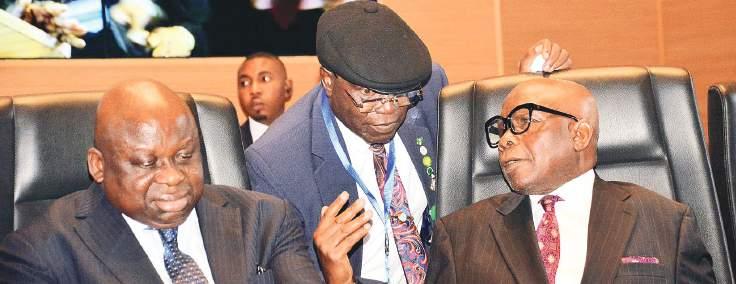
L-R: President, National Industrial Court of Nigeria (NICN), Justice Benedict Bakwaph Kanyip; Administrator National Judiciary Institute (NJI), Babatunde Adejumo; and representative of the Chief Justice of the Nigeria (CJN), Hon.Justice Ibrahim Mohammed Musa Saulawa, during the opening ceremony of the National Workshop on the Ethics for Judicial Administrators, at the
yesterday
Kekere-Ekun Warns Court Registrars, Says Your Conduct Significantly Influence Public Confidence
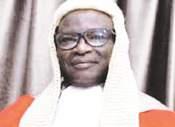
Chief Justice of Nigeria (CJN), Justice Kudirat Kekere-Ekun, has warned Registrars and administrators of courts across the country to be mindful of their conducts as such go a long way in shaping public perception of the country's judiciary.
they leave with the impression that the entire judicial system is compromised.".
She made the assertion on Monday at the opening of a National Workshop on Ethics for Judicial Administrators in Abuja.
The CJN, represented at the workshop by a Justice of the Supreme Court, Justice Ibrahim Saulawa, stated that in contemporary society, the expectations placed upon the judiciary
had expanded significantly. She added that citizens today demanded efficiency, transparency, accountability, and timely resolution of disputes.
Kekere-Ekun pointed out that the expectations could not be met by judicial excellence alone but also involved administrative systems governed by integrity, competence, and ethical discipline.
"Ethical administration demands adherence to principles that mirror the
ethical obligations of the Bench itself: integrity, impartiality, accountability, confidentiality, diligence, and respect for all court users," the CJN said.
She stated that judicial administrators must remain neutral actors, insulated from improper influence, personal interest, or external pressure.
She advised court registrars and administrators never to present themselves as a gateway for preferential treatment, procedural manipulation,
or informal access to justice.
According to the CJN, the administrators' primary allegiance is to the court as an institution and not to their relatives, friends, legal practitioners, or litigants.
Kekere-Ekun stated, "Court officials must therefore act with strict impartiality, guided solely by law, procedure, and institutional responsibility. Personal relationships, external pressures, or private interests
Justice Stakeholders Urge National Assembly to Pass ACJA Amendment Bill Pending Since 2023
Alex Enumah in Abuja
Stakeholders in the justice sector have appealed to the National Assembly to pass law the Administration of Criminal Justice Act (ACJA) Amended Bill, in its custody since the last three years.
The stakeholders predicated the call on the need to put in place a robust and more result yielding criminal justice system.
They spoke on Monday in Abuja, at a Train the Trainers programme, on the National Minimum Standards (NMS) for the effective Implementation of the Administration of Criminal Justice Act (ACJA).
The training, organised by Centre for Socio-Legal Studies (CSLS) in partnership with Rule of Law and Anti-Corruption (RoLAC) programme, had in attendance magistrates, lawyers in both public and private practice, officials from the Ministry of Justice at the federal and states levels, civil groups, among others.
In his welcome address, President of CSLS, Professor Yemi Akinseye-George, SAN, stressed the need for the country to have a criminal justice system that was fair, efficient, transparent, and truly served the people.
Akinseye-George disclosed that the amended bill was aimed at covering the identified lapses in the 2015 law. He pointed out that the Administration of Criminal Justice framework represented one of the most significant reforms in the country's justice system aimed at promoting efficiency, safeguarding the rights of all persons, and ensuring that justice was not only done, but done promptly and fairly.
"However, the true impact of these reforms depends not just on the law itself, but on how well it is understood, applied, and sustained in practice," Akinseye-George said.
He added, "Let me seize this
opportunity to appeal to the National Assembly to pass the ACJA Amendment Bill which has been pending at the National Assembly since 2023. The proposed amendments address the major gaps identified in the Act since its passage eleven years ago."
He observed that the training came a few days after the public presentation of the NMS document by the HAGF, thereby making it both timely and essential.
He said as trainers, participants occupied a critical position in the reform journey, because the knowledge, skills, and insights gained at the workshop will be
transmitted to countless others within their respective institutions and jurisdictions.
"In essence, you are the bridge between policy and practice," Akinseye-George said.
The National Minimum Standards provide a clear, practical framework to guide implementation, as well as ensure consistency, accountability, and measurable progress across the justice sector.
The workshop was designed to deepen participants' understanding of the standards, equip them with effective training methodologies, and strengthen capacity to drive reform at scale.
must never be permitted to influence official conduct.
"Equally important is the duty of confidentiality. Judicial administrators routinely handle sensitive case materials, personal data, and privileged information. Safeguarding such information is fundamental to protecting litigants’ rights and maintaining confidence in the judicial process."
Earlier, Administrator of the National Judicial Institute, Justice Babatunde Adejumo, described participants as the institutional backbone of the courts, stating that their role extends beyond routine duties to safeguarding the credibility and continuity of the justice system.
Adejumo said ethical challenges in judicial administration now intersected with broader governance issues, including accountability, personnel management, and financial oversight.
The workshop was expected to address practical concerns, such as records management, staff discipline, professional boundaries, and service delivery standards.
Chief Registrar of the Ebonyi State High Court, Mrs. Nnenna Onuoha; Murtala Halidu of Kaduna State Judicial Service Commission; and Chief Registrar of the Kwara State Sharia Court of Appeal, Tajudeen Karanga, were among the facilitators at the five-day workshop.
Court Rules May 12 on Virtual Testimony in N152m Oak Homes Fraud Trial
Wale Igbintade
The prosecution on Monday urged the Federal High Court in Lagos to permit a Nigerian-American engineer, Mr. Anthony Ugbebor, to testify virtually from the United States in the ongoing N152 million fraud trial involving property developer Olukayode Olusanya. Prosecuting counsel, CSP Monday Omo-Osagie, made the request before Justice Musa Kakaki through a motion on notice dated November 3, 2025, seeking leave of court to examine the complainant remotely in line with the rules of court.
He informed the court that all parties had been duly served and had filed their respective responses. The application, he said, is supported by a 13-paragraph affidavit and a written address.
Adopting his submissions, OmoOsagie urged the court to grant the application, arguing the affidavit evidence before the court had not been materially controverted and should be deemed admitted.
He also asked the court to discountenance the counter-affidavit filed by the first defendant and to hold that the second defendant failed to properly oppose the application,
having filed only a reply on points of law.
The prosecutor further submitted that the rules of the court expressly permit the taking of evidence by electronic means in appropriate circumstances, particularly where a witness is outside the jurisdiction and unable to attend physically.
He argued that refusing the application would occasion unnecessary delay in the proceedings and hinder the expeditious determination of the case, especially as the witness is central to the prosecution’s case.
Omo-Osagie maintained that adequate safeguards exist within
the court’s procedures to ensure that virtual testimony does not prejudice the defendants, noting the defence would still have full opportunity to cross-examine the witness in real time.
In opposition, counsel to the first defendant, Agboola Adeleke (SAN), urged the court to dismiss the application, relying on Section 351 of the relevant law, which he said requires the physical presence of witnesses for examination and cross-examination.
He argued that allowing virtual testimony would undermine the defendants’ right to fair hearing,
particularly their ability to observe the witness’s demeanour.
Adeleke further contended the reasons given for the witness’s absence—his residence abroad and alleged health challenges—were not supported by credible evidence.
Also, Jude Ehiedu, counsel to the 2nd defendant opposed the application, urging the court to carefully consider the arguments raised in their filings and to uphold established procedural requirements.
After hearing arguments from counsel, Justice Kakaki adjourned the matter to May 12, 2026, for ruling on the application.
Olusanya, the Chief Executive Officer of Oak Homes Limited, is standing trial alongside the company on a four-count charge bordering on conspiracy, obtaining money by false pretence, fraud, and stealing, filed by the Nigerian Police Force. The defendants were arraigned on November 26, 2024, and pleaded not guilty to all charges.
The prosecution alleged that between November 8, 2017, and August 4, 2020, Olusanya and the company’s former Head of Sales and Marketing, Ms. Lynda Umeh (now at large), defrauded Ugbebor of N152 million.
NJI in Abuja,
PHOTO: KINGSLEY ADEBOYE
Alex Enumah in Abuja
TRAINING OF PATIENTS LIAISON OFFICERS AND DEPLOYMENT OF PLOS TO HOSPITALS...
L-R: The Chief Medical Director, Abia State University Teaching Hospital, Prof. Ijeoma Nduka; Founder/CEO of Quantus Medical Foundation and Lead, Abia Healthcare Rebirth Initiative (AHCRI), Dr. Nnenna Ihekoromadu; Abia State Commissioner for Health, Prof. Enoch Uche; Abia State Focal Person for Abia Healthcare Rebirth Initiative (AHCRI); Dr. Uzoma Oguine; and Programme Director of WeCare Nigeria Initiative, Chibogu Obinwa, at the training of Patients Liaison Officers and deployment of PLOs to hospitals in Abia State held in Umuahia... recently
Marwa, Others Raise Alarm over Substance Abuse Rate, Demand National Emergency on Youth Drug Crisis
Chairman of National Drug Law Enforcement Agency (NDLEA), Gen. Buba Marwa (rtd), and other experts raised the alarm over the growing substance abuse rate in the country, saying there is a need for national emergency to tackle the social menace in the interest of future generations.
Marwa and the other experts, including the president of Recovery Advocacy Network, Dr. Adekunle Adesina, gave the warning at the weekend in Abuja during the third edition of “Fly Above the High” conference. The event was put in place to spark awareness and collective response for a sweeping national response.
Echoing the urgency to tackle the social menace, Marwa described substance abuse as a destabilising force with far-reaching implications.
The NDLEA chairman, represented at the conference by the agency’s FCT strategic commander, Julius Dzer, outlined how the issue extended beyond individuals to affect families, communities, and the country's broader development trajectory.
According to Marwa, “Substance abuse affects our brains and also how difficult it is to come out of it. It erases advancement for the youth. It affects the families, and it affects the society.
“It affects personal development. It affects societal development. It
affects the economy. It affects the security of the country.”
He added, “Don’t attempt to experiment. Don’t attempt to start it. It holds no good for anyone.”
In his lecture at the event, Adesina disclosed that the declaration of national emergency against substance abuse would galvanise key institutions, including the Ministries of Health and Education, alongside NDLEA, into a unified strategy to address both prevention and treatment.
Rather than reacting after expo- sure to substance abuse, Adesina emphasised the need to reach out to the youths earlier.
He advocated integrating carefully designed drug education into the curriculum for pupils between the ages of eight and 10, stressing that shielding young minds begins with timelyAdesinaknowledge. said there was a need to increase investment in counselling services at the earliest stages, stating that prompt support reduces long-term societal strain.
“Early investment saves both lives and resources,” he said.
He highlighted the importance of tightening oversight around prescription practices and regulating widely misused substances, such as codeine and tramadol.
Beyond policy, Adesina called for a cultural shift, encouraging society
to recognise substance dependence as a medical condition requiring care, rather than condemnation.
In this reframed approach, he pointed to the roles of faith-based institutions, community influencers, and the media in reshaping public understanding and offering support pathways.
Adesina also made a case for the training of frontline figures—healthcare workers, school counsellors and religious leaders— identified as critical in spotting early warning signs and directing young people
towards help before dependency took hold.
He added that parents must not be passive observers, saying that open discussions about drugs and peer influence should begin early, while routine drug testing should be seen through the lens of prevention rather than discipline.
Offering a complementary perspective, another expert and former President of the Nigerian Army Officers Wives’ Association (NAOWA), Hajiya Salamatu Farouq Yahaya, underscored the stabilis-
ing power of family structures in recovery journeys. She stressed that individuals battling substance abuse were more likely to regain control within environments defined by empathy and consistency. Rejecting blame-driven approaches, Yahaya described harsh criticism as counterproductive. She advocated patience, understanding, and encouragement. Emotional and psychological support, she stated, were indispensable in helping af- fected individuals rebuild their lives.
“Families should realise that drug abuse is a disease, and the way out lies in support, counselling and avoiding stigmatisation,” she said. Further reinforcing the call for systemic change, one of the experts at the event, Dr. Samuel Abah, urged stronger regulatory enforcement, wider access to rehabilitation facilities, and sustained public awareness campaigns. Together, these measures, Abah stated, would strengthen both prevention frameworks and recovery outcomes.
Court Dismisses Sanlam’s Objection, Backs Olayiwola in N500m Copyright Suit
Sunday Ehigiator
Justice Aluko of the Federal High Court, Lagos Division, has dismissed a preliminary objection filed by Sanlam General Insurance Limited in Suit No: FHC/L/ CS/451/2024, ruling in favour of Inyang Rotimi Olayiwola in his N500 million copyright infringement suit.
Delivering the ruling, Justice Aluko held the application by the
insurer lacked merit, describing it as “frivolous” and an abuse of court process.
The court subsequently awarded a cost of N100,000 against Sanlam General Insurance Limited.
“The plaintiff has the requisite locus standi to institute this action, and the statement of claim discloses a reasonable cause of action against the defendants,” the judge ruled.
Olayiwola had dragged both Sanlam and the Lagos State Gov-
ernment before the court, alleging breach of copyright and misuse of confidential information, while seeking N500 million in damages jointly and severally.
Sanlam, in its preliminary objection, had urged the court to strike out the suit for “want of jurisdiction and lack of locus standi.” However, the court rejected the arguments, insisting that the issues raised by the plaintiff were substantive and deserved a full trial.
Experts Seek Improvement on Childhood Cancer Survival Rate in Africa
Sunday Ehigiator
Pediatric cancer specialists, researchers and policymakers from across the world have called for urgent, coordinated action to improve childhood cancer survival rates in Africa, stressing the need for adaptable solutions driven by collaboration, innovation and research.
The call was made at the recently held 16th Biennial Congress of the International Society of Pediatric Oncology (SIOP) Africa, co-hosted by The Dorcas Cancer Foundation and the Nigerian Society of Pediatric Oncology in Lagos.
Participants at the week-long conference examined how emerging technologies, including artificial intelligence, could enhance early
diagnosis, streamline data management, improve treatment delivery and strengthen monitoring of patient outcomes across the continent.
Chair of the conference’s Scientific Committee and Founder of The Dorcas Cancer Foundation, Adedayo Joseph, said Africa continues to face significant disparities in childhood cancer survival rates when compared to high-income countries.
She noted that while survival rates exceed 90 per cent in developed countries, they range from 20 to 30 per cent in many low- and middle-income countries, including Nigeria.
“Africa still faces major challenges in childhood cancer survival. But this conference has brought together
global and local scientists, clinicians, survivors, advocates, funders and policymakers, all focused on improving outcomes for children across the continent,” she said.
Joseph, who also heads Pediatric Radiation Oncology at the Lagos University Teaching Hospital, disclosed that new diagnostic technologies discussed at the conference could significantly reduce diagnosis time.
“We spoke to our partners from the U.S. There is a new technology for diagnosis, which they have approved to onboard at least 2,000 Nigerian children to have access to, which has shortened weeks into 48 hours. All of that is the benefit we’ve gotten within the first 48 hours of this conference,”
she added.
She further revealed that Nigeria has joined the World Health Organisation Global Initiative for Childhood Cancer, following the launch of a new National Cancer Control Plan by the Federal Ministry of Health, which gives pediatric oncology increased policy attention.
“Children can be cured of cancer if they have access to quality medicines, radiation and surgery. Every child that is saved means that they will then have 40 to 60 years of life given back to the community and the economy,” Joseph stated.
President of the Nigeria Society of Pediatric Oncology and Chairman of the conference’s Local Organising Committee, Adeseye Akinsete, said
the conference created an avenue to strengthen partnerships between government and global experts. According to him, discussions focused on improving access to medicines, expanding care infrastructure and generating Africa-specific clinical data to guide treatment protocols.
“Pediatric oncology is gaining increased visibility in Nigeria following recent national initiatives. This conference allows us to deepen collaboration and move the needle in improving outcomes for children,” Akinsete said.
He added that experts also explored the use of artificial intelligence and digital health tools to improve diagnosis, treatment delivery and patient monitoring.
In a sharp rebuke, Justice Aluko stated: “This application is frivolous and constitutes a waste of the court’s time,” before awarding costs against the insurer.
Proceedings further revealed the Lagos State Government, represented by the Attorney General’s office, failed to appear in court for the fifth consecutive time.
The absence has strengthened indications the state may be pursuing an out-of-court settlement, especially after previously acknowledging the allegedEarlierinfringement.communications from the state had indicated willingness to resolve the dispute amicably, with officials reportedly admitting to aspects of the plaintiff’s claims.
Reacting to the development, Olayiwola welcomed the ruling, saying: “This decision is a testament to the strength of my case and my resolve to seek justice. I will be providing a detailed report of this development to well-wishers and members of the press in due course.”
Sanlam Life Insurance, the parent company of Sanlam General Insurance Limited, is a longstanding financial services group founded in 1918. Its Nigerian subsidiary has reported steady growth, including gross premium earnings of N16.1 billion and claims payouts of N3.9 billion in 2023.
MERGERS & ACQUISITIONS:
OBLIGATION OF FIRMS, LAWYERS AND OTHER STAKEHOLDERS UNDER THE FCCPA (2018)
Pursuant to the provisions of the Federal Competition and Consumer Protection Act
(FCCPA), 2018, the Federal Competition and Consumer Protection Commission (FCCPC) is mandated to review, authorise (with or without conditions), or prohibit mergers and other business combinations upon notification.
A transaction is notifiable where it meets the thresholds prescribed by Notice 1 of the FCCPA, 2018 Notice of Threshold for Merger Notification Pursuant to Section 93 (4). Accordingly, parties to a merger or acquisition that falls within the prescribed thresholds are required to notify the FCCPC and obtain prior approval before implementing such transactions. This obligation applies to various forms of business combinations, including acquisitions of shares, assets, joint ventures, and other arrangements that fall within the scope of mergers as defined under the FCCPA and its relevant regulations.
The notification requirement enables the FCCPC to assess whether a proposed transaction is likely to substantially prevent or lessen competition in the Nigerian market, or otherwise give rise to public interest concerns. It also supports the FCCPC's mandate to monitor market developments and maintain a comprehensive understanding of market structures and competitive dynamics across sectors of the Nigerian economy.
Businesses and their advisers are encouraged to engage with the FCCPC at an early stage in respect of transactions that may be notifiable. Early engagement, including prenotification consultations where necessary, facilitates regulatory certainty, promotes efficient review processes, and ensures compliance with applicable legal requirement.
The FCCPC emphasises that failure to notify a notifiable transaction constitutes a contravention of the FCCPA and shall attract stiff penalties and other enforcement actions. Parties are therefore advised to take all necessary steps to ensure compliance prior to the implementation of such transactions.
For further information or clarification, stakeholders are encouraged to contact the FCCPC or visit the website at www.fccpc.gov.ng.
The FCCPC remains committed to promoting fair competition, protecting consumers, and fostering a transparent and efficient business environment in Nigeria.
Signed: Eme Eyo David-Ojugo Head, Mergers and Acquisitions Department
Renaissance Africa Energy Company Limited
THE PETROLEUM INDUSTRY ACT (2021) APPLICATION FOR THE PIPELINE LICENCE
Notice is hereby given in accordance with the Oil Pipeline Act. Cap. 338 and the Petroleum Industry Act (2021) that RENAISSANCE AFRICA ENERGY COMPANY LIMITED has applied for a license to enter upon, take possession of and for 20 (twenty) years an offshore strip for the purpose of laying a 8 inch diameter Oil pipeline from a point ‘PI 0’ at the Proposed HA Production Platform offshore Brass LGA of Bayelsa state to point ‘PI END’ at the Brass Terminal in Brass LGA of Bayelsa state. On the route of which is demarcated on the ground by a survey trace marked with red stakes and is herein described: -
DESCRIPTION OF ROUTE
All that strip approximately 15.54 km long from concession OML77 situated offshore Brass LGA of Bayelsa State to concession OML141 situated in Brass LGA of Bayelsa State, the route of which is shown verged in red in the Company’s plan nos. Ref. EP202503245612001.
The route of the Line is described in the following text: where in the following text the bearing of the Line is described as proceeding to a certain PI., the Line will follow a simple curve from a tangent point before the PI., and will enter the next bearing at a tangent point after the PI., the exact distance from tangent point to tangent point will vary according to the radius of the curve used.
Starting from the Proposed HA Production Platform offshore Brass LGA (marked PI. 0 on the plan) the route then proceeds on a bearing of 14035’56.002’’ for a distance of 12283.55 Meters to a point marked PI.1, then route proceeds on a bearing of 341° 04’55.997” for a distance of 1167.2 Meters to a point marked PI.2, then route proceeds on a bearing of 341° 48’51.393” for a distance of 825.28 Meters to a point marked PI.3, then route proceeds on a bearing of 338° 47’41.610”” for a distance of 977.35 Meters to a point marked PI.4, then route proceeds on a bearing of 339° 39’32.504” for 284.93 Meters to a point marked PI.END, at Proposed Brass Terminal in Brass Local Government Area in Bayelsa State.
All bearing and distances are approximate, and all bearings refer to Grid North.
The Liquids pipeline will be laid on the seabed offshore and a minimum soil cover of 1 (one) meter onshore.
A Copy of a plan of the Pipeline route can be inspected during all normal working hours at the Ministry of Lands, Ministry of Lands and Survey, Nigerian Upstream Petroleum Regulatory Commission,
Renaissance Africa Energy Company Limited
THE PETROLEUM INDUSTRY ACT (2021) APPLICATION FOR THE PIPELINE LICENCE
Notice is hereby given in accordance with the Oil Pipeline Act. Cap. 338 and the Petroleum Industry Act (2021) that RENAISSANCE AFRICA ENERGY COMPANY LIMITED has applied for a license to enter upon, take possession of and for 20 (twenty) years an offshore strip for the purpose of laying a 16 inch diameter gas pipeline from a point ‘PI 0’ at the Proposed HA Production Platform, offshore Brass LGA of Bayelsa state to point ‘PI END’ at the OGGS Tie-in, offshore Brass LGA of Bayelsa state. On the route of which is demarcated on the ground by a survey trace marked with green stakes and is herein described:
DESCRIPTION OF ROUTE
All that strip approximately 6.1 km long from concession OML77 situated offshore Brass LGA of Bayelsa State, the route of which is shown verged in green in the Company’s plan nos. Ref. EP202504000000043.
Yenagoa, Bayelsa State or the offices of the aforesaid Company. Any person who considers that his interests will be injuriously affected by the grant of the License should lodge orally or in writing not less than seven days before the hearing date in paragraph 6, with the Permanent Secretary, Ministry of Lands and Survey, Yenagoa, notice of objection stating the interest of the objection and the grounds of the objection.
Any public officer who receives a verbal objection in the course of his duty shall record the name and address, interest and grounds of objections and shall forward such details to the Permanent Secretary, Ministry of Lands and Survey, Bayelsa State.
Matters relating to the amount of compensation payable by the aforesaid Company for its use of the land affected shall not be material grounds to include in a notice of objection.
Permanent Secretary, Ministry of Lands and Survey, Bayelsa State enquire into the objection (if any duly lodged in accordance with paragraphs 3 and 4 above at his office at Yenagoa, at 10 a.m. on this 2nd day of June 2026 giving all parties an opportunity to be heard.
Compensation (if any) payable by the aforesaid Company for its use of the offshore Strip affected shall be determined by negotiation between the Company and the interest owners.
Dated this 21st day of April 2026 Nigerian Upstream Petroleum Regulatory Commission (NUPRC).
The route of the Line is described in the following text: where in the following text the bearing of the Line is described as proceeding to a certain PI., the Line will follow a simple curve from a tangent point before the PI., and will enter the next bearing at a tangent point after the PI., the exact distance from tangent point to tangent point will vary according to the radius of the curve used.
Starting from the Proposed HA Production Platform in Brass LGA (marked PI. 0 on the plan) the route then proceeds on a bearing of 161° 45’ 18.05” for 344.32 Meters to a point marked PI.1, then proceeds on a bearing of 198° 03’ 36.80” for 5749.5 Meters to a point marked PI.END, at OGGS Tie-in point) offshore Brass Local Government Area in Bayelsa State All bearing and distances are approximate, and all bearings refer to Grid North. The gas pipeline will be laid on the seabed.
A Copy of a plan of the Pipeline route can be inspected during all normal working hours at the Ministry of Lands and Survey, Bayelsa State, Nigerian Upstream Petroleum Regulatory Commission, Yenagoa, Bayelsa State or the offices of the aforesaid Company.
Any person who considers that his interests will be injuriously affected by the grant of the License should lodge orally or in writing not less than seven days before the hearing date in paragraph 6, with the
Permanent Secretary, Ministry of Lands and Survey, Yenagoa, notice of objection stating the interest of the objection and the grounds of the objection.
Any public officer who receives a verbal objection in the course of his duty shall record the name and address, interest and grounds of objections and shall forward such details to the Permanent Secretary, Ministry of Lands and Survey, Bayelsa State.
Matters relating to the amount of compensation payable by the aforesaid Company for its use of the land affected shall not be material grounds to include in a notice of objection.
Permanent Secretary, Ministry of Lands and Survey, Bayelsa State enquires into the objection (if any) duly lodged in accordance with paragraphs 3 and 4 above at his office at Yenagoa, at 10 a.m. on this 2nd day of June 2026 giving all parties an opportunity to be heard.
Compensation (if any) payable by the aforesaid Company for its use of the offshore Strip affected shall be determined by negotiation between the Company and the interest owners.
Dated 21st day of April 2026 Nigerian Upstream Petroleum Regulatory Commission (NUPRC).
NATIONAL YOUTH SERVICE CORPS
2026 BATCH ‘A’ STREAM II ORIENTATION COURSE
The NYSC 2026 Batch 'A' Stream II Orientation Course is scheduled to hold in all NYSC Orientation Camps as follows: nd (a) Commencement/Registration: Wednesday, 22 April, 2026 th (b) Cut-off date for Registration: Midnight of Friday, 24 April, 2026 th (c) Swearing-in Ceremony: Friday, 24 April, 2026 th (d) Closing Ceremony: Tuesday, 12 May, 2026
However, Prospective Corps Members are to note that the Orientation course in Enugu and Osun States will commence on Tuesday, 28th April, 2026, and end on Monday, 18th May, 2026.
2. All Prospective Corps Members deployed for the Orientation Course are advised to proceed to their respective camps as indicated in their Call-up Letters. Foreign-trained graduates are to report to the camp with their International Passports and original copies of all uploaded documents.
3. Prospective Corps Members are enjoined to carefully read through the Call-up Letter and internalize all the information therein.
4 Prospective Corps Members are advised to board vehicles at government-approved motor parks and transport companies only while embarking on the journey to their respective orientation camps. This is to reduce the risk of falling prey to criminals and other security hazards.
5. journeys. Once it is 6.00pm, they are enjoined to break their journeys and pass the night at military or police barracks, NYSC Secretariats or NYSC Corps Lodges nearest to their disembarkment locations.
6. Prospective Corps Members, who are graduates of Monotechnics and Polytechnics, are required to present certificates of National Diploma (ND), in addition to other documents, as a prerequisite for registration in the Orientation Camp
7 registration. Anyone who does so will be apprehended and handed over to the law enforcement agencies for prosecution.
8. In the event of loss of Call-up Letter, a Prospective Corps Member, who collected the instrument from his/her institution of graduation, is advised to obtain Police Report and Sworn Affidavit and thereafter report to the institution for further necessary action. Those who printed their Call-up Letters on-line can reprint them in case of loss.
9. Any person, who fails to report for service in the Service Corps as directed in the Call-up Letter and/or refuses to make himself available for service in the Service Corps, shall be prosecuted in line with the provisions of Section 13 sub-section 1(a) and (b) of the NYSC Act, Cap N84, Laws of the Federation of Nigeria, 2004
10. Also, any person who is not eligible to participate in the Service Corps or has been duly issued with a Certificate of National Service or Certificate of Exemption but so participates or attempts to so participate shall be prosecuted in line with Section 13 sub-section 2(a) and (b) of the NYSC Act, Cap N84, Laws of the Federation of Nigeria, 2004
11. All married, pregnant and nursing mothers, who are posted to states other than their husbands' states of domicile, may proceed to the NYSC Orientation Camps in their states of residence, regardless of the posting. However, in addition to the registration requirements, they must present the underlisted documents to support their claims:
i. Evidence of marriage;
ii. Acceptable identification of their husbands (data page of international passport, driver's license, national identity card, etc.); and
iii. Evidence of husband's place of domicile.
REQUIREMENTS FOR REGISTRATION
(a) Original Call-up Letter or Call-up Letter printed on-line.
(b) Original Statement of Result or Certificate endorsed by authorized officer with authentic signature.
(c) School Identity Card.
(d) Foreign-trained graduates must present International Passport and original copies of all uploaded documents.
c
(e) M e d i c a l D
s , Radiographers, Optometrists and graduates of Health Record and Information Management are to produce evidence of Registration with their Professional Bodies.
From the womb of time is rising.
A more properous Nigeria
A New Nigeria Built by us. Funded by us.
Acting Group Politics Editor DEJI ELUMOYE
Email: deji.elumoye@thisdaylive.com
08033025611 sms only
Smooth Roads, Broken Health Facilities: Bumpy Politics of Development in FCT
Iyobosa Uwugiaren writes that while Minister of Federal Capital Territory, Nyesom Wike and Minister of State, Dr (Mrs) Mariya Mahmoud, deserve credit for uplifting infrastructure development in the FCT, true development cannot be measured solely in kilometres of asphalt. It must be judged by the quality of life of the people who live beyond the roads—those who walk into hospitals seeking care, sit in classrooms hoping for opportunity, and navigate a city that must work not just in appearance, but in reality.
Visit many healthcare centres in Abuja, and the contrast is trembling. The roads leading to these facilities are smooth, expansive, and impressive—one of the most visible signatures of the Minister of the Federal Capital Territory, Nyesom Wike’s infrastructure drive. But step inside, and a different reality unfolds. Peeling paint cleaves willfully to cracked walls; benches are overcrowded or broken; patients wait endlessly in poorly ventilated rooms.
In some centres, including Maitama District Hospital, basic drugs are out of stock. In others, medical personnel are stretched thin, forced to improvise in the face of limited tools and institutional neglect. For many Abuja residents, this is not an exception—it is the everyday experience of seeking care in the Federal Capital Territory.
This obvious contradiction—modern roads leading to struggling health facilities—captures the fundamental predicament of governance in Abuja today. It is a tale of two realities: one visible, celebrated, and politically rewarding; the other silent, systemic, and persistently overlooked.
Development experts largely agree that any fair assessment of the current administration must be situated within this tension. President Bola Tinubu and even critics concede that infrastructure development has gained remarkable momentum under Wike. Roads have been rehabilitated, new ones constructed, and long-abandoned projects revived.
Yet, the deeper question remains: is this progress sufficiently balanced to improve the overall quality of life for Abuja’s residents?
At the heart of the debate lies a familiar but troubling imbalance—between physical development and human development. Roads, bridges, and urban renewal projects may reshape Abuja’s prospect, but they cannot, on their own, sustain its people.
To understand the full picture, one must look beyond asphalt and concrete to the condition of healthcare, education, and environmental sanitation—sectors that ultimately determine whether development is merely seen or genuinely felt. A city is not defined solely by its flyovers and boulevards, but by the dignity and well-
being of its residents. When put side by side with deteriorating health centres, struggling public schools, and declining sanitation standards, the minister’s infrastructural achievements risk appearing unfinished—perhaps even politically calibrated for visibility rather than impact.
This brings us to the politics of visibility. Infrastructure projects are tangible, photogenic, and easily communicated. A newly inaugurated road offers immediate, measurable proof of governance—it can be showcased, celebrated, and converted into political capital with minimal delay.
In contrast, investments in healthcare systems, education reform, and sanitation are less visible and far more complex. They demand systemic thinking, institutional reform, and sustained funding. Their results are gradual, often intangible in the short term, and therefore less attractive in a political environment driven by optics and immediacy.
While this dynamic is not unique to Abuja, it is especially pronounced in the FCT due to its symbolic role as Nigeria’s capital. Political leaders are often drawn to projects that reinforce Abuja’s image as a modern administrative showpiece.
But this emphasis on aesthetics can obscure the lived realities of ordinary residents, particularly those in area councils and underserved communities.
A closer look at the health sector reveals a troubling picture. Beyond a handful of wellequipped tertiary hospitals, many primary healthcare centres—the first point of contact for the majority—are in poor condition. From Gwarinpa to Bwari, Kuje to Gwagwalada, reports of inadequate staffing, lack of essential drugs, obsolete equipment, and crumbling infrastructure are common.
In some cases, these facilities are barely functional, forcing residents to travel long distances or resort to private healthcare, which remains prohibitively expensive for many. This undermines the broader goals of public health and widens the gap between policy and lived reality.
There is near consensus among development experts that infrastructure expansion without corresponding investment in healthcare creates an illusion of progress. A well-paved road leading to a poorly equipped clinic does little to improve health outcomes. If anything, it sharpens inequality—making the disparity between visible development and lived deprivation even unambiguous.
Education presents a similar challenge. Public schools across parts of the FCT grapple with overcrowded classrooms, insufficient teaching materials, and inadequate facilities. While there have been improvements in some areas, they have not matched the scale or urgency of the infrastructure push.
This raises important questions about longterm priorities. Education is not merely a social service—it is a foundational investment in human
The visible transformation of Abuja’s roads can create a narrative of progress that does not align with the everyday experiences of its residents. For policymakers, this disconnect is dangerous. It risks fostering complacency—where success in one sector becomes justification for neglect in others.
capital. It drives economic growth, fosters civic responsibility, and strengthens social cohesion. Neglecting it in favour of more visible projects risks undermining the future Abuja seeks to build.
Environmental sanitation, often treated as an afterthought, is another area of concern. Abuja’s rapid urban expansion has placed immense pressure on waste management systems. In several districts, waste disposal is inconsistent, drainage systems are poorly maintained, and sanitation standards are declining. Recent reports of sewage leakages by many residents in parts of the city point to deeper systemic failures.
The consequences extend beyond aesthetics. Poor sanitation contributes directly to disease outbreaks, increases healthcare burdens, and diminishes overall quality of life. It is a silent crisis—less visible than a collapsed bridge, but no less urgent.
What makes this situation more complex is the interconnection of these sectors. Poor sanitation leads to increased disease burden, which strains an already fragile healthcare system.
Weak educational outcomes limit public awareness of hygiene and preventive health practices, perpetuating cycles of neglect. Addressing one sector in isolation yields limited results; a holistic, integrated approach is essential. Wike’s leadership style—often described as forceful and results-driven—has undeniably accelerated infrastructure delivery.
However, this same approach may require recalibration when applied to social sectors. Building roads can be executed through centralized decision-making and contract efficiency. Reforming healthcare and education, by contrast, demands stakeholder engagement, policy continuity, and institutional strengthening. It is, fundamentally, the difference between building structures and building systems.
Equity also remains a critical concern. Infrastructure investments have largely concentrated on high-visibility areas—major roads, central districts, and key urban corridors.
NOTE:
mammoud
Wike
TCN, Engr Sule Abdulaziz and Tinubu’s Brief
By Louis Achi
Leaning on his constitutional discretion, President Bola Ahmed Tinubu, on April 2, 2026, thoughtfully reappointed Engineer Sule Ahmed Abdulaziz for a second term as Managing Director/ CEO of the strategic Transmission Company of Nigeria (TCN). It’s obvious that several critical considerations drove this presidential decision with performance assessment at its core. The reappointment took immediate effect.
President Tinubu clearly realizes that cut to the bone, energy and its associated infrastructure remain the key development drivers of both ancient and modern civilisations. Curiously, in the morning of the 21st Century, many Nigerian state actors are blissfully unaware that much of the problems of socio-economic transformation are really complications of physical infrastructure - with energy at the epicenter.
Flowing from this reality, the bold presidential reappointment is fundamentally part of the administration’s broader efforts to stabilize and expand the nation’s power infrastructure. At its core, it aims to sustain the momentum in improving Nigeria’s electricity transmission infrastructure and to address sector challenges.
It’s a given that powerful visions attract ideas, people and other relevant resources. They create the momentum and will to actualize changes. They inspire individuals, complementary organizations and institutions to commit, to persist and to give their best. This is Engr. Abdulaziz’s forte. Abdulaziz who brings a compelling 30+ years of experience in the power sector will continue these critical reforms, infrastructure upgrade and enhancement of the national grid’s efficiency, indeed a bracing responsibility.
However, trailing this significant reappointment, the naysayers took the field and started mounting attacks against Engr. Abdulaziz and his brief. For good measure, unsubstantiated allegations were tossed in by some elements of the online media.
Some have alleged unproven corruption and pushed their criticism further by even curiously calling for the removal from office of Engr. Abdulaziz, the TCN MD.
What is the beef of these scurrilous allegations essentially targeting reputational damage of the TCN boss. Just recently, an online media newspaper published a report on the current TCN MD alleging he bought an exotic car for the Honorable Minister of Power as a bribe without recourse to due process. But this particular matter has been exhaustively trashed by the management of the TCN that approved the purchase of an official vehicle for the minister as part of the company’s responsibility to ensure the minister’s office effectively carries out its oversight responsibilities and not on the contrary.
According to the Civil Society Groups for Good Governance (CSGGG) which had gone to some length to interrogate the allegations: “We have engaged the management of TCN and it is on record that the MD/CEO is a man that has instilled a standing and verifiable tradition of prudent management of scarce resources to which notable achievements have been recorded and will soon become visible as part of the renewed Hope agenda of the current administration, as the decades of rots in sector cannot be wished away overnight.“
Countering the Civil Society Groups for Good Governance (CSGGG) a group, Arise O Compatriot Initiative, has gone as far as giving a quirky seven-day ultimatum demanding the reversal of the reappointment of Engr. Sule Abdulaziz as the TCN MD.
Specifically, the group also expressed concern over the reappointment of key members of TCN’s management team, citing ongoing grid instability and unsatisfactory performance. In a strongly worded statement trailing the tenure renewal, National Coordinator of the Arise O Compatriot
Initiative, Adeniran Taiwo, threatened to mobilise members in a peaceful protest to TCN until the needful is done.
Taiwo lamented that despite years of reforms and substantial financial investments, the country’s electricity sector remains in a deplorable condition.
His words: “After decades of reforms, billions of dollars in investment, and countless promises, the average citizen still measures electricity supply in hours per day, not days per month. Factories run on diesel, small businesses depend on generators, while students read by candlelight.”
Unwittingly betraying some conflict of understanding of the key sector challenges, especially the timelines, the group – Arise O Compatriots Initiative – wrongly attributed the sector’s decay to Engr. Abdulaziz and by inference the President Tinubu administration. Hear them: “After decades of reforms, billions of dollars in investment, and countless promises, the average citizen still measures electricity supply in hours per day, not days per month. Factories run on diesel, small businesses depend on generators, while students read by candlelight.”
Blaming a 36-month-old Tinubu administration and the TCN MDs tenure for “decades of reforms, billions of dollars in investment,” sounds a deliberate distortion of facts and blames.
Beyond the mischievous fog being generated to damage the image of Engr. Abdulaziz, he is recognized for improving grid stability and advancing infrastructure projects, aiming for 20,000–25,000 MW capacity within five years – the administration’s target.
Leveraging continuity, Engr. Abdulaziz continues his leadership of the TCN to maintain momentum in transmission capacity expansion. His tenure renewal is based on improvements in the nation’s transmission network, including reduced grid disturbances and increased substation automation.
Under his leadership, the TCN has been implementing the Northern Corridor Project and developing the Generation Load Drop Sensitivity (GLDS) system to prevent total system failure. The TCN MD also holds a leadership position in the
West African Power Pool (WAPP), strengthening regional electricity integration.
As part of the restructured TCN under the Electricity Act 2023, he will continue to lead efforts to improve transmission capacity.
Going forward, a close, objective look at frequent grid collapses in Nigeria will show they are primarily caused by aging, weak infrastructure, inadequate maintenance, and gas supply shortages for power plants. The system often fails due to inadequate spinning reserves to manage sudden drops, high transmission losses and high vandalism of infrastructure.
These factors predate the current TCN managers but puts legitimate pressure on them to transform the quandary. It’s no secret that attacks on pipelines and transmission towers by rampaging terrorists and vandals cause severe instability.
This particular aspect, especially in the North is being engaged by the nation’s security agencies. Also, many transmission lines and substations are over 50 years old and have not been adequately upgraded. This is a core priority for Engr. Abdulazizled management.
Load Rejection/DisCo Weakness, a scenario where Distribution Companies (DisCos) often cannot accept the power transmitted to them, causing imbalances is another factor. Another factor is liquidity crisis where a lack of funds for maintenance and debts owed to Generation Companies (GenCos) hinder operational efficiency. It needs to be appreciated that TCN serves as the critical link between power generation and distribution. This confines its core responsibilities to transmission.
Back tracking, prior to his confirmation as the substantive MD/CEO of TCN, he was the Acting MD/CEO from the 19th of May 2020. In 2016, he was promoted to General Manager, Projects, he had previously worked as the Regional Transmission Manager (RTM) for Shiroro Region in 2019 and in 2020 he was the RTM Abuja Region.
Engr. Abdulaziz joined the defunct National Electric Power Authority (NEPA) in 1996 as Manager, Electrical, and rose through the ranks to become
Senior Manager, Projects, and subsequently the Principal Manager (PM), Projects in the defunct Power Holding Company (PHCN). He was in charge of, and supervising various project sites nationwide.
In 2013, Engr. Abdulaziz was promoted to Assistant General Manager, Technical Audit in charge of valuation and vetting of all technical jobs executed by contractors among others in the Transmission Company of Nigeria (TCN).
In 2014, he was moved back to projects department as the Assistant General Manager, Substation Projects, working as projects’ director for all TCN’s substations projects which includes general supervision, defining project parameters and ensuring compliance with specifications and timelines.
As Assistant General Manager, Projects, he ensured the successful completion and energizing of various transmission substation and transformer projects including Kukwaba in Abuja, Maiduguri Substation in Borno, Odogunyan Substation in Lagos State and Okpella Substation in Edo State, among others.
He holds a Master of Science (MSc) in Electronics and Automation Engineering from The Technical University, Sofia, Bulgaria and is a fellow of the Nigerian Society of Engineers (NSE), Fellow of the NIPE, a registered engineer with the Council for the Regulations of Engineering (COREN) and a Chartered Member of Nigeria Institute of Management (NIM).
Engr. Abudulaziz has attended several local and international engineering, technical, administrative and managerial courses.
It’s no secret that today, Nigeria, the world and Africa stand on the brink of substantial disruptions - and of considerable opportunityas new governance models challenge traditional playbooks. This presents significant opportunity to Engr. Abdulaziz to rise to the occasion and reinvent TCN, a critical wheel in national progression. With the presidential reaffirmation of belief in his competence to transform the TCN challenges, the ball rests in his court.
President Bola Tinubu
Engineer Sule Ahmed Abdulaziz
Women Empowerment in the Construction Industry, The BuildHer by Lafarge Example
When Lafarge Africa launched BuildHer in 2021 as part of its broader corporate social responsibility efforts, it was aimed at increasing female participation in the Nigerian construction industry. Uzoma Mba writes that the initiative has grown significantly while maintaining its core objective of equipping women from underserved communities with technical, entrepreneurial, and financial skills
The 2025 edition of the BuildHer by Lafarge Female Tilers and Block-Laying Training Programme, a specialised empowerment initiative aimed at increasing female participation in the Nigerian construction industry, is a strong testament that with the right support, the 21st-century woman is ready to take on the world.
Launched in 2021 as part of Lafarge Africa’s broader corporate social responsibility efforts, the initiative began in Lagos and has grown significantly while maintaining its core objective of equipping women from underserved communities with technical, entrepreneurial, and financial skills.
Each participant undergoes hands-on training in tiling and block laying using Lafarge Africa’s flagship products, Supafix and Supaset.
In addition, participants receive professional support, including automatic enrolment into the Block Makers and Tilers Association of Nigeria, providing access to a network that facilitates their entry into the workforce.
Graduates are also awarded certificates and essential working tools, such as cutters and other equipment, to help kickstart their professional journey.
The success of the programme is evident in the 2025 edition, which recorded its highest participation yet, with 100 participants across three states: Lagos, Ogun, and Cross River. This expansion builds on the achievements of previous editions held in Lagos.
A notable milestone is the strengthened collaboration with government institutions, including the Lagos State Ministry of Youth and Social Development, the Lagos State Employment Trust Fund (LSETF), the Ogun State Ministry of Women Affairs and Social Development, and the Cross River State Ministry of Women Affairs.
True to its name, BuildHer reflects Lafarge
Africa’s commitment to diversity, inclusion, and gender equality. Beyond developing a skilled female workforce for the construction sector, the initiative empowers women to discover their potential, achieve self-reliance, and attain economic independence while breaking gender stereotypes in vocational trades. According to Viola Graham-Douglas, Director of Communications, Public Affairs & Sustainable Development (CPASD), the programme aligns with the company’s sustainability goals and long-term vision of building a better future for generations.
At the event, participants were encouraged to strive for excellence by the Head of Sustainability and Sponsorships at Lafarge Africa Plc, Gabriel Pollyn, who commended their dedication and resilience.
He stated, “At Lafarge Africa, we believe that empowering women is key to building stronger communities and a more inclusive future. Through this initiative, we are not just training women in technical skills; we are investing in their confidence, capability, and long-term growth.”
Beyond the training, the programme aims to inspire a ripple effect, where beneficiaries
go on to influence and uplift others. It is expected that the skills acquired will empower participants to pursue sustainable livelihoods and entrepreneurial opportunities within the construction value chain.
The Permanent Secretary of the Lagos State Ministry of Youth and Social Development, Oluwatoyin Oke-Osanyintolu, noted that the initiative is already expanding economic opportunities for women and encouraging them to explore viable career paths within the construction sector.
Similarly, Mrs. Feyisayo Alayande, Executive Secretary of LSETF, highlighted the programme as an opportunity for women in Lagos State to feel supported and empowered to achieve their goals. In Ogun State, the Director of Administration and Supply at the Ministry of Women Affairs and Social Development, Kehinde Idowu, encouraged participants to remain resilient and leverage their newly acquired skills.
One of the trainers, Olabanjo Ganiu Babatunde, affirmed the initiative's longterm societal impact, emphasizing that
empowering women ultimately strengthens future generations. He urged participants to remain diligent and focused as they apply their skills. Commendations also came from Hon. Mobolaji Ogunlende, Commissioner for Youth and Social Development, Lagos State, who noted that the initiative aligns with the state government’s social inclusion and gender equality agenda. He also appreciated the increase in participant numbers from previous editions and reaffirmed the state’s continued support.
Participants shared inspiring testimonials. Sandra Okolo from Lagos State described the program as a dream come true, expressing her desire to build a career in the construction industry. Another participant, Ogedengbe Mary Damilola, who specialized in tiling, expressed her intention to establish herself as a professional tiler and mentor other women. While the program's immediate outcomes are evident, its long-term social and economic impact is even more significant. As Viola Graham-Douglas highlights, empowering these women extends beyond individual success to community transformation, reinforcing the message that no profession is beyond the
Iperu Reclaims Its Heritage as Cradle of Eyo for Cultural Showcase
Iperu-Remo, a historic town in Ogun State, is set to host a landmark cultural celebration as stakeholders intensify efforts to reaffirm its place in Yoruba history as the original home of the Eyo tradition.
At a press conference addressed by Omooba Taiwo ‘Gbenga Owokalade Esq., Chairman of the Eyo Iperu Carnival Committee, the narrative was clear and emphatic: Iperu is not just participating in the Eyo cultural revival, but it is reclaiming its roots.
“Iperu - Remo, is a town in Ikenne Local Government Area of Ogun state, and this is where the Eyo originated from,” Owokalade declared.
He described Eyo as a figure of remarkable personality, noting that “he was a unique and distinct person that the people used to call ‘akanda eniyan’,” whose presence was defined by an extraordinary aura and way of life.
Tracing the journey of the Eyo tradition from its humble beginnings, Owokalade added, “From a very little beginning, the Eyo name and brand has become a global brand.”
However, beyond historical recognition, the carnival is positioned as a strategic cultural and economic initiative.
“For us in Iperu, aside from letting the historical narrative be truthfully stated that Iperu is the cradle of Eyo, our primary focus is to use the celebration to showcase the rich cultural heritage of our people and to also drive tourism,” he said.
The much-anticipated event is scheduled to hold on Saturday, April 25, 2026, at Christ Apostolic Grammar School Field in Iperu-Remo, Ogun
State, with Oba (Dr) Olusegun Ogunye, the Ojotumoro of Abigi, Waterside, as chairman. Part of the highlights of the carnival will be the recognition of distinguished individuals who have contributed significantly to the town’s cultural and developmental growth. Among those to be honoured are Chief Olu Awotesu, a minister under the government of Alhaji Shehu Shagari; Alhaji Amusa Taiwo, a former chairman of Mushin Local Government during the administration of Alhaji Kayode Jakande; Dr. Mrs. Joke Sofowora; Chief Olusesan Ogunjembola; Alhaji Kamorudeen Ariyo;
Alhaji Mufutau Oduwaye; Asiwaju Segun Lukman; Yeye Kehinde Osinowo; and Hon. Wale Oyekoya.
Owokalade called on the media to support the initiative, stating, “We count on the support of the media for projecting the event. We appreciate you all and thank you for coming.”
A DEEPER HISTORICAL ROOT
Beyond the contemporary celebration lies a rich tapestry of oral tradition and spirituality that anchors the Eyo heritage firmly in Iperu-Remo. Cultural narratives recount that Eyo, also known as Lenifeyo—“Ta ni kò fe Ayo” (who does not desire joy)—was born into a lineage marked by mysticism and divine purpose.
The story begins with Àjàgbé, a hunter from Ile-Ife, whose journey to Iperu was guided by Ifá divination. His descendant, Lúgòkè, a revered blacksmith and Ifá priest, encountered a mystical woman at the Yemogun River.
Their union produced Lenifeyo, whose destiny, according to Ifá, was greatness— conditioned on his perpetual adornment in white garments.
As the narrative goes, Lenifeyo’s life took a defining turn when his mother returned to her mystical abode, entrusting him with the sacred staff known as Opambata before disappearing. This marked the beginning of his journey, eventually leading him to Lagos (then Eko), where he became a central cultural and spiritual figure.
Historical accounts place his arrival in Lagos around the 17th century, during the reign of Oba Ado. His influence grew rapidly due to his mastery of Ifá divination, distinct white attire, and poetic incantations.
His performances captivated not only the local populace but also foreign visitors, including Portuguese traders, one of whom gifted him a hat—later evolving into the iconic “Akete AGA” associated with Eyo masquerades today. Lenifeyo’s prominence extended into the royal court, where he served as a spiritual confidant to Oba Akinsemoyin. His legacy, however, remained deeply tied to Iperu, where he eventually returned and lived out his final years.
CULTURE, IDENTITY, AND TOURISM
For many cultural historians, the renewed emphasis on Iperu as the origin of Eyo represents more than historical correction—it is a reassertion of identity.
The Yoruba aphorism cited in the narrative underscores this urgency: “Yorùbá bo won ní bí omodé kò bá Ìtàn yóò bá Àrobá, Àrobá baba Ìtàn,” meaning a people disconnected from their history risk losing their heritage entirely.
The upcoming carnival, therefore, is not merely festive. It is symbolic—a convergence of history, spirituality, and modern cultural expression aimed at preserving legacy while creating economic opportunities through tourism. As anticipation builds, Iperu-Remo stands poised not only to host a cultural spectacle but also to reintroduce itself to Nigeria and the world as the enduring cradle of Eyo.
A Cross-section of female tilers
Omooba Taiwo Gbenga Owokalade Esq. Chairman of the Eyo lperu Carnival
Insecurity in Nigeria and Need for Emergency Intervention Fund for the Nigeria Police Force
Mathew ibadin
May I begin this open letter by thanking Mr. President, Asiwaju Bola Ahmed Tinubu GCFR for appointing one of Nigeria's finest police officers, Tunji Disu as the new Inspector General of Police.
In one respect, this open letter is to help the new IGP to carry out a radical transformation of the Nigeria Police and possibly achieve greater success than his predecessors. Towards this end, I’m beaming a search light on serious setbacks which if eliminated would enhance the success of the new IGP. These identified setbacks had obviously posed serious obstacle to the success of the past Inspectors General of Police. These include:
1. Lack of Emergency Intervention Fund (EIF) for the Nigeria Police Force .
Since Alhaji Shehu Shagari's administration ended on December 31, 1983, in a military coup, there has not been any emergency intervention fund for the Nigeria Police by any successive president in Nigeria till date.
2. Achieving success is an uphill task without adequate funding,
One needs not over-emphasize the fact that achieving success is an uphill task without adequate funding.
We all know the impact of adequate funding in ensuring the effectiveness and success of any organization, an enterprise or an agency, but when it is not adequately funded, it is always an uphill task to expect effectiveness or positive result.
3. During the Shehu Shagari tenure (1979–1983), the Nigerian leadership executed a planned strategy to restructure the Nigeria Police Force (NPF). This step was prompted by a longing to bolster the Police's function in internal security and authorize the police as the lead agency for internal security.
•Equipment and strategy under Shagari. The government invested heavily in police gear and Tactical Hardware like Armoured Personnel Carriers (APCs), assault rifles, and other advanced arms precisely for the police.
•Specialized Units: Shagari's cabinet created Special Weapons and Tactics (SWAT) teams and increased the mobile police units throughout the nation to combat internal risks.
•Intelligence Expansion:The police intelligence wing was considerably strengthened to evolve from reactive to proactive crime avoidance modernization.
4. No Helicopter Service for Accelerated Operations.
South Africa has about 47 police helicopters with a population of about 65million people whereas Nigeria with a population of over 240million people has less than 3 functional police helicopters. This gap is obviously too wide in spite of our large population and skyrocketing crime rates. At least 50 helicopters are required by the Nigeria Police Force for the personnel to be able to contain criminal and operational activities more effectively in Nigeria
5. Inadequate Operational Vehicles. The Nigeria Police Force does not have adequate operational vehicles. At least 500 operational vehicles are required for each of the 36 states and FCT, Abuja to enable the police carry out their operations effectively. Furthermore, some high ranking officers such as Area Commanders and DPOs etc. do not have official vehicles.
6. Nigerians Fund their Cases Taken to the Police.
Any case involving logistics, transportation or investigation more often than not is funded by the person who brought the case to the Nigeria Police. This is quite opposite to what obtains in the western countries and even in some developing countries of Africa. Ironically, when it comes to other security
agencies like the EFCC, government funds investigations of cases brought to the agency. That is why EFCC is one of the most effective Agencies in Nigeria.
7. Lack of Motivated Police Force.
The living condition of Nigeria police officers, especially the junior ranks are among the most deplorable in the country. Look at the unsightly state of our police barracks all over the country. Policemen are poorly paid. Also, how can you pay a retirement benefit of just about N2.5million in today’s Nigeria, after a police officer has served the country for 35yrs? Furthermore, the current pension scheme of the Nigeria police should be upgraded to be at par with that of other security agencies such as the Nigerian Armed Forces.
8. Lack of Respect for the Nigeria Police by members of the public
The Nigeria Police Force has long struggled with earning the respect of the public they serve. They do not enjoy adequate respect and appreciation from members of the public. Several factors on the part of the Nigeria Police Force such as corruption, brutality and inefficiency contribute to this negative image, which mostly boils down to poor funding and poor standard of living. When you go to other countries, especially the Western countries, one would feel proud to take a photo shot with their police officer. How come no one is desirous of doing the same with Nigeria police. I personally rate the Nigeria police among the best in the world given the conditions under which they operate without the necessary tools.
9. Redundancy of some of the MOPOLs
Withdrawn from VIPs.
Withdrawing 11,566 Mobile police officers from VIPs in Nigeria was an excellent move by Mr. President, Asiwaju Bola Ahmed Tinubu to boost security in the country. However, most of the MOPOLs are now redundant. That may make them to constitute a security risk.
10. Inadequate Security on our highways.
Police security activities on our highways are grossly inadequate. Criminals know this and they exploit this weakness to increase criminal exploit. That is why robbery, kidnapping, and banditry thrive on our highways. There is also a high rate of travel insecurity in Nigeria. Passengers and drivers face risks, impacting transport costs and travel. This also has adverse economic impact. Supply chains and trade are disrupted. Leveraging intervention fund, the redundant MOPOLs can be assigned to boost security on our highways with operational vehicles. There is also the need to create buffer zones for the Nigeria police on the highways at the former tollgate locations and also build new mini-barrack outposts strategically located along our highways throughout the country to provide places for officers
on duty to rest, change and take their bath.
11. Absence of Comprehensive and Interconnected Data-base.
The absence of a comprehensive and interconnected database in the Nigeria Police Force leads to inefficient investigations. Lack of data sharing hinders the ability to track criminals. Investigations slow down due to missing information. Crime patterns cannot be tracked due to lack of centralized data. Therefore, there is no deterrence because every criminal no matter the number of times he or she has committed crime, is always treated as a first-time offender. There is no adequate infrastructure for proper crime documentation by the police. This also leads to waste of resources due to duplication of efforts and poor resource allocation.
12. Nigeria Police Force not being accorded the relevance it deserves by the Federal Government.
The importance of the police force in our country with skyrocketing crime rates on a daily basis cannot be over-emphasized. There are a number of countries in the world without an Army, but there is no country without the police force. Surprisingly, the same government that adequately funds other government agencies , is unable to fund the Nigeria police effectively. This clearly shows that in spite of the importance and indispensability of the police force, the Federal Government does not accord it the importance it deserves in the country, today Nigeria Police is embarrassed on daily basis via social media, it boil down to poor funding, how many junior officers can afford android phone or follow trends on social media
13. Lack of Adequate Training of the Nigeria Police
The effects of office inadequate training for the Nigeria Police are numerous. They include poor handling of cases, ineffective crime-solving skill, missed evidence, poor investigation, escalation of conflicts, use of excessive force, human right abuse, unprofessional conducts and low public trust. The Nigeria Police Force should be thoroughly trained on modern security courses such as cybersecurity, intelligence and investigation etc. Those trained in any of these areas should graduate and serve based on their respective areas of competence.
14. Police Recruitment Process Based on Quota System Rather than Merit. The current recruitment process needs to be redefined. Younger and vibrant Nigerians who studied modern security course such as cybersecurity, criminology, forensic investigation, drone piloting, intelligence, Information Technology ,new media etc. should be recruited to inject fresh energy into the Nigeria Police Force if we are to achieve modern and technology driven policing. Policing is a profession and must be treated as such. To achieve excellence, recruitment in the Nigeria Police should be based on merit rather than the current quota system. IGP is not in charge of recruitment. It is the responsibility of the Police Service Commission. The Federal Government needs to develop new recruitment criteria for Police Service Commission.
15. _Funding of Nigeria Police Institutions Not Backed Up by the Acts of Parliament.
The government needs to directly fund the institutions of police and same needs to be backed up by Act of Parliament as it does to other government establishment such as NIPS, NIIA ,NIMASA etc. Institutions of the Nigeria police force such as Police Colleges, Police Academy, Police Staff College, Jos, Police Detective College, Enugu, Police School of Communication, Ikeja and Police School of Intelligence, Kwara etc. should enjoy direct funding from the Federal Government backed up by Acts of Parliament to make such funding mandatory, ensure continuity and be sustained by successive governments.
The major problem of the Nigeria Police Force is the fact that it has been grossly
under-funded. What I am advocating for, is emergency intervention fund (EIF)for the Nigeria Police not budget funding. It will be very difficult if not impossible for any Police Officer appointed to head the Nigeria Police to effect significant positive changes in the police force without an emergency intervention fund.
The problem of the Nigeria Police Force is so huge and multi-facetted that it cannot be effectively solved by budget funding. An Emergency Intervention Fund (EIF)of at least 3 trillion Naira should be created to be headed by a technocrat like Aliko Dangote and supported by other members with high integrity such as Bishop Matthew Kukah, Dr. Ayo Ogunsan, Omoyele Sowore, Charles Oputa etc. as well as select officers of the Nigeria Police Force. Adequate funding of the Nigeria Police is not an issue to be taken lightly or treated with indifference if we are to expect efficient policing in Nigeria. I am not alone in this line of thoughts. The Chief of Defense Staff (CDS), General Olufemi Olayede had recently stressed that, “Armed Forces alone cannot solve Nigeria security challenges”. He called for strengthening of the Nigeria Police Force. He made this appeal during the budget appraisal defense of the 2026 budget proposal at the National Assembly Complex, Abuja.
On April 16, 2024 during the Nigeria Police Award and Commendation Ceremony at Transcorp Hilton, Abuja, Asiwaju Bola Ahmed Tinubu, the President and Commander-in-Chief of the Federal Republic of Nigeria had said, “I will transform Nigeria Police into a modern professional force. Our ideas of a modern police force go beyond superficial changes like repainting office building and residence or simply procuring firearms”. He added, “I will ensure that police officers are equipped with knowledge, skills, value and expertise required to tackle the complex challenges of modern policing by upgrading equipment and technology to enhance operational effectiveness and efficiency of the force."
The President had also restated the same position in his speech during the appointment of Tunji Disu as Acting IGP on February 24, 2026. He said, “And now you assume this responsibility at a defining moment for our Nation’s security, and I expect you to strengthen the discipline, enhance inter-agency collaboration and restore public confidence in the Nigerian Police. Lead firmly but fairly. Demand professionalism at every level and ensure that safety of Lives and property remains our highest priority. It is a daunting challenge, but I know you can do it. You have my full support to advance the security as pillars of renewed hope agenda” Mr. President means very well for the Nigeria Police Force, but IGP Tunji Disu is just one man. The full support of Mr. President is required now more than ever by launching an Emergency Intervention Fund (EIF)to overhaul the Nigeria Police Force in totality and put it on the part of effective policing of the nation.
Establishing an Emergency Intervention Fund (EIF)for the Nigeria Police is crucial to enhance their capacity to tackle security challenges, improve operational effectiveness, and boost morale. The fund would provide critical support for urgent needs, enabling swift responses to emergencies and fostering trust with the communities they serve. It's time for the federal government to prioritize this initiative, ensuring our police force is equipped to safeguard Nigeria's security and stability.
•Ibadin, a Security Expert and leading security strategist, community policing leader, intelligence, investigator, property auctioneering expert, educator, and media entrepreneur. His edge is combining fact-based journalism, and security analytics. A trailblazer at the intersection of forensic real estate profiling and national security strategy, he stands as a powerful bridge between high-level intelligence, infrastructure protection, and smart, ethical real estate practices. Ibadin is more than a security consultant or property expert. He is a pioneering figure in civic based security innovation and defense policy strategy.
BATTLE FOR NASARAWA’S GOVERNMENT HOUSE
Abdullahi Sule endorses Aliyu Wadada’s candidacy, writes CIKASORO MOHAMMAD
See page 21
BEYOND CRISIS RESPONSE
Health security should be rooted in communities, writes EMMANUEL UKO
page 21
FELIX
OLADEJI
argues that emphasis on elite military training raises questions about inclusivity and reach
RETHINKING SECURITY PARTNERSHIPS
The recent announcement that Turkey will train 200 Nigerian special forces personnel under a new bilateral defence agreement has been widely interpreted as a strategic step toward strengthening Nigeria’s counterinsurgency capacity. At face value, the initiative signals progress—an expansion of military expertise, international cooperation, and tactical readiness in a country grappling with persistent insecurity. Yet, beneath this development lies a more critical question: does external military training address Nigeria’s security crisis, or does it risk reinforcing a narrow understanding of a fundamentally complex problem?
Security interventions are often evaluated through visible and immediate indicators—enhanced troop capability, advanced training, and improved operational efficiency. However, Nigeria’s protracted security challenges, from insurgency in the northeast to banditry and communal violence across other regions, have consistently revealed the limitations of such approaches. While training 200 elite soldiers may enhance tactical proficiency, it does not necessarily translate into long-term security or strategic stability.
The Nigerian conflict landscape is not defined by a lack of military skill alone. Rather, it is shaped by a convergence of structural vulnerabilities—weak governance, economic marginalization, environmental stress, and fragile statesociety relations. Insurgent groups and armed networks operate not merely because they possess weapons, but because they are able to exploit these underlying conditions. In such a context, the emphasis on external military training risks addressing symptoms while leaving root causes intact.
Recent patterns of violence across the country underscore this reality. Despite years of military operations, territorial gains, and international support, insecurity persists in multiple forms. Attacks on civilians, ambushes on military personnel, and the continued displacement of communities highlight the adaptive nature of non-state armed groups. These dynamics suggest that improvements in tactical capacity, while necessary, are insufficient in isolation.
The partnership with Turkey also reflects Nigeria’s evolving approach to international security cooperation. As Ankara expands its global defence footprint, particularly in Africa, Nigeria’s engagement signals a diversification away from traditional Western security partners. This shift carries potential benefits, including access to cost-effective training, military technology, and opportunities for defence collaboration.
However, diversification without strategic coherence risks becoming an exercise in accumulation rather than transformation.
The critical issue is not the identity of Nigeria’s partners, but the coherence of its overall security strategy. Without a clearly defined framework that integrates military efforts with governance reforms and socio-economic interventions, such partnerships may yield limited results. Training programmes, regardless of their sophistication, cannot substitute for the institutional capacity required to sustain peace.
Another dimension that complicates the narrative is the political economy of security. Defence partnerships often extend beyond training to include procurement agreements, technology transfers, and long-term strategic alignments. While these arrangements can strengthen military infrastructure, they may also deepen external dependencies if not carefully managed. The risk, therefore, is that Nigeria becomes increasingly embedded in a cycle of external reliance without achieving internal resilience.
Moreover, the emphasis on elite military training raises questions about inclusivity and reach. Security challenges in Nigeria are not confined to conventional battlefields; they are deeply embedded in local communities. Effective responses require not only specialized forces but also strong local governance structures, community engagement, and trustbuilding mechanisms. Without these, even the most highly trained units may struggle to produce sustainable outcomes.
The persistence of insecurity also highlights the limitations of a predominantly kinetic approach. Military force is an essential component of counterinsurgency, but it is only one part of a broader strategy. Durable peace depends on addressing the conditions that enable violence to emerge and persist. This includes improving access to education, creating economic opportunities, strengthening institutions,
and ensuring equitable resource distribution.
Environmental factors further complicate Nigeria’s security landscape. In regions such as the Lake Chad Basin, climate change, desertification, and resource scarcity have intensified competition over land and water, contributing to conflict dynamics. These pressures intersect with governance deficits to create environments in which armed groups can thrive. Any meaningful security strategy must therefore account for these ecological dimensions.
International experiences in counterinsurgency reinforce this point. Successful interventions have typically combined military action with comprehensive political and developmental strategies. Where such integration is absent, gains tend to be temporary and reversible. Nigeria’s current approach, which continues to prioritize military solutions, risks repeating this pattern.
The announcement of the training programme should not be dismissed. It represents a legitimate effort to enhance Nigeria’s defensive capabilities and engage with global partners. However, it must be understood as one component of a much larger and more complex equation. Without a parallel commitment to structural reform, such initiatives are unlikely to produce the transformative outcomes they promise.
Nigeria’s security crisis demands a rethinking of priorities. The focus must shift from short-term tactical gains to long-term strategic solutions. This requires a holistic approach that combines military strength with governance reform, economic development, and social inclusion. It also calls for greater transparency, accountability, and coordination across security institutions.
Ultimately, the question is not whether Nigeria can train better soldiers. It is whether it can build a system in which security is sustainable, inclusive, and rooted in the realities of its diverse and dynamic society. External partnerships, including the one with Turkey, can play a role in this process. But they cannot replace the fundamental work of building a resilient state.
If Nigeria is to move beyond the cycle of recurring violence, it must resist the temptation to equate military enhancement with strategic progress. True security will not be achieved through training programmes alone, but through a comprehensive transformation of the conditions that give rise to conflict.
Oladeji writes from Lagos
Abdullahi
Sule endorses Aliyu Wadada’s candidacy,
writes CIKASORO MOHAMMAD
BATTLE FOR NASARAWA’S GOVERNMENT HOUSE
The public endorsement of Senator Aliyu Wadada as the preferred candidate to succeed Governor Abdullahi Sule of Nasarawa State has attracted commendation from key stakeholders in the state.
President Tinubu has through coordination and leadership, been able to win eight governors from the opposition parties to the APC, bringing the number of the party’s controlled states to 31. In most of these states, the consensus is that the defecting governors be allowed the party's tickets to run for second term as a mark of honour and appreciation for their sacrifice.
Senator Wadada, it would be recalled, was instrumental to building the APC in Nasarawa State. In the build up to the last election, when he saw that the list of delegates had been tampered with in order to deny him the senatorial ticket. He defected to the SDP and won. But he has since returned to the APC where he rightfully belongs.
What Gov Sule has done is to copy from the template of Asiwaju Bola Tinubu by recognising sacrifice and the symbolic significance of having a returnee of worth back in the party.
Several ardent supporters of President Tinubu’s reelection have welcomed this development and majority of aspirants are lining up to weigh in on their supporters to accept and support Wadada.
Unfortunately, there are some people who are not well disposed to Gov Sule's choice.
One of them is a former national chairman of the party who went ahead to announce an unpopular aspirant as the candidate of the party until Tinubu gave them a shackling at the APC presidential primary.
The other one, who failed both in his bids to return to the Senate and to become national chairman of APC, wants to be allowed to bring in a stooge in total disregard to the zoning arrangement in the state.
The more unfortunate thing is that while Gov Sule’s presentation of Wadada to the villa has served to reassure party supporters of the President's support, the former governor is mobilizing others to protest and create division within the party.
Governor Sule is a gentleman and a fair minded leader. This he has shown in his relationship with other leaders and the people of the state.
Prior to his declaration, Gov Sule had met with aspirants and stakeholders in the bid to promote unity in the process of producing a consensus candidate ahead of the system of voting in line with the electoral Act.
But a former governor, who never consulted with anyone during his era,
has proceeded to be the face of opposition by mobilizing forces against a sitting governor.
Despite this, Gov Sule has maintained his cool in the midst of open provocation and had tried to make him see reason on why he should submit to the principle of party supremacy and accept the decision of the leader of the APC in the state.
There are moments in leadership that demand firmness, when decisive actions rather than appeasements must be deployed to put things in order.
The current political situation in the APC in Nasarawa State requires such firmness because if what is happening is constantly overlooked or left to fester, it has the potential of blowing into a major crisis that could negatively affect the party. Gov Sule displayed rare courage by standing with Sen Wadada whose passion for the reelection of President Tinubu is unrivaled.
The political temperature in Nasarawa State is rising unnecessarily, and much of it stems from the avoidable provocation of former governor Tanko Al-Makura who wants to create a parallel authority in Nasarawa State to challenge Governor Abdullahi Sule. But the governor has taken charge and put a stop to all the distractions that could create a favourable atmosphere for the opposition to strike and take over Nasarawa.
The APC’s strength in Nasarawa contributes to the national standing of Bola Ahmed Tinubu. Internal instability at the state level risks weakening that advantage. At a time when cohesion is critical, prolonged infighting sends the wrong message to both party faithful and the electorate.
Any perception of divided authority weakens governance, confuses loyalists, and emboldens opportunists waiting to exploit internal cracks.
While no one denies the former governor’s attempt to remain politically relevant, there is a thin line between influence and interference. Crossing that line risks destabilizing both governance and party cohesion.
Mohammad writes from Lafia
Health security should be rooted in communities, writes EMMANUEL UKO
BEYOND CRISIS RESPONSE
When Fatima, a market woman and Health Champion, in Lagos’ Ajeromi-Ifelodun community in Lagos State, noticed an unusual spike in diarrhoea cases among children, she did not dismiss it as coincidence. She called Ajayi, another Health Champion living in their community. Together they mounted a swift response that included hygiene sensitisation, early reporting, and community alerts. Through their action, what could have spread quickly was contained early.
Fatima’s confidence to identify a public health threat and act on it was born of an initiative led by the Dr. Ameyo Stella Adadevoh (DRASA) Health Trust, an organisation inspired by the courage of Dr. Adadevoh, who contained Nigeria’s 2014 Ebola index case and prevented a regional catastrophe. Her legacy lives on in the organisation through the simple principle that prevention is essential and should be everyone’s responsibility.
Today, that principle is taking root in markets, schools, clinics, and policymakers’ offices.
“People don’t always realise they have the power to stop disease before it spreads,” says Christopher Aliu, DRASA’s Health Security Program Manager. “We want those already central to community life, like market people, transport workers and artisans, to become catalysts for healthy communities.”
In Somolu part of Lagos State, Kehinde, a traditional birth attendant has embraced that role. “I now sensitise my neighbours to maintain cleanliness,” she explains. “What was once normal is now a community concern because we know it spreads disease.” From her words, there is a cultural shift, indicating that prevention is becoming a shared responsibility.
In secondary schools, the transformation is equally visible. Ms. Adesoye, now a nursing student and former member of the DRASA Health and Hygiene Club in her secondary school, recalls how early exposure reshaped her outlook. “I learned to look beyond symptoms, to the systems that break down when infectious diseases take hold,” she says.
The shift in mindset is equally happening inside healthcare facilities due to the trainings on infection prevention and control (IPC) that DRASA provides. Nurse Fatimoh, an IPC focal person in a healthcare facility in Ibeju-Lekki expresses the shift, “IPC starts with us who are always on ground in the facility.” The trainings on IPC is strengthening clinical safety standards, and reducing risks for both patients and healthcare workers. What is emerging is a layered defence system, alert citizens, prepared professionals, and aligned institutions.
At the national level, this community-driven approach is gaining resonance.
The Coordinating Minister of Health and Social Welfare, Prof Muhammad Ali Pate emphasized at the 10th anniversary of DRASA Health Trust, that “health secu-
rity must be rooted in communities.” Policy frameworks, he argues, succeed only when they reflect grassroots realities. The DRASA model bridges this divide, connecting community intelligence with national strategy.
Nigeria’s vulnerabilities remain evident with the recurrent cholera outbreaks, Lassa fever outbreaks, spread of antimicrobial resistance (drug-resistant infections), and the lingering lessons of COVID-19. We know that as a country, we cannot afford a reactive posture. The DRASA approach demonstrates that resilience is built by coordinated vigilance, making individuals part of the solution.
To consolidate these gains, three actions are critical.
First, community Health Champions, more like disease detectives, should be formally integrated into community-based surveillance structures countrywide, with standardised training and sustained funding.
Secondly, IPC should be institutionalized across all levels of healthcare (public & private). To protect patients and healthcare workers, enforceable standards, routine audits, compliance monitoring, and accountability mechanisms should be ensured.
Thirdly, youth and community engagement should be expanded, and antimicrobial resistance and disease prevention should be embedded into the secondary school curriculum.
The story that began in 2014 with Dr. Adadevoh’s courage has evolved into a growing countrywide network of prepared citizens called Health Champions. In markets and maternity wards, classrooms and boardrooms, a renewed understanding is emerging, that prevention is more powerful than cure.
Strengthening Nigeria’s health security requires sustained investment, political will, and community ownership. The task now is to ensure that vigilance becomes a permanent part of our infrastructure, and that every Nigerian, like Fatima and Ajayi, understands that protecting public health begins with personal action.
Uko
is the Corporate Communications Manager of Dr. Ameyo Stella Adadevoh (DRASA) Health Trust
Editor, Editorial Page PETER ISHAKA
Email peter.ishaka@thisdaylive.com
CHANGE OF GUARDS IN BENIN REPUBLIC
Romuald Wadagni is President-elect of Benin
Not surprisingly, Romuald Wadagni has won the 12 April presidential election in Benin Republic, chalking up more than 94 per cent of the votes. At age 49, the Minister of Finance was the anointed heir of the incumbent President Patrice Talon who has spent the last decade in power. His only opponent and candidate in the largely sidelined opposition, Paul Hounkpe, conceded defeat before the final counts. Hounkpe received less than six per cent of the votes in an election that recorded a 59 per cent turnout.
Given the failure of the opposition to attain the 20 per cent threshold required to win seats in the last January parliamentary election, Talon’s two allied parties already control all 109 seats in the country’s National Assembly. Critics say Talon engineered the threshold to keep out rivals. Meanwhile, elections in Benin Republic are conducted under the framework of a multi-party democracy and a presidential system. Both the President and the National Assembly are directly elected by voters. An excited Talon, 67, said in the course of the election that he was leaving office “with the feeling of having given my best, of having led the country to take some steps forward in all areas”. But as he bows out in May, Talon is leaving behind a mixed legacy of economic growth, a growing Islamic insurgency in the north, and the suppression of opposition.
rights organisations of using the justice system to sideline political opponents. Amnesty International has for instance denounced a sustained crackdown on dissent, citing arbitrary detentions, heavy restrictions on public protests, and pressure on the independent media. Even worse, Benin’s stability has been shaken in recent times. In September 2024, the government reportedly foiled a suspected coup attempt. And last December, a group of rebellious military officers again made a futile attempt to topple Talon’s government shortly after lawmakers approved a constitutional amendment extending the presidential term to seven years.
The incoming president will have to contend with the Al-Qaeda-linked Jihadists attacking the country's northern border regions near Burkina Faso and Niger
T H I S D AY
EDITOR SHAKA MOMODU
DEPUTY EDITOR WALE OLALEYE
MANAGING DIRECTOR ENIOLA BELLO
DEPUTY MANAGING DIRECTOR ISRAEL IWEGBU
CHAIRMAN EDITORIAL BOARD OLUSEGUN ADENIYI
Even though he is not a beneficiary, the mutinous soldiers cited Talon's mismanagement, nepotism in the military, restrictions in political space, and deteriorating security situation in the northern part of the country. Thankfully, Nigeria was able to help in putting down the coup, following requests from the Beninese government. Nigeria armed forces dislodged the putschists from the Benin state television headquarters and disabled several armoured vehicles. It was Nigeria's first foreign military intervention since the 2017 Gambian constitutional crisis.
Formerly named Dahomey, and bordering Nigeria to the east, Benin Republic has a diverse landscape, embracing coastal lagoons, Savanna and mountains. With a population of about 15 million people, the country is still one of the most stable democracies on the continent. Though highly sensitive to policy changes in Nigeria, the country’s economy is driven largely by agriculture. Available reports indicate that Benin Republic made some progress during the decade-long tenure of Talon. However, politics in Benin Republic has followed the usual African pattern. Talon has been accused by human
EDITOR NATION’S CAPITAL IYOBOSA UWUGIAREN THE OMBUDSMAN KAYODE KOMOLAFE T
EDITOR-IN-CHIEF/CHAIRMAN NDUKA OBAIGBENA
GROUP EXECUTIVE DIRECTORS ENIOLA BELLO, KAYODE KOMOLAFE, ISRAEL IWEGBU
DIVISIONAL DIRECTORS SHAKA MOMODU, PETER IWEGBU, ANTHONY OGEDENGBE
But the incoming president will have to contend with the Al-Qaeda-linked Jihadists attacking the country's northern border regions near Burkina Faso and Niger since late 2021.
The insurgents use the forested border areas between Benin, Niger, and Nigeria for their cross-border activities. In April 2025, some 54 soldiers were reportedly killed in a single attack. More recently, in March 2026, no fewer than 15 soldiers were similarly killed. This is a growing existential threat Benin Republic would have to tackle alongside Nigeria. While congratulating the president-elect, President Bola Tinubu has noted that Nigeria and Benin Republic “share a long history of friendship, cultural ties, and cooperation.” Certainly, there is much to do to secure both nations.
We wish President-elect Romuald Wadagni success in his new assignment.
Letters in response to specific publications in THISDAY should be brief (150-300 words) and straight to the point. Interested readers may send such letters along with their contact details to opinion@thisdaylive.com. We also welcome comments and opinions on topical local, national and international issues provided they are well-written and should also not be longer than (750- 1000 words). They should be sent to opinion@thisdaylive. com along with photograph, email address and phone numbers of the writer.
BLOOD ON THE EPAULETTE
In a country burdened by insurgency, banditry, communal violence and organized criminal attacks, the death of any soldier is a painful reminder of the sacrifices made daily to keep Nigeria together. But when high-ranking military officers—those entrusted with command, strategy and leadership—are killed in active operations, the tragedy resonates even more deeply. It is not merely a loss for the military institution; it is a wound to the nation’s morale, a blow to security confidence, and a painful reminder that even those who lead the battle are not immune to the dangers of war. Across Nigeria, the killing of senior army officers has become a troubling and emotional issue, one that continues to provoke grief, concern and difficult questions. Reports in national newspapers have documented incidents where senior officers have died in ambushes, insurgent attacks, helicopter crashes linked to military operations, and direct confrontations with armed groups. Each incident tells a story not only of conflict, but of sacrifice, vulnerability and
national pain.
When news broke of the death of Brigadier General Dzarma Zirkusu and three other officers in an ambush in Borno State in 2021, the country was shaken. Nigerian newspapers reported that the senior officer died while leading troops in pursuit of insurgents. For many Nigerians, the incident symbolized both courage and tragedy: a commander leading from the front, only to fall in the line of duty.
The death of Major General Idris Alkali, though under different circumstances years earlier, had also raised national concern about the safety of military personnel and the broader climate of insecurity. More recently, reports of attacks leading to the deaths of senior officers in the Northeast have continued to deepen fears that military commanders themselves have become strategic targets in a prolonged and brutal conflict. These are not just names in newspaper headlines. These are men who had families, colleagues, subordinates and communities that looked up to
them. Behind every fallen general or brigadier is a grieving spouse, children left with memories instead of presence, aging parents who must bear the unimaginable pain of losing a son, and fellow soldiers forced to continue fighting while mourning their leaders. Too often, public discussion focuses on the tactical consequences while overlooking the human cost. But war is always deeply personal.
The killing of senior officers also carries a symbolic pain. In military culture, rank represents experience, discipline and leadership earned over decades of service. When such officers are killed, especially in hostile attacks, it sends shockwaves beyond the barracks. It shakes public confidence, affects troop morale, and raises questions about the intensity of the threat facing the country. If generals can be ambushed or attacked, ordinary citizens naturally begin to wonder how secure anyone truly is.
Godwin Philip Malgwi, Dept of Mass Communication, University of Maiduguri
Resolving Political Party Disputes through Alternative Dispute Resolution
LAWYER
Resolving Political Party DisputesthroughAlternative Dispute Resolution
Whether Receiver/ Manager Can Act When his Appointment is a Subject of Litigation
‘We must embrace the Judiciary, whether it favours us or it doesn’t.'
- HE Bola Ahmed Tinubu, GCFR, President, Federal Republic of Nigeria
Gadzama Seeks Truce in Osigwe/Okutepa Matter
Between a Court’s Perverse Decision and Investment
Perverse Decision
In Nigeria, from time to time, the attitude of some courts and their judgements, not only discourages FDI (Foreign Direct Investment), but also chases away Local Investors to neighbouring countries, or even distant places where they can invest in peace, and not in pieces. With all due respect, the judgement delivered on 29/1/2026 in Suit No. FHC/L/ CS/628/2021 Eurafric Energy Limited v Ministry of Petroleum Resources, Minister of Petroleum Resources & Petralon 54 Limited (Eurafric Case) per A.O. Awogboro J. appears to be one of those that qualifies as not just being perverse/erroneous, but anti-investment. In Lawal v State (2025) LPELR81673(SC) per Obande Festus Ogbuinya, JSC, the Supreme Court held thus: “A verdict of Court is perverse when: it runs counter to the pleadings and evidence before it, a Court takes into account matters it ought not to take into consideration, a Court shuts its eyes to the evidence, a Court takes irrelevant matters into account, or it has occasioned a miscarriage of justice”. In CBN v Ochife & Ors (2025) LPELR-80220(SC) per Adamu Jauro, JSC, the Supreme Court held that a perverse decision, being unsustainable, must be set aside.
A judgement that contrary to the evidence placed before the court, declares that an asset, which within the shortest possible time, has been properly brought to production by a Party P who has expended millions of Dollars to do so, and is finally reaping financial benefits for Nigeria with the exportation of crude oil and payment of royalties therefrom to the Government, should be taken away from Party P who has fulfilled the purpose of the asset, the agreement, and National objectives to bring indigenous companies into the oil sector to participate and thrive, be returned to Party E who was unable to do anything with the asset for about 17 years, and to come and reap where Party P sowed!
I had watched some back and forth on television a few weeks ago on the Eurafric case, and I decided to read the judgement, since the case appeared to have generated a considerable amount of public interest.
Dawes Island Marginal Oil Field: Background
The subject-matter of the Eurafric Case involved one Dawes Island Marginal Oil Field (Dawes), formerly operated by Eurafric whose licence was awarded in 2004 and finally expired in April 2019. DPR had recommended to the Minister of Petroleum Resources, that the licences of Eurafric and some other Marginal Field Awardees (aka Farmees), not be renewed and/or revoked after sympathetic extensions of their licences for an additional period of at least 8 years extra, because the oil fields hadn’t been developed to production after several years. Eurafric instituted the above-mentioned action, to reverse the non-renewal/revocation of Dawes which was subsequently awarded to Petralon 54, in March 2021. In 2016, Petralon 54, on behalf of the erstwhile Joint Venture as technical and financial partners, executed a drilling contract with Tasaniola Nigeria Limited for the sidetrack of Dawes well DI-1, Petralon 54 solely expending $16 million for that outing. Petralon 54, following their Award of Dawes, have subsequently, drilled DI-3 of Dawes and made new discoveries. Royalties have been remitted to the Nigerian Government on crude oil production of over 180,000 barrels of crude oil, and it is still producing.
Eurafric’s Case
1) Competence of the Action
The first thing that struck me, is whether the Eurafric case is even competent in the first place, considering the fact that the jurisdiction of the court to entertain this matter may be in question, as the Farm-out Agreement governing the transaction with Eurafric provides for arbitration as the means of dispute resolution between the parties. Though the arbitration clause cannot oust the jurisdiction of the court - see Section 6(6)(b) of the 1999 Constitution of the Federal Republic of Nigeria (as amended)(the Constitution), it acts as a condition precedent to litigation. See Madukolu & Ors v Nkemdilim (1962) LPELR-24023(SC) per Vahe Robert Bairamian, JSC, on the court’s jurisdiction not being ignited if a condition precedent to bringing an action to court, isn’t fulfilled, making any such defect in competence, fatal, rendering the proceedings a nullity. The issue of jurisdiction being the ‘life blood’ of the case, the court could have raised it suo motu, and the proper thing for the court to have done, would have been to stay the proceedings of the matter and refer it to arbitration
The second issue is that the Department of Petroleum Resources (DPR), the main oil and gas industry regulator responsible for licensing and supervision of operations related thereto (amongst other things)now known as Nigerian Upstream Petroleum Regulatory Commission (NUPRC), a very necessary party to the action, was not joined in the matter. The exclusion of DPR from the matter appeared to be intentional on the part of Eurafric, the Plaintiff, as DPR is the Agency that all Awardees engage with directly, as the industry regulator, and could therefore, not just be overlooked or forgotten.
Awogboro J. then went ahead to make declarations purporting to bind DPR, when DPR had not been given an opportunity to be heard, contrary to the right to fair hearing enshrined in Section 36(1) of the 1999 Constitution of the Federal Republic of Nigeria (as amended) (the Constitution). As we say in Nigerian parlance, shaving a person’s hair in their absence! Without DPR,the judgement appears to have no value.
In Iwunze v FHA & Ors (2025) LPELR-82001 (SC) per Chidiebere Nwaoma Uwa, JSC the Supreme Court held that: “A necessary party is one whose presence is indispensable to the constitution of the
onikepo braithwaite
onIkepo BraIThwaITe
onikepo.braithwaite@thisdaylive. com
onikepob@yahoo.com
The Advocate
“With all due respect, the FHC judgement in the Eurafric case…. appears to be one of those that qualifies as not just being perverse/erroneous, but anti-investment….. is the Eurafric case even competent?…. arbitration….acts as a condition precedent to litigation between the parties…. the court’s jurisdiction isn’t ignited, if a condition precedent… isn’t fulfilled,… DPR, the main oil and gas industry regulator, a very necessary party to the action, was not joined in the matter….the omission of DPR was fatal to the case…. As for the declarations made by Awogboro J. in favour of Eurafric, they went against the evidence adduced…. contrary to the exhibits tendered….Eurafric failed, placed in the 14th position out of 17, with a C category score of 8%, and a remark that it had“shown little or no commitment towards developing the assets”….the proper step to take is to upset (set aside) such findings of the court….”
suit, against whom the relief is sought, and without whom no effective order that would be obeyed or implemented can be passed”. Similarly, in Okwu & Anor v Umahi & Ors (2015) LPELR-26042(SC) per John Inyang Okoro, JSC, the Apex Court held thus: “….a necessary party is that person whose presence is essential for the effectual and complete determination of the issues before the Court. It is a party, in the absence of whom, the whole claim cannot be effectually and completely determined”. How could the Eurafric matter be determined without the Regulator? In fact, in the 2004 Farm-out Agreement between NNPC & Chevron Nigeria Ltd as Farmor and Eurafric as Farmee, by virtue of Article 3.3.2.2. to obtain a renewal of the agreement, Eurafric required DPR’s approval. How then were they excluded from the suit? Because, DPR would have come to give evidence which may have been unfavourable to Eurafric? Perhaps, delving deeper into Eurafric’s poor performance which is discussed below.
In AMCON v Suru Worldwide Ventures (Nig) Ltd & Ors (2024) LPELR-62162(SC) per Adamu Jauro, JSC, the Supreme Court held thus: “Where a necessary party whose presence is necessary for the determination of all the questions in a suit is not added as a party, the failure will have fatal consequences, and the judgement will be unsustainable. Similarly, where the Plaintiff claims a relief or reliefs, which when granted will have a binding effect on a person who is not a party to the action, the action becomes incompetent, as the necessary party has not been joined”. In Akinremi & Anor v Suleiman & Ors (2022) LPELR-56903 (SC) per Biobele Abraham Georgewill, JCA, the Court of Appeal
held thus: “….it is truism that competence is the soul of adjudication. It is in this sense, the issue of competence can no longer in law truly be regarded as 'mere technicality', but rather be seen as a substantial issue of law…. In law, once a suit is found to be incompetent, the proper order to make is one striking it out”. Eurafric’s action at the FHC is incompetent for the non-joinder of DPR, and as such, the proper step for the court to have taken, should have been to strike out the matter as the omission of DPR was fatal to the case.
2) Weight of Evidence, Exhibits and Problematic Findings
As for the declarations made by Awogboro J. in favour of Eurafric, they went against the evidence adduced. See Lawal v State (Supra). In Atolagbe v Shorun (1985) LPELR-592(SC) per Chukwudifu Akunne Oputa, JSC, the Supreme Court held that “Perverse simply means persistent in error, different from what is reasonable or required, against weight of evidence”. It is trite law that “where the findings of fact are erroneous or perverse, and/or not based on evidence led”, the proper step to take is to upset (set aside) such findings - see Ruwa v Manja (2025) LPELR-81356(SC) per Jamilu Yammama Tukur, JSC. The findings in the Eurafric case appear to fall into this erroneous mould, and appear to be eligible to be upset.
Awogboro J. declared that Eurafric was entitled to the renewal of their Farm-out Agreement on Dawes because it had allegedly brought Dawes to production of 62,039 barrels of oil, and ordered that Eurafric’s licence for Dawes be renewed. No evidence was adduced to prove that there was
indeed a discovery which involves an evaluation of the quality of the crude oil alleged to have been found, that the well has commercial quantities that could be classified as producing, and wasn’t just a ‘dry hole’. It is trite that, he who alleges must prove.
So this aforementioned declaration by Awogboro J. appears to be problematic on several levels.
Firstly, DPR not being a party to the action, isn’t bound by this order; and the above-mentioned Article 3.3.2.2. requires DPR’s approval for renewal. Secondly, no evidence was adduced to prove that Eurafric discovered and produced crude oil from Dawes, in accordance to industry standards. Thirdly, the court finding appears to be contrary to the exhibits that were tendered during the trial:-
1) Exhibit EE1 - Performance Valuation Report dated 28/4/2015 issued by DPR concerning 17 Marginal Field Awardees including Eurafric. Scoring was in 4 categories - A 71% and above; B 51%- 70%; B1 31%-50%; C less than 30%. Eurafric failed, placed in the 14th position out of 17, with a C category score of 8%, and a remark that it had “shown little or no commitment towards developing the assets”.
2) Exhibit FF1 - Letter from DPR to the Minister of Petroleum Resources dated 30/12/2015 stating clearly that an extension had been given to all Marginal Field Awardees, including those who didn’t attain production in the first 5 years, for another 5 years that expired in 2015. The letter stated that a workshop had been held on 11/12/2014, in which Awardees were informed of the Government’s intention not to extend the duration of non-performing fields. The withdrawal was then changed to a renewal for 36 months upon payment of a fee, with a caveat that this would be the final extension for those unable to bring their fields to production within the 36 month grace period. And, if they failed to bring their fields to production within this 36 month period, they should consider the fields withdrawn at the expiration of the 36 months and returned to the basket.
3) Exhibit GG1 - Letter from DPR to Eurafric dated 12/4/2016 reciting the history of the award of Dawes to Eurafric, stating that Eurafric’s inability to bring the field to production in over 10 years since the award is the basis for the revocation of the licence, with a caveat that the renewal was the final chance for Eurafric to bring the field to production, failing which Dawes would be withdrawn without further recourse to Eurafric. Exhibit GG1 on its face, clearly shows that 1) Exhibit GG1 was received by Eurafric on 21/4/2016, 2) Eurafric was well aware that the extension to 2019 was its last chance 3) Eurafric accepted the terms stated by DPR, as it paid a portion of the renewal fee demanded therein. So, how could they say they were unaware of the reasons for the revocation?
Fourthly, a declaratory judgement is simply a statement of the legal state of affairs; it doesn’t order that anything should be done, nor does it award damages. See Olabomi & Anor v Oyewinle & Ors (2013) LPELR-20969(SC) per Olabode Rhodes-Vivour, JSC. In fact, in Government of Gongola State v Tukur 1989 4 N.W.L.R. Part 117 Page 592 per Chukwudifu Akunne Oputa, JSC, his Lordship likened a declaratory judgement to “a toothless bulldog which can only bark…but cannot bite to vindicate its overt anger and aggression”. The proper step to take after a declaratory order or judgement has been handed down, is to file a subsequent action based on the declaration, praying the court for executory orders. That is, the right declared in the initial judgement can only become enforceable in a subsequent judgement which confers the power of execution. In Okoya & Ors v Santilli & Ors (1990) LPELR-2504(SC) per Abdul Ganiyu Olatunji Agbaje, JSC, the Supreme Court held that “A declaratory judgment is complete in itself, since the relief is the declaration”. The moral of the story on this fourth point is that, Awogboro J. appears to have acted ultra vires, by purporting to make executory orders along with the declaratory judgement. See Olabomi & Anor v Oyewinle & Ors (Supra); Government of Gongola State v Tukur (Supra). Naturally, any Defendant in such circumstances, upon executory orders being made by the court, would be constrained to automatically apply for a stay of execution for several reasons including: 1) a court’s decision remains valid until it is set aside; 2) to maintain the status quo and continue to generate revenue, until the matter is finally determined.
Conclusion
This will probably not be the last we hear of this case. There appear to be many fertile grounds of appeal. Decisions that do not appear to contain the elements of a good judgement, nor meet the threshold of soundness, give the public the impetus to question the competence of judicial officers, amongst other things, and raise doubts about their selection process. In Nwokedi & Ors v Ashue (2023) LPELR-59744(SC) per Kudirat Motonmori Olatokunbo Kekere-Ekun, JSC (now CJN) the Supreme Court held thus: “While it is correct that every Judge has his own peculiar style of writing his judgement, the judgement must reflect a calm and dispassionate consideration of all the issues submitted to the Court for determination. Not only the parties, but any other person reading the judgement must be satisfied that no matter the eventual outcome, the Court was fully alive to its responsibilities, and carefully and transparently considered the positions advanced by either side. It must also give cogent reasons for leaning one way or the other”. The Apex Court went on to say that a court, not being alive to its responsibilities, may hand down a decision that amounts to a grave miscarriage of justice. Is the FHC judgement in the Eurafric case one in which the Judge wasn’t alive to her responsibilities, seeing as the outcome appears to be dissatisfactory in law?
Whether Receiver/Manager Can Act When his Appointment is a Subject of Litigation
Fact
s
The 1st to 8th Appellant entered into contract with the Respondent for the grant of loan facilities to the tune of US $278,000,000.00. Multi-Facilities Agreement dated 23rd May, 2013 was executed by the parties in furtherance of the contract. This Agreement was subsequently amended, with the Second Amended and Restated Facility Agreement dated 31st December, 2019. Security deeds were also executed between the parties to secure the facilities. The 9th Appellant acted as the mandated lead arranger and facility agent. Following a dispute in respect of the transaction, the Appellants, purporting to act pursuant to the powers vested in them under the security deeds, appointed a Receiver/Manager over the Respondent on 19th June, 2025. The Deed of Appointment was registered with the Corporate Affairs Commission on 25th June, 2025. Meanwhile, after the meeting of parties to resolve the dispute ended in a stalemate, the Respondent pro-actively took out a Writ of Summons with a Statement of Claim at the Federal High Court, Lagos, seeking various declaratory and injunctive reliefs against the Appellants, in respect of the facility and the security deeds. It sought, among others, a declaration that by the CBN Circular titled “Currency Substitution and Dollarisation of the Nigerian Economy” dated 17th April, 2015 and 21st May, 2015, as well as the circular titled – “Granting of Foreign Currency Loans to Non-Dollar Generating Business” dated 4th August, 2015, it is unlawful for the Appellants to maintain or continue to maintain, settle or continue to settle domestic transactions in foreign currency, or issue or maintain loans denominated in foreign currency to a customer who does not generate receivables in foreign currency. The Respondent also filed motion ex-parte, and motion on notice for an order of interlocutory injunction restraining the Appellants and their agents from calling in or accelerating the facility prematurely; appointing a Receiver/Manager over the undertakings/affairs of the Respondent; enforcing or taking steps to enforce any share security or any other security granted over the assets of the Respondent or its sponsors, further to the disputed debt.
The court heard and granted the ex-parte application on 24th June, 2025, making an order of interim injunction restraining the Appellants from interfering with the res of the suit, including the appointment of a Receiver/Manager, pending the determination of the motion on notice. Upon service of the processes and drawn-up order on the Appellants, they filed a motion on notice seeking to set aside the ex-parte order, and an order declining jurisdiction to entertain the suit. On 22nd July, 2025, the trial curt heard submissions on both applications, and delivered a composite ruling thereon. The court dismissed the motion and prayers of the Appellants, except for the order restraining the appointment of a Receiver/Manager. The court, however, granted the reliefs sought in the motion on notice, filed by the Respondent.
Aggrieved by the decision, the Appellants filed this appeal. The Respondent filed a preliminary objection urging the court to strike out or dismiss the appeal, or strike out the Appellant’s brief of argument for proliferation of issues, and on the basis that the issues did not arise from any ground of appeal.
Issues for Determination
The appellate considered the issues raised by the Respondent as apt for the determination of the appeal, and adopted them. They are:
1. Considering the facts and circumstances of the case before it, whether the lower court as right in refusing to decline jurisdiction as sought by the Appellants herein.
2. Did the lower court rightly make injunctive orders on notice, for the preservation of the res of the suit before it?
Arguments
On the preliminary objection raised by the Respondent, the Appellants contended that the objection did not conform with Form 11 of the Schedule to the Court of Appeal Rules. Arguing the preliminary objection, the Respondent submitted that issue two on page 20 of the Appellants’ brief of argument is additional issue to those raised at pages 5 and 6, thus, resulting in proliferation of issues. Arguing the substantive appeal, the Appellants contended that the trial court having rightly found that the appointment of a Receiver/Manager was a completed act which it lacked jurisdiction to restrain, the court was bound to give full effect to the statutory consequences of that finding. They questioned the court’s validation of the Respondent’s action which was commenced without the requisite authorisation of the Receiver/Manager, contrary to Section 556(3) of the Companies and Allied Matters Act (CAMA) 2020 and the Eleventh Schedule to the Act. They argued the trite position of law that, once a Receiver/Manager is appointed over the whole or substantial part of the assets of a company, he alone is imbued with power to institute or defend proceedings in the name of the company – DAGAZAU CARPETS LTD v BOKIR INTERNATIONAL CO. LTD. (2025) 8 NWLR (PT. 1992) 271, ONAFOWOKAN v WEMA BANK PLC. (2011) LPELR-2665(SC).
The Appellants submitted that the findings of the trial court that a Receiver/Manager has been appointed, but the authorisation of the Receiver/Manager for commencement of the suit was not
In the Court of appeal In the Lagos Judicial division Holden at Lagos On Monday, the 13th day of april, 2026
Before their lordships Joseph eyo ekanem danlami Zama Senchi uwabunkeonye Onwosi Justices, Court of Appeal
aPPeaL NO. Ca/LaG/CV/1031/2025 Between
1. eCoBaNK lIMIteD
2. aCCeSS BaNK plC.
3. FIrSt CItY MoNUMeNt BaNK lIMIteD
4. FIDelItY BaNK plC. appellaNtS
5. KeYStoNe BaNK lIMIteD
6. SterlING BaNK plC.
7. UNIteD BaNK For aFrICa plC.
8. ZeNItH BaNK plC.
9. FBNQUeSt trUSteeS lIMIteD And KepCo eNerGY reSoUrCeS NIGerIa lIMIteD reSpoNDeNt (Lead Judgement delivered by Honourable Joseph Eyo Ekanem, JCA)
required, are mutually irreconcilable. They posited that the suit was incompetent ab initio, and the court lacked the jurisdiction to entertain the suit. They argued further that the Respondent cannot rely on ignorance of the law (appointment of the Receiver/Manager), to circumvent the clear statutory mandate under Section 556(3) of CAMA and binding judicial pronouncement of the Apex Court on the issue. The Appellants submitted further that, the reliance on “triable issue” by the Respondent cannot override the effect of a subsisting receivership, or derogate from the express provision of CAMA which vests exclusive power in the Receiver/Manager to sue and defend in name of the company.
The Respondent countered the submissions of the Appellant,
“The trial court properly exercised its discretion in granting the restraining order, as there are triable issues in the suit, and damages cannot be adequate to compensate the Respondent in this case.….it is better for the Receiver/Manager whose appointment is still the subject of litigation, not to engage in any act that is capable of destroying the res….More justice will result in making him not to act pursuant to his appointment, than to allow him to so act, which is capable of destroying the res….”
arguing that the trial court did not acknowledge a due appointment of a Receiver/Manager, as the court was categorical that the suit challenges the appointment of a Receiver/Manager. More so, the issue before the court focused on whether an event of default had occurred to enable the Appellants appoint a Receiver/Manager. Relying on the decision in O.B.I. LTD. v UBN PLC (2009) 3 NWLR (PT. 1127) 129, the Respondent stated that an exception to the powers of a Receiver/Manager to sue on behalf of the company, is where his appointment is the subject of judicial proceedings. Further reference was made to SUIT NO. FHC/L/CS/1281/2025, to submit that the Appellants are by that suit, seeking a determination of whether the Receiver/Manager can exercise the functions of the said office. It relied further on Section 559 of CAMA to argue that it would be absurd to hold that without the requisite notice of the purported appointment of a Receiver/ Manager to the company, the Respondent should have sought his authorisation before commencing the suit. It argued that ignorance of the existence of certain facts (as opposed to ignorance of the law), cannot be classified as forming part of inexcusable circumstances. The Respondent posited that the Appellants seek to orchestrate a scheme to enable them act as both Plaintiffs and Defendants, contrary to recognised principles of law.
Court’s Judgement and Rationale Deciding the preliminary objection of the Respondent and the challenge to its form as raised by the Appellants, the appellate court held that the wording of Order 10 rule 1 of the Court of Appeal Rules, does not mandate the use of Form 11 in giving the notice of preliminary
objection. Though the form used by the Respondent slightly differs from Form 11, the law is that deviation from the form prescribed is not fatal, since generally forms in Schedules are inserted merely as examples and for convenience – Section 23 of the Interpretation Act; EGOLUM v OBASANJO (1996) LPELR-1046(SC). Regarding the objection, the court found that there is a difference between issue b and issue 2 raised by the Appellants. Highlighting the issues, the court held that the difference is minimal and minute, and the law does not concern itself with such inconsequential differences. The two issues in substance are the same, and the substance of the issues flow from the grounds of appeal. The preliminary objection was, thus, overruled.
Deciding the substantive appeal, on issue one, the Court of Appeal analysed the findings of the trial court and came to the decision that the trial court found that the Appellants had appointed a Receiver/Manager before the commencement of the suit. And in line with Section 556(3) of CAMA, upon his appointment, the Receiver/Manager is deemed to be an agent and the alter ego of the company. The powers of the directors to act for the company become suspended and only the Receiver/Manager can sue or defend an action on behalf of the company in the name of the company in regard to the assets under his control or covered by the debenture – O.B.I. Ltd v UBN PLC (Supra). However, there is an exception to the general position of the law stated in the above paragraphs, to wit: the company or the directors may bring a suit to challenge the appointment of the Receiver or his continuance in office as such, or in respect of assets outside the control of the Receiver, in which case the consent of the Receiver is not required.
Considering the Statement of Claim filed by the Respondent, the court found that the Respondent challenges the appointment of the Receiver/Manager and the calling in of the credit facility on the basis that an event of default had not occurred in line with the Second Amended and Restated Facility Agreement, among others. In this case, the consent or authorisation of the Receiver/Manager is not required. It is immaterial that the cases relied on by the Respondent, didn’t consider a situation where the Receiver/Manager had been appointed prior to the commencement of the suit. Importantly, this suit though commenced in ignorance of the said appointment, challenges the appointment anticipatorily. It is not for the court at this stage, to delve into the probability of success of the case. The appellate court also distinguished the present case from its earlier decision in Appeal No. CA/LAG/PRE/ROA/ CV/1283M1/2025 – FBNQUEST MERCHANT LTD & ANOR v NESTOIL LTD & ORS., stating that the said decision has no bearing on the present case. In the NESTOIL case, the court disqualified Counsel who sought to appear for the company in receivership, in an application by the creditors of the company to ask for directions in respect of the activities of the Receiver/Manager. That suit was not a challenge to the appointment of the Receiver/Manager, as it is in this case. Being an intermediate court, the Court of Appeal decided the other issues before it. On the position of the Respondent that the Appellants by SUIT NO. FHC/L/CS/1281/2025 submitted the propriety of the appointment of the Receiver/Manager to the determination of the court, the appellate court found that there is no relief in the said action which supports the position of the Respondent. What the Appellants submitted to the court relates to judicial sanctioning of the appointment. Further, Section 559(1)(a) of CAMA which prescribes the immediate notification of the company of an appointment of a receiver, is to enable the Receiver or Manager and the company to comply with the requirements and timelines as provided in subsections 1(b) and (c) and 2 of Section 559. The only sanction for default as stated in Section 559(7) is penalty for each day of default, as prescribed by the Corporate Affairs Commission in its Regulations. The penalty does not include deferment of the powers of the Receiver. The court also found that the issue of fair hearing raised by the Respondent is not applicable, as a party needs to establish his locus standi to file the suit before activating his right to fair hearing.
Deciding issue two, the Court of Appeal held that further to its finding that the consent of the Receiver/Manager to institute an action is not required where the appointment is being challenged, it follows that the court needs to preserve the res of the dispute, so it will not be dissipated pending the determination of the suit. The trial court properly exercised its discretion in granting the restraining order as there are triable issues in the suit, and damages cannot be adequate to compensate the Respondent in this case. The issue was also resolved against the Appellants.
The Court of Appeal agreed with the lower court that: “….it is better for the Receiver/Manager whose appointment is still the subject of litigation, not to engage in any act that is capable of destroying the res in this case. More justice will result in making him not to act pursuant to his appointment, than to allow him to so act, which is capable of destroying the res in litigation in this case”.
On the whole, the court adjudged the appeal as unmeritorious, and affirmed the decision of the trial court.
Appeal Dismissed.
Representation
A.B. Ogunba, SAN with O.T. Ogunba, O.K. Ogunba, M.B. Ottun, I.M. Kush and M.O. Olope for the Appellants.
Bode Olanipekun, SAN and Dr Remi P. Olatubura, SAN with O. Adekoya, R. Nkannebe, Adeola Akinyemi, Mariam Oyede, E. Fagbolade and Ayomide Ajayi for the Respondents.
Honourable Joseph Eyo Ekanem, JCA
212 Clinch First Class in 2025 Bar Finals
Stories by Steve Aya
The Nigerian Law School has released the results of its 2025 mainstream Bar Final Examination, with no fewer than 212 students emerging with First Class honours out of the 7,602 candidates registered for the examination held in December 2025.
The figure represents 2.8% of the total candidates, and marks a slight decline when compared with the 2024 Bar Final Examination, where 260 students, representing 3.6% of the 7,134 candidates who sat for the examination, obtained First Class grades.
According to impeccable sources, aside from the First Class graduands, a total of 1,216 students earned Second Class Upper division, accounting for 16% of the candidates who participated in the examination. Similarly,
2,961 candidates, representing 39%, secured Second Class Lower division, while 1,622 students, amounting to 21.3% recorded Pass grades in the highly competitive examination. The results further showed that 314
candidates, representing 4.1% obtained Conditional Pass, while no fewer than 1,067 students failed the examination, thereby temporarily halting their aspiration of being called to the Nigerian Bar.
In addition, 210 registered
candidates were absent during the examination, a development that also impacted the overall statistics of the released results.
The Nigerian Law School, under the leadership of its pioneer female
Director-General, Dr Gbemi Odusote, has continued to maintain its reputation for academic excellence and strict disciplinary standards. Oversight of the institution is provided by the Council of Legal Education.
Gadzama Seeks Truce in Osigwe/Okutepa Matter
A Senior Advocate of Nigeria, Joe-Kyari Gadzama, has called for an immediate end to the growing rift between the President of the Nigerian Bar Association, Afam Osigwe, SAN and brother Silk, Jibrin Okutepa, over a dispute that has unsettled the legal profession. Gadzama, who is the pioneer Chairman of the NBA Section on Public Interest and Development Law (NBASPIDEL), expressed concern that the public exchanges between the two senior Lawyers have deepened the division within the Bar at a critical time.
The dispute, which has played out through letters and court processes, is linked to ex-parte orders issued by the Oyo State High Court, and a petition filed before the Legal Practitioners
Court Sacks Abraham Adesanya Estate Executive Committee
Justice Sule Hamzat, of the Lagos State High Court sitting in Lagos, has voided the election that produced the current Executive Committee of Abraham Adesanya Housing Estate, effectively terminating their administration.
The suit, filed by rights Lawyer, Chioma Ferguson, challenged the legitimacy of the Estate’s leadership under Mrs Bolanle Bodede, alleging recklessness, lack of transparency, and violations of the Estate’s constitutional provisions. The case followed a series of unresolved petitions reportedly submitted by concerned residents of the Estate to key Government authorities, including the Governor, the Permanent
Secretary of the Ministry of Housing, and the Police, which allegedly received no action before the court’s intervention.
In his judgement, Justice Hamzat nullified the election that brought Mrs. Bolanle Bodede and her executive committee into office, declaring it invalid, and also sacked the Electoral Committee responsible for conducting the disputed poll. The court further held that no member of the outgoing executive committee, is eligible to participate in the forthcoming elections of the Estate.
It also reinstated the Elders Forum of the Estate, mandating it to take immediate control of the Estate’s administrative affairs in line with Article 8(4) of the
Corrigendum: Businessman, Firm, Face N50m Fraud Trial
Our attention has been drawn to the mistakes in a story titled “Businessman, Firm, Face N50m Fraud Trial”, published in our medium on January 6, 2026. Paul Ezefulukwe, a Defendant in that case, was arraigned alongside his company Pietech Limited, and not Sabi Technology Limited as mistakenly reported. Sabi Technology Limited is, in fact, one of the nominal Complainants in the case, and not a co-Defendant. The allegations also involve only 2 UBA dishonoured cheques, not 3 as reported in the news story. This Day Newspaper regrets any embarrassment or inconvenience that the news story may have caused Sabi Technology Limited, as a result of the aforementioned mistakes. We remain committed to the highest standards of accuracy, fairness and responsible journalism.
Estate’s constitution, and directed it to carry out a comprehensive audit of the Estate’s accounts covering a period of over three years.
Reacting to the judgement, Chioma Ferguson stated that the executive committee led
by Mrs Bodede has ceased to exist by virtue of the ruling, and is expected to comply fully with the court’s directives, including handing over all relevant documents and financial records to the reinstated Elders Forum.
Disciplinary Committee (LPDC) against Okutepa by the NBA President.
Describing the situation as “unfortunate and avoidable”, Gadzama warned that the rising tension could damage the unity and public image of the legal profession, especially as the NBA prepares for its 2026 national elections.
He urged both parties to exercise restraint and embrace dialogue, stressing that the matter requires statesmanship rather than escalation, while calling on senior members of the Bar to intervene quietly and broker peace.
On the legal issues at the
centre of the dispute, Gadzama noted that disagreements over zoning, micro-zoning and constitutional provisions of the NBA could be resolved internally, but added that, parties must respect ongoing judicial proceedings if the matter remains in court.
He also cautioned against turning disciplinary processes into tools for political battles, insisting that any petition before the LPDC should be handled professionally and without media interference, while expressing hope that a judicial interpretation of the crisis could provide lasting clarity for future NBA elections.
Court Jails Twins, Two Others, 14 Years for Armed Robbery
A Special Offences and Domestic Violence Court sitting in Ikeja has convicted and sentenced four men to 14 years imprisonment each, for armed robbery in Lagos State.
The convicts are 34-yearold driver, Ojomo Taiwo; 34-year-old security guard, Ojomo Kehinde; 34-year-old rewire, Emmanuel Bamidele (also known as DPO); and 27-year-old cobbler, Peter Samuel (also known as Mogaji).
Justice Olubunmi AbikeFadipe handed down the
sentence, after the Defendants entered into a plea bargain agreement on the amended two-count charges bordering on conspiracy to commit armed robbery and armed robbery, contrary to Section 298(1) of the Criminal Law of Lagos State, 2015.
The court heard that on June 5, 2020, the convicts boarded a blue-coloured 2005 Toyota Sienna with registration number LSR 771 GG, driven by Sadiq Abiodun Ezekiel, under the pretence that they were
stranded at Oshodi Bridge. It was further revealed that, after entering the vehicle, the Defendants, at gunpoint, attacked the driver, dragged him to the back seat, beat him up, and robbed him of an Android phone, iPhone, ATM card, and ₦15,000 before abandoning him at the Charley Boy bus stop area in Gbagada, Lagos. They then made away with his vehicle, which was later recovered the same day at Ikeja Shopping Mall and returned to the victim.
One of the counts stated that the Defendants, while armed with guns, carried out the robbery at Oshodi Bridge, during which they stole the victim’s phones, cash, ATM card, and vehicle.
Initially, the Defendants pleaded not guilty when arraigned in 2020, but later changed their plea to guilty following an amended charge filed on April 14, 2026 under a plea bargain agreement, which reduced the sentence from 21 years to 14 years imprisonment.
Pastor Gets Life Jail for Raping Teen
A Lagos Special Offences Court in Ikeja has sentenced a 63-year-old Pastor, Chris Douglas Omasekpa, to life imprisonment for raping his church member's 17-year-old daughter.
Justice Rahman Oshodi found the Pastor of Peculiar Generation Assembly Church, Oshodi, guilty of abusing his position as a "spiritual father" to repeatedly assault the victim
between 2017 and 2019.
The court heard that the trusted cleric took the teenager to hotels and also assaulted her in her mother's bedroom, bathroom, and the church engine room. He allegedly drugged her, warned her that nobody would believe her, and said her father would disown her if she spoke up.
The victim only disclosed the abuse in 2020,
prompting her mother to report to the Police. A medical doctor confirmed that, her findings were consistent with repeated rape.
The Pastor denied the crime, claiming the relationship was consensual and began after she turned 18. He admitted crying and begging for forgiveness at a church meeting, but said that was only for keeping
the relationship secret. Justice Oshodi rejected his defence, stating: "You turned her into your sexual prey", The Judge sentenced him to life imprisonment on three counts, to run concurrently.
The court also ordered that, the convict's name be entered into the Lagos State Sexual Offences Register. He will be remanded at the Kirikiri Maximum Correctional Centre.
NBA President, Mazi Afam Osigwe, SAN
Bimodal Voter Accreditation System (BVAS)
Digital accreditation refers to the electronic verification of a voter’s identity and eligibility, before being allowed to vote. Under the Electoral Act 2026, accreditation is unambiguously required to be digitally conducted through the Bimodal Voter Accreditation System, popularly known as BVAS (Section 47 thereof refers). To provide clarity, it is essential to understand that BVAS is an acronym that stands for Bimodal Voter Accreditation System. The term ‘Bimodal’ is derived from the combination of two words: ‘bi’ meaning two, and ‘modal,’ an adjective formed from the noun ‘mode’. In essence, BVAS signifies an electoral accreditation approach that incorporates two distinct modes of accreditation: biometric fingerprint or facial recognition.
The essence of this article is to alert the Independent National Electoral Commission (INEC), the Nigerian courts, and other stakeholders, on the exclusive digital status of the accreditation process under the Electoral Act 2026 by the specific mention of BVAS as the prescribed device of accreditation, unlike the 2022 Electoral Act that merely mentioned the use of “a smart card reader or any other technological device”. There are many types of smart card readers, but none was specifically mentioned in the Electoral Act 2022.
The experience of the 2023 general elections and the litigation that followed revealed that, a hybrid accreditation regime that combined electronic accreditation through BVAS with manual marking of the Register of Voters was ultimately upheld by the courts. This position emerged largely from judicial interpretation of the provisions of the Electoral Act 2022, which did not expressly specify the particular technological device to be used for accreditation. In resolving disputes, the courts, objectionably, ventured beyond the bare provisions of the statute into INEC’s Manuals, Guidelines, and Regulations for the conduct of the 2023 elections, where references to the BVAS were located and relied upon to validate its use.
Statutory Foundation for the Exclusivity of BVAS for Voter Accreditation
The Electoral Act 2026, however, represents a deliberate legislative departure from the framework established by the 2022 Act, signalling a clearer statutory direction regarding the nature and method of voter accreditation. The statutory foundation for exclusive digital accreditation under the 2026 Electoral Act is Section 47, which prescribes the mode of voter accreditation in clear and mandatory terms. For the avoidance of doubt, Section 47 of the Electoral
Full Digitisation of Accreditation Process Under the Electoral Act 2026
This article by Hon. Justice (Rtd) (Professor) Alaba Omolaye-Ajileye distinguishes the 2026 electoral act from its predecessor, the 2022 electoral act, by examining Section 47 of the current law which, unlike its predecessor that didn’t expressly specify which technological device should be used for voter accreditzation, specifically provides for the digital accreditation of voters by electronic verification, using only the Bimodal Voter accreditation System (BVaS), with no room for manual accreditation even in the event of the failure of BVaS. He calls the attention of INeC and the courts, to the statutorily laid down procedure that must be followed, if BVaS fails
Act 2026 provides:
47(1) Any person intending to vote in an election shall present himself to a Presiding Officer for accreditation at the polling unit in the constituency in which his name is registered and shall provide permanent voter’s card (PVC).
(2) To vote, the Presiding Officer shall use a Bimodal Voter Accreditation System or any other technological device that may be prescribed by the Commission, for the accreditation of voters, to verify, confirm, or authenticate the particulars of the intending voter in the manner prescribed by the Commission.
(3) Where a Bimodal Voter Accreditation System or any other
“By vesting the accreditation process exclusively in BVAS, the Electoral Act 2026 establishes a single, unified, and digitally driven method of accreditation, thereby excluding any parallel or supplementary system of manual accreditation….failure of the device does not authorise a fallback to manual accreditation, but instead, triggers a legally structured process of cancellation and conditional rerun”
technological device deployed for accreditation of voters fails to function in any unit and a fresh card reader or technological device is not deployed, the election in that unit shall be cancelled and another election shall be scheduled within 24 hours if the Commission is satisfied that the result of the election in that polling unit will substantially affect the final result of the whole election and declaration of a winner in the constituency concerned.
Section 47(2) clearly provides that the accreditation of voters shall be carried out using a Bimodal Accreditation System or any technological device prescribed by INEC for that purpose. The operative word “shall”, under the subsection, has been consistently interpreted in judicial authorities as generally denoting compulsion, and leaves no room for discretion or alternative procedures outside those authorised by the statute.
By vesting the accreditation process exclusively in BVAS, the Electoral Act 2026 establishes a single, unified, and digitally driven method of accreditation, thereby excluding any parallel or supplementary system of manual accreditation. The
legal implication of this provision is that any regulation, guideline, or manual issued by INEC that purports to introduce or preserve manual accreditation alongside digital accreditation, would be inconsistent with the clear provisions of the Act, and to that extent, ultra vires and of no legal effect.
Accordingly, it can now be firmly asserted that under Section 47 of the Electoral Act 2026, BVAS now serves as the primary mechanism for voter accreditation. Section 47(3) provides the operative legal force underpinning its use, as the subsection affirms and legitimises the technological evolution of the electoral accreditation process, thereby positioning BVAS not merely as an administrative innovation, but as a statutorily anchored technological instrument for voter accreditation.
Reinforcement of the Exclusivity of BVAS
The exclusivity of digital accreditation through BVAS under the Electoral Act 2026, is further reinforced by the introduction of a strict procedural consequence tied to device failure. Significantly, rather than permitting manual accreditation as an alternative,
Hon. Justice (Rtd) (Professor) Alaba Omolaye-Ajileye, formerly of the High Court of Kogi State; Visiting Professor, National Open University of Nigeria
Full Digitisation of accreditation Process Under the electoral act 2026
Section 47(3) establishes a conditional nullification framework, structured around four sequential conditions. In the first place, the law acknowledges that an accreditation device (in this case, BVAS) deployed to a polling unit may fail. Secondly, if the BVAS deployed to a polling unit fails, the law makes provision for a replacement of the device to restore the accreditation process. Thirdly, where a replacement device is not deployed within the time specified under the Act (24 hours), the election in that polling unit shall be cancelled, and a rerun election shall be scheduled. Fourthly, the scheduling of a rerun election in the affected polling unit shall, however, be contingent upon the satisfaction of INEC that the result from that polling unit would substantially affect the overall outcome of the election. In effect, this statutory architecture underscores that technological accreditation is not optional but mandatory, and that failure of the device does not authorise a fallback to manual accreditation, but instead, triggers a legally structured process of cancellation and conditional rerun. The doctrine of statutory exclusivity applies with full force, in this context. Where a statute prescribes a particular method for performing an act, that method—and no other— must be followed. This principle is well established in administrative and electoral jurisprudence, and operates to prevent administrative bodies from introducing procedures not contemplated by the enabling statute. It is, therefore, appropriate at this stage, when the INEC Manual, Guidelines, and Regulations for the 2027 Elections are yet to be published, to draw the attention of INEC to the fact that the inclusion of manual accreditation as a fallback or supplementary procedure—whether in manuals, regulations, or guidelines— runs contrary to the current statutory scheme. INEC should also note the trite law that, administrative instruments cannot override or expand statutory provisions. Where such conflict arises, the statute prevails, and the conflicting administrative provisions must yield.
Digital accreditation represents a departure from the traditional and archaic manual system that relied on marking of voters’ registers. Under the contemporary statutory framework, accreditation of voters using an electronic device constitutes not merely an administrative innovation, but a statutory command that forms an integral component of the electoral process. The legal significance of this development lies in the fact that, accreditation constitutes the gateway to voting. Any compromise in the
accreditation process, inevitably undermines the credibility of the voting process itself. Therefore, the statutory insistence on digital accreditation is not accidental; it is central to electoral integrity.
Disadvantages of Manual Accreditation
The exclusion of manual accreditation under the 2026 Electoral Act, should be taken as reflecting the broader legislative objective of enhancing electoral transparency and integrity. Historically, it is well known that, in Nigeria, manual accreditation through marking of registers was vulnerable to impersonation of voters, underage voting, multiple voting, inflation of voter turnout, manipulation of electoral records, falsification of figures, primitive snatching of ballot boxes, and stuffing of ballot boxes with thumb-printed ballot papers, amongst other electoral vices associated with the Nigerian electoral system.
The introduction of BVAS represents a deliberate policy and legislative shift, aimed at replacing subjective human verification with objective biometric verification. By mandating technological accreditation and indirectly prohibiting manual alternatives, the law seeks to eliminate opportunities for manipulations associated with manual systems.
For INEC, the mandatory use of BVAS imposes stringent
“It is, therefore, appropriate at this stage…to draw the attention of INEC to the fact that the inclusion of manual accreditation as a fallback or supplementary procedure—whether in manuals, regulations, or guidelines—runs contrary to the current statutory scheme….The legal significance of this development lies in the fact that, accreditation constitutes the gateway to voting. Any compromise in the accreditation process, inevitably undermines the credibility of the voting process itself“
operational and administrative obligations of a non-discretionary character. These obligations include, but are not limited to, ensuring the adequate deployment of BVAS devices to all polling units, providing sufficient backup devices to mitigate the risks of malfunction or power failure, and providing comprehensive and continuous training to electoral personnel on the proper use, management, and troubleshooting of BVAS technology. In addition, INEC is required to maintain a reliable and responsive technical support infrastructure throughout the election period, in order to guarantee the seamless operation of the accreditation process and to minimize disruptions that may compromise the integrity of the exercise.
Beyond these logistical responsibilities, the Commission retains its statutory duty under Section 47(2) of the Electoral Act, 2026, to prescribe, through its regulations, guidelines, and manuals, the detailed procedures by which the particulars of prospective voters are to be verified, confirmed, or authenticated using BVAS. This regulatory responsibility is not merely administrative, but foundational to the legality of the accreditation process, as the validity of voter accreditation is ultimately measured against the procedures formally prescribed by the Commission.
Role of the Judiciary
In the days ahead, the Judiciary will be required to play a decisive role in safeguarding the integrity of electoral processes. Judicial officers who will be handling election petitions must maintain a clear understanding of the statutory framework governing accreditation. Training programmes and judicial workshops, should emphasise the legal distinction between statutory commands and administrative procedures. Judicial clarity on
this, issue will significantly reduce the risk of inadvertent validation of unlawful practices.
Nigerian courts should appreciate the shift in the paradigm of electoral jurisprudence, brought about by the positive enactment of BVAS as the sole means of accreditation under the 2026 Electoral Act. Accordingly, in electoral disputes that may ultimately arise, courts must distinguish between statutory provisions and administrative guidelines. While guidelines may assist in understanding procedural details, they cannot override statutory commands. Therefore, as the governing statute (Electoral Act 2026) has prescribed digital accreditation by BVAS, courts must insist on proof of due compliance with the digital procedures. Any reliance on manual processes inconsistent with statutory requirements, should be treated as non-compliance.
Conclusion
In conclusion, it is clear that the Electoral Act 2026, establishes a clear and mandatory framework for digital accreditation of voters using BVAS This statutory mandate leaves no room for parallel or supplementary manual accreditation procedures, unless expressly authorised by law.
As Nigeria approaches another electoral cycle, it is imperative that all stakeholders—including electoral administrators, legal practitioners, judicial officers, and prospective voters—recognise the exclusive digital character of the accreditation process. The avoidance of past pitfalls requires strict fidelity to statutory provisions, careful alignment of administrative instruments with legislative mandates, and vigilant judicial interpretation. This is one of the crucial ways that the integrity of the accreditation process can be preserved, and the credibility of the 2027 elections assured.
Hon. Justice (Rtd) (Professor) Alaba Omolaye-Ajileye, formerly of the High Court of Kogi State; Visiting Professor, National Open University of Nigeria
INec chairman, Prof. Joash amupitan, SaN
Resolving Political Party Disputes through Alternative Dispute Resolution
The Nigerian political party landscape been bedevilled with both pre and post-election contentions, often leading long drawn out litigation, party factions and confusion. This unfortunate phenomenon is peculiar to Nigeria, as no other african country goes through these contentions, at least, not on the massive scale that Nigeria does. Though a plethora of judicial authorities have held that intra-political party disputes are not justiciable, there are still some exceptions to this rule, often leading to litigants putting a spin on their intra-party disputes, so that they fit into the mould of justiciability. In a system that is already clogged, so much of the court’s precious time is wasted on these disputes. Festus okoye sheds some light on the genesis of these disputes, how they escalate into violence, expulsions and counter-expulsions, formation of new parties and defections, citing lack of internal democracy, imposition of candidates on the party and its members, wrongful and illegal candidate substitutions, abuse of incumbency powers, amongst others, as the reasons for the disputes. He recommends the use of alternative dispute Resolution, for the speedy resolution of disputes within political parties
Introduction
It is widely recognised that many political parties in Nigeria face leadership and organisational challenges, leading to crises, deep divisions, suspensions, expulsions, and factional litigation.
Some parties consist of multiple factions and leaders. Some have all their party executives in place, while others operate with caretaker committees. Some have established National Executive Committees, whereas others maintain ‘permanent National Executive Committees’. Individuals own certain parties, and some individuals and groups own multiple parties, aligning
them according to the interests they seek to serve.
Certain factions have expelled the party’s national leadership, and those expelled have retaliated by expelling those who expelled them.
These actions occur regardless of the constitutional provisions in the parties' laws, concerning the process for suspending and expelling members.
Some minor crises escalate into major divisions, leading to the formation of new parties, defections to them, and bitterness and violence among members.
Some issues that have shaped dis-
“Resolving disputes through the judicial system and election petition tribunals often takes years without reaching a conclusion, and the Courts frequently refuse jurisdiction, as most issues are internal party matters. Sometimes, what appears to be a solution, simply causes additional problems and increases bitterness and cyclical conflicts. Therefore, it is crucial to develop innovative methods to assist…..As of 6 February, 2023, and before the 2023 general election, the Commission was involved in 1,241 intra-party lawsuits”
putes within Nigerian political parties and affected elections include the lack of internal democracy, the imposition of candidates on the party and its members, wrongful and illegal candidate substitutions, abuse of incumbency powers, divisions within political parties, the authority of the Independent National Electoral Commission (INEC) to qualify or disqualify candidates, and electoral irregularities and misconduct.
Most political parties seem unable to utilise their internal dispute-resolution mechanisms effectively, to settle disagreements. Resolving disputes through the judicial system and election petition tribunals often takes years without reaching a conclusion, and the Courts frequently refuse jurisdiction, as most issues are internal party matters. Sometimes, what appears to be a solution simply causes additional problems and increases bitterness and cyclical conflicts.
Therefore, it is crucial to develop innovative methods to assist political parties, their candidates, the executive committees of political parties, and other stakeholders involved in the electoral process in resolving disputes. It is also important to enhance the capacity of members of INEC, support them in
acquiring new skills to perform their regulatory roles, and ensure that parties follow the provisions of their constitutions regarding leadership succession, the organisation of meetings, congresses, conventions, and party primaries.
In doing so, it becomes crucial to establish the legal basis for intervention, assess whether amendments to the Constitution and the Electoral Act are needed to incorporate compulsory automatic resolution mechanisms into political parties’ constitutions, and determine if the Electoral Management Body is adequately positioned to assist parties in resolving their internal disputes. Contentious Issues in the Running of Parties
Some individuals and groups believe they have established and own certain political parties, and must retain leadership indefinitely. They resist efforts to organise meetings of the party's organs and to hold elections, fearing they will lose their seats. This ‘sit tight’ syndrome causes difficulties, for some political parties. Although political parties are voluntary associations of individuals, they are subject to constitutionally mandated registration requirements and rules they must follow.
Section 223 of the Constitution of the Federal Republic of Nigeria, 1999 (as
Festus okoye
resolving Political Party Disputes through Alternative Dispute resolution
amended) states that the constitution and rules of a political party must provide for the regular election of the principal officers and members of the executive committee or other governing body of the party, on a democratic basis; and ensure that the members of the executive committee or other governing body, reflect Nigeria's Federal character.
For the purposes of Section 223 of the Constitution, the election of officers or members of the executive committee shall be considered regular, only if held at fixed intervals not exceeding four years; and the members of the executive committee or other governing body shall be deemed to reflect Nigeria's Federal character only if they come from different States, with not less than two-thirds of all States and the Federal Capital Territory represented.
In Usman v Labour Party (2025) 16 NWLR, Part 2010, 101, John Inyang Okoro, JSC, advised political parties and their members to consistently ensure that their constitutions, rules, regulations, and guidelines guide them in selecting their officers and candidates. This approach would help minimise the frequent internal disputes, that often escalate to court. If a political party's constitution stipulates a specific term for an officer's tenure, such an officer should humbly step down once that term expires.
In the same case of Usman v Labour Party (Supra), Helen Moronkeji Ogunwumiju, JSC. also stated that “In recent times, the stand of this court reinforced since Ufomba v I.N.E.C. (2017) LPELR42079(SC) 13 NWLR (Pt. 1582)175 is that a political party is like a club or association you join of your own free will. Of course, it has its own constitution, rules and guidelines, just like any other association. The fact that the stakes are high when it comes to election of the leadership of the party, or the executive of the party which takes decisions for other members, does not remove the fact that party members must learn to obey the rules of their party that they voluntarily subscribed to. Most free associations do not allow outsiders-like the Judiciary to determine who manages their affairs. The members of the 1st Respondent, must agree to obey the rules and constitution of their party. The courts will no longer be the peace maker, where the internal wrangling of a political party is concerned”. For political parties, more complex issues arise when primaries are held in violation of the constitution and party rules. The law is clear: political parties are responsible for organising and conducting primaries to nominate candidates. However, the primaries must be conducted in accordance with Section 84 of the Electoral Act, and the party is legally required to submit the names of the candidates who win the primaries.
The 1999 Constitution, the Electoral Act and Political Conflicts
Conflicts are a natural part of human society and existence. They can lead to positive societal changes, or result in destructive outcomes. The key aspect of conflict, is how it is resolved to prevent it from escalating out of control.
The Constitution of the Federal Republic of Nigeria and the Electoral Act, 2026, recognise that conflicts may arise during political events and that these conflicts must be resolved for society to progress, or else political disorder will result.
Section 285 of the Constitution of the Federal Republic of Nigeria, 1999 (as amended), addresses the resolution of pre- and post-election disputes. Coterminous with Section 29 of the Electoral Act, the Federal High Court holds jurisdiction over pre-election matters as outlined in Section
285(14) of the Electoral Act. Section 285 of the Constitution establishes Election Tribunals, their jurisdictions, and the timetable for resolving electoral disputes.
The Constitution, the Courts, and the Electoral Act, grant political parties exclusive authority to resolve their internal disputes using their own procedures. The parties are responsible for managing issues related to their membership, leadership succession, candidate screening, and decisions on who becomes the party’s candidate.
The Federal High Court will only intervene in such matters, if it falls within the scope of Section 285(14) of the Constitution and Section 29 of the Electoral Act.
The Constitution grants the Election Tribunals of the Governorship and Legislative Houses exclusive jurisdiction to hear and decide petitions concerning the validity of elections for legislative members. For these elections, the Court of Appeal is the final authority. In contrast, for Presidential Election Petitions, the Court of Appeal acts as the court of first instance. The Supreme Court remains the highest arbiter in cases involving the offices of Governor, Deputy Governor, or Presidential Elections.
The 1999 Constitution and the Electoral Act, 2022, recognise that mistakes can occur, and a candidate who is not eligible to contest elections might still be allowed to stand. It acknowledges that a political party might submit the name of a person, who did not win a valid primary. It also recognises that the National Executive Committee of the party responsible for organising primaries, could be in office unlawfully and unconstitutionally.
A candidate can also win through a blatant violation of the Constitution or the Electoral Act, which may raise
“The parties are responsible for managing issues related to their membership, leadership succession, candidate screening, and decisions on who becomes the party’s candidate. The Federal High Court will only intervene in such matters, if it falls within the scope of Section 285(14) of the Constitution and Section 29 of the Electoral Act”
issues that must be resolved by the Federal High Court in a pre-election matter, or by election petition tribunals.
Has Litigation been Effective, or are there Alternatives?
Following the 2007 general election, aspirants, candidates, and political parties submitted a total of 1,282 petitions to various election petition tribunals. By 2011, 769 petitions had been filed with the election petition tribunals. In 2015, a total of 663 petitions were lodged with the tribunals. Of these, 87 (13.1%) were annulled by the tribunals, and INEC was instructed to conduct re-run elections in certain polling units or entire constituencies. In 2019, 807 petitions were lodged, prompting the tribunals to order re-runs in 30 (3.71%) constituencies — comprising 3 Senatorial Districts, 13 Federal Constituencies, and 14 State Constituencies. In the same year, the Commission was involved in and defended over 890 pre-election cases. In 2019, candidates and their parties submitted a total of 807 petitions.
As of 6 February, 2023, and before the 2023 general election, the Commission was involved in 1,241 intra-party lawsuits. In the 2023 general election held in February and March, a total of 1,209 petitions were filed, of which 206 were withdrawn, leaving 1,003. A total of 804 appeals were submitted to the Court of Appeal, and 21 appeals were lodged at the Supreme Court regarding the Governorship election, while two appeals were filed at the Supreme Court concerning the presidential election. Although litigation is part of the normal judicial and democratic process, some candidates in specific elections, political parties, civil society organisations, groups, and key stakeholders in the electoral process are dissatisfied with the performance of the Courts and Election Petitions Tribunals in resolving electoral disputes. The main concerns of stakeholders, centre around how the Courts and Tribunals have handled pre-election and election issues.
The Courts, Pre-Election Issues and Domestic Matters of Political Parties Regarding pre-election issues, the Federal High Courts have exclusive jurisdiction to hear and decide matters outlined in Section 285(14) of the Constitution. In this area, the Judiciary has, at times, issued judgements that support democracy and elections. Conversely, in other cases, their decisions have favoured internal party
dictatorships and blatant violations of the Constitution and law.
Section 285(14) of the Constitution, has altered the way internal party disputes are managed in Nigeria. It clearly specifies pre-election matters and the internal functioning of political parties. It restricts the courts’ jurisdiction over internal party affairs, yet some courts still assert authority over nearly all issues involving political parties. The Supreme Court has clarified that political parties are voluntary associations, and anyone who disagrees with a party’s operation can choose to leave. Before Section 285(14) of the Constitution, the courts clarified that their jurisdiction did not extend to internal political issues of political parties. They stated that they could not interfere in political matters, emphasising that such concerns are purely internal party affairs. The cases in this category include those of Dalhatu and Turaki (2003) 13 NWLR (Pt. 843) 310 and Onuoha v Okafor (1983) 2 SCNLR 224.
However, following amendments to the Electoral Act, the Federal High Court gained jurisdiction to adjudicate on specific actions of political parties, as demonstrated in the cases of Ugwu v Ararume and Amaechi v I.N.E.C. The Court’s limited jurisdiction, must align with Section 285(14) of the Electoral Act.
With amendments to the Constitution and the Electoral Act, pre-election matters continue to flood the Federal High Court. The number of post-election petitions keeps rising, indicating that political parties' internal conflict-resolution mechanisms remain ineffective, and that litigation has not resolved issues within their internal operations. It also shows that parties and candidates are still dissatisfied with the current mechanisms, for resolving postelection conflicts.
The Electoral Act, 2026, seems to adopt a strict approach that requires litigants and their Counsel to carefully assess whether the Federal High Court has jurisdiction over the pre-election matter they wish to bring. This is because, after filing and litigating, and once the Court determines that the matter relates to internal party affairs, the consequences for the litigant and their Lawyers can be substantial. In other words, Section 83 of the Act, excludes the jurisdiction of the Courts over internal
resolving Political Party Disputes through Alternative Dispute resolution
party matters. It also prohibits courts from issuing any interlocutory or restraining order, while the issue is being resolved.
Section 83 of the Electoral Act, 2026, provides that:
(1) The Commission shall keep records of the activities of all the registered political parties.
(2) The Commission may seek information or clarification from any registered political party in connection with any activity of the political party which may be contrary to the provisions of the Constitution or any other law, guidelines, rules or regulations made under an Act of the National Assembly.
(3) The Commission may direct its enquiry under subsection (2) to the Chairman or Secretary of the political party at the national, state, local government or area council or ward level, as the case may be.
(4) A political party which fails to provide the required information or clarification under subsection (2) or carry out any lawful directive given by the Commission in conformity with the provisions of this section is liable to a fine not more than N 1,000,000.
(5) Subject to the provision of subsection (3), no Court in Nigeria shall entertain jurisdiction over any suit or matter pertaining to the internal affairs of a political party.
(6) Where such action is brought in negation of this provision –
(a) No interim or interlocutory injunction shall be entertained by the Court, but the Court shall suspend its ruling and deliver it at the stage of final judgment and shall give accelerated hearing to the matter.
(b) The Court shall, at the conclusion of the matter, impose costs of not less than ₦10,000,000.00 on the counsel who filed the action and not less than ₦10,000,000.00 on the Plaintiff/Applicant and in addition to payment to the Commission of any cost, including solicitors' fees incurred by it where joined as a party.
With this heavy-handed approach, can litigants and their Counsel explore alternative means of resolving internal party disputes? Or will Section 83 of the Act firmly and unequivocally establish the dictatorship of party godfathers within political parties? What is to be done?
It is evident that unless we create a new constitutional and statutory framework for resolving pre-election disputes and petitions arising from contested elections, the issues of calling endless witnesses, legal manoeuvres, exhausting appeal procedures, and seeking jurisdiction in election petition matters are likely to continue.
When addressing certain pre-election issues and disputes, we must consider specific variables. Some disagreements within political parties relate to internal management, and to failure to comply with the dictates of the Constitution and the Electoral Act, 2026. Some parties are factionalised, with multiple candidates and nominations for both party and elective offices. Certain parties operate in ways that conflict with established democratic principles. Power and its trappings, particularly in Nigeria, offer a straightforward route out of poverty, and some candidates see securing their parties' nominations and winning elections, as a matter of survival.
Most political parties' constitutions, include mechanisms and procedures for resolving internal conflicts. Unfortunately, some leaders responsible for activating these conflict-resolution mechanisms are
the source of the ‘conflict’, and lack the moral authority to resolve such disputes. The aggrieved may leave the party, since it is a voluntary organisation, resort to the courts, or remain within the party. Ultimately, the party collapses or is weakened.
The Use of Alternative Dispute Resolution in Political Matters
Given the emotional and emotive nature of political challenges and conflicts, the parties’ inability to resolve them, the penalty embedded in law for activating the jurisdiction of the Court in internal party disputes, and the lack of trust in Courts and Tribunals, are there other methods and mechanisms to address these issues? In other words, can Alternative Dispute Resolution mechanisms succeed, when parties hold contempt for their own constitutions and rules? Can they function effectively, when parties do not trust the Courts?
Alternative Dispute Resolution includes various procedures or methods that serve as alternatives to court litigation for resolving disputes, often involving a neutral, impartial third party. In some definitions, and more commonly in most jurisdictions, it excludes not only litigation, but all forms of adjudication. It can be described as a non-binding dispute resolution system, meaning no sanctions are imposed. In other words, the parties are not obliged to comply with any decision or determination resulting from the process, if any. Additionally, the parties are not compelled to participate in or continue with the process, unless specific contractual provisions require them to do so.
The word “alternative” in ADR, generally refers to options other than litigation. Arbitration was initially widely regarded as part of ADR. However, as arbitration has become mainstream in dispute resolution and, due to its adjudicatory nature, the current trend
“Most standard works on ADR mainly emphasise mediation or conciliation, rather than arbitration….INEC can settle certain disputes, within its regulatory scope….. INEC can issue guidelines for resolving internal disputes within political parties, and encourage them to incorporate Alternative Dispute Resolution (ADR) mechanisms into their party constitutions…..The regulatory powers of the electoral management body, when properly exercised, can help prevent a descent into dictatorship and authoritarianism by leaders of some political parties”
has shifted away from viewing arbitration strictly as part of ADR processes, instead limiting the term to consensual methods. Therefore, arbitration is not considered part of ADR processes. Most standard works on ADR mainly emphasise mediation or conciliation, rather than arbitration. Effective mediation relies on negotiation skills. A common feature of mediation and conciliation, is that disputes are resolved by consensus. It is entirely a decision made by the parties, not by the third-party neutral, such as the conciliator or mediator.
Alternative Dispute Resolution is employed to ensure that disputes, particularly political ones, are genuinely resolved. Turning to the Courts can be lengthy and severe. Ultimately, parties either succeed or fail. The winning party celebrates, while the losing party retreats to tend its wounds and sometimes, develops counterstrategies to challenge the winner’s mandate.
Alternative Dispute Resolution, however, relies on the competence of arbitrators who may have extensive knowledge of the complex realm of politics. It depends on the level of informality and the quality of procedures. It is quick and cost-effective. It ensures the confidentiality of proceedings, and safeguards the Party's issues and secrets. It depends on arbitrators' integrity to prevent bribery and corruption, and to deliver fair justice.
Legal Framework for an Alternative Approach
INEC can settle certain disputes, within its regulatory scope. During registration, each political party submits its constitution and rules to the electoral management body. This constitution outlines mechanisms for leadership succession and dispute resolution. Section 223 of the Constitution also mandates that parties include provisions in their constitutions, for regular democratic elections of key officers and members of the executive committees or other governing bodies of the political party.
Section 223(2) of the Constitution further states that the election of officers or members of the executive committee of a political party, shall be deemed periodic only if it occurs at regular intervals not exceeding four years.
Item 15(c) of the Third Schedule to the Constitution grants the Commission the authority to oversee the organisation and operation of political parties, including their finances, conventions, congresses, and party primaries. This aligns with Section 83 of the Electoral Act 2026, which requires the Commission to
keep records of all activities undertaken by registered political parties.
The electoral management body can utilise its regulatory powers, to ensure compliance with constitutional and legal provisions. Any political party that disobeys the instructions and directives of the Commission, risks de-registration under Section 225A of the Constitution. Issues in Need of ADR INEC can issue guidelines for resolving internal disputes within political parties, and encourage them to incorporate Alternative Dispute Resolution (ADR) mechanisms into their party constitutions. Part of these guidelines and regulations may include the use of ADR Lawyers to settle disputes. The guidelines can specify minimum qualifications and experience for arbitrators. They can also recommend the use of standing institutions and professional ADR practitioners in dispute resolution.
The Guidelines and Regulations may also recommend, including an ADR Contract Clause in the Constitution of Political Parties. This clause would enable parties, through agreement, to resolve disputes using one or more ADR processes. It could be a straightforward, concise clause or an outline of a detailed, complex procedure. It might specify a particular ADR method, such as negotiation, mediation, or arbitration, or leave it to the parties to select a suitable process when disputes arise.
The presence of the clause strongly justifies proposing, discussing, and entering into ADR willingly and on equal terms, without assumptions about each party’s case strength.
However, for ADR to effectively resolve political disputes, certain conditions must be satisfied. Confidentiality is essential in resolving political and electoral disagreements, as parties may wish to keep concessions private. Parties need to trust the arbiters. In other words, the arbiters should not take sides, but simply help and guide the parties in resolving their disputes away from public view.
Conclusion
Alternative mechanisms for resolving challenges within political parties must be established, as these issues can escalate and weaken the electoral process. Political parties should be supported in developing alternative conflict-resolution methods, and encouraged to settle their disputes. The regulatory powers of the electoral management body, when properly exercised, can help prevent a descent into dictatorship and authoritarianism by leaders of some political parties.
Festus Okoye, Legal Practitioner; former INEC National Commissioner
At 70, Oshunkeye Is Journalism’s Gentle Giant
By Folu Olamiti
Writing about Shola Oshunkeye is not merely an assignment-it is a deeply personal tribute to a man I regard as a younger brother, one bound to me not by blood, but by shared values, trust, and enduring professional kinship.
In the closing years of my 32-year journey with the Tribune titles, Oshunkeye came into my life not just as a colleague, but as a constantdependable, thoughtful, and profoundly humane. There is a quiet strength about him, the kind that does not seek attention but commands respect.
There are journalists who work the beat, and there are those who become the very conscience of the newsroom. Oshunkeye belongs, unmistakably, to the latter.
His humility is not a performance; it is his nature. His intellect does not shout; it persuades. And his loyalty-rare in both life and profession-has stood the test of time. He has always been at my beck and call, never hesitant, never weary, always willing. In moments of need, he shows up. In moments of reflection, he listens. And in moments of camaraderie, he reminds one that beyond deadlines and datelines, there is still room for humanity.
We have shared more than professional space—we have shared laughter, meals, quiet conversations, and the kind of fellowship that only time can build. It is this depth of character that makes any celebration of him feel not only deserved, but necessary.
His forthcoming autobiography, A Lifetime of Big Stories, will, without doubt, be a masterpiece. Not because it will recount events-we all have stories-but because it will reveal the soul of a man who has lived journalism with rare devotion. Oshunkeye does not simply chase stories; he inhabits them. He loses sleep over them. He carries them long after publication. Journalism, for him, is not a career-it is a calling.
Born in Ilesa, Osun State, 70 years ago, his journey reflects courage and reinvention. From a foundation in science at the University of Lagos and years in the Federal Civil Service, he took the bold leap into journalism in 1989 with Concord Press. What followed was not luck, but earned progression-each promotion a testament to diligence, discipline, and unmistakable talent.
Through turbulent seasons-including the dark days following the proscription of Concord Press-he remained steadfast. From Weekend Concord to TELL Magazine, and later to The Sun Publishing Limited, Oshunkeye did more than hold positions-he defined them. As
Editor, General Editor, and eventually Managing Director/Editor-in-Chief in Ghana, he shaped narratives that mattered and mentored journalists who would go on to define the profession.
His crowning professional glory came in 2006, when he emerged overall winner of the CNN African Journalist of the Year Award with his unforgettable investigative work, Niger’s Graveyard of the Living. It was a story told with courage, empathy, and piercing clarity-a story that did not just inform, but moved the conscience of a continent. In that moment, the
BACK PAGE CONTINUATION
POLITICAL PARTIES AND THE 2027 COUNTDOWN
“I tell you. The APC has issues too. And the big issue is this thing they call consensus politics for the selection of candidates. It is causing serious problems in Ogun, Oyo, Abia, Nasarawa, Lagos, Delta, Bauchi, Rivers, Ondo and Benue. What the APC is doing is not consensus. Some people just take a decision, get the President’s approval and you become the candidate. Many party members are aggrieved.”
“I am not aware of anyone complaining publicly. Consensus is legal. Section 84 of the Electoral Act.”
“You don’t have to be aware. But I know what I am saying. Take Ogun State where all the key positions have been assigned, it was reported yesterday that Senator Gbenga Daniel went to attend a caucus meeting of the Ogun North East Senatorial District which he represents in the National Assembly only to be turned back! He was openly rejected by the organizers of the caucus, and yet he
is seeking re-election. Apparently, they have used consensus formula to push him out of contention. He is threatening to go to court.”
“The courts are there to dispense justice.”
“This same APC, and I hope you are not being partisan with that comment, is also having issues in Nasarawa State. Some key stakeholders in that state are protesting that the Governor is trying to impose a so-called consensus candidate on the state, that is Senator Ahmed Wadada, without consulting others in the party including former Governors and prominent personalities such as Senator Umaru Al-Makura, Senator Abdullahi Adamu and former Inspector General of Police Mohammed Adamu. An incumbent Governor Sule handpicking a successor and calling that a consensus is wrong. It is an imposition. The stakeholders are calling for a direct primary.”
world simply acknowledged what we already knew.
Yet, beyond the accolades, beyond the titles, lies the man himself-grounded, accessible, and unpretentious.
As founder of The Crest and its Journalism Enhancement Foundation, he continues to give back, shaping the next generation with the same values that have defined his own path: integrity, rigour, and responsibility.
At 70, Oshunkeye is not slowing down; he is refining purpose. He stands today not at
“I am tempted to agree with you. The biggest problem that the APC is likely to face may be from within the party itself, not from outside.”
The party may soon also end up in the courts. Or later face the Zamfara situation of 2023”
“Apparently, there is a lot of drama ahead. It is just about to begin. My only hope is that the politicians will at some point realize that the democratic process is not about their selfish interests, but about the people who must be allowed to make their own informed choices and vote freely.”
“The only hope I see on display is Renewed Hope, with the people as pawns.”
“By the way, did you watch the Arsenal vs Man City match? What do you think of the state of play in the Premier League?”
“I am not a fan of Mikel Arteta’s “nearly men”, please. They have lost the chance to win two Cups already. If they mess up in the Premier League
the end of a journey, but at a noble vantage point-able to reflect with gratitude and look ahead with quiet confidence.
To me, this tribute is personal. To journalism, it is significant. And to history, it is only fitting.
As he marks this milestone, he has every reason to thank the Almighty God-for grace, for strength, and for a life that has not only told stories, but has itself become one worth telling.
A lasting one.
•Sir Olamiti is a Fellow of the Nigeria Guild of Editors.
and the Champions League as well, nobody will be surprised.”
“But just in case you have a friend who is for Arsenal, please always check on the person in the spirit of good neighbourliness. I don’t understand how a team with a lead of nine points atop the EPL, leading for 201 days, will just lose 4 games in a row, and now they are under pressure from Man City that is 3 points behind, breathing down their neck. How do they hope to regain momentum, now that history is about to repeat itself?”
“It is football. Anything can happen. Arsenal has five EPL matches to go. Manchester City has six. It is not over until it is over. It is the same in politics.”
“No. Not quite. In Nigerian politics, there is some certainty. Those who are going to lose in the 2027 general elections already know themselves, except they are pretending.”
Shola Oshunkeye
NOVA Commercial Bank Prioritises Efficiency, Customer-centric
Nume Ekeghe
Commercial Bank has outlined a strategic shift focused on efficiency, customer experience, and relationship-driven banking, as it completes its transition to a fullservice commercial bank.
Speaking at a media parley in Lagos, Chairman of the bank, Phillips Oduoza, said the Bank’s ambition is to be “Africa’s preferred financial solutions provider,” emphasizing trust and quality advisory over sheer scale.
“Our focus is not to be the biggest, but the most trusted and preferred,” Oduoza stated, noting that Nova’s approach prioritises strategic partnerships and value creation for clients.
Reinforcing this position, he emphasised the Bank’s commitment to delivering high-quality advisory and relationship banking, rather than prioritising transaction volumes.
He said, “Our experience in merchant banking has shown
that capital is rarely the primary constraint for well-run businesses. What enterprises need is strategic clarity— partners who can look beyond the balance sheet, identify underleveraged opportunities, and co-create sustainable value without excessive leverage. That capability remains rare in commercial banking, and we are making it our signature.”
On governance, he reiterated the bank’s uncompromising stance on institutional integrity: “Corporate governance at NOVA Bank is foundational—not a box-ticking exercise. Institutional failures are rarely driven solely by market forces; they stem from lapses in governance. Our Board committees provide rigorous oversight across risk, audit, compliance, compensation, nominations, and human capital. Our whistleblowing framework remains fully independent. We are committed to absolute accountability to all stakeholders— customers, regulators,
employees, and the public,” Oduoza further said.
Managing Director/ CEO, Jude Anele, highlighted the Bank’s customer-first model, built on mass customisation, deep relationship management, and a “phygital” strategy that blends digital banking with physical presence.
“Customers want both convenience and connection. Our model delivers a seamless experience across all channels,” Anele said.
The bank also announced plans to open nine additional branches by the end of 2026, with a strong focus on supporting small and medium-sized enterprises (SMEs) through tailored financial solutions and advisory services.
NOVA Commercial Bank met the Central Bank of Nigeria recapitalisation requirements ahead of the March 31, 2026 deadline and currently operates in Lagos, Abuja, Port Harcourt, and Owerri.
HP Unveils Workplace Device for AI Capabilities
Olawale Ajimotokan
The HP Imagine 2026 has announced HP IQ a workplace intelligence layer that can coordinate experiences across HP devices through local, on-device AI capabilities and proximity-based connectivity.
The new device is designed to enable intelligent workflows that reduce digital friction, helping employees to stay productive and teams to collaborate.
The company outlined its vision for a connected ecosystem of intelligent devices, designed to make work more seamless across devices, spaces, and experiences.
The President HP Technology & Innovation Organization, Tuan Tran, said HP’s vision for the future of work is a connected, intelligent ecosystem that helps work flow across devices, spaces, and the moments in between.
“HP IQ is how
we connect those experiences, reducing digital friction for employees while fitting into the environments IT already manages, so organizations can bring these experiences to life with confidence,” Tran said.
According to the HP 2025 Work Relationship Index, access to the right tools and technology is a key enabler of the employee experience – in fact, the more frequently knowledge workers use AI, the better their relationship with work becomes.
AWBFA to Host Women in Banking, Finance Summit
Mary Nnah
The African Women in Business & Finance Awards (AWBFA) 2026 is positioning itself as a direct response to longstanding gaps in recognition, inclusion, and continental collaboration for women in Africa’s financial sector, with organisers announcing plans to convene the first pan-African summit of its kind in Lagos.
Speaking at an exclusive press briefing recently in Lagos, Chief Executive Officer of The Chlo Haven Group and local strategic partners for AWBFA in Africa, Schola Andem, said the event was conceived to address the fragmentation of past initiatives that celebrated women in
banking and finance only within national borders.
“I have seen all the events organising in the African continents on women banking and finance, and I found that these events were organised each time on the local side - in Nigeria only or in Kenya. But we don’t have an event that brings all women of the continent together. So now, we have to think about organising something on a macro level,” she said. Andem said the inclusion of international judges was a deliberate step to address concerns about impartiality and to give the awards weight beyond any single market.
“Most of the awards that are delivered are
delivered only to women CEOs. This is to imply that women in various sectors also should be awarded,” Andem explained.
The organisers argue that visibility itself is a structural challenge, with accomplished women across 50-plus African countries often working in silos without continental platforms to amplify their impact or connect them to peers.
“It brings excellence but also amplifies visibility, inspires the next generation, and fosters jobs for women to thrive across industries,” Andem said, framing the summit as both recognition and infrastructure for networking, mentorship, and cross-border collaboration.
OPEC DAILY BASKET PRICE As
The price of OPEC basket of twelve crudes stood at $63.14
OPEC Reference
Crudes (ORB) is made up of the following: Saharan Blend (Algeria), Djeno (Congo), Zafiro (Equatorial Guinea), Rabi Light (Gabon), Iran Heavy (Islamic Republic of Iran), Basrah Medium (Iraq), Kuwait Export (Kuwait), Es Sider (Libya), Bonny Light (Nigeria), Arab Light (Saudi Arabia), Murban (UAE) and Merey (Venezuela).
Market Capitalisation Crosses N140trn Mark on Corporate Earnings, Demand
Kayode Tokede
The market capitalisation of listed companies on the Nigerian Exchange Limited (NGX), yesterday crossed the N140trillion mark as corporate earnings and other factors continued to soar demand for fundamental stocks. This makes it the first time
the market capitalisation will cross the N140 trillion mark/
The NGX All-Share Index gained by 946.27 basis or 0.44 per cent to close at 218,113.84 basis points. Similarly, the overall market capitalisation value rose by N609 billion to close at N140.436 trillion.
The market positive performance was driven by price appreciation in large
and medium capitalised stocks which are; Aradel Holdings, Nigerian Aviation Handling Company (NAHCO), Vitafoam Nigeria, Unilever Nigeria and Lafarge Africa.
Market breadth was positive, as 36 advancers outpaced 34 decliners. NAHCO and Union Dicon Salt recorded the highest price gain of 10 per cent each to close at N242.00 and
N18.15 respectively, while Fidelity Bank followed with a gain of 9.98 per cent to close at N22.05, per share.
Trans-Nationwide Express rose by 9.92 per cent to close at N6.65, while Access Holdings appreciated by 9.87 per cent to close at N32.85, per share.
On the other hand, Stanbic IBTC Holdings and LivingTrust Mortgage Bank led the losers’ chart
by 10 per cent each to close at N169.70 and N4.10 respectively, while Transcorp Power followed with a decline of 9.97 per cent to close at N272.70, per share.
Abbey Mortgage Bank lost 9.88 per cent to close at N7.30, while Guinea Insurance declined by 8.80 per cent to close at N1.14, per share.
The total volume traded declined by 21.79 per cent
to 983.948 million units, valued at N50.769 billion, and exchanged in 76,410 deals. Transactions in the shares of Access Holdings topped the activity chart with 91.647 million shares valued at N2.976 billion. First Holdco followed with 70.169 million shares worth N4.779 billion, while Zenith Bank traded 54.928 million shares valued at N7.004 billion.
PRICES FOR SECURITIES TRADED AS OF APRIL 20/26
A Mutual fund (Unit Trust) is an investment vehicle managed by a SEC (Securities and Exchange Commission) registered Fund Manager. Investors with similar objectives buy units of the Fund so that the Fund Manager can buy securities that willl generate their desired return. An ETF (Exchange Traded Fund) is a type of fund which owns the assets (shares of stock, bonds, oil futures, gold bars, foreign currency, etc.) and divides ownership of those assets into shares. Investors can buy these ‘shares’ on the
floor of the Nigerian Stock Exchange. A REIT (Real Estate Investment Trust) is an investment vehicle that allows both small and large investors to part-own real estate ventures (eg. Offices, Houses, Hospitals) in proportion to their investments. The assets are divided into shares that are traded on the Nigerian Stock Exchange.
GUIDE TO DATA:
Date: All fund prices are quoted in Naira as at 16 April 2026, unless otherwise stated.
editor: Goddy Egene goddy.egene@thisdaylive.com
IMF: Nigerian Economy Set for Stability, Growth after Bank Recapitalisation Business Special
As stakeholders
continue to savor the successful banking sector recapitalisation, the International Monetary Fund has just acknowledged the strategic impact the exercise will have on the nation’s economy,
writes Nume Ekeghe
The International Monetary Fund (IMF) has acknowledged the strategic impact of the just concluded bank recapitalisation in Nigeria, saying the exercise is paying off. The Fund said the exercise embarked by the Olayemi Cardoso-led Central Bank of Nigeria (CBN) was the right decision, given the ongoing volatility in global oil supply that requires banks to secure sufficient buffers in times of stress. A well recapitalised Nigeria banks are ready tools for fighting inflation and sustaining a two-year economic growth and stability projection for Nigeria by the IMF.
This year will emerge as one of the most remarkable in a decade. It has seen the emergence of stronger and more resilient banks, higher reserves estimated at $51 billion by year-end and determination to achieve single digit inflation rate.
It is part of the long-term benefits of the critical economic reforms embarked by the fiscal and monetary authorities to strengthen the financial system and economy.
At the 2026 IMF/World Bank Spring Meetings in US, the Fund acknowledged the significant milestone created by the bank recapitalisation in Nigeria economy.
In endorsing the Nigeria’s banking sector recapitalisation drive, IMF noted that stronger capital buffers were already proving effective in cushioning the financial system against external shocks.
The Fund stressed that stronger fiscal positions remained essential for emerging markets to withstand volatile global capital flows and reduce vulnerability to sudden market shifts as seen with the ongoing oil prices volatility over Middle East crisis.
Speaking at the presentation of the Global Financial Stability Report at the Spring Meetings, IMF Financial Counsellor and Director of the Monetary and Capital Markets Department, Tobias Adrian, said recapitalisation efforts tend to show their value most clearly during periods of stress.
He noted that building a well-capitalised banking system remains central to global financial stability, particularly as economies navigate heightened uncertainty.
He said: “Concerning bank recapitalisation, it is in times of stress where the value of bank capital really comes to the fore. So, what we are aiming at for global financial stability is a banking sector that is capitalised against adverse shocks.
Andrian added that the capital raised by Nigerian banks would be significantly helpful in times of stress, keeping them better capitalized against external shocks.
Adrian said: “Of course, it’s in times of stress where the value of bank capital really comes to the fore, right? So, what we are aiming at for global financial stability is a banking sector that is capitalized against adverse shocks. So yes, bank recapitalizations are very welcome and are paying off, particularly under times of stress.”
Also speaking at the presentation of the World Economic Outlook, Economic Counsellor and Director of the Research Department from the IMF, Pierre-Olivier Gourinchas, projected a two-year growth prospects for Nigeria, pegging growth for 2026 and 2027 at 4.1 per cent and 4.3 per cent respectively. He said the global economy disrupted with the outbreak of war in the Middle
East, rising commodity prices, firmer inflation expectations, and tighter financial conditions, will grow at 3.1 per cent in 2026 and 3.2 per cent in 2027.
For Nigeria, he highlighted the impact of soaring oil prices on cost of living and the sensitivity of the inflation expectations.
He said that Nigeria’s policies need to be agile, carefully manage the tradeoffs involved in ramping up defense spending, and lay the foundation for a sustained recovery.
He explained that after withstanding higher trade barriers and elevated uncertainty last year, global activity now faces a major test from the outbreak of war in the Middle East.
“Assuming that the conflict remains limited in duration and scope, global growth is projected to slow to 3.1 percent in 2026 and 3.2 percent in 2027. Global headline inflation is projected to rise modestly in 2026 before resuming its decline in 2027,” he said.
The IMF said although no central bank can influence global energy prices on its own, the markets are already pricing in higher policy rates.
However, provided inflation expectations remain well entered, central banks can afford to wait and watch for now, but they must be attentive to risks and communicate clearly their readiness to act decisively to maintain price stability.
In most cases, exchange rates should be allowed to adjust, allowing central banks to focus on their mandates.
Most countries don’t have that luxury anymore. Where support for the most vulnerable is needed, targeted and temporary measures should be
deployed consistent with medium term plans to rebuild fiscal buffers and avoiding stimulating demand where inflation is rising.
Finally, the Fund explained that if financial conditions tighten sharply, as in our severe scenario, and global activity deteriorates markedly, monetary and fiscal policy should be ready to pivot to support the economy and safeguard the financial system alongside appropriate financial and liquidity policies.
Understanding the recapitalisation initiative
The banking sector recapitalisation marked the most significant banking reform since 2005, modernising regulatory and risk management frameworks. The initiative reflects strong coordination among the CBN, the Ministry of Finance, and the capital markets.
With the recapitalisation exercise over, the next phase of ensuring a strong and virile financial system is building stricter credit-risk culture ensuring that raised funds are loaned creditably to key sectorsinfrastructure, energy, manufacturing, and technology among others.
That explains why the Central Bank of Nigeria (CBN) is championing the credit risk framework to enforce stronger governance, greater transparency, and firmer accountability across the financial sector.
This will enable the regulator to break the boom and bust cycle that has accompanied past recapitalisation efforts. Previous records, especially during the 2005 recapitalisation, showed
that banks tended to lend more.
Speaking during a forum in Lagos, CBN Governor, Olayemi Cardoso, said the apex bank would be enforcing stronger governance, greater transparency, and firmer accountability to protect new capital raised by banks.
“Sustainable economic growth is unattainable without a resilient financial system. This recapitalisation ensures Nigerian banks can fund the scale of transactions needed to drive a $1 trillion economy.” Cardoso, said.
“The recapitalisation programme has strengthened the capital base of Nigerian banks, reinforcing the resilience of the financial system and ensuring it is well-positioned to support economic growth and withstand domestic and external shocks,” he added.
The CBN had, on March 28, 2024 announced a two-year bank recapitalisation exercise which commenced on April 1, 2024. The recapitalisation plan requires minimum capital of N500 billion, N200 billion and N50 billion for commercial banks with international, national and regional licences respectively. There is also N20 billion for national noninterest banks and N10 billion for regional non-interest banks. The 24-month timeline for compliance ended on March 31, 2026. Cardoso, said the apex bank will be enforcing stronger governance, greater transparency, and firmer accountability to protect raised funds.
The recapitalisation milestones
The recapitalisation programme aims to enhance the resilience, competitiveness, and lending capacity of Nigeria’s financial system, positioning it to support the federal government’s aspiration for a $1 trillion economy.
The exercise has also helped in building banks “fit for purpose” in a trillion-dollar economy, the sector can sustainably finance SMEs, export-oriented firms, and major infrastructure projects. The recapitalisation is expected to anchor financial inclusion and broaden access to credit nationwide.
Banks that are yet to fully recapitalise remain functional and are in the process of recapitalisation.
At the end of the two-year recapitalisation project, the CBN confirmed that 33 banks raised combined N4.65 trillion.
In a statement, jointly signed by CBN Director, Banking Supervision Department, Olubukola A. Akinwunmi, and Acting Director, Corporate Communications Department, Mrs. Hakama Sidi Ali, described the exercise as successful, adding that 33 banks met the revised minimum capital requirements established under the programme.
They said: “Over the 24-month period, Nigerian banks raised a total of N4.65 trillion in new capital, strengthening the resilience of the financial system and enhancing its capacity to support the economy. The programme recorded strong participation from both domestic and international investors, with 72.55 per cent of capital sourced locally and 27.45 per cent from international markets, reflecting sustained confidence in the Nigerian banking sector”.
0803 350 6821 The story continues online on www.thisdaylive.com
Cardoso
ProPerty & environment
Cruxstone Strengthens Delivery Confidence with BCL Appointment for Autograph Plus
Bennett Oghifo
Cruxstone Development & Investment Limited has announced Building Construction Limited (BCL) as the official construction partner for The Autograph Plus, its flagship 22-storey mixed-use development on Adeola Hopewell Street, Victoria Island, Lagos.
This milestone reflects more than construction progress, it signals the continued evolution of Cruxstone into an institution focused on shaping destinations, experiences, and long-term value, the company said in a statement.
As the company deepens its vision of building not just properties but places of significance, partnerships of this caliber become essential to delivering on that ambition.
BCL’s appointment follows its recent mobilisation to site, marking the transition into the core construction phase of The Autograph Plus. Renowned for delivering complex, high-rise developments with precision, BCL brings proven
expertise to a project designed to redefine luxury living and hospitality in Lagos. The firm previously served as construction partner on The Iconic Towers, a landmark development that has received strong market acceptance and positive reviews for its quality and delivery.
The partnership between Cruxstone and BCL represents a strategic alignment of vision and capability. Together, both organisations form a formidable team committed to executing projects that meet the highest standards of quality, functionality, and long-term relevance.
Speaking on the partnership, Mr. Roda Fadlallah, Managing Director, BCL, stated: “Cruxstone stands out as one of the most transparent and well-structured developers we have partnered with. Their clarity in execution, professionalism, and commitment to best practices give us strong confidence in the successful delivery of The Autograph Plus.”
The Autograph Plus stands as a reflection of Cruxstone’s
broader direction as a destination-focused institution. Designed as a premium mixed-use development, it integrates residential living, hospitality, and commercial experiences into a single cohesive environment.
The project will feature hotel suites, studio apartments, and 1 to 3-bedroom apartments, and 4-bedroom maisonette, supported by a range of lifestyle-driven amenities tailored to modern urban living.
Commenting on the milestone, Dr. Adetoro BankOmotoye, Managing Director of Cruxstone Development & Investment Limited, said: “At Cruxstone, we are intentional about building destinations that stand the test of time. Our partnership with BCL reflects our commitment to excellence and our confidence in delivering a project that will redefine standards in luxury living, hospitality, and investment.
The Autograph Plus is not just a development, it is a statement of what is possible when vision, discipline, and the right partnerships come
together.”
At its core, Cruxstone’s approach is guided by a clear mission, to design, build, and operate world-class destinations that create lasting value for people, communities, and investors. This philosophy is rooted in a culture defined by integrity, excellence, discipline,
and ownership.
With BCL now fully engaged on-site, The Autograph Plus continues to gain momentum as one of Victoria Island’s most anticipated developments. The project reflects a long-term vision to create spaces that not only serve immediate needs but remain relevant and impactful for decades.
Cruxstone remains committed to delivering a landmark development that contributes meaningfully to Lagos’ urban landscape while offering strong investment potential and elevated living experiences.
Elegba Assumes Office as 23rd NIStructE President, Unveils Vision for Safer, Sustainable Built Environment
Bennett Oghifo
A new chapter opened in Nigeria’s structural engineering landscape on Thursday as Engr. Dr. Taiwo Hassan Olusola Elegba was formally invested as the 23rd President of the Nigerian Institution of Structural Engineers (NIStructE), with a firm commitment to strengthening professionalism, advancing sustainability, and enhancing public safety across the nation’s built environment.
The investiture ceremony, held at the MUSON Centre in Marina, Lagos, brought together top engineering professionals, policymakers, and industry stakeholders who underscored the urgency of reforming Nigeria’s structural systems amid rising cases of building failures and climaterelated risks.
In his inaugural address, Elegba described his emergence as both “an immense honour and a thing of joy,” noting that his nearly four decades of involvement in the institution had prepared him for the responsibility of leading it at a critical time. He outlined a four-point agenda for his tenure, focusing on reinforcing the essence of structural engineering, promoting future readiness through sustainability and resilience, redefining the role of structural engineers in Nigeria, and drawing from his professional journey.
Elegba reaffirmed that structural engineering remains central to ensuring that buildings and infrastructure are safe, durable, and capable of withstanding environmental and operational stresses. He
emphasized that NIStructE must continue to serve as the nation’s foremost authority in upholding standards, promoting ethics, and driving innovation within the built environment.
According to him, professionalism, public safety, sustainability, ethics, innovation, and collaboration form the core pillars of the institution. He stressed that continuous professional development (CPD) and certification remain vital in guaranteeing technical competence, while ethical conduct must prioritize public welfare above all else.
On sustainability, the new president warned that the construction sector’s contribution to global greenhouse gas emissions—estimated at about 40 per cent—demands urgent action from industry players.
He called for a transition towards low-carbon design, efficient material usage, and life-cycle analysis in structural engineering practice.
Elegba noted that climate change has intensified the frequency of extreme weather events, including floods, storms, and rising sea levels, making resilience a non-negotiable requirement in modern infrastructure design. He disclosed that NIStructE had already developed guidelines addressing seismic activities in Nigeria, with further details expected during the event.
He also highlighted the growing relevance of advanced technologies such as Building Information Modelling (BIM), Finite Element Analysis (FEA), artificial intelligence, and digital construction methods,
urging engineers to continuously update their skills to remain relevant in a rapidly evolving industry.
On the future of the profession, Elegba called for stronger collaboration among stakeholders, including regulatory bodies, government agencies, and other professional institutions. He noted that partnerships with agencies such as the Lagos State Building Control Agency (LASBCA) were already yielding positive outcomes in project monitoring and compliance.
He further advocated for structured mentorship programmes, urging senior engineers to guide younger professionals while integrating mentorship into CPD requirements. He also announced plans to prioritize green construction through the
establishment of dedicated working groups within the institution.
Earlier, the Immediate Past President of NIStructE, Engr. Johnson Adegboyega Adeyoye, expressed confidence in Elegba’s leadership, describing him as a visionary with the capacity to elevate the institution to greater heights.
Adeyoye stressed the need for stricter adherence to professional standards, particularly in addressing the persistent issue of building collapse in Nigeria. He reiterated that only engineers registered with the Council for the Regulation of Engineering in Nigeria (COREN) and certified by NIStructE should be responsible for designing and supervising multi-storey buildings.
Stakeholders Reveal Strategies to Crash High Cost of Housing, Rent
Blessing Ibunge in Port Harcourt
Stakeholders at a real estate exhibition and investment summit held in Port Harcourt, Rivers State for the South-east and South-south zone have revealed strategies to crashing the biting high-cost of building and rent in the country.
The stakeholders urged the federal government and the Rivers State Government on commitment to reforming the housing sector, as a way of addressing Nigeria’s worsening housing deficit.
The summit organised by the BusinessDay Media Limited with theme; “Address-
ing Nigeria’s Housing Deficit with Innovative Solutions,” brought together, developers, policymakers, financiers, and real estate strategists to chart a path forward for the Housing sector.
Speakers and participants including Mustapha Njie of TAF Africa Global, My-ACE China of Mayor of Housing Ltd, Bolaji Oshobukola of Odibola Properties Ltd, Onyekachi Nzekwesi of Pineleaf Estate and Property Company, others appealed to the Minister of Housing and Urban Development to urgently execute the suggestions and recommendations from the summit.
In his remarks, Rivers State
Governor, Siminalayi Fubara described the housing sector as a “multifaceted engine for societal growth and economic development.”
Represented by the Secretary to the State Government (SSG), Dagogo Wokoma, Governor Fubara said his administration is committed to partnering with innovators and stakeholders to address housing shortages, generate employment, and raise living standards.
He identified real estate as a vital driver of economic growth, urban transformation, and wealth creation, adding that the state recognizes opportunities within the sector as a strategic tool for improving quality of life.
“Our administration is committed to creating an enabling environment for investors and stakeholders in the real estate ecosystem through policy reforms, infrastructure development, and stronger public-private partnerships,” Fubara said.
Minister of Housing and Urban Development, Musa Dangiwa, represented by the Federal Head of Lands, Queen Tekarhi, said the ministry is working to create a more conducive environment to support housing development initiatives nationwide.
My-ACE China of Mayor of Housing Ltd, who articulated the measures in an interview
after the summit, said the housing deficit in Nigeria is getting worse because the population is growing at a faster rate than developers can provide housing, now at 22 million.
On solution, the real estate success strategist, called for gas-powered industrial parks for indigenous building materials to crash cost of power.
He said: “Indigenous building materials must be produced through what the government can call housing free trade zones with zero tax and free duty plus low power cost as indigenous building materials parks. As long as foreign exchange rate is high, anything imported is out of the reach of the common man.” China called for adoption of non-political PPPs where government provides untitled land and handles titling and acquisition costs. “When land acquisition and titling is taken off the equation, 40% of housing costs has already been removed,” China noted, citing Rivers State as an example. He further proposed improved access to finance and global funds for developers, stating that banks rarely lend to real estate. “If the government does these three things, real estate will be so attractive that everybody will jump into it, supply will surge and prices will fall,” he added.
L-R: General Manager, Commercial, BCL, Mr. Justin Nwampere; Managing Director, Cruxstone, Dr. Adetoro Bank-Omotoye; Managing Director, BCL, Mr. Roda Fadlallah; and Managing Director, APD Project Management, Mr. Andy Jibunoh
BUSINESS WORLD
RATES AS AT Ap R il 20, 2026
Field Use, Flaring Gulp 38% of Nigeria’s Gas Output Amid Rising Demand
Emmanuel Addeh in Abuja
Field use and gas flaring together consumed as much as 38 per cent of Nigeria’s total gas output in 2025, highlighting structural challenges across the value chain, data from the Nigerian Upstream Petroleum Regulatory Commission (NUPRC), has shown.
The development has ensured that Nigeria’s gas sector continues under increasing pressure as
inefficiencies in utilisation continue to erode available supply, and as demand for the country’s gas has risen locally and internationally. Essentially, in gas production, field use refers to the portion of produced natural gas that is consumed within the oil or gas field itself, rather than being sold, exported, or delivered to consumers. It is essentially operational consumption gas used to keep the field running.
It typically includes gas used for: Power generation for equipment and facilities; gas reinjection to maintain reservoir pressure or enhance recovery; fuel for turbines and engines on-site as well as heating and processing within the field.
Globally, in most well-run gas operations, THISDAY’s checks showed that field use typically sits in the low single digits up to about 10 per cent of total production.
A review of the NUPRC figures indicated that Nigeria produced an average of 7.45 billion standard cubic feet per day (bscf/d) of gas during the period. Of this, Associated Gas (AG) accounted for 4.05 bscf/d, representing about 54 per cent of total output, while non-associated gas (NAG) contributed 3.41 bscf/d.
Despite this relatively significant number, a large portion of this production never makes it to the
market, with field use alone accounting for an annual average of 30 per cent of total gas output, and quarterly figures ranging between 23 per cent and 32 per cent.
While some level of field use is inevitable, the scale observed in Nigeria, it was learnt, points to inefficiencies in upstream operations and limited optimisation of gas handling systems.
Besides, the data from the upstream regulator revealed that gas flaring
added another layer of losses, averaging 8 per cent of total production over the year, with a range of 7 to 9 per cent across quarters.
Although this represents a controlled band compared to historical levels, it still reflected persistent gaps in gas gathering, processing, and evacuation infrastructure, especially in oil-producing areas where associated gas is generated.
The Manufacturers Association of Nigeria (MAN) has described the federal government’s halting of import licenses and empowering local refining industries as the most significant structural victory Nigeria has achieved in its energy sector in fifty years.
MAN stated this last week in its press statement titled, “Fuel Importation
Prescription as a Recipe for Deindustrialisation and National Economic Retrogression” that urged the federal government to be wary of neo-liberal prescriptions from the World Bank that could jeopardise or decimate Nigeria’s hard-won domestic manufacturing capabilities.
According to MAN, the path to inclusive growth, a strong Naira, more jobs, single-digit inflation, and a prosperous Nigeria
is surer when local industries are protected.
“We should, therefore, reject any policy recommendation that would ultimately lead to the exportation of jobs and importation of poverty,” MAN said.
The statement pooh poohed the World Bank’s April 2026 Nigeria Development Update (NDU) recommendation that Nigeria should open
its borders to imported Premium Motor Spirit (PMS) to solve an inflationary crisis as structurally flawed, counterproductive, and highly detrimental to Nigeria’s industrialization agenda.
The Director General of MAN, Mr. Segun AjayiKadir said that while the association welcomed the Bretton Woods institution’s clarification that national energy security is paramount
in today’s volatile global climate, “we reiterate our fundamental objection to the initial premise that reinstating petrol import licenses is a viable, longterm strategy to avert an inflation spike.
“It is not, and should not be considered as an option.”
Ajayi-Kadir said that the World Bank’s prescription would perpetually constrain Nigeria into the circle of exporting jobs and wealth, and importing poverty. He said: “The World Bank’s report posited that the suspension of import licenses stifled competition, allowing domestic ex-depot prices to rise, thereby driving up inflation. This analysis panders to short-term bias and does not take into account the foundational macroeconomic realities of the Nigerian economy.”
Dike Onwuamaeze
Partnershi P for i ncreased Port i nfrastructural i nvestment…
L–R: Managing Director/CEO Nigerian Ports Authority (NPA), Dr Abubakar Dantsoho receives Belgian Ambassador to Nigeria, Mr. Pieter Leenknegt at the NPA Headquarters in Marina… yesterday
Nigeria, Sao Tome Reignite Oil Exploration Drive on Abandoned Coastal Acreage
More than 20 years after an unsuccessful attempt to record a commercial oil discovery within the Nigeria-Sao Tome & Principe Joint Development Zone (JDZ), the two countries are calling for willing investors, particularly independent producers in Nigeria, to go into aggressive search for hydrocarbon in the ultra-deep frontier basin.
The Minister of State Petroleum Resources (Gas), Ekperikpe Ekpo, has commended ExxonMobil for sustaining 20 years of production at the ERHA Floating Production Storage and Offloading (FPSO) facility, describing the achievement as a benchmark in Nigeria’s deepwater operations.
Ekpo stated this while receiving the Board of ExxonMobil Nigeria and its affiliates (ESSO Exploration
and Production), led by its Chairman/Managing Director, Mr Jagir Baxi, at the Ministry of Petroleum Resources, NNPC Towers, Abuja.
He said the two-decade operation reflected exceptional technical expertise, a strong safety culture, and consistent operational discipline in a challenging offshore environment.
“This milestone represents a remarkable demonstration of resilience, efficiency, and long-term commitment to Nigeria’s energy sector,” the minister said.
FG Hands Over 200 Housing Units to Kwara Government
The Federal Ministry of Housing and Urban Development has handed over 200 units of semi-detached houses under the National Housing Programme (NHP) to the Kwara state government following the full settlement of all financial obligations for the estate.
The estate is located in Ogbondoroko, Asa Local Government Area, a statement in Abuja released by the ministry said.
Housing Minister, Ahmed Dangiwa, represented by the
Director of Public Buildings, Musa Abdullahi, described the handover as a major milestone in the government’s drive to expand access to affordable housing and deepen collaboration with state governments.
“This handover underscores the federal government’s resolve to bridge the housing deficit through the National Housing Programme, while fostering strong partnerships with state governments to deliver affordable homes to Nigerians,” he stated.
The Nigeria-Sao Tome & Principe Joint Development Authority (JDA) has promised investors willing to embark on further oil search in the area better fiscal incentives including lower signature bonuses and less regulatory demands.
The JDZ, an ultradeepwater acreage with a major untapped hydrocarbon frontier, is a 34,540 square kilometers maritime area in the Gulf of Guinea with significant oil potential.
Established by a 2001 treaty, JDZ allows Nigeria
and Sao Tome to share resources under a 60:40 arrangement, and operates under the model of Production Sharing Contract (PSC), to manage exploratory and commercial activities.
However, despite high hopes, the area has seen limited success and slow
progress as even the 270 million barrels of crude found in 2006 was deemed marginal and noncommerciable, resulting to the exit of international oil companies (IOCs) including Chevron, Texaco, Total and others from further exploration in the area.
NMDPRA: No Jet Fuel Scarcity, 74 Days Stock Available
The Nigerian Midstream and Downstream Petroleum Regulatory Authority (NMDPRA) has dismissed concerns over an impending scarcity of aviation fuel, insisting that the country currently holds a combined 74 days of supply sufficiency across inland and refinery
NNPC Retail Limited, a subsidiary of the Nigerian National Petroleum Company Limited (NNPC Ltd), at the weekend hosted the second edition of SheFix, its flagship womenfocused initiative, in Abuja.
stock. The regulator said the aviation fuel market remains adequately supplied despite recent media reports suggesting tightening availability and rising prices.
In a statement issued by its Director of Public Affairs, George Ene-Ita, the NMDPRA explained that inland stock
The event, held under the theme: “Driving Diversity, Powering Progress”, was attended by over 300 women professionals, business owners, young technicians, and energy industry leaders, the company said in a statement.
sufficiency stands at 12 days, while refinery stock covers an additional 62 days, bringing total national availability to 74 days. The agency said the figures indicate a stable supply situation and no immediate risk of disruption in the aviation fuel value chain.
In her address, Minister of Women Affairs, Imaan Sulaiman-Ibrahim, who described inclusion as central to national growth, called for more opportunities for women in technical and STEM-related fields.
The clarification comes amid growing concerns from airline operators who have raised alarm over what they describe as a steep increase in the cost of Aviation Turbine Kerosene (ATK), with some operators reportedly purchasing the product at about N3,300 per litre.
While commending NNPC Retail for its vision in establishing the initiative, the minister called for sustained collaboration between government and the corporate sector to scale the programme further.
Dangiwa: Slum Upgrade Interventions Impacted over 150 Communities in 2 Years
Housing Minister, Ahmed Dangiwa, has stated that the ministry has reached more than 150 communities with basic amenities under its urban renewal and slum upgrading initiatives over the past two years.
Dangiwa disclosed this during his meeting with the Society for Water and Sanitation (NEWSAN) who paid him a visit in his office in Abuja.
He said the housing ministry is set to explore partnership
with NEWSAN to strengthen advocacy for water, sanitation and hygiene across the country, noting that NEWSAN’s activities align with the ministry’s goals, particularly in urban development and slum upgrading.
He explained that the ministry provides security, electricity, solar street lighting, drainages, roads, water, and sanitation in urban areas, in addition to provision of micro-stores and other basic amenities, where needed.
Falcon to Scale Up Investments in Gas Infrastructure Expansion
The new Chief Executive Officer of Falcon Corporation Limited, Mrs Audrey Joe-Ezigbo has unveiled a strategic growth agenda to scale the
company’s role in Nigeria’s gas economy and position it for leadership in Africa’s energy transition.
Joe-Ezigbo said Falcon will accelerate investments across the gas value chain, focusing on expanding infrastructure,
strengthening partnerships, and delivering efficient, scalable energy solutions to industrial and commercial customers.
Her agenda comes at a pivotal moment for Nigeria’s energy sector, as the country
intensifies efforts to deepen domestic gas utilisation, reduce reliance on more carbon-intensive fuels, and close critical infrastructure gaps that continue to constrain industrial growth and energy access.
Peter uzoho
Peter uzoho
LSSTF CEO’S COURTESY VISIT TO LNSA HEADQUATERS...
L-R: Director, Admin and Human Resources, Lagos Neighbourhood Safety Agency, LNSA, Mr. Temitope Akinlabi; Executive Secretary/CEO, Lagos State Security Trust Fund, LSSTF, Dr. Ayo Ogunsan in a warm handshake with the General Manager, LNSA, Dr. Prince Ifalade Oyekan; and Director of Admin, LSSTF, Adegbola Lewis, presenting a souvenir and decoration of Ogunsan with LNSA Medal of Honour and a commemorative Lapel Pin during LSSTF CEO’s courtesy visit to LNSA headquarters at Oshodi in Lagos on Sunday
Families of Victims of Offa Bank Robbery
Reject Ongoing Narratives to Politicise Tragedy
Kwara APC group urges Saraki to clear his name in court
Families of the victims of the Offa bank robbery incident in Kwara State have rejected the ongoing narratives towards the politiicisation of the tragedy.
All Progressives Congress (APC) Continuity Mandate Group in the state, also yesterday, urged former Senate President Bukola Saraki to go to court to clear his name instead of
resorting to media propaganda to try to defend himself over charges of involvement in the incident.
Speaking at a news conference in Offa yesterday, the spokesperson of the familes of the victims, Mr. Abdulraheem Babatunde, said, "If the government truly cares about Offa, then the focus must shift from political storytelling to real action."
Babatunde said, "We are not here to create conflict. We are here to
demand responsibility. We are here to demand accountability. And we are here to demand respect for the lives that were lost."
He added, "The victims deserve justice—not silence and the people deserve leadership not repeated narratives without action.
"Many of the victims and their families—some of whom are here with us today—have received little or no meaningful support.
"No adequate financial assistance. No sustained emotional care. No visible commitment to their recovery. These are people still living with trauma. Still rebuilding their lives—largely on their own.
"The pain of Offa is not a campaign strategy. It is not propaganda material. It must never be used as a weapon for political gain.
"As youths and stakeholders, we call on the government and
2027: DESOPADEC Indigenous Contractors Forum Declares Support for Re-election of Oborevwori
Sylvester Idowu in Warri
Delta State Oil Producing Areas Development Commission (DESOPADEC) Indigenous Contractors Forum has thrown its weight behind the re-election of the state governor, Rt. Hon. Sherrif Oborevwori in 2027.
Members of the forum, at a press briefing at the weekend, unanimously agreed to work and canvases support for Oborevwori’s return to Dennis Osadebe House, Asaba, in appreciation of the infrastructural development witnessed in the state in the past three years.
Chairman of the forum, Ogie Samson, said their decision to support the re-election of Oborevwori was based on his wonderful performance, especially in the area of infrastructural development of the state.
Samson also said members of the forum had not, before now, enjoyed the tremendous support and recognition given to the body by Oborevwori.
He recalled that it was only Oborevwori that listened to the cries of members of the forum by releasing funds to DESOPADEC to
pay part of the outstanding debts owed them.
Samson said the governor, since assumption of office, had been giving enough backing to the board and management of DESOPADEC, which in turn made the interventionist agency to be alive to its responsibilities, not only to the contractors but also the host communities.
He said the decision to support the re-election of the governor was for him to continue with his good work, adding "with different infrastructures springing across the state shows Governor Oborevwori has the state at heart”.
Samson assured that the governor will definitely not limit their patronage to only DESOPADEC but give them opportunity to bid and get contracts from the state just like every other contractor.
He stated, "We have shown in our own little contributions with the development of oil producing areas through DESOPADEC but now wants to do more jobs across the state. That will be our modest way of being part of the governor's success story when it’s been written
in future.”
Secretary of the forum, Prince Charles Ebigbagha, paid glowing tributes to Oborevwori for his development strides in just three years and stressed the need to support his re-election come 2027.
"Sheriff we know has done a lot for the state and not just for DESOPADEC. And for that reason, I don’t think we have any reason not to support him. All we need is to go back to our units and wards and campaign
for his re-election," Ebigbagha said.
Pioneer Chairman of the forum, Hon. Francis Obule, commended the leadership of the group for deeming it fit to support the re-election of the governor.
Pioneer Secretary of DESOPADEC Indigenous Contractors Forum, Hon. Sunny Mabiaku, declared, "We as Indigenous Contractors Forum have come to say we are very strongly behind His Excellency, Rt Hon Sheriff Oborevwori for second term."
all political actors to immediately stop using the Offa robbery as an excuse or narrative for elections."
Babatunde said the events of April 2018 remained among the darkest moments in the community, as lives were lost, and families were shattered, with the town thrown into grief and fear.
He stated, "More painfully, this was not the first time Offa experienced such horror. The April 2018 incident marked the third time our town witnessed a devastating and brutal robbery—each with a similar mode of operation, each leaving behind the loss of security personnel and innocent citizens.
"This is not just history. This is a recurring tragedy. This is our pain. It is therefore deeply disturbing that such a tragedy continues to be used as a political tool - especially during election periods.
"After failing the people of Offa and Kwara State as a whole, it is unacceptable that this tragedy is now being turned into an election strategy. This is something we strongly reject."
Babatunde called on the government to immediately engage with victims and their families, provide
adequate support and compensation, and put an end to the politicisation of the tragedy in any form.
However, foremost Kwara politicians and statesmen asked Saraki to prepare his defence against the charges slammed against him over his link to the Offa armed robbery incident.
In a statement issued on Monday, statesmen, under the umbrella of All Progressives Congress (APC) Continuity Mandate Group in Kwara State, urged Saraki to go to court to clear his name instead of resorting to media propaganda.
The statement was jointly signed by former Chairman of Ilorin East Local Government Area, Alhaji Usman Bibire Ajape, former Minister of Sports, Hon. Issa Bio Ibrahim, and Engr. Jimoh Alao. They advised Saraki to prepare himself for the court proceedings to clear his name instead of dissipating energy on unnecessary media campaign.
They stated that there was merit in the charges filed against Saraki, saying the onus to clear Saraki rests squarely on the court and not the media.
CCC Shocks Lagos 2027 Race: Oshoffa
Mary Nnah
The Celestial Church of Christ (CCC) Worldwide has ignited Lagos politics with a full-throated endorsement of Elder Dr. Samuel Mawuyon Ajose for the 2027 governorship, framing the race as a battle over credibility, grassroots machinery, and the place of faith in governance.
During a press briefing at the CCC
National Headquarters in Makoko, Lagos, recently, the church hierarchy and its membership base declared Ajose “the elect from heaven” for Lagos, while directly confronting rumours of anointed candidates and the longrunning debate over religion in politics.
His Eminence, Reverend Emmanuel Mobiyina Friday Oshoffa, Pastor and Spiritual Head of the Celestial Church of Christ (C.C.C.) Worldwide, put
the weight of the world’s largest white-garment church behind Ajose in unambiguous terms, tying the endorsement to legacy, loyalty, and governance.
“Dr Samuel Mawuyon Ajose is well known to me. His late father, Most Superior Evangelist Abraham Ajose, was one of the shining lights of our great church in his lifetime,” Oshoffa noted, adding, “It is in the
light of the foregoing I recommend and endorse the political aspiration of Dr Samuel Mawuyon Ajose (SMA GOLD).”
At the briefing, the issue of divine selection versus political propaganda took center stage as elders invoked John 3:27 to declare, “Nobody could be prompting except he is elected by God,” describing Ajose as belonging to “the class of the elect from heaven.”
Hammed Shittu in Ilorin
2026
and Publisher/Convener The Industry Newspaper, Goddie Ofose, during the 2026 The Industry Summit 7.0 in Lagos at the weekend
UNIJOS Law Faculty Refutes Dalung’s Allegations Against INEC Chair, Amupitan
Forensic probe exonerates commission’s boss over alleged controversial X account
The Faculty of Law, University of Jos, has issued a formal rejoinder dismissing allegations made by former Minister of Sports, Mr. Solomon Dalung, against Chairman of Independent National Electoral Commission (INEC), Professor Joash Amupitan, SAN.
The statement, dated April 18, 2026, and signed by Dean of the Faculty of Law, Professor Francis M. Kwede, was released in response to a viral Trust TV interview in which Dalung alleged that Amupitan, during his tenure as Dean of the faculty, manipulated academic results and victimised students.
The faculty said Dalung’s claims, particularly the allegation that results of 16 students in the 2009/2010 LL.B class were traded off in favour of “special students”, were entirely unfounded.
The rejoinder read, “Nothing of the sort ever happened in that class, or indeed any other class before or subsequent to it, to the best knowledge of the members of the Board.”
The faculty explained that rather than manipulating results, Amupitan introduced reforms that improved transparency and accuracy.
Kwede stated that upon assumption of office in 2008, Amupitan had replaced manual result compilation with an Excel based system, which
eliminated errors and expedited processing, enabling students to meet Nigerian Law School deadlines. “No Integrity Issues Surrounding Amupitan,” the faculty insisted.
The statement further asserted that Amupitan, who served as Dean of the law faculty from 2008 to 2014, maintained “the highest honour, candour, and integrity” throughout his service at the University of Jos.
It said his tenure witnessed significant academic and infrastructure improvements, and he was repeatedly elected by the University Senate into the Governing Council before later becoming Deputy Vice Chancellor (Administration).
The faculty described Dalung’s allegations as politically motivated, and said the interview was granted “in the heat and thicket of partisan politics and rhetoric”.
Responding to Dalung’s claim that he was victimised during his postgraduate studies, the faculty stated that records showed that he completed his LL.M programme in December 2010 without any incident.
The rejoinder added that Dalung never contested any student’s degree classification before the Faculty Board and that there was no record of him fighting on behalf of any student over alleged result manipulation.
The faculty urged the public to ignore the allegations. It stressed that
there was no evidence to support te claims of result favouritism or victimisation.
“The faculty has deemed it necessary to set the record straight so that the general public is not misled,” the statement read.
Alleged X Account: INECcommissioned Forensic Probe Exonerates Amupitan
A forensic investigation commissioned by INEC exonerated Amupitan.
The forensic cybersecurity expert cleared Amupitan after a multi-layered forensic and digital investigation, using X platform data, internet archive
records, OSINT tools, identity forensics, and cross-platform analysis.
Chief Press Secretary to the INEC chairman, Adedayo Oketola, in a statement, said an independent forensic investigation report conclusively established that Amupitan did not operate any personal X account.
The report concluded that all the alleged posts, replies, or statements attributed to him on X (Twit-ter) were fraudulent, forensically unverifiable, technically impossible, and part of a coordinated disinformation campaign.
On April 10, 2026, Amupitan’s attention was drawn to posts and screenshots on social media claiming he operated an X (Twitter) account (@
joashamupitan) and made a partisan post (“Victory is sure”) in reply to @ dayoisreal.
Shortly after, more screenshots appeared online showing emails, phone numbers, OPay and BVN verification data, and data breach records linking Amupitan to the X (Twitter) account.
The records were widely shared across traditional and online media as corroborating proof.
Amupitan debunked the posts as false and stated that he had never owned or operated an X (Twitter) account.
Oketola said the key findings of the report revealed that the X account
was created in September 2022, but there was no linkage between the X (Twitter) account and Amupitan’s yahoo or Unijos emails. He disclosed that Timestamp analysis showed that the alleged 2026 reply, “Victory is sure”, was posted 13 minutes before the original post by @dayoisreal, stating that this is physically impossible on any digital platform.
He explained that Wayback Machine searches showed zero records of @joashamupitan on X (Twitter) before April 2026, saying the alleged reply @joashamupitan to @dayoisreal’s post was absent from all live and archived threads.
In North-west, CDS Orders Troops to Crush Terrorists, Restore Lasting Peace
Insists Nigeria must be made safe at all costs
Chief of Defence Staff (CDS), General Olufemi Oluyede, directed troops of Operation Fansan Yamma to intensify operations to crush terrorists and restore lasting peace in the North-west, stressing that Nigeria must be made safe at all costs.
Oluyede gave the directive during an operational visit to Headquarters, Theatre Command, Joint Task Force North-West, Operation Fansan Yamma (OPFY), in Gusau, Zamfara State.
In a statement, Director of Defence Information, Major-General
Katung Urges Southern Kaduna to Embrace Development Politics, Support Tinubu, Sani
John Shiklam in Kaduna
The senator representing Kaduna South Senatorial District, Sunday Katung, has urged the people of the area to embrace politics of development to attract more attention from the federal and state governments. According to a statement by Midat Joseph, the senator made the call during his weeklong tour of the senatorial district.
The statement said the outreach was aimed at connecting directly
with citizens, listening to their concerns, strengthening party structures, and aligning Southern Kaduna firmly behind President Tinubu and Governor Sani ahead of 2027.
"President Bola Tinubu and Governor Uba Sani have shown our people respect through projects, appointments, and inclusion.
"Our duty is clear. We must galvanise every ward, every polling unit, and every household to return them in 2027.
"The politics of Southern Kaduna must be the politics of gratitude and strategic alignment," Katung said.
Katung highlighted federal government’s interventions facilitated under Tinubu’s administration, including the establishment of the Federal University of Applied Sciences, Kachia, and the Federal Medical Centre, Kafanchan, as well as development projects initiated by Sani.
"Politics is about results, and results are what we are seeing. For
decades, Southern Kaduna asked for these institutions. President Tinubu listened and acted. That is the politics of performance, not empty promises.
"Politics of development must replace politics of sentiment if the Senatorial District is to attract more federal and state attention," Katung told stakeholders during the tour.
He praised Sani for his inclusive governance style and deliberate steps to heal old wounds and restore trust across Kaduna State.
Samaila Uba, said the visit was aimed at assessing operational readiness, addressing challenges confronting troops, and boosting morale in the ongoing campaign to restore peace and security in the region.
Addressing the troops, the CDS commended their resilience, courage, and sacrifices in defence of the nation, urging them to remain disciplined, professional, and relentless in the fight against banditry and terrorism.
“The safety of our citizens rests on our shoulders. You must remain resolute and go after these criminals until they are eliminated. We must make Nigeria safe at all costs,” Oluyede said.
He assured personnel of continued support in welfare, training, and provision of necessary operational equipment to enhance effectiveness.
Oluyede also reaffirmed the commitment of the Armed Forces of Nigeria to sustaining pressure on criminal elements until peace was fully restored across the North-west
and the country, in general. He highlighted the importance of air support in ongoing operations, and stated that efforts were on to strengthen operational capabilities through additional platforms and improved coordination across theatres.
The CDS paid a courtesy call on the governor of Zamfara State, Mallam Dauda Lawal, where he expressed appreciation for the state government’s continued support to Operation Fansan Yamma and the military.
Oluyede also commended residents for their cooperation and called for sustained collaboration, particularly in the area of timely and credible intelligence sharing.
In his remarks, Lawal praised the armed forces for their sacrifices and sustained efforts towards restoration of peace in Zamfara State and the wider North-west region.
The visit featured an operational briefing, interaction with troops, assessment of deployments, and a media engagement.
Adedayo Akinwale in Abuja and Yemi Kosoko in Jos
Linus Aleke in Abuja
THE INDUSTRY SUMMIT 7.0...
L-R: Special Adviser to the Governor of Lagos State on Media and Publicity, Gboyega Akosile; Keynote Speaker/Managing Director, BUA Foods Plc, Dr. Ayodele Abioye; Media Manager, Nigeria FrieslandCampina, Abisoye Oruye;
PHOTO: SUNDAY ADIGUN
PRESENTATION OF GENCO OF THE YEAR 2025 AWARD TO EGBIN POWER...
L-R: Chief Finance Officer of Egbin Power, Yetunde Sorinola; District Overseer, Foursquare Gospel Church, Rev. Dr Wole Adebayo; CEO of
Bounour; Chairman, Editorial Board, Energy Times, Mallam Yakubu Lawal; Head of Enterprise Risk, Egbin Power, Babatope Ajayi, during the presentation of GenCo of the Year 2025 Award to Egbin Power at the Energy Times Awards, at
Boko Haram Faction Threatens to Kill 416
Captives in 72 hours, Demands N5bn Ransom
Terrorists kill four soldiers, vigilante in Kwara community
A faction of Boko Haram has issued a 72-hour ultimatum to the Nigerian government, threatening to execute 416 captives—mostly women and children—unless its demands are met.
The warning, accompanied by a video released on April 20, 2026, included a ransom demand of N5 billion for the release of hostages abducted from Ngoshe in Borno State.
The captives were taken during a March 4, 2026 attack on a military
base in Ngoshe, located in Gwoza Local Government Area of Borno State.
In the video, a masked spokesman warned that failure to meet the demands would result in the deaths of the captives or their relocation to undisclosed locations.
The group also cautioned against any military rescue attempts, daring authorities to carry out such an operation, and described the ultimatum as its “first and final message.”
As of press time, the Nigerian government has not issued a detailed
public response to the video.
Meanwhile, suspected terrorists yesterday invaded the ancient town of Kemanji in Kaiama Local Government Area of Kwara State, killing four soldiers and a member of the local vigilante team.
The latest incident comes amid a resurgence of violent attacks in Kaiama LGA. On April 10, 2026, bandits reportedly killed five members of the National Forest Guard in Nuku village and set security patrol vehicles ablaze.
Similarly, in February, armed assailants attacked Woro and Nuku
communities in the same area, where over 200 residents were reportedly killed and 176 others abducted, including women and children.
The incident, which was confirmed by members of the community, occurred in the early hours of Monday when gunmen attacked security operatives, leading to heavy gunfire.
A resident who spoke on condition of anonymity told journalists in Ilorin that the attack was sudden and violent.
He said, “Bandits invaded Kemanji this morning around 3:00 a.m. Our security agents—the army and local
Obi, Kwankwaso Movement Announces National, State Structures
Chuks Okocha in Abuja
The Obi-Kwankwaso OK Movement has announced the rollout of its national and state structures across Nigeria, describing the development as the beginning of a “coordinated, nationwide engine for systemic reform and national rebirth.”
In a statement by its National Publicity Secretary, Justin Ijeh, the movement said Nigeria stood “at a defining crossroads,” citing worsening economic hardship, rising cost of living, and insecurity as key challenges
confronting citizens.
According to the movement, the unveiling of its structures as not merely a political step but a deliberate attempt to mobilise citizens for what it called a “national rebirth.”
The statement read: “Nigeria stands at a defining crossroads. Today, as our people endure the weight of unprecedented economic hardship, the soaring cost of living, and the persistent shadow of insecurity, the Obi–Kwankwaso (OK) Movement formally announces the unveiling of its national and
state structures.”
Describing the current situation in the country, the movement acknowledged widespread frustration among Nigerians, especially those affected by insecurity and economic instability.
“We recognise the exhaustion felt in every Nigerian household. From the farmer unable to harvest in safety to the entrepreneur stifled by a volatile economy, the struggle is real. Yet, in this moment of darkness, the OK Movement stands as a beacon of resolute
hope,” it stated.
The group maintained that its core mission was to build a functioning system that prioritised citizens over elite interests, insisting that Nigeria’s problems required structural reforms rather than political slogans.
“Our mission is anchored in a singular, unwavering conviction: Nigeria will be OK. We do not offer mere rhetoric; we offer a structured, disciplined pathway towards a country that works, not for the few, but for every citizen,” it added.
vigilantes—engaged them in an intense gun battle that lasted until 5:00 a.m.
“They killed some of our soldiers. We still cannot determine how disastrous the attack was until daybreak. Until then, pray for the departed soldiers.”
Another community member confirmed the attack, saying, “There was heavy gunfire this morning in Kemanji. Four gallant soldiers were killed, and one vigilante was shot.”
The assailants, suspected to be armed terrorists, reportedly stormed the community without warning, engaging security operatives in a fierce gun battle that resulted in casualties among military personnel and local defenders.
Residents reportedly fled their homes during the attack, seeking safety in nearby bushes and neighbouring communities as the gunfire intensified.
As of the time of filing this report, it remains unclear whether anyone was abducted during the attack, as authorities have yet to issue an official statement.
Reacting to the incident, a prominent community member and former President of the Students’ Union Government, A.K. Musa, decried the worsening insecurity and called for decisive action.
“The true representation of leadership is to have leaders who can speak, stand, and fight against insecurity, and identify those connected to the criminals terrorising
our community. I must appreciate our local security men. May Allah reward them,” he said.
“All political office holders and those aspiring to office should first speak out and stand for the community they seek to represent, because our people are dying.”
He further urged both political and traditional leaders in Kaiama to address the situation urgently.
“Kaiama community leaders, both political and traditional, must come forward to address the security situation. What is happening now suggests that our leaders have failed us.”
Musa also stressed the need for accountability, insisting that leaders who cannot defend the people should step aside.
“I say this without apology: any leader, either political or traditional, who cannot stand for their people should resign. We have waited too long without results. What we want and need are tangible results,” he added.
Efforts to obtain official confirmation from the Kwara State Police Command and military authorities have so far been unsuccessful.
However, a senior police officer at the Kaiama Divisional Police Headquarters, who spoke on condition of anonymity, confirmed the incident, just as he called for calm, noting that security agencies were working around the clock to ensure the protection of lives and property in the area.
Report: Nigeria Lost 137 Citizens to Electoral Violence, 57 Related Abductions
Linus Aleke in Abuja
Nigeria recorded the loss of no fewer than 137 lives and 57 abductions linked to electoral violence within a short period, a new report by Global Rights Nigeria has revealed.
The Civil Society Organisation (CSO) disclosed that these incidents occurred between December 20, 2022, and March 20, 2023, underscoring the persistent threat to peaceful democratic processes in the country.
Beyond the physical violence, the group highlighted a deeper and more entrenched issue—the weaponisation of identity-based hate speech and fake news.
According to Global Rights, this trend has existed since Nigeria’s colonial era but has worsened significantly due to widespread impunity and increased access to social media platforms.
The report further noted that over the last three general
election —2015, 2019, and 2023 — as well as off-cycle polls, the spread of hate speech and misinformation has intensified.
This escalation has been driven by advancements in technology, particularly the growing influence of artificial intelligence and digital communication tools.
In its latest report titled: “Disarming the Weapon of Lies and Hate: Countering the Weaponisation of Identity-Based Hate and Fake News in Nige-
ria's Elections,” Global Rights stressed that electoral violence did not begin on election day. Instead, it evolved gradually through the narratives people promoted and believed.
"We often think electoral violence starts on election day. It doesn’t. It starts with what we say, share, and choose to believe. Over time, those words shape our choices, our divisions, and our future.
"Data from the Incident Centre for Election Atroci-
ties (ICEA) reinforced these findings. It showed that within the review period, at least 137 election-related killings and 57 abductions were recorded nationwide.
“Notably, election days themselves—February 25 and March 18, 2023—accounted for 38 politically motivated killings and 27 abductions," it added.
As early conversations around the 2027 general election began to surface, the report warned that peaceful
and credible elections could not be taken for granted. It emphasised the need for strong institutions, capable security agencies, informed citizens, and a shared commitment to rejecting violence, intolerance, and misinformation.
The organisation also pointed out that Nigeria’s diverse ethnic and religious composition makes it particularly vulnerable to the harmful effects of fake news and hate speech.
Egbin Power, Mokhtar
GRA, Ikeja, Lagos...at weekend.
PHOTO: KOLAWOLE ALLI.
Chiemelie Ezeobi in Lagos and Hammed Shittu in Ilorin
2026 MOOVE EXPERIENCE IN LAGOS...
L-R: Chief Commercial Officer, QShelter Limited, Oludare Makinde; Chief Operating Officer, QShelter Limited, Adegbenga Alamu; Winner, 2004 M00VE Experience Marathon (5Km category-Female), Aminat Alabi; Chairman, QShelter Limited, Kola Sowande, and Nollywood Actor/Influencer, Tobi Bakre, during the maiden edition of the 2004 M00VE Experience organised by QShelter Limited and held in Lagos on Saturday
Gbajabiamila to ADC Faction: Presidency Likes What You Are Doing, Keep It Up
Chuks Okocha in Abuja
The Chief of Staff to the President, Femi Gbajabiamila, has assured a member of the African Democratic Congress (ADC), Hon. Leke Abejide, to
hold on to his membership of the party, adding that the presidency liked what he was doing.
Gbajabiamila, who spoke at the 50th birthday of Abejide openly said, "Hold on to your
party. Don't allow them. We like what you are doing, continue.
"Stay in ADC..... Do the right thing. Nobody will come and take your party from you. The party that you built. I know you to be a committed person,
somebody who does not want to be cheated. A party that you built with your sweat.. no no. Good luck in court."
Abejide, a member of the House of Representatives from Kogi State, has a leadership case
coming on Wednesday against the David Mark-led ADC
Both Nafiu Gombe and Abejide were challenging Mark-led ADC in court over the leadership of the coalition party that were against the
re-election of President Bola Tinubu. Nafiu Gombe from Gombe State instituted a legal case against the Mark leadership for allegedly hijacking the party from him.
Delta ADC Stakeholders Send SOS to NWC over Looming Leadership Crisis in Party
Youth group asks Okowa to forego senate bid
The African Democratic Party (ADC) in Delta State is facing a major challenge as the rivalry between opposing interest groups in the state chapter of the party has begun tothreaten to tear apart the veneer of unity.
At a press conference in Asaba, the stakeholders said they were alerting the world to an attempt by certain individuals with narrow interest to hijack the recent consensus process that produced a transitory state leadership. They said although they have mounted pressure on the national
leadership of the ADC to make a formal recognition of the State Executive Committee led by James Oghenero Akporero, based on unanimously adopted format by the four tendency groups or blocs that make up the state party, they had to reassure Deltans and Nigerians through a media update.
Specifically, they stressed that although the party’s various blocs unanimously backed Akporero following a transparent and mutually agreed process at a recent high-level stakeholders meeting and congress, and was duly endorsed by the blocs' representatives, some individuals
Bauchi Expands Crackdown on Crime, Opens Surrender Window for Bandits
Governor says over 20,000
Segun Awofadeji in Bauchi
The Bauchi State Government has clarified that recent restrictions on commercial motorcycle and tricycle operations, alongside temporary closures of some cattle markets are part of efforts to curb rising criminal activities across the state.
Similarly,the government disclosed that no fewer than 20,000 armed bandits have been neutralised in the State through coordinated operations.
The State Governor, Bala Mohammed, made the clarification after a security council meeting involving heads of security agencies, traditional rulers and other relevant stakeholders, held at Government House, Bauchi.
Briefing journalists after the meeting late Monday evening, Mohammed urged residents to cooperate with the new security
directives, stressing that public compliance is critical for consolidating gains already achieved against various forms of crime and ensuring a safer environment.
Speaking on the ongoing military actions against bandits in Alkaleri Local Government, the governor revealed that a temporary surrender window has been open for fleeing bandits following a successful operations that dismantled their camps at Madan Forest and neighbouring border communities. According to the governor, coordinated ground and aerial security operations have forced many criminal elements to abandon their hideouts, reducing the capacity of armed groups and enhancing overall public safety in affected areas. Mohammed reiterated that the state government is strengthening collaboration with traditional
armed criminals neutralised
institutions, security agencies, and federal authorities to sustain ongoing operations and ensure lasting peace and stability across Bauchi State.
He disclosed that no fewer than 20,000 armed bandits have been neutralised in the State through coordinated operations.
The governor who also declared that the State had been saved from the hands of bandits who had held a section of the State captive, explained that troops of the Nigerian Army and other security agencies have been able to completely dismantle all bandit camps as a result of offensive operations against bandits in the State.
Mohammed, who chaired the security meeting that included traditional rulers from the affected communities in Alkaleri, Bauchi, Tafawa Balewa, and Kirfi LGAs, stated that the decision followed
a major security crackdown that exposed widespread banditry across forest corridors linking Bauchi with Plateau and Taraba states.
He said: “Soldiers overran bandit camps, and destroyed their logistics in Dajin Madam forest, thereby putting them on the run.”
He also commended President Bola Tinubu and the Office of the National Security Adviser (ONSA), who listened to the complaints of the people of Bauchi and took decisive action that neutralised the bandits hiding in Dajin Madan and Taraba State Forests.
He further said: “They sent about four war planes that bombed the bandits and successfully cleared several bandits’ camps, disrupting criminal activities within the forests. Several bandits were neutralised during the operation, while others fled under sustained military pressure.”
believed to have defected from the All Progressives Congress (APC), allegedly sneaked a completely new list to the national leadership in Abuja.
Among stakeholders at the press conference held in Asaba to update members of the public on the issue confronting the ADC in Delta State were two octogenarians, including Elder Delly Ajufor and Diokpa Christopher Biose popularly called Father of Obidients Movement in Delta; Comrade Preye Perenene, Assistant Publicity Secretary; Comrade Okpara Okwusi John; Emerure Favour; James Akponero and Lady Ejidoh Chinwe, a Delta North APC women leader.
They stressed that their demand was simple: that the national leadership of the ADC should halt the clandestine move of to impose a parallel leadership structure on the party in thestate by promptly rejecting a new but allegedly falsified list before it, including a purported executive body led by George Timinimi.
Speaking on behalf of stakeholders, Dr Charles Chinye Okoba dismissed claims of irregularities in the congresses that produced the Akporero-led executive committee, noting 12 persons made up of three persons each from the four recognized blocs decided the composition of the body.
Youths Ask Okowa to Forgo Senate Bid
Meanwhile, a group drawn
from communities across the Delta North Senatorial District under the canopy of the Coalition of Delta North Youths (CDNY), has called on the immediate past governor of Delta State, Dr. Ifeanyi Okowa, to rescind his decision to run for the Senate seat in 2027.
Addressing newsmen in Agbor, the administrative headquarters of Ika South Local Government Area, where Okowa had cut his political teeth decades ago, the group stated that Okowa should give younger persons from the district unfettered opportunity to grow politically and in effective leadership.
It noted that the fact that representation in the coalition cut across communities in the nine local government areas comprising Delta North or Anioma Nation spoke volume about the seriousness of the youths to have a voice and choice in the affairs of the senatorial district without any imperial force breathing down their neck.
“This spread reflect growing concerns among youths over political representation vis-á-vis accountability and inclusiveness in leadership and public matters,” the group said.
The group vowed to resist attempts by the ruling political party or any other party to field Okowa as its senatorial candidate in 2027, alleging that he had previously manipulated and monopolised political power.
Omon-Julius Onabu in Asaba
BUsiNEssday PENsiON CONFERENCE…
L-R: Chief Investment Officer, Access ARM Pensions, Wale Okunrinboye; Executive Director, Sales and Marketing, BusinessDay, Ijeoma Ude; Independent Director, Access ARM Pensions, Chijioke Ugochukwu; and Acting Managing Director/CEO, Access ARM Pensions, Ambimbola
during BusinessDay Pension Conference 2026 in Lagos...recently
Group: People Calling for Removal of INEC Boss are Enemies of Democracy
ibrahim Oyewale in Lokoja
A group, Ijumu Development Union (IDU) has described those calling for resignation or sack of the Chairman of Independent National Electoral Commission (INEC) ,Professor Joash Amupitan as enemies of the Democracy that our fathers fought hard for.
The President of IDU , Ahmed-Ade Fatai, made this known while addressing journalists at a press conference held in Lokoja yesterday , where the group was reacting to the purported call for resignation or sack by the president . Ahmed -Ade explained that these calls are being made by
Two Chinese Nationals Arrested for Illegal Mining
Two Chinese nationals have been arrested by officials of the Niger State Government for unauthorised mining activities.
The duo was arrested during a strategic regulatory inspection led by the state Commissioner for Mineral Resources, Alhaji Muhammad Qasim Danjuma, at the Zuzungi mining site.
Those arrested have already been handed over to the Nigeria Immigration Service for further investigation and prosecution in accordance with the law.
A statement issued by Yunusa Saidu Ibrahim,
director of Information and Orientation Services, Ministry of Information and Orientation, and made available to journalists in Minna, explained that the operation exposed ongoing illegal mining activities being carried out in a clear defiance of established legal and regulatory frameworks governing the sector in Niger State.
Saidu explained that the operation also exposed the government’s renewed resolve to clamp down on illegal operators, regardless of nationality, who exploited mineral resources in violation of the law.
Don, NBA Chief Unveil Book on Military Law
Onuminya innocent in sokoto
The Nigerian Constitution remains the bedrock of the country’s military jurisprudence, providing clear legal grounding for the roles, structure, and authority of the Armed Forces, Professor Ibrahim Abdullahi, a Senior Advocate of Nigeria (SAN), has said.
Prof Abdullahi made the assertion in Sokoto during the public presentation of a new book he co-authored with Barrister Rashida Muhammad, Chairperson of the Nigerian Bar Association (NBA), Sokoto State Chapter.
The book launch was held in honour of the Minister of State for Works, Barrister Muhammad Bello Goronyo, who was present at the event alongside senior lawyers, academics, and military officers.
Titled: “Military Law in Nigeria: A Quick Reference Guide to Practice and Procedure,” the eight-chapter publication seeks to demystify military legal processes for both legal practitioners and the general public.
Speaking, Prof Abdullahi explained that the work was conceived to bridge the knowledge gap between civilian legal practice and military justice administration.
some individuals and groups who do not mean well for the democracy.
He said: “We stand before you as one united voice, not in bitterness, but in bold defense
of excellence, integrity, and the future of our democracy.
“The sudden cry that has been across the land is clear and unmistakable: Professor Joash Amupitan, SAN, has
not committed any sin and cannot be the sacrificial lamb of any political party or groups, who are only interested in their selfish agenda and cannot represent or reflect of the
will of Nigerians. “The call for the sack of Prof. Amupitan should be discarded and thrown in the bin as those behind it are mischief makers and enemies of democracy.
FRSC, Beer Group Sign MoU on Responsible Alcohol Consumption among Drivers
Kasim sumaina in abuja
The Federal Road Safety Commission (FRSC) and the Beer Sectoral Group yesterday in Abuja renewed a five-year Memorandum of Understanding (MoU) to eliminate drink-driving and enforce a national culture of responsible alcohol consumption
among drivers in Nigeria.
The move, they noted, was a deliberate, joint offensive against the single most preventable cause of road carnage in Nigeria, stating that the agreement binds enforcement power with industry influence to protect every commuter, every family, and every life on Nigerian roads.
Marking the climax of the occasion, the Corps Marshal, FRSC, Shehu Mohammed, and the Beer Sectoral Group Chairman, Thibaut Boidin, jointly signed the pact at the FRSC National Headquarters.
To this end, it is to be noted that the MoU declares war on complacency. It mandates intensified nationwide
campaigns, aggressive public education, and targeted interventions that confront drink-driving at its source. They added that while the Corps brings statutory authority and data-driven enforcement to the table, the brewing giants, Beer Sectoral Group, bring reach, resources, and responsibility.
Stakeholders Seek Stronger Collaboration to End
Kemi Olaitan in Ibadan
Stakeholders have stressed the need for stronger collaboration among the government at all levels, faith leaders, and traditional institutions to combat the menace of Gender-based Violence (GBV) in the country, and seek justice for victims.
The call was made at a GBV Project Leadership Dialogue
session organised by HACEY and WACOL with the theme: ‘Empowering Christian Women Leaders of Culture for Prevention and Response to Gender-Based Violence in Nigeria, through the Strengthening of Grassroots Organisations’.
The forum brought together Christian leaders, cultural leaders, and other stakeholders to reflect on the role of faith, culture, and
leadership in shaping responses to GBV, share emerging lessons and realities from project implementation, strengthen collaboration between faith leaders, cultural leaders, and government institutions, secure leadership commitments to promote dignity, justice, and protection for women and girls and identify practical leadership actions to reinforce grassroots
prevention and response efforts. The Chairman, Christian Association of Nigeria (CAN), Oyo State chapter, Rev. Elisha Ogundiya, who urged Christians in the country to imbibe the fear of God in order to stop GBV, said all stakeholders have a duty to take practical steps to protect the vulnerable population, especially women and girls.
AAJ Express Unveils New Digital Platforms to Mark Anniversary
Raheem akingbolu
AAJ Express Limited, a logistics firm in Nigeria, has marked its seventh anniversary with the launch of three digital platformsAAJ Send, DriveForce, and TransportPro- aimed at linking shippers, drivers, and logistics operators across Nigeria and
international markets, as the company deepens its push into technology-driven logistics services.
The company described the apps as proprietary platforms designed to expand access to delivery services, create earning opportunities for riders, and enable logistics firms to scale operations
without significant upfront infrastructure costs.
It said the launch follows its 2025 rollout of a direct export service from Nigeria to the United Kingdom, the United States, and parts of Europe, which it described as a first for an indigenous operator.
In commemoration of its seventh anniversary in
February 2026, the company said the new platforms represent a further step in its strategy to build an integrated logistics ecosystem.
TransportPro is a white-label logistics platform that allows new operators to launch fully functional nationwide and international logistics businesses immediately.
PitStop Triathlon Initiative Boosts Grassroots Devt in Lagos
ayodeji ake
Sports stakeholders have emphasised the need for increased grassroots investment and private sector participation following the debut of a triathlon competition organised by PitStop Lagos aimed at
building a sustainable talent pipeline and promoting fitness culture in the country.
The President of the Nigerian Triathlon Union, Wale Oladunjoye, described the event as a positive development for the sport.
“We are pleased to collaborate with initiatives
like this. It is a step in the right direction for triathlon in Nigeria,” he said, stressing the importance of athlete welfare and proper competition environments. He added: “In triathlon, exposure must be carefully managed. Safety, hygiene, and athlete well-being are
critical because without the athletes, there is no sport.” Elite cyclist, Preye John Dede, who won the maiden edition of the PitStop Lagos triathlon, securing the top prize of N1.5 million, added that such initiatives could produce future international champions.
Laleye dipo in Minna
Sulaiman,
Atlético Madrid Confirm Lookman’s Injury Not Serious
Insist he ‘needs maximum caution to avoid the risk of a formal injury’
Duro Ikhazuagbe
Atletico Madrid announced yesterday that they have taken precautionary measures over the fitness of Ademola Lookman.
After MRI evaluation on Monday of his injured adductor in Saturday’s Copa del Rey final against Real Sociedad, Atlético Madrid, confirmed that the Nigerian international has not suffered a serious injury, rather, it was mere muscle discomfort.
Rojiblancos however admitted that the club intend to manage the forward with “maximum caution to avoid the risk of a formal injury.”
Consequently, Lookman will follow an individualized recovery plan, training separately from the rest of his teammates over the coming days.
Atlético also insisted that there is no definitive timeline for his return to full team training. “Lookman will continue to work alone until his condition improves.”
Earlier at the weekend after the Cup final, it was speculated in Madrid that Lookman could miss the next two matches so that he could be fresh and ready for the UEFA Champions League home semifinal clash with Arsenal on April 29.
Lookman was subbed off in Saturday’s Copa del Rey against Real Sociedad after he felt pain in his adductor.
According to medical authorities, adductor injuries are known for their risk of recurrence if a player returns too quickly. Nigeria’s medical staff, alongside Atlético’s, will be cautious. Rushing him back for short-term gain
could lead to a longer absence later, the experts warned. Apart from club duties with Atlético, Ademola Lookman is one of Nigeria’s most important attacking players.
will be needed in Nigeria’s two international friendlies against Poland and Portugal later next month. The two games are important fixtures for the Super Eagles who will not be part of the 48-team for the 2026
Lookman
Team Nigeria’s Camp for World Relays Opens In Lagos
Team Nigeria’s camp for the World Relays Championship holding in Gaborone, Botswana, opened yesterday in Lagos.
The Technical Director of the Athletics Federation of Nigeria (AFN), Gabriel Okon, is expected to oversee the camping programme that will last for a week.
Athletes expected in Camp include; 4×100 Men: Enoch Adegoke, James Taiwo Emmanuel, Chidera Ezeakor, and Tejire Godwin .
For the Men’s 4×400m, Ezekiel Enoh Azukwo, Gafari Badmus, Victor Ime, Samson Nathaniel and Emmanuel Ojeli make up the quarter mile relay squad.
Jenifer Chukwuka, Miracle Ezechukwu, Rosemary Nwankwo, and Maria Thompson Omokwe are to run the women’s 4x100m relay while for the women’s 4x400m, Anita Enaruna, Patience okon George, Toheebat Jimoh, Taiwo Mary Kudoro, Jecinta Lawrence, Esther Okon, and Sekiru Adewale Adeyemi make up the team.
The foreign-based athletes are expected to join the team in Gaborone.
The World Relays Championship is scheduled to hold between May 2nd and 3rd, 2026.
Meanwhile, it was a weekend of strong statements and sharpened intent as Africa’s finest lit up the track at the Addis Ababa Grand Prix, with several stars building momentum ahead of
upcoming meets in Gaborone and Accra.
In the men’s 110m hurdles, Anthony Edward Jr stormed to victory in 13.61 seconds, fending off a spirited challenge from Yusuf Badawi, who clocked 13.76.
Nigeria’s Musa Wisdom settled for third in 14.34, a performance that still keeps him in contention heading into the next leg of competition.
The women’s 400m delivered one of the standout performances of the meet, with Femi Adekoya blazing to a winning time of 50.28 seconds.
Mercy Chebet followed in 51.38, while Nigeria’s veteran Patience Okon George crossed in 51.70 to claim third, showing experience and consistency on the continental stage.
In the men’s 400m, Botswana’s Justice Oratile stole the spotlight with an impressive 44.92 finish, holding off Ruathdel Nhial Gnange (45.53).
Nigeria’s Nathaniel Samson clocked 45.89 to round out the podium in a tightly contested race.
The men’s 200m brought more
fireworks, as Kenya’s Samuel Chege Waweru surged to victory in 20.63 seconds.
Fellow Kenyan Zablon Ekwam secured second in 20.85, while Nigeria’s Chidi Okezie claimed third in 20.92 after a strong finish.
Off the track, Nigeria also had a strong presence in the stands, as Chief Tonobok Okowa, President of the Athletics Federation of Nigeria, attended the event as a special guest of the Ethiopian Athletics Federation.
133 Participants Attend 1st Lagos State All Styles Karate Masters Workshop 2026
The 1st Lagos State All Styles Karate Masters Workshop 2026 held successfully over two impactful days last Saturday and Sunday. The groundbreaking initiative attracted over 133 registered participants, bringing together an exceptional blend of martial arts Masters, instructors and practitioners across various karate styles, creating a rare platform for knowledge exchange, technical advancement and unity within the karate community.
According to organisers of the workshop, it was conceived as a strategic initiative to standardize training, promote cross-style collaboration and strengthen the technical capacity of karate practitioners across Lagos State.
“It reflects a growing commitment to positioning karate not just as a sport, but as a powerful tool for youth development, character building, and positive social impact,” observed an official at the workshop.
The programme commenced with an intellectually stimulating opening day, headlined by powerful and thought-provoking lectures delivered by Dr. Jack Mbom and Sir Dr. Kyoshi Brasca Ifeadi.
Their sessions set the tone for the entire workshop, emphasizing not only the technical dimensions of karate but also its philosophical foundations, discipline, leadership, mental resilience and the evolving role of karate in
modern society. Participants gained deep insights into athlete development, officiating standards and the critical responsibility of Masters in shaping future generations.
Day Two transitioned into intensive and engaging practical sessions, where participants had the rare privilege of learning directly from some of the most respected figures in Nigerian and African karate.
The distinguished Masters in attendance included; Dr. Jack Mbom, Hanshi G.O. Goby China, Shihan Mavie Emechete-Attoh, Sir Dr. Kyoshi Brasca Ifeadi, Shihan Alfred Ohimain, Hanshi Lucky Ebunu and Shihan Ayodeji Oluwafemi Idowu.
2nd National School Volleyball Championships to Kick off Today
The Teslim Balogun Stadium in Lagos is playing host to the 2nd edition of the National School Volleyball Championships, which begins today.
Schools from across the country have converged on Lagos for the four-day tournament, organised by the Nigeria School Sport Federation (NSSF) in collaboration with the Nigeria Volleyball Federation (NVBF), with support from the Lagos State Sports Commission (LSSC).
The annual competition aims to develop Volleyball in the School system and identify outstanding athletes who will represent Nigeria at the International School Sport Federation (ISF) World School Volleyball Championship scheduled for 1st - 10th July in China. Teams from Lagos, Osun, Rivers, Bayelsa, Adamawa, Ogun,Taraba, Bauchi, and other states are competing for honours, with NVBF technical of-
ficials on ground to scout for talent. NSSF President, Olabisi Joseph, expressed delight at the growing interest among schools nationwide. She urged participants to be worthy ambassadors of their schools and praised the NVBF for its technical backing.
“In Nigeria, we are blessed with an abundance of talent in the school system. Volleyball, being one of the popular sports in schools, has ignited healthy rivalry among students. Sports stimulates learning, so we are building a total child through events like this,” she said.
Joseph further revealed that standout athletes from the Lagos championship will be shortlisted to compete with their colleagues on the world stage at the ISF World School Volleyball Championship in China, describing it as a unique opportunity for young players to showcase their skills before global scouts.
4DCure Wins 2026 Swing Against Cancer Charity Golf Day Tourney
Team 4DCure stole the show at the Golf Section of Ikoyi Club 1938 last Friday by winning the fourth edition of the Foundation For Cancer Care ‘Swing Against Cancer Charity Golf Day’.
Featuring Olaide Okubanjo, Olamide Ayanbadejo, Oladejo Odunuga and Kunle Olawale, the team grossed a total of 88-stableford points, edging their closest rival, Team Pepsi to the second position with 83-stableford points while defending Champion, Team Sacvin with a combined score of 82-stableford points finished third.
Put together by Foundation for Cancer Care, the annual, ‘Swing against Cancer Charity Golf Day’ brings together golfers, advocates, cancer survivors and partners in effort to raise funds for cancer screening, treatment, and awareness.
Chairman of the Foundation, Chumy Nwogu, in his speech emphasised the importance of the
tournament in creating awareness in early detection and fight against cancer.
“This is a very important tournament for us because it raises awareness about cancer and early detection. Staying fit and active is important for cancer survivors, and it’s crucial for everyone to get screened. It also helps raise funds for treatment”, Nwogu said.
“We must also pay attention to our diet, we need to eat more vegetables and fruits, reduce red meat intake, and consume alcohol in moderation. These are essential for healthy living and cancer prevention. The key message is that cancer is not a death sentence,” Nwogu added.
Leading advocate Farooq Oreagba, Mr. Steeze, while urging all to take cancer screening serious said, having cancer is not a death sentence while advocating for early detection, saying early detection help saves life.
but needs him more for the friendlies. Since arrival from Italian club Atalanta in January, he has netted
seven goals and made four assists to become an important part of Diego Simeone set up at the Metropolitano.
He
World Cup in North American this summer.
Nigerian handler, Eric Chelle, can excuse
from Super Eagles for the the Four-Nation Unity Cup defence in London later this month
Ademola Lookman...Atlético Madrid dispel fears over his adductor Injury
Patricia-Claire Iwhewhe, Head, Sustainability and CSR of Providus Bank (left) in group photograph with Team 4DCure members, winners of the 4th Swing Against Cancer Charity Golf Day at the Golf Section of Ikoyi Club 1938...last Friday
From Babangida to Tinubu: Leadership, Reform, and the Burden of Change
By Gloria Adebajo-Fraser
Power, Reform, and the Cost of Change
Nigeria has not lacked leadership—it has struggled with the cost of reform, and the impatience that follows it.
History shows a recurring pattern: necessary decisions are delayed, distortions deepen, and when correction finally comes, the pain is mistaken for the problem itself.
Few leaders illustrate this tension more than Sani Abacha and Ibrahim Babangida—and today, President Bola Ahmed Tinubu.
Babangida and
Abacha:
Reform Under Command
Under Ibrahim Babangida, Nigeria underwent one of its most extensive phases of structural adjustment. The relocation of the federal capital to Abuja, the establishment of the Presidential Villa in Asokoro, the creation of the Federal Road Safety Corps (FRSC), and the liberalisation of key sectors reflected a leadership style built on scale, speed, and central authority. Beyond institutional reforms, his administration expanded national infrastructure and strengthened financial sector frameworks, laying foundations for private-sector participation that continue to shape Nigeria’s economic architecture.
Sani Abacha followed with a different emphasis—discipline and fiscal control. Inflation declined, and foreign reserves rose sharply from under $500 million to several billions of dollars. His administration also pursued fiscal consolidation without reliance on IMF programmes, reflecting a posture of economic sovereignty. Nigeria asserted regional influence through ECOMOG, while infrastructure expanded across key sectors.
Yet both eras were defined by a common feature: command governance. Decisions were swift, execution was immediate—but dissent was limited, and institutional depth remained weak. Their legacies endure—not as simple successes or failures, but as examples of what centralised power can achieve—and what it can suppress.
From Command to Consensus: Obasanjo and Buhari
Nigeria’s return to democracy under Olusegun Obasanjo marked a structural shift. Having governed both as a military leader and later as a civilian president, Obasanjo stabilised Nigeria’s global standing—securing debt relief, strengthening institutions, and liberalising telecommunications, unlocking one of the country’s most transformative economic expansions.
Muhammadu Buhari followed with a focus on discipline and infrastructure. His administration
completed the Second Niger Bridge and expanded rail and road networks, while confronting significant security and economic pressures.
But both administrations illustrate a critical distinction: democratic governance slows decisionmaking—but strengthens legitimacy.
Tinubu: Reform Without the Shield of Command
On May 29, 2023, President Bola Ahmed Tinubu declared: “Subsidy is gone.”
It was not a policy tweak—it was a rupture.
Subsidy removal did not create Nigeria’s hardship—it exposed it.
Within days, the administration moved further—signing into law the decentralisation of electricity, breaking decades of centralised control. Three years later, 11 states have moved into regulatory transition frameworks for electricity generation and distribution, signalling the early shift toward a decentralised power economy.
These were not isolated actions. They were structural corrections.
At the point of transition, Nigeria’s position was fragile. Debt servicing consumed nearly all federal revenue. Oil production had fallen to about one million barrels per day. Most critically, net usable foreign reserves were estimated at under $4 billion, despite higher gross figures (Source: Central Bank of Nigeria / Reuters, 2025–2026).
That reality has shifted.
By the end of 2025, net reserves rose to $34.8 billion, with gross reserves approaching $50 billion by early 2026 (Source: Central Bank of Nigeria; Reuters, March 2026).
GDP growth improved to 3.4% in 2024 and 4.23% in Q2 2025 (Source: National Bureau of Statistics).
Fitch upgraded Nigeria’s sovereign rating to B with a Stable outlook, citing improved policy credibility (Source: Fitch Ratings, April 2025 & 2026).
These are not final outcomes—but they are clear indicators of direction.
From Policy to Execution
Reform must translate into visible progress.
The Kaduna–Kano rail corridor, which stood at just 15% completion in 2023, advanced to 53% by September 2025, with further progress toward approximately 60% by 2026 (Source: Federal Ministry of Transportation).
The Kano–Maradi rail line moved from about 5% to 61% completion (Source: Federal Ministry of Transportation, 2025 reports).
Major highway projects long delayed are now active. The Lagos–Calabar Coastal Highway has recorded about 70% completion on Section 1 (Source: Federal Ministry of Works, 2025 update), while the Sokoto–Badagry Superhighway has entered the execution phase.
These are not isolated projects—they are economic arteries.
When completed, they will reshape trade flows, reduce logistics costs, and strengthen national integration—particularly across Northern Nigeria. People-Centred Governance and Fiscal Reality
By 2025–2026, the administration’s approach has become clearer—reform anchored in people-centred governance.
As President Tinubu stated:
“The strength of any nation lies in its people— especially at the grassroots.”
Fiscal policy reflects this.
In June 2025 alone, N4.232 trillion was available for distribution across the federation (Source: Federal Ministry of Finance / FAAC communiqué, June 2025), improving liquidity across all tiers of government and strengthening the capacity of states to meet obligations and fund social interventions.
There was a time when states depended on bailouts to meet salary and pension obligations; that dependence has now eased.
In addition, the establishment of development commissions across the six geopolitical zones signals a deliberate shift toward region-specific, grassroots development.
On Borrowing and Economic Direction
Criticism that the government is “borrowing without clarity” misses a critical point.
A portion of borrowing is used to service and refinance legacy debt obligations—an unavoidable responsibility. Without it, the risk is instability.
The more important question is how resources are deployed.
Across sectors, spending is visible—in infrastructure, education, healthcare, energy, and subnational support. These are capital and social investments, not abstract expenditure.
In a country with deep structural deficits, borrowing is not the danger—misallocation is.
A Professional Approach to Governance
Tinubu’s approach reflects a professional logic: a system operating under structural imbalance cannot be sustained—it must be corrected.
Subsidy removal, exchange-rate unification, tax reform, and fiscal redistribution are not random policies—they are coordinated corrective measures.
As he stated:
“The reforms we are undertaking are difficult, but they are necessary to secure Nigeria’s long-term stability and prosperity.”
Security, Sovereignty, and the Next Phase of Reform
Economic reform alone is not sufficient. National stability ultimately rests on security.
As fiscal conditions improve, the next phase must focus on strengthening Nigeria’s Armed Forces—through investment, restructuring, and capacity building—to restore operational effectiveness and defend national sovereignty without dependence on external forces.
Economic progress must be protected. Sovereignty must be enforced.
The Case for Continuity
The question is no longer whether reform was necessary.
The question is whether it will be sustained. Nigeria’s policy history is defined by reversal— reforms abandoned before results materialise. What is emerging now is different.
Measured by the scale of structural intervention within three years, the foundation has been laid. The gains are incomplete, the hardship real—but the direction has changed.
Continuity is not a political argument—it is a policy requirement.
The National Patriots
The National Patriots reiterate that nationbuilding demands more than opinion—it demands perspective, discipline, and a willingness to understand the weight of leadership decisions in their proper context.
As Princess Gloria Adebajo-Fraser, MFR, states: “A nation that judges its leaders only by the discomfort of reform risks losing the opportunity for transformation. True patriotism is not blind loyalty—it is the maturity to recognise sacrifice, the discipline to endure transition, and the wisdom to support what secures the future.”
At a time of shifting global alignments and internal economic adjustment, Nigerians must resist narratives that amplify division or weaken national resolve. Constructive engagement—not reflex opposition—is what sustains progress. The responsibility of leadership is to act.
The responsibility of citizens is to understand. In that balance lies Nigeria’s long-term stability, progress, and sovereignty.
Conclusion: Beyond Comfort
Nations are not transformed by comfort. They are reshaped by correction sustained long enough to take hold.
The real test of leadership is not popularity in the moment—but the courage to act when it matters, and the discipline to see reform through.
Nigeria stands at that point again.
Nigeria does not lack direction—it risks losing momentum. And in reform, momentum is everything.
•Princess G. Adebajo-Fraser, MFR President, The National Patriots
Former President Ibrahim Babangida
President BolaTinubu
THE FIFTH COMMONWEALTH TRADE AND INVESTMENT SUMMIT IN LONDON...
L-R: Minister Delegate in charge of Commonwealth at Ministry of External Relations, Cameroon, H.E Felix Mbayu; Governor of Lagos State, Mr Babajide Sanwo-Olu; SecretaryGeneral of the Commonwealth, Hon. Shirley Botchwey; Chairman, Commonwealth Enterprise and Investment Council (CWEIC), Lord Marland and Deputy Prime Minister and Minister of Foreign Affairs and Tourism, Malta, Dr Ian Borg, during the fifth Commonwealth Trade and Investment Summit at the Mansion House in London, United Kingdom, ... recently
TUESDAY
abati1990@gmail.com
WITH REUBEN ABATI
Political Parties And The 2027 Countdown
“Iam worried, you know?”
“That’s no news. I have always known you to be a professional worrier. Every little thing bothers you. Just be careful. Worrying too much is not good for your heart. It messes up your hormones, and clogs your veins, and your heart suffers for it. Whatever you cannot resolve, whatever does not go as planned, leave it, let it be, big problems have a way of resolving themselves one way or the other. So don’t worry, be happy. Since the days of Adam and man committed the original sin, the heavens have refused to fall.”
“You should have asked me what is on my mind, instead of you delivering a sermon on the logic of creation. You have this habit of providing answers to questions nobody has asked you. It is not good for your image. There is a way people look at you with this bad habit of always talking to yourself.”
“Okay. Okay. So, what’s up?”
“I have been thinking about the political parties in this 2027 race.”
“There are 21 of them. Most of them are also-rans or at best Special Purpose Vehicles, mere registered shells that others can buy. I am sure you know that you can buy a political party off the shelf in Nigeria. If the price is right, you can get an already registered political party and run with it.”
“That is one of my concerns. The thing that worries me. With the exception of maybe four or five political parties, all the other parties on the ballot do not look like political parties. They have no character. They lack depth. They have no identity. It wasn’t always like that in this country. In the First Republic, people joined political parties because those parties stood for something – an aspiration to gain power and lead the country. Those were the days of Action Group, the Northern People’s Congress, the National Council of Nigerian Citizens (NCNC), the Northern Elements Progressive Union (NEPU), the United Middle Belt Congress (UMBC), the Nigerian National Democratic Party (NNDP), the Niger Delta Congress (NDC), the Dynamic Party (DP), the Midwest Democratic Front (MDF), the Borno Youth Movement (BYM), the Igala Union (IU). Those parties may have been driven by regional or cultural identity politics, but they were proper parties for mobilizing the people. They had known leaders. Compare what we had then to what the political party system in Nigeria has become.”
“The parties of today also have leaders. Look at the major ones: APC, ADC, PDP, SDP, LP, NNPP”
“Which leaders? Even the parties of the Second Republic stood for something. The United Party of Nigeria (UPN), the National Party of Nigeria (NPN), the Great Nigeria People’s Party (GNPP), the People’s Redemption Party (PRP), the Nigeria Advance Party (NAP), Nigeria People’s Party
(NPP). Those parties had leaders and a definite followership. Dr. Nnamdi Azikiwe, Chief Obafemi Awolowo, Alhaji Shehu Shagari, Alhaji Aminu Kano, Alhaji Waziri Ibrahim, Dr Tunji Braithwaite. In those days in social studies classes, you could ask students, who is the leader of this or that political party. Please, who is the leader of any of today’s political parties?”
“They have Chairmen. And besides, a political party is not supposed to be a one-man show.”
“Which Chairmen? People who are perpetually in the courts fighting for space and influence? And I will not describe the parties of the First and Second Republics as personality cults. They had the kind of solidity, stability and depth that we no longer see around here anymore.”
“The military destroyed Nigerian politics. The moment the military between General Babangida and General Abacha started toying with the idea of a party to the left and a party to the right and what Chief Bola Ige eventually called “the five fingers of a leprous hand”, purposeful, people-centered politics in Nigeria was finished. The military monetized and bastardized Nigerian politics. Having been forced out of power against their will, the soldiers dropped their khaki uniform and changed into civilian garbs, to further demolish whatever was left of the moral centre of Nigerian politics.”
“We can’t always blame the military for everything, you know.”
“But you are aware that as of today, nobody can become President of Nigeria, or any person of political substance without going to pay homage to the retired military Heads of State?”
“I still think we should not blame those former military leaders. The people you have in mind
are mostly old people. You can’t keep blaming them for the poor quality of their successors in the public space. In their time, the military had a sense of nationhood. They helped to lay a strong foundation despite their shortcomings. Compare and contrast them with these politicians who seem to get worse with every season. What we have is an emergent leadership cadre that is interested in power to steal, plunder and suppress the people. It is because of this greed and selfishness that the Nigerian politician of today gravitates towards the party in power, it is why as the general election of 2027 approaches, every politician is jumping on the Tinubu, City Boys and Renewed Hope bandwagon.”
“It is the ruling party that is not allowing the opposition to thrive. And we need the opposition, so we can have alternative views.”
“Yes. But the opposition must be credible, strong, organized and reliable. I don’t see any opposition party that meets that requirement. What I see are personalities pursuing their own selfish interests, in their own corners, without any interest in the people. And the political parties that you mentioned, can you tell me what they stand for? What they hope to do.”
“I understand they are all working on their manifestoes. When they get to that bridge, they will cross it.”
“Is that how it is done in other countries? In the UK, India, the United States, Canada, South Africa, the voters know what the political parties stand for. They don’t have to wait till the electoral umpire releases election time table, before they start working on manifestoes”
“But is it not a good thing that we even have something that looks like opposition parties in Nigeria? Or that we have some individuals who are resolute not to join the ruling All Progressive Congress (APC). We have to give those people some credit. We should salute their courage. They may end up as the heroes of this 2027 electoral process: Atiku Abubakar, Peter Obi, Rotimi Amaechi, Kwankwaso, David Mark, Dino Melaye, Kabiru Turaki, SAN, Pat Utomi, Seyi Makinde, Senator Aminu Tambuwal, Chief John Oyegun, Ogbeni Raufu Aregbesola, Abubakar Malami SAN, Nasir el-Rufai, Omoyele Sowore, Solomon Dalung.”
“Heroes? How do they become heroes when most of the people you have mentioned don’t even have a platform? The African Democratic Congress is a party in disarray. They have a crisis of internal democracy. The party is divided into about four factions, with each faction claiming authority. Even the zonal Chairmen of the party are in court against the David Mark-led faction on the issue of legitimacy and constitutional authority. The party is hobbled by an on-going argument over the exact meaning of status quo ante bellum and
a Court of Appeal judgment. The party itself is in limbo. Its leadership and factions and programmes are not recognized by INEC.”
“As for INEC, those same people in the ADC have succeeded in telling the whole world that the INEC led by Professor Joash Amupitan is biased, and that its integrity is doubtful. Whatever the outcome of the 2027 general elections, that is what they will keep saying. And they will continue to insist that the ruling party is committed to the re-election of President Tinubu, a one-party state, and the rule of one man. “
“That does not mean that anyone believes them. They have to survive the hurdle of the cases they have in court first. The same with the Labour Party,NNPP and the PDP”
“They are already saying that the courts are in the pockets of the ruling party.”
“They should be careful how they say that. They could be charged for contempt.”
“But they are not alone. Even some members of the warring factions in the PDP whose matter will be determined by the Supreme Court today are insinuating that the Supreme Court may not be trustworthy. The party is even almost completely deserted.”
“Which of the factions: the Turaki faction or the Wike faction? I think it is unfortunate that the political parties are all busy in the courts with one pre-election matter or the other. It is a clear indication of what will happen after the elections. In 2027, we may witness the largest number of litigations.”
“That is if the elections take place at all. Sometimes I have my worries too. It looks like some politicians are determined to cause chaos with anything possible to discredit the state.”
“And you think the government in power will fold its arms and look like Mr. Lookman? The worst that will happen is that many of these politicians will go and join Nasir el-Rufai in detention. You heard the President saying “I am not scared. I will do what I have to do over and over and over again.”
“I think he is actually scared. When a President who is the most powerful man in the country, 32 Governors with him, and a comfortable majority in the National Assembly says he is not scared, then he is. That is my opinion. It is not even as if his own party, the APC, is a model for any other party. They have issues in that party too.”
“The APC Chairman, Professor Nentawe Yilwatda and the National Secretary, Senator Ajibola Bashiru just had a media chat in which they said that their party is the best in terms of internal democracy, and that it is the opposition parties that need to go and put their houses in order.”