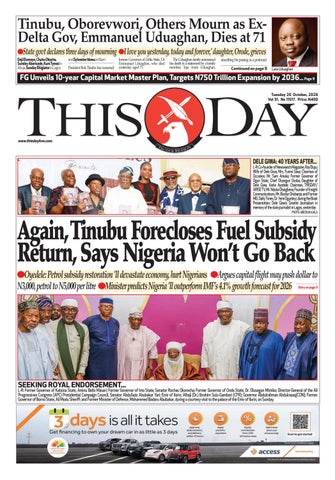
Tinubu, Oborevwori, Others Mourn as ExDelta Gov, Emmanuel Uduaghan, Dies at 71 State govt declares three days of mourning I love you yesterday, today and forever,’ daughter, Orode, grieves Deji Elumoye, Chuks Okocha, Sunday Aborisade, Kuni Tyessi in Abuja, Sunday Ehigiator in Lagos
and Sylvester Idowu in Warri President Bola Tinubu has mourned
former Governor of Delta State, Dr Emmanuel Uduaghan, who died yesterday aged 71.
The Uduaghan family announced his death in a statement by a family member, Toju Anire Uduaghan,
describing his passing as a profound Continued on page 9
Late Uduaghan
FG Unveils 10-year Capital Market Master Plan, Targets N750 Trillion Expansion by 2036... Page 9 Tuesday 20 October, 2026 Vol 31. No 11517. Price: N400
www.thisdaylive.com TR
UT H
& RE A S O
N
DELE GIWA: 40 YEARS AFTER...
L-R: Co-founder of Newswatch Magazine, Ray Ekpu; Wife of Dele Giwa, Mrs. Funmi Giwa; Chairman of Occasion, Mr. Sam Amuka; Former Governor of Ogun State, Chief Olusegun Osoba; Daughter of Dele Giwa, Aisha Ayodele; Chairman, THISDAY/ ARISE TV, Mr. Nduka Obaigbena; Founder of Insight Communications, Mr. Biodun Shobanjo; and Former MD, Daily Times, Dr. Yemi Ogunbiyi, during the Book Presentation; Dele Giwa’s Granite Journalism in memory of the slain journalist in Lagos, yesterday PHOTO: ABIODUN AJALA
Again, Tinubu Forecloses Fuel Subsidy Return, Says Nigeria Won’t Go Back Oyedele: Petrol subsidy restoration ’ll devastate economy, hurt Nigerians Argues capital flight may push dollar to N3,000, petrol to N5,000 per litre Minister predicts Nigeria ’ll outperform IMF’s 4.1% growth forecast for 2026 Story on page 9
SEEKING ROYAL ENDORSEMENT...
L-R: Former Governor of Katsina State, Aminu Bello Masari; Former Governor of Imo State, Senator Rochas Okorocha; Former Governor of Ondo State, Dr. Olusegun Mimiko; Director-General of the All Progressives Congress (APC) Presidential Campaign Council, Senator Abdul’aziz Abubakar Yari; Emir of Ilorin, Alhaji (Dr.) Ibrahim Sulu-Gambari (CFR); Governor Abdulrahman Abdulrazaq(CON); Former Governor of Borno State, Ali Modu Sheriff; and Former Minister of Defence, Mohammed Badaru Abubakar, during a courtesy visit to the palace of the Emir of Ilorin, on Sunday.
2
TUESDAY, OCTOBER 20, T H I S D AY
TUESDAY, OCTOBER 20, T H I S D AY
3
4
TUESDAY, OCTOBER 20, T H I S D AY
5
THISDAY • TUESDAY, OCTOBER 20, 2026
Group News Editor: Goddy Egene Email: Goddy.egene@thisdaylive.com, 0803 350 6821, 0807 401 0580
NEWS
EMADEB RENOVATES/EQUIPS MULTI-MILLION NAIRA CHEMISTRY AND PHYSICS LABORATORIES...
L-R: Executive Director of Emadeb Energy and Emadeb Development Foundation, Mrs. Olugbesoye Olujimi; Group CEO of Emadeb Energy, Mr. Adebowale Olujimi; and Oyo State Governor, Seyi Makinde, after the inauguration of the renovated/equipped multi-million naira Chemistry and Physics Laboratories donated to Government College, Ibadan by Mr. Olujimi, a member of Class of 1985, through Emadeb Development Foundation, last Saturday
NCDMB: Local Content Interventions Retain $10bn, Generate 50,000 Jobs in Nigeria’s Oil Sector Dangote: Local content must not be seen as regulatory burden NCDMB calls for technology transfer, sustainable financing Emmanuel Addeh in Abuja The Nigerian Content Development and Monitoring Board (NCDMB) has disclosed that interventions to deepen indigenous participation in the oil and gas industry have retained more than $10 billion in the Nigerian economy and generated over 50,000 direct and indirect jobs. The interventions, it stressed, have also supported more than 50 million man-hours of training, reflecting efforts to develop the technical expertise and industrial capacity required to increase Nigerian participation across the energy value chain. The figures were disclosed by the Board’s Director of Planning, Research and Statistics and Chairman of the NCDMB/Dangote Joint Technical Committee, Omomehin Ajimijaye, at a strategic retreat of the committee in Lagos at the weekend. The retreat, organised in collaboration with the Dangote Group, brought together stakeholders from the oil and gas industry and relevant government institutions to examine ways of moving Nigerian content beyond statutory compliance towards sustainable industrial development. Ajimijaye urged contractors, vendors and service providers operating within the Dangote business ecosystem to comply with Nigerian content requirements, register on the Nigerian Oil and Gas Industry Joint Qualification System (NOGICJQS) and strengthen their participation
in the industry. He explained that the Board’s regulatory framework was designed to facilitate business growth and deepen indigenous participation rather than create unnecessary bureaucratic bottlenecks. He identified Nigerian content planning, workforce localisation, local procurement and capacity development as the four key pillars of compliance, stressing that companies bidding for projects were expected to demonstrate how they would maximise indigenous participation. Employers, he added, were expected to prioritise qualified Nigerians, procure goods and services available locally and invest in skills development and technology transfer. On expatriate employment,
Ajimijaye said foreign personnel could be engaged where genuine skills gaps existed, but companies were expected to work with the Board to establish those gaps and develop succession plans to prepare Nigerians to take over such positions progressively. He described NOGICJQS as an important digital platform for supplier registration, prequalification, capacity verification and validation of technical expertise. Reliable industry data, he said, would enable the Board to identify skills shortages, connect businesses with qualified professionals and direct training investments to areas of greatest need. Ajimijaye commended the Dangote Group for collaborating with the Board since around 2019
to develop the capacity of Nigerians through training at local and overseas institutions, noting that some beneficiaries had subsequently secured employment within the group’s businesses. He also called for sustained investment in research and development to stimulate indigenous innovation, improve competitiveness and enable Nigerian companies to export technical expertise. In his keynote address, the NCDMB Executive Secretary, Felix Ogbe, represented by the Senior Technical Adviser and Director of Project Certification and Authorisation, Austin Uzoka, identified commitment, technology and financing as fundamental to building a resilient Nigerian content
The Federal Government has overhauled agricultural education in Nigeria, introducing an 80% practical, 20% theory training model to produce industry-ready graduates and boost food security. Sequel to this, Minister of Education, Dr. Tunji Alausa, unveiled 39 agricultural curricula and 31 National Occupational
also build the indigenous expertise needed to maintain them and ensure that the economic benefits of such investments remained within the country. Ogbe also identified access to finance as a major constraint facing indigenous businesses, noting that high interest rates and delays in obtaining funds could prevent local enterprises from executing projects, expanding operations and competing effectively in the oil and gas value chain. He urged industry stakeholders to support emerging Nigerian industrialists seeking to establish refineries and related facilities, arguing that a stronger domestic refining sector would help position Nigeria as a major oil and gas hub.
Power Generation Crashes, Leaves Many Parts of Nigeria in Blackout Abuja, Kaduna, Kano Discos get zero allocation NISO blames multiple trippings, says electricity supply stabilised Emmanuel Addeh in Abuja Nigeria’s electricity generation plunged from about 3,840 megawatts (MW) in the morning of yesterday to around 476.70MW by 1pm, leaving the national grid with less than 500MW and triggering power outages in many parts of the country. A THISDAY analysis of data from the Nigerian Independent
System Operator (NISO) showed that generation, which remained relatively stable in the morning, dropped sharply around 12.40pm, with most power plants recording zero output. The development came amid reports of electricity interruptions across parts of the country, while Distribution Companies (Discos) struggled with reduced power allocations from the grid.
A further snapshot of NISO’s distribution load allocation dashboard at 2.37pm showed that supply was gradually returning as the 11 electricity distribution companies were allocated a combined 2,745MW, with four Discos receiving zero allocation. Abuja, Kaduna, Kano and Yola Discos had no allocation at the time, while Ibadan Disco received the highest allocation of 550MW. Benin
FG Scraps Theory-heavy Agric Education, Unveils 80% Practical Training Kuni Tyessi in Abuja
ecosystem. Ogbe challenged industry stakeholders to look beyond compliance with regulations and address the long-term sustainability of major industrial investments, particularly the development of domestic supply chains and technical capabilities to operate and maintain critical infrastructure. He cited the experience of Nigeria’s publicly owned refineries as a reminder of the importance of sustaining industrial assets, stressing the need to develop the goods, works, services and supply-chain capabilities required to support the continuous operations of the Dangote refinery. He argued that constructing worldclass industrial facilities was only part of the task, adding that Nigeria must
Standards (NOS) at the UBEC Digital Resource Centre, Abuja. Alausa said the reform, developed since 2025 by the Ministries of Education, Agriculture & Food Security, and Livestock Development, will bridge the gap between classroom and industry. The 39 curricula comprise 32 reviewed and 7 newly developed programmes for ND, HND and NCE levels, covering Precision
Agriculture, Climate-Smart Agriculture, Artificial Insemination and Agribusiness. A key feature is hands-on learning in teaching farms, greenhouses, processing facilities and agric-tech hubs. Minister of Livestock Development, Alhaji Idi Mukhtar Maiha, said the reform will help Nigeria tap into the $3.2bn Middle East red meat market, which the country
has missed due to lack of practical expertise. He said functional farms should now determine accreditation of institutions. Minister of State for Education, Prof. Suwaiba Said Ahmad, said the reform will reposition TVET and called for industry partnerships for apprenticeships and workplace learning, with inclusion for women and persons with disabilities.
Disco received 428MW, Ikeja 426MW, Enugu 413MW, Eko 407MW, Port Harcourt 376MW and Jos 145MW. The figures indicated a sharp disparity in the power available to distribution companies, with the four Discos receiving no allocation facing particular challenges in supplying their customers. The plunge in generation represented a drop of more than 3,360MW from the level recorded at 7am, raising fresh concerns about the stability of electricity supply and the capacity of the national grid to sustain generation. Earlier, Ikeja Electric Plc attributed the reduction in electricity supply across its network to a shortfall in the power allocated to it from the national grid. In a public notice dated October 19, the company said the reduced hours of supply resulted from the decline in electricity available to its network. “We wish to inform customers across Ikeja Electric network that the reduced hours of electricity supply is due to a shortfall in the amount of power currently allocated to our
network from the national grid,” the company stated. It apologised for the inconvenience and said it was engaging relevant stakeholders to improve the volume of electricity available to its customers. “Please be assured that we are actively engaging the relevant stakeholders to improve the available power supply and will continue to distribute the power received from the grid as efficiently and equitably as possible,” it added. The sharp fall in generation was also reflected in the output of power plants connected to the grid. As of the 1pm reading, only a handful of generating stations, including Odukpani NIPP, Omotosho and Sapele, were contributing small amounts of electricity, while major plants such as Egbin, Jebba, Shiroro and Kainji recorded zero generation. But in a statement last night, the Nigerian Independent System Operator (NISO) stated that at approximately 12:40 hours on Monday, 19 October 2026, the national grid experienced multiple trippings on the 330kV transmission network.
6
TUESDAY, OCTOBER 20, 2026 • THISDAY
NEWS
INAUGURATION OF PIPE COATERS THERMAL INSULATION AT ONNE...
L-R: Director, Monitoring and Evaluation, Nigerian Content Development and Monitoring Board (NCDMB), Esueme Dan Kikile; Director at Tenaris Nigeria/Pioneer Executive Secretary of NCDMB, Dr Ernest Nwapa; Managing Director, Tenaris Nigeria, Rosario Osobase; Mrs Ogechi Lokpobiri; Minister of State for Petroleum Resources (Oil), Senator Heineken Lokpobiri; Executive Commissioner, Development and Production, Nigerian Upstream Petroleum Regulatory Commission (NUPRC), Enorense Amadasu; and Director, Development & Production, NUPRC, Emmanuel Mac Jaja, at the 25th Anniversary Celebration of Tenaris in Nigeria and Commissioning of Pipe Coaters Thermal Insulation Plant in Onne, Rivers State...recently
Doctor Who Treated Dele Giwa: It Was Better He Died, Could Not Have Lived with Level of Injury He was true legend of written word, says Ekpu Amuka, Osoba, Obaigbena, Shobanjo, Ogunbiyi, others vow his name will never die Dike Onwuamaeze and Ayodeji Ake The doctor on duty at First Foundation Hospital, Ikeja, where the mangled body of Dele Giwa was brought for treatment after suffering a letter bomb attack, Dr. Dokun Adedeji, has revealed that his unuttered wish was that Giwa would not survive the attack. Adedeji revealed that yesterday during the public presentation of a book titled, “Dele Giwa’s Granite Journalism,” to mark the 40th anniversary of his assassination via a letter bomb on Sunday, October 19, 1986, at his Ikeja residence. Adedeji said, “I tell you one thing. His is what I have never seen again in my practice. He was shattered. His two limbs were open. And then, he was bleeding. He was still bleeding in the hospital. But, he was still talking. “He said that I should move the bed up so that he can breathe. I did. I was shaking. But, we kept on. “And, I think it was better that he died. There was no way Uncle Dele would have lived with that injury. Even though he wanted to live. But, I knew the end was near. “He asked after Funmi (his wife). I said, she must be somewhere. He kept talking. He wanted to talk, but I thought it would be better for him not to talk so that we can conserve him. “But, at about almost one o’clock, he died. I remember very well, his blood was on my clothes, on my shoes. I hung them for like five years in the corner of my room.” Adedeji recalled that about 12.30pm in the afternoon of Sunday, Giwa’s shattered body was driven in a combi bus to the First Foundation Medical Centre. He stated, “I was a doctor on duty for the weekend. Then, I saw a woman (Funmi) running. She said, come, come, come, they have bombed Dele Giwa. I said, you must be kidding me. “Funmi (Giwa’s wife) was in blood. She had a white sheet around Giwa. So, my MD came and we took Giwa to the emergency room. “I will never forget what Giwa kept asking me. He said, ‘how is Aisha? Do I know anything about Aisha?’ He said, because she was crawling to where he was in the study with Kayode Soyinka (Newswatch London correspondent).”
Adedeji lamented that it was unfortunate that the killers of Giwa had not been found. In his welcome remarks, Chief Executive Officer of Newswatch Plus Limited, Mr. Ray Ekpu, described Giwa, the founding Editor-in-Chief of Newswatch Magazine, as a true legend of the written word. Dignitaries at the book presentation included Chairman of the Book Presentation and Publisher of Vanguard Newspapers Limited, Uncle Sam Amuka; Chairman of THISDAY Newspapers Limited/Arise News TV, Prince Nduka Obaigbena; former Governor of Ogun State, Chief Segun Osaba; Executive Chairman of Tanus Books Limited, Dr. Yemi Ogunbiyi; Founder, Insight Communications Limited, Dr. Biodun Shobanjo; and former Editor of THISDAY Newspaper, Mr. Simon Kolawole, who reviewed the book. Ekpu said, “Dele Giwa was not a run-of-the mill journalist. He was a legend, a true legend of the written word.” He added, “This event is a memorialisation of the founding Editor-in-Chief of Newswatch, Dele Giwa, who was assassinated through the use of a parcel bomb that was sent to him on Sunday, October 19, 1986 by some evil men. “Today is the 40th anniversary of his assassination. Since his death, we in Newswatch and some members of the media community have fought tooth and nail to get justice for him, but there has been no success. “We also worked assiduously with our company’s lawyer and friend, the indefatigable late Chief Gani Fawehinmi, for several years to get justice for Dele, but the forces of oppression put high hurdles on our path and made our goal unrealisable. “So, we are here to give presence to his absence by presenting to the public a book that will memorialise and immortalise him. “That book, edited by me, comprises Giwa’s articles published in the Daily Times, Sunday Concord and Newswatch as well as interviews he granted to a radio station and a newspaper.” Ekpu, who was among the founding team of Newswatch, along with Giwa, late Dan Agbese and late Yakubu Mohammed, said, “Giwa was a patriot, a patriot to
his fingertips. “He fought many battles with his pen for a better Nigeria. That is why a number of buildings have been named by journalism organisations after him. And a number of books written about him. “Here is what I said of him in the book: ‘Giwa’s immortality derives from his succulent, seductive and breezy prose that had a mesmerising effect on his readers like Austin Okocha’s dribbling episodes on his football fans. “His prose was sweet, as sweet as Dolly Parton’s songs. His prose was, frankly, the next door neighbour to poetry.’ “When you turn the last page of the book you will be saying to no one in particular ‘why did it end so soon?’ I assure you.” Kolawole, in his review, “The Pen That Outlived the Bomb: A Review of Dele Giwa’s Granite Journalism,” said one of the tragedies of Giwa’s assassination was that the manner of his death had sometimes overshadowed the magnificence of his life. He stated, “Dele Giwa lived for only 39 years, but he produced enough memorable journalism to secure a place in our intellectual history. “The tragedy is that we shall never know what more he might have written, what further heights he might have attained or how much richer Nigerian journalism might have become through his continued presence. But we can celebrate what he left behind. “I commend this book to journalists, writers, students of history and everyone who appreciates the beauty and power of the written word. “For aspiring journalists, especially, it offers invaluable lessons in curiosity, courage, clarity, storytelling, and the discipline of writing. “Above all, it reminds us that while a life can be violently terminated, a powerful voice can continue to speak across generations. Dele Giwa’s killers silenced the man. They did not silence his journalism.” Amuka, in his remarks, said Giwa lived on despite being swept away ruthlessly. He said, “But after 40 years, we are honouring him. In his journalism career, Dele Giwa was a standout legend. He spoke truth to power.”
Giwa’s daughter, Aisha, said the only memory she had about her father was what her mother and friends of his daddy shared with her. Aisha was a year old when his father, Giwa, was assassinated. She said, “The day my dad died, my mother told me that the nanny had just taken me upstairs for a nap. And it wasn’t long after that the bomb went off. “Even though I did not get to know him for myself, the stories have made me so proud to be his daughter, to be his Aisha. He was the one that gave me the name Aisha. “Although it has been 40 years, when people see my name, they have nothing but good things to say about him and his work. And that makes me very, very proud. “With the launch of this book, I know that his name will continue to live on.” Osoba said Giwa was still alive and communicating through his columns. He said, “Giwa is alive and he is going to be alive forever and ever. To all of us, I say let us always learn to
be good in our profession. Dele Giwa was very good. A serious writer, an enlightened writer.” Obaigbena recalled the last moments he spent with Giwa a day before his assassination. He said, “We were all there at Adeosun’s lunch in Victoria Island. And we all drove to Admiral Augustus Aikhomu’s house. “But on Sunday, 19th October, we were playing soccer at the University of Lagos ground when we heard the story of the bombing. “I rushed to the First Foundation Hospital and witnessed him (Giwa) there. His body, his leg cut off. “But the most important event was during his burial. I remember standing by Uncle Sam as we walked to the airport. And he (Uncle Sam) saw the crowd and said: ‘Journalism is in the constitution of Nigeria. You can kill him but he did not die.’ “I must also salute the titans that have kept his journey going. Ray Ekpu may be nearing 80, but his voice is as strong as anything. He is a voice for journalism and for Nigeria. “And the rest of us, as we grow
old together, let us make Nigerian journalism proud, speaking truth to power.” Ogunbiyi, who spoke from his personal relationship with Giwa, described the late journalist as remarkable. He said, “When people talk of Giwa as a journalist, I appreciate that, but I talk of him as a very personal friend of mine. And his memory, for as long as I live, I will never, never forget him. “Giwa’s memory will remain forever a blessing. Giwa will not die, he is not going to die. He will be read and studied. He was unique, he was special.” He urged that the book should be sent to every school of journalism in Nigeria. Shobanjo recalled being the only non-medic in the First Foundation Hospital when Giwa was being attended to after he was bombed. He stated, “For me Giwa can never die because that was who he was. I mean he was an enigma, he was larger than life, he was journalism personified.”
Kano’s CNG Stations Rise to 12 in One Year, New Facilities Launched Ahmed: future belongs to cheaper energy sources Emmanuel Addeh in Abuja Kano State has expanded its compressed natural gas (CNG) infrastructure to 12 refuelling stations in one year, from virtually none, following the commissioning of two new facilities and a vehicle conversion centre by NU Synergy. The expansion highlights growing private-sector investment in gaspowered transportation in northern Nigeria, following the activation of the Northern Corridor under the Presidential Initiative on Compressed Natural Gas and Electric Vehicles (Pi-CNG & EV). Speaking at the commissioning, Executive Chairman of Pi-CNG & EV, Ismaeel Ahmed, said the development demonstrated the potential for private investors to accelerate the adoption of cheaper
and cleaner transportation fuels in Nigeria. Ahmed said, in a statement by the Pi-CNG & EV office, “The future belongs to cheaper energy sources for transportation. It is difficult to achieve that with PMS and diesel.” Ahmed said Nigeria’s abundant natural gas resources offered an opportunity to reduce transportation costs while attracting investment, creating jobs, and developing technical skills. “Nigeria is a gas country, not an oil country. We have over 200 trillion cubic feet of proven natural gas,” he said. He recalled that NU Synergy’s promoter had approached the initiative about four months earlier to explore investment opportunities in the CNG sector, adding that the investor has since moved from
seeking guidance to commissioning new facilities. “Today is one of my proudest moments,” Ahmed said. He added, “Four months later, this is the story. He is commissioning a CNG station in Kano.” The two facilities are located along Zaria Road and at Mariri along Wudil Road. They combine CNG refuelling services with vehicle conversion facilities, enabling motorists to convert their vehicles to run on gas and access refuelling services within the same network. Ahmed commended the investor for the speed of execution, describing the project as an example of the private-sector commitment needed to expand CNG infrastructure across the country. “You are a doer, you are a deliverer, and you have delivered in Kano,” he said.
TUESDAY, OCTOBER 20, T H I S D AY
7
8
TUESDAY, OCTOBER 20, 2026 • THISDAY
NEWS
2026 OMNICOM ADVERTISING AFRICA CONFERENCE...
L-R: MD/CEO, Guinness Nigeria PLC, Girish Sharma; Chairman, MTN Nigeria Communications PLC, Ernest Ndukwe; Non-Executive Director, TBWA\Concept, Kelechi Nwosu; Chief Executive Officer, TBWA\Concept, George Onukwu; and Director of Africa Operations, TBWA\Concept, Graham Cruickshanks, during the 2026 Omnicom Advertising Africa Conference held Lagos…recently
Education Minister Hails Dangote’s Refinery IPO, Student Share Grant Initiative Kuni Tyessi in Abuja
Minister of Education, Dr. Tunji Alausa, has commended the Aliko Dangote Foundation for introducing a share grant initiative designed to encourage Nigerian tertiary institution students to participate in the country’s capital market through the ongoing Initial Public Offering (IPO) of Dangote Petroleum Refinery and Petrochemicals FZE. The initiative, according to the minister, represents an opportunity to connect education with financial literacy, responsible investing, wealth creation, and economic empowerment among young Nigerians. Under the programme, eligible students aged 18 and above who meet the prescribed conditions may qualify for an application for an additional 10 refinery shares funded by the foundation after personally applying and paying for at least 10 shares through the designated student subscription channel. Alausa described the initiative as an innovative approach to preparing students for greater participation in the formal economy, stating that exposure to investment opportunities could help them develop a better understanding of savings, asset ownership, and long-term financial planning. He said the programme aligned with President Bola Tinubu’s Renewed Hope Agenda and the Nigeria Education Sector Renewal Initiative (NESRI), particularly their emphasis on human capital development, enterprise and inclusive economic growth. The minister reaffirmed the Federal Ministry of Education’s commitment to partnerships
with private-sector organisations to improve educational quality, relevance, equity, and efficiency, while equipping learners with skills that meet the demands of a changing economy. The foundation’s initiative is linked to the public offer of shares in Dangote Petroleum Refinery and Petrochemicals FZE. At the offer price of N525 per share, the minimum subscription of 10 shares costs N5,250. An eligible student who successfully applies for 10 shares and receives the Foundation’s additional 10-share application could potentially have applications covering 20 shares, with a total offer value of N10,500, while personally paying N5,250 for the initial subscription. However, neither the additional application nor the eventual allotment of shares
is guaranteed. The Foundation’s published terms state that its additional application is separate from the student’s paid subscription and that participation in the programme is voluntary. The terms also make clear that meeting the eligibility requirements does not automatically entitle a student to the grant. Students must satisfy the Foundation’s verification requirements and complete the relevant Know Your Customer (KYC) procedures under the IPO. Eligible applicants must be enrolled in qualifying Nigerian public or private tertiary institutions, be at least 18 years old, provide the required student information and possess a valid Bank Verification Number (BVN). Postgraduate students are excluded under the
published terms. The foundation further clarified that the initiative was not a cash grant or refund to students. Rather, it might fund a separate application for additional shares in the student’s name. The student initiative comes as Dangote Petroleum Refinery and Petrochemicals FZE undertakes a major public share offering intended to broaden ownership of the industrial facility and raise capital for expansion. The IPO involves an offer of 4.1 billion ordinary shares at N525 each, targeting approximately N2.15 trillion, equivalent to about $1.6 billion. The offer opened on September 14, 2026, following regulatory approval. Its closing date was subsequently extended from October 13 to October 27, 2026, to provide more investors
Justice Mohammed Umar of a Federal High Court, Abuja, has turned down request by the presidential candidate of the African Action Congress (AAC), Omoyele Sowore, that the Director General of the Department of State Services (DSS), Tosin Ajayi be summoned to personally appear in court as a witness in Sowore’s trial on alleged cyberbullying President Bola Tinubu.
For the education sector, the foundation’s initiative offers an opportunity to introduce students to the practical workings of the capital market, including share subscriptions, investment documentation, identity verification, ownership records and the risks associated with equity investments. Alausa said the initiative’s educational and developmental value lay in encouraging young people to understand investment beyond conventional classroom instruction and to appreciate the importance of financial responsibility. The programme could also encourage discussions in tertiary institutions about personal finance, entrepreneurship, corporate ownership, and the relationship between savings and long-term wealth creation.
BoI, FG Unleash Skills, Enterprise Support for 500 Nigerians Programme combines vocational, manufacturing, digital training with mentorship to address youth unemployment Olusi: youths remain greatest economic asset, bank ready them for brighter future James Emejo in Abuja The Bank of Industry (BoI) and the Federal Ministry of Youth Development have launched a pilot programme to equip 500 young Nigerians with vocational, manufacturing and digital skills, as the federal government seeks to strengthen youth employability and entrepreneurship. The BOI Youth Empowerment Pilot Programme will provide free vocational and entrepreneurial training, with selected participants
also gaining access to mentorship, practical exposure and enterprise support opportunities aimed at helping them establish and sustain businesses. The initiative, which will be delivered by Abuja-based digital learning and technology company, Sapphital, will operate through the Nigerian Youth Academy (NiYA), using short, instructor-led video courses. Managing Director/ Chief Executive, BoI, Dr. Olasupo Olusi, said the initiative was intended to provide
young people with the tools to develop viable enterprises, describing it as more than a conventional training scheme. Olusi said the combination of practical skills, mentorship and enterprise support would help participants identify opportunities to start and sustain businesses. He added that the partnership with the ministry and Sapphital would provide a model that could be expanded nationwide to reach more young Nigerians under the Renewed Hope Agenda.
Alleged Cyberbullying of Tinubu: Court Declines Sowore’s Request Compelling DSS DG’s Appearance Alex Enumah in Abuja
with an opportunity to participate. The refinery, located in the Lekki area of Lagos State, was developed at an estimated cost of $20 billion and has a stated production capacity of 700,000 barrels per day. The planned expansion is expected to increase its capacity to 1.4 million barrels per day over the next three years. The proposed share sale is significant because it offers members of the public an opportunity to acquire an ownership interest in one of Nigeria’s major industrial investments, subject to the terms of the offer and the allotment process. The public offer is also intended to broaden retail participation in the capital market by making shares available through approved subscription channels, including digital platforms.
Recall that the court had at the last proceedings fixed October 19, to decide whether the DSS DG must personally appear in court in respect of a subpoena issued against him, following Sowore’s request. The defendant through his lawyer, Adeyinka Olumide Fusika SAN, had sought an order of the Federal High Court to compel the DG’s appearance to testify on official activities of the DSS relating to the cyberbullying case instituted
against him. But, lawyer to the DSS, Mr Akinlolu Kehinde, SAN, opposed the move on the grounds that another official of the agency could testify on his behalf. The senior lawyer argued that it was absurd for Sowore to be insisting on the DSS DG’s appearance in court in an action that was purely official and not personal. He argued that since the action of the DSS in putting Sowore on
trial, any official delegated by the organization can testify for the establishment. Delivering ruling on Monday, Justice Umar held that the subpoena concerned an official act of the DSS and that the expected testimony was not personal to the Director General. The court consequently ruled that another DSS official could appear to give evidence on the agency’s behalf.
In a statement by Divisional Head, Public Relations, BoI, Theodora Amechi, he said, “ Young Nigerians are our greatest economic asset, and the Bank of Industry is committed to providing them the tools required to build a brighter future, creating viable enterprises. “This pilot is much more than just a training programme. It connects young people to skills, mentorship and real opportunities to start and sustain businesses. “Through our partnership with the Federal Ministry of Youth Development and Sapphital, we are building a model that can be scaled across Nigeria to reach even more young people in support of the Renewed Hope Agenda.” The training areas were selected based on their potential to generate income and respond to market demand, with courses spanning creative and artisan trades, production and manufacturing, as well as digital skills. The programme is designed to move beyond conventional training by linking skills acquisition with opportunities for enterprise development and employment. Minister of Youth Development, Ayodele Olawande, said the initiative reflected the administration’s
commitment to equipping young Nigerians with the capabilities needed to compete in an increasingly globalised economy. He said youth empowerment and training were central to President Bola Tinubu’s reform agenda, adding that the country’s ability to benefit from its young population would depend partly on its competitiveness in the global economy. He said the programme is expected to improve young Nigerians’ access to the skills and capabilities required to thrive in a changing employment and business environment. Olawande said, “President Tinubu believes that youth empowerment and training are core pillars of national reform. A nation succeeds when its young population are globally competitive. “Through this programme, we hope to equip Nigerian youths with the skills and capabilities they need to compete and thrive on a global scale.” The development finance institution, supports enterprises through financing and business assistance aimed at promoting industrial development, job creation, poverty reduction and economic diversification.
9
THISDAY • TUESDAY, OCTOBER 20, 2026
NINE
Tinubu Receives UN’s $14bn Proposed 2027 Budget from Jimoh Ibrahim Deji Elumoye in Abuja President Bola Tinubu has received the proposed $14 billion budget of the United Nations (UN) from Nigeria’s Permanent Representative, Senator Jimoh Ibrahim. The event took place on Sunday at the official residence of the president at State House, Abuja. Ibrahim, who is Chairman of UN General Assembly’s Fifth Committee on Administrative
and Budgetary Matters, presented the seven-volume document to the president after the UN Secretary-General submitted it to the committee last week. He described the presentation as historic, saying it is the first time in 66 years that Nigeria would chair the committee responsible for the UN’s budget and administration. Ibrahim stated, “This is the first time in 66 years that Nigeria will chair the Budget and Administrative Committee. It is the first time,
and we do not know when it will happen again in history. “So, President Bola Tinubu is making history by being able to receive this budget. He is the first Nigerian president in 66 years to receive the UN budget from the United Nations.” According to him, the proposed regular budget is about $3.4 billion, while the peacekeeping budget is about $8.5 billion, and the combined figure is about $14 billion. He stated, “It is not a small
matter for a country to receive the entire UN budget. So, I am happy that the president has received the seven volumes of the proposed budget.” The envoy said the document remained a proposal and would still undergo detailed negotiations and approval by member- states before implementation. He explained, “This is a proposed budget. It is the proposal submitted to member countries. Thereafter, the budget is discussed in detail, the figures are adjusted,
and the final budget is approved before spending commences.” Ibrahim was not specific on Nigeria’s expected benefits from the budget, but he said negotiation with his colleagues was still ongoing. He said, “As for Nigeria, I do not want to discuss what Nigeria will get from the budget. That would be going too far, because my colleagues and I are still discussing it.” The envoy pointed to the scale of UN spending, stating that the
Jimoh Ibrahim organisation is currently building a $260 million conference centre in Kenya. “A lot is happening,” he said.
FG Unveils 10-year Capital Market Master Plan, Targets N750 Trillion Expansion by 2036 Shettima says market bridge between people’s savings, nation’s investment needs Oyedele: strong market, recipe for $1trn economy vision UK says Nigeria now wellplaced to fully tap into market SEC launches national savings scheme to deepen retail investment Deutsche Bank bullish on naira, adds Nigeria to frontier FX watchlist Ndubuisi Francis in Abuja Vice President Kashim Shettima yesterday launched the Nigerian Capital Market Master Plan (NCMMP 2.0), configured to fully harness the nation’s vast potential and expand the capital market from a baseline of about N250 trillion to N750 trillion by 2036. Shettima, who launched the NC-
MMP 2026–2036 during the National Capital Market Conference 2026, in Abuja, described the market as the bridge between citizens’ savings and Nigeria’s investment needs. Minister of Finance and Coordinating Minister of the Economy, Mr. Taiwo Oyedele, said at the occasion that Nigeria should target a $1 trillion capital market within the next 10 years, stressing that a
strong capital market is a recipe for the country’s envisioned $1 trillion economy. Equally speaking at the conference, British High Commissioner to Nigeria, Pete Vowles, represented by Head of Green Growth and Private Sector Development at the British High Commission, Paul Healey, said Nigeria was now well positioned to tap the potential of the capital
market. Welcoming quests and stakeholders to the conference, Director-General of Securities and Exchange Commission (SEC), Dr. Emomotimi Agama, attributed the current advances at the Nigerian capital market to President Bola Tinubu’s reform agenda. Relatedly, Deutsche Bank AG yesterday included Nigeria in its
TINUBU, OBOREVWORI, OTHERS MOURN AS EX-DELTA GOV, EMMANUEL UDUAGHAN, DIES AT 71 loss to the family, the people of Delta State, and Nigeria. “It is with hearts weighed down by immeasurable grief and profound sorrow that we announce the passing to glory of our beloved Father, Brother, Uncle, and Patriarch, His Excellency, Dr. Chief Emmanuel Eweta Uduaghan, former Governor of Delta State, who departed this world on the morning of 19th October 2026,” the statement read. The family said Uduaghan’s death had left a deep void, describing him as a beloved family patriarch, respected elder, and a figure whose life and public service touched many people across Delta State and the country. “His passing is an immeasurable loss to our family, the people of Delta State, and Nigeria at large,” the statement added. The family also expressed gratitude for his life and service, praying for the repose of his soul and for comfort for relatives, friends, associates, and others mourning his death. In a condolence message, Tinubu extended his commiserations to the Uduaghan family, the government,
and the people of Delta State. The president stated, “Dr Uduaghan was a public servant whose leadership was devoted to Delta State’s development and service to our nation. “He served as Commissioner for Health, Secretary to the State Government and was elected Governor of Delta State in 2007. His two-term tenure, which ended in 2015, placed him at the centre of the state’s political and developmental journey. “During this period, he pursued developmental strides to improve infrastructure, healthcare delivery, and the overall welfare of Deltans. “After his tenure as governor, Dr Uduaghan continued to feature prominently in Delta State’s political and socio-economic landscape, contributing to the sustenance of democratic governance and the advancement of public service in Nigeria. His passing is a great loss to his family, his community, Delta State, and the nation at large. “At this difficult time, I urge the people of Delta State to draw strength from the late governor’s years of
service and the enduring relationships he built across the political and social terrain of our country. “On behalf of my family, the government, and the people of Nigeria, I extend my deepest sympathies to his wife, Roli; his children; his cousin, former Governor James Ibori; and friends and political associates whose lives he impacted. “May Almighty God grant his soul eternal rest and comfort all who mourn him.”
Delta State Government Delta State Government declared three days of mourning in honour of Uduaghan. The mourning period took effect from Monday, October 19. In honour of the late former governor, the incumbent governor, Hon. Sheriff Oborevwori, directed that all flags on public buildings across the state should be flown at half-mast throughout the three-day mourning period. The directive, contained in a statement signed by Secretary to the
State Government, Dr Kingsley Emu, was a mark of respect for Uduaghan, who governed Delta State from 2007 to 2015.
Sheriff Oborevwori, Ede Dafinone Mourn Oborevwori expressed sadness over Uduaghan’s death, describing him as a detribalised leader, whose contributions to the development of the state would not be forgotten. In a condolence message by his Chief Press Secretary, Sir Festus Ahon, Oborevwori sympathised with the late governor’s wife, Roli, his children, the entire Uduaghan family, the Itsekiri nation, and Deltans over the painful loss. The governor recalled Uduaghan’s years in office, stating that he made significant contributions to infrastructure development in the state. He described the former governor as a leader who looked beyond ethnic differences and worked for the overall development of Delta State. Continued on page 27
frontier foreign exchange monitor, indicating rising investor appetite for the naira amid prospects of further appreciation against the US dollar. Shettima, who was represented by Deputy Chief of Staff in his office, Senator Ibrahim Hassan Hadeja, stated that the capital market was no longer merely a marketplace for investors, but it had become a strategic pillar of national economic policy and a critical instrument for Nigeria’s development aspirations. He recalled that when the current administration assumed office in May 2023, the All-Share Index of the Nigerian Exchange stood at over 55,000 points. He stated, “Today, it stands above 247,000. In just over three years, the index has more than quadrupled. The value of listed equities has grown from about N30 trillion to over N160 trillion. In January this year, equity market capitalisation crossed N100 trillion for the first time in our history. Add our bond market, and the total value of the market now exceeds N221 trillion. “This is not only a naira story. Measured in US dollars, after we unified the exchange rate and let the naira find its true value, the Nigerian market ranked third out of 92 markets in the world by August this year, returning about 65 per cent. “Global investors who once asked whether they could get their money out of Nigeria are now asking how much more they can put in. Behind those figures are real Nigerians: Pensioners whose retirement savings have grown, young investors opening their first accounts on their
phones, and companies that have raised capital at home instead of borrowing abroad.” The vice president tied the market’s growth to reforms undertaken by the federal government, including the removal of petrol subsidy, the unification of the foreign exchange market, tax reforms, bank recapitalisation, and the enactment of the Investments and Securities Act 2025. He said despite the short-term costs of the reforms, they had helped to strengthen investor confidence by improving the policy framework and regulatory environment. Shettima said the Nigerian Capital Market Master Plan 2026–2036 would place the capital market at the centre of infrastructure financing, enabling governments at the federal and subnational levels to fund long-term projects through domestic savings rather than rely excessively on short-term or foreign borrowing. He added that the plan would also strengthen the bond market for subnational governments, broaden retail participation through technology and investor education, and provide opportunities for businesses in agriculture, solid minerals, and other sectors to raise capital locally. The vice president, who chairs the National Economic Council (NEC), expressed a desire to work with state governors to encourage responsible use of the capital market through properly structured bonds, credible project pipelines, and greater Continued on page 26
AGAIN, TINUBU FORECLOSES FUEL SUBSIDY RETURN, SAYS NIGERIA WON’T GO BACK Deji Elumoye and Emmanuel Addeh in Abuja President Bola Ahmed Tinubu last night revisited the issue of fuel subsidy removal and once again foreclosed its return, saying the nation won’t go ‘back to Egypt’ on the matter. Also, the Minister of Finance and Coordinating Minister of the Economy, Taiwo Oyedele, has warned that restoring fuel subsidy would devastate Nigeria’s economy, trigger capital flight, weaken the naira and ultimately impose a heavier burden on Nigerians through higher petrol prices. But speaking at a special engagement tagged: “An Evening with the Original City Boy,” at the Conference
hall of the State House, Abuja, the president likened the fuel subsidy removal to passages in both the Bible and the Quran. “I remember my scripture studies, both in the Bible and in the Holy Quran. When Moses and Musa left Egypt, they faced a challenge, and the Red Sea parted and gave way. You cannot ask Moses to go back to Egypt,” he maintained. He stressed that the decision to remove petrol subsidy on his first day in office was necessary to confront longstanding economic challenges, insisting that the country could not afford to reverse the reforms despite renewed promises by some political opponents to restore the subsidy regime. “I removed the fuel subsidy
on my first day in office. Nigeria will not go back to that era. I hear my political opponents promising a return to the subsidy regime, but Nigeria must win this election before any candidate does,” he said. Tinubu declared that Nigeria would not reverse the economic reforms introduced since he assumed office in May 2023, despite the challenges associated with their implementation. He defended his administration’s economic policies and reaffirmed his determination to build a more prosperous Nigeria. The president recalled the economic difficulties inherited by his government, including what he described as excessive currency printing, fiscal pressures and struc-
tural weaknesses, explaining that his government had since embarked on reforms in taxation, monetary management and other critical sectors to reposition the economy. He added: “Currency was being printed as if there was no tomorrow. That was a challenge, but rather than looking back, we took steps to address it and rebuild our tax system.” Tinubu expressed satisfaction with the support of young Nigerians for his reform agenda, noting that despite predictions that the younger generation would reject the difficult policies, their continued engagement demonstrated confidence in the country’s future. The president said the enthusiasm and commitment of members of
the City Boy Movement reinforced his conviction that the sacrifices associated with the ongoing reforms would contribute to building a stronger nation. “I did not see a crowd. I saw Nigeria,” Tinubu declared, explaining that the gathering reminded him of the reasons he sought the presidency and his daily commitment to national development. He commended the movement for establishing extensive grassroots structures across states, local government areas and wards, describing its organisational approach, verifiable membership database, communication platforms and community engagement initiatives as an example of purposeful youth participation in national affairs.
Highlighting his administration’s youth-focused interventions, the president identified the Nigerian Education Loan Fund (NELFUND), which had supported more than one million students, as a significant initiative designed to ensure that financial limitations did not prevent young Nigerians from accessing higher education. He also referenced the Nigerian Consumer Credit Corporation (CREDICORP), established to expand access to credit for workers seeking to acquire essential assets, including laptops, vehicles, motorcycles and solar energy systems. Similarly, he highlighted the Three Million Technical Talent (3MTT) programme as part of Continued on page 28
10
TUESDAY, OCTOBER 20, 2026 • THISDAY
NEWS
38TH ANNUAL GENERAL MEETING OF FIDELITY BANK...
L-R: Managing Director/Chief Executive, Fidelity Bank Plc, Nneka Onyeali-Ikpe; Chairman, Board of Directors, Amaka Onwughalu; and Company Secretary, Ezinwa Unuigboje, at the bank’s 38th Annual General Meeting, held in Lagos and virtually… recently
At NSIWC’s Board Retreat, FG, Stakeholders Brainstorm on Potential Wage Review Amid Economic Hardship SGF calls for sustainable wage policies backed by credible data, fiscal realities Bindawa seeks evidence-based wage policies to balance workers’ welfare, fiscal limitations Head of Service seeks productivity-driven reforms as commission targets stronger wage governance James Emejo in Abuja Secretary to the Government of the Federation (SGF), Senator George Akume, yesterday called for fair, sustainable and responsive wage system capable of accommodating workers’ legitimate expectations while reflecting the country’s fiscal realities. Akume spoke in Abuja at the opening of the National Salaries, Incomes and Wages Commission (NSIWC) board retreat with the theme, “Vision, Strategy and Institutional Renewal: Towards a New Era of Wage Governance.”
He challenged the commission to strengthen its research and analytical capacities to provide credible policy advice on salaries, incomes and wages. Represented by Permanent Secretary, General Services Office (GSO), Office of the SGF, Mr. Abubakar Ibrahim Kana, Akume described wage governance as critical to industrial harmony, public sector productivity, economic stability, and social justice. He stressed that decisions on remuneration must be guided by reliable data, evidence-based analysis and constructive engagement among government, labour and employers.
According to him, the ongoing economic reforms and rising public expectations have increased the need for a wage administration system that can respond to changing circumstances without compromising fiscal sustainability. He identified policy coherence, digital transformation and measurable implementation as priorities for the commission, urging its board and management to improve data management, strengthen research and modernise administrative processes. The SGF also called for clear implementation timelines, defined
responsibilities and effective monitoring mechanisms to ensure that resolutions reached at the retreat translated into tangible institutional improvements. He said an inclusive and credible wage framework would strengthen confidence among stakeholders, reduce avoidable industrial disputes and support a more stable environment for national development. “A credible and inclusive approach towards governance is indispensable to building trust, preventing avoidable industrial disputes,” he added. Akume said, “The success of this
retreat would ultimately be measured not by the quality of its decisions alone, but by the effectiveness with which its recommendations are implemented. “Let this retreat provide the foundation for a renewed national salaries income and wages commission - one that is innovative in its thinking, mindful of the nation’s economic circumstances, as well as unwavering in its commitment to effective wage governance “As we work collectively to advance the renewed hope agenda of His Excellency President, Bola Ahmed Tinubu, every public institution must demonstrate that it can convert policy intentions into tangible improvements in governance and the lives of all Nigerians.”
Ensure Our Safety at Campaigns, Yilwatda Charges APC Intelligence, Security C’ttees Bindawa seeks evidenceAdedayo Akinwale and Amina Hassan The National Chairman of the All Progressives Congress (APC), Prof. Nentawe Yilwatda, has charged the Directorate of Intelligence and Security of the APC Presidential Campaign Council (APC-PCC) to ensure the safety of members during the electioneering campaigns. Yilwatda, who was represented by the Deputy National Secretary of the party, Prof. Abdulkarim Kana, gave the charge yesterday in Abuja during the inauguration of the committee. He noted that the subcom-
mittee was the first to convene a meeting and set up its operational substructures ahead of the main campaign council. The chairman noted: “This committee, I think, is the most hero-studded committee of all the committees. And you’ve proven yourselves to be most serious. “It is the first committee to convene this kind of meeting, a gathering in operation of the substructures of the main committee of the campaign council. I think it’s a huge clap for yourselves.” Yilwatda commended members for self-organising even before funding allocations were made
to directorates. “Even before the finance committee started to think of how much to allocate to the directorates, you organised yourselves. I must commend you,” he said. The chairman charged the subcommittee on its critical role as campaigns commence, noting that the election is a few days away. Director, Intelligence and Security, Gen. Sarkin Bello (rtd) described the assignment as a national exercise that demanded discipline, sound judgement and commitment to the safety of the principal and the integrity of the democratic process. “Our responsibility is to ensure
that the campaign communicates the President’s record, priorities and vision accurately with dignity and with respect to the Nigerian electorate,” Bello said. Minister of Defence and Secretary of the Directorate, Gen. Christopher Musa, said security ws paramount to the success of the campaign, noting that the opposition would use economy and insecurity as campaign issues.
based wage policies
Earlier, Chairman/Chief Executive of NSIWC, Major-General Sani Junaid Bindawa (rtd.), called for a more strategic approach to wage administration. Bindawa said the commission must be better equipped to address the competing demands of workers’ welfare, government finances, and public sector efficiency. He said wage decisions had far-
reaching implications for government expenditure, industrial relations, productivity and the overall performance of the public service, making credible data and objective analysis indispensable to policy formulation. Bindawa stated that inflationary pressures, changing labour expectations and the evolving fiscal environment required the commission to strengthen its capacity to assess compensation issues and provide timely recommendations to government. The NSIWC chairman said the commission must move beyond the routine discharge of its statutory responsibilities towards a forwardlooking institutional model driven by research, reliable information, effective stakeholder engagement and measurable results. He stressed that sustainable wage policies must balance workers’ legitimate expectations with the imperatives of productivity and social justice, as well as government’s ability to finance public sector remuneration. Bindawa said the three-day retreat should produce a practical roadmap with clear priorities, assigned responsibilities and implementable actions rather than end with recommendations that might not be executed.
NSEG Honours Shinkafi, Cites SMDF’s Mining Investment Drive Folalumi Alaran in Abuja
5th Annual International Confer-
its investment architecture and
Development Fund (SMDF), Hajiya Fatima Umaru Shinkafi, alongside two other industry figures, citing her role in attracting investment and advancing Nigeria’s solid minerals sector. In a statement signed by Head of the Corporate Communications Department of the SMDF, Idowu Jokpeyibo, the award was presented at the opening ceremony of NSEG’s
for Future Resources.” The president of NSEG, Prof. Samuel Olobaniyi, said Shinkafi earned the recognition for her contributions to the development of Nigeria’s solid minerals sector. According to the society, Shinkafi repositioned the SMDF as an institutional platform for attracting private capital into Nigeria’s underexplored mining industry, restructuring
Fund’s institutional partnerships. NSEG also highlighted the SMDF’s partnership with the Africa Finance Corporation (AFC), through which the two institutions are jointly developing an alumina refinery expected to contribute $1.2 billion annually to Nigeria’s gross domestic product and generate more than $25 billion in value over the project’s lifecycle.
and Exhibition in Kaduna establishing a dedicated capital JAMB Declares Varsity Admission Letters Illegal, The Nigerian Society of Economic ence pool for the sector. on Monday. It added she had assembled a The conference was themed, Geologists (NSEG) has conferred Says Only CAPS Admission Valid for NYSC honorary fellowship on the Execu- “Unlocking the Earth’s Mineral pipeline of projects reflecting the tive Secretary of the Solid Minerals Potential: Innovation and Discovery country’s mineral potential and the Kuni Tyessi in Abuja
The Joint Admissions and Matriculation Board (JAMB) has declared that admission letters issued by universities are illegal and invalid. The Board said only the admission letter generated through its Central Admissions Processing System (CAPS) will be recognized for National Youth Service Corps
(NYSC) mobilization and other official purposes. Registrar, Prof. Segun Aina, issued the warning on Thursday, 15th October, 2026, when he received a delegation from Veritas University, Abuja, in his office. Prof. Aina said universities have no statutory power to issue admission letters, adding that JAMB remains the only body empowered by law
to do so for all tertiary institutions. “It is ironic that once candidates see a document emanating from an institution, they believe it is real,” he said, describing the act by some universities as “ignoble.” He charged erring institutions to desist and ensure their candidates obtain the authentic JAMB admission letter after accepting admission on CAPS.
TUESDAY, OCTOBER 20, T H I S D AY
Celebrating the life of
KEHINDE Adebola KUMAPAYI 129(0%(5 ɐ 2&72%(5
A LIFE WELL LIVED, A HEART DEEPLY LOVED.
FUNERAL ARRANGEMENTS SERVICE OF SONGS THURSDAY NOVEMBER 19, 2026 ी 5:00 pm Emfelix Event & Conference Center Block 47, Plot 8, Prince Felix Oludotun Luwaji Street Idi Aba, Abeokuta, Ogun State FUNERAL SERVICE FRIDAY NOVEMBER 20, 2026 ी 10:00 am The African Church Cathedral of St. James Idi-Ape, Ago-Oko, Abeokuta, Ogun State ɞȓʐLjɯDZ LȶɯDZɞȳDZȶɯ ɯɀ >ɀȪȪɀʑ FUNERAL RECEPTION FRIDAY NOVEMBER 20, 2026 ी 2:00 pm Emfelix Event & Conference Center Block 47, Plot 8, Prince Felix Oludotun Luwaji Street Idi Aba, Abeokuta, Ogun State SIGNED: MR. SEYI KUMAPAYI FOR THE FAMILY
11
12
TUESDAY, OCTOBER 20, T H I S D AY
TUESDAY, OCTOBER 20, T H I S D AY
13
14
TUESDAY, OCTOBER 20, T H I S D AY
TUESDAY, OCTOBER 20, T H I S D AY
15
16
TUESDAY, OCTOBER 20, T H I S D AY
T H I S D AY ˾ TUESDAY OCTOBER 20, 2026
17
POLITICS
Acting Group Politics Editor DEJI ELUMOYE Email: deji.elumoye@thisdaylive.com 08033025611 SMS ONLY
High Expectations as Oyebanji Begins Second Term in Ekiti Biodun Oyebanji became the first governor in the history of Ekiti State to secure a consecutive second term, and was sworn in Friday before a gathering of political heavyweights from the Fountain of Knowledge, Abuja and across the country. The question begging for answer is: will he be able to meet up with the high expectations of Ekiti people in the next four years? Raheem Akingbolu writes.
B
iodun Oyebanji was sworn in on Friday in Ado-Ekiti for a second term as Governor of Ekiti State, becoming the first holder of the office in the state’s history to win a consecutive second term. The ceremony drew political leaders from Ekiti, Abuja and across the country, underscoring the weight of Oyebanji’s renewed mandate and his growing political profile. Those present included Vice President Kashim Shettima, who represented President Bola Tinubu; Senate President, Godswill Akpabio; Senate Leader Opeyemi Bamidele; Lagos State Governor, Babajide Sanwo-Olu; Imo State Governor Hope Uzodimma; All Progressives Congress National Chairman Prof. Nentawe Yilwatda; Ooni of Ife, Oba Adeyeye Ogunwusi; former Ekiti Governor Dr Kayode Fayemi; and other traditional rulers, federal lawmakers and political leaders. Beyond the colour and political weight of the occasion, the inauguration opens a more demanding phase for the governor. With a fresh four-year mandate, Oyebanji must now turn the confidence placed in him into economic opportunity, better livelihoods and more visible development across the state. The second term also comes with the benefit of experience. Oyebanji returns with a clearer understanding of Ekiti’s challenges, stronger relationships at the federal level and an agenda built around electricity, agriculture, education, skills development, job creation and infrastructure. But that agenda must be pursued against real economic hardship, which the governor acknowledged in his inauguration remarks. Rising costs of food, transport, education and other essentials have changed what citizens expect from government. The effect of public spending on household incomes, businesses, farms and public services will therefore be an important measure of his second term. This explains the emphasis Oyebanji placed
Governor Biodun Oyebanji of Ekiti State (centre) taking oath of office for second term in Ado Ekiti... on Friday
on livelihoods. At this stage, the question is no longer simply whether projects are being conceived or executed. It is whether they improve the economic circumstances of the people. A road must help farmers move produce and reach markets. Electricity must help businesses operate. Schools must prepare young people for productive lives. Electricity deserves particular attention because it affects almost every part of the economic agenda. Reliable power can lower operating costs for small businesses, support
artisans and manufacturers, improve agricultural processing and make Ekiti more attractive to investors. For households already under pressure, a more dependable supply can also reduce the cost of relying on alternative sources of power. Infrastructure must be judged in equally practical terms. Ekiti cannot realise the full value of its agricultural and commercial potential if farmers struggle to move produce, businesses face poor transport links and communities remain disconnected from economic centres. Roads and other infrastructure are important not simply because they are projects, but because they
can reduce the cost of doing business and open up markets. Education carries an even deeper significance in Ekiti because it is part of the state’s identity. Generations of parents have invested heavily in their children’s education, building a culture in which learning is regarded as one of the surest routes to advancement. The challenge now is to ensure that this strength remains relevant to an economy that is changing rapidly. NOTE: Interested readers should continue in the online edition on www.thisdaylive.com
Putting Nigeria First in 2027 Presidential Poll Olusoji Onobun in this piece lauds Governor Ademola Adeleke of Osun State for setting aside party politics for national interest and continuity to support President Bola Tinubu ahead of the January, 2027 poll.
S
ome people have expressed disappointment in Governor Ademola Adeleke for openly endorsing President Bola Tinubu (PBAT) for re-election in 2027. But we must ask ourselves a fundamental question: Should partisan loyalty and political sentiments matter more than Nigeria’s national interest? I remember a story about two farmers whose fields were separated by a narrow stream. They belonged to different communities and often disagreed about politics. One year, heavy rains destroyed the small bridge they both used to reach the market. Instead of arguing over which community should take responsibility, they worked together, rebuilt the bridge, and restored access for everyone. The anecdote here is that their differences did not disappear, but they understood that a shared need required a shared solution. Nigeria is much like that bridge. Our political differences may be real, but our future is shared. When national interest is at stake, cooperation and wise judgment should come before party loyalty. Politics is about more than party affiliations; it requires strategic thinking, political maturity, and the ability to recognise leadership that can move a nation forward. President Tinubu has taken bold steps to reform the economy and address longstanding structural challenges. While there is still work to be done, we must assess his administration objectively, considering both the challenges and the progress made.
Adeleke
The support PBAT is receiving across party lines deserves serious consideration. When governors from opposition parties are willing to endorse his
re-election, it is worth asking what informs their decisions. These are political leaders who understand the complexities of governance and the realities of national development.
Their decisions should encourage us to look beyond partisan sentiments and examine the bigger picture. The international community is also closely watching Nigeria’s economic reforms. Rather than dismissing every positive assessment or political endorsement, we should engage with the available evidence and judge the administration on its policies, results, and long-term impact. Governor Adeleke’s endorsement demonstrates that political differences do not have to stand in the way of supporting a candidate. It reinforces the principle that national interest should be greater than party loyalty. Those who disagree with his decision are entitled to their opinions, but disagreement should not prevent us from considering the reasons behind it. As we approach the 2027 presidential election, the real question is whether Nigeria should continue with the current reform agenda or change direction. My position is clear: I support President Bola Tinubu’s reelection because I believe continuity, sustained reforms, and experienced leadership offer Nigeria a strong path towards economic stability and long term prosperity. Ultimately, our loyalty should be to Nigeria and its future. Let us rise above political sentiments, evaluate the issues objectively, and make decisions that serve the greater good of our nation. -Onobun writes from Lagos.
18
TUESDAY, OCTOBER 20, T H I S D AY
*URXS 0DQDJLQJ 'LUHFWRU $UFR *URXS 0U $OIUHG 2NRLJXQ WK OHIW LQ WKH PLGVW RI RWKHU PHPEHUV RI VWDII GXULQJ WKH $UFR 0RUQLQJ RI 0RYHPHQW :HOOQHVV 7HDP 6SLULW DQG &RQQHFWLRQ WDJJHG µ6WURQJHU WRJHWKHU +HDOWKLHU WRJHWKHU $UFR WRJHWKHU¶ KHOG LQ /DJRV UHFHQWO\
/ 5 5HVLGHQW RI $JEDUD (VWDWH 'U 0X\LZD $VKLPRORZR )DFLOLW\ 0DLQWHQDQFH 0DQDJHU $VSLUH )DFLOLWLHV 0DQDJHPHQW 0U 7KRPSVRQ $GHQL\L *HQHUDO 0DQDJHU $VSLUH )DFLOLWLHV 0DQDJHPHQW 0RVKRRG 2\HERGH 9LFH &KDLUPDQ $JEDUD (VWDWH /DQGORUGV $VVRFLDWLRQ (PPDQXHO 2PRNDUR %XVLQHVV 'HYHORSPHQW 0DQDJHU $VSLUH 'HYHORSPHQWV 0U 3DXO 2QDEDQMR DQG $JEDUD (VWDWH UHVLGHQW 9LYLDQ 8ZDRNKRQ\H DW WKH /DQGORUGV /XQFKHRQ RUJDQLVHG E\ /DQG$IULTXH 1LJHULD /LPLWHG IRU $JEDUD (VWDWH ODQGORUGV UHVLGHQWV DQG FOLHQWV GXULQJ &XVWRPHU 6HUYLFH :HHN LQ $JEDUD 2JXQ 6WDWH UHFHQWO\
/ 5 &KLHI ([HFXWLYH 2I¿FHU 7XOVL &KDQUDL )RXQGDWLRQ 'U 6KUDYDQ .DVDP 'LUHFWRU 3URJUDPPH $VVHVVPHQW DQG 6XUYHLOODQFH )HGHUDO 0LQLVWU\ RI +HDOWK 'U 3HUSHWXD $PRGX $JEL 0LQLVWHU RI 6WDWH IRU +HDOWK DQG 6RFLDO :HOIDUH 'U ,]LDT 6DODNR 'LYLVLRQDO +HDG &RUSRUDWH $IIDLUV )LUVW &LW\ 0RQXPHQW %DQN )&0% 0U 'LUDQ 2ORMR 1DWLRQDO &RRUGLQDWRU 1DWLRQDO (\H (DU DQG 6HQVRU\ )XQFWLRQV +HDOWK 3URJUDPPH 'U 2WHUL 2NROR DQG 7HDP /HDG &65 6XVWDLQDELOLW\ )&0% 0U 2PRQL\L ,\DQGD DW WKH 3XEOLF 3ULYDWH 3DUWQHUVKLS 5RXQGWDEOH IRU (\H +HDOWK RUJDQLVHG E\ WKH EDQN LQ FROODERUDWLRQ ZLWK WKH )HGHUDO 0LQLVWU\ RI +HDOWK DQG 6RFLDO :HOIDUH KHOG LQ $EXMD«UHFHQWO\
/ 5 &R )RXQGHU 720(% )RXQGDWLRQ +DMLD 0DULDP 0RMLVROD 3RSRROD )RXQGHU 720(% )RXQGDWLRQ *URXS 0DQDJLQJ 'LUHFWRU 0RQGD\&(2 &5& &UHGLW %XUHDX 'U $KPHG 7XQGH 3RSRROD ZLIH RI WKH FKDLUPDQ RI WKH RFFDVLRQ 0UV $GHQLNH $GHVKLQD &KDLUPDQ +HDOWK $VVXU /LPLWHG 'U %DGH $GHVKLQD DQG -XVWLFH 2OR\HGH 2\HGLUDQ RI WKH 2\R 6WDWH +LJK &RXUW GXULQJ 720(% )RXQGDWLRQ WK 6FKRODUVKLS $ZDUGV DQG 3XEOLF /HFWXUH ZLWK WKH WKHPH µ(GXFDWLRQ IRU ,PSDFW %XLOGLQJ 7RPRUURZ V /HDGHUV¶ KHOG DW WKH 7RZQKDOO 6DNL (DVW /*$ 2\R 6WDWH«UHFHQWO\
/ 5 5RWDU\ ,QWHUQDWLRQDO 'LVWULFW *RYHUQRU 5RWDULDQ /D\L $ELGR\H +HDG RI %UDQG &RPPXQLFDWLRQ DQG $FWLYDWLRQ 2WVND 1HXWUDFHXWLFDO /LPLWHG %RWWOHUV RI 3RFDUL 6ZHDW :DWHU 0UV 0XQLUDW 6XOHLPDQ DQG 5RWDU\ 'LVWULFW *RYHUQRU HOHFW 'U 6DPXHO $\HWXWX GXULQJ MRLQW 'LVWULFWV DQG 3XEOLF ,PDJH 6HPLQDU KHOG DW WKH 5RWDU\ &HQWUH ,NHMD *5$ /DJRV«UHFHQWO\
PHOTO: ETOP UKUTT
LAWYER TUESDAY, OCTOBER 20, 2026
A
TR
UT H
& RE A SO
N
WEEKLY PULLOUT
TR
UT H
& RE A S O
N
Ch
Chairman and Chief Executive Officer of the FCCPC, Tunji Bello
FCCPC: Championing Consumer Rights
II
T H I S D AY ˾ TUESDAY, OCTOBER 20, 2026
IN THIS EDITION
R E Y W LA A
TU ES DAY, OC
TO BE R 20 , 20
LLOUT WEEKLY PU
TRU
T H & RE A
SO
TRU
T H & RE A
SO
N
N
26
Exclusive Jurisdiction of the Investment and Securities Tribunal Over Capital Market Disputes Page IV
Ekiti Names High Court Complex after Omoleye, JCA on Retirement
Ch
Page V
g n i n o i p m a h FCCPC: C s t h g i R r e m u Cons
Officer of the Chief Executive Chairman and
o FCCPC, Tunji Bell
Nigerian Lawyer Wins IBA Pro Bono Award in Copenhagen Page V
QUOTABLE ‘The National Mental Health Act recognises attempted suicide, as a psychiatric emergency requiring immediate intervention; yet, Section 327 of the Criminal Code and Section 231 of the Penal Code continue to expose the same persons to criminal punishment.' -Senator Asuquo Ekpenyong, APC Senator representing Cross River South Senatorial District, 10th National Assembly, Federal Republic of Nigeria
COLUMNIST STEPHEN KOLA-BALOGUN Stephen Kola Balogun, is a vastly experienced Legal Practioner who obtained his LL.B from University of Ife and LL.M from School of Oriental & African Studies, University of London. He has Post-Graduate Diplomas in Intellectual Property Law, Construction Law, Management and Arbitration. He has served in various capacities since his Call to the Nigerian Bar in 1982, including practicing at Akinjide & Co., and lecturing part-time at Oxbridge Tutorial College. He was the Honourable Commissioner for Youths, Sports and Special Needs, State of Osun, August, 2011 to November, 2014. He is currently the Principal Partner at Kola Balogun & Partners. SKB, as he is fondly called, is accredited with several publications to his name, both International and Domestic.
LAWYER
Prof Agomoh Elected Global Torture Council President, Unveils Seven-Point Agenda Page V
Japheth Njoku: When a Death in Police Custody Becomes a Test of the Rule of Law Page VI
ONIKEPO BRAITHWAITE: EDITOR, JUDE IGBANOI: DEPUTY EDITOR, PETER TAIWO, STEVE AYA: REPORTERS
III THE ADVOCATE
T H I S D AY ˾ TUESDAY, OCTOBER 20, 2026
Mental Health, Suicide and Akpabio's Insensitivity ”….If you first attempt suicide, it is a criminal offence. So, this one that you are saying that we should decriminalise it; once you decriminalise something, it’s no longer an offence. But, if you want to commit suicide, die at once. If you fail, you go to prison.” -Senator Godswill Akpabio, Senate President, 10th National Assembly, Federal Republic of Nigeria World Mental Health Day 2026 he World Mental Health Day 2026 took place on October 10, themed “Lived Experiences Heard: Real Voices, Real Change”. It was first marked in 1992 as “a day for global mental health education, awareness and advocacy against social stigma”. Many Nigerians, including Senator Akpabio, may still need to receive mental health education. The last time I wrote about mental health, was in 2017. Then, the National Mental Health Act 2021 (NMHA), hadn’t been enacted. I had mentioned the Mental Health Bill 2008 sponsored by Senator Anthony Manzo (which wasn’t enacted), and the fact that Nigeria was still using the outdated Lunacy Act 1958 (LA). Even the name, Lunacy Act, was inappropriate. The NMHA was sponsored by Senator Yahaya Oloriegbe in the 9th National Assembly (NASS), and signed into law by President Muhammadu Buhari, GCFR on January 5, 2023. I had used Mayo Clinic’s definition of mental illness: “a wide range of mental health conditions – disorders that affect your mood, thinking and behaviour. Examples of mental illness include depression, anxiety disorders, bipolar disorder, schizophrenia, eating disorders, and addictive behaviours”. The Mayo Clinic goes on to say that, though many people have mental health concerns from time to time, “a mental health concern becomes a mental illness when ongoing signs and symptoms cause frequent stress and affect your ability to function”. Most mental illnesses cannot be prevented, but can be treated in several ways, including medication, psychotherapy, hospitalisation and cognitive behaviour therapy. In October 2017, I had concluded that “Nigeria needs to step up its game, in terms of its handling of mental health illness, with regard to all aspects of it, as it is on the rise. From how we the people, perceive mental illness, less stigmatisation and poking fun at those who suffer from such ailments, to more enlightenment and understanding. It is a sickness, like any other, just of the mind and not the body. Many people are frustrated, on the edge. In countries like USA, it is the norm for people to have a session with their 'Shrink' (Psychiatrist) on a weekly or monthly basis, without being seen as 'mad', just as a Diabetic may go to hospital to check his/ her blood sugar level regularly. Provision of modern day facilities to take care of patients, and an up-to-date legal framework, like the Mental Health Act in UK”.
T
The National Mental Health Act 2021 The NMHA aims to establish a coherent, rights-based framework for mental health services in Nigeria, by protecting the fundamental rights of persons with mental health conditions, promoting integrated and community-based care, setting national minimum standards, facilitating recovery and rehabilitation, and creating institutional mechanisms such as the Department of Mental Health Services, Mental Health Fund, and Mental Health Assessment Committee. These objectives align closely with the UK Mental Health Act 1983 (as amended) in their shared emphasis on safeguards for involuntary admission and treatment, least-restrictive approaches, patient rights (including appeal, and protection from abuse), and a shift toward community care, while also reflecting global best practices under WHO guidance and the UN Convention on the Rights of Persons with Disabilities through their focus on non-discrimination, informed consent, independent oversight, and recovery-oriented services. However, nearly four years after its enactment, the implementation of the NMHA remains limited: key structures have not been fully operationalised, funding and workforce shortages persist, few States have domesticated the law, the treatment gap remains large (with only a small minority of those needing care receiving it), and related reforms such as the decriminalisation of attempted suicide are still incomplete. Trajectory of the Laws on Attempted Suicide Under English common law (which influenced many legal systems worldwide), suicide was treated as a felony known as “felo de se” (“felon of himself”), when a person of sound mind chose to take their
or symptom of several mental disorders such as depression, schizophrenia, bipolar disorder amongst others? It is. While not everyone who attempts suicide may suffer from any condition that meets the full criteria of a psychiatric disorder, statistics have shown that possibly up to 80% of those who die from suicide, may suffer from a diagnosable mental illness at the time they took their life. And, this is why a suicide attempt should always be treated as a medical and psychiatric emergency requiring prompt evaluation for any underlying mental health conditions and appropriate care, and not a criminal offence.
ONIKEPO ONIKEPO BRAITHWAITE BRAITHWAITE onikepo.braithwaite@thisdaylive. com onikepob@yahoo.com
The
Advocate ….statistics have shown that possibly up to 80% of those who die from suicide, may suffer from a diagnosable mental illness at the time they took their life. And, this is why a suicide attempt should always be treated as a medical and psychiatric emergency…. In Nigeria, mental and financial stress, indebtedness and possibly to a lesser extent, romantic issues, are some major reasons for suicide….decriminalising attempted suicide; eschew corruption; try to reduce the stress on Nigerians and the suicide rate, by implementing policies that will bring economic relief, while expanding support services for those suffering from mental health issues own life. If the person was insane (“non compos mentis”), the act was not regarded as a crime, because there was no guilty mind. Christian and Islamic beliefs, amongst others, also played a role in seeing suicide as a crime. In John Hancock Mutual Life Insurance Co. v Moore, 34 Mich. 41 (1876), a Michigan Supreme Court defined suicide thus: “Suicide means simply self-killing, just as homicide means killing another person. It is not restricted to a wrongful act or self-murder”. It does not automatically imply that the act was wrong, criminal, or blameworthy. I believe the court, in reviewing an insurance clause in the case, drew a distinction between voluntary blameworthy self-killing, and self-killing that resulted from insanity. In short, it appears here that, whether the act of suicide is legally or morally wrongful, depends on the person’s mental state at the time. The court refused to treat the word as automatically meaning “self-murder”. By the 19th century, views on suicide began to change towards medical explanations. England and Wales decriminalised suicide attempt in 1961, Ireland in 1993; and though many other countries have followed suit, there are still at least 20 or more countries that maintain suicide attempt in their statute books, such as Nigeria. Black’s Law Dictionary defines suicide as “the wilful and voluntary act of a person who
Senate President, Godswill Akpabio, GCON
understands the physical nature of the act, and intends by it to accomplish the result of self-destruction”, “the deliberate termination of one’s existence while in possession and enjoyment of his mental faculties”. It appears that in this definition, the two key elements of suicide are the voluntariness/deliberateness, and being in possession of one’s mental faculties. This aligns with the English common law which only treated self killing as a crime “felo de se” as mentioned above. But, would the average person just decide to commit suicide? I think not. Can a person who attempts to commit suicide be adjudged to be fully in possession or control of their mental faculties, in the true sense of the word? I think not. A friend of mine who suffers from depression, once told me that sometimes, she’s completely overcome with feelings of sadness and hopelessness, and at times like that, she has tried to kill herself - almost as if she can’t help herself. This obviously cannot be a normal mental state. Her condition she said, is triggered by what she called “stressors”. It seems that in the old days, the word ‘insanity’ may have been used loosely to cover various mental health conditions which could lead to a person idealising or taking their own life, such as that of my friend. Is suicidal behaviour an associated feature
Statistics Nigeria still lacks comprehensive national suicide surveillance, and better data in this regard is needed. As at 2021, according to the WHO, “727,000 died by suicide globally”, with “73% occurring in low and middle income countries”. Though patterns vary by sex and location, older men usually have the highest suicide rates; suicide is also said to be a leading cause of death in the young, between the age of 15 and 29. The Nigerian Situation In Nigeria, mental and financial stress, indebtedness and possibly to a lesser extent, romantic issues, are some major reasons for suicide. At a point, the Third Mainland Bridge was becoming a choice location for suicide. On March 19, 2017, Dr Allwell Orji, a 35 year old medical doctor who had suffered from mental health difficulties including depression, had asked his Driver to stop the vehicle on the bridge from where he jumped into the Lagos Lagoon. His body was recovered a few days later. It is reported that a few years earlier, he had attempted to commit suicide by jumping from a balcony. In September 2016, in Akwa Ibom State, 50 year old Chief Ekanem Edet, committed suicide by hanging. He allegedly left a suicide note for President Buhari, citing economic hardship and government policies under his administration, for the drastic step he took. He said his small trade, could no longer support the basic needs of his family. An insecticide, Sniper, has also become a choice tool for suicide. In 2024, a 32 year old marketing staff of a Bank, Amarachi Ugochukwu, committed suicide in the toilet in the Bank by ingesting Sniper. She was frustrated with life, perceived that the economy was getting harder and her future was bleak. Warning Signs of Suicide and Ways to Assist Common warning signs of suicide include talking about wanting to die or feeling hopeless, withdrawing from friends and activities, sudden mood changes or extreme calm after distress, increased substance use, giving away possessions, or expressing a sense of being a burden. If any of these signs are observed, they should be taken seriously. A listener must do so without judgement, express care, and ask directly if they are thinking of suicide. Stay with the person, help remove access to means of harm if it can be done safely, and encourage them to contact a mental health professional, helpline, or emergency services immediately. In Nigeria, support is available through organisations such as the Suicide Research and Prevention Initiative (SURPIN) or local emergency lines; do not leave a person at immediate risk alone. Tactlessness and Truth Senate President Akpabio’s aforementioned statement on suicide came out as tactless and insensitive, but his statement accurately reflects the current statutory position, which is precisely why reform is needed. Section 327 of the Criminal Code Act provides thus: “Any person who attempts to kill himself is guilty of a misdemeanour, and is liable to imprisonment”. I believe the jail term is a maximum of one year imprisonment upon conviction, for attempted suicide (also see Section 231 of the Penal Code Act). Nevertheless, true statesmanship requires restraint and temperance. Inflammatory or insensitive rhetoric (or personal abuse) at the expense of good judgement, are hallmarks of a lesser politics and/or a lack of wisdom and discernment. However, the Federal Executive Council has approved an amendment to decriminalise attempted suicide; there’s also a Bill for the decriminalisation of suicide to align with the NMHA which has passed the second reading in the Senate, but, is yet to be enacted. The reform is in motion, but isn’t yet law. Since economic hardship is a leading cause of suicide in Nigeria, instead of so-called leaders making public insensitive statements about attempted suicide, they should start by decriminalising attempted suicide; eschew corruption; try to reduce the stress on Nigerians and the suicide rate, by implementing policies that will bring economic relief, while expanding support services for those suffering from mental health issues. Poverty and unemployment in countries like Nigeria, also increase the risk of suicide.
IV LAW REPORT
TUESDAY, OCTOBER 20, 2026 ˾ T H I S D AY
Exclusive Jurisdiction of the Investment and Securities Tribunal Over Capital Market Disputes Facts Sometime between 2007 and 2008, the Appellant obtained foreign credit facilities totalling USD$270million equivalent to N30,477,210,000 (Thirty Billion, Four Hundred and Seventy-Seven Million, Two Hundred and Ten Thousand Naira) from Merrill Lynch International and HSBC Bank Plc. The Appellant then used the money to fund the purchase of its own shares through a share buyback scheme by which it transferred the funds to its wholly-owned subsidiary, Union Trustees Limited which then funnelled it to Falcon Securities Limited to purchase over 609,852,000 units of the Appellant’s shares, and thereafter, Falcon Securities Limited and Union Trustees Limited executed an Asset Management Agreement by which the same shares were transferred back to Union Trustees Limited. The Respondent flagged these transactions as serious market infractions, specifically that the Appellant’s conduct created a false and misleading appearance of active trading of the Appellant’s shares in the market which artificially inflated the price of the Appellant’s shares and distorted the true value of the Appellant’s shares on the stock exchange market, thus, causing innocent investors to buy artificially overpriced stocks of the Appellant. Consequently, the Respondent filed an Amended Originating Application at the Investment and Securities Tribunal (“Trial Tribunal”), against the Appellant and 10 other companies and persons indicted in its investigations. The Respondent’s position was that the Appellant’s conduct amounted to fictional trading, price fixing, insider trading and capital market manipulation, which violated the Investments and Securities Act Honourable Abubakar Sadiq Umar, JSC 2007 (“ISA”) and undermined the integrity In the Supreme Court of Nigeria of the securities market. In response, the Holden at Abuja Appellant, while denying all the allegaOn Friday, the 12th day of December, 2025 tions, contended that the issues raised by the Respondent were matters governed by Before their Lordships the Companies and Allied Matters Act and John Inyang Okoro therefore, fell within the exclusive jurisdiction Helen Moronkeji Ogunwumiju of the Federal High Court. Adamu Jauro After considering the case presented by Festus Obande Ogbuinya the parties, the Trial Tribunal found the Abubakar Sadiq Umar Appellant and 10 other companies and their Justices, Supreme Court Chief Executive Officers, culpable of various infractions in respect of the allegations. The SC/967/2017 Trial Tribunal found that the Appellant’s conduct constituted market manipulation Between in contravention of the ISA, and granted the reliefs sought by the Respondent. AgUnion Bank of Nigeria PLC Appellant grieved, the Appellant appealed to the Court of Appeal. The Court of Appeal affirmed And the decision of the Trial Tribunal in part, in respect of the 10 other Appellants before Securities and Exchange it, but, wholly affirmed the Trial Tribunal’s Commission (SEC) ` Respondent decision as it related to the Appellant. Dissatisfied, the Appellant filed a further (Lead Judgement delivered by Honourable Abubakar Sadiq Umar, JSC) appeal before the Supreme Court. Issue for Determination In determining the appeal, the Supreme Court considered the sole issue submitted by the Appellant as follows: Whether the Court of Appeal was right in affirming the jurisdiction of the Investment and Securities Tribunal, to hear and determine the action filed by the Respondent against the Appellant. Arguments Counsel for the Appellant submitted that the Investment and Securities Tribunal lacked the jurisdiction to entertain the Respondent’s claims, and the Court of Appeal ought to have set aside the Tribunal’s decision. Counsel contended that the subject matter of the Respondent’s claim raised issues of purchase by a company of its own shares, allegations of lack of corporate governance and professionalism, breach of directors’ fiduciary duties, breach of the Appellant’s Articles and Memorandum of Association, internal operations of a bank as to foreign loans and allegations of failure to comply with the Central Bank of Nigeria’s Regulations on Commission on Transaction, which are matters within the regulatory purview of the Companies and Matters Act and thus, fall within the exclusive jurisdiction of the Federal High Court as stipulated under Section 251(1)(e) of the Constitution. The Appellant’s Counsel urged the Apex Court
to so hold, and allow the appeal. In response, Counsel for the Respondent submitted that the Court of Appeal rightly affirmed the jurisdiction of the Trial Tribunal to entertain the Respondent’s claims. In support of the submission, Counsel referred to the reliefs sought before the Trial Tribunal, and contended that they concerned alleged violations of the provisions of the Investment and Securities Act and therefore, fell squarely within the purview of the Investments and Securities Act over which the Trial Tribunal had exclusive jurisdiction. Counsel for the Respondent submitted that the activities of the Appellant presented
before the Trial Tribunal indicated an artifice, device or scheme intended to undermine the securities market and the regulatory and supervisory activities of the Respondent, and as such were within the exclusive preserve of the Trial Tribunal. Court’s Judgement and Rationale Proceeding to determine the appeal after parties filed and exchanged their respective briefs of argument, the Supreme Court reiterated the settled position of the law that in considering the subject-matter jurisdiction of a court, the first thing a court must consider is the enabling law, and
….all disputes bordering on capital market operations and investments are within the exclusive jurisdiction of the Investment and Securities Tribunal….even if the acts complained of incidentally touch on corporate governance, the gravamen of the Respondent’s action remains a contravention of capital markets law, a domain exclusively assigned to the Trial Tribunal
the Plaintiff’s claim as disclosed in the originating processes. The Apex Court held that by the provisions of Section 284(1) of the ISA 2007, the Investment and Securities Tribunal is clothed with exclusive jurisdiction to hear and determine any question of law or dispute involving a decision or determination of the Securities and Exchange Commission in the operation and application of the Investments and Securities Act, with Section 294 reinforcing this by declaring that the Tribunal has exclusive jurisdiction over matters specified in the ISA. The Court referred to its decision in AJAYI v SEC (2023) 6 NWLR (PT. 1881) 533 AT 558 that all disputes bordering on capital market operations and investments are within the exclusive jurisdiction of the Investment and Securities Tribunal. The Court held further that where the law is settled that where there is a special forum prescribed by a statute for the enforcement of a right, that forum must be used to the exclusion of all others. The Court relied on its decision in FRN v SOLOMON (2018) 7 NWLR (PT. 1618) 201 AT 216 and held that the Investments and Securities Tribunal is a specialised court created to determine capital market disputes, and its jurisdiction is spelt out in the Investment and Securities Act. The Supreme Court held that a careful review of the reliefs sought by the Respondent before the Trial Tribunal revealed that the core allegations raised issues of manipulation of the capital market, operation of a scheme or device to create a false market, unlawful funding of share purchases, undermining the integrity and orderly conduct of the capital market, and breach of the supervisory and regulatory powers of Securities and Exchange Commission, which resulted in the Appellant’s contravention of Sections 105, 106(1) and 110 of the ISA, 2007 and Rules 110(a), (b) and (c) of the Securities and Exchange Commission Rules. The Apex Court held that all these matters fall squarely within the regulatory framework of the Investment and Securities Act and fall within the statutory mandate of the Respondent under Section 13 of the ISA, 2007 and the exclusive jurisdiction of the Investment and Securities Tribunal under Sections 284 and 294 of the Act. The Court held that even if the acts complained of incidentally touch on corporate governance, the gravamen of the Respondent’s action remains a contravention of capital markets law, a domain exclusively assigned to the Trial Tribunal. The Apex Court found that the fact that the issue which gave rise to the Respondent’s action before the Trial Tribunal is with respect to shares and internal operations of the bank is irrelevant, what matters is the subject-matter of the claim which is wholly capital market related and rooted in the Investment and Securities Act, and thus, fell firmly within the exclusive jurisdiction of the Investment and Securities Tribunal. Based on these findings, the Supreme Court upheld the judgement of the Court of Appeal affirming the decision of the Trial Tribunal. Appeal Dismissed. Representation C. I. Umeche with T. Jimoh for the Appellant. Olujoke Aliu with O. H. Ogundiran and Elizabeth Tijani for the Respondent. Reported by Optimum Publishers Limited, Publishers of the Nigerian Monthly Law Reports (NMLR)(An affiliate of Babalakin & Co.)
V
TUESDAY, OCTOBER 20, 2026 ˾ T H I S D AY
NEWS
Hon. Justice Oyebisi Omoleye, JCA (Rtd)
Yusuf Temilola Nurudeen
Professor Uju Agomoh
Ekiti Names High Court Complex after Omoleye, JCA on Retirement
Gbenga Sodeinde in Ado-Ekiti
After nearly 48 years of distinguished service in the legal profession and Judiciary, the career of Hon. Justice Oyebisi Omoleye, JCA, reached a fitting climax last Tuesday, as the Ekiti State Government announced that the new High Court Complex under construction in the State would be named after the retiring Presiding Justice of the Court of Appeal, Ekiti Division, Justice Omoleye. The announcement by Governor Biodun Oyebanji came at a valedictory court session organised in honour of the Jurist, who bowed out of active judicial service on attaining the mandatory retirement age of 70. In addition to immortalising her name, the Governor presented Justice Omoleye with
a mini bus ,and disclosed that she would return to officially commission the court complex upon its completion. The ceremony, held at the Court of Appeal, Ado-Ekiti, drew serving and retired judicial officers, Senior Advocates of Nigeria (SANs), government officials, family members and members of the legal profession in celebration of a woman widely acknowledged for her contributions to Nigeria's justice system. A special Police March parade was also staged in her honour, symbolising the nation's appreciation for her decades of service to justice and public administration. Paying tribute on behalf of the President of the Court of Appeal, Hon. Justice Monica Dongban-Mensem, CFR, Justice Ali Gumel of the Kano Division described Justice Omoleye as
a distinguished Jurist whose career had enriched Nigeria's jurisprudence, and strengthened the administration of justice. He recalled that she was called to the Nigerian Bar in July 1978, and began her legal career at the Ondo State Ministry of Justice in Akure, where she rose through the ranks to become Director of Public Prosecutions. Her career later took her to the Ekiti State House of Assembly, where she served as Clerk and Director-General, before her appointment to the High Court Bench in 1998. She became the Chief Judge of Ekiti State in 2003, and was elevated to the Court of Appeal in June 2006, eventually becoming Presiding Justice of the appellate court in September 2013. Justice Dongban-Mensem
commended her unwavering commitment to justice, noting that she brought integrity, wisdom and exceptional legal knowledge to every division of the Court of Appeal where she served. In an emotional valedictory address, Justice Omoleye reflected on her journey from Ikole-Ekiti to one of
The Federal High Court in Lagos has granted N3 million bail to a 35-year-old woman, Ifeoma Vivian Nwafor, arraigned over alleged cyberstalking involving Chief (Dr) Mrs Folashade Noimat Okoya, Managing Director of Eleganza Industries Limited. Nwafor, who pleaded not guilty to a three-count charge
filed by the Inspector-General of Police, was accused of conspiring with others and publishing allegedly offensive and malicious content about Okoya on Instagram. Justice Deinde Dipeolu granted the Defendant bail, with two sureties in like sum. The Judge ordered that the sureties must reside within the court’s jurisdiction, with one being a blood relation
Kidnap Trial: German-Based Nigerian Links Ex-Girlfriend to Abduction A Nigerian security officer kidnapping. based in Germany, Adekunle Adegboyega Aderinsoye, has told a Lagos High Court in Ikeja how his former girlfriend, Bunmi Mosaku, allegedly became linked to his kidnapping, following a brief relationship and a disputed pregnancy claim. Aderinsoye gave the account while testifying before Justice Hakeem Oshodi, in the trial of a chieftain of the National Union of Road Transport Workers, Ganiyu Oyedepo, popularly known as Koko Zaria, and Toheeb Adekunle, who are facing a six-count charge bordering on alleged
Led in evidence by prosecution Counsel, Mrs O. Aluko, the witness said he returned to Germany after dating Mosaku for about two weeks in Nigeria. He said she subsequently contacted him, claiming to be pregnant, prompting him to send her money for the alleged pregnancy. According to him, his suspicions arose when he asked a friend to visit Mosaku unannounced and check on her, only for the friend to report that she was not pregnant. He said the discovery made him sever ties with her and her family.
of the Defendant. The court also directed the sureties to provide evidence of three years’ tax payment, their National Identification Numbers and photographs, alongside affidavits of compliance. Nwafor was equally ordered to swear an affidavit undertaking to attend trial. The prosecution alleged that the Defendant used Instagram accounts to publish pictures and statements concerning Okoya, which it claimed were intended to cause annoyance, intimidation,
She also spoke candidly about one of the darkest moments of her life - the death of her husband in 1990, when she was just 34 years old. Justice Omoleye said the painful experience left her with the responsibility of raising her children alone, while pursuing an increasingly demanding judicial career.
Nigerian Lawyer Wins IBA Pro Bono Award in Copenhagen Nigerian Lawyer, Yusuf Temilola Nurudeen, has won the International Bar Association (IBA) Pro Bono Award, for his commitmentx to expanding access to justice for indigent and vulnerable people. Nurudeen received the award
Court Grants N3m Bail to Woman over Alleged Cyberstalking of Okoya
Stories by Steve Aya
the highest judicial offices in the country, saying the Bench had taught her that judicial office was a sacred trust and never a personal possession. According to her, Judges are merely custodians of institutions that existed long before them, and will continue long after they leave office.
ridicule and suspicion. The charges include conspiracy and alleged offences, under the Cybercrime (Prohibition, Prevention, etc.) Act. Although bail was granted, Justice Dipeolu ordered that Nwafor remain at the Kirikiri Centre of the Nigerian Correctional Service pending the fulfilment of her bail conditions. The case, filed as Suit No. FHC/LAG/CR/819/2026, was adjourned until November 8, 2026, for trial. The Defendant pleaded not guilty, to all three counts.
on October 8, 2026, during the IBA’s annual awards breakfast in Copenhagen, Denmark. It was presented by Babatunde Ajibade, SAN, Chair of the IBA Section on Public and Professional Interest for 2025–2026. He dedicated the recognition to 141 volunteer Lawyers, working across 18 Nigerian States through the Foundation for Public Interest Law and Development, also known as The Pro Bono Centre, providing legal assistance to people unable to afford representation. In his acceptance speech, Nurudeen traced his commitment to justice to his upbringing in Ikotun, Lagos, where he became the first Lawyer in his family. He recalled how wrongful imprisonment could have deprived his father of freedom, and potentially ended his own professional ambitions.
He highlighted vulnerable Nigerians who remain detained because they cannot afford Lawyers, women trapped in abusive marriages, children denied maintenance and families facing property losses without access to legal representation. Nurudeen insisted that poverty should never determine whether citizens can defend their rights, describing pro bono service as a professional responsibility, rather than charity. He said the award was not an indication that their work was finished, but an encouragement to expand their reach and deepen their commitment to justice. Nurudeen reaffirmed his determination to ensure that nobody is too poor to obtain legal defence, too powerless to be heard, or too marginalised to receive protection under the law.
Prof Agomoh Elected Global Torture Council President, Unveils Seven-Point Agenda Professor Uju Agomoh, a prominent Nigerian human rights advocate and Chairperson of the Nigerian Bar Association Section on Public Interest and Development Law (NBASPIDEL), has unveiled a seven-point agenda after her election as President of the International Rehabilitation Council for Torture Victims (IRCT) for the 2026–2029 term. Agomoh, who also heads Prisoners Rehabilitation and Welfare Action (PRAWA), was elected on October 16,
2026, to lead the international organisation dedicated to supporting torture survivors and advancing efforts to prevent torture worldwide. Her agenda focuses on strengthening member organisations, improving rehabilitation services, amplifying survivors’ voices and expanding the organisation’s global influence in the fight against torture. She pledged to begin with structured consultations across the organisation’s regions within
her first three to six months in office, with a view to agreeing on priority outcomes with the Council. Dr Agomoh also pledged to promote the sustainability of member centres by leveraging donor relationships and partnerships, to create funding opportunities for organisations providing frontline services to survivors. Another key priority, is linking rehabilitation to torture prevention by drawing on the clinical expertise of member
organisations to strengthen engagement with United Nations bodies, regional institutions and national preventive mechanisms. On survivors’ participation, she said their perspectives must influence governance, institutional priorities and programme design. She pledged to work with the IRCT’s Survivor Advisory Board, to ensure that people who have experienced torture have a meaningful voice in decisions affecting them.
VI ARTICLE
TUESDAY, OCTOBER 20, 2026 ˾ T H I S D AY
Background apheth Njoku entered Police custody alive. He did not leave alive. He was 32 years old when he died, after weeks in detention at the Anti-Kidnapping Unit of the Imo State Police Command, popularly known as Tiger Base, Owerri. For his family, the tragedy did not end with his death. They had to begin another struggle: to establish how he died, secure an autopsy, protect potential witnesses, and overcome repeated obstacles placed in the path of a judicial inquiry. More than a year later, the Chief Magistrate’s Court in Owerri, sitting as Coroner, has delivered findings that deserve national attention. The importance of the decision goes far beyond Japheth Njoku. It raises fundamental questions about what happens when citizens disappear behind the walls of Police detention facilities, and the enormous difficulties families face when they try to hold the State accountable.
J
Coroner’s Findings According to reports of the Coroner’s findings, Njoku was detained for approximately six weeks, over an allegation of stealing – an ordinarily bailable offence. The Coroner found that money was demanded in connection with his release and rejected attempts to justify his continued detention, by subsequently portraying him as a terrorist. The court reportedly found conditions at Tiger Base inconsistent with the rights of detainees to dignity, liberty, legal representation and bail, and identified practices involving torture, intimidation and extortion. Although the medical evidence reportedly identified meningitis, bronchial pneumonia and hypertensive heart disease among the causes of death, the Coroner made an extremely important finding: the conditions under which Njoku was detained and the length of his detention, contributed to the deterioration of his health and eventual death. That distinction matters. A person does not have to die directly from a Police bullet or a blow from an officer, before the State can bear responsibility for a death in custody. Once the State deprives a person of liberty, it assumes an enhanced duty to protect that person’s life, health and physical integrity. Police custody must never become a place, where illness is ignored until it becomes fatal. Perhaps, one of the most troubling aspects of the Njoku case, is what happened after his death. On June 11, 2025, the Coroner ordered an autopsy, and provided for an independent pathologist nominated by the family to observe the examination. The court also summoned Police officers and other material witnesses. What should have been a straightforward process became a prolonged struggle The Njoku family’s Lawyer, Dr Christian C. Nwadigo, repeatedly raised concerns about Police conduct surrounding the implementation of the Coroner’s orders. RULAAC and the People’s Rights Organisation, subsequently petitioned the Police Service Commission alleging repeated failures to make Njoku’s body available for scheduled autopsies, including appointments on October 28 and October 30, 2025, notwithstanding repeated extensions granted by the court. The concerns were not confined to civil society allegations Amnesty International subsequently reported that Tiger Base officials, failed on three occasions to appear for the court-ordered examination, even when court-appointed pathologists were present. This aspect of the case, deserves an investigation of its own. Lack of Accountability and Intimidation of Potential Witnesses When a person dies in State custody, preservation of the body, medical examination, documentation and independent investigation are not favours to the deceased’s family. They are indispensable safeguards against impunity. If officials implicated in a custodial death can delay or obstruct the very procedures designed to establish how that person died, the integrity of the entire accountability system is threatened. There was another disturbing development. During the inquest, concerns emerged that persons who had been detained alongside Njoku and who could potentially provide evidence about what happened inside Tiger Base, were themselves facing fresh Police attention. RULAAC raised concerns about reports of renewed investigations, detention and threats of prosecution against potential witnesses. The family and its Lawyer, also complained about alleged intimidation. These allegations should not simply disappear, now that the Coroner has concluded the inquest. The Inspector-General of Police and Police Service Commission should establish whether any Police officer attempted to frustrate the autopsy, intimidate witnesses, interfere with evidence or otherwise impede the administration of justice. Accountability for a death in custody includes accountability for attempts to conceal, distort or obstruct the truth about that death. Coroner’s Recommendations The Coroner reportedly recommended the prosecution of Inspector Barnabas and ACP Oladimeji Odeyeyiwa (the Tiger Base Commander), for alleged extortion and corruption. The court also recommended
Okechukwu Nwanguma
Japheth Njoku: When a Death in Police Custody Becomes a Test of the Rule of Law ThisarticlebyOkechukwu NwangumadiscussesJaphethNjoku,a32-year-oldman,whodiedinPolice custody, after weeks of detention over an ordinarily bailable allegation of stealing. A Coroner’s Court has now found that the conditions and length of his detention contributed to the deterioration of his health and his eventual death, while also identifying practices of extortion, intimidation and treatment, inconsistent with the rights of detainees. Urgent questions about what happens to citizens behind the walls of Police detention facilities, the duty of the State once it deprives a person of liberty, and the practical obstacles families face in seeking truth and accountability, are raised in this article compensation for Njoku’s family, payment of burial expenses, improved training, CCTV coverage of detention facilities, and the transfer of officers serving at the Anti-Kidnapping Unit. These recommendations must not join the long list of official findings, that disappear into Government files. Other Steps to be Taken The Attorney-General of Imo State should promptly review the complete record of proceedings, and determine all offences disclosed by the evidence. That review should not necessarily stop at extortion and corruption. Nigeria has an Anti-Torture Act. If evidence before the inquest discloses torture or other criminal conduct, the appropriate investigative and prosecutorial authorities have a duty to follow the evidence wherever it leads. The Police Service Commission must similarly determine whether disciplinary offences were committed, including in relation to the prolonged detention, demands for money, treatment of the detainee, and alleged attempts to obstruct the autopsy and intimidate witnesses. There is, however, a danger in reducing this case to two Police officers. For years, victims, families, Lawyers, journalists and human rights organisations have raised allegations concerning Tiger Base: prolonged detention, torture, extortion, denial of access to Lawyers and relatives, disappearances and deaths in custody. These allegations require an institutional response The Coroner’s reported recommendation that officers serving in the unit be transferred, should itself cause the Police authorities to
ask a much bigger question: what is happening inside Tiger Base? An independent audit should examine custody registers, deaths in custody, complaints of disappearance, detention periods, bail practices, access to Lawyers and relatives, medical treatment of detainees, allegations of torture and extortion, CCTV records and previous complaints against personnel of the unit. This should not be another internal investigation, in which the institution investigates itself behind closed doors. Credible oversight requires independence. The significance of the Njoku findings becomes even greater, when viewed against other allegations concerning the same facility. In Onuocha Johnbosco v Commissioner of Police & 3 Ors (Suit No. HOW/161M/2025), another case arising from alleged detention at Tiger Base remains before the court, and is scheduled for hearing on October 13, 2026. No conclusions should be drawn about a case that remains pending But, its existence reinforces the need to examine allegations concerning Tiger Base institutionally, rather than waiting for victims and their families to fight separate, exhausting battles one after another. When complaints repeatedly emerge from the same detention facility, accountability cannot consist merely of investigating each incident in isolation. Police reform is ultimately about what happens inside the cell Nigeria has debated Police reform, for decades. We have enacted the Police Act 2020. We
Japheth Njoku’s family deserves the truth, accountability and adequate reparation. The public deserves assurance that, Police detention facilities are not spaces beyond constitutional scrutiny
have an Anti-Torture Act. We have constitutional guarantees of dignity and personal liberty. We have judicial decisions, affirming the rights of suspects. We have Police oversight institutions. Yet, the true measure of Police reform is not the number of laws enacted or committees inaugurated. It is what happens, when a poor or powerless Nigerian is arrested. – Is the arrest recorded? – Is the family informed? – Can the detainee contact a Lawyer? – Is bail genuinely free? – Is the suspect brought before a court, within the constitutionally prescribed period? – Can an officer demand money and keep someone locked up, when relatives cannot pay? – Can a detainee obtain medical treatment? – And, if that detainee dies, can the family discover the truth without fighting the Police for months? These are the real tests of Police reform. The Coroner’s findings offer an opportunity, to demonstrate that accountability mechanisms can still work. But, a judgement or recommendation, is only the beginning. The officers against whom prosecution has been recommended, must receive due process. Allegations must be proved, in accordance with law. That is precisely the protection the rule of law demands, for everyone. The same rule of law, however, demands justice for the dead. Japheth Njoku’s family deserves the truth, accountability and adequate reparation. The public deserves assurance that, Police detention facilities are not spaces beyond constitutional scrutiny. And, Police officers who perform their duties professionally also have an interest in ensuring that torture, extortion and unlawful detention are not tolerated within their institution. Japheth entered police custody alive The State had a duty to protect him, while exercising complete control over his liberty. He died in that custody His family then spent months, struggling to establish what happened to him. The Coroner has now spoken. The real test begins with what the authorities do next. Okechukwu Nwanguma, Executive Director of the Rule of Law and Accountability Advocacy Centre (RULAAC)
VII
TUESDAY, OCTOBER 20, 2026 ˾ T H I S D AY
My Brief by SKB STEPHEN KOLA-BALOGUN
stephenkolabalogun@yahoo.com
Introduction POHSBUVMBUJPOT UP UIF OFXMZ TXPSO JO 4FOJPS "EWPDBUFT PG /JHFSJB 4"/ *U SFNBJOT B EJTUJODU CBEHF PG IPOPVS CVU JO UIF TBNF WFJO JU JT JO NBOZ SFTQFDUT CFHJOOJOH UP MPTF JUT NFBOJOH BOE JO OFFE PG SFGPSN &WFSZ ZFBS UIF -FHBM 1SBDUJUJPOFST 1SJWJMFHFT $PNNJUUFF -11$ SFMFBTFT B MJTU PG OFX 4FOJPS "EWPDBUFT PG /JHFSJB 5IFSF JT DFMFCSBUJPO BOE UIFO TJMFODF 'PS B SBOL UIBU JT TVQQPTFE UP SFQSFTFOU UIF QJOOBDMF PG MFHBM FYDFMMFODF JO /JHFSJB UIBU TJMFODF JT SFWFBMJOH 0VUTJEF UIF DPVSUT GFX /JHFSJBOT DBO UFMM ZPV XIZ B QBSUJDVMBS -BXZFS XBT NBEF B 4"/ 'FX ZPVOH -BXZFST DBO QPJOU UP UIF DBTFT PS DPOUSJCVUJPOT UIBU FBSOFE UIBU 4JML 8F IBWF JOIFSJUFE B HSFBU USBEJUJPO GSPN UIF &OHMJTI #BS UIF ,JOH T $PVOTFM #VU XIJMF UIF 6, IBT SFGPSNFE JUT 4JML TZTUFN UP SFáFDU NPEFSO MFHBM QSBDUJDF /JHFSJB IBT BMMPXFE PVST UP TUBHOBUF JOáBUF BOE FYDMVEF *U JT UJNF UP SFGPSN
C
The Original Purpose has Been Lost 8IFO UIF 4"/ SBOL XBT JOUSPEVDFE JO UIF JEFB XBT TJNQMF UP JEFOUJGZ BOE IPOPVS BEWPDBUFT PG FYDFQUJPOBM BCJMJUZ BOE FYDFMMFODF JO BEWPDBDZ 5PEBZ UIF BQQMJDBUJPO PG UIF -FHBM 1SBDUJUJPOFST "DU BOE UIF -11$ (VJEFMJOFT IBWF CFDPNF IFBWJMZ MJUJHBUJPO DFOUSJD BOE JODSFBTJOHMZ B OVNCFST HBNF "QQMJDBOUT NVTU TIPX EP[FOT PG DPOUFTUFE DBTFT GSPN UIF )JHI $PVSU UP UIF 4VQSFNF $PVSU XJUI B GFX SFQPSUFE KVEHFNFOUT 0O QBQFS UIBU JT SJHPSPVT *O QSBDUJDF JU SFXBSET WPMVNF PWFS TJHOJàDBODF àMJOH PWFS KVSJTQSVEFODF 5IJT SBJTFT BO VODPNGPSUBCMF CVU OFDFTTBSZ RVFTUJPO 'PS UIF MBXZFST FMFWBUFE JO +VMZ BOE UIF FMFWBUFE UIJT ZFBS XIBU DBTFT PG MFHBM TJHOJàDBODF EJE UIFZ BSHVF UIBU EFWFMPQFE /JHFSJBO MBX 8IBU QSJODJQMF EJE UIFZ FTUBCMJTI BU UIF 4VQSFNF $PVSU 8IBU BSFB PG MBX EJE UIFZ TIBQF 5IF QVCMJD EPFT OPU LOPX CFDBVTF UIF -11$ EPFT OPU UFMM VT 6OMJLF UIF 6, XIFSF ,$ BQQPJOUNFOUT BSF BDDPNQBOJFE CZ DJUBUJPOT PG OPUBCMF DBTFT BOE KVEJDJBM GFFECBDL PVS TZTUFN QVCMJTIFT POMZ OBNFT 8F BSF UPME UIFZ RVBMJàFE CVU XF BSF OPU TIPXO IPX 8IFO FYDFMMFODF JT OPU WJTJCMF BOE WFSJàBCMF TFOJPSJUZ MPOHFWJUZ BOE BDDFTT JOFWJUBCMZ CFHJO UP SFQMBDF CSJMMJBODF BT UIF NFUSJD The Excluded Majority: Where Is the Solicitor? 5IF TFDPOE BOE NPSF TFSJPVT áBX JT XIP UIF TZTUFN FYDMVEFT .PEFSO MFHBM QSBDUJDF JO /JHFSJB JT OP MPOHFS KVTU BEWPDBDZ JO PQFO DPVSU *U JT DPSQPSBUF àOBODF FOFSHZ USBOTBDUJPOT UFDIOPMPHZ MBX BSCJUSBUJPO MFHBM BJE QVCMJD JOUFSFTU MJUJHBUJPO MBX SFGPSN BOE JOTUJUVUJPO CVJMEJOH 4PNF PG UIF NPTU DPOTFRVFOUJBM -BXZFST JO UIJT DPVOUSZ IBWF OFWFS CVJMU UIFJS DBSFFST BSPVOE DPOUFTUFE MJUJHBUJPO 5IFZ BSF r 5IF 4PMJDJUPST XIP TUSVDUVSFE UIF USBOTBDUJPOT UIBU QPXFS PVS FDPOPNZ BOE DSFBUFE KPCT GPS IVOESFET PG PUIFS -BXZFST r 5IF "DBEFNJDT XIPTF XPSLT BSF DJUFE
The SAN Title Needs Reform: Time for an Honorary Track by the Supreme Court; r 5IF 1VCMJD *OUFSFTU -BXZFST XIP IBWF TQFOU EFDBEFT FJUIFS EFGFOEJOH UIF JOEJHFOU BOE FYQBOEJOH UIF GSPOUJFST PG IVNBO SJHIUT BOE XSJUJOH IJHIMJHIUJOH UPQJDBM JTTVFT PG JOUFSFTU r 5IF -BX 0GàDFST BOE "UUPSOFZ (FOFSBMT XIPTF BEWJDF TIBQFE QPMJDZ BOE MFHJTMBUJPO 'PS UIFTF -BXZFST UIFSF JT OP DSFEJCMF QBUI UP PVS QSPGFTTJPOhT IJHIFTU IPOPVS 0VS NFTTBHF UP UIFN JT DMFBS OP NBUUFS IPX NVDI ZPV DPOUSJCVUF UP MBX BOE TPDJFUZ ZPV XJMM OFWFS CF B 4"/ 4VSFMZ UIBU DBOOPU CF SJHIU The Shrinking Academic Silk 1FSIBQT UIF DMFBSFTU TJHO PG IPX UIF DPVSUSPPN #BS IBT DMPTFE SBOLT JT XIBU IBT IBQQFOFE UP UIF BDBEFNJD SPVUF 5IFSF XBT B QFSJPE XIFO UIF -11$ XPVME DPOGFS
The law is a profession of advocates and solicitors, litigators and advisers, courtroom orators and quiet draftsmen. Our highest honour should reflect that whole profession, not just one part of it. As it stands, the SAN rank tells a majority of our best Lawyers, that they will never be seen at the top. It tells young Lawyers that, only one type of practice matters
UIF BDBEFNJD 4"/ PO BT NBOZ BT UP 1SPGFTTPST "DBEFNJDT JO B ZFBS 4DIPMBST XIPTF CPPLT BOE BSUJDMFT XFSF BDUVBMMZ DJUFE JO DPVSU "GUFS TVTUBJOFE DPNQMBJOUT GSPN MFBEJOH DPVSUSPPN 4JMLT UIBU "DBEFNJDT XFSF MBSHFMZ VOLOPXO BOE UIBU UIFJS XPSLT XFSF OFJUIFS XFMM LOPXO OPS NBKPS TPVSDFT PG SFGFSFODF UIF -11$ RVJFUMZ SFTUSJDUFE UIF "DBEFNJD DBUFHPSZ UP KVTU POF TMPU QFS ZFBS -BTU -FHBM :FBS JT JMMVTUSBUJWF PVU PG OFX 4"/T TXPSO JO CZ $IJFG +VTUJDF ,VEJSBU ,FLFSF &LVO XFSF BEWPDBUFT BOE POMZ POF 1SPGFTTPS /OBNEJ 0OZFLB 0CJBSBFSJ NBEF JU PO UIF BDBEFNJD USBDL 5IF NFTTBHF JT VONJTUBLBCMF 5IF $PVSUSPPN 4JML DPNQMBJOFE UIBU "DBEFNJD 4JMLT XFSF DPNQFUJOH XJUI UIFN GPS QSFTUJHF BOE UIF TZTUFN SFTQPOEFE CZ WJSUVBMMZ TIVUUJOH UIF BDBEFNJD EPPS Lessons From the UK 5IF 6OJUFE ,JOHEPN GBDFE UIJT TBNF DSJTJT BOE BDUFE *O JU JOUSPEVDFE )POPSBSZ ,JOH T $PVOTFM B EJTUJODU IPOPVS GPS UIPTF XIP IBWF NBEF BO FYDFQUJPOBM DPOUSJCVUJPO UP UIF MBX PVUTJEF PG DPVSUSPPN BEWPDBDZ "DBEFNJDT 4PMJDJUPST MBX SFGPSNFST BOE QSP CPOP DIBNQJPOT BSF OPX SFDPHOJTFE XJUIPVU EJMVUJOH UIF TUBOEBSE GPS MJUJHBUJPO 4JMLT 5IF SFTVMU JT UIBU UIF ,$ TZTUFN JT CPUI NPSF QSFTUJHJPVT BOE NPSF JODMVTJWF *U SFáFDUT XIBU UIF MFHBM QSPGFTTJPO BDUVBMMZ JT /JHFSJB TIPVME OPU CF BGSBJE UP EP UIF TBNF Three-Point Reform Agenda 5P SFTUPSF DSFEJCJMJUZ BOE GBJSOFTT UP UIF SBOL UIF GPMMPXJOH JT QSPQPTFE
1. Create Two Tracks: Litigation SAN and Honorary SAN 3FUBJO 4"/ GPS QSPWFO FYDFQUJPOBM DPVSUSPPN BEWPDBDZ *OUSPEVDF )POPSBSZ 4"/ GPS 4PMJDJUPST "DBEFNJDT 3FGPSNFST BOE 1VCMJD 4FSWJDF -BXZFST 5IF )POPSBSZ SBOL TIPVME DBSSZ UIF TBNF IPOPVS BOE QPTU OPNJOBM SFDPHOJUJPO 2. Publish Citations and Make Excellence Accountable 'PS FWFSZ OFX DPOGFSNFOU UIF -11$ TIPVME QVCMJTI B CSJFG DJUBUJPO UISFF MFBEJOH DBTFT BSHVFE PS UISFF NBKPS DPOUSJCVUJPOT NBEF -FU UIF #BS BOE UIF QVCMJD TFF XIZ UIJT QFSTPO JT XPSUIZ -FU ZPVOH -BXZFST MFBSO GSPN JU 1SFTUJHF NVTU CF BDDPVOUBCMF JG JU JT UP CF SFTQFDUFE 3. Cap Numbers and Elevate Standards 8IFO XF BQQPJOU OFX 4"/T JO KVTU PWFS B ZFBS XF EFWBMVF UIF 4JML 4DBSDJUZ DSFBUFT WBMVF /JHFSJB NVTU NBLF UIF SBOL SBSFS NPSF SJHPSPVT BOE NPSF NFBOJOHGVM 2VBMJUZ NVTU USJVNQI PWFS Conclusion 5IF MBX JT B QSPGFTTJPO PG BEWPDBUFT BOE TPMJDJUPST MJUJHBUPST BOE BEWJTFST DPVSUSPPN PSBUPST BOE RVJFU ESBGUTNFO 0VS IJHIFTU IPOPVS TIPVME SFáFDU UIBU XIPMF QSPGFTTJPO OPU KVTU POF QBSU PG JU "T JU TUBOET UIF 4"/ SBOL UFMMT B NBKPSJUZ PG PVS CFTU -BXZFST UIBU UIFZ XJMM OFWFS CF TFFO BU UIF UPQ *U UFMMT ZPVOH -BXZFST UIBU POMZ POF UZQF PG QSBDUJDF NBUUFST 5IBU JT CBE GPS NPSBMF CBE GPS NFOUPSTIJQ BOE VMUJNBUFMZ CBE GPS KVTUJDF 3FGPSNJOH UIF 4JML JT OPU BCPVU QVMMJOH BOZPOF EPXO *U JT BCPVU MJGUJOH UIF TUBOEBSE VQ BOE MJGUJOH UIF QSPGFTTJPO XJUI JU 5IJT VMUJNBUFMZ XJMM CF GPS UIF HSFBUFS HPPE PG VT BMM
VIII
TUESDAY, OCTOBER 20, 2026 ˾ T H I S D AY
COVER
FCCPC: Championing Consumer Rights The Federal Competition and Consumer Protection Commission (FCCPC) remains relatively unknown to many Nigerians, despite its continuing work as the primary regulator charged with protecting consumer rights and promoting fair competition. Despite operational challenges, the Commission has pressed ahead with its mandate of holding manufacturers, sellers and service providers accountable. Onikepo Braithwaite and Jude Igbanoi spoke with the Chairman and Chief Executive Officer of the FCCPC, Tunji Bello, about the Commission’s activities and how it executes its mandate
M
any Nigerians don’t know much about the Federal Competition and Consumer Protection Commission and its mandate. Kindly, enlighten the public on what FCCPC does and your mandate as its CEO? The Commission evolved from the Consumers Protection Council (CPC), by virtue of the FCCP Act that was passed by the National Assembly in 2018. The old CPC was set up by Act No. 66 of 1992 under the military, but commenced operations in 1999. The new Act expanded the mandate of the Commission by adding the regulation of the Nigerian market, to make it a dual mandate. I was appointed by President Bola Ahmed Tinubu, GCFR in July 2024. As the CEO/EVC, my job is to oversee the day to day operations of the Commission. FCCPC is often described as both a competition authority and a consumer-protection agency. In practice, which of those two mandates now consumes more of the Commission’s time and resources, and why? Obviously, the consumer protection
Chairman and Chief Executive Officer of the FCCPC, Tunji Bello
mandate is more taxing, in the sense that it is actually a responsibility to champion the rights of consumers of goods and services. Everyone is a consumer. In terms of numbers, we have more consumers than businesses. We operate an online portal through which consumers can lodge complaints, and we step in to ensure that they get justice. We receive hundreds of complaints daily through our offices spread across the country, aside the portal. Some of the cases are easily resolved, by way of mediation by us. But, in many instances, we end up in court by instituting cases against the recalcitrant ones. Of course, this costs us money and time. Our surveillance and investigation department gets involved by following leads, or intelligence received to bust unwholesome activities. We have an Anti-Competitive Practices department, which handles cases involving infraction of best practices in commercial undertakings. We also have a legal department comprising Lawyers, who handle the cases in court. But,
We operate an online portal through which consumers can lodge complaints, and we step in to ensure that they get justice
in many instances, particularly in areas involving technicality, we have to hire external Lawyers to prosecute some cases. All of this cost us money. How have you coped delivering on both mandates? Well, like I just enumerated, the two mandates are quite challenging. But, we are giving both our best shot. At the Commission, we are lucky to have a crop of personnel that are very dedicated, and also well motivated. Within the limit of resources available to us, we ensure that they are exposed to constant training, both locally and internationally. So that they are equipped with knowledge that is usually very technical in nature, as well as get conversant with trends in their respective fields. Two years into your tenure, what is the single most important institutional change at the FCCPC that a consumer in Lagos, Kano or Port Harcourt would actually feel? I believe we have been able to put the issue of consumer rights, on the front burner. Just last year, we received a couple of recognitions from some respected media organisations. In one particular citation read on the Award Night, one of them stated that the honour was in recognition of the passion we have infused into consumer advocacy, such that violators are being made to face stiff sanctions more and more for the first time
in our history. With all modesty, I believe we have given hope to the ordinary Nigerian, that there will be consequences for violators of their rights once a solid case is established, at no cost to the petitioner. Many Stakeholders and sister organisations have, over the past few years, raised a needful alarm that possibly up to 65% of consumable products and medication in the country are either fake, adulterated or substandard. Despite the fact that some countries are notorious for manufacturing and exporting fake and substandard products to Nigeria, even in collusion with unscrupulous Nigerian businessmen, there doesn’t appear to be a concerted effort and will to arrest this trend, and lives are being wasted everyday as a result of this. What is your Commission doing about this? I do not know how you arrived at your figure of 65%, but it is not a figure that the Commission can independently authenticate or verify without factual evidence. The prevalence of substandard and counterfeited products varies considerably by product, location, sampling method and the particular study involved. That said, I however, will not deny that we do not have the challenge of fake products. The problem is real, and the Commission takes it very seriously. Through market surveillance, inspections, sampling, laboratory testing, investigation and enforcement, we work to identify unsafe, counterfeit, adulterated, misleading or otherwise
IX
T H I S D AY ˾ TUESDAY, OCTOBER 20, 2026
COVER
FCCPC: Championing Consumer Rights cont'd from page VIII
non-compliant products, and remove them from the market. The Commission also works with sector-specific regulators, particularly NAFDAC and SON, because product safety and standards are a shared regulatory responsibility. Our interventions against misleading labelling, re-bagging of products and other unsafe practices, demonstrate our commitment to battle this menace. How does your Council collaborate with sister agencies, like NAFDAC, Manufacturers of Nigeria (MAN) and other stakeholders in this battle against fake, substandard products? The FCCPC does not work in isolation. With NAFDAC, for example, we collaborate on market surveillance, investigation, seizure and removal of harmful or substandard food, drugs and other regulated products. The two agencies also renewed their consumer protection MoU in May 2026, to strengthen coordination. With standards and industry stakeholders, including SON and manufacturers, the approach includes information sharing, compliance engagement, standards awareness and joint investigation where there are indications of violations. The objective is simple: prevent unsafe products from reaching consumers in the first place and, where they do, identify and remove them as quickly as possible. The Commission repeatedly says it is “not a price-control board”. How do you draw the line, in law and in practice, between investigating anti-competitive pricing and being accused of trying to fix prices in a deregulated market? The distinction is fundamental. The Commission does not tell a business what price to charge, simply because the price is high. Businesses in a deregulated market, are generally free to determine their prices independently. What the Commission investigates, is whether the price or the process by which it was arrived at is the result of conduct prohibited by law, such as price-fixing, preferential discriminating or exploitative pricing, collusion, abuse of dominance, restrictive agreements, misleading pricing or other anti-competitive conduct. Why did Uber exit from Nigeria? Uber’s exit triggered an inquiry into unfulfilled services. Uber has not publicly stated that there was one specific regulatory, or market-related reason for its decision. The company said it had conducted a review of its operations, and decided to wind down its Nigerian and Ugandan operations effective September 2, 2026. The Commission is not speculating, about the reason for the exit. Our immediate concern is what the exit means for consumers and other affected parties,
Chairman and Chief Executive Officer of the FCCPC, Tunji Bello
particularly whether any services or obligations remained unfulfilled when operations ceased. Of course, if any is established, they will be made to answer. Beyond that one company, what is the Commission’s doctrine on platform exits: deposits, unused credits, driver and rider claims, and data left behind? A company is entitled to make legitimate business decisions, including leaving a market. But, when a business does exit, it does not automatically extinguish obligations already owed to consumers. Where consumers have paid for services that were not delivered, the question of refunds or other appropriate redress arises. Outstanding credits, deposits and other consumer claims must therefore, be properly addressed. Kindly, take us through your Commission’s procedure of treating complaints from consumers. Ordinary Complainants still say the process is slow, online-first, and hard to use if you are not literate or do not live in a State capital. The process begins, ordinarily, with the consumer first giving the business an opportunity to resolve the complaint. Where that fails, the consumer can approach the Commission with the details of the transaction, the business involved, supporting documents and the redress being sought. The Commission now operates a digital complaint-resolution platform
The Commission also works with sectorspecific regulators, particularly NAFDAC and SON, because product safety and standards are a shared regulatory responsibility
which allows complaints to be received, assigned, investigated, tracked and resolved electronically. But, we recognise that not every Nigerian is digitally literate, or has reliable internet access. This is why complaints can also be submitted, physically, at our Zonal and State offices. We also have telephone channels, through which consumers can seek assistance. What is the Commission doing to make redress reachable for a trader in an semi-urban market, or a pensioner on a feature phone? Consumer protection cannot be designed, only for people with smartphones and reliable internet access. Recently, we established three new offices, in Kaduna, Oyo and Plateau States. We did this with the primary intention of bringing the Commission’s presence closer to consumers, especially at the grassroots. As I mentioned earlier, consumers are allowed to walk into any of our offices to physically register their complaints, and they will be promptly attended to. The direction of our focus, is towards a more accessible, multi-channel complaint system, online, physical and assisted, rather than an onlineonly system. Unsafe or underspecified building materials have been linked to structural failures. Is the FCCPC prepared to treat a systematically undersized rod or adulterated cement as a consumer protection offence with personal liability for directors, or will that remain solely a SON/standards matter? SON has the specialised mandate for standards, while we, at the Commission, have a broader consumer protection mandate. Where a product sold to consumers is unsafe, defective, falsely represented or otherwise violates consumer rights, the FCCPA may apply in addition to the relevant standards legislation. The FCCPA expressly places obli-
gations on businesses to ensure that products are safe for their intended use, and prohibits the sale or distribution of products that do not comply with applicable safety or health requirements. The recent MoU with NMDPRA is meant to tackle cartel behaviour, price-fixing, under-dispensing and adulteration in a deregulated downstream market. What can the FCCPC do that NMDPRA, as technical and pricing regulator, cannot? The two institutions have different, but complementary mandates. NMDPRA has the specialised regulatory responsibility, for the petroleum industry. The FCCPC brings the competition and consumer protection perspective. For example, where there is evidence of cartel behaviour, price-fixing, abuse of dominance, market allocation, restrictive agreements, misleading pricing, under-dispensing or other conduct that undermines competition or consumer rights, the Commission has a statutory role to investigate and take appropriate action. The recently signed MoU with NMDPRA further strengthens this work through joint surveillance, information sharing and coordinated enforcement. And, what will success look like six months from now? Success should be measured by outcomes, not simply by the number of meetings or press releases. We expect to see stronger market intelligence and information sharing; faster identification of anti-competitive conduct, more effective action against under-dispensing and product-quality violations, better complaint and reporting mechanisms, improved compliance by operators, and clearer evidence that consumers are receiving the benefits of a more transparent and competitive petroleum market. The Commission investigated alleged airline ticket price-fixing around the 2025 Yuletide. What cont'd on page X
X COVER
TUESDAY, OCTOBER 20, 2026 ˾ T H I S D AY
FCCPC: Championing Consumer Rights cont'd from page IX
is the status of that file, and will the public see a reasoned decision with findings of fact, or only a press statement? The Commission has released an interim report, following its review of domestic airline fares during the 2025 Yuletide period. The interim findings identified patterns requiring further examination. The Commission stated that it would conduct further structural and routelevel analysis, before determining the next appropriate steps. Therefore, the matter should not be presented as a concluded finding, until the investigation is completed. Where the Commission reaches a final determination, it will communicate same, to the public, on the basis of established facts and applicable law. But, suffice to say that, our intervention has sent a strong message to airline operators that price gouging or fixing will no longer be tolerated. Even today, Nigerians are complaining that flight tickets are too expensive. Have you looked into this? What can be done about this seeing as air travel may be the best alternative, given the poor condition of some of our road travel routes and insecurity? The Commission is aware of concerns, regarding the cost of air travel. However, it is important to distinguish the Commission’s role, from the broader regulation of the aviation sector. The Commission’s concern is principally whether pricing practices involve conduct that may breach competition or consumer protection laws, such as price-fixing, collusion or other anti-competitive practices. The Commission does not regulate, or determine airline fares. Airfare levels are influenced by a range of sector-specific factors, including operational cost, aviation charges, foreign exchange, fuel, aircraft availability and capacity among others. These are matters that fall substantially within the broader regulatory framework for civil aviation and are therefore, better addressed by the sector regulator, NCAA. The Commission will, however, continue to intervene where there is evidence of conduct that raises competition or consumer protection concerns, while working with the relevant aviation authorities to ensure that the interests of air travellers are adequately protected. The issue of the price of fuel too, FCCPC appears to have been quiet, despite the people’s cry that fuel prices are prohibitive The Commission has not been silent on this issue. In June 2026, following surveillance of the downstream petroleum market, the Commission raised concerns that reductions in crude prices were not being adequately reflected in some downstream prices, and stated
Chairman and Chief Executive Officer of the FCCPC, Tunji Bello
that it would act against profiteering where the evidence supported intervention. The key point, again, remains that the Commission does not regulate or approve pump prices in the deregulated market. NMDPRA remains the sector regulator. Our responsibility is to determine whether market participants are not engaging in conduct that is anti-competitive, deceptive, exploitative otherwise prohibited by law. What internal safeguards exist so that a penalty is proportionate, reasonable, and appealable, rather than a tool of regulatory surprise? Administrative penalties are not intended to be regulatory surprises The FCCPA provides punishment for specific offences. The Commission has also developed Administrative Penalties Regulations pursuant to the FCCPA, that provides a framework for determining penalties. The methodology considers factors including the nature and type of violation, the base amount, duration of the violation and other aggravating and mitigating circumstances. There are also procedural safeguards, including the opportunity for affected parties to respond during regulatory proceedings. Importantly,
By working closely with State agencies and other relevant stakeholders, we can ensure that regulatory efforts are coordinated and, most importantly, that consumers are protected wherever they live or do business
decisions of the Commission can be challenged through the Competition and Consumer Protection Tribunal, in accordance with the law. So, that gives anyone accused a chance to challenge our decision, in line with the natural tenets of justice. Several States now have, or are creating, competition and consumer protection agencies. What is the proper division of labour between the FCCPC and a State agency, and how will double jeopardy or forum-shopping be avoided? Section 104 of the FCCPA 2018 is clear that, notwithstanding the provisions of any other law and subject to the Constitution of the Federal Republic of Nigeria, the provisions of the FCCPA shall prevail in matters relating to competition and consumer protection. Consequently, the Commission takes the lead in matters within the scope of competition and consumer protection as provided under the Act. State agencies can carry out consumer protection activities in collaboration with us, but are subject to the supervision of the Commission. However, it is important to note here that, the FCCPC has an exclusive competition regulatory mandate. Collaboration at the State level, is key. As a matter of fact, some authorities at the subnational level have reached out to us to work together. For instance, the Lagos State Consumers Protection Agency, signed an MOU with us recently. That is to tell you the sort of cooperation that is emerging. By working closely with State agencies and other relevant stakeholders, we can ensure that regulatory efforts are coordinated and, most importantly, that consumers are protected wherever
they live or do business. Does the Commission have a system of protecting whistle-blowers? Yes. The FCCPC Investigative Corporation and Assistance Rules and Procedures 2021, and the FCCPC Corporate Leniency Rules of the FCCPA 2018, provide mechanisms through which individuals can provide information, including anonymously, in some peculiar appropriate circumstances. The Commission particularly encourages people with credible information about anti-competitive conduct and consumer rights abuses, to come forward. Such information can be extremely valuable in detecting conduct and practices, that would otherwise be difficult to uncover. To what extent has your training as a Lawyer and Journalist helped in your work? The two disciplines complement each other remarkably well. Legal training provides an understanding of statutes, evidence, due process, rights and regulatory obligations. Journalism, on the other hand, teaches you to ask questions, verify information, simplify complex issues and communicate with different audiences. At the FCCPC, communication is particularly important, because competition and consumer protection issues can be highly technical. My responsibility is not only to understand what the Commission is doing, but also to explain it clearly to consumers, businesses, policymakers and the media. Ultimately, both professions demand the same basic discipline: establish the facts, understand the issues and communicate them clearly and responsibly. Thank you, Mr Bello.
XI
T H I S D AY ˾ TUESDAY, OCTOBER 20, 2026
FEATURES
Group Features Editor: Chiemelie Ezeobi Email chiemelie.ezeobi@thisdaylive.com,
How MTN, Gates Foundation are Closing Nigeria’s Maternal Health Gap Through AI, Connectivity and a $25m Partnership When it comes to maternal deaths, Nigeria sadly accounts for nearly 30 per cent of maternal deaths worldwide, while only 59 per cent of women complete four or more antenatal care visits. To address this, MTN and Gates Foundation recently launched a $25 million Maternal Health Multiplier partnership on the sidelines of the just-concluded UN General Assembly in New York, to improve access to quality maternal care for 500,000 women by 2030, through artificial intelligence, digital tools and connectivity infrastructure. Chiemelie Ezeobi reports
L-R: Amna Nawaz; CEO of the Gates Foundation, Mark Suzman; and MTN Group Chief Sustainability and Corporate Affairs, Nompilo Morafo
A
t the moment, Nigeria accounts for nearly 30 per cent of maternal deaths worldwide, while only 59 per cent of women complete four or more antenatal care visits, highlighting the country’s maternal healthcare challenge. So what happens when you have a firstof-its-kind platform in Nigeria that uses AI, digital tools and connectivity infrastructure to transform maternal care, with the intention of expanding to other African markets over time? The result? You will help women access trusted maternal health guidance, while giving frontline health workers better tools to identify potential complications earlier. The Maternal Health Multiplier Partnership that Matters This and many more were what propelled MTN and Gates Foundation to launch a $25 million Maternal Health Multiplier in Nigeria. The four-year partnership, which was launched on the sidelines of the just-concluded 81st Session of the UN General Assembly in New York, will expand access to AI-enabled maternal health care in Nigeria and potentially help 500,000 women access higher-quality maternal health care by 2030. The initiative, however, goes beyond introducing artificial intelligence into healthcare. It brings together digital tools, affordable mobile devices, data access and connectivity at primary healthcare facilities in an effort to strengthen the systems through which women receive care during pregnancy, childbirth and the postnatal period. Under the partnership, MTN Group Foundation and Gates Foundation are working towards a digital ecosystem that connects mothers, frontline health workers and primary healthcare facilities. The objective is to improve access to reliable health information, support the early identification of pregnancy-related complications and strengthen the delivery of maternal healthcare, particularly in underserved communities. By 2030, the initiative aims to reach 500,000 women with trusted health guidance, equip 5,000 frontline health workers with tools to identify potential complications early, and enable 500 health facilities to provide more consistent, higher-quality maternal healthcare. The initiative is also structured as a fouryear partnership running from 2026 to 2030, with direct and in-kind contributions from MTN and Gates Foundation forming the initial investment.
Closing the Gaps in Maternal Healthcare The need for interventions that improve maternal health remains substantial, even as global efforts have reduced maternal deaths over the years. Although maternal deaths worldwide have fallen by 40 per cent since 2000, however, that progress has stalled, while a woman's chances of surviving childbirth remain heavily influenced by where she lives. In sub-Saharan Africa, the risk of maternal death is roughly 250 times higher than in Western Europe. Nigeria's share of global maternal deaths underscores the urgency of strengthening services and improving access to timely care. Why you may ask. When women have limited access to regular antenatal care, warning signs associated with pregnancy and childbirth may go undetected until complications become more serious. Thus, improving access to information, professional guidance and follow-up services is an important part of the proposed intervention. Complement Not Replace Health Professionals However, it is pertinent to clarify that the platform is not presented as a replacement for healthcare professionals or physical health facilities. Rather, it is intended to complement existing services by improving the availability of information and strengthening the capacity of those providing care. For women, this means having access to phone-based tools that can provide maternal health guidance. For frontline health workers, it means having digital support to help identify potential complications and respond appropriately. The initiative also recognises that digital health solutions cannot deliver their intended benefits if the people who need them cannot afford the devices or data required to use them, or if the facilities providing care lack reliable connectivity. Paying Emphasis on Systems Not Just AI Now, because it's not meant to replace healthcare professionals or focus only on the AI aspect, a central feature of the Maternal Health Multiplier is
L-R: Minister of Communications, Innovation, and Digital Economy Nigeria, Dr. Bosun Tijani; MTN Group Chief Sustainability and Corporate Affairs, Nompilo Morafo; and CEO of the Gates Foundation, Mark Suzman
its emphasis on the systems required to make digital innovation useful in everyday healthcare delivery. The initiative will combine AI-enabled, phone-based decision-support tools for mothers (affordable phone and data access for pregnant women) and frontline health workers with affordable smartphones, mobile data and improved connectivity at primary healthcare facilities, which would give health workers access to real-time guidance, helping them recognise warning signs and make informed decisions. For the Gates Foundation, that question is particularly relevant to the use of artificial intelligence in health. “AI has enormous potential to improve health, but only if its benefits reach the people who stand to gain the most,” said Mark Suzman, chief executive officer of the Gates Foundation. He noted that market forces alone might not ensure that the benefits of new technologies reach people who cannot readily afford them. "That's where philanthropy has a role to play: not as a substitute for investment, but as a catalyst for it,” Suzman said. Building on Nigeria's Existing Health Reforms The Maternal Health Multiplier is designed to complement Nigeria's ongoing maternal and child health reforms rather than operate separately from them. It builds on the Federal Ministry of Health's Maternal and Neonatal Mortality Reduction Innovation Initiative, known as MAMII, which is being deployed under the ministry's Sector-Wide Approach. Nigeria's Minister of Communications, Innovation and Digital Economy, Dr. Bosun Tijani, said the partnership reflected the need to address the foundational systems that allow innovations to be adopted and used effectively. “For too long, the biggest barrier to improving service delivery in Nigeria, whether in health, agriculture, or education, has not been a lack of innovations, but a lack of focus on the foundational systems necessary to drive adoption,” Tijani said. Strengthening PHCs, Frontline Workers Welcoming the collaboration, Coordinating Minister of Health and Social Welfare, Dr. Muhammad Ali Pate, emphasised on the importance of strengthening primary healthcare and empowering the frontline workers who deliver services.
“Partnerships that work with our existing health systems, rather than around them, are exactly what's needed to reach mothers who are still falling through the cracks,” Pate said. A Partnership that Matters Undoubtedly, the partnership between The Gates Foundation and MTN brings together capabilities from two organisations working in different but complementary areas. While MTN contributes connectivity infrastructure, digital inclusion capabilities, mobile financial services, device distribution networks and local market execution expertise, The Gates Foundation on the other hand, brings experience in maternal, newborn and child health, digital health innovation, responsible artificial intelligence and evidence-based scale-up. For MTN Group President and Chief Executive Officer, Ralph Mupita, the initiative reflects the potential of technology to make health information more accessible and relevant to individual users. “The future of maternal health depends on ensuring that every mother, regardless of where she lives, can access the support she needs to make informed decisions throughout her journey. “As artificial intelligence evolves, we can put trusted, locally relevant health insights directly into the hands of mothers and healthcare professionals, tailored to their unique needs and languages,” Mupita said, adding that the partnership would begin in Nigeria, with the ambition of demonstrating a model that could be scaled to improve maternal and child health outcomes across Africa. From Ambition to Measurable Reach The targets set for 2030 provide the clearest indication of what the partners hope to achieve through the Maternal Health Multiplier. The proposed reach of 500,000 women, 5,000 frontline health workers and 500 health facilities places the initiative's ambitions across three connected areas: access to information, support for healthcare delivery and the capacity of facilities to provide consistent care. Now, whether the Maternal Health Multiplier meets its 2030 targets will be determined by implementation and the reach of its services. However, its stated goal is clear: to use digital innovation not in isolation, but as part of a connected approach to helping more Nigerian women access trusted guidance and higher-quality maternal healthcare.
XII
T H I S D AY ˾ TUESDAY, OCTOBER 20, 2026
BUSINESS/MONEYGUIDE
Firm to Support Food Processing Industry,Targets W’African Export Market Olawale Ajimotokan ÓØ ÌßÔË Halba Foods is positioning to contribute to Nigeria’s food processing industry through an economic production strategy centred on affordability, efficient manufacturing, scalable operations and regional trade. The Managing Director of Halba Rice Mills Ltd, Halifa Bala Rabiu, who spoke on the company’s business plans, said the company intends to develop a business model that makes essential food items accessible to consumers across different income
levels while expanding its footprint across West Africa. Rabiu said Halba Rice Mills seeks to address one of the challenges facing consumers in the food market; difficulty of purchasing essential commodities in large quantities due to limited purchasing power. “We want to come up with something new by making these items very affordable in a way that everyone can afford,” Rabiu said, explaining that the strategy would focus on providing rice and edible oil in smaller package sizes. Rather than concentrating solely on the conventional 50-kilogramme and 25-kilogramme rice
bags, the company plans to introduce smaller options, including one-kilogramme and 500-gramme packs. He added that a similar approach would be adopted for edible oil, with the aim of making smaller quantities available to consumers who cannot afford to purchase larger volumes at once. Rabiu noted that affordability involves more than reducing prices; it also requires making products accessible to households and lower-income consumers who need to buy essential food items in quantities that match their immediate financial capacity.
Surveying Regulated by Federal Laws, SURCON President Slarifies The President of the Surveyors Council of Nigeria (SURCON), Moshood Akinwande, has reaffirmed that the regulation of the surveying profession in Nigeria is governed by federal legislation, emphasising that the Council is the statutory body vested with the responsibility of registering surveyors and regulating the practice of the surveying profession throughout the Federation. He made the clarification in Abeokuta, Ogun State, during his twoday official working visit to the state, at the invitation of the Chairman of the Nigerian Institution of Surveyors (NIS), Ogun
State Branch, Surveyor Abiodun Liadi. Speaking during the visit, the SURCON President explained that the regulation of the surveying profession falls within the legislative competence of the Federal Government, through an Act of the National Assembly. He stressed that SURCON is statutorily empowered to register qualified surveyors, regulate professional practice nationwide, and exercise disciplinary control over practitioners who contravene established professional standards. He further clarified that the Council’s regulatory authority extends to the
surveying profession in all its branches and ramifications, across the 36 states of the Federation and the Federal Capital Territory, Abuja. Akinwande emphasised that the Council’s statutory mandate is to ensure professional competence, ethical conduct and compliance with applicable federal legislation and professional standards throughout Nigeria. He also advised members of the public, particularly prospective land purchasers, property developers and investors, to engage the services of duly registered surveyors when acquiring landed properties or undertaking surveyrelated transactions.
Data-driven Public Relations Practice Key to Business Sustainability in Banking Communication professionals in the financial sector must move beyond intuition and experience and adopt research, analytics and measurable outcomes if they are to protect trust and sustain their businesses. This was the central message of a webinar on data-driven public relations and business sustainability in investment banks, hosted by Mr Victor Adaha as part of the PanAtlantic University (PAU) Project Based Internship (PBI) Programme. Delivering the keynote address, the Chairman of the Nigerian Institute of Public Relations (NIPR), Lagos State Chapter, Dr Samuel Ayetutu described
trust as the primary product investment banks sell, and positioned PR as the function responsible for building credibility and confidence. Ayetutu urged finance communicators to be “intelligent communicators” who base decisions on data rather than intuition. His presentation rested on three pillars: trust, data as a predictive tool, and the need for data-literate communicators. Ayetutu defined datadriven PR as public relations guided by facts, analysis, and data to inform strategy, implementation, and evaluation. Executive Director, Minds & Brains Media
& Events Limited, Mr Olalekan Otun, another speaker, outlined five ways data-driven PR supports sustainability in investment banks: strengthening investor confidence through stakeholder surveys, feedback analysis, and stakeholder mapping to identify concerns about transparency and governance. Otun added, “Supporting ESG responsibilities with verifiable sustainability performance and guarding against greenwashing.” He opined that Data PR, “Reinforces strategic management and excellence theory by positioning PR as a source of intelligence for organisational decisionmaking.”
MARKET INDICATORS MONEY AND CREDIT STATISTICS (MILLION NAIRA) October 2025
Month
Money Supply (M3)
119,037,577.07
-- CBN Bills Held by Money Holding Sectors
9,291.49
Money Supply (M2)
119,028,285.58
Quasi Money
79,681,419.97
-- Narrow Money (M1)
39,346,865.60
---- Currency Outside Banks
4,646,794.28
---- Demand Deposits
34,700,071.33
Net Foreign Assets (NFA)
34,804,442.84
Net Domestic Assets(NDA)
84,233,134.23
-- Net Domestic Credit (NDC)
99,199,655.08
---- Credit to Government (Net)
24,787,980.96
---- Memo: Credit to Govt. (Net) less FMA
0.00
---- Memo: Fed. and Mirror Accounts (FMA)
0.00
---- Credit to Private Sector (CPS)
74,411,674.12
--Other Assets Net
2,603,854.03
Reserve Money (Base Money)
36,641,142.21
--Currency in Circulation
5,057,881.01
--Banks Reserves
31,583,261.21
--Special Intervention Reserves
284,361.95
˾ ÙßÜÍÏ ̋
Money Market Indicators (in Percentage) Month
October 2025
Inter-Bank Call Rate
October 2025
Minimum Rediscount Rate (MRR) Monetary Policy Rate (MPR)
27.00
Treasury Bill Rate
15.07
Savings Deposit Rate
7.43
1 Month Deposit Rate
11.37
3 Months Deposit Rate
11.32
6 Months Deposit Rate
11.12
12 Months Deposit Rate
11.78
Prime Lending rate
18.89
Maximum Lending Rate
29.56
NSE MARKET INDEX CAP
0.75%(52%YoY)
Index
0.9% (29%Y/D) ˾ ÙØÏÞËÜã ÙÖÓÍã ËÞÏ ̋ Ͱ͵ϱ
OPEC DAILY BASKET PRICE AS AT 24TH NOVEMBER , 2025
The price of OPEC basket of twelve crudes stood at $63.14 a barrel on Monday, according to OPEC Secretariat calculations. The OPEC Reference Basket of Crudes (ORB) is made up of the following: Saharan Blend (Algeria), Djeno (Congo), Zafiro (Equatorial Guinea), Rabi Light (Gabon), Iran Heavy (Islamic Republic of Iran), Basrah Medium (Iraq), Kuwait Export (Kuwait), Es Sider (Libya), Bonny Light (Nigeria), Arab Light (Saudi Arabia), Murban (UAE) and Merey (Venezuela).
XIII
T H I S D AY ˾ TUESDAY, OCTOBER 20, 2026
MARKET NEWS
Market Cap Drops Below N160tn on Profit-taking in Dangote Cement, Others Kaode Tokede
The Nigerian stock market began the new week on a downward momemtum, as investors profit-taking in Dangote Cement Plc and 38 ithers dragged market capitalization below the N160 trillion mark. The Nigerian Exchange Limited All-Share Index
(NGX ASI) declined by 2,261.39 basis or 0.91 per cent to close at 245,278.34 basis points. Consequently, equity market capitalisation fell by N1.47 trillion to close at N159.257 trillion. Market sentiment remained bearish, with 39 decliners, outweighing 15 advancers. Multi Trex Integrated Foods emerged the highest price
P R I C E S MAIN BOARD
F O R DEALS
gainer of 10 per cent to close at 66 kobo, per share. Critical Minerals Financing Corporation (CMFC) followed with a gain of 9.97 per cent to close at N3.64, while Austin Laz & Company advanced by 9.93 per cent to close at N3.21, per share. Thomas Wyatt Nigeria increased by 9.92 per cent to close at N2.66, while Neimeth International Pharmaceuticals
S E C U R I T I E S MARKET PRICE
QUANTITY TRADED
added 5.88 per cent to close at N8.10, per share. On the other side, Vitafoam Nigeria led others on the losers’ chart with10 per cent to close at N174.60, per share. Cutix followed with a decline of 9.79 per cent to close at N2.12, while Omatek Venture shed 9.38 per cent to close at N1.45, per share. International Energy Insurance declined by 6.48
T R A D E D
VALUE TRADED ( N )
MAIN BOARD
A S
O F
per cent to close at N2.02, while Linkage Assurance declined by 6.29 per cent to close at N1.64, per share. The total volume traded advanced by 35.5 per cent to 349.34 million units, valued at N17.99 billion, and exchanged in 43,115 deals. Transactions in the shares of Access Holdings led the activity with 23.439 million shares worth N658.348 million.
O CTO B E R DEALS
Livestock Feeds followed with account of 23.143 million shares valued at N403.202 million, while United Bank for Africa (UBA) traded 22.818 million shares valued at N959.123 million. Honeywell Flour Mills traded 22.238 million shares worth N393.646 million, while GTCO traded 14.433 million shares worth N1.777 billion.
1 9 / 2 6
MARKET PRICE
QUANTITY TRADED
VALUE TRADED ( N)
XIV 1
T H I S D AY TUESDAY OCTOBER 20, 2026 20 TR
UT H
& RE A SO
Tuesday October 20, 2026 Vol 27. No 11509
N
opinion@thisdaylive.com
www.thisdaylive.com
PUBLIC PROCUREMENT AND INDUSTRIAL DEVELOPMENT Uba Sani pushes for government patronage of Made-in-Nigeria Vehicles, writes KABIR DANJUMA
See page 21
THE MATH OF INDEPENDENCE
DAMILOLA BAKARE argues against the overwhelming vestiges of colonialism
See page 21
EDITORIAL
AKPABIO AND THE SUICIDE BILL
See page 22
KALU OKORONKWO urges the regulatory agency to consistently protect the lives of Nigerians
NAFDAC, REGULATORY FAILURE AND POISON IN THE MARKETPLACE
The National Agency for Food and Drug Administration and Control (NAFDAC) was established in 1993 in the aftermath of Nigeria’s devastating 1990 paracetamol syrup poisoning disaster, which was associated with at least 109 child deaths linked to diethylene glycol contamination. Its creation represented a critical institutional intervention intended to strengthen public protection against unsafe medicines and other hazardous consumer products. More than three decades after its establishment under Decree No. 15 of 1993 and subsequent amendments, the existence of NAFDAC has not eliminated the threat of substandard and IDOVL¿HG PHGLFLQHV DGXOWHUDWHG IRRGV and potentially hazardous beverages. This contradiction raises a fundamental question that goes beyond the existence of regulatory laws or the visibility of HQIRUFHPHQW RSHUDWLRQV +RZ H൵HFWLYHO\ has NAFDAC translated its statutory mandate into tangible protection for human life? The persistence of unsafe products in the marketplace demands an incisive examination of regulatory oversight, enforcement capacity, institutional accountability and the gap between the promise of public protection and the realities confronting Nigerian consumers. NAFDAC’s establishment was an important response to the need for H൵HFWLYH UHJXODWLRQ RI PHGLFLQHV IRRGV beverages and other products within its statutory mandate. But creating an agency, however necessary, is not the same as eliminating the problem it was designed to address. Legislation can confer authority, institutions can establish procedures, and regulators can recruit inspectors and acquire laboratory equipment. The ultimate test is whether these mechanisms consistently protect the public. That distinction became painfully clear during the My Pikin teething medicine disaster of 2008–2009. A joint investigation involving Nigerian publichealth authorities and international H[SHUWV LGHQWL¿HG SRLVRQLQJ FDVHV with 54 dead, among children aged between one to three years. Investigators detected diethylene glycol contamination in samples of the implicated medicine recovered from patients’ homes and in batches associated with its manufacturer. NAFDAC initiated a recall, and the manufacturing facility was shut down. The US Centers for Disease Control
and Prevention (CDC) described the incident as Nigeria’s second and largest diethylene glycol-associated poisoning outbreak since 1990. The tragedy remains especially disturbing because the victims were young children whose caregivers had reason to believe they were administering medicine to relieve discomfort. The product was not merely defective merchandise; it was a substance entrusted with a therapeutic purpose that instead became associated with fatal poisoning. In recent years, concerns about IDOVL¿HG PHGLFLQHV XQZKROHVRPH IRRGV and unsafe beverages have continued to expose weaknesses in Nigeria’s product safety environment. Reports of enforcement operations and product seizures point to the scale of the challenge. But the discovery of unsafe products does not, by itself, establish how many people have been harmed or does it prove regulatory negligence in every case. In Lagos, Onitsha, Port Harcourt, Aba, Kano and other commercial cities, the circulation of unwholesome products UDLVHV TXHVWLRQV DERXW WKH H൵HFWLYHQHVV of inspection, surveillance, distribution controls and the enforcement of existing VWDQGDUGV $FFRUGLQJ WR ¿JXUHV DWWULEXWHG to NAFDAC’s enforcement operations, SURGXFWV YDOXHG DW DSSUR[LPDWHO\ ଂ billion were destroyed between January and August 2026. During the same eight-month period, the agency reportedly recorded 5,542 enforcement activities, conducted 213 raids, documented 821 product-seizure HQWULHV FORVHG RU VHDOHG SUHPLVHV DQG PDGH DUUHVWV ,W DOVR KDQGOHG new cases, concluded 295 cases and carried out 22 destruction exercises. 7KHVH ¿JXUHV VXJJHVW FRQVLGHUDEOH enforcement activities, but their public KHDOWK VLJQL¿FDQFH GHSHQGV RQ ZKDW WKH\ UHYHDO DERXW WKH H൵HFWLYHQHVV of regulation. How many dangerous
products were intercepted before reaching the markets and to the consumers? How many investigations resulted in successful prosecutions? $QG KRZ H൵HFWLYHO\ ZHUH WKH VXSSO\ FKDLQV EHKLQG WKH R൵HQFHV GLVPDQWOHG" Such questions are essential because the number of raids conducted or the value of goods destroyed cannot, on their own, establish that the public is safer. 7KH 0\ 3LNLQ LQYHVWLJDWLRQ R൵HUV a sobering illustration of the limits of reactive enforcement. The CDC report IRXQG WKDW SHU FHQW RI WKH D൵HFWHG children had received the implicated medicine after the recall had been DQQRXQFHG 7KLV ¿QGLQJ XQGHUVFRUHV the importance of rapid public FRPPXQLFDWLRQ H൵HFWLYH SURGXFW WUDFLQJ and the timely removal of dangerous products from circulation. A recall is indispensable, but its success depends on whether the warning reaches consumers DQG ZKHWKHU WKH D൵HFWHG SURGXFW FDQ be withdrawn before further exposure occurs. When a product itself becomes the source of danger, consumers may have little means of protecting themselves. They depend on regulators, manufacturers, distributors and retailers to ensure that what reaches the market is safe. Consider the case of a young man who reportedly developed complications and died after taking antimalarial medication purchased from a pharmaceutical outlet. :LWKRXW YHUL¿HG GHWDLOV WKH FDXVH RI KLV death cannot responsibly be attributed WR D IDOVL¿HG RU FRQWDPLQDWHG PHGLFLQH Nevertheless, such an account raises an important question: what safeguards can consumers rely on when a product purchased for treatment may itself pose a risk? The same concern extends beyond medicines. Imagine a family buying palm oil to prepare a favourite meal, unaware that the product may have been adulterated. Consider parents purchasing fruit for their children without knowing whether it was handled or stored safely before reaching the market. For millions RI 1LJHULDQV WKHVH FRQFHUQV UHÀHFW a wider anxiety about the safety and authenticity of products consumed daily in homes, workplaces, markets and healthcare facilities. Okoronkwo is a communications strategist, a leadership and good governance advocate
XV T H I S D AY
321
TUESDAY OCTOBER 20, 2026
Uba Sani pushes for government patronage of Made-in-Nigeria Vehicles, writes KABIR DANJUMA
DAMILOLA BAKARE argues against the overwhelming vestiges of colonialism
PUBLIC PROCUREMENT AND INDUSTRIAL DEVELOPMENT
THE MATH OF INDEPENDENCE
When Governor Uba Sani unveiled the 2026 Peugeot 5008 at the Dangote Peugeot Automobile Nigeria (D-PAN) Limited factory in Kaduna, the event represented more than the introduction of a new vehicle model. It offered an opportunity to renew an important conversation about Nigeria’s industrial future: how government patronage can help sustain local manufacturing, create jobs and turn domestic production into a driver of economic growth. The governor’s message was direct. Nigerian governments should do more than celebrate locally manufactured products; they should create practical demand for them. By pledging to make a strong presentation to the National Economic Council (NEC) on the need for federal and state ministries, departments and agencies (MDAs) to patronise D-PAN vehicles, Sani placed public procurement at the centre of the debate on industrial development. He also pledged that Kaduna State would order some of the vehicles, declaring that his administration intended to lead by example. The proposal raises a fundamental question for Nigeria’s manufacturing sector: what happens when the government becomes an active customer of the industries it hopes to grow? The Peugeot 5008 unveiling provided a platform for the governor to underscore the economic importance of the automobile assembly plant to Kaduna State. Sani commended Alhaji Aliko Dangote for what he described as patriotism through sustained investment in Nigeria. He noted that D-PAN had created jobs, helped address skills gaps and stimulated economic activity within its immediate environment and across the state. These contributions illustrate why manufacturing matters beyond the factory floor. An operating industrial plant creates demand for workers, technical expertise, logistics, maintenance, supplies and other supporting services. Its economic influence can extend into surrounding communities, where businesses and households benefit from the spending generated by industrial activity. For Kaduna, strengthening such an enterprise offers an opportunity to deepen the state’s industrial base while creating pathways for residents to participate in productive economic activity. But industrial investment also requires a dependable market. A factory may possess the equipment, workforce and capacity to assemble vehicles, yet its long-term sustainability depends on customers willing and able to purchase its products. This is where Sani’s call for government patronage becomes particularly significant. Government procurement can be an
important instrument of industrial policy. Federal and state institutions require vehicles for official duties, field operations, inspections and administrative responsibilities. Where locally manufactured products meet the necessary requirements, directing a portion of that demand towards domestic producers can support industrial activity. Sani’s proposed engagement with the NEC seeks to extend this argument beyond Kaduna State. His objective is to encourage governments at both federal and state levels to consider D-PAN vehicles when making procurement decisions. His pledge that Kaduna State would place an order is equally important because it gives practical expression to the message he wants other governments to embrace. However, sustainable patronage must be built on more than declarations. Public procurement should consider price, quality, safety, durability, after-sales support, maintenance costs and value for money. Transparent purchasing processes and clear standards would help ensure that patronage supports local industry without compromising public accountability. For D-PAN and other Nigerian manufacturers, the opportunity is to demonstrate that locally produced vehicles can meet the operational requirements of institutional buyers while offering dependable service throughout their working life. If that confidence is established, government demand could become one component of a broader market that includes private businesses, corporate fleets and individual consumers. Sani’s emphasis on D-PAN’s contribution to employment and economic activity reflects a wider challenge facing Nigeria: converting investment into sustainable livelihoods. Manufacturing creates opportunities for workers with different levels of technical expertise, from production and assembly to administration, engineering and maintenance. It can also stimulate demand for transport, catering, equipment servicing and other support services. The governor’s argument is that supporting the factory helps sustain an economic ecosystem rather than merely promoting a particular vehicle. Danjuma writes from Kaduna State
On October 1st, 2026, Nigeria turns 66. Sixty-six years of owning a flag, a constitution, and a seat at the UN. Yet as a single, amalgamated British territory, Nigeria existed for only 46 years (1914–1960). How does 46 years of colonial setup continue to outlive 66 years of self-rule? Nigeria inherited a 46-year-old colonial system, but we have also had six and a half decades to modify it, replace it, or build something entirely different. That is the real paradox. The flag came down, but the wiring remained. The ideas, incentives and hierarchies did not leave with the British. A mindset does not leave because those who installed it left, it must be deliberately replaced, and no one did that for us in 1960. Colonialism was not just about the District Officers and administrative boundaries, it was also about creating a hierarchy of knowledge, authority, language, culture and values. It taught people, over generations, what should be considered sophisticated and local; what was legitimate and what was informal; what was polished and what was not; what counted as knowledge and what was superstition. Those ideas did not require British officials to remain in Nigeria to survive, they were reproduced by Nigerians themselves. That is what makes the idea of mental colonialism worth examining as Nigeria marks 66 years of independence. We see it every day in the courtroom, where lawyers still wear 17th-century British horsehair wigs and black gowns in 35-degree heat to appear learned. You see it in the civil service, where a three-piece suit in 38-degree Abuja remains the uniform of seriousness, while Kaftan or Isiagu is "casual." Local entrepreneurs struggle to gain legitimacy in their own market, while imported brands are automatically associated with quality and prestige. The message is consistent: authority must look foreign to be real. To be fair, none of this is explained by colonialism alone, globalisation, class, economic incentives and modern media all play their part. But colonial history helped build the hierarchies through which we still assign value. We devalue what makes us, us. Consider beauty. Skin bleaching is widespread across Africa, with Nigeria recording some of the highest reported rates. The exact figures vary, but the pattern is undeniable. Why does lighter skin command such a premium in a society whose overwhelming majority is Black? The answer is not colonialism alone. Colourism, class, gender expectations, advertising, and modern beauty culture
all play a role, but colonialism built the framework for these to grow. We see the same pattern in the world of work. Skilled trades are often viewed as backup plan by graduates rather than professions requiring expertise, certification, and entrepreneurship. Yes, higher pay and growth opportunities sometimes explain these preferences, but do they explain why certain forms of work are considered inherently more prestigious even when they pay less than skilled trades? The problem is not aspiration. It is the hierarchy of aspiration. Colonial influence did not survive through one channel, several factors; some created during colonial rule and others expanded after independence account for this phenomenon. Colonial education was closely connected to the administrative and economic needs of the colonial system. It was built to produce clerks not creators. Overtime, the Nigerian elite learned to equate intelligence with fluency in English, not competence in solving Nigerian problems. We inherited that meanwhile; the objective of education should be to produce Nigerians capable of understanding the world and solving Nigerian problems. Indirect rule preserved chiefs but reduced their legitimacy. They became accountable upward to the Crown, not downward to the people. At independence, we inherited that extractive architecture where a state designed to control territory and collect revenue, not to serve citizens. And that is one of the deepest questions of post-colonial Nigeria. The 1914 amalgamation was for British balance sheets, not Nigerian cohesion. We kept the structure, changed the flag, and wondered why it still extracts rather than serves. After Britain left, the cultural centre of gravity did not automatically return to Nigeria. American and European media, fashion, advertising became the standard. Bakare is Development Communications Expert and Founder, Full Life Creed
XVI
22 4
T H I S D AY TUESDAY OCTOBER 20, 2026
EDITORIAL
Editor, Editorial Page PETER ISHAKA Email peter.ishaka@thisdaylive.com
T
AKPABIO AND THE SUICIDE BILL Mental illness is a medical condition which is treatable
he opposition of the Senate President, Godswill Akpabio, to the move to decriminalise attempted suicide is quite unfortunate. Although the Senate passed the Suicide Prevention Bill 2026, sponsored by Senator Asuquo Ekpenyong, for a second reading, Akpabio insisted that survivors should be jailed. The bill seeks to decriminalise attempted suicide and provide survivors with medical treatment, rehabilitation, and psychological support. “As far as we are concerned, we are saying that suicide is a crime for now,” Akpabio said at plenary. “Therefore, if you attempt it, you better succeed. If you don’t succeed, we will send you to prison.” Following Akpabio’s remark, the Association of Psychiatrists in Nigeria (APN) warned that threatening suicide attempt survivors with imprisonment could deepen stigma and discourage people experiencing mental health crises from seeking help. According to the APN, a person who survives a suicide attempt should be treated as someone experiencing severe psychological distress and requiring urgent medical attention, not punishment. “The appropriate response is urgent medical care, compassionate assessment, treatment, safety planning and follow-up—not a threat of imprisonment,” the APN said. The Ekpenyong bill proposes crisis helplines, public DZDUHQHVV SURJUDPPHV WUDLQLQJ IRU SROLFH R൶FHUV teachers and health workers, and a national data system to strengthen suicide prevention. It also seeks to address what its sponsor described as inconsistencies between the National Mental Health Act, which recognises attempted suicide as a psychiatric emergency requiring intervention, and provisions of the Criminal Code and Penal Code that criminalise the act. After scaling a second reading last Tuesday, it was referred to the Senate Committees on Judiciary and Health for further legislative action, including a public hearing. Although Akpabio has said his position does not necessarily represent that of the Senate, it is still nonetheless unfortunate.
Since depression, according to experts, is one of the commonest reasons why people commit suicide, we should not criminalise what is no more than a medical condition. Indeed, changing the narrative on suicide, according to the World Health Organisation (WHO), “is about transforming how we perceive this complex issue and shifting from a culture of silence and stigma to one of openness, understanding, and support.” Instructively, only two months ago in August, the Federal Executive Council (FEC) approved a proposal to amend the National Mental Health Act with the aim of removing criminal penalties for attempted VXLFLGH R൶FLDOO\ VKLIWLQJ 1LJHULD¶V OHJDO IUDPHZRUN from punishment to care and psychological support. Currently, both Section 327 of the Criminal Code Act (Southern Nigeria) and Section 231 of the Penal Code (Northern Nigeria) criminalise suicide attempts. Medical practitioners under the aegis of the Society of Family Physicians of Nigeria, (SOFPON) have for years been raising concerns about the growing number of Nigerians living with depression, a major risk factor for suicide. Besides, the nation’s present socio-economic environment has been a predisposing factor to depression and perhaps suicide. Therefore, to successfully deal with this problem of suicides, there is an urgent need to address the issue of stigma. On that score, we endorse the Ekpenyong bill and urge the National Assembly to expedite action on its passage. Mental illness is nothing to be ashamed of. Like diabetes and heart disease, it is a medical condition which is treatable. Many people with mental health LOOQHVV UHWXUQ WR D SURGXFWLYH DQG IXO¿OOLQJ OLIH DIWHU promptly seeking help. But the country is not doing enough to tackle this public health emergency, and it is responsible for the growing cases of suicides. Stemming the tide requires a multi-sectoral and multi-disciplinary approach involving various government ministries, agencies, and departments (MDAs), especially that of health, labour and employment, and social services. But it must begin with an amendment to the existing laws still in operation in Nigeria that criminalise a serious health challenge.
The appropriate response is urgent medical care, compassionate assessment, treatment, safety planning and follow-up—not a threat of imprisonment T H I S D AY EDITOR SHAKA MOMODU DEPUTY EDITOR WALE OLALEYE MANAGING DIRECTOR ENIOLA BELLO DEPUTY MANAGING DIRECTOR ISRAEL IWEGBU CHAIRMAN EDITORIAL BOARD OLUSEGUN ADENIYI EDITOR NATION’S CAPITAL IYOBOSA UWUGIAREN THE OMBUDSMAN KAYODE KOMOLAFE
T H I S D AY N E W S PA P E R S L I M I T E D EDITOR-IN-CHIEF/CHAIRMAN NDUKA OBAIGBENA GROUP EXECUTIVE DIRECTORS ENIOLA BELLO, KAYODE KOMOLAFE, ISRAEL IWEGBU DIVISIONAL DIRECTORS SHAKA MOMODU, PETER IWEGBU, ANTHONY OGEDENGBE DEPUTY DIVISIONAL DIRECTOR OJOGUN VICTOR DANBOYI SNR. ASSOCIATE DIRECTOR ERIC OJEH ASSOCIATE DIRECTOR PATRICK EIMIUHI CONTROLLERS ABIMBOLA TAIWO, UCHENNA DIBIAGWU, NDUKA MOSERI DIRECTOR, PRINTING PRODUCTION CHUKS ONWUDINJO TO SEND EMAIL: first name.surname@thisdaylive.com
Letters to the Editor Letters in response to specific publications in THISDAY should be brief (150-300 words) and straight to the point. Interested readers may send such letters along with their contact details to opinion@thisdaylive.com. We also welcome comments and opinions on topical local, national and international issues provided they are well-written and should also not be longer than (750- 1000 words). They should be sent to opinion@thisdaylive.com along with photograph, email address and phone numbers of the writer.
LETTERS
ECONOMIC HARDSHIP AND THE 2027 ELECTIONS
As the 2027 general election draws nearer, Nigeria’s persistent economic hardship, compounded by rising costs of petrol (PMS) and cooking gas, presents a significant challenge for President Bola Ahmed Tinubu and the All Progressives Congress (APC). While the administration may point to its economic reforms and other achievements, it must not underestimate how the daily VWUXJJOHV RI RUGLQDU\ 1LJHULDQV FRXOG LQÀXHQFH WKH RXWcome of the election. 3UHVLGHQW 7LQXEX DVVXPHG R൶FH LQ 0D\ DW D WLPH when Nigeria faced considerable economic challenges. His administration introduced major reforms, including the removal of the petrol subsidy and changes to the foreign exchange system, arguing that these measures were necessary to address structural weaknesses and establish a more sustainable economy. These reforms have KDG LPSRUWDQW ¿VFDO DQG PDUNHW LPSOLFDWLRQV EXW WKHLU
immediate costs have placed considerable pressure on households and businesses. As the cost of living continues to concern Nigerians, increases in petrol and cooking gas prices threaten to LQWHQVLI\ WKH EXUGHQ +LJKHU IXHO SULFHV D൵HFW WUDQVSRUtation, food distribution, production and the cost of providing essential services. Cooking gas price increases also place additional pressure on households already VWUXJJOLQJ WR PHHW EDVLF QHHGV 7KH H൵HFWV DUH LQWHUFRQnected: when transportation and production costs rise, the prices of goods and services often follow. Although international developments, including tenVLRQV DULVLQJ IURP WKH FRQÀLFW LQYROYLQJ WKH 8QLWHG 6WDWHV DQG ,UDQ FDQ LQÀXHQFH JOREDO HQHUJ\ PDUNHWV domestic policies and market conditions also deterPLQH KRZ WKHVH SUHVVXUHV D൵HFW 1LJHULDQ FRQVXPHUV The government should therefore consider temporary,
targeted interventions to cushion the impact of external shocks without undermining the broader objectives of economic reform. +LVWRU\ R൵HUV LPSRUWDQW OHVVRQV DERXW WKH UHODWLRQship between public hardship and electoral outcomes. ,Q WKH 8QLWHG 6WDWHV HFRQRPLF FRQFHUQV SDUWLFXODUO\ the cost of living, contributed to Donald Trump’s return to the presidency in 2024. Although immigration, poOLWLFDO LGHQWLW\ DQG RWKHU LVVXHV DOVR LQÀXHQFHG YRWHUV dissatisfaction with the economy featured prominently in the election. Nigeria’s experience is equally instructive. In 2015, President Goodluck Jonathan lost his re-election bid amid widespread concerns about insecurity and the PDQDJHPHQW RI QDWLRQDO D൵DLUV Kenechukwu Aguolu, Kenerek1@gmail.com
T H I S D AY ˾ TUESDAY, OCTOBER 20, 2026
19
BUSINESSWORLD R A T E S MONEY MARKET OPR OVERNIGHT
A S
A T
REPO 25.34% 25.18%
Group Business Editor Eromosele Abiodun Email oriarehu.eromosele@thisdaylive.com
08056356325
O C T O B E R
S & P INDEX
1 2 ,
S & P INDEX
CALL 1-MONTH
23.25% 21.37%
INDEX LEVEL 1-DAY
595.26 0.10%
3-MONTH
22.41%
MONTH-TO-DATE
0.24%
2 0 2 6 EXCHANGE RATE
1/4 TO DATE YEAR TO DATE
0.24% -10.99%
N1,364/ 1 US DOLLAR* *AS AT MONDAY, OCT. 12, 2026
NNPC Cuts Exploration Spending by 87%, Gas Flare Bill Falls to N499bn
Emmanuel Addeh in Abuja The Nigerian National Petroleum Company Limited (NNPC) slashed additions to its exploration and evaluation assets by 87.7 per cent to N78.8 billion in 2025, from N640.5 billion in 2024, according to its latest Annual Financial Report (AFS). In the same vein, the national oil company’s gas flaring charges during the period under consideration fell by 62.2 per cent from N1.32
trillion in 2024 to N499 billion in 2025, the financial report indicated. However, the decline in exploration funding may not be unconnected with the slowdown in the search for hydrocarbons in underexplored areas, including the Chad Basin, Benue Trough, Bida Basin and Sokoto Basin, all in the northern part of Nigeria. Despite billions of naira committed to the programme, projects such as Kolmani,
straddling Bauchi and Gombe states; drilling and appraisal activities such as the Wadi-2 exploratory well in Borno and exploration activities and seismic data gathering in Nasarawa state have yet to reach breakthrough levels. To compound the matter. President Bola Tinubu’s Executive Order 9 of 2026, has now suspended NNPC’s collection and management of the 30 per cent Frontier Exploration Fund (FEF) and ordered that the money be
remitted directly to the Federation Account for distribution among the federal, state and local governments. On gas flaring, the group’s total charges declined to N499 billion from N1.32 trillion in 2024. The amount comprised N247.8 billion in flare fees, down from N708.6 billion, and N251.2 billion in penalties for flaring above approved limits, compared with N610.4 billion previously. The fees are statutory charges based on limits
approved by the Nigerian Upstream Petroleum Regulatory Commission (NUPRC) under Section 104 of the Petroleum Industry Act (PIA). Despite the reduction, penalties accounted for approximately half of the group’s total gas flaring charges. At the parent company level, gas flaring charges dropped to N317.3 billion from N1.04 trillion. The decline came as NNPC paid N11.56 trillion to settle
royalties, rentals and gas flare obligations during the year, more than four times the N2.83 trillion recorded in 2024. The reduction in outstanding liabilities also reflected a N1.18 trillion writeback of excess provisions from earlier years. Consequently, the group’s outstanding liability under the category fell by 86.2 per cent to N1.27 trillion from N9.21 trillion. The story continues online on www.thisdaylive.com
Gas Exporters Seek $115bn Capital to Harness Africa’s 15TCM Reserves Peter Uzoho The Gas Exporting Countries Forum (GECF) has projected that Africa would require up to $115 billion in gas midstream investment between 2031 and 2040 to transform its 15 trillion cubic metres of natural gas endowment into affordable and reliable energy for its people. The Secretary General of GECF and immediate-past Managing Director of NLNG, Dr Philip Mshelbila stated this
at the Africa Energy Week (AEW) 2026, in Cape Town, South Africa, with the theme: “Invest in African Energies: Affordable and Abundant Energy Additions.” His presentation captured the continent’s most urgent task of turning resources into energy that people can access, afford and depend upon. He said nearly one in five people on earth lives in Africa today, yet the continent accounts for less than 6 per cent of global energy use. By 2050, Africa is projected
to add another billion people to become home to one in four people globally, but will still consume less than one-tenth of world energy. The continent holds more than 15 trillion cubic metres of natural gas, over 8 per cent of global reserves, but that resource remains largely unmonetised due to lack of investment and infrastructure, a gap that exposes Africa to energy, food and economic shocks. “Africa could attract up to $115 billion in gas midstream
FOOD NAME OF COMMODITY
SIZE
STATE
RICE
50KG
ABUJA
50KG
LAGOS
50KG
PLATEAU
50KG
OYO
50KG
RIVERS
50KG
SOKOTO
PRICE
₦53,000 – ₦60,000 ₦55,000 – ₦65,000
₦55,000– ₦68,000 ₦55,000– ₦65,000 ₦70,000– ₦82,000 ₦55,000– ₦70,000
investment between 2031 and 2040 for pipelines, processing facilities, storage, liquefaction and distribution networks needed to connect resources to domestic, regional and international markets. The need comes on top of a wider annual energy investment gap estimated at between $31 billion and $50 billion,” the group said. Mshelbila said undeveloped reserves mean nothing until they are monetised, noting that 80 per cent of annual capital expenditure since 2019 had
COMMODITIES NAME OF COMMODITY
SORGHUM
SIZE
PRICE
STATE
100KG JIGAWA 100KG
BENUE
100KG
KADUNA
50KG
ENUGU
50KG
LAGOS
100KG
DELTA
100KG
ABIA
gone only to backfill natural decline, while global gas demand was expected to grow 31 per cent by 2055 and 86 per cent of production by then will come from currently undeveloped resources. “We define energy security as the sustained ability of the entire energy system to deliver affordable and reliable energy under normal conditions, during crises and as future needs evolve,” he said. He argued that natural gas is more than a fuel and more than a foreign
exchange earner, describing it as the foundation for industrialisation, power stability, fertiliser production and cleaner cooking. “For Africa, gas is not merely a transition fuel. It is a transformation fuel. It is a strategic enabler of development and resilience,” he said, noting that gas provides baseload and flexible dispatchable power that stabilises grids and complements renewables. The story continues online on www.thisdaylive.com
T O D AY
PRICE
₦65,000– ₦85,000 ₦70,000– ₦90,000 ₦65,000– ₦85,000 ₦40,000– ₦50,000 ₦42,000– ₦55,000 ₦75,000– ₦95,000 ₦75,000– ₦95,000
NAME OF COMMODITY
SIZE
STATE
PRICE
BEANS
50KG BAG
IBADAN, OYO
50KG
LAGOS
₦65,000– ₦80,000 ₦65,000– ₦80,000
50KG
ABUJA
50KG
ENUGU
₦60,000– ₦75,000 ₦65,000– ₦85,000
50KG
DELTA
₦70,000– ₦85,000
20
TUESDAY, OCTOBER 20, 2026 ˾ T H I S D AY
BUSINESSWORLD
NEWS FOOD
NAME OF COMMODITY
PALM OIL
SIZE
STATE
PRICE
₦42,000 – 25CL LAGOS ₦50,000
NAME OF COMMODITY
GROUNDNUT
COMMODITIES SIZE
STATE
PRICE
100KG KANO N75,000–₦95,000
25CL
PH
₦40,000 – ₦50,000
100KG BENUE ₦80,000–₦105,000
25CL
OYO
₦45,000 – ₦55,000
100KG LAGOS ₦100,000–₦125,000
25CL
IMO
₦40,000 – ₦50,000
100KG DELTA ₦105,000–₦130,000
25CL
EDO
₦40,000 – ₦50,000
100KG
25CL ABUJA
₦48,000 – ₦60,000
100KG ENUGU ₦90,000–₦115,000
ABIA
₦95,000–₦120,000
PRICE
T O D AY
NAME OF COMMODITY
SIZE
ONIONS
₦75,000– 100KG IBADAN ₦100,000 100KG KANO ₦55,000– ₦80,000 ₦80,000– 100KG BENUE ₦110,000 ₦80,000– 100KG PLATEAU ₦110,000 100KG DELTA ₦95,000– ₦125,000 ₦90,000– 100KG LAGOS ₦120,000 ₦90,000– 100KG ENUGU ₦120,000
STATE
PRICE
NAME OF COMMODITY
SIZE
LOCATION
PRICE
MAIZE
50KG
OYO
₦80,000– ₦105,000
50KG ENUGU
₦90,000 – ₦115,000
50KG
ABIA
₦90,000– ₦115,000
50KG LAGOS
₦95,000 – ₦115,000
50KG
KANO
₦70,000– ₦95,000
100KG BENUE
₦65,000– ₦90,000
Report: Black-owned Businesses Face $131bn Funding Gap in Nigeria Stories by Emmanuel Addeh in Abuja Black-owned and led businesses in Nigeria face a funding gap estimated at $131 billion, the largest among five African countries examined in a new report by British International Investment (BII), the United Kingdom’s development finance institution, and Swedfund, Sweden’s development finance
institution. The report: “Understanding the Investment Gaps in Blackowned and -Led Businesses in sub-Saharan Africa,” put the combined financing shortfall across Nigeria, South Africa, Kenya, Senegal and Côte d’Ivoire at $209 billion, highlighting the difficulty many businesses face in securing the capital needed to expand operations and create jobs.
Expert Bets on Data Integration to Make Oil Assets Bankable Peter Uzoho
The upstream oil and gas industry in Nigeria must solve its data integration challenge to unlock reserves and attract financing, Innovation Director at CypherCrescent, Dr Nadia Albanna, has said. In a chat with THISDAY, Albanna said the core problem facing oil and gas is not lack of data, but fragmented data and knowledge that prevents operators and investors from seeing the true reality of an asset. “The key for this problem that we have in oil and gas
is integration,” she said. According to her, integration of data, integration of knowledge and translating that into the actual reality of the asset is central to improving asset performance and telling the story of an investable project. She noted that making a project bankable and financeable requires building investor confidence that they have the full picture, including risk elements and uncertainties around regulatory environment, subsurface realities, construction and development challenges.
South Africa accounted for the second-largest gap at $45 billion, followed by Kenya with $23 billion, Senegal with $5.7 billion and Côte d’Ivoire with $4.6 billion. The study combined
quantitative market analysis with consultations involving stakeholders to examine the representation of Black-owned and -led businesses, their financing needs and the barriers limiting their access
to capital. It also estimated the financing gap for such businesses across sub-Saharan Africa at $1.842 trillion, about four times the gap for businesses outside the
category. According to the report, Black-owned and -led businesses account for between 89 and 99 per cent of small businesses across the five markets.
FG Intensifies Rollout of 1m CNG-powered Vehicles Nationwide The federal government has pledged to intensify efforts to promote Compressed Natural Gas (CNG) as a cheaper alternative fuel for transportation, with a renewed focus on accelerating the rollout of 1 million CNG-powered vehicles across the country. To this end, the Minister of State Petroleum Resources
(Gas), Ekperikpe Ekpo, has tasked the leadership of the Presidential Initiative on Compressed Natural Gas and Electric Vehicles (Pi-CNG & EV) and the Decade of Gas Secretariat to focus on critical interventions. In a statement in Abuja, the minister urged the Pi-CNG & EV office and the secretariat to step
up investments, expand CNG infrastructure and strengthen programmes to drive nationwide adoption. Ekpo gave the directive in Abuja while receiving progress updates from the two bodies, stressing the need to translate the federal government’s auto CNG policy into tangible benefits for Nigerians
in the form of cheaper transport fares. He said the drive had become imperative following the removal of petrol subsidy and the need to provide Nigerians with a more affordable and environmentally friendly alternative for transportation, in line with the aspirations of President Bola Tinubu.
NERC Calls for Enhanced Cybersecurity Resilience in Power Sector The Chairman of the Nigerian Electricity Regulatory Commission (NERC), Dr. Musiliu Oseni, has called for greater collaboration and stronger cybersecurity compliance across the Nigerian Electricity Supply Industry (NESI). He warned that cyber threats have evolved beyond the financial sector and now
pose significant risks to the power sector globally. Speaking at a cybersecurity awareness seminar, Oseni, represented by the Vice Chairman of NERC, Dr. Yusuf Ali, emphasised that the increasing digitisation of electricity infrastructure has made cybersecurity a critical component of
power sector operations and national development. “Cybersecurity threats are no longer confined to the financial sector alone. They have become a major concern for the electricity sector and continue to expand globally. We are only as strong as our weakest point because a cyberattack does not need to
target a major node before it affects the entire system,” he stated. He stressed that the interconnected nature of power systems requires all stakeholders to take deliberate steps toward improving cybersecurity compliance and strengthening sector-wide resilience.
Minister, IOCs to Chart NNPC Activates Emergency Response on Eleme Pipeline Incident Pa t h t o A d d i t i o n a l The Nigerian National While expressing concerns businesses. Our thoughts working with the Nigerian Company over the incident, the national are with those affected and Midstream and Downstream Barrels at NAPE Meeting Petroleum Limited (NNPC) has oil company stressed that it their families. Protecting Petroleum Regulatory Peter Uzoho
The Minister of State for Petroleum Resources (Oil), Senator Heineken Lokpobiri, regulators, international and indigenous operators will converge next month to deliberate on how Nigeria can increase oil and gas production and unlock more reserves. The conference is organised by the Nigerian Association of Petroleum Explorationists (NAPE) at its 44th Annual International Conference and Exhibition, scheduled for November 8 to 12, 2026, in Lagos. It is themed: “Unlocking More Barrels: Driving Reserves Growth through Exploration, Local Capabilities and Adaptive Technologies.” President of NAPE, Mrs
Olajumoke Ajayi, announced the programme at a press conference in Lagos, saying this year’s edition comes at a critical juncture as Nigeria seeks to increase hydrocarbon reserves and production, strengthen energy security, attract new investments and maximise value from its petroleum resources. Ajayi said the theme was built around three interconnected priorities that must align to deliver growth. She said Nigeria has substantial hydrocarbon potential, but translating potential into reserves requires renewed exploration beyond existing discoveries, deployment of appropriate technologies and an operating environment that attracts and retains capital.
confirmed that an explosion occurred on a gas pipeline belonging to its subsidiary, NNPC Gas Infrastructure Company Limited (NGIC), in Aleto community, Eleme Local Government Area of Rivers State.
has activated its emergency response procedures and isolated the affected pipeline segment to limit further impact. “We are deeply concerned by reports of injuries and damage to homes and
lives and preventing further harm are our immediate priorities. “NGIC has activated its emergency response procedures and isolated the affected pipeline segment to limit further impact and is
Authority (NMDPRA), security agencies and other relevant stakeholders to coordinate the response and assess the impact on people, property and the environment,” it said in a statement.
SEEPCO Trains 35 A’Ibom Youths on Underwater Welding Peter Uzoho Sterling Oil Exploration & Energy Production Company Limited (SEEPCO) has sponsored a 20-week highly specialised underwater welding training programme for the first batch of youths in 31 local government areas of Akwa Ibom state. The programme offers
the 35 youths nominated by their respective LGAs and the state government access to one of the most prestigious, technically demanding and expensive specialised training pathways in the marine and offshore industries. Speaking at the inauguration, the Dean of Commissioners and Commissioner for Local
Government and Chieftaincy Affairs, Frank Archibong, commended SEEPCO for the investment. He praised the company’s commitment to developing young people through opportunities that can improve their prospects and strengthen local technical capacity. The Senior Base Manager of Sumedha Energy Limited,
SEEPCO’s Joint Venture arm, Fabian Ebri, described the programme as a significant investment in specialised skills development. He encouraged the trainees to demonstrate dedication, uphold professional standards, take safety requirements seriously and make the most of the opportunity provided through the sponsorship.
T H I S D AY ˾ TUESDAY, OCTOBER 20, 2026
21
BUSINESSWORLD
NEWS
EIB, FCMB Pledge €85M to Finance Sustainable Agriculture Kayode Tokede The European Investment Bank Group’s international development arm, EIB Global, and First City Monument Bank (FCMB) have promised €85 million to support private-sector companies across agricultural value chains in Nigeria. The announcement was made during the Annual Meetings of the International Monetary Fund and the World Bank Group in Bangkok. In a statement, it said at least 70 per cent of the financing will target cocoa and dairy value chains. The statement added that the operation is EIB Global’s first investment covering the dairy sector outside the European Union and is fully aligned with
Nigeria’s development objectives in sustainable agriculture and inclusion as well as environmental and social standards (ESS). The EIB Global financing, it said, will address market gaps in the dairy sector, enabling the growth of EU businesses in Nigeria requiring an increase in milk supply. “The EIB Group invests in agricultural value chains in Africa – main drivers of food security and economic growth,” said EIB Group President Nadia Calviño. “These projects also open business opportunities for EU companies in Nigeria, building a truly a win-win partnership.” “With this financial partnership with First City Monument Bank, EIB Global concretely supports Nigerian agribusinesses to grow
Insurers Await Release of N300bn as CBN Commences Due Diligence Ebere Nwoji Following the recent conclusion of recapitalisation process, insurers are eagerly awaiting the release of N300 billion in their escrow account as the Central Bank of Nigeria (CBN) commences due diligence. Recently, the National Insurance Commission (NAICOM), said it has formally instructed the apex bank to release the funds. The Commissioner for Insurance, Mr Olusegun Ayo Omosehin had at a press briefing in Lagos told the media that insurers would by the end of September receive their funds. Addressing newsmen in Lagos, the Chairman, Nigerian Insurers Association (NIA), Mrs. Ebelechukwu Nwachukwu, disclosed that NAICOM has instructed CBN to release the funds. She however assured operators that the funds were expected to be fully returned within this month of October. “NAICOM has done its part by issuing instructions to the CBN. The funds will be returned to the exact accounts from which they
were sent once the CBN completes its verification,” she stated. She urged insurance operators that crossed the recapitalisation hurdle to deploy the enhanced capital base to expand local underwriting capacity, increase retention during reinsurance renewals, and provide cover for emerging exposures such as cyber and climate risks. She said having successfully concluded the recapitalisation exercise the regulator has come up with implementation of the Risk Base Capital model. She said the regulator has appointed global professional services firm Ernst & Young (EY) as its consultant to guide the Nigerian insurance industry through a transparent and structured transition to a Risk-Based Capital (RBC) regime. According to her, the Commissioner for Insurance, Olusegun Omosehin, announced the appointment during the insurers’ committee meeting alongside other crucial regulatory directives shaping the post-recapitalisation era.
competitively while meeting international environmental and social standards,” said EIB Vice-President Ambroise Fayolle. “Such investment is important for the country
company’s approach to innovation, driven by an understanding of consumer preferences and a commitment to developing products that fit naturally into everyday life. Speaking during the programme, Ekuma Eze, Head of Corporate Affairs and Sustainability at Rite Foods Limited, said the introduction of LIDA Malt reflects the company’s continued commitment
in which the EIB Group, as the EU bank, is a key actor and partner in Africa.” “For farmers and agribusinesses, access to finance can make the difference
between selling raw produce and building businesses that process more, earn more and create more jobs,” said FCMB Chief Executive Officer Yemisi Edun.
ALX Africa Collaborates to Drive Employability Skills among Youth Emma Okonji ALX Africa is collaborating with NGOs, training foundations and development partners from across Nigeria to build employability skills among Nigerian youth and
to turn their investments into profitable and measurable outcomes. To achieve this, ALX Africa hosted a roundtable in Lagos, that brought together, foundations, NGOs and development partners from
across Nigeria to discuss how ideas could be developed, nurtured and implemented to achieve measurable results. Speaking at the forum, the Regional Manager, Western Central Africa at ALX Africa, Ruby Igwe, stressed the need
for employable skills among Nigerian youth, adding that there is huge investment going into youth skills and employability in Nigeria. She however said too many programmes don’t deliver the jobs and change their promise.
Firm Unveils Flagship Platform to Power Purposeful Technology Emma Okonji IXPL Limited, a new technology solutions company, has formally announced its entry into the Nigerian technology ecosystem, with a commitment to building practical, secure, and locally relevant digital solutions that solve real-world problems. The official launch was held in Lagos, with the theme: ‘Our
Vision. Endless Possibilities’. In his keynote address, the Director, IXPL Limited Mr. Owolabi Mustapha, said the company was founded on the understanding that technology must go beyond innovation for its own sake to genuinely improve lives. “IXPL Limited was founded on the understanding that technology should solve real problems, not simply exist for
the sake of innovation. We recognised that individuals and businesses face everyday challenges that could be addressed through welldesigned digital solutions,” he stated. “Our purpose is to identify these challenges and build practical technology that makes processes easier, improves experiences, and creates value. We also
recognise that every business has unique needs, which is why we develop tailored applications and platforms to help organisations solve their specific problems,” Mustapha added. Speaking on the company’s positioning, Business Lead at IXPL Limited, Mr. Arayi-Ayana Otseoriselaju, described IXPL as a bridge between problems and practical solutions.
Google Opens Global Public Access to New App EmmaOkonji Google, yesterday, announced that its newest AI model, Gemini 4 Argon, was now open to the public globally across the Gemini app, Google Search, AI Studio, and Antigravity, alongside a new programme giving 10,000 scientists and researchers six months of free top-tier access. Google, in a statement, said following initial safety testing with government and cybersecurity teams, everyday users, developers, and businesses in Nigeria can now use it, while Nigerian scientists and university researchers can apply for a new programme giving 10,000 researchers six months of free top-tier access. “For most Nigerians, a new AI model name means little unless it changes what they can do on their phones and laptops. Until now, chatbots were mostly used for quick text shortcuts like polishing an email. With this update, Gemini moves beyond the chat box. It can
Coy Deepens Innovation Pipeline With Launch of Malt Rite Foods Limited is advancing its innovation drive with the introduction of LIDA Malt Classic, a new nonalcoholic malt beverage developed to expand consumer choice and strengthen the company’s presence in Nigeria’s competitive beverage market. Anchored on the proposition “LIDA Malt. Made for You,” the brand reflects the
in terms of employment, health and the economy, with real impact on the local population. It is a concrete example of the EU Global Gateway initiative
to product development, quality and responding to evolving consumer expectations. He noted that Rite Foods’ innovation journey is reflected in its expanding portfolio, which includes Bigi Carbonated Soft Drinks, available in 13 variants; Bigi Premium Drinking Water; Sosa Fruit Drink, with five variants; and Fearless Energy Drink.
produce fifteen times more work in one sitting, understand 3D space
from phone photos, build working visual tools on your screen, and
run recurring tasks across your apps,” the statement said.
;>BB >5 C8C;4 3>2D<4=CB 6JKU KU VQ PQVKH[ VJG )GPGTCN 2WDNKE VJG &GRCTVOGPV QH .CPF #FOKPKUVTCVKQP #DWLC )GQITCRJKE +PHQTOCVKQP 5[UVGOU #)+5 CU YGNN CU VJG (GFGTCN %CRKVCN 6GTTKVQT[ #FOKPKUVTCVKQP (%6# QH VJG NQUU QH VJG QTKIKPCN 4KIJV QH 1EEWRCPE[ 4 QH 1 CPF 1HHGT QH )TCPV #EMPQYNGFIGOGPV QH 2NQV <QPG # /CKVCOC (GFGTCN %CRKVCN 6 G T T K V Q T [ E Q X G T G F D [ % G T V K ſ E C V G Q H 1EEWRCPE[ 0WODGT C Y D\ E C W TGIKUVGTGF CU 0Q CV 2CIG 8QNWOG RWTUWCPV VQ C NQCP HCEKNKV[ EQXGTGF D[ C &GGF QH .GICN /QTVICIG DGVYGGP 5VCPFCTF 6TWUV $CPM PQY 7$# 2NE TGIKUVGTGF CU (% /+5% CV #DWLC #NN GHHQTVU VQ VTCEG CPF TGEQXGT VJG TGHGTGPEGF QTKIKPCN FQEWOGPVU JCXG RTQXGF CDQTVKXG
22
TUESDAY, OCTOBER 20, 2026 • THISDAY
THE 2028 AGENDA THE ROAD TO 2028 | SUSTAINABILITY REPORTING, RISK AND VALUE
BY ELIJAH OLADUNMOYE
From ESG Review to Investment Value: Bringing Sustainability into Nigerian Deal Decisions For private equity firms and asset managers, sustainability information matters only when it changes cash-flow forecasts, required investment, risk assessment, portfolio oversight, and exit assumptions.
A
n investment committee can complete a detailed ESG review and still make the wrong investment decision. The weakness is usually not the absence of information. It is the failure to connect sustainability-related risks and opportunities to the assumptions that determine value. Nigeria’s adoption of IFRS S1 and IFRS S2 provides a useful discipline. IFRS S1 focuses on material sustainability-related risks and opportunities that could reasonably affect an entity’s prospects, while IFRS S2 applies that investor-focused lens specifically to climate. Private equity firms and asset managers are not unfamiliar with this. It is the language of cash flows, access to finance, cost of capital and enterprise value. The Financial Reporting Council of Nigeria has made adoption mandatory for Public Interest Entities for accounting periods beginning on or after 1 January 2028. Investments made today may still be held when buyers, lenders and capital providers expect stronger sustainability information. The due diligence standards of the next exit are therefore beginning to shape today’s investment decisions.
Sustainability enters value through identifiable channels The strongest investment analysis avoids arbitrary ESG premiums or discounts. It identifies how a specific risk or opportunity reaches revenue, operating costs, capital expenditure, working capital, financing, asset life or exit value. IFRS S1 also requires connected information, so assumptions used in sustainability analysis must align with budgets, forecasts, and related financial statements. A manufacturer may need to invest in resilience or energy efficiency. An infrastructure asset may face higher maintenance, insurance or adaptation costs. A consumer business may experience changes in demand, packaging obligations or supply-chain pressure. A telecom business may face rising power costs and physical risks to network infrastructure. These effects should be connected to model assumptions rather than described only in a due diligence appendix.
WHERE SUSTAINABILITY MAY ENTER THE INVESTMENT MODEL Investment Sustainability question consideration
Possible model location
Can revenue growth be sustained? Are margins resilient?
Revenue forecasts
Is additional investment required? Has risk changed?
Customer demand, market access and product transition Energy, water, carbon, labour and compliance costs Transition and adaptation projects Policy, technology, litigation and physical exposure
Is the exit Buyer expectations, thesis credible? data quality and transition readiness
Operating expenditure Capex and free cash flow Scenario weights and required returns Terminal value and exit multiple
Cash flow comes before the discount rate Sustainability risks should first be mapped to their most direct financial channel. If higher energy costs are already reflected in operating expenses, adding another broad climate premium to the discount rate may double count the same risk. If a transition project is incorporated into capex and improves future margins, both the cost and benefit should be modelled consistently. The discount rate remains relevant when uncertainty, financing conditions or systematic risk genuinely change. But the adjustment should be evidence-based. Investment committees should be able to explain whether a risk has been reflected in forecasts, scenario probabilities, required returns or an explicit valuation adjustment, and why that treatment is appropriate.
GHG information is an input, not the investment conclusion The KPMG GHG Emissions Reporting Handbook explains that IFRS S1 and IFRS S2 must be applied
Source: Author’s analysis, drawing on IFRS S1, IFRS S2 and established sustainability-investment practice.
together and that IFRS S2 requires disclosure of absolute gross Scope 1, Scope 2 and Scope 3 emissions, subject to materiality and specified reliefs. It also emphasises that value-chain information may combine primary and secondary data, and that the quality, geography, technology and verification status of inputs matter. For investment teams, the implication is important. A portfolio company’s emissions number should not be accepted without understanding its boundary, methodology, data quality and estimation uncertainty. Equally, a high-emitting business should not be rejected mechanically. The more relevant question is whether the emissions reveal transition exposure, operating inefficiency, future capex, market-access risk or an opportunity for value creation. IFRS S2 requires entities to consider their entire value chain when identifying material Scope 3 information. For asset managers, relevant investment emissions may include assets under management as well as investments held on the manager’s own balance sheet. This increases the importance of reliable portfolio-company data, but it does not replace fundamental analysis.
Scenario analysis should challenge the investment thesis A credible investment paper should test whether the value case survives alternative combinations of policy, technology, energy costs and physical hazards. IFRS S2 requires climate-related scenario analysis to assess resilience, using an approach commensurate with an entity’s circumstances. Global scenarios are useful starting points, but Nigerian investors should calibrate them to power
reliability, self-generation, foreign exchange, inflation, financing costs, infrastructure, insurance and the pace of regulation. The purpose is not to produce one precise climate-adjusted value. It is to identify which assumptions are vulnerable, how large the downside or upside could be, and what management actions protect value.
The investment committee paper must change If sustainability remains in a separate appendix, it has not yet become decision-useful. The core paper should identify material sustainability drivers, their financial transmission channels, the data supporting the assessment, key uncertainties, scenario outcomes and proposed mitigants. This does not require every deal to become a climate study. The analysis should be proportionate to materiality, holding period, sector and asset characteristics.
Ownership plans should prepare for exit scrutiny For private equity, the opportunity extends beyond downside protection. Better energy management, more resilient operations, improved supply-chain information and credible sustainability governance may support margins, financing and buyer confidence. These initiatives should appear in the value-creation plan, with costs, milestones and accountabilities. Portfolio companies should also become capable of producing reliable information. The KPMG handbook notes that IFRS sustainability reporting requires attention to reporting boundaries, materiality, estimates, consistency with financial-statement assumptions and
Sustainability becomes investment discipline when the investment committee can identify the revenue, cost, capex, financing or exit assumption that changed.
transparent disclosure of methodologies. Even where a portfolio company is not directly within the first mandatory group, buyers, lenders or a future listing process may demand comparable information.
Portfolio metrics need interpretation Asset managers and private equity firms may use financed emissions, carbon intensity, alignment metrics or engagement indicators. No single metric captures the complete investment picture. Portfolio emissions may change because of asset sales, market values, increased data coverage or methodology changes rather than operational decarbonisation. The Board and investment committee should receive metrics with explanations of coverage, quality, movement and limitations. Transparency is more useful than false precision.
WHAT NIGERIAN INVESTORS SHOULD DO NOW 1.
Revise due diligence and IC templates to identify sector-specific sustainability drivers. 2. Map material risks and opportunities to cash flow, capex, financing, risk and exit assumptions. 3. Introduce proportionate, Nigeria-calibrated scenario analysis for material exposures. 4. Build transition and resilience actions into ownership plans, budgets and management KPIs. 5. Establish reliable portfolio-data processes that can support investor scrutiny and future assurance. Sustainability becomes investment discipline when the investment committee can point to the revenue, cost, capex, financing or exit assumption that changed. That is the point at which an ESG review stops being a side exercise and starts protecting and creating value. •About the author: Elijah Oladunmoye is an Audit Partner and finance and sustainability thought leader with extensive experience in financial services, corporate reporting, assurance, valuation and climate-related financial risk.
23
THISDAY • TUESDAY, OCTOBER 20, 2026
NEWS
JIMOH IBRAHIM PRESENTING UN BUDGET TO PRESIDENT TINUBU...
Nigeria’s Permanent Representative to the United Nations, Senator Jimoh Ibrahim (left) presenting the $14 billion 2027 budget estimate of the UN to President Bola Tinubu at the State House in Abuja, on Sunday
FG Unlocks $125 Million Private Investment for Housing Through PPP, Cuts Project Costs By 30% Government leverages concessionary loans, mortgage support to lower financing costs and improve affordability ICRC says model targets 100,000 housing units without direct federal financing of construction 36 African countries explore Nigeria’s approach to attracting private capital for social infrastructure James Emejo in Abuja Director General/Chief Executive, Infrastructure Concession Regulatory Commission (ICRC), Dr. obson Ewalefoh, said the federal government has deployed concessionary financing, mortgage support and risk-sharing arrangements to unlock about $125 million in private-sector investment for affordable housing, cutting the effective cost of its Renewed Hope Housing project by about 30 per cent. The financing structure, presented at a continental Public-Private Partnership (PPP) forum in Addis Ababa, Ethiopia, was designed to deliver 100,000 housing units across selected Nigerian cities without direct government financing of construction. The forum was jointly organised by UNECA, the African Development Bank (AfDB) and the African Legal Support Facility (ALSF) under the theme, “Making Social Sector PPPs Work: From Policy Ambition to Effective Service Delivery.” The finaning initiative seeks to address one of the major constraints
to housing development in the country including high cost of capital, with commercial lending rates exceeding 23 per cent, making it difficult for developers to finance projects and for prospective homeowners to afford completed units. Under the arrangement, the government is deploying targeted financial incentives, guaranteed demand and supporting infrastructure to reduce investment risks and attract private capital into a sector where high development costs and limited access to affordable mortgages have continued to constrain supply. Ewalefoh, who presented Nigeria’s model at the forum, said the structure differed from conventional PPP arrangements because the private-sector partner was responsible for providing the land, designing the housing scheme, financing construction and executing the project. According to him, government’s intervention is focused on removing the risks that could discourage private investors rather than directly
financing the construction of the housing units. He said, “The beauty of this PPP structure is that it is not the conventional PPP. In this case, the private party owns the land, has the design, is financing it and is doing the construction.” The federal government’s commitments include identifying middle-income federal civil servants as off-takers for the homes, providing access roads to the semi-urban
A consultant surgeon and Chief Executive Officer of Wellington Hospital for Neurology and Neurosurgery in Abuja, Dr. Ugochukwu Charles Ugwuanyi, has raised alarm that over 9,000 new cases of end-stage kidney failure are diagnosed in Nigeria every month. Speaking to journalists on 15 years of the hospital’s operations in Nigeria, Ugwuanyi said the figure is rising and assuming epidemic proportion.
project by about 30 per cent, helping to improve its commercial viability while limiting the government’s direct financing burden. The initiative reflects the current administration’s attempt to use public resources and policy commitments to mobilise private investment in infrastructure, particularly in sectors where affordability concerns limit the extent to which investors can recover their costs directly from end-users.
FG plans investment ombudsman as Nigeria attracts $23bn in capital
Wale Igbintade The Lagos Multi-Door Courthouse has facilitated the settlement or recovery of N86.8bn over five years, highlighting the economic importance of alternative dispute resolution (ADR) in unlocking funds tied up in commercial disputes
Lists hypertension, diabetes as key risk factors “In August 2026, there are 9,000 new cases of end-stage renal failure in Nigeria every month. 9,000. And the numbers are increasing. So, it is assuming an epidemic pattern. “And the question is, why is it so? Why is it so? And what is the solution? Because the solution is not in making noise on social media. It is to find out what the issues are and how you can help,” he said. He listed hypertension and diabetes as leading causes of kidney failure in young people, lamenting poor health-seeking behaviour among Nigerians who
from the MOFI Real Estate Investment Fund (MRIF) to support lower mortgage rates for buyers. In addition, sale prices were negotiated with the developer to improve affordability, while a restriction limiting purchases to one housing unit per buyer was introduced to discourage speculative acquisition. The combined measures, according to the ICRC director-general, had reduced the effective cost of the
Lagos Multi-Door Courthouse Facilitates N86.8bn in Settlements in Five Years
Over 9,000 Nigerians Diagnosed with Kidney Disease Monthly, Says Surgeon Onyebuchi Ezigbo in Abuja
project locations and facilitating access to concessionary funding through specialised housing finance institutions. Specifically, about $19 million in single-digit interest-rate funding was unlocked through the Federal Mortgage Bank of Nigeria, while another $20 million in concessionary loans was provided through the Family Homes Fund. He said the arrangement also incorporated about $112 million
rarely check blood pressure and blood sugar. “Hypertension is one of the leading causes of kidney failure in young people. Two, diabetes. People don’t go about doing simple check of blood pressure or blood sugar. As a matter of fact, blood sugar, diabetes causes as much damage to kidneys as blood pressure itself,” he said. Ugwuanyi blamed changing lifestyle for surge, including excessive alcohol consumption, late nights, consumption of frozen foods and indiscriminate use of medications.
and strengthening investor confidence. The Chief Judge of Lagos State, Justice Kazeem Alogba, disclosed this yesterday at the third annual MultiDoor Courthouses and Alternative Dispute Resolution Stakeholders’ Summit at the MUSON Centre, Lagos. The disclosure came as the federal government revealed that Nigeria attracted $23bn in capital importation in 2025, while its foreign exchange reserves exceeded $50bn. The government also plans to introduce an investment ombudsman mechanism to address investors’ grievances before they escalate into formal disputes. Justice Alogba said the funds recovered through the Lagos MultiDoor Courthouse demonstrated how ADR could return money to productive economic activities that might otherwise be delayed by prolonged litigation. “Those are funds that have been released back into the economy for salaries, suppliers, expansions, and lending. That is what investor confidence looks like in practice,” he said. The chief judge, however, called for faster enforcement of mediated settlements and arbitral awards, warning that the benefits of ADR
would be undermined if parties could not rely on agreements being implemented. He urged stakeholders to develop a harmonised practice protocol for multi-door courthouses, strengthen enforcement mechanisms, invest in technology and professional training, and increase public awareness of ADR. He also advocated measurable targets to reduce the time and cost of resolving commercial disputes, noting that the effectiveness of the justice system was critical to building confidence among businesses and investors. The Minister of Industry, Trade and Investment, Dr. Jumoke Oduwole, said Nigeria’s improving economic indicators needed to be supported by a predictable business environment where commercial disputes could be resolved fairly, efficiently and reliably. She disclosed that capital importation grew by 83 per cent year-on-year, rising from $5.5bn in the first quarter of 2025 to more than $10bn in the first quarter of 2026. According to her, the economy grew by more than four per cent in 2025 and sustained growth above that level in the first half of 2026. She added that inflation declined
from 33.2 per cent in 2024 to 14.63 per cent in September 2026, while non-oil exports exceeded $6bn. The creative and digital sector, she said, accounted for approximately 18 per cent of Nigeria’s Gross Domestic Product. Despite the positive indicators, Oduwole stressed that sustained investment depended on institutional reliability, regulatory clarity, enforceable contracts and effective mechanisms for resolving commercial disagreements. “Investor confidence is not built by opportunity alone. Investors also consider the reliability and responsiveness of our institutions, the clarity of our regulations, the enforceability of contracts, and their ability to resolve commercial and investment disputes fairly and efficiently,” she said. The minister said the federal government wanted to attract capital into productive sectors, including manufacturing, infrastructure, processing and other enterprises capable of generating employment and expanding economic activity. “A predictable business environment attracts investment; it’s really that simple. Credible institutions sustain it, and effective dispute resolution helps to protect it,” she added.
24
TUESDAY, OCTOBER 20, 2026 • THISDAY
NEWS
FRIESLANDCAMPINA WAMCO CUSTOMER WEEK CELEBRATION...
L-R: Group Head, Digital Marketing and Business Transformation, Bank of Industry Jide Sipe; Executive Director, Corporate Affairs, FrieslandCampina WAMCO, Ore Famurewa; Marketing Director, FrieslandCampina WAMCO, Maureen Ifade; Sales Director, FrieslandCampina WAMCO, Adesanya Olusanya; and Head Digital, Marketing and Consumer Care, FrieslandCampina WAMCO, Odukoya Oluwatobi, during the company’s Customer Week celebration at the head office in Lagos...recently
2027 Presidency: INEC Adds Accord’s Gbenga Hashim as 19th Presidential Candidate As Odinkalu queries reported appointment of showunmi’s wife to head INEC electoral operations
Chuks Okocha in Abuja The Independent National Electoral Commission (INEC) will add Dr. Gbenga Olawepo-Hashim of Accord Party to the final list of candidates for the 2027 presidential election. INEC Chairman, Prof. Joash Amupitan, announced this on Thursday in Abuja at an event organised by the National Orientation
Agency (NOA). Amupitan said the Commission will comply with the Federal High Court judgment on Hashim’s candidacy, confirming the presidential field has now grown to 19. The addition follows the October 5, 2026 judgment of the Federal High Court, Abuja, which ordered Accord Party to recognise Hashim as its presidential candidate and forward
his name to INEC. That judgment ended months of internal tussle over the party’s ticket. Amupitan said INEC will reflect the court order in its official records, moving the number of presidential candidates from the 18 published in September to 19. Speaking on preparations for the general election, the INEC Chairman described the 2027 polls as potentially
Africa’s largest democratic exercise and one of the most complex logistical operations in the world. He cited over 103 million registered voters, 176,846 polling units and 774 local government areas, noting the scale covers presidential, National Assembly, governorship and State Houses of Assembly elections. The Commission is expected to publish an updated final list to
Gov AbdulRazaq Inaugurates President Tinubu Door-to-Door Campaign in Kwara Tasks APC members on issue-based engagements Governor AbdulRahman AbdulRazaq of Kwara State on Monday inaugurated the President Bola Ahmed Tinubu (PBAT) Door-to-Door Movement in Ilorin, the state capital, signalling the commencement of campaigns for the re-election of Tinubu in the state. Performing the inauguration of the group’s executives, the governor tasked them to work hard in their mobilisation campaigns and convey the impacts of Tinubu’s Renewed Hope Agenda to every nook and cranny of the state. He commended the leadership of the movement for establishing a platform to communicate the lifechanging policies and programmes of the federal government to the people. He charged the members to
PBAT founder Tompolo donates 34 campaign vehicles to Kwara APC
listen to the concerns of the people, provide feedback to the government, and communicate its programmes effectively. AbdulRazaq also urged them to obtain accurate information about government programmes through official channels and share it with residents, while emphasising the need for peaceful and respectful engagement. The governor stated, “The movement must not only take government messages to the people but also bring their concerns back to the relevant authorities to guide policy adjustments and improve living standards.” He advised them to shun violence in the course of their engagements. He called for cooperation between the movement and all APC structures
from the national leadership to ward officials and polling unit committees, saying they are all working for a common goal. He said the initiative must be sustained beyond the inauguration ceremony and its activities should translate into continuous grassroots engagement rather than a one-off event. Speaker of Kwara State House of Assembly and APC governorship candidate, Rt. Hon. Salihu Yakubu Danladi, said Kwarans will vote massively for APC, given that AbdulRazaq’s achievements were visible across 193 wards of the state. Danladi said the governor had performed exceedingly well in various sectors, including infrastructural development, civil service, pension
administration, and the welfare of youths, women and senior citizens. Danladi said APC had sufficient achievements to campaign on and did not need to resort to insulting political opponents. He urged the movement to remain focused on mobilising support for the party, expressing optimism that APC would secure massive votes in Kwara State in 2027. He stated, “Tinubu is for Kwara, and Kwara is for Tinubu. By God’s grace, 2027 is for the APC. We know where we are today, and we are moving forward.”
formally include Hashim in line with the court directive. Meanwhile, Human rights lawyer, Prof. Chidi Anselm Odinkalu, has questioned the reported appointment of Oluyemi Titilayo Adeyemi-Showunmi, wife of political figure Segun Showunmi, to head the Electoral Operations Department of the Independent National Electoral Commission, INEC. Odinkalu raised the issue on October 18 in response to a Leadership report on concerns raised by the Human Rights Writers Association of Nigeria, HURIWA, over recent redeployments in the commission. “Oh, so @SegunShowunmi’s wife is now in charge of electoral operations in @inecnigeria? It is becoming clearer…!” he wrote on X. He did not elaborate on what the appointment reveals, but his comment has drawn attention to the political connections around a senior posting at INEC ahead of the 2027 general elections. Adeyemi-Showunmi’s husband is a prominent political commentator and former spokesperson for Atiku Abubakar’s 2019 presidential campaign. He has since publicly expressed support for President Bola Tinubu’s re-election bid. The connection has prompted questions about the appointment,
although neither the marriage nor Showunmi’s political stance establishes that his wife is compromised or that INEC intends to favour any candidate. The issue, observers note, is whether INEC can explain the decision, show it was based on professional considerations and demonstrate how it insulates its officials from personal or political interests. According to reports, AdeyemiShowunmi was moved from her previous role as Administrative Secretary of INEC’s Lagos office to head Electoral Operations at the commission’s headquarters in Abuja. Isah Magaji Gummi, who previously headed the department, was reportedly redeployed to Voter Registry. Electoral Operations handles critical aspects of election preparation, including planning and distribution of election materials, recruitment and training of ad hoc personnel, polling arrangements and coordination involving collation and returning officers. While the director of the department cannot independently determine an election result, the position carries substantial operational responsibility, making the rationale for the changes a legitimate matter of public scrutiny.
House Member Hails Enugu’s Devt Trajectory, Says it’s Model for Subsidy Removal Gains
unsustainable subsidy regime to ensuring be classified as subsidy savings. Ndubuisi Francis in Abuja Katsina Targets 11m Trees by 2030 as Governor Member that resources freed up by the reform Nevertheless, they demonstrate the representing Igbo-Eze North/ translate into infrastructure, affordable increased resources available and the Federal Constituency in the transportation, education, healthcare and corresponding responsibility to deliver Radda Launches Statewide Greening Campaign Udenu House of Representatives, Hon. Dennis productive opportunities for citizens.” results.”
Governor Dikko Umaru Radda of Katsina State has launched a statewide tree-planting campaign aimed at planting and nurturing 11 million trees by 2030 to combat desertification, restore degraded lands and strengthen climate resilience. The initiative, known as the Katsina-One-Tree Initiative (KT1T), will begin with a target of two million trees in 2026 and cover all 34 local government areas and 6,652 Climate Intervention Areas across the state. Radda announced the targets
on Monday while flagging off the initiative at Ladanawa, Rimi Local Government Area, where he called on residents, public institutions and community leaders to take collective responsibility for environmental protection. He stressed the programme’s success would be determined by the survival and maturity of planted trees rather than the number of seedlings distributed. He said: “Our target is clear: 11 million trees by 2030, beginning
with two million trees in 2026. Our message is simple: One Person, One Tree, One Responsibility. A seedling distributed is an opportunity. A tree that survives is an achievement. We will not count ceremonies; we will count living trees.” He described environmental protection as essential to agricultural productivity, food security and sustainable development, warning that desertification, climate change and flooding posed serious threats to livelihoods and community stability.
Nnamdi Agbo (FCA), has described Enugu State as a practical model showing how fiscal gains from fuel subsidy removal could translate into tangible development. Agbo stated this in a public lecture titled “Three Years of Post-Subsidy Economic Removal: Evaluating the Socio-Economic Effects of Nigeria’s Deregulated Downstream Sector,” delivered at the University of Nigeria, Nsukka (UNN). Agbo noted that “the responsibility of government goes beyond ending an
Enugu State’s Federation Account receipts, he said, increased significantly from N117.50 billion in 2023 to N255.67 billion in 2024 and N259.59 billion in 2025, while the internally generated revenue (IGR) rose from N37.49 billion to N180.50 billion and N407.76 billion respectively, over the same period. The lawmaker explained that these gains “reflect several factors, including subsidy removal, exchange rate reforms, other federal transfers and the state’s revenue initiatives.” He added, “They cannot all
The federal lawmaker pointed out that the state’s development priorities remained evident in its budgetary provisions, where capital expenditure accounted for 79.44 per cent in 2024, 86.29 per cent in 2025 and 80.13 per cent in 2026. He cited the deployment of 100 compressed natural gas (CNG) mass-transit buses and five modern transport terminals, including the Nsukka terminal, as a practical response to transportation challenges occasioned by subsidy removal.
25
THISDAY • TUESDAY, OCTOBER 20, 2026
NEWS
SIFAX GROUP PAYS COURTESY VISIT TO UAE CONSULATE GENERAL IN LAGOS...
L-R: Group Head, Corporate Communications, SIFAX Group, Olumuyiwa Akande; Executive Director, Business Development, Skyway Aviation Handling Company Plc (SAHCO), Babatunde Afolabi; Group Executive Group, Wunmi Eniola-Jegede; and Managing Director, SAHCO, Adenike Aboderin, during a courtesy visit by the SIFAX Group team to the UAE Consul General, in Lagos...weekend
Don’t Give Tinubu a Second Term, ADC-PCC Tells Nigerian Youths Chuks Okocha in Abuja African Democratic Congress Presidential Campaign Council (ADC-PCC) has urged Nigerian youths to reject All Progressives Congress (APC) and President Bola Tinubu in the January 16 presidential election, accusing the ruling party of failing the nation’s young people after years in power. ADC-PCC said APC, after more than a decade in government, had failed to deliver meaningful improvements in the lives of Nigerian youths, leaving millions grappling with unemployment, poverty and an increasingly unbearable cost of living. The council maintained that Nigerian youths, who constitute a significant segment of the country’s population, deserve a government with practical solutions to their challenges and a clear vision for their future. Director of Media and Publicity of ADC-PCC, Kola Ologbondiyan,
made the call during an interaction with ADC youth leaders in Kabba/Bunu Local Government Area of Kogi State at the weekend. Ologbondiyan warned that voting Tinubu for a second term would amount to a grave political miscalculation by young Nigerians, who, he said, had borne the brunt of the APC administration’s economic policies. Ologbondiyan stated, “As youths, you have spent almost 12 years under the APC government, confronting difficult economic circumstances, with many graduates struggling to find decent employment. “For far too many, the available options have been petty trading, recharge card sales and operating point-of-sale (POS) businesses simply to survive. “Every promise made by this government appears to end in disappointment. The latest example is the so-called discount on petrol prices, which
the government claims will bring the pump price down to N1,350 per litre. “Check the filling stations in your neighbourhood, and you will discover that Nigerians are still paying above N1,400 per litre.
Ondo State has lost more than 400 doctors to migration and other forms of workforce attrition in the last five years, leaving the state with approximately 500 doctors in public health institutions and a doctor-to-patient ratio of one to 6,000, the Nigerian Medical Association (NMA) has disclosed. The NMA Chairman in Ondo State, Dr. Roland Bola Arohunmolase, raised the alarm in Akure on Monday while speaking on behalf of the association’s national president, Dr. (Prof.) Afekhide Ernest Omoti, as part of activities marking the 2026 Physicians’ Week, themed “Securing the Future of Medicine in Nigeria.” Arohunmolase said the mass departure of doctors had placed an enormous burden on the state’s healthcare system, worsening the workload of the remaining practitioners and threatening the quality of medical services available to residents.
“Go to your various wards and take the message of affordable living to the people. Tell Nigerians that an alternative is available through our presidential candidate, Atiku Abubakar, and his running mate, Rotimi Amaechi.”
Says proposed council could duplicate existing regulatory powers Fears bill can undermine professional standards, endanger patients Sunday Aborisade in Abuja The Institute for Dietetics in Nigeria (IDN) has urged the National Assembly to reject a proposed bill seeking to establish the Nutritionists Registration Council of Nigeria, warning its passage could create competing regulatory authorities, weaken professional standards and
Warns of burnout, premature deaths among doctors “As of today, we barely have 500 doctors across state and federal government health establishments in Ondo State, excluding the private sector. Based on the records available to me, we have about 500 doctors,” he said. He said, “There was a time when we had about 900 doctors, or close to 1,000, in our healthcare system. However, an average of about 400 doctors have exited the system. This emigration has placed an enormous burden on the healthcare sector.” The NMA chairman said the situation required urgent intervention by the state government, particularly through improved remuneration, better working conditions and deliberate policies to attract and retain medical professionals. “We are using this opportunity to appeal to the Ondo State Government to look inward and consider how it can attract more doctors into the healthcare system. This would help reduce the burnout currently being experienced by doctors and other healthcare professionals in
He stated, “You cannot continue to vote for a party that has failed to demonstrate a clear commitment to your future. The time has come to support a candidate who has proposed practical measures to make life affordable for Nigerians.
Reject Nutritionists Registration Council Bill, Dietetics Institute Urges NASS, Warns Against Quackery
NMA: Ondo Loses 400 Doctors to Migration in Five Years, Now Has Doctor-Patients Ratio of 1 to 6,000 Fidelis David in Akure
What, then, is the reality behind this so-called discount?” Ologbondiyan urged the youths not to continue to support a political party that had failed to provide credible answers to their economic and social challenges.
the state,” he said. Arohunmolase, however commended Governor Lucky Aiyedatiwa for approving the national circular on doctors’ remuneration issued by the National Salaries, Incomes and Wages Commission, describing the decision as a positive step towards improving doctors’ welfare. He, however, said some states paid doctors above the nationally approved rates, noting that more competitive remuneration could help governments retain experienced practitioners and attract new ones. The NMA chairman also attributed the continued medical tourism patronised by wealthy Nigerians, including politicians, to inadequate infrastructure and the shortage of essential medical equipment in the country’s healthcare facilities. He expressed concern that Ondo State might not have up to four defibrillators, devices used to deliver controlled electric shocks to patients experiencing certain life-threatening heart rhythm disturbances.
expose Nigerians to inadequately trained practitioners. The institute which supports statutory regulation of qualified nutrition and dietetics professionals said the proposed legislation, identified as HB 2659, would substantially overlap with the Dietitians Council of Nigeria (Establishment) Bill, 2022, designated HB 515. It called on the House of Representatives to discontinue consideration of HB 2659 in its present form and urged the federal government and National Assembly to conclude the legislative process for establishing the Dietitians Council of Nigeria. Addressing journalists at the National Assembly premises on Monday, its National President, Tajudeen Olutope Ahmed, the institute maintained that Nigeria needed a unified regulatory framework capable of protecting patients, establishing clear professional standards and preventing unqualified individuals
from undertaking sensitive clinical responsibilities. “Nutrition and dietetic practice directly affect human health and, in many cases, human life,” the institute said. He stressed that errors in clinical nutrition management could result in deteriorating health, permanent disability or death. He added that qualified dietitians and nutritionists-dietitians undertake nutritional assessments, identify nutrition-related problems, provide medical nutrition therapy and manage patients with conditions including diabetes, kidney disease, cancer and severe malnutrition. According to the institute, these responsibilities require specialised education, supervised clinical training, internship and professional competency assessments. “It is therefore dangerous to create a regulatory arrangement capable of granting professional recognition or clinical authority to persons who
have not undergone the prescribed education in nutrition and dietetics, supervised clinical training, internship and professional competency assessment,” it stated. The IDN argued that establishing two councils with overlapping authority over professional education, accreditation, registration, clinical practice and disciplinary procedures would introduce uncertainty into the regulation of nutrition and dietetics in Nigeria. It warned that such an arrangement could impose additional costs on educational institutions and healthcare providers while creating confusion over professional qualifications and the scope of practice of different categories of practitioners. The institute’s intervention comes amid a legislative debate over the appropriate regulatory structure for professionals working in nutrition and dietetics, with the proposed HB 2659 seeking to establish a separate council for nutritionists.
Bayelsa to Host Governance Centre on Global River Deltas Bayelsa State has approved the hosting of the governance secretariat of DeltasUNite, a global environmental initiative to protect the world’s deltas. Governor Douye Diri disclosed this on Monday during the opening of a three-day 5th United Nations Ocean Decade Conference on Mega Deltas and the commencement of the China-Africa cooperation on river, coastal zone, and delta governace at the East China Normal University in Shanghai, China. The conference attracted participants from about 23 countries, including UN officials,
policy makers, researchers, scholars, pro-environment non-governmental organisations and representatives of impacted communities. The Bayelsa governor declared support for the proposed United Nations Convention on the River Deltas (UNCRD) and stated the governance secretariat, when established, would serve as a platform to bring impacted communities, scientists, government and investors together, in order to advance practical responses and inclusive governance to the environmental challenges confronting global delta,
their security and sustainability. Senator Diri, who chaired the opening session, also advocated better China-Africa cooperation, saying there was need to give greater attention to sustainable development of river basins, coastal zones and the deltas. He said: “I have approved the DeltasUNite Governance Secretariat in my state of Bayelsa. It will serve as our platform to bring communities, scientists, governments and indeed investors to identify priorities, share evidence, and shape practical, bankable responses.
26
TUESDAY, OCTOBER 20, 2026 • THISDAY
NEWS
STAKEHOLDERS MEETING IN PORT HARCOURT...
L-R: Governor of Rivers State, Sir Siminalayi Fubara; Minister of the Federal Capital Territory, Chief Nyesom Wike; APC Governorship Candidate in Rivers State, Hon. Kingsley Chinda; Chairman of the Rainbow Coalition Reconciliation Committee, Sen Magnus Abe; and Speaker of the Rivers State House of Assembly, Hon Martins Amaewhule, emerging from a Stakeholders Meeting in Port Harcourt on Sunday
Rigging in 2027 Election Could Trigger Series of Civil Unrest in Nigeria, Utomi Says Chuks Okocha in Abuja Renowned Professor of Political Economy, Pat Utomi, has warned that attempts to manipulate the 2027 elections could trigger serious unrest in Nigeria. Utomi added that growing public concern over electoral malpractice could have severe consequences. In a post on X, Utomi said he encountered strong interest in electoral
integrity during an informal town hall meeting in Manchester, United Kingdom, where he attended a lunch to which Peter Obi, presidential candidate of Nigeria Democratic Congress (NDC), was invited. He said the gathering turned into a discussion on Nigeria’s political challenges, with participants expressing concern over what they perceived as the confidence of some public officials in their ability to manipulate the 2027
elections. He stated, “I am in the middle of an accidental town hall meeting in Manchester in the UK. I came to a lunch to which Peter Obi was invited. I found food I looked forward to questions on the trouble with Nigeria.” Utomi said several questions centred on concerns that some politicians appeared to believe the outcome of the 2027 elections was already settled. “Many of the questions suggest
worry about the boldness of public officials in projecting rigging with results of elections of 2027 considered in the pocket,” Utomi said. The professor added that participants wanted to know how they could contribute to preventing electoral malpractice. “They were energised to ask for how they could fight rigging,” he stated, warning that attempts to undermine the will of voters could
provoke a severe national crisis. “The determination to do whatever will prevent election malpractice suggests we may see a civil war if power tries to muscle the will of the people this time,” he said. Utomi has publicly supported Obi’s ambition to become president in 2027 but has said he would withdraw his support if the former Anambra governor accepted a vice-presidential position.
In an earlier post on X, Utomi said his backing was specifically for Obi to contest the presidency, rather than serve as another candidate’s running mate. He said, “Peter Obi has my support for the presidency. But my position is clear, I am not supporting the idea of Peter Obi becoming somebody else’s vice president. The day Peter Obi accepts a Vice Presidential position, I will walk away from his corner.”
FG UNVEILS 10-YEAR CAPITAL MARKET MASTER PLAN, TARGETS N750 TRILLION EXPANSION BY 2036
transparency. He added that access to capital market financing could promote fiscal discipline and strengthen accountability in public spending. While urging the market operators and regulators to sustain the momentum, he warned that policy reversals could undermine investor confidence and erode gains recorded in recent years. Shettima stated that the success of the 10-year NCMMP 2.0 would depend on consistent policies, effective regulation, and the ability of market participants to protect investors, while expanding investment opportunities across the country. In his welcome address, Agama said the giant strides and gains by the capital market did not come by chance. He said they were the fruits of the reforms spearheaded by Tinubu, citing the unified exchange rate, the end of fuel subsidy, and far-reaching tax reforms. He stated, “They are also the fruit of the Investments and Securities Act 2025, which gave this Commission modern tools to regulate a modern market. I thank the distinguished Chairmen of our Senate and House Committees, here present.” Agama said the capital market was growing in value, but was not yet growing deep enough. He stated, “Too few Nigerians own a share, a bond or a unit in a collective investment scheme. Too much of our savings sits idle, outside the formal system, quietly eroded by inflation. “And too many of our enterprises, our infrastructure projects and our states still look abroad, or to the banks alone, for capital that ought to be raised from Nigerians, for Nigeria. “The strength of any capital market rests on the savings of its people. Ours must rest on the
savings of all of us. That is why we are here.” He said the Nigerian Capital Market Master Plan 2026–2036 built on the foundations laid by the first Master Plan over the past decade. Meanwhile, Deutsche Bank AG included Nigeria in its frontier foreign exchange monitor, an indication of rising investor appetite for the naira. Bloomberg reported that strategists and economists at the Frankfurt-based bank believe the naira’s undervaluation, attractive carry-trade opportunities, and favourable real interest rates could support its outlook. “The principal risk to the outlook is from the fiscal side,” the bank said, pointing to Nigeria’s Debt Management Office’s bond issuance calendar for the quarter, which signalled “elevated issuance levels”. Deutsche Bank expected fiscal spending to increase ahead of Nigeria’s January elections but saw “less risk from the elections themselves”. However, Deutsche Bank cautioned that fiscal pressures could threaten the Nigerian currency’s performance. Deutsche Bank’s frontier FX monitor also tracks other African currencies, including Angola’s kwanza and Ghana’s cedi. The bank said the three economies had performed well this year, despite the fallout from the conflict in the Middle East. Higher crude oil prices have supported the external positions of Nigeria and Angola, while firmer gold prices have benefited Ghana’s economy. According to the lender, these favourable commodity-price movements have strengthened the countries’ current-account positions.
The economies are also benefiting from relatively high real interest rates and substantial foreign exchange reserves, conditions that have helped attract foreign investor inflows. For Nigeria, the factors have supported the naira by improving foreign exchange availability and making local-currency investments more attractive to international investors.
Oyedele Eyes $1trn Capital Market in 10 Years Addressing the National Capital Market Conference 2026, Oyedele said the country should target a $1 trillion capital market within the next 10 years, saying Nigeria’s $1 trillion economy target by 2030 is heavily dependent on a strong capital market. He stated that the government would persuade and incentivise the listing of some Nigerian-owned enterprises, including the Nigerian National Petroleum Company Limited (NNPCL) and Nigeria LNG Limited (NLNG), among others. Oyedele said the country should not limit its ambition to SEC’s target of growing the capital market from about N250 trillion to N750 trillion by 2036. According to him, a $1trillion capital market would be necessary to support Nigeria’s ambition of building a $1 trillion economy by 2030 and, subsequently, expand thereafter. But he made a case for the country to mobilise more domestic savings, attract foreign investment, and create more opportunities for businesses to raise long-term capital locally. The minister explained that the Nigerian Capital Market
Master Plan 2026–2036 would focus on coordinated regulation, modern market infrastructure, new investment products, broader investor participation and stronger institutions. He said the plan should target increasing equity market capitalisation from 33 per cent of gross domestic product to at least 60 per cent, raising the number of listed companies from 146 to 250, and expanding retail investors from six million to 20 million. He also proposed more than tripling corporate bond issuance as a share of GDP, increasing Sukuk market penetration from 0.3 per cent to at least five per cent of GDP, and raising pension assets from six per cent to 16 per cent of GDP.
Targets Global Investment Upgrade The minister said Nigeria’s economic reforms had helped revive investor interest, citing growth in equity market capitalisation, rising pension assets, and renewed attention from international index providers. He stated that equity market capitalisation had increased from less than N30 trillion in mid-2023 to about N160 trillion, while pension assets had reached N27.5 trillion. Oyedele also cited the inclusion of Nigerian government bonds in a new J.P. Morgan government bond index, with a weight of 7.4 per cent, and Nigeria’s reinstatement in the FTSE Russell Frontier Market Index on September 21, 2026. He said the government was working towards returning Nigeria to J.P. Morgan’s flagship government bond index and securing an upgrade into the emerging-market category. The minister added that he had
engaged global index provider, MSCI, and international credit rating agencies as part of efforts to improve Nigeria’s standing among investment destinations. He said the government was targeting an investment-grade credit rating within the next three years, acknowledging, however, that the ambition would require sustained reforms, improved market liquidity, and reliable repatriation of foreign investors’ funds. Oyedele said the new master plan would introduce measures to simplify investor on-boarding, strengthen custody arrangements, improve settlement systems, and reduce barriers to cross-border investment. He also proposed a single investor identification number and investment channels through mobile networks and fintech platforms to make participation easier for Nigerians.
National Savings Scheme Launched As part of efforts to increase domestic investment, Oyedele formally launched the National Savings Scheme, designed by SEC to provide Nigerians with regulated avenues to save and invest for education, housing, business development, and retirement. He said the initiative would offer accessible investment channels, transparent information, reasonable costs, and a functional complaints process, with tax incentives provided within the law. The minister expressed concern that many young Nigerians were putting their money into betting platforms, unregulated cryptocurrency schemes, and Ponzi schemes instead of regulated investment products.
He said the country had only about six million retail investors in a population exceeding 200 million, representing a relatively small proportion of the population. Oyedele said the savings scheme and other proposed reforms would enable more Nigerians to invest in regulated funds and local businesses, including through small contributions made using mobile phones. He also announced plans to strengthen enforcement against Ponzi schemes through improved surveillance, social media monitoring, collaboration with law enforcement agencies, and a proposed fraud restitution mechanism to support victims. He stated, “Many young Nigerians today are putting their money into betting platforms. Unregulated crypto schemes and pyramid schemes. We have only six million retail investors in a country of over 240 million people. “We want our young people to be able to buy into regulated funds, and Nigerian companies give a small amount from their funds at low cost.” Oyedele said the National Savings Scheme was designed to address that. According to him, the government would also strengthen the Investment and Securities Tribunal to resolve investment disputes more quickly and expand its mandate to cover commercial dispute resolution. Oyedele said the masterplan was intended to ensure that capital market growth translated into productive investment, job creation, and improved economic opportunities. He stated that long-term infrastructure projects, including power plants, refineries, and other major developments, should increasingly be financed through equity and longterm bonds rather than short-term bank loans.
27
THISDAY • TUESDAY, OCTOBER 20, 2026
NEWS
AT THE JUST CONCLUDED 41ST TRADEXPO IN JAKARTA...
L-R: Clerk, Senate Committee on South-South Development Commission (SSDC), Dressman Tamaraupereye; Vice Chairman, House Committee on SSDC, Kabiru Yusuf; Managing Director/CEO, SSDC, Usoro Akpabio; and Senate on Protocol, Uduak Udoh, at the just concluded 41st TradeXpo in Jakarta, Indonesia on Sunday PHOTO: SSDC
Yari Still Consulting with Royal Fathers, Meets Emirs of Gwandu, Katsina, Daura DG’s son floats pro-Tinubu group, names Aliyu’s aide national coordinator Adedayo Akinwale in Abuja and Onuminya Innocent in Sokoto Director-General of All Progressives Congress Presidential Campaign Council (APC-PCC), Senator Abdulaziz Yari, has stepped up his nationwide consultations with traditional rulers ahead of the 2027 general election, following his meeting with emirs of Gwandu, Katsina and Daura. On the entourage of Yari were former Borno State Governor, Senator Ali Modu Sheriff; former Kano State Governor, Dr. Abdullahi
Umar Ganduje; former Kebbi State Governor, Senator Adamu Aliero; former Zamfara State Governor, Senator Sani Ahmad Yarima; and former Sokoto State Governor, Senator Aliyu Magatakarda Wamakko. On the team, also, were former Gombe State Governor, Senator Danjuma Goje and former Katsina State Governor, Barrister Ibrahim Shema, among others. Yari had on Sunday led a delegation to meetings with Ooni of Ife, Oba Adeyeye Ogunwusi, and Emir of Ilorin, Dr. Ibrahim Kolapo Sulu-
Gambari. The royal fathers, during the meetings in their individual palaces, offered prayers and blessings for peace, unity and the success of the nation’s democratic journey. Yari, in a statement, yesterday, said the royal visits formed part of a broader consultative tour to traditional and political leaders across the country. This was part of the strategy by the APC campaign Council to build consensus and galvanise support ahead of key campaign activities leading up to 16th January 2027,
a significant date in the electoral calendar. The APC campaign council assured traditional rulers of its profound respect for Nigeria’s traditional institutions and their pivotal role in fostering peace, unity, and stability, and remains committed to carrying all stakeholders along in the build-up to the 2027 general election.” Yari reaffirmed that the council’s engagement with traditional institutions was a cornerstone of its consultative strategy.
Yari’s Son Floats Pro-Tinubu Group, Names Aliyu’s Aide National Coordinator Son of Senator Abdulaziz Yari, Ahmad Yari, unveiled a new political movement to mobilise support for Tinubu’s re-election. The movement, known as the AY-Seyi of Arewa Movement, was unveiled in Sokoto as part of early mobilisation efforts for the president. Special Adviser to Sokoto State Governor on New Media and an associate of Seyi Tinubu, Hon. Nasiru Bazza,
was appointed National Coordinator of the movement. According to the organisers, former Zamfara State Governor and Senator representing Zamfara West, Senator Abdulaziz Yari, will serve as Grand Patron of the movement. Ahmad Yari, who initiated the movement, will serve as National Patron and provide overall guidance for its activities across the North. In his acceptance speech, Bazza pledged to mobilise one million votes for Tinubu from Sokoto State alone in the 2027 presidential election.
TINUBU, OBOREVWORI, OTHERS MOURN AS EX-DELTA GOV, EMMANUEL UDUAGHAN, DIES AT 71 official Facebook page following the former governor’s death on Monday. “Thank you for everything. I love you yesterday, today and forever. Sleep well Papa,” she wrote, adding a love emoji.
Oborevwori said Uduaghan’s years in public service had left a good mark on the state, adding that his death was a loss to Delta and the country at large. He prayed for the peaceful repose of the former governor’s soul and asked God to comfort his wife, children, family members, the Itsekiri nation, and all those grieving his death. Senator Ede Dafinone, who the senator for Delta Central Senatorial District, described Uduaghan as a distinguished statesman, whose contributions to the development of the state will remain indelible. Dafinone, in a condolence statement he personally signed, expressed profound sadness over the former governor’s death, describing it as a great loss to Delta State and Nigeria. He stated that Uduaghan’s years of service as Commissioner for Health, Secretary to the State Government, and two-term governor reflected his commitment to public service and good governance. According to the senator, the former governor will be remembered for his inclusive leadership, infrastructural development, and efforts to promote unity and peaceful coexistence among the diverse ethnic groups in Delta State.
All Progressives Congress (APC) in Delta State expressed deep sorrow over the passing of Uduaghan. The party’s State Chairman, Chief Solomon Arenyeka, in a statement by State Publicity Secretary, Valentine Onojeghuo, last night, said the former governor’s years of public service and contributions to Delta State would remain an important part of the state’s political and developmental history. Arenyeka described Uduaghan as a detribalised leader, accomplished public servant and statesman who promoted unity, mutual respect, and peaceful coexistence among the diverse ethnic groups in the state. The APC chairman stated, “The passing of Dr. Emmanuel Eweta Uduaghan is a painful loss to Delta State and our country. He was a leader who recognised that our diversity is a source of strength and that the progress of Delta State depends on our collective commitment to unity, peace and development.”
Orode Uduaghan
Ifeanyi Okowa
Daughter of the deceased former governor of Delta State, Orode Uduaghan, paid an emotional tribute to her father, saying her love for him would endure forever. Orode, the All Progressives Congress (APC) candidate for Warri North I Constituency, expressed her grief in a brief emotional post on her
Delta APC
Immediate past Governor of Delta State, Senator Ifeanyi Okowa, expressed sadness over the death of his predecessor, Dr. Emmanuel Eweta Uduaghan. Okowa said, in a condolence message, “I received with deep sadness the news of the passing of my predecessor and brother, His Excellency, Dr. Emmanuel Eweta
Uduaghan. “As the governor who served Delta State before me, Dr. Uduaghan was an important part of our state’s journey. His years of service and contributions to Delta’s development remain part of our collective history.” Okowa said the death was a painful loss to them as a family and extended condolences to his wife, Roli, children and the entire Uduaghan family.
David Mark National Chairman of African Democratic Congress (ADC), Senator David Mark, described Uduaghan’s passing as a painful loss to Delta State, the Niger Delta, and Nigeria. Mark, in a condolence message, said Uduaghan’s death was particularly saddening, given his contributions to public service and the development of Delta State during his years in leadership. In a statement by his Special Adviser, Media and Publicity, Kola Ologbndiyan, the ADC chairman stated that Uduaghan’s years in public office placed him at the centre of efforts to advance peace, development, and improved living conditions for the people of Delta State. According to Mark, the late former governor’s experience in governance and his service to the people would remain an important part of his public legacy. The statement said, “Dr. Emmanuel Uduaghan’s death is a painful loss to Delta State and our country. He was a public servant who devoted a significant part of his life to the service of his people and the development of his state. “His passing is a moment of grief
for his family, the people of Delta State and all those who had the privilege of working with him or benefiting from his years of service.”
Emomotimi Guwor
the passing of His Excellency, Dr. Chief Emmanuel Eweta Uduaghan. His death is a profound loss, and my heart goes out to the entire Uduaghan family at this incredibly difficult moment.”
Chairman, Conference of Speakers of State Legislatures in Nigeria and Speaker, Delta State House of Assembly, Hon. Emomotimi Guwor, expressed sorrow over the passing of Uduaghan. Guwor, in a condolence message by his Chief Press Secretary, Mr. Nkem Nwaeke, said Uduaghan’s death was a great and painful loss to Delta State and the nation, particularly at a time when his experience and counsel as an elder statesman remained invaluable. Guwor described Uduaghan as a passionate leader whose vision, policies, and commitment to public service positively impacted the lives of many Deltans during his eight-year administration.
Christian Association of Nigeria
Natasha Akpoti-Uduaghan
Jonathan Ukodhiko
Senator Natasha Akpoti-Uduaghan described her in-law’s death as a profound loss to his family, the people of Delta State, and Nigerians, who valued his years of public service. In a condolence message, AkpotiUduaghan said the deceased was a revered patriarch whose life reflected family devotion, public service, and contributions to the development of Delta State. She expressed sympathy with the Uduaghan family, saying his death has created a painful void that would be difficult to fill. The Kogi Central senator stated, “Words are painfully inadequate to express the depth of my sorrow at
The member representing Isoko North and Isoko South Federal Constituency in the House of Representatives, Jonathan Ukodhiko, described Uduaghn’s passing as a painful loss to the state. In a condolence message by his Media Team, Ukodhiko commiserated with the late governor’s wife, Deaconess Roli Uduaghan, his children, the Uduaghan family of Abigborodo, the Itsekiri nation, and the entire people of Delta State. The federal lawmaker, who is Deputy Chairman of House Committee on Science and Technology, acknowledged Uduaghan’s contributions to the development
Christian Association of Nigeria (CAN), in a statement by its President, Archbishop Daniel Okoh, extended condolences to Uduaghan’s family, the government, and people of Delta State. Okoh said Uduaghan played a notable role during a period of heightened political tension in Nigeria and commended his commitment to dialogue and preservation of national unity. He described the former governor’s passing as a loss to his family and to all who valued his contributions to public service and nation-building, praying God to comfort his family and grant his soul eternal rest.
of Delta State, particularly in public administration, human capital development, infrastructure and security. Ukodhiko said, “This is a painful loss, not only to his immediate family and the Itsekiri nation but also to Delta State, which he served in various capacities, including as governor. I pray that God grants his family the strength to bear this irreparable loss.”
Government Ekpemupolo High Chief Government Ekpemupolo, popularly known as Tompolo, expressed sadness over the death of Uduaghan, describing his demise as unexpected and a great loss. Tompolo, the Ibe-Ebidouwei of the Ijaw Nation and Chairman of Tantita Security Services Nigeria Limited, expressed his condolences in a statement signed by his Media Consultant, Dr Paul Bebenimibo. In his condolence message, Tompolo recalled Uduaghan’s contributions during the period of the Niger Delta agitations, particularly his support for the Presidential Amnesty Programme and the pipeline surveillance initiative introduced during the administrations of the late President Umaru Musa Yar’Adua and former President Goodluck Jonathan. He stated that the former governor played an important role during a critical period in the Niger Delta, when efforts were being made to address insecurity, promote peace, and improve stability in the oil-producing region. Tompolo said Uduaghan’s contributions would not be forgotten, adding that the former governor would be greatly missed.
28
TUESDAY, OCTOBER 20, 2026 • THISDAY
NEWS
2027 GOVERNORSHIP ON THEIR MINDS...
L-R: Director-General, Senator Sharafadeen Alli Campaign Organisation, Asiwaju Yemi Aderibigbe; Oyo State APC Governorship candidate, Senator Sharafadeen Alli; Senator Teslim Folarin; and Deputy Governorship candidate, Hon. Adesoji Adedeji, during a visit to Folarin in Ibadan, yesterday
AGAIN, TINUBU FORECLOSES FUEL SUBSIDY RETURN, SAYS NIGERIA WON’T GO BACK
the administration’s efforts to equip young Nigerians with globally competitive digital skills and opportunities to participate in the international technology economy. Tinubu reaffirmed his commitment to appointing more qualified young Nigerians into positions of responsibility, maintaining that those who would inherit the consequences of today’s policy decisions deserved opportunities to participate in shaping them. In a direct speech to his son and Patron of the City Boy Movement, Seyi Tinubu, the president urged him to deepen his commitment to public service, youth engagement and responsible leadership. “My son, Seyi, you have only started. Do more. Go further. Serve harder. Set an example that your own children, my grandchildren, will be proud to follow. Nigerians are watching, and they should know that serving your country is the highest honour,” he said.
Shettima Attacks Atiku, Defends Tinubu Earlier, Vice President Kashim Shettima picked on former Vice President Atiku Abubakar over his criticism of the Tinubu government, recalling how the president provided a political platform for Atiku during his disagreement with the then ruling Peoples Democratic Party (PDP) ahead of the 2007 presidential election. He recalled that Atiku found political accommodation in the defunct Action Congress (AC), a party associated with Tinubu, when he sought to contest the presidency after falling out with the PDP leadership. According to Shettima, Atiku “found refuge in the land of the Jagaban”, referencing Tinubu’s political support during that period. He queried the consistency of some of Atiku’s present political positions, maintaining that political disagreements should not obscure important events in the country’s democratic history. The vice president also warned opposition politicians against insulting or disrespecting Tinubu, declaring that the ruling APC would not condone malicious attacks, deliberate falsehoods or personal vilification of the President in the name of political opposition. He noted that political competition must be conducted within acceptable standards of decency and mutual respect. Shettima maintained that while the APC welcomed robust politi-
cal engagement and constructive criticism of government policies, it would not allow opposition figures to hide behind democratic freedoms to engage in what he described as malicious fabrications against the president. “Desperation is not insanity,” the vice president declared, warning that the pursuit of political power should not become an excuse for abandoning basic standards of responsible public conduct. He stressed that political actors, irrespective of their affiliations or ambitions, must maintain a minimal threshold of decency in their public statements and engagements. The APC, he said, would continue to engage opposition parties on substantive issues of governance, economic policy and national development, but would firmly challenge attempts to misrepresent the president’s record or undermine his person through what he considered unfounded attacks. He, however, maintained that political opponents were not enemies, describing them as fellow Nigerians with competing visions for the country’s future and stressing that disagreements should not erode mutual respect or the shared responsibility of building a stronger nation. While defending the government’s economic policies, Shettima said the administration inherited enormous financial challenges, including approximately N27 trillion in ‘Ways and Means’ obligations, weak public finances and considerable pressure on the foreign exchange market. On his part, Deputy Senate President, Senator Barau Jibrin, urged the City Boy Movement to deploy artificial intelligence and other digital technologies to educate Nigerians about the administration’s programmes, the records of opposition politicians and the factors responsible for the country’s cost-of-living challenges. Barau commended the movement for its technological presentation, saying its approach to communicating government policies and achievements represented a significant departure from conventional political mobilisation. Also, Speaker of the House of Representatives, Hon Tajudeen Abbas, announced plans to launch a comprehensive public accountability initiative tagged: “The PBAT Stewardship Account,” aimed at providing Nigerians with verifiable information on projects, interventions and legislative achievements under the Tinubu administration.
Abbas disclosed that within 14 days, he would hold a media briefing to present a detailed account of interventions associated with the president, including their locations, financial values and implementation status, alongside a scorecard of the legislative achievements of the 10th House of Representatives.
Oyedele: Petrol Subsidy Restoration ’ll Devastate Economy Meanwhile, the debate over whether to return Nigeria’s petrol subsidy has continued, with the Minister of Finance and Coordinating Minister of the Economy, Oyedele, warning that restoring it would devastate Nigeria’s economy, trigger capital flight, weaken the naira and ultimately impose a heavier burden on Nigerians through higher petrol prices. Oyedele, who spoke in an interview with Arise News Business Correspondent, Rotus Odiri, in Bangkok, Thailand, at the justconcluded International Monetary Fund (IMF) and World Bank annual meetings, said Nigeria could not afford to reverse the removal of the subsidy, insisting that the country lacked the crude oil required to sustain such a policy. He argued that renewed subsidy commitments would undermine investor confidence, trigger a fresh depreciation of the naira and potentially push the exchange rate to between N3,000 and N4,000 to the dollar, with petrol prices rising to as much as N5,000 per litre. The interview was aired yesterday. The minister’s comments came amid renewed political discussions around fuel prices and calls for government intervention to ease the burden of rising living costs. The call has been largely spearheaded by the candidate of the African Democratic Congress (ADC), Atiku. But Oyedele said the economic consequences of a return to subsidies would outweigh any immediate relief consumers might enjoy, warning politicians against presenting the policy as a viable solution to the country’s economic challenges. “We’re at the tail end of it, which is why I keep saying if it’s a joke, anybody that is talking about reversing the subsidy should please stop it. Stop that joke. They should just stop the joke,” he said. Explaining the rationale behind the federal government’s recent clarification on fuel prices and a 30-day discount arrangement, Oyedele said the Ministry of Finance had a responsibility to
provide Nigerians with accurate economic information, particularly when political promises threatened to create unrealistic expectations. He disclosed that the government had initially been reluctant to engage in the political debate surrounding fuel prices but eventually decided that it could not remain silent while politicians made competing promises about how cheaply petrol could be sold. “I don’t qualify to be a politician. So I know politicians have a way of trying to hold on to something. So when this whole thing about subsidy started, I honestly thought it was a joke. It was repeated many times. Some people started believing it. Other politicians jumped on the bandwagon. “They were giving numbers, N700, me I can even do N500, somebody said I can do N300, I said very soon it will be, I can give out for free,” he said, mocking the proponents of fuel subsidy removal. The minister said the government’s intervention was intended to explain the economic realities behind petrol pricing and demonstrate why promises to restore subsidies could not be implemented without serious consequences. He added that Nigeria did not have sufficient crude oil available to support such an arrangement, noting that expanding production could not be achieved within a few months. “We have to clarify. Number two, we actually do not have the crude to give. You can’t give what you don’t have. You can blame whatever past administration for why you don’t have the crude, but it doesn’t change the fact that today, you do not have crude. And to produce crude oil is not a matter of months. It takes years,” he said. Oyedele explained that the exchange rate remained the biggest determinant of petrol prices, warning that any policy that undermined investor confidence could worsen the very problem it was designed to solve. He cited Indonesia as an example of the risks associated with subsidy discussions, arguing that even the announcement of a return to subsidies could influence investment decisions and capital flows.
Minister Says Capital Flight May Push Dollar to N3,000 Oyedele maintained that the government’s body language merely favouring the restoration of subsidy will not only lead to capital flight, but will generally worsen the economic
state of Nigerians, saying that it was a no go area. “When you do any subsidy, like is happening to Indonesia, just say you want to do it, not that you have even started. The capital will leave. Investment will go. And when that happens, the Naira will crash, and then the same subsidy that you are hoping will bring down the cost of fuel will now be the reason why it will go up, because the Naira exchange rate will be like N3,000, N4,000,” he maintained. The minister also rejected the characterisation of the recent fuel discount arrangement as a subsidy, arguing that a genuine subsidy would require the government to pay from the treasury while selling petrol below its market price. He said the Nigerian National Petroleum Company Limited (NNPC) remained wholly owned by the government, through the Ministry of Finance Incorporated and the Ministry of Petroleum Incorporated, but that government ownership alone did not make a commercial price adjustment a subsidy. “ It’s one of the reasons why some people say it’s still a subsidy, but it’s not a subsidy unless you’re paying from the treasury and you’re selling below market price,” he said. On the wider implications of the government’s economic reforms, Oyedele said the priority was to complete the adjustment process, stabilise the economy and ensure that income growth eventually outpaced increases in the cost of living. He acknowledged the hardship associated with the reforms but maintained that suppressing prices artificially was not a sustainable route to prosperity. “The objective should be that instead of trying to suppress prices, which hasn’t worked for us, it hasn’t worked for any country in the world, not one, instead of trying to suppress prices, think about how to grow income faster than prices rise. That’s how you bring prosperity and grow the middle class. And that’s exactly what we are doing as led by Mr. President himself,” he said. On the possibility of introducing fuel taxes in the future, the minister said the government was not ruling out the policy but would only consider it when economic conditions and household incomes could accommodate the additional burden. He explained that fuel taxes could provide dedicated funding for road infrastructure and strategic fuel reserves, allowing the government to cushion the impact of future international oil price shocks. Oyedele admitted that several
countries had reduced fuel taxes to cushion consumers during periods of elevated energy prices, but Nigeria lacked such a mechanism because it did not have a comparable fuel tax regime. He stressed, however, that any decision to introduce the taxes would be transparent and would follow the legal process, including publication of the required order in the official gazette. On mounting concerns about government revenues, debt servicing and conflicting fiscal statistics, the minister admitted that Nigeria had significant weaknesses in the way public financial data were reported and reconciled. He said the Ministry of Finance had begun work to improve the quality, consistency and accessibility of fiscal information, with the aim of giving investors, development partners and Nigerians a clearer understanding of the country’s revenue position and debt obligations. “One of our top priorities over the next few months before the end of the year is fiscal data. I’ll be honest with you, we’re not doing well in terms of reporting government data. And so different stakeholders, depending on where they get the information from, are confused. And so they report different numbers,” he said. The minister was responding to questions about discrepancies between figures reported by the World Bank and those published by the Debt Management Office (DMO) on interest payments, as well as differing assessments of Nigeria’s tax-to-gross domestic product ratio. He said some of the discrepancies arose because the federal government makes certain external debt payments on behalf of state governments and other subnational entities before recovering the amounts from them, sometimes after delays. According to him, comparing federation-wide interest payments with only federal government revenue could produce misleading conclusions about the government’s capacity to service its debt. He added that revenue figures were often drawn from different sources and presented without adequate explanations of how federal, state and federation revenues related to one another. Oyedele said the government intended to publish clearer fiscal indicators, accompanied by explanations and detailed breakdowns, on the Ministry of Finance’s website to improve transparency and ensure that international assessments were based on properly reconciled figures.
TUESDAY OCTOBER 20, 2026 ˾ T H I S D AY
29
NEWS
CHARTERED RISK MANAGEMENT INSTITUTE CONFAB…
President and Chairman of Council, Chartered Risk Management Institute of Nigeria (CRMI), Kevin Ugwuoke; Director, Risk Management, Central Bank of Nigeria (CBN), Dr. Blaise Ijebor; Registrar/ Chief Executive Officer, CRMI, Dr. Victor Olannye; Country Manager, ACE Depository Global, Serge Seideu, and Group Head, Risk and Internal Control, Sunbeth Global Concepts, David Ibesanmi, at CRMI’s 25th Annual International Conference in Lagos… recently
Multi-Dimensional Poverty: ‘Nigeria at the Verge of Total Collapse Under Tinubu’ Chuks Okocha in Abuja The Makinde-Daura Presidential Campaign Organisation (MDPCO) has cautioned that Nigeria is teetering on the brink of total collapse under the President Bola Tinubu-led ‘incompetent, insensitive and wasteful All Progressives Congress (APC) administration’. The Director of Strategic Communications of the Makinde/Daura Campaign,
Richard Ihediwa, said that: ‘’With an estimated 140 million Nigerians (63 percent of the population) living in abject poverty, according to the World Bank’s April 2026 Nigeria Development Update, the country faces a growing risk of a humanitarian crisis with devastating consequences for its citizens. ‘This grim picture is compounded by the APC administration’s own report that approximately 70 percent
Anosike Pledges to Restore Ukwa East’s Oil Producing Status Boniface Okoro in Umuahia
The governorship candidate of the Peoples Democratic Party (PDP) in Abia State, Dr. Kelechi Anosike, has pledged to restore Ukwa East Local Government Area as an oil producing council and industrialise the area in line with his development blueprint for the state. Anosike made the pledge during his consultation visit to the people of Ukwa East, where he unveiled plans to reopen capped oil wells, explore new hydrocarbon deposits and harness silica deposits in Azumini River for glass production as contained
in his development blueprint for the local government which he christened ‘Ukwa East: Resource-to- Wealth Initiative’. He explained that he has developed similar document for every local government area in the state, adding that it will be a charter between him and the people. The PDP candidate, who described himself as an energy lawyer, said within his first 100 days in office, he would engage the Nigerian National Petroleum Company Limited (NNPCL) to review the circumstances that led to the capping and blocking of oil wells in Ndoki land and ensure they are reopened.
Street Project Foundation Wins Intercultural Achievement Award Selected from more than 100,000 entries, a Nigeriabased arts organisation was honoured in the Innovation category by the Austrian Federal Ministry for European and International Affairs. Street Project Foundation (SPF), a Nigeria-based, artsled organisation working with young people and communities, has won the Intercultural Achievement Award (IAA) 2026 for its project ARTvocacy. The IAA honours innovative civil society
projects that strengthen intercultural and interreligious dialogue, in Austria and around the world. Launched in 2014, it was presented for the 13th time in 2026 and recognises projects across categories including innovation, technology, media, the environment and interreligious dialogue. The 2026 ceremony was hosted by Federal Minister Beate Meinl-Reisinger at the Alois Mock Hall of the Federal Ministry for European and International Affairs in Vienna, Austria.
of Nigerian children under the age of 10 cannot read or understand a simple sentence; an alarming revelation underscoring the huge damage the Tinubu administration has
wrought on Nigeria and its next generation.” Ihediuwa said that this came amid crushing poverty that has pushed millions of Nigerian families into misery, despair
and hopelessness, even as APC government officials continue to flaunt their wealth, indulge in luxury and a lavish lifestyle. According to the campaign organisation, ‘’This shameful
display of insensitivity and betrayal of public trust foregrounds a leadership blinded by power, consumed by extravagance, and detached from the suffering masses.’’
NDC Shifts Campaign Council Inauguration to October 26 Sunday Aborisade inAbuja The Nigeria Democratic Congress (NDC) has rescheduled the unveiling and inauguration of its National Campaign Council (NCC) from October 20 to October 26, 2026, citing the overseas engagement of its presidential candidate, Peter Obi. The party announced
the change in a statement issued yesterday by its National Publicity Secretary, Osa Director, who explained that the postponement was necessitated by the candidate’s tight schedule. “The shift is occasioned by the very tight schedule of our presidential candidate, His Excellency, Peter Obi, who has a very important engagement
overseas,” the statement said. The NDC apologised for any inconvenience caused by the change of date, and urged its members and supporters to remain focused on the party’s preparations for the forthcoming presidential and general election. It said the party remained committed to securing victory for Obi and its other candidates, stressing the need for unity and
sustained mobilisation ahead of the polls. “We apologise for any inconvenience caused by this shift, and urge everyone not to lose focus on the goal of ensuring victory for our presidential candidate and all NDC candidates in the forthcoming presidential and general election,” the statement added.
Unpaid Allocation: Disengaged BUA Cement Workers Appeal to Chairman Onuminya Innocent in Sokoto Members of the Association of Voluntarily Disengaged Staff of BUA Cement Company, Sokoto, have appealed to the Chairman of BUA Group, Alhaji Abdul Samad Rabiu, to consider their plight over unpaid cement allocations
dating back to 1999. The appeal was contained in a letter addressed to the managing director of BUA Cement Plc, Kalambaina Road, Sokoto, on October 10, 2026, and signed by the Chairman of the association, Mallam Abdullahi Abubakar, and Secretary, Mr. Leonard A. Ameh.
In the letter titled, ‘Letter of Plea for Settlement’, the former workers said they were staff members of the Cement Company of Northern Nigeria Plc, now BUA Cement Plc, who served the company with dedication before voluntarily withdrawing their services in August 2001. According to the
association, at the time of their disengagement, they were being owed cement allocation for the years 1999, 2000 and 2001, which had remained unsettled for over two decades. They said a lot of time had passed and that while no one is perfect, they had decided to seek a peaceful resolution in the interest of all parties.
Risevest to Launch Mutual Funds, Other Investment Plans
Sunday Okobi
Risevest, Nigeria’s leading digital investment platform, is set to launch three mutual funds on the Risevest app and Rise Business, a product for businesses with money management features. At an event in Lagos, recently with the theme: ‘The Ascent’, the Product Manager, Risevest, Ebube Ilo, told journalists that
over the past two years, the firm has seen the Nigerian economy shift in interesting ways, such as the exchange rate currently stabilizing, the benchmark interest rate declining, and NGX’s strong growth. According to Ilo, “These changes require us also to evolve and give you greater exposure to more Nigerian opportunities, and that’s why
today, for the first time, mutual funds are coming to Rise. We are launching three funds built around the three jobs that we believe your money should be doing: growth, liquidity, and income.” He disclosed that Risevest Naira Equity Fund would be actively managed and invested in a basket of Nigeria’s strongest listed companies across six
sectors: financial services, consumer goods, ICT, oil and gas, industrial goods, and agriculture, to beat the NGX 30. “Risevest Dollar Fund would be a professionally managed portfolio of dollar-denominated, low-risk investments, including Nigerian government eurobonds, corporate eurobonds, and other money market instruments, and would hold no equities.
Access Bank , PMI Partner to Empower Women on Global Project Management Yusuf Ebiti Access Bank Plc, through its Initiative, has partnered with the Project Management Institute (PMI) to expand Nigerian women’s access to globally recognised project management certifications. The initiative comes against the backdrop of persistent gender disparities
in Nigeria’s formal private sector. McKinsey’s Women in the Workplace 2025: India, Nigeria, and Kenya report found that although women account for around half of Nigeria’s workforce, they occupy only one in three entry-level positions in the formal private sector. The disparity is also evident in project management, where
men globally outnumber women by three to one, according to PMI’s The State of Women in Project Management (2023) report. At the same time, demand for skilled project professionals continues to rise. According to PMI’s Global Talent Gap report, Nigeria could require up to 211,000 additional project professionals by 2035 to meet
growing demand and replace those leaving the workforce. Across sub-Saharan Africa, demand is projected to increase by up to 75 per cent, reaching 4.6 million professionals by 2035. Expanding women’s access to project management opportunities can help address this talent gap while promoting greater gender inclusion in the profession.
30
TUESDAY, OCTOBER 20, 2026 • THISDAY
TUESDAYSPORTS
Group Sports Editor: Duro Ikhazuagbe Email: duro.ikhazuagbe@thisdaylive.com
0811 181 3083 SMS ONLY
Senegal’s Teranga Lions to Wait Till End of November for CAS Verdict Senegal will have to wait till end of November to know if they have succeeded in upturning CAF’s boardroom decision to take away the AFCON 2025 title they won on the field and hand it over to Morocco. Yesterday, the Lausanne-based CAS announced that its arbitrators had opted
AFCON 2025 for a comprehensive award rather than a summary judgment. “The CAS arbitrators have decided to issue a complete ruling which includes legal grounds, known as a CAS Award,”
the statement read. “This process will require several weeks, with the CAS Award expected at the end of November 2026.” CAS as a follow up to their closeddoor hearings of October 8, announced on Monday that final pronouncement concerning the dispute will now be
made know at the end of next month. The AFCON 2025 was dragged into disrepute at the final game between hosts Morocco and Senegal. During the match, Senegal walked off the pitch to protest a late penalty awarded to Morocco in the closing minutes of regulation time. Play resumed after
a 15-minute delay; Morocco missed the penalty, and Pape Gueye scored the winner for Senegal in extra time. In March, however, the Confederation of African Football (CAF) appeals panel overturned the result, awarding Morocco a 3-0 default win and the AFCON title on the grounds that Senegal had staged an
unauthorised walkout. Senegal appealed to CAS, seeking to have its victory on the field reinstated. If CAS rules in Senegal’s favour, the Teranga Lions will be officially restored as continental champions. If the appeal is dismissed, Morocco will be confirmed as titleholders of the 2025 edition.
Boss, Abdulrahman, Iheanacho Can’t Stop Scoring Goals in Turkey NPFL Talks up Rangers for CAF Super Eagles returnee, Kelechi ‘Senior Man’ Iheanacho, scored in a a record-extending 11th time for Bursaspor to beat Pendikspor 2-0 to climb to second position in the Turkish second division yesterday. According to allnigeriasoccer. com the Nigerian striker doubled Bursaspor’s lead in the 62nd minute, finishing off his scoring opportunity
to put his side firmly in control after Halil Akbunar had given them an early advantage with the opening goal in the 10th minute. Iheanacho entered the match with 14 goals and three assists in 10 league appearances this season. His latest strike took his tally to 15 goals, further strengthening his position among the division’s leading scorers.
The former Manchester City and Leicester City forward had already set a new Bursaspor record by scoring in nine consecutive league matches, surpassing Brazilian forward Fernandao’s eightmatch streak from the 2014-15 season. He subsequently made Turkish football history by scoring in 10 successive league games, overtaking the previous nine-match records set
by Galatasaray legend Metin Oktay in 1962-63 and former Turkey international Saffet Sancaklı in 1995-96. Iheanacho achieved that milestone with a brace in Bursaspor’s 3-0 victory over Mullaspor on October 15. His goal against Pendikspor has now extended the run, adding another milestone to his impressive start in Turkish football.
Champions League Ticket Rangers International have been congratulated for the CAF Champions League first leg win against Algeria’s MC Alger in Abeokuta and charged the Flying Antelopes to seal the qualification ticket to the group stage on Friday. The Flying Antelopes are scheduled to fly out of Lagos today ahead of the crucial reverse fixture in Algeria. Dr Ayo Abdulrahman, the Chief Operating Officer of the EuroMatchNPFL, gave the charge in a message to the league champions shortly after the match, which he was in attendance to lend support to the country’s flag bearers. “Rangers players showed determination to win even when they were one player down, and winning by two goals was a befitting reward for the hardworking players and managers of the team,” Abdulrahman stated. Rangers ran out 2-0 in the very tough first leg fixture, and they go
into the second leg hoping to make the advantage count. The team is departing for the fixture today, seeking to get a good feel of the usually hostile Algerian clubs’ fans. But Abdulrahman stressed that Rangers players must be psychologically prepared to absorb all the antics their opponents and their fans will throw at them. “It’s not going to be a tea party, don’t expect them to offer you flowers. Stay focused, take the fight to them, and respond to the dictates of the game, especially when you have to defend, “ the NPFL Chief admonished. Rangers are hoping to qualify for the group stage of the financially rewarding CAF Champions League and ensure that Nigeria retains the continental four slots. The match comes up at 8 pm on Friday in Algeria with a temperature forecast predicting 26 degrees.
Grange School, St Saviour’s Dominate 2nd Pan African School Games ‘SENIOR MAN’ ON FIRE!...
Kelechi Iheanacho has continued his free scoring in the Turkish second-tier league since arriving there from Scotland last summer
Portuguese FA Suspends Ronaldo for 30 Days, Fined £215 Cristiano Ronaldo has been given a 30-day suspension and fined 255 euros (£215) by the Portuguese Football Federation (FPF) after leaving his country’s international camp last month. The 41-year-old captain walked out of Portugal’s Nations League squad in September after being an unused substitute against Norway and then finding out he would not start against Denmark on 1 October. Ronaldo said in a lengthy statement he had left because Portugal coach Jorge Jesus twice “broke his word”, accusing him of an “absolute breach of trust”. The Al-Nassr forward’s suspension takes effect from the day of the Denmark match, meaning he has already served 19 days of his ban and will not miss any Portugal matches. Portugal face Denmark in the Nations League again on 14 November before travelling to Wales three days later. The FPF disciplinary committee said it took into account “the remorse
shown” by Ronaldo in his statement, as well as his “contributions to soccer and recognition for athletic merit”. It added that the forward submitted his CV, including his awards and achievements, as part of his defence. Ronaldo also referred the committee to his earlier statement, where he accepted accountability and apologised to his team-mates and fans for his actions, before adding he deserved to be punished. Portugal boss Jesus denied making any agreement with Ronaldo but has left the door open for his
return. Pedro Proenca, president of the FPF, told Portuguese outlet Record there is a “strong desire” to have Ronaldo back with the national team once the matter is resolved. The five-time Ballon d’Or winner has scored 146 goals in 234 Portugal appearances - both men’s world records - helping them win Euro 2016 and the two Nations League titles. He joined Saudi Arabian side Al-Nassr in December 2022 on a reported annual salary of £177m and signed a contract extension last year.
Cristiano Ronaldo...given a ‘soft’ punishment for dumping Portugal camp in anger
Grange School, Ikeja, emerged as the overall winner in the Under 13 and Under 15 categories at the second Pan African School Games, while St Saviour’s School, Ikoyi, claimed the overall title in the Under 11 category of the three-day tournament held at James Hopes College, Lekki. Grange School received a new bus sponsored by Mikano Changan Motors after securing the highest number of points in the Under 13 and Under 15 categories. St Saviour’s School dominated the Under 11 category, winning the overall title. The three-day event, held at James Hope College, Lekki, brought together more than 400 students from 11 schools. Organised by Seun Akinbohun, Busola Tejumola and Aderoju Ope Ajayi, the Games give children opportunities to compete, develop their sporting abilities and build friendships with students from other schools. This year’s edition attracted strong support from leading corporate organisations, including Prime Atlantic, Zenith Bank, Plumtre Advisory, Mikano
Changan Motors, UAC Foods, Nigerian Exchange Group (NGX), Team 33 Productions, Flytime, What Media, Kantar, Logic City and Flutterwave. The Lagos State Government and the Lagos State Sports Commission also partnered with the organisers in support of the initiative. In the Under 11 category, St Saviour’s School, Ikoyi, won swimming and athletics, while St Saviour’s School and Lagos Preparatory & Secondary School shared the football title. St Saviour’s School secured the overall title in the age group. Grange School won swimming and athletics in both the Under 13 and Under 15 categories, while Riverbank School won football in both age groups. Grange School’s combined results placed it first in the overall standings for the Under 13 and Under 15 categories. Speaking at the event, the Director of Sports at the Lagos State Sports Commission, Travih Nunayon, commended the organisers and said the commission had deployed talent scouts to identify promising athletes during the Games.
Again, Egypt to Host CAF Women’s Champions League Final The Confédération Africaine de Football (CAF) has confirmed that Egypt will host CAF Women’s Champions League Final Competition for the second successive years. Egypt have now hosted the event three times – having hosted the inaugural event in 2021.
Eight Clubs, Zonal Winners in their respective CAF Zones, from across the continent will gather from November 1 to 15 2026 to compete for the Continental Title. Several clubs have already secured their qualification through regional tournaments:
Mamelodi Sundowns, the two-time champions from from South Africa (representing COSAFA), Uganda’s Kawempe Muslim (representing CECAFA), Cameroon’s Lekie FF (representing UNIFFAC), and Mali’s USFAS (representing WAFU - A). Morocco will be represented by Fath
Union Sport (FUS) Rabat, which qualified via the UNAF qualifiers and also the defending champions, AS FAR Rabat. The final two spots will go to the representative from the WAFU Zone B region (yet to be determined) and the club representing the Host Nation, Egypt. The CAF Women’s Champions
League has firmly established itself as a prominent event on the African women’s football calendar. The 2026 edition will offer the qualified clubs another opportunity to compete at the highest continental level and contribute to the development of women’s football across the continent.
T H I S D AY • TUESDAY, OCTOBER 20, 2026
31
BACK PAGE CONTINUATION THE DEATH OF A PUBLIC INTELLECTUAL: PATRICK DELE COLE, 1940 – 2026 emerged as the SDP presidential candidate and winner of the aborted 1993 Presidential election, as he defended the people’s democratic choices and the right of minorities to co-exist and prosper within a federal system. The various tributes that have been paid to him speak to the scope and breadth of his influence, and the high regard in which he was held by everyone who was privileged to know him. Notably, the Pan Niger Delta Forum (PANDEF) has declared seven days of mourning in his honour and in appreciation of his contributions to the socio-cultural and political development of the Niger Delta and his role in the formation and growth of PANDEF. President Olusegun Obasanjo whom he served in the Cabinet Office and later as Special Adviser on International Relations (1997 – 2007) describes him as “one of Nigeria’s finest intellectual pillars” and “a trusted ally whose counsel shaped pivotal moments in our nation’s history” and as “an indispensable linchpin of our foreign policy machinery…who worked tirelessly behind the scenes to repair Nigeria’s broken diplomatic ties…” . Governor of Rivers State, Simi Fubara says he is “a beloved elder statesman and a distinguished son of the soil”. Former Governor of Delta State, Chief James Ibori describes him as “a steadfast advocate of the Niger Delta cause whose actions reflected deep loyalty to his roots”. Dr Charles Omole, says he was “an exceptional gentleman, a brilliant mind, a former boss, and a cherished friend.” President Bola Ahmed Tinubu in a personally signed tribute writes that Ambassador Dele Cole “witnessed defining
Late Dele Cole moments in Nigeria’s history and contributed to the nation’s development through his work in the media, diplomacy and public service. His life stands as a testament to the value of experience, principled engagement and commitment to the public good.” Dr Cole wrote on various topics reflecting a
catholic breadth, while reflecting on such issues as corruption, federalism, international affairs, youth unemployment, governance and the responsibilities, and he did this in a distinctive style, even till his last years as seen in such pieces in his column with the Vanguard Newspaper as “The radicalization
of political conflict” (February 24, 2020), “Nigeria and the Rule of law” (April 6, 13, and 20, 2020), US military and Nigerian military (March 9, 17, 2020), Prof. Bolaji Akinyemi and “Visions” (August 4, 2020), “Where are the Nigerians?” (August 25, 2020), “Pay of the National Assembly Members” (September 8, 15, 2020), “Nigeria and abandoned projects (October 18, 2022), “Russia, Ukraine and war propaganda” (August 17, 2023) and in the Financial Times of London, “We have to track down the oil thieves” (July 23, 2022). He was also the author of Modern and Traditional Elites in the Politics of Lagos (1975) and Nigeria Since Independence: The First 25 Years: Politics and Constitutions (1989), in addition to introductions to books as well as articles in international journals. Beyond his writings, speeches, diplomacy and citizen engagements, Dr Cole was also a bridge builder who loved the good life. He, Dele Giwa, Stanley Macebuh and Yemi Ogunbiyi pioneered the gradual influx of intellectuals and academics into journalism and the trend of sartorial elegance in Nigerian journalism, to which he added a sassy touch with his ever-present big, Cuban cigars which more or less formed a part of his public persona. He was also an easy-going, approachable man who would call to discuss topical issues or provide useful guidance and he did so, literally, till his walking stick failed him. He has now transitioned to the Grand Lodge above after a lifetime of honour, hard work, impact, service and distinction in his earthly toils. He will be greatly missed. We celebrate him. Farewell, sir.
NEWS
2027 Election: Catholic Bishops Declare National Prayer For Peaceful Poll Onyebuchi Ezigbo in Abuja Ahead of 2027 General Election, Catholic Bishops under auspices
of Catholic Bishops Conference of Nigeria (CBCN) have declared national prayer for free, fair, credible and peaceful elections.
The prayer programme themed “Let Justice and Peace Flow” (Amos 5:24) will run from October 2026 to January 2027
across all dioceses and parishes. In statement signed by President, Archbishop Matthew Man-Oso Ndagoso of Kaduna
Rivers Assembly Reverses Decision, Recalls Three Pro-Fubara Lawmakers Blessing Ibunge in Port Harcourt
The Rivers State House of Assembly has rescinded its decision to declare the seats of three pro-Governor Siminalayi Fubara lawmakers vacant. The development signaled renewed drive in reconciliation efforts between the governor and the Minister of the Federal Capital Territory (FCT), Nyesom Wike. The decision, taken yesterday at the 68th Legislative Sitting of the Fourth Session of the Tenth Assembly, followed appeals by Hon. Timothy Oruibienimigha, representing Opobo/Nkoro Con-
stituency; Hon. Victor Oko Jumbo of Bonny Constituency; and Hon. Sokari Goodboy Sokari of Ahoada West Constituency. The lawmakers, in separate letters read by the Speaker, Hon. Martin Chike Amaewhule, apologised to the House for failing to resume legislative duties after their suspension was lifted in December 2023, explaining that they had not received official correspondence informing them of the decision. After deliberations, members voted in favour of the appeals, reversing the House’s earlier resolution and paving the way for
the affected lawmakers to rejoin their colleagues in representing their constituencies. Addressing the House, Amaewhule said investigations suggested that the lawmakers might not have received the correspondence notifying them of the lifting of their suspension. He stressed that the decision should be guided by justice rather than sentiment, declaring that “the law does not feast on emotion.” According to the Speaker, the overriding consideration was the need to ensure that justice prevailed, regardless of the circumstances sur-
rounding the lawmakers’ prolonged absence. The development came amid renewed political engagements between Wike and Fubara, whose disagreement plunged Rivers State into a protracted crisis that fractured the relationship between the executive and legislative arms of government. On Sunday, Wike led a delegation comprising Amaewhule, members of the state legislature, the 23 local government chairmen and other political stakeholders to meet with Fubara at his private residence in Port Harcourt.
and Secretary, Bishop Peter Olukayode Odetoyinbo of Abeokuta, dated October 19, 2026, bishops said recurring challenges of electoral violence, rigging, vote-buying and ethnic divisions demand collective commitment to justice and peace. “As Nigeria approaches 2027 elections, we are called to intensify prayers for free, fair, credible and peaceful elections,” they said. CBCN called on dioceses, parishes, Church societies, prayer groups, families and individuals to participate in programme of prayer and fasting to implore God to guide INEC, judiciary and security agencies, turn hearts away from malpractice and violence, and grant leaders who serve with integrity. The programme outlines four key dates. Saturday, October 31, 2026 and Saturday, November 28, 2026 are Nationwide Parish Day of Prayer and Fasting
featuring fasting, Rosary procession, Holy Mass and CBCN election prayer. Faithful may fast till noon or 6pm according to health. Tuesday, December 8, 2026, Solemnity of Immaculate Conception, is Nationwide Diocesan Day of Prayer. All dioceses shall hold 3pm Mass presided by Bishop, reading of pastoral letter “2027 Elections: Call to Responsible Choice and Action”, followed by 4.30pm Rosary procession to Cathedral and Benediction. Friday, January 15, 2027, eve of elections, is final Nationwide Parish Day of Prayer and Fasting. Bishops released official prayer asking God to free electoral officials from fear and greed, guide aspirants to reject manipulation and violence, and renew citizens’ civic responsibility to reject tribalism and corruption and to vote peacefully.
Food Security: 235,567 Farmers Benefit as Kwara Gov Flags-off Distribution of Inputs, Support Hammed Shittu in Ilorin Governor Alhaji AbdulRahman AbdulRazaq of Kwara State on Monday launched the distribution of additional 49,337 agricultural inputs, productive assets and processing equipment for local farmers and vulnerable households in the state. The gesture according to the governor would go a long way at boosting food security for the residents of the state. Implemented under FADAMA CARES 2.0, the programme is powered by the World Bank-supported Nigeria Community Action for Resilience and Economic Stimulus (NG-CARES). At least 186,230 people had earlier benefitted from the initiative. When added to the newly launched 49,337,
that brings the total beneficiaries to 235,567. The governor who stated this in Ilorin while performing the flagoff said farmers are facing some challenges, thereby needing regular support to lessen their losses and earn more. His words: “I welcome you to this flag of the Kwara FADAMA programme. Our farmers face costly inputs, unpredictable weather, limited equipment, the difficulties of moving and processing produce. Our duty is to remove these barriers and obstacles so that their labor pays.” AbdulRazaq stated that, “This programme has reached 186,230 beneficiaries. Of this, 54,332 received inputs and services, and 131,898 received productive and processing assets across 10 value chains.
“These figures represent farmers, processors, and families earning better livelihood. “The phase of the flag-off today will support 49,337 beneficiaries, including true group assets. It provides rice, maize, soyabeans inputs. It also provides equipment ranging from sprayers, water pumps, and power tillers to rice mills. “We also have cassava processors, fish smoking plants, and commercial boats. This programme will reach a total of 235,556 beneficiaries. “Our goal is to help farmers produce more, lose less, process better, reach wider markets, and earn more with opportunities for women and young people.” He congratulated prospective beneficiaries and enjoined them to see the inputs and assets as
investment opportunities and not as handouts. He also acknowledged the active roles played by different stakeholders to make the programme a huge success. Commissioner for Livestock who is supervising the Ministry of Agriculture and Rural Development, Hon. Olohuntoyosi Thomas, said the government has deployed 48 tractors and two D&R caterpillar bulldozers to drive farming activities and expand agricultural mechanization across the 16 local governments. Thomas said at least 2,016 state farmers were provided with 8,064 bags of NPK fertilizer through the Federal Government’s Renewed Hope Farm Input Support Programme.
She appreciated all key stakeholders whose contributions have developed the sector, including development partners, public-private investors, farmers’ associations, and traditional institutions. Commissioner for Finance and Chairman State NG-CARES Steering Committee, Dr. Hauwa Nuru, said Kwara is one of the leading states in delivery and reimbursement, adding the initiative reflects the commitment of the administration to empowering farmers, improving their livelihoods, ensuring food security, and promoting sustainable economic growth. State Project Coordinator, FADAMA NG-CARES, Dr Busari Toyin Isiaka, explained that FADAMA CARES 2.0 is the agricultural component of NG-CARES, supported by
the World Bank through additional financing, adding that its purpose is to improve agricultural production, reduce losses, enhance food security and strengthen beneficiaries’ incomes. Busari listed items for distribution as rice, maize and soybean inputs, relevant production inputs rather than seeds alone, productive and processing assets such as knapsack sprayers, water pumps, power tillers, grinding machines, rice mills, cassava processing equipment, fish smoking kilns and commercial boats. State Chairman for the Federated FADAMA Community Association (FFCA), Alhaji Isiaka Yakub Falala, appreciated Governor AbdulRazaq for the administration’s commitment to turning around the agricultural sector and his various support for farmers in the state.
THISDAY • TUESDAY, OCTOBER 20, 2026
Price: N400
BACK PAGE LEAD PHOTOGRAPH
WHEN SENATOR ADEOLA (YAYI) AND HIS TEAM VISITED BISHOP OYEDEPO AT CANAANLAND...
L-R: Ogun State Commissioner for Budget & Planning, Hon. Olaolu Olabimtan; the Founder, Living Faith Church Worldwide (Winner’s Chapel) Bishop David Oyedepo; the All Progressive Congress Governorship (APC) candidate for Ogun State, Senator Solomon Olamilekan Adeola (YAYI); his wife, Chief Mrs. Temitope Adeola and former House of Representatives member, Hon. Adekunle Abdukabir Akinlade, during a visit by Senator Solomon Olamilekan Adeola (YAYI) and his team to Bishop Oyedepo at Canaanland, Ota, Ogun State... on Friday
TUESDAY WITH REUBENABATI abati1990@gmail.com
The Death of A Public Intellectual: Patrick Dele Cole, 1940 – 2026 D eath is a fact of life, no living thing exists forever, not even nature itself, for it is written that even the best and the brightest, shall pass to the Great Beyond, to become one with Nature and the Grand Architect, to be remembered on this side of the Divide, thereafter by their deeds. And so here we are, in the past few days, in the communications and ideas community, mourning the passing of Patrick Dele Cole, known variously as P.D. Cole, or PDC, 1940 -2026, who died in London on October 17, 2026, at the ripe age of 86. He was a historian, administrator, newspaper columnist, an author, politician, a manager of resources, and one of the most outstanding figures in contemporary Nigerian journalism who lived a life of impact and influence and has now left behind a legacy and a leverage that shine luminously upon him beyond his own humble beginnings. His death coincides perhaps by accident with two other moments of remembrance in our industry: the death recently of Professor Idowu Sobowale on October 8, a retired Professor of Mass Communications at the University of Lagos, who along with other distinguished scholars at the University of Lagos, including Professor Alfred Opubor, Professor Frank Ugboaja, Professor Onuora Nwuneli, Dr. Dele Ogunade, Professor Olatunji Dare, and Professor Ralph Akinfeleye, over the years trained generations of journalism and public relations practitioners in Nigeria. PD Cole also passed away two days to the 40th anniversary of the mysterious death of Dele Giwa, whose writings were celebrated yesterday in Lagos with the publication of a collection of his writings titled “Dele Giwa’s Granite Journalism”, edited by Mr. Ray Ekpu, another icon of the profession, the last surviving member of the famous quartet that established the Newswatch magazine. Dr. Patrick Dele Cole stood at the intersection between scholarship, journalism practice, and public intellectualism, and accordingly, some of the most important developments in Nigerian journalism for over three decades had his fingerprints directly or in the shadows, either by direct participation or by proxy or association. He was associated with both The Daily Times (1975 – 1979) and The Guardian Newspapers (from 1983 – 2026), two major organizations that formed the tap roots for much of everything else in the Nigerian media system. Dr. Dele Cole will be remembered for the quality of his associations, his deep commitment to the institutions he served, and his contributions to deepening that essential interface between media, business, society and public service. I met him at The Guardian Newspapers where I practised journalism for over 21 years serving as member, editorial board and columnist, editorialist, essayist, deputy editorial page editor, deputy editorial
Late Patrick Dele Cole board chairman, and eventually as Editorial Page Editor/ Chairman, Editorial Board. Dr. Cole was one of the father figures at The Guardian and a towering presence. He was a friend of the publisher, Mr. Alex Uruemu Ibru and a consultant to The Guardian Editorial Board in which capacity he was a regular presence and contributor to the newspaper’s editorial choices. When Mr. Ibru chose to set up a newspaper company in 1982, he had sought the advice of two of his friends – Chief Olusegun Osoba, a seasoned journalist, who had been editor of The Daily Times, and General Manager of The Herald Newspaper and Dr. Dele Cole, former Managing Director of The Daily Times who had also served in Nigeria’s Cabinet Office. Ibru had been advised by his elder brother, the wealthy and influential Chief Michael Ibru not to venture into a business that will throw him into conflict with authority and the firing range of Nigeria’s intolerant military government, but Ibru was motivated by the passion to publish a newspaper that would give voice to the downtrodden and the voiceless people of Nigeria. Osoba and P.D Cole encouraged him, and thus, The Guardian was born. Mr. Ibru had the resources to fulfil his dream. Osoba and Dele Cole recruited a team that had the capacity to build a newspaper that would be influential beyond Lagos, Mr. Ibru’s initial dream, rather, a newspaper that would be one of the best five in Africa written in the English language and definitely the best English language newspaper in Nigeria, and the West African subregion. The newspaper surpassed the dreams of its founder. It became an institution. Its core team was made up of a tested editorial team from The Daily Times led by Mr, Lade Bonuola and Mr. Femi
Kusa who manned the news production process and built a news war room that outmatched every other newspaper, and on the intellectual side, there was Dr. Stanley Macebuh, the liberal intellectual and prose stylist who built The Guardian into a better version of The Daily Times, an intellectual powerhouse that attracted the brightest writers and turned The Guardian Editorial Board into the equivalent of a first rate Faculty. Dr. Dele Cole had a hand in building that Faculty and it is a measure of his commitment, that long after Mr. Ibru’s death, and the newspaper industry in Nigeria had turned South, he remained faithful. For a proper appreciation of the place of Dr. Dele Cole in contemporary Nigerian journalism, we have to return to his journey into the industry. Born on August 4, 1940, in Abonnema, Kalabari Kingdom, in present-day Rivers State, he studied at St. Bartholomew’s School, Enugu (1946 -1953), Baptist High School, Port Harcourt (1954 -1958), and Ibadan Grammar School (1959 – 1960). He left Nigeria in 1962, on a Federal Government Scholarship to study at the University of Otago in Dunedin, New Zealand, graduating with a First Class Honours in History in 1965. From 1966, he studied at the University of Cambridge, obtaining a Master’s in History and later a Ph..D in 1973. He was a Visiting Professor at the University of Pennsylvania, USA, in 1969, and a Fellow at King’s College, Cambridge. Upon his return to Nigeria, he served as an administrative officer in the Political Department of the Cabinet Office in Lagos. He distinguished himself so well at the Cabinet Office that when in 1975, the Murtala Muhammad administration decided to clip the wings of those it considered the irreverent journalists at The Daily Times, it chose to appoint Dr Cole as a non-executive director at The Daily Times, to oversee government’s interest, after the Federal Government had acquired 60% of the newspaper through NICON Insurance. By the way, the Nigerian government did not pay up its equity stake, it more or less seized the newspaper and its assets. Cole’s assignment was to check the boldness of The Daily Times and its editors. With Alhaji Babatunde Jose at its helm, The Daily Times had become a thorn in the flesh of the government. When Dele Cole arrived at The Daily Times, and was later appointed Managing Director in 1976, he did the very opposite of what he had been sent to do. He preserved Jose’s legacy and defended the freedom of the press, editorial independence and the rights of journalists. He protected the right of the newspaper to write its own editorials, and the right of journalists to protect their sources as exemplified by the decision in Momoh v. Senate, which became a cause celebre. Cole’s most memorable
contribution at The Daily Times, however, was that he revolutionized the newspaper’s editorial board by attracting to the team, a group of heavily educated writers and thinkers. He brought in the likes of Dr. Stanley Macebuh, Dr. Doyin Aboaba (later Abiola) and writers like Dele Giwa. He re-organized the newspaper’s editorial board after the American model, separating it into a think-tank, separate from the newsroom, with a loud, authoritative voice. This approach changed the editorial structure in the Nigerian media system permanently, and this was the model that was introduced at The Guardian from the very beginning, and was further deepened to turn The Guardian into an academic forum that also catered to the interests of business and the public sector. There was no other newspaper of that character before The Guardian, which inherited the best of The Daily Times and transformed it. When I arrived at The Guardian, I was a benefactor of what had already become an established tradition. Dr. Dele Cole was a major architect of that tradition. He was a regular presence at our Editorial Board meetings. It was a deliberately diverse, well-resourced board of accomplished and tested, experienced figures, men of calibre who had seen it all, in and out of government, in various fields of human endeavour. They enriched editorial decisions, but nobody had the final say, not even the Chairman and Founder of the company, Mr. Alex Ibru. Editorial decisions were built through consensus, guided by the policy to express an informed opinion, written in elegant language, upholding the principles of fairness, balance and justice to all concerned. Dr. Cole was the quintessential public intellectual and polymath. He knew Nigeria intimately because he had studied it, worked for it and had served it in various capacities for so long, he knew almost all the important people of his time, in and out of the corridors of power. He was a natural go-to person. He served on the Presidential Panel on the History of Nigeria since Independence (1977), Nigeria-China Forum (1979), and was Nigeria’s Ambassador to Brazil and Argentina (1987 – 90). He was actively involved in party politics, diplomacy, public service and public discourse. In the early 90s, he was one of the leaders of the Social Democratic Party (SDP) on whose platform he sought the Presidency before the initial entire primary election process of 1992 was cancelled by the Babangida government. He was later Deputy National Chairman, South-South of the People’s Democratic Party (PDP), 1998 – 1999, and Special Adviser to President Olusegun Obasanjo on International Relations (1999 -2001). He was a supporter of Chief MKO Abiola who eventually Continued on page 31
Printed and Published in Lagos by THISDAY Newspapers Limited. Lagos: 35 Creek Road, Apapa, Lagos. Abuja: Plot 1, Sector Centre B, Jabi Business District, Solomon Lar Way, Jabi North East, Abuja . All Correspondence to POBox 54749, Ikoyi, Lagos. EMAIL: editor@thisdaylive.com, info@thisdaylive.com. TELEPHONE Lagos: 0802 2924721-2, 08022924485. Abuja: Tel: 08155555292, 08155555929 24/7 ADVERTISING HOT LINES: 0811 181 3085, 0811 181 3086, 0811 181 3087, 0811 181 3088, 0811 181 3089, 0811 181 3090. ENQUIRIES & BOOKING: adsbooking@thisdaylive.com (ISSN 1117-871X)