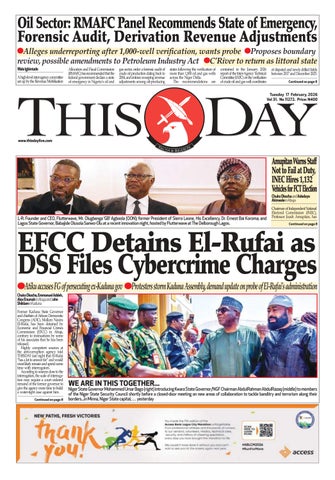
Oil Sector: RMAFC Panel Recommends State of Emergency, Forensic Audit, Derivation Revenue Adjustments
Alleges underreporting after 1,000-well verification, wants probe
Proposes boundary review, possible amendments to Petroleum Industry Act C’River to return as littoral state
Wale Igbintade
A high-level inter-agency committee set up by the Revenue Mobilisation
www.thisdaylive.com
Allocation and Fiscal Commission (RMAFC) has recommended that the federal government declare a state of emergency in Nigeria’s oil and
gas sector, order a forensic audit of crude oil production dating back to 2004, and enforce sweeping revenue adjustments among oil-producing
states following the verification of more than 1,000 oil and gas wells across the Niger Delta. The recommendations are
contained in the January 2026 report of the Inter-Agency Technical Committee (IATC) on the verification of crude oil and gas well coordinates Continued on page 8
and
of disputed and newly drilled fields between 2017 and December 2025.
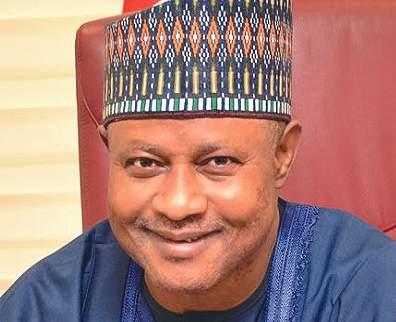
Amupitan Warns Staff Not to Fail at Duty, INEC Hires 1,132 Vehicles for FCT Election
Chairman
Independent
Continued on page 8
EFCC Detains El-Rufai as DSS Files Cybercrime Charges
Atiku accuses FG of persecuting ex-Kaduna gov Protesters storm Kaduna Assembly, demand update on probe of El-Rufai’s administration
Emmanuel Addeh, Alex
Abuja and John Shiklam in Kaduna
Former Kaduna State Governor and chieftain of African Democratic Congress (ADC), Mallam Nasiru El-Rufai, has been detained by Economic and Financial Crimes Commission (EFCC) in Abuja, contrary to insinuations by some of his associates that he has been released.
Highly competent sources at the anti-corruption agency told THISDAY last night that El-Rufai “has a lot to answer for” and would most likely remain and spend some time with interrogators.
According to sources close to the interrogation, the scale of interrogation may require a court ordered remand of the former governor to give the agency more time to build a water-tight case against him.
Continued on page 8
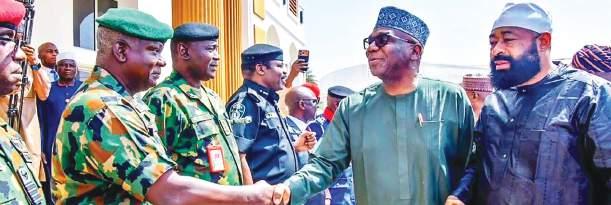
WE ARE IN THIS TOGETHER...
Niger State Governor Mohammed Umar Bago (right) introducing Kwara State Governor/NGF Chairman AbdulRahman AbdulRazaq (middle) to members of the Niger State Security Council shortly before a closed-door meeting on new areas of collaboration to tackle banditry and terrorism along their borders...in Minna, Niger State capital, … yesterday
& REASON
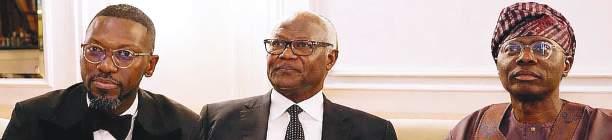
L-R: Founder
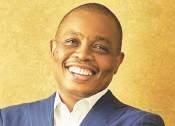
CEO, Flutterwave, Mr. Olugbenga ‘GB’ Agboola (OON); former President of Sierra Leone, His Excellency, Dr. Ernest Bai Koroma; and Lagos State Governor, Babajide Olusola Sanwo-Olu at a recent innovation night, hosted by Flutterwave at The Delborough Lagos.
Chuks Okocha,
Enumah in
Chuks Okocha and Adedayo Akinwale in Abuja
of
National Electoral Commission (INEC), Professor Joash Amupitan, has
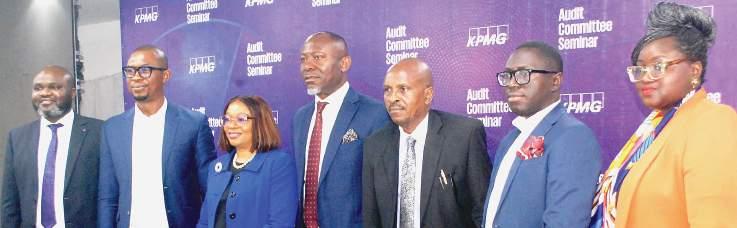
KPMG AUDIT COMMITTEE SEMINAR 2026...
L R: Guest Speaker, Dr. Adeyemi Adeyinka; External Speaker, Benson Okafor; Partner, Enterprise Risk Services and ESG Services, KPMG West Africa, Tomi Adeoju; Partner and Head, Audit, KPMG, Dr. Goodluck Obi; President, Noble Shareholders Solidarity Association, Mr. Anthony Kachi; Partner, Cyber and Privacy, KPMG, Mr. Samuel Asiyanbola; and Associate Director, Audit, Ehinome Ighalo, at the
National Assembly Seeks First-line Charge for Solid Minerals as Capital Releases Hit Zero
Lawmakers warn inconsistent funding cripples mining diversification drive Alake says N865bn 2025 capital vote unreleased, urges legislative backing Senate slams ‘abysmal’ funding as women affairs minister seeks higher budget
Sunday Aborisade in Abuja
The National Assembly yesterday moved to grant the Federal Ministry of Solid Minerals Development first-line charge status after it emerged that capital releases to the sector for 2025 stood at zero, a development lawmakers described as a major setback to Nigeria’s economic diversification agenda.
Similarly, the Minister of Women Affairs and Social Development, Imaan Sulaiman-Ibrahim, yesterday, asked the Senate to approve an upward review of the N134.2 billion proposed for her ministry in the 2026 fiscal year, even as lawmakers decried what they described as “abysmal” releases for the ministry’s 2025 budget.
At a budget defence session in Abuja, members of the Joint National Assembly Committee on Solid Minerals Development expressed alarm that despite huge appropriations, the ministry received no capital disbursement in 2025, with only 50 per cent of its overhead allocation released as of January 31, 2026.
Minister of Solid Minerals Development, Mr. Dele Alake, told lawmakers that the zero release of N865.06 billion earmarked for capital expenditure in the 2025 fiscal year had stalled critical infrastructure, exploration and sector development projects.
He warned that without guaranteed funding through first-line charge status, where statutory allocations are automatically released from the Federation Account, like priority sectors, the solid minerals sector would remain hamstrung by Treasury delays and shortfalls.
Alake said, “This is the most critical issue because inconsistent releases were undermining efforts to reposition mining as a key driver of economic growth, job creation and foreign investment.”
First-line charge status would insulate the ministry’s budget from bureaucratic bottlenecks and ensure predictable funding, a move lawmakers said was necessary if Nigeria was serious about unlocking the vast potential of its mineral resources.
Chairman of the Joint Committee, Senator Ekong Sampson, described the zero capital release as, “worrisome”
and fundamentally at odds with the ambitious projections embedded in the national budget.
“How do you drive the harvest of the sector’s full potential with zero per cent release?” Sampson queried. He noted that previous interventions, including a N1 trillion allocation to the sector, had raised expectations within the industry and among investors, but warned that without actual cash backing, “the budget framework is rendered quite unattractive.”
Other lawmakers echoed the call for urgent reform of the funding structure, arguing that solid minerals, like the petroleum sector, should enjoy first-line charge protection.
“Just like the oil sector, maybe we should try and see if we can make it a first-line charge. Because we can’t just appropriate figures and not pay. How can they develop the mining sector?” one member said.
Responding, Alake welcomed the proposal, describing it as “sweet music” and urging the National Assembly to provide legislative backing to make the arrangement feasible.
“If you legislate on it, it becomes doable. Then we will put on our executive machinery to ensure delivery,” he said.
Presenting the ministry’s 2026 budget proposal, Alake disclosed that the personnel, overhead and capital ceilings for the ministry and its agencies stood at N165.34 billion for the fiscal year.
For the main ministry, N1.79 billion was proposed for personnel costs, N1.57 billion for overhead and N45.54 billion for capital expenditure, totalling N48.9 billion, with the balance allocated to its agencies.
He described the 2026 proposal as a strategic pivot from “planning and potential” to “execution, production and revenue generation.”
According to him, the N156.34 billion sectoral outlay represents a critical investment designed to unlock solid minerals’ capacity to diversify the national economy, create jobs and significantly boost Gross Domestic Product (GDP).
The minister said the proposed allocation prioritises surveillance, logistics and digital systems aimed
at curbing illegal mining, improving revenue collection and creating a stable environment for responsible investment.
Despite funding constraints, Alake disclosed that the ministry exceeded its 2025 revenue target by 80 per cent, generating N30.23 billion as of December 31, 2025.
He attributed the improved revenue performance to reforms that formalised artisanal miners into cooperatives and corporate entities, enhancing their access to financing and regulatory compliance.
He said, “We were able to encourage them to form corporations so that they will no longer be labelled illegal miners.
“They will become formalised structures, attract financing and enable the government to demand and receive royalties, taxes and other civicTheobligations.”
minister added that 388 mineral buying centres were established during the year under review, while artisanal miners received training and four high-risk abandoned mine sites were reclaimed.
He also highlighted the expansion of the ministry’s enterprise content management system, which drove digitisation efforts and earned it recognition as the most digitised ministry in the country in the past year.
Alake said Nigeria’s improved geological data acquisition had placed the country on the global mining map, attracting significant investor interest.
He cited the recent African mining conference in Cape Town, South Africa, where Nigeria’s exhibition booth reportedly drew strong attention from international investors.
“The acquisition of scientifically certified geological data puts us at par with mining giants globally. The little we have done has placed Nigeria on the map,” he said.
Lawmakers, however, maintained that without predictable and sustained funding, such gains could prove difficult to consolidate.
They assured the minister that the committee would examine the proposal for first-line charge status
and explore legislative mechanisms to strengthen the sector’s funding architecture.
According to them, granting solid minerals priority funding would not only guarantee financial stability but also signal to global investors that Nigeria is committed to building a credible and competitive mining industry.
“If you invest more, you achieve more. The revenue profile has improved remarkably. It clearly shows that if you had more, you would have achieved much more,” Sampson said.
The committee pledged to work with the executive to develop frame- works that would ensure the sector delivers what lawmakers described as “huge harvests” for the country’s economy.
Senate Slams Abysmal Funding as Women Affairs Minister Seeks Higher 2026 Budget
Meanwhile, the Minister of Women Affairs and Social Development,
Imaan Sulaiman-Ibrahim, yesterday, asked the Senate to approve an upward review of the N134.2 billion proposed for her ministry in the 2026 fiscal year, even as lawmakers decried what they described as “abysmal” releases for the ministry’s 2025 budget. The request was made during a budget defence session before the Senate Committee on Women Affairs, where the minister argued that increased funding would enable the ministry to address the growing and multifaceted challenges facing women and vulnerable groups across the country.
However, the committee pushed back, warning that poor cash backing of already approved appropriations must first be addressed by the executive before any upward review could be meaningfully considered. Chairman of the committee, Ireti Kingibe, said while the panel was not opposed to increasing the ministry’s 2026 allocation, the pattern of negligible releases in 2025 raised serious concerns about budget implementation.
National Institute for Policy and Strategic Studies (NIPSS), Kuru, on Monday inaugurated participants of Senior Executive Course (SEC) 48, with a strong call for innovative policy thinking and strategic leadership to unlock Nigeria’s creative and entrepreneurial potential.
Speaking at the ceremony, Director-General of NIPSS, Professor Ayo Omotayo, said the 10 month programme was designed to deepen policy insight, sharpen strategic thinking, and strengthen the capacity of senior executives to tackle Nigeria’s complex governance and development challenges.
Omotayo congratulated the participants on their selection, describing their admission as “a
recognition of professional accomplishments, leadership potential, and the strategic importance of the roles they occupy in national life”.
He stressed that participation in the course was “a call to national service” requiring discipline, ethical leadership, and commitment to the collective good.
Omotayo said this year’s study theme, “Orange Economy and Entrepreneurship for Sustainable Development in Nigeria,” was timely given the country’s urgent need to diversify the economy, reduce unemployment, and build sustainable livelihoods.
According to him, the Orange Economy – covering culture, creativity, tourism, media, fashion, film, music, and digital innovation – has become central to global economic competitiveness and
social cohesion.
He urged policymakers to recognise creativity and cultural heritage as strategic economic assets capable of generating measurable value.
Omotayo stated, “The Orange Economy challenges traditional notions of development that rely predominantly on extractive resources.” He added, “It requires coherent policies that protect intellectual property, incentivise innovation, promote entrepreneurship, and translate cultural expression into economic value.”
The director-general commended Plateau State for hosting the participants during their orientation tour, describing the state as a “living laboratory” for understanding the intersection of culture, creativity, governance, and
peace in development.
He reminded the nominees that the NIPSS experience was intentionally rigorous, urging them to engage deeply with research, debates, and collaborative work. “The objective is not academic abstraction, but policy relevance and national impact,” he said.
Omotayo formally declared the course open, charging participants to refine their thinking, strengthen leadership capacities, and renew their commitment to national service.
Representing Plateau State Government, Deputy Governor Josephine Piyo welcomed the participants to the state and commended NIPSS for its sustained contributions to national development through research and leadership training.
Yemi Kosoko in Jos
KPMG Audit Committee Seminar 2026 held in Lagos, yesterday
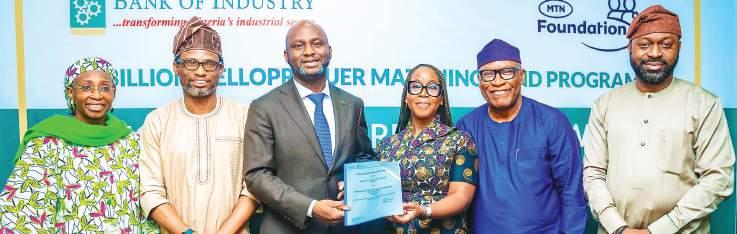
MOU SIGNING CEREMONY OF BOI MTNF Y’ELLOPRENEUR 3.0...
L R: Executive Director, Public Sector and Intervention Programmes, Bank of Industry (BOI), Mrs. Mabel Ndagi; Executive Director, Micro, Small and Medium Enterprises, Bank of Industry, Mrs. Oluwatoyin Edu; Managing Director and Chief Executive Officer, Bank of Industry, Dr. Olasupo Olusi; Executive Director, MTN Foundation Nigeria, Mr. Odunayo Sanya; Independent Non Executive Director, MTN Foundation, Mr. Etim Amana; and Executive Director, Corporate Finance, Sustainability and Investments, Bank of Industry, Mr. Rotimi Akinde, during the MOU signing ceremony of BOI MTNF Y’ellopreneur 3.0, held in Lagos… weekend
Aided By $4.85bn Portfolio
Inflows, Capital Importation
Peaked at $6.01bn in Q3 2025
Moderation in food, commodity prices lowers inflation to 15.10% Severe in Benue, Kogi, Abuja, others
Nigeria’s total capital importation rose by 17.46 per cent to $6.01 billion in the third quarter of last year (Q3 2025), compared with $5.12 billion recorded in the preceding quarter, the National Bureau of Statistics (NBS) disclosed yesterday.
This was disclosed same day the NBS latest figures for the Consumer Price Index (CPI), which measures the rate of change in prices of goods and commodities, showed that it further eased to 15.10 per cent in January, compared to 15.15 per cent in December 2025.
The capital importation figure indicated an increase of 380.16 per cent, compared to $1.25 billion in Q3 2024.
According to the capital importation report for Q3 2025, portfolio investment ranked top with $4.85
billion, accounting for 80.70 per cent, followed by Other Investment with $864.57 million or 14.37 per cent of total inflows.
Foreign Direct Investment recorded the least inflow with $296.25 million or 4.93 per cent of total capital importation in Q3.
According to the NBS, the banking sector recorded the highest inflow with capital inflow with $3.14 billion, representing 52.25 per cent of total capital imported in the review period.
This was followed by the financing sector, valued at $1.85 billion, accounting for 30.85 per cent , and the production/manufacturing sector with $261.35 million or 4.35 per cent.
Capital Importation originated largely from the United Kingdom with $2.93 billion, representing 48.80 per cent of the total capital imported.
This was followed by the United
States with $950.47 million or 15.80 per cent and the Republic of South Africa with $773.95 million, representing 12.87 per cent.
Standard Chartered Bank Nigeria Limited received the highest capital importation into Nigeria with $2.11 billion or 35.17 per cent, followed by Stanbic IBTC Bank $1.78 billion or 29.75 per cent.
Citibank Nigeria Limited attracted with $561.40 million or 9.33 per cent.
Meanwhile, the CPI figures showed that year-on-year, headline inflation stood at 12.51 per cent compared to 27.61 per cent in January 2025.
Month-on-month, headline inflation stood at -2.88 per cent in January compared to 0.54 per cent in December.
Food inflation stood at 8.89 per cent, year-on-year, from 29.63 per cent in January 2025.
Month-on-month, the food index was -6.02 per cent compared to -0.36 per cent in December.
The NBS attributed the decline in food inflation to the rate of decrease in the average prices of water yam, eggs, green peas, groundnut oil, soya beans, palm oil, maize, guinea corn, beans, beef meat, melon, unshelled cassava tuber, and cow peas, among others. However, core inflation, which excludes the prices of volatile agricultural products and energy, stood at 17.72 per cent year on year in January 2026 compared to 25.27 per cent in the corresponding period of 2025.
Month-on-month, the core index stood at 1.69 per cent compared to 0.58 per cent in the preceding month.
Year-on-year, urban inflation stood at 15.36 per cent compared to 29.45 per cent in January 2025.
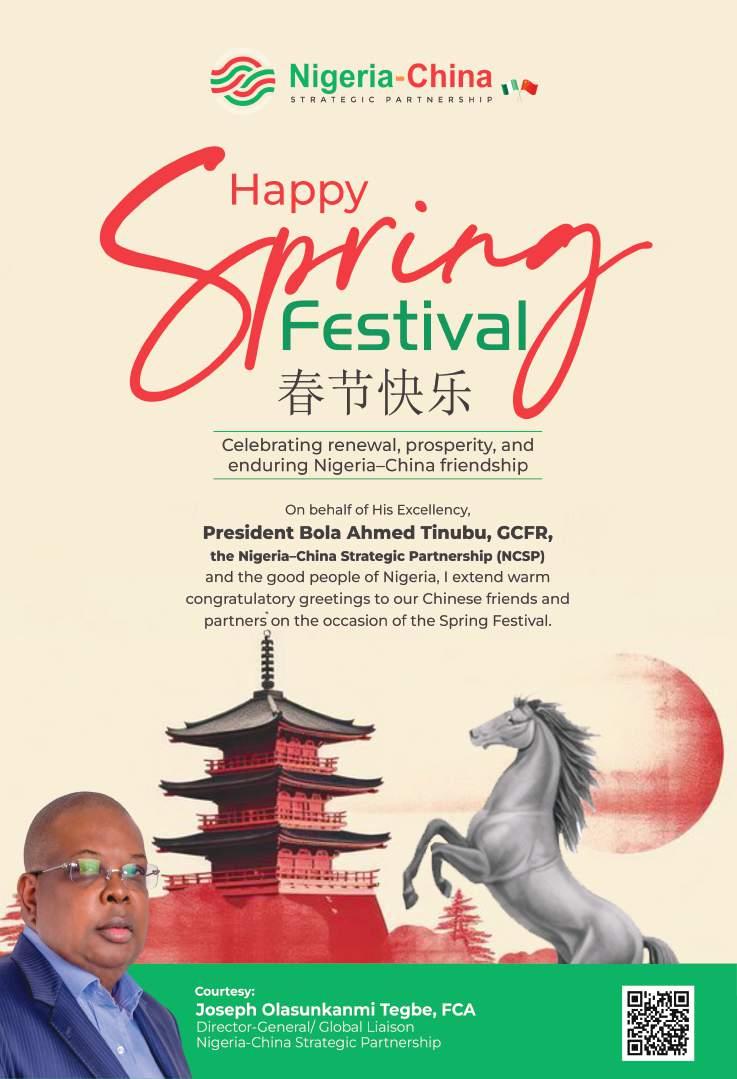
NCSP DG Spotlights Zero-tariff Window as Game Changer in Nigeria-China Relations
As the People’s Republic of China marks the Spring Festival and a new Lunar Year, Director-General of Nigeria–China Strategic Partnership (NCSP), Joseph Tegbe, says the celebration is a transformative Zero-Tariff opportunity for Nigerian exports.
In a statement commemorating both the festival and 55 years of diplomatic ties between Nigeria and China, Tegbe said the Chinese government’s zero-tariff initiative for qualifying African exports represented a decisive shift from traditional trade patterns towards export-led industrial growth.
He stated that while Nigeria–China relations had historically focused on infrastructure cooperation and import-driven trade, the new preferential tariff regime opened a pathway for Nigerian producers to penetrate one of the world’s largest consumer markets without tariff barriers.
According to Tegbe, the zero-
tariff window can significantly expand Nigeria’s non-oil exports, particularly in agro-processing, solid minerals, light manufacturing and value-added goods, if properly leveraged.
He said, “The Zero-Tariff initiative is more than a trade concession; it is a strategic economic opening.”
He added, “It gives Nigerian businesses a competitive edge in accessing the Chinese market and creates a viable route for export diversification, industrial upgrading and job creation.”
However, Tegbe stressed that the benefits will not be automatic.
He warned that Nigerian exporters must meet stringent quality standards, packaging requirements and phytosanitary regulations to compete effectively.
He added that logistics efficiency, certification processes, and coordinated government support will determine whether Nigeria converts preferential access into sustained export growth.
Tegbe said NCSP was working
with public and private sector stakeholders to align production capacity with Chinese market demand, while strengthening compliance systems to meet international benchmarks.
Tegbe described the 55th anniversary of diplomatic relations as a timely moment to recalibrate bilateral engagement towards measurable economic outcomes. Rather than relying predominantly on imports and infrastructure financing, he said Nigeria must position itself as a serious export partner within the evolving framework of China–Africa trade cooperation.
He stated, “As China celebrates renewal through the Spring Festival, Nigeria must seize this zero-tariff opportunity as the foundation of a new phase in bilateral relations—one driven by productivity, competitiveness and shared prosperity.”
Many believe that if the initiative is strategically implemented, it will help in narrowing Nigeria’s trade
imbalance with China and reduce dependence on oil revenues, while strengthening domestic industries for long-term growth.
Month-on-month, urban inflation was -2.72 per cent in January compared to 0.99 per cent in December.
On the other hand, rural inflation stood at 14.44 per cent, year-on-year in January compared to 25.04 per cent in January 2025.
Month-on-month, the rural index was -3.29 per cent compared to -0.55 per cent in December 2025.
At the state level, year-on-year, headline inflation was highest in Benue (22.48 per cent), Kogi (20.98 per cent), and Abuja (19.25 per cent), while Ebonyi (8.72 per cent), Katsina (8.94 per cent), and Imo (10.61 per cent) recorded the lowest rise in prices.
Month-on-month, however, inflation recorded the highest increases in Imo (1.93 per cent), Ondo (1.932 per cent) and Kaduna (0.67 per cent), while Cross River (-6.34 per cent), Ogun (-6.30 per cent), and Kogi (-6.03 per cent) recorded a decline.
Year-on-year, food inflation was highest in Kogi (19.84 per cent), Benue (18.38 per cent), and Adamawa (17.29 per cent), while Ebonyi (1.69 per cent), Abia (3.23 per cent), and Imo (3.74 per cent) recorded the slowest rise in food prices.
Month-on-month, however, food inflation was highest in
Imo (-1.26 per cent), Akwa Ibom (-2.21 per cent) and Zamfara (-2.96 per cent), while Yobe (-11.88 per cent), Nasarawa (-9.06 per cent), and Sokoto (-8.31 per cent) recorded a decline.
The Centre for the Promotion of Private Enterprise (CPPE) described the significant moderation in Ni- geria’s inflation dynamics as “the emergence of real disinflation rather than temporary price volatility.”
The Chief Executive Officer of CPPE, Dr. Muda Yusuf, said the development represented “an important macroeconomic shift with implications for household welfare, agricultural income sustainability, monetary policy direction, and private-sector investment strategy.” Yusuf said: “Nigeria’s January 2026 inflation outcomes signal a meaningful transition toward macroeconomic stabilisation, driven primarily by declining food prices and supported by easing core inflation.
“The development is positive for household welfare, consumption recovery, and investment confidence, but presents downside risks for farm incomes and rural economic sustainability.
“The central policy priority is therefore to consolidate disinflation while protecting agricultural productivity and rural livelihoods.
Ogun Targets 2,000km of Road Construction Before End of Abiodun’s Tenure
Ogun State Government said it had constructed over 1,600 kilometres of roads since 2019 and was working towards completing at least 2,000 kilometres before the end of Governor Dapo Abiodun’s tenure. Commissioner for Works, Ade Akinsanya, made this known during an appearance on Sunrise Daily, a Channels TV programme.
Akinsanya explained that road construction was currently ongoing across all 20 local government areas of the state.
He disclosed that the administration inherited over 4,000 kilometres of bad roads and deliberately set out to tackle the challenge through a state-wide infrastructure strategy
focused on rural connectivity, food security corridors, economic hubs and access to schools.
He stated, “We are talking about thousands of kilometres of bad roads, and as of today, we have completed more than 1,600 kilometres across the state,” adding, “We are not concentrating on one area alone — work is ongoing in all 20 local governments.”
He highlighted major projects, including the reconstruction of the 70-kilometre Ota–Abeokuta road, as well as extensive works in Ado-Odo/Ota, Ifo and Akute areas.
Akinsanya stated that previously impassable roads, such as Ajuwon–
Akute, Alhaji Kosoko–Akute, and Yakoyo–Alagbole had now been fully rehabilitated, significantly improving movement between Ogun and neighbouring Lagos communities.
The commissioner added that construction was progressing steadily from Ota through Akute to Ijoko, with several sections already completed and others actively under development.
Also speaking on the programme, Special Adviser to the Governor on Media and Strategy, Kayode Akinmade, defended the administration’s infrastructure drive, stressing that road projects are being evenly distributed across the state.
Michael Olugbode in Abuja
James Emejo in Abuja and Dike Onwuamaeze in Lagos
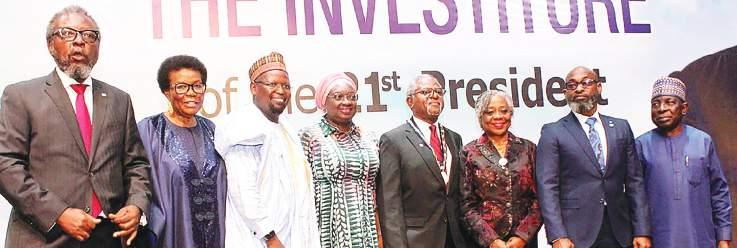
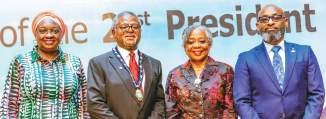
THE INVESTITURE OF THE NEW PRESIDENT OF ACEN...
L R: Past President, Association for Consulting Engineering in Nigeria (ACEN), Engr. Charles Akindayomi; Past President, Engr. Mayen Adetiba; Past President, Engr. Kam Selem Buka Alhaji; Deputy Governor, Ogun State, Engr. Noimot Salako Oyedele; President, ACEN, Engr. Kunle Adebajo; Wife of the President, Dr. Sylvia Adebajo; Special Adviser, Office of Infrastructure, Lagos State Government, Engr. Olufemi Daramola; and Past President, ACEN, Engr. Lanre Sagay, at the investiture of Engr. Adebajo as the 21st President of ACEN, held in Lagos… recently
Wale Adeniyi: CBN, Not Customs, Determines Foreign Exchange Rates for Import, Export Valuation
Clarifies controversial February 6 exchange peg Partners apex bank to strengthen real-time exchange rate transmission, others
James Emejo in Abuja
Comptroller General of Customs (CGC), Mr. Wale Adeniyi, yesterday, clarified that Nigeria Customs Service (NCS) does not independently determine, generate, alter, or apply margins to foreign exchange rates used for import and export valuation in the country.
Adeniyi said all exchange rates applied within the customs B’Odogwu platform were official rates electronically transmitted by Central Bank of Nigeria (CBN), which was the competent authority for exchange rate determination under Nigeria’s monetary framework.
B’Odogwu is a Unified Customs Management System, which serves as the sole official platform for customs declarations, clearance, and valuation.
Adeniyi gave the clarification in a statement issued on his behalf by Deputy Comptroller of Customs, National Public Relations Officer, Dr. Abdullahi Maiwada.
He said the service will continue to strengthen its systems, enhance operational integrity, and support the country’s economic growth through efficient and accountable Customs administration.
He said, “These rates are automatically integrated and uniformly applied across all customs formations, ensuring transparency,
predictability, audit integrity, and full compliance with statutory provisions and national fiscal and monetary policy directives.”
The clarification came against the backdrop of recent suggestions by stakeholders that the NCS had applied an unofficial rate for February 6, 2026 validation for import and exports - allegations the service refuted.
The statement said, “It is worthy of note that the reported exchange rate of ₦1,451.63/US$ for 6 February 2026 did not originate from the B’Odogwu system.”
Maiwada further declared that as part of its ongoing system governance and enhancement processes, NCS was working with CBN to enable seamless Application Programming Interface (API)-based integration, to further strengthen real-time exchange rate transmission, operational reliability, and system resilience.
He said, “The B’Odogwu system operates on structured data integration protocols that automatically ingest and apply exchange rate information as transmitted by the Central Bank of Nigeria.
“Under no circumstance does the system generate, substitute, or alter exchange rates.
“Where data transmission formats change, the system is designed to retain the last valid Central Bank-
provided rate until the updated feed is successfully processed, thereby preserving continuity, accuracy, and valuation integrity.”
On the controversial exchange rate application which the service disowned, the statement said, “It is worthy of note that the reported exchange rate of N1,451.63/US$ for February 6, 2026 did not originate from the B’Odogwu system.
“That figure was sourced from trade.gov.ng, a legacy public trade information portal that does not reflect live Customs processing data.
“Likewise, the National Integrated Customs Information System (NICIS) does not provide real-time Customs valuation figures and is not recognised for live Customs processing.”
The NCS however, assured
the trading public that the sole authoritative platform for customs declarations, clearance, and valuation remained https://bodogwu.customs. gov.ng, which receives exchange rates directly transmitted by the central bank.
Maiwada said, “For clarity and transparency, the exchange rate applied for Customs valuation on 6 February 2026 was N1,365.56 per
United States Dollar, as officially communicated by the Central Bank of Nigeria.
“All subsequent exchange rates applied by the service have likewise reflected the official rates transmitted by the Central Bank of Nigeria and automatically implemented through the B’Odogwu platform in accordance with established national protocols.
UK Abolishes Visa Stickers for Nigerians, Introduces Mandatory eVisa from Feb. 25
The United Kingdom will, from February 25, 2026, stop issuing physical visa stickers to Nigerian travellers, replacing them entirely with digital eVisas in what officials described as a major overhaul of the country’s immigration system.
Announcing the change in Abuja, UK Visas and Immigration (UKVI) said all new Visit visas granted to Nigerian nationals would now be issued electronically, marking a decisive step in the UK’s transition to a fully digital border regime.
Under the new system, successful applicants would no longer receive a vignette pasted on their passports. Instead, they will access proof of
ICCD: Akanimo Cancer Foundation Takes Childhood Cancer Awareness to Churches Nationwide
Sunday Ehigiator
The Akanimo Cancer Foundation (ACF) has expanded its childhood cancer awareness campaign by taking sensitisation efforts to churches across Nigeria to commemorate International Childhood Cancer Day (ICCD) 2026.
The foundation said the initiative was designed to leverage the strong influence of faith institutions in shaping healthcare decisions among Nigerian families, noting the 2026 campaign significantly
increased outreach locations from six in 2025 to nine cities and 11 locations nationwide.
The awareness activities were conducted across multiple Christian denominations in Uyo, Calabar, Bonny, Aba, Enugu, Ibadan, Lagos, Kano and Abuja.
Founder and Executive Director of the foundation, Idara Ekanem, said the decision to collaborate with religious organisations was deliberate and culturally relevant.
“In Nigeria, religion and medicine are deeply intertwined in the
minds of the average citizen. For many families, the church is the first place they turn to when a child is ill. We are not seeking to replace faith; we are seeking to align faith with science so that children can receive timely, life-saving medical care,” she said.
The foundation noted that childhood cancer remains widely misunderstood in many parts of the country, particularly in rural and semi-urban communities, where symptoms are sometimes attributed to spiritual causes or superstition.
their immigration status online through a secure UKVI account.
The British government stressed that the application procedure itself remains unchanged. Nigerian applicants must still complete the standard online process, attend a Visa Application Centre to submit biometric data and meet all existing eligibility requirements. The only adjustment was the format in which the visa is delivered.
Authorities clarified that Nigerians currently holding valid visa stickers would not be affected by
the new policy. Their visas would remain valid until expiration and do not require replacement solely because of the transition.
British Deputy High Commissioner in Abuja, Gill Lever, said the move was designed to simplify travel while enhancing security.
“We are committed to making it easier for Nigerians to travel to the UK. This shift to digital visas streamlines a key part of the process, strengthens security and reduces reliance on paper documentation,” she said.
According to UKVI, the eVisa system was expected to shorten processing timelines since passports would no longer need to be retained for visa sticker endorsement. Travellers would also be able to view and manage their immigration status online at any time, from anywhere. Officials highlighted the added security benefits of the digital format, noting that unlike physical stickers, eVisas cannot be lost, stolen or tampered with. The system was also designed to provide real-time verification of immigration status.
...UK Boarding Schools to Engage Nigerian Families in Abuja, Lagos Exhibition
Leading British boarding schools will engage Nigerian families in March as United Kingdom Boarding Schools Week 2026 hold exhibitions in Abuja and Lagos.
The events are organised by Mark Brooks Education, led by Mr. Mark Brooks, a UK Department for Business and Trade Export Champion with over 17 years’ experience advising Nigerian families.
Brooks in a statement on Monday said the programme will allow parents and students to interact directly with school leaders and better understand academic pathways available within the British boarding school system.
“This programme enables parents and students to meet school heads, explore academic pathways and gain first-hand insight into British boarding education.
“Families attending will be able to speak directly with schools offering outstanding academic results, strong pastoral care and vibrant co-curricular programmes, all within welcoming international communities”.
The Abuja exhibition will hold at the Transcorp Hilton on March 4, while the Lagos exhibition is scheduled for March 7 at The George Hotel, Ikoyi.
Some schools will also hold prearranged meetings and a smaller follow-up exhibition on the afternoon
of March 8. According to him, the exhibitions are part of a wider programme featuring school visits, student presentations, leadership workshops and parent engagement sessions in Abuja and Lagos.
Brooks said the programme helps families understand how British boarding schools support academic, social and personal development. Participating schools include Bromsgrove School, Canford School, Cardiff Sixth Form College, Dean Close School, Downside School and Lancing College. Other schools are Milton Abbey School, Stamford School and Wellington School.
Michael Olugbode in Abuja
Kuni Tyessi in Abuja
Cardoso Hails Nigeria’s Permanent Membership on Board of African Monetary Institute
Says development victory for country, triumph for Africa’s integration, monetary sovereignty
James Emejo in Abuja
Governor of Central Bank of Nigeria (CBN), Mr. Olayemi Cardoso, has hailed the recent decision of the 39th Ordinary Session of the Assembly of the African Union (AU) to officially approve Nigeria’s permanent membership of the Board of the African Monetary Institute (AMI).
The decision was taken during the body’s February 2026 Summit in Addis Ababa, Ethiopia.
The approval followed the earlier adoption by the Executive Council of the African Union (AU), at its 48th Ordinary Session.
Cardoso described the development as a victory for Nigeria and triumph for Africa’s integration and monetary sovereignty.
The AMI, established under AU’s financial institutions agenda, acts as a precursor to the African Central Bank (ACB), which will be headquartered in Abuja, Nigeria.
The CBN governor stated that hosting the AMI and, subsequently, ACB, hold immense value for Nigeria and the continent.
He stressed that it would position the country as the epicentre of Africa’s emerging monetary union and enhance her voice and influence in the shaping of Africa’s single currency architecture.
Further commending the decision that also makes Nigeria a permanent member of the Convergence Council, the central bank governor said, “This historic decision marks a significant milestone in Africa’s financial integra-
tion journey and further emphasises Nigeria’s strategic role in shaping the continent’s evolving financial architecture.”
Its implementation marked a vital step towards enhancing macroeconomic convergence, fostering monetary cooperation, and progressing Africa’s long-term vision of financial sovereignty and economic integration.
Cardoso stated that the latest success reflected the collective efforts rooted in sustained determination, structural reforms, strategic diplomacy, technical consistency, and a renewed macroeconomic direction.
The AU Heads of State and Government at the summit reaffirmed the pathway by endorsing Nigeria’s standing representation
on the AMI Board, a position that will remain in place throughout the transitional phase until the formal establishment of ACB.
A statement issued by the apex bank said CBN, along with the Ministries of Foreign Affairs, Justice, and Finance, played a central, strategic, and historic role in the achievement of the milestone.
Over the past years, CBN had led the technical effort that contributed to the Draft AMI Statute, approved at the fifth Extraordinary Meeting of the Specialised Technical Committee on Finance in Abuja, and provided the AU with the initial hosting facilities and essential logistics for the immediate launch of AMI.
The CBN also participated in the Inter-ministerial collaboration
EFCC DETAINS EL-RUFAI AS DSS FILES CYBERCRIME CHARGES
El-Rufai turned himself in for interrogation yesterday following a letter of invitation to him by EFCC, which had been looking into his time as governor of Kaduna State.
Earlier in June 2024, an ad hoc committee set up by Kaduna State House of Assembly to investigate all finances, loans, and contracts awarded under the El-Rufai administration submitted its report to the Assembly.
Chairman of the ad hoc committee, Henry Zacharia, said most of the
loans obtained under the El-Rufai’s administration were not used for the purposes for which they were obtained, while in some cases, due process was not followed in securing the loans.
Besides, Speaker of the Assembly, Yusuf Liman, said a total of N423 billion was allegedly siphoned by the El-Rufai’s administration, leaving the state with huge liabilities.
The committee recommended the investigation and prosecution of El-Rufai and some members of
his cabinet, by security and anticorruption agencies for alleged abuse of office, diversion of public funds, and money laundering.
The committee also recommended the immediate suspension of the Commissioner for Finance, Shizer Badda, who also served in the same capacity under El-Rufai’s administration.
However, while responding at the time, El-Rufai’s spokesman, Muyiwa Adekeye, affirmed the integrity of the El-Rufai government
AMUPITAN WARNS STAFF NOT TO FAIL AT DUTY, INEC HIRES 1,132 VEHICLES FOR FCT ELECTION
cautioned staff of the commission against dereliction of duty ahead of the February 21 Federal Capital Territory (FCT) Area Council elections.
INEC revealed that it would hire a total of 1,132 vehicles from the transport unions ahead of Saturday’s area council polls.
At the same time, stakeholders appealed to INEC not to sway to the whims of politicians during the area council elections.
Amupitan, who stated spoke in Abuja during an assessment visit and general meeting with FCT staff, described the election as a test case for the commission and an opportunity to restore public confidence in the electoral process.
The INEC boss, in a statement, charged staff of the FCT office to take full ownership of the forthcoming area council elections, warning that any act of dereliction would attract severe consequences.
He said, “You are the foot soldiers. The success of this election rests on how you perform your responsibilities.”
The chairman reminded personnel that “under the Electoral Act, 2022, there are clear consequences for misconduct, including faulty declaration of results”.
He said, “There is a saying in law that ignorance of the law is not an excuse. We need to let everyone know that there are consequences for dereliction of duty.”
Amupitan stressed the need for strict adherence to INEC regulations, proper deployment of technology, and transparent result management.
He also urged electoral officers to be proactive in addressing challenges at the polling unit level.
Amupitan identified punctuality as a key performance indicator for a successful election, directing that all polling units must be set up by 8am so that voting could commence by 8:30am as advertised.
“When you start on time, you close by 2:30 p.m., and results can be concluded before nightfall. That is the beginning of success,” he said.
Amupitan warned that any delays must be communicated to the commission promptly to ensure INEC remained the primary source of information in real time.
Earlier, FCT Resident Electoral Commissioner, Aminu Idris, provided an update on the state of preparedness for the area council elections, assuring the chairman that all non-sensitive materials have been deployed to the six area council offices.
He stated, “We have received all the non-sensitive materials, which have been moved to the area council offices.
“Training of staff commenced on 13th - 15th February 2026 and we are conducting additional training today to address the shortfall in turnout.”
Meanwhile, INEC revealed that it would hire a total of 1,132 vehicles from the transport unions ahead of Saturday’s FCT elections.
Amupitan disclosed this in Abuja during a meeting with transport union leaders held at FCT INEC Office in Abuja.
He stated that the electoral body would not entertain any excuses from the transport unions, insisting that the services they would render must be in tandem with the Memorandum of Understanding (MoU) they signed with INEC.
Amupitan said, “We are pleased to note that there is a partnership that has been existing for years between INEC and the two unions, especially as it relates to transport logistics. And of course, you know that your election can only be good as your logistics.”
The INEC chairman said the commission’s partnership with the unions showed that they were a critical stakeholder in the electoral
process in ensuring free, fair and credible elections.
He, however, expressed concern over some challenges relating to logistics on election day, adding that the services provided by the unions during the Anambra State governorship election was a disaster.
Amupitan stated, “However, we have noticed some challenges in relation to transport logistics, and we are very concerned and worried. I will give you some of the examples, most especially at the last Anambra State Election.
“It was almost a disaster, because we were almost disappointed. The vehicles that were brought by the unions to transport sensitive materials from Enugu to Awka, we were not particularly happy because they were really non-serviceable vehicles.
“And at the last minute, we also found that some of your representatives could not meet up and even discovered that some of the vehicles were farmed out to others.
“And let me also say that we had to revert, in some cases, to Option B, which was having to rely on some vehicles that were brought from other states to be able to meet up.”
Amupitan added, “So this time around, we are talking of hiring about 1,132 vehicles from the two unions, and for an election that will feature about 570 candidates. For the chairmanship and vice chairmanship position, and about 62 or 68 councillorship positions. And you are talking about 2,822 polling units in the FCT, in the six area councils.
“We have emphasised to you in the morning that we don’t want to listen to any excuses. You know, there are some excuses that are genuine, but we don’t even want
and dismissed as “scandalous” the claims by the committee.
But THISDAY can authoritatively report that El-Rufai was detained by EFCC for more detailed grilling, just as the Department of State Service (DSS) also filed a three-count criminal charge against him at the Federal High Court, Abuja.
Former Vice President Atiku Abubakar, however, accused the President Bola Tinubu government of persecuting El-Rufai.
Hundreds of protesters, yesterday, stormed the Kaduna State House of Assembly, demanding a formal briefing on the status of the house’s investigation into the administration of El-Rufai.
El-Rufai had arrived the headquarters of EFCC about 11 am in respect of an invitation by the commission. He would be interrogated over corruption allegations levelled against him as governor of
with the Federal Ministry of Finance, Ministry of Foreign Affairs, Ministry of Justice, and the Presidency to sustain Nigeria’s advocacy at the highest political levels.
Cardoso said, “These efforts have led to improved monetary stability, external reserves management, banking supervision, and payment system modernisation.”
The statement said the achievement were a testament to Nigeria’s enhanced credibility and influence across the continent.
It said, “We will continue collaborating with the African Union Commission, the Association of African Central Banks, Member States, and development partners to establish a solid foundation for the African Central Bank and the
Kaduna State from 2015 to 2023.
He was accompanied by hundreds of his supporters to the EFCC head office, at Jabi, Off Airport Road, Abuja. A source at the anti-graft agency, who disclosed, “He is with our investigators,” could not confirm how long the ADC chieftain would be questioned.
However, another source hinted on the possibility of his being arraigned. El-Rufai had refused arrest at the Nnamdi Azikiwe International Airport, Abuja, last Thursday by security operatives.
In a series of interviews granted after the airport drama, El-Rufai accused National Security Adviser (NSA), Nuhu Ribadu, of orchestrating the failed arrest.
El-Rufai Remains in EFCC’s Custody El-Rufai might remain in the
future African Single Currency.” Nonetheless, the permanent seat granted to Nigeria is time-bound to the transitional period of AMI and includes a sunset clause upon establishment of ACB. This design fully respects AU principles of rotation, equity, and regional balance, while ensuring that the host country remains embedded in governance during AMI’s formative years.
custody of EFCC as his investigation over alleged corruption and abuse of office continued.
El-Rufai arrived the headquarters of the anti-graft agency about 11am yesterday following an invitation by the commission.
Several hours after he honoured the invitation, he was yet to come out to his supporters, who nearly clashed with other groups, who were in support of the invitation and possible prosecution of the vocal critic of the Tinubu administration as well as some previous governments.
A source told THISDAY that shortly after the former governor entered the premises of the anti-graft agency in Jabi, Abuja, he was led to an interrogation room, where he was quizzed by investigators of the agency. The source added that
Continued on page 52
OIL SECTOR: RMAFC PANEL RECOMMENDS STATE OF EMERGENCY, FORENSIC AUDIT, DERIVATION REVENUE ADJUSTMENTS
The committee, inaugurated in June 2025, comprised representatives of RMAFC, the Nigerian Upstream Petroleum Regulatory Commission (NUPRC), the National Boundary Commission (NBC), and the Office of the Surveyor-General of the Federation (OSGoF).
It was mandated to physically verify wellhead coordinates, onshore, offshore and in creeks—accurately plot them on approved maps, and resolve disputes affecting the 13 per cent derivation payable to oil-producing states under the 1999 Constitution.
In one of its most far-reaching recommendations, the committee urged the President to consider declaring a state of emergency in the oil and gas sector to curb criminal activities by operators, address security challenges in offshore operations, and restore regulatory discipline.
It also recommended the establishment of a team of inquiry into crude oil production underreporting and accounting practices by oil companies, alongside the immediate metering of all crude oil and gas flow stations nationwide.
Most significantly, the committee called for a forensic audit of crude oil and gas production from 2004 to date, spanning more than two decades of output and revenue remittances into the Federation Account.
If approved, the audit could have profound financial implications for oil companies, regulators and the three tiers of government,
particularly if discrepancies are uncovered in production reporting or derivation payments.
The IATC said it verified and attributed hundreds of wells across nine oil-producing states. Rivers State recorded 195 wells, Delta State 171, Imo State 169, Ondo State 138, Cross River and Akwa Ibom 119 each, Bayelsa 92, Edo 29 and Anambra 25.
The exercise also identified several new oil and gas fields and addressed long-standing disputes over “straddled wells” located near or across state boundaries.
Security for the field verification was provided by the Nigerian Army and the Nigerian Navy, underscoring the sensitivity of the operation.
One of the most politically sensitive outcomes of the report was its recommendation for inter-state revenue adjustments and refunds of derivation payments.
The committee directed that 107 disputed wells in OMLs 70 and 100 be shared equally between Akwa Ibom and Rivers States, with Akwa Ibom required to refund 50 per cent of derivation arrears to Rivers.
It further recommended that Delta State refund portions of derivation to Edo and Ondo States in respect of specific fields, while Akwa Ibom was to refund Cross River for derivation previously received on certain wells.
Bayelsa and Imo States are also to refund derivation payments to Rivers State for identified fields. In addition, several wells between
Anambra and Delta States are to be shared equally pending final boundary determination, with corresponding revenue adjustments. These recommendations could trigger significant fiscal recalculations among oil-producing states, potentially affecting monthly allocations from the Federation Account and straining political relations among governors.
Beyond revenue adjustments, the committee recommended that the Vice President direct the NBC and OSGoF to review Nigeria’s maritime boundary maps and declare a state of emergency in resolving outstanding boundary disputes.
It specifically called for a holistic review of the subsisting boundary decision between Bayelsa and Rivers States and the production of a definitive Map Instrument. The disputes have lingered for years and have been at the heart of multiple petitions submitted by governors seeking reclamation of oil wells and fields.
In another major policy recommendation, the committee urged the Attorney General of the Federation to establish a committee to review the Petroleum Industry Act for possible amendments by the National Assembly.
The Act, regarded as Nigeria’s flagship oil reform law, governs regulatory frameworks and fiscal terms in the upstream sector, and any amendment could
Cardoso
PINL HONOURED AS COMPANY OF THE YEAR...
L R: Chief Financial Officer (CFO), Pipeline Infrastructure Nigeria Limited, Mr. Martins Ataman; Company Secretary, Barr. Chinemerem Ikechi Eshiet; Head of Operations, Engr. Oluwafemi Alake; Managing Director, Rear Admiral Akinjide Akinrinade; Operations Manager, Engr. Onome Abhirire; Finance Manager, Mrs. Marian O. Asuen; and Head of Supply Chain and Logistics, Mr. Kolawole Olugbode, after the award presentation to PINL as Company of the Year at the New Telegraph Awards and Dinner on Friday
Aliko Dangote Appoints Daughters to Key
Positions in Multi-billion Dollar Group
Seals $400m deal with Chinese firm to speed up refinery expansion
The world’s richest black person, Aliko Dangote, has appointed her daughters to major positions in the multi-billion global business group, THISDAY learnt yesterday.
Halima Aliko Dangote was appointed Group Executive Director, Dangote Family Office & International Offices (Dubai & London).
Halima will continue to lead the establishment and maturation of the Dangote Family Office in Dubai, ensuring the full development of its governance framework, operating model, policies, and organisational structure.
In addition, she will assume full executive oversight of our Dubai and London offices, driving alignment with Group governance, operational
excellence, cost discipline, and compliance across both locations.
In the same vein, her mandate includes strengthening, embedding world-class governance standards and ensuring seamless coordination across all functions supporting the international activities of the group.
The appointment, THISDAY understood, reflects the company’s commitment to succession, sustainability, and stewardship, ensuring that the next generation of Dangote leadership strengthens the governance, discipline, and institutional capacity required to support our growing international footprint and the long-term maturity of the family office.
“Please join me in congratulating Halima as she steps confidently into this expanded role in service of our Group and the continent,” an unsigned note made available
to THISDAY noted.
It added: “As we intensify our journey toward Vision 2030, our ambition to become a $100 billion enterprise by the end of the decade, we must continue to strengthen our leadership bench and empower a new generation to take on expanded responsibilities in shaping our future,” it added.
In this regard, the group announced the following executive appointments. Fatima Aliko Dangote was appointed Group Executive Director, Commercial Operations - Oil & Gas.
Fatima will provide commercial leadership across the group’s energy businesses, including the Dangote Petroleum Refinery & Petrochemicals (DPRP), Fertiliser, and the West African Exploration and Production Company Limited (WAEP) Upstream.
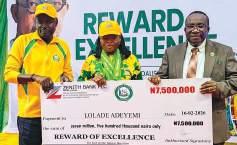
AGF Rewards 64 Justice Sector Staff for Outstanding Performance
Recommits
to institutionalising culture of ethical conduct
Attorney-General of the Federation (AGF) and Minister of Justice, Prince Lateef Fagbemi, SAN, on Monday rewarded 64 staff of the justice sector for their outstanding performance in 2025.
Fagbemi, while commending the staff for their contributions towards the progress recorded in the previous years, stressed that institutions could not succeed without committed and dedicated workforce.
The minister reaffirmed the resolve of the ministry to institutionalise the culture of ethical conduct within the justice sector.
He spoke at the 2025 Reward and Recognition Ceremony held in Abuja.
Fagbemi stated, “Today, we take time from the rigours of official duties to recognise the true strength of this ministry - our staff - while reflecting on our collective progress
and reaffirming our commitment to excellence in service to our nation.
“We understand that institutions do not succeed by structures alone: they succeed because of the commitment, sacrifice, and professionalism of the men and women who serve within them.
“This ceremony serves the dual purpose of honouring outstanding officers who have distinguished themselves through innovation and diligence, while also reaffirming our resolve to institutionalise a culture of ethical conduct and measurable performance across all departments in the ministry and agencies.”
Fagbemi pointed out that the staff were the quiet strength behind every prosecution, every law drafted, every victim protected, and every reform implemented.
He disclosed that the recognition was a strategic initiative firmly rooted in the Federal Civil Service Strategy and Implementation Plan 2025 (FCSSIP25), the Ministerial
Deliverables, and the National Policy on Justice.
According to him, these frameworks challenge them to move beyond routine administration and embrace results-driven governance to strengthen the rule of law and improve the lives of Nigerians.
The minister said, “Ladies and gentlemen, over the past year, the ministry and its agencies have demonstrated remarkable resilience, aligning operations with national priorities and embedding a culture of results across the justice value chain.
“Our digital transformation has accelerated significantly, particularly with the implementation of the Electronic Content Management System (ECMS), which went live on December 18, 2025.
“Furthermore, we have recorded notable progress in prosecutions, anti-corruption and terrorism cases, access to justice initiatives, and human rights protection.
In addition, she will continue to oversee her Group’s wide responsibilities covering Corporate Communications, Administration & Facilities, and Group Procurement.
Besides, Mariya Aliko Dangote was appointed Group Executive Director, Commercial Operations Cement & Foods Businesses.
Mariya will lead the commercial strategy for the cement and foods operations across all markets. Her mandate includes deepening market reach, enhancing customer value, and driving operational excellence across both portfolios; fostering greater integration and growth across our consumer sectors.
“These appointments reflect our deep commitment to succession, sustainability, and stewardship, and to ensuring that the next generation of Dangote leadership is empowered to carry forward the legacy, while driving the innovation and scale needed for our Vision 2030 aspiration.
“Please join me in congratulating Mariya and Fatima as they step confidently into these expanded roles in service of our Group and the continent,” the note emphasised.
Meanwhile, the Dangote Group has signed a $400-million construction equipment agreement with
XCMG Construction Machinery Co., Ltd., one of China’s leading manufacturers of construction machinery, in a move set to accelerate the expansion of the Dangote Petroleum Refinery & Petrochemicals from 650,000 barrels per day to 1.4 million barrels per day, positioning it to become the largest refinery in the world.
The group announced this in a statement issued last night. The statement said the agreement will enable the Group to acquire an additional wide range of advanced construction equipment to support ongoing and forthcoming projects across refining, petrochemicals, agriculture and large-scale infrastructure development.
The group added that the new equipment will complement existing assets deployed for the refinery expansion, which is expected to be completed within three years.
Beyond refining, the company noted that the expansion programme will see polypropylene production increase from 900,000 metric tonnes per annum (mtpa) to 2.4 million.
It said Urea capacity in Nigeria will be tripled from 3 million to 9 million mtpa, in addition to the 3 million mtpa capacity in Ethiopia,
strengthening the Group’s position as the largest urea producer globally.
The Dangote Group said production capacity for Linear Alkyl Benzene (LAB) will also be increased to 400,000 mtpa, positioning the Group as the largest producer in Africa and strengthening supply to the detergent and cleaning agents manufacturing industry.
It maintained that additional base oil production capacity also forms part of the broader expansion programme.
In the statement, the Group described the agreement with the Chinese firm as a strategic investment aimed at deepening its construction footprint and accelerating its ambition to build a $100 billion enterprise by 2030.
“The additional equipment we are acquiring under this partnership will significantly enhance execution across our projects. With this investment, we are positioning ourselves to become the number one construction company in the world,” the statement said.
Dangote Group is currently accelerating expansion and regional market development as it advances toward its long-term vision of building a $100 billion enterprise by 2030.
Dangote Rewards 50 Outstanding Customers with Trucks, Cash Gifts
Ibrahim Oyewale in Lokoja
NASCON Allied Industries Plc, also known as Dangote Salt, has rewarded 50 outstanding customers with trucks and cash gifts worth billions of naira, for their loyalty and commitment in selling of its various products.
This was contained in a statement issued and signed by corporate affairs unit, a copy of which was made available to journalists in Lokoja on Monday.
The lucky distributors and customers were honoured at the seasoning giant’s 2025 Customers Dinner and Awards Night attended by Africa’s foremost industrialist
and President of Dangote Group, Aliko Dangote, and Vice President, Olakunle Alake.
NASCON Allied Industries Plc, a subsidiary of Dangote Industries Limited, is a Nigerian company and manufacturer of Refined Salt and Dangote Classic Seasonings.
Speaking at the event, Thursday in Abuja, the group’s president, Mr. Aliko Dangote, said the Customer Awards Night publicly acknowledges the company’s core value of customer service and aligns with its vision of being a world-class consumer goods company.
The president also commended the company’s board chairman, management and staff for their
unwavering dedication, professionalism, and consistent contributions to the organization’s growth and sustained market leadership. He noted their commitment to excellence, operational efficiency, and strong work ethic has continued to strengthen the company’s reputation and drive its long-term success. He said: “Recognizing customers is not just good relationship management - it is good business. It sends a clear message to our people that customer service is truly one of our core values. Looking ahead, we will continue to invest in brand equity, supply chain efficiency, sustainability, and digital capabilities.
PHOTO: PINL
Alex Enumah in Abuja
Emmanuel Addeh in Abuja and Peter Uzoho in Abuja
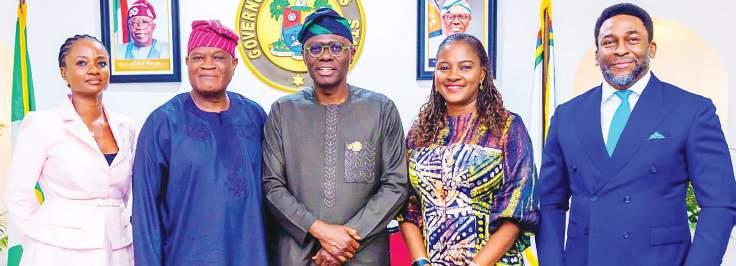
COURTESY VISIT TO GOVERNOR SANWO OLU...
L R: Head, Public Sector Lagos and South West, Union Bank, Ms. Olufunmilayo Ajagbe; Chairman, Union Bank, Mr. Bayo Adeleke; Executive Governor of Lagos State, His Excellency, Mr. Babajide Sanwo Olu; MD and Chief Executive Officer, Union Bank, Mrs. Yetunde Oni; and Executive Director, Corporate Banking and Business Banking, Lagos and South West, Union Bank, Mr. Taiwo Shote, during a courtesy visit to the Executive Governor at the State House Marina, Lagos, on Friday
A Year After, PANDEF Says Edwin Clark’s Voice Still Shapes Nigeria’s Conscience
As group holds memorial at Edwin Clark University
Sunday Aborisade in Abuja
Pan Niger Delta Forum (PANDEF) on Monday paid glowing tribute to elder statesman, nationalist and former federal commissioner, Edwin Kiagbodo Clark, declaring that one year after his passing, “his presence remains mighty” in Nigeria’s political and moral landscape.
At a special memorial service held in his honour at Edwin Clark University, Kiagbodo, Delta State, the influential Niger Delta body said the late nonagenarian’s voice continued to echo across the country’s conscience, particularly on issues of justice, equity and national unity.
Clark, who died at the age of 98 after nearly a century of public service and advocacy, was remembered as a fearless patriot whose final words, “I am a Nigerian, I love Nigeria,” encapsulated a lifetime devoted to the unity and progress of the country.
In a statement made available to THISDAY in Abuja yesterday, National Chairman of PANDEF, Ambassador Godknows Igali, described the late leader as “our father, national icon and statesman,” whose contributions to
nation-building remained indelible.
The group said, “One year is like yesterday. After 98 years of labour and devotion to building a Nigeria where truth, justice, fairness and harmony reign, you departed with the reassuring affirmation of your faith in this country.”
The statement said Clark’s commitment to the unity and national relevance of the Niger Delta, and, indeed, the entire South-south geopolitical zone, would be celebrated for generations.
PANDEF credited the late leader with reshaping the political narrative of the oil-rich region, describing him as a “game changer” whose courage and clarity of purpose redefined agitation for resource control, environmental justice and equitable federalism.
“Your memory and voice remained firm, astute and unfailing till the twilight,” the group said. “Like a lion, your courage resonated far and wide.”
The statement read, “Clark was widely regarded as one of the most outspoken advocates of restructuring and true federalism.
“From his days as Federal Commissioner for Information in the First
Republic to his later role as a rallying point for South-South interests, he consistently pressed for what he called a fair deal for oil-producing communities.”
Beyond regional advocacy, PANDEF stressed that Clark’s nationalism transcended ethnic and sectional boundaries.
The group said his life was defined not only by the struggle for Niger Delta rights, but also by
an abiding belief in Nigeria’s unity.
“He toiled for the solidarity and national relevance of the Niger Delta within a united Nigeria. His was not a voice of division, but of principled insistence that equity is the foundation of enduring unity,” the statement added.
The memorial service at the university he founded drew political associates, traditional rulers, academics and community leaders from
across the South-south and beyond.
The institution itself stands as part of Clark’s enduring legacy, a symbol of his belief in education as a tool for empowerment and social transformation.
Speakers at the event reflected on his decades-long intervention in the national discourse, recalling how he remained active in public debates well into his nineties. Even in advanced age, they said, Clark
never wavered in speaking truth to power.
“He was fearless,” one of the attendees, who desired anonymity, remarked. “Age did not dim his clarity, nor did it silence his conviction.”
PANDEF said it found comfort in the fact that Clark’s vision “remains aglow,” insisting that the ideals he championed would not be allowed to fade.
CEPI Unveils Five-Year Strategy to Strengthen Global Pandemic Preparedness, Seeks $2.5bn Investment
Sunday Ehigiator
Coalition for Epidemic Preparedness Innovations (CEPI) has launched a new five-year strategy aimed at bolstering global preparedness against future epidemic and pandemic threats. It called on governments and partners to commit $2.5 billion to fund the initiative.
The plan, tagged CEPI 3.0 and unveiled in Oslo, is designed to transform the global response to deadly disease outbreaks, which
Firm Leverages Ramadan to Spur Commercial Growth at Karmo District Market
In a bid to strengthen retail participation and attract structured investment into Abuja’s commercial ecosystem, Rural Homes Limited (RHL) has stepped up activities at the Karmo District Market, leveraging the approaching Ramadan period to boost trade and visibility.
The developer, which specializes in mass housing and commercial real estate, hosted a trade fair at the 10-hectare Karimo District Market as part of a broader strategy to boost occupancy, support SMEs and deepen formal retail investment
within the Federal Capital Territory (FCT).
Managing Director, (RHL) Sa’adatu Aliyu, said the initiative was deliberately timed to align with peak consumer spending cycles.
“Valentine’s Day and Ramadan are periods of increased commercial activity. We created this platform so traders and investors can benefit from the surge in demand while also showcasing the strength of this development,” she said. Aliyu disclosed that the market is not just a retail centre but a structured investment asset.
According to her, early investors
who purchased shop units off-plan have recorded significant capital appreciation, with some already reselling in the secondary market.
“Rental spaces range from N100,000 per annum for smaller stalls to between N2 million and N3 million for larger units. Shop purchase prices start from about N7 million, while warehouses measuring 100 square metres with up to 14 metres in height range from N60 million to N80 million.
“Investors have hedged themselves against inflation. As more traders come in, rental values continue to strengthen,” Aliyu said.
health experts say are becoming more frequent and disruptive.
Chief Executive Officer of CEPI, Dr. Richard Hatchett, said the strategy drew lessons from the COVID-19 pandemic and emerging viral outbreaks, such as Nipah, Ebola, Chikungunya, and Marburg.
Hatchett said, “During COVID-19, the world paid the price of not being prepared.”
He explained, “Recent outbreaks of Nipah, Ebola, Chikungunya and Marburg are powerful reminders that epidemic and pandemic disease present one of the greatest challenges of our time. Science offers us a solution: by taking decisive action now we can secure a safer future for all.”
Research cited by CEPI indicates
that the risk of another pandemic comparable to COVID-19 remains significant, with potential global losses from future pandemics estimated at more than $700 billion annually.
The new strategy, scheduled to begin in 2027, will maintain CEPI’s focus on equitable access to vaccines and leverage new scientific advances to reduce the impact and cost of disease outbreaks.
Central to the plan is the organisation’s “100 Days Mission,” which aims to develop safe, effective and accessible vaccines against new pandemic threats within 100 days of identification.
Modelling estimates suggested that if vaccines had been developed within 100 days of the COVID-19 outbreak,
more than eight million lives could have been saved and trillions of dollars in economic losses prevented. CEPI 3.0 will focus on three major priorities. The first involves developing vaccines against both known and emerging epidemic threats, including Lassa fever, Nipah virus and Rift Valley fever, while generating scientific tools and data across viral families identified by the World Health Organisation as potential pandemic threats.
The second priority aims to advance rapid-response vaccine development platforms and embed them within regional manufacturing systems to enable faster vaccine production and regulatory approvals during emergencies.
Firm Files N5bn Suit Against Ardova, Lagos AG Over Ikoyi Property Dispute
Wale Igbintade
Familia Limited has instituted a N5 billion suit before the Lagos State High Court against Ardova Plc over a disputed property located at 12 Thompson Avenue, Ikoyi, Lagos.
The suit, which also joined the Attorney-General of Lagos State as a defendant, seeks multiple declaratory and monetary reliefs in respect of the property.
The dispute centred on the ownership and possession of the property, which Familia Ltd claimed it purchased from Forte Oil Plc in 2013 for N1 billion through a Deed of Assignment dated August 18, 2013.
According to court documents, the claimant contended that it has remained in possession of the property since the transaction and that its lease was renewed and extended in February 2024
by the Lagos State Government for a further 99 years. Familia further stated that on August 8, 2025, officials of Ardova Plc, accompanied by operatives of the Lagos State Task Force and Monitoring Unit, entered the premises and took possession of the property. The claimant alleged that a bungalow on the land was demolished and two 40-foot containers placed on the property.
Folalumi Alaran in Abuja
Acting Group Politics Editor DEJI ELUMOYE
Email: deji.elumoye@thisdaylive.com
08033025611 sms only
Electoral Bill: Other Side of Clause 60(3)
opeyemi Bamidele writes that the recent decision of the 10th Senate to retain Clause 60(3) in the Electoral act 2022 a mendment Bill was taken in the overall public interest to ensure hitchfree voting and collation of results as the 2027 general election approaches
Ihave been inundated with messages from many concerned and well-respected stakeholders in the last fortnight. The contents of their messages are virtually the same. In all, they basically sought clarifications on the decision of the Senate to retain Section 60(3 & 5) of the Electoral Act, 2022 in the ongoing reform of our country’s electoral governance framework.
Regrettably, I could not respond to any of these messages for at least two reasons. First, I was on a national assignment outside the shores of our fatherland when I received the messages. Due to the import of the task at hand, I was time-constrained to respond to the messages one by one. Second, the messages largely reflect the mood of the citizenry at a time we are preparing for the 2027 general election. Hence, I came up with this intervention to collectively address the concerns of our constituents nationwide.
What then was the real issue that triggered the public debate? The debate borders on the resolve of the National Assembly to re-craft an electoral governance framework that reflects the stark realities of our fatherland. Consequently, the Senate resolved against Clause 60(3) of the Electoral Bill, 2026. The clause literally mandates the presiding officer to “electronically transmit the results from each polling unit to IREV portal in real time and such transmission shall be done after the prescribed Form EC8A has been signed and stamped by the Presiding Officer and/or countersigned by the candidates or polling agents where available at the polling unit.”
As Nigeria’s foremost democratic institution, the Senate recognises the strength of the clause. It recognises its potential to strengthen the integrity of our electoral process. It equally recognises that the clause has the high probability of deepening trust in the democratic institutions, especially the National Assembly and INEC.
With all these possibilities, Clause 60(3) of the
Electoral Bill, 2026 is an initiative that any legislature or parliament globally will have embraced ordinarily. But this is just one side of the clause. We have a tradition of taking decisions based on the due consideration of both sides of the coin. It is this tradition that spurred our inquisition into the other side of the clause because of the implications it may have over 237 million people in the future.
Further inquisition threw up an indispensable question. What are the pitfalls that may arise or that we may encounter if we make the realtime electronic transmission of election results mandatory? Resolving this question requires us to separate emotion from what is practicable, facts from fictions or reality from sentiment. As a result, we broadened our consultation and engagement to ensure that we did not take any decision that will further dampen the public confidence or that
will plunge our fatherland deeper into crisis. As pragmatic as we could, we sought empirical answers to this question by engaging principal actors in communications and power sectors, among others. In the end, we came up with useful findings that guided the decision of the Senate. First, we discovered that the Electoral Act 2022 had already guaranteed the transfer of the election result to the INEC Result Viewing Portal (IReV). This is evident in Section 62(2), which established the National Electronic Register of Election Results. Introducing Clause 60 (3), which compels all the presiding officers to electronically transmit election results to IReV in real time, is no longer necessary since we have not fully embraced electronic voting.
This finding brings to the fore the need to differentiate electronic transmission of election results from electronic voting. Electronic transmission of election results does not mean Nigerians will vote electronically. It simply suggests that the presiding officers will transfer or transmit the election results to the IReV through the use of the Bimodal Voter Accreditation System (BVAS) after voting has been concluded and the results have been declared at the polling units according to the provision of the Electoral Act. In other words, it means we are voting manually and election results will be counted manually. After the whole process, election results will be transferred or transmitted to the IReV before all the stakeholders in each of the 176,974 polling units nationwide. This is the system we have been using since 2020, and it has significantly improved the integrity of our electoral process.
-Senator Bamidele, Leader of the 10th Senate, writes from Abuja.
NOTE: Interested readers should continue in the online edition on www.thisdaylive.com
Uba Sani: Promise, Performance and Weight of Recognition
Iyobosa Uwugiaren takes a critical look at the Governor of the Year award recently conferred on Governor Uba Sani of Kaduna State, arguing that while accolades may adorn a tenure, only durable impact ultimately defines it.
On a humid afternoon in the late 1990s, as soldiers loyal to the regime of Nigeria’s late military Head of State, Grneral Sani Abacha, patrolled the streets and opposition groups carried grave consequences, a young activist stood shoulder to shoulder with pro-democracy icons such as Gani Fawehinmi, Olisa Agbakoba, and Chima Ubani, alongside students and labour organisers, demanding a return to civilian rule. Among them was Uba Sani—then more familiar with protest chants than policy briefs, and more accustomed to confronting power than wielding it. For many in that restless crowd, democracy was a distant aspiration; but, for Sani, it was a consuming passion.
Almost three decades later, that same activist occupies the highest political office in Kaduna State, steering budget cycles instead of barricades, security briefings instead of strategy meetings in civil society offices.
His recent recognition as Governor of the Year by one of the national dailies invites a persuasive question: what happens when a man shaped by resistance becomes responsible for results?
In Nigeria’s stormy democratic expedition, the distance between protest grounds and government house is often enormous. Many who marched for freedom never found themselves in positions of executive authority. Fewer still have had to translate radical ideals into governmental reality. The story of Sani — pro-democracy activist turned Governor of Kaduna State — is therefore not just a personal ascension. It is a test case for whether activism can develop into responsible governance without losing its moral principal.
Governor Sani’s recent recognition as Governor of the Year by the newspaper has raised that test. Awards are representational; governance
is practical. Yet symbols matter in a democracy hungry for credible leadership. In a way, the honour compels both celebration and inquiry — round of applause for visible gains, but also interrogation of the deeper structural
challenges that persist.
Before the advent of civilian government in May 1999, Sani’s credentials were known in resistance. As a student activist in the Kaduna Polytechnic, Kaduna, and later a key player in civil society coalitions that challenged military junta,
he was among those who believed democracy was worth personal risk. That history matters because it shapes public expectations. Nigerians expect that a leader who once fought arbitrary power will exercise power in a different way — more transparently, more inclusively, more cautiously. In many respects, Sani has pursued to symbolise that transition. His speechmaking steadily emphasises inclusion, dialogue and social investment. Unlike his predecessor, he has positioned himself less as a strongman executive and more as a bridge-builder in a state long defined by ethno-religious fault lines and political division.
Yet activism and governance are not identical disciplines. Protest movements thrive on moral clarity; governance demands compromise. The enduring question is whether compromise erodes conviction or refines it.
On the policy front, the Sani-led administration has pursued visible and measurable interventions. Not many policy experts will disagree that agriculture, the backbone of Kaduna’s rural economy, has received renewed attention through large-scale fertilizer distribution and support for smallholder farmers. At a time when inflation and food insecurity are draining households nationwide, such interventions carry both economic and political implication.
Education has similarly featured glaringly in the state in the past two years. Tuition reductions in state-owned tertiary institutions, rehabilitation of schools, and expansion of classroom infrastructure reflect a recognition that human capital — not just concrete — defines development.
NOTE:
Bamidele
PUBLIC NOTICE
LIST OF REGULARISED AREA COUNCIL LAND ALLOCATIONS APPROVED FOR ISSUANCE OF OFFER OF STATUTORY RIGHTS OF OCCUPANCY IN THE FCT
(BATCH 1)
This is to inform the general public, particularly applicants who submitted their Area Council land documents for regularisation, that the Honourable Minister of Federal Capital Territory, BARR. EZENWO NYESOM WIKE, CON has graciously approved the issuance of Offer of Statutory Rights of Occupancy (R-of-O) for BATCH 1 of regularised Land Documents issued by the Area Councils.
All successful applicants listed below should immediately visit DEPARTMENT OF LAND ADMINISTRATION at NO. 4, PEACE DRIVE, CENTRAL AREA, ABUJA to collect their Offer of Statutory Rights of Occupancy (R-of-O) and ensure payment of the accompanying R-of-O/C-of-O bills within SIXTY (60) DAYS from the date of this publication, failing which the Offer shall lapse.
Please note that any R-of-O/C-of-O bills and/or other payments made outside the stipulated SIXTY (60) DAYS from the date of this publication, will be INVALID.
ORIGINALS of the following documents will be required for presentation at the Lands Department for collection of the Offer of Statutory Rights of Occupancy:
A. For collection of R-of-O for grants made to Individuals:
1. Area Council Letter of Allocation;
2. Regularisation Acknowledgement;
3. Letter of Authority (for proxy collection)
4. Valid Means of Identification;
5. Two (2) recent Passport size photographs of current holder;
6. Affidavit from High Court of the FCT;
7. Proof of Nexus (i.e. Letters of Administration, Power of Attorney, Deed of Assignment, etc).
B. For collection of R-of-O for grants made to Organisations:
1. Area Council Letter of Allocation;
2. Regularisation Acknowledgement;
3. Letter of Authority;
4. Corporate Affairs Commission (CAC) documents;
5. Board Resolution;
6. Valid Means of Identification of Director(s)/Company Secretary;
7. Valid Means of Identification of the Collector;
8. Affidavit from High Court of the FCT;
9. Proof of Nexus (i.e. Power of Attorney, Deed of Assignment, etc);
C. For collection of R-of-O for grants made to Public Institutions:
1. Area Council Letter of Allocation;
2. Regularisation Acknowledgement;
3. Letter of Authority from the Institution signed by the Head of the Institution;
4. Valid Means of Identification of the Officer signing the Authority Letter;
5. Valid Means of Identification of the Collector, etc.
Notes:
For any of the categories of grant mentioned above:
1. The original Area Council land documents and the original Regularisation Acknowledgement relating to the title so regularised shall be surrendered for voiding, in view of the Statutory R-of-O being issued;
2. The R-of-O release officer reserves the right to request for additional documents, information and/or make further confirmations if necessary
1 AC 10000 OD 41194
2 AC 10001 GO 41024
3 AC 10002 AK 41013
4 AC 10003 OD 41096
5 AC 10004 OD 41195
6 AC 10005 OD 41176
7 AC 10006 BN 43927
8 AC 10007 OD 41193
9 AC 10008 EN 40158
10 AC 10009 BN 42561
11 AC 10010 BN 42513
12 AC 10011 ED 41136
13 AC 10012 EN 42153
14 AC 10013 DT 41780
15 AC 10014 FCT 44950
16 AC 10015 ED 49790
17 AC 10016 KG 43148
18 AC 10017 FCT 45188
19 AC 10018 KG 48831
20 AC 10019 OS 42274
21 AC 10020 FCT 45211
22 AC 10021 FCT 47149
23 AC 10022 FCT 45182
24 AC 10023 NS 42219
25 AC 10024 PL 42981
26 AC 10025 CR 43131
MUSA S IBRAHIM
BABA LAWAL
JOEL ISHAYA
TONY ADEBESIN
BABA ALI
AYINDE KUNLE
DURO SOLOMON
BADMUS KAYODE
AYEN AJEYI SAMUEL
ASHIYI GBECHE
STEPHEN GBECHE
MAKADA ANYIDA
EMMANUEL MOSES
NGBAKO MAMMAN
LIZARUS AJECELO
YAKUBU DANJUMA
ZADUMI IYAH
DANTANI KUFU
SHUAIBU TANKO
GOWAN JIMIKO
DANLADI KUFU
DANLADI KUFU
SIBI TOMA
MUSA KWANGA
TANKO A HOSEA
HAMEEDA MA,AJI MUSA
27 AC 10026 BO 42273 MAYAM U MUSA
28 AC 10027 FCT 44596
29 AC 10028 OD 43180
30 AC 10029 KG 54478
31 AC 10030 FCT 45938
32 AC 10031 ED 41138
33 AC 10032 TR 40096
34 AC 10033 ED 41140
35 AC 10034 BN 46279
36 AC 10035 AK 41487
37 AC 10036 FCT 45187
38 AC 10037 FCT 45210
39 AC 10038 LA 42968
40 AC 10039 AN 44286
41 AC 10040 FCT 45202
42 AC 10041 OG 42572
43 AC 10042 NG 40516
44 AC 10043 KT 43247
UKASHA ZAKARI
JIBRIN MUSA
AYUBA JOHNSON
MARYAM AUWALU
PATIENCE DANLADI
MUSA A VICTOR
SHEKWOLO BAWA
MICHEAL AKIN
AMOS KENNETH
USHAFA VILLAGE EXPANSION SCHEME USHAPA
USHAFA VILLAGE EXPANSION SCHEME USHAPA
USHAFA VILLAGE EXPANSION SCHEME USHAPA
USHAFA VILLAGE EXPANSION SCHEME USHAPA
USHAFA VILLAGE EXPANSION SCHEME USHAPA
USHAFA VILLAGE EXPANSION SCHEME USHAPA
USHAFA VILLAGE EXPANSION SCHEME USHAPA
USHAFA VILLAGE EXPANSION SCHEME USHAPA
USHAFA VILLAGE EXPANSION SCHEME USHAPA
USHAFA VILLAGE EXPANSION SCHEME USHAPA
USHAFA VILLAGE EXPANSION SCHEME USHAPA
USHAFA VILLAGE EXPANSION SCHEME USHAPA
USHAFA VILLAGE EXPANSION SCHEME USHAPA
USHAFA VILLAGE EXPANSION SCHEME USHAPA
USHAFA VILLAGE EXPANSION SCHEME USHAPA
USHAFA VILLAGE EXPANSION SCHEME USHAPA
USHAFA VILLAGE EXPANSION SCHEME USHAPA
USHAFA VILLAGE EXPANSION SCHEME USHAPA
USHAFA VILLAGE EXPANSION SCHEME USHAPA
USHAFA VILLAGE EXPANSION USHAPA
USHAFA VILLAGE EXPANSION USHAPA
USHAFA VILLAGE EXPANSION USHAPA
USHAFA VILLAGE EXPANSION USHAPA
USHAFA VILLAGE EXPANSION USHAPA
USHAFA VILLAGE EXPANSION USHAPA
USHAFA VILLAGE EXPANSION USHAPA
USHAFA VILLAGE EXPANSION USHAPA
USHAFA VILLAGE EXPANSION USHAPA
USHAFA VILLAGE EXPANSION USHAPA
USHAFA VILLAGE EXPANSION USHAPA
USHAFA VILLAGE EXPANSION USHAPA
USHAFA VILLAGE EXPANSION USHAPA
USHAFA VILLAGE EXPANSION USHAPA
USHAFA VILLAGE EXPANSION USHAPA
USHAFA VILLAGE EXPANSION USHAPA
USHAFA VILLAGE EXPANSION USHAPA
ISUWA JERRY K VILLAGE EXPANSION USHAPA
MUDASIRU YUSUF
IBRAHIM SHIPAJE
USHAFA VILLAGE EXPANSION USHAPA
USHAFA VILLAGE EXPANSION USHAPA
EMMANUEL AZABONU VILLAGE EXPANSION USHAPA
ABUBAKAR IBRAHIM USHAFA VILLAGE EXPANSION USHAPA
PARISA GAZA
VILLAGE EXPANSION USHAPA
LAWAL GALADIMA USHAFA VILLAGE EXPANSION USHAPA
SANI UMAR .A. USHAFA VILLAGE EXPANSION USHAPA
45 AC 10044 AB 43054 SAGIR HAMID
46 AC 10045 AN 44291
47 AC 10046 EB 40571
YUSUF TAGAWAI
.S. ONWE
48 AC 10047 BN 41979 ABDULLAHI KALABALGI
49 AC 10048 AN 44283
50 AC 10049 IM 40895
VILLAGE EXPANSION USHAPA
VILLAGE EXPANSION USHAPA
VILLAGE EXPANSION USHAPA
VILLAGE EXPANSION USHAPA
IBRAHIM VILLAGE EXPANSION USHAPA
MOHAMMED GAMBO KAMARAN
51 AC 10050 OY 43018 YUSUF A. SOKOTO
52 AC 10051 OD 43189
SOLOMON
53 AC 10052 PL 41712 KWANKUR GARBA
54 AC 10053 AK 42926
ERABOR
55 AC 10054 FCT 45145 EDWARD EDEKI
EXPANSION USHAPA
VILLAGE EXPANSION USHAPA
VILLAGE EXPANSION USHAPA
VILLAGE EXPANSION USHAPA
VILLAGE EXPANSION USHAPA
EXPANSION USHAPA
56 AC 10055 DT 40350
57 AC 10056 OS 40778
58 AC 10057 AN 47175
59 AC 10058 AN 47182
60 AC 10059 OD 41904
61 AC 10060 KW 41979
62 AC 10061 AD 40421
63 AC 10062 FCT 48096
64 AC 10063 PL 42980
65 AC 10064 DT 40349
66 AC 10065 BN 43932
67 AC 10066 BN 43982
68 AC 10067 AN 47203
69 AC 10068 OG 40444
70 AC 10069 KD 47198
71 AC 10070 AB 42477
72 AC 10071 ED 44783
73 AC 10072 KD 41869
74 AC 10073 BN 41687
75 AC 10074 NG 45046
76 AC 10075 BO 41103
77 AC 10076 NG 45104
78 AC 10077 ED 41142
79 AC 10078 OS 42275
80 AC 10079 NG 45049
81 AC 10080 PL 42932
82 AC 10081 BO 40500
83 AC 10082 FCT 45176
84 AC 10083 KG 54477
85 AC 10084 NS 44330
86 AC 10085 NG 45047
87 AC 10086 ED 42208
88 AC 10087 DT 41778
89 AC 10088 NG 45048
90 AC 10089 KG 54476
91 AC 10090 LA 42075
92 AC 10091 KD 43073
93 AC 10092 KD 41202
94 AC 10093 FCT 41790
95 AC 10094 OS 40947
96 AC 10095 AN 55957
97 AC 10096 KD 43706
98 AC 10097 ED 43604
99 AC 10098 CR 42068
POLI AGBUMUDU
ALH GAMBO SHUAIBU
HASSAN GARBA
ALH AMINU GAMBO
OLABISI ADEJI
GAZA AMOS
TANKO GAZA
ABUBAKAR SHNAJE
YUSUF MUSTAPHA
ALHASSAN MUSA
MUSA SHAKPARA
ABU RUHVAWU
EMEKA MBAH
SHEHU ANIMASHAUN
PAUL ADEKUNLE
DICK ELEH
EPHRAIN UZUMA
MAJOR A. Z. AHMED
REUBEN MADAKI
ABUBAKAR SALEH
YUSUF BALAMI
CHRIS SURU
UMAR KHIDIR
ABDULLAHI DAHIRU
JOSEPH BASSEY
BITRUS CHRISTOPHER
DEBO KWAJAFFA
UMAR FARUK
EKINE ODUM
REBECCA MONDAY
SHEHU KACHA
MOSES BAKO
YUNUSA KUFU
USMAN YUSHA'U
MASHUD AMUDA
MAICIDI DOGO
AYUBA MAICIBI
DANLADI ZADAWOWIYA
RULWANU S. AMARI
ABUBAKAR MUSA
CHARLES A.B
ALKALI MOH'D
ARGUNGU DAHIRU
HALIRU ADAMU
100 AC 10099 KB 41014 SANI KALANGU
101 AC 10100 EN 42240 TEMPLE NWODO
102 AC 10847 PL 42931
103 AC 10853 KD 41204
104 AC 10101 KD 43163
105 AC 10102 AK 41043
106 AC 10103 NG 42710
107 AC 10104 BN 42488
108 AC 10105 DT 41773
109 AC 10108 KG 48258
110 AC 10109 EN 45030
DANJUMA KAYI
USHAFA VILLAGE EXPANSION USHAPA
USHAFA VILLAGE EXPANSION USHAPA
USHAFA VILLAGE EXPANSION USHAPA
USHAFA VILLAGE EXPANSION USHAPA
USHAFA VILLAGE EXPANSION USHAPA
USHAFA VILLAGE EXPANSION USHAPA
USHAFA VILLAGE EXPANSION USHAPA
USHAFA VILLAGE EXPANSION USHAPA
USHAFA VILLAGE EXPANSION USHAPA
USHAFA VILLAGE EXPANSION USHAPA
USHAFA VILLAGE EXPANSION USHAPA
USHAFA VILLAGE EXPANSION USHAPA
USHAFA VILLAGE EXPANSION USHAPA
USHAFA VILLAGE EXPANSION USHAPA
USHAFA VILLAGE EXPANSION USHAPA
USHAFA VILLAGE EXPANSION USHAPA
USHAFA VILLAGE EXPANSION USHAPA
USHAFA VILLAGE EXPANSION USHAPA
USHAFA VILLAGE EXPANSION USHAPA
USHAFA VILLAGE EXPANSION USHAPA
USHAFA VILLAGE EXPANSION USHAPA
USHAFA VILLAGE EXPANSION USHAPA
USHAFA VILLAGE EXPANSION USHAPA
USHAFA VILLAGE EXPANSION USHAPA
USHAFA VILLAGE EXPANSION USHAPA
USHAFA VILLAGE EXPANSION USHAPA
USHAFA VILLAGE EXPANSION USHAPA
USHAFA VILLAGE EXPANSION USHAPA
USHAFA VILLAGE EXPANSION USHAPA
USHAFA VILLAGE EXPANSION USHAPA
USHAFA VILLAGE EXPANSION USHAPA
USHAFA VILLAGE EXPANSION USHAPA
USHAFA VILLAGE EXPANSION USHAPA
USHAFA VILLAGE EXPANSION USHAPA
USHAFA VILLAGE EXPANSION USHAPA
USHAFA VILLAGE EXPANSION USHAPA
USHAFA VILLAGE EXPANSION USHAPA
USHAFA VILLAGE EXPANSION USHAPA
USHAFA VILLAGE EXPANSION USHAPA
USHAFA VILLAGE EXPANSION USHAPA
USHAFA VILLAGE EXPANSION USHAPA
USHAFA VILLAGE EXPANSION USHAPA
USHAFA VILLAGE EXPANSION USHAPA
USHAFA VILLAGE EXPANSION USHAPA
VILLAGE EXPANSION USHAPA
VILLAGE EXPANSION USHAPA
VILLAGE EXPANSION USHAPA
JOSIAH H. EZEKIEL USHAFA VILLAGE EXPANSION USHAPA
EMMANUEL TUBURA
JOHN SHUAIBU
WANNA KADARKO
ZAKARI N.
EXTENSION USHAPA
EXTENSION USHAPA
EXTENSION USHAPA
EXTENSION USHAPA
WINOLO KADARKO USHAFA EXTENSION USHAPA
SOLOMON ALLAH
GOWIN KUMBABA
EXTENSION USHAPA
EXTENSION USHAPA
111 AC 10110 AN 47441
112 AC 10111 DT 41784
113 AC 10112 AN 55923
114 AC 10113 DT 41781
115 AC 10114 FCT 48094
116 AC 10115 IM 44739
117 AC 10116 AB 47992
118 AC 10117 CR 41616
119 AC 10118 BO 43215
120 AC 10119 FCT 44471
121 AC 10120 BN 42562
122 AC 10121 ED 46207
123 AC 10122 OD 42088
124 AC 10123 AB 44393
125 AC 10124 KW 43099
126 AC 10125 FCT 42933
127 AC 10126 MISC 66215
128 AC 10127 MISC 66310
129 AC 10128 EB 45527
130 AC 10129 MISC 66218
131 AC 10130 KG 43554
NABOTH FIMI
DARIYUS FIMI
MATHIAS NAPHTALI
ADAMU GIMBA
BAWA DANJUMA
BALA BAGAMA
WILLIAMS BALA
UTU ETIM
NANA ALI
JOHN IBRAHIM
EBENEZER YOHANAH
VICTOR B. MUSA
BEN AYENAJEYI
J. O. ABIBOYE
YAHAYA DIKO
ALH. ADAMU KARSHI
CHEBEYI IJAH
ABUBAKAR KUWO
LADAN UBA
HAYATU JOHN
MUDI UMAR
132 AC 10131 AN 45930 TUEKI ZUDE
133 AC 10132 OY 41400
134 AC 10133 NS 41704
135 AC 10134 DT 42806
FEBRUARY 17, 2026
USHAFA EXTENSION USHAPA
USHAFA EXTENSION USHAPA
USHAFA EXTENSION USHAPA
USHAFA EXTENSION USHAPA
USHAFA EXTENSION USHAPA
USHAFA EXTENSION USHAPA
USHAFA EXTENSION USHAPA
USHAFA EXTENSION USHAPA
USHAFA EXTENSION USHAPA
USHAFA EXTENSION USHAPA
USHAFA EXTENSION USHAPA
USHAFA EXTENSION USHAPA
USHAFA EXTENSION USHAPA
USHAFA EXTENSION USHAPA
USHAFA EXTENSION USHAPA
USHAFA EXTENSION USHAPA
USHAFA EXTENSION USHAPA
USHAFA EXTENSION USHAPA
USHAFA EXTENSION USHAPA
USHAFA EXTENSION USHAPA
USHAFA EXTENSION USHAPA
USHAFA EXTENSION USHAPA
SARKIN KAGO
NYAWASA MUSA USHAFA EXTENSION USHAPA
USHAFA EXTENSION USHAPA 4
NUHU GAZHIMA USHAFA EXTENSION USHAPA
136 AC 10135 NG 45102 ORIA A. O. USHAFA EXTENSION USHAPA
137 AC 10136 KD 46494
138 AC 10137 KG 53587
139 AC 10138 NG 42260
140 AC 10139 BN 46279
141 AC 10140 NS 43849
142 AC 10141 AD 43496
143 AC 10142 EB 40382
144 AC 10143 FCT 49849
145 AC 10144 BO 43322
146 AC 10145 PL 43601
147 AC 10146 PL 43610
148 AC 10147 AN 75932
149 AC 10148 KD 41621
150 AC 10149 PL 40356
151 AC 10150 KD 46690
152 AC 10151 OD 44206
153 AC 10152 OY 44738
154 AC 10153 EB 45682
155 AC 10154 BN 41682
156 AC 10155 OG 42731
157 AC 10846 BN 41051
158 AC 10966 MISC 72815
159 ACMI 10003 MISC 97724
160 ACMI 10004 MISC 30132
161 ACMI 10005 MISC 94515
162 AC 11028 EB 40811
163 AC 11029 FCT 48470
164 AC 11030 DT 45210
165 AC 11031 LA 40350
166 AC 11032 KB 40051
GRACE UKO USHAFA EXTENSION USHAPA
TOJIN ADENIYI USHAFA EXTENSION USHAPA
BELLO SANDA
DAKWOYI ASIBI
LAWAL YUSUF
IBADIN V.C
LUCKY OKAFOR
ALIYU ADDUL RABIM
EZEILO OKEKE
TUKURA JAMES
HADIZA MOH'D
CHIOMA UDEGBUNAM
ESTHER GARRY
SILAS ISHAYA
ALHERI MINAJA
J. J. OKUBUWA
BAYO MAMORA
JOHN OKEKE
AUSTIN OBAYAGBA
DANASABE JUJI
OCHEGAMI AKPMIMI
DANTANI TUKURA
SIWAK KHAIRUN NIG. LTD
USHAFA EXTENSION USHAPA
USHAFA EXTENSION USHAPA
USHAFA EXTENSION USHAPA
USHAFA EXTENSION USHAPA
USHAFA EXTENSION USHAPA
USHAFA EXTENSION USHAPA
USHAFA EXTENSION USHAPA
USHAFA EXTENSION USHAPA
USHAFA EXTENSION USHAPA
USHAFA EXTENSION USHAPA
USHAFA EXTENSION USHAPA
USHAFA EXTENSION USHAPA
USHAFA EXTENSION USHAPA
USHAFA EXTENSION USHAPA
USHAFA EXTENSION USHAPA
USHAFA EXTENSION USHAPA
USHAFA EXTENSION USHAPA
USHAFA EXTENSION USHAPA
USHAFA EXTENSION USHAPA
USHAFA EXTENSION USHAPA
USHAFA EXTENSION USHAPA
RUZ CLINIC USHAFA EXTENSION USHAPA
ALI OIL NIG. LTD
MARK IKENNA
OSEWAJIE CLEMENT
IFEANYI OBIBUZOR
C. C. NNOROM
A. ZAMANI
USHAFA EXTENSION USHAPA
SABON LUGBE LUGBE CENTRAL
SABON LUGBE LUGBE CENTRAL
SABON LUGBE LUGBE CENTRAL
SABON LUGBE LUGBE CENTRAL
SABON LUGBE LUGBE CENTRAL
167 AC 11033 OD 43978
168 AC 11034 EK 41379
169 AC 11035 OG 41821
NUHU ABUBAKAR
PAUL AUDU
MOH. MAUDE LAPAI
170 AC 11036 KG 44660 W JOE
171 ACMI 10106 MISC 96287
172 AC 11171 OD 40432
173 AC 11172 AN 47026
174 AC 11173 EB 45780
175 AC 11174 BO 41112
176 AC 11175 FCT 40554
177 AC 11176 DT 41057
178 AC 11177 IM 51887
179 AC 11178 AN 40308
180 AC 11179 AN 43657
181 AC 11180 IM 48119
182 AC 11181 FCT 45029
183 AC 11182 KG 45122
184 AC 11183 KG 44172
185 AC 11184 AN 47687
186 AC 11185 EB 40144
187 AC 11186 NS 40136
188 AC 11187 AN 48046
189 AC 11037 AN 45293
190 AC 11038 AD 42251
191 AC 11039 FCT 40019
192 AC 11040 AN 42660
193 AC 11041 KD 41550
194 AC 11042 FCT 42402
195 AC 11043 KN 41498
196 AC 11044 FCT 43427
197 AC 11045 IM 52051
198 AC 11046 NG 41987
199 AC 11047 NG 40495
200 AC 11048 PL 41058
201 AC 11049 AK 40254
202 AC 11050 KN 43675
203 AC 11051 KG 46717
204 AC 10351 ED 43584
205 AC 10352 AN 52688
ACK DEV COY
WILLINGTON GRACE
GODSON O. UCHE
HAJIYA RAKIYA MOH'D
HAWA MOHAMMED GAMBO (S)
UMAR FARUQ AHMED
ADANNE E. C.
OBIOHA WILSON O.
AMBROSE UMENNE
LAWRENCE O.
EDWIN A. N. OKORIE (DR)
KOJE DANKAKA
ALEX JARRY
ATTAHIRU Y IBRAHIM
IFEDIGBO .N. SYLVANUS
TANKO MUSA
MOHAMMED MAMMAN
CHARLES OKONKWO
BARDE JATAU
ABDUL MOHAMMED
FLT LT M.T JANKA
BONIFACE UGO
PRISCILLA GAIYA
GASHON GONTOR GEORGE
ISIAKU MOHAMMED
MICHAEL OKAFOR
NYONG ISAAC NKEREUWEM
A. OKEREKE
HALILU YUSUF
SALOME SARKI
ISMAILA ADAMU
BAYO FAGBOHUN
ALHAJI DANJUMA ABDULLAHI
SABON LUGBE LUGBE CENTRAL
SABON LUGBE LUGBE CENTRAL
SABON LUGBE LUGBE CENTRAL
SABON LUGBE LUGBE CENTRAL
SABON LUGBE LUGBE CENTRAL
PHASE III LAYOUT III DIKWA WEST
PHASE III LAYOUT III DIKWA WEST
PHASE III LAYOUT III DIKWA WEST
PHASE III LAYOUT III DIKWA WEST
PHASE III LAYOUT III DIKWA WEST
PHASE III LAYOUT III DIKWA WEST
PHASE III LAYOUT III DIKWA WEST
PHASE III LAYOUT III DIKWA WEST
PHASE III LAYOUT III DIKWA WEST
PHASE III LAYOUT III DIKWA WEST
PHASE III LAYOUT III DIKWA WEST
PHASE III LAYOUT III DIKWA WEST
PHASE III LAYOUT III DIKWA WEST
PHASE III LAYOUT III DIKWA WEST
PHASE III LAYOUT III DIKWA WEST
PHASE III LAYOUT III DIKWA WEST
PHASE III LAYOUT III DIKWA WEST
PHASE I RESIDENTIAL DIKWA WEST
PHASE I RESIDENTIAL DIKWA WEST
PHASE I RESIDENTIAL DIKWA WEST
PHASE I RESIDENTIAL DIKWA WEST
PHASE I RESIDENTIAL DIKWA WEST
PHASE I RESIDENTIAL DIKWA WEST
PHASE I RESIDENTIAL DIKWA WEST
PHASE I RESIDENTIAL DIKWA WEST
PHASE I RESIDENTIAL DIKWA WEST
PHASE I RESIDENTIAL DIKWA WEST
PHASE I RESIDENTIAL DIKWA WEST
PHASE I RESIDENTIAL DIKWA WEST
PHASE I RESIDENTIAL DIKWA WEST
PHASE I RESIDENTIAL DIKWA WEST
PHASE I RESIDENTIAL DIKWA WEST
FRANCISCA FRANCIS ONYEOCHA NYANYA PHASE IV EXTENSION NYANYA
ADIJAT
206 AC 10353 OG 43676 YAKO DARA
207 AC 10354 GO 40732
208 AC 10355 KG 45929
JEZHI GBECELO
CHINEDUM
209 AC 10356 GO 40956 BANGIGYI KAWOTA
210 AC 10357 OG 40537
211 AC 10358 NS 41428
212 AC 10360 MISC 76557
213 AC 10361 YB 40007
214 AC 10362 AN 52086
215 AC 10365 EN 45112
216 AC 10366 EN 44726
217 AC 10375 EN 45113
218 AC 10376 KG 51972
219 AC 10377 FCT 40914
220 AC 10378 BO 41264
MAGAJI
YAKUBU
ALLAHYAYI
PHASE IV EXTENSION NYANYA
PHASE IV EXTENSION NYANYA
PHASE IV EXTENSION NYANYA
221 AC 10379 AB 40819
222 AC 10380 FCT 41947
223 AC 10381 SO 41044
224 AC 10382 AN 51754
225 AC 10383 AN 51755
226 AC 10384 KD 41527
227 AC 10385 BN 43250
228 AC 10386 BN 43251
229 AC 10387 AN 57372
230 AC 10388 TR 40076
231 AC 10389 FCT 46131
232 AC 10390 PL 42763
233 AC 10391 OS 41968
234 AC 10393 BY 40089
235 AC 10395 AB 42975
236 AC 10398 KG 44020
237 AC 10400 EK 41246
238 AC 10404 OD 42800
239 AC 10405 KW 40235
240 AC 10406 AN 51205
241 AC 10408 AN 53781
242 AC 10411 MISC 64579
243 AC 10413 EN 46084
244 AC 10415 KG 41760
245 AC 10418 BN 44419
246 AC 10470 AN 48511
247 AC 10471 AB 40507
248 AC 10472 TR 40860
249 AC 10473 AB 40420
250 AC 10474 KG 47514
251 AC 10475 AN 53434
252 AC 10476 FCT 42580
253 AC 10478 OY 43103
254 AC 10479 FCT 42579
255 AC 10480 OS 42833
256 AC 10484 OG 41785
GAMI SNANYA
GOWON TAMULOYI
SHEKWONYADU AMOS
YEDU MUSA
IBRAHIM YEDU
JIMIKO AUDU
MUSA DAVID
KABWANYA JESALO
FEBRUARY 17, 2026
NYANYA PHASE IV EXTENSION NYANYA
NYANYA PHASE IV EXTENSION NYANYA
NYANYA PHASE IV EXTENSION NYANYA
NYANYA PHASE IV EXTENSION NYANYA
NYANYA PHASE IV EXTENSION NYANYA
NYANYA PHASE IV EXTENSION NYANYA
NYANYA PHASE IV EXTENSION NYANYA
NYANYA PHASE IV EXTENSION NYANYA
SALISU DANBABA NYANYA PHASE IV EXTENSION NYANYA
AUDU DANTANI
NYANYA PHASE IV EXTENSION NYANYA
ALI SALE NYANYA PHASE IV EXTENSION NYANYA
TANIMU IBRAHIM
NYANYA PHASE IV EXTENSION NYANYA
DAKURU ISHAKU NYANYA PHASE IV EXTENSION NYANYA
AMOS TAMULOYI NYANYA PHASE IV EXTENSION NYANYA
PETER KYAUTA NYANYA PHASE IV EXTENSION NYANYA
HARUNA YEDU
MAIYAKI JAMES
ABUBAKAR MUHAMMED
SHEHU GOJE
FAROUK AHMED
AUDU MANUEL
DAVID DANLADI
SHEKWOYANDU GAZA
PHASE IV EXTENSION NYANYA
PHASE IV EXTENSION NYANYA
PHASE IV EXTENSION NYANYA
PHASE IV EXTENSION NYANYA
PHASE IV EXTENSION NYANYA
PHASE IV EXTENSION NYANYA
PHASE IV EXTENSION NYANYA
PHASE IV EXTENSION NYANYA
ZAGNI GBILO NYANYA PHASE IV EXTENSION NYANYA
MAIKASUWA AKAWU
MUSA AUDU
JONATHAN SHAWOMI
NYANYA PHASE IV EXTENSION NYANYA
NYANYA PHASE IV EXTENSION NYANYA
NYANYA PHASE IV EXTENSION NYANYA
JOSEPH BAKKA NYANYA PHASE IV EXTENSION NYANYA
JIMIKO SUNDAY NYANYA PHASE IV EXTENSION NYANYA
ISHAYA BERINYA NYANYA PHASE IV EXTENSION NYANYA
DANLADI JIBISNA
NYANYA PHASE IV EXTENSION NYANYA
RABO BAWA NYANYA PHASE IV EXTENSION NYANYA
AKINROPO ALADE NYANYA PHASE IV EXTENSION NYANYA
DANJUMA SARKI NUMA NYANYA PHASE IV EXTENSION NYANYA
S. AINA MOFOLUSHO NYANYA PHASE IV EXTENSION NYANYA
YINKA AKINRINADE
257 AC 10486 ED 43415 S. B. SABO AGO
258 AC 10488 OD 41870
259 AC 10490 OD 42671
260 AC 10492 PL 41186
261 AC 10494 OS 41710
262 AC 10496 RV 40083
263 AC 10500 EN 45372
ARC. A. ADEMO
EBENEZER AJADI
S. R. LOT
STEPHEN IFAWOYE
A. ALPHONSUS
YAMAHO
264 AC 10501 YB 40566 HARUNA BATURE
265 AC 10502 FCT 42885 STEPHEN O.
266 AC 10503 EN 40297
267 AC 10504 PL 40540
268 AC 10507 KG 46778
BAYO
269 AC 10509 OY 42704 LUKMAN A.
270 AC 10511 AN 41118 MUSA KAJE
271 AC 10514 KN 42605 KUSABE BUZA
272 AC 10516 YB 40005 BUSAKI MAMAH
273 AC 10517 SO 41237 MOHAMMED ISAH
274 AC 10518 BN 40538 HON. CHRISTIE OYINOBI AMUH
275 AC 10521 BN 40539
HON. CHRISTIE INALEGWY OLOCHE
NYANYA PHASE IV EXTENSION NYANYA
PHASE IV EXTENSION NYANYA
PHASE IV EXTENSION NYANYA
PHASE IV EXTENSION NYANYA
PHASE IV EXTENSION NYANYA
PHASE IV EXTENSION NYANYA
PHASE IV EXTENSION NYANYA
PHASE IV EXTENSION NYANYA
PHASE IV EXTENSION NYANYA
PHASE IV EXTENSION NYANYA
PHASE IV EXTENSION NYANYA
PHASE IV EXTENSION NYANYA
276 AC 10524 BN 40717
277 AC 10528 OS 41463
278 AC 10529 IM 42008
279 AC 10535 IM 41100
280 AC 10536 BN 41058
281 AC 10544 ED 40330
282 AC 10547 IM 40445
283 AC 10548 IM 43817
284 AC 10549 RV 40736
285 AC 10550 OS 42253
286 AC 10551 KW 43245
287 AC 10552 AN 41303
288 AC 10554 EK 41255
289 AC 10555 OS 43129
290 AC 10557 GO 40027
291 AC 10560 AK 40712
292 AC 10562 KD 40089
293 AC 10564 FCT 42586
294 AC 10565 KD 42837
295 AC 10567 AB 40170
296 AC 10570 DT 40978
HON. CHRISTIE OMABOWU ADAMU
S. AISHAT BALA
S. EWERE OKEREOCHA
AGATHA A. EGBEDARE (S)
LADAN MAI
NYANYA PHASE IV EXTENSION NYANYA
NYANYA PHASE IV EXTENSION NYANYA
NYANYA PHASE IV EXTENSION NYANYA
NYANYA PHASE IV EXTENSION NYANYA
NYANYA PHASE IV EXTENSION NYANYA
AUSTIN AMEDU NYANYA PHASE IV EXTENSION NYANYA
ALH. ALHASSAN M. GABI
ENGR. OKEREKE K. P
ABIYE WHYTE
LAIDE OMOTOSHO
S. HAWARU IBRAHIM
LATEEF DALHATU
JACOB SHEKWOLO
TALATU YIBA
DANLADI NAGANYI
ATNADU F KUDUWA
YUSUF AYUBA
GAZA DANLADI
NYANYA PHASE IV EXTENSION NYANYA
NYANYA PHASE IV EXTENSION NYANYA
NYANYA PHASE IV EXTENSION NYANYA
NYANYA PHASE IV EXTENSION NYANYA
NYANYA PHASE IV EXTENSION NYANYA
NYANYA PHASE IV EXTENSION NYANYA
NYANYA PHASE IV EXTENSION NYANYA
NYANYA PHASE IV EXTENSION NYANYA
NYANYA PHASE IV EXTENSION NYANYA
NYANYA PHASE IV EXTENSION NYANYA
NYANYA PHASE IV EXTENSION NYANYA
NYANYA PHASE IV EXTENSION NYANYA
JOSEPH MAGAJI NYANYA PHASE IV EXTENSION NYANYA
ISHAKU DAKURU
LUMUMBA ANYIDASAMI
PHASE IV EXTENSION NYANYA
NYANYA PHASE IV EXTENSION NYANYA
297 AC 10571 DT 40977 JOHN DANJUMA NYANYA PHASE IV EXTENSION NYANYA
298 AC 10572 FCT 40583 SUNDAY T JAMES
299 AC 10575 BN 41632
300 AC 10578 FCT 40883
301 AC 10580 KD 44508
302 AC 10581 KG 51384
303 AC 10582 FCT 44918
304 AC 10583 KG 44904
305 AC 10584 OY 42703
306 AC 10586 AB 44055
307 AC 10600 FCT 42632
308 AC 10603 FCT 48595
ALLAHAYI ZAKWOYI
LAWAL MAIZABUNA
WAJAUBIYA JACOB
SUNDAY SHEKONOZHIZA
MAL. MUSA ALI
YOHANNA DANLADI
BULUS ZANKWE
H.R.H. DANLADI IYA
ADAMU ABBA JIYABA
NYANYA PHASE IV EXTENSION NYANYA
NYANYA PHASE IV EXTENSION NYANYA
NYANYA PHASE IV EXTENSION NYANYA
NYANYA PHASE IV EXTENSION NYANYA
NYANYA PHASE IV EXTENSION NYANYA
NYANYA PHASE IV EXTENSION NYANYA
NYANYA PHASE IV EXTENSION NYANYA
NYANYA PHASE IV EXTENSION NYANYA
NYANYA PHASE IV EXTENSION NYANYA
NYANYA PHASE IV EXTENSION NYANYA
KUYEMBO DARA NYANYA PHASE IV EXTENSION NYANYA
309 AC 10605 IM 52632 S. ANNE OKPARA
310 AC 10608 AD 42200
311 AC 10610 FCT 40921
312 AC 10611 AD 42598
313 AC 10613 EB 40280
314 AC 10477 FCT 40513
315 AC 10712 AN 51663
316 AC 10714 DT 40136
317 AC 10716 AB 41600
318 AC 10718 AK 40281
319 AC 10720 EN 44650
320 AC 10722 ED 43463
321 AC 10723 ED 41415
322 AC 10725 NG 42184
323 AC 10727 EN 43154
324 AC 10728 EN 49786
325 AC 10730 AN 58197
326 AC 10731 AB 43374
327 AC 10732 AB 43958
328 AC 10733 KG 41826
329 AC 10734 NS 41553
330 AC 10735 AB 41230
331 AC 10736 KN 40253
ALFRED ALBERT
ENOCH JIYABA
NAT W YADUMA
DANLADI M. NOMA
DOGO KAURA
TESSY NGOZI OJECHI
DEWORITSHE PATRICIA OROKIEYO
MARY AGU
PETER A.
LUCY OKUNWA
ANDREW AYO AKHIGBE
THOMPSON ISOKPAN
YAHAYA SULEIMAN
GODWIN E.
REV. DR. WILLIAM OKOYE
T N. ANDREW
RITA AKPASO
SAMUEL NWAJAGU
ANGELINA NWANKWOR
ALIYU MUH. SABO
NKECHI BLESSING
INUWA M.G.
NYANYA PHASE IV EXTENSION NYANYA
NYANYA PHASE IV EXTENSION NYANYA
NYANYA PHASE IV EXTENSION NYANYA
NYANYA PHASE IV EXTENSION NYANYA
NYANYA PHASE IV EXTENSION NYANYA
NYANYA PHASE IV EXTENSION NYANYA
LUGBE I EXTENSION LUGBE WEST
LUGBE I EXTENSION LUGBE WEST
LUGBE I EXTENSION LUGBE WEST
LUGBE I EXTENSION LUGBE WEST
LUGBE I EXTENSION LUGBE WEST
LUGBE I EXTENSION LUGBE WEST
LUGBE I EXTENSION LUGBE WEST
LUGBE I EXTENSION LUGBE WEST
LUGBE I EXTENSION LUGBE WEST
LUGBE I EXTENSION LUGBE WEST
LUGBE I EXTENSION LUGBE WEST
LUGBE I EXTENSION LUGBE WEST
LUGBE I EXTENSION LUGBE WEST
LUGBE I EXTENSION LUGBE WEST
LUGBE I EXTENSION LUGBE WEST
LUGBE I EXTENSION LUGBE WEST
LUGBE I EXTENSION LUGBE WEST
332 AC 10737 KN 40210
333 AC 10738 CR 40057
334 AC 10739 AN 49342
335 AC 10740 OY 41997
336 AC 10741 IM 48382
337 AC 10742 NG 40440
338 AC 10743 OG 45622
339 AC 10744 OS 40943
340 AC 10745 ED 45439
341 AC 10746 KD 41044
342 AC 10977 KG 54321
343 AC 10978 KG 41351
344 AC 10979 IM 43492
345 AC 10980 KG 40090
346 AC 10981 KG 47934
347 AC 10982 ED 42380
348 AC 10983 KG 54817
349 AC 10984 OD 41842
350 AC 10985 OD 41841
351 AC 10986 ED 41910
352 AC 10987 EN 45571
353 AC 10988 AN 51852
354 AC 10989 AB 40587
355 AC 10990 IM 42627
356 AC 10991 CR 41172
357 AC 10992 DT 40725
358 AC 10993 AB 41228
359 AC 10994 OG 42882
360 AC 10995 AB 47938
361 AC 10996 OD 41919
362 AC 10997 AN 45168
363 AC 10999 IM 55223
364 AC 11000 EN 41833
365 AC 11001 DT 44623
366 AC 11002 KD 40554
367 AC 11003 IM 42980
368 AC 11004 EN 40753
369 AC 11005 FCT 40612
370 AC 11006 KG 45965
371 AC 11007 ED 46641
372 AC 11008 DT 43022
373 AC 11009 ED 46678
374 AC 11010 EN 46255
375 AC 11011 AB 42411
376 AC 11012 EN 43958
377 AC 11013 KG 41742
378 AC 11014 KD 47218
379 AC 11015 AK 43363
380 AC 11016 KG 41588
381 AC 11017 ED 43541
382 AC 11018 IM 42385
383 AC 11019 IM 42386
384 AC 11020 OS 41757
385 AC 11021 DT 45137
UBALE RIMI
KATE EKPO
SOPHIA O. OBIENU
DR (S). SHOLA HARUNA
QUEEN IDAHOISE
M. BIMA
L. ODIASE
ZACHEUS OLAJIDE
THEO ONUH
YUNUSA ISA
NASIR MOHAMED
OGALA MIKE
S.I ESOR
SUNDAY AGU
AJUMA ABALAKA
PATIENCE A. NWODO
SAMUEL ISHOLA AKINDOYIN
LOTO BOLADE OMOLAYE
LOTO GABRIEL OLAWAROTIMI
E.U OBOH
ZAINAB SHAIBU
BARR. C. ODILI ACHILIKE
THOMAS IBRAHIM
GABRIEL AMEN
ROSEMARY OKOSUN
FEBRUARY 17, 2026
LUGBE I EXTENSION LUGBE WEST
LUGBE I EXTENSION LUGBE WEST
LUGBE I EXTENSION LUGBE WEST
LUGBE I EXTENSION LUGBE WEST
LUGBE I EXTENSION LUGBE WEST
LUGBE I EXTENSION LUGBE WEST
LUGBE I EXTENSION LUGBE WEST
LUGBE I EXTENSION LUGBE WEST
LUGBE I EXTENSION LUGBE WEST
LUGBE I EXTENSION LUGBE WEST
LUGBE I EXTENSION LUGBE WEST
LUGBE I EXTENSION LUGBE WEST
LUGBE I EXTENSION LUGBE WEST
LUGBE I EXTENSION LUGBE WEST
LUGBE I EXTENSION LUGBE WEST
LUGBE I EXTENSION LUGBE WEST
LUGBE I EXTENSION LUGBE WEST
LUGBE I EXTENSION LUGBE WEST
LUGBE I EXTENSION LUGBE WEST
LUGBE I EXTENSION LUGBE WEST
LUGBE I EXTENSION LUGBE WEST
LUGBE I EXTENSION LUGBE WEST
LUGBE I EXTENSION LUGBE WEST
LUGBE I EXTENSION LUGBE WEST
LUGBE I EXTENSION LUGBE WEST
NADAMA OCHE LUGBE I EXTENSION LUGBE WEST
BLESSING OTEGWU
REUBEN IYORIKASE
STELLA AYAGBA
SHEHU TANIMU
IRABOR WILLY
INSP.NGELE HYGINUS
SGT EZECHI BENEDETH
AUGUSTINE EGURIASE
S. LAOMI BIRIYOK
UCHENNA ABARA N.
HABIBA SHUAIBU
TINJANI MUSTAPHA
S. CECILIA OMORUYI
GLORIA CHIROMA
CHISOM UZOHUO
S FUNKE AUGUSTINA ODOKUMA
NGOZI NDEFO
KEMAKO UKO
UDE OKORO
CHARLES FASHAGBA
AHMED IBRAHIM
GLORIA UDEZE
A. D. UMAR
IDAHOSA ASOWATA
SYLVESTER OMENI AKUJOBI
S. ROSE NENNE AKUJOBI
AUSTIN AKOSA
AIR CDR. DOUGLAS EDEJIDI
LUGBE I EXTENSION LUGBE WEST
LUGBE I EXTENSION LUGBE WEST
LUGBE I EXTENSION LUGBE WEST
LUGBE I EXTENSION LUGBE WEST
LUGBE I EXTENSION LUGBE WEST
LUGBE I EXTENSION LUGBE WEST
LUGBE I EXTENSION LUGBE WEST
LUGBE I EXTENSION LUGBE WEST
LUGBE I EXTENSION LUGBE WEST
LUGBE I EXTENSION LUGBE WEST
LUGBE I EXTENSION LUGBE WEST
LUGBE I EXTENSION LUGBE WEST
LUGBE I EXTENSION LUGBE WEST
LUGBE I EXTENSION LUGBE WEST
LUGBE I EXTENSION LUGBE WEST
LUGBE I EXTENSION LUGBE WEST
LUGBE I EXTENSION LUGBE WEST
LUGBE I EXTENSION LUGBE WEST
LUGBE I EXTENSION LUGBE WEST
LUGBE I EXTENSION LUGBE WEST
LUGBE I EXTENSION LUGBE WEST
LUGBE I EXTENSION LUGBE WEST
LUGBE I EXTENSION LUGBE WEST
LUGBE I EXTENSION LUGBE WEST
LUGBE I EXTENSION LUGBE WEST
LUGBE I EXTENSION LUGBE WEST
LUGBE I EXTENSION LUGBE WEST
LUGBE I EXTENSION LUGBE WEST
386 AC 11022 BA 42467
387 AC 11023 BA 41811
388 AC 11024 AK 40558
389 AC 11025 BA 40012
390 AC 11026 EN 41266
391 AC 11027 ED 44244
392 AC 11162 CR 40301
393 AC 11163 KN 41208
394 AC 11164 AN 44673
395 AC 11165 ZA 40382
396 AC 11166 KN 40209
397 AC 11167 AN 43076
398 AC 11168 IM 48615
399 AC 11169 KW 42518
400 AC 11170 KG 50047
401 ACMI 10088 MISC 90893
402 ACMI 10089 MISC 32388
403 ACMI 10090 MISC 32387
404 ACMI 10091 MISC 32391
405 ACMI 10092 MISC 32392
406 ACMI 10093 MISC 32393
ASANI SHITTU DCP
ALH. LAWAL BAWA
ABUBAKAR DANMALLAM DSP
I. N. MOHAMMED
BLESSING ONYEJI
HAILMARY AIPOH
ZAMAB MOHAMMED
S. N. TAHIR
ASAMOWEI JOHN -BEDE
MARY U. ABDULLAHI
HARUNA ABUBAKAR
ALH. BUKAR ABDULLAHI
OLUWOLE SUNDAY
JANET ALORI
ZAKARI ADEBAYO JAMES
HIGHGRADE NIG. LTD
MUNDAYS UNITED COMPANY NIG. LTD
MUNDAYS UNITED COMPANY NIG. LTD
RAJENE GEO-MAPPING CONSULTS LTD
GWUS INTERNATIONAL LTD
GWUS INTERNATIONAL LTD
407 ACMI 10094 MISC 32402 SATAFA GLOBAL CONCEPT LTD
408 ACMI 10095 MISC 32401 SATAFA GLOBAL CONCEPT LTD
410 ACMI 10097 MISC 32403 Y S. ASSOCIATES LTD LUGBE I LUGBE NORTH
411 ACMI 10098 MISC 32400
412 ACMI 10099 MISC 32397
413 ACMI 10100 MISC 32389
414 ACMI 10101 MISC 32396
HABISCO INVESTMENTS COMPANY LTD
I LUGBE NORTH
KIODAI RESOURCES LTD LUGBE I LUGBE NORTH
GOLDEN ROCK LTD LUGBE I LUGBE NORTH
STEVE INVESTMENT COMP NIGERIA LTD
I LUGBE NORTH
415 ACMI 10102 MISC 32399 Y S. ASSOCIATES LTD LUGBE I LUGBE NORTH
416 ACMI 10103 MISC 32404
417 ACMI 10104 MISC 32398
418 ACMI 10105 MISC 32394
419 AC 10190 KB 40514
420 AC 10191 KG 43889
421 AC 10192 KG 43890
422 AC 10193 AN 48448
423 AC 10194 AN 48466
424 AC 10195 AN 41266
425 AC 10196 AN 41265
426 AC 10197 DT 41526
427 AC 10198 AN 46469
428 AC 10199 AN 46461
429 AC 10200 IM 43060
430 AC 10201 ED 46874
431 AC 10202 ED 46871
432 AC 10203 FCT 42174
433 AC 10204 BA 42410
434 AC 10205 BY 42559
435 AC 10206 BY 42558
436 AC 10207 BN 44843
437 AC 10208 BN 44844
438 AC 10209 CR 42081
439 AC 10210 CR 41374
440 AC 10211 ED 45948
HABISCO INVESTMENT COMPANY LTD
I LUGBE NORTH
KIODAI RESOURCES LTD LUGBE I LUGBE NORTH
GOLDEN ROCK LTD LUGBE I LUGBE NORTH
LUCK MAIRIGA
JAMES ADADI
YEKINI OLUWOLE
FRIDAY MIKE
NWANNUO CHIGOZIE
MADUABUCHI NWORIE
JAMES EKEKWU
SUNDAY OGBODO
AJIDIT IFEANYI
AUGUSTINE NGOZI
ATNA ZAKNAYI
HALULU BAKO
ADAMU BAKO
KAMDU GBEGBENYA
ALHAJI KNIGAMIYI
SHEKONUGAZA DIGA
KAURA DIGA
BELOLO DANLADI
DIO DANLADI
DELU AUDU
MUSA BIU
BUNMI BELLO
KURUDU-JIKOYI RELOCATION KURUDU
KURUDU-JIKOYI RELOCATION KURUDU
KURUDU-JIKOYI RELOCATION KURUDU
KURUDU-JIKOYI RELOCATION KURUDU
KURUDU-JIKOYI RELOCATION KURUDU
KURUDU-JIKOYI RELOCATION KURUDU
KURUDU-JIKOYI RELOCATION KURUDU
KURUDU-JIKOYI RELOCATION KURUDU
KURUDU-JIKOYI RELOCATION KURUDU
KURUDU-JIKOYI RELOCATION KURUDU
KURUDU-JIKOYI RELOCATION KURUDU
KURUDU-JIKOYI RELOCATION KURUDU
KURUDU-JIKOYI RELOCATION KURUDU
KURUDU-JIKOYI RELOCATION KURUDU
KURUDU-JIKOYI RELOCATION KURUDU
KURUDU-JIKOYI RELOCATION KURUDU
KURUDU-JIKOYI RELOCATION KURUDU
KURUDU-JIKOYI RELOCATION KURUDU
KURUDU-JIKOYI RELOCATION KURUDU
KURUDU-JIKOYI RELOCATION KURUDU
KURUDU-JIKOYI RELOCATION KURUDU
KURUDU-JIKOYI RELOCATION KURUDU
441 AC 10212 ED 45950
442 AC 10213 AD 41969
443 AC 10214 IM 40369
444 AC 10215 ED 40964
445 AC 10217 IM 51279
446 AC 10218 DT 42202
447 AC 10219 KD 44208
448 AC 10220 OS 40835
449 AC 10221 KG 43891
450 AC 10222 KG 43892
451 AC 10223 AB 42057
452 AC 10224 AB 42058
453 AC 10225 KW 41355
454 AC 10226 AB 42060
455 AC 10227 KD 44017
456 AC 10228 MISC 64059
457 AC 10229 FCT 41781
458 AC 10230 OG 40014
459 AC 10231 BA 41335
460 AC 10232 BN 41501
461 AC 10233 OS 42016
462 AC 10234 ED 44524
463 AC 10235 GO 41929
464 AC 10236 OS 40259
465 AC 10237 OY 40767
466 AC 10238 OY 40766
467 AC 10239 OG 40506
468 AC 10240 EB 48086
469 AC 10241 ED 41692
470 AC 10242 ED 41695
471 AC 10243 NG 40163
472 AC 10244 KW 41208
473 AC 10245 KG 43531
474 AC 10246 KG 43524
475 AC 10247 NS 40319
476 AC 10248 NG 40165
477 AC 10249 PL 41785
478 AC 10250 BN 41327
479 AC 10251 MISC 92974
480 AC 10252 MISC 92973
481 AC 10253 EN 46059
482 AC 10254 MISC 92971
483 AC 10255 NS 40353
484 AC 10256 FCT 41157
485 AC 10257 PL 40019
486 AC 10258 DT 43770
487 AC 10259 OG 40290
488 AC 10260 IM 51971
489 AC 10261 BN 44585
490 AC 10262 AN 57389
491 AC 10263 KB 40032
492 AC 10264 BN 44524
493 AC 10265 BN 41909
494 AC 10266 KG 54831
495 AC 10267 KD 46577
496 AC 10268 KG 53865
AMIDU FABIYI
AARON EZE
AZUBIKE NWANEGBO
ISA USMAN
TAJUDEEN YISA
SAMUEL UGWU
FIDELIS OGULE
ORJI JEROME
CYRIAN GODWIN
GODWIN OMEJE
WINFRED OPARA
EMMANUEL EZEMA
ALIYU ABIOLA
EJIM JAMES
CHRIS SURVEYS
CHRIS SURVEYS
CHRIS SURVEYS
CHRIS SURVEYS
CHRIS SURVEYS
CHRIS SURVEYS
CHRIS SURVEYS
CHRIS SURVEYS
CHRIS SURVEYS
OSUJI CHIME
ALELY FRANCIS
OKAFOR SAMUEL
NORBERT EMMA
CHIMEZE SUPER
CHUCKS NYGINUS
PETER ONOJA
AKINTUNDE AYO
ABDULRAHMAN AKANBI
ABUBAKAR YUSUF
DELU JOHN
MUSTASIR SHUIAB
MONDAY UCHE
NWODO OKOLI
IKEM CHINEDU
PETER NDUKA
OLA JOHN
HYANTH BIN
ODINAKA UGWU
EZUMBA CHUKWU
OSOLIFE CHUKWU
EZEKIEL JESHI
GUZA KUPA
AUTA KURE
CHIGBO JAMES CHIGBO
S. CLEMENTINA ADEKOYA
UMARU ALIYU
MOHAMMED DUZU
MOHAMMED ALI
J. T ATTEH
ATUN B. MOSE
MALLAM RIMI ZAEED
ABBA LAWAN
KURUDU-JIKOYI RELOCATION KURUDU
KURUDU-JIKOYI RELOCATION KURUDU
KURUDU-JIKOYI RELOCATION KURUDU
KURUDU-JIKOYI RELOCATION KURUDU
KURUDU-JIKOYI RELOCATION KURUDU
KURUDU-JIKOYI RELOCATION KURUDU
KURUDU-JIKOYI RELOCATION KURUDU
KURUDU-JIKOYI RELOCATION KURUDU
KURUDU-JIKOYI RELOCATION KURUDU
KURUDU-JIKOYI RELOCATION KURUDU
KURUDU-JIKOYI RELOCATION KURUDU
KURUDU-JIKOYI RELOCATION KURUDU
KURUDU-JIKOYI RELOCATION KURUDU
KURUDU-JIKOYI RELOCATION KURUDU
KURUDU-JIKOYI RELOCATION KURUDU
KURUDU-JIKOYI RELOCATION KURUDU
KURUDU-JIKOYI RELOCATION KURUDU
KURUDU-JIKOYI RELOCATION KURUDU
KURUDU-JIKOYI RELOCATION KURUDU
KURUDU-JIKOYI RELOCATION KURUDU
KURUDU-JIKOYI RELOCATION KURUDU
KURUDU-JIKOYI RELOCATION KURUDU
KURUDU-JIKOYI RELOCATION KURUDU
KURUDU-JIKOYI RELOCATION KURUDU
KURUDU-JIKOYI RELOCATION KURUDU
KURUDU-JIKOYI RELOCATION KURUDU
KURUDU-JIKOYI RELOCATION KURUDU
KURUDU-JIKOYI RELOCATION KURUDU
KURUDU-JIKOYI RELOCATION KURUDU
KURUDU-JIKOYI RELOCATION KURUDU
KURUDU-JIKOYI RELOCATION KURUDU
KURUDU-JIKOYI RELOCATION KURUDU
KURUDU-JIKOYI RELOCATION KURUDU
KURUDU-JIKOYI RELOCATION KURUDU
KURUDU-JIKOYI RELOCATION KURUDU
KURUDU-JIKOYI RELOCATION KURUDU
KURUDU-JIKOYI RELOCATION KURUDU
KURUDU-JIKOYI RELOCATION KURUDU
KURUDU-JIKOYI RELOCATION KURUDU
KURUDU-JIKOYI RELOCATION KURUDU
KURUDU-JIKOYI RELOCATION KURUDU
KURUDU-JIKOYI RELOCATION KURUDU
KURUDU-JIKOYI RELOCATION KURUDU
KURUDU-JIKOYI RELOCATION KURUDU
KURUDU-JIKOYI RELOCATION KURUDU
KURUDU-JIKOYI RELOCATION KURUDU
KURUDU-JIKOYI RELOCATION KURUDU
KURUDU-JIKOYI RELOCATION KURUDU
KURUDU-JIKOYI RELOCATION KURUDU
KURUDU-JIKOYI RELOCATION KURUDU
KURUDU-JIKOYI RELOCATION KURUDU
KURUDU-JIKOYI RELOCATION KURUDU
KURUDU-JIKOYI RELOCATION KURUDU
KURUDU-JIKOYI RELOCATION KURUDU
KURUDU-JIKOYI RELOCATION KURUDU
KURUDU-JIKOYI RELOCATION KURUDU
497 AC 10269 KG 53590
498 AC 10270 BN 43647
499 AC 10271 KG 50011
500 AC 10272 KG 50001
501 AC 10273 ZA 40014
502 AC 10274 BN 42614
503 AC 10275 EB 48091
504 AC 10276 BN 46456
505 AC 10277 FCT 40719
506 AC 10278 ED 49931
507 AC 10279 ED 49932
508 AC 10280 GO 41042
509 AC 10281 KD 40784
510 AC 10282 OD 40064
511 AC 10283 OD 40063
512 AC 10284 OY 40858
513 AC 10285 OY 40862
514 AC 10286 OD 40816
515 AC 10287 AN 45917
516 AC 10288 AB 40206
517 AC 10289 ED 47043
518 AC 10290 NG 42115
519 AC 10291 AK 40248
520 AC 10292 AK 40247
521 AC 10293 OG 41874
522 AC 10294 EN 41462
523 AC 10295 EN 44219
524 AC 10296 EN 44222
525 AC 10297 DT 43903
526 AC 10298 OG 41876
527 AC 10299 OG 43776
528 AC 10300 KG 46318
529 AC 10301 KG 46308
530 AC 10302 EN 40821
531 AC 10303 OD 43166
532 AC 10304 OS 43002
533 AC 10305 KG 45826
534 AC 10306 KG 40285
535 AC 10307 IM 53961
536 AC 10308 IM 45314
537 AC 10309 OD 41840
538 AC 10310 KT 41954
539 AC 10311 OD 43369
540 AC 10312 EN 46254
541 AC 10313 ED 47044
542 AC 10314 AN 45583
543 AC 10315 EN 42826
544 AC 10316 EN 42824
545 AC 10317 EN 42828
546 AC 10318 KG 52191
547 AC 10319 OS 40819
548 AC 10320 IM 45270
549 AC 10321 EN 49895
550 AC 10322 AN 46930
FRANK CHENEMELU
CHRISTOPHER
BELLO ABDULMAJEED
ADEREMI LASAKI
ALH. NURA TAMBAYA
ABOKI MAJE
THOMAS PUNAJOK DAVOU
S. R. ATIMAH
DAVID H. TADANYIGBE J. P
EZE SAMUEL CHIBUZO
DR. B. W. JIMBA
MAI ANGWAR NGOZI
ANIH EZEH
ARIWAJOIE S.O. SAMUEL
FADUNMILA T HELEN
PAIN SHEHU
SHANI USMAN
ALHAJI SALMANU
MUSA YAHAYA
LAWAL AUDU
AHMED GIDE
GIFT GANA
UZORO B. ABIA
MARY J. ABIA
MORONFOLU SEGUN
JAMES O. JIDEOFOR
JULIANA JIDEOFOR
AMAKA OPARA
GLORIA UGBOLUE
SANWO OLUSEGUN
BAYO SOFOLABO
ADEJO ANDREW
REKIYA ADEJO
GODWIN AGU
GABRIEL JATTO
EMMANUEL OJO
BABAFEMI DADA
YETOMI OLANREWAJU
BENJAMIN MGBEMEREQ
MISS NGOZI NKUEME
MISS SHOLA ADETUNJI
GAMBO DANLADI
SAMISI BALA
GIMBA IYAH
ISHAYA YOHANNA
ADO YUSUF
WAZIRI ZAKA
SARKI YAKI
BAKO C. BABA
JUDE KIRABU
MATHEW YARO
BALA YINUSA
KARSHI ADABE
NANA ZADUNGA
KURUDU-JIKOYI RELOCATION KURUDU
KURUDU-JIKOYI RELOCATION KURUDU
KURUDU-JIKOYI RELOCATION KURUDU
KURUDU-JIKOYI RELOCATION KURUDU
KURUDU-JIKOYI RELOCATION KURUDU
KURUDU-JIKOYI RELOCATION KURUDU
KURUDU-JIKOYI RELOCATION KURUDU
KURUDU-JIKOYI RELOCATION KURUDU
KURUDU-JIKOYI RELOCATION KURUDU
KURUDU-JIKOYI RELOCATION KURUDU
KURUDU-JIKOYI RELOCATION KURUDU
KURUDU-JIKOYI RELOCATION KURUDU
KURUDU-JIKOYI RELOCATION KURUDU
KURUDU-JIKOYI RELOCATION KURUDU
KURUDU-JIKOYI RELOCATION KURUDU
KURUDU-JIKOYI RELOCATION KURUDU
KURUDU-JIKOYI RELOCATION KURUDU
KURUDU-JIKOYI RELOCATION KURUDU
KURUDU-JIKOYI RELOCATION KURUDU
KURUDU-JIKOYI RELOCATION KURUDU
KURUDU-JIKOYI RELOCATION KURUDU
KURUDU-JIKOYI RELOCATION KURUDU
KURUDU-JIKOYI RELOCATION KURUDU
KURUDU-JIKOYI RELOCATION KURUDU
KURUDU-JIKOYI RELOCATION KURUDU
KURUDU-JIKOYI RELOCATION KURUDU
KURUDU-JIKOYI RELOCATION KURUDU
KURUDU-JIKOYI RELOCATION KURUDU
KURUDU-JIKOYI RELOCATION KURUDU
KURUDU-JIKOYI RELOCATION KURUDU
KURUDU-JIKOYI RELOCATION KURUDU
KURUDU-JIKOYI RELOCATION KURUDU
KURUDU-JIKOYI RELOCATION KURUDU
KURUDU-JIKOYI RELOCATION KURUDU
KURUDU-JIKOYI RELOCATION KURUDU
KURUDU-JIKOYI RELOCATION KURUDU
KURUDU-JIKOYI RELOCATION KURUDU
KURUDU-JIKOYI RELOCATION KURUDU
KURUDU-JIKOYI RELOCATION KURUDU
KURUDU-JIKOYI RELOCATION KURUDU
KURUDU-JIKOYI RELOCATION KURUDU
KURUDU-JIKOYI RELOCATION KURUDU
KURUDU-JIKOYI RELOCATION KURUDU
KURUDU-JIKOYI RELOCATION KURUDU
KURUDU-JIKOYI RELOCATION KURUDU
KURUDU-JIKOYI RELOCATION KURUDU
KURUDU-JIKOYI RELOCATION KURUDU
KURUDU-JIKOYI RELOCATION KURUDU
KURUDU-JIKOYI RELOCATION KURUDU
KURUDU-JIKOYI RELOCATION KURUDU
KURUDU-JIKOYI RELOCATION KURUDU
KURUDU-JIKOYI RELOCATION KURUDU
KURUDU-JIKOYI RELOCATION KURUDU
KURUDU-JIKOYI RELOCATION KURUDU
551 AC 10323 FCT 42109
552 AC 10324 KG 48054
553 AC 10325 BN 41815
554 AC 10326 ZA 40011
555 AC 10327 EN 44051
556 AC 10328 AB 45266
557 AC 10329 FCT 40453
558 AC 10330 DT 41381
559 AC 10331 ED 42506
560 AC 10332 ED 42497
561 AC 10333 IM 55236
562 AC 10334 FCT 42177
563 AC 10335 FCT 40324
564 AC 10336 DT 41383
565 AC 10337 KW 41078
566 AC 10338 EN 44049
567 AC 10339 AN 44384
568 AC 10340 DT 41368
569 AC 10341 DT 41365
570 AC 10342 KG 47538
571 AC 10343 DT 41384
572 AC 10344 BN 41814
573 AC 10345 OG 42324
574 AC 10346 IM 49967
575 AC 10347 IM 47599
576 AC 10348 DT 44659
577 AC 10349 DT 44645
578 AC 10350 OY 40405
579 AC 10359 BN 40441
580 AC 10363 BN 40459
581 AC 10364 ED 40965
582 AC 10367 OY 40696
583 AC 10368 BA 41807
584 AC 10369 BN 44848
585 AC 10370 BN 44847
586 AC 10371 BN 44846
587 AC 10372 BN 44845
588 AC 10373 DT 41385
589 AC 10374 BN 44757
590 AC 10392 FCT 40129
591 AC 10394 PL 42312
592 AC 10396 LA 41328
593 AC 10397 PL 42311
594 AC 10399 PL 41985
595 AC 10401 FCT 44059
596 AC 10402 BA 41809
597 AC 10403 DT 41371
598 AC 10407 FCT 44984
599 AC 10409 KW 40259
600 AC 10410 AN 52959
601 AC 10412 AN 48856
602 AC 10414 KN 42946
603 AC 10416 KD 44097
604 AC 10417 OY 43058
605 AC 10419 KG 41907
ZAKWOYI KNIGAMIYI
GBAKO ZAKWOYI
SHEKONU-GAZA
ISAH DUDU
ILU SULE
AMADA NARAI
BESSNAYI ZHEKO ZHIBO
ANYISO ZHEKO ZHIBA
ROBO BESSNAYI
TANKO DAUDA
ZAKA DADA
BAKO JESHI
GIDEON DOGO
KUYEMBO ZAKNAYI
SUNDAY KIYEMBO
DANJUMA KUGEMBO
BABA ZAQUI
DANBECHI ZAQUI
CHAVIDA EGWE
PIUS EGWE
JEBIYI SHEKOLO
MAIKASUWA SHEKOLO
POYI KARATU
EZARA GOMNA
JONAS EBEH
DANLADI DIO
GAYA SHEBE
BAHAGO SHEBE
SIMON PILA
SIMEON OMALE
LUKA MAJI
JOHN DANJUMA
SUNDAY SADE
DAN-ASEBE NYAHO
TANKO ZHIBA
MUSA ZAKOYI
LUKOYI INYAHO
ELESHA KURODO
EMOS BAWA
CHIDAWA PADA
ZAKA MUSA
CHINYERE OGBUSU
TANKO AUTA
PAUZA BARDE
MUSA PAUZA
YARI BARDE
KARSHI ALAYA
HAGGAI DOKA
NUHU LAWAL
EKERUO EUGENE
CHIKA J. IGWEONU
KURUDU-JIKOYI RELOCATION KURUDU
KURUDU-JIKOYI RELOCATION KURUDU
KURUDU-JIKOYI RELOCATION KURUDU
KURUDU-JIKOYI RELOCATION KURUDU
KURUDU-JIKOYI RELOCATION KURUDU
KURUDU-JIKOYI RELOCATION KURUDU
KURUDU-JIKOYI RELOCATION KURUDU
KURUDU-JIKOYI RELOCATION KURUDU
KURUDU-JIKOYI RELOCATION KURUDU
KURUDU-JIKOYI RELOCATION KURUDU
KURUDU-JIKOYI RELOCATION KURUDU
KURUDU-JIKOYI RELOCATION KURUDU
KURUDU-JIKOYI RELOCATION KURUDU
KURUDU-JIKOYI RELOCATION KURUDU
KURUDU-JIKOYI RELOCATION KURUDU
KURUDU-JIKOYI RELOCATION KURUDU
KURUDU-JIKOYI RELOCATION KURUDU
KURUDU-JIKOYI RELOCATION KURUDU
KURUDU-JIKOYI RELOCATION KURUDU
KURUDU-JIKOYI RELOCATION KURUDU
KURUDU-JIKOYI RELOCATION KURUDU
KURUDU-JIKOYI RELOCATION KURUDU
KURUDU-JIKOYI RELOCATION KURUDU
KURUDU-JIKOYI RELOCATION KURUDU
KURUDU-JIKOYI RELOCATION KURUDU
KURUDU-JIKOYI RELOCATION KURUDU
KURUDU-JIKOYI RELOCATION KURUDU
KURUDU-JIKOYI RELOCATION KURUDU
KURUDU-JIKOYI RELOCATION KURUDU
KURUDU-JIKOYI RELOCATION KURUDU
KURUDU-JIKOYI RELOCATION KURUDU
KURUDU-JIKOYI RELOCATION KURUDU
KURUDU-JIKOYI RELOCATION KURUDU
KURUDU-JIKOYI RELOCATION KURUDU
KURUDU-JIKOYI RELOCATION KURUDU
KURUDU-JIKOYI RELOCATION KURUDU
KURUDU-JIKOYI RELOCATION KURUDU
KURUDU-JIKOYI RELOCATION KURUDU
KURUDU-JIKOYI RELOCATION KURUDU
KURUDU-JIKOYI RELOCATION KURUDU
KURUDU-JIKOYI RELOCATION KURUDU
KURUDU-JIKOYI RELOCATION KURUDU
KURUDU-JIKOYI RELOCATION KURUDU
KURUDU-JIKOYI RELOCATION KURUDU
KURUDU-JIKOYI RELOCATION KURUDU
KURUDU-JIKOYI RELOCATION KURUDU
KURUDU-JIKOYI RELOCATION KURUDU
KURUDU-JIKOYI RELOCATION KURUDU
KURUDU-JIKOYI RELOCATION KURUDU
KURUDU-JIKOYI RELOCATION KURUDU
KURUDU-JIKOYI RELOCATION KURUDU
EZEKIEL G. KURUDU-JIKOYI RELOCATION KURUDU
ISAH USMAN
AKAPO R.A
RAPHAEL SALAMI
KURUDU-JIKOYI RELOCATION KURUDU
KURUDU-JIKOYI RELOCATION KURUDU
KURUDU-JIKOYI RELOCATION KURUDU
606 AC 10420 AN 51729
607 AC 10421 CR 41695
608 AC 10422 OS 42508
609 AC 10423 BA 42685
610 AC 10424 TR 40750
611 AC 10425 FCT 41463
612 AC 10426 OY 41014
613 AC 10427 PL 40550
614 AC 10428 FCT 43459
615 AC 10429 OG 43680
616 AC 10430 OG 43605
617 AC 10431 OY 41578
618 AC 10432 KG 43513
619 AC 10434 OS 41021
620 AC 10435 BN 44057
621 AC 10436 FCT 43789
622 AC 10437 KG 46135
623 AC 10438 KB 40493
624 AC 10439 FCT 44991
625 AC 10440 FCT 41527
626 AC 10441 FCT 41217
627 AC 10442 FCT 41231
628 AC 10443 NS 41461
629 AC 10444 DT 41370
630 AC 10445 EN 44050
631 AC 10446 BN 44850
632 AC 10447 DT 41386
633 AC 10448 BO 42562
634 AC 10449 EN 44052
635 AC 10450 DT 41363
636 AC 10451 DT 41376
637 AC 10452 OS 43050
638 AC 10453 KG 41906
639 AC 10454 YB 42024
640 AC 10455 OD 43657
641 AC 10456 BN 43565
642 AC 10457 BN 43486
643 AC 10458 AN 44655
644 AC 10459 BN 41715
645 AC 10460 DT 41366
646 AC 10461 ED 46873
647 AC 10462 DT 44039
648 AC 10463 OG 42938
649 AC 10464 RV 40328
650 AC 10465 BY 40403
651 AC 10466 KG 40284
652 AC 10467 LA 42462
653 AC 10468 LA 42459
654 AC 10469 LA 41287
655 AC 10481 KG 43725
656 AC 10482 KG 42161
657 AC 10483 KG 43723
658 AC 10485 KG 44502
659 AC 10487 EN 40754
660 AC 10489 DT 44898
661 AC 10491 EK 41479
ANIEMA EKANAM
EMMANUEL EKUN
ABBASS ALAO
J.A. OGUNDELE
FRANCO GAGARE
AISHATU ABDULLAHI
ABASS OLANREWAJU
BASHAR MAHMUD
MU'AZU YAU
TUNDE ADEBAYO
SALISU MOHAMMED
BOYI IBRAHIM
AISHA ADAMU
BASIRAT ABDULRAHAM
MALLAM IBRAHIM ABDULLAHI
BALARABA ALHASSAN
AINO MOSES
SHEHU NUHU YAHAYA
SHEKO SHAWYA DOKA
ZHABO JIMIKO
LADI DNAKO
DIGIDIGI DNAKO
GBECELO KWABUDA
KAURA BABA
GAYA BABA
DANJUMA JEZHI
UMARU KARSHI
SAMUEL AKUMISHI
SHAGARI DAUDA
ALKARI SHEKWOZHIBWO
DANLADI KURE
SULE BAKO
SALIHU SARKI
ADAMU SARKI
HANLIRU BAKO
TANKO MADAKI
MUSA MADAKI
SALIHU TANKO
MUHAMMED IBRAHIM
SANUSI IBRAHIM
MUHAMMED A. SADIQ
AHMED AHMED SALLAU
OLAWALE ABIODUN
IBIBA JACK
MISS TARIYE IGBANIBO
MICAH OKEJI
FEMI POMERI
ADEYANJU POMERI
KUNLE OLOSHO
PAULINE AJANGA
SIMEON MAHA
ROSELINE UGBANA
BENJAMIN AKUBO
JOSEPH NWOYE
JANET OKEREMI
FELIX OZALUSE
KURUDU-JIKOYI RELOCATION KURUDU
KURUDU-JIKOYI RELOCATION KURUDU
KURUDU-JIKOYI RELOCATION KURUDU
KURUDU-JIKOYI RELOCATION KURUDU
KURUDU-JIKOYI RELOCATION KURUDU
KURUDU-JIKOYI RELOCATION KURUDU
KURUDU-JIKOYI RELOCATION KURUDU
KURUDU-JIKOYI RELOCATION KURUDU
KURUDU-JIKOYI RELOCATION KURUDU
KURUDU-JIKOYI RELOCATION KURUDU
KURUDU-JIKOYI RELOCATION KURUDU
KURUDU-JIKOYI RELOCATION KURUDU
KURUDU-JIKOYI RELOCATION KURUDU
KURUDU-JIKOYI RELOCATION KURUDU
KURUDU-JIKOYI RELOCATION KURUDU
KURUDU-JIKOYI RELOCATION KURUDU
KURUDU-JIKOYI RELOCATION KURUDU
KURUDU-JIKOYI RELOCATION KURUDU
KURUDU-JIKOYI RELOCATION KURUDU
KURUDU-JIKOYI RELOCATION KURUDU
KURUDU-JIKOYI RELOCATION KURUDU
KURUDU-JIKOYI RELOCATION KURUDU
KURUDU-JIKOYI RELOCATION KURUDU
KURUDU-JIKOYI RELOCATION KURUDU
KURUDU-JIKOYI RELOCATION KURUDU
KURUDU-JIKOYI RELOCATION KURUDU
KURUDU-JIKOYI RELOCATION KURUDU
KURUDU-JIKOYI RELOCATION KURUDU
KURUDU-JIKOYI RELOCATION KURUDU
KURUDU-JIKOYI RELOCATION KURUDU
KURUDU-JIKOYI RELOCATION KURUDU
KURUDU-JIKOYI RELOCATION KURUDU
KURUDU-JIKOYI RELOCATION KURUDU
KURUDU-JIKOYI RELOCATION KURUDU
KURUDU-JIKOYI RELOCATION KURUDU
KURUDU-JIKOYI RELOCATION KURUDU
KURUDU-JIKOYI RELOCATION KURUDU
KURUDU-JIKOYI RELOCATION KURUDU
KURUDU-JIKOYI RELOCATION KURUDU
KURUDU-JIKOYI RELOCATION KURUDU
KURUDU-JIKOYI RELOCATION KURUDU
KURUDU-JIKOYI RELOCATION KURUDU
KURUDU-JIKOYI RELOCATION KURUDU
KURUDU-JIKOYI RELOCATION KURUDU
KURUDU-JIKOYI RELOCATION KURUDU
KURUDU-JIKOYI RELOCATION KURUDU
KURUDU-JIKOYI RELOCATION KURUDU
KURUDU-JIKOYI RELOCATION KURUDU
KURUDU-JIKOYI RELOCATION KURUDU
KURUDU-JIKOYI RELOCATION KURUDU
KURUDU-JIKOYI RELOCATION KURUDU
KURUDU-JIKOYI RELOCATION KURUDU
KURUDU-JIKOYI RELOCATION KURUDU
KURUDU-JIKOYI RELOCATION KURUDU
KURUDU-JIKOYI RELOCATION KURUDU
KURUDU-JIKOYI RELOCATION KURUDU
662 AC 10493 OD 40551
663 AC 10495 LA 43745
664 AC 10497 OS 41358
665 AC 10498 OD 40813
666 AC 10499 OD 41164
667 AC 10505 BN 40665
668 AC 10506 DT 41387
669 AC 10508 CR 40060
670 AC 10510 ED 41782
671 AC 10512 ED 41778
672 AC 10513 ED 41777
673 AC 10515 ED 41757
674 AC 10519 ED 41762
675 AC 10520 ED 40722
676 AC 10522 ED 41769
677 AC 10523 ED 41834
678 AC 10525 EK 40300
679 AC 10526 KT 43370
680 AC 10527 IM 43510
681 AC 10530 OG 43301
682 AC 10531 KB 40549
683 AC 10532 BY 41471
684 AC 10533 KG 50309
685 AC 10534 KG 50307
686 AC 10537 KD 41061
687 AC 10538 AN 45630
688 AC 10539 AN 45631
689 AC 10540 AD 41117
690 AC 10541 KW 40988
691 AC 10542 KW 40982
692 AC 10543 OY 42691
693 AC 10545 FCT 43926
694 AC 10546 ED 44714
695 AC 10553 FCT 49040
696 AC 10556 OS 43777
697 AC 10558 TR 40918
698 AC 10559 BN 41376
699 AC 10561 EN 40668
700 AC 10563 EN 40670
701 AC 10566 BY 42339
702 AC 10568 AK 42569
703 AC 10569 DT 46877
704 AC 10573 ED 46438
705 AC 10574 DT 40620
706 AC 10576 DT 40618
707 AC 10577 DT 42508
708 AC 10579 AK 42604
709 AC 10585 EK 41333
710 AC 10587 DT 43942
711 AC 10588 IM 54045
712 AC 10589 AN 40765
713 AC 10590 AN 53281
714 AC 10591 AN 60034
715 AC 10592 OS 42296
FOLASHADE ADEGBIE
SIMEON EBAH
MODUPE ABECHI
ISRAEL ADEPETUN
GRACE ADEPETUN
ABAYOMI SALAMI
BEN MOSES
SAMUEL JOHN
BELLO BAWA
SEGUN OLUWATOBI
AMOS JOE
STANLEY AYUBA
BARBANAS BULUS
OLISA OKEKE
ODUWOLA AYODELE
ABDULMUMUNI BELLO
SIKIRA AUDU
CHEKUBE NJOKU
CELESTINE JACK
OYEKUNLE BOLA
SULE SALAU
DAVID OMOLADE
LAWAL AZIZ
ADEWALE AYUBA
BULUS KEFAS
SALAU MUSA
ABAYOMI KAYODE
AISHA MOHAMMED
DAVID ASUGUO
ALADE AKINBODE
BOSE OMOBOLA
SHEKOLO GAZA
BAKO DANIEL
BARAJA GANDI
TSOHO BAWA
ADAMS KUNLE
KIKILOMO AJALA
JOHN ELVIS
ALIYU SALIHU
VINCENT KOLAWALE
CHIMA TUMBA
CHRISTOPHER DABO
BISCO BAMUDA
ATIKU WALA
MUAZU KILBA
LUKMAN SAMBO
RUKAYAT MAIZUWA
OJUOLAPE MAJEKODUNMI
BOSE OGUNFUNMILADE
FAITH SOLOMON
GLORIA EDIME
GRACE SANUSI
JACOB IFEANYI
LARE TAIYE
KURUDU-JIKOYI RELOCATION KURUDU
KURUDU-JIKOYI RELOCATION KURUDU
KURUDU-JIKOYI RELOCATION KURUDU
KURUDU-JIKOYI RELOCATION KURUDU
KURUDU-JIKOYI RELOCATION KURUDU
KURUDU-JIKOYI RELOCATION KURUDU
KURUDU-JIKOYI RELOCATION KURUDU
KURUDU-JIKOYI RELOCATION KURUDU
KURUDU-JIKOYI RELOCATION KURUDU
KURUDU-JIKOYI RELOCATION KURUDU
KURUDU-JIKOYI RELOCATION KURUDU
KURUDU-JIKOYI RELOCATION KURUDU
KURUDU-JIKOYI RELOCATION KURUDU
KURUDU-JIKOYI RELOCATION KURUDU
KURUDU-JIKOYI RELOCATION KURUDU
KURUDU-JIKOYI RELOCATION KURUDU
KURUDU-JIKOYI RELOCATION KURUDU
KURUDU-JIKOYI RELOCATION KURUDU
KURUDU-JIKOYI RELOCATION KURUDU
KURUDU-JIKOYI RELOCATION KURUDU
KURUDU-JIKOYI RELOCATION KURUDU
KURUDU-JIKOYI RELOCATION KURUDU
KURUDU-JIKOYI RELOCATION KURUDU
KURUDU-JIKOYI RELOCATION KURUDU
KURUDU-JIKOYI RELOCATION KURUDU
KURUDU-JIKOYI RELOCATION KURUDU
KURUDU-JIKOYI RELOCATION KURUDU
KURUDU-JIKOYI RELOCATION KURUDU
KURUDU-JIKOYI RELOCATION KURUDU
KURUDU-JIKOYI RELOCATION KURUDU
KURUDU-JIKOYI RELOCATION KURUDU
KURUDU-JIKOYI RELOCATION KURUDU
KURUDU-JIKOYI RELOCATION KURUDU
KURUDU-JIKOYI RELOCATION KURUDU
KURUDU-JIKOYI RELOCATION KURUDU
KURUDU-JIKOYI RELOCATION KURUDU
KURUDU-JIKOYI RELOCATION KURUDU
KURUDU-JIKOYI RELOCATION KURUDU
KURUDU-JIKOYI RELOCATION KURUDU
KURUDU-JIKOYI RELOCATION KURUDU
KURUDU-JIKOYI RELOCATION KURUDU
KURUDU-JIKOYI RELOCATION KURUDU
KURUDU-JIKOYI RELOCATION KURUDU
KURUDU-JIKOYI RELOCATION KURUDU
KURUDU-JIKOYI RELOCATION KURUDU
KURUDU-JIKOYI RELOCATION KURUDU
KURUDU-JIKOYI RELOCATION KURUDU
KURUDU-JIKOYI RELOCATION KURUDU
KURUDU-JIKOYI RELOCATION KURUDU
KURUDU-JIKOYI RELOCATION KURUDU
KURUDU-JIKOYI RELOCATION KURUDU
KURUDU-JIKOYI RELOCATION KURUDU
KURUDU-JIKOYI RELOCATION KURUDU
KURUDU-JIKOYI RELOCATION KURUDU
716 AC 10593 BN 40906
717 AC 10594 PL 40754
718 AC 10595 AK 41720
719 AC 10596 LA 43190
720 AC 10597 EN 48087
721 AC 10598 AK 40517
722 AC 10599 IM 49716
723 AC 10601 IM 52743
724 AC 10602 AN 45584
725 AC 10604 PL 42778
726 AC 10606 AN 42655
727 AC 10607 OD 43387
728 AC 10612 OG 43344
729 AC 10614 OG 43829
730 AC 10615 BN 41510
731 AC 10616 BN 41509
732 AC 10617 IM 45279
733 AC 10618 TR 40150
734 AC 10619 GO 40865
735 AC 10620 OG 42878
736 AC 10621 BO 41606
737 AC 10622 FCT 44525
738 AC 10623 OY 45048
739 AC 10624 AN 62678
740 AC 10625 EK 40818
741 AC 10626 KG 54376
742 AC 10627 OY 43738
743 AC 10628 OY 43737
744 AC 10629 KG 51575
745 AC 10630 NS 42805
746 AC 10631 AN 57455
747 AC 10632 FCT 48003
748 AC 10633 KD 46988
749 AC 10634 KT 43552
750 AC 10636 OG 43631
751 AC 10637 EN 46016
752 AC 10638 OD 41571
753 AC 10639 FCT 44830
754 AC 10640 KG 43503
755 AC 10641 KG 43504
756 AC 10642 KG 43496
757 AC 10643 TR 40340
758 AC 10644 KD 43014
759 AC 10645 KG 43495
760 AC 10646 KG 43502
761 AC 10647 TR 40342
762 AC 10648 TR 40341
763 AC 10649 MISC 92520
764 AC 10650 AB 44706
765 AC 10651 AB 44705
766 AC 10652 KG 48073
767 AC 10653 AN 42649
768 AC 10654 EN 45398
769 AC 10968 EN 42151
770 ACMI 10000 MISC 66342
IYANU ODUNOLA
JIDE BABLOLA
JIMOH JINADU
MARY MUSA
IGWE NKIRU
REGINA EDWARD
SAMAILA ALIYU SALISU
AUDU ADAMU
BULUS JOHN
FRANCIS DAUDA
STEPHEN JESHI
THOMAS MIZHI
SUNDAY ANGOI
DANIS MAIKEFFI
GARGARA KAMILU
LUKA ATAUSA
GABRIEL KUSA
MUAZU BELLO
KABIRU USMAN
OKUBIYI EBENEZER
ALFA NUHU
UDO MARTINS
BAMBI SEDEMOGUN
MAHMUD SADIQ
IYABO JAMES
OKAFOR MARK
ALIYU USMAN
MUSTAPHA ABDUL
KABIRU MUSA
OKON BROWN
PHILIP KARO
BILKISU BIU
DANBABA BELIZI
MICHAEL AYO
ENEH OKOLI
KENAS DABO
RUTH GIDEON
ABBAH ABDUL
ANGO SALEH
STEPHEN AWEDA
JOHN OLA
CHRIS IBEH
GBENGA SOKOMON
ZUBARU MAHAMUD
AKINWOLE KOLA
PHOEBE UDOKA
AISHA SALAU
MUNSURAT ABDUL
BARNABAS IBEH
MICHAEL AGBOH
BIBILARI SIMEON
SAIDU SALEH
BILLY HARUNA
CHRIS SURVEYS
CHRIST LIBERTY MISSION
KURUDU-JIKOYI RELOCATION KURUDU
KURUDU-JIKOYI RELOCATION KURUDU
KURUDU-JIKOYI RELOCATION KURUDU
KURUDU-JIKOYI RELOCATION KURUDU
KURUDU-JIKOYI RELOCATION KURUDU
KURUDU-JIKOYI RELOCATION KURUDU
KURUDU-JIKOYI RELOCATION KURUDU
KURUDU-JIKOYI RELOCATION KURUDU
KURUDU-JIKOYI RELOCATION KURUDU
KURUDU-JIKOYI RELOCATION KURUDU
KURUDU-JIKOYI RELOCATION KURUDU
KURUDU-JIKOYI RELOCATION KURUDU
KURUDU-JIKOYI RELOCATION KURUDU
KURUDU-JIKOYI RELOCATION KURUDU
KURUDU-JIKOYI RELOCATION KURUDU
KURUDU-JIKOYI RELOCATION KURUDU
KURUDU-JIKOYI RELOCATION KURUDU
KURUDU-JIKOYI RELOCATION KURUDU
KURUDU-JIKOYI RELOCATION KURUDU
KURUDU-JIKOYI RELOCATION KURUDU
KURUDU-JIKOYI RELOCATION KURUDU
KURUDU-JIKOYI RELOCATION KURUDU
KURUDU-JIKOYI RELOCATION KURUDU
KURUDU-JIKOYI RELOCATION KURUDU
KURUDU-JIKOYI RELOCATION KURUDU
KURUDU-JIKOYI RELOCATION KURUDU
KURUDU-JIKOYI RELOCATION KURUDU
KURUDU-JIKOYI RELOCATION KURUDU
KURUDU-JIKOYI RELOCATION KURUDU
KURUDU-JIKOYI RELOCATION KURUDU
KURUDU-JIKOYI RELOCATION KURUDU
KURUDU-JIKOYI RELOCATION KURUDU
KURUDU-JIKOYI RELOCATION KURUDU
KURUDU-JIKOYI RELOCATION KURUDU
KURUDU-JIKOYI RELOCATION KURUDU
KURUDU-JIKOYI RELOCATION KURUDU
KURUDU-JIKOYI RELOCATION KURUDU
KURUDU-JIKOYI RELOCATION KURUDU
KURUDU-JIKOYI RELOCATION KURUDU
KURUDU-JIKOYI RELOCATION KURUDU
KURUDU-JIKOYI RELOCATION KURUDU
KURUDU-JIKOYI RELOCATION KURUDU
KURUDU-JIKOYI RELOCATION KURUDU
KURUDU-JIKOYI RELOCATION KURUDU
KURUDU-JIKOYI RELOCATION KURUDU
KURUDU-JIKOYI RELOCATION KURUDU
KURUDU-JIKOYI RELOCATION KURUDU
KURUDU-JIKOYI RELOCATION KURUDU
KURUDU-JIKOYI RELOCATION KURUDU
KURUDU-JIKOYI RELOCATION KURUDU
KURUDU-JIKOYI RELOCATION KURUDU
KURUDU-JIKOYI RELOCATION KURUDU
KURUDU-JIKOYI RELOCATION KURUDU
KURUDU-JIKOYI RELOCATION KURUDU
KURUDU-JIKOYI RELOCATION KURUDU
771 ACMI 10009 MISC 64138
772 ACMI 10010 MISC 99944
773 ACMI 10011 MISC 93859
774 ACMI 10014 MISC 94717
775 ACMI 10016 MISC 64410
776 ACMI 10017 MISC 93020
777 ACMI 10018 MISC 64627
778 ACMI 10021 MISC 90844
779 ACMI 10022 MISC 91649
780 ACMI 10023 MISC 97402
781 ACMI 10024 MISC 93852
782 ACMI 10025 MISC 93854
783 ACMI 10028 MISC 67345
784 ACMI 10029 MISC 94917
785 ACMI 10030 MISC 94916
786 ACMI 10031 MISC 94915
787 ACMI 10033 MISC 90423
788 ACMI 10034 MISC 93865
789 ACMI 10036 MISC 93878
790 ACMI 10037 MISC 93867
791 ACMI 10038 MISC 68322
792 ACMI 10040 GO 40119
793 ACMI 10046 MISC 63562
794 ACMI 10048 MISC 96437
795 ACMI 10053 MISC 91186
796 ACMI 10057 MISC 93879
797 ACMI 10058 MISC 93864
798 ACMI 10059 MISC 93928
799 AC 10748 KN 40709
800 AC 10749 KN 40822
801 AC 10750 KN 40916
802 AC 10751 KN 41520
803 AC 10752 KT 40049
804 AC 10753 KT 40232
805 AC 10754 NG 40124
806 AC 10755 KT 41601
807 AC 10756 KT 41888
808 AC 10757 AB 40222
809 AC 10758 KT 42879
810 AC 10759 AB 41335
811 AC 10760 KW 41411
812 AC 10761 KW 42007
813 AC 10762 AB 41897
814 AC 10763 KW 42536
815 AC 10764 KW 42576
816 AC 10765 AB 41902
817 AC 10766 KW 42711
818 AC 10767 LA 40023
819 AC 10768 AB 42256
820 AC 10769 LA 40101
821 AC 10770 AB 41904
822 AC 10771 AB 42745
823 AC 10772 LA 40339
824 AC 10773 LA 40605
825 AC 10774 AB 47265
826 AC 10775 LA 40773
SARONIYA INTERNATIONAL SCHOOL
OLA-BIN NIG. LTD
FELC-WELL HOSPITAL
NEW LIFE GOSPEL MISSION JIKOYI
REDEEMED CHRISTIAN CHURCH OF GOD
LOOKER NIG. LTD
CHRIS NIG. LTD
SUNBERD NIG. LTD
LOCAN NIG. LTD
NIBETO NIG. LTD
STANDARD NIG. LTD
SUNRISE NIG. LTD
LYUSH NIG. LTD
UPPERGATE NIG. LTD
ZITTO AND SONS LTD
KAY AND SONS LTD
ESKAY NIG. LTD.
IDEAL NIG. LTD
REQUITY NIG. LTD.
HARMONY AND SONS LTD.
OMEGA LTD
KELLY AND SONS LTD.
FLORA NIG. LTD
ROYLOTY HON. NIG. LTD.
TOGGY CARDINALS NIG. LTD
BEDVESTER NIG. LTD
BECADEM NIG. LTD
SICON NIG. LTD
HAUWA HASSAN
LARABA HACKS
AHMED .S. MOHAMMED
AHMAD .U. YELDU
HUSSAINI DAUDA
LAWAN T K.
LAWAL IBRAHIM
SALISU .M. SANI
RABI U. ABUBAKAR
DAVID O. WILLIAM
ABBA A. ABDUL
UZUNMA O. IMOKO
OLAYINKA E. O.
HASSAN TAKUZA
EKERETE E. UDOH
OLALEKAN B. AJE
USMAN M. OMONIYI
ROBERT ONDOMA
EMMANUEL A. OLUWADAMISI
KEHINDE ADENIYI
AUGUSTINE ADIELE
DEBORAH SAMUEL
EUGUNE .U. UKWA
KATE N. ORJI
ABDULGANIYU O. LABINJO
SHIRO K. SHAFARI
S. O. ALIMI
G. I. AYODELE
KURUDU-JIKOYI RELOCATION KURUDU
KURUDU-JIKOYI RELOCATION KURUDU
KURUDU-JIKOYI RELOCATION KURUDU
KURUDU-JIKOYI RELOCATION KURUDU
KURUDU-JIKOYI RELOCATION KURUDU
KURUDU-JIKOYI RELOCATION KURUDU
KURUDU-JIKOYI RELOCATION KURUDU
KURUDU-JIKOYI RELOCATION KURUDU
KURUDU COMMERCIAL KPEGYI
KURUDU COMMERCIAL KPEGYI
KURUDU COMMERCIAL KPEGYI
KURUDU COMMERCIAL KPEGYI
KURUDU COMMERCIAL KPEGYI
KURUDU COMMERCIAL KPEGYI
KURUDU COMMERCIAL KPEGYI
KURUDU COMMERCIAL KPEGYI
KURUDU COMMERCIAL KPEGYI
KURUDU COMMERCIAL KPEGYI
KURUDU COMMERCIAL KPEGYI
KURUDU COMMERCIAL KPEGYI
KURUDU COMMERCIAL KPEGYI
KURUDU COMMERCIAL KPEGYI
KURUDU COMMERCIAL KPEGYI
KURUDU COMMERCIAL KPEGYI
KURUDU COMMERCIAL KPEGYI
KURUDU COMMERCIAL KPEGYI
KURUDU COMMERCIAL KPEGYI
KURUDU COMMERCIAL KPEGYI
KUCHIYAKO ONE KUCHIYAKO
KUCHIYAKO ONE KUCHIYAKO
KUCHIYAKO ONE KUCHIYAKO
KUCHIYAKO ONE KUCHIYAKO
KUCHIYAKO ONE KUCHIYAKO
KUCHIYAKO ONE KUCHIYAKO
KUCHIYAKO ONE KUCHIYAKO
KUCHIYAKO ONE KUCHIYAKO
KUCHIYAKO ONE KUCHIYAKO
KUCHIYAKO ONE KUCHIYAKO
KUCHIYAKO ONE KUCHIYAKO
KUCHIYAKO ONE KUCHIYAKO
KUCHIYAKO ONE KUCHIYAKO
KUCHIYAKO ONE KUCHIYAKO
KUCHIYAKO ONE KUCHIYAKO
KUCHIYAKO ONE KUCHIYAKO
KUCHIYAKO ONE KUCHIYAKO
KUCHIYAKO ONE KUCHIYAKO
KUCHIYAKO ONE KUCHIYAKO
KUCHIYAKO ONE KUCHIYAKO
KUCHIYAKO ONE KUCHIYAKO
KUCHIYAKO ONE KUCHIYAKO
KUCHIYAKO ONE KUCHIYAKO
KUCHIYAKO ONE KUCHIYAKO
KUCHIYAKO ONE KUCHIYAKO
KUCHIYAKO ONE KUCHIYAKO
KUCHIYAKO ONE KUCHIYAKO
KUCHIYAKO ONE KUCHIYAKO
827 AC 10776 LA 40965
828 AC 10777 LA 41156
829 AC 10778 AB 47802
830 AC 10779 KT 41104
831 AC 10780 NG 40292
832 AC 10781 AD 40038
833 AC 10782 NG 40857
834 AC 10783 AD 40111
835 AC 10784 NG 42798
836 AC 10785 NS 41573
837 AC 10786 OD 40328
838 AC 10787 AD 40320
839 AC 10788 OD 40862
840 AC 10789 OD 41327
841 AC 10790 AD 41165
842 AC 10791 OD 41404
843 AC 10792 OD 41873
844 AC 10793 AD 41366
845 AC 10794 OD 42589
846 AC 10795 AD 41684
847 AC 10796 OG 40360
848 AC 10797 OG 40380
849 AC 10798 OG 40514
850 AC 10799 AD 42190
851 AC 10800 OG 40913
852 AC 10801 OG 40931
853 AC 10802 AK 40147
854 AC 10803 OG 41180
855 AC 10804 AK 40647
856 AC 10805 OG 41788
857 AC 10806 AK 41121
858 AC 10807 OG 42039
859 AC 10808 AK 41230
860 AC 10809 OG 42511
861 AC 10810 AK 41261
862 AC 10811 OS 40296
863 AC 10812 AK 41323
864 AC 10813 OS 40409
865 AC 10814 AK 41641
866 AC 10815 AK 41799
867 AC 10816 AK 41842
868 AC 10817 AK 41975
869 AC 10818 OS 40527
870 AC 10819 AK 42141
871 AC 10820 OS 40562
872 AC 10821 AK 42329
873 AC 10822 OS 40938
874 AC 10823 AN 40276
875 AC 10824 AN 40628
876 AC 10825 OS 41974
877 AC 10826 OY 40765
878 AC 10827 AN 44569
879 AC 10828 OY 41955
880 AC 10829 AN 44669
TAJUDEEN SHITTU
WALE SOJINGBE
MERCY U. AGBAMUCHE
LAWAL IBRAHIM
SULE IBRAHIM
P. M. BANA
M. L. ALIYU
AMINA BULAMA
DISU AKINLADE
ADAMS JIMBA
J.J AYOUNDE
H.A RIBADU
R. O. A. ADEDUGBE
AYENI OMOLASAKE O.
ZUILANI M. IYA
ADEYEMO O. GABRIEL
MARY .E. AWOLOKUN
AHMED .M. NALI
EMMANUEL S. ALABI
MBODI .F ENSON
AKINBOYEDE AYOKUNDE
OBADEYI O. ANTHONY
OGO ODAUDU
FELIX ADEKUBE
FUNMILAYO ABORISHADE
OLUBUNMI ABORISHADE
MARY MAGDALENE I. OKON
ADESHINA AYINDE A.
MARY J. C. ANIKE
AMINA .A. SAADU
C.S EKPENYONG
SUZIE SANI
JANE A. UGURU
FELIX .A. ADEBAMBO
UDOH J. AKPAN
ZUBAIRU A. BUBA
IBANGA .A. EMA
HAJIYA IDIATU HASSAN
A. J. UMORERE
EKAETE E. IMOH
INI-EKONE ISONG
MERCY EBONG
A. O. SHANGODELE
B.E UDOH
JOEL B. OBE
VERONICA UDOH
JADESOLA ADESUYI
A. A. OKEN
FRANCIS T. O. OBIAKOR
ZILAH UMARU
AMOS ONI OLUSI
A. C. A. KANU
OYINLOLA J. OLUGBEMIGA
CHRISTIAN OFODILE
KUCHIYAKO ONE KUCHIYAKO
KUCHIYAKO ONE KUCHIYAKO
KUCHIYAKO ONE KUCHIYAKO
KUCHIYAKO ONE KUCHIYAKO
KUCHIYAKO ONE KUCHIYAKO
KUCHIYAKO ONE KUCHIYAKO
KUCHIYAKO ONE KUCHIYAKO
KUCHIYAKO ONE KUCHIYAKO
KUCHIYAKO ONE KUCHIYAKO
KUCHIYAKO ONE KUCHIYAKO
KUCHIYAKO ONE KUCHIYAKO
KUCHIYAKO ONE KUCHIYAKO
KUCHIYAKO ONE KUCHIYAKO
KUCHIYAKO ONE KUCHIYAKO
KUCHIYAKO ONE KUCHIYAKO
KUCHIYAKO ONE KUCHIYAKO
KUCHIYAKO ONE KUCHIYAKO
KUCHIYAKO ONE KUCHIYAKO
KUCHIYAKO ONE KUCHIYAKO
KUCHIYAKO ONE KUCHIYAKO
KUCHIYAKO ONE KUCHIYAKO
KUCHIYAKO ONE KUCHIYAKO
KUCHIYAKO ONE KUCHIYAKO
KUCHIYAKO ONE KUCHIYAKO
KUCHIYAKO ONE KUCHIYAKO
KUCHIYAKO ONE KUCHIYAKO
KUCHIYAKO ONE KUCHIYAKO
KUCHIYAKO ONE KUCHIYAKO
KUCHIYAKO ONE KUCHIYAKO
KUCHIYAKO ONE KUCHIYAKO
KUCHIYAKO ONE KUCHIYAKO
KUCHIYAKO ONE KUCHIYAKO
KUCHIYAKO ONE KUCHIYAKO
KUCHIYAKO ONE KUCHIYAKO
KUCHIYAKO ONE KUCHIYAKO
KUCHIYAKO ONE KUCHIYAKO
KUCHIYAKO ONE KUCHIYAKO
KUCHIYAKO ONE KUCHIYAKO
KUCHIYAKO ONE KUCHIYAKO
KUCHIYAKO ONE KUCHIYAKO
KUCHIYAKO ONE KUCHIYAKO
KUCHIYAKO ONE KUCHIYAKO
KUCHIYAKO ONE KUCHIYAKO
KUCHIYAKO ONE KUCHIYAKO
KUCHIYAKO ONE KUCHIYAKO
KUCHIYAKO ONE KUCHIYAKO
KUCHIYAKO ONE KUCHIYAKO
KUCHIYAKO ONE KUCHIYAKO
KUCHIYAKO ONE KUCHIYAKO
KUCHIYAKO ONE KUCHIYAKO
KUCHIYAKO ONE KUCHIYAKO
KUCHIYAKO ONE KUCHIYAKO
KUCHIYAKO ONE KUCHIYAKO
KUCHIYAKO ONE KUCHIYAKO
881 AC 10832 PL 42014
882 AC 10833 AN 45761
883 AC 10834 PL 42050
884 AC 10835 AN 46148
885 AC 10836 RV 40280
886 AC 10837 AN 46228
887 AC 10838 RV 40281
888 AC 10839 RV 41118
889 AC 10840 AN 46747
890 AC 10841 TR 40165
891 AC 10842 AN 47801
892 AC 10843 TR 40187
893 AC 10844 YB 40316
894 AC 10845 AN 48454
895 AC 10848 AN 48739
896 AC 10850 AN 49380
897 AC 10852 AN 51014
898 AC 10854 AN 51571
899 AC 10855 FCT 43190
900 AC 10856 FCT 44395
901 AC 10857 AN 52097
902 AC 10858 FCT 44396
903 AC 10859 AN 52979
904 AC 10860 FCT 44751
905 AC 10861 AN 55349
906 AC 10862 GO 40088
907 AC 10863 AN 55816
908 AC 10864 GO 40891
909 AC 10865 AN 55874
910 AC 10866 IM 40775
911 AC 10867 BA 40255
912 AC 10868 IM 40953
913 AC 10869 BA 41029
914 AC 10870 IM 40956
915 AC 10871 BA 41581
916 AC 10872 BN 40214
917 AC 10873 IM 41091
918 AC 10874 BN 40660
919 AC 10875 IM 43359
920 AC 10876 BN 40909
921 AC 10877 IM 43940
922 AC 10878 BN 41137
923 AC 10879 IM 44524
924 AC 10880 IM 45003
925 AC 10881 BN 41650
926 AC 10882 IM 48355
927 AC 10883 BN 41705
928 AC 10884 IM 48543
929 AC 10885 BN 41884
930 AC 10886 IM 48803
931 AC 10888 IM 48987
932 AC 10889 IM 49139
933 AC 10890 BO 40169
934 AC 10891 IM 49504
935 AC 10892 BO 40228
A. N. B. WUSHISHI
TIMOTHY I. KASUWA
PETER PHILLIP
NWABUEZE O. ETITA
PEPPLE S. YOUNG
ATAJIRI A. TANGLANG
IWERISCO PEPPLE M. I.
ROSE A. ONYIAH
CHINELO E. NWANKWO
M. ADAMU
A. A. RUBOCHI
AISHAT M. ADAMU
MAIMUNA .A. MAMU
EZEKWEN F NNAMDI
OKONGWU U. GLORIA
TOBENNA N. IGNEONU
OMUZUHUGBO C.
GRACE O. ALAO
A. S. UGBADA
GODIYA MAKAMA
OBIANUJU ANIMONYE
MAKAMA YEZHI
AYISHETU I. IBRAHIM
ARIGU G. I. OMBUGANZA
HARRY M. NYION
N. M. LAMAYI
EMEJE M. EKE
LAWAL J. ISA
ALIWO O. NDA
HERBERT IBEKWE
MUSA SODANGI
EMELE SIMPLE
DOROTHY A. ATAJIRI
MARY A. OLISAZE
IFECHUKWUDE OKWUENU
NATHANIEL A. ATEBIJE
AGATHA N. EGBEDARE
JOHN EKO
MOHAMMED B. BADUKU
WAZUNODU STEPHEN
AHMEFULA CHRISTIAN
CHIEF (DR) JEROME TILLEY CIYADO
SUNDAY ONYEMAIRO
NGOZI EKEJI
ADA ODINYIKWU U. ECHE-IKWUE
CHIDI ANYANWU
SAAONDO AKUME
CHIKA EKEJI
PRISCILLA M. E. IYORTYON
HYGINUS NWOGWUGWU
ENE S. MEMBRE
TOLTY CHIMERE
LAMBO ZANNAH
AKAYI M. AZAMU
U. TEUSIWAZI
KUCHIYAKO ONE KUCHIYAKO
KUCHIYAKO ONE KUCHIYAKO
KUCHIYAKO ONE KUCHIYAKO
KUCHIYAKO ONE KUCHIYAKO
KUCHIYAKO ONE KUCHIYAKO
KUCHIYAKO ONE KUCHIYAKO
KUCHIYAKO ONE KUCHIYAKO
KUCHIYAKO ONE KUCHIYAKO
KUCHIYAKO ONE KUCHIYAKO
KUCHIYAKO ONE KUCHIYAKO
KUCHIYAKO ONE KUCHIYAKO
KUCHIYAKO ONE KUCHIYAKO
KUCHIYAKO ONE KUCHIYAKO
KUCHIYAKO ONE KUCHIYAKO
KUCHIYAKO ONE KUCHIYAKO
KUCHIYAKO ONE KUCHIYAKO
KUCHIYAKO ONE KUCHIYAKO
KUCHIYAKO ONE KUCHIYAKO
KUCHIYAKO ONE KUCHIYAKO
KUCHIYAKO ONE KUCHIYAKO
KUCHIYAKO ONE KUCHIYAKO
KUCHIYAKO ONE KUCHIYAKO
KUCHIYAKO ONE KUCHIYAKO
KUCHIYAKO ONE KUCHIYAKO
KUCHIYAKO ONE KUCHIYAKO
KUCHIYAKO ONE KUCHIYAKO
KUCHIYAKO ONE KUCHIYAKO
KUCHIYAKO ONE KUCHIYAKO
KUCHIYAKO ONE KUCHIYAKO
KUCHIYAKO ONE KUCHIYAKO
KUCHIYAKO ONE KUCHIYAKO
KUCHIYAKO ONE KUCHIYAKO
KUCHIYAKO ONE KUCHIYAKO
KUCHIYAKO ONE KUCHIYAKO
KUCHIYAKO ONE KUCHIYAKO
KUCHIYAKO ONE KUCHIYAKO
KUCHIYAKO ONE KUCHIYAKO
KUCHIYAKO ONE KUCHIYAKO
KUCHIYAKO ONE KUCHIYAKO
KUCHIYAKO ONE KUCHIYAKO
KUCHIYAKO ONE KUCHIYAKO
KUCHIYAKO ONE KUCHIYAKO
KUCHIYAKO ONE KUCHIYAKO
KUCHIYAKO ONE KUCHIYAKO
KUCHIYAKO ONE KUCHIYAKO
KUCHIYAKO ONE KUCHIYAKO
KUCHIYAKO ONE KUCHIYAKO
KUCHIYAKO ONE KUCHIYAKO
KUCHIYAKO ONE KUCHIYAKO
KUCHIYAKO ONE KUCHIYAKO
KUCHIYAKO ONE KUCHIYAKO
KUCHIYAKO ONE KUCHIYAKO
KUCHIYAKO ONE KUCHIYAKO
KUCHIYAKO ONE KUCHIYAKO
KUCHIYAKO ONE KUCHIYAKO
936 AC 10893 IM 50539
937 AC 10894 BO 41402
938 AC 10895 BO 41562
939 AC 10896 IM 50578
940 AC 10897 BO 41985
941 AC 10898 IM 52816
942 AC 10899 BO 42306
943 AC 10900 JG 41072
944 AC 10901 BO 42326
945 AC 10902 KD 40211
946 AC 10903 BO 43186
947 AC 10904 KD 40306
948 AC 10905 CR 40348
949 AC 10906 KD 41146
950 AC 10907 CR 40647
951 AC 10908 KD 42709
952 AC 10909 CR 40648
953 AC 10910 KD 43631
954 AC 10911 CR 40649
955 AC 10912 KG 41525
956 AC 10913 CR 40650
957 AC 10915 DT 40103
958 AC 10916 KG 42890
959 AC 10917 DT 40928
960 AC 10918 KG 44716
961 AC 10919 DT 41224
962 AC 10920 DT 41261
963 AC 10921 DT 41442
964 AC 10922 KG 44788
965 AC 10923 DT 41563
966 AC 10924 KG 45898
967 AC 10925 DT 41943
968 AC 10926 KG 47001
969 AC 10927 DT 43114
970 AC 10928 KG 48410
971 AC 10929 KN 40019
972 AC 10930 EB 43461
973 AC 10931 EB 44307
974 AC 10932 ED 40165
975 AC 10933 ED 40573
976 AC 10934 ED 40683
977 AC 10935 ED 41629
978 AC 10936 ED 42583
979 AC 10937 ED 41647
980 AC 10938 ED 43418
981 AC 10939 ED 43645
982 AC 10940 ED 44853
983 AC 10941 ED 45110
984 AC 10942 EK 40126
985 AC 10943 EK 40202
986 AC 10944 EK 40213
987 AC 10945 EK 40330
988 AC 10946 EK 40425
989 AC 10947 EK 41022
990 AC 10948 EN 40076
991 AC 10949 EN 40405
PASCAL G. U. MADU
HASHIM .M. OKOLO
MUSA LAWAN
LONGINUS MMACHI
ALIYU A. BABAYO
ROSELINE ANYABUKE
MOHAMMED GWOZA
DAVID ALLAH
SALIHU GANA
S. N. KANWAI
USMAN .K. DAWI
JONATHAN K. ADAMU
QUASIM OLADIMEYI
UMAR SANDA
LILIAN O. EDET
LADI K. DAUKE
A. S. EDET
SARATU K. AKINBOYEDE
EDET O. SOLOMON
ECHU IBRAHIM
NKEBRE O. EDET
B. AHMED
OLADELE F ALAGBADA
MICHAEL EJIOFOR
STEPHEN NWOKO
SUSAN S. OYELEKE
FIDELIS INA PEPPLE
EPUM GODWIN OLISANEKWU
AMODU F SUSAN
ZACHEAUS A. ADEYANJU
FATIMA KWANASHIE
OKAFOR PETER NWEKA
HUSSEINI Y KUJE
EGBUSON J. MATOLO
B. B. ABDUL
YAGA N. MITRA
OKEY OKWUOSA
PRITCHARD PETER A.
MATHIAS IMIEH
RAPHEAL IRENONSE
ELIZABETH L. TIJJANI
PHILIP A. OJISUA
FELIX YAHAYA SAIBU
AKHIBI S. ILIJEZE
HARUNA S. M. A
UDO UTIP
IMUENTINYAM O. OZIGBO
IGBONOR ANTHONY
DAMILOLA AJAYI
SYLVESTER ADEDARA
DAITO AMPILAN
UMAR A. CHEKENE
HAMZA D. MOHAMMED
PATIENCE A. OLUKEMI
GODWIN U. GBENE
JAMES U. EZE
KUCHIYAKO ONE KUCHIYAKO
KUCHIYAKO ONE KUCHIYAKO
KUCHIYAKO ONE KUCHIYAKO
KUCHIYAKO ONE KUCHIYAKO
KUCHIYAKO ONE KUCHIYAKO
KUCHIYAKO ONE KUCHIYAKO
KUCHIYAKO ONE KUCHIYAKO
KUCHIYAKO ONE KUCHIYAKO
KUCHIYAKO ONE KUCHIYAKO
KUCHIYAKO ONE KUCHIYAKO
KUCHIYAKO ONE KUCHIYAKO
KUCHIYAKO ONE KUCHIYAKO
KUCHIYAKO ONE KUCHIYAKO
KUCHIYAKO ONE KUCHIYAKO
KUCHIYAKO ONE KUCHIYAKO
KUCHIYAKO ONE KUCHIYAKO
KUCHIYAKO ONE KUCHIYAKO
KUCHIYAKO ONE KUCHIYAKO
KUCHIYAKO ONE KUCHIYAKO
KUCHIYAKO ONE KUCHIYAKO
KUCHIYAKO ONE KUCHIYAKO
KUCHIYAKO ONE KUCHIYAKO
KUCHIYAKO ONE KUCHIYAKO
KUCHIYAKO ONE KUCHIYAKO
KUCHIYAKO ONE KUCHIYAKO
KUCHIYAKO ONE KUCHIYAKO
KUCHIYAKO ONE KUCHIYAKO
KUCHIYAKO ONE KUCHIYAKO
KUCHIYAKO ONE KUCHIYAKO
KUCHIYAKO ONE KUCHIYAKO
KUCHIYAKO ONE KUCHIYAKO
KUCHIYAKO ONE KUCHIYAKO
KUCHIYAKO ONE KUCHIYAKO
KUCHIYAKO ONE KUCHIYAKO
KUCHIYAKO ONE KUCHIYAKO
KUCHIYAKO ONE KUCHIYAKO
KUCHIYAKO ONE KUCHIYAKO
KUCHIYAKO ONE KUCHIYAKO
KUCHIYAKO ONE KUCHIYAKO
KUCHIYAKO ONE KUCHIYAKO
KUCHIYAKO ONE KUCHIYAKO
KUCHIYAKO ONE KUCHIYAKO
KUCHIYAKO ONE KUCHIYAKO
KUCHIYAKO ONE KUCHIYAKO
KUCHIYAKO ONE KUCHIYAKO
KUCHIYAKO ONE KUCHIYAKO
KUCHIYAKO ONE KUCHIYAKO
KUCHIYAKO ONE KUCHIYAKO
KUCHIYAKO ONE KUCHIYAKO
KUCHIYAKO ONE KUCHIYAKO
KUCHIYAKO ONE KUCHIYAKO
KUCHIYAKO ONE KUCHIYAKO
KUCHIYAKO ONE KUCHIYAKO
KUCHIYAKO ONE KUCHIYAKO
KUCHIYAKO ONE KUCHIYAKO
KUCHIYAKO ONE KUCHIYAKO
992 AC 10950 EN 41706
993 AC 10951 EN 42282
994 AC 10952 EN 42449
995 AC 10953 EN 43312
996 AC 10954 EN 43715
997 AC 10955 EN 43935
998 AC 10956 EN 44824
999 AC 10957 EN 45772
1000 AC 10958 FCT 40262
1001 AC 10959 FCT 40872
1002 AC 10960 FCT 41579
1003 AC 10961 FCT 42651
1004 AC 10962 FCT 43066
1005 AC 10963 FCT 43067
1006 AC 10964 AN 54613
1007 AC 10965 AK 41258
1008 AC 10973 BN 43911
1009 AC 10974 KG 41921
1010 AC 10975 AD 40464
1011 AC 11064 EN 46586
1012 AC 11065 ED 43704
1013 AC 11066 AK 40476
1014 AC 11067 KG 42001
1015 AC 11068 BO 41304
1016 AC 11069 AD 42377
1017 AC 11070 IM 45001
1018 AC 11071 FCT 43195
1019 AC 11072 FCT 47207
1020 AC 11073 AB 47816
1021 AC 11074 EB 44168
1022 AC 11075 BN 41134
1023 AC 11076 BN 42748
1024 AC 11077 BN 43206
1025 AC 11078 AK 40539
1026 AC 11079 OG 43585
1027 AC 11080 DT 41150
1028 AC 11081 RV 41849
1029 AC 11082 KD 42588
1030 AC 11083 OY 41302
1031 AC 11084 DT 44035
1032 AC 11085 KG 43335
1033 AC 11086 KD 43186
EZEKWE RACHAEL
HELEN JOHN
SYLVANUS U. CHIDOBEM
JANE IFEYIWA NWODOL
AUGUSTINA NNADI
B. O. UDOH
ABBA MADACHI
E. S. N. PASALI
S. B. AHMED
HAJIYA PAWA
DINATU TUKURA
BAWA C. IYA
JOB ATAFACHE
TANI DORIS
ALH. IBRAHIM SALEH UBA
DR. DOMINGO INYANG
MICHAEL AKOR
D. R. YUNANA
ABDULRAHMAN BELLO
IBE AGWU
THOMPSON ILIOBEMHE
ZAINAB ISMAIL
ADAM .I. OMALE
SALAMATU .H. KOLO
ABDULLAHI UMAR
PATRICK EKEJI
NOAH ADAJI
MARY LAYA
RAYMOND K. NKEMDIRIN
SHERIFAT A. ADEYEMO
DR. J.I GYADO
D.T. IORDAAH
BENSON IYORNYAGH
EMMANUEL A ISONG
TIBUN A. SOFA
LAWRENCE IKECHUKWU
SAMUEL M. OYEYEMI
ELLAMS M. UMOGANE
OKETIKUN OLAKUNLE
OKWUENU E. I
IDA IRIGWE
PHILIP A. OJISUA
1034 AC 11087 NG 40127 A. SAIDU
1035 AC 11088 IM 44555
1036 AC 11089 SO 40849
1037 AC 11090 BO 41551
1038 AC 11091 AK 42073
1039 AC 11092 NG 40089
1040 AC 11093 KB 41324
1041 AC 11094 AK 42560
1042 AC 11095 AK 41875
1043 AC 11096 LA 40129
1044 AC 11097 EN 42447
1045 AC 11098 IM 51557
PASCAL G.U. MADU
BELLO N. DOGANDAJI
BINTA H. IBRAHIM
CHRISTOPHER J. UMOREN
MOHAMMED ABUBAKAR
SAMUEL F AKWASH
UTIM NTOFON
PATRICIA NTOFON
JIMOH SHAKIRAT ARINOLA
CHIKA O. CHIME
SHUAIBU DANJUMA
KUCHIYAKO ONE KUCHIYAKO
KUCHIYAKO ONE KUCHIYAKO
KUCHIYAKO ONE KUCHIYAKO
KUCHIYAKO ONE KUCHIYAKO
KUCHIYAKO ONE KUCHIYAKO
KUCHIYAKO ONE KUCHIYAKO
KUCHIYAKO ONE KUCHIYAKO
KUCHIYAKO ONE KUCHIYAKO
KUCHIYAKO ONE KUCHIYAKO
KUCHIYAKO ONE KUCHIYAKO
KUCHIYAKO ONE KUCHIYAKO
KUCHIYAKO ONE KUCHIYAKO
KUCHIYAKO ONE KUCHIYAKO
KUCHIYAKO ONE KUCHIYAKO
KUCHIYAKO ONE KUCHIYAKO
KUCHIYAKO ONE KUCHIYAKO
KUCHIYAKO ONE KUCHIYAKO
KUCHIYAKO ONE KUCHIYAKO
KUCHIYAKO ONE KUCHIYAKO
KUCHIYAKO ONE KUCHIYAKO
KUCHIYAKO ONE KUCHIYAKO
KUCHIYAKO ONE KUCHIYAKO
KUCHIYAKO ONE KUCHIYAKO
KUCHIYAKO ONE KUCHIYAKO
KUCHIYAKO ONE KUCHIYAKO
KUCHIYAKO ONE KUCHIYAKO
KUCHIYAKO ONE KUCHIYAKO
KUCHIYAKO ONE KUCHIYAKO
KUCHIYAKO ONE KUCHIYAKO
KUCHIYAKO ONE KUCHIYAKO
KUCHIYAKO ONE KUCHIYAKO
KUCHIYAKO ONE KUCHIYAKO
KUCHIYAKO ONE KUCHIYAKO
KUCHIYAKO ONE KUCHIYAKO
KUCHIYAKO ONE KUCHIYAKO
KUCHIYAKO ONE KUCHIYAKO
KUCHIYAKO ONE KUCHIYAKO
KUCHIYAKO ONE KUCHIYAKO
KUCHIYAKO ONE KUCHIYAKO
KUCHIYAKO ONE KUCHIYAKO
KUCHIYAKO ONE KUCHIYAKO
KUCHIYAKO ONE KUCHIYAKO
KUCHIYAKO ONE KUCHIYAKO
KUCHIYAKO ONE KUCHIYAKO
KUCHIYAKO ONE KUCHIYAKO
KUCHIYAKO ONE KUCHIYAKO
KUCHIYAKO ONE KUCHIYAKO
KUCHIYAKO ONE KUCHIYAKO
KUCHIYAKO ONE KUCHIYAKO
KUCHIYAKO ONE KUCHIYAKO
KUCHIYAKO ONE KUCHIYAKO
KUCHIYAKO ONE KUCHIYAKO
KUCHIYAKO ONE KUCHIYAKO
KUCHIYAKO ONE KUCHIYAKO
1046 AC 11099 FCT 41417
1047 AC 11100 FCT 41356
1048 AC 11101 FCT 41834
1049 AC 11102 KG 41467
1050 AC 11103 KG 45994
1051 AC 11104 EB 40039
1052 AC 11105 EB 40037
1053 AC 11106 FCT 42125
1054 AC 11107 DT 40836
1055 AC 11108 IM 40671
1056 AC 11109 EB 40038
1057 AC 11110 AB 45146
1058 AC 11111 KW 42535
1059 AC 11112 EK 40766
1060 AC 11113 YB 40881
1061 AC 11114 FCT 44746
1062 AC 11115 PL 40127
1063 AC 11116 AN 51281
1064 AC 11117 AN 59900
1065 AC 11118 IM 48865
1066 AC 11119 IM 49947
1067 AC 11120 RV 41238
1068 AC 11121 AD 41798
1069 AC 11122 EN 44549
1070 AC 11123 EK 40400
1071 AC 11124 DT 42023
1072 AC 11125 ZA 40181
1073 AC 11126 OS 42527
1074 AC 11127 OD 43732
1075 AC 11128 KN 42248
1076 AC 11129 KG 52167
1077 AC 11130 DT 43276
1078 AC 11131 NG 40726
1079 AC 11132 AB 42740
1080 AC 11133 DT 41610
1081 AC 11134 AB 42742
1082 AC 11135 AB 42739
1083 AC 11136 AK 41991
1084 AC 11137 AB 40239
1085 AC 11138 AN 50188
1086 AC 11139 AB 43223
1087 AC 11140 FCT 43934
1088 AC 11141 YB 40504
1089 AC 11142 AN 50004
1090 AC 11143 AB 42984
1091 AC 11144 AK 41810
1092 AC 11145 AK 40754
1093 AC 11146 LA 41704
1094 AC 11147 BN 43541
1095 AC 11148 EN 45225
1096 AC 11149 EN 44566
1097 AC 11150 AK 40650
1098 AC 11151 AK 40645
1099 AC 11152 AK 40648
1100 AC 11153 AD 41640
HUSSAINA JEZHI
HASSANA ASO
KANNA J. IYA
CHEKAYI KAKA
ELDER EDIM FRIDAY
LT CDR C. DERA
LT CDR C. DERA
LYDIA S. SHUAIBU
LT ELIZABETH O. ABU
CHUKWUMA AZUAMA
LT CDR. F.N NWAOGU
JOSEPH IGWE
MORALANKE O. AJE
SAMUEL A. OSUNLOLA
ATTAHIRU A. MUSA
RUBOCHI A. IBRAHIM
MARGARET S. SHWARKA
SUNDAY ORUCHE
ANIONWU PAUL
REV DADDY HEZEKIAH
DORIS NWADIKE
MADUABUCHI DOMINIC
JUSTICE A.A ABBA
CHINAGOLUM OKECHUKWU
DARAMOLA F MOTUNRAVA
BARDI S. IKEMEFUNA
ADAMU ADAH
OLUJOKE AKINTUNDE
OLUFEMI OYINSAN
L.O AROWOLO
MALLAMA OGOHI
CURTS A. CHUKWUDI
MUHAMMADU ABDUKADIR
NKEMAKOLAM LARRY
PIUS ONYEADOR
OKORONKWO SUNNY
NNEOMA OKORONWO
EBONG E. U
CHARITY O. A IMOH
GODWIN S. ANYIKA
OKEREKE OGBONNAYA
RAMAT Z. OZADI
MOHAMMED BAH
ALH. IDRIS NDAMAN
D.I ONUOHA
EKANUMA Q IMOH UDOWA
ANSELIM ATTANG
JIMIYU O. GBADAMOSI
ELLAH ACHEMA
ARTHUR OBIORA
STANLEY AGU
JOSEPH O. OKU
JOSEPH C. UMANA
UDUAK J. UMEMA
ALH. YAKUBU PAPKA
KUCHIYAKO ONE KUCHIYAKO
KUCHIYAKO ONE KUCHIYAKO
KUCHIYAKO ONE KUCHIYAKO
KUCHIYAKO ONE KUCHIYAKO
KUCHIYAKO ONE KUCHIYAKO
KUCHIYAKO ONE KUCHIYAKO
KUCHIYAKO ONE KUCHIYAKO
KUCHIYAKO ONE KUCHIYAKO
KUCHIYAKO ONE KUCHIYAKO
KUCHIYAKO ONE KUCHIYAKO
KUCHIYAKO ONE KUCHIYAKO
KUCHIYAKO ONE KUCHIYAKO
KUCHIYAKO ONE KUCHIYAKO
KUCHIYAKO ONE KUCHIYAKO
KUCHIYAKO ONE KUCHIYAKO
KUCHIYAKO ONE KUCHIYAKO
KUCHIYAKO ONE KUCHIYAKO
KUCHIYAKO ONE KUCHIYAKO
KUCHIYAKO ONE KUCHIYAKO
KUCHIYAKO ONE KUCHIYAKO
KUCHIYAKO ONE KUCHIYAKO
KUCHIYAKO ONE KUCHIYAKO
KUCHIYAKO ONE KUCHIYAKO
KUCHIYAKO ONE KUCHIYAKO
KUCHIYAKO ONE KUCHIYAKO
KUCHIYAKO ONE KUCHIYAKO
KUCHIYAKO ONE KUCHIYAKO
KUCHIYAKO ONE KUCHIYAKO
KUCHIYAKO ONE KUCHIYAKO
KUCHIYAKO ONE KUCHIYAKO
KUCHIYAKO ONE KUCHIYAKO
KUCHIYAKO ONE KUCHIYAKO
KUCHIYAKO ONE KUCHIYAKO
KUCHIYAKO ONE KUCHIYAKO
KUCHIYAKO ONE KUCHIYAKO
KUCHIYAKO ONE KUCHIYAKO
KUCHIYAKO ONE KUCHIYAKO
KUCHIYAKO ONE KUCHIYAKO
KUCHIYAKO ONE KUCHIYAKO
KUCHIYAKO ONE KUCHIYAKO
KUCHIYAKO ONE KUCHIYAKO
KUCHIYAKO ONE KUCHIYAKO
KUCHIYAKO ONE KUCHIYAKO
KUCHIYAKO ONE KUCHIYAKO
KUCHIYAKO ONE KUCHIYAKO
KUCHIYAKO ONE KUCHIYAKO
KUCHIYAKO ONE KUCHIYAKO
KUCHIYAKO ONE KUCHIYAKO
KUCHIYAKO ONE KUCHIYAKO
KUCHIYAKO ONE KUCHIYAKO
KUCHIYAKO ONE KUCHIYAKO
KUCHIYAKO ONE KUCHIYAKO
KUCHIYAKO ONE KUCHIYAKO
KUCHIYAKO ONE KUCHIYAKO
KUCHIYAKO ONE KUCHIYAKO
1101 AC 11188 AN 57760
1102 AC 11189 AK 42075
1103 ACMI 10070 MISC 66723
1104 ACMI 10071 MISC 69340
1105 ACMI 10072 MISC 72111
1106 ACMI 10074 MISC 91624
1107 ACMI 10075 MISC 91855
1108 ACMI 10077 MISC 92771
1109 ACMI 10079 MISC 95811
1110 ACMI 10080 MISC 96681
1111 ACMI 10082 MISC 98453
1112 ACMI 10083 MISC 99208
1113 ACMI 10114 MISC 61725
1114 ACMI 10119 MISC 93330
1115 ACMI 10120 MISC 98656
1116 ACMI 10121 MISC 68073
1117 AC 11154 OD 42830
1118 AC 11155 AN 52396
1119 AC 11156 AB 42235
1120 AC 11157 KG 48988
1121 AC 11158 KG 41265
1122 AC 11159 OY 41166
1123 AC 11160 NS 40236
1124 AC 10683 GO 41227
1125 AC 10685 AB 40429
1126 AC 10687 AD 40236
1127 AC 10689 KG 47030
1128 AC 10690 DT 40898
1129 AC 10692 IM 52033
1130 AC 10693 AN 43228
1131 AC 10694 CR 41032
1132 AC 10696 AB 41576
1133 AC 10699 CR 41170
1134 AC 10701 NG 40071
1135 AC 10703 AN 56410
1136 AC 10706 BO 40203
1137 AC 10708 NG 40072
1138 AC 10709 KG 45809
1139 AC 10711 BO 40211
1140 AC 10713 EN 45046
1141 AC 10715 KG 40740
1142 AC 10717 KG 48534
1143 AC 10719 RV 41162
1144 AC 10721 EN 45057
1145 AC 10724 BN 42694
1146 AC 10726 BO 40079
1147 AC 10729 ED 42308
1148 AC 10970 ED 44574
1149 AC 10971 FCT 46313
1150 AC 10477 ED 47718
1151 AC 10655 JG 40166
1152 AC 10656 ED 47174
1153 AC 10657 ED 44862
1154 AC 10658 KT 42233
1155 AC 10659 KT 41232
1156 AC 10660 DT 40531
BONIFACE NWAFE
VICTORIA UMOREN
ROGMAR INVESTMENT LTD
IGABI AGRIC & CONFECTIONARY LTD
MOORE GREEN NIG LTD
JOSTELLE (NIG) LTD
SYNDICATE CONST/COMM. LTD
RANTASOL INVEST LTD
OSS TECH. INTL. SCHOOL
INTER BUILD ASSOCIATES LTD
BAJOSON NIG LTD
VISION 2020 OIL LTD
KUCHIYAKO ONE KUCHIYAKO
KUCHIYAKO ONE KUCHIYAKO
KUCHIYAKO ONE KUCHIYAKO
KUCHIYAKO ONE KUCHIYAKO
KUCHIYAKO ONE KUCHIYAKO
KUCHIYAKO ONE KUCHIYAKO
KUCHIYAKO ONE KUCHIYAKO
KUCHIYAKO ONE KUCHIYAKO
KUCHIYAKO ONE KUCHIYAKO
KUCHIYAKO ONE KUCHIYAKO
KUCHIYAKO ONE KUCHIYAKO
KUCHIYAKO ONE KUCHIYAKO
KUCHIYAKO ONE KUCHIYAKO
M. B. RUBOCHI
GREEN SPACE ENVIRONMENT ORGANIZATION
THE DINING SUITE LTD.
MUHAMMED SHUAIB
LIMAN MAKUN
BITRUS GARBA
OYEWOLE AIDI
OKONKWO ANTHONY
IDINRIE WILLIAM
ISAAC CHIBUIZU
EMGLOGU LILY
ALH. YAKUBU BABAJI
JOHNSON FABIAN
WAITER RUGBERE
CHARLES AROME
CHIEF ODUAH
CHARLES ALUH
REV E.C.UKAHA
O.O FRANK
DR.C UKAHA
O.MADUKA
OLU TIMOTHY
AYODELE EMMANUEL
SEGUN ROTIMI
B. CHUKS
RAIMI AINA
EPHRAIM JACOB
LIMA DANMUSA
GALADIMA A.
H. YAHUZA
CLETUS V
ROLAND J.
COLLINS UMAM
BABANGIDA BAKORI
KENNETH AGUH
CHIROMA
YINKA
DOGO KAURA
NDASAMI TUKURA
AYUBA SHEWOYEDEMU
KYANTA KUYENBO
ENG KABIR UMAR
YAHAYA G. SODANGI
MUSA B. PANYA
KUCHIYAKO ONE KUCHIYAKO
KUCHIYAKO ONE KUCHIYAKO
KUCHIYAKO ONE
KUCHIYAKO
KUCHIYAKO IV KUJE SOUTH EAST
KUCHIYAKO IV KUJE SOUTH EAST
KUCHIYAKO IV KUJE SOUTH EAST
KUCHIYAKO IV
KUJE SOUTH EAST
KUCHIYAKO IV KUJE SOUTH EAST
KUCHIYAKO IV
KUJE SOUTH EAST
KUCHIYAKO IV KUJE SOUTH EAST
KARU VILLAGE EXTENSION (G KARU
KARU VILLAGE EXTENSION (G KARU
KARU VILLAGE EXTENSION (G KARU
KARU VILLAGE EXTENSION (G KARU
KARU VILLAGE EXTENSION (G KARU
KARU VILLAGE EXTENSION (G KARU
KARU VILLAGE EXTENSION (G KARU
KARU VILLAGE EXTENSION (G KARU
KARU VILLAGE EXTENSION (G KARU
KARU VILLAGE EXTENSION (G KARU
KARU VILLAGE EXTENSION (G KARU
KARU VILLAGE EXTENSION (G KARU
KARU VILLAGE EXTENSION (G KARU
KARU VILLAGE EXTENSION (G KARU
KARU VILLAGE EXTENSION (G KARU
KARU VILLAGE EXTENSION (G KARU
KARU VILLAGE EXTENSION (G KARU
KARU VILLAGE EXTENSION (G KARU
KARU VILLAGE EXTENSION (G KARU
KARU VILLAGE EXTENSION (G KARU
KARU VILLAGE EXTENSION (G KARU
KARU VILLAGE EXTENSION (G KARU
KARU VILLAGE EXTENSION (G KARU
KARU VILLAGE EXTENSION (G KARU
KARU VILLAGE EXTENSION (G KARU
KARU VILLAGE EXTENSION (G KARU
KARU VILLAGE EXTENSION KARU
KARU VILLAGE EXTENSION KARU
KARU VILLAGE EXTENSION KARU
KARU VILLAGE EXTENSION KARU
KARU VILLAGE EXTENSION KARU
KARU VILLAGE EXTENSION KARU
KARU VILLAGE EXTENSION KARU
1157 AC 10661 AN 48382
1158 AC 10662 KB 41257
1159 AC 10663 ED 41044
1160 AC 10664 OD 40951
1161 AC 10665 KT 40112
1162 AC 10666 YB 40382
1163 AC 10667 EN 43545
OLOGBOSERE JAMES
IBRAHIM TUKUR
PETER A. OSIGBEMEH
PROF S. IPAYE
IRO UMAR
DANJUMA BELLO
IBRAHIM S. SAYAYA
1164 AC 10668 AN 53398 V EZIELO
1165 AC 10669 BY 40207
1166 AC 10670 YB 40587
1167 AC 10671 BN 40125
1168 AC 10672 KN 40699
1169 AC 10673 DT 43944
1170 AC 10674 NS 42096
1171 AC 10675 KN 42377
1172 AC 10676 KW 41096
1173 AC 10677 TR 40212
1174 AC 10678 BN 40002
1175 AC 10679 IM 43987
1176 AC 10680 JG 40330
1177 AC 10681 BN 40356
1178 AC 10682 GO 40111
1179 AC 10684 EN 40013
1180 AC 10686 AN 49087
1181 AC 10688 MISC 99116
1182 AC 10691 IM 40251
1183 AC 10695 ED 40856
1184 AC 10697 BN 44215
1185 AC 10698 BO 41962
1186 AC 10700 BN 40942
1187 AC 10702 AB 42731
1188 AC 10704 AB 42729
1189 AC 10705 BN 42825
1190 AC 10707 AN 41177
1191 AC 10710 IM 50142
1192 AC 10747 MISC 92272
1193 AC 10969 BA 40014
1194 ACMI 10063 BO 40360
1195 AC 11054 BN 40947
1196 AC 11055 OY 42783
1197 AC 11056 OY 42782
1198 AC 11057 ED 40756
1199 ACMI 10107 MISC 32769
1200 ACMI 10122 MISC 32768
1201 AC 11052 AD 42224
1202 AC 11053 BN 41613
1203 AC 10156 NS 41516
1204 AC 10157 NS 41487
1205 AC 10158 NS 41508
1206 AC 10159 ED 41764
1207 AC 10160 IM 46834
1208 AC 10161 EK 41026
1209 AC 10162 KD 44401
1210 AC 10163 PL 41915
DR.S. UDOFIA
ABUBAKAR J. HALILU
YABI TAHIR
JAMILA GARBA
MUSA BAMGYE
DANKANDE MAGAJI
MA AJUDE SULEIMAN
SULE MUSA MAIKRIGI
HRH. AUDU NARAI
SAMU PADAWA
SUNDAY TUMUGYE
BOSHE DAWA
ADO MAKARRIKI
SHUAIB CHRISTOPHER
DANJUMA BABE
SAMUEL GAMBO
JOSHUA PADA
SHEKOLO DAUDA
PETER ALFRED
MUSA JOSEPH
LUKA KAKA
DAVID KOLLO
JAMES OWELO
DANLADI JALO
ABUBAKAR M. FAGGE
ISYA NASIR
C.L.AZUONWU
S. MARTHA IYAKWARI
TANKO BAIYIGYI
KAMSHI INT FARMS LTD
KOLADE AINA
OBIOMA KALU
JACOB ENEJO
JEREMIAH AKOH
WELUGO NIG. LTD
AUBA-NEK INT'L CO. LTD
KARU VILLAGE EXTENSION KARU
KARU VILLAGE EXTENSION KARU
KARU VILLAGE EXTENSION KARU
KARU VILLAGE EXTENSION KARU
KARU VILLAGE EXTENSION KARU
KARU VILLAGE EXTENSION KARU
KARU VILLAGE EXTENSION KARU
KARU VILLAGE EXTENSION KARU
KARU VILLAGE EXTENSION KARU
KARU VILLAGE EXTENSION KARU
KARU VILLAGE EXTENSION KARU
KARU VILLAGE EXTENSION KARU
KARU VILLAGE EXTENSION KARU
KARU VILLAGE EXTENSION KARU
KARU VILLAGE EXTENSION KARU
KARU VILLAGE EXTENSION KARU
KARU VILLAGE EXTENSION KARU
KARU VILLAGE EXTENSION KARU
KARU VILLAGE EXTENSION KARU
KARU VILLAGE EXTENSION KARU
KARU VILLAGE EXTENSION KARU
KARU VILLAGE EXTENSION KARU
KARU VILLAGE EXTENSION KARU
KARU VILLAGE EXTENSION KARU
KARU VILLAGE EXTENSION KARU
KARU VILLAGE EXTENSION KARU
KARU VILLAGE EXTENSION KARU
KARU VILLAGE EXTENSION KARU
KARU VILLAGE EXTENSION KARU
KARU VILLAGE EXTENSION KARU
KARU VILLAGE EXTENSION KARU
KARU VILLAGE EXTENSION KARU
KARU VILLAGE EXTENSION KARU
KARU VILLAGE EXTENSION KARU
KARU VILLAGE EXTENSION KARU
KARU VILLAGE EXTENSION KARU
KARU VILLAGE EXTENSION KARU
KARU VILLAGE EXTENSION KARU
JIKOYI RESIDENTIAL JIKOYI
JIKOYI RESIDENTIAL JIKOYI
JIKOYI RESIDENTIAL JIKOYI
JIKOYI RESIDENTIAL JIKOYI
JIKOYI RESIDENTIAL JIKOYI
JIKOYI RESIDENTIAL JIKOYI
DEOLA KARIM JIKOYI JIKOYI
SALAMI JUMOH JIKOYI JIKOYI
ISUHU MAGAJI
BALA MAGAJI
ABASI ISUHU
ADAMU JARIMU
PETER ADEWOLA
TOPE OLAIYA
UWANA GAJERA
MANSUR ABUBAKAR
DAWAKI EXTENSION I DAWAKI
DAWAKI EXTENSION I DAWAKI
DAWAKI EXTENSION I DAWAKI
DAWAKI EXTENSION I DAWAKI
DAWAKI EXTENSION I DAWAKI
DAWAKI EXTENSION I DAWAKI
DAWAKI EXTENSION I DAWAKI
DAWAKI EXTENSION I DAWAKI
1211 AC 10167 AK 41690
1212 AC 10168 NS 40265
1213 AC 10169 ZA 41597
1214 AC 10170 TR 40453
1215 AC 10171 ED 40485
1216 AC 10176 OG 42980
1217 AC 10177 NG 40234
1218 AC 10178 MISC 94488
1219 AC 10180 IM 40241
1220 AC 10182 KG 41712
1221 AC 10183 FCT 45235
1222 AC 10185 MISC 66212
1223 AC 10186 BN 41959
1224 AC 10187 YB 40043
1225 AC 10188 OG 42738
1226 AC 10189 OG 42737
1227 AC 10849 KD 44801
1228 AC 10851 IM 41523
1229 AC 10967 AK 41018
1230 ACMI 10110 MISC 63761
1231 ACMI 10112 MISC 69596
1232 ACMI 10113 MISC 71798
ALI BALLAMARI
ALEX EBOZIGBE
EKPEYONG AFIA
ILAJIDE OLABISI
OSHA OKORO
YAKUBU TORU
SHABAZHI DAKOYI
AFEGA FREDRICK
TANKO CHETUBO
IBRAHIM SARKI
ISAH GIMBA
BINTA MOHAMMAD
ARC. N.A ONWUDIKE
ARC. IBRAHIM AHMAD
ISAAC IKOKO
SHINA ADEBO
HUSSAINA ABU
AWYATU J. KURE
R.A TOPE
ISHAKU TALATU
THOMAS EJIMA
AMDU MAIZUBE
DAWAKI EXTENSION I DAWAKI
DAWAKI EXTENSION I DAWAKI
DAWAKI EXTENSION I DAWAKI
DAWAKI EXTENSION I DAWAKI
DAWAKI EXTENSION I DAWAKI
DAWAKI EXTENSION I DAWAKI
DAWAKI EXTENSION I DAWAKI
DAWAKI EXTENSION I DAWAKI
DAWAKI EXTENSION I DAWAKI
DAWAKI EXTENSION I DAWAKI
DAWAKI EXTENSION I DAWAKI
DAWAKI EXTENSION I DAWAKI
DAWAKI EXTENSION I DAWAKI
DAWAKI EXTENSION I DAWAKI
DAWAKI EXTENSION I DAWAKI
DAWAKI EXTENSION I DAWAKI
DAWAKI EXTENSION I DAWAKI
DAWAKI EXTENSION I DAWAKI
DAWAKI EXTENSION I DAWAKI
DAWAKI EXTENSION I DAWAKI
DAWAKI EXTENSION I DAWAKI
DAWAKI EXTENSION I DAWAKI
SIGNED: MANAGEMENT
LAWYER
Lagos, Noise and Environmental Pollution
Lagos Waste Disposal Site
Lagos, Noise and Environmental Pollution
Kidnapping Charge: When Proof of Demand for Ransom is Required
Why Coup Suspects Cannot be Tried in a Military Tribunal: Response to Onikepo Braithwaite’s Rejoinder: ‘Military Coup and Court Martial: Is Falana Right?’
V
Quotable
‘Democracy is sustained not only by elections and laws, but also by the integrity of the public conversation. This is where your role as Editors and managers of the national economic space, becomes central and indispensable, as the last man standing. You shape narratives, you influence public understanding, you decide what becomes national focus….” - Bola Ahmed Tinubu, GCFR, President, Federal Republic of Nigeria
The Senate, Electronic Transmission and Hollow Victory
“Where there’s a Will, there’s a Way.”
- George Herbert
First Observation
It is rather unfortunate that the first observation that I am constrained to make, even before I go into the meat of the matter of today is that, given the way Nigeria has regressed in so many ways in the hands of the Politicians since the beginning of the Fourth Republic, a huge trust deficit has been created between the citizens and the Government, making most people permanently sceptical about Government and their policies. From one successive civilian administration to the other, the lot of Nigerians has worsened, and the people are yet to truly enjoy the dividends of democracy that they were promised during the quest for freedom from the Military. It was these promises that attracted Nigerians to democracy, along with the idea of freedom of expression and respect for fundamental rights - see Chapter IV of the 1999 Constitution of the Federal Republic of Nigeria (as amended)(the Constitution).
I remember when Madam US Secretary of State, Madeleine Albright, visited a few months after Nigeria’s return to democracy in 1999, she addressed us at an event in Abuja, and I remember her saying that it wasn’t enough to return to democracy; that the people must see the dividends of democracy, as quickly as possible. Albright stated that, it was imperative that Politicians fulfil the promises that were made to the people, institute reforms and curb corruption. A major chunk of democratic dividends would definitely be the people’s ability to choose their preferred candidates at the polls, by means of free and fair elections. This one dividend alone, is the difference between democracy and authoritarianism, a dictatorship forced on the people, and one democratically elected by them. Unfortunately, because of Nigeria’s faulty electoral process, fraught with fraud and malpractice, starting from lack of intra-party democracy concerning the choice of candidates, to the elections themselves, it wouldn’t be wrong to conclude that Nigeria is yet to achieve true democracy.
Perhaps, it is this failure on the part of Politicians that has influenced Nigerians to believe that, when Politicians appear to be dead set against something, it is because that thing is probably not in their own interest, though it may be in the best interest of the people. That the way some members of the National Assembly (NASS), particularly the leadership of the Senate (that had to be called out publicly by a group of fellow Senators), appeared to be against electronic transmission of results in real time (immediately), using failure of network in many parts of the country as an excuse, is because this process may be a hindrance to those who have the propensity to engage in election malpractice.
It is ironic, that this perception about Nigerian Politicians defeats US President Abraham Lincoln’s famous definition of democracy and what it should stand for: "Government of the people, by the people, for the people". Our reality screams 'Government of the politicians, by the politicians, for the politicians'! The mindset of the people is that, if anything, our so-called leaders are pro-themselves, even if they cannot be described as outrightly anti-people. And, consequent upon this negative perception, sometimes, rightly or wrongly, or without proper consideration of the facts, the people take their stand, usually opposite to that of the Politicians.
Brief Overview of Electronic Voting in Nigeria
The history of electronic voting is that, in Section 52(2) of the Electoral Act 2010, electronic voting machines were prohibited. The Electoral Act 2015 then introduced a replacement of the old Section 52(2), and provided that voting would be conducted by the procedure to be determined by the Independent National Electoral Commission (INEC).
In the 2018 Electoral Amendment Bill, a new provision which was to replace Section 52(2) of the Electoral Act 2015 provided that: “The Commission shall adopt electronic voting in all elections or any other method of voting as may be determined by the Commission from time to time”. This was the first time electronics was to be formally introduced into the Electoral Act, and even though the word ‘shall’ was used, with the allowance of any other method to be determined by INEC, it is obvious that ‘shall’ couldn’t have been used in its mandatory, command sense, but as ‘may’, since it allowed any other method that INEC felt was necessary in any circumstance. In Ugwu & Anor v Ararume & Anor (2007) LPELR-24345(SC) per Niki Tobi, JSC, the Supreme Court held thus: “In the interpretation of statute, the word "shall" has various meanings…The word "shall" when used in a statutory provision imports that a thing must be done, and that when the negative phrase "shall not" is used, it implies that something must not be done. It is a form of a command or mandate”. But, in BPS Construction & Engineering Co. Ltd v FCDA (2017) LPELR-42516(SC) per Kudirat Motonmori Olatokunbo Kekere-Ekun, JSC (now CJN), the Supreme Court held inter alia that: “…. whether the word is used in its mandatory or directory sense, depends on the context in which it is used. The word "shall" can also mean "may", where the context so admits”. However, the 2018 Amendment Bill wasn’t passed. Subsequently, the 2022 Electoral Act (EA) was enacted, and Section 50(2) thereof provides inter alia
onikepo braithwaite
onIkePo BraIThwaITe
onikepo.braithwaite@thisdaylive. com
onikepob@yahoo.com
“Clearly, NASS has never meant for the electoral process or the transmission of results, to be fully automated. The history of electronic voting has only moved from outright prohibition, to recognising it as a means that may be utilised. Nothing more…. To the extent that it is a non-automated process -Form EC8A- that precedes the electronic transmission of results, it remains more or less, a manual process, whether in real time or otherwise…. Can Nigeria not adopt a hybrid system, similar to India or Brazil, where the voter’s choice is electronically transmitted directly to a central server as the vote is cast, electronically collated......the more automated the electoral system is and the less the human intervention is, the better it will be for Nigeria’s elections”
that “….voting and electronic transmission of results….shall be in accordance with the procedure determined by the Commission”. Aside from the mention of electronic transmission of results, this provision isn’t particularly different from what obtained before. Clearly, NASS has never meant for the electoral process or the transmission of results, to be fully automated. The history of electronic voting has only moved from outright prohibition, to recognising it as a means that may be utilised. Nothing more. In 2023, even though the INEC Guidelines may have provided for the electronic transmission of results to IREV, the Guidelines are inferior to the EA which doesn’t provide for mandatory electronic transmission of results, and couldn’t therefore, supersede the EA. See Jegede & Anor v INEC & Ors (2021) LPELR-55481(SC) per Emmanuel Akomaye Agim, JSC, where the Supreme Court held inter alia that failure to abide by INEC Guidelines cannot be relied on in an election petition, as grounds to invalidate the election.
Electronic Transmission of Results
This issue of electronic transmission of results, is actually not being considered holistically, even by the people. The Senate amended Section 60(3) of the EA to allow for electronic transmission of results from the polling units to IREV when there is no failure of technology, after Form EC8A has been duly completed and signed and stamped by the Presiding Officer, and countersigned by the Candidates or their polling agents, where available at the polling units. But, even if the results are uploaded to IREV from the polling units immediately the Form EC8A process is completed, IREV isn’t
the contents of the Form EC8A to IREV! Again, those who are clamouring for electronic transmission of results, seem to think that all polling units in Nigeria are like those that are shown on television during elections, located in urban or elite areas, such as Maitama, Abuja or Ikoyi, Lagos, where voters sit around and count the individual ballot papers at the end of voting, before they are entered into Form EC8A in the presence of the voters. This doesn’t happen everywhere. It is estimated that at least 40% or even more of Nigeria’s population reside in rural areas, and polling units are located there. What about some of the remotest parts of the country, such as Gashaka, Taraba State or Chibok, Borno State, or parts of Niger State or the riverine areas that have polling units, but access is difficult and infrastructure, extremely limited? Who knows what transpires there, during elections? What if results are just written in such areas without actual voting, and then electronically transmitted to IREV? Undoubtedly, this would be a prime example of garbage in, garbage out! My point? The manual imputation of the contents of the Form EC8A which is then electronically transmitted to IREV, still allows for fraud and manipulation.
Going Forward: India, Brazil, Possible Case Studies for Nigeria?
What Nigerians and indeed, all these good governance and election monitoring NGOs should be concerned about, is ascertaining the weakest points in the electoral process chain that make election malpractice thrive, and how the exploitation of these loopholes can be curbed for a more accurate output.
a collation device, and there are other steps in the collation process - the results move to the Ward, then Local Government, and then State Collation Centres. How will these subsequent steps be taken? As long as these results have to move from Centre to Centre, there is still room for manipulation.
The argument of some proponents of electronic transmission of results is that, as far back as 2021, INEC had declared that it is able to electronically transmit results immediately from any part of the country, as they had already done so in about 20 elections, so why are we still having a debate about network problems in 2026?
Aside from the fact that the amendment to Section 60(3) of the EA still makes electronic transmission of results somewhat optional, in that it would be the Presiding Officers, and if some of the Presiding Officers are those who can be easily compromised, those who have compromised them, that would be the ones to probably decide whether technology has failed or not, and whether results will be transmitted manually or electronically. This provision is therefore, elastic and discretionary, leading one to the irresistible conclusion that not much has changed and the victory for electronic transmission of results is rather hollow. Its just moving around on the same spot, with no traction. The process is still manual to a large extent, as what would be electronically transmitted to IREV in real time, would still be the result that has been manually imputed into the Form EC8A. Essentially, this means that, if garbage is entered into Form EC8A, it will certainly be garbage that will be pushed out via the electronic transmission of
The system in a country like India that has almost 1 billion registered voters, with over 600 million people actually voting, should be one of the case studies for INEC, in terms of how to manage large numbers. Nigeria had just over 93 million registered voters, and less than 30% of them actually voted in the 2023 general elections. In terms of numbers, Nigeria isn’t close to India at all. But, still, with Nigeria’s young and growing population, it would be instructive to learn how India registers its large numbers of voters (possibly the largest number in the world) and provides polling units in the remotest parts of the country. Does Nigeria even make use of helicopters, to transport INEC officials to remote and riverine areas? What process is adopted for voting in India? How are results transmitted, so that final results involving over 600 million votes, are available the very next day after the elections? While I’m not saying the Indian electoral process is perfect, I am saying that INEC may have many useful things to learn from it, if indeed, there is sincerity about improving our own electoral process.
Conclusion
The huge sums of money allocated to INEC must be well deployed to improving the electoral system, adoption of cutting edge technology, logistics and making the process seamless. Former President Olusegun Obasanjo, GCFR was once quoted to have said that, even if angels conduct Nigeria’s elections, there would still be malpractice. This points to the fact that, the more automated the electoral system is and the less the human intervention is, the better it will be for Nigeria’s elections. How can this be achieved? Can Nigeria not adopt a hybrid system, similar to India or Brazil, where the voter’s choice is electronically transmitted directly to a central server as the vote is cast, collated electronically, rather than through a manually imputed Form EC8A, while simultaneously a physical copy of the voter’s choice is also printed and deposited the traditional way into the ballot box, so that there’s a digital and paper trail? I believe this may be the system, that India and parts of Brazil use. And, even if INEC Chairman, Professor Joash Amupitan, SAN says INEC has no control over network, Ellon Musk’s ‘Starlink’, for instance, does! It has nationwide coverage in Nigeria, and reaches the remotest parts of the country. The connection is fast and reliable. INEC can make use of it. Going into a special arrangement with a reliable network system such as Starlink for election purposes, will ensure that electronic transmission of results from the kind of hybrid system that I have described will be successful, resulting in more credible election outcomes. Can the satellite system be deployed? The bottom line is that, if Nigeria is serious about developing her democracy, after seven general election cycles and many off-cycle elections, it is easy for any serious electoral body to identify the weakest points in the process and strengthen them. And, one of them has been identified as unreliable network; if there’s sincerity of purpose, this problem should have been addressed years ago. The buy-in of NASS is also required (see Section 4 of the Constitution), but, it appears that, NASS lacks the will to enact laws to make Nigeria’s electoral process unimpeachable.
To the extent that it is a non-automated process -Form EC8A- that precedes the electronic transmission of results, it remains more or less, a manual process, whether in real time or otherwise. Even if the Legislature amends Section 60(3) to make the electronic transmission of results mandatory, without an option for a manual alternative when technology fails, if the feeder into the electronic transmission is still the same old hand-operated Form EC8A method which is easily subject to fraud and manipulation, and the electronic transmission doesn’t also entail transmission to collation, but only IREV, not much progress would have been made.
Senate President, Godswill akpabio
Inec chairman, Prof Joash amupitan, San
Kidnapping Charge: When Proof of Demand for Ransom is Required
s
Fact
The Appellant was arraigned before the High Court of Abia State, Isuikwuato Judicial Division, on a one-count charge of kidnapping contrary to Section 3(a) of the Abia State Prohibition of Terrorism, Kidnapping, Hostage Taking, Use of Offensive Weapons or Explosives and Other Threatening Behaviour Law, No. 10 of 2009. The case of the Respondent (Prosecution) was that on 26th October, 2014, the Appellant, Ifeanyi Ananobi, acting in concert with others, kidnapped a certain Madam Lydia Acho, a 98-year-old woman (“the victim”), from her residence in Isuikwuato Local Government Area of Abia State, and held her hostage. The victim was later rescued on the same day at Ikwuano Local Government Area of the State following a Police chase. The Appellant and a co-accused were subsequently apprehended at the scene, with the Appellant sustaining gunshot injuries in the process.
Following his arrest, the Appellant made a statement at the Police station which was admitted in evidence as Exhibit “B”. He testified as the sole witness in his defence. The Appellant’s defence was that he was travelling from Aba, when he conveyed some passengers in his vehicle. By his testimony, some of the passengers later alighted from the vehicle, leaving two persons who allegedly took over the vehicle and used it to carry out the kidnapping. The Appellant claimed that the Police pursued the vehicle, forcing the alleged kidnappers to crash into a tree and abandon the vehicle. The Appellant further testified that he was released by the fleeing kidnappers during an exchange of gunfire, during which he was shot. That he hid in the bush overnight and came out the following morning with the intention of reporting the incident at the police station. However, upon coming out of the bush, he was apprehended by the Police and subsequently, charged with the offence of kidnapping.
At the conclusion of trial, the court delivered its judgement, wherein it convicted the Appellant and sentenced him to death. Dissatisfied, the Appellant appealed to the Court of Appeal which court unanimously dismissed the appeal. Thereafter, the Appellant filed a further appeal to the Supreme Court.
Issue for Determination
The Supreme Court adopted the sole issue for determination distilled by the Appellant, in determining the appeal as follows: Whether the court below, having regard to the evidence on record, was right when it upheld the judgement of the trial court that the prosecution proved its case against the Appellant beyond reasonable doubt?
Arguments
Arguing the sole issue, Counsel for the Appellant submitted that the lower court erred in law when it affirmed the judgement of the trial court, which held that the prosecution proved the offence of kidnapping against the Appellant beyond reasonable doubt. Counsel argued that, in line with the provisions of Section 3(a) of the Abia State Prohibition of Terrorism, Kidnapping, Hostage Taking, Use of Offensive Weapons or Explosives and Other Threatening Behaviour Law, No. 10 of 2009, the prosecution was under a mandatory duty to prove that the alleged kidnapping was carried out for the purpose of payment of ransom. Counsel argued that the prosecution failed to prove that the victim was kidnapped for the purpose of payment of ransom, which is an essential element to prove the offence of kidnapping under the law in Abia State. He submitted that the trial court, whose decision was affirmed by the lower court, wrongly relied on the decision in EMEMOBONG EDET UMOH v STATE (2013) LPELR-21410 (CA) to hold that the offence of kidnapping could be proved with or without a demand for ransom. He posited that the said authority was inapplicable to the instant case, having been decided under Section 16 of the Akwa Ibom State Internal Security and Enforcement Law, 2009, which expressly defines kidnapping to include seizure of a person “with or without demand for ransom.”
Counsel maintained that the Abia State law under which the Appellant was charged contains no such provision, and that the courts below were therefore wrong to import the interpretation of a different statute into the instant case. Similarly, Counsel argued that the reliance placed by the lower court on the decision in OKASHETU v STATE (2016) 15 NWLR (PT. 1534) 126 was misconceived, as that case emanated from Delta State, and was not decided under Section 3(a) of the Abia State Law.
Honourable
John Inyang Okoro,
JSC
In the Supreme Court of Nigeria Holden at abuja
On Friday, the 13th day of June, 2025
Before their lordships
John Inyang Okoro Tijjani abubakar
Chidiebere Nwaoma uwa
Habeeb adewale Olumuyiwa abiru Mohammed Baba Idris Justices, Supreme Court SC/CR/264/2022
Between
IFeaNyI aBaNOBI aPPeLLaNT And
THe STaTe ReSPONdeNT
(Lead Judgement delivered by Honourable John Inyang Okoro, JSC)
Counsel argued further that the lower court was wrong to have relied on the testimony of PW2 as it was filled with inconsistencies and lapses, and as such, it was unsafe to convict the Appellant based on the testimony of PW2. He submitted that the Police failed to properly investigate the Appellant’s defence, that his vehicle was forcefully taken from him at gunpoint. Counsel maintained that from the earliest opportunity, the Appellant informed the Police of his abduction, yet, no investigation was carried out to verify his account. And that there was no evidence on record contradicting the testimony of the Appellant on how his vehicle was snatched, and how he himself was a victim. In conclusion, Counsel submitted that the prosecution failed to prove the essential ingredient of kidnapping “for the purpose of payment of ransom” as required by Section 3(a) of the Abia State Kidnapping Law. Responding to the submissions of the Appellant, the Respondent argued that the Appellant, by implication, conceded that all other essential ingredients of the offence of kidnapping were
“... Where the definition of kidnapping includes abduction for some specific purpose, the mens rea that the prosecution must prove in order to obtain a conviction must include the specific purpose”
ping beyond reasonable doubt when the evidence adduced demonstrates the unlawful taking of the victim, against his or her wish. The Apex Court relied on BELLO OKASHETU v STATE (2016) LPELR-4001 (SC) at pages 15–16, paras. E–A, in which it held that “In order for the Prosecution to succeed under this count, it has to prove the following facts beyond reasonable doubt: (a) That the victim was seized, and taken away by the accused person; (b) that the victim was taken away against his consent; and (c) that the victim was taken away without lawful excuse. The offence of kidnapping is complete. when the victim is carried away against his wish”.
The Apex Court held that the essential element for the offence of kidnapping, is the non-consensual deprivation of liberty through the physical removal of the person from his or her chosen location. Thus, the intention of the perpetrator is not the necessary element, for the completion of the actus reus of kidnapping in all its forms. The jurisprudence on the offence of kidnapping, extends beyond instances solely motivated by demand for payment of ransom.
However, in considering the specific provision of Section 3(a) of the Abia State Prohibition of Terrorism, Kidnapping, Hostage Taking, Use of Offensive Weapons or Explosives and Other Threatening Behaviour Law, No. 10 of 2009, which provides that: “Any person who, for the purposes of payment of ransom, kidnaps and takes another person hostage is guilty of an offence”, the court held that where the definition of kidnapping includes abduction for some specific purpose, the mens rea that the prosecution must prove in order to obtain a conviction must include the specific purpose. Therefore, it is not enough to prove that the Defendant intended to abduct the victim. In order to secure a conviction of the Defendant, the prosecution must prove that the Defendant abducted the victim with the specific intention of obtaining payment of ransom. The prosecution has to prove beyond reasonable doubt that the accused intended to detain the alleged victim, in order to demand and obtain a sum of money for the alleged victim’s release. It does not matter whether the Defendant succeeded in obtaining any money. There must be some overt act manifesting that intention. To determine if there was intention to demand for ransom, the Supreme Court held that a Defendant’s intention can be inferred from his conduct, surrounding circumstances and intervening events, within which he acts. It is from the manifestation of his conduct, that his intention can be ascertained.
duly established by the prosecution at the trial court. Counsel argued that the case of the Appellant is narrowly anchored on the sole contention, that the prosecution failed to prove that the kidnapping was carried out with the intention of demanding and receiving ransom. He argued that the testimony of PW2 provided direct insight into the circumstances of the kidnapping and the trial court, rightly found that the intention of the Appellant and his co-marauders was to kidnap victim for the purpose of demanding payment of ransom. He referred to page 114 to 117 of the record of appeal to submit that the contents did not support the arguments of the Appellant that PW2’s testimony was fabricated, contradictory, or disjointed. Rather, PW2’s evidence was found to be cogent, consistent, and credible by the trial court, and this finding was rightly affirmed by the Court of Appeal. Counsel consequently urged the Honourable Court to resolve the sole issue for determination against the Appellant, and to affirm the decisions of the trial court.
Court’s Judgement and Rationale
In resolving the sole issue, the Supreme Court raised two questions as germane for its determination - (i) does the demand for ransom payment constitute an indispensable element, a sine qua non, for the offence of kidnapping to be established? and (ii) how is intention proved?
The Supreme Court reiterated the settled position of law that, the prosecution discharges its burden of proving the offence of kidnap-
The Supreme Court held that from the fact of the case, it was undisputed from the evidence of PW2 who identified the Appellant as one of the kidnappers that the Appellant was part of the gang that broke into the house of the victim and demanded for the money the victim’s son sent to her, at gun point. Their Lordships held that on a community consideration of the Appellant’s conduct, coupled with the entire circumstances of the case, as well as the events leading to same, it was clear that the intention of the Appellant was in tandem with “for purposes of payment of ransom, kidnaps and takes another person hostage.”
With regard to the Appellant’s attempt to discredit the testimony of PW2 in his Appellant’s brief, the court held that the legally designated arena for such an assault on the credibility of a witness has always been the trial court, during the heat of the proceedings, and not in the sterile confines of a written brief. Their Lordships held that PW2 remained steadfast under cross-examination, that the accused was among those that she saw from the lights they were flashing. This piece of evidence was not rebutted by the Appellant, and was rightly accorded probative value by the trial court and the Court of Appeal.
In conclusion, the Supreme Court held that kidnapping in any form is a heinous offence; it instils fear, erodes trust, and undermines the sense of security that should prevail in our communities. Accordingly, the Apex Court resolved the sole issue for determination against the Appellant, and affirmed the conviction and sentence of the Appellant.
Appeal Dismissed.
Representation
C.N. Nwokorie for the Appellant. O.O. Amuzie (with fiat of the A-G, Abia State) for the Respondent.
Reported by Optimum Publishers Limited, Publishers of the Nigerian Monthly Law Reports (NMLR)(An affiliate of Babalakin & Co.)
Right of Reply
Introduction
In her rejoinder to my article on the appropriate court for the trial of the alleged coup plotters, Ikepo gave the impression that the indicted military officers could be tried under the Armed Forces Act by means of the Court Martial, whilst the indicted civilians ought to be tried at the Federal High Court. With respect, the prosecution cannot be bifurcated. Having been accused of committing the same offence of treasonable felony, the military and civilian suspects have to be tried at the Federal High Court pursuant to Section 251(2) of the Constitution.
History and Examples
Before the trial of Alhaji Mandara for treasonable felony at the Federal High Court in the Second Republic, two cases of treasonable felony occurred in the First Republic. In fact, the first treasonable felony case in the history of Nigeria involving Chief Joseph Tarka and four others, was tried at a Jos High Court between April and June 1961.
The second treasonable felony case involves Chief Obafemi Awolowo and 30 of his political lieutenants, who were tried at the Lagos High Court that convicted and jailed them. In 1966, Isaac Boro and his comrades were charged with treason for declaring the "Niger Delta Republic" to fight against the marginalisation of the Ijaw people, leading to a 12-day revolt. Following the suppression of the revolt, Boro and others were tried in the Port Harcourt High Court which found them guilty and sentenced them to death. Like Chief Awolowo, Boro was granted pardon by the military head of state, General Yakubu Gowon.
However, under the defunct military junta, the African Commission on Human and Peoples Rights held that military tribunals were not competent to try civilians. In Civil Liberties Organisation v Nigeria (2000) AHRLR, the Federal Military Government of Nigeria announced that it had discovered a plot to overthrow it by force in 1995. A Special Military Tribunal was established under the Treason and Treasonable Offences (Special Military Tribunal) Decree to try the several persons including civilians, serving and retired military personnel arrested in connection with the alleged plot. The Military Tribunal was headed by Major General Aziza, and composed of five serving military officers. The trials were conducted in secret, and the suspects were not given the opportunity to state their defence, or to have access to Lawyers or their families. The Government appointed military lawyers to defend the suspects. Thirteen civilians tried by the tribunal were convicted for being accessories to treason, and sentenced to life imprisonment.
The African Commission held that its previous decisions had found that the
The column for Readers who feel strongly about issues expressed by the Advocate, and have a view point.
Why Coup Suspects Cannot be Tried in a Military Tribunal: Response to Onikepo Braithwaite’s Rejoinder:
‘Military Coup and Court Martial: Is Falana Right?’
This article by learned Senior Advocate, Femi Falana, is a reply to Onikepo Braithwaite’s article of 10/2/2026, ‘Military Coup and Court Martial: Is Falana Right?’. Mr Falana stands his ground that both military and civilian alleged coup plotters must be tried at the Federal High Court, by virtue of Section 251(2) of the 1999 Constitution for several reasons, including the fact that the prosecution cannot be bifurcated and the alleged coup plotters must be tried together; civilians cannot be tried by a Military tribunal and that even under the Military, such trials weren’t done by Court Martial but by Special Military Tribunals set up under special decrees
special tribunals violated the African Charter, because their Judges were specially appointed for each case by the executive branch, and would include on the panel at least one, and often a majority, of military or law enforcement officers, in addition to a sitting or retired Judge. The Commission here reiterated its previous decision, and declared that the trial of these persons before a special tribunal violates Articles 7(1)(d) and 26. It was also found that the system of executive confirmation, as opposed to appeal,
“….the prosecution cannot be bifurcated. Having been accused of committing the same offence of treasonable felony, the military and civilian suspects have to be tried at the Federal High Court pursuant to Section 251(2) of the Constitution….Even during the almost three decades of military rule in Nigeria, coup plotters were never tried by courts martial…. there can be no justification for the trial of the alleged coup plotters in a military court”
provided for in the institution of special tribunals, violates Article 7(1) (a). The Commission directed the Government to permit the accused persons a civil re-trial with full access to Lawyers of their choice, and to improve their conditions of detention.
Similarly, the Community Court of Justice (ECOWAS Court) has expressly stated that the use of military tribunals by States to prosecute civilians for non-military offences is illegal. In the case of Gabriel Inyang & Anor v Federal Republic of Nigeria, the Applicants were originally charged with armed robbery and had been tried and convicted in 1995 by a Special Military Tribunal established pursuant to Section 8 of Nigeria’s Robbery and Firearms (Special Provisions) Act, 1990. The Applicants lodged claims arguing that their trial by the Military Tribunal constituted a violation of the right to fair trial under Article 7 of the African Charter on Human and Peoples’ Rights (ACPHR). Specifically, the Applicants argued that they were unable to appeal the Military Tribunal’s decision in violation of
Article 7(1)(a) ACHPR, which guarantees the right of an appeal to competent national organs. The Applicants also argued that, by virtue of its composition, the Military Tribunal could not be classified as impartial as is required by Article 7(1) (d) of ACPHR. The court held inter alia that the composition of the Tribunal violates Article 7(1)(d) of ACPHR, and that the trial of the Applicants by Military Tribunal violates Article 7(1)(a) and (d) of ACHPR.
Conclusion
From the foregoing, military officers and civilians who were accused of treason or treasonable felony in the First and Second Republics were tried in the High Courts in accordance with the provisions of the 1963 and 1979 Constitutions. Even during the almost three decades of military rule in Nigeria, coup plotters were never tried by courts martial. They were all tried by special military tribunals, set up under special decrees. Since coup plotters were never tried by any court martial under the defunct military junta, there can be no justification for the trial of the alleged coup plotters in a military court.
Femi Falana,
SAN
Femi Falana, SAN
Lagos, Noise and Environmental Pollution
Lagos is globally is ranked as the 14th most populous city in the world, and the third in africa. With a bourgeoning population in excess of 20 million, the concomitant challenges of a megacity are humongous, including noise and environmental pollution. The consequent physical and health implications, are the subject of this discourse by Adesegun Talabi, Sulaimon Arigbabu and Akinmayowa Shobo with viable solutions proffered, on how to handle different consequences arising therefrom
Lagos at the Brink: The Fight for a Livable Mega City
Adesegun Talabi
Environmental Pollution
Lagos is not jwust a city, it is a living, breathing organism of over 20 million people, pulsating with energy, ambition, and chaos. But, beneath the hustle lies a silent crisis that is slowly choking its residents: the deadly combination of environmental and noise pollution. From the mountains of garbage that line our streets, to the unrelenting blare
of generators, Church loudspeakers, and Mosque calls to prayer that begin before dawn, Lagos has become a city that assaults the senses daily.
The recent Ikorodu pollution incident, where toxic black soot blanketed homes and forced residents to flee, was not an anomaly. It was a loud, visible symptom of a deeper, systemic failure. Every day, Lagosians wake up to the same reality: overflowing dumpsters, open drains clogged with plastic waste, and a constant wall of noise that makes sleep, work, and even conversation difficult.
This is no longer just an environmental
“Lagos…a city…of over 20 million people…But…a silent crisis…is slowly choking its residents: the deadly combination of environmental and noise pollution….mountains of garbage that line our streets….unrelenting blare of generators, Church loudspeakers, and Mosque calls to prayer that begin before dawn….The recent Ikorodu pollution incident, where toxic black soot blanketed homes and forced residents to flee, was…a loud, visible symptom of a deeper, systemic failure”
issue. It is a public health crisis, an economic drain, and a profound failure of governance. The question is no longer whether something must be done, but what can realistically be done in a city as complex, vibrant, and uniquely
Nigerian as Lagos.
Waste
Let us start with what we see every day. Lagos generates over 13,000 tonnes of waste daily, yet, only about 40% is collected by formal systems. The rest ends up in gutters, canals, roadsides, and even the Lagos Lagoon. The Ikorodu incident is a painful reminder of what happens when industrial waste, poor regulation, and desperate poverty collide. Residents inhaled toxic fumes for weeks. Children developed respiratory illnesses. The economic cost — lost man-hours, medical bills, and environmental damage — runs
into billions of Naira.
Noise Pollution
Noise pollution is another obvious, but invisible killer. Studies by the Lagos State Environmental Protection Agency (LASEPA) show that noise levels in many parts of Lagos regularly exceed 85–100 decibels — well above the World Health Organisation’s safe limit of 55 dB for daytime and 40 dB at night. Churches and Mosques, often operating powerful public address systems from 4 a.m., are the biggest culprits. But, they are not alone. Generators, traffic, commercial loudspeakers, and construction noise complete the assault.
Health Consequences
The health consequences are severe: hypertension, sleep disorders, hearing loss, stress, and reduced productivity. In a city where many residents already battle poverty and poor healthcare, noise and pollution are quietly shortening lives.
Lagos is not the first mega, city to face these problems. What makes our situation particularly difficult are Nigeria’s unique nuances: explosive population growth without matching infrastructure, weak enforcement culture (laws exist, but agencies like LASEPA and LAWMA are chronically underfunded and understaffed), religious sensitivity — any attempt to regulate noise from places of
Megaphones outside a Mosque
Lagos, Noise and environmental Pollution
worship is often met with accusations of religious persecution, poverty and informal economy and of course, corruption. These factors make simple “copy and paste” solutions from other countries, ineffective.
Examples of Cities that Faced Similar Experiences as Lagos
Fortunately, other cities have faced similar crises and turned things around. Their experiences, offer Lagos a roadmap. Singapore transformed from a “dirty city” in the 1960s, to one of the cleanest in the world through a combination of harsh penalties and relentless public education. Littering attracts fines of up to S$1,000 (over N1.4 million) for repeat offenders, and the “Keep Singapore Clean” campaign became a national ethos. Crucially, they involved communities and made cleanliness a matter of national pride.
New York City tackled noise pollution, with its Noise Code (updated in 2007). The city created a 311 hotline for noise complaints, imposed heavy fines on Churches and nightclubs, and introduced mediation programmes. They also zoned certain areas as “noise-sensitive” (near hospitals and schools). The result? Measurable reductions in noise complaints and improved quality of life.
These cities and others like UK, Brazil and even China succeeded, because they combined strong laws with public buy-in, innovation, and political will.
Solutions for Lagos
The solutions for Lagos must be bold, practical, and Nigerian in character. We must strengthen and enforce existing laws, increase fines dramatically (e.g., N500,000 for first offence of illegal dumping, N2 million for Churches/Mosques exceeding permitted noise levels), empower LASEPA and LAWMA with more funding and technology, introduce community environmental courts at local government level for quick adjudication of minor offences and address religious noise sensitively, but firmly This last point, is the most politically delicate issue. Additionally, we must adopt revolutionary waste management systems such as a pay -as-you-dispose system, households and businesses pay based on waste volume. We can also launch a massive public education campaign, enlightening the public of the dangers of indiscriminate waste disposal. The Government can create a Lagos Clean City Trust Fund funded by a small environmental levy on luxury goods and corporate profits, and use these funds to fund further waste disposal efforts.
Lagos is not doomed. It is a city of extraordinary resilience, and creativity. We have the laws to deliver a cleaner Lagos, what we lack is consistent political will and collective discipline.
The Ikorodu pollution tragedy, should be our wake-up call. Let it not be in vain.
The time to act is now!
Adesegun Talabi, Human Rights Lawyer, Lagos
Air, Land and Water Pollution: A Mega Palaver for the Megacity of Lagos
Sulaimon Arigbabu
Introduction
Across the world, big cities are increasingly choking under the weight of their own growth. From Beijing’s smog-filled skies to New Delhi’s toxic air, from plastic-clogged rivers in Jakarta to sprawling landfills outside São Paulo and Mexico City, urban centres are struggling with the triple crisis of air, land and water pollution. These cities, which drive global commerce and innovation, are also becoming epicentres of environmental degradation. The irony is painful: the very engines of development are now threatening the health, safety and sustainability of human life.
In Europe and North America, industrial emissions and vehicular pollution have triggered tighter environmental regulations, while Asian megacities are grappling with hazardous air quality indices that force school closures and emergency health advisories. Africa is not exempt from this global malaise. Cairo, Nairobi, Accra and Johannesburg face growing waste mountains, polluted waterways and deteriorating air quality. But, perhaps, no African city illustrates this crisis more vividly than Lagos, Nigeria’s economic nerve centre and one of the fastest-growing megacities in the world.
Lagos:
A Case Study in Urban Environmental Crisis
Lagos is a city of contradictions. It is dynamic, energetic, creative and resilient, yet, it is increasingly burdened by environmental dysfunction. Recent events highlight the severity of the problem. Not long ago, residents in communities around Ikorodu raised alarm over a metal recycling facility, whose operations allegedly released noxious fumes into the air. People complained of strange odours, breathing difficulties and irritation of the eyes and skin. Though investigations followed, the incident once again exposed how industrial activities, when poorly regulated, can endanger public health in a densely populated environment.
“The principles of reduce, reuse and recycle must be taught in schools, markets, Churches, Mosques and communities…..our environment is not a dumping ground — it is our collective home”
On land, the story is equally troubling. Drainage systems and waterways across Lagos are persistently blocked with plastic bottles, nylon bags, food packaging and other biodegradable wastes. During heavy rainfall, gutters overflow, roads become rivers, and entire neighbourhoods are submerged. The blocked canals of places like Ajegunle, Mushin and parts of the mainland are not merely aesthetic problems; they are ticking time bombs.
Around major dump sites such as Olusosun and Solous, residents live with constant air pollution from burning waste and the risk of groundwater contamination from toxic leachates. These leachates, produced when rainwater mixes with decomposing waste, seep into the soil and contaminate wells and boreholes used for drinking and domestic purposes. The implications for long-term public health, are enormous.
Equally disturbing is the unsightly and seemingly officially tolerated practice of dumping waste on road medians, under bridges and at major intersections. In many parts of Lagos, heaps of refuse decorate highways like unwelcome monuments to collective negligence. During downpours, it is common to see people deliberately emptying waste into gutters, knowing fully well that the rains will “carry it away” — unfortunately, often into someone else’s compound or living room.
Markets and approved street trading points, present another dimension of the problem. Throughout the day, waste accumulates around stalls and kiosks, with traders operating under the assumption that the Lagos Waste Management Authority (LAWMA) or its contractors will evacuate everything at night. This culture of “someone else will clean it”, has entrenched irresponsibility and deepened the crisis.
Implications for Life, Health and Well-being
The consequences of these environmental abuses, are far-reaching. Flooding, now a regular occurrence in Lagos, has killed people, destroyed homes, displaced families and wiped out livelihoods. Properties worth billions of Naira are lost annually to floods, while small businesses collapse under the weight of repeated disruptions. Health-wise, the burden is enormous. Air pollution increases the prevalence of respiratory diseases such as asthma,
bronchitis and lung cancer. Children exposed to polluted air are at higher risk of impaired brain development, reduced cognitive abilities and poor academic performance. Contaminated water spreads diseases like cholera, typhoid and dysentery, placing additional strain on already overstretched healthcare systems.
Stagnant water from blocked drains provides breeding grounds for mosquitoes, fuelling malaria — one of Nigeria’s deadliest diseases. Malaria significantly contributes to maternal and infant mortality, reduces human productivity, increases school absenteeism and drains household incomes. In effect, environmental pollution is not just an ecological problem; it is a direct assault on economic development and human dignity. Wastefulness, Culture and Moral Values Ironically, wastefulness is not African culture. Traditionally, African societies valued moderation, reuse and communal responsibility. The popular saying “cleanliness is next to godliness”, reflects deep moral roots that associate cleanliness with spirituality and discipline. In many communities, items were shared, repaired and reused. When one no longer needed something, it was “dashed” to another person who could still use it.
Children were taught to respect shared household items — cups, plates, spoons and utensils — because they belonged not just to individuals, but to the collective. Keeping them clean, was a way of respecting others. This cultural orientation was, in essence, a form of environmental management.
The introduction of plastics, especially single-use plastics, gradually eroded this value system. The culture of “use and dispose”, replaced “use and preserve.” Single-use plastics impose an attitude of irresponsibility: once used, they are no longer our problem. This acquired culture encourages disrespect for shared spaces, and abdication of responsibility for waste. It is a deeply unhelpful mindset, one that contradicts both African values and ecological sustainability.
Waste Management Challenges in a Megacity Managing waste in a city of over 20 million people, is no small task. LAWMA and the
General Manager, Lagos State environmental Protection Agency, Dr Tunde Ajayi
Lagos, Noise and environmental Pollution
Private Sector Participation (PSP) model were designed to address this challenge, but the system faces numerous obstacles. Many residents refuse or neglect to pay waste bills. PSP operators often collect waste irregularly due to operational constraints and poor financing.
Collection days are frequently accompanied by foul odours, from damaged bins and poorly handled waste. Rickety waste trucks litter highways with leaking refuse, turning major roads into mobile dumps. Dump sites themselves are poorly managed, lacking modern sanitary landfill infrastructure.
The brief experiment with Visionscape between 2015 and 2019, though initially promising, disrupted existing structures and eroded earlier gains. Lagos is still struggling, to rebuild an efficient system.
Noise pollution adds another layer to the crisis. Religious institutions, factories, clubs and street vendors generate excessive noise, often in residential areas. Over time, this leads to hearing impairment, sleep disorders, stress and mental health challenges.
Government also faces political, cultural and economic constraints. The recent NAFDAC ban on alcohol in sachets and small plastic bottles, aimed at addressing health and environmental risks, faced a backlash from commercial interests. Similarly, Lagos’ ban on Styrofoam and certain single-use plastics — advocated by civil society groups like HEDA Resource Centre — has suffered weak enforcement, because many view it only through the lens of lost profit.
The ever-growing population of Lagos, compounds the problem. Infrastructure and public services, are overwhelmed. The blurred responsibilities between State and local governments further weaken accountability, even after financial autonomy was granted to local councils.
Learning from Global Best Practices
Other megacities offer useful lessons. Cities like Tokyo, Singapore and Stockholm have demonstrated that disciplined waste separation, strong enforcement and public education, can drastically reduce pollution. Lagos can adopt similar strategies:
1. Strict enforcement of environmental laws, with real penalties for violators.
2. Waste separation at source, making recycling economically viable.
3. Investment in modern waste infrastructure, including sanitary landfills and waste-to-energy plants.
4. Extended Producer Responsibility (EPR), compelling manufacturers to take responsibility for plastic waste.
5. Massive public education campaigns on reduce, reuse and recycle.
Empowering local governments, is critical. They are constitutionally closest to communities, and best positioned to manage neighbourhood-level waste systems. Public spending on waste management must increase, not just in volume, but in efficiency.
The private sector, also has a role to play. Corporate Social Responsibility and innovative investments, can unlock new opportunities. A good example is the recent methane capture project at Ikosi Market, where market waste is converted to energy through a public-private partnership.
Environmental Impact Assessments and regular audits should be compulsory for all industrial, commercial and entertainment facilities. Noise pollution laws, must be enforced fairly. Beyond challenges, there is huge economic potential in waste recycling — from plastics to metals to organic compost.
Conclusion: A Call for a Counter Culture
We were not always like this. We were not always so careless about waste. Lagos, like many African societies, once practised moderation, reuse and communal responsibility. What we need now is a counter culture — a paradigm shift in how we generate, manage and dispose of waste.
The principles of reduce, reuse and recycle must be taught in schools, markets, Churches, Mosques and communities. Waste separation at source, is fundamental to building a sustainable waste economy. Ultimately, environmental sustainability is not just about policies and institutions; it is about people. It is about values, attitudes and everyday choices. If Lagos is to remain a liveable megacity, its residents must rediscover an old truth in a new context: our environment is not a dumping ground — it is our collective home.
Sulaimon Arigbabu, Environmental Justice Advocate and Executive Secretary of HEDA Resource Centre
Environmental Crisis in Lagos: Why Regulation Isn't Working and What Will
Akinmayowa Shobo
Recent reports of environmental pollution and enforcement actions by the Lagos State Environmental Protection Agency (LASEPA) in Ikorodu axis (Lagos State) and the lead poisoning crisis in Ogijo, a border area between Lagos and Ogun State, underscores what residents already know about the low performance of environmental policies - the result in most cases leading to staggering mortality and morbidity cases in the communities hosting business enterprises. The gap between regulatory oversight and reality defines the State's environmental crisis across multiple fronts. This discourse examined environmental challenges in the state. It
“Regulators can temporarily seal polluting facilities, but cannot impose penalties strong enough to change behaviour. For many businesses, temporary closures cost far less than investing in proper pollution-control equipment…..When enforcement makes pollution cheaper than compliance, violations become the rational business choice. Correcting this requires penalties, and incentives that make environmental responsibility economically viable”
looked at whether current enforcement failures stem from inadequate penalties or reflect deeper market failures that make compliance economically irrational. It also considers whether Lagos faces an environmental necessity that demands immediate action, or a governance test in balancing health protection with development realities.
The Current Status Air quality presents the most visible crisis. Lagos's PM2.5 concentrations average 68 μg/m³(seven times WHO guidelines). Thousands die prematurely each year from respiratory diseases, with economic losses exceeding N2 billion annually. The sources are multiple, and interconnected. Industrial facilities contribute significantly, as recently reported by The Guardian) particularly steel plants and battery recyclers operating without adequate pollution controls. Vehicles account for roughly one-third of emissions, with over 200 vehicles per kilometre burning fuel with excessive sulphur levels. Backup generators supply approximately half of energy demand, due to unreliable grid electricity. Open burning of waste, adds substantial particulate matter.
Many observers argue that, Lagos’s enforcement challenge is largely economic. Regulators can temporarily seal polluting facilities, but cannot impose penalties strong enough to change behaviour.
For many businesses, temporary closures cost far less than investing in proper pollution-control equipment. This imbalance discourages compliance. In one case, a business enterprise that invested in cleaner technology became uncompetitive because rivals using cheaper, unsafe methods could pay more for scrap materials. The cleaner firm eventually shut down. When enforcement makes pollution cheaper than compliance, violations become the rational business choice. Correcting this requires penalties and incentives that make environmental responsibility economically viable.
Water pollution operates less visibly, but with equally severe consequences.
Industrial facilities in Apapa, Ikeja, and
discharge effluents with minimal treatment directly into waterways feeding Lagos Lagoon. Sewage systems serve only a fraction of residents, with the majority relying on septic tanks or open defecation in waterfront communities. Leachate from overloaded landfills seeps into groundwater, contaminating drinking water sources. The public health implications are direct. When flooding contaminated water sources last year, a cholera outbreak killed 58 people, demonstrating how environmental failures cascade into disease. The connection between inadequate waste management, drainage failure, flooding, water contamination, and public health crises illustrates the interconnected nature of Lagos's environmental challenges.
Landfills operate at over 80% capacity, while Lagos generates approximately 13 million tonnes of waste annually. Collection systems, reach only a fraction of residents. Uncollected waste ends up burned, creating air pollution, or dumped in drainage channels creating flooding or accumulating in communities, creating health hazards. Leachate from existing landfills contaminates soil and groundwater, with heavy metals and organic pollutants. Only 30% of drainage lines function properly, worsened by waste blocking channels. During heavy rains, this combination produces flooding that displaces residents, damages property, and contaminates water supplies. The fundamental problem extends beyond capacity, it reflects systemic failures in collection coverage, illegal dumping enforcement, and the unsustainability of landfill-dependent waste management.
Coastal and marine pollution receives less attention, despite Lagos's identity as a lagoon city. Lagos Lagoon receives industrial effluents, sewage, solid waste, and urban runoff. Coastal communities dump waste directly into water. Plastic pollution accumulates in marine environments, affecting fish stocks and threatening marine ecosystems. Oil spills from vessels and offshore activities, contaminate beaches. Overfishing depletes commercial species. The economic implications affect fishing communities’ dependent on the lagoon, while public health risks arise from consuming contaminated seafood. The lagoon's role in drainage and flooding dynamics connects coastal pollution to broader water management challenges, yet coordination between the Lagos State Waterways Authority and LASEPA remains limited.
Electronic waste, presents an emerging crisis. Nigeria imports substantial quantities of used electronics, much of which ends in Lagos. Informal recycling operations extract valuable materials through burning and acid
Ikorodu
Traffic in Lagos
Lagos, Noise and environmental Pollution
treatment, releasing lead, mercury, cadmium, and other toxic compounds. Workers and nearby residents, face chronic exposure. Electronic waste dumped in residential areas, leaches toxins into soil and water. Medical waste from healthcare facilities receives inadequate treatment before disposal, creating infectious hazards. Nigeria has regulations governing electronic and hazardous waste, but enforcement and infrastructure lag behind waste generation rates. The health risks are immediate: lead poisoning causes permanent cognitive damage in children, while infectious medical waste spreads disease at humongous cost to the people and State.
Religious establishments generate approximately 70% of noise complaints, with commercial establishments, generators, traffic, and construction adding to constant urban noise. LASEPA has taken enforcement action against dozens of worship centers since 2016, yet compliance gaps persist. The challenge combines scale: thousands of worship centres across dense areas, with constitutional protections for religious freedom and limited enforcement capacity. Health impacts include hearing loss, insomnia, hypertension, and reduced cognitive performance, particularly affecting children and elderly residents. Attempting to police thousands of establishments through inspection-based enforcement, has proven inadequate.
Addressing one problem in isolation proves futile, when systemic interconnections mean failure in one area undermines progress in others.
Interventions
Addressing Lagos's interconnected environmental challenges requires coordinated policy changes across enforcement, market mechanisms, infrastructure, and institutional capacity.
Several interventions are provided below, with the problems they are intended to address.
What would make following the rules more profitable, than breaking them?
Current penalties cost less than pollution controls, rewarding violators and punishing companies attempting clean operations. The Lagos State House of Assembly, must authorise LASEPA to impose penalties substantial enough to exceed compliance costs. A workable penalty structure would establish escalating consequences: first violations trigger warnings and technical assistance; second violations incur meaningful fines; third violations mandate permanent license revocation and criminal prosecution of executives. Research on environmental enforcement consistently demonstrates that, compliance depends on penalties exceeding the cost of controls. Nigerian securities and communications laws already authorise penalties of 1-2% of turnover for regulatory violations, establishing precedent for revenue-based fines in other sectors (World Bank, 2022). Changing economic incentives transforms violations from rational business decisions, into financially ruinous risks. Can we reward clean businesses, instead of letting polluters undercut them?
When businesses installing proper controls shut down because operating cleanly made them uncompetitive, weak enforcement actively punished responsible businesses. Regulations include Extended Producer Responsibility provisions, but implementation has failed. A deposit-refund system would require importers to pay deposits refunded only when batteries reach certified clean recyclers. Lagos, Ogun, and NESREA could jointly certify facilities meeting international standards for pollution control, worker
safety, and responsible waste disposal. This mechanism makes clean operations profitable, by ensuring supply flows to certified facilities, while dirty operators lose access to raw materials. Similar systems in other countries achieve collection rates above 90%. The approach could extend to electronics, packaging, and other waste streams with traceable supply chains. The principle is sound: align market incentives with environmental protection, by making clean operations profitable and dirty operations costly. What infrastructure do residents need to stop polluting, even when they want to?
Behavioural regulations often fail, when alternatives don't exist. Vehicles contribute one-third of emissions, because Lagos has the one of the shortest rail systems relative to size among major African cities. Generators supply half the city's energy, because grid electricity fails unpredictably. Transportation infrastructure must therefore, expand: extending rail beyond the Red Line, developing bus rapid transit corridors, creating Federal-State cycling infrastructure. Electricity infrastructure requires Federal-State coordination to improve grid reliability, expand distribution, and support community solar cooperatives. The planned Epewasteto-energy plant potentially addresses both waste management and power generation simultaneously, illustrating how integrated approaches tackle multiple challenges. Sewage infrastructure expansion, drainage rehabilitation, and waste collection coverage, must proceed in parallel with industrial enforcement. Without alternatives, compliance becomes impossible regardless of penalties.
How do we track violations, across a city too large to police?
Lagos has six air quality stations, for 24 million people. Water quality monitoring is almost inadequate. Soil contamination testing, is rare. Electronic waste tracking, is minimal. Without comprehensive data, the State cannot identify problems systematically, prioritise interventions
“The Lagos State House of Assembly must amend environmental laws, to authorise substantial penalties. The Governor must allocate resources for LASEPA expansion, monitoring infrastructure, and enforcement capacity… Residents can document violations, organise community pressure, and pursue public interest litigation. Civil society can monitor government performance, publicise failures, and mobilise public opinion”
effectively, or measure progress accurately.
Expanding air quality monitoring from six to at least 30 stations with real-time data published online, enables residents to track pollution in their neighbourhoods. LASEPA should maintain public databases showing facility inspections, violations, and penalties. Research demonstrates that public information reduces pollution through reputational pressure, even without enforcement increases (Environmental Economics, 2019).
When violations are publicly visible, community pressure supplements formal enforcement and market pressure affects companies concerned about reputation. Transparency transforms residents from passive victims into active monitors, extending enforcement capacity across the city's vast scale.
How do we address pollution challenges too widespread to police?
Religious establishments, generate 70% of noise complaints. Of 619 facilities, LASEPA sealed in 2024, 528 involved noise violations, predominantly worship centres. Yet, compliance gaps persist because constitutional protections for religious freedom complicate enforcement, and limited staff cannot police thousands of establishments. For noise pollution, LASEPA should establish voluntary certification for worship centres meeting soundproofing standards, with public recognition and low-interest loans for improvements financed through levies on new religious establishment licenses. Engaging the Nigerian Inter-Religious Council and State interfaith bodies may promote voluntary compliance, while maintaining enforcement for egregious violations.
Can we enforce environmental laws, without destroying livelihoods?
Industrial facilities often argue that pollution controls would force closures and job losses. Government officials fear, enforcement will discourage investment. This creates political barriers to reform, rooted in perceived trade-offs between environmental protection and development. Yet, economic analysis suggests pollution costs substantially exceed environmental protection costs. Health impacts, reduce workforce productivity. Premature deaths, represent lost human capital. When facilities permanently close for violations, owners should fund worker retraining and provide severance. The State can partner with technical institutions to offer skills training for sectors with growth potential. This removes the false choice between environmental protection and employment, enabling enforcement, while protecting workers affected by transitions. Clean operations
can be profitable, when enforcement creates level playing fields where all competitors face the same standards. How do we pay for, comprehensive environmental reform?
Environmental bonds can target, monitoring expansion and infrastructure improvements. Penalty revenues from enhanced enforcement, can fund remediation activities. International climate finance is available, for cities demonstrating reform commitment. Public-private partnerships can develop wasteto-energy, and other infrastructure projects. The economic case supports investment: pollution costs Lagos billions annually in health impacts and productivity losses, far exceeding prevention costs. Air pollution alone, costs $2.1 billion annually (World Bank, 2020). The question is not whether Lagos can afford reform, pollution costs exceed reform costs. The question is whether political leadership will authorise adequate resources, and sustain commitment.
Who needs to act, and what must they do?
Implementation requires specific roles: The Lagos State House of Assembly must amend environmental laws, to authorise substantial penalties. The Governor must allocate resources for LASEPA expansion, monitoring infrastructure, and enforcement capacity. LASEPA must establish transparency systems, and expand coverage to all local governments. Lagos, Ogun, and NESREA must coordinate, on certification programmes. Federal authorities must collaborate, on electricity infrastructure. Residents can document violations, organise community pressure, and pursue public interest litigation. Civil society can monitor government performance, publicise failures, and mobilise public opinion. Each actor has specific responsibilities that, together, create accountability and drive sustained implementation. Can reform succeed if driven only by Government action, or must residents and civil society play active roles? The evidence suggests both are needed: Government must create policy frameworks and invest resources; Residents must demand accountability and supplement enforcement, through community action. The recent case of environmental violations in iron and steel companies operating within the Ikorodu Industrial Corridor, particularly in Odogunyan, demonstrates current approaches to protect the environment in Lagos requires significant improvement. Whether they will do so, determines whether Lagos becomes a model for environmental management in African megacities or a cautionary example of what happens when regulation, exists but implementation fails.
Akinmayowa Shobo,
Noise Pollution
‘Remuneration Order Not Optional’, NBA
Stories by Steve Aya
The Nigerian Bar Association (NBA) has declared that the Legal Practitioners’ Remuneration Order (LPRO) 2023 is not optional, but a binding regulatory instrument governing legal practice across the country.
The resolution followed the adoption of the report of the NBA Remuneration Committee at the National Executive Council (NEC) meeting held on February 5, 2026, in Maiduguri, Borno State. In a statement issued via its official X account last week, the Association reaffirmed its commitment to enforcing fair and structured legal fees nationwide.
The report, presented by the Committee chaired by Chief Emeka Obegolu, SAN, outlined strategic interventions, nationwide advocacy drives, enforcement actions and disciplinary reviews, undertaken
towards the end of 2025 and the beginning of the 2026 legal year. NEC commended the Committee for what it described as sustained engagement, aimed at institutionalising a culture of fair remuneration within the profession.
According to the Council, the Committee carried out extensive sensitisation campaigns, including engagements at the NBA-SPIDEL Annual
Conference, Branch-level town hall meetings and publicinterest workshops. Particular emphasis was placed on the Three-Band State Economic Classification Model, designed to ensure realistic application of the Order, while preserving minimum professional standards nationwide.
On enforcement, NEC reviewed reports of alleged breaches of the Remuneration
Order, noting that investigations into five formal petitions were concluded without findings of culpability. However, the Council stressed that the process highlighted the need for clear written terms of engagement between Lawyers and clients, to prevent disputes and professional vulnerability.
The Council also examined compliance at Branch level, observing that while most
Branches had adopted enforcement resolutions, the NBA Kafanchan Branch remained the only non-compliant Branch as of the reporting date. NEC urged its leadership to immediately align with the national directive, in the interest of uniformity and collective responsibility.
Reiterating its position, the NBA insisted that the Remuneration Order is aimed at protecting the dignity,
independence and economic sustainability of legal practice in Nigeria. It also endorsed the Committee’s public advocacy campaign, “No Lawyer Should be Shortchanged”, describing it as part of a broader reform agenda under the leadership of Mazi Afam Osigwe, SAN, to shield especially young practitioners from exploitative practices and professional undercutting.
FG, Arravo, Launch N22m JusticeTechNG Demo Day
The Office of the Special Assistant to the President on Justice Sector Reform and ICT/Digital and Innovative Technology, in collaboration with Arravo, has announced plans to host the JusticeTechNG Demo Day in Abuja on Tuesday, February 17, 2026, with a total prize pool of N22 million for winning teams.
The announcement was made in Lagos during a
press briefing addressed by the Chief Executive Officer of Arravo, Dr Ayo Adeboye, who formally read the press release outlining the objectives and structure of the initiative.
He described JusticeTechNG as a reform-driven innovation programme designed to deliver practical, technology-enabled improvements within Nigeria’s justice system.
According to him, the
initiative connects policy leadership with technologists, legal practitioners, judicial officers and justice sector institutions to develop solutions rooted in operational realities. He noted that the Demo Day would mark the conclusion of the JusticeTechNG Hackathon and Accelerator, where selected teams will present working prototypes addressing challenges such as
UNILAG Law Students Excel in Mock Court
The Faculty of Law, University of Lagos, last Thursday, hosted a landmark mock court sitting, bringing students, legal mentors, and retired Judges together in a practical demonstration of advocacy skills. The event, sponsored by alumnus, Mike Igbokwe, SAN, saw law students take on the roles of prosecution and defence Counsel, while retired Justice Toyin Taiwo presided as the sitting Judge.
In his opening remarks, Dean of the Law Faculty, Professor Abiola Sanni, SAN, stated that the initiative was designed to bridge the gap between classroom theory and real-life advocacy. He emphasised that the programme equips students with logical communication, confidence, and networking skills critical to success in the legal profession and beyond. “Once they demystify advocacy, there is no pressure, no nervousness, and they are ready to take on the world”, he said.
Dr Issa Adedokun, staff coordinator of the Moot
Society, highlighted that this was the first edition of the Faculty’s Incomparable Moot Competition. The event, he explained, is set to become an annual fixture, providing students with a platform to compete, research, and apply legal principles within a controlled but realistic courtroom simulation.
Law students involved in the mock trial expressed enthusiasm for the experience. Emmanuel Farunbi, President of the Law Society, said the programme was “very impactful because it bridges the gap between the theory of law and its practical application”, adding that such exposure cultivates essential skills, from advocacy to critical thinking, useful even outside the courtroom.
For the Moot Society, the event represented a significant milestone. Grace Nnachi, the Society’s President, recounted the months of planning and coordination behind the scene. She praised the dedication of participants and Faculty, noting that the flawless execution and high-quality performances of
student counsellors were a source of pride for the Society.
Speaking on the motivations behind his sponsorship, Mike Igbokwe, SAN described the event as an opportunity to give back to his alma mater and support the Dean’s efforts in mentoring future Lawyers. He urged students to pursue hard work, integrity, and practical experience under seasoned Lawyers, stressing that the foundations laid today would shape the profession’s future.
The mock court sitting concluded with students receiving commendations for their performances, and a renewed sense of purpose in their legal training. Organisers said the event would continue to grow in scale and ambition, with plans to involve other law schools across the country in future editions, further cementing the Faculty of Law, University of Lagos, as a hub for legal excellence and innovation.
case management inefficiencies, procedural delays, record administration gaps and access to justice constraints.
Dr Adeboye further disclosed that the Honourable AttorneyGeneral of the Federation and Minister of Justice, will serve as Chairman of the Occasion. He added that prizes will be awarded to outstanding teams, with the winner receiving N10 million, the first runner-up N7 million and the second runner-up N5 million, to support further development and potential institutional deployment.
Joining the briefing virtually, the Special Assistant to the President on Justice Sector Reform and ICT/Digital and Innovative Technology, Fernandes Marcus Obienu, reaffirmed the Federal Government’s commitment to leveraging innovation to strengthen justice delivery. He emphasised that JusticeTechNG aligns with broader national reform objectives aimed
at improving efficiency, transparency and public confidence in the justice sector.
Also lending institutional support to the programme are leading legal practitioners, including Ugochukwu Obi and Omolade Afonja, Partners at Perchstone & Grays. Both Lawyers are understood to be providing advisory and strategic input, to ensure that proposed technological solutions remain legally grounded, regulatorily compliant, and practically implementable within existing justice frameworks.
The organisers stated that the hybrid event will bring together senior judicial officers, regulators, Lawyers, investors and justice sector stakeholders, who will serve on the review panel. Media representatives and members of the legal and innovation communities have been invited to attend the Demo Day, which is expected to spotlight scalable solutions capable of transforming justice administration in Nigeria.
Court Orders Police to Produce All Witnesses in N152m Property Fraud Trial
Justice Musa Kakaki, of the Federal High Court Lagos has ordered the Police prosecution to present all its witnesses at the next hearing in the ongoing N152 million property fraud trial involving developer Olukayode Olusanya and a Nigerian-American Engineer, Anthony Ugbebor.
The court adjourned the matter to April 20, 2026, stressing its determination to proceed expeditiously and ensure justice in the longrunning case. Olusanya, the first Defendant, was present in court at Monday’s proceedings.
At the resumed hearing, prosecuting Counsel, CSP Monday Omo-Osagie, informed the court that the matter was fixed for continuation of trial, and that the prosecution had complied with an earlier directive by filing a motion seeking leave for virtual proceedings. However, defence Counsel, Benson Nwosu and Jude Ehiedu objected, arguing that they had not been served with the application, and urged the court to compel the prosecution to close its case for lack of diligent prosecution.
In response, Omo-Osagie maintained that the prosecution had acted diligently, stating that the application was filed and served on November 4, 2025, in compliance with the court’s order. He added that service was effected at the first Defendant’s office and received by one Gabriel Aaron.
Justice Kakaki, in his ruling, noted that there was no proof of service in the court’s file, but declined the defence’s request to force the prosecution to close its case. Instead, he directed the
prosecution to ensure that all its witnesses are present and ready to testify on the next adjourned date.
Olusanya, the Chief Executive Officer of Oak Homes Limited, is standing trial alongside the company on four counts of conspiracy, obtaining money by false pretences, fraud, and stealing. The Defendants pleaded not guilty to the charges, which stem from allegations that they defrauded Ugbebor of N152 million over the purported sale of two apartments at Oak Residence, Victoria Island, Lagos.
NBA President, Afam Osigwe, SAN
L-R: Bode Olanipekun, SAN; Prof Taiwo Osipitan, SAN; Staff Adviser, Mooting Society, Faculty of Law, UNILAG, Dr Issa Adedokun; Mike Igbokwe, SAN; his wife, Mrs Udorah Igbokwe; Dean, Faculty of Law, UNILAG, Prof Abiola Sanni, SAN and Victor Opara, SAN
55 Years of Partnership and the New Dawn in China–Nigeria Bilateral Relations
As the People’s Republic of China marks the Spring Festival, ushering in a new Lunar Year, Nigeria joins our Chinese friends in celebrating this epochal occasion with thoughtful reflection on a relationship that has matured steadily over 55 years. The Spring Festival symbolizes renewal, hope, and forward momentum; values that resonate profoundly with the trajectory of China–Nigeria bilateral relations. Since the establishment of diplomatic ties in 1971, both countries have built a partnership grounded in mutual respect, sovereign equality, non-interference, and a shared commitment to development. What began as a diplomatic engagement between two developing nations has evolved into one of Africa’s most consequential bilateral relationships, formally elevated to a Comprehensive Strategic Partnership in September 2024.
Over the past five and a half decades, China and Nigeria have steadily deepened cooperation across infrastructure, trade, industry, technology, education, and people-to-people exchange. China has emerged as one of Nigeria’s most significant economic partners and a major contributor to infrastructure modernization, supporting railway development, port rehabilitation, power generation, and industrial initiatives that have strengthened national connectivity and productive capacity. These achievements are not isolated milestones; they represent the cumulative dividends of trust, policy consistency, and long-term strategic alignment. Anniversaries, however, are not merely moments for commemoration but also opportunities for recalibration. The 55th anniversary of diplomatic relations coincides with what may rightly be described as a new dawn in China–Nigeria engagement. This emerging phase is defined not simply by expanded cooperation, but by a deliberate pivot toward higher-value economic integration, structured trade facilitation, and industrial transformation.
A defining feature of this new era is the Zero-Tariff Agreementannounced by the Chinese government for qualifying African exports, including those from Nigeria. As articulated by President Xi Jinping, the initiative transcends preferential market access; it signals China’s strategic commitment to supporting Africa’s export expansion and industrial upgrading by lowering structural trade barriers. For Nigeria, this framework unlocks unprecedented access
to one of the world’s largest consumer markets (over 1.4billion) and presents a timely opportunity to rebalance trade flows through strengthened non-oil exports. The implications are far-reaching. Zero-tariff access enhances the competitiveness of Nigerian agricultural products, agro-processed goods, solid minerals, textiles, light manufactured products, and other value-added commodities within the Chinese market. It provides a powerful incentive to scale domestic production, improve quality standards, modernize logistics systems, and strengthen export readiness. If strategically harnessed, the Zero-Tariff Agreement can catalyze industrial expansion, generate employment, boost foreign exchange earnings, and accelerate economic diversification. Yet market access alone does not guarantee
transformation. The success of this new phase will depend on disciplined execution, coherent policy coordination, and proactive private sector mobilization. Nigeria must align production capacity with Chinese demand dynamics, reinforce compliance with quality standards, and ensure that exporters are competitively positioned within global value chains. The Nigeria–China Strategic Partnership is actively engaging stakeholders across government and industry to translate diplomatic goodwill into measurable economic outcomes. Our objective is clear: to transition from predominantly commodity-based trade toward structured value chains that embed Nigerian producers more deeply into regional and global supply networks.
Under the visionary leadership of President Bola
Ahmed TinubuGCFR, this new era institutionalizes cooperation through structured dialogue, strengthened implementation mechanisms, and clearly defined performance benchmarks. The evolving cooperation architecture, led by the Nigeria–China Strategic Partnership office, ensures that bilateral engagement is systematic rather than episodic, strategic rather than symbolic, and results-driven rather than declaratory. It reflects a shared understanding that sustainable partnership must remain mutually beneficial and adaptive to shifting global economic realities. The broader international environment further underscores the significance of this new dawn. In a period characterized by geopolitical realignment, supply chain diversification, and economic fragmentation, strengthened South–South cooperation is both strategic and necessary. Nigeria and China, as influential actors within the Global South, possess the capacity to shape a more inclusive and balanced framework of international economic engagement. Deepened bilateral trade and industrial collaboration contribute not only to mutual prosperity but also to broader development solidarity among emerging economies. 55 years ago, Nigeria and China laid the foundations of diplomatic friendship. Today, that friendship stands at the threshold of deeper economic integration and transformative opportunity. The spirit of renewal embodied in the Spring Festival reminds us that enduring partnerships must continuously evolve to meet new realities. The Zero-Tariff Agreement represents such renewal—a concrete step toward elevating cooperation beyond infrastructure financing and trade expansion into a new phase defined by industrial upgrading, export competitiveness, and shared growth.
As both nations look ahead, the task before us is to convert potentials into performance. The next chapter of China–Nigeria relations will be shaped not merely by policy declarations but by implementation discipline, private sector dynamism, and sustained political will. If the first 55 years established a durable foundation, this new dawn offers the promise of acceleration. Guided by mutual respect, strategic clarity, and shared development ambition, Nigeria and China are well positioned to build a partnership that is more balanced, more resilient, and more transformative in the decades to come.
•Tegbe is Director-General and Global Liaison, Nigeria–China Strategic Partnership (NCSP)
Electoral Act Talks Stalls as NASS Moves to Shift 2027 Polls to January Over Ramadan Clash
Sunday Aborisade in Abuja
The much-anticipated harmonisation meeting of the Conference Committee on the Electoral Act (Repeal and Reenactment) Bill, 2026, could not hold on Monday, throwing fresh uncertainty over the fate of key electoral reforms and prompting federal lawmakers to consider a review of the 2027 general elections timetable.
The deadlock came as senators and members of the House of Representatives failed to formally sit or reach any agreement ahead of Tuesday’s crucial plenary, where “very critical decisions” are expected to be taken.
Multiple sources confirmed that the meeting, scheduled for 11:00 a.m. at the Senate President Conference Room 3.01, did not hold due to the absence of some members of the House of Representatives.
A highly placed member of the
committee, when contacted, said there was no agreement because the meeting did not hold.
Some senators reportedly arrived at the venue at the scheduled time and waited.
However, both chairmen of the electoral committees, Senator Simon Bako Lalong and Hon. Adebayo Balogun joined the meeting late.
After waiting for several minutes, the senators relocated to Lalong’s office.
About 20 minutes later, they reconvened and agreed to reschedule the meeting to 3:00 p.m.
By 3:30 p.m., some senators, including Jibrin Isah, Abba Moro and Tahir Monguno, were seated, but once again no House members showed up.
At about 4:00 p.m., Lalong arrived, and Balogun later joined him, still without other House committee members.
The two leaders held a brief closeddoor meeting lasting about 10 minutes before dispersing, effectively ending the day without any harmonised position.
Sources hinted that a late-night meeting outside the National Assembly complex might be convened in a last-minute effort to align positions before plenary on Tuesday.
The conference committee is expected to reconcile differences in some clauses of the bill, as well as its explanatory memorandum and long title.
However, the most contentious provision remains Clause 60(3), which deals with the electronic transmission of election results.
The House had earlier passed a version mandating real-time electronic transmission of results directly from polling units to the Independent National Electoral Commission’s (INEC) IReV portal.
But on February 4, 2026, the Senate amended the clause by deleting the words “real-time,” opting instead for a more flexible framework that retains electronic transmission while allowing discretion in implementation.
Both chambers had constituted 12-member conference committees as required by law before final passage and transmission for Presidential assent.
The Senate delegation, appointed by Senate President Godswill Akpabio, is chaired by Lalong and includes Senators Orji Uzor Kalu, Adamu Aliero, Asuquo Ekpenyong, Aminu Iya Abbas, Tokunbo Abiru, Niyi Adegbonmire, Ipalibo Banigo and Onyekachi Nwebonyi, among others.
As tensions over electronic transmission persist, another major issue is set to dominate Tuesday’s emergency deliberations, a proposed review of the 2027 elections timetable released
by INEC. Federal lawmakers are said to be planning to debate a shift of the general elections to January next year to avoid a clash with the end of Ramadan celebrations, following criticism that one of the scheduled election dates coincides with Eid festivities.
The Muslim Rights Concern (MURIC) had faulted the timetable, warning that fixing an election on a major religious celebration could suppress voter turnout and inflame tensions.
A member of the Senate who spoke on conditions of anonymity said, “Shifting the date of the election from February 2027 to January of the same year, is necessary to avoid rancour and that is what we are going to do at plenary tomorrow (Tuesday) among other issues.”
Clerk to the National Assembly,
Kamoru Ogunlana, in an announcement on Sunday, said the plenary would address “very crucial decisions on national issues,” fuelling speculation that both the Electoral Act harmonisation report and the election timetable may be reconsidered. With the harmonisation committee yet to conclude its assignment and public pressure mounting ahead of the 2027 polls, all eyes are now on the National Assembly. Lawmakers must decide whether to insist on mandatory real-time electronic transmission of results and whether to adjust the election calendar to accommodate religious sensitivities.
For now, Monday’s failed meeting has only heightened suspense in what is shaping up as one of the most politically charged legislative battles ahead of the next general elections.
In response to growing public health concerns about skin bleaching, the Nigerian Association of Dermatologists (NAD) has launched a nationwide campaign to promote self-acceptance and safe skin practices. The campaign, themed “EmbraceYourSkin”, aims to educate Nigerians on the dangers of skin bleaching and encourage individuals to embrace their natural skin tones. With skin bleaching prevalence in Nigeria ranging between 40 per cent and 84 per cent, according to the WHO Afro Region and iAHO 2023 data, the Association is sounding the alarm and calling on all Nigerians to join the movement towards a healthier future. Writes
In a bold move to combat a growing public health crisis, the Nigerian Association of Dermatologists (NAD) has launched a nationwide campaign to tackle the scourge of skin bleaching in Nigeria. The campaign, themed “EmbraceYourSkin,” aims to educate Nigerians about the dangers of skin bleaching and to promote self-acceptance and pride in natural skin tones.
According to the World Health Organization (WHO), Nigeria has been labeled "the world capital of skin bleaching" with a staggering 40-84 per cent prevalence rate. The practice has been linked to severe health complications, including skin cancers, organ damage, and even death.
The campaign is a call to action for all Nigerians to join forces to combat this epidemic and promote a culture of self-acceptance and self-love. With the support of key stakeholders, including Eucerin, NAFDAC, and the Federal Ministry of Health, NAD is confident that together, Nigerians can overcome this menace and reclaim their natural beauty.
The campaign, themed “EmbraceYourSkin", was recently unveiled at a press conference held at the LUTH Dermatological Clinic, LUTH Annex, Yaba, Lagos, attended by leading journalists, dermatologists, public health experts, and key industry stakeholders.
During the briefing, the Nigerian Association of Dermatologists highlighted the growing public health crisis posed by skin bleaching, a practice that involves intentionally lightening the skin through topical products, cosmetic procedures, oral tablets, and even intravenous treatments.
The Association noted that while lighter skin is often perceived as more desirable or socially advantageous, the medical risks associated with bleaching are severe and far outweigh any perceived benefits.
President of NAD, Prof. Dasetima Altraide, emphasised that skin bleaching is not just a cosmetic issue, but a serious health risk that requires collective action.
“Skin bleaching is not just a cosmetic choice - it is a health risk with severe complications.
MARY NNAH
Dermatologists, experts, industry leaders, and other stakeholders at the launch of the anti-skin bleaching campaign
The practice has been linked to rising incidences of skin cancers, treatmentresistant fungal infections, destruction of the skin, allergies, and damage to vital organs such as the liver and kidneys. Alarmingly, even children and unborn babies are being exposed to harmful products, often before they can say no. In fact, there have been instances of pregnant mothers ingesting substances to lighten their unborn children", he said.
According to Altraide, skin bleaching prevalence in Nigeria ranges between 40% and 84%, as per the WHO Afro Region and iAHO 2023 data. Nigeria has been labelled both “the world capital of skin bleaching” and “the skin-lightening hot house of the world,” reflecting how deeply rooted the issue has become. Prof. Altraide reinforced the Association’s commitment to combating the crisis, saying: “Our mission is to educate, protect, and empower Nigerians to embrace their natural skin tones. Pharmacists, regulatory
bodies, the media, and every Nigerian have a role to play. Together, we can dismantle the false narratives that have unfairly labelled dark skin as inferior.”
The Nigerian Association of Dermatologists expressed deep appreciation to Eucerin for supporting this nationwide advocacy effort. NAD also acknowledged the contributions of NAFDAC and the Federal Ministry of Health, praising the Ministry’s recent regulations guiding the safe use of cosmetics in Nigeria as “a timely and critical step in strengthening consumer safety nationwide.”
Underscoring the need for collective action, Prof. Altraide emphasised: “This is a clarion call for everyone to play a role in stemming this epidemic of skin bleaching that has taken centre stage in our society.”
He urged pharmacists and regulatory agencies to ensure harmful bleaching agents are not readily accessible over
the counter and called on the media to amplify accurate information that reshapes the long-held false narrative that has labeled the natural dark skin as inferior. Reiterating its message to Nigerians, NAD encouraged the public to prioritise their health and self-confidence. “To our dear fellow Nigerians, it is important to stress that skin bleaching is a harmful practice that must be avoided. Your natural skin colour is the best for you. Embrace it,” Prof. Altraide said. What is next? The campaign will leverage public education, expert guidance, and extensive media engagement to increase awareness about the dangers of skin bleaching and promote national pride in natural skin tones. NAD urged the public to seek qualified medical attention for skin concerns, ensure to use scientifically and clinically backed solutions, and to avoid harmful bleaching products. “Skin health matters. Skincare is a responsibility. You were born this shade, own your shade. Embrace your skin,” Prof. Altraide noted further.
Naval Officers’ Wives Association Inaugurates New Classrooms, Music Lab at NOWA Secondary School in Lagos
Chiemelie Ezeobi
The Naval Officers Wives Association (NOWA), weekend marked a significant milestone in educational development with the inauguration of four newly constructed classroom blocks and a remodelled music laboratory at NOWA Secondary School, Ojo.
The project, spearheaded by the association was inaugurated by the NOWA National President and wife of the Chief of the Naval Staff, Mrs. Aisha I. Abass, who underscored a renewed commitment to academic excellence within Nigeria’s naval community.
In his welcome address, the Commandant of the school, Commander Baba Magwin Inusa, said the presence of guests reflected a shared dedication to advancing educational standards and fostering a supportive learning culture for students.
On the newly completed facilities, he said they were more than infrastructural additions as they represent “a strategic investment in creating a conducive environment for intellectual growth and creativity.”
He expressed appreciation to the Wife
of the Chief of the Naval Staff and NOWA for positioning the school as a model of academic excellence, while also commending the collective effort and hard work that brought the project to fruition.
“With the upgraded facilities, the school is ready to nurture emerging successes in the years ahead,” he affirmed.
In her address, Mrs. Abass welcomed
guests to what she described as a defining moment for the naval educational community.
Quoting Malcolm X, she reminded the audience that, “Education is the passport to the future for those who prepare for it today.”
She framed the inauguration not merely as the unveiling of physical structures, but as the realisation of a
shared vision dedicated to shaping young minds.
Recognising the unique realities of naval life, particularly the frequent relocations that families endure, Mrs. Abass emphasised that quality education serves as a stabilising force for children navigating change.
“The newly commissioned classrooms and fully equipped music laboratory are designed to cultivate creativity, critical thinking and excellence, ensuring that students remain competitive and confident wherever service life may take them,” she said.
She extended appreciation to the Chief of the Naval Staff, Vice Admiral Idi Abass, principal officers at Naval Headquarters, members of NOWA, and the Parent-Teacher Association for their steadfast support.
Reaffirming her commitment to education, welfare and empowerment initiatives for naval families, she aligned the association’s efforts with the Federal Government’s Renewed Hope Agenda.
With its new academic infrastructure and enriched creative space, NOWA Secondary School in Ojo stands as a testament to strategic leadership and community collaboration, an institution poised to sail confidently into a future defined by opportunity, discipline and distinction.
L-R: Outgone Chairperson NOWA Education Committee, Mrs. Anne Iyalla; National President, Naval Officers Wives Association (NOWA), Mrs. Aisha Idi Abass; Commandant of the school, Commander Baba Magwin Inusa; and the CBM
ProPerty & environment
ACEN 21st President Adebajo Unveils Bold Agenda for Engineering-led National Development
The Association for Consulting Engineering in Nigeria (ACEN) has entered what it described as a defining chapter in its his-
tory, with the inauguration of Engr Kunle Adebajo as its 21st President, amid strong calls for engineering-driven, sustainable national development. At the inauguration ceremony,
which drew past presidents of the association, senior professionals, policymakers and industry leaders, Adebajo described his emergence as symbolic, noting that the
number 21 represents maturity and responsibility. According to him, ACEN had “come of age” and must now chart a bolder course, not only for the profession but also for Nigeria’s development trajectory.
Expressing gratitude for the confidence reposed in him, Adebajo said the new leadership understood the weight of expectations, especially at a time when Nigeria grapples with deep infrastructure deficits and sustainability challenges. He stressed that development and engineering are inseparable, arguing that every meaningful societal advance—from roads and power systems to healthcare, water supply and digital networks—rests on sound engineering principles.
“Nigeria stands at a cross-
roads,” he said. “Despite recent progress, millions still lack access to reliable electricity, safe water and efficient transportation. Addressing these gaps will require not just funding, but innovation, integrity and collaboration.”
The ACEN president emphasised that consulting engineers occupy a central position in bridging Nigeria’s infrastructure gap, ensuring projects meet global standards of safety, efficiency and sustainability. He lamented the country’s continued reliance on foreign expertise for complex projects, insisting that strengthening local content, indigenous innovation and capacity building must be prioritised to achieve economic self-reliance.
Outlining his vision, Adebajo said ACEN would
deepen its commitment to ethical standards, continuous professional development and knowledge-sharing, while embracing innovation and digital transformation. He noted that emerging technologies must be responsibly deployed to enhance efficiency without compromising safety or public trust.
A major plank of the new administration, he said, would be inclusivity and youth engagement. Describing Nigeria’s youth as its greatest asset, Adebajo warned that many young engineers felt excluded from decision-making and underserved by policy frameworks. He pledged that ACEN would work to empower young professionals, curb brain drain and align engineering education with industry needs.
Citing Environmental Concerns, Olomu Monarch Bans Illegal Felling of Trees
Fadekemi Ajakaiye
The leadership of the Olomu Kingdom in Delta State has announced an immediate and sweeping ban on the indiscriminate felling of trees within its territory, a move
aimed at curbing environmental degradation and preserving the kingdom’s natural heritage for future generations.
The directive was issued by the traditional ruler of the kingdom, HRM Albert Akpomudje SAN, during a meeting of the Olomu Kingdom Traditional Council held at the Ohworode Palace over the weekend. The decision followed mounting reports of unchecked logging activities across several communities under the kingdom’s jurisdiction.
Speaking at the council meeting, HRM Akpomudje said the alarming rate at which trees were being cut down posed grave threats to the ecosystem and the wellbe-
ing of the people. He warned that continued deforestation would worsen environmental challenges such as soil erosion, flooding, declining agricultural productivity and the broader impacts of climate change.
The monarch noted that reports presented by the Secretary of the Olomu Kingdom Traditional Council and other stakeholders revealed widespread and largely unregulated logging, often carried out without recourse to traditional authorities or environmental regulations. According to him, the situation had reached a critical point that required urgent and decisive action.
Addressing chiefs, community leaders and residents present at
the meeting, the Ohworode of Olomu declared that the kingdom would no longer tolerate the reckless exploitation of its forests and natural resources.
He stressed that trees were not merely sources of timber or firewood, but essential assets that support livelihoods, protect farmlands and help maintain ecological balance across the kingdom.
“Trees are central to our survival and prosperity as a people. They protect our land, support our farming activities and shield our communities from environmental disasters. We cannot continue to destroy what sustains us,” the monarch was quoted as saying.
Under the new directive,
individuals or groups found cutting down trees without proper authorisation from the palace or designated authorities will face stiff sanctions. Akpomudje made it clear that ignorance of the ban would not be accepted as an excuse, adding that traditional and statutory penalties would be applied to offenders.
To ensure full compliance, the monarch disclosed plans to set up a task force that would monitor activities across all communities in the kingdom.
The task force, he said, would work closely with community leaders to identify illegal loggers and enforce the ban without fear or favour.
As part of the implementation strategy, community heads
and chiefs were instructed to immediately announce and publicise the ban in their respective domains. They were also directed to embark on sustained sensitisation of residents on the importance of environmental conservation and the long-term benefits of protecting forest resources. The Olomu Kingdom, according to the monarch, would not act in isolation. He revealed that the kingdom plans to collaborate with Ughelli South Local Government Area, the Ministry of Environment and the Delta State Government to ensure that defaulters are apprehended and appropriately sanctioned in line with existing environmental laws.
Fubara Lauds Julius Berger on Construction of Port Harcourt Ring Road, Creek Bridge
Bennett Oghifo
Rivers State Governor, Siminalayi Fubara has expressed his delight in the progress of work being done by Julius Berger Nigeria Plc on the ongoing construction of the Port Harcourt Ring Road, including the Creek Bridge. Fubara, who paid an unscheduled inspection visit to the project sites, said the company is doing a great job at aiding his government to develop the state.
According to the Governor who spoke at the end of his visit amidst loud applause from respective community members and residents at every stop over, “I am satisfied with what Julius Berger is doing on this project. You can see and feel the speed and
positive changes coming up. Thank you Julius Berger for this and others you are doing across the state. You can see the people really appreciate you and your work.”
On the project proper, he said , while work on the five flyovers of the Ring Road are almost being done with, the Creek Bridge which his government considers very critical to ensure the movement of people and goods from across and between the communities has been started and would be completed with the same speed and quality for which the contractors are known.
He added that the days of taking risks to cross the river in canoes and boats will soon be over, Fubara urged the people to continue to cooperate with
Julius Berger to enable the company deliver quality work for which they have been known.
The Governor confirmed that the 50.15-kilometer Port Harcourt Ring Road project is on track for completion by October 2026.
Following the inspection tour, the governor assured that the contractor is making significant progress, with the project, which traverses five local government areas, receiving sustained funding to meet the deadline.
The project aims to alleviate traffic congestion and improve urban infrastructure in Port Harcourt.
The project, which began in 2023, is considered a priority infrastructure development under the current administration of Governor Fubara.
Nigeria Day of Cultural Alliance Takes Center Stage at FInAB 2026 in Cotonou
Fadekemi Ajakaiye
In a bold declaration of regional solidarity and creative ambition, the President of Empire Group, Ulrich Adjovi, represented by Victory Francis, Project Manager at Empire Events officially informed Nigerian media about the “Nigeria Day” at the 4th edition of Festival International des Arts du Benin 2026 FInAB at a high-profile press conference held on the
12th February, 2026, at the iconic Freedom Park, Lagos, Nigeria.
The “Nigeria Day” is scheduled for February 21, 2026, at Family Beach, Cotonou as part of the festival which runs from February 20th to March 1st, 2026, in Cotonou, Benin Republic.
Themed “Benin-Nigeria: Creativity, Cultural Power, and Regional Unity,” the initiative signals a new chapter in cross-border cultural diplomacy
between two of West Africa’s most historically intertwined nations.
Convening the press conference was Amb. Kazeem Balogun, CEO of Kalo Africa Media and official consultant for FInAB who informed the media that notable Nigerian cultural dignitaries, artistic troupes, VIP participants, and representatives from the Nigerian Embassy will attend the landmark celebration.
He also pointed out that the collaboration is coming at the right time when President Bola Ahmed Tinubu just officially opened the border between the two countries for both goods and human movement. Also present at the briefing was Mr. Ayo Omotoso, CEO, Travelogue, one of the media partners.
In his address, delivered by Victory Francis, Mr. Adjovi described FInAB as a vision that
has evolved from a bold idea into a continental movement.
“We stand today at a historic crossroads. As we unveil the 4th Edition of FInAB, we do so with a heart of gratitude and a vision of fire.”
Founded in 2023, FInAB was born out of a pressing need: African artists lack a structured, high-level professional platform within the continent to connect with international buyers, gallerists, and distributors.
In just three editions, FInAB has: Hosted over 200,000 visitors. Provided a global stage for more than 500 African artists. Generated millions in Orange Economy trade through its innovative Tokp’Art Market. Elevated Benin’s reputation as a serious arts and cultural investment destination. The festival has proven that African art is not merely cultural heritage — it is economic power.
Bennett Oghifo
L-R: Project Coordinator, Region South and East, Chief Sam Ngbor; Rivers State Governor, Siminalayi Fubara; and Regional Manager, South, Engr. Rimon Mauricio, when Gov. Fubara inspected the ongoing Port Harcourt Ring Road Creek Bridge... recently
L-R: Deputy Governor of Ogun State, Engr Noimot Salako-Oyedele; the new ACEN President, Engr Kunle Adebajo, his wife, Dr Sylvia Adebajo; representative of the Lagos State Deputy Governor, Engr Olufemi Daramola, at the investiture of Engr. Adebajo as ACEN president... recently
HRM Akpomudje, SAN
CHUKWUEMEKA UWANAKA
argues the need for strategic defence engagement with leading global defence countries
A REWARD FOR LEADERSHIP
Uba Sani wins Governor of the Year Award, writes AHMAD MUSTAPHA KAWU
See page 21
HAPPY BIRTHDAY, ABANG
PAUL A. OBI pays tribute to Soni Abang, former Nigerian envoy to Mali
See page 21
STABILITY FOR AFRICA’S AGENDA 2063 AND ISRAEL
“The attack was repelled through the joint efforts of the Russian Ministry of Defence’s African Corps and the Nigerien armed forces…Moscow strongly condemns this latest extremist attack,” (Russia’s Foreign Ministry, February 2, 2026)
The quote above from the Russian Foreign Ministry, following the January 29, 2026 large scale attack on the Diori Hamani International Airport and the military Base Aérienne 101 in Niamey, six miles from Niger Republic’s presidential palace by a jihadi Islamic State (IS) group, underscores a recurring critical point- the geopolitical nature of contemporary security and stability across Africa, and how African governments are increasingly relying on non-African countries for state stability. Given that Africa’s developmental goals as encapsulated in the African Union (AU) ‘Agenda 2063’ require long-term capital- which is normally risk averse, it necessitate the need for the continent’s leadership to explore cost-effective and tested defence partnership options that can enhance state sovereignty. And it is this need for affordable and proven security options that brings into view, Israel’s emergence as the world’s eighth largest exporter of arms.
coup on December 7, 2025.
The prevalence of these security challenges and what it means for continental development led the AU to launch the ‘Silencing the Guns in Africa’ initiative in 2013, with the aim to end wars, prevent genocide, and attain a conflict-free continent by 2020. This goal was however extended to 2030 due to ongoing instability, and was incorporated as a key pillar and flagship project of the AU Agenda 2063, the continent’s blueprint and master plan for transformation into a global powerhouse.
African cultural heritage and promoting pan-Africanism; and the compilation of an Encyclopaedia Africana as an authoritative resource on the authentic history of Africa and African life.
The Fragile State Index (FSI) provides data on global state fragility, which shows that a significant number of the very fragile countries across the world are within the African continent. The ongoing civil war in Sudan- which has by some accounts claimed about 400,000 lives and displaced over 12 million people, is described by a United States (U.S.) Senior Advisor as ‘the world’s biggest humanitarian crisis’. U.S. President Trump has also been involved in mediating between the Democratic Republic of Congo (DRC) and Rwanda, for an end to the conflict in eastern DRC that has claimed six million lives over 30 years via the ‘Washington Accords’. There are active combat situations in Somalia, intermittent conflicts in Ethiopia, while the Sahel is largely categorized as one of the most active terror zones globally. Jama'at Nusrat al-Islam wal-Muslimin (JNIM), the al-Qaeda linked coalition has since September 2025, enforced a crippling blockade on Bamako, the capital city of Mali. Supply routes for fuel, food, and and other economic essentials have been targeted, leading to shortages, blackouts, school closures and about 400 percent price hikes. In neighbouring Benin Republic, it took the intervention of Nigeria’s military to foil a military
Adopted on January 31, 2015 at the 24th Ordinary Assembly of the Heads of State and Governments of the African Union in Addis Ababa, Agenda 2063 encapsulates the economic, political and social goals of all African countries, and serves as the strategic framework for meeting the continent’s development aspirations.
The other flagship projects of Agenda 2063 include an integrated high-speed train network connecting all African capitals and commercial centres; the formulation of an African Commodities Strategy; the establishment of the African Continental Free Trade Area; the introduction of the African Union Passport and visa-free movement of Africans; the construction of a third Inga Dam; the establishment of the Single African Air-Transport Market; and the establishment of an Annual African Economic Forum. Others include the establishment of relevant financial institutions such as an African Investment Bank, a Pan-African Stock Exchange, an African Monetary Fund, and an African Central Bank; a panAfrican digital E-Network; development of an Africa Outer Space Strategy; the establishment of an African Virtual and E-University; continental cooperation on cyber security; establishment of a Great African Museum to preserve
Therefore, an assessment of the flagship projects that will deliver the development aspirations contained in Agenda 2063 shows that they will require patient longterm capital. It is however known that patient capital does not dwell in conflictprone areas, while sustainable investment is generally risk averse. This underscores the essential need for the continent to explore practical, affordable and proven defence and security partnerships, as an enabler for Agenda 2063. With security as critical for Vision 2063 that requires long term capital, the data on global trends in the defence sector by Stockholm International Peace Research Institute (SIPRI) comes in handy. Israel ranks as the eighth largest arms exporter in the world, after four consecutive years of record growth and a 13 percent increase from 2023, led to $14.8 billion of defence exports in 2024. A major driver of this growth is that Israeli systems are ‘battle-tested’, as its rockets, missiles and air defense systems accounted for 48 percent of total exports, alongside satellite/space systems at 8 percent, radar/electronic warfare at 8 percent, and manned aircraft at 8 percent. The country’s defence exports have more than doubled since 2019, as Europeans who are enhancing their ability to preserve their sovereignty for development increased their purchases from 35 percent in 2023 to 54 percent in 2024. The Asia-Pacific region accounted for 23 percent, while countries under the Abraham Accords accounted for 12 percent. In addition to producing cost effective and battle-tested systems by companies such as Elbit Systems, Israel Aerospace Industries (IAI), and RAFAEL, Israel with 3.1 percent of global exports should be an acceptable defence partner, given that it has no colonial record in Africa- unlike some of the other larger arms exporter.
Tellingly, one of the African country that partners with Israel for defence and security as a means of attracting and retaining investment for development, is Morocco. Morocco has been able to attract the type of high-end economic and industrial base envisaged by AU’s Agenda 2063.
Dr. Uwanaka writes from African University of Science and Technology, Abuja.
PAUL A. OBI pays tribute to Soni Abang, former Nigerian envoy to Mali
HAPPY BIRTHDAY, ABANG
“You can use a biography to examine political power, but only if you pick the right guy.”
- Robert Caro, American Journalist and Biographer of President Lyndon Johnson
In a political environment where the political life circle of politicians is for the most part brutish and short; those who survive the thorny paths and unchartered waters of politicking have the tendency to teleguide the political arena in times of great crisis. It is not just in crisis times that their experiences enlighten the rest of society, but also in their own existence and being. In the many ways and means they set out to navigate society, their mien, relationships, their survival instincts all culminate to set them apart among their many equals and coevals. In the book, Logic of Political Survival, four American scholars Bruce Bueno de Mesquita, Alastair Smith, James D. Murrow, and Randolph M. Siverson talked about the propensity of surviving politically among politicians, painting a diffused picture and fluidity of the political life circle of the political class. To survive politically and last long is to chase and face life in its raw form, overcoming the many snares and traps, even those set up by self inadvertently.
For Chief Soni Obache Abang, his sojourn to the political arena since 1999 has come with some unpredictable fortunes and layback bestowed on him by his creator. As chairman of Boki Local Government Area of Cross River State, Abang showed some remarkable leadership skills that set him apart among most of his colleagues at the time. His stellar qualities of leadership; resoluteness, responsiveness, alertness and empathy for the downtrodden became his greatest assets within that era. He comes across as private, but wields lethal force in delivery and execution of political assignment and negotiation. In many ways and means, he embraces political mentorship even to his own disadvantage for the most part. For there are clear examples and cases, where those he has deliberately and single-handedly expanded their political fortunes turn round to burn the bridge or trigger a political coup within the palace.
That said, the dynamics of Abang’s political expedition will dramatically change for the better when former Governor of Cross River State, Mr Donald Duke would headhunt him for the Peoples Democratic Party (PDP) Chairman of the state. With his ascension to the helm of affairs of the PDP in the state, there was command of not only power and authority; but also cohesion and party stability. During the reign of the Boki- born political maestro as chair of the State PDP, he became a figure that deployed political power in a sense that leveraged the urgency of inclusiveness and togetherness. By 2003 when Abang took the helm of affairs of the PDP, then All Peoples Party (APP) was even more dominant than the PDP, producing
the Speaker of the State House of Assembly, Gabriel Edi, with about five seats in the Federal House of Representatives. However, in the 2003 general elections, Chief Soni Abang turned the tide, sweeping away APP from the state, as PDP consolidated power across the political spectrum.
These instinctive leadership qualities would later win Amb. Abang laurels and some recognition as a political fixer, not just within Cross River State, but across the top echelon of the PDP at Wadata Plaza in Abuja and across Nigeria. To that effect, Abang was consequential in conducting smooth primaries for the PDP and other critical party activities, even those sanctioned by then President Olusegun Obasanjo. At the turn of a new era at the PDP National Headquarters, and with zoning of the Office of the National Publicity Secretary to Cross River, the baton fell on Abang to catapult himself to the national limelight. With such golden opportunity, Abang would yield the position to his buddy and compatriot, former Minister of Information, late Mr John Odey. At the 2007 ministerial nomination; Odey and Abang would make the cut for Cross River. The late former minister was picked by the then President Umaru Yar’Adua; while Abang was appointed as Nigerian Ambassador to Mali. In Bamako, as a diplomat, the former PDP Chairman rejuvenated diplomatic relations between Mali and Nigeria; and went ahead to enhance trade relations and balance of trade between the two West African nations.
During his diplomatic adventure in Mali, many observers predicted woefully that that was the end of Abang’s political life. His quiet and private life was taken as political Siberia and abyss. His choice of avoiding public gyrations, attention seeking avenues and fruitless display of power were also misconstrued. Within this period between 2015 and 2023, Abang chaired and coordinated the gubernatorial campaigns in the state that culminated in resounding victories at the polls. However, in 2025, the political calculus took a spherical turn for good for the Iso Bendeghe – Boki born politician.
Obi
is a lecturer, journalist and researcher based in Abuja
Uba Sani wins Governor of the Year Award, writes AHMAD MUSTAPHA KAWU
A REWARD FOR LEADERSHIP
In country where leadership is often scrutinized through the lens of tangible results and inclusive policies, Kaduna State Governor, Senator Uba Sani, has once again distinguished himself. On a momentous occasion at the Bola Ahmed Tinubu International Conference Centre in Abuja, the Leadership Newspaper bestowed upon him the prestigious 2025 Governor of the Year Award. This accolade, presented during the media group's 18th Conference and Award Ceremony, recognizes his exemplary, impactful, and particularly inclusive governance since assuming office on May 29, 2023. For a man whose political journey has been marked by advocacy for the marginalized and a commitment to unity, this honor serves as yet another significant feather in his cap—a testament to his unwavering dedication to transforming Kaduna State into a beacon of progress and harmony.
Governor Uba Sani, a seasoned politician and former Senator representing Kaduna Central, has long been a figure synonymous with peoplecentered leadership. His administration's philosophy is rooted in empathy, executed with a human face, and designed to leave no section of the state behind. The award from Leadership Newspaper, a respected institution founded by the late Sam NdaIsaiah, highlights Uba Sani's unique approach where every citizen is carried along, irrespective of religious or tribal affiliations. This inclusive ethos has not only fostered peace and security but has also accelerated development across rural and urban areas, spanning the North, South, and Central senatorial zones. As Governor Sani himself reflected during the ceremony, this recognition belongs not just to him but to the resilient people of Kaduna and the hardworking public servants who toil daily to rebuild trust in governance.
The ceremony itself was a gathering of luminaries, underscoring the national significance of Governor Uba Sani's achievements. In his acceptance speech, the governor expressed profound gratitude to the Leadership Media Group, paying tribute to its founding chairman for his vision and principled journalism. He also acknowledged the efforts of Mrs. Zainab Nda-Isaiah and the management team in preserving that legacy. In dedicating the award to the people of Kaduna, Governor Uba Sani emphasized the collective journey undertaken since May 29, 2023— a period marked by deliberate policies and projects aimed at addressing the state's longstanding challenges. Notably, he extended his appreciation to President Bola Ahmed Tinubu for his steadfast support to sub-nationals, describing it as unprecedented in its generosity. In a touching gesture, Uba Sani congratulated First Lady Senator Oluremi Tinubu on her own recognition as Leadership Person of the Year 2025, highlighting her inspirational service to the nation.
Since taking the oath of office, Governor Uba Sani's administration has prioritized
four critical pillars: security, agriculture, infrastructure, and inclusive governance. These areas form the bedrock of his transformative agenda, and the results have been palpable, earning him this welldeserved accolade.
Infrastructure development has been a cornerstone of Governor Uba Sani's governance, with a particular emphasis on connectivity to stimulate economic growth and integrate remote communities. Recognizing that poor road networks have historically hindered commerce and access to services in Kaduna, the administration has embarked on an ambitious program to bridge these gaps. In just over two years, Uba Sani has initiated and commissioned over 140 road projects, covering an impressive 1,335 kilometers across the state. This scale of investment is unprecedented in recent decades and exemplifies his commitment to equitable distribution.
A prime example is the commissioning of several key roads last week, strategically spread across the three senatorial zones to ensure no area is overlooked. In Zone One (Northern Senatorial District), projects like the Durum to Kuruntumawa road in Makarfi Local Government Area, the Magajiya to Albarkawa road, and the Audi to Kako road in Zaria have transformed rural landscapes, facilitating easier movement of goods and people. These initiatives not only boost local economies but also reduce travel times, enhancing safety and productivity for farmers and traders alike.
The Central Zone has seen perhaps the most ambitious undertaking: the 35km road from Gwaraji in Igabi to Maraban Kajuru, hailed as the longest road project in Kaduna in the last 20 years. This artery connects vital communities, unlocking economic potential in agriculture and trade while promoting urban-rural integration. Meanwhile, in Zone Three (Southern Senatorial District), the 32km road from Madauchi to Madakiya addresses longstanding isolation in the region, fostering inclusivity by bringing development to areas that have often felt neglected.
Kawu, a public affairs analyst, writes from Abuja, FCT
Editor, Editorial Page PETER ISHAKA
Email peter.ishaka@thisdaylive.com
EBONYI AND COMMUNAL CLASHES
The authorities must do more to stem the violence
Land and boundary disputes are not only common in Ebonyi State but have also claimed hundreds of lives in recent years. Communities that have, at one time or another, been involved in these violent disputes include Abaomege-Ishinkwo, Inyamagu-Ekpomaka, Amasiri-Amangwu Edda, Amasiri-Akpoha-Ibii-Ehugbo, Ishiagu-Akaeze, among others. But the ongoing clashes in Oso Edda and Amasiri communities in Edda/Afikpo North local government area of the state is proving more intractable. Despite the best efforts of Governor Francis Nwifuru, the killings of innocent citizens and wanton destruction of properties have refused to abate. In the latest of the mayhem, a sevenyear-old child was among the people brutally beheaded with their severed heads taken away.
Although Nwirifu has pledged the administration’s commitment to ending land wars in the state through the peaceful engagement of community leaders and demarcation of boundaries, the problem persists. On the current crisis, the governor has taken some drastic decisions, including the closure of schools, both private and public. He has also directed that all the development union executives and the village heads, women leaders, youth leaders, peer groups in the communities or any other organisation in the communities involved in the crisis be dissolved immediately. Meanwhile, traditional rulers in the Amasiri clan where the clashes occur have also been deposed.
The future ambitions of many Nigerians, particularly children, have been cut short or disrupted in many of our communities
T H I S D AY
EDITOR SHAKA MOMODU
DEPUTY EDITOR WALE OLALEYE
MANAGING DIRECTOR ENIOLA BELLO
DEPUTY MANAGING DIRECTOR ISRAEL IWEGBU
CHAIRMAN EDITORIAL BOARD OLUSEGUN ADENIYI
EDITOR NATION’S CAPITAL IYOBOSA UWUGIAREN
THE OMBUDSMAN KAYODE KOMOLAFE
T H I S D AY N E W S PA P E R S L I M I T E D
EDITOR-IN-CHIEF/CHAIRMAN NDUKA OBAIGBENA
That these violent eruptions over land have become a serious national security problem is why authorities in the country should be concerned. Apart from the alarming death tolls, the losses to the economy because of these deadly clashes cannot be easily quantified. Thousands of people have been killed; several families are today dislocated with countless people physically and psychologically maimed for life. The future ambitions of many Ni-
GROUP EXECUTIVE DIRECTORS ENIOLA BELLO, KAYODE KOMOLAFE, ISRAEL IWEGBU
DIVISIONAL DIRECTORS SHAKA MOMODU, PETER IWEGBU, ANTHONY OGEDENGBE
gerians, particularly children, have also been cut short or disrupted in many of our communities. Meanwhile, drafting in military troops to theatres of violence arising from land disputes has over the years proved to be no solution. In fact, it has caused more problems in a few theatres. Failure to apprehend and prosecute the perpetrators of these heinous crimes seems to encourage the propensity for violence as a means of redressing perceived grievances. The problem is compounded in most of the warring communities by millions of illegal Small Arms and Light Weapons (SALWs) in the country. The ease of access to these weapons has made individuals and communities more fortified and hence less amenable to entreaties to make peace. Many communities are self-arming to protect themselves, to go on the offensive or for reprisal attacks. The frequency of these clashes demonstrates that we are teetering towards a lawless society, with all the frightening implications for peace and security in our nation. We therefore call on authorities in Abuja and the 36 states to arrest this rapid and steady slide into anarchy by addressing all conditions that make violent attacks tools of expressing grievances between and among communities. We also enjoin them to devise effective conflict resolution mechanisms, create an early warning system that would alert of a brewing crisis, equip security agencies with modern intelligence gathering tools and promote policies that encourage peaceful coexistence and social harmony. Community and religious leaders must also rise to help in promoting peaceful co-existence among our people.
While we must find a lasting solution to the issue of land disputes and communal clashes in the country, the immediate challenge is in Ebonyi State. In recent weeks, stakeholders from warring communities continue to harp on the need to implement the agreements contained in a 2003 gazette on boundary delineation between Amasiri and Oso-Edda communities, which they describe as the most sustainable solution to recurring clashes and mutual mistrust. We urge the governor to consider the idea.
Letters in response to specific publications in THISDAY should be brief (150-300 words) and straight to the point. Interested readers may send such letters along with their contact details to opinion@thisdaylive.com. We also welcome comments and opinions on topical local, national and international issues provided they are well-written and should also not be longer than (750- 1000 words). They should be sent to opinion@thisdaylive. com along with photograph, email address and phone numbers of the writer.
WHY ABUJA MUST LEAD THE GOVERNANCE REVOLUTION
A national transformation cannot begin everywhere at once. The Federal Capital Territory (FCT) offers Nigeria the best chance to prove that modern, accountable governance can work — and then scale it across the federation.
Nigeria has reached a pivotal moment. Years of incremental reforms have produced little change in the every day experience of governance. Policies are announced, committees are formed, strategies launched — yet implementation struggles, and the gap between ambition and delivery widens. Public confidence in institutions is eroding.
The challenge is not a lack of ideas or talent. It is a system that has failed to adapt.
Nigeria’s public service remains the backbone of national development. Yet many of its structures were built for an earlier era. Bureaucracy prioritizes procedure over outcomes, innovation moves slowly, and accountability rarely measures real impact. No nation can expect transformative results while relying on systems that resist change.
If reform is to be meaningful, it must go beyond routine adjustments. It must reset how governance works — from decision-making and service delivery to institutional culture and leadership.
Reforming the entire federal system at once is politically complex and administratively risky. Successful nations often begin transformation through pilot models that demonstrate success before wider adoption. For Nigeria, the most logical pilot is the Federal Capital Territory.
Abuja is uniquely positioned to lead. It is under direct federal oversight, ensuring clear accountability. It reflects Nigeria’s diversity, houses key national institutions, and commands high visibility. Success here is visible to the nation — failure would be equally noticeable.
Imagine a Federal Capital Territory where services are fully digital, reducing delays and discretion. Where performance is measured by outcomes, not paperwork. Where budgeting is transparent and directly linked to citizen impact.
Where planning across health, education, transportation, and agriculture is coordinated, not fragmented. Such a model would not create a privileged enclave; it would provide a proof of concept for the entire federation.
The urgency is amplified by global realities. Major powers such as the United States and France continue to pursue strategic interests across Africa. Shifting alliances in neighboring states like Burkina Faso, Mali, and Niger demonstrate that national resilience depends on strong domestic institutions.
Sovereignty in the modern era is not secured by speeches alone. It is secured by systems that deliver measurable results and protect national interests. Weak institutions invite dependency; strong ones command respect.
Dr. Baba-Gana Adams, Permanent Secretary of the FCT Health Services and Environment Secretariat
BUSINESS WORLD
RATES AS AT F E b R u AR y 16, 2026
Emmanuel Addeh in Abuja
The Nigerian National Petroleum Company Limited (NNPC Ltd) received over N453.455 billion in the 12 months of 2025 from the newly established Frontier Exploration Fund (FEF), latest data from the Federation Account Allocation Committee (FAAC), has shown.
The figure represents 30 per cent of the total Production Sharing Contract (PSC) profit oil realised during the year, in line with statutory provisions that allocate the funds to frontier exploration, 30 per
cent as NNPC management fee, and 40 per cent to the Federation Account. The frontier exploration fund is designed to finance hydrocarbon exploration activities in Nigeria’s frontier basins, areas outside the traditional Niger Delta producing belt where commercial discoveries have yet to be fully established. These include: the Chad Basin in the North-east, the Sokoto Basin in the North-west, the Bida Basin in North-central Nigeria, the Benue Trough, and parts of the Dahomey basin.
Exploration in these locations is aimed at expanding Nigeria’s reserves base, reducing regional concentration of oil production, and enhancing long-term energy security. Activities typically involve seismic data acquisition, exploratory drilling, geological studies, and appraisal campaigns.
The fund was floated under the Petroleum Industry Act (PIA) because frontier basins are generally high-risk and capital-intensive, and therefore would require sustained funding considered critical
to maintaining exploration momentum.
However, THISDAY’s checks indicated that the N453.455 billion realised for frontier exploration fell short of the N710.520 billion budgeted for the year, leaving a deficit of N257.066 billion.
In percentage terms, the Fund performed at approximately 63.8 per cent of its annual projection, reflecting a 36.2 per cent negative variance. The underperformance mirrors the general shortfall in PSC profit oil earnings recorded in 2025.
Besides, total PSC profit oil for the year stood at N1.511 trillion, compared to a budgeted N2.368 trillion.
This created an overall deficit of N856.885 billion, equivalent to a 36.2 per cent shortfall. Because the Frontier Exploration Fund is financed strictly as 30 per cent of realised PSC profits, the lower revenue base automatically reduced the amount available for frontier basin activities.
The same proportional impact was observed in the NNPC management fee line. Also pegged at 30 per cent of
PSC profit oil, management fee receipts amounted to N453.455 billion in 2025, against a budget of N710.520 billion. This represents an identical deficit of N257.066 billion and the same 36.2 per cent variance.
The federation account, entitled to 40 per cent of PSC profit oil, received N604.606 billion during the year. This was significantly below the N947.360 billion budgeted, resulting in a shortfall of N342.754 billion.
Expert: Why Nigeria’s Power Sector Liquidity Crisis Will Persist in 2026
The Nigerian power sector is bracing for another challenging year in 2026, with more debts, commercial losses, system collapse, and policy halt expected to continue as political campaigns begin ahead of the 2027 general election.
Energy expert and Chief Executive Officer of New Hampshire Capital Limited, an energy investment and finance
firm, Mr. Odion Omonfoman, gave the warning during an exclusive chat with THISDAY, on the projections for the electricity sector for 2026.
Omonfoman noted that Nigerians will need power supply but will not accept any increase in tariff, and that the government in power will not want to attempt any upward adjustment to the electricity tariff at this time to avoid losing reelection. Nigeria’s power sector
has been facing significant challenges since the privatisation of the generation and distribution chains of the sector in 2023.
Apart from the technical issues such as weak/ inadequate infrastructure, persistent grid collapses, and outages, inadequate metering, and stranded power, the sector has been hampered by huge indebtedness to the operators and the non-compliance of
a cost-reflective tariff model.
Minister of Power, Adebayo Adelabu had in November last year diclosed that the indebtedness in the sector would hit N6 trillion by end of December, up from the existing N4 trillion as of 2024.
“As at December 2024, we had N4 trillion in indebtedness hanging. By December this year, it will be N6 trillion, because it’s an average of N200 billion per month. For
12 months, it’s N2.4 trillion every year. So that is the destination,” the minister stated at an event in Lagos.
Out of Nigeria’s total installed generation capacity of around 13,000MW, just about 4,000 MW struggle to get to the endusers.
This abysmal performance has been attributed to a number of factors including the huge debt to generation companies (Gencos) and distribution companies
(Discos), non-cost-reflective tariff, inadequate investment in infrastructure, wide metering gap, and the lack of the right political will and policy actions to rescue the sector. Omonfoman observed that the sector’s problems were rooted in poor implementation of reforms, lack of capital investment, weak regulation, and undue political interference.
Peter Uzoho
OPEC May Resume Oil Output Increases from April
Stories by Emmanuel Addeh in Abuja
The Organisation of Petroleum Exporting Countries (OPEC) is leaning towards a resumption in oil output increases from April, three OPEC+ sources told Reuters yesterday, as the group prepares for peak summer demand and price strength is bolstered by tensions over US-Iran relations.
The resumption would allow OPEC leader Saudi Arabia and fellow members, such as the UAE, to regain market share at a time other OPEC+ members, such as Russia and Iran, contend with Western sanctions and Kazakh output is restrained by a series of setbacks.
Eight OPEC+ producers - Saudi Arabia, Russia, the United Arab Emirates, Kazakhstan, Kuwait, Iraq, Algeria and Oman will meet on March 1.
The eight members raised production quotas by about 2.9 million barrels per day from April to the end of December 2025, equating to about 3 per cent of global demand, and froze further planned increases for January through March 2026 because of seasonally weaker consumption.
The Brent crude benchmark is trading near $68 a barrel despite speculation that a supply glut would suppress prices this year. That’s not far from a six-month high of $71.89 hit in January on tensions between the United States and Iran.
All three OPEC+ sources, who declined to be identified by name, said the eight members at the March 1 meeting were leaning towards a resumption in production quota increases from April. Three other sources familiar with OPEC+
Firm Emerges Oil, Gas Local Content Company of 2025
Green Energy international Limited has been named the oil and gas local content company of the year 2025 by Leadership Newspapers.
The newspaper cited the company’s remarkable performance in building the first indigenous onshore crude oil terminal in Nigeria situated at Otakikpo in Andoni local government area of Rivers State.
The company was
acknowledged for its outstanding efforts in unlocking the huge oil and gas potential in the Niger Delta through the onshore terminal which now allows stranded oil fields to have evacuation opportunities.
The company was also acknowledged as the first Nigerian indigenous company to build the terminal after 50 years of relying on the ones constructed by multinationals.
Accepting the award on behalf of the board, management and staff of Green Energy, Director of Legal & Corporate Services of the company, Olusegun Ilori, thanked the Leadership Newspapers for considering the company worthy of this award.
Asst.
Asst.
Correspondents
KayodeTokede
Ebere
“It is gratifying to know that we are being honoured for what we considered a patriotic duty to unlock the potentials of our nation to build the first Indigenous onshore crude oil terminal in 50 years of oil and gas exploration in the country.
“When we looked closely at Nigeria’s crude oil and energy supply chain, we saw the need for access to other oil & gas companies operating stranded fields for evacuation and export.
thinking said they expected increases to resume in April.
No decision has yet been made and talks will continue in the weeks ahead of the
March 1 meeting, two of the OPEC+ sources said. OPEC and authorities in Russia and Saudi Arabia did not reply immediately to requests for
comment.
OPEC’s latest oil market forecasts show demand for OPEC+ crude in the second quarter falling by 400,000
bpd from the first three months of the year, but demand for the whole year is projected to be 600,000 bpd higher than in 2025.
NLNG, Others Highlight Role of Diversity in Business Growth
Nigeria LNG Limited (NLNG) has underscored the growing importance of diversity, equity and inclusion (DEI) as a strategic lever for business growth, competitiveness and long-term sustainability in Nigeria’s oil and gas sector.
The company made the case during a panel session at the 10th Sub-Saharan Africa International Petroleum Exhibition and Conference (SAIPEC) 2026 in Lagos, where executives shared
measurable outcomes and structured approaches aimed at embedding inclusion into corporate performance frameworks.
Head of Diversity and Inclusion at NLNG, Ijeoma Onyenobi, said the company has achieved 35 per cent female representation across its management committees, reflecting a deliberate and data-driven strategy backed by executive sponsorship and board approval.
According to her, NLNG’s
DEI architecture goes beyond policy statements, incorporating a dedicated function, structured targets and organisation-wide accountability mechanisms.
The framework, she said, covers gender balance, inclusion of persons with disabilities and broader representation objectives aligned with business goals.
Onyenobi highlighted tangible outcomes, including steady growth in female representation
from entry-level to senior roles, supported by mass recruitment drives and clearly defined targets.
In her remarks, Shell Nigeria’s Senior Operations Manager for Bonga deepwater assets, Bolanle Odunayo-Ojo, reinforced the business case for inclusion, stressing that homogeneous leadership structures are ill-suited for an industry navigating energy transition pressures, cost optimisation and heightened operational risks.
Female-owned Firms to Compete in Oil Licensing Round
Stories by Peter Uzoho
The Women in Energy Network (WIEN) has encouraged women in the oil and gas sector, especially those who own or lead oil companies with proven capacity to take advantage of the ongoing 2025 licensing round being conducted by the Nigerian Upstream
Falcon Corporation Limited, one of Nigeria’s indigenous gas companies, has received an “A” long-term and “A1” shortterm corporate credit rating with a stable outlook from Agusto & Co., Pan-African’s foremost credit rating agency.
Agusto & Co said the assigned ratings reflect Falcon’s strong financial position, underpinned by sustained gas demand
‘Deepwater
Petroleum Regulatory Commission (NUPRC).
President of WIEN, Mrs Eyono Fatayi- Williams, indicated this during an interaction with energy reporters in Lagos.
About 50 oil and gas blocks spanning onshore, swamp and offshore are being offered to prospective investors from within and
driven by industrialisation, growing domestic power generation needs, and energy transition pressures, within the company’s exclusive distribution rights in designated franchise areas.
Commenting on the rating, Chief Executive Officer of Falcon Corporation, Audrey Joe-Ezigbo, said, “This rating affirms the resilience of our business model, the strength of
outside country, in a move aimed at boosting Nigeria’s hydrocarbon reserves, showcasing the county’s huge opportunities to investors and attracting new investments in the industry.
In Nigeria, many women have emerged as strong players in the energy sector, especially in the oil
our operations, and the clarity of our long-term strategy.
“For over three decades, Falcon has remained committed to developing gas infrastructure that supports Nigeria’s industrial growth, energy security, and environmental stewardship.
We are pleased that Agusto & Co.’s assessment reflects the discipline, expertise, consistency, strategic foresight,
exploration and production segment, either as owners or Chief Executives of companies.
Fatayi-Williams believed women now have strong footing to compete and win assets during bid rounds, saying their members are being encouraged to participate in the 2025 bid exercise.
and strong governance frameworks that define our approach to delivering value.” In his remarks, Chief Financial Officer of Falcon Corporation, Nelson Walter, added, “We continue to uphold a disciplined financial strategy, prioritising the development of a robust balance sheet that supports our sustainable growth ambitions.”
Projects Must be Competitive to Attract Capital’
Esso, the ExxonMobil affiliate in Nigeria, has called for collaborative steps to enhance the competitiveness of Nigerian projects to attract global capital and investment.
Speaking at the Upstream Leadership Dialogue Session during the Nigeria International Energy Summit (NIES) 2026 in Abuja, Chairman and Managing Director of ExxonMobil
affiliates in Nigeria, Jagir Baxi, emphasised the need for Nigeria’s Deepwater projects to be globally competitive in order to attract the necessary investment.
“Our strategy is to improve the competitiveness of our business in Nigeria so it can compete within our global portfolio,” Baxi stated.
He noted that recent policy and regulatory reforms have
laid a solid foundation, and it is now up to operators and partners to collaborate and turn these frameworks into project-specific definitions that can achieve bankable projects.
Baxi highlighted Esso’s efforts to improve reliability, performance, and lower cost of its Nigerian operations, enabling it to compete for funding globally.
He cited the example of
the deepwater Usan field, where the company and its partners are preparing to commit $1 billion to capture 30,000 to 40,000 barrels of new production capacity, which will contribute meaningfully towards the national vision of 2 million barrels per day by 2027, and establish Usan as a hub for the development of adjacent discovered resources.
SAIPEC: Solewant Group Rallies African Countries on Impactful Capacity Building, Oil and Gas Policies
Suleiman Adeola
With renewed optimism for Africa’s energy future, the global leaders, regulators, operators, financiers, and indigenous service providers convened in Lagos recently for the 10th edition of the Sub-Saharan Africa International Petroleum Exhibition and Conference (SAIPEC).
As a Gold Sponsor and keynote contributor, Solewant Group emerged as a defining voice of the conference, championing local content development as the foundation for Africa’s energy security, economic resilience, and industrial transformation.
Solewant Group held high-level bilateral meetings signaling emerging continental partnerships.
The company’s engagement with Ambassador Walde Natangwe Ndevashiya of Namibia focused on collaboration with the Namibian Training Authority and reducing capital flight through indigenous capacity building.
Solewant Group also held discussions with Dr. Atika Karim of the National Office of Hydrocarbons and Mines (ONHYM) to explore potential plant establishment and cooperation in Morocco’s gas sector expansion.
The strategic engagement between Solewant Group and the Director General of the Petroleum Commission of The Gambia, Mrs. Cany Jobe opened pathways for a Memorandum of Understanding (MoU) with Solewant’s training subsidiary.
The company also held fruitful discussions with Mr. Jimmy Mugerwa of Uganda on training collaboration in technical areas of the energy sector in preparing the Ugandan workforce towards oil and gas exploration.
SAIPEC 2026 side meetings of Solewant Group’s convened Africa Energy Innovative Funding Network- (AEIFN), which is a strategic platform to onboard energy sector-focused businesses intending to leverage different innovative funding facilities for cross-border, continental trade investments across Africa. In attendance was its Network Chair, Engr. Elizabeth Rogo of Kenya; Ambassador Oma Djebah and Dr. Ben Ubleble.
A major highlight was the positioning of the Solewant Energy Training Institute (SETI) as a regional capability platform designed to close Africa’s technical skills gap in pipeline engineering, risk management, construction management, advanced coating technologies, and energy-sector certifications.
SETI’s mandate extends to research and industry convening through the biannual Solewant Journal of Energy Innovation and the Solewant Group Africa Energy Summit, whose 10th edition in November 2026 will focus on scaling innovation, financing, and industrial capacity for Africa’s energy security and sustainable growth.
In his strong presentation at SAIPEC 2026, the Group Chief Executive Officer of Solewant Group, Mr. Solomon Ewanehi, rallied African countries on enforcement of policies and regulations in the oil and gas industry, stressing that policies work best when targets are backed by enforcement and financing.
Ewanehi argued that what African countries needed was to move from policy to impact, adding that from the continent’s experience, a few high-impact moves could accelerate local content outcomes.
He suggested that local content should
be treated as an industrial policy programme with capability milestones, and not only contract allocation targets.
Ewanehi also urged African countries to build certification ecosystems through standardised training, credible assessments, and recognised credentials that make African skills exportable. He recommended the creation of supplier development and financing pathways so that indigenous firms can scale equipment, quality systems, and delivery capacity.
According to him, countries should also digitise compliance and performance measurement by creating dashboards that track outcomes—jobs, spend, skills, technology transfer, and value retained.
Local content, he said, should also be embedded into new energy value chains—gas monetisation, industrial power, hydrogen energy security and national competitiveness. “That is the nation-building dividend of local content: jobs, industrial depth, safety and reliability, innovation, and long-term sovereignty over critical infrastructure,” he added.
Ewanehi declared that across Africa, local content policies have matured.
“Many countries now require local content plans, training commitments, and supplier development pathways. Nigeria’s local content framework demonstrated strong legislation and empowered implementing institutions on giant strides that can be achieveddriving participation, in-country fabrication and services growth,” he explained.
“Ghana’s local content regulations for instance has strengthened participation and expanded the scope of opportunities for indigenous firms, while tightening requirements over time. Angola’s reforms broadened local content rules to cover goods and services across the oil sector- pushing for deeper national participation. “From Uganda to Côte d’Ivoire, Senegal, Namibia and others, we see the same truth: policies work best when targets are backed by enforcement, financing and skills pipelines,” Ewanehi added.
The CEO of Solewant Group identified the challenges facing local content to include: skills gaps that delay projects
industry-facing professional training and certification programmes across technical, supervisory, and management levels.
At SAIPEC 2026, Solewant Group, one of Nigeria’s most inspiring industrial success stories, exhibited its innovative technological solutions at Booth No. B40. The company has evolved over the last 25 years from a modest pipeline coating service provider into a fully integrated energy-services conglomerate.
It provides services in the areas of manufacturing of steel pipes, coating products, multi- layer coating application solutions and provision of coated pipes to oil, gas and water industries.
One of the subsidiaries - Solewant Nigeria Limited (SNL) – is a leading giant in 3LPE, 3LPP, 5LPP, single- and double-layer bonded epoxy, anti-corrosion and concrete weight coating systems on pipes/bends, with pipe storage and preservation services.
Another subsidiary, Field Joint Coating Limited (FJCL), is a world-class service provider of excellent supply and application of heat shrink sleeves, Kema module sealers, Solvent -free polyurethane, Solvent-free epoxy on girth welds and fusion bond epoxy coating on girth welds.
and reduce quality, limited access to finance for local suppliers, procurement practices that are not transparent or do not favour capability building, weak data systems to measure compliance and impact, fragmentation- where training, regulation, and industrial policy operate in silos.
According to him, local content succeeds when policy becomes practice, and practice becomes measurable impact.
He explained that his company’s story is a story of 25 years of indigenous capacity.
“This industrial footprint is the result of sustained capacity-building: building competence, building standards, and building trust. We have been recognised for this journey with awards including Champion of Local Content and other national and international recognitions. But beyond awards, the true measure is capability: the ability to deliver at standard, to employ and develop Nigerians, and to keep value in-country,” Ewanehi added.
He noted that his company had in 2025 unveiled its Strategic Roadmap Plus—a 10-year vision for 2025–2035.
“It rests on four pillars: People, Plants, Products, and Solutions. It is our commitment to deepen industrial leadership, expand manufacturing footprint, leverage innovation, and support Africa’s broader energy transition. Roadmap Plus is our promise to scale indigenous capacity with discipline—so our story becomes a platform for wider African progress,” he explained.
He further highlighted that if Africa is serious about building nations, then Africa must become serious about building technical capability at scale.
“And this is where the Solewant Energy Training Institute (SETI) becomes central to the Solewant story. SETI was conceived as a practical capacity engine—built to close the skills gap that slows projects, weakens compliance, increases costs, and limits local participation. Because local content cannot rise beyond the competence of the workforce and the maturity of the supply chain,” he explained.
As part of its capacity-building efforts, Ewanehi stated that SETI provides
Solewant Specialty Protective Coatings & Paints Limited (SSPC) is a provider of multi-layer, fusion bond epoxy, 100 per cent solid epoxies, internal efficiency and corrosion, flame spray, and PTFE(XYLAN) coating application services.
The fourth subsidiary, Pipe & Metals Industries Limited (PMI), is a leader in providing of pipe/metals technologies and coating solutions, engineering services - feasibility studies through planning and designs to supervision, fabrication, installation, commissioning and facility management - pipeline repairs, mechanical designs, and cathodic protection systems. It is also an expert in the construction of pipeline and flowline, steel structures, production facilities and installation/ upgrade/commissioning of crude oil, water and gas process facilities.
The fifth subsidiary, SETI, is a citadel of knowledge loaded with life transforming courses - pipeline engineering programmes, pipeline - risk management, construction management, installation, rehabilitation and repairs.
Solewant Group leveraged SAIPEC 2026 to showcase its diversified portfolio from these subsidiaries: Solewant Nigeria Limited (SNL) – Africa’s largest multilayer pipe coating plant, delivering 3LPE, 3LPP, 5LPP, FBE, and Concrete Weight Coating solutions; Field Joint Coatings Ltd. (FJCL) – Onshore and offshore field joint coating and rehabilitation services; and SSPC – Specialty protective paints and coatings.
Others include: Pipes & Metals Industries Ltd. (PMI) – Steel pipe and metal fabrication; and SETI – Industry-focused energy training and certification.
The company also showcased Engineering design, Pipe manufacturing and provision of steel pipes, 3-Layer polyethylene pipe coating services, Concrete weight coating solution, Steel pipe/metals fabrication and specialty coating solutions, Field Joint Coating Solutions, Cathodic Protection Solution and Manpower training services.
For operators, contractors, producers, and service providers, SAIPEC 2026 reinforced the point that sustainable growth in Nigeria’s oil and gas sector depends on collaboration, competence, and a shared commitment to retaining maximum value in-country.
• Suleiman, an oil and gas analyst, writes from Yenagoa, Bayelsa State.
Sanwo-Olu: Oniru Business Council Good Model of Leadership Development
Oriarehu Bonny
Lagos State Governor, Babajide Sanwo-Olu, has described the Oniru Business and Cultural Day as a model of how leadership can responsibly shape development, while expressing profound appreciation to the Oniru for his gracious dedication and purposeful leadership.
Governor Sanwo-Olu stated this during the business session of the formal inauguration of the Oniru Business Council and celebration of the Cultural Day held at Oniru palace, Iru, Victoria Island, Lagos on Saturday.
Represented by the Deputy Governor, Dr. Obafemi Hamzat, SanwoOlu remarked that his administration, over the past years, has focused on strengthening the foundations of economic prosperity through the T.H.E.M.E.S+ development agenda, particularly as the nation approaches another electoral cycle when conversations about leadership, development,
and the future of the economy naturally take centre stage.
He said: “In Lagos, we have deliberately embraced the principle of an inclusive economy. The transformation of Oniru axis itself tells a powerful story. What was once largely residential and underdeveloped has become a prime destination for hospitality, real estate, commerce, and creative enterprise. This did not happen by chance. It is the product of strategic planning, strong collaboration with the traditional institution, and investor confidence in the stability of Lagos.
In her remarks, Commissioner for Commerce, Cooperatives, Trade and Investment, Mrs Folashade Bada-Ambrose, described Lagos as a State built on heritage, enterprise, innovation, and collaboration, with traditional institutions that remain a vital pillar in shaping community-driven development, fostering investment confidence, and preserving the cultural identity that anchors
sustainable progress.
“The Oniru Business Network provides a platform for dialogue, alignment, and shared accountability because government cannot act in isolation. Traditional institutions cannot stand apart from economic transformation. The private sector cannot flourish without regulatory clarity and infrastructure support. When these pillars work together, progress becomes inevitable,” she said.
His Royal Majesty, Oba Abdulwasiu Omogbolahan Lawal, the Oniru of Iru Kingdom, described the event as the institutional expression of a vision that has matured through years of reflection, consultation and deliberate engagement across his Kingdom.
“Over the past five years, in my interactions with stakeholders within Iru land, one message has remained consistent and unmistakable; growth must be coordinated, dialogue must be structured, and prosperity must be inclusive. In every conversation, I hear the same aspiration,” he said.
Firm, UBA to Unlock Diaspora Real Estate Investment
Kayode Tokede
Afriland Properties Plc has partnered with United Bank for Africa (UBA) Plc as the official Real Estate Partner on UBA’s newly launched Diaspora Services Platform.
Unveiled in Lagos under the theme, “Beyond Banking: Powering the Diaspora Lifestyle,” the platform is a structured digital marketplace connecting Africans abroad to trusted service providers across banking, real estate, and lifestyle solutions.
As UBA’s real estate partner, Afriland Properties
Plc will provide verified property investment opportunities and institutional-grade project delivery tailored to address the common risks faced by diaspora investors in Nigeria.
Speaking at the launch, Executive Director, Afriland Properties Plc, Kayode Odebiyi noted that diaspora investors often face risks such as construction delays, cost escalations, developer credibility concerns, and challenges in oversight and management. “Afriland is well-positioned to address these concerns
through rigorous due diligence, a competencebased development framework, first-class project management, and full information transparency,” he said.
Also speaking at the event, Anant Rao, Head, Diaspora Banking, UBA Plc, highlighted the strategic importance of the African diaspora to the continent’s growth.
“Africa has not fully utilised the power of its diaspora. Engaging and enabling Africans abroad will define the next phase of Africa’s growth,” he said.
LCCI, Others Support Nigeria Agrofood Trade Fair, Conference
Dike Onwuamaeze
The Lagos Chamber of Commerce and Industry (LCCI), the Nigerian Association of Chambers of Commerce, Industry, Mines and Agriculture (NACCIMA) and the Manufacturers Association of Nigeria (MAN) have declared their support for the oncoming 11th edition of Nigeria Agrofood’s “International Trade Show and Conference.”
The fair, which is being organised by the Fairtrade Messe in corporation with the Modion Communications,” is expected to be held in Lagos.
Speaking during the
weekend at a press conference ahead of the Agrofood Nigeria 2026 Conference and Exhibition, the Director General of NACCIMA, Mr. Olusola Obadimu, said that NACCIMA is pleased to associate with initiatives of this nature that contribute meaningfully to national economic development.
Obadimu said: “As Nigeria continues to pursue sustainable economic transformation, platforms such as Agrofood Nigeria provide invaluable opportunities for dialogue, innovation, investment, and collaboration across the entire value chain.”
Speaking in the same
vein, the Director General of LCCI, Dr. Chinyere Almona, said that there is need for local and global collaborations to enhance the quality of Nigeria’s agro products through value addition and the efficiency of producing them.
Almona said: “This fair gives a platform to engage other global players and showcase the Nigerian capacity of what we are doing here locally.
Similarly, the Director General of MAN, Mr. Segun Ajayi Kadir, said that it is with great pleasure that MAN is lending its support for Agrofood Nigeria Trade Fair’s 11th edition.
R , 2025
The price of OPEC basket of twelve crudes stood at $63.14 a barrel on Monday, according to OPEC Secretariat calculations.
The OPEC Reference Basket of Crudes (ORB) is made up of the following: Saharan Blend (Algeria), Djeno (Congo), Zafiro (Equatorial Guinea), Rabi Light (Gabon), Iran Heavy (Islamic Republic of Iran), Basrah Medium (Iraq), Kuwait Export (Kuwait), Es Sider (Libya), Bonny Light (Nigeria), Arab Light (Saudi Arabia), Murban (UAE) and Merey (Venezuela). OPEC DAILY BASKET PRICE As AT 24TH n OV e M be
Highest Daily Gain Since 2023 Pushes Stock Market Above N120trn
Kayode Tokede
The Nigerian stock market yesterday crossed the historic N120 trillion mark to close at N122 trillion, as investors gained N5.103 trillion return on investment, strongest daily return since 23 May 2023, over repricing rally in Dangote Cement Plc, MTN Nigeria Communication Plc, 54 others.
As the stock price of MTN Nigeria Communication and Dangote Cement appreciated by 10per cent, respectively, the NGX All-Share Index (ASI) gained by 7,949.36 basis points or 4.36 per cent to close at 190,262.44 basis points. As a result, the NGX ASI in its Month-to-Date and Year-toDate returns improved to +15.1per cent and +22.3per cent, respectively.
Also, market capitalisation gained N5.103 trillion to close at N122.130 trillion.
Market breadth was positive, with 54 advancing stocks outweighing 28 declining counters. ABC Transports, Beta Glass, Ikeja Hotels, McNichols, Oando, Jaiz Bank, Aradel Holdings and Zichis Agro Allied Industries recorded the highest price gain of 10 per cent each to close at
N8.25, N453.20, N41.80, N8.47, N44.00, N9.13, N1, 096.70 and N111.88 respectively, per share.
MTNN followed with a gain of 9.99 per cent to close at N779.70, while AXA Mansard Insurance up by 9.97 per cent to close at N16.99, per share.
On the other hand, R.T. Briscoe led the losers’ chart by 9.99 per cent to close at N15.68, per share. DEAP
Capital Management & Trust
followed with a decline of 9.91 per cent to close at N7.64, while Caverton Offshore Support Group shed 9.62 per cent to close at N7.05, per share.
Guinea Insurance depreciated by 9.27 per cent to close at N1.37, while Tantalizers declined by 8.11 per cent to close at N5.10, per share.
Also, the total volume
traded up by 13.46 per cent to 1.076 billion units, valued at N64.026 billion, and exchanged in 64,821 deals. Transactions in the shares of Access Holdings topped the activity chart with 86.725 million shares valued at N2.259 billion. Oando followed with 73.496 million shares worth N3.186 billion, while Zenith Bank traded 69.281 million shares valued at N5.934 billion.
PRICES FOR SECURITIES TRADED AS OF FEBRUARY /16/26
editor: Goddy Egene goddy.egene@thisdaylive.com
0803 350 6821
Unlocking Nigeria’s Gas Potential for Industrial Growth Business Special
Blessing Ibunge writes on the outcome of the Nigeria International Energy Summit that took place in Abuja
The 2026 Nigeria International Energy Summit recently held in Abuja, with the theme, “Energy for Peace and Prosperity: Securing our Shared Future.”
It examined how performance-driven local content can shift Africa from compliance to genuine industrial competitiveness, focusing on approaches that strengthens indigenous capabilities, catalysing innovation, expanding high-quality employment, and deepening in-country value creation, positioning the levers as pathways to inclusive, sustainable prosperity across the continent. Also, during the panel session, participants including ministers and international representatives deliberated on how Africa can optimise its Upstream, Midstream and Downstream energy value chains while responding to evolving global demand and geopolitical dynamics.
The summit was sponsored by the Nigeria LNG Limited, NCDMB and other giants in Oil and Gas sector in Africa, and in partnership with Independent Petroleum Producers Group (IPPG), the Federal Ministry of Petroleum Resources and the Nigerian National Petroleum Company Limited.
While declaring the summit open, President Bola Tinubu, stated that energy is the invisible force that holds the modern world together, an architecture of balance amongst nations, the unseen hand that steers economies and sustains societies.
“Beyond the welfare of our people, energy is the fulcrum of stability. And the price of relegating it is one we simply cannot afford. That is why we must always be prepared to expand, reinvent and improve how we meet our energy needs, ” he said.
Represented by the Vice President, Kashim Shettima, Tinubu emphasised that “Energy is a catalyst for national security, industrial growth, social inclusion and regional cooperation.
He expressed government’s commitment to building an energy system that delivers reliability, transparency, sustainability and shared prosperity.
“This administration sustained and deepened the full implementation of the Petroleum Industry Act. We consolidated its role as a live wire of sector reform and strengthened regulatory institutions to ensure clarity of roles, transparency and investor confidence. Nigeria introduced fully digital, transparent and competitive licensing rounds in the upstream sector, widely regarded as among the most credible bidding processes in our history.
“Reflecting renewed exploration and drilling momentum, the sector secured final investment decisions exceeding US$8 billion, including major offshore gas developments involving global energy companies. Pouring direct investment into the oil and gas subsector rebounded strongly, driven by regulatory certainty, fiscal reforms and improved operational guidelines and conditions.
“We also introduced a broad executive order on oil and gas investment, enabling us to unlock up to US$10 billion in capital inflows, streamline project approvals, reduce bureaucratic delays and position Nigeria as a prepared investment destination. Our long-term national ambition remains clear, 3 million barrels per day of liquid hydrocarbons and 12 billion cubic feet per day of gas by 2030”, President Tinubu added.
In his speech, the Minister of Petroleum Resources (Gas), Ekperikpo Ekpo, said natural gas is not only critical to energy security and a pragmatic transition to a lower carbon system.
“It is fundamentally the backbone of industrialisation and economic
resilient,” he said.
Speaking on the evolving energy, Ekpo noted that Africa, and particularly for Nigeria, gas represent the most immediate scalable and inclusive pathway to economic diversification, industrial growth and shared prosperity.
“Unlocking this potential requires more than abundant reserves infrastructural development or policy declaration. It requires a deliberate and strategic shift in how we conceive, design and implement local content across the gas value-chain, ” he said.
According to the minister, local content implementation has been improving largely by compliance, meeting prescribed thresholds for contract, labour and ownership.
“While this has increased participation, it has not facilitated global competitiveness, indigenous gas companies, and advanced technological capability for deep sustainable valued retention within our economy,” he added.
He explained that in the gas industry, “this means developing robust indigenous capacity across engineering and project execution, gas processing, pipeline construction, operations and maintenance.
Then fabrication, LNG and FLNG services, gas-based manufacturing and dash firm utilization. It means ensuring that in Nigeria and Africa, African companies are not only present in the value-chain but productive, innovative, bankable and export rating.”
He said for Nigeria, gas remains the cornerstone of the energy transition plan and bothers industrial agenda, from power generation, clean cooking and to fertilizers, petrochemicals, methanol and compress natural gas.
“For transportation, the gas valuechain offers parallel opportunities for job creation, industrial plastering and regional integration, ” he said, adding: “These opportunities however, can be sustained if local companies possess these
requisite skills, technology, financing and governance standards to compete at that scale.”
Ekpo urged that government must continue to provide clear, stable and coordinated policies that rewards capability development and long-term investment.
“Industry operators must imbibe local capacity development into project designing. Not as an after thought but core value driver. Financial institutions must innovate to de-risk projects for indigenous firms, and our training and reserve institutions must align skills development with technical and digital demand of the modern industry.
If we get this right, local content becomes the catalyst for the emergence of Africa industrial power houses. That is companies capable of serving the domestic gas market, competing effectively in regional projects and exporting service skills, expertise beyond the country. This is how gas becomes not only a transition fuel, but a true transformational fuel,” he said.
Noting that Nigeria’s gas advantage strengthens West Africa’s energy security through LNG exports, pipelines, and cross border cooperation, while advancing a just and inclusive global energy transition, the minister disclosed the unwavering commitment of the federal government under the leadership of President Bola Tinubu, to building a gas-driven economy that delivers prosperity at home and credibility abroad.
In his remarks, the NCDMB Executive Secretary, Mr Felix Ogbe, stated that for Africa to be an industrial powerhouse, there must collectively and collaboratively embrace talent development, process excellence, research and development, modern manufacturing capabilities and cross border trade in goods and services. He said “Our aspiration is to evolve from “local participation” to local mastery, where African companies lead EPC projects, fabricate complex components, and export specialized services”.
Executive Vice President (EVP) of Upstream at Nigerian National Petroleum Corporation (NNPC) Limited, Udobong Ntia, speaking during panel session, noted that the energy sector is speedily moving beyond attracting capital to expanding capital.He said the country being the energy hub of Africa had to shift beyond attracting capital and into effectively and profitably deploying and expanding its energy capacity.
He expressed that the present government at the centre has ensured stability in the energy industry, pushing for a stable environment that encourages businesses and attracts companies for investment.
“I believe with what we’re seeing right now, there’s been a lot of push. With the President himself getting involved, the Prime Minister of Nigeria as well, we see collaboration in the government funds, ensuring what the companies are looking for, things we can provide, to a certain extent. And we’ve been doing that. “Nigeria is attracting capital. We are going beyond attracting the capital to expending the capital judiciously and making sure we make a profit at the end of the day, at the back end of it. We want to make sure we’re ensuring the competitiveness is not based on the value of the resource. Our resources are great. We want to get into how to make sure we get the capital that gets in big bucks with the number of efforts to get the biggest bank out of every buck we put in there.
My idea is to ensure we’re chasing after where we’re going to get the biggest interest from it, right? So, it’s not just so much as I’m looking at a project and I’m pouring money into the project. While attracting capital is great, we’ve got the right ecosystem, we’ve got the right environment, we’re doing the best we can to ensure that we can come in and we can sustain and retain it, but how we deploy and expand the capital is also important,” he said.
In his speech, Mr Saidu Mohammed, Authority Chief Executive, NMDPRA, Mr. Saidu Mohammed, said gas is not a contradictory to sustainability, but a bridge to it, stating that gas is not only the transition fuel but the ultimate fuel.
“We have to use the commodity that we have to drive to the ultimate goal of where we are going. We will approach this therefore balanced on supporting the gas expansion, encouraging carbon reduction technologies, promoting clean cooking and LPG penetration and aligning with Nigeria’s energy transition plan and that is where indications of gas and other initiatives come in.
“The propagation of CNG already is taking shape but there is a little work that we need to do to make sure that some of the cues that we observe at CNG filling stations which were known for the poor filling stations are no longer going to be there. We have to be able to solve that issue. Natural gas is not just a celebration but it is a call of action,” he said.
The climax of the summit was an award presentation to companies and investors that have contributed hugely in the oil and gas sector. The NLNG was recognised with the “Excellence in Gas Development Award” which reflects company’s sustained leadership in gas development, driving supply growth, reducing waste, and strengthening Nigeria’s footprint in the global energy market. It also underscores the impact of deliberate, long-term investments that deliver both national value and global relevance.
Representative of the Ogun State Commissioner for Commerce and Industry, Mr.
Director- General/ CEO,
of
and
of the Managing Director/CEO The Mart Supermarket, Otunba Biodun Okeowo; Managing Director/CEO, The Mart Supermarket, Princess ‘Layo Bakare Okeowo; President, Lagos Chamber of Commerce and Industry, Leye Kupoluyi; and Chief Operating Officer, The Mart Supermarket, Mr. Adeleke Adeleye, at the grand opening ceremony of The Mart Supermarket, Isheri branch, Ogun State… recently
Director/Editor-in-Chief, The
L-R: Nigerian music artiste, Mr. Sunny Neji; Managing Director, Ojez Entertainment Limited, Mr. Joseph Odobeatu; Managing Director, Nigerian Railway Corporation (NRC), Dr. Kayode Opeifa; and special guest, Yinka Davies, during a courtesy visit to the managing director of the NRC ahead of the Valentine Love Train, scheduled for Valentine’s Day at the Mobolaji Johnson Train Station in Lagos… recently
L-R: Queen of Apomu Kingdom, Olori Janet Afolabi; Fuji artist, Saheed Osupa; Alapomu of Apomu Kingdom, Oba Kayode Afolabi; and President- General, Apomu Descendants Union National and Diaspora, Dr Olajide Babalola, at the Apomu Day celebration held at the ADC Grammar School in Apomu, Osun State… recently
L-R:
Omitogun Kehinde;
Lagos Chamber
Commerce
Industry (LCCI), Dr. Chinyere Almona; husband
The celebrant, Lady Victoria Ilochonwu (middle), surrounded by her son, Sir Kene Ilochonwu K.C. (right); her daughter, Mrs. Nkoli Ulasi (left), her grandchildren, and great-grandchild during her 80th birthday celebration held in Onitsha, Anambra State… recently
L-R: Managing
New Telegraph, Ayodele Aminu; Publisher of New Telegraph/ former Abia State Governor, Senator Orji Uzor Kalu; Chairman of the Day, former Governor of Ogun State, Aremo Olusegun Osoba, presenting the New Telegraph Award for Man of the Year to Governor of Rivers State, Sir Siminalayi Fubara; and Governor of Zamfara State, Dauda Lawal Dare, during the media house Award Night in Lagos… recently
PHOTO: KUNLE OGUNFUYI
This Week In Tech
08097710984 (WhatsApp only) alekhuogien@yahoo.com
Data Protection Takes Centre Stage as Nigeria Marks National Privacy Week
In a country rapidly embracing digital transformation, data privacy is no longer a luxury but a necessity. From fintech apps to mobile banking and AI-driven services, the personal information of millions of Nigerians flows across digital networks every second, but with growth comes risk. In the first half of 2025 alone, over 152,000 user accounts were compromised, and 60 million personal records were allegedly traded on the dark web.
Against this backdrop, the Nigeria Data Protection Commission (NDPC) held the 2026 National Privacy Week from January 28 to February 4, positioning Nigeria as a potential leader in digital trust, data security, and privacy governance in Africa.
Themed ‘Privacy in the Age of Emerging Technologies: Trust, Ethics, and Innovation’, the week combined press conferences, sensitisation walks, school programs, and a high-profile Data Privacy Summit in Abuja to engage stakeholders on responsible digital practices.
Nigeria’s privacy agenda: Trust, ethics, and innovation
The 2026 National Privacy Week underscored the delicate balance between technological innovation and ethical data management in Nigeria’s rapidly evolving digital economy.
Speaking at the summit, Vincent Olatunji, National Commissioner of the NDPC, highlighted that “privacy is not an isolated privilege”.
“It is a fundamental right guaranteed by our constitution. By building trust, we unlock the full potential of our digital economy and protect every Nigerian’s digital identity,” said Olatunji.
The week-long series of events, which included press briefings, sensitisation walks, school programmes, and a dedicated Data Privacy Summit, aimed to raise public and industry stakeholders’ awareness of the importance of protecting personal data. A key focus was reinforcing compliance with the Nigeria Data Protection Act (NDPA) 2023, which establishes legal obligations for organisations handling personal information and introduces penalties for breaches.
Speaking further, Olatunji stressed that as Nigeria accelerates its adoption of emerging technologies, including artificial intelligence, the Internet of Things (IoT), and cloud-based platforms, the commission’s role is to ensure that innovation does not come at the expense of privacy rights and data security.
“As we innovate, we must consider privacy and protection. Our mandate is to add value, not override sector regulators. Collaboration is key to deepening privacy while sustaining Nigeria’s digital growth,” he added, highlighting the NDPC’s commitment to working alongside sector regulators, technology providers, and civil society to create a secure and trustworthy digital ecosystem.
Partnership drives local data hosting
The National Privacy Week Summit also reinforced Nigeria’s push for local data hosting. Open Access Data Centres (OADC) Lagos, a leading provider of Tier III Design certified data infrastructure, reaffirmed its commitment to supporting the NDPC and Nigeria’s digital transformation agenda.
Adesola Adesugba, Country Marketing Manager of OADC Nigeria, said, “Strengthening local data hosting and domiciliation is fundamental to national data sovereignty,
improved security, and sustainable digital growth. We remain committed to enabling this future.”
OADC’s facilities in Lekki provide secure cloud connectivity, compliance with international best practices, and robust infrastructure for government institutions and private companies. The move is part of a broader effort to position Nigeria as a hub for data security and sovereignty in Africa.
Industry leaders push for ethical data practices
Global technology firms like Optasia, a fintech platform delivering AI-driven microfinancing solutions to underbanked populations, also participated in the summit. Chief Commercial Officer Uchenna Agbo highlighted the heightened responsibilities accompanying Nigeria’s digital growth.
“As Nigeria’s digital economy expands, the data that powers innovation and inclusion must be protected with the same seriousness as financial capital,” Agbo stated.
Optasia operates under strict global standards, ensuring compliance, privacyby-design, and ethical AI use across all platforms. The company’s Nigeria engagement focuses on responsible digital financial services, embedding privacy and accountability into every aspect of its operations.
The summit convened policymakers, regulators, technology providers, and financial institutions, reinforcing the role of collaboration in achieving data protection compliance and trustworthy digital innovation.
The legal backbone: NDPA 2023 and GAID 2025
Nigeria’s data privacy framework is anchored in the Nigeria Data Protection Act (NDPA) 2023, which superseded the 2019 NDPR. The NDPA mandates consentbased data processing, transparency, and strict penalties for breaches.
Organisations are required to ensure lawful and transparent data processing, obtain clear user consent before collecting data, maintain privacy policies that respect data subject rights, and secure cross-border data transfers under NDPC supervision.
The General Application and Implementation Directive (GAID) 2025 supplements these requirements, setting detailed rules for data controllers of major importance (DCMIs). Breaches can result in fines of up to two per cent of annual gross revenue or N10 million, whichever is higher.
“We are taking bold steps to grow the digital economy responsibly. Privacy and innovation must go hand in hand. Our goal is to ensure every Nigerian can engage digitally with confidence,” Olatunji explained.
Data Privacy: From Metric to Strategic Asset
By 2025, data privacy in Nigeria had evolved from a peripheral concern to a central economic and regulatory priority. According to reports from the Nigeria Data Protection Commission (NDPC), the nation’s data protection ecosystem has grown into an industry valued at over N16.2 billion, reflecting the recognition that personal and organisational data is both a critical asset and a potential liability.
This shift is driven by the rapid expansion of Nigeria’s digital economy, which now spans mobile banking, fintech, AI-powered platforms, e-commerce, and cloud services. As more Nigerians conduct financial and social activities online, the volume of sensitive personal and corporate data has skyrocketed, creating a heightened exposure to cyber threats, including ransomware attacks, phishing campaigns, and AI-driven intrusion attempts.
In response, both the public and private sectors have increased investments in secure digital infrastructure, such as local data hosting, resilient cloud systems, and robust cybersecurity frameworks.
Initiatives like the 2026 National Privacy Week emphasised that safeguarding personal data is not merely a regulatory obligation under the NDPA 2023 and GAID 2025, but a strategic necessity for sustaining consumer trust, business continuity, and long-term digital growth.
Experts note that organisations that embed privacy-by-design principles and enforce strong data governance practices are better positioned to mitigate risks, maintain compliance, and build reputational credibility.
Stakeholder engagement: Media, regulators, and citizens
NDPC also engaged digital media partners to champion responsible reporting and raise awareness of data privacy across Nigeria. Capacity-building sessions focused on ethical storytelling, obtaining consent in journalism, and protecting digital identities, equipping media professionals with practical tools to report on technology and privacy issues responsibly.
Aminu Maida, Executive Vice Chairman of the Nigerian Communications Commission (NCC), highlighted the transformative potential of emerging technologies, particularly IoT, for Nigeria’s economy.
He said, “Emerging technologies hold immense promise, but they also introduce complex risks to personal rights. Our task is to ensure that innovation does not come at the expense of privacy or security.” Maida further stressed the need for proactive collaboration between regulators, businesses, and the media.
“We cannot leave digital growth unchecked. Citizens must have confidence that their personal data is safe, and that requires regulators, operators, and journalists working together to uphold standards of protection and accountability,” Maida noted.
He also noted that as IoT and other advanced technologies expand, “public trust becomes the most valuable currency. Without it, even the most innovative solutions will fail to gain adoption”.
Key takeaways from National Privacy Week 2026
Collaboration clearly emerged as the central theme of National Privacy Week 2026, with NDPC underscoring the need to work closely with sector regulators, technology providers, and civil society. By fostering these partnerships, the commission aims to strengthen data protection compliance across Nigeria’s rapidly growing digital economy.
At the same time, local hosting initiatives led by OADC Lagos have reinforced the importance of data sovereignty and the country’s cybersecurity posture, underscoring that secure, locally managed infrastructure is a cornerstone for building public trust in digital systems.
TINUBU IN ADAMAWA...
L R: Adamawa State Governor, Mr. Ahmadu Umaru Fintiri; Senior Special Assistant to the President on Political and Other Matters, Alhaji Ibrahim Masari; President Bola Ahmed Tinubu; National Security Adviser, Mr. Nuhu Ribadu; Deputy Governor of the State, Prof. Kaletapwa Farauta; and others, during President Tinubu’s inauguration of projects in Adamawa State, yesterday
Akpoti-Uduaghan Alleges Marginalisation in Senate Committee as N140bn NCDC Budget Scales Screening
Confronts Committee Chair over omission from North Central panel Senate approves 2026
Sunday Aborisade in Abuja Tensions flared in the Senate on Monday as Senator Natasha Akpoti-Uduaghan openly protested a calculated attempt to sideline her from the activities of the Senate Committee on the North Central Development Commission (NCDC), even as the panel approved the commission’s N140 billion budget proposal for the 2026 fiscal year.
The unfolding drama which briefly
disrupted proceedings around the committee’s budget defence session has thrown fresh light on internal frictions within the 10th Senate over committee assignments and the delicate politics of regional development oversight.
Akpoti-Uduaghan who represents Kogi Central was said to have arrived at the committee venue fully prepared to participate in the budget defence of the NCDC, a commission established to address developmental
challenges across the North Central geopolitical zone.
However, upon checking the official attendance register, she reportedly discovered that her name was not listed among committee members.
Taken aback, the senator, according to a statement from her media office, immediately sought clarification from the Committee Clerk, only to be told that the official was in the office of the Committee Chairman, Senator
Titus Zam.
The statement added she thereafter proceeded to the chairman’s office to demand an explanation for her omission.
Sources who witnessed that face-off said Akpoti-Uduaghan allegedly pressed for the procedural basis upon which she was excluded from a committee whose mandate directly affects her constituency and the wider North Central region. She was said to have been
Jonathan: My 50-year Limit Age Prescription for African Leaders Taken Out of Context
The Office of former President Dr. Goodluck Jonathan has clarified what it described as a misrepresentation of his recent comments regarding youth in governance, made by the former President at the recent 50th anniversary commemoration of the passing of Gen. Murtala Mohammed.
A statement issued yesterday by the Media Adviser to the former President, Ikechukwu Eze, addressed the controversy surrounding Jonathan’s speech, noting that social media interpretations suggesting Jonathan advocated for a maximum age of 50 for African leaders were taken out of context.
It stated that Jonathan’s remarks were more of a call for generational
inclusion than for a rigid age limit for leadership. “The event was a memorial in honour of General Murtala Mohammed, who assumed office at the youthful age of 36.
“In reflecting on his legacy, former President Jonathan highlighted the importance of youth participation in governance, using the experiences of leaders from that era as reference points,” Eze explained.
The statement noted that Jonathan cited examples such as a 38-year-old Olusegun Obasanjo, a 32-year-old Yakubu Gowon, and a 24-year-old Alfred Diete-Spiff to underscore the historical contributions of young leaders. Eze affirmed that the former President’s central message was a call for inclusion, not exclusion.
President Jonathan’s central message, he said, was not about setting
a rigid age limit for leadership. Rather, he emphasised the need to prioritise competence, capacity, innovation, technological awareness, and the energy required to meet the demanding responsibilities of public office.
Eze said: “His remarks were a call for generational inclusion and leadership renewal, not an exclusion of older individuals from public service.”
The statement further dismissed claims that Jonathan sought to disqualify older politicians, pointing out that the former President himself assumed the nation’s highest office in his fifties.
“President Jonathan maintains that leadership should be defined by vision, character, competence, and the physical and mental ability
NCDC Issues Advisory as Lassa Fever Kills 2 Health Workers
Onyebuchi Ezigbo in Abuja
The Nigeria Centre for Disease Control and Prevention (NCDC) has raised alarm over spike in Lassa Fever infection of health care workers across the country.
In its latest Lassa Fever disease epidemic update, issued by the Corporate Communications Division, the Centre said that 15 cases were confirmed while 2 deaths were recorded in week 7.
Following the reported spike in spread of Lassa Fever infection NCDC has issued a public health Advisory to all healthcare workers as part of the intensified national response efforts during the Lassa fever peak transmission season.
The statement said, “following the recent increase in the infection of health care workers across the country in the affected states, 15 confirmed cases and 2 deaths recorded as of Epi week 7”.
The NCDC advisory highlighted
current situation of the spread of the disease among health care workers
It also gave the standard precautions to prevent health workers from contracting the virus
NCDC advised that after contact with body fluids, the following precautionary measures should be taken, they include; ensuring hand hygiene before and after every patient contact, environmental cleaning and disinfection, use of alcohol-based hand rub when hands are not visibly soiled.
to serve, not by age alone,” the statement read.
“We trust that this clarification puts the matter in proper perspective and addresses any misunderstanding arising from the former President’s remarks,” he added.
According to Eze, some reports suggested that the former President recommended 50 years as the maximum age for African leaders, stressing that this interpretation does not accurately reflect the context or substance of his remarks.
allocation,
orders agriculture, security priority
informed the action was taken based on “instructions from higher authorities,” though no further clarification was offered.
Visibly displeased, the lawmaker reportedly described the development as part of a recurring pattern of marginalisation, insisting that all senators are constitutionally equal in status, authority and mandate.
“How can I be excluded from deliberations concerning a commission that directly impacts my region?” she was quoted as asking, questioning both the constitutional and procedural propriety of the decision.
The situation reportedly escalated when aides attached to the committee chairman confronted members of her media team.
Akpoti-Uduaghan alleged that about six aides, including the chairman’s secretary, attempted to seize the phone of her cinematographer and engaged in verbal hostility, an action she described as “unacceptable and unbecoming of a legislative institution.”
Although the matter did not degenerate into a full-blown confrontation on the Senate floor, it sparked hushed conversations among lawmakers and staff, with some calling for greater transparency
Kwara, Niger Deepen
in committee administration and clearer communication regarding membership and participation rights.
Earlier, the committee proceeded with the defence of the NCDC’s 2026 budget estimates behind closed doors.
After the session, Zam addressed journalists, confirming the committee had considered and approved the commission’s proposed N140 billion expenditures for the coming fiscal year.
Zam said, “We have considered all the items in the estimates and found them very relevant and useful for the North Central region.
“As a committee overseeing this commission, we have requested them to prioritise their expenditures in line with their mandate so that the people of the North Central region will benefit from their services and have value for the resources allocated to them.”
The chairman stressed that the commission’s mandate must not exist “in a vacuum,” noting that its interventions should strategically target critical sectors of the regional economy.
He identified agriculture, security, health, education, public infrastructure and social services as priority areas requiring urgent attention.
Collaboration to Combat Terror, Support Victims
Sunday Ehigiator
Governor Abdulrahman Abdulrazaq of Kwara State has reaffirmed the commitment of neighbouring states to work together to confront insecurity, following a condolence visit to his Niger State counterpart over recent terrorist attacks.
Abdulrazaq, who is also Chairman of the Nigeria Governors Forum (NGF), visited the governor of Niger State, Mohammed Umaru Bago, to commiserate with the government and people of the state over attacks in communities under the Borgu Emirate.
Abdulrazaq described the
attacks as tragic and devastating, saying, “The recent terrorist attacks are unfortunate and heartbreaking. These nefarious activities have claimed many innocent lives, destroyed livelihoods, and rendered many families homeless.”
He conveyed the sympathy of his administration and the NGF to the people of Niger State, adding, “We extend our heartfelt condolences to the government and people of Niger State. We will continue to work in collaboration with relevant authorities to address security challenges confronting our states and the country at large.”
The Kwara governor stressed the need for stronger inter-state
cooperation, noting, “Given our shared borders and common threats, it is important that neighbouring states strengthen intelligence sharing and joint security strategies to curb criminal activities.”
Responding, Bago expressed appreciation for the visit, describing it as a demonstration of unity and shared responsibility among state governments.
He said, “This visit is heartwarming and clearly demonstrates the spirit of togetherness between our states, especially as we share a border around the Borgu Emirate and face similar security challenges.”
Emmanuel Addeh in Abuja
LAUNCH OF A NEW SELF SERVICE FUEL TERMINAL AT ETERNA PLC GBAGADA...
L R: Chief Technical Officer, Fuel Metrics Limited, Mr. Chidi Eze; Managing Director, Fuel Metrics Limited, Mr. Olayide Folorunso; Managing Director and Chief Executive Officer, Eterna Plc, Mr. Olumide Adeosun; and Head, Internal Audit and Risk, Eterna Plc, Mr. Modestus Egegbara, during the official launch of a new self service fuel terminal at the Eterna Plc Gbagada Fuel Station in Lagos… recently
In Adamawa, Tinubu Assures of Sustenance of Ongoing Economic Reforms for Benefit of Nigerians
Lauds Governor Fintiri for delivering meaningful and economically impactful projects
Praised NSA Ribadu for doing a good job, saying with his commitment, Nigeria will defeat banditry and terrorism
Deji Elumoye in Abuja
President Bola Tinubu has assured that his administration will sustain the ongoing economic reforms for the benefit of Nigerians.
Tinubu, who spoke in Yola on a one-day official visit to Adamawa State, said the reforms came with a greater focus on the inclusion of citizens and their empowerment to achieve more prosperity.
The president expressed delight that the reforms were steadily yielding results across the country, with major transformations in many states, particularly in education, health, and infrastructure. He praised Governor Umari Fintiri for delivering excellent service to the people.
Tinubu stated, “That is the consequence of working together, and we will achieve more macroeconomic successes. We will achieve more for this country. We are investing heavily in agriculture and human capital development. We must be able to feed ourselves, feed the country.
“While we continue to encourage our governors, I must say, the solidarity that exists between the federal govern-
ment and sub-nationals is extremely encouraging. Things that I don’t have to remind you, you’ll do it, you are carrying the people along. Please, continue to do so.”
Tinubu stated that the repositioning of the economy through the right policies enabled greater allocations to the states to carry out major projects that directly impacted people’s livelihoods. He commended Fintiri for effectively utilising the allocations for the benefit of the people through the construction of roads and educational institutions.
The president stated, “You’re reflecting the true commitment of a government of the people, by the people and for the people. You’re truly a reflection of who we are as a people united to achieve for our great nation.
“Umaru Fintiri, I’ve seen a tremendous amount of renewal, commitment from you in investments in the education of our children, and I commend your vision and commitment to the development of Adamawa State.’’
While hailing the governor for delivering tangible and socio-economically
impactful projects, Tinubu said an eight-lane road and an underpass that will ease mobility and stimulate commerce, and the modern high court built by the government will strengthen the administration of justice.
The president urged state governments to channel more resources into the fight against poverty, particularly in improving the quality of education for children.
He thanked the traditional rulers for
keeping the people working together for harmony and peace.
Tinubu said, “To all the title chiefs, to the traditional leaders, to religious faith leaders, thank you for keeping the peace, working together for Adamawa, working in harmony with one another, encouraging the spirit of togetherness.
“It is not easy to endure macroeconomic changes and the dynamics in our politics, but I thank all of you.”
Tinubu praised National Security Adviser, Nuhu Ribadu, for providing strong leadership. He stated, “National Security Adviser, the son of the soil, Nuhudeen Ribadu, I must say it clearly here that you’re doing an excellent job, and we are seeing the result. With you, we will defeat the bandits and terrorists.
You’re a good National Security Adviser; honest, bold, courageous and committed to the job.”
Earlier, Fintiri thanked the president for accepting the invitation to come to the state and commission projects. He said, “We are honoured to receive you on your first visit, and we appreciate the privilege of having you here today to commission a few of our projects, which include a model school - one of the 21 model schools built across 21 local government areas of the state. This project cost us N24.8 billion.
Akoje in Abuja
The House of Representatives Public Accounts Committee has instructed the Office of the Accountant-General of the Federation and the Office of the Auditor-General for the Federation to compile and submit the federal government’s consolidated
Tinubu, APC Govs Donate N8bn to Kano Fire Victims as Shettima Receives Yusuf
Party, governor agree on sharing formula
Ahmad Sorondinki in Kano
President Bola Tinubu has pledged N5 billion to support the victims of the Kano singer market fire, with Nigeria Governors’ Forum Chairman, Hope Uzodinma announcing a donation of N3 billion on behalf of his colleagues.
Vice-President Kashim Shettima, who represented the president and announced the donations in Kano, yesterday, told the victims that the gesture was aim to provide relief to those affected by the recent devastating fire incident.
He explained to the traders
that the donation was intended to provide relief and alleviate their suffering, not serve as compensation for their losses
Shortly after the market visit, the vice-president, alongside five APC governors – Imo State’s Hope Uzodinma, Kebbi State’s Dr. Nasir Idris, Kaduna State’s Senator Uba Sani, Jigawa State’s Umar Namadi, and Katsina State’s Dikko Radda – made a show of support.
While welcoming the governor at the Sani Abacha Stadium, Tinubu said, Kano State, being one of the most populated states in the country, the APC-led federal government
would not allow it to be sidelined in the scheme of things.
He further praised Kano as a state with a lot of achievements that influenced all sectors of the country and has produced a lot of people that have made history in Nigeria.
“Wherever Kano moves, the nation moves with it. It is a state that welcomes all Nigerians. We gather here today to welcome one of the sons of Kano into our party. We have watched how you attained a lot of achievements for the state and we welcome you with open heart and open arms,” he said.
financial statements and audited accounts for 2023, 2024 and 2025 before October 2026.
The decision followed an investigative session involving both the Accountant-General and the Auditor-General, where lawmakers reviewed delays in financial reporting and raised concerns about weaknesses in public financial management systems.
The Committee also raised queries over the payment of N9.8 billion made in 2024 to vendors handling the Government Integrated Financial Management Information System (GIFMIS), observing that the platform has not yet fulfilled its primary responsibility of ensuring accurate and prompt reconciliation of government accounts.
Speaking during the session, the Committee Chairman, Bamidele Salam, voiced strong displeasure over the Accountant-General’s failure to meet statutory obligations for financial reporting.
He pointed out that the Fiscal Responsibility Act requires the federal government to publish audited and consolidated financial statements within six months after the end of each financial year.
Salam described the recurring delays in releasing audited accounts
as unacceptable, cautioning that such shortcomings weaken fiscal discipline, erode institutional credibility and discourage investor confidence.
He further observed that Nigeria, despite ranking as Africa’s largest economy, still falls short in meeting acceptable public financial reporting standards, a situation that hampers its ability to attract foreign investment and obtain support from international development partners who depend on timely and reliable financial data.
Presenting the Accountant-General’s position, Mr. Shaibu Sikiru, Acting Director of Consolidated Accounts, blamed the delays on several operational setbacks.
These included the inability of the Central Bank of Nigeria to supply complete bank statements for Ministries, Departments and Agencies, as well as technical and operational challenges linked to the GIFMIS platform.
He revealed that the last full reconciliation of government accounts took place in 2022, even though contracts with GIFMIS service providers had been renewed to improve system performance and enable accurate financial consolidation.
Committee members nonetheless questioned the rationale for paying N9.8 billion to GIFMIS vendors in 2024, noting that the system has not significantly enhanced financial reporting, reconciliation procedures or transparency in public accounts. Responding to enquiries about the Treasury Single Account, the Accountant-General’s representative explained that the introduction of Remita as a payment gateway was carried out without sufficient coordination with the Accountant-General’s Office, leading to operational difficulties and fragmented financial data management among MDAs. In his own submission, AuditorGeneral for the Federation, Mr. Shaakaa Chira, stated that the absence of a clearly defined timeline in the 1999 Constitution (as amended) for the Accountant-General to submit financial statements has affected the prompt auditing of the Federation’s accounts. He added that audit reports covering internal control weaknesses and compliance concerns for the period 2022 to 2025 are currently being completed for submission to the National Assembly, in accordance with legal requirements.
Juliet
SANWO OLU HOSTS ONE DAY GOVERNOR...
L R: One Day Deputy Governor, Miss Awoyemi Dorcas, from Ikosi Senior High School; Governor of Lagos State, Mr. Babajide Sanwo Olu; One Day Governor, Miss Etiyemonu Esther, from Lagos State Model College, Igbokuta, Imota; and One Day Secretary to the State Government, Miss Salami Jumai Olaide, from Angus Memorial Senior High School, during a courtesy visit at the Lagos House, Marina, yesterday
DHQ Confirms US Forces, Equipment in Nigeria, Security Eliminates Bandit Kabiru
Niger, Kwara governors meet in Minna
Nigeria’s operational capabilities in confronting terrorist threats and improving the protection of vulnerable communities nationwide.
ONSA, Army, DSS
Eliminate Kabiru
The Defence Headquarters (DHQ) has confirmed the arrival of approximately 100 United States military personnel and associated equipment at Bauchi Airfield to support ongoing capacitybuilding efforts of the Armed Forces of Nigeria.
In a statement by the Director of Defence Information, Major General Samaila Uba, the deployment was described as a planned outcome of prior engagements between a Nigerian delegation and its US counterpart during a bilateral working group meeting.
The presence of the US forces followed a formal request by the federal government of Nigeria for specific military training, technical assistance and intelligence-sharing support.
According to the DHQ, the collaboration was designed to strengthen
“It will provide access to specialised technical expertise intended to enhance deterrence and response effectiveness,” Uba said, adding that the US personnel were in Nigeria strictly in an advisory and training capacity and not deployed as combat forces.
All activities, he noted, will be conducted under the authority, direction and control of the Nigerian Government, in close coordination with the Armed Forces of Nigeria.
Nigerian troops were expected to begin a series of joint training exercises and intelligence-focused cooperation initiatives with the visiting advisers.
These engagements aimed to improve operational planning, intelligence analysis and tactical proficiency in counter-terrorism operations.
Operatives from the Office of the National Security Adviser (ONSA), the Nigerian Army, and the Department of State Services (DSS) have successfully neutralised notorious bandit leader, Kachalla Kabiru, along with several of his lieutenants during a joint operation in Kogi State.
Credible sources revealed that the operation, which included precision airstrikes by the Nigerian Air Force, took place on 13 February 2026 following weeks of intensive intelligence gathering and surveillance that confirmed Kabiru’s presence at a designated hideout.
“Kachalla Kabiru and some of his top lieutenants were neutralised in a coordinated operation involving both air and ground assets,” a source said, saying, “The strike was based on reliable intelligence confirming the kingpin’s exact location.”
Kabiru had long been central to
AMUPITAN WARNS STAFF NOT TO FAIL AT DUTY, INEC HIRES 1,132 VEHICLES FOR FCT ELECTION
any excuse, whether genuine or non-genuine.”
He maintained that the target of the electoral body was for the election to commence by 8am.
Responding, Director, Legal, National Union of Road Transport Workers (NURTW), Mercy Ibeh, said most of the things mentioned by Amupitan were not strange to them, adding that issues like this usually form part of the discussion whenever they have a round table to sit and discuss.
NURTW Chairman, FCT, Abdullahi Dauda, said in any programme, there must be challenges, saying once challenges are identified, the next thing is to tackle them.
Nigerian Women Trust Fund said area council or local government elections were critical to a sustainable democratic system in any country.
Its Communication Manager, Mujidat Agbabiaka-Sholeye, said being the closest tier of government to the people, the conduct of the election must be carried out with
utmost care, dedication to justice, fairness and accountability.
In his submission, legislative expert and public affairs analyst, Mr. Akinloye Oyeniyi, said judging by the outcome of the 2023 general election in the nation’s capital, ordinarily, one should be expecting a tough battle for the ruling All Progressives Congress (APC) due to various factors.
ADC Slams Wike over ‘War’ Threat
African Democratic Congress (ADC) condemned remarks by Minister of Federal Capital Territory, Nyesom Wike, describing his declaration of “war” against anti-Tinubu candidates as reckless and inflammatory.
In a statement signed by ADC National Publicity Secretary, Mallam Bolaji Abdullahi, the party warned that such rhetoric could deepen political tensions and undermine democratic stability.
It insisted that it was the Nigerian
people, not Tinubu or any minister, who would determine the outcome of the February 21 elections.
ADC accused Wike and APC of attempting to intimidate voters, stating that such tactics reflect their fear and growing unpopularity.
The party vowed to resist any effort to subvert the will of Nigerians through all lawful and constitutional means.
The spokesman of ADC said the party had taken note of the deeply troubling statement credited to Wike, as reported by several news outlets.
Abdullahi stated, “We consider the minister’s declaration of ‘war’ against so-called anti-Tinubu candidates not only irresponsible, but dangerous in the current fragile atmosphere of our nation.
“At a time when Nigerians are grappling with unprecedented economic hardship, insecurity, and deep political distrust, the last thing the country needs is inflammatory rhetoric from those entrusted with public office.’’
the recruitment, coordination, and movement of bandit groups across multiple states in the North Central and adjoining regions.
“He relocated from the North West into Kogi over a decade ago and entrenched himself in forested areas and border communities,” the source added.
“From there, he orchestrated kidnapping and banditry operations across Kogi, Kwara, Benue, Enugu, Edo, Ekiti, and Ondo states, serving as a key link between criminal networks across state lines.”
The sources further explained that Kabiru played a crucial role in logistics and manpower mobilisation for bandit groups, facilitating the movement of fighters, weapons, and kidnapped victims along forest corridors connecting the North West, North Central, and South West zones.
Bishop Fagbohun Raises the Alarm over Killings, Illegal Mining in Benue
The Presiding Bishop of the Old Catholic Apostolic Church Nigeria and President of African Old Catholic Churches, Most Rev. Oluwaseun Raphael Fagbohun, has called on the federal government to urgently investigate the wave of killings and alleged illegal mining activities in Kwande Local Government Area of Benue State.
Fagbohun, a retired pioneer chaplain of the Nigeria Police Force, in a telephone interview with THISDAY in Ado Ekiti, expressed deep concern over the scale of violence, displacement and insecurity in the area.
He warned that the crisis might not be driven solely by religious tensions, but could also be linked to economic interests surrounding land and mineral resources.
Kwande LGA has in recent years witnessed persistent attacks reportedly carried out by suspected armed herdsmen, alongside widespread reports of illegal mining activities allegedly involving foreign nationals.
The development, according to local stakeholders, has turned the area into one of the most volatile security flashpoints in Benue State.
Available reports indicate that late 2025 and early 2026 saw renewed
attacks across communities in the Mkomon district and Jato-Aka axis, with dozens reportedly killed during the Christmas and New Year periods.
Terrorism:
Troops Intercept
N37m, Phones, Disrupt Terrorist Logistics in Borno State
Troops of the Forward Operating Base, Chabbal Checkpoint, in Borno State, have intercepted N37 million concealed in bags, along with several mobile phones suspected to be linked to terrorist financing and coordination.
The suspects were apprehended after troops stopped and searched the vehicle conveying the cash.
Five individuals were taken into custody during the operation, which followed credible intelligence and routine checkpoint procedures.
In a statement, the Media Information Officer of the Joint Task Force (North East), Operation Hadin Kai (OPHK), Lieutenant Colonel Uba Sani, described the interception as a major breakthrough in efforts to dismantle financial networks believed to be supporting terrorist logistics and operations in the theatre.
He explained that the operation formed part of a broader strategy aimed at cutting off both the physical movement corridors and financial lifelines of terrorist groups.
According to him, sustained pressure along key transit routes reflects a deliberate plan to degrade insurgents’ capacity to regenerate combat power and sustain their activities.
Meanwhile, OPHK troops have maintained operational momentum following recent defensive successes in Pulka and Madara-Girau.
The forces have now transitioned to targeted logistics-strangulation missions designed to cripple terrorist resupply networks across the North East.
On 16 February 2026, troops of Sector 1, working alongside vigilante forces, carried out a coordinated night ambush along a known crossing route frequently used by ISWAP elements moving from the Cameroon axis into Nigeria.
The insurgents reportedly ran into heavy enfilade fire from concealed troop positions and were forced to retreat in disarray.
A follow-up exploitation of the area led to the recovery of a sizeable cache of logistics supplies believed to be intended for terrorist resupply operations.
Niger, Kwara Governors Meet in Minna
Following increasing terrorists attacks in Niger and Kwara States, governors of the two states met in Minna, yesterday, to strategise on how to solve the problem.
This was as impeccable sources said, the Beninoise security forces on Monday repelled an incursion by terrorists as a result of attacks on them by men of the Nigerian security forces.
Governor Abdulrahman Abdulrazaq and his Mohammed Umaru Bago counterpart met for almost two hours behind closed doors in the latter’s office in the Niger State capital on Monday.
Details of the meeting were not divulged to newsmen.
However, the Chief Press Secretary to Governor Bago, Bologi Ibrahim, quoted the Kwara governor as expressing sympathy with the government and people of Niger State over the terrorists attacks, which has led to the death of many people and destruction of many properties including residential buildings Abdulrazaq, according to the statement, described the terrorist attacks as “unfortunate and heartbreaking”, saying “their nefarious activities have claimed many lives, destroyed livelihoods, and rendered many homeless.”
He extended the sympathy of the Kwara State government and the Nigeria Governors’ Forum to the government and people of Niger State and assured them that efforts would continue to be made in collaboration with relevant authorities to address the security challenges across the country.
Bago, on his part, appreciated his Kwara State counterpart for the visit, pointing out that, “It is heartwarming and a demonstration of togetherness based on the fact that the two states share a border around the Borgu Emirate and are both bedeviled by security challenges.”
Laleye Dipo in Minna, Linus Aleke in Abuja and Gbenga Sodeinde in Ado Ekiti
ANNUAL INTER HOUSE SPORTS COMPETITION...
N’Assembly Endorses N1.504trn Army Budget, Pledges Timely Fund Disbursement
The Joint Committee of the National Assembly on the Army, yesterday, approved the proposed N1,504,251,069,722 budget for the Nigerian Army for the 2026 fiscal year. The lawmakers also reassured the military leadership that they would work to ensure that all funds approved in the appropriation were released promptly to support
El-Rufai would definitely spend the night with investigators as the investigation was yet to be concluded.
Asked whether it was legal to detain the former Kaduna governor without a proper and valid court order, an EFCC source told THISDAY that whatever is pending in terms of getting a court order to extend El-Rufai’s detention will be sorted out today.
Earlier, information had reached judiciary correspondents that the former governor might be arraigned soon before a judge of the Federal High Court, Abuja, for cybercrime offences, in respect of alleged bugging of Ribadu’s phone lines.
DSS also filed a three-count charge against El-Rufai over allegations of unlawful interception of the phone communications of Ribadu. The criminal charge filed at the Abuja division of the Federal High Court was marked: FCT/ ABJ/CR/99/2026.
The criminal proceedings were sequel to statements made by the ADC chieftain during a live interview on Arise TV’s Prime Time Programme on February 13, in Abuja.
According to the charge filed by M. E. Ernest on behalf of DSS, El-Rufai, 65, admitted during the broadcast that he and some associates unlawfully intercepted the private phone communications of the NSA.
The federal government claimed that the alleged act amounted to serious breach of Nigeria’s cybercrime and communications laws and posed a threat to public safety and national security.
Court documents further alleged that the former governor not only acknowledged knowledge of those who carried out the interception but also failed to report them to relevant security agencies, despite being aware of the alleged offence.
DSS claimed that the unlawful
use of technical equipment to intercept the NSA’s communications compromised national security and created reasonable apprehension of insecurity among Nigerians.
The charge was predicated on the provisions of the Cybercrimes (Prohibition, Prevention, etc.) (Amendment) Act, 2024, as well as the Nigerian Communications Act, 2003.
In a related development, ElRufai confirmed that Independent Corrupt Practices and Other Related Offences Commission (ICPC) had invited him for questioning in its office.
Sharing the update on his account on Friday, El-Rufai said he received a letter from the commission asking him to appear before it.
He explained that the invitation required him to report to the commission on Friday, February 13, but stated that the letter reached him around 4.30 pm on Thursday, February12.
The ADC chieftain added that his lawyer had responded to the agency, informing them that he would honour the invitation on Wednesday, February 18, 2026.
Atiku: FG Persecuting El-Rufai
Atiku, yesterday, accused the federal government of persecuting El-Rufai.
Atiku said El-Rufai was currently dealing with what he described as unnecessary distractions. He made this known in a message shared on his Facebook page while celebrating the former governor on his birthday.
The former presidential candidate said in spite of the challenges El-Rufai was facing, his achievements in public service and his clear sense of direction could not be ignored.
Atiku wrote, “Happy Birthday to Mallam Nasir El-Rufai. A man
implementation of the budget.
Chairman of the Senate Committee on Army, Senator Abdulaziz Yar’Adua, disclosed this in Abuja after the joint budget defence session held with the Chief of Army Staff, Lieutenant General
of intellect, courage, and uncommon sagacity. Even amid the present political persecution and needless distractions, his record of service and clarity of thought and purpose remain undeniable. I wish him strength, peace, and Allah’s guidance in the years ahead.”
Protesters Storm Kaduna Assembly, Demand Probe Update on El-Rufai’s Govt
Hundreds of protesters, yesterday, stormed the Kaduna State House of Assembly, demanding a formal briefing on the status of the legislature’s investigation into the administration of El-Rufai.
The demonstrators, led by Yerima Shettima of Northern Stakeholders Consultative Initiative (NSCI) and Aliyu Muhammad of Coalition of Kaduna Stakeholders Forum (CKSF), submitted a petition to Speaker of the Assembly, Hon. Yusuf Dahiru Liman, urging the legislature to expedite updating the public on the probe.
Speaking with journalists at the Assembly complex, Shettima said the protest was a peaceful exercise of civic responsibility aimed at reinforcing transparency and accountability in governance. He stated that the coalition was “concerned about the pace of the investigation and the need for regular public updates”.
According to him, “The issues under review relate to public trust, institutional integrity and the responsibility of democratic structures to hold former public office holders accountable for their stewardship.”
He stated that constitutional immunity no longer applied to officials, who had left office, and insisted that “allegations involving public resources and citizens’ welfare must be conclusively addressed”.
The protesters urged the house
Waidi Shaibu.
According to him, the Senate and House Committees on Army met jointly to review the 2026 estimates, and after listening to the presentation by the Chief of Army Staff, members of both
to consider establishing a public engagement mechanism that would allow affected individuals, including traders, civil servants, and displaced persons, to present memoranda.
The coalition’s petition, read by Muhammad, cited allegations of financial mismanagement, including claims that N423 billion in loans and state funds were misappropriated during El-Rufai’s eight years’ administration.
The petition also referenced allegations concerning N1.37 billion earmarked for a light rail project, alongside other claims of questionable financial transactions.
The group further raised concerns over alleged human rights violations, including the detention of leaders of the Adara community, accusations of executive overreach, and controversies linked to communal crises recorded within the period under his administration.
They called on EFCC and other anti-corruption agencies to undertake independent investigations in line with due process and the rule of law.
Responding, while receiving the petition, the speaker stated that the concerns expressed by the protesters were within their constitutional rights and assured them that the house remained committed to its oversight responsibilities.
He recalled that the house had in June 2024 constituted an ad hoc committee to investigate alleged misappropriation of N432 billion, saying its report has been forwarded to relevant authorities for further action.
Liman stated that although the former governor had criticised the legislative inquiry, the house would not be distracted from its mandate. He stated that no individual was above the law and “due process would guide every step taken by the Assembly”.
chambers expressed satisfaction with the proposal.
He, however, noted that members of the committee unanimously identified delays in the release of funds as a persistent challenge, stressing that the problem affected not only the Army but also other Ministries, Departments and Agencies.
Despite this concern, he assured the Army leadership of the committee’s commitment to working closely with it to achieve success, emphasising that the institution remained vital to national stability and would receive the necessary legislative backing.
In his remarks, Chairman of the House Committee on Army, Hon. Aminu Balele, praised the Chief of Army Staff alongside officers and soldiers for what he described
as their patriotism and dedication to combating insurgency and safeguarding Nigeria’s territorial integrity.
He further pledged that the House committee would continue advocating the timely release of funds to enable the Army fulfil its constitutional duties effectively. Balele also affirmed that the committee would carry out its oversight responsibilities with diligence and a strong sense of accountability.
He expressed appreciation to his Senate counterpart, Senator Abdulaziz Yar’Adua, and other lawmakers for their cooperation in handling what he described as an important national responsibility, while again commending the Chief of Army Staff and his team for their service.
OIL SECTOR: RMAFC PANEL RECOMMENDS STATE OF EMERGENCY, FORENSIC AUDIT, DERIVATION REVENUE ADJUSTMENTS
reopen debate on derivation, licensing, and revenue-sharing arrangements.
The report also recommended that the Attorney General investigate the process by which Chevron allegedly subjects Nigerian government officials to clearance under American laws before granting access to certain facilities, raising questions about regulatory authority and national sovereignty.
However, the report has already revealed signs of institutional friction.
Two representatives of the NUPRC declined to append their signatures to the final document.
In a rejoinder attached to the report, members of the IATC stated that the NUPRC representatives participated fully in the fieldwork and deliberations but later argued that certain contents exceeded the operational scope of their agency and therefore declined endorsement.
The committee clarified that the rejoinder was issued for general information purposes.
The refusal of the regulator’s representatives to sign the report may heighten scrutiny, particularly as the document recommends investigations into underreporting and stricter regulatory enforcement within the upstream oil sector.
RMAFC anchored the verification
exercise on its constitutional mandate under Paragraph 32(a), Part I of the Third Schedule to the 1999 Constitution to monitor accruals to and disbursement of revenue from the Federation Account. The exercise was also aimed at ensuring compliance with the 13 per cent derivation principle and the Allocation of Revenue (Abolition of Dichotomy in the Application of Derivation) Act, 2004.
When he flagged off the exercise in Asaba in September 2025, RMAFC Chairman Mohammed Bello Shehu described it as a proactive step toward equitable allocation of national resources and the resolution of long-standing inter-state disputes.
With its recommendations for emergency measures, a two-decade forensic audit, sweeping derivation refunds, boundary reviews and possible legislative amendments, the IATC report represents one of the most consequential interventions in Nigeria’s oil revenue administration in recent years.
If approved and implemented by the Presidency and the National Assembly, its findings could reshape derivation calculations, alter interstate fiscal balances and tighten regulatory oversight of Nigeria’s most strategic sector.
Juliet Akoje in Abuja
Students of Imansuangbon House on a match past during the annual inter house sports competition of the school, held in Abuja… recently
PHOTO: KINGSLEY ADEBOYE
SIGNING OF SERVICE LEVEL AGREEMENT...
L R: National Coordinator, PVAC, Dr. Abdu Mukhtar; Minister of state for Health, Ministry of Health and Social Welfare (MoHSW), Dr. Iziaq Adekunle Salako; Chairman, Medipool, Dr. Oluwaseun Abiola; Minister of Health, Ministry of Health and Social Welfare (MoHSW), Prof. Mohammed Ali Pate; and Permanent Secretary, Ministry of Health and Social Welfare (MoHSW), Mrs. Daju Kachollom S., at the signing of the service level agreement between the Federal Ministry of Health and Medipool, held in Abuja… recently
NRS Unveils Phased Implementation of E-invoicing, Electronic Fiscal System Regime
Extends solution to medium, emerging taxpayers
James Emejo in Abuja
Chairman, Nigeria Revenue Service (NRS), Dr. Zacch Adedeji, has announced the phased rollout of its e-invoicing and Electronic Fiscal System (EFS) also known as the Merchant Buyer Solution (MBS).
He said the move was in furtherance of its mandate to enhance tax administration,
improve transparency, and promote voluntary compliance.
In a public statement, Adedeji explained following extensive consultations and engagements, the MBS officially went live on August 1, 2025 for large taxpayers.
He however, explained that in recognition of operational and transitional considerations, the effective implementation for the
large tax category was subsequently extended to November 2025.
He added that prior to the official go-live, the NRS conducted a series of stakeholder engagement sessions across several sectors of the large taxpayer community, including tax consultants and professional bodies, culminating in a pilot phase deployment in January 2025.
The NRS chairman said since
the official go-live, significant progress had been recorded, with the onboarding of the majority of large taxpayers, many of whom have commenced the successful transmission of invoice data to the MBS platform.
He said following progress in the pilot phases, the service had resolved to further “rollout of the e-Invoicing solution to
Kogi Senator Decries Growing Insurgency, Says Violence Targeted at 2027 Polls
The Senator Representing Kogi West Senatorial District, Sunday Karimi, has disclosed that the increase in insurgency and banditry despite the federal government’s proactive measures, are targeted at disrupting the 2027 general elections in the country.
This was contained in a statement signed by Busayo Tosin, the Media Officer to Karimi, Chairman, Senate Committee on Services, a copy of which was made available to journalists at the weekend.
Karimi explained that despite recent responses by the nation’s security forces to instances of insurgency and terrorism in parts of the country, the unabating trend is not unrelated to the 2027 general elections.
He pointed out that the Independent National Electoral Commission, (INEC), last week, released the timetable for the forthcoming full-cycle polls. While the presidential and national assembly elections are scheduled for Saturday February 20, 2027, governorship and state assembly polls will be held two weeks later on Saturday March 6, 2027.
“A section of the political class has raised observations about the collision between the electoral calendar as announced, and the Muslim Ramadan fast which will take place between
February 7 and March 8, 2027. INEC is considering an approach to the parliament for guidance if shifts in the scheduled dates outside of the statutory provisions become imperative.
“Security operations are proceeding simultaneously in Kwara, Nasarawa, Plateau, Benue and Taraba states where President Bola Tinubu through the Chief of Army Staff, Lieutenant-General Waidi Shaibu has deployed special battalions.
“Nonetheless, kidnappers, murderers and terrorists continue to fester in parts of the country, leaving trails of anguish, blood and devastation. Despite these concurrent security operations, a terrorist group in Kwara State at the weekend paraded about 200 captives from a recent vicious attack on Woro community in Kaiama local government area in northern Kwara State.
“ In response to written threats by terrorist groups, residents of parts of Kwara South are migrating from their homes and farmlands,” he stated.
The Chairman Senate Committee on Services noted that there is a nexus between the forthcoming general polls and the unabating insecurity in the country, stressing that certain interests and tendencies are resolved to continue to make the country ungovernable with the ultimate aim of disrupting the
forthcoming general elections.
He said: “The correlation is all too glaring. Against all odds, President Bola Tinubu has continued to record landmark successes across sectors. The economy is on the rebound; prices of products are lowering; government is paying university dons 40 per cent more than they previously earned; foreign reserves in less than three years are nestling close to $50 billion; the naira has dropped below N1400 to the dollar. Despite these heartwarming developments, certain perverts remain averse to the gradual resurgence of the socio economy.”
Karimi expressed the hope that the recent reorganisation of the nation’s military apparatchik by the President and the continued rejigging of operational strategies will yield fruit sooner than later.
“It is reassuring that the Minister of Defence, General Christopher Gwabin Musa has hinted about possible recourse to our abundant pool of retired military personnel to secure ungoverned spaces across the country. These initiatives will complement the subsisting deployment of forest guards in parts of the country, another initiative of the Tinubu administration.
“Mr President has also approved the recruitment of 50,000 police constables to improve the personnel strength of the Nigeria
Police Force, all in response to the nation’s security realities,” Karimi observed.
He assured that the National Assembly will continue to support the President in his commitment to deliver good governance, tangible dividends of democracy and the quality and credibility of election in 2027, which Nigerians will be proud of, expressing the hope that the country will overcome these challenges.
other taxpayer segments, namely Medium Taxpayers and Emerging Taxpayers”.
He said, “Building on these achievements, and in line with Section 23 of the Nigeria Tax Administration Act (NTAA), which empowers the Service to deploy technology for the administration and collection of taxes, as well as Section 158 of the Nigeria Tax Act (NTA), which mandates taxpayers to implement the fiscalisation system deployed by the Service, the NRS hereby notifies the general public of the continuation of the phased rollout of the e-Invoicing solution to other taxpayer segments, namely Medium Taxpayers and Emerging Taxpayers.
Adedeji explained that the phased rollout will be implemented in a structured manner, covering stakeholder engagement, pilot rollout, go-live, post go-live review, and compliance enforcement.
He added that each phase will be guided by clearly defined timelines and annual turnover thresholds applicable to the respective taxpayer segments.
Taxpayers are advised to take
note of their applicable category and timelines and to actively participate in engagement and onboarding activities as communicated by the service from time to time. The NRS further reaffirmed its commitment to working collaboratively with all stakeholders to ensure a smooth transition and the successful adoption of the e-invoicing solution.
According to the implementation timeline, medium taxpayers with annual turnover of N1 billion to N5 billion will have their stakeholder engagement between January to March, pilot rollout between April to June, go-live on July 1, 2026, post-go-live on between October to November, 2026 as well as compliance enforcement between January and March 2027. Emerging taxpayers with annual turnover threshold below N1 billion will have their stakeholder engagement between January to March, 2027; pilot rollout between April to June 2027; go-live on July 1, 2027, post-go-live on between October to November, 2027 as well as compliance enforcement between January and March 2028.
WELCOMING THE AMERICAN TROOPS
The challenge of terror in Nigeria is a complex web of corruption, ethnicity and religious sentiments. Sustainable progress is hardly ever made because the military chiefs have their own interests, and any major onslaught by a sitting Southern President could be interpreted as an attack on the North. It has been speculated to no end that there are many sponsors of terror in high places, hidden within the system. Now that the Americans are involved, the government of the day has a perfect cover to confront terrorism frontally. No one can allege ethnicity or religion as an excuse; the government can easily point to the American presence as an alibi.
Nigeria has intelligence units, but even when intelligence is provided, it is either delayed, compromised, ignored or acted
upon so late it is no longer effective. Those who sell intelligence to the terrorists would now learn to be careful under the watchful eyes of Big Brother America. It is sad that Nigeria is at a point where it has to depend on an imperial foreign power like the US to fight its internal battles. There may be no guarantee however that American presence would make any significant difference in the form of a magical delivery of Nigeria from the clutches of terror, but it may make a symbolic difference in the long run, especially now that the criminal elements in our midst are becoming bolder. They even now have a National Terrorists Association (NTA)! And the boldness to write letters of notice and threaten communities as we have seen in Kwara state in Ira, Dunshigogo, Inaya and Aho communities.
The ultimate task of protecting
Nigerians is the responsibility of the Nigerian government and the collective responsibility of the people. Responsibility and accountability in the war against terror cannot be outsourced in every respect, and certainly not permanently. Our leaders also have a lot to learn from the United States. The country’s strategic interest comes first and it must be protected with all that it takes to do so. When a country begins to outsource its leadership responsibility, it is more or less advertising its own incompetence. It would be tragic if Nigeria commits to this transactional deal with the Americans and the people end up being worse off. The wisdom of the present administration’s pragmatism would be assessed, when a proper accounting is done, in terms of outcomes and deliveries, not the photo opportunities that their choice provides.
Emmanuel Addeh in Abuja
GOVERNOR OF THE yEaR aWaRd…
L-R: Deputy Chief of Staff, Delta State, Hon Ifeanyi Osakwe; Member, representing Ughelli North/Ughelli South/Udu Federal Constituency, Federal House of Representatives, Hon Francis Waive; Delta State Deputy Governor, Sir Monday Onyeme; Commissioner for Works (Rural Roads) and Public Information, Mr. Charles Aniagwu, and Catholic Archbishop of Sokoto Diocese, Bishop Matthew Hassan Kukah, when Delta State Governor, Sheriff Oborevwori, receive the Leadership Newspaper Governor of the Year (Infrastructure) Award in Abuja… recently
Civil Society Intensifies Pressure on Senate over ‘Conditional’ Electronic Transmission Clause
Michael Olugbode in abuja
Tension over proposed changes to Nigeria’s electoral framework was yesterday deepened as the Nigeria Civil Society Situation Room demanded the immediate adoption of unconditional electronic transmission of results in the amendment to the Electoral Act,
warning that any dilution of the reform could erode public trust ahead of the 2027 general election.
At a protest held at the entrance of the National Assembly in Abuja, the coalition accused the Senate of weakening critical safeguards in the Electoral Act Amendment Bill 2025 by introducing what
Valentine: Apprentice Kills Master over Query for Late Night
david-Chyddy Eleke in awka
A 21-year-old apprentice identified as Chiemerie Anieke has allegedly killed his master at Onyia Uke Street, Fegge, Onitsha in Anambra State after an argument ensued for being scolded for staying late at night.
According to multiple sources, the incident happened last Sunday morning in Onitsha after his master, who was simply identified as Mr. Ikechukwu Nwite, Alias Turn-by-Turn, queried him for returning home late on Saturday Valentine’s) night.
A video circulating on
social media shows when the man’s neighbours were coming out of a mortuary, after depositing his body there. It was gathered that the man, who trades at the Drug Market at the Bridge Head in Onitsha, had his head smashed with a pestle, leading to his death.
Sources said the late businessman had scolded his apprentice last Sunday morning for coming back late on Saturday night, but unknown to him, the boy had plans, and shortly after, he attacked his master with a pestle, which he aimed at his head, smashing it.
Group Kicks as Reps Member Donates SUV to APC Chieftain
Kemi Olaitan in Ibadan
A group, the Oluyole Progressives Force (OPF), has faulted the donation of a Lexus RX 300 SUV by a member of the House of Representatives representing Oluyole federal constituency, Hon. Tolulope Akande-Sadipe, to one of the chieftains of the All Progressives Congress (APC) in the constituency, Alhaji Razak Akilapa.
The OPF, in a statement in Ibadan yesterday,y described the gift of the car, estimated at N15 million, to a single person “in a constituency of thousands of suffering, starving and unemployed
youths and women, as absurd, misplaced, antiprogressive and against the interest of the suffering masses of the federal constituency.”
The group, comprising youths from all the 10 wards in the constituency, in the statement signed by Emmanuel Shodimu, (Chairman) and Esther Tolase (Secretary), stated that with the action of the lawmaker, she has shown clearly that what matters to her is how to use the leaders of the party to secure a third term and perpetuate herself in the National Assembly, and not the progress and uplifting of the constituency.
it described as “conditional transmission” of results.
Addressing demonstrators, the co-Convener of the Situation Room and Country Director
of ActionAid Nigeria, Andrew Mamedu, said Nigerians are demanding a clear, mandatory provision that compels real-time electronic transmission of results
from polling units without exceptions.
“Our future is in our hands because we voted for these representatives. On behalf
of Nigerians, we are stating unequivocally that electronic transmission of results must be mandatory and without conditions,” Mamedu declared.
Access ARM Pensions Advocates Broader Adoption of Dollar Fund VII, Others
Nume Ekeghe
Access ARM Pensions has reiterated its commitment to expanding access to longterm retirement savings through the Personal Pension Plan (PPP) and its dollar-denominated pension fund, RSA Fund VII, as both products gain increasing relevance within
Idris
Onuminya innocent in sokoto
A devastating boat accident has struck Yauri Local Government Area in Kebbi State, claiming the lives of 14 people. The incident occurred in Gumbi village in Yauri LGA after a group of people accompanied a bride to her husband’s house at Gwarzo
Nigeria’s evolving pension industry.
The pension fund administrator disclosed this at a recent webinar titled “Understanding the Personal Pension Plan (PPP) and Dollar Fund VII,” organised to deepen public understanding of flexible pension planning options and promote broader
village in Ngaski LGA.
In a statement issued by the Chief Press Secretary to the state governor, Ahmed Idris, he said the celebrants were on their way back home when the boat capsized, drawing over 100 people into the water. Sadly, 14 people, including 13 females and a child, lost their lives in the tragedy.
financial inclusion across different segments of the economy, not excluding Nigerians in the Diaspora.
Speaking at the webinar, Unit Head, Private Client Desk at Access ARM Pensions, Maryam MusaAmzat, said the two products represent the industry’s response to changing domestic and
According to Idris, Governor Nasir Idris, has condoled with the Yauri Local Government Area and Yauri Emirate over the incident.
Represented by the Yauri LGA Chairman, Hon. Abubakar Shu’aibu, the governor urged the families to accept God’s will, saying: “God does what He wants
global economic realities.
“The Personal Pension Plan and Dollar Fund VII offer contributors more resilient and adaptable options for long-term retirement planning. They are designed to strengthen confidence in pension savings while remaining fully aligned with regulatory frameworks,” she said.
at the time He wants, and nobody has the right to question Him.”
The governor prayed for the souls of the deceased to rest in peace, asking Allah to grant them Jannatul Firdaus.
“I appeal to you to accept this in good faith, bearing in mind that nothing happens without the knowledge of our Creator,” he said.
Nairagram Raises N10bn to Boost Operations in 37 Countries
sunday Okobi
Nairagram, a leading panAfrican payments and financial infrastructure company, has completed its N10 billion Commercial Paper issuance, fully subscribed within 48 hours of going to market.
The organisation stated that the Commercial Paper programme received final
regulatory approval from the Central Bank of Nigeria (CBN) on January 26, 2026. Following the completion of market preparations on February 3, 2026, Nairagram officially launched the issuance, and by February 4, the entire N10 billion offer had been fully subscribed, with completion finalised on February 5, 2026, “underscoring strong investor
confidence in the company’s strategy, governance, and growth trajectory.”
According to the group, in a statement issued yesterday to journalists, the proceeds from the issuance will support Nairagram’s operations across 37 African countries, accelerate expansion, and deepen its presence in key markets including Nigeria, Ghana,
Senegal, Côte d’Ivoire, GuineaConakry, Cameroon, Kenya, and Uganda, among others. Building on this momentum, Nairagram disclosed plans to raise N50 billion in 2026 through a combination of capital market instruments to further strengthen its balance sheet, expand product capabilities, and scale its pan-African payments infrastructure.
Osun PDP Lawmakers Urge Tinubu to Stop Illegal Occupation of LGs
yinka Kolawole in Osogbo
The national and state Assembly members elected on the platform of the Peoples Democratic Party (PDP) from Osun State at the weekend called on President Bola Ahmed Tinubu to give a directive to
the ‘illegal occupants’ in the local government areas of the state to vacate immediately to avert crises.
A communique issued and made available to THISDAY at the weekend, at the end of stakeholders’ meeting of the members led by Sen. Lere Oyewumi, on behalf of PDP
National and State Assembly Members from Osun State, noted that the PDP as a party and the government in the state are law-abiding and that is why they have chosen the path of peace and law not to throw the state into crises.
They equally called on the president to ensure
that all federal institutions and agencies act strictly within the confines of the constitution and pay the local ggovernments’fund directly into their (LG) accounts opened and operated by the constitutionally mandated people (career officers) and not political office holders.
Condoles with Yauri Over Boat Mishap that Claimed 14 Lives
FIFA Keeps Nigerians in Suspense as they Await Verdict on Petition against DR Congo
Duro Ikhazuagbe
World football governing body, FIFA, failed to make a pronouncement on Nigeria’s petition against DR Congo on the use of ineligible players in the African playoffs of the 2026 World Cup qualifier last November in Rabat, Morocco.
After the Super Eagles lost to DR Congo 4-3 in penalty shootouts, the Nigeria Football Federation (NFF) on December 15, 2025 filed its petition to FIFA, asking the world football body to disqualify the Central Africans for fielding the likes of Aaron Wan-Bissaka, Axel Tuanzebe and seven others for holding dual nationalities which is against the constitution of the country.
NFF insisted that there were irregularities in the process leading to the clearance given to DR Congo to field such players for international matches.
Both Wan-Bissaka and Tuanzebe played for England at youth levels before allegedly switching allegiance to DR Congo. They, like the other hold dual citizenships.
Based on the above, Nigeria then asked FIFA to rule in favour of the Super Eagles as Africa’s team to play in the final hurdle to the 2026 World Cup, the Intercontinental playoffs scheduled for Mexico next month.
A verdict was therefore expected to be pronounced on Monday, February 16, after the scheduled FIFA Ethics Committee meeting.
A top football source in Abuja confided in THISDAY last night that a decision has been reached by that committee but only the FIFA Executive Committee headed by Gianni Infantino is competent to announce it.
“Although there is no scheduled FIFA Executive Council meeting this week, there is the possibility
it. This could be this Tuesday (today) to announce the decision on Nigeria’s petition,” observed the top football personality who preferred to remain anonymous. Against a plethora of specula-
tive reports on social media all through yesterday, NFF’s Director of Communication, Dr Ademola Olajire dismissed them as false and misleading. “There is no decision from FIFA at this mo-
ment. Any claims that a
has been made is false.
not communicated any verdict to the NFF or the
federation,” observed the NFF spokesman last night.
Osimhen Reunites with Spalletti as Juventus Visit Galatasaray
Duro Ikhazuagbe
Tonight’s UEFA Champions League clash between hosts Galatasaray and Juventus will reunites Victor Osimhen and Luciano Spalletti, the coach with
whom the Nigerian international won the Italian Scudetto for Napoli in the 2022/2023 Italian Serie A season.
Under Spalletti, Osimhen flourished and emerged the highest goals scorer as Napoli won the Scudetto
Abiodun Splashes N450m Cash Reward on Team Ogun Medalists, Coaches
Ogun State Governor, Dapo Abiodun, has approved cash rewards totalling over N450 million for athletes and officials of Team Ogun following the state’s outstanding performance at the last National Sports Festival it hosted.
The governor announced this on Monday during the cash award ceremony held in honour of medalists, noting that Ogun State finished second overall with 239 medals, its best performance in the history of the festival.
Abiodun described the achievement as a testament to the steady growth of sports development in the state, stressing that his administration remains committed to recognising excellence.
He disclosed that all training allowances, participation allowances and contractual fees owed athletes and officials had been fully settled.
According to him, immediate cash rewards earlier promised during his visit to the athletes’ camp were promptly fulfilled, including N50,000 paid to every qualified athlete and instant bonuses for medal winners before the festival’s
closing ceremony.
The governor announced a historic reward package for medalists, including N2.5 million each for 93 gold medalists; N1.5 million each for 61 silver medalists, and N1 million each for 81 bronze medalists.
He added that additional provisions were approved for athletes in
team sports to acknowledge their collective contributions.
Abiodun said the gesture was aimed at motivating athletes and encouraging young people across Ogun State to embrace sports as a viable career path.
The governor also approved special financial support for technical officials, announcing N10 million
NAIRA RAIN FOR OGUN MEDALISTS...
L-R: Ogun State Commissioner for Sports, Wasiu Isiaka; One of the multiple medalists, Lolade Adeyemi; and the Head of Service, Kehinde Onasanya who represented Gov Dapo Abiodun at the reward ceremony in Abeokuta...yesterday
for coaches through the Director of Coaching and N14.8 million for participating officials via the Director of Administration and Supply.
He commended their discipline, mentorship and professionalism, describing them as key drivers of Team Ogun’s success.
Abiodun highlighted the transformation of the sports sector in Ogun State, citing increased hosting of international competitions, improved sporting infrastructure, and greater utilisation of facilities by national teams and leagues.
He expressed appreciation to sports administrators, private sector partners and other stakeholders for supporting the growth of sports in the state.
Looking ahead to the next National Sports Festival in Enugu, the governor urged athletes to remain focused and encouraged aspiring talents to participate in open trials and development programmes.
He congratulated Team Ogun for making the state proud and reaffirmed his admin-istration’s continued investment in sports development.
for the first time since 1990. The Italian cherished his prized striker.
But this evening, both player and coach will be no friends as Galatasaray host the Old Lady in the first leg of their knockout play-off tie at Rams Park.
They are both on opposing sides and each will be aiming to outdo each other to gain foothold in the Last 16 of this season’s Champions League. The Turkish Lions are aiming to reach the Last 16 first time in 13 years.
For Osimhen who has scored 15 goals across all competitions for the Turkish champions this season, including six in the Champions League, there will be no mercy for his former coach. It is a job that must be done.
The performance of both teams in their last outings in domestic scene have endured contrasting fortunes, with Galatasaray recording a 5-1 victory over Eyupspor, while Juventus suffered a last-minute 3-2 defeat to Inter Milan.
Okan Buruk’s side will hope history repeats itself, having defeated Juventus 1-0 – a result that extended their unbeaten run in this fixture to three matches – on their way to the round of 16 in the 2013-14 season.
Since a 2-0 defeat to Manchester
WEDNESDAY
City in their final league-phase fixture, Galatasaray have won four consecutive matches by a combined score of 15-2, underlining their strength at both ends of the pitch.
Juventus made a rough start to the Champions League campaign, failing to win any of their opening three matches before picking up 10 points from the final 12 available to finish 13th.
Spalletti’s men suffered a crushing defeat against Inter Milan in Saturday’s Derby d’Italia, where Piotr Zielinski netted in the 90th minute to settle a five-goal thriller. Now 15 points adrift of top spot in Serie A, I Bianconeri are all but out of the title race. Having also exited the Coppa Italia, the Champions League is their last shot at silverware this term.
Bayelsa, Delta Receive NDG Torch as Ikpokpo Declares Edo Ready to Host
Bayelsa and Delta states took turns to receive the Niger Delta Games Torch on Monday with the Managing Director of DunamisIcon Limited and Lead Consultant for the Niger Delta Games, Sir Itiako Ikpokpo declaring that all is in place for Edo State to host the 2nd Niger Delta Games.
“I’m confident to say that Edo is 98% ready, the facilities that needed upgrade has been worked on to the required standard in conjunction with our sponsors, the NDDC.
“The hostels are ready, the facilities are ready, we are just waiting for the athletes to arrive”,
Ikpokpo told Journalists. He again spoke on efforts and guidelines put in place to curb the poaching of athletes by participating states.
“The essence of the games is not necessarily to win, but to discover and harness talents that can represent the Niger Delta region and our country, Nigeria.
“We have done so much to ensure states don’t poach athletes and that the athletes are within the stipulated age bracket. We also want a situation where athletes competing are representatives of those states”, he stated.
Spires 5-A-Side Season 3 Activities Begin in Lagos
Oganisers of the annual Spires 5-A-Side Naija Street Soccer Tournament have commenced a list of activities leading to this year’s event in Lagos.
The first on a lineup of events is a media briefing today, Tuesday, February 17th, at Spires Media headquarters in Victoria Island. The event is aimed at unveiling the road map for this year’s tournament.
There will also be a stakeholders conference and workshop before the qualifiers kick-off across the five
divisions in Lagos in the second quarter of the year. According to the initiator of the widely followed football championship, Dr. Bankole Allibay, said that this year’s tournament, will embrace significant changes to improve the quality of the competition.
In his words: “We are not only building on the successes of the last edition, but raising the standards in certain areas to improve the whole structure.
ruling
FIFA has
Congolese
of an emergency meeting called to meet on the decision of the Ethics Committee forwarded to
Victor Osimhen and Coach Luciano Spalletti when both coach and player were with Napoli in Italy. It will be a different scenario this evening as Juventus visit the Rams Park in Istanbul in search of ticket to the Last 16 Stage of the UEFA Champions League
TODAY Galatasaray v Juventus Benfica v R’Madrid Dortmund v Atalanta Monaco v PSG
Qarabag v Newcastle
Bodo/Glimt v Inter C’Brugge v Atlético Olympiacos v Leverkusen
UBA’S PANEL SESSION, ’BEYOND BANKING: POWERING THE DIASPORA LIFESTYLE’...
L-R: Head, Strategy, Research & Investor Relations, Africa Prudential, Joshua Omewah; Group Head, Sales, Retention and Growth, AVON, Ajibola Bakare; Managing Director, UBA Pension, Blessing Ogwu; Head, Diaspora Banking, Anant Rao; Chief Marketing Officer, Heirs Insurance Group, Ifesinachi Okpagu; Business Development Manager, United Capital, Onyinye Osunwoke and Executive Director, Afriland Properties, Olukayode Odebiyi, during the UBA’s Panel session, themed: ’Beyond Banking: Powering the Diaspora Lifestyle,’ held at UBA House Marina, in Lagos on Thursday
TUESDAY WITH REUBEN ABATI
abati1990@gmail.com
Welcoming The American Troops
It should come as no surprise to anyone that American troops are now effectively on the ground in Nigeria to assist the country to fight Boko Haram and Islamic state insurgents and terrorists who have been tormenting the country for about two decades. Yet there are certain Nigerians at home and abroad who are indulging in the hypocrisy of accusing the Tinubu administration of handing over Nigerian territory to the Americans to set up military bases, and to turn Nigeria into a theatre for proxy war between the United States and others like China and Russia who have established presence in the Sahel region and much of Africa. We have no choice in the matter and co-operating with the United States is possibly the best option available to Nigeria at the moment. On October 31, 2025, President Donald Trump had redesignated Nigeria “a country of particular concern” where Christians are being persecuted by Muslim Jihadists with links to the Islamic State. President Trump directed a fact-finding team led by Rep. Riley Moore (R-WV) and the Congress Committee on Foreign Affairs to investigate and advise the US government. President Trump also put the Pentagon on standby for possible military intervention in Nigeria, guns-a-blazing. He had the support of the likes of Senator Ted Cruz, Secretary of State Marco Rubio and the Christian evangelical wing of the Republican Party.
On December 25, true to Trump’s word, the US sent Tomahawk missiles into the country to bomb identified camps of terrorists in Sokoto State, just to show that he meant business, and to give Nigerians what he called a “Christmas present”. The Nigerian government promptly went into a diplomacy overdrive; not having the capacity, the mind or the resources to take on the US in any form of retaliation, it chose to explain itself: that Christians are not targeted in Nigeria, there is no state religion, and that Nigeria is committed to addressing the challenge of insecurity in the country, and open to co-operation with the United States. Indeed, the Sokoto incident was passed off as a “joint operation” between Nigeria and the United States. What followed was a series of fact-finding visits and events by US officials. Congress hearings were also held where Nigerian Christian leaders and Nigerian experts testified before Congress committees. The National Security Adviser, Nuhu Ribadu also led a delegation to the US and met with high-ranking state officials. Two different American delegations also visited Nigeria and met with government officials, Christian leaders and persons in Internally Displaced Persons (IDP) camps. In the course of this face-saving diplomacy, the Office of the National Security Adviser engaged the services of a lobby group in Washington DC – the DCI Group -to the tune of $9 million payable in two tranches over a one-year period.
Nigeria’s efforts seem to have paid off, as diplomatic engagements between both countries intensified
and the Tinubu administration apparently turned what could have become a tense moment with the Americans into an opportunity for strengthening bilateral relations. President Trump had threatened to order a visa ban against people who fund and support terrorism in Nigeria, and cut off all aid if the government fails to protect Christians. There is now before the US House of Representatives, a bill titled “Nigeria Religious Freedom and Accountability Bill, 2026, sponsored by Rep. Chris Smith (R-NJ), Rep. Riley Moore (R-WV) and others, known as the Smith-Moore Bill, focusing on recommendations of executive actions to stop religious persecution in Nigeria. It is in this Bill, relying on the Global Magnitsky Human Rights Accountability Act that the following have been named as promoters of acts of terrorism in Nigeria: former Kano State Governor, Senator Rabiu Musa Kwankwaso, Miyetti Allah Cattle Breeders Association of Nigeria (MACBAN), Miyetti Allah Kautal Hore and Fulani ethnic nomad militias. On February 10, the United States Treasury’s Office of Foreign Assets Control, in a 3, 000-page document further announced the freezing of assets and properties belonging to eight Nigerians accused of links with Boko Haram and Islamic militant groups. This is part of Executive Order 13224 on terrorism financing and related crimes. American citizens are prohibited from having any transaction with the named persons including again, Senator Rabiu Kwankwaso. The US has however, not cut “all aid” to Nigeria beyond the general re-orientation of its Africa policy. The main trope in the circumstance has been reports of co-operation between both countries on the threat of insecurity overseen by the US-Nigeria Joint Working Group. In the last month, the US has deployed 200 troops to Nigeria to provide training, intelligence and technical support to the Nigerian military, but
not to take part in combat. General Samaila Uba, Defence Headquarters spokesperson, says this is at the “request and invitation of the Nigeria government.” It was also reported that the US is seeking to establish a drone refuelling station in Nigeria’s North East to complement its drone facility in Accra, Ghana. The US used to have a drone base in Agadez, Niger, until the military in that country expelled about 1,000 American troops after the Niger coup of 2023. Last week Thursday and Friday, additional US troops arrived in Nigeria, together with five military US aircraft. They have since been deployed to the Kainji Airbase, and the Maiduguri airbase which would be the primary base of operations. Some commentators have protested that Nigeria is giving too much away to the United States in a lamentable demonstration of a neo-colonial dependency which compromises Nigeria’s sovereignty. They add that it is ironic that the same country where youths opposed the proposed 1963 Anglo-Nigerian Defence Pact, is now the same country, 63 years later that cannot defend itself and is now running to other countries: United States, Turkey, and the same old Britain for security assistance and co-operation.
The naysayers overlook the fact that the times have changed: 1963 is not 2026, the dynamics of international relations has changed. There was no global terrorism in 1963 requiring a multi-pronged approach and the current level of global co-operation. Besides, we are in Trump’s world where America is the primary and superior power. Those who criticize the Tinubu administration appear to be disappointed. In their mind, they would have wanted the United States to continue to bomb Nigeria, send troops for ground operations, and possibly create a situation where the current talk about Tinubu’s second term would have been impossible. In their mind, they would have wanted Tinubu to be given the Nicolas Maduro treatment, and taken to the United States. In their mind, they would even have wanted the US to remove Tinubu from office. In their mind, they would have been happier if the allegation of Christian genocide led to instability and confusion in Nigeria. But Tinubu appears to have outsmarted those who rose against him. He has played a smart game of self-preservation, beyond diplomacy. His wife, Senator Oluremi Tinubu, even got invited to the 74th National Breakfast Prayer meeting in Washington DC where President Trump personally recognized her “as a very respected woman” and a Christian leader. It was Remi Tinubu’s glorious moment. She got a trump card, in a brilliant showcase of soft diplomacy. Her husband’s detractors have not stopped agonizing since then!
Those who complain about America’s increased military deployment in Nigeria only need to be reminded that Trump’s Africa policy is not in any way altruistic. US foreign relations has moved away from broad multilateral engagements and development aid programming towards a more
transactional, deal-making approach. Trump wants to Make America Great Again, and be it in trade, or diplomacy he is driven solely by the idea of American exceptionalism. In November 2025, the White House released a 29-page document titled “National Security Strategy” where in three paragraphs at the bottom of the last page, it defined Trump’s interest in Africa to be (a) US goal of countering China’s influence on the continent; (b) push to end conflicts in the Democratic Republic of Congo (DRC) and Sudan; (c) a movement away from the old foreign aid paradigm towards an investment and growth paradigm with clear emphasis on rare earth minerals and energy resources in Africa. It must be clear enough that the claim about Christian persecution in Nigeria is a cover story for America’s own strategic interest. With China gaining foothold across Africa, and Russia becoming the dominant foreign player in the West African Sahel region, America has managed to score the bull’s eye by planting itself in Nigeria, the continent’s most populous nation in addition to its military presence in Ghana, Kenya, Djibouti, Somalia and about 10 other African countries. Niger may have expelled US troops but America is now just across the border in Nigeria. Nigeria is also a resource-rich country, very much like the Democratic Republic of Congo. Nigeria not only has oil and gas in enormous deposits, our mining sector has become attractive with the discovery of rare earth materials in the Central and Northern regions namely neodymium, cerium, lithium, lanthanum, praseodymium, yttrium in addition to other minerals like tantalite, barite, and quartz. China has the largest share of rare earth materials in the world. In October 2025, it placed strict restrictions on American access to its rare materials especially for the US defence sector. The response by the US is to look for other supply chains: Greenland, DRC, and although the interest in Nigeria is not yet publicly expressed, it is a sub-text that should be considered. Geo-politics is not an amateur game: it is driven by intentionality and properly defined strategic interests of nations. In 2007, most African countries rejected the idea of a US African Command in Africa. The headquarters of AFRICOM had to be taken to Stuttgart in Germany. The same AFRICOM is now comfortably ensconced in Africa. Its current commander, General Dagvin Anderson met with President Tinubu in Rome. He has also been hosted in the Presidential Villa. The Tinubu administration has been realistic in its foreign policy approach. It can safely hide under the fact that the menace of terrorism, banditry and insurgency did not start under its watch. Every other administration before now merely spent funds and resources without ending the menace. Two former military Heads of State and retired Generals could not resolve the problem.