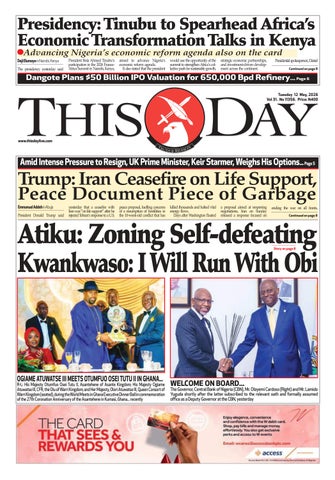
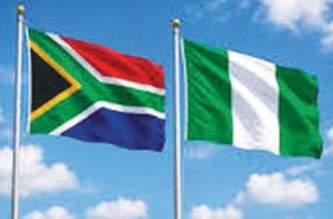
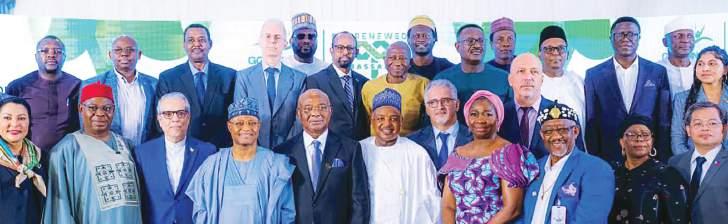
Presidency: Tinubu to Spearhead Africa’s Economic Transformation Talks in Kenya
Advancing Nigeria’s economic reform agenda also on the card
Deji Elumoye in Nairobi, Kenya The presidency yesterday said
President Bola Ahmed Tinubu’s participation in the 2026 FranceAfrica Summit in Nairobi, Kenya,
aimed to advance Nigeria’s economic reform agenda. It also stated that the president
would use the opportunity of the summit to strengthen Africa’s collective push for sustainable growth,
and
www.thisdaylive.com
Emmanuel Addeh in Abuja
President Donald Trump said yesterday that a ceasefire with Iran was “on life support” after he rejected Tehran’s response to a U.S. peace proposal, fuelling concerns of a resumption of hostilities in the 10-week-old conflict that has killed thousands and halted vital energy flows. Days after Washington floated a proposal aimed at reopening negotiations, Iran on Sunday released a response focused on
Atiku: Zoning Self-defeating
Kwankwaso: I Will Run
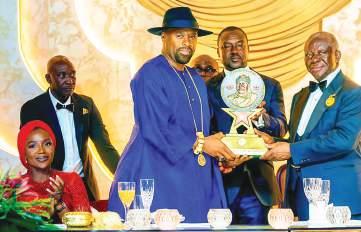
OGIAME ATUWATSE III MEETS OTUMFUO OSEI TUTU II IN GHANA...
R-L: His Majesty Otumfuo Osei Tutu II, Asantehene of Asante Kingdom; His Majesty Ogiame Atuwatse III, CFR, the Olu of Warri Kingdom; and Her Majesty, Olori Atuwatse III, Queen Consort of Warri Kingdom (seated), during the World Meets in Ghana Executive Dinner Ball in commemoration of the 27th Coronation Anniversary of the Asantehene in Kumasi, Ghana... recently
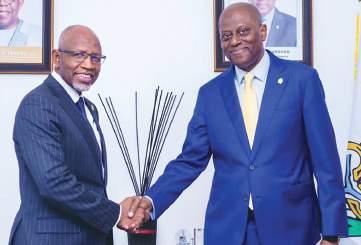
WELCOME ON BOARD...
The Governor, Central Bank of Nigeria (CBN), Mr. Olayemi Cardoso (Right) and Mr. Lamido Yuguda shortly after the latter subscribed to the relevant oath and formally assumed office as a Deputy Governor at the CBN, yesterday
expor tdeskdepar
wellness within reach
with W Health loan
The W Health Loan provides women with access to financing for eligible healthcare services
*Terms and conditions apply
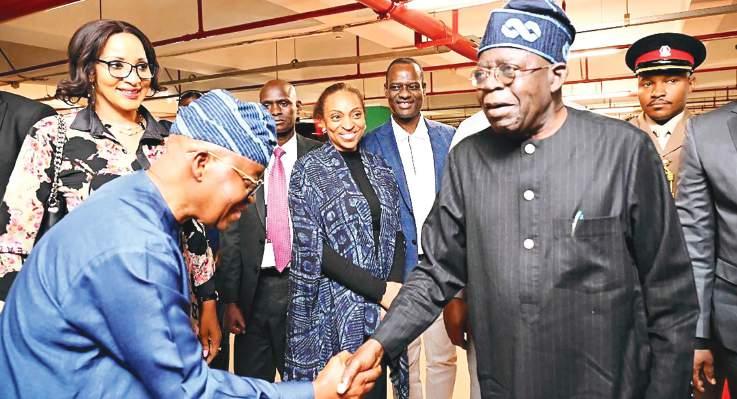
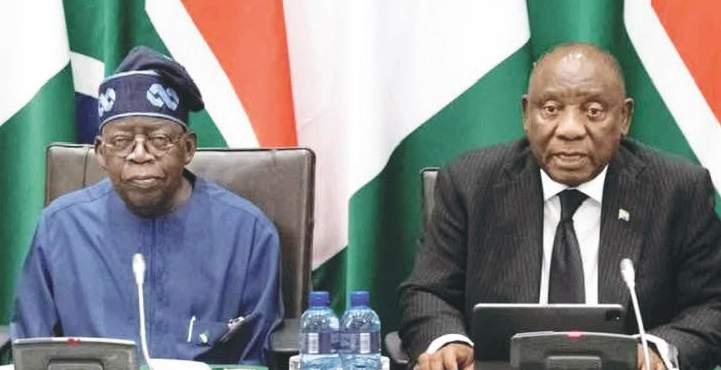
TINUBU ARRIVES NAIROBI...
R-L: President Bola Ahmed Tinubu; Minister of Finance and Coordinating
Minister of the Economy, Mr. Taiwo Oyedele; Minister of Industry, Trade and Investment, Dr. Jumoke Oduwole; Minister of Foreign Affairs, Amb. Bianca Odumegwu-Ojukwu; and Minister of Blue Economy, Mr. Adegboyega Oyetola, as the president arrived to attend the Africa-France Summit in Nairobi, Kenya, yesterday
Amid Intense Pressure to Resign, UK Prime Minister, Keir Starmer, Weighs His Options
Emmanuel Addeh in Abuja
The UK Prime Minister, Keir Starmer, is reportedly “weighing up his options” as several senior cabinet ministers have joined calls for him to resign.
Sky News reported that the cabinet is split on Starmer’s future, but at least four senior members have discussed his resignation.
Starmer is facing growing calls to resign mainly because of a deep rebellion within the governing Labour Party following poor local election results, falling approval ratings and anger over his leadership direction. Critics accuse Starmer of failing to improve the UK economy quickly enough, mishandling immigration politics, and drifting ideologically in response to pressure from the right-wing Reform UK party led by Nigel Farage. His tougher rhetoric on migration and attempts to reset Labour’s agenda have also angered parts of his own base.
Both Home Secretary, Shabana Mahmood and Foreign Secretary
Yvette Cooper, are among at least four senior cabinet members who had private discussions with Starmer on Monday night suggesting he prepares a timeline for his resignation.
However, it is understood that other members, such as Housing Secretary Steve Reed and Work and Pensions Secretary Pat McFadden have backed Starmer’s continued premiership. A meeting of the cabinet
is due to take place on Tuesday morning, where the Prime Minister’s future may be decided.
It comes as the number of Members of Parliament (MPs) calling for his resignation has passed 70, including six cabinet-member aides.
As of 10pm, Scottish Labour MP for Glasgow South, Gordon McKee, and Tahir Ali, MP for Birmingham Hall Green and Moseley, had become the latest calling for Starmer to resign.
Several top aides to cabinet members, known as parliamentary private secretaries (PPS), have resigned from their voluntary roles in a bid to place pressure on the Prime Minister.
Six PPS’s have made public calls for Starmer to resign, with four explicitly confirming they are resigning. These include aides to potential leadership candidate Wes Streeting, and other senior ministers
like Mahmood and Deputy PM David Lammy.
Number 10 has quickly confirmed the installation of six new ministerial aides to replace those who have spoken out. It is understood that a number of MPs who have made public calls against Starmer are supportive of a Streeting leadership bid.
He is reported as one of the main potential candidates, among former deputy prime minister Angela
Rayner and Manchester Mayor Andy Burnham. However, some reports indicate a silent majority of MPs and ministers who oppose the removal of Starmer. One cabinet minister told Sky News that there are concerns that the Labour Party “is about to put itself out of power for a serious period of time by repeating the mistakes of the Tories,” referring to a prolonged struggle for a permanent leader.
Central Bank of Nigeria (CBN), yesterday, warned that rising governance failures, operational weaknesses, and emerging technology-related threats in the noninterest financial services industry could erode public confidence and threaten financial system stability if left unchecked. The apex bank gave the warning at the
Second Annual Interactive Session with the CBN Financial Regulation Advisory Council of Experts (FRACE) and the Advisory Committees of Experts (ACE) of Non-Interest Financial Institutions (NIFIs) in Abuja.
CBN Deputy Governor, Financial System Stability Directorate, Mr. Philip Ikeazor, said although noninterest financial institutions had become increasingly strategic to the country’s financial ecosystem through ethical and Shariah-compliant financing, the rapid growth and increasing sophistication of the sector had also exposed it to new vulnerabilities.
operational vulnerabilities, and emerging technological threats as key concerns confronting the sector.
Represented by CBN Director, Financial Policy and Regulation Department, Dr. Rita Ijeoma Sike, Ikeazor identified noncompliance risks, governance challenges,
The Alternative Bank Moves to Address Nigeria’s Medicine Security Crisis with Financing for Local Pharma
Sunday Ehigiator
The Alternative Bank (AltBank) is stepping up efforts to strengthen Nigeria’s medicine security by providing targeted financing to local pharmaceutical manufacturers and supply chains.
The move comes as Africa continues to shoulder nearly a quarter of the global disease burden while relying heavily on imported drugs
and medical commodities — a vulnerability laid bare during the COVID-19 pandemic. Through asset-backed and risksharing financing models, the bank aimed to support domestic drug production, improve distribution networks, and reduce the country’s dependence on imports, according to a statement from the financial institution.
As part of the effort, the bank
said it had extended an invitation to industrial pharmacists across Nigeria to partner on solutions.
Speaking at a recent interview with Association of Industrial Pharmacists of Nigeria (NAIP) for the maiden edition of its Pharma Industry Digest, Group Executive at The Alternative Bank, Dr. Jekwu Ozoemene, underscored the urgency of localising pharmaceutical production.
Ozoemene stated, “Pharma and
medicine security and sovereignty are essential to Nigeria’s survival.
“We are positioned to partner with all stakeholders to make this a reality.”
As a fully licensed non-interest bank, AltBank said it deployed a unique model of patient capital. By utilising asset-backed, risk-sharing financing structures, the bank aligned repayment schedules with a business’ actual cash flow, rather than imposing rigid loan stipulations, it said.
He warned that failure to effectively manage such risks could undermine public trust, weaken financial stability, and damage the credibility of the country’s non-interest finance ecosystem.
According to him, the CBN remains committed to strengthening Shariah governance, regulatory clarity, and prudent risk management frameworks to sustain the orderly growth and resilience of the sub-sector.
He explained that the establishment of FRACE and the mandatory constitution of ACEs across non-interest financial institutions were aimed at institutionalising a harmonised governance framework capable of ensuring effective oversight and compliance within the industry.
In a statement, Ikeazor stressed that continuous engagement between FRACE and ACEs was essential to ensuring that regulatory expectations were clearly understood and consistently implemented across institutions.
He described the interactive session as a strategic platform designed to deepen collaboration, strengthen governance
structures, and promote knowledgesharing among regulators, scholars, and industry practitioners.
The CBN deputy governor said, “Noninterest financial institutions continue to play an increasingly strategic role in Nigeria’s financial system by providing ethical and Shariah-compliant alternatives to conventional finance while contributing meaningfully to financial inclusion, MSME development, real sector financing, and shared prosperity.”
In his remarks, Deputy Chairman of FRACE, Professor Bashir Umar, said the engagement was designed to strengthen governance standards within the non-interest finance industry and foster constructive dialogue between regulators and operators.
Umar commended the management of the central bank for reviving the interactive session, which was first introduced in 2014.
Earlier, Sike reiterated the CBN’s commitment to building a strong, credible, and well-governed non-interest financial services industry, stating that the rapid emergence of Islamic fintech and expanding product offerings required stronger regulatory oversight and sustained stakeholder engagement.
James Emejo in Abuja
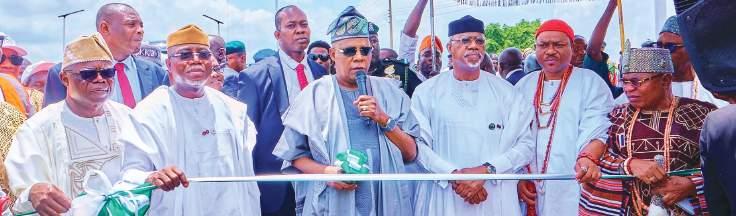
INAUGURATION OF ONYEARUGBULEM–SHAGARI/IRESE ROAD FLYOVER...
L-R: Ondo State Deputy Governor, Dr. Olaide Adelami; Governor Lucky Aiyedatiwa; Vice President Kashim Shettima; Ogun State Governor, Prince Dapo Abiodun; Olowo of Owo, Oba Ajibade Gbadegesin Ogunoye; and the Deji of Akure, Oba Aladetoyinbo Ogunlade Aladelusi, at the inauguration of the Onyearugbulem–Shagari/ Irese Road Flyover and Junction Improvement Project in Akure, Ondo State, yesterday
Dangote Plans $50 Billion IPO Valuation for 650,000 Bpd Refinery
May become largest listing in African capital market history
Africa’s richest person, Aliko Dangote, is targeting a $50 billion valuation for his flagship refinery business ahead of a planned stock market listing in Nigeria later this year, people familiar with the matter have told Bloomberg. The company plans to sell up to a 10 per cent stake, potentially raising around $5 billion in one of Nigeria’s biggest capital market deals.
The 650,000-barrels-per-day refinery has transformed Nigeria’s fuel supply chain by reducing dependence on imported petroleum products.
A senior executive at the Dangote
Group confirmed to Bloomberg that the projected valuation reflects the company’s internal expectations but declined to comment further on the timing or structure of the transaction.
The planned listing comes as rising global crude oil prices and stronger domestic fuel consumption improve the refinery’s commercial outlook. Located in the Lekki Free Zone in Lagos, the facility has a refining capacity of 650,000 barrels per day, making it Africa’s largest single-train refinery.
Since beginning large-scale production of petrol, diesel and aviation fuel, the refinery has reshaped Nigeria’s
fuel supply chain, reducing reliance on imported petroleum products and increasing local refining capacity in Africa’s biggest oil producer.
Dangote recently indicated that Nigerian investors would soon have an opportunity to buy shares directly in the refinery business, signalling a broader push to attract domestic participation in the energy sector.
The IPO is anchored by an unprecedented dividend structure that allows investors to purchase shares in Nigerian naira but receive returns in US dollars, backed by an estimated $6.4 billion in annual petrochemical export revenues.
With the prospectus already submitted for regulatory review and a subscription window expected to open by August 2026, the Dangote Refinery IPO is poised to fundamentally alter the scale and ambition of African equity markets. It will also be the first time that Africa’s most valuable private infrastructure asset will become available for public ownership. The refinery, located in the Lekki Free Trade Zone near Lagos, was commissioned in May 2023 after nearly a decade of construction and an investment of approximately $20 billion.
By February 2026, the facility had
Lagos Blue Line Phase II Set for Q1 2027 Completion
State records 737,340 traffic violations in one year
Lagos State Commissioner for Transportation, Mr. Oluwaseun Osiyemi, yesterday, disclosed that the second phase of the state’s Blue Line Rail System will become operational by the first quarter of 2027.
Osiyemi spoke during the 2025 ministerial press briefing on the activities of the state government in the last one year, to mark the second-term, seventh anniversary of the administration of Governor Babajide Sanwo-Olu.
He said the government had stepped up the use of technologydriven traffic enforcement measures to enhance road safety, boost compliance with traffic regulations, and modernise transport management across the state.
According to Osiyemi, over six million passengers have been moved through the Blue Line from Marina to Mile 2 since its inception.
He stated, “The Lagos Rail Mass Transit Line, developed by LAMATA, is a modern light rail mass transit system designed to reduce traffic congestion and improve integrated urban mobility in Lagos State.
“The Phase 2 infrastructure development of the Blue Line extends the corridor from Marina to Okokomaiko with continued track construction, station development,
power systems installation, and supporting rail infrastructure expansion.”
Osiyemi added, “As we are all aware, we know that the Blue Line Phase 1 is from Marina to Mile 2 and is all electric. Phase 2 is the one that we’re taking from Marina all the way to Okokomaiko.”
Speaking in the Red Line Rail, a 37-kilometre rail route from Agbado to Oyingbo along the Nigerian Railway Corporation corridor, the commissioner said, “Phase 1, currently in operation, has been expanded with the procurement of 24 new coaches, configured as a three-set of eight coaches moving over five rail passengers each.
“Phase 2 of the project will go to the National Stadium to connect the Blue Line. We have the feasibility study of that project, but what I would like to say is for the Blue Line, we received the first three sets of coaches, and that’s also operational, which is why today we have been able to reduce the travel time on the Blue Line from 18 to 10 minutes
“And now we’re expecting the three sets of the eight coaches on the Red Line to come before the end of this year, and the moment we have that on the ground, it’s going to bring a lot of difference to public transportation in Lagos, then we can move a lot of people.
“We’re looking at an average of 5,000 passengers daily.
“In terms of the second phase of the Blue Line, I can tell you that before the first quarter of next year, we will be able to complete that and have a full life in full flow.”
On the Green Line project, which is a 68-kilometre rail connecting Marina to Lekki Free Trade Zone, through Victoria Island, Lekki, Ajah, and Shangotedo, and ending at Free Trade Zone, Osiyemi stated that it
had about 17 stations.
He said, “The federal government has signed an MoU with a Chinese company. It’s designed to transport 35,000 passengers per hour. The funding was recently approved by the Federal Executive Council, as announced by the governor.
“The Green Line forms part of the state’s broader rail expansion plan aimed at enhancing the quality of daily movement for residents in the Lagos metropolis.
reached its full processing capacity of 650,000 barrels of crude oil per day, making it the world’s largest single-train refinery and Africa’s biggest refining complex.
Earlier valuations published in late 2025 placed the refinery’s worth at between $20 billion and $25 billion. That figure has since nearly doubled to $40–$50 billion, reflecting strongerthan-expected operational performance and rising global demand for the refinery’s output.
Group revenues across Dangote’s businesses have grown from $3.3 billion to $18 billion over the past five years, while EBITDA rose from $1.8 billion to $2.8 billion during the same period.
To put the IPO in context, the MTN Nigeria listing in 2019 raised approximately $876 million, which was at the time the largest on the Nigerian Exchange. The Dangote Refinery IPO is targeting up to $5 billion — roughly five to six times that size.
An analysis of the planned deal by Serrari Group stated that on a continental scale, market observers have drawn comparisons to Saudi Aramco’s landmark 2019 listing, as both transactions bring a dominant energy infrastructure asset to public markets for the first time.
The refinery is not a single-product operation. It processes crude oil into
diesel, aviation fuel, and petrol, with refined products currently exported to Ghana, Cameroon, Togo, and Tanzania as well as international markets, including Europe. The facility currently supplies over 90% of Nigeria’s petrol demand and has exported 456,000 tonnes of refined fuel to five African countries. Beyond fuels, the refinery produces petrochemical outputs including polypropylene, which is widely used in plastics manufacturing, industrial packaging, and component fabrication.
The petrochemicals division represents a major standalone revenue stream and is specifically what underpins the refinery’s dollar dividend commitment. Jet fuel exports alone surged by 770 per cent between 2024 and 2026, with Europe receiving roughly 70,000 barrels per day to offset supply disruptions linked to tensions in the Middle East. The refinery is also supported by a pipeline network stretching approximately 1,100 kilometres, one of the largest of its kind globally, connecting crude supply lines to processing and distribution infrastructure.
The Dangote Group had appointed a consortium of three financial advisers to manage the offering. Stanbic IBTC Capital, operating under the Standard Bank umbrella, will handle the international book-building process and lead engagement with foreign portfolio investors.
NSCDC Cracks Down on Railway Vandals, Recovers Stolen Sleepers in Bauchi
The Nigeria Security and Civil Defence Corps (NSCDC) has dealt a major blow to a criminal syndicate involved in the vandalism and illegal movement of railway infrastructure following the arrest of two suspects and the recovery of a large quantity of stolen railway sleepers along the Bauchi-Kano corridor.
The operation, carried out by the Commandant General’s Special Intelligence Squad (CG’s SIS), was part of an intensified crackdown on economic saboteurs accused of targeting critical national assets
across the country.
The suspects, identified as 65-year-old Alzuma Yakubu and 32-year-old Ismail Muhammad, were intercepted while transporting suspected vandalised railway materials in a Peugeot Boxer vehicle with registration number KMC-366-TE.
According to the NSCDC, the operatives acted on credible intelligence concerning the illegal movement of railway infrastructure from Tafawa-Balewa Local Government Area of Bauchi State to Kano State.
According to the spokesman of the Corps, Afolabi Babawale,
upon interception and thorough inspection of the vehicle along the Bauchi-Kano Road, operatives discovered a huge consignment of suspected railway sleepers concealed inside the truck.
He said the driver, Yakubu, and Muhammad, who allegedly claimed ownership of the recovered items, were immediately arrested, while the vehicle and stolen materials were impounded as exhibits.
He noted the breakthrough followed a strategic directive by the Commandant General of the NSCDC, Ahmed Audi, who ordered the relocation of the CG’s Special Intelligence Squad to Bauchi State
after concerns emerged over the increasing vandalism of railway infrastructure in the region.
He said the deployment came on the heels of an alarm reportedly raised by the governor of Bauchi State over the activities of suspected criminal elements allegedly operating under the guise of contractors linked to “Des-Rail Limited.” In response, the Commandant General mandated the Special Intelligence Squad, under the leadership of Commandant Apollos Dandaura, to dismantle networks involved in the systematic destruction and illegal removal of railway infrastructure along the Bauchi-Gombe axis.
Michael Olugbode in Abuja
Segun James
Emmanuel Addeh in Abuja
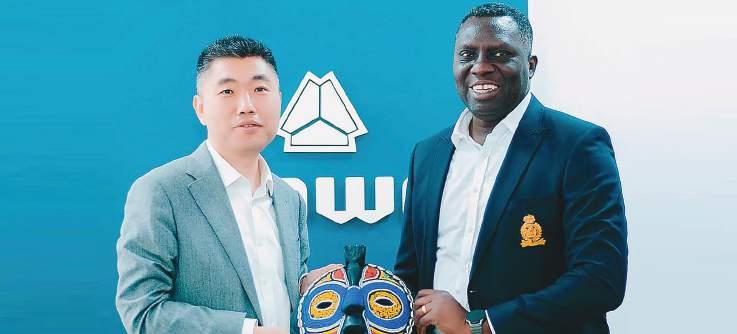
CULTURE, COMMERCE AND CROSS BORDER TRUST...
L-R: Vice President, Sinotruck Group China, Mr. Zhao Hua, receiving and displaying a richly crafted African mask presented to him by Managing Director, Nigerian Sinotrucks Limited, Mr. Alfred Okugbeni, during the Vice President’s visit to Nigerian Sinotrucks Limited Head Office in Nigeria
Afreximbank, Lagos State Take African Design to Milan, Launch Global Tour to Position Lagos as Creative Capital
Mary Nnah
African design is set for a major push onto the global stage as Design Week Lagos, with the strategic support of Afreximbank and Lagos State Government, prepares to present a new generation of African designers at SaloneSatellite 2026 in Milan.
The upcoming showcase is positioned as a significant step in placing African design within the global market as part of the “All Roads Lead to Lagos” global tour.
The Milan activation will feature a curated selection of emerging talents working across furniture, lighting, and product design. The featured designers include Athanasius Johnson, Nicole Adaora Enwonwu, Odema Acacia Saleh, Richard A. Aina, Joan Eric Udorie, Olaoluwa AJ Durotoye, and Myles Igwebuike.
Their works will reflect a sophisticated intersection of material intelligence, cultural identity, and production potential. Beyond the exhibition, the platform is designed to facilitate critical conversations with international galleries and manufacturers, opening pathways
for product acquisition, manufacturing partnerships, and entry into global retail markets.
“With All Roads Lead to Lagos, we are building a structured pathway for Nigerian and African designers to move from creativity into real industry and global markets,” said Titi Ogufere, Founder of Design Week Lagos.
Ogufere added, “Over the past few years, our focus has not only been on showcasing design but on training, incubating, and preparing designers to engage with manufacturing, production, and international opportunities. This global tour, which will begin in Milan and continue to London and Paris, is a natural extension of that work.
“It will allow us to present a curated expression of Lagos to the world while providing our designers with direct access to global platforms. For us, this is not just about visibility. It is about building a sustainable design economy and positioning Lagos as a serious global design capital.
“What we are building is an ecosystem that connects talent
development, manufacturing, culture, and international market access. We believe African design is not only culturally relevant, but commercially viable on the global stage.”
The initiative is tied to Lagos State’s broader vision for the creative economy. The state introduced the Design Tourism initiative last year to position Lagos as a leading global destination for culture, creativity, and innovation.
The state government believes design is not just an artistic expression, but a key driver of economic growth,
tourism, international engagement, and cultural exchange.
Through Design Week Lagos’ All Roads Lead to Lagos initiative, that vision will extend beyond Nigeria by taking a curated expression of Lagos and African creativity to major global platforms, including Milan, London, and Paris, before welcoming the world back to Lagos in October 2026.
Lagos State Commissioner for Tourism, Arts and Culture, Toke Benson, said the strategy was about both exposure and opportunity.
Benson stated, “Through initia-
tives like this, we are not only showcasing the richness of our creative industry but also creating opportunities for our designers and creative businesses to connect with international markets while inviting the world to experience Lagos in a deeper and more meaningful way.
“We believe Lagos is emerging as one of the most exciting creative capitals globally, and Design Week Lagos continues to play an important role in that journey.”
The Milan showcase will be supported by Afreximbank through CANEX, the bank’s Creative Africa
Nexus programme, underscoring its broader commitment to growing Africa’s creative industries and connecting African talent to international markets.
Through the activation, Afreximbank aims to reinforce its commitment to developing Africa’s creative industries as a viable economic sector, connecting talent to trade and finance. Similarly, the Lagos State Govern- ment continues to demonstrate its vision of Lagos as a global capital for creative enterprise. This global activation follows a multi-city strategy.
Osun 2026: Adeleke Reduced Osun Domestic Debt Profile from N148bn to N83.32bn
Yinka Kolawole in Osogbo
Governor Ademola Adeleke of Osun State has substantially cleared the mess created by the administration of former Governor Adegboyega Oyetola with the reduction of domestic debt profile of the state from N148 billion in
December 2022 to N83.32 billion by the first quarter of 2025. Director-General of the Imole Campaign Council (TICC), Senator Akogun Kamorudeen Oyewumi, representing Osun West Senatorial District stated this at the opening of Media Center as a strategic platform to house, coordinate, and
ICT: Institute Urges Tertiary Institutions to Adopt Cyber-physical Integration as Survival Strategy
Kuni Tyessi in Abuja
The Digital Bridge Institute has urged tertiary institutions to adopt cyber-physical integration as a survival strategy, saying smart campuses are now essential for handling the country’s demographic, economic, and technological pressures. Five pillars were laid for a Nigerian smart campus and they include, energy resilience, redundant connectivity, unified data fabric, human-centred adaptive learning, and cyber-resilience with board-level governance.
Delivering the keynote at the ComDICT-NTI Annual Conference in Abuja on Monday, Mr. Bankole Olorunba, speaking for the Institute’s President/CEO, Mr. David Daser, said the theme “Cyber-Physical Integration for Adaptive, Resilient, Smart Campuses” goes beyond academic discussion.
He called on ICT directors to move from being seen as “senior plumbers” to architects of institutional possibility and urged them to commission baseline audits, launch one flagship pilot, build coalitions across departments, invest in staff, and share solutions
through ComDICT-NTI.
“It is, for us in Nigeria, a question of institutional survival, national competitiveness, and intergenerational justice,” he told ICT directors from universities, polytechnics, and colleges of education.
He warned that blueprints from other countries will not work without adjustment.
“What we need is a Nigerian cyber-physical architecture, one that assumes intermittent power and designs for it; one that assumes constrained bandwidth and engineers around it,” he said.
Declaring the event open, ComDICT-NTI Chairman, Daniel Inusa Yakmut noted that global disruptions from economic volatility, climate change, and rapid technological advances have exposed the weaknesses of traditional campus infrastructure.
Describing ICT directors as architects of a new reality, he tasked them with designing systems that anticipate change rather than merely reacting to it
“The traditional university or polytechnic campus, relying on rigid infrastructure and siloed data, is no longer fit for purpose,” he said.
in Q1 2025, Says Oyewumi
disseminate the activities of the Imole Campaign Council under the supervision of the Media and Publicity Committee headed by Rep. Bamidele Salam.
According to him, the governor had also reduced the external debt from $91.78 million in 2022 and $75.14 million, representing a 43.84 percent and 18.13 percent reduction, respectively.
Oyewumi who reminded electorates of the terrible mess created by immediate past administration on which the APC candidate, Mr. Bola Oyebamiji served as Commissioner of Finance, stressed that, “Similarly, the internally-generated revenue of N24.47 billion in 2022 has been increased to N58.7 billion in 2025 representing a 139.89 percent jump and indicated a clean bill of health for the state’s finances. “
He equally remarked the government has also ensured harmonization and digitalisation of revenue collection to streamline the tax structure and reduce human interferences to block leakages.
He said “Let me reiterate clearly that the Imole Campaign Council will not be distracted by mundane,
trivial or negative politics which the All Progressives Congress (APC) has adopted in the course of this campaign.
“As an incumbent government which has clearly justified the mandate of the people, we are focused on seeking renewed support from the people of Osun State for the consolidation of the unprecedented gains of good governance which Governor Ademola Adeleke has brought to our dear state.” Senator Oyewumi equally made it clear that, “We have cleared 18 months out of the 30 months inherited half-salary liabilities from the past APC government. Our government has also cleared in full, the 28-month contributory pension arrears owed to retirees by the past APC governments in Osun State.”
The lawmaker noted that “benefits of these milestones recorded in the improvement of the financial health of the state has resulted in unprecedented infrastructure development, human capital development, and significant improvement in every index of good governance in the last 3 ½ years. “
Jury Enters Final Stage as Judge Sets Directions in Diezani
Wale Igbintade
The trial of former Nigerian Minister of Petroleum Resources, Diezani Alison-Madueke, in London moved into its decisive closing stage yesterday as the judge delivered detailed directions to the jury before the prosecution opened its final arguments at the Southwark Crown Court.
Presiding judge, Justice Justine Thornton, told jurors that all evidence in the case had now been concluded and their task was to determine the charges strictly based on law and the evidence presented in court.
Thornton stressed that the prosecution carried the sole burden of proof and that the defendants were not required to prove anything.
The judge directed the jury to consider each of the eight counts separately and warned them against allowing extraneous considerations
Alison-Madueke’s
to influence their decision.
She specifically instructed jurors to disregard the Nigerian political context, media coverage, cultural practices, and assumptions about wealth or gender roles, as well as the involvement of international oil companies.
She also cautioned the jury not to speculate about individuals named in the indictment who were not standing trial, including Kolawole Aluko, Olajide Omokore, Benedict Peters, Igho Sanomi, Kevin Okyere, and Prince Momoh, stressing that their guilt or innocence is not for consideration in the case.
On several counts, the judge outlined the legal tests the jury must apply, including whether Alison-Madueke accepted financial or other advantages and whether such acceptance was improper.
She instructed that local customs or practices in Nigeria must be disre-
garded when assessing impropriety, and the defendant’s personal belief about her conduct was not relevant to the legal standard.
On other counts, the jury was directed to determine whether alleged benefits were passed to AlisonMadueke through intermediaries and whether she knew such acceptance was improper.
On one charge relating to alleged payments intended to influence business decisions involving Emmanuel Kachikwu, jurors were told that if they concluded the accused acted as an informant, they must return a not guilty verdict.
The judge also reminded the jury that Alison-Madueke and a co-defendant were of good character and had no previous convictions, a factor they were entitled to take into account.
She stated that the passage of time since the alleged offences
might have placed the defence at a disadvantage, including potential loss of witnesses and documentary evidence.
Following the judge’s directions, lead prosecutor, Alexandra Healy KC, began her closing submissions, telling the jury that Alison-Madueke, as Nigeria’s petroleum minister at the time, occupied a position of significant public trust, while businessmen seeking lucrative oil contracts with state-owned entities allegedly provided her with benefits.
The prosecution argued that it was wholly improper for a sitting minister to have her lifestyle funded by individuals doing business with the Nigerian state.
Healy challenged the defence’s claim that all benefits were reimbursed in Nigeria, stating that despite being aware of an investigation for nearly a decade, no documentary evidence of reimbursement has been
Trial
produced and no such claim has been raised in earlier police interviews.
On specific allegations, the prosecution highlighted a £1 million payment linked to businessman Benedict Peters, describing the use of intermediary structures as an “extraordinary device” designed to conceal the true nature of the transaction.
It also pointed to financial arrangements involving alleged card payments and dollar accounts used to facilitate personal spending, supported by documentary and messaging evidence said to have been recovered during investigations.
The prosecution further argued that digital communications, including WhatsApp messages, suggested awareness of improper payments and supported the claim that certain transactions were intended as inducements rather than legitimate transfers.
It dismissed a defence suggestion
ATIKU: ZONING SELF-DEFEATING; KWANKWASO: I WILL RUN WITH OBI
Chuks Okocha in Abuja and Funmi Ogundare in Lagos
Former Vice President, Atiku Abubakar, yesterday described the decision by some opposition figures to insist on zoning the presidency to Southern Nigeria ahead of the 2027 elections as “self-defeating” and “intellectually dishonest,” warning that competence and national unity should take precedence over regional considerations.
In a statement by his spokesperson, Olusola Sanni, Atiku cautioned opposition political actors against the position that the 2027 presidential ticket must be zoned exclusively to the South.
The statement from Atiku coincided with an Arise TV interview by former Kano State Governor and architect of the Kwankwassiya Movement, Senator Rabiu Kwankwaso yesterday, where he declared support for zoning the presidency to the South in 2027.
Besides, Kwankwaso indicated his willingness to serve as running mate to former Anambra State Governor, Peter Obi, if given the go-ahead by the Nigeria Democratic Congress (NDC).
Apart from the NDC, the Social Democratic Party (SDP) had over the weekend zoned its presidential tickets to the southern part of the country.
But Atiku argued that while
zoning in the All Progressives Congress (APC) may understandably be to retain the presidency around President Bola Tinubu, it would amount to political naivety for the opposition to adopt the same logic without a sober assessment of electoral realities.
According to him, politics must be driven by strategy, coalition-building, and hard electoral arithmetic, not emotional talking points or selective moral arguments.
He said: “The first and most obvious question is this: how does a Southern opposition candidate realistically unseat a sitting Southern president? Nigerian political history offers no precedent for
such an outcome. No incumbent president has ever been defeated by an opposition challenger from the same geopolitical bloc. To insist otherwise is to enter the contest already defeated.”
The former vice president further noted that the moral argument being advanced in favour of southern zoning has collapsed under scrutiny.
“By 2027, the South would have held presidential power for approximately 18 years in the Fourth Republic, compared to about 10 years for the North. If the South retains power for another four years, that disparity widens even further. It therefore becomes difficult to understand
TRUMP: IRAN CEASEFIRE ON LIFE SUPPORT, PEACE DOCUMENT PIECE OF GARBAGE
including Lebanon, where U.S. ally Israel is fighting Iran-backed Hezbollah militants. The response had been swiftly rejected by Trump.
Asked where the ceasefire stands, Trump told reporters on Monday that the document sent by Iran was a piece of garbage.
He said: “I would say the ceasefire is on massive life support... when the doctor walks in and says, ‘Sir, your loved one has approximately a 1 percent chance of living’.”
The US president said Iran’s leaders were “very dishonourable people.” “Look, I’ve had to deal with them four or five times - they change their mind. That piece of garbage they sent us - I didn’t even finish reading it,” he said.
Trump also accused Iran of going back on an agreement to allow the US to remove its supply of enriched uranium. He insisted that Iran would “never have a nuclear weapon”.
In its response, Tehran also demanded compensation for war damage, emphasised its sovereignty over the Strait of Hormuz, and called on the U.S. to end its naval blockade, guarantee no further attacks, lift sanctions and remove a ban on Iranian oil sales.
The U.S. had proposed an end to fighting before starting talks on more contentious issues, including Iran’s nuclear programme. Tehran defended its stance on Monday, a Reuters report said.
“Our demand is legitimate: demanding an end to the war, lifting the (U.S.) blockade and piracy, and releasing Iranian assets that have been unjustly frozen in banks due to U.S. pressure,” Foreign Ministry
spokesperson Esmaeil Baghaei said.
“Safe passage through the Strait of Hormuz and establishing security in the region and Lebanon were other demands of Iran, which are considered a generous and responsible offer,” he added.
Brent crude oil futures traded 2.7 per cent higher at around $104 a barrel, as the deadlock left the Strait of Hormuz largely closed. Before the war began on February 28, the narrow waterway carried one-fifth of the world’s oil and liquefied natural gas, and has since become a central pressure point in the conflict.
Disruption caused by the nearclosure of the strait has forced oil producers to cut exports and traffic through the Strait of Hormuz is at a trickle compared with before the war. Shipping data on Kpler and LSEG showed that three tankers laden with crude exited the waterway last week, with trackers switched off to avoid Iranian attack.
Addressing whether combat operations against Iran were over, Trump said in remarks that: “They are defeated, but that doesn’t mean they’re done.”
Israeli Prime Minister Benjamin Netanyahu said the war was not over because there was “more work to be done” to remove enriched uranium from Iran, dismantle enrichment facilities and address its proxy forces and ballistic missile capabilities.
Meanwhile, Organisation of Petroleum Exporting Countries (OPEC) oil output dropped further in April to the lowest in more than two decades, a Reuters survey found, as the U.S.-Israeli war with Iran effectively closed the Strait of
Hormuz and forced export cuts.
Crude output by the 12-member OPEC in April fell by 830,000 barrels per day month-on-month to 20.04 million bpd, the survey found. March’s figure was revised 700,000 bpd lower due to a change in the Saudi estimate.
Eight members of the OPEC+ producer group, which includes OPEC plus allies including Russia, had agreed to resume oil production hikes in April, although the outbreak of the Iran war on February 28 and effective Hormuz closure made it impossible to deliver on the agreement.
Kuwait experienced the group’s biggest drop in production in April, reflecting a whole month of disruption to exports, the Reuters
survey found.
Saudi Arabia and Iraq also had further declines, although the United Arab Emirates was the only Gulf member able to increase production.
Like Saudi Arabia, the UAE has an export route bypassing Hormuz and tanker data shows higher UAE exports in April.
April’s output is the lowest by OPEC since at least 2000, excluding membership changes since then according to Reuters surveys, and is significantly below the levels reached during the COVID-19 pandemic in 2020 when demand collapsed.
Besides the UAE, which left OPEC with effect from May 1, Venezuela and Libya also raised output during April, the survey found.
the justice in an argument that seeks to deepen an already existing imbalance under the guise of equity,” he added.
Atiku also accused some political actors of selective memory and opportunism, particularly those, who abandoned the zoning principle in 2011 following the death of President Umaru Yar’Adua, only to now present it as a sacred political doctrine.
“It is intellectually dishonest for those who enthusiastically supported a Southern presidency under Goodluck Jonathan in 2011, despite the North’s legitimate expectation under the informal zoning arrangement, to now suddenly posture as custodians of rotational justice. Principles do not become sacred only when they align with personal ambition,” he said.
While affirming that the Southeast’s aspiration to produce a president remained legitimate and deserving of serious national engagement, the statement warned against reducing that aspiration to what it called “transactional political bargaining.”
He added: “The Southeast deserves a sustainable and credible pathway to national leadership, not symbolic tokenism or bespoke arrangements tailored to satisfy one individual’s ambition.”
The statement urged the opposition to focus on building a credible national coalition capable of defeating the incumbent rather than embracing narratives that might inadvertently strengthen
of whistleblowing in relation to one of the defendants, arguing, instead, that the evidence pointed to personal financial motivation.
The prosecution’s closing submissions were expected to continue in the next sitting, after which the jury will retire to consider its verdict on the eight counts.
A decision is anticipated later this week as the long-running case reaches its conclusion.
Tinubu’s re-election prospects.
“Defeating an incumbent president requires realism, not romanticism; strategy, not sentiment; honesty, not selective memory. The opposition must decide whether its goal is to make an emotional statement or to actually win power,” he stated.
Meanwhile, former Kano State Governor, Kwankwaso yesterday declared support for zoning the presidency to the South in 2027, while also indicating his willingness to serve as running mate to Obi, if adopted by their political alliance.
Speaking during an interview on PrimeTime, AriseTV, Kwankwaso explained that leaders within the coalition movement had resolved to support a southern presidential candidate in order to maintain national balance and address agitations surrounding power rotation.
According to him, the arrangement makes Obi the likely presidential flagbearer of the alliance ahead of the 2027 election.
“That is how it should be,” Kwankwaso said when asked if Obi will emerge as the front-runner for the coalition’s presidential ticket. He added: “If the party decides that I should be the running mate of any candidate from the south under the circumstances, I will be happy to work together with him.” Kwankwaso explained that the decision to support a southern candidate was reached after
Continued on page 28
PRESIDENCY: TINUBU TO SPEARHEAD AFRICA’S ECONOMIC TRANSFORMATION TALKS IN KENYA
Bwala, who briefed newsmen on the side-lines of the summit in Nairobi, said the conference was coming at a time when African countries were pursuing critical reforms aimed at creating a more conducive investment climate and repositioning the continent for sustainable economic prosperity.
According to Bwala, Tinubu considers the summit as highly strategic, given that six of the seven thematic areas slated for deliberation on Tuesday align closely with the core pillars of the administration’s Renewed Hope Agenda currently being implemented in Nigeria.
He identified key areas of focus to include international financial restructuring, artificial intelligence, agriculture, blue economy, and agricultural transformation, stating
that they reflect critical reforms already being pursued under Tinubu’s leadership.
Bwala stated, “For us as a country and, of course, the leading country in Africa in many respects, the president deems it that this is a strategic meeting that is going to focus on seven thematic areas fortunately for us, six of the seven thematic areas happen to fall in line with the president’s renewed hope policy programmes, which we have started implementing right from day one.
“Take, for example, when they talk about the international financial restructuring, we have seen the financial structuring, which has taken place in Nigeria, which has given confidence on Nigeria.”
The presidential media aide also highlighted Nigeria’s growing
deployment of artificial intelligence and digital technology, stressing that the country’s youthful population presents enormous opportunities for innovation-driven growth.
On agriculture, Bwala said Nigeria had about 30 million hectares of arable land, describing the sector as a major component of the summit discussions and a critical area for investment and economic diversification.
He explained that the broader objective of the summit was to encourage African countries to harness their vast resources and build prosperous economies independent of excessive foreign dependence.
He explained, “These are areas that they intend to focus on and the whole concept of this summit
is to create this sense that Africa by itself can create the economy that they deserve, rather than this dependency from the rest of the world.”
On the opportunities the summit presented for Nigeria and the wider African continent, Bwala said Nigeria, as a leading force in Africa, was an investment-friendly destination richly endowed with vast natural and human resources. He said, “The president of Nigeria, who is a leading figure in Africa, is happy to lead in this endeavour. He is going to participate in three plenaries tomorrow. And these are areas that affect most of what we are doing in Nigeria.”
On the president’s expected
Continued on page 27
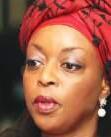
Diezani Alison-Madueke
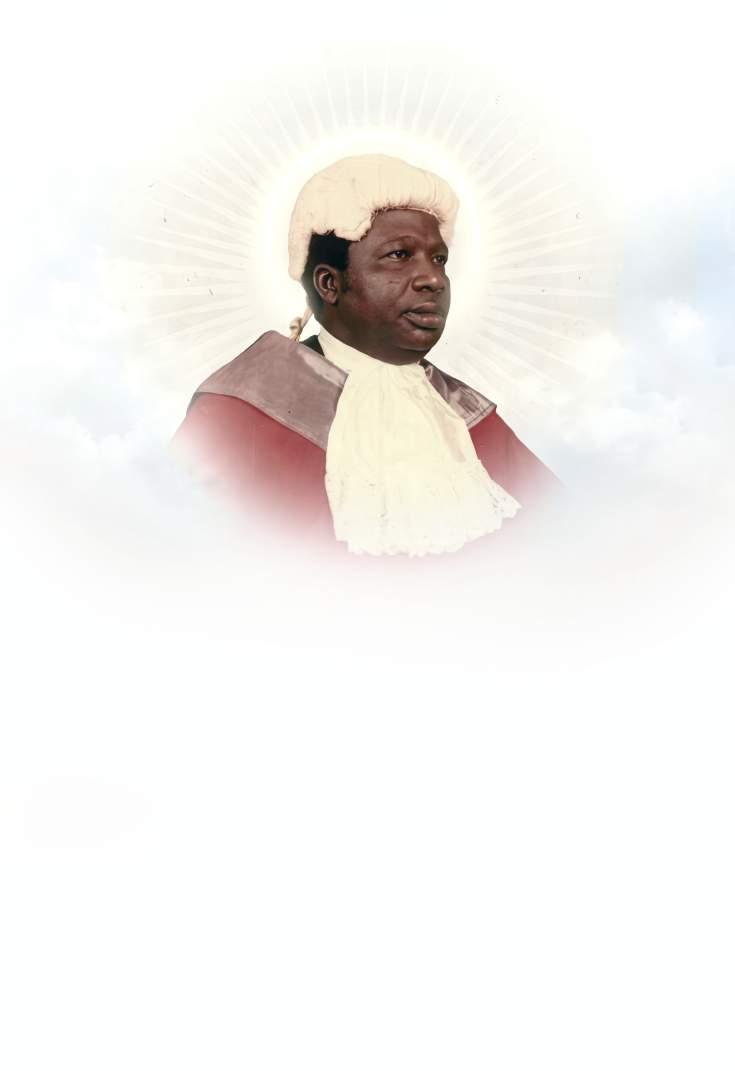
30th Year Remembrance
(LATE) SENATOR (HONOURABLE JUSTICE)
Mubasheer Akanbi Olatunji Abiru
SEPT 25, 1928 - MAY 12, 1996
2ND REPUBLIC SENATOR (1979 - 1983)
We remember Distinguished Senator and Honourable Justice Mubasheer Akanbi Olatunji Abiru with gratitude and pride. His life embodied honour, integrity, and selfless service.
A respected jurist and Second Republic Senator on the platform of the Unity Party of Nigeria (UPN), under Chief Obafemi Awolowo, he stood for progressive ideals and good governance, serving with courage, fairness, and an unblemished record.
To us, he was a mentor and moral compass, devoted to justice and truth.
Though deeply missed, his legacy endures, and we remain committed to his values.
Forever in our hearts,
THE CHILDREN:
Hakeem G. Abiru
Kazeem K. Abiru
Senator Mukhail A. Abiru
Hon. Justice Habeeb A. Abiru (JSC)
Hon. Lateef O. Abiru
Idayat K. Okubena (Mrs)
Ameen B. Abiru
Hamzat B. Abiru
Seliat I. Olorunfunmi (Mrs)
Moshood A. Abiru
NATIVE ARTICLE PROPOSAL
What is a Native Article?
ARISE NEWS is Africa’s leading business and financial news website, providing a unique blend of international and pan‑African business and economic news.
Native Article is the innovative way of strategically packaging content to blend in with editorial.
This allows for content to appear as more credible, as it reads naturally without the marketing agenda of the company coming across as obvious.
How it works
Client to provide Arise News with an article, Arise News Editorial team will then re‑write this to fit the consumer content behaviour.
The Article will be posted on the website, and the article page will have full advertiser branding.
The Article link will be embedded on the homepage for one week.
The article will get a social post dedicated to drive users to the article page on the day it is released.
RESPONSE TO THE PURPORTED SUSPENSION OF THE CHAIRMAN OF THE BOARD OF TRUSTEES, ACF, ALHAJI BASHIR DALHATU, WAZIRIN DUTSE
The Board of Trustees of the Arewa Consultative Forum (ACF) unequivocally condemns, in the strongest terms possible, the reckless, illegal and ill-advised actions of a tiny, disgruntled minority within the Forum who, in flagrant violation of the ACF Constitution, rules, regulations, norms and established traditions, convened an illegitimate meeting on 6th May 2026 and issued a press release containing unfounded and malicious allegations against the respected Chairman of the Board of Trustees, Alhaji Bashir Dalhatu, Wazirin Dutse.
For the avoidance of doubt, the National Executive Council of ACF lacks the authority whatsoever to make any legal pronouncement on the leadership of the Board of Trustees. It has no powers under our Constitution to appoint, suspend or remove any member of the Board of Trustees, let alone its Chairman. The actions of this small group represent a dangerous act of indiscipline, gross insubordination and a blatant attempt to undermine the very foundation of the Forum.
It is particularly regrettable and unfortunate that the Chairman of the National Executive Committee, Mike Mamman Osman, SAN, permitted the illegal actions of the erstwhile Secretary General, Murtala Aliyu, whose tenure expired on 10th March 2026. All actions taken by the said former Secretary General after that date are null, void and of no effect. He has since been placed under investigation for his conduct while in office.
The Board of Trustees has directed a thorough investigation into the circumstances surrounding this treachery which, no doubt, was calculated to discredit the Forum, malign its hardearned reputation and relegate it into a scrap heap.
We wish to state categorically that there is no leadership crisis or tussle in the Arewa Consultative Forum. What we are witnessing is nothing but the desperate and self-serving machinations of a disgruntled former officer who
has refused to vacate his seat after the expiration of his tenure and has resorted to recruiting a few like-minded individuals to do his bidding.
The Arewa Consultative Forum remains one, undaunted and strong. After 25 years of selfless and impactful service to the people of Northern Nigeria, the Forum will not be distracted from its sacred mandate of promoting the unity and advancing the legitimate interests of Arewa.
Irrespective of these attempts at sabotage, we shall continue to pursue this noble objective with greater courage, vigour and commitment.
We call on the general public, especially the good people of Northern Nigeria, to disregard thefabricated falsehoods being peddled by these few renegades. We also wish to assure the public, in particular, that donations received in behalf of the ACF Endowment Fund is safely warehoused in the bank, well out of the reach of the Secretariat, the National Executive Committee or even, for that matter, the BOT. A high powered panel of experienced members of the ACF has since been appointed to implement and manage the Endowment Fund Project. The Board of Trustees reaffirms its confidence and support for its Chairman, Alhaji Bashir Mohammed Dalhatu. In the coming days, we will take strong measures that will address this needless crisis and re-establish discipline, peace and order in this very important organization.
Long Live the Arewa Consultative Forum!
Long Live Northern Nigeria!! Long Live the Federal Republic of Nigeria!!!
This statement by the Board of Trustees of ACF is authorized by members whose names appear below:
● Amb Hassan Adamu, CON Wakilin Adamawa
● General (Sen) Muhammad Magoro, OFR, FSS, NSM, Galadiman Zuru
● Amb. Abubakar Ahmed Rufa’i, CFR Sardaunan Katsina
● Eng. Suleiman Adamu, FNSE Galadiman Kazaure
● Alhaji Nasiru Danu, OFR, Sardaunan Dutse
● Dr Yerima Lawal Ngama
● Amb Bala Sani, mni
● Hajia Salamatu Suleiman, LL.D (h.c) (Abuja)
● Alhaji Dahiru Mohammed
● Eng Abubakar G Umar, FNSChE
● Hajia Aisha Dankani, mni
● Hajia Maimuna Y Abubakar
● General S.Usman Kukasheka, FNIPR
● Col Aliyu Audu
● Chief Anthony NZ Sani
● Muhammad Ibrahim D/Biu
● Muhammadu Alhaji Yakubu
● CGI (rtd) Muh. Babandede, MFR
● Alhaji Lawal Kankia
● Alhaji Ibrahim Ismail, OFR
● Dr Goni Umar Faruk
● Hajia Rabi Saulawa
● Dr Mohammed Ghali
● Prof Aisha Madawaki
● Hajia Sa’adatu Abdullah
● Arc Aminu Kani
● Emeritus Prof Munzali Jibril
● Mal. BUKAR ZARMA, FNGE
GOVERNMENT OF RIVERS STATE
to our Amazon of Justice!
My Lord,
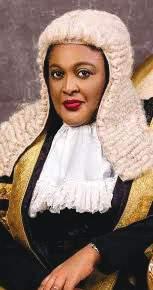
On behalf of the Government and good people of Rivers State, I extend warm felicitations to you as you mark your 74th birthday today
Rivers State is proud to call you one of her own. From your early days as a Magistrate in our judiciary to your rise as Justice of the Supreme Court of Nigeria, you have carried the name of Rivers with honour, dignity, and an unwavering commitment to justice.
Beyond the courtroom, you have been a m o t h e r t o R i v e r s S t a t e Yo u r philanthropy, your advocacy for women a n d c h i l d r e n , a n d y o u r q u i e t i n t e r v e n t i o n s i n m o m e n t s o f c r i s i s remind us that public service extends beyond official duty You have used your platform to heal, to build, and to give hope.
On this day, we celebrate not just the years, but the lives you have touched and the standards you have set. May God grant you more years in good health, peace of mind, and the joy of s e e i n g t h e s e e d s y o u h a v e s o w n continue to bear fruit.
Happy 74th Birthday!
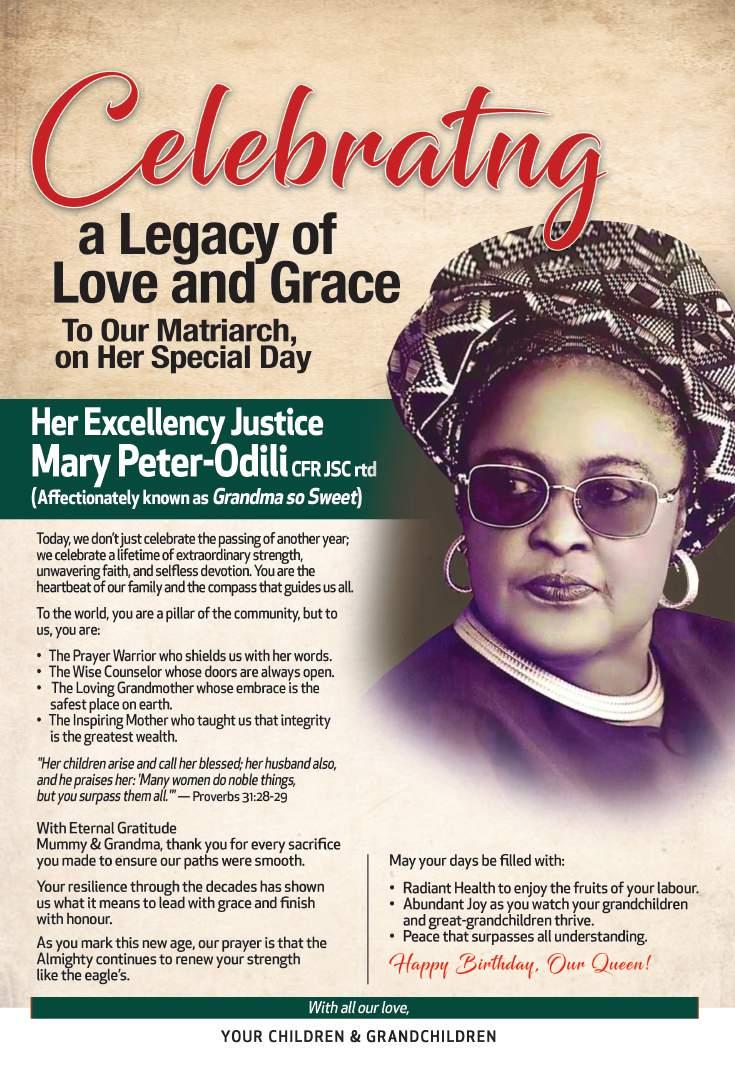
Hon. Justice MARY UKAEGO ODILI, JSC (Rtd), CFR
Signed: Sir Siminalayi Fubara, GSSRS Governor, Rivers State.
Ÿ Chief Jonny Nwonye
Ÿ Chief Paul Ogbonna
Ÿ Sir Orjinta Orji
Ÿ Dr Daniel Eneaniofu
Ÿ Sir Mike Chukwu
Ÿ Engr Jonathan Ivoke
Ikeoha Ndigbo
Your Excellenc y, on behalf of oursel ves and thousands, perhaps millions, whom you touched their lives and the numerous communities you transfor med through infrastr uctural transfor mations cour tesy of your unr ivalled representation, we remember and celebrate you in a special way today.
Ÿ Chief Afam Peter Nnaji
Ÿ Chief Linus Ogbuanu
Ÿ Sir Bright Ekweremadu
Ÿ Hon kenechukwu Ikenegbu
Ÿ Dr Isaac Ekweremadu
Ÿ Sir Okoro Chukwu Isaac
Ÿ Dr Julius Ajah
Ÿ Barr Eric Ogudu
Ÿ Mazi Uche Anichukwu
Ÿ Chief Aneke Clement Emeka
Ÿ Chief Anthony Okoro Obasi
Ÿ Chief Obasi Egwuonwu
From roads in places hither to labelled impossible ter rains, to thousands of bursar y awards and full scholarships, numerous medic al inter ventions, o verseas medic al treatments, widows outreach, adult literac y for thousands, and youth empower ment, just to name a fe w, you shaped lives. You restored hope to the indigent and joy to for lor n communities. And we shall not forget.
Weeping may endure for a night, but joy cometh in the mor ning.
May God continue to abide with you. Amen.
His E xcellenc y S en. Ike E kweremadu, PhD, CFR Former D eputy Pre sident of the S enate Former Sp e aker, EC OWAS Parliament
Ÿ Prof. Udeuhele Godwin Ikechukwu
Ÿ Chief Emeka Ezenwugo
Ÿ Hon Elias Okwu Chinedu Otaka
Ÿ Sir Peter Udeogu
Ÿ Chief Nwuko Valentine Chigozie
Ÿ Chief Sir Ralph Onovo
Ÿ Chief Sir Ugochukwu Udeh
Ÿ Chief Sunny Okafor
Ÿ Mr Chukwu John Ogbonna
Ÿ Engr Michael Uzor
Ÿ Mr Chidi Crescent Eze
Ÿ Engr Chijioke Benjamin Ezekwe
Ÿ Hon Chika Ene
Ÿ Attorney Austin Okeke
Ÿ Mr Onyegbule David
Ÿ Hon Uchechukwu Ogbonna
Ÿ Prince Uche Denchukwu
Ÿ Chief Frank Obasi
Ÿ Chief Onu Johnson
Ÿ Engr Asogwa Jude
Ÿ Surv Achi Osita
Ÿ Chief Mathanus Nnanna Nze
Ÿ Engr Igboekeamu Nnamdi
Ÿ Mr Okolie Kennedy
Ÿ Hon Okey Nathan Ude
Ÿ Mr Ndubisi Agboeze
Ÿ Hon Nancy Nwoha
Ÿ Chief Frank Anioma
LAWYER
LAWYER
THISDAY GUIDE TO THE
SUPREME
COURT JUDGEMENT ON PDP
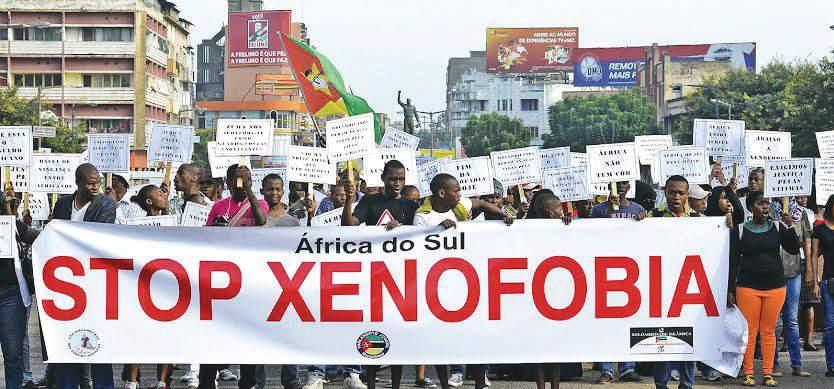
Xenophobia Meets Ingratitude: Is Under-Reacting?Nigeria
Quotable
‘The interesting thing about politics and politicians, is that they seem naturally disposed to self-contradiction. Politicians in Nigeria, in this clime, it appears that their natural instinct is one of prevarication, is one of endlessly oscillating from one position to the other. Integrity, doesn’t seem to be the watchword of our politicians.' - Inibehe Effiong, Human Rights Lawyer and Activist
Conditions for the Success of a Plea of Self-Defence
Federal High Court Announces Fresh Judicial Postings
Court Awards Doctor N104m Against Nigerian Navy
SAN Demands Overhaul of Legal Education System
THISDAY Guide to the Supreme Court Judgement on PDP
From Decree 24 to Democratic Fragility: Rethinking Nigeria’s Flawed Constitution
Even though the 1999 Constitution of the Federal Republic of Nigeria (as amended)(the Constitution) is meant to be the symbol of democracy in Nigeria, the one that supposedly transformed Nigeria from a military dictatorship into a democratic State, it appears that it hasn’t had the desired effect at all. Is this because the Constitution is simply Decree/Promulgation Act No. 24 of 1999, and it is therefore, jinxed as a military contraption? In Awguna v AGF & Anor (1995) LPELR-258 (SC) per Anthony Ikechukwu Iguh, JSC, the Supreme Court held inter alia that “in a military regime, Decrees are the supreme law of the land, and all other laws including the Constitution are inferior thereto”. Or because it is a document fraught with imperfections? Or that, even if it is a perfect document, promoting equity, equality, justice and fairness as it claims to do, Nigerian so-called elites/leaders are corrupt, ill-equipped, and simply autocratic in nature, plagued with the sit-tight syndrome (a recent example of this being the Senate leadership’s attempt to amend the Standing Orders, to exclude others from vying for Principal Offices, thereby leaving themselves, the incumbents, in an advantageous position), and/or dynastic tendencies, only wanting to leave the throne when they die, some even setting the stage for their children to succeed them, also taking advantage of the flaws in the Constitution to misrule? Or a combination of all these factors? Or why has Nigeria turned out to be how it is today, 27 years into the Fourth Republic, particularly in such a modern age where everything is at everybody’s fingertips, so much so that there’s really no excuse for failure or lack of knowledge?
How can it be that there are so few positives in this democratic dispensation of the last 27 years, such as the telecoms revolution, uninterrupted ‘democracy’ and a measure of freedom of expression - see Section 39(1) of the Constitution?
Let’s examine the aforementioned options, to determine how we got here.
Military Contraption
The Constitution refers to itself as a Promulgation Act, which is a Decree that brings in another law into force. The Constitution may not truly be a Constitution, if we go by the definition in Awguna v AGF & Anor (Supra), or by the fact that it wasn’t drawn on the basis of the will of Nigerians/Referendum, or by the fact that it wasn’t enacted by a Legislature, but by the Military Junta of General Abdulsalam Abubakar and the Provisional Ruling Council which brought the document into effect. Though this may bring the issue of its legitimacy into question, I don’t think the origin of the Constitution and its ambitious/false statement, “We the people…..” in the Preamble, mean that the document is doomed, nor does it mean that it is wholly responsible for where Nigeria is today. Its operation/implementation, appears to be a large chunk of the problem.
Some Imperfections in the Constitution
It appears that a good number of the provisions of the Constitution may be acceptable, though many still need to be totally redrawn, as this may very well be part of the reason for Nigeria’s less than satisfactory performance as a nation. While the Constitution mentions that it is of the ‘Federal’ Republic of Nigeria, starting from Section 3 -7 thereof, which seek to devolve powers on different levels of Government, from Federal to State to Local Government, to those sections that provide for State Executives, State Legislatures and State Judiciaries, their funding and other matters related thereto, there are other provisions that belie this so-called Federalism, and instead, promote a Unitary type of system which has resulted in a strong Federal centre and a weaker State/Local level - Unitary Federalism or Pseudo/Centralised Federalism, as such an arrangement is referred to. Countries such as India, Malaysia and maybe South Africa, are somewhat Quasi-Federal, while USA and Canada are better examples of true Federalism. The Constitution presents the facade of a democratic face, when in truth, it allows power to be concentrated at the centre, interestingly giving power to a group, and constitutionally too.
Two of some of the provisions of the Constitution that are said to promote Unitary Federalism in
onikepo braithwaite
onIkepo BraIThwaITe
onikepo.braithwaite@thisdaylive. com onikepob@yahoo.com
"Even though the…Constitution…is meant to be the symbol of democracy in Nigeria….it appears that it hasn’t had the desired effect at all. Is this because the Constitution is simply Decree/Promulgation Act No. 24 of 1999, and it is therefore, jinxed as a military contraption?…Or because it is a document fraught with imperfections?…. Or that…. Nigerian so-called elites/leaders are corrupt, ill-equipped, and simply autocratic in nature, plagued with the sit-tight syndrome….and/or dynastic tendencies, only wanting to leave the throne when they die… Or a combination of all these factors?…. Nigeria’s predicament, isn’t necessarily because the Constitution is a military document, but because of its structural imperfections, contradictions, the Unitary Federalism it actually represents….. Section 318 tells a blatant lie….a multi-pronged approach is required, to fix some of the country’s issues….”
Nigeria are Section 214(1) (allowing for only one Nigeria Police Force) and Section 44 (3) and Item 39 on the Exclusive Legislative List, which place mining and minerals including oil fields, oil mining, and natural gas, in the hands of the Federal Government. The States are not in control of their security - see Section 14(2)(b) of the Constitution, and are also restricted from controlling their own resources to create wealth and realise the economic objectives set in Section 16 of the Constitution, as their mineral resources are vested in the Federal Government of Nigeria (FGN) and controlled by the it, with only 13% derivation going to the State where such minerals are harnessed from - see Section 44(3) of the Constitution. Its almost like saying that all Lawyers cannot own law books, or if they do, they must be deposited at the Supreme Court library in Abuja, where they must go in order to use their books to prepare for their cases, and only for a limited number of hours! All Lawyers must apply to the Supreme Court to use their own books, others also have access to their books, and the Apex Court decides when they can be used.
While true Federalism promotes unity in diversity, strong institutions, economic
competition and growth among the various groups, Unitary Federalism such as what obtains in Nigeria, has resulted in politics being turned into almost an all or nothing game, where those at the centre enjoy most of the control, and others complain of marginalisation. During the Jonathan administration, it was South South; Buhari, Northernisation, and now, Yorubanisation. The lack of economic growth has led to deep poverty, and an unprecedented level of criminality, while the allegations of marginalisation have resulted in secessionist movements, some of which have turned violent. Have the imperfections in constitutional provisions contributed to the problems of Nigeria? Definitely.
Another example of negative consequences of constitutional provisions in our polity, is Section 318 of the Constitution which sets the bar of educational qualifications for office so low, except for the AttorneysGeneral and Judicial Officers, that it has further weakened Nigeria’s institutions, as the major office holders do not require more than a Primary School Leaving Certificate (PSLC) to serve in their positions. Some poorly educated office holders do not
even understand their roles, let alone know what they are doing.
Section 318 tells a blatant lie by equating a PSLC, with attending Secondary School for 5/6 years or obtaining a Secondary School Certificate (SSC) after completing Secondary School, or a Grade II Teacher’s Certificate. Even though the PSLC requires at least 10 years acceptable service, training/courses and ability to read/ write English to INEC’s satisfaction (by the way, INEC isn’t an Examination Board, but an Election Commission and therefore, cannot be the agency to certify literacy levels), in short, the PSLC is deemed to be what it is not. In Orji v Dorji Textile Mills (Nig) Ltd (2009) LPELR-2766 (SC) per Niki Tobi, JSC, the Supreme Court held inter alia that to ‘deem’ “….means to treat a thing as being something that it is not, or as possessing certain qualities that it does not possess. It is a formal word often used in legislation, to create legal fictions….The deeming provision is intended to enlarge the meaning of a particular word…. When a person, for example, is deemed to be something, the only meaning possible is that whereas, he is not in reality that something”.
The enlargement of SSC to include PSLCs, is one of the most ridiculous and ludicrous suppositions in the Constitution. We all know that when we left Primary School, we spent a good 5 years in Secondary School before we sat for the WAEC examination, and obtained our SSCs. How then can the PSLC be equated with the SSC or attending Secondary School up to SSC level, or a Grade II Teacher’s Certificate, even with work experience? Formal education in specific areas, is quite different from work experience in other areas. This makes the Constitution a sham Constitution in more ways than one, though not necessarily rendering it invalid or wholly defective.
Corruption
Although Section 15(3) of the Constitution mandates the State to abolish all corrupt practices and abuse of power, Nigeria has for several decades, operated in a system that encourages, and has almost institutionalised corruption, directly contradicting the provisions of Section 16(1)(a), (b), (2)(b), (c) & (d) of the Constitution, which require the State to harness and distribute the nation’s resources properly and efficiently, for the maximum welfare and happiness of all Nigerians, and the common good, nor are workers paid a reasonable minimum living wage. Instead, wealth is concentrated in the hands of few individuals, politicians and groups. Apart from corruption in leadership and high places, workers can no longer meet their commitments, as their wages have been eroded by inflation and devaluation of the Naira. The Bible, states in Proverbs 6:30: “People do not despise a thief if he steals to satisfy his hunger when he is starving”. While those in high places steal out of greed, the poor steal to survive and live.
Conclusion
The sum and substance of Nigeria’s plight after 27 years of the Fourth Republic is that, a combination of factors have contributed to her predicament, not necessarily because the Constitution is a military document, but because of its structural imperfections, contradictions, the Unitary Federalism it actually represents, as opposed to the true Federalism that a diverse country such as Nigeria requires.
As such, a multi-pronged approach is required to fix some of the country’s issues. It could be that the time for restructuring is now, while the Constitution requires bold amendments to correct the imperfections, or a redrawing to reflect true fiscal Federalism, State Police, higher qualifications for office holders, among other innovations. Government/Politicians/Office holders must always operate an inclusive government, bearing in mind the provisions of Sections 14(3),(4),15(2) & 42 of the Constitution, mandating Federal character, promotion of a sense of belonging for all, prohibition against discrimination, and a firm commitment to prioritising the security and welfare of Nigerians, which is the primary purpose of Government.
For now, Nigeria is showing several signs of democratic fragility, including but not limited to poverty, insecurity, inadequate public trust in Government and its policies, weak institutions and economic stress.
Conditions for the Success of a Plea of Self-Defence
Facts
The Appellant was charged before the High Court of Bauchi State, on a lone count of culpable homicide punishable with death under Section 221 of the Penal Code Law of Bauchi State. The case of the prosecution was that, the Appellant stabbed one Ibrahim Garba to death. The Respondent called six witnesses in proof of its case, while the Appellant and his son testified in defence as DW1 and DW2 respectively. The Appellant raised the plea of selfdefence, alleging that it was the deceased who first hit him with an iron rod three times, and that he only acted in self-defence by stabbing the deceased. After the conclusion of trial, the trial court delivered its judgement in which it found that the plea of self-defence availed the Appellant and consequently, discharged and acquitted him. Dissatisfied with the finding of the trial court, the Respondent appealed to the Court of Appeal. The Court of Appeal however, held that the plea of self-defence would not avail the Appellant given the circumstances of the case. Therefore, the Court of Appeal set aside the decision of the trial court, and replaced it with a verdict of guilt against the Appellant. Aggrieved, the Appellant appealed to the Supreme Court.
Issue for Determination
After considering the issues submitted by the parties in their respective briefs of argument, the Apex Court reformulated the issue for determination as follows:
Whether the Lower Court was right in setting aside the judgement of the trial court, and in convicting the Appellant on the lone count charge of culpable homicide punishable with death preferred against the Appellant?
Arguments
Counsel for the Appellant argued that, the Respondent did not discharge the burden of proof on it beyond reasonable doubt. Counsel argued that the Respondent failed to prove that the death of the deceased was premeditated, thereby failed to establish the requisite mental element (mens rea), as required by law. Counsel contended that the Respondent’s key witnesses - PW1 to PW4 did not witness the stabbing but arrived afterwards, rendering their evidence indirect.
Counsel further argued against PW4’s credibility, on the ground that his testimony was contradictory, and questioned the reliability of the confessional statement of the Respondent, submitting that it was improperly interpreted by a witness who admitted he was not proficient in Hausa. On this footing, Counsel maintained that the Respondent’s case was doubtful, and that the doubt should be resolved in the Appellant’s favour by discharging and acquitting him, relying on OCHIBA v THE STATE (2011) 17 NWLR (Pt. 1277) 663 at 685.
Counsel for the Appellant argued further that the lower court erred by not attaching weight to the Appellant’s evidence, that DW2 found the Appellant’s daughter naked in bed with the deceased in the deceased’s house which the Appellant reported to PW1, and that the deceased later confronted the Appellant, blocked his path and attacked him. Counsel contended that the stabbing was thus, neither planned nor premeditated, but was a response to provocation and an immediate need for self-preservation. Relying on Section 33(2) of the Constitution of the Federal Republic of Nigeria, 1999 (as amended); Section 59 of the Penal Code, and SAMPSON UWAEKWEGHINYA v THE STATE (2005) ALL FWLR (Pt. 259) 1911 at 1928–1929, Counsel submitted that the Appellant had no opportunity to retreat and was justified in stabbing the deceased, and that the defences raised ought to have been upheld in his favour. The Appellant’s Counsel also argued that the Court of Appeal failed to consider the Respondent’s Notice filed by the Appellant, thereby denying the Appellant fair hearing and occasioning a miscarriage of justice on the Appellant.
In response, Counsel for the Respondent submitted that the offence of culpable homicide was proved beyond reasonable doubt against the Appellant, as the evidence established that the Appellant stabbed the deceased and that the deceased died shortly thereafter. Counsel referred to the testimony of the prosecution witnesses who confirmed the stabbing and the ensuing death, and the Appellant’s admission that he stabbed the deceased, contending that such an act would naturally be expected to result in death. Counsel submitted further that, even if the
In the Supreme Court of Nigeria Holden at abuja
On Friday, the 4th day of July, 2025
Before their lordships
Mohammed Lawal Garba adamu Jauro
Moore aseimo abraham adumein Obande Festus Ogbuinya abubakar Sadiq umar Justices, Supreme Court SC/897/2014
Between
MaIlUMBo aDaMU appellaNt And
tHe State reSpoNDeNt
(Lead Judgement delivered by Honourable Abubakar Sadiq Umar, JSC)
confessional statement is discountenanced for interpretation issues, the admissions by the Appellant and DW2 are sufficient to sustain a conviction. Counsel relied on AKINYEMI v THE STATE (1999) 5 NWLR PT. 607 PG. 449.
The Respondent’s Counsel also argued that self-defence will avail an accused person, only if he can show that he had reasonable apprehension of death or grievous bodily harm, and the means of retaliation is not disproportionate; whereas in the instant case, the Appellant failed to demonstrate the existence of these factors and therefore, the plea of self-defence cannot avail him.
In support, Counsel cited OGBA v THE STATE (1999) 3 NWLR (PT. 139) 505 @518. Counsel submitted that there was no credible evidence to support the Appellant’s
“… self-defence will only avail an accused person where there was a necessity for him to take the life of an a deceased aggressor, in order for the accused person to save himself from immediate death or grievous harm threatened upon him by the deceased, and he could not reasonably disengage himself from the encounter with the deceased; and where the force or means of retaliation is not disproportionate to the deceased’s initial act of aggression”
caused by the act of the accused, and (3) that the act was intentional, with knowledge that death or grievous harm was its probable consequence. Applying these principles, the Court found that the fact that the deceased died as a result of a knife wound inflicted by the Appellant, was not only established by the evidence of the prosecution witnesses, but also from the admissions from the Appellant and his son –DW2. The Court held that both actus reus and mens rea were established from these facts, as the law presumes that a person intends the natural consequences of his actions, particularly where a knife is used. The Supreme Court held further that, with the elements of the crime established especially as the Appellant had admitted stabbing the deceased, the burden on the prosecution was discharged, and the onus then shifted on the Appellant to justify the stabbing. On the plea of self-defence entered by the Appellant, the Supreme Court held that the guiding principles of self-defence are necessity and proportion, and self-defence will only avail an accused person where there was a necessity for him to take the life of an a deceased aggressor, in order for the accused person to save himself from immediate death or grievous harm threatened upon him by the deceased, and he could not reasonably disengage himself from the encounter with the deceased; and where the force or means of retaliation is not disproportionate to the deceased’s initial act of aggression.
The Court held that, the prosecution witnesses led evidence that the deceased was unarmed, and was stabbed unexpectedly by the Appellant, after PW2 and PW3 had separated them in a previous confrontation. The Court also referred to the contradiction in the testimonies of the Appellant and DW2, on the instrument they claimed the deceased used to hit the Appellant which rendered their testimonies unbelievable; and while the Appellant claimed that the deceased used an iron rod, DW2 claimed that the deceased used a cutlass. The Court held that in the absence of credible evidence to support the allegation that the deceased hit the Appellant first, the plea of self-defence raised by the Appellant would not avail him. On the defence of provocation raised by the Appellant on appeal, the Apex Court acknowledged that although it was not clearly raised at trial, a court in deciding a criminal matter is enjoined to consider any defence available to an accused person based on the evidence of record, particularly in capital cases. The Court however, stressed that an accused cannot simultaneously rely on both provocation and self-defence for the same offence, citing LAOYE v STATE (1985) 2 NWLR (PT. 10).
The Court then held that for a defence of provocation to avail an accused person, it must be established simultaneously that: (1) the act which led to the action of the person must be truly provocative; (2) the accused person must have acted in the heat of anger occasioning loss of self-control, before there was time for passion or emotion to cool (3) the force or means employed in retaliation, must be proportionate to the provocation offered.
assertion that the deceased attacked him, was armed, or acted as the initial aggressor. He pointed out that the testimonies of the Appellant and his son (DW2) were inconsistent, and emphasised that the investigating Police officer confirmed that no weapon, whether rod or cutlass, was recovered at the scene, thereby undermining the Appellant’s claim of being assaulted.
Counsel also argued that the Appellant’s Respondent’s Notice filed before the Court of Appeal was duly heard and determined contrary to the Appellant’s claim, and referred to page 123-124 of the Record of Appeal where the Appellant argued the Notice and the Court of Appeal held that, in the absence of any complaint on the trial court’s ruling on the no case submission, the Respondent’s Notice is disregarded for want of merit.
Court’s Judgement and Rationale
As a preliminary, the Supreme Court noted that under Nigeria’s criminal jurisprudence, the burden on the prosecution to prove the guilt of an accused person beyond reasonable doubt requires proof of all essential elements of the offence, and once the evidence led establishes all the elements of the offence charged, both the actus reus and mens rea are deemed proved.
Relying on MUSA v THE STATE (2009) 15 NWLR (PT. 1165) 467, the Court held that to secure a conviction for culpable homicide punishable with death, the prosecution must prove: (1) the death of the deceased, (2) that the death was
Applying these principles, the Court rejected the Appellant’s reliance on the plea of provocation, and held that while the Appellant’s discovery of his daughter naked in the deceased’s house may have been provocative, the evidence showed that the Appellant was pacified by a village authority (PW1) prior to his encounter with the deceased, and had been separated from the deceased by PW2 and PW3 before he suddenly turned back and stabbed the deceased, hence, the Appellant could not be said to have acted in the heat of anger occasioning loss of self-control before there was time for passions to cool down. The Apex Court also held that the fact that the Appellant was found to be in possession of two knives when he went to report the matter to PW1 and when he accosted the deceased, lent credence to the fact that the Appellant’s action was premeditated. Finally, on the Appellant’s claim of denial of fair hearing and miscarriage of justice by the alleged refusal of the Court of Appeal to consider his Respondent’s Notice, the Apex Court held that the Notice was indeed, taken into consideration, but found incompetent, as the Appellant had not filed a proper appeal or cross-appeal against the trial court’s ruling on the no-case submission.
Appeal Dismissed.
Representation Jim Okodaso for the Appellant. Adamu Sabiu Gumba for the Respondent.
Reported by
Publishers of the Nigerian Monthly Law Reports (NMLR)(An affiliate of Babalakin & Co.)
Honourable Abubakar Sadiq Umar, JSC
Federal High Court Announces Fresh Judicial Postings
Stories by Steve Aya
The Federal High Court has unveiled a new nationwide posting schedule affecting recently appointed Judges and some serving judicial officers, as part of efforts to strengthen the administration of justice across its divisions. The redeployment, approved by the Chief Judge of the Court, Hon. Justice John Tsoho, followed recommendations made by the National Judicial Council, and was formally announced in a statement issued in Abuja by the Court’s Director of Information, CatherineOby Christopher. According to the statement, all affected Judges
are expected to resume at their respective duty stations on May 13, following the recent appointment of 14 new Judges, and the transfer of three serving Judges to different divisions of the court.
Under the new arrangement, Justices
Salim Olasupo Ibrahim and Onah Chigozie Sergius were assigned to the Abuja Division, while Justice Hassan Dikko was posted to the Gusau Division in Zamfara State, and Justice Sulaiman Amida Hassan to the Osogbo Division in Osun State.
Other appointments
include Justice Muhammad Saidu to Minna, Justice Igboko Conchita to Akure, Justice Onuegbu Angela to Yenagoa and Justice Galumje Edingah to Abakaliki, alongside Justice Ibrahim Eneabo who will serve in the Gombe Division.
The posting schedule also
deployed Justice Abubakar Usman to Ado-Ekiti, Justice Salihu Yunusa to Damaturu, Justice Ikpeme Bassey to Uyo, Justice Shehu Adamu to Maiduguri, and Justice Mohammed Buba to the Dutse Division in Jigawa State.
Also affected by the
reshuffle are Justice BinjinEigegbe Nendelmum Judith, posted to Lokoja, while Justices Usoro Uduak and Nwoye Osinachi Donatus were assigned to the Lagos Division, with the Court confirming that the new postings take immediate effect.
Court Awards Doctor N104m Against Nigerian Navy
The Federal High Court in Lagos has awarded more than N104 million in damages against the Nigerian Navy and the Attorney-General of the Federation, over the shooting and stabbing of a Lagos-based medical doctor, Dr Owen Edo-Ojo.
SAN Demands Overhaul of Legal Education System
Senior Advocate of Nigeria, Emeka Ozoani, has called for a comprehensive reform of Nigeria’s legal education system and professional practice, warning that the legal profession risks losing relevance if it fails to adapt to rapid technological and structural changes.
Ozoani made the call while delivering a paper titled, “The Legal Profession: Embracing the Future” during the 2026 Law Week of the Nigerian Bar Association, Makurdi Branch.
Addressing Judges, Senior Advocates and Legal Practitioners at the event, the former Chairman of the NBA Welfare Committee, said the profession has moved beyond merely anticipating change, stressing that Lawyers must now actively respond to transformation driven by technology, globalisation and evolving regulatory frameworks.
According to him, advances in artificial intelligence and digital technology are already reshaping legal practice through online research platforms, virtual court proceedings and AI-assisted legal services, noting that tools such as LawPavilion have significantly improved legal research and expanded opportunities for younger practitioners.
Ozoani, SAN however,
identified major challenges confronting the sector, including poor infrastructure, limited access to technology and the absence of a clear regulatory framework governing the ethical use of artificial intelligence in legal practice, warning that issues relating to data privacy and confidentiality could undermine public trust.
Ozoani, SAN further urged Lawyers to acquire new competencies beyond traditional legal knowledge, including digital literacy, data interpretation and interdisciplinary expertise, while noting that modern law firms are increasingly evolving into multidisciplinary organisations combining legal, business and regulatory advisory services.
He proposed reforms including a review of legal education curricula to accommodate technology, cybersecurity and digital ethics, expansion of continuing legal education, and stronger collaboration between the NBA, Judiciary, academic institutions and legal technology firms, insisting that the future of the profession would depend on how effectively Lawyers engage technology while preserving the core values of integrity, advocacy and sound judgement.
Delivering judgement in Suit No: FHC/L/ CS/1093/2022, Justice Yellim Bogoro described the conduct of the naval personnel involved in the March 19, 2022 attack in Lekki as “uncivilised and savage”, holding that the assault violated the Applicant’s constitutional rights to dignity and life.
Dr Edo-Ojo had approached the court under the Fundamental Rights (Enforcement Procedure) Rules, seeking declarations and damages over an incident
that allegedly left him with multiple gunshot and stab wounds inflicted by naval ratings.
According to the Applicant, the incident occurred on Gbangala Street, IkateElegushi, Lekki, after he attempted to park his vehicle near a property allegedly occupied by a senior naval officer, leading to a confrontation with a naval rating dressed in mufti. The disagreement reportedly escalated into a violent assault during
which the doctor was beaten, stabbed and dispossessed of valuables including his iPhone, wristwatch, gold bracelet and footwear. The court further heard that after the matter was reported at Ilasan Police Station, one of the naval ratings later emerged with an assault rifle and allegedly opened fire on the doctor and accompanying policemen.
Medical evidence tendered before the court showed that the Applicant sustained gunshot injuries to his groin and thigh, with one bullet
surgically removed, while another remained lodged near critical blood vessels due to the risks involved in extraction.
In its judgment, the court ordered the Nigerian Navy and the Attorney-General of the Federation to pay N3.9 million as special damages, N100 million as aggravated damages, publish public apologies in two national newspapers and across their media platforms, and also awarded N250,000 as cost of the action.
Dismissed Soldier Drags Army to Court Over Trial
A Lance Corporal in the Nigerian Army, Gwotyel Justine, has approached the Federal High Court in Lagos, challenging what he described as his unlawful dismissal from service, following a controversial military trial.
In the suit marked FHC/L/ MISC/620/2026, the soldier alleged serious procedural irregularities and denial of fair hearing during an orderly room trial conducted on April 29, 2025, at the Headquarters of the 9 Brigade in Ikeja, Lagos. Joined as Defendants in the suit are the Nigerian Army, the Minister of Defence, the Chief of Defence Staff, the Chief of
Army Staff, the General Officer Commanding 81 Division, and the Directorate of Army Legal Services.
The application, filed by his Counsel, A. C. Nwokoye, seeks an order of certiorari to quash the proceedings, judgement, and execution of the military trial, which
Court Frees Man Detained for Ten Years
A Lagos High Court sitting in Ikeja has discharged and acquitted Ibrahim Usman after spending nearly a decade in detention without conviction, in a judgement that exposed deep failures within Nigeria’s criminal justice system.
Delivering judgement, Justice Rahman Oshodi held that the prosecution failed to establish the offence of defilement against the Defendant, describing the evidence presented before the court as manifestly insufficient to sustain the charge.
Usman was arrested on June 14, 2016, over allegations of unlawful sexual intercourse with a 13-year-old girl in Ipaja, Lagos, but prosecutors did not file charges until March 2017. Even after the case commenced, proceedings suffered repeated delays as custodial authorities allegedly failed to produce
him in court, despite several production warrants issued by different Judges.
According to the court, the Defendant was absent from proceedings between October 2017 and February 2020, prompting Justice Sybil Nwaka, now of the Court of Appeal, to strike out the matter for want of diligent prosecution. Despite that decision, Usman remained in custody for years, until the Lagos Criminal Information System later discovered he was still incarcerated.
When the trial eventually resumed, the prosecution’s case collapsed under crossexamination. The sole witness, Dr Alagbe Oyedeji of the Mirabel Centre, admitted he neither examined the alleged survivor personally, nor tendered the medical report relied upon in court, while the Complainant
and other material witnesses never testified.
Justice Oshodi further held that prosecutors failed to prove critical elements of the offence, including the Complainant’s age and evidence directly linking the Defendant to the alleged crime. The Judge ruled that the prosecution failed to establish even a prima facie case, requiring Usman to open his defence.
The court also condemned the repeated disobedience of production warrants by custodial authorities, describing it as a grave institutional concern, while warning that detention without diligent prosecution undermines constitutional safeguards. The judgement has now renewed concerns over unlawful detention, prison accountability and the growing number of awaitingtrial inmates trapped in Nigeria’s overcrowded custodial centres.
the Applicant claims was fundamentally flawed and contrary to established legal principles.
The Plaintiff is also asking the court to order his reinstatement into the Army, and grant a stay of further actions arising from the judgement pending the determination of the suit.
In an affidavit supporting the application, Justine stated that he was serving with the 192 Battalion (Rear) in Owode Yewa, Ogun State, under the 81 Division, when he was charged with defamation of character and disobedience to particular orders under the Armed Forces Act, leading to his trial and subsequent dismissal. He further alleged that he was denied the opportunity to defend himself or be represented by Counsel, insisting that the trial was marred by bias, lack of proper investigation, absence of records of proceedings, and failure to call material witnesses, all of which he argued violated his constitutional right to fair hearing.
At the resumed hearing on May 4, the court ordered substituted service of hearing notices and adjourned the matter to May 13 for hearing.
Chief Emeka Ozoani, SAN
Chief Judge, Federal High Court, Hon Justice John Tsoho
Xenophobia Meets Ingratitude: Is Nigeria Under-Reacting?
In the 1970s and 1980s, Nigeria enjoyed a robust relationship with the african National Congress (aNC), playing the role of a Big Brother, not only to other african nations, but to Black South africa which had been subjected to inhumane conditions of apartheid by the White National Party government since 1948, until it was brought to an end in 1994. apartheid institutionalised racial segregation and discrimination, with the Blacks being at the bottom of the pecking order. Nigeria’s role in the struggle to ensure the end of oppressive apartheid regime in South africa, is well documented in the annals of history. However, in the past few years, that otherwise filial relationship has become frosty, with frequent hostilities against Nigerian citizens in South africa. While no one is saying that Nigerians should be allowed to escape justice in any country if they have broken the law, the law must be allowed to take its course. These South african xenophobic attacks have resulted in fatalities, loss of businesses and deportations. The recent inhumane and violent treatment of Nigerians and other africans in the hands of Black South africans, and of Nigerians in Ghana to a lesser extent, is the subject-matter of this edition. Joseph Bodunrin Daudu, SAN; Monday onyekachi Ubani, SAN; Mandy Demechi-Asagba; Kingsley Jesuorobo and Ibrahim eddy Mark examine the possible immediate and remote causes of the Xenophobic craze, its potential consequences, and the Nigerian Government’s seemingly lack lustre reaction to the attack on its citizens residing in South africa, as opposed to decisive action taken by countries such as Botswana, to protect her citizens
Introduction ...... Xenophobia in South Africa: Nigerians as Victims
Joseph Bodunrin Daudu, SAN
Introduction
In the past six weeks or thereabout, Nigerians have been greeted with the news that ‘Black South Africans’ have within their country South Africa, subjected Nigerian and other African immigrants from Zimbabwe, Botswana, Tanzania and other East and South African countries to what has been correctly classified as ‘Xenophobic attacks’. These riots,
as widely reported in the media, have led to killings, harassment, business destruction, and forced displacement of Nigerians and these other African migrants, prompting evacuations, diplomatic tensions,
“Botswana, a SADC State and neighbour of South Africa, whose major source of income is from the supply of electricity and potable water to the latter, immediately upon the targeting of her citizens, took decisive action and cut off the supply of electricity to South Africa, therefore, hitting the look-away host government where it hurts it the most. Other affected nations, have taken similar decisive actions. The reaction of the Nigerian Government, by consensus, is considered and adjudged as most insipid and ineffective”
and calls for stronger protection mechanisms.
Definition of Xenophobia
At this stage, it is appropriate to define the word ‘Xenophobia’ within the current setting in South Africa, and after a review of various definitions in online and print dictionaries, this negative phenomenon can be defined as “the fear, dislike, or hatred of people perceived as foreigners, often leading to the infliction of negative measures such as discrimination, exclusion, or violence rooted in the belief that these outsiders (victims) threaten the identity, dignity, integrity and economic prosperity of their autochthonous society and environment, hence, the resort to violence and intimidation on the stranger community”.
Attacks
This is not a recent, or one-off development. South Africa has a long history of xenophobic situations (2008, 2015, 2019) championed by ethnic blacks, and with their majority black government refusing to act decisively against these
economically damaging attacks. The latest incidents (April 2026) continue this pattern, with the black South African protesters blaming unemployment and economic hardship as the source of their anger towards black foreign migrants (Mostly Nigerians of Igbo extraction), and as described above. These attacks include killings, physical assaults, looting of migrant-owned businesses, and intimidation, creating widespread fear among immigrant communities. Specifically, aside from the deaths that occurred, Nigerian-owned shops and businesses have been looted, vandalised, or forced to shut down, undermining livelihoods and creating economic instability for these migrants. Many have therefore, been forced to flee their homes, stay indoors, or temporarily close their businesses due to threats and mob actions. Nigerian missions advised citizens to remain indoors, during protests in Durban.
Nigeria’s Insufficient Reactive Response From the foregoing narration, the victims are in most instances Nigerian citizens. It is totally irrelevant, to attach them to any particular ethnic group in the country.
President Bola Ahmed Tinubu,GcFr
President cyril ramaphosa
Xenophobia Meets Ingratitude: Is Nigeria Under-reacting?
This is because our Government ought to act decisively and proactively, in the interest of our citizens and foreign policy. As these xenophobic riots undermine African unity, threaten regional stability, and expose deep socioeconomic tensions within South Africa. For us Nigerians and other African migrants, the situation represents a human rights crisis, a security threat, and a challenge to continental solidarity.
Nigerian Government’s Reaction
So, what has our Government done to arrest this assault on her citizens? The media has documented our response as follows:
·Nigeria’s Minister of External Affairs summoned South Africa’s Acting High Commissioner, to express “profound concern”.
·President Tinubu ordered the creation of a Crisis Notification Unit, for Nigerians in danger.
·Plans for evacuation and stronger diplomatic pressure.
·Nigerian lawmakers proposed reviewing bilateral relations, and possibly suspending business permits for South African companies.
Now, it can safely be said that Government response is largely weak, tepid and detached. It is far removed from the seriousness of the harm being inflicted on Nigerians, and their economic interests.
Botswana, a SADC State and neighbour of South Africa, whose major source of income is from the supply of electricity and potable water to the latter, immediately upon the targeting of her citizens, took decisive action and cut off the supply of electricity to South Africa, therefore, hitting the look-away host government where it hurts it the most. Other affected nations, have taken similar decisive actions. The reaction of the Nigerian Government, by consensus, is considered and adjudged, as most insipid and ineffective.
Our National Assembly, whose sole duty is to make laws for the Peace, Order and good Government of Nigeria, in a bid to jump into the fray (although it is not their constitutional duty so to do) thinks that the solution is to embark of a junketing trip to South Africa to ‘appease’ the said nation, and thereby, solve the problem through diplomatic means of dialogue, pacification and conciliation. With respect, this is a wrong approach, because the damage already caused is much more than what pacification can solve.
Historic Ties
Our relationship with South Africa, has historic ties. During the era of apartheid (between 1960-1993), Nigeria was recognised as one of the frontline States in the fight against white domination over the same blacks that are now professing xenophobia against the same nation (Nigeria) that expended vast human and financial resources, in getting them politically to the point where they are today. They recognise that they are indebted to the frontline States, and have deliberately chosen to be wicked and ungrateful. The choice therefore, of this diplomatic placebo of mollification by the National
Assembly, is most inappropriate and insufficient in the circumstances.
But, we need to interrogate further, why the National Assembly has chosen the most ineffective means to resolve this problem, when the suggestions on the table by even civil societies and student groups include, but is not limited to, threat to picket South African businesses like MTN and MultiChoice. One school of thought is that our Nigerian intelligentsia and some of them are senior legislators have business interests in South African conglomerates such as MTN, DSTV etc, and are therefore, most unwilling to proceed against their own economic interest.
At any rate, the Senate that is pushing for this visit, is ill-equipped to resolve this problem. This is because the three arms of the Nigerian Government, have specialised functions to discharge. The desire by the legislature to intervene as it seeks to do, is belittling and disrespectful to the image and economic objectives of Nigeria as a country. Essentially, it breaches the concept of separation of powers, which has placed such problems at the doorstep of the executive to solve. The proposed trip therefore, is a waste of tax payers money. More stringent measures such as
"More stringent measures such as economic sanctions on South African economic interests...and the filing of criminal cases against South Africa at the International Court of Justice for crimes against humanity, are the minimum steps that Nigeria ought to take immediately in a bid to solving the problem…Nigeria must demand accountability, consular protection, and lawful treatment of its citizens, but it must also avoid inflaming reciprocal hostility against South Africans, Ghanaians, or other Africans in Nigeria”
economic sanctions on South African economic interests, the nationalisation of major economic concerns owned by South Africa, and the filing of criminal cases against South Africa at the International Court of justice for crimes against humanity, are the minimum steps that Nigeria ought to take immediately in a bid to solving the problem.
Conclusion
On my own part, since the year 2017, I stopped going to or even transiting anywhere in South Africa, because of their visible hatred for fellow black Africans. They love the whites, that is why Apartheid and imperialism survived for so long there. The Nigerians in South Africa, mainly Igbos, are bearing the brunt of these violent Xenophobic attacks that are systematically crippling their businesses. They have only two options, one, come back home; or two, fight for their rights within the ambit of South African and International law. I am yet to see any of the two. This behaviour is typical.
This is not the time to put individual economic gains, above humanity and the collective interest of our people. Shake the dust of that nation off your feet, and return home. ‘Ile baba kin da èru ba òmò’ as the Yoruba’s would say.
Joseph Bodunrin Daudu, SAN, Past President of the Nigerian Bar Association
Xenophobic Tensions in South Africa: A Welcome Shift from Silence to Action
Monday Onyekachi Ubani, SAN
Recent reports and circulating videos across social media platforms have continued to raise alarm over alleged attacks on black foreigners, particularly Nigerians, in South Africa. The disturbing imagery, often graphic and emotionally charged, suggests patterns of violence, destruction of property, and
targeted hostility. While caution must still guide our conclusions in an era where misinformation spreads rapidly, the recurrence of such narratives cannot be dismissed lightly. It is important to reiterate that, social media content is not always reliable. Videos may be outdated, misattributed, or taken out of context.
Xenophobic Violence in South Africa: An Old Phenomenon
Nonetheless, xenophobic violence in South Africa is not a new phenomenon. The tragic episodes of 2008, 2015, and 2019 remain part of the continent’s collective memory, and lend weight to current concerns.
Responses
What is, however, markedly different in the present situation, is the emerging response from Nigerian authorities. The Federal Government, through the Ministry of Foreign Affairs, has taken a commendable diplomatic step by summoning officials of the South African High Commission for an urgent interface. This move signals a clear departure from perceived silence, and reflects a growing recognition of the gravity of the situation. Equally significant is the intervention of the National Assembly, which has passed a resolution condemning the reported attacks and killings in strong terms. More importantly, the proposed fact-finding visit to South Africa for an on-the-spot assessment, demonstrates a proactive and responsible legislative approach. Such steps are not only symbolic, mbut essential in ensuring that facts are established, accountability is pursued, and appropriate measures
Xenophobia Meets Ingratitude: Is Nigeria Under-Reacting?
are recommended.
These actions, taken together, represent a necessary shift from silence to engagement. Governments bear the responsibility of protecting their citizens, both at home and abroad, and timely diplomatic and legislative responses are critical in moments like this. While it remains essential to verify the authenticity and current relevance of circulating reports, the precautionary principle demands that credible concerns be treated with urgency.
At the same time, it is vital to avoid the dangerous temptation of generalisation. The actions of a violent minority, must not be used to define an entire nation or its people. South Africa, like Nigeria, is a complex society with a shared history of struggle, resilience, and continental solidarity.
Africa stands at a delicate crossroads. Incidents of xenophobia, whether real, exaggerated, or misrepresented, expose underlying tensions that threaten the ideals of unity and cooperation. What is required now is not only reactive measures, but sustained efforts at fostering mutual respect, strengthening diplomatic ties, and addressing the socio-economic triggers of such hostilities.
Truth must remain our guiding principle, and where wrongdoing is established, justice must follow swiftly. Encouragingly, the recent steps taken by the Nigerian Government and the National Assembly, suggest that silence is no longer an option. What must follow is consistency, transparency, and firm commitment to the protection of African lives everywhere.
Ongoing Xenophobic Attacks Against Nigerians in South Africa and Ghana: A Crisis of Law and Humanity
Mandy Demechi-Asagba
Nigerians are being killed and their businesses burnt on foreign soil. Again!
The videos from South Africa and the reports from Ghana, are not isolated “mob incidents.” They are a pattern of xenophobic violence that has now claimed Nigerian lives, and destroyed livelihoods that took years to build. Shops looted. Warehouses razed. Families displaced. The economic impact is devastating, but, the human cost is irreparable.
This must stop. And, it must stop now, through law, not silence.
This Isn’t
Just Crime, it’s a Violation of International Law When a group targets Nigerians solely because of nationality, that is xenophobia. When it results in death, arson, and destruction of property, it becomes a crime against humanity under Article 7 of the Rome Statute of the International Criminal Court.
Both South Africa and Ghana are signatories to:
- The African Charter on Human and Peoples’ Rights — Article 2 prohibits discrimination on the basis of national origin. Article 4 guarantees the right to life and integrity of the person.
- The International Covenant on Civil and Political Rights — Article 6 protects the right to life. Article 26 mandates equal protection of the law.
The duty is not only to prosecute perpetrators, after the fact. The duty is to prevent. The failure of State authorities to act promptly, to secure Nigerian-owned businesses and to publicly condemn these acts, constitutes a breach of the State’s positive obligation to protect life and property.
The Economic Consequences are Self-Destructive
Nigerians in South Africa and Ghana, are predominantly not economic burdens. They are employers, taxpayers, traders, and investors. The informal sector, retail trade, and logistics chains in both countries, rely heavily on Nigerian enterprise.
Burning a Nigerian-owned shop, does not create jobs for locals. It destroys supply chains, reduces tax revenue, and scares away foreign direct investment. No country develops, by expelling the very entrepreneurs who power its markets. The African Continental Free Trade Area cannot succeed, if Africans cannot trade safely in Africa.
The Role of Leadership: Silence is Complicity
The most dangerous element right now, is silence. When political leaders fail to speak out clearly and decisively, they create a vacuum that is filled by
“When a group targets Nigerians solely because of nationality, that is xenophobia. When it results in death, arson, and destruction of property, it becomes a crime against humanity, under Article 7 of the Rome Statute of the International Criminal Court….a State may enforce immigration law, but it may not permit vigilante immigration enforcement, selective denial of services, mob violence, or official indifference toward attacks on foreign Africans”
hate speech and mob justice.
We saw this in 2019, in South Africa. We are seeing it again, now. And, we are seeing similar patterns in parts of Ghana, where Nigerian traders face evictions and targeted attacks. The rhetoric of “they are taking our jobs” is an old, tired lie, used to deflect from domestic economic failures. It has no place in 2026 Africa.
Heads of State must speak. Police Commissioners must act. Courts must prosecute and sentence. Anything less, signals that Nigerian lives are disposable.
What
Must be Done Immediately
For the Governments of South Africa and Ghana:
- Arrest and prosecute every individual captured on video, or identified in eyewitness reports. Charges must include murder, arson, malicious damage to property, and incitement to violence.
- Provide protection for Nigerianowned businesses and communities. Deploy security forces to hotspots before, not after, attacks.
- Compensate victims for loss of life and property, under national tort law and State liability principles.
For the Nigerian Government:
- Invoke diplomatic channels through the Economic Community of West African States, and the African Union Peace and Security Council. This is not a bilateral issue anymore. It is a regional human rights crisis.
- Establish an emergency consular response team in both countries to document cases, provide legal aid, and evacuate nationals where necessary.
- Demand reparations through diplomatic negotiation, for victims whose businesses have been destroyed.
For Civil Society and AWLA:
- Document every case. Names, dates, locations, losses. We will build a dossier for the African Commission on Human and Peoples’ Rights.
- Legal Aid: AWLA will offer pro bono legal support to Nigerian victims pursuing civil claims in South African and Ghanaian courts.
- Public advocacy: Use every
platform to counter the false narrative, that Nigerians are the problem. The problem is impunity.
A Personal Word to Nigerians Abroad
To every Nigerian trader in Johannesburg, Accra, or Kumasi reading this: You are not alone. Your life matters. Your business matters. Your dignity is protected, under African and international law. Do not retaliate. Document. Report. Contact the Nigerian High Commission and AWLA immediately. We see you. We stand with you.
Africa Must Choose
Africa in 2026, faces a choice. Do we remain a continent where borders within Africa, are more dangerous than borders with the rest of the world? Or do we live up to the African Union’s Agenda 2063 vision of a borderless, integrated continent?
Xenophobia is not African culture. ‘Ubuntu’ in South Africa means “I am, because we are”. It does not mean “I am, because they are gone”.
The blood of Nigerians on foreign streets, stains the conscience of all of us. If we do not condemn it today, it may be the blood of a Ghanaian in Nigeria tomorrow. The cycle must end here. Justice must not only be done. It must be seen to be done. And, it must be done now.
#StopXenophobia #ProtectNigerians #AfricanLivesMatter #JusticeForVictims Mrs Mandy Demechi-Alagbada, President, African Women Lawyers Association (AWLA)
When Africans Turn on Africans: Xenophobia, Human Rights, and the Crisis of Continental Solidarity
An analysis of attacks directed at Black foreigners, especially Nigerians, in South Africa and Ghana
Kingsley Jesuorobo Executive Opinion
The current hostility towards Nigerians and other Black African foreigners in South Africa, and the renewed antiNigerian agitation in Ghana, should not be
Foreign Affairs Minister, Bianca Odumegwu-Ojukwu
Xenophobia Meets Ingratitude: Is Nigeria Under-Reacting?
treated merely as “immigration tension.” It is a continental rule-of-law problem. It exposes the gap between Africa’s rhetoric of Pan-Africanism and the lived reality of African mobility: Africans are promised integration, free movement, African Continental Free Trade Area (AfCFTA) opportunity, dignity, and solidarity; yet, in practice, they are often scapegoated when host States fail to deliver jobs, policing, housing, health care, and social services.
As of May 9, 2026, the more acute flashpoint remains South Africa. The Associated Press (AP) reported on May 4, 2026 that Nigeria was arranging the voluntary repatriation of 130 Nigerians after a new wave of anti-immigration protests in South Africa; Nigeria also summoned South Africa’s Acting High Commissioner, and requested investigations into two separate deaths of Nigerians involving South African security operatives. South African officials condemned xenophobic acts, and promised enforcement.
In South Africa, Operation Dudula has also been reported blocking foreigners from public health clinics, demanding identity documents, closing foreign-owned shops, and interfering with foreign children’s access to schools. A Johannesburg High Court order of November 4, 2025 interdicted harassment of foreign nationals, and interference with access to health care and schools; subsequent reporting alleged continued obstruction at some Johannesburg clinics. South Africa’s constitutional framework protects access to health care for “everyone”, and prohibits refusal of emergency medical treatment. Ghana’s situation appears less violent, but politically dangerous. Reports in July 2025 and again in May 2026 described anti-Nigerian protests and “Nigerians must go” rhetoric in Ghana, including allegations of crime, prostitution, ritual killings, human trafficking, armed robbery, and economic dominance. Nigeria’s diplomatic response and community-level statements emphasised calm, de-escalation, and the absence of justification for collective blame.
Legal Implications
Legally, these events raise at least five issues: State protection, non-discrimination, due process in expulsion, access to public services, and accountability for private violence.
Under the African Charter on Human and Peoples’ Rights (African Charter), South Africa and Ghana are not only expected to refrain from direct abuse; they must adopt measures to give effect to Charter rights. Article 2 guarantees rights without distinction based on race, ethnic group, colour, national or social origin, or other status. Article 3 guarantees equality before the law, and equal protection of the law. Article 4 protects life, and integrity of the person. Article 5 protects dignity, and prohibits degrading treatment. Article 6 protects liberty and security. This means a State may enforce immigra-
tion law, but it may not permit vigilante immigration enforcement, selective denial of services, mob violence, or official indifference toward attacks on foreign Africans.
The strongest African Charter provision, is Article 12. It allows lawful restrictions on movement and residence, but it also says a legally admitted non-national may only be expelled by a lawful decision. It expressly prohibits mass expulsion of non-nationals, defined as expulsion aimed at national, racial, ethnic, or religious groups.
Slogans such as “Nigerians must go” are therefore, not merely ugly rhetoric. If translated into State policy, tolerated collective removal, or selective policing of Nigerians as a group, they would directly offend the African Charter’s anti-mass-expulsion principle.
The denial of clinics to migrants in South Africa also implicates Article 16 of the African Charter, which protects the right to the best attainable state of physical and mental health, and requires States to take measures to ensure medical attention when people are sick. It also engages Section 27 of the South African Constitution, which protects access to health care services for “everyone”, and provides that no one may be refused emergency medical treatment.
Globally, the International Convention on the Elimination of All Forms of Racial Discrimination (ICERD) is directly relevant. Article 5 requires States to prohibit and eliminate racial discrimination and guarantee equality before the law without distinction as to race, colour, or national or ethnic origin. This includes equal treatment
“Ghana’s situation appears less violent, but politically dangerous. Reports in July 2025 and again in May 2026 described antiNigerian protests and “Nigerians must go” rhetoric in Ghana, including allegations of crime, prostitution, ritual killings, human trafficking, armed robbery, and economic dominance”
before tribunals, and protection by the State against violence or bodily harm, whether inflicted by officials or by any individual, group, or institution.
This is crucial, because xenophobia against Nigerians and other Black foreigners often works through nationality, ethnicity, language, accent, documentation status, and perceived foreignness, rather than crude “race” alone.
The International Covenant on Civil and Political Rights (ICCPR) reinforces the same principle through human dignity, life, security, due process, equality before the law, and lawful expulsion standards. Article 13 protects lawfully present aliens against expulsion, except through a decision reached in accordance with law, subject to limited national-security exceptions. The International Convention on the Protection of the Rights of All Migrant Workers and Members of Their Families (Migrant Workers Convention) is also instructive, because Article 7 applies without distinction based on race, colour, national or ethnic origin, nationality, or other status.
Even where a migrant is undocumented, the fundamental human rights baseline does not disappear. Irregular migration may justify lawful immigration procedures; it does not justify mob violence, denial of emergency health care, collective punishment, extortion, racial profiling, or degrading treatment.
African Integration and Treaty Implications
The attacks are also a direct challenge, to Africa’s integration project. The African Union (AU) adopted the Protocol to the Treaty Establishing the African Economic Community Relating to Free Movement of Persons, Right of Residence and Right of Establishment (AU Free Movement Protocol), on January 29, 2018. Its purpose is to implement free movement of persons, the right of residence, and the right of establishment across the continent. Yet, the AU Free Movement Protocol
remains politically weak. Available AU-linked and Africa Visa Openness reporting indicates that, as of 2025, the Protocol had 32 signatures and only four ratifications - Mali, Niger, Rwanda, and São Tomé and Príncipe - below the 15 ratifications required for entry into force. That matters because, the African Continental Free Trade Area (AfCFTA) cannot succeed on goods and capital alone. The AfCFTA Agreement’s objectives include creating a single market for goods and services, facilitated by movement of persons, and contributing to the movement of capital and natural persons. Lawyers, traders, students, transporters, health workers, entertainers, software founders, seasonal workers, and small businesses must move.
In West Africa, Ghana and Nigeria have an additional regional obligation under the Economic Community of West African States (ECOWAS) framework, especially the Protocol Relating to Free Movement of Persons, Residence and Establishment (ECOWAS Free Movement Protocol). The ECOWAS Free Movement Protocol contemplates the progressive establishment of rights of entry, residence, and establishment through three phases: abolition of visas and entry permits, right of residence, and right of establishment. Ghana may regulate trade, residency, crime, business licensing, and immigration compliance. However, hostility framed as collective removal of Nigerians undermines ECOWAS citizenship, regional trust, and the legal promise of West African integration.
Political Implications
Politically, xenophobia is a dangerous substitute for governance. It allows politicians, vigilante groups, and populist movements to redirect anger over unemployment, crime, health-care collapse, housing shortages, inequality, and weak policing, towards foreigners.
In South Africa, Operation Dudula’s claims are tied to the argument that migrants take jobs from South Africans, in a country with severe unemployment. South Africa’s official unemployment rate
South Africans Protesting against Nigerians
Xenophobia Meets Ingratitude: Is Nigeria Under-Reacting?
was 31.4% in the fourth quarter of 2025, according to reporting based on Statistics South Africa’s Quarterly Labour Force Survey. That narrative may be politically convenient, but it weakens constitutional democracy by outsourcing State functions to mobs.
For Nigeria, the issue creates diplomatic pressure to protect citizens abroad, while avoiding retaliatory nationalism at home. Nigeria must demand accountability, consular protection, and lawful treatment of its citizens, but it must also avoid inflaming reciprocal hostility against South Africans, Ghanaians, or other Africans in Nigeria.
For South Africa, the attacks damage its moral authority as a country that received continental solidarity during apartheid. Many African countries supported the anti-apartheid struggle diplomatically, materially, and morally. Xenophobic hostility toward other Africans therefore, carries a historical betrayal: the beneficiaries of Pan-African solidarity are now seen, in some quarters, as rejecting African solidarity.
For Ghana, anti-Nigerian agitation risks reopening historical wounds. It recalls Ghana’s 1969 Aliens Compliance Order and Nigeria’s 1983 expulsion of West African migrants, including Ghanaians, episodes that scholars have analysed as part of a broader West African history of nativism and forced removals. It could also erode one of West Africa’s most important bilateral relationships. Continentally, the political danger is copycat nationalism. “Locals first” movements in one State, can embolden reciprocal hostility elsewhere. Nigerians in South Africa, Zimbabweans in South Africa, Nigerians in Ghana, Somalis in Kenya, Congolese in Southern Africa, and other mobile African communities, may all become targets whenever economic conditions deteriorate.
Social Implications
Socially, these attacks corrode African identity. They turn shared Blackness, shared colonial histories, shared economic struggle, and shared aspirations for development into suspicion. They also produce collective punishment: one Nigerian accused of crime, becomes “Nigerians are criminals”; one undocumented migrant becomes “foreigners are invading”; one overloaded clinic becomes, “foreigners are stealing health care”; one foreign-owned shop becomes, “foreigners are taking over”.
This has severe human consequences. Migrants may avoid clinics, Police stations, schools, labour offices, and courts, out of fear. Families may become undocumented, not because they entered unlawfully, but because bureaucratic systems are slow, expensive, corrupt, or hostile. Children inherit stigma. Businesses close. Communities segregate. Social media then amplifies fear, faster than governments can restore trust.
The most troubling aspect is that xenophobia among Black Africans fractures the moral language of anti-racism. Africans cannot credibly denounce racism abroad, while tolerating nationality-based dehumanisation at home. Xenophobia against Nigerians or other African migrants may not always be “racism” in the classic
white-versus-Black sense, but it is a form of group hatred that often produces the same practical injuries: exclusion, violence, humiliation, denial of services, and unequal protection.
Conclusion
The State has every right to enforce immigration, criminal, labour, businesslicensing, tax, and public-health laws. But, the line is crossed when enforcement becomes ethnic profiling, mob action, denial of emergency services, collective blame, threats of mass expulsion, or State tolerance of vigilante intimidation.
South Africa and Ghana should treat these incidents, as early-warning signs of broader democratic decay. The proper response, is not appeasement of xenophobic groups. It is lawful immigration administration, prosecution of attackers, protection of victims, public correction of misinformation, and bilateral consular cooperation.
At the AU and ECOWAS levels, the deeper answer is to make African mobility orderly, documented, rightsbased, and economically useful. Free movement cannot mean, borderlessness without systems. But, sovereignty cannot mean mob veto over the humanity of other Africans.
Practical Recommendations
South Africa should enforce court orders against vigilante groups, prosecute attacks on migrants, protect clinics and schools, and publicly distinguish lawful immigration enforcement from
“Even where a migrant is undocumented, the fundamental human rights baseline does not disappear. Irregular migration may justify lawful immigration procedures; it does not justify mob violence, denial of emergency health care, collective punishment, extortion, racial profiling, or degrading treatment….Politically, xenophobia is a dangerous substitute for governance. It allows politicians, vigilante groups, and populist movements to redirect anger over unemployment, crime, health-care collapse, housing shortages, inequality, and weak policing, towards foreigners”
xenophobic harassment.
Ghana should criminally deter incitement to collective expulsion and use the Nigeria-Ghana Joint Commission to address trade, residency, landlord, licensing, policing, and community grievances before they become street politics.
Nigeria should strengthen consular registration, legal-aid channels, emergency response desks, and diaspora documentation support. It should avoid retaliatory rhetoric, because reciprocal xenophobia would only endanger Ghanaians, South Africans, and other Africans in Nigeria.
The AU and ECOWAS should create a rapid-response mechanism for xenophobic violence, including fact-finding missions, early-warning alerts, model anti-xenophobia legislation, and a public database of attacks, prosecutions, and remedies.
The AU should also push ratification of the AU Free Movement Protocol, but pair it with credible systems: biometric identity cooperation, labour-market data, portable social protections, mutual recognition of qualifications, fast consular dispute channels, and stronger national anti-discrimination enforcement.
Bottom Line
The legal bottom line is clear: African States may regulate migration, but they may not dehumanise migrants.
The political bottom line is equally clear: a continent that attacks its own mobile citizens, cannot build credible continental integration.
The social bottom line is most urgent: xenophobia against Nigerians or other Black foreigners is not only an attack on migrants; it is an attack on the idea of Africa as a community of peoples.
Kingsley Jesuorobo, Lawyer; Member, Board of Governors of the Law Commission of Ontario, Canada; Vice President, African Bar Association (North America)
African Union Must Act Fast on Xenophobic Attacks in South Africa
Ibrahim Eddy Mark
The African Union must act swiftly and decisively, to address the ongoing xenophobic attacks against fellow Africans in South Africa. There is absolutely no justification, for such violence.
It is important to remember that many African nations stood firmly with South Africa during its long windy and difficult struggle against apartheid, offering support, solidarity, and sacrifice. That shared history, should be a foundation for unity-not division.
Africa cannot afford to turn against itself. Acts of xenophobia undermine the vision of a united, peaceful, and prosperous continent.
Immediate action is needed to protect lives, restore dignity, and reinforce the spirit of African brotherhood.
Some African countries have began taking steps to protect their citizens, in response to the xenophobic attacks in South Africa, while these efforts are understandable, isolated actions by individual nations will not produce a lasting solution.
What is Needed
What is needed is a coordinated and unified response led by the African Union. Only a collective approach can deliver meaningful, consistent, and enforceable outcomes, that address the root causes of these attacks and prevent their recurrence. A fragmented response, risks weakening the continent's voice and effectiveness. Africa must stand together, speak with one voice, and act decisively to end xenophobia and uphold the principles of unity, safety, and mutual respect among all African people.
Ibrahim Eddy Mark, President,
African Bar Association
Chairman, Nigerians in Diaspora Commission (NIDCOM), Hon Abike-Dabiri-Erewa
Acting Group Politics Editor DEJI ELUMOYE
Email: deji.elumoye@thisdaylive.com
08033025611 sms only
2027: Of Senate’s Amended Standing Orders and Battle for Power
Fresh controversy has engulfed the Senate after amendments to its Standing Orders restricted eligibility for presiding offices in the 11th National assembly to returning ranking senators. The changes triggered constitutional debates, fierce clashes among lawmakers and accusations of political manipulation, despite the Senate’s partial reversal of controversial provisions on oath-taking procedures. sunday Aborisade reports.
The Nigerian Senate has once again found itself at the centre of a fierce constitutional and political storm. What began as an apparently technical amendment to its Standing Orders has rapidly snowballed into a major power struggle capable of reshaping the political architecture of the National Assembly ahead of the 2027 general election.
In one sweeping move, the Red Chamber amended its rules to effectively restrict eligibility for the offices of Senate President and Deputy Senate President in the incoming 11th National Assembly to senators who are currently serving in the 10th Senate and who would return in 2027 after completing at least two terms in office.
The amendment instantly triggered accusations of political exclusion, constitutional manipulation, institutional self-preservation and a deliberate attempt by entrenched forces within the Senate leadership to predetermine succession in the next Assembly.
Within 72 hours, the chamber descended into open confrontation, sharp exchanges, procedural reversals and unprecedented public criticism among ranking senators, exposing deep fractures within the institution.
At the heart of the controversy lies a fundamental question: Can the Senate, under its constitutional powers to regulate internal procedures, legally impose additional qualifications for the election of its presiding officers beyond what the Constitution itself provides?
The controversy began when the Senate adopted far-reaching amendments to its Standing Orders after a marathon executive session.
Leading the debate on behalf of the Senate Leader, Senator Opeyemi Bamidele, Deputy Senate Leader, Senator Oyelola Ashiru invoked Section 60 of the 1999 Constitution, which empowers each legislative chamber to regulate its own procedures.
According to the revised rules, any senator seeking election as Senate President or Deputy Senate President in 2027 must have served for at least two terms, amounting to eight years, with one of those terms immediately preceding the election of the 11th Senate in 2027.
In practical terms, the amendment excludes:
Former senators attempting a comeback in 2027; Newly elected senators entering the 11th Assembly; Political heavyweights returning after years outside the Senate; Governors or ministers seeking Senate leadership positions after re-election into the chamber.
Only current members of the 10th Senate who successfully secure reelection into the 11th Senate would qualify.
Though framed officially as a measure aimed at promoting institutional continuity and parliamentary stability, the political implications were impossible to ignore.
The rule is widely viewed as a direct obstacle to the perceived 2027 ambition of Imo State Governor, Hope Uzodimma, who is reportedly considering a return to the Senate even before his tenure expires in 2028.
Uzodinma, a former senator, would be disqualified under the amended rules because he is not currently serving in the 10th Senate.
The governor had already appeared for screening before the All Progressives Congress (APC) screening committee and he is expected to vacate his office as governor if he wins the January, 2027 National Assembly election in order to resume as Senator in the 11th National Assembly.
This immediately fuelled speculation that the amendment was less about legislative reform and more about political engineering.
Behind the constitutional arguments lies an unmistakable struggle for control.
Several senators including Adams Oshiomhole (Edo North) and Senator Ezenwa Onyewuchi, who is representing Imo East Senatorial District admitted that the amendment was designed to preserve the dominance of ranking lawmakers and prevent outsiders from disrupting existing power arrangements.
Oshiomhole described the move as “a pre-emptive strike to shape the leadership succession in the next Assembly.”
That description captures the deeper anxiety within the Senate.
Historically, Senate leadership contests have often produced dramatic political realignments. Powerful newcomers, returning senators and politically influential governors have repeatedly altered internal calculations within the National Assembly.
The current Senate leadership appears determined to avoid such unpredictability in 2027.
Supporters of the amendment argue that legislative leadership requires institutional memory, parliamentary experience and procedural maturity that first-time senators or returning outsiders may lack.
They point to advanced parliamentary democracies where seniority often influences leadership emergence.
But critics insist the amendment crosses the line between procedural regulation and constitutional exclusion.
The most powerful constitutional challenge came from Onyewuchi, who openly declared that the amendment violated Section 50 of the Constitution.
According tohim, Section 50 simply provides
Can the senate legitimately define internal ranking requirements for leadership positions? or does such action violate constitutional guarantees of equal eligibility among elected senators? Those questions may ultimately require judicial interpretation if dissatisfied parties decide to approach the courts.
that the Senate President and Deputy Senate President shall be elected “by members from among themselves.”
For Onyewuchi and other critics, the Constitution deliberately avoided imposing additional qualifications.
Their argument is straightforward: once an individual is duly elected as senator, every senator should possess equal constitutional rights to contest for any office within the chamber.
Anything beyond that, they argue, amounts to constitutional overreach.
Onyewuchi further invoked Section 1(3) of the Constitution, which states that any law inconsistent with the Constitution becomes void to the extent of that inconsistency.
His warning was particularly striking.
According to him, the amendment could create the dangerous perception that the Senate leadership of 2027 is already being predetermined years before Nigerians even vote.
That argument touches a sensitive nerve in Nigerian politics. Public trust in democratic institutions is already fragile. Any suggestion that political outcomes are being manipulated behind closed doors naturally generates suspicion.
If the constitutional debate exposed institutional tension, Oshiomhole transformed it into open political warfare.
The former Edo governor, ex-president of the Nigeria Labour Congress and a former National Chairman of the APC, fiercely resisted the adoption of the amended rules during plenary.
When Senate President, Godswill Akpabio attempted to proceed with adoption of the Votes and Proceedings, Oshiomhole repeatedly raised points of order.
Akpabio refused to recognise him and the confrontation escalated rapidly. He invoked Senate rules empowering him to maintain order and warned that Oshiomhole could be removed from the chamber if he continued disrupting proceedings.
The chamber became visibly tensed but Oshiomhole was not done.
NOTE: Interested readers should continue in the online edition on www.thisdaylive.com
Akpabio
oshiomhole
Uzodinma
Fidelity Bank Grows Gross Earnings by 45.6% for FY 2025
Nume Ekeghe
Fidelity Bank Plc, has announced its audited financial results for the year ended 31 December 2025, reporting Gross Earnings growth of 45.6 per cent from N1.04 trillion in 2024 to N1.52 trillion in FY 2025, reflecting stronger topline momentum across core business segments. According to the bank’s results released on the Nigerian Exchange (NGX) portal, the group recorded a Profit After Tax of N242.4 billion. This performance was underpinned by a 38.7 per cent year-on-year increase in interest and similar income to N1.11 trillion (FY 2024: N803.1
billion) and a 44.7 per cent year-on-year rise in fees and commission income to N113.4 billion (FY 2024: N78.4 billion).
On the balance sheet, total assets expanded by 18.6 per cent year on year to N10.46 trillion (FY 2024: N8.82 trillion), while customer deposits increased by 16.1 per cent year on year to N6.89 trillion (FY 2024: N5.94 trillion), reflecting continued franchise strength and an improved funding profile. Net loans and advances declined by 2.4 per cent year on year to N4.28 trillion (FY 2024: N4.39 trillion) as customers paid down on their mature obligations.
The bank also strengthened its capital
position during the period, with eligible capital rising to N561 billion, above the regulatory minimum of N500 billion for banks with international authorisation. In addition, capital adequacy remained robust, with Capital Adequacy Ratio of 30.94 percent as at 31 December 2025 (FY 2024: 23.47 percent).
Ranked among the best banks in Nigeria, Fidelity Bank Plc is a full-fledged Commercial Deposit Money Bank serving over 9.1 million customers through digital banking channels, its 255 business offices in Nigeria and United Kingdom subsidiary, FidBank UK Limited.
LG Introduces xboom Speakers, Premium Soundbars to Nigeria
LG Electronics has introduced its xboom speakers and premium soundbars, targeting consumers seeking smarter and highperformance sound solutions.
The company disclosed this in a statement yesterday, adding that the move reflects its commitment to intelligent sound innovation and strengthening its presence in Nigeria’s growing audio segment, driven by increasing demand for quality entertainment experiences.
According to LG Electronics, Nigeria’s audio and home entertainment market continues to grow steadily due to a youthful population, rapid urbanisation, rising streaming culture, and strong interest in music, sports, and social entertainment.
It said industry trends show that consumers are increasingly prioritising sound clarity, smart features, and durability alongside powerful output, and that its audio portfolio has been designed to meet these changing demands through products that combine advanced technology with user convenience.
Speaking on the development, General Manager, Audio Division, LG Electronics, Choongbae Seok, said the company remains focused on delivering accessible and reliable audio experiences for Nigerian households.
“At LG, we recognise that sound plays a powerful role in how people connect, celebrate, and experience entertainment,” he said.
He added that Nigeria remains a
dynamic market and that LG’s xboom speakers and soundbars were designed to align with modern consumer lifestyles while raising standards in audio performance.
He noted that the xboom range was built to suit diverse consumer needs, from compact portable speakers for outdoor use to high-output models suitable for large gatherings. The products also feature long battery life, portability, and durability tailored to Nigerian users.
Industry observers say brands that combine quality sound performance, intuitive technology, and reliable aftersales support are better positioned to attract consumers in Nigeria’s competitive and value-conscious market.
Oyeyemi to Deliver City Business’ 10th Anniversary Lecture
The Publisher of City Business News Online, Mr Moses Ebosele, has announced plans to commemorate the organisation’s 10th anniversary with a highlevel lecture scheduled for Thursday, June 25, 2026, at Rockview Hotels, Apapa, Lagos by 10:00am.
Speaking ahead of the anniversary celebration, Ebosele said the milestone reflects a decade of impactful Business News reporting, commitment to credible business Journalism, industry-focused reporting, and support for economic development in Nigeria.
He disclosed that the highlight of the event would be a keynote lecture titled: “Logistics As The Engine Room Of Nigeria’s Economy,”
to be delivered by Dr Boboye Oyeyemi, OFR, mni, NPOM, FCILT.
Dr. Oyeyemi, a respected authority in transportation and logistics management, is the immediate past Corps Marshal of the Federal Road Safety Corps (FRSC) and the current President of the Chartered Institute of Logistics and Transport (CILT).
According to Ebosele, the anniversary event is expected to attract key stakeholders from government, the private sector, industry regulatory agencies, and the media.
Among dignitaries and organisations expected at the event are the founder of ABC Transport PLC, Mr Frank Nneji, the Nigeria Customs
Service (NCS), Nigerian Ports Authority (NPA), the Nigerian Maritime Administration and Safety Agency (NIMASA), Nigerian Shippers’ Council (NCS), representative of Banks, foremost auto firms, among others.
Ebosele noted that the event would also provide a platform for meaningful discussions on the role of logistics, transportation, and supply chain systems in driving Nigeria’s economic growth and competitiveness.
He expressed appreciation to staff, readers, partners, stakeholders, and advertisers for their support over the past decade, reaffirming City Business News’ commitment to excellence, professionalism, and impactful journalism.
of the
following: Saharan Blend (Algeria), Djeno (Congo), Zafiro (Equatorial Guinea), Rabi Light (Gabon), Iran Heavy (Islamic Republic of Iran), Basrah Medium (Iraq), Kuwait Export (Kuwait), Es Sider (Libya), Bonny Light (Nigeria), Arab Light (Saudi Arabia), Murban (UAE) and Merey (Venezuela).
Stock Market Crosses N160trn Mark on Demand for Dangote Cement, Others
The stock market section of the Nigerian Exchange Limited (NGX) opened trading for the new week as market capitalisation crossed the N160 trillion mark amid investors’ demand for Dangote Cement Plc (up by 8.5 per cent) and 58 others.
The NGX All-Share Index gained by 5,709.71 basis points
or 2.33 per cent to close at 250,485.54 basis points. Similarly, the overall market capitalisation value rose by N3.16 trillion to close at N 160.256 trillion.
The market positive performance was driven by price appreciation in large and medium capitalised stocks which are; Dangote Cement, MTN Nigeria Communications (MTNN), NASCON Allied Industries, Nigerian Aviation Handling
Company Plc (NAHCO) and BUA Cement. Investor sentiment, as measured by market breadth closed positive as 58 stocks advanced, while 21 declined. Chams Holding Company, FTN Cocoa Processors, International Energy Insurance, Livestock Feeds and R.T. Briscoe recorded the highest price gain of 10 per cent each to close at N3.41, N9.13, N2.86, N8.80 and N16.50 respectively, per share.
MeCure Industries and Berger Paints followed with a gain of 9.99 per cent each to close at N79.85 and N119.45 respectively, while Zichis Agro Allied Industry rose by 9.98 per cent to close at N36.69, per share.
On the other hand, Prestige Assurance led the losers’ chart by 10 per cent to close at N1.44, per share. Sovereign Trust Insurance followed with a decline of 9.96 per cent to close at N2.26, while
University Press lost 9.09 per cent to close at N4.00, per share.
Ellah Lakes lost 9.05 per cent to close at N10.05, while Tantalizer declined by 7.69 per cent to close at N4.20, per share.
The total volume traded rose by 28.63 per cent to 1.486 million units, valued at N68.455 billion, and exchanged in 94,834 deals. Transactions in the shares of Veritas Kapital Assurance
Kayode Tokede
FEaturEs How to Move on from Privileged Office
In a society where people commonly hold fast to government and political offices to the point of clogging the wheel of progress, the Obaseki example of how to move on and remain relevant without the usual tension and desperation needs to be studied, Crusoe Osagie writes
If there is one enduring mystery around holders of political office in Nigeria, it is the seeming difficulty many of them have in moving on gracefully after service.
Since democracy returned to Nigeria in 1999, simply accepting a new reality and either returning to private life or reinventing themselves in ways that continue to add value to society has proved difficult for many political leaders, particularly governors who have completed the maximum eight years allowed by the Constitution.
For many former governors, the next destination is often the Senate, where they seek to represent only a section of states they once governed in full capacity. Others continue to hover around the political space, unwilling to relinquish influence or allow a new generation of leaders to emerge independently. In many cases, this desperation for continued relevance has contributed significantly to the political tensions that frequently overheat the Nigerian polity from one election cycle to another.
From the prolonged political disputes involving former governors in Abia State, to the battles that trailed Peter Obi’s tenure in Anambra State, the Ambode saga in Lagos, the Sim Fubara conflict in Rivers State, and the political hostilities directed at former Edo State Governor, Mr. Godwin Obaseki, by Senator Adams Oshiomhole, many of these crises have stemmed from the inability of political actors to disengage from power with dignity.
This is why the conduct of former Edo State Governor, Mr. Godwin Obaseki, since leaving office in 2024, deserves careful examination and even study as a model for present and future public office holders. Without the usual noise in the media or any visible attempt to destabilize the political environment in Edo State, Obaseki has retained his relevance while continuing to contribute meaningfully to society with remarkable personal, professional, and intellectual elegance.
Another public figure who has similarly departed political office with enviable grace is former Vice President, Professor Yemi Osinbajo. Since the end of his tenure in 2023, Osinbajo has largely devoted himself to intellectual engagement, global policy conversations, leadership advocacy, and Christian ministry, reflecting a calm and dignified transition from power.
However, while there are a few examples of former leaders who have embraced post-office life with maturity and restraint, they remain exceptions in a political culture where many continue to desperately seek relevance long after leaving office.
For Obaseki, the period after government has not been one of political agitation but of reflection, intellectual engagement, and contribution to global knowledge.
Shortly after leaving office, the former governor stated that one of his priorities was to take time to look after his health after eight straight years of demanding public service. Beyond that, he reiterated his desire to return to the academia and contribute to the expansion of knowledge, particularly in the areas of governance reforms, economic transformation, education policy, and institutional development.
Interestingly, this trajectory was not accidental.
In 2020, shortly after winning re-election for a second term as governor, Obaseki granted an interview on ARISE Television during which Dr. Reuben Abati asked him what political office he intended to pursue after completing his tenure, specifically asking whether he planned to go to the Senate.
Obaseki responded quite emphatically that moving from governing an entire state to representing only a fraction of it in the Senate amounted, in his view, to a form of retrogression. He explained that after public office, he intended to return to the academic and intellectual space where he could contribute meaningfully by sharing lessons from both his private sector experience and his years in public service.
Six years later, his actions appear to have aligned almost exactly with that declaration.
Since leaving office, Obaseki has been associated with the prestigious Rhodes House at the University of Oxford, where he has participated in high-level intellectual exchanges around governance, leadership, economic reform, and development in Africa. His engagements within the Oxford ecosystem have exposed him to some of the brightest academic minds and policy thinkers across the world.
Through initiatives and scholarly engagements linked to Oxford and other global institutions, Obaseki has participated in conversations around the future of governance in Africa, public sector reforms, institutional strengthening, digital governance, education innovation, and sustainable economic transformation.
Observers note that his post-office engagements have reflected the same reform-oriented outlook that defined much of his administration in Edo State, especially in the areas of digital governance, public sector modernization, civil service reforms, and the EdoBEST education programme, which attracted global attention for its technology-driven approach to improving basic education.
His growing academic and policy engagements have also taken him into circles involving scholars and practitioners connected with Cambridge and other leading international
institutions where ideas on governance, development finance, African political economy, leadership, and institutional reforms are continuously interrogated.
In what many consider a major recognition of his post-office intellectual pursuits, Boston University recently appointed Obaseki as a Visiting Scholar and Researcher at its African Studies Center, which operates under the Frederick S. Pardee School of Global Studies.
According to Boston University, Obaseki’s appointment will provide him with the opportunity to critically examine the successes, challenges, and institutional impacts of the transformative projects and policies implemented during his eight years as governor of Edo State. The university stated that the study is expected to produce practical insights for public servants and reform-minded leaders across Africa.
The Director of the African Studies Center, Professor Nimi Wariboko, noted that Obaseki’s affiliation with the institution would enrich scholarly discussions on governance and development while enabling him to refine his theoretical framework and document his policy experiences within broader global models of governance.
Obaseki himself described the appointment as an opportunity for reflection, learning, collaboration, and exchange of ideas within a world-class academic environment. He explained that the role would enable him to properly document and review the strategies and frameworks his administration adopted in transforming Edo State’s economic and social development landscape.
Boston University’s African Studies Center is one of the oldest and most respected institutions dedicated to African studies in the United States. Established in 1953, the center brings together scholars across the humanities, social sciences, governance, economics, and public policy to drive multidisciplinary research and promote deeper understanding of Africa
and its development challenges.
What makes Obaseki’s journey particularly significant is not merely the academic appointments themselves, but the broader example they represent.
At a time when many former office holders remain trapped in endless political battles, lobbying for appointments, or attempting to dominate the political space from behind the scenes, Obaseki appears to be charting a different path — one that prioritizes knowledge, reflection, institutional contribution, and personal reinvention.
His transition also underscores an important truth often ignored in Nigeria’s political culture: public office should not define the entirety of a person’s relevance or usefulness to society.
There is life after power.
There are still meaningful contributions to make outside the arena of partisan politics.
There is dignity in leaving office and allowing democratic institutions and future leaders to function independently.
Indeed, some of the world’s most respected leaders built their greatest legacies after leaving office through scholarship, diplomacy, mentorship, advocacy, and institution-building.
In many respects, Obaseki’s current trajectory mirrors this global tradition where former leaders move from the immediacy of politics into the broader realm of ideas, policy, and intellectual contribution.
For younger politicians and aspiring public office holders, there is perhaps an important lesson here: the ultimate measure of leadership is not how desperately one clings to power after leaving office, but how effectively one continues to add value to society when the applause, privileges, and authority of office are gone.
If sustained, Godwin Obaseki’s post-office conduct may well become one of the strongest modern examples in Nigeria of how to exit political office with dignity, preserve relevance without desperation, and transition from politics into statesmanship and intellectual contribution.
And in a political climate often dominated by bitterness, endless rivalry, and unhealthy contests for relevance, that may be one of the most important examples any former public servant can offer.
Obaseki
Osinbajo
with Lanre Alfred …truth behind the headlines, conspiracies, cover-ups, trials and triumphs
The Curious Social Calendar of Aso Rock
There is, in the great arena of Nigerian high society, a new currency more coveted than vintage champagne at a Banana Island soirée, and more prized than front-row seats at a billionaire’s daughter’s wedding in Lake Como.
It is the much coveted presidential greeting. Not a handshake, not an audience, not even a photograph, just a carefully worded message from the Commander-in-Chief, embossed with the authority of the state and released into the social ether like a blessing from Olympus.
And how our glittering class adores it.
One cannot entirely blame them. In a country where proximity to power is both perfume and passport, a nod from the presidency, however ceremonial, confers a peculiar glow. It says, without saying too much, that one has arrived, that one’s ascent has not gone unnoticed in the corridors where decisions are made and destinies, occasionally, rearranged. It is the ultimate social endorsement, the sort that requires no explanation but invites endless speculation.
Yet, somewhere between the cake-cutting and the champagne toasts, between the glossy society pages and the carefully curated Instagram tributes, a question lingers, increasingly difficult to ignore: when did the Nigerian presidency become so... socially available?
Under President Bola Ahmed Tinubu, the art of the presidential greeting has not merely persisted, it has flourished, blossoming into what can only be described, with all due respect, as a full-fledged social institution. Birthdays, anniversaries, memorials, corporate milestones—there appears to be no significant occasion in the upper echelons of Nigerian life that cannot be dignified, or perhaps amplified, by a message from the Villa.
It is, on the surface, a charming gesture. Who, after all, begrudges a man his kind words? Who objects to civility, to acknowledgment, to the simple grace of recognition?
But governance, like style, is as much about restraint as it is about expression. And therein lies the discomfort.
Because the presidency is not merely an office; it is an idea. It is the distilled symbol of a nation’s authority, its seriousness of purpose, its sense of proportion. It is meant to hover above the fray, not float gently through the social calendar like a well-dressed guest who never quite leaves the party.
There was a time, perhaps more imagined than real, but no less instructive, when the aura of the presidency derived from its distance. It spoke sparingly, and when it did, the nation listened. Its words were reserved for matters of consequence: crises, triumphs, transitions. A presidential message was not something one casually appended to a birthday brochure; it was an event in itself.
Today, that hierarchy of significance appears, shall we say, more fluid.
In certain circles, those rooms where deals are discussed over crystal and legacy is measured in square footage, it has become almost expected that a milestone celebration will attract presidential attention. Not guaranteed, of course, but anticipated in the way one anticipates a particularly good vintage at dinner: hoped for, quietly arranged for, and triumphantly displayed when it arrives.
One begins to hear, in hushed but knowing tones, conversations that suggest an entire ecosystem has evolved around this ritual. Discreet facilitators, well-connected intermediaries, men and women who understand the choreography of access and the language of influence. Nothing so crude as an “industry,” certainly but enough to suggest that these greetings do not always emerge from spontaneous presidential reflection.
Of course, one must be careful not to overstate what cannot be conclusively proven. The Presidency, like all institutions of power, has its protocols, its internal processes, its own logic. It is entirely plausible, indeed, officially so, that these messages are products of diligent staff work, carefully vetted and routinely dispatched as part of a broader communications strategy. And yet, perception is a stubborn thing. To the average Nigerian, who encounters these greetings not as curated gestures of goodwill but as a steady stream
President BolaTinubu
of elite affirmation, the optics can be, at best, perplexing. At worst, they suggest a presidency that is unusually attentive to the private joys of the privileged, even as public anxieties continue to mount.
This is not, it must be said, a uniquely Nigerian phenomenon in origin. Ceremonial greetings have existed in various forms across administrations, a polite nod to the country’s culture of celebration and respect. But what was once occasional now feels almost habitual, what was once rare now borders on routine.
And routine, when applied to symbols of authority, has consequences.
Consider, for a moment, the contrast with other presidential cultures. In countries such as the United States or the United Kingdom, different histories, certainly, but comparable in their attachment to institutional gravitas, the head of state is conspicuously sparing in personal acknowledgments. Messages are reserved for national moments, collective milestones, or individuals whose contributions have achieved undeniable public significance. The presidency there is less a participant in society and more its distant observer, stepping in only when the moment demands a voice larger than the sum of its parts.
Nigeria, by contrast, has always blurred the lines between the political and the social, the official and the personal. Ours is a culture that values connection, that celebrates visibility, that finds meaning in recognition. There is, in that, something deeply human, even admirable. But there is also a risk. For when the highest office in the land becomes a regular feature in private celebrations, however tastefully executed, it begins, almost imperceptibly, to shrink. Not in power, certainly, but in perception. It becomes familiar in a way that power is not meant to be familiar, accessible in a way that authority is not meant to be accessible.
It risks, in other words, being mistaken for something it is not: a social accessory.
One sees this most clearly in the way these greetings are received and displayed. They are framed, circulated, amplified, sometimes even printed alongside event programs as though they were part of the décor. They become conversation pieces, markers of status, subtle declarations that one’s life intersects, however briefly, with the machinery of the state.
And perhaps that is the point. Because in a society where visibility is currency and proximity is power, the
presidency’s voice, no matter how ceremonial, carries immense symbolic weight. To be acknowledged is to be elevated; to be named is to be noted.
But what happens when that elevation becomes commonplace? What happens when the extraordinary becomes expected?
We have, in recent memory, witnessed the gradual erosion of other national symbols. Honors that once signified rare achievement now circulate with a generosity that invites raised eyebrows. Titles that once commanded reverence now occasionally provoke polite skepticism. The danger is not that these institutions disappear, but that they persist in diminished form, present, but less potent.
The presidency, one would hope, remains immune to such dilution.
And yet, immunity is not a given; it is a discipline. It requires a certain austerity, a willingness to say no even when saying yes would be easier, more popular, more immediately gratifying. It requires an understanding that power is not merely exercised, it is curated, protected from overexposure, and preserved in its most meaningful expressions.
President Tinubu, a man of undeniable political instinct and long-honed strategic acumen, is surely aware of the symbolic dimensions of his office. He understands, perhaps better than most, that leadership is as much about what one withholds as what one offers.
Which is why this current enthusiasm for presidential greetings feels, at times, like an uncharacteristic indulgence.
Not a scandal, certainly. Not even, in the grand scheme of governance, a primary concern. But a telling detail, a small window into how power chooses to present itself, and to whom.
Because every message sent carries, implicitly, a message received. And when those messages appear to cluster around a particular segment of society: the affluent, the connected, and the already visible, it inevitably raises questions about balance, about focus, about the quiet hierarchies of attention.
It is not that the wealthy should be ignored, nor that their milestones are unworthy of acknowledgment. Far from it. A nation is, after all, the sum of its parts, and its elite plays a role, sometimes constructive, sometimes less so, in shaping its trajectory. But the presidency must belong, in both spirit
and practice, to everyone. Its voice must resonate not only in banquet halls and boardrooms, but in the less glamorous spaces where the majority of Nigerians live their lives, spaces where birthdays pass without fanfare, where anniversaries are marked in modest ways, where survival itself is often the only milestone worth noting. In such a context, the steady stream of elite-focused greetings can feel, if not exclusionary, then at least unbalanced. A reminder that visibility, even in the eyes of the state, is not evenly distributed. And so we return to the central tension: not between right and wrong, but between proportion and perception. There is nothing inherently improper about a president extending goodwill. Indeed, a certain warmth can humanize power, making it less forbidding, more approachable. But warmth, like sunlight, must be measured. Too little, and everything withers; too much, and distinctions blur.
The Nigerian presidency does not need to be cold. But it does need to be careful.
Careful not to become so entangled in the rhythms of high society that it forgets the cadence of the broader nation. Careful not to allow gestures of courtesy to accumulate into a pattern that invites misinterpretation. Careful, above all, to preserve the quiet dignity that gives its words their weight.
Because in the end, a presidential message should mean something. It should carry, within its carefully chosen phrases, a sense of occasion that transcends the immediate, that speaks not just to the individual being celebrated but to the nation that is watching. When every occasion becomes presidential, the presidency itself risks becoming merely occasional. And that, in a country as complex and demanding as Nigeria, is a luxury we can ill afford.
Perhaps it is time, then, for a gentle recalibration. Not a dramatic withdrawal from civility, but a more discerning application of it. A recognition that the power of acknowledgement lies not in its frequency, but in its selectivity.
Let the birthdays be celebrated, the anniversaries toasted, the milestones marked, as they should be, in a society that values joy and connection. But let the presidency, that rare and restless institution, reclaim a measure of its distance, its discretion, and deliberate silence.
In that silence resides its strength. And in that strength, the possibility that when it does truly speak, the nation will once again feel the full weight of its voice.
ProPerty & environment
Wings Without Borders: Why Every Nigerian Bird Count Matters
Bennett Oghifo
As the rains return and Nigeria’s swamps and floodplains begin to swell with water, migratory birds once again make their seasonal journey across continents, offering a powerful reminder that conservation begins with local action and collective awareness.
At the heart of this year’s World Migratory Bird Day celebration is a simple but urgent message: Every Bird Counts – Your Observations Matter.
According to Director of Communications, Policy and Advocacy at the Nigerian Conservation Foundation,
Kunle Olawoyin, at the Lekki Conservation Centre, the arrival of migratory birds has become an annual spectacle that draws scientists, conservationists and nature enthusiasts alike. In late September and October, as the harmattan haze settles over Lagos, the mangroves come alive with the calls of Wood Warblers
(Phylloscopus sibilatrix), tiny birds that travel between 4,000 and 7,000 kilometres from breeding grounds in Europe and western Asia to winter in sub-Saharan Africa.
“Volunteers armed with binoculars and tally counters carefully document every sighting.
“The bird, recognisable for
its leafy green upper body, white underside and lemonyellow breast, has become a symbol of the growing movement encouraging Nigerians to participate in bird counts and environmental monitoring.
“For communities dependent on wetlands, migratory birds are more than seasonal visitors; they are indicators of
ecological health and economic survival,” said Olawoyin.
“When the small white birds with long legs come in November, we know the fish will be plenty,” said Malam Idris Yakubu, a fisherman at the Hadejia-Nguru Wetlands. “If they stop coming, our nets stay empty. My father taught me to watch them.”
Property Management Expert Reiterates Commitment to Educational Devt of Underprivileged in Kwara
Hammed Shittu in ilorin
A Property Developer and Chief Executive Officer of Darosa Property Management, Hon. Makanjuola Yahya Lanre Darosa has reiterated commitment towards improving the education of underprivileged people in the society.
This, he said would go a
long way of reducing social vices among the less privileged people and enhancing the educational development of the affected people.
Hon. Darosa stated this in Ilorin, Kwara State capital, recently, during the distribution of educational materials to the underprivileged people and special prayers to mark the 10th
years of the demise of his late father, Alhaji Abdullahi Bolaji Ajao Darosa (Surveyor).
Over 5,000 underprivileged people benefited from the support with the provision of text books, schools bags and lunch boxes.
He said that, the distribution of the educational materials would assist the affected less
privileged people to meet their future academic attainment.
Darosa stated that, education remains a key to add values to the society but if there is lack of needed materials to achieve this, it will be difficult to attain it.
He added that, the provision of the education materials remains a great a testament
to God’s faithfulness in his life.
Darosa who also said that, alot of have been doing in the areas of health, empowerment to small scale traders with cash grants to enhance their businesses said that, the gesture would reduce poverty among the teeming masses of the state.
He said that, “in the recent time, I have provided a free
medical outreach that included malaria and diabetes screenings, provided complimentary prescription glasses, and offered other essential treatments.
He lamented the rapid rate at which people fall ill and succumb to ailments that should not claim lives, expressing his fulfillment in witnessing people recover and heal.
Julius Berger Retains Top Spot in West Africa’s Construction, Infrastructure Sector
Bennett Oghifo
For the second consecutive year, leading engineering and construction firm, Julius Berger Nigeria PLC, has emerged as the Best Construction and Infrastructure Company of the Year (West Africa). The award was presented on Thursday in Lagos.
Organised by the West Africa Innovation Awards, the recognition saw Julius Berger outperform competitors including Micheleti Construction Ghana Limited and China Civil Engineering Construction Corporation to secure the prestigious honour.
guished brand that serves as a pillar in one of the subregion’s most critical industries. He noted that such accolades inspire innovation and promote superior customer engagement aligned with global best practices.
According to the Chairman of the Awards Organising Committee, Canmil Chineme, the award recognises a distin-
Chineme further stated that, following extensive consultations and careful evaluation by a panel of judges, the
Governing Board of the West Africa Innovation Awards selected Julius Berger Nigeria PLC as the 2026 winner. The company was commended for its exceptional contributions in innovation, professionalism, and customer service excellence.
Reacting to the recognition, Julius Berger’s Director of Administration, Dr Abdulaziz Isa
Kaita, described the award as a reaffirmation of the company’s over five decades of steadfast commitment to excellence, innovation, quality, safety, and nation-building across Nigeria and the wider West African region. He expressed appreciation to the organisers for the honour.
In his acceptance speech, delivered to resounding ap-
plause, Dr Kaita remarked that the award represents more than a corporate achievement. Tonight, we celebrate more than concrete, steel, and asphalt, he said; adding, we celebrate vision, resilience, and the transformative power of infrastructure in shaping economies, connecting communities, and improving lives.
Business Leaders Advocate Culture of Generosity at Lagos Forum
Fadekemi Ajakaiye
Business executives, faith leaders and professionals have stressed the importance of cultivating a lifestyle of generosity, describing it as a pathway to personal fulfilment, sustainable leadership and societal transformation.
The call was made at the maiden Lagos Business Journey of Generosity (JOG), held at the Lagos Marriott Hotel Ikeja under the theme: “Wealth, Wisdom and Legacy: Building Impact Beyond.”
The event, powered by Generosity Path, brought together entrepreneurs, corporate leaders and heads of faith-based organisations to discuss how generosity can reshape business leadership and community development.
Speakers at the gathering argued that generosity should
not be seen merely as charitable giving reserved for the wealthy, but as a disciplined culture capable of transforming lives and institutions.
Scientific studies referenced during the forum reinforced the argument. Research conducted by the University of California and associated institutions has shown that acts of generosity and altruistic behaviour are linked to lower blood pressure, reduced systemic inflammation and improved overall health outcomes.
Additional studies, participants noted, also suggest that generous people tend to live longer and healthier lives, strengthening the growing belief that kindness benefits both society and the individual.
Lead Catalyst for Lagos Business JOG in West Africa and the Sahel Region, Pastor Patrick Obumselu, said the initiative
was designed to redefine the purpose of wealth and influence.
According to him, the gathering was more than a conference, describing it instead as a movement aimed at reshaping leadership through service and impact.
“We see life and business not merely as avenues for success, but as strategic platforms for purpose, where profit is reimagined as a tool for impact and service,” he stated.
Obumselu explained that generosity is rooted not in financial abundance, but in stewardship and responsibility.
Journey of Generosity, founded in the United States in the early 2000s by businessman and philanthropist Daryl Heald, has grown from a series of conversations among church leaders into a global movement focused on faith-driven philan-
thropy and impact leadership.
A major highlight of the Lagos event was the screening of an inspirational video titled “A Handful of Rice,” which
illustrated how consistent small acts of giving can produce transformative societal outcomes.
The documentary focused on a tradition in Mizoram, India, where families set aside a handful of rice daily before cooking and donate the accumulated rice to support vulnerable households through the church.
Study Reveals Growing Informal Waste Economy in Ajegunle-Ikorodu
Fadekemi Ajakaiye
A new baseline study on waste management practices in the Ajegunle-Ikorodu informal settlement in Lagos State has revealed the existence of a thriving informal recycling economy despite mounting environmental and public health challenges confronting residents.
The study, conducted by the African Cities Research Consortium, Rethinking Cities
and the Centre for Housing and Sustainable Development, examined waste disposal patterns, sanitation conditions and economic opportunities linked to recycling activities within the community.
Researchers combined quantitative household surveys involving over 400 families across three Community Development Associations — Ajegunle CDA, Irawo CDA and Thomas CDA — with extensive focus group discussions involv-
ing women, landlords, tenants and youth groups.
Findings from the report showed that a large number of residents lack access to formal waste collection services under Lagos State’s Private Sector Participation (PSP) waste management scheme.
As a result, many households resort to open burning, roadside dumping and indiscriminate disposal of refuse into drainage channels and canals.
The study identified plas-
tics and food waste as the dominant components of household refuse, while only a small proportion of residents consistently separate recyclable materials.
Researchers noted that the consequences of poor waste disposal practices are already evident across the community, particularly through recurring flooding caused by blocked drainage systems.
Residents also reported widespread health concerns linked
to unsanitary environmental conditions, including malaria outbreaks, cholera, typhoid and rodent infestations.
However, despite the environmental burden, the report highlighted a vibrant informal recycling network operating within the settlement, providing supplementary income for many households.
According to the findings, residents generate earnings from the collection and sale of recyclable materials such as
plastics, metals and electronic waste, with income levels varying depending on the type and quantity of materials recovered.
The study further revealed a high level of awareness among residents regarding the environmental and health risks associated with indiscriminate waste disposal.
Many respondents expressed willingness to adopt improved waste management practices if affordable and accessible systems were introduced.
L-R: Managing Director Rozec Pharmacy, Pastor Regina Ezenwa; Lead Catalyst at Lagos Business JOG for West Africa and the Sahel Region, Pastor Patrick Obumselu; and Chairman/Chief Executive Officer of Air Peace, Dr. Allen Onyema, during a panel session at the first edition of the Lagos Business Journey Of Generosity (JOG) held at Marriott Hotel in Ikeja, Lagos... recently
BUSINESS WORLD
RATES AS AT M A y 11, 2026
10 Power Plants Generate 81% of Nigeria’s Electricity as Grid Struggles Persist
Emmanuel Addeh in Abuja
Nigeria’s electricity generation crisis deepened in April 2026 as only 10 power plants out of the country’s 28 accounted for 81 per cent of the country’s total electricity output, while overall plant availability remained weak and national grid stability continued to operate outside regulatory limits.
Data released by the Nigerian Electricity Regulatory Commission (NERC) in its latest operational performance factsheet showed that just 4,286 Megawatts (MW) of the nation’s 13,625MW installed
generation capacity was available for dispatch during the month, translating to a plant availability factor of only 31 per cent.
The figures indicated that about 69 per cent of installed generation capacity across the country’s grid-connected power plants remained unavailable or idle during the period under review.
Despite the low available capacity, the sector recorded an average hourly generation of 4,048 megawatt-hours per hour (MWh/h), representing a load factor of 94 per cent, suggesting that nearly all available generation was utilised once online.
The report further showed that the grid operated outside prescribed voltage and frequency limits during the month, highlighting persistent fragility in the national transmission system.
According to the commission, the average lower grid voltage fell to 302.60 kilovolts (kV), below the acceptable minimum threshold of 313.50kV, while the average upper grid voltage rose to 353.40kV, exceeding the prescribed upper limit of 346.50kV.
Similarly, frequency stability remained outside operational standards as the average lower grid frequency
dropped to 49.20 hertz (Hz), below the minimum allowable limit of 49.75Hz, while the average upper frequency reached 50.76Hz, higher than the maximum threshold of 50.25Hz.
Industry experts have repeatedly linked such voltage and frequency fluctuations to recurring grid disturbances, system collapses and damage to industrial and household electrical equipment.
Among the country’s generation companies, Egbin Power Plant remained the largest contributor to national output during the month. The plant recorded an average available capacity of 557MW
out of its 1,320MW installed capacity, representing a plant availability factor of 42 per cent. However, it achieved a strong load factor of 93 per cent with an average hourly generation of 520MWh/h.
Besides, Kainji Hydro Power Station emerged as one of the best-performing facilities in terms of operational efficiency. Out of its installed capacity of 760MW, the plant made 473MW available for dispatch, translating to an availability factor of 62 per cent, while recording a 97 per cent load factor and generating 460MWh/h.
Jebba Hydro also posted
relatively strong performance with 393MW available from its 578MW installed capacity, equivalent to 68 per cent availability, and a 95 per cent load factor, generating 376MWh/h.
Ihovbor-2 stood out as the best-performing plant in terms of availability, posting 100 per cent availability with 459MW available out of 461MW installed capacity. The plant also recorded a 93 per cent load factor and generated 426MWh/h during the period.
Report: Agriculture, Non-manufacturing Sectors
Dike Onwuamaeze
Nigeria’s business environment marked its fourth consecutive month of expansion as improved performance in agriculture and nonmanufacturing sectors lifted the Current Business Performance Index (CBPI) of the NESG Business Confidence Monitor (BCM) to 102.1 points, up from 101.2 points in March 2026.
The report stated that the “Future Business Expectations
Index” signalled cautious optimism about short-term business conditions as the index stood at 128.6 points, marginally increasing from128.0 in March 2026.
The BCM noted that business activities during the month under review were largely constrained by limited access to finance, irregular power supply, persistent insecurity, and high rental costs during the month.
The Business Confidence
Monitor (BCM) is a surveybased report that presents qualitative information on current business sentiment in the Nigerian economy and gauges expectations for short-term economic activity.
According to the report, “agriculture sector rebounded into expansion in April 2026, rising to 103.2 points from 91.1 points in the previous month, although it remained below the 107.0 points recorded in April 2025.
“Performance across the five agriculture’s subsectors was mixed in April 2026. Crop production and livestock recovered into expansion, while agro-allied activities slipped into contraction. Fishing remained in expansion but lost momentum relative to March 2026, whereas forestry held steady at the neutral 100-point threshold.”
The report noted that the agricultural sector benefited largely from improved
demand conditions associated with festive activities during the month.
“However, industry players faced persistent challenges, including pervasive insecurity, erratic power supply, and infrastructural challenges, which elevated input costs and narrowed profit margins,” the report said.
But business activities in the manufacturing sector contracted in April 2026, with the BCM index at 98.7
points, down from 103.4 in March 2026 and 108.8 points in April 2025, reflecting subdued performance across key subsectors. Sub-sectors in the manufacturing sector, including textile, cement, chemical and pharmaceutical products, as well as motor vehicles and assembly experienced contraction in April 2026.
TCN Declares Force Majeure on Offa Transmission Station after Gunmen Attack
Stories by Emmanuel Addeh in Abuja
The Transmission Company of Nigeria (TCN), Osogbo Region, has declared force majeure on its Offa 132kV Transmission Substation following a robbery incident at the facility.
According to the company, the station was invaded by heavily armed men who forcefully gained access to the control room and held all personnel on duty hostage at gunpoint.
The attackers also ordered the operator on duty to open both the Offa
and Ojoku 33kV feeders at exactly 12:45 a.m. on Thursday last week, a statement by the General Manager of TCN, Ndidi Mba, stated.
Besides, they demanded a total shutdown of the substation. During the incident, control switches and relay buttons were tampered with, and the 40MVA transformer was opened at approximately 1:07 a.m.
The TCN stated that after the operation, the 40MVA transformer was restored at 1:13 a.m., the Offa 33kV feeder was
Cannes Lions Names Mabel Adeteye to 2026 Global Jury Panel
The international creative industry has tapped Nigerian communications executive Mabel Adeteye for one of its most prestigious responsibilities.
Adeteye, who currently heads Brands and Marketing Communications at Wema Bank, has been selected as a jury member for the Brand Experience & Activation category at the 2026 Cannes Lions International Festival of Creativity, one of the world’s biggest gatherings for advertising, media,
marketing, and creative business leaders.
The event is scheduled to hold from June 22 to 26, 2026, in Cannes, France, where top creative professionals from across the world will evaluate campaigns and ideas shaping the future of brand engagement.
Her selection places another Nigerian professional on the global creative map and reflects the rising influence of African marketing and communications talent in international industry conversations.
Over the years, Adeteye has built a career around brand transformation, audience engagement, and strategic storytelling across banking, media, and agency sectors.
Group Business Editor
Eromosele Abiodun
Deputy Business Editor
Chinedu Eze
Comms/e-Business Editor
Emma Okonji
Asst. Editor, Energy
Emmanuel Addeh
Asst. Editor, Money Market
Nume Ekeghe
Correspondents
KayodeTokede(CapitalMarkets)
James Emejo (Finance)
Ebere Nwoji (Insurance)
Reporter
Peter Uzoho (Energy)
At Wema Bank, she has led several campaigns designed to modernise the bank’s public image while strengthening emotional connection with younger audiences and digital consumers.
Among the initiatives credited to her leadership are the bank’s 80th anniversary campaign, the launch of the “One Day MD/CEO” initiative for children, and “Sounds of ALAT,” an entertainment-driven youth campaign aimed at expanding the visibility of the bank’s digital ecosystem.
restored at 1:14 a.m., and the Ojoku 33kV feeder was restored at 2:15 a.m.
“TCN regrets the inconvenience this incident may have caused and reaffirms its mandate to transmit bulk electricity efficiently to distribution
companies’ load centres across the country,” the statement added.
Darma: FG Committed to Right Environment for Housing
Minister for Housing and Urban Development, Muttaqha Darma, has restated the commitment of the federal government to creating the right environment for housing investment to thrive.
The minister spoke on the back of the upcoming Renewed Hope Housing
Summit, during his meeting with the Chief Executive of Shelter Advisory Services, Dr. Olayemi Sodimu, the Summit convener, who visited to give him an update on the arrangements for the summit.
The minister described housing as more than shelter, and pointed out that it is a foundation for economic
Investment
growth, job creation, and national development.
“That is why, under the Renewed Hope Agenda of President Bola Ahmed Tinubu, we are strengthening Public-Private Partnerships to unlock investment, scale delivery, and expand access to affordable homes”, he explained.
Earlier, the convener of the summit, Sodimu, told the minister that the summit essentially seeks to move the housing conversation beyond strategy into sustained delivery, translating policy clarity into investable projects and measurable impact for Nigerian cities and communities.
NLNG Gets 98 Entries for Nigeria Prize for Creative Arts
A total of 98 entries were received at the close of submissions for the maiden edition of The Nigeria Prize for Creative Arts, which closed on Thursday, a statement by the NLNG has revealed.
The inaugural edition of the prize, which carries a cash award of $20,000, focuses on documentary filmmaking on Nigeria’s story under the theme “Identity,” with
Nigerian youths aged 35 and below invited to participate.
The handover of entries, it said, marked a significant milestone in the prize cycle, underscoring the strong interest and enthusiasm the initiative has generated among Nigeria’s vibrant creative community.
Speaking at the handover ceremony, the General Manager, External Relations
and Sustainable Development, NLNG, Sophia Horsfall, described the volume and quality of entries as a clear indication of the immense creative potential among young Nigerians and the relevance of the prize in amplifying their voices.
Represented by the Manager, Corporate Communications and Public Affairs, Anne-Marie Palmer-Ikuku, Horsfall said,
the remarkable response to the Nigeria Prize for Creative Arts reaffirmed the company’s belief in the power of storytelling as a tool for national development.
“These entries reflect the passion, innovation, and depth of talent within Nigeria’s youth, who are eager to shape narratives that project the country positively to the world,” she said.
NISO Convenes Stakeholders’ Meeting on Ikorodu-Sagamu 132kV Corridor
The Nigerian Independent System Operator (NISO) has reaffirmed its commitment to safeguarding the integrity of Nigeria’s national grid through decisive stakeholder engagement aimed at addressing operational irregularities on the IkoroduSagamu 132kV double-circuit transmission lines corridor.
Speaking at a meeting with ‘Eligible Customers’ and key electricity industry
stakeholders held in Lagos, the Chief Executive Officer of NISO, Bello Mohammed, described the engagement as a critical intervention to address serious concerns relating to offtake indiscipline, metering irregularities, and energy accountability gaps identified along the corridor.
The meeting, a statement in Abuja said, brought together representatives of the Nigerian Electricity Regulatory
Commission (NERC), Transmission Company of Nigeria (TCN), Distribution Companies (Discos), Eligible Customers, Generation Companies (Gencos), and other strategic industry participants. According to Mohammed, the identified anomalies go beyond isolated operational breaches and constitute system-wide risks with direct implications for grid stability, operational
reliability, and electricity market integrity. He stated that the meeting was convened to present factual findings from investigations conducted by the System Operator (SO) and relevant stakeholders, establish a common understanding of the scale and implications of the anomalies identified, and reaffirm all applicable regulatory and technical obligations under the Electricity Act 2023.
FG Hands Over Construction of N545bn New Carter Bridge to CCECC
The federal government has officially handed over the construction of a brand-new Carter Bridge in Lagos to China Civil Engineering Construction Corporation (CCECC), as part of President Bola Tinubu’s commitment to protecting critical infrastructure and ensuring the safety of Nigerians.
The event took place
at Carter Bridge, Lagos Island, Lagos State, a statement in Abuja by Francis Nwaze, spokesman to the Minister of Works, Dave Umahi, said.
Speaking during the handover ceremony, Umahi said the decision to reconstruct the bridge became necessary after years of alarming structural investigations revealed
worsening defects beneath both the Carter Bridge and the 3rd Mainland Bridge.
According to the minister, investigations into the underwater structural elements of the bridges began as far back as 2013, with another assessment carried out in 2019. The reports, he said, showed that the defects were increasing at what experts
described as “geometrical progression.”
“The past administration commissioned an investigation of what was happening with the structural elements below the water, and that was in 2013. And the very disturbing defects were noticed in Carter Bridge and 3rd Mainland Bridge,” Umahi stated.
Optimus Bank: Driving Growth with Innovation, Strong Foundations
Since its launch in Nigeria’s banking landscape, Optimus Bank has stood out for its innovation, resilience, and customer-focused banking solutions. Built on strong corporate foundations and driven by technology, the bank continues to expand its footprint across key sectors of the economy, writes Omolabake Fasogbon
In a banking industry reshaped by tighter regulation, capital requirements, and heightened competition, Optimus Bank Limited has emerged as one of the standout performers following its success in the Central Bank of Nigeria’s recent recapitalization exercise.
The bank’s ability to not only meet the N200 billion capital threshold for national banks but also deliver impressive fullyear 2025 financial results underscores a business model built on discipline, innovation, and strategic clarity.
With a digital-first approach, expanding customer base, and a strong focus on financial inclusion, Optimus Bank is positioning itself as a modern financial institution designed for scale and sustainability. Its latest performance reflects a deliberate execution of a long-term vision anchored on technology, customercentricity, and market relevance.
Company’s Scorecard
Optimus Bank’s audited financial results for the year ended December 31, 2025, paint a compelling picture of rapid growth and operational efficiency.
According to the results, its gross earnings rose by 73.53 percent to N50.67 billion from N29.20 billion in 2024, driven by growth in core banking activities, improved asset yields, and increasing customer adoption across key segments. Also, its operating income grew strongly by 82.02 percent to N42.75 billion, demonstrating the strength of the bank’s earnings capacity, while profit before tax increased by 69.94 percent to N24.14 billion, highlighting the bank’s ability to translate revenue growth into stronger profitability.
Furthermore, its balance sheet stood at N286.02 billion, while gross loans rose by 137.19 percent to N118.16 billion, reflecting stronger credit support to businesses and key productive sectors of the economy, and customer deposits closed at N114.12 billion. This reflected sustained customer confidence and deepening market acceptance.
The bank maintained a sound liquidity position, with a liquidity ratio of 101.52 percent, providing headroom to support business growth and strategic initiatives.
Commenting on the results, Managing Director/Chief Executive Officer, Ademola Odeyemi said: “Our 2025 performance reflects the strength of our execution and the resilience of our business model. We delivered strong growth across key financial indicators while maintaining discipline in risk management and operational efficiency.
“These results reflect the continued success of our digital-first strategy, which is accelerating customer acquisition, deepening engagement and enhancing service delivery across our platforms, while positioning the Bank for sustainable scale.
“As we look ahead, we remain focused on scaling our operations, deepening customer relationships and leveraging technology to deliver innovative financial solutions that support economic growth.”
With strong earnings momentum, growing balance sheet strength and a solid capital base, Optimus Bank remains well-positioned to accelerate growth, deepen market presence, and deliver sustainable long-term value to customers, shareholders, and stakeholders.
Agusto & Co. recently upgraded the rating of Optimus Bank Limited to “Bbb” (long term) and “A2” (short term) on the back
of improving profitability and strong support of shareholders. It also assigned the bank a “3” ESG score, reflecting their view that environmental, social and governance issues have a material contribution to the financial institution’s credit risk. Optimus Bank Limited maintained the upward business growth in the second financial year of operation, which ended 31 December 2024.
Market Segments
At the heart of Optimus Bank’s growth strategy is a diversified and inclusive approach to market segmentation. The bank is deliberately structured to serve retail, SME, and corporate clients, ensuring that its growth is broad-based and resilient.
In the retail segment, Optimus Bank has designed products that cater to everyday financial needs, offering attractive savings and current account options, as well as customized wealth management services.
The bank’s emphasis on simplicity and accessibility has made it particularly appealing to individuals seeking seamless banking experiences.
A key highlight of its retail strategy is its commitment to financial inclusion. By developing products tailored to the unbanked and underserved population, the bank is helping to bridge the financial access gap in Nigeria. Its platform also enables Nigerians in the diaspora to open and manage accounts remotely, expanding its reach beyond geographical boundaries.
In the SME segment, Optimus Bank is providing targeted support to entrepreneurs, startups, and established businesses. Its offerings include solutions that help separate business and personal finances, advisory services, and access to financing. Special attention is also given to women entrepreneurs through dedicated
products that combine relationship management, investment advisory, and networking opportunities.
The bank’s focus on agriculture is particularly significant. By designing financing solutions for agribusinesses, Optimus Bank is contributing to a critical sector that holds immense potential for economic growth and job creation.
Corporate banking, on the other hand, is driven by a blend of financial and non-financial solutions. The bank provides payment services, loans, insurance, and customized digital applications, enabling corporate clients to optimize their operations. Its relationship-driven approach, supported by innovative relationship managers, ensures that high-value clients receive personalized and efficient service.
This multi-segment strategy not only diversifies revenue streams but also positions the bank as a key enabler of economic activity across different sectors.
Platforms and Channels
A defining feature of Optimus Bank’s growth trajectory is its strong investment in digital platforms and multi-channel delivery systems. The bank’s “Optiverse” ecosystem represents a comprehensive digital infrastructure designed to provide seamless, secure, and convenient banking experiences.
The OptiVerse mobile app serves as the centerpiece of this ecosystem, offering customers the ability to open accounts digitally, transfer funds, pay bills, and access premium services on the go. Its emphasis on speed, convenience, and security aligns with the evolving expectations of modern banking customers.
Complementing the mobile platform is the *930# USSD service, which ensures
financial inclusion by enabling customers to perform transactions without the need for smartphones or internet connectivity. This channel is particularly important in reaching underserved and rural populations.
The bank’s debit card offering, including the Verve and VIsa Naira Debit Card, supports cash withdrawals, point-of-sale transactions, and online payments, providing customers with flexibility in managing their finances.
OptiVerse and OptiVerse Business are the Bank’s robust retail and corporate internet banking platforms. While the retail platform focuses on providing seamless and userfriendly banking services for individuals, the corporate platform is designed to support complex business transactions, offering features such as real-time transaction monitoring, payment processing, and customizable reporting.
These platforms are not standalone solutions but part of an integrated digital strategy that enhances efficiency, reduces costs, and improves customer satisfaction. By leveraging technology, Optimus Bank is able to scale operations without proportionally increasing its cost base, a critical advantage in today’s competitive banking environment.
CSR and Sustainability Focus
Beyond financial performance, Optimus Bank is equally committed to social impact and sustainability. Its corporate social responsibility (CSR) initiatives are structured around three key pillars: education, healthcare, and environmental sustainability.
In the area of education, the bank aims to improve knowledge and skills within communities by supporting both physical and digital learning initiatives. This includes efforts to provide access to quality education across different levels and demographics, ensuring that no segment of society is left behind.
Healthcare initiatives focus on improving the quality of life by promoting sanitation, disease prevention, and access to medical services. These efforts are particularly important in underserved communities where healthcare infrastructure is limited.
Environmental sustainability is another critical area of focus. Optimus Bank is committed to maintaining a safe and healthy work environment, promoting environmental awareness, and ensuring compliance with environmental regulations.
Importantly, these CSR activities are aligned with the United Nations Sustainable Development Goals (SDGs), reflecting the bank’s commitment to global standards of responsible business practices. By integrating sustainability into its operations, Optimus Bank is not only contributing to societal development but also strengthening its long-term business resilience.
Significant milestone
Optimus Bank’s impressive 2025 performance and successful navigation of the CBN recapitalisation exercise mark a significant milestone in its growth journey. The bank has demonstrated that it is not merely keeping pace with industry changes but actively shaping its future through strategic investments in technology, customer experience, and market expansion.
KWARA AND CULTURE OF RELIGIOUS DISCRIMINATION
JOHN OLAIYA contends that Kwara South is politically marginalised
The answer to the Warri refinery is not in Jiaxing, but with indigenous contractors, argues MOHAMMED ABDULLAHI
THE WARRI REFINERY DOES NOT BELONG IN JIAXING
On April 30, 2026, NNPC's Group Chief Executive Officer Bashir Bayo Ojulari sat in Jiaxing City, China, and signed a Memorandum of Understanding with two Chinese firms for the rehabilitation and operation of the Warri and Port Harcourt refineries. The statement landed three days later. It was presented as progress. Progress toward what, exactly, deserves an answer.
HANTAVIRUS: IS NIGERIA READY?
PAT ONUKWULI argues the need to strengthen surveillance, sanitation and public awareness
See page 21 See page 21
The Warri refinery has been largely inactive since May 24, 2025, when it was shut down for maintenance initially expected to last thirty days. Subsequent technical and commercial reviews revealed deeper structural and financial challenges. By February 2026, NNPC's own CEO had disclosed that the refineries were operating at significant losses. This follows a rehabilitation that cost Nigeria close to $900 million. A refinery that was declared operational with fanfare in December 2024 and shut down one month later. A national asset that has swallowed billions across decades of turnaround maintenance cycles, each one ending in the same place; broken, shuttered, and extending its hand for the next round of public funding.
The Chinese MOU may feel like a solution. It is a pattern wearing a new address.
Before Nigeria hands a strategic national asset to firms from Jiaxing and Fuzhou, it should look at what its own private sector has been doing; quietly, without fanfare, without MOUs signed in foreign industrial parks — in the same oil and gas sector over the past decades.
Indigenous firms now account for over 60 percent of Nigeria's current crude oil and gas output. At the forefront are companies like Conoil, Seplat Energy, and Aradel Holdings. We have the local capacity in our private sector to meet this need.
These are not emerging companies finding their footing. They are established operators with proven track records across Nigeria's most demanding operating environments; the Niger Delta, shallow offshore, swamp terrain, aging infrastructure, security challenges, and regulatory complexity that would test any operator in the world.
Seplat Energy and Aradel recorded strong production growth in the first half of 2025 — driven by fresh asset acquisitions, improved infrastructure uptime, and tighter operational discipline. Seplat has absorbed ExxonMobil's upstream assets and is reviving wells that had been idle for
years. Aradel is operating across the upstream, midstream and downstream value chain simultaneously. Conoil, one of Nigeria's oldest integrated energy companies, brings decades of downstream operational experience to the table.
Seplat Energy reported total assets of ₦9.36 trillion as of the first half of 2025. Aradel's balance sheet stood at ₦1.81 trillion. These are not the balance sheets of companies that need to be bypassed in favour of Chinese industrial firms whose primary record of engagement in Africa is infrastructure debt, not operational partnership.
The argument for handing Warri to foreign operators has always rested on the premise that Nigerian companies lack the technical and financial capacity to operate a refinery at scale. That argument was marginal ten years ago. Today it is simply false. The same companies that are producing over 60 percent of Nigeria's crude output, that are acquiring billion-dollar assets from international oil companies, building gas processing facilities, operating pipeline infrastructure, and managing integrated energy portfolios are precisely the companies that should be in the room when Warri's future is decided. Not as observers. As bidders.
This is also a question of what kind of industrial economy Nigeria is building. The Nigerian Oil and Gas Industry Content Development Act of 2010 was designed for exactly this moment. It exists to ensure that as Nigeria's oil and gas sector develops, the technical capacity, the employment, the value creation, and the institutional knowledge accumulate inside the country rather than flowing outward to foreign contractors and operators. Handing the Warri refinery to Chinese firms under a bilateral MOU without a transparent, competitive process
that gives Nigerian companies with demonstrated sector capacity a genuine opportunity to bid, is a violation of that principle in everything but the letter of the law.
China's infrastructure and industrial partnerships across Africa follow a well-documented commercial logic: the projects get done, the debt accumulates, and the strategic assets increasingly serve Chinese industrial and supply chain interests alongside, sometimes ahead of, the host nation's. That is not a conspiracy. It is a contractual reality that any honest assessment of Belt and Road projects across the continent would confirm. Zambia's experience with Chinese-financed infrastructure. Ethiopia's railway. The port deals across East and West Africa. The pattern is not invisible. It simply gets ignored in the urgency of getting something, anything, done.
Nigeria does not need to choose between a broken government-operated refinery and a Chinese-managed one. There is a third option that the Jiaxing visit appears to have skipped: a transparent, competitive privatisation or long-term concession process, open to all qualified bidders, with Nigerian companies carrying the demonstrated capacity to bid given equal access and equal consideration on the merits.
Former President Obasanjo recently made the point that the NLNG, where the private sector holds 51 percent and government 49 percent, is the model that actually works in Nigeria's oil sector. The lesson is clear: not full government control, not opaque foreign partnership, but structured private sector involvement with Nigerian content at its core.
The Warri refinery has consumed close to $900 million in rehabilitation funds. It has been declared operational and shut down within weeks. It has been the subject of committee reports, expert panels, presidential directives, and now a Chinese MOU. What it has never been is the subject of a genuine, transparent, competitive process that asks Nigerian companies with deep sector expertise to step forward and make their case.
Local players such as Seplat Energy, Aradel Holdings, and Conoil are realigning portfolios and pursuing new development opportunities, reinforcing the role of indigenous operators in sustaining output growth. These companies are not waiting for the government to hand them opportunities.
Abdullahi writes from Abuja
JOHN OLAIYA contends that Kwara South is politically marginalised
KWARA AND CULTURE OF RELIGIOUS DISCRIMINATION
Kwara is a heterogenous State. But one part of this status that has all along remained unattended to is religion. But discrimination on account of religion has always been the order of the day in this North Central State. Worse still, it is done with lots of pretence. The belief everywhere is that Kwara is predominantly Muslim and that has been the trend over the years. Outside the State, the belief is same that though Christians abound in Kwara, they are insignificant in number.
Ilorin, the State capital which houses the largest concentration of Christians in the State, is said to be often hostile to people of other faiths especially the Christians. The tradition has spread to other parts of the State where Christians are subjected to second-class treatments and by that, they are believed to have rare opportunities in public offices. Such people, few in number, are only favoured by someone who is an Ilorin man or has strong connections with Ilorin.
The same is said to be the story and fate of non-Muslims on the political terrain. This applies to political appointments and elective aspirations. The powers that be are the ones that decide who becomes what or who contests what in the State, particularly from the Southern part of Kwara. The Christians the trend affects most are the Igbominas from three Local Government Areas: Irepodun, Isin and Ifelodun. The other groups are the Ekitis in Ekiti Local Government and Oke Ero Local Government. So also are the Ibolos in Offa and Oyun Local Governments. The Igbominas are, however, worst hit.
Traditionally, discriminations manifest more during political seasons. It is to the effect that only the political chiefs in Kwara dictate who carries the ticket in all the parties. It begins by asking aspirants to first disclose their religion and that had in the past raised concerns. In many cases those of a particular faith may not get there except they are favoured by the perceived Lords of the manor.
The people of Ifelodun appear to be more affected by this feeling which they said is a reality. Come any political season, they can only aspire but the hope of getting there is often slim. Though they occasionally are lucky to get there, especially by God’s grace, yet aprons are often tied to the slots they get politically.
As if this is not enough, a particular section of Ifelodun composed mainly of Christians is most hit by this culture of discrimination. They have never been able to clinch political power no matter how qualified they are. The record in this dispensation is worse against them; and they have carried this burden since 1999. But now, they feel the time has come for them to talk.
Using the Ifelodun/Oyun/Offa Federal Constituency as a case study, facts showed that since this democracy started in 1999, all Members of the House of Representatives have been from a
particular religion. They are Hon. Raufu Kolawole Shittu, (Offa LG, Muslim); Hon. Adebola Oyedele (Offa LG/ Muslim); Hon. Kolawole Yusuf; (Ifelodun LG/Muslim); Hon. Rafiu Adebayo Ibrahim (Oyun LG/ Muslim) Hon. Olarinoye Olayonu (Offa/ Muslim); Hon. Ismail Kolawole Tijani (Oyun LG/ Muslim). This is a clear case of gross discrimination against Christians and Ifelodun Local Government as a Federal Constituency in the National Assembly.
Also, the people are worried that of the 18 Wards with nine districts in the Ifelodun Local Government made up of Share; Oke Ode; Oro Ago; Ile Ire; Agunjin; Ora; Igbaja; Omupo and Idofian the distribution is such that still deprives part of the district’s opportunities. They had never been given the privilege of having any elective positions since 1999.
The concentration of Christians in such district is believed to be used against them in a place where by birth, they have equal eligibility like the other eight districts. It is against this background that everyone has risen to make a case for a candidate that would cover the gaps created over the years at the expense of such areas that are so denied representations in Ifelodun/Offa/ Oyun Federal Constituency. Their deprivations include birth in the Green Chamber of the National Assembly. And instructively, for decades, there had never been a representative of such districts in either the State House of Assembly or the National Assembly.
The sing-song is that it will be good to give them a sense of belonging for once and give a Christian either elective or appointive positions.
Over the weekend, a group tagged GURUS VENTURES (Reg. BN: KW 6934) TEAM OF POLITICAL ANALYSTS circulated a table in Ilorin which showed how much Kwara South, made up of seven local governments - Irepodun, Isin, Ifelodun, Oke Ero, Ekiti, Offa and Oyun - had been denied slots in political calculations in Kwara State. It also showed more prominently, the less reckoned with Christian population in the State.
The table, for instance, showed that Kwara has approximately a population of 3,393,550 people. The table showed that Christian population is on average 40% and Muslims 60%.
Olaiya writes from Ilorin, Kwara State.
PAT ONUKWULI argues the need to strengthen surveillance, sanitation and public awareness
HANTAVIRUS: IS NIGERIA READY?
Nigeria has no confirmed case of hantavirus, and the current public risk remains low. But as Spain evacuates passengers from the MV Hondius, a cruise ship linked to a hantavirus outbreak after arriving in Tenerife, Canary Islands, Nigeria must not confuse distance with safety. In a world where infections can cross borders faster than official warnings, the time to strengthen surveillance, sanitation and public awareness is before danger arrives.
Hantavirus is not yet a familiar name in Nigeria. It does not carry the public memory of Ebola, the political weight of COVID-19, or the recurring fear associated with Lassa fever. Yet unfamiliarity should never be mistaken for irrelevance. Some diseases announce themselves loudly; others move quietly until they expose the cracks in a country’s public health system.
The present concern is a multi-country cluster linked to this MV Hondius, a Dutch-flagged cruise ship. The European Centre for Disease Prevention and Control says the ship had passengers and crew from 23 countries, including nine European Union and European Economic Area countries, and has issued guidance for managing those potentially exposed to Andes hantavirus. Reuters reports that all passengers on the affected ship are being treated as high-risk contacts as a precaution, with repatriation arranged through special transport rather than commercial flights.
Spain is central to the current response because the ship arrived near Tenerife. Spanish passengers were among those evacuated first, while other affected or involved countries include the Netherlands, Germany, Switzerland, the United Kingdom, the United States, Canada, Ireland, France, Singapore, South Africa and others connected through passengers, crew, medical evacuation, quarantine or contact tracing. Argentina and Chile are also important because Andes hantavirus is endemic in parts of those countries, and investigators are examining possible exposure before the voyage.
This does not mean the world is facing another COVID-style pandemic. Health authorities continue to describe the wider public risk as low. But low risk is no risk. The lesson for Nigeria is not panic; it is preparedness.
Hantavirus is mainly a rodent-borne virus. People may become infected through exposure to the urine, droppings or saliva of infected rodents, especially when contaminated dust is inhaled in enclosed spaces. Homes, farms, warehouses, food stores, markets, camps, abandoned buildings and grain stores can become risk environments where rodent control is weak.
The virus is not new. Its name is traced to the Hantaan River area in Korea, where early scientific attention focused on a severe rodent-borne ill-
ness. Different hantaviruses have since been identified worldwide. In Europe and Asia, they are often associated with kidney-related disease. In the Americas, including areas of Argentina and Chile, some strains are associated with severe illness affecting the lungs and heart. The common thread remains rodents.
This is where Nigeria must pay attention. The country is already familiar with rodent-borne disease. Lassa fever has taught that rats are not merely household pests; they can carry serious infections. In many Nigerian communities, poor waste disposal, open drainage, overcrowded markets, unsafe food storage and weak sanitation create the conditions in which rodents thrive. Hantavirus may not be in Nigeria today, but the environmental conditions that support rodent-borne infections are already present. Blocked gutters, refuse heaps, poorly covered grain stores, crowded markets and homes invaded by rodents are not theoretical risks. They are everyday realities.
Nigeria must turn its borders, clinics, and laboratories into a single early-warning system. Airports, seaports and land borders should screen seriously for travel history, rodent exposure, unusual fever, breathing difficulty and kidney-related symptoms. Health workers must also be trained to look beyond the usual malaria-or-typhoid reflex when fever presents with strange or severe patterns. Above all, laboratories must be ready to quickly confirm uncommon infections, because in outbreak control, what is not suspected is rarely found, and what is not detected early can spread like wildfire.
Public communication is equally important. Nigerians do not need panic; they need clear, calm and practical information. People should keep homes and surroundings clean, store food in sealed containers, block rodent entry points, avoid touching dead rodents with bare hands, ventilate closed rooms before cleaning, avoid sweeping dry rodent droppings into the air, use disinfectant where contamination is suspected and seek medical care early when serious symptoms appear.
Dr. Onukwuli is a legal scholar and public affairs analyst. patonukwuli2003@yahoo.co.uk
Editor, Editorial Page PETER ISHAKA
Email peter.ishaka@thisdaylive.com
NNPCL AND THE CURIOUS MOU
The Chinese MOU is a familiar one with different address
The latest announcement by the Nigerian National Petroleum Company Limited (NNPCL) of a fresh Memorandum of Understanding (MoU) with Chinese firms to ‘restart, expand and operate’ the Port Harcourt and Warri refineries is rather troubling. It is a reminder of a long, expensive cycle of opaque investments that have defined Nigeria’s refinery rehabilitation story for decades. Last Monday, the national oil company confirmed it had signed an MoU with Sanjiang Chemical Company Limited and Xingcheng (Fuzhou) Industrial Park Operation and Management Co. Ltd as part of a proposed technical equity partnership to complete and operate the refineries. The language is familiar: “Completion,” “efficiency,” and “long-term sustainability.” But Nigerians have heard all of this before.
In 2021, the federal government approved one of the single most ambitious refinery rehabilitation programmes in Nigeria’s history valued at roughly $3 billion. The breakdown revealed that for the Port Harcourt refinery, the government approved $1.5 billion, with the contract awarded to Tecnimont for a comprehensive engineering, procurement, construction and commissioning overhaul. The timeline was equally clear: phased rehabilitation with mechanical completion expected within 18 to 24 months, and initial production targeted soon after. For the Warri refinery, $897 million was approved as part of a combined $1.48 billion package for Warri and Kaduna, with Daewoo Engineering handling the rehabilitation. The expectation was that Warri would return to operation by 2023–2024. Besides, Kaduna refinery received approximately $586 million under the same approval, with a broader mandate to not just repair but reconfigure the plant to process more complex crude blends. It was projected to come on stream by late 2024. In total, the Muhammadu Buhari-era refinery reset was supposed to restore about 445,000 barrels per day of domestic refining capacity within a defined timeframe. All these refineries have remained largely idle.
Today, those timelines have collapsed, the facilities are idle, and accountability remains elusive. Yes, there were probes by the Economic and Financial Crimes Commission (EFCC), alongside legislative investigations into the billions of dollars sunk into non-performing assets. But all this also looked like the usual initial noise associated with such high-profile cases. Up until today, the results of those probes have not been made public while the persons deeply involved in the process that led to the clear failure walk the streets free.
Nigeria’s refinery rehabilitation has become a revolving door of technical studies, foreign partnerships, and political declarations each presented as a breakthrough, yet none delivering sustained results
T H I S D AY
EDITOR SHAKA MOMODU
DEPUTY EDITOR WALE OLALEYE
MANAGING DIRECTOR ENIOLA BELLO
DEPUTY MANAGING DIRECTOR ISRAEL IWEGBU
CHAIRMAN EDITORIAL BOARD OLUSEGUN ADENIYI
EDITOR NATION’S CAPITAL IYOBOSA UWUGIAREN
THE OMBUDSMAN KAYODE KOMOLAFE
T H I S D AY N E W S PA P E R S L I M I T E D
EDITOR-IN-CHIEF/CHAIRMAN NDUKA OBAIGBENA
GROUP EXECUTIVE DIRECTORS ENIOLA BELLO, KAYODE KOMOLAFE, ISRAEL IWEGBU
DIVISIONAL DIRECTORS SHAKA MOMODU, PETER IWEGBU, ANTHONY OGEDENGBE
DEPUTY DIVISIONAL DIRECTOR OJOGUN VICTOR DANBOYI
SNR. ASSOCIATE DIRECTOR ERIC OJEH
ASSOCIATE DIRECTOR PATRICK EIMIUHI
Yet these contracts were not vague aspirations. They were specific, funded, and time-bound commitments.
CONTROLLERS ABIMBOLA TAIWO, UCHENNA DIBIAGWU, NDUKA MOSERI DIRECTOR, PRINTING PRODUCTION CHUKS ONWUDINJO TO SEND EMAIL: first name.surname@thisdaylive.com
Letters
As it is, Nigeria’s refinery rehabilitation has become a revolving door of technical studies, foreign partnerships, and political declarations each presented as a breakthrough, yet none delivering sustained results. Therefore, before committing the nation to another round of agreements, the NNPCL must publish a full audit of the last rehabilitation cycle: funds disbursed, milestones achieved, contractors paid, and reasons for failure. The concerned agencies must also clarify the status of ongoing investigations and ensure that culpability, where established, is not buried beneath fresh contracts. Until the issue of accountability is fixed, no amount of foreign partnership will deliver the outcome that decades of spending have failed to achieve.
This development also raises questions over NNPC’s transformation into a limited liability company in 2022, a move that was supposed to mark a new era of transparency and efficiency. Yet, the persistence of these unresolved questions suggests that the structural change has not yet been translated into operational accountability. A commercial entity, by definition, must justify its investments, disclose its performance, and be answerable for failures. NNPC must now be judged by that standard, not by press releases.
Without full disclosure of past expenditures, clear timelines, and enforceable performance benchmarks, the newly signed MoU risks becoming another entry in Nigeria’s long ledger of refinery disappointments. What Nigerians deserve is not another MoU. They deserve answers. Until the questions are addressed convincingly, every new agreement no matter how well packaged, will be viewed as another scam.
Letters in response to specific publications in THISDAY should be brief (150-300 words) and straight to the point. Interested readers may send such letters along with their contact details to opinion@thisdaylive.com. We also welcome comments and opinions on topical local, national and international issues provided they are well-written and should also not be longer than (750- 1000 words). They should be sent to opinion@thisdaylive. com along with photograph, email address and phone numbers of the writer.
NIGERIA AND THE RISING COST OF LIVING
" . . . critical times hard to deal with will be here." - 2 Timothy 3:1.
Do you agree that we are living in critical times hard to deal with? Are you anxious about the rising cost of living? Is the rising cost of living forcing you to work longer hours to make ends meet? Do you have less time to spend with your loved ones? Here are some practical suggestions that can help you cope with the rising cost of living.
The recurring theme occupying the 'front burner' of my interactions and conversations with a number of people during the past few days has been "the rising cost of living!" A visit to the market reveals that the
cost of food items has increased astronomically! The cost of transportation has also skyrocketed as a result of the rise in fuel prices. Market surveys also show that the prices of essential and prescription drugs, as well as other pharmaceutical products, have increased as well!
This relentless upward movement of prices has been making life increasingly difficult for many Nigerians, especially the low-income earners, unemployed, and other vulnerable people, making life unbearable for them. Something crucial needs to be done urgently as a palliative, to help people cope with this situation!
The word most commonly used to describe what has been happening is 'inflation'. 'Inflation' is a term used in the field of Economics to describe the general and pro-
gressive increase in prices and a fall in the purchasing value of money. Inflation is like a balloon. A balloon can be filled with air up to a point, depending on its size and strength. But when too much air is pumped into it, the balloon will always ‘burst.’ That is also true of constant economic inflation; it eventually leads to an economic ‘bust.’
As of May 2026, the latest National Bureau of Statistics (NBS) data indicates that Nigeria's headline inflation rate for March 2026 increased to 15.38% on a year-on-year basis, up from 15.06% in February 2026, representing a 0.32% increase.
Endbbyline
101 ANNUAL GENERAL MEETING OF UNILEVER NIGERIA...
L-R: Non-Executive Director, Mr. Michael Ikpoki; Non-Executive Director, Mrs. Ngozi Edozien; Executive Director, Mr. Uchenna Nwakanma; Non-Executive Director, Mrs. Adenike Ogunlesi; Company Secretary, Mr. Peter Dada; Chairman, Mr. Bolaji Balogun; Managing Director, Mr. Tobi Adeniyi; Finance Director, Mr. Ibrahim Sodipe; Non-Executive Director, Mrs. Umma Yusuf Aboki; and Non-Executive Director, Mr. Chika Nwobi, all of Unilever Nigeria PLC, during its 101st Annual General Meeting held in Lagos ... recently
Supreme Court Reserves Judgement in Neconde, Nestoil’s Appeal against Asset Freezing Order
The Supreme Court has reserved judgement in the appeals filed by Neconde Energy Limited, Nestoil Limited, and two others against the ruling of the Court of Appeal freezing their assets over an alleged $1.1 billion indebtedness to FBNQuest Merchant Bank Limited and First Trustees Limited.
A five-member panel of the Supreme Court on Monday announced that date for judgement would be communicated to lawyers representing parties in the appeal, shortly after the lawyers identified their processes, adopted and argued their briefs for and against the appeals.
Neconde, Nestoil, and their promoters (Ernest Azudialu-Obiejesi and Nnenna Azudialu-Obiejesi) had, last year, approached the apex court to reverse the order of the appellate court issued against their assets. They predicated their appeals on the grounds that the Court of Appeal lacked jurisdiction to make
the order it did through an ex parte application.
Justice Dehinde Dipeolu of the Federal High Court in Lagos had on October 22, 2025 granted an ex parte order against Nestoil, Neconde Energy Limited, and the company’s principal promoters — Ernest Azudialu-Obiejesi and Nnenna Obiejesi.
The court also barred the defendants from accessing funds, shares, or assets held in more than 20 banks and financial institutions.
In addition, Dipeolu authorised First Trustees Limited and FBNQuest Merchant Bank Limited, representing a consortium of creditor banks, to take possession of Nestoil’s assets under receivership.
However, Chief Judge of the Federal High Court, subsequently, transferred the case to Justice Daniel Osiagor, who on November 21, vacated the Mareva injunction on the grounds, among others, that the 14 days’ order had lapsed. Dissatisfied, the lenders approached the appellate court to
set aside the lifting of the Mareva injunction.
Delivering ruling on November 29, 2025, the Appeal Court ruled in favour of FBNQuest Merchant Bank Limited and First Trustees Limited, and issued a restorative injunction reversing Justice Osiagor’s decision.
Miffed by the ruling of the lower court, the appellants subsequently approached the Supreme Court seeking to upturn the unfavourable decision.
Arguing the case of Neconde in the appeal marked: SC/ CV/1130/2025, Chief Wole Olanipekun, SAN, lamented that the interim restrictive orders granted by the Court of Appeal in November 2025 were still in force, preventing company staff from accessing corporate facilities and operations.
Olanipekun told the apex court that the lower court acted “without jurisdiction” in granting the orders, maintaining that there was no valid record of appeal before the court to warrant the proceedings.
He subsequently urged the apex
court to allow the appeal, grant all the reliefs sought and “set aside the ruling of the lower court”.
Although, Mr. Muiz Banire, SAN, Chino Obiagwu, SAN, and Kehinde Ogunwunmiju, SAN, lawyers to the third to fifth respondents, did not file any processes in the Neconde appeal, because of their individual appeals, they, however, aligned themselves with the submissions of Olanipekun, stressing that the appellate court lacks the jurisdiction to issue an ex parte order against the appellants.
They also stated that the notice of appeal was never properly served; to warrant the jurisdiction of the Court of Appeal.
After taking arguments from parties in the appeal, Justice Mohammed Garba, who presided over the five-member panel, announced that judgement was reserved to a date that would be communicated, adding, “Appeals in 1130A, 1130B and 1130C shall abide by the outcome of this appeal.”
The dispute stems from debt
Lagos-Bound Delta Flight Returns to Atlanta after Eight Hours Flight, Leaving Nigerian Passengers Stranded
Delta Air Lines flight DL54 bound to Lagos from its operating hub at the Hartsfield Jackson Atlanta International Airport, made air return after eight hours flight, as the crew announced to passengers that the decision to go back to Atlanta was due to operational issues.
Airlive.com reported that passengers bound for Nigeria spent nearly a full workday in the sky on Saturday, only to end up exactly where they started and on Monday the airline cancelled its Lagos-Atlanta bound flight without adequate communication to the travelers.
Airllive.com indicated that the flight, operated by an Airbus A330200 (registration N854W) departed Atlanta at 5:42 PM EDT (Eastern Daylight Time) on Saturday, May 9 and according to flight tracking data, the aircraft climbed to a cruising altitude of 33,000 feet and
maintained a standard eastbound track for approximately three and a half hours.
However, as the jet approached the midpoint of its oceanic crossing, the crew made the decision to turn the aircraft around and return to base over operational issues.
In a statement, Delta Air Lines confirmed that the flight was diverted back to Atlanta due to an “operational issue.” While the airline did not provide specific details regarding the nature of the malfunction or logistical hurdle, the decision to return to the hub (rather than diverting to an airport in the Azores or Western Europe) suggests the issue was one better handled by the airline’s primary maintenance base.
Upon returning to Atlanta in the early hours of Sunday morning, the airline officially cancelled the flight. The 21-year-old Airbus A330 involved in the incident remained on the ground in Atlanta for inspection.
Meanwhile, the return of Flight DL54 to Atlanta led to the cancelation of the Lagos-Atlanta flight (DLO55) on Monday (today), as the flight was scheduled to leave
Lagos at 11: 45 AM. The passengers as at press time were not updated on when another flight would be scheduled to fly to Atlanta.
recovery proceedings instituted by lenders, including FBNQuest Merchant Bank Limited and First Trustees Limited, against Nestoil and Neconde Energy over financing arrangements tied to oil assets and operations.
In October 2025, the Federal High Court in Lagos granted an ex parte Mareva injunction freezing the companies’ assets, bank accounts, and shares across more than 20 financial institutions.
However, the companies challenged the order, arguing that it automatically lapsed after 14 days under the Federal High Court Civil Procedure Rules once a motion to discharge it was filed.
In November 2025, Osiagor held that the ex parte order had expired by operation of law and was no longer subsisting.
But Justice Yargata Nimpar of the Court of Appeal, on November 29, granted an interim restorative injunction returning the control of Nestoil’s assets and operations to the receiver manager appointed by the banks.
Nimpar ruled that all steps Nestoil took after the November 20 ruling were set aside. The Mareva injunction continued to operate.
The dispute later shifted to the question of who had authority to represent the companies in court following the appointment of a receiver-manager.
In January 2026, the Court of Appeal disqualified Olanipekun and
Banire from representing Neconde and Nestoil, respectively, holding that the companies’ boards lacked the power to appoint counsel after the receivership took effect.
However, in a subsequent ruling, the Supreme Court overturned the appellate court’s decision, restoring the companies’ right to retain counsel of their choice while challenging the validity of the receivership itself.
In the lead judgement delivered by Justice Mohammed Baba Idris, the apex court described it as a “legal anomaly” for lawyers appointed by the receiver-manager to simultaneously represent the companies whose interests were being contested.
The court held that permitting such representation created a clear conflict of interest and undermined the companies’ right to independent legal representation.
Nestoil Limited (an oil services firm) and its affiliate Neconde Energy Limited (which holds interests in Oil Mining Lease 42) are embroiled in a multibillion-dollar debt recovery suit filed by lenders, primarily FBNQuest Merchant Bank Limited and First Trustees Limited.
The lenders allege that Nestoil, Neconde, and their promoters (Ernest Azudialu-Obiejesi and Nnenna Azudialu-Obiejesi) owe over $2 billion (plus N430 billion in related liabilities) under financing arrangements, including a Common Terms Agreement.
WAEC Strengthens CB-WASSCE Against Malpractice
Funmi Ogundare
Head of the Nigeria National Office (HNO) of the West African Examinations Council (WAEC), Dr. Amos Josiah Dangut, yesterday, said the council has strengthened its computer-based examination system to prevent malpractice by ensuring that no two candidates receive the same sequence of questions during the ongoing 2026 West African Senior School Certificate Examination (WASSCE).
Briefing journalists in Lagos, Dangut disclosed that the council has also refined its examination paper serialisation system introduced in previous examinations,
describing it as part of efforts to uphold the integrity of the examination process.
He said the ongoing Computer- Based WASSCE for school candidates, which commenced on April 21 with practical papers, would end on June 19, spanning eight weeks and three days.
According to him, “a total of 1,959,636 candidates from 24,207 schools registered for the examination, comprising 958,564 males and 1,001,072 females. This indicates a rise in female participation compared to last year.”
The HNO noted that the growing acceptance of the computer-based examination format followed the
successful conduct of the maiden edition in 2025, adding that more schools, including offshore schools in neighbouring countries using the WAEC syllabus, had embraced the initiative.
“In our pursuit of leveraging modern Information and Communications Technology (ICT) to improve service delivery, the council has continued the serialisation of examination papers. This innovation ensures that no two candidates have the same question sequence,” he stated.
He added that candidates would sit for 37 subjects comprising 97 papers, while about 29,000 senior secondary school teachers
nominated by various Ministries of Education were participating as supervisors.
Dangut also confirmed that the National Identification Number (NIN) had been incorporated into the registration process in compliance with federal government directives.
On insecurity, Dangut acknowledged that security challenges in some parts of the country had made the conduct of examinations difficult, but said the council had continued to collaborate with the Nigeria Police Force, other security agencies and state governments to ensure smooth conduct of the examination.
Chinedu Eze with Agency Report
Alex Enumah in Abuja
CENTENARY CELEBRATION OF AFENIFERE LEADER...
leader and elder
Tinubu, Aiyedatiwa, Abiodun, Mimiko, Others Celebrate Pa Fasoranti at 100
Vice President Kashim Shettima, representing President Bola Tinubu, yesterday, led a high-powered delegation of political leaders, traditional rulers, and eminent Nigerians to Akure, Ondo State, for the centenary celebration of Afenifere leader and elder statesman, Chief Reuben Famuyide Fasoranti.
The celebration, held at Fasoranti’s residence along Omolere Nursery and Primary School, Akure, drew prominent personalities from across the country.
Speaking at the event, Shettima described Pa Fasoranti as a moral compass and living witness to Nigeria’s historical evolution, saying his life symbolises courage, sacrifice and principled commitment to public service.
The vice president said the elder statesman belonged to a generation that shaped history rather than merely observing it, stressing that any society where leadership loses compassion, the vulnerable becomes weakened.
He commended Pa Fasoranti for consistently standing with the marginalised and giving voice to the underrepresented, stating that the Afenifere leader has always chosen principle over convenience and service over silence.
According to him, Pa Fasoranti’s lifetime spans Nigeria’s colonial era, independence, military rule, interrupted democratic transitions, and the present constitutional order, yet
he remains firmly rooted in justice and unity.
Shettima stated, “Chief Fasoranti gave voice to the underrepresented and sacrificed his comfort in doing so. He rejected the convenient silence of privilege and embraced the burden of advocacy, the loneliness of principle, and the risk of standing with those whom society was tempted to ignore.
“To uphold a cause for the betterment of one’s people and the nation, as Chief Fasoranti has done, is to bear scars that become badges of honour.
“He witnessed the colonial period of this nation, the dawn of independence, the interruptions of military governments, the pain of truncated democracies, and now our longest experience of constitutional rule.
“Such a life must count in the moral inventory of a nation, especially because he lived through these ages with an unbroken commitment to dispelling oppression in whatever form it appeared.”
The vice president stated, “Beyond taking part in defining the destiny and politics of his people, Chief Fasoranti never waited until danger had passed before speaking out. There are men who embrace democracy only when it serves their ambition. There are men who preach justice in public and bargain it away in private.
“They speak the language of principle but refuse to walk its road. Chief Fasoranti walked
that road, paid the price, and has lived long enough to see history vindicate him. Indeed, his experience counts because he did not live as a spectator.”
Shettima added, “He saw Nigeria in its infancy. He saw her hopes rise, her dreams wounded, her institutions tested, and her democracy reborn. Through all of these, he remained a steadfast voice for the dignity of his people and for the unity of this nation on the basis of justice.
“He lend his voice to caution us against oppression. He understood
that peace without fairness is a fragile peace, and that unity without justice only postpones grievance.”
On behalf of the federal government and Tinubu, Shettima appreciated Pa Fasoranti for his contributions to education, democracy, and nation-building, while praying for continued good health and an enduring legacy for the centenarian.
In his remarks, Ondo State Governor, Lucky Aiyedatiwa, described Pa Fasoranti as a towering moral authority and living institution whose 100 years reflect discipline,
integrity, courage, and selfless service to humanity.
Aiyedatiwa said the centenary celebration transcend-ed longevity, stating that it is a celebration of a life deeply woven into Nigeria’s moral and historical fabric.
In his goodwill message, Ogun State Governor, Prince Dapo Abiodun, said it was a privilege to represent his state at the celebration, describing Pa Fasoranti as an icon whose life continues to command national admiration.
Former Ondo State Governor, Dr Olusegun Mimiko, described the
occasion as a celebration of dignity, honour, integrity, and resilience in adversity.
The event was also attended by Ondo State Deputy Governor, Dr Olayide Adelami; Speaker of Ondo State House of Assembly; Rt. Hon Olamide Oladiji; members of Ondo State Executive Council; former Ekiti State Governor, Dr Kayode Fayemi; former Osun State Deputy Governor, Senator Iyiola Omisore; and Special Adviser to the President on General Duties and former Minister of the Federal Capital Territory, Dr Aliyu Modibbo Umar.
Kimpact Report: No Nigerian State Meets High Democratic Standards
A new report by the Kimpact Development Initiative has revealed that no state in Nigeria currently meets the threshold for high democratic performance, exposing deep concerns over governance, accountability and political inclusion across the federation.
The report, titled State of Democracy in Nigeria Report 2025, was unveiled in Abuja and described as the most comprehensive stateby-state assessment of democratic governance ever conducted in Nigeria.
Using its Democracy Performance Index, Kimpact assessed all 36 states through citizen feedback, institutional reviews and official data from the Independent National Electoral Commission, state assemblies, courts, budgets and civil society records.
Its findings showed that while elections are held and democratic institutions exist, many states continue to struggle with transparency, responsiveness and effective governance.
Only six states - Oyo State, Yobe State, Ekiti State, Nasarawa State, Ondo State and Osun State - ranked
in the moderate performance category.
Twenty-eight states fell under low performance, while Jigawa State and Rivers State were rated weakest overall.
Delivering the keynote address, Prof. of Economic History at Obafemi Awolowo University, Prof. Adetunji Ogunyemi, said democracy must be defined and measured beyond political slogans.
He said many nations claim to be democratic, but true democracy rests on popular sovereignty, majority rule, periodic elections and an independent judiciary.
According to him, development projects alone should not be mistaken for democratic dividends, noting that even authoritarian systems can provide roads, infrastructure and economic growth.
“The real gains of democracy are the protection of citizens’ rights, free choice of leaders, rule of law and accountable institutions.”
He commended Kimpact for creating a credible framework to test democratic practice at the subnational level, saying the report offers lawmakers, civil society groups and citizens a practical tool to measure governance performance.
Admissions Cut-off: Varsities, Nursing Schools Get 150, Polytechnics 100
Kuni Tyessi in Abuja
Heads of tertiary institutions in Nigeria and the Joint Admissions and Matriculation Board (JAMB) have fixed minimum admissible scores for 2026 admissions into universities and colleges of nursing sciences at 150.
The stakeholders also fixed 100 as the cut-off mark for polytechnics across the country.
This is even as the federal
government has declared war on illegal admissions into Nigeria’s tertiary institutions, warning universities, polytechnics and colleges of education that any admission conducted outside the Joint Admissions and Matriculation Board’s Central Admissions Processing System, CAPS, would be treated as unlawful and attract stiff sanctions, including possible suspension of operating licences. Minister of Education, Dr. Tunji
Alausa, issued the stern warning on Monday in Abuja while delivering his address at the 2026 Policy Meeting on Admissions to Tertiary Institutions.
In a sweeping policy speech that signaled a new era of strict compliance, accountability and digital reforms in the education sector, the minister insisted that the federal government would no longer tolerate parallel admission systems capable of undermining
merit, transparency and public trust.
“Admissions conducted outside this framework are illegal and will not be recognised,” Alausa declared.
He added: “I have resisted many attempts at condoning illegality in the admissions process. I will not be a party to such actions.”
The minister warned that heads of institutions found violating the policy would face severe regulatory consequences.
“Any institution found to have conducted admissions outside the CAPS will be held accountable, and appropriate sanctions shall be applied without hesitation,” he said.
Alausa also announced that the federal government had retained 16 years as the minimum admission age into tertiary institutions across the country, following what he described as extensive consultations and policy reviews.
According to him, the decision was aimed at balancing inclusivity with academic readiness, even as he acknowledged the existence of exceptionally gifted students. Alausa further highlighted the federal government’s aggressive reforms in tertiary education, including the operationalisation of the Nigerian Education Loan Fund, NELFUND, which provides interest-free student loans for tuition and upkeep.
Folalumi Alaran in Abuja
L-R: Secretary to Ekiti State Government, Prof. Habibat Omolara Adubiaro; former Ondo State Governor, Dr. Olusegun Mimiko; the Deji of Akure, Oba Aladetoyinbo Ogunlade Aladelusi; Ondo State Governor, Mr. Lucky Aiyedatiwa; Pa Reuben Fasoranti; Vice President Kashim Shettima; Ogun State Governor, Prince Dapo Abiodun; and former Ekiti State Governor, Dr. Kayode Fayemi, at the centenary celebration of Afenifere
statesman, Chief Reuben Fasoranti, in Akure, yesterday
Fidelis David in Akure
AFRICA MAGIC VIEWERS’ CHOICE AWARDS...
L-R: Lagos State Deputy Chief of Staff, Mr. Sam Egube; Lagos State Governor, Mr. Babajide Sanwo-Olu; and Lagos State Commissioner for Tourism, Arts and Culture, Mrs. Toke Benson-Awoyinka, at the Africa Magic Viewers’ Choice Awards (AMVCA), held at Victoria Island, Lagos... recently
CD Gives Tinubu One-month Deadline to Cut
Ties with S’Africa over Xenophobic Attacks
Demands expulsion of envoy, shutdown of South African businesses in Nigeria Threatens nationwide protests if FG fails to act by June 6
Sunday Aborisade in Abuja
The Campaign for Democracy (CD) has issued a one-month ultimatum to the federal government to sever diplomatic and economic relations with South Africa over renewed xenophobic attacks on Nigerians living in the country.
The group accused the South African authorities of tolerating what it described as systematic killings, destruction of businesses
and economic violence targeted at Nigerians, warning that continued silence by Nigeria would amount to a betrayal of its citizens.
In a statement addressed to President Bola Tinubu yesterday, the National Assembly and the Minister of Foreign Affairs, the National President of CD, Rev. Ifeanyi Odili, condemned the persistent attacks, saying they had gone beyond isolated criminal incidents to become coordinated
acts of ethnic hostility.
The organisation lamented that despite Nigeria’s historic support for South Africa during the antiapartheid struggle, Nigerians were now facing hostility, intimidation and loss of livelihoods in the country.
According to the group, Nigeria committed enormous financial and diplomatic resources to South Africa’s liberation struggle between 1960 and 1995, yet Nigerians have continued to suffer repeated attacks
without decisive intervention from the South African government.
Citing provisions of Sections 14(2) (b) and 33(1) of the 1999 Constitution, as well as South Africa’s obligations under the African Charter on Human and Peoples’ Rights and the Universal Declaration of Human Rights, CD demanded urgent retaliatory measures from the federal government.
Among its demands, the group called for the immediate expulsion of
the South African HigCommissioner to Nigeria and the total severance of diplomatic ties with Pretoria on or before June 6, 2026.
It also demanded the indefinite recall of Nigeria’s High Commissioner to South Africa, the imposition of a total trade and economic embargo on South Africa, and the revocation of operating licences belonging to South African companies doing business in Nigeria.
The organisation further called for
Court Slams EFCC, Multichoice N10m in Favour of Metro Digital Over Unlawful Arrest, Invasion of Facilities
Blessing Ibunge in Port Harcourt
A Rivers State High Court sitting in Port Harcourt, has ordered the Economic and Financial Crimes Commission (EFCC) and Multichoice Nigeria Limited to pay N10 million to Metro Digital Limited for the unlawful arrest, torture, intimidation of staff, invasion and raiding of its (Metro) facilities.
It would be recalled that on October 16, 2025, the premises of Metro Digital Ltd, a licenced indigenous broadcasting organisaton was raided by the anti-graft agency, allegedly instigated by Multichoice, purportedly acting on the order by a Federal High Court in Port Harcourt, over sub licencing of broadcasting content rights.
But the Metro management had earlier clarified that the said content rights, a civil dispute had already been adjudicated by the Court of Appeal in Appeal No.
CA/PH/CS/188/2021 between Multichoice Nig Ltd. Vs Metro Digital Ltd and 20 others, which according to the clarification is a subject of a pending Appeal No. SC/CV/248/2022 - Multichoice Nig Ltd and 20 others before the Supreme Court.
In a briefing with journalists in Port Harcourt, yesterday, Dr Paul Osuji, Operations Manager, Metro Digital Ltd, explained that during the raid, the anti-graft agency allegedly
carted away properties and records of the broadcasting firm and arrested its staff members and another staff member of a company operating in the same premises.
Osuji explained further that “Metro Digital Ltd took out a suit at the High Court of Rivers State with suit number PHC/3943/ FHR/2025 against EFCC and Multichoice Nig Ltd, challenging the interference of EFCC on the instigation of Multichoice Nig Ltd in a purely civil suit over copyright which is pending before the apex court and when in any event does not fall within the powers of EFCC under the establishment act.
“Instructively, while the suit no. PHC/3943/FHR/2025 was still pending, Metro Digital Ltd filed an application to set aside the said preservation orders of the Federal High Court sitting in Port Harcourt, presided over by Hon. Justice A. T. Mohammed.
In his (Justice Mohammed) ruling delivered on December 10, 2025, set aside the preservation orders and its illegal execution on Metro Digital Ltd.
The court also ordered EFCC to return unconditionally all the properties and records of Metro Digital Ltd, illegally and unlawfully carted away during the raid but the agency has till date (May 11, 2026) not obeyed those orders of the court”.
Ruling on the matter registered
in Suit Number PHC/3943/ FHR/2025 between Mr Uchenna Kano, Mr Chinedu Nwaikwu, Metro Digital Limited, Against EFCC and Multichoice Nig Ltd, on May 4, 2026, Justice Chinelo Odili found the arrest of the members of Metro Digital, the carting away, and disruption of its broadcasting business to be unlawful and a violation of their rights.
The court also granted a perpetual injunction, restraining EFCC and Multichoice, any other security agency, including the police and DSS from arresting, harassing and interfering with the broadcasting business of Metro Digital Ltd.
Parts of the orders includes: “It is declared that the torture, arrest and detention of the 1st and 2nd Applicants on 16/10/2025 by the 1st Respondent on the instigation of the 2nd Respondent is unlawful and breached the 1st and 2nd Applicant’s fundamental rights to dignity and personal liberty as guaranteed by Section 34(1) and 35(1) of the Constitution by the Federal Republic of Nigeria 1999 (as amended).
“It is declared that the invasion of the 3rd Applicant’s premises, destruction of its objects of trade, disruption of its business and carting away of its property and restricting of its accounts on a preservation Order against anon juristic person, Metrodigital Television Limited violated the 3rd Applicant’s rights to privacy and right to own properties.
“The 1st and 2nd Respondents are to pay the applicants sum of N10,000,000.00, being and representing damages for the harassment, intimidation, unlawful arrest, detention and torture of the 1st and 2nd Applicants and the invasion and raiding of the 3rd Applicant’s broadcasting equipment/ facilities, invoices, books of accounts, operational documents, etc, by the 1st Respondent on the unwarranted instigation by the 2nd Respondent
over a subject matter of an extant judgement of the Court of Appeal and a subject of a pending appeal at the Supreme Court.”
Meanwhile, Dr. Osuji, during the briefing with Journalists expressed delight with the federal government for its effort in restoring sanity and a level of playing field in the Nigerian broadcasting industry through the national broadcasting code 6th edition as amended, to fight monopoly and other unfair practices.
the establishment of an independent international tribunal to investigate and prosecute perpetrators of xenophobic attacks, while ensuring compensation and reparations for victims and affected families.
CD warned that maintaining cordial relations with South Africa while Nigerians were allegedly being killed and their businesses destroyed would undermine Nigeria’s sovereignty and diminish the sacrifices made by previous generations in support of African liberation struggles.
The group urged Tinubu to ensure that his administration’s “Renewed Hope” agenda translates into what it described as “renewed dignity” for Nigerians living abroad.
It also appealed to the National Assembly to pass an emergency resolution endorsing the proposed diplomatic and economic sanctions against South Africa.
The pro-democracy group warned that failure by the federal government to act within the stipulated one-month period would trigger nationwide peaceful protests, including the picketing of South African businesses and diplomatic missions across Nigeria.
FG Waives UTME for Candidates with Four Credits Seeking Admission into Colleges of Education
The federal government has announced that candidates seeking admission into Colleges of Education for the Nigeria Certificate in Education (NCE) programme will no longer be required to sit for the Unified Tertiary Matriculation Examination (UTME).
The Minister of Education, Maruf Tunji Alausa, made the announcement on Monday at the 2026 Policy Meeting on Admissions to Tertiary Institutions organised by the Joint Admissions and Matriculation Board in Abuja.
Under the new policy, candidates with a minimum of four credit
passes in relevant subjects can apply directly to Colleges of Education.
However, they must still register with JAMB, and their credentials will be screened, verified and processed through the Central Admissions Processing System (CAPS) before admission letters are issued.
Dr. Alausa said the policy, which takes effect from the next admission cycle, is aimed at expanding access to teacher education and addressing the persistent challenge of out-of-school adolescents.
The minister explained that the exemption would also apply to candidates seeking admission into National Diploma programmes in non-technology agricultural and
agriculture-related courses. According to him, the move is designed to ease pressure on the UTME while encouraging greater enrolment in teacher education and agriculture, two sectors he described as critical to national development. Dr. Alausa also reiterated that admissions conducted outside CAPS remain illegal and will not be recognised by the Federal Government.
He warned that institutions that bypass JAMB’s admission platform risk sanctions, including regulatory actions against their leadership. He further announced that the minimum age for admission into tertiary institutions remains 16 years.
Kuni Tyessi in Abuja
SPECIAL FELLOWSHIP CONFERMENT, INDUCTION OF 5TH STREAM LICENSED PRACTITIONERS...
WHO, EU Partner Nigeria on N6,791bn Disease Outbreak Preparedness Initiative
The federal government, World Health Organization (WHO) and the European Union on Monday took a major step towards strengthening the capacity of Nigeria’s healthcare delivery system to deal with disease outbreaks, with the launch of a collaborative initiative targeting public health institutions.
Under the initiative, the EU Support to Public Health Institutes in Nigeria (EU SPIN) will be implemented by the World Health Organization (WHO), in partnership with the Federal Ministry of Health and Social Welfare, over a four-year period.
The €4.2 million (N6, 791 billion) programme funded by the European Union, is aimed at helping to strengthen core functions of selected public health institutes to detect outbreaks earlier, share information faster, and reduce the negative impact of poor health outcomes nationwide.
Speaking at the projects formal unveiling in Abuja, the WHO Country Director in Nigeria, Dr Pavel Ursu, said the country faces a double burden of repeated disease outbreaks alongside a growing number of people living with long term conditions such as hypertension and diabetes.
“As the pressures rise, so do the expectations on health institutions to respond faster across multiple levels.
“Noncommunicable diseases are rising and now account for 27% of deaths in Nigeria, whilst Malaria contributes 30 percent of global malaria deaths and recurrent outbreaks, like cholera, diphtheria, Lassa fever, meningitis, Mpox, remain a major cause of illness and death (WHO),” he said.
He further said: “By improving coordination, skills, and digital tools, the project will help protect lives and keep communities healthier.”
“By 2028, the programme aims to have contributed to Nigeria having more efficient inter-institutional coordination, clearer roles, and more reliable public health data across federal, state, and local levels.
Progress will be tracked through agreed national monitoring systems, with regular review points involving government and partners.
“To effectively fix gaps that slow outbreak response. EU SPIN contribution will improve how public health institutes work together and share responsibilities,” Ursu said.
According to him, the programme plans to train leaders and frontline staff involved in prevention and response and support systems that share data in real time, so that decisions are based on timely information.
He also said that it will link public health work to primary health care and communities and build digital skills for the public health workforce, with a target of 75 percent trained staff.
Minister of State for Health and Social Welfare, Dr. Iziaq Adekunle Salako who presided over the launch of the initiative,
He said: “This initiative is designed to strengthen our health institutions, and it is truly a welcome development. It will improve the well being of Nigerians, especially our vulnerable populations.
“We appreciate the European Union and the World Health Organization for their support, which aligns with the Renewed
Hope Agenda. Our commitment to equitable healthcare and prosperity for all remains unwavering.”
In his remarks, European Union Ambassador to Nigeria Gautier Mignon, said: “Through EU SPIN, the European Union is investing in strong, digitally enabled public health institutions in Nigeria. This partnership reflects our shared commitment to health security and sustainable systems strengthening.
“Following the launch, public health workers at all levels will
benefit from clearer coordination, better tools, and improved skills. Over time, this will support better health outcomes for Nigerians, particularly women, children, the elderly, persons with disabilities, internally displaced persons and vulnerable populations”.
Speaking on behalf of Civil Society organizations, Founder and Chief Executive Officer of Wellbeing Foundation Africa, Toyin Saraki said that CSOs serve to bridge the distance between national policy commitments.
“We amplify voices excluded from formal governance. The Wellbeing Foundation Africa holds Special Consultative Status with the structures. We hold institutions accountable to the communities they exist to serve - United Nations Economic and Social Council
“What matters is what we do with that access: maintain our advocacy for the multilateral architecture where essential public health functions are defined”.
2027: Jonathan Asks Court to Strike out Suit Challenging His Eligibility
Former President Goodluck Jonathan has asked a Federal High Court in Abuja to strike out a suit seeking his disqualification from the 2027 presidential election.
Jonathan predicated his request on the grounds of alleged absence of diligent prosecution on the part of the plaintiff.
The court had last week adjourned to May 11, following a request by the plaintiff to enable him respond to Jonathan’s counter-affidavit.
Justice Peter Lifu had, in granting the adjournment, urged parties, especially the plaintiff, to endeavour to be in court, as the court was bending backward to grant the adjournment.
Jigawa ADC Chieftain Dies in Kidnapper’s Den After Paying Ransom
A chieftain
2007 to 2011, was abducted along a highway in Kaduna State.
He was kidnapped at Jere alongside his friend, Alhaji Ali Tukur
Gantsa, while they were traveling to Abuja for a political engagement.
The abductors reportedly took the victims to a nearby bush and initially demanded a ransom of N200 million. After negotiations, the amount was reduced to N50 million.
Sources said Adamu died in captivity, while Gantsa was released after the ransom was paid.
The incident has thrown Jigawa State into mourning, with many residents describing Adamu as a grassroots politician known for
his humility and integrity.
Family sources said Adamu, who suffered from asthma and hypertension, was without his medication during the period of captivity, worsening his condition amid the trauma of the ordeal.
An insider said Adamu’s son and driver delivered the ransom to the kidnappers, who later released Gantsa and showed the deceased politician’s corpse to his son
The body of late Abba Anas was released to his family for burial.
However, when the matter came up on Monday, neither the plaintiff, Johnmary Jideobi, nor his lawyer, Ndubuisi Ukpai, was in court.
They did not also call or write the court to explain their absence, a development that led Jonathan’s lawyer, Chief Chris Uche, SAN, to ask the court to strike out the case for lack of diligent prosecution.
Uche argued that having joined issues with each other, the suit was liable to dismissal and should be dismissed with a N5 million cost.
Responding, Lifu observed that he was minded to once again “bend back to accommodate the plain-tiff, who were absent without just cause shown,” indicating that the court would not hesitate to throw out the suit if the plaintiff and his lawyer failed to show
up on the next adjourned date.
He subsequently fixed May 15 for definite hearing and also ordered fresh hearing notice to be issued and served on the respondents: Independent National Electoral Commission (INEC) and Attorney-General of the Federation (AGF), who were yet to be served with the suit.
The plaintiff, Jideobi, had filed the case seeking an order restraining Jonathan from presenting himself to any political party as a candidate for the 2027 election.
He also asked the court to stop INEC from accepting, processing, or publishing Jonathan’s name as a presidential candidate.
In the suit, the plaintiff asked the court to determine whether, based on Sections 1(1), (2), (3) and 137(3) of the
1999 Constitution, Jonathan remained eligible under any circumstances to contest for Nigeria’s highest office again.
According to the plaintiff, Jonathan had already exhausted the constitutional limit for the office after completing the tenure of late President Umaru Yar’Adua and, subsequently, serving a full four-year term following the 2011 general election.
An affidavit filed in support of the suit by Emmanuel Agida stated that Jonathan assumed office as president on May 6, 2010, after Yar’Adua died a day earlier.
Agida said reports suggesting that Jonathan might be interested in the 2027 presidential election informed the decision to approach the court with the suit.
ECOWAS Court to Hold Sensitisation Mission, External Court Session in Guinea
Michael Olugbode in Abuja
The Economic Community of West African States Community Court of Justice will embark on a sensitisation mission and conduct external court sessions in Conakry, Guinea, from May 13 to 18, 2026, as part of efforts to deepen access to justice and strengthen public awareness of the regional court’s mandate across member states.
The sensitisation mission, scheduled for May 13 and 14,
is aimed at educating citizens and key stakeholders on the Court’s jurisdiction, procedures and accessibility, while also fostering closer collaboration with national institutions.
According to the Court, the outreach programme will feature stakeholder engagements, technical sessions, interactive discussions, a forum for lawyers and law students, as well as judicial dialogue between judges of the ECOWAS Court and members
of the Guinean judiciary. The programme will culminate in a legal clinic open to the public, where participants will receive personalised information and guidance on the Court’s operations and procedures.
Expected participants include representatives of government institutions, judicial officers, legal practitioners, academics, civil society organisations, members of the media and the general public.
Alex Enumah in Abuja
L-R: Member, Governing Council and Chairman, Professional Training and Standards, Chartered Institute of Forensics and Certified Fraud Investigators of Nigeria (CIFCFIN), Prof. Michael Ayeni; 2nd Vice President, Prof. Suleiman Aruwa; 1st Vice President, Dr. Johnson Oluata; Registrar/Chief Executive, Dr. Isa Salifu; and Member, Governing Council and Treasurer, Prof.
Emma Okoye, during the Institute’s Special Fellowship Conferment and induction of 5th Stream Licensed Practitioners in Abuja... recently
Ibrahim Shuaibu in Dutse
of the African Democratic Congress (ADC) in Jigawa State, Alhaji Abba Anas Adamu, has died in the den of bandits after paying ransom. Adamu, a former member of the House of Representatives for Birniwa/Guri/Kirikasamma from
Onyebuchi Ezigbo in Abuja
AKEM FOUNDATION’S 4TH EDITION OF N5 MILLION GRANTS TO START UPS...
L-R: Board Member, Lagos State Security Trust Fund, DIG Agboola Oshodi-Glover (Rtd); Chief Executive Officer, AKEM Foundation, Mr. Abiodun Ogunsan; Secretary, AKEM Foundation, Mr. Folorunsho Ogunsan; 2nd Position Winner, Miss Adeola Deborah; Deputy Inspector General of Police, DIG Operations, DIG Bode Adeleke (Rtd); and Chairman, AKEM Foundation, Dr. Ayodele Ogunsan, during the 4th edition of AKEM Foundation’s Five Million Naira Support Grants to five business start up winners in honour of late Engr. Akinola and Madam Emiola Ogunsan, held at Oriental Hotel, Victoria Island, Lagos... recently
Yilwatda Tells APC Aspirants to Embrace
Peaceful Primaries or Face Party Sanctions
Wike dissociates himself from screening of Rivers aspirants
Olawale Ajimotokan
National Chairman of the ruling All Progressives Congress (APC), Professor Nentawe Yilwatda, has called on all aspirants seeking elective positions on the platform of the party to conduct themselves with utmost discipline and maturity ahead of the forthcoming party primaries across the country or face sanction.
Yilwatda warned that the leadership of the party will not tolerate any act capable of disrupting the smooth conduct of the primaries.
He said any aspirant or sup-
porter found instigating violence, sponsoring unrest, engaging in anti-party activities, or attempting to undermine the integrity of the process will face severe disciplinary measures, including suspension from the party.
Yilwatda, in a statement by his Special Adviser on Media and Information Strategy, Abimbola Tooki, gave the waning while addressing aspirants, who recently underwent screening exercises conducted by various committees constituted by the party for the 2027 electoral process.
He stressed that the party remained committed to transparent,
peaceful, credible, and democratic primaries that would strengthen internal democracy and consolidate citizens’ confidence in the ruling party.
Yilwatda reminded the aspirants that contests of such nature inevitably produced winners and non-winners, stressing that democracy thrives on healthy competition, mutual respect, and acceptance of outcomes.
He said, in the statement, “The APC has painstakingly built a reputation as the most organised and nationally accepted political platform in Nigeria, and no individual ambi-
tion would be allowed to override the collective interest of the party and the stability of the nation.
“In every democratic contest, only one person will eventually emerge victorious. What is important is the spirit with which the process is approached. I urge all aspirants to display maturity, patriotism, and good sportsmanship by embracing the outcome of the primaries in the overall interest of the party and our democracy.”
The APC national chairman urged all aspirants to see themselves as ambassadors of the party whose conduct before, during, and after the
To Tackle Terrorism, NAF Special Forces Build Capacity in Identifying, Defusing IEDs
The Nigerian Air Force (NAF) has intensified efforts to strengthen operational capacity in the fight against terrorism through specialised training focused on the identification and defusing of Improvised Explosive Devices (IEDs).
As part of this initiative, the NAF Regiment Training Centre Annex (RTCA), Bauchi, in collaboration with the Explosive Ordnance Disposal (EOD) Unit of the Nigeria Police Force (NPF), Bauchi State Command, conducted
a specialised training package for trainees of Special Forces Course 13/2026.
The exercise, according to the Service, formed part of coordinated efforts aimed at maintaining operational dominance across increasingly complex security environments.
In a statement posted on its verified social media handles, the NAF said the training was designed to sharpen the situational awareness, force protection capabilities, and operational effectiveness of the trainees to enable them effectively counter
explosive threats in contemporary operational environments.
The Service noted that the capacity-building programme was intended to equip personnel with advanced skills and tactical knowledge required to detect, manage, and neutralise explosive threats commonly deployed by terrorists during operations, thereby enhancing the safety of troops and civilians in conflict-prone areas.
It added that the exercise reflected the Nigerian Air Force’s sustained commitment to producing highly skilled and mission-ready special forces person-
nel capable of executing precision operations across diverse theatres.
Speaking during the exercise, the Commandant of RTCA Bauchi, Squadron Leader Lawrence Akpan, stated that the training aligned with the Centre’s mandate to produce resilient and combat-ready special forces personnel capable of operating effectively in volatile, uncertain, complex, and ambiguous environments.
He emphasised the importance of equipping personnel with the tactical knowledge required to detect, identify, and safely respond to explosive threats during operations.
COVID-19 Fraud: Adeleke Deposes
Apetu of Ipetumodu After CTC from Ohio Court
Yinka Kolawole in Osogbo
Osun State Governor, Ademola Adeleke, has approved the deposition of Oba Joseph Oloyede as the Apetumodu of Ipetumodu in Ife North Local Government following his conviction in the United States of America on tax fraud and money laundering charges. The governor’s decision followed the receipt of the Certified True Copy of the Ohio court judgement, which
convicted the monarch.
The Osun State Executive Council had resolved last year that the Ministry of Local Government should write the Ohio court to request for the Certified True Copy of the judgement to form the basis for the government action.
The Council had justified the decision to contact the Ohio court on the ground that governmental decision should not be based on social media reporting alone.
In the Deposition Order signed by the governor on 7th May, 2026, the action was predicated on the need to maintain peace, order and good government as well as preserve the honour and integrity of the royal stool.
The Deposition Order further stated that the fraudulent conduct of Oba Joseph Oloyede as found by the US court and which he pleaded guilty to and his public trial and conviction have brought
the institution of Obaship and the stool of Apetumodu of Ipetumodu to disrepute and public odium, hence the resort to deposition.
Oba Joseph Oloyede was sentenced to 56 months imprisonment for the offences of wire fraud, making false tax returns and engaging in monetary transactions in criminally derived property by the United States District Court in the Northern District of Ohio, United States of America on August 26, 2025.
primaries would reflect the values, discipline, and vision of APC.
He advised them and party stakeholders to align with President Bola Tinubu’s vision and avoid actions or utterances capable of creating division, overheating the polity, or undermining the progress already recorded under the Renewed Hope Agenda.
Yilwatda stated, “The Renewed Hope administration is laying a solid foundation for a stronger and more prosperous Nigeria. This is not the time for destructive politics or selfish interests that may put a dent on the remarkable progress that has been achieved.”
Wike Dissociates Self from Screening of Rivers Aspirants
Minister of the FCT, Nyesom Wike, dismissed attempts to associate him with the screening of APC aspirants in Rivers State, insisting that he has no role in the process.
Wike made the denial yesterday
during an inspection tour of ongoing infrastructure projects in Abuja ahead of Tinubu’s third anniversary celebration.
“I’m not a member of the APC, so I don’t know what is happening in their screening. Even if they publish the results, why would I comment? I don’t know the reasons they have,” Wike said.
He insisted that he would not speculate on matters outside his political constituency.
“What pertains to me is what I will talk about, not what does not concern me. I’m not a native doctor, neither am I a prophet,” he added. The minister maintained that the emerging “rainbow coalition” in Rivers State would shape its political strategy by aligning in areas where it commanded electoral strength ahead of the 2027 elections. He said the political actors involved in the coalition would assess prevailing realities before taking decisions.
PRESIDENCY: TINUBU TO SPEARHEAD AFRICA’S ECONOMIC TRANSFORMATION TALKS IN KENYA
presentation at the summit, Bwala said Tinubu will showcase Nigeria’s ongoing reforms and practical successes in sectors, such as finance, agriculture, and blue economy as examples other African countries could emulate.
He stated, “Like I told you, the key areas, for example, in financial restructuring, you know what we have done with unification of foreign exchange, which has given confidence to our Naira. So Nigeria is not only participating but also showing the example of what we have done which the rest of Africa can also emulate.
“In the area of agriculture, if you look at what we are doing in Nigeria and the opportunity that our arable fruitful land mast creates for investment and the president has actually initiated those reforms in agriculture in Nigeria, in other words, ‘I am doing something to tell you I believe in it, I am seeing the result and I am asking you to come and participate.’”
According to Bwala, the president’s address would centre on creating mutually beneficial
investment opportunities capable of delivering sustainable returns while accelerating economic growth across Africa.
He said, “Not just as bringing investment to Nigeria or Africa but participating in an investment that you have return on investment.
“In the blue economy, you see what we are doing in Africa and in Nigeria, in particular, most of these thematic areas happen to fall in line with what the president is going to talk about.”
The presidential aide also stated that Tinubu’s subsequent participation later in the week at the Africa CEO Forum in Kigali, Rwanda, will further demonstrate Nigeria’s commitment to strengthening strategic economic partnerships across the continent.
He said, “The president even intends to move to as far as Kigali to also continue this conversation with the African CEOs, here it is quiet strategic, it is important and most of the thematic areas already fall in line with what we are doing in Nigeria.”
Linus Aleke in Abuja
and Adedayo Akinwale in Abuja
BOOK PRESENTATION AND LIFE GUIDE COLLOQUIUM...
L-R: Chairman, Abeokuta North Local Government Area, Hon. Lanre Oyegbola; Founder, African Governance Institute for Development (ACID) /Member, Oyo State House of Assembly (2019/2023), Hon. seyi Adisa; CEO, Glitz Group, Adetola Akinola; Author, ‘Jide Adeyemi; Chairman, Baff and Co Insurance Brokers Limited, Chief Babajide Olatunde - Agbeja; CEO, Excel 360 Plus 2016 JCI President, Pashcal Dike, and Co-Founder/Managing Partner, Eduturf, Gbenga Olorunfemi, during the official book presentation and Life Guide Colloquium, held in Lagos, recently
2027: Uzodimma Tells Diplomats to Brace Up for Narrative Campaigns by Opposition
Michael Olugbode and Adedayo Akinwale
Chairman of Progressive Governors’ Forum (PGF) and Governor of Imo State, Senator Hope Uzodimma, told the Diplomatic Corps to brace up for narrative campaigns by opposition parties in the months ahead of the 2027 general election. Uzodimma, who is also DirectorGeneral of The Renewed Hope Ambassadors, stated this yesterday in Abuja during an interactive session between the APC governors, ministers, and ambassadors of various countries.
The governor, who highlighted the achievements of the President
Bola Tinubu administration, said the Renewed Hope Agenda was not a campaign slogan, but a coherent policy framework, anchored on the foundational reforms extending into infrastructure, social investment, security cooperation, and institutional repair.
Uzodimma recalled that in the 2023 financial year, the Federation Account Allocation Committee distributed approximately N10.14 trillion to the three tiers of government over the year.
According to him, “In the most recent FAAC meetings, the total monthly disbursement has hovered between N1.8 and N2.6 trillion. In January of this year alone, over
N2.59 trillion was allocated from December 2025 revenue.
“State governments now receive net allocations in the order of N700 to N800 billion monthly, with February’s disbursement to states reaching N784 billion, a 23 per cent increase over the allocation in the same month in the previous year.
“Thanks to this policy, the era of state governors travelling to the Federal Capital to ask for emergency bailouts to pay basic salaries is over.
“The era of subnational governments regularly taking high-interest commercial loans simply to meet their monthly wage bills is over. As the Chairman of the Progressive
Bauchi, UNICEF Flag-off UK-Funded CRIBS Project to Prevent Climate Negative Impacts on Schools, Health Centres
Segun Awofadeji in Gombe
The Bauchi State Government in collaboration with the United Nations Children’s Fund (UNICEF), with funding from the UK Government has officially launched the Climate Resilience Infrastructure for Basic Services (CRIBS) project to prevent climate negative impacts on schools and hospitals in the state.
CRIBS is being supported by the United Kingdom International Development in Enugu, Bauchi, Kaduna, Jigawa, Katsina and Gombe where infrastructure will be built, rebuilt and maintained to prevent climate negative impacts on schools and hospitals. The project spans through July 2025 and December 2026.
Speaking during the flag-off ceremony at the Government House Banquet Hall on Monday, Governor Bala Mohammed emphasized that the project aligns with, “My Bauchi Plan” strategic vision which complements interventions in the health and education sectors of the state.
Represented by his Deputy, Rt. Hon. Auwal Jatau, the governor noted the upgrades would provide a conducive environment for learning and healthcare while
mitigating the harsh effects of climate change.
Governor Bala Mohammed reaffirmed his administration’s commitment to the Abuja Declaration, pledging to allocate at least 15% of the state budget to healthcare and ensuring all counterpart funding obligations are met.
He said that human beings must either change the environment to suit their needs or adjust to the environment to promote their well-being.
His words: “The project is visible and directly works in line with a range of government and development partners collaboration, state and non-state actors, to develop the climate resilience infrastructure for basic services program.
“And that implementation framework, the project which is being rolled out by UNICEF has targeted the upgrade of 15 primary healthcare centers and Nine primary schools in five local government areas of our dear distinguished state.
“The renovation and upgrade of these facilities will go a long way in not just providing a conducive atmosphere for our children to learn and for our healthcare workers to provide quality healthcare service,
but will mitigate the negative impact of climate change.
“As always, they said, human beings are endowed with the ability to either change the environment to suit their own needs or we adjust to the needs of the environment to promote our own needs. I must add, this knowledge in benefit of our strategic partnership with UNICEF, among other global partners.
“UNICEF has continued to support the policies of government in areas of healthcare services. delivery, primary education, adolescents and reproductive health, water and sanitation. Let me also give assurance that the system under my leadership will remain committed to the Abuja Declaration by allocating 15% and above of the total state budget allocation to the health care sector.
“I further pledge that we will continue to give similar attention to the education sector in our budget. I also wish to reiterate my commitment to fulfilling all government obligations and payment of counterparts, including primary health care memorandum of understanding (MoU) contributions and non-MOU counterpart funds.
Governors’ Forum, I can tell you, on behalf of my colleagues across the federation, that our states have not been at this level of fiscal health in living Uzodimmamemory.”added that at the federal level, fiscal expansion had enabled the government to embark on an infrastructure programme of a scale and seriousness the country had not seen in any single administration in its history.
He stated, “The Lagos-Calabar Coastal Highway, a 700-kilometre coastal corridor connecting nine states from Lagos through to Cross River, is under active construction.
The first 47 kilometres of Section One were temporarily opened to public traffic on the 12th of December 2025.”
Minister of Budget and Economic Planning, Senator Atiku Bagudu, said in the last three years, Tinubu had led the implementation of the agenda with outstanding results.
Bagudu stated that the meeting was in furtherance of engagements pursuant to the national planning
mandate for the federating units, represented by PGF, made up of 31 governors, as well as those who shared the APC vision.
He maintained that the president, as a firm believer in federalism, had continuously engaged with state governors, either bilaterally or through the National Economic Council.
Bagudu stated, “Our constitution is very clear about our democratic form of governance, and Mr President is one of the most renowned democrats in the country. Not only has he fought for democracy, but he has consistently promoted it.
“In 2022, he emerged as the presidential candidate of our party through fiercely contested primaries involving several aspirants.
“Since he was sworn in as President, we have seen different elections won by both the ruling party and opposition parties.”
European Union Ambassador to Nigeria, Mr. Gautier Mignot, said EU would follow the 2027 elections in Nigeria with keen
interest.
Mignot stated, “And, of course, we will all follow with great interest the upcoming elections in early 2027 at federal level, but also at state level, including for many governors positions.
“I don’t think that I will violate the political neutrality that any diplomat has to scrupulously observe. If I say that there is one objective that we all like very much, and we all subscribe to your party’s name, and this is the adjective ‘Progressive’, because progress is finally what all nations try to achieve, and progress is for the people.”
Meanwhile, a group, Relaxed Tinubu is Fixing Nigeria, said it would soon launch another publication, titled, “Navigating the Future with Renewed Hope,” containing 301 achievements of the Tinubu government. Director-General of the group, Ahmed Bala, disclosed the plan on Monday in Abuja while speaking with some APC supporters.
ATIKU: ZONING SELF-DEFEATING KWANKWASO: I WILL RUN WITH OBI
extensive consultations among party leaders and stakeholders who, according to him, believe the country urgently needs competent and committed leadership rather than another divisive debate over regional power.
He said: “What is key now is not presidency from the North or from the South. What is key is to have quality leadership, people who are enthusiastic, determined and committed to give the country the leadership it deserves.”
The former minister of defence noted that many Nigerians, especially youths, were becoming less concerned about ethnicity and religion and more interested in leaders capable of tackling insecurity, economic hardship and poor infrastructure.
He also praised Obi, describing him as a credible partner in the push for national transformation.
“Personally, I cannot remember any better combination, no matter how much time you are given
to find those who can beat us in terms of doing the right thing for this country,” he stated.
Kwankwaso dismissed suggestions that rivalry could emerge between himself and Obi if both eventually contest on the same ticket, insisting that his political experience had shown that successful partnerships between leaders and their deputies were possible.
Drawing from his experience as Deputy Speaker of the House of Representatives and Governor of Kano State, he said that greed and personal ambition were often responsible for conflicts within governments. “There is too much to be done for anybody to be fighting over power,” he stated.
He also defended the growing alliance between the Kwankwassiya and Obi’s Obidient movements, saying both groups were already working together across the country and in the diaspora.
According to him, the coalition enjoys increasing support from
Nigerians dissatisfied with the current state of the nation.
On the ruling APC, he argued that despite its control of many states and political structures, Nigerians were becoming disillusioned with governance at both federal and state levels.
“The election of 2027 will be between Nigerians and the leaders,” he said, adding that many citizens were yearning for change due to economic hardship, insecurity and governance failures.
He further criticised political leaders for underestimating the influence of young Nigerians and social media, stressing that the younger generation was now more interested in effective leadership than ethnic or regional considerations.
Kwankwaso maintained that the opposition coalition remained focused on building a broad-based movement capable of delivering what he described as “solid and credible leadership” for Nigeria.
in Abuja
REiNFORCiNG syNERGy…
L - R: executive Commissioner, technical services, Nigerian Communication Commission (NCC), Mr. abraham Oshadami; executive Vice Chairman/Chief executive Officer, Federal Competition and Consumer Protection Commission (FCCPC), Mr. Olatunji Bello, and Chairman, NCC, Chief Idris Olorunnimbe, during a courtesy call on FCCPC to reinforce the synergy between both agencies in abuja…yesterday
INEC to Mobilise 1.4m Corps Members for 2027 General Election
adedayo akinwale in abuja
The Independent National Electoral Commission (INEC) has revealed that over 1.4 million members of the National Youth Service Corps will be mobilised for the 2027 general election.
The Chairman of INEC, Prof. Joash Amupitan, made this known when he paid a courtesy visit to the Director-General of the NYSC, Brigadier General Olakunle Nafiu, in Abuja yesterday.
Amupitan, in a statement issued by his Chief Press Secretary, Adedayo Oketola, said that in the complex architecture of Nigeria’s democracy, there is no pillar
more vital than the NYSC.
He emphasised that corps members have participated in most election cycles since 1999, and, “I dare say that INEC cannot conduct elections in Nigeria without the NYSC.”
Amupitan stated: “As the Chairman of INEC, I am honoured to have the opportunity to discuss our collaborative efforts toward ensuring a seamless and credible electoral process in Nigeria.
“You provide the heartbeat of our field operations. When we speak of election manpower, we are essentially speaking of your corps members. They are the most dedicated, educated,
MAITAMA PRIME FOR SALE
N e w E x q u i s i t e P e n t h o u s e
m a i s o n e tt e o n a 2 , 0 3 3 s q m , Maitama, Abuja of:
* 7 Bedrooms
* 8 lounges/parlors
* 36 seater dining Area
* 2 Guest room
* 4 rooms Bqs
* 3 fitted kitchens
* 18 seater cinema hall
* Garden
* fitness room/Gym
* Elevator
•Generator
•Gate house
•swimming pool
•water treatment plant
* paved & caste flooring
Contact
07079662204
and patriotic election duty staff we have, and their presence at the polling units brings a level of neutrality and public confidence that is irreplaceable.
“They form the backbone
of our election processes, especially as ad hoc staff, whose dedication, discipline, and patriotism are critical to the success of our elections.”
Putting the partnership between INEC and the
NYSC into perspective, Prof. Amupitan referenced institutional data from the 2023 general election.
He explained that for the 2023 election exercise, INEC deployed approximately 1.2
million ad hoc staff, noting that it was a staggering fact that over 70 per cent of that massive workforce — nearly 850,000 individuals — were drawn from the ranks of the NYSC and student volunteers.
Fresh Attacks on Accord: Arrest Perpetrators, Adeleke Directs Police Authorities
yinka Kolawole in Osogbo
In the wake of fresh attacks on the Accord Party and public property across Osogbo, the Osun State capital, the state Governor, Ademola Adeleke, has directed the state Police Command to arrest documented thugs of the All Progressives Congress (APC) before the public resorts to self-help.
Meanwhile, Governor
Adeleke has summoned an emergency security council meeting to put an end to the untoward development.
Responding to the latest attacks, which extend beyond billboard vandalism to destruction of public property, the governor directed the state police commissioner to stop the apparent shielding of these thugs and act decisively to protect public property.
While commending a
detachment of policemen who repelled an attempt to destroy statues at the Abere roundabout, the governor noted that the police action should go beyond the current approach to immediately arresting the APC thugs led by Asiri Eniba.
According to him, “I hereby direct the state Commissioner of Police to immediately effect the arrest of Asiri Eniba and his gangs who are terrorising
the state. They moved around in Sienna buses, a Hilux van, and motorcycles, shooting sporadically. The police know them, and the state Police Command should do the needful.
“These political criminals are now attacking public property. Security agencies should prevent a scenario in which untamed thugs will set the state secretariat and other government buildings on fire.
Group Raises the Alarm Over Alleged Plot to Destabilise APC Govs’ Forum
Oluwaseyi adedotun
A group of professionals who are active in partisan politics, the Forum of Nigerian Professionals in Politics (FNPP), has alerted President Bola Ahmed Tinubu to what it described as a calculated plot to destabilise the Progressive Governors Forum (PGF) ahead
of the 2027 general election.
The group warned that any move to weaken the leadership structure of the PGF could undermine the political coordination sustaining the ruling All Progressives Congress (APC) and the Renewed Hope Agenda.
In a statement jointly signed
Access ARM Pensions Grows
Nume Ekeghe
Access ARM Pensions has posted a sharp rise in revenue in its first full financial year following the merger between Access Pensions and ARM Pensions, underscoring the scale benefits and operational efficiencies already being unlocked from
the combination.
by the National Chairman of the group, Sani Magaji, and its Secretary, Ike Chidolue, the group described the development as “dangerous, strategic, and capable of weakening the political coordination presently driving the Renewed Hope Agenda nationwide.”
According to the FNPP
statement, the PGF under the leadership of the Governor of Imo State, Hope Uzodimma, alongside Governor Uba Sani as Deputy Chairman, has emerged as “one of the strongest stabilising political structures within the APC and the broader Renewed Hope political architecture nationally.”
Revenue to N42.4bn, Profit to N16bn
The pension fund administrator grew gross revenue by 50.4 per cent to N42.4 billion in the 2025 financial year from N28.2 billion recorded in 2024, while profit after tax rose by 48 per cent to N16.1 billion from N10.9 billion in the previous year.
Assets under management (AUM) also increased significantly, surpassing N4 trillion in 2025 from about N3 trillion in 2024, reinforcing the company’s position as one of Nigeria’s largest pension fund administrators.
At the company’s Annual General Meeting in Lagos recently, shareholders approved
a dividend payout of N2 per share.
Speaking at the meeting, acting Managing Director, and Chief Executive Officer, Abimbola Sulaiman, described 2025 as a defining year for the business, being the first full year in which the combined operations of both firms were reflected in the financial statements.
Hajj 2026: Flynas Transports 50.2% of Pilgrims to Saudi Arabia
Flynas has airlifted 50.25 per cent of its allocated Nigerian pilgrims to Saudi Arabia within one week for the 2026 Hajj, according to a statement signed by Mr. Mahmood Muhammad Abande of the Media Office of the airline.
The Saudi-designated Nigerian Hajj air carrier
said it flew all the pilgrims directly to Madinah, Islam’s second-holiest city, ahead of the annual pilgrimage.
Flynas operated the second flight from Nigeria on May 4, 2026, by airlifting 418 Kebbi State pilgrims from the Sir Ahmadu Bello International Airport, Birnin Kebbi, to Madinah.
The statement said Flynas had so far transported 6,149 intending pilgrims in 14 flights from Birnin Kebbi, Abuja, Lagos, and Minna, Niger State, to the holy land.
The breakdown shows that so far, a total of 2,988 Kebbi State pilgrims were airlifted; 2,379 from Ogun State, 424 from Nasarawa
State, 345 from Niger State, and 13 NAHCON officials. The Managing Director/ CEO of First Planet Travels Limited and General Sales Agent (GSA) for Flynas in Nigeria, Alhaji Umar Kaila, was quoted as saying that the airline had deployed six aircraft for the 2026 operation in Nigeria.
No Nigerian Selected as FIFA Unveils TSG for 2026 World Cup
Duro Ikhazuagbe
For the first time in three senior men’s World Cups, FIFA unveiled a new Technical Study Group (TSG) without a Nigerian coach involved.
The 10-member group will provide cutting-edge analysis of all matches at the 2026 World Cup to be jointly hosted by USA, Canada and Mexico. The main aim of the group since inception is to increase and develop the understanding of the game across the world.
Nigeria’s Super Eagles failed to
qualify for the 2026 World Cup. They were also absent from the last edition in Qatar in 2022.
At the 2018 edition hosted by Russia, Nigeria had ex international, Emmanuel Amuneke, amongst the experts that provided insight into the competition even as the Super Eagles crashed out in the group stage.
Nigeria lost 0-2 to Croatia, defeated Iceland by same 2-0 margin and narrowly lost 1-2 to Argentina to end their campaign in the 2018 edition.
In 2022, despite the absence of the Super Eagles, another ex international,
Sunday Oliseh, was selected amongst the experts that also provided technical details of the tournament. Oliseh was very conspicuous in the TSG and was reporters’ delight to speak with.
In the Under-20 World Cup in Malaysia, late Adegboye Onigbinde was selected amongst the team and for several years was in the CAF team for a number of AFCON tournament. He was a respected voice on technical matters until he passed on few months ago.
For the 2026 World Cup, members of the TSG selected with the advise
of FIFA Chief of Global Football Development, Arsène Wenger, include; Otto Addo (Ghana), Tobin Heath (USA), Jürgen Klinsmann (Germany), Jayne Ludlow (Wales), Michael O’Neill (Northern Ireland) and Gilberto Silva (Brazil).
Jon Dahl Tomasson (Denmark), Paulo Wanchope (Costa Rica), Aron Winter (Netherlands) and Pablo Zabaleta (Argentina) complete the list of experts for the Mundial in North America.
FIFA confirmed yesterday that the panel will be led by FIFA Senior
Malam
headquarters in Abuja...recently
Revival of School Football is Best Tribute to Henry Nwosu, Says Dikko
Chairman of the National Sports Commission (NSC), Malam Shehu Dikko, has declared that the revival of school football competitions across Nigeria would be the most appropriate way to immortalise late Green Eagles legend, Henry Nwosu.
Dikko made the statement while receiving members of Nwosu’s family, representatives of Imo State Concerned Sports Stakeholders and members of the football icon’s burial committee at his office inside the Moshood Abiola National Stadium in Abuja.
Paying tribute to the late winger, Dikko described Nwosu as one of the most gifted and exciting footballers of his generation, recalling how the former Green Eagles star rose from school football to become a national hero at a young age.
“Henry Nwosu MON started playing for the national team at a very young age. The history of school sports, particularly the Principals’ Cup, will not be complete without his name,” Dikko said.
“At that very young age, he featured for Nigeria at the AFCON in 1980. He is an example to every aspiring young athlete that it is possible to get to the highest level.”
The NSC chairman noted that Nwosu’s journey from grassroots football to continental glory serves as inspiration for the commission’s renewed emphasis on discovering and nurturing talents
through schools sports programmes.
According to him, the late footballer should be immortalised in a manner that reflects both his exploits with the national team and his deep roots in school football.
“At the Federal level and in conjunction with the Imo State Government, something should be captured to make sure that his name is engraved in our schools sports history,” Dikko added.
“For instance, a school sports tournament should be named after him. It is a huge loss for the nation and we
will do all we can to ensure that his labours are not forgotten.”
Dikko also pledged the commission’s support for all activities lined up for Nwosu’s burial and assured that the NSC would collaborate with the Imo State Government and the Nigeria Football Federation to ensure the late football legend receives a befitting honour.
Earlier, Nwosu’s eldest sister, Mrs. Ijeoma Onyewuchi, expressed the family’s grief over the passing of the former international, describing him
as the only son among four children whose absence would leave a huge vacuum.
She praised his immense contribution to Nigerian football and appealed to the NSC to support the family in organising a successful burial ceremony.
Speaking on behalf of Imo State Concerned Sports Stakeholders, Dr. Geoffrey Ogu called on the Federal Government and the Imo State Government to immortalise Nwosu through football programmes and projects that would inspire future generations.
Football Expert, Pascal Zuberbühler and Lead of Football Performance Insights (FPI) Tom Gardner and supported by a team of football analysts, data engineers, data scientists and performance analysts based on-site in Miami and Dallas and off-site in Manchester (United Kingdom).
The TSG will analyse all 104
matches at this year’s FIFA World Cup from a unique tactical position at the stadium or their dedicated performance suite in Miami. Either way, they will have access to six video angles and thousands of data points live during each match. The players crowned in the tournament awards will also be selected by the TSG members.
Enekwechi, Obiageri to Kick off Team Nigeria’s Quest for Medals Today in Accra
The 2026 African Senior Athletics Championships will kick off this morning at the University of Ghana Sports Complex, Legon.
Team Nigeria is featuring in the six-day 24th edition where Africa’s elite athletes will compete for honour.
According to the schedule, competition will begin this morning with decathlon events (100m, long jump, shot put) starting at 09:00, followed by qualifying rounds for the men’s 400m hurdles, high jump, shot put, and 100m, as well as the women’s 100m and 400m heats in the afternoon.
Nigeria’s Chukwuebuka Enekwechi and Obiageri Amaechi are the only athletes to watch out for medals as the men’s Shot Put and women’s Discus events hold this evening.
The country’s contingent comprising 17 male and 24 female athletes will compete in 26 track and field events as Nigeria seeks to continue her impressive rise in African athletics.
Leading the charge for Team
Nigeria is world record holder and sprint hurdles queen, Tobi Amusan, alongside several top home-based and foreign-based athletes already in Accra ahead of the competition starting today.
Meanwhile, the Director General of the National Sports Commission, Hon. Bukola Olopade, has charged the athletes to compete with confidence, discipline, and patriotism as ambassadors of the nation.
“Team Nigeria has continued to demonstrate tremendous growth and consistency on the continental and global stage, and we are confident that our athletes will make the country proud once again in Ghana.
“This championship is another opportunity to showcase the depth of talent we possess as a nation. We are particularly encouraged by the blend of experienced international stars and emerging young athletes in the team,” observed the DG of the NSC in a goodwill message to the athletes yesterday.
Football Ambassadors FC Wins Lydia Wilson Foundation Charity Cup 2026
The 2026 edition of the Lydia Wilson Foundation
ment ended on a high note in Lagos at the weekend, as Football Ambassadors FC of Ebute Metta emerged champions after defeating 11 Stars FC of Egbeda 3–2 on penalties in a thrilling final held on Saturday, May 9, 2026.
The yeraly competition, organised by the Lydia Wilson Foundation, continues to serve as a platform for discovering and empowering young talents, particularly orphans and vulnerable children, while promoting community development, youth empowerment and support for widows across Nigeria.
Football Ambassadors FC lifted the coveted Lydia Wilson Foundation
Charity Cup and received gold medals, while runners-up 11 Stars FC were presented with silver medals.
Eight outstanding players at the tournament, including three female participants, also received special awards and cash prizes in recognition of their talent, discipline and dedication.
Speaking after the event, the co-founder of the Foundation, Wilson Balogun, reaffirmed the organisation’s commitment to restoring hope and creating opportunities for vulnerable communities through sports, education, empowerment and humanitarian support initiatives.
According to him, the football competition was established to identify
and nurture talented young people who deserve opportunities to excel, irrespective of their background or life circumstances.
“The Lydia Wilson Foundation aims to catch these children young and restore hope in them. We are not just focusing on orphans alone; we are equally passionate about empowering widows, widowers and supporting vulnerable families across Nigeria,” he said.
Balogun noted that the Foundation has consistently used sports as a vehicle for social transformation, mentorship and youth development since its establishment in 2018 by himself and his wife, Mrs Lydia Balogun-Wilson.
National Sports Commission (NSC) Chairman,
Shehu Dikko (second left) welcoming Dr Geoffery Ogu with Henry Nwosu’s sisters to the commission’s
Chukwuebuka Enekwechi...medal prospect today in the men’s shot put event
Wilson Balogun (right) presenting a cash reward to one of the outstanding players at the Lydia Wilson Foundation Football Tournament at the weekend...in Lagos
Charity Football Tourna-
BACK PAGE CONTINUATION
EKO HOTELS AT 50
while Nigeria has enormous potentials, mere lip service is often paid at the national and sub national levels to the integration of culture in the national development framework. This is why for the most part, most of the major strides in culture have been recorded through private sector enterprise. Most of the great ideas in the cultural policy document have also suffered on account of the politics of implementation. With technology driving new models of engagement, there is an urgent need for a rethinking of Nigeria’s cultural policy written in 1988. The Africa Legacy Summit by Eko Hotels and Suites should provide an opportunity not only for the sharing of experiences with experts in the hospitality industry from other parts of the world, but also the new emerging areas of possibility in culture and hospitality management. The participation of government officials and the managers in the industry should facilitate the much-needed dialogue between both
parties, beyond the exploitation of the hospitality industry for the purposes of taxation. It is not easy to run any business in Nigeria. It is harder still to run a hospitality business in today’s Nigeria. Safety is one major source of concern, even if the crisis is not as widespread as presented in the foreign media. Electricity supply is epileptic and definitely, hospitality business and darkness are incompatible. Hotel owners have to keep their generating sets running, for almost 24 hours and when electricity is supplied, the pain of it is measured in the humongous, heart-breaking tariffs that the electricity company brings at the end of the month. Hotels have to provide their own water too as no Nigerian city can boast of potable water supply from government agencies. The cost of fuel is high. To worsen matters, the average Nigerian employee is more interested in how he or she can use the place of work as leverage, and often at the expense of the business owner. The
NEWS ANALYSIS
increasing cost of living, with inflation at over 15%, and a shrinking middle class have further reduced occupancy rates in hotels, making the business far more competitive than has ever been the case, and more expensive to run. The lack of efficient regulation has also meant that in Nigeria, the hotel business has become a business in which just about anybody can invest, an all-comers’ affair as it were, without an understanding of standards and customer services. There is an impression of a boom, with the proliferation of different grades of service providers, but the quality is not necessarily guaranteed. Many of these mushroom hotels exist mainly for the purpose of self-aggrandizement. Technology is redefining service execution, with cost implications. The Nigerian government is not helping matters. Those in the hospitality business groan under the weight of taxes and bureaucratic pressures which affect profitability, a major reason for the high mortality rate in the industry.
To have survived such harassment for 50 years and to still hold the reputation of a preferred destination speaks to the organizational resilience and capacity of the managers of Eko Hotels and Suites. Many hotels that were established the same time 50 years ago in Nigeria, if they have not been shut down partially or completely or disappeared, are in varying states of disrepair. To remain alive beyond 50 all through the changing seasons of governance and politics in Nigeria, and most recently, the threat of COVID-19, which upended the hospitality enterprise worldwide, is in itself an achievement. The hospitality business is ultimately about people: meeting the expectations of guests, providing them with memorable experiences and better human service, with a good attitude, is what matters most to create authenticity and continuing relevance. To have done this successfully for 50 years is remarkable. To Eko Hotels and Suites, congratulations and happy 50th anniversary.
Nigeria’s Security Paradox: More Resources, Less Impact
Despite sustained claims by the administration of Bola Tinubu that the military is being better equipped and funded, Nigeria’s armed forces continue to face persistent setbacks against insurgents, bandits, and other non-state actors.
The contradiction between increased resourcing vis-a-vis limited battlefield successes has therefore raised deeper questions about the structural and strategic deficiencies within the country’s security architecture, especially in the military, or to stretch it even further, the loss of the will to fight. The question is why? Why is the military not fighting? Why are they maintaining a defensive posture when they should be on the offensive? Why the
Indeed, what is increasingly evident is that things have gone from bad to worse. The conflict is no longer geographically contained, like what it was over a decade ago when insurgency was just taking its roots. Today, the armed groups that once operated largely in the North-east have spread across the North-west, penetrated the North-central, and are now exerting pressure toward parts of the southern flank of Nigeria.
From Borno State and Zamfara State to Niger State and Kwara State, from Kogi to Ondo to Oyo, there is a growing sense that criminal networks are linking up, exploiting ungoverned spaces, and creating overlapping theatres of operation. So, is the Nigerian military failing or is there something Nigerians do not know?
Besides, there are concerns that there is a pattern that suggests the military is often reacting to attacks rather than preempting them. Armed groups appear to retain the initiative, usually choosing when and where to strike, frequently targeting isolated formations and vulnerable communities. This reactive posture points to possible intelligence gaps, poor surveillance capabilities, and limited coordination among security agencies or even sabotage.
This writer is not a security expert, but it is common knowledge that in asymmetric warfare, the advantage lies with the side that dictates tempo. In Nigeria’s case, that advantage appears to rest with criminal elements.
Closely tied to this is the issue of operational doctrine. Counterinsurgency warfare demands aggressive, intelligence-led operations that disrupt enemy logistics,
leadership structures, and supply chains. However, Nigeria’s military operations often appear conventional, focused on holding territory rather than dismantling networks. This has allowed insurgents to retreat, regroup, and launch repeated attacks, creating the impression of a war without decisive momentum.
Just take a look at the calibre of casualties of insurgency in recent years. The list is becoming almost endless. Even in conventional war situations, top military officers rarely get targeted and killed like mere foot soldiers. But in Nigeria, we have witnessed the killing of several very senior military officers, underscoring the risks faced even at the highest levels of command.
Among them are Brig. Gen. Dzarma Zirkusu (2021); Brig. Gen. Oseni Braimah (2026) Col. Dahiru Bako (2020); Lt Col. Ibrahim Sakaba (2018); Lt. Col. Umar Farouq (2026); Lt. Col. S.I Iliyasu (2026); Brig. Gen. Musa Uba (2025); Col. Aliyu Paiko (2025); Lt. Col. Z. Manu (2020); Lt. Col. O. Umusu (2016); Lt. Col. B.U Umar (2016); Lt. Col. Abu Ali (2016), among several others that barely make it to the news. This is unacceptable!
These losses are not merely tactical; they point to deeper vulnerabilities in intelligence, planning, and force protection. Even more concerning is the perception that such high-
profile killings have not consistently been followed by overwhelming retaliation capable of restoring deterrence to the criminals. The Nigerian military must show superiority over these renegades.
Although funding is often cited as a major constraint, the Nigerian case seems more complex. A significant portion of security financing is opaque, routed through off-budget channels for what is usually described as security reasons. Beyond appropriations by the National Assembly, the military reportedly receives additional support from state governments and even local government authorities. So, why are there no commensurate results? If anything, the military must fight to justify these expenditures.
The expansion of terrorist and bandit networks into new regions in the country carries profound implications. First, it raises the risk of a nationwide security crisis, where no region can be considered fully insulated. It threatens critical economic corridors, including agricultural belts. Armed groups are exploiting local grievances and identity fault lines. Also, the southward push of these groups introduces new security dynamics in regions previously considered relatively stable.
Ultimately, the persistence and expansion of insecurity despite claims of increased spending suggest that Nigeria’s challenge
goes beyond funding. Why is the average insurgent seemingly more motivated and more brutal than the average Nigerian soldier? In fact, there have been several instances where communities complained of withdrawal of military presence minutes or hours before attacks by terrorists. None of the reports into these investigations have ever been made public (that is if any probe was ever carried out.) Again, this must change!
Funding, while important, is only one piece of a larger puzzle that includes doctrine, intelligence, morale, a motivation to get the job done and leadership. Until these structural issues are addressed in a coordinated manner, the gap between resources committed and results achieved is likely to widen. The Nigerian government must carry out a surgical assessment of its current military. Why is the military failing to go head-to-head with this rag-tag army of hardened criminals? Do they have to be on the defensive most times?
So, beyond whether the military has enough resources, what has become obvious in recent years is that Nigeria’s inability to end insecurity goes beyond military spending. The government must find out why the military appears not to be fighting or fighting half-heartedly.
To buttress how military funding has increased, a report by the Stockholm International Peace Research Institute (SIPRI) a few days ago put the surge in expenditure in 2025 at 55 per cent, jumping from roughly $1.35 billion in 2024 to $2.1 billion last year.
In the same vein, the report placed Nigeria among the fastest-growing military spenders globally in 2025, highlighting how internal security pressures are reshaping fiscal priorities in sub-Saharan Africa. Nigeria only came behind South Africa on the African continent, the report said.
Again, there seems to be a disconnect between the top echelon of the military and the foot soldiers. Arguing for improved welfare earlier this week, Brig. General S.K. Usman (rtd), speaking on Arise Television, raised concerns over the feeding allowance for Nigerian soldiers. He maintained that the current amount does not match the cost of living.
“How do you expect someone to feed on N3,000 per day in the prevailing circumstance? A loaf of bread that you used to buy for N500, now you get as much as 1,500 or more,” he maintained. Therein lies the contradiction! If funding has increased, why has the welfare of the rank and file not improved?
Ibrahim Sambo
Chief of Army Staff, Lieutenant General Waidi Shaibu
PROGRESSIVE GOVERNORS’ FORUM INTERACTIVE SESSION... Governor of Imo State, Chairman of the Progressive Governors’ Forum (PGF), and Director General of the Renewed Hope Ambassadors (RHA), Senator Hope Uzodimma, in a group photograph with members of the Progressive Governors’ Forum, Renewed Hope Ambassadors, and the Diplomatic Corps after their interactive session in Abuja... yesterday
REUBEN ABATI
abati1990@gmail.com
Eko Hotels At 50
Beyond the suffocating air of Nigerian politics, which gets far more problematic by the day, with its unending twists and turns, there are more sober happenings within this same polity, which while politics depresses the soul, uplift it, reminding us all too plainly why we are human. Over the weekend for example, the 12th edition of the Africa Magic Viewers’ Choice Awards (AMCVA) was held at the Eko Hotels and Suites in Victoria Island, Lagos. It was a phenomenal event: a tribute to the African spirit of innovation and creativity. The Met Gala had been held earlier in the United States, May 4, at the Metropolitan Museum of Art in New York city, with the theme “Costume Art” and a dress code - “Fashion is Art” and there were impressive, energetic spectacles in terms of how the celebrities turned up. But coming just about a week later, the AMVCA 2026 properly established itself as the MetGala equivalent in Nigeria and even surpassed the show in New York where celebrities like Heidi Klum, Kylie Jenner, Beyonce, SZA, Cardi B, Tyla, Rihanna, Katy Perry, Anna Wintour, Teyana Taylor, Venus Williams, Naomi Osaka Lena Dunham gave us a bold-eyed look at fashion as art.
The equivalent in Eko Hotel and Suites in Lagos, Nigeria took the game of fashion and art a notch higher. The organizers of the Met Gala can learn one or two things from the creatives that the AMVCA brought together on Saturday, May 9: sculptural gowns, shimmering fabrics, heavily theatrical designs, a show of spectacle. Viewers and spectators would be struck for much longer by the dress worn by reality TV star, Queen Mercy Atang, made by Toyin Lawani of Tiannah’s Empire out of over 100 loaves of bread, a simple case of Atang, also a baker, wearing her business for the world to see. Nana Akua Addo, Ghanaian fashion star, arrived dressed like a Cathedral, a design looking like the Cologne Cathedral in Germany. Osas Ighodaro, actress, wore a dress designed by Veekee James, a silver corset, flowing dress, bedecked with stones and crystals, looking glowingly beautiful as if she just stepped out of God’s forge. Nigerians have a talent for making everything seem achievable and extraordinary and in a much better manner than elsewhere. I wondered however what could happen if any of the well-decked celebrities needed to answer the call of nature. How, for example, do you access a bathroom with 100 loaves of bread tied to your dress?
Spectacles make events and the venue defines them both. In the just passed AMVCA awards, the venue was part of the achievement, the glow and the grandeur, and it is notable that Eko Hotel and Suites which now marks and celebrates its
50thanniversary this week is the venue in question.
This is a hospitality centre that has grown in 50 years into a leading cultural unit in Lagos, an essential tribute to Lagos as a tourist destination, and a place of comfort. Its profile as a sustainable cultural centre is a further tribute to the discipline, resourcefulness and tenacity of those who have managed it over the years. It is not surprising that in 50 years Eko Hotel has evolved over time into an epicentre of culture and hospitality and a primal event centre, especially in Victoria Island, the other part of the city where the gilded society lives. This piece is a tribute to the institution that the hotel has evolved to become and the culture of hospitality that it promotes. To put this in context, what is now known as Eko Hotel and Suites traces its beginnings to the heavy construction fever of the 1970s, ahead of the Second World Black and African Festival of Arts and Culture (FESTAC 77) which brought the world to Nigeria in celebration of the arts and cultures of black people. There was. a need then to provide facilities of international standards to host the guests.
Commissioned by the Nigerian government in collaboration with international partners and designed by a Nigerian architect, Oluwole Olumuyiwa and others, the hotel opened to the public in 1977, and was known as Eko Holiday Inn. The name changed over the years, at a time the hotel was known as Eko Le Meridien, and it has since transformed over the years into the present-day Eko Hotels and Suites, from a modest single brand, it is now a sprawling hospitality complex that is arguably the biggest hospitality facility in the whole of West Africa. Located
at 1415 Adetokunbo Ademola Street, Victoria Island, it is now a multi-layered, multi-purpose establishment that stretches from Ademola street Eastwards towards almost the end of the street and Westwards and Northwards to as far as the Atlantic Ocean encompassing real estate, luxury apartments, and other satellite hospitality centres, indeed an emerging city within a city called Eko Atlantic City, designed with the vision of an international ecosystem. Behind it runs the Kuramo Lagoon, the much talked about Lagos-Calabar Highway and further down is the Atlantic Ocean. With over 820 rooms, and four major hotels - Eko Hotel, Eko Suites, Eko Gardens and Eko Signature – the hotel is considered one of the biggest five-star hotels in Africa and the most preferred in West Africa. It is not just a landmark in the city of Lagos, the contemporary history of Lagos would be incomplete without the story of the hotel. It has seen many seasons and touched many lives and institutions as a venue for birthdays, weddings, conferences, meetings, lectures, and a whole range of diverse offerings that make the hotel a cultural hub.
When I turned 60, it was my wife, Kiki’s choice as venue for the celebrations. It is a luxury hotel no doubt, but its current managers have packaged it as a place for all categories of patrons. In his book, The Theory of the Leisure Class (1899), Thorstein Veblen, the father of evolutionary and institutional economics, had written a harsh criticism of the conspicuous consumption and conspicuous leisure of the gilded age of his time, as environmental sociology, resulting in a culture of waste and stratification. Veblen’s criticism of the affluent society does not apply here considering
the number of jobs that the Eko Hotel enterprise continues to provide, and the manner it offers services that appeal to all segments of society including playing grounds for children and families known as Hakuna Matata Theme Park, theatre performances, a nightclub, swimming pool side entertainment, a casino, a gym, and an arts and crafts centre which also doubles as a bureau de change. Staying in the hotel at various times, attending events and meetings therein has given me the opportunity of close observation, and how the hospitality business of today is better packaged as a supermarket proposition. When you go to a supermarket, you go to the section that interests you most. Eko Hotels and Suites is a case study in providing the right mix at scale. Under the leadership of Mr. Danny Kiopouroglou, a fully immersed Greek-Nigerian, as General Manager, Eko Hotels has continued to evolve into not just a hospitality destination but a symbol of excellence, resilience and world-class service in Nigeria. Danny’s ability to connect genuinely with Nigerians across all levels from corporate stakeholders to everyday staff members has helped foster a warm, peopledriven culture within the hotel. His style, work ethic, and commitment to building meaningful relationships have added tremendous value to the Eko Hotels brand, strengthening its reputation both locally and internationally.
This weekend, the hotel celebrates 50 years of service, May 15 - May 16, two days of reflections titled the Africa Legacy Summit, with specific focus on such themes as “Brand Africa: Culture as the Engine of Global Perception”, “Culture as infrastructure: Foundations for Sustainable Hospitality and Tourism”, “Culture as the Foundation of Africa’s Integration”, “Reimagining the Future of Travel, Tourism and Hospitality in Africa”, “Culture vs. Technology in African Hospitality, Tourism and Travel”, “Building Connected Experiences Across Africa’s Hospitality and Tourism.” Invited participants include some of the leading experts, writers and managers of travel and tourism across the African continent. It is interesting to see a hospitality business organizing intellectual sessions on what it does. Culture indeed matters, and it is no joke that hospitality, tourism and travels are interlinked in the definition of the cultural landscape. In 1988, the Nigerian government adopted a cultural policy which seeks to promote “national pride, solidarity and consciousness,” emphasize unity and creativity and place culture at the centre of national development, and as we have seen in the work of Ade Adefuye – Culture and Foreign Policy: The Nigerian Example (1992) - how culture can be used as a vehicle for foreign policy, but