Buoyed By Portfolio Inflows, Capital Importation Increases to $10.37bn in Q1
Portfolio investment hits $9.86bn, FDI $135.08m UK, US, South Africa lead contribution with $5.08bn, $3.18bn, $983.83m Fitch: CBN reforms, Naira liberalisation have borne tangible gains with improved FX market turnover, greater exchange-rate stability, sustained external reserves accretion, improved FX liquidity Says forbearance withdrawal exposes banks’ asset-quality despite strong capital buffers
The country’s capital importation rose to $10.37 billion in the first quarter of the year (Q1 2026)
compared to the $6.44 billion recorded the preceding quarter, the National Bureau of Statistics (NBS) disclosed yesterday. The 61 per cent increase in the review period was driven largely by
www.thisdaylive.com
Tinubu Felicitates Jimoh Ibrahim on Election as Chair of UN Budget and Administration Committee
Envoy to serve as keynote speaker at anniversary conference at Harvard University today
Senate: Abductions in Schools, Communities Alarming, Demands FG Action to Rescue Oyo Victims
Seeks military offensive in Kwara as Woro victims, Emir’s family still in captivity Gunmen abduct Adelabu’s sister, sons in Ibadan, attack Ogbomoso immigration office Bandits abduct seven federal poly students, security agencies launch rescue operation
Private security guard escapes with employer’s two kids in Niger Atiku: Adelabu’s family abduction shows no one is safe under Tinubu
Obi urges kidnappers to free abducted schoolchildren NLC tells FG to act now before it’s too late
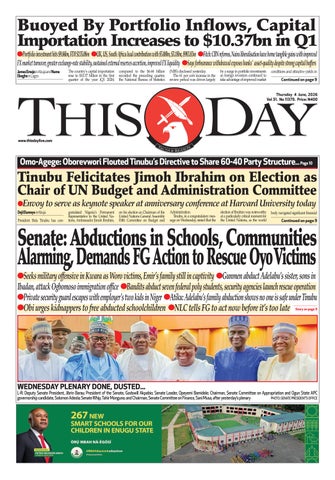
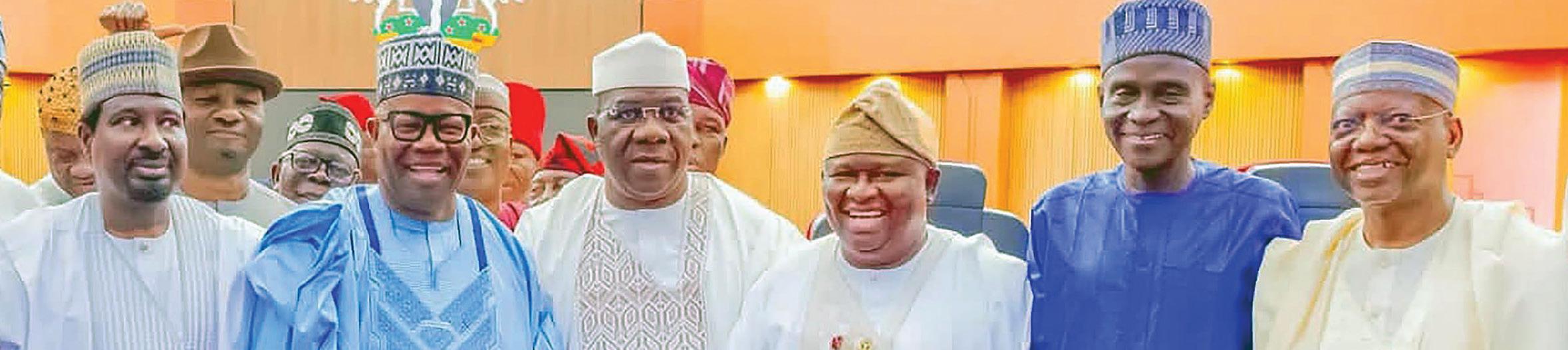
WEDNESDAY PLENARY DONE, DUSTED...
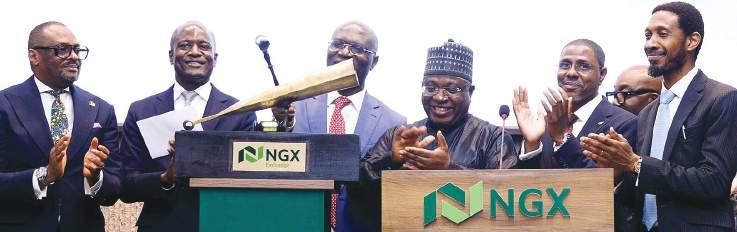
L-R: Deputy Senate President, Jibrin Barau; President of the Senate, Godswill Akpabio; Senate Leader, Opeyemi Bamidele; Chairman, Senate Committee on Appropriation and
governorship candidate, Solomon Adeola; Senate Whip, Tahir Monguno; and Chairman, Senate Committee on Finance, Sani Musa, after yesterday’s plenary
Deji Elumoye in Abuja
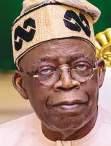
President Bola Tinubu has congratulated Nigeria’s Permanent Representative to the United Nations, Ambassador Jimoh Ibrahim,
Chairman of the
Nations General Assembly Fifth Committee on Budget and
Tinubu, in a
James Emejo in Abuja and Nume Ekeghe in Lagos
12TH EDITION OF THE MALTINA TEACHER OF THE YEAR COMPETITION...
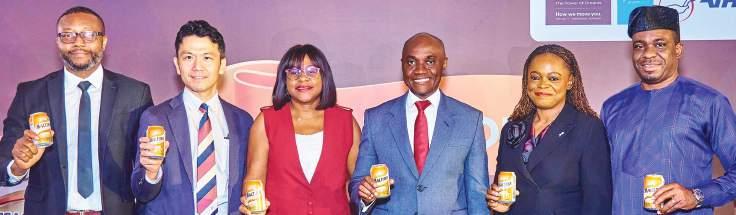
L-R: Advertising and Visibility Marketing Manager, Air Peace, Ikenna Nnabuife; Managing
Elohor
Corporate Affairs
Nigerian
Honda
Western
NUPRC to Commence 2026 Licencing
Round in Q3 After Tinubu’s Approval
Commission’s workers call off industrial action
The Nigerian Upstream Petroleum Regulatory Commission (NUPRC) yesterday said the 2026 Oil Licencing Round will commence by the third quarter (Q3) 2026, having received the approval of President Bola Tinubu, in line with the Petroleum Industry Act (PIA).
The Commission Chief Executive, Mrs. Oritsemeyiwa Eyesan, stated this when Meren Energy (formerly Africa Oil) visited the corporate headquarters of the NUPRC in Abuja, a statement by the commission’s Head, Media and Corporate Communications, Eniola Akinkuotu, stated.
Eyesan, who expressed satisfaction with the conduct of the 2025 Licencing Round so far, stated that the commercial bid would take place in July after which the next licensing round would commence.
The NUPRC chief stated that the heightened participation in the 2025 Licencing Round was a testament to the fact that Nigeria was headed
in the right direction, stressing that the rise in investments, coupled with the upswing in production, was evidence that Nigeria’s oil and gas sector, under the leadership of Tinubu, has become attractive.
“We are also fortunate that the President and Minister of Petroleum Resources has approved the 2026 Licensing Round. So, we are in the process of finalising the 2026 launch, which will happen by the third quarter at the latest. So, this is the make-or-break point, and we want to make sure we make it,” Eyesan stated.
In his remarks, the Group CEO, Meren Energy, Dr. Oliver Quinn, stated that the current reforms have inspired the company to increase its investments in Nigeria hence its interest in asset divestments and licensing rounds.
Quinn revealed that Meren Energy’s investment priority is Africa, of which Nigeria ranks as number one.
“We have operated in Agbami, Akpo and Egina world class fields. I think till date, in 20 years about $11
billion in capital from our side has gone into these assets and about $4 billion has gone to tax and royalties,” he said, adding, “Nigeria remains the core of our business today because of the quality of these assets.”
According to Quinn, Meren Energy is pressuring its partners on these assets to deepen their investments and then increase
overall production.
He said Meren Energy was the first company in Nigeria to sell crude oil to the Dangote refinery and the firm will continue to fulfil its Domestic Crude Supply Obligation (DCSO) so long as the price remains right.
Meanwhile, normal activities have resumed at the commission following
the suspension of a one-day warning strike embarked upon by workers under the aegis of the Petroleum and Natural Gas Senior Staff Association of Nigeria (PENGASSAN) and the Nigeria Union of Petroleum and Natural Gas Workers (NUPENG).
The commission disclosed that the industrial action was called off on the night of June 1, 2026, after
successful negotiations between the agency’s management and the two in-house unions.
According to the NUPRC, the strike, which lasted approximately 12 hours, affected only administrative operations within the commission, while regulatory oversight activities across oil and gas facilities nationwide continued uninterrupted.
Chief of Staff to the President, Hon. Femi Gbajabiamila, has described Minister of State-designate for Foreign Affairs, Ambassador Sola Enikanolaiye, as a national asset.
Gbajabiamila made the remarks on Wednesday at State House, Abuja, during a send-off ceremony organised by his office in honour of the ambassador. He expressed confidence in Enikanolaiye’s ability to excel in his new role and contribute significantly to Nigeria’s diplomatic engagements.
for three years as Senior Special Assistant to the President on Foreign Affairs and International Relations in the Office of the Chief of Staff.
President Bola Tinubu appointed the career diplomat and former Permanent Secretary of the Ministry of Foreign Affairs as Minister of State for Foreign Affairs on April 29, after he had served
Senate Overhauls Sugar Tax, Targets N108bn Health Fund as Nigeria Battles Diabetes, Obesity Surge
Lawmakers scrap N10 per litre levy, introduce percentage-based excise tied to retail price Health sector to get dedicated funding for primary care, insurance and disease prevention Customs reports N108.6bn revenue from sugary drinks tax in four years
Sunday Aborisade in Abuja
The Senate yesterday approved a sweeping reform of Nigeria’s excise duty framework on sugar-sweetened beverages (SSBs).
The Red Chamber replaced the existing N10-per-litre flat-rate tax with a percentage-based levy and directed that part of the revenue be channeled into health financing programmes targeting the country’s rising burden of non-communicable diseases.
In simple terms, the Senate has changed how Nigeria taxes sugary drinks like soft drinks and other sweetened beverages.
Before now, the government charged a fixed tax of N10 on every litre of these drinks, no matter the price. Now that has been replaced with a percentage-based tax, meaning that instead of paying a fixed amount, manufacturers will pay tax based on the price or value of the drink. So, if a drink is more expensive, the tax on it will also be higher.
The decision followed the consideration and adoption of the report of the Joint Committee on Finance and Customs, Excise and Tariff on the Customs, Excise Tariff (etc) Amendment Bill, presented by the
Chairman of the Senate Committee on Finance, Senator Sani Musa.
Lawmakers said the reform was designed to correct the erosion of the current tax value by inflation, strengthen fiscal sustainability, and align Nigeria’s tax system with global public health and revenue best practices.
Under the new arrangement, the fixed N10 per litre excise duty has been scrapped.
In its place, the Minister of Finance will determine a percentage-based levy on non-alcoholic, carbonated and sugar-sweetened beverages, benchmarked against global standards
and prevailing economic conditions.
The Senate also mandated that a portion of the revenue generated from the revised tax be dedicated to health interventions, including disease prevention, health promotion, primary healthcare strengthening, and support for health insurance coverage for vulnerable Nigerians.
Lawmakers warned that Nigeria was facing a rapidly escalating epidemic of non-communicable diseases such as diabetes, obesity, hypertension and cardiovascular conditions, largely driven by high sugar consumption and unhealthy dietary patterns.
According to Gbajabiamila, Enikanolaiye’s distinguished career in the diplomatic service, extensive experience in international relations and academia, and unwavering commitment to excellence have adequately prepared him for the responsibilities of the ministerial office.
Gbajabiamila stated, “When I resumed duty, I had three names from which to choose a Senior Special Assistant on Foreign Affairs. I did not know any of them, but I chose Ambassador Enikanolaiye. I can’t remember exactly why, but I am happy that I did.
“You have proven yourself to be a man of exemplary work ethic. With your commitment and dedication to duty, I have no doubt in my mind that wherever you go, you will succeed.”
While commending the president for elevating the ambassador, Gbajabiamila extolled the institutional capacity of the minister-designate, stating that the country stands to benefit immensely from his wealth of knowledge and experience in diplomacy and international relations.
He also praised Enikanolaiye’s professionalism, dedication, and interpersonal skills, recalling that even on occasions when they disagreed, the minister-designate remained focused, respectful and professional.
In his response, Enikanolaiye thanked the president for finding him worthy to serve first as Senior Special Assistant
on Foreign Affairs and International Relations and now as Minister of State for Foreign Affairs.
He also expressed appreciation to the Chief of Staff for providing a conducive work environment that encouraged productivity and excellence.
The minister-designate urged staff members to prioritise excellence, productivity and positive human relations, rather than embrace negative work attitudes that bred acrimony, dissonance and unproductivity in the workplace. He stressed the need for tolerance and mutual respect, saying religion and other differences should not become sources of antagonism or social discord.
Enikanolaiye cited his family as an example, stating that while he is a Muslim, his wife is a devout Christian.
Earlier, Senior Special Assistant to the President on Administration and Operations in the Office of the Chief of Staff, Mrs Oyinade Nathan-Marsh, said the send-forth ceremony was organised in recognition of Enikanolaiye’s commitment to duty, institutional capacity, attention to detail and strong sense of responsibility.
She described the appointment as well deserved, recalling that working with the ambassador had been a rewarding experience. She prayed that God would grant him wisdom and strength in his new office, which she stated would require extensive human resource management skills.
Other speakers at the event eulogised the exemplary leadership and mentorship qualities demonstrated by Enikanolaiye throughout his service at State House.
Emmanuel Addeh in Abuja and Peter Uzoho in Lagos
Deji Elumoye in Abuja
Director,
Automobile
Africa Limited, Daisuke Mita; Portfolio Manager, Non Alcoholic Drinks, Nigerian Breweries Plc,
Olumide-Awe;
Director,
Breweries Plc, Uzodinma Odenigbo; Chief Brand and Marketing Officer, Union Bank of Nigeria Plc, Olufunmilola Aluko; and Company Secretary/Legal Director, Nigerian Breweries Plc, Uaboi Agbebaku, during the flag off of the 12th edition of the Maltina Teacher of the Year Competition in Lagos, yesterday
PHOTO: SUNDAY ADIGUN
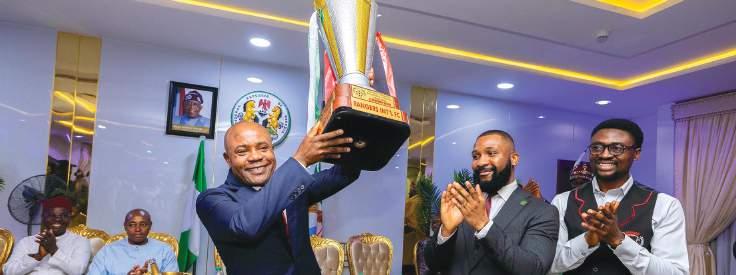
STAND UP FOR THE CHAMPIONS...
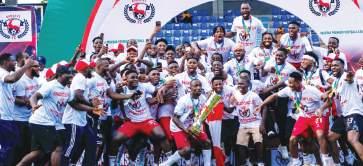
L-R: Governor of Enugu State, Dr. Peter Mbah; Commissioner for Youth and Sports Development, Barr. Loyd Ekweremadu, and the General Manager/CEO, Rangers International Football Club of Enugu, Barr. Amobi Ezeaku, as Mbah joyfully lifts the 2025/2026 Nigerian Premier Football League (NPFL) trophy during a dinner reception in honour of Rangers FC at Government House, Enugu, Tuesday night.
Court Order Stalls Inquest into Death of Chimamanda Adichie’s
Wale Igbintade
The Coroner’s Court sitting at the Igbosere Magistrate Court, Lagos Island, has adjourned further proceedings in the inquest into the death of 21-month-old Master Nkanu Adichie-Esege, son of renowned novelist Chimamanda Ngozi Adichie, and Dr. Ivara Esege, following a High Court order staying the proceedings pending the determination of a judicial review application.
Coroner Magistrate Atinuke Adetunji yesterday fixed October 8, 2026 for further mention of the matter after being informed that the Lagos State High Court had granted an order suspending the inquest.
The inquest scheduled for commencement of hearing was halted after
counsel to Euracare Multi-Specialist Hospital, Professor Taiwo Osipitan (SAN), informed the court that the hospital had successfully obtained leave from the High Court to challenge the jurisdiction of the Coroner’s Court to conduct the inquiry. Osipitan told the court that one of the major issues raised in the judicial review proceedings was whether the Coroner’s Court properly assumed jurisdiction to investigate the death of the child, considering that his remains had allegedly been cremated before the inquest commenced.
According to him, the substantive application also raises the question of whether a coroner can lawfully investigate the cause of death in circumstances where the body is no longer available for examination.
“There is also a consequential order that pending the determination of our substantive suit, this Coroner’s Court be stayed,” Osipitan told the court.
“We have a return date of June 8, 2026. We have served all parties and our prayer is that this court should defer the proceedings until we come back, in obedience to the order,” he added.
Counsel from the Lagos State Attorney-General’s Office, Adebola Araba, however, informed the court that he had not personally seen the enrolled order.
In response, Osipitan maintained that the Attorney-General’s office had been duly served.
“We filed on Monday and served the Attorney-General’s office yesterday. He may not personally have seen
21-month-old son
it, but the office has been served,” he said.
On behalf of the deceased’s family, Kemi Pinheiro (SAN) informed the court that four witness statements on oath had already been filed and served on all parties.
According to him, the proposed witnesses include the child’s father, Dr. Ivara Esege; Dr. Chinwe Ego from Arizona, United States; another medical expert from Minnesota, United States; and Prof. Adekola of the Lagos University Teaching Hospital.
Pinheiro stated that although the family would abide by the High Court’s stay order, they remained committed to pursuing the inquest.
“He who has nothing to hide should not fear an open inquest. An innocent man has nothing to fear. It is
61 Opposition Lawmakers Back Ugochinyere for House Minority Leader
Await speaker’s declaration
An overwhelming majority of opposition lawmakers have thrown their weight behind Hon. Ikenga Imo Ugochinyere as the Minority Leader-designate, following the vacancy created by the defection of former Minority Leader, Hon. Kingsley Chinda, to the ruling All Progressives Congress (APC).
No fewer than 61 out of the 81 opposition members in the House have formally endorsed Ugochinyere and submitted his nomination to Speaker Abbas Tajudeen ahead of an anticipated official announcement of the new minority leadership structure.
The move came after Chinda’s exit from the opposition camp and emergence as the APC governorship candidate in Rivers State, prompting the Speaker to declare the Minority Leader’s position vacant.
Documents sighted by THISDAY showed that lawmakers drawn from virtually all the opposition parties represented in the House, including the National Democratic Coalition
(NDC), African Democratic Congress (ADC), Labour Party (LP), All Progressives Grand Alliance (APGA), Accord Party, Action People’s Party (APP), Allied People’s Movement (APM), Social Democratic Party (SDP), Peoples Redemption Party (PRP), and the Peoples Democratic Party (PDP), jointly settled for Ugochinyere as their preferred candidate.
The endorsement, according to sources within the minority caucus, cut across regional, ethnic, religious and political divides, a broad consensus within the opposition bloc.
The lawmakers have already transmitted Ugochinyere’s nomination to the Speaker in accordance with the provisions of the House Standing Orders.
They cited Order 7, Rule 7 of the House Rule Book, which empowered members of the minority parties to elect from among themselves a leader to coordinate and represent their interests in parliament.
Speaking anonymously, several lawmakers expressed confidence that Speaker Abbas, whom they described as a fair and impartial presiding officer,
would respect the decision of the majority and announce the new Minority Leader in the coming days. They noted that the opposition caucus had also reached agreements on nominees for other vacant leadership positions, including Deputy Minority Leader and Minority Whip.
According to them, one of the positions has already been allocated to an NDC lawmaker from the North-West geopolitical zone, while consultations are ongoing to finalise the remaining positions before the complete list is forwarded to the Speaker for ratification and announcement.
darkness that fears the light,” he said.
The senior advocate urged the Coroner’s Court to adjourn the matter until after the court vacation rather than indefinitely.
Counsel for Atlantis Paediatric Hospital, Efe Ize-Iyamu, informed the court that his client, listed as the sixth respondent in the judicial review proceedings, had been served with both the originating motion and the enrolled order.
He aligned himself with Pinheiro’s submissions, stating that while the parties were bound by the High Court’s order, Atlantis Paediatric Hospital had already filed its response to the application.
In a brief reply, Osipitan insisted the central issue remained the legal implications of the alleged cremation of the child’s remains before the activation of the Coroner’s Court’s jurisdiction.
“Whether you are fearful or fearless, there was wilful destruction,” he argued.
He said, “You cannot assume jurisdiction. What they did is punishable by 15 years’ imprisonment. The issue is whether somebody who has done something wrong under the law can push for an inquest.”
Pinheiro, however, disagreed, contending that the submissions amounted to an affront to the provisions of the Coroner’s Law.
“We will demonstrate instances where inquests have been conducted
even without the body,” he told the court.
After hearing counsel, Magistrate Adetunji adjourned the matter to October 8, 2026.
The development followed an order made on May 26, 2026, by Justice Aishat Opesanwo of the Lagos State High Court, Osborne Foreshore, granting Eurapharma Care Services Nigeria Limited leave to challenge the proceedings of the Coroner’s Court and directing that the grant of leave should operate as a stay of the inquest pending the determination of the substantive suit.
The respondents in the judicial review proceedings included the Coroner, Mrs. A.A. Adetunji; the Chief Coroner of Lagos State; the Attorney-General and Commissioner for Justice of Lagos State; Dr. Ivara Esege; Chimamanda Ngozi Adichie; and Atlantis Paediatric Hospital Limited.
The hospital is challenging decisions of the Coroner’s Court made on January 21, February 25 and April 14, 2026, in relation to the ongoing inquiry into the circumstances surrounding the death of Master Nkanu Adichie-Esege, who died on January 7, 2026, at Euracare Multi-Specialist Hospital in Victoria Island, Lagos. Among other reliefs, the hospital is seeking orders of certiorari and prohibition to quash and restrain the Coroner’s Court from continuing with the inquest.
Work Resumes at NUPRC as Unions Suspend One-day Strike
Commission dismisses reports of oil production disruption
Emmanuel Addeh in Abuja
Normal activities have resumed at the Nigerian Upstream Petroleum Regulatory Commission (NUPRC) following the suspension of a one-day warning strike embarked upon by workers under the aegis of the Petroleum and Natural Gas Senior Staff Association of Nigeria (PENGASSAN) and the Nigeria Union of Petroleum and Natural Gas Workers (NUPENG).
The commission disclosed yesterday that the industrial action
was called off on the night of June 1, 2026, after successful negotiations between the agency’s management and the two in-house unions.
According to the NUPRC, the strike, which lasted approximately 12 hours, affected only administrative operations within the commission, while regulatory oversight activities across oil and gas facilities nationwide continued uninterrupted.
In a statement issued by the Head of Media and Corporate Communications, Eniola Akinkuotu, the commission said work had fully
resumed and urged members of the public to disregard reports suggesting that the action disrupted crude oil production activities.
“The industrial action was called off on the night of June 1, 2026 after successful negotiations between the top management of the NUPRC and the two in-house unions –PENGASSAN and NUPENG,” the statement said.
It added that while some internal administrative functions were temporarily affected during the strike period, the commission’s
core regulatory responsibilities in the upstream petroleum sector were not impacted.
“The strike which lasted for 12 hours affected only administrative work while regulatory activities in oil and gas facilities remained unaffected,” the commission stated.
The NUPRC also refuted media reports claiming that the dispute between management and workers was linked to issues surrounding foreign training opportunities, describing such reports as inaccurate and misleading.
Juliet Akoje in Abuja
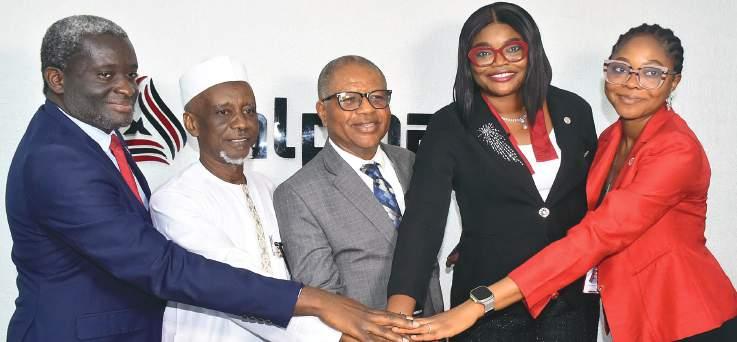
LAUNCH OF ALPHA 10 HALAL FUND...
L-R: Head, Strategy and Communication, Alpha 10 Halal Fund, Tonye Akiga; Independent Non Executive Director, Alpha 10, Mohammed
Ekwekwuo; Managing Director/Chief Executive Officer, Fund Management Ltd, Abigail Utomi; and Company Secretary,
Fund, a Shari’ah-compliant investment solution in Abuja, yesterday
Alpha10 Group Floats N500m Halal Fund as Ethical Investment Gains Momentum
James Emejo and Mariam Adedokun in Abuja
Alpha10 Group, yesterday launched a N500 million Halal Fund aimed at expanding ethical investment opportunities, strengthen financial inclusion, and accelerate growth of non-interest finance ecosystem.
The fund is part of the group’s broader strategy to widen access to structured wealth management products, while addressing persistent gaps in capital allocation across underserved segments of the economy.
Speaking at the unveiling in Abuja, the company’s Group Managing Director (GMD), Abigail Utomi, said the launch represented a key step in Alpha10’s long-term growth and diversification strategy within Nigeria’s evolving financial services industry.
She said the company remained committed to expanding access to wealth management solutions that reflect investor preferences while aligning with global trends in ethical and faith-based investing.
According to her, the initiative goes beyond product introduction, describing it as a deliberate expansion of Alpha10’s investment ecosystem aimed at strengthening market penetration and enhancing investor confidence in alternative financial instruments.
Utomi explained that Alpha10, a Securities and Exchange Commission (SEC)-licensed financial services group, operates across asset management, securities trading, advisory, and issuing house functions, with a mandate to channel capital from surplus units to productive but underserved sectors of the economy.
She noted that the Nigerian economy continued to present both structural constraints and significant opportunities, adding that the firm is positioning itself to convert these constraints into viable investment pathways through innovation and disciplined portfolio management.
The GMD further stressed that ethical investment had become a defining feature of global capital markets, adding that Nigeria must align with this shift to unlock deeper pools of investment and broaden participation in formal financial systems.
Utomi said the Halal Fund was designed to serve investors of diverse beliefs and preferences, reinforcing Alpha10’s commitment to inclusivity and expanded access across Nigeria’s geopolitical zones, supported by its growing national presence.
She also highlighted that the fund will be managed by Alpha10 Fund Management Limited and overseen under a multi-layered governance structure, including
regulatory supervision by the SEC, an independent Advisory Committee of Experts (ACE) to ensure Sharia compliance, and STL Trustees Limited acting in the interest of unit holders.
She explained that the Shariacompliant framework prohibits interest (riba), excessive uncertainty (gharar), and exposure to unethical sectors, while focusing on asset-backed,
transparent investments in line with Islamic finance principles.
Essentially, Halal Fund is structured as a Sharia-compliant mutual fund, designed to provide capital preservation, liquidity, and steady income generation through investments in approved fixed-income securities, Sharia-compliant instruments, and ethical contracts.
Chairman of the company, Chibuzo Ekwekwuo, said the launch reflected Alpha10’s broader mission to build a sustainable financial system capable of bridging the gap between capital providers and those in need of funding.
He said the financial services industry must evolve beyond serving a narrow segment of the population, stressing the need for solutions that extend access across income levels and investor categories.
Ekwekwuo added that its operating philosophy was anchored on professionalism, accountability, trust, and responsiveness, noting that these values remain central to its long-term strategy of strengthening its position in Nigeria’s financial services space.
TCN Reports Vandalism of Six Towers on Apir-Lafia Transmission Line
NERC begins solar power net billing scheme Reiterates zero tolerance for non-compliance with regulations
Emmanuel Addeh in
Abuja
The Transmission Company of Nigeria (TCN) has announced the vandalism and collapse of six transmission towers along the Apir-Lafia 330kV transmission corridor, an incident that has partially impacted electricity transmission to parts of North-central Nigeria.
The development came as the Nigerian Electricity Regulatory Commission (NERC) formally commenced the implementation of the Net
Billing Regulations 2026, a framework designed to encourage the adoption of solar energy and other renewable energy sources by allowing eligible electricity consumers to export surplus power to the national grid.
In a statement in Abuja, TCN disclosed that towers T125 to T130 on the Apir-Lafia 330kV Transmission Lines I and II were vandalised, leading to their collapse during a heavy downpour in the early hours of May 30.
According to the company, the
FG, Germany, EU Unveil Guidelines for Solar Mini-grids Integration
Solar
critical
Emmanuel Addeh in Abuja
The federal government through the Nigerian Electricity Management Services Agency (NEMSA) with technical support from the German government and the European Union (EU) has launched national guidelines for interconnecting solar mini-grids to distribution networks.
to expanding electricity access,
says NEMSA
incident occurred at approximately 1:15 a.m., triggering a system disturbance and causing both transmission lines to trip. TCN explained that an initial attempt to restore the line through a trial reclosure at about 2:08 a.m. failed, prompting engineers to carry out a physical trace of the affected corridor.
The inspection, it said, revealed extensive damage to critical components of the six towers, confirming that the collapse was a result of deliberate acts of vandalism.
“The tripping of the lines prompted a physical line trace to determine the fault, which revealed damage to critical components of towers T125 to T130, confirming acts of vandalism on the affected sections of the transmission corridor,” the company stated.
through the Lafia-Jos transmission line as a temporary arrangement.
The alternative supply route is expected to cushion the effect of the disruption on customers within the franchise areas of Abuja Electricity Distribution Company (AEDC) and Jos Electricity Distribution Company (JEDC).
While condemning the attack, TCN described the continued vandalism of transmission assets as a major setback to investments aimed at strengthening the country’s electricity network. The company warned that such acts not only undermine years of infrastructure development but also directly affect power supply to millions of Nigerians.
Coming under the Nigerian Energy Support Programme (NESP), the development which also witnessed the handover of procured solar testing equipment to NEMSA, is a major step towards strengthening Nigeria’s evolving mini-grid market and improving electricity access.
unserved communities across Nigeria.
Speaking during the event in Abuja, the Managing Director and Chief Executive Officer of NEMSA, Olusegun Adesayo, described solar mini-grids as a critical solution for electrifying underserved and
He said access to electricity remains fundamental to economic growth, social development and national prosperity, noting that the expansion of interconnected solar mini-grids within the Nigerian Electricity Supply Industry (NESI) requires clear technical and operational frameworks to ensure safe, efficient and sustainable integration into existing distribution networks.
“Solar mini-grids have emerged as a critical solution for electrified, unserved and underserved communities across the country. However, as interconnected solar mini-grids continue to expand within NESI, there is an increasing need for clear technical and operational frameworks to ensure that these systems are integrated safely, efficiently and sustainably into existing distribution networks,” he said.
As a consequence, both transmission lines remain out of service while efforts are underway to assess the damage and commence reconstruction works.
TCN said its engineers had already been mobilised to the site to evaluate the extent of destruction and determine the materials required to restore the affected infrastructure.
To mitigate the impact of the outage on electricity consumers, the company stated that the Lafia 330kV Transmission Station is currently being supplied
TCN therefore appealed to host communities and members of the public to remain vigilant and support efforts to safeguard national grid assets by reporting suspicious activities around power installations to security agencies or the nearest TCN office. Meanwhile, NERC has announced the commencement of the Net Billing Regulations 2026, a landmark initiative expected to deepen renewable energy adoption and expand private participation in electricity generation across the country.
Umar; Chairman, Board of Directors, Chibuzo
Alpha 10 Halal Fund, during the launch of Alpha 10 Halal
PHOTO: ENOCK REUBEN
At London Stock Exchange, Tinubu Seeks Stronger Africa-Global Finance Partnership
Ndubuisi Francis in Abuja
President Bola Ahmed Tinubu has canvassed stronger collaboration between African economies and global financial institutions, saying it remains critical to unlocking investment opportunities, expanding infrastructure and accelerating inclusive growth across the continent.
He spoke yesterday, as African leaders officially opened trading at the London Stock Exchange (LSE), as part of concerted efforts to strengthen economic and investment relations between Africa and the United Kingdom.
The market opening ceremony brought together heads of government, finance ministers, senior policymakers, global investors, chief executives and representatives of leading financial institutions from
across Africa, Europe and other parts of the world.
The president, who was represented by the Minister of Finance and Coordinating Minister of the Economy, Mr. Taiwo Oyedele, reaffirmed Nigeria’s commitment to implementing economic policies and reforms that promote stability, support private sector growth and enhance investor confidence.
The participation of African leaders in the opening of one of the world’s foremost financial markets reflected a growing commitment to positioning the continent as a preferred destination for investment and long-term economic partnerships.
The event also provided an opportunity to showcase Africa’s economic potential and highlight ongoing reforms aimed at creating
a more attractive environment for business, innovation and capital inflows, a statement released by the Head of Information and Public Relations, Mrs. Efe Ovuakporie stated.
Speaking during the engagements, Oyedele reaffirmed Nigeria’s commitment to implementing economic policies and reforms that promote stability, support private sector growth and enhance investor confidence.
He noted that stronger collaboration between African economies and global financial institutions remains critical to unlocking investment opportunities, expanding infrastructure and accelerating inclusive growth across the continent.
Following the official market opening ceremony, the delegation participated in a private execu-
tive breakfast discussion themed “Navigating a World in Transition.”
The session examined the implications of global economic shifts, changing geopolitical realities and emerging trends shaping international investment decisions.
The discussions provided a platform for direct engagement between African policymakers and international business leaders on practical strategies for strengthening economic resilience and attracting sustainable investments.
Participants also explored opportunities for deeper cooperation in areas such as infrastructure financing, capital market development, trade facilitation and technology-driven growth, all of which are critical to Africa’s long-term economic transformation.
The leaders emphasised the
importance of building stronger bridges between Africa and global financial centres to unlock new sources of capital needed to support development priorities across the continent.
The engagement at the London Stock Exchange formed part of broader efforts by African governments to expand economic diplomacy, deepen access to international capital and strengthen partnerships capable of delivering shared prosperity.
For Nigeria, the event further reinforced the federal government’s commitment to engaging strategic international partners in support of its economic reform agenda and sustainable development objectives.
The meeting concluded with a shared commitment by African leaders, investors and business
executives to pursue stronger economic cooperation, deepen investment flows and build enduring partnerships that support growth and prosperity across Africa and the United Kingdom.
SENATE: ABDUCTIONS IN SCHOOLS, COMMUNITIES ALARMING, DEMANDS FG ACTION TO RESCUE OYO VICTIMS
Chuks Okocha, Sunday Aborisade, Onyebuchi Ezigbo, Folalumi Alaran in Abuja, Kemi Olaitan in Ibadan, Onuminya Innocent in Zamfara and Laleye Dipo in Minna
Senate, yesterday, expressed worry over the worsening wave of kidnappings and violent attacks across the country and demanded the immediate rescue of abducted schoolchildren, teachers, and other victims in Oyo State.
TINUBU
It also called for urgent federal intervention to halt the escalating security crisis in Kwara North Senatorial District.
The upper chamber warned that the growing attacks on schools, communities, and traditional institutions posed a serious threat to national security, social stability, and the future of education in the country.
Its resolutions followed separate motions on the abduction of schoolchildren and teachers in Oyo State
FELICITATES
JIMOH
IBRAHIM
and the persistent attacks, killings, and kidnappings in Kwara North senatorial district.
On the Oyo situation, Senate directed security agencies to deploy all necessary resources to secure the release of dozens of schoolchildren, teachers, and other victims abducted by gunmen on May 15 in Ahoro-Esiele and neighbouring communities in Oriire Local Government Area.
Leading debate on the motion, Senator Abdulfatai Buhari (APC,
ON ELECTION AS CHAIR OF UN BUDGET AND ADMINISTRATION COMMITTEE
realignment while advancing critical institutional reforms to strengthen its effectiveness, accountability, and long-term sustainability.
Tinubu stated regarding Ibrahim, “Your election to chair this important committee within weeks of official resumption at the UN validates your wealth of experience in public service, diplomacy, business leadership, and governance particularly as member of Nigerian Senate Committee on Budget and Appropriation and Chairman of Inter-Parliamentary Relations.
“Your previous roles in the private sector and public service distinctly equip you to provide the steady, strategic leadership required for this important responsibility.
“Through your background as a respected legal scholar with commensurate expertise in International Taxation and Business Administration, you have consistently demonstrated intellectual acumen and a deep understanding of the global governance and financial systems, providing valuable insight into fiscal management, institutional efficiency, and sustainable growth.”
The president said he was confident that, just as the reforms at home were yielding positive results, Ibrahim’s experience and unwavering commitment to excellence will justify his selection as Permanent Representative and make Nigeria proud in the work of the Fifth Committee and in support of the broader objectives of the United Nations.
“Congratulations once again on this remarkable achievement and on the confidence reposed in you by the international community,” Tinubu stated.
Meanwhile, Ibrahim will on Thursday (today) serve as keynote speaker at the Tenth Anniversary Conference of Ife Institute of Advanced Studies at Harvard University, Massachusetts, United States of America (USA).
The envoy had on April 11, 2026 been invited by Department
of African and African American Studies, Faculty of Arts and Sciences at Harvard University to deliver the keynote address.
In the one-page invite signed by Chair, African and African and American Studies, Faculty of Arts and Sciences, Professor Jacob Olupona, Nigeria’s Permanent Representative at the United Nations was expected to speak on “The Nigerian Project Revisited: Crisis, Continuity, and Possibility.”
The invitation letter read thus, “April 11, 2026
Harvard University, Dept of African and African American Studies Massachusetts, US ‘Re: invitation to Serve as Keynote Speaker at the Tenth Anniversary Conference of the Ife Institute of Advanced Studies.’
“Africa continues to produce exceptional individuals. Yet, it has not built institutions that can consistently sustain excellence. This conference asked why and whether that can change at scale.
“For the past decade, the Ife Institute of Advanced Studies (IIAS) has worked to address this gap by investing in rigorous and independent scholarship.
“Since its founding, IIAS has trained over 850 scholars, many of whom now shape academia, policy, and public life in Nigeria and across and beyond Africa. That progress is meaningful, but insufficient to meet the scale of the challenge.
“At this ten-year mark, we are convening a small invitation-only gathering at the John Knowles Pane Concert Hall, Department of Music, Harvard University on June 4, 2026, to discuss the theme, Budding Lasting Instruments: Path, Scholarship, and the African Project.
“I cordially invite you to deliver the keynote address titled: The Nigerian Project Revisited: Crisis, Continuity, and Possibility.
“This keynote sets the conceptual and historical foundation for the conference by reviewing the theme of “the Nigerian project” as an unfinished
and contested enterprise. “Moving beyond familiar narratives of failure and dysfunction. The address interrogates how Nigeria’s institutional challenges have been shaped by deeper tensions between inherited structure and lived realities formal governance and informal practice, aspiration and accountability. What does it mean to speak of Nigeria as a “project.” and who bears responsibility for its construction? By tracing patterns of continuity alongside moments of rupture.
“The keynote reframes crisis life not as an endpoint, but as a condition that reveals both the fragility and the latent possibilities of institutional life.
“The address, thus, opens the conference space for rethinking what it would take to build institutions that are not only functional, but meaningful and enduring.” Jacob Olupona, PhD, Chair, African and African and American Studies, Faculty of Arts and Sciences.
Oyo North) described the attack as a direct assault on the country’s future, stating that the victims were seized from what should have been a safe learning environment.
Buhari expressed concern that a toddler was among those abducted and lamented the killing of a teacher during the attack. He said the incident had heightened fear among residents and renewed concerns over the safety of schools in vulnerable communities.
The senate observed a minute silence in honour of those killed, and sympathised with affected families, the people of Oyo State, and the state government.
The lawmakers also urged the federal government to strengthen and expand the Safe Schools Initiative through improved surveillance, intelligence gathering, and enhanced security deployment around schools and rural communities.
Contributing to the debate, Senator Adams Oshiomhole (APC, Edo North) called for stricter oversight of security spending to ensure appropriated funds were effectively utilised.
Senator Sunday Karimi (APC, Kogi West) urged state governments to play a more active role in support of security operations.
The senate acknowledged the recent visit of a federal government delegation, led by Chief of Staff to the President, Femi Gbajabiamila, to the affected communities.
Speaking with journalists after plenary, Buhari appealed to Nigerians not to politicise the tragedy. He stressed that the security agencies were working to secure
the safe return of the victims and warned that disclosure of sensitive operational details could jeopardise rescue efforts.
Senate’s concerns further extended to Kwara North, where lawmakers decried recurring killings, kidnappings, and attacks on communities, including the burning of the palace of the Emir of Yashikira by armed criminals.
Presenting a motion, titled, “Urgent Need for Federal Govern- ment Intervention to Address the Re-occurring Insecurity in Kwara North Senatorial District,” Senator Sadiq Umar said the district had witnessed an alarming deterioration in security, marked by persistent attacks on innocent citizens and widespread destruction of property.
Umar told the senate that several months after the Woro massacre, many women and children abducted during the attack were still being held captive, leaving their families in prolonged anguish and uncertainty.
He disclosed that armed criminals recently attacked and set ablaze the palace of the Emir of Yashikira, abducting several members of the monarch’s family, including some of his wives and children.
According to him, communities in Patigi and Edu local government areas have also suffered repeated attacks, while criminal elements recently invaded Lafiagi township, killing and abducting residents.
The senator attributed the security challenge, partly, to the vast and difficult terrain around Kainji Lake National Park and adjoining forest reserves, which he said had become operational bases for criminal groups
terrorising communities in Kwara North and neighbouring states.
While commending the security agencies, local vigilantes, and community leaders for their efforts, he maintained that the persistence of attacks underscored the need for stronger government action.
Following the deliberation, Senate unanimously adopted all prayers contained in the motion and called on the federal government to reinforce the security architecture in Kwara North through the establishment of additional military bases, deployment of more personnel and equipment, and intensified joint operations to flush out criminal elements from the Kainji Lake forest axis and other identified hideouts.
It also urged the armed forces, Nigeria Police, Department of State Services (DSS), and other security agencies to intensify efforts to rescue all kidnapped victims still in captivity across the district.
Lawmakers further called for the rehabilitation and expansion of critical road infrastructure in the area to improve accessibility, enhance security response, and stimulate economic activities.
The senate urged National Emergency Management Agency and other relevant agencies to provide immediate humanitarian assistance and rehabilitation support to affected families and communities.
To ensure effective oversight, the upper chamber mandated its committees on national security and intelligence, army, air force, police affairs, works and special duties to
BUOYED BY PORTFOLIO INFLOWS, CAPITAL IMPORTATION INCREASES TO $10.37BN IN Q1
the domestic financial markets.
This comes as global ratings agency, Fitch Ratings has stated that Nigeria’s banking sector is benefiting from the liberalisation of the naira, with stronger foreigncurrency inflows, increased foreign exchange market turnover and improved foreign-currency liquidity across the industry.
Fitch in its June 2026 Credit Outlook on Nigerian Banks, also said the withdrawal of long-standing regulatory forbearance measures for banks has exposed their asset quality as impaired loan ratios have risen. Some restructured Stage 2 loans had also been reclassified as impaired, according to new assessment by the ratings institution.
According to the Nigeria Capital Importation (Q1 2026) report by the statistical agency, total capital inflows increased by 83.8 per cent
compared with the $5.64 billion recorded in the corresponding period of 2025.
According to the NBS, portfolio investment dominated inflows, amounting to $9.86 billion or 95.1 per cent of total capital imported into the country.
Despite the strong growth in overall capital inflows, Foreign Direct Investment (FDI) remained subdued, accounting for just 1.3 per cent or $135.08 million of total capital imported during the review period.
The trend underscored the growing reliance on short-term foreign capital inflows, particularly into financial assets, amid ongoing efforts by the Central Bank of Nigeria (CBN) to stabilise the Foreign Exchange (FX) market and sustain investor confidence.
Other investments contributed
$374.48 million or 3.6 per cent of total inflows. FDI stood the lowest among the three investment categories.
Sectoral analysis showed that the banking industry remained the biggest beneficiary of foreign capital, attracting $7.55 billion, about 72.8 per cent of total capital imported during the period.
The financing sector followed with inflows of $2.43 billion or 23.4 per cent, while the production and manufacturing sector accounted for $152.27 million, representing 1.5 per cent of total inflows.
The report further revealed that the United Kingdom maintained its position as the country’s largest source of foreign capital, accounting for $5.08 billion or 49 per cent of total inflows in the quarter.
The United States ranked second with $3.18 billion, representing 30.7 per cent, while South Africa
contributed $983.83 million or 9.5 per cent of total capital imported during the period. Among financial institutions, Standard Chartered Bank Nigeria Limited emerged as the leading channel for capital inflows, receiving $4.41 billion or 42.6 per cent of total capital imported into the country. Stanbic IBTC Bank Plc followed with $2.78 billion, accounting for 26.8 per cent, while Rand Merchant Bank handled inflows valued at $930.82 million or nine per cent of the total.
Nevertheless, the performance represented one of the highest quarterly capital importation data in recent years amid renewed foreign investor appetite for Nigerian financial assets.
However, Fitch noted that the forbearance regime had previously
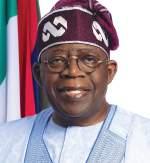
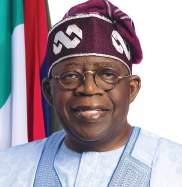
President Bola Tinubu
CIPM’S 3RD INTERNATIONAL ACADEMIC CONFERENCE...
L-R: Chairman of the Academic Conference, Prof. Oluseyi Shadare; Vice President,Chartered Institute of Personnel Management (CIPM), Mrs. Chidinma Obiejesi; Dean, Faculty of Management Sciences, University of Lagos, Prof. Abdul-Hameed Sulaimon; Keynote Speaker, Prof. Sunday Adebisi; President and Chairman of the Governing Council, CIPM, Mallam Ahmed
Omo-Agege: Oborevwori Flouted Tinubu’s Directive to Share 60-40 Party Structure
Addeh
Ex-Deputy Senate President, Ovie
Omo-Agege, yesterday responded to Delta State Governor, Sheriff Oborevwori, insisting that the governor disregarded a directive by President Bola Tinubu to integrate old and new members of All Progressives Congress (APC) through a 60-40 sharing arrangement following the governor’s defection to APC.
Omo-Agege, who recently dumped
APC for Nigeria Democratic Congress (NDC), made the assertion during an interview on Arise Television, where he also declared his full support for the presidential ambition of Peter Obi ahead of the 2027 elections.
had worked for Tinubu’s victory in the 2023 presidential election.
The former APC governorship candidate in Delta State maintained that his departure from the ruling party was not voluntary, arguing that the APC leadership in the state under Oborevwori systematically side-lined long-standing party members who
Omo-Agege said although a 6040 formula was adopted in several states to accommodate both old APC members and new entrants, the arrangement was ignored in Delta by the governor.
Omo-Agege was replying to an interview by the governor a day earlier where he described the former deputy senate president as untrustworthy and politically weightless.
Omo-Agege stated, “There was a directive from Mr. President, the leader of the APC, that there should be a 60-40 sharing arrangement between the old APC and the new intakes.
“While that arrangement was implemented in almost every state, in Delta State Sheriff Oborevwori and his crew decided they were not going to do that.”
He alleged that the governor’s camp took complete control of the party structure upon joining APC
Nigeria’s Diagnostic Crisis Takes Centerstage as Salako Opens WHX Lagos 2026 with Billion-Dollar Health Offensive that Nigeria is open for healthcare investment but with strings attached: federal hospitals want the best tech on display, and the government will use public-private partnerships to make sure it reaches patients, not just brochures.
Nigeria declared open war on its medical import addiction yesterday, after Minister of State, Health, Dr. Iziaq Adekunle Salako, told a packed Landmark Centre that up to 99% of all diagnostic equipment used in West Africa is foreign-made, leaving hospitals one forex crisis away from collapse.
Salako pulled no punches as he opened WHX Lagos 2026 before more than 8,000 delegates, branding the country’s dependence on imported X-ray machines, lab kits, and cancer scanners a “chronic gap” that has crippled care for millions.
A blocked port or dollar shortage, he warned, can shut down cancer screening and emergency imaging
overnight.
The 15th World Health Expo, he said, is now Nigeria’s main weapon to break that stranglehold, bringing 500 global manufacturers from 40 countries face-to-face with the country’s massive health demand and forcing deals that put AI diagnostics, portable imaging, and automated labs into public hospitals at scale and on time. The minister matched the warning with cash.
He confirmed President Bola Tinubu approved a sweeping upgrade last year with the Nigeria Sovereign Investment Authority that is already putting oncology and nuclear medicine centres in six teaching hospitals. In contrast, 22 new diagnostic centres, six more cancer facilities,
and seven cardiac cath labs are being rolled out across all six zones to push advanced care beyond Lagos and Abuja.
For 2025, Tinubu has allocated N402 billion to health infrastructure, money Salako said must be reallocated from budget lines to hospital wards.
He also put the spotlight on Abuja’s $1.2 billion Sector-Wide Approach overhaul launched in August 2024 to fix financing, staffing, and infrastructure in one swing, alongside the Presidential Initiative to Unlock Healthcare Value Chains and a new Executive Order designed to fire up local drug and device factories and kill the import cycle for good.
Salako told exhibitors bluntly
With West Africa’s health market now worth over $11 billion and Nigeria’s sector tipped to grow 7.1% to $161.7 million by 2027, he called this year’s Expo a highstakes moment for building local supply chains and hitting universal coverage targets.
Omo-Agege added, “They came in and basically wiped out everyone. These are people who fought to give the president the votes he got in Delta in 2023, despite the opposition mounted by Sheriff Oborevwori and others.
“They took the administrative structure of the party, but the people remained with me.”
Omo-Agege insisted that despite losing control of the party machinery, he retained the loyalty of a substantial grassroots base across the state.
The former deputy senate president stated that his political relevance remained a source of concern to Oborevwori, stating that the governor’s decision to leave Peoples Democratic Party (PDP) for APC was partly motivated by fears of facing him in another governorship contest.
“If Sheriff believed I was not a threat, why didn’t he remain in the PDP and face me in 2027? The fact that he moved tells its own story,” he said.
The Delta politician alleged that he won the APC governorship primary but was denied victory through manipulation of the process by forces loyal to the governor.
According to him, his supporters
secured victory in 84 of the state’s 85 wards during the exercise and amassed over 109,000 votes.
Vows to campaign for Obi, win 2027 poll in Delta Says governor threatened by his political clout and displaced members who had worked for the party before the governor’s defection.
Omo-Agege stated, “We won massively in every ward except the governor’s ward. We had about 109,000 votes.
“But unlike a general election where INEC provides safeguards, party primaries are conducted by panels appointed by the party. The panel was not allowed to conduct a free and fair process, and our votes were not properly recorded.”
Having now joined NDC, Omo-Agege pledged total loyalty to the opposition party and formally endorsed Peter Obi’s presidential bid.
“Of course, Peter Obi is my presidential candidate in 2027. I am now a member of the NDC and wherever I belong, my loyalty is total. When I was in the APC, I supported President Muhammadu Buhari and later President Bola Tinubu 100 per cent. Now that I am in the NDC, my loyalty is to the party and to Peter Obi.”
He dismissed suggestions that his switch of allegiance undermined his previous support for Tinubu’s economic reforms, stating that many of the policies he had backed, including fuel subsidy removal and exchange-rate reforms, were also supported by Obi.
Gobir; National Treasurer, CIPM, Mrs. Ogochukwu Egbuonu;Fellow, Chartered Institute of Personnel Development (FCID), Ms. Oluwatoyin Naiwo; and Fellow, Chartered Institute of Personnel Development (FCID),Mr. Olusegun Mojeed, at the CIPM 3rd International Academic Conference, held at the University of Lagos ...recently Seplat Energy to Lead Education
Funmi Ogundare
Seplat Energy Plc has been named the official Theme Partner for the Education Session at the 2026 Africa Social Impact Summit (ASIS), as part of efforts to address Africa’s widening education access gap and strengthen youth employability across the continent. Under the partnership, Seplat Energy will spearhead strategic discussions on education financing,
access to quality learning, and skills development when the summit convenes at the Eko Convention Centre, Lagos, from July 22 to 24, 2026. Convened by Sterling One Foundation in collaboration with the United Nations in Nigeria and the Federal Ministry of Budget and Economic Planning, the summit is themed, ‘Financing for Development: Building Resilience and Transforming Emerging Economies.’ The collaboration is expected to
drive high-level conversations on how governments, the private sector and development partners can work together to deliver more inclusive and scalable education outcomes for Africa’s rapidly growing youth population.
With Sub-Saharan Africa accounting for the highest number of out-of-school children globally, stakeholders have continued to advocate increased investment in education as a critical pathway to economic growth and social development.
Sunday Okobi
Former Minister of State, Petroleum Resources and Foreign Affairs, Henry Odein Ajumogobia, has declared that Niger Delta’s persistent environmental degradation, poverty, and underdevelopment are not the result of inadequate laws but a failure to enforce existing legal frameworks.
The declaration came as Managing Director and Chief Executive Officer of Niger Delta Development Commission (NDDC), Samuel Ogbuku, expressed the commission’s commitment to driving sustainable development
through reforms aimed at improving efficiency and service delivery.
Ajumogobia made the assertion yesterday while delivering the keynote address at the 2026 Niger Delta Development Commission (NDDC) Law and Development Summit in Port Harcourt.
He called for absolute legal ban on routine gas flaring, stricter environmental sanctions, and establishment of specialised environmental courts across the region.
Speaking on the theme, “The Role of Law in Driving Sustainable Development in the Niger Delta Region,”
the Senior Advocate of Nigeria stated that decades of weak legal governance had prevented the oil-rich region from translating its vast natural resources into sustainable prosperity.
“The Niger Delta is not suffering from a lack of law. It is suffering from a failure of legal governance,” he stated.
According to him, meaningful development in the region can only be achieved when host communities are empowered through enforceable legal rights that guarantee participation in petroleum operations, equitable revenue sharing, and inclusion in decision-making processes.
Ladan
Mary Nnah
Emmanuel
in Abuja
Politics
Acting Group Politics Editor DEJI ELUMOYE
Email: deji.elumoye@thisdaylive.com
08033025611 sms only
2027: Tinubu and Political Minefields Beneath APC’s Triumph
The all Progressives Congress’ controversial primaries have exposed troubling cracks beneath its growing political dominance, raising deeper questions about democratic credibility, elite power, and President Bola Tinubu’s quiet posture ahead of 2027. Adedayo Adejobi reports.
At first glance, the All Progressives Congress appears to be marching toward 2027 with formidable confidence. With Governors who defected in droves into its orbit, federal power remains firmly within its grasp. Opposition parties appear fractured, distracted, and ideologically exhausted.
From Abuja, the optics suggest momentum, expansion, and consolidation.
Yet politics, especially in Nigeria, has always possessed a dangerous habit of disguising instability as strength.
The louder the celebration at the surface, the more necessary it becomes to listen carefully for the cracks underneath.
Across much of the country last week, the APC primaries were expected to serve as a demonstration of organisational discipline and electoral readiness ahead of the next political cycle. Instead, they revealed something far more troubling, a party increasingly struggling to reconcile its enormous political power with the basic democratic obligations required to sustain legitimacy.
Reports emerging from several APC controlled states painted a deeply uncomfortable picture. Delayed exercises, parallel congresses, candidate substitutions, allegations of imposition, manipulated consensus arrangements, protests by aggrieved aspirants, and accusations that in some constituencies no meaningful voting process took place at all, combined to produce an atmosphere less reflective of democratic competition and more suggestive of administrative choreography.
In parts of the North Central and South South, aspirants openly rejected announced outcomes. In sections of the South West, murmurs of predetermined lists circulated long before delegates assembled. Across multiple states, complaints surfaced that governors and entrenched party figures had transformed internal contests into carefully managed coronations.
None of this is entirely unfamiliar within Nigerian politics. Internal party democracy has long existed more as aspiration than consistent practice. Yet what distinguished the latest APC primaries was not merely the scale of the irregularities, but the growing normalisation of them. That distinction matters.
Ruling parties often assume that electoral
dominance automatically translates into political stability. History suggests otherwise. Sometimes the most dangerous phase for a governing party begins precisely when it becomes too powerful to tolerate internal dissent and too insulated to recognise public disillusionment. This is where the APC must tread carefully.
APC’s expanding political influence may ultimately conceal a more fragile internal reality. Beneath the surface triumph lies a widening atmosphere of quiet resentment among party loyalists, displaced aspirants, grassroots mobilisers, and ordinary supporters who increasingly feel excluded from meaningful participation.
Political resentment rarely announces itself immediately. It accumulates silently. Then one day it arrives all at once.
Former President Goodluck Jonathan encountered a similar phenomenon in 2015. Surrounded by loyalists, insulated by optimistic briefings, and reassured by carefully curated political intelligence, his administration failed to recognise how deeply public frustration had matured beneath the surface. By the time the warning signs became impossible to ignore, the coalition sustaining his power had already weakened internally.
The lesson was brutal. Political danger rarely arrives dramatically at first. It begins quietly, among trusted
allies, compromised structures, and institutional complacency.
President Bola Tinubu now faces his own version of that historical crossroads.
The President’s political instincts are widely respected, even by opponents. Few figures in contemporary Nigerian politics understand coalition building, elite negotiation, and longterm strategic positioning better than Tinubu. Yet leadership also requires attentiveness to the symbolic dimensions of power, particularly during moments when democratic credibility appears under strain.
It is here that the President’s recent public posture has generated increasing concern.
Amid widespread reports of irregularities surrounding the APC primaries, the Presidency has projected an unusually detached and restrained body language. There has been little visible urgency, little rhetorical intervention, and little indication that the leadership of the ruling party appreciates the deeper institutional implications of the growing dissatisfaction.
Silence, in politics, is rarely neutral.
For supporters, it can appear reassuring. For critics, it can resemble indifference. For undecided observers, especially younger Nigerians already sceptical of political institutions, it risks creating the impression that anti-democratic practices are gradually becoming acceptable instruments of political management within the ruling establishment. That perception carries consequences extending beyond partisan politics.
Nigeria remains Africa’s largest democracy and one of its most closely watched political
What occurred during the APC primaries should therefore concern the President not merely because of immediate optics, but because of what it reveals about the evolving culture of governance around the ruling party. systems that routinely suppress competition internally eventually struggle to inspire confidence externally.
environments. International investors, development institutions, diplomats, multinational firms, technology innovators, and governance observers study the country not merely for economic opportunity, but for signals about institutional stability and democratic maturity. Political systems do not lose credibility only through military coups or constitutional collapse. Sometimes credibility erodes gradually through repeated public exposure to manipulated processes, elite capture, weakened internal accountability, and the slow suffocation of competitive participation.
The danger is particularly acute for ruling parties that become excessively dependent on governors and elite consensus brokers. Across several African democracies, incumbency has increasingly evolved into a system where political structures are managed from above, while democratic rituals continue largely for symbolic legitimacy. The result is often institutional exhaustion.
Parties grow larger but weaker internally. Political participation narrows. Public trust declines. Talented younger actors withdraw from formal politics altogether. Eventually, governance itself begins to suffer because systems built primarily around loyalty rarely encourage innovation, competence, or intellectual diversity. Nigeria cannot afford that trajectory.
The APC, more than any other political institution in the country today, carries a unique responsibility precisely because of its dominance. Strong ruling parties strengthen democracies only when they remain open enough to accommodate internal competition, credible dissent, and genuine participation. Once they become vehicles purely for elite preservation, decline often begins from within. There are already warning signs.
Many of the politicians currently gravitating toward the APC are motivated less by ideological alignment than by political survival. That is not unusual in Nigeria. Yet such coalitions can become dangerously unstable because they are built not on shared conviction, but on proximity to power.
NOTE:
Tinubu Tilwatda
A partnership between Adamawa State and EIDU is attempting to change the academic fortunes of thousands of children, writes Victoria Ojiako
unty I, I, I… Aunty me, me, me… Aunty I, I, I…”
FEaturEs Adamawa Takes Aim at Learning Poverty “A
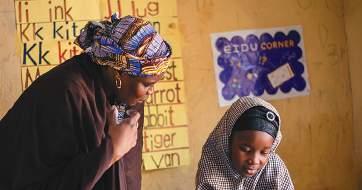
The voices rise in near perfect rhythm inside a Primary Three classroom at Central Primary School, Yola North, Adamawa State. Several pupils, most of them under the age of 10, stretch their hands impatiently into the air, eager to answer the question their English teacher has just written on the board.
Inside the classroom, learning feels animated, energetic and deeply participatory; a noticeable contrast to the quieter, more rigid learning culture that teachers say once characterised many public-school classrooms in the area.
Standing before the pupils is Bilkisu Umar, a teacher with two decades of classroom experience in Adamawa’s public education system. She pauses briefly, observing the enthusiasm in the room before inviting one of the pupils to answer.
“Since the EIDU programme was introduced into our classrooms, this has become our normal,” she says.
For years, many schools in Adamawa reflected a broader foundational learning crisis affecting Nigeria’s public education system. In many cases, children progressed through school without acquiring literacy and numeracy skills considered appropriate for their age.
The World Bank describes the phenomenon as “learning poverty” — the inability of a child to read and understand a simple text by the age of 10.
In response, the Adamawa State Government partnered with EIDU, a global education technology organisation focused on improving foundational literacy and numeracy in underserved communities.
The programme, introduced almost a year ago, currently operates in 36 schools across Yola North and Yola South local government areas, reaching approximately 13,000 learners alongside about 425 teachers, head teachers and school supervisors.
Education officials say the intervention is still at an early stage, but teachers in participating schools already report noticeable changes in classroom participation, attendance and learner confidence.
Still, some observers caution that the real test will be whether those improvements can be sustained and expanded across a state with more than 2,000 public primary schools.
Inside the EIDU Corner
At the centre of the initiative is what teachers now call the “EIDU Corner” — a dedicated section of the classroom where pupils engage in individual learning exercises using smartphones, learning cards and specially designed teaching materials.
“The pupils are very comfortable with the technology they use at the EIDU Corner,” Bilkisu Umar explains.
“They become excited when the smartphone mentions their names and displays their pictures. They immediately know it is their turn to carry out their exercises.”
Each child spends a scheduled period at the corner daily, completing literacy tasks designed to help teachers track learning progress more closely.
According to programme coordinators, artificial intelligence is used to assess pupil responses and identify areas where learners may require additional support. The system also recommends remedial steps teachers can take for struggling pupils.
Beyond the technology itself, the programme has introduced structured literacy exercises, phonics sessions, lesson guides and teaching support materials aimed at improving classroom delivery.
For many teachers, however, adapting to the new system was not entirely straightforward.
Some initially struggled with the technologydriven approach, while intermittent electricity supply and limited digital familiarity created
early implementation difficulties.
“Introducing technology into classrooms naturally came with challenges,” says Dr. Murtala Umar Babayi, Executive Chairman of the Adamawa State Universal Basic Education Board (ADSUBEB). “But through continuous training and support, teachers are now more comfortable with the process.”
Despite the challenges, teachers say the shift has altered classroom dynamics considerably.
“The children are bolder now,” Bilkisu says. “When they respond to questions on the smartphone, they are more confident because they are beginning to understand what they are learning. It is very different from what we used to see before.”
Some teachers also report improved attendance among pupils who were
previously less engaged in classroom activities.
For many children, school appears less intimidating than before. The programme’s digital approach has added a modern dimension to the traditional play-based method of learning, one many pupils seem to be embracing enthusiastically.
Rukayya’s Story
Among the pupils participating in the programme is Rukayya Mustapha, a quiet girl whose experience reflects some of the changes teachers say they are beginning to observe.
Before the programme, Rukayya struggled to participate in classroom activities.
“She was very shy initially,” Bilkisu recalls. “She was afraid of making mistakes.”
According to her teacher, Rukayya often avoided answering questions publicly and appeared withdrawn during lessons.
But over time, the repeated exercises, classroom interaction and encouragement from teachers gradually drew her into participation.
Slowly, she began volunteering answers, participating during literacy exercises and showing greater confidence around her classmates.
Today, Bilkisu says Rukayya is among the more active pupils in the class.
“She now participates more confidently than before,” she says.
Teachers say similar stories are emerging in other participating schools, although they acknowledge that learning outcomes still vary among pupils.
Independent education experts argue that while anecdotal stories are encouraging, long-term programme success will ultimately depend on measurable improvements in literacy and numeracy assessments over time.
Fintiri’s Education Vision
For education officials in Adamawa State, the EIDU partnership represents part of a broader education reform strategy under Governor Ahmadu Umaru Fintiri.
Over the years, the administration has invested in school rehabilitation, teacher recruitment, professional development and digital learning initiatives.
“Governor Ahmadu Umaru Fintiri has demonstrated strong commitment to basic education through investments in infrastructure, funding, teacher professional development and digital education,” says Babayi.
According to him, the EIDU programme complements the state’s wider efforts by introducing more structured and data-driven approaches to foundational learning.
“What we are seeing is a transition toward a system focused more deliberately on measurable learning outcomes,” he explains. “The objective is not simply enrollment. The objective is learning.” That distinction has become increasingly important across many African countries where school enrollment has improved over the past two decades, but learning outcomes have often remained weak.
Adamawa’s approach attempts to confront that challenge directly by focusing not only on getting children into classrooms, but also on improving what happens once they arrive there.
Teachers participating in the programme undergo onboarding sessions, continuous monitoring and periodic training designed to strengthen classroom instruction.
Books and instructional materials are also provided to support literacy development both inside and outside the classroom. That way two major elements relevant to learning are addressed by the reform: the level of preparedness of teachers, and instructional aids and materials that can ease the process.
A Quiet Experiment in Reform
Officials acknowledge that the programme remains relatively small compared to the scale of Adamawa’s educational challenges.
With more than 2,000 public primary schools across the state, the current intervention reaches only a fraction of learners.
Funding, scale, teacher capacity and long-term sustainability remain important questions going forward. Even so, state officials argue that the early signs justify further expansion.
Plans are already underway to extend the programme to additional schools based on available resources and performance assessments. For now, the clearest evidence of change may not lie in glossy policy documents or neatly packaged official presentations, but inside classrooms like Bilkisu Umar’s.
There, children who once sat quietly through lessons now compete eagerly to answer questions, participate in literacy exercises and engage more actively with classroom activities.
Teachers say something important is already changing: more children are beginning to believe that learning belongs to them too.
Gov. Ahmad Fintiri
Dr. Murtala Babayi, Executive Chairman, ADSUBEB
A pupil and her teacher
A Celebration of Cultures as Olam Agri Honours Africa’s Heritage at 2026 African Day
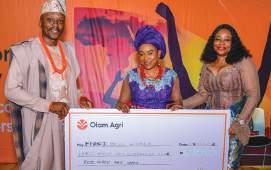
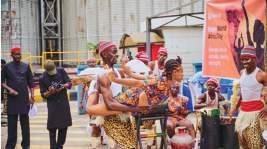
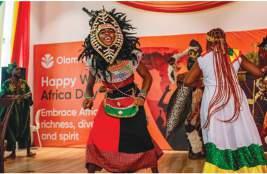
Olam Agri brought the spirit of Africa to life at its Lagos headquarters as employees celebrated the 2026 Africa Day with colourful displays of culture, music, cuisine and traditional attire.The event highlighted the company’s commitment to diversity, inclusion and shared identity, while reaffirming its strong connection to the continent and its continued investment in Africa’s agricultural growth and development. Precious Ugwuzor reports
Africa is endearing. It is home to diverse cultures.
Rhythmic dances, rich cuisines, flamboyant textiles, interesting folklores are woven into the fabric of the continent.
The Africa Day Celebration, a commemoration of the continent’s progress, unity and culture which is held every May 25th, has always provided a platform to drumbeat her uniqueness.
Hence, Olam Agri, a market leading, differentiated food, feed and fibre agri-business with a global origination footprint, processing capabilities and deep understanding of market needs built over 34 years, rolled out the drum to celebrate the continent at its Lagos head.
Drums rolled, cultural songs echoed, staff members clad in traditional attires danced excitedly and cheered with impressive energy, proudly displaying the colours of their heritage, reflecting the agribusiness’ belief in unity, shared identity and the enduring spirit of Africa.
Precisely, the event was more than a ceremonial gathering. It was a reaffirmation of the company’s identity as an African-grown enterprise that has evolved into a global agribusiness leader while remaining firmly committed to the continent that shaped its foundation.
Over the years, Olam Agri has expanded its operations across several countries and continents, becoming a major player in the agriculture value chains globally. Despite its vast global operations, Africa particularly Nigeria remains central to its vision and growth strategy. This is why it continues to invest significantly in local capacity development, agricultural value chains and food system efficiency while fostering a corporate culture built on inclusion, respect and shared prosperity.
Setting the tone for the celebration, the General Manager, Human Resources, Olam Agri Nigeria, Lucky Nwadei, described the event as a celebration of togetherness, uniqueness and the strength inherent in diversity.
According to him, the organisation’s success over the years has been largely driven by its ability to unite people from different cultural backgrounds, perspectives and skill sets under one shared vision.
“We are celebrating good culture, togetherness and uniqueness. It is good to know that we can come together and unite in our diversity,” he said.
“We have been able to bring together people of different and diverse cultures and skills. Our diversity showcases our strength and reflects that we can work together for a greater future. Diversity allows us to bring different perspectives to the table to solve problems and contribute ideas. We are a group of people acting as one.”
Nwadei noted that every passing year has seen the organisation grow stronger and bigger, riding on workplace diversity, focused value chain investment, human capital development and alignment with the local growth agenda.
An Engaging Event and Taste of Africa’s Rich Heritage
The event reflected Olam Agri’s diversity in vivid details as employees proudly adorned themselves in traditional attires representing different ethnic
nationalities across Nigeria and Africa.
One of the major highlights of the celebration was the “Represent Your Culture Dress Competition,” which attracted enthusiastic participation from staff members eager to display the beauty and uniqueness of their heritage. Emerging winner of the competition (Male Category) was Adams Edward Edafe of the Rice Unit, from Ethiope West Local Government Area of Delta State.
Widely admired for his fluency in several Nigerian languages, Edafe captivated participants with songs rendered in his indigenous Urhobo dialect.
Speaking after emerging first position in the competition, Edafe praised Olam Agri for fostering an atmosphere that respects cultural diversity and heritage.
“Olam Agri gives me the opportunity to expand and express what I wish and like to do,” he said.
“You need to know and express your roots. This event is an avenue to appreciate other tribes and learn from one another. It keeps getting better every year.”
Recalling his previous outing at the cultural celebration, Edafe revealed that he also emerged winner in the previous edition of the competition.
“Last year, I won the number one position in the ‘Represent Your Tribe Dress Competition’. We all work as one in Olam Agri. There is a synchronisation we have here. There is no tribal sentiment,” he added.
Also speaking, Sarah Joodomo from Kogi State commended the company for sustaining an inclusive work culture where every employee feels respected regardless of ethnic
background.
“I feel good and delighted. It is fun and we all work together. Every culture is respected,” she said.
For Ayodotun Isaac Abanikonda from Ekiti State, who works in the Treasury Department, the celebration further strengthened the sense of belonging among staff members.
Describing the event as exciting and commendable, Abanikonda, who emerged third in the competition, applauded the management for continuously improving cultural integration within the organisation.
“It is getting better every year,” Abanikonda adorned in his native Yoruba attire remarked.
Similarly, Winner Jegede from Ogori/ Magongo Local Government Area of Kogi State, Northern Nigeria, described the event as a powerful reminder of African identity and pride.
“It is a nice event. It is part of the reason why we are Nigerians and Africans showcase our culture to the world. We are proud to be Africans,” Jegede who emerged third in the Represent Your Tribe Dress Competition (Female Category) stated.
Speaking on the company’s management of cultural diversity, Jegede noted that Olam Agri has consistently promoted unity among employees irrespective of ethnic affiliations.
“As a company, Olam Agri has always tried to make us one. We have different tribes here and we live together in unity and harmony. You can hardly differentiate people by culture because we live together peacefully,” she said.
Another major attraction at the celebration was the local dish competition, where staff members displayed indigenous cuisines from different parts of the country.
Mary Isaiah, who represented the Calabar tribe of Cross River State, emerged winner of the local dish competition and
second position in the cultural dress category.
Having spent over 16 years with the organisation, Isaiah described Olam Agri as a place that provides opportunities for growth while respecting Africa’s cultural heritage.
“I feel very excited. This is the second time I am participating in a competition like this,” she said.
“Olam Agri is a place that gives you freedom to succeed. It provides stepping stones and opportunities to learn more. African cultural heritage is respected and cherished here. It brings us together and we are delighted.”
Building Strength in Diversity, Shared Identity
In his remarks, the Country Head and Managing Director of Olam Agri, Nigeria, Anil Nair, reaffirmed the company’s enduring commitment to Africa, noting that the organisation’s journey and growth story remain closely connected to the continent’s people, values and opportunities.
According to him, Nigeria occupies a strategic position in Olam Agri’s global operations, not only because of its market size and agricultural potential, but also because of the resilience, talent and cultural richness of its people.
“Our respect for diversity goes beyond symbolic celebrations; inclusion, mutual respect and collaboration are embedded in Olam Agri’s internal operations, workforce management and external stakeholder engagements.
“Africa’s cultural diversity represents strength rather than division,” Anil said, adding that “Olam Agri will continue to create an enabling environment where employees from different backgrounds can thrive together while contributing meaningfully to the organisation’s growth and Africa’s agricultural transformation.”
Local cultural troupe performance at the head office
Presentation of prize to staff member who participated in cultural contest
s taff at the Beachland office engaging in local dances at the Beachland office traditional troupe performance at the tin Can plant
The A GLIMMER OF HOPE
The early returns are beginning to show, contends ADEMOLA OSHODI
See page 21
WHEN THE UMPIRE JOINS THE FIGHT TONY EDEMENAHA
bemoans a republic on life support
Ritual killings and occult fraud are symptoms of a deeper national disorder, argues K. BOLANLE ATI-JOHN
BLOOD MONEY: RITUALISTS, MARABOUTS, OCCULTISTS AND NIGERIA’S MORAL CRISIS
There are crimes that shock a nation. There are others that reveal it. The recurring reports of ritual killings, body-part harvesting, occult fraud, fake spiritual prescriptions, blood-money practices, and the growing mythology of supernatural wealth in Nigeria belong to the second category. They are not merely criminal incidents. They are symptoms of a deeper national disorder.
The ritualist is not an isolated monster living outside society. He is one of the darkest products of a society that has separated wealth from work, success from scrutiny, spirituality from ethics, and power from accountability. He thrives where institutions are weak, where poverty humiliates, where sudden wealth is worshipped, where fear is monetised, and where too many people have stopped asking the most basic moral question: how did he get the money?
Nigeria must treat ritual killing as a crime. But if we stop there, we will misunderstand the problem. Ritual killing is the visible tip of a broader criminal spiritual economy. Within that economy are killers, recruiters, lurers, body-part traders, occult consultants, fraudulent herbalists, rogue clerics, marabouts, fake prophets, criminal shrine operators, desperate clients, political patrons, cultists, cybercriminals and silent beneficiaries. The victim may be killed by one hand, but the moral machinery that made the killing possible is often larger than the person holding the knife.
This is why the subject must be discussed without hysteria, but also without cowardice.
Not every traditional practitioner is a criminal. Not every marabout is evil. Not every herbalist, alfa, diviner, prophet, priest or spiritual healer is part of this darkness. Nigeria’s traditional and religious landscapes contain sincere practitioners who serve communities, heal wounds, preserve culture and offer moral guidance. To criminalise tradition itself would be unjust, ignorant and dangerous.
But it would be equally dishonest to deny that a criminal class hides under the cover of spirituality. These are the merchants of fear who promise wealth without labour, protection without righteousness, political victory without service, business success without discipline, sexual control without consent, and revenge without justice. They prey on greed, desperation, ambition, insecurity and ignorance. They tell the vulnerable and the wicked that destiny can be stolen, enemies can be destroyed, wealth can be forced, and another person’s life can become an ingredient.
This is not spirituality. It is organised moral corruption.
The most disturbing aspect of the ritualist phenomenon is not only the cruelty of the act. It is the belief system behind it. Somewhere in the imagination of the perpetrator, a human being has ceased to be sacred. A child becomes a tool. A woman becomes a sacrifice. A stranger becomes material. A body becomes a commodity. Blood becomes currency.
No nation can survive for long when such thinking finds social oxygen.
The oxygen is everywhere. It is in the celebration of unexplained wealth. It is in the family that rejoices when a son suddenly becomes rich but refuses to ask what enterprise produced the money. It is in the community that confers titles on men whose income no one can explain. It is in the religious institution that accepts donations without moral inquiry. And it is in the politician who embraces thugs, cultists and spiritual fixers during elections. It is in the entertainment culture that glamourises flamboyance without provenance. It is in the socialmedia economy that turns fraudsters into celebrities and noise-makers into models of success.
We have made wealth too sacred and life too cheap.
That is the heart of the crisis.
The Nigerian ritualist is not only an ancient figure. He is modern. He carries a smartphone. He uses dating apps. He watches videos on social media. He may be involved in cybercrime. He may wear designer clothes and speak the language of hustle. He may be educated enough to use technology but morally damaged enough to believe that charms, blood, potions and body parts can assist fraud.
This is the “Yahoo Plus” mutation: the meeting point between digital criminality and occult imagination. It reveals a frightening truth. Modern tools do not automatically produce modern minds.
A young person may operate a laptop, manipulate online identities, move money through digital platforms, and still be trapped in profound moral darkness. Technology has not displaced superstition; in some cases, it has given superstition new channels of operation.
The result is a generation of criminals who understand connectivity but not conscience.
There is also a political dimension that Nigeria often whispers about but rarely confronts with seriousness. Across the country, many citizens believe that some people seek occult protection, secret oaths, ritual fortification, sacrificial advantage or spiritual manipulation in pursuit of power. Some of these allegations may be exaggerated. Some may be rumours. Some may be political weapons. But the persistence of the belief is itself significant. It tells us that many Nigerians no longer see power as morally innocent. They suspect that beneath the language of public service lies a darker hunger for domination.
A country where people believe leadership is sustained by blood, charms, secret oaths or hidden terror has a crisis of public trust.
This is not merely a cultural issue. It is a governance issue. It is a security issue. It is a national-development issue. Where citizens believe that power is occultic, wealth is suspicious, justice is uncertain and success is often fraudulent, trust collapses. And when trust collapses, the nation becomes expensive to govern, difficult to secure and almost impossible to mobilise for shared sacrifice.
The ritualist economy also feeds on vulnerability. Its victims are often children, young women, students, domestic workers, the poor, the elderly, street children, migrants, persons with disabilities and others whose disappearance may not immediately command attention. This is one of the most damning aspects of the problem. The ritualist does not usually prey on the powerful. He preys on those society has already failed to protect.
A child disappears. A young woman is lured. A domestic worker goes missing. A stranger is suspected. A poor family cries to a police station and is told to wait. By the time the state awakens, a body may have been found, mutilated beyond recognition. This is not only murder. It is the final failure of a protection system that should have acted earlier.
Rear Admiral Ati-John (rtd) fdc⁺ is a Distinguished Fellow of the National Defence College, Abuja, and writes from Lagos
The early returns are beginning to show, contends ADEMOLA OSHODI
A GLIMMER OF HOPE
President Bola Ahmed Tinubu promised reform at the start of his administration. Those reforms were necessary, but they have placed real pressure on many Nigerians. Families have had to make harder choices around food, transport, rent, school fees and energy costs, while traders and small businesses have had to rework their margins under the combined pressure of exchange-rate changes, credit costs and rising inputs. Any account of the administration’s early returns must begin with that reality, because reform loses public trust when government speaks above the experience of the people it serves.
The fair question is whether the difficult decisions taken since May 2023 have begun to correct the distortions that weakened Nigeria’s economy, and whether those corrections are now strong enough to reach citizens more directly. On that question, the evidence points to an important but unfinished story.
The Tinubu administration has not solved every problem in three years, but measurable early returns have begun to show across various national facets including reserves, revenue, oil production, capital inflows, growth, education financing and Nigeria’s standing before investors and development partners.
President Tinubu came into office at a time when Nigeria’s public finances were under severe strain. Fuel subsidy was draining public money that could have funded basic services, the Central Bank had large foreign exchange backlogs, multiple exchange rates created room for arbitrage, oil production was below national needs, and public revenue was too low for the scale of Nigeria’s development demands. These were deep structural constraints that limited the ability of government to fund services, protect the currency, and support businesses and households. Avoiding them would have bought short-term comfort at the cost of deeper national damage.
One early return is already clear in Nigeria’s external position. The Central Bank cleared around $7 billion in outstanding foreign exchange obligations which helped restore confidence in a system many airlines, manufacturers, investors and businesses had struggled to trust. Since then, Nigeria’s net foreign-exchange reserves have risen from $3.99 billion at the end of 2023 to $34.8 billion by the end of 2025, while gross reserves reached $50.45 billion by mid-February 2026. The balance-of-payments position also turned around, moving from deficits of $3.34 billion in 2023 and $3.32 billion in 2022 to a $6.83 billion surplus in 2024. These are not abstract figures. They show a country rebuilding the buffers it needs to meet external obligations, support currency stability and regain credibility in the foreign-exchange market.
That repair is also showing in investor behaviour. Capital inflows rose by almost 90 per cent in 2025, from $12.32 billion to $23.22 billion, with foreign portfolio
investment carrying much of the increase. This should not be confused with a full factory-investment boom, but it shows that investors are returning to Nigerian financial assets. The stock market gives the clearest expression of that renewed confidence. In 2023, the All-Share Index stood around 53,000 and market capitalisation around ₦30 trillion. By 2026, the index had reached 250,000, with market capitalisation rising to ₦160 trillion, recording a near fivefold rise to a record 250,000 points. That kind of movement does not happen in a market where investors see only drift and uncertainty. It reflects a major revaluation of Nigerian assets and a growing belief that the reforms are positively changing the direction of the economy.
Inflation is the most sensitive indicator because Nigerians judge policy by what they pay every day. When President Tinubu assumed office, inflation was already at 22.41 per cent in May 2023, before the difficult but necessary reforms around subsidy and the exchange rate pushed price pressures higher, reaching 34.80 per cent in December 2024. The more recent figure of 15.69 per cent in April 2026 points to easing, but it must be interpreted cautiously because the National Bureau of Statistics rebased the Consumer Price Index. The point is, inflation has moved down from the severe stress of the adjustment period, but food prices and household costs must fall further before many Nigerians can feel the full benefit.
The growth and revenue figures show an economy drawing strength from outside oil. In the first quarter of 2023, before President Tinubu assumed office, the NBS put real GDP growth at 2.31 per cent, with the economy slowed by the cash crunch. By the first quarter of 2026, real GDP growth had risen to 3.89 per cent and is projected to rise above 4 per cent within a year according to international financial institutions. Manufacturing had grown by 3.29 per cent, and the non-oil sector accounted for 96.08 per cent of real GDP. Between January and August 2025, total government collections also rose to ₦20.59 trillion, from ₦14.6 trillion in the same period of 2024, with non-oil sources bringing in ₦15.69 trillion, about three out of every four naira collected.
Oshodi is the Senior Special Assistant to President Tinubu on Foreign Affairs and Protocol
bemoans a republic on life support
WHEN THE UMPIRE JOINS THE FIGHT TONY EDEMENAHA
Nigeria today feels like a courtroom where the judge has removed his wig to share the loot, the bailiff sells adjournments, and the accused sits on the bench. The house hasn’t fallen yet, but the termites are writing memos on letterhead. The landlord is converting the foundation into a private vault.
The Committee for the Defence of Human Rights put it plainly: Rise, speak and unite. And together, let us break every chain of injustice and reclaim the freedom that is ours. That is not sloganeering. It is a diagnosis. In every age of crisis, God raises messengers—voices of courage and truth—to awaken people and restore justice.
Today is no different. We live in a world of political manipulation and economic strangulation. The chains are no longer iron. They are policy documents, padded budgets, midnight court orders, and procurement memos that turn hospitals into mortuaries and schools into relics.
A republic stands on three legs: executive, legislative, judicial. Ours balances on air while the people bruise their tailbones.
The executive, mandated to deliver development, has become an events planner for convoys. A governor commissions a “world-class” bus stop with 47 aides clapping, while the teaching hospital behind it has no bandages. The Federal Executive Council approves billions for “capacity building” workshops in Dubai to teach officials how to use email. Meanwhile, citizens’ capacity to buy food is demolished by inflation that never attends workshops. Remove subsidy, float the naira, tax the air, then tell citizens to “sacrifice” while your SUV fleet renews itself quarterly.
The legislature, the supposed House of the People, is now a House of Per Diems. Lawmakers earn hardship allowances while their constituents live hardship. Constituency projects appear in press releases and vanish in villages, only to resurface as wings of a senator’s hotel. Oversight means negotiating cuts. When the Appropriation Bill leaves the National Assembly, it’s heavier, breastfed with padding.
Then the judiciary, the last temple where the common man hoped to find God in a wig. Lately, the temple is leased to the highest bidder. Election tribunals sound like betting houses. Ex-parte orders stop investigations at 11:58 pm. A man who steals a phone is remanded in 24 hours. A man who steals a state files a “preliminary objection” and gets eight years of adjournments. Lady Justice now squints at bank alerts before reading affidavits.
This is systemic collapse—not because institutions are absent, but because they work for a greedy, self-perpetuating elite stashing our commonwealth into private pouches.
Anecdotes from the Republic of Bruises : In Kogi, 2024, the budget provided
₦1.3 billion for “Government House Catering and Refreshments.” The same year, the state teaching hospital had two functional dialysis machines for 4.7 million people. That’s not a budget. That’s a menu, and the people aren’t invited.
In Ekiti, a man lost a councillorship seat to an opponent who shared ₦2,000 and groundnut oil per voter. Two years later, the councilor is missing, the oil is finished, and voters buy garri on credit. That’s economic strangulation by democracy: choose your poison, drink it for four years.
In Zamfara, Mrs. Halima’s son was arrested during #EndSARS. No charge for 14 months. When her lawyer saw a judge, the judge asked, “Who sent you to defend this boy?” Justice required an invitation letter.
Poverty has become an object—visible, tangible. It’s the child studying under a streetlight because NEPA took the light and the school took the roof. It’s the graduate who submits 300 applications and gets 300 prayers: “We’ll get back to you.” It’s the pensioner who dies on the verification queue while his former governor “rests” in London from the stress of looting.
The elite practice perverse alchemy. They turn public hospitals into private referrals. Government schools collapse so private schools owned by their wives thrive. Roads are left with craters so contracts are re-awarded yearly. Insecurity persists because security votes are unaccountable. The more the country bleeds, the more they bandage their pockets. They don’t fear elections. If you can’t beat the ballot, buy the collation officer. If you can’t buy him, get a court to cancel him. If the court refuses, get a higher court to confuse him. The game is rigged, and the umpire wears a jersey. But Freedom Is Never Handed to the Silent.
We are called to rise—not in silence, but in unity; not in fear, but in conviction. Justice doesn’t prevail without those willing to stand for it. Silence is tyranny’s oxygen. Our silence has been so generous the elite breathe better than we do.
Edemenaha, poet and social commentator, writes from Asaba
Editor, Editorial Page PETER ISHAKA
THE SCOURGE OF RITUAL KILLINGS
Increasingly, many Nigerians are now living in fear over growing cases of ritual killings. Last week, security operatives arrested a suspected serial killer who reportedly confessed to murdering dozens of people in the Odukpani Local Government Area of Cross River State. The suspect claimed he was assisted by a woman who usually lured unsuspecting victims to isolated locations where they were murdered, obviously for ritual purposes. But the Odukpani killings are not isolated incidents. While there may be no reliable statistics, the menace of missing persons and ritual killings across the country has become pronounced. Indeed, it has become so obvious that a civil society organisation, ‘Enough is Enough’, has since opened a website to document the trend.
From Lagos to Port Harcourt, Enugu and other cities across the country, hardly a week passes without tales of some people killed for what are attributed to ritual purposes. Last November, a Federal Road Safety Corps (FRSC) officer and her 12-year-old daughter, were gruesomely murdered in Osun State by a family friend who lured them to the shrine of a herbalist where they were slaughtered and dismembered, with their vital organs removed. And in April this year, the Kwara State Police Command apprehended a man with the skull of a deceased family member whose remains he had exhumed.
Taiwo Akinola, a suspected cult member, for allegedly attempting to kill his mother for money rituals.
But perhaps one of the most celebrated cases was that of the Port Harcourt serial killer, Gracious David-West who reportedly lured seven young ladies with high-risk lifestyle across Lagos, Imo and Rivers State to hotels and murdered them for rituals. Similarly, a young graduate who was raped and murdered while searching for a job in Uyo environs, Akwa Ibom State, few years ago, was reportedly used for ritual purposes. There was also the horrifying murder of a 300-Level undergraduate of Delta State University, Abraka, by a gang of four yahoo boys. One of the criminals told the police that they took the young lady to a bush where they plucked out her eyes, removed her breast and heart.
There is no proven link between the costly rituals and the instant wealth promised through magical potions by herbalists and voodoo practitioners
T H I S D AY
EDITOR SHAKA MOMODU
DEPUTY EDITOR WALE OLALEYE
MANAGING DIRECTOR ENIOLA BELLO
DEPUTY MANAGING DIRECTOR ISRAEL IWEGBU
CHAIRMAN EDITORIAL BOARD OLUSEGUN ADENIYI
EDITOR NATION’S CAPITAL IYOBOSA UWUGIAREN THE OMBUDSMAN KAYODE KOMOLAFE
Ritual killing is not a new criminal challenge. In March 2014, the nation was thrown into confusion when a kidnappers’ den was discovered in Soka community, Ibadan, Oyo State. After the den was raided by some commercial motorcyclists who were searching for two of their missing colleagues, human skulls, dried human parts alongside malnourished victims reportedly reserved for ritual purposes, were discovered. In August 2018, the Lagos police arrested one
EDITOR-IN-CHIEF/CHAIRMAN NDUKA OBAIGBENA
GROUP EXECUTIVE DIRECTORS ENIOLA BELLO, KAYODE KOMOLAFE, ISRAEL IWEGBU
DIVISIONAL DIRECTORS SHAKA MOMODU, PETER IWEGBU, ANTHONY OGEDENGBE
DIRECTOR, PRINTING PRODUCTION CHUKS ONWUDINJO TO SEND EMAIL: first name.surname@thisdaylive.com
But the questions inevitably arise: What are the motives? What could be the cause of these grim acts of violence against fellow human beings, and indeed, the society? What could account for these barbaric acts of violence even among the supposedly educated citizens? Many attribute the menace to the growing sense of desperation to acquire wealth, without work. Amid the prevailing poverty and joblessness in the land, many have resorted to doing anything, no matter how weird, for wealth. Yet, there is no proven link between the costly rituals and the instant wealth promised through magical potions by herbalists and voodoo practitioners even when our society is now ravaged by it.
Today, many of our university campuses have become breeding grounds for Yahoo boys and girls who are looking for instant wealth. Sadly, the education they received does not rid them of the superstition that wealth comes from productive enterprises and not from human body. And with that, many innocent citizens are becoming victims to barbaric killings.
Letters in response to specific publications in THISDAY should be brief (150-300 words) and straight to the point. Interested readers may send such letters along with their contact details to opinion@thisdaylive.com. We also welcome comments and opinions on topical local, national and international issues provided they are well-written and should also not be longer than (750- 1000 words). They should be sent to opinion@thisdaylive. com along with photograph, email address and phone numbers of the writer.
INSECURITY: ARE WE CURSED OR ARE WE THE CAUSE?
Insecurity in Nigeria has undoubtedly assumed an alarming dimension. Across the country, stories of kidnappings, abductions, bandit attacks and killings have become recurring headlines. What was once seen as an occasional security challenge has now evolved into a national emergency that threatens the safety, stability and economic prosperity of the nation.
On a daily basis, innocent citizens are kidnapped in large numbers, while huge sums of money are demanded and paid as ransom for their release. At the moment, teachers and pupils who were kidnapped in Oyo State are yet to regain their freedom. Their continued captivity is a painful reminder of the growing insecurity confronting the nation and the seeming helplessness of those charged with protecting lives and property.
Even more disturbing is the fact that many of these
terrorists and criminal elements do not hesitate to kill or maim their victims whenever ransom demands are not met. Families are left devastated, communities live in fear, and the psychological trauma inflicted on survivors often lasts a lifetime. The value of human life appears to be diminishing in the face of unchecked criminality.
Beyond Oyo State, there are unspecified numbers of Nigerians currently being held hostage in forests and hideouts across the country. While countless families are struggling to secure the release of their loved ones, political actors and leaders seem more preoccupied with calculations and alignments ahead of the 2027 elections. Such misplaced priorities raise serious concerns about the commitment of the political class to addressing the nation’s most pressing challenge.
It is unfortunate that both past and present administra-
tions have failed to provide a lasting solution to insecurity in Nigeria. What Nigerians often witness are temporary measures and cosmetic treatments that address symptoms rather than the root causes of the problem. Despite repeated assurances from government officials, the security situation continues to deteriorate in many parts of the country. A serious and determined government would explore every available option, including seeking international support, technical assistance and strategic partnerships to combat terrorism and organized crime. National security should never be sacrificed on the altar of pride or political considerations. The protection of citizens must remain the highest priority of any responsible government.
Tochukwu Jimo Obi, Obosi, Anambra State
BUSINESS WORLD
RATES AS AT J UNE 3,2026
Four Years After 5G Rollout, 4G Leads with 53.76% Market Share across Networks
Stories by emma Okonji
Despite assurances from Mobile Network Operators (MNOs) that 5G rollout will be a game changer in the telecoms industry, its acceptance and market penetration after four years of rollout, is abysmally low with a record of 4.2 per cent market share as at March 2026.
The older generation of technologies like 2G and 4G, are still waxing stronger and widely accepted by telecoms subscribers across networks.
While 2G has a market share of 36.74 per cent as at
March 2026, 4G is leading with the highest market penetration level of 53.76 per cent as at March 2026. The development according to the statistics recently released by the Nigerian Communications Commission (NCC), seen by THISDAY, showed that the percentage of subscribers utilising telecommunications services through 2G and 4G technologies is higher than those utilising the 5G technology.
NCC had set aside Wednesday April 24, 2022, as the date for the rollout of 5G network in Nigeria, but MTN
Nigeria Communications Plc, became the first MNO to commercially rollout 5G technology, known as the fifth-generation technology on September 18, 2022, followed by Airtel Nigeria, which launched on June 19, 2023.
During its commercial launch in Lagos, the Chief Executive Officer of MTN Nigeria, Mr. Karl Toriola, promised to launch 5G in six other cities, which included Abuja, Port Harcourt, Ibadan, Kano, Owerri, and Maiduguri.
“The advanced 5G technology promises to
extend the reach and capacity of MTN Nigeria’s data network in Nigeria and enable much faster speeds and lower latency, giving customers near-instant access to the things they care about and downloads that take seconds, instead of minutes,” Toriola had said.
Also, during its 5G commercial rollout in four states, which included Lagos, Ogun, Rivers and Abuja, the Chief Executive Officer, Airtel Nigeria, Carl Cruz, promised that Airtel would cover the entire country with 5G by the end of 2023.
“The 5G revolution opens
a new vista of opportunities and it is a quantum leap from the existing 4G network. With 4G, video playback and video calls are smooth but in 5G, end-to-end video creation with the support of Artificial Intelligence (AI) is possible,” Cruz had said.
But four years after the initial commercial rollout, 5G technology is being experienced within few locations in some states of the country.
Giving reasons for the low penetration and usage of 5G technology across the country, the Executive
Vice Chairman of NCC, Dr. Aminu Maida blamed the situation on high cost of 5G equipment priced in dollars, coupled with the insufficient manufacturing of 5G-enabled mobile phones.
The NCC’s published statistics on 5G penetration and usage, showed that as at June 2025, 4G market share was 50.8 per cent, followed by 2G with 38.47 per cent market share and 3G with 7.66 per cent market share, while 5G had a market share of 3.07 per cent.
Industry Trends Report Identifies Structural Shifts Redefining How African Markets Operate
TheBoardroom Africa, the continent’s pioneering executive search and leadership advisory firm, has released its industry trends report, which identified four structural shifts already shaping capital allocation, regulatory direction, and competitive positioning across African markets.
The report revealed that the era of expansion-led growth was over, with Africa’s business leadership class pivoting from growth narrative to institutional proof.
The report brought
together insights from 30 senior executives, founders, investors and policymakers, spanning more than 20 sectors, including financial services, energy, technology, healthcare, infrastructure and the creative economy.
Key findings from the report showed that Capital is being re-priced; AI has moved from experiment to infrastructure; Healthcare is being redesigned, not just funded; and Governance has moved from policy to proof.
According to the report private credit is replacing
equity-led growth as the dominant financing model across the continent, adding that for African businesses, the implications are significant. Access to capital now requires demonstrating durable performance, beyond growth potential. Accurate risk pricing is now foundational to sustainable capital access and is strengthening repayment culture and credibility with mainstream investors.
The report also explained that Artificial Intelligence (AI) has moved from experiment to infrastructure, as AI is
no longer a competitive differentiator but an operational backbone across fintech, energy, healthcare and compliance.
According to the report, healthcare is being redesigned, not just funded, as Africa’s health systems are undergoing a structural shift. The report identifies a decisive move from volume-based to value-based care – away from counting procedures toward measuring outcomes and cost. At the same time, care delivery is migrating from centralised hospitals toward decentralised
networks of outpatient centres, community hubs, and virtual platforms. On financing, the report identified impact investment as a catalytic complement to public funding, not a replacement for it.
The report also said governance has moved from policy to proof, as Environmental, Social and Governance (ESG), AI ethics, cybersecurity and social performance are converging into a single accountability framework.
The report advised that Boards must demonstrate
Market data a s at Wednesday, June 3, 2026
institutional integrity, not report on it, since compliance effectiveness will be judged less by policies produced and more by behaviours evidenced.
Analysing the report, Founder and CEO, TheBoardroom Africa, Marcia Ashong-Sam, said: “Africa’s challenges have always been its most compelling investment case. What is different now is that its leaders are building the institutions to prove it.
how ESG Practices Enable responsible Leadership and Sustainable Success
Benson Olayinka Onwusa
Environmental, Social, and Governance (ESG) principles have become central to building resilient, profitable, and sustainable businesses. For most businesses, this means their ESG efforts begin with a compliance focus, driven by Environmental and Social Impact Assessments (ESIAs), feasibility studies, and regulatory requirements.
While these are important, at Segilola Resources Operating Limited (SROL), we have discovered that the real value of ESG lies in resilience, particularly in how organizations identify, adapt to, and mitigate risk. ESG leadership requires businesses to examine their operations from inception, assess their value chains, and understand the full scope of their impact. This includes evaluating internal and external stakeholders, understanding environmental dependencies, anticipating community responses, and aligning with regulatory expectations.
At SROL, we understood early that sustainability and profitability must work together. As operators of Nigeria’s first largescale gold mine, we have had to balance environmental responsibility, community impact, operational efficiency, and business growth simultaneously.
From building a strong governance architecture to board-level accountability, it was important to create a system that not only talked about sustainability but also walked the talk of sustainability. Over time, one lesson has become clear: effective ESG leadership is not built on compliance alone. The organisations that truly benefit from ESG are those that make it a core part of their operations and strategy.
Data Is key
One critical component of effective ESG leadership is data. You cannot manage what you do not measure, and you cannot control what you are not accountable for.
Take, for example, our data system at Segilola. By tracking diesel usage, fuel costs, and emissions, we identified opportunities to reduce our environmental impact while improving efficiency. This led us to explore alternative energy options such as CNG and
other cleaner energy solutions. Once businesses begin tracking relevant ESG metrics and using data to guide decisions, they are already reducing risk within the organisation. This not only strengthens operational resilience but also improves investor confidence. Foreign investors are more likely to scale businesses that have demonstrated strong governance, accountability, and risk management systems.
Understand the Environmental Impact of Your Operations and Find Sustainable Ways to Address It
A major part of responsible ESG leadership is understanding materiality and balancing sustainability priorities with profitability. That is where the concept of double materiality comes in, understanding not only how environmental and social issues affect the business, but also, how the business impacts the environment and people around it. Ultimately, every
company is trying to balance profit, people, and the planet, and those are the pillars that guide our sustainability approach at SROL.
One practical example is our water management system at SROL. Recognising that water is a major part of our mining operations, our first question was: Are we operating in a water-stressed environment?
If yes, how do we mitigate the risks associated with water extraction?
To avoid affecting groundwater levels, we constructed a cofferdam to responsibly manage our water extraction and reduce the risk of contamination or environmental disruption. As operations expanded, we developed a circular water recovery system that recycles water from mining tailings back into the processing plant.
The impact of these measures has been significant. In 2024, we recovered approximately 75% of water from the tailings system, and by 2025, that figure increased to 90%. This has substantially reduced our dependence on freshwater
sources and lowered wastewater discharge. Responsible ESG leadership also extends beyond internal operations into the supply chain. We assess our vendors and procurement systems to ensure we practice sustainable sourcing and avoid creating downstream risks through our partnerships.
COmmUnItIES mUSt BE PArt OF thE PrOCESS
ESG is essentially about people. At SROL, we practice what we call “cultural governance”—a stakeholder-engagement approach that gives host communities and traditional leaders a voice in decisions that affect them.
Rather than imposing programmes on communities, we involve them in shaping priorities and designing solutions. Through initiatives like our Livelihood Restoration Programme (LRP), communities actively participate in developing sustainable livelihood opportunities that reflect their actual needs.
This approach creates stronger ownership, better alignment with local realities, and long-term sustainability for the communities themselves.
ESG Buys Good reputation
The greatest value ESG creates is a good reputation, which you cannot easily quantify. ESG gives companies what is often referred to as a “social license to operate,” and that is an asset money alone cannot buy.
When a company consistently demonstrates responsibility toward its communities, employees, environment, and stakeholders, it builds trust and credibility. Subsequently, that reputation becomes a strategic advantage. It strengthens stakeholder relationships, reduces operational resistance, improves investor confidence, and supports long-term business goals.
In conclusion, compliance is just the floor of ESG. Companies that want to succeed must see ESG as a business strategy, not just a checkbox or a CSR operation. The companies that will lead the future are those that understand sustainability and profitability are deeply intertwined, not competing priorities.
• Benson Olayinka Onwusa, Sustainability Lead at Segilola Resources Operating Limited
FG: nAtEP Will Unlock human Capital Potential, Strengthen Partnerships
Stories by Emma Okonji
One year after its strategic re-launch, the National Talent Export Programme (NATEP) has achieved significant institutional progress, policy milestones, and international partnerships that have repositioned Nigeria as a major talent hub in the global services export economy, according to the Federal Ministry of Industry, Trade and Investment.
Nigeria is poised to strengthen its position in Africa’s digital transformation landscape as the IEEE Nigeria International Conference on Digital Transformation, NIGERCON 2026, holds in Lagos.
The conference, which
The ministry, in a statement, said the most decisive of those milestones came in November 2025, when the Federal Executive Council (FEC) approved the establishment of the National Coordination Mechanism for Services Exports (NCMSE), creating a formal governance framework to strengthen inter-agency coordination, align national policy with global digital trade, and accelerate the growth of Nigeria’s services
is scheduled to hold from November 5–6, 2026, at the University of Lagos, Akoka, will explore the convergence of emerging technologies and digital innovation across critical sectors.
The conference seeks to address issues in
export sector.
“Since its approval, the NCMSE has provided the institutional architecture for bringing together previously disconnected programmes,
agencies, and stakeholders under a common services export agenda,” the statement said.
Minister of Industry, Trade, and Investment; Dr. Jumoke
Oduwole, who was quoted in the statement, said: “We are witnessing a shift in the global economy, where greater value and the competitive advantage will be determined
by a nation’s ability to cultivate talent, harness deep knowledge-based industries, and participate in high-value services markets built seamlessly across borders.
Foundation Donates AI-tech Centre to College in Owerri
The Leo Stan Ekeh Foundation (LSEF) has donated a multimillion Naira state-of-the-art AI-tech centre to Holy Ghost College, Owerri, Imo State, during the school’s 77th
Connectivity and Communications, 5G, 6G, telecommunication systems, and Internet of Things (IoT) technologies, including Artificial Intelligence, Data Science, Machine learning, and Cybersecurity.
The conference will bring together researchers,
anniversary celebration.
The tech facility, which was supervised by Mr. Leo Stan Ekeh from construction to finishing, is equipped with highly integrated all-in-one
policymakers, industry leaders, and global technology experts to explore how emerging technologies can drive inclusive economic growth, improve public sector efficiency, and enhance industrial competitiveness across Nigeria and Africa.
Zinox computers, 24-hour iPower solar-powered electricity, and high-speed Starlink corporate internet connectivity, fully subscribed to for the next five years.
An alumnus of the institution, Leo Stan Ekeh said the project was inspired by his desire to equip students with the digital skills and global exposure required to thrive in the 21st-century knowledge economy.
“It is my prayer that this centre will produce Nigeria’s next generation of tech-driven billionaires who can create wealth, transform lives, and
alter the destinies of millions of Nigerians,” Ekeh stated. According to him, plans are already underway to transform the centre into a certified training hub for global technology brands including Microsoft, Cisco, Oracle, and Starlink.
“Beyond technology training, we are also introducing structured mentorship programmes focused on ethics, leadership, finishing school culture, transparent communication, and modern approaches to engaging today’s digitally exposed generation,” he added.
Kojo Boakye: Meta’s Investments, Infrastructure Crucial for Nigeria’s $1tn Economy
With Nigeria targeting a $1 trillion economy by 2030, Meta says sustained investments in digital infrastructure, artificial intelligence and connectivity remained critical to unlocking the country’s growth ambitions. In this interview with James Emejo, Meta Vice President for Public Policy, Africa, Middle East and Turkey, Mr. Kojo Boakye, discusses the findings of a recent Economic Impact Report, the significance of Meta’s investments in connectivity infrastructure, including the 2Africa submarine cable, and the growing role of AI in driving business growth, innovation and economic inclusion among others. Excerpts
The Meta economic impact report had just been launched here in Nigeria. Why is the market so important for you?
You know, sometimes I struggle with the word “market.” I’ll say Nigeria as a country is important for Meta. Many people talk about size, scale, all of those things. I think what we’re focused on is the way Nigerians use technology. Yes, there is demand — 250 million-plus people. Yes, there are 36 states plus the FCT that I’ve been working in for more than 22 years. I know that there’s a demand for it. But at the same time, we’ve noticed how Nigerians use technology. And for us, as a technology company first, knowing the benefit technology can bring, it makes Nigeria important to us. You heard from the Honourable Minister of Communication, Innovation and Digital Economy, about the patronage, even of AI — how AI is being used. He spoke about being a farmer on his own small farm. Some of the young people that are working on the farm — I understand that’s not typical — but because they’re using technology, drones, applications, AI to do those things, they’re working there. And we find that everywhere in Nigeria, the use of Meta AI, the use of WhatsApp, the use of Instagram, the use of Facebook, is being done in some of the most innovative ways. And on top of that, it’s changing people’s lives. So, individuals that we have — many people see creators, many people see better contact with their family. But what we’re seeing with the launch of this Public First report is that at least 14 million business owners wake up every morning and their immediate thought — after their Bible or their Qur’an, after they kiss their wife or their husband — is to reach for their phone and say: “Ah, what’s my business today? How will I make my daily bread? How will I employ my people? How will I ensure I have profit? How will I be able to compete?” All of those things are why Nigeria is important to us because we know that our applications can support all of that. Very exciting to us indeed. More than a market, it’s a country that we put at the forefront of everything that we do.
So what exactly does the report tell us?
This report is telling us that Meta’s applications and Meta’s other investments in things like infrastructure — Edo and Ogun State infrastructure, the landing of 2Africa in Lagos, Lekki, but also at Qua Iboe in Akwa Ibom — the first time we’ve landed a submarine cable in this country outside of Lagos, because Meta understands that we can connect the whole country better if we have two landings on the continent. What it’s telling us is that Meta’s investments and Meta’s applications are critical to the future of this country. Absolutely critical to the now and to the future.
Government aims to have a $1 trillion economy. The digital economy will make up a massive part of that. If you think about 14 million businesses being dependent on our applications, if you think about the way AI — our open-source AI, which we’ve launched here for many years — has been downloaded by so many people, so many young entrepreneurs and startups are using it, it has become critical to those businesses. We know that our investments and our applications are critical to what we’re doing
in this country, and that’s why things remain so important. That’s why we believe Meta is such an important part of the future.
And having a report from Public First that tells us concretely, “This is the evidence that we’re seeing,” it’s not just numbers that they’ve picked. They’ve gone out and they’ve spoken to Nigerians. And what’s important to you? I thought one of the stats — over 80 per cent of the people — say that Meta’s platforms are essential for their business. It’s enabled them to reach beyond their state. It’s enabled them to have business in international markets. The study tells us a lot.
Could you provide an update about the current status of the fibre optics cable you just refrenced. Are they still pipeline projects?
So we’ve landed those cables. This is part of the longest submarine cable in the world — 45,000 kilometres — and we’ve landed in two places in Nigeria. This is the cable that carries Nigerian data, Nigerian ideas, Nigerians’ demand for information around the continent. It also sends their business marketing, et cetera, around the continent.
But the biggest thing that it gives us is the foundational step — the real crux — of giving nationwide connectivity. The government has launched and raised money for one of the most ambitious projects globally — Project Bridge — 90,000 kilometres of terrestrial fibre.
Once that lands and connects everyone in Nigeria — you heard from the Minister about the plans, even for those in rural communities, no one will be left behind — but once that lands, to really give international connectivity, you need the submarine cable. Meta has built this for the future of Nigeria. And it’s already landed. We landed at Qua Iboe, as I’ve
mentioned, and we landed in Lagos, as I’ve mentioned. Our partners — MTN, MainOne, Baobab — have helped us do that. The cables are ready. They’re fired up, ready to go.
Tell us how Meta been engaging and working with local partners and developers to ensure its impact is felt in the country?
I’ve been with Meta since 2016 — and at the heart of everything we do is partnership. We don’t come in and say, “We’ll do this, we’ll do that.” Everything is done with partners.
So, as I’ve mentioned, the landing of 2Africa was done with MTN, MainOne and Baobab. You heard about the data centre attached to the cable, which enables Nigerian businesses’ data to remain in Nigeria, or at least when it’s travelling, to travel fast and to travel closer. That was done with Rack Centre. Everything is partnership.
The training that we’ve done — She Means Business, the new programme MetaTransform with AI for business owners and developers to integrate AI into their business activities — is being done in partnership with SMEDAN and Fate Foundation. And as you heard from NCC, from
NITDA, from the Minister of Communications, Information and Digital Economy — we’ve been partnering for years in this country with investments, sharing knowledge, training people, and that will continue.
What challenges did the report unearth? Infrastructure remains a challenge. We’re working on it. Government is working on it. You heard that the $2 billion required for Project Bridge has now been raised. The World Bank has made it project number one in their portfolio of digital infrastructure projects. You’ve heard that the Minister is rolling out 4,000 base stations to those rural areas that some operators say are not commercially viable. We’re connecting everybody.So, hopefully the infrastructure problem will be resolved.
Then what do you do to skills gap? There’s been a lot of talk in Nigeria: “Do we have the capacity? Do we have the skills?” You saw the gentleman say he can’t find good people. I have a difference of opinion. I’m a Ghanaian. But I know when I come to Nigeria, I see entrepreneurship. I see passion. I see skill. I see desire for opportunity. Those things we have to help fulfil. Meta has to continue providing training.
You’ve seen the government investing in training three million tech-savvy people. That’s another part that we have to resolve. And then the other thing is just the regulatory framework. How do we continue to get companies like Meta and other big companies, small companies, to continue investing? How do we give them the sense of
The story continues online on www.thisdaylive.com
Kojo
As Telecoms Operators Groan Under Severe Infrastructure Attack
Emma Okonji posits that the progress recorded in the telecoms sector in the areas of investment, network expansion and broadband penetration, could be eroded by constant vandalism threats to telecoms infrastructure
Telecoms operators may be standing between the devil and the deep blue sea, following consistent demand from telecoms subscribers and the regulator for improved service quality on one hand, and the frequent attacks on telecoms infrastructure by social miscreants on the other hand.
While the operators are yielding to pressure from subscribers and the regulator to improve service quality across networks by investing and expanding telecoms infrastructure, they are equally faced with the disturbing cases of telecoms infrastructure vandalism, fibre cuts, theft of equipment, and sabotage that disrupt services for millions of citizens and compromise national security.
Disturbed by the emerging situation, the Chairman, Association of Licensed Telecoms Operators of Nigeria (ALTON), Mr. Gbenga Adebayo, told THISDAY in an interview that the rate of telecoms infrastructure vandalism across the country was alarming, and needed urgent security intervention. “We are making efforts to expand network coverage by investing heavily in infrastructure rollout in urban, rural, under-served and unserved communities across the country, but we are equally worried about the continued attacks on the same telecoms infrastructure that we are trying to build, a development that could erode the many gains achieved in the telecoms sector,” Adebayo said.
During a recent workshop for judges on legal issues in telecommunications, organised by the Nigerian Communications Commission (NCC) in Lagos, the Executive Vice Chairman of NCC, Dr. Aminu Maida, reechoed the implications of telecoms infrastructure vandalism, and called for collaboration between NCC and the judiciary to address the rising cases of attacks on telecoms infrastructure across the country.
Attacks on Telecoms Infrastructure
Worried about the frequency of destruction and the negative impact on the telecoms sector and the Nigerian economy, Adebayo, told THISDAY in a telephone interview that the continuous vandalism of telecoms facilities have become a source of worry even to insurance companies that insured telecoms facilities in the country.
Adebayo said the destruction of telecoms facilities across the country started in March last year, with high frequency of occurrence, recording a maximum of five telecoms sites being vandalised on a daily basis since March 2025 till date.
He explained that the vandalism started in March after telecoms operators had commenced new investments in telecoms facility expansion to improve service quality, following the approval of 50 per cent hike in telecoms tariff in January 2025 by the Nigerian Communications Commission (NCC).
It is estimated that telecoms operators lose as much as N600 million to telecoms site vandalism and theft every day.
Adebayo said the vandalism and theft of telecoms facilities have continued unabated because the vandals have a ready market to sell stolen telecoms facilities, insisting that such available market is the solar industry market, where those that deal on solar equipment are willing to buy stolen items.
“Social miscreants attack telecoms sites, maim and sometimes kill security guards, and they vandalise and steal telecoms facilities, which include all the power cables and all the elements of cables that are on the site; the rectifier; the batteries; and the solar cells. Another line of vandalism is the destruction and theft of fibre optic cables,” Adebayo said.
Impact of Vandalism
Speaking about the impact of the vandalised and stolen telecoms facilities, Adebayo said because telecoms base
stations were powered on three types of energy, mostly diesel, solar, and wind, telecommunications signals were easily cut off, whenever a site or base station is attacked and vandalised, leading to weak transmission of telecoms services in the entire community that is connected to the base station.
“When this happens on a site that connects multiple stations, which we call the hub site, the implication is that all the on-work stations will be affected, and service quality will be affected,” Adebayo further said.
He appealed to the Office of the National Security Adviser (ONSA) and all security agents in the country to come to the rescue of telecoms operators, before the entire telecoms facilities in the country are completely vandalised.
Regulators’ Concern
Worried about the constant threat to telecoms infrastructure across the country, the Nigerian Communications Commission (NCC) is seeking collaboration with the National Judicial Institute (NJI) of Nigeria to address challenges facing the sector from the legal perspective.
Speaking during the opening ceremony of a two-day workshop for judges on legal issues in telecommunications, organsed by the NCC, the Executive Vice Chairman of NCC, Dr. Aminu Maida, said despite the progress recorded in the telecoms sector in the areas of investments and network expansion, including growth in broadband, which has led to increased broadband penetration from 47.70 per cent in 2025 to 54.30 per cent in 2026, the sector remained threatened with constant telecoms infrastructure attacks that could erode its many gains, if not addressed.
The story continues online on www.thisdaylive.com
Harps on AI, Infrastructure at IoT W’Africa
ipNX Nigeria has reinforced its commitment to driving innovation and digital transformation through its participation at the 2026 edition of IoT West Africa Conference and Exhibition held at the Landmark Centre, Victoria Island, Lagos.
The company’s Chief Technology Architect, Oluwaseun Oluboyo, who joined other industry leaders for a boardroom dialogue titled: ‘Tech Transformation: A Masterclass to Enable the C-Suite to Lead Digital Transformation in Nigeria’, explained that successful digital transformation Telecommunications, technology, and internet governance stakeholders have given their support to the 16th edition of the annual Nigeria DigitalSENSE Forum (NDSF) on Internet Governance for Development (IG4D), scheduled to hold in Lagos.
The forum, organised by ITREALMS Media and hosted by DigitalSENSE Africa (DSA); an ICANN-certified At-Large Structure, will focus on the theme: ‘Sustaining WSIS Vision with Multi-stakeholder Synergy in Nigeria’.
Confirming their corporate backing and participation are MTN Nigeria; the Association
of Licensed Telecoms Operators of Nigeria (ALTON); Upperlink Limited; and the Nigeria Internet Registration Association (NiRA).
Speaking about the preparations, the Lead Convener of NDSF and Group Executive Editor of ITREALMS Media Group, Ogbuefi Remmy Nweke, stated that the 2026 forum would mark a crucial trajectory in examining how local multi-stakeholder synergy can sustain the World Summit on the Information Society (WSIS) frameworks to accelerate Nigeria’s digital public infrastructure (DPI) and domain economy.
would begin with a deep understanding of customer needs and business challenges rather than the pursuit of technology for its own sake.
Addressing the growing
adoption of Artificial Intelligence (AI) across industries, Oluboyo highlighted the importance of data quality, operational readiness, and carefully designed workflows.
“AI is not a magic bullet. AI will produce nonsense faster than any human can do, so your data quality is of critical importance,” he said. “Your workflow has to be just right because AI also doesn’t know when to pause. Organisations must invest the time to understand their systems, map their data properly, and prepare their infrastructure before deployment,” Oluboyo said.
Konga Launches Mid-year Shopping Festival with Discounts
In response to the complex macroeconomic landscape marked by inflationary pressures and shifting market dynamics, e-commerce powerhouse Konga has officially announced its upcoming flagship campaign for June, tagged the Konga Mid-year Shopping Festival.
The campaign, which runs
throughout June, will feature exclusive deals across major product categories including electronics, computing, home appliances, fashion, beauty products, groceries, office equipment, and mobile devices. Customers are expected to enjoy significant price reductions on products from leading global brands
such as Samsung, HP, Lenovo, iTEC, L’Oréal, and Unilever.
In addition to the extensive discounts, the festival will feature flash sales, treasure hunts, live auctions, bundle offers, and free delivery on selected products within major cities nationwide.
One of the major highlights
of this year’s campaign is the expansion of KongaNow, Konga’s premium sameday delivery service. The campaign is strategically positioned as a valuedriven intervention for households, SMEs, and corporate organisations facing rising procurement and operational costs.
Zoho Insists on Bridging Africa’s Divide with Intelligent Infrastructure
Country Head, Zoho Nigeria, Mr. Kehinde Ogundare, has said that Africa faces a new set of constraints around software development capacity and technical talent, adding that the cost of building digital tools demands exactly the same creative leap, as experienced with the M-Pesa mobile
payments platform in Kenya. According to him, addressing the challenges will require the same kind of practical innovation that previously reshaped financial inclusion across the continent.
“The numbers make the challenge plain. Africa’s internet economy was
projected to contribute $180 billion (5.2 per cent) of aggregate GDP, by 2025.
Meanwhile, cloud adoption is expanding at 25 to 30 per cent annually, outpacing Europe and North America, while thousands of African companies are already experimenting with AIenabled operations. Yet,
the human infrastructure required to sustain this momentum is not keeping pace. Unless the continent finds smarter and more scalable ways to build digital systems, Africa risks becoming the world’s largest consumer of a digital future it did not help design,” Ogundare said.
A Mutual fund (Unit Trust) is an investment vehicle managed by a SEC (Securities and Exchange Commission) registered Fund Manager. Investors with similar objectives buy units of the Fund so that the Fund Manager can buy securities that willl generate their desired return.
An ETF (Exchange Traded Fund) is a type of fund which owns the assets (shares of stock, bonds, oil futures, gold bars, foreign currency, etc.) and divides ownership of those assets into shares. Investors can buy these ‘shares’ on the
floor of the Nigerian Stock Exchange. A REIT (Real Estate Investment Trust) is an investment vehicle that allows both small and large investors to part-own real estate ventures (eg. Offices, Houses, Hospitals) in proportion to their investments. The assets are divided into shares that are traded on the Nigerian Stock Exchange.
GUIDE TO DATA:
Date: All fund prices are quoted in Naira as at 29th May 2026, unless otherwise stated.
‘Sundry Market Boosting Nigerian Economy, Engaged 5,000 Staff in 10yrs’
Blessing Ibunge in Port
Harcourt
The Sundry Markets Limited (SML), the operator of the popular Market Square supermarket chain, has said that it has in the past 10 years engaged over 5,000 Nigerian in meaningful jobs within the country.
Sundry Markets, which was recently recognised as one of Africa’s fastestgrowing companies said it achievements cut across 16 States of the nation.
Speaking during an event to mark the 10th Anniversary of Sundry Markets in Port Harcourt, Rivers State, at the weekend, the Founder and Chief Executive Officer of SML, Mr. Ebele Enunwa, disclosed that the company has contributed hugely in the economy of the country.
Enunwa who
expressed excitement that the investment that started in Yanagoa, Bayelsa State, 10 years later has expanded to 41 branches across cities of the 16 States
He said “We started off this business 10 years ago with nothing. Today we have 40 stores across the country and we are now the single largest grocery retail chain in Nigeria. And that’s a testament to the hard work of thousands of people who come to work every day at our locations and who are focused on satisfying the customer and exceeding the customer’s expectations.”
Speaking on challenges in the past years, Enunwa stressed, “I don’t think anybody ever had it easy, to be honest. I don’t think anybody, any business can say they’ve had it
easy. Life is fraught with challenges. And how you tackle those challenges is what makes you stand up and rise or fall down and die.”
Also speaking on how the government can strengthen the value chain, Chairman of SML, Charles Odita noted the need for steady power supply, security, infrastructure and healthy environment.
Odita said “Today, we have grown, spread across the country, over 16 states, over 41 branches. We can say, we have grown to become the largest modern retail business in Nigeria.”
On his part, Executive Director, Sundry Foods Limited, Nnamdi Opara, praised the SML Chief Executive for the vision birthed and the collective commitment that has led to the years of success of the Sundry Markets.
The Jagz Unveils New GM, to Host Hospitality Conference
Kemi Olaitan in Ibadan
A leading hospitality industry in Ibadan, The Jagz Hotel, has stated its ambitious plans to expand across Africa, citing growing opportunities under the African Continental Free Trade Area (AfCFTA) as a key driver of the longterm growth strategy.
This is just as it unveiled Mr. Jonathan Odia as its new General Manager as well as plans for the 2026 Jagz Hospitality Conference.
The Managing Director of The Jagz, Mr. Lugard Agbomoagan, who made the disclosures while addressing journalists in Ibadan, said the hotel is
positioning itself as an emerging African hospitality brand with a continental outlook aimed at serving the evolving needs of business and leisure travellers across the continent.
He maintained that Africa’s increasing economic integration, crossborder trade and investment opportunities present significant prospects for the hospitality industry.
According to him, “The Jagz is positioning itself as an emerging African hospitality brand with a long-term continental outlook. As Africa continues to experience increased trade, cross-border business engagement
and investment opportunities under frameworks such as the African Continental Free Trade Area, we believe hospitality brands must evolve to serve a new generation of African and international travellers.”
He disclosed that the company’s expansion strategy reflects confidence in the future of African hospitality and tourism as globally competitive sectors, stating that The Jagz is currently pursuing expansion plans that include additional rooms, improved guest facilities, upgraded infrastructure and a planned expansion to Abuja.
Nominations for 2026 Insurance Industry Awards Kicks off
Ebere Nwoji
Organisers of the annual Almond Insurance Industry Awards said nominations for the 2026 edition of the event kicked off May 26th to close June 30th, 2026.
According to them, this year’s edition introduced a new category, Insurtech Company of the Year awards aimed at reflecting the current dynamics of technology in insurance business.
The Chief Executive
Officer Almond Productions Limited, Faith Ughwode, at a recent press briefing to announce commencement of nominations for this year’s edition of the award, said a new and expanded panel of judges has been assembled to add colour to the year’s edition.
According to her, industry veteran, Sir Ogala Osoka, is now the Chairman of the panel of judges taking over from the former Executive Secretary, African
Insurance Organisation (AIO), Ms Prisca Soares, who has stepped down from the role having served for three years.
She said Osoka brings in over three decades of experience across various sectors not just insurance.
She listed returning members of the panel for the year as foremost actuary and Vice Chairman, Mr Rotimi Okpaise, Mrs. Jean Chiazor Anishere, Dr. Obinna Chilekezie and Mr. Rasaaq Salami from National Insurance Commission.
Saharan Blend (Algeria), Djeno (Congo), Zafiro (Equatorial Guinea), Rabi Light (Gabon), Iran Heavy (Islamic Republic of Iran), Basrah Medium (Iraq), Kuwait Export (Kuwait), Es Sider (Libya), Bonny Light (Nigeria), Arab Light (Saudi Arabia), Murban (UAE) and Merey (Venezuela).
L-R: Executive Director, Dr. Amaka Okeke, and Chairman, Franklin Nechi, both of Optiva Capital Partners, at their Quarterly Media Briefing on “How Optiva Capital is Driving Wealth, Access, and Social Impact Across Africa.”
Stock Market Depreciates by N2.28trn on Selloff in MTN, 42 Others
Kayode Tokede
The Nigerian equities market posted its third consecutive decline, with market capitalisation dropping by N2.28 trillion on investors profit-taking in MTN Nigeria Communications, 42 others
The Nigerian Exchange Limited All-Share Index (NGX ASI) lost 3,736.05 basis points or 1.51 per cent to close at
243,132.61 basis points, pulling the year-to-date return down to 56.24 per cent. The downturn was driven by price depreciation in large and medium capitalised stocks amongst which are; MTN Nigeria Communications, Lafarge Africa, Nigerian Exchange Group, First Holdco, Nigerian Breweries and Zichis Agro Allied Industry.
Market breadth was broadly negative, as 43 decliners led
outpaced 15 advancers. Abbey Mortgage Bank emerged the highest price gainer of 9.93 per cent to close at N7.75, per share.
International Energy Insurance followed with a gain of 9.89 per cent to close at N6.00, while Tripple Gee & Company rose by 9.80 per cent to close at N4.37, per share.
Universal Insurance up by 8.91 per cent to close at N1.10, while Royal Exchange appreciated by 7.14 per cent to
close at N1.50, per share.
On the other side, Lafarge Africa led the losers’ chart with 9.97 per cent to close at N307.90, while Zichis Agro Allied Industry followed with a decline of 9.82 per cent to close at N29.20, per share.
Learn Africa and John Holt depreciated by 9.80 per cent each to close at N11.50 and N13.80 respectively, while Consolidated Hallmark Insurance down by 8.84
per cent to close at N6.19, per share.
Meanwhile, the total volume traded advanced by 57.1 per cent to 922.97 million units, valued at N42.27 billion, and exchanged in 69,332 deals.
Transactions in the shares of Sterling Financial Holdings led the activity with 264.592 million shares worth N2.115 billion.
Access Holdings followed with account of 76.686 million shares valued at N1.833 billion,
while Linkage Assurance traded 55.134 million shares valued at N99.155 million. VFD Group traded 35.464 million shares worth N378.832 million, while Ellah Lakes traded 33.119 million shares worth N34.286 million.
On market outlook, Cowry Assets Management Limited said, “the market is expected to sustain its bearish tone as continued profit-taking activity weighs on investor sentiment.”
PRICES FOR SECURITIES TRADED AS OF JUNE 3/26
MARKING TRANSITION TO T+1 SETTLEMENT CYCLE...
L-R: Chief Executive Officer (CEO), NGX, Jude Chiemeka; Chairman, Central Securities Clearing System (CSCS) Plc, and Group Managing Director/CEO, NGX Group,
DirectorGeneral , Securities and Exchange Commission (SEC), Dr. Emomotimi Agama; Group Chairman, NGX Group, Alhaji Dr. Umaru Kwairanga; Managing Director/CEO, CSCS
and Chairman, NGX, Ahonsi Unuigbe, during the
Senate Passes Malaria Elimination Bill, as Nwoko Says Nigeria Can End Deadly Disease
Hails landmark legislation, says country must shift from treatment to prevention, eradication strategy
Sunday Aborisade in Abuja
Nigeria may be on the verge of a major breakthrough in its decades-long battle against malaria following the passage of the National Agency for Malaria Elimination Bill by Senate.
Sponsor of the legislation, Senator Ned Nwoko, declared that the country now had a realistic pathway to ending one of its most devastating public health challenges.
Nwoko, who represents Delta North Senatorial District, described the senate’s approval of the bill as a milestone that could transform Nigeria’s approach to malaria control from routine treatment of infections to a coordinated national strategy aimed at eliminating the disease altogether.
Speaking after the bill scaled Third Reading in the senate on Wednesday, the lawmaker expressed optimism that Nigeria could replicate the success of countries that had successfully eliminated malaria through sustained political commitment, effective coordination, and targeted interventions.
He said, “Malaria has been eliminated in several countries
around the world. It is achievable. Nigeria can end malaria, and Africa can end malaria. What is needed is focus, coordination and political will.”
The legislation, titled A Bill for an Act to Establish the National Agency for Malaria Elimination and for Related Matters, 2025 (SB.172), seeks to create a dedicated institution to coordinate and drive a nationwide, data-driven campaign against malaria.
The bill was first introduced in Senate in May 2025 before undergoing committee scrutiny and extensive stakeholder consultations.
Under the proposed framework, the agency would be responsible for coordinating malaria prevention, surveillance, environmental management, research, public awareness campaigns and elimination programmes across the country.
Nwoko said the legislation reflected years of advocacy and commitment to malaria eradication, stressing that he has championed similar proposals long before his election to the senate.
According to him, malaria continues to claim thousands of lives annually across Africa, particularly among children and
other vulnerable groups, despite being both preventable and treatable.
Senate Committee on Health (Secondary and Tertiary), which reviewed the bill, reported overwhelming support from stakeholders during consultations and a public hearing attended by health experts, government agencies, development partners and civil society organisations.
The committee stated that many stakeholders argued that Nigeria required a specialised institution focused exclusively on malaria elimination rather than the current approach, which placed greater emphasis on treatment and management of infections.
Lawmakers subsequently adopted the term “elimination” rather than “eradication” in line
with international public health standards and global best practices.
The committee also clarified that the proposed agency would complement and coordinate existing malaria-control initiatives while providing stronger institutional leadership and accountability for national elimination efforts.
According to the panel, the agency would establish zonal
and state offices and develop a national strategic framework aimed at driving coordinated interventions across all tiers of government. Nwoko maintained that sustained investments in environmental sanitation, waste management, fumigation, scientific research and innovation would significantly reduce mosquito breeding and lower malaria-related deaths nationwide.
ILO Urges Full, Effective Implementation of Action Plan on Child Labour
Onyebuchi
International Labour Organization (ILO) has expressed the need to ensure proper implementation of Nigeria’s National Child Labour Policy and National Action Plan (2026–2030).
Director, ILO Country Office Abuja, Dr. Vanessa Phala, made the appeal in Abuja at the validation workshop of the National Child Labour Policy and National Action Plan (2026–2030) for the elimination of child labour in
ESUT Delegation in Doha to Study AI Innovation Models as Mbah Drives Experiential Learning in Enugu
Governor Peter Mbah has taken practical steps to actualise his vision of positioning Enugu State as a leading hub for technology-driven economic growth by promoting practical, skills-based education over purely theoretical learning.
To this end, a high-level delegation of the Enugu State University of Science and Technology (ESUT) has been sent to Doha, Qatar, on an academic study visit. The focus of the study is on Artificial Intelligence (AI) innovation, applied learning and implementation models.
Led by the Vice-Chancellor of ESUT, Prof. Aloysius-Michael Okolie, the delegation would undertake inspection visits to academic and advanced learning institutions across
Qatar to gain firsthand experience of the country’s applied learning systems.
Qatar was chosen for the study visit based on recognition of its top-rated educational institutions and strong emphasis on experiential and applied learning.
The study visit, which forms part of an emerging collaboration between Enugu and Qatar would ultimately lead to the establishment of a Centre for Artificial Intelligence Studies, Research and Innovation at ESUT.
The proposed centre is expected to expand experiential learning opportunities for students while advancing research, innovation, and industry engagement in AI-related fields.
A government house press release quoted Prof. Okolie as saying that
the initiative reflects the need for a fundamental scale-up in teaching and learning in Enugu State.
“We need to study successful models and engage with informed perspectives in order to harmonise our programmes with global standards in Robotics, Cybersecurity, Data Science, and Software Engineering,” he said.
The ESUT VC noted that members of the delegation were carefully selected in line with the state’s strategic education and innovation agenda. He commended Governor Mbah’s vision for smart education and technological advancement in Enugu State.
Representatives of the host institutions expressed their commitment to supporting the initiative, emphasising that technology itself is not neutral and that its impact depends largely on how it is applied and governed.
Nigeria.
Phala said the call had become both urgent and essential, adding that Nigeria, as a leader in Sub-Saharan Africa, has both the responsibility and the opportunity to take decisive action.
Phala stated, “The Policy and Action Plan we are validating today, represent hope for millions of Nigerian children. Let us therefore commit not only to their adoption, but to their full and effective implementation.
“Together, we can build a Nigeria where every child is free from exploitation, safe, and able to learn and thrive.”
Phala said the validated policy document emerged from the review of the 2022 National Child Labour Survey Global and regional frameworks, including “ILO Conventions 138 and 182, the Marrakech Roadmap, the African Union Ten-Year Action Plan and the ECOWAS Regional Action Plan Importantly, they reflect a shift toward results, accountability, and measurable impact”.
She stated, “This integrated approach is essential to addressing the root causes of child labour.
As we validate these documents, we must also look ahead.
“The real work begins with
implementation. This will require: Adequate financing, Strong coordination across institutions Effective monitoring and reporting continued stakeholder engagement. The ILO remains fully committed to supporting Nigeria in translating this Plan into real and lasting change.”
According to her, the development of the national action plan was supported by the European Union, through the FMM West Africa II Project, and the government of the Netherlands, through the ACCEL Africa II Project, whose generous support made the process possible.
Kogi Demolition Dispute Reaches Senate Amid Due Process Concerns
Sunday Aborisade in Abuja
The Senate has been urged to examine the circumstances surrounding the demolition of properties belonging to the family of a former Director-General of the Kogi State Bureau of Lands, Alhaji Abdulmalik Teina, following a petition submitted to the National Assembly.
The petition presented to President of the Senate through Senator Natasha Akpoti-Uduaghan, who represents Kogi Central Senatorial District, seeks legislative intervention over the demolition of structures located in the Idoji area of Okene Local Government Area of Kogi State.
Filed on behalf of Hajia Zainab Abdulmalik by Abuja-based legal practitioner, Mr. Femi Motojesi, the petition contends the affected properties were lawfully acquired and developed and questions whether due process was followed before the demolition was carried out.
According to the petitioners, the properties were obtained through government allocations and subsequent transfers supported by relevant documentation.
The petition further stated the facilities had been used for religious and educational activities by members of an Islamic organisation operating within Kogi Central Senatorial District.
The petitioners argued that the demolition, which reportedly took place on January 15, 2026, was executed without adequate notice to the owners and called for a review of the circumstances that led to the action.
They urged the Senate to investigate the matter, determine whether all legal and administrative procedures were observed, and assess whether the rights of the property owners were adequately protected. Among the reliefs sought are an inquiry into the demolition, measures to safeguard the constitutional right to own property, and consideration of compensation or restoration where appropriate.
Temi Popoola;
Plc, Shehu Shantali,
Closing Gong Ceremony marking the transition to a T+1 settlement cycle at NGX in Lagos on Tuesday
Ezigbo in Abuja
Emmanuel Ugwu-Nwogo in Umuahia
NBA BENIN BRANCH LAW WEEK...
L-R: Treasurer, Midwest Bar Forum, Uwa Edegbe, Esq.; Hon. Pascal Ugbome, Esq.; leading presidential aspirant, Nigerian Bar Association, Oyinkansola Badejo Okunsanya, SAN; immediate past Chairman, NBA Benin Branch, Nosa Francis Edo Osagie, Esq.; and immediate past Chairperson, Federation of International Women Lawyers (FIDA), Edo State Chapter, Violet Olumese, Esq., at the ongoing NBA Benin Branch Law Week activities holding at the Ceremonial Court Hall of the Edo State Judiciary in Benin City, yesterday
First Lady: APC Has Become a Model for Nigeria’s Democratic Engagement
Says ruling party has shown that politics can be played without bitterness
Wife of the President, Senator Oluremi Tinubu, has described the ruling All Progressives Congress (APC) as a model for democratic engagement in the country.
According to her, APC has shown that party politics can be conducted without rancour or bitterness.
Speaking on Wednesday at the inauguration of the Tinubu Torchbearers (TTB), a Tinubu support group established to mobilise nationwide support for the administration’s policies, programmes and the Renewed Hope Agenda, at the Banquet Hall of State House, Abuja, the first lady hailed
the conduct of the party’s recently concluded primaries. She said the exercise was peaceful and a testament to APC’s democratic maturity.
Mrs Tinubu emphasised that APC had distinguished itself by promoting internal democracy and resolving disagreements through peaceful means
She stated, “Our party has shown the rest of the country that there can be democracy without bitterness. The APC is now the party that shows how to play politics without bitterness.”
The first lady commended APC National Women Leader, Dr Mary Alile Idele, and members of the newly inaugurated Tinubu Torchbearers for their commitment to advancing
President Bola Tinubu’s Renewed Hope Agenda ahead of the 2027 general election.
The first lady urged members of the group to serve as ambassadors of the administration by communicating government policies and achievements responsibly while maintaining civility in political engagements.
Mrs. Tinubu also announced the donation of vehicles to APC women leaders in states where the party was not currently in power, describing the gesture as part of efforts to strengthen and empower the party’s grassroots structures.
She told the benefitting states, namely, Abia, Anambra, Bauchi,
Osun, and Oyo that the vehicles would be delivered before the end of the week and would personally belong to the women leaders and not the party.
Donates vehicles to women leaders in non-APC states vehicles and other forms of support to women leaders in their respective states.
According to her, “To all our women leaders in states where we do not have APC governors but have committed party members, your vehicles will be ready before the end of the week.
“The vehicles are your personal vehicles. You are not giving them to the party. Register them in your names and use them for the service of the party and your communities.”
She urged all the 31 APC governors to emulate the gesture by providing
FG Deploys Eight Gun Trucks to Strengthen Crackdown on Illegal Mining
The federal government has inaugurated eight operational gun trucks for the Nigeria Security and Civil Defence Corps (NSCDC) Mining Marshals as part of efforts to intensify the fight against illegal mining and protect Nigeria’s solid mineral resources.
The vehicles were unveiled alongside a commemorative publication titled: “The Guardians of Nigeria’s Solid Minerals: Two Years of Commitment and Service by the Mining Marshals,” which chronicled the unit’s achievements over the past two years.
Speaking during the inauguration ceremony, the Minister of Solid Minerals. Dele Alake, assured the Mining Marshals of continued government support, pledging that additional technological equipment and armored vehicles would be provided once budgetary al- locations are secured.
Alake commended the performance of the specialised NSCDC unit, disclosing that the Mining Marshals have arrested more than 300 illegal miners,
prosecuted over 150 suspects, and secured several convictions involving both Nigerian and foreign offenders since their establishment two years ago.
According to the minister, the unit has played a crucial role in safeguarding the country’s mineral wealth and supporting efforts to diversify the economy through increased revenue generation from the solid minerals sector.
He also warned that individuals and groups seeking to undermine government efforts against illegal mining would face the full weight of the law, describing them as saboteurs working against national interests.
Representing the Minister of Interior, Hon. Olubunmi TunjiOjo, Major General Abdulmalik Jibrin praised the collaboration between the Ministry of Interior and the Ministry of Solid Minerals Development, noting that it has strengthened the protection of Nigeria’s mineral assets. He pledged continued support through enhanced training, funding, and operational capacity for the Mining Marshals.
In his remarks, the Commandant General of the NSCDC,
Ahmed Audi, represented by Deputy Commandant General Zakari Ibrahim Ningi, described the ministry’s support as unprecedented. He reaffirmed the Corps’ commitment to sustaining its partnership with the Ministry of Solid Minerals Development and assured them that the newly commissioned gun trucks would be deployed effectively in ongoingTheoperations.National Commander of the Mining Marshals, John Attah Onoja, expressed apprecia- tion to both ministries for the logistics support, saying it would significantly enhance the unit’s operational efficiency.
Mrs. Tinubu said, “This is how we want our women to be treated. I urge our governors to buy vehicles for their women leaders. We are not playing politics like before. We are politicians, and people should see the value in us.”
To the first lady, empowering women remained central to APC’s vision of inclusive governance. She said women continued to play a pivotal role in grassroots mobilisation, party building, and national development.
She assured that the Tinubu Torchbearers initiative would strengthen grassroots mobilisation for APC and deepen public understanding of the achievements of the Tinubu administration.
While formally inaugurating the Tinubu Torchbearers, Mrs Tinubu described the platform as a strategic vehicle for promoting national unity, civic participation, and the continuity of the Renewed Hope Agenda.
She prayed for the success of the initiative and the safety of the beneficiaries of the donated vehicles, expressing optimism that the movement would inspire greater commitment to nation-building across the country.
Earlier, APC National Women
Leader, Dr Mary Alile Idele, called on women across the country to intensify grassroots mobilisation in support of President Tinubu’s Renewed Hope Agenda, describing women as the backbone of every successful political movement.
She described the inauguration of the Tinubu Torchbearers as timely and strategic, saying the group would serve as a vibrant platform for grassroots mobilisation, voter education, advocacy and citizen engagement in support of the president’s reform agenda.
According to Idele, the Tinubu Torchbearers have already established structures in all 774 local government areas of the country, positioning the organisation as a formidable grassroots network capable of promoting government programmes and deepening citizen participation. She commended the leadership of APC under its National Chairman, Professor Nentawe Yilwatda, and members of the National Working Committee for strengthening party structures and expanding grassroots participation nationwide.
Idele also praised President Tinubu for his visionary leadership and unwavering commitment to repositioning Nigeria through economic reforms, infrastructure development, social investments, enhanced security and youth empowerment.
Osun, UNICEF Advocate Digital Learning, AI to Tackle Out-of-School Children Crisis
Funmi Ogundare
The Osun State Government yesterday called for the deployment of digital technology and Artificial Intelligence (AI) to address the growing challenge of out-of-school children.
It stressed that innovative learning solutions can bridge educational gaps and expand access to quality education for vulnerable and marginalised learners.
The Commissioner for Education, Adedipo Eluwole, made the call at a two-day media dialogue on Digital Learning, Artificial Intelligence and Skill Development for out-of-school
children, organised by Osun State Ministry of Education in collaboration with United Nations Children’s Fund (UNICEF).
Eluwole, who was represented by the Permanent Secretary, Ministry of Education, Murtala Adekilekun Jimoh, noted the emergence of digital technology and AI presents unprecedented opportunities to transform learning delivery and ensure that no child is excluded from education.
He noted that millions of children worldwide, including many in Nigeria, remain outside the formal education system due to socio-economic, geographical
and security-related challenges, depriving them of opportunities to realise their full potential and contribute meaningfully to society.
According to him, digital learning platforms are already reshaping the education landscape by making learning more accessible, flexible, inclusive and engaging.
“Artificial intelligence, when responsibly deployed, can personalise learning experiences, identify learning gaps, support teachers, improve educational planning and provide innovative solutions that can help reach children who are currently outside the formal education system,”
he said.
Jimoh emphasised the need for stakeholders to ensure that every child benefits from technological advancements, adding that the dialogue was timely and strategic in exploring innovative pathways for integrating out-of-school children into learning spaces through technology-driven interventions and skills acquisition programmes.
He stressed that education in the 21st century should go beyond academic achievement to include practical digital, entrepreneurial and life skills required for self-reliance and future employability.
Michael Olugbode in Abuja
Deji Elumoye in Abuja
TECH CONVERGENCE 3.0 IN ABUJA...
L-R: President, Nigeria Internet Registration Association (NiRA), Mr. Adesola Akinsanya; Chairman, House Committee on ICT and Cybersecurity, Hon. Stanley Olajide; Chairman, Senate Committee on ICT and Cybersecurity, Senator Shuaib Salisu; Chairperson, Board of Trustees, NiRA, Mrs. Ibukun Odusote; and Chairman, .ng Academy, Mr.
during the decoration of the two legislators as .ng National Ambassadors at Tech Convergence 3.0 in Abuja... recently
Court Sentences Four Men to Death by Hanging over Owo Church Terrorist Attack
in the activities of the Al- Shabaab terrorist group, which included the church attack.
A Federal High Court in Abuja, yesterday, sentenced to death four persons convicted over the terrorist attack on the Saint Francis Catholic Church, Owo, Ondo State, four years ago. Justice Emeka Nwite handed down the maximum death sentence, shortly after convicting the defendants in the entire nine-count charge brought against them by the federal government.
The four persons sentenced to death by hanging were Idris Abdulmalik Omeiza (25 years), Al Qasim Idris (20 years), Jamiu Abdulmalik (26 years), and Abdulhaleem Idris (25 years).
But the court discharged and acquitted the fifth defendant, Momoh Otuho Abubakar (47 years), because the prosecution could not prove the charge against him.
The convicts, said to be members of the Al-Shabaab terrorist group, were linked with the June 5, 2022, attack on the church, which led to the death of over 40 worshipers, with many others sustaining different degrees of injury.
They were arraigned before the court last year, after an investigation by the Department of State Services (DSS), which had arrested them.
Although they pleaded not guilty to all the nine-count charge read against them, Nwite, in his judgement, held that evidence before the court proved they were guilty beyond reasonable doubt.
The judge said the prosecution was able to establish that the convicts belonged to and actively participated
Having convicted them on all counts, the court subsequently sentenced them to death by hanging.
In the nine-count charge, the federal government alleged that the convicts joined the Al-Shabaab terrorist group in 2021 and operated a cell in Kogi State.
The prosecution said the convicts held meetings in Kogi and Ondo states in 2022, where they planned the church attack.
The convicts were alleged to have deployed Improvised Explosive Devices (IEDs) as well as AK-47 rifles during the attack on the worshippers on that fateful day.
According to the government, the attack was carried in furtherance of the group’s religious ideology, offences punishable under the Terrorism (Prevention and Prohibition) Act, 2022.
The prosecution, during the trial, called 11 witnesses and tendered 23 exhibits to establish its case against the defendants.
Among the items the court admitted in evidence were confessional statements and a digital forensic examination report, tendered alongside a Techno phone alleged to contain communications exchanged by the defendants before and after the terror attack.
Among those who gave evidence was a Catholic priest, who presided over the Pentecost Sunday mass.
According to him, the church service was about to end when gunshots suddenly rang out, causing panic among worshippers.
He said he heard explosions and
continuous gunfire, describing the scene as chaotic and terrifying.
The priest said many worshippers were killed and injured, and likened the experience to the ground opening beneath them.
Aiyedatiwa, Olowo, Catholic Bishop Hail Judiciary Over Death Sentence Verdict
Ondo State Governor, Lucky Aiyedatiwa; Olowo of Owo, Oba Ajibade Gbadegesin Ogunoye; and Catholic Bishop of Ondo Diocese, Rev. Jude Ayodeji Arogundade, have welcomed the conviction and death sentence handed down on four persons found guilty of participating in the
June 5, 2022 terror attack on St. Francis Catholic Church, Owo.
They described the judgement as justice for victims of the massacre.
Their reactions followed Wednesday’s judgement of a Federal High Court in Abuja, which convicted four of the five suspects arraigned over the deadly attack that claimed the lives of 41 worshippers and left scores injured.
In a statement by his Chief Press Secretary, Ebenezer Adeniyan, Aiyedatiwa described the verdict as victory for justice, the rule of law, and for all victims of the heinous attack.
“This judgement sends a clear message that those who take innocent lives will face the full weight of the law, no matter how long it takes,” the governor said.
He also paid tribute to the resilience of the people of Owo and the Catholic community, who despite the trauma of the attack, remained steadfast and committed to peace.
He assured residents that his administration would continue to
The governor commended the judiciary, security agencies, and the prosecution team for securing the conviction after years of painstaking investigation and trial. He said the diligence of investigators, the commitment of prosecutors, and the courage of the judiciary had demonstrated that government would not tolerate acts of terror against innocent citizens.
strengthen security and intelligence gathering to prevent a recurrence of such tragedy.
While stating that no judgement could bring back those who lost their lives, the governor said the verdict offered a measure of closure to bereaved families and renewed hope in the justice system.
The Olowo of Owo, Oba Ogunoye, said the conviction and death sentence came as a huge relief to the people of the ancient town and Nigerians who were outraged by the attack.
The monarch stated, “We’re happy that finally those accused, four out of five, have been convicted and sentenced to death by hanging. To a large extent, it is justice served.”
Atiku Asks INEC to Answer Unauthorised Access to Voter Database
Chuks Okocha in Abuja
Presidential candidate of the African Democratic Congress (ADC), Alhaji Atiku Abubakar, has called on the Independent National Electoral Commission (INEC) to provide immediate answers regarding the unauthorised disclosure of information from its Continuous Voter Registration (CVR) database.
Atiku made the demand in a statement by his spokesperson, Phrank Shaibu, following revelations that voter information was accessed using official credentials and released
without authorisation.
The controversy arose after concerns were raised over access to INEC’s CVR system and the publication of voter registration details relating to a political party candidate in the Federal Capital Territory (FCT).
Earlier on Tuesday, INEC confirmed that it had launched an investigation into the incident. While the electoral commission ruled out any external hacking or breach of its ICT infrastructure, it acknowledged that the information had been accessed through valid
credentials assigned to personnel participating in the ongoing voter registration exercise.
Reacting to the development, Atiku said INEC’s admission had heightened rather than eased public concerns and underscored the need for a comprehensive, transparent, and independent investigation.
According to him, the commission’s confirmation that sensitive voter information was accessed through official channels and subsequently released without authorisation raised serious questions about internal controls and data protection measures.
“INEC’s statement has moved this issue beyond conjecture. The Commission has now confirmed that voter information was accessed through credentials assigned to personnel participating in the ongoing CVR exercise and that such information was released without authority.
‘’That admission alone should concern every Nigerian,” the statement said.
Atiku questioned how information contained within a restricted electoral database found its way into the possession of political actors and their associates.
Oborevwori Inaugurates Three Roads Spanning 18km in Ndokwa West
Assures
Omon-Julius Onabu in Asaba
Governor Sheriff Oborevwori on Wednesday inaugurated three newly completed road projects in Ndokwa West Local Government Area of Delta State totaling about 18 kilometers, reiterating his administration’s commitment to infrastructure across the state.
He described the roads as critical infrastructure that would boost trade, commerce and rural development across Ndokwa nation, urging the
completion of Phase II Of Utagba-Uno/Ndemili road
relevant agencies to step up the tempo of work on the ongoing phases.
Inaugurated by the governor are the 4.5-kilometre Obi-Ibabu/Ibabu Road in Onicha-Ukwuani, Phase I of the five-kilometer Utagba-Uno/ Ndemili Road, and the 8.4-kilometer Etua-Ukpo/Etua-Etiti/Etua-Oliogo Road.
He described the roads as valuable infrastructure critical to expansion of trade, commerce and rural development across Ndokwa nation.
Speaking during the inauguration ceremony at Utagba-Uno, the governor thanked the host communities, traditional rulers, community leaders, stakeholders and residents for the warm reception accorded him in spite of the downpour.
Oborevwori said, “Today marks another milestone in our commitment to bringing meaningful development to the doorsteps of our people. The roads we are commissioning are critical to trade, commerce and our rural renewal
programme.”
He noted that the Utagba-Uno/ Ndemili Road was conceived as a phased project, with the first phase stretching about five kilometres and connecting Umutu town to adjoining communities.
The newly completed projects further demonstrate his administration’s determination to ensure that all local government areas benefit from the state’s infrastructure development agenda, he said.
The governor recalled that on May
6, he performed the groundbreaking ceremony of the Aboh-Akarai Road and bridge project across the Okiri River in Ndokwa East, where he pledged equitable distribution of development projects across the state.
He commended the contractors for the speedy completion of the roads, noting the projects would improve connectivity, reduce transportation costs, enhance access to markets, attract investments and stimulate socio-economic activities in the area.
However, Governor Oborevwori expressed displeasure with delay in the completion of the Inam-Abbi Access Road and Utagba-Uno-Eweshi Road projects, which were initially scheduled for inauguration alongside the other roads on Wednesday.
He warned his administration would not tolerate unnecessary delays in project execution and directed the Ministry of Works to ensure the projects are completed before the end of the year.
Seun Kehinde,
Alex Enumah, Linus Aleke in Abuja and Fidelis David in Akure
UAC’S EXCELLENCE AWARDS CEREMONY...
L-R:
Peter Obi Moves to Avert Post-Primary
Rift, Urges Aspirants to Accept Results
Sunday Aborisade in Abuja
Presidential candidate of the Nigeria Democratic Congress (NDC), Mr. Peter Obi, has moved to calm emerging tensions within the party following its recently concluded primary elections, urging aggrieved aspirants to
accept the outcome of the contests and unite behind the party’s larger political objective.
Addressing the party’s second National Executive Committee (NEC) meeting in Abuja, Obi said the success of the NDC would depend not on who won or lost during the primaries but on
the ability of members to subordinate personal ambitions to the collective interest of building a credible political alternative for Nigeria.
His appeal came amid efforts by the party leadership to consolidate internal cohesion after a series of congresses, conventions and primary
elections conducted within a relatively short period.
Obi said, “I want to sincerely appeal to all our aspirants, those who participated in our primaries, to accept the outcomes in good faith.
“In every democratic process, there will be winners and there will be
Baba-Ahmed: I Teamed Up with Peter Obi for 2023 General Election Out of Sympathy
Chuks Okocha in Abuja
Vice-Presidential candidate of the Labour Party in the 2023 election, Yusuf Datti Baba-Ahmed, has given a personal account of what transpired between him and the then LP candidate, Mr. Peter Obi, saying he teamed up with him out of sympathy.
In an interview with Symfoni, he
allowed banks to defer full recognition of non-performing exposures, particularly in the oil and gas sector, where stress had been concentrated.
It affirmed that the banking sector remained stronger, more capitalised, and more liquid than in previous cycles—but also more exposed to the consequences of regulatory normalisation.
Specifically, the report stressed that the withdrawal of forbearance had effectively revealed underlying asset-quality stress, even as macro reforms by the Central Bank of Nigeria (CBN) improved FX stability and external buffers.
Downstream exposures linked to unsettled FX forwards were also affected, pushing problem loan ratios to a peak.
Despite this, Fitch said it expects the worst of the reclassification cycle may be over, noting that remaining Stage 2 exposures are unlikely to deteriorate further - due to higher oil prices providing a partial creditquality buffer.
Fitch further predicted credit growth rebound following a sharp deceleration in 2025—when nominal loan growth fell to two per cent—now expects lending
said his decision to run alongside Obi was not driven by ambition or alliance politics, but sympathy for the former Anambra governor.
He disclosed that before his entry into the race, Obi had reached out to at least three prominent political figures to serve as his running mate, but was turned down each time.
According to him, those rejections shaped the eventual pairing that
to accelerate to about 20 per cent in 2026.
It noted that earlier slowdown in credit had been caused by economic constraints, regulatory tightening, and lower credit demand in a preelection environment,adding that the expected rebound was linked to improving macro conditions, higher oil revenues, and easing FX pressures.
The report further observed that despite stronger liquidity and capitalisation, continued high sovereign exposure across Nigerian banks, driven by large holdings of government securities and elevated cash reserves held at the central bank raises some concerns.
It noted that the structure, while stabilising in the short term, continued to tie bank balance sheets closely to sovereign credit dynamics.
The report also noted that with rising provisions and stricter prudential deductions, Capital Adequacy Ratios (CARs) across most banks remained robust, with many institutions maintaining levels above 20 per cent. However, the report also highlighted emerging stress points.
It pointed out that First Bank of
placed him on the Labour Party ticket.
Reflecting on his political connection with Obi, Baba-Ahmed said, “I have sympathy for him. And this sympathy was at the core of our relationship,”
He added that the mood around Obi’s search for a running mate in 2022 was difficult, saying the situation left him emotionally and politically unsettled.
Nigeria had temporarily breached its 15 per cent minimum CAR requirement, although Fitch expects a near-term restoration of compliance.
The report also flagged tighter buffers at two large banks, especially as callable instruments and regulatory deductions narrow headroom above minimum thresholds.
Fitch noted that Nigeria’s reform agenda—particularly naira liberalisation—had begun to deliver tangible gains, with improved FX market turnover, greater exchange-rate stability, and sustained rebuilding of external reserves by the Central Bank of Nigeria CBN).
It stated that banks have also benefited from stronger foreigncurrency liquidity and a net foreign asset position, supported by higher oil prices and improved FX inflows. However, the ratings agency cautioned that inflationary pressures remained entrenched, with upside risks from geopolitical tensions such as the Iran conflict and domestic election-related spending pressures.
A key structural shift highlighted in the report was the implementation of new paid-in capital requirements introduced in March 2024.
Fitch further stated that almost
“When he approached three other major politicians in 2022, I would have been glad if one of them had gone with Peter Obi in 2022. But they all avoided him. I felt bad for him and I felt bad for Nigeria as a nation,” he said.
The former senator maintained that his involvement was voluntary and insisted he stepped in as a matter of conviction rather than calculation.
all banks had complied with the new capital raise CBN recently confirmed that 33 banks met the new thresholds.
However, the ratings institution observed that reforms have not triggered meaningful mergers and acquisitions activity, as compliance had largely been achieved through direct capital injections rather than consolidation.
The report also highlighted increasing geographical diversification by banks, particularly among the largest Nigerian lenders with growing pan-African footprints.
United Bank for Africa and Access Bank remained the most regionally exposed, with subsidiaries across multiple African markets.
It stated that new acquisitions and capital raising are expected to support further expansion, while institutions such as Fidelity Bank and FCMB are leveraging international licences to scale operations.
The report also noted that banks have repaid expensive external debt, while several institutions—including United Bank for Africa and Fidelity Bank—are expected to redeem Eurobonds without refinancing, adding that First Bank of Nigeria
others who did not succeed. What matters most is what we do after the process.”
The former governor of Anambra State noted that while competition was natural in any democratic organisation, lingering grievances and divisions could undermine the party’s broader mission.
According to him, members must demonstrate understanding, patience and sacrifice as the party navigates its formative years and prepares for future electoral contests.
“We have done congresses, we have done conventions, and we have done primaries all within about 90 days.
Even established parties struggle with this. We must therefore show understanding, patience and sacrifice for the greater good of the party,”
he said.
Obi described the pace of the party’s organisational development as remarkable, noting that the NDC had achieved in a matter of months
and Ecobank Nigeria had already completed similar redemptions.
Fitch added that while Access Bank holds a large stock of foreigncurrency liquidity, it may partially refinance its $1 billion Eurobond, even as it continues asset optimisation through minority stake disposals linked to regulatory limits.
Commenting on the benefits of naira liberalisation to the banking sector, it stated: “Higher foreigncurrency inflows and FX market turnover, CBN has settled a large proportion of FX swaps with banks, banks have repaid expensive external debt, and banking sector has sustained net foreign asset position.”
Fitch noted further that the benefits of the reforms were becoming increasingly evident in the broader economy, with improved exchange rate stability and stronger foreign exchange market activity.
The rating agency noted that naira liberalisation was “bearing fruit”, citing “greater naira stability and FX market turnover.”
It also stated that the “CBN is rebuilding international reserves” and that the banking sector’s foreigncurrency liquidity has improved.”
Despite the positive develop-
what many political parties took years to accomplish.
He also urged members not to become consumed by internal contests but to remain focused on the broader challenge of offering Nigerians a new style of leadership anchored on accountability, inclusiveness and compassion.
Earlier, National Chairman of the NDC, Moses Cleopas, described the party’s emergence and rapid growth as extraordinary, attributing its progress to collective commitment and what he called divine guidance. He said the speed with which the party had moved from registration to conventions and primaries reflected the determination of its members to create a viable political platform.
National Leader of the NDC, Senator Seriake Dickson praised the resilience of the NDC, saying the party had defied widespread predictions that it would collapse shortly after its formation.
ments, Fitch cautioned that inflationary pressures remained a risk to the economy.
According to the agency, “inflation was trending down”, but warned that the “Iran conflict and election spending pose upside risks,” although “high oil prices” are expected “to boost external receipts.”
On external debt obligations, Fitch stated that Nigerian banks appear better positioned to meet upcoming maturities without significant refinancing pressure.
The agency noted that “FBN and Ecobank Nigeria redeemed without refinancing” and said it expects “UBA and Fidelity Bank to do the same.”
Fitch added that “Access Bank has a large stock of foreigncurrency liquid assets but may opt to part refinance its $1 billion of Eurobonds.”
Overall, the agency said the sector has recorded a “sustained improvement in foreign-currency liquidity,” supported by stronger FX inflows, higher market turnover, the settlement of legacy obligations and the maintenance of a net foreign asset position.
Treasury Manager, Grand Cereals Limited, Funmilola Ogunbadejo; Head of Route to Market and Sales Capability, CHI Limited, Patrick Okusiriki; Group Managing Director, UAC of Nigeria Plc, Mr. Fola Aiyesimoju; Group General Counsel and Company Secretary, UAC of Nigeria Plc, Ayomipo Wey; and Head of IT, Chemical and Allied Products Plc, Mr. Oludayo Ajala, at the UAC of Nigeria Plc Excellence Awards Ceremony to celebrate and recognise outstanding employee contributions across the Group, held at the Marriott Hotel, Ikeja, Lagos... recently
INAUGURATION OF THE TINUBU TORCH BEARERS...
L-R: APC Deputy National Women Leader, Hajiya Zainab Abubakar Ibrahim; Wife of the Vice
National Women Leader, Dr. Mary Alile Idele, and Minister of Women Affairs,
House Conference Centre, Presidential Villa Abuja... yesterday
ADC: Court Begins Accelerated Hearing in Suit against David Mark’s Leadership June 8
Returning
officer slams Babachir Lawal over presidential primary row Party’s guber candidate in Osun promises state that works for all
A Federal High Court, Abuja, has ordered accelerated hearing in the suit challenging the Senator David Mark-led leadership of the African Democratic Congress (ADC).
Justice Peter Lifu, who made the order in a short ruling, yesterday, fixed Monday, June 8, for hearing in all pending applications before the court.
The court also ordered all parties to exchange their processes within 48 hours, while the court’s bailiff was directed to serve hearing notices to all persons seeking to be joined as interested party within 24 hours.
The Supreme Court had in a judgement last month, ordered the return of the suit to the trial court for accelerated hearing, after dismissing the appeal filed by the National Chairman of the ADC, Senator David Mark, challenging the interlocutory order of the Court of Appeal, which had ordered parties in the suit to maintain status quo ante bellum.
However, the trial could not go on at the last proceedings of May 8, due to request by the plaintiff, Nafiu
engage relevant stakeholders and report back within four weeks on measures being taken to address the security challenges.
Adelabu’s Sister, Sons
Abducted in Ibadan, Ogbomoso Immigration Office Attacked
Gunmen in the early hours of Wednesday kidnapped the younger sister of the immediate past Minister of Power, Chief Adebayo Adelabu, and her twin children in the Elewura area of Challenge, Ibadan, throwing the Oyo State capital and other major towns in the state into panic.
Unknown gunmen, Tuesday night, also attacked the Nigeria Immigration Service office in Ogbomoso, carting away firearms belonging to officers on duty.
Besides, the former judge had adjourned the suit indefinitely, pending the submission of the Certified True Copy (CTC) of the judgement of the Supreme Court as well as the decision of the Federal High Court Chief Judge (CJ), Justice John Tsoho, on the letter of the plaintiff seeking the transfer of the case to another judge.
But following the recommendation by the National Judicial Council (NJC), for the appointment of Nwite as a Justice of the Court of Appeal, the matter was reassigned to Justice Lifu.
At Wednesday’s proceedings, plaintiff’s counsel, Mr Robert Emukpero, SAN, who prayed the court for a short adjournment, drew the court’s attention to the Supreme Court’s order which directed expeditious trial of all pending processes, adding that the order subsisted since there was no appeal against the order.
Since the request was not objected by the counsel representing the respondents, the judge granted it and fixed June 8, for accelerated.
The plaintiff, Bala Gombe had approached the court for an order
The statement read, “The abductors also forcefully took away her 12-year-old twin sons who were with her at the time of the incident. Immediately the incident was reported, all relevant security and law enforcement agencies were duly contacted.
“We are pleased to confirm that security operatives have swung into action and preliminary investigations have commenced in earnest. Efforts are currently ongoing to ensure the safe rescue of the victims and the apprehension of those responsible for this heinous crime.”
restraining the Mark leadership from parading itself as leaders of the ADC pending the hearing and determination of his suit challenging theirHeleadership. had also asked the court to issue another order against the Independent National Electoral Commission (INEC), restraining it from recognizing the Mark leadership. But in his ruling in the interlocutory application, Nwite ordered Gombe to put the defendants on notice so that they appear before the court to show cause, why the application should not be granted.
Rather than appearing before the trial court to show cause, the defendant appealed to the Abuja division of the Court of Appeal, challenging the jurisdiction of the trial court to dabble into the matter they described as internal matters of the ADC.
The appellate court in dismissing the appeal for lacking in merit, ordered accelerated hearing in the suit and further ordered all parties to maintain status quo ante bellum.
Dissatisfied, Mark approached the Supreme Court for an order setting aside the status quo ante bellum order
well-meaning Nigerians during this difficult period.”
The incident occurred barely 20 days after 47 students and teachers were kidnapped in Ahoro Esiele, Oriire Local Government Area of Oyo State.
The State Police Command, in a statement by its spokesman, DSP Ayanlade Olayinka, said it had commenced investigation into the abduction.
but, his appeal was dismissed and the matter returned to the trial court for accelerated trial.
Returning Officer Slams Babachir Lawal over ADC Presidential Primary Row
In a new development, the chairman of the African Democratic Congress (ADC) electoral committee in Adamawa State, Dr. Nicholas Msheliza, has accused a former Secretary to the Government of the Federation, Babachir Lawal, of attempting to influence and alter the outcome of the party’s recent presidential primary, threatening to release evidence to support his claims.
Msheliza, who also served as Returning Officer for the Adamawa primaries, said Lawal personally contacted him after results were compiled and demanded that he reversed the outcome in Hong Local Government Area in favour of businessman Mohammed Hayatu- Deen over former Vice President Atiku Abubakar.
He said he rejected the request, insisting the results reflected the actual votes cast.
investigations.
The incident in Ogbomoso was said to have occurred at about 10pm at the immigration office located along the Ogbomoso–Ilorin Motorway, near the NNPC filling station.
Sources said the assailants stormed the facility while commercial activities were still ongoing at the nearby Ayanyan Cattle Market.
“When Babachir Lawal got wind of the results, he called and requested that I reverse the results to favour his candidate. I refused to carry out his criminal directive,” Msheliza said.
According to him, Atiku won Hong LGA with 11,991 votes, while Hayatu-Deen polled 2,493 votes and former Minister Rotimi Amaechi got 377 votes.
Msheliza further alleged that shortly after his refusal, Lawal dis- solved the local electoral committee and set up a parallel structure that conducted what he described as an “illegal exercise” across several LGAs, including Hong, Madagali, Michika and Mubi North.
He claimed the move produced “concocted results” and contradicted the official tally already recorded by the original committee.
“This was done without consultation and without proper electoral materials. The original results had already been documented before the parallel team arrived,” he said.
The Returning Officer challenged Lawal to release his own result sheets for public comparison with the official records, adding that he was prepared to present documentary evidence
backing his account.
Osun ADC Guber Candidate Promises State That Works for All Governorship candidate of the ADC in Osun State, Hon. Najeem Folasayo Salaam, has unveiled a 10-point development agenda for the state, declaring that his ambition was to build “an Osun that works for all.”
Salaam made the declaration while presenting his manifesto at the Nigeria Union of Journalists (NUJ) Press Centre, Osogbo, where he outlined his administration’s plans for workers’ welfare, economic revitalisation, youth empowerment, healthcare, education, agriculture, infrastructure, security and transparent governance.
Addressing party members, stakeholders and supporters, the former Speaker of the Osun State House of Assembly, said Osun possessed abundant human and natural resources but has continued to grapple with unemployment, inadequate infrastructure, insecurity and limited economic opportunities.
FG ACTION TO RESCUE OYO VICTIMS
Low-Cost area on the outskirts of the town.
Chairman of Kaura Namoda
Local Government Area, Hon. Mannir Kaura, confirmed the incident, saying security agencies have launched rescue operations.
Olayinka said the Commissioner of Police had immediately directed the Divisional Police Officer (DPO), Challenge Division, alongside other tactical teams, to proceed to the scene where the victim’s vehicle was recovered and commence intensive investigations.
It was learnt that during the attack, officers on duty were reportedly overpowered and dispossessed of their firearms while the exact number of weapons taken could not be immediately confirmed.
The attackers reportedly fled the scene under the cover of darkness.
A media aide to Adelabu, Comrade Femi Awogboro, who confirmed the abductions in a statement, said Mrs. Olaide Busayo Adegoke John-Paul, alongside her twin sons, Peter and Paul, were abducted by armed gunmen in Ibadan about 7:30am while on her way to drop them in school.
The statement added, “Chief Adebayo Adelabu and the entire family are deeply distressed by this tragic development but remain hopeful and confident in the capacity of the security agencies to secure the safe release of Mrs. John-Paul and her children.
“The family respectfully appeals to members of the public to remain calm, avoid speculation, and refrain from circulating unverified information that may jeopardise ongoing security operations. We also solicit prayers and support from
He assured members of the public that all necessary resources had been deployed to ensure the safe rescue of the victims and the apprehension of those responsible for the criminal act.
Panic gripped Kaura Namoda town in Zamfara State on Tuesday night after bandits abducted seven students of Federal Polytechnic, Kaura Namoda.
According to a student, Ibrahim Ahmad, one of the abducted students managed to escape during the attack. Three male and three female students remained in captivity.
The Concerned Citizens of Kaura Namoda group expressed alarm over the worsening security situation in the area. They blamed the attack on a notorious bandit leader, Kachalla Bello Dansadiya, and his gang.
The group recalled similar incidents, including the abduction of two senior lecturers held for over two months, despite ransom payment. Three residents and a district head were also kidnapped near a military base.
“Alarmingly, all these victims are reportedly still being held in a wellknown bandit camp around Dajin Yamma, yet no rescue operations have taken place,” the group said. SENATE: ABDUCTIONS IN SCHOOLS, COMMUNITIES ALARMING, DEMANDS
Olayinka urged residents to remain calm, law-abiding, and cooperative with the police by providing any useful information that might assist ongoing
The students were taken from their off-campus residence in the
Zamfara State Police Command confirmed the abduction through its spokesperson, DSP Yazid Abubakar. He said efforts were ongoing to rescue the remaining six students. Abubakar explained that the bandits entered after a student left the door open while stepping outside at night. He stressed that the polytechnic premises itself remained fortified with security personnel.
The police spokesperson added that the command’s Violent Crime Response Unit, working with troops of Operation Fansan Yamma, had begun a coordinated rescue operation.
“We are working to ensure the safe rescue of the abducted students,” Abubakar assured.
Niger: Private Security Guard Escapes with Employer’s Two Kids
A private security guard has escaped with two kids of his employer in Minna, with the police suspecting abduction. The security guard, named Sani
President, Hajiya Nana Shettima; First Lady of Nigeria, Senator Oluremi Tinubu; APC
Imaan Sulaiman-Ibrahim, during the Inauguration of the Tinubu Torch Bearers (TTB), at the State
PHOTO: GODWIN OMOIGUI
Chuks Okocha, Alex Enumah in Abuja and Yinka Kolawole in Osogbo
Bala Gombe, for a transfer of the case from the former judge, Justice Emeka Nwite.
2026 WORLD MILK DAY FORUM...
L-R: Hon. Commissioner of Livestock Development, Niger State, Adamu Mammagi Abdullahi; Chief Technical Officer, Promasidor Nigeria, Mr Brighton Ochieng; SA to the Honourable Minister, Federal Ministry of Livestock Development Dr. Ishak. Bello; Minister Federal Ministry of Livestock Development, Alhaji Idi Mukhtar Maiha; Head of Raw Milk Supply & Production, Arla Foods, Snorri Sigurdsson; Ag. Director, TETFund Dairy Research and Development Centre, Abubakar Tafawa Balewa University (ATBU), Bauchi, Prof. Demo Kalla and Presenter, Voice of Nigeria, Rita Ene Okwanihe, during the World Milk Day 2026 Forum themed “Celebrating Women Farmers” held in Abuja on Monday
SENATE: ABDUCTIONS IN SCHOOLS, COMMUNITIES ALARMING, DEMANDS FG ACTION TO RESCUE OYO VICTIMS
Abdulrahaman, a Fulani by tribe, on Sunday, reportedly took Umaru and Anas, both six years old, on Sallah picnic without the knowledge of their father, Alhaji Danjuma, a businessman, and failed to bring them back home.
The father of the children raised the alarm asking the public and security agencies to help him locate the fleeing security guard and his children.
Danjuma said someone called him on Sunday evening and said he was in Erena forest in Shiroro Local Government Area with the children.
According to him, the caller asked for undisclosed ransom before his children who were in their custody would be released.
When contacted, Niger State Command Police Public Relations Officer, SP Wasiu Abiodun, confirmed the incident, which he said occurred about one o’clock on Sunday, May 31.
Abiodun explained that the security man pretended that he was taking the children for Sallah celebration in the town, but did not return.
He said the police suspected abduction but disclosed that “investigation has commenced and efforts to locate the children are ongoing.”
Atiku: Adelabu’s Family
Abduction Shows No One is Safe
Under President Bola Tinubu
The presidential candidate of African Democratic Congress (ADC), Atiku Abubakar, reacted to the news of the abduction of the sister and twin nephews of former Minister of Power, Chief Adebayo Adelabu, saying no one is safe again under President Bola Tinubu.
In a statement by his Senior Special Assistant on Public Communication, Phrank Shaibu, Atiku expressed solidarity with the Adelabu family, saying the unfortunate incident exposed the frightening depth of Nigeria’s insecurity crisis.
He described it as particularly shocking that such a brazen abduc- tion occurred in the heart of Ibadan at the bustling Challenge Bus Stop, one of the city’s busiest and most recognisable locations.
The former vice president said the fact that kidnappers could strike in such a prominent public space without fear of interception spoke volumes about the worsening security situation in the country.
He observed that while millions
of ordinary Nigerians had endured the horrors of kidnapping for years, “this latest incident raises a question that the Tinubu administration can no longer evade: if government officials have become desensitised to the suffering of ordinary citizens, should they not at least be alarmed when insecurity reaches the doorstep of one of their own?”
He lamented that across the country, families were being subjected to unimaginable trauma as kidnappers and other criminal elements operated with growing audacity.
Atiku stated, “Schoolchildren are abducted from classrooms, farmers are driven from their lands, travellers are kidnapped on highways, and entire communities are held hostage by fear.
“Yet, despite these grim realities, the government’s response has too often been characterised by excuses, propaganda, and palliatives rather than decisive action.”
Atiku stated that kidnappers did not ask for party membership cards before striking.
He said, “They do not distinguish between APC members and opposition supporters. They do not care whether their victims are ministers, former ministers, traders, teachers, students, or farmers.
“The same insecurity that has turned the lives of ordinary Nigerians into a daily nightmare is now knocking on doors many in government may have assumed were beyond its reach.”
He stated that the tragedy should serve as a wake-up call for those entrusted with the security of the nation.
“If the endless cries of ordinary Nigerians were not enough to spur this government into action, one would have expected that an attack affecting the family of a former member of the administration would finally underscore the urgency of the crisis. Sadly, insecurity has become so pervasive that no one is truly insulated from its consequences.”
Atiku called on the Tinubu administration to abandon its approach to security and immediately implement a comprehensive, intelligence-driven strategy capable of dismantling kidnapping syndicates, securing vulnerable communities, and restoring public confidence in the state’s ability to protect life and property.
Atiku also advised Tinubu to listen to Christian Association of Nigeria (CAN) on the spate of kidnappings and general insecurity in Nigeria.
He charged Tinubu to work on
the recommendations made by CAN while he was still in office as the Nigerian president.
CAN had condemned the spate of kidnappings while calling on Nigerian leaders to ensure the immediate release of all school children abducted by gunmen across the country.
However, Atiku in a post on X, wrote, “I have just read the communique released by the Christian Association of Nigeria, CAN, under the leadership of His Grace Archbishop Daniel Okoh from the 2026 National Church Leaders Summit and I align with the concern and sympathies of the Church in Nigeria over the security of the lives of Nigerians.
“The demand for a comprehensive review of the nation’s security architecture, enhanced intelligence gathering, stronger inter-agency cooperation, improved operational effectiveness and greater accountability in the fight against terrorism, banditry and violent crime, are all fully in line with my position on the failure of the Tinubu-led Federal Government.”
Atiku added, “As insecurity ravages without concern for religious or ethnic differences which have been made more glaring by the 360 degrees failure of the incumbent government, I commend this noble effort to hold the ruling party accountable and encourage solidarity from all Nigerians in this regard.
‘’I enjoin other faith organisations especially of the Muslim block to lend their voices to this wake-up call.
“On behalf of the political opposition whom Tinubu has ignored as well as the Nigerian people, I urge Tinubu to listen to this urgent call from CAN and diligently ponder his courses of action beyond rhetoric, at least for his remaining months in office.”
Obi Urges Kidnappers to Free Schoolchildren
Presidential candidate of Nigeria Democratic Congress (NDC), Peter Obi, made an emotional appeal to the abductors of schoolchildren and their teachers, who had remained in captivity for more than two weeks, urging them to release the victims immediately in the interest of humanity.
Reacting to reports and images of the abducted children, Obi said he was deeply disturbed by their plight. He described the development as a stark reminder of the country’s worsening security situation.
In a statement posted on X,
Obi said the condition of the children had left him “shocked and heartbroken,” adding that their ordeal underscores the long-term consequences of governance failures and societal neglect.
He said the continued detention of innocent children was unacceptable under any circumstance and should not be justified by grievances or hardship.
Addressing the kidnappers directly, Obi appealed to their conscience, urging them to recognise the humanity of the victims and the anguish being endured by their families.
He said the children represented the hopes and aspirations of their parents and communities, stressing that every child deserves protection and the opportunity to live free from fear.
Obi further urged the captors to show mercy and facilitate the safe return of the children and their teachers to their families and society.
Northern
Coalition Accuses FG of Double Standards in Oyo, Borno Abduction Cases
Coalition of Northern Groups (CNG) accused the federal government of applying double standards in its response to recent school abductions in Oyo and Borno states, alleging unequal treatment of victims based on their geographical location.
The group, while condemning the abduction of schoolchildren and teachers in both states, described the incidents as evidence of the worsening security situation in the country and a growing inability of the government to adequately protect citizens.
In a statement by its National Coordinator, Comrade Jamilu Charanchi, the coalition expressed concern over what it termed a pattern of selective outrage, unequal attention, and discriminatory security responses to tragedies occurring in different parts of Nigeria.
According to the group, about 46 schoolchildren and teachers were abducted on May 15 from Community High School, AhoroEsinele, Yawota Baptist Nursery and Primary School, and L.A. Primary School in Oriire Local Government Area of Oyo State.
Charanchi said, “The incident rightly triggered national outrage and attracted immediate attention from the federal government. However, on the very same day, another group of terrorists abducted 42 pupils from Mussa Primary and Junior Secondary School in Askira Uba Local Government Area of
“Yet, while the Oyo incident received swift federal sympathy, high-level visits and urgent security assurances, the victims and communities in Borno have largely been abandoned to silence and neglect.”
The group alleged, “Following the Oyo abduction, the federal government reportedly dispatched a powerful delegation including the National Security Adviser and the Chief of Staff to the President. The President also approved the recruitment of 1000 forest guards for affected communities in Oyo State as part of immediate intervention measures.
“But what exactly has been done for the traumatised communities in Borno? Where are the emergency security deployments? Where are the high-powered federal delegations?
“Where are the special interventions and assurances for grieving Northern communities that have suffered repeated terrorist attacks, mass kidnappings and killings for years?”
NLC to FG: Act Now Before It’s Too Late
Nigeria Labour Congress (NLC) threatened to call its members and affiliates out to join in solidarity strikes with teachers.
In a statement by NLC President, Joe Ajaero, the labour movement expressed solidarity with the striking Nigeria Union of Teachers (NUT) members of over the serial cases of abduction of its members and students/pupils.
It said it would not hesitate to do a solidarity action with the teachers or any other group of workers if government did not take more seriously the issues of collective security.
NLC said the national and well-coordinated action represented the resolve of teachers to take their destiny in their hands instead of waiting to be slaughtered to the last person.
NLC stated, “The action equally represents a gentle but unignorable nudge on the governments to take more seriously the growing insecurity industry.
“We commend the leadership of the NUT, led by Comrade Titus Audu Amba for this thoughtful action across the country.
“Our hearts are with the teachers, pupils/students and other vulnerable workers, especially local government workers, doctors, nurses, medical and health workers who often fall victim of the nefarious acts of bandits or other miscreants.”
The statement added, “We are heart-broken by the ugly pictures of our children, held and tortured by depraved bandits in the forests of Oyo state.
“As a nation, we cannot continue to fold our hands while this horror movie continues to play, from Zamfara to Oyo, from Maiduguri to to Port Harcourt.
“We will not hesitate to do a solidarity action with the teachers or any other group of workers if government does not take more seriously the issues of our collective security.”
Dan’iya Condemns Fresh Tureta Attack, Urges Urgent Security Review in Sokoto Governorship candidate of African Democratic Congress (ADC) in Sokoto State, Hon. Manir Dan’iya, expressed deep concern over the renewed bandit attack on Dan Gulbi community in Tureta Local Government Area.
The attack occurred barely 48 hours after an earlier assault on the same community had reportedly claimed the lives of 17 residents and visitors.
In a statement by his Press Secretary, Aminu Abdullahi, Dan’iya described the latest incident as a disturbing development that highlighted the urgent need for stronger and coordinated security measures.
According to residents, armed bandits invaded Dan Gulbi village on Tuesday morning, arriving on motorcycles and opened fire on villagers. The attack forced many residents to flee their homes.
Community sources indicated that more than 20 persons might have lost their lives in the latest attack, while several houses were destroyed and a number of residents remained unaccounted for.
Dan’iya extended condolences to the families of the victims, the people of Tureta Local Government Area, and the entire Sokoto State over the losses.
He criticised what he described as the APC administration’s lack of urgency and empathy in addressing the growing security challenges, stating that government has often failed to issue condolence messages to affected communities.
The governorship candidate called for a comprehensive review of existing security strategies. He emphasised the need for enhanced intelligence gathering, stronger collaboration among security agencies, and greater support for vulnerable rural communities.
Borno State.
EMPOWERMENT FOR WOMEN…
L-R: Deputy Governor, Ekiti State, Chief (Mrs) Monisade Afuye; Ekiti State First Lady/ Founder, WAOH Foundation, Dr Olayemi Oyebanji; Commissioner for Women Affairs and Social Development, Mrs Peju Babafemi; Commissioner for Education, Dr (Mrs) Bimpe Aderiye, and Wife of the chief of Staff to the Governor, Mrs Nireti Adebayo, during the Renewed Hope Initiative (RHI)’s and WAOH Foundation’s mega empowerment programme for women in Ado-Ekiti ...yesterday
Leaders of the Itsekiri ethnic nationality yesterday rejected the proposed delineation of wards, polling units, state constituencies and the creation of an additional federal constituency in Warri Federal Constituency by the Independent National Electoral Commission (INEC), alleging that the exercise was fraught with constitutional, legal and technical irregularities.
The Itsekiri leaders, at a press conference held in Warri South Local Government Area of Delta State, accused INEC of relying on flawed fieldwork and disputed Geographic Information System (GIS) mapping data in producing the report unveiled in Asaba on May 20, 2026.
The leaders, who spoke on behalf of the Itsekiri Ethnic Nationality (IEN), insisted that while they fully support the Supreme Court judgment directing a fresh delineation exercise in Warri South, Warri South-West and Warri North Local Government Areas, they could not accept what they described as a defective implementation process.
The conference was addressed jointly by Chief Edward Ekpoko, Prince Yemi Emiko, Sir A.S. Mene, Alex Eyengho and Chief Robinson Ariyo.
They maintained that the Itsekiri people were not opposed to democratic inclusion, electoral reforms or constitutional compliance, but argued that the proposed delineation violated provisions of the 1999 Constitution, the
2026: Omisore’s Ally Resigns from APC
yinka Kolawole in Osogbo
Former Osun State Commissioner for Education and chieftain of the All Progressives Congress (APC), Hon. Folorunso Oladoyin Bamisayemi, has resigned his membership of the party.
Bamisayemi, who served in the administration of former Governor and current Minister of Marine and Blue Economy, Gboyega Oyetola, announced his resignation in a letter dated June 1, 2026.
The resignation letter, addressed to the APC Ward Chairman of Kere Ward 09 in Ife South Local Government Area of Osun State, stated that his decision takes immediate effect.
Bamisayemi informed the ward leadership of the party that he was relinquishing his membership of the APC without stating the reasons for his decision.
In a follow-up Facebook post, the former commissioner
wrote: “After weeks of introspection and reflection on recent political developments within the All Progressives Congress in Osun State, I have conclusively resolved to resign my membership of the party with immediate effect. I sincerely appreciate the leadership and members of the party at the state level, Ife federal constituency, and Ife South Local Government.
Thank you!”
The letter was also copied to the APC Chairman in Ife South Local Government Area, Hon. Gbenga Oladokun.
The development comes amid ongoing political realignments and consultations ahead of future electoral contests in Osun State.
As of the time of filing this report, Bamisayemi has yet to publicly disclose his next political move or whether he intends to join another political party.
Electoral Act 2026 and INEC’s own guidelines on electoral boundary adjustments.
“The Itsekiri people are not opposed to lawful electoral reforms, democratic inclusion or constitutional compliance. We fully respect the judgment of the Supreme Court which
directed INEC to conduct a fresh delineation exercise in Warri South, Warri South-West and Warri North LGAs.
“However, we firmly reject the proposed delineation scheme released by INEC because it violates constitutional provisions,
Mapping
disregards the Electoral Act, breaches INEC guidelines and relies on deeply flawed and disputed fieldwork and GIS mapping processes,” the leaders stated.
The Itsekiri leaders alleged that independent geographic and cartographic experts who reviewed the data released by INEC discovered several irregularities, including polling units allegedly located outside legally recognised local government boundaries and some falling within rivers, swamps and uninhabitable terrains.
2027: El-Buba Warns against One-Party State, Backs Adebayo for 2027
sunday aborisade in abuja
A renowned cleric and Convener of the Initiative for a Better and Brighter Nigeria, Prophet Isa El-Buba, has thrown his weight behind the presidential aspiration of the Social Democratic Party (SDP) leader, Prince Adewole Adebayo.
He warned that Nigeria risks democratic decline if it drifts into a one-party state.
Speaking at an SDP stakeholders’ gathering yesterday, El-Buba described the event as a significant moment in the nation’s political evolution and urged Nigerians to rally behind leaders capable of restoring public confidence and repositioning the country.
The cleric expressed concern over what he described as the worsening condition of the country despite its vast human and
natural resources, lamenting persistent insecurity, poverty, unemployment, and social injustice.
According to him, years of poor leadership have denied millions of Nigerians, particularly young people, access to opportunities, quality education, and economic advancement.
“Nigeria is blessed with abundant resources, intelligent people, nd great potential, yet millions still
suffer from insecurity, unemployment, poverty, and injustice,” he said. He stressed that the country’s challenges require collective action and renewed commitment to nation-building.
“Now is the time that we need to join forces together to rewrite history. Nigeria cannot continue to go through pain, frustration, and clueless leadership,” El-Buba stated.
Students Hospitalised as Mysterious Odour Hits Ijebu-Ode School
James sowoleinabeokuta
Panic yesterday hit some parts of Ijebu Ode Town in Ogun State as a mysterious odour for the third time this year spread to Our Lady of Apostles Secondary School in the town.
It was gathered that the odour caused the hospitalisation of no fewer than 30 students and staff members of the school.
The odour, which hit the school during school hours, caused anxiety among parents, who stormed the school in
search of their children.
Witnesses said the offensive smell caused discomfort, breathing difficulties, and panic within the school premises, saying some of the affected students and staff members were subsequently taken to the General Hospital in Ijebu-Ode, where they received medical attention.
The latest development has heightened concerns among parents and residents, as it is not the first time such an incident has been recorded in the area.
In April this year, about 30 students were hospitalised after a similar episode involving an unidentified substance that reportedly affected the same school in Ijebu-Ode.
Concern deepened further after another incident was reported in May, when more than 100 students from different schools, including Our Lady of Apostles Secondary School, were reportedly affected by exposure to a yet-to-be-identified substance.
The incident prompted
emergency responses from health officials and school authorities, while investigations were launched to determine the source of the contamination. Parents, who rushed to the school following Wednesday’s incident, expressed fears over what appears to be a recurring environmental or public health challenge. Many called on relevant authorities to carry out comprehensive investigations and implement measures capable of preventing future occurrences.
GCSS Borokiri Emerges Winner of NLNG’s Science Contest in Rivers
Blessing ibunge in Port harcourt
The Government Comprehensive Secondary School (GCSS), Borokiri in Port Harcourt, Rivers State, has emerged the winner in the 2026 NLNG Science contest held in the state. This was announced at the end of the grand finale of the science contest organised by the Nigeria LGN Limited
(NLNG) in partnership with the Rivers State Ministry of Education, and the Science Teachers Association of Nigeria (STAN) in Port Harcourt.
It was observed that seven schools participated in the intense contest with questions taken from mathematics, physics, chemistry, biology, computer science, and a wildcard.
The GCSS won the first position with 57,189 to defeat Niger Delta Science School (NDSS), which took the second position with 49,135 points. The third position was clinched by Enitonia High School, Port Harcourt, with a total of 47,686 points.
Other participants included Government Secondary School, Eneka (4th position), Community Secondary School, Rumumasi (5th position),
Nigerian Navy Secondary School, Borokiri (6th position), and Comprehensive High School Alesa, Eleme (7th position).
The 1st to 3rd winning schools were gifted various science laboratory equipment, science textbooks, and other undisclosed benefits. Also, they got personal brand-new laptops, science books, and other incentives.
THURSDAYSPORTS
Poland Force Super Eagles to 2-2 Draw in Warsaw
Duro Ikhazuagbe
Nigeria’s Super Eagles were forced to a 2-2 draw by hosts Poland in an international friendly played inside the PGE Narodowy Stadium in Warsaw last night.
Eric Chelle and his wards were cruising to a 2-1 win on the night until the usual inability to manage lead in the last few minutes of a crucial game cropped up.
Defender Przemysław Wisniewski, struck a thunderbolt in the fifth minute of stoppage time to rescue a dramatic 2-2 equaliser for the home side and denied Super Eagles victory.
The draw extended Nigeria’s unbeaten run to 11 games in regulation time in the last two years.
The three-time African champions who missed the World Cup just like their Polish hosts, began the friendly in Warsaw brightly with Akor Adams and Terem Moffi doing the pressing game in the absence of Victor Osimhen and Ademola Lookman who skipped the friendly for whatever reasons known to them.
In the 23rd minute, Moffi gave Nigeria the lead. He finished off brilliantly the move started by Captain Wilfred Ndidi before Moses Simon did the cross from the left flank into the box for Moffi to tap into net beyond Polish goalkeeper Kamil Grabara. It however took a VAR intervention for
INTERNATIONAL FRIENDLY
Eagles to be awarded the deserved goal.
Poland however responded gradually, with Robert Lewandowski and Piotr Zielinski attempting to unlock Nigeria’s defensive structure.
However, the Eric Chelle-led side remained compact and disciplined, with Wilfred Ndidi and Frank Onyeka controlling midfield battles effectively for long spells.
The hosts eventually drew level just
before the break. In the 45th minute, Kacper Potulski reacted quickest inside the box following a scramble to poke home the equaliser, sending both sides into half-time locked at 1-1 after a competitive first half.
After the restart, both teams made several changes in search of fresh energy and attacking inspiration.
Gov Mbah Rewards Rangers Players, Officials with Plots of Land, N150m for Winning NPFL
Charges Flying Antelopes to bring home continental trophy
Governor Peter Mbah of Enugu State has gifted players and management of Rangers International Football Club with plots of land and the sum of N150million for winning the 2025/2026 NPFL title.
Mbah announced the gifts during a dinner reception he hosted in honour of the players, technical crew and management of the team at Government House, Enugu, on Tuesday night.
Rangers FC won the Nigerian topflight league for a record-equaling ninth time and also for a second time in three years under the Mbah Administration following a 2-1 win over Ikorodu City FC in Lagos on May 24, 2026.
Speaking at the event, Mbah likened the reception to welcoming home a child who had excelled academically, saying the government and people of Enugu State were delighted to celebrate the team’s success.
“We are providing you with a cash gift of N100million for the players and N50 million for the technical and management crew.
“In addition to that, we have approved a plot of land in Enugu for every player, while additional plots will be allocated to the General Manager, Head Coach, Secretary and Assistant Coach,” Mbah said.
The governor noted that Rangers were more than a football club, describing the Flying Antelopes as a symbol of resilience, unity, hope and social renewal established in the aftermath of the Nigerian Civil War.
According to him, the club carries a rich history and legacy associated with football legends such as the late Christian Chukwu, Emmanuel Okala and Austin “Jay-Jay” Okocha.
He commended the players, coaches and management for their hard work,
sacrifices and discipline throughout the season, noting that the trophy was the product of countless acts of determination and effort.
Mbah also praised Rangers General Manager, Amobi Ezeaku, for his leadership, resilience and commitment, saying the qualities required to build a successful football club were similar to those needed to build a successful state.
The governor assured the team of continued government support, stressing that sports remained a key component of his administration’s development agenda.
He also stated that renovation works at the Nnamdi Azikiwe Stadium, popularly known as “The Cathedral,” would be completed in time and to international standards for Rangers’ continental matches.
Gov Mbah added that Enugu State, under his leadership, would continue to invest heavily in sports infrastructure and development, noting that the state would host the 2026 National Sports Festival in a manner that would leave
lasting marks in the sands of time.
He, however, identified complacency as an enemy of success, urging the team not to rest on their laurels and well-deserved accolades.
“So, brace up, fight on, keep winning and ensure you bring the continental trophy home,” he concluded.
Earlier, the Commissioner for Sports and Youth Development, Mr. Lloyd Ekweremadu, thanked the governor for hosting the champions and for his sustained investment in sports development.
Ekweremadu described the league triumph as a testament to the governor’s commitment to excellence and service delivery across sectors.
The commissioner recalled that Enugu State emerged overall winner of the National Para Games in March with 55 medals comprising 40 gold, eight silver and seven bronze medals.
Responding, Ezeaku noted that success was built on discipline, preparation and ambition, drawing inspiration from renowned philosophers such as Aristotle,
Seneca and Ralph Waldo Emerson.
The General Manager expressed profound gratitude to Governor Mbah for his unwavering support of the club, stating that Rangers had enjoyed one of its most successful periods in recent history under the governor’s administration.
According to him, Rangers has won two NPFL titles within three years of Governor Mbah’s tenure, a feat he described as remarkable in contemporary Nigerian football.
“This is credited to the governor’s commitment to sports development, youth empowerment and excellence, helping to restore the club’s competitive edge,” he said.
Before the reception at the Government House, Rangers FC and their fans had earlier celebrated their NPFL win at Okpara Square and paraded their trophy through the capital city with much jubilation and fanfare before retiring to Government House for the dinner reception and presentation of the trophy to the governor.
Chelle brought in Paul Onuachu for Moffi, Fisayo Dele-Bashiru, Raphael Onyedika for Frank Onyeka, Zaidu Sanusi for Bruno Onyemaechi, Calvin Bassey for Igoh Ogbu, Semi Ajayi for Phillip Otele, Rafiu Durosinmi for Tochukwu Nnadi to strengthen vital areas of the Nigerian team for fresh vigor while Poland also adjusted their structure to increase pressure in the
The decisive moment initially looked to have gone Nigeria’s way in the 77th minute when they were awarded a penalty after a VAR review confirmed a foul in the box. Paul Onuachu stepped up with confidence and converted calmly to restore Nigeria’s lead at 2-1.
French Open: Sabalenka Lets Another Slam Slips through Her Fingers
Aryna Sabalenka would not say it, but there is an inescapable feeling that another golden opportunity to add to her dynasty has slipped through her fingers in Paris.
The world number one has been left licking her wounds after a chastening 3-6 7-5 6-0 defeat by Russia’s Diana Shnaider in the French Open quarter-finals.
The Belarusian has been the dominant force in women’s tennis for the past two years, pummelling opponents on the way to 11 WTA titles and a 93-week stint at the top of the rankings.
But some would argue Sabalenka’s tally of four Grand Slam singles titles is not enough given her superiority - and the strong positions she has found herself in at the majors.
In a draw without any other major champions left, Sabalenka was the overwhelming favourite to land her first Roland Garros title, but she threw away a set and a double break advantage against Shnaider.
“Maybe I’m focusing too much that I’ve never won a Slam [here],” Sabalenka said.
“Maybe it makes me overthink and over-emotional.”
Lagos to Host Maiden National Intermediate Games, Inaugurates LOC
The Governor of Lagos State, Mr. Babajide Sanwo-Olu, yesterday inaugurated the Local Organising Committee (LOC) for the maiden edition of the National Intermediate Games (NIG), tagged ‘Lagos 2026’.
Governor Sanwo-Olu charged the LOC members to approach the assignment with dedication, professionalism and a clear sense of purpose.
Speaking during the inauguration ceremony held at the Banquet Hall of Lagos House, Marina, Sanwo-Olu described the Local Organising Committee’s responsibility as a significant step towards advancing sports development in Nigeria.
Governor Sanwo-Olu said the National Intermediate Games will
provide a platform for young athletes across the country to discover and showcase their talents while creating opportunities for growth and excellence in sports. He said Lagos State’s decision to host the competition in October 2026 reflects its commitment to youth empowerment and sports development, noting that the event would also foster social inclusion, national integration and cultural exchange among participants from different parts of the country.
“The games represent more than a sporting event. They are an investment into the future of our young people and an avenue to strengthen unity and create opportunities through sports,” he said.
LGAN Covets Culture Ministry’s Partnership for All-Africa Challenge Trophy 2026
Olawale Ajimotokan in Abuja
The Ladies Golf Association of Nigeria (LGAN) is seeking partnership with the Ministry of Art, Culture, Tourism and Creative Economy to co-host the Royal and Ancient sanctioned 2026 All-Africa Challenge Trophy in Abuja.
LGAN President and Chairperson of the AACT 2026 Local Organising Committee, Dr. Lami Ahmed, made the proposal at a courtesy visit to the Minister, Hannatu Musa Musawa, in Abuja to shore up support for the tournament billed for IBB International Golf and Country Club, Abuja from November 2-7, 2026.
The proposed collaboration will see the ministry serve as Cultural Night Partner as well as programme and curate the evening’s showcase of Nigerian arts, music, fashion and
cuisine for African teams, diplomats, Ministers and global media. Over 30 African national delegations, diplomats, government representatives and international media are expected in Abuja for seven days of sport, cultural exchange and business dialogue.
The LGAN also requested the ministry to officially designate AACT 2026 as an Official Cultural Economy Event, in addition to seeking facilitation for the inclusion of the AACT 2026 Sports-to-Business Investment Pavilion in Nigeria’s creative economy presentation at the 4th Nigeria-Belgium-Luxembourg Business Forum in Brussels from 28th to 30th October 2026. In her response, Musawa promised to review the proposal and consider areas for collaboration, noting that golf is not just a sport, but a community.
final third.
L-R: Super Eagles players Zaidu Sanusi, Maduka Okoye and Semi Ajayi during the International Friendly with Poland in Warsaw last night. The match ended 2-2
Enugu Rangers...rewarded with cash, land for emerging champions of the NPFL 2025/2026 season
Aryna Sabalenka...crash out of French Open
BABACHIR, ATIKU, TINUBU AND 2027
Hayatudeen are fully onboard Atiku’s presidential aspiration.
Ordinarily, the value of an opposition platform goes beyond the sum of its parts because the essence is to galvanise a kind of momentum within the populace that change is possible. Such a psychological boost will help to dent the myth of incumbent invincibility. Unfortunately, not only is the current opposition splintered in different political parties, even within those platforms, there is no unity of purpose.
I spent my year (2010/2011 academic session) as a Fellow at the Harvard Weatherhead Centre for International Affairs researching presidential elections in Africa, especially where the incumbent is on the ballot. The pattern I established is that a fractionalised opposition is unhelpful, to put it mildly. Dr Issaka K. Souaré, a senior governance and mediation advisor at the Institute for Security Studies, Pretoria, South Africa, described most opposition leaders within the continent as ‘macro democrats’ and ‘micro autocrats’ who preach what they don’t internalise. “The reason for this is that they form parties to seek power for themselves rather than to contribute to the democratic process in the country,” Souaré wrote. “If their leadership of the opposition coalition were not assured, they would rather go it alone even if they know that neither they nor another leader would win in a solo act.” This, of course, is not the issue for today.
Last Friday marked 27 years of unbroken civil rule in Nigeria. That we continue electing people who make no real commitment to which they could be held accountable is not only telling, but the results are also all too evident across the country today. It is therefore no surprise that Babachir Lawal’s ‘love note’ to Atiku is the trending topic at a time most Nigerians are finding it difficult to put food on their table and school children and their parents are being abducted on streets of major cities. But now that Lawal has retreated to his farm in Adamawa State where we hope (and pray) he doesn’t encounter the real Kachallas, it is important we refocus the conversation to what truly matters. But such a task must begin with a reorientation of the very parties whose
platforms are used by the political loose cannons to speak. Since it is cheaper and easier to descend to the gutter of ethnicity, religion and name calling, parties not founded on definable ideas and values cannot produce leaders who champion definite directions. Meanwhile, I began this intervention on the premise
that Atiku should not be derided on account of age or record of his failed presidential bids. However, I am also aware that this is probably the last shot of the former vice president who would be 80 in November. While I will come back to interrogate what drives his aspiration as well as that of other
FEDERAL REPUBLIC OF WASTE
where good ideas, public investments, and functioning institutions go to be buried without ceremony. The power plants that were commissioned but never powered. The water schemes that became monuments to inertia. The hospitals that exist on paper in a minister’s report but mere rubble on the ground. Nigeria has a particular genius for abandonment. We begin things with the fanfare of inauguration and then simply walk away, leaving the carcass for the next administration to either ignore or rebrand.
But the old Credite Bank building in Ikoyi is a slightly different category of failure, and it is worth being precise about the distinction. An abandoned road or an unfinished dam represents a project that was started but not completed. What Adebowale was describing is a prime asset that has been allowed to rot for three decades. Yet the numbers attached to this culture of abandonment are staggering. According to the Chartered Institute of Project Managers of Nigeria, the total value of abandoned projects in this country stands at N17 trillion. The Nigerian Institute of Quantity Surveyors has estimated that there are around 56,000 abandoned projects scattered across the federation. A committee convened under former President Goodluck Jonathan once found that approximately 63 per cent of projects initiated since independence had been abandoned. Sixty-three per cent. More than half a century of accumulated waste.
The more recent figures are no more comforting. BudgIT’s civic accountability platform, Tracka, tracked 2,760 capital projects across 30 states under the 2024 federal budget projects with a combined allocation of N2.26 trillion. Their findings: 28.8 per cent of those projects, valued at roughly N219 billion, were never
executed despite funds being released. In Taraba State alone, despite federal allocations surging from N17.86 billion in 2023 to N56.1 billion in 2024, the state emerged as the country’s single largest concentration of abandoned federal projects in that budget cycle. Of 96 tracked projects, 29 were abandoned outright. In Benue, approximately 42 per cent of tracked projects were abandoned. The pattern is systemic; Nigeria spends heavily but plans poorly. And yet we continue the ritual of spending, abandoning, and moving on to the next inauguration ceremony with the bunting and speeches, until that, too, is left to the elements.
What is perverse about the Credite Bank situation, and about many of the failed financial institutions whose physical assets now sit idle across Nigerian cities, is that the NDIC has had legal custodianship of these properties for years, in some cases decades. The corporation has its mandate, and I do not dispute the legal complexity of resolving failed bank estates. Creditors must be satisfied, courts must be approached, and due process must be observed. I understand all of that. What I do not understand is why the process of legal resolution must also mean physical abandonment. There are instruments available: temporary concessions, caretaker arrangements, and revenue-generating tenancies that allow a property to remain functional while ownership disputes are resolved. These are standard practice in jurisdictions that take asset management seriously.
But taking asset management seriously would require something that has historically eluded our public administration: an institutional culture that treats continuity as a value. Every administration arrives with its own priorities, projects, and preferred contractors.
serious contenders, ADC must put its house in order for its candidates to be taken seriously at the polls. Interested readers can access my 2011 publication on the implication of fractionalised opposition when the incumbent is on the ballot: Divided they Run, United they Lose.
What came before is, at best, inherited awkwardly; at worst, simply ignored. We do not have a national doctrine for completing other people’s work. What we have, is a national talent for starting fresh, and then, when the term ends or the funds run dry or the political winds shift, walking away from that, too.
The result is visible everywhere. The Niger Delta Development Commission (NDDC), which exists specifically to develop the Niger Delta, has managed to abandon 1,587 projects in the very region it was created to serve.
The Ajaokuta Steel Company, into which Nigeria has poured over $8 billion since 1978, remains unfinished; we now spend roughly $4 billion annually importing the steel we could have been producing ourselves. The Mambilla Power Project, conceived in 1972, is still being conceived. The Oyan Dam turbines, inaugurated in 1983, have still never generated a single unit of electricity.
A country cannot endlessly normalize this level of institutional waste without consequences. It also cannot afford to lose the expectation of accountability. Once citizens begin to expect abandonment, governance itself starts to lose meaning; it becomes a performance staged for its own sake. Yet, we have been performing this drama for so long that the audience has mostly stopped watching.
The old Credite Bank building in Ikoyi will probably still be standing for another decade, locked, fading, and indifferent to the governance failures it has survived. Its endurance is almost ironic. The structure has displayed more continuity than the institutions responsible for managing it. And perhaps that is the real tragedy of the republic of unfinished things: in Nigeria, buildings often remember their purpose longer than governments remember theirs.
Philips Consulting Rates Lagos Nigeria’s
Best State, Gives Her Five Star Performance
Ogun, Kaduna, Adamawa, Niger follow with four-star ratings
A Nigerian-based business and management consulting firm, Philips Consulting, has rated Lagos as the best state in Nigeria, emerging the only state with a five-star rating in the 2025 Phillips Consulting State Performance Index (pSPI).
The comprehensive assessment of governance and development outcomes across the country, has however proven Lagos as Nigeria’s leading subnational.
The annual ranking evaluated the 36 states and the Federal Capi-
tal Territory across critical sectors, including fiscal management, economic development, infrastructure, healthcare, education, governance, environmental sustainability and digital access.
The assessment combined objective development data with citizens’ perception surveys to provide a holistic measure of state performance. As revealed in the performance index report, Lagos stood alone in the elite five-star category, earning what the report described as an “exceptional” rating and placing first overall among all states of
the federation.
Trailing Lagos were Ogun, Kaduna, Adamawa and Niger States – securing four-star ratings under the index’s performance framework.
While these states were recognised for strong performances in several development indicators, none matched Lagos in the overall governance effectiveness, economic resilience and service delivery.
The result further widened Lagos’ lead as Nigeria’s most economically vibrant state and underscored the impact of years of sustained investments
in infrastructure, technology, transportation, urban renewal, institutional reforms and continuity in governance.
According to the report, Lagos distinguished itself through exceptional performance in internally generated revenue, infrastructure development, private-sector growth and public service delivery.
The state maintained a commanding advantage in revenue generation, a key indicator of fiscal sustainability and government capacity.
Phillips Consulting noted that Lagos’ strategic position as
At 78, Wabara Blasts APC, Declares Party
Promised Nation Change But Delivering Pain
Boniface Okoro in Umuahia
A former President of the Senate, Senator Adolphus Wabara, has appealed to Nigerians to unite and rescue Nigeria from the bad leadership of the ruling All Progressives Congress (APC).
He accused the party of plunging the country into hardship, poverty, unemployment and insecurity instead of the change it promised in 2015, when it assumed control of the federal government.
Wabara, in a message marking his 78th birthday, noted that the 2027 general election was
critical to Nigeria’s survival and therefore advised the opposition to unite to dislodge APC from power.
Calling on the electorate not to mortgage their future by selling their votes, he asserted that Nigeria was too rich a country to be wallowing in abject poverty and blamed the situation on the bad leadership style of the APC.
He insisting that the nation’s fortunes had steadily plummeted since the party came power.
“Nigeria’s greatest problem is not a lack of resources or talented citizens. Our greatest
problem is bad leadership. A nation blessed with abundant wealth and extraordinary human capital should not be battling the level of poverty, hunger, unemployment and insecurity we see today,” said Wabara.
Lamenting the soaring cost of living, declining purchasing power, rising unemployment and the growing sense of hopelessness among ordinary Nigerians, the opposition Peoples Democratic Party Board of Trustees’ Chairman, said said enough.
“Millions of Nigerians can no longer afford the basic
necessities of life. Businesses are shutting down, investors are losing confidence, families are struggling to survive, while insecurity continues to spread across various parts of the country.
“Every day, innocent Nigerians live in fear. Farmers are unable to access their farms, communities are under siege and criminal elements appear emboldened. Security is the primary responsibility of government, and citizens deserve better protection.
“This is not the Nigeria our founding fathers envisioned,” he cried.
Nigeria’s commercial and financial capital continued to drive its impressive performance.
The state’s extensive transportation network, thriving business ecosystem, ports infrastructure and concentration of private enterprises contributed significantly to its dominance.
The report also highlighted Lagos’ leadership in innovation and digital transformation, noting that technology-driven governance reforms and digital service delivery initiatives have strengthened transparency, efficiency and citizen engagement.
It also showed that unlike many states that remained heavily dependent on federal allocations, Lagos has consistently demonstrated the ability to generate and deploy local resources to finance development projects and expand public services, a factor that weighed heavily in the final assessment.
The 2025 index adopted a methodology that assigned 70 per cent weight to objective performance indicators and 30 per cent to citizen perception scores.
Nearly 10,000 respondents participated in the survey component, providing insights into public confidence in governance and service delivery.
Analysts observed that Lagos’ emergence as the sole five-star state reflected not only its economic strength but also the effectiveness of governance structures that have evolved over successive administrations.
The latest ranking is particularly significant when compared with previous editions of the performance index.
While Lagos has consistently featured among Nigeria’s topperforming states, the 2025 result marked a stronger separation between the state and its closest competitors, with no other state attaining the coveted five-star category.
Ogun State, which ranked second overall, maintained its reputation as one of Nigeria’s most industrialised states, while Kaduna, Adamawa and Niger demonstrated notable improvements that earned them places in the four-star bracket. Their performances indicated growing competitiveness among Nigeria’s leading states, even as Lagos continued to set the pace. Phillips Consulting emphasised that the purpose of the index extended beyond ranking states. According to the firm, the report was intended to serve as a strategic governance tool, helping policymakers identify performance gaps, benchmark progress and implement evidence-based reforms.
With its emergence as the country’s only five-star state in the 2025 pSPI, Lagos has reinforced its position as Nigeria’s benchmark for governance, economic development and public-sector performance, further raising the bar for other states seeking to accelerate growth and improve the quality of life for their citizens.
Oluwaseyi Adedotun
NDDC ON COURTESY VISIT TO THE PRESIDENT...
L-R: Hon Ifedayo Abegunde; Executive Director, Corporate Services NDDC, Barrister Chiedu Ebie, Chairman Governing Board NDDC, President Bola Ahmed Tinubu GCFR and Chief Samuel Ogbuku MD/CEO NDDC, when the agency paid courtsey visit to President Tinubu at his Lagos residence on the successful completion of the third year of his Renewed Hope Administration and to thank him for his developmental strides and seek more renewed commitment for the Niger Delta Region through NDDC on Saturday
OLUSEGUN ADENIYI
THE VERDICT
olusegun.adeniyi@thisdaylive.com
Babachir, Atiku, Tinubu and 2027
Born on 29 May 1926, former Senegalese President, Abdoulaye Wade turned 100 last Friday, making him the first West African leader in history to become a centenarian. But the remarkable story of Wade is not just about age. A long-time opposition leader, Wade ran for president four times in a period spanning 22 years, beginning in 1978, before he was finally elected in 2000 at age 74. He also spent 12 years in office before his third term gambit was upended in 2012. The moral of Wade’s story is that all talk about how many times former Vice President Atiku Abubakar has contested the presidency is quite irrelevant. But the battle Atiku currently faces goes beyond his failed presidential bids. The African Democratic Congress (ADC) that he plans to use as a vehicle for his ambition is unravelling in a manner that exposes the character of the current opposition politics in Nigeria.
Shortly before Atiku was declared the ADC presidential candidate last week, his two opponents, former Transportation Minister, Rotimi Amaechi and corporate giant, Mohammed Hayatudeen, released separate statements to condemn the process, alleging widespread malpractices. And just when Atiku thought he had doused that fire by visiting both Amaechi and Hayatudeen at their respective homes, former Secretary to the Government of the Federation, Babachir Lawal, went rogue. In a scathing statement dripping with personal insults, Lawal writes off Atiku as unworthy of the presidency while also suggesting that the incumbent President Bola Tinubu (whom he still derides) would be better to continue. In a subsequent interview on Channels, Lawal cast more aspersions on Atiku. Before I continue, let me say something quickly. Given the few encounters I have had with Lawal, I am not surprised by the tone of his statement. He is a man without filter whose politics revolve around identity: Ethnic and religious. That much can be discerned even from his attack on Atiku. I will recall two encounters to make my point. The first was shortly after his appointment as SGF by the late President Muhammadu Buhari in 2015. Lawal met a group of senior journalists and media owners from the North for what was supposed to
be a background briefing about the administration he was serving. He spent more time eulogising a certain Bola Tinubu and made uncomfortable statements about the Fulanis despite the fact that his principal
was a Fulani man and there were many in the room.
On the praises he heaped on Tinubu, Lawal threw a bombshell: “Why won’t I praise Tinubu? Do you think any of my northern brothers would recommend a Christian like me for the position?” Lawal then went on a monologue about what he considered ethno-religious marginalisation of people like him in the North and the more some of us tried to ‘help him’ stay on message, the more he doubled down in a manner that suggested he really didn’t care what anybody might feel.
The second encounter was in a lighter mood, but it also revealed Lawal’s mindset. In August last year, former Sokoto State Governor, Aminu Tambuwal was released by the Economic and Financial Crimes Commission (EFCC) after being detained overnight. The next day, I was in Tambuwal’s house among many friends and political associates. Lawal, who also visited, dominated the discussion while joking that Tambuwal was released quickly because he is a Fulani man. “You spent just 24 hours with EFCC and they released you. In Nigeria, all animals are equal, but some are more equal than the others. Me, as a northern minority and Christian, I spent many days in detention…” Then looking in the direction of the
former Imo State Governor, Hon Emeka Ihedioha, Lawal chuckled and said, “The day they catch our Nyamiri brother here, his own treatment will be special. He will spend at least a year in detention before they release him.”
In recent days, Atiku’s media minders have been responding to Lawal who, I am sure, enjoys the ‘roforofo’ fight. But for me, the real issue is how the ADC that was launched last year with fanfare as a vehicle to take out the incumbent has quickly unraveled. And the implications for the 2027 general election are not good. We often say that politics should be dictated by issues rather than personalities, but ideally it should be a combination of the two. On that score, the handlers of Atiku should be concerned that he is gradually being perceived as the undermining factor in the opposition that is not founded on shared ideals. Even before Babachir Lawal’s eruption, the belated discovery that the ADC was essentially built around Atiku had led to the exit of Mr Peter Obi and Dr Rabiu Kwankwaso, both of whom now jointly fly the flag of the National Democratic Congress (NDC). And there is nothing to suggest that Amaechi and
Continued on page 39
Federal Republic of Waste
Three weeks ago, I received a call from Pastor (Mrs) Biodun Adebowale (Nee Sadiku) with whom I used to attend the Good Shepherds Pasture (GSP) of the Redeemed Christian Church of God (RCCG), Alagomeji in Lagos until life carried us in different directions. She was driving through Ikoyi when she passed a building she immediately recognized. It used to be the defunct Credite Bank headquarters. She had worked at the Idumota branch of the bank in the early nineties as a young woman. The Ikoyi structure remains there today, occupying prime real estate in one of the most expensive parts of Lagos, but in the peculiar condition many Nigerian institutions eventually enter: physically present, functionally absent.
The Nigeria Deposit Insurance Corporation (NDIC) had long taken over the failed bank’s assets, and the building, by all appearances, had simply been left to negotiate its own arrangement with time.
Another property linked to the bank in Isolo sits in similar decline, according to Adebowale who sounded very pained. “Why can’t somebody do something with it?”, she asked me. I told her what I always tell people who ask such questions about Nigeria: it is complicated. Which is true. But it is also a kind of alibi. I have written before about what I called the morgue of abandoned projects, the sprawling cemetery of Nigerian ambition