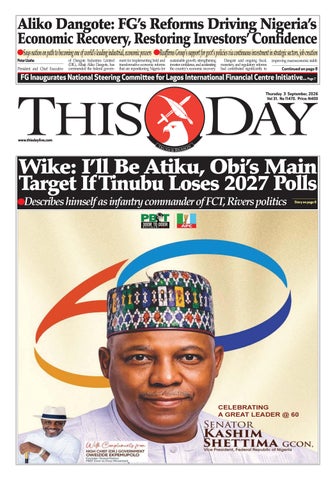
Aliko Dangote: FG’s Reforms Driving Nigeria’s Economic Recovery, Restoring Investors’ Confidence Says nation on path to becoming one of world’s leading industrial, economic powers Reaffirms Group’s support for govt’s policies via continuous investment in strategic sectors, job creation Peter Uzoho President and Chief Executive
of Dangote Industries Limited (DIL), Alhaji Aliko Dangote, has commended the federal govern-
ment for implementing bold and transformative economic reforms that are repositioning Nigeria for
sustainable growth, strengthening investor confidence, and accelerating the country’s economic recovery.
Dangote said ongoing fiscal, monetary, and regulatory reforms had contributed significantly to
improving macroeconomic stabilContinued on page 8
FG Inaugurates National Steering Committee for Lagos International Financial Centre Initiative... Page 7 Thursday 3 September, 2026 Vol 31. No 11470. Price: N400
www.thisdaylive.com TR
UT H
& RE A S O
N
Wike: I’ll Be Atiku, Obi’s Main Target If Tinubu Loses 2027 Polls Describes himself as infantry commander of FCT, Rivers politics
Story on page 8
2
THURSDAY, SEPTEMBER 3, t T H I S D AY
THURSDAY, SEPTEMBER 3, t T H I S D AY
3
4
THURSDAY, SEPTEMBER 3, t T H I S D AY
5
THISDAY • THURSDAY, SEPTEMBER 3, 2026
Group News Editor: Goddy Egene Email: Goddy.egene@thisdaylive.com, 0803 350 6821, 0807 401 0580
NEWS
ADEOLA VISITS SAIL INNOVATION LAB...
L-R: Managing Director, Co-creation Hub Africa, Ojoma Ochai; Co-founder of Guaranty Trust Bank GTBank Plc, Fola Adeola; Senator Adetokunbo Abiru; his wife, Managing Director, H&Y Furniture Manufacturers, PHOTO: KUNLE OGUNFUYI Mrs. Feyisola Abiru and Manager, Co-creation HUB (CcHUB), Blessing Adeolu-Adediran during Mr. Adeola’s visit to SAIL Innovation Lab, Ikorodu, Lagos, yesterday
Uber Exits Nigeria After 12 Years Amid 3,300 Global Layoffs Says decision follows review of evolving business priorities Exit comes amid intense competition, economic pressures, shrinking affordability Ride-hailing giant to maintain support for 21 days Emmanuel Addeh in Abuja and Emma Okonji in Lagos Ride-hailing giant, Uber, yesterday announced the discontinuation of its operations in Nigeria after 12 years in the country, as part of a broader restructuring of its global business that has also resulted in the layoff of about 3,300 employees worldwide. The company said it would wind down its ride-hailing operations in Nigeria and Uganda effective September 2, 2026, following what it described as a thorough review of its evolving business priorities and investment focus across the continent. Uber stressed that the decision was restricted to Nigeria and Uganda and would not affect its operations in other parts of Africa, maintaining that it remained committed to Sub-Saharan Africa where it continued to see strong growth and long-term opportunities, it said in a statement to techeconomy. “After a thorough review, we have taken the difficult decision to wind down operations in Nigeria and Uganda, effective September 2, 2026,” the company said. “This decision is limited strictly to these two markets and does not impact our operations across the rest of the continent. Our immediate priority is supporting drivers, riders, and local team members throughout this transition. “Uber remains deeply committed to
Sub-Saharan Africa, where we continue to see robust growth and long-term opportunity,” Lorraine Onduru, Head of Communications, Uber in East and West Africa, confirmed. The company’s withdrawal ends a 12-year presence in Nigeria, where Uber launched in 2014 as one of the earliest major foreign ride-hailing operators, helping to transform urban transportation and establish the country’s fast-growing e-hailing industry. Its exit, however, comes as the company is undertaking a wider global restructuring, which has reportedly affected approximately 3,300 employees, representing about 10 per cent of its workforce. The global restructuring is expected to reduce smaller teams, flatten management layers and significantly cut back remote working arrangements as the company seeks to streamline its operations. Uber entered Nigeria at a time when app-based transportation services were still relatively new, adapting its business model to accommodate the country’s cash-driven economy, unlike its predominantly card-based operations in several other markets. For years, the company set the pace in Nigeria’s ride-hailing industry, establishing relatively strict standards for vehicles and drivers and positioning its service as a premium transportation option for the country’s growing middle class.
But competition soon intensified, with a number of other businesses in the same line started entering the country. Bolt, formerly known as Taxify, entered the Nigerian market in 2016 and aggressively pursued market share through lower fares and more flexible requirements for vehicles and drivers. The increasingly competitive market gradually transformed ride-hailing from a premium service into a mass-market
commodity, with operators competing aggressively for both passengers and drivers. Other competitors, including inDrive, further disrupted the market by introducing a model that allowed passengers and drivers to negotiate fares directly, while also operating with more flexible vehicle requirements. Uber subsequently responded to changing market conditions with Uber Go, a lower-cost service that deployed
A new global initiative has been launched to improve access to mpox vaccines and ensure that countries affected by outbreaks can receive vaccines more quickly and equitably when they are needed. The initiative builds on the work of the World Health Organisation (WHO) and its partners to strengthen international coordination of vaccine supplies and improve preparedness for mpox outbreaks, particularly in countries with limited access to
vaccines. At the centre of the initiative is the International Coordinating Group on Vaccine Provision (ICG), a mechanism established in 1997 following major meningitis outbreaks in Africa. ICG was created to coordinate emergency supplies of vaccines and antibiotics for countries facing major disease outbreaks. Its role is based on the recognition that although outbreaks are difficult to predict, timely vaccination can help prevent further transmission and reduce the impact of infectious
services. The removal of petrol subsidy and the subsequent sharp increase in fuel prices also forced ride-hailing operators to increase fares, further weakening demand among pricesensitive consumers. At the same time, drivers increasingly moved between platforms in search of better earnings, as operators continued to charge commissions estimated at between 15 and 20 per cent per trip.
Stakeholders Want Nigeria’s Critical Minerals to Drive Green Industrialisation APRI, NCCC, SMDF, REA, others push domestic value addition Reject extract-and-export model, seek environmental safeguards
Emmanuel Addeh in Abuja Stakeholders across government, development institutions, the private sector and civil society yesterday called for a fundamental shift in Nigeria’s approach to its critical minerals, insisting that the country must use its vast resource endowment to drive green industrialisation rather than repeat the historic model of exporting raw materials and importing finished products. Speaking at a high-level stakeholder convening on: “Advancing Nigeria’s
Green Industrialisation Through Critical Minerals,” the speakers harped on the need to domestic processing, beneficiation, manufacturing, skills development and stronger environmental and community safeguards. The meeting which took place in Abuja was convened by the National Council for Climate Change (NCCC) and was backed by the Africa Policy Research Institute (APRI), and the Ford Foundation. At the event, the Minister of Environment, Balarabe Lawal, represented by the
Global Initiative Targets Wider Access to Mpox Vaccines in Outbreak Response Ayodeji Ake
smaller vehicles, including Suzuki cars financed through mobility financing arrangements. However, Nigeria’s worsening macroeconomic conditions created additional challenges for the ridehailing business. The sharp depreciation of the naira increased the cost of acquiring and financing vehicles, while rising inflation reduced the number of Nigerians able to regularly afford private transportation
diseases. Traditionally, ICG has been responsible for ensuring equitable access to licensed vaccines against cholera, meningitis, yellow fever, and Ebola virus disease during emergencies. Its responsibilities include managing global emergency vaccine stockpiles and working with partners, donors, and vaccine manufacturers to determine the size and composition of the stocks required for effective outbreak response. The expansion of the mechanism to include mpox is expected to provide a more structured approach to the
distribution of mpox vaccines, particularly during emergencies when demand can rise rapidly. The move builds on measures introduced during the global mpox response. In 2024, WHO and its partners established an Access and Allocation Mechanism (AAM) specifically for mpox vaccines, treatments and diagnostic tests. AAM was designed to support the allocation of limited medical countermeasures to countries and communities where they were most urgently required.
Director of Climate Change Department, Federal Ministry of Environment, Dr Iniobong Abiola-Awe, said Nigeria’s pursuit of green industrialisation must not become a justification for environmental degradation. He argued that critical minerals were increasingly becoming strategic assets, but warned that the development of the sector must be environmentally responsible, economically transformative, socially inclusive and nationally beneficial. Lawal stressed that economic development and environmental protection must advance together, arguing that responsible investment in the sector should contribute not only capital, but technology, skills, innovation, local value addition and high environmental and social standards. The minister noted that poorly planned or inadequately regulated mining could create significant pressure on land, water resources, biodiversity and ecosystems. The environment ministry, he said, would continue to insist on strong environmental governance, compliance, rehabilitation, mine closure and restoration as critical minerals development expanded. He added that environmental and social impact assessments should not be regarded merely as regulatory requirements, but as planning tools capable of helping governments and investors identify risks, avoid unnecessary impacts and improve project designs. For her part, the Director General of
the NCCC, Dr Tenioye Majekodunmi, said Nigeria must be clear about where the processing, manufacturing, factories, jobs and wealth associated with the emerging green economy would be located. “We cannot repeat the old economic model in a new green economy,” she said. Majekodunmi argued that merely changing Nigeria’s major export commodity from crude oil to critical minerals without changing the underlying economic structure would not amount to industrialisation. She said Nigeria’s objective should be to capture more of the value chain domestically through processing, refining, manufacturing, battery assembly, technology, skills, logistics and greater participation by Nigerian businesses. She identified four priorities, beginning with a deliberate shift from extraction to value addition. The NCCC boss also said Nigeria’s critical minerals must genuinely be produced in a manner consistent with green and sustainable principles, warning that the country could face increasing scrutiny over the carbon footprint, traceability and environmental integrity of its mineral supply chains. Majekodunmi further stressed the need to connect climate ambition to capital, arguing that the government alone could not finance processing plants, clean energy infrastructure and manufacturing facilities.
6
THURSDAY, SEPTEMBER 3, 2026 • THISDAY
NEWS
PAC HOLDINGS 20TH ANNIVERSARY MEDIA PARLEY...
L-R: Executive Management of PanAfrican Capital Holdings Limited, Mr. Eric Okoruwa; Group Executive Director, Mr. Chris Oshiafi; Group Managing Director/CEO, Mr. Sina Alimi; Deputy Group Managing Director / Group Executive Director, Mr. Nentok Gomwalk, at the PAC Holdings 20th Anniversary Media Parley held at Amber Residence Ikeja GRA, Lagos...recently
FG Orders MDAs to Clear Bureaucratic Barriers to Exports by November as Single Window Phase 2 Sets Out Declares phase 1 grossed N12.59 billion in regulatory payments since going live, frowns on fragmented regulations Zacch Adedeji: improving ease of doing business critical to attracting investment, economic expansion, national prosperity James Emejo in Abuja Minister of Industry, Trade and Investment, Dr Jumoke Oduwole, yesterday, ordered Ministries, Departments and Agencies of Government (MDAs) involved in the trade architecture to complete the second phase of the National Single Window (NSW) and be fully integrated into the initiative by the end of November.
Oduwole spoke at a high-level stakeholder engagement on the activation of Phase 2 of National Single Window and Export Tracker in Abuja. She warned that the success of the digital trade reform will not be measured by the number of agencies connected to the platform, but by whether Nigerian exporters could move goods from production to international markets faster, more cheaply, and with greater
certainty. The move aimed at dismantling the bureaucratic bottlenecks and regulatory fragmentation undermining the country’s export competitiveness. Oduwole described the March 27 launch of NSW as a major milestone, adding that government cannot afford to mistake the platform’s “go-live” for full operational readiness. She said the next phase must
eliminate the internal complexities that had historically forced businesses to deal separately with multiple government agencies for permits, inspections, certificates, payments, and approvals. The minister said, “It is a long time coming for Nigeria. We have joined the league of nations with a National Single Window and, for a trading nation, it was Mr President’s target and we all need to be proud of that.”
Fola Adeola Hails Abiru, Wife for Investing in Future of Young Nigerians Describes SAIL initiative as ‘worthy legacy’ built on service, selflessness Sunday Ehigiator Co-founder of Guaranty Trust Bank, Mr. Fola Adeola, has commended Senator Adetokunbo Abiru, FCA, and his wife, Mrs. Feyisola Abiru, for investing in the future of young Nigerians through the SAIL Empowerment Foundation. Adeola described the initiative as a “worthy legacy” built on service, selflessness, and commitment to humanity. The renowned banker and philanthropist gave the commendation yesterday during a visit to the SAIL Innovation Lab in Ikorodu, Lagos, where he inspected the facility and interacted with young beneficiaries of its various programmes. Describing his visit as worthwhile, Adeola said the decision by the
Abirus to commit their resources to empowering people outside their immediate family demonstrated a rare understanding of what it meant to leave a lasting legacy. He stated, “Whenever we decide to commit to causes bigger than ourselves, we are building a legacy. What you are doing is for children whose parents you may not even know. For society to survive, we must care for others, particularly the less privileged.” Adeola stated that the resources invested in the initiative could have been devoted to personal comfort and luxury, but the Abirus had chosen to prioritise service to humanity. he said, “The money used for this great cause could have been used to service a luxurious lifestyle, but you chose service and humanity above self.
This is a useful endeavour.” Adeola urged beneficiaries of the SAIL Innovation Lab to maximise the opportunities provided by the facility, stressing that those living in the community are fortunate to have such an initiative in their midst. “Neighbours and those living around here are, indeed, fortunate. I hope they will maximise the great opportunities here,” he added. Drawing parallels between SAIL and his own philanthropic journey, Adeola recalled the establishment of the FATE Foundation in 2000, an initiative he founded to support aspiring entrepreneurs and promote enterprise development. He described philanthropy as a noble ecosystem, which might not attract the glamour associated with
conventional endeavours but whose impact remained enduring. he stated, “It is a world of charity, a completely noble cause. It is a completely different ecosystem that is not ‘sexy’. Beneficiaries will always remember the pathway.” Adeola also expressed delight at witnessing the work being undertaken at SAIL, saying the experience has left a strong impression on him. He said, “I am glad I came here. I should have come here with my son and wife to witness this remarkable feat. May your kindness count for you.” Addressing participants at the innovation lab, the philanthropist shared his personal journey from humble beginnings to becoming one of Nigeria’s foremost bankers, entrepreneurs, and national icons.
The minister said the reform was central to President Bola Tinubu’s economic diversification agenda, particularly efforts to expand non-oil exports, create jobs, deepen domestic production, and position Nigeria towards the administration’s $1 trillion economy ambition by 2030. She stressed that achieving those objectives would require government to remove the institutional barriers confronting businesses beyond the physical border. “Trade does not happen at the border alone. It depends on the system connecting production to market, standards, finance, logistics, regulation, border processing and digital platforms,” she said. Oduwole recalled that exporters identified seven major barriers during the ministry’s November 2024 ministerial export consultation, with more than half attributed to institutional fragmentation, duplication, poor coordination, and inconsistent regulations. She cited the case of an exporter whose container was repeatedly subjected to inspections by different government agencies, describing such experiences as precisely the type of bureaucratic friction the single window was designed to eliminate. According to her, the principle guiding Phase 2 should be simple, “One portal, one submission and one coordinated process. “Information already held by the government should not be requested repeatedly. Institutions will retain their statutory responsibilities, but exporters do not have to navigate the government’s internal complexity to complete
one transaction. “That complexity is ours to solve, not theirs to carry. They should experience the Nigerian government as one government.” The urgency of the reform was underscored by the level of activity already recorded under Phase 1. Oduwole disclosed that the platform had processed more than 124,614 licences and permits, registered 11,096 importers and agents, trained over 8,000 users, and facilitated about N12.59 billion in regulatory payments since going live. Standards Organisation of Nigeria (SON) accounted for more than 85,000 documents processed through the system, generating about N9.95 billion in regulatory payments, while National Agency for Food and Drug Administration and Control (NAFDAC) processed 38,985 documents and generated N2.59 billion. Oduwole stated, “These figures show real adoption. They also reinforce a critical lesson that go-live is not the same as readiness.” She said Phase 2 must move beyond connectivity to integrate export permits, certificates, licences, inspections, payments, and other critical processes into an end-to-end digital architecture. She added that the Federal Ministry of Industry, Trade and Investment had commenced the alignment of its internal processes, involving Federal Produce Inspection Service (FPIS), Regulatory Export Number (REX), SON, Nigeria Export Processing Zones Authority (NEPZA), Nigerian Export Promotion Council (NEPC), and other relevant interfaces.
FG, NISA Push for Adoption of Implementation Science for Sustainable Devt Onyebuchi Ezigbo in Abuja The Federal Ministry of Health and Social Welfare and Nigeria Implementation Science Alliance (NISA) have expressed the need to adopt the application of implementation science to improve health outcomes in Nigeria. Speaking at the 11th Annual Nigerian Implementation Science Alliance (NISA) Scientific Conference, Director and Head of Planning and Research in the Federal Ministry of Health and
Social Welfare, Dr, John Ovurouye, said the ministry had embarked on several innovative programmes aimed at improving healthcare delivery in the country. As part of the federal government’s efforts to integrate research and innovation in the health sector development drive, Ovurouye said the ministry was working on a collaborative arrangement, which will see key policy makers in the ministry engage in exchange programmes with those in the universities and research-based
organisations. According to him, such arrangement will be in form of sabbatical engagements where Directors in the health ministry and their counterparts in the universities, especially those that have distinguished themselves in the area of research, will swap their services so as to bring their experiences to bear on policy and programme implementation. While welcoming participants at the conference, Chair of NISA Trustee Board, Professor Echezona
Ezeanolue, said the major aim of the platform was to help develop a crop of highly competent Nigerians in the field of research and innovation, who could hold their head high in implementation science. Currently, he said, “The university is training people that have no experience because they’re not working there. “We want to connect both of them. We want that person that is training in the university, in the first year of their PhD, to take eight weeks to go to the malaria
programme and stay with them and learn how to do it. In the second year, he goes there and spends 12 weeks. “In the final year, he goes there and spends six months. By the time he finishes, the malaria programme is hiring him already. So, we are connecting these two. “We are not doing anything new. What we are doing here is different. It’s connecting them so that they’re not working in silos. The university is doing tests that nobody reads. It’s between infor-
mation science and information practice. And that’s really what we’re trying to do”. Speaking on the theme of the conference, “From Evidence to Impact: Advancing Implementation Science for Sustainable Development,” Echezona said governments needed to collaborate with research instructions and other organisations that promote science and innovation in order to ensure policies and programmes were efficiently implemented on a sustainable basis.
7
THISDAY • THURSDAY, SEPTEMBER 3, 2026
NEWS
CENTENARY DINNER AND AWARD CELEBRATION...
L-R: Founder/CEO, Auldon Group and Chair, Henley Business School Alumni Association, Nigeria, Dr. Paul Orajiaka; Dean and Director, Henley Business School Africa/Associate Pro Vice-Chancellor for Global Engagement, SubSaharan Africa, University of Reading, Prof. Jon Foster-Pedley; UN Women Country Representative to Nigeria and ECOWAS, Beatrice Eyong; Group Executive Director, Mike Adenuga Group, Sade Michael-Adenuga; Group CEO, Browncon Group, Dr. Samuel Ndubuisi-Brown; Founder and CEO, Nomadicpod, Tega Isiboge; Senior Regional Manager for Sub-Saharan Africa, University of Reading, Franki Hunt; Founder, Nigerian Teachers Community and Head, University of Reading Alumni Chapter, Lagos, Dr. Peter Ogudoro, at the centenary dinner and award celebration of Henley Business School and Reading University in Lagos...recently
FG Inaugurates National Steering Committee for Lagos International Financial Centre Initiative Olawale Ajimotokan in Abuja As part of Nigeria’s drive to establish a globally competitive financial hub in Africa, the federal government yesterday inaugurated the National Steering Committee for the Lagos International Financial Centre (LIFC) initiative mandated to create a globally competitive financial ecosystem. Secretary to the Government of the Federation (SGF), Senator George Akume, at the inauguration described LIFC as a strategic initiative designed to deepen Nigeria’s capital markets, attract domestic and foreign investment, promote financial innovation, and strengthen the country’s financial ecosystem for sustainable economic growth. Akume stated, “The establishment of the LIFC presents an opportunity to leverage Lagos’ strategic position and Nigeria’s economic potential to create a financial centre of international standing.” He said the LIFC initiative was endorsed by President Bola Tinubu as a strategic national economic priority, adding that the president has further directed the Office of the Secretary to the Government of the Federation (OSGF) to coordinate government’s support for its implementation. Akume stated that the committee was composed of key federal government institutions, Lagos State Government, and private sector stakeholders to ensure effective coordination in addressing policy, legal, regulatory, institutional, and
infrastructure issues critical to the centre’s success. The SGF charged the members to approach the assignment with commitment and urgency, stressing that the ultimate success of LIFC will depend on a strong whole-of-government approach and effective partnership between the federal government, Lagos State Government, and the private sector. Akume, who is Chairman of the committee, assured of the full support of his office in facilitating the discharge of its mandate. Other members of the National Steering Committee include Lagos State Governor Babajide Sanwo-Olu (Co-Chairman); Permanent Secretary (GSO) OSGF, Dr. Ibrahim Abubakar Kana (Shadow Chair); and Lagos State Commissioner for Finance, Mr. Abayomi Oluyomi (Shadow Co-Chair). Also on the committee are Minister of Finance and Coordinating Minister of the Economy, Taiwo Oyedele; Attorney-General of the Federation and Minister of Justice, Lateef Fagbemi, SAN; Minister of Foreign Affairs, Ambassador Bianca OdumegwuOjukwu; Minister of Interior, Dr. Olubunmi Tunji-Ojo; Minister of Industry, Trade and Investment, Dr. Jumoke Oduwole; and Minister of Communications, Innovation and Digital Economy, Dr. ‘Bosun Tijani. There are also Governor of the Central Bank of Nigeria (CBN), Mr. Olayemi Cardoso; Director-General of Securities and Exchange Commission
(SEC), Dr. Emomotimi Agama; Executive Chairman of Nigeria Revenue Service (NRS), Dr. Zacch Adedeji; and EnterpriseNGR Chairman, Aigboje Aig- Imoukhuede. Members of the secretariat are Director of Legal Services (OSGF), Mrs. Kamilatu M. Kida, and CEO, EnterpriseNGR, Ms. Obi Obiekwe. In his elaborate briefing and
presentation, Sanwo-Olu described international financial centres as deliberate instruments of national economic strategy. He said the centres were trusted jurisdictions built to mobilise long-term capital, deepen markets, and connect domestic opportunity to global capital. He explained that their foundations were institutional trust, regulatory
The German government has announced a series of measures against Russia following what it described as a Russian hybrid attack involving drones at Leipzig Airport. German Foreign Minister Johann Wadephul, speaking at a joint press conference with Interior Minister Alexander Dobrindt on Tuesday, said the incident was part of a broader pattern of Russian attempts to destabilise Europe through disinformation, threats, sabotage and aggression. Wadephul said Russia’s leadership
was treating Germany with “blatant hostility”, stressing that such a state of relations was not in the interest of the German government. He said Germany had repeatedly expressed its desire to end Russia’s war against Ukraine, restore peace in Europe and eventually return to constructive relations with Moscow, but accused Russia of showing no willingness to compromise. “On the contrary, with the attempted attack in Leipzig, Russia’s leadership has instead made a conscious decision to inflict further significant damage on our bilateral relations, which are already
State government, and private sector stakeholders, represented by EnterpriseNGR, to ensure effective coordination in addressing policy, legal, regulatory, institutional, and infrastructure issues critical to the centre’s success. Akume congratulated all members and wished the committee a successful and impactful engagement.
Idakwo: Cotton Crisis Threatens FG’s Ambitious Textile Industry Revival Cotton shortage, institutional dispute pose risks as output crashes below 10,000 tonnes James Emejo in Abuja The federal government’s ambitious drive to revive the country’s oncethriving Cotton, Textile and Garment (CTG) industry has faced fresh setbacks amid collapsing domestic cotton production, idle factories, and mounting financial distress. With domestic cotton production reportedly collapsing, ginneries operating below capacity, and textile factories struggling with inadequate raw materials, the revival drive appeared to be at risk. Managing Director, Market Hub Media Limited, Mr. Eneojo Idakwo, warned that the country could end up pursuing an industrial revival without the cotton required to sustain it. In a statement, Idakwo also identified unresolved institutional
arrangements around the proposed coordination of the sector as another major threat to the implementation of government’s revival strategy. According to him, Nigeria’s cotton output has plunged to less than 10,000 metric tonnes annually, from about 300,000 metric tonnes at the sector’s peak, leaving many of the country’s 26 ginneries either operating far below installed capacity or completely idle. He stated that the country had already lost two planting seasons without interventions on the scale required to reverse the decline. Idakwo warned that continued inaction could leave Nigeria increasingly dependent on imported textile inputs even as the federal government pushed import substitution and domestic manufacturing.
Germany Announces Measures Against Russia Over Leipzig Airport Drone Incident Michael Olugbode in Abuja
quality, legal certainty, and international connectivity. Sanwo-Olu said LIFC could become the trusted platform through which Nigeria would compete for global capital — and through which capital would accesses African opportunity. He added that the committee was an amalgam of key federal government institutions, the Lagos
under tremendous strain,” he said. The foreign minister announced that Germany would take several measures in response, including the closure of the Russian Consulate General in Bonn from September 18. Berlin will also terminate the lease for the Russian House in the German capital and propose new European Union sanctions against Russian individuals linked to hybrid attacks. Germany will further tighten immigration controls for Russian nationals and intensify pressure on Russia’s so-called shadow fleet, while taking additional measures in the
intelligence sector. Wadephul said Germany would also continue working with NATO and EU partners to strengthen collective security and defence capabilities, while maintaining its civilian and military support for Ukraine. He added that Germany would continue efforts within NATO to strengthen its deterrence capabilities against Russia. As part of the diplomatic response, the German government has ordered the Russian ambassador to be summoned to receive notification of Berlin’s position and the measures being taken.
He said the situation exposed a fundamental contradiction in Nigeria’s industrialisation agenda: while government was developing policies to rebuild manufacturing, the agricultural base required to supply those factories remained severely weakened. He stated that the collapse of the sector had not occurred in isolation, but reflected the breakdown of linkages across the entire CTG value chain. Idakwo said, “The future of Nigeria’s CTG sector is no longer defined by whether revival is necessary. There is broad consensus that it is both necessary and urgent.” He added, “The real issue is how that revival should be coordinated. The disagreement is less about the destination than the institutional architecture required to get there.” The institutional question centres on the April 2025 approval by the National Economic Council (NEC) for the establishment of a Cotton, Textile and Garment Development Board (CTGDB), to be domiciled in the presidency. The proposed board was designed as a private-sector-driven, inter-ministerial institution, with representation from the Ministries of Agriculture and Food Security; Finance; Budget and Economic Planning; and Industry, Trade and Investment. The board was also to comprise governors representing the six geopolitical zones and other relevant stakeholders. However, the Federal Ministry of Industry, Trade and Investment (FMITI) had been pursuing a separate model involving the establishment
of a Cotton, Textile and Garment Development Council under its supervisory framework. Idakwo said the disagreement should not be dismissed as a mere bureaucratic contest, stating that it raises a fundamental question about how a value chain cutting across agriculture, manufacturing, finance, trade, infrastructure, exports and state-level development should be governed. He said both positions had legitimate considerations. While FMITI remained the lead ministry for industrial policy, Idakwo pointed out that “cotton originates on farms, not in factories”. This meant that agriculture, finance, planning, state governments, development finance institutions, customs, standards regulators and private investors all had critical roles to play. Idakwo stated, “The CTG value chain extends beyond any single institution’s mandate. That reality, perhaps, explains why NEC adopted an inter-ministerial model.” He warned that without adequate coordination, the weaknesses at different points in the chain would continue to reinforce one another. Idakwo the decline in cotton production had weakened ginneries; inadequate lint supply had constrained spinning and weaving; shrinking textile production had increased dependence on imported fabrics, while the weakness of the garment segment had reduced opportunities for large-scale employment and exports. “It is a vicious cycle in which the failure of one segment deepens the weakness of another,” he said.
8
THURSDAY, SEPTEMBER 3, 2026 • THISDAY
EIGHT
Organised Private Sector, Analysts Hail GDP Expansion, Caution Economy Not Out of Woods Yet ACCI, CPPE, NECA seek broader job-intensive growth James Emejo in Abuja and Nume Ekeghe, Dike Onwuamaeze in Lagos The Organised Private Sector (OPS) and economic analysts yesterday welcomed the country’s stronger Gross Domestic Product (GDP) growth in the second quarter of the year, saying the 4.43 per cent expansion offers evidence that economic reforms are beginning to gain traction. They, however, cautioned that the economy remained some distance away from a broad-based recovery. Abuja Chamber of Commerce and Industry (ACCI), while describing the performance as an encouraging signal, said the latest growth figure should not be mistaken for an indication that the economy had completely overcome its difficulties. Director-General of ACCI, Agabaidu Jideani, said the acceleration in real
GDP growth from 3.89 per cent in the first quarter to 4.43 per cent in Q2, above the 4.23 per cent recorded in the corresponding period of 2025, showed that economic activity was gradually gaining momentum. Jideani told THISDAY, “The improvement from 3.89 per cent recorded in the preceding quarter and 4.23 per cent in the corresponding period of 2025 is an encouraging signal that economic activity is gradually gaining momentum.” He stated that the performance was particularly significant from the perspective of the business community because of the contribution of agriculture, services, oil and the broader non-oil economy. According to him, “It demonstrates a measure of resilience and suggests that ongoing economic reforms and increased economic activity are begin-
ning to yield measurable outcomes.” However, ACCI stressed that the real test of the recovery was not the headline GDP number but whether the expansion would translate into higher productivity, business expansion, job creation, increased investment, and improved living standards. He said businesses were still contending with high operating costs, energy constraints, inadequate access to affordable finance, infrastructure deficits, logistics bottlenecks, and pressure on household purchasing power. The ACCI director-general said, “While the GDP growth figure is encouraging, it would be premature to conclude that the Nigerian economy is completely out of difficulty. “The real test of economic recovery lies in whether this growth translates into improved productivity, business
expansion, job creation, increased investment and better living standards for Nigerians.” The chamber also raised concern over the slowdown in parts of the industrial sector, urging sustained policy attention to manufacturing and other productive activities capable of generating jobs and strengthening domestic value chains. Jideani said government must consolidate the positive momentum by improving infrastructure, addressing energy challenges, supporting local production, expanding access to finance, and implementing policies capable of attracting private investment. He said, “In our view, the 4.43 per cent GDP growth is a welcome indication that the economy is moving in a positive direction, but recovery should not be measured by statistics alone.
“Nigerians and businesses must be able to feel the impact through lower costs of doing business, greater investment opportunities, job creation, and improved purchasing power.” Similarly, Chief Executive Officer, Centre for the Promotion of Private Enterprise (CPPE), Dr. Muda Yusuf, described the performance as a significant acceleration, adding that the growth represents the strongest quarterly growth in five years. Yusuf said the performance was “an important indication that the economy is gaining momentum after a difficult period of macroeconomic adjustment”. He said the GDP report was “a strong and positive signal” that both oil and non-oil activities were contributing to the recovery while greater macroeconomic stability was beginning to support economic activity.
Agabaidu Jideani He said the broad spread of sectoral growth provided a credible basis for cautious optimism about the outlook. The CPPE boss also warned against complacency, saying the next phase of the reform programme should focus on translating stronger output into employment, rising real incomes, and improved living standards. Continued on page 44
Wike: I’ll Be Atiku, Obi’s Main Target If Tinubu Loses 2027 Polls Describes himself as infantry commander of FCT, Rivers politics Says NBA under past leadership allegedly acted like political party Accuses Govs Uzodimma, AbdulRazaq of campaign of calumny Defends inclusion of Betta Edu in APC campaign council Emmanuel Addeh and Olawale Ajimotokan in Abuja The Minister of the Federal Capital Territory (FCT), Nyesom Wike, yesterday declared that he would become the main target of former Vice President, Atiku Abubakar of the African Democratic Congress (ADC) and his counterpart at the Nigeria Democratic Congress (NDC), Peter Obi, should President Bola Tinubu lose the 2027 presidential election. Wike, who spoke during a media chat in Port Harcourt, Rivers State, said his unwavering support for Tinubu’s re-election had placed him directly in the sights of opposition politicians, but insisted that the possibility of political reprisals would not weaken his resolve. “I will be the first politician that I think they will come after. I will be the first politician. I know they will come for my head,” Wike said, stressing that he’s continuously thinking about winning next year’s poll for Tinubu. “If anything happens, and Mr President fails today, I will be the first politician that Atiku, Obi will hunt for his head So, I don’t, I didn’t make that mistake to be sleeping to see that the President loses the election. No, because I know they will come for my head,” Wike stated. “Each day I sleep, I am thinking about the president’s reelection. When I am eating, I think about the president’s reelection. Everything I am doing now is about the president’s reelection,” he emphasised. The former Rivers State governor said he had endured intense criticism and name-calling because of his political position, but maintained that he remained unconcerned about what his opponents thought of him.
“I don’t see where anybody in this country today has been called names the way my name has been. I am not bothered about people who say their own thing. My business is, like I said, I am going to support Mr President,” he stated. Wike, who has always maintained that he remains a member of the Peoples Democratic Party (PDP) despite openly supporting the All Progressives Congress (APC) administration and Tinubu’s re-election, also described himself as the “General Commander of the Political Infantry” in both the FCT and Rivers State. “You do not need to be governor before you can be in charge. I am the General Commander of the Political Infantry; therefore, I am in charge. So also in FCT. I owe the president to give these two. As far as the election is concerned, you count FCT as a state,” he declared. The minister said his frequent visits to Rivers State were intended to enable him reconnect with his political base and monitor developments ahead of the 2027 elections. “It’s not about relocating; it’s about coming home to reconnect with my people and talk to them, not taking chances… so that they don’t just sit in Abuja and think everything is going well,” he said. “I have to come back home and see how those things are going on. My coming home is very good and not only political. I have parents who are still alive; I have to see them and do other things. Politics, of course … This is the time. You want me to fold my hand for Atiku to come and win the election?” he asked. Wike also launched a scathing attack on the Nigerian Bar Association (NBA), accusing the
body of abandoning its traditional role as an independent defender of justice and constitutionalism and allegedly becoming involved in partisan politics. The FCT minister criticised the NBA’s 2026 Annual General Conference in Port Harcourt, accusing the association of providing a platform for opposition politicians to promote their political ambitions. He described the conference as
poorly organised and insisted that he would not attend what he termed a jamboree. “Organisation was zero. Why? Instead of you focusing on the real thing the NBA conference was supposed to be, they started playing politics. “They started having it as a ground for opposition parties to sell themselves. Anybody who knows me knows that I don’t attend something that’s a jamboree. I will
not attend something that traders are in charge of. “The last leadership of the NBA shows that there was a trading. You saw the outcry; the NBA has never had that kind of conference since the NBA started. It was a complete flop. The Nigerian Bar Association has now taken sides politically. They are now a political party,” Wike alleged. The minister also renewed his
attacks on his predecessor as Rivers State governor, Rotimi Amaechi, questioning his suitability to serve as Nigeria’s vice president. Wike accused Amaechi of shutting down courts during his tenure as governor and alleged that a pregnant woman gave birth in prison during the period. “Rotimi Amaechi, who wants to Continued on page 43
ALIKO DANGOTE: FG’S REFORMS DRIVING NIGERIA’S ECONOMIC RECOVERY, RESTORING INVESTORS’ CONFIDENCE ity, enhancing productivity across key sectors, increasing Nigeria’s attractiveness as an investment destination, and fostering a more resilient business environment. According to a statement issued yesterday by Dangote Group, the chief executive stated that the positive outcomes emerging from the federal government’s reform agenda underscore the importance of consistent, market-driven policies in advancing national development and economic prosperity. Dangote stated, “The economic reforms being implemented by the federal government are beginning to yield tangible results. We are witnessing improved economic activity, stronger investor confidence, increased industrial productivity, and a more resilient business environment. “These measures are laying a solid foundation for sustainable economic growth and long-term prosperity for Nigeria.” Dangote explained that the reforms had created a more enabling operating environment for businesses, particularly largescale manufacturing and industrial enterprises critical to economic diversification, job creation, foreign
exchange generation, and national competitiveness. He added that government initiatives aimed at improving efficiency, promoting investment, enhancing transparency, and supporting domestic production were already providing a solid framework for industrial expansion. “We commend the federal government for its courage and determination in implementing reforms that are essential for economic transformation,” he stated. “While every reform process comes with initial challenges, the benefits are increasingly evident in stronger economic indicators, improved business confidence, and renewed investor interest in Nigeria,” Dangote said. Dangote observed that the government’s favourable policy environment had supported the continued growth and efficient operation of Dangote Petroleum Refinery and Petrochemicals complex, Africa’s largest integrated refining and petrochemical facility. He stated that policy measures designed to strengthen local refining capacity, reduce import dependence, improve energy security, and encourage value addition had
contributed meaningfully to the refinery’s success and Nigeria’s broader economic development objectives. The statement said, “The progress being recorded at the Dangote Petroleum Refinery and Petrochemicals complex is closely linked to a policy environment that encourages investment, supports domestic industrialisation, and promotes self-sufficiency. “These reforms are helping Nigerian businesses to plan with greater certainty, invest with confidence, and compete effectively on the global stage.” Dangote stated that the refinery’s increasing production capacity and expanding export footprint were contributing significantly to Nigeria’s economic resurgence by generating foreign exchange earnings, creating employment opportunities, strengthening local supply chains, and positioning the country as a leading energy and manufacturing hub Reaffirming the group’s commitment to supporting the federal government’s economic agenda, Dangote said the DIL would continue to invest in strategic sectors, drive innovation, promote industrial
development, and create sustainable employment opportunities. Dangote stated, “Our vision has always been to support Nigeria’s economic development through transformative investments. Today, we are witnessing how the combination of private-sector commitment and decisive government policies can unlock unprecedented opportunities for national growth. “The refinery, petrochemical operations, fertiliser production, and our other industrial investments are helping to build a more selfreliant, competitive, and prosperous economy.” He expressed confidence that sustained reforms, policy consistency, and stronger collaboration between the public and private sectors would further stimulate economic growth, attract increased foreign direct investment, and reinforce Nigeria’s position as one of Africa’s most attractive investment destinations. Dangote said, “Nigeria is on the path to becoming one of the world’s leading industrial and economic powers. With continued policy consistency, robust private-sector participation, and investment-led growth, the future of our economy is exceptionally bright.”
9
THISDAY • THURSDAY, SEPTEMBER 3, 2026
NEWS
INAUGURATION OF AIRBUS A220-300 SERIES AIRCRAFT ACQUIRED BY IBOM AIR...
L-R: Speaker, Akwa Ibom State House of Assembly, Udeme Otong; Deputy Governor Akwa Ibom State, Akon Eyakeyin; President of the Senate, Godswill Akpabio; Chief Pilot, Ibom Air, Captain Ruth Adebanwo; Governor Umo Eno; Coordinator of the office of the First Lady, Helen Eno-Obareki and Chairman, Ibom Air, Captain Mfon Udom, during the commissioning of Airbus A220-300 series aircraft acquired by Ibom Air on Tuesday PHOTO: SENATE PRESIDENT’S OFFICE
Shettima at 60: Tinubu, Akpabio, Governors, Oluremi, Others Hail VP’s Service, Patriotism
President says ex-Borno gov trusted ally, valued colleague Zulum: Low-key celebration reflects humility, selflessness Northern senators say VP bridge builder, voice of reason Deji Elumoye, Emmanuel Addeh, Sunday Aborisade in Abuja and Segun Awofadeji in Bauchi President Bola Tinubu, state governors, Senate President, Godswill Akpabio, and other political leaders yesterday paid glowing tributes to Vice President Kashim Shettima on his 60th birthday. The political leaders described him as a patriot, loyal public servant and leader whose career has been defined by courage, resilience and service to Nigeria. Tinubu, in a personally signed tribute, described Shettima as a brother, trusted ally, valued colleague and patriot with an unwavering commitment to Nigeria’s progress and unity. Tinubu said the Vice President had distinguished himself through his banking career and years of service to
Borno State and Nigeria, commending his courage, diligence, compassion and commitment to improving the lives of Nigerians. “Today, I warmly congratulate Vice President Kashim Shettima, my brother and partner in steering the ship of our state, on his 60th birthday on September 2. “Kashim is not just a trusted ally or a valued colleague, but also a patriot whose life has been defined by service, commitment and sacrifice for worthy causes,” the President said. Tinubu particularly acknowledged Shettima’s loyalty to the All Progressives Congress (APC), his support for the administration and dedication to the success of the Renewed Hope Agenda. He also praised the Vice President’s role as Chairman of the National Economic Council (NEC), saying
Shettima had provided purposeful leadership in coordinating economic policy and fostering collaboration between the federal government and the sub-nationals. The President said Shettima’s respect for constitutional governance, democratic institutions, dialogue and consultation had helped strengthen good governance. “As a trusted partner, his loyalty, wisdom and sense of duty have remained invaluable to the administration,” Tinubu added. The President prayed for God’s continued guidance, protection, wisdom and good health for the Vice President. In the same vein, President of the Senate, Godswill Akpabio, described Shettima’s career in public service as a testament to courage in adversity, intellectual depth, patriotism and unwavering commitment to Nigeria.
Akpabio said the Vice President’s journey from commissioner and two-term governor to senator and Vice President had been marked by resilience and an enduring belief in the promise of Nigeria. The Senate President particularly recalled Shettima’s tenure as Governor of Borno State during one of the most difficult periods in the state’s history when the Boko Haram insurgency subjected residents to sustained insecurity. He said that despite the enormous security challenges, Shettima remained at his duty post and provided leadership under extraordinarily difficult circumstances. “Your journey through public service, from Commissioner to Governor, Senator and now Vice President, has been distinguished by courage in adversity, intellectual depth, loyalty to country and
Marwa Charges NDLEA Investigators to Dismantle Financial Structures of Drug Cartels Michael Olugbode in Abuja The Chairman/Chief Executive of the National Drug Law Enforcement Agency (NDLEA), Brig. Gen. Buba Marwa (Retd.), has charged investigators and prosecutors of the agency to intensify efforts at tracing, seizing and recovering the proceeds and instrumentalities of narcotics trafficking, saying the war against drug cartels can no longer be won through arrests and drug seizures alone. Marwa gave the charge on Wednesday, while declaring open an Advanced Capacity Building Programme on Financial Investigations, Asset Tracing, Forfeiture, Recovery and Management of the Proceeds and Instrumentalities of Narcotics Trafficking and Related Organised Crime in Abuja. The NDLEA chairman said drug trafficking was fundamentally an economic enterprise sustained by financiers, facilitators, money launderers and professional enablers operating behind drug shipments, stressing that law enforcement efforts must therefore go beyond intercepting narcotics and arresting couriers. “If we arrest the courier but leave the financier untouched, seize the
drugs but allow the proceeds to remain with the criminal enterprise, or secure a conviction without recovering the illicit wealth, we have addressed only part of the problem,” he said. Marwa observed that criminal organisations were increasingly exploiting technology, cryptocurrencies, complex corporate structures and legitimate businesses to conceal the ownership and origin of illicit wealth. He consequently urged NDLEA investigators and prosecutors to develop the capacity to analyse complex transactions, trace assets across borders, establish beneficial ownership, exploit digital evidence and build financial cases capable of securing forfeiture and recovery. He said that having recorded significant progress in narcotics seizures and prosecution of traffickers, the Agency’s next imperative was to dismantle the economic foundations of the drug trade and make narcotics trafficking a high-risk, low-profit enterprise. “The sophistication of organised crime demands a corresponding sophistication in our response. We must move from crime detection to crime disruption; from arresting offenders to dismantling criminal
enterprises; and from confiscating drugs to depriving traffickers of the wealth that motivates and sustains their activities,” Marwa said. He noted that the drug trafficking ecosystem intersects with money laundering, corruption, cybercrime, human trafficking, illicit arms trafficking and other forms of organised crime, making sustained cooperation
within the NDLEA and among partner institutions indispensable. Marwa called for stronger synergy among the Agency’s intelligence, investigation, prosecution, forensic, asset and financial investigation directorates, describing them as interconnected links in a single enforcement chain that must work together rather than in isolation.
an abiding conviction in the promise of Nigeria,” Akpabio said. He added that Shettima had brought the same resilience, experience and patriotic commitment to his present national assignment, particularly in his partnership with President Tinubu in advancing the Renewed Hope Agenda. Similarly, the First Lady, Senator Oluremi Tinubu, joined the Vice President’s wife, Nana Shettima, family and friends in celebrating him, describing Shettima as a leader who had exemplified strength, loyalty, commitment and love for the country. She also recalled his achievements as a former Governor of Borno State, senator and banker. Besides, Borno State Governor, Prof. Babagana Zulum, commended Shettima for calling for a low-key celebration of his birthday, describing the decision as a reflection of his humility, selflessness and commitment to national development. Zulum, in a statement personally signed by him, said the Vice President’s appeal demonstrated his conviction that public attention should remain focused on the serious work of developing Nigeria. “I am mindful, Your Excellency, of your recent appeal for a low-key celebration. This request reflects your characteristic selflessness and your conviction that public attention must remain focused on the serious work of national development,” Zulum said. “However, for us in Borno, it is
too personal to forgo this auspicious occasion without celebrating,” he added. The governor said Shettima’s 60th birthday offered an opportunity to reflect on what he described as a life defined by sacrifices for democracy and a lasting legacy of impact in Borno State and Nigeria. He praised the Vice President’s courage, wisdom and steadfast dedication to democratic principles and prayed for many more years of good health and service to the country. Also, Lagos State Governor, Mr. Babajide Sanwo-Olu, described Shettima as a visionary, loyal and dedicated Nigerian public servant whose career in both the private and public sectors had been distinguished by competence and selfless service. In a statement issued by his Special Adviser on Media and Publicity, Mr. Gboyega Akosile, Sanwo-Olu praised the Vice President’s loyalty and commitment to Tinubu and the realisation of the Renewed Hope Agenda. He said Shettima had demonstrated pragmatic leadership at both state and national levels, having previously served as a lecturer, banker, commissioner, governor and senator before becoming Vice President in 2023. “Vice President Kashim Shettima is a visionary and passionate leader, who has distinguished himself in both private and public office. He had a successful career as a lecturer and banker for about two decades before entering public service.
Tinubu Mourns Emir of Zurmi, Alhaji Bello Sulaiman Describes the monarch as a stabilising figure who led his people with unwavering commitment at most difficult time Deji Elumoye in Abuja President Bola Tinubu has expressed deep sorrow over the demise on Monday of the Emir of Zurmi, Sarkin Zamfaran Zurmi, His Royal Highness, Alhaji Bello Sulaiman, five years after he ascended the throne. In a statement issued on Wednesday by the presidential Adviser on Information and Strategy, Bayo Onanuga, Tinubu extended his heartfelt condolences to the family of the late traditional ruler, the Zurmi
Emirate Council, the government and people of Zamfara State, and the entire traditional institution in Nigeria. Tinubu described the departed Sarkin Zamfaran Zurmi as a highly respected monarch who led his people with wisdom, dignity and unwavering commitment at a most challenging time. The president noted that Alhaji Sulaiman who spent five years on the throne, demonstrated exemplary courage and leadership in guiding
the Zurmi Emirate through tough security challenges while fostering peace, unity and resilience among his people despite difficult circumstances. “His Royal Highness was a stabilising figure whose wise counsel and dedication to peace-building were invaluable not only to Zurmi Emirate but to Zamfara State and our nation’s efforts to restore lasting peace in the North-West,” Tinubu said. The president prayed that Almighty Allah will forgive the departed traditional ruler’s shortcomings,
Late Alhaji Bello Sulaiman
reward his good deeds, and grant him Aljannah Firdaus. He also prayed for comfort and fortitude for all who mourn him.
10
THURSDAY, SEPTEMBER 3, t T H I S D AY
THURSDAY, SEPTEMBER 3, t T H I S D AY
11
12
THURSDAY, SEPTEMBER 3, t T H I S D AY
,
DP SOHDVHG WR MRLQ WKH IDPLO\ IULHQGV DQG DGPLUHUV RI *HQHUDO ,NH 2PDU 6DQGD 1ZDFKXNZX &)5 LQ FHOHEUDWLQJ KLV WK ELUWKGD\
*HQHUDO 1ZDFKXNZX LV D PDQ ZKRVH QDPH FRPPDQGV UHVSHFW DFURVV 1LJHULD 2YHU D ORQJ DQG GLVWLQJXLVKHG FDUHHU ² DV D VROGLHU D GLSORPDW DQG D 6HQDWRU ² KH VHUYHG RXU FRXQWU\ ZLWK GHGLFDWLRQ DQG KRQRXU $V 0LQLVWHU RI )RUHLJQ $DLUV DQG ODWHU 0LQLVWHU RI (PSOR\PHQW /DERXU DQG 3URGXFWLYLW\ KH EURXJKW LQWHOOLJHQFH GLJQLW\ DQG D VWHDG\ KDQG WR QDWLRQDO DDLUV +LV FRQWULEXWLRQV KDYH OHIW D ODVWLQJ PDUN RQ RXU LQVWLWXWLRQV DQG RXU GHPRFUDF\ )RU WKRVH RI XV IURP $ELD *HQHUDO 1ZDFKXNZX LV PRUH WKDQ D VWDWHVPDQ +H LV D IDWKHU D PHQWRU DQG D VRXUFH RI SULGH +LV OLIH UHPLQGV XV WKDW VHUYLFH WR RWKHUV LV WKH KLJKHVW FDOOLQJ +H KDV JLYHQ JHQHURXVO\ RI KLV WLPH DQG ZLVGRP DQG KLV FRXQVHO FRQWLQXHV WR JXLGH PDQ\ RI XV ZKR DUH VWLOO ZDONLQJ WKH SDWK RI SXEOLF VHUYLFH $W KH UHPDLQV DFWLYH DQG HQJDJHG VKRZLQJ XV WKDW DJH LV QR EDUULHU WR UHOHYDQFH RU LPSDFW +LV OHJDF\ LV VHFXUH DQG KLV H[DPSOH HQGXUHV *HQHUDO , ZLVK \RX FRQWLQXHG VWUHQJWK JRRG KHDOWK DQG PDQ\ PRUH \HDUV LQ SHDFH DQG IXO¿OPHQW $ELD DQG 1LJHULD DUH JUDWHIXO IRU \RX +DSS\ WK %LUWKGD\ 6LU
THURSDAY, SEPTEMBER 3, t T H I S D AY
13
14
THURSDAY, SEPTEMBER 3, t T H I S D AY
THURSDAY, SEPTEMBER 3, t T H I S D AY
15
16
THURSDAY, SEPTEMBER 3, t T H I S D AY
THURSDAY, SEPTEMBER 3, t T H I S D AY
17
18
THURSDAY, SEPTEMBER 3, t T H I S D AY
THURSDAY, SEPTEMBER 3, t T H I S D AY
8F QSPVEMZ KPJO NJMMJPOT PG GSJFOET BOE XFMM XJTIFST JO DFMFCSBUJOH
)JT &YDFMMFODZ
'U 3HWHU 1GXEXLVL 0EDK &YFDVUJWF (PWFSOPS PG &OVHV 4UBUF PO ZPVS QSFTUJHJPVT
'DLO\ 7LPHV $ZDUG DV WKH 2XWVWDQGLQJ *RYHUQRU 6RXWK (DVW 1LJHULD
:
PVS &YDFMMFODZ UIJT OPNJOBUJPO JT OP TVSQSJTF *U JT UIF OBUVSBM SFXBSE PG WJTJPOBSZ MFBEFSTIJQ CPME SFGPSNT BOE B SFMFOUMFTT DPNNJUNFOU UP USBOTGPSNJOH &OVHV 4UBUF JOUP B NPEFM PG QVSQPTFGVM HPWFSOBODF BOE TVTUBJOBCMF EFWFMPQNFOU 6OEFS ZPVS MFBEFSTIJQ &OVHV JT XJUOFTTJOH B OFX FSB BO FSB PG SFOFXFE DPOmEFODF BDDFMFSBUFE EFWFMPQNFOU BOE HPWFSOBODF UIBU QMBDFT UIF QFPQMF BU UIF IFBSU PG QVCMJD TFSWJDF 8F UIF NFNCFST PG UIF &OVHV 4UBUF &YFDVUJWF $PVODJM GFMJDJUBUF XJUI ZPV PO UIJT XFMM EFTFSWFE SFDPHOJUJPO BOE DFMFCSBUF UIF MFBEFSTIJQ DPVSBHF BOE EFUFSNJOBUJPO UIBU IBWF NBEF UIJT NPNFOU QPTTJCMF .BZ ZPV SFNBJO TUFBEGBTU JO UIJT OPCMF NJTTJPO SFBDIJOH FWFO HSFBUFS IFJHIUT BOE EFMJWFSJOH FWFO NPSF MJGF D IBOHJOH EJWJEFOET PG EFNPDSBDZ UP UIF QFPQMF PG &OVHV 4UBUF
19
1
T H I S D AY THURSDAY SEPTEMBER 3, 2026 20 TR
UT H
& RE A S O
N
opinion@thisdaylive.com
www.thisdaylive.com
THE ACCORD AS DEMOCRACY RETREATS Politicians do not need ceremonial promises to behave democratically, argues PAT ONUKWULI
See page 21
MY MOTHER’S LIFE OF UNASSUMING STRENGTH OKECHUKWU UWAEZUOKE pays tribute to his mother Elizabeth Chinwe Uwaezuoke, a woman whose gentle strength sustained the family through war, hardship, loss and seven decades of family life
See page 21
EDITORIAL
THE NEGLECTED FEDERAL HIGHWAYS
See page 22
Thursday September 3, 2026 Vol 27. No 11460
MONDAY PHILIPS EKPE writes that the people’s sorry living conditions can become tools for holding the ruling elite accountable
NIGERIANS AND THE YOKE OF SUFFERING When President Bola Tinubu declared to his guests at the Villa the other day that hunger and poverty had been in Nigeria ORQJ EHIRUH KH DVVXPHG LWV KLJKHVW R൶FH he inadvertently opened the gates of hell. Accusations and insults were thrown at him freely. Insensitive. Inhumane. Clueless. Opportunistic. And more. Truth EH WROG WKH RQO\ ZURQJ WKLQJ DERXW WKDW VWDWHPHQW LV WKH PRXWK WKDW VSRNH LW +H WKH ³$VLZDMX´ RI /DJRV QRZ 1LJHULD¶V $VLZDMX ZDVQ¶W VXSSRVHG WR XWWHU WKDW DW OHDVW SXEOLFO\ :KHQ D QDWLRQDO IRRWEDOO WHDP¶V WRS VWULNHU PLVVHV D FULWLFDO SHQDOW\ LW LVQ¶W KLV UHVSRQVLELOLW\ WR UHPLQG KLV compatriots that such an error is not SHFXOLDU WR KLP WKDW HYHQ WKH ZRUOG¶V greatest footballers do fumble during FUXFLDO PRPHQWV $IWHU DOO 7LQXEX VZRUH RQ 0D\ WR DPRQJ RWKHU GXWLHV FUHDWH DQ HQYLURQPHQW IRU KLV SHRSOH¶V happiness. Rather than bear grudges against the SUHVLGHQW WKH VXEVWDQFH RI KLV )UHXGLDQ Slip should sober those concerned about WKH FRXQWU\¶V LQWUDFWDEOH VRFLR HFRQRPLF conditions. The perennial paradox of VX൵HULQJ LQ WKH PLGVW RI SOHQW\ RXJKW WR engage the minds and hearts of people who are genuinely desirous of concrete positive changes in the indices that SRUWUD\ WKH JRRG OLIH FRPSDUDEOH WR RWKHU progressive places on earth. Despondency is certainly not Nigerian by origin. Not even the present unfortunate ranking of being the nation with the largest number RI PXOWL GLPHQVLRQDOO\ SDXSHULVHG people on the planet should suggest RWKHUZLVH &KLQD ,QGLD DQG VRPH RWKHU countries once achieved that ignoble tag. 7RGD\ WKH\¶UH SURXG JOREDO IURQWUXQQHUV LQ YDULRXV VSKHUHV 1LJHULD¶V FXUUHQW characterisation too can be altered. But doing so would come at a price. Leaders and followers must decide on the goal and be determined to reach it. Wishful WKLQNLQJ ZRQ¶W GR 1HLWKHU ZRXOG ¿QJHU SRLQWLQJ FRXQWU\ EDVKLQJ VHOI GHIHDWLQJ PLQGVHWV VXUUHQGHU EODQG SURPLVHV DQG grandstanding. These negative energies have conspired to keep Nigeria on this VSRW IRU WRR ORQJ 6DGO\ WKH SROLWLFDO HOLWHV have over time used the despicable state as instruments to hoodwink the populace to either elect them or accept their incursion into government. <HV VROGLHUV LQ WKH EDG ROG GD\V DOVR NQHZ KRZ WR PLQH WKH SHRSOH¶V IUXVWUDWLRQV WR IXUWKHU WKHLU VHOI DSSRUWLRQHG PHVVLDQLF SXUVXLWV 7KH 'HFHPEHU FRXS announcement by the then Brigadier Sani Abacha captures that succinctly: “You are all living witnesses to the great economic predicament and uncertainty which an inept and corrupt leadership has imposed on our beloved nation for the past four years. I am referring to the KDUVK LQWROHUDEOH FRQGLWLRQV XQGHU ZKLFK
we are now living. Our economy has been hopelessly mismanaged; we have become a debtor and beggar nation. There is inadequacy of food at reasonable prices for our people who are now fed up with endless announcements of importation of IRRGVWX൵ KHDOWK VHUYLFHV DUH LQ VKDPEOHV as our hospitals are reduced to mere FRQVXOWLQJ FOLQLFV ZLWKRXW GUXJV ZDWHU and equipment. “Our educational system is deteriorating DW DODUPLQJ UDWH 8QHPSOR\PHQW ¿JXUHV including the undergraduates have reached embarrassing and unacceptable SURSRUWLRQV ,Q VRPH VWDWHV ZRUNHUV are being owed salary arrears of eight to twelve months and in others there are threats of salary cuts. Yet our leaders UHYHO LQ VTXDQGHU PDQLD FRUUXSWLRQ DQG LQGLVFLSOLQH DQG FRQWLQXH WR SUROLIHUDWH public appointments in complete disregard of our stark economic realities.” The junta headed by the late Major General 0XKDPPDGX %XKDUL FDUHIXOO\ LGHQWL¿HG WKH VRUH QHHGV RI WKH ODQG SXW WKHP LQ ¿QH prose and delivered same to the masses who had been substantially disillusioned by the government of the late President 6KHKX 6KDJDUL 7KDW ZDV \HDUV DJR 3HUKDSV WKH RQO\ LWHP RQ WKDW OLVW RI systemic failures which may have now EHHQ VROYHG DW OHDVW DSSUHFLDEO\ LV WKH VDODU\ ELW LI WKH IHGHUDO JRYHUQPHQW¶V claim to have channelled the huge subsidy removal proceeds to state governments for that purpose is to be believed. 6KDJDUL¶V LQLWLDO WHUP KHUDOGHG WKH 6HFRQG 5HSXEOLF LQ QLQH \HDUV SRVW FLYLO ZDU DQG \HDUV DIWHU WKH PLOLWDU\ ¿UVW WDVWHG SROLWLFDO SRZHU 7KH WLPLQJ RI KLV DGPLQLVWUDWLRQ ZDV WKHUHIRUH KLVWRULF and strategic. The nation urgently required D VWDEOH YLVLRQDU\ DQG IRFXVHG OHDGHUVKLS to forge ahead and thrive. Shagari and his crew tried their best but it was clearly not enough to engender faith in the future. The XQGHUSHUIRUPDQFH RI WKH ¿UVW IRXU \HDU outing of his National Party of Nigeria 131 GLGQ¶W VWRS LW IURP DWWHPSWLQJ D UHWXUQ KRZHYHU $QG PRUH GLVWXUELQJO\ with virtually the same set of pledges to the Nigerian people. An archived newspaper advert that has
UHVXUIDFHG RQ WKH LQWHUQHW WLWOHG ³6KDJDUL IRU $OO 5HDVRQV 3URJUDPPH IRU µ ´ WHOOV us some of the pledges the politicians of that era made to their fellow countrymen DQG ZRPHQ ³)UHH TXDOLWDWLYH HGXFDWLRQ guaranteed plus/Electricity and water for every town and village/More houses for WKH PDVVHV (൵HFWLYH PHGLFDO VHUYLFHV plus/Industrial transformation of Nigeria/ 6HOI VX൶FLHQF\ LQ IRRG SURGXFWLRQ´ This direct appeal to the necessities of the people and the deft moves of the masters of the game handed NPN its ³ODQGVOLGH´ YLFWRU\ ZKLFK EHFDPH VKRUW OLYHG YLD WKDW NKDNL SRZHUHG LQWHUYHQWLRQ RU LQWHUIHUHQFH GHSHQGLQJ RQ ZKHUH \RX stand. 6R DV 1LJHULDQV ZRXOG VD\ ³1LJHULD ZDKDOD QRU EH WRGD\ ´ 7KH IDPHG -XQH SUHVLGHQWLDO HOHFWLRQ ZRQ E\ &KLHI Moshood Abiola happened for a number RI UHDVRQV SULQFLSDOO\ WKH SHUVRQDOLW\ RI the candidate which had an unprecedented QDWLRQZLGH IDVFLQDWLRQ WKH UHODWLYH LQWHJULW\ RI WKH SUHYDLOLQJ HOHFWRUDO V\VWHP and the relatability of the SDP campaign KHDGOLQHG ³)DUHZHOO WR 3RYHUW\ +RSH µ ´ 7HQ \HDUV RI GLFWDWRUVKLS E\ %XKDUL and General Ibrahim Babangida had EURXJKW 1LJHULDQV WR GHVSDLU %DEDQJLGD¶V 6WUXFWXUDO $GMXVWPHQW 3URJUDPPH 6$3 LQ SDUWLFXODU HQVXUHG WKDW HYHQ DYHUDJH enjoyment could no longer be taken for granted. Nigerians were in desperate search for a better tomorrow which Chief $ELROD SUHDFKHG VR ZHOO ,QVWUXFWLYHO\ WKH people had good reasons to believe his intentions. 3ROLWLFLDQV KDYHQ¶W FKDQJHG HVSHFLDOO\ in telling the electorates what they want WR KHDU $ELROD¶V RXWLQJ UHVRQDWHG VR distinctly with Nigerian voters that when Tinubu came up with his “Renewed +RSH´ VORJDQ LQ WKH UXQXS WR WKH SROO KH ZDV DFFXVHG RI SODJLDULVP DQG opportunism. As another election cycle EHFNRQV KH LV QRZ VWUXJJOLQJ WR FRQYLQFH WKH SHRSOH WKDW KH KDVQ¶W WDNHQ WKHP IRU a ride; that his scorching reforms will eventually come to fruition. Members RI WKH RSSRVLWLRQ FOXE WRR DV XVXDO DUH VHOOLQJ SRYHUW\ DOOHYLDWLRQ YRZV OLNH LFH cream. But what will save those at the receiving end? Majority of voters are poor. 2UGLQDULO\ WKH\ VKRXOG EH LQ D SRVLWLRQ WR GHFLGH WKHLU RZQ IDWH 8QIRUWXQDWHO\ politicians continue to take advantage of WKHLU ZHDN PHPRULHV ZRUULHV IRU WKH EHOO\ resort to nostalgia and class scepticism to perpetuate the status quo. A day could still come when penury would cease to be a ZHDSRQ LQ WKH KDQGV RI FRQVFLHQFH OHVV souls. Someday! Dr Ekpe is a member of THISDAY Editorial Board X: @monday_ekpe2
T H I S D AY
321
THURSDAY SEPTEMBER 3, 2026
OKECHUKWU UWAEZUOKE pays tribute to his mother Elizabeth Chinwe Uwaezuoke, a woman whose gentle strength sustained the family through war, hardship, loss and seven decades of family life
MY MOTHER’S LIFE OF UNASSUMING STRENGTH “She has gone to be with the Lord.” These may not have been the exact words of the message that appeared on the WhatsApp group I share with my brothers. Perhaps, because words like these have become so familiar, they are what memory reaches for when the exact wording begins to fade. Whatever the exact words were no longer mattered. The fact was that this was definitely not the kind of message I expected to see that morning, May 16. Only a few moments earlier, I had been informing someone on WhatsApp that my mother had been hospitalised. Indeed, how could I have imagined anything worse when, after a WhatsApp video call with one of my brothers the previous evening, I had thought the worst was over? From what I saw, she, though looking weak and tired, gave me good reason to believe that she was on the path to recovery. Recovery, I say, because the couple of days before that had been too traumatising for me to recall. Who would not have been disturbed to see his own mother in obvious discomfort? Then, reading those words that Saturday morning caught me completely unprepared. True, Mama was 93, a ripe old age. Yet, going by her constitution, I had high hopes of her beating Papa’s record. Papa, by the way, had passed away two years earlier at 99. My high hopes were not mere wishes. I had good reasons for them. On my last visit to the house in Enugu in October last year, the same house that had been customised for her comfort and that of Papa when they celebrated their 60th wedding anniversary in 2015, she was characteristically cheerful and sprightly. Nothing in her demeanour or her gait suggested that a farewell was imminent. I left that day, therefore, without the slightest feeling that I had just seen my mother for the last time on this side of existence. Her earth-life, which began on March 28, 1933, has now come full circle in fulfilment of the Divine Will. My mother, Elizabeth Chinwe Uwaezuoke (née Onyekwuluje), was born the third of eight children and the second of five daughters of Timothy Onyekwuluje, an Anglican Church catechist, and his wife, Victoria. Raised in a deeply Christian home, she carried that faith with her throughout her life. With an academic record that marked her out as an intelligent and diligent pupil, it was hardly surprising that she passed the Standard Six Examination with a Mission Employment Grade in 1948, qualifying her for appointment as a teacher by the Diocese on the Niger. It was while teaching at St Mark’s Primary School, Ogbunike, that she met my father. Their wedding, on Saturday, October 1, 1955, at Bishop Tugwell Me-
morial Anglican Church on Lagos Island, opened a new chapter in her life — as wife, mother, counsellor and the steadfast centre of a family whose story she would help shape for the next seven decades. Her influence within the home was gentle and unobtrusive, but unmistakable. She stood steadfastly beside Papa during the Nigerian Civil War and in the difficult years that followed, when he lost his position in the Nigeria Police after the federal government dismissed officers who had served on the Biafran side during the conflict. Mama remained remarkably composed through it all, somehow managing to keep the home going without allowing the difficulties outside to overwhelm it. A new chapter in Papa’s working life began when he got a job with the East Central Broadcasting Service (ECBS), which later became the Nigerian Television Authority (NTA), Enugu. Mama stood by him as they rebuilt their lives. She made sure that her children had what they needed and, as far as possible, did not let us feel the weight of the difficulties she was carrying with Papa. Education mattered greatly to both of them, and Mama did her part, often behind the scenes, to ensure that this aspiration became a reality. Even after Papa’s retirement brought a slower pace of life in Enugu, she never wavered in her motherly duties. She continued to offer wise counsel, practical support and encouragement to her children, grandchildren and all who sought her advice. On June 18, 2024, Mama experienced the sorrow of losing Papa, beside whom she had walked as a devoted wife for almost 70 years. Less than two years later, on May 16, 2026, she answered her Maker’s call in Enugu at the age of 93. Her self-effacing demeanour, integrity and compassion were not qualities she merely spoke about. They were how she lived. Those qualities, together with the example she left behind, are perhaps the richest inheritance she could have bequeathed to her family. They remain, too, the truest memorial to her life. Uwaezuoke is an Editor with THISDAY
Politicians do not need ceremonial promises to behave democratically, argues PAT ONUKWULI
THE ACCORD AS DEMOCRACY RETREATS Nigerian election seasons begin with a ritual: handshakes, cameras, signatures and promises of peace. Ahead of the 2027 elections, parties and candidates have endorsed a National Peace Accord, pledging non-violence and issue-based campaigning. The intention is admirable, the symbolism reassuring. Yet the ceremony contains a contradiction. Why must politicians repeatedly sign agreements merely to obey the law, respect opponents and refrain from violence? If demRFUDWLF EHKDYLRXU UHTXLUHV H[FHSWLRQDO promises before every election, perhaps democracy is not advancing so much as retreating into ritual. ambition. Since 2015, the National Peace ComCourtesy is not the issue. The concern mittee has facilitated 30 peace accords. is why electoral fairness should depend That persistence also highlights the on presidential restraint. An elected govproblem. A peace accord should be an ernor should not appear indebted to the emergency bridge across political ten- President for properly counted votes. A VLRQ QRW D SHUPDQHQW ¿[WXUH RQ WKH HOHF- free election must be a constitutional entoral calendar. titlement, protected by institutions, not a After decades of civilian rule, contes- favour granted from Abuja. That sepatants should no longer need persuasion rates rights from permission, citizenship to resist intimidation or coercion. De- from patronage and democracy from bemocracy should move from intervention nevolence. to institution, from ceremony to conNyesom Wike’s declaration that the vention, and from negotiated restraint 2VXQ UHVXOW FRXOG KDYH EHHQ GL൵HUHQW LI to normal conduct. Instead, repeated ac- Tinubu had chosen to win “at all costs” cords suggest a system that appears sta- sharpened the contradiction. Wike reble even as its foundations weaken. mains a PDP member while supporting The same retreat is evident within po- an APC president. Charles Soludo relitical parties. Parties should be more mains in APGA while backing Tinubu’s than coloured vehicles carrying ambi- re-election. tious passengers towards whichever desSuch arrangements may be defended WLQDWLRQ R൵HUV SRZHU 7KH\ VKRXOG UHSUH- in the national interest. But where does sent philosophies and competing visions realism end and party indiscipline beof government. gin? If senior politicians can campaign A voter should know what a party against their own parties’ presidential stands for before choosing its candi- interests, what is the voter choosing on date. Conservatism should confront election day: an ideology, an individual, progressivism; market-led solutions D QHWZRUN RI LQÀXHQFH RU PHUHO\ SUR[should compete with social protection; imity to power? centralisation should be challenged by Some may call this statesmanship, ardevolution. When ideology becomes an guing that leaders put the country above inconvenience and manifestos mere dec- party. Yet citizens are entitled to ask oration, politics ceases to be a contest of whether such cooperation stems from ideas and becomes a contest for access conviction or self-preservation in a sysand survival. tem where political actors may fear the That is why “coalition” deserves referees almost as much as their opposcrutiny. Coalitions can strengthen de- nents. mocracy when groups negotiate over When calculations centre on INEC, programmes and principles. But an ar- SUHVLGHQWLDO LQÀXHQFH DQG OLWLJDWLRQ WKH rangement built mainly to remove an ballot risks becoming merely the openLQFXPEHQW GLVWULEXWH R൶FHV RU SUH- ing stage of a larger struggle. The judiserve relevance is something else. Is that ciary remains indispensable as an arbidemocratic pragmatism, or anti-party ter, but it can begin to appear less like behaviour dressed up in respectable lan- the guardian of the vote and more like guage? another arena where political fortunes Nigeria increasingly presents politi- are settled, redirected or overturned. cians who retain one party identity while The greater danger is that democratic supporting another, endorsing rivals and retreat rarely announces itself dramatipreserving escape routes. Government cally. It arrives gradually: party boundarDQG RSSRVLWLRQ FDQ WKHQ FRH[LVW ZLWKLQ ies blur, opposition weakens, institutions the same political personality, leaving defer to personalities, and voters become accountability visible yet elusive. uncertain about what their choices mean. 2VXQ FDSWXUHV WKH GL൶FXOW\ $IWHU winning re-election, Governor Ademola Dr. Onukwuli Adeleke thanked President Bola Tinubu LV D OHJDO VFKRODU DQG SXEOLF DৼDLUV for allowing a free and fair contest and analyst. patonukwuli2003@yahoo.co.uk UHD൶UPHG VXSSRUW IRU 7LQXEX¶V
22 4
T H I S D AY THURSDAY SEPTEMBER 3, 2026
EDITORIAL
Editor, Editorial Page PETER ISHAKA Email peter.ishaka@thisdaylive.com
THE NEGLECTED FEDERAL HIGHWAYS
I
Government should provide the people with well-maintained road networks
n another cycle of emergency intervention, the Niger Delta Development Commission 1''& ODVW )ULGD\ ÀDJ R൵ WKH UHFRQVWUXFWLRQ of the failed sections of the 15.4 kilometres 6DSHOH %HQLQ ([SUHVVZD\ ,W LV DQ LQWHUYHQWLRQ H[SHFWHG WR EULQJ VRPH UHOLHI WR WKH ORQJ VX൵H ULQJ SHRSOH UHVLGHQWV DQG EXVLQHVVHV DORQJ WKH FULWLFDO FRUULGRU OLQNLQJ WKH 6RXWK 6RXWK ZLWK RWKHU SDUWV RI WKH FRXQWU\ 7KH 1''& PDQDJLQJ GLUHFWRU 6DPXHO 2JEXNX DSRORJLVHG WR UHVLGHQWV FRPPXQLW\ OHDGHUV DQG FRPPXWHUV IRU WKH SURORQJHG KDUGVKLS FDXVHG E\ WKH GHSORUDEOH FRQGLWLRQ RI WKH URDG $QRWKHU UHSUH VHQWDWLYH RQ WKH ERDUG SOHDGHG WKDW WKH LQWHUYHQWLRQ EH H[WHQGHG WR $PXNSH $EUDND $JERU 5RDG DQG WKH 6DSHOH :DUUL 5RDG EHFDXVH RI WKHLU VHYHUH GHJUDGD tion. 7KH SDOOLDWLYH PHDVXUH LV SURPSWHG E\ WKH DJR ny and horror passengers DQG RWKHU URDG XVHUV ZHUH UHFHQWO\ VXEMHFWHG WR DORQJ WKH %HQLQ $VDED URDG 7KH %HQLQ E\SDVV leads to many destina WLRQV WKH 6RXWK (DVW 'HOWD DQG $EXMD $V D UHVXOW RI WKH JULGORFN DULVLQJ IURP EDG URDGV PDQ\ PRWR ULVWV ZHUH VWUDQGHG IRU KRXUV VRPH IRU GD\V WR JHW WR their destinations. For instance, travellers spent eight KRXUV WR JHW WR :DUUL D MRXUQH\ RI PLQXWHV (YHQ ZRUVH VRPH RWKHUV VSHQW WKUHH GUHDU\ GD\V WR FRP PXWH IURP %HQLQ WR $VDED D MRXUQH\ RI OHVV WKDQ WZR KRXUV 3DVVHQJHUV VOHSW LQ EXVHV ZLWK WKHLU FKLOGUHQ DQG PDQ\ KXQJU\ FRPPXWHUV VHHNLQJ IRRG DQG ZDWHU FRQYHUWHG $JERU WR D WHPSRUDU\ QLJKW PDUNHW 7KH VFDOH RI WKH SUREOHP DWWUDFWHG WKH DWWHQWLRQ RI WKH :RUNV 0LQLVWHU 'DYLG 8PDKL ZKR DUULYHG DW WKH WURXEOHG VHFWLRQV IXOO RI DSRORJLHV 7KH FRQFHVVLR QDLUH DZDUGHG WKH %HQLQ $VDED SURMHFW VLQFH LURQLFDOO\ KDV OHIW WKH KLJKZD\ LQ ZRUVH VWDWH WKDQ KH PHW LW 6HQDWRU $GDPV 2VKLRPKROH KDG HDUOLHU DFFXVHG WKH 0LQLVWHU RI GHOLEHUDWHO\ QHJOHFWLQJ WKH URDGV LQ (GR DQG 'HOWD 6WDWHV EHFDXVH RI WKHLU SRRU FRQGLWLRQ RYHU WKH \HDUV ³:H DUH WKH JRRVH WKDW OD\V WKH JROGHQ HJJ EXW WKDW JRRVH KDV DOPRVW EHHQ VWDU YHG ´ VDLG WKH 3DQ 1LJHU 'HOWD )RUXP 3$1'()
FKDLUPDQ *RGNQRZV ,JDOL ³:H RQO\ GHPDQG DQG ULJKWO\ VR WR EH WUHDWHG ZLWK IDLUQHVV DQG HTXLW\ ,W LV EHFRPLQJ DOPRVW LPSRVVLEOH WR FRQQHFW ZLWKLQ WKH 6RXWK 6RXWK ´ %XW WKH $VDED %HQLQ 5RDG LV QRW DQ LVRODWHG FDVH 'ULYLQJ RQ 1LJHULD¶V DSSUR[LPDWHO\ NLOR PHWUHV URDG QHWZRUN FDQ EH ULVN\ DQG GDQJHURXV DV ODUJH VZDWKHV KDYH EURNHQ GRZQ ULGGHQ ZLWK FUD WHUV DQG SRWKROHV /DVW ZHHN FRPPXWHUV DQG UHVL GHQWV SO\LQJ WKH WK 0LOH 2EROOR $൵RU 0DNXUGL KLJKZD\ DQG WKH (KD 1NDODJX URDG EHPRDQHG WKH GHSORUDEOH FRQGLWLRQ RI WKH URXWHV VD\LQJ WKH DEDQ GRQHG URDGV DUH GDLO\ H[SRVLQJ WKHP WR NLGQDSSLQJ YHKLFOH EUHDNGRZQ DQG GXVW SROOXWLRQ %HVLGHV PD MRU URDGV VXFK DV WKH %HQLQ $XFKL +LJKZD\ 3RUW +DUFRXUW $ED (QXJX ,NRW (NSHQH 8PXDKLD DQG &DODEDU ,WX 8\R DQG PDQ\ others are crying for atten tion. 7KH V\VWHPLF QHJOHFW RI many federal roads has prompted many Nigerians WR TXHVWLRQ WKH VNHZHG DW WHQWLRQ WR WKH &RDVWDO 5RDG DV ZHOO DV WKH %DGDJU\ ± 6RNRWR KLJKZD\ EHLQJ FRQVWUXFWHG DW JUHDW H[SHQVH ,Q DV PXFK DV ZH DS SUHFLDWH WKHLU LPSRUWDQFH WKH\ VKRXOG QRW EH GRQH WR WKH GHWULPHQW RI H[LVWLQJ URDGV 7KH KXJH FRVWV RI neglected roads on the people in delays, in frighte QLQJ URDG DFFLGHQWV DQG ORVV RI SURGXFWLYH KRXUV DUH EHFRPLQJ LQFUHDVLQJO\ XQEHDUDEOH 2Q D GDLO\ EDVLV VHYHUDO OLYHV DUH ORVW GXH WR WKH SRRU VWDWH RI PDQ\ URDGV 7KH VRFLR HFRQRPLF WROO RQ WKH FRXQWU\¶V HFRQRP\ LV DOVR PDVVLYH 0DQ\ IDU PHUV FDQQRW WDNH WKHLU SURGXFH WR PDUNHWV LQ D WLPHO\ PDQQHU ,QGHHG VRPH ELOOLRQV RI QDLUD DUH ORVW DQ QXDOO\ IURP JRRGV DQG VHUYLFHV WKDW SHULVK LQ URDG DFFLGHQWV 7KH KLJK FRVW RI WUDQVSRUW SDUWO\ HQDEOHG E\ WHUULEOH URDGV KDV DOVR PDGH PDQ\ KLJKZD\V OHVV WUDYHOOHG EHFDXVH WKH\ DUH EUHHGLQJ JURXQGV IRU LQ VHFXULW\ &ULPLQDOV XVH IDLOHG SRUWLRQV RI WKH URDGV WR FRPPLW DOO NLQGV RI KDYRF RQ FRPPXWHUV %XW WKHVH UHFXUULQJ WUDJHGLHV DQG PRXQWLQJ SUREOHPV RQ WKH URDGV FDQ EH UHGXFHG E\ SURPSW LQH[SHQVLYH UHPH dial interventions.
The huge costs of neglected roads on the people in delays, in frightening road accidents, and loss of productive hours are becoming increasingly unbearable T H I S D AY EDITOR SHAKA MOMODU DEPUTY EDITOR WALE OLALEYE MANAGING DIRECTOR ENIOLA BELLO DEPUTY MANAGING DIRECTOR ISRAEL IWEGBU CHAIRMAN EDITORIAL BOARD OLUSEGUN ADENIYI EDITOR NATION’S CAPITAL IYOBOSA UWUGIAREN THE OMBUDSMAN KAYODE KOMOLAFE
T H I S D AY N E W S PA P E R S L I M I T E D EDITOR-IN-CHIEF/CHAIRMAN NDUKA OBAIGBENA GROUP EXECUTIVE DIRECTORS ENIOLA BELLO, KAYODE KOMOLAFE, ISRAEL IWEGBU DIVISIONAL DIRECTORS SHAKA MOMODU, PETER IWEGBU, ANTHONY OGEDENGBE DEPUTY DIVISIONAL DIRECTOR OJOGUN VICTOR DANBOYI SNR. ASSOCIATE DIRECTOR ERIC OJEH ASSOCIATE DIRECTOR PATRICK EIMIUHI CONTROLLERS ABIMBOLA TAIWO, UCHENNA DIBIAGWU, NDUKA MOSERI DIRECTOR, PRINTING PRODUCTION CHUKS ONWUDINJO TO SEND EMAIL: first name.surname@thisdaylive.com
Letters to the Editor Letters in response to specific publications in THISDAY should be brief (150-300 words) and straight to the point. Interested readers may send such letters along with their contact details to opinion@thisdaylive.com. We also welcome comments and opinions on topical local, national and international issues provided they are well-written and should also not be longer than (750- 1000 words). They should be sent to opinion@thisdaylive.com along with photograph, email address and phone numbers of the writer.
LETTERS MORE SHIPS, MORE CARGO, MORE HOPE?
)RU \HDUV 1LJHULD V VHDSRUWV KDYH RFFXSLHG DQ LPSRUWDQW EXW VRPHWLPHV RYHUORRNHG SRVLWLRQ LQ WKH FRXQWU\ V HFRQRPLF VWRU\ (YHU\ GD\ VKLSV FDUU\LQJ JRRGV DUULYH DW WKH QDWLRQ V SRUWV ZKLOH FRQWDLQHUV ¿OOHG ZLWK IRRG PDFKLQHU\ UDZ PDWHULDOV YHKLFOHV DQG RWKHU SURGXFWV DUH PRYHG LQWR WKH FRXQWU\ %HKLQG WKLV PRYHPHQW RI FDUJR DUH WKRXVDQGV RI ZRUNHUV WUDGHUV WUDQVSRUWHUV DQG EXVLQHVVHV ZKRVH OLYHOLKRRGV depend directly or indirectly on the maritime sector. 5HFHQW ¿JXUHV LQGLFDWLQJ DQ LQFUHDVH LQ DFWLYLWLHV at Nigerian ports have therefore generated optimism DERXW WKH FRXQWU\ V HFRQRP\ &DUJR WKURXJKSXW UH SRUWHGO\ LQFUHDVHG E\ SHU FHQW ZKLOH YHVVHO WUD൶F URVH E\ SHU FHQW LQ WKH VHFRQG TXDUWHU RI 7KH ¿JXUHV VXJJHVW WKDW PRUH JRRGV DUH SDVV LQJ WKURXJK WKH FRXQWU\ V PDULWLPH JDWHZD\V DQG WKDW HFRQRPLF DFWLYLWLHV DURXQG WKH SRUWV PD\ EH JDLQLQJ PRPHQWXP %XW EH\RQG WKH LPSUHVVLYH VWDWLVWLFV OLHV D PRUH LPSRUWDQW TXHVWLRQ :KDW GRHV WKH LQFUHDVH LQ
port activity mean for the ordinary Nigerian? For a trader importing goods, increased port activity FRXOG PHDQ PRUH RSSRUWXQLWLHV WR EULQJ SURGXFWV LQWR WKH FRXQWU\ )RU PDQXIDFWXUHUV LPSURYHG PRYHPHQW RI UDZ PDWHULDOV FRXOG KHOS SURGXFWLRQ )RU JRYHUQ PHQW LQFUHDVHG FDUJR DFWLYLW\ FRXOG WUDQVODWH LQWR KLJKHU UHYHQXH IURP GXWLHV DQG RWKHU FKDUJHV )RU \RXQJ 1LJHULDQV D JURZLQJ PDULWLPH LQGXVWU\ FRXOG SRWHQWLDOO\ FUHDWH HPSOR\PHQW RSSRUWXQLWLHV <HW LQFUHDVHG FDUJR PRYHPHQW GRHV QRW DXWRPDWL FDOO\ PHDQ FKHDSHU JRRGV RU EHWWHU OLYLQJ FRQGLWLRQV ,PSRUWHG SURGXFWV VWLOO KDYH WR SDVV WKURXJK VHYHUDO VWDJHV EHIRUH UHDFKLQJ FRQVXPHUV 3RUW FKDUJHV FXV WRPV GXWLHV WUDQVSRUWDWLRQ FRVWV VWRUDJH IHHV DQG RWK HU H[SHQVHV FDQ VLJQL¿FDQWO\ LQFUHDVH WKH ¿QDO SULFH of goods. Maryam Yakubu Usman, Dept of Mass Communication Department, University of Maiduguri
DOES AI KNOW THE TRUTH? ,W VHHPV WKDW PRUH DQG PRUH MRE DSSOLFDWLRQV DUH GRQH RQOLQH DQG WKHQ $, GHFLGHV ZKR LW OLNHV WKH PRVW ,W PLJKW EH EHVW WR PDNH VXUH \RX LQFOXGH WKDW \RX DUH D UHJXODU $, XVHU 6RRQ LW ZLOO JHW WR WKH VWDJH ZKHUH $, PLJKW PDNH WKH ¿QDO GHFLVLRQ RQ ZKR LV EHVW WR ¿OO WKH SRVLWLRQ DQG WKHQ GHFLGH WKDW $, LWVHOI FDQ GR WKH MRE ZHOO 0DQ\ LI QRW DOO SHRSOH HQKDQFH WKHLU UHVXPH ZLWK DFKLHYHPHQWV WKDW ZLOO JHW WKHP QRWLFHG &RQYHUVDWLRQDO ODQJXDJHV VNLOOV EHFRPHV ÀXHQF\ NQRZLQJ ZKDW D VSUHDGVKHHW LV EHFRPHV DQ ([FHO H[SHUW 7KHUH VKRXOG EH D UHTXLUHPHQW IRU WKH WUXWK DQG RQO\ WKH WUXWK ,I \RXU UHVXPH LVQ W JHWWLQJ \RX WKDW MRE SXW LQ VRPHWKLQJ WKDW ZLOO EH QRWLFHG $ IULHQG LQFOXGHG KLV 8 6SRUWV 0RVW ,PSURYHG 3OD\HU DZDUG SUREDEO\ QRW D XVHIXO VNLOO LQ PRVW R൶FHV EXW SHRSOH QRWLFHG LW $, PLJKW FRQVLGHU LW DV YHU\ IHZ DSSOLFDQWV ZLOO PHQWLRQ WKDW *RRG OXFN ZLWK WKH VHDUFK RU WKH VHDUFK HQJLQH Dennis Fitzgerald, 28 Landale St, Box Hill, Vic Australia
THURSDAY, SEPTEMBER 3, t T H I S D AY
23
24
THURSDAY, SEPTEMBER 3, t T H I S D AY
25
THURSDAY, SEPTEMBER 3, t T H I S D AY
16#-*$ /05*$&
$JHJH 0RWRU 5RDG 0XVKLQ /DJRV 1LJHULD _ 3 2 %R[ _ 7HO _ ZZZ GRUPDQORQJHQJ FRP
%03."/ -0/( 3&'65&4 '"-4& $-"*.4 0' $)"/(& */ ."/"(&.&/5 "/% 3&13&4&/5"5*7&4 :H GUDZ WKH DWWHQWLRQ RI WKH JHQHUDO SXEOLF FXVWRPHUV VXSSOLHUV FRQWUDFWRUV ILQDQFLDO LQVWLWXWLRQV EXVLQHVV SDUWQHUV DQG DOO RWKHU VWDNHKROGHUV RI 'RUPDQ /RQJ HQJLQHHULQJ /LPLWHG WR D SXEOLF QRWLFH FRQFHUQLQJ SXUSRUWHG FKDQJHV WR WKH &RPSDQ\ V PDQDJHPHQW DQG DXWKRULVHG UHSUHVHQWDWLYHV IROORZLQJ UHVROXWLRQV SDVVHG DW DQ ([WUDRUGLQDU\ *HQHUDO 0HHWLQJ RQ $XJXVW %PSNBO -POH XJTIFT UP DBUFHPSJDBMMZ DMBSJGZ UIBU UIF QVCMJDBUJPO EPFT OPU SFGMFDU UIF $PNQBOZ T DVSSFOU QPTJUJPO ,Q WKH SHQGLQJ SURFHHGLQJV FRQFHUQLQJ WKRVH UHVROXWLRQV WKH &RXUW KDV JUDQWHG DQ LQWHULP LQMXQFWLRQ UHVWUDLQLQJ $IULFD &DSLWDOZRUNV +ROGLQJ DQG LWV UHSUHVHQWDWLYHV ZKHWKHU E\ WKHPVHOYHV RU WKURXJK WKHLU RIILFHUV QRPLQHHV DJHQWV UHSUHVHQWDWLYHV SULYLHV RU SHUVRQV DFWLQJ WKURXJK RU XQGHU WKHLU DXWKRULW\ IURP WDNLQJ RU FRQWLQXLQJ DQ\ VWHS WR DFW XSRQ LPSOHPHQW HQIRUFH RU RWKHUZLVH JLYH HIIHFW WR WKH UHVROXWLRQV SXUSRUWHGO\ SDVVHG RQ $XJXVW 7KH UHVWUDLQW H[SUHVVO\ H[WHQGV WR DQ\ SXUSRUWHG UHPRYDO RI GLUHFWRUV DQG DQ\ DSSRLQWPHQW RU DVVXPSWLRQ RI RIILFH VDLG WR DULVH IURP WKRVH UHVROXWLRQV $FFRUGLQJO\ WKH SXUSRUWHG FKDQJHV UHIHUUHG WR LQ WKH UHFHQW SXEOLFDWLRQ FDQQRW SUHVHQWO\ EH DFWHG XSRQ LPSOHPHQWHG RU HQIRUFHG E\ SHUVRQV ERXQG E\ WKH 2UGHU 'RUPDQ /RQJ UHPDLQV IXOO\ RSHUDWLRQDO DQG WKHUH KDV EHHQ QR FKDQJH WR WKH &RPSDQ\ V PDQDJHPHQW RU DXWKRULVHG UHSUHVHQWDWLYHV LQ WKH PDQQHU VXJJHVWHG E\ WKH SXEOLFDWLRQ 7KH &RPSDQ\ FRQWLQXHV WR FRQGXFW LWV EXVLQHVV DQG HQJDJH ZLWK LWV FXVWRPHUV VXSSOLHUV HPSOR\HHV FRQWUDFWRUV ILQDQFLDO LQVWLWXWLRQV EXVLQHVV SDUWQHUV DQG RWKHU VWDNHKROGHUV WKURXJK LWV HVWDEOLVKHG RIILFLDO FKDQQHOV DQG GXO\ DXWKRULVHG UHSUHVHQWDWLYHV 7KH &RPSDQ\ DSSUHFLDWHV WKDW WKH UHFHQW SXEOLFDWLRQ PD\ FUHDWH XQFHUWDLQW\ DPRQJ VWDNHKROGHUV DQG WKHUHIRUH ZLVKHV WR UHDVVXUH DOO LWV VWDNHKROGHUV WKDW LWV EXVLQHVV RSHUDWLRQV FRQWLQXH DV QRUPDO $OO VWDNHKROGHUV DUH WKHUHIRUH DGYLVHG WR H[HUFLVH FDXWLRQ LQ UHODWLRQ WR DQ\ FRPPXQLFDWLRQ WKDW SXUSRUWV WR DFW XSRQ RU JLYH HIIHFW WR WKH $XJXVW UHVROXWLRQV DQG WR YHULI\ UHOHYDQW FRPPXQLFDWLRQV WKURXJK 'RUPDQ /RQJ V HVWDEOLVKHG RIILFLDO FKDQQHOV 'RUPDQ /RQJ UHPDLQV IRFXVHG RQ VHUYLQJ LWV FXVWRPHUV GHOLYHULQJ LWV SURMHFWV IXOILOOLQJ LWV EXVLQHVV REOLJDWLRQV DQG PDLQWDLQLQJ LWV UHODWLRQVKLSV ZLWK DOO VWDNHKROGHUV 7KH &RPSDQ\ ZLOO FRQWLQXH WR SURYLGH UHOHYDQW XSGDWHV WKURXJK LWV RIILFLDO FRPPXQLFDWLRQ FKDQQHOV DV DSSURSULDWH
%S 5JNJ "VTUFO 1FUFST
.S $ISJT *KFMJ
&KDLUPDQ 'RUPDQ /RQJ (QJLQHHULQJ /LPLWHG
0DQDJLQJ 'LUHFWRU 'RUPDQ /RQJ (QJLQHHULQJ /LPLWHG
.&%*" &/26*3*&4 ] %PSNBO -POH &OHJOFFSJOH -JNJUFE ] JOGP!EPSNBOMPOHFOH DPN ]
4611035*/( $0635 03%&3 $&35*'*&% 536& $01: 1"(&4
1BHF
1BHF
1BHF
1BHF
26
THURSDAY, SEPTEMBER 3, t T H I S D AY
T H I S D AY ˾ THURSDAY SEPTEMBER 3, 2026
27
POLITICS
Acting Group Politics Editor DEJI ELUMOYE Email: deji.elumoye@thisdaylive.com 08033025611 SMS ONLY
Ojo: Atiku’s Subsidy Reversal Pledge a Political Statement Taken Too Far A chieftain of the All Progressives Congress and Managing Director of Federal Housing Authority, Hon. Oyetunde Ojo, in this interview, bares his mind on the governance style of President Bola Tinubu and the strides currently being recorded under the Renewed Hope Agenda in the housing sector. He also chides the presidential candidate of the African Democratic Congress, Atiku Abubakar, for his recent political statement about reversal of fuel subsidy removal if he emerges victorious during the January, 2027 presidential poll. Raheem Akingbolu brings excerpts.
I
t’s been over three years since President Bola Tinubu assumed office. How can you describe his governance style? From any angle one chooses to look at it, President Tinubu has demonstrated capacity and competence. In the last three years, the president has successfully laid strong economic and infrastructural foundations for Nigeria. Without mincing words, I would say the President has done excellently well, especially in the area of infrastructure, economic management, and security matters. Nigerians often fail to look at where we were coming from. In the area of infrastructural development, there is hardly any part of the country that has not experienced new road construction and other developmental projects. Also, perhaps because of the background of President Tinubu as a financial expert, he has created a good economic blueprint for Nigeria. As a follow-up, what’s your take on the administration’s performance in the area of security? Don’t you think things are getting worse? No, things are not getting worse, except that some narratives are being projected by political pessimists who don’t want any good news about the administration. For instance, despite the coordinated efforts that led to the recent rescue of school children and teachers in Oyo State, some people still went out with propaganda to undermine the federal government. Even when one of the men on the rescue mission was killed, some people still chose to politicize it and tagged it a ‘Federal Government arrangee kidnap’. I almost shed tears hearing such a statement. In fact, to appreciate President Tinubu’s contribution to security, we may need to take a trip back to a few years ago. During that period, there were a series of bombings in the Federal Capital Territory, including the one that happened near the Police Headquarters. Today, we must give credit to the Nigerian Army and the coordination between the Army and the Air Force, down to other security networks in the country. Unfortunately, today, some incidents are exaggerated by the naysayers who ordinarily don’t expect anything good from this administration. When soldiers are killed, social media amplifies it, but when terrorists are neutralized, nobody talks about it. We should stop celebrating negativity. I am not saying there are no security challenges, but I can tell you that many reports circulating are not accurate. There are improvements, even if challenges still exist. On security, there are obviously some things that one cannot comment on in order not to undermine the efforts of Mr. President and the service chiefs but all I can say is that a lot is being done to address the issue, both the natural and those that many of us know are politically motivated to make the Tinubu administration unpopular. The administration’s economic policies have been described in some quarters as retrogressive. What is your take? Anybody who promotes the argument that the Tinubu administration’s economic policies are poor is definitely saying so out of ignorance. Perhaps for political reasons,
Ojo
people are being sentimental and allowing their emotions to direct their thoughts. From the first day in office, the president’s economic policies have been focused on structural reforms to reset Nigeria’s economy. We will all recall that he took the bull the horns the very first day he took over by removing the subsidy. Interestingly, almost all those who contested with him promised to do the same during their campaigns because a secondary school student of Economics knew then that Nigeria was sitting on gunpowder. Sadly, the same set of people are now criticizing the same thing they campaigned against because they lost the election. Aside from removing fuel subsidies, he has unified exchange rates and reduced government deficits. These policies aim to improve longterm growth, but of course, the policies came with initial hitches, but it has long term advantages.
This policy frees up public funds for infrastructure and other developments. The Central Bank removed multiple overlapping exchange rate systems to create a single, unified market. This aimed to attract foreign investment, though it initially caused a steep drop in the value of the Naira, but now we are getting over it. But the policies are believed to make life difficult for the masses. It got to the peak recently when former Vice President and Presidential candidate of the ADC, Atiku Abubakar vowed to reverse the subsidy removal if elected President in 2027. Before I react to Alhaji Atiku’s promise, let me state that Nigerians want good economic growth, improved infrastructure, and good governance, but we don’t want to make any sacrifice. Obviously, we want to make an omelette without breaking some eggs. It is not possible. As we speak the dollar has remained stable for months, ths but nobody is talking about it. Why do we focus only on negative news?
As at the last time I checked, he was neither an economist nor a finance expert, but I will definitely not spare his economic advisers for not being patriotic enough to educate Atiku on what could consolidate the current administration’s economic achievement.
The dollar is a major global currency, and the United States protects it aggressively. Despite this, Nigeria’s economy is gradually improving. We should celebrate progress where it exists. Back to what I can call ‘Atikunomics development projection’, I will conclude that Atiku has simply made a political statement to gain traction. Atiku is human, and there is possibly no way he would not sound desperate. He has contested and failed several times. Now, age is no more at his advantage, and he sees the 2027 general elections as his last chance. He wants to explore every means if it means deceiving Nigerians. He doesn’t care what becomes the consequence of the statement. The Turaki Adamawa wants power by all means; either by hook or by crook. It’s sad that a supposed elder statesman can be that desperate and undermine the fact that power belongs to God as established in the Holy Quran and Bible. Again, I will pardon Atiku if his submission was based on ignorance because as at the last time I checked, he was neither an economist nor a finance expert, but I will definitely not spare his economic advisers for not being patriotic enough to educate Atiku on what could consolidate the current administration’s economic achievement. That said, let me state that removal of subsidy is a subject that cuts deep into the social and economic fabric of Nigeria and, in fact, the survival of an average Nigerian. Therefore, using the issue of subsidy to play politics at this point is economically hitting Nigerians below the belt. The point is that an average Nigerian believes that the subsidy regime was unsustainable. That is a consensus that is no brainer on its own. Unfortunately, previous administrations lacked the political will to hold the bull by the horns until Asiwaju Tinubu came on board. So, you assume it was the best way to go when Tinubu removed it?* Of course. We shouldn’t forget in a hurry that both Atiku and Mr. Peter Obi also promised prior to the 2023 election that fuel subsidies would go. The conversation that Nigerians should be having right now is how subsidy removal will benefit them more than it is doing right now. And not its inherent but cheap politicization. And what are the benefits? As a country whose foreign exchange earnings come mainly from crude oil, spending the amount of money we were spending to keep the subsidy regime going was just impossible to sustain. For about eight years under late President Muhammadu Buhari, the nation spent almost N30 billion on fuel subsidies. How much would be left for infrastructure and other governmental responsibilities? One major benefit of subsidy was freeing scarce foreign exchange earnings, which also is helping in strengthening the naira against the dollar. There is also the complete elimination of rent seeking and the naked fraud that is glaringly associated with fuel subsidy. This has to do with the criminal disparity between what some marketers imported in and what they submitted as subsidy claims. NOTE: Interested readers should continue in the online edition on www.thisdaylive.com
28
FEATURES
T H I S D AY ˾ THURSSAY, SEPTEMBER 3, 2026
Group Features Editor: Chiemelie Ezeobi Email chiemelie.ezeobi@thisdaylive.com,
Helen Eno-Obareki: Carrying Her Mother’s Light Forward Her life is defined by compassion, hard work, praising and worship God. Since her entrance into Akwa Government House, Helen Eno-Obareki who celebrated her birthday on Monday, continues to inspire and put smiles on faces many in the state. Writes Charles Ajunwa
A
ugust 24th came with warmth across Akwa Ibom State. The day was set aside to celebrate Lady Helen Eno-Obareki, the Coordinator of the Office of the First Lady of Akwa Ibom State. For many people, it was more than a birthday. It was a moment to acknowledge a young woman who stepped into a very big role at a very difficult time, and who has been trying to keep her mother’s dream alive. Governor Umo Eno was among the first to speak. As a father, his words were personal. He called her “my dear daughter” and said he was celebrating her on her birthday. He reminded people that since she took over as Coordinator of the Office of the First Lady, she has carried the work with grace, strength, and a deep sense of responsibility. “As your father, I am immensely proud of you and the great work you are doing,” he said. The governor explained why she was given the role. After the sad passing of his wife, Pastor Patience Umo Eno, on September 26, 2024, he said it was both proper and comforting to have their eldest daughter, who had worked closely with her mother from the beginning, continue the programmes of the office. He was clear that First Ladies are not appointed positions. “They come with the governor,” he said. Appointing Helen as SSA and Coordinator was not about politics, he stressed, but about continuity and family. What made the message heavier was the mention of GIFA. The Golden Initiative For All was the signature project of the Helen Eno-Obareki: Carrying Her Mother’s Light Forward late First Lady, Pastor Patience Umo Eno. It was very close to her heart. the vulnerable, and stood as a dismantling barriers against the girl Governor Eno said he was particularly pillar of strength and inspiration. child’s growth. At events marking the 2025 proud of Helen’s commitment to keeping Ekong noted that on this those ideals alive. Through her work, birthday in 2026, they were International Day of the Girl Child she has continued to push her mother’s honouring her tireless dedication, in Uyo, Helen spoke about education vision of touching lives, supporting her radiant heart, and the and empowerment as investments families, and showing compassion to exceptional legacy she continues with high returns. She said when a the vulnerable and the neediest. to build. Ekong's prayer for her girl’s right to safety, education and And the work is visible. At the first new age was for boundless joy, health is compromised, it jeopardizes anniversary of GIFA held at Ibom Hall renewed strength, and greater not only her future but the collective in Uyo, Helen pledged to sustain the grace as she continues to shine. future of the state. “Strategic investments in a legacies her mother left behind. She listed He signed off with “Happy girl’s dignity, her education, her what the initiative had done in just one birthday Boss!” year: over 15,000 pupils received school From civil society, Joy Solomon, empowerment will yield returns supplies, residents of rural communities President of the Pure Wisdom across health outcomes, economic accessed free healthcare through the Counselking Founfation, also growth and generational stability,” GIFA Wheels of Hope program, and sent birthday felicitations. She she told stakeholders. GIFA’s work has also gone beyond more than 5,000 women were reached joined brothers and sisters in with economic empowerment. There is Akwa Ibom to wish “our Dear schools. In February 2025, to mark also the GIFA Adult Education Initiative, mother, Our Noble First Lady, the first anniversary of the initiative, where men and women from all local Her Excellency Lady Helen Eno Helen visited the Medium Security Custodial Centre in Uyo to donate government areas are learning to read, Obareki a happy birthday.” write their names, and handle basic daily Her prayer was that God’s essential items to inmates. Officers information. presence would never depart there thanked her, saying her presence Governor Eno prayed for her as she from her and that her light would and donation brought joy and marked her birthday. He asked God continue to shine bright. She comfort to the inmates and support Almighty to continue to grant her wisdom, thanked Helen for being a source to rehabilitation efforts. She told the strength, and grace to serve. He also of inspiration and a blessing to officers that her visits would be more prayed for good health, happiness, and elderly women, youths, and the regular and urged them to keep to the mandate of rehabilitation and fulfilment in all she does. He ended younger generation. simply: “Happy birthday, my dear “I celebrate you today and reformation. This has been another focus. daughter and Coordinator, Office of always,” she wrote. the First Lady!” The reason these messages keep During the 2026 World Malaria Others in government also joined in. coming back to GIFA is because Day activities in Uyo, she called for Uduak Ekong, the Press Secretary to the initiative has become the stronger collaboration to eliminate the First Lady, described August 24th centre of the office’s work. Helen malaria, describing it as preventable as the day Akwa Ibom and humanity herself chairs the GIFA Board of and treatable. She said it breaks her celebrate a divine gift. Ekong called Trustees. The programme was heart to still hear statistics of women Lady Helen a rare blend of uncommon designed to translate global goals and children dying from malaria. grace, visionary leadership, and deep for women and children into She stressed that maternal and child compassion. In his message, Ekong said tangible local impact. Under health remains central to GIFA’s she has turned compassion into action. the ARISE Agenda of Governor interventions, and future programs She has touched countless lives, uplifted Eno, the office has focused on will continue to prioritize malaria
prevention and broader healthcare. She has also pushed for birth registration. At an empowerment programme for families with twins, triplets and quadruplets under GIFA’s Maternal and Child Healthcare theme, she told health workers and traditional birth attendants to sensitize mothers on registering their children. She shared that when her staff gave her a list of 330 babies, insisting on birth certificates made that number reduce drastically. Care packages were also distributed to families to help with the burden of raising multiple children. The United Nation has taken note too. During GIFA’s first-anniversary celebration, the UN Women Representative to Nigeria and ECOWAS, Mrs. Beatrice Eyong, commended the Coordinator of the Office of the First Lady, Mrs. Obareki, for holding the vision to sustain her late mother ’s legacy. The governor himself was given the UN Women ‘He-for-She Ambassador’ title for promoting women’s inclusion in governance. All of this explains why Governor Eno keeps returning to one point: this is about legacy. He said the administration is committed to prioritising GIFA and other support initiatives for women, the elderly, the vulnerable, and the less privileged. He described Helen’s qualifications as experience, exposure, education and access. “This is not a political appointment, it is a natural one,” he said, and prayed she would have the wisdom to bring even more innovation to the office. For Helen, the birthday was a quiet moment of gratitude. She responded to all the messages with a simple note: “Such timeless moments. God bless all of you for celebrating with me.” That short reply captured a lot. In the last two years, she lost her mother, stepped into public office, and took on a statewide initiative that serves millions. People in Akwa Ibom have watched her go from being her mother ’s closest assistant to leading programmes on education, health, economic empowerment, and social welfare. What stands out in the tributes is not just the title “Coordinator” but the way people describe her work. Words like grace, compassion, strength, and vision come up again and again. The Press Secretary called her a pillar of strength. The Governor called her proud and responsible. A foundation leader called her a source of inspiration to women and young people. The facts back that up. GIFA has supplied schools, funded women’s businesses, taken healthcare to villages, taught adults to read, supported families with multiple births, and reached inmates with donations. That is a lot for one office to carry, especially while still mourning. As she steps into another year, the expectations are high. People want GIFA to grow. They want more girls in school, more women empowered, more children registered at birth, and more communities reached with health programmes. The governor ’s prayer for wisdom, strength and grace reflects what many are thinking: this work is not easy, and it will take all of those things.
29
T H I S D AY ˾ THURSSAY, SEPTEMBER 3, 2026
FEATURES
Lagos Flooding: Why Government and Residents Must Act Together Every rainy season, Lagos residents ask what government is doing about flooding. But the answer cannot rest with government alone. From blocked drains and indiscriminate dumping to buildings on waterways and setbacks, residents also play a role. Keeping Lagos dry will require not just government action, but shared responsibility. Victoria Ojiako writes
A flooded street
E
very rainy season, Lagos performs the same ritual. The clouds gather, the drains overflow, the streets turn to rivers, and within hours the city's residents turn to the same question: where was government? It is a reasonable question to ask of a state that collects taxes, plans infrastructure, and is charged with protecting millions of people from the water that surrounds them. But after the floods of June 2026 forced the state to approve dredging works on 28 more primary channels, a second, less comfortable question began to surface — one aimed not at the government house, but at the gutter outside every resident's front door. A City Built on Water, Undone by Habit Lagos was never going to be an easy city to keep dry. It sits low against the Atlantic, laced with lagoons and creeks, its geography working against it long before a single drainage pipe was ever laid. Rainfall, tidal surges, and the volume of stormwater moving through an aging network of channels all interact in ways that no single agency can fully control. Government can widen a canal or build a new collector, but it cannot post an officer at every metre of every waterway to stop the next dumped mattress or bag of refuse from choking the flow. That distinction — between what the state can build and what only citizens can preserve — sits at the heart of the debate now taking shape in Lagos. Officials have acknowledged real gaps in formal waste collection and have pointed to illegal dumping as a direct contributor to flood risk during extreme weather. It is easy to dismiss a single plastic bottle tossed into a gutter as harmless. It is much harder to dismiss the same act multiplied across millions of households, day after day, rainy season after rainy season.
The Weight of a Thousand Small Decisions Construction tells a similar story. A wall built a few feet into a setback, a canal narrowed to make room for an extra structure, a natural drainage route quietly filled in for private use — each decision seems small and local. But water does not respect property lines. It travels. The flooding that results from an obstruction may show up not at the site of the violation but kilometres downstream, in a neighbourhood that had nothing to do with the original infraction. This is the uncomfortable truth animating Lagos's flood conversation: the burden of bad behaviour is rarely borne by the person responsible for it. It lands instead on someone else, somewhere else, usually the resident with the least capacity to absorb it. Digging, Clearing, Enforcing To its credit, the state has not relied on public appeals alone. Between 2023 and April 2025, authorities reported restoring 12 primary channels stretching 32.5 kilometres, alongside 84 secondary channels covering 96 kilometres restored in 2024. Officials also say they removed 1,141 contraventions to reclaim drainage rights of way that had been swallowed by encroachment. In 2026, enforcement activity continued in flood-prone corridors such as System 46, Agungi, Ajiran, and Ikota, where inspectors moved against structures and obstructions blocking the movement of stormwater. These numbers tell a story of a government that is, at minimum, showing up. But enforcement, however aggressive, has limits as a long-term strategy. No city stays clean because its government arrests enough offenders.
No drainage network survives on the strength of repeated clean-up operations if citizens keep undoing the work as fast as it is done. Enforcement can punish a violation after the fact; it cannot, by itself, build the culture that prevents the violation from happening in the first place. Toward a Social Contract What emerges from this tension is less a call for stricter policing and more an argument for a different kind of agreement between government and citizens — an implicit bargain in which each side commits to holding up its end. Government's obligations are clear: functioning infrastructure, dependable waste collection, transparent planning. Developers must respect setbacks and drainage requirements instead of treating them as negotiable. Businesses must manage their own waste rather than let it drift into public channels. Communities must actively protect the infrastructure built to protect them, and residents must stop treating open drains as convenient disposal points. None of this works, however, unless the consequences for breaking the bargain are consistent. Enforcement has to become predictable enough that violating environmental rules stops looking like a gamble worth taking. A contravention notice that arrives sporadically, or a demolition that happens only after a disaster has already occurred, teaches the wrong lesson — that the odds of getting away with it are still in the violator's favour. Need for Information There is also a quieter failure running beneath the loud, visible one — a failure of communication. Not every puddle after a downpour signals that the drainage system has broken down;
some flooding is simply the ordinary, temporary consequence of intense rain meeting a system operating within its design limits. But officials cannot lean on that explanation indefinitely, especially in neighbourhoods where water lingers for days rather than hours. What residents need, and rarely get, is data: how much rain actually fell, what the drainage system was designed to handle, where the water was meant to discharge, whether tidal conditions delayed that discharge, how long recession actually took, and whether an obstruction was found and by whom. Without that information, every flood becomes a political argument instead of a measurable urban outcome — and government forfeits the credibility it needs to ask citizens to change their own behaviour. Living With the Water Lagos is not going to stop receiving heavy rain, and its coastal geography is not going to change. If anything, the pressures of a shifting climate are likely to intensify rather than ease. The realistic goal was never a city where water never gathers anywhere; that promise was never achievable to begin with. The realistic goal is a city where infrastructure functions as designed, where floodwater recedes within a reasonable window, and where the investments government makes are not quietly cancelled out by the choices citizens make every day. That outcome will require sustained public investment, transparent communication, and enforcement that citizens can actually predict. But it will also require something government cannot legislate into existence: a shared sense of ownership over the channels, canals, and wetlands that keep the city dry. Government can dig the drains. Only Lagosians, collectively, can keep the water moving through them.
T H I S D AY ˾ THURSDAY, SEPTEMBER 3, 2026
30
GAMINGWEEK Edited by NSEOBONG OKON-EKONG | gamingweek1117@gmail.com | Tel: 08114495324
The Business Case for Belonging to a Gaming Association Africa’s gaming industry has become an established and increasingly important part of the continent’s entertainment and digital economy, writes Iyke Bede
Kweku Ainuson
W
ith expanding markets, gradually emerging new ones, more sophisticated operators and greater regulatory attention across the continent, Africa’s gaming industry has grown considerably in recent years. Yet while the industry continues to show strong promise, it still has a long way to go compared with leading gaming markets. This gap is not only about market size, investment or technology. It also raises questions about the institutions that support an industry as it grows. Across several established sectors, businesses with similar interests have historically come together through associations, creating platforms to share
Gift Tuadibofa
John Mutua
information, engage government and regulators, develop common standards, and address challenges that may be difficult for individual businesses to resolve alone. Some of these associations have remained important pillars of their respective industries, while others have changed with the times or ceased to exist. For the gaming industry, the value of such collective organisation is becoming more relevant as operators contend with licensing, taxation, responsible gaming, anti-money laundering, technology and regulatory changes across different African markets. These issues may affect individual businesses differently, but many are also common industry concerns that require
collective engagement. Against this backdrop, SLEC Africa held its webinar, themed ‘The Collective Voice: Value of Representation in Africa’s Gaming Industry’, bringing together industry representatives from Nigeria, Ghana and Kenya to examine the role of associations and the value they bring to businesses operating in the sector. Gift Tuadibofa, Executive Secretary of the Association of Nigeria Bookmakers, described belonging to an association as the “ultimate business decision” an organised group can make, particularly within a highly regulated industry such as gaming. According to her, associations provide collective representation for an industry’s needs, concerns, and trajectory, allowing businesses to engage
Afri c an i G aming Alliance Unveils Inaugural Africa Safer Gambling Week Nseobong Okon-Ekong writes on a new campaign to unite regulators, industry stakeholders around player protection, responsible gambling and public awareness
Chima Onwuka regulatory and other external bodies through a common platform rather than approaching such issues individually. For Tuadioba, however, representation is only one part of the value of belonging to an association. She identified access to information as another key benefit, arguing that businesses outside industry associations could face an information gap because developments affecting the sector are often communicated and shared collectively among members. She also pointed to training, stakeholder meetings and capacity building around ethical and business practices as part of the role associations can play. In her view, the association should not simply provide a platform for members to raise concerns when a regulatory problem arises, but should also help them build the knowledge and capacity needed to operate effectively in a changing business environment. Kenya provides an example of how this collective representation can extend into regulatory development. John Mutua, Chief Executive Officer of the Association of Gaming Operators Kenya, spoke about the association’s involvement in the country’s recent regulatory changes, including consultations and public participation around the Gambling Control Act, 2025. The new law replaced Kenya’s 1966 Betting, Lotteries and Gaming Act, bringing a new regulatory framework to a sector that has changed considerably with the growth of online betting and gaming. The story continues online on www.thisdaylive.com
Bashir Are, MD/CEO, Lagos State Lottery and Gaming Authority The African iGaming Alliance (AiA), in collaboration with gambling regulators, industry associations and other stakeholders across the continent, is set to host the inaugural Africa Safer Gambling Week from September 7 to 11, 2026, in a coordinated effort to
Peter Emelemo
promote safer gambling, strengthen player protection and raise public awareness across African gambling markets. Held under the campaign banner #PlaySafeAfrica, the five-day initiative will bring together regulators, licensed operators, industry associations, responsible gambling
organisations and other stakeholders around a shared objective: ensuring that the rapid development of Africa’s gambling industry is matched by stronger consumer protection and responsible gambling practices. The story continues online on www.thisdaylive.com
T H I S D AY ˾ THURSDAY, SEPTEMBER 3, 2026
31
BUSINESSWORLD R A T E S MONEY MARKET
A S
A T
REPO
Group Business Editor Eromosele Abiodun Email oriarehu.eromosele@thisdaylive.com
08056356325
S E P T E M B E R
S & P INDEX
2 , 2 0 2 6
S & P INDEX
EXCHANGE RATE
OPR
25.34%
CALL
23.25%
INDEX LEVEL
595.26
1/4 TO DATE
0.24%
N1,383.00 / 1 US DOLLAR*
OVERNIGHT
25.18%
1-MONTH
21.37%
1-DAY
0.10%
YEAR TO DATE
-10.99%
*AS AT WED., SEPTEMBER 2, 2026
3-MONTH
22.41%
MONTH-TO-DATE
0.24%
Telecoms Subscriptions Hit 192M, Maintain Steady Growth in One Year
Stories by Emma Okonji Nigeria’s telecoms subscriptions across networks reached 192,232,120, with a teledensity of 88.67 per cent in June this year, after attaining 189,675,650 subscriptions, with a teledensity of 87.50 per cent in May, numbers released by the Nigerian Communications Commission (NCC), has revealed. The data, which THISDAY obtained from the website of NCC, showed that the growth trajectory remained steady in the last one year.
Out of the 192,232,120 subscriptions recorded across all networks in June, MTN alone recorded 98,643,681 subscribers on its network with a market share of 51.38 per cent, followed by Airtel, which recorded 66,121,645 subscribers on its network, with a market share of 34.44 per cent. Globacom is next, with 23,682,605 subscribers on its network and a market share of 12.34 per cent, followed by T2, which recorded 3,538,021 subscribers on its network with a market share of 1.84 per cent.
From the statistics, telecoms subscriptions figure across networks in July 2025 was 169,328,686, with a teledensity of 78.11 per cent, but the subscription figure grew to 171,566,422 with a teledensity of 79.14 per cent in August 2025. In September 2025, telecoms subscriptions increased again to 173,541,983, with a teledensity of 80.05 per cent, and a further increase to 175,322,398 subscriptions, with a teledensity of 80.87 per cent in October 2025. In November 2025, the
figure increased again to 177,426,286 subscriptions, with a teledensity of 81.84 per cent, and a further increase to 179,642,333 subscriptions, with a teledensity of 82.87 in December 2025. As at January 2026, telecoms subscriptions number across networks was 182,225,258, with a teledensity of 84.06 per cent. In February 2026, the subscriptions increased to 184,603,928 with a teledensity of 85.16 per cent, with a further increase in subscriptions to 185,718,018
and a subsequent increase in teledensity to 85.67 in March 2026. In April 2026, telecoms subscriptions also increased to 188,009,171, with an increased teledensity of 86.73 per cent. In May 2026, subscriptions figure increased again to 189,675,650, with an increased teledensity of 87.50 per cent, before attaining 192,232,120 subscriptions with a teledensity of 88.67 per cent in June 2026. Giving reasons for the steady growth in telecoms
subscriptions in the last one year, the Chairman, Association of Licensed Telecoms Operators of Nigeria (ALTON), Gbenga Adebayo, who doubles as the spokesperson for telecoms operators in Nigeria, said the steady growth was propelled by the stable regulatory policies from the NCC, and the 50 per cent tariff hike approved for telecoms operators in January 2025, by the federal government. The story continues online on www.thisdaylive.com
FG: AMS Rollout Will Boost Data-driven Broadcasting, Strengthen Digital Switch Over The federal government has said the phase rollout of Audience Measurement System (AMS) in 60,000 households across 36 states of Nigeria, including the Federal Capital Territory (FCT) Abuja, will support data-driven broadcasting industry. The Minister of Information and National Orientation, Mohammed Idris, stated this during a press conference held in Lagos to announce the commencement of the AMS phase one rollout.
According to him, the initiative will also strengthen the Digital Switch Over (DSO) platform that was relaunched in June this year. Spearheaded by the National Broadcasting Commission (NBC) under the brand name FreeTV, the DSO initiative is driving Nigeria’s transition from analogue to digital broadcasting. Targeting nationwide coverage and more than 100 free-to-air channels, the DSO provides the digital infrastructure on which the new AMS will operate.
The minister said the rollout, which will start from Lagos that is expected to cover 7,000 surveyed households in Lagos at the completion of the exercise. Phase two rollout will cover Abuja, Port Harcourt, and Kano, while phase three rollout will cover the remaining key media markets across Nigeria’s six geopolitical zones, building a comprehensive, pan-Nigerian Audience Measurement System. Represented by the
Director-General, Advertising Regulatory Council of Nigeria (ARCON), Dr. Olalekan Fadolapo, he said: “At its core, AMS will help Nigeria better understand her audiences: who is watching, what they are watching, and when they are watching. This information is vital to broadcasters, advertisers, content producers, investors and regulators. It can help broadcasters improve programming, enable advertisers to make better-informed decisions, support content
producers and strengthen the overall sustainability and competitiveness of Nigeria’s broadcasting industry. A reliable Audience Measurement System can strengthen investor confidence, support the production of quality Nigerian content and create opportunities across our media and creative industries.” According to the minister, the initiative is also consistent with the vision of President Bola Ahmed Tinubu’s
Renewed Hope Agenda, particularly its emphasis on digital transformation, innovation, investment, job creation and economic diversification. “As Nigeria modernises its broadcasting environment through initiatives such as the Digital Switch Over, it is equally important that we have modern and credible systems for understanding the audiences we serve,” the minister further said. The story continues online on www.thisdaylive.com
M A R K E T D ATA A S AT W E D N E S D AY, S E P T E M B E R 2 , 2 0 2 6 BONDS DESCRIPTION Price Yield Change Updated Time (%) September ^13.98 230.00 2, 2026 96.21 16.98 FEB-2028 ^21.00 20105.35 16.90 0.00 September MAR-2028 2, 2026 ^19.30 170.06 September 104.53 17.05 2, 2026 APR-2029 ^14.55 26September 95.28 16.80 0.00 APR-2029 2, 2026 ^18.50 21September 104.48 17.02 -0.12 FEB-2031 2, 2026
BILLS MATURITY NTB 8-Oct26 NTB 5-Nov26 NTB 3-Dec26 NTB 7-Jan27 NTB 4-Feb27
Discount Yield
CPS
Change (%) Updated Time
17.00
17.30
0.00 September 2, 2026
17.30
17.85
0.00 September 2, 2026
17.79
18.63
0.00 September 2, 2026
18.54
19.83
0.00 September 2, 2026
19.83
0.00 September 2, 2026
17.10
MATURITY HAAI CP X 7-SEP-26 PCLL CP V 25-SEP-26 AGRO CP IV 7-DEC-26 DAIL CP II 26-NOV-26 JVIL CP XXIV 29-DEC-26
Discount Yield 22.85
22.92
22.79
23.12
22.80
24.25
21.22
22.32
22.20
23.91
CLEARED NAIRA-SETTLED NDFS Change (%)
Updated Time
-0.01 September 2, 2026 0.00 September 2, 2026 0.01 September 2, 2026 0.00 September 2, 2026 0.01 September 2, 2026
CONTRACT TENOR Contract (MONTH)
Current Rate ($/₦)
Updated Time
–
–
–
–
–
–
–
–
–
–
–
–
–
–
–
–
–
–
–
–
32
THURSDAY, SEPTEMBER 3, 2026 ˾ T H I S D AY
BUSINESSWORLD
NEWS
L–R: Manager, Corporate Affairs & Communication, Abdussamad Abdurrahman; Head, Corporate Affairs & Communication, Eyitemi Adebowale; Assistant Manager, Sustainability, Patrick Akan; Senior Executive, Sustainability, Temidayo Owolabi; Sustainability Manager, Modupe Ojo; Sustainability Executive, Katheryne Salihu; Executive Assistant, Sustainability Director, Fawziyah Adeyemo; Vice President, Business Growth & Enterprise Optimisation, Helen Ogboh and Assistant Manger, Sustainability, Tobi Oguntade at the Sunbeth Global Concept Sustainability Report pre-launch event in Lagos… recently
Unilever, Nigeria Customs Partner to Combat Counterfeiting, Strengthen Legitimate Trade Eromosele Abiodun In a significant step towards protecting consumers, strengthening legitimate trade, and safeguarding Nigeria’s economy, Unilever Nigeria Plc recently entered into a strategic partnership with the Nigeria Customs Service (NCS) through the signing of a Memorandum of Understanding (MoU). The partnership establishes a structured framework for collaboration aimed at tackling counterfeit and illicit trade, improving supply chain visibility, and ensuring that only authentic and verified products reach consumers across Nigeria. Counterfeit products continue to pose serious risks to
public health, undermine consumer confidence, distort competition, and erode government revenue. Every Nigerian consumer deserves to know that the products they buy are safe, genuine and of the quality they expect. Speaking at the signing ceremony, Managing Director, Unilever Nigeria Plc, Tobi Adeniyi, described the partnership as a critical milestone in the fight against counterfeits. He said, “Counterfeiting poses a significant threat to public health, businesses, and the broader economy. It undermines consumer trust and creates an uneven playing field for legitimate businesses. This partnership reflects our commitment to
protecting consumers and preserving the integrity of the marketplace.” Speaking, the ComptrollerGeneral of the NCS, Bashir Adewale Adeniyi, said “We are committed to implementing the agreement transparently
and professionally in line with our mandate. The fight against counterfeiting and other forms of illicit trade cannot be won by one organisation acting alone. Partnerships like this are important because they bring together the strengths of both
the public and private sectors in pursuit of a common goal. Beyond protecting businesses, this is about protecting Nigerian consumers and giving them greater confidence in the products they buy every day. We are pleased
to partner with Unilever Nigeria and look forward to translating this commitment into tangible results that strengthen legitimate trade, support economic growth, and uphold the integrity of our markets.”
AFC, Firm to Invest $300M in WIOCC Group for Infrastructure Expansion Across Africa WIOCC Group, Africa’s leading carrier-neutral digital infrastructure platform, has signed a Shareholder Subscription Agreement (SSA) with Africa Finance Corporation (AFC) and Vision International Investment Company (Vision Invest), through which the two investors will make a combined $300 million
investment in the company. Signed at the LEAP 2026 Global Technology exhibition in Riyadh, the agreement represents a significant milestone in WIOCC Group’s growth journey, supporting its mission to build and operate open-access, critical infrastructure across Africa and to strengthen the digital ecosystems that
underpin Africa’s economic transformation. Commenting on the investment, President/Chief Executive Officer of AFC, Samaila Zubairu, said: “The Africa we build must be connected, competitive and equipped to create value from the digital economy, not only consume it. Just as transport corridors enable
trade and energy networks power industry, fibre, data centres and subsea cables are now essential infrastructure for growth, innovation and AI. Our investment in WIOCC will expand the open-access digital backbone African businesses and communities need to integrate, innovate and compete globally.”
Firms Partner to Power Coy Introduces Free Parcel Cover for Nigerian Entrepreneurs USA-Nigeria Payment Flows Tranzmit Payment Services, one of the world’s leading communications and financial services companies, that is headquartered in the United States, has integrated Yellow Card’s Payments API, a partnership that gives its US operations a direct settlement path abroad, starting with its USA-to-Nigeria corridor,
Group Business Editor Eromosele Abiodun Deputy Business Editor Chinedu Eze Comms/e-Business Editor Emma Okonji Asst. Editor, Energy Emmanuel Addeh Asst. Editor, Money Market Nume Ekeghe Correspondents KayodeTokede(CapitalMarkets) James Emejo (Finance) Ebere Nwoji (Insurance) Reporter Peter Uzoho (Energy)
one of its largest and fastestgrowing corridors. Tranzmit has spent decades building infrastructure to help people communicate and move money across borders with speed and reliability. CEO and Co-Founder of Yellow Card, Chris Maurice, said: “Tranzmit has been moving money and connecting people across borders for decades, and that kind of track record speaks for itself. What this integration does is give Tranzmit’s operations in emerging markets a significant upgrade, replacing the friction and unpredictability of legacy settlement with something that is fast, transparent, and purpose-built for the markets their customers care about most. We are proud to be the infrastructure behind that upgrade and look forward to what we can build together”. CEO of Tranzmit, Daniel Asturias, said: “At Tranzmit, we’re transforming the way money moves, making transfers simpler, smarter, and more seamless through innovative fintech technology.
inDrive, a global mobility and delivery services platform, has introduced a new feature providing free parcel coverage for business users of its courier service in Nigeria. This initiative protects parcels valued up to N50,000 against loss or damage during delivery, offering enhanced security for small business owners and entrepreneurs
who rely on last-mile delivery to reach their customers. According to the management of inDrive, this new coverage aims to instill confidence in business users. Eligible participants can receive a refund for parcels lost or damaged in transit, ensuring they are not left to bear the financial burden alone. “Users who experience
an issue with a delivery must contact Customer Support through the inDrive app within 48 hours of the parcel being picked up,” the company stated. The company noted further that the new coverage complements the existing tools available to inDrive.Courier users, which include access to real-time tracking, courier
verification and the ability to share delivery tracking links with recipients. Speaking on the introduction of the new feature, Country Manager, inDrive Nigeria, Timothy Oladimeji, stated that the initiative was designed to address one of the concerns faced by businesses that rely on courier services to deliver products to customers.
Expert: Nigerian Banks Need AI-native AML, Not Automated AML Director of Innovation & Technology, Datalink Consulting Limited, Dr. Osagie Kingsley Omoruyi, has explained why Nigerian banks need AI-native Anti-Money Laundering (AML), and not just automated AML. He said this in a statement, while explaining what the Central Bank of Nigeria
(CBN’s) new deadlines actually require banks to build to address the issue of money laundering. He said when the Central Bank of Nigeria sets firm deadlines for banks to move from manual, batch-based anti-money laundering controls to fully automated, real-time systems, it wasn’t
just issuing another circular. It was closing an era. He added that for several years Nigerian banks have treated AML as clean-up after the fact: a nightly batch job, a queue that never gets shorter. That’s no longer good enough. “You don’t have to look far for proof. Earlier this month, a Federal High Court in
Lagos ordered 71 banks and fintechs to freeze accounts allegedly holding part of the N1.34 billion that Access Bank says was moved out of customer accounts without authorisation through its SME app. The case is still before the court, adjourned to 31 August, and the figures remain unproven.
Accra Institute of Technology Graduates 572 Students, Doctors The Accra Institute of Technology (AIT) has held its 22nd Graduation Ceremony, conferring degrees on 572 students across doctoral, masters, and bachelor’s programmes in a landmark event that underscores the institution’s growing
contribution to Ghana’s higher education landscape. The ceremony saw eight PhD, 69 master’s, and 495 bachelor’s graduates receive their degrees. The bachelor’s graduates comprised 405 from AIT’s campus-based programmes and 90 from its
Open University programmes. A key highlight of the ceremony was the graduation of eight new PhD scholars, taking AIT’s cumulative number of PhD graduates to over 100. The university has now graduated doctoral scholars for the 14th time.
AIT President, Prof. Clement K. Dzidonu, described the achievement as a significant milestone for the relatively young university and noted that more than half of AIT’s PhD graduates have attained professorial rank within three years of graduating.
T H I S D AY ˾ THURSDAY, SEPTEMBER 3, 2026
BUSINESSWORLD
33
PERSPECTIVE
Breaking the Jinx of Agricultural Technology Adoption: The Three-legged Approach Saliu Olushola
I
naugural Lecture that started in The University of Oxford in England was established as a way for a newly appointed Professor to publicly present his past academic stewardship, current research and future plans to the university community and the general public. It began with the announcement of the first professorial chair in 1862 which made Professor Montagu to be the first occupant. Here in Nigeria the first Inaugural Lecture was presented by Professor Tekena N. Tamuno at the University of Ibadan in October 1973. The practice has since become a global University tradition which has given me the privilege to present my research findings today titled: Breaking the Jinx of Agricultural Technology Adoption: the Three-Legged Approach. To me, the most important aspect of an inaugural lecture is for the recommendations to be considered and used by policy makers such that it will not be counted as a mere academic exercise or a singular aim of joining the prestigious league of inaugural lecturers. I therefore call on policy authorities to check a compendium of inaugural lectures in the Universities for policy adoption. Alhamdulillah for sound health and for putting me in a position to present this lecture today. I pray that it will be useful and adopted by agricultural technology users across the globe.
Agricultural Extension and Technology Adoption.
Adedoyin (1995) defines Agricultural Extension as a comprehensive programme of services deliberately put in place for expanding, strengthening, and empowering the capacity of the present and prospective farmers, farm families, other rural economic operators (processors, marketers, rural agro-industrialists, farm managers, farm labourers, farmers associations and communities, entrepreneurial), managerial and communication skills that they need to succeed in farming and farm-related occupations. As such a pool of agricultural and other related knowledge from different sectors (e.g. agro-industry, research organisations, universities) will be needed to effect the capacity building of the farmers. Knowledge creates initiatives and innovation that may snowball to inventions and agricultural technology development. Agricultural technology is the application of scientific knowledge to upgrade tools and scale up solution to problem of service delivery for effective and efficient farm massive output and profitable economy. Agricultural technology promotes productivity, greater efficiency, sustainability, automation, pest control and cost savings. If the adoption of agricultural technology is properly planned, coupled with good national policy, it will help the society to overcome challenges such as complexity, high cost, lack of standardization, education, resistance, environmental issues, infrastructure, legal, ethical and social barriers. For a successful agricultural technology adoption, certain competencies must be acquired. Economic competence demands the need to have good knowledge of economics otherwise known as Extension Economics, planning competence (Extension Planning and evaluation) administrative competence (extension Administration and organization), competence in farmers community network (extension and rural sociology), communication competence (Extension communication). All these competencies ensure acquisition of enough knowledge to promote Agricultural technology adoption.
If whatever agricultural technology generated in Soil Science, Crop Science, Food Science, Animal Production, Forestry, Fisheries, Agricultural Engineering is not adopted, output will remain very low. For massive output of food through technology adoption therefore, agricultural extension becomes a pivot course to pursue. Consequently, I wish to advise, Vice Chancellor, Sir, that an Agricultural Extension and Technology Advancement Studies be established as a Department in the University. I also wish that every faculty of agriculture in all universities across the globe embrace the initiative. If there is any need to embark on large scale output of food in quantity and quality, the time is now. Presently, about 800 million people in the developing world do not have enough food to eat with about 180 million of the population in Africa of which about 33 million are undernourished Nigerians (United Nation World Food Programme (UNWFP, 2025). Challenges such as food insecurity, food safety, feeding the teeming population, increased labour shortage, environmental degradation can be overcome by using innovative technologies that will move food production from traditional approach to an exciting high-tech industry. Agricultural extension relies on the potent agricultural technology adoption and efficient participatory approach using different stakeholders such as researchers, policy makers, extensionists, educators, agro-investors and farmers themselves to improve agricultural production and farm investment. With effective communication, collaboration and cooperation of all stakeholders, increase in farm output enough to feed the nation and profitable economy to sustain the nation is realizable.
Jinx of Agricultural Technology Adoption
The Vice Chancellor, Sir, as a researcher, I have sufficient understanding, that Nigeria is blessed with the most elaborate research and extension institutions in sub-Saharan Africa with over estimated population of 200 million people, 71 million hectares of arable land, and 17 commodity-based research institutes, three International Research Centers, over 66 faculties of agriculture in Nigerian Universities with extension mandates, and a special extension institute (Agricultural Extension Research Liaison Services [AERLS]) (Saliu et al., 2009). It will not be wrong to share the aprori expectations that if agricultural technologies churned out by the above-named institutes are appropriately adopted by the huge farming population, Nigeria should be self-sufficient in food production and even feed other nations, hence the need to discuss the “Whys and Wherefores”. I studied technology adoption on several crops, livestock and plausible enabling environment germane for agricultural technology adoption to thrive and enhance farm output, income and sustainable growth of agro-processing industry. Oil palm technology adoption attracted my attention in the year 2005. In 1830, when the Landers came down to the River Niger, they found Oil Palm as the most widely grown cash crop in Kogi East. By 1857 an oil mill was established at Gbobe close to the rich oil palm farm land. The story continues online on www.thisdaylive.com
MARCHSEPTEMBER 11, 2026 ˾ T H 3, I S2026 D AY T H IWEDNESDAY, S D AY ˾ THURSDAY,
34
BUSINESS/MONEYGUIDE
Pathway Delivers N100.08bn Series 1 Commercial Paper Issuance for Pivot Integrated Energy Nume Ekeghe Pathway Advisors Limited, the Transaction Sponsor, Financial Adviser, Lead Issuing House and Lead Arranger, has announced the successful completion of Pivot Integrated Energy Services Limited’s maiden N100 billion Series 1 Commercial Paper issuance under its N300 billion Commercial Paper Programme. The landmark transaction marks Pivot’s first entry into Nigeria’s debt capital market and was met with strong demand from institutional and sophisticated investors, resulting in the issuance being oversubscribed at N100.08 billion. The outcome, it said in a statement, represents a significant vote of confidence in Pivot’s business model, management team,
growth strategy and credit fundamentals, “while underscoring the depth and resilience of Nigeria’s institutional investment market For a first-time issuer, the level of investor participation recorded in the transaction represents a notable milestone. The strong demand demonstrates investors’ confidence in Pivot’s business and its strategic position within Nigeria’s downstream energy sector.” Proceeds from the Issuance, it added, will fuel Pivot’s ongoing operations in the trading, storage, distribution and supply of refined petroleum products across Nigeria and selected African markets, powering the next phase of the Company’s growth. Commenting on the transaction, the Founder and Chief Executive Officer of Pathway
Advisors, Mr. Adekunle Alade said: “Debut issuances are always the ultimate test of market confidence. Pivot passed that test emphatically. The level of demand recorded for this maiden N100 billion Commercial Paper issuance is a powerful endorsement of the Company’s fundamentals, its management team and the strength of the investment proposition presented to the market.” Also speaking, Managing Director of Pivot Integrated Energy Services Limited, Mr. Babajide Babatope, said: “Today marks a defining chapter in our growth story. To go to market for the first time and be oversubscribed is an extraordinary milestone — it validates everything we have built and gives us the firepower to scale even faster. We are proud, humbled, and firmly focused on what comes next.”
Ingentia Unveils Agbaroji as New MD, Pledges Growth, Operational Excellence Ejiofor Alike A leading indigenous oil and gas exploration and production company, Ingentia Energies Limited (IEL), has announced the appointment of seasoned industry professional, Mr Victor Agbaroji, as its new Managing Director/Chief Executive Officer, effective September 1, 2026, with a commitment to consolidate existing achievements and drive the company into a new phase of growth. The unveiling ceremony, held in Lagos, marked the formal transition of leadership from the outgoing Interim Managing Director, Mr. Charles Odita, who successfully steered the company over the past six
months. Speaking during the event, Odita described his tenure from March to August 2026 as an exciting and productive period during which the company recorded significant milestones. “It is my privilege today to hand over the affairs of Ingentia Energies Limited to the incoming Managing Director, Engr. Victor Agbaroji. The company has achieved a lot within the last six months, it is our desire that the new Managing Director will take us to the next level and I am confident that as an industry veteran, he would ‘hit the ground running’ and accelerate the company’s growth trajectory.’’ In his acceptance remarks,
Agbaroji paid tribute to the achievements recorded under Odita’s leadership and pledged to build on the solid foundation already established. “Our immediate focus is to consolidate and sustain the gains we have made. Ingentia Energies has set the pace among its peers in growing the company since the acquisition of its licence, and we intend to maintain that momentum holding in high esteem our company’s greatest assets-people, and taking into recognition the importance of safety, talent development, innovation and cost competitiveness.” Agbaroji brings over 31 years of extensive experience spanning the entire oil and gas value chain.
Afriland Appoints Ayobami-Ojo Independent Non-executive Director Kayode Tokede Afriland Properties Plc has announced the appointment of Iyabode Olayemi Ayobami-Ojo as an Independent NonExecutive Director of the Company. Iyabode AyobamiOjo brings over three decades of experience spanning real estate, business services, corporate governance, and institutional development. She joins the Board following a distinguished career at NNPC Limited, culminating in her appointment as Managing Director
of NNPC Properties Limited, where she led the company’s strategic repositioning, strengthened governance, enhanced commercial performance and drove initiatives to optimise asset value and create sustainable growth. Commenting on the appointment, Managing Director/ Chief Executive Officer of Afriland Properties Plc, Azubike Emodi, said: “We are delighted to welcome Iyabode Ayobami-Ojo to the Board of Afriland Properties Plc. Her experience in real estate, governance, and asset
optimisation brings a valuable perspective to the Board. Her track record of leading transformation and strengthening institutions will be particularly valuable as we continue to execute our strategy, grow our portfolio and create sustainable value for our stakeholders.” The appointment reflects Afriland Properties Plc’s commitment to strong corporate governance, Board effectiveness and experienced leadership, as the Company continues to strengthen its position in Nigeria’s evolving real estate sector.
A CHANGE OF BATON...
Outgone Managing Director of Ingentia Energies Limited, Mr Charles Odita (left), and the new Managing Director of the company, Mr. Victor Agbaroji, during the handover ceremony in Lagos ...recentl
MARKET INDICATORS MONEY AND CREDIT STATISTICS (MILLION NAIRA) October 2025
Month
Money Supply (M3)
119,037,577.07
-- CBN Bills Held by Money Holding Sectors
9,291.49
Money Supply (M2)
119,028,285.58
Quasi Money
79,681,419.97
-- Narrow Money (M1)
39,346,865.60
---- Currency Outside Banks
4,646,794.28
---- Demand Deposits
34,700,071.33
Net Foreign Assets (NFA)
34,804,442.84
Net Domestic Assets(NDA)
84,233,134.23
-- Net Domestic Credit (NDC)
99,199,655.08
---- Credit to Government (Net)
24,787,980.96
---- Memo: Credit to Govt. (Net) less FMA
0.00
---- Memo: Fed. and Mirror Accounts (FMA)
0.00
---- Credit to Private Sector (CPS)
74,411,674.12
--Other Assets Net
2,603,854.03
Reserve Money (Base Money)
36,641,142.21
--Currency in Circulation
5,057,881.01
--Banks Reserves
31,583,261.21
--Special Intervention Reserves
284,361.95
˾ ÙßÜÍÏ ̋
Money Market Indicators (in Percentage) Month
October 2025
Inter-Bank Call Rate
October 2025
Minimum Rediscount Rate (MRR) Monetary Policy Rate (MPR)
27.00
Treasury Bill Rate
15.07
Savings Deposit Rate
7.43
1 Month Deposit Rate
11.37
3 Months Deposit Rate
11.32
6 Months Deposit Rate
11.12
12 Months Deposit Rate
11.78
Prime Lending rate
18.89
Maximum Lending Rate
29.56
NSE MARKET INDEX CAP
0.75%(52%YoY)
Index
0.9% (29%Y/D) ˾ ÙØÏÞËÜã ÙÖÓÍã ËÞÏ ̋ Ͱ͵ϱ
OPEC DAILY BASKET PRICE AS AT 24TH NOVEMBER , 2025
The price of OPEC basket of twelve crudes stood at $63.14 a barrel on Monday, according to OPEC Secretariat calculations. The OPEC Reference Basket of Crudes (ORB) is made up of the following: Saharan Blend (Algeria), Djeno (Congo), Zafiro (Equatorial Guinea), Rabi Light (Gabon), Iran Heavy (Islamic Republic of Iran), Basrah Medium (Iraq), Kuwait Export (Kuwait), Es Sider (Libya), Bonny Light (Nigeria), Arab Light (Saudi Arabia), Murban (UAE) and Merey (Venezuela).
35
T H I S D AY ˾ THURSDAY, SEPTEMBER 3, 2026
MARKET NEWS
Stock Market Halts Four-day Positive Momentum, Drops by N40.99bn Kayode Tokede The stock market section of the Nigerian Exchange Limited (NGX) yesterday halted its four-day positive momentum, dropping by N40.99 billion on investors’ profit-taking in Access Holdings Plc, 28 other quoted companies. Amid FTSE Russell reclassification of Nigeria from “Unclassified” to “Frontier Market” status,
the domestic stock market since last week has witnessed positive sentiment by investors. However, the market capitalisation that opened for trading at N158.956 trillion, dropped by N40.99 billion or 0.03 per cent to close at N158.915 trillion. The NGX All-Share Index declined by 63.46 basis points or 0.03 per cent, to close at 246,019.17 basis points from 246,082.63basis points it opened for trading.
P R I C E S MAIN BOARD
F O R DEALS
Consequently, the NGX ASI in its Month-to-Date and Year-to-Date returns settled at 0.8per cent and +58.1per cent, respectively. Sectoral performance was mixed, as the Banking (-0.6per cent), and Consumer Goods (-0.2per cent) indices declined, while the Insurance (+2.7per cent), Oil & Gas (+0.3per cent) and Industrial Goods (+0.2per cent) indices advanced. Despite the marginal decline in the benchmark index, investor
S E C U R I T I E S MARKET PRICE
QUANTITY TRADED
sentiment remained positive, as a total of 33 stocks advanced, while 29 stocks declined. Tripple Gee & Company recorded the highest price gain of 10 per cent to close at N2.86, per share. Sovereign Trust Insurance followed with a gain of 9.71 per cent to close at N2.26 and Oando up by 9.43 per cent to close at N38.30, per share. McNichols appreciated by 9.09 per cent to close at N5.40, while NEM Insurance rose by 7.99 per cent to close at N34.45,
T R A D E D
VALUE TRADED ( N )
MAIN BOARD
A S
O F
per share. On the other hand, NASCON Allied Industries led the losers’ chart by 10.00 per cent to close at N175.50, per share. Beta Glass followed with a decline of 9.99 per cent to close at N506.60, while Academy Press lost 9.76 per cent to close at N5.55, per share. CWG declined by 9.35 per cent to close at N19.40, while Learn Africa shed 9.20 per cent to close at N7.90, per share
S E P T E M B E R DEALS
MARKET PRICE
Also, the total volume traded fell by 34.47 per cent to 426.840 million units, valued at N28.438 billion, and exchanged in 41,475 deals. Transactions in the shares of Access Holdings topped the activity chart with 33.220 million shares valued at N1.032 billion. Stanbic IBTC Holdings followed with 28.743 million shares worth N4.114 billion, while Sterling Financial Holdings Company traded 19.606 million shares valued at N150.242 million.
2 / 2 6 QUANTITY TRADED
VALUE TRADED ( N)
36
THURSDAY, SEPTEMBER 3, 2026 • THISDAY
INTERVIEW
Oluwatosin Ajayi: I Changed the DSS Culture from Fear to Accountability With focus on restorative justice, terror convictions, and respect for rights As the Department of State Services (DSS) marks its 40th anniversary, Oluwatosin Ajayi, its Director-General, has orchestrated a remarkable transformation of Nigeria’s premier domestic intelligence agency. In just two years, he has shifted the DSS from an organisation once feared for arbitrary arrests and press freedom violations to one celebrated for restorative justice, human rights compliance, and unprecedented media cooperation. Under his leadership, the agency has paid over N300 million in compensation to victims of operational errors, secured multiple death sentences and life imprisonments for terror suspects, and achieved an eight-year low in malpractice through strict law enforcement. His reforms span five pillars: law enforcement, inter-agency synergy, accountability, human rights respect, and infrastructure modernisation. From recruiting orphans as human intelligence assets to establishing creches for female staff, his people-centred philosophy has redefined intelligence work. As Nigeria confronts evolving security threats, his tenure offers a masterclass in balancing operational effectiveness with democratic accountability. He met with senior Editors for an open interactive session recently. Excerpts: You finally agreed to honour our request for an interview after many failed attempts. What changed? changed my mind to encourage an improved relationship between the media and security in Nigeria. Moreso, it is not unusual with intelligence organisations globally to do this when the need arises. Our counterpart, the current director of the Federal Bureau of Investigation (FBI), held a televised briefing on 16th September 2025, where he spoke about the agency’s fight against criminal cartels, terrorism, and drug traffickers. Traditionally, the MI6 chief also gives an annual public speech to build public trust and explain threats.
I
The DSS clocked 40 this year. We expected some fanfare, but it’s quite quiet. Can you walk us through your experience over the past decades? Intelligence organisations are not disposed to public fanfare. We hold most of our celebrations internally. Moreso, the mood of the nation does not warrant that now. The background is that I grew up in the Service. I started as a cadet officer, rose through the ranks, and, by God’s grace, I am here. So, I have been part of the system. I therefore acknowledge our challenges and problems. I also know the strengths and weaknesses of the system. Thus, what I have done over the last two years is not different from what I did at every level of leadership I held before now. In summary, I am building on past management’s successes, improving on our weaknesses, and developing our strengths. One result I think you can see is, firstly, strict law enforcement, which is one of the things that helps every society. The convictions of terror suspects and other criminal elements so far prove this. Secondly, and quite importantly, is improving cooperation between sister agencies and our foreign allies. I’m sure you must have also noticed that, and then improving the Service’s respect for human rights. Where we commit unavoidable errors, we proactively compensate victims without waiting for litigation. In cases where the court has issued an order, we ensure the compensation meets the highest standards of adequacy. For instance, in a N10 million compensation judgment, the person we mistakenly shot deserved more, so we added N10 million. We also provided him with fully covered medical treatment. Of course, we are also purging ourselves. We maintain a zero-tolerance policy towards unethical conduct. Such staff are not accommodated in our Service. We enforce a strict disciplinary process and keep the public duly informed. The idea is to be proactive in addressing misconduct to ensure that ex-staff do not go on to commit crimes in our name. That’s a summary of what I have concentrated on in the past two years. Tell us about some specific reforms. The reforms fall into five broad categories: law enforcement, synergy, accountability in what we do as a Service, respect for human rights, and infrastructural and administrativeative reforms to enhance operational efficiency. You are right to narrow your focus to accountability and human rights. Before you came in as DG, the DSS was known for arbitrary arrests and extrajudicial treatment of suspects. Can you speak to the specific actions you took that led to the improvements we are seeing now? We visibly separated civil matters from criminal matters.
Oluwatosin Ajayi
My experience through my career path showed that we conflated the two aspects. For instance, I must thank you in the media for my three awards from IPI, NUJ, and BON. You cannot apply the use of force in civil matters. Even some criminal matters don’t require force. Take, for example, the attempt at the establishment of a shadow government, that is, the Service versus Pat Utomi. Rather than arrest him, we sought judicial interpretation. The court ruled that his adventure was unconstitutional, illegal, and a threat to national security. So it was with SERAP, which wrongly accused two DSS operatives of invading their premises. They approached the court with my approval. Throughout the process, nobody was
arrested, and the court awarded over N100 million in their favour. The case with the owner of Sahara Reporters (Omoyele) Sowore is the same. Even on day one, when he went to court, the court asked whether we objected to his bail, and we said no because we didn’t arrest him in the first place. He was granted bail on personal recognisance, so whatever transpired that he violated court process is unrelated to the Service. Then the court revoked it but eventually granted him bail with conditions. So, you now go to court for civil matters? Yes. I have told my people there should be no arrest
in any civil case. I’m sure you have found out that, even in cases involving journalists, we would rather approach the court because we do the same job. I call you our professional colleagues. The only difference is that, while you inform the public, we inform the government. And because we inform the government, our information is classified until we declassify it. Journalists will disagree when you call them your professional colleagues because, before you came, your agency was known for serial violations of Continued on page 37
THISDAY • THURSDAY, SEPTEMBER 3, 2026
37
INTERVIEW
No President Assassinated Again, 29 Years of Unbroken Democracy; I Have Seen It All from DSS Cadet to DG targeting orphanages? How did that come about, because there were reports that you were hiring people from orphanages? It’s part of our philosophy that people are our greatest intelligence asset. Human intelligence is more valuable than any technology because people can provide context, answer questions, and be engaged repeatedly in ways machines cannot. That’s why I believe in treating people fairly and correcting injustices. When people trust you, they are more willing to work with you. In security, we summarise it this way: one of the most effective counterterrorism measures is ‘reducing areas of discontent’.
press freedom. You can attest to the fact that not a single journalist has been victimised under my watch. Where any misgivings arose, and I became aware of it, we responded immediately and offered an apology. As in the case of a journalist in Plateau State, I apologised for our staff’s error, and the NUJ president confirmed it. It was one of the reasons they cited for awarding me as NUJ Man of the Year 2026. If for any reason we need to question a journalist, we go through the IPI, the NUJ, or any other relevant body. But what suddenly changed in the relationship between DSS and the media? It was very frosty in the past, and your agency was known as the biggest violator of press freedom, journalists’ safety, and independent journalism. So, what changed suddenly? What changed is that I believe civil matters do not require the use of force. We also have a responsibility to protect journalists’ rights so they can do their job. Having been in the system, I have seen many things we could have handled better, and I am bringing those lessons to bear. Journalists do similar work we do. In some cases, we even rely on them for information, so it makes no sense to use force against them. We can simply call the NUJ president, the IPI, or another relevant body if there is an infraction because they are known people, not criminals, terrorists, or people hiding in the forest. That is why I decided we must protect journalists and allow them to do their work. Our energy is focused on terrorists and other criminals, not on fighting our partners. Differences can be resolved through dialogue or judicial interpretation.
Are you saying those in orphanages are discontented, or that you see them as valuable human assets? No. First and foremost, they are part of our society that can be easily forgotten if care is not taken, so they’re vulnerable. And then, as you rightly said, despite that, they can be very useful, but you can still forget. The ones we’ve had to recruit in the past have done very well for us. I have been doing this before I became DG in every state where I served as state director. But I remember one of those I recruited. She remained in the orphanage and helped to groom and reorient others to become better citizens. So, they form part of human assets, but if there is no deliberate action to seek them out, they could easily be forgotten. Interestingly, from experience, some of our best brains are from there. It’s what I have done, and now am doing at the national level. Again, I don’t know how that got out because I like to do it quietly, as I did for 14 years as state director across five states. So, these people are graduates? Graduates are recruited into the officer’s cadre, and others are recruited into our junior cadre with a First School Leaving Certificate. Afterwards, they train in the Service.
People are wondering how an agency that was once seen as hostile to the media now enjoys a robust relationship with it, to the point th media organisations have awarded you several honours. As I said earlier, what has changed is our respect for people’s right to do their jobs without hindrance. Our responsibility is to protect those rights. If a journalist publishes an inaccurate report about the Service, my first step is to request a correction, not to make an arrest. We’ve done this on several occasions. For instance, when some media organisations reported that the DSS invaded the Lagos State House of Assembly, we demanded a retraction of the story within seven days. When they all complied, we took no further action because that’s the proper civil approach. The same happened with the report from the Order Paper, which alleged that the DSS was involved in moves to impeach the Senate president. We clarified the facts and requested a retraction. Where there is a refusal, we seek redress through the courts, not arrests. That is the same approach we adopted in cases involving SERAP and Sahara Reporters.
You’ve been talking about intelligence. Some people see your agency as simply providing intelligence that makes government happy. What will you say to that? Some people even say we only act after crimes are committed, but much of our intelligence work is classified, so the public never sees it. Our job is to provide intelligence to the government and sister agencies, including advice on the security implications of policies, not to tell the government what it wants to hear. The intelligence helps prevent attacks, rescue victims, identify perpetrators, and make arrests. While many of those successes cannot be disclosed, recent cases, including suspects arrested for planned terrorist attacks, show that preventive Intelligence is at work.
So where are you on SERAP? Is there no way to resolve the matter out of court? We are very open to conversations if they apologise. We didn’t invade SERAP, and the court ruled in favour of the two operatives who sued for defamation. They chose to appeal the ruling, and we respect their right to do so. What about the issue of detention? Let me stress something on this. You see, if I, as leader of this organisation, can tell my staff across the States to apologise when wrong, that must mean something. It is a sign of courage to admit errors, as we are doing, and to pay compensation when a mistake is made without waiting for the court to order us. So when you wrong us, should you grandstand instead of apologising, and turn it into a pity party or false claims of harassment? Your agency had a past reputation for arbitrary arrests and prolonged detention, then releasing those found innocent without any justice or redress. But lately you’ve been paying compensation in several cases. What informed this change in approach? The simple reason is, you cannot do injury to someone, go on to admit that it was a mistake and then refuse to seek restitution. Even before God, there is room for restitution. Sometimes it is to heal the trauma, to provide the resources to help reintegrate, after we’ve disrupted a life. Most times, we follow up to see how to get the victim back into business. You see, what people hear is initial compensation, like the Jos businessman. We actually went further to set up a business for him, and he is now an employer of others. What happened to the Jos man really? He was mistakenly shot, and in 2016, there was a court judgement for the Service to pay compensation of N10 million. It happened in 2016. A court had ordered the Service to pay him N10 million in compensation, but that wasn’t done. I take responsibility and won’t justify what happened then. However, on assuming office as DG, I ordered a review of such cases because I believed we had to correct our past mistakes. As the Yoruba say, ‘When you wake up, that’s your morning.’ It’s never too late to do the right thing. When I was appointed, the president’s only charge to me was that he expected me to do things differently, respect people’s rights, and uphold the reputation I had built. That guided my decision. Our review showed that, in some cases, we were clearly
Oluwatosin Ajayi
wrong. Compensation for operational mistakes is not uncommon. Countries such as the UK and others have done the same in similar circumstances. After our medical team assessed his condition and found that his leg had deteriorated significantly, we offered him treatment in our hospital and eventually approved an additional N10 million to help him rebuild his livelihood. For me, it was about justice, accountability, and strengthening public confidence in the Service. You call this restorative justice, and we learned that your agency has paid about N300 million in compensation so far. You’ve talked about the Jos man. So, what are the other cases? There are several others. In one case, an Abuja-based businesswoman was mistakenly arrested during an operation targeting suspected oil bunkerers. She was simply there to deliver goods. Once investigation confirmed she was innocent, she was paid an initial N10 million in compensation, and I directed my officers to support her in rebuilding her business. There was also the case of the Ifedi couple arrested before I became DG and detained in Wawa. It was later established they were not terrorists. The woman’s only link was that IPOB members patronised her restaurant, and that was clearly not enough to label her a member. I ordered their release, compensated the professor, and we are discussing how to preserve his late wife’s memory by acquiring the restaurant’s premises and rebuilding it in her honour. Those are just a few examples. There are many other cases across the country where people who were wrongfully detained have been released and compensated. One case that received little media attention involved an operation in Cross River State. Our operatives were pursuing a notorious kidnapper who fled into a student area. During the operation, four female students had their phones damaged. When I was briefed, I directed
that their phones be replaced immediately. The students insisted they only wanted the repair of the damaged devices, which spoke to their integrity. I also approved scholarships to support their education. For me, that’s the right way to respond when innocent people are affected during legitimate operations. Was this in addition to their telephones? Yes. My three children were in universities at some time in their lives, and I only imagined how they’d feel seeing people with guns destroying their phones. I know the trauma and decided to do something to ease it. I could list a lot more, but the amount is certainly higher than N300 million. Some don’t even get to the press. What is the philosophy behind this restorative justice within an Intelligence agency? The philosophy is that the intelligence community leverages humans as its greatest asset, not only technology. In intelligence, you need people. An intelligence service that is completely alienated from the people by its conduct might not get the credible information it needs. Much as our activities are not open, we do a lot to endear ourselves to the people. We try to conceal these activities, but some of them still leak. For instance, our humanitarian outreach across the LGAs targeting the indigent in these areas was not made public. Somehow, one chairman put it out: ‘Look at what the DSS did for our people’. We have offices across all 774 local governments, 37 commands. When people are hurting or aggrieved, even if they have information, they might not volunteer it, though they will be ignorantly harming themselves. That’s why we correct any injustice against people. Following what you have just said, is there a link between that and your recent recruitment drive
If you gather all this intelligence, why doesn’t the government do enough to stop these attacks? I want to anchor on the fact that we recognise that attacks are still happening, which tends to diminish our efforts. For instance, somebody whose child was kidnapped doesn’t care if you prevented 200 attacks. For that person, you haven’t achieved anything. Premised on that, I acknowledge we need to do more. The president keeps urging for the protection of Nigerian lives. He doesn’t forget to caution that ‘Nigerians are in a hurry to celebrate peace’. That’s what is important, and we have to do more. But talking specifically about sharing intelligence, what happened to the attacks that were carried out? I’ll first draw your attention to the fact that, all over the world, no one can completely root out crimes 100 per cent. But we owe it to this generation and those unborn to reduce crimes to the barest minimum. If we go by those who even started the intelligence business before us, here we are talking of 40 years. You can imagine the global threat levels and how even the most powerful nations on earth are currently grappling with various forms of internal insurgencies, heightened violent crimes, among others. Thus, intelligence all over the world can’t be perfect. I won’t tell you it’s 100 per cent. Secondly, where we get a good percentage of it, there are issues such as capability, terrain, and the need for strategic decision-making. Hence, presidential action on state police and forest guards is a strategic solution to enable vulnerable communities to defend themselves. Imagine our closeness to the Sahel and the difficult terrain around Lake Chad. Imagine the Niger Delta militancy and the challenge of navigating the creeks by regular forces. We have such peculiar problems that require strategic solutions. Take the example of a state with difficult terrain with its own police. They know how to deploy. The federal authority cannot do it fully. So, intelligence is here. Difficulties in curbing threats stemming from certain issues also exist. Do you think these factors contribute to the inability to provide a swift response? People complain that the response isn’t swift enough. For instance, the Oriire attack in Oyo and the fact that the victims were held for weeks before eventually being rescued. Are the above reasons why that has not been achieved? What I’d tell you is that immediately the incident happened, based on credible intelligence, troops chased them immediately, and sadly, a vigilante and a policeman Continued on page 38
38
THURSDAY, SEPTEMBER 3, 2026 • THISDAY
INTERVIEW
We Have Paid Over N300m Compensation, Replaced Students’ Phones, Gave Scholarships and I Apologise When We Are Wrong Guard Law of 1956, then the State Controlled Land Use Act and Forests Act of 1978. However, today there is no presence of governance in those places, leaving them as ungoverned spaces for criminals to keep victims of kidnapping. Hence the resuscitation of Forest Guards. Let me tell you one of our findings during an investigation of herders and local farmers’ clash: a group of community youths had offered some nomads a piece of land to graze their livestock for a fee of N70,000, only for the real owners of the land to appear and attack the nomads, who managed to escape and abandoned their herds, which were slaughtered and shared across the community. You can’t believe that the irrational and evil-minded nomads, in turn, returned to invade the community and killed human beings in retaliation for animals. See what we have degenerated into. On a lighter note, let me reiterate how bad it has become. As a young officer, while haggling for potatoes in Jos, I chose and paid for a big basket, not knowing that there were stones tucked underneath, half the size. In a situation where every facet of our lives has degenerated—security, hospitals, schools, markets, etc.—we need an attitudinal change and a total rebirth. Can you imagine one of our own operatives pursuing an ethnic agenda? That’s why we are purging ourselves and publishing the names of dismissed staff, because they still defraud innocent citizens who do not know they are no longer with us. You too should be an investigative journalist, not a one-sided sensational storyteller. As for Sunday Igboho, you know I have been a strong advocate of community policing, but you need government approval, training, and supervision; otherwise, it would amount to taking the law into your own hands. Now you also said someone has 30 GPMGs. That’s all over the country: North and South. Over decades, we have allowed this, including disarming security agencies and even outright stealing from government security agencies’armouries by unscrupulous operatives. So, what government needs for rebirth is strict law enforcement: that is why we, as a Service, are now focused on convictions rather than mere arraignments. We have seven death sentences (four in the Owo case, as well as one each in Kogi, Katsina and Sokoto) as well as those jailed for between 20 and 40 years. There must be accountability. We are also disrupting their supply chains, and you must have seen the interceptions or recoveries of 676 sophisticated firearms and 332,874 rounds of different calibres of ammunition from 29th May 2023 to date. The military, Police and other sister Agencies have also made significant recoveries, but we need to do more.
were killed. During the second raid, more were killed, making a total of nine fatalities, four civilians and five security personnel. It was a complex operation involving a two-and-a-half-year-old infant who cannot run much if we invaded the place. As expected, the rescue operation attracted a lot of social media disinformation; you have to sieve the information there. I give you an example: while that incident lasted, they were posting deepfake videos of children beaten with lacerations on their bodies. They were actually footage from a particular country on witchcraft-related incidents passed off as real-time crude events here. Recall the victims recounted how well treated they were by the criminals. One of the things I’d like you to do in the media is fact-finding and separating facts from fiction. Some patriotic Nigerians understood that a soldier was killed. Other lives were lost during the rescue operation, and they empathised, having learnt about the nature of the kidnap group—an international terrorist group with links to Al-Qaeda. Citizens ought to know that the incarcerated leaders of the kidnap group who were requested in exchange for the victims were arrested last year by the Service; their arrest helped to prevent high-profile attacks. These are people found complicit in the Abuja-Kaduna train attack and were planning more kidnappings of foreigners, students, women and their children on a large scale to demand state recognition and freedom to practice their religion somewhere; the arrest of their leaders proving proactiveness. The kingpins are the ones now sentenced to life imprisonment; the three other collaborators earned life imprisonment, which the Service will push for a stiffer penalty. Let me ask you because we are talking about working with other agencies. How will you assess the working relationship between your agency and other sister agencies in Nigeria and with foreign intelligence partners? Where are there gaps and where is cooperation strongest? Locally, our intel sharing is great. Over the decades, we have collaborated with our allies in the US, the UK, France, and many other European countries. After we share our intelligence, we determine where we want the joint boots on the ground. Don’t forget that sometimes around 2000, US soldiers came to join us to deal with some threats. So, it’s very useful. One of our strengths is that we are very open with ourselves and get support when we need it; we also support them. It’s the openness and frankness that are our greatest strengths. Can it be better? Yes. We will achieve many more feats with the liaison we now share. Our citizens often misunderstand it, and we must keep educating them. Regarding inter-agency rivalry, how are you navigating that? For me, that has to do with leadership. Anytime you see it happen, it is because a leader encourages it. My operatives know I encourage collaboration and joint operations. I must commend the leadership of all the agencies; we have an excellent working relationship. In fact, it was demonstrated in Oriire, Oyo State; no single agency could claim supreme credit for it. It was jointly achieved, and you saw the GOC, when he was giving his brief, call out every other agency that participated—DSS, navy, air force, police, NSCDC, vigilante, everybody. When you see rivalry thrive, the leaders encourage that. You commented earlier about sentencing and obviously about the recent case that the Ansaru leaders were given life imprisonment, and you are pushing for a death sentence. It seems the problem with capital punishment is in the carrying out of the executions. We’ve not had one in close to 20 years. Is there an effort to get Mr President to sign the execution of these death sentences? A nation evolves with its realities. Years ago, when we did not face this level of violence and terrorism, hesitation over signing death warrants may have reflected a different context. Today, with terrorists attacking innocent people in public, the reality has changed. I doubt any responsible authority faced with that level of brutality would refuse to sign. Okay, so you’ve been getting a lot of convictions. Some life sentences and some death sentences. What are you doing differently that’s getting massive convictions across the country? Diligent prosecution. It is not enough to allege that someone committed a crime; you must prove it. We are strengthening our investigations, evidence gathering, and understanding of offences because justice depends on the facts presented before the court. Even a strong case can fail without convincing facts. We have heard of massive infrastructural developments you have carried out since assuming office, and today we are fortunate to see them. Such great changes. How did you achieve this feat in just two years in office? From the very first day I assumed office as directorgeneral, one of my priorities was to provide a befitting and functional working environment for our officers and
Oluwatosin Ajayi
men. We completed construction of a new modern office building by Julius Berger to accommodate the expanded Service organogram, which required additional office space for staff, along with several other welfare and capacitybuilding projects across the Service: i. Construction and renovation of staff quarters and transit accommodation. ii. Establishment of creches in state commands and at the NHSS to support our female staff. iii. Provision of operational vehicles, surveillance equipment and modern armament; details of which I can’t give. iv. Upgrade of sporting facilities to promote fitness and esprit de corps. v. Upgrade of the medical equipment/facilities to improve access to quality healthcare for personnel and their families. My vision is simple: a modern, professional Service must have infrastructure that matches its mandate. When officers work in an environment that respects their dignity, their productivity and morale naturally improve. The support of the president to us and other security agencies has been enormous. In commemoration of the DSS’s 40th anniversary, how has the agency fared? By Decree 27 of 1976, after the assassination of the then Head of State, Murtala Muhammed, the National Security Organisation (NSO) was established by Olusegun Obasanjo as the sole domestic and external intelligence agency in the country. Initially composed of part of the Directorate of Military Intelligence (DMI), E Department (Special Branch) of the Nigerian police and part of the Federal Ministry of External Affairs, it was split into three by National Security Adviser (NSA) Act of fifth June 1986; Department of State Services (DSS- Fmr E-Department) Domestic; National Intelligence Agency (NIA - Former External Affairs) External, and Defence Intelligence Agency (DIA—former DMI) Military. To summarise how we have fared as a Service against the background of the above brief history, three obvious facts suffice: Nigeria is still existing, no president has been assassinated again in the last 40 years, and we have practised 29 years of unbroken democracy. Our intelligence inputs into achieving these are known to you. However, I must add quickly that we still have a lot to do, in view of the current security challenges, especially terrorism and other violent crimes. There should not be ethnic colouration to crime. We cannot criminalise a race or paint a whole ethnic
group with one brush. Between 2003 and 2007, we had kidnappings in the South-East and South-South. Even recently, there was this viral case of Evans (aka the billionaire kidnapper). At a time in Nigeria, there was a problem of armed robbery. Remember Ishola Oyenusi, popularly called ‘Dr Oyenusi’, was a very notorious armed robber. After Oyenusi’s execution, Lawrence Anini appeared on the stage. General IBB had to ask the then IGP, ‘My friend, where is Anini?’ With him was Monday Osunbor. The point I’m making is that we met crises in this world. Apart from robbery, there was Maitatsine, Kalakato, etc. One of the problems we hope to solve is ethnic colouration and politicisation of insecurity. A criminal should be treated as one, irrespective of his colour, race or religion. Boko Haram started around 1998, but their Jihad started during the Administration of late President Umaru Yar’Adua. The problems in Benue and Plateau are age-long. It started as a dispute over access to land resources between native farmers, most of whom are Christians, and their Fulani neighbours, the majority of whom incidentally are Muslims. Over time, local criminal groups, including terrorists who pledged allegiance to international terrorist organisations, got involved, mainly to further their sinister agenda. In your overview, you said something fundamental: that we all seem to forget that we all live among each other. We have Yoruba and Igbo who were born and live in Sokoto, Plateau, and other parts of the North; likewise, Ebira, Kanuri, and Fulani people born and living among Yoruba, Igbo, etc., in the South. At one point, there was a paradigm shift, especially under the last administration. A particular tribe was perceived to be the most involved in crimes, especially kidnapping for ransom, in addition to land-grabbing. When and how did they become audacious? A country should institutionalise its justice system to the extent that we fish out criminals and punish them in accordance with the laws of the land. Per Oyo North, there were Fulanis around us. So, what radicalised them? What has changed? What has changed is the loss of our values. I am happy you said we all grew up together. You said you were living with them in those villages, in the bush. At that time, some form of governance was extended to those remote areas: native authorities, the Regional Forest
I have never been in a gathering like this where security issues have been broken down to the very basic level of understanding. You have displayed masterclass understanding of Nigeria. But besides that, I think Nigeria’s security has been mismanaged over time by politicians who played politics with it. Has politics not damaged Nigeria? Also, is there really a Fulani agenda to take over Nigeria? Politics has not ruined Nigeria. It is only bad politicians in pursuit of their ambitions who threaten the stability of Nigeria, and that’s where you come in. I enjoin you to support the ‘United Against Terror’ campaign—to fight bad politics. Whoever started it is a good Nigerian, because that’s the way to defeat terrorists, who thrive on free publicity. The success of one encourages another. So, once we unite against insurgency, terrorism and other forms of criminality, politicians can no longer exploit them to further their selfish motives. Now, is there a Fulani agenda to take over Nigeria? Among the terrorist groups, we have Ebira, Fulani, Igbo, Kanuri, Yoruba, etc, among the ones we arrested in the past and recently. Remember, there are diverse motivations for insurgency: religion, ethnicity, economy and politics. The notoriety of some criminals of Fulani extraction stems from the activities of some itinerant herders who destroy farms and cause communal conflicts. As your tenure advances, what are the top priorities citizens should expect from you to consolidate on the ongoing reforms and successes? I quote the president again: ‘Nigerians are in a hurry to celebrate peace.’ What they should expect from us is that the fight against terror, especially with strict enforcement of the law, would be strengthened. We will work more with the people. That’s why I want to again commend whoever initiated the hashtag #UniteAgainstTerror; though I first heard it on Seun Okinbaloye’s ‘Politics Today’. We need the people. As patriotic citizens, we must collectively put pressure on evildoers, showing clearly that we will not harbour evil. We need the cooperation and understanding of the people. The turning point will be when we agree to face our common enemies, criminalise them, demonise them. The media must also strengthen its trust in the government and ensure reportage that projects hope and effort, rather than fall into the temptation to serve as mouthpieces for terror elements. We will do our part; I urge you to do your own. Do not amplify the success of terrorists or other criminals while security agencies intensify efforts to protect Nigeria’s internal security.
39
THISDAY • THURSDAY, SEPTEMBER 3, 2026
NEWS
PENGASSAN HOSTS 5TH ENERGY AND LEADERSHIP SUMMIT...
L-R: Immediate-past President of PENGASSAN, Engineer Festus Osifo; PENGASSAN Energy and Leadership Summit (PEALS) Keynote Speaker and Chief Catalyst at OLCA Coaching Limited, Dr. Lanre Olusola; and immediate-past National Industrial Relations Officer of PENGASSAN, Dr. Ifeanyi Eze, at the 5th PENGASSAN Energy and Leadership Summit held in Abuja...recently
At 160th Meeting, Joint Revenue Board Assesses Progress in Implementation of Tax Reform Says reform has reduced tax burden on low-income earners, micro-scale businesses The Joint Revenue Board (JRB), apex body for revenue administration in Nigeria, has undertaken an assessment of the progress and challenges of the tax reform, one year into the commencement of its implementation. The Board at its 160th meeting said it was imperative for revenue authorities to come together to reflect on their experiences under the new revenue regime and chart the way forward where concerns arise. The meeting with the theme “One Year of Reform: Assessing Progress and Addressing Challenges”, held between the 1st and 2nd September 2026 in Kaduna State, was declared open by the host state Governor, Senator Uba Sani. Governor Sani said the tax reform has expanded the opportunities for domestic resource mobilisation for the development of the country, stating that the deeper benefits of the reform would be to build institutions that will sustain the gains of the reform and command the confidence of taxpayers. “The objective of the reform should not be simply to collect revenue, it should be to build a tax system in which compliance becomes easier, enforcement becomes more intelligent and voluntary compliance becomes a norm”, he cautioned. The governor urged the JRB to use the meeting to identify bottlenecks that
impede revenue collection, institutional weaknesses that create friction between revenue authorities and opportunities through which technology can deliver more efficiency in revenue administration. In his opening remarks, the Chairman, Joint Revenue Board, Dr. Zacch Adedeji, who was represented by the Executive Director Finance and Corporate Services, Nigeria Revenue Service, Alhaji Muhammad L. Abubakar, said the theme of the 160th meeting is a call on the Board to take stock of the progress made in the implementation of the reform, remediate identified gaps and confront the challenges that may emerge. He further stated that “while encouraging progress has been recorded in institutional reform, digitalisation, data integration, harmonisation and collaboration, the ultimate measure of success of the reform must be improved revenue mobilisation, greater compliance, a better taxpayer experience and stronger contribution to national development.” Giving an overview of the progress made one year into the implementation of the tax reform, the Executive Secretary of the JRB, Mr. Olusegun Adesokan, hinted that 18 State Houses of Assembly have domesticated the model harmonised taxes and levies law, a legislation which has reduced the over 50 collection items hitherto administered by states and local
government areas to nine sub-heads, abolishes cash collection and mounting of roadblocks for collection of revenue. This, he said, has recorded a significant success in the harmonisation of taxes and levies by the subnational. Addressing the misconception that the tax reform has increased taxes, Adesokan said the reform has rather reduced tax burden on low-income earners,
eliminated multiple nuisance taxes while providing reliefs for low income-earners and micro-scale businesses. The Executive Secretary appreciated the Kaduna State Governor for his continued support for the tax reform and for nominating a member of the Board and outgoing Executive Chairman of Kaduna State Internal Revenue Service, Mr. Jerry Adams as his running mate
The Federal High Court in Lagos has nullified an alleged 2014 attempt to take control of a 30-year-old property company through disputed corporate filings and ordered the Corporate Affairs Commission (CAC) to expunge the records from its register. The judgment, delivered by Justice Deinde Dipeolu, in Suit No. FHC/L/CS/557/2017, invalidated a purported December 5, 2014 meeting of Oyetubo Jokotade
Estate Resources Ltd, at which individuals who were allegedly neither shareholders nor directors purportedly allotted shares to themselves, assumed directorship positions and removed the company’s long-standing secretary. The decision highlights concern over the vulnerability of Nigeria’s corporate registration system to unauthorised changes, particularly where individuals allegedly present themselves to the CAC as company officers or shareholders without the knowledge or consent of the
Adams said tax compliance in Kaduna State has risen from about 35 per cent to 65 per cent in the last three years under Governor Sani, a win he attributed to increased taxpayers’ confidence in the performance of the governor whom he said has delivered many life-touching projects cutting across sectors including health, agriculture, education and infrastructure.
HYPREP: Ogoni Cleanup Enters New Phase as Women’s Participation Rises to 45% Mangrove restoration, health projects advance Blessing Ibunge in Port Harcourt The Hydrocarbon Pollution Rehabilitation Project (HYPREP) has said women’s participation in the Ogoni cleanup programme has risen from five per cent in 2023 to 45 per cent, as the federal government intensifies efforts to make the project more inclusive and sustainable. HYPREP Project Coordinator, Prof. Nenibarini Zabbey, disclosed this on Wednesday in Port Harcourt, Rivers State, during the 2026 third
quarterly meeting of key regulators and asset owners involved in the Ogoni cleanup. Zabbey said the project was being implemented through a human-centred and multi-stakeholder approach designed to ensure that the environmental restoration programme delivers lasting benefits to the people and ecosystem of Ogoniland. “We are implementing the recommendations of the UNEP report on the environmental assessment of Ogoniland and, in doing that, we have
Court Nullifies 2014 Takeover of Lagos Property Firm, Orders CAC to Expunge Records Wale Igbintade
for the 2027 gubernatorial election. Earlier in his welcome address, the outgoing Executive Chairman of Kaduna State Internal Revenue Service, Mr. Jerry Adams, acknowledged the collaboration between revenue authorities and other stakeholder agencies within the tax ecosystem, saying that such relationship has proven useful in the implementation of the tax reforms.
legitimate owners. The suit was instituted by Oyetubo Jokotade Estate Resources Ltd and one of its founding directors, Alhaja Amoke Okanlawon, against the CAC and 15 individuals accused of using the disputed filings to take control of the company. The plaintiffs alleged that the development amounted to an attempt to hijack the company through the manipulation of its statutory records. Evidence before the court showed that the company was incorporated
in 1995 with six original directors. By 2014, only Okanlawon and Babatunde Rahman were said to be alive among the original directors. The evidence further showed that no board meeting had been held since June 2000. Despite this, the court heard that a woman identified as Lucy Suberu submitted a series of documents to the CAC on December 5, 2014, purporting to effect sweeping changes to the company’s ownership and management structure.
decided to adopt a multi-stakeholder and human-centric approach,” he said. According to him, regular meetings with asset owners, regulators, civil society organisations and other stakeholders were critical to sustaining collaboration, reviewing progress and addressing challenges affecting the cleanup. He said the quarterly meeting was particularly significant as it coincided with activities marking the 10th anniversary of the Ogoni cleanup. Zabbey said HYPREP had recorded significant progress in mangrove restoration, urging stakeholders to support the protection of the Ogoni mangrove wetland, which has been designated a Ramsar site of international importance. He also called for greater investment in ecotourism, saying it would help conserve Ogoni’s biodiversity while creating economic opportunities for residents. On healthcare, the project coordinator said HYPREP had gone beyond the recommendations of the United Nations Environment Programme (UNEP) by implementing a series of health interventions across Ogoni. He said four health facilities had been strengthened with modern medical equipment and solar power systems, while five fully equipped ambulances had been provided to
health facilities to improve emergency and referral services. “Those that have visited the Onne Health Centre recently will attest to the fact that since we installed our solar system in February this year, light has not blinked in that facility,” Zabbey said. He added that HYPREP had completed construction of the 43-bed cottage hospital at Buwa and was awaiting the posting of personnel by the Rivers State Government to commence operations. Zabbey further disclosed that the Ogoni Specialist Hospital was about 80 per cent complete, with an oncology unit expected to provide cancer screening and treatment. He said the hospital would be equipped with a state-of-the-art MRI machine, adding that HYPREP had inspected the equipment in Germany. “We are bringing the latest MRI, and what that means is that it will be the second latest MRI in this country,” he said. The coordinator also disclosed that HYPREP had commissioned the World Health Organisation’s International Agency for Research on Cancer (IARC) to conduct a three-year comprehensive health study of the Ogoni people. He said the study had entered its second year, with blood sample collection already underway.
40
THURSDAY, SEPTEMBER 3, 2026 • THISDAY
NEWS
DISCUSSION MEETING ON THEATRE DEVELOPMENT...
L-R: Lagos State Commissioner for Tourism, Arts and Culture, Mrs Toke Benson-Awoyinka; Director, Thespian Family Theatre and Production, Arch Gbenga Onabanjo; Lagos State Permanent Secretary, Ministry of Tourism, Arts and Culture, Mrs. Bopo Oyekan-Ismaila; Chief Executive Officer, Thespian Family Theatre & Production, Mrs. Ayo Jeyisimi; Director, Monument and Museum Management Department, Ministry of Tourism, Arts and Culture, Mr. Ibrahim Adedeji; and Assistant Director, Facility Management Unit, Ministry of Tourism, Arts and Culture, Mrs. Eniuru, during a discussion meeting on theatre development in Lagos State Ministry of Tourism and Culture...recently
Oil Price Jumps to $95.63 as US, Iran Exchange Heaviest Strikes in Weeks Emmanuel Addeh in Abuja Global oil prices rose yesterday, with Brent crude settling at $95.63 per barrel, as renewed military exchanges between the United States and Iran heightened concerns over further disruptions to global energy supplies and shipping through the Strait of Hormuz. Brent crude futures gained 98 cents, or 1 per cent, to settle at $95.63 per barrel, while the United States
West Texas Intermediate crude rose 79 cents, or 0.9 per cent, to close at $91.01 per barrel. Both benchmarks traded sharply during the session, swinging between gains of as much as $2 per barrel and losses of about $1, with their intraday highs reaching the highest levels since July 24. The increase came as the United States and Iran exchanged their most significant attacks in weeks, raising fresh concerns about physical oil
flows through the Middle East. US forces struck targets along Iran’s southern coast, including air defence systems, radar installations, maritime assets, mine-laying capabilities and communications sites, while Tehran retaliated with attacks on US positions across the region. “The latest strikes mark a significant escalation after roughly a month of relative calm, with the US targeting Iranian radar and
mine-laying capabilities and Iran retaliating against US positions across the region,” Director at Liquidity Energy, Mark Schaefer, said. “The key concern for the oil market is whether the renewed fighting leads to another deterioration in physical flows through the region,” he added. The renewed hostilities have intensified concerns over the Strait of Hormuz, one of the world’s most strategically important energy cor-
N9.5bn Dispute: Court Dismisses Petrocam’s Bid to Vary Security Order as Abuse of Process Says defendants cannot use variation application to overturn earlier ruling Wale Igbintade Justice Akintayo Aluko of the Federal High Court sitting in Lagos has dismissed an application by Petrocam Trading Nigeria Limited and other defendants seeking to vary an order requiring them to provide a bank guarantee or bond as security for a disputed N9.05 billion claim. Justice Aluko held that the application, filed on July 15, 2026, constituted an abuse of the process of the court because it was, in substance, an attempt to indirectly discharge, set aside or overturn an earlier ruling delivered after all the parties had been heard. The judge held that the defendants could not employ an application for variation to invite the same court to revisit a substantive decision it had already made after hearing the parties on the merits. The ruling arose from a dispute in which the claimant sought to preserve funds allegedly owed to it by Petrocam and the other defendants. Justice Chukwujekwu Aneke had earlier granted an interim injunction on March 30, 2026, restraining dealings with the defendants’ accounts to the extent of the claimant’s alleged N9,057,511,855.63 claim. Following the defendants’ challenge to the interim order, Justice Aneke, in a considered ruling delivered on May 4, 2026, refused to discharge the order but modified the arrangement by giving the defendants an opportunity to secure the disputed claim with a bond or
guarantee from a reputable bank. Specifically, the court directed the defendants to provide a bond or guarantee for N9,511,185,353.53 and required the claimant to give an undertaking as to damages. It was against this background that the defendants filed the latest application seeking, among other reliefs, an extension of time within which to comply with the conditions imposed by the May 4 ruling and an order varying those conditions by substituting the requirement for a bond or guarantee with another form of undertaking. The application was heard on August 27, 2026, after senior counsel for the parties adopted their respective written addresses. The central issue before Justice Aluko was whether the circumstances relied upon by the defendants justified varying the conditions imposed in the May 4 ruling. In resolving the issue, the judge rejected the defendants’ reliance on Order 26 Rule 9(1) and (2) of the Federal High Court (Civil Procedure) Rules 2019 as the legal basis for the application. Justice Aluko held the provision relied upon concerned the court’s power to vary or discharge an order made on an ex parte application. According to the judge, however, the order the defendants sought to vary was no longer an ex parte order. The court noted that although the initial order of March 30, 2026 was made following an ex parte application, the position changed after the defendants challenged the
order and the court heard both sides before delivering its considered ruling on May 4. Justice Aluko held that the May 4 ruling was therefore the product of a contested proceeding in which the parties had been heard and could no longer properly be characterised as an order obtained ex parte. The judge said the court had already exercised its discretion in the May 4 ruling by modifying the interim arrangement and giving the defendants an opportunity to secure the claimant’s interest through a bank guarantee or bond. The court consequently rejected the argument that Order 26 Rule 9 could be invoked to reopen the issue. Justice Aluko agreed with the claimant’s counsel that the May 4 ruling had effectively transformed the character of the earlier ex parte order. He held the March 30 order, which was initially made ex parte, had assumed the status of an inter partes order after the court heard the defendants’ application and delivered its considered ruling on May 4. The court therefore concluded that the power to vary an order made on an ex parte application could not be deployed to revisit the May 4 ruling. In attempt to circumvent earlier ruling Justice Aluko further found that the defendants’ application amounted to an indirect attempt to discharge the May 4 order. The judge noted that the defendants had previously sought
to discharge the March 30 interim injunction and that the court had considered and determined that application in its May 4 ruling. By seeking, in the latest application, to remove the condition imposed by the May 4 ruling, the defendants were effectively seeking the same relief through another procedural route.
ridors, which accounted for about a fifth of global oil and liquefied natural gas consumption before the conflict. Iran’s Islamic Revolutionary Guard Corps said the latest US attacks would further restrict traffic through the waterway, while preliminary shipping data showed that only four commodity vessels transited the Strait of Hormuz on Wednesday, compared with a 10-day average of about 13 vessels. Iran also said two oil tankers were struck by sea mines and disabled while attempting to transit the strait. The Iranian government has meanwhile expanded the number of vessels it considers non-compliant and subject to fines, confiscation or detention if they attempt to sail through the strategic waterway without Tehran’s permission. However, US Secretary of Energy, Chris Wright, said more than 17 million barrels of oil transited the Strait of Hormuz on Monday, describing it as the largest volume of crude to pass through the waterway since the conflict began. The latest escalation comes as countries around the world continue
to seek alternative sources of crude and draw down strategic reserves to cushion the impact of supply disruptions. In addition to developments in the Middle East, Russia carried out missile and drone attacks on energy infrastructure in Ukraine’s southern Odesa region overnight, adding to broader concerns about global energy security. Oil prices also received support from tighter US crude inventories. The US Energy Information Administration said crude stocks fell by 4.5 million barrels last week, significantly above analysts’ expectations of a draw of about 1.1 million barrels. Meanwhile, the Organisation of Petroleum Exporting Countries and its allies, known as OPEC+, are expected to keep their oil output policy unchanged for October when the group meets on Sunday, according to sources familiar with the matter. The producer group is completing the unwinding of one layer of production cuts this month and is expected to shift attention towards negotiations over production quotas for 2027.
Jonathan Charges African Leaders to Move from Agricultural Declarations to Action Chuks Okocha in Abuja Former Nigerian President and African Agricultural Technology Foundation (AATF) Goodwill Ambassador for Agricultural Technology, Dr. Goodluck Jonathan, has challenged African leaders to move beyond declarations and commitments on agricultural transformation and take concrete action to deliver greater productivity, food security, jobs and prosperity for the continent. Jonathan made the call at an AATF Investors Forum held in Kigali on the sidelines of the African Food Systems Forum, where more than 5,000 participants from over 50 countries are gathered under the theme, “Investing in Africa’s Agri-Food Systems.” According to a statement by his media aide, Ikechukwu Eze, Jonathan spoke at a youth-centred event themed ‘Igniting Youth Food
Systems Leadership’, Jonathan urged countries to encourage young people by challenging them to embrace and invest in agri-food systems, while providing appropriate incentives to support their participation and innovation. He stated further on how to make various agricultural declarations impactful: “Turning this agenda from declaration into tangible impact requires three elements working in concert: proven technologies that raise productivity and strengthen resilience; patient capital that enables long-term investment and growth; and commercialization at scale that connects innovation to markets and farmers to opportunity,” Jonathan said. He said Africa’s agricultural transformation must no longer remain confined to policy frameworks and political commitments, stressing that agriculture is foun-
dational to the continent’s future. According to him, Africa’s food security, industrialisation, youth employment and resilience to climate change are all closely tied to the performance of its agricultural sector. “Put simply, if Africa is to achieve the growth, prosperity, and development to which it aspires, agriculture must be at the center of our efforts,” he said. Jonathan noted that African leaders have already demonstrated political commitment to agricultural transformation through continental frameworks including the African Union’s Comprehensive Africa Agriculture Development Programme (CAADP) and the Malabo Declaration. The challenge now, he said, is to translate those commitments into measurable investments, policies and programmes that reach farmers and generate tangible results.
41
THISDAY • THURSDAY, SEPTEMBER 3, 2026
NEWS
COURTESY CALL...
L-R: Peter Jolayemi; DG, NILA, Prof. Eghosa Osaghae; Consul General of the People’s Republic of China in Lagos, Ms. Yan Yuqing; Head, Bashir Adewale Centre for International Trade & Investment, Prof. Adesuwa Adesanya; and BCITI Programme Manager, Nkechi Ogbodo, during a courtesy call on the Nigerian Institute of International Affairs, Lagos...recently
Appointment Letter of ‘Fake Agency’ DG Doctored, House Committee Declares in Report Adedayo Akinwale in Abuja The House of Representatives ad hoc committee investigating the controversial Presidential Foreign Intervention Promotion Council (PFIPC) has said the purported letter of appointment of Mr. Adeniyi Adeyemi as Director General of the council was doctored. The committee, in its preliminary report released yesterday, said evidence received from State House established that no such appointment was made or approved by the presidency. The committee examined a document purporting to convey the appointment of Adeyemi as director-general of the organisation. The report stressed that the document was presented as an official communication of the presidency and, purportedly, bore the authority and signature of Chief of Staff to the President, Hon. Femi Gbajabiamila. It stated that Gbajabiamila neither issued nor signed the letter, adding that the letterhead was not an authentic State House letterhead. The committee declared in the report, “No such appointment was made or approved by the presidency. The Chief of Staff neither issued nor signed the letter. The letterhead was not an authentic State House letterhead; “The purported reference number was inconsistent with the official referencing system of the State House; “The format, language and ad-
ministrative features of the document departed materially from official State House correspondence. “The committee, therefore, preliminarily finds that the purported appointment letter revealed that the purported appointment letter was fabricated and falsely attributed to the presidency. “Such conduct, if established through the applicable criminal process, would constitute a grave assault on the integrity of the office of the president and the official identity of the federal government. “The unlawful creation or deploy-
ment of a document calculated to represent that the President or the Chief of Staff had authorised the appointment of a person to head a non-existent federal institution cannot be treated as a mere administrative irregularity. It is a matter deserving the most serious investigative and prosecutorial attention.” The committee also examined a purported communication conveying approval for the take-off of an entity described as Presidential Economic Advisory Council. The report revealed that evidence currently before the committee
indicated that the document did not emanate from the presidency, State House, or any other competent authority of the federal government. The preliminary evidence suggested that the document formed part of a broader documentary architecture designed to clothe an unestablished organisation with a false appearance of governmental authority. The committee equally examined a document described as Presidential Executive Order No. 5 of 24 February 2026, which was represented as presidential authority for the establishment or operation of the
organisation. The report added that the evidence currently available indicated that the document was not an authentic Executive Order of the President and was neither issued nor approved through the lawful processes of the residency. It stated, “The fabrication or falsification of an instrument represented to the public as an Executive Order of the President is an exceptionally serious matter. “An Executive Order carries the authority of the President of the Federal Republic of Nigeria. Any attempt to manufacture such an instrument
for the purpose of procuring official recognition, financial advantage or public confidence strikes at the very foundation of lawful executive authority.” The report added that no competent authority of the federal government had produced any authentic record establishing that the organisation was created, approved or authorised by the President, Federal Executive Council, National Assembly, Office of the Secretary to the Government of the Federation or any other institution empowered by law to establish such an agency.
Mutfwang Orders Stronger Security Actions as Plateau Govt Reviews Emerging Threats Yemi Kosoko in Jos Plateau State Governor, Caleb Mutfwang, yesterday, convened a meeting of the State Security Council to assess the security situation across the state and reinforce strategies to maintain peace and protect citizens. The meeting, held at New Government House, Little Rayfield, Jos, had in attendance the deputy governor, heads of security and law enforcement agencies, top government officials,
and the Gbong Gwom Jos, Da Jacob Gyang Buba. Discussions focused on emerging threats, recent incidents in some communities, intelligence gathering, inter agency collaboration, and preventive operations designed to secure lives, property, and economic activities. Commissioner of Police, CP Ayodeji Faniyan, who spoke after the meeting, said the gathering formed part of Mutfwang’s continuous assessment of the state’s security
environment. Faniyan stated that the governor, as the chief security officer of the state, regularly convened the council to identify gaps and strengthen existing measures. He described the recent incident in Mangu as “very unfortunate”, adding that despite prior deployments, the attack underscored the need for improved preventive strategies. He confirmed that arrests had been made in connection with
major attacks recorded in the past month, with investigations ongoing in collaboration with other security agencies at both state and national levels. Faniyan revealed that technological tools were being deployed to analyse intelligence and track suspects, stressing that security agencies have received “marching orders” from the governor to intensify efforts across Plateau. The police commissioner ap-
pealed to residents to support the administration by providing credible and timely information on suspicious movements and activities, stating that sustainable security depends on strong community security collaboration. He reaffirmed the commitment of security operatives to preserving Plateau’s identity as the “Home of Peace and Tourism”, especially as the ember months approached and political activities heightened ahead of the 2027 general election.
Conflict Trauma: Eight in 10 Displaced Nigerian Children Suffering PTSD, Says FG Untreated trauma may fuel new generation of violence, Borno govt warns Michael Olugbode in Abuja The federal government has raised the alarm over a growing mental-health crisis among children displaced by conflict, revealing that nearly eight in every 10 affected children suffer post-traumatic stress disorder (PTSD), while more than four in five battle depression. The government said the crisis was no longer only a humanitarian concern but a threat with potential consequences for Nigeria’s education system, public health, and national security if the psychological wounds
of childhood displacement were left untreated. Minister of Humanitarian Affairs and Poverty Reduction, Dr Bernard Doro, disclosed that on Wednesday in Maiduguri, at the National Dialogue on the Psychosocial Impact of Conflict on Children in Nigeria. According to Doro, 79.7 per cent of displaced Nigerian children have PTSD, 84.8 per cent experience depression, while 90.7 per cent suffer functional impairments that affect their learning, relationships and sleep. Doro said the statistics provided
measurable evidence of the hidden cost of years of insurgency, terrorism, and displacement. He said humanitarian interventions could no longer focus exclusively on food, shelter, and physical safety. “A child who has been fed, but not healed in mind, has not truly been rescued,” he said. He warned that children carrying untreated trauma into adulthood could place a substantial burden on Nigeria’s schools, hospitals, and security institutions for years to come. Doro said, “None of this is a charity; it is an investment. Untreated
trauma in a generation of children is a cost that returns to our schools, our clinics, and our security architecture for decades.” The minister said evidence from Borno further illustrated the severity of the problem, citing a study in Chibok, which found that 41.5 per cent of children exposed to Boko Haram insurgency met the clinical threshold for PTSD. He also referenced a continentwide analysis that estimated conflict-related PTSD among African children at nearly 36 per cent. Earlier, Special Adviser to the
President on Health, Dr Salma Ibrahim Anas, said the decision to hold the dialogue in Maiduguri was deliberate, given Borno’s prolonged exposure to insurgency. Anas said the gathering was designed to move the discussion from isolated interventions to a national policy response based on research and evidence. She recalled the case of a woman, who escaped from Bama with seven children but arrived at the Dalori Internally Displaced Persons camp with only one, without knowing what had happened to the others.
For Anas, such experiences demonstrated that displacement did not end when a person reached a camp or another place of safety. Representing the United Nations Office for the Coordination of Humanitarian Affairs, Ballama Mustapha said 7.8 million people required humanitarian assistance across Borno, Adamawa, and Yobe under the 2025 Humanitarian Response Plan, including approximately 1.8 million children. Mustapha added that the 2026 plan identified 5.9 million people for assistance, but available funding remained insufficient to meet the scale of humanitarian needs.
42
THURSDAY, SEPTEMBER 3, 2026 • THISDAY
NEWS
AT THE INAUGURATION OF AN APARTMENT BUILT FOR PATIENTS’ RELATIVES...
L-R: Commissioner of Health, Professor Baba Mallam Gana; CMD, UMTH, Professor Ahmed Ahidjo; Governor Babagana Umara Zulum; and Secretary to the Borno State Government, Professor Tijjani Ali, at the inauguration of an apartment built for patients’ relatives by the ISG at the UMTH, Maiduguri...recently
ADC National Chairman, Mark, Warns Members Against Sabotage, Divisive Politics Chuks Okocha in Abuja National Chairman of African Democratic Congress (ADC), Senator David Mark, has cautioned party members against actions capable of deepening divisions, including inflammatory statements, unnecessary litigation, and internal
sabotage. Mark spoke in Abuja during the inauguration of the party’s National Reconciliation and Peace Committee at the ADC national secretariat. He charged the committee to resolve grievances arising from ADC’s recently concluded primary
elections and unite members ahead of the 2027 general election. Addressing the 11-member committee, Mark said the initiative was aimed at “strengthening the party, healing wounds, rebuilding trust and ensuring that every member of the ADC feels valued and carried along”.
He acknowledged that while the primaries produced winners, they also generated disappointments and grievances that must be addressed before the party entered the 2027 electoral contest. According to him, “An election may determine who carries the flag, but it must never determine
who belongs to the party.” He urged successful candidates to see their victories as a responsibility rather than an opportunity to side-line their former opponents, stressing that unsuccessful aspirants and their supporters remain important assets to the party. Mark said, “Those who did not emerge victorious remain valuable members of the ADC. Their experience, networks, structures and commitment remain important
assets.” The party chairman charged the reconciliation committee to engage aspirants, candidates, party leaders, and other stakeholders in constructive dialogue, identify grievances, address legitimate concerns, and rebuild trust among members. He also urged members to prioritise internal mechanisms for resolving disputes, while acknowledging their constitutional right to seek justice.
Stop Dragging Jesus’ Name into 2027 Polls Politics, CAN President Warns Politicians Constituency Projects: Kuni Tyessi in Abuja Christian Association of Nigeria (CAN) called on politicians and their supporters to stop using the name of Jesus Christ in partisan political arguments ahead of the 2027 general election.
In a statement, yesterday, CAN President, Archbishop Daniel Okoh, said the caution became necessary after recent comments by Precious Oruche, popularly known as Mama Pee, who invoked Jesus Christ while speaking about Labour Party’s Peter Obi and the 2027 race.
Sensitising Nigerians to the fact that Jesus was not a campaign tool, Okoh said political discourse could be robust, but the sacred must not be mixed with the partisan. “Jesus Christ is not a political candidate, a campaign slogan or a weapon to advance one politician
Awujale: Vacation Judge Returns Case File to Administrative Judge James Sowole in Abeokuta A vacation judge, Justice A. A. Omoniyi of Court 3, Ogun State High Court, sitting in Ijebu-Ode, yesterday, gave an interim ruling returning a suit filed by the Fusengbuwa Ruling House against Governor Dapo Abiodun, the nine kingmakers and others over the stoppage of the selection process for the next Awujale to the administrative judge for reassignment. Justice Omoniyi said he would be embarking on his annual vacation within the next one week and might not return to duty until January 2027. He said he was aware of the urgency of the suit, numbered
HCJ/149/2026 and filed on August 21, 2026, but was constrained by time, having only one week left before embarking on his annual vacation. Omoniyi therefore ruled, in the interim, that the case file should be returned to the administrative judge for reallocation. He adjourned the matter to September 23 for continued hearing. Speaking earlier, counsel to the Fusengbuwa Ruling House, Otunba Olusegun Otayemi, told the court that all 15 defendants had been duly served and that the family was ready to proceed with the suit. Otunba Kunle Kalejaiye, SAN, who appeared for the 7th to 15th defendants, the kingmakers, as
well as W. A. Onawole, a state counsel who announced his appearance for Governor Abiodun, the Commissioner for Justice and Attorney-General, and four other defendants, said they were still within the stipulated time and would file their responses to the suit in due time. Also in court were the kingmakers, led by Olorogun (Dr.) Sunny Kuku, co-founder of EKO Hospital and the Ogbeni Oja of Ijebuland. Others included Otunba Abdulateef Owoyemi, chairman of the Fusengbuwa Ruling House; his deputy, Otunba Adedokun Ajidagba; and the vice chairman, Prof. Fassy Yusuf.
against another,” Okoh stated. He stated that while Nigerians had the right to support Obi, Atiku Abubakar, President Bola Tinubu, or any other candidate, they must not elevate politicians to a status that belongs only to God. The CAN leader warned against “messianic politics” and the tendency to describe politicians in terms that blurred the line between political leadership and spiritual salvation. He said, “No politician is the Messiah. No political party represents the salvation of the human spirit that Christ epitomises. And no electoral victory is worth compromising the honour due to His name.” In clearing the air on debate issues not being divinity, Okoh urged Nigerians to shift focus to what mattered in an election, which included competence, character, policies, performance, and Nigeria’s future. “Let us argue about competence, character, policies, performance and the future of Nigeria,” he said. “Let us disagree passionately if necessary, but let us leave Jesus Christ out of our partisan quarrels,” Okoh added.
Okpebholo Indicts Assembly Felix Omoh-Asun in Benin Edo State Governor, Monday Okpebholo, accused the House of Assembly of not executing constituency projects despite release of funds by the executive. Okpebholo explained the reason behind the recent amendment of the Financial Autonomy Law of the State, the Assembly and the Judicial Autonomy Law, when traditional rulers from Esan South East Local Government Area, led by the Onojie of Ubiaja, His Royal Highness Curtis Iredia Eidinojie I, visited him at the Government House in Benin, said the amendment was aimed at promoting transparency, accountability and due process in the management of state funds. He said the amendments were necessary to prevent the people from being short-changed, adding that no constituency project has been executed since September 2025, despite funds being allocated for such projects.
According to him, the House of Assembly is responsible for appropriating funds and could not perform the functions of the executive by directly executing projects. The governor stated, “We have three independent arms of government, and the house is to appropriate funds and not to carry out the functions of the executive by executing projects. “Since last year, a lot of money was going there, but even the members were not seeing it. Since September last year, they have not carried out any constituency project, and money was going there. “These are reasons why we cannot trust one individual with due process without checks and balances.” Okpebholo said the amended law would ensure that constituency projects were domiciled in relevant ministries, departments and agencies (MDAs), allowing the projects to be properly monitored and implemented.
INEC Settles Plateau PDP Dispute, Lists Kefas Wungak Ropshik as Guber Candidate Sunday Aborisade in Abuja The Independent National Electoral Commission (INEC), has published Chief Kefas Wungak Ropshik as the Peoples Democratic Party (PDP) governorship candidate for Plateau State in the 2027 election, ending weeks of controversy over the party’s ticket.
The development, contained in an INEC document listing candidates for the Plateau State governorship election, has provided an official electoral record amid competing claims by rival tendencies within the state chapter of the PDP. The document, which bore INEC’s official receiving particulars,
lists Ropshik as the PDP candidate for the 2027 governorship election. The publication is significant because it provided the commission’s current record on the candidate submitted under the PDP, against which claims by rival factions and aspirants can be assessed. The development came after weeks of uncertainty within the
Plateau PDP, with competing interests laying claim to the party’s governorship ticket and circulating documents purporting to support their respective positions. Ropshik had previously urged his supporters to remain calm, insisting that the electoral process would ultimately determine the issue. “Why argue about factions
when you can wait?” he had asked supporters at the height of the controversy. Reacting to the latest development, Ropshik said the publication by INEC had vindicated his position that the electoral process should be allowed to take its course. He said, “Any talk about factions is a distraction, and that
distraction has now been put to rest by the recent publication by INEC. We have always believed that the electoral process would speak for itself. “Now that INEC has published its candidate information, our focus is firmly on the people of Plateau State and the task of winning the 2027 election,” he said.
43
THISDAY • THURSDAY, SEPTEMBER 3, 2026
NEWS
AT THE CALL TO LOVE INITIATIVE ANNUAL TEACHERS FORUM...
L-R: Branch Secretary, Nigerian Red Cross Society, Lagos Branch, Mr. Odunle Lacissi; State Controller, Association For Female Educational Development (AFED), Mr. James Lartey-Lartey; Lagos State Coordinator, Teachers Registration Council of Nigeria (TRCN), Princess Ada Ekunno; Founder Call to Love Initiative, Omowunmi Akingbohungbe; and Board Member, AFED, Mr. Olabode Aina, at the Call to Love Initiative Annual Teachers Forum with the theme, Communication for Love... recently
2027: NAF, Police Deepen Partnership on Intelligence, Monitor Hotspots During Polls Linus Aleke in Abuja Nigerian Air Force (NAF) and Nigeria Police, yesterday, deepened their partnership in intelligence sharing, monitoring hotspots during the 2027 elections, and tracking criminal activity in challenging terrain. NAF lauded the Nigeria Police Air Wing for its support during a challenging period for the service. Speaking during a courtesy visit to Inspector-General of Police, Olatunji Disu, at Force Headquarters in Abuja, Chief of the Air Staff (CAS), Air Marshal Sunday Aneke, said NAF wanted to work with police experts to support the ongoing training of Air Police and intelligence personnel. He proposed the establishment of an active exchange programme between their respective training institutions. Aneke said, “The police force has strong intelligence networks in every community and local government across
the country. We see strong potential in using these local warnings to enable the NAF to respond more quickly and effectively to national security threats. “By finding better ways to share intelligence, we can help guide our air units to address threats faster, before they escalate. “Partnership is a mutual effort. In the same spirit, the NAF is open to exploring frameworks that would enable the Police to leverage our Intelligence, Surveillance and Reconnaissance (ISR) assets. “Whether you are monitoring hotspots during the 2027 elections or tracking criminal activity in challenging terrain, we hope our aircraft can increasingly serve as an ‘eye in the sky’ to support your ground troops.” The chief of air staff stated, “To succeed together, we should find ways to learn from each other. The police have strong expertise in forensics, crime scene management, and criminal
investigations. “The NAF wants to work with your experts to support the ongoing training of our Air Police and intelligence staff. I suggest we establish an active exchange programme. We would be
he was working against APC governors. He challenged his critics to state the support they had previously given him before accusing him of undermining their political interests. On the controversy surrounding the inclusion of former Minister of Humanitarian Affairs and Poverty Alleviation, Dr Betta Edu, and other persons facing investigations, in the APC’s 2027 Presidential Campaign Council, Wike argued that an investigation by the Economic and Financial Crimes Commission (EFCC) did not amount to a conviction and should not automatically disqualify anyone from political participation. He said: “You were asking the moral justification of putting someone who has an EFCC case to be in a campaign council. And I was just watching the lady. The lady doesn’t even know what to say. Now, somebody cannot be in a campaign to canvass for votes for a particular person, but somebody who has an EFCC case can contest an election and win an election?” The minister said there had been instances in which persons facing criminal allegations or court cases contested elections and emerged
can learn about forensics and modern investigative methods. We believe that sharing our skills in this way can help develop better, more skilled officers for both agencies.” Disu, in his remarks, reaffirmed
the commitment of the Nigeria Police to deepening its partnership with the Nigerian Air Force through joint training, capacity building, intelligence-led operations, and sustained operational support.
PAC Holdings Ignites Strong Africa’s Future, Unlocks Value System with its 20th Anniversary Sunday Okobi PanAfrican Capital Holdings Limited (PAC Holdings), a diversified proprietary investment group with a two-decade track record of investing in businesses and opportunities across Africa, has concluded plans to mark its 20th anniversary with a renewed commitment to unlocking value, strengthening partnerships and
WIKE: I’LL BE ATIKU, OBI’S MAIN TARGET IF TINUBU LOSES 2027 POLLS be vice president today, once shut down the courts in Rivers State and caused a pregnant woman to give birth in prison,” Wike said, arguing that such allegations and past actions should be critically examined before Amaechi could be entrusted with higher political responsibility. He also accused the Governor of Imo State, Hope Uzodimma, and the Governor of Kwara State, AbdulRahman AbdulRazaq, of allegedly engaging in a campaign of calumny against him despite the political support he said he had extended to them in the past. “Take for example, Kwara, he has been the one championing this campaign against me everywhere. Yes, I have confronted him too. I don’t talk about what I cannot defend,” Wike said. The minister faulted AbdulRazaq over allegations that he sponsored candidates against the governor’s preferred choices in Kwara State, arguing that the governor should instead acknowledge the political support he had received. Wike also said political differences with the two governors would not affect his commitment to Tinubu’s re-election, rejecting allegations that
happy to host police officers for courses at the Nigerian Air Force School of Air Intelligence (NAFSAINT). “Likewise, we hope to find ways for NAF personnel to train again at the Police College, Enugu, where they
victorious. “This person had an EFCC case in court, charged to court. He contested an election and became a governor,” he said, without identifying the individual. Wike further argued that even a person serving a prison sentence retained the ability to express political preferences and canvass support for a candidate. “Listen. Even a prisoner… maybe they have somebody in prison. I go and visit the person. The person can tell me, ‘My brother, I want you to support so-and-so candidate.’ A prisoner has canvassed for vote,” he said. The minister also referred to an unnamed individual allegedly linked to a coup plot, questioning the criticism that followed reports that such a person had supported a political candidate. He maintained that an ongoing investigation alone could not prevent a political party or candidate from accepting an individual’s support during an election campaign. “But a party, or a candidate cannot, simply because EFCC is investigating the person, cannot be a member of the campaign council to campaign for votes,” Wike said.
contributing to the continent’s economic future. At a Media Parley yesterday, the company brought together leading business, financial and broadcast journalists to engage with the Group’s leadership on its evolution, achievements, lessons from the past two decades and its ambitions for the years ahead. Speaking at the Media Parley, the Group Managing Director, PAC Holdings, Chris Oshiafi, said the 20th anniversary represents more than a celebration of longevity, but a moment to reflect on the institution PAC Holdings has built and the responsibility that comes with its next chapter. He said: “Twenty years allows us to reflect on where we started, what we have built and, most importantly, what the future requires of us. Africa continues to present
enormous opportunities, but unlocking those opportunities requires capital, strong institutions, strategic partnerships and businesses that are prepared to create value for the long term. Our ambition is to continue building businesses and solutions that contribute meaningfully to Africa’s economic development.” The media parley also provided an opportunity for PAC Holdings to articulate its vision for ‘Igniting Africa’s Future’, the central idea underpinning its 20th anniversary celebration. The Group believes Africa’s next phase of growth will require greater collaboration between capital, businesses, governments, entrepreneurs and institutions. “PAC Holdings intends to deepen its role as an investor and builder of businesses capable of responding to the continent’s
evolving needs. Founded in 2006 from the aggregation of legacy subsidiary businesses of Spring Bank to establish Spring Capital, PAC Holdings has evolved significantly over two decades. What began as a focused financial services platform has grown into a diversified investment group with interests spanning across 7 key sectors - Financial Services, Real Estate & Infrastructure, Technology & Payment Systems, Agro-Allied & FMCG, Healthcare, Hospitality & Entertainment and Renewable Energy, with a growing presence across African markets. “The Group’s journey has been defined by deliberate expansion, strategic investments, partnerships, and the development of specialist businesses across sectors critical to Africa’s growth,” he said.
Resolute Forum Charges Governor Oyebanji to Deepen Development, Revive Education in Ekiti Sunday Ehigiator The Resolute Forum, a socio-cultural organisation in Oke Ako, Ikole Local Government Area of Ekiti State, has charged Governor Abiodun Oyebanji of Ekiti State, to deepen development across the state and revive its educational sector following his re-election. The group, which supported Oyebanji during the governorship campaign, said his victory in the June 20 election should be seen as a fresh mandate and a call to consolidate on the achievements recorded by his administration in its first term. In a statement yesterday signed by its President and General Secretary,
Deacons Olaiya Kehinde and Abayomi Adeleye, respectively, the forum urged the governor to consider all parts of the state and people across political and other affiliations as equal stakeholders in the development of Ekiti. The organisation said Oyebanji’s overwhelming victory demonstrated the confidence of the people in his leadership and reflected their expectation that his administration would do more in its second term. “The governor’s victory in the June 20 election was not an accident. It simply means that the governor has been leading the state in the right direction. “It means therefore that the
people of the state expect significant consolidation on the programmes the state government embarked upon since the administration mounted the saddle of governance over three years ago,” the group said. The Resolute Forum called for massive investment in agriculture and the agricultural value chain, small-scale businesses and industrialisation, saying such investments would create employment opportunities and boost economic prosperity across the state. It also urged the governor to prioritise education and take deliberate steps to restore Ekiti’s status as a leading educational state in Nigeria.
44
THURSDAY, SEPTEMBER 3, 2026 • THISDAY
NEWS
2026 TENDA PARTNER CONNECT IN LAGOS...
L-R: Director of West Africa, Tenda, Mr. Coxy Ya; Managing Director, Tenda, Mr. Willie Chen; Digital Marketer, Casper Tech, Francisca Igbokwu; Marketing Manager, Casper Tech, Cyril Laremah and Small and Medium Business Manager, Tenda, Mr. Alex Yang, during the 2026 Tenda Partner Connect in Lagos, yesterday PHOTO: ABIODUN AJALA
Bala Mohammed Canvasses Peaceful, Issue-based Campaigns Devoid of Personal Attacks Ahead 2027 Elections Urges political parties, their supporters to adhere to the guidelines of INEC Segun Awofadeji in Bauchi Governor Bala Abdulkadir Mohammed of Bauchi State has called on political parties and their supporters to conduct the 2027 electioneering campaigns peacefully, lawfully and without personal attacks. Governor Bala Mohammed made the call in Bauchi yesterday on his return from an official engagement in Abuja, while responding to questions from journalists, on the need for political parties and their supporters
to adhere to the guidelines of the Independent National Electoral Commission, INEC, during the electioneering period. The governor assured that his party, the Allied Peoples Movement, APM, would strictly adhere to INEC guidelines and all laws governing electoral activities, urging other political parties to follow suit. He advised that campaigns should be centred on issues, policies and programmes capable of improving the lives of citizens,
rather than personal attacks, violence or activities capable of threatening the peace of the state. He noted with concern that some of his campaign posters and billboards were destroyed by political opponents, but said he had deliberately exercised restraint despite being aware of those behind such acts. He stressed that his restraint should not be misconstrued as weakness, explaining that as a leader entrusted with power, he would
not abuse his position by using state authority to pursue political enemies or those opposed to him. “ I have provided a level playing field for political actors in the state urging them not to take my humility and restraint for granted, maintaining that all political gladiators should exercise similar self-control and respect the laws of the land” he said According to him, Bauchi State has a reputation for peace, and political activities should not be
allowed to undermine the peaceful coexistence enjoyed by the people. He added that his administration was already planning and strategising for the campaigns, which would be taken to all parts of the state. Governor Bala also called on traditional rulers and security agencies to remain impartial throughout the electioneering period, stressing the need for mutual respect, fairness and fear of God among all stakeholders. He then commended the peaceful conduct so far among some political
parties, candidates and their supporters, and expressed hope that the spirit of self-restraint and mutual respect would be sustained until the elections. He assured that his administration would continue working to ensure that Bauchi remains peaceful throughout the political season, acknowledging that all stakeholders have a responsibility to preserve peace and avoid actions that could degenerate into violence or any security unrest in the state.
ORGANISED PRIVATE SECTOR, ANALYSTS HAIL GDP EXPANSION, CAUTION ECONOMY NOT OUT OF WOODS YET Yusuf said, “The remaining sectoral weaknesses should be viewed as priorities for consolidating and broadening the recovery. “A turnaround in electricity and textiles, renewed momentum in manufacturing, lower logistics and financing costs, and stronger consumer demand would substantially reinforce the gains already recorded. “With consistent policies and focused implementation, the present recovery can become more industrial, employment-intensive and inclusive.” He warned that policy inconsistency could reverse some of the gains already achieved. Yusuf identified electricity, textiles, manufacturing, logistics, financing costs, and consumer demand as areas requiring urgent policy attention. According to him, “The next phase should, therefore, consolidate these achievements while easing adjustment pressures on businesses and households through lower production costs, stronger social support and employment-focused investment.” CPPE said sectors recording stronger output, including refining, extractives, finance, and telecommunications, should be better linked with agriculture, agro-processing, textiles, construction, trade, and small-scale manufacturing. On agriculture, he described the sector’s improved performance as particularly encouraging given its importance to employment, food security, and rural incomes. Yusuf called for greater investment in farm security, irrigation, improved seeds, fertiliser, mechanisation, extension services, storage, cold chains, insurance, credit guarantees and reliable industrial offtake. He said, “The task is to strengthen their linkages with agriculture, agro-
processing, textiles, construction, trade and small-scale manufacturing so that the expansion generates more jobs, supplier opportunities and household incomes. “The momentum can be strengthened through farm security, irrigation, improved seeds, fertiliser, mechanisation, extension services, storage, cold chains, insurance, credit guarantees, and reliable industrial offtake.” Yusuf further urged government to complement quarterly GDP releases with an inclusive-growth dashboard measuring employment, real wages, poverty-sensitive inflation, MSME performance, agricultural yields, manufacturing value added, electricity supplied to productive users, non-oil exports, and private investment. “This would compel policy to focus not only on how fast the economy is growing, but also on who is benefiting from that growth,” he said. For his part, Head of Consulting at Agusto Consulting, Jimi Ogbobine, said the figures were sending an important signal to investors that the reforms were beginning to produce measurable economic outcomes. “I think what it starts to say to investors is that the reforms are now reflecting in the numbers,” Ogbobine told THISDAY, adding, “The reforms are now reflecting in the numbers, and it also begins to boost domestic and international confidence in the reforms.” He, however, cautioned that 4.43 per cent growth was still inadequate to deliver the scale of economic transformation required to significantly reduce poverty. Although the government had a seven per cent growth ambition, he said, “It would never get to that seven per cent in one quarter.” He added, “Nigeria has to do at
least seven per cent for eight to 10 years to lift millions out of poverty, the way the Chinese have done.” Ogbobine said Agusto Consulting was projecting GDP growth of between four and six per cent over the next three years, with its 2026 forecast at 4.5 per cent and growth potentially reaching between 4.6 and 4.7 per cent this year. He described such an outcome as “credit positive for Nigeria”. Deputy Head of PAC Research, Afamuefuna Chukwurah, said the GDP performance provided some reassurance to investors, particularly when viewed alongside improving foreign exchange reserves and positive signals from international rating agencies. Chukwurah stated, “The combination of stronger GDP growth, improving foreign-exchange reserves, and positive signals from international rating agencies provide a more reassuring macroeconomic backdrop for investors.” Nevertheless, Chukwurah urged caution in interpreting the headline figure, stating that population growth of about 2.25 per cent means that the increase in output per person is significantly lower than the headline GDP growth suggests. “Moreover, growth remains uneven across sectors,” he added. Chukwurah said the non-oil sector, which accounted for 95.84 per cent of real GDP in Q2 2026, recorded positive single-digit growth across agriculture, manufacturing, and trade. But he pointed to the 10.63 per cent year-on-year contraction in electricity, steam and air-conditioning supply as evidence that structural constraints continued to weigh heavily on productive businesses. Chukwurah said government’s
principal role should be to provide trunk infrastructure capable of reducing input costs for manufacturers and other businesses. “Input costs decline would considerably improve the wage employment elasticity gap, which is largely below the continental average of 0.04 percentage points,” he said. He pointed out that reducing production costs would have a multiplier effect on sustainable growth as the country pursued the seven per cent annual growth target. On foreign investment, Chukwurah said ease of doing business remained critical, particularly the ability of foreign investors to repatriate funds. He stated, “Investors consider the ease of doing business wherein foreign investors look at the ease of repatriating funds, which our increasing reserves at about $53 billion gives them something to hold on to.” Chukwurah added that “improving macroeconomic activity to stability is still very much a work in progress”. Ogbobine stressed that the standout feature of the Q2 figures was the more than seven per cent expansion in the oil and gas sector, which he described as the “real bright spot” in the latest data. He said the country’s pursuit of economic diversification had at times been accompanied by policies that inadvertently constrained oil and gas expansion rather than allowing the non-oil economy to grow alongside it. “Diversification remains a noble economic objective, but what inadvertently happened was that we constricted the growth potential of the oil and gas space, and it meant that other sectors growing would naturally outpace the oil and gas space,” he said. He stated that the latest figures showed that Nigeria could achieve
simultaneous expansion across different segments of the economy. Ogbobine attributed the stronger oil and gas performance partly to policy changes across the downstream, midstream, and upstream segments. He said subsidy removal had encouraged greater price discovery in the downstream market while creating room for the midstream, particularly refining, to expand. In the upstream segment, he said relaxed fiscal measures were supporting investment in new concessions and final investment decisions. Ogbobine said, “So, in terms of downstream, midstream, upstream, there are policy signals that seem to be stimulating growth across all three.” He also cited improved fiscal terms in the gas sector and initiatives designed to stimulate domestic gas demand, including compressed natural gas for public transportation. He said, “These are initiatives that touch on oil, all of the various segments of the oil and gas space. And I think that’s the brightest spot of these new numbers.” Equally speaking on the GDP growth, Director-General, Nigeria Employers’ Consultative Association (NECA), Mr. Adewale-Smatt Oyerinde, described the Q2 performance as a mixed bag of optimism. Oyerinde said, “For the employers, the message is a mixed bag of optimism. The headline figure is welcome, but the nation needs a definitive shift from consumption and services-led expansion towards manufacturing, real investment, agro-processing, and productive enterprise growth. “The real test is whether the on-going reforms will continue to translate GDP growth into more decent jobs, higher productivity, improved productive capacity, stronger busi-
ness competitiveness, and improved household incomes.” Oyerinde said, “We note and commend the new Q2, 2026 GDP report by the federal government and wish to state that while this is encouraging, it is, however not a sign of full recovery but gradual recovery. “The association wishes to state that as we have noted earlier, the economic direction is positive as growth has now strengthened for the second consecutive quarter, suggesting that the economy is gaining some momentum. “The 4.43 per cent expansion is also the strongest quarterly growth reported since Q3 2024. “We especially note the gradual recovery of key economic sectors and hope that this gradual recovery will be guarded and not eroded by regulatory challenges currently being faced by organised businesses. “ Oyerinde said a major concern remained the distortion between the GDP figures and the real conditions of businesses across sectors and whether GDP growth was translating into improved business conditions and living standards. According to him, a 4.43 per cent expansion does not automatically mean that businesses are thriving or households are better off. He said, “The industrial slowdown points to continuing constraints around energy costs, infrastructure, access to affordable credit, purchasing power and overall production costs. “Conclusively, the Q2, 2026 GDP figure is a positive signal of a recovering economy, but the slowdown in industrial growth points to the fact that recovery is still fragile. “The priority now should be to convert GDP growth into productive, visible, and inclusive impact.”
45
THURSDAY SEPTEMBER 3, 2026 ˾ T H I S D AY
NEWS
NIGERIAN ARMY’S CONSULTATIVE VISIT TO DELTA STATE…
Governor of Delta State, Sheriff Oborevwori(left), and Chief o fArmy Standards and Evaluation, Major-General Thompson Ugiagbe, during a consultative visit by a committee from the Nigerian Army Headquarters to Asaba…recently
After Initial Denial, Police Backtrack, Defend Use of Tear Gas on Lagos Pensioners CSO decries violence, calls for protection of right to peaceful assembly
Linus Aleke in Abuja The Nigeria Police Force has defended the use of tear gas on pensioners in Lagos State during a peaceful protest in the state, saying the law permits the force to use proportionate force to quell any riotous or disorderly gathering. The defence came barely 12 hours after the Lagos State Police Command denied using tear gas on the pensioners, insisting that pictures circulating online were AI-generated. According to a statement issued by the Police Public Relations Officer, Lagos State Command, Ikeja, SP Abimbola Adebisi, “The Command is particularly concerned about the
circulation of a photograph purportedly depicting the alleged tear-gassing of the retirees. The photograph in circulation is AI-generated and does not represent what transpired at the protest venue.” Adebisi also cautioned the public against creating, sharing, or amplifying unverified information capable of misleading the public, inciting unnecessary tension or undermining public confidence. However, the Force Public Relations Officer, CSP Anietie Iniedu, insisted that the Nigerian Constitution does not give citizens or groups the right to behave disorderly when making representations or expressing their grievances.
Okpebholo Indicts State Assembly over Constituency Projects Felix Omoh-Asun inBeninCity Edo State Governor, Senator Monday Okpebholo, has accused the state House of Assembly of not executing constituency projects despite the release of funds by the executive. The governor, who was explaining the reason behind the recent amendment of the Financial Autonomy Law of the Edo State House of Assembly and the Judicial Autonomy Law, when traditional rulers from Esan South East Local Government Area, led by the Onojie of Ubiaja, His Royal Highness Curtis Iredia Eidinojie I, visited him at the Government House in Benin City, said the amendment was aimed at promoting transparency, accountability, and due process in the management of state funds. He said the amendments were necessary to prevent the people from being shortchanged, adding that no constituency project had been executed since September 2025 despite funds
being allocated for such projects. According to him, the state House of Assembly is responsible for appropriating funds and cannot perform the functions of the executive by directly executing projects. “We have three independent arms of government, and the House of Assembly (legislature) is to appropriate funds and not to carry out the functions of the executive by executing projects. “Since last year, a lot of money was going there, but even the members were not seeing it. Since September last year, they have not carried out any constituency project, and money was still going there. “These are reasons why we cannot trust one individual with due process without checks and balances,” Okpebholo said. The governor said the amended law would ensure that constituency projects were domiciled in relevant ministries, departments and agencies (MDAs), allowing the projects to be properly monitored and implemented.
Responding to a question during the joint briefing of spokespersons of military, security, intelligence and
response agencies in Abuja yesterday, CSP Iniedu said: “The next issue concerns the unfortunate incident
in Lagos, where pensioners were tear-gassed.“ “Every uniformed worker looks forward to the day of
retirement. It is a beautiful thing to be recognised as a senior citizen after serving your country meritoriously.
Anosike: We’ll Pay 60% of Abia Women Medical Bills
BonifaceOkoroinUmahia
The governorship candidate of the Peoples Democratic Party (PDP) for Abia State, Dr. Kelechi Anosike, has promised to run a women-friendly administration that will pay 60 per cent of women’s medical bills, provide cooperative loans, and convert dependents into producers
through skills and grants, if elected in February 2027. Anosike pledged at the maiden August Summit of the Abia Assurance Movement, Women Wing, held in Umuahia with the theme: ‘Uniting the Women for a Better Tomorrow’. Addressing women drawn from across the state, Anosike said his administration would
prioritise the welfare of women because “the woman takes care of the family, but she needs to be strong to take care of the family. “The government will set up a health insurance scheme for women. The cost of medical services is very high. You will only pay 40 per cent; the government will take off 60 per cent of it and provide
high-quality health care services,” he said. A statement issued by the Anosike Media Unit noted that the PDP candidate also unveiled plans to establish what he called ‘Cooperative Economics or Cooperative Financing’ as the anchor of his women empowerment programme.
Aiyedatiwa Begins Payment of N3.82bn Gratuities to Retirees in Ondo Fidelis David in Akure Ondo State Governor, Lucky Aiyedatiwa, yesterday flagged off the payment of N3.82 billion gratuities to 985 retirees of the state public service, covering the 2020 batch and outstanding beneficiaries from 2015 to 2019. The beneficiaries comprise 509 retirees from the 2020
batch and 476 from the 2015–2019 batches, drawn from the mainstream civil service, secondary school teaching and non-teaching staff, and parastatals across the state. Governor Aiyedatiwa described the exercise as “a debt of honour being discharged” to those who devoted their productive years
to the service of Ondo State. The governor said his administration inherited billions of naira in outstanding gratuity obligations covering the period from 2015 to date, but confronted the burden with courage and responsibility. “When our administration came to the saddle, we inherited billions of Naira
in outstanding gratuity obligations covering the period from 2015 to date. We did not shy away from this burden. Rather, we confronted it with courage, responsibility and a clear understanding that governance is not only about initiating new projects; it is equally about confronting inherited challenges and resolving them,” he said.
Expert Charges Women to Take Responsibility, Turn Purpose into Action Funmi Ogundare A transformational speaker, author and strategist, Ezinne Kufre-Ekanem, has called on women to take responsibility for their lives and translate their purpose, ideas and influence into tangible action. She made this call at the 2026 UPYOUWOMEN two-day conference with
the theme: ‘Aligned: Positioned for Purpose and Impact’, in Lagos, where she urged participants to move beyond inspiration and make concrete decisions that would advance their personal, professional, and family lives. She stated that the essence of the conference was to inspire women to leave with
clarity about who they are, what they carry, and what they intended to do with their abilities. According to her, “I want a woman to leave the room and say, ‘I am no longer waiting for permission. I am no longer postponing my life. I know who I am. I know what I carry, and I am going to do something
with it.’” Kufre-Ekanem, who is also the convener, said alignment was not about becoming someone else but about becoming more fully the person one was created and intended to be, adding that achieving this required courage to speak, make difficult decisions, forgive, heal and take responsibility.
Oloyede to Deliver Olabisi Onabanjo Varsity’s Inaugural Lecture Professor of Fetal Medicine in the Department of Obstetrics and Gynecology, Olabisi Onabanjo University (OOU), Ago- Iwoye, Ogun State, Prof. Femi Oloyede, is to deliver the institution’s 130th Inaugural lecture on Tuesday, September 8, 2026. According to the press
statement signed by the institution’s Deputy Registrar Corporate Affairs, Motunrayo Sowunmi, “Prof Oloyede will deliver paper presentation on the topic, “To live or not to Live: Navigating ethical dilemmas in fetal medicine,” while the Vice Chancellor, Professor Ayodeji Agboola, a distinguished
academic and administrator will be the chairman of the occasion. Dignitaries, academicians, experts in Gynecology and Obstetrics, fetal medicine, scientists, and academicians are expected to grace the inaugural lecture. Inaugural lecture is an auspicious occasion for the
university to acknowledge the appointment and promotion of new full professors, introduce them to the academic community and non-academic community of the university, the whole world, and to provide opportunity for further engagement with the larger community.
46
THURSDAY, SEPTEMBER 3, 2026 • THISDAY
THURSDAYSPORTS
Group Sports Editor: Duro Ikhazuagbe
Nigeria’s Junior Female YellowGreens have completed a flawless Group A campaign at the ICC U19 Women’s T20 World Cup Africa Qualifier, defeating hosts Tanzania by 57 runs in their final group encounter to finish top of the standing with a maximum six points. Playing at the NTS, TCA Cricket Arena in Dar es Salaam, Nigeria won the toss and elected to bat, posting 133 for 7 in 20 overs before restricting the hosts to 76 for 8 from their allotted 20 overs. The victory was another statement of Nigeria’s growing authority in the
defeating hosts Tanzania by 57 runs. The progression is significant: Against Uganda, Nigeria showed resilience. Against Malawi, the ladies showed dominance. Against Tanzania, they showed control. Three different challenges have produced three victories, evidence of a team developing the maturity and composure required at international level. The Junior Female YellowGreens will face Rwanda, the second-placed team from Group B, in the semi-final today. For Nigeria, the semi-final represents another opportunity for this emerging generation of female cricketers to demonstrate the quality, confidence and competitive character that have
Email: duro.ikhazuagbe@thisdaylive.com
0811 181 3083 SMS ONLY
Nigeria’s Junior Female YellowGreens Defeat Host Tanzania for Perfect Group Stage ICC U19 WORLD CUP QUALIFIERS competition, coming against a Tanzania side playing on home soil and backed by a passionate home crowd. At the heart of Nigeria’s batting performance was Player of the Match Omosigho Eguakun, who produced her most commanding innings of the tournament, scoring an assured 50 from 46 balls, including seven boundaries. Her half-century provided the foundation for Nigeria’s 133-run total, while Peace Usen added a valuable 32 from 35 balls, including four boundaries.
PSG Reject Man City’s Bid for Super Falcons’ Echegini Manchester City have had several offers rejected by Paris St-Germain in their pursuit of midfielder Jennifer Echegini. The 25-year-old is considered a key player at PSG and sources at the French club say they are unwilling to sell with a year remaining on her contract. The Nigerian international, who spent most of her youth career in England, has been at PSG for two years following a season at Juventus. Last year, she scored the winning goal in the Women’s Africa Cup of Nations (WAFCON) final against Morocco, helping Nigeria claim a
Deborah Bassey also provided a late surge with an explosive 14 from just eight deliveries. Eguakun’s performance was subsequently recognised with the Player of the Match award, capping an impressive group-stage campaign for the young Nigerian batter. With a competitive target on the board, Nigeria’s bowling unit delivered another disciplined performance. Chisom Okpe was particularly influential, claiming 2 wickets for 14 runs in four overs, while Jennifer Godwin returned outstanding figures of 2 for 9 from two overs. Shola Adekunle also impressed
with 1 wicket for just nine runs in four overs, including a maiden, while Glory Idiahi picked up one wicket for four runs. Tanzania struggled to build sustained momentum throughout their innings. Captain Saumu Hussein top-scored with 29 from 40 balls, while Rahma Yahaya contributed 21, but Nigeria’s disciplined attack kept the hosts to 76 for 8. The victory completes an impressive group-stage journey for the Junior Female YellowGreens. Nigeria opened campaign here with a narrow four-wicket victory over Uganda, before producing a dominant performance against Malawi. They then closed out Group A by
record-extending 10th title. City have until Thursday’s transfer deadline to sign players before this weekend’s start of the Women’s Super League season. Earlier this week it was revealed that Vivianne Miedema - who plays in midfield and attack - will miss the beginning of the season with a knee injury. PSG played Eintracht Frankfurt in a Women’s Champions League third round qualifying tie last night. BBC Sport reported this week that Arsenal have agreed terms to sign France defender Elisa de Almeida from PSG.
Nigeria’s Junior Female YellowGreens are having a smooth-cruise at the ICC U19 Women’s T20 World Cup Africa qualifiers in Tanzania. Nigeria will battle Rwanda today for a place in the final
defined their campaign so far. The task now is to turn a perfect group-stage record into a place in the final. Three wins have taken Nigeria to the semi-final. One more win will take the Junior Female YellowGreens to the final.
10 Teams Set for Nathaniel Idowu U-16 Football League Kick-off Ten teams, each carrying the weight of youthful ambition, will step onto the grass this Saturday, September 5, as the Nathaniel Idowu U-16 Football League opens its 2026 campaign. The air will be thick with expectation at two grounds — the New Maracana Sports Complex in Tolu and the Nathaniel Idowu Football Pitch in Oregie — where every whistle will sound like the start of a journey. This league is more than competition. It is the vision of the Nathaniel Idowu Foundation, born of Chief Yemi Idowu’s belief in football as a ladder for young talent, and brought to life by Peakline Sports World under McAnthony Anaelechukwu. Here, raw skill is not just scouted but nurtured, given the exposure and rhythm of real competition, so that boys may grow into players ready for state, national, and international stages. On opening day, every team will be tested. Three matches in Tolu, two in Oregie, and 10 squads stepping into the light. At dawn, Fortune FA — champions of the U-14 league — will face St. Petersburg FA, newcomers to the Peakline fold. Fortune arrive with the confidence of continuity, their squad nearly intact, their players now older, stronger, hungrier. St. Petersburg, fresh to the league, will meet fire in their first outing, but debutants often carry the courage of surprise.
Jennifer Echegini...PSG turn down Manchester City’s bid for the Super Falcon
Sanwo-Olu Says Eko 2026 ‘ll Strengthen IBB Club to Host 2026 Lagos’ Leadership in Sports Devt AACT November 4-6 Olawale Ajimotokan in Abuja
The 2026 All Africa Challenge Trophy
(AACT) will be hosted at the IBB International Golf and Country Club, Abuja from November 4 to November 6. The President, Ladies’ Golf Association of Nigeria (LGAN), Dr Lami Ahmed, disclosed in Abuja. She said the biennial Africa’s premier women’s amateur golf team championship will bring together some of Africa’s finest female amateur golfers. Ahmed likened the tournament to “AFCON of football” which is a competition among nations, where by the contestants are playing for their country rather than themselves. The AACT, she reckoned, provides an important pathway for the development and international exposure of women and young female golfers. She noted that the platform will expose Nigeria as a destination for international sport, culture and tourism, women and youth
development, business and investment and continental friendship and cooperation. The championship is to be played over three days and will bring together female amateur golfers, national teams, officials, supporters and delegates from across Africa. Its projected budget is approximately N547 million, which the LGAN seeks to raise through financial and in-kind support from government institutions, corporate organizations, development partners and individuals. The money will cover the hosting of the delegation from about 30 countries to be accommodated at Transcorp Hilton Hotel, and all the other logistics that are involved. “What excites us is what this gathering represents. For one week, Abuja will become a meeting point for African women in sport. We want every participating country to arrive in Nigeria and feel welcomed from the moment they enter Abuja until the moment they depart,” Ahmed said.
Kunle Adewale Governor Babajide Sanwo-Olu has reaffirmed Lagos State’s commitment to consolidating its leadership in sports development, declaring that the hosting of the maiden National Intermediate Games, tagged Eko 2026, will be a milestone in the state’s sporting journey. Speaking at the inauguration of 44 chairmen of sports associations in Lagos, the Governor emphasised that the Games are not merely a competition but a strategic initiative to nurture young athletes nationwide. He explained that the multi-sport fiesta would provide a platform for emerging talents to showcase their skills, gain recognition from national handlers, and begin their journey toward continental and global excellence. Sanwo-Olu, who places youth development at the heart of the State’s T.H.E.M.E.S Agenda, pledged to personally inspect ongoing renovations of sporting facilities across Lagos in preparation for the event. He pointed to Lagos’s recent successes at national competitions as evidence of what can be achieved when talent is supported by a
functional system. According to him, the state must continue to build a seamless pathway from schools to training grounds, competitions, and ultimately to national and international stages. The Governor urged the newly inaugurated chairmen to prioritize grassroots development by identifying budding talents and creating sustainable structures that will transform them into champions. He described their appointment as
a significant step toward repositioning sports administration in Lagos, stressing that the state’s reputation as a Centre of Excellence must extend beyond talent discovery to include training opportunities, competitive platforms, and institutional frameworks that guarantee long-term success. For Sanwo-Olu, sport is more than recreation. It is a vehicle for discipline, education, employment, entrepreneurship, and economic growth.
He noted that major sporting events such as Eko 2026 would generate opportunities across diverse sectors including hospitality, transportation, entertainment, media, technology, fitness, and sports medicine. He further emphasized the importance of strong collaboration between government and the private sector, pointing out that increased private investment would provide a firmer foundation for sports and athlete development in Lagos.
8th Edition of GCU Relays Gets November 14th Date Consistent with its tradition of hosting the Government College Ughelli, (GCU) Relays in the second Saturday of November, the 8th edition has been confirmed for November 14th, 2026. The Confirmation was sealed by the President General Worldwide, Government College Ughelli Old Boys Association (GCUOBA), HRM Albert Akpomudje, SAN at the last NEC meeting which also gave final approval to other activities of the body,
including the Annual Dinner in Benin City (October) and the Lagos Luncheon in December. The November 14th date is coming on the heals of the Youth Olympic Games in Dakar, Senegal 6th - 10th that will have the new helmsman of the GCU Relays, Omatseye Nesiama officiating fully as one of the Technical Directors of the first of its kind event in Africa . Nesiama, a former Technical Director of the Athletic Federation of Nigeria
(AFN), will take total control of the 8th edition of the annual Inter-school collegiate meeting. The consummate Sport Administrator, who also chairs the Nigeria Olympic Committee, NOC Technical and Development Commission, will effectively liaise with both the Delta State Sports Commission (providers of the TimeTronics ) and NAATO, with a firm commitment to delivering a near perfect and hitch-free GCU Relays.
T H I S D AY • THURSDAY, SEPTEMBER 3, 2026
47
BACK PAGE CONTINUATION ‘THE CASE AGAINST HELPING THE POOR’ educated, healthy, skilled, productively employed, spatially planned and institutionally governed. But population becomes pressure when it outruns food, jobs, schools, clinics, housing, policing, land administration and the moral imagination of the state.” Since that happens to be where we are today as a country, Yakubu enjoins us to heed Malthus’ warning that “when population expands faster than the productive base, nature and society begin to impose brutal corrections: hunger, disease, violence, migration, crowding, criminality and social breakdown.” Those ‘corrections’ are now evident, and Yakubu highlights them: “Violence has entered the economics of food. Abductions for ransom have become a tax on movement, farming, schooling and trade. The result is a harsh Malthusian-Ricardian fusion: mouths multiply, productive land retreats, and insecurity begins to determine what the nation eats.” Drawing on the experiences of China, India and other countries that have confronted similar pressures, Yakubu’s paper is not merely a lament; it also offers prescriptions. He places girls’ education, maternal health, child survival, reproductive-health information, and women’s economic agency at the centre of development policy. He also advocates an agricultural revolution, anticipatory urban planning, formalisation of the informal economy, recovery of the forests, and the urgent pursuit of labour-intensive industrialisation. “Nigeria must manage demography as seriously as it manages debt, oil, inflation and exchange rates. Population is the largest macroeconomic variable in the country, yet too often it is treated as a census quarrel or a donor subject.”, he concluded while making other suggestions. However, as insightful as Yakubu’s paper is, it does not fully confront the relationship between poverty, parental responsibility and the circumstances into which many Nigerian children are born. Although the subject requires more rigorous empirical study, the children most likely to be out of school, inadequately cared for or left to survive on the streets generally come from severely disadvantaged households. By contrast, educated and relatively comfortable families increasingly limit family size to the number of
children they believe they can support. Indeed, the cost of raising children partly explains why migration (the ‘Japa Syndrome’) has become such an important consideration for upwardly mobile young Nigerian families. This should not be misconstrued as an argument for poor people to be denied their reproductive rights. As the son of a village carpenter, I appreciate Zina Jayne’s observation that humanity has been immeasurably enriched by people born to low-income parents—presidents, athletes, writers, inventors, musicians and business leaders among them. The essential issue is responsibility, not social class. Our parents may have been poor, but they understood the value of education and made extraordinary sacrifices to secure it for their children. Many also practised family planning, including through traditional methods. That sense of obligation to the future of every child appears absent in today’s Nigeria. There is an ominous warning in a 2009 report that Nigerian authorities never paid attention to and which I have referenced here several times. Titled, ‘Nigeria-The Next Generation,’ and coordinated by David Bloom, Harvard Professor of Economics and Demography, the report predicted that by 2030 Nigeria would be one of the few countries in the world with an abundance of young people at a period most others would be left with aging populations. “Nigeria is at a crossroads: one path offers a huge demographic dividend, with tremendous opportunity for widespread economic and human progress, while the other path leaves Nigeria descending into quicksand.” With the right policies, the report concluded, Nigeria could easily become one of the world’s leading economies; and with wrong choices, our young citizens would “become an increasingly disruptive force”. We are already experiencing the consequences, notwithstanding the warnings of a few traditional rulers who recognised the danger early. In September 2019, the Emir of Anka in Zamfara State, Alhaji Attahiru Ahmed, cautioned low-income earners against marrying more wives than they could support. Two years earlier, the Emir of Kano, Muhammadu Sanusi II, had advanced a similar argument, only to be attacked by those who invoked
religion to excuse parental irresponsibility. Sanusi’s point was straightforward: men unable to maintain one household but who marry several wives often have more children than they can adequately support, transferring the consequences of their choices to the children and society. In my interventions on the immigration policies of some Western countries, I have often referred to Garrett Hardin’s controversial 1974 essay, ‘Lifeboat Ethics: The Case Against Helping the Poor’, to explain the underlying dilemma. At the centre of Hardin’s thesis was the relationship between finite resources and uncontrolled population growth. He divided the world, somewhat crudely, into comparatively rich and desperately poor nations and represented each rich nation as a lifeboat with limited capacity, surrounded by people seeking admission or a share of its resources. “Metaphorically, each rich nation can be seen as a lifeboat full of comparatively rich people. In the ocean outside each lifeboat swim the poor of the world, who would like to get in, or at least to share some of the wealth. What should the lifeboat passengers do?”, he asked. This was the way Hardin answered his own question: “So here we sit, say 50 people in our lifeboat. To be generous, let us assume it has room for 10 more, making a total capacity of 60. Suppose the 50 of us in the lifeboat see 100 others swimming in the water outside, begging for admission to our boat or for handouts. We have several options: we may be tempted to try to live by the Christian ideal of being ‘our brother’s keeper,’ or by the Marxist ideal of ‘to each according to his needs.’ Since the needs of all in the water are the same, and since they can all be seen as ‘our brothers,’ we could take them all into our boat, making a total of 150 in a boat designed for 60. The boat swamps, everyone drowns. Complete justice, complete catastrophe.” After examining different scenarios, Hardin now confronted the problem: “The harsh ethics of the lifeboat become harsher when we consider the reproductive differences between rich and poor. A wise and competent government saves out of the production of the good years in anticipation
of bad years to come. Joseph taught this policy to Pharaoh in Egypt more than 2,000 years ago. Yet the great majority of the governments in the world today do not follow such a policy. They lack either the wisdom or the competence, or both…Year by year the ratio becomes worse, as the fast-reproducing poor outnumber the slowreproducing rich...” In a recent article, Where Do the Children Go Now? – THISDAYLIVE, drawing on personal experience, I examined the low priority that Nigeria accords primary education and argued that vulnerable children require a coherent framework of support. But experience has also taught me that the crisis of out-of-school children cannot be addressed through education spending alone. It requires a three-pronged response. First, Nigeria must invest heavily in primary education, remove children from the streets and provide them with the foundational learning necessary to secure a meaningful future. Second, religious and traditional authorities must lead a sustained campaign for responsible parenthood and family formation. Third, politicians must support that effort by abandoning the convenient fiction that Nigeria possesses limitless wealth—a claim that encourages expectations the state cannot possibly meet. Nigeria’s leadership failures are undeniable, but citizens must also recognise that sustainable development requires population growth to remain broadly consistent with the country’s capacity to educate, employ, house and protect its people. Therefore, now that campaigning for the 2027 general election has begun and every presidential candidate professes concern for the poor, population policy should be brought to the centre of the national debate. It should trouble every critical stakeholder that one of the few things Nigeria appears able to produce in ever-increasing abundance is children, while its capacity to secure their future continues to diminish. Changing that trajectory will require a credible and enforceable population policy, supported by education, healthcare, social protection and carefully designed incentives. That conversation can no longer be postponed!
NEWS
APM Crisis Deepens as Aggrieved Members Institute Law Suits at Federal High Court Kemi Olaitan in Ibadan The crisis in the Allied People’s Movement (APM), yesterday, took a new turn after aggrieved members instituted two suits at the Federal High Court Ibadan, Oyo State. The first suit was instituted by the 33 candidates that emerged from the Primary conducted for the Local Government Election schedule to take place in Oyo State in December. In the Suit, Hon. Bisi Akande and 32 others sought a court order to stop the Oyo State Independent
Electoral Commission, (OYSIEC) from monitoring any other primary by the APM in respect of the local governments election coming up in the state having been duly elected as the candidates in a primary election conducted by their party (APM). This is as the second suit instituted by Musibau Olayiwola, an elected Zonal Vice Chairman of the party sought the nullification of the national convention of the APM recently held in Bauchi, calling for a fresh convention that would give him the opportunity to participate.
The two suits which came before Justice Uche Agomoh of the Federal High Court 1 Ibadan on were adjourned for hearing till Monday, September 21, 2026. The Plaintiff, Musibau Olayiwola, in the Originating Summons marked: FHC/IB/CS/101/26, has sued the Allied People’s Movement (APM); Yusuff Mamman Dantalle (National Chairman APM); Oyadeyi Ayodele Adebayo (National Secretary APM); The Chairman, Planning Committee for the National Convention; and the INEC.
Olayiwola represented by Monday Mawah and Joseph Simon, asked the court to determine whether “upon a proper and dispassionate construction of the provision of Section 223 of the 1999 Constitution of the Federal Republic of Nigeria, Article 8 and 11 of the Allied People’s Movement party Constitution, and every other relevant laws, the Plaintiff who was elected as the Zonal Chairman from the zonal Congress held on the 23 May, 2026, is not entitled to be given nomination forms in order for him to be ratified at the General/
Bayelsa APC Won’t Collapse Because of Sylva’s Resignation, Says Ex-Spokesperson Adedayo Akinwale in Abuja A former Deputy National Publicity Secretary of the ruling All Progressives Congress (APC), Hon. Yekini Nabena, has said the recent resignation of a former Minister of Petroleum, Timipre Sylva, from the party in Bayelsa State would not lead to its collapse. Sylva, had Monday announced his resignation from the ruling party, alleging that APC had derailed from the ideals upon which the APC was founded. The former minister is currently under probe for allegedly sponsoring a coup against
President Bola Tinubu, and also wanted for fraud running into millions of dollars. Nabena, in a statement, declared that the party was still intact in Bayelsa State and would win elections at all levels in 2037. He maintained that APC was still very strong, united and a force to reckon with in the future elections in Bayelsa. He added that other stakeholders had resolved to stay back in APC to work for the success of the party, deliver President Bola Tinubu’s re-election in the state, and work hard to deliver all the candidates of the party in the
coming elections. “My Dear Leader, His Excellency Chief Timipre Sylva, We received with deep reflection the news of your resignation from the All Progressives Congress (APC) via your letter dated 31st August, 2026. “As one who joined others to build the APC with sweat and resources, your decision after wide consultation with family, associates and supporters is a painful but principled one. “You have stated clearly that you could no longer remain in a party whose leaders believe that ‘all is fair in politics’ and that the ideals upon which the APC was founded have been
‘thoroughly and unrecognisably thwarted’. “I respect your courage to take this risk and history will vindicate men of conviction. “While we wish you well in your political journey outside the APC, majority of us in Bayelsa APC family (90 Per Cent) feel contrary to your decision and we make bold to say we will remain in APC where we have invested, sacrificed and built solid political structure, and we will work hard to deliver all our candidates - from Mr. President’s re-election bid in 2027, to all other candidates,” Nabena noted.
National Convention of the party slated for 12 and 13 August, 2026 in Bauchi state. “Whether the refusal or failure to give the Plaintiff nomination forms in order for him to be ratified at the convention, does not violate his right to hold office within the party.” Olayiwola’s grounds of application included the fact that he and other persons “emerged from the duly conducted zonal Congress of the party in accordance with the party’s constitution; that the said Congresses were conducted in strict compliance with the 1999 Constitution of the Federal Republic of Nigeria, the APM Constitution, and guidelines of the party. “That the lists of everyone that emerged from the said Congresses including the name of the Plaintiff were submitted to the national body of the party and the INEC as 5th defendant; that everyone that emerged was given nomination forms in order for their position to be ratified at the General/National Convention; and that despite all efforts to obtain his Nomination Form, the party has denied me the right to obtain the form; that without the form, his position as Zonal Chairman will not be ratified, and it will clearly violate his right under the party and under the constitution of the Federal Republic of Nigerian 1999 (As Amended).” In the suit by the applicants in respect of the local governments election filed and dated 10 August, 2026, the 33 applicants informed
the court that primary was held on 3rd August, 2026, where candidates for local government election have emerged. “After the first primary of 3rd August, 2026, in which the emerged, the stakeholders felt uncomfortable and approached the OYSIEC to hold another primary against the party guidelines which says that two candidates cannot be sponsored for the same position when one had already emerged as the candidate and OYSIEC actually monitored it. “Thus, the APM 33 local government candidates are asking the court to stop OYSIEC from monitor fresh primary as their names have emerged from the first primary and submitted to the OYSIEC by appropriate quarter.” Speaking after the court adjournment, Mawah, said, “the first suit which was instituted by Hon. Bisi Akande and 32 others is in respect of the primary election conducted by the APM to fill the candidates for the forthcoming Local Governments Election in Oyo State. “Our client participated in that primary, they emerge victorious from the primary and their names were submitted to the OYSIEC after their emergence from the primary. “But along the line, we realised that, some of the Stakeholders in the party, (APM), who were not comfortable with the emergence of the candidates approached the OYSIEC that they wanted to conduct another primary and want OYSIEC to monitor it.”
T H I S D AY • THURSDAY, SEPTEMBER 3, 2026
Price: N400
BACK PAGE LEAD PHOTOGRAPH
2026 TENDA PARTNER CONNECT IN LAGOS...
L-R: Philip Ikeazor, Deputy Governor, Financial System Stability Directorate, Central Bank of Nigeria; Chief Lateef Fagbemi, Attorney General of the Federation and Minister of Justice of Nigeria; Babajide SanwoOlu, Governor of Lagos State; Jumoke Oduwole, MFR, Honourable Minister of Industry, Trade and Investment; Sen. George Akume, CON, Secretary to the Government of the Federation; Aigboje Aig-Imoukhuede CFR, Chairman, EnterpriseNGR; Zacch Adedeji, Executive Chairman, Nigeria Revenue Service (NRS); Ibrahim Abubakar Kana, mni, Permanent Secretary (GSO), Office of the Secretary to the Government of the Federation (OSGF); and John Ezeamama, Permanent Secretary, Cabinet Affairs Office (CAO), Office of the Secretary to the Government of the Federation (OSGF)
OLUSEGUNADENIYI THE VERDICT
olusegun.adeniyi@thisdaylive.com
‘The Case Against Helping the Poor’ P
Perhaps accepting that, at 80, the 2027 general election may be his last bid for Aso Rock, former Vice President Atiku Abubakar is throwing everything—including the kitchen sink—at the incumbent President Bola Tinubu. The expression is familiar in football: a team, desperate for an equaliser or winning goal, commits every available player to the attack. From retaining lawyers in the United States to investigate Tinubu, to pursuing cases in Abuja seeking his disqualification, and granting interviews in which he portrays his former friend and associate as being as old as Methuselah, Atiku has injected new energy into a contest that, given the opposition’s divisions, was beginning to resemble a coronation. So far, however, only one of Atiku’s blows appears to have landed decisively: his criticism of the administration’s handling of fuel subsidy—and it is a heavy one. Whatever one may think of Atiku’s policy alternatives—and I intend, at another time, to examine his curious mixture of upstream, downstream, production and fuel subsidy proposition—the Tinubu administration has serious questions to answer. Why have the removal of fuel subsidy and unification of the naira exchange rate made life considerably harder for ordinary Nigerians while foreign borrowing has continued to rise? Those of us with no dog in this fight can only reach for our popcorn and a chilled bottle of Coke—no other drink will do—and watch the drama unfold. But now that the poor have entered the campaign conversation, with Atiku presenting their welfare as the motivation for his positions on fuel subsidy, student loans and border control, it is worth examining one of the forces that continues to deepen poverty in Nigeria. With an annual growth rate of 2.6 percent, Nigeria’s population is expanding faster than its resources and productive capacity. The country also records one of the highest annual population increases in the world. More troubling is the persistence of cultural values and belief systems that encourage
Tanimu Yakubu people to have children for whom neither their families nor society has made adequate provision. This demographic time bomb demands serious attention, especially during a campaign season in which politicians have suddenly remembered the welfare of poor Nigerians. In recent years, I have written several columns and engaged many people on Nigeria’s population challenge. My most recent exchange was with the Director-General of the Budget Office of the Federation, Mr Tanimu Yakubu. The discussion began on the ‘PUMY Collective’, a chat group comprising former principal aides, associates and immediate family members of the late President Umaru Musa Yar’Adua, including the former First Lady, Hajiya Turai. The forum is primarily social—we recently visited Ambassador Habu Habib and Mr Matt Aikhionbare, who lost their adult sons barely a week apart—but it also provides an occasional space for reflecting on the values and ideas associated with our late principal. During one such discussion earlier this year, Yakubu, who
served as Chief Economic Adviser to President Yar’Adua, shared a paper on population. He and I subsequently continued the conversation outside the forum. I had intended to address the subject in July, during the World Population Day 2026, whose theme was “Realizing the hopes and aspirations of young people—today and for the future.” But, as so often happens in Nigeria, the idea was overtaken by more immediate events. Now that the campaign season is upon us and every presidential candidate professes concern for the poor, Yakubu’s argument deserves renewed attention. His paper, titled ‘Demography, Destiny and Disorder: A Malthusian-Ricardian Reply to Nigeria’s Population Question’, begins with what he describes as a striking demographic contrast. “At independence in 1960, Nigeria’s population was 45,053,782, while the United Kingdom’s population was 52,400,000. By 2024, Nigeria had risen to 232,679,478, while the United Kingdom stood at 69,226,000,” Yakubu wrote. “That comparison captures the scale of Nigeria’s demographic rupture:
not merely population growth, but population growth without a sufficiently rapid transformation of productivity, cities, skills, farms, health systems, policing and formal employment.” While population, according to Yakubu, can show the scale of the burden or opportunity, it is the GDP per capita that reveals the extent to which that population is converted into economic value. “In 1960, Nigeria’s GDP per capita was US$93.14, compared with US$1,397.59 for the United Kingdom. By 2024, Nigeria stood at US$1,084.16, while the United Kingdom stood at US$53,246.37,” he wrote to explain our dilemma. “In relative terms, the United Kingdom moved from about 15 times Nigeria’s income per head in 1960 to about 49 times in 2024. This is the deeper economic warning: the divergence is not merely between population counts, but between population pressure and productivity per person.” Yakubu, of course, is not against our growing numbers. “Population is power when it is Continued on page 47
Why not Mike Emenalo?
W
hether they were pushed (as many of us suspect) or they actually jumped, the resignation of the Nigeria Football Federation (NFF) president, Ibrahim Gusau and several executive committee members, has presented a golden opportunity to reform football administration in Nigeria. And it is an opportunity President Tinubu must not waste. A few weeks ago, while in Nigeria to prepare for the premier of his movie ‘MKO’ on Ist October in Lagos, Hollywood filmmaker, Ose Oyamendan and I had spirited conversations on our football. He suggested, and I agreed with him, that the best person who can possibly help reform our football is Mike Emenalo, easily one of the biggest names in the world when it comes
to elite football club management. Before going into film, Ose was one of the most notable sports journalists in Nigeria who also anchored what was then Africa’s biggest sports show, MASTERSPORTS. The pertinent question here is: Can we afford Emenalo who is currently Director of Football for the Saudi Arabia Pro League, the same position he held in the English Premiership club, Chelsea and French Ligue 1 club, AS Monaco? I doubt. But as a former Super Eagles player, I am sure that if the president calls him, Emenalo can be persuaded to come home to help change the narrative of our football with his experience and exposure. That, for me, is the surest way to go. Otherwise, we will soon be back to the same old problem!
Printed and Published in Lagos by THISDAY Newspapers Limited. Lagos: 35 Creek Road, Apapa, Lagos. Abuja: Plot 1, Sector Centre B, Jabi Business District, Solomon Lar Way, Jabi North East, Abuja . All Correspondence to POBox 54749, Ikoyi, Lagos. EMAIL: editor@thisdaylive.com, info@thisdaylive.com. TELEPHONE Lagos: 0802 2924721-2, 08022924485. Abuja: Tel: 08155555292, 08155555929 24/7 ADVERTISING HOT LINES: 0811 181 3085, 0811 181 3086, 0811 181 3087, 0811 181 3088, 0811 181 3089, 0811 181 3090. ENQUIRIES & BOOKING: adsbooking@thisdaylive.com (ISSN 1117-871X)