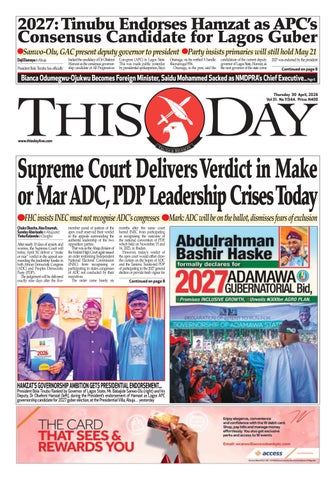
2027: Tinubu Endorses Hamzat as APC’s Consensus Candidate for Lagos Guber
Sanwo-Olu, GAC present deputy governor to president Party insists primaries will still hold May 21
Deji Elumoye in Abuja President Bola Tinubu has officially
backed the candidacy of Dr. Obafemi Hamzat as the consensus governorship candidate of All Progressives
Con-gress (APC) in Lagos State. This was made public yesterday by presidential spokesperson, Bayo
Onanuga, via his verified X handle: @aonanuga1956. Onanuga, in the post, said the
candidature of the current deputy governor of Lagos State, Hamzat, as the next governor of the state
Bianca Odumegwu-Ojukwu Becomes Foreign Minister, Saidu Mohammed Sacked
www.thisdaylive.com
Supreme Court Delivers Verdict in Make or Mar ADC, PDP Leadership Crises Today
FHC insists INEC must not recognise ADC’s congresses
Chuks Okocha, Alex Enumah, Sunday Aborisade in Abuja and Yinka Kolawole in Osogbo
After nearly 10 days of anxiety and worries, the Supreme Court will today, April 30, deliver a “make or mar” verdict in the appeal surrounding the leadership tussles in both African Democratic Congress (ADC) and Peoples Democratic Party (PDP).
The judgement will be delivered exactly nine days after the five-
member panel of justices of the apex court reserved their verdict in the appeals surrounding the authentic leadership of the two opposition parties.
That was as the Abuja division of the Federal High Court again issued an order restraining Independent National Electoral Commission (INEC) from recognising or participating in states congresses of ADC not conducted by their executives.
The order came barely six
months after the same court barred INEC from participating or recognising the outcome of the national convention of PDP, which held on November 15 and 16, 2025, in Ibadan.
However, today’s verdict of the apex court would either draw the curtain on the hopes of ADC and the Tanimu Turaki-led PDP of participating in the 2027 general election or provide fresh vigour for
election, at the Presidential Villa, Abuja… yesterday
and
Tinubu flanked by Governor of Lagos State, Mr. Babajide
(right)
his Deputy, Dr Obafemi Hamzat (left), during the President’s endorsement of Hamzat as Lagos APC governorship candidate for 2027 guber
POSTHUMOUS BOOK PRESENTATION IN HONOUR OF THE LATE DR. OLAWALE BANMORE...
L-R:
US War Against Iran Gulps $25 Billion as Oil Price Soars to $119
Dangote raises petrol price to N1,275 per litre Trump: I won’t lift blockade until Iran negotiates on nuclear programme
Emmanuel Addeh in Abuja
The cost of the ongoing United States military campaign against Iran has climbed to an estimated $25 billion, underscoring the scale of the deepening conflict between the two countries.
Separately, global oil prices surged to about $119 per barrel yesterday amid growing fears of supply disruptions triggered by the crisis, as tensions in the Middle East continue to unsettle energy markets.
Besides, the US President Donald Trump yesterday insisted that the blockade on Iran would remain in place until Tehran agrees to renegotiate its nuclear programme, signalling a likely prolonged standoff with significant implications for global stability.
In Nigeria, the impact was immediate, with the Dangote Refinery raising the ex-depot price of petrol to N1,275 per litre, a rise of N75 per litre at the depot, reflecting the spike in crude prices and associated supply costs.
A senior Pentagon official, Jules Hurst, said on Wednesday the US war in Iran has cost $25 billion so far, providing the first official estimate of the military’s price tag for the conflict. With just six months before
mid-term elections in which Trump’s Republicans may face an uphill battle to keep their House majority, Democrats are riding high in public opinion polls as they attempt to link the unpopular Iran war with affordability.
Hurst, who is performing the duties of the comptroller, told lawmakers on the House Armed Services Committee that most of that money was for munitions. Hurst did not detail what that cost estimate included and whether it took into account the projected costs of rebuilding and repairing base infrastructure in the Middle East damaged in the conflict.
Rep. Adam Smith, the top Democrat on the House Armed Services Committee, responded to Hurst: “I’m glad you answered that question. Because we’ve been asking for a hell of a long time, and no one’s given us the number.”
The United States started carrying out strikes against Iran on February 28 and the two sides are currently maintaining a fragile ceasefire. The Pentagon has poured tens of thousands of additional forces into the Middle East, including keeping three aircraft carriers in the region.
Thirteen US troops have been
killed in the conflict and hundreds wounded.
Disruptions in shipments of oil and natural gas since the war started have caused a run-up in US petrol prices and agricultural products such as fertilisers, on top of the long list of other high consumer prices, a Reuters report said.
Trump’s popularity has taken a beating since the US and Israel
launched a war against Iran on February 28 that has led to a surge in petrol prices. Just 34 per cent of Americans approve of the US conflict with Iran, down from 36 per cent in mid-April and 38 per cent in mid-March, a recent Reuters/Ipsos poll found.
In the meantime, Brent crude rose to $119 a barrel on Wednesday afternoon, the highest price so far this month and a rise of nearly 7
per cent in one day.
Iran has said it will continue to disrupt traffic travelling through the Strait of Hormuz in response to the US blockade.
The price of oil has seen sharp swings since the start of the war, as the key Strait of Hormuz has been effectively closed for weeks due to the conflict, a BBC report said.
Iran has severely restricted shipping
through the strait which usually carries about a fifth of the world’s supply of oil and liquid natural gas in response to US and Israeli strikes that began about two months ago. Earlier this month, Tehran warned that any vessel that approaches the strait would be targeted. The US then announced that its forces would intercept or turn back vessels travelling to or from Iran’s ports.
African Leaders Call for Accelerated Action on SDGs, Agenda 2063
African leaders have opened the “Twelfth Session of the Africa Regional Forum on Sustainable Development (ARFSD-12)” in Addis Ababa with a strong call for urgent, coordinated and transformative action that would accelerate progress towards the 2030 Agenda for Sustainable Development Goals (SDGs) and Agenda 2063.
A statement shared yesterday by the United Nations Economic
NISO, WAPP Set for Phase 2 of West Africa’s Power Grids Alignment Plan
Nigeria positions as stabilising anchor within regional network
Emmanuel
The Nigerian Independent System Operator (NISO) and the West African Power Pool (WAPP) have advanced technical and operational coordination ahead of the second phase of regional grid synchronisation, following a highlevel working visit to the National Control Centre (NCC) Osogbo.
The engagement focused on detailed system studies, operational protocols, and readiness assessments required for the June 2026 synchronisation milestone, which aims to deepen real-time interconnection of national grids within the West African power system, a statement by NISO said
yesterday.
Speaking during the session, the Executive Director, System Operation, NISO, Nafisatu Ali, said the transition from loosely coupled bilateral exchanges to a synchronised grid architecture requires strict adherence to unified operational standards.
According to her, these include frequency control, voltage stability, spinning reserve adequacy, and contingency management across interconnected systems. She noted that the NCC remains central to these operations, providing real-time supervisory control and dispatch through its SCADA/EMS platform, while coordinating system
balancing, outage scheduling, and grid security within Nigeria and across WAPP interconnections.
According to her, the synchronisation process demands alignment of grid codes, protection schemes, and operational procedures among member states, as well as robust communication infrastructure to support dynamic data exchange and coordinated dispatch.
“The NCC is responsible for maintaining system frequency within acceptable operational limits, ensuring voltage profiles are stable across transmission corridors, and coordinating both planned and forced outages to minimize system disturbances,” she said.
Commission for Africa (ECA) stated that the Forum, which was convened under the theme “Turning the Tide: Transformative and Coordinated Actions for the 2030 Agenda and Agenda 2063,” brought together ministers, senior government officials, regional institutions, United Nations entities, civil society, the private sector and development partners to review Africa’s progress and shape the continent’s common position ahead of global sustainable development processes, including the High-Level Political Forum.
In his official opening of the Forum, the Prime Minister of Uganda, Ms. Robinah Nabbanja, who also chaired the Bureau of the
Eleventh Africa Regional Forum on Sustainable Development, said Africa must move with greater urgency from commitments to concrete, measurable results.
Nabbanja said: “With only four years remaining to 2030, we must move with urgency - from commitments to concrete, measurable results.
“We must leverage science, technology and innovation, regional integration, innovative financing and strong partnerships.”
She expressed appreciation to the Government and people of Ethiopia for hosting the Forum in Addis Ababa, and commended the United Nations Economic Commission for Africa for its continued leadership in
advancing the continent’s sustainable development agenda.
Nabbanja recalled the adoption of the Kampala Declaration and the Key Messages to the High-Level Political Forum in 2025.
She noted that the Bureau had remained actively engaged over the past year, convening four meetings to provide strategic direction, sustain momentum and strengthen follow-up on implementation.
She highlighted progress in aligning national development plans with the SDGs, expanding data systems for evidence-based planning, enhancing coordination mechanisms and shifting focus towards accelerated implementation.
CBN Urges Students to Master Money Skills as Economic Landscape Evolves
Central Bank of Nigeria (CBN) has intensified its push for early financial literacy, urging secondary school students to treat money management as a vital life skill in today’s rapidly changing economy.
Speaking in Abuja at the 2026 edition of Global Money Week, CBN’s Director, Consumer Protection and Financial Inclusion Department, Mrs. Aisha Isa Olatinwo, stressed that understanding how
money worked was no longer optional for young Nigerians.
She said, “In today’s rapidly evolving financial landscape, financial literacy is no longer optional; it is essential,” explaining that the ability to make informed financial decisions is crucial for personal growth, family stability, and national economic development.
Olatinwo stressed that equipping young people with sound financial knowledge early in life would position them to navigate
economic realities more effectively. She added that open conversations about money remained critical to breaking misconceptions and building confidence.
The CBN director said, “When we talk about money, we break down misconceptions, build confidence, and prepare ourselves for a more secure financial future.” She also highlighted several initiatives introduced by the central bank to deepen financial awareness among Nigerians, particularly youths.
Dike Onwuamaeze
Chairman of the Occasion/former Commissioner for Insurance, Bauchi State, and Chief Executive Officer of National Insurance Commission (NAICOM), Mr. Mohammed Kari; Keynote Speaker and Former Governor of Lagos State, Mr. Babatunde Raji Fashola; Founder and Chief Executive Officer of Mutandis Africa Group, Mrs. Chinelo Anohu; Book Reviewer, Dr. Reuben Abati; Chief Host/Chairman, Editorial Board, THISDAY Newspapers, Mr. Olusegun Adeniyi; and wife of the author, Mrs. Morakayo Olawale-Banmore, at the posthumous book presentation in honour of the late Dr. Olawale Banmore in Lagos, on Tuesday
PHOTO: ABIODUN AJALA
Addeh in Abuja
James Emejo and Mariam Adedokun in Abuja
AMBASSADORS DESIGNATE PAY WIKE COUTESY VISIT...
FCT Minister, Nyesom Wike (3rd right), with Ambassadors designate, OCJ Okocha (SAN) middle, Yinka Olumilua (2nd right), Senator Eta Enang (R), and Florence Ajimobi (L) and others during a courtesy by the envoys to the Minister on Wednesday
Bianca Odumegwu-Ojukwu Becomes Foreign Minister,
Saidu Mohammed Sacked as NMDPRA’s Chief Executive
Rabiu Umar nominated as replacement
President Bola Ahmed Tinubu yesterday approved the elevation of Ambassador Bianca Odumegwu-Ojukwu as Nigeria’s Minister of Foreign Affairs, following the resignation of Ambassador Yusuf Tuggar, who stepped down to participate in the 2027 elections.
Odumegwu-Ojukwu’s
elevation came on the same day the President sacked the Chief Executive of the Nigerian Midstream and Downstream Petroleum Regulatory Authority (NMDPRA), Mr. Saidu Mohammed who had spent a mere four months in office.
=Until her latest appointment, Odumegwu-Ojukwu was Minister of State for Foreign Affairs.
The President, according to Onanuga, also nominated Ambassador Sola Enikanolaiye as the new Minister of State for Foreign Affairs, subject to Senate confirmation.
Until his nomination, Enikanolaiye, from Kogi State, served as Senior Special Assistant to the President on Foreign Affairs and International Relations.
NDLEA Smashes N16.9bn Drug
Enikanolaiye is a distinguished diplomat and seasoned public servant with over three decades of exemplary service in Nigeria’s foreign service. He has previously served as Permanent Secretary in the Ministry of Foreign Affairs and held key diplomatic postings in Addis Ababa, Belgrade, Ottawa, London, and New Delhi.
The President noted that the
Ring
in Lagos, Seizes 4.3m Opioids in Major Crackdown
Michael Olugbode in Abuja
Operatives of the National Drug Law Enforcement Agency (NDLEA) have uncovered and raided three illicit drug warehouses concealed within a residential estate in Lagos, recovering opioids valued at nearly N17 billion in what authorities describe as a major breakthrough against drug trafficking networks.
The intelligence-led operation, carried out on April 17, 2026, targeted properties in the Okota area, specifically within Park View Estate in Ago Palace.
At the sites—located on Olukayode Awofisayo Street and Charles Ndumetu Street—NDLEA operatives discovered a large cache of opioids, including 2,360,000 pills of high-potency tramadol (225mg) and 1,909,400 bottles of codeine syrup. The seized substances, stored in thousands of cartons, have an estimated street value of N16.9 billion.
Reacting to the operation, NDLEA Chairman and Chief Executive Officer, Buba Marwa described the raid as a decisive strike against a major drug syndicate.
He said the scale of the seizure
underscores both the sophistication of drug cartels and the agency’s growing intelligence capabilities.
“The scale of this recovery— nearly 4.3 million units of lethal substances—is a testament to the fact that our officers are staying several steps ahead of these merchants of death,” Marwa said.
“To find such volumes hidden within residential estates like Park View and busy hubs like Okota shows the desperation of these cartels.”
He commended the professionalism and dexterity of NDLEA opera-
tives, emphasizing that the agency remains resolute in dismantling drug networks across the country.
“There is no safe haven for drug traffickers in Nigeria,” he warned.
“Whether they hide their illicit goods in elite mansions or suburban warehouses, our reach is long and our resolve is firm. We will continue to degrade your financial base, dismantle your networks, and bring the full weight of the law upon you.”
The NDLEA said the operation marks a significant step in its ongoing campaign to curb substance abuse and disrupt the supply chains.
appointments are part of ongoing efforts to reposition Nigeria’s foreign policy architecture for greater efficiency, strategic engagement, and stronger global partnerships.
Tinubu congratulated the appointees and urged them to work diligently to promote Nigeria’s national interest, advance economic diplomacy, foster regional stability, and safeguard the welfare of Nigerians at home and abroad.
Meanwhile, the President, in a statement issued by his Adviser on Information and Strategy, Bayo Onanuga, also approved the nomination of Mr. Rabiu Abdullahi Umar as the new Chief Executive of the NMDPRA.
The appointment is, however, subject to Senate confirmation.
The President, in the wake of the resignation of Farouk Ahmed as CEO of NMDPRA in December 2025, nominated Mohammed as his successor and, upon his confirmation by the Senate, assumed office formally on December 23, 2025.
According to the release, the decision, made pursuant to the Petroleum Industry Act 2021,
was aimed at strengthening regulatory effectiveness in the midstream and downstream petroleum sector, in line with the Renewed Hope Agenda. Pending Senate confirmation of the new nominee, the most senior official of the NMDPRA will oversee operations in an acting capacity.
Tinubu thanked the outgoing Authority Chief Executive for his service and wished him well in his future endeavours. The President said he remains committed to ensuring capable leadership in key regulatory institutions to advance energy security, sector reform, and sustainable economic growth. Umar is a seasoned executive with over 25 years of experience across the energy, manufacturing, and infrastructure sectors, and a proven track record in strategic leadership, operational transformation, and large-scale project delivery. He is a graduate of Accounting from Bayero University and an alumnus of Harvard Business School. The oil sector regulators had in the recent past been accused of wrongdoings.
Alleged N1.63bn Money Laundering: EFCC Re-arraigns Bauchi Accountant-General, One Other
Segun Awofadeji in Bauchi
Economic and Financial Crimes Commission (EFCC) on Tuesday re-arraigned Bauchi State AccountantGeneral, Sirajo Muhammad Jaja, and an unlicensed Bureau de Change operator, Aliyu Abubakar of Jasfad Resources Enterprises, before Justice O. A. Egwuatu of the Federal High Court, Abuja.
EFCC posted on its verified Facebook page that the duo were rearraigned on an amended five-count charge bordering on conversion of public funds belonging to Bauchi State Government, and money laundering to the tune of N1, 635, 270, 350.9k (One billion, Six Hundred and Thirty-five million, Two hundred and seventy thousand, Three hundred
and fifty Naira, Nine kobo). Jaja and Abubakar were earlier arraigned on April 7, 2025, with Jaja as the first defendant, while Abubakar was the second. However, in the amended charge, marked FHC/ ABJCR/101/2025, dated, January 5, 2026, and filed on the same date, Abubakar, trading under the name of Jasfad Resources Enterprise, became the first defendant and Jaja the second. Early in the proceedings, prosecution counsel, Abba Muhammed, SAN, informed the court that the prosecution had filed a second amended charge and prayed the court for the defendants to take their plea.
Count two of the charge read, “That you Aliyu Abubakar (trading under the name and style
of ‘Jasfad Resources Enterprises’ a purported Bureau de Change operator), Sirajo Muhammad Jaja (Accountant General of Bauchi State), Abubakar Muhammad Hafiz (at large), between 29 October, 2024 and 31st December, 2024 within the jurisdiction of this Honourable Court, did commit an offence to wit: money laundering by converting the sum of One Billion, Two Hundred and Ninety Million, One hundred and Fifty four thousand, Three hundred and Thirty seven Naira, Two kobo (N1, 290,154,337.2) of public funds, belonging to Bauchi State Government which you transferred from the Bauchi State Sub-Treasury Account, domiciled in United Bank for Africa with account number 1018819396 into the bank account of Jasfad Resources
Enterprise domiciled in United Bank for Africa with account number 1023444660 and thereby committed an offence contrary to Section 18(2)(b) and punishable under Section 18(3) of the Money Laundering(Prevention and Prohibition) Act, 2022.”
Count three read, “That you Aliyu Abubakar (trading under the name and style of ‘Jasfad Resources Enterprises’ a purported Bureau de Change operator), Sirajo Muhammad Jaja (Accountant General of Bauchi State), Abubakar Muhammad Hafiz (at large), Ari Manga (at large), and Muhammad Aminu Bose (at large), between 3rd January, 2025 and 14th March 2025, within the jurisdiction of this Honourable Court, did commit an offence to wit: money laundering by converting the sum of Four hundred
and twenty-six million, One hundred and sixteen Thousand, Thirteen Naira, Seven kobo (N426, 116,013.7) of the public funds, belonging to Bauchi State Government which you transferred from the Bauchi State Sub-Treasury Account, domiciled in the United Bank for Africa with account number 1018819396 into bank account of Jasfad Enterprise, domiciled in United Bank for Africa with account number 1023444660 and thereby, committed an offence contrary to Section 18(2)(b) and punishable under Section 18(3) of the Money Laundering (Prevention and Prohibition) Act, 2022.”
They pleaded “not guilty” to the charges, following which the counsel to the first and second defendants, Gordy Uche, SAN, and Chris Uche, SAN, respectively, applied for the
defendants to continue to enjoy the bail granted them by the court, which was not objected by the prosecution counsel.
The first defendant’s counsel further moved a motion challenging the competence of the charge, and asked the judge to strike out counts two, three, four and five for allegedly being a duplicity of action, and to save the defendants from suffering double jeopardy.
The motion found support from the counsel to the second defendant, Chris Uche, SAN, while they faced objection from the prosecution counsel. The court, however, reserved ruling on the contention till the end of trial, citing Section 395 of the Administration of Criminal Justice Act, ACJA 2015.
Deji Elumoye in Abuja
KENYAN MINING INVESTMENT CONFERENCE AND EXHIBITION IN NAIROBI...
L-R: Minister of Mining, Republic of South Sudan, Mr. Lasuba Loduru Wongo; Minister of Solid Minerals Development, Nigeria, Mr. Dele Alake; President of the Republic of Kenya, Mr. William Samoei Ruto; Cabinet Secretary, Ministry of Mining, Blue Economy and Maritime Affairs, Republic of Kenya, Mr. Hassan Ali Joho; Minister of Petroleum and Mineral Resources, Somalia, Mr. Dahir Shire Mohamed; and Minister for Minerals, Tanzania, Mr. Anthony
Akpabio: Middle East Crisis Has Derailed Nigeria’s
$5 Billion
Loan Plan from UAE
Explains why FG turns to Deutsche Bank for $516m to sustain key infrastructure project Insists urgent funding needed to avert project abandonment
Sunday Aborisade in Abuja
President of the Senate, Godswill Akpabio, yesterday, said Nigeria’s plan to secure a $5 billion loan from the United Arab Emirates, has been stalled by the ongoing conflict involving the United States, Israel and Iran, forcing the federal government to seek alternative funding to sustain critical infrastructure projects.
Akpabio disclosed this during plenary, as the Senate considered and approved President Bola Tinubu’s $516.3 million loan request for the construction of the Sokoto–Badagry Superhighway.
Akpabio said the geopolitical tensions in the Middle East had disrupted federal government’s borrowing arrangement with Abu Dhabi Bank, making it imperative to urgently source funds elsewhere to prevent ongoing projects from being abandoned.
He noted that the Senate’s swift approval of the $516 million facility was driven by the need to keep
strategic national projects on track.
Earlier, Chairman of the Senate Committee on Banking, Insurance and Other Financial Institutions, Senator Adetokunbo Abiru, also highlighted the challenges encountered by the Tinubu administration in securing the planned $5 billion facility from the UAE. Tinubu, had in March, written to the Senate seeking approval to borrow the $5 billion to finance the 2026 budget deficit and support other critical obligations.
However, with the delay in accessing the UAE funds, the federal government pivoted to Deutsche Bank, securing a $516.3 million syndicated loan for the Sokoto–Badagry Superhighway project.
The Senate subsequently approved the facility following the adoption of the report of its Committee on Local and Foreign Debts, chaired by Senator Aliyu Wamakko.
The loan, backed by a partial risk guarantee from the Islamic Corporation for the Insurance of
Investment and Export Credit (ICIEC), an arm of the Islamic Development Bank, was part of a broader financing strategy to drive infrastructure development.
Tinubu, in his communication to the Senate, stated that the federal government would provide N265.5
billion as counterpart funding for land acquisition, compensation, and ancillary infrastructure.
He explained that the highway project, spanning about 1,000 kilometres from Illela in Sokoto State to Badagry in Lagos State, was designed to link seven states and
open up the northwest–southwest economic corridor.
According to the president, the project was expected to enhance connectivity, reduce logistics costs, improve road safety, facilitate trade, and strengthen food security, while also promoting national integration.
Senators, including Deputy Senate President Barau Jibrin and Chief Whip Mohammed Monguno, commended the administration for pursuing what they described as a strategic intervention to drive economic growth despite prevailing global uncertainties.
Alake Canvasses United African Front to Capture Greater Value from Global Mineral Economy
The Minister of Solid Minerals Development and Chairman of the Africa Minerals Strategy Group (AMSG), Dr. Oladele Alake, has called for stronger regional cooperation among African nations to position the continent as a formidable force in global mineral supply chains.
Speaking at the Kenya Mining Investment Conference and Exhibition 2026, Dr. Alake said Africa stands
at the centre of a new industrial era driven by critical minerals, clean energy technologies, digital transformation and advanced manufacturing.
He noted that while Africa possesses vast deposits of lithium, cobalt, manganese, graphite, gold, copper, nickel and rare earth elements, the continent continues to capture only a fraction of the true economic value generated from its resources.
maximize opportunities emerging from the rapidly evolving global minerals market.
“The time has come for Africa to redefine its place within the global mineral economy, and that transformation must begin with regional cooperation,” he stated.
He urged African nations to harmonise mining policies, facilitate cross-border infrastructure, promote intra-African trade and strengthen regional mineral value chains under the African Continental Free Trade Area (AfCFTA).
Nominee cleared without questioning, described as “square peg in square hole”
The Senate on Wednesday confirmed the appointment of Mr. Lamido Abubakar Yuguda as Deputy Governor of the Central Bank of Nigeria (CBN), endorsing President Bola Tinubu’s nomination with unusual speed and unanimous backing.
The upper chamber approved the appointment following the presentation of a report by its Committee on Banking, Insurance and Other Financial Institutions, which declared Yuguda eminently qualified for the role.
Chairman of the committee, Senator Adetokunbo Abiru (Lagos East), told lawmakers that the nominee met all statutory requirements and
demonstrated deep expertise in financial and monetary matters.
He said the committee found no petition against Yuguda and urged his confirmation in line with provisions of the CBN Act.
“Based on his knowledge, experience and performance during the screening process, the committee recommends that the Senate confirm his nomination,” Abiru said.
The motion for confirmation was seconded by Senator Danjuma Goje (Gombe Central), who described the appointment as a sound decision by the president.
Following a voice vote conducted by Senate President Godswill Akpabio, the nomination was overwhelmingly approved. Akpabio, in his remarks, com-
mended President Tinubu for what he described as a fitting choice, noting that Yuguda was “a square peg in a square hole.”
Earlier, the nominee was accorded the privilege of “take a bow and go” during his screening by the committee—effectively bypassing detailed grilling.
The move followed a motion by Senator Osita Izunaso (Imo West), who argued that Yuguda’s competence was already well established.
Izunaso argued the nominee had been previously screened, multiple times by the Senate for key positions, including Director-General of the Securities and Exchange Commission (SEC) and roles within the apex bank.
“For decades, Africa has remained largely an exporter of raw materials and an importer of finished products. This model has constrained industrial growth, weakened economic resilience and limited job creation across our nations,” he said.
Dr. Alake stressed that no African country, acting alone, can fully
“A fragmented Africa weakens our bargaining power. A united Africa strengthens our strategic relevance,” the minister added.
Dr. Alake also highlighted the rapid
expansion of the Africa Minerals Strategy Group, which was established in January 2023 by sixteen founding member states and has now grown to thirty-one African countries. He described AMSG as the first truly continent-wide platform through which African countries are building a unified voice on mineral governance, value retention and strategic positioning in global supply chains. According to him, the group is advancing cooperation among member states to negotiate fairer terms with global partners, harmonise regulatory frameworks, develop shared infrastructure such as mineral corridors and processing hubs, and strengthen geological data systems to attract investment.
Tinubu Allocates Abuja Lands to High Commissioners, Ambassadors-designate
Olawale Ajimotokan in Abuja
President Bola Tinubu has approved the allocation of land to Ambassadors and High Commissioners-Designate in Abuja.
Minister of the FCT, Nyesom Wike, disclosed this yesterday when he received the Permanent Secretary, Ministry of Foreign Affairs, Dunoma Umar Ahmed, and the Ambassadorsdesignate, on a courtesy visit to his official residence in Life Camp, Abuja. Wike explained that the president made the decision to ensure that Nigeria’s representatives have a permanent
stake and a residence in Abuja whenever they return for periodic briefings.
He said, “The President believes that most of you do not have a place in Abuja. He will encourage you to see how you will put up where you can stay. Before you leave this morning, each and every one of you should have your form to apply for a land allocation in Abuja.”
The minister affirmed that the gesture was aimed at fostering diplomatic presence in Nigeria’s capital while deepening stronger engagement between foreign missions and the Federal Capital Territory.
He urged the envoys to uphold the nation’s image in their respective postings, stating the way the world would perceive them is the way it would see Nigeria. Wike also charged them to effectively communicate the vision and priorities of the president, particularly in attracting foreign investment and strengthening international partnerships.
“Mr. President has travelled extensively to attract investments and partnerships. It is now your role to reinforce that effort by building confidence in Nigeria as a viable destination for investment,” Wike said.
Peter Mavunde, at the Kenyan Mining Investment Conference and Exhibition in Nairobi
Folalumi Alaran in Abuja
Sunday Aborisade in Abuja
DAAR Communications Alleges Irregular Share Changes on CAC Portal, Drags Commission to Court Over Dokpesi Estate Dispute
DAAR chairman raises concerns over corporate filings, calls for forensic investigation into registry entries Alleges CAC share manipulation, warns of risk to market integrity
Wale Igbintade
A governance and succession dispute over the estate of late media entrepreneur, High Chief Raymond Aleogho Dokpesi, has intensified following fresh allegations of unauthorised alterations to corporate records affecting DAAR Communications Plc and its holding structure.
In a statement dated April 27, 2026, Chairman of DAAR Communications Plc, Raymond Paul Dokpesi Jr., accused Corporate Affairs Commission (CAC) of reflecting unauthorised changes on its online registry, warning that the development poses a serious threat to corporate governance and market integrity in Nigeria.
He said the matter, initially rooted in a family and succession dispute, escalated after discrepancies appeared on the CAC portal showing an increase in the company’s issued share capital from 4,890,523,000 to 5,016,418,000 shares, representing an unexplained addition of 125,895,000 shares.
Dokpesi Jr. insisted that no board approval, valid transfer instruments,
or statutory filings supported the changes, describing them as unlawful and without legal basis.
He cited alleged breaches of the Companies and Allied Matters Act (CAMA) 2020, particularly provisions governing share transfer and transmission of shares of deceased persons, stating that such shares cannot be redistributed without probate or Letters of Administration.
He further alleged that shares previously linked to individuals, including Ade Orekoya and Aishatu Dokpesi, were reassigned without consent, while some directors were reflected as shareholders without executing any legal instruments.
According to him, “shares cannot move by mere portal entry,” stressing that no valid documentation exists to justify the alterations on the CAC system.
Dokpesi Jr. also questioned the emergence of new names on the corporate registry, demanding disclosure of resolutions or filings authorising their inclusion.
He accused CAC of refusing to release audit trails, IP logs, and authorisation records despite repeated
requests, stating that the commission has relied on a “presumption of correctness” of its electronic records even after allegations of fraud were raised.
He warned that continued alterations without transparency suggested possible compromise of the registry system and posed a broader risk to Nigeria’s corporate governance framework.
The DAAR chairman said the alleged manipulation affected both DAAR Communications Plc and Daar Investment and Holding Company Limited (DIHL), describing it as a coordinated attempt to alter ownership positions and misrepresent control of the companies.
He stated that DIHL’s shareholding was historically structured equally among five directors: Raymond Dokpesi Jr., Peter Dokpesi, William Dokpesi, Raji Dokpesi, and Halima Dokpesi. He added that Catherine Dokpesi, daughter of Tosin Dokpesi, was previously associated with the company but was later excluded as a director after CAC indicated she was a minor.
Despite that, he alleged her name still appeared in CAC records without
share allocation, raising questions about how her details were inserted into the system.
He said the disputed restructuring was originally intended to maintain equal distribution among stakeholders, but only Peter Dokpesi had formally objected to restoring the original structure pending proper estate administration.
He further stated that four of the five directors of DIHL had disowned the disputed changes and requested reversal of the entries, while internal family disagreements had complicated efforts to resolve the matter privately.
In a parallel notice to NGX Regulation Limited and copied to Securities and Exchange Commission (SEC), DAAR Communications confirmed it had formally challenged the alleged unauthorised CAC entries.
The company stated that its last verified position remained its 2024 Annual Report, which reflected an issued share capital of 8,000,001,000 ordinary shares, with DIHL holding 4,890,523,000 shares, representing 61.13 per cent.
It stressed that no share transfers or acquisitions were approved by
the board or filed through lawful channels, adding that any CAC records suggesting otherwise are disputed and appeared to stem from a compromised registry system.
The company warned that the situation could amount to an attempt to alter ownership structure and defraud legitimate shareholders, calling for an immediate public inquiry and forensic audit of CAC electronic records.
Dokpesi Jr. also disclosed that the disputed entries were already affecting staff entitlements, statutory obligations, and the administration of the late founder’s estate.
Despite what he described as threats to his personal safety, he said he remained undeterred, adding that petitions have been submitted to relevant regulatory and security agencies.
He stressed that the integrity of Nigeria’s corporate registry system was critical to investor confidence and capital market stability.
Meanwhile, DAAR Investment and Holding Company Limited filed a suit at the Federal High Court in Abuja challenging CAC over
alleged unauthorised changes to its shareholding structure, including the disputed reallocation of 300,000 shares linked to the late High Chief Raymond Dokpesi. In the Originating Summons, the company, through a derivative action instituted by Chief Raymond Paul Dokpesi (Jnr) on behalf of surviving shareholders, sought an order compelling CAC to investigate the alleged irregularities and rectify its register of members.
CAC is the sole defendant in the suit filed under the provisions of the Companies and Allied Matters Act (CAMA) 2020, the Constitution of the Federal Republic of Nigeria, and the Federal High Court (Civil Procedure) Rules 2019.
SUPREME COURT DELIVERS VERDICT IN MAKE OR MAR ADC, PDP LEADERSHIP CRISES TODAY
ADC, the main opposition coalition, and PDP to try to wrest power from President Bola Tinubu and his All Progressives Congress (APC), come 2027.
The five-member panel led by Justice Mohammed Garba had last Wednesday announced that judgement had been reserved to a date to be communicated to parties. That was shortly after lawyers representing ADC and PDP in the different appeals adopted their processes as their briefs of argument for and against the appeals,
THISDAY, yesterday, learnt that the apex court was set to deliver its verdict on the ADC and PDP appeals today.
In the event the appeal succeeds it would clear the coast for the David Mark-led leadership to participate and field candidates in all elective offices in the 2027 general election.
But if the appeal fails, ADC would be shut out of the polls on the grounds that it did not have a leadership that would conduct
at a meeting with members of Lagos Governor’s Advisory Council (GAC) at State House, Abuja.
He stated, “President Tinubu formally endorses the Lagos APC consensus governorship candidate Obafemi Hamzat at a meeting with members of the Lagos Governance Advisory Council (GAC) led by the Prince Tajudeen Oluyole Olusi and Governor Babajide Sanwo-Olu.”
The GAC members, who had Tuesday unveiled Hamzat as consensus candidate, arrived the State House about 5pm yesterday and went into a close-door meeting with Tinubu.
Those at the meeting included Governor Babajide Sanwo-Olu; Chief of Staff to the President, Hon Femi Gbahabiamila; Senator Musiliu Obanikoro; Hon Adejoke Orelope-Adefulire; Senator Ganiyu
and supervise the selection of its candidates in the general election, ditto for the Turaki-led PDP.
For ADC, the appeal set for judgement is between the Mark leadership and former Deputy National Chairman of the party, Nafiu Bala Gombe.
At the last proceedings, Jibrin Okutepa, SAN, who represented Mark, urged the apex court to allow the appeal, on the grounds that the apex court had in a judgement delivered on March 21, 2025, put an end to the issue before the court, when it held that, “no court has jurisdiction to entertain cases bordering on internal affairs of political parties.”
Okutepa urged the apex court to allow the appeal and hold that the trial court lacked jurisdiction to entertain a suit bordering on ADC’s internal matters.
However, Robert Emukpero, SAN, who represented the first respondent, Gombe, urged the apex court to reject the appeal and affirm the judgement of the lower court, which held that the case of
Solomon; Senator Mukail Abiru; Otunba Femi Pedro; and Alhaji Mutiu Aare, among others.
Speaking with newsmen after the meeting with the president, Hamzat said the team, led by Olusi, had come to present him to Tinubu, who subsequently gave his blessing to both him and the council’s decision.
Hamzat stated, “These are fathers, they are leaders, they’ve seen a lot of Christmases, they’ve seen a lot of Eid El Kabir, so they have experience, and, therefore, I’m really, really excited that they brought me here to meet Mr. President, and Mr. President has blessed us and blessed the decision of GAC.”
Asked about his preparedness for the governorship race, the deputy governor admitted the enormity of the task but expressed confidence
the appellant was premature and dismissed it.
After taking arguments from all parties, Justice Mohammed Garba, who presided over the proceedings, announced that judgement was reserved to a date that would be communicated to parties.
Yet, the appellate court had in a ruling in the appeal filed by the Mark-led leadership against the ruling of the Federal High Court, Abuja, ordered status quo ante bellum.
Based on the ruling of the appellate court, INEC withdrew the recognition accorded the Mark-led executive as the authentic leadership of ADC.
Gombe had last year dragged the Mark-led executive before Justice Emeka Nwite to challenge the leadership of the party.
He had among others sought an order restraining the Mark-led leadership from parading itself as leaders of ADC, and claimed that he remained the authentic leader of the party, following the resignation of the then chairman and other
in his experience.
He stated, “Nobody is ready because the assignment is audacious. But what you have is experience. Having served as Deputy Governor of Lagos under Governor SanwoOlu, I’ve learned a lot. I know the room. I know where the kitchen is.
“You know, if you want to cook for people and you don’t know the kitchen, it doesn’t matter how good a chef you are, you must know the kitchen. So, with God’s blessings and the support of all my fathers here, I really don’t have any fear.”
On his part, Olusi dismissed objections raised by other aspirants, including APC chieftain, Samuel Ajose, who had questioned the legitimacy of the consensus arrangement.
Olusi said, “We are in the arena of politics, and people are free to
members of the executive.
Mark, it would be recalled, was announced the chairman of an interim national executive of ADC at a meeting in Abuja, last year, with his chairmanship substantiated at the convention of the party held recently in Abuja.
However, Nwite declined to issue a restraining order against the Mark-led leadership but rather ordered the applicant to put the defendants on notice.
Reacting, Mark approached the appellate court to challenge the jurisdiction of Nwite to entertain the suit by Gombe, in the first place.
While insisting that the trial court could not entertain the suit by Gombe, for being an internal matter of ADC, Mark also argued that the trial court became functus officio, when the judge refused the grant of the restraining order against the Mark-led leadership.
But, the appellate court, in its judgement last month, dismissed Mark’s appeal and returned the case to the trial court.
While the appellate court had
express their opinions in a free society. But I have been in politics for a very long time. I was part of the team that raised the system and have been part of every typical race.
I know all the governors except one.
“It is part of the system that we come together, put our heads together and take a course of action. People are free to comment, but what they comment on is nothing with all of us.”
Despite the consensus endorsement, the party’s leadership reiterated that governorship primaries would still be conducted in line with APC guidelines to ensure a level playing field for all aspirants.
The party’s governorship primaries are scheduled for May 21, 2026, while submission of nomination forms closes on Monday, May 4.
ordered accelerated hearing in the matter, it went ahead to order status quo ante bellum, an order which INEC acted upon to de-recognise the Mark leadership as well as remove their names from its portal.
Displeased, Mark approached the Supreme Court to set aside the ruling of the appellate court.
Only a few days ago, ADC pleaded with the Supreme Court to deliver its judgement in the appeal within the next three days.
ADC, in a letter to Chief Justice of Nigeria (CJN), Justice Kudirat Kekere-Ekun, stated that failure of the apex court to deliver judgement within the period would jeopardise the chances of the party in the 2027 general election, as well as dash the hope of millions of Nigerians intending to vote for ADC and its candidates at the general election slated for early January next year.
In the letter dated April 28, the party’s lead counsel, Mr Shuaibu Aruwa, SAN, recalled that the apex court “graciously heard expeditiously on April 22, 2026 and judgement was thereafter reserved to a date to be communicated by the court”.
Aruwa stated, however, that they were “most respectfully constrained to request for the CJN’s kind intervention and directive in ensuring that the judgement was rendered timeously”, on the grounds that INEC, the fourth Respondent in the said appeal, purportedly, acting pursuant to the judgement of the lower court in Appeal No: CA/ ABJ/145/2026, had removed or de-recognised the leadership of ADC.
The senior lawyer submitted that the action of INEC had left ADC without leadership at the moment even though ADC remained a recognised registered political party in Nigeria.
In addition, ADC drew the attention of the CJN to INEC’s timetable for the 2027 general elections and the activities in readiness, which it said had already commenced.
In PDP, the battle is between a faction said to be loyal to Minister of the Federal Capital Territory (FCT), Nyesom Wike, an ally of President Bola Tinubu, and the camp of Oyo State Governor, Seyi Makinde. The legal battle stemmed from the conduct of the PDP national convention in Ibadan last year, which produced the Turaki-led national executive. While Austin Nwachukwu and two other PDP chieftains had dragged the Ambassador Iliya Damagum-led national executive before Justice James Omotosho of the Federal High Court, Abuja, over alleged noncompliance with the party’s guidelines as well as the Electoral Act in the conduct of the PDP convention, former governor of Jigawa State, Sule Lamido, on the other hand, dragged the party before Justice Peter Lifu of the same Federal High Court, to challenge his exclusion from the convention.
At last Wednesday’s proceedings, when the appeal between the Turaki-led executive of PDP versus Lamido was called, Paul Erokoro, SAN, who represented the appellant urged the apex court to allow the appeal and set aside the judgement of the Court of Appeal, which nullified the Ibadan convention on the grounds that the convention was held in disobedience to the orders of the Federal High Court. Lamido, through his lawyer, Ewere Aliemeke, urged the apex court to dismiss the appeal in its entirety for lack of merit.
The same plea was made by O. A. Adeyemi, who represented INEC and Chief Joseph Daudu, SAN, who represented the third to fifth respondents.
Daudu, urged the apex court to hold that the appeal did not fall within the spheres of internal matters of political parties.
In the other PDP matter against Nwachukwu and two others, Chief Chris Uche, SAN, who argued the appeal for PDP, submitted that the
2027: TINUBU ENDORSES HAMZAT AS APC’S CONSENSUS CANDIDATE FOR LAGOS GUBER
Raymond Dokpesi Jr.
ROYAL VISIT BY ODU’A INVESTMENT GROUP...
L-R:Group Managing Director, Odu’a Investment Company Limited, Mr. Abdulrahman Yinusa; Group Chairman, Otunba Bimbo Ashiru, and Olubadan of Ibadanland, Oba Rasidi Ladoja, Arusa 1, during a royal visit to the monarch in Ibadan, Oyo State…recenlty
For His Contribution to Air Transport, IATA Names Keyamo Among Africa’s Top Four Aviators
Minister calls for stronger collaboration to advance aviation safety
Nigeria’s Minister of Aviation and Aerospace Development, Festus Keyamo, has been named among ‘Africa’s Top Four Aviators’ by the International Air Transport Association (IATA) in recognition of his contribution to the aviation sector in the continent.
The recognition of the minister into the elite group was announced
at a special session of the ongoing IATA Focus Africa Conference in Addis Ababa by the association’s Regional Vice President for Africa and the Middle East, Kamil Alawadhi.
IATA’s recognition of individuals as top aviators is essentially a highlevel endorsement of their influence and contribution to the continent’s aviation sector.
It signifies that such individuals are regarded as key figures shaping
the direction of the industry, often occupying leadership roles such as airline executives, regulators, or aviation specialists whose decisions have wide-ranging impact.
According to Alawadhi, the honour reflects Keyamo’s strategic policy direction, reform efforts, and commitment to aligning Nigeria’s aviation sector with global standards.
Seeks full implementation of open skies initiative
aviation sector is clearly on a transformative path,” Alawadhi stated.
The IATA vice president noted that the minister’s proactive engagement with global stakeholders and swift resolution of longstanding industry challenges have significantly improved investor confidence and operational stability within Nigeria’s aviation ecosystem.
He highlighted the country’s implementation of the Cape Town
Suicidal Ideation Tops List of Concerns in Nigeria’s Helpline Data, New Report Reveals
Young adults aged 18 to 30 make up over 80% of all callers
New data emerging from a decade of crisis intervention services by She Writes Woman (SWW) is shedding light on what experts describe as a largely invisible public health emergency in Nigeria.
According to the report, nearly 55% of individuals who contacted SWW’s national helpline were experiencing suicidal ideation at the time of reaching out.
The report was unveiled by SWW’s founder, Hauwa Ojeifo, an internationally recognized mental health advocate and the first person
with a mental health condition to testify before the National Assembly of Nigeria.
The dataset, drawn from over 25,000 interactions across Nigeria’s six geopolitical zones, provides a rare real-time insight into how mental health crises unfold beyond traditional surveys and clinical settings.
The findings highlight a disproportionate impact on the next generation, with young adults aged 18 to 30 making up over 80% of all callers.
This demographic surge was particularly evident during periods
of national upheaval; during the COVID-19 pandemic and the #EndSARS protests, the helpline recorded over 3,000 crisis contacts within a short window, underscoring the profound impact of national events on collective mental health.
“The data we present here today is perhaps the most dynamic in that it gives us reach and depth of evidence across geography, gender, age groups, and trends,” Ojeifo said.
The report also delves into the drivers of this distress, highlighting the heavy influence of macroeconomic and social pressures.
Addressing the link between
financial instability and mental wellness, Ojeifo said, “The number one thing we saw was financial instability. I struggle with that because it perpetuates the idea that when you have money, everything would be okay.
“People who are privileged also deal with severe mental health conditions. It is not just about the money, but what your social background predisposes you to and your ability to afford the care available. This is why it is important to us that care is not privileged and expensive, so that everyone can afford it.”
Convention and the Irrevocable Deregistration and Export Request Authorisation (IDERA) framework, as well as its 91.4 per cent score in safety oversight by the International Civil Aviation Organization (ICAO), placing Nigeria among Africa’s highest-performing aviation markets.
Alawadhi added that engagement with international stakeholders and steps taken to resolve longstanding industry challenges have strengthened investor confidence and improved operational stability in the sector.
Also recognised alongside Keyamo were: Teresia Mbaika Malokwe, Principal Secretary in Kenya’s State Department for Aviation and Aerospace Development; Poppy Khosa, Director of Civil Aviation and Chief Executive of the South African Civil Aviation Authority; and Mesfin Tasew, Group CEO of Ethiopian Airlines.
The listing reflected IATA’s focus on highlighting leadership and measurable progress across Africa’s aviation landscape, with Keyamo’s inclusion pointing to Nigeria’s growing role in shaping the sector’s development.
Meanwhile, Keyamo has called for stronger collaboration among African nations to advance aviation safety, enhance connectivity, and improve operational efficiency across the continent.
Delivering a goodwill message at the IATA Focus Africa Conference
taking place in Addis Ababa, the minister emphasised that Africa stands at a defining moment in its aviation evolution, with vast untapped potential despite its relatively small share of global air traffic.
Addressing participants, including representatives of IATA, aviation leaders, policymakers, and industry stakeholders, Keyamo commended IATA for convening the conference under the theme: “Elevating Aviation Safety, Connectivity and Operational Efficiency in Africa.”
Keyamo, in a statement yesterday issued by his Special Adviser on Media and Communication, Tunde Moshood, said that the theme aligned with the critical priorities required to unlock sustainable growth within Africa’s aviation sector.
“Africa, with a population of over 1.4 billion people and a growing middle class, presents immense opportunities for aviation growth. The gap in global air traffic share is not a limitation, but an opportunity for expansion and innovation,” the minister stated.
Highlighting safety as the foundation of the aviation industry, Keyamo reaffirmed Nigeria’s commitment to strengthening regulatory frameworks, complying with global best practices, and deepening collaboration with international partners to ensure a robust and reliable aviation system.
Rights Group Rejects Soludo’s Renaming of Uli Campus of Ojukwu Varsity After Mbadinuju
David-Chyddy Eleke in Awka
An Onitsha-based human rights group, The International Society for Civil Liberties and Rule of Law (Intersociety) has rejected the renaming of Uli campus of the Chukwuemeka Odumegwu Ojukwu University (COOU) after former Governor Christian Chinweoke Mbadinuju.
The group in a statement by its leadership, led by Comrade Emeka Umeagbalasi who is the Board of Trustees Chairman said it was wrong for Soludo to start renaming campuses of the university after other people, when the entire university and its campuses had been named after Igbo leader, Ojukwu. The group also rejected the recent appointment of Bishop of Sokoto Catholic Diocese, Bishop Matthew Hassan Kukah as the Chancellor of
the university, citing his “continued silence in the face of grisly attacks on Christians in the North”.
Part of Intersociety’s statement read: “It is recalled that the Anambra State University was established under former Governor Mbadinuju through State House of Assembly Law No 13 of 2000 and was later renamed “Chukwuemeka Odumegwu-Ojukwu University, Anambra State” through a Law passed by the State House of
Assembly on Sept 11, 2014, under Peter Obi as Governor.
“Therefore, having been popularly renamed after the Igbo Leader and Eze Igbo Gburugburu, Dim Chukwuemeka Odumegwu-Ojukwu, the University and its three campuses at Igbariam, Uli and Awka is incapable of being given another name including any of its campuses.
“The name of the university must irrevocably remain “Chukwuemeka
Odumegwu-Ojukwu University, Anambra State”. Anything in the contrary is a mere academic exercise or effort in futility that cannot stand the test of time.”
On the appointment of Kukah, Intersociety said: “While we hold no grudges against Bishop Hassan Kukah, our gathered statistics on jihadists’ grisly attacks on Christians across Nigeria have continued to indicate that he did not do enough
especially by failing to use his vast links to various state and federal governments and their political and coercive establishments since 1999 including the present Central Government since 2023 to get them act decisively to protect persecuted Christians.
“Critics say he abandoned his fellow Catholic Faithful and other Christians when he was needed most since Oct 2025.
Kuni Tyessi in Abuja
Emmanuel Addeh and Kasim Sumaina in Abuja
s DAy •
Acting Group Politics Editor DEJI ELUMOYE
Email: deji.elumoye@thisdaylive.com
08033025611 sms only
Wike: Power, Presence and Politics of Delivery
In this report, Raheem Akingbolu x-rays the Minister of Federal Capital Territory, Nyesom Wike, vis-avis his approach to politics, power and governance.
The measure of a man is what he does with power — Plato
Power, when it is real, leaves traces. It reshapes spaces, reorders priorities, and compels attention even from its critics.
As Minister of the Federal Capital Territory, Nyesom Wike has come to represent that rare strain of Nigerian public leadership where authority is not merely held, but asserted through visible consequence. In a system often weighed down by hesitation, his presence signals movement—sometimes abrupt, often contested, but seldom ignored.
In Nigeria, governance is not judged by speeches alone. It is read in the condition of roads, the discipline of urban spaces, and the pace at which decisions translate into reality. Wike’s public life has been shaped by this understanding. He does not trade in subtle gestures; he operates in outcomes. And in doing so, he has carved out a political identity that sits uneasily between admiration and criticism, yet remains firmly at the centre of national attention.
His political journey has never followed the path of quiet consensus. It has been shaped instead by assertion—calculated, sometimes abrasive, but consistently deliberate. From his formative years within the political structures of Rivers State, working alongside figures such as Peter Odili, Rotimi Amaechi, and later Goodluck Jonathan, he developed a working understanding of power not as ceremony, but as leverage.
There is an African proverb that says: “The lion does not turn around when a small dog barks.” Wike’s political evolution reflects a similar instinct—an ability to remain focused amid criticism, and to press forward with an agenda shaped more by conviction than concession. His ascent to the governorship of Rivers State in 2015 was not accidental; it was the product of years spent navigating the shifting terrain of influence and allegiance.
As governor, he governed with urgency. Not the quiet, procedural urgency of policy memoranda, but the visible, almost impatient urgency of a leader determined to leave marks that could be seen, touched, and counted. Port Harcourt, once weighed down by infrastructural fatigue, became a canvas for rapid transformation: flyovers rising in quick succession, arterial roads expanded, public buildings rehabilitated or entirely reimagined.
Between 2015 and 2023, his administration pursued development with a consistency that left little room for ambiguity. Supporters pointed to the scale and speed of delivery as evidence of purposeful governance. Critics questioned the motivations, the style, and occasionally the priorities. Yet even critics conceded the central fact: things were being built.
This is where another proverb offers clarity: “By their fruits you shall know them.” In governance, outcomes speak louder than assurances. Wike’s approach, for all its intensity, has consistently leaned on visible delivery as the ultimate argument. Still, infrastructure alone does not define a political figure. Wike’s personality is forthright to the point of confrontation. He has been as consequential as his projects. In a political culture that often rewards discretion and coded language, he has chosen candour, sometimes blunt to the edge of controversy. It has earned him loyalty from those who value decisiveness, and resistance from those who see governance as requiring greater restraint. If there is a guiding thread through his career, it is a refusal to fade into the background.
That instinct was once again evident in 2023, when he accepted an appointment under Bola Tinubu as Minister of the
Federal Capital Territory. Crossing party lines at such a level is neither routine nor without consequence in Nigeria’s political environment. Yet history provides perspective.
The late Bola Ige made a similar transition in 1999 when he served under Olusegun Obasanjo, bringing opposition credibility into a new federal arrangement.
Wike’s move, however, was not merely symbolic. It was strategic. It signalled a willingness to operate beyond traditional political boundaries in pursuit of influence at a national scale.
In Abuja, his tenure has followed a recognisable pattern. The FCT Minister has been intentionally decisive, visible, and unambigu -
ous. There has been renewed emphasis on enforcing development regulations, accelerating stalled infrastructure, and asserting administrative control over a city that often mirrors the nation’s complexities. Files move faster; deadlines appear firmer; expectations are clearer.
An Igbo proverb captures the essence of this approach: “Where there is no work, there is no wealth.” In governance terms, effort must translate into outcome. By this measure, Wike has sought to ensure that administration within the Federal Capital Territory is not merely procedural, but productive.
Yet the questions remain, and they are not insignificant. Can intensity be sustained without institutional fatigue? Does speed allow sufficient room for consultation in a capital designed to reflect national
Wike represents a bridge across political divides, a demonstration that governance coalitions can extend beyond party orthodoxy. At the same time, he embodies a distinct philosophy of leadership, one that privileges action over accommodation.
balance? These tensions define not just Wike’s tenure, but the broader challenge of governance in Nigeria.
Within the Tinubu administration, Wike represents a bridge across political divides, a demonstration that governance coalitions can extend beyond party orthodoxy. At the same time, he embodies a distinct philosophy of leadership, one that privileges action over accommodation.
As the saying goes, “When the wind of change blows, some build walls, others build windmills.” Wike has consistently chosen the latter by leaning into change, often forcefully, and shaping it to his advantage.
From Rivers State to Abuja, his story continues to unfold in ways that resist easy categorisation. He is at once a builder and a disruptor, a political tactician and an administrative executor. His methods invite debate; his outcomes command attention.
In a nation where leadership is often judged by intent rather than impact, Wike has insisted—sometimes loudly—that impact must be seen. Whether history ultimately records him as a reformist, a strategist, or a controversial force may depend less on the volume of his voice and more on the durability of his results.
For now, one conclusion stands firm: in the evolving narrative of Nigeria’s governance, Wike remains impossible to ignore.
Wike
How the Tinubu Government is Driving System-wide Reforms in Basic Education
Nigeria’s basic education system is undergoing one of its most deliberate reform phases in recent years, as the Tinubu administration moves to reposition the sector as a foundation for national development and economic growth. Anchored on stronger governance, improved financing, and measurable outcomes, the emerging strategy reflects a shift from fragmented interventions toward a coordinated, system-wide transformation aimed at improving access, strengthening classroom learning, and ensuring accountability across the education system. Precious Ugwuzor reports
Nigeria’s basic education system is at a turning point—and for the first time in years, there is a clear sense of direction.
Under President Bola Ahmed Tinubu’s Renewed Hope Agenda, education is no longer being treated as a routine social service but as a strategic pillar of national economic transformation.
This shift matters. For too long, the sector has been weighed down by fragmented interventions, weak coordination, and financing inefficiencies that have limited impact at the classroom level. What is now emerging under the Tinubu administration is a deliberate move toward a more disciplined, results-driven system—anchored on stronger governance, smarter financing, and measurable outcomes.
Driving this transformation is the Federal Ministry of Education, under the leadership of the Honourable Minister of Education, Dr. Maruf Tunji Alausa, through the National Education Sector Renewal Initiative (NESRI). NESRI is a system-wide reset, aligning federal priorities, state implementation, and partner investments around access, quality, and accountability.
At the centre of execution is the Universal Basic Education Commission (UBEC), increasingly serving as both a system convener and a reform driver—ensuring that national priorities translate into real improvements in schools and classrooms.
From Diagnosis to Action: Leadership That Confronts the Hard Truths
One of the clearest signals of seriousness has been the willingness of UBEC’s leadership, under Executive Secretary Aisha Garba, to confront long-standing system weaknesses directly.
A comprehensive diagnostic undertaken at the start of her tenure—aligned with the Tinubu administration’s broader reform momentum—laid bare persistent structural gaps: millions of outof-school children, weak learning environments, uneven teacher quality, and, strikingly, significant volumes of unutilised funding that had yet to translate into improved outcomes.
In response, UBEC developed the 2025–2031 Strategic Blueprint, aligned with NESRI and built on four priorities: improving learning quality, expanding access, strengthening financing, and enhancing institutional capacity.
Taken together, these actions signal a deliberate shift—from acknowledging system constraints to putting in place a clear, execution-focused pathway for reform.
Improving Classroom Outcomes Under the Tinubu Education Reform Agenda
Over 506 thousand teachers trained and more than 7.8 million learning materials distributed nationwide, strengthening classroom delivery and improving the foundations for better learning outcomes, and impacting over 3.9 million learners Reform must ultimately be judged by what happens in the classroom—and here, progress is becoming tangible.
The curriculum has been revised to include digital literacy, critical thinking, entrepreneurship, and civic competencies— aligning learning with the demands of a modern economy.
Teacher capacity is being strengthened through Nigeria’s largest professional development programme, backed by a ₦22 billion investment targeting 978,800 teachers. By 2025, over 506 thousand teachers had
already been trained, focusing on inclusive pedagogy, structured lesson delivery, psychosocial support, and digital skills.
Instructional quality is being strengthened through the Structured Pedagogy Package, while the Smart Schools Programme has expanded from 6 to 21 schools—introducing digitally enabled, energy-efficient learning environments and serving as pilots to inform future national scale-up.
These efforts are complemented by large-scale distribution of teaching and learning materials, including over 7.8 million textbooks, 400,000 library resources, and a wide range of digital tools such as tablets, laptops, and smartboards to all States.
To strengthen accountability, UBEC
is advancing a Unified National Learning Assessment Framework, alongside training over 2,600 Quality Assurance Officers using digital supervision tools—shifting the system toward measurable learning outcomes.
Expanding Access at Scale Under Renewed Hope Reforms
Nearly 700,000 out-of-school children reintegrated, alongside thousands of classrooms built and rehabilitated— significantly expanding access while improving learning conditions for over 900,000 learners Access remains a major challenge, but the approach is becoming more systematic and results oriented.
UBEC has institutionalized revised Minimum Standards for infrastructure, embedding safety, inclusion, and climate resilience into all investments.
In 2025 alone, UBEC and State Universal Basic Education Boards (SUBEBs) partnered to deliver 4,633 new classrooms; 6,114 renovated classrooms; 257 new schools; 3,458 WASH facilities; 11,280 school perimeter fences; and 333,862 units of school furniture.
Collectively, these investments improved learning conditions for over 900,000 learners. Early childhood education was also strengthened through the construction of 2,364 ECCDE centres.
On access, targeted community engagement by UBEC and States supported enrolment drives and enabled the reintegration of approximately 700,000 out-of-school children into formal education. Retention was further strengthened through ₦2.035 billion in grants to School-Based Management Committees, directly empowering communities to take a more active role in school governance.
Unlocking the Money and Making It Work
Over ₦100 billion in previously unaccessed funds has been unlocked, alongside an additional ₦67 billion accessed from the 2025 allocation, with reforms enabling more effective and flexible investment in priority education needs.
Perhaps the most consequential reform has been fixing how education is financed.
For years, large volumes of matching grants remained unutilized—not due to lack of need or intent, but largely driven by restrictive policy, weak planning systems, and coordination gaps.
That is now changing. The Basic Education Action Plan has been redesigned into a digitised, resultsbased planning tool, with 27 states and the FCT already adopting the revised framework.
At the same time, reforms to the matching grant utilisation formula have improved alignment between spending and outcomes— maintaining 75% for infrastructure and teaching materials while expanding the remaining 25% to cover areas such as teacher development, ICT, quality assurance, and broader system strengthening. Importantly, these reforms have also introduced greater flexibility, enabling states to allocate resources in line with their specific priority needs while still operating within a structured, results-oriented framework.
As of December 2024, ₦121 billion in matching grant funds remained unaccessed, some from many years prior. Through sustained advocacy by the Honourable Minister of Education and the UBEC Executive Secretary, and direct engagement with State Governors, this trend has reversed significantly. Over ₦100 billion of previously unaccessed 2024 funds have now been drawn down across 30 states and the FCT, alongside an additional ₦67 billion accessed from the 2025 allocation—signaling a marked improvement in coordination and uptake. While about ₦94 billion still remains unaccessed across the 2024 and 2025 windows, roughly ₦34 billion is already being processed by UBEC following the lodgement of counterpart funds by states.
Encouragingly, early signs of improved utilisation are emerging, with more states translating accessed funds into frontline investments in infrastructure, teaching and learning materials, and system strengthening—marking a clear shift from longstanding stagnation to a more responsive and performance-driven financing system.
R-L: Chairman Senate Committee on Basic and Secondary Education, Senator Lawal Adamu Usman; Senator Orji Uzor Kalu; Chairman House Committee on Basic Education and Services, Rt. Hon. Mark Bako Useni; Executive Secretary, UBEC, Aisha Garba and other legislators at the 2-Day Joint Legislative Retreat on the UBE Act amendment Bill 2025 from 17th-20th July, 2025 in Lagos
L-R: Aisha Garba, Executive Secretary, UBEC; Dr. Tunji Mauruf Alausa, Honourable Minister of Education; and Her Excellency, Senator Remi Tinubu at the 2025 Children’s Day celebration in Abuja
Aisha Garba, Executive Secretary, UBEC with learners from the Lafia Model Smart School, Nasarawa State during her visit to the school
Google: More Nigerians Align with Creative Skills, Use AI to Unlock Growth Opportunities
Stories by Emma Okonji
Google, a global technology company has revealed new data trends, which indicates that more Nigerians are taking advantage of Artificial Intelligence (AI) skills to unlock new opportunities for learning and growth in the creative industry.
Explaining how the trends emerged, Google said Nigerians spent their time and curiosity on pursuing complex goals in the creative arts, in order to enhance
their micro-mastery, using accessible technology to bridge gaps in their personal development.
Google shared new data highlighting how people across Nigeria are turning to Search and AI tools to master the skills they need for their creative pursuits. The latest trends for March 2026, released by Google, highlighted a significant move toward using technology as a practical assistant for artistic growth and personal hobbies.
Nigeria’s
Nigeria’s digital media ecosystem recorded a 26.2% decline in total readership traffic in 2025, according to the newly released SquirrelPR RANKED 2026 Report, signaling a major shift in how audiences consume news and how influence is measured across the industry.
The report said the total traffic across Nigerian digital media platforms fell from over 1.04 billion visits in 2024 to 769 million in
2025, marking one of the most significant structural changes in the country’s media landscape in recent years.
The report however noted that the decline would not reflect reduced relevance, but a recalibration driven by Artificial Intelligence (AI), adding that AI-powered search overviews are increasingly answering user queries directly, reducing the need to visit publishers’ websites while still relying
According to Google, Nigeria has a long history as a major creative hub in Africa and its influence is visible globally. The nation is famed for its creative culture from a critically acclaimed Afrobeats scene to the global success of Nollywood blockbusters.
Analysing the latest trends, Google in a statement, said: “The latest search data shows that Nigerians are masterfully using technology to develop their artistic talents. Interest in learning painting has grown by 90
per cent over the past year while searches for calligraphy have emerged as a breakout trend this month as people find new ways to express themselves through art. These trends demonstrate the everyday resourcefulness of Nigerians as they use accessible technology to bridge skill gaps.
“Musical pursuits are also seeing strong momentum in the data. People are turning to their phones to master musical instruments with searches for learning the
guitar increasing by 80 per cent recently. The creative exploration extends to advanced technology as people look for AI musical tools like Lyria 3 which has become a breakout trend this year. Personal mastery also includes learning new languages to connect with the world. Interest in learning Italian has risen by 130 per cent and interest in Japanese has doubled over the last twelve months. These activities demonstrate how technology serves as
a practical tutor for artistic growth and international connection.
“The move toward mastering new creative skills is happening within a growing digital economy where every dollar invested in technology creates an eight dollar return for the nation. Industry analysts at Public First have noted that digital technologies are spearheading growth and development in Nigeria.
on those same publishers as primary sources.
Giving details of the research report, Co-founder of SquirrelPR, Jonah Solomon, said: “The old model of digital media was built on clicks. That model is breaking down. Today, influence is defined by authority, trust, and the ability to shape conversations—even when users don’t click through.”
Commenting, CEO and Lead Strategist at KT Communication, Keni
Akintoye, described the shift as a fundamental evolution in how influence is created and distributed.
“Influence has not declined—it has evolved. People are still consuming content, but increasingly without arriving at the source. In that reality, traffic is no longer a complete measure of relevance. Trust is,” he said.
He added that media platforms are transitioning from destinations to sources of authority within a broader
information ecosystem, where credibility determines whether content is referenced and amplified.
The report explained that domain authority and credibility were emerging as key indicators of influence, as high-authority platforms continue to dominate visibility in AI-driven discovery environments.
“Across sectors, performance patterns vary. Legacy news platforms continue to dominate traffic and remain
central to the information ecosystem powering search and AI systems. In business media, specialist platforms are gaining traction with more targeted, insight-driven content. Technology media faces the most direct pressure from AI summarisation, while entertainment and lifestyle platforms remain relatively resilient due to their cultural and engagement-driven nature,” the report said.
Reverse Tide: How a Uyo Brewer’s Quiet Move on Bullet Signals New Chapter for Nigerian Corporate Ambition
Kayode Tokede
For the better part of two decades, the prevailing storyline of Nigerian corporate M&A has flowed in one direction. Heineken built around Nigerian Breweries. Diageo around Guinness Nigeria. AB InBev arrived through SABMiller. Multinational acquirers, Nigerian targets — the script rarely deviated.This year, in the unassuming industrial layout of Aka Uffot in Akwa Ibom State, the script flipped.On 26 February 2026, Champion Breweries Plc — a 52-year-old company best known to most Nigerians as the maker of Champion Lager — quietly closed the acquisition of an 80 percent equity interest in EnjoyBev B.V., a Netherlands-incorporated business carrying the Bullet beverage portfolio across the energy and ready-to-drink (RTD) categories. There were no full-page newspaper takeouts. No splashy launch event. Just an entry in the company’s first-quarter financial statements, released eight weeks later, recording the moment a regional Nigerian brewer became the parent company of a European subsidiary.It is the kind of transaction that, ten years ago, would have been almost unthinkable for a mid-cap Nigerian listed company. In 2026, it may be a sign of things to come.
A different kind of outbound story
Nigerian outbound M&A has a thin and patchy history. Dangote’s expansion across African cement markets is the most prominent precedent; a handful of banks — Access, UBA, GTCO — have planted flags across the continent and beyond. But genuinely outbound transactions by Nigerian consumer-goods companies, particularly into developed markets, have been vanishingly rare.Champion Breweries’ move is structurally different from the patterns Nigerian observers are used to. It is not a Nigerian giant buying a smaller African peer. It is a mid-cap Nigerian company acquiring a European platform in fast-growing global beverage categories — and using that platform to acquire something the Nigerian listed market sorely lacks: hard-currency revenues.That
last point matters more than the headlines suggest. With the Bullet portfolio, Champion now generates a portion of its income in euros and other foreign currencies, providing a natural hedge against naira volatility that very few of its domestic listed peers can claim. In an environment where exchange-rate movements have wiped out reported earnings across multiple sectors, that earnings-quality shift may prove as valuable as the revenue itself.
The numbers behind the story
The first-quarter results, filed with the Nigerian Exchange on April 22, give the first glimpse of what this restructured Champion looks like on paper.Group revenue rose 69 per cent year-on-year to N14.36 billion, from N8.48 billion in the same period of 2025. Operating profit grew 53 per cent to N3.02 billion. Crucially, because EnjoyBev only joined the group on Feb 26 only around five weeks of the new subsidiary’s contribution sits in these figures — meaning the bulk of the headline growth was driven by Champion’s existing Nigerian operations, with Bullet adding incrementally on top. The balance sheet was reshaped just as decisively. A N36.97 billion equity raise during the
quarter — comprising N1.19 billion in new ordinary share capital and N35.78 billion in share premium — pushed total equity from N13.08 billion at year-end 2025 to N68.29 billion by March 31. The company simultaneously repaid N11.9 billion of borrowings, leaving it with N16.07 billion in cash and a markedly lower leverage profile.
What it says about where Nigerian corporates are going
Stepping back from the line items, the more interesting question is what Champion’s transaction signals about the broader trajectory of Nigerian corporate strategy. For most of the past decade, the playbook for Nigerian listed companies confronting macroeconomic headwinds has been defensive: protect margins, conserve cash, ride out FX volatility, wait for clearer skies. Outbound investment — particularly into developed markets — has been viewed as a luxury few balance sheets could afford and few boards had the appetite to pursue. Champion’s quarter offers a different template. Rather than retreat, the company has chosen to reset its capital structure, take strategic exposure to higher-growth global categories, and deliberately diversify its currency mix. Whether other
mid-cap Nigerian listed companies follow the same path will depend on access to capital, board ambition, and macroeconomic conditions — but the proof of concept now exists.There is also a category dimension worth noting. The energy drinks and RTD segments that Bullet operates in are among the fastest-growing globally, with strong consumption tailwinds across both European and African markets. Champion now possesses something rare for a Nigerian-listed beverage company: a brand platform in two continents simultaneously, with established West African distribution capability available to extend that platform’s reach over time.
The quarter ahead
The second quarter of 2026 will be the first full reporting period in which the consolidated group operates as a single integrated entity, with three full months of Bullet contribution flowing through. To For analysts modelling the company, Q2 will provide the first clean run-rate view of what the new Champion Breweries actually looks like as a multinational.For a Nigerian corporate landscape long accustomed to being on the receiving end of cross-border deal flow, that reframing carries weight beyond the company itself. The tide may not have turned. But it has, at least in one corner of Akwa Ibom, started to flow the other way.
British Investment Targets £9bn for Africa, Focuses on Frontier Markets
Stories by Emma Okonji
British International Investment (BII), the UK’s development finance institution and impact investor, has launched its new five-year strategy, with the aim to drive £9 billion of new capital into Africa to support economic growth.
A central pillar of the strategy is a focus on accelerating the flow of private capital into African countries.
Of the £9 billion, BII will contribute nearly £5 billion, with the balance expected to come from private institutions in Africa and globally.
BII also announced that it
will enhance its commitment to frontier markets – those identified by the UN as Least Developed Countries – with at least 25 per cent of new investments by value going to these countries. Minister for Development at BII, Jenny Chapman, in a statement, said:
“Over the past few months, I have been setting out the need for a new UK approach to development – one moving from traditional aid grants to long-term partnerships that bring investment, expertise and international finance reform together. It also means investing responsibly: bringing everything the UK can offer – from our work through
international organisations and our investment tools, to research, practical advice and diplomacy.”
MD and Head of Africa at BII, Chris Chijiutomi, said: “Africa has been at
the heart of BII’s work since our inception. That long track record has given us deep experience of investing through economic cycles and a clear understanding of what businesses need to grow in
some of the continent’s most challenging markets.
“This strategy builds directly on that experience. By sharpening our focus on frontier markets.” , investing in high-impact
sectors and mobilising domestic and international private capital, we are concentrating our efforts where our capital and expertise can make the greatest difference for African economies.”
Cookstoves Production: Greenplinth Africa Enters $10bn Investment Agreement
Oluchi Chibuzor
Greenplinth Africa Africa has announced that it has entered into a $10 billion manufacturing agreement with Allgreen Energy NV to boost clean cookstoves
W’Africa Healthcare Investment Momentum Builds as WHX Returns to Nigeria
Nigeria’s healthcare sector is undergoing rapid transformation, with forecasts predicting a 7.1% expansion and an anticipated market value of $161.7 million by 2027.
This growth is fuelled by a $1.2 billion investment in infrastructure and workforce, major oncology and diagnostic expansions by the Nigeria Sovereign Investment Authority, and increased imports under the African Continental Free Trade Area (AfCFTA).
Despite progress, 70% of patients continue to pay out-of-pocket, underscoring substantial opportunities for private sector innovation and investment.
Statista data shows Nigeria leads West Africa’s medical device sector, with the market projected to surge from $414.8 million in 2025 to $632.48 million by 2030 (8.56% CAGR). High-growth peers Ivory Coast
(9.24% CAGR), Cameroon (9.3% CAGR), Senegal (8.21% CAGR), and Ghana (6.6% CAGR) are also experiencing hospital modernisation, digital diagnostics expansion, and progress toward universal health coverage.
Nigeria is building more accessible, affordable, and high-quality healthcare systems through strategic investment, technology, regulatory reform, and an emphasis on preventive care.
“As partners with WHX, we are excited to drive market access dialogue that aligns with national health goals and promotes regional trade,” notes Njide Ndili, President, Healthcare Federation of Nigeria.
“Leadership lies at the heart of healthcare transformation. The shift from care to capability is key to the long-term success of healthcare institutions, with leadership development at its core.
But to truly transform healthcare in Nigeria and across Africa, these efforts need to be scaled and replicated across all levels of the system and WHX is designed to make that possible by connecting stakeholders, surfacing best practice models, and supporting the practical deployment of proven solutions.”
This year’s three-day agenda positions WHX as a dynamic trade-focused platform with concise, partner-led Leadership Forums.
The Healthcare Market Access & Policy Leadership Forum on 2 June, in partnership with the Healthcare Federation of Nigeria, spotlights market access and policy leadership through keynotes, panels, and Q&A sessions on regulatory harmonisation and AfCFTA opportunities under the theme, “Enabling Market-Ready Health Systems: The Role of Diagnostics, Digital Infrastructure, and Human Capital”.
Summit Explores Payment Innovation, Future of Retail in Nigeria
Interswitch, one of Africa’s leading integrated payments and digital commerce companies, hosted its Retail Summit, bringing together key stakeholders across Nigeria’s retail ecosystem to explore practical strategies for improving efficiency, driving profitability, and enabling sustainable growth.
Theme: ‘The Modern Retail Playbook: What Works, What’s Changing, What’s Next?”, the summit served as a platform for high-level, solution-focused conversations on the evolving retail landscape. Discussions centred on addressing persistent
industry challenges, including payment inefficiencies, margin pressures, and shifting consumer expectations.
Vice President, Sales and Account Management, Interswitch, Osasere Atohenghe, emphasised the importance of bringing industry players together to address shared challenges and unlock new value.
“We are at a defining moment for the retail industry, where consumer expectations are evolving at an unprecedented pace. Today’s customers expect speed, reliability, security, and seamless experiences
across every touchpoint, whether physical or digital,” Atohenghe said.
Delivering the keynote address, Faculty Member, Lagos Business School and Founder/Executive Business Consultant, Chidi Okoro, highlighted the critical role of innovation in shaping the future of retail, particularly at the intersection of physical and digital commerce.
“The retail ecosystem must evolve with purpose. We are seeing a clear convergence between digital and physical retail channels, and businesses must intentionally design models that reflect this reality.
ipNX Reaffirms Commitment to Nigeria’s Broadband Agenda
In a significant step towards advancing Nigeria’s transformation agenda through technology, an executive delegation from ipNX Nigeria Limited, a leading Information and Communications Technology (ICT) company, paid a courtesy visit to the Chairman of the Nigerian Communications Commission (NCC), Idris Olorunnimbe, to discuss strategies of the transformation agenda. The visit was a solidarity
engagement aimed at demonstrating support for the chairman’s leadership and reinforcing ipNX’s commitment to the federal government’s broadband agenda for the country.
“We are pleased to engage with the NCC Chairman and show our support as he takes on this important role. Strong leadership and a clear policy direction are essential to unlocking the full potential of Nigeria’s digital
economy. At ipNX, we remain committed to working closely with the commission and other stakeholders to expand broadband access, enhance connectivity in educational institutions, and ultimately bridge the digital divide. The collaboration will empower millions of Nigerians and further position the country as a leader in Africa’s technological evolution,” Aror said.
Manufacturing in the country.
Speaking at the official signing ceremony in Lagos, yesterday, the GCEO, Greenplinth Africa Africa, Dr. Olawale Akinwumi, said that more than 950 million Africans lack access to clean cooking out of which over 180 million Nigerians are counted.
He noted that a definite journey for a determined and uncompromising delivery of clean and efficient cooking technologies for women, households in Nigeria and Africa starts today and now.
According to him, “The 80M Clean Cookstoves Project is our Agenda 2030, starting today. We call on this Distinguished
Audience to see this Agenda 2030 as our collective Mission. Today, we will be signing a Manufacturing Agreement with Allgreen Energy NV for the first 24 Million Clean Cookstoves.
We are also pleased to announce that Allgreen Energy NV and its partners will be supporting the 80M Clean Cookstoves Project in Nigeria with an investment of 10 Billion USD within the next 18 months.”
Speaking, the SA to Lagos Governor on Climate Change and Circular Economy, Titilayo Oshodi, revealed that when the improved cookstove intervention was introduced, the results were both measurable
and transformative. “Fuel consumption dropped dramatically from 10 kilograms of firewood per day to approximately 1.37 kilograms of briquettes, representing an efficiency improvement of over 85 percent. This is not a marginal gain; it is a structural shift in household energy use,” she said.
NECA Urges Stakeholders to Strengthen Work Environment for Sustainable Growth
Oluchi Chibuzor
The Nigeria Employers’ Consultative Association (NECA) has called on employers, policymakers, and other key stakeholders to intensify efforts toward developing and sustaining healthy psychosocial work environments as a critical pathway to improved productivity, employee wellbeing, and organisational resilience.
This call was made by the Director-General of NECA, Mr. AdewaleSmatt Oyerinde, in commemoration of the 2026 World Day for Safety and Health at Work, themed “Good Psychosocial Working Environments: A Pathway to Thriving Workers and Strong Organisations.” According to him, the theme highlights the growing importance of mental and emotional wellbeing in the workplace and reinforces the need for a more
holistic approach to occupational safety and health.
“Across sectors, there is increasing recognition that workplace wellbeing extends beyond physical safety. A healthy psychosocial work environment where employees feel valued, supported, and able to perform optimally is essential for organisational effectiveness and longterm sustainability,” he stated.
Oyerinde noted that while progress has been made in improving workplace practices, there is a need for sustained and collective action to further strengthen psychosocial conditions in line with evolving global standards, including guidance from the International Labour Organization (ILO). He emphasised that psychosocial wellbeing is influenced by how work is structured, managed, and experienced,
and encouraged stakeholders to adopt intentional strategies that promote positive work environments. These include clear job roles, manageable workloads, supportive leadership, open communication, and policies that promote work-life balance and inclusion.
“Creating healthy psychosocial work environments requires deliberate and continuous effort. Employers, in particular, play a pivotal role by embedding supportive systems and fostering workplace cultures rooted in trust, respect, and fairness,” he added.
He also underscored the importance of strengthening institutional frameworks and workplace practices that support employee wellbeing, including access to counselling services, employee engagement mechanisms, and transparent organisational policies.
Champion Breweries Announces Q1 Results,Transition to Group Reporting Structure
Champion Breweries Plc has released its unaudited financial results for the three months ended March 31, 2026, marking a significant milestone as the Company presents its first consolidated Group financial results following its recent strategic expansion.
The group reported revenue of N14.36 billion, +69% for the period, representing a strong increase compared to the prior year, driven by the consolidation of its newly acquired subsidiary. Operating performance remained resilient, with operating profit rising to approximately N3.02 billion at the Group level, reflecting continued discipline in cost management and operational efficiency.
Despite a softer
consumer environment and lower volumes in the core domestic market, the Company maintained a solid gross profit margin of 48%, supported by improved cost efficiencies and disciplined commercial execution.
This underscores the strength of Champion’s underlying business fundamentals.
The transition to a group structure follows the company’s acquisition of an 80% equity interest in enJOYbev B.V., whose performance is now consolidated into the Group accounts for the first time.
This strategic expansion has already begun to contribute positively to earnings, with the subsidiary delivering operating profitability
within the reporting period. While the Company recorded a net loss at the standalone level, primarily driven by financing costs associated with its recent strategic investments, Group-level profitability remained positive, with profit after tax of approximately ₦881 million. This reflects the early benefits of diversification and the strengthening of Champion’s earnings base through its expanded portfolio.
Importantly, the company continues to generate finance income from invested funds, reflecting prudent treasury management and supporting overall liquidity. This provides additional stability as the Group advances its strategic initiatives.
FATE Foundation Marks 26 Years of Building Entrepreneurs
Kayode Tokede
FATE Foundation recently announced its 26th anniversary, celebrating over two and a half decades of empowering Nigerian entrepreneurs to start, grow, and scale sustainable businesses.
In 26 years, FATE Foundation has been at the forefront of shaping the future of enterprise in Nigeria. Through its various programs, the Foundation has graduated 8,945 entrepreneurs from its flagship full-course programmes, reached
247,332 entrepreneurs through short courses, self-paced learning, and digital tools, and extended its impact and reach to over 1.7 million people through its podcasts and online platforms.
Executive Director, FATE Foundation, Ayomide AkindolieIgwe said, “For 26 years, FATE Foundation has stayed true to its mission of harnessing the entrepreneurial spirit of Nigerians, to catalyse job creation and economic growth.
“As we mark this anniversary, we are celebrating our legacy and reaffirming the core mission that has defined our impact since inception. Looking ahead, we remain committed to deepening our support for entrepreneurs by expanding digital inclusion, broadening financial access for women and youth, and continuing to equip Nigerian businesses to start, grow, and scale sustainably in both local and global markets.”
R-L: General Manager, Summit Household Solutions Limited, Sadiq Ali; Executive Chairman of AdoOdo/Ota LGA, Hon. Wasiu Adewale Lawal; CEO, OmniRetail, Deepanker Rustagi; and, Permanent Secretary, Ministry of Commerce, Trade and Investment, Ogun State, Mr. Kehinde Akintomide, during the launch of the ultra-modern factory by Summit Household Solutions Limited in Ota...recently
The price of OPEC basket of twelve crudes stood at $63.14 a barrel on Monday, according to OPEC Secretariat calculations.
The OPEC Reference Basket of Crudes (ORB) is made up of the following: Saharan Blend (Algeria), Djeno (Congo), Zafiro (Equatorial Guinea), Rabi Light (Gabon), Iran Heavy (Islamic Republic of Iran), Basrah Medium (Iraq), Kuwait Export (Kuwait), Es Sider (Libya), Bonny Light (Nigeria), Arab Light (Saudi Arabia), Murban (UAE) and Merey (Venezuela).
OPEC DAILY BASKET PRICE As At 24 t H n OV e M be R , 2025
Shareholders Laud NB on Strong 2025FY Recovery, Improved Profitability
Kayode Tokede
The shareholders of Nigerian Breweries Plc, have commended the Board and Management for the company’ strong recovery and improved profitability in the 2025 financial year, driven by disciplined cost management and a significant reduction in finance expenses.
The commendation was
made at the company’s 80th Annual General Meeting (AGM), held in Lagos recently.
Speaking at the AGM, the immediate past Secretary of the Independent Shareholders Association of Nigeria, Mr. Eke Emmanuel, praised the Board and Management for steering the company through a volatile macroeconomic environment while strengthening its financial position.
He noted that the company’s
resilience, at a time when several businesses exited the country, reflects strong leadership and a sound strategic direction.
“It is good news that we have been here for 80 years. There is no reason why we will not be here for the next 80 years with what we have achieved. To return to this level of profitability and cash position shows the Board has done an enormous amount
of work,” he said.
Also speaking, a member of the Noble Shareholders Association, Mr. Owolabi Opeyemi, lauded the Board and Management for navigating challenging business conditions and restoring the company’s financial health.
“We are proud of how the company has withstood the ups and downs of a challenging environment.
The return to profitability and the reversal of the negative cash position recorded in the previous two financial years is commendable,” Opeyemi said.
In her address, the Board Chair, Mrs. Juliet Anammah, expressed confidence that the company is firmly on a recovery path following the net losses recorded in the past two years due to macroeconomic pressures and fiscal reforms.
She thanked shareholders for their continued support and reaffirmed that the company will build on its 2025 performance as it accelerates growth ambitions.
“We have a solid foundation built over eight decades, anchored on strong portfolio of brands, an extensive nationwide sales and supply chain network, ongoing digital transformation, and most importantly, our people.
PRICES FOR SECURITIES TRADED AS OF APRIL 29/26
ProPerty & environment
Irele Tower: Redefining the Future of Sustainable Workspaces in Lagos’ Emerging Economic Corridor
Irele Tower, a striking new commercial landmark in Lagos Free Zone is reshaping the economic future of Nigeria, Bennett Oghifo writes
At the heart of the rapidly expanding Ibeju-Lekki corridor, where industrial ambition, maritime commerce and urban transformation are converging to reshape the economic future of Nigeria, a striking new commercial landmark now rises above the skyline. Known as the Irele Tower, the nine-storey development within the Lagos Free Zone represents more than just another office complex. It is a statement of intent about the future of business infrastructure in Africa’s largest economy.
Commissioned in March 2026 by the Governor of Lagos State, Babajide Olusola Sanwo-Olu, the tower stands as the first commercial building within the Lagos Free Zone and signals the next phase of commercial expansion around the Lekki Deep Sea Port axis.
Designed as an EDGE-certified green building, the structure combines sustainability, functionality and architectural elegance in a manner that reflects the changing demands of modern business operations. More importantly, it reinforces the strategic significance of the Lekki economic corridor, an area increasingly regarded as the new industrial and commercial frontier of Lagos.
A Strategic Address in Nigeria’s Growth Capital
Positioned adjacent to the Lekki Deep Sea Port, the tower occupies one of the most strategic business locations in Nigeria. The proximity to maritime logistics infrastructure, industrial investments and transport connectivity places the building at the centre of what many analysts believe will become one of Africa’s most important commercial corridors in the coming years.
Described by its promoters as “the address to envy,” the development offers direct access to logistics infrastructure, financial institutions and industrial ecosystems within the free zone environment.
For businesses seeking operational efficiency, global connectivity and access to emerging markets, the location offers a significant competitive advantage. Banks are located within close proximity, while the broader free zone ecosystem provides streamlined business operations supported by infrastructure and regulatory incentives.
Speaking during the commissioning ceremony, Sanwo-Olu described the project as a critical addition to the economic ambitions of Lagos.
According to him, developments such as Irele Tower align with his administration’s vision of positioning Lagos as a 21st-century economy capable of attracting investment, driving industrialisation and creating employment opportunities.
“The commissioning of Irele Tower is a clear demonstration of what can be achieved through strong collaboration between the public and private sectors,” the governor stated.
He noted that the continued expansion of infrastructure around the Ibeju-Lekki axis would unlock further economic opportunities for investors and businesses.
Architecture Inspired by Maritime Identity
One of the defining features of the tower is its maritime-inspired architecture. Given its proximity to the seaport, the building was deliberately designed to resemble stacked shipping containers, creating a visual identity closely tied to the industrial and logistics ecosystem surrounding it.
The structure integrates inclined perforated bio-wall screens, floor-to-ceiling glass installations and natural ventilation systems that enhance environmental performance while maintaining aesthetic sophistication.
The tower’s name itself carries cultural significance. “Irele,” a Yoruba word meaning humility, reflects values the developers say
are central to the project’s philosophy — trust, respect, courage, commitment and humility.
These values, according to the promoters, were embedded into the project from conception to delivery.
Construction journey milestones reflect the scale and ambition of the project. Piling works began in November 2023, while structural completion and finishing works progressed steadily until final project delivery in October 2025 ahead of its official commissioning in 2026.
Sustainability at the Core
Perhaps the most significant feature of the Irele Tower is its sustainabilityfocused design philosophy.
Built to EDGE certification standards — an innovation of the International Finance Corporation, a member of the World Bank Group — the building was developed to significantly reduce resource consumption.
The project reportedly achieves substantial efficiency gains in energy, water and material usage. According to project details, the building delivers significant reductions in energy consumption and water usage compared to conventional commercial buildings.
Its green infrastructure includes natural ventilation systems, indoor environmental optimisation and green micro-climatic spaces designed to improve workplace wellness.
The integration of garden breakout areas within office environments reflects a growing global trend toward biophilic workspaces that prioritise employee
wellbeing and productivity.
In an era where environmental sustainability increasingly shapes investment decisions, the development positions itself as a future-ready commercial asset aligned with international environmental standards.
A Modern Workplace Ecosystem
Rather than functioning as a conventional office building, Irele Tower was designed as a fully integrated business ecosystem capable of serving multiple categories of tenants.
The ground floor features a grand doubleheight reception area with five-metre ceilings, smart access systems, waiting lounges and retail spaces.
Above this sits a shared workspace floor targeted at freelancers, consultants, remote workers and businesses requiring flexible office arrangements on hourly, daily or monthly rental structures.
The six upper office floors provide approximately 1,000 square metres of lettable office space per floor, with flexible configurations accommodating between one and four tenants per level.
The office interiors feature modern fittings, 2.8-metre ceiling heights, floor-to-ceiling glass installations and disabled-friendly accessibility systems.
At the top of the structure sits a rooftop terrace and café designed as a social and recreational environment for occupants. Combining indoor and outdoor green spaces, the rooftop facility reflects the project’s broader emphasis on balancing work and lifestyle integration.
Security, Automation and Infrastruc-
ture
The building also incorporates advanced
Irele Tower, the nine-storey development within the Lagos Free Zone represents more than just another office complex. It is a statement of intent about the future of business infrastructure in Africa’s largest economy.
automation and safety systems intended to support uninterrupted business operations.
Security infrastructure includes 24-hour surveillance systems, smoke detection mechanisms, emergency evacuation systems and fire safety installations compliant with international NFPA standards.
A central building management system oversees operational controls including parking systems and lighting management.
Supporting utilities include dedicated generators, diesel storage infrastructure and a water treatment plant designed to ensure operational reliability within the facility.
Strengthening Lagos Free Zone’s Vision
For the management of Lagos Free Zone, the project represents a major milestone in the evolution of the zone into a globally competitive industrial and commercial hub.
The Managing Director and Chief Executive Officer of the zone, Adesuwa Ladoja, said the project was developed to meet rising demand for premium commercial infrastructure as investor activity continues to increase across the Lekki axis.
“The commissioning of Irele Tower represents a defining milestone in our journey to build a world-class industrial and commercial hub,” she said.
She added that the development reinforces the zone’s commitment to creating an integrated ecosystem where businesses can thrive through efficient logistics, modern infrastructure and ease of doing business.
Promoted by Singapore-based Tolaram Group, the Lagos Free Zone spans approximately 860 hectares and is integrated with the Lekki Deep Sea Port, offering direct access to regional and international markets. With the arrival of Irele Tower, the zone appears to be entering a new phase — one where industrial activity is complemented by premium commercial infrastructure capable of supporting multinational corporations, logistics operators, technology firms and service providers seeking a foothold in Nigeria’s fastest-growing economic corridor. In many ways, the Irele Tower is more than a building. It is a reflection of a changing Lagos — ambitious, globally connected, environmentally conscious and increasingly determined to compete on the world stage.
Irele Tower
Gamin G Week
Edited by nseobonG okon-ekonG
Kunle Soname: The Visionary Who Turned Bet9ja into Nigeria’s Betting Powerhouse
At the start of the working week, accolades poured in from distinguished quarters in celebration of Kunle Soname, the Chairman of Bet9ja, whose entrepreneurial journey has reshaped Nigeria’s gaming industry. Revered for his foresight and daring enterprise, Soname has transformed sports betting from a modest commercial venture into a sprawling, high-impact sector. Through Bet9ja, he has not only built a dominant brand with nationwide reach but also engineered a business model that continues to generate employment, drive economic activity, and extend meaningful social impact across the country, writes Nseobong Okon-Ekong
At the dawn of a new working week, tributes rose in distinguished circles to celebrate the remarkable journey of
execution into a story of enduring success.
Kunle Soname is, by every measure, a multifaceted personality—businessman, investor, and pioneer. Yet,
calculated approach, he planted the Bet9ja flag firmly across the nation, ushering in a new era of accessibility, scale, and brand dominance.
What followed was a remarkable expansion. From urban centres to remote communities, the now-familiar Bet9ja signage became a ubiquitous feature of Nigeria’s commercial landscape. The brand’s growth was not accidental; it was driven by a deep understanding of the Nigerian market, an embrace of technology, and an ability to connect with millions of users through a product that resonated with their everyday aspirations.
Beyond its commercial success, Bet9ja has evolved into a significant contributor to Nigeria’s economy. The company has generated thousands of direct jobs, while also catalysing a vast ecosystem of indirect employment—from retail agents and tech support to marketing professionals and small business operators whose livelihoods are tied to its operations. In a country where job creation remains a critical priority, this impact is both tangible and far-reaching.
Soname’s influence, however, extends beyond business metrics. Through the Bet9ja Foundation, the brand’s corporate social responsibility initiatives have been institutionalised into a structured humanitarian effort. The foundation has delivered meaningful interventions across communities— supporting education, healthcare, and social welfare programs that have brought relief and opportunity to countless individuals.
In many ways, Kunle Soname’s journey mirrors the evolution of Nigeria’s gaming industry
itself: bold, fast-growing, and increasingly sophisticated. His story is one of vision meeting opportunity—and of a businessman who not only recognised the potential of a burgeoning sector but also helped shape its trajectory.
As accolades continue to pour in, Soname remains a compelling symbol of what is possible when enterprise is matched with foresight. In the ever-competitive world of sports betting, his legacy is not merely in market share or brand visibility, but in the enduring structures he has built—structures that continue to create value, empower people, and redefine an industry.
Bet9ja has generated thousands of direct jobs, while also catalysing a vast ecosystem of indirect employment— from retail agents and tech support to marketing professionals and small business operators whose livelihoods are tied to its operations. In a country where job creation remains a critical priority, this impact is both tangible and farreaching.
PICKING EXPRESSION OF INTEREST AND NOMINATION FORMS...
TotalEnergies Records Net Income of $5.4 Billion in Q1
Raises dividend, buybacks on war-related profits OPEC launches 2026 statistical bulletin, reports rise in global oil demand, output
TotalEnergies has beaten expectations with adjusted first-quarter net income of $5.4 billion, a 29 per cent jump from a year ago, boosted by strong trading. Analysts had expected $5 billion, according to LSEG data.
Also, the Organisation of the Petroleum Exporting Countries (OPEC) yesterday launched the 61st edition of its Annual Statistical Bulletin (ASB) in Vienna, Austria, showing that world oil demand increased by 1.30 million barrels per day (mb/d) year-on-year to average 105.15 mb/d in 2026.
However, Totalenergies also raised its dividend and doubled its share buybacks, the company announced, triggering calls in France for a supertax on its windfall profits to aid consumers hit by a spike in energy costs linked to the Iran war.
Its shares rose as much as 1.3 per cent, up around 40 per cent so far this year. The Middle East conflict has caused unprecedented disruption of energy markets, forcing Total to shut in 15 per cent of its upstream output and pushing up global energy prices, providing a windfall for some producing countries and oil majors, a Reuters report said.
Chief Executive of the company, Patrick Pouyanne, said he expected higher oil and gas prices to last the year. “No one knows how long this war will last ... but all scenarios I read expect oil prices of at least $80 per barrel for 2026,” he told analysts on a call.
The French energy company announced a 5.9 per cent dividend increase and will buy back $1.5 billion in shares in the second quarter, a turnaround after it slowed purchases and announced a cost-savings programme in late 2025 on the expectation low oil prices would fall further.
Benchmark Brent crude futures climbed to multi year highs near $120 a barrel after U.S.-Israeli strikes on Iran began in late February, followed by Tehran’s closure of the Strait of Hormuz and its attacks on Gulf neighbours. Other majors yet to report first-quarter results could also boost shareholder returns with strong profits.
Italian rival Eni nearly doubled its share buybacks on expectations the war would keep energy prices higher for longer, though BP declined to boost investor returns with its war-related trading profits,
Reuters reported.
Total, which already flagged earlier this month the positive effect the war-driven oil price rise would have on its income, said earnings were up across all business segments. Refining and chemicals, home to Total’s oil and petroleum products trading, delivered an eye-popping fivefold increase to $1.6 billion for the quarter.
Meanwhile, OPEC yesterday launched the 61st edition of its Annual Statistical Bulletin (ASB) at its Secretariat in Vienna, Austria, in a virtual event held via videoconference.
First published in 1965, the Annual Statistical Bulletin remains one of OPEC’s flagship publications, providing comprehensive data on the global oil and gas industry. It serves policymakers, industry stakeholders, analysts, researchers, and academia with detailed statistics on energy markets, covering both OPEC Member Countries and participating nations in the Declaration of Cooperation, alongside global regional breakdowns.
The 2026 edition, which contains data up to the end of 2025, showed that world oil demand increased by
1.30 million barrels per day (mb/d) year-on-year to average 105.15 mb/d. Growth was broad-based, with significant gains recorded in Non-OECD Asia, China, Africa, Latin America, India, and the Middle East, while demand in OPEC Member Countries rose modestly by 0.17 mb/d.
Global crude oil production also rose by 2.24 mb/d in 2025 to an average of 74.85 mb/d, driven by increases from both OPEC and non-OPEC producers. Refining capacity edged up slightly by 0.05 mb/d to 103.66 mb/d, while refinery throughput increased
more strongly by 1.17 mb/d to 86.89 mb/d, supported by higher activity in OECD Americas and key non-OECD regions including China, India, Africa, and the Middle East.
On trade flows, OPEC Member Countries exported an average of 19.85 mb/d of crude oil in 2025, up by 0.85 mb/d from 2024, with Asia remaining the dominant destination, receiving 14.79 mb/d. Petroleum product exports also rose to 5.31 mb/d. The bulletin further provided updated data on global proven crude oil reserves.
AGF Charges Govs, State Legislators on Domestication of Child’s Rights Act
Inaugurates Justice Eberechi Suzzette Nyesom-Wike led Review Committee
The Attorney-General of the Federation (AGF) and Minister of Justice, Prince Lateef Fagbemi, SAN, has challenged the 36-state governors and State Houses of Assembly to key into the proposed reforms of the Child’s Right Act, 2003, and domesticate same in the interest of creating a uniform national framework for the protection of Nigerian children.
The AGF who spoke on Wednesday at the inauguration of the Committee on the Review of the Child Rights Act (CRA), 2003, in Abuja, stated that, “new realities demand urgent reform”, in the over two decades old law.
The Child’s Rights Act, enacted in 2003, was designed to domesticate Nigeria’s obligations under the United Nations Convention on the Rights of the Child (UNCRC, which entered into force on September 2, 1990) and the African Charter on the Rights and Welfare of the Child 1990 (ACRWC,
that entered into @force in 1990).
The enactment of the Child Rights Act in 2003 marked a historic milestone in Nigeria’s legal development, as it domesticated key international and regional instruments to safeguard the rights and welfare of the Nigerian children firmly.
Speaking at the inauguration, Fagbemi listed emerging threats to include child involvement with terrorist groups, grooming, sextortion, child pornography, cyberbullying, and cyberstalking, which he noted, were not anticipated when the Act was first promulgated.
He said for Nigeria to achieve meaningful and lasting progress, “we must be deliberate in protecting the dignity of every Nigerian child, safeguarding their welfare, and securing their future.”
Fagbemi said; “One accepted feature of a good law is that it must be dynamic and evolve with society. This review is not a routine amendment;
it is an opportunity to implement farreaching reform, potentially requiring the repeal and re-enactment of the 2003 Act to deliver a more robust, coherent, and responsive framework for child protection in Nigeria.
He explained that several critical issues must guide our review work and these include: Right to life and dignity; protection of the Girl-Child; adoption framework; sexual and Gender-Based Violence; Child Justice Administration; uniform standards and constitutional backing, among others.
Meanwhile, the AGF assured that the selection of Justice Eberechi Suzzette Nyesom-Wike as the Chairperson of the Committee, “is a product of careful and deliberate consideration, reflecting a rare breadth of experience at both the national and sub-national levels.
Fagbemi thanked Justice NyesomWike “for graciously accepting this responsibility, as well as for Your
Lordship’s tireless advocacy and distinguished service in promoting family values and advancing the welfare of children across Nigeria.”
He charged member of the committee cut across various stakeholders in the justice sectors to be guided by the urgent need to move beyond statutory provisions in safeguarding the interests of Nigerian children.
In her inaugural address, the Chairperson of the Review Committee, Justice Eberechi Suzzette NyesomWike, said that some gaps created by the Child’s Rights Act 2003, are adversely affecting the well-being and justice for children.
The Court of Appeal Justice, lamented that inconsistent enforcement of the Act in the autonomous states, means that many children still lack real protection, adding that Section 29 (4)(b) of the 1999 Constitution, which deems any marriageable woman to be of full age, “has allowed harmful practices like child marriage to persist
under the cover of legislation that conflicts with the Child’s Rights Act. While disclosing that reported child abuse cases have risen from 3,943 in 2021 to 9, 279 in 2024, she lamented that, “only few perpetrators were convicted in these cases, across the entire five-year period.
In another sordid revelation, the jurist disclosed that an approximate population of 20 million Nigerian children are out of school even as the country continues to grapple with physical, emotional, and sexual abuse, as well as genital mutilation. Other dignitaries at the event who presented their goodwill messages were the President of the Court of Appeal, Justice Monica DongbanMensem; Chairman of the Nigerian Law Reform Commission; Prof. Dakas C.J. Dakas (SAN), who was represented by Dr. U.E. Okorocha; the UNICEF Child Protection Officer, Mona Alika, the Estu Kwali, HRH Luka Ayodoo among others.
L-R: Oyo South Senatorial district aspirant, Honourable Remi Oseni; Oyo Central Senator, Yunus Akintunde; National Secretary of the All Progressives Congress (APC), Senator Bashir Ajibola; governorship aspirant, Senator Sharafadeen Alli; Honourable Adesoji Adedeji; and Honourable Akeem Adeyemi, when Alli and others picked their expression of interest and nomination forms in Abuja, on Wednesday.
Emmanuel Addeh in Abuja
Alex Enumah in Abuja
SIGNING OF MOU BETWEEN FRSC AND BEER SECTORAL GROUP...
L-R: Chief Executive Officer, International Breweries PLC, Nicholas Kade; Executive Director, Beer Sectoral Group (BSG),Abiola Laseinde; Corps Marshal, Federal Road Safety Commission,Shehu Mohammed;Chief Executive Officer, Nigerian Breweries PLC,Thibaut Boidin and Chief Executive Officer, Guinness Nigeria PLC,Girish Sharma during the signing of the Memorandum of Understanding (MoU) between Federal Road Safety Commission (FRSC)and Beer Sectoral Group(BSG)in Abuja...recently
Tinubu to Plateau Stakeholders: Go Back Home,
Seek Peace to End Recurring Crises in Your State
FG okays N2bn as relief support for victims of Jos North crisis
President Bola Tinubu has given a marching order to stakeholders from Plateau State to return home with open minds to seek peace and put a permanent end to the recurring crises in the state.
The President, who said this on Tuesday night at the State House, Abuja, challenged the leaders, led by the State Governor,
Caleb Mutfwang, to review past government White Papers on security crises and propose implementable resolutions for government consideration.
His words: “As leaders, you must go back home, summon a leadership meeting among yourselves, take the gazette, review the previous recommendations and agree to implement the White Paper. Bring to my attention any
knotty issue that may arise and bring up an implementable resolution.”
Speaking at an interactive session that lasted about three hours, speaker after speaker, including the youths, identified the key issues of indigeneship, religion, ethnicity, and farmerherder clashes that fueled past conflicts and promised to work hard to ensure peace prevails in
the state.
The meeting attended by a 32-man delegation was a fulfilment of Tinubu’s promise to meet Plateau stakeholders for extensive discussions on the recurring violence and killings in the state.
The President had called for the meeting during his visit to the state following the violence in Angwan Rukuba in Jos North
Yoruba Tennis Club at 100: Oborevwori Canvasses Media Reform, National Dialogue
Governor of Delta State, Sheriff Oborevwori, yesterday, called for the use of media and structured national dialogue as critical tools for promoting unity, inclusive governance and sustainable nationbuilding in OborevworiNigeria. made this call at the centenary anniversary celebration seminar of Yoruba Tennis Club (YTC), in Lagos, titled, ‘Inclusive Governance and National Unity: Lessons from Delta State for a United Nigeria’.
Local Government Area on March 29, 2026.
Tinubu said leaders at every level needed to resolve to seek peace and live in tolerance of one another.
According to him: “No protocols, no hindrances, we are here to speak our minds and find a permanent solution to a recurring conflict and chaos. I have heard the leaders. Everybody here is seeking peace. How do we chart our path to that peace?
According to him, “to stop creating orphans, widows and widowers, there must be an enduring peace in the state,” assuring the delegation that his administration was committed to the infrastructural development of the state.
He also called on the state government to identify and name agent provocateurs so they can face the full wrath of the law.
The President urged the governor to draw on the pool of enlightened leaders available to him across all spheres of life to foster harmony in the state.
The governor noted that global media platforms such as CNN strategically project and protect their countries’ values, adding that Nigeria must adopt a similar approach to strengthen its cultural identity.
According to him, “many Nigerians have embraced western ideals due to constant exposure to foreign content through news, movies, music and fashion.”
He emphasised the power of the media in shaping societal values, adding that nation building requires intentional, deliberate and sustained efforts.
He urged policymakers to formulate strategies that encourage the development of content
He emphasised the need for governments to deliberately engage the media in producing content that promotes Nigeria’s identity and shared values, warning against the overwhelming influence of foreign narratives on citizens’ lifestyles and perceptions.
celebrating Nigeria’s diversity while discouraging divisive narratives rooted in ethnic differences.
Oborevwori also advocated revitalisation of the National Youth Service Corps (NYSC) and the introduction of a national curriculum aimed at fostering civic responsibility, patriotism and shared values among citizens.
He added that such content must strike a balance between education and entertainment to remain engaging and avoid being perceived as propaganda.
In addition, the governor proposed the institutionalisation of a periodic national conference of stakeholders as a practical pathway to achieving inclusive governance and strengthening national cohesion.
He stated: The conference should
Bauchi APC Stakeholders Raise N50m for Senator Shehu Buba’s 2027 Gubernatorial Bid
Segun Awofadeji in Bauchi
Ahead of the 2027 general elections, the Contact and Mobilization Committee for Senator Shehu Buba Umar has announced the successful mobilization of N50 million to procure the All Progressives Congress (APC) governorship nomination form for the lawmaker.
The announcement was made by the Committee Chairman,
Alhaji Muhammadu Sade, during a press briefing held yesterday at the Nigeria Union of Journalists (NUJ) Conference Hall in Bauchi. Delivering the address via the Committee’s Secretary, Barrister Mukhtar Abubakar, Sade emphasized that the contribution serves as a collective endorsement from key party stakeholders and supporters.
He noted the decision to back Senator Buba’s gubernatorial
ambition followed extensive consultations and a comprehensive evaluation of the state’s political landscape.
His words: “This gesture is far more than a financial contribution; it is a symbolic vote of confidence. It reflects our absolute belief in the Senator’s leadership capacity, his proven legislative track record, and his profound commitment to the welfare of the people of Bauchi State.
be embedded within the country’s governance framework and held regularly, rather than convened only in times of crisis.”
The forum, he said, should bring together stakeholders from government, the private sector, civil society, youth and women groups, as well as marginalised communities.
The governor noted the objective of such engagements should include reviewing national priorities, addressing regional disparities, ensuring equitable distribution of resources, and strengthening trust among citizens.
“Let us first of all accept one resolution – tolerance for every inhabitant. If people are being recruited to provoke anger, conflict and killings, it is you, the leaders, that should first of all examine yourselves.”
He underscored the need for leaders to champion a concerted effort to achieve enduring peace in the state, given that Plateau State was known for peace and for its receptiveness to other tribes across the nation.
“We all must find a way to accommodate one another. We must stop the situation where people are recruited to instigate tribal conflict and killings. I am glad that I listened to the youth,” he added.
Alleged N65m Fraud: Senator
Allegations,
and
The Senator representing the Federal Capital Territory (FCT), Senator Ireti Kingibe, has denied accusation of fraud and abuse of office brought against her by a businessman, Mr. Nonso Okafor, expressing her willingness to appear before any anti-corruption agency to defend her good name.
In a statement issued to journalists on Wednesday, the female senator described the allegations as entirely false, baseless, and a deliberate attempt to tarnish her reputation and integrity as the Senator representing the
Federal Capital Territory in the 10th National Assembly.
The businessman had on Monday lodged a petition before the Independent Corrupt Practices and other related offences Commission (ICPC), wherein he had called on the commission to investigate the senator over allegations bordering on abuse of office and fraud to the tune of N65 million naira.
The petitioner had claimed the FCT Senator alongside one of her Senior Legislative Aides (SLA), Mr. Osereme Christen Omofoma, had fraudulently obtained the sum of $65,000 (Which was equivalent to N118,000,000, at that time), from him sometimes in October 2024.
Tinubu further enjoined the governor to make justice, fairness, tolerance, and the integration of other ethnic groups an integral part of his administration’s efforts towards a lasting peace, stressing that everyone in the state needed to have a sense of belonging and participate in peace-building efforts.
In his remarks, Governor Mutfwang thanked Tinubu for his continued efforts towards finding a lasting solution to the recurring security challenges and violence in the state while pledging the elders’ commitment to support the initiatives.
Reacting, Senator Ireti Kingibe denied ever receiving money from anyone or gave instructions to anyone to do so on her behalf in exchange for any contract or favour.
“Attention of Senator Ireti Kingibe has been drawn to a petition and subsequent media reports alleging that she received funds in exchange for facilitating a non-existent federal government contract.
“She wishes to categorically state that these allegations are entirely false, baseless, and a deliberate attempt to tarnish her reputation and integrity as the Senator representing the Federal Capital Territory in the 10th National Assembly.
Alex Enumah
Sunday Aborisade in Abuja
Funmi Ogundare
Deji Elumoye in Abuja
25TH ANNIVERSARY OF BISHOP AMATU’S EPISCOPACY AT THE IMMACULATE CONCEPTION CATHEDRAL...
L-R: Deputy Governor of Imo State, Lady Chinyere Ekomaru; former Minister of Foreign Affairs, Senator Ike Nwachukwu; Governor of Imo State, Senator Hope Uzodimma; Catholic Bishop of Ekwulobia Diocese, His Eminence, Most Rev. Dr. Ebele Cardinal Okpaleke; the celebrant and Catholic Bishop of Okigwe Diocese, Most Rev. Dr. Solomon Amatu; and other bishops, during the 25th anniversary of Bishop Amatu’s episcopacy at the Immaculate Conception Cathedral, Okigwe... Tuesday
Peter Obi: EFCC’s Allegation on Students Troubling, Shows Moral Failure
Chuks Okocha in Abuja Labour Party (LP) presidential candidate in the 2023 election, Peter Obi, has raised concern over a recent disclosure by Chairman of the Economic and Financial Crimes Commission (EFCC) that a significant number of Nigerian university students are involved in internet fraud.
Obi described the statement as troubling, warning that if accurate, it reflects a deeper moral and systemic failure in the country’s value system.
In a statement issued yesterday, he stated that Nigeria’s student population in tertiary institutions was already limited, estimating it at between two and 2.5 million, and cautioned against the implications of the EFCC’s figures.
He said, “The worrisome statement by the chairman of the EFCC that six out of every 10 Nigerian university students are involved in ‘419’ is deeply troubling and must not be taken lightly.”
Obi stated that if the claim was accurate, it would mean that about 1.4 million young Nigerians were engaged in fraud, describing the situation as a national crisis.
“If, indeed, about 60 per cent of
them, roughly 1.4 million young people, are involved in fraud, then we are not just facing a crime issue; we are confronting a serious moral and systemic failure,” he said.
The former Anambra State governor questioned the societal values shaping young Nigerians, particularly the examples set by leadership and institutions.
“What has brought us to this level? Who are the role models these students are looking up to? What values are they learning from society?” he asked.
He warned that young people were heavily influenced by what they observed in society, especially from those in positions of authority.
Obi stated, “Young people become what they consistently see. When a system appears to reward wrongdoing, when integrity is not upheld, and when those in leadership are associated with allegations of forgery and dishonesty without consequence, it sends a dangerous message.”
According to him, such conditions risk eroding the value of hard work and integrity among the youth.
“It suggests that hard work does not matter, and that results, by any means, are acceptable. These points
clearly point to a collapse of moral values,” he added.
Quoting the Greek philosopher, Socrates, Obi stressed the need for national reflection.
He stated, “As Socrates rightly said, ‘An unexamined life is not worth living.’ Nigeria must now
examine itself.”
He clarified that his comments were not intended to condemn students but to highlight the role of leadership in shaping societal behaviour.
Obi said, “This is not about condemning our young people. It is
about accepting that leadership sets the tone. If we do not demonstrate integrity at the top, we cannot expect it at the bottom.”
Obi called for urgent reforms to restore moral values, strengthen accountability, and reward honesty and discipline in the country.
He said, “We must urgently rebuild our value system, enforce accountability without bias, and create an environment where honesty, hard work, and discipline are rewarded. That is the only sustainable path to securing the future of our nation.”
15 Worshippers Abducted in Ekiti, Pastor Killed as Gunmen Demand N1bn Ransom
State Govt:
Security intensifying efforts to rescue victims, apprehend perpetrators CAN condemns killing, abduction
Gbenga Sodeinde in Ado Ekiti
Panic, Tuesday night, gripped Eda-Oniyo community in Ilejemeje Local Government Area of Ekiti State, following the abduction of no fewer than 15 worshippers and the killing of a visiting pastor during a night vigil attack by gunmen.
The assailants, who reportedly stormed a Christ Apostolic Church in the community, opened fire on congregants, killing the presiding pastor, who was said to be in the
town for a revival programme, before whisking away several worshippers into the bush.
Sources disclosed that the kidnappers have since contacted the community, demanding a staggering N1 billion ransom for the release of the victims.
Confirming the development, the Eleda of Eda-Oniyo Ekiti, Oba Joseph Awolola, said the demand had heightened tension across the community.
“The abductors are demanding N1
Reps Pass for Second Reading Bill to Create Security Think-Tank for the Armed Forces
Army begins interrogation of forest guards over incessant attacks in Kwara
The House of Representatives has passed for second reading, a bill seeking to establish the Joint Doctrine and Warfare Centre, envisioned as a think tank for Nigeria’s military and paramilitary institutions to boost capacity, discipline, and operational excellence.
Titled: ‘A Bill for an Act to Establish the Joint Doctrine Warfare Centre to enhance the Coordination and Effectiveness of Military Operations of Armed
Forces of Nigeria, by Integrating the Capabilities of Its Respective Services; and For Related Matters (HB. 2741),’ it was sponsored by the Speaker, Hon. Abbas Tajudeen. The proposed centre is intended to serve as a hub for generating ideas and recommending strategies to reinforce Nigeria’s security framework in the face of evolving threats.
Presenting the bill’s general principles on behalf of the Speaker, Hon. Daniel Asama Ago, explained that the centre would establish a comprehensive system for develop- ing, validating, and distributing
joint military doctrines across the armed forces, while also coordinating interdisciplinary research on multi-domain operations.
He further noted that the think tank would comprise defence ministers, service chiefs, and private-sector security experts.
Its responsibilities, he said, would include harmonising warfare strategies with emerging threats, of- fering strategic guidance to improve collaboration in defence operations, assessing operational needs, and maintaining partnerships with national defence institutions, global allies, and research bodies on
doctrine development, simulation technologies, and modern warfare concepts.
Ago reminded lawmakers that Nigeria was currently con- fronted with multifaceted security challenges such as terrorism, insurgency, and cyber warfare, which demanded coordinated doctrinal strategies among the armed forces.
He observed that the lack of a dedicated institution for joint doctrine formulation has led to operational inefficiencies and weakened interoperability among the services.
billion ransom to secure the release of the worshippers. This has thrown the entire town into fear,” the monarch said.
In the wake of the incident, traditional rulers and residents in the area have called on the Ekiti State Government to impose restrictions on late-night religious activities as part of urgent measures to curb rising insecurity.
One of the monarchs, Oba Bamidele Adetutu Ajayi, urged security agencies to adopt more discreet operational strategies, particularly during bush-combing exercises, warning that information leak from within communities could be aiding criminal elements.
He further recommended that government consider placing a time limit on religious gatherings, suggesting that such activities should not extend beyond 6:00 p.m. in view of the prevailing security challenges.
The Chairman of the local government, Hon. Pius Alaba, confirmed that at least 15 persons were abducted during the vigil, noting that prior warnings had been issued against late-night gatherings.
“Before now, we had engaged the Christian Association of Nigeria and advised that vigils and late-night religious programmes be suspended due to the security situation,” he said.
To this end, the Ilejemeje Traditional Council, comprising six monarchs, has convened an emergency meeting to deliberate on the incident and propose actionable solutions to both govern-
ment and residents.
Chairman of the council, Oba J. A. Akintola, expressed concern over what he described as increasing security threats linked to movements from neighbouring states, stressing the need for tighter surveillance and community vigilance.
Responding to the incident, Governor Biodun Oyebanji, through his Special Adviser on Security, Brig.-Gen. Ebenezer Ogundana (rtd), assured residents that security agencies were already intensifying efforts to rescue the victims and apprehend the perpetrators.
According to him, the state had in the past three weeks commenced sustained bush-combing operations in border communities to prevent incursions from neighbouring Kogi State and Kwara State.
“Security agencies, including the army, police, and Amotekun Corps, are currently combing the forests to track down the kidnappers. Government is committed to restoring peace and ensuring the safety of all residents,” he stated.
Also, the Ekiti State Commissioner of Police, Falade Michael, disclosed that police operatives had earlier patrolled the community on the day of the incident but were unaware that a vigil would be held that night.
Meanwhile, the Christian Association of Nigeria (CAN), has issued a strong condemnation of the killing of a pastor and the abduction of several worshippers in the attack.
Hammed Shittu in Ilorin and Juliet Akoje In Abuja
YORUBA TENNIS CLUB 100TH ANNIVERSARY LECTURE...
R-L: Governor of Lagos State, Mr Babajide Sanwo-Olu and his Delta State counterpart, Rt. Hon. Sheriff Oborevwori, at the Centenary Seminar Lecture of Yoruba Tennis Club themed: “Inclusive Governance and National Unity: Lessons from Delta State for a United Nigeria” held at Onikan in Lagos ... yesterday
IGP Orders Dismissal, Prosecution of ASP, Four Others over Killing in Effurun, Delta Says
officers violated force’s order 247, vows justice for slain citizen Mene Ogidi
Inspector-General of Police (IGP), Olatunji Disu, has ordered the dismissal and criminal prosecution of Assistant Superintendent of Police (ASP), Nuhu Usman, and four other officers over the alleged extra-judicial killing of Mene Ogidi in Effurun, Delta State.
Disu described the April 26, 2026 incident as criminal, unacceptable, and a direct betrayal of the oath of service, stressing that such conduct has no place in the Nigeria Police.
The killing of Ogidi had sparked outrage in Delta State after reports
emerged that the victim was shot by police officers during an encounter in Effurun, leading to widespread condemnation from residents and civil society groups, which demanded justice and accountability.
The tragic development reignited concerns over police brutality and the abuse of firearms by law enforcement officers, with many Nigerians calling for urgent reforms and stricter enforcement of police operational rules.
Speaking at a press briefing yesterday at Force Headquarters,
Abuja, the IGP said the police authorities had concluded internal disciplinary proceedings against the officers and had recommended their immediate dismissal from service, pending final ratification by the Police Service Commission (PSC).
He said the disciplinary action followed investigations, which confirmed that Usman acted in gross violation of Force Order 247, which regulated the use of firearms by police officers, as well as other standard operational procedures guiding police conduct.
According to the IGP, no suspicion of criminal activity by any citizen can justify unlawful killing by law enforcement officers.
He stated, “I address you today with a heavy heart but an unwavering resolve. On April 26, 2026, a tragic incident occurred in Effurun, Delta State, leading to the death of a citizen, Mene Ogidi.
“An officer of the Nigeria Police Force, ASP Nuhu Usman, acting in a manner that betrayed his oath, took the life of a citizen extra-judicially.
“Let me be clear: this action was
criminal, it was unprofessional, and it has no place in the Nigeria Police Force.”
Disu explained that immediately after receiving reports of the shooting, he directed the transfer of all officers involved from the Delta State Police Command to the Force Headquarters in Abuja to ensure transparency and prevent interference with the disciplinary process.
requirements, I have formally forwarded these recommendations for dismissal to the Police Service Commission for final ratification.”
Disu used the opportunity to distance the institution of the Nigeria Police from the conduct of the officers, insisting that their actions are contrary to police values, ethics and professional standards.
He stressed that the officers acted against police training and procedures and violated the force’s operational code.
Barau Hails Nationwide Road Push as Tinubu Commits
He said the Force Disciplinary Committee (FDC), which was already sitting, was mandated to handle the cases involving Usman and another Superintendent of Police linked to the incident, while three Inspectors were subjected to trial before the Orderly Room Tribunal.
N37bn to Kano-Dayi Road
Yilwatda says president’s economic reforms will drive nation towards $1 trillion economy Rules out extension for sale of APC forms
Adedayo Akinwale, Sunday
Aborisade in Abuja and Yemi Kosoko in Jos
Deputy President of the Senate, Jibrin Barau, has lauded President Bola Tinubu for approving N37 billion for the ongoing reconstruction of the Kano–Gwarzo–Dayi road.
Barau described the move as part of a broader, nationwide infrastructure push by the federal government.
Barau, who is senator for Kano North Senatorial District, gave the commendation on the floor of the senate while contributing to a motion sponsored by Kamorudeen Olalere on the rehabilitation of the Ibadan–Ikire–Ife–Ilesha road corridor in the South-west.
Highlighting what he described as the inclusive spread of federal road projects, Barau stated that the Tinubu administration’s interventions cut across all regions, regardless of political affiliation.
He pointed out that the Kano–Gwarzo–Dayi road project, which was flagged off in June 2021, had received renewed funding impetus with the N37 billion allocation in the current budget, despite prevailing global fiscal constraints.
According to him, the project
involves upgrading the existing single-lane, approximately 100-kilometre road into a dual carriageway to improve mobility and enhance the transportation of agricultural produce from rural communities to urban markets across neighbouring states.
Barau also expressed satisfaction with the progress of work on other strategic highways, including the Abuja–Kaduna–Kano road, stating that construction is ongoing “round the clock,” while referencing the Lagos–Calabar coastal highway as another flagship project under implementation.
National Chairman of All Progressives Congress (APC), Professor Nentawe Yilwatda, yesterday, said the administration’s economic reforms were deliberately designed to ease the burden on low income earners, stimulate enterprise growth, and position Nigeria on the path to a $1 trillion economy. This was as the federal government’s Renewed Hope Youth Empowerment Programme received a major boost in Jos on Tuesday
as over 2,000 young entrepreneurs and market women were presented with financial grants and business starter packs under the Renewed Hope Scale-Up Grant Initiative.
Speaking at the ceremony, Yilwatda stated that the president had “done very well” in supporting young people and small businesses, saying the ongoing tax reforms are structured to ensure that low income earners and small businesses pay less tax, thereby freeing up resources for investment and household welfare.
“All these are done to ensure that the people who are less privileged have more opportunities,” he said, adding that the president’s economic blueprint requires continuity.
Yilwatda stated, “Mr. President needs a second term to drive his economic policies, support young men like you, support businesses, and build the infrastructure that will give us a one trillion dollar economy.”Meanwhile, Yilwatda ruled out extension of sale of APC’s nomination forms.
It would be recalled that after the initial hiccups and the failed attempt by the governors of the party to hijack the sale of forms by purchasing them in bulk and
subsequently distributing to their cronies, the ruling party commenced the sale of forms on Tuesday in Abuja.
Addressing journalists yesterday in Abuja after inspecting the sale of expression of interest and nomination forms at Abuja Continental Hotel, Yilwatda said the ruling party was one of the most democratic political parties in Nigeria.
He said, “There is a timeline for activities. If we are doing any extension we will follow the process, we will call the National Working Committee again and the National Working Committee will decide whether there will be extension or not. For now there’s no extension.
“As you can see, people are streaming in buying forms freely, no restriction. Even, somebody has picked a form to contest for the presidency, it shows the level of democracy we have in Nigeria.
“Sitting governors are having people challenging them, the sitting president is having somebody who is challenging him, the senators have people challenging them.”
He added, “The number of people coming to contest in our party tells us that our party is the most acceptable political party in Nigeria.
According to him, the findings of the investigation left no doubt that the officers breached the law and police regulations.
Disu stated, “The investigation confirmed, without any ambiguity, that ASP Nuhu Usman acted in gross violation of Force Order 247 and established Standard Operating Procedures.
“No level of criminal suspicion against a citizen justifies extrajudicial killing. Our duty is to protect life not to extinguish it.”
He disclosed that both the Force Disciplinary Committee and the Orderly Room Tribunal recommended the immediate dismissal of all officers found culpable in the incident.
The IGP further stated that once the dismissal was ratified by the Police Service Commission, the affected officers would be handed over to the appropriate judicial authorities for criminal prosecution over unlawful homicide.
He stated, “The following recommendations have been made: dismissal from service. The FDC and Orderly Room Tribunal have all recommended the immediate dismissal of ASP Nuhu Usman and the other officers involved from the Nigeria Police Force.
“Upon dismissal, all officers will be handed over to the appropriate judicial authorities to face criminal charges for unlawful homicide.
“In line with constitutional
The IGP said, “The actions of these officers do not reflect the values, training, or standards of the Nigeria Police Force. They acted against police proper procedures and violated Force Order 247.
“The NPF is an institution built on the rule of law, and we have zero tolerance for lawlessness within our ranks. No uniform is a license to kill.”
He extended his condolences to the family, friends and community of the deceased, Ogidi, saying the loss of life was painful and irreparable.
He assured them that justice will be pursued fully and transparently.
“A life has been lost, and no statement can fill that void. But I give you my word: justice will not only be done, it will be seen to be done,” he said.
Disu also appealed to residents of Delta State and Nigerians at large to remain calm and law-abiding, urging them not to resort to violence or take the law into their own hands.
According to him, the police leadership remains committed to ending impunity within the force and ensuring accountability for every officer, regardless of rank or position.
He said, “The era of impunity is over. We are demonstrating that every citizen, regardless of their uniform, is accountable under the law.
“The Nigeria Police Force belongs to the people. We will continue to purge our ranks of those who betray our mandate. Justice for Mene Ogidi will be swift, transparent, and absolute.”
GIGM PRODUCT CONFERENCE 2026...
L-R: Principal Administrative Officer, Lagos State Ministry of Tourism, Arts and Culture, Mr. Abdulrassaq Folorunsho Jubril; Chief Procurement Officer, GIGM, Mr. John Okafor; Chief Executive Officer, GIGM, Dr. Enahoro Okhae; Board Member, GIGM, Dr. Yele Okeremi; and representative of the Lagos State Commissioner for Tourism, Arts and Culture, Mrs. Adenike Quadry-Adebowale, at the GIGM Product Conference 2026: Integrating Mobility Ecosystem, at Victoria Island, Lagos... recently
SUPREME COURT DELIVERS VERDICT IN MAKE OR MAR ADC, PDP LEADERSHIP CRISES TODAY
two lower courts granted orders against the party’s convention without jurisdiction.
He accordingly urged the apex court to set aside the two judgements and hold that the lower courts erred in assuming jurisdiction in the internal matters of PDP.
After taking arguments from all parties, Justice Mohammed Garba, who presided over the proceedings, subsequently announced that judgement was reserved to a date that would be communicated to parties.
Lifu of the Federal High Court in Abuja had last year, in a judgement, restrained the then Ambassador Iliya Damagum-led National Executive Committee from proceeding with the convention slated for November 15 and 16, 2025, in Ibadan Oyo State.
Lifu had in his judgment ordered that the convention should not hold until Lamido, an aspirant to the office of national chairman, was given the opportunity to purchase interest and nomination forms to enable him participate in the convention for the election of national officers.
The party, however, went ahead to conduct the convention in disregard to the orders of the court.
PDP had predicated its action on the grounds that the court of Lifu lacked jurisdiction to stop the convention as the issue brought before him was an internal matter of PDP, which no court had jurisdiction to delve into.
The appellate court, in its judgement last month, disagreed that the issue at the trial court was an internal affair of a political party, which courts could not entertain.
The three-member panel of the appellate court subsequently nullified the outcome of the convention for being held in disobedience to the orders of the Federal High Court, Abuja.
Dissatisfied, PDP approached the apex court praying it to accept the appeal against the lower court judgement, set the judgement aside, and hold that the issue was an internal matter of PDP, which both the Court of Appeal and Federal High Court lacked jurisdiction to entertain.
Like PDP, Court Again
Restrains INEC from Recognising ADC’s State Congresses
The Abuja division of the Federal
High Court, again, issued an order restraining INEC from recognising or participating in ADC state congresses not conducted by their executives.
This came barely six months after the Federal High Court barred INEC from participating or recognising the outcome of the national convention of PDP, which held on November 15 and 16, 2025, in Ibadan, Justice Joyce Abdulmalik, who issued the restraining order yesterday, also ordered the national executive led by Mark not to interfere with the functions and tenure of elected state executives.
Abdulmalik made the orders while ruling in an originating summons filed by Norman Obinna and six others on behalf of the states’ chairpersons and executive committees of ADC.
They had approached the court to challenge the legality of actions taken by a caretaker or interim national leadership.
The plaintiffs claimed that the national caretaker committee lacked the constitutional authority to organise state congresses or appoint committees for that purpose.
Among the prayers made to the court were an order affirming their tenure and another stopping any parallel body from carrying out their functions.
Delivering ruling on Wednesday, Abdulmalik, who held that the plaintiffs’ case had merit, clarified that the issue before the court was whether the second to sixth defendants, including Mark, had constitutional or statutory authority to assume the powers of an elected state organ of ADC, whose tenure was constitutionally guaranteed.
The judge stated that Section 223 of the 1999 Constitution provided that political parties shall conduct periodic elections on a democratic basis, while Article 23 of the party’s constitution provided that national and state officers shall hold office for a maximum of two terms of eight years.
“The question is whether there is any infraction committed by Mr Mark and co-defendants when they convened meetings and appointed a body known as a congress committee to organise state congresses,” she said.
Responding to claims of “internal affairs of political parties not justiciable” by defendants, the judge held, “Where there is an allegation of breach of constitutional
or statutory provisions, the court has a duty to intervene.
“Where a party alleges that its constitution has been violated, the court is bound to adjudicate. Any argument that this court lacks jurisdiction on that basis fails.”
The court urged political parties to comply strictly with their constitutions, adding that courts could intervene where there was a breach of constitutional or statutory provisions.
According to the court, the procedure adopted by the defendants, including the appointment of a “congress committee”, was not recognised by the party’s constitution.
Besides, the judge observed that the tenure of state executive committees remained valid and must be allowed to run its course, adding that only the elected structures has the authority to organise state congresses.
Abdulmalik subsequently set aside the appointment of the committee and restrained INEC from recognising any congress organised by it.
The court also restrained the Mark-led leadership from organising congresses or conventions outside the provisions of the party’s constitution.
The suit was instituted by way of originating summons by the plaintiffs, led by Obinna and six others. They sued on behalf of state chairmen and executive committees of ADC.
The defendants included ADC, Mark, Patricia Akwashiki, Malam Bolaji Abdullahi, Ogbeni Rauf Aregbesola, Oserheimen Osunbor, and INEC.
ADC Will Be on the Ballot in 2027, Says Mark, Dismisses Fears of Exclusion
National Chairman of ADC, David Mark, assured members that the party would be on the ballot for all elections in 2027, despite ongoing legal challenges.
Speaking last night after receiving a briefing from the party’s legal team on the recent judgement of the Federal High Court in Abuja, Mark dismissed concerns over the litigations involving the party and expressed confidence in a favourable outcome.
He stated, “You do not have anything to be afraid of regarding all the litigations before the party. I want to assure you that we shall
triumph in all the cases, and we shall be on the ballot for every election.
“We are more than prepared and ready for these cases, and we shall do everything within the ambits of the law to surmount every situation. In this legal battle, though I am not a lawyer, I will lead from the front, and we shall surely triumph.”
Nwosu: 2027 Polls Won’t Hold Without ADC
Founding National Chairman of ADC, Ralph Nwosu, declared to members of the party that 2027 elections would not hold if the party was not on the ballot.
Nwosu also stated that the opposition party had already secured required statistics and numbers to take over from the incumbent President Bola Tinubu in 2027.
Speaking yesterday in Abuja at the party’s national secretariat during the ADC Youths Champion and Prospective Legislative Summit, organised by the office of the National Youth Leader, Nwosu said with the coalition, the party had recorded phenomenal achievements.
He added that up till Tuesday evening, some serving senators in the ruling APC and other parties were still talking to the ADC leadership to join the party.
Nwosu revealed further that in taking over ADC, the coalition did everything right and nothing was done wrong, blaming the current challenges facing the party on the existing culture of impunity in Nigeria politics.
He stated, “The culture in place is dirty. It’s very difficult to change the culture but we will continue working very hard to do so once we are determined. You don’t need a million people to do it, you just need a few determined minds.
“With the number we have today in ADC, what we have achieved by the coalition is phenomenal and no matter how anybody thinks they can knock this down, they cannot.
“To knock this down will be almost as knocking our democracy down and God will not allow that. We have put enough strategies in place to ensure that it doesn’t happen.
“But what you may hear happening and see happening now, when people in power, especially in the Third World countries,
people who love impunity and feel that they can play God, when they are in power they would try everything, especially when it’s clear to them that their time is over.
“The time is over for Tinubu politically, and he must go. The time is over for Akpabio (Senate President), and they must go.”
ADC Seeks Legal Advice
ADC, yesterday, said it had asked its legal team to advise the party on the judgement of Justice Joyce Abdulmalik, which dismissed all of its congresses and national convention.
In a statement by ADC National Publicity Secretary, Bolaji Abdullahi, the party said, “Attention of the African Democratic Congress (ADC) has been drawn to media reports that the Federal High Court, presided over by Hon. Justice Joyce O. Abdulmalik, has sacked the elected, but yet to be inaugurated, State Chairmen of our party.
“It would be recalled that we issued a statement shortly after the congresses stating that the congresses have not truncated the tenure of the current State Executive, which would run its full course before the newly elected State Executives are inaugurated.
“Nevertheless, the leadership of ADC has instructed its legal team to review the said judgement and advise the party appropriately.”
Our Party Remains Valid, Says Osun ADC
Osun State chapter of ADC, yesterday, reassured its members of the party’s continued validity, stating that the recent court ruling does not nullify its recently conducted congresses.
In a statement by the state’s Publicity Secretary-elect, Abosede Oluwaseun, ADC clarified that the judgement by the Federal High Court only restrained INEC from recognising the congresses. Oluwaseun explained that this position aligned with existing legal processes and did not differ from INEC’s earlier stance on the matter
The statement said, “We urge everyone to remain calm and focused. The recent court ruling did not nullify ADC congresses nationwide. It only restrained INEC from recognising the recently conducted congresses, which is consistent with the current legal processes already in place.”
The statement further said the party’s leadership had already outlined a transition process, with arrangements in place for the swearing-in of newly elected executives upon the expiration of the current tenure on May 12, 2026. It maintained that ADC remained a valid and functioning political party under the leadership of Mark and Aregbesola.
The statement said the situation was part of an ongoing legal process, with the final position expected to be clarified by the Supreme Court. The party also urged its stakeholders to remain united, law-abiding, and committed to its collective goals ahead of the 2027 elections.
Kachikwu: ADC Not for Sale
The 2023 presidential candidate of ADC, Dumebi Kachikwu, yesterday, declared that the party was “not for sale,” following a Federal High Court judgement that nullified the party’s congresses and national convention.
In his reaction to the ruling delivered in Abuja, while addressing journalists, Kachikwu described the voided exercises as the handiwork of “desperados” and “political buccaneers” who had attempted to hijack the party’s structure for selfish interests.
“I had long warned that the African Democratic Congress is not for sale and that these political buccaneers would be shown the way out through the same back door they came in from,” he said.
He said the verdict exposed what he called a failed plot to seize control of the party through illegitimate means.
Kachikwu claimed, “With this judgment, it has become clear that these desperados who attempted to hijack our party have failed woefully. We are aware that they are shopping for other parties to destroy and wish them bon voyage.”
Kachikwu cautioned party faithful against complacency, stressing that the internal battle was not yet over.
“To our party faithful, I urge you to remain vigilant. The battle is not over till it is over. The ADC will be in next year’s ballot and any Nigerian who genuinely desires to salvage Nigeria should see the ADC as a ready home. We shall overcome,” he stated.
WE WiLL Miss yOU……
L-R:Siblings of the bride, Oyinlola Okoya; Subomi Okoya; newly wed couple, Imran Saro Gobir and Olamide Raheeda Okoya; Wahab Okoya and Yetunde Okoya, during wedding introduction and Nikkah ceremony of their sister, Olamide the daughter of Chairman/Founder of Eleganza Group of Companies, Alhaji Rasaki Akanni Okoya at Oluwanishola Estate, Lekki-Ajah, Lagos...recently
You’re
Afraid of Election, Adeleke Attacks Oyetola, AMBO, States He’ll Defeat Them
yinka Kolawole in Osogbo
Osun State Governor, Ademola Adeleke, has accused former governor Gboyega Oyetola and candidate of the All Progressives Congress (APC), Bola Oyebamiji, of orchestrating desperate moves to disrupt the August 15 governorship election out of fear of imminent defeat.
In a statement by the his spokesperson, Mallam Olawale Rasheed, the governor alleged that opposition elements within the Osun APC were bent on subverting the will of the people, having realised that they stood no chance at the polls.
“Out of fear of defeat, Oyetola and his imposed candidate are desperate to disrupt the August 15 election. Having seen clearly that Osun people have rejected them, they are now resorting to anti-democratic means in
a last-ditch effort to secure power,” the statement stated.
The statement further revealed that opinion surveys commissioned by the Osun APC itself from the last quarter of 2025 to March 2026 have consistently placed the APC popularity below 30 per cent, while Adeleke’s approval rating remained between 68 and 72 per cent.
“This clearly shows that Governor Adeleke enjoys overwhelming support from the people. The opposition can already see the outcome ahead of August 15,” he stated, calling the development a serious nightmare for the opposition.
The statement also disclosed that the opposition’s desperation worsened following recent revelations by Dr. Akin Ogunbiyi regarding the alleged stance of President Bola Tinubu on the Osun election, which reportedly dispelled any illusion of federal interference.
Alleged Land Grabbing: Developers Seek Probe of FHA Boss
sunday Ehigiator
A coalition of real estate developers in the Federal Capital Territory (FCT) has petitioned President Bola Tinubu and the leadership of the National Assembly of Nigeria for a probe of the Managing Director/Chief Executive Officer of the Federal Housing Authority (FHA), Oyetunde Ojo, over alleged land grabbing, extortion, and administrative high-handedness.
The developers made the call in a statement signed by the coalition’s Coordinator, Benjamin Yamusa, and Publicity Secretary, Nofisat Kareem.
The statement read: “We resorted to seeking the intervention of the president and the National Assembly because of the huge financial loss we incurred and the mounting interests on the debts we got from the banks due to the deliberately slow administrative processes of the land development approvals
regime being implemented by Oyetunde Ojo at the FHA.
“Mr Oyetunde Ojo’s stint at the FHA has so far brought about financial loss, stagnation of dozens of multi-billion-naira projects, all resulting from alleged land grabbing and extortion that translated into dozens of ongoing court cases.
“Most of the applications pending at the FHA were in their last stages of approval, but only to be deliberately stalled due to the encroachment of our already legally acquired lands by some land grabbers working (allegedly) in cahoots with the incumbent leadership of the FHA.
“The encroachment of our legally acquired lands by some elements with alleged full backing of Mr. Oyetunde Ojo has stalled our progress, resulting in endless court cases and mounting financial pressure due to the bank loans most of us secured for the development of the properties.
“That reality unsettled the Oyetola/Ambo faction of the state APC. Once it became public that there would be no external manipulation of the electoral process, the
opposition’s desperation deepened, leaving them with no option but to resort to failed schemes,” the spokesperson added.
The statement recounted
what was described as a series of unsuccessful attempts by Oyetola and others to regain power through unconventional means.
According to the statement,
Oyetola and Osun APC faction orchestrated the local government crisis to stall development and deny the people the dividends of democracy, but they failed.
Terrorism: Algeria Declares Support for Unity of the Malian Territory
sunday Okobi
The government and people of Algeria have expressed their unwavering support for the unity of the Malian territory, its people, government, and institutions, rejecting any form of terrorism in the country.
The Algerian Senior Minister,
Minister of Foreign Affairs, National Community Abroad, and African Affairs, Ahmed Attaf, who stated these in a statement made available to THISDAY yesterday by the Algerian Press Service in its embassy in Nigeria (Abuja), reiterated Algeria’s steadfast support for the Malian territory, and categorically rejected
any form of terrorism.
In the statement regarding “serious developments” in the Republic of Mali, following an audience granted in Algiers to the Minister of Foreign Affairs of Bosnia and Herzegovina, Elmedin Konakovic, who was on an official visit to Algeria, Attaf restated Algeria’s “clear position, on the development in the Malian territory.
Reaffirming Algeria’s categorical rejection of all forms of terrorism, Attaf stressed that terrorism cannot be justified or tolerated regardless of its motives or causes, “a stance shaped by Algeria’s own bitter experience with the scourge.”
Egbin Power Confirms Death of Contract Staff on Maintenance Operation
Peter Uzoho
Egbin Power Plc, Nigeria’s largest electricity generator, has confirmed the death of a contractor during underwater maintenance activities at the Lagos-based facility.
THISDAY gathered that the plant had been forced offline and disconnected from the national grid since Tuesday
following a fatal industrial accident that claimed the life of a contractor working inside its lagoon-based pump house
As Nigeria’s largest power generation plant, Egbin has an installed generation capacity of 1,320 megawatts, comprising six units of 220 MW each, and contributes over 16 per cent of the total electricity generated to the national grid.
The incident, according to anonymous sources, occurred around 8.00 p.m. on Tuesday, when a diver engaged for underwater operations inside the plant’s lagoon water pump system reportedly fell into the water during maintenance work and was tragically caught in a running pump impeller, leading to his death.
The contractor was said to
have been working inside the pump house lagoon environment to retrieve or stabilise a pumping machine that had fallen into the water section of the facility. However, the situation turned fatal when the equipment unexpectedly came into operation while the diver was still inside the restricted area.
Group Urges APC to Zone Ogun West Senate Ticket to Imeko-Afon
James sowole in abeokuta
A political group in Ogun West Senatorial District of Ogun State, the Ketu Intelligentsia Forum (KIF), has called on the leadership of the All Progressives Congress (APC) in the state to zone the Ogun West senatorial ticket for the 2027 elections to the
Imeko-Afon axis.
The KIF, which cited the need for equity and sustained electoral success in the area, expressed its position in an open letter addressed to the APC State Working Committee and party elders.
The group commended the party for what it described as the peaceful
handling of the consensus process that produced Senator Solomon Adeola as the party’s governorship candidate.
The forum also acknowledged the role played by Prince Gboyega Nasir Isiaka, noting that his decision to step aside in the interest of party unity demonstrated statesmanship
and political maturity. The letter dated April 28, 2026 and made available to journalists in Abeokuta, the state capital yesterday, was signed by Prince Sola Bamigbade; SecretaryGeneral, AbdLateef Olusoji Emilandu; Director, Strategy & Mobilisation and Dr. Ayilara Ayinla Muraina, Chairman of the forum.
The Ilorin Emirate Political Advisory Council (IEPAC) has endorsed Preszident Bola Ahmed Tinubu for a second term in office and backed Senator Saliu Mustapha as its preferred candidate for the Kwara State governorship in 2027.
The council, which is the apex body of elders and stakeholders in Kwara Central Senatorial District announced its position at a press conference in Ilorin, the Kwara State capital on the political direction of the emirate ahead of the next general elections.
for Gov
Addressing journalists, the National Coordinator of IEPAC, Dr. Yakub Yahaya Oloriegbe, and its Secretary Lt. Col Abubakar Edun, said the endorsements followed “careful deliberation and a comprehensive assessment” of aspirants contesting key offices from the presidency to the governorship and the National Assembly.
Oloriegbe said the council based its decision on Tinubu’s performance in office over the past three years, particularly citing what it described as support and opportunities extended to Kwara Central within the period under review.
Lookman’s Atlético Hold Arsenal in Comeback, With All to Play for Tuesday
Duro Ikhazuagbe with agency report
Ademola Lookman was denied a 74th minute opportunity to make a difference as Atletico Madrid forced Arsenal to a 1-1 draw in the first leg of their UEFA Champions League semi final clash at the Metropolitano last night.
The Super Eagles forward who is just returning to fitness after adductor injury made him miss Atlético’s last two La Liga games, was denied from inside the box when Arsenal goalkeeper David Raya pulled off the big save.
CHAMPIONS LEAGUE
The hosts roared on by their vociferous home support, Diego Simeone’s men created the first meaningful chance of the match, as Raya reacted smartly to parry a curled effort from Julián Álvarez around the post.
The Gunners responded well to that scare, though, with Captain Martín Odegaard seeing a dangerous strike blocked by Johnny Cardoso, before the lively player of Nigerian descent, Noni Madueke, fired wide from 25 yards.
Having emerged victorious from five of their preceding six UCL trips this campaign Arsenal continued to stamp their authority on proceedings as the first half progressed.
They however didn’t have to wait for too long as Mikel Arteta’s men were rewarded shortly before the break when David Hancko clumsily bundled into the back of Viktor Gyokeres in the box.
The Swede dusted himself off and assumed the responsibility from the spot, powering a confident penalty
through the grasp of Jan Oblak to score his 19th goal of the season, giving the Gunners a valuable advantage at half-time.
Determined to find an immediate response, Atletico came flying out of the blocks at the start of the second period, with Alvarez flashing a free-kick into the side-netting and Lookman seeing a close-range shot repelled by Raya.
The hosts’ pressure showed no signs of relenting, and they were soon awarded a penalty of their own when Ben White was penalised for handball in the box.
Alvarez stepped up to the spot for
Korean Cultural Centre Deepens Nigeria’s Taekwondo Devt with 5th National Coaches’ Seminar
Michael Olugbode in Abuja
The Korean Cultural Centre in Nigeria (KCCN), has intensified efforts to raise the standard of taekwondo coaching in the country with the successful hosting of its 5th Nigeria Taekwondo Coaches Seminar in Abuja.
Held over two days at the Centre’s Taekwondo Hall, the seminar convened coaches from across key sectors, including the Nigeria Taekwondo Federation, as well as representatives from military formations, police units and tertiary institutions. The programme focused on equipping participants with updated techniques and strengthening their capacity to train athletes to higher competitive standards.
Organised under the theme, “Re-establishing Fundamental Competencies for Improved Performance of Nigerian Taekwondo Coaches,” the sessions blended classroom instruction with intensive practical drills.
Facilitators—comprising national team coaches and seasoned trainers from security agencies—guided participants through core areas such as poomsae execution, sparring tactics, physical conditioning, match control and modern coaching methods.
Beyond technical proficiency, discussions also explored the leadership responsibilities of coaches in shaping the future of the sport.
President of the Nigeria Taekwondo Federation, Tayo Popoola, underscored the need for stronger governance and adaptive leadership within taekwondo
structures.
She stressed that effective leadership now requires transparency, strategic decision-making, crisis management
skills and a deliberate focus on nurturing the next generation of athletes and administrators.
Participants described the seminar
Some taekwondo players in a demonstration fight during the seminar
as both timely and impactful, noting that it offered a platform not only to sharpen their coaching techniques but also to reassess their roles as mentors and leaders responsible for athlete development on and off the mat.
Director of KCCN, Jeon Ju-ho, reaffirmed the Centre’s commitment to advancing taekwondo in Nigeria through sustained training initiatives and bilateral sports exchanges. He noted that such programmes are designed to bridge knowledge gaps, foster discipline and strengthen collaboration between Nigeria and South Korea in the development of the sport.
The seminar marks another step in ongoing efforts to build a more competitive and professionally structured taekwondo ecosystem in Nigeria, positioning local coaches and athletes to perform more effectively on regional and global stages.
RESULTS
Atlético 1-1 Arsenal TODAY
Europa League
Braga v Freiburg
Nottingham v Aston Villa CONFERENCE
Rayo v Strasbourg
Shakhtar v Cry’Palace
the Rojiblancos, and the talismanic Argentine swept a clinical penalty beyond a stationary Raya to restore parity.
The beautiful evening was almost
ruined by a The hosts remained the more threatening of the two sides in the final third, but profligate finishing from Lookman and a smart stop from Raya kept Arsenal on level terms.
Those misses looked to have proved costly when the London Gunners were awarded their second penalty of the evening after Hancko was adjudged to have tripped substitute Eberechi Eze, but the decision was eventually overturned following a lengthy VAR review. There will now be all to play for in the return leg fixture on Tuesday at the/Emirates Stadium in London.
Anthony Joshua, Fury Fight Depends on Warm up Bouts
Tyson Fury could take an interim fight before facing Anthony Joshua, but the long-awaited heavyweight showdown will not happen if Joshua loses his warm-up bout in July, says promoter Frank Warren.
Britons Fury and Joshua - both two-time world champions - have signed a dealto fight this year.
But Joshua, 36, must first get past little-known Albanian Kristian Prenga on 25 July in Saudi Arabia.
“If he loses to this guy, it kills the fight,” Warren told BBC Sport.
The head of Queensberry Promotions, which represents 37-year-old Fury, said the ‘Gypsy King’ will earn a career-high payday against Joshua, surpassing the reported £80million he earned against Oleksandr Usyk
in 2024.
But Warren said Fury does not want too much time out of the ring and may fight before facing Joshua in “late October” at the earliest.
Fury returned from a 15-month layoff with a points win over Arslanbek Makhmudov in London on 11 April.
“Tyson wants to keep busy. That’s the mentality he has. When he’s in the gym, he goes to the gym for his mental wellbeing, as well as physically,” Warren said.
“He needs focus, a date when he’s going to fight, and at the moment we don’t have that date.”
Warren said he expects the loser of a Fury-Joshua bout to retire, or both may hang up the gloves after the one-fight deal.
NBF Invites 40 Boxers for Commonwealth Games Camping in Lagos
The Technical Committee of the Nigeria Boxing Federation (NBF) has invited 40 pugilists for the final phase of its 2026 Commonwealth Games open camping in Lagos.
The boxers, mostly finalists at the last National Boxing Open Trials held in February, consist of 20 male and 20 females across all the weight categories.
An official letter of invitation has been sent to the selected boxers, coaches, and other technical members.
The camp will open on Friday, May 1st, the same day the pugilists are expected to arrive at the Lt. General Kenneth Minimah(rtd) boxing hostel inside the National Stadium in Surulere Lagos with training sessions starting the next day.
The Chairman of NBF Technical Committee, Babatunde Laguda said the Federation is leaving no stone unturned
to ensure the boxing contingent to the Glasgow Games gets the best of preparation.
“The NBF board under the leadership of Hon. Wale Edun has prioritised an early camping for every international event. Hence, the Nigeria Boxing Federation has taken the lead in calling athletes to camp ahead of the Commonwealth Games. “
“ This phase of the trials is very crucial because it is from the 40 boxers that we have invited that the 10 that will fly Nigeria’s flag in Glasgow Scotland will emerge,” Laguda hinted.
On his part, the vice president Nigeria Boxing Federation, Hon. Omonlei Imadu, said the Federation will ensure that any boxer that made the final list is a medal prospect for the nation.
Boxers Talk Tough Ahead May 1 ‘Chaos in the Ring 4’ Showdown
Social media stars, Habeeb ‘Portable’ Badmus and Carter Efe traded fresh threats ahead of their celebrity boxing bout at ‘Chaos in the Ring 4’ as the main event fighters Ezra Arenyeka and Godday Appah also exchanged sharp words at a face-off ahead of the May 1 card at the
Lagos.
‘Portable’, who previously beat both Charles Okocha and Speed Darlington in celebrity exhibition bouts to win two belts, made it clear he intends to add a third at Efe’s expense.
“I will use you to collect my third belt. Charles Okocha was bigger than you, Speed Darlington was bigger than you and I beat them. I will beat you now,” he told Efe directly.
Efe was unmoved, dismissing Portable’s record and warning that
the bout would be brief.
“You can’t beat me. You that is scared of me — when we meet in the ring, I will beat you. One punch and you fall,” he fired back.
In the main event, Arenyeka and Appah, whose bout is billed as a symbolic WBO Peace Fight between the Itsekiri and Ijaw communities of the Niger Delta, set aside any goodwill between them at the face-off.
Appah was unsparing in his
assessment of what awaited his opponent.
“We were friends but there is no friendship in the ring. Right now, I am fighting for my belt, for my people and for the win. He knows who the king is. I am here for the knockout — this is war. You will not survive six rounds with me,” he said.
Arenyeka replied without hesitation saying, “I am going to break your head. You said six rounds — I will
beat you in five. You will sleep in the ring.”
Elsewhere on the card, Ghana’s Elvis Ahorgah and Newcastle’s Joe Laws added their own flavour to proceedings, with Ahorgah delivering his threats in rhyme in the manner of Muhammad Ali, while Laws painted his face in the colours of the Nigerian flag in a bid to win over the home crowd against a fighter from a rival nation.
Referee Danny Makkelie (third left) waving off the late penalty awarded to Arsenal after consulting the pitch side monitor and VAR review...last night. The game ended 1-1.
PHOTO: REUTERS
at the Korean Cultural Centre in Abuja...recently
Kunle Adewale
Balmoral Hall, Federal Palace Hotel, Victoria Island,
2027: DON’T PULL DOWN THE ROOF
This is why every party chieftain, every aspirant, every stakeholder, every delegate, and every supporter matters. Each of us is a raindrop, and each raindrop matters in the making of a flood. No raindrop is too small to be ignored. No stakeholder is too insignificant to be respected. No supporter is too ordinary to be heard. The strength of a party is not only in its most visible leaders; it is in the quiet loyalty of the people who stand by it when the applause has faded.
For this reason, moderation must be our watchword. Moderation is not weakness. It is wisdom in public conduct. It is the discipline to speak without poisoning the well. It is the maturity to pursue an interest without injuring the family. It is the grace to understand that today’s disappointment may become tomorrow’s opportunity, and that the bridge we burn in anger may be the road we need in another season.
We cannot all win at the same time. This is the first hard lesson of politics. For every ticket, only one candidate will emerge. Many will consult. Many will spend. Many will hope. Many will be encouraged by supporters, friends, and elders. But at the end of the process, only one name will be submitted. That outcome, however painful to others, is not always an injustice. It is often the unavoidable arithmetic of democracy.
The true test of a politician is not how loudly he campaigns when the wind is behind him. The true test is how he behaves when the wind turns against him. Anyone can celebrate victory. It takes character to manage disappointment. It takes statesmanship to congratulate a rival. It takes patriotism to remain loyal to the house even when the room assigned to you is not the one you desired.
We must also be honest with ourselves. Endorse-
ments are not strange to politics. Preferences are not crimes. Leaders, elders, and stakeholders will naturally have opinions about those they believe can consolidate achievements, protect party interests, and advance the public good. But preference must never become provocation. Influence must never become intimidation. Persuasion must never become exclusion. The credibility of our process is the foundation of our legitimacy.
Party leaders must therefore act with fairness. Aspirants must be treated with dignity. Delegates must be allowed to act without fear. Processes must be transparent enough to command respect, even from those who lose. Where there are grievances, they must be addressed with patience and justice. Where there are rumours, they must be answered with clarity. Where there are wounds, they must be healed before they become infections.
But aspirants and their supporters also owe the party a duty of restraint. No ambition is worth the destruction of the platform that nurtured it. No grievance is worth the collapse of the house we all helped to build. No ticket is worth turning comrades into enemies. No loss is final enough to justify permanent bitterness.
Politics is a long road. Those who understand this do not burn their vehicles because of one rough turn. They do not abandon the journey because one gate did not open. Our history is filled with men and women who lost today and won tomorrow, who were overlooked in one season and became indispensable in another, who endured the pain of temporary defeat and later found the door of destiny opened wider than they imagined.
That is the beauty of patience. That is the wisdom of loyalty. That is the reward of staying useful. We must also remember that the people are
2027 AND THE WEDDING GIMMICKS
is usually to embark on all kinds of gimmickry. Though some are more subtle than others.
The Zamfara State government recently sponsored the mass wedding of over 100 couples drawn from what officials describe as “vulnerable groups” across 14 local councils. Not to be outdone, the Kano State government has announced that it is also finalising arrangements for a mass wedding of 1,500 couples under its social welfare initiative, quaintly branded ‘Auren Gata’. For those counting, that is 1,600 couples whose marriages are being bankrolled by government in these two states. And if you add the 1,000 couples that Katsina is also preparing to wed, we are looking at over 2,600 state-sponsored marriages across just three states in the North-West. The timing of this ‘programme’ as we approach the election season suggests that it is a vote-catching gambit. But this is an issue with far-reaching implications that we ignore to our peril.
Now, let me be clear. I have nothing against marriage. It is a beautiful institution. But when governments that cannot generate the revenue to pay their workers’ salaries begin to appropriate public money to pay dowries for those who, by their own admission, cannot fend for themselves, we must pause and ask what exactly we are doing as a country. What is the logic? How can a man who cannot afford to pay his own bride price of N200,000 somehow going to be able to raise a family? Or a woman who needs N50,000 from the government to start ‘small-scale trading’ in her matrimonial home is now equipped for the responsibilities of wifehood and, inevitably, motherhood?
But it is the distribution of the money that truly tells the story. In Zamfara, each groom received N200,000 for dowry payments, while each bride got N50,000 for what the government calls ‘empowerment’. Let us do the arithmetic. That is N250,000 per couple. Of this amount, N200,000, a full 80 percent, goes to the ceremony itself. The ‘empowerment’ component, the part that is supposed to give these young people a fighting chance at economic survival, is a mere N50,000. That is 20 percent. If you wanted a metaphor for how government works in this country, you could not design a better one. Eighty percent recurrent, 20 percent capital. Eighty percent consumption, 20 percent investment. Eighty percent pageantry, 20 percent productivity. It is the Nigerian budget philosophy in microcosm: Spend lavishly on what is consumed today, and throw crumbs at what might build tomorrow.
This is not a new phenomenon, of course. The Kano State government under Abdullahi Ganduje spent over N300 million on a similar mass wedding for 1,500 couples back in 2019. That initiative was also described as a social welfare programme aimed at “reducing the problems associated with the high number of unmarried youth.” What happened to those 1,500 couples? How many of those marriages survived? How many of those brides ended up as statistics in the divorce courts or, worse, in the cycle of poverty they were supposedly being rescued from?
watching us. Nigerians are not merely listening to our speeches; they are studying our temperament. They are watching how we manage disagreement. They are watching whether we place service above ego. They are watching whether we can subordinate personal ambition to collective survival. A leader who cannot manage disappointment cannot be trusted to manage power. A politician who destroys his party because he lost a ticket may destroy a state because he lost an argument.
Our great party must not become a victim of its own strength. We are a large family, and large families must learn the art of accommodation. We are a party of many tendencies, many histories, many interests, and many sacrifices. That diversity is not a curse. It is our capital. But it must be managed with humility, fairness, and discipline.
We must not allow outsiders to narrate us into conflict. We must not allow headlines to dictate our emotions. We must not allow commentators, who will not stand with us in the rain, to push us into quarrels that will weaken us in the sun. The media has its place, and public scrutiny is part of democracy. But we must have the wisdom to separate honest analysis from engineered mischief.
At this moment, what our party needs is not noise but steadiness. Not suspicion but conversation. Not bitterness but maturity. Not factional triumphalism but collective responsibility. Every leader must lower the temperature. Every aspirant must discipline his camp. Every supporter must remember that today’s opponent in a primary may be tomorrow’s ally in a general election.
We have a larger duty to our nation. Politics is not an end in itself. It is a vehicle for service. It is the means through which we deliver security, education, jobs, infrastructure, prosperity, justice,
and dignity to our people. If we reduce politics to personal entitlement, we betray the people whose mandate we seek. If we turn primaries into wars of ego, we abandon the very citizens who expect governance from us.
His Excellency, President Bola Ahmed Tinubu, GCFR, has shown, through a long political journey, that democracy thrives on accommodation, persuasion, resilience, and coalition-building. That example must guide us. The strength of a party is not in the absence of disagreements, but in its capacity to resolve them without losing its soul.
So, I appeal to our leaders: let us be fair. I appeal to our aspirants: let us be patient. I appeal to our supporters: let us be disciplined. I appeal to our party faithful: let us be united. The roof over this house shelters all of us. If we pull it down in anger, nobody will be spared by the storm. Contest, but do not destroy. Disagree, but do not defame. Aspire, but do not divide. Lose, if it happens, with dignity. Win, if it happens, with humility. And after the primaries, let us close ranks, because the real battle will not be among ourselves. The real task will be to go before Nigerians with one voice, one purpose, and one renewed covenant of service.
Each of us is a raindrop. Alone, we may appear small. Together, we can become the flood that carries our party to victory and our country towards greater hope.
Let us therefore protect the house. Let us preserve the family. Let us choose moderation over mischief, unity over suspicion, and service over ego. We will all have our season, but only if the house still stands.
•Senator Kashim Shettima, GCON. Vice President, Federal Republic of Nigeria.
And what about the children produced from such unions? Nobody tracks these outcomes because the programme was about optics, and governors playing Father Christmas with public funds, while the real problems of governance go unaddressed.
Let us talk about those real problems, beginning with the fiscal elephant in the room: Internally Generated Revenue (IGR). According to the National Bureau of Statistics (NBS), Kano State, with its five major markets and a population of over 13 million, generated N37.38 billion in IGR in 2023. In fact, the entire North-West zone, all seven states combined, generated N206 billion in IGR in 2023. Zamfara’s situation is even more dire. The state generated just N22.16 billion in IGR in 2023, up from a dismal N6.51 billion the previous year. Its 2024 figure was approximately N25.5 billion. Meanwhile, Zamfara budgeted N546 billion in expenditure for 2025, with only N32 billion expected from IGR. That is barely 5.8 percent of its budget. The state cannot even pay its workers’ salaries from what it generates internally. Its budgeted personnel cost of N58.3 billion is nearly double its IGR target. The same applies to Kano, where the budgeted personnel expenditure of N150.9 billion far exceeds the IGR target of N85.8 billion.
So, what are these states spending? Monthly allocations from the Federation Account of course. These are states that are essentially wards of the federation, surviving on handouts from the centre. And yet they find the resources to sponsor mass weddings. The priorities could not be more perverse. Meanwhile, the hundreds of millions of Naira being expended on this programme could have been invested in vocational training centres, small business incubators, agricultural mechanisation, or any number of productive ventures that might give
these young people a real shot at self-sufficiency. Instead, we are paying for their weddings.
The entire thing tells the story of a country where productivity is not even part of the conversation.
This, as I once argued, perhaps explains why the metaphors with which we conceptualize Nigeria relate to opportunistic and irresponsible consumption: sharing formula, allocation, national cake, etc. But how can wedding ceremony be a solution to poverty, unemployment, and social dislocation? A marriage does not feed, create jobs or build skills for anybody. What marriage does, in the absence of economic capacity, is multiply the number of mouths to feed.
The Governor of Zamfara, Dauda Lawal, who served as “father” to each groom at the ceremony, urged the brides to “be obedient to their husbands.” With all due respect, what these young people need is not a lecture on matrimonial obedience. What they need are skills, an economy that works and a government that invests in their productive capacity. A governor that pays for your wedding but cannot provide you with a means of livelihood has not done you a favour. He has merely set a trap. In the case of Kano, the revenue service has acknowledged that its five international markets and massive commercial potential should be generating at least N300 billion per annum in internal revenue. But they are generating barely a quarter of that. Rather than channel energy and resources into closing that gap, building the administrative capacity to collect taxes, and creating the economic conditions that generate taxable activity, the priority is to sponsor mass weddings.
I know some people will try and turn this into another ethnic issue but they will be missing the point completely. This is about the misplaced priorities that
now define governance in Nigeria. If a young man cannot afford a bride price of N200,000, the answer is not for the government to pay it for him. The answer is for the government to create the conditions under which he can earn it himself. You do not solve the problem of poverty by subsidising its symptoms. You solve it by attacking its causes.
In 2009, there was a report on Nigeria sponsored by the British Council and coordinated by David Bloom, Harvard Professor of Economics and Demography on the diversity of our population. Some of the warnings in the research, on which several academics and Nigerian professionals at home and in the Diaspora collaborated, are already with us: “Cities that are increasingly unable to cope with the pressures placed on them; ethnic and religious conflict and radicalisation; and a political system discredited by its failure to improve lives.”
Titled ‘Nigeria-The Next Generation’, the report predicted that by 2030, Nigeria will be one of the few countries in the world with an abundance of young people in which case youth, not oil, will be the country’s most valuable resource. The same report, however, warned that “if Nigeria fails to collect its demographic dividend, the seriousness of the country’s predicament should not be underestimated. Its prospects will be bleak and could be catastrophic.”
We are already seeing this in the collapse of the educational system and the security crisis that has turned vast expanse of our country into a theatre of violent insurgency and banditry. Therefore, organising periodic wedding ceremonies for ‘vulnerable’ young people may earn momentary applause and win votes for the governors concerned but they are creating long-term harm to our society. I hope they understand that.
Assassins in Police Uniform
That those saddled with the responsibility of protecting Nigerians are beginning to behave like assassins is a troubling challenge the Acting Inspector General of Police (IGP), Mr Muhammad Adamu has decided to confront. Henceforth, electro-muscular disruption technology known as taser will replace the use of firearms for routine patrols, arrest duties and other low-risk operations. This, according to Adamu, is a “strategic approach towards reducing incidents of fatalities associated with misappropriation of lethal weapons by the Police as first line of response to any threat.”
I am almost certain the order will soon be frustrated and rescinded. But that it was made at all is a commendable gesture, given the recent spike in the number of extra judicial killings by policemen.
“Lagos State has recorded four incidents of misuse of firearms which have resulted in extrajudicial killings of young citizens of this country and injury to others” said Adamu who added that it is “worrisome
that two of these incidents occurred within the last two weeks. Aside negating our professional calling, extrajudicial acts of any description or level by any police personnel is an unacceptable anomaly that creates distrust and disdain between the citizens and the police and widens the trust gap between them.”
=============================
I wrote the foregoing seven years ago in my 18th April 2019 column, The Assassins in Police Uniform – THISDAYLIVE, where I catalogued several cases of extrajudicial execution by some rogue personnel of the police. Despite the pledge by then IGP Adamu who is now seeking the APC gubernatorial ticket for Nasarawa State that seems more like a pie in the sky, nothing has changed. Last Sunday in Effurun, Delta State, a 28-year-old music artist, Oghenemine Mena was summarily executed by a policeman who has now been arrested. The details are too gory to be recounted here.
That this is a familiar tragedy is why we should all
be concerned. Incidentally, even before the ‘EndSARS’ protest of October 2020, I had written several columns on this menace. In a memorable one, Let Me Talk to my Father Before I Die – THISDAYLIVE, I recounted the ordeal, captured in a trending video, of a young man who had been shot by the police and dumped in a Toyota Hilux: “...Sensing that his life is ebbing away, he makes a desperate plea: ‘Let me talk to my father before I die’. It is met with a stern ‘God punish your father!’ by one policeman and a cacophony of curses and abuses from bystanders...” While I commiserate with the family of Mena and join in the demand for justice, authorities in the country must use this case to send a strong message. When policemen can routinely supervise the extra judicial killing of innocent citizens they are paid to protect, the net result is a collective descent into a Hobbesian jungle where life is nasty, brutish and short. I know those who would argue that we are already there!
5TH ANNUAL GENERAL MEETING...
2027: Don’t Pull Down the Roof
The political season is upon us again, and with it comes the familiar fever of democracy. Across our wards and local governments, across party offices and private homes, consultations have begun. Aspirants are making calls, elders are receiving visits, supporters are counting delegates, and the marketplace of ambition is alive once more.
This is proof that our democracy still breathes. It is evidence that power in our republic is still something to be negotiated, contested, persuaded, and earned. But every season of politics also comes with its temptations. It comes with the temptation to mistake disagreement for betrayal, competition for enmity, preference for exclusion, and media interpretation for truth.
This is why, at this delicate hour, we must speak to ourselves with candour, but also with restraint. We must remind ourselves that a political party is
not
because one room appears warmer than another. We are members of one political household. We may have different aspirations, different loyalists, different zones of influence, different calculations, and different preferred outcomes. That is normal. Democracy was never designed to abolish ambition. It was designed to civilise it. It was designed to teach us that we can compete without destroying one another, disagree without demonising one another, and lose without setting fire to the very platform that gave us a voice.
We must therefore refuse the temptation to be manipulated by the media, by mischief-makers, by vested interests, or by those who profit from division. There will always be those who whisper that one leader has been slighted, that one bloc has been excluded, or that one interest has been buried. These are familiar tricks in the theatre of politics. They are meant to provoke suspicion, inflame
supporters, and turn comrades into adversaries before the real contest even begins.
But leadership demands that we rise above provocation. Leadership demands that we ask: who benefits when brothers fight? Who gains when a party weakens itself before facing the opposition? Who profits when those who should be building bridges begin to dig trenches?
The truth is simple. The real challenge before us does not end with the primaries. In fact, it begins after the primaries. The primaries will produce candidates, but the general election will test the strength of our unity. A fractured party may produce a candidate, but only a united party can produce victory. A ticket may be won in a hall, but an election is won in the streets, in the villages, in the markets, in the polling units, and in the hearts of the people.
2027 and the Wedding Gimmicks
With Governor Seyi Makinde of Oyo State invoking ‘Operation Wet’ at the Ibadan gathering of the ‘Participating Opposition Parties in Nigeria’ (we can also help them by adding the acronym, POPN), Nigerians do not need anyone to tell them that another desperate season is already upon us. Makinde warned the ruling All Progressives Congress (APC) not to play pranks with the 2027 general election. But as reckless as his statement may be, what I find interesting is that the ‘rig and roast’ apostles of yesterday are now worried that others are pledging to deploy the same ‘petrol protocol’ against their own government. The armour bearer, as the Yoruba people would say, never likes anybody to come within his vicinity with a matchet in hand! Just 12 years ago, during his investiture as Chancellor of the Ladoke Akintola University of Technology, Ogbomosho, Oyo State, a certain Bola Tinubu threatened the administration of President
to protect your votes; nobody serves you freedom a la carte. It is going to be rig and roast,” Tinubu (who is now our president) had declared in June 2014 ahead of the gubernatorial elections in Ekiti and Osun States that preceded the 2015 general election. “We are prepared not to go to court but to drive you out. We will not take it anymore. If you mess up in Ekiti and Osun states, you will see our reactions. For every action, there must be a reaction.”
Having studied the psychology of Nigerian voters, politicians who seek to ‘rescue’ our country at every election season always campaign on threats against those they seek to displace rather than offer hope to the people. For instance, beyond Makinde’s declaration, the POPN statement signed by my brother, Bolaji Abdullahi, is all about scaremongering and the self-deceiving pledge to field only one presidential candidate against Tinubu next year. As an aside, I heaved a sigh of relief last night when I learnt the Supreme Court will deliver judgment today in
a pending appeal on the leadership (ownership) crisis in the main opposition African Democratic Congress (ADC).
When the case was heard expeditiously by the apex court on 22 April, expectations were that the judgment would follow immediately, considering the urgency. The delay, especially for a court that can rule and explain later, has already created unhelpful speculations. Who wins or loses on this matter is not my business but to withhold judgment for more days under the current political circumstance would have been very damaging not only for the judiciary in Nigeria but also for our democracy and the rule of law. Meanwhile, as we enter the election season, the focus of this column will be increasingly political in the coming weeks. My main concern today is that rather than campaign on issues that advance the public good, the stock-in-trade of our politicians
Goodluck Jonathan with fire and brimstone. “They are already planning to rig the elections but be ready
a battlefield. It is a family. And even in the most spirited family, the roof must never be pulled down
Zamfara State Governor Dauda Lawal
Babatunde Soyoye,
Marie Namias,
Segun Agbaje, Group Chief Executive Officer; Suleiman Barau, Chairman; Erhi Obebeduo, Group Company Secretary; Cathy Echeozo, Director and Adebanji Adeniyi,