Emmanuel Addeh in Abuja Erstwhile President of the Nigerian
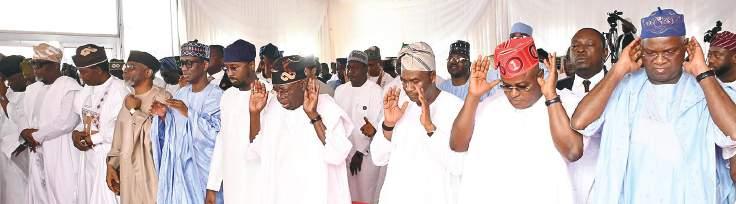
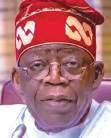
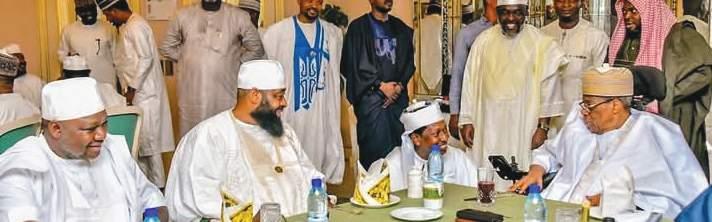
PRESIDENT TINUBU AT EID EL KABIR PRAYER...
R-L: Former Lagos State Governor, Mr. Babatunde Raji Fashola; Speaker, Lagos State House of Assembly, Mr. Mudashiru Obasa; Lagos State Deputy Governor, Dr. Obafemi Hamzat; President Bola Ahmed Tinubu; Mr. Yinka Tinubu; National Security Adviser, Mallam Nuhu Ribadu; Chief of Staff to the President, Mr. Femi Gbajabiamila; Minister of State for Defence, Dr. Bello Matawalle, and others during the Eid el Kabir prayer in Lagos, yesterday
HOUSE
On Children’s Day, Tinubu Promises Safe Return of Oyo, Borno Abducted School Children
Declares that as father, president he will not forget or abandon children in captivity Directs security agencies to step up efforts towards their safe recovery, strengthen school protection measures First Lady: Children are active participants in shaping nation’s present FG restates commitment to inclusive education for every child Akpabio to Nigerian children: Reject drugs, cultism, pursue greatness
Deji Elumoye, Kuni Tyessi and Sunday Aborisade in Abuja
President Bola Tinubu has for the umpteenth time, given assurance of the safe return of school children kidnapped recently in Oyo and Borno States.
The President, in a statement yesterday, which focused mainly on the issue of the abducted children, assured parents and teachers that as a father and President, he would not forget or abandon the children in captivity.
This comes as the President of the Senate, Godswill Akpabio, charged Nigerian children to stay away from drugs, cultism and other social vices capable of destroying their future, while urging them to embrace hard work, discipline and patriotism.
Also yesterday, the Minister of Education, Tunji Alausa, reaffirmed the federal government’s commitment to inclusive and quality education for every Nigerian child as the country marked the 2026 Children’s Day celebration.
Tinubu in the statement, also disclosed that he has directed all security agencies to take action towards the safe recovery of the affected schoolchildren while also
mandating the school authorities to strengthen school protection measures in high-risk areas across the country.
The President, in a 14-paragraph statement, stated, inter alia: “On this Children’s Day, I celebrate every Nigerian child. I celebrate the child who is excelling in school. I celebrate the child who is learning a trade. I celebrate the child living with disability and still pressing forward with courage. I celebrate the child who has lost much but has not lost hope.
“Today belongs to you. It is a day to celebrate your innocence, your strength, your creativity, your aspirations, and the immeasurable value you bring to our nation.
“You are the pride of our Republic, the custodians of tomorrow’s promise, and the living reminder that we can shape the future of Nigeria by the opportunities we create for our children today.
“The theme for this year’s celebration, “Future Now: Promoting Inclusion for Every Nigerian Child,” speaks powerfully to the soul of our national conscience. It reminds us that the future is not a distant promise; it is already here.
“As we mark this special day, which coincides with Eid-el-Kabir,
some Nigerian children and their teachers in Oyo and Borno should be with their families, but are being held captive by criminals. Some children have been forced into fear. Some parents cannot join today’s celebration because their hearts are set on one prayer: ‘Bring our children home.’
“To those children, their parents, and their teachers, I say this as a father and your President: you are not forgotten. You are not abandoned.
“To the families grieving and despondent, your government will not turn your pain into ceremony. We will continue to work until children taken from their homes, schools and communities are returned safely,
and until those who profit from this cruelty are brought to justice.
“I have directed all relevant security agencies to sustain and intensify coordinated rescue operations for abducted children and other vulnerable citizens across the country. These operations must be intelligence-led, carefully executed and focused on the safe recovery of our children.
“I have also directed the strengthening of school protection measures in high-risk areas. This will include updated school vulnerability mapping, closer coordination between state governments and security commands, rapid response links between schools and local security
units, and stronger community-based early warning systems.
“The Federal Ministry of Education, working with state governments, is to deepen the implementation of the Safe Schools framework with clear reporting, clear responsibility and clear timelines. Every school in a vulnerable area must know who to call, what to do, where to move, and how to protect children when danger is identified.
“We will also improve support for children who have survived abduction, violence and displacement. Rescue is not the end of the government’s duty. A child who returns from trauma must return to care, medical attention, counselling,
education and dignity. I have directed the relevant ministries and agencies to ensure that recovered children receive proper reintegration support, not temporary attention.
“Let me also state that protecting children cannot be left solely to the government. Parents, teachers, traditional rulers, religious leaders, community leaders, youth groups, transport unions, local vigilantes and the media all have a role to play. When a community sees strange movement around a school and keeps quiet, a child is placed at risk. When warning signs are ignored, families suffer. When information is shared quickly and responsibly, lives can be saved.
Funfair as Ogun Free Trade Zone Celebrates 2026 Children’s Day
James Sowole in Abeokuta
The Ogun-Guangdong Free Trade Zone (OGFTZ), in partnership with Zone Enterprises, commemorated the 2026 Children’s Day Celebration with a colorful and engaging funfair
Soludo, Wife Praise Anambra Children, Promise Quality Education to Brighten Their Future
David-Chyddy Eleke in Awka
The Governor of Anambra State, Prof. Chukwuma Soludo and his wife, Mrs. Nonye Soludo, have praised Anambra State children, saying the state government will continue to ensure quality education for them.
The Governor, who was at Alex Ekwueme Square in Awka, where he took the salute for a march past by primary and secondary schools to mark this year’s Children’s Day celebration, said he was happy with the way children in the state were embracing education.
He added, “Anambra has the lowest out-of-school children rate in the entire country. Our out-of-school children’s rate stands at 2.6 percent. This is the lowest in Nigeria.
“These statistics are old statistics that were rated before we declared full scholarship in primary and secondary schools.
“We stand at 2.6 percent, in a country where some states have 60 percent out-of-school children. With our full scholarship, I’m sure the rate must have further dropped.
“But I want to assure you that we will not rest because we aim to make it zero percent,” the Governor
stated.
Also, his wife, Mrs. Soludo, in a statement, assured that with the right education, mentorship, and opportunities, children in the school would reach their full potential.
Mrs. Soludo added: “As we mark Children’s Day today, we celebrate the bold dreams, brilliance, and limitless potential of every Anambra child.
“Our children are not just the leaders of tomorrow; they are the pride and future of Anambra State. With the right education, guidance, innovation, and opportunities, there is no limit to what they can achieve.”
aimed at promoting education, unity, and youth development within its host communities.
The event brought together education stakeholders, community leaders, teachers, parents, and students in a vibrant atmosphere filled with excitement, learning, and entertainment.
The initiative reflects the organisation’s strong belief that education remains a critical pillar for national growth and sustainable community development.
Speaking at the event, the Education Officer of the Ogun State Ministry of Education and Head of Academics and School Services Ado-Ado/Ota Local Government Education Authority, Mr. Joseph Ibikunle, described the program as a commendable initiative that encourages and stimulates academic development among students.
He applauded OGFTZ for its continuous investment in education and advised students to remain focused on their academic pursuits and avoid distractions capable of hindering their future aspirations.
Representing the host community monarchs, Oba Nosiru Teslim, the Olodan of Odan Abuja, appreciated the management of OGFTZ and Zone Enterprises for their consistent support and commitment to the well-being of the host communities.
He noted the initiative demonstrates genuine concern for the future of the younger generation and urged students to take their education seriously, emphasizing that no legacy is greater than education.
Representing OGFTZ top management, Ms. Yuan Guo, the Admin Manager of China-Africa Investment FZC, stated the initiative reflects the company’s unwavering commitment to Corporate Social Responsibility.
According to her, empowering young people through education remains one of the organization’s core priorities.
She noted that children remain the most precious treasure and the hope of the future, adding the company carefully prepared various exciting games, delicious
refreshments, and special gifts to ensure every child enjoys a memorable celebration.
She appreciated the support of sponsors, educational stakeholders and reiterated the company’s dedication to investing in students as future leaders, innovators, and contributors to national development.
Also speaking at the event, the Public Relations Officer of OGFTZ, Mr. Tope Anthony, described the celebration as a unique educational and social initiative designed to promote academic excellence and personal growth in a fun-filled atmosphere.
He stressed the company remains committed to bridging educational gaps within the host communities through various carefully designed educational support programs aimed at uplifting learning standards and providing every child with opportunities to thrive regardless of background. As the event came to a close, the smiles and excitement on the faces of the students reflected the profound impact of the initiative.
PHOTO: STATE
ATIKU IS PRESIDENTIAL CANDIDATE OF THE ADC...
Oil Extends Drop to $95 After Iranian Media Report on Draft Deal
US declares memo as ‘fabrication’ Trump says no one will control Strait of Hormuz
Emmanuel Addeh in Abuja
Oil extended losses yesterday, falling over 5 per cent after Iranian state TV said it had seen a draft of an initial, unofficial framework for an agreement with the United States on ending their conflict and reopening
the Strait of Hormuz. The report, plus a pick-up in tanker traffic through the strait, outweighed Iran’s earlier comments that the United States had violated a ceasefire and a tanker on Tuesday reporting an explosion off the Oman coast.
Brent crude futures fell $3.66, or 3.7 per cent, to $95.3 a barrel, while U.S. West Texas Intermediate (WTI) crude lost $5.19, or 5.59 per cent, to $88.70.
The losses more than erased Brent’s gains from Tuesday, a Reuters report said, with Brent and WTI
touching intraday lows of $94.16 and $87.77 per barrel on Wednesday, their lowest in over a month.
The U.S. will withdraw military forces from the vicinity of Iran and lift its naval blockade, Iranian state TV said, adding that the management of ship traffic through the Strait
AfDB Appoints Keyamo African Champion to Drive Region’s $7bn Aviation Development Programme
Chinedu Eze and Kasim Sumaina in Abuja
African Development Bank has appointed Nigeria’s Aviation Minister and Aerospace Development, Festus Keyamo, as the African Champion to drive its programme developed to invest substantially in the aviation industry in Africa.
The regional bank, which functions as a premier multilateral development institution on the continent, stated that it chose Keyamo because of Nigeria’s ‘leadership and vision’ in respect of various policy reforms to transform Nigeria’s Aviation sector.
The minister will drive the Integrated Aviation Transformation Program for Africa (IATP) for which African Development Bank has earmarked the sum of $7 billion.
In this respect, the bank has invited the minister to its Annual Meeting holding in Brazzaville on the 28th of May, 2026, during which the formal signing of the Letter of Intent (LOI) between the Bank and Nigeria will take place.
The Integrated Aviation Transformation Programme for Africa is a continent-wide platform designed to modernize Africa’s aviation ecosystem and mobilize private, institutional, and concessional capital.
It seeks to revitalize the industry, as African airlines currently account for less than 3 percent of global air traffic despite housing nearly 18 percent of the global population.
Special Adviser, Media, to the Minister, Tunde Moshood, explained that the aviation minister is now expected to bring his knowledge,
commitment and passion to drive this programme in the whole of Africa.
“The Bank expressed its deep gratitude to the Minister for his commitment to advancing Aviation in the whole of Africa,” Moshood said.
In the letter of invitation with reference, PICU1/LTR// YM/2026/05/0015 and dated May 26, 2026, African Development Bank said, “Nigeria has demonstrated outstanding leadership in the early phase of the Integrated Aviation Transformation Program for Africa (IATP) — a continent-wide platform launched by the African Development Bank to mobilize private and institutional capital, de-risk investments, and transform aviation into a driver of regional
integration and economic growth across Africa.
“Nigeria’s engagement has been exemplary: the Federal Government has completed the IATP country survey, advanced initial work on the country compact, identified concrete opportunities to finance aircraft in Nigeria, and is actively exploring the creation of a Nigerian aviation financing platform.
“This level of commitment positions Nigeria as one of the IATP’s foremost country champions, and the Bank is deeply grateful for your Ministry’s leadership and vision.”
of Hormuz will be handled by Iran in cooperation with Oman.
July Brent futures rose 3.6 per cent in the previous session after the U.S. carried out new strikes in Iran, hurting hopes that had risen over the weekend that Washington and Tehran would reach a peace deal.
After an April ceasefire in the three-month-long conflict, both sides indicated they had made progress in talks toward reopening the Strait.
Iran’s effective closure of the Strait of Hormuz has taken more than 14 million barrels per day of Middle East oil supply offline according to the International Energy Agency (IEA), Reuters said.
However, the White House called the draft memo on war circulated by Iranian media a ‘complete fabrication’. Iranian state TV said the memorandum of understanding outlines that the US will end its blockade and Iran will reopen the Strait of Hormuz.
“This report from Iranian controlled media is not true and the MOU they ‘released’ is a complete fabrication. Nobody should believe what the Iranian state media is putting out. Facts Matter,” the White
House’s Rapid Response account posted on X. Iranian state media reported the MOU would call for US military forces to withdraw from the vicinity of Iran and lift the blockade of Iranian ports, CNN reported.
Some of the details are similar to how US officials have described the emerging deal. American officials have said President Donald Trump would be willing to lift the blockade as long as Iran allows commercial vessels to transit the Strait or Hormuz.
“As President Trump has said, negotiations are proceeding nicely and he has made his redlines clear. President Trump will only make a good deal for the American people, which must ensure that Iran can never have a nuclear weapon,” said Olivia Wales, a White House spokeswoman, in response to the Iran state TV report.
Meanwhile, Trump has said the Strait of Hormuz will be open to everyone and not controlled by any country under any deal reached with Iran, adding there were no discussions about easing sanctions on Tehran.
Tinubu Felicitates Ashafa Erogbogbo on Centenary Birthday
Alleged Fake Tinubu Audio
Onanuga Seeks Prosecution of VDM Over
Deji Elumoye in Abuja
Presidential spokesperson, Bayo Onanuga, has canvassed legal action against social media influencer, Martins Vincent Otse, also known as VDM, for circulating an audio clip of a fabricated recording attributed to President Bola Tinubu. In a post on his verified X handle @aonanuga1956 on Wednesday, the media aide accused VDM of abusing social media by dis-
seminating “false information capable of misleading the public and damaging the image of the President.”
Onanuga, in the post, stated: “This VDM needs to face the weight of the law for being the conveyor and disseminator of a fake audio of President Tinubu. This is a clear case of an egregious abuse of the social media platform.”
He dismissed the audio as manipulated and warned that
the spread of unverified material “poses serious dangers to public trust, national security, and democratic stability.” According to Onanuga, those responsible for circulating such content should be held accountable under the law.
VDM had posted an audio clip which, he said, featured Tinubu commenting on the country’s political situation, insecurity in the South-East and plans for the 2027 elections.
President Bola Tinubu has felicitated elder statesman, Alhaji Ashafa Ajibola Erogbogbo as he clocks 100 on May 28, 2026.
The President, while paying glowing tribute to the Centenarian on Wednesday, wrote: “I extend warm greetings to Alhaji Ashafa Ajibola Erogbogbo, an elder statesman and retired aviation supervisor at Shell Company Nigeria Limited, as he marks his centenary on May 28.
“Reaching 100 years is a remarkable milestone, a rare blessing, and a reward for a life of discipline, dedication, integrity, and selfless service to humanity and the nation.
“I join your family in giving glory to God for your century-long journey and your contributions to national development, particularly through your service years at Government Printing Press, Nigeria Customs and Excise and later Shell Company Nigeria Limited. In all the places where you worked, you demonstrated professionalism, diligence, and a commitment to excellence.
“Your role as a respected community leader in Ikorodu, Lagos State and mentor is widely acknowledged. Your wisdom, counsel, and exemplary lifestyle continue to inspire younger generations.
“It is noteworthy that you, the
father of Mrs Abike Dabiri-Erewa, Chairman and Chief Executive Officer of the Nigerians in Diaspora Commission (NIDCOM), remain sharp of mind and warm of spirit at this advanced age.
“I rejoice with you, your children, grandchildren, and greatgrandchildren as you celebrate this extraordinary milestone. I also look forward to reading your life story, “Echoes of Grace: The Journey of a Century,” published to mark your birthday.
“As you celebrate this milestone, I pray that Almighty Allah will continue to sustain you with good health, peace, strength, and happiness.”
Deji Elumoye in Abuja
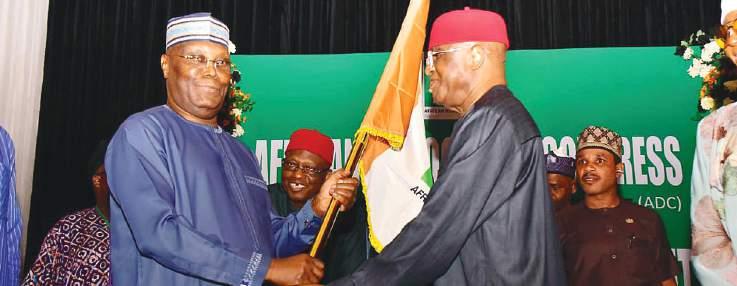
Chairman of the African Democratic Congress, Sen. David Mark (right) handing the flag to former Vice President Atiku Abubakar after his emergence as the presidential candidate of the party, at the Transcorp Hilton Hotel, Abuja... yesterday night (Story on page 8)
GABRIEL OGBECHIE ENTREPRENEURSHIP SYMPOSIUM...
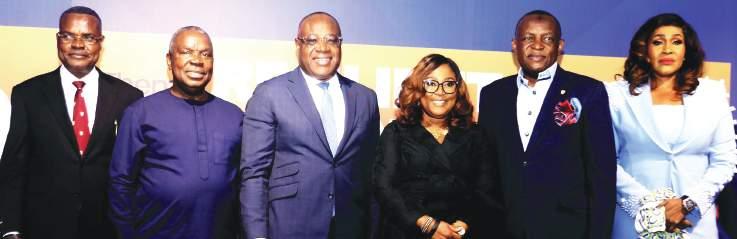
L-R: Managing Director, Mainland Oil and Gas Limited, Dr. Chris Igwe; Chief Executive Officer, AA Holdings, Mr.
Ogbechie Entrepreneurship
Managing Director,
Mr.
Dr.
Ekeoma,
Ezekwesili to Tinubu, Others: Don’t
Celebrate Children You Can’t Protect
Former minister laments abduction of pupils, out-of-school kids Declares May 27
Former Minister of Education, Obiageli Ezekwesili, yesterday launched a blistering attack on Nigeria’s political leadership, warning President Bola Tinubu, governors, lawmakers and the political class against issuing customary Children’s Day goodwill messages, after failing to protect them.
In a strongly worded statement issued to commemorate the day, Ezekwesili accused successive governments of abandoning children to insecurity, poverty, hunger, poor education and preventable deaths, describing the annual celebration as hypocritical in the face of worsening conditions across the country.
Addressing the president, vice president, members of the Federal Executive Council (FEC), the National Assembly, governors and state assemblies, the former minister declared that the country’s leaders lacked the moral standing to celebrate children while thousands remained victims of school abductions, violence, hunger and educational neglect.
Ezekwesili, Founder, Human Capital Africa; FixPolitics and the School of Politics, Policy and Governance (SPPG) as well as Co-founder, Transparency International (TI), cited a series of school kidnappings across the country as evidence of what she called the collapse of state responsibility towards children’s safety and welfare.
Among the incidents she referenced was the recent abduction of 39 students and seven teachers from schools in Ahoro-Esinele community in Oyo State on May 15, 2026, describing it as a troubling spread of insecurity into the South-west.
She also mentioned the abduction of 25 schoolgirls from the Government Girls Comprehensive Secondary School in Kebbi State in November 2025, noting that many of the girls were still missing months later.
The former minister further recalled the seizure of 303 students and 12 teachers from St. Mary’s Catholic Primary and Secondary School in Niger State in November 2025, saying the attack contributed to the closure of more than 20,000 schools nationwide.
According to her, the country’s leaders were also attempting to celebrate children despite unresolved cases such as the Chibok schoolgirls abducted in 2014, many of whom remain unaccounted for over a decade later. She accused political leaders of moving on from the tragedy while families of the victims continued to suffer emotional trauma and uncertainty.
Ezekwesili also referenced attacks in Kuriga, Kankara, Kagara, Jangebe, Afaka, Greenfield, Bethel Baptist and Tegina, saying Nigeria had reached a point where many abductions no longer generated national outrage because the country had “run out of capacity to grieve.”
“Do not dare open your mouths on May 27 to wish Nigerian children a ‘Happy Children’s Day.’ Do not dare release the recycled, ghostwritten platitudes your media handlers have already drafted.
“Do not dare stand in front of cameras, surrounded by carefully arranged children in matching uniforms, to perform a tenderness you have never extended to the millions of Nigerian children you have abandoned, betrayed, and condemned to lives of suffering. You have no moral standing to wish anything to Nigerian children. None,” she maintained.
Beyond insecurity, the former minister painted a grim picture of Nigeria’s education sector, poverty levels and child welfare indicators. She said about 19 million Nigerian children remained out of school due to insecurity, poverty and social factors, while about 70 per cent of children aged 10 could not read or understand a simple sentence.
According to her, the country was facing a foundational learning crisis that governments at all levels had failed to confront with urgency.
“A government that cannot protect its children has forfeited the right to celebrate them. A political class that has built its wealth on the broken backs of the poor has forfeited the right to address their children with affection. There is no moral universe in which the architects of this abandonment may also serve as its celebrants,” she emphasised.
Ezekwesili further criticised what
she described as elite insensitivity amid worsening economic hardship, accusing political office holders of prioritising luxury spending while millions of children faced hunger and deprivation.
She pointed to estimates by the United Nations World Food Programme indicating that 35 million Nigerians could face hunger in 2026, warning that children would bear the heaviest burden through malnutrition and stunted development.
The former minister also
condemned the demolition of waterfront communities such as Makoko, arguing that poor children were being displaced and denied access to education and shelter in the name of urban renewal.
She lamented the state of primary healthcare centres, the prevalence of child hawking, and the continued existence of the almajiri system, saying millions of children had effectively been abandoned by the state.
Ezekwesili said many Nigerian
‘national day of shame’
parents could no longer afford food, transportation, school fees or medicines for their children because of economic policies and governance failures, even as political leaders continued to enjoy lavish benefits and allowances.
Describing May 27 as a “National Day of Shame” rather than a celebration, she called on public office holders to abandon ceremonial speeches and instead provide concrete accountability regarding the welfare and safety of children.
She challenged the government to disclose the whereabouts and status of all children still in captivity, including victims from Chibok, Kebbi, Niger and Oyo states, and to publish audited figures on child mortality, out-of-school children, malnutrition and learning poverty.
Ezekwesili also demanded measurable commitments within the current fiscal year towards improving school safety, healthcare access and social protection for children.
Compel IOCs to Cleanup Niger Delta Despite Divestment, Intl Group Tells FG
As HYPREP records 90% success on mangrove restoration in Ogoni
Blessing Ibunge in Port Harcourt
An international organisation under the aegis of International Working Group on Petroleum Pollution and Just Transition in the Niger Delta has called on the federal government to prevail on the international oil companies that operated in the region to restore the environment and livelihoods of the people, despite their divestments.
This was as the Hydrocarbon Pollution and Remediation Project (HYPREP), said it has recorded 90% survival of mangroves in the ongoing cleanup and remediation of shorelines in Ogoni land.
The group made the call yesterday, during a visit to Ogoniland to understudy the ongoing remediation carried out by the HYPREP, yesterday.
The International Working Group on Petroleum Pollution and Just Transition in the Niger Delta, is a group of researchers, academics and advocates from around the world, including Nigeria, that are interested in environmental remediation in the entire region.
Speaking with journalists after the visit, a member of the group and leader of the delegation, Isaac Osuoka, said the aim of the visit was to study the situation in Ogoniland and the ongoing cleanup.
“This group has been established particularly following the work
of the Bayelsa State’s Oil and Environmental Commission, which made findings that are very similar to the United Nations Environmental Programme (UNEP) report on Ogoni land,” he said.
He stated that the pollution in Ogoni is just a bit of the entire crisis.
“The entire Niger Delta is badly, massively polluted. It’s an outrage. There is no part of the world that is as polluted as the Niger Delta. And we want to see this kind of response, this kind of intervention everywhere, not just in Bayelsa, but all parts of the Niger Delta,” Osuoka said.
Osuoka, commended the efforts of HYPREP in carrying out the remediation. He said: “What we are seeing is that clearly there is some work being done and as a group it’s an interesting learning opportunity. We’ve seen mangrove restoration sites, we’ve seen that there is pollution, polluted lands that have been restored.
“This is going to take a lot of work, much more work than what has been done already. We recognise that this is not yet finished business. But we see that clearly that there is effort and there is some change and we will take that lesson even as we continue to advocate for cleanup of the entire Niger Delta,” he said.
Osuoka noted that while the few hours spent in the visit is not sufficient to give a conclusive assess-
ment on the successes of HYPREP, there is progress at different levels.
“We have seen attempts to address livelihood issues because when there is pollution, members of communities lose their livelihoods”.
Osuoka called on the federal government to hold the IOCs accountable. “The United Nations Environment Programme recommended that one billion should be expended during an initial five-year period. And Shell is supposed to be responsible for all of those expenses.
“And this is also relevant for the entire Niger Delta, in places like Bayelsa, in Delta, Rivers State and other communities where the international oil companies, unfortunately because of the irresponsibility of the Nigerian government to allow the international company to basically just walk away without addressing all of these issues.”
Prof. Anna Zalik, a professor in Environmental and Urban Change at York University in Toronto, Canada, and a member of the group, stated that their focus is to push for the implementation of the report on the Bayelsa State environment and Niger Delta at large.
“We are here to look and promote the implementation of the recommendations of the report of the Bayelsa State Oil and Environmental Commission, which seeks to implement proper remediation of polluted land throughout Bayelsa State and
elsewhere in the Niger Delta.
“And thus, we are visiting HYPREP sites to learn about all of the work that has been done here in Ogoni to begin the process of cleaning up the pollution caused by decades of the international oil companies’ activities in the Niger Delta. We’ve learned a lot from the work that HYPREP has done, and it’s really inspiring to see the commitment to the remediation in the area”, Zalik added.
Kathlyn Nwajiaku-Dahou, who is the Director of the ODI Global Politics and Governance Program, a think-tank based in the UK, acknowledged the successes recorded by HYPREP, especially the mangrove restoration. She said: “We came here to learn, to listen and I think I’ve learned quite a lot. I was very impressed by the attempts to begin the process of replanting of mangroves, that’s restoration of the mangroves, after having carried out cleanup and some remediation. So, it’s good to see that this is happening.”
Addressing the delegation, Mr. Raphael Sane, Head, Environmental Remediation of HYPREP, stated that the livelihood programs such as the trainings, provision of water, the Centre of Excellence, hospitals and other projects ongoing as part of the cleanup, are all geared towards the sustainability of the project in Ogoniland.
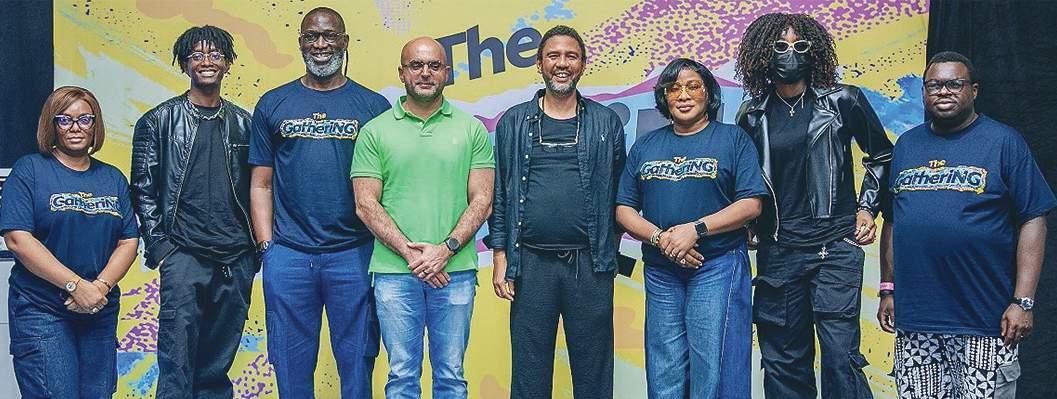
Austin Avuru; Group Managing Director, Rainoil Group and Convener, Gabriel
Symposium,
Gabriel Ogbechie; Group Executive Director, Rainoil Group, Mrs. Godfrey Ogbechie; Executive Director, Sahara Group, Mr. Tope Shonubi; and
Nepal Group,
Ngoxi
during the Gabriel Ogbechie Entrepreneurship Symposium held in Lagos on Tuesday
PHOTO: ETOP UKUTT
Emmanuel Addeh in Abuja
Bayelsa Traditional Rulers’ Chair Endorses Tinubu for Second Term
Lauds president’s economic reforms, seeks continuity Praises Jonathan as continental statesman
Emmanuel Addeh in Abuja
Chairman of Bayelsa State Traditional Rulers Council (TRC), His Royal Majesty, King Bubaraye Dakolo, Agada IV, has endorsed President Bola Tinubu for a second term in office, citing what he described as the president’s unprecedented economic reforms and the need for stability and continuity in the country.
The monarch, who made the endorsement in a statement in which he praised the administration’s economic direction, also aligned himself with the political leadership of Bayelsa State Governor, Douye Diri, who joined the president’s party recently.
Dakolo stated that Nigeria was currently undergoing significant reforms that required continuity to achieve long-term results, warning against actions that could disrupt
what he termed a stable and predictable development trajectory.
Bayelsa is the home state of former President Goodluck Jonathan, who is reported to have recently obtained the presidential nomination forms of Peoples Democratic Party (PDP) and has been cleared to contest in next year’s general election.
Although Jonathan has not publicly announced his candidature for the 2027 poll, he has also not denied PDP’s assertion that he is the party’s presidential candidate.
Besides, a few days ago, his lawyers successfully defended his right to contest in the upcoming election. Jonathan also told a pressure group recently that he was still consulting.
But the traditional ruler specifically commended Tinubu’s economic reforms, claiming that Nigeria has recorded major improvements in
key economic indicators under the current administration.
According to him, the country has experienced unprecedented Gross Domestic Product (GDP) growth and recorded trade surpluses for the first time in a decade, alongside 12 consecutive quarters of uninterrupted economic growth.
Dakolo stated, “Given Nigeria’s current needs, where reforms are transforming the country into a nation, stability and continuity are paramount. Therefore, I believe it is in Nigeria’s best interest to have a person of such stabilising stature, above partisan politics.
“I align myself with the direction and leadership of the Governor of Bayelsa State, whose vision resonates with the majority of the people in the state.
“Nigeria has experienced unprecedented GDP growth and trade surpluses for the first time
in a decade, with 12 consecutive quarters of uninterrupted growth. Interfering with this stable, sustainable, and predictable development trajectory will not be beneficial for our nation-state.”
Despite the economic challenges, Dakolo said he was convinced that sustaining the current policy direc- tion was in the national interest. The Bayelsa traditional rulers’ council chairman offered prayers for peace, unity, and progress in the country.
“In light of these circumstances, I wholeheartedly endorse the Renewed Hope Agenda for Nigeria.
May God bless Nigeria,” Dakolo stated.
The royal father, in the statement, also spoke glowingly of Jonathan, describing him as a symbol of democracy in Africa and a respected continental statesman whose contributions remain deeply appreciated in the South-south region
and in Bayelsa State, in particular.
According to Dakolo, Jonathan occupies a unique place in Nigeria’s democratic evolution and remains a symbol of democracy on the African continent.
“Former President Goodluck Jonathan stands as a symbol of democracy in Africa and a continen- tal statesman whose contributions are particularly cherished by the South-South and Bayelsa State,” the monarch stressed.
Dakolo declared his support for the direction being taken by Diri, stating that the governor’s vision reflects the aspirations of the majority of the people of the state.
The endorsement came amid increasing political realignments and consultations ahead of the 2027 general election, with several groups and political stakeholders already positioning themselves around possible alliances and re-election
campaigns. Tinubu, who won the All Progressives Congress (APC) presidential primaries a few days ago, has repeatedly defended his administration’s economic reforms, including the removal of fuel subsidy and foreign exchange market unification, arguing that they are necessary to stabilise the economy and attract investment.
Warns presidency, INEC, judiciary against further interference in party affairs; hints at plans for Nigeria
Chuks Okocha in Abuja
Former Vice President Atiku, yesterday, won the presidential ticket of African Democratic Congress (ADC), polling 1,846,379 votes to defeat his closest rival, former Minister of Transportation, Chibuike Amaechi, who scored 540,117 votes to come second.
Mohammed Hayatu-Deen, an economist, came a distant third with 177,120 votes.
Atiku was declared winner by the returning officer, Tunde Ogbeha, who said the presidential hopeful satisfied the ADC constitution.
National Chairman of the party, David Mark, handed over the ADC flag to Atiku, certifying him as the party’s stand-ard bearer in the 2027 presidential bout.
With that development, the 2023 presidential experience is about to be relived, with Atiku, again, billed to face the incumbent, President Bola Tinubu of All Progressives Congress (APC), and his 2019 running mate, Peter Obi, now the candidate of Nigeria Democratic Congress (NDC).
Although, there may be other presidential contenders from other parties, largely from the south, the 2027 presidential election is already inching towards another three-horse race, just like the 2023 cycle.
Accepting his nomination, Atiku said, “I wish to express my profound appreciation for the privilege, which you have bestowed on me, of leading our great party, the African Democratic Congress, into the next elections as its presidential candidate. I am truly humbled and excited by this singular honour.
“We demonstrated that while democracy is being strangled and squashed by the ruling party and its oppressive and anti-democratic government, democracy is alive and
well in the African Democratic Congress.
“In our party, members are allowed to express their views, to have ambitions and to contest for elective positions in a free, fair and transparent process.
“Our great party is a coalition built through hard work, immense sacrifices and compromises, guided by our determination to rescue our country’s democracy, which is facing its greatest threat since the return to democratic rule in 1999.”
Atiku stated, “As I speak, virtually all opposition political parties in the country have leadership crisis engineered by the APC government, the INEC, and elements in the judiciary.
“And opposition figures continue to be harassed and intimidated, including those languishing in detention, such as Mallam Nasir El-Rufai, who distinguished himself as a public servant, including as a Minister and two-term Governor of Kaduna State.
“He has been in detention for three months despite court orders granting him bail. He has been denied the right to celebrate two important religious holidays with his family in addition to being denied the opportunity to be by his mother’s side as she took her last breath.
“All because he is a leading opposition figure! This kind of cruelty must stop. The government continues to harass, intimidate and coerce opposition politicians to join the APC using the security agencies as well as the agencies, which were set up by a previous government to fight corruption.”
The former vice president said, “Under this government, once a person joins the APC, the harassment ceases and the charges against them
Defeated aspirants boycott flag presentation
magically disappear. This abuse of power must stop.
“Great care was taken to ensure that due diligence was done in the process of forming this coalition. Yet the government and the INEC continue to undermine it, even trying to deregister it.
Oye, in a statement, emphasised that Nigeria continues to incur massive foreign exchange losses due to its dependence on imported refined petroleum products, despite the operational capacity of the Dangote Petroleum Refinery.
The former Chairman of the Organised Private Sector of Nigeria (OPSN) noted that the continued defence of the Nigerian National Petroleum Company Limited (NNPC Ltd) of fuel import licences undermines Nigeria’s drive toward energy self-sufficiency and economic sovereignty.
Oye explained that Nigeria spent approximately N15.42 trillion on petrol imports in 2024, describing the figure as a significant drain on foreign exchange reserves and a structural weakness in the country’s energy architecture.
According to him, the Dangote Refinery has the ability to meet over 90 per cent of Nigeria’s domestic fuel demand and could significantly reduce import dependence if fully integrated into the national supply system.
Oye further estimated that increased reliance on local refining could save Nigeria up to $11 billion annually in foreign exchange outflows, reducing pressure on the naira and improving macroeconomic stability.
He argued that NNPC’s justification for continued fuel importation on the grounds of maintaining competition is flawed, insisting that it effectively entrenches dependency on foreign refineries while discouraging domestic industrial growth.
“NNPC’s insistence on maintaining import licences for foreign-sourced products while a domestic facility can meet demand is tantamount to penalising the player who built the stadium while rewarding those who merely show up to play,” Oye said.
He maintained that Nigeria’s legal
“Let me warn that any further attempt to interfere in the affairs of the party by the Presidency, INEC and judiciary will be fiercely resisted.
Enough is enough.
“I congratulate my fellow contestants for this ticket to represent our great party in the elections
framework, including the Petroleum Industry Act (PIA) 2021 and the Nigerian Oil and Gas Industry Content Development Act, prioritises domestic refining and local value addition, adding that imports are intended only as a shortterm measure where local capacity is insufficient.
Besides, Oye questioned the consistency of NNPC’s position, noting that while the company raises concern about monopoly risks from a private refinery, it continues to rely heavily on foreign supply chains for domestic fuel consumption.
He added that sustained fuel importation exposes Nigeria to global price volatility, foreign exchange pressure, and job losses in the domestic economy, while exporting value-added opportunities to foreign refiners and logistics operators.
He further called for a review of import licensing under the PIA, stronger protection for domestic refineries, and fiscal incentives to encourage additional private sector investment in refining infrastructure.
Oye also urged greater transparency in refinery rehabilitation projects and called for accountability in past turnaround maintenance expenditures, arguing that inefficiencies in state-owned refineries have contributed to prolonged import dependence.
He also referenced global models from countries such as Brazil, Saudi Arabia, India and the United States, where domestic refining capacity is protected and supported through targeted industrial policies. According to him, Nigeria risks undermining its industrialisation agenda if it fails to prioritise local refining capacity over import dependence, despite existing domestic production capability.
“The Nigerian National Petroleum Company Limited (NNPC Ltd) has, in recent court filings, accused Dangote
scheduled for early next year. I know that you are driven by your patriotism and commitment to a better Nigeria and improved life for our people.
“I know that, like me, you are deeply concerned about the rapid descent of our country into
Petroleum Refinery, a $20 billion, 650,000 barrels-per-day facility, Africa’s largest single-train refinery, of seeking to monopolise Nigeria’s fuel market. The state oil company’s argument: that restricting fuel import permits would ‘undermine competition and expose Nigeria to supply disruptions, price instability and threats to national energy security’.
“This position, articulated with the gravitas of institutional authority, conceals a devastating truth: NNPC is not defending competition. It is defending importation. It is not protecting energy security. It is perpetuating dependency. And in doing so, it stands in direct contravention of Nigeria’s own laws, the President’s economic agenda, and the hard-won lessons of nations that have successfully industrialized their petroleum sectors.”
“The Dangote Petroleum Refinery represents what is possible when Nigerian capital, vision, and perseverance confront adversity. Built at a cost of approximately $20 billion, the facility processes 650,000 barrels of crude per day, produces up to 53.6 million litres of Premium Motor Spirit (PMS) and 23.6 million litres of Automotive Gas Oil (AGO) daily, has the capacity to meet over 90 per cent of Nigeria’s domestic demand, can save Nigeria between $6–11 billion annually in foreign exchange outflows and is currently exporting jet fuel to European markets, demonstrating global competitiveness.
“It has the capacity to meet 100 per cent of Nigeria’s requirement for all refined liquid products, including petrol, diesel, kerosene and aviation fuel, with surplus volumes available for export, currently exports petrol, diesel and jet fuel across global markets, including Africa, Asia, the Americas and Europe, demonstrating strong international competitiveness,” Oye argued.
economic disaster, catastrophic insecurity, extreme nepotism, political intolerance and the drive towards a one-party state by the current government and its party. I thank you for your healthy participation in this democratic process.”
According to him, NNPC’s litigation against Dangote Refinery using the language of ‘monopoly’ to defend importation is not merely a policy error, but a moral failure.
“It betrays the Nigerian entrepreneur who builds despite crushing interest rates. It betrays the Nigerian worker who could be employed in domestic refining. It betrays the Nigerian taxpayer whose resources are diverted to foreign suppliers. And it betrays the Nigerian future that depends on industrial self-sufficiency.
“The laws are clear. The economics are compelling. The global precedents are overwhelming. What is lacking is not knowledge but political will and the courage to prioritise Nigerian industries over foreign suppliers, Nigerian jobs over foreign profits, and Nigerian sovereignty over convenient dependency,” he added.
According to him, President Bola Tinubu’s economic agenda calls for production over consumption, industrialisation over importation, and sovereignty over subservience, stressing that NNPC must align with this agenda or be reformed until it does.
“The Dangote Refinery is not a monopoly threat. It is a sovereignty achievement. It is proof that Nigerians can build world-class industrial infrastructure when given the opportunity. The task of the government is not to stifle this achievement with import competition but to nurture it with protective policies that other nations take for granted.
“Nigeria does not need to import refined petroleum products. Nigeria needs to refine its own petroleum, by its own people, in its own facilities, for its own benefit. Anything less is a continuation of the colonial economic model that has kept Africa resource-rich but development-poor for generations,” he insisted.
DELE OYE: DANGOTE REFINERY CAN SAVE NIGERIA N15TN IMPORT COST, GENERATE $11BN FX INFLOW
President Bola Tinubu
Continued on page 36
NDC: Is Power Play Imminent Between Dickson, Obi and Kwankwaso?
as the Nigeria Democratic Congress attracts influential opposition figures like Peter Obi and Rabiu Musa Kwankwaso, Leader of the party, Henry Seriake Dickson is pushing to build an institution-driven platform rather than another personality-based coalition, setting the stage for a major contest over the future of opposition politics ahead of 2027. sunday Aborisade reports.
Barely months after its emergence on Nigeria’s crowded political landscape, the Nigeria Democratic Congress (NDC) is already confronting the dilemma that has consumed many opposition movements before it: how to build a durable political institution while accommodating heavyweight politicians with towering presidential ambitions.
That dilemma came into sharp focus in Abuja this week when the party’s founder and National Leader, Henry Seriake Dickson, openly warned that the NDC would not become a “special-purpose vehicle” for any individual politician.
Though he did not mention names directly at first, the message was unmistakably aimed at the growing influence of opposition power brokers gravitating toward the platform, particularly former Anambra State governor, Peter Obi and former Kano State governor, Rabiu Musa Kwankwaso.
For observers of Nigeria’s evolving opposition politics, Dickson’s declaration represented more than routine party rhetoric. It was an early attempt to define the ideological soul, ownership structure, and future direction of a party increasingly seen as a possible rallying ground for anti-establishment forces ahead of the 2027 elections.
At the inauguration of the NDC National Selection Committee and later during the party’s Aspirants Dinner in Abuja, Dickson repeatedly returned to one theme: institution over personality.
“We are not building a special-purpose vehicle for any individual. We are building together a political party that will stand the test of time,” he declared.
The statement reflected anxieties within the party hierarchy over the tendency of Nigerian political parties to revolve around dominant personalities rather than enduring democratic structures.
Since the return to civil rule in 1999, several parties have risen rapidly around influential political figures only to weaken after internal disputes, defections, or electoral setbacks.
The NDC leadership appears determined to avoid that trajectory.
Dickson’s repeated emphasis on “systems, standards and processes” suggested an attempt to distinguish the party from what critics often describe as Nigeria’s transactional political culture, where parties become temporary electoral platforms for elite negotiations and personal advancement.
Yet the challenge confronting the NDC is evident. The arrival of Obi and the expected influence of Kwankwaso have dramatically elevated the party’s national visibility within a short period.
For many opposition supporters dissatisfied with the ruling establishment and disillusioned with older opposition structures, the NDC increasingly represents a possible coalition platform capable of reshaping the political equation before 2027.
That possibility has also heightened internal tensions. Political analysts say Dickson’s intervention reflects an awareness that parties built around powerful presidential hopefuls often struggle to maintain internal cohesion, especially during nomination contests.
The NDC’s formation itself occurred at a period of growing fragmentation within the opposition space, with several politicians seeking alternative platforms amid dissatisfaction with existing party structures.
Obi’s presence alone carries significant electoral implications. Having emerged as one of the most influential
opposition figures in the 2023 presidential election, his movement continues to command substantial support among urban youths, professionals, and sections of the middle class frustrated by economic hardship and governance failures.
Kwankwaso, on the other hand, retains deep political structures in parts of northern Nigeria through his loyal “Kwankwasiyya” movement, making him another influential force within any coalition arrangement.
The convergence of such ambitious political blocs within a relatively new party creates both opportunity and risk.
On one hand, it boosts the NDC’s credibility as a serious national platform. On the other, it raises concerns over whether the party can withstand the centrifugal pressures that typically accompany presidential succession struggles in Nigeria.
Dickson appears determined to confront those concerns early. His insistence that “all politics is local” and that the newly inaugurated Selection Committee would consult widely with state leaders, caucuses, and stakeholders indicates a strategy aimed at diffusing internal grievances before they escalate into factional conflict.
The 21-member committee, chaired by NDC National Chairman, Senator Moses Cleopas, has been tasked with managing consensusbuilding and candidate selection across various constituencies ahead of party primaries.
For the NDC leadership, the committee represents an important experiment in internal conflict management at a time when
For now, Dickson, o bi, and other party leaders are projecting unity, reform, and optimism. But as the 2027 political season gradually gathers momentum, the real test for the n DC may not simply be defeating opponents outside the party. It may be managing the ambitions within.
Nigerian parties frequently face accusations of imposition, manipulation, and opaque delegate systems.
Indeed, one of the most striking aspects of Dickson’s speech was his promise to introduce electronic voting for future party primaries.
The proposal came against the backdrop of widespread controversies surrounding internal elections in several major parties, including allegations of inflated delegate figures, manipulated results, and candidate imposition.
Dickson said the NDC had already developed a digital voting platform and mobile application intended to allow registered party members vote electronically during future primaries.
“I assure you that this will be the last primary in the NDC that will be done in the old-fashioned way,” he declared.
If successfully implemented, the reform could significantly alter internal party politics by reducing the influence of delegate manipulation and elite bargaining that often characterise Nigerian primaries.
However, the feasibility of such a system remains uncertain. Nigeria’s electoral process continues to face logistical, technological, and trust deficits, even at the national level. Questions about digital access, cybersecurity, voter authentication, and institutional credibility could complicate any attempt to fully digitise party primaries.
Still, the proposal reinforces the NDC’s effort to market itself as a modern reform-oriented platform. That messaging was amplified by Obi during his address to party leaders and aspirants.
Unlike Dickson’s focus on institutional survival, Obi concentrated on sacrifice, inclusion, and national recovery.
“My first message is gratitude — gratitude to Almighty God who made it possible for all of us to carry this light,” Obi said.
He urged aspirants who might lose nominations not to see defeat as political extinction, insisting that service to the country must transcend personal ambition.
Dickson Kwankwaso
obi
OBSESSION WITH RULES REFORM
Endless rule changes may create the illusion of reform while preserving the substance of impunity, argues KINGSLEY JESUOROBO
MONDAY PHILIPS EKPE writes that considering the unrelenting misbehaviours of the political class, Nigerians must actively engage in the current electoral cycle
AS THE 2027 RACES BEGIN IN EARNEST
With the short supply of tangible, measurable achievements in the real sectors of the economy and the actual ingredients that determine the joy and happiness of the people, politicking has been on the nation’s menu since the start of this administration. But putting the whole blame on the government of President Bola Tinubu would be unfair. And the attempts by the president and his team to exonerate themselves from the frustrations moving ferociously across the country are both uncharitable and disingenuous.
WHY NIGERIA MUST BUILD ON DIGITAL FOUNDATIONS
Nigeria's future cannot be built on identity systems detached from location intelligence, contends 'BISI ADEGBUYI
See page 23 See page 23
CHILDREN AND SOCIAL
Just like the billboards that surfaced in Abuja and elsewhere as far back as June/July 2023 seeking a second term for Tinubu, Nigerian people whose lives were viciously ruffled under the late President Muhammadu Buhari started early to wonder where their salvation would come from. The discerning among them knew early that Tinubu’s ‘bold’ twin decisions to remove oil subsidy by fiat and float the vulnerable naira would result in more agony and an uncertain future. By the way, no matter how wellintentioned reforms may be, if they’re not accompanied by matching optics and actions, they would crush the people’s spirit and demonstrate to them the folly of hoping for transformational outcomes.
So, the quest for those to provide answers to the country’s myriads of challenges appeared on the scene rather too soon, a condition that hasn’t been helped by the craze of political office holders to remain on their seats by all means. Seeking re-election is constitutional and it isn’t new, surely. Only that, this time, politicians have done so without visible proofs that they’ve invested commensurate energies or anything close in combating the nation’s snowballing insecurity, unemployment, inflation, decaying infrastructure and despondency of the citizenry. Political power has been substantially altered to mean the most lucrative avenue to amass wealth without qualms, bereft of the decency to cover up selfish and myopic motives. Impunity in wrong doing continues in the face of glaring institutional failures. All to the discomfiture of a helpless populace.
What exactly can the people do at this point other than waiting and wishing that things would be different this time? But, will they? There’s hardly any cause for optimism at the moment. Take for instance the flocking of erstwhile opposition state governors into the ruling All Progressives Congress (APC). To be clear, such occurrences aren’t new to our polity. However, none before now equals the quantum of the ‘earthquake’ that gives credence to the apprehension about
Nigeria’s mutation to a one-party state. As things stand, only Abia, Anambra, Bauchi, Osun and Oyo state governors haven’t joined the bandwagon. Even then, some of them have publicly declared their loyalty to Tinubu and his ambition to remain in office beyond next year.
Many of the cross-carpeting state chief executives never took those steps with their own people on their minds. This clearly self-centred gamble aimed at securing their return tickets or shielding them from law enforcement agencies when they finish their terms has only enhanced the possibility of civilian authoritarianism, a phenomenon alien to our democratic history even with all its shortcomings. Selfinterest may not totally be divorced from any human activity but with fewer and fewer deliveries of governance benefits, these actions do portend a widening gulf between the long-suffering Nigerian masses and their leaders or, arguably better named, rulers.
For most of the governors, the popular pretext for jumping from their original ships into APC was the need to hook up with the government at the centre for enhanced access to federal might or an escape from their sinking former bases. Yes, while their ex parties eventually descended into protracted crises that are yet to be resolved, the fabled dividends waiting to be extracted from Abuja simply haven’t shown up. Instead, those enmeshed in, say, security issues have degenerated further. The governors’ decampments don’t look like public-spirited sagacity.
The omnibus that APC has become ought not to be concerning if the opposition parties were to be on their own feet. The conspiracy theory that drives discussions about the troubles of People’s Democratic Party (PDP), Labour Party (LP), African Democratic Congress (ADC) and others is rooted in allegations of presidency’s meddling and outright sabotage through subterfuge and abuse of legal processes. Those accusations could well be true by half. And what happens to the other half? The answers are now unfolding.
Opposition politicians who love to play the victim are engaged in misconducts of their own. The final result of the ADC presidential primary conducted on Monday May 25 hasn’t been announced over 48 hours after, having been reportedly pronounced inconclusive. The two men who ran against the frontrunner, Wazirin Adamawa, Alhaji Atiku Abubakar - Mr Chibuike Amaechi and Alhaji Muhammad Hayatudeen - have since rejected and distanced themselves from the outcomes of the exercise. If this debacle is not resolved fast, it will be tragic indeed. To think that just before Mr Peter Obi and Dr Rabiu Musa Kwankwaso left the ADC coalition for the Nigeria Democratic Congress (NDC), the former was seen by many political watchers as having the capacity to truly challenge the party in power.
Sadly, these foibles are only one part of the troubling atmosphere preceding next year’s general polls. The umpire, Independent National Electoral Commission (INEC), has done little to correct its widespread image as a pal of Tinubu and his party, an assumption that may actually not subsist under scrutiny. After the Supreme Court ruled in favour of the Senator David Mark-led faction of ADC in the status quo ante bellum case that had put pressure on its integrity, INEC complied promptly. And few days ago, it countered the bogus claims made by the APC National Chairman, Prof Nentawe Yilwatda, about his party’s membership strength. Perhaps, Nigerians who have been constantly drawn into pessimism and cynicism against their wish can hold onto this as a sign of hope.
Equally worrying is the conduct of the primaries generally. One hallmark of APC’s outings was the deliberate distortion of figures as the voters were counted. Moving from number one to 10 to 200 and then 1000 was an unfortunate corruption of the glorious Option A4 mode of voting which produced the famous June 12, 1993 presidential election. That such was also registered during ADC’s turn that followed signalled a frightening degeneracy and national shame.
These missteps call for vigilance. Average citizens and ordinary party members who are sometimes complicit should step out and own the processes. They have worshipped power wielders and peddlers enough. This season hasn’t started well but too much is at stake to squander through collusion, apathy, docility and a fatalistic disposition.
Dr Ekpe is a member of THISDAY Editorial Board
X: @monday_ekpe2
Endless rule changes may create the illusion of reform while preserving the substance of impunity,
argues KINGSLEY JESUOROBO OBSESSION WITH RULES REFORM
In societies battling deep institutional decay, there is often an instinctive reflex toward rules reform. Every scandal births a committee. Every abuse inspires a proposal for a new framework, a revised guideline, a fresh protocol, or a technological safeguard. The public conversation becomes saturated with the language of “reform,” “restructuring,” and “system redesign.”
At first glance, this appears rational and even progressive. After all, rules matter. Institutions matter. Processes matter. Yet there comes a point where an excessive fixation on changing rules begins to serve a far less noble purpose: it subtly shifts attention away from the more uncomfortable issue of deliberate wrongdoing under rules that already exist.
This is the paradox many societies — Nigeria especially — now confront. The persistent obsession with reforming procedures may itself have become an escape route for systemic bad actors and their enablers.
It is easier to demand new rules than to insist upon obedience to existing ones. Easier to blame “structural deficiencies” than to confront entrenched dishonesty. Easier to propose another layer of regulation than to name and shame those who knowingly violate the current framework.
Indeed, many of the abuses that provoke calls for reform are already prohibited under extant laws and regulations. Electoral manipulation, procurement fraud, abuse of office, judicial compromise, financial recklessness, falsification of records, and institutional intimidation are rarely occurring in legal vacuums. They persist not because no rules exist, but because powerful actors have become confident that rules can be ignored without consequence.
This distinction is crucial.
A society may wrongly diagnose a crisis of enforcement as a crisis of insufficient regulation. Yet these are not the same problem. One concerns the absence of tools; the other concerns the refusal to use them.
When a football referee consistently refuses to penalise fouls, the logical response is not necessarily to rewrite the laws of football after every match. At some point, attention must turn to the referee, the players deliberately breaking the rules, and the institutional culture tolerating misconduct. Otherwise, endless rule changes merely create the illusion of reform while preserving the substance of impunity.
This is precisely how systems decay while maintaining the outward appearance of institutional evolution.
The language of reform becomes ceremonial. Committees deliberate. White papers circulate. Conferences are convened. Intellectuals produce elegant prescriptions. Political actors speak passionately about “strengthening institutions.” Meanwhile, the same individuals con-
tinue violating even the most basic existing standards with astonishing brazenness.
One begins to suspect that the endless conversation about reform is not always a sincere pursuit of solutions, but sometimes a sophisticated mechanism of deflection.
By constantly relocating the problem to the future — “if only we had better rules,” “if only we digitised this process,” “if only we amended that law” — systemic bad actors avoid accountability in the present. The debate becomes procedural rather than moral. Technical rather than ethical. Structural rather than personal.
The result is a dangerous dilution of responsibility.
Those who deliberately manipulate systems begin to appear less like perpetrators and more like beneficiaries of unfortunate “institutional weaknesses.” Public outrage softens into academic abstraction. Criminality is reframed as administrative deficiency. Fraud becomes a “process challenge.”
This intellectual softening is one of the gravest dangers confronting fragile democracies and weakened institutions.
No procedural innovation can permanently rescue a society unwilling to cultivate moral seriousness. Biometric systems can be bypassed. Digital platforms can be manipulated. Constitutional safeguards can be weaponised. Independent agencies can be captured. Every institutional mechanism ultimately depends upon human beings possessing at least a minimal commitment to restraint, honesty, and civic responsibility.
Without that moral foundation, reform itself becomes infinitely recyclable theatre.
This is why some of the loudest advocates of institutional reform can coexist quite comfortably with blatant misconduct. They understand, consciously or otherwise, that procedural debates are often safer than moral confrontations. Calling for “systemic change” attracts less resistance than directly confronting individuals, networks, and interests responsible for systemic abuse.
But societies do not collapse merely because their rules are weak. Many collapse because their elites — and sometimes even their citizens — lose the will to honour rules they already possess.
Jesuorobo writes from Benin-City
Nigeria's future cannot be built on identity systems detached from location intelligence, contends 'BISI ADEGBUYI
WHY NIGERIA MUST BUILD ON DIGITAL FOUNDATIONS
Recently on these pages, I argued that Nigeria's recurring struggles with digital identity are not fundamentally technological failures. They are structural ones. We have attempted to solve identity before solving addressability. We have tried to authenticate persons in a national space we have not first made digitally locatable.
The President's decision to withhold assent to the proposed amendment of the National Identity Management Commission Act should therefore not be viewed merely as a legislative interruption. It should be understood as a strategic pause, an opportunity to rethink the architecture of national digital trust itself.
That intervention naturally provoked an important question: if Nigeria's current identity framework requires redesign, and if location must come before identity, does the country possess any indigenous alternative capable of operating at sovereign scale?
My answer is unequivocably yes. Nigeria does not lack sovereign solutions. What we have lacked, for too long, is the political confidence and institutional courage to recognise, audit, and deploy them.
Beyond Identity: The Question Nigeria Must Finally Ask. For years, our national digital discourse has been trapped inside a narrow vocabulary: databases, enrolment, cards, portals, authentication, and verification.
Important as these are, they are not foundations. They are applications sitting on top of a deeper infrastructure layer.
The real question before Nigeria is larger and more fundamental: “What would a truly sovereign digital infrastructure for the Federal Republic of Nigeria actually look like?”
Not merely a digital identity system. Not merely a national database. But an integrated, address-aware, federated trust architecture capable of carrying: identity, land administration, healthcare, electoral integrity, policing, logistics, financial inclusion, emergency response, digital governance, and taxation.
In other words, what would a Nigerian digital operating system for governance look like if it were designed from first principles, rooted in our constitutional geography, federal structure, and sovereign interests?
That question has consumed much of my post-public-service life. Today, I place the answer before the country.
A Duty of Disclosure. I write not merely as an observer, but as someone who has lived both the promise and the contradictions of Nigeria's digital transformation journey.
As Postmaster General/CEO of the Nigerian Postal Service (NIPOST) between 2016 and 2019, I led the team that developed and registered Nigeria's Digital Addressing System & Address Verification System, the initiative for which our country received the World Summit on the Information Society (WSIS) Prize in Geneva
in 2018 under Action Line 18: Leveraging ICT to Create E-Employment.
I accepted that recognition on behalf of Nigeria.
I know, therefore, from direct institutional experience, the painful distance between what Nigerians are capable of building and what our systems have historically allowed to scale.
Following my exit from public office, what I now describe as the Hegelian antithesis to that earlier chapter, I returned to first principles. I began to rethink the entire architecture of digital governance itself.
The result is an ecosystem now known as: Digital Grandview Vast Suites of Sovereign Innovative Solutions — 774 (DG-VSSiS-774).
At its foundational core lies the spatial sovereignty framework known as: GRANDVIEW GRIDS (G2).
Together, they represent not merely technology products, but the digital operationalisation of the cooperative federalism philosophy first articulated by the late sage, my hero, Chief Obafemi Awolowo.
Address-Aware Identity: Nigeria's future cannot be built on identity systems detached from location intelligence. What the country requires is a transition from identity-first architecture to “Address-Aware Identity Infrastructure”.
This distinction is critical. A person cannot be meaningfully verified in a digital economy if the sovereign system cannot deterministically verify where they exist, where they transact, where they reside, where they vote, where they own assets, or where public services are delivered to them. The foregoing is encapsulated under the philosophy of Who, What, Where, When, Why, & How (W5&H).
Before identity, there must be location. Before trust, there must be addressability.
And before efficient governance, there must be spatial intelligence.
Barrister Adegbuyi (Digital Bismark), is a former Postmaster General of Nigeria (NIPOST), WSIS Prize Laureate (Geneva 2018), Founder and CEO of G-DPIPS Ltd/G-NINJA Ltd, and The Grandview Innovation Foundation (TGiF)
Editor, Editorial Page PETER ISHAKA
Email peter.ishaka@thisdaylive.com
CHILDREN AND SOCIAL INCLUSION
The authorities must do more to protect our children
Stakeholders across many countries marked the 2026 Children's Day yesterday, with Nigeria adopting the theme, ‘Future Now: Promoting Inclusion for Every Nigerian Child’. It centers on child development and protection, emphasizing that no child should be left behind regardless of their socioeconomic background, religion, ethnicity, gender, or disability. This aligns directly with the federal government's declaration of 2026 as the "Year of Families and Social Development," highlighting the family unit as a key environment for a child's growth and security.
President Bola Tinubu reiterated in his message that the administration remains firmly committed to listening to children and placing their welfare at the centre of governance through policies and investments.
“A nation that listens to its children is one that is wisely preparing for the future. Your opinions matter. Your ideas matter. Your wellbeing matters,” said the President. He noted that the true measure of our progress as a nation lies in the safeguards we build for our children: “This administration remains committed to building a nation where every child can dream boldly, grow safely, learn freely, and succeed honourably.” But, as we have repeatedly argued, critical stakeholders in the country should go beyond sloganeering.
the age of 18.
By prioritising children's rights and participation, we can help to build a better future for all. However, with about 70 per cent of families living below the poverty line, it is no surprise that education is often the first casualty in most rural communities in the country today. Children are usually the ones sent into the streets to hawk or work as house help for more fortunate families. Particularly disturbing is that repeated attacks on schools by sundry cartels of criminal gangs instill fear in many children. For instance, education which ought to have productively engaged these children has suffered greatly because of the predatory activities of terrorists.
Repeated attacks on schools by sundry cartels of criminal gangs instill fear in many children
EDITOR SHAKA MOMODU
DEPUTY EDITOR WALE OLALEYE
MANAGING DIRECTOR ENIOLA BELLO
DEPUTY MANAGING DIRECTOR ISRAEL IWEGBU
CHAIRMAN EDITORIAL BOARD OLUSEGUN ADENIYI
EDITOR NATION’S CAPITAL IYOBOSA UWUGIAREN THE OMBUDSMAN KAYODE KOMOLAFE
To achieve the goal of inclusion for all Nigerian children, it is important to reflect on the impediment placed in the ways of children in the country. The pitiable sight of numerous children who have been turned to professional beggars thronging the streets of major towns and cities is enough to confirm that we have a crisis on our hands. More than 20 million children reportedly are out of school, just as many are stunted and underweight because of poor nutrition. In a recent survey by the United Nations Children’s Fund (UNICEF), six out of every 10 Nigerian children were reported to suffer some forms of physical, emotional, or sexual violence before attaining
T H I S D AY N E W S
EDITOR-IN-CHIEF/CHAIRMAN NDUKA OBAIGBENA
GROUP EXECUTIVE DIRECTORS ENIOLA BELLO, KAYODE KOMOLAFE, ISRAEL IWEGBU
DIVISIONAL DIRECTORS SHAKA MOMODU, PETER IWEGBU, ANTHONY OGEDENGBE
DIRECTOR, PRINTING PRODUCTION CHUKS ONWUDINJO TO SEND EMAIL: first name.surname@thisdaylive.com
Letters to the Editor
There are other challenges. Even though the Child Rights Act has been domesticated in almost all the states, its provisions are hardly enforced. Child marriage, child trafficking, child labour and rape of underage boys and girls are on the increase in many parts of the country. The United Nations Sustainable Development Goals in its blueprint for 2030 provides a universal plan to secure a better future for children. Besides, in recent years, there have been many reports that non-state armed groups are using children in the country as combatants and non-combatants, while committing other grave violations against them.
Conscripting children into these armed groups is not only a gross abuse of their innocence, but also a systematic destruction of the present and future of the country. Already, armed conflict situations have created children who are separated from their families, unprotected, starved, and exposed to violence as their only means of survival. Besides the mental and physical torture, exposing children to armed conflict increases their risk of morbidity and mortality. Therefore, to promote inclusion for our children, authorities in Nigeria must prioritise their protection and create welfare policies through incentivised and compulsory basic education.
Letters in response to specific publications in THISDAY should be brief (150-300 words) and straight to the point. Interested readers may send such letters along with their contact details to opinion@thisdaylive.com. We also welcome comments and opinions on topical local, national and international issues provided they are well-written and should also not be longer than (750- 1000 words). They should be sent to opinion@thisdaylive. com along with photograph, email address and phone numbers of the writer.
THANK YOU THISDAY
During the past few days, I heard about the upcoming Muslim Public Holiday, but I wondered what this particular holiday is called by the Muslims. May I add that while I was engaged in our house-to-house ministry [as one of Jehovah’s Witnesses] on Saturday last week, I met some Muslims at their homes and even asked them what the upcoming holiday is called. Neither of them was willing to let me know, though, not to talk of even willing to engage in a friendly conversation. It was not until yesterday, May 26, after seeing the multiple bank and other companies adverts published in
THISDAY Newspapers, wishing the Muslims a happy holiday, that I got to read your editorial piece tagged "A SEASON OF SACRIFICE AND LOVE," that I got to learn exactly what the holiday was meant to celebrate: the sacrifice that Abraham [or prophet Ibrahim] was about to make, of his only son, Isaac, before an Angel appeared and stopped him from sacrificing his only son, and offering him an alternative sacrifice of a ram, instead.
Thank you THISDAY for this enlightening Editorial.
Daniel Ighakpe, FESTAC, Lagos
WHO WROTE WHAT?
Pope Leo XIV has produced his first encyclical, “Magnifica Humanitas,” 42,300 words of it in the English version. He speaks of the need to value humans and protect their roles in society. AI can do much of what we do, better and faster but what of the things that make us human? Would AI use the amount of yellow paint that Van Gogh did or use equal amount of each color? Would AI ask "To be or not to be?" Would AI fanatically support a soccer team that is bottom of the ladder? From my own point
of view as a retired maths teacher, would AI realise that not all student like mathematics and some find it challenging?
There is presumably a Latin version of this document, an Italian version, and others which would have kept him busy even if he used AI to do the translations or write the majority of it.
We are safe but only if we use AI as a tool not an equal. It might be good to include a big 'off' button. Dennis Fitzgerald, 28 Landale St Box Hill, Vic, Australia
BUSINESS WORLD
RATES AS AT M A y 27,2026
Telecoms Subscribers Hit 185.7m as Internet Users Increase to 153.8m
emma Okonji
The latest telecoms industry statistics released by the Nigerian Communications Commission (NCC), has put the total number of telecoms subscribers across networks at 185,718,018 as of March 2026 as against 184,603,928 in February 2026.
The data also showed a total teledensity of 85.67 per cent in March 2026 as against a teledensity of 85.16 per cent in February.
The data put the total number of internet subscribers, including mobile data subscribers at
153,820,556 as at March 2026, up from 153,134,987 that was recorded in February 2026.
From the latest figures, which THISDAY obtained from the official website of NCC, MTN maintained its lead in telecoms subscriptions with 95,759,210 subscribers and a market share 51.62 per cent, followed by Airtel with 63,629,101 subscribers and a market share of 34.30 per cent. Globacom has 22,639,893 subscribers with a market share of 12.20 per cent, while T2 has 3,478,544 subscribers, with a market share of 1.88 per cent.
The statistics on telecoms
subscriptions showed that there has been a steady growth in nine months from July 2025 to March 2026. As at July 2025, telecoms subscription was 169.3 million with a teledensity of 78.11 per cent, but in August 2025, the figure increased to 171.6 million with an increased teledensity of 79.14 per cent. In September 2025, telecoms subscriptions increased to 173.5 million with a teledensity of 80.05 per cent. In October 2025, there was a further increase in telecoms subscriptions to 175.3 million with a teledensity of 80.87 per cent.
In November 2025, telecoms subscriptions increased again to 177.4 million, with a teledensity of 81.84 per cent. In December 2025, telecoms subscriptions reached 179.6 million, with a teledensity of 82.87 per cent.
In January 2026, telecoms subscriptions increased again to 182.2 million with a teledensity of 84.06 per cent. In February 2026, telecoms subscriptions increased to 184.6 million with a teledensity of 85.16 per cent, before reaching 185.7 million telecoms subscriptions in March 2026, with a teledensity
of 85.67 per cent.
Internet subscriber data has also recorded increase in nine months from July 2025 to March 2026, with mobile internet subscriber data taking the lead. Out of the total of 153.8 million internet subscriber data recorded in March 2026, the total mobile internet subscriber data from GSM operators like MTN, Airtel, Globacom and T2 alone, reached 153.2 million.
As at July 2025, total internet subscriber data was 138.7 million, but the figure increased to 140.3 million in August 2025, with a further increase to
140.9 million in September 2025. In October 2025, total internet subscriber data increased to 142.6 million, with a further increase to 144.7 million in November 2025, before reaching 148.1 million in December 2025. In January 2026, total internet subscriber data increased again to 151.5 million, with a further increase to 153.1 million in February 2026, before reaching 153.8 million in March 2026, according to NCC’s latest statistics.
The Bank of Industry (BOI) has declared that pressures arising from climate change are “collectively weakening the competitiveness and economic resilience of Nigerian enterprises, particularly across sectors such as manufacturing, agriculture, infrastructure.”
The BOI also said that these pressures are impeding the ability of actors “to adapt and fully express all that are reposed within these sectors.”
Executive Director, Corporate Finance and Risk Management, BOI, Mr. Rotimi Akinde stated this during the virtual inaugural session of the “BOI Climate Resilience Knowledge Series” with the theme, “Building Climate Resilience Enterprises in Nigeria for Sustainable Livelihood and Inclusive Growth.”
Akinde said that across the country today, we are witnessing rising temperature, unpredictable rainfall patterns, flash
floods and heatwaves that are threatening food security, eroding livelihoods, displacing communities and widening gender equalities.
He said: “These are not just mere rhetoric. Rather they have become a reality as witnessed by thousands of farmers in Kebbi State; manufacturers in Kano, and also communities in Lagos State and in the Niger Delta, particularly Bayelsa State.”
According to Akinde, the BOI is now taking very deliberate steps aimed at
responding to the threats posed by climate change “through what we call targeted financing.
He said, “So, we are actively engaging enterprises not only to grow but to build resilience needed to withstand the evolving climate landscape. We recognise that climate adaptation is not just an environmental citation but an economic one. Consequently, businesses that cannot adapt to climate changes will continue to struggle for
their sustainability. Sectors that are not climate proof will be constrained to attract the long-term investments that Nigeria needs.”
He said that if the BOI would fail to address these climate’s related issues as a development financial institution, which it believed is at the core of the bank’s mandate, BOI could be potentially affected by fitness for purpose in the foreseeable future.
“That is why we have convened this webinar
Market data a s at Wednesday, May 27, 2026
series today because climate resilience is not a farfetched topic. Rather it is central to Nigeria’s industrial future and today is an opportunity to advance that conversation in a meaningful way,” Akinde said.
He added: “We believe this discussion is timely given the fact that Nigeria is at the point of inflection with vast endowment in human and natural resources that are yet to be fully exploited.”
Dike Onwuamaeze
GMD/CEO, NAHCO Plc, Mr. Olumuyiwa Olumekun; Chairman, Mr. Seinde Oladapo Fadeni;
Directors, Mr. Tajudeen Shobayo; Mrs. Abimbola Adebakin; Prof.
Report: Digital Entrepreneurship Will Re-write Africa’s Path to Gender Economic Parity
Stories by Emma Okonji
The Boston Consulting Group (BCG), in its new report, themed: ‘Financing Women’s Digital Entrepreneurship: A Pathway to Closing Africa’s Economic Gender Gap’ has revealed that women’s economic participation in Africa has fallen 0.6 percentage points below 2022 levels, extending the region’s timeline to reach economic parity from 120 years to approximately 170 years.
The report draws on BCG’s Africa Women’s Voices Survey 2025, which surveyed around 3,000 women and men across six major African economies - South Africa, Nigeria, Ethiopia, Kenya, Morocco and Egypt - alongside data from the WEF Global Gender Gap Report 2025 and Africa’s startup funding landscape.
According to the report, Africa’s post-COVID economic
recovery has been slow and uneven. Between 2021 and 2024, GDP per capita on the continent grew at just 1.2 per cent annually, less than half the global average of 2.5 per cent. With 70 per cent of women concentrated in vulnerable, informal employment, they have disproportionately borne the brunt of this regression.
The survey findings paint a troubling picture beyond the economic data, adding that since 2023, attitudes toward gender equality have deteriorated across the region, and not only among men. Women themselves are now less likely to support equal pay, financial autonomy and equal access to education, pointing to a deepening of internalised discrimination.
Analysing the report, Managing Director and Partner at BCG and Global Lead for Gender Equality and Women Empowerment, Zineb
Redington Becomes Adobe Distribution Partner
Redington, a leading technology aggregator and innovation catalyst, has signed a distributor partnership deal with Adobe, the global technology company.
The distribution relationship will expand access to creative, design, and document cloud solutions across Africa and marks a milestone in Redington’s commitment to empowering businesses, governments, and educational institutions with technology that supports creativity, efficiency, and growth.
Sqalli, said: “What makes this data particularly concerning is that the regression is not
limited to structural barriers. When we see women, themselves becoming less
likely to advocate for their own economic rights, it signals how deeply these setbacks are being felt at a social level. The window for intervention is narrowing.”
‘Organisations Need Data to Drive Digital Procurement Process’
Stakeholders at the Digital Procurement Africa (DPA) submit, powered by Gloopro, Africa’s premier enterprise eProcurement, have stressed the need for data generation across channel and distribution value chain in order to scale organisation’s digital procurement process.
According to them, data generation will enhance accuracy and support better decision-making that will help organisations to scale at speed.
The stakeholders said this at the 2026 DPA summit, which held in Lagos.
Founder and CEO of Gloopro, Dr. Olumide
Olusanya, in his keynote presentation, highlighted the need for organisations to accelerate digital procurement in large enterprises in the digital era.
According to him, Gloopro has developed the Procurement-as-a-Service (PaaS) solution that will address all the challenges
militating against digital procurement, including challenges associated with tail-spend in organisations.
“So you’ve heard generally from the conversations across different panels at the DPA summit, and how tail-spend can be a challenge in digital procurement.
Moniepoint Signs N3bn Innovation Hub across Three Universities
Moniepoint has signed a landmark agreement with three federal universities to build innovation hubs worth N3 billion over the next three years.
The universities include Obafemi Awolowo University, Ile-Ife (OAU), the University of Nigeria, Nsukka (UNN), and Ahmadu Bello University,
Zaria (ABU).
The agreement, which was signed at the Obafemi Awolowo University, indicated that each of the universities will get N1 billion to build a modern innovation hub on campus.
The signing ceremony was attended by the Co-founder/ Group CEO of Moniepoint,
Mr. Tosin Eniolorunda and the Vice-Chancellors of all three universities, senior leaders from academia and industry, student representatives, alumni, and members of Nigeria’s broader innovation ecosystem.
Speaking on the initiative, Eniolorunda said: “When you look at the success of
companies like Moniepoint, it’s easy to forget that it all started with the foundational training we received right here in Nigerian universities. This initiative is about paying that trust forward. Nigeria’s digital economy cannot run on potential alone; it requires immense, localized talent density.”
LG Electronics Showcases Solution at Nigeria Exhibition
Group Business Editor
Eromosele Abiodun
Deputy Business Editor
Chinedu Eze
Comms/e-Business Editor
Emma Okonji
Asst. Editor, Energy
Emmanuel Addeh
Asst. Editor, Money Market
Nume Ekeghe
Correspondents
KayodeTokede(CapitalMarkets)
James Emejo (Finance)
Ebere Nwoji (Insurance)
Reporter Peter Uzoho (Energy)
Global Head of Software Solutions Group, Redington Group, Sayantan Dev, said: “Software has become the backbone of how modern businesses operate, scale, and compete. Our partnership with Adobe strengthens our software portfolio and enables organisations across Africa to adopt world-class creative and document management platforms with speed and confidence. By simplifying deployment, licensing, and enablement through our channel ecosystem, we are helping businesses turn software into a strategic advantage to enhance productivity, innovation, and customer engagement.”
LG Electronics (LG) reaffirmed its position as a leading innovator in climate control and energy-efficient air conditioning solutions with its participation at Mega Clima Nigeria 2026, the 9th International Air Conditioning and Refrigeration Exhibition recognised as the largest HVAC+R sector show in West Africa.
Held at the Landmark
Centre, Lagos, the three-day exhibition brought together global manufacturers, distributors, contractors, engineers, and industry stakeholders to explore the future of heating, ventilation, air conditioning, and refrigeration technologies across the region.
Speaking during the exhibition, Business Development Manager, LG
Electronics Nigeria, Ifeoluwa Babarinsa, highlighted the adaptability and efficiency of the showcased systems, particularly their ability to support multiple indoor units while maintaining low energy consumption.
According to him, the LG Multi V.5 system is designed primarily for industrial and large-scale commercial applications, while the Multi
VS system is tailored toward residential use cases, providing flexible solutions for varying environmental and operational demands.
A major highlight of the systems is their scalability, with both solutions capable of connecting to as many as 64 indoor units, offering increased operational flexibility across different building types and installation requirements.
MTN Nigeria Announces 25 Fellows for Fifth MIP Cohort
MTN Nigeria has announced the selection of 25 media practitioners and digital content creators for the fifth cohort of its Media Innovation Programme (MIP), reinforcing its commitment to strengthening Nigeria’s media industry through capacity building, innovation, and leadership development.
The Media Innovation
Programme, implemented in partnership with the School of Media and Communication, Pan-Atlantic University, continues to serve as a platform for equipping journalists, broadcasters, and digital content creators with the skills, exposure, and mentorship required to thrive in today’s evolving media ecosystem.
Speaking on the first
day of the programme, Chief Corporate Services and Sustainability Officer, MTN Nigeria, Tobe Okigbo, described the initiative as a reflection of the company’s commitment to innovation, partnership, and continuous learning.
to us. The Media Innovation Programme represents all these values - a partnership not just with Pan-Atlantic University, but with every fellow. This programme is an adventure in learning, one that challenges participants to reconsider assumptions, revise opinions, rethink ideas, and ultimately grow both professionally and personally,” Okigbo said.
Company Secretary, Mallam Bello Abdullahi; Vice Chairman, Mr. Akinwumi Fanimokun;
Eyinna Okpara and Dr. Olusola Obabori at the 45th Annual General Meeting of the Company in Lagos… recently
Katsina’s Economic Rebound: Data, Delivery and Development in Motion
Amid insecurity and other challenges, Katsina State is rising above its limitations, delivering a development report card that is changing the fortunes of the state with visible impacts, and steadily convincing skeptics, writes Omolabake Fasogbon
From a distance, it was easy to dismiss Katsina State’s early promises as political propaganda, especially given Nigeria’s general track record with unkept commitments. Nigeria’s governance record points to this. The World Bank’s Worldwide Governance Indicators Report rated the country -1.01 out of a possible +2.5 on Government Effectiveness in 2024, placing Nigeria among the bottom 20 per cent globally. The index, which measures the quality of public service delivery and credibility of government policies, shows the country has consistently struggled in nearly three decades of assessment.
Evidence emerging from Katsina, however, suggests a shift. A BudgIT-backed Tracka report on project delivery across 30 states ranked Katsina first with an 85.84 per cent project completion rate in the federal capital budget cycle. Out of 114 projects worth N26.79 billion reviewed in the state, 89 were completed, 17 ongoing, while none was abandoned.
These figures show development in Katsina is moving beyond policy statements into measurable impact, even amid security threats. Growth is spreading across sectors of agriculture, education, health, and revenue, among others, reflecting the principle that true development happens when no area is left behind. The state’s internally generated revenue (IGR) proves it, rising from N400 million to N3 billion monthly.
Field observation reveals the intentionality of the state’s leadership to pursue integrated development, well enunciated in its “Building Your Future” strategic policy, a reform blueprint drafted even before Governor Dikko Radda assumed office in 2023.
The evidence-based blueprint, further codified into law to ensure it outlives the current administration, addresses key gaps with input from technocrats to deliver targeted outcomes.
Agriculture as industrial backbone
From the outset, the present leadership has treated agriculture as its economic engine, investing N2.5 billion to double crop yields and boost mechanised farming by 25 per cent by 2027. Setting up the Katsina State Sustainable Platform for Agriculture (KASPA), the state has so far deployed over 400 tractors, 10 combine harvesters, and thousands of planters across the state. Instead of just buying complete machines, it imported them as parts and assembled them locally at the Central Mechanisation Hub in Tashar Bala, Batagarawa, which gave local youths mechanical skills and created an in-house repair team.
To keep operations transparent, the tractors use GPS tracking to monitor their location and work done. The state also drilled 3,000 tube wells for dry-season farming, built storage silos to preserve excess harvests, and started a seed programme expected to bring in N4.96 billion in value and jobs.
Head of KASPA, Umar Suleiman, remarked: “This initiative has already supported thousands of farmers and cooperatives, increased cultivation across tens of thousands of hectares, and contributed to food price stabilisation and economic growth in the state.”
The impact of these efforts is already reflected in inflation indicators. The National Bureau of Statistics Q2 2025 report showed the state has the lowest food inflation in the country at 6.9 per cent and headline
inflation at 16.2 per cent.
Rebuilding education beyond classrooms
Katsina stands as one of Nigeria’s biggest spenders on education. BudgIT’s State of States 2025 report ranked it among the few states implementing over 80 per cent of their education budgets and the only state to exceed 100 per cent of its budgeted education expenditure in 2024.
This indicator offers a sweet glimpse into the state’s formal education system, even as informal education is also advancing, driven by skills acquisition and community vocational learning centres.
Education spending since 2023 totals over N120 billion, with emphasis on STEM education, digital literacy, skills development and teacher welfare, supported through development partner initiatives such as the Adolescent Girls Initiative for Learning and Empowerment (AGILE), Better Education Service Delivery for All (BESDA) and Transforming Education Systems at State Level (TESS). Notable developmental projects include the construction of 170 junior secondary schools in underserved communities, rehabilitation of 300 schools, renovation of 150 primary schools, and establishment of ICT and CBT centres in both rural and urban areas.
Yet, despite rapid development, 536,000 school-age children remain out of school, with findings pointing largely to parental resistance. This challenge has prompted the state to intensify financial incentives, including scholarships, bursaries, grants, and stipends for students and even their parents to encourage enrolment.
The government further expanded this intervention by building three free model smart schools across the senatorial districts of the state, one of which was commissioned recently by the Minister of Education, Dr. Tunji Alausa, and
Kwara State Governor, AbdulRahman AbdulRazaq.
These fully funded boarding schools, which in addition to fulfilling digitisation and STEM goals of the administration, are also aimed at helping parents nurture their children literally from birth to fulfilment at no cost, with students even getting monthly stipends from the state.
The state’s performance has continued to attract recognition from local and international development partners, earning grants and intervention support worth over $12 million.
Tackling insecurity head-On
Though still battling insecurity, particularly banditry and kidnapping, the state has intensified localised responses to contain the crisis.
The menace, which Governor Dikko Umar Radda once described as neither religious nor ethnic, has disrupted agriculture, weakened rural economies, claimed civilian and security lives, and triggered displacement.
Amid the crisis, the administration’s proactive community policing approach birthed new structures like the Ministry of Internal Security and Home Affairs (MISHA), State Security Council Advisory Committee, appointment of security oversight officials, and the Community Security Watch Corps (CSCWC). The CSCWC is designed to strengthen grassroots intelligence and rapid response.
“We made security our number one priority and realised the solution had to be community-based because many affected communities are difficult to access,” Governor Radda said.
According to the governor, members of the CSCWC are drawn from violence-prone communities, trained by security agencies, and equipped to support conventional forces with local intelligence and firstresponse intervention. These interventions
have so far cost the state roughly N40 billion, funds that could have gone to developmental projects, yet governance has pressed on regardless. Officials say the interventions have led to the arrest of over 1,000 suspected informants and bandits, while more than 30 political wards previously deserted due to insecurity have now been reclaimed. A 2025 report from the state Ministry of Internal Security also points to relative stability, with about 50 per cent of local government areas fully stabilised, 37 per cent showing improvement, and 13 per cent still at risk.
Building digital economy
Technology has been termed the backbone of the modern economy, and it is indeed rubbing on the state economy. Through the establishment of the Katsina Directorate of Information and Communications Technology (KATDICT) in 2023, the state has launched transformative digital initiatives positioning it as an emerging tech frontrunner.
With KATDICT has come the digitisation of 118 ministries, departments and agencies, deployment of digital public infrastructure and implementation of the Treasury Single Account (TSA), linked to the pronounced boost in the state’s IGR.
The state further distinguishes itself in its digital drive by relying largely on in-house capacity rather than consultants, a move that has saved up to N5 billion while strengthening local skills and technical expertise.
Director General of KATDICT, Naufal Ahmad, said the agency serves as both an enabling and catalytic institution, providing infrastructure, policy direction and technical capacity for government and the emerging tech ecosystem.
Ahmad added that priority has been placed on building foundational blocks of digital governance, including the waiver of rightof-way charges to attract telecom investment, deployment of 27 kilometres of fibre optic connectivity linking major government institutions, and rollout of solar-powered systems across critical public offices.
Beyond governance, the digital push is creating opportunities for youths through partnerships with tech hubs and private firms offering digital skills training, remote work opportunities and access to international scholarships. A state-owned data centre currently under development is also expected to further reduce operational costs upon completion.
Health innovation as benchmark
Katsina’s investment in the health sector is exemplary, enough to compete with leading healthcare model in the country. A Director at the Nigerian Governors’ Forum Secretariat recently lauded the state approach as a benchmark for other states due to its blend of technology, strategic financing and community-based delivery.
Central to health reform is a telemedicine network linking rural clinics with urban-based specialists, helping residents in remote communities access healthcare without travelling long distances.
State records indicate consultations have increased by 45 per cent since the rollout of the N5 billion initiative, which also includes AI-supported diagnostics.
Building Africa’s Hyperscale AI-ready Data Centres in Nigeria
Last week’s launch of the first ever Hyperscale AI-ready Data Centres in Nigeria by Kasi Cloud, will not only drive digital transformation in Africa, but will also help to reverse the trend where critical mass of data are generated in Nigeria, but hosted and processed outside of Nigeria, a development that hitherto negates Nigeria’s sovereignty, writes Emma Okonji
Nigeria and the rest of the world, last week, witnessed the launch of the first ever Hyperscale AIready Data Centres in Nigeria, positioned as the single largest data centre in West Africa, designed to deliver AI-era performance, hyperscale capacity and intelligent connectivity for the world’s digital leaders.
The Kasi Cloud LOS1 Data Centre is positioned to enable Cloud and Artificial Intelligence (AI) workloads to lead the next generation of technology for Nigeria, and to enable enterprises to operate at global scale, and individuals to access the latest technologies.
It is designed to create digital employment for Nigerians and improve data connectivity that is currently being provided by exiting Tier 111 data centres in Nigeria.
Kasi LOS1 Data Centre
Kasi Cloud Data Centres has four floors and a roof-top, with a total of eight data halls (two per floor) and each floor has between 400 and 760 racks in the main data halls and another 160 racks for the high density AI halls with modular design for phased expansion.
The data centre is powered by 100 megawatts (MW) capacity, with eight megawatts dedicated to each floor, making it 32 MW total capacities for the four floors. The facility has four diverse fibre routes, dual MMRs and Kasi Fabric integration, with N-plus 2 chilled-water system, liquid-ready for AI workloads.
LOS1 is the foundation of Kasi’s programmable infrastructure, setting the benchmark for hyperscale growth in Africa, built for unstoppable scale and AI-ready performance. Through Kasi collocation, customers can deploy scalable capacity directly adjacent to Kasi Fabric’s interconnection core. Through the Kasi Fabric, they can access Kasi Internet Network Exchange (iNX) and the Kasi Internet Cloud Exchange (iCX) environments, connecting carriers, cloud and enterprise
partners seamlessly.
LOS1 represents the cornerstone of Kasi Cloud, Africa’s intelligent infrastructure platform, a connected sustainable ecosystem engineered for AI, cloud and enterprise growth at scale.
AI-ready Data Centre
Speaking about the Kasi Cloud AI-ready Data Centres, the Co-founder/CEO, Kasi Cloud, Johnson Agogbua, said the lived in a moment when Artificial Intelligence is rewriting the rule of economic competition.
According to him, every industry, including Banking, Healthcare, Agriculture, Education, Manufacturing and government, will be transformed by AI in the next five to 10 years, which is not a prediction at all, but well underway. And it is not a leading indicator. It’s actually the trailing indicator, Agogbua said.
“There are AI workloads here in our facility development center. It’s whether we are ready or not. The question is who will write Africa’s story in the AI, because there is what most people do not understand about Artificial Intelligence.
AI does not just process data, but it
also reflects the data it was trained on, being touched on it. It reflects the values, the languages, the history, the culture, the worldview of whoever built it. If Africa’s AI is trained on servers in the Bay Area in San Francisco, it will reflect San Francisco’s assumptions. If it is built in Munich, it carries Munich’s perspectives. If built in Shanghai, it carries Shanghai’s interests. But if it is built here on the Africa infrastructure, trained on Africa data, governed by African law, then for the first time, AI reflects us. It reflects our languages, our histories, our ways of knowing and solving and creating,” Agogbua said.
According to him, Nigerian enterprises are currently spending $850 million every year on foreign cloud infrastructure. Every Naira that we spend abroad on cloud and building models and driving influence outside of Nigeria, is building infrastructure, building tech, building the brains and the resulting information and capabilities that we import back. The Kasi Cloud LOS1 is just the beginning of the answer to that problem.
“When we were planning the launch
of Kasi Cloud Data Centres we made a deliberate decision to make sure that the custodians of our great cultures were present to witness it not as symbols, not as decoration, but as a statement of what we believe this infrastructure must ultimately serve, because technology without culture is hollow, and infrastructure without identity has no soul,” Agogbua further said.
Also speaking at the launch, the Co-founder/ Director, Kasi Cloud, Mark Adams
Said Africa would continue to represent a huge opportunity, and that digital infrastructure would remain an enabler for the people of Africa to achieve their potential.
“Kasi Cloud is positioned to enable Cloud and AI workloads to lead the next generation of technology for Nigeria, to enable enterprises to operate at global scale, and individuals to access the latest technologies. The partnership between Kasi Cloud, the Federal Government of Nigeria, Lagos State Government and the Nigeria Sovereign Investment Authority (NSIA), in terms of creating this opportunity and building what we have today, is tremendous. I look forward to a future in which the latest AI technology is accessible to Nigerian enterprises and the Nigerian people, and help them take advantage of the opportunities of the future,” Adams said.
NSIA
Position
Chief Executive Officer, Nigeria Sovereign Investment Authority (NSIA), Aminu UmarSadiq, one of the financiers of Kasi Cloud, said: “Four years ago, NSIA defended, not on a building but on a thesis that Nigeria could not credibly pursue digital transformation whilst exporting its data. That a country with over 200 million people, more than 110 million internet users and two of the world’s most significant submarine cable landings, had no business sending some of its most valuable digital assets offshore for storage and processing.
Stakeholders in the project management industry across the continent have called on young Africans to acquire project management skills to complement their university degrees.
This was made in a statement signed by the Managing Director, PMI sub-Saharan Africa, George Asamani, and Senior Lecturer, Project Management, UNISA. Dr Sanele Nhlabatsi.
According to the statement, “The first is scale. Africa is home to the world’s youngest and fastest-growing
population, with more than 400 million people aged 15–35, and is expected to have the world’s largest workforce by 2040. Yet tertiary enrolment remains around nine per cent, far below the global average of 38 per cent. Despite growth in university enrolment, higher education capacity is still struggling to keep pace with demographic demand, with some estimates suggesting capacity would need to expand nearly twelvefold by 2035.”
Nhlabatsi added: “The second crisis is a crisis of
expectation. It is not difficult to see why many African families place such a high premium on university education. A degree has long been associated with a life-changing opportunity and a pathway to better job prospects, higher income,
and social mobility. This belief has quietly become a burden African youth carry, because when university becomes the only door to success, young people who don’t get in don’t just lose a place; they feel as though
they have lost a future.”
Asamani said: “Africa absolutely needs strong universities, and we must continue investing in them. But we must also confront a hard truth: when access remains limited, a single-
pathway mindset amplifies pressure, anxiety, and a sense of failure among young people who are simply navigating a persistently high-demand, limited-supply system that has become increasingly competitive.”
Paystack Rebuilds Dashboard to Boost AI Era
Paystack, one of Africa’s leading payments technology companies, has launched a new dashboard, rebuilt from the ground up for the first time in
Truecaller Expands into
Truecaller, the leading global platform for verifying contacts and blocking unwanted communication, has expanded into global data services, with the launch of travel eSIM.
The launch marks Truecaller’s move into mobile data services, broadening the platform beyond caller ID and spam protection, and for
the first time adding digital consumables to the portfolio.
500 million people already trust Truecaller with their daily communication.
Travel eSIM extends that relationship to international travel - a category where users routinely overpay for connectivity or arrive at their destination disconnected.
10 years. The redesigned product introduces an AInative Command Centre that allows businesses to ask questions in plain language and receive
Global Data Services
Travel eSIM is a fully digital mobile data service that activates in minutes.
The web opens the product to compatible Android devices from day one.
COO at Truecaller, Fredrik Kjell, said: “I am delighted that Truecaller is launching an eSIM travel data product for our users. Truecaller is
a trusted communications brand worldwide, and with our scale, we can offer a great product at a competitive price. We are rolling this out on our iPhone app and the web channel, and look forward to expanding on our Android app and adding support for additional markets.
answers grounded in their own Paystack data.
The launch marks a major evolution in how businesses interact with Paystack. For nearly a decade, the Paystack Dashboard has been the core surface for monitoring transactions, managing settlements, reviewing disputes, and running day-to-day payment operations for thousands of merchants. Giving details of the dashboard, Senior Product Designer at Paystack, Dara Assim-Ita, said: “Businesses don’t come to their dashboard
because they want to click through pages. They come because they have questions. Over the last decade, we have seen firsthand how much time merchants lose navigating tools that were built to display data rather than deliver answers. With this rebuild, we have changed that. The goal is to make the dashboard feel less like a static reporting tool and more like an intelligent command centre – one that helps merchants understand what’s happening, find what they need faster, and make better decisions.”
Gamin G Week
Edited by nseobonG okon-ekonG | gamingweek1117@gmail.com
The 20% Tax inside Zimbabwe’s Digital betting e xplosion and the Psychology b ehind i t
This story by Iyke Bede is part of the result of a collaboration between GAMINGWEEK and Gamble Aware NG, an Africa-focused Responsible Gaming organisation based in Nigeria. The teamwork enables both platforms to take a closer look at the conversations shaping Africa’s gaming industry beyond business figures and market growth
Zimbabwe’s gambling sector has expanded rapidly in recent years. Industry estimates suggest the market generated about $120 million in revenue in 2023, with online operations contributing roughly $45 million. Growth of between eight per cent and 10 per cent into 2024 prompted the government to tighten oversight, introducing a major tax overhaul that took effect on January 1, 2026, including an increase in bookmaker tax from three per cent to 20 per cent.
Yet, behind these rising state returns are thousands of young people trapped in a cycle of problem gambling. While the state aims to monetise the windfall, a deeper psychological scar lingers.
To look past the figures, I spoke with Bothwell Matewe, a registered psychologist and gambling therapist in Zimbabwe. His insights reveal a rapidly shifting ecosystem where economic distress and digital accessibility have fundamentally altered how young people interact with risk.
The new architecture of engagement
Traditionally, soccer betting was the dominant choice for local players. Today, mobile crash games like Aviator have taken over due to their simplicity and fast pace. Because most platforms are now mobile-based, young people can gamble privately at any time, entirely bypassing the public betting shops of the past.
“The landscape has shifted dramatically,” Matewe notes. “We are no longer looking at traditional sports betting where someone walks into a shop. The integration of mobile money and crash games means the casino is now inside their pockets, accessible 24/7 without any social friction.”
This shift is heavily tied to a psychological fear of missing out (FOMO). Young people constantly see peers claiming to make quick money online, creating intense social
pressure to join the digital cycle.
Economic distress and psychological vulnerability
The current economic climate acts as the primary driver for this behaviour. High unemployment rates and financial instability leave many youth idle and frustrated. In this environment, gambling is no longer viewed as entertainment. Instead, it is used as a desperate coping mechanism for financial pressure, stress, and anxiety.
“In an environment with limited economic alternatives, gambling ceases to be a recreational activity,” Matewe explains. “It gets recontextualised as a survival strategy. Young people are using these rapid-fire digital platforms to cope with severe financial anxiety, chasing a quick escape from structural poverty.”
The mechanics of these mobile games create distinct cognitive hooks. Operating on unpredictable rewards, they keep the brain anticipating the next win, reinforcing repeated play. Because these platforms are easily accessible on personal phones, individuals spend long hours gambling alone, gradually developing a deep behavioural attachment.
The illusion of the ‘opportunity economy’
Marketing tactics heavily promote gambling as a legitimate “opportunity economy” for quick financial gain. This framing distorts how players perceive risk: instead of considering the actual likelihood of losing, they focus entirely on the possibility of a life-changing win.
Social media platforms sustain this illusion through selective exposure. Feeds on WhatsApp, TikTok, and Instagram are flooded with screenshots of winning tickets, while stories of financial ruin are hidden.
This creates a false reality, forcing a culture of social comparison where young people feel intense pressure to post their own wins
to avoid looking left behind.
Missing the warning signs
Dependency shows clear behavioural and financial warning signs that often go unnoticed. Individuals begin spending excessive time on betting apps, which quickly spirals into frequent borrowing and rising debt. This behaviour is accompanied by sudden mood shifts and neglected responsibilities, often manifesting as late nights spent tracking game outcomes on mobile phones.
Unfortunately, families frequently miss these signals because the habit is now heavily normalised. Once associated with shame and secrecy, gambling is now presented as fashionable and admirable.
“We are seeing a dangerous normalisation within the domestic sphere,” warns Matewe. “Parents often overlook the initial signs because the youth are simply sitting quietly with their smartphones. The cultural jargon around betting has been integrated into everyday street language, masking what is fundamentally a severe mental health crisis until absolute financial ruin occurs.”
Systemic failures and collective responsibility
Zimbabwe’s current mental health and regulatory frameworks are not adequate to handle this crisis. Public interventions remain heavily focused on substance abuse, leaving a massive gap in services for behavioural addictions. On the regulatory side, celebrity endorsements and aggressive digital advertisements continue to target vulnerable demographics with minimal restrictions.
Crucially, the current conversation unfairly places all the blame on the individual gambler. It ignores the highly persuasive, psychologically engineered systems designed to maximise engagement through flashing visuals, near misses, and rapid rewards.
“The current narrative is highly flawed
because it treats addiction purely as a personal moral failure,” Matewe reiterates. “It completely ignores the systemic design. These platforms are explicitly engineered using advanced behavioural psychology to exploit cognitive vulnerabilities. Punishing or blaming the individual does nothing to dismantle the machinery that creates the addiction.”
Addressing this requires a unified strategy in which psychologists steer the conversation toward early detection and community education, while the media dismantles the myth of easy wealth by publicising the real financial risks. At the same time, gaming operators must transition toward ethical marketing, establishing concrete spending limits and robust age-verification tools, as regulators step in to curb the spread of aggressive digital ads targeting youth.
Continental lessons
The intersection of rapid digital expansion and economic vulnerability provides a clear lesson for the broader African continent. Gambling infrastructure naturally outpaces mental health awareness, regulation, and public education. Treating an expanding gaming market solely as an economic asset without safeguarding public health will eventually create a society burdened by deep psychological strain and dependency.
The 2004 M00VE Experience: A Signal of a New Era in the Nigerian Housing System
As Nigeria’s housing sector continues to evolve, developers are increasingly looking beyond bricks and mortar to create communities that reflect modern lifestyles and aspirations.The maiden edition of the 2004 M00VE Experience, organised by QShelter Limited in partnership with The Fitness Religion Company, offered more than a fitness event along the Lagos Coastal Road corridor. It presented a new approach to real estate development, one that combines wellness, sustainability, accessibility, and community engagement as part of a broader vision for urban living in Nigeria. Victoria Ojiako reports
On a breezy stretch along the Lagos Coastal Road corridor, just beyond the familiar bustle of the city, a different kind of gathering unfolded, one that blended movement, leisure, aspiration, and a subtle but deliberate pitch for the future of urban living. It was not merely another corporate activation or a routine promotional event. Instead, the maiden edition of the “2004 M00VE Experience,” hosted by QShelter Limited in partnership with The Fitness Religion Company, offered a window into how thoughtful planning and research can reshape community engagement in Nigeria’s evolving real estate landscape.
At first glance, the event had all the trappings of a lively fitness festival. There were runners pacing through marked routes, groups swaying to aerobics rhythms, football enthusiasts competing in tightly contested five-a-side matches, and clusters of spectators cheering from the sidelines. From mini-marathons to dance sessions and strength contests, the atmosphere was energetic yet inclusive, drawing participants from different age groups and fitness levels.
But beneath the choreography of movement lay a deeper intention. This was not simply about exercise or entertainment; it was about creating a shared experience, one that connected people not just to each other, but to a physical space and a vision.
The marathon, which featured both 5km and 22km categories across male and female divisions, emerged as the centerpiece.
Winners such as Fadekemi Erinle, Gang James, Gyang Sunday, and Aminat Alabi did not just receive cash prizes; they became part of a narrative that celebrated discipline, endurance, and community spirit. For many participants, the well-coordinated structure of the race reflected an organization still uncommon in local sporting events.
For the organizers, however, the event’s success was measured in more than turnout or applause. According to Kola Sowande, chairman of QShelter Limited, the initiative was conceived as a deliberate strategy, one that integrates lifestyle engagement with long-term development goals. Rather than relying solely on conventional marketing tactics, the company sought to immerse potential homeowners and investors in the lived experience of the environment. The idea was simple but effective - people
are more likely to connect with a place when they can feel it, move through it, and imagine themselves within it.
This approach reflects a broader shift in how real estate developers are thinking about engagement. In a market often characterized by glossy brochures and abstract promises, experiential marketing, grounded in research and community insight, offers a more tangible and credible alternative.
It also addresses a more pressing concern, Nigeria’s housing deficit.
By situating the conversation in a dynamic, people-focused environment, the organizers subtly reframed housing not just as a structural need but as part of a holistic lifestyle encompassing wellness, accessibility, and social interaction.
Gbenga Alamu, chief operating officer of QShelter Limited, underscored what may be the most critical takeaway from the event: it did not happen by chance. It was the product of deliberate planning, research, and sustained engagement with the surrounding community.
Bisi Akinlabi, one of the participants at the M00VE experience and who also lives within the Lekki axis, says that Qshelter has shown a strong interest in its residents' lifestyle by organizing the fitness exercise. Akinlabi said that by championing the cause of wellness, the company was not only concerned with providing a befitting housing system for the people but also with ensuring that they live long enough to enjoy the fruit of their labor.
“As a married man with kids, it is often a big challenge to find time to rest or relax. This initiative offers a unique opportunity to ensure physical fitness and wellness. Now, you don’t have to worry about securing an apartment that will last a lifetime alone because there is a real estate firm that has added aerobics as part of our daily routine. With infrastructure already in place by QShelter, we are already looking forward to a home made in heaven and a healthy lifestyle,” he added.
In the past, initiatives such as these
usually went unnoticed without the support of key stakeholders. But this was not the case with the M00VE experience, as it witnessed endorsement from traditional rulers within the Lekki Community. To lend credence to the support extended to the initiative, His Royal Majesty Oba Abdulateef Kolawole Lawal-Olumegbon (Akinwon IV) of Ajah Ile and Okun-Ajah in Lagos was in attendance and joined the crowd to be part of the fitness exercise.
As if that were not enough, the Lagos State Government extended its solidarity to the initiative, with the Honorable Commissioner for Youth and Social Development, Mobolaji Ogunlende, in attendance.
Before the M00VE experience was conceptualized, the organizers identified an existing fitness culture in the area. Rather than imposing an external idea, they chose to build on this organic trend, scaling it into a platform that could bring more people together.
This decision speaks to a fundamental principle often overlooked in development projects: successful engagement begins with listening. By understanding the community's habits, preferences, and aspirations, developers can create initiatives that resonate authentically rather than appear imposed or transactional.
The same philosophy extends to the design of the 2004 Estate itself. Developed in partnership with Continental Civil General Construction Limited, the project incorporates features aimed at sustainability and resilience. Buildings are elevated above coastal levels to mitigate flooding risks, a critical consideration in a city like Lagos, where climate vulnerability is an ever-present concern.
Infrastructure within the estate includes internal road networks, hybrid and solarpowered energy systems, CCTV-enabled security, recreational facilities, and a consistent water and electricity supply. These are not just amenities; they are responses to the everyday challenges faced by urban residents.
One of the more subtle but significant aspects of the M00VE Experience is its emphasis on wellness as a core component of modern living. In many ways, this represents a shift in narrative, from housing as mere shelter to housing as an ecosystem that supports physical and mental well-being.
The inclusion of diverse activities ensured
that participation was not limited to elite athletes. From casual walkers to seasoned runners, from dance enthusiasts to football players, the event created multiple entry points for engagement. Nollywood actor and influencer Tobi Bakre, who took part in the event, noted the program's inclusivity, highlighting how it brought together individuals from diverse demographics.
This inclusivity is not incidental but strategic. In a nation as diverse as Nigeria, developments that fail to account for varying needs and lifestyles risk alienating potential residents. By contrast, initiatives that prioritize accessibility and participation can foster a stronger sense of belonging.
Nigeria’s housing sector has long struggled with a disconnect between ambitious plans and on-the-ground realities. Projects are often announced with fanfare but fall short in execution, leaving prospective homeowners skeptical. Events like the M00VE Experience aim to bridge this gap by offering a preview not just of the physical infrastructure, but also of how life within the estate might unfold. By situating the development within a context of activity and engagement, the organizers provided a narrative that goes beyond architectural drawings.
Accessibility also plays a crucial role. Located approximately 23 minutes from Victoria Island via the Lagos Coastal Road, the estate positions itself within reach of key economic hubs while offering a relatively serene alternative to the city’s congestion. Flexible payment options and access to mortgage schemes further aim to lower the barriers to homeownership, addressing one of the most persistent challenges in the market.
The broader implication of the M00VE Experience lies in its potential as a model for future developments, not just in Lagos, but across Nigeria and beyond. At its core, the event demonstrates that effective community engagement is neither accidental nor superficial. It requires intentionality, research, and a willingness to align business objectives with societal needs.
Too often, engagement efforts are treated as afterthoughts, box-ticking exercises designed to satisfy regulatory requirements or generate short-term visibility. What sets this initiative apart is its integration into the project's broader vision. The event was not an add-on but an extension of the development’s philosophy.
L-R: Executive Consultant, QShelter Limited, Patrick Awu; Chief Commercial Officer, QShelter Limited, Oludare Makinde; Chief Operating Officer, QShelter Limited, Adegbenga Alamu; Winner, 2004 M00VE Experience Marathon (22Km category-Male), Gang James; Chairman, QShelter Limited, Kola Sowande; and Nollywood Actor/Influencer, Tobi Bakre, during the maiden edition of the 2004 M00VE Experience organised by QShelter Limited and held in Lagos, recently
Breaking the Mould: MTN's ‘Live it 100’ Campaign as Catalyst for Youth Market Revolution
As MTN Nigeria unveils a youth-focused“Live It 100”campaign, Raheem Akingbolu writes on how the brand has for years deplored impactful campaigns and initiatives to galvanise consumer loyalty and bond more with its patrons
The relevance of any brand is adjudged by many criteria. In the Nigeria market, MTN is obviously one of the few brands that have demonstrated unique elements for feasibility, relevance, and sustainability.
A school of thought summarises brand strength under the premise of presence and voltage.
In view of this school of thought, presence is a measure of how many people know about the brand and understand what it has to offer. A brand with a high level of presence will enter a buyer’s consideration set more easily than a brand with a low presence. Voltage, on the other hand, is a relative measure of how efficiently a brand converts people from low to higher levels of attitudinal loyalty, which in turn increases the pace of purchase.
A brand with a high voltage score is positioned well to grow its share of sales in its product or service category.
For MTN Nigeria, it's simply a high voltage, considering its investment in various segments of the market. Through campaign, CSR, and sponsorship, MTN has touched the youths, women, and other stakeholders and earned their trust.
In line with its trajectory, the tech company recently unveiled its youth-focused “Live It 100” thematic campaign at the close of The Gathering on 100, a five-day, non-stop cultural experience held at the National Stadium Surulere.
The event - The Gathering On 100 - which ran for 100 continuous hours, brought together thousands of young Nigerians in a fusion of music, sports, gaming, and creative showcases, transforming the Surulere landmark into a hub
of round-the-clock activity.
The Gathering On 100 had a clear goal - give young Nigerians a safe place to be themselves. This was evident in the activities and experiences curated by young Nigerians for themselves.
Networking Lounge, Peer mentorship and co-creation space, Workshop Skills Spot, Pitch competition, Runway Fashion showcase and creatorled runway sessions, Content Creation Space, Photo Area, Games (VR and board), were some of the interest areas and activities. These and more ran on for 100 hours.
From the ground, the atmosphere was electric. Attendees moved seamlessly between stages and activity zones, while others stayed through the night to witness sunrise sessions that became symbolic of endurance and shared experience among participants.
The defining moment, however, came on the final night when a spectacular drone display illuminated the Lagos skyline, drawing loud cheers from the crowd.
The aerial performance, choreographed with lights forming symbolic patterns and brand expressions, marked a rare technological showcase in the city.
Industry observers note that only a handful of such drone shows have been staged in Lagos, including those linked to global retail giant Amazon, luxury brand activations, and elite sporting gatherings such as the Lagos Polo Club, placing MTN’s display among a select group of high-profile
productions.
At the climax of the event, MTN Nigeria and organisers formally introduced “Live It 100” as the central message driving the movement, reinforcing a philosophy built on youth expression, creativity, and ownership.
Chief Executive Officer of MTN Nigeria, Karl Toriola, who addressed participants, said the initiative reflects the company’s evolving engagement with Nigeria’s youth population.
“The energy we have witnessed here in Surulere over the past 100 hours is proof of the unstoppable spirit of the Nigerian youth. Our strategic intent was to position MTN as the critical engine behind this vibrant youth movement, ensuring the brand is seen as an enabler, not an intruder. The Gathering is the fire; MTN is the oxygen,” he said.
Also speaking, the company’s Chief Marketing Officer, Onyinye Ikenna-Emeka, noted that the outcomes from the event demonstrate the value of youth-led engagement.
“The ideas and partnerships formed over these 100 hours show exactly what happens when corporate Nigeria is finally listening to young Nigerians. By supporting The Gathering, we are not just celebrating culture; we are actively investing in their economic potential,” she said.
A key highlight of the programme was the Pitchathon segment, where emerging startups presented their innovations before judges, investors, and a live audience in an open, unscripted format that prioritised authenticity over corporate branding.
Beyond entertainment, the event underscored the growing influence
of digitally connected young Nigerians who are increasingly shaping conversations, industries, and economic opportunities on their own terms.
As activities wound down after five days of continuous engagement, MTN Nigeria reaffirmed its commitment to expanding The Gathering on 100, positioning it as a longterm platform for youth-driven innovation and cultural expression in Nigeria.
Looking back into its business activities in the last 25 years, MTN’s corporate philanthropic gestures – from the ‘Schools Connect and Universities Connect,’ to the provision of critical medical equipment in hospitals and primary health centers, to training of lady mechanics and support to other economic empowerment and a host of other initiatives – have been a huge success, making great impacts across communities and cities in the country.
To remain relevant in the market, the brand has refused to be boxed into a corner. At least, one would have thought that, having allocated as much as one percent profit after tax (PAT) to humanitarian gestures, and having achieved enormous impact, MTN could as well be coasting in the euphoria of these achievements. No!
Perhaps, that’s why the company, a few years ago, went ahead to dedicate 21 days annually to engage in further humanitarian activities. The period, known as ‘21 days of Y’ello Care,’ was MTN’s employee volunteer programme, when thousands of staff of the telecommunications company go out and engage in activities that positively impact the Nigerian people.
L- r : e mamoke Ogoro, General Manager, Brands and Communication, M t N Nigeria; Matthias Kupoluyi, Co-Creator, t he Gathering; tobe Okigbo, Chief Corporate s ervices and s ustainability Officer, M t N Nigeria; ayham Moussa, Chief Operating Officer, M t N Nigeria; Dr. Karl toriola, C e O M t N Nigeria; Onyinye Ikenna- e meka, Chief Marketing Officer, M t N Nigeria; Oluwabukola Boss, Co-Creator, t he Gathering and Idowu adesokan, General Manager, Consumer s egment, M t N Nigeria during the launch of Live It 100, M t N’s youth thematic campaign on s unday, a pril 26, 2026
COURTESY VISIT OF THE GOVERNING COUNCIL OF LASUSTECH...
L-R: Members of the Governing Council, Lagos State University of Science and Technology (LASUSTECH), Mr. Gboyega Fatimilehin; Hon. Musiliu Folami; Pro Chancellor and Chairman of Governing Council, Prof. Rasheed Ojikutu; Governor of Lagos State, Mr. Babajide Sanwo Olu; Member of the Governing Council, LASUSTECH, Mrs. Iyabo Kuteyi; and Vice Chancellor, Lagos State University of Science and Technology, Prof. Olumuyiwa Odusanya, during a courtesy visit of the Governing Council of the institution to the Governor at Lagos House, Marina, on Tuesday
Secretary of War, Hegseth, Praises U.S
Military Efforts Against Terrorists in Nigeria
US report: 30,000 armed Fulani militants operating across Nigeria Says attacks have displaced 1.3 million people Highlights Nigeria’s efforts, limitations in ending menace
Secretary of War, Pete Hegseth, yesterday praised recent efforts by the U.S. military to counter the Islamic State amid its ongoing attack on Nigerians, especially Christians in the West African country.
The secretary, in a statement posted on the department’s website, recalled how President Donald Trump charged the War Department to take steps to protect the persecuted Christians, who the US said compose roughly one-half of Nigeria’s population.
“Maybe a year ago, (the president) heard the call of Nigerian Christians who were being targeted and killed by ISIS. … And he said, ‘Pete, I want the War Department to focus on ensuring that we do everything we can to protect those Christians,’” Hegseth explained.
He added that while forming the partnerships necessary to execute such a mission could take time behind the scenes, the president remained persistent, until the proper assets were eventually put in place.
“And, over the past month — and there hasn’t been much coverage of this — we killed ISIS’ No. 2 (commander), who was most responsible for killing Christians and trying to target the U.S. homeland,” Hegseth said.
On May 16, U.S. Africa Command announced via a press release that, at the direction of the president and secretary of war, U.S.
forces had conducted an operation that day against ISIS elements in Northeastern Nigeria.
“The command’s initial assessment is that multiple terrorists, to include Abu-Bilal al-Minuki, the director of global operations for ISIS, as well as other senior ISIS leaders, were killed during this operation. No U.S. service members were harmed,” the statement read at the time.
“This operation underscores the exceptional value of the U.S.-Nigeria partnership and was made possible through the cooperation and coordination of our forces in recent months,” Air Force Gen. Dagvin Anderson, Africom commander, was quoted in the release.
Hegseth pointed out that from the outset of U.S. operations against ISIS in Nigeria, high-quality intelligence gathered has led to the elimination of additional “hundreds” of ISIS members who had been killing Christians in the country.
He underscored the importance of the president’s initiative to protect the Nigerians.
“There’s a lot of things we do … and a lot of things the president empowers the department to do on behalf of the American people that he deserves great credit for,” Hegseth said.
Also, a new report released by the United States Commission on International Religious Freedom (USCIRF) has revealed that about 30,000 armed Fulani militants are currently operating across Nigeria,
carrying out deadly attacks, kidnappings and widespread violence that have displaced over 1.3 million people, especially in the country’s Middle Belt region.
The report described the armed groups as one of the most dangerous non-state actors in Nigeria, stressing that their activities have intensified insecurity, deepened humanitarian crises and worsened religious tensions in several parts of the country.
The report stated that attacks linked to the groups have resulted in thousands of deaths, destruction of villages and mass displacement of rural populations over the years.
“An estimated 30,000 Fulani militants likely operate across the country, traditionally concentrating in the country’s northwest, then migrating down through the Middle Belt, and becoming increasingly active in the South. Each group consists of anywhere from 10 to 1,000 members.
“While these militants do not share a centralised leadership, some collaborate on attacks. Violence by Fulani militants caused the highest number of deaths among all religious communities in Nigeria over the last year as compared to attacks by organised insurgent groups and criminal gangs.
“Fulani assailants have not spared Muslims, raiding herders’ cattle and violently attacking non-Fulani Muslim communities. Furthermore, many militants have targeted
Christian communities in the Middle Belt and, increasingly, the South, burning homes and churches as well as kidnapping, raping, and murdering.“Militants often coordinate via radio and utilise motorcycles and automatic weapons, rapidly hitting several targets at once in rural, isolated areas. They often wield machetes and descend on vulnerable communities,” the report said.
The commission estimated that at least 1.3 million people had been displaced by violence associated with the groups, with Benue, Plateau, Kaduna, Nasarawa and parts of Niger states among the worst-hit areas.
However, the report cautioned against viewing the violence solely through a religious lens, stressing that the conflict is rooted in multiple overlapping factors.
“The violence associated with Fulani militants is driven by a complex combination of religion, ethnicity, competition over land and water resources, criminality, and environmental degradation,” USCIRF stated.
It added that worsening desertification, population growth and shrinking grazing routes have intensified clashes between nomadic herders and sedentary farming communities across northern and central Nigeria.
The commission further alleged that some militant factions have
developed links with criminal gangs and extremist groups operating in the region. “Some Fulani militant groups reportedly collaborate with bandit groups and other armed actors to conduct raids, cattle rustling, kidnappings for ransom, and attacks on civilians,” the report said.
USCIRF criticised the response of Nigerian security agencies, arguing that authorities have struggled to effectively contain the violence despite repeated military deployments and security“Governmentoperations.authorities have often failed to prevent attacks, respond rapidly to incidents, or hold perpetrators accountable,” the report stated.
According to the commission, the inability to consistently prosecute perpetrators has contributed to a climate of impunity and recurring cycles of violence in affected communities.
The report also cited accusations by some local communities that security responses are sometimes delayed or inadequate, although it acknowledged that Nigerian authorities continue to face enormous operational and logistical challenges in tackling insecurity across multiple fronts.
Despite its criticisms, USCIRF highlighted several efforts undertaken by the Nigerian government to address the crisis. The report referenced increased military operations in parts of the Northcentral and North-west, expanded
intelligence-sharing efforts and the deployment of special security task forces to troubled communities.
It also noted that the administration of President Bola Tinubu had taken steps to strengthen counterterrorism measures and intensify actions against armed groups involved in kidnappings and violent attacks.
Nevertheless, USCIRF maintained that the government’s response has not been sufficient to stem the scale of the violence. “Despite government efforts, attacks by Fulani militants continue with devastating consequences for civilians,” the report stated.
USCIRF argued that persistent violence by both state and nonstate actors, including extremist and armed groups, continues to threaten religious communities and undermine stability in Africa’s most populous nation.
“There has been some evidence of increased government efforts, both before and after the October CPC (Country of Particular Concern) designation, to address Fulani-led violence through prosecutions and community-level engagement.
“In September, prosecutors filed initial terrorism charges against nine Fulani herders. All nine defendants, including the alleged organiser of the massacre, Lawal Mohammed Dono Ardo, have reported ties to the Miyetti Allah Cattle Breeders Association of Nigeria (MACBAN),” it stated.
House Committees Kick Against Decentralisation of Pipeline Surveillance Contract
Adedayo Akinwale in Abuja
The Joint Committee of the House of Representatives on Host Communities (HOSTCOM) and Public Petitions have kicked against ongoing calls for the “decentralisation” of the country’s pipeline surveillance contract.
The committees made this known on Wednesday at the end of a high-level joint retreat involving lawmakers and Niger
Delta stakeholders in Owerri, Imo State, where participants resolved to shift the region’s focus from controversies surrounding pipeline contracts to a fresh legislative push for an increase in host community funding under the Petroleum Industry Act, PIA, 2021. The retreat, themed: “Strengthening Pipeline Surveillance Through Host Communities Partnership, Accountability and Sustainable Development Under the Petroleum
Industry Act 2021,” ended with a vote of confidence on Tantita passed on Security Services Nigeria Limited.
They therefore urged the federal government and the Nigerian National Petroleum Company Limited, NNPCL, to grant the company a long-term contract extension.
The Joint Committee in resolutions signed at the end of deliberations on May 27, 2026, declared
that Chapter 3 of the Petroleum Industry Act had already established a comprehensive framework for decentralised community participation in pipeline surveillance through the Host Communities Development Trust (HCDT), structure and the mandatory three per cent operating expenditure contribution by oil companies.
The retreat, therefore, rejected fresh demands for further decentralisation of the surveillance
contract currently handled by Tantita Security Services Nigeria Limited.
According to the lawmakers, the existing HOSTCOM provisions under Sections 234–258 of the PIA already guarantee legal and operational decentralisation for oil-producing communities across the Niger Delta.
Participants accused promoters of the agitation of pursuing “personal contract interests disguised as community advocacy.”
The resolutions stated: “All calls for further ‘decentralisation’ of the private security contract are hereby dismissed as baseless and anti-Niger Delta.”.
The Joint Committee subsequently passed a unanimous vote of confidence in the company and called for a long-term renewal of its surveillance contract to consolidate gains already recorded in the fight against crude oil theft and pipeline vandalism.
Emmanuel Addeh in Abuja
WORLD PRESS CONFERENCE BY ALMOND INSURANCE INDUSTRY AWARDS...
L-R: Chief Executive Officer, Almond Production Limited, Ms. Faith Kesiena Ughwode; Chairman, 2026 Almond Insurance Industry Awards Panel of Judges, Sir Ogala Osoka; Member, 2026 Almond Insurance Industry Awards Panel of Judges, Chief Mrs. Jean Chiazor Anishere; and Consultant, Almond Insurance Industry Awards, Prof. Olajide Fadun, during the World Press Conference of the Almond Insurance Industry Awards held in Victoria Island, Lagos ... recently
The Coordinating Minister of Health and Social Welfare, Prof. Muhammad Ali Pate; the Ooni of Ife, Oba Adeyeye Enitan Ogunwusi; governors from the Southwest, and other eminent Nigerians on Tuesday showered praises on renowned legal luminary, Chief Wole Olanipekun, SAN, over his donation of a state-of-the-art Mother and Child Maternity Complex to the Ekiti State Specialist Hospital, Ikere-Ekiti.
They described the intervention as a major boost to maternal healthcare delivery and a model for national development.
The facility, christened the NewCruse Mother and Child Maternity Complex, was formally commissioned and handed over to the Ekiti State Government amid commendations for what dignitaries described as a rare example of purposeful philanthropy and community-driven nation-building.
Speaking at the commissioning ceremony, Pate, represented by the Chief Medical Director of the Federal Teaching Hospital, Ido-Ekiti, Prof. Kolawole Ogundipe, said the project aligned with the federal government’s commitment to reducing maternal and child mortality across the country.
The minister described the maternity complex as a strategic intervention that would expand access to quality antenatal care, safe delivery services, emergency
obstetric care, immunisation and comprehensive healthcare for women and children.
He noted that Olanipekun had consistently demonstrated uncommon commitment to education, healthcare and community advancement through the Wole Olanipekun Foundation, urging affluent Nigerians and corporate organisations to complement government efforts by investing in critical healthcare infrastructure.
“This Mother and Child Complex represents a significant contribution to national healthcare objectives. It will improve maternal and child outcomes, reduce avoidable deaths and provide a more dignified environment for patients and healthcare workers,” he stated.
Ondo State Governor, Lucky Aiyedatiwa, described the intervention as “philanthropy at its best,” stressing that the project symbolised the kind of citizen-led development revolution Nigeria urgently requires.
According to him, the facility would not only serve Ekiti residents but also strengthen healthcare access across neighbouring states, while commending Governor Biodun Oyebanji for fostering an atmosphere that encourages successful indigenes to invest in their communities.
“This is the revolution Nigeria needs - where citizens take responsibility for development and government acts as an enabler,” Aiyedatiwa said.
Former Osun State governor and ex-National Chairman of the All Progressives Congress (APC), Chief Bisi Akande, who commissioned the facility, described Olanipekun as a patriot whose legacy transcends legal accomplishments and public recognition.
Akande said the senior advocate had consistently channeled his success into impactful investments in churches, schools, libraries and healthcare facilities, noting that the maternity complex would remain “an enduring investment in humanity.”
“This clinic is not merely a building; it is hope for families,
dignity for the vulnerable and proof that nation-building can begin from one patriotic citizen,” he added.
Also speaking, the Ooni of Ife, Oba Ogunwusi, extolled Olanipekun’s contributions to humanity, describing him as “a specially created blessing to society.”
The monarch called on universities and researchers to document and study the lives of elder statesmen like Olanipekun whose leadership, philanthropy and professional accomplishments continue to inspire younger generations.
In his remarks, Olanipekun said leadership must be measured by
sacrifice, service and commitment to societal progress rather than personal gain.
He urged residents and political stakeholders in Ikere-Ekiti to embrace collective responsibility towards community development, expressing concern over declining participation in communal advancement efforts.
Ekiti State Governor, Biodun Oyebanji, described the legal icon as one of Ekiti’s greatest ambassadors whose philanthropy has touched lives across sectors and communities.
Oyebanji said Olanipekun’s consistent investments in education,
healthcare, religious institutions and public infrastructure reflected his deep commitment to humanity and his home state.
“There is hardly any part of Ekiti where you will not see Chief Olanipekun’s footprints. His success has become meaningful because he continues to use it to positively impact lives,” the governor stated. Meanwhile, Olanipekun also commissioned a newly rebuilt ICT Digital Centre at Amoye Grammar School, Ikere-Ekiti, replacing an earlier facility he donated in 2007 which was partially damaged during the rehabilitation of the Akure–Ikere–Ado Road.
3rd Anniversary: Gov Otti Flags-off Multibillion Water, Ecumenical Centre Project
Governor Alex Otti of Abia State has flagged-off the rehabilitation of the Ubakala and Ariaria Water Schemes estimated to gulp the N1.3 billion.
Governor Otti also flagged-off the construction of an ultra-modern Ecumenical Centre at Umuagu in Umuahia, the state capital.
Flag-off of the two water schemes rehabilitation at Ubakala, Umuahia South Local Government and the 1,000-capacity Ecumenical Centre marked the commencement of
the week-long activities lined up to mark the third anniversary of the Otti administration.
While performing the flag-off of the water schemes at Ubakala, the governor thanked the Mercy Corps, a United States development agency, for extending their assistance to the state. “I want to thank them for this support and their resilience. N1.3 billion is a lot of money and we cannot take it for granted.“
He said water was critical to life; hence government’s decision to take the project as critical to ensure that potable water was available across
2027: Abia Central APC Stakeholders Petition National Chairman, Accuse Sam Onuigbo of Sabotage
Tony Icheku
A coalition of All Progressives Congress (APC) stakeholders from the Abia Central Senatorial District has petitioned the party’s National Chairman, Professor Nentawe Goshwe Yilwatda, denouncing allegations of electoral malpractice leveled against the May 18 APC senatorial primary.
The group, in a formal petition released Monday, described claims of
irregularities made by associates of Hon. Sam Onuigbo as a “calculated campaign of falsehood” designed to destabilize the party ahead of the 2027 general elections.
The stakeholders explicitly identified the individuals behind the previous petition, Uche Onyejekwe and Mrs. Ego Nwamuo, as personal staff members of Hon. Sam Onuigbo. According to the signatories, these individuals are residents of Onuigbo’s home community of
Ibere in Ikwuano LGA and do not represent the broader interests of the party’s senatorial leadership.
The petition accuses Hon. Onuigbo of acting as a “paid mercenary” intent on scuttling the party’s chances of victory in Abia State.
The signatories pointed to a pattern of behavior, citing Onuigbo’s involvement in protracted litigation following the 2023 elections - an effort they claimed distracted the party from its campaign objectives
and victory at the polls
Addressing the controversy surrounding the May 18 primary, the stakeholders defended the integrity of the exercise, labeling it as a transparent reflection of the party faithful’s will.
They provided the following vote tally to substantiate the landslide nature of the victory: Hon. Emeka Atuma - 36,935; Senator Nkechi Nwaogu - 11,457; Hon. Sam Onuigbo - 5,833
the state.
The governor disclosed the Aba regional water project was about 95 percent completed, adding the project flagged-off was an additional boost to the Ariaria regional water.
Commissioner for Power and Public Utilities, Engr. Ikechukwu Monday, said the water projects aligned with the objectives of the Abia Integrated WASH Accelerated Programme earlier launched by Governor Otti
“As we break the grounds for this project, we are not only rehabilitating the water project, but we are restoring the dignity of our people. And this is what the government of His Excellency, Dr. Alex Otti, stands for,” Engr. Monday said.
Earlier, the representative of the Country Director, Mr Rabiu Sani, explained the Mercy Corps, a humanitarian organisation, “want to improve livelihood and also to ensure that our projects are sustainable.”
He said that the scope of the work includes rehabilitation of the existing boreholes, testing existing and rehabilitating some of the pumps.
“Your Excellency, let me also add that, it’s not just a water supply rehabilitation. We would be putting in a renewable energy system which
is solar and we are looking at, at least 280 panels of this, each with 580 watts.
“So, together these two projects represent a combined investment of at least N1.3 billion courtesy of Mercy Corps in partnership with Abia State government.
“So, our three impacts are very clear. We want to improve public health, reduce dependence on unsafe water and to support homes, markets with infrastructures to restore confidence in public delivery,” Sani said. At Umuagua, Otti said he would personally fund the construction Ecumenical Centre in the Umuahia suburb for the Christian community in the state having acquired the land 18 years ago, adding that it was a fulfillment of the promise he had made before his election in 2023.
“This Centre was one of the things we had vowed to do when we came into office. This land where we are standing was acquired in 2009 and has somehow remained fallow waiting for this day,” he said.
“The Ecumenical Centre is not going to be built with government money. No one dime from the state government will go in there. I have already provided the land, I bought that land in 2009,” the governor disclosed.
Boniface Okoro in Umuahia
SWEARING-IN OF NEW HEAD OF SERVICE FOR OGUN STATE...
L-R: Former Head of Service in Ogun State, Dr. Nofiu Aigoro; the 21st Head of Service, Mr. Olarenwaju Saka; Governor Dapo Abiodun; another former Head of Service, Elder Sola Adeyemi; and the immediate past Head of Service, Mr. Kehinde Onasanya, during the swearing-in of Mr. Saka by the Ogun State Governor at the Governor’s Office, Oke-Mosan, Abeokuta, on Tuesday
Senator Ovie Omo-Agege Resigns from
APC, Cites Political Differences in Delta
A former Deputy President of
has
announced his resignation from Nigeria’s ruling All Progressives Congress (APC), ending his membership in the party with immediate effect.
In a terse statement issued yesterday and signed by his Media Adviser, Sunday Areh, the former Deputy President of the 9th Senate, said his decision followed a review
of recent political developments within the APC in Delta State, as well as consultations with political associates and supporters.
According to Omo-Agege,
his political aspirations and the interests of his constituents would be better pursued outside the party.
opportunity to serve as Deputy President of the Senate during Nigeria’s 9th National Assembly.
No Nigerian Deserves to Die Because of Elections, Senate Leader Warns
“I will not remain a sitting duck in a party where I cannot advance the interests of Delta Central, Delta State and Nigeria,” he stated.
Politicians
Natasha urges Nigerians to embrace unity
Sunday Aborisade in Abuja
Leader of the Senate, Opeyemi Bamidele, on Wednesday warned political actors against inciting violence ahead of the 2027 general election, declaring that no Nigerian deserved to lose his or her life because of the desperation of politicians seeking office.
Bamidele, who raised concerns over the history of electoral violence in the country, said the nation could no longer afford a repeat of the bloodshed that had characterised previous election cycles.
The senate leader spoke in a statement by his Directorate of Media and Public Affairs to commemorate the 2026 Eid-el-Kabir celebration.
According to him, all political actors must conduct themselves within the bounds of the law and place national peace above
partisan interests as the country gradually enters the electioneering season ahead of the January 16 and February 6, 2027 polls.
“No Nigerian, whether old or young, deserves to die again because some people are seeking political offices by all means, whether justified or unjustified,” he said.
Bamidele cited data from the Armed Conflict Location and Event Data, which reportedly showed that Nigeria lost 1,639 lives to electoral violence between 1999 and 2023.
He said the figures reflected the heavy toll of political violence on the federation and underscored the urgent need for political leaders and their supporters to embrace peaceful conduct.
“From 80 lives in 1999 to 100 in 2003; 300 in 2007; 800 in 2011; 100 in 2015; 150 in 2019 and 109 in
2023, the cost of electoral violence is too much for us as a federation to bear. It must come to an end now,” he said.
Meanwhile, the Senator representing Kogi Central Senatorial District, Natasha Akpoti-Uduaghan, has called on Nigerians to embrace peace, sacrifice and national unity as Muslims across the country celebrate Eid-el-Kabir.
In a goodwill message, AkpotiUduaghan described the festival as a period for reflection, compassion and renewed commitment to national development.
She said the lessons of Eid-elKabir should inspire both leaders and citizens to place service, accountability and human dignity above personal interests.
“Eid el-Kabir is a sacred season of reflection and gratitude. It reminds us that sacrifice, faith and compassion remain essential
Group Urges Youths to Be Co-architects of Peace, Not Just Beneficiaries
Kuni Tyessi in Abuja
The Building Blocks for Peace Foundation has called for Nigeria to move beyond policy statements and ensure young people are meaning- fully included in peace and security decision-making at all levels.
Speaking at a one-day national conference on Youth, Peace and Security at the Institute for Peace and Conflict Resolution in Abuja, the Foundation’s Executive Director, Mr. Rafiu Adeniran Lawal, said Nigeria’s multiple security challenges demand that youths be treated as “co-architects of peace and governance.”
Themed ‘Bridging Policy and Practice: Multi-stakeholder Engage-
ment in Youth, Peace and Security Frameworks Implementation’, the conference examined Nigeria’s progress on the National Action Plan on Youth, Peace and Security. Lawal said while adopting the plan was a positive step, implementation remains the bigger challenge and questioned how the agenda could move “beyond Abuja into our states, local governments, campuses, and communities,” and how frameworks could be translated into funding, partnerships, and real participation for young people at the grassroots. He highlighted Nigeria’s over- lapping crises, including violent extremism in the North-East, banditry and kidnappings in the North-West,
farmer-herder conflicts in the NorthCentral, separatist tensions in the South-East, and rising climate-related insecurity.
Lawal pushed back against the narrative that portrays youth only as victims or perpetrators of violence.
“Across this country, young people are also leading mediation efforts, countering hate speech, promoting social cohesion, preventing violence, supporting humanitarian responses, and building bridges across divided communities.
“To the young people in this room: your voice matters. Your ideas matter. Your experiences matter. And your leadership is not for tomorrow alone - it is needed today,” he said.
virtues in building peaceful families, stronger communities and a more prosperous nation,” she said.
The former senator disclosed that he had formally communicated his resignation in a letter addressed to the Chairman of Orogun Ward 2 in Ughelli North Local Government Area of Delta State.
Omo-Agege also expressed appreciation to the APC for the
“I thank the APC for the opportunity to serve as Deputy President of the 9th Senate. I wish the party well and have requested that my name be removed from all membership records, registers, and communication lists,” he said. The former lawmaker reaffirmed his commitment to pursuing development and effective representation for Delta Central, Delta State, and Nigeria, noting that he would continue his political activities outside the APC.
IPOB Wants Governors to Honour Biafra Heroes, Says Biafra Day Not Political Ritual
Emmanuel Ugwu-Nwogo in Enugu
The Indigenous People of Biafra (IPOB) has said that time has come for governors, especially those in the Southeast states and other “states of Biafraland” to start participating in marking May 30 as Biafra Heroes Day.
For years now it has become customary for IPOB to observe May 30 as Biafra Day and has therefore declared that the 2026 edition would be marked.
It called on the governors “to demonstrate moral courage and historical conscience by flying the Nigerian flag at half-mast on 30 May in honour of the millions who perished during the war and in the years that followed”.
IPOB made the call in a statement issued by its spokesperson/media and publicity secretary, Emma Powerful, in the run-up to the celebration of Biafra Day 2026.
It encouraged the governors of the concerned states to join in honouring Biafra heroes, saying that “such gesture would not diminish anyone; rather, it would acknowledge the humanity of the dead and affirm that their lives mattered”.
IPOB explained that Biafra Heroes Day was set aside “as a sacred day of remembrance, mourning, reflection, and honour for all Biafran heroes and heroines who paid the ultimate price in the defence of
our people, our dignity, and our collective right to exist”.
“No people can build a just future while pretending their dead never existed,” the group further stated, adding that Biafra Day “is not a political ritual (but) a sacred covenant with the fallen heroes”.
It paid tribute to the generation of the war heroes, describing them as “men for men, a rare breed forged in fire, deprivation, sacrifice, and impossible odds”.
“They stood virtually alone against the combined weight of overwhelming military power and yet wrote one of the most astonishing resistance stories in modern history.
“They faced the geopolitical machinery of the United Kingdom, which openly backed Nigeria diplomatically and strategically throughout the war.
“They faced foreign weapons, Soviet arms supplied to Nigeria despite the Cold War divide, mercenaries, foreign advisers, blockade warfare, aerial bombardments, starvation policies, and hostile forces assembled from far beyond Biafra’s borders. And still they stood,” IPOB stated.
The Biafra self-determination group further eulogised their fallen heroes, who though “hungry, outgunned, isolated, abandoned by the world — but never broken in spirit”.
It recalled that “what they
defended was more than territory. They defended the right of a people to survive (hence) their memory can never die”.
“The world may move on. History books may reduce their sacrifice to footnotes. Governments may prefer silence. But for us, remembrance is not politics. It is sacred obligation,” IPOB asserted. It called for strict observance of Biafra 2026, saying that “this sacred day is not for politics, commerce, entertainment, weddings, burials, meetings, market activities, or social events. It is a solemn day of reflection, prayer, mourning, honour, and national remembrance”.
IPOB urged “all Biafrans at home and in the diaspora to observe this sacred covenant with discipline, dignity, and reverence worthy of the sacrifices made by those who came before us”.
Meanwhile, the Ohanaeze Youth Council(OYC) has joined IPOB in calling for strict observance of Biafra Heroes Day 2026, saying that total shut down as directed by IPOB and other pro-Biafra groups must be complied with.
In a statement signed by its National President, Comrade Igboayaka O. Igboayaka, and the Secretary General, Comrade Ifeanyichukwu Nweke, OYC equally urged governors of states within the old eastern region to declare May 30 Black Day of Mourning.
Omon-Julius Onabu in Asaba and Sylvester Idowu in Warri
the Senate, Ovie Omo-Agege
SALLAH CELEBRATION IN ABUJA...
L-R: Chief of Jiwa Kingdom, FCT Abuja, HRM Alhaji Musa Idris; Former AMAC Chairman, Hon. Abdullahi Adamu Candido; Hakimin Jiwa, Alhaji Mohammed Abubakar, and other Muslim faithful during the Eid el Kabir Sallah celebration in Abuja, yesterday
Urge prayers for Nigeria, preach peaceful coexistence President tasks all to shun ethnic divisions, hatred that may threaten national unity Vice President advocates tolerance, maturity ahead 2027
Deji Elumoye, Chuks Okocha, Michael Olugbode, Sunday Aborisade, Onyebuchi Ezigbo, Linus Aleke, Kuni Tyessi in Abuja, Segun Awofadeji in Gombe and Bauchi, Hammed Shittu in Ilorin, Yinka Kolawole in Osogbo, James Sowole in Abeokuta, Laleye Dipo in Minna, Onuminya Innocent in Kebbi, and Ibrahim Oyewale in Lokoja
President Bola Tinubu and other prominent Nigerian leaders, yesterday, called on citizens to use the occasion of Eid-el-Kabir to deepen the values of tolerance, generosity, and peaceful coexistence.
Speaking with newsmen after performing the congregational prayers at Dodan Barracks in Obalende, Lagos, Tinubu also urged Nigerians to shun ethnic divisions and all forms of hatred that could undermine national unity.
Tinubu was joined at the prayer ground by Lagos State Governor, Babajide Sanwo-Olu; Deputy Governor, Obafemi Hamzat; former Lagos State Governor, Babatunde Raji Fashola; and Oba of Lagos, Rilwan Akiolu.
Others were Chief of Staff to the President, Hon. Femi Gbajabiamila; National Security Adviser, Nuhu Ribadu; Senators Musiliu Obanikoro, Ganiyu Solomon, and Gbenga Ashafa; as well as Alhaji Mutiu Aare, among other dignitaries.
The president emphasised that Nigeria’s strength lay in her diversity and common humanity, stating that no ethnic, religious or political difference should outweigh the collective aspiration for peace, progress, and national development.
He said the sacred occasion was a profound reminder of obedience, sacrifice, love for humanity, and total submission to the will of Almighty Allah, as demonstrated by Prophet Ibrahim.
Tinubu stated, “We thank Almighty Allah for making us witness another year of Eid-el-Kabir. We thank Him for His mercy, and we must learn from this season’s lessons, namely, showing love to one another.
“No discrimination, no ethnicity, no hatred; we should share love and be generous to one another in a way that reflects the values of our country and humanity.
“It is essential that we should be very tolerant and obedient to the wishes of Allah and the rule of law, which must guide our society.”
Tinubu urged citizens to reflect on
the enduring lessons of the season by showing kindness to one another, supporting the less privileged, and placing greater value on the sanctity of human life, stating that banditry has no place in the holy books.
He said, “Nowhere in the holy teachings does it say you should engage in banditry or take a human life. The sacrifice we speak of, even from the beginning of life, where we take these lessons, teaches us that a child was replaced with an animal. That is the value placed on human life.”
Earlier, Grand Chief Imam of Lagos State, Sheikh Sulaimon Abou-Nolla, emphasised the need for Muslims to fear Allah and promote unity, generosity, and sacrifice in line with the teachings of the Holy Book.
He prayed for the president’s continued good health and wisdom, and commended the sacrifices of Nigeria’s past leaders, who helped to build a united nation.
Equally yesterday, Vice President Kashim Shettima called on political leaders and citizens across the country to approach the 2027 electoral season with maturity, tolerance, and a sense of national responsibility.
Shettima warned against divisive rhetoric and actions capable of undermining peace and stability.
He assured Nigerians that both the federal government and sub-national governments were taking deliberate steps to cushion the effects of the economic challenges on citizens.
The vice president made the assertions while speaking with reporters shortly after observing the Eid-el-Kabir prayers at the Ramat Square Eid Ground in Maiduguri, the Borno State capital.
Shettima said the Tinubu administration remained committed to reducing the economic pressures facing citizens through ongoing reforms and targeted interventions.
“Governments at all levels are poised to ameliorate the sufferings of the Nigerian people,” he said.
He urged Nigerians to remain patient and continue to support the administration as it worked to stabilise the economy, strengthen national security and expand opportunities for citizens.
Shettima stated, “As we enter the political phase, there is a need for maturity, forbearance and generosity of spirit in our political interactions. We must avoid inflammatory statements and actions
capable of overheating the polity.
“This is because what binds us together as Nigerians supersedes whatever divides us,” the Vice President said, calling on citizens to continue praying for peace and stability across the country.
“Let there be peace in the land. Let us continue to pray for peace not only in Borno State but in every nook and cranny of Nigeria.”
The vice president also pointed to the ongoing global tensions, including the crisis in the Middle East, as further reason for Nigerians to embrace unity and national solidarity.
Shettima was joined at the Eid prayers by Deputy Governor of Borno State, Hon. Umar Usman Kadafur; Minister of Agriculture and Food Security, Senator Abubakar Kyari; members of the National Assembly; and other top government officials.
Jonathan: Let’s Embrace Lesson of faith
Former President of Nigeria, Goodluck Jonathan, extended warm greetings to Muslims in Nigeria and across the world on the occasion of Eid-el-Kabir, urging citizens to embrace the festival’s lessons of faith, obedience, and sacrifice.
In a statement, Jonathan said the celebration provided an opportunity for deep reflection on the importance of absolute trust in God, especially in times of difficulty, and the need to prioritise the collective good over individual interests.
He stated that Nigeria was currently facing significant challenges that required both prayers and concrete action, particularly in the areas of peace, security, and national cohesion.
According to him, the country’s diversity should be viewed as a strength rather than a source of division.
Jonathan stressed that unity was essential to sustainable nation-building.
He said true nation-building demanded the same spirit of devotion, duty, and selflessness that the Eid-el-Kabir festival represented.
Abdulsalami, Bago Counsel Nigerians
Former Head of State, General Abdulsalami Abubakar, and Niger State Governor, Alhaji Mohammadu Bago, counselled Nigerians to embrace peace and forgive each other to achieve a better society.
Abdulsalami and Bago gave the advice after performing the two rakkat prayer at the Minna eid prayer ground as part of activities to mark this year’s Ed il Kabir festival.
Abdulsalami appealed to Nigerians to play politics without bitterness that would provide an enabling environment for them to elect credible leaders.
He maintained that peace was the prerequisite for any meaningful development, and implored Nigerians, irrespective of ethnic and religious affiliation, to continue to pray for peace in the country to achieve greater heights.
Bago, on his part, advised Muslims to pray for forgiveness and a better Nigeria where economic prosperity and peace would remain the hallmark.
He expressed optimism for better days ahead for Nigeria, saying, “Nigeria will be great again with love, mutual respect and through the collective efforts of all.”
Mark Calls for Peaceful Coexistence
National Chairman of African Democratic Congress (ADC), Senator David Mark, extended his warm felicitations and heartfelt goodwill to all Nigerians, particularly the Muslim Ummah, on the occasion of Eid-el-Kabir.
In a goodwill message, Mark described Sallah as a period of deep reflection, sacrifice, obedience, compassion, and renewed commitment to peace and national unity.
According to the former senate president, Eid-el-Kabir reminded humanity of the enduring values of love, tolerance, generosity, and devotion to the service of mankind.
He stated, “At this critical moment in our national life, I urge Nigerians to continue to uphold these virtues while praying and working for a more united, peaceful, and prosperous nation. Our diversity should remain our strength and not a source of division.”
Mark said while Nigerians celebrated the festival, it was important to acknowledge the numerous challenges confronting the nation, particularly the growing insecurity and economic hardship affecting millions of citizens.
“Across many parts of the country, lives and livelihoods continue to be threatened by violence, banditry, kidnapping, and communal conflicts, leaving families in fear and uncertainty,” he said.
He called on governments at all levels to intensify efforts toward curbing insecurity through decisive, proactive, and people-oriented measures that guarantee the safety of lives and property.
Presidential hopeful, Peter Obi, called on Nigerian Muslims to use the Eid-el-Kabir season to deepen prayers for national unity, sacrifice and renewed hope for the country.
That was as Nigeria Democratic Congress (NDC) released detailed guidelines for its forthcoming nationwide party primaries.
In a Sallah message, Obi urged the Muslim faithful across the country to reflect on the spiritual essence of Eidel-Kabir, which he said embodied faith, obedience, compassion and selflessness.
He stated that Nigeria’s current challenges required collective sacrifice and renewed commitment to nation-building.
He called for sustained prayers for security personnel on the frontlines, wisdom for political leaders, and urgent economic relief for citizens grappling with hardship, stressing that “fulfilment follows sacrifice” and reaffirming his optimism about a “functional, just and inclusive Nigeria.”
Meanwhile, NDC announced comprehensive modalities for its primaries ahead of the 2027 general election, following the adoption of the report of its screening committee chaired by former governor, Dr. Sam Egwu.
The party said the decision followed extensive deliberations by the National Working Committee (NWC), leadership organs, and stakeholders, including Obi, who also served as the party’s presidential flagbearer, alongside other senior officials.
According to the guidelines, all aspirants who purchased Expression of Interest forms would participate in primaries in their respective constituencies, with successful candidates proceeding to the national secretariat for documentation and nomination formalities.
AbdulRazaq, Emir, Saraki, Mustapha Pray for Unity, Peace in Kwara
Thousands of Muslims in Ilorin, the Kwara State capital, yesterday, trooped out en masse to be part of this year Eid
el-Kabir celebrations.
The celebration was graced by Governor AbdulRahman AbdulRazaq; former Senate President, Dr. Abubakar Bukola Saraki; senator for Kwara Central Senatorial District, Senator Saliu Mustapha; Mutawali of Ilorin Emirate, Dr. Alimi AbdulRazaq; political office holders; and other top government functionaries.
The governor, who meandered through the traffic gridlock from the Abdulwahab Folawiyo (Unity) Road, arrived the Eid in a white coaster bus about 9.45am.
On the entourage of the governor were Mutawali of Ilorin, Dr Alimi AbdulRazaq; Turaki of Ilorin and senator for Kwara Central Salihu Mustapha; and a chieftain of APC, Attahiru AbdulKadir Manko.
In a short interview after observing the Eid prayers, the governor prayed to Allah to make peace, unity, and progress permanent features of the state and Nigeria.
“We thank Almighty Allaah for making us witness another Eid. My message is about peace, unity and progress of the country I wish us all Eidun Mubaarak,” the governor said AbdulRazaq called on citizens to remain united and work for a better country.
Mustapha rejoiced with Muslim Ummah on the occasion of Eid-al-Adha and prayed Allaah to accept it as an act of worship.
“May Allaah accept our act of Iba’dah. May He spare our lives to witness more of it,” Mustapha prayed.
Saraki urged Nigerians to uphold unity, compassion, and hope.
He stated, “As we celebrate, we must always remember humanity, where we should all stand together, support one another, help the less privileged, and be ready to make sacrifices.
“We should also believe and have hope for better days, treat everyone right, and stay united. Insha Allah, those better days will come.
“This is a period where we need to make sacrifices and when they are made, good things will happen to us in Kwara State and Nigeria. I wish everybody a happy Eid-el-Kabir.”
Idris Warns Kebbi Voters Against Deception, Empty Promises
CONTINUATION OF STRATEGIC ENGAGEMENTS WITH TOP BRASS OF NATIONAL SECURITY...
Executive Secretary of the Tertiary Education Trust Fund, (TETFUND), Arc Sonny Echono, PhD, FNIA, OON (left), being welcomed to Army Headquarters by the Chief of Army Staff, (COAS), Lt. Gen. Waidi, in continuation of his strategic engagements with top brass of the national defence and security sector.
Kebbi State Governor, Nasir Idris, urged residents to remain law-abiding and resist deception by desperate politicians as the 2027 general election approached.
In his Eid-el-Kabir message, the governor congratulated the Muslim Ummah for witnessing another Sallah celebration. He said Kebbi had enjoyed relative peace and unity, which enabled his administration to execute impactful development projects across the state.
Idris cautioned that with party primaries and elections drawing closer, some ambitious politicians might resort to deception and empty promises during campaigns to mislead voters.
He expressed confidence that the electorate was now more aware and would judge aspirants based on credibility, integrity, and track record.
The governor acknowledged the twin challenges of insecurity and insufficient electricity supply facing the state. He restated the commitment of his APC administration to tackle both issues, stating that his government has already provided over 100 Hilux vehicles and more than 7,000 motorcycles to support security agencies.
On power supply, Idris said his administration had spent about N1 billion on equipment purchase and maintenance for KAEDCO, though the results remained unsatisfactory.
To address that, he had set up a high-powered committee of technocrats and specialised firms to investigate the root causes and recommend workable solutions.
Yahaya Preaches Peace, Unity, Sacrifice
Gombe State Governor, Alhaji Muhammadu Inuwa Yahaya, felicitated with the Muslim Ummah on the occasion of Eid el-Kabir celebration, calling on the faithful to uphold the virtues of sacrifice, love, unity and obedience as exemplified by Prophet Ibrahim (AS) and upheld by Prophet Muhammad (SAW).
In a goodwill message issued to mark the Sallah festivities, the governor described Eid el-Kabir as a season of sacrifice, sharing and compassion, urging Muslims to remain steadfast in promoting peace and harmonious coexistence in the society.
Yahaya stressed the need for continued prayers for peace, prosperity and sustainable development in Gombe State and Nigeria at large, especially amid prevailing socio-economic and security challenges confronting the nation.
He stated, “Gombe State is peaceful, stable and progressive, and that has a lot to do with the spirit of peace, unity in diversity and tolerance that has been consistently nurtured and fostered among
our people. I, therefore, charge us to maintain this spirit.”
The governor, who is also Chairman of the Northern States Governors’ Forum, stated that this year’s Eid celebration coincided with the commencement of political activities ahead of the 2027 general election, warning against allowing politics to overshadow the lessons and spiritual significance of the festival.
According to him, the season should serve as a reminder of compassion, selflessness, obedience to Almighty Allah and love for one another, rather than division and unhealthy political rivalry.
Mohammed
Seeks Peaceful Politics, Unity
Bauchi State Governor, Senator Bala Abdulkadir Mohammed, called on politicians and residents of Bauchi State to promote peace, tolerance, and responsible conduct ahead of the 2027 general election.
Mohammed made the call while delivering his Eid-el-Kabir message after observing the two raka’at Eid prayers at the Bauchi Central Eid Ground and upon arrival at the Presidential Lodge, Ramat House, Bauchi.
He thanked Almighty Allah for granting Muslims the opportunity to witness the Eid celebration, describing the occasion as a period of sacrifice, unity, forgiveness, and reflection.
He appreciated the people of Bauchi State for their continued support and understanding throughout what he described as years of political challenges and turbulence.
Mohammed also commended security agencies, including the military, police, DSS, and vigilante groups for their efforts in tackling insecurity across the state.
Speaking on the political atmosphere, he urged political actors to conduct themselves with decorum and avoid violence, and vandalism during campaigns.
Obafemi Hamzat Calls for Love, Peaceful Coexistence and Respect for Human Life
Deputy Governor of Lagos State and All Progressives Congress (APC) governorship candidate, Dr. Obafemi Hamzat, called on Nigerians to embrace patience, peaceful coexistence, and strict adherence to the rule of law, stressing the importance of godliness and mutual respect in fostering a harmonious society.
Speaking after the Eid-el-Kabir prayer at the Dodan Barracks praying ground in Ikoyi, where he joined President Bola Tinubu for the Eid Prayer, Hamzat urged citizens to remain tolerant and considerate
towards one another, noting that peace and unity were essential for sustainable development and social stability.
“We must be patient with each other, obedient to the rule of law, and fear God. To fear God means you do not kill another human being, and you do not hurt another human being. Therefore, we must live in peace and harmony,” he said.
He emphasised the need for residents to uphold values that promote understanding, compassion, and communal living, particularly during periods of religious celebration.
Hamzat also charged parents and guardians to take deliberate responsibility for raising children with strong moral values, compassion, and a sense of responsibility towards others, emphasising that the lessons of the season go beyond celebration and should inspire families to nurture children who are selfless, respectful, and mindful of the impact of their actions on their families and society at large.
He said, “Our children should be taught to consider how their conduct reflects on their family name, friendships, and the wider community. Parents and guardians, therefore, play a vital role in building a peaceful society by instilling values of love, empathy, and obedience to lawful authority in the younger generation.”
Hamzat added that the decline of peace and compassion in society has contributed to insecurity and violence, expressing hope and prayers that Nigerians would collectively reject hatred and embrace the spirit of unity and peaceful coexistence.
Ododo Urges Prayers, Asks Nigerians to Support the Needy, Pray for Their Leaders
Kogi State Governor, Usman Ododo, said Eid-el-Kabir taught sacrifice, love, peace and care, urging Muslim Ummah and the good people of Kogi State to support the needy, and pray for our nation. Ododo, who made this known while speaking with journalists, said, “Let us pray for Mr President and all our leaders for wisdom and divine guidance.”
He explained that security was a continuous task, stating that his administration would not relent.
The governor commended Tinubu, security agencies and the good people of Kogi State for their support and credible intelligence that they were providing at all times.
The governor stressed that the present administration would continue to work together to keep Kogi safe and secure.
Idris Reminds Faithful of Virtues of Faith, Sacrifice, Obedience
Minister of Information and National Orientation, Mohammed Idris, reminded muslin faithful in Nigeria and across the world of the timeless virtues of faith, sacrifice, obedience, compassion, and devotion to the will of Almighty Allah, as demonstrated by Prophet Ibrahim (AS).
He said in a Sallah greetings yesterday that Eid was a season that called for reflection, unity, tolerance, and renewed commitment to the values that bound the country together as one nation.
He urged citizens to continue to pray for the peace, stability, and progress of the country, stating that the administration of President Tinubu, remained committed to delivering the Renewed Hope Agenda and building a more secure, prosperous, and inclusive Nigeria for all.
Wike Tasks FCT Residents to Channel Eid Lessons into
Civic Duty
Minister of the FCT, Nyesom Wike, called on residents of the nation’s capital to channel the spiritual lessons of Eid-el-Kabir — sacrifice, obedience, and selflessness — into active civic responsibility to help build a worldclass city.
In his official 2026 Eid-el-Kabir message to FCT residents, Wike emphasised that the celebration extended beyond a holiday, noting that it was a profound reminder of Prophet Ibrahim’s (AS) unwavering faith and willingness to place the common good above personal desire.
He stated that the modern expression of the obedience taught by Eid-el-Kabir required residents to make sacrifices of patience and discipline.
He urged the public to keep streets clean, obey traffic and building regulations, pay taxes promptly, and cooperate with security agencies.
“If Eid-el-Kabir teaches sacrifice for a greater purpose, then the FCT symbolizes what sacrifice can build: a place of peace, order, and shared prosperity,” the minister said, describing Abuja as a miniature Nigeria built on unity across tribes, tongues, and faiths.
NLC: Let’s Use Our Votes as Weapon Against Hunger, Bad Governance in 2027
Nigeria Labour Congress (NLC) urged Nigerians to use their votes to end hunger and bad governance in the land come 2027 general election.
According to the labour movement, “The worsening insecurity that now threatens the existence of our nation; from
banditry to kidnapping, from herdsmen bloodshed to urban violence; is a direct indictment on our governance model.”
In a goodwill message, NLC said, “It will not stand idly by while the ruling class auctions the future of our children.
“We are entering a phase where every vote must be a weapon against hunger, insecurity, and exploitation.”
The message signed by the NLC President, Joe Ajaero, said nothing could hide the fact that millions could not sleep with their eyes closed neither can they travel our roads freely without fearing for their lives.
It said that this year’s Eid-el-Kabir festival of sacrifice and obedience should be observed differently by Nigerians, adding that the masses needed to unite forces to fight against anti people policies.
CDS, IG Felicitate Troops, Muslim Faithful
Chief of Defence Staff (CDS), General Olufemi Oluyede, and the InspectorGeneral of Police (IGP), Olatunji Disu, extended Eid el-Kabir greetings to troops and Muslim faithful across the country, applauding their sacrifice, dedication and commitment to national peace, unity and security.
In his Eid message to personnel of the Armed Forces of Nigeria (AFN), Oluyede congratulated military personnel, civilian staff and their families, as well as Nigerians, on the celebration of Eid el-Kabir 2026.
He said, “I warmly felicitate with all personnel, civilian staff of the Armed Forces of Nigeria (AFN), their families and indeed all Nigerians on the joyous occasion of the 2026 Eid-El-Kabir celebration.
“Eid-El-Kabir reminds us of the sacrifice, faith and obedience exemplified by Prophet Ibrahim, whose willingness to give all in obedience to a greater call remains a timeless lesson for humanity.
“In the same spirit, we are reminded that love for country, sacrifice for one another and commitment to peace and unity are noble virtues that ultimately lead to harmony, stability and prosperity for our nation.”
Inspector-General of Police, Olatunji Disu, also extended warm felicitations to Muslim faithful.
In a statement by the Force Public Relations Officer, DCP Anthony Placid, the IGP prayed for peace, unity and prosperity in the country, while reaffirming the commitment of the Nigeria Police Force to ensuring peaceful and hitch-free celebrations nationwide.
He said, “In line with the commitment of the Nigeria Police Force to ensuring peaceful and hitch-free celebrations nationwide, the Inspector-General has
directed Commissioners of Police and Tactical Commanders across all State Commands and the Federal Capital Territory to strengthen security deployments and enhance proactive policing measures throughout the festive period.”
CAN: Sacrifice Not for Ordinary Nigerians Alone
Christian Association of Nigeria (CAN) told the political, business and religious leaders that sacrifice “must not remain a burden carried only by ordinary citizens”, warning that worsening hardship, insecurity and public frustration are pushing many Nigerians to the edge.
The umbrella Christian body said Eidel-Kabir should be more than a religious celebration, describing the season as a moment for national reflection and moral responsibility at a time when millions of Nigerians were struggling with rising living costs, fear and uncertainty about the future.
The position was contained in an Eid al-Kabir message signed by President of CAN, Archbishop Daniel Okoh. CAN said, “The deeper meaning of Eid-el-Kabir becomes even more significant at a moment like this.
“Sacrifice must not remain a burden carried only by ordinary citizens. Leadership must also reflect sacrifice through honesty, restraint, compassion, accountability and a visible commitment to the wellbeing of the people.”
The association said the reality facing many Nigerians could no longer be measured only through economic figures or official statements but through the daily struggles playing out in homes and communities across the country.
Adeleke Tells Osun People to Assess Impact of His Govt as They Celebrate Eid-el-Kabir
Osun State Governor, Senator Ademola Adeleke, congratulated Muslims in Osun State and across Nigeria on the celebration of Eid-el-Kabir, urging citizens to reflect on the values of sacrifice, obedience, love, and compassion which define the sacred festival.
In a statement by his spokesperson, the governor described Eid-el-Kabir as a season that reminded humanity of the importance of total submission to the will of Almighty Allah, as well as the need to uphold peace, unity, and kindness in society.
Adeleke noted that the spiritual lessons of Eid-el-Kabir resonated strongly with the vision of his administration, built on service, fairness, and commitment
EID EL KABIR PRAYER BY CHIEF RAZAQ OKOYA...
L-R: Imam Sodiq Maroof; Chief Imam of Oluwanishola Estate Mosque, Imam Akintola Almaroof; Founder and Chairman of Eleganza Group of Companies, Chief Razaq Akanni Okoya; Baba Adinni of Lagos, Alhaji Sikiru Alabi Macfoy; and Alhaji Tiamiyu Onitiri, during the 2026 Eid el Kabir prayer organised by Chief Okoya in Lagos, yesterday
CDS, IG, OTHERS SALUTE MUSLIMS AT SALLAH to the welfare of the people.
He called on residents of Osun State to use the festive period to assess the impact of his administration across critical sectors, including infrastructure, health, education, workers’ welfare, and social development.
Ogun Speaker Felicitates Muslims
Speaker of the Ogun State House of Assembly, Hon. Daisi Elemide, extended warm felicitations to Muslims across Ogun State and Nigeria on the occasion of the 2026 Eid-el-Kabir celebration.
Elemide, in a goodwill message by his Media aide, Kunle Idowu in Abeokuta, described Eid-el-Kabir as a season of sacrifice, obedience, love
and total submission to the will of Almighty Allah, as exemplified by Prophet Ibrahim.
He urged Muslim faithful to continue to uphold the virtues of tolerance, compassion, peaceful coexistence and unwavering faith, noting that such values remained essential to nation-building and societal harmony. He congratulated the Muslim Ummah for witnessing yet another celebration, while calling on them to use the spiritual significance of the festival to pray for the peace, unity and prosperity of Ogun State and the country at large.
Chidoka: Leadership Without Sacrifice Empty
Former Minister of Aviation, Chief
Osita Chidoka, called on Nigerian leaders to embrace sacrifice, duty and accountability, saying leadership without sacrifice was meaningless.
In an Eid message in Abuja, Chancellor of the Athena Centre for Policy and Leadership reflected on the enduring lessons from the life of Prophet Ibrahim, stressing that public office must be guided by service to humanity rather than personal ambition.
Chidoka said Eid el-Kabir was a moment for deep reflection on values such as obedience, restraint, sacrifice and commitment to a higher purpose. According to him, “Eid el-Kabir invites reflection on a demanding idea: that what we hold most dear is not finally ours, and that leadership without sacrifice is empty.”
He stated that the story of Prophet Ibrahim was not only about faith, but also about duty and moral responsibility.
IPCR Urges Sacrifice, Peaceful Coexistence and National Unity at Eid-el- Kabir
Institute for Peace and Conflict Resolution (IPCR) called on Nigerians to embrace the values of sacrifice, peaceful coexistence and national unity as Muslims across the country and the world celebrate Eid-el-Kabir.
In a statement by its Director-General, Dr. Joseph Ochogwu, the institute said the festival, which commemorated the willingness of Prophet Ibrahim to sacrifice in obedience to God, of-
fered important lessons in devotion, compassion, discipline and submission to divine will.
The institute stated that Eid-el-Kabir, which also coincidedwith the rites of Hajj in Mecca, including the standing at Arafat, went beyond religious observance and serves as a universal reminder of shared humanity and empathy.
According to the institute, the symbolic act of sacrifice during the celebration highlights the need for generosity, care for the less privileged and stronger communal bonds.
It stressed that such values were not limited to Muslims alone, but are essential for promoting social cohesion, mutual respect and national harmony among all Nigerians.
Let Peace, Unity, Selflessness Be Our Watchword, Olowu Urges Nigerians
Olowu of Kuta, HRM Oba (Dr.) Hammed Makama Oyelude, Tegbosun III, urged the Muslim Ummah and Nigerians to embrace peace, unity and selflessness.
In his Sallah message, the revered monarch described Eid-el-Kabir as a deeply spiritual occasion that called for dedication, commitment and sacrifice.
According to him, “This is the time to reflect on the happenings around us and preach messages of hope and unity devoid of any provocation.”
Oba Makama called on Nigerians to live peacefully with one another irrespective of religious, political and tribal affiliations.
ATIKU WINS ADC PRESIDENTIAL TICKET, TO RELIVE 2023 POLL, FACES TINUBU, OBI IN 2027
He said, “I must state at this juncture that this is not the time to celebrate. No one was defeated because we are one party and we all need to recognise the fierce urgency of the moment.
“Therefore, we have to unite, as we pledged before this process, to work to pull our country and our people out of the destructive grip of a corrupt, incompetent and polarising APC government.
“I thank the primary elections committee for organising peaceful, free, fair and transparent primaries. I thank the various leadership organs of our party, the various stakeholders, and volunteers for their hard work and dedication and all our party members and supporters for their efforts, patience and conduct during the process.”
Atiku explained, “With the primaries behind us, the real hard work is about to begin. We have to prepare to campaign hard to win the next general elections in order to begin the difficult process of rescuing our country and its long-suffering people from this government.
“We will be guided by clear national plans with set targets and timelines in line with commitments enshrined in our party’s manifesto. We will provide clear leadership that will empower our states to competitively attain the potentials of meeting the expectations of citizens.
“That will include working with them to guarantee well-outlined minimum standards of welfare provision in line with international
best standards. Ours will be a new era of accountable leadership.
“We shall prioritise security, education, the economy, healthcare and the challenge of power-sharing among the constituent units of our country.”
Shedding more light on the state of the nation, Atiku said, “Every region of this country is gripped by insecurity, the worst kind in our history. Our people are being slaughtered in large numbers and the government has failed to take decisive and effective action to stop it and bring the perpetrators to justice.
“The most disturbing is that members of our security forces, including military generals, are being slaughtered wantonly in a manner that can only be embarrassing to our military, which fought to keep the country together and is highly respected in various parts of the world where they distinguished themselves in international assignments.
“All we have been getting from the government is silence and, on occasion, expression of condolence and empty promises to deal with the murderers.
“An ADC government under my leadership will take decisive action to address insecurity and protect lives and property in the country. We shall strengthen the armed forces, the police and other security agencies with massive new recruitment, provision of modern and adequate equipment, training, improved welfare and effective
leadership.
“We shall also ensure accountability and proper coordination and intelligence sharing among all our security agencies.
“It is obvious to us in the ADC that we can only secure our country long-term if we educate our young people and create an economy in which they and their families can thrive and help to change Nigeria and the world for the better.”
Speaking to education, Atiku said, “Under the watch of this APC government over 20 million of our school-age children are not in school. This cannot be tolerated in the modern world where education is the surest path to descent employment, wealth creation, national development and enlightened citizenry.
“We will, therefore, implement free and compulsory education at the primary and secondary levels and invest in leadership, entrepreneurial, technological and innovation skills amongst our teeming youth.
“We shall embark on a holistic revival of our educational system by ensuring that staffing, buildings and all infrastructures are in place to make Nigerian youths competitive again. And the welfare of teachers will reflect their critical importance in nurturing the young.”
On the economy, he said, “This APC government has failed woefully on the economy. The poverty gripping our people is at a level that we have never seen in our history. The government brandishes statistics claiming that the economy
is growing.
“But what has really been growing is the ill-gotten wealth of a few in and around the corridors of power while our people have extreme difficulty finding food to eat, paying for transport, medical treatment or their children’s school fees.
“We commit to building an economy that benefits all Nigerians. Building an economy that works for Nigerians can only gather momentum when we address our utterly embarrassing and economydestroying energy crisis.
“The provision of electricity is a minimum requirement for industrialisation, be it in the factory or in the farm, for big business and for small enterprises.
“We shall remove the various bottlenecks limiting investments in various sectors of our economy in order to attract local and foreign investments that would create jobs and create meaningful growth in our economy.
“And we shall provide incentives where necessary to promote investment and job creation. The government promised improved welfare for our people with the removal of fuel subsidy.
“Needless to say, the savings from subsidy removal has not been accounted for and the economic hardship resulting from the action has been unbearable. To make matters worse, borrowing has become the cornerstone of the economic policy of the APC government under President Bola Ahmed Tinubu.”
Atiku added, “External borrowing alone has reached 30 billion dollars in the last three years. And the massive amounts being borrowed are given away in contracts to friends and cronies of those in government without competitive bidding and with no pretensions of due process.
“The future of our younger generation is being mortgaged with no accountability. That has to change and will change under an ADC government.”
Talking about healthcare, the former vice president, said, “In the face of glaring healthcare challenges facing the country, we learned recently that the Federal Ministry of Health received only 30 million naira for capital expenditure in the preceding fiscal year.
“This is clearly a government that doesn’t care about the health of our people. Our ADC government will prioritise healthcare, with emphasis on prevention. Therefore, we will make massive investments in primary healthcare.
“In addition, we shall properly equip and staff our medical centres of excellence to ensure that our people receive the best specialist care here in Nigeria rather than travel abroad for same.
“We shall establish more such centres where needed and also incentivise the private sector to establish world class medical facilities across the country to meet the needs of our people.
“In the coming weeks and months, we shall be rolling out our platform
addressing these priorities and other issues in more details and with clear timelines.”
The ADC presidential candidate assured, “Fellow citizens, where the APC government offers meaningless renewed hope, we will provide renewed action to repair the damage that they have done to our economy and society in the last twelve years of misrule.
“My dear friends, we have gone through great challenges to build this coalition. Let us now turn our energies to continuing to build this party as we prepare for the campaign to win the elections and to rescue this country from the current misrule.
“We have a sacred responsibility to build a party that will stand as a great institution not only in Nigeria but as a great example to the world.
“I, therefore, appeal to all those who feel aggrieved to come back to our party and close ranks with the rest of us. I appeal to all those who contested for various positions in our primaries to close ranks with us.
“In particular, I invite Chief Chibuike Rotimi Amaechi and Alhaji Mohammed Hayatu-Deen to join me in this fight to save our democracy and our country. As I said previously, there are no winners and no losers.
“Our people look up to us for leadership. I am ready to lead. I shall work with you all to continue to build our party. I will campaign with you and, if Nigerians give us the mandate, govern with you to build a country that works for all.”
L-R: Chairman, 2026 Conference Planning Committee, Nigerian Bar Association - Section on Business Law, Oludare Senbore; Chair, Programme & Content, Olufunmilayo Otsembor; Chair, NBA-SBL, Ozofu ’Latunde Ogiemudia; Member, NBA-SBL Executive Committee,
20th Annual Business Law conference in Lagos...recently
Stakeholders Demand Grassroots Reforms to Rescue Nigeria’s Primary Healthcare System
Michael Olugbode in abuja
Health stakeholders have called for urgent grassrootsdriven reforms to reposition Nigeria’s primary healthcare system, warning that weak accountability structures and poor community participation are undermining healthcare
delivery across the country.
The call was made during a policy dialogue with the theme: ‘The SCAPP Experience: Building Accountable PHC Systems from the Ground Up’, organised by the Health Sector Reform Coalition in collaboration with BudgIT and development partners.
WIPF Condemns Violence against Female Aspirants
Kuni Tyessi in abuja
The Women in Politics Forum (WiPF) has condemned a wave of violence, intimidation, and systemic exclusion targeted at female aspirants in Nigeria’s ongoing party primaries ahead of the 2027 general election.
In a statement issued yesterday, WiPF Executive Director Ebere Ifendu said the pattern of abuse pointed to a deliberate attack on women’s political rights. “What is unfolding is not merely a breach of democratic norms; it is a
deliberate and orchestrated assault on the political rights of Nigerian women,” she said.
Ifendu noted that many women entered the electoral cycle in good faith after securing commitments from party leaders for greater inclusion. Responding to these assurances, a significant number of women purchased Expression of Interest and nomination forms to contest at various levels across multiple political parties. These women acted in good faith, investing their resources and reputations based on promises made,” she stated.
Kola Daisi Entrepreneurship Centre Graduates 153
Kemi Olaitan in Ibadan
No fewer than 153 students have graduated from the Kola Daisi Entrepreneurship Centre, Oke Aremo, Ibadan, in Oyo State, after completing various vocational and entrepreneurship training programmes organised by the Centre.
The students were trained in different skills, including leatherworks, computer studies, fashion design, catering services, hairdressing, tie and dye, among other vocational trades aimed at promoting self-reliance and reducing unemployment.
The Kola Daisi Entrepreneurship Centre is one of the initiatives of
the current executive of the Central Council of Ibadan Indigenes (CCII), led by Chief Ajeniyi Ajewole, to equip young people with marketable skills, professional certification, and entrepreneurial support. Ajewole, while speaking at the graduation ceremony, urged the graduands to make good use of the skills acquired during the training programme.
He said entrepreneurship remained one of the most effective ways to tackle unemployment and poverty in society, stressing that beneficiaries must become employers of labour instead of depending solely on whitecollar jobs.
Participants at the meeting stressed that Primary Health Centres (PHCs), which serve as the first point of contact for millions of Nigerians, particularly in rural communities, have continued to suffer from poor funding, inadequate infrastructure, a shortage of health workers, and irregular supply of essential drugs.
Speaking at the event, the Special Adviser to the President on Health, Salma Ibrahim Anas, said the federal government remained committed to strengthening PHCs under the Renewed Hope health agenda.
According to her, “Primary healthcare remains the bedrock of an effective health system. If we fail at the grassroots level,
the entire healthcare structure becomes overstretched.”
She noted that the federal government had increased funding support for primary healthcare through the Basic Health Care Provision Fund (BHCPF), adding that transparency and accountability must accompany increased investments in the sector.
“We must ensure that
resources allocated to healthcare directly impact communities and improve the quality of services available to ordinary Nigerians,” she stated.
Also speaking, the Executive Director of the Health Sector Reform Coalition, Dr. Kolawole Oluwafemi, emphasised the need for stronger citizen participation in the management of healthcare facilities.
Odu Elected Board Member of Certified Fraud Examiners
sunday Okobi
Nigeria and the West African region have recorded a significant milestone in the global anti-fraud space, with the election of David Nkang Odu to the Board of Regents of the Association of Certified Fraud Examiners (CFE).
Odu became the first Nigerian and West African to be elected to the board, which serves as the governing body of the world’s largest anti-fraud organisation.
According to a statement, the development came ahead of the 2026 ACFE Global Fraud Conference scheduled to be held in Boston, USA, where the induction is expected to be formally recognised.
The Board of Regents plays a key role in shaping the organisation’s global direction, including setting professional standards and guiding conversations around fraud prevention, anti-money
laundering, forensic investigations, and emerging financial crime risks.
Stakeholders within the industry have described the election as a positive signal for the region, particularly as African economies continue to expand and integrate into the global financial system.
The appointment, the statement said, is also expected to strengthen collaboration between African practitioners and international
compliance and enforcement communities, while increasing visibility for the region’s contributions to global anti-fraud practice.
“For many professionals across Nigeria and West Africa, the milestone represents both recognition and opportunity, highlighting the growing presence of African expertise in global institutions and the potential for deeper engagement in shaping the future of financial integrity.
Rivers ADC Denies Allegation of Imposition of Guber Candidate
Blessing ibungeinPort harcourt
Chairman of the African Democratic Congress (ADC), in Rivers State, Dr. Chukwudi Dimkpa, has dismissed as misleading the claims made by one of the governorship aspirants, alleging that the conduct of the party’s governorship primary held on May 24, 2026 in the state was manipulated in favour of
certain persons.
One of aspirants, Allen Ezekiel-Hart was allegedly quoted as saying that he would pursue all grievances within the party’s constitution and warned his fellow contestant in the primary, Dr Farah Dagogo against invoking the former Vice President, Alhaji Atiku Abubakar’s name to bolster his claim of victory at the primary election.
“We will exhaust every legal
channel within the party. I will not rock the boat unnecessarily, but the party must recognise that I won the primaries,” he said.
Putting the record straight yesterday, Dr. Dimkpa stated that the party leadership remained fully committed throughout the exercise to transparency, fairness, and strict compliance with the constitution and electoral guidelines of the ADC.
The ADC state chairman noted that all aspirants were
duly informed of the procedures that led to the primary and that everybody was given equal opportunity to participate in the process.
According to him, “the emergence of Dr. Gabriel Baritulem Pidomson as the party’s candidate was a reflection of the collective decision and overwhelming support of delegates and stakeholders across the 23 local government areas of Rivers State.
Tinubu’s Daughter Demands Scrapping of Justice Forum, Mandate Movement in Lagos
The crisis rocking the Lagos State chapter of the All Progressives Congress (APC) appears to be deepening as the Iyaloja General of Nigeria, Mrs. Folashade Tinubu-Ojo, has called for the disbandment of the influential Justice Forum and Mandate Movement groups over alleged manipulation of the party’s primaries.
Tinubu-Ojo, daughter of President Bola Tinubu, specifically faulted the conduct of the House of Representatives primary for Mushin Constituency I, Agege Constituency II, and Ojokoro, alleging that the mandate of aspirants in the constituencies were stolen and handed to “a non-winner.”
Speaking during the weekly
meeting of market leaders and stakeholders in Ikeja, she condemned what she described as political shenanigans and warned against attempts to subvert the will of party members.
She also decried the alleged marginalisation of traders by political office holders despite their contributions to the growth and electoral success of the APC in Lagos State. The Iyaloja General cited the cases of Hon. Mutiu Olaide Oladeebo (Okadigbo) in Agege Constituency II, Seye Oladejo in Mushin Federal Constituency, and Olotu Emmanuel Ojo in Ojokoro, insisting that the aspirants won their respective primaries convincingly before moves were allegedly made to alter the outcomes.
Seyi Bella, and Vice Chair, NBA-SBL, Baba Alokolaro, during the NBA-SBL press briefing for
Mangongo Targets Nigeria’s Qualification for 2028 Cricket World Cup
Duro Ikhazuagbe
Newly appointed Head Coach and High-Performance Manager of the Nigeria Cricket Federation (NCF), Stephen Maziva Mangongo, said at his unveiling yesterday in Lagos that his target is to see Nigeria qualify to play in the 2028 Cricket World Cup.
The experienced Zimbabwean cricket coach who was unveiled by the NCF board led by Dr Uyi Akpata at the TBS Cricket Oval in Lagos, expressed excitement to be appointed by Nigeria on a three-year contract to help further development of cricket in the country.
With a solid background in leading Zimbabwe’s U-15, U-19, Zimbabwe A Team, and the Zimbabwe senior National Men’s Team to glory,
Mangongo insisted that Nigeria has good, talented cricketers and those with potentials to become great performers in the sport.
When fielding questions from sports journalists at the ceremony, Mangongo stressed that though Nigeria is still ‘work in progress’ in the sport he however would love to see the country’s Yellow-Greens qualify to play at the 2028 Cricket World Cup.
“It is is very achievable. If you don’t have ambition, then you don’t have any business to be in sports. You must create a goal and work towards meeting that target. Yes, Nigeria is still work in progress but the talents are here and with more hard work, nothing is impossible,” observed the well-respected Zimbabwean gaffer.
He admitted to be motivated to want to help a fellow African country following the massive work that has been done by the Uyi Akpata led Board of the federation in terms of grassroots development.
“I feel motivated to help a fellow African country to take the game of cricket to the next level. So there is no better honour than to help your fellow Africans to achieve greatness in the sport.”
Mangongo also emphasised that he would also loved to be remembered for being the coach that took cricket from being a mass sports in Nigeria to a professional sport for several hundreds of players to earn a living.
“ I also want to be remembered as the person that made Nigeria the best cricket playing nation in Africa.”
In his reaction, NCF President, Uyi Akpata, hinted that part of Mangongo’s brief is to help take the country’s male and female players to compete at the highest possible level in the game. “He’s also going to design a programme to refine what we are currently doing with the developmental in the grassroots. That refinement will help with the game in the primary schools to the U15, U17 to the Youth level so that we have a huge reservoir. With the National Sports Commission planning the Intermediate Games, this will be the pipeline to continually feed the national teams with players from the grassroots.
Akpata also hinted that the Zimbabwean coach will meet with the cricket coaches with the aim to
Mateta Wins UEFA Conference League for Crystal Palace
Jean-Philippe Mateta fired Crystal Palace to their first European trophy as the Eagles edged out Rayo Vallecano 1-0 in the Conference League final.
The France striker turned home a close-range winner on the rebound from an Adam Wharton strike early in the second half in Leipzig, Germany.
Outgoing Palace boss, Oliver Glasner, leaves the club having led them to the FA Cup, Community Shield and now Conference League in a remarkable two-and-a-half-year spell at Selhurst Park.
Both teams were competing in their first European final and so the cagey start to proceedings at Red Bull Arena - the home of RB Leipzig - was perhaps unsurprising.
Alemao turned a half-decent opportunity wide before Unai Lopez placed an effort past the post in the Spanish side’s best opportunities of the first half.
But the clearest chance of the opening 45 minutes fell to Palace just before the break, when Tyrick Mitchell headed wide after Wharton had found him with a superb ball into the box.
Palace took the lead just six minutes into the second half when Wharton’s strike was palmed into Mateta’s path by Rayo goalkeeper Augusto Batalla and the forward diverted it into the net. It was Mateta’s 16th goal of the
season for Palace - and he almost left the club in January before a knee injury scuppered a move to AC Milan.
Yeremy Pino then hit both posts with a free-kick before teeing up Mateta for another chance, but this
time Batalla pulled off a fine save. Rayo, who have the lowest budget in La Liga, struggled to create any real chances late on as Palace held on for their historic moment - and delivered for Glasner in his final game as Eagles boss.
night
assist them to improve on their skills for imparting knowledge.
He stressed that it no longer a secret that Nigeria is on the path to cricket glory as the country’s performances in recent continental and global tournament have shown that “what is needed to join the best cricket playing nations in the world is just the refinement, that we believe Mangongo is bringing to bear on the job.”
An accomplished and highly respected cricket professional, Mangongo is an ICC Level 3 certified coach with extensive coaching and
player development experience across different levels of the game.
As Nigeria’s Head Coach and High-Performance Manager, Mangongo brings over three decades wealth of experience, technical expertise and a proven track record in talent development and elite cricket management.
In the course of his contract, he will oversee the technical development of national teams, coach education programmes, player pathways, and the implementation of high-performance structures designed to improve Nigeria’s standing in global cricket.
Jamaica Set up Unity Cup Final Clash with Super Eagles
Chelle insists Femi Azeez still ‘work in progress’
Jamaica defeated India 2-0 yesterday in the other semifinal to set up a Unity Cup Tournament final clash against Nigeria on Saturday at the Charlton Athletic Stadium (The Valley) in London.
The Super Eagles who similarly defeated Zimbabwe 2-0 on Tuesday to reach the final, last year beat the same Jamaica’s Reggae Boyz to lift the cup.
Meanwhile, despite Femi Azeez scoring two goals in his debut game for Nigeria against Zimbabwe, Super Eagles Head Coach, Eric Chelle, has insisted that the Millwall winger still has more work to do to be considered a regular in the senior team.
Azeez who played in Ademola Lookman’s role, scored the two goals that gave Nigeria the 2-0 victory over Zimbabwe.
In Chelle’s review of the game he was cautious in his assessment of Azeez’s performance, highlighting an aspect of his game that still requires improvement.
The Super Eagles gaffer stressed that his primary expectation from the team was high intensity and consistent pressing throughout the match, noting that this was not fully achieved over the 90 minutes.
“The first objective was that they were supposed to run a lot today
(Tuesday). It was my first objective, this is what I asked them,” Chelle told reporters at the post-match press conference.
“The second thing was to make a high pressure, and during ninety minutes they did not.”
Turning his attention specifically to Azeez, the Super Eagles coach offered a mixed assessment, praising his output while also pointing out technical flaws in his play.
“So we have to analyse particularly the performance of Azeez. Also he scored two goals, congratulations. But technically, he lost a lot of balls, so I’m not happy. He got many balls back but sometimes he didn’t get the balls, so I’m not happy.”
Despite his criticism, Chelle indicated that he will make a decision regarding Azeez’s involvement in the upcoming fixtures against Poland and Portugal in June.
“But for the first time, we can say ‘Congratulations Azeez’. And we will see after. If I wake up with a good state of mind, and I want him in the team for the Portugal and Poland games, I’ll say yes, but if I don’t want I will say no.”
Born in London, Azeez remains eligible to represent the national teams of England and Spain despite his debut for three-time African champions Nigeria.
FIFA Ordered to Explain World Cup Ticket Pricing
FIFA must answer questions after allegations of “artificially inflating prices” and “misleading fans” over the sale of tickets for the 2026 World Cup.
It comes as the attorneys general of New York and New Jersey officially launched an investigation into FIFA’s practices.
New Jersey Attorney General, Jennifer Davenport, called the process a “gauntlet of confusion, fake scarcity and impossibly high prices”.
She added there would be a “thorough investigation of FIFA’s conduct” with world football’s governing body subpoenaed to provide information.
A subpoena compels a party to release specified internal documents or information.
Davenport made a joint announcement alongside New York Attorney General, Letitia James, and the New York City department of consumer
and worker protection (DCWP). DCWP Commissioner, Samuel AA Levine, said the body would be taking “allegations of blatantly deceptive conduct very seriously” and would look into allegations of “artificially inflating prices”.
In particular, FIFA has been asked to explain why tickets have “exceeded the prices for any previous World Cup tournament”.
Fans have reported they were “misled” about the location of seats, including through the creation of more expensive ‘front’ category tickets released after the initial sales.
It is also alleged variable pricing through various phases had allowed FIFA to raise prices for about 90 of the 104 fixtures by an average of 34%. The investigation will consider how the ticket release schedule and public statements may have impacted prices.
FIFA has declined to comment.
Stephen Maziva Mangongo (left) and Nigeria Cricket Federation President, Uyi Akpata, at the unveiling of the coach in Lagos...yesterday
Crystal Palace players celebrating defeating Spanish side Rayo Vallecano 1-0 to lift the UEFA Conference League in Germany...last
GOVERNOR BAGO’S SALLAH HOMAGE TO BABANGIDA...
L-R: Niger State Deputy Governor, Comrade Yakubu Garba; The State Governor, Mohammad Umaru Bago and Former Military President General
during the Governor’s Sallah homage visit to Babangida’s residence ... yesterday
OLUSEGUN ADENIYI
olusegun.adeniyi@thisdaylive.com
All Hail the ‘Consensus’ Candidate
The eight men in the conference room of the Government House glanced at one another as they waited for the Governor to join the meeting. Seeking the same ticket to the House of Representatives for Wahala federal constituency, they had been invited for a final meeting before the party primaries scheduled for the next day. Seated on the extreme left is Hon Jeunsoke Gbajue, easily the most prominent in the room and also the most popular in the constituency. He had served only one term at the beginning of the current dispensation before he fell out of favour with the then governor and was edged out. While in the House, Gbajue sponsored no bill and made no remarkable contribution to debates. But he was loved by his people because he built churches and mosques and bought wheelbarrows for a number of young men under his empowerment programme.
Seated next to Gbajue is Dr Onimoya Amosu. Woe betides anybody who addresses him as Mr and not Dr Amosu. Even when nobody knows how the former Lagos panel beater acquired the title. Meanwhile, there are several stories about how he came into sudden wealth, including an insinuation that he was a godfather to kidnappers. But nobody has been able to pin anything on him. He is a heavy spender who enjoys the support of local political godfathers in the federal constituency he now seeks to represent at the
INEC Chairman, Prof. Joash Amupitan
National Assembly. Seated next to Amosu is a man popularly called ‘Engineer MIT’ but whose real name is Simon Efulefu. A charming politician who speaks with an American accent, ‘Engineer MIT’ likes to project himself as an intellectual and prefaces every statement with “When I was studying engineering at MIT”. That was how he earned the sobriquet with
which his supporters hail him. However, the real story is that in the early nineties, Efulefu gained admission to the Maebashi Institute of Technology (MIT), a public university located in Maebashi, Gunma, Japan. After spending a decade without completing his study, Efulefu left for the United States where, according to ‘detractors’, he began doing odd jobs before he committed a crime and fled home to join politics.
Meanwhile, three hours after the meeting was supposed to have started, the aspirants were still waiting for the governor. Then, the SA to the governor on domestic affairs, Chief Garmoda Gabotari, a very pompous man who didn’t complete secondary school but was said to be related to the First Lady, walked in. “Oga said I should inform you that he will soon join you. He is having a zoom meeting with the White House. That is America. Can I get you people something to drink while you wait?” Only the two young men in the room requested for ‘soft drinks’ while others said they didn’t need anything. In their early thirties, these two young men eyeing the same ticket sat together chatting away.
One, Omorapala Mugu, is the son of the ruling party’s National Women Leader, a respected voice in the country in the campaign against the marginalisation of women, especially in the political space. Based on her gender activism, the governor had asked her to nominate a candidate for the federal constituency and
was surprised when she submitted the name of her only son who spent five years to complete his Ordinary National Diploma (OND) in Marketing in the state polytechnics. Despite the fact that she has six daughters, two of whom are doctorate degree holders working in the private sector. Regarding the second young man in the room, there have been whispers about whether he comes from the constituency, which is interesting considering that his late father once represented the district in the Senate. The problem had to do with his date of birth. His father died in January 1991. But reports from his opponents claim he was born in November of that year with the insinuation that his late father’s Personal Assistant who is not from the state may be his real father.
At this point, the incumbent member of the House of Representatives, Hon Suegbe Banza, whom they all seek to displace, entered, greeted them warmly and said, “Let me go and see the governor.” It was bad enough that he came late. More than five hours after they had all been seated. And that he was going to see the governor made them uncomfortable. Five minutes after Hon Banza went inside, the Chief of Protocol entered and said, “Distinguished ladies and gentlemen, please rise for His Excellency.” The governor entered with Hon Banza, greeted the people warmly
Continued on page 39
El-Rufai and the Rule of Law
The only ‘defence’ you hear from officials of the current administration when you broach the issue of how critical state institutions and the courts are being weaponised to hold former Kaduna State Governor, Nasir el-Rufai perpetually in jail is whataboutery: ‘Did he not do the same to others?’ While one should not condone whatever el-Rufai may have done to others in the past—and he has a sordid record on that score with the El-Zakzaky saga a prime example—when those who superintend the temple of justice become tools for an individual to be recycled across courts by prosecutors who evidently just want to keep that person in custody, we are on a slippery slope as a nation. At face value, El-Rufai has been granted bail in the sum of N100 million. But before he can perfect the bail, he must obtain a surety who resides in either the Maitama or Asokoro districts of Abuja who in turn must deposit the original Certificate of Occupancy of a landed property at the court registry. The surety must be a federal civil servant not below Grade Level 17 and must provide evidence of salary payments for at least three months, authenticated by a letter from the manager of a bank within the jurisdiction of the court. The court further ordered the surety to be deposed to an affidavit of means, enter into a bail bond, and submit a recent passport
photograph to the court registry. The court also directed that a verification letter from the surety’s immediate department be submitted, alongside a tax clearance certificate covering the last six months. El-Rufai must also submit a letter of attestation from the Chairman of the Kaduna State Traditional Council. Even if we ignore the absurdity of El-Rufai being ‘roundtripped’ by three federal agencies—the Economic
and Financial Crimes Commission (EFCC), State Security Service (SSS) and the Independent Corrupt Practices Commission (ICPC)—we should not close our eyes to the sinister role being played by the judiciary in his travails. Seven years ago, I had a rare opportunity to address this same issue at a gathering of Judges and senior lawyers, where I made my position very clear. I spoke at a dinner in honour of Justice Cecilia Mojisola Olatoregun, who had then just retired from federal high court in Lagos. In attendance that night was the Chief Judge of Federal High Court, Justice John Tosho. Other Justices also in attendance included Justices Binta Iyako, Mohammed Liman, Anwuli Chikere, Nnamdi Dimgba, Maureen Onyetenu, Adefunmilola Demi-Ajayi, Mobolaji Olubukola Olajuwon, Ayo Emmanuel, Rosemary Dugbo-Ogboghorie, Ibrahim Watila, Chuka Austine Obiozor, Iniekenme Nicholas Oweibo, Hadiza Rabiu Shagari and Toyin Bolaji Adegoke. There were, of course, many other Justices as well as senior lawyers like Dr Wale Babalakin, SAN, Mr Wole Olanipekun, SAN, Mr Mike Ozhekhome, SAN, Chief Bayo Ojo, SAN and Mrs Folake Solanke, SAN.
I prefaced my presentation this way: “In Nigeria, there are several challenges that our men and women on the bench confront almost on a daily basis. So, I salute all our Judges who are seated here tonight. However, there is an issue that worries me and I
want to seize this opportunity to highlight it: The attachment of stringent bail conditions that are most often designed to keep applicants in jail. That these conditions apply mostly to those being prosecuted by the government raises questions that touch on the integrity of the bench in Nigeria.” I then went further to argue that since Judges are supposed to be neutral arbiters in the settlement of disputes, I do not think it is right to be using bail applications to tip the scales of justice. “Except in exceptional cases, the courts should not be giving bail conditions that they know cannot be met. Since the essence of demanding a surety is to ensure that the defendant returns to court for the remainder of the criminal justice process, I believe that the eminent jurists seated here tonight should reflect on what bail has become in our country today...” While interested readers can access my presentation of 8th November 2019 here, https://olusegunadeniyi. com/projects/1076-justice-in-nigeria-and-the-lucrativebusiness-of-bail.html?lang=en, the el-Rufai saga goes beyond the travails of one man to the core issue of rule of law and justice administration in Nigeria. I therefore urge the Chief Justice of Nigeria (CJN), Justice Kudirat Kekere-Ekun to intervene on the matter. Our courts must not be seen as an instrument of injustice against any citizen—regardless of whether or not we like such individuals.
Ibrahim Badamasi Babangida;
PHOTO: GOVERNMENT HOUSE
El-Rufai
2027 ELECTIONS ALREADY WON AND LOST. HERE’S THE WHY AND HOW…
The reduction in large-scale pipeline vandalism and oil theft contributed significantly to improved foreign exchange earnings and government revenues. The administration has simultaneously intensified investments in technology-driven security systems.
Solid Minerals and Push for Diversification
The solid minerals sector has emerged as a strategic pillar in the administration’s effort to diversify Nigeria’s economy away from oil dependence.
The sector has witnessed increased reforms targeted at attracting investment, formalising artisanal mining, boosting revenue generation and curbing illegal mining activities. One of the administration’s major achievements has been the sharp increase in sectoral revenue.
The Ministry of Solid Minerals Development disclosed that mining sector revenue rose from about N6 billion in 2023 to over N38 billion by the end of 2024, representing one of the highest annual increases ever recorded in the sector.
The government also reported over N14 billion generated from mining licenses and related fees within the first year of reforms.
Between 2023 and 2025, the federal government announced several multi-million-dollar lithium processing and mining investments from Chinese and other international firms in states such as Nasarawa, Kaduna and Kwara.
A major policy shift under the Renewed Hope Agenda has been the government’s insistence on local value addition.
The administration also intensified efforts against illegal mining and mineral smuggling. Through a newly strengthened Mining Marshals unit, hundreds of illegal mining sites were reportedly raided, while arrests and enforcement actions increased across several states.
In terms of exploration, the federal government expanded geological data acquisition and mineral mapping to improve the availability of credible exploration data for investors.
Interior Sector Reforms: Faster Services and Improved Border Management
The Ministry of Interior, has implemented major reforms in immigration, border control and correctional services, with direct impact on service delivery for ordinary Nigerians.
One of the administration’s biggest achievements has been the digitalisation of passport processing through
the Nigeria Immigration Service. Before 2023, applicants often waited months to obtain passports due to backlogs and bureaucratic delays.
The current administration cleared a backlog of over 200,000 passport applications within months and reduced processing timelines to about two weeks in many centres through automated applications, contactless biometrics and digital tracking systems.
The ministry also expanded electronic border systems and airport e-gates to improve migration control and traveller processing. Revenue generation improved significantly, with the Nigeria Immigration Service generating over N16 billion in the first quarter of 2025 alone, reflecting increased efficiency and compliance. In correctional services, the government increased funding for prison decongestion and inmate rehabilitation, leading to the release and processing of thousands of awaiting-trial inmates in collaboration with the judiciary. International bodies, including the International Civil Aviation Organisation, have commended Nigeria’s progress in passport security and digital identity management.
International Diplomacy
Nigeria’s international diplomacy has shifted decisively from ceremonial engagement to investment-driven
ALL HAIL THE ‘CONSENSUS’ CANDIDATE
and took his seat. “Gentlemen, we all agreed that the best way to settle this matter without rancour is by consensus. We all know it is God that gives power to whomever He wishes...”
As the governor was still talking, Gabotari (the SA who had came in earlier to ask for what they would drink) remerged, this time wearing a complete babariga.
“The party’s caucus has decided that the candidate for Wahala Federal Constituency is Gabotari”, the governor declared. All the nine men in the room, including the incumbent Hon Banza were dazed by the announcement but the governor was already done. “Now, if you will excuse me, I am in a hurry to catch my flight to Dubai where I have a meeting tonight with some foreign investors...”
The foregoing, of course, is based on my imagination. But if the morning, as they say, shows the day, it would appear that Nigerians have already been shortchanged regarding the 2027 general election. In most states, the gubernatorial candidates and those for legislative seats (House of Assembly, House of Representatives and Senate) were practically imposed in the name of ‘consensus’ or ‘direct election’ in which the ‘returning officers’ adopted what Professor Jerry Gana once described as ‘monkey counting’—1, 2, 3, 9, 37, 98, 503 etc. Even in the smaller political parties, there is no candidate (for any of the offices) who one would say emerged through a competitive process. Yet, these people require the popular electorate to validate their aspiration on the basis of one man, one vote!
As we have seen in recent days, when a ‘consensus’ emerges in Nigerian political parties, it is rarely the
product of genuine consultation or the collective will of party members. More often, it is the result of backroom negotiations among a cabal of power brokers who have decided that the democratic process is too cumbersome, too unpredictable, and ultimately, too threatening to their interests. Aspirants who have mobilized support across the party structure are told to ‘step down’ in the interest of ‘party unity’. The script is familiar because it has been repeated so many times. And because we have normalized this subversion at the level of party primaries, we arrive at the general
economic statecraft, with foreign policy increasingly structured around capital attraction, trade expansion, and strategic partnerships.
Since May 2023, Nigeria has recorded over 25 to 30 presidential-level diplomatic engagements, including state visits, bilateral missions, and participation in multilateral summits across Europe, Asia, the Middle East, Africa, and the Americas.
These engagements have included high-level interactions with leaders of the United Kingdom, United States, France, Germany, China, India, Saudi Arabia, Qatar, Brazil, the United Arab Emirates, and recently Rwanda, among others.
A notable engagement was President Tinubu’s diplomatic meeting with King Charles III of the United Kingdom, the first in many decades, which reinforced cooperation in trade, climate financing, and diaspora investment frameworks.
These diplomatic engagements have yielded over $50 billion in Foreign Direct Investment (FDI) commitments between 2023 and 2025, spanning multiple sectors including energy, infrastructure, agriculture, technology, and logistics.
A breakdown of major investment-linked commitments shows that in Energy and Gas Infrastructure, there’s the Multi-billion-dollar commitments estimated
election with a choice between pre-selected surrogates. The irony is instructive. The political parties that cannot organize credible primaries to select their standard-bearers are the same institutions expected to defend the sanctity of the general election. But the consequences of this manipulation extend far beyond the internal affairs of political parties. It is a given that when primaries are compromised, the choice before the electorate is no longer between competing visions or competent leadership, but between various degrees of imposition. This is why our elections, even when adjudged “free and fair” by international observers, often feel hollow. The fraud has already occurred upstream. By the time voters arrive at polling units, the real contest, the one that determines the quality of leadership on offer, has been settled in hotel rooms and private residences, far from the scrutiny of party members, let alone the general public. What remains is a ritualistic validation of decisions made by a select few. In a democracy where political parties are the primary vehicles for accessing power, their internal processes cannot be divorced from the public interest. Therefore, when parties subvert their own rules to impose candidates, they are undermining the foundation of representative democracy. Besides, candidates who emerge through manipulated primaries often arrive at office beholden not to the electorate, but to the godfathers who facilitated their emergence. Governance becomes an exercise in settling political debts rather than delivering public goods. Accountability suffers because the candidate’s primary allegiance is to party kingmakers, not the citizens who voted. And so, the cycle continues. Compromised primaries produce
at $10–$15 billion tied to gas processing, LNG expansion, and downstream infrastructure upgrades, driven by partnerships with global energy firms and sovereign investors.
In Energy Transition and Climate Financing, Nigeria has positioned itself within global climate finance frameworks, with commitments linked to COP28, COP29, and preparatory COP30 engagements estimated at $2–$5 billion in green finance access pathways, including renewable energy, carbon markets, and climate adaptation projects.
The Solid Minerals has attracted, between 2023 and 2025, multi-billion-dollar investment pledges (estimated $5–$10 billion range) into lithium processing, gold exploration, and critical mineral value chains, particularly from Asian and European investors targeting battery minerals and industrial inputs.
Agriculture and Agro-Industrial Development birthed a landmark $1 billion Nigeria - Brazil agricultural mechanisation and food systems partnership, focused on food production technology transfer, agro-processing, and mechanised farming systems.
Infrastructure and Logistics are an additional investment discussions linked to road, rail, and urban transport financing are estimated at several billion dollars, supported by development finance institutions and sovereign investment vehicles.
Climate diplomacy has also become a major pillar of Nigeria’s foreign engagement strategy. At COP28 and COP29, Nigeria strengthened its access to climate financing frameworks estimated globally at hundreds of billions of dollars annually.
Over all, these diplomatic gains are intended to translate into increased foreign capital inflows, job creation in emerging sectors, improved infrastructure financing, and expanded export opportunities.
In sum, Nigeria is currently undergoing what may be described as a “macro-stabilisation transition phase”, where policy corrections are yielding fiscal and external improvements, but the full transmission of gains to social welfare remains a work-in-progress. Therefore, the challenge ahead is no longer the initiation of reform, but the consolidation of its gains into inclusive and durable development outcomes. the first three years of the Renewed Hope Agenda present a mixed but structurally significant picture. Taken together, if the 2027 general election is going to be issue-based, centred purely on the performance of the government and were held today, then it’s not just a walkover for President Tinubu; it’s evidently game over for the opposition.
•Yari is the Senator for Zamfara West
compromised leadership, which in turn produces compromised governance.
If we are serious about deepening democracy in Nigeria, we must begin with the painful acknowledgment that the rot starts with party primaries. Electoral reforms that focus solely on the conduct of general elections will remain insufficient if we do not address the cancer of internal party democracy. The Independent National Electoral Commission (INEC) can conduct the most transparent election, but if the candidates on the ballot are products of fraud and imposition, we will have succeeded only in perfecting the mechanics of a flawed process.
Democracy, as we have learned elsewhere, is not only about the freedom to vote. It is about the freedom to choose among candidates who emerge through transparent, competitive processes that reflect the will of the people. And until we come to terms with that reality, our elections will remain elaborate rituals that change very little. We will continue to marvel at the efficiency of our electoral process while wondering why the quality of leadership remains abysmal. The answer, uncomfortable as it may be, is that we are already complicit in the fraud, validating at the polls what was imposed in the primaries.
What is needed is a fundamental rethinking of how we regulate political parties. There must be enforceable standards for the conduct of primaries. And citizens, particularly party members, must be empowered to challenge impositions without fear of victimization. Until our political parties internalize this truth, we will remain trapped in a cycle where the promise of democracy is perpetually deferred.
President Bola Tinubu
INEC Chairman, Prof. Joash Amupitan
GUEST COLUMNIST
2027 Elections Already Won and Lost. Here’s the Why and How…
The 2027 general election is here with all its peculiar character traits – mapping the highs and lows of the nuances. The build-up has not been sharply different from what used to be in time past.
From opposition’s desperation, to our party, the All Progressives Congress’ performance-based confidence for victory – the gloves are off and it’s bare knuckle fisticuffs for the big prize.
The takeaway, however, from the three years of President Bola Tinubu, which unfortunately is bad news for the opposition is that the 2027 election is already a walkover. It’s game over!
This confidence is based on nothing else but the stellar performance of the current administration, which cuts across all sectors of the economy, invariably distinguishing the Tinubu leadership from those before it.
President Tinubu had upon assuming office on May 29, 2023, embarked on one of the most consequential reform programmes in Nigeria’s post-1999 democratic era.
Anchored on the Renewed Hope Agenda, the policy direction has prioritised macroeconomic stabilisation, fiscal restructuring and institutional recalibration aimed at correcting long-standing structural imbalances.
At the core of this reform cycle are two pivotal interventions: the removal of petrol subsidies and the unification of Nigeria’s foreign exchange market.
Together, these measures have reshaped fiscal dynamics, tweaked investors’ perceptions and reconfigured macroeconomic indicators, while simultaneously generating significant short-term social pressures.
As the World Bank observed, Nigeria undertook: “Bold and courageous reforms… critical to avoiding the fiscal crisis.”
This analysis examines the emerging outcomes of President Tinubu’s reforms across key sectors, highlighting measurable gains, policy direction and implementation challenges.
Macroeconomic Stabilisation: Fiscal Space and External Rebalancing
One of the clearest early outcomes of the reform programme is the restoration of fiscal space and gradual improvement in external balances.
The removal of fuel subsidies, previously estimated to cost several trillions of naira annually, has significantly reduced fiscal leakages and redirected public resources toward debt servicing, infrastructure commitments and subnational monthly allocations.
Similarly, FX market reforms have improved liquidity and transparency. Available data indicates FX turnover increased by approximately 70 - 100%, rising from about $100 - 150 million to $200–300 million daily.
Capital importation rose from $3.9 billion in 2023 to $6.7–$7.0 billion in 2024, representing a 65–75% increase. External reserves improved to approximately $38.8 billion in 2024, with fiscal deficit thinking down from 5.4% of GDP in 2023 to about 3% in 2024 while Government revenue increased by an estimated 4.5% of GDP, according to World Bank assessments
From a policy standpoint, these indicators suggest an economy undergoing deliberate correction after years of distortions in exchange rate management and fiscal pressures driven by subsidy.
The Oil and Gas Sector
Nigeria’s oil and gas sector has recorded one of the most tangible operational recoveries under the current administration. Production has increased from approximately 1.0 - 1.1 million barrels per day (2022 - early 2023) to about 1.4 - 1.6 million barrels per day in 2024 - 2025, moving closer to Nigeria’s OPEC quota range of 1.5 - 1.7 million barrels per day.
A key driver of this improvement has been the reduction in crude oil theft, which declined from an estimated 400,000 barrels per day in losses to below 100,000 barrels, representing a recovery of approximately 250,000–300,000 barrels per day.
This improvement has translated into estimated revenue gains of $6.5 - $7.3 billion annually, strengthening Nigeria’s fiscal position and external inflows.
In the oil and gas sector, improved protection of critical infrastructure and reforms in gas supply management have contributed to greater availability
of gas for thermal power plants. This has supported improved operational stability across several generation companies.
Agriculture and Food Security
Agriculture has become a major pillar of President Tinubu’s Renewed Hope Agenda, with the administration prioritising food security, mechanisation and rural productivity through increased public investment and international partnerships.
The 2025 federal budget allocated over N800 billion to agriculture – one of the sector’s highest allocations in recent history – covering mechanisation, irrigation, fertiliser distribution, livestock development and rural infrastructure.
Under the Renewed Hope Agricultural Mechanisation Programme, the government launched over 2,000 tractors, 9,000 specialised farming implements and mobile service units nationwide. Officials estimate the programme will support cultivation of more than 550,000 hectares and add over two million metric tonnes to annual food production.
Nigeria also secured a $1 billion agricultural partnership with Brazil focused on mechanised farming, training centres and agro-processing support, aimed at modernising large-scale food production.
To support smallholder farmers, the federal government expanded fertiliser and input distribution programmes, providing improved seedlings, fertilisers and extension services to millions of farmers cultivating rice, maize, cassava and wheat.
Government data further shows irrigation-supported farming has expanded to nearly 400,000 hectares, with over 1.6 million farmers benefiting from irrigation and water management projects nationwide. Consequently, gains are emerging in rice and wheat production. The administration has also intensified investment in agro-processing and storage infrastructure to reduce post-harvest losses previously estimated at 30 to 40 per cent annually.
Road Infrastructure
Infrastructure development has remained one of the most visible and politically symbolic pillars of President Tinubu’s Renewed Hope Agenda, reflecting a deliberate attempt to reposition Nigeria’s transport backbone as a catalyst for economic integration, job creation, and regional competitiveness.
A flagship intervention is the Lagos–Calabar Coastal Highway (700 km), one of the most ambitious road projects in Nigeria’s recent history. The project has already entered phased execution, with between 40–70 km actively under construction, linking key coastal economic zones.
The highway is designed to connect Lagos, Ogun, Ondo, Delta, Bayelsa, Rivers, Akwa Ibom and Cross
River States, significantly improving logistics along Nigeria’s southern economic corridor and opening new investment frontiers in tourism, real estate, and marine trade.
Equally strategic is the proposed Sokoto–Badagry Super Highway, which is envisioned to span the entire north–south axis of the country, linking the Sahel economies in the North-West to the Atlantic trade routes in the South-West.
Although still at early planning and preparatory stages, the corridor is widely regarded as a transformational infrastructure asset with the potential to reshape intra- African trade under the African Continental Free Trade Area (AfCFTA).
Beyond these flagship corridors, federal data indicates that between 2,600 and 3,500 kilometres of roads are currently under construction or rehabilitation nationwide, with approximately 400–600 kilometres already completed or significantly upgraded.
These interventions span critical federal highways, inter-state connectors, and economic access roads that support agriculture, manufacturing, and trade logistics.
In the rail sector, over 450 kilometres of infrastructure, including the Lagos–Ibadan and Abuja–Kaduna corridors, have undergone modernisation and service upgrades, improving passenger safety and freight efficiency.
These projects reflect a renewed federal infrastructure push focused not only on rehabilitation, but on economic corridor development and national integration.
Power Supply: Grid Expansion and Alternative Energy Push
Nigeria’s power sector has recorded measurable improvements under the Renewed Hope Agenda, aimed at addressing decades of underinvestment and unreliable electricity supply.
Installed generation capacity currently exceeds 13,000 megawatts (MW), with government projections targeting nearly 14,000MW in 2025. More significantly, the administration recorded historic milestones in electricity generation and transmission.
In March 2025, Nigeria achieved an all-time peak power generation of 6,003MW and a peak transmission evacuation of 5,801MW – the highest ever recorded in the country’s history. Average daily generation also rose from about 4,100MW in the third quarter of 2023 to roughly 5,700MW by early 2025, representing nearly a 40 per cent increase.
This administration has accelerated implementation of the Presidential Power Initiative (PPI), also known as the Siemens Project, which targets the addition of 4,000MW to national grid capacity by 2026.
Transmission capacity has also improved to about 8,500MW, while the Transmission Company of Nigeria projects expansion to 10,000MW through new substations, transformers and transmission lines nationwide.
Beyond the national grid, the administration has increased focus on alternative and decentralised energy solutions. Through the Rural Electrification Agency and private-sector partnerships, solar mini-grids and renewable energy projects are being expanded in underserved rural communities, markets, universities and healthcare centres.
The federal government has also launched initiatives to support solar home systems and captive power projects aimed at reducing pressure on the national grid.
Social Protection Architecture
A notable shift under the current administration is the institutionalisation of social protection systems as a buffer against reform-induced shocks.
Key developments include expansion of the National Social Register to approximately 15 million households (60 - 65 million individuals), cash transfer programmes reaching 3 - 5 million households in phased implementation.
The RNA also offers wage awards of N35,000 for federal workers as temporary relief measures State-level fiscal support packages of N5 billion per state.
Education
One of the most critical social sector reforms under President Tinubu’s Renewed Hope Agenda is the operationalisation of the Nigerian Education Loan
Fund (NELFUND), a major structural intervention designed to widen access to tertiary education and reduce the financial burden on students and families.
Since the student loan portal was launched in May 2024, the scheme has recorded rapid nationwide uptake. As of early 2026, NELFUND had received over 1.2 million applications, while nearly 790,000 students had successfully benefited from the programme.
Total disbursements exceeded N154 billion, including over N82 billion paid directly to tertiary institutions for tuition and about N72 billion released to students as upkeep allowances.
Official data from 2025 showed that more than 550,000 applications had already been processed, with over N56.8 billion disbursed to approximately 300,000 students across 198 institutions nationwide.
The Tinubu administration has positioned the programme as a transition from an elite-driven education financing system to a more inclusive, income-contingent model similar to student loan frameworks used in several developed economies.
Beyond direct financing, the policy has contributed to relative stability in the tertiary education sector. Nigeria has not witnessed the prolonged nationwide university shutdowns that characterised previous administrations. Between 2010 and 2022, public universities lost several academic sessions to repeated strike actions by university unions, particularly the Academic Staff Union of Universities.
By contrast, since 2023, the sector has experienced a comparatively longer period of uninterrupted academic activity, improving predictability within the university system.
The administration has also increased budgetary allocations to education, with the 2025 federal education budget exceeding N3.5 trillion – one of the highest nominal allocations to the sector in Nigeria’s history. Security and Defence
Security remains one of the most resource-intensive pillars of President Tinubu’s Renewed Hope Agenda, with the administration significantly increasing defence and internal security spending in response to persistent insurgency, banditry, oil theft and kidnapping across several parts of the country.
Nigeria’s defence budget rose to about N3.25 trillion in the 2024 fiscal year, up from approximately N2.98 trillion in 2023, representing one of the highest security allocations in the country’s history.
The increase covered procurement of military hardware, surveillance technology, intelligence gathering systems, troop welfare, armoured vehicles, air assets and counter-terrorism operations. Additional supplementary appropriations were also approved to strengthen ongoing security operations nationwide. Under the RNA, security agencies intensified coordinated operations across the North-East, North-West, Niger Delta and other flashpoints. Official military records showed that hundreds of terrorists, bandits and criminal elements were neutralised in 2024 alone, while thousands of kidnapped victims were rescued through joint operations involving the Armed Forces, Department of State Services and other security agencies.
In the North-East, the military recorded further degradation of insurgent strongholds linked to Boko Haram and ISWAP. The Nigerian Air Force also expanded precision air strikes against terrorist enclaves, logistics bases and supply routes.
In the North-West, intensified military offensives under operations such as Hadarin Daji contributed to the disruption of bandit networks operating across Zamfara, Kaduna, Katsina and Sokoto states.
Security agencies reported the destruction of multiple criminal camps and the recovery of arms and ammunition, alongside the rescue of abducted civilians. Defence authorities reported that several previously vulnerable communities experienced improved territorial stability due to sustained offensives and aerial bombardments. One of the administration’s most measurable successes has been in the protection of critical oil infrastructure in the Niger Delta. Nigeria’s crude oil production recovered from lows of nearly 1.2 million barrels per day in 2022 to about 1.7 million barrels per day by early 2025. Continued on page 39