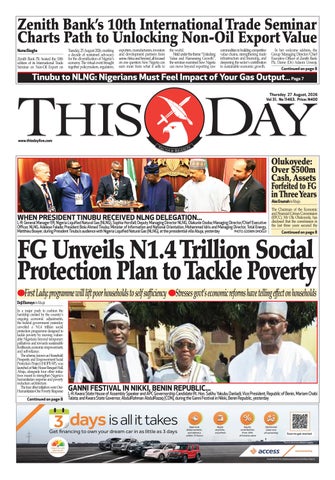
Zenith Bank’s 10th International Trade Seminar Charts Path to Unlocking Non-Oil Export Value Nume Ekeghe Zenith Bank Plc hosted the 10th edition of its International Trade Seminar on Non-Oil Export on
Tuesday, 25 August 2026, marking a decade of sustained advocacy for the diversification of Nigeria’s economy. The virtual event brought together policymakers, regulators,
exporters, manufacturers, investors and development partners from across Africa and beyond, all focused on one question: how Nigeria can earn more from what it sells to
the world. Held under the theme “Unlocking Value and Harnessing Growth”, the seminar examined how Nigeria can move beyond exporting raw
commodities to building competitive value chains, strengthening trade infrastructure and financing, and deepening the sector’s contribution to sustainable economic growth.
In her welcome address, the Group Managing Director/Chief Executive Officer of Zenith Bank Plc, Dame (Dr.) Adaora Umeoji, Continued on page 8
Tinubu to NLNG: Nigerians Must Feel Impact of Your Gas Output... Page 7
Thursday 27 August, 2026 Vol 31. No 11463. Price: N400
www.thisdaylive.com TR
UT H
& RE A S O
N
Olukoyede: Over $500m Cash, Assets Forfeited to FG in Three Years Alex Enumah in Abuja
WHEN PRESIDENT TINUBU RECEIVED NLNG DELEGATION...
L-R: General Manager ER, Nigeria Liquified Natural Gas (NLNG), Sophia Horsfall; Deputy Managing Director NLNG, Olakunle Osoba; Managing Director/Chief Executive Officer, NLNG. Adeleye Falade; President Bola Ahmed Tinubu; Minister of Information and National Orientation, Mohammed Idris and Managing Director, Total Energy, PHOTO: GODWIN OMOIGUI Matthieu Boayer, during President Tinubu’s audience with Nigeria Liquified Natural Gas (NLNG), at the presidential villa Abuja, yesterday
The Chairman of the Economic and Financial Crimes Commission (EFCC), Mr Ola Olukoyede, has disclosed that the commission in the last three years secured the Continued on page 8
FG Unveils N1.4 Trillion Social Protection Plan to Tackle Poverty
First Lady: programme will lift poor households to self sufficiency Stresses govt’s economic reforms have telling effect on households
Deji Elumoye in Abuja In a major push to cushion the hardship created by the country’s ongoing economic adjustments, the federal government yesterday unveiled a N1.4 trillion social protection programme designed to tackle poverty by moving vulnerable Nigerians beyond temporary palliatives and towards sustainable livelihoods, economic empowerment, and self-reliance. The scheme, known as Household Prosperity and Empowerment Social Protection Project (HOPE-SP), was launched at State House Banquet Hall, Abuja, alongside four other initiatives meant to strengthen Nigeria’s humanitarian response and poverty reduction architecture. The four other initiatives were OneHumanitarian-One Poverty Response Continued on page 8
GANNI FESTIVAL IN NIKKI, BENIN REPUBLIC...
L-R: Kwara State House of Assembly Speaker and APC Governorship Candidate Rt. Hon. Salihu Yakubu Danladi; Vice President, Republic of Benin, Mariam Chabi Talata; and Kwara State Governor, AbdulRahman AbdulRazaq (CON), during the Ganni Festival in Nikki, Benin Republic, yesterday
2
THURSDAY, AUGUST 27, 2026 • T H I S D AY
THURSDAY, AUGUST 27, 2026 • T H I S D AY
3
4
THURSDAY, AUGUST 27, 2026 • T H I S D AY
5
THISDAY • THURSDAY, AUGUST 27, 2026
Group News Editor: Goddy Egene Email: Goddy.egene@thisdaylive.com, 0803 350 6821, 0807 401 0580
NEWS
TINUBU RECEIVES NIMASA DG...
President Bola Ahmed Tinubu receives in audience with Director General Nigerian Maritime Administration and Safety Agency (NIMASA), Dr. Dayo Mobereola, at the Presidential Villa Abuja, yesterday PHOTO: STATE HOUSE
UNCTAD: AI-driven Automation May Affect 40% of Global Jobs as Market Hits $4.8tn by 2033
Ndubuisi Francis in Abuja
UN Trade and Development (UNCTAD) has projected that the global Artificial Intelligence (AI) market is set to hit $4.8 trillion by 2033, expressing apprehension that up to 40 per cent of jobs worldwide could be affected by AI-driven automation. The projection is roughly the size of Germany’s economy, indicating a 25-fold increase in just 10 years. UNCTAD said AI-driven automation threatened to erode the low-cost labour advantage many developing economies relied on for growth and poverty reduction. UNCTAD is a permanent intergovernmental body set up by the United Nations General Assembly in 1964, and it supports developing countries to access the benefits of a globalised economy more fairly and effectively. The projects were contained in a new report, titled, “Ensuring AI Benefits Everyone Is Key to Development in the Global South,” which identified the capabilities and international arrangements needed to prevent AI from widening existing development gaps. In July 2026, Nigeria emerged
as the leading African country in the second edition of the Global Index on Responsible AI (GIRAI), ranking 38th globally and number one in Africa with an overall index score of 45.93. UNCTAD stated that while the global AI market was projected to hit $4.8 trillion by 2033, about 65 per cent of people in least developed countries currently remained offline, putting the technology out of reach from the start. It stated that up to 40 per cent of jobs worldwide could be affected by AI-driven automation, which threatened to erode the low-cost labour advantage many developing economies relied on for growth and poverty reduction. According to the organisation, 118 countries – mostly in the global south – are absent from major AI governance platforms, meaning that norms on safety, transparency and accountability are being written without them. “These are not just technical gaps. They’re human development gaps affecting livelihoods, public services and countries’ capacities to meet their citizens’ needs,” it said. However, it stressed that the
technology’s rapid expansion was already affecting everyday life, adding that AI-powered mobile apps help rural health workers interpret symptoms where doctors were scarce, while adaptive learning platforms personalised lessons for students in under-resourced schools. UNCTAD stated, “In climatevulnerable regions, AI models forecast floods, droughts and crop failures days or weeks in advance, giving
Many passengers were stranded when Delta Air Lines Lagos-Atlanta flights were cancelled consecutively for two days and exposed the travelers to disruptions without the airline providing them accommodation. The airline cancelled its flight DL9895 planned to operate from Murtala Muhammed International Airport (LOS) to Hartsfield–Jackson Atlanta International Airport (ATL), originally scheduled for departure on Sunday, August 23, 2026. It also cancelled another flight scheduled for August 25, 2026. Sources from the airline indicated that what began as a temporary technical
delay quickly escalated into a multi-day ordeal for US-bound passengers. The passengers and the airline communications source confirmed that the long-haul, 12-hour flight suffered back-to-back operational failures: In August 23, 2026, Delta grounded the initial flight citing a mechanical fault during pre-departure safety assessments. Passengers were informed that the flight would be rescheduled once maintenance was cleared. On August 25, 2026, two days later, the rescheduled flight was abruptly called off. In a direct notification sent to affected travelers, Delta attributed the second cancellation to “crew availability constraints”.
controlled the bulk of AI research, patents, and computing power. The report said fewer than onethird of Developing Countries had a national AI strategy, explaining that among least developed countries, the figure is just 12 per cent. UNCTAD underscored the point that AI could deliver the greatest human development impact where needs were most acute: agriculture, primary healthcare, disaster manage-
ment, and public administration. But it stated that success depended on three interdependent factors: infrastructure, such as electricity, broadband and computing; locally relevant data; and workforce skills. For most Developing Countries, UNCTAD stated that the realistic entry point was adapting existing or open-source models to local conditions rather than building proprietary systems.
Cuba Advances Home-grown Cancer Drug as 2C12 Enters Human Trials
Experimental immunotherapy modelled on PD-1 treatment to be tested in advanced melanoma patients
Michael Olugbode in Abuja
Cuban scientists have reached a potentially significant milestone in the country’s long-running effort to develop home-grown cancer treatments, with an experimental drug known as 2C12 ready to enter clinical testing in patients suffering from advanced melanoma.
Passengers Stranded as Delta Cancels Lagos-Atlanta Flights Chinedu Eze
communities time to prepare. “But these gains aren’t automatic. They depend on choices about who builds the technology, whose data trains it, and who gets a say in how it is governed.” UNCTAD pointed out that the stakes were high for human development as the benefits of AI were far from evenly distributed. It stressed that a small group of economies and around 100 firms
“We are sorry. Your flight DL9895 from Lagos (LOS) – Atlanta (ATL) was cancelled due to an issue that limited crew availability.” The double cancellations have severely disrupted passenger itineraries, forcing travelers to scramble for emergency hotel accommodations, reschedule domestic connecting flights across the US, and forfeit non-refundable ground transport. The passengers faced with uncertainty lamented their scheduled commitments have been severely affected, including university resumption deadlines, urgent medical appointments, and professional engagements dependent on Atlanta’s status as a major global connecting hub.
The drug was developed by researchers at Cuba’s Centre for Molecular Immunology (CIM). It was designed around an approach similar to that used by pembrolizumab, an established immune-checkpoint therapy used internationally against several cancers, including unresectable or metastatic melanoma. The development is attracting attention because 2C12 is moving beyond laboratory research towards testing in human beings — the stage at which its safety, tolerability, and potential therapeutic benefit must be established before any claim can be made about its effectiveness. According to information released by CIM and subsequently reported by Cuban and international media, the initial clinical study will target patients with advanced melanoma that cannot be removed surgically or has spread to other parts of the body. The study will involve specialist oncology centres in Havana and Villa Clara. The participating institutions include Cuba’s National Institute of Oncology and Radiobiology and Hermanos Ameijeiras Clinical Surgical Hospital in Havana, as well as the Dr. Celestino Hernández Robau Territorial University Oncology Hospital in Villa Clara. The significance of the Cuban
project extends beyond the development of another cancer medicine. Cancer treatment has become an increasingly sophisticated but expensive field, with access to modern therapies varying sharply between countries. World Health Organisation (WHO) said cancer caused nearly 10 million deaths worldwide in 2024, making it one of the leading causes of death globally. It also warns of major inequalities in access to cancer prevention, diagnosis, and treatment between countries and income groups. For Cuba, the challenge has an additional dimension. The country said difficulties obtaining some imported medicines, together with the high international cost of oncology products, had strengthened the case for developing domestic alternatives. That backdrop has made biotechnology and pharmaceutical self-reliance a strategic priority for Cuban scientists. CIM has consequently positioned 2C12 as a potential locally produced alternative to expensive imported immunotherapy. But the scientific test is now much tougher: the molecule must demonstrate in clinical trials that it is safe and actually benefits patients. Pembrolizumab, the drug to which
2C12 has been compared, belongs to a class of medicines known as PD-1 inhibitors. PD-1 is a receptor involved in regulating the immune system. Tumours can exploit this pathway to suppress immune responses, effectively helping cancer cells evade attack. Blocking the PD-1 pathway can restore part of the immune system’s ability to recognise and fight malignant cells. The US Food and Drug Administration currently lists pembrolizumab as a PD-1-blocking antibody indicated for patients with unresectable or metastatic melanoma, among other cancers. That makes the Cuban approach scientifically significant, but the similarity does not mean 2C12 has already been shown to work as well as pembrolizumab. The Cuban molecule remains an investigational candidate. Its performance will have to be established through properly conducted clinical research. Melanoma develops from melanocytes, the cells responsible for producing the pigment melanin. Although melanoma accounts for only a small proportion of skin cancers, it can be particularly aggressive and can spread to distant organs when diagnosis and treatment are delayed.
6
THURSDAY, AUGUST 27, 2026 • THISDAY
NEWS
FROM THAILAND WITH LOVE...
Vice President Kashim Shettima (right) and Deputy Prime Minister and Foreign Affairs Minister of Kingdom of Thailand, H.E. Yousef Hassan Khalawi, during a courtesy visit to the vice president at the Presidential Villa, yesterday
Dangote Refinery Decries Rising Fuel Imports Despite Strong Local Supply Capacity Alleges absence of transparency over actual volume of imported products expected Peter Uzoho The management of Dangote Petroleum Refinery and Petrochemicals has expressed concern over the continued issuance of petroleum product import licences, despite its proven capacity to meet and exceed Nigeria’s domestic Premium Motor Spirit (PMS) requirements. In a statement issued yesterday, the refinery said while it remained fully committed to supporting Nigeria’s energy security and ensuring uninterrupted fuel availability across the country, the
volume of imported PMS entering the market had created uncertainty in domestic demand planning and inventory management. The refinery quoted market data available to it as saying that imported PMS accounted for approximately 43 per cent of the fuel supplied into the Nigerian market in July, a development it said raised questions about the necessity of continued large-scale imports when substantial local refining capacity existed. According to the statement, since commencing operations, Dangote
Refinery has consistently maintained sufficient inventory levels and reserved product volumes to guarantee steady supply to the Nigerian market. It added that this commitment had required significant investment in storage, logistics, and working capital, all aimed at protecting Nigerians from supply disruptions and market volatility. However, the refinery stated that the absence of transparency regarding the actual volume of imported products expected into the country made effective production
and inventory planning increasingly challenging. It stated that maintaining large stock positions without clear visibility into import volumes imposed substantial carrying costs on the refinery and ultimately undermined efficient market operations. Dangote Refinery said, “As a responsible energy provider, we have always endeavoured to keep adequate reserves to satisfy local demand at all times. “However, in an environment where significant volumes of imported PMS continue to enter
the market through licences issued by the regulator, and where there is limited visibility on future import volumes, it becomes commercially unsustainable to continue holding excess inventory indefinitely.” The refinery explained that, under the circumstances, any surplus products not immediately absorbed by the domestic market, must be exported to regional and international markets. Consequently, the refinery said its export volumes had increased in recent months, not because local demand could not be met, but
FG Inaugurates 100 Electric Vehicles for Civil Servants Olawale Ajimotokan in Abuja
The federal government has launched 100 electric buses to provide affordable transportation for federal civil servants The outgoing Head of Civil Service of the Federation Mrs. Didi WalsonJack said in Abuja that the initiative was a practical demonstration of federal government’s commitment to the welfare and well-being of civil servants. Walson-Jack, whose tenure ends today, described the scheme as a dream come true and parting gift
to civil servants, adding 37 of the 100 electric buses had been delivered as the first instalment of the project. She said daily commuting from one location to another was affecting the finances, punctuality and overall productivity of civil servants. She expressed gratitude to President Bola Tinubu for supporting the initiative and the transformation of the federal civil service. “An intervention that makes transportation safer, more reliable and more affordable is therefore not a peripheral welfare gesture; it is
an investment in a more productive civil service,” she said. The head of service lauded the Minister of State for Industry, Sen. John Enoh for undertaking the symbolic handover of the buses and the Director-General of the National Automotive Design and Development Council (NADDC), Mr. Joseph Osanipin for the collaboration that ensured the buses were developed in line with the objectives of the national automotive policy. She tasked civil servants to take good care of the buses, describing the
initiative as valuable assets provided for their benefit. Earlier, Enoh described the inauguration as a significant milestone in the federal government efforts to improve the welfare of civil servants. He said the first 37 buses would serve as the initial phase of the 100bus project, with the remaining buses expected to be deployed as planned. The minister noted that the deployment of the electric vehicles would ease transportation burden
explained that the idea was inspired by her experience while serving at the orphanage for 21 working days. According to her, she discovered that many of the children had limited access to educational resources, technology and even basic necessities such as books and cutlery. “I realised that the children did not have much access to technology and educational opportunities. I wanted to find a way to combine my love for basketball with something that could help them learn and grow,” she said. The teenager noted that the initiative uses basketball as a platform to
teach scientific and mathematical concepts, including angles, friction and technology embedded in sports equipment. “Basketball is fun and engaging. Through the game, children can learn about science, technology, engineering and mathematics without feeling overwhelmed. We want them to understand that STEM exists in everyday activities, including sports,” she added. Olaedo said the project would continue to visit different communities and orphanages, expressing hope that it would impact at least 1,000 children over the next decade.
Edo State Government has offered reason why it secured a 10 per cent equity stake in a 200-megawatt Independent Power Plant (IPP). The plant is being developed by Edo North Electricity Company Limited as part of efforts to improve power supply in the state. The Commissioner for Power, Hon. Paul Usenbo, who disclosed this after the company received its licence, said the commitment to addressing the state’s power challenges in the state prompted the action to buy stake in the plant. He described the development as a major milestone for the project.
by workers while supporting the government’s broader sustainability and development objectives. He also said the buses were part of the administration’s efforts to translate its policies into practical interventions that directly impacted the lives of Nigerians. He commended Walson-Jack for her contributions to the federal civil service and wished her well as she concluded her tenure as the head of service.
because excess inventory generated by market uncertainty must be evacuated to avoid unnecessary storage and financing costs. Dangote Refinery emphasised that its growing exports should not be interpreted as a lack of commitment to the Nigerian market. Rather, it explained that exports were a prudent operational response to the realities of a market where imported products continued to compete with locally refined fuel despite the availability of sufficient domestic refining capacity. The company reiterated that it remained ready, willing, and able to meet and surpass Nigeria’s petroleum product requirements, and had continued to invest heavily in ensuring reliable supply across the country. The refinery stated that should any supply shortfalls arise as a result of market distortions created by excessive importation and the inability of local producers to accurately forecast domestic demand, such shortages should not be attributed to it, as it had consistently demonstrated capacity and commitment to serving the Nigerian market.
Edo Govt Explains 10% Stake in 16-year-old Olaedo Launches Initiative 200MW Edo North Power Project He said the company had completed achieve our goal,” he said, stressing to Bring STEM Education to Orphans FelixOmoh-AsuninBenin the required financial and technical that the IPP would complement, rather Emmanuel Addeh in Abuja
A 16-year-old secondary school student, Nwabueze Olaedo, has launched an innovative initiative aimed at introducing vulnerable children to Science, Technology, Engineering and Mathematics (STEM) through basketball. The programme, known as ‘Dunks to Discovery”, recently held its maiden outreach at the Hope for Survival Orphanage, where children participated in basketball-themed learning activities designed to make STEM concepts more engaging and accessible. Speaking during the event, Olaedo
assessments and would now proceed with implementation, with the Ministry of Power to monitor the project over a 365-day period to ensure compliance with agreed timelines. According to Usenbo, the plant would add 200MW to electricity available in the area, support the national grid and complement distribution companies operating in Edo North. He said the project would help reduce the impact of inadequate power supply from the national grid and improve electricity stability across the senatorial district. “Edo State is very hopeful that with these inclusions, we will be able to
replace, the national grid. Usenbo said the state government’s equity participation demonstrated Governor Monday Okpebholo’s commitment to addressing the state’s power challenges. He also urged communities to protect electricity infrastructure from vandalism, saying the government was engaging stakeholders to strengthen community participation in securing power facilities. The commissioner said protecting the infrastructure could not be left solely to security agencies, as communities must take ownership of facilities located within their areas.
7
THISDAY • THURSDAY, AUGUST 27, 2026
NEWS
FUBARA INAUGURATES AGBA-NDELE BRIDGE PROJECT...
Governor of Rivers State, Sir Siminalayi Fbara (middle) acknowledging cheers from the crowd during the inauguration of the Agba-Ndele Road and Bridge projects, yesterday
Tinubu to NLNG: Nigerians Must Feel Impact of Your Gas Output Urges board to convert flaring into nation’s economic benefit
Deji Elumoye in Abuja President Bola Tinubu yesterday charged the management of Nigeria LNG Limited (NLNG) to ensure Nigerians derive greater economic benefits from the country’s abundant gas resources, particularly by reducing gas flaring and increasing domestic utilisation. Tinubu gave the charge at the State House, Abuja, when he received members of the NLNG Board, led by its Managing Director and Chief Executive Officer, Adeleye Falade. The President commended the company for increasing its production capacity and improving returns on investment but said greater attention must now be paid to the domestic economy and the benefits accruing to Nigerian consumers. “My major concern is the domestic utilisation, where you must be able to take out the flaring and convert potential environmental liability to what could be strategically and economically beneficial to the consumers in the country. “Yes, you are doing great to really want the revenue up and taking advantage of international interests so that Nigeria might be deriving benefits, but help us back home,” Tinubu explained. Tinubu assured the NLNG board that his administration would provide incentives required to stimulate further investment and expansion of the company’s capacity, provided such
growth translated into greater benefits for Nigerians. “I enjoy the teamwork and the way the NLNG is going, and you all, as team leaders, are giving value to what was the initial objective of the company. If any other incentive is needed to stimulate growth and expand your capacity, I will be willing to do that,” he said. The President said Nigeria’s vast natural resources would have little value unless they were developed and deployed to support economic growth and improve the welfare of citizens. “We look straight far into the future, and I believe that this country has what it takes; but whatever asset that we have in the ground is nothing unless it’s brought up to service the economy, the people, and realisation of a good return on investment,” he said. Tinubu also stressed the need for greater domestication of energy resources and appropriate pricing mechanisms that would allow ordinary Nigerians to feel the impact of the country’s gas wealth. “I think that is the primary focus. But think of people, the need for domestication of some of these energy requirements and pricing mechanisms so that the ordinary man will feel it,” he said. Earlier, Falade said the NLNG delegation was at the State House to brief the President on the company’s operations since he assumed office as managing director and CEO in April.
He disclosed that NLNG had generated more than $150 billion since inception, with its shareholders, including the Nigerian government, receiving about $47 billion in dividends. Nigeria holds a 49 per cent stake in NLNG. Falade explained that the company had previously operated at about 60 per cent capacity because inadequate crude oil production constrained feed gas availability, forcing it to operate only four of its six available production trains. He, however, said increased oil production resulting from recent positive developments in the oil and
The new leadership of the Petroleum and Natural Gas Senior Staff Association of Nigeria (PENGASSAN), has promised to work closely with the Nigerian Upstream Petroleum Regulatory Commission (NUPRC) to unlock 3 million barrels per day by 2030. The new President of PENGASSAN, Bosun Olabiyi-Agoro, said this in Abuja yesterday, when he visited the corporate headquarters of the NUPRC, a statement by the NUPRC spokesman, Eniola Akinkuotu, said. “The President of Nigeria has an ambition which he runs through the
CCE which is to make sure that by 2030 we are able to produce 3 million barrels per day. All of us have to work to make that happen. It will be our happiness to make sure that that target is actually attained,” the PENGASSAN President said. “We can assure you that we are here to collaborate. We will be very reasonable,” he added. The PENGASSAN President further stated that in as much as the union is open to negotiations, issues bordering on the rights of workers to freely associate and join the union are non-negotiable. He added that issues surrounding contract staffing will be one of the key issues his administration
company’s growing focus on meeting local energy needs. The NLNG chief executive also told the President that the company’s shareholders had commended the stability in Nigeria’s fiscal environment, which he said was attracting fresh investments into the country. He commended the security agencies and regulators in the oil and gas sector for contributing to the stability being experienced in the industry. Falade further disclosed that the Bonny-Bodo Road and Bridge project, financed by NLNG, had been completed and was awaiting official
Nigeria’s Creative Industry Initiates Trust Fund, Insurance scheme for Entertainers To provide assistance, medical support to seriously ill artists
Segun James
Following tragic death, sickness and abject poverty in which many of Nigeria creative artistes succumb, the Society for the Advancement of Entertainment and Trust to promote the welfare and long-term security of Nigerian entertainers and other creatives was yesterday unveiled in Lagos. The initiative, promoted by
New PENGASSAN Team to Partner NURPC to Unlock 3m Bpd Emmanuel Addeh in Abuja
gas sector had enabled NLNG to raise its operating capacity to five trains, with further improvements expected. Falade said the company was also preparing to inaugurate Train Seven, which would increase NLNG’s capacity by 35 per cent and strengthen its position in the global liquefied natural gas market. According to him, NLNG currently accounts for about 5 per cent of global LNG supply. He disclosed that all of the company’s liquefied petroleum gas (LPG), commonly known as cooking gas, was currently dedicated to the domestic market, reflecting the
commissioning. Other members of the NLNG delegation included: Deputy Managing Director, Olakunle Osobu; Board Director and Managing Director, TotalEnergies EP Nigeria Limited and Country Chair, TotalEnergies, Matthieu Bouyer; Board Director, Vice Chairman and Managing Director, Nigeria Agip Exploration, Maurizio Pinna; and General Manager, External Relations and Sustainable Development, Sophia Horsfall. Also present were Manager, Government Relations and Regulatory Compliance, Abdul Umar; Head, Government Relations, Tonbrafa Nanaghan; and Senior Government Relations Advisor, Rufai Mohammed Lawal.
will address. In her remarks, the Commission Chief Executive, NUPRC, Mrs. Oritsemeyiwa Eyesan, said the President Bola Tinubu-led federal government had been working assiduously to increase production as evidenced by the latest executive order which is targeted at deep offshore investments. She noted that production had risen from a low of 1.1mmbopd a few years ago to an estimated 1.755mmbopd in 2026. Eyesan, however, said industrial stability remains critical to hitting higher production targets. She, therefore, sought PENGASSAN’s support.
entertainment practitioner Victory Okelezo, popularly known known as Kupa Victory, is aimed at providing sustainable support, particularly in the areas of healthcare and insurance, to reduce the growing reliance on public appeals during medical emergencies. Speaking at the unveiling in Lagos, Mr. Okelezo said the initiative was inspired by the increasing cases of illness and sudden deaths among entertainers. According to him, the trust is a non-profit organisation dedicated to the well-being of the entertainment
industry by affiliation. “The Trust exists to assist and showcase support to vulnerable members of the entertainment industry who face life-threatening and high-cost medical conditions.” He said the trust would engage government, corporate organisations and individuals to raise funds and establish a support system that would preserve the dignity of creatives. He stressed that “the mission of the Trust is to provide financial assistance, medical support, advocacy and compassionate care to seriously ill artists - mobilising partnership
and resources that safeguard their well-being, preserve their dignity, and celebrate their lasting contribution to society.” Also speaking, Human rights lawyer Femi Falana, described the initiative as timely, saying successful entertainers should not be left to depend on public donations after contributing significantly to society. Mr. Falana advocated greater awareness and access to insurance, stressing that entertainers should be encouraged to secure their future through sustainable social protection schemes.
NCC Moves to End Communication Barriers for Persons with Disabilities
Oghenevwede Ohwovoriole in Abuja
The Nigerian Communications Commission (NCC) is seeking to end communication barriers suffered by Persons with Disabilities (PWDs) in order to enable them communicate seamlessly while using telecommunication devices. The Executive Commissioner, Stakeholders Management, Rimini Makama, disclosed this at the opening ceremony of a two-day Hackathon 4th edition, organised by the commission yesterday in Abuja, with the theme: “Technology Without Barriers.”
Makama, who was represented by the Director, Zonal Operations, NCC, Usman Malah, said the commission brought together young Innovators to develop practical technological solutions particularly to PWDs. “Today, we celebrate the ingenuity, creativity, and determination of young innovators who have come together to develop practical technology solutions that address real societal challenges, particularly those affecting persons with disabilities (PWDs) and other underserved communities. “Through this initiative, the NCC is
reaffirming its commitment to fostering innovation, promoting indigenous technological development, and ensuring that digital transformation remains inclusive, accessible, and beneficial to all Nigerians,” she said. On the need for PWDs to be inclusive in the digital economy, she said, promoting inclusive innovative digital technologies was transforming lives, reshaping economies and creating new opportunities for growth and development, adding that to ensure these benefits reach everyone, innovation must be inclusive, accessible, and responsive to real societal needs.
8
THURSDAY, AUGUST 27, 2026 • THISDAY
EIGHT
IMF Urges Central Banks to Clearly Communicate Policy Risks
Ndubuisi Francis in Abuja Given the high degree of uncertainty globally, the International Monetary Fund (IMF) has tasked central banks to be explicit about risks, with the goal of reflecting the degree of underlying macroeconomic uncertainty accurately. The multilateral lender said in a world of frequent shocks, central bank communications should anchor expectations by explaining how policy responds to changing conditions, rather than committing to a fixed path. In a new blog post titled, “Rethinking Central Bank Communication in an Uncertain World”, the Fund observed that in a world of frequent and faster-moving shocks, where uncertainty was high and markets
react instantly, central banks face a fundamental communications challenge: how to help the public understand monetary policy objectives while explaining how policy may evolve as economic conditions change. “In this regard, explaining the policy framework, the reaction function of the central bank, and the way in which economic uncertainty and risks play into alternative scenarios have become the foundation of the central banker’s communications playbook. “As central banks adapt their policy frameworks and tools to a more uncertain and shock-prone world, it is only natural that they are also reassessing how best to communicate policy frameworks and talk about the conjuncture.
“A new IMF note explores these questions and sets out principles for effective monetary policy communication,” the post said. It recalled that during the lowinflation era that followed the global financial crisis, communication was dominated by forward guidance, centered on pre-committing to a likely future path of the policy rates. “Such an approach, it noted, can be effective when policy is stuck at the lower bound and inflation expectations are drifting down.” The post added: “But commitments may become costly when circumstances change. Supply shocks, inflation surprises, or abrupt shifts in the balance of risks may require policymakers to adjust course. “As a result, central bank com-
munication has shifted toward explaining how policy will respond as economic conditions evolve and new data become available.” The IMF remarked that a central task has therefore been communicating the reaction function: how policymakers interpret incoming data, weigh risks, and navigate tradeoffs between key central bank objectives. “The strength of underlying inflation, the evolution of inflation expectations, and the nature of monetary policy transmission are the key inputs to the reaction function. “Data dependence” has featured prominently: central banks emphasize what data matter, how data shape decisions, and what future contingencies may mean. The goal is to help the public understand the
logic that guides a central bank’s decision-making,” it stressed. According to the IMF, central banks convey their views on the economic outlook through forecasts and scenarios, explaining that this is crucial because policy decisions are based on where the macroeconomy is expected to go. But forecasts, it remarked, are not promises, adding that in a shockprone world, they are subject to tremendous uncertainty. “If forecasts are communicated too precisely, or policy-rate projections are interpreted as commitments, revisions can be misinterpreted as policy reversals. “In this context, scenarios can help illustrate how policy might respond under different economic outcomes,
F G U N V E I L S N 1 . 4 T R I L L I O N S O C I A L P R OT E C T I O N P L A N TO TA C K L E P O V E RT Y
System (OHOPRS), Emergency Cash Transfer Programme, Federal Ministry of Humanitarian Affairs and Poverty Reduction Ministerial Blueprint, and Humanity First Magazine. In his remarks, Minister of Humanitarian Affairs and Poverty Reduction, Dr. Bernard Doro, said the new initiatives marked the establishment of a new national architecture for humanitarian intervention and social protection, with government shifting its emphasis from reactive palliatives to proactive empowerment. Doro said while the President Bola Tinubu administration’s economic reforms, including the removal of fuel subsidy and unification of the foreign exchange market, had
improved investor confidence and strengthened government revenues, attention must also be directed at protecting Nigerians from economic shocks and providing sustainable routes out of poverty. According to him, government’s objective is to move from reactive relief to anticipatory social protection, and from merely managing poverty to reducing it. He identified fragmentation as one of the major weaknesses of existing social intervention programmes, stating that initiatives across ministries, departments, agencies, and different levels of government often operated independently. The minister said the situation
had created duplication, with some beneficiaries accessing multiple interventions while other vulnerable Nigerians received none. Doro said the new approach would shift the focus from programmes to households, and from simply counting the number of beneficiaries to measuring the actual impact of interventions. Under the new architecture, Doro explained, vulnerable households would be identified, their needs assessed, and appropriate interventions provided. He said thereafter they would be tracked through a “poverty graduation pathway” towards economic inclusion and self-reliance.
He added that the system would be supported by unified data, digital delivery infrastructure, new financing arrangements, and real-time poverty intelligence, while strengthening collaboration among the federal, state, and local governments as well as development partners. Delivering a keynote address on the occasion with the theme, “From Palliatives to Pathways,” wife of the president, Senator Oluremi Tinubu, said the initiatives represented a great move towards improving the lives of vulnerable individuals, families, and communities nationwide. She stressed that though the five initiatives performed different functions, they shared the common
objective of improving the wellbeing of Nigerians, particularly, those facing economic and social vulnerabilities. Mrs. Tinubu added that the programmes were particularly significant against the backdrop of the far-reaching economic reforms being implemented by the Tinubu administration to strengthen the economy and establish a foundation for sustainable growth and shared prosperity. According to her, while the reforms are being implemented, government and other stakeholders need to know that many Nigerian families still face challenges and require support. She stated, “Under the leadership of President Bola Tinubu, our nation
OLUKOYEDE: OVER $500 MILLION CASH, ASSETS FORFEITED TO FG IN THREE YEARS forfeiture of both cash and assets worth more than $500 million to the Federal Government of Nigeria. Olukoyede made the disclosure yesterday while delivering a lecture at the Cambridge International Symposium on Economic Crime, in the United Kingdom. The forfeitures which were made under his leadership of the anti-graft agency, according to him, were possible due to Nigeria’s legal framework empowering the agency to seek the forfeiture of assets suspected to be proceeds of crime without waiting for a criminal conviction. He said: “Within three years of my assumption in office we have been able to forfeit (secure forfeiture of) both cash and assets worth over half a billion dollars to the government”. Olukoyede observed that the legal framework is similar to what obtains in countries such as Australia and Canada, with a formal forfeiture application. “We have similar to what is obtainable in Australia and Canada that empowers us to apply for
forfeiture for proceeds of what is suspected to be proceeds of crime”, he said. According to the EFCC boss, upon the suspicion that a particular asset could have emanated from proceeds of crime, an application is made to the high court for the forfeiture of the said assets. Olukoyede listed an aircraft, property and cash among recently forfeited assets to the federal government, adding that the forfeitures were made against public officials. According to him, the forfeited aircraft was linked to a member of a monitoring committee for a power project in Nigeria, adding that the individual was found to have allegedly collected a $30 million bribe. “This aircraft was forfeited by someone who was supposed to be a member of the monitoring committee of a power project in Nigeria. We discovered he collected a bribe of about $30 million in Nigeria,” he said. The EFCC boss who stated that the recovery was made about three
months ago, disclosed that the said aircraft has been added to the presidential air fleet at the moment. While observing that agency secured the forfeiture within two months of applying to the court, Olukoyede referenced the forfeiture of a property containing about 753 housing units, this time involving a former governor of the Central Bank of Nigeria (CBN). “That property contains about 753 housing units we forfeited from an erstwhile governor of the Central Bank of Nigeria. We have criminal charges against him [in] about three courts,” Olukoyede said. Similarly, the chairman disclosed that the commission had also within the same period secured the forfeiture of another set of 48 properties out of 57 allegedly linked to the immediate past Attorney General of the Federation and Minister of Justice, Mr Abubakar Malami (SAN) following an investigation into suspected abuse of office. According to him, the investigation was opened last year based on what he described as reasonable
suspicion of criminal abuse of office. “Sometime last year, I opened investigations upon reasonable suspicion of criminal abuse of office by the immediate past attorney-general of Nigeria. We discovered that within eight years of his being in office, we were able to trace about 57 such properties to him. We have been able to forfeit about 48,” he pointed out. Olukoyede in addition mentioned the forfeiture of a private university allegedly linked to a director in the Federal Ministry of Health, stating that in the instant case, the official voluntarily surrendered the property following an investigation by the commission. Olukoyede attributed the commission’s success in securing non-conviction-based forfeiture orders to the ability of investigators to trace assets, cooperation from the judiciary and access to credible intelligence, adding that, “We also have some of the best investigators around the world”. Besides, he observed that a proactive judiciary was essential
to the effective implementation of non-conviction-based forfeiture, just as a credible intelligence remained a critical component of the process. He also disclosed that many of the EFCC’s investigators had received training at leading institutions around the world, thereby strengthening their capacity to track and recover assets linked to financial crimes. The chairman however called for stronger protection and incentives for whistleblowers, particularly those who provide information leading to the recovery of Nigerian assets taken abroad. “The citizens must be encouraged with your whistleblower protection,” he said. “If any of you is privy to where Nigerian assets are stolen or taken anywhere in the world, we have an incentive for you. Between 2.5 and 5 percent is going to go back to you upon recovery.” Olukoyede added that whistleblowers whose information leads to successful recovery of stolen Nigerian assets could receive significant financial rewards under the commission’s incentive arrangement.
IMF boss, Kristalina Georgieva while reinforcing that future decisions will depend on incoming data and evolving conditions. “Forecasts should be accompanied by a clear explanation of risks. Effectively communicating the reaction function can help the public better understand how policy may respond under alternative economic outcomes.
is implementing far-reaching reforms to strengthen the economy, lay a solid foundation for sustainable growth, and shared prosperity. “As these reforms continue to take effect, we must recognise that, given the size of our population and available resources, many families still face challenges and require our collective support.” She explained that HOPE-SP was an important intervention designed to strengthen the process of identifying vulnerable households, understanding their peculiar needs, and providing appropriate assistance. Mrs. Tinubu explained that rather than merely providing temporary relief, the social intervention scheme would combine immediate stabilisation assistance with interventions capable of putting affected households on a path towards recovery and economic independence. She stated, “The first initiative, the Household Prosperity and Empowerment Social Protection Project, is an important step toward strengthening how to identify and respond to vulnerable households facing various challenges by listening to their specific needs before taking action. “It is designed to provide immediate stabilisation assistance while placing the households on a pathway to recovery, empowerment and self-reliance.” She explained that the OneHumanitarian-One Poverty Response System would provide a coordinated national mechanism for responding to humanitarian emergencies, delivering social protection and tackling poverty. Mrs. Tinubu said the scheme was expected to eliminate duplication among government interventions while maintaining unified national registries through which poor and vulnerable households could be identified, supported and tracked Continued on page 27
ZENITH BANK’S 10TH INTERNATIONAL TRADE SEMINAR CHARTS PATH TO UNLOCKING NON-OIL EXPORT VALUE OON, paid tribute to the Bank’s Founder, Dr. Jim Ovia, CFR, whose vision gave birth to the seminar in 2015, and urged participants to turn Nigeria’s improving export numbers into lasting economic value. In her words: “Our theme, ‘Unlocking Value and Harnessing Growth’, is not just a slogan. It speaks to the opportunities before us and the need to translate our collective efforts into sustainable economic value. According to the Nigerian Export Promotion Council, Nigeria’s non-oil exports reached a record $6.1 billion in 2025, up 11.5 per cent from the $5.46 billion recorded in 2024,
and a remarkable leap from the $612 million recorded a decade earlier. Through our partnership with the African Continental Free Trade Area Secretariat, we have commenced the development of the SMARTAfCFTA portal, and our integration with the Pan-African Payment and Settlement System is making cross-border business easier for our customers. Wherever our exporters need to reach, Zenith Bank will reach with them.” She commended His Excellency, President Bola Ahmed Tinubu, GCFR, for the structural reforms creating a more enabling environment for businesses, and the Central
Bank of Nigeria, under Governor Olayemi Cardoso, for reforms that have improved foreign exchange stability and market confidence. “As we build on the progress recorded so far,” she added, “it is important that, as a nation, we accelerate growth by creating more value locally and exporting finished products, rather than just raw materials.” Delivering the keynote address, the Honourable Minister of Industry, Trade and Investment, Dr. Jumoke Oduwole, MFR, called for deeper trade and investment reforms, a better export environment and wider market access within Africa and beyond. “The question before us
now is not simply how to export more, but how to retain more value in Nigeria from everything we export,” she said. “Our focus at the Ministry is straightforward: produce more competitively in Nigeria, process more in Nigeria, connect Nigerian businesses to bigger markets, and ensure that the financing, infrastructure and trade systems exist to help them scale. In July, I assumed the chair of the AfCFTA Council of Ministers, and I see first hand that the opportunity before us goes beyond the size of the African market of over 1.4 billion people and approximately $3.4 trillion in GDP.
It is about enabling Nigerian firms to sell more products, reach more markets and deepen regional value chains. Nigeria’s role as an AfCFTA digital trade co-champion further positions us to help shape how this market evolves, particularly as digital trade creates new pathways for Nigerian businesses to reach customers across the continent.” She urged financial institutions to go beyond financing export transactions to financing export capability, and encouraged Nigerian businesses to prepare for intra-African trade by investing in productivity, quality and skills. In his presentation, the Chair
of the Board of Directors of the Fund for Export Development in Africa (FEDA) and immediate past President/Chairman of Afreximbank, Professor Benedict Oramah, GCON, argued that the moment demands new thinking. “The theme chosen for this 10th edition is both apt and timely,” he said. “The global economy is experiencing unprecedented levels of entropy. I do not raise this to alarm us. I raise it because a unique opportunity lies ahead of us that may well pave the way to Africa’s ascendance. The question is no Continued on page 28
9
THURSDAY, AUGUST 27, 2026 • T H I S D AY
This new session, UBA has got you covered for all your back-to-school needs. Get your child's money habits going with the UBA Money Explorers book.
Shop & maintain a budget with the UBA Prepaid Card. Send and receive school fees globally with UBA Remittance Services. Pay school fees quickly and securely through UBA's Digital Channels.
Save on school essentials with exclusive discounts on the Red Vault. Access loans for your Back-to-School needs.
UBA
UBA Account
Account
T&Cs apply
SCAN TO GET STARTED
10
THURSDAY, AUGUST 27, 2026 • THISDAY
NEWS
UNION BANK’S ENTREPRENEURS’ DAY SALES FAIR...
L-R: Head SME Banking, Union Bank of Nigeria, Mrs. Gloria Omereonye; Executive Director, Corporate Bank and Business Banking - Lagos and Southwest, Union Bank of Nigeria, Mr. Taiwo Shote; and Chief Brand & Marketing Officer, Union Bank of Nigeria, Mrs. Olufunmilola Aluko, during the Bank’s Entrepreneurs’ Day Sales Fair held at its Head Office, The Stallion Plaza, 36 Marina, Lagos Island on Tuesday
Umahi Chides Benin-Asaba Road Concessionaire, to Arrest Contractors for Removing Asphalt Minister promises succour for users of Nigeria’s highways
Emmanuel Addeh in Abuja
Minister of Works, David Umahi, has chided the concessionaire handling the Benin-Asaba Highway over the slow pace of reconstruction and expansion works on the 125-kilometre road, threatening to arrest contractors found removing asphalt from existing roads. Umahi gave the warning when he undertook an on-the-spot assessment of the highway following concerns
over the suffering of motorists and host communities arising from the ongoing works, a statement from the ministry said. He accused the Benin-Asaba Expressway Concession Company Limited (BAECC) of unprofessional conduct and failure to respond adequately to repeated warnings from the Ministry of Works and the project’s Independent Engineer, Yolas Consultants Limited.
“You are not adhering to engineering best practices in road construction and your methodology is adversely impacting road users, host neighbourhoods and the pace of work,” the minister said. Umahi, who apologised to Nigerians and residents of communities along the corridor over the difficulties caused by the construction, said the concessionaire had also tampered with asphalt on portions of the highway
that were still smooth. According to him, the action had damaged road sections where the substructure had already been stabilised. He therefore directed all Federal Controllers of Works and Engineering Representatives to arrest any contractor who completely removes asphalt from an existing road. Umahi dismissed the explanations by the concessionaire as “unprofes-
Nigeria, Thailand to Expand Bilateral Ties in Renewable Energy, Technology, Agriculture As Shettima seeks review of bilateral relationship at strategic level
Deji Elumoye in Abuja Nigeria and Thailand on Wednesday expressed commitment towards deepening relations between both countries across technology, agriculture, commerce, and renewable energy, among other areas of strategic interest. To this end, Nigeria is pushing for a review of existing partnerships between both countries, leveraging Thailand’s comparative advantage in deploying intermediate technology in agriculture and related areas. Thailand, on the other hand, is proposing a Thailand-Africa Initiative that aims to boost relations
between the Asian country and key African countries in peopleto-people ties, economic ties as well as economic cooperation, particularly in agriculture. These formed the highlights of the meeting between Vice President, Senator Kashim Shettima, and a delegation from the Kingdom of Thailand led by its Deputy Prime Minister and Foreign Affairs Minister, H.E. Yousef Hassan Khalawi. Speaking during the meeting with the delegation at the State House,Abuja, on behalf of President Bola Tinubu, Shettima acknowledged the existing cordial
relationship between Nigeria and Thailand. Accrding to him: “I believe that our relationship should go beyond transactions in crude oil, rice production and so on. So, there is a need for us to review our bilateral relationship at a strategic level. “Nigeria is a large market. There are enormous opportunities for partnership and investment in agriculture, ICT, renewable energy, and solid minerals, and we have a young population and workforce.” He urged the government and people of the Kingdom of Thailand to continue to do business with Nigeria because of its strategic
position on the African continent, coupled with its demographic advantage and abundant natural resources. Earlier, Deputy Prime Minister Khalawi, who is on his first trip to Africa, praised the ongoing transformation in Nigeria under the administration of President Tinubu, describing the country as a strategic partner with Thailand, a strong voice in the global south and an emerging leader in e-commerce.
sional and untenable excuses”. The minister said a competent contractor would immediately be engaged to remedy the critically bad sections of the highway and improve traffic flow. He assured motorists and host communities that President Bola Tinubu was aware of their difficulties and was committed to providing relief. The Benin-Asaba Highway runs from the AIF Roundabout in Benin City, Edo State, to Summit Junction in Asaba, Delta State, covering 125 kilometres. The highway is a major link between the South-South, SouthEast and parts of the South-West, facilitating the movement of passengers and goods and connecting several economic centres. It is one of the pilot corridors under Phase I of the Highway Development and Management Initiative (HDMI), being implemented through a Public-Private Partnership (PPP) arrangement. The initiative is designed to leverage private-sector investment and technical expertise for the development, operation and management of federal highways outside the Federal Government’s balance sheet. The Federal Executive Council (FEC) approved the concession of the
Benin-Asaba Highway on January 16, 2023, on a Design, Finance, Build, Operate and Transfer (DFBOT) basis for a 25-year concession period, including a three-year construction period. The concession agreement was executed on May 23, 2023, between the Ministry of Works and BAECC. The ministry said it had undertaken several technical engagements and inspections since the project commenced, including a ministerial site inspection in October 2025, Project Delivery Team inspections in January and May 2026 and meetings involving the ministry, BAECC and the Independent Engineer in July 2026. It said the engagements had revealed shortcomings in the execution of the project, prompting further directives to the concessionaire to make immediate corrections. Explaining the slow progress of the project, the Managing Director of BAECC, Samuel Daramola, attributed the situation to the heavy volume of traffic on the highway and torrential rainfall experienced along the corridor. Speaking during the inspection, the Chairman of the Senate Committee on Works, Senator Allwell Onyesoh, and Chairman of the House Committee on Works, Akin Alabi, expressed concern over the condition of the highway.
Works Ministry, NDDC, Others Intervene in Benin Bypass Roads
NDDC Managing Director, Dr. corridors, which have subjected Ibunge in Port Harcourt Samuel Ogbuku, embarked on a commuters, residents and busiYar’Adua Cancer Centre, Innova Healthcare Blessing The Niger Delta Development joint inspection of failed portions nesses to severe hardship. Consequently, the Ministry of (NDDC), the Federal of the Benin-Sapele-Warri and Sign MoU to Build Abuja Oncology Hub Commission Works, in collaboration with the Ministry of Works, the Edo State Benin-Agbor roads. The statement made available Edo State Government, invited Government, and other stakeholders Yemi Kosoko in Jos
The International Cancer Centre Abuja (ICCA) has signed a Memorandum of Understanding with Singapore based Innova Healthcare Nigeria Limited to establish a fully integrated oncology centre at its existing facility on Airport Road, Abuja. In a statement issued by ICCA’s Communications Manager, Arhyel Shadrach Ayuba, the organisation
said the partnership marks a major step toward fulfilling the founding vision of accessible, world class cancer care for Nigerians. The new centre will provide radiotherapy, chemotherapy, surgical oncology, diagnostics, laboratory services and palliative care under one roof, utilising ICCA’s current infrastructure rather than embarking on new construction. Ayuba described the agreement as “a significant step toward
realising the vision of the founding fathers,” noting that the MoU sets out the framework for long term collaboration between the two organisations. ICCA’s Director General, Shehu Yar’Adua, said the partnership brings the centre closer to the dream of its founder, Hajiya Turai Yar’Adua, who established ICCA in 2009 to ensure Nigerians no longer needed to travel abroad for lifesaving cancer treatment.
have commenced an urgent intervention to address the deplorable condition of the highways between Edo and Delta States. In a statement on Wednesday, by the Director, Corporate Affairs of NDDC, Seledi Thomspon-Wakama said the Edo State Governor, Senator Monday Okpebholo, the Minister of Works, Senator David Umahi, alongside the Senate Committee and House of Representatives Committee on Works and the
to journalists in Port Harcourt, revealed that during the inspection, Umahi stressed the federal government’s commitment to fixing the deteriorating sections and finding immediate and sustainable solutions to the challenges along the critical corridor. Umahi said the quick intervention followed a directive from President Bola Tinubu, in response to concerns over the deteriorating condition of the critical road
the NDDC, major construction companies operating along the Benin–Asaba axis, and other stakeholders to undertake a joint inspection of the failed portions of the roads. Also speaking at the road site, the NDDC Managing Director, Dr. Samuel Ogbuku, said the commission received complaints about the sufferings of motorists along the Benin-Sapele corridor and had taken steps to intervene.
12
THURSDAY, AUGUST 27, 2026 • T H I S D AY
THURSDAY, AUGUST 27, 2026 • T H I S D AY
13
T H I S D AY • THURSday AUGUST 27, 2026
14
Politics
Acting Group Politics Editor DEJI ELUMOYE Email: deji.elumoye@thisdaylive.com 08033025611 sms only
Nwankwo: No Need to Rush State Police Bill Passage Before 2027 Polls
Executive Director of the Policy and Legal Advocacy Centre, and a leading voice in Nigerian civil society advocacy, Mr. Clement Nwankwo, in this interview raises critical issues regarding preparations for the 2027 general elections, creation of state police, and Special Seats Bill before the 10th National Assembly. Onyebuchi Ezigbo brings excerpts.
W
hat is your assessment of the progress being made by the 10th National Assembly in addressing issues of concern to Nigerians through constitutional amendments? I am hoping that the 10th National Assembly understands the importance of delivering on its promise to amend portions of the Constitution that citizens have asked to be amended. It is three years into the 10th National Assembly, with only a few more months to go. I think Nigerians will be greatly disappointed if the National Assembly does not deliver on its promise to amend areas of serious concern. One of those areas is the Special Seats for Women Representation Bill. When you look at the National Assembly, less than four percent of women are represented in the legislative chambers. I think that is scandalous for our politics: out of 469 members of the National Assembly, we have just about 20 who are women. The National Assembly should feel embarrassed by this situation. The reason for the Special Seats Bill is to find a mechanism that throws up more women in the decision-making process, especially in the legislature. With the executive, it is easy to correct this, because the person elected President at the national level, or Governor at the state level, can appoint more women as ministers and heads of government agencies. But you cannot do so with legislators, and that is why the Special Seats Bill is being proposed. We think it is something the National Assembly should have taken up expeditiously. If you put it side by side with the State Police Bill that the Executive and National Assembly are pushing, the Special Seats Bill is far more urgent. For those of us advocating for the Special Seats Bill, it is disappointing to see the National Assembly drag its feet on this matter. What is your view on the proposal for state police and the push for its quick passage by the Federal Government? Yes, the government appears to be prioritizing the Bill on state police. But for those of us who are concerned about the abuse of state institutions by those who control them, we want to see state police adopted with absolute safeguards for human rights and for the protection of citizens. It is very important that the process of approving or passing the State Police Bill is done with safeguards as a priority. Secondly, we do not think there is any urgency in having state police created before the 2027 elections. Those who are pushing for state police to be created before 2027 must be very careful about how they are pursuing this agenda. I think that many Nigerians who may even sympathize with the creation of state police are not happy to see it rushed. For me, the rush to create state police should be deprioritized. More urgent is the Special Seats Bill. What particular safeguards would you like to see provided for state police in order to guide against abuse? If you look at the recent Osun State governorship election, you can see the actions of police personnel. We saw how policemen appeared willing to be used in support of a particular political party. We saw opposition party members being arrested, and the police blatantly behaving as if they were working for the ruling party at the national level. These are major concerns. The police must be insulated from politics; they must be accountable. In cases where public officials, whether at the national or state level, have
Nwankwo
instigated the police to arrest people who criticize them, this is widespread across the country. For many of us, the concern is the power of governors and how this can be kept in check so that police are not used arbitrarily at their whims and caprices, to go after critics of state administrations. What kind of safeguards do you suggest for the proposed state police structure? A - Presently, the federal police are controlled by the central government, and there is still abuse. Now, if you create state police for 36 states, you may be multiplying that abuse 36 times. That is the concern: that we will not have 37 abused police structures. That is why the issue of accountability, and the issue of insulating state police from abuse by governors, is very important. That is the worry of every Nigerian. Because you will have jeopardy across 37 authorities. If you are caught by the federal government, you could also be caught by any of the 36 state governors through the abuse of state police. Governors have not shown that they have the capacity to be respectful of human rights. In specific terms, which template
do you suggest as safeguards for preventing state police abuse? The templates exist. First, who gives operational command to the police? Can the President give operational command? No, he should not. Secondly, is the police insulated and independent from manipulation and control, including through budgeting? The police should be independently funded. Their appointments, promotions, and retention, not just of heads of police at the national or state levels, should be protected. Is it insulated from political manipulation? How do you bring people to account? What is the extent of supervision and accountability of the police to the legal and constitutional system? What are citizens’ rights to recourse to the courts with regard to abuses by the police? These are safeguards that should exist. In a situation where commissioners of police are appointed by a governor, or even nominated by a governor to the State House of Assembly, we know that legislative houses are also abused by governors and that many of them are not independent. If the system worked and governors respected it, and everybody was accountable, then it would be fine. But that is not the case in Nigeria at present. You can also see concerns about the judiciary, where the Executive is building houses and
It is very important that the process of approving or passing the State Police Bill is done with safeguards as a priority. Secondly, we do not think there is any urgency in having state police created before the 2027 elections. Those who are pushing for state police to be created before 2027 must be very careful about how they are pursuing this agenda.
presenting them to judges as gifts. The appearance is that this could, in several ways, corrupt the judicial system. What is your view regarding issues leading to the 2027 general elections in Nigeria? The major issue with the 2023 general election was the transmission of results to the IReV portal. The current Electoral Act 2022 has addressed this, except for one shortcoming that citizens are not happy with: the exception that says, “If there is a failure of the system, INEC can transmit election results manually.” I think that exception is where the problem lies. But if you have an Electoral Commission that is honest and wants to conduct credible elections, and knows that communication infrastructure is in place, that Commission will insist that electronic transmission of results is mandatory and will make no exceptions in the implementation of the law. That is what citizens need to demand of INEC: that it implements the law in full, not based on the exceptions enacted by the National Assembly. We should not have this anxiety and tension in the country. I will not attribute the outcome of the Osun election to INEC’s delivery. I think the people of Osun State deserve commendation for what happened, because there were obvious attempts to manipulate the process, including by state institutions and the judiciary. It was the judiciary that deregistered one of the main parties in the election, although the court later reversed the decision. But in the first place, the courts have no business deregistering political parties. I do not see where the courts derived that power from. You can talk about issues within political parties, especially where there is injustice, but you cannot deregister a political party as a court. You also cannot have the police get into politics and begin arresting one camp against the other, which is what the police did. You should not have a situation where the Inspector General of Police has to come out and say he has removed a commissioner of police because of public outcry. There should have been no outcry at all. And if a Commissioner of Police puts himself in a position where he has become brazenly partisan, there should be disciplinary action against such an official. Instead, it was simply a reassignment, with no evidence to show that the person reassigned to replace him was any less partisan. So the commendation for what happened in Osun goes to the people of the state, who said: “We will not allow our election to be rigged by either INEC or the institutions of state”. In fact, we saw how a minister said that if he had been involved in the Osun election, the result would have been different. It should not be that such a thing is said about an election. Does it mean that as we go into the national elections, and the minister is involved, we will see how he intends to use state institutions to achieve political purposes? What is your advice to Nigerians as we prepare for the 2027 general election I think that the Osun governorship election is a lesson to Nigerians. It means that Nigerians need to prepare to defend their votes. Political parties need to build citizens’ and their members’ confidence in the electoral process. I am not partisan, and I am not canvassing support for any particular political party. I believe that Nigerians should be allowed to go out and vote, and that we as citizens should be able to protect our votes and not allow ourselves to be intimidated by those using state institutions to manipulate the process.
15
T H I S D AY • THURSday, AUGUST 27, 2026
FEatures
Group Features Editor: Chiemelie Ezeobi Email chiemelie.ezeobi@thisdaylive.com,
Why Environmental Infrastructure Matters to Lagos As Lagos continues to expand under the pressure of population growth, rapid development, rising waste volumes, flooding and climate change, the definition of infrastructure is also changing. Beyond the roads, bridges and buildings that dominate the development conversation, the state’s environmental systems, from drainage and waste management to wetlands, waterways and pollution control, are increasingly central to how the megacity functions and remains resilient. Chiemelie Ezeobi writes
F
or many years, infrastructure in Nigeria was largely understood through what could be physically built and easily seen: roads, bridges, schools, hospitals, housing estates and other public works. These remain important measures of development, but in a city like Lagos, that definition is increasingly incomplete. The experience of Lagos shows that the environment itself has to be considered part of the infrastructure of the city. For a coastal megacity dealing with rapid population growth, intense development, increasing waste generation, flooding and mounting climate pressures, environmental management is not simply about keeping the city clean or protecting its appearance. It is about maintaining the systems that allow the city to function. Drainage channels, waste collection networks, waterways, wetlands, wastewater systems, shoreline protection, air-quality management and urban greenery all perform practical functions. Some are built by government, while others are natural systems that have existed long before the city's expansion. Together, they form an environmental infrastructure on which the more visible infrastructure depends. This provides a useful way of looking at the evolving work of the Lagos State Ministry of the Environment and Water Resources. Managing the Weight of a Growing City Perhaps nowhere is this more evident than in waste management. Lagos was estimated by state officials in October 2025 to be generating between 13,000 and 14,000 tonnes of waste every day. The scale alone makes clear that waste management cannot simply be about removing refuse from streets and residential areas. It requires an extensive system of collection, transportation, sorting, recycling, disposal, enforcement and landfill management. As the volume of waste increases, the question is also becoming one of how much of that waste can be recovered and put back into productive use. This is behind the growing emphasis on the circular economy and the idea of waste to wealth. The traditional approach of collecting waste and taking it away is gradually giving way to greater attention to separation, recovery and recycling. Materials that would previously have been treated only as refuse can instead become inputs for other economic activities, while other forms of waste are being considered for conversion into energy and compost. The Lagos Waste Management Authority says the number of recycling companies operating in the state has risen from three to 78, creating more than 6,000 jobs. Beyond the employment figures, the development points to a change in the way waste is viewed. It remains an environmental challenge, but it can also be an economic resource when the systems for recovering its value are available. That is an important part of environmental infrastructure because the waste generated by a city of Lagos' size cannot be managed sustainably without systems that go beyond disposal.
Lagos State Deputy Governor, Dr Obafemi Hamzat (left); Governor Babajide Sanwo-Olu, Commissioner for the Environment and Water Resources, Tokunbo Wahab; Special Adviser to the Governor on Infrastructure, Olufemi Daramola, and others, during their visit to a flood-affected area in Lagos, last month
Flooding and the Geography of Lagos Flood management presents another dimension of the same challenge. Lagos' geography makes it particularly vulnerable. The state is low-lying and coastal, with lagoons, creeks and waterways running through and around its urban areas. Heavy rainfall therefore interacts with a landscape that already has a complicated relationship with water. Rapid urbanisation has added another layer to the problem. The expansion of built-up areas, encroachment on drainage alignments and indiscriminate disposal of waste into waterways can reduce the capacity of the city's drainage systems. Climate change and changing rainfall patterns add further pressure. The response has consequently had to extend beyond the construction of drainage channels. Dredging and drainage works remain important, but so are regular maintenance, enforcement, public awareness and the protection of drainage corridors. The effectiveness of a drainage system depends not only on what is constructed but also on whether the channels remain functional and whether the surrounding environment allows water to move as intended. This is also why the state's growing attention to wetlands and biodiversity matters. Wetlands are sometimes viewed simply as undeveloped portions of land within an expanding city. But they perform ecological functions, including helping to absorb and retain water. Protecting them is therefore connected to the broader question of how Lagos manages flooding and responds to environmental pressures. The development of a policy specifically addressing wetlands and biodiversity reflects an acknowledgement that environmental protection and urban development cannot be treated as entirely separate concerns.
The Less Visible Side of Environmental Governance There is another part of the environmental infrastructure that receives less public attention because its success is often measured by problems that do not occur. Wastewater regulation, pollution control, sanitation enforcement and environmental monitoring are examples. They do not necessarily produce the kind of visible project that can be photographed or commissioned. Yet they are important to public health and the quality of life in a city where residential, commercial and industrial activities operate in close proximity. This is why the environmental story of Lagos cannot be assessed simply by looking at whether a particular street was clean on a particular day or whether a particular rainfall caused flooding. Those are important indicators, but they are only part of the picture. Lagos continues to face substantial environmental problems. Waste remains a major challenge, flooding continues to affect communities, and the pressures created by development and climate change are not going away. A credible assessment therefore cannot suggest that the problems have been solved. The more significant question is whether the institutions, policies and systems required to manage them are being progressively developed. That is where the environmental legacy of Lagos deserves attention. Infrastructure Beyond Concrete The conventional picture of infrastructure tends to begin and end with what is constructed. But Lagos illustrates why that definition needs to be broader. A drainage system protects roads, homes and businesses. A functioning waste-management system protects
communities from the consequences of uncontrolled refuse. Wetlands provide natural environmental functions that support the city's ability to deal with water. Trees and urban greenery can help moderate the effects of heat. Regulation and monitoring provide a framework for controlling activities that could threaten public health or the environment. None of these operates in isolation. The environmental systems of Lagos are connected to the city's economic and social life. When they function properly, they support the infrastructure that is more readily recognised as development. When they fail, the consequences can spread quickly across communities, transport networks, businesses and public services. This is why environmental management should no longer be viewed simply through the lens of aesthetics. A clean environment is important, but the issue is much bigger than cleanliness. It is about whether a city can accommodate growth without overwhelming the systems that sustain it. For Lagos, that is becoming an increasingly important consideration. The state will continue to need roads, bridges, housing, schools and other conventional infrastructure. But the durability and usefulness of those investments will also depend on the environmental systems around them. Ultimately, a resilient Lagos will not be defined only by the infrastructure residents can see or drive on. It will also depend on the drainage beneath them, the waste systems moving refuse out of communities, the waterways and wetlands that manage water, the trees that contribute to urban comfort and the institutions responsible for protecting the environment. In a megacity such as Lagos, the environment is no longer simply a matter of aesthetics or an issue to be addressed after other development priorities have been met. It is infrastructure. And increasingly, it is among the most critical infrastructure the city has.
T H I S D AY THURSDAY AUGUST 27, 2026 16 TR
UT H
& RE A S O
Thursday August 27, 2026 Vol 27. No 11453
N
opinion@thisdaylive.com
www.thisdaylive.com
BACK IN THE GAME
The Jigawa conversation by some clerics and top politicians on the 2027 election is significant, reckons ADE SAMUEL
See page 17
THE FINANCIAL CANCER IN THE PUBLIC SECTOR
SOLA ONI argues for a comprehensive audit and public register of all agencies of government
See page 17
EDITORIAL
THE CHALLENGE OF MODERN-DAY SLAVERY
See page 18
1
The Nigerian political class must prioritise beneficial, people-centred interactions at this period, writes MONDAY PHILIPS EKPE
MESSAGING AND 2027 ELECTION CAMPAIGNS Should we pretend that political parties in the country have only just begun their electioneering campaigns in preparation for next year’s general polls, in line with the official timetable? Of course not! August 19 was fixed to usher in direct, vote-prospecting exercises between those seeking elective offices and the various electorates. It’s among the variables that ensure the much-touted level-playing field. Like in athletics where runners proceed from designated spots and wait for the whistle before hitting the tracks. No competition can claim equity and fairness without this simplest of requirements. Sadly, however, the Nigerian polity is not a stranger to practices that are strange to polished democratic norms. Many functionaries of the major parties went into action before that time to canvass votes, directly or otherwise. The easiest thing to do is blame the Independent National Electoral Commission (INEC) for not rising up to its duty of monitoring the processes. But doing so without factoring in its own institutional handicaps would be unfair. At any rate, its capacity to keep track of the activities of politicians has now been further weakened by today’s expanded and liberalised mass communication channels. The orthodox media, far more restricted and easier to monitor, can now be readily side-lined in preference for their social counterparts and still gain access to sizable portions of the population. Policing the virtual space can indeed be daunting. Let’s leave sanitising the political climate for another day. But what can’t wait is a look at the messages that are churned out by those pushing and scheming to occupy leadership seats across the land. It’s bad enough that not much premium is placed on the academic qualifications of the prospective candidates - from local government councillor to president. An attempt at – not necessarily excellence in - school certificate or its equivalent is all that’s needed to clinch any of the offices. One day, someone will research into the likelihood of the low self-esteem of either the framers of the constitution or the successive national parliaments that haven’t amended that clause. Or, worse still, the country as a whole. Not suggesting here, though, that degrees and diplomas should be the prime requisite credentials for governance. Only that, as a nation, we’ve ignored for too long the critical aspect of communicating the right messages effectively to citizens, something that entails a sound intellect. This situation has cost the country dearly. Persons without a clear compass
on how to govern have found their way into government positions. Buccaneers and barracudas who never established meaningful connections with the people they claim to serve have assumed responsibilities all the same, with dire consequences. Even though holding political office holders accountable for their actions and inactions isn’t a forte of the Nigerian masses, that laxity has been further aggravated by the inadequacy or absence of well-defined propositions and promises of intending public office seekers. Trust the largely opportunistic political class. What they lack or refuse to do in terms of constructive oral or written engagements with their constituents, they compensate by handing out indomie, rice, bread, N2000 and such stuff. Studies on the perpetuation of penury in Nigeria must include these festivals of humiliation. Just in case our politicians need this warning, Nigerians may not always be taken for granted. The picture at the moment isn’t encouraging, we know. The twin monsters of poverty and hunger have substantially undermined the ability of the average citizen to think beyond his/her visceral wants. The everincreasing volume of multi-dimensionally challenged citizenry has continued to ensure they often take the accustomed paths of disillusionment, docility and resignation. The future then becomes blurred and dark with no immediate signs of illumination and grit, not to mention collective agitation and victory. And, like manic predators, the political overlords pounce on and plunder the commonwealth without much thoughts for the present and later generations. That may not last forever! The result of the recent governorship poll in Osun State is a clear pointer. It was, no doubt, a rare display of people-power. Majority of the indigenes stood behind their embattled governor who held the Accord Party ticket. Some stalwarts of the ruling All Progressives Congress (APC) have tried to twist the narrative by attributing the win to President Bola Tinubu’s magnanimity.
That’s far from true. The Osun experience followed the other examples in Nigeria’s political history when the people stood their ground to enforce their will against the odds. It is their failure to do so at some other critical points that is mainly responsible for emboldening the men and women at the helms of affairs, many of whom lack empathy, communality and competence. Messaging. Developing and communicating appropriate messages stem from, in part, genuine respect for target audiences. Do Nigerian people deserve to be courted and persuaded? Does their endorsement count? What’s even the worth of their votes? We saw in the last presidential election when a simple glitch, whatever that means, rendered the franchise of millions of voters redundant. Isn’t it then cheaper to take that route and trash the people’s wishes and preferences? There’re indications that there aren’t easy answers to those questions anymore. Tides do turn in social perceptions and acceptability. And quickly too. Often, the bottom-line is the power to convince. Yes, our institutions do not look capable of withstanding the vagaries of this period, especially devious manipulations by desperate politicians. And the voting populace does not seem to possess the resolve required to defend this democracy. Yet, it may not be taken for a ride much longer. Vote canvassers should, therefore, roll up their sleeves and get down to work. Step away from monotony. Marshal their selling points. Avoid ad hominem and invectives, for, Nigerians have since come to a sad conclusion that most politicians are the same – only hustling for power. So, do less to attack the integrity of your opponents. Focus on how the country’s well-known mountains can be made low or eliminated. At present, Tinubu’s achievements are primarily in the macro bracket. Most of his compatriots just can’t relate them to their own daily existence, unfortunately. The promise of a brighter tomorrow without ready, relatable anchors can be truly tormenting. As for the opposition, Tinubu-loathing alone won’t resonate with the people. In a fatalistic sense, many of them have settled with having underperforming leaders, sadly. Taking them out of that pitiable state should be the mission of our political elite. This is where pragmatic, people-oriented communication comes in. Dr Ekpe is a member of THISDAY Editorial Board X: @monday_ekpe2
T H I S D AY
317
THURSDAY AUGUST 27, 2026
The Jigawa conversation by some clerics and top politicians on the 2027 election is significant, reckons ADE SAMUEL
BACK IN THE GAME In Nigerian politics, loyalty is valuable, but loyalty backed by political intelligence, strategic thinking and the ability to build relationships is an even greater asset. Some recent political engagements in the north offer a glimpse of strategists who know elections are often won long before voters arrive at the polling booth. The reported endorsement of President Bola Ahmed Tinubu for a second term by more than 500 Islamic scholars, preachers and clerics from across the country, following a closed-door meeting in Jigawa State involving six northern APC governors and Deputy Senate President Jibrin Barau, is therefore politically significant. It points to a growing conversation around the President’s 2027 re-election bid and the mobilisation of influential stakeholders ahead of the contest. At the centre of this engagement is Ibrahim Kabir Masari, President Tinubu’s Special Adviser on Political Matters. His assignment places him at a critical intersection between the Presidency, political actors and the broader network of stakeholders whose opinions can influence public sentiment. His effectiveness will inevitably be measured not only by what he says, but by the relationships he builds and the political outcomes those relationships can produce. Masari’s strength appears to lie in his appreciation of Nigeria’s complex political architecture. In the North especially, political engagement extends beyond party structures to include religious leaders, traditional institutions, community leaders, political stakeholders and grassroots networks. Understanding these layers requires political maturity, patience and considerable political intelligence. The Jigawa gathering should therefore be viewed for what it represents: a major political development. Bringing together more than 500 Islamic scholars, preachers and clerics from across the country, alongside six northern APC governors and other senior political figures, is no small feat. Their collective endorsement of President Tinubu for a second term sends a strong signal about the level of political engagement already taking place ahead of 2027. More importantly, the development demonstrates the importance of building broad-based support around the President and sustaining relationships with influential stakeholders. Such a significant gathering should not be treated as a one-off engagement. The conversa-
tions must continue, the relationships must be nurtured, and the stakeholders must remain consistently engaged until the ultimate political objective is achieved. For President Tinubu, this kind of engagement can become an important pillar of the 2027 political strategy. Religious and community leaders possess significant influence within their respective constituencies, and maintaining an open channel of communication with them will be essential. Consistent engagement allows concerns to be heard, messages to be clarified and shared political objectives to remain firmly in focus. Kabir Masari’s ability to understand political currents, connect stakeholders and sustain conversations across different constituencies places him in a strategic position. The task is not merely to bring people together, but to ensure that the relationships established translate into enduring political mobilisation. The Jigawa meeting also reminds us that political victories are built through sustained engagement. A single endorsement, however impressive, is only the beginning. What matters is the commitment to return to the table, deepen the relationship, listen continuously and keep the conversation alive until the desired outcome is secured. For the Tinubu camp, the gathering provides both momentum and responsibility. The goodwill demonstrated by these influential voices must be respected, reciprocated and strategically nurtured. The road to 2027 will require consistency, discipline and a willingness to engage every important constituency with sincerity and purpose. If recent developments are anything to go by, a laudable political groundwork is already being made. The Jigawa gathering is an important step in the long political journey towards 2027. Samuel, a policy and political analyst, writes from Abuja
SOLA ONI argues for a comprehensive audit and public register of all agencies of government
THE FINANCIAL CANCER IN THE PUBLIC SECTOR There is something deeply troubling about the emergence of entities that present themselves as government agencies, councils, offices or special projects while questions continue to be raised about their authenticity, legal status and access to public resources. At a time when Nigeria is struggling to strengthen fiscal discipline, improve public-sector efficiency and restore citizens’ confidence in government, the reported emergence of such bodies should not be dismissed as another bureaucratic curiosity. It should be treated as a serious governance emergency. The controversy surrounding the disputed Presidential Foreign Intervention Promotion Council (PFPC), founded by Prince Adeniyi Adeyemi, and the reported operation of another entity known as the National Brands Development and Made-in-Nigeria Special Project Office has raised a fundamental question: What public resources, if any, have been made available to these organisations? This question goes beyond the identities of the organisations involved. It exposes a potentially more dangerous phenomenon: the gradual institutionalisation of structures that may operate in the shadows of government without the transparency and accountability expected of legitimate public institutions. More importantly, are there other similar agencies still operating under the cover of darkness? This is the financial cancer in Nigeria’s economy: the creation, proliferation or abuse of institutional structures through which public resources can potentially be diverted, duplicated, concealed or inefficiently deployed. Cancer is dangerous because it can grow quietly before its consequences become visible. Public-sector financial leakages can behave in much the same way. A single questionable office may appear insignificant. But when similar structures multiply, consume public resources, enjoy official-looking recognition or gain access to government platforms, their cumulative effect can become enormous. Nigeria does not lack government agencies. What the country often lacks is sufficient clarity about what many institutions actually do, how much they cost and what measurable value they deliver. The proliferation of questionable agencies can create institutional duplication. Two bodies may claim responsibility for similar functions, resulting in competing mandates, duplicated expenditure and confusion for citizens, businesses and investors. Worse still, ambiguity can become an instrument for avoiding accountability. When responsibilities are fragmented, failure becomes difficult to trace and public funds become harder to monitor. There is also a serious economic-development implication. Every Naira committed to an unnecessary or unautho-
rised structure is a Naira unavailable for infrastructure, healthcare, education, security, industrial development or productive investment. At a time when government is asking citizens and businesses to make sacrifices, reduce consumption and endure difficult economic reforms, any evidence of waste or financial indiscipline within government circles becomes particularly damaging. It also undermines Nigeria’s investment proposition. Investors do not assess an economy solely by looking at interest rates, inflation, Gross Domestic Product (GDP) growth or stock-market performance. They also examine the quality of institutions. They want to know whether rules are clear, whether government agencies are legitimate, whether public institutions are predictable and whether contracts and investments are protected by functioning systems. A country where individuals can allegedly create government-sounding entities without immediate detection sends the wrong signal about institutional controls. Perhaps the greatest casualty, however, is public trust. Government derives much of its legitimacy from the confidence of the people. When citizens begin to suspect that some institutions operating in government’s name may not actually have the authority they claim, every legitimate government agency can become subject to suspicion. This creates a dangerous environment in which official communication itself loses credibility. The way forward must therefore go beyond investigating individual organisations. The Federal Government needs a comprehensive audit and public register of all agencies, councils, offices, committees, special projects and presidential initiatives currently operating under its name. Each should have a clearly identifiable legal foundation, supervising ministry or authority, approved mandate, funding source, leadership structure and contact information. Oni, an Integrated Communications Strategist, Chartered Stockbroker, Commodities Broker and Capital Market Registrar, is the Chief Executive Officer, Sofunix Investment and Communications.
18 4
T H I S D AY THURSDAY AUGUST 27, 2026
EDITORIAL
Editor, Editorial Page PETER ISHAKA Email peter.ishaka@thisdaylive.com
THE CHALLENGE OF MODERN-DAY SLAVERY Government should do more by reducing poverty
L
ike last year, it was very telling that the 2026 edition of the International Day for the Remembrance of Slave Trade and Its Abolition was not marked in our country last Sunday. Perhaps because of the mistaken belief that slavery has been abolished in Nigeria. But as we keep repeating, someone does not have to be in chains and ferried across the Atlantic Ocean or Sahara Desert to be a slave. They become slaves when transaction is made with them as commodities. Today, stories abound of how many young women were lured into travelling to some countries in North Africa and the Middle East by traffickers who promise them jobs only to turn them into domestic slaves. Although the Global Slavery Index (GSI) 2023 by the Walk Free Foundation (WFF) commends Nigeria’s response to the challenge of modern slavery by taking steps to support survivors and addressing some of the risk factors, the report also states that “Nigeria is among the most vulnerable countries to modern slavery in Africa and has the fifth highest prevalence of modern slavery in the region.” The 2023 GSI estimates that on any given day in 2021, there were 1.6 million individuals living in modern slavery in Nigeria. In effect, there is prevalence of 7.8 people in modern slavery for every 1000 people in the country. Available reports indicate that majority of the affected persons are forced into domestic, industrial and commercial labour, marriages or are simply given out to relations under innocuous circumstances. Not surprisingly, this shameful profile reflects the severity of the scourge across Africa: a continent that has been identified as home to the largest prevalence of slavery on earth, with more than seven per cent of every 1000 people as victims. No human being deserves to be a slave at any
time, going by the definition of modern slavery, “the status or condition of a person over whom any or all of the powers attaching to the right of ownership are exercised.” According to the Slavery Convention of the League of Nations (now United Nations) adopted in 1926, it is “the situation of exploitation that a person cannot refuse or leave because of threats, violence, coercion, deception, and/or abuse of power.” To worsen the impact of the practice, the exchange could be with or without the victim’s prior knowledge, usually unaware of the full extent of the predicament at the beginning. What makes the Nigerian condition more worrisome is its ignoble recognition as one of the world’s leading culprits in three critical areas: source, transit and destination. Europe and North Africa have continued to benefit from the growing incidents of emigration among Nigerians in search of the proverbial greener pastures. But instead of actualising their dreams, many of them end up being sexually exploited - one of the most widespread forms of present-day captivity. Sadly, not even stories of the tortuous and precarious journeys across the Sahara Desert have been able to dissuade our young men and women from gambling with their lives. Consequently, many of them have caused themselves harm, brought sorrow to their relations and further tarnished the already battered international image of our country. The main factors promoting this contemporary bondage, according to many experts, are poverty, economic crises, physical conflicts, and environmental disasters. The abundant presence of these evils in Nigeria today requires bold, well-designed and executed government interventions which could hopefully serve as catalysts for more productive involvement of the private sector in this campaign. Only concerted, collaborative efforts aimed at empowering the populace and restoring the dignity of the citizenry can effectively curb the current manifestations of servitude.
The main factors promoting this contemporary bondage are poverty, economic crises, physical conflicts, and environmental disasters T H I S D AY
EDITOR SHAKA MOMODU DEPUTY EDITOR WALE OLALEYE MANAGING DIRECTOR ENIOLA BELLO DEPUTY MANAGING DIRECTOR ISRAEL IWEGBU CHAIRMAN EDITORIAL BOARD OLUSEGUN ADENIYI EDITOR NATION’S CAPITAL IYOBOSA UWUGIAREN THE OMBUDSMAN KAYODE KOMOLAFE
T H I S D AY N E W S PA P E R S L I M I T E D
EDITOR-IN-CHIEF/CHAIRMAN NDUKA OBAIGBENA GROUP EXECUTIVE DIRECTORS ENIOLA BELLO, KAYODE KOMOLAFE, ISRAEL IWEGBU DIVISIONAL DIRECTORS SHAKA MOMODU, PETER IWEGBU, ANTHONY OGEDENGBE DEPUTY DIVISIONAL DIRECTOR OJOGUN VICTOR DANBOYI SNR. ASSOCIATE DIRECTOR ERIC OJEH ASSOCIATE DIRECTOR PATRICK EIMIUHI CONTROLLERS ABIMBOLA TAIWO, UCHENNA DIBIAGWU, NDUKA MOSERI DIRECTOR, PRINTING PRODUCTION CHUKS ONWUDINJO TO SEND EMAIL: first name.surname@thisdaylive.com
Letters to the Editor
Letters in response to specific publications in THISDAY should be brief (150-300 words) and straight to the point. Interested readers may send such letters along with their contact details to opinion@thisdaylive.com. We also welcome comments and opinions on topical local, national and international issues provided they are well-written and should also not be longer than (750- 1000 words). They should be sent to opinion@thisdaylive.com along with photograph, email address and phone numbers of the writer.
LETTERS
WOMEN’S ADVOCACY AS NATIONAL DEVELOPMENT AGENDA
Women’s advocacy in Africa has reached a point where we must ask an important question: Are we building a movement that will outlive individual advocates, or are we creating platforms that rise and fall with personalities? The distinction is important. When advocacy for women’s inclusion becomes too closely identified with an individual, political party, social class or personal ambition, it can easily be misunderstood as a struggle for positions. But when it is anchored in institutions, laws, national development and measurable benefits for society, it becomes much more difficult to dismiss. The ultimate objective should not simply be to put more women in office. It should be to build societies in which competent women have a fair opportunity to contribute alongside men, and where their participation improves governance, families, communities and national development. Nigeria does not have to look outside its borders to un-
derstand the power of collective women’s action. The Women’s War of 1929, also known as Ogu Umunwanyi, remains one of the most significant examples. Another powerful historical case is Funmilayo Ransome-Kuti and the Abeokuta Women’s Union. Women’s inclusion cannot therefore become an elite conversation about appointments in Abuja or state capitals. The market woman, farmer, widow, young graduate, entrepreneur, woman living with disability and rural girl must be able to recognise herself in the advocacy. Nigeria’s challenge is particularly striking because women constitute roughly half of the population and electorate, yet remain severely underrepresented in political decision-making. This should not be treated simply as a “women’s problem.” When a substantial part of a country’s human capital is inadequately represented where budgets, laws and development priorities are determined, the country poten-
tially loses knowledge, experience and perspectives that could improve decision-making. One mistake that can weaken women’s advocacy is presenting every discussion as a confrontation between women and men. Men remain critical stakeholders in political parties, traditional institutions, religious organisations, businesses, families and government. Sustainable change therefore requires strategic male allies. This does not mean weakening the demand for equality. It means recognising that social transformation becomes stronger when those who currently occupy positions of influence understand that women’s progress does not require men’s failure. Dr. Jumai Ahmadu, Director, Reform Coordination and Service Improvement Department, FCTA
19
T H I S D AY • Thursday, August 27, 2026
BUSINESSWORLD R A T E S MONEY MARKET
A S
REPO
A T
Group Business Editor Eromosele Abiodun Email oriarehu.eromosele@thisdaylive.com
08056356325
A ugust
S & P INDEX
2 6 , 2 0 2 6
S & P INDEX
EXCHANGE RATE
OPR
25.34%
CALL
23.25%
INDEX LEVEL
595.26
1/4 to daTE
0.24%
N1,383.00 / 1 US DOLLAR*
OVERNIGHT
25.18%
1-MONTH
21.37%
1-DAY
0.10%
YEAR TO DATE
-10.99%
*AS AT Wed., August 26, 2026
3-MONTH
22.41%
MONTH-TO-DATE
0.24%
Internet Subscribers Hit 157.4M as Broadband Penetration Increases to 56.11%
Stories by Emma Okonji The number of active subscribers connected to the internet through various technology channels deployed by the Nigerian service providers, reached 157,405,351, as of May 2026, statistics released by the Nigerian Communications Commission (NCC) has revealed. This was just as broadband penetration improved to reach 56.11 per cent with
121,643,718 subscriptions in May 2026, after recording 55.67 per cent penetration with 120,684,625 subscriptions in April 2026. From the 157,405,351 internet subscribers recorded in May this year, subscribers that connect to the internet via the Mobile GSM technology provided by mobile operators like MTN, Airtel, Globacom, and T2, were 157,021,888. Next to it, is the internet connectivity via the Voice
over Internet Protocol (VoIP) technology, which recorded 225,538 internet subscribers as at May this year, followed by Fixed Wired technology provided by traditional Internet Service Providers (ISPs) like Spectranet, Swift Networks, and Cobranet, which recorded 157,925 internet subscribers in May this year. According to NCC’s statistics, Mobile GSM technology has maintained the lead position in internet
connectivity in the last one year. From the statistics, in October 2025, internet subscribers that connected to the internet via Mobile GSM technology, were 142,004,662, followed by VoIP, which recorded 239,672 and ISPs, which recorded 73,778. In November 2025, internet subscribers that connected to the internet via Mobile GSM technology, were 144,151,655, followed by VoIP, which recorded 238,496 and ISPs,
which recorded 83.417. In December 2025, internet subscribers that connected to the internet via Mobile GSM technology, were 147,519,262, followed by VoIP, which recorded 232,284 and ISPs, which recorded 101,667. In January 2026, internet subscribers that connected to the internet via Mobile GSM technology, were 150,912,474, followed by VoIP, which recorded 225,236 and ISPs, which recorded 103,722. In February 2026, internet
subscribers that connected to the internet via Mobile GSM technology, were 152,476,943, followed by VoIP, which recorded 219,741 and ISPs, which recorded 124,590. In March 2026, internet subscribers that connected to the internet via Mobile GSM technology, were 153,151,418, followed by VoIP, which recorded 218,351 and ISPs, which recorded 137,074. The story continues online on www.thisdaylive.com
ThriveAgric Raises N5.3bn via Commercial Paper to Support Smallholder Farmers ThriveAgric, a leading technology-driven agricultural company has successfully raised N5.3 billion series 1 funding from the capital market in a N50 billion Commercial Paper Programme that will enable it support 1.2 million smallholder farmers across 26 states of Nigeria where it operates. Aside operating in Nigeria, the company also operates in four other countries such as Ghana, Kenya, Uganda, and Rwanda, helping smallholder
famers to scale. Announcing the successful debut of its commercial paper issuance, during the signing ceremony of its N5.3 billion Series 1 issuance between ThriveAgric and the lead issuing house, Anchoria Advisory Services, including other joint issuing houses, like BAS Capital, FCMB Capital Markets, FCSL, and Mulbery, the company said the Series 1 issuance was oversubscribed due to substantial institutional demand, enabling the
company to increase its initial N5 billion target and close the issuance at approximately N5.3 billion. The successful issuance marks ThriveAgric’s debut in the Nigerian debt capital markets and represents a significant milestone in the company’s growth and funding strategy. The issuance follows the Securities and Exchange Commission’s (SEC) approval of ThriveAgric’s N50 billion Commercial Paper
Programme, under which the Series 1 issuance was successfully completed. The Commercial Paper Programme provides the company with a platform to access the capital markets to support its growing working capital and expansion requirements. The strong institutional participation reflects growing investor confidence in ThriveAgric’s financial strength, technology driven operating platform and business model. The successful
transaction also establishes an additional funding channel for the company as it continues to scale its operations and deepen its presence across Nigeria’s agricultural value chain. According to ThriveAgric, the proceeds from the issuance will be deployed towards strengthening the company’s working capital base, supporting commodity aggregation and procurement, expanding its network of outgrower farmers, and scaling its agricultural trading operations
across its operational hubs. Speaking about on the milestone during the signing ceremony in Lagos, CEO and Co-Founder of ThriveAgric, Uka Eje, said: “Securing SEC approval for our N50 Billion Commercial Paper Programme and completing this oversubscribed N5 Billion Series 1 raise, validates our disciplined approach to corporate governance and capital management. The story continues online on www.thisdaylive.com
M a r k e t d ata A s at W e d n e s d ay, A u g u s t 2 6 , 2 0 2 6 BONDS Description Price Yield Change Updated Time (%) ^13.98 23August 95.03 17.58 0.00 26, 2026 FEB-2028 August ^21.00 20104.61 17.67 0.00 26, 2026 MAR-2028 ^19.30 17August 102.64 18.00 0.00 APR-2029 26, 2026 ^14.55 26August 92.75 17.92 0.00 APR-2029 26, 2026 ^18.50 21August 101.38 18.02 -0.12 26, FEB-2031 2026
BILLS Maturity NTB 6-Aug26 NTB 3-Sep26 NTB 8-Oct26 NTB 5-Nov26 NTB 3-Dec26
Discount Yield
CPs
Change (%) Updated Time
Maturity
16.22
16.43
August -0.01 26, 2026
16.25
16.67
August -0.01 26, 2026
16.21
16.90
August -0.01 26, 2026
16.50
17.45
August 0.00 26, 2026
18.13
August -0.01 26, 2026
DANS CP XVI 14-JUL-26 HAAI CP X 7-SEP-26 PCLL CP V 25-SEP-26 AGRO CP IV 7-DEC-26 UACN CP II 16-JUL-26
16.89
Discount Yield 20.62
20.69
21.97
22.80
21.63
22.69
21.28
23.34
18.60
18.67
CLEARED NAIRA-SETTLED NDFS Change (%)
Updated Time
August 0.00 26, 2026 August -0.01 26, 2026 August -0.01 26, 2026 August -0.23 26, 2026 August -0.01 26, 2026
Contract Tenor Contract (Month)
Current Rate ($/₦)
Updated Time
–
–
–
–
–
–
–
–
–
–
–
–
–
–
–
–
–
–
–
–
20
Thursday, August 27, 2026 • T H I S D AY
BUSINESSWORLD
NEWS
R–L: Tax Ombud/Chief Executive, Office of the Tax Ombud, Dr. John Nwabueze, Nigerian Revenue Service’s representative, Mrs. Bolanle Oniyangi, and Ahmed Raji, SAN, during a panel discussion at the 66th Annual General Conference of the Nigerian Bar Association (NBA) in Port Harcourt, Rivers State… recently
FG Approves Acquisition of Two Communications Satellites for Nigeria
Oghenevwede Ohwovoroile in Abuja
The federal government, through the Federal Executive Council (FEC), has approved the acquisition of two communications satellites, NIGCOMSAT 2A and NIGCOMSAT 2B. This was contained in a statement released by the Nigerian Communications Satellite Limited (NIGCOMSAT), and signed by the Acting Head, Corporate Affairs Division, Stephen Kwande. According the statement, “The federal government has moved the acquisition and deployment of NIGCOMSAT - 2A and NIGCOMSAT - 2B into the next phase following
Federal Executive Council approval for the two next generation High - Throughput Communication Satellites. “The satellites, to be deployed by Nigeria Communications Satellite Limited (NIGCOMSAT), are designed to expand Nigeria’s satellite capacity and strengthen broadband, broadcasting, enterprise and critical communications services. “NIGCOMSAT will lead implementation under the supervision of the Federal Ministry of Communications, Innovation and Digital Economy. The deployment is expected to extend connectivity to underserved, unserved and hard -to- reach communities, strengthen
Firm to Unveil Next-generation Tech Solutions at GITEX Proxynet Communications, a technology solutions provider accelerating Africa’s digital transformation, has announced its participation at GITEX Nigeria 2026, where it will showcase innovative technology solutions designed to empower enterprises, government institutions, and
Group Business Editor Eromosele Abiodun Deputy Business Editor Chinedu Eze Comms/e-Business Editor Emma Okonji Asst. Editor, Energy Emmanuel Addeh Asst. Editor, Money Market Nume Ekeghe Correspondents KayodeTokede(CapitalMarkets) James Emejo (Finance) Ebere Nwoji (Insurance) Reporter Peter Uzoho (Energy)
technology partners to build secure, intelligent, and futureready digital ecosystems. Under the theme: ; ‘Beyond Connectivity: The Bridge to Sovereign Innovation’, GITEX Nigeria 2026 represents a pivotal platform for technology leaders, innovators, and industry stakeholders to explore how Africa can move beyond infrastructure connectivity into an era of digital independence, intelligent transformation, and sustainable innovation. Speaking ahead of the event, Managing Director of Proxynet Communications, Ozo-Onyali Ifeanyi Edward, said: “Africa’s digital future will not be defined only by how connected we become, but by what we are empowered to build with technology. The next phase of transformation requires organisations to move beyond basic connectivity and embrace secure, intelligent, and locally relevant solutions that drive innovation, productivity, and sustainable growth.
national communications resilience and increase Nigeria’s capacity to deliver satellite e-enabled services. “The development forms part of the federal government’s broader investment in digital infrastructure and national connectivity, in line with the objectives of President Bola Ahmed Tinubu’s Renewed Hope Agenda.”
Managing Director/ Chief Executive Officer of NIGCOMSAT, Jane Egerton-Idehen, said: “This is a significant milestone for NIGCOMSAT and for Nigeria, and we commend President Bola Ahmed Tinubu for the leadership and support that have enabled us to reach this stage. NIGCOMSAT - 2A and NIGCOMSAT - 2B
will strengthen our national satellite capacity, expand connectivity and support critical communications across the country. Our priority is to translate this investment into measurable value for Nigerians and position NIGCOMSAT for stronger impact within the global satellite and digital economy.” According to her, the
additional satellite capacity will support high - capacity broadband, broadcasting, enterprise connectivity, government services and other emerging digital applications. It will also complement terrestrial broadband networks by providing wider coverage in locations where conventional infrastructure may be difficult or costly to deploy.
Phone Manufacturer Harps on Battery, Charging Capacity to Drive Products
Stories by Emma Okonji
Smartphone manufacturer, Xiaomi is putting battery life at the centre of its latest push in Nigeria’s competitive smartphone market, with the upcoming Redmi 17 built around a 7,500mAh battery and 45W Turbo Charging as the company seeks to appeal to consumers who spend long hours on their phones. The device is being positioned as an entry-level smartphone for students and
young professionals, a segment where battery endurance can be particularly important for users relying on smartphones for communication, entertainment, work and online learning. The Redmi 17 is scheduled to launch in Nigeria on September 1, 2026, marking Xiaomi’s latest attempt to strengthen its position in the country’s entry-level smartphone segment. The 7,500mAh capacity places the Redmi 17 well
above the 5,000mAh battery that has become common across much of the smartphone market. Battery capacity has increasingly become a competitive feature in 2026, with Chinese smartphone manufacturers pushing capacities beyond 7,000mAh. According to Xiaomi, the strategy is not simply to put a larger battery inside the phone, as the company is pairing the capacity with 45W Turbo Charging, designed to reduce the
time users need to remain connected to a charger. With Xiaomi’s Africa specifications for the Redmi 17, the 7,500mAh battery can provide up to 91 hours of music playback, while 35 minutes of charging is marketed as enough to provide a full day’s use under its stated test conditions. The phone also supports 22.5W wired reverse charging, allowing it to supply power to compatible devices.
‘Rising Transport Costs Push Businesses Towards Smarter Delivery Models’
Nigeria’s rising transport costs are putting fresh pressure on businesses that depend on frequent deliveries, forcing merchants to look beyond traditional delivery models for ways to control fulfillment costs, ChamsAccess, a Nigerian technology company has said. Statistics from the National Bureau of Statistics had
indicated that the average fare for bus journeys within Nigerian cities rose to N1,431.25 in May 2026, up 38.63 per cent from N1,032.46 a year earlier. According to the statistics, average Okada fares rose even faster, increasing 52.45 per cent year-on-year to N1,072.51. The increases add another
cost to an already challenging operating environment for small businesses, particularly online merchants who fulfill orders one delivery at a time. Higher transport and fuel costs mean more money spent moving products, with the expense often passed on to consumers through delivery charges or higher product prices.
To address the rising cost, ChamsAccess has introduced MarketRide, a digital commerce and delivery platform designed to bring consumers, merchants and riders into one ecosystem. The platform combines MarketRide User for consumers, MarketRide Merchant for businesses and MarketRide Go for logistics.
Report: Airtel Surpasses 17,000 Cell Sites, Accelerates Nationwide Expansion
Airtel Nigeria is approaching the 18,000-cell-site mark as the telecommunications operator accelerates network deployment across the country, adding more than 1,000 new sites annually and extending high-speed mobile connectivity deeper into rural communities, according to the company’s latest annual report. The expansion places
Airtel as an operator making one of the largest sustained infrastructure commitments to Nigeria’s digital economy, with the company’s network now spanning all 774 Local Government Areas in the country. More than 99 per cent of Airtel Nigeria’s sites are 4G-enabled, with the company continuing to add new capacity and upgrade existing
infrastructure as demand for mobile connectivity rises. The report said the Nigerian operation added more than 1,050 new sites during its 2025-26 financial year, a pace that represented a significant increase from the approximately 15,000 sites Airtel operated two years ago. By early 2026, the operator had crossed 17,000 sites, after adding
about 2,000 sites in two years. At a recent media roundtable, Airtel’s Chief Executive Officer, Dinesh Balsingh, said the company intended to maintain the large scale of network expansion during 2026. “Everyone has the right to digital connectivity, including people in deep rural markets and small communities,” Balsingh said.
21
T H I S D AY • Thursday, August 27, 2026
GamingWeek Edited by Nseobong Okon-Ekong | gamingweek1117@gmail.com | Tel: 08114495324
Enugu Gaming Conference Ends on High Note as Industry Stars Take Centre Stage at Gala Awards TR
UTH
& R E ASO
N
After two days of intense conversations on technology, capital, regulation and the future of Nigeria’s iGaming industry, the Enugu Gaming Conference 2026 closed on a celebratory note, bringing operators, regulators, media professionals and other industry stakeholders together for an evening of music, laughter, culture and recognition. Nseobong Okon-Ekong reports
Ejiofor Agada (left) with Arinze Arum
T
he serious business of shaping Nigeria’s gaming future gave way to an evening of conviviality as the third edition of the Enugu Gaming Conference (EGC 2026) climaxed with a colourful Gala and Awards Ceremony. Held at the end of the two-day conference, themed ‘Code, Capital and Compliance: Unlocking Nigeria’s iGaming Tech Opportunity’, the closing ceremony offered the industry a rare chance to pause from policy debates, regulatory questions and technology conversations to celebrate the people and organisations helping move the sector forward. From sumptuous meals to highlife classics, contemporary music, cultural performances and rib-cracking comedy, the evening carried all the ingredients of a celebration. The Black Tops Band provided the musical backdrop with a rich selection of popular old-school highlife tunes, while a hard-hitting DJ kept the younger crowd on their feet with contemporary hits. A cultural troupe added a distinctly Nigerian flavour to the evening with an energetic display of traditional entertainment. Compere Von Nwadukwe anchored proceedings, while comedian Martins Neboh, popularly known as MC for God, provided one of the night’s biggest doses of laughter.
L-R: Khalil Khawam of R&S Lotto, Peter Igho and a stakeholder
L-R: Ejiofor Agada, Nseobong Okon-Ekong and Arinze Arum
Gabriel Akpabio of GambleAwareNG But beneath the music and merriment was a more serious purpose: recognition. The awards were designed to celebrate operators, regulators, media organisations, partners and individuals whose contributions have helped sustain the growth and development of Nigeria’s gaming ecosystem over the past year. Setting the tone for the awards was the Executive Secretary of the Enugu State Gaming Commission, Prince Arinze Arum, who explained that the recognition was deliberately structured to acknowledge the different pillars supporting the industry. “The awards were to recognise everyone who makes a functioning gaming ecosystem possible—the regulators enforcing
standards, the media telling the industry’s story accurately, the operators building responsibly, and the partners investing in that growth,” stated Arum. One of the night’s most talked-about moments came when the Enugu State Gaming Commission itself emerged as the winner of the Regulatory Excellence and Compliance Award. The announcement generated some murmurs among guests, prompting Arum to explain that the recognition belonged to a special category created to highlight stakeholder validation of the Commission’s work. According to him, the award was intended to demonstrate that regulation and industry development should not be
L-R: Olajumoke Odudimu, Gift Tuadibofa and Vanessa Ijeoma viewed as competing objectives. He said the recognition reflected feedback gathered from operators and other stakeholders during the conference, underscoring the importance of collaboration between regulators and industry participants. Unlike the previous edition, which featured a larger number of categories, EGC 2026 presented only eight awards. The organisers said the more selective approach was deliberate, with categories designed to reflect the critical roles different participants play in the gaming ecosystem. Only two previous winners returned to the podium this year. The story continues online on www.thisdaylive.com
Comedian MC for God
Umiamara Cultural Group
22
MARCH 11, AUGUST 2026 • T H I S2026 D AY TWEDNESDAY, H I S D AY • THURSday, 27,
business/MOnEYGUIDE
SIAT Celebrates Legacy, Leadership and People Behind the Group’s Journey Nume Ekeghe SIAT Group, a leading African agro-industrial group and majority shareholder of Presco Plc, recently hosted an intimate and thoughtfully curated event to celebrate its legacy, leadership and the people who have shaped its journey at the SIAT Forward event. Themed, “Legacy, Leadership & the Future,” the event brought together SIAT’s founding family, retired Directors, Board members, company executives, financial partners and other stakeholders. The evening was an opportunity to reflect on the Group’s history, recognise those who helped build and sustain the business, and celebrate the continuity of a legacy that has evolved across generations, countries and communities. Reflecting on the significance of the event,
Group Chief Executive Officer, Saroafrica International Limited and Chairman, Presco Plc, Rasheed Sarumi, said ‘’We are gathered this evening not simply to mark an occasion, but to celebrate a milestone. For decades, this Group has grown across borders and generations through the vision of the founding family and the dedication of those who came before us and those who have carried that vision forward. Many of you in this room were part of building that story. Today is about saying thank you to those who built it, stayed, served, and to those who continue to carry it forward. We do not stand as something new, but as something continued’. Speaking on behalf of the founding family, Marie Vandebeeck said: “When I think of the legacy of SIAT Group, I don’t first think of hectares and tons of palm oil.
I think of people, because ultimately, this business was built over many years. Often, in places where building successful companies requires more than capital and ambition, this is the greatest achievement of SIAT. Above all, you need to believe in the future. This philosophy became the DNA of SIAT, and nowhere is it more visible than in Presco. What Presco became today did not happen overnight. It is the result of decades of persistence, investment and the role of exceptional Nigerian organisations. There was certainly risk and uncertainty; that’s part of the entrepreneurial journey. But there was also a fundamental conviction that it was possible to build a world-class agricultural business in Africa. I am proud of the many talented people who joined this company, stayed, developed and assumed great responsibilities.”
Elite Pro Brings Global Career Conversation to Nigerian Women After making its mark in London, the Elite Pro Summit is coming home to Lagos, bringing together ambitious women in the corporate sector for a day-long conversation on how to build careers that do not merely rise, but endure. Organised by Visible Strengths Co., the inaugural Lagos edition of the summit will hold October in Lagos. The summit, designed for women in the early to mid-stages of their corporate careers, will focus on the theme “Built to Last”—a theme that challenges the conventional approach to career advancement by asking women to look beyond
promotion, visibility and professional performance to the often-overlooked foundations required to sustain long-term success. The event will be led by Mary Mosope Adeyemi, a Nigerian-born, International Coaching Federation (ICF) accredited career coach who spent 16 years in investment banking with Goldman Sachs, Bank of America and Deutsche Bank before founding Visible Strengths Co. Her professional experience across international financial institutions and career development gives the summit a distinctive blend of corporate experience, leadership insight and practical career strategy.
Explaining the decision to bring the summit to Lagos, Adeyemi said the Nigerian edition represents a homecoming as much as it does an expansion of the platform.= “I built this in London, but Lagos is home, and the women here have always been on my mind. Nigerian women in corporate are some of the most capable I have ever worked with, and too many are rising on talent alone and wondering why it does not hold. This is the room I wish I had walked into earlier in my own career, and I am bringing it home.”
Zamfara Kicks Off 2027 Budget Preparation With State wide Town Hall
Onuminya Innocent
The Zamfara State Government has commenced town hall meetings for the preparation of the 2027 Annual Budget Estimate, signaling a shift toward more inclusive governance in the state. The opening ceremony was held on Wednesday in Gusau, the state capital. Speaking at the event, the Commissioner for Budget and Planning, Professor Yahaya Zakari, said the engagement was designed to ensure that the budget reflects the real needs of the people. He noted that
the exercise aligns with the administration’s commitment to transparency and accountability. Zakari disclosed that the town hall meetings would be held across the three senatorial districts of the state. According to him, the consultations will cover Zamfara Central, Zamfara North, and Zamfara West to give equal opportunity to all communities. He stated that the initiative reflects the commitment of His Excellency, Governor Dauda Lawal, to a government that listens. He said involving citizens at the planning stage would strengthen trust
between the government and the governed. Also speaking, the Permanent Secretary, Ministry of Budget and Planning, Sani Abubakar Bukkuyum, highlighted the role of the budget in guiding government spending. He said the process helps align available resources with the most pressing needs of the state. Bukkuyum noted that the town hall meeting provides an opportunity for dialogue between government and citizens. He said it creates room for the government to listen while citizens present ideas, observations, and priority projects.
MARKET INDICATORS MONEY AND CREDIT STATISTICS (MILLION NAIRA) October 2025
Month
Money Supply (M3)
119,037,577.07
-- CBN Bills Held by Money Holding Sectors
9,291.49
Money Supply (M2)
119,028,285.58
Quasi Money
79,681,419.97
-- Narrow Money (M1)
39,346,865.60
---- Currency Outside Banks
4,646,794.28
---- Demand Deposits
34,700,071.33
Net Foreign Assets (NFA)
34,804,442.84
Net Domestic Assets(NDA)
84,233,134.23
-- Net Domestic Credit (NDC)
99,199,655.08
---- Credit to Government (Net)
24,787,980.96
---- Memo: Credit to Govt. (Net) less FMA
0.00
---- Memo: Fed. and Mirror Accounts (FMA)
0.00
---- Credit to Private Sector (CPS)
74,411,674.12
--Other Assets Net
2,603,854.03
Reserve Money (Base Money)
36,641,142.21
--Currency in Circulation
5,057,881.01
--Banks Reserves
31,583,261.21
--Special Intervention Reserves
284,361.95 • Source - CBN
Money Market Indicators (in Percentage) Month
October 2025
Inter-Bank Call Rate
October 2025
Minimum Rediscount Rate (MRR) Monetary Policy Rate (MPR)
27.00
Treasury Bill Rate
15.07
Savings Deposit Rate
7.43
1 Month Deposit Rate
11.37
3 Months Deposit Rate
11.32
6 Months Deposit Rate
11.12
12 Months Deposit Rate
11.78
Prime Lending rate
18.89
Maximum Lending Rate
29.56
NSE MARKET INDEX CAP
0.75%(52%YoY)
Index
0.9% (29%Y/D) • Monetary Policy Rate - 27%
OPEC DAILY BASKET PRICE As At 24TH NOVEMBER , 2025
The price of OPEC basket of twelve crudes stood at $63.14 a barrel on Monday, according to OPEC Secretariat calculations. The OPEC Reference Basket of Crudes (ORB) is made up of the following: Saharan Blend (Algeria), Djeno (Congo), Zafiro (Equatorial Guinea), Rabi Light (Gabon), Iran Heavy (Islamic Republic of Iran), Basrah Medium (Iraq), Kuwait Export (Kuwait), Es Sider (Libya), Bonny Light (Nigeria), Arab Light (Saudi Arabia), Murban (UAE) and Merey (Venezuela).
23
T H I S D AY • THURSday, AUGUST 27, 2026
mARKET NEWS
Stock Market Down N260bn on Decline in Large, Medium Cap Stocks Kayode Tokede
Opening for trading after the Eid ul Mawlid public holiday, the stock market section of the Nigerian Exchange Limited yesterday closed on a weaker note, as investors’ investment went down by N260 billion. The Nigerian Exchange Limited All-Share Index (NGX ASI) declined by 402.25 basis points or 0.17 per cent,
to close at 238,682.92 basis points. As the Month-to-Date and Year-to-Date returns settled at -2.7per cent and +53.4per cent, respectively. Also, the overall market capitalisation value lost N260 billion to close at N 154.137 trillion. Sectoral performance was negative as the NGX Insurance (-0.9per cent), NGX Banking (-0.4per cent), NGX Consumer Goods (-0.3per cent), and NGX Oil & Gas
P R I C E S MaiN Board
(-0.1per cent) indices declined, while the NGX Industrial Goods index closed flat. The market negative performance was driven by price depreciation in large and medium capitalised stocks which are; FTN Cocoa Processors, Zenith bank, PZ Cussons Nigeria, Zichis Agro Allied Industry and Oando. Investor sentiment was negative as 39 decliners outpaced 17 advancers.
F O R
S E C U R I T I E S
DEALS
Market Price
quantity traded
Neimeth International Pharmaceuticals recorded the highest price gain of 9.66 per cent to close at N7.95, per share. NEM Insurance followed with a gain of 6.67 per cent to close at N32.00, while Regency Alliance Insurance rose by 6.25 per cent to close at 85 kobo, per share. Linkage Assurance appreciated by 5.62 per cent to close at N1.88, while Critical Minerals Financing
T R A D E D
value traded ( N )
MaiN Board
A S
O F
Corporation (CMFC) rose by 2.84 per cent to close at N2.90, per share. On the other hand, Fidson Healthcare led the losers’ chart by 9.99 per cent to close at N84.20, per share. FTN Cocoa Processors followed with a decline of 9.94 per cent to close at N7.79, while International Energy Insurance declined by 9.74 per cent to close at N3.15, per share. Livestock Feeds dropped
A U G U ST DEALS
by 9.43 per cent to close at N7.20, while Omatek Ventures depreciated by 9.42 per cent to close at N1.25, per share. Meanwhile, total traded volume rose by 9.7 per cent to 733.350 million units, valued at N34.524 billion, and exchanged in 49,210 deals. Transactions in the shares of Fortis Global Insurance topped the activity chart with 134.006 million shares valued at N267.979 million.
2 6 / 2 6 Market Price
quantity traded
value traded ( N)
24
THURSDAY, AUGUST 27, 2026 • THISDAY
NEWS
2026 STANBIC IBTC TARGETED FOR LIFE...
L-R: Managing Director, IFEAN Health, Ejike Anih; Executive Director, Personal and Private Banking, Stanbic IBTC Bank, Olu Delano; Chief Executive, Stanbic IBTC Holdings, Chuma Nwokocha; Chief Executive, Stanbic IBTC Trustees, Emi Agaba-Oloja; Representative of the First Lady of Lagos State, Mrs. Ola Ibitoye; Chief Executive, Stanbic IBTC Bank, Wole Adeniyi; Wife of the former Accountant General of Lagos State, Mrs. Abosede Muritala; and Head, Economic and Cultural Section, German Consulate, Mr. Jochen Schindelarz during the 2026 Together4ALimb event held recently in Lagos...recently
Nigeria Commits to Building Self-Reliant Defence Industrial Base, Deepens Partnership with Türkiye
Linus Aleke in Abuja
Minister of Defence, General Christopher Musa (Rtd.), said Nigeria was firmly committed to building a strong, self-reliant, and globally competitive defence industrial base. Musa also said Defence Industries Corporation of Nigeria (DICON) Act 2023 provided an important institutional and legal framework for advancing that ambition, while creating greater opportunities for private-sector participation, strategic investment, technology transfer and partnerships with reputable international defence manufacturers. Speaking at the 7th Nigeria–Türkiye Defence Industry Business Forum, held at Transcorp Hilton Abuja on Wednesday, the minister stated, “Our ambition goes beyond meeting Nigeria’s immediate defence requirements. We seek to develop an industrial ecosystem capable of positioning Nigeria as a competitive defence manufacturing hub in Africa—one that creates quality employment, develops highly skilled Nigerian professionals, strengthens domestic supply chains, promotes innovation and contributes to national security, as well as broader economic development.” The keynote speaker said the 7th Nigeria–Türkiye Defence Industry
Business Forum provided an important platform to take the relationship to the next level. “Our objective,” he said, “should be to translate the longstanding bilateral cooperation into practical industrial partnerships, sustainable investments, technology-driven collaboration and enduring defence capabilities.” Musa stated, “We must progressively move beyond a predominantly buyer–seller relationship towards a more balanced and mutually beneficial partnership founded on joint production, local manufacturing, technology transfer, research and development, maintenance, repair and overhaul, skills development and sustainable industrial cooperation. “Nigeria must therefore build the capacity not only to acquire such capabilities, but also to understand, adapt, manufacture, maintain and continuously improve them. This requires strong partnerships between government, the Armed Forces, research institutions, academia and industry, supported by sustained investment in innovation and human capital.” Observing that the global security environment was becoming increasingly complex and technologically driven, Musa said contemporary conflicts were demonstrating the growing importance of unmanned
systems, artificial intelligence, advanced communications, cyber capabilities, precision systems, surveillance technologies, space-based assets and other emerging technologies. Head of the Turkish Defence Delegation, Mr. Gokman Ucar, said the forum could open a new chapter in the Nigeria–Türkiye defence partnership by bringing companies from the two countries together. He added that discussions would also focus on joint production and
technology transfer. He said, “We will look at the big picture by reviewing our strategic defence partnership through the lens of defence industrialisation. “We will continue by focusing on joint production, technology transfer and localisation and be informed about the regulatory and investment framework in Nigeria for establishing strategic partnerships.” For his part, Minister of State for Defence, Dr. Bello Matawalle, said
The federal government has unveiled a N365 million annual National Laureate Prize to reward outstanding academic research, innovation and intellectual excellence across Nigeria’s universities, polytechnics and colleges of education. Minister of Education, Dr. Tunji Alausa, unveiled the initiative on Wednesday in Abuja, describing it as part of efforts to reposition tertiary institutions from predominantly certificate-awarding centres into hubs of research, innovation, enterprise and national development. Speaking at a press conference on the initiative, Alausa said the Tertiary
Institutions National Laureate Prize was designed to give national recognition and tangible rewards to scholars and students whose academic work could address Nigeria’s developmental challenges or be translated into commercial ventures. He said the prize would recognise exceptional undergraduate dissertations with commercial potential, outstanding master’s theses and doctoral research with clear industrial and developmental applications. The minister said special prizes would also be awarded in strategic fields, including Engineering and Technology, Medicine and Health Sciences, Arts and Social Sciences,
ogy licensing, co-development and localisation. Earlier, in a goodwill message, Director-General of Defence Industries Corporation of Nigeria (DICON), Major-General Babatunde Alaya, said DICON was expanding its focus beyond traditional production towards building a more integrated ecosystem driven by innovation, research, private-sector participation, technology transfer, partnerships, and indigenous manufacturing.
NHRC Urges Legislatures to Make Human Rights Impact Assessment Mandatory in Lawmaking Blessing Ibunge in Port Harcourt The National Human Rights Commission (NHRC) has called on Nigeria’s legislative institutions to institutionalise Human Rights Impact Assessment (HRIA) in the lawmaking process, warning that legislation enacted without adequate scrutiny, consultation and rights analysis could undermine fundamental freedoms and erode public confidence in democratic institutions. The Executive Secretary of the Com-
mission, Tony Ojukwu, SAN, made the call in his address on Wednesday, at a one-day training for legislators on mainstreaming human rights and Human Rights Impact Assessment into the legislative process and legislation, held in Port Harcourt. Ojukwu said the training, organised by the NHRC, was aimed at strengthening collaboration between the Commission and legislative institutions while equipping lawmakers with tools to ensure that proposed laws comply with constitutional, regional and
FG Sets Aside N365m Annual Prize for Nigeria’s Top Academic Minds Kuni Tyessi in Abuja
DICON Act 2023 had created a framework for strengthening local production, private-sector participation and strategic partnerships. Matawalle stressed that the forum provided an opportunity for both countries to move beyond dialogue and explore practical opportunities for investment, local production, and long-term industrial cooperation. The minister of state tasked critical stakeholders with exploring practical models for joint production, technol-
Agriculture, Law and Teaching Innovation. The initiative is being jointly implemented by the Federal Ministry of Education and the Nigeria Education Repository and Databank, NERD, under President Bola Tinubu’s Renewed Hope Agenda. According to Alausa, the government’s objective goes beyond celebrating academic brilliance, as the prize is intended to change the perception of scholarship and encourage Nigerian students to see research and innovation as pathways to national recognition, entrepreneurship and economic prosperity. “Scholarship matters; research
matters; innovation matters; and intellectual excellence deserves a prominent place in our national consciousness,” he said. Alausa said the award would provide a structured national platform for identifying research works with the potential to be commercialised or deployed in addressing pressing national challenges. He also announced the Dr. Stella Adadevoh Prize for Medicine and Medical Innovation, established in honour of the late physician whose courage and professionalism played a pivotal role in Nigeria’s successful containment of the 2014 Ebola outbreak.
international human rights standards. He said: “The legislature is the guardian of democratic governance. The quality of any democracy is reflected not only in the number of laws it produces, but in the quality, inclusiveness and human rights compliance of those laws.” According to him, every piece of legislation has the potential either to expand rights and opportunities or unintentionally restrict them, stressing that laws directly shape citizens’ access to justice, education, healthcare, housing, security, livelihoods and civic participation. He urged lawmakers to subject every Bill to rigorous scrutiny, noting that public hearings should go beyond procedural requirements to become genuine opportunities for citizens, experts, professional bodies, civil society organisations and affected communities to contribute meaningfully to legislation. “Robust committee scrutiny, evidence-based deliberation and meaningful public consultation are indispensable safeguards against unintended legislative consequences,” Ojukwu said. The NHRC Executive Secretary explained that HRIA would enable legislators to identify potential human rights risks before a Bill becomes law, particularly its possible impact on women, children, persons with disabilities, older persons, internally displaced persons and other vulnerable groups.
He stressed that HRIA should not be regarded as an additional bureaucratic hurdle, but as a practical decision-making mechanism capable of improving the quality, legitimacy and sustainability of legislation. “By mainstreaming human rights into the legislative process, we are not merely improving the quality of legislation; we are strengthening democracy, advancing social justice, fostering inclusive development, and reinforcing public confidence in our institutions,” he said. Ojukwu, in his concluding remarks, challenged lawmakers to move beyond merely making laws to enacting legislation that is “just, inclusive, evidence-based and rights-compliant.” He said the ultimate test of legislation should be its impact on citizens, asking: “Will this law improve or reduce the rights and dignity of the people we serve? Who will be affected by the law? Will it enhance human rights for all or promote the interest of a few?” He urged participants to embrace the principle of “Leave No One Behind”, stressing that rights-based lawmaking was critical to strengthening democracy, social justice and public trust in Nigeria’s institutions. Also speaking during the training, Okwa Morpy, who presented a paper titled, “Human Rights Impact Assessment: Definition, Purpose and Scope”, said HRIA was essential to protecting rights holders, particularly vulnerable groups.
25
THISDAY • THURSDAY, AUGUST 27, 2026
NEWS
EVENT HOSTED BY SIAT GROUP TO CELEBRATE LEGACY, LEADERSHIP AND PEOPLE...
L-R: Group Chief Executive Officer, SIAT Group, Mr. Adewale Arikawe; Representative of SIAT’s Founding Family, Ms Marie Vandebeeck; former Group Chief Executive Officer, SIAT NV and Institutional Adviser, Presco Plc, Mr. Felix Nwabuko; and Group Chief Executive Officer, Saroafrica- SIAT Group and Chairman, Presco Plc, Mr. Rasheed Sarumi, at an event hosted by SIAT Group to celebrate the group’s legacy, leadership and the people who have shaped its journey, held in Lagos.... recently
FG Moves to Optimise Assets in Renewable Sector, Floats New Company
Tegbe, Alausa, Oyedele, Salako pledge support, initiative to boost education, health REA: 82MW solar hybrid assets deployed in varsities, about N263bn spent MOFI says new model will help unlock value from public assets Fayose deplores citizens’ attitude to govt infrastructure
Emmanuel Addeh in Abuja The federal government yesterday launched the Renewable Asset Management Company (RAMCO), a new platform designed to professionally manage, optimise and sustain renewable energy assets deployed with public funds across the country. Speaking at the official launch in Abuja, the Minister of Power, Joseph Tegbe, said RAMCO would introduce a new model of sustainability and measurable performance into the management of renewable energy infrastructure, with plans to extend the approach to the wider power sector. He added that the company would create a bridge between infrastructure deployment and sustainability, public investment and private capital, as well as infrastructure and investable assets. Stressing that there are high expectations from RAMCO, Tegbe stressed that partner capital has already been committed to renewable energy infrastructure, with significant invest-
ment still being planned, arguing that the quantum of investment imposes a corresponding duty of performance. “RAMCO must, therefore, preserve asset value; improve uptime and availability; establish transparent performance benchmarks; enforce credible maintenance and replacement regimes; strengthen accountability for operators; and, where appropriate, use professionally managed asset portfolios to crowd in further private and institutional capital,” he explained. Tegbe stated that the RAMCO example will be replicated in the traditional grid system, with an audit to be conducted, stressing that the exercise would determine the condition of critical assets, including insulators, conductors, relays and transmission towers, with some equipment having been in service for as long as 42 years. “We’re currently enumerating all the grid assets we have across the country,” Tegbe said, noting that the government intended to put public assets on stronger balance sheets that
could be leveraged to mobilise funding without necessarily selling them. He said the federal government was also working to optimise stranded and idle power by linking available assets to industrial clusters, economic corridors and areas with demand. Tegbe said the government was targeting an increase in electricity generation to 6,500MW and subsequently 8,000MW, while stressing that the ultimate objective was to use electricity to drive manufacturing, digital infrastructure and artificial intelligence. In his remarks, the Minister of Education, Dr Tunji Alausa, said the establishment of RAMCO was critical to protecting the huge investment already made in renewable energy infrastructure serving tertiary institutions. He said Phase I and Phase II of the Energising Education Programme (EEP) covered 15 sites with a combined installed capacity of about 70MW, stressing that the projects had transformed electricity supply
After 17 Years, Okin Biscuits Production Line Roars Back to Life in Offa After 17 years of inactivity, the production line of Okin Biscuits at its factory in Offa, Kwara State, has resumed operation, marking a major step in efforts to return the iconic Nigerian biscuit brand to the market. The milestone was recorded yesterday, when biscuits rolled off one of the rehabilitated production lines at the factory for the first time in nearly two decades. The company said the development followed extensive rehabilitation of the production line after critical components, including cables, frequency drives, contactors, motors and other electronic equipment, were stolen during the years the factory remained inactive. According to the company, the exercise was a technical trial run rather than a product trial, with the primary objective being to determine whether the long-dormant production line could be brought back to life.
“At this stage, we were not concerned about colour, appearance or achieving the final Okin recipe. The objective was simple: Can we bring this line, silent for 17 years, back to life? And we did!” the company said. The successful trial represents a significant milestone in the rehabilitation of the Offa factory and the broader effort to revive Okin Biscuits, a brand that has been associated with locally manufactured biscuits for decades. Another major development recorded on the same day was the official reconnection of the factory to the 33kV Band A electricity grid by the Ibadan Electricity Distribution Company (IBEDC). The company said the electricity connection would provide an important boost to ongoing rehabilitation and testing activities at the facility. It, however, acknowledged that more work remains before Okin Biscuits can return to the market.
“There’s still work ahead. More testing. More calibration. More rehabilitation. And, of course, getting that familiar Okin taste and quality exactly right before the biscuits return to the market,” it said. The company described the latest development as a moment to celebrate progress, noting that the production machinery was running, the ovens were firing and biscuits had begun rolling out again. “One step at a time. Okin is coming back,” the company said. The revival of the factory is expected to mark a new chapter for Okin Biscuits and its return to Nigeria’s competitive fast-moving consumer goods market. Founded in 1980, Okin Biscuits has long been recognised as one of Nigeria’s familiar indigenous biscuit brands, with its revival expected to rekindle consumer interest in the product and restore production activity at its Offa facility.
in beneficiary institutions. Alausa said reliable electricity was essential for teaching, research, laboratories, digital learning and innovation, but warned that the infrastructure would deteriorate without professional asset management, preventive maintenance and timely replacement of components. He urged RAMCO to establish high standards of transparency, technical excellence and service delivery, saying its success should ultimately be measured by the reliability, availability, longevity and impact of the assets under its management. In his intervention, the Minister of State for Health, Dr Iziaq Salako, said the initiative was particularly important to the health sector, where electricity was a critical component of medical care rather than an amenity. Salako said between 60 and 70 per cent of primary healthcare centres in Nigeria experience frequent power outages or have no electricity, while about 40 per cent of functional primary healthcare centres have no electricity assets. He added that teaching hospitals requiring megawatts of electricity to operate optimally receive roughly five hours of grid supply daily and can spend between 40 and 50 per cent of their operating expenses on energy, much of it on diesel. The minister pointed out that
the government had set a target of ensuring that at least 30 per cent of health facilities in Nigeria had steady power supply by the end of 2027. In his remarks, the Managing Director of the Rural Electrification Agency (REA), Dr Abba Aliyu, disclosed that the agency had deployed 82MW of solar hybrid generation since 2017 under the Energising Education Programme, while another 150MW was either under construction or in the pipeline. However, he revealed that an assessment of seven of the first projects showed that only three were in good or usable condition. Aliyu said the assessment demonstrated the need for a dedicated institution to manage assets after commissioning, adding that RAMCO was intended to ensure that maintenance, revenue collection and replacement costs were built into the economic life of the assets. He said the company would also work towards aggregating professionally managed renewable assets to attract private capital and support domestic manufacturing. “Since 2017, through the Energising Education Programme, the Rural Electrification Agency has deployed 82 megawatts of solar-hybrid generation across 22 federal universities and three teaching hospitals, representing ap-
proximately N263 billion in investment by the federal government, the World Bank and the African Development Bank (AfDB). “These are not projections. These are assets already built. And more than 150 megawatts is either under construction or in the pipeline…,” he emphasised. Also, the Chairman of the Ministry of Finance Incorporated (MOFI), Dr Shamsudeen Usman, said RAMCO was part of a broader effort to correct Nigeria’s long-standing failure to maintain public infrastructure after commissioning. Usman recalled that a previous assessment of federal government projects across the six geopolitical zones had revealed widespread deterioration and abandonment of public assets. He said the federal government has now developed a national assets register covering verified federal government projects and assets, stressing that proper asset management must begin with knowing what the government owns. Besides, the Managing Director of MOFI, Dr Armstrong Takang, said RAMCO marked a major turning point in the management of public assets, noting that Nigeria had spent billions of dollars on infrastructure that subsequently failed to deliver the value for which it was established.
Adebutu Backs Summit As 10,000 African Youths Converge on Lagos
Oluchi Chibuzor
Prominent industrialist and philanthropist, Chief Kesington Adebutu, popularly known as “Baba Ijebu” is expected to join an array of government representatives, policymakers, business leaders and young Nigerians at the 2026 Ambassadors National Youth Summit organised by the Joshua Oyeniyi International (JOI) Foundation. A statement yesterday, explained that the high-level youth gathering is scheduled to hold on Saturday, August 29, 2026, in Lagos. The summit is designed to bring together established leaders and emerging voices to deliberate on issues affecting Nigeria’s economic future,
leadership development, innovation and youth participation in national development, with the theme of the programme being Role Of Emerging Leaders in Securing Nigeria’s Economic Prosperity. “With young people forming a significant part of Nigeria’s population, the organisers say the summit will provide an important platform for bridging the gap between the country’s emerging generation and the institutions and individuals responsible for shaping its socio-economic direction. “Chief Adebutu’s expected presence adds further prominence to an event that has positioned itself as a meeting point for youth leadership, entrepreneurship, public policy and
private-sector influence,” it added. The 2026 summit is expected to feature high-level plenary sessions, policy conversations, networking opportunities and engagements between young delegates and experienced leaders. The official programme also highlights discussions around economy, security and leadership, alongside innovation and impactfocused activities. The event is being convened by the Founder and President of Joshua Oyeniyi International, Dr. Joshua Oyeniyi, with the Foundation describing the Ambassadors Summit as its flagship platform for inspiring, equipping and connecting the next generation of African leaders.
26
THURSDAY, AUGUST 27, 2026 • THISDAY
NEWS
LSSTF PRESENTED CERTIFICATES TO SECURITY OPERATIVES...
L-R: General Manager, Globus Training and Advisory Ltd, Mr. Desmond Nnebue; DPO, Onipanu Police Division, CSP Stephen Ademoyeje; a Facilitator, Professor Oka Martin Obono; and Director, Admin, Lagos State Security Trust Fund, LSSTF, Mr. Adegbola Lewis during the closing ceremony and presentation of certificates at the August edition of LSSTF’s 2-Day Statewide Inter-Agency Training for Security Operatives in Lagos...recently
SGF Inaugurates Committee on National Threat Assessment, Strategic Defence Operations
Olawale Ajimotokan in Abuja
Secretary to the Government of the Federation (SGF), Senator George Akume, has inaugurated the committee recently established by President Bola Tinubu to prepare a comprehensive National Threat Assessment and a rolling five-year Strategic Defence Operations plan for the country. The committee is to be coordinated by Office of Mr. President’s Special Adviser on Homeland Security, MajorGeneral Adeyinka A. Famadewa (Rtd). Some members of the committee include National Security Adviser (NSA), Malam Nuhu Ribadu; Minister of Defence, General Christopher Musa; Minister of State for Defence, Alhaji Bello Muhammad Matawalle; and Chief of Defence Staff, General Olufemi Oluyede. Others are Chief of Army Staff, Lt.-Gen. Waidi Shaibu; Chief of Air Staff, Air Marshal Sunday Aneke; Chief of Naval Staff, Vice Admiral Idi Abbas; Inspector-General of Police, Olatunji Disu; Director-General, Department of State Services (DSS), Tosin Ajayi; and Director-General, National Intelligence Agency (NIA), Ambassador Muhammed Muhammed. Akume urged the committee to attach importance to the assignment and deliver both documents within 90 days for the consideration and approval of the president. He called for the highest degree of
professionalism, objectivity, urgency, and patriotism in the committee’s approach by consulting or co-opting representatives of other ministries, departments and agencies whose specialised knowledge might be required in the course of its work. The SGF stated that contemporary security threats were increasingly interconnected and adaptive, with the capacity to exploit gaps between institutions, jurisdictions, and operational theatres. Akume added that the inauguration would strengthen the country’s capacity to understand, anticipate, plan for, and respond effectively to an increasingly complex and evolving security environment.
He lauded the recent successes by the armed forces and other security agencies across different theatres, stressing the need to move beyond responding to individual security challenges to establishing a system capable of anticipating threats, setting priorities, allocating resources rationally, and sustaining operational momentum. He charged heads of defence, intelligence, and security agencies to retain the flexibility required to respond to immediate threats and hinge their responses on a shared national understanding of the security environment and a coherent short, medium, and long-term strategy. The SGF explained that the committee was expected to help establish
a coherent strategic system in which Nigeria’s assessment of threats would determine operational objectives, while the objectives would, in turn, determine the capabilities required. “In simple terms, we must establish a clear path from threat to objective, from objective to capability, from capability to resource, and from resource to measurable outcome,” Akume said. He said the national threat assessment should provide the government with a comprehensive and objective understanding of Nigeria’s security landscape by identifying what threatened the country, why the threats mattered, how they were likely to evolve, the consequences of failing
The Southern and Middle Belt Leaders’ Forum (SMBLF), has rejected federal government’s proposed pilot scheme for a new national livestock policy, alleging that the initiative could lead to the takeover of ancestral lands belonging to communities across the Middle Belt. The statement was signed by Leader of Afenifere and Chairman of the SMBLF, Oba Oladipo Olaitan; President of the Middle Belt Forum, Dr Bitrus Pogu; President-General
other enablers required to achieve the objectives, would translate the National Threat Assessment into a practical and prioritised operational requirements. He said the timeframe would provide the medium-term horizon required for force development, capability acquisition, infrastructure development, training, maintenance, research and development, and the strengthening of Nigeria’s defence industrial base. The plan would operate on a rolling basis and would be reviewed annually to accommodate emerging threats, changing operational realities, technological developments, and lessons from ongoing operations.
ADC Demands Immediate Arrest of Kuje Council Chair over Alleged Eviction Threat Asks Tinubu to clarify ‘all is fair in politics’ statement ActionAid raises the alarm over remark
Chuks Okocha and Michael Olugbode in Abuja African Democratic Congress (ADC) demanded the immediate arrest of Kuje Area Council Chairman, Mr. Samuel Shekwolo, over his reported declaration that residents must vote All Progressives Congress (APC)
or leave the council area. ADC described the statement as “a threat of forced displacement” that breached Sections 40, 41 and 42 of the 1999 Constitution. In a statement by ADC National Publicity Secretary, Mallam Bolaji Abdullahi, the party likened the comment to that by APC Sena-
tor Francis Fadahunsi, who was questioned and released without charge after threatening opposition voters during the recent Osun governorship election. Tracing both comments to President Bola Tinubu’s July 29 comment that, “All is fair in politics,” ADC demanded that
Southern, Middle Belt Leaders Reject FG’s Ranching Plan, Warn against Land Seizure Sunday Aborisade in Abuja
to address them, and the appropriate government response. He added that the assessment would provide a common planning basis for the armed forces, intelligence services and other relevant security agencies while helping the government discern between immediate threats requiring urgent operational responses and emerging threats demanding early investment in intelligence, technology, infrastructure, doctrine, training, and other capabilities. Akume stated that the five-year strategic defence operations plan, which should establish what must be achieved in each operational theatre and identify the forces, capabilities, equipment, logistics, intelligence and
of Ohanaeze Ndigbo Worldwide, Senator John Azuta-Mbata; and the National Chairman of PANDEF, Ambassador Godknows Igali. They described the proposed scheme as opaque, coercive and discriminatory. The SMBLF said the proposed pilot areas included Nasarawa, Plateau, Benue, Southern Kaduna, Taraba and the Federal Capital Territory, expressing concern that the initiative was being concentrated largely in the Middle Belt despite the availability of vast expanses of sparsely populated land in other
parts of the country. The leaders warned that allowing the proposed scheme to proceed without adequate consultation and protection of community land rights could eventually lead to its expansion to the Southern states. The forum stressed that it was not opposed to modern livestock production, ranching or the development of Nigeria’s livestock value chain, but insisted that any such policy must respect the rights of indigenous communities and should not be designed to favour a particular ethnic group.
“The SMBLF is not opposed to modern livestock production, ranching or the development of the livestock value chain. What we reject is the opaque, coercive and discriminatory manner in which this policy is being pursued,” the leaders said. They declared their solidarity with the Middle Belt Forum, which had earlier rejected the proposed scheme, while urging communities and governments in the Southern states to remain vigilant against any attempt to extend the policy to their territories.
the president should personally clarify his statement and call his party to order. ADC also urged the National Peace Committee to speak now, warning that if it waits until 2027, it could find itself issuing condolences, instead of appeals. The party said it read with alarm the reported declaration by Chairman of Kuje Area Council, Shekwolo, that residents of Kuje must join or vote for APC or leave the council area. ADC stated, ‘’Let us be clear about what this is: A sitting elected official, in whose custody the safety and welfare of every resident of Kuje has been placed, has publicly tied a citizen’s right to live in his own country to the party that they vote for. ‘’That is a threat of forced displacement. In a country that has buried too many of its people to political violence, it is an invitation to anarchy.’’ ADC called on the InspectorGeneral of Police and Department of State Services (DSS) to arrest Shekwolo and charge him accordingly.
Abdullahi said, ‘’Not to invite him. Not to engage him. Not to invite him for a chat and release him before the ink on the headline is dry. Arrest him, charge him, and let a court of law decide.’’
ActionAid Raises Alarm over Remark ActionAid Nigeria also condemned the statement by Shekwolo, describing it as a troubling threat to democratic freedoms. ActionAid warned that political intimidation could become normalised ahead of the 2027 elections. The organisation said an elected public official had a responsibility to serve every resident, irrespective of political affiliation, and should not use public office to pressure citizens into supporting a political party. Country Director of ActionAid Nigeria, Dr Andrew Mamedu, said the alleged statement raised fundamental questions about the protection of citizens’ political rights and the responsibility of state institutions to respond consistently to potentially threatening political rhetoric.
27
THISDAY • THURSDAY, AUGUST 27, 2026
NEWS
INVESTITURE CEREMONY...
L-R: Mrs. Prasan Kumar Jena; her spouse, Rotarian Prasan Kumar Jena; President Rotary Club of Lagos PalmGrove Estate, and Rotary International District 9111 Governor, Rotarian Bukola Bakare, during Jena investiture ceremony held at Lagos Airport hotel, Ikeja... recently
$16bn Power Project: Probe Me If You Have Evidence, Atiku Tells FG
Says recycled allegations won’t explain opaque subsidy dealings Presidency knocks ex-VP, accuses him of making 3 U-turns in a week
Deji Elumoye and Chuks Okocha in Abuja
Former Vice President and presidential candidate of the African Democratic Congress (ADC), Atiku Abubakar, has challenged the federal government to investigate him if it has evidence of wrongdoing in connection with the alleged misappropriated $16 billion power project. The former vice president argued that rather than recycle old allegations whenever questions are raised about the management of Nigeria’s resources, including the funds saved from the removal of fuel subsidy, the government is free to move against him. Atiku said the sudden resurrection of allegations concerning the power sector, privatisation and public assets was a predictable attempt to divert
attention from the question confronting the Bola Tinubu’s administration on where the money accruing to government was kept after subsidy was removed. In a statement issued by his Senior Special Assistant on Public Communication, Phrank Shaibu, Atiku said Nigerians should recognise the coordinated attempt to change the subject from the economic hardship confronting millions of families to allegations that have been repeatedly thrown around without prosecution. “The National Assembly investigated the power projects. I was never invited to answer any allegation of wrongdoing. Yes, I chaired the National Council on Privatisation as Vice President. But on the power project, I disagreed with its concept and did not preside over its implementation. The responsible
minister did. The same applies to the Aluminium Smelter matter. “I have repeatedly asked to be investigated. I left office in 2007 and have spent much of the period since then opposing governments in power. If there is evidence that I stole public money, why has no government produced it before a court? “It is still not too late. Investigate me. Invite me. Produce the evidence. Prosecute me if you have a case. But propaganda cannot substitute for evidence,” he stressed. Atiku said the attempt to resurrect old accusations intensified because his demand for accountability over the proceeds of subsidy removal strikes at the heart of the Tinubu administration’s economic narrative. “They removed subsidy from the poor and promised that the sacrifice would free resources for development.
FG UNVEILS N1.4 TRILLION SOCIAL P R OT E C T I O N P L A N TO TA C K L E P O V E RT Y
as they progress towards prosperity. She also said Emergency Cash Transfer Programme would provide rapid financial assistance to households confronted by economic shocks, while Ministerial Blueprint would translate the humanitarian and poverty reduction priorities of the Renewed Hope Agenda into measurable actions. According to her, effective planning and accountability must remain central to the delivery of government services to Nigerians. The first lady also described the Humanity First Magazine as a significant component of the initiatives because it would document the experiences of citizens whose lives had been transformed through government interventions. She lauded Minister of Humanitarian Affairs and Poverty Reduction and officials of the ministry for developing the initiatives. Mrs. Tinubu said the programmes were capable of transforming Nigeria’s humanitarian interventions from temporary assistance into sustainable mechanisms for building resilience and prosperity. She said, “I commend the Minister of Humanitarian Affairs and Poverty Reduction, Dr. Bernard M. Doro, and his team for these initiatives that will transform our humanitarian endeavours from temporary as-
sistance to lasting pathways that promote resilience, self-reliance, prosperity and a dignified life for every Nigerian.” Minister of Budget and Economic Planning, Senator Atiku Bagudu, said at the occasion that effective social protection required a whole-ofgovernment approach involving the federal, state and local governments as well as other stakeholders. Bagudu said the administration’s ambition to build a $1 trillion economy by 2030 must be accompanied by deliberate efforts to ensure that prosperity and economic opportunities reached Nigerians at the grassroots. He highlighted the administration’s ward development initiative covering the country’s 8,809 wards. He said it was designed to identify the factors driving poverty and exclusion at community level and turn the wards into centres of prosperity and inclusion. According to Bagudu, government is also increasing budgetary attention to peace, security, and critical elements of social protection to prevent hardworking Nigerians from slipping into poverty as a consequence of domestic and global economic shocks. The minister stated that international developments, including the Russia-Ukraine conflict and instability in the Middle East, had consequences
for households and economies around the world, making effective social safety nets increasingly important. Bagudu said Nigeria already had significant resources and programmes devoted to social protection and poverty eradication, including a World Bank portfolio of about $6 billion, but stressed that better coordination was required to maximise their impact. He stated that the challenge was not necessarily the absence of resources but ensuring that available resources and programmes at federal, state and local levels were properly aligned and efficiently deployed. In his remarks, Governor Babagana Zulum of Borno State commended the federal government for the social protection initiative, describing it as an important intervention in addressing vulnerability among Nigerians. Zulum, whose state has experienced prolonged humanitarian challenges arising from insurgency, stressed the importance of tackling the root causes of insecurity and instability, particularly poverty and social inequality. According to him, sustainable peace and security required interventions that went beyond immediate humanitarian assistance to address the underlying conditions that expose individuals and communities to vulnerability.
Nigerians accepted extraordinary pain on that promise. Today, petrol is more expensive, transportation is more expensive, food is more expensive and the purchasing power of the Nigerian worker has been devastated. “Meanwhile, government revenues have increased, while fiscal incentives, waivers, tax credits and concessions continue to be available to powerful economic interests. So, our question remains brutally simple: where is the people’s money? “You cannot take relief away from the poor, celebrate the resulting revenue and then tell the same impoverished citizens that government intervention on their behalf is economically irresponsible while interventions benefiting powerful interests are called incentives. That hypocrisy is precisely what we are challenging,” he added.
Atiku said no amount of sponsored social-media mudslinging would make him retreat from demanding accountability or from proposing economic policies that restore purchasing power to Nigerians. He said: “The people who removed subsidy from the poor cannot frighten us into silence by resurrecting allegations that governments with all the investigative machinery of the Nigerian state have had nearly two decades to establish. “If you have evidence against Atiku, bring it. If you have a case, prosecute it. But if you have neither, stop manufacturing distractions and answer Nigerians: You removed the subsidy. You collected the savings. Where is the money?” Meanwhile, the Presidency yesterday renewed its criticism of Atiku over his position on petrol
subsidy, accusing him of repeatedly changing his stance on the policy and playing politics with the temporary hardship Nigerians are experiencing following subsidy removal. In a statement, Special Adviser to the President on Information and Strategy, Bayo Onanuga, said three different positions had emerged from Atiku and his camp within seven days on what an Atiku administration would do about petrol subsidy. He said the conflicting positions had raised questions about whether the proposal represented a coherent policy or merely electioneering. “First, Atiku’s spokesperson, Paul Ibe, said Atiku would restore petrol subsidy if elected president and later phase it out. Ibe described it as a temporary intervention intended to give Nigerians and businesses room to recover.
NSCIA, Northern Senators Tasks Tinubu on Rescue of Borgu Hostages, Four Others Die Olawale Ajimotokan, Sunday Aborisade in Abuja and Laleye Dipo in Minna Nigerian Supreme Council for Islamic Affairs (NSCIA) and Northern Senators Forum (NSF) challenged President Bola Tinubu on the rescue of all victims abducted during the August 21 terrorist attack on four communities in Niger State. They also charged National Security Council and all relevant security agencies to treat the rescue of all the victims, in the four communities of Gbeji (Gidan-Zana), Kpenya, Giyan Gbasu and Dekara in Borgu, where over 30 civilians were killed and scores injured at a congregational prayer, as an urgent national priority. NSCIA condemned the attack, in a statement by its public affairs officer, Abbas Jimoh, saying it is deeply traumatised by the terror on defenceless communities. It urged the federal government to advance beyond periodical rescue operations. NSCIA described the invasion of a mosque during Jumu’at prayers and the abduction of more than 60 worshippers as a heinous assault on innocent Nigerians, on the sanctity of worship, and the fundamental
right of citizens to practise their faith without fear. It described the relentless bloodletting and abductions of Muslims in their communities as unacceptable, wondering how many more families would lose their loved ones before the country would resolve that enough was enough. The council said it was mortified by the latest attack on the Borgu communities. It added that previous raids had forced entire populations to abandon their ancestral homes and seek refuge in other parts of Niger and Kwara states, including Benin Republic. The statement said, “The NSCIA is equally alarmed that the latest attack occurred barely three weeks after the nation celebrated one of the largest hostage-rescue operations in recent years. On August 5, 2026, Nigerian security forces reportedly rescued 308 abducted persons from the Kainji Lake National Park forest. “The rescued victims included 163 persons abducted from Woro in Kaiama Local Government Area of Kwara State and 145 persons from communities in Borgu Local Government Area of Niger State, including Kasuwan Daji, Konkonso and Pissa.
“That rescue operation was rightly celebrated as a demonstration of what Nigeria’s security forces can accomplish when adequate resources, intelligence, coordination and political will are brought to bear. But the renewed attacks raise deeply troubling questions about the reversal and sustainability of the gains made.”
Northern Senators Seek Release of Victims Northern Senators Forum (NSF) condemned the deadly attack on Kpenya Mosque and neighbouring communities in Borgu Local Government Area of Niger State, demanding the immediate and safe release of hundreds of worshippers and residents abducted by the attackers. The forum also called on the federal government and security agencies to intensify rescue operations and urgently review the security architecture across Niger State and the North-central region to prevent further attacks. Chairman of NSF, Senator Abdulaziz Musa Yar’Adua, made the demand in a statement in Abuja, following the attack on Kpenya Mosque and the villages of Gidan-Zana and Kpenya in Dekara District of Borgu Local Government Area on August 21.
28
THURSDAY, AUGUST 27, 2026 • THISDAY
NEWS
DISCUSSION MEETING ON THEATRE DEVELOPMENT...
L-R: Lagos State Commissioner for Tourism, Arts and Culture, Mrs. Toke Benson-Awoyinka; Director, Thespian Family Theatre and Production, Arch Gbenga Onabanjo; Lagos State Permanent Secretary, Ministry of Tourism, Arts and Culture, Mrs. Bopo Oyekan-Ismaila; Chief Executive Officer, Thespian Family Theatre & Production, Mrs. Ayo Jaiyesinmi; Director, Monument and Museum Management Department, Ministry of Tourism, Arts and Culture, Mr. Ibrahim Ladejobi; and Assistant Director, Facility Management Unit, Ministry of Tourism, Arts and Culture, Mrs. Idowu Amusan, during a discussion meeting on theatre development in Lagos State with Ministry of Tourism, Arts and Culture... recently
Tinubu, Abdulsalami, Osoba, Others Hail Opadokun at 80, Recall His Many Sacrifices President: he spent his 50th birthday in detention over democracy struggle Abdulsalami: I released him after over two years in detention
Wale Igbintade President Bola Tinubu and former Head of State, General Abdulsalami Abubakar, have paid glowing tributes to veteran pro-democracy activist and elder statesman, Chief Ayo Opadokun, as he marked his 80th birthday. The tributes were contained in separate messages commemorating Opadokun’s decades-long contribution to the struggle for democracy and good governance in Nigeria. Rather than an elaborate birthday celebration, Opadokun dedicated the milestone to giving thanks to God for His faithfulness throughout his life and for the modest impact he had been enabled to make over the years. The thanksgiving featured a six-hour praise celebration, themed, “Congregational Hymns and Contemporary Songs,” held yesterday at Ikate Baptist Church, Lagos. Tinubu, in a tribute, described Opadokun as a renowned pro-democracy activist, elder statesman, lawyer, and leading figure in the struggle for the restoration of democracy in Nigeria. The president recalled that Opadokun spent his 50th birthday in detention because of his agitation for democracy, describing the experience as a reflection of the sacrifices he made in the struggle against military rule. Tinubu said the experience prompted him, while serving as governor of Lagos State, to bring people together to celebrate Opadokun’s 60th birthday. He said Opadokun’s life of sacrifice, courage, and patriotism in the struggle for democracy remained a testament to his character and conviction. According to the president, from the trenches of the June 12 struggle to national discourse, Opadokun has remained consistent and unwavering in his commitment to good governance, federalism, and the rule of law. Tinubu also recalled his own participation in the struggle against military dictatorship, stating that the sacrifices made by pro-democracy activists ultimately contributed to the emergence of the Fourth Republic, which had now lasted 27 years. He described Opadokun as a
leading voice and organiser for the National Democratic Coalition (NADECO) and Afenifere during the campaign against military rule. The president added that Opadokun’s activism exposed him to persecution, detention, and targeted crackdowns by security operatives during the regime of the late General Sani Abacha. He commended the octogenarian for continuing to serve as a “moral compass” and voice of reason in Nigeria’s political life. Tinubu also cited Opadokun’s recent books, including “Gun Hegemony”, and his memoir, “The NADECO Story,” as important historical accounts of military interventions and civil-military relations in Nigeria. In a separate birthday message, Abdulsalami disclosed that Opadokun was among the political detainees released shortly after he assumed office as Head of State following the death of Abacha. Abdulsalami said one of the early decisions of his administration was the release of political detainees, including Opadokun, who had endured more than two years in detention. He described the release as part of the developments that marked the beginning of a new chapter in Nigeria’s journey towards democratic restoration. The former Head of State also recalled meeting Opadokun during his nationwide consultations with political parties, pressure groups, civil society organisations, ethnic nationalities, religious and traditional leaders, professional associations, and other stakeholders as part of the transition programme. Abdulsalami said NADECO, which he described as the foremost umbrella coalition that championed the struggle for the restoration of democracy, was invited to participate in the consultations. According to him, it was during those engagements that he met Opadokun personally in his capacity as NADECO’s chief scribe. He said their relationship subsequently developed on the basis of mutual respect, understanding, and confidence, describing Opadokun as forthright, principled, patriotic, and unwavering in his commitment to Nigeria.
Abdulsalami said despite remaining faithful to the convictions of the democratic movement, Opadokun demonstrated maturity, sincerity, and a willingness to place national interest above personal considerations. He credited the former NADECO leader with constructive engagement and wise counsel that contributed, within his sphere of influence, to the successful implementation of the transition programme that culminated in the return of democratic governance in 1999. Former Ogun State Governor, Chief Olusegun Osoba, equally paid tribute to Opadokun, recalling his role, alongside other pro-democracy activists, in the struggle that paved the way for Nigeria’s current democratic
dispensation. Osoba recalled the period of military rule under Abacha, when Opadokun went into hiding following the clampdown on pro-democracy activists. He said Opadokun was eventually betrayed while in hiding, leading to his arrest and subsequent detention by the military authorities. Osoba said Opadokun was one of the people, who made significant sacrifices in the struggle for democracy, stressing that his contribution would remain an important part of the country’s political history. He said whenever the history of Nigeria was written, Opadokun’s name would be “written in gold” because of his sacrifices for
democracy. The former governor praised Opadokun for remaining steadfast despite the personal risks and hardships he endured during the struggle against military rule. Another former governor of Ogun State and serving senator, Otunba Gbenga Daniel, described Opadokun’s 80th birthday as a celebration of a life devoted to truth, justice, courage, and selfless service. Daniel praised Opadokun’s contributions as a lawyer, journalist, pro-democracy advocate, and statesman, particularly his role as secretary and principal spokesman of NADECO during the struggle against military dictatorship. He also described Opadokun
as a steadfast ally of the late Chief Obafemi Awolowo, who had consistently championed equity, good governance, and the dignity of citizens. Daniel said Opadokun’s wisdom, integrity, and principled convictions had continued to enrich the national discourse and strengthen the foundations of Nigeria’s democratic journey. He commended Opadokun’s leadership within the Offa community in Kwara State, his Christian faith, and his defence of the oppressed. Born on August 26, 1946, Opadokun has been widely recognised for his role in the pro-democracy movement, particularly during the turbulent years of military rule in the 1990s.
ZENITH BANK’S 10TH INTERNATIONAL TRADE SEMINAR CHARTS PATH TO UNLOCKING NON-OIL EXPORT VALUE longer whether Africa can attract enough external capital and external demand to power its growth. The question is whether Africa, and Nigeria within it, can build her own internal demand, participate effectively in global supply chains, build the capacity to finance her own trade and industries, and create her own markets.” He commended Zenith Bank and its leadership for advancing Nigeria’s non-oil export agenda over the past decade. The Founder and Executive Chair of Plot Enterprise Ghana Limited, Mrs Patricia Poku-Diaby, made the case for transformation plainly. “Let us make no mistake: the future of our economy will not be determined simply by what we grow or what we mine, but by what we transform,” she said. “We need to move from being suppliers of raw materials to becoming producers, processors, manufacturers, exporters and owners of strong African brands. Our focus should be on creating more value before our products leave our shores.” Speaking on the Nigeria-United Kingdom trade relationship, the UK Minister of State at the Ministry of Housing, Communities and Local Government, the Rt. Hon. Florence Eshalomi, MP, represented by Ms Mujina Kaindama, Head of Trade Policy for UK Business, Innovation, Science and Trade, commended
the Bank for the platform. “The trade relationship between the United Kingdom and Nigeria is one of immense importance and even greater potential,” she said. “Nigeria is home to extraordinary entrepreneurial talent, innovation and creativity. One of the most promising opportunities lies not simply in increasing exports, but in increasing the value of those exports: moving further up the value chain, processing raw materials, developing branded products and creating higher-value manufactured and agricultural goods. In doing so, Nigerian businesses can unlock greater returns, create jobs and build sustainable economic growth.” The Secretary-General of the African Continental Free Trade Area Secretariat, His Excellency Wamkele Mene, placed the private sector at the centre of the continent’s economic restructuring. “The private sector is at the heart of the fundamental restructuring of Africa’s economy that all of us want to see,” he said, “and the seminar Zenith Bank has convened strikes at the heart of that objective: reducing the reliance of exports on unprocessed commodities and accelerating industrialisation and value addition in Africa. The success of the AfCFTA will ultimately be measured not by how many protocols and legal instruments have been signed,
but by the extent to which our private sector can leverage the AfCFTA to access new markets, scale their investment and scale their productive capacity to create jobs across the continent.” The seminar featured two panel sessions. The public sector panel brought together Mr Abubakar Bello, Managing Director of the Nigerian Export-Import Bank (NEXIM), represented by Mr Hope Nyongo, Technical Adviser; Mr Adewale Adeniyi, MFR, Comptroller-General of the Nigeria Customs Service; Dr Abubakar Dantsoho, Managing Director/CEO of the Nigerian Ports Authority, represented by Mr Adebowale Lawal, Ports Manager, Lagos Ports Complex; Ms Aderinola Shonekan, Director, Trade and Exchange Department, Central Bank of Nigeria; Mrs Nonye Ayeni, Executive Director/CEO of the Nigerian Export Promotion Council; and Mr Adekunle Ajai, General Manager, Neroli Technologies. The panellists committed to improving trade facilitation, customs efficiency, logistics reform, trade advocacy and exporters’ access to funding. The private sector panel featured Alhaji Adeniji Adeyemi, MD/CEO of Starlink Global & Ideal Limited; Alhaji Sada Ladan-Baki, Group Executive Director, International Trade and Export, Dangote Group;
Mr Bamidele Ayemibo, Senior Consultant, 3T Impex Trade Centre; Mr Mobolaji Salako, Managing Director, Terra Aqua Environmental Consultancy Nigeria Limited; Mr Ramzi Taher, Managing Director, RMM Global Company Limited; Mrs Oluyemisi Iranloye, Founder/ Managing Director, Psaltry International; and Chief (Mrs) Chinwe Ezenwa, MD/CEO, Lelook Nigeria Limited. Their discussions centred on trade barriers, value creation and addition, competitiveness, product certification, market intelligence and the structured financing needed to scale non-oil exports. The Zenith Bank International Trade Seminar on Non-Oil Export was launched in 2015 to drive dialogue and action around Nigeria’s non-oil export potential. Ten years on, the Bank continues to champion the sector’s growth by opening up market opportunities and backing exporters with financing, incentives and practical support. The 2026 edition streamed live on Zoom, YouTube, Instagram, Facebook, X and TikTok, drawing thousands of participants from 97 countries. The tenth edition closed the way the first began a decade ago: with a commitment to give Nigerian businesses the tools, partnerships and capital they need to compete in regional and global markets.
29
thursday august 27, 2026 • T H i s d ay
NEWS
THE MKO DOCUMENTARY PREMIERE ON THEIR MINDS…
Minister of Art, Culture, Tourism and Creative Economy, Hannatu Musawa(left), and Director of The MKO Documentary, Ose Oyamendan, during his visit to the minister on plans for the Nigerian premiere of the documentary in Abuja…recently
Police Recover 12.5 Million Victims’ Email Logs across 50 Countries Trace N3.6bn through cryptocurrency conversion scheme
Linus Aleke in Abuja
The Nigeria Police Force National Cybercrime Centre (NPF-NCCC) said more than 12.5 million victims’ email logs had been recovered with victims identified across more than 50 countries. The Director of the Nigeria Police Force National Cybercrime Centre (NPF-NCCC), Assistant
Inspector-General of Police (AIG) Akaninyene Ezima, made this revelation during a press conference in Abuja yesterday. He said the cyber fraud was uncovered during a business email compromise investigation. “The Business Email Compromise investigation also established that the suspect had generated in
excess of N100 million from the criminal operation,” he revealed. AIG Ezima stressed that in an international investment fraud and money-laundering
The Chairman of the National Democratic Congress (NDC), Edo State chapter, Babatunde David Olukoga, yesterday pleaded with party members to let go of the past and embrace peace to enhance the party’s chances of winning elections in the state in the 2027 elections. The chairman, who spoke in Benin City while unveiling the party’s candidates for the 2027 elections, said the party needed to move forward and leave behind the debris and acrimonies that characterised
and romance scam investigation revealed multiple victims associated with the same criminal identity. “These operations demonstrate the growing
technical capability of the NPF-NCCC in the areas of digital forensics, open-source intelligence, network analysis, financial investigation and cryptocurrency tracing.
PDP Gov Candidate, Anosike, Promises ‘Operation Feed Abia’Bags Leadership Award
Boniface Okoro in Umuahia
The Peoples Democratic Party (PDP) governorship candidate for Abia State in the 2027 elections, Dr. Kelechi Anosike, has said that any responsible government must prioritise the affairs and future the primaries. The party used the occasion of the youths, describing them to make constituents of as partners in progress and the party’s state working the extension of the present committee. Olukoga stated that the party’s leadership was aware of issues surrounding the Thousands of indigenes supporters of the primaries, but noted they and Peoples Democratic Party should put them aside to (PDP) yesterday stormed the win elections. streets of the three Federal “We’ve had so many issues constituencies in Ogun Central around us, including internal Senatorial District as the misunderstandings. But party y officially flagged off today, we are all gathered its campaigns for the 2027 here as one family. And we presidential and National should be able to address Assembly elections. any remnant issues, then we move forward.
Edo NDC Unveils Candidates, Rallies Members for Unity Felix Omoh-Asun in Benin
investigation, more than N3.6 billion in suspected criminal proceeds was traced through a cryptocurrency conversion scheme. “Similarly, the sextortion
generation. Anosike stated this at the Ohuhu Youth Day held at Afugiri Central School, Ohuhu, where he was honoured with a ‘Visionary Leadership Award’ by the Ohuhu Youth Wing of the Ohuhu Welfare Union. The award was presented to Anosike by the traditional ruler of Umudiawa Autonomous Community, His Royal
Highness, Eze Nnamdi Ofoegbu. “You see, how you know a responsive and responsible government is that the government sees the youths as partners in progress,” he told the gathering. According to him, “Any government that does not have a programme for the youths does not understand
the future, because the youths are the future.” The governorship hopeful, who declared that agriculture is the way to go for job creation and food security in Abia State, disclosed that his welfarist agenda includes Operation Feed Abia-a deliberate back-to-farm policy aimed at engaging young people in agriculture.
PDP Flags Off Presidential, National Assembly Campaigns in Ogun Central In Ifo/Ewekoro Federal Constituency, where the flag-off began, excited residents waved ecstatically on the streets and balconies of adjoining buildings to usher in the PDP governorship candidate in the state, Hon. Ladi Adebutu; Deputy governorship candidate, Hajiya Yemi Sowunmi-Kolapo;
senatorial candidate, Senator Iyabo Obasanjo, and other dignitaries at Agbado Station. In the Abeokuta North Federal Constituency, where Dele Olaleye is the House of Representatives candidate, the campaign train was also greeted by a massive crowd that had waited passionately, from as early as 10.00a.m to
receive the PDP team at NTA Junction, Totoro. Residents and party supporters trooped out to welcome the team, chanting different solidarity songs as the senatorial and governorship candidates assured them of purposeful representation at both the senatorial and Federal Constituency levels.
JSAID, LBS to Boost Africa’s Interior Design Industry
to strengthen business, initiative that combines LBS’ Chukwujekwe, said: Rotary Clubs of Ewutuntun Ayodeji Ake leadership, and entrepreneurial academic expertise and “At JSAID, our mission School of African capabilities within Nigeria’s executive education capabilities extends beyond nurturing to Hold Awareness Seminar Jenniez Interior Design (JSAID) has interior design and wider with JSAID’s specialised creative excellence. We are
The Rotary Club of Ewutuntun, Rotary Club of Ewutuntun Prestige, and Rotary eClub of Ewutuntun Global are set to host membership awareness seminar and campaign walk on Saturday, August 29, 2026 on Airport Road, Lagos.. According to the President Rotary Club of Ewutuntun, Rotarian Oswald Ikegbulam, “The initiative is part of the clubs’ ongoing commitment to strengthening Rotary membership, creating greater awareness about Rotary’s humanitarian
work, and expanding the organisation’s impact within communities.” Ikegbulam stated that “The day’s activities will commence with a membership campaign walk at 9:00 a.m. prompt, beginning from Joy Gate Hotel, Airport Road, Lagos.” He revealed that “The walk is designed to take the message of Rotary directly into the community, create awareness about Rotary’s service opportunities, and encourage more people to become part of the Rotary family.”
partnered with Lagos Business School, Pan-Atlantic University (LBS), to develop and deliver executive education programmes. The programme is designed
creative industries. According to a statement, the collaboration will anchor the Executive Interior Design Business Leadership Programme, a first-of-its-kind
industry knowledge and extensive experience in interior design education. Speaking on the collaboration, Founder and CEO, JSAID, Dr Jennifer
committed to developing design professionals who can build thriving businesses, lead high-performing teams, and contribute meaningfully to Africa’s creative economy.
‘Senator Mustapha’s Exit from Kwara APC Won’t Affect Victory’ Hammed Shittu inIlorin
Stakeholders of the All Progressives Congress (APC) in Kwara Central senatorial district of Kwara state yesterday said that the exit of the Senator representing the district in the National Assembly, Saliu
Mustapha, from the APC to the Peoples Democratic Party(PDP) would not affect the electoral victory of the APC in the forthcoming general election in the state. They, therefore, declared that the achievements of Governor AbdulRahman AbdulRazaq in
office remained an indelible mark for the electoral success of the party, and also pledged their continued unalloyed support for the governor and the APC governorship candidate, Rt. Hon. Salihu Yakubu Danladi. The declaration was made separately by Hon. Ibrahim
Sulyman Salah, councillor representing Gambari Ward 1 in Ilorin East Local Government Area, and Mr. Baba Gobir Abdullahi, chairman of Gambari Ward II and chairman of the APC ward chairmen across the 193 wards in Kwara State, at a press conference in Ilorin.
30
THURSDAYSPORTS
THURSDAY, AUGUST 27, 2026 • THISDAY
Group Sports Editor: Duro Ikhazuagbe Email: duro.ikhazuagbe@thisdaylive.com
0811 181 3083 SMS ONLY
Fanny Amun’s Fact-finding Committee Blames NFF Congress for Nigeria’s Football Problems Duro Ikhazuagbe The Fanny Amun-led Fact Finding Committee set up by the Nigeria Football Federation (NFF) has left more questions than answers in its report submitted to the federation after two weeks of its tenure. Amun who led Nigeria’s Golden Eaglets as head coach to win the 1993 FIFA U17 World Cup and also coached
other cadres of the senior teams, has since resigned from the committee. The other members of the Committee set up in the wake of Super Falcons’ failure to qualify for next year’s Women’s World Cup in Brazil include; Dr Alex Mana, former Super Falcons Captain Desire Oparanozie, Coach Ladan Bosso, former Super Eagles Midfielder, Mutiu Adepoju and Nasiru Jibril, who served as
secretary. It had amongst other items to find out why Nigeria’s national teams were on a free-fail, failing to qualify for global competitions. It also looked at such areas as governance, finance, technical development, grassroots football and league management. In a four-page final report submitted to the NFF, the Committee first carpeted the Congress made up
of football stakeholders who have continuously defy past and present government moves to expand the body to accommodate persons capable of bringing fresh ideas to the administration of the game in the country. “The alleged refusal of the NFF Congress to effect necessary, achievable and workable model of the statutes to accommodate everybody that will
Mbappe Welcomes Mourinho Back to Madrid with Hat Trick Kylian Mbappe scored a hat-trick to ensure Jose Mourinho enjoyed a winning return to the Bernabeu as Real Madrid beat Real Sociedad 4-1 in La Liga fixture yesterday. Mourinho made the ideal start to his second stint in charge of Madrid at the weekend as he oversaw a 2-1 win at Espanyol, following it up with this victory. Mourinho’s side had to be patient against a stubborn Real Sociedad but their quality ultimately told, with Mbappe producing three brilliant finishes while Jude Bellingham got two assists, also setting up Vinicius Jr for the third. Plenty of fans packed out the Bernabeu on Wednesday night, eager to witness the return of the coach who brought them three domestic titles over a decade ago, winning 128 of his 178 matches in charge. But Real Sociedad were clearly determined to spoil the party and initially made life difficult for the hosts. However, Real Madrid broke the deadlock five minutes before half-time when Mbappe’s superb first-touch took him away from a defender just inside the box and he drove the ball into the back of the net. Real Sociedad responded superbly and were level just four minutes later when a deflected shot fell kindly for Luka Sucic to fire into the net.
Two bits of Bellingham brilliance helped Real Madrid score two further goals midway through the second half.
He first played a neat one-two with Mbappe to allow the latter to place a shot beyond the goalkeeper,
before Bellingham’s persistence inside the box ensured he was able to tee up Vinicius Jr for a tap-in.
liberate the federation despite the requests from the three Presidents of the Federal Republic of Nigeria,” was seen as the crux of the matter militating against the progress of football in the country. Several stakeholders have in the past taken the NFF to court to make moves that will expand the Congress but it remains a close-knit body dominated by state FA chairmen, majority of whom are rubber-stamp of the leadership of the Ibrahim Gusau-led executive committee. It recommended that members of the NFF Congress should be knowledgeable, credible and experienced, while proposing a maximum of two terms in office. On Super Falcons failure at the WAFCON 2026 in Morocco, the Fact-finding Committee found no evidence that individual players influenced team selection. “Players were all cooperating with each other, there was no influence of
individual players on team selection,” the report stated. It also examined the case of Ashleigh Plumptre, who was left out of the WAFCON 2026 on the flimsy ground that she was injured. The Committee however said in its reports that Plumptre who was an integral part of the Super Falcons underwent surgery and was not fit to play. It said that its report was based on confirmation by Falcons’ doctors in Nigeria and Plumptre’s medics at her club in Saudi Arabia. The Committee expressed dismay at the free access to national team camps, stressing that it “didn’t agree with the whole process of how some officials infiltrated the camp at will.” It recommended that responsibilities within the technical department should be clearly defined, with national teams given better structures for preparation, player development and performance management.
LSSTF Confirms Rowe Park’s Readiness for National Intermediate Games Rowe Park Sports Centre in Yaba is back in the spotlight as its Indoor Sports Hall and squash courts unveil a striking new look. The Lagos State Sports Trust Fund (LSSTF) has confirmed rapid progress on the renovation, just weeks before the maiden National Intermediate Games scheduled for October 1 to 15, 2026. Commissioned less than two weeks ago to Messrs Intemol Consult Limited, the project has raced ahead under the leadership of LSSTF Chairman Wahid Oshodi. With only finishing touches left, the facilities are on track to be delivered
well before the Games. LSSTF Executive Secretary, Olaposi Agunbiade, after touring the site yesterday, expressed excitement at the pace of work. “I am more than impressed. With the speed and quality I’ve seen, I’m confident Rowe Park will be ready by mid-September — ahead of schedule. This is achievable, and I commend the contractor for its dedication,” he said. Agunbiade also applauded Governor Babajide Sanwo-Olu for the timely release of funds, emphasizing Lagos State’s unwavering commitment to sports development.
Former Super Eagles Stars by NPFL’s $7.5m Waidi Akanni, Members of Lagos LLC Hail Bashir Thrilled Partnership with EuroMatch Kylian Mbappe...welcomes Mourinho back to Santiago Bernabeu with a hat-trick
Are over Health Insurance for Ex-footballers Convener of the Lagos Legends Club (LLC), Engr Waidi Akanni has expressed his appreciation to the Chairman of the Lagos Lottery Board, Mr Bashir Are, for facilitating the health insurance cover for over 100 former Nigerian footballers who are members of the LLC. Speaking at the weekend, Akanni stressed that the medical insurance package has become a big relief for most of the ex-internationals, majority of who are finding it difficult to pay
bills in hospitals. “The Chairman of the Lagos Lottery Board, Mr Bashir Are needed to be commended for giving succor to most of our ex internationals who are finding it difficult to meet up with hospital bills,” began Akanni. He stressed that with the HMO facilitated for over 100 players was a long-anticipated prayer. “You can see from the faces of most of our members present at the flag off of the HMO. They were so
happy that they will not be bothered by where the next cash to pay for medical conditions will come from. It was a welcome relief for our LLC members,” the Akanni, a former Lagos FA Chairman emphasised.
Members of the Lagos Legends Club at the flag off of the HMO for the former footballers in Lagos ...recently. Inset is Mr Bashir Are, Chairman of the Lagos Lottery Board
Another member of the LLC, Monday Kanu described the gesture as a “comprehensive, no-holds-barred medical insurance package, a feat entirely unprecedented within the football ecosystem and thus profoundly commendable.” He poured encomium on Akanni for making the HMO possible. “Our club’s visionary Convener, Engr. Waidi Akanni, ex international and former Chairman of Lagos State Football Association (LSFA), made this possible. We thank him immensely.” Kanu was particularly excited by the happiness that the HMO has generated amongst the ex footballers. “To gaze upon these titans, who have individually excelled on the playing fields and professional pinnacles, yet standing in collective awe of this singular gesture, was to witness the very essence of brotherhood. “The profound tranquility cascading over the assembly here is nothing short of revolutionary; for 365 unbroken days, the specter of medical uncertainty has been vanquished, replaced by the majestic canopy of guaranteed wellness and premium healthcare access, is something to be happy about,” concludes Kanu.
Five former Super Eagles players, three of who was in the all conquering Tunisia 1994 Nations Cup winning side attended the unveiling of EuroMatch as the Official Title Sponsor of the Nigeria Premier Football League (NPFL). EuroMatch Group is a Polandbased private investment company that focuses on building and scaling technology ventures within the global gaming industry. The NPFL and EuroMatch penned the league’s naming rights for a deal worth $7.5m over three years.
President of the Nigeria Football Federation (NFF), Alhaji Ibrahim Gusau, former Sports Minister and now Special Adviser on Public Communications to the President, Dr. Sunday Dare, amongst other guests, witnessed the unveiling ceremony. Austin Eguavoen, the stand-in captain during the 1994 campaign led the Super Eagles cast of Daniel Amokachi, Samson Siasia and Brown Ideye, a later years Super Eagles player who won the golden boot in Nigeria’s third AFCON success in 2013 in South Africa.
Rep Member, Nwogu, Pays Condolence Visit to NNL Boss Federal lawmaker, Hon Matthew Nwogu on Tuesday paid a condolence visit to the Chairman of Nigeria National League (NNL), George Aluo, over the death of the mother of the second-tier league boss. Aluo lost his mother, Ezinne Bernadette Aluo, on July 11. Nwogu who represents Aboh Mbaise/ Ngor Okpala in the green
chamber of the National Assembly during the visit admonished the Aluo family to take heart over the demise of their matriarch. Nwogu noted that Mama Bena as she was fondly called lived a fulfilled life and left behind responsible children who are doing well in their various fields and contributing to the development of the nation.
T H I S D AY • THURSDAY, AUGUST 27, 2026
31
BACK PAGE CONTINUATION ATIKU AND THE SUBSIDY CARD In a way, Atiku is now taking Tinubu at his word. While unveiling details of his proposed Atiku Economic Recovery Plan (AERP) 2027 last week, the opposition African Democratic Congress (ADC) presidential candidate argued that the current administration has failed to adequately account for the financial gains from the removal of the petrol subsidy hence the need for a new intervention. He also made a case about caring for the poor as opposed to helping the rich, which he accuses the Tinubu government of doing: “The government can protect a multibillion-dollar oil investment from risk, yet it says protecting the Nigerian worker from crushing hardship is bad economics. It can bend policy to make every barrel of crude more profitable, but tells a struggling mother that making the litre of petrol she needs to take her children to school more affordable is irresponsible.” Whatever may be his motivation, not a few Nigerians are delighted that Atiku is hitting Tinubu where it hurts because while the removal of fuel subsidy may have brought more money into government coffers, it has only worsened the plight of the ordinary citizens. More money to the federation account has also encouraged irresponsible behaviour at all levels of government even when most Nigerians are finding life difficult.
Yet, to the extent that the decision to end fuel subsidy regime and merge the exchange rates was never going to be cost-free, I had warned this government not to continue with the template of the past. In my 5 July 2023 column, ‘My Convoy is Longer Than Yours,’ just about five weeks after Tinubu’s inauguration, I used his long convoys and that of the senate president, Godswill Akpabio, that were then trending on social media as a metaphor for profligacy and abuse of public resources that should have no place when millions of Nigerians were going through harrowing times. “It is important for President Tinubu and his handlers not to misread the public mood. That he has used his honeymoon period to strike when the iron is still hot on two critical policy issues may have earned him momentary applause on decisive leadership,” I wrote at a period. “But there are no predictable outcomes for those choices in an environment where several variables are beyond his control. So, there is a need for caution. Not hubris!” The president obviously paid no attention to the idea of shared sacrifice. The situation is worse in many of the states where the jumbo funds that now come in from FAAC allocations are frittered. After appointing 4,800 special assistants
without any specific functions to perform beyond just draining public resources, Governor Lucky Okpebholo of Edo State said it was part of efforts to deepen the participation of APC members in his administration. But Edo is not alone in this recklessness. Despite aggregate revenues to subnational governments increasing from N4.84 trillion in 2022 to N15.53 trillion in 2025, according to the latest report by the Seun Onigbinde-led BudgIT, that has not translated into improved welfare for the people and development of critical infrastructure in many of the 36 states. Now, let me make something clear. Unlike Atiku, I would never advocate reinstating fuel subsidy even if it were possible. I also know that it is practically impossible to put the subsidy genie back in the bottle given our fiscal situation as a country. But for many of us, the idea of removing fuel subsidy was never to make more money available for irresponsible governance. It is to eliminate waste and corruption and correct the distortions that impede macroeconomic stability in the country. Therefore, the question Atiku is asking—which many other stakeholders are also asking—remains pertinent: Where are the gains of fuel subsidy removal? For decades, fuel subsidy was the most tangible expression of the Nigerian social contract. Where
the state failed to deliver on roads, power, security, or other public services, cheap petrol stood in as a dividend to citizens—the single point at which government presence was felt as a relief rather than as a demand. Yes, it was an inefficient contract and a corrupt one, but the benefits tricked down to the ordinary people. While removing it may have plugged the fiscal leaks; it also cancelled the previous ‘social contract’ to the people without offering an equivalent replacement. That perhaps explains why the sentiment beneath Atiku’s new position is one most Nigerians share, including those who believe the ADC presidential candidate is being driven by political opportunism. Here is the point the Tinubu handlers fail to understand and demonizing Atiku would not wish it away: A reform is vindicated not by the reported receipts it generates, but by what those receipts translate to in people’s welfare. Therefore, until the gains of the current government reforms arrive at the household, in transport fares, in food prices, and in the cost of keeping small businesses open, fuel subsidy removal will potentially carry a huge political cost for the incumbent president and party in power. That, I believe, is the wager behind Atiku’s subsidy card. And, as we inch towards the 2027 general election, it is a potent one!
NEWS
Tinubu, Akpabio, Sanwo-Olu, NGE Mourn Eagle Online Publisher, Dotun Oladipo Deji Elumoye and Sunday Aborisade in Abuja President Bola Tinubu has expressed deep sadness over the sudden death of former Political Editor of Punch Newspaper and Publisher of The Eagle Online, Mr Dotun Oladipo, 56, describing his death as a painful loss to Nigeria’s media industry and the nation at large. Tinubu, in a release by his Adviser on Information and Strategy, Bayo Onanuga, acknowledged the deceased’s contributions to journalism, particularly his years of dedicated service in political reporting and his commitment to providing Nigerians with credible information through both traditional and digital media platforms. According to Tinubu, Oladipo’s professional career reflected the important role journalists play in strengthening democracy by informing citizens, holding
public officials accountable, and providing platforms for robust public discourse. He recalled the deceased’s passion for his profession and his contributions to the growth of digital journalism through The Eagle Online, which he founded after his remarkable career at Punch Newspaper. Tinubu stated, “Dotun Oladipo’s death at the age of 56 is a painful loss to the Nigerian media community and to our nation. He was a committed journalist who devoted significant years of his life to informing the public and contributing to the development of our democracy. “His contributions to political journalism and the digital media space will not be forgotten. I extend my heartfelt condolences to his family, colleagues in GOCOP and friends. “I pray that Almighty God will grant him eternal rest and give his loved ones the strength to bear this irreparable loss.”
Akpabio: Nigeria Lost a Courageous Voice President of the Senate, Senator Godswill Akpabio, mourned the death of veteran journalist and publisher of The Eagle Online, Dotun Oladipo, describing his passing as a profound loss to Nigeria’s media industry and democratic development. Akpabio, in a condolence message by his Special Adviser on Media and Publicity, Hon. Eseme Eyiboh, described Oladipo as a courageous, principled, and dedicated journalist who devoted his career to truth, responsible journalism, and the advancement of society. The senate president said Oladipo made significant contributions to public discourse and the growth of online journalism in Nigeria, stressing that his commitment to professional excellence, integrity, and the public interest had left an enduring mark on the media
Hashim-Olawepo: Petrol Can Drop to N200/litre Without Cutting FAAC Revenue Accord candidate pegs starting sustainable price at N605/litre Targets exchange rate of N525-N700 to dollar
Emmanuel Addeh in Abuja
Presidential Candidate of the Accord Party, Dr Gbenga Hashim-Olawepo, has said petrol could eventually sell for as low as N200 per litre without reducing government revenue or Federation Account Allocation Committee (FAAC) allocations, arguing that Nigeria can achieve cheaper energy while strengthening public finances. Hashim-Olawepo, who put the starting sustainable price of petrol under an Accord administration at N605 per litre, said the target would be achieved by reducing the cost of petroleum production and stabilising the exchange rate rather than through an opaque subsidy regime. “N605 per litre is our starting sustainable price for petrol. Nobody will buy petrol above N610 under our government. It could be as low
as N200,” he said in a statement yesterday. The Accord presidential candidate, who has consistently opposed the removal of the petrol subsidy, said Nigeria needed to establish the actual cost of producing, refining, transporting and distributing petrol before determining whether the government was subsidising consumers. He described the previous justification for subsidy removal as “accounting magic”, arguing that comparing domestic petroleum costs with international benchmarks could give a misleading impression of the actual cost to the Nigerian economy. “Any time you sell a product above its legitimate cost of production, refining, transportation and insurance, you cannot call the difference between that price and an international benchmark a subsidy loss. That is opportunity
cost,” he said. According to him, Nigeria should not automatically regard the difference between international prices and the domestic cost of petroleum products as a subsidy loss where the country is using its own crude resources to provide affordable energy to its citizens. Hashim-Olawepo called for an independent forensic audit of the petroleum value chain to establish the actual cost of producing and delivering every litre of petrol consumed in Nigeria. He said the audit should cover crude oil production, contracting, procurement, refining, transportation, storage, insurance, pipeline operations and distribution. “Show Nigerians the books. Publish the production cost. Publish refinery cost. Publish transportation. Publish insurance. Publish every margin. Let the data speak,” he said.
industry. He commiserated with the deceased’s family, friends, colleagues, and professional associates, particularly members of Guild of Corporate Online Publishers (GOCOP), where Oladipo served as Emeritus President. Akpabio said, “Dotun Oladipo was a courageous, principled and dedicated journalist, who devoted a significant part of his life to the pursuit of truth, responsible journalism and the advancement of society. “His sudden passing is a profound loss to his family, the journalism profession and Nigeria as a whole. His immense contributions to the development of online journalism, as well as his commitment to professional excellence, integrity and public interest, will remain indelible.”
Sanwo-Olu: It’s Shocking, Heart-breaking Lagos State Governor, Mr. Babajide Sanwo-Olu, expressed grief over the passing of Publisher of The Eagle Online, Mr. Dotun Oladipo. Sanwo-Olu described Oladipo’s death as shocking, painful, and heart-breaking. He extended his condolences to the deceased journalist’s immediate and extended families, the management and
staff of Premium Eagle Media Limited, publishers of The Eagle Online, following the sudden death of the organisation’s Managing Editor and Chief Executive Officer. The governor also sent a message of condolence to Nigeria Union of Journalists (NUJ), Guild of Corporate Online Publishers (GOCOP), and Nigeria Guild of Editors (NGE) on the loss of Oladipo, whom he described as a cerebral and prolific writer. Sanwo-Olu, in a statement by his Special Adviser on Media and Publicity, Mr. Gboyega Akosile, stated that although the death of Oladipo, the immediate past President of GOCOP, was a rude shock to his family, friends, colleagues, and associates, they should accept it as the will of God. He stated, “The death of one of Nigeria’s prolific journalists, writers and media entrepreneurs, Mr. Dotun Oladipo, is a significant loss to the media industry and Nigeria, as well as his family and friends. “He will be sorely missed. He made numerous positive impacts in his lifetime, contributing meaningfully to the growth and development of journalism, especially with his pioneering work in online journalism in Nigeria. “Dotun’s sudden death is shocking
Late Dotun Oladipo
and painful, but we should find solace in the modest achievements of the late Publisher. Death is inevitable, as we all will die.” Sanwo-Olu said, “Our purpose in life is not to live forever, but to create something that will outlive us, bearing in mind that it is not the length of life that matters, but the depth of life. “Dotun Oladipo led an exemplary life. He was a dutiful husband and a good father to his children. Most importantly, he touched countless lives through his profession as a journalist, rising to become Publisher, Managing Editor, and Chief Executive Officer of a media organisation.
ADC, NDC Explain Delay in Unveiling Their Own Presidential Campaign Councils Chuks Okocha in Abuja
The African Democratic Congress (ADC) and the Nigeria Democratic Congress (NDC), have explained that they were yet to announce their presidential campaign councils because they were still consulting relevant stakeholders on the composition of the structures. The opposition parties, fielding Alhaji Atiku Abubakar and Mr Peter Obi, dismissed claims that the delay was caused by financial constraints. The ADC National Publicity Secretary, Bolaji Abdullahi, said in an interview that the party was not being held back by funding constraints but was consulting relevant stakeholders on the composition of its presidential
campaign council. Abdullahi said there was no delay in constituting the council, noting that the Independent National Electoral Commission (INEC) had not set a deadline for political parties to assemble their campaign teams. The ADC spokesman also pointed out that the presidential election was still many months away. ‘’Can you show me the deadline set by INEC for parties to constitute their campaign councils within a given time frame? “There is no stipulated deadline so we will announce our campaign council when we are ready. The so-called cash crunch can only be a product of the imagination of those peddling it.
“So it’s idle talk for anyone to say that the ADC can’t fund their presidential campaign. The election is six months away and nobody runs a campaign for six months. In any case what is their business with when and how the ADC runs its campaign,” he said. Similarly, the NDC National Publicity Secretary, Osa Director, dismissed the allegation of financial difficulties in a separate telephone interview. Director said the party was under no obligation to match APC’s pace in constituting its campaign council. “We don’t owe the APC any explanation so let them face their own business,” he said, adding that there was no funding threat to the NDC campaign.
T H I S D AY • THURSDAY, AUGUST 27, 2026
Price: N400
BACK PAGE LEAD PHOTOGRAPH
UNVEILING OF $1 BILLION RENEWED HOPE SOCIAL PROTECTION PROJECT...
L-R: Director-General of the Maryam Babangida National Centre for Women Development (MBNCWD), Mrs. Adedayo Benjamins-Laniyi; Minister of Budget and National Planning, Senator Abubakar Atiku Bagudu; Minister of Humanitarian Affairs and Poverty Reduction, Dr. Bernard Doro; First Lady of Nigeria Senator Oluremi Tinubu; and Borno State Governor, Prof. Babagana Umara Zulum, during the unveiling of the $1 Billion Renewed Hope Social Protection Programme held at the State House, Conference, Centre, Abuja, yesterday PHOTO: GODWIN OMOIGUI
OLUSEGUNADENIYI THE VERDICT olusegun.adeniyi@thisdaylive.com
Atiku and The Subsidy Card
W
hile campaigning for the Peoples Democratic Party (PDP) presidential ticket in the recently concluded 2011 general election, former Vice President Atiku Abubakar came up with what I considered the most fundamental statement I have heard from any Nigerian politician on how to redirect our economy and put public finance on the path of sustainability. He pledged that if elected president, his medium-term (a four-year period) strategy would be to ensure that recurrent expenditure was financed fully with non-oil revenue while every kobo earned from oil revenue would be devoted to investment in infrastructure, security, education and health. Highlighting his plan, Atiku said: “Oil revenue is highly volatile and exhaustible. We must have a plan to wisely use it to build capacity for the future—invest in infrastructure and in the people—and not consume it today. We would also encourage all state governments to set an agenda and timeline within which they would no longer depend on oil revenue for recurrent expenditure. Our regional governments did not get oil revenue but massively developed the country. We must return to the responsible path. The FGN would develop an incentive system (grants-in-aid) to encourage states which are succeeding in making the transition. This agenda is fundamental to motivating all tiers of government to develop the non-oil sectors of the economy and hence diversify the economy.’’ Although I was not in the country at the period Atiku made the proposition, I thought it would set the agenda for the electioneering campaign. I imagined that the media and other political contenders would take on Atiku and in the process create the basis for fighting the election on a contestation of ideas. That never happened. Now that the elections are over, I believe we should reopen the debate which is central to the future of our country… ================================= ======================
Atiku Abubakar It was the beginning of what I planned to be a long series. Unfortunately, after the second part, published a week later on 6th October 2011, I started getting feedback from people in government that I had already launched the 2015 presidential campaign for Atiku! Since that was not my intention, I discontinued the idea. However, it is noteworthy that at every election season, Atiku always brought out critical national issue for engagement, and we must commend him for it. Before and after the 2015 election, for instance, Atiku canvassed the idea of restructuring the country. “…there is indeed too much concentration of power and resources at the centre. And it is stifling our march to true greatness as a nation and threatening our unity because of all the abuses, inefficiencies, corruption and reactive tensions that it has been generating,” Atiku said in August 2012 while canvassing a review of the structure of the Nigerian federation, preferably along the basis of the current six geopolitical zones
as regions and the states as provinces. Four years later in 2016, Atiku reignited the issue: “The call for restructuring is even more relevant today in light of the governance and economic challenges facing us…addressing the flaws in our federation will help us address some of those very economic and security challenges facing this country.” I have recalled the foregoing against the background of Atiku’s latest pledge to restore fuel subsidy if elected president next year. A politician with his worldview does not suddenly become an apostle of fuel subsidy in the name of helping the poor. But for the first time since raising campaign issues, Atiku now finds one that resonates with many Nigerians. That his new position contradicts what he has earlier stood for is reflected in the fact that even his spokesman tried an extrapolation of ‘removing subsidy and reinstating it again’. Atiku, of course, has doubled down on an idea that is becoming increasingly popular with many Nigerians. Before I continue, let me reiterate my position on fuel subsidy on which I have written dozens of columns, including once illustrating my point with a story from The Other Room, “Lend Me One from Tomorrow’s”. I have also done a series on a study commissioned in 2008 by the late President Yar’Adua on ‘subsidies and tariffs in Nigeria’ in five critical sectors: Electricity, Petroleum, Education, Health and Agriculture. The main objectives were to determine the effectiveness of subsidies in these sectors, examine the need or otherwise for continuity and finally, suggest the framework for a gradual elimination with the overall aim of improving the general welfare of Nigerians. The report was submitted shortly before Yar’Adua fell ill in 2009 and the rest, as they say, is history. When on assuming office on 29 May 2023, Tinubu removed fuel subsidy, I endorsed the idea. That position has not changed. But those
A reform is vindicated not by the receipts it generates, but by what those receipts translate to in people’s welfare. Therefore, After one year away on a Fellows Programme until the gains arrive at the household, in transport fares, in in the United States, following the death of my principal, President Umaru Musa Yar’Adua, I food prices, and in the cost of keeping small businesses open, returned to Nigeria in June 2011. By then President Goodluck Jonathan had assumed office. And on fuel subsidy removal will carry a huge political cost for the 29th September of that year, I wrote the foregoing in a column titled, ‘The Atiku Abubakar Formula…1’. incumbent president and party in power.
attacking Atiku also miss the point. As the late Mario Cuomo reminded us, “you campaign in poetry and govern in prose”. From the late President Muhammadu Buhari to Tinubu himself, weaponizing the emotional issues around fuel subsidy removal have become a secure route to Aso Rock. That, I guess, is what Atiku is also doing, and I consider it as no more than sheer hypocrisy for anybody in the ruling All Progressives Congress (APC) or the current administration to blame him. Atiku is only playing them at their game, no matter the pretenses to the contrary, and Nigerians are paying attention to him. Many of us can still remember that while running for president in 2011, the late Buhari criticised former President Goodluck Jonathan’s proposal to end fuel subsidy, calling it a fraudulent policy. “Who is subsidising who? If anybody told me about subsidy, he is a fraud…the day I have to talk about it, I will invite a petroleum economist to come and tell me who is subsidising Nigerians,” Buhari said while promising to bring down the cost of petrol if elected president. Despite that rhetoric, not only did fuel subsidy payments continue under Buhari but the eight years he spent in office between 2015 and 2023 actually witnessed the highest amount of money expended on it with the figure put at approximately $25 billion (about N35 trillion). And fuel price went up by more than 100 percent under him! Meanwhile, as perhaps the foremost opposition leader in Nigeria in January 2012, Tinubu had released a strongly worded statement to counter then President Jonathan’s attempt to remove fuel subsidy. Titled, ‘Removal of Oil Subsidy: President Jonathan Breaks Social Contract with the People,’ Tinubu said the Jonathan administration was tossing the people into the depths of the midnight sea. “Government would have us believe that every hardship it manufactures for the people to endure is a good thing. This is a lie. The hardships they thrust upon the poor often bear no other purpose than to keep them poor. This is such a time,” Tinubu wrote. “I am not calling President Jonathan an evil man. I do not believe he is perverse. However, the economic ideas controlling him are so misguided that they have a perverse impact. Because he is a slave to wrong-headed economics, the people will become enslaved to greater misery. This crisis will bear his name and will be his legacy.” Continued on page 31
Printed and Published in Lagos by THISDAY Newspapers Limited. Lagos: 35 Creek Road, Apapa, Lagos. Abuja: Plot 1, Sector Centre B, Jabi Business District, Solomon Lar Way, Jabi North East, Abuja . All Correspondence to POBox 54749, Ikoyi, Lagos. EMAIL: editor@thisdaylive.com, info@thisdaylive.com. TELEPHONE Lagos: 0802 2924721-2, 08022924485. Abuja: Tel: 08155555292, 08155555929 24/7 ADVERTISING HOT LINES: 0811 181 3085, 0811 181 3086, 0811 181 3087, 0811 181 3088, 0811 181 3089, 0811 181 3090. ENQUIRIES & BOOKING: adsbooking@thisdaylive.com (ISSN 1117-871X)