Seek improved credit flow to real sector amid restrictive interest rate environment Lament high interest rate can’t grow economy, call for productivity-led growth
Members of Organised Private Sector (OPS) and some analysts, yesterday, welcomed the 50-basispoint reduction in Monetary Policy Rate (MPR) by Central Bank of Nigeria (CBN) after a long tightening
www.thisdaylive.com
James Emejo in Abuja, Nume Ekeghe and Dike Onwuamaeze in Lagos
I Made This Decision for You to Become IG, Lead Fairly and Firmly, Tinubu Tasks Disu
Deji Elumoye, Linus Aleke in Abuja and Yinka Kolawole in Osogbo
Assures him of full support to succeed Charges him to restore peace, strengthen security nationwide Police council meets next week to ratify appointment President pays tribute to ex-police boss Egbetokun for his efforts Disu assures police will move against insecurity, as Abiodun, Adeleke con-gratulates him safeguarding life and property, despite the difficult conditions under which they operated.
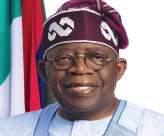
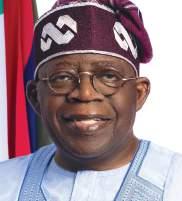
President Bola Tinubu has said he made the decision to hand Acting Inspector-General of Police Olatunji Disu the new role as police chief based on his good track record in the force.
Tinubu charged Disu to be fair and firm in the discharge of his duties.
The president, who assured Disu of his full sup-port in his new role, further tasked him to restore peace and strengthen security across the country.
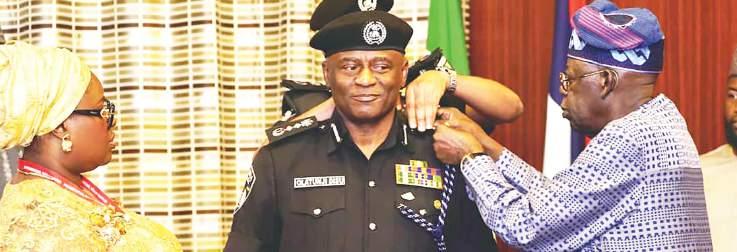
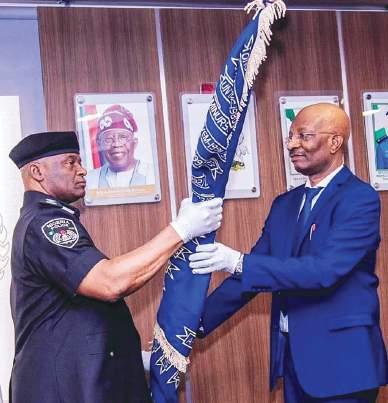
Tinubu spoke yesterday at State House, Abuja, while decorating Disu as Acting Inspector-General of Police, following the retirement of Kayode Egbetokun.
Disu’s appointment is subject to ratification by Nigeria Police Council and Senate.
The police council is due to meet next week.
Tinubu told Disu, “I made this decision for you to assume this responsibility. I know your record. I saw the dedication you exhibited while you were in Lagos when I was“Leadgovernor.firmly but fairly, demand professionalism at every level and ensure that the safety of lives and property remains our highest priority.
“It’s a daunting challenge. I know you can do it. You have my word; you have my full support.”
The president described Disu’s appointment as coming at a critical moment, and urged him to rebuild public confidence in the police’s capacity to do their job in collaboration with other security forces.
Tinubu urged the new police boss to advance the security pillars of his administration’s Renewed Hope Agenda, just as he expressed confidence in his discipline, operational experience, and leadership capacity.
“Nigeria is challenged with banditry, terrorism and other criminal activities. You will be part of the thinking and innovation to overcome them,” Tinubu said, reaffirming his belief that Nigeria would prevail under a committed leadership.
The president also paid tribute to the outgoing Inspector-General of Police, Kayode Egbetokun, who was present at the decoration ceremony with his spouse.
“To the outgoing Inspector-General, we are a grateful nation. Nigeria appreciates your contribution to maintaining law and order,” he said.
He urged Egbetokun to be ready to offer useful advice to his successor and wished him and his family peace, good health and success in their future
endeavours.
“You have not succeeded without a good successor. His success will also be part of your legacy,” Tinubu stated.
The president urged all security stakeholders to work collectively to safeguard life and property.
Present during the decoration were National Security Adviser, Nuhu Ribadu; Chief of Staff to the President, Hon Femi Gbajabiamila; Governor
of Delta State, Sheriff Oborevwori; AIG Hakeem Odumosu (rtd); senior government officials; as well as the parents and family members of the acting IGP.
Speaking with newsmen after being decorated, Disu promised to galvanise the morale and focus of officers of the Nigeria Police to confront the dual threats of banditry and insurgency in the country.
He underscored the importance
of public cooperation in addressing Nigeria’s security challenges, stating that effective policing is impossible without the support of citizens.
The acting inspector-general stressed that close collaboration between the police and the public was critical to overcoming the threats.
He also commended officers of the Nigeria Police for their dedication and resilience, describing them as hardworking and committed to
Disu said, “I’m going to drum it into them that we can never succeed without the cooperation of members of the public. I will mention it to them, most importantly, the country is facing a particular problem now, issue of banditry, insurgency. “I know all police officers around
Continued on page 51
Alleged Medical Negligence: Coroner Begins Inquest into Death of Adichie’s 21-Month-Old Son
Wale Igbintade
The Coroner’s Court sitting at the Yaba Magistrate Court in Lagos has fixed April 14, 2026, for the commencement of a formal inquest into the death of 21-month-old Master Nkanu Nnamdi Esege, son of renowned Nigerian author Chimamanda Ngozi Adichie and her husband, Dr. Ivara Esege. Magistrate Atinuke Adetunji adjourned the matter yesterday, after a preliminary session convened to determine the framework for the inquiry.
The toddler died on January 7, 2026, following medical procedures at Euracare Multi-Specialist Hospital in Lagos.
He had earlier been admitted to Atlantis Hospital for what was described as a worsening but initially mild illness.
While arrangements were reportedly being made to transfer him to Johns Hopkins Hospital in the United States for specialist care, Atlantis referred him to Euracare for pre-flight diagnostic procedures.
According to documents before the court, the procedures included
an echocardiogram, brain MRI, lumbar puncture, insertion of a peripherally inserted central catheter, and intravenous sedation with propofol.
The child, however, died shortly after the interventions.
At the hearing, Prof. Kemi Pinheiro (SAN) announced his appearance for the family.
Adebola Rahman represented the Attorney-General of Lagos State, while Prof. Cheluchi Onyemelukwe of Health Ethics and Law Consulting appeared for Atlantis Hospital. Euracare was also represented.
The Economic and Financial Crimes Commission (EFCC) yesterday told the Lagos State Special Offences Court in Ikeja that the Board of Governors of the Central Bank of Nigeria (CBN) formally approved the takeover of Arik Air Ltd by the Asset Management Corporation of Nigeria (AMCON) following the airline’s alleged severe financial deterioration.
Testifying before Justice Mojisola
Dada, the fourth prosecution witness, Bawa Usman Kaltungo, an Assistant Director with the EFCC, said the anti-graft agency obtained a Certified True Copy (CTC) of the minutes of the CBN Board of Governors’ meeting where the decision to appoint a receiver-manager for Arik Air was taken shortly after the takeover.
According to him, the February 15, 2024 meeting was chaired by then CBN Governor Godwin Emefiele and attended by top of-
ficials, including Deputy Governors Sulaiman A. Barau (Corporate Services), Sarah O. Alade (Economic Policy), Okwu J. Nnanna (Financial System Stability), and Adebayo A. Adelabu (Operations).
Also present were Yunusa Sanusi (Director, Corporate Secretarial), Ahmed Abdullahi (Director of Banking Supervision), Adebayo Aderonke (Senior Manager, Banking Supervision), and AMCON’s former Managing Director, Ahmed Kuru. Kaltungo said the minutes
showed that Kuru briefed the board that Arik Air’s operations had deteriorated significantly and warned that the airline, which accounted for about 60 percent of domestic passenger traffic, could collapse within two weeks if urgent intervention was not undertaken.
Magistrate Adetunji disclosed that the court received an application from the Chief Coroner of Lagos State following a request by the Attorney-General that an inquest be conducted into the circumstances of the child’s death. She noted that the Lagos State Government considered the matter one of public concern.
“The Lagos State Government is also bereaved; that is why the Attorney-General has taken this step. It is not just the family of the deceased that is affected,” she said. The magistrate directed all parties to file their witness statements before the next adjourned date and emphasised that the primary objective of the inquest would be to determine the cause and circumstances of the death. She added that an autopsy is typically the starting point in coroner proceedings.
The EFCC had arraigned former AMCON Managing Director Ahmed Kuru; Kamilu Omokide, a former receiver-manager of Arik Air; Captain Roy Ilegbodu, the airline’s CEO; Union Bank Ltd; Super Bravo Ltd; and Mohammed Abbas Jega.
He added that Kuru disclosed that the airline had paid out cash collaterals to its technical partner, Lufthansa, and allowed it to exit Nigeria, alleging that the owners had effectively abandoned operations. The witness said Kuru also informed the board that discussions with three major creditor banks resulted in a consensus that CBN intervention was necessary.
“For every inquest, the starting point is that there must be an autopsy done to give us a professional report,” she said.
Urging the court to proceed with the substantive hearing, Pinheiro stated that the parents maintain their son’s death was unnatural and occurred during medical intervention.
President of Police Officers’ Wives Association (POWA), Mrs. Olufunmilola Tunji Disu; newly appointed 23rd Inspector-General of Police (IGP), Mr. Olatunji Disu; and President Bola Ahmed Tinubu decorating Mr. Disu with the rank of acting IGP at the
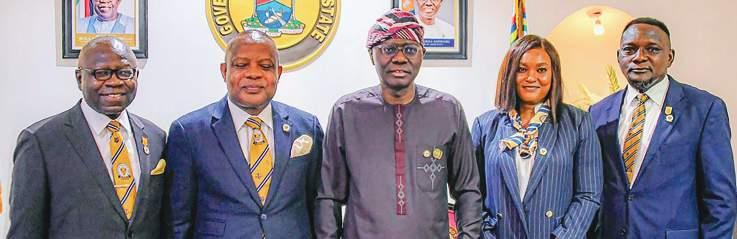
CHARTERED INSTITUTE OF STOCKBROKERS VISITS SANWO-OLU...
L-R: Immediate Past President, Chartered Institute of Stockbrokers (CIS), Mr. Oluwole Ololade Adeosun; President and Chairman of Council, Mr. Oluropo Dada; Governor of Lagos State, Mr. Babajide Sanwo-Olu; CIS First Vice President, Mrs. Fiona Ahmed Ahimie; and a past President, Mr. Oluseyi Abe, during the CIS Council members’ courtesy visit to the Governor at Lagos House, Marina, yesterday
Oil Prices Near Seven-month Highs Ahead of U.S-Iran Talks Today
UK refineries face extinction after key shutdowns 2025 licensing round: Submission of applications ends Friday
Emmanuel Addeh in Abuja
Oil prices were hovering near sevenmonth highs yesterday as the threat of military conflict between the U.S. and Iran that could disrupt supply continued to worry investors, and as talks between the parties are set for Thursday (today).
Nigeria’s benchmark, Brent futures were up 33 cents, or 0.5 per cent, at $71.10 per barrel, while
WTI futures rose 22 cents, or 0.3 per cent, to $65.84.
Brent prices reached their highest since July 31 on Friday, while WTI hit its highest since August 4 on Monday, and both contracts have held near there as the U.S. has positioned military forces in the Middle East to compel Iran to negotiate an end to its nuclear and ballistic missile programme. An extended conflict could
disrupt supplies from Iran, the third-biggest crude producer in the Organisation of the Petroleum Exporting Countries(OPEC), and other countries in the key Middle East producing region.
“This uncertainty means the market will continue to price in a large risk premium and remain sensitive to any fresh developments,” ING commodities strategists said on Wednesday.
U.S. envoys Steve Witkoff and Jared Kushner are slated to meet with an Iranian delegation for a third round of talks on Thursday in Geneva. Iran’s Foreign Minister Abbas Araqchi said on Tuesday that a deal with the U.S. was “within reach, but only if diplomacy is given priority,” CNBC reported.
“(U.S.) President (Donald) Trump has warned that without a deal, there will be ‘very bad consequences’.
Nigeria Missing as Pope Leo Set to Tour Selected African Countries
Pope Leo will visit four countries across Africa from April 13 to 23, the Vatican announced yesterday, with the pontiff making his first major overseas trip in 2026 to the continent where the Catholic Church is growing fastest.
The pope will also make a one-day visit on March 28 to Monaco, the microstate on the French Riviera, and will visit Spain from June 6-12, the Vatican said.
However, skipping the continent’s most populous nation, in Africa, Leo will visit Algeria, Angola, Equatorial Guinea and Cameroon. He is expected to draw large crowds, urge world leaders
to support development on the continent, and highlight efforts at Catholic-Muslim dialogue.
The pastoral visit is in response to “invitations of the respective heads of state and ecclesiastical authorities,” Vatican officials said, adding that “the programme of the journey will be published at a later date.”
Leo, elected in May to succeed the late Pope Francis as head of the 1.4-billion-member Church, has made only one overseas trip so far, visiting Turkey and Lebanon in November and December on a visit originally organised for Francis, a Reuters report said.
Vatican officials and African Church leaders say the upcoming
papal tour in Africa is a sign of the priority the Church places on the continent.
“Pope Leo’s visit will remind the world that Africa matters and the vibrancy of the Church in Africa remains at the heart of a thriving (global) Church,” said Reverend Agbonkhianmeghe Orobator, a Jesuit from Nigeria who led his order’s communities across Africa from 2017-23.
About 20 per cent of the world’s Catholics live on the continent, according to Vatican statistics.
As part of the trip to Spain, Leo is expected to visit the Canary Islands, which has become a major point of entry for migrants trying to get to Europe, the Reuters report
20,000 Osun Pensioners Enroll with OHIS as Union Commends Govt’s N25,000 Monthly Stipend
Yinka Kolawole in Osogbo
The Osun State Secretary of Nigeria Union of Pensioners, Comrade Lawrence Dele Aina, yesterday, posited that well over 20,000 pensioners were enrolled with the state Health Insurance Scheme (OHIS) free of charge.
Speaking with journalists in Osogbo yesterday on the state of Pensioner’s health, Aina also commended Governor Ademola
Adeleke for giving out additional #25,000 to what they are earning which gave them a sort of relief, and reduced the death rate of members.
The Secretary noted that “the amount of 25,000 released to the pensioners assisted them very well, saying before now, there are some pensioners that are getting N350, N500, N750 you know within that reach, it is difficult for our people to go for medical treatment, but when the present government gave us
additional 25,000 to what they are earning it gave us a sort of relief”
He opined that the assistance from the government also reduced the death rate amongst the pensioners in the state.
The State Secretary however commended Governor Ademola Adeleke for what he has done and in addition, thanked the Osun Health Insurance Scheme (OHIS) for putting in good condition the life of the state pensioners.
added.
The last papal trip to Africa was in 2023, when Francis visited Democratic Republic of Congo and South Sudan. Pope Benedict XVI was the last pontiff to visit Angola and Cameroon, in 2009. John Paul II was the last pope to visit Equatorial Guinea, in 1982. Algeria, an overwhelmingly Muslim country with a few thousand Catholics among its population of some 47 million people, has never hosted a papal visit before.
Whether (Iran’s) concessions will meet the U.S.’s ‘zero enrichment’ red line remains to be seen,” Tony Sycamore, IG market analyst, said in a note.
Amid the heightened tensions, Iran and China have accelerated talks to purchase Chinese anti-ship cruise missiles, according to Reuters sources, which could target the U.S. naval forces that have assembled near the Iranian coast.
Anti-ship cruise missiles would enhance Iran’s strike capabilities and threaten the U.S. naval forces, according to experts. Trump will deliver the traditional State of the Union address to Congress on Tuesday evening. Two White House officials, speaking on condition of anonymity, said Trump will discuss his plans for Iran but did not offer details.
While geopolitical tensions have supported prices, the market is also contending with concerns of large inventory gains as global supply is exceeding demand.
According to market sources, the American Petroleum Institute (API) late on Tuesday reported a massive increase in U.S. oil stockpiles of 11.43 million barrels in the week ended February 20.
Also, the UK government has published a call for evidence on the
future of the country’s downstream sector, while the Fuels Industry UK association called for urgent change in Britain’s policy to protect its four remaining refineries from extinction.
The UK’s Department for Energy Security and Net Zero launched a call for evidence, aiming to publish a strategy for the downstream oil sector in the autumn of 2026.
The UK has been left with just four refineries, after two processing sites closed over the past year: the Prax Lindsey refinery in Lincolnshire and the Grangemouth refinery in Scotland.
Despite the critical role they play in the UK’s fuel supply and energy security, “refineries in the UK face challenges including: falling domestic demand; increased international competition from newer competitors in the Middle East, Asia and Africa; ageing infrastructure; high energy costs; and growing costs from carbon emissions that are hard to abate,” the government said.
The call for evidence is “a vital opportunity to meaningfully address the challenges of a sector currently being driven to the brink,” Fuels Industry UK, the representative body for the businesses supplying over 85 per cent of the UK’s transport energy, said.
The Equipment Leasing Registration Authority (ELRA) and Admiralty Maritime Services Limited (AMSL) have signed a partnership aimed at strengthening asset registration, enhancing compliance, and promoting structured financing in Nigeria’s shipping and marine services sector.
This is contained in a statement made available to newsmen in Abuja by the Head, Media and Corporate Communication of Equipment Leasing Registration Authority (ELRA), Adebola Sunday.
Sunday said the collaboration is expected to deepen transparency and reinforce regulatory
oversight, positioning the industry for stronger investor confidence and sustainable growth.
He quoted ELRA Registrar/ CEO, Mr. Donald Wokoma, during the signing ceremony, to have described the agreement as a strategic move aligned with the Authority’s mandate to formalise asset-backed financing nationwide.
“This partnership is a practical step that reinforces our regulatory mandate and drives structured asset financing in the industry. It will strengthen compliance with lease registration standards and deepen transparency across operations,” he said.
Wokoma added that improved
asset registration and documentation would enhance credit security for financiers and attract long-term capital inflows.
In his remarks, AMSL Managing Director, Real Admiral Mushsin Abba, said the partnership aligns the company’s operations and financing processes with recognised regulatory frameworks, strengthening corporate governance and market positioning.
“This partnership strengthens our compliance framework and positions AMSL as a transparent, investor-ready service provider. It reinforces our commitment to operational excellence and structured growth,” he stated.
Emmanuel Addeh in Abuja
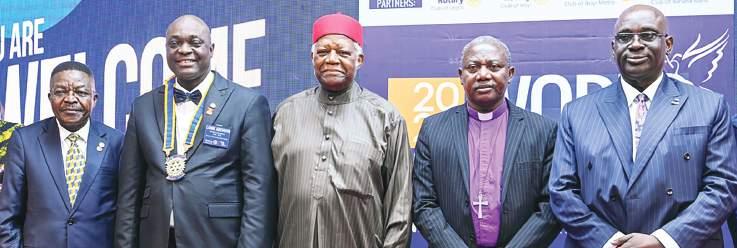
ROTARY INTERNATIONAL DISTRICT 9112 2026 WORLD UNDERSTANDING AND PEACE DAY...
L-R: Panelist, Major General Abiodun Role (Rtd); District Governor, Rotary International District 9112, Rotarian Lanre Adedoyin; Chairman of the Occasion, Major General Ike Nwachukwu (Rtd), CFR; Keynote Speaker, Bishop Prof. Dapo Asaju; and Chairman, 2026 World Understanding and Peace Day, Rotarian Joe Akhigbe, during the Rotary International District 9112 2026 World Understanding and Peace Day held in Lagos, yesterday
US Sentences Ex-NNPC General
A former General Manager of the upstream division of the Nigerian National Petroleum Corporation (NNPC), as it then was, Paulinus Iheanacho Okoronkwo, has been sentenced to 87 months in a US federal prison for receiving a $2.1 million bribe while serving as an officer of the national oil company.
Okoronkwo, a Los Angeles-area lawyer, according to a statement from the US Attorney General’s Office, Central District of California, was sentenced in connection with negotiating favorable drilling rights for a subsidiary of a Chinese state-owned oil company.
Okoronkwo, 58, a.k.a. ‘Pollie’ of Rancho Cucamonga, was sentenced by United States District Judge, John Walter, who also ordered him to pay $923,824 in restitution to the Internal Revenue Service (IRS) and ordered that Okoronkwo forfeit $1,039,997, the net proceeds of the sale of a home involved in the laundering of the bribe money, the statement added.
At the conclusion of a four-day trial, it said a jury in August 2025 found Okoronkwo guilty of three counts of transactional money laundering, one count of tax evasion, and one count of obstruction of justice.
DAMA
“Okoronkwo, who is a dual citizen of the United States and Nigeria and who practiced immigration, family, and personal injury law out of an office in Koreatown, was a foreign official who served as the general manager of the upstream division of the Nigerian National Petroleum Corp. (NNPC).
“The NNPC is a state-owned company through which Nigeria’s government developed that nation’s fossil fuel and natural gas reserves, including through partnerships with
foreign oil companies. In this role, Okoronkwo owed a fiduciary duty to the Nigerian government and was a public official,” it emphasised.
According to the office of the Attorney General, in October 2015, Addax Petroleum, a Switzerland-based subsidiary of Sinopec, a Chinese state-owned petroleum, gas, and petrochemical conglomerate, wired a payment of $2,105,263 to an Interest on Lawyers’ Trust Account (IOLTA) in the name of Okoronkwo’s Los
Angeles law firm.
It noted that this was purportedly for his work as a consultant who negotiated and completed a settlement agreement with the NNPC with respect to Addax’s drilling rights in Nigeria. According to the indictment, Addax calculated that it stood to lose billions of dollars if its favourable drilling rights were not secured.
“The engagement letter that Addax signed that month with Okoronkwo’s law office – with a fake address in
Lagos, Nigeria – was a ruse intended to conceal the fact that its payment to Okoronkwo was a bribe in exchange for his influence in securing more favourable financial terms relating to its crude oil drilling in Nigeria,” the US explained.
To conceal the illegal bribery scheme, Addax, it said, falsely characterised the $2.1 million payment as a payment for legal services, lied to an auditor about the payment, and fired executives who questioned the payment’s propriety.
Tinubu: 13,500 Centres to Benefit from N98bn Primary Healthcare Funds Nationwide
Olawale Ajimotokan in Abuja
President Bola Tinubu has revealed the number of health facilities that will benefit from the over N98 billion funds injected into the Primary Healthcare in 2025 is expected to rise to 13,500 across the country.
Tinubu, who described the health sector as fundamental to national productivity, security, economic growth and human dignity, asserted this yesterday
at the All Progressives Congress (APC) National Health Convention and Roundtable 1.0 in Abuja.
He was represented by the Secretary to the Government of the Federation, Senator George Akume.
Noting that a country cannot be prosperous if its citizens were unhealthy, Tinubu said the operational expenses of over 8,300 primary healthcare centres (PHCs) across the country were facilitated
by the funds released through the Basic Health Care Provision Fund (BHCPF).
He said the federal government disbursed the humongous funds last year to fast-track primary healthcare delivery across Nigeria, marking it one of the largest single-year investments in grassroots health services in recent times.
He equally revealed that the funding framework was being expanded to accommodate an
additional 5,212 facilities, stressing the move would deepen access to quality healthcare, particularly in rural and underserved communities.
He emphasized the disbursement was part of the administration’s broader push to reposition the health sector as a cornerstone of national development, adding that the financial injection had already enabled the upgrading of 2,565 centres while another 1,456 PHCs were currently undergoing
DSTI Spotlight AI, Digital Assets as Tools for National Devt
Emmanuel Addeh in Abuja
Stakeholders in Nigeria’s emerging technology ecosystem have converged on Abuja to examine the growing relevance of blockchain, artificial intelligence and digital assets in shaping Nigeria’s economic future.
At a press conference in Abuja organised by DAMA Academy in collaboration with the Department of Science, Technology and Innovation (DSTI), technology advocates, the digital asset proponents also called for regulatory clarity, institutional collaboration and deliberate national
positioning.
According to them, these digital assets are increasingly redefining global finance, healthcare and governance structures. Besides, speakers examined the strategic implications of the fastevolving digital asset landscape and highlighted Body Scan AI as a case study in technological convergence.
Delivering the keynote address, the Chief Executive Officer of DAMA Academy Abuja, Nwankwo Ozioma, said the conversation around blockchain and AI must move beyond rhetoric to structured
participation.
According to him, the global economy is already transitioning into a decentralised and intelligent framework, driven by technologies that enable transactions, programmable value and predictive analytics. He referenced the rise of decentralised finance following the emergence of Bitcoin, enterprise blockchain deployment by firms such as IBM and advances in artificial intelligence led by organisations including OpenAI.
Nwankwo argued that blockchain introduces transparency without intermediaries, reducing opportuni-
ties for corruption and inefficiency, while digital assets enable borderless financial participation. Artificial intelligence, he added, enhances automation and improves decisionmaking in sectors ranging from finance to healthcare.
He warned that Nigeria risks remaining a consumer of imported innovation if it fails to invest in domestic capacity and regulatory frameworks that support responsible experimentation.
Using Body Scan AI as a practical example, he explained that the project integrates AI-powered health diagnostics with blockchain-
backed data security and tokenised incentives through the SCANAI token. He said such convergence could enable secure medical record management, transparent payment systems and community-level financial participation within a decentralised health ecosystem. However, he cautioned against blind speculation, insisting that innovation must be matched with ethical safeguards. He advocated clear regulation, consumer education, transparent token structures and strong anti-fraud mechanisms to prevent abuse within the digital asset space.
renovation.
The President said the upgraded facilities now provided 24-hour services, staffed with trained health workers, and equipped with essential medicines, basic medical equipment, as well as stable power and water supply.
Tinubu said: “We have strengthened the Basic Health Care Provision Fund and consistently disbursed the quarterly allocation to primary health care centres, with over N98billion disbursed to support operational expenses for over 8,300 Primary Health Care facilities last year.
“Also, we are expanding this very critical sustainable domestic financing mechanism to an additional 5,212 primary health care centres to reach a total of over 13,500 facilities. We have expanded health insurance coverage and provided it to over 10 million vulnerable individuals.
“In 2023, I tasked the Minister of Health with retraining 120,000 primary health care workers within 4 years. This is to empower them to deliver quality health care services to our people and also to enable them compete with their counterparts across the world.
“In just two years, over 78,000 frontline health workers have been trained. These include doctors, nurses, midwives, CHEWs, and JCHEWs”.
Emmanuel Addeh in Abuja
Paulinus Okoronkwo
2027: Enshrine Electronic Transmission in Law Now, Agbakoba Tells N’Assembly
Says supreme court ruling shows IReV lacks legal force Cites June 12 as template for 2027 electoral reform
Wale Igbintade
A former President of the Nigerian Bar Association (NBA), Dr. Olisa Agbakoba (SAN), has urged the National Assembly to urgently amend the Electoral Act to make electronic transmission of election results mandatory before the 2027 general elections.
Agbakoba warned that failure to give electronic transmission a clear statutory backing would prolong Nigeria’s cycle of disputed elections and protracted post-election litigation.
Real-time electronic transmission backed by statutory authority, he said, would significantly reduce disputes by creating verifiable digital records that are immediately accessible.
In a statement titled “Ending the Cycle – Why Electronic Transmission Should Be Enshrined in the Electoral Act Before 2027,” issued yesterday,
he argued that Nigeria’s electoral framework remains burdened by legal uncertainty because key technological innovations lack express provisions in the law.
According to him, although the Electoral Act is amended before almost every general election, lawmakers have repeatedly failed to address what he described as a “fundamental defect”, the absence of clear and binding legal authority for real-time electronic transmission of results.
Agbakoba said the controversy that followed the 2023 general election exposed a major gap in the law.
While the Independent National Electoral Commission (INEC) deployed its Result Viewing (IReV) portal to upload polling unit results, the Supreme Court later ruled that electronic transmission was not expressly provided for in the Electoral Act 2022.
He noted that the apex court held that since electronic transmission was contained only in INEC’s Regulations and Guidelines, and not in the substantive provisions of the Act, it lacked binding legal force.
The court further ruled that the IReV portal was created primarily for public viewing and could not replace the legally prescribed collation process or automatically serve as admissible evidence in election petitions.
“The message was unmistakable. Without explicit statutory provision, electronic transmission remains optional and legally inconsequential, no matter how transparent or efficient it may be,” Agbakoba said.
He warned that the current legal position places an almost insurmountable evidentiary burden on petitioners challenging election results.
Citing the observations of the late Justice Pat Acholonu in Buhari v.
Obasanjo (2005), Agbakoba recalled that the jurist had questioned whether any petitioner could successfully challenge a presidential election result under Nigeria’s legal framework.
The case involved former President Muhammadu Buhari and ex-President Olusegun Obasanjo.
Justice Acholonu had observed that a petitioner would need to call hundreds of thousands of witnesses from polling units across the country to prove irregularities, a task he described as practically impossible within the strict timelines prescribed by law.
Agbakoba said that prediction has “proven tragically accurate,” noting that no presidential election petition has succeeded since Nigeria’s return to democratic rule in 1999.
With over 176,000 polling units nationwide, he argued, the manual method of proving discrepancies unit by unit makes the burden of
proof nearly unattainable.
Drawing a historical comparison, Agbakoba referenced the June 12, 1993 presidential election, widely regarded as one of Nigeria’s most credible polls.
Conducted under the Option A4 system, the election allowed open counting and immediate verification of results at polling units in the presence of voters and party agents.
Despite being manual, the process generated widespread public confidence due to its transparency, he said.
The election, won by the late Moshood Abiola, was later annulled by the military government but remains a benchmark for electoral credibility in Nigeria’s democratic history.
“If manual transparency could achieve such credibility in 1993,” Agbakoba argued, “imagine the transformative impact of real-time
electronic transmission in our digital age. It would combine immediate verification with secure digital records, delivering transparency with greater efficiency and verifiability.” He described the ongoing legislative review process as a “monumental opportunity” for the National Assembly to correct the defect in the Electoral Act ahead of 2027.
Uzoka-Anite: Investor Trust in Institutions
Key to Tinubu’s $1trn Economy Goal
BPE to commercialise two NIPPs, contribute over N189bn revenue in 2026 Partners AGF to resolve long-standing litigation, arbitration matters
The Minister of State for Finance, Dr. Doris Uzoka-Anite, said President Bola Tinubu’s $1 trillion economy ambition will be driven not by government action alone, but by investor confidence in Nigeria’s institutions and by entrepreneurs empowered with access to capital and markets.
She also stated that the attainment of the targeted milestone was dependent on the skills of young Nigerians who find opportunity rather than frustration, and the informed engagement of citizens who understand what their country is trying to do and why.
She spoke yesterday at the 2025 annual general meeting of the Finance Correspondents Association of Nigeria (FICAN), Abuja with the theme, “Actualising President Bola Ahmed Tinubu’s $1 Trillion Economy Agenda.”
The minister, who was represented by the Assistant Director, Information and Public Relations, Federal Ministry of Finance, Mrs. Uloma Nneka Amadi, argued that Tinubu’s $1 trillion economy agenda would not be built through government action alone.
“It will be built through the confidence of investors who trust our institutions, the productivity of entrepreneurs who can access capital and markets, the skills of young Nigerians who find opportunity rather than frustration, and the informed engagement of citizens who understand what their country is trying to do and why,” she said.
However, she noted that the theme of the event was not just a slogan, but a specific, measurable destination.
Uzoka-Anite said, “Nigeria’s GDP currently sits at approximately $375 billion. To reach $1 trillion requires
sustained GDP growth of between 10 and 12 per cent annually over the coming decade.
“That is an ambitious target, and this administration is not shy about saying so. Ambitious targets are what move nations. What I want to share with you this morning is not a list of aspirations.
“It is an account of what we have already done, what we are building, and why the foundation we are laying is sound enough to carry that $1 trillion ambition,” she observed, explaining that when the administration took office in 2023, Nigeria’s economic fundamentals were structurally distorted.
“The fuel subsidy was consuming over N5 trillion annually, money that could not be directed toward roads, schools, or hospitals.
“Our foreign exchange market operated through a regime of multiple windows that rewarded rent-seeking over genuine investment.
“Investors could not trust the signals our market was sending. The President made two decisions in rapid succession that few considered politically survivable: the removal of the fuel subsidy and the unification of the exchange rate.
“Both decisions imposed shortterm pain. Neither decision has been reversed. Today, those reforms are being vindicated by the data.
“In January 2026, S&P Global Ratings revised Nigeria’s outlook to positive, affirming our B-/B credit ratings and citing measurable improvements across our external, fiscal, monetary, and economic trajectory. That kind of third-party validation is not given lightly.”
The minister disclosed that Nigeria currently imports approximately 70 per cent of the raw materials used to produce industrial goods, noting that it signals that, “we are not controlling the long-run cost structure of our own economy.”
ORGANISED PRIVATE SECTOR, ANALYSTS HAIL
The Monetary Policy Committee (MPC) of the apex bank had voted to reduce MPR, the benchmark interest rate, to 26.5 per cent, from 27 per cent.
Briefing journalists after the twoday meeting of the committee in Abuja, CBN Governor, Mr. Olayemi Cardoso, said the decision to cut interest rate was premised on a balanced evaluation of risks to the inflation outlook, which suggested that the ongoing disinflation trajectory would continue.
However, analysts, who spoke in separate interviews with THISDAY, expressed worry that despite the recent interest rate cut, the prevailing interest rate environment remained restrictive for the real sector, limiting access to affordable credit and dampening expansion plans.
President, Abuja Chamber of
Commerce and Industry (ACCI), Chief Emeka Obegolu, described the reduction as “cautiously optimistic step toward easing financial pressures on businesses and supporting economic recovery”. Obegolu said the cut signalled growing confidence in Nigeria’s disinflation trajectory and macroeconomic stabilisation.
He said the adjustment of the asymmetric corridor around the MPR was a technical but important reform aimed at improving interbank market efficiency and strengthening policy effectiveness.
Obegolu said the chamber anticipated that the policy mix will reduce financing costs and improve credit availability to the real sector, support private sector expansion and job creation, sustain exchange rate stability and investor confidence, as well as encourage
On the international front, she recalled that Nigeria was removed from the Financial Action Task Force (FATF) grey list last year, a recognition that the country had strengthened its anti-money laundering and counterterrorism financing frameworks to global standards.
“This matters because it directly reduces the compliance costs foreign investors face when engaging with Nigerian institutions. Capital flows more freely to countries that international regulators trust,” she added.
She also disclosed that the country had submitted Nigeria’s ECOWAS Tariff Offer to the AfCFTA Secretariat, establishing zero duties on 90 per cent of goods traded within the continent.
In its presentation, the Bureau of Public Enterprises (BPE), has disclosed that it is working closely with the Office of the Attorney General of the Federation (AGF) in resolving
long-standing litigation and arbitration matters.
The privatisation agency restated its commitment to repositioning public enterprises as primary engines of productivity and value-creation to achieve Tinubu’s vision of a $1 trillion economy.
BPE Director General, Ayodeji Gbeleyi, who was represented at the FICAN AGM by the Director, Industries and Services, Dr. Toibudeen Oduniyi, stated that Nigeria was currently undergoing one of the most transformative economic periods in its history.
The BPE, he pointed out, has an approved work plan for 2026, comprising 15 strategic projects with projected revenue of N189.1 billion to the national treasury.
According to him, these projections reflect the agency’s deliberate effort to contribute meaningfully to fiscal consolidation, reduce reliance on debt financing and support capital
expenditure priorities of government. He said the 2026 portfolio includes the proposed commercialisation of two from the 10 National Integrated Power Plants (NIPPs), public listing of shares of a Disco on the Nigerian Exchange Limited (NGX), concession of Oyan Dam, and assets optimisation initiatives in the oil and gas sector.
“Beyond revenue, these transactions are structured to enhance operational efficiency, unlock stranded value, attract domestic and foreign investments, deepen the capital market and stimulate job creation.
“In addition, the Bureau continues to drive other reform initiatives such as the Distribution Sector Recovery Programme (DISREP) towards bridging the country’s metering gap and strengthen distribution network infrastructure, and the development and upgrading of strategic infrastructure through Public-Private Partnership (PPP).
‘CAUTIOUS’ MPR REDUCTION, URGE FG TO DE-RISK BUSINESS CLIMATE
prudent fiscal liquidity management and transparency.
He told THISDAY, “While commending the CBN for its balanced approach, ACCI urges continued coordination between monetary and fiscal authorities to ensure that easing financial conditions translate into real sector growth.
“The chamber also calls for targeted credit interventions, infrastructure improvements, and regulatory reforms that lower the cost of doing business.”
The ACCI president reaffirmed the chamber’s commitment to working with policymakers and stakeholders to ensure that the evolving monetary environment translated into tangible benefits for businesses, investors, and households across the Federal Capital Territory (FCT) and the
country, at large.
Director-General, Lagos Chamber of Commerce and Industry (LCCI), Dr. Chinyere Almona, praised the central bank’s deviation from aggressive monetary tightening towards a stabilisation phase anchored on disinflation, exchange rate convergence, and improving supply-side conditions.
Almona stated that the shift was a “cautious, positive step in the right direction”.
The LCCI emphasised the need to continue to focus on addressing impediments in the business environment in order to attract the necessary foreign direct investment into critical sectors, such as renewable energy, transport logistics, agro-processing, and oil and gas.
She stated that while retaining other monetary parameters sug-
gested that liquidity conditions remained restrictive, the rate reduction was a critical confidence signal to the OPS, as it established a pathway towards a gradual reduction in the cost of capital.
Almona added that for domestic and foreign investors, the MPC decision reinforced Nigeria’s transition from reform-induced adjustment to stabilisation-driven expansion.
Almona told THISDAY, “Beyond this action, we expect to see improved policy predictability, strengthened real return expectations, and support for medium-term investment planning, particularly in manufacturing, agro-processing, local drug production, and exportoriented industries.
“We must sustain our efforts to
Agbakoba
Ndubuisi Francis and James Emejo in Abuja
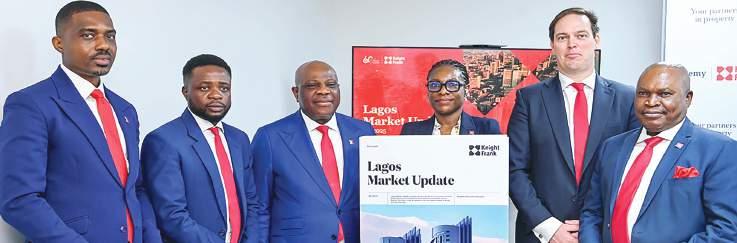
UNVEILING OF KNIGHT FRANK’S LAGOS MARKET UPDATE H2 2025...
L-R: Head, Marketing and Corporate Communications, Knight Frank Nigeria, Mr. Lanre Sonubi; Lead Research Analyst, Knight Frank Nigeria, Mr. Daniel Fabi; Senior Partner and Chief Executive Officer, Knight Frank Nigeria, Mr. Frank Okosun; Head, Human Resources and Administration, Mrs. Toyin Lasaki; Chairman and Managing Director, Knight Frank Africa and Middle East, Mr. James Lewis; and Partner and Head, Valuation and Advisory, Knight Frank Nigeria, Mr. Sunny Akpodiogaga, during the unveiling of Knight Frank’s Lagos Market Update H2 2025 at a media briefing in Lagos, yesterday
Tinubu Urges Senate to Tinker with 1999 Constitution to Accommodate State Police
Raises fresh alarm over terrorism, banditry Akpabio vows no executive bill will die in red chamber
President Bola Tinubu has charged Senate to begin the process of amending the 1999 Constitution to make room for the establishment of state police.
Tinubu said the country must urgently restructure its security architecture to confront terrorism, banditry, and insurgency.
Speaking yesterday night at an
interfaith breaking of fast with the leadership and members of Senate at State House, Abuja, the president said the time had come for the legislators to “start thinking” about embedding state policing in the constitution to enable governments at subnational levels better secure their territories.
He said, “Nigeria is extremely challenged, we are facing terrorism, banditry, insurgency, but you never failed to make a right response to
these calls.
“What I will ask for tonight is for you to start thinking how best to amend the constitution to incorporate the state police for us to secure our country, take over our forests from marauders, free our children from fear.”
Few days ago, at an interfaith breaking of fast with governors at State House, Tinubu had declared that state police “can’t wait” and
“will not be postponed”, urging preparations for a necessary shift in the country’s security architecture.
At Wednesday’s dinner with senators, the president framed the proposed reform as a constitutional obligation anchored on unity and shared responsibility.
According to him, ‘What you have faced in the challenging period of this country, the terrorism and banditry, is causing us havoc and we should
Benue APC Stakeholders Urge Alia to Reconcile with Akume, Fault Shettima’s Counsel
Concerned stakeholders of the All Progressives Congress (APC) in Benue State have called on Governor Hyacinth Alia to demonstrate humility and political maturity by reconciling with the Secretary to the Government of the Federation (SGF), Senator George Akume, warning that any sustained rift could imperil the party’s cohesion ahead of the 2027 general elections.
In a strongly worded statement issued in Abuja on Tuesday, the group expressed “deep concern” over what it described as “revisionist narratives” surrounding the political evolution of the APC in Benue State and the circumstances that produced Governor Alia as the party’s flag bearer in 2023.
The stakeholders insisted that Senator Akume, a former governor and immediate past Minister of Special Duties,“ spearheaded the formation, consolidation and electoral victories of the APC in Benue,” adding that he played a central role in rallying party structures, mobilising grassroots support, and facilitating consensus that eventually led to Alia’s emergence as candidate.
“History must not be distorted for political convenience; without Senator Akume’s leadership, sacrifice, and political capital, the APC would not have recorded the sweeping victory it achieved in Benue State in 2023,” they stated.
In their statement signed by the duo of Mr. Tivlumun Terseer and Comrade John Terngu who are both President and Secretary, respectively, the group also reacted to recent com-
ments attributed to Vice President Kashim Shettima, which they claimed downplayed Akume’s pivotal role in the state’s APC structure.
While reaffirming their loyalty to the presidency and to Bola Ahmed Tinubu, the stakeholders described the Vice President’s position as “misinformed and detached from the political realities on ground in Benue.”
“It is on record that Senator Akume not only midwifed the APC’s structure in Benue but led reconciliation efforts after internal crises, funded mobilisation activities, and deployed his goodwill across senatorial districts to ensure victory at the polls,” they stated.
Drawing parallels with political developments in other states, the stakeholders cited how differences between governors and political leaders were resolved through dialogue and mutual respect rather than public posturing.
In Rivers State, they noted, tensions between former Governor Nyesom Wike and his successor, Siminalayi Fubara, eventually required highlevel interventions to prevent a total breakdown of governance and party structure.
“The lesson from Rivers,” they argued, “is that unresolved political ego can snowball into institutional crisis.
“Similarly, in Lagos State, the long-standing relationship between President Tinubu and successive governors has been anchored on consultation, loyalty, and acknowledgment of political leadership.
“From Babatunde Fashola to Akinwunmi Ambode and Babajide Sanwo-Olu, the stakeholders said the continuity of progressive governance in Lagos has been sustained by respect for party hierarchy and structures.
“Political mentorship and succession are delicate processes,” the Benue APC group stated. “Where governors have thrived, it is often because they recognised and respected the structures and leaders that brought them to power.”
The stakeholders warned that any attempt to marginalise Senator Akume or diminish his influence within the Benue APC could fracture the party ahead of the 2027 elections, when President Tinubu is expected to seek re-election.
“As the SGF and one of the highestranking political office holders from the North-Central, Senator Akume’s stature is not merely personal—it is institutional. Undermining him weakens the APC’s bargaining strength in Benue and the wider North-Central zone,” the statement added.
They urged Governor Alia to adopt a conciliatory tone and approach, emphasising that humility in leadership is not a sign of weakness but of strategic wisdom.
“No governor succeeds in isolation; the 2023 victory was a collective effort; to exceed that performance in 2027, Benue APC must remain united under tested leadership,” they said.
The group concluded by calling on party faithful across the 23 local government areas of the state to rally around Senator Akume as the political
leader of the APC in Benue, stressing that a divided house would only embolden opposition forces.
“With 2027 on the horizon, this is the time for consolidation, not fragmentation; respect for party elders, unity of purpose, and strategic alignment with the presidency are indispensable if Benue is to remain a stronghold of the APC,” the stakeholders declared.
The group equally dropped a caution warning to “those feasting on the huge allocations to Benue State to deploy decency in dealing with dire political situations in Benue State.”
pull together, unite in a way that our forefathers contemplated to bring about a constitutional democracy and pull us together. They didn’t say we should fight.”
Tinubu expressed deep appreciation to the lawmakers for supporting bold and necessary economic reforms.
“I have a lot of credit for bold reforms. Without your collaborations, without your inspirations, those reforms are not possible. We are reformists together,” he said.
The president defended the removal of petrol subsidy and foreign exchange reforms, describing them as steps taken to halt “monumental corruption.”
He stated, “What we gave up and what we stopped is a monumental corruption in subsidy. We gave it up. We don’t want to participate in monumental corruption, in arbitrage, foreignTinubuexchange.” stressed that the reforms had laid the foundation for economic stability.
He said, “You don’t have to chase me for dollars. In the past, you could see what Nigeria is today. You should be proud… What we are enjoying is stable economy, prosperity beckoning on us. We just need to work hard for it.”
On criticisms from political opponents, the president dismissed
claims that he was stifling opposition voices, saying, “When they accused me of killing opposition, I didn’t have a gun… I can’t blame anybody from jumping out of a sinking ship if they did”.
He described the coincidence of Ramadan and Lent as symbolic of national unity and called for continued harmony between the executive and legislature.
“We are committed to Nigerian entity succeeding. We are commit- ted to make law for the welfare, prosperity of the country. I think we are committed together to govern together,” he said.
President of the Senate, Senator Godswill Akpabio, assured the president of the red chamber’s loyalty and continued cooperation. Akpabio said, “We have nothing to give to you than to assure you of our loyalty. I’m sure you have noticed that nothing you have ever sent to us died in first reading, and it will never happen.”
He said the senate painstakingly reviews executive proposals to ensure they served national interest, even when they initially attracted criticism.
He said, “We sit down to painstakingly go through everything that comes before us, and then at the end, we see that it is in the interest of Nigerians, even when the social media is not seeing it.”
Seyi Tinubu Rolls Out Nationwide Fasting Relief Packages across Nigeria
Sunday Ehigiator
The Grand Patron of the City Boy movement, Seyi Tinubu, has commenced the nationwide distribution of Fasting Relief Packages across the 36 states of the federation in observance of the holy seasons of Ramadan and Lent.
The initiative, under the City Boy platform, is aimed at supporting citizens during the sacred period of prayer, fasting and reflection observed by Muslims and Christians across the country.
Organisers say the outreach
reflects a commitment to fostering unity, shared responsibility and national cohesion across religious and regional divides.
Speaking on the rollout, a representative of the Grand Patron, Oluwatosin Shoga, described the programme as a practical expression of service-oriented leadership.
“The seasons of Ramadan and Lent remind us of the values that bind us as a nation: sacrifice, generosity and compassion. Through this nationwide outreach, we are reinforcing our belief that progress is strongest when communities stand together in mutual
support,” Shoga said.
According to the organisers, the Fasting Relief Packages are being distributed through coordinated efforts by state chapters to ensure effective grassroots reach.
The programme covers both urban and rural communities, with volunteers overseeing distribution to vulnerable households and religious communities observing the fasting seasons.
The initiative, they said, aligns with broader advocacy efforts focused on youth engagement, community development and inclusive national growth.
Deji Elumoye in Abuja
AFRICA WOMEN OF IMPACT AWARD 2026
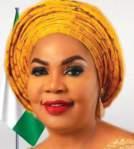
ABOYADE FUNKE (SAN) Lawyer, Principal Partner, Aboyade & Co
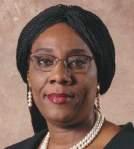
UKEJE, NNENNA Politician, House of Representatives.
TILAHUN ALEMU, BETHLEHEM Entrepreneur, SoleRebels
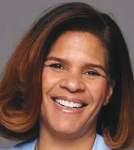
ZILLE, HELEN Politician, Activist, Democratic Alliance (DA).
NIGERIA
SOUTH AFRICA
NIGERIA
NIGERIA
SOUTH AFRICA
NIGERIA
NIGERIA
NIGERIA
SOUTH AFRICA
NIGERIA
NIGERIA
SOUTH AFRICA
ETHIOPIA
NIGERIA
SOUTH AFRICA
SOUTH
NIGERIA
NIGER
Nigeria’s Electoral Act 2026 should be made to work for the people despite its shortcomings, writes MONDAY PHILIPS EKPE
LEGACIES AND VISIONARIES
President Tinubu has the creative foresight in identifying, grooming, and deploying talents into the contendslandscape,BAMIDELE ATOYEBI
CRISIS OF JUDICIAL APPOINTMENTS
It’s time to rid the process of corruption, argues CHIDI ANSELM ODINKALU
SO MUCH FOR ELECTORAL FIDELITY
“What is crucial is the fact that you manage the process to the extent there will be no confusion, no disenfranchisement of Nigerians, and that we are all going to see democracy flourish. No matter how good the system is, it’s managed by the people, promoted by the people, and the result is finalised by the people. In fact, for final results, you are not going to be talking to the computer; you are going to be talking to human beings who will announce the final results…. And when you look at the crux of various arguments, maybe Nigerians should question our broadband capability. How technically are we today? How technically will we be tomorrow to answer the call of either real-time or not?
“It’s just the arithmetic accuracy that is to enter into Form EC8A. It’s the manual, essentially. The transmission of that manual result is what we’re looking at. And we need to avoid glitches — I’m glad you did — interference, unnecessary hacking in this age of computer inquisitiveness. Nigeria will be there. We will flourish. We will continue to nurture this democracy for the fulfilment of our dream for the prosperity and stability of our country.”
Last week when President Bola Tinubu signed the 2026 Electoral bill into law, he was at his relaxed, confident, and hopeful best. Maybe I shouldn’t add carefree. Or less-sensitive. Or triumphant. The weeks leading to that presidential endorsement were animated by the anxiety of a chunk of the electorate about what the final piece of the legislation the National Assembly would take to Aso Villa could look like. For months, the federal legislators were said to have travelled across the country, engaged with relevant stakeholders, carried along the civil society and done adequate researches on the subject of how to make subsequent elections freer and fairer than the previous ones.
Those processes did gulp resources of all sorts. That stark reality wouldn’t have even mattered if the end results could lead to the integrity of polls; if the citizens could truly see themselves as useful, respected factors in the overall democratic project. Better still, if voting – that indispensable ingredient of democracy – is worth the time and stress in Nigeria. This last premise in particular shouldn’t be taken for granted or trivialised. Unfortunately, our politicians have carried on as if the Nigerian voter is an inconsequential quantity.
The Nigerian people didn’t need any vote or referendum to know that the citizens in support of the now proverbial “real time” electronic transmission of election results far outnumbered
those who did not. But in democracy, popular opinions don’t always carry the day. Actually, our present dilemma is accentuated by the fact that what majority of the people think hardly affects the considerations and decisions of their political representatives. To worsen the matters, as exemplified by this case, the actions of the law makers can change drastically from hope to disillusionment.
Sometimes perceived as the more people-sensitive of the two-chamber assembly in this 10th National Assembly, the House of Representatives had appeared to go with the louder calls to fully embrace technology for the collation of election outcomes. Not surprisingly, the Senate thought and acted otherwise. Harmonising the opposing stands of the red and green chambers is normal and actually adds to the grace of the legislative enterprise. Exactly how the positions of the senators and representatives managed to become fused within hours has left the citizenry heartbroken and confused. But certainly not unexpected.
It’s doubtful if the concerns about the collation procedures that enabled disputable results in the past were on President Tinubu’s mind when he accented to the over-dramatised bill. What was clear was the happiness he felt at the sight of the Chairman of the assembly, Senator Godswill Akpabio, and his crew that day. He declared that he had keenly followed the deliberations and was exultant over their resolutions. The meat of this electoral law, don’t forget, is that the digital transfer of the scores written in the almighty Form EC8A is upheld alongside its age-long manual alternative, the same combination that produced the glitch-induced results of the last presidential poll. At the stroke of Tinubu’s pen, someone said that Nigeria had just legislated glitches.
Call that cynicism if you will. Or
waive it aside as an opposition or enemy whining. I’m not about to believe that simply putting our faith in technology would deliver credible voting. Even the big tech companies which literally own the technology and craft upon which contemporary information and communication are built are not free from occasional dysfunctionalities. So, those opposed to the speedy digitaltechnology based, on-the-spot transfer of election results are not without meaningful arguments. It’s painful, though, that yet another opportunity to reduce the increasing voter indifference, which is threatening whatever gains we’ve mustered in our difficult democratic journey, is being squandered.
The anger over Tinubu’s uncommon swiftness in signing that day hasn’t abated but the nation now has a new enabling electoral law in place. The president’s ink has dried on one of Nigeria’s most controversial democratic statutes. And Nigerians are expected to take it with spartan fortitude and be of good behaviour. Critics of government and the ruling party point to the disturbing fortunes of last week’s council elections in the Federal Capital Territory (FCT) as direct consequences of the poorlyreceived law. Most of the people rejoicing are painted as the potential exploiters and beneficiaries of the loopholes contained therein.
The country is not a stranger to the pursuit of electoral probity, we shouldn’t forget. Different devices and strategies have been adopted at various times to make votes count but since we haven’t had any widely accepted election results in the mould of the famous June 12 presidential poll, it may be hard to fully justify these perennial experiments. Whatever happens, the battle to safeguard our attempts to move on from perpetual mediocrity and self-sabotage into the league of democratically progressive countries mustn’t stop.
As vulnerable as the Nigerian voter is at the moment, he shouldn’t be further sentenced to periodic abuses and irrelevance. The boldness with which the Independent National Electoral Commission (INEC) Chairman, Prof. Joash Amupitan, has denounced his organisation’s shortcomings in the recent electoral exercises indicates the possibility of happier times ahead. Some optimism in the midst of overwhelming Shenanigans won’t hurt.
Dr Ekpe is a member of THISDAY Editorial Board
X: @monday_ekpe2
President Tinubu has the creative foresight in identifying, grooming, and deploying talents into the landscape, contends BAMIDELE ATOYEBI
LEGACIES AND VISIONARIES
In the silent halls of history, there is a recurring whisper that defines the difference between a moment and a movement. It is the concept of institutionalized legacy. While many chase the fleeting glitter of gold, the truly great, the prophets, the sages, and the visionary leaders have always chased something more enduring, the hearts and minds of the next generation.
A home illustration of this may be apt here. A leader who fails to groom others through mentorship is like a singer who dies with his voice and compositions and therefore leaves no legacies; while a drummer dies leaving his drum for generations to use in doling out more beats. Those illustrations better convey leadership with legacy and leadership without it. It is understood that a leader without a successor is a successful failure, and they built their lives around the divine blueprint of mentorship.
The foundation of this principle begins with the "Generational Command" of Abraham. God’s confidence in him was rooted not just in his personal faith, but in his capacity for continuity. By training his household and commanding his children in the way of the Lord, Abraham institutionalized his walk with God. He didn't just build altars; he built people like Isaac and a household of 318 trained men who could carry the covenant forward. This intentionality turned a single family into a global influence that still possesses the gates of history today.
This sacred chain continued through the prophets, where the mantle was never allowed to drop to the ground. When Elijah was taken up, he didn't leave a vacuum; he left Elisha, whom he had anointed and groomed to carry a double portion of his spirit. Similarly, King David did not merely occupy a throne; he spent his final days ensuring Solomon was prepared to take over the kingship. It was a pattern of grace that ensured the vision outlived the visionary, reaching its zenith in Jesus Christ, who chose 12 ordinary men and poured His life into them until they became the pillars that turned the world upside down.
In the Islamic tradition, the Prophet Muhammad (peace be upon him) refined the art of the "living legacy" by building an academy of character. One of his most profound students was Ali ibn Abi Talib, whom the Prophet described as the "gate" to the city of knowledge. Raised in the Prophet’s household, Ali was groomed in deep theology, judicial wisdom, and courage. He became a focal point for addressing complex spiritual and legal queries, ensuring that the Prophet's intellectual heritage remained accessible and protected for generations to come.
The Prophet also mentored Abu Bakr As-Siddiq, his closest companion, in the art of administrative stability and unwavering faith. Abu Bakr was trained to be a
pillar of trust, earning the title "As-Siddiq" for his immediate belief in the Prophet’s mission. He was mentored to lead the community through its most turbulent crises, eventually becoming the first Caliph. His legacy is one of decisive crisis management and the institutionalization of the state’s financial and judicial systems, proving that a leader's training can stabilize a whole nation.
The intellectual and legal expansion of the faith was further institutionalized through Aisha bint Abu Bakr. As the Prophet’s wife and a primary student of his teachings, she became a master of theology, medicine, and poetry. She narrated over 2,200 hadiths and was so respected that even the most senior male companions consulted her for legal rulings. Her legacy ensured that the private and public wisdom of the Prophet was documented with academic precision, effectively establishing the first university of Islamic jurisprudence.
For the younger generation, the Prophet groomed Abdullah ibn Abbas, the "Scholar of the Ummah." Despite being only 13 when the Prophet passed, Ibn Abbas had spent his youth as the Prophet's "shadow," fetching water for his ablution and absorbing every word he spoke. The Prophet prayed for him to have a deep understanding of religion, and he grew to become the foremost authority on the Quran’s interpretation. He institutionalized a rigorous methodology of research, often consulting 30 different sources to verify a single detail.
The Prophet’s mission also required strategic diplomats, a role exemplified by Mus'ab ibn 'Umair. Once a pampered youth in Mecca, Mus'ab was transformed by the Prophet’s mentorship into a selfless teacher and the first ambassador of Islam to Medina. He was trained to win hearts through eloquence and patience rather than force, successfully converting thousands before the Prophet even arrived in the city. His legacy is the proof that a well-trained envoy can open doors and prepare entire territories for a new era of leadership.
Atoyebi
is the Convener of BAT Ideological Group, National Coordinator of Accountability and Policy Monitoring and a publisher at Unfiltered and Mining Reporting
It’s time to rid the process of corruption, argues CHIDI ANSELM ODINKALU
CRISIS OF JUDICIAL APPOINTMENTS
For nearly five years, Abia State has been the site of a bewildering contest over the crisis of corruption that now bedevils Nigeria’s judicial appointment process. Essentially, the appointment of judges in Nigeria has become something akin to a life-and-death contest, not for or on behalf of those seeking to get justice from the courts but for people who see judicial appointment as a meal-ticket for life or as leverage in the dark arts of Nigeria’s rentier theatre.
Those who control the process now seem very much to use it only to benefit their families and networks; those on the outside of this circle feel entitled to the good life that they believe judges now seem to get. The contest between these two camps is increasingly embittered and publicly so. In Abia State, this contest has been raging for nearly five years. In the past fortnight, the Court of Appeal has weighed in.
The facts are both simple and complicated.
With consent of the National Judicial Council (NJC) in 2021, the Judicial Service Commission (JSC) of Abia State initiated a process leading to the appointment of new judges. As required by the constitution, the JSC was to conduct initial sifting of the applicants with a view to presenting a longlist to the NJC who were to undertake final interviews and selection in Abuja.
Before the completion of the process at the state level, however, advocacy group, Access to Justice, lodged a petition with evidence showing that it “was marred by corruption”. Indeed, “a Chief Magistrate slumped and died over reports that her name was not included in the final list of candidates submitted to the NJC after she had borrowed funds to pay bribes for that purpose.” In response, the JSC was forced to abort the 2021 judicial recruitment process in Abia State.
The following year, in 2022, the Commission re-opened the process and once again invited interested persons to apply for judicial vacancies in the High Court of Abia State. This time, the Abia State JSC concluded the process at the State level and forwarded names to the NJC for the final screening. The State Security Service screened the candidates and, on 17 October 2022, the NJC reportedly interviewed them.
Thereafter, however, some persons who had applied in the cancelled 2021 process initiated legal proceedings
effectively asserting a right of first refusal to the judicial vacancies the subject of the 2022 recruitment. Access to Justice also intervened, alleging that the list of candidates sent to the NJC “included person(s), who have falsified their ages, as well as those implicated in financial malpractices during the time they held certain positions.” The group also claimed that during the selection exercise “no tests or examinations were conducted for the candidates before they were shortlisted.”
The NJC never completed the process. By May 2023, when a new administration came into office in Abia State, the burden of work created by the deepening crisis of judicial vacancies in the state was intolerable. To address this, the Abia State JSC returned to the NJC to obtain fresh authorization for the recruitment of 10 new judges but this triggered a fresh avalanche of litigation.
In January 2024, the Attorney-General of Abia State initiated proceedings before the NICN asking the court to decide whether the state government could proceed with a fresh round of judicial recruitment. Joined in the suit were two aggrieved candidates from the previous processes, Eusebius Agwulonu and Ijeoma Oluchi, as well as the State JSC and the NJC.
In its judgment, the NICN established that under Nigeria’s constitution, the Federal High Court did not have powers to decide upon employment matters of this sort. It also upheld the constitutional duty of the relevant institutions of the Government of Abia State and the NJC to conduct fresh judicial recruitment in the 2024 process.
Very importantly, the court held that where a process of judicial recruitment is tainted by “corruption and impropriety” such as in this case, that would warrant a cancellation of the process and the “commencement of a fresh exercise.”
The court, therefore, granted the state government permission to proceed with the fresh judicial recruitment.
Separately, however, Uzoamaka Ikonne and Victoria Nwokeukwu, two ostensibly aggrieved candidates from the inconclusive round of judicial hires in 2022, had equally approached the Federal High Court to restrain the state government from recruiting any more judges until the completion of the stalled 2022 process.
Nine months after the decision of the NICN, in April 2025, the Federal High Court issued an order suspending the process pending the determination of the case.
From the judgment of the NICN, Eusebius Agwulonu and Ijeoma Oluchi eventually sought permission to proceed to the Court of Appeal. On 4 February 2026, the Court of Appeal ruled denying their application for permission to appeal. In reaching its decision, the Court of Appeal upheld the duty of the State to cancel a process of judicial recruitment tainted “with any form of corruption or illegalities in any procedure.”
A lawyer and a teacher, Odinkalu can be reached at chidi.odinkalu@tufts.edu
Editor, Editorial Page PETER ISHAKA Email peter.ishaka@thisdaylive.com
AS THE BORROWING BINGE CONTINUES...
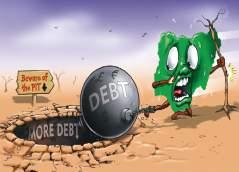
The rate of borrowing is increasingly becoming excessive
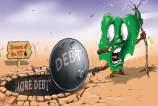
Last week revelation by the Debt Management Office (DMO) that Nigeria spent N10.81 trillion servicing outstanding debt obligations in the first nine months of 2025 is quite concerning. This amount, according to the DMO, comprised external debt service payments of $3.34 billion (N4.49 trillion, converted at the Nigerian Foreign Exchange rate of N1,346 per dollar) and domestic debt service payments of N6.32 trillion during the period. The agency further revealed that Nigeria’s public debt profile rose to N153.3 trillion ($103.93 billion) as of 30 September 2025, representing a 0.59 per cent quarter-on-quarter increase from N152.4 trillion ($99.66 billion) in June 2025.
Already battered by high levels of socio-economic stress, Nigeria’s ever rising debt portfolio is causing increasing anxiety. Unfortunately, authorities in Abuja and the 36 states have continued to sneer at genuine concerns as the loans keep piling up, raising the spectre of another debt trap in future. As of last September, the current debt stock for the three tiers of government consisted of domestic debt of $55.47 billion (N81.81 trillion) and external debt of $48.46 billion (N71.47 trillion). The federal government accounted for the bulk of domestic debt, which rose to N77.81 trillion in the third quarter of 2025 from N76.58 trillion in the second quarter of 2025. Similarly, the domestic debt stock owed by states and the FCT increased slightly to N4 trillion as of last September from N3.96 trillion in June 2025.
multilateral lenders have continued to advise against increased borrowings amid plummeting revenues. Since borrowing is extra money in circulation that is not backed by production, a profligate mindset is one of the worst ailments that can afflict a government. Meanwhile, all Nigerians are paying for the overdraft to government not just in increased public debts eventually but also, and more importantly, through increased inflation. To worsen matters, most of the federal government projects for which jumbo loans were obtained cannot even earn enough to fund their operations, leaving many to wonder how the debts would be repaid.
The rising debt profile has continued to elicit serious concerns as most of the states have feeble revenue base, too weak to service the mounting debts
T H I S D AY
EDITOR SHAKA MOMODU
DEPUTY EDITOR WALE OLALEYE
MANAGING DIRECTOR ENIOLA BELLO
DEPUTY MANAGING DIRECTOR ISRAEL IWEGBU
CHAIRMAN EDITORIAL BOARD OLUSEGUN ADENIYI
EDITOR NATION’S CAPITAL IYOBOSA UWUGIAREN
THE OMBUDSMAN KAYODE KOMOLAFE
EDITOR-IN-CHIEF/CHAIRMAN NDUKA OBAIGBENA
We understand that borrowing may be inevitable, especially at a period like this. But there are serious concerns at the rate these debts are being piled up in Nigeria. Aside from the fact that the funds are not being deployed into projects that generate income, borrowing should not be done in such a way to mortgage the future of the country. Indeed, experts within Nigeria and
GROUP EXECUTIVE DIRECTORS ENIOLA BELLO, KAYODE KOMOLAFE, ISRAEL IWEGBU
DIVISIONAL DIRECTORS SHAKA MOMODU, PETER IWEGBU, ANTHONY OGEDENGBE
Despite being rated as the third biggest economy in Africa, Nigeria still ranks among the poorest nations in the world, essentially because dependence on oil receipts has been a burden due to poor governance in the sector. But the problem goes beyond the federal government to many of the states where the fiscal outlook is increasingly darkening. Indeed, the rising debt profile has continued to elicit serious concerns as most of the states have feeble revenue base, too weak to service the mounting debts.
While it is standard practice for government all over the world to borrow, either externally or from the capital market within the country to finance projects, the International Monetary Fund (IMF) has consistently warned Nigeria of the consequences, particularly of the servicing costs which could consume substantial amount of government revenues. If the aim of borrowing is to help government attain developmental needs in the areas of infrastructure, health, education, power, and transportation, it is a laudable idea. The challenge, however, is that over the years, authorities in both the federal and states have accumulated huge debts at public expense which were largely frittered away.
It is important for authorities in Nigeria to understand that the solution to our challenges can be found inwards. There is no record that any country has borrowed its way into prosperity.
Letters in response to specific publications in THISDAY should be brief (150-300 words) and straight to the point. Interested readers may send such letters along with their contact details to opinion@thisdaylive.com. We also welcome comments and opinions on topical local, national and international issues provided they are well-written and should also not be longer than (750- 1000 words). They should be sent to opinion@thisdaylive. com along with photograph, email address and phone numbers of the writer.
THE TASK BEFORE TUNJI DISU
The removal of Kayode Egbetokun as the Inspector-General of Police (IGP) marks the end of a tumultuous chapter defined by legal gymnastics over tenure extensions and a perceived stagnation in the war against insecurity. As Tunji Disu steps into the Louis Edet House, he inherits not just a police force, but a fractured institution suffering from a deep-seated crisis of legitimacy.
For the new IGP, the task is Herculean: he must pivot from the "police-centric" arrogance of the past toward a "citizen-centric" philosophy of the future.
The Nigerian Police Force (NPF) has long been paralyzed by a promotion system often viewed as transactional rather than meritocratic. With 29 senior officers reportedly set to exit in this massive shake-up, Disu has a clean slate to build a leadership core based on competence.
The Agenda: Merit-Based Advancement: End the era of "godfatherism" in postings. Internal welfare reform is urgently needed. Corruption in the police often starts at the bottom because of poor pay and dilapidated barracks. A
hungry officer cannot be expected to protect a fed citizen.
The image of the NPF is currently defined in the public consciousness by the roadblock, the "checkpoint bribe," and the high-handedness that birthed the 2020 #EndSARS protests. To the average Nigerian, the uniform is a symbol of dread, not safety.
Disu must institutionalize immediate dismissal for officers involved in extrajudicial acts or extortion. The "Service" in Police Service must be purged. The force has to rebrand the force’s engagement rules. The police must transition from being a "Force" (coercion) to a "Service" (protection).
The greatest casualty of police corruption is information. In developed societies, policing is 80% intelligence and 20% kinetic action. In Nigeria, the reverse is true because citizens are afraid that providing information to the police will lead to their own victimization.
Create secure, anonymous channels for citizens to report crimes without fear of their identity being leaked to the criminals. SecondlyCommunity Policing. The force need
to move beyond the rhetoric of "Community Policing" and actually integrate traditional rulers, youth leaders, and local vigilantes into a formal, supervised information-sharing network.
Policing in the 21st century is data-driven. Developed societies rely on digital forensics, widespread CCTV integration, and rapid response systems.
Disu should leverage on digital forensics with his background in the Intelligence Response Team (IRT) to modernize the NPF’s tracking and cyber-crime capabilities.Body cameras should be made mandatory and the use of bodyworn cameras for all officers on patrol to ensure accountability—a standard mechanism in effective global policing. The appointment of Tunji Disu—a man often described as a "cop’s cop" with a track record of professionalism—is perhaps the last chance to save the NPF from total irrelevance.
Dr. Oto’ Drama, PhD Counterterrorism, gsgvehshsvg@gmail.com
Acting Group Politics Editor DEJI ELUMOYE
Email: deji.elumoye@thisdaylive.com
08033025611 sms only
Olawepo-Hashim: Nigerian Govt is on Defensive, Not Ready to Fight Terrorism
a People’s Democratic Party’s presidential apirant, Gbenga Olawepo-hashim, in this interview talks about the security challenges facing the nation saying the government at the centre has not shown any commitment to address the problem. he also speaks about the recent area Council poll held in the Federal Capital Territory and how it could affect the 2027 general election. Chuks okocha brings excerpts.
The country is being held down by insecurity. We must first have a country before election. So where do we go from here because it’s like the terrorists are getting closer to Abuja?
Well, I’m from the North Central zone. And the issues are even personal to me because when they kill people in those communities, they attack communities where I have personal relationships, you know, like family, you know, all the way from Kebbi.
When they went to an area close to Shanga, you know, the district head of Shanga is my paternal uncle, you know. My paternal grandmother comes from Shanga, that place. So it’s my relation. You know, I get reports from there. You know, when they went to Woro in Kwara, I grew up in New Bussa.
You know, the people in that community are people that have briefed me about these incidents before. I’ve shared some of this information with the higher authority some three years ago. So the issue of insecurity and stopping the killing is an issue for now. It’s not issue for 2027. You know, we have 200 people killed in Woro. That same week, about 300 people were killed in Taraba. You know, every day there are killings about 15, 17, even yesterday.
Well, it looks like the 15, 17 are looking like small numbers. Nobody talks about them again. Do you understand? Now, the truth of it is that the magnitude of killing going on in Nigeria, if one tenth of it had happened in Europe, there would have been a UN Security Council meeting specifically to discuss it.
So we have to take the issues more seriously. But I see that the APC people are more interested, you know, in managing the information and managing the diplomatise to create an impression that they are doing something, whereas they are doing nothing to stop the killing.
So we have to put this issue in the front burner for national and international discourse. You can’t wait until 2027. I agree with you. It’s something we have to solve right away. And we are doing everything possible. I mean, somebody like me, I’m doing everything possible to put the pressure to make sure that we find some solution.
Yes, it has been internationalized, the crisis. The Americans are involved. Where then is the sovereignty of Nigeria if Americans are coming at this stage ?
You know, after 9-11, the issue of fighting international terror is no longer a domestic affair of any country. You have non-state actors creating safe havens for themselves to attack nations. And so there have been many international instruments that empowers international cooperation in this regard. The funding for the terrorists is international. The arm flow to them is international. So there must be international cooperation. What we will talk about is having concrete agreement that defines the scope of such cooperation, the duration of such cooperation. And that there is a transparent mechanism of reporting, enshrined in those arguments. It should not be, you know, shrouded in secrecy. But we cannot raise the issue of sovereignty within the context of limiting ourselves that we do not stretch our hands and embrace international cooperation. This is not something that is sensible because the terrorists themselves are already undermining the sovereignty of Nigeria and Nigerian government looks incapable of rescuing the country from this kind of crisis. The terrorists are collecting taxes in Sokoto, in some parts of Zamfara. It’s only few states that collect taxes now. And if terrorists are collecting taxes, you cannot be raising the issue of sovereignty. The sovereignty of the country already has been, you know, eroded by these international terrorists.
Talking about these terrorists and their activities, when Dr Goodluck Jonathan was president, there was a time he declared state of emergency in Borno and Yobe. Is it not time to declare state of emergency on states like Sokoto, Kebbi and Zamfara because of the activities of these terrorists?
It’s not just Sokoto, Kebbi, Zamfara. Those ones are old stories. The new theater of the operation now is Kwara, Niger, and part of Kebbi. You understand?
Let me tell you, same for urban states like Kano, Jigawa, there are few states in the whole of the 19 northern states today, where you don’t have active terrorist cells.
And more with the capacity to even carve out the terrorist states, a kind of caliphate, ISIS kind of states. They have the capacity to do so in about four or five northern states. They do have the capacity to do so. And they have not seen the willingness of the Nigerian authorities to fight. To be honest, the Nigerian authorities have not been fighting terrorism. They have
been on the defense. People come, kill people. They come and condole them. And then you see whether you can scare the terrorists away. They have not been.
When you are fighting, you are taking the fight to the terrorist camp. You are making an arrest, destroying camps, seizing weapons. Have you ever seen Nigerian authorities doing that? They are not doing that. They are on the defensive. They are not even on the offensive. So there is no fight against terrorism that I see on the Nigerian side.
So we need a government that is willing to fight. We need some mechanism for immediate fight. This government is not willing and is not fighting and is not willing to fight.
You see, if the terrorists kept on collecting tax. Tax is another way of ensuring sovereignty. And these terrorists are imposing tax.
They are conducting international trade. They are exporting lithium. They are controlling the mine, gold mines. They have a lot of resources. And there is a lot of complicity on the side of Nigeria’s political authorities. As if, okay, just make sure you are just operating in the rural area. Don’t come to the state capital. Most governors in northern Nigeria and places like in some of the states, they only control their
When you are fighting, you are taking the fight to the terrorist camp. you are making an arrest, destroying camps, seizing weapons. Have you ever seen nigerian authorities doing that? They are not doing that. They are on the defensive. They are not even on the offensive. so there is no fight against terrorism that I see on the nigerian side.
state capital. The rural areas are controlled by the terrorists. They administer their own laws and justice system. They try people, execute people. They do all kind of things.
Let’s move to the economy. People say the prices are gradually coming down. The prices are gradually coming down because the exchange rate of Naira to the dollar is coming down. It has been coming down because since October last year, I have been attacking them and saying that they overdevalued the Naira. They over-devalued the Naira unnecessarily because right now our daily crude production is double. We are doing 900,000 barrels per day under Buhari and Naira was exchanging N700 to a dollar. Now we are doing about 1.8 million barrels per day. So Naira should by now, under reasonable circumstances, be exchanging between 500 to 600 to a dollar. They still have a lot of arbitrage even now that it’s 1.3. So the prices should come down more drastically if they get Naira to its actual market value. By my own economic measurement, the actual value of dollar to Naira should be N500 to N600.
See where I’m coming from. Most of the price we are talking about is dependent on produce of the farmers. What has the produce of the farmers got to do with the exchange rate?
Well, fertilizer is important. It’s not produced locally in sufficient quantity yet. Dangote is doing some local production now. And it’s not subsidized. The price is still high. Besides other farming inputs, even seedlings. Most of the people selling the seedlings, there are a lot of foreign inputs for the production of those seedlings. That is number one. So, now what the APC government did when people were complaining about high prices was that they encourage a lot of importation of finished food products like rice and all that which will soon have some negative effects, because we have achieved some level of local production over the years. It was seriously addressed. But now they try to crash and force artificial price. And these also have very terrible effects on the agricultural sector.
Our $5 billion has been lost in Agric investment locally in the past two years as a result of those forced price decrees. So, and I had advised that what they should have done was to devalue the Naira, and now they are dropping the rates. They are the ones manipulating the value of the Naira. So, to drop the rates, you will see the falling prices, not just of Agric products, but even of manufactured goods.
The FCT Area Council election has come and gone. What’s the next step for PDP?
Well, the election shows that the grassroots voters are still with the PDP, despite the challenges at the top that has to do with some of the elite members, either leaving or fighting. So, I mean, what is clear is that the grassroots of the PDP is still intact. That’s what this election in Abuja shows. Despite the fact that in Bwari, where the candidate was pressured to desert the party for APC three days to election, the people still went all out to vote for PDP. The PDP came out with five out of 10 councillors, even when the Bwari chairmanship candidate was left. So the people of Nigeria are still with the PDP, despite the shenanigans of the elite. So what PDP needs to do is simply to see how we unite at the national level. The grassroots is still with us. So uniting the various factions at the national level will still remain a top priority for somebody like me.
olawepo-Hashim
FEaturEs Deepening Nigeria-Indonesia’s Shared Commitment to Safeguarding Regional, Global Maritime Domain
When the Indonesian Navy frigate KRI PRABU SILIWANGI berthed in Lagos this week, it marked a significant moment in the evolving relationship between Nigeria and Indonesia, underscoring the growing role of naval diplomacy in strengthening bilateral ties. Beyond ceremony, Chiemelie Ezeobi writes that the visit to Western Naval Command highlighted expanding cooperation in defence, maritime security, training, intelligence sharing and cultural exchange, anchored on the 2023 bilateral defence agreement between both countries and a shared commitment to safeguarding regional and global maritime space
Port calls remain one of the most practical expressions of naval diplomacy, serving as platforms for building trust, strengthening military-to-military relations and advancing foreign policy objectives beyond formal agreements.
Through port visits, navies engage in professional exchanges, operational familiarisation and confidence-building activities that enhance interoperability and mutual understanding.
They also create opportunities for joint exercises, intelligence and information sharing, humanitarian cooperation and cultural interaction, while signalling political goodwill and strategic intent. In an era of shared maritime threats and interconnected sea lanes, port calls help translate diplomatic commitments into actionable cooperation on the water.
Thus, the port call of the Indonesian Navy frigate KRI PRABU SILIWANGI to Lagos was a defining moment in Nigeria–Indonesia relations, projecting naval diplomacy as a practical instrument of foreign policy while reinforcing cooperation in defence, maritime security, trade and cultural exchange.
As the newest ship in Indonesia’s fleet berthed in Lagos followed by a courtesy visit to Western Naval Command headquarters in Apapa, the visit signalled not just goodwill, but a shared commitment to deeper strategic engagement between two key maritime nations.
A Relationship Rooted in History and Trade
Welcoming the visiting ship, the Flag Officer Commanding (FOC), Western Naval Command, Rear Admiral Abdullahi Abubakar Mustapha, situated the visit within the long arc of bilateral relations. “Our two countries enjoy food security as well as community cooperation. And as you have attested, Nigeria and Indonesia have enjoyed this relationship since independence, since we attained independence in 1960. The trade relationship is actually growing from strength to strength, going into billions of tonnes.”
He noted that while trade continues to expand, defence relations have increasingly become a critical pillar of engagement. “But more importantly, alongside that, the military relations between the two countries, the defence cooperation, have also been growing from strength to strength. In 2023, this relationship was formalised in a bilateral defence agreement between Nigeria and Indonesia.”
Defence Cooperation and Capacity Building
According to the FOC, the 2023 agreement has already translated into concrete outcomes. “On that strength, Nigerian Armed Forces officers have attended the Indonesian Defence University, and I believe a number of officers have also attended the Indonesian Resilience Institute. That is in terms of equipment procurement. The same document has paved the way for Nigeria to actually merge into the growing military-industrial complex of Indonesia.”
He acknowledged Nigeria’s evolving defence manufacturing base while underlining the strategic importance of partnerships. “Our own is still very young, so these are areas of intersection that the Nigerian Armed Forces can actually benefit from and try to leverage to
build our own military-industrial complex. Because in today’s security era, sovereignty of security is everything.”
Rear Admiral Mustapha stressed the urgency of self-reliance supported by collaboration. “It is good to call people, it is good to be able to produce what you are going to use to fight if the need arises. So the need for Nigeria to actually build partnerships is critical. We believe this cooperation will also happen on the ground.”
Maritime Security and Information Sharing
Maritime security featured prominently in the discussions, particularly intelligence and information sharing. The FOC pointed out Indonesia’s role within Asian maritime security frameworks. “In terms of intelligence and information sharing, we know that Indonesia is part of the Regional Cooperation Agreement on Combating Piracy and Armed Robbery against Ships in Asia (ReCAAP) Information Sharing Centre (ISC)… Also, the IFC, Singapore Information Fusion Centre, the Indonesian Armed Forces are part of that.”
He drew parallels with Nigeria’s own systems. “In Nigeria, we have a very robust maritime domain awareness system and a regional awareness capability system. So the intersection of your capability in maritime domain awareness and what we have would help us to better secure the maritime space, both from the regional
angle and the global commons.”
Regional Architecture and Joint Security Efforts
Placing cooperation within a wider regional framework, he added: “Coming to maritime security cooperation, we know Indonesia works with Malaysia and Singapore. We in Nigeria are also championing the Yaoundé architecture. We have an ECOWAS-integrated maritime strategy, and we want it to be headquartered in the Benin Republic.”
Looking ahead, he emphasised the operational scope of the defence agreement. “I believe there is a lot that this cooperation promises. The 2023 defence agreement would also allow us to have service-wise agreements: army-to-army cooperation, navy-to-navy, and air forceto-air force.”
Naval Diplomacy in Action
Rear Admiral Mustapha described the visit as a practical expression of foreign policy. “There is no gain saying that what we see is a subset of diplomacy, specifically naval diplomacy, and the importance of foreign policy. It enables us to exercise together, to train with equipment, and in some cases, depending on the nature, to offer humanitarian assistance in the process.”
He confirmed Nigeria’s intention to reciprocate the gesture. “It is a welcome visit. We, as a navy, on behalf of the Chief
of the Naval Staff, believe that as a priority, if we have the opportunity, we will reciprocate this visit to Indonesia in the near future.”
Import of Port Calls
In a subsequent interview with THISDAY, the FOC reiterated the strategic value of port visits. “First of all, I want to say that diplomacy is a critical element of national power, and naval diplomacy is a subset of diplomacy. Port visits by partner countries, like the Indonesian Navy frigate are a testament to the strong bilateral cooperation between Nigeria and Indonesia.”
He revealed plans for joint activities. “As part of my plan under the directive of the Chief of the Naval Staff, Vice Admiral Idi Abbas, we plan to conduct a visit, board, search and seizure (VBSS) exercise, as well as an anti-illegal, unreported and unregulated fishing exercise on their exit journey from the country.”
Beyond operations, cultural exchange was deliberately included. “One area, apart from just military-to-military engagements that enhance foreign or bilateral relations, is cultural exchange between the two countries… we have also arranged for the team from the ship, the selected ship’s crew, to visit some of our cultural centres and traditional institutions so that you can appreciate our culture.”
Indonesia’s Perspective on a Strategic Partnership
In turn, Indonesia’s Ambassador to Nigeria, Ambassador Bambang Suharto, described the visit as symbolic and strategic. “We would like to express our sincere gratitude to the Government of Nigeria, particularly the Nigerian Navy, for accommodating our new warship. This expresses our close relationship.”
He underlined Nigeria’s importance to Indonesia’s African engagement. “Nigeria has been chosen for the port visit of the Indonesian warship because Nigeria is our strategic partner in Africa, and we share similarities in population characteristics and economic development.”
With the presence of the Indonesian Navy Ship led by its Commanding Officer, KRI PRABU SILIWANGI, Captain Kurnian Koes Atmadja, and Indonesia’s Defence Attaché to Nigeria, Colonel Aslam, the Lagos port call stood as a powerful statement of intent anchored in diplomacy, strengthened by cooperation, and focused on securing shared maritime interests.
Nigerian Navy officers with Indonesian delegation during the Port Call of Indonesian Navy Ship KRI PRABU SILIWANGI to Western Naval Command, Apapa, Lagos
L-R: Ambassador of Indonesia to Nigeria Ambassador Bambang Suharto; Flag Officer Commanding (FOC), Western Naval Command, Rear Admiral Abdullahi Abubakar Mustapha; Commanding Officer KRI PRABU SILIWANGI, Captain Kurnian Koes Atmadja; and Defence Attaché of Indonesia to Nigeria, Colonel Aslam
Celebrating a Leader, Governor Francis Nwifuru at 51
chukwuemeka enviable ituma
Ijoin millions of Ebonyi people all over the globe in celebrating my Governor His Excellency, Rt. Hon Francis Ogbonna Erishi Nwifuru, the Executive Governor of Ebonyi State, on the occasion of his 51st birthday. You are a leader whose life reflects unwavering service and purposeful leadership dedicated to the progress of our dear state.
Before assuming office as Governor in 2023, you distinguished yourself as a seasoned legislator and a twotime Speaker of the Ebonyi State House of Assembly. That historic achievement laid a solid foundation for the purposeful leadership we witness today.
From the onset of your administration, you adopted the People’s Charter of Needs as your guiding vision, placing the people of Ebonyi State at the center of governance. Through this framework, you have consistently prioritized security, human capital development, infrastructure, healthcare, education, and economic empowerment as pillars for sustainable growth.
Security has remained one of the most critical focus areas under your leadership. You introduced a zero-tolerance approach to crime, emphasizing prevention, intelligence gathering, and swift response. Your administration strengthened collaboration between security agencies and local communities, ensuring that security challenges are addressed proactively and decisively.
Your security strategy, firmly anchored on community policing, has encouraged grassroots intelligence sharing and the active involvement of traditional institutions and youth groups. This inclusive approach has strengthened early threat detection and significantly reduced communal clashes and criminal activities across Ebonyi State.
To further complement these efforts, you enhanced the operational capacity of security agencies through improved logistical support, including patrol vehicles and modern communication equipment.
Beyond enforcement, your administration has prioritized peacebuilding through dialogue-driven conflict resolution mechanisms, striking a balance between firmness and reconciliation.
As a result of these measures, Ebonyi State has witnessed increased stability, allowing businesses, farmers, and traders to operate freely. The improved security climate has positioned our state as one of the more peaceful environments in the South-East region.
Beyond security, Your Excellency, your administration has recorded notable achievements in infrastructure development. The construction and rehabilitation of internal and rural roads have improved connectivity, eased the movement of goods and people, and enhanced economic activities across the state.
Your government’s efforts to revive key industrial and economic projects—such as fertilizer production, hatchery development, and pipe manufacturing—have boosted local production, reduced dependence on imports, and created employment opportunities for our people. In the education sector, your commitment to reform and investment is deeply commendable. You reduced school fees at Ebonyi
State University and increased the institution’s monthly subvention, thereby strengthening academic operations and access to quality education.
You further demonstrated foresight by sponsoring over 200 Ebonyi indigenes for postgraduate studies at the Master’s and Doctorate levels in the United Kingdom, investing strategically in the future human capital of the state.
At the secondary education level, your administration initiated the construction of 39 model secondary schools across the state and fully covered WAEC and NECO registration fees for public school students, easing the financial burden on families.
Healthcare delivery has also received significant attention under your leadership. Through the Ebonyi State Health Insurance Scheme, over 12,600 vulnerable persons have gained access to essential healthcare services. Your administration has equipped and upgraded general hospitals across the state, introduced free caesarean section services, and recruited medical professionals, thereby strengthening healthcare delivery and reducing maternal mortality.
Worker welfare and human capital development remain central to your agenda. You cleared outstanding salary arrears, approved salary increases for academic and non-academic staff, implemented a ₦75,000 minimum wage, and approved special welfare packages, including a ₦150,000 Christmas bonus for civil servants.
Youth empowerment stands as another defining feature of your administration. Thousands of youths have benefited from empowerment programs, skills acquisition initiatives, and financial support aimed at promoting self-reliance and reducing unemployment.
Overall, Your Excellency, your administration reflects a governance approach rooted in security, development, and people-centered policies. Your achievements in stabilizing Ebonyi State, improving infrastructure, investing in education and healthcare, and enhancing worker welfare clearly demonstrate your vision for a safer, more prosperous, and inclusive Ebonyi State.
You remain a resilient grassroots leader shaped by experience, a disciplined consensus-builder, and a people-centered governor with an unwavering commitment to peace, development, and inclusive governance.
•GMD Enviable Group, Chief Chukwuemeka Enviable Ituma, writes from Lagos
Governor Nwifuru kicking off the tournament
L- r : ce O c ubana Group, Obinna i yiegbu; GMD e nviable Group, c hukwuemeka i tuma; and Governor Nwifuru at the grand finale of the e nviable Football tournament held in e bonyi s tate, last December
L- r : Mrs. Lydiv e nviable, wife of e nviable Group GMD; c hief e nviable i tuma; and Governor Nwifuru at the tournament
Tunji Disu: Police’s ‘Good Guy’ is New IG
Chiemelie Ezeobi
In a policing environment often defined by fear, excess force and public mistrust, the idea of a “good guy” in uniform can sound almost subversive.
Yet for many Nigerians, that is precisely the reputation the just decorated InspectorGeneral of Police, Olatunji Disu carries as a senior officer whose authority has been exercised with restraint, whose operations have delivered results without spectacle, and whose career has shown that firmness and humanity need not be opposites.
His operations have delivered results without spectacle, and his career has shown that firmness and humanity need not be opposites.
As he assumes leadership of the Nigeria Police Force as the 23rd Inspector General of Police, Disu brings with him a record that has long tested and largely validated the possibility of policing with a humane face.
For many officers, who have served under him and citizens,who have encountered his style of policing, he embodies a rare balance in Nigeria’s security landscape: discipline without arrogance, power without intimidation, and leadership without theatrical command. Yet, efficient at his various postings.
His emergence as Nigeria’s top police officer is not the product of spectacle or political theatre. Rather, it is the culmination of decades spent in the trenches of operational policing, intelligence leadership and institutional reform, guided by a simple but demanding principled policing must ultimately serve the people.
Foundation and Early Years
A native of Lagos State, Disu joined the Nigeria Police Force in 1992. His academic background laid a strong intellectual foundation for his career.
He holds a Bachelor’s degree in English Education from Lagos State University, advanced degrees in Public Administration and Criminology, Security and Legal Psychology, as well as an Advanced Diploma in Forensic Investigation.
This blend of language, psychology and criminology would later shape his methodical and human-centred approach to law enforcement.
His early career saw him serve as Divisional Police Officer in Ago Iwoye, Ikare, Owo, Surulere and Ikoyi. These frontline postings exposed him to the pulse of community policing and the daily interaction between citizens and the state’s coercive power.
He later served in Rivers State as DPO in Elimbu and Elelenwo, and as second-incommand of the State Criminal Investigation Department, sharpening his investigative instincts and crisis-response skills.
RRS and the Birth of ‘The
Good Guys’
Disu’s national profile rose significantly during his tenure as Commander of the Lagos State Rapid Response Squad between 2015 and 2021. At a time when public trust in the police was eroding, he reimagined the RRS as a disciplined, intelligence-led unit focused on speed, professionalism and restraint.
Modern patrol vehicles, tactical
motorcycles, structured training and transparent incident reporting became standard.
Disu encouraged public engagement through social media and open feedback, demystifying police operations and humanising officers. Under his leadership, street crime declined noticeably across Lagos, particularly in notorious corridors such as Ajah, Lekki and the mainland.
It was during this period that the RRS earned the sobriquet “The Good Guys” — an uncommon public endorsement in a policing culture often associated with fear. For Disu, the nickname reflected something deeper: that effective policing needs not be cruel to be respected.
Rebuilding Post-SARS and Intelligence Leadership
Following the disbandment of the Special Anti-Robbery Squad and the credibility crisis that engulfed the police, Disu was appointed to lead the Inspector-General of Police Intelligence Response Team. The assignment came with intense public scrutiny and institutional pressure. Disu responded with quiet but firm reform. Rogue elements were removed, operations were restructured around intelligence gathering and due process, and collaboration with other security agencies was strengthened. Under his leadership, the IRT dismantled kidnap networks operating across the Abuja–Kaduna–Zamfara axis, rescued hostages from forest enclaves and intercepted arms
trafficking routes along the Kogi–Benue corridor.
High-profile cases, including stalled investigations linked to the Bala Hamisu (Wadume) syndicate, were revived and pursued with renewed focus on justice rather than inter-agency rivalry. These operations restored a measure of confidence in a unit many had written off.
Landmark Arrests
AIG Disu’s career has been defined by high-stakes operations that combined intelligence, strategy and discipline. During his tenure as RRS Commander in Lagos, he led the arrest of the notorious Ajah robbery gang in 2016.
The gang, responsible for multiple killings and bank heists, had eluded capture for over six months until Disu’s team traced their hideout through telecom and CCTV forensics. All principal members were arrested, and weapons and getaway vehicles recovered, restoring public confidence in Lagos’ crime hotspots.
Between 2017 and 2018, Disu foiled several attempted bank robberies and bullion van attacks along the Lekki–Ajah corridor. In one case, operatives intercepted a gang attempting to tunnel into a bank from an abandoned building. Rapid-response patrols, plainclothes surveillance and drone monitoring were instrumental in these successes.
In 2019, his RRS team arrested the serial ritual killer “Ifayemi The Herbalist” after discovering dismembered remains of children near his shrine. The operation,
praised by civil society, showcased Disu’s reliance on forensic-led investigations.
As head of the IGP Intelligence Response Team, Disu spearheaded operations against kidnappers and armed bandits nationwide. He oversaw the rescue of a kidnapped Abuja businesswoman and her driver in 2022, neutralising two suspects and recovering the victims without ransom.
Between 2022 and 2023, his team dismantled multiple Abuja–Kaduna–Zamfara kidnap syndicates, arrested top bandit commanders including Mudi Auta, and intercepted arms traffickers along the Kogi–Benue corridor, seizing over 60 rifles. Disu’s strategic approach also extended to cult violence in Lagos Mainland, where over 120 cult members were arrested between 2017 and 2020. Through youth reintegration programmes and community collaboration, he sought not only to arrest offenders but to address the root causes of crime.
Discipline, Fitness and Use of Force
Beyond strategy and operations, Disu’s leadership philosophy places strong emphasis on discipline and restraint. A black belt holder in Karate and international competitor, he believes physical conditioning enhances mental control and reduces reckless use of force.
Throughout his career, he has promoted structured fitness programmes within police units, arguing that a disciplined body supports a disciplined mind. His approach to the use of force is rooted in legality and necessity, a stance that has earned him respect from civil society organisations and human rights advocates, even within a system frequently criticised for excesses.
The Man and the Mandate
Despite his achievements, Disu maintains a low public profile. He is widely described as approachable, media-friendly and averse to flamboyance. He speaks often about the need for internal cleansing within the police and the importance of officer welfare as a foundation for reform.
His active engagement with the public, including through digital platforms, has further set him apart from many senior officers. Now as Inspector-General of Police, expectations are high.
Analysts and security experts see in Disu a steady hand at a time when Nigeria faces evolving internal security threats. His career suggests a leader inclined towards intelligence-led policing, institutional accountability and citizen trust, all qualities increasingly demanded in modern law enforcement.
A Humane Face of Power
Disu’s rise to the top of Nigerian policing signals more than a change of guard. It represents the possibility that authority can be exercised with humanity, and that reform needs not be loud to be effective. For a force in need of credibility and confidence, the man once called “The Good Guy” now carries the burden and the opportunity of shaping policing in Nigeria’s most consequential moment.
Changing the Guard at Police Headquarters: Disu in, Egbetokun out
ITU Moves to Democratise Artificial Intelligence for Global Inclusivity
Okonji International Telecommunications Union (ITU), the United Nations agency for digital technologies regulation, has called for the democratisation of Artificial Intelligence (AI), to promote global inclusiveness.
ITU made the declaration during the AI Impact Summit in New Delhi, India, attended by 88 nations, insisting that AI’s promise is best realised only when its benefits are shared by humanity globally.
The opening ceremony of the summit was attended by ITU Secretary-General, Doreen
UN SecretaryGeneral Antonio Guterres, and India’s Prime Minister Narendra Modi, among other dignitaries.
In her remarks, BogdanMartin said: “We all recognise Artificial Intelligence has the potential to transform lives. We have heard it. We have seen it. But the true measure of success will be whether it reaches everyone in every country and in every local community. Whether AI becomes a bridge to innovation and opportunity or another fault line dividing those with access from those without, the answer will
depend on three essential foundations: The three Ss: Standards, Skills, and Solutions.”
She described standards as the essential shared language for trustworthy, interoperable AI, adding that without shared standards, the world risks fragmentation, uncertainty, and unequal access. She said technology alone would not change the world, but people, insisting that without the skills to use and shape AI, its opportunities will remain out of reach for too many.
In the area solutions, she said AI must deliver real
impact in people’s lives by strengthening education, healthcare, advancing science, and expanding opportunity.
Bogdan-Martin therefore assured the audience that in each of the three essential foundations, ITU would serve as the trusted partner. “We cannot let the digital divide become the AI divide,” she further said.
Prime Minister Modi said: “AI is a transformative power. If directionless, it becomes a disruption; if the right direction is found, it becomes a solution. Through the seven chakras, India has articulated a compelling vision for a
people-centric AI future.
In the months ahead, as global leaders, experts, and innovators continue to come together, including at the Global Dialogue on AI Governance in July in Geneva, back-to-back with ITU’s AI for Good Global Summit, let us act together to ensure that AI becomes a bridge to opportunity for all.”
At the AI Impact Summit 2026, ITU convened governments, industry, civil society and multilateral partners to explore how AI can be governed responsibly and deployed to deliver tangible benefits. Discussions
centred on the standards, skills and partnerships required to turn technological progress into measurable public value. A recurring outcome from the discussions was the growing importance of Edge AI, bringing intelligence closer to where data is generated and decisions are made. By moving compute from centralised cloud systems to devices, sensors and local infrastructure, Edge AI reduces latency, lowers energy consumption, strengthens privacy and enables faster, more resilient decision-making.
Emma Okonji
Telecoms operators (Telcos), under the aegis of the Association of licensed Telecoms Operators of Nigeria (ALTON), have said the recent acquisition of IHS Towers by MTN Group is a welcome development that will enhance industry stability and boost network resilience in the telecoms industry.
ALTON Chairman, Mr. Gbenga Adebayo, said this in Lagos, while fielding questions from the media. According to him, “We think the recent acquisition of IHS Towers by MTN Group is a very good development for the industry, even though it is basically a commercial decision that has been taken at the ownership level. It says quite a bit of things to
us as industry players. Two years ago, we were talking about sustainability of the industry, and this acquisition is a clear example that will lead to industry stability, because the new owners will invest in IHS Towers and further expand its operations to enhance customer experience. Again, the transaction speaks to the state of health of the industry that is already
attracting investors. Nobody will invest in a market that has no guarantee of stability or return on investment. So for us, it shows that we have a healthy sector that is capable of attracting the right investment.”
Adebayo further said: “The acquisition will also lead to better service delivery for end users, and boost customers’ belief in the company.
The acquisition also shows some forms of regulatory stability in our industry, which will go a long way to boost investor’s confidence in our industry.”
“The kind of investment we are seeing recently is a clear sign that there is regulatory stability and certainty in our industry, which speaks also to the strength and the benefit
and the reputation of our regulator. In terms of policy, no investor will invest in an industry where the policy environment is not right. ALTON commends the owners, it also commends the transaction and all the players, and we just wish them every success in their businesses.”
Emma
Bogdan-Martin,
L-R: The Prime Minister, Republic of Congo, Anatole Collinet Makosso; CEO of MTN Nigeria and the Vice President for MTN Francophone Africa, Dr. Karl Toriola; President of the Republic of Congo, Denis Sassou Nguesso and the Minister of Posts, Telecommunications and the Digital Economy of the Republic of Congo, Leon Juste Ibombo, during the courtesy visit by MTN to discuss highlevel corporate diplomacy, economic impact, and strategic alignment… recently
Report Identifies User Experience as Next Competitive Frontier in Digital Banking
Stories by Emma Okonji
Interswitch, one of Africa’s leading integrated payments and digital commerce companies, has released its latest industry report, highlighting the state of user experience in financial apps.
The report provided a comprehensive, data-driven assessment of user experience across Nigeria’s leading financial applications and outlined practical insights to guide the evolution of digital banking and financial services.
Drawing on extensive user research conducted in 2025, the report included evaluations of leading financial apps, surveys of hundreds of users, and in-depth interviews.
From the survey, Nigerians were asked a simple but revealing questions such as “What would you like to see in your bank’s app?”, and
their responses pointed to rising expectations around speed, clarity, transparency, personalisation, trust, and effective in-app support.
Giving details of the report, the Executive Vice President, Group Marketing and Communications at Interswitch, Cherry Eromosele, said: “User experience is no longer a cosmetic layer in financial services, it is the product itself. As digital channels become the primary way people engage with financial institutions, trust, simplicity, and reliability are what truly differentiate one platform from another. The report reflects real user voices and rigorous analysis and is intended to help banks and fintechs design services that people genuinely understand, trust, and enjoy using. Improving experience is essential to deepening
Varsity Develops Solutions to Boost Tech Innovation in Society
Oghenevwede Ohwovoriole in Abuja
The Vice Chancellor of the European University of Nigeria (EUN), Prof. Emmanuel Ibezim has disclosed that the school has been able to develop three innovative solutions that will impact society.
He spoke at a press conference organised by
the school in Abuja, themed: ‘Disruptive innovation in Nigerian University Education Unveiling European University of Nigeria, Abuja’.
He highlighted the innovations and other giant strides made so far by the university within the short period that its was established
He said the university has made giant strides in research and has been able to develop three innovative solutions.
inclusion and sustaining the next phase of digital finance growth.”
According to the report, while core transactions such as transfers generally
perform better than other tasks, significant usability challenges remain across bill
Unilever, Google to Pioneer Next Generation of
Unilever and Google Cloud have announced a five-year partnership to accelerate Unilever’s business transformation through its use of Google Cloud’s advanced AI data platform and next-generation marketing capabilities.
The partnership will help
drive growth and desirability for Unilever’s global brand portfolio, including iconic brands like Dove, Vaseline and Hellmann’s, using Google Cloud’s technologies, such as its enterprise AI platform, Vertex AI, to build new capabilities in brand discovery, measurement and
Group Business Editor
Eromosele Abiodun
Deputy Business Editor
Chinedu Eze
Comms/e-Business Editor
Emma Okonji
Asst. Editor, Energy
Emmanuel Addeh
Asst. Editor, Money Market
Nume Ekeghe
Correspondents
KayodeTokede(CapitalMarkets)
James Emejo (Finance)
Ebere Nwoji (Insurance)
Reporter
Peter Uzoho (Energy)
“The university has made giant strides in research. One of the lecturers has designed software for skill acquisition by students. Another has locally fabricated a tablet disintegration apparatus.
Another staff has designed and fabricated a drone for surveillance purposes, while another utilised computational tools to mine Neem tree for novel antimalarial drugs against drug-resistant malaria parasites,” Ibezim said.
Speaking earlier he said: “The University management has taken time to critically look at our current tertiary institutions in Nigeria and is set to put right all the observable anomalies.”
payments, airtime purchases, error handling, and in- app support.
Consumer Goods Technologies
AI-augmented marketing.
The Chief Supply Chain and Operations Officer, Unilever, Willem Uijen, said: “Technology has moved to the core of value creation at Unilever. As brands are increasingly discovered and chosen in environments shaped by AI, we must lead
this shift. The collaboration with Google Cloud sets a new level in how technology can power commerce and growth in the fast-moving consumer goods industry, ensuring Unilever is agile, fit for the future, and equipped to unlock value at every level of the company.”
HumanCoop Chooses Identy.io’s Biometric Solutions to Improve Living Conditions of N’Africa Patients
HumanCoop operates in northern Mauritania, employing a team of healthcare professionals and technical experts who deliver both primary and specialised medical care through missions in the region.Their efforts benefit more than 2,500 people.
According to UNHCR, over 350,000 individuals in North Africa and the Middle East lack identity or nationality.
“This lack of identification prevents the issuance of official documents that could certify their identities, thereby hindering the creation of medical records needed for effective treatment traceability.
“Identy.io will provide HumanCoop with facial biometric identity verification solutions. This technology will facilitate the unique identification of each patient, even in the absence of documentation, leading to faster access to medical records and reducing the likelihood of duplicate registrations among undocumented patients,” the firm said in a statement.
Zinox Partners TD to Deepen Tech Innovation, Product Distribution
Zinox Technologies, manufacturers of Zinox laptop computers, Smart Boards, Tablets, Monitors, PoS Terminals, iPower and iTec electronics/home appliances, has partnered TD Africa, a technology distribution company, aimed at distributing Zinox Technologies’ solutions within Nigeria and across 43 African countries where TD has established market
presence.
Speaking at the partnership event in Lagos, the Coordinating Managing Director, TD Africa, Chioma Chimere, said the collaboration between TD Africa and Zinox Technologies, would bring together innovation and distribution strength that would deepen technology access across Africa.
According to her, “Today we’re announcing to our entire ecosystem that TD Africa is privileged to be partnering with Zinox Technologies, whose products are African, suited for African people. The partnership is a a dream come true. When you partner with foreign vendors, you face a couple of challenges. The first is that most of them do not
understand what it means to be African.”
Executive Director/ Group Strategic Human Resources Management at Zinox Technologies, Chioma Nwoke, said the partnership was about reaffirming a vision that began over two decades ago, that Africa must not only consume technology, but build and scale technology.
FSDH Moves to Bridge Nigeria’s Healthcare Financing Gap
In order to align healthcare delivery with sustainable capital to strengthen the country’s health system, FSDH Merchant Bank has convened key stakeholders across Nigeria’s healthcare and financial services ecosystem at its Health Sector Roundtable themed ‘Care Meets Capital’. Delivering the keynote address, Lagos State Commissioner for Health, Akin Abayomi, emphasised the importance of aligning public policy with responsible private investment to build a healthcare system that is both
equitable and economically viable.
“Healthcare is both a social necessity and an economic imperative. If we are to build a system that is equitable, efficient and future-ready, we must intentionally align policy direction with responsible private investment and operational excellence. Sustainable healthcare requires innovative financing models, stronger governance frameworks and deeper collaboration between government and private capital,” Abayomi said.
Firm Acquires Registeram, Expands Operations in Nigeria
GigaLayer, one of Africa’s leading cloud infrastructure and domain services providers, has announced the acquisition of Registeram, a Nigerian domain registration and hosting company serving businesses across the country.
The strategic move marks a significant milestone in GigaLayer’s expansion plan to consolidate reliable digital infrastructure services across Nigeria and the broader African market.
Founder and CEO of GigaLayer, Ahmad Mukoshy, said: “The acquisition reinforces our commitment to building resilient, locally operated cloud and domain infrastructure for African businesses. We are not just acquiring customers; we are strengthening Africa’s digital backbone. The acquisition means Registeram’s services will be integrated into GigaLayer’s enterprise-grade infrastructure, enhancing support systems and security standards.
Sustaining Inclusion in Insurance, Pension Sectors
Recent developments in insurance and pension sectors point to the fact that the sectors are already achieving financial inclusion among Nigerians, writes Ebere Nwoji
Among the various arms of the financial services sector of the economy, insurance and pension are two sectors that are backwards when talking about financial inclusion among Nigerians.
They are backwards because most Nigerians are alienated from these two sectors. They hardly understand their workings, values and benefits in them.
This explains why Nigerians hardly patronise them willingly without a compelling regulation.
Insurance for instance is hardly purchased by an average Nigerian except for compulsory products like Third Party motor insurance backed by law and group life insurance also backed by pension Reform Act 2014.
On the part of insurance, after over 100 years of practice in Nigeria, it was only in 2023 that the insurance sector’s annual premium income which represents operators’ turn over hit N1 trillion mark. This is despite aggressive marketing efforts of the operators.
Currently, insurance annual premium income stands at N1.2 trillion as at Q2,2025.
For the pension sector, the huge N27.45 trillion assets gathered by the sector operators in the past 22 years of contributory pension practice is as a result of compulsory nature of the CPS for government workers and organised private sector workers.
The compulsory nature of the scheme backed by very strong regulation is the only reason why the sector has been able to accumulate such assets.
The Micro pension plan which was not made mandatory by any law, after six years of its public launch in Nigeria was only able to accumulate less than N1 billion having registered just 200,000 contributors.
This explains why the present Director General of PenCom, Omolola Oloworaran, rebranded the Micro Pension to become personal Pension Plan.
Realising this backwardness of the two sectors, the operators and their regulators have in recent times determined to change the narrative and achieve inclusiveness of Nigerians in the two sectors.
Financial Inclusion
Financial inclusion according to experts in finance refers to efforts to make financial products and services accessible and affordable to all individuals and businesses regardnless of their personal net worth or company size.
It strives to remove the barriers that exclude people from participating in the financial sector and using these services to improve their lives.
In insurance, financial inclusiveness is one task that has remained a tall order for the sector operators and regulator, the National Insurance Commission (NAICOM).
This is because the problem of Nigerians’ alienation to insurance services is as old as insurance business itself in Nigeria. Many Nigerians detest insurance including the compulsory insurances preferring to bear their risks on their own.
This has resulted in poverty and demise of many businesses especially the micro, small and medium scale businesses because due to lack of insurance coverage, once risk occurs, such businesses automatically closes down due to lack of cushioning effect.
NAICOM’s Effort
Against this backdrop, NAICOM as the insurance sector regulator has been at the fore front of fighting financial exclusion among Nigerians. Past helmsmen of the commission initiated the effort but in recent
times, NAICOM seems to have more than ever determined to fight against financial exclusion among Nigerians through insurance awareness creation.
The commission is using all avenues to ensure that Nigerians at all levels are financially included especially in insurance services. It is using Micro insurance in particular to achieve this important inclusiveness among Nigerians. It is also employing technology to achieve wide spread of insurance services among Nigerians.
Though past commissioners for insurance emphasised much on achieving financial inclusiveness of Nigerians to insurance, the incumbent insurance commissioner, Mr Olusegun Ayo Omosehin, seems to be more prepared, ready and determined to achieve this.
Indication to his level of preparedness and determination to achieve this is his statement when he took up the mantle of leadership of the umbrella body of insurance underwriters, the Nigerian Insurers Association (NIA) as the 25th Chairman.
Omosehin in his investiture speech said, “I have chosen the theme of my tenure as: Expanding the Frontiers of Insurance through Partnerships and Stakeholders’ Engagement”.
“To this end, we will actively pursue the insurance awareness and publicity project under the auspices of the Insurers’ Committee. We invite all stakeholders in the insurance industry to join us in this journey as we seek to entrench insurance culture and expand the dragnet in line with the central theme”, Omosehin said.
His successor, Kunle Ahmed is not relenting effort in this regard as he concentrates on use of technology in changing insurance landscape and making insurance services available and affordable to Nigerians. This determination saw him instituting and launching the NIA Technology hub.
He is also championing the course of micro insurance operation in the country Omosehin has sealed partnership with the police for the enforcement of compulsory insurance especially Motor Third Party insurance.
In the partnership, the Nigerian police force, said it has set up a special team headed by the Deputy Inspector General (operations) to oversee the enforcement of the compulsory insurance.
Within the space of his appointment as insurance commission, he has initiated
several ways of expanding insurance coverage among Nigerians.
Promoting Micro Insurance
Analysts said this has brought to the fore the need for promotion of micro insurance services as the surest way of achieving financial inclusiveness in insurance industry.
NAICOM defined micro insurance as insurance that is accessed by low income population, provided by licensed institutions, run in accordance with generally accepted insurance principles, and funded by premiums.
The result of this exclusion of the grassroots dwellers from insurance services over the years was low turnover for the industry while the sector’s contribution to the nation’s GDP was very minimal and insignificant.
This is quite unlike the banking sector where both city and rural dwellers patronise banking services and willingly visit banks for one transaction or another.
A flash back at Nigerians’ experiences during the past years, especially in the finance sector shows that many Nigerians no longer need advertisement to patronise banks as a safe way of keeping their money and other valuable treasures.
Their positive attitude to banking is usually glaring in most bank premises during the Yuletide.
At various festive periods, there are usually long queues of Nigerians waiting to either withdraw money from their accounts for the festive period or transfer money to their relatives for Christmas or Salah festivals. The ATM machines were not exempted from the rush as the length of queues in the various ATM service points surpassed those of customers collecting money from the counter. The trending one is the use of agents who operate POS outlets to deposit and withdraw money. This shows the improved level of knowledge and understanding of Nigerians towards banking services. This is similar to what happened in the Stock exchange market few years before the 2008 global financial meltdown when many Nigerians were queuing up to buy shares of companies including those of insurance companies before the global meltdown diminished their interest.
But coming to insurance as an arm of finance sector, the reverse is the case as despite the huge losses in the air transport system, in the marine subsector, on road
transport, in various markets in the country as a result of incessant fire outbreaks, in the construction industry due to incessant building collapses and the loss of lives of many bread winners of families, Nigerians have not seen the need to embrace insurance as a safe measure for their properties and lives just as they did in banking and stock market.
Indeed, despite ugly experiences of Nigerians on emerging risks like flood rendering many homeless every rainy season, kidnappings, riots resulting to wanton destruction of lives and properties, as experienced during the #endSARS protest, Nigerians still remain indifferent in their attitude to insurance services.
Insurers’ Dream
Against this backdrop, insurers dream of such a time when Nigerians will begin to embrace insurance and rush insurance products as a means of safeguarding their lives and properties.
The operators determined to see this happen, as in their various groups, each regime of the groups’ governing council always include mass education in their agenda.
They believed that it is only when they succeed in making Nigerians see the value in insurance through insurance education that they can willingly buy just as they buy banking services.
Bearing this in mind, the insurers, year in year out are more determined to realise their dream of seeing Nigerians rush insurance products the same way they buy banking services and products realised.
NAICOM, as the regulatory authority of the sector and the Chartered Insurance Institute of Nigeria (CIIN) as the educational arm of the industry have been at the vanguard of this.
NAICOM said the only way to go in achieving this is to deepen insurance penetration in the grassroots through micro insurance. To achieve this, it evolved a medium-term plan for insurance market development tagged Market Development and Restructuring initiative (MDRI).
Since the launch of the initiative, which main target was to extend insurance services to the doorstep of every Nigerian, the commission has been evolving new marketing channels targeted at pushing insurance products to the doorstep of every Nigerian.
One of the efforts in this regard being the licensing of intermediaries tagged web aggregators. It has before now launched guidelines for micro insurance institutions and has been advertising licenses. So far, the commission has licensed about eight operators of micro insurance.
The CIIN on its part is targeting mass education of the youths through its various impacts in secondary schools and tertiary institutions in the country.
The institute has succeeded in convincing government to include insurance in curriculum of senior secondary schools and is fighting to ensure that it is extended to junior secondary schools. The use of agency system in pushing insurance products in addition to technology is another way the operators push insurance products to the people. Operating firms have hundreds of agents working for them. Just recently, the pension sector followed suit with the licensing of the first agent to market the personal pension plan and take it to the closest range of Nigerians in the informal sector. This is in addition to the use of technology employed by pension operators.
Sterling Bank Mobilises Public, Private Sectors for Tourism Growth
Nume Ekeghe
Sterling Bank Limited has convened senior government officials, industry regulators, institutional investors, hospitality operators, creatives, and traditional leaders in Lagos to drive coordinated action aimed at unlocking sustainable investment and long-term growth in Nigeria’s tourism and creative economy, positioning the sector as a strategic pillar of economic diversification and job creation.
The high-level stakeholder engagement brought together public and private sector leaders to examine practical pathways for translating rising global interest in Nigerian culture, entertainment, and destinations into structured, year-round economic value. Discussions focused on aligning policy direction, capital formation, infrastructure development, and enterprise support to strengthen the tourism and creative value chain.
In his remarks, the Managing Director and Chief Executive Officer of Sterling Bank Limited, Mr. Abubakar Suleiman, stated that tourism and the creative economy represent significant opportunities for
employment generation, foreign exchange earnings, and inclusive growth. He noted that realizing this potential will require deliberate collaboration between policymakers, financiers, operators, and cultural institutions. According to him, durable sector expansion must be supported by aligned financing mechanisms, regulatory clarity, infrastructure investment, and talent development.
The Honourable Minister of Arts, Culture, Tourism, and the Creative Economy, Mrs. Hannatu Musa Musawa, outlined the Federal Government’s strategic priorities for the sector and reaffirmed its commitment to partnershipdriven growth. She emphasized the importance of innovative financing structures, strengthened value chains, and structured public-private collaboration to unlock investment into tourism assets and creative enterprises. The Minister acknowledged the role of financial institutions in mobilizing capital and facilitating scalable industry development.
Also speaking at the engagement, the Special Adviser to President Bola Ahmed Tinubu on Tourism, Arts, and the
Nigerian Breweries Celebrates and
Nigerian Breweries Plc, Nigeria’s foremost brewing company, celebrated its outstanding trade partners at the 2025 Distributor Awards held recently at Eko Hotel and Suites, Victoria Island, Lagos.
Themed, “Unlocking Growth Together- aligned, Focused and Faster,” the ceremony brought together distributors, transportation partners, senior management, and key stakeholders to recognise exceptional contributions to the company’s strong business performance in 2025.
Delivering the keynote address, the Managing Director of Nigerian Breweries Plc, Thibaut Boidin, emphasised that the awards reflect the company’s conviction that sustainable success is built
Creative Economy, Mrs. Moriam Ajaga, reiterated the administration’s focus on policy coherence and improved access to finance under the Renewed Hope Agenda. She stressed the need for sustained institutional dialogue to ensure that policy reforms translate into investable opportunities and measurable economic outcomes. The Office of the Special Assistant to the President on Art, Culture, Tourism, and the Creative Economy, led by Mr. Ayomide Adeagbo, described the engagement as a platform for aligning regulatory direction with private capital and creative entrepreneurship.
Opening the proceedings, Sterling Bank’s Head of Tourism and Creative Arts, Mrs. Abiola Adelana, highlighted the importance of sector-specific financial solutions tailored to the operational realities of tourism operators, hospitality investors, and creative entrepreneurs. She noted that the industry requires financing models that reflect its revenue cycles and asset structures, and emphasized that financial institutions must design instruments that balance commercial sustainability with developmental impact.
Rewards Trade Partners
on strong partnerships across the value chain.
He said, “As one team and one family, we recognise that growth is never achieved in isolation. It is unlocked through trust, collaboration, and a shared commitment to excellence. Tonight, we celebrate the distributors and transportation partners who have navigated challenges with us and delivered exceptional results. We are proud of what we have accomplished together and excited about the journey ahead.”
Boidin noted that the company’s performance in 2025 was made possible by the dedication, resilience, and execution excellence of its trade partners, whose contributions remain critical to maintaining market leadership and driving
innovation across regions.
In his welcome remarks, Sales Director, Emmanuel Oriakhi, commended distributors and transporters for their agility and commitment in navigating a dynamic operating environment.
Speaking after receiving the top award, Dennis Okorie, Managing Director of MacDen Communications Limited, expressed appreciation to Nigerian Breweries Plc for recognising the vital role of its trade partners.
“This recognition is both a validation of our efforts and a motivation to aim even higher. It reinforces our commitment to deepening collaboration and delivering even stronger results in the coming year.”
Mide Phresh Returns with New Single “Alaye”
Nigerian singer and songwriter Mide Phresh has released his latest single “Alaye,” now available on all major streaming platforms. The track marks his first official release since returning from a period of study and recording in the United Kingdom.
“Alaye” finds Mide Phresh in a more relaxed and confident space. The track features simple production that lets his voice and delivery stand out. Rather than going for a loud or busy
sound, the song is built around cool delivery and clear phrasing. The title draws from street slang commonly used in Afrobeats, but here it comes across as calm and assured.
The single shows growth from his earlier work. Fans who know songs like “Sere” and “Baby” will hear a more focused artist on this new record. The time spent away from releasing music allowed him to work on his sound without pressure.
Mide Phresh, born in 1996, grew up in a Baptist home where music was always present. He played drums in the church choir, which helped build his sense of rhythm. He recorded his first song in 2012 and has been creating music ever since, building a catalog that includes “Sere,” “Baby,” “Chopulate,” and “Dangote.”
“Alaye” is available now on Spotify, Apple Music, Audiomack, and Boomplay.
The price of OPEC basket of twelve crudes stood at $63.14 a barrel on Monday, according to OPEC Secretariat calculations.
The
Crudes
OPEC Reference Basket of
(ORB) is made up of the following: Saharan Blend (Algeria), Djeno (Congo), Zafiro (Equatorial Guinea), Rabi Light (Gabon), Iran Heavy (Islamic Republic of Iran), Basrah Medium (Iraq), Kuwait Export (Kuwait), Es Sider (Libya), Bonny Light (Nigeria), Arab Light (Saudi Arabia), Murban (UAE) and Merey (Venezuela).
OPEC DAILY BASKET PRICE As AT 24TH n OV e M be R , 2025
Stock Market Down Marginally as Investors Extend Profit-taking
Kayode Tokede
The Nigerian stock market closed on a negative note yesterday, extending investors’ profit-taking trend from prior trading activities with a loss of 0.06 per cent.
Specifically, the Nigerian Exchange Limited Share
Index (NGX ASI) dropped by 114.41basis points or 0.06 per cent to close at 194,370.20 basis points. Similarly, the market capitalisation lost N73 billion to close at N124.754 trillion.
The stock market performance downturn was impacted by losses recorded in medium and
large capitalised stocks, amongst which are; Skyway Aviation Handling Company, Vitafoam Nigeria, Nigerian Exchange Group, Nigerian Aviation Handling Company (NAHCO) and Custodian Investment.
Market sentiment was heavily negative, with 54 declining counters overshadowing 22 advancing
stocks. Jaiz Bank recorded the highest price gain of 9.95 per cent to close at N14.03, per share. Okomu Oil followed with a gain of 9.93 per cent to close at N1, 765.00, while Trans-Nationwide Express rose by 9.77 per cent to close at N2.36, per share.
Fortis Global Insurance rose by 9.72 per cent to close at 79 kobo, while Champion
Breweries increased by 5.39 per cent to close at N17.60, per share.
On the other hand, ABC Transports and R.T. Briscoe led the losers’ chart by 10 per cent each to close at N6.75 and N10.35 respectively, per share.
Skyway Aviation Handling Company followed with a decline of 9.98 per cent
to close at N139.35, while Vitafoam Nigeria and Haldane McCall declined by 9.93 per cent each to close at N112.50 and N3.99, per share.
Meanwhile, the total volume traded increased by 19.32 per cent to 1.376 billion units, valued at N46.198 billion, and exchanged in 70,222 deals.
PRICES FOR SECURITIES TRADED AS OF FEBRUARY /25/26
G A mi NG Week
Edited by NSeoBoNG okoN-ekoNG |
Nigeria Scraps VAT on Stakes but Tightens Grip on Gaming Revenue
At the latest monthly webinar organised by SLEC Africa, tax experts revisited Nigeria’s evolving fiscal framework with specific focus on the gaming and betting sector, reports Iyke Bede
The session, ‘Nigeria’s Tax Reforms and the Gaming Industry: Compliance, Risk and Commercial Impact’, where Head, Tax Compliance at WYZE, Adedoyin Oriadetu, made a presentation, served as a follow-up to last month’s discussion and highlighted key updates affecting lottery, sports betting, and related operators.
A major change concerns the value-added tax. Stakes, the money players use to place bets, are now exempt from VAT, resolving a longstanding point of uncertainty for operators. Winnings from lottery, gaming, and reality shows, however, are now subject to withholding tax. Residents pay five per cent on prizes, while non-residents are taxed at 15 per cent. These deductions are applied before the prize is disbursed.
The corporate tax structure has also been revised. Several smaller legacy taxes, including the Education Tax and the Police Fund levy, have been consolidated into
a single four per cent development levy on company profits. Business expenses are more broadly deductible. Any cost that is wholly and exclusively incurred for business
3Crown Triumphs at Garena’s Free
purposes, and properly documented, can now be subtracted before calculating taxable profits. This change applies across gaming operations, including technology and
Fire Clash Cup Nigeria
With N8.2 million at stake, Garena’s Free Fire Clash Cup Nigeria showcases Nigeria’s rising esports scene as 3Crown claims the country’s biggest-ever gaming prize, writes Iyke Bede
Days ago, esports team 3Crown emerged as winners of Garena’s Free Fire Clash Cup Nigeria, taking home N4.4 million from a prize pool of N8.2 million, which sets a record as the biggest prize pool for a Nigerian esports event so far.
What preceded this win was a series of battles to the finals involving 128 teams that entered the online contest,
distilling the field to just four teams that advanced to the LAN finals at the Balmoral Event Centre, Ikeja, Lagos. The other teams that made the cut were UnionX, Akatsuki, and Noobz.
“This was an official Garena event, which means the game publisher itself came to the country to put together an event for its fans and gamers,” founder
of 10N8E, Adebayo Onigbanjo, explained. “10N8E was selected to help put the tournament together. N8.2 million is a significant prize pool and one where the winner took home the biggest prize money in the country to date.”
operational expenses.
Large operators, particularly multinational gaming groups, are subject to the new Minimum Effective Tax Rate framework. Companies with annual turnover above N50 billion, or part of global groups earning more than €750 million, must pay a minimum effective tax rate of 15 per cent. If tax incentives or exemptions reduce their liability below this threshold, a top-up tax applies. A company is considered Nigerian for tax purposes if its central management and control are exercised in Nigeria, even if it is incorporated abroad. Compliance requirements have tightened. VAT-registered businesses must issue electronic invoices through systems linked directly to the Federal Inland Revenue Service. Manual receipts are no longer sufficient. Companies that engage vendors without a valid Tax Identification Number face a N5 million administrative fine. Failure to deduct VAT or Withholding Tax carries a 40 per cent penalty on the unpaid amount.
The story continues online on www.thisdaylive.com
Zach Adedeji Bashir Are
BAYELSA GETS NEW DEPUTY GOVERNOR...
Governor of Bayelsa State, Senator Douye Diri (left); his new Deputy Governor, Dr. Peter Akpe; and his wife, Dr. Favour Akpe, immediately after the swearing-in ceremony inside the Executive Council Chambers, Government House, Yenagoa, yesterday
El-Rufai’s Absence Stalls Court
Arraignment on Alleged Cybercrime
Case adjourned till April 23
Alex Enumah in Abuja and Wale Igbintade in Lagos
Justice Joyce Abdulmalik of the Federal High Court in Abuja has fixed April 23 for the arraignment of former governor of Kaduna State, Mallam Nasir El-Rufai.
The matter before a Federal High Court in Abuja, was on Wednesday stalled due to the absence of the defendant in court.
The Department of State Service (DSS) had last week dragged the former governor to court, over alleged breach of Cybercrime and Communication Act.
El-Rufai has been in custody of the Independent Corrupt Practices and other related offences Commission (ICPC), since last week Wednesday, over allegations of fraud and abuse of office.
He was arrested shortly after he was released by the Economic and Financial Crimes Commission (EFCC), which took three days to interrogate the former governor and chieftain of the African Democratic Congress (ADC), over similar corruption allegations.
At Wednesday’s proceedings before
Justice Joyce Abdulmalik, prosecution counsel, Oluwole Aladedoye, SAN, however informed the court that the former governor was still with the ICPC for investigation on some matters.
He said that DSS has no control over the sister agency and requested an adjournment to March 23.
Responding, El-Rufai’s lawyer, Mr. Oluwole Iyamu, who did not oppose request for adjournment however, demanded for the bail of his client.
He cited several authorities to back up the request for bail.
Prosecution however objected to the bail request on the grounds that it was premature, adding that the issue of bail can only be raised after the formal arraignment.
In a short ruling, the judge declined to grant the bail request on the grounds that her court was not yet seized of the matter.
The judge agreed that El-Rufai can only apply for bail after the arraignment.
Meanwhile, the Judge has fixed April 23 for the arraignment.
The DSS had sued El-Rufai over his alleged involvement in wiretapping the telephone lines of the National
Security Adviser (NSA), Mallam Nuhu Ribadu.
In the three-count charge, marked: FHC/ABJ/CR/99/2026, the DSS alleges that the former governor breached the Cybercrimes Prohibition Act, (2024), and the Nigerian Communications Act (2003.)
Counts in the charge read: “That you, Mallam Nasir El Rufai, adult,
male, on February 13, 2026, while appearing as a guest on Arise TV station’s Prime Time Programme in Abuja, within the jurisdiction of this court, did admit during the interview that you and your cohorts unlawfully intercepted the phone communications of the National Security Adviser, Nuhu Ribadu and thereby committed an offence contrary to and
punishable under Section 12(1) of the Cybercrimes (Prohibition, Prevention, etc) Amendment, Act, 2024.
“That you, Mallam Nasir El Rufai, adult, male, on February 13, 2026, while appearing as a guest on Arise TV station’s Prime Time Programme in Abuja, within the jurisdiction of this court, did state during the interview that you know and relate with certain
individual, who unlawfully intercepted the Phone Communications of the National Security Adviser, Nuhu Ribadu, without reporting the said individual to relevant Security agencies and thereby committed an offence contrary to and punishable under Section 27 (b) of the Cybercrimes (Prohibition, Prevention, etc) Amendment, Act, 2024.
London Court Hears 117-Minute Recording of AlisonMadueke in Heated Exchange with Kola Aluko
Jurors at Southwark Crown Court on Tuesday listened to a 117-minute audio recording of a private conversation between former Petroleum Minister Diezani Alison-Madueke and businessman Kola Aluko.
The recording, dated May 14, 2014, was recovered from Alison-Madueke’s mobile phone and played in open court as part of ongoing proceedings. In the conversation, AlisonMadueke referred to the support Aluko and his associate received under the Strategic Alliance Agree-
ments (SAAs), which granted Atlantic Energy oil lifting rights.
She stated that significant backing had been given to the arrangement and expressed dissatisfaction with how the business relationship later unfolded.
The discussion also touched on Aluko’s lifestyle and public profile at the time, including references to luxury assets and prominent associations.
Alison-Madueke remarked that such visibility had attracted attention and concern in certain quarters.
the exchange. Portions of his responses were described in court as hesitant.
The conversation further referenced business transactions involving the Nigerian National Petroleum Corporation (NNPC) and concerns about financial obligations and documentation.
Alison-Madueke emphasised the need for reconciliation of outstanding issues and warned of potential regulatory scrutiny if matters were not resolved.
business interests and international authorities, stating his position on those engagements.
During the exchange, AlisonMadueke questioned him about a reported claim involving an $80 million demand.
The court heard that his response at that moment appeared uncertain. Earlier in the trial, jurors were presented with evidence relating to financial liabilities, including a £214,000 demand from Continental Chauffeur Services and correspondence concerning unpaid bills.
Reforms
N30m Damages: Group Hails Court Judgement Over Sowore, Seeks More Police
The West Africa Youth Protection and Advocacy Network (WAYPAN) has welcomed the Federal High Court judgment that awarded N30 million in damages to activist Omoyele Sowore, describing the decision as a clear warning to security agencies and a boost for citizens’ rights.
In a statement signed by its Regional Coordinator, Rafiu Adeniran Lawal, the group said the ruling against the Nigeria Police Force, the past Inspector General of Police and the Lagos State Commissioner of Police reinforce constitutional protections for peaceful protest
and assembly.
The group noted the court found that declaring Sowore wanted and arresting him over a protest against community demolitions in Lagos violated his fundamental rights.
“WAYPAN views this judgment as not only a personal victory for Omoyele Sowore but also a significant milestone for the protection of young people and young activists who face frequent harassment from the government at all levels.
“We urge the police, other security agencies, and governments at all levels to treat this ruling as a wake-up call. There must be an immediate review of cases involving harassment and rights violations,
alongside concrete reforms in police leadership and operations,” Lawal stated.
The organisation stressed that the court’s decision clearly rebuked the Lagos State Commissioner of Police for declaring a citizen wanted without judicial authorisation.
“During the protest, activist Hassan Taiwo Soweto and Dele Frank were allegedly assaulted and sustained serious injuries. Reports indicate that the Commissioner of Police was present,” the group said.
The youth body called for comprehensive internal reforms within the police to ensure respect for citizens’ rights while maintaining law and order.
At another point, she addressed rumours circulating about her and sought clarification from Aluko during
Aluko, in the recording, spoke about financial pressures facing his business operations and acknowledged errors in judgment. He also referred to interactions with foreign
The prosecution and defence continue to present their cases as the trial proceeds.
Drug Users Will Not Be Recruited into Police Force, PSC Asserts
Linus Aleke in Abuja
The Police Service Commission (PSC) has reaffirmed that individuals who use drugs will not be recruited into the Nigeria Police Force, underscoring its resolve to uphold professionalism and integrity within the force.
The commission stated that all prospective recruits will undergo rigorous screening procedures, including comprehensive drug tests, to ensure that only qualified and medically fit candidates are enlisted.
According to the PSC, the measure is designed to strengthen discipline, enhance public confidence and improve operational efficiency within the Force.
Speaking at a press conference in Abuja on the ongoing recruitment of 50,000 police constables, Chairman of the PSC Standing Committee on Police Matters, DIG Taiwo Lakanu (Rtd), disclosed the Commission will conduct detailed drug integrity tests in collaboration with the National Drug Law Enforcement Agency (NDLEA).
“Let me state this without ambiguity: drug users and persons of questionable character will not find their way into the Nigeria Police Force,” he said. “Our partnership with the NDLEA ensures that only candidates of sound health, good character and proven integrity will be admitted.
“Successful candidates will thereafter be posted to designated Police Colleges for training and subsequently deployed to commands and formations for active police service.”
Kuni Tyessi in Abuja
CIFCFIN’S COURTESY VISIT ON PARTNERSHIP TO NBA...
L-R: Second Vice President, Chartered Institute of Forensics and Certified Fraud Investigators of Nigeria (CIFCFIN), Mr. Suleiman Aruwa; Registrar, Chartered Institute of Forensics and Certified Fraud Investigators of Nigeria, Dr. Isa Salifu; Founder and Chairman, Chartered Institute of Forensics and Certified Fraud Investigators of Nigeria, Dr. Iliyasu Gashinbaki; and President, Nigerian Bar Association (NBA), Mr. Afam Osigwe, during CIFCFIN’s courtesy visit on partnership to the NBA headquarters in Abuja, yesterday
Shettima Restates Government’s Resolve to Prevent Recurrence of Infernos in Kano Markets
Says President has directed relevant agencies to take proactive fire safety measures Kano singer market traders appreciate FG
Vice President Kashim Shettima has reiterated Federal Government’s resolve to work with the Kano State government and relevant government agencies to prevent the recurrence of fire outbreaks in markets across the state.
Shettima said all necessary documentation had been made by the Federal Ministry of Humanitarian
Affairs to release the N5 billion pledge made by President Bola Tinubu to support traders and other victims of the inferno that razed several sections of the popular Kano Singer Market, resulting in significant economic losses, in goods and business capital valued at billions of Naira.
Shettima gave the assurance on Wednesday while playing host to Association of Kano Business Community, led by its President, Alhaji Sabiu Bako,
which paid him a thank you visit in his office at State House, Abuja.
He assured the delegation that Tinubu had the people of Kano at heart, saying the N5 billion approved by the president as immediate relief for victims of the inferno was based on the result of the preliminary assessment of the damage caused by the fire outbreak.
The vice president stated, “Be rest assured that President Bola Tinubu
has you at heart. When the incident happened, he immediately directed me to proceed to Kano and sympathise with victims of the inferno.
“In fact, he gave the blanket cheque to make a recommendation on the support we should give to the government and people of Kano.
“And the N5 billion approved by the president was based on the outcome of your preliminary assessment of the damages; otherwise, if
BWSO Donates Educational, Infrastructure Materials to ATBU, Bauchi
As VC commends donor, assures judicious use
Segun Awofadeji in Bauchi
The Bala Wunti Support Organisation (BWSO), has donated Educational and Infrastructure Materials to the Abubakar Tafawa Balewa University (ATBU), Bauchi.
The Bala Wunti Support Organisation (BWSO), is a community-focused entity dedicated to advancing education, leadership.
The items donated are 8 pieces of 350W solar panels, 4 solar generators, 4 Starlink Generators, 3 devices and 4 access point devices.
While handing over the items to the University Management yesterday through the Vice Chancellor, Prof Ibrahim Garba, Chief Operations Officer, Alhaji Ladan Salihu Kangere, on behalf of the Chief Executive Officer, explained that, “These items are intended to expand the university’s internet connectivity, and improve network access in designated areas, such as lecture halls, libraries, research facilities, and student hostels.”
According to him, “Our organisation operates as a platform for positive change, supporting initiatives that enhance access to quality education, technology, and sustainable development opportunities for students, youths and institutions.”
Ladan Salihu Kangere added that, “We are pleased to introduce ourselves formally to the esteemed leadership of Abubakar Tafawa Balewa University (ATBU), Bauchi, an institution renowned for its commitment
to academic excellence, research, and innovation in Nigeria.”
He further stressed that, “The BWSO greatly admires ATBU’s contributions to higher education and its role in nurturing future leaders and professionals.”
“In furtherance of our mission to support educational advancement and bridge infrastructural gaps in learning environments, the Bala Wunti Support Organisation donated the materials to Abubakar Tafawa Balewa University,” he added.
According to him, “The donation
aligns with our objective of promoting digital inclusion and sustainable energy solutions in educational settings.”
The BWSO Chief Operations Officer, assured that, “The BWSO remains committed to collaborative partnerships that benefit the academic community and looks forward to the possibility of further engagement with ATBU, Bauchi in areas of mutual interest.”
The VC, Prof Ibrahim Hassan Garba, while receiving the items, commended the organization and the person to whom the organization was established for saying that the
donation was timely as the university was in need of the expansion of Internet facilities in the two campuses.
He also said that Bala Maijama’a Wunti, will always be remembered by the university community for his gesture in aiding the university community.
The VC assured that he will ensure judicious use of the facilities in line with the objectives of the donations.
BWSO is a youth focused organisation, that seeks to promote inclusivity, mentorship and sustainability in governance.
the level of damage was up to N20 billion, I am absolutely certain that the president would have approved that amount. The donations of this nature are handled by the Ministry of Humanitarian Affairs.”
The vice president called for transparency in the management of the funds, saying, “The disbursement and utilisation of the funds must be transparently done for posterity.”
He also informed the delegation that the president had directed that proactive measures should be taken by the relevant Federal Government agencies, in collaboration with the Kano State government, to prevent any reoccurrence of such fire outbreaks in the state.
He stated, “Government intends to engage your association to also introduce fire safety measures to prevent the reoccurrence of such incidence to safeguard the lives and properties of our people. The reoccurrence of fire of such magnitude can only be mitigated by taking proactive measures.”
Acknowledging the challenges Kano faced as one of the country’s industrial hubs, Shettima stated that Nigeria’s economy had been recalibrated and was on a sound footing.
Shettima said the country was on a path to sustained growth.
He said with the economy back on track, government was poised to
address the state’s industrial challenges, citing the $2.8 billion Ajaokuta-KadunaKano (AKK) gas pipeline project, designed to deliver natural gas to northern Nigeria, including a major 1,350 MW Independent Power Plant (IPP) in Kano, which was already at 80 per cent completion stage, and aimed to revitalise industries and boost power supply in the state.
He stated, “We know the challenges of Kano. Most of the industries in Kano are now in a state of comatose. The few that are existing are on life support because they are generating their own power. But the AKK will soon see the light of day. It is the most expensive infrastructure project in this country.
“With the AKK, I believe Kano will bounce back to life again because power is sine qua non for any industrial take-off. Kano used to have as many as a thousand industries, and they will be revived.”
Earlier, President of the association, Alhaji Sabiu Bako, appealed to the federal government to consider the establishment of a special interest-free loan facility for the affected traders with a structured repayment period of up to 10 years. In addition, he urged continued federal assistance in rebuilding critical infrastructure within the market to ensure improved safety standards and prevent future occurrences.
National Convention: Yilwatda Inaugurates
APC National Central Coordinating Committee
Akinwale
National Chairman of All Progressives Congress (APC), Professor Nentawe Yilwatda, has inaugurated the National Central Coordinating Committee for the ruling party’s National Convention.
The committee is headed by former governor of Katsina State, Hon. Aminu Masari.
Speaking at the inauguration in Abuja, Yilwatda said the convention was not merely a gathering, but an affirmation of democratic values, celebration of internal democracy, and a demonstration to Nigerians that
APC remained the most organised, forward-looking, and viable political party.
He stated that Masari was bringing into the assignment decades of experience, unquestionable integrity, and a deep understanding of party administration.
Yilwatda told Masari, “Your acceptance of this responsibility is a further demonstration of your selfless commitment to the APC and Nigeria.
“We are honoured to have you at the helm of affairs of this committee. And we are proud you will do a yeoman to the assignment that has
been given to you by the party.”
Yilwatda stressed that all members of the committee were carefully selected based on their proven integrity, wealth of experience and commitment to the ideals of the party.
He stated, “You have been called upon to plan and deliver a convention that would be transparent, inclusive, credible, befitting of a ruling party of great stature, like the APC.
“I charge you all to rise above partisan interest and personal sentiment. Let the good of this party, the colour of APC, guide you in every decision that you make. Time is of the essence. And I expect nothing
short of excellence from each and every one of you.”
Yilwatda also told the committee, “The National Working Committee and the entire party structure will stand strong and ready to support you. You shall have the resources, cooperation and goodwill required to deliver on this mandate. Let history remember you today.
“We have set in motion the wills that are required to get the convention and that will further strengthen our party and renew the collective will of our party members.”
Masari said he accepted the responsibility with great sense of
duty and commitment to the ideals and aspirations of the party.
He stressed that the national convention of a political party was not merely a statutory requirement but a defining moment, as well as a platform for reflection, consolidation and renewal of commitment.
He stated, “The task before the committee is, therefore, clear and to coordinate all activities leading to a peaceful, credible and successful 2026 national convention.
“We must approach this assignment with maturity, fairness and strict adherence to the party’s constitution and guidelines.
PHOTO: KINGSLEY ADEBOYE
Adedayo
in Abuja
Deji Elumoye in Abuja
KEYAMO INSPECTS DAMAGE CAUSED BY FIRE INCIDENT AT MMIA...
Minister of Aviation and Aerospace Development, Mr. Festus Keyamo, SAN, in a reflective jacket and white face cap (left); Managing Director and Chief Executive, Federal Airports Authority of Nigeria (FAAN), Mrs. Olubunmi Kuku; and others, during the minister’s inspection of the damaged section following the fire incident at the Murtala Muhammed International Airport (MMIA), Lagos, on Tuesday
Obi Thanks Nigerians for Solidarity After Attack; Atiku, ADC, Natasha, Others Warn
Chuks Okocha, Adedayo Akinwale, Sunday Aborisade in Abuja, DavidChyddy Eleke in Awka and Felix Omoh-Asun in Benin
Presidential hopeful, Peter Obi, has commended Nigerians for their solidarity over a recent attempt on his life by hoodlums in Benin City, Edo State.
Obi made the comment on X yesterday following an attack on him and other members of African Democratic Congress (ADC).
He expressed gratitude to Nigerians for their prayers, calls, and solidarity following the incident
He stated, “I especially appreciate your support during this difficult time for the family of the distinguished elder and former Governor of Edo State, Chief John Oyegun, who has served Nigeria honourably in various capacities, as well as for another former Governor, Professor Oserheimen Osunbor.
“Your support has strengthened my faith in our shared humanity and our collective hope for a better Nigeria. My deep gratitude is reflected in my renewed commitment to serve and build our nation.
“Experiences of lawlessness are not new to me. Years ago, the violence and insecurity in Anambra shaped my determination to seek the governorship of the state, convinced that leadership must restore order, security, and public trust.
“Today, the growing lawlessness across our country calls upon all men and women of goodwill to step forward—not in fear but with a sense of responsibility. As Plato reminded us, the price good people pay for refusing to participate in government is to live under the rule of bad people.
“This moment urges Nigerians to be even more resolute in electing leaders defined by competence, commitment, character, and compassion—leaders who prioritise the nation above self and service above power.
“Together, with courage and unity, we can build the peaceful, secure, and prosperous Nigeria our people deserve.”
Atiku Decries Attack, Points Finger at APC
Former Vice President Atiku
Abubakar decried the assault on Obi, describing it as “utterly condemnable and unacceptable in any democracy”.
In a statement, Atiku pointed fingers at the ruling All Progressives Congress (APC), alleging that the party’s inflammatory rhetoric has created a toxic environment that legitimises violence against opposition voices.
“The ruling APC appears to have escalated its intolerance from bureaucratic suppression to open aggression,” Atiku stated.
He called on President Bola Tinubu and the country’s security chiefs to take immediate action to guarantee the safety of opposition leaders and supporters, stressing that their protection is a “democratic obligation”, not a favour.
“Nigeria must not descend into a theatre where politics is settled by violence,” Atiku warned, urging the government to act swiftly to stem the tide of violence and ensure that those responsible for the attack are brought to justice.
ADC: APC Proving to Be Terrorist Group
The leadership of ADC condemned the gun attack and assassination attempt in Edo State targeting Obi and Olumide Akpata, declaring that the ruling party is al-ready proving to be a terrorist organisation.
In a statement by its National Publicity Secretary, Mallam Bolaji Abdullahi, ADC said the incident in Edo reflected a troubling pattern of political intimidation against the opposition.
The party also accused Edo State Governor, Monday Okpebholo, of making inflammatory claims and threats that had heightened tensions and could lead to further breakdown of law and order.
ADC said, “Yesterday’s disturbing gun attack and assassination attempt in Edo State targeting Chief John Oyegun, former Governor of Edo State and Chairman of the ADC Policy and Manifesto Committee; Mr. Peter Obi, a national leader of our party; and Mr. Olumide Akpata, the Labour Party candidate for Edo State who recently joined the ADC, was unbecoming of the ruling party on the state.
‘’This was not an isolated incident. It bears the unmistakable marks of a dangerous and escalating pattern of political intimidation and terror against our party across the country.
‘’The resort to gunfire against lawful political actors represents an act of terrorism against the opposition, which has no place in a constitutional democracy.”
ADC added, ‘’We are particularly alarmed by the pattern of inflammatory rhetoric and threats that have preceded these events, including the outrageous claim by the state governor, Monday Okpebholo, who had earlier issued a threat that he would not guarantee the safety of Mr. Peter Obi should he visit Edo State.
“The governor has since gone ahead to make further ridiculous and irresponsible claim that the ADC is sponsoring cultism in Edo State, and threatened to start demolishing properties of the opposition in the state.
‘’Let it be said plainly: Nigeria is not a private estate. Edo State is not the personal property of any party or any governor. No elected official has the constitutional authority to threaten, harass, or endanger lawabiding political actors for exercising their democratic rights.
“Our members and supporters across Edo State and Nigeria have the constitutional right to freedom of speech, freedom of assembly and right to lawful self-defence.”
Also, the South-South Zone of the ADC described the attack as anti-democracy, adding that, it was tantamount to assault on democracy.
ADC South-South Zonal Publicity Secretary, Ms Mabel Oboh, in a statement yesterday, stated that preliminary reports indicated the involvement of members of a political party in the dastardly act.
“What happened to our secretariat in Edo is not just an attack on our party but an attack on democracy,” Oboh said.
Senator Rowland Owie, a former Chief Whip of the Senate, described the allegation suggesting his involve- ment in the attack as baseless and malicious.
Owie, in a statement, said linking him to the attack was not only false but represented a clumsy attempt by the ruling party in the state to deflect responsibility for the actions of their
own organised thugs.
Owie said he actively participated in the defection of Olumede Akpata to ADC, as a keynote speaker addressing a distinguished audience that included his maternal relative, Chief John Odigie-Oyegun, as well as Mr. Peter Obi, and other party faithful.
He said to suggest the he would sponsor an attack on a gathering where Chief Oyegun and respected colleagues, like Obi, were present was not just a lie but also an insult to the intelligence of the Edo people.
Natasha: It’s Grave Threat to Democracy
The senator for Kogi Central, Natasha Akpoti-Uduaghan, condemned the assassination attempt on Obi and Odigie-Oyegun, describing the development as a grave threat to Nigeria’s democracy.
In a statement, Akpoti-Uduaghan said the incident was “deeply disturbing”, and warned against the rising tide of political intolerance across the country.
She stressed that violence, intimidation and threats must not be allowed to define Nigeria’s political space, insisting that democratic competition should never degenerate into physical attacks on perceived opponents.
According to her, democracy thrives on healthy rivalry, free expression and respect for dissenting voices.
She added that opposition figures had constitutional rights to organise and mobilise without fear.
Akpoti-Uduaghan expressed concern over what she termed overzealous political actors who, in a bid to demonstrate loyalty to leaders, resort to harassment or aggression against opposition figures. She said such actions were reckless, counterproductive and dangerous to national unity.
She called on security agencies to launch a thorough investigation into the attack and ensure that those responsible were brought to justice.
Imasuangbon Tells Tinubu to Rein in APC
A chieftain of ADC in Edo State, Ken Imasuangbon, called on Tinubu to urgently hold back members of APC in Edo State following the attack on opposition figures in Benin.
Imasuangbon described the development as a dangerous sign for democracy, and warned that failure by the president to check the excesses of APC members in the state could plunge Edo into chaos.
He alleged that the attack bore the
“imprint of ruling party hirelings,” stressing that such acts of intimidation and political gangsterism have no place in a democratic society.
Imasuangbon insisted that the presidency had a responsibility to ensure that members of the ruling party upheld democratic norms.
Obi’s Kinsmen Condemn Development
Youths of Agulu community in Anaocha Local Government Area of Anambra State, under the aegis of Agulu Youth Development Committee, condemned Tuesday’s attack on Obi.
The youths expressed their thoughts in a press release made available to journalists in Awka, that Anambra State capital, calling for investigation into the act.
In the press release by its chairman and secretary, Messrs Eric-Kenny Maduagwu and Egoh Chamberlain, respectively, the group said the incident underscored the worrisome dimension of politics being introduced by the ruling party in Edo State.
The statement said, “We condemn in entirety, the unfortunate assassination attempt on His Excellency, Mr Peter Obi today, during his visit to Edo State.
Ahead of 2027 General Election Calculations, Kwankwaso Meets ‘Seyi Makinde in Ibadan
Kemi Olaitan in Ibadan
Former Governor of Kano State and national leader of New Nigeria Peoples Party (NNPP), Senator Rabiu Kwankwaso, yesterday, paid a courtesy visit to the Oyo State governor, Seyi Makinde, during a trip to Ibadan.
Kwankwaso, while speaking with journalists, said his visit to Oyo State was primarily at the invitation of the NNPP state chairman to inaugurate the party’s office in Ibadan and to discuss party-related matters.
“We are here on the invitation of our party chairman in Oyo State to open our office in Ibadan and discuss important issues concerning
our party,” he said.
He explained that before proceeding to the party’s office, he deemed it appropriate to pay a courtesy visit to Makinde, whom he described as a longstanding associate.
Kwankwaso stated, “The governor has always been our friend. I thought before going there I should come and pay my respect to him, and that is what I have done.”
He added that the visit was largely based on personal friendship rather than partisan considerations.
Kwankwaso also reflected on his political history, highlighting his longstanding association with Peoples Democratic Party (PDP),
the platform under which Makinde currently served as governor. He explained, “We formed the PDP in 1998. By 1999, I was elected Governor of Kano State under the PDP and later served as Minister of Defence
“I also returned as governor and held other national assignments under the PDP.”
He added that he later joined All Progressives Congress (APC) before moving to NNPP, where he now served as a national leader.
After meeting with the governor, Kwankwaso proceeded to the NNPP state office for scheduled party engagements and was expected to return to Abuja afterward yesterday.
PHOTO: KOLAWOLE ALLI.
AKPABIO, ENO AND OTU IN WARM EXCHANGE OF PLEASANTRIES...
L-R: Governor Umo Eno of Akwa Ibom State; President of the Senate, Senator Godswill Akpabio; and Governor Bassey Otu of Cross River State, exchanging pleasantries after a closeddoor meeting in Abuja, yesterday.
INEC: We’ll Issue Revised Timetable for 2027 Polls in Line with New Electoral Act
Commences review of transport logistics model for effective performance Vows to blacklist transporters that caused delay during FCT elections
Adedayo Akinwale in Abuja
Independent National Electoral Commission (INEC) said it would issue a revised timetable for the 2027 general election after some adjustments in line with the Electoral Act 2026.
Queries
staff that caused logistic delay Says Ekiti, Osun elections will further test its preparations
It said the notice of the 2027 elections released recently was issued under the old law.
INEC Chairman, Professor Joash Amupitan, made that known yesterday in Abuja at a meeting with Resident Electoral Commissioners (RECs), and
I MADE THIS DECISION FOR YOU TO
have been doing their best. They are hardworking people. All I need to do is to channel their morale and their thoughts, to make anything better.”
Disu emphasised that he would re-orient officers to the reality that the era of impuni-ty was over, stressing that professionalism is central to effective policing and respect for human rights would be strictly enforced.
He said, “My top priority, like one of the first lectures I’m going to have with my men, I’m going to talk to them, let them know that the citizens of the country are the boss.
“It’s very important for them to know that no police anywhere in the world can succeed without the cooperation of members of the public.”
He pledged to prioritise continuous training and capacity-building to ensure operatives adhere to the rule of law and global best practices.
The acting IG also affirmed that his leadership would operate a zero-tolerance policy on corruption, warning that misconduct and abuse of power would attract firm sanctions.
He stated, “I will let them know that the era of impunity is over. I will ensure that I train them and encourage them to ensure they follow human rights.
“I will ensure that they know I will try to follow a regime of zero tolerance to corruption, and most importantly, I’m going to drum it into them that we can never succeed without the cooperation of members of the public.”
He expressed gratitude to the president for the confidence reposed in him, describing his appointment as a profound honour.
Disu stated, “The appointment means a lot to me because I have the love of my profession, the love of the country, and it came at a time I was not expecting it. That makes
the swearing-in of a new REC, Dr. Chukwu Chukwu-Emeka Joseph, representing Abia State.
Amupitan stated, “I must not fail to inform you that we now have a new Electoral Act, 2026. We had on 13th February 2026 issued a Notice
of Election before the new act was enacted.
“The notice was issued under the old law. With the introduction of the new Electoral Act, we have to make some adjustments and issue a revised timetable for the 2027 general election.”
BECOME IG, LEAD FAIRLY AND FIRMLY, TINUBU TASKS DISU
me give thanks to the President of the Federal Republic of Nigeria for his magnanimity, to see me fit to be appointed as his Inspector-General Police.
“The president mentioning a lot of activities about me, mentioning areas I’ve worked, mentioning successes I’ve recorded as a policeman, brought emotion to me, almost brought me to tears.
“It shows the president took his time to monitor officers working everywhere in the country, and then it shows the president was throwing a challenge at me to go out there and do what I’m known for, and ensure that I bring peace to the country.”
Disu pledged to prioritise the welfare of officers, stating that a well-supported and motivated workforce is essential for effective policing.
Egbetokun advised Disu to sustain ongoing reforms, including the restructuring of intelligence coordination, strengthening inter-agency deployment models, dismantling criminal syndicates, and improving intelligence response mechanisms nationwide.
He expressed optimism that Disu would consolidate the gains recorded in those areas and deliver even stronger results in strengthening national security.
Egbetokun stated, “The president once said that a good leader should have a succession plan, and must invest in his likeliest successors. I invested in likely successors in the Nigerian Police Force, and I’m happy that one of those that I’ve invested in has been found most suitable for the job, and he’s being decorated today and I’ll be handing over in the next few moments.
“My advice to the newly appointed acting Inspector-General Police is
that he should continue to show commitment to the things that we have been doing together. He has been part of my administration from the beginning; he was my PSO, he was CP in Rivers, in FCT, he was the AIG in charge of SPU.”
The ex-IGP said Disu demonstrated firm leadership and professionalism in implementing the presidential directive on the withdrawal of police personnel from VIP protection duties, ensuring full compliance with the order.
He said, “I am happy that he’s the one that is taking over from me, and my advice to him again is that he knows all those things we’ve been doing together, restructuring our intelligence coordination, improving inter-agency deployment model, dismantling several criminal syndicates.
“I’m sure he’s going to continue to do that, and improving our intelligence response mechanisms. I have so much confidence that he would surpass what I have done.”
Ogun State Governor, Dapo Abiodun, congratulated Egbetokun on his distinguished service to the Nigeria Police and the country.
Abiodun also congratulated Disu, expressing confidence in his ability to provide focused and result-oriented leadership at a critical time in the country’s security landscape.
In a statement he personally signed, Abiodun described Egbetokun as a proud son of Ogun State, whose decades of dedication, professionalism, and commitment to strengthening internal security remained a source of pride to Ogun indigenes and Nigerians as a whole. He commended the former IGP for his selfless service and wished him well as he attended to pressing family responsibilities.
While congratulating Disu, Abio-
dun urged the new police chief to prioritise intelligence-driven policing, improved welfare for officers and men, enhanced community engagement, and strengthened inter-agency collaboration to effectively combat crime and criminality across the country.
Abiodun stated that restoring public confidence in the force, deepening professionalism, leveraging technology for crime detection, and reinforcing internal discipline should form the cornerstone of the new IGP’s leadership agenda.
Governor of Osun State, Ademola Adeleke, also congratulated Disu on his appointment as Acting InspectorGeneral of Police, hailing his choice as a strong pointer to better and fair policing.
Adeleke acknowledged Disu’s firm commitment to responsibilities, which were reflective in the works put into safeguarding Nigerians over the years. He expressed faith in the new IGP’s deep respect for the rule of law to guide the Nigeria Police to effectively serve its core mandate.
While maintaining strong hope in Disu’s deep experience in policing, Adeleke tasked him to uphold professionalism and insulate the force from political influence and partisanship to restore the confidence of Nigerians in the ability of the police to discharge its constitutional role.
The governor stated, “Having Mr Disu as the head of the country’s police is quite a masterstroke, given his deep knowledge about most parts of Nigeria, as only a few policemen have had the privilege of serving in all the six zones of the country.
“Even more, Mr Disu is widely believed to be strict with the law and testimonies of Nigerians about him so far showed that he will make a good police chief, winning back the trust of Nigerians for the force.”
The chairman disclosed that the commission was reviewing its transport logistics model for effective performance ahead of the 2027 elections.
The decision, he said, became imperative after its Election Operations Dashboard during the Federal Capital Territory (FCT) Area Councils election showed that only 45 per cent of polling units opened by 8:30am.
The electoral umpire also revealed that it had identified some of the staff in Kuje Area Council and Kabusa Ward in the Abuja Municipal Area Council (AMAC) that caused logistic delay, saying they would be queried.
It added that the transporters that caused delay in Kwali Area Council would also be blacklisted.
Amupitan stated that the recently conducted FCT Area Council election and the state constituencies elections in Kano and Rivers states provided the commission with lessons, some reassuring, others sobering.
The INEC chairman stressed that one of the issues that generated public commentary related to the so-called “voter migration” in the FCT.
He reiterated that no voter was migrated in 2026, and said the expansion of voters’ access to polling units initiative was implemented in 2022.
Amupitan explained that nationwide, over 56,000 additional polling units were created, increasing the total from 119,972 to over 176,000.
According to him, “In order to populate the newly created units, many of which initially had zero registered voters, about 6.7 million voters were redistributed from approximately 12,000 congested polling units to new 17,000 less congested ones across the country in 2022.”
He said in the FCT alone, 411 polling units were decongested, and about 580,000 voters were redistributed to 1,156 polling units.
The chairman said the commission discovered that a few of the voters complained that their polling units were migrated in 2022, but they had difficulty in locating the new ones. He stated that it was based on this that he directed that, for the benefit of those who did not vote in the 2023 general election and whose polling units were migrated in 2022, a fresh text message be sent to all those affected
as a refresher to ensure that everyone willing to vote located their polling units with ease.
The chairman pointed out that despite widespread publicity, display of the Register of Voters and the deployment of text messages and emails to affected voters in the days preceding the election, some voters still experienced difficulties locating their polling units.
He stated, “This tells us something important. Our policies may be sound. Our intentions may be noble. But if citizens do not understand our processes, then the objective is only half achieved.
“I, therefore, direct all Resident Electoral Commissioners to intensify voter education and sensitisation in your respective states. Voter awareness must not be episodic. It must be continuous.”
Amupitan said another area that required frank discussion was logistics and punctuality.
He stated, “According to our Election Operations Dashboard, only 45 per cent of polling units in the FCT opened by 8:30am. Although we achieved 100 per cent by 10:00am, the initial delay is unacceptable.
“We have identified some of the staff in Kuje Area Council and Kabusa Ward in the Municipal that caused logistic delay and I have directed that they should be queried.
“In addition, the transporter that caused some delay in Kwali Area Council will be blacklisted. We are still reviewing our transport logistics model for effective performance.
“On the whole, voting took place in all the polling units, despite the initial delay and the election was successfully concluded in all the polling units.
“We commend the generally peaceful conduct of the FCT election in all the polling units and in Kano and Rivers State constituencies. No violence was recorded during the voting exercise. We commend the security agencies for this feat.”
Amupitan said, “However, we must admit the ugly incident that occurred in Kuje Area Council, where the Kuje Central Collation Centre was invaded by thugs during collation and also at another collation centre in Kwali Area Council.
BUDGET PRESENTATION AND DEFENCE BY THE SSDC...
L-R: Executive Director, Community and Environment, South South Development Commission (SSDC), Hon. Joseph Ugheoke; Executive Director, Projects, SSDC, Sir Marcus Nle Eji; Managing Director and Chief Executive Officer, SSDC, Ms. Usoro Akpabio; Chairman, Senate Committee on SSDC, Senator Benson Konbowei; Chairman, Senate Committee on NDDC, Senator Asuquo Ekpenyong; and Chairman, Senate Committee on Solid Minerals, Senator Ekong Sampson, at the budget presentation and defence by the SSDC, yesterday
Adoke Wins Again as Court Throws Out Suraju’s Libel Case on OPL 245
A Federal Capital Territory (FCT) High Court has thrown out a libel suit filed against former Attorney-General of the Federation (AGF) and Minister of Justice, Mr. Mohammed Bello Adoke, by the Chairman of the HEDA Resource Centre, Olanrewaju Suraju.
In February 2021, Adoke had sent a petition to the Inspector General of Police (IGP), alleging forgery of an email and stage-
managing of a phone conversation which he said were meant to implicate him in the OPL 245 criminal trial in Italy and civil proceedings in the UK.
After investigations, police indicted Suraju of circulating the false information against Adoke on social media and recommended to the director of public prosecution to charge the anti-corruption activist to court for alleged cyber crime.
He was subsequently charged to
Tinubu Approves One Year Extension of Ban on Raw Shea Nut Export
Deji
Elumoye in Abuja
President Bola Tinubu has approved the extension of the ban on the export of raw shea nuts for a further one year, from February 26, 2026, to February 25, 2027.
Shea nuts, the oil-rich fruits from the shea tree common in the Savanna belt of Nigeria, are the raw material for shea butter, renowned for its moisturising, anti-inflammatory, and antioxidant properties.
The extracted butter is a principal ingredient in cosmetics for skin and hair, as well as in edible cooking oil.
The decision, according to a release issued on Wednesday by presidential spokesperson, Bayo Onanuga, underscored the administration’s commitment to advancing industrial development, strengthening domestic value addition, and supporting the objectives of the Renewed Hope Agenda.
The ban also aimed to deepen processing capacity within Nigeria, enhance livelihoods in sheaproducing communities, and promote the growth of Nigerian exports anchored on value-added products.
To further these objectives, the President has authorised the two ministers of the Federal Ministry of Industry, Trade and Investment, and the Presidential Food Security
Coordination Unit (PFSCU), to coordinate the implementation of a unified, evidence-based national framework that aligns industrialisation, trade, and investment priorities across the shea nut value chain.
He also approved the adoption of an export framework established by the Nigerian Commodity Exchange (NCX) and the withdrawal of all waivers allowing the direct export of raw shea nuts.
Tinubu directed that any excess supply of raw shea nuts should be exported exclusively through the NCX framework, in accordance with the approved guidelines.
Additionally, he directed the Federal Ministry of Finance to provide access to a dedicated NESS Support Window to enable the Federal Ministry of Industry, Trade and Investment to pilot a Livelihood Finance Mechanism to strengthen production and processing capacity.
The Federal Government encouraged processing shea nuts into butter locally, as butter fetches between 10 and 20 times the price of the raw nuts.
The Federal Government remains committed to policies that promote inclusive growth, local manufacturing and position Nigeria as a competitive participant in global agricultural value chains.
court but the case was terminated on the orders of Abubakar Malami, then AGF, in April 2022 because of the civil proceedings in the UK in which Nigeria was relying on the same materials to prove its case.
However, before Suraju was charged to court in February 2022, he had instituted a libel action against Adoke over the publication of his petition to the IGP by the media. Suraju demanded N100 million in damages.
Delivering judgment yesterday, Justice Babangida Hassan, dismissed the suit, declaring that Suraju failed to prove his allegation of defamation.
The petition, which was Suraju’s main evidence, did not contain his name and could therefore not have defamed him, the court determined.
Among other things, the court also found that the webpage of
Premium Times presented to the court by Suraju does not contain an acknowledgement copy of Adoke’s petition to the IGP and could not be cited as proof of publication by the defendant — a necessary ingredient of defamation.
The court ruled that the absence of critical proofs — such as the email in dispute — was fatal to the Suraju’s claims, maintaining that sending a petition to the police cannot in itself constitute defamation as it is the right of a citizen to do so.
Suraju had presented Adoke’s petition to the police as exhibit A1, but the court ruled that his name did not appear anywhere in the petition and cannot therefore be a proof of libel.
The court concluded that Suraju’s evidence had been successfully challenged and contradicted in court and it is
“hence not worthy of acceptance”. Adoke did not put up a defence during hearing, arguing that the fundamental case of defamation had not been established by Suraju and there was nothing for him to defend.
In dismissing the suit, the court agreed that there was nothing for Adoke to defend as there was no evidence to prove that the certified true copy of the petition was read by a third party — which is a key factor in defamation.
The judge did not award any costs after dismissing the suit.
Nigeria lost all the cases on the OPL 245 transaction as one court after the other ruled that there was no evidence that the country was short-changed.
Although Adoke was not a party to the cases in Italy and the UK, his name featured prominently in the hearings but he denied all
allegations of corruption.
He said an email was forged and a telephone interview was stage-managed featuring someone pretending to be him just to indict him.
He asked the police to investigate the source of the forgeries, after which Suraju was indicted by the police.
Adoke also won the cases filed against him in Nigeria by the Economic and Financial Crimes Commission (EFCC).
Two Milan prosecutors were jailed by an Italian court for forgery and for withholding vital information that would have vindicated the accused in the OPL 245 trial.
The prosecutors – Fabio De Pasquale and Sergio Spadaro –were accused of failing in their legal obligation to submit evidence favourable to the defence during the trial.
ORGANISED PRIVATE SECTOR, ANALYSTS HAIL ‘CAUTIOUS’ MPR REDUCTION, URGE FG TO DE-RISK BUSINESS CLIMATE expand local refining capacity and build lasting industrial systems that outlast political administrations.”
The Lagos chamber also stated that it expected increased credit to the private sector for productive activities, and investment in critical infrastructure, including government commitment to continued transparency in the FX market, as well as strong support to building local refining capacity in both the oil and gas and solid minerals sectors.
Almona expressed hope that with firm coordination between the monetary and fiscal authorities, the “Nigerian economy will make good progress towards achieving a GDP growth rate above five per cent in the short term”.
Chief Executive of CFG Advisory, Mr. Tilewa Adebajo, stated that the modest MPR cut pointed to lingering caution within MPC over the durability of disinflation trends.
Adebajo said, “My own thoughts really are that the MPC still doesn’t have confidence in the disinflation situation. The key focus for the economy right now, in our own
opinion, is the urgency of now. Reform gains need to now move from reform gains to productivityled growth.”
He warned that the prevailing interest rate environment remained restrictive for the real sector, limiting access to affordable credit and dampening expansion plans.
According to him, government securities, including Treasury bills and OMO bills, are currently trading between 18 and 22 per cent, keeping borrowing costs elevated across the economy.
He stressed that the current high interest rates regime could not grow the economy, as the real sector still could not lend, adding that this remains a cause for concern.
Adebajo also observed that by the next MPC meeting in May, half of the year would already be gone, narrowing the window for meaningful stimulus.
He stated that as Nigeria approached an election cycle, campaign-related spending could provide short-term economic stimulus without necessarily stoking inflation.
According to him, “Election
spending can be a boost to the economy. It can stimulate growth, because this is the sort of spending that will reach the grassroots. People are printing posters. They are being mobilised for campaigns.
“So, basically, these are the sort of spending activities that actually stimulate growth. I don’t think it’s going to be inflationary. The key thing for me now is that we need to start moving this economy into productivity-led growth.
“And it cannot grow at four per cent. We need to start growing this economy at eight to 10 per cent per annum.”
Analysts further urged CBN to accelerate monetary easing to unlock stronger growth momentum.
Senior Market Analyst at FXTM, Lukman Otunuga, said the rate reduction was unlikely to undermine the Naira, adding that it could reinforce recent gains in the foreign exchange market.
Otunuga said, “The CBN’s decision is likely to have a stabilising and even potentially positive impact on the Naira, which has gained six per cent year-to-date.”
He stated that growing investor confidence in the Nigerian economy, supported by improved foreign exchange liquidity and rising external reserves, which had climbed to a 13-year high, should provide a solid buffer for the local currency.
Otunuga said even with the 50-basis point cut, real interest rates remained elevated when adjusted for inflation, preserving Nigeria’s yield appeal. He added, “Most importantly, Nigeria’s interest rate is still one of the highest in Africa, which may attract foreign portfolio investors, lending the Naira further support.”
Similarly, Head of Financial Institutions Ratings at Agusto & Co, Ayokunle Olubunmi, described the apex bank’s move as a signal of the monetary authority’s willingness to gradually unwind its tight stance. Olubunmi said, “The 50bps reduction in the MPR is a signal that the monetary authority is willing to reduce the prevailing rates. The rate cut also reflects the perception that while inflation pressure is easing, the decline does not justify a significant reduction in the prevailing rate.”
Alex Enumah in Abuja
PHOTO: SSDC
RECOGNiTiON aWaRd…
Delta State Governor, Rt. Hon. Sheriff Oborevwori (right), Vice Chancellor,
ceremony, where the governor was given a recognition award in Agbor...recently
Co Tension Grips Kwara Community as Terrorists Abduct Four Members of the Same Family
Gunmen invade church, abduct six worshippers in Ondo
Hammed shittu in Ilorin and Fidelis
Palpable tension yesterday gripped the ancient town of Babanla in Ifelodun Local Government Area of Kwara State as suspected terrorists invaded the town’s farmland and abducted four members of the same family to an unknown destination.
Babanla town and several other communities in Ifelodun LGA have reportedly experienced security challenges in recent months, with residents lamenting inadequate security presence in remote farming settlements.
The abducted victims, according to THISDAY checks,
Court Nullifies Lawmaker’s Suspension from Kwara Assembly
Hammed shittu in Ilorin
Kwara State Revenue Court in Ilorin yesterday declared the suspension of a member representing Edu state constituency, Hon. Saba Yisa Gideon, by the Kwara State House of Assembly as illegal, unconstitutional, and null and void.
The state House of Assembly had suspended the lawmaker on December 18 last year for three months for allegedly recording proceedings of a meeting of the Assembly without consent and forwarded
same to unauthorised persons.
Dissatisfied with his suspension, the embattled lawmaker dragged the Speaker, the House of Assembly, Rt Hon. Yakubu Danladi-Salihu, and other respondents to court to seek redress.
Delivering his over onehour judgement yesterday in Ilorin, the presiding Judge of the court, Justice Muritala Folorunsho, said the suspension of the applicant by the respondents through a motion without notice was a procedural breach of his rights.
Winners Emerge
in Conoil Valentine Bonanza
Excitement is building for customers of Conoil Plc as the first set of winners in the company’s Valentine Bonanza have been rewarded. The promotion, which kicked off on February 14, continues to spread smiles across participating retail outlets.
The company said in a statement that the first raffle draw, held on February 21, saw lucky customers win N10,000 worth of free petrol each. The exercise was conducted openly with members of the media in attendance to ensure transparency. The promotion is still ongoing, and more customers are encouraged to participate as they just might
be the next lucky winners.
Speaking on the promotion, a representative of Conoil management said the initiative was designed to appreciate loyal customers for their continued patronage. “Our customers have responded impressively to the bonanza, with strong participation recorded across our stations,” the representative stated.
The company explained that the second and final round of the promotion is now underway.
“Customers who purchase a minimum of 10 litres of petrol at any participating Conoil station still stand a chance to win in the grand finale raffle draw.
were said to have gone to their farms to work before the suspected terrorists stormed the farm and abducted them.
Sources close to the town
told journalists in Ilorin yesterday that the suspected terrorists invaded the farmland without warning, firing sporadically into the air before
rounding up members of the family.
Sources said that the suspected terrorists were said to have arrested five persons
on the farm b, but later released one of them, who happened to be an old man, and took away the remaining four members of the same family to the forests.
Witness: How Oddiri Used Facebook Videos to Blackmail EFCC Chairman
A witness from the Department of State Services (DSS), Yusuf Adams, yesterday told the Federal High Court, Maitama, Abuja, how he explored the defendant’s phone and Facebook page during investigation and discovered videos in which Moses Oddiri accused the Chairman of the Economic and
Financial Crimes Commission (EFCC), Mr. Ola Olukoyede, of intercepting and stealing N4 billion released by Heritage Operational Services Limited in favour of the Orogun Community in Delta State. Adams, who testified as the first prosecution witness(PW1), before Justice Joyce Abdulmalik, identified
himself as a personnel of the DSS serving in the Economic Intelligence and Investigation Department.
When asked if he knew the defendant, he responded: “Yes, my lord, I got to know him in the course of investigating his case.”
The witness told the court that on September 23, 2025,
his office received a petition from the EFCC alleging that Oddiri had published and circulated on social media false allegations that the EFCC Chairman embezzled over N4 billion, being royalties released by Heritage Operational Services Limited in favour of the Orogun Community and recovered by the commission.
Police Corporal, Bus Conductor to Die by Hanging over Kidnapping
Okon Bassey in uyo
Ten years after arrest, an Akwa Ibom State High Court has sentenced a Police Corporal, Mbazigwe Chinedu Friday, and a bus conductor, Isaac Eddy Ndeesor, to death by hanging for kidnapping Elder Akara Johnson Mendie, the vice principal
of Community Secondary School, Nkek in Ukanafun Local Government Area of the state.
The judgment was delivered by Justice Nsemeke Daniel, who found the convicted guilty on charges of conspiracy, kidnapping, and unlawful possession of firearms.
The victim was abducted on July 5, 2015, at about 3:30 p.m., while returning from the church with his wife and other family members on Urua Akpan Udosen/Ikot Unah Road in Ukanafun.
The victim’s wife recounted that four armed men driving in a Toyota Camry blocked their vehicle, forcefully took her husband, and sped off to an unknown destination. She added that the assailants also seized her handbag containing important documents, including a will, a Power of Attorney, reading glasses, and a GSM phone. The victim told the court he was blindfolded and taken to an unknown location.
Miss Nigeria Organisation Launches Beauty, Fashion Fair
sunday Okobi
The Miss Nigeria Organisation has officially unveiled its 2026 Impact Roadmap, signalling a powerful shift from pageantry to purpose and impact, saying that it’s a new dawn for one of Nigeria’s most iconic institutions.
With a renewed focus, the organisation said that the
brand is poised to rewrite the narrative of what it means to be a Nigerian woman today.
The organisers stated yesterday in Lagos that kicking off this year’s activities of the highly anticipated Miss Nigeria Beauty and Fashion Fair 2026, slated for March 22 and 23 at the Eko Hotel & Suites, Lagos, the two-day event is designed
as an experiential hub “where young women, entrepreneurs, and creatives can connect with investors, industry leaders, and corporate partners in the beauty, fashion, and lifestyle space.”
Speaking on the strategic shift, the Chairman of the Miss Nigeria Board of Directors, Nollywood actress Rita Dominic-
Anosike, emphasised that the institution is moving toward measurable impact. According to her, “Miss Nigeria has always represented excellence, but excellence must now be intentional, measurable, and future-focused. Our 2026 Impact Roadmap ensures that our platform goes beyond celebration to transformation.
3,000 People Benefit from Free Ramadan Food Distribution
segun James
At least 3,000 fasting Muslims are to benefit from the free food distribution by the Noella Foundation in Lagos.
Holding in 12 centres simultaneously across the metropolis, the distribution is done in conjunction with the FoodClique Support Initiative.
Speaking on the exercise, the Co-Founder of the Noella Foundation, Layal Tinubu, described the initiative as “a reflection of shared responsibility and the power of sustained partnership.”
According to her, since its launch, the Ramadan feeding initiative has impacted millions of beneficiaries, reinforcing the
Foundation’s commitment to addressing hunger through practical, scalable and sustainable interventions.
“Through its hunger fradication pillar, the Noella Foundation remains dedicated to advancing sustainable social development by supporting underserved communities and fostering collaborative solutions,” she said. On his part, the Chief Operating Officer of Foodclique Support Initiative, Faruk Adetola, expressed gratitude to Noella Foundation for their continued financial support and commitments all round the year towards providing one of the basic needs of life, food for the people.
University of Delta, Agbor, Prof.(Mrs) Stella Chiemeke, during the institution’s maiden convocation
david in akure
Benni McCarthy Lists AFCON as Why Man Utd Failed to Sign Osimhen
Osimhen justifies Galatasaray’s investment, help knockout Juventus from UCL
Duro Ikhazuagbe with agency report
A former Manchester United firstteam coach, Benni McCarthy, has revealed that the biennial staging of the Africa Cup of Nations (AFCON), which regularly falls in the middle of the European season, was responsible for why the Red Devil failed to sign Victor Osimhen.
But the 27-year-old Nigerian striker justified the huge €75million and about €20million yearly salary paid by Galatasaray on him as he helped the Turkish champions knockout Juventus from the Champions League last night. He scored in Galatasaray’s ’ 3-2 loss in Turin but qualified 7-5 aggregate for the Last 16. They are to face the winner of the clash between Liverpool and Tottenham in the Last 16.
McCarthy who is a former South African Bafana Bafana forward was part of the Old Trafford staff under then manager Erik ten Hag when Manchester United initiated the move to lure the 2023 African Player of the Year to the Theater of Dreams.
Osimhen attracted attention from Europe’s elite sides after scoring 26 league goals in 2022-23 to help fire Napoli to a first Italian title in 33 years.
According to McCarthy in an
interview with Newsdayon the BBC World Service, the biennial staging of the AFCON which regularly falls in the middle of the European season, meant United switched to other targets despite
Osimhen initially being “at the top of the list”.
“If you spend £100m on a player, you don’t want to lose him for AFCON,” observed McCarthy who at the time played a role in the
RESULTS
recruitment of strikers and thought Osimhen would “fit perfect” with the Red Devils.
He continued: “I think he would have been very successful there. But it (AFCON) was a big stumbling
Oparanozie Thumbs up Growth of Women’s Football Under Infantino’s 10-year Watch at FIFA
Former Super Falcons forward, Desire Oparanozie, has insisted that the women’s game has witnessed tremendous progress during the 10-year reign of Gianni Infantino as FIFA President.
The now retired 32-year-old Oparanozie has seen it all at both club and national level. She’s a four-time Women’s Africa Cup of Nations (WAFCON) winner with Nigeria.
“The FIFA President is no doubt on the right path to grow and improve women’s football,” the former Wolfsburg and Guingamp forward declared recently.
“Since coming on board, the evolution of women’s football from 2016 to today has been marked by rapid growth and professionalization under Gianni Infantino.
“The increase in the number of teams participating in the FIFA Women’s World Cup is fundamental for the growth of women’s football at global level. From 24 teams in 2019, to 32 in 2023, and 48 in 203 means more opportunity for both for this generation and the next generation to compete on the world stage.
“Having two African teams at the finals to four at the last edition in 2023 “is a significant step forward for women’s football on the continent.
“This excites me personally
because it gives Africa more slot on the world stage.”
Oparanozie who also featured at four FIFA Women’s World Cup with Super Falcons stressed that having More African teams at the summit of the game gives more opportunities to ladies careers to grow.
“More teams mean more opportunities for players, coaches, and federations to develop, invest, and compete at the highest level. This growth has already shown results, with three African teams reaching the knockout stage in 2023, signaling that the gap with traditional powerhouses is closing,” she noted with excitement.
Another historic first by FIFA
was the introduction of a payment structure for players at the last FIFA Women’s World Cup in Australia and New Zealand, a move that Oparanozie, who was a beneficiary, has described as “groundbreaking”.
“It guaranteed every participating player a minimum of $30,000 USD and a maximum of $270,000 each for members of the champion squad. In all four World Cups I’ve played, the 2023 one was a reward for years of hard work for African players, especially Nigerian players.
“For the first time FIFA directly paid players, rather than channeling prize money solely through federations, aiming to ensure athletes receive fair compensation for their efforts. Thanks to FIFA
for this major step toward gender equity in sports.”
Few weeks ago, the maiden FIFA Women’s Champions Cup, the women’s version of the FIFA Club World Cup took off, and for a player whose club career took her to China, France, Germany, Russia and Turkey, the tournament couldn’t have come at a better time.
“The FIFA Women’s Champions Cup marks a major step forward for women’s club football. Having top clubs from each confederation creates a global stage that showcases talent, boosts media visibility, and attracts investment into the women’s game.
“The Champions cup provides that world stage platform and experience for players who aren’t lucky enough with their national teams.”
African champions AS FAR of Morocco was the continental torchbearer for the competition that pits together champions from all Confederations, finishing fourth.
Infantino’s decade at FIFA has been highlighted by the introduction of several development programmes and the FIFA Players Impact initiative excites Oparanozie.
“It is a great initiative by FIFA helping ex-players to have smooth transitioning from active playing into retirement, by providing a platform for involvement.”
block.
“Losing him for so many important matches, the team suffers not having the main striker there.
“So the decision was made.
Literally (a) big part was because of the AFCON and Victor Osimhen’s name got scratched off - not a player of interest because of that.”
United instead signed Rasmus Hojlund from Atalanta for £72million in August 2023, with the Denmark international scoring 26 goals in 95 appearances before joining Napoli on loan last September.
Osimhen, meanwhile, was named African footballer of the year in 2023 but left Napoli to join Galatasaray on loan in September 2024, and the 27-year-old then sealed a permanent switch to the Turkish giants last July.
Anthony Joshua Crash Driver Case Adjourned
to March 13
The driver of the car involved in a fatal crash in which Nigerian-born former world heavyweight boxing champion Anthony Joshua was injured has appeared in court again in Sagamu.
The 46-year-old driver, Adeniyi Mobolaji Kayode, appeared at Sagamu Magistrates Court in Ogun State on Wednesday, when the case was adjourned until 13 March.
Prosecutors told the court they needed further time to prepare evidence.
Kayode who was driving Joshua when their car crashed, has been charged with causing death by dangerous driving, reckless and negligent driving, driving without
due care, and driving without a valid driver’s licence.
Kayode, who was making his second appearance at court,is yet to enter a plea.
Joshua’s personal trainer, Latif Ayodele, and strength coach, Sina Ghami, died on 29 December after their vehicle collided with a stationary lorry on the LagosIbadan Expressway.
The former British world heavyweight champion, 36, was treated in hospitalfor his injuries. Joshua was discharged from hospital two days after the Lexus SUV crashed on the busy LagosIbadan expressway. Ghami and Ayodele were both pronounced dead at the scene.
Niger Delta Games: Ejiro, Osama Power Delta to 200m Double Gold Medals
Peter Ejiro and Chibueze Osama completed a 200m double for Team Delta at the ongoing 2nd Nigeria Delta Games inside the Samuel Ogbemudia Stadium in Benin City on Wednesday evening.
Both sprinters had on the opening day of the Games won the men and women’s 100m before adding the longer sprint event gold medals yesterday.
Ejiro clocked 23.66 seconds to win the women’s 200m ahead of Edo State’s Tejiri Ugoh-Praise, who finished in 23.75, while Delta’s Faith Chukwuma took bronze in 24.02.
In the men’s race, Osama stormed home in 21.43 seconds, edging Akwa Ibom’s Gift Bright, who ran 21.61. Cross River’s Martias Iwara matched Bright’s time but had to settle for bronze after a photo finish.
The pair also combined forces in the mixed 4x100m relay, helping Delta State to victory in 43.07 seconds. Elsewhere on the track, Edo State’s Treasure Omosivwe Eseoghene cleared 1.75m to win the women’s high jump, ahead of Delta’s Ajagbawa Frances (1.65m) and Abia’s Chioma Amarachi (1.60m).
Edo also celebrated gold in the men’s 110m hurdles, with Oseiwe Salami Ahusimenre crossing the line in 14.23 seconds. Delta’s Ifeanyi Endurance was second in 15.71, while Edo’s Solomon Okundaye Eoghosa finished third in 15.79. With these victories, Edo State surged ahead in the medal standings, amassing 50 gold medals, 16 clear of Delta, and leading the overall tally with 102 medals, 11 clear of Delta state.
Victor Osimhen (left) in action against Juventus last night. Biennial AFCON shut him out of Old Trafford two years ago
Desire Oparanozie...thumbs up Gianni Infantino’s giant strides in women’s football
TINUBU AND THE NNPCL HOUSE OF CARDS
interactions we had with critical stakeholders in the course of our sessions, were most revealing of the challenge of our oil and gas industry. For instance, according to the financial audit report for the years 1999 to 2004, ‘there are remarkable differences in the monthly payments of domestic crude made by NNPC Treasury and the actual amount received into the Federation Account’, while on the Cash Call, the reports states that ‘the percentage share of the Approved Budget Performance (ABP) sometimes do not agree arithmetically on a linear calculation in the case of NNPC.’
“The physical audit which ‘materially verified the volumes of crude exported by NNPC’, was as revealing: ‘These volumes lifted by NNPC, which have been derived from the physical reconciliation of flows, are however, slightly different from sales volumes recorded by COMD (crude oil marketing department). Volumes used by the companies for Royalty and PPT show significant differences between the reconciled hydrocarbon flows and the taxation and royalty returns… DPR was not able to provide us with procedures and guidelines to be used in measuring crude and liquid flows throughout the system, with the exception of a ‘Manual of Procedure Guides for the Petroleum Inspectorate’, which is not comprehensive in this respect. There seems to be no process for keeping procedures up to date and in line with international best practice. The metering infrastructure and the records do not allow the hydrocarbon balance to address the question of unaccounted oil…’
“Interestingly, my NEITI engagement ended at about the time I would join government in 2007 and that gave me further insights into the management of our oil and gas sector from a rather vantage position.
That then explains my conviction that until we have the PIB in place and there is genuine commitment to repositioning the sector, there can never be real transparency and accountability in the management of our oil and gas assets. And it will continue to be difficult to follow the money, even by the CBN.
“The foremost aspiration in the energy sector should be to transform NNPC into a national oil company (NOC). This strategy has in other countries introduced value chain, including power generation, refining for export and ownership of LNG vessels for the export of their specialised cargo. In those countries, the NOCs sell their shares, they access financial markets at home and abroad to raise funds to finance their investment activities and they don’t over indulge cash-calls. They pay taxes, royalties, lease rentals and dividends to their national governments. They patronise own country businesses in rigs construction and servicing, and even ship building. The day the NNPC becomes a national oil company with equities floated both at home and in leading world exchanges, then it would begin to operate as a business rather than a pot of cheap cash for a succession of political leaders...”
ENDNOTE: The foregoing is from my column of 12 years ago and it doesn’t appear as if much has changed, despite the PIA. Now to the presidential EO9. While Section 5 of the Constitution empowers the president to implement and enforce laws, substantive changes to statutory fiscal frameworks like the PIA may require legislative amendments to ensure constitutional alignment and institutional certainty. Besides, concerns have been raised in certain quarters, especially about funding the Nigerian Upstream Petroleum Regulatory Commission (NUPRC),
though arguments can also be made that no quango should be allowed to sidetrack accountability which the current regime encourages. Therefore, all factors considered, not only should we commend Tinubu for the EO9, we must also strengthen his hands so he could go further in opening up our oil and gas industry and make it fit for purpose.
While praising the president for what he termed a courageous decision, former Nigerian Bar Association (NBA) President, Olisa Agbakoba (SAN), said EO9 does not even go far enough to correct the lapses in the PIA. “NNPC Limited remains an amorphous entity whose precise role and legal character are still undefined,” Agbakoba said, while adding that the oil company has historically absorbed substantial public oil and gas revenues through various structural mechanisms that undermine Section 162 of the 1999 constitution. “Nigeria’s most critical economic sector must be governed by a legal and regulatory framework that fully serves the national interest and protects the constitutional revenue entitlements of all three tiers of government.”
In her capacity as Chair of the Federation Account Allocation Committee (FAAC), the Minister of State for Finance, Dr. Doris UzokaAnite, met with the commissioners of finance from the 36 states last week. As she told her audience, the EO9 “is a structural fiscal correction” designed to enhance distributable revenues and restore constitutional clarity. The Minister highlighted the concerns the EO9 addresses to include off-budget deductions by the NNPCL, retained management fees, diversion of gas flare
penalties and fragmented remittance structures. Specifically, EO9 suspends the 30% allocation to the Frontier Exploration Fund (FEF) and the 30% management fee on profit oil and profit gas payable to NNPCL while directing that gas flare penalties be paid into the Federation Account with full remittance of petroleum revenues now mandated.
All these will result in higher monthly gross inflows into the Federation Account and increased allocations to the constituent units: federal government, 36 states and 774 local government areas as well as higher 13% derivation transfers to oil-producing states. But this is where the problem lies. The reform efforts of the current administration have ensured more money to the states. Yet indications are that these funds are not being judiciously applied in many of them, which perhaps explains why Uzoka-Anite also admonished: “An increase in distributable income must be managed responsibly. Sudden liquidity injections across all tiers of government—if not carefully handled—can generate excess aggregate demand, exchange rate pressure, asset price distortions, and inflationary risks.”
Uzoka-Anite then proposed to the states what she called ‘safeguards’ which include staggered FAAC distribution rather than a single bulk injection, reducing debt burden, clearing arrears and temporarily warehousing some of these allocations in a stabilisation buffer. She made other proposals before concluding on the need to “resist the temptation to treat incremental inflows as permanent windfalls.”
I hope the governors will heed that counsel.
Full Court Enriches Intellectual Diversity, Reinforces Stability of Jurisprudence, Says Kekere-Ekun
As Justice Joseph Oyewole joins apex court bench
Alex Enumah in Abuja
The Chief Justice of Nigeria (CJN), Justice Kudirat Kekere-Ekun, has described Wednesday’s elevation of Justice Joseph Oyewole to the bench of the Supreme Court, as a significant milestone in the nation’s judiciary.
According to the CJN, the appointment and subsequent swearing-in of Justice Oyewole has once again enabled the apex court to attain its full complement of 21 justices, as provided by the Constitution of the Federal Republic
of Nigeria.
The first time the Supreme Court attained such feat was in February 2024, when 11 justices recommended to President Bola Tinubu for appointment were sworn in as Justice(s) of the Supreme Court (JSC).
However, few months later the figure dropped to 20 when the then CJN, Justice Olukayode Ariwoola bowed out of office in August 2024.
Speaking on Wednesday afternoon, at the swearing-in ceremony of Justice Oyewole, the CJN observed that judgments of the apex court would be more robust, efficient
and enriching.
“With the Oath of Allegiance and the Judicial Oath just administered, Your Lordship assumes not merely a new office, but a solemn and enduring trust at the highest level of our judicial hierarchy.
“By this act, My Lord, you join the Supreme Court of Nigeria, the final interpreter of the Constitution and the ultimate guardian of legal rights within our Republic.
“This occasion carries an added institutional importance. With Your Lordship’s elevation, this Court now stands at its full constitutional
complement.
“This is no small milestone. A full Court enhances our capacity to sit in robust panels, to manage our docket more efficiently, and to ensure that the business of the Nation’s apex Court proceeds with renewed vigour and dispatch. It enriches intellectual diversity, and reinforces the stability of our jurisprudence.
“For a Court whose pronouncements shape the legal destiny of the nation, numerical completeness is structurally significant to the effective discharge of our constitutional
2026: National Assembly Proposes N2.13trn For Health Sector, Seeks New Federal Hospitals Take-Off
As South-east govs commit N25bn to boost SEDC’s N140bn allocation
Sunday Aborisade in Abuja
The National Assembly has urged the Appropriations Committee to provide dedicated take-off grants for newly established federal hospitals as part of a proposed N2.136 trillion allocation to the health sector in the 2026 budget.
Chairman of the Joint Senate and House Committees on Health, Senator Ipalibo Banigo, made the appeal while submitting the harmonised report on the 2026 budget proposals of the Federal Ministry of Health and Social Welfare and its agencies.
She said the take-off grants were critical to ensure the effective commencement of operations at new tertiary health institutions, stressing that without immediate funding support, the facilities might struggle to deliver services.
The hospitals listed for urgent intervention include the Federal University Teaching Hospital Lafia, Federal University Teaching Hos-
pital Akure, Federal University of Health Sciences Teaching Hospital Otukpo and Federal University of Health Sciences Teaching Hospital Ila-Orangun.
According to Banigo, the proposed 2026 health budget comprises N1.17 trillion for personnel costs, N57.03 billion for overhead and N924.25 billion for capital expenditure, bringing the total to N2.136 trillion.
She added that government aims to allocate six per cent of the total budget, net of liabilities, to the health sector in a bid to strengthen healthcare systems nationwide, revitalise hospitals with essential medicines and improve service delivery.
The committee, however, expressed concern that many hospitals were yet to receive full releases of their 2024 appropriations, with up to 60 per cent of payments still outstanding in some cases, despite the budgets being fully uploaded.
Deputy Chairman of the Appropriations Committee, Senator Tahir Monguno, assured lawmakers that the funding concerns would be addressed to ensure effective implementation of the 2026 health budget.
Meanwhile, in a related development, the Senate disclosed that the five South-east governors have agreed to contribute N25 billion to augment the N140 billion proposed for the South East Development Commission (SEDC) in 2026.
mandate”, she said.
The CJN however warned that appointment to the apex court is not simply the culmination of professional distinction; but the acceptance of a sacred national responsibility because, its pronouncements settle controversies, shape the development of the country’s jurisprudence, and define the contours of constitutional governance.Kekere-Ekun stressed that, “Its judgments do not speak only to the parties before it; they speak to generations yet unborn”, adding that the authority of the apex court rests not on force, but on the moral weight of its reasoning, the discipline of its processes, and the integrity of men and women privileged to serve on its Bench.
While reminding Oyewole that his elevation is a testament to years of disciplined scholarship, fidelity to the law, and distinguished service on the bench, the CJN warned that at the apex court, the judicial function does not only transcend the resolution of disputes but demands stewardship, careful guardianship of precedent, principled development of the law, and unwavering allegiance to constitutional supremacy.
“A Justice of this Court must possess the courage to affirm settled doctrine where stability demands it, and the wisdom to refine it where justice and constitutional fidelity so require”, she said.
“Your Lordship is called upon to decide according to law and conscience, free from fear, favour, affection, or ill-will. Where Your Lordship’s considered conviction differs from that of your brother Justices, Your Lordship must have the courage to dissent with courtesy and precision.
“ A principled dissent, expressed with intellectual honesty, is not a fracture of unity; it is often the seed of future doctrinal growth.
“The oaths Your Lordship has taken represent a covenant, binding in conscience and in law. It demands moral courage when decisions are unpopular, restraint when passions run high, and steadfastness when pressures, subtle or overt, seek to intrude upon judicial independence.
“At this level of adjudication, scrutiny is intense and commentary often instantaneous. Your compass must remain fixed upon the Constitution and the law”, she added.
NAMA MD: Lagos Airport Fire Completely Destroyed Airspace Management Communication Equipment
Chinedu Eze
Managing Director of the Nigerian Airspace Management Agency (NAMA), Farouk Ahmed Umar, has disclosed that the fire which destroyed the old terminal of the Murtala Mohammed International Airport (MMIA), Lagos, known as Terminal 1, on Monday, completely destroyed air-to-ground communication equipment and some navigational aids.
In order to ensure continuous management of the airspace, Umar said air traffic controllers now use back-up equipment, just as the agency is making effort to mount mobile tower as alternative to the existing one, partly destroyed by the fire.
The NAMA Managing Director who spoke to newsmen at the airport yesterday, said, “The fire has affected our air to ground communication completely. What
we are using to sustain air tactic service now is the backup. We have a lot to do when we are out of the situation. What we have seen is a huge loss as far as communication is concerned. Other air traffic services were really disrupted. So, we had no option at that time than to suspend inbound aircraft into Lagos.”
He commended the prompt response of the NAMA personnel when the fire erupted on Monday, at about 3:00 pm, as airport workers
commended air traffic controllers who, despite the trauma of the fire continued to provide service to ensure safe take-off and landing of flights.
“I must commend the prompt response to the emergency situation that we found ourselves. The workers on ground actually put their lives in danger because they were supposed to run and leave the place but they decided to stay and salvage the situation,” Umar said.
INAUGURATION OF 2026 APC NATIONAL CONVENTION COMMITTEE...
Former Ogun State Governor, Olusegun Osoba; Chairman APC National Convention Central Coordination Committee, Aminu Bello Masari, APC National Chairman, Prof. Nentawe Yilwatda; Former APC National Chairman, Abdullahi Adamu; Kwara State Governor, Abdulrahman Abdulrazaq and Ogun State Governor, Dapo Abiodun, during the inauguration of the APC National Convention Central Coordination Committee in Abuja yesterday
OLUSEGUN ADENIYI
Tinubu and the NNPCL House of Cards
Following the revelation of the withdrawal of $2.1 billion ‘security money’ from Nigeria National Petroleum Corporation (NNPC) accounts more than a decade ago, I wrote a column titled, ‘NNPC: The ATM for Dirty Money’. The scandal occurred amid the drama in the National Assembly over the Petroleum Industry (PIB) at the time. And my piece dwelt more on the gaps in the PIB, especially regarding how NNPC operations might be impacted once the legislation was enacted. A report in Reuters had quoted Aaron Sayne, an American lawyer who focuses on the Nigerian energy sector, as saying “The bill leaves open lots of questions around what roles the new national oil companies will play in the sector, and how they will receive and manage money.”
I concluded my 10th December 2015 column this way: “While the proposed PIB is no doubt a positive move for which, I hasten to add again, President Buhari must be commended, I will also urge that it should be weaned of all the things that have combined to turn both the upstream and downstream operations of our oil and gas industry into no more than an ATM for people in political authority. If that is not done, then there may be no real change in the sector.” Unfortunately, what eventually became the Petroleum Industry Act (PIA) ignored these critical issues in establishing the NNPCL that, for all practical purposes, merely added L (Limited) to its name.
In its October 2024 Policy Paper, ‘Urgent Need to Amend the PIA to Boost Federation’s Petroleum Revenue’, the Waziri Adio-led Agora Policy–a think tank focused on development and governance–raised posers on the NNPCL opaque revenue streams that were not different from (or even worse than) the pre-PIA enactment. “After two years of implementing the PIA, evidence shows that the Federation has received significantly lower revenues from the petroleum sector, compared to the period before
the law,” Agora Policy wrote more than a year ago. “Again, similar to JV dividends, there were many months when the NNPCL did not remit the 40% balance. It is also questionable why the owner of an asset, the Federation, will receive only 40% of the profits from such (PSC) assets, and sometimes receive nothing.”
Considering that I never imagined transparency and accountability to be high on his list of priorities, it is pleasantly surprising that Tinubu would sign the Executive Order 9 (EO9) that strips the oil and gas sector of operational opacity and aligns it with provisions of the 1999 Constitution. That he has done it in an election year makes it even more commendable. Incidentally, I made allusions to some of the issues being addressed in my 9th January 2014 column, ‘Sanusi’s Letter, Jonathan’s Burden’ as a response to the letter by then Central Bank of Nigeria (CBN) Governor, Sanusi Lamido Sanusi, to President Goodluck Jonathan. In the letter, dated 25th September 2013, Sanusi (now the Emir of Kano) had
made serious allegations about remittances by NNPC to the Federation Account. While I enjoin readers to go through the whole column (https://www.thisdaylive.com/2014/01/09/ sanusis-letter-jonathans-burden/), let me take some excerpts from it before I conclude:
“...What is galling really is the institutional arrogance of the NNPC that has always held on to the notion that it is not accountable to any authority except perhaps the presidency even when the revenues it earns belong to the three tiers of government. The corporation has never really felt it has anything to do with the federal ministry of finance; it treats the Revenue Mobilisation Allocation and Fiscal Commission (RMAFC) with contempt and, as it is now evident, it merely tolerates the CBN. The situation is not helped by the fact that the federal government and its agencies appropriate the Federation Account almost as sole owner. That then explains why the FAAC monthly meetings most often end in acrimony.
“However, I need to stress that within the NNPC today are not only respected and seasoned professionals who can hold their own against their colleagues from anywhere else in the world but also honest and patriotic Nigerians. The real challenge is the way the corporation has always been run almost as a slush fund by the federal government to undertake all manner of assignments. If there is crisis in any state of the federation and there is need to mobilise resources for security agencies, the next thing you hear from whoever is the president of Nigeria is ‘call me the GMD’. If a leader of one of the ECOWAS countries visited and was genuflecting before our president about how rough things were for his country (and may be later behind closed doors, for himself), the instant instruction would be, ‘call me the GMD’. And I am aware that for several years (may be even now), the activities of the military Joint Task Force (JTF) were solely funded by the NNPC. Given such a situation, how would the Federation Account that is essentially dependent on oil revenues (but jointly owned by the federal government, states and local governments) balance?
“On 19 February 2004, President Olusegun Obasanjo launched the Nigeria Extractive Industry Transparency Initiative (NEITI) as the Nigerian subset of a global initiative aimed at following due process and achieving transparency in payments by oil companies. He also appointed the membership of the National Stakeholders Working Group (NSWG) made up of 28 individuals from Civil Society (2); Media (1); Government (14); Indigenous and Multinational companies (3); Organised Private Sector (4); National Assembly (2) and State’s (Regional) Houses of Assembly (2). While Mrs. Obiageli Ezekwesilli was appointed the Chairperson, Obasanjo, in a rare act of magnanimity, also appointed me to represent the Nigerian media in the NSWG at a time I was very critical of his government.
“While our assignment lasted, we met at least once a month as a whole body and we also had different committee sessions. But at our very first workshop attended by President Obasanjo, a member of the civil society (can’t remember who now) said our assignment was akin to attempting to instill transparency into a secret society. That summation turned out to be very apt because but for the tenacity of Ezekwesili and the strong backing Obasanjo gave us, NEITI would have been dead on arrival. The two multinational chief executives in the committee told us bluntly at one of our early meetings that there was nothing NEITI could do differently because as one put it, ‘we cannot re-invent the wheel.’ But perhaps what I found rather interesting was that the NNPC people, including those we usually invite for our meetings, were equally as cynical of our assignment, while their positions on industry issues were never different from that of the multinational oil companies.
“It is noteworthy that despite serious challenges (and due principally to the efforts of Ezekwesili who had Obasanjo’s strong support), we succeeded in drafting the NEITI bill which we saw through passage in the National Assembly and we conducted the first physical, process and financial audits of payments in the upstream sector. Those audit reports, and the