All Eyes on State Govts as Senate Passes Tinubu’s State Police and Trust Fund Bills
Proposal seeks constitutional backing for state-controlled policing nationwide Bamidele says reform will tackle insecurity, strengthen federalism Presidency, governors, attorneys-general monitor proceedings Sanwo-Olu hails Tinubu as ‘champion of true federalism’
In what could become the most farreaching restructuring of Nigeria’s internal security architecture since
the return to civil rule in 1999, Senate, yesterday, passed for further constitutional processing President
www.thisdaylive.com
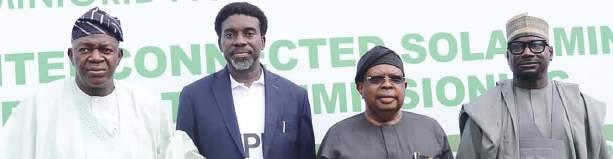
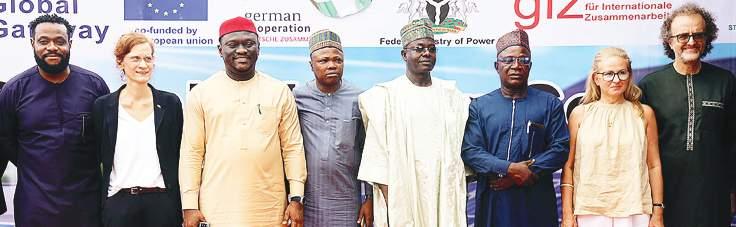
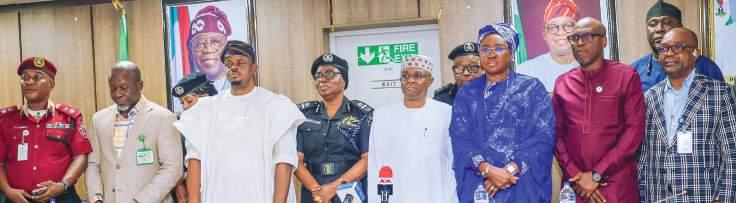
L-R: Member, Lagos State House of Assembly and representative of Senator Tokunbo
Hon.
Bola Tinubu’s State Police Bill, 2026. The upper chamber also passed the Nigeria Police Trust Fund (Repeal and Re-enactment) Bill, 2026, a legislation that removed the sunset clause contained in the Continued on page 8
MD/CEO,
Ayo Ademilua; Minister of Power, Joseph Olasunkanmi Tegbe; and MD/CEO, Rural Electrification Agency (REA), Dr. Abba Abubakar Aliyu, at the inauguration of a landmark 505kWp interconnected solar mini grid project in the Eredo community of Epe, Lagos State
existing law and made the Police Trust Fund a permanent funding
Mbah to Criminals: You Can Run, But Cannot Hide
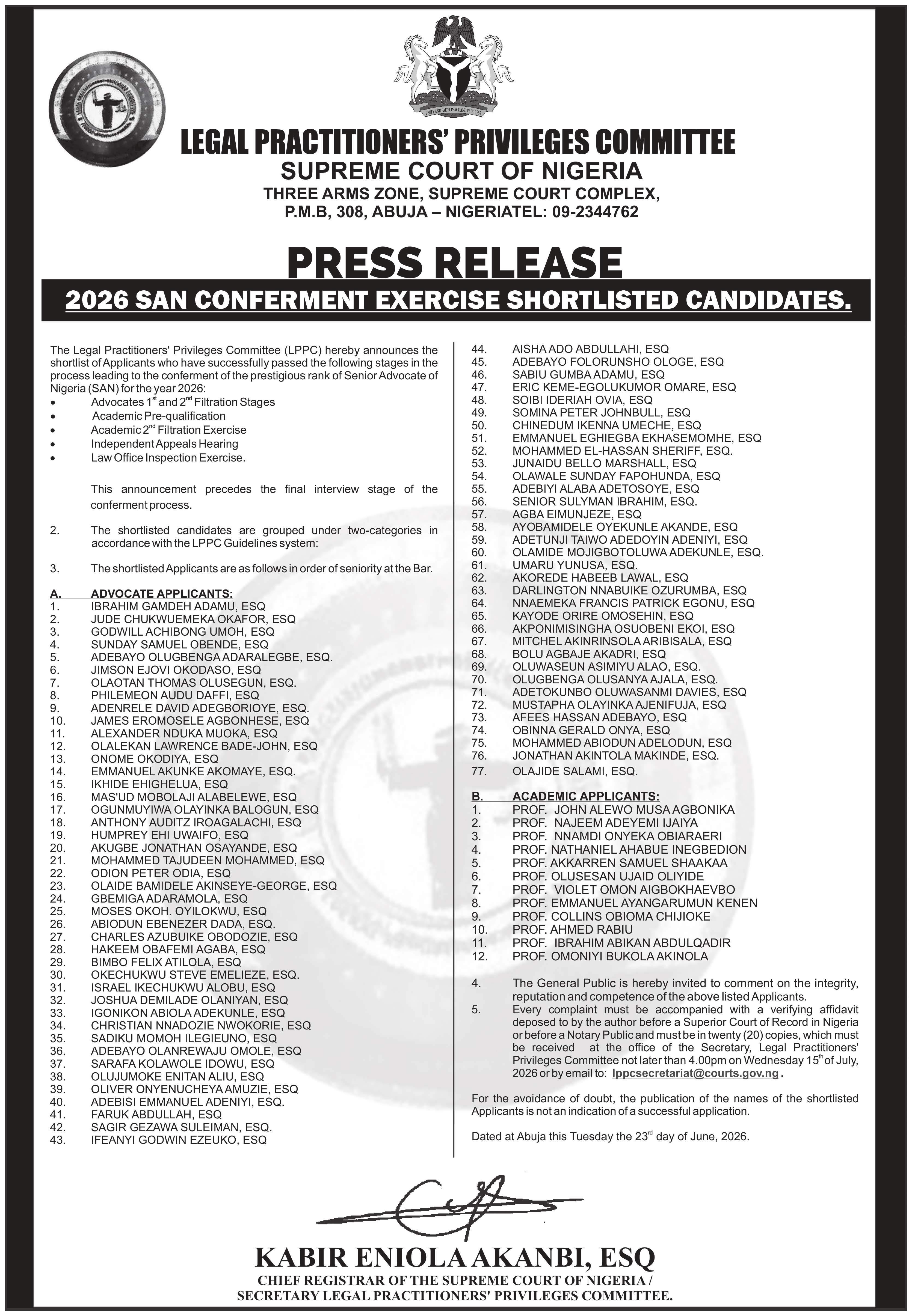
Inaugurates Centre for DNA Forensics and Investigation Lauds Tinubu for state police, reforms AGF: Centre a profound contribution to national security IGP: Holds enormous opportunity to strengthen investigations Continued on page 8 The Legal Practitioners’ Privileges Committee (LPPC) has approved the suspension of Chief Mike Ozekhome’s Senior Advocate of Nigeria (SAN) status. The decision taken at the LPPC’s 173rd General Meeting held on Tuesday, was made pursuant to
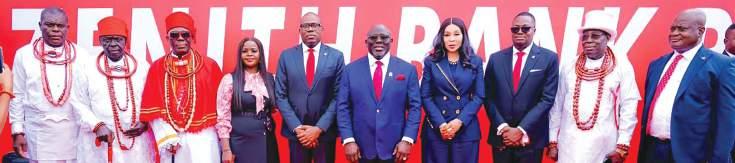
ZENITH BANK OPENING OF OSUBI BRANCH IN DELTA STATE...
L-R: Okakuro Shydoph Ememor; Okakuro Dick Gberevwie (Duke of Ugolo District); Okakuro Mike Afe (Prime Minister of Okpe Kingdom); Ms. Sophie Awoso, Branch Head, Zenith Bank, Osubi, Warri; Mr. Lawani Adamu I, Executive Director, Zenith Bank; Rt. Hon. (Elder) Sheriff F. O. Oborevwori, Governor of Delta State; Dame (Dr.) Adaora
& REASON
Chuks Okocha and Sunday Aborisade in Abuja
Umeoji, OON, GMD/CEO, Zenith Bank; Dr. Ifeanyi Attama, Zonal Head, Zenith Bank, Delta 1; Okakuro Best Umukoro; and Daniel Imani, Zonal Head, Zenith Bank, Delta 2, at the bank’s Osubi branch opening in Delta State, yesterday
Abiru,
Abiru Rotimi Lateef;
A4&T Power Solution, Ayodeji
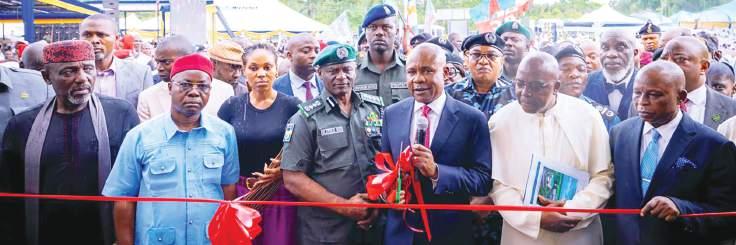
BOOSTING SECURITY INFRASTRUCTURE...
L-R: Former Governor of Imo State, Senator Rochas Okorocha; Speaker, Enugu State House of Assembly, Hon. Uchenna Ugwu; Inspector General of Police, Olatunji Disu; Governor of Enugu State, Dr. Peter Mbah; Vice Chancellor, Godfrey Okoye University, Prof. Christian Anieke; and the Attorney General of the Federation and Minister of Justice, Prince Lateef Fagbemi, during the inauguration of the state’s new security infrastructure, the Centre for DNA Forensics and Criminal Investigations, at Godfrey Okoye University, Nike, Enugu, on Wednesday
NEITI Begins Preparations for Validation after EITI Declines to Defer Exercise
Sarkin-Adar assures Nigeria will meet requirements Urges full compliance by entities covered by NEITI
The Nigeria Extractive Industries Transparency Initiative (NEITI) yesterday commenced intensive preparations for Nigeria’s 2026 Validation by the global Extractive Industries Transparency Initiative (EITI), after the international body declined the country’s request to postpone the exercise.
NEITI expressed confidence that Nigeria would ultimately meet all requirements and secure a successful outcome, citing the abiding resilience of the country and its people.
Speaking at a civil society and media engagement on Nigeria’s readiness for the validation exercise in Abuja, Executive Secretary of NEITI, Musa Sarkin-Adar, recalled that although the organisation had sought additional time to address lingering challenges, EITI rejected the request, leaving Nigeria with no option but to proceed with the assessment process as scheduled.
The validation, which is scheduled to commence on July 1, is a comprehensive assessment of a country’s compliance with the EITI Standard, which promotes transparency and accountability in the management of oil, gas and mining resources. Nigeria is among 54 member countries participating in the initiative.
Sarkin-Adar explained that despite existing constraints, NEITI was working around the clock with the National Stakeholder Working Group (NSWG) led by the Secretary to the Government of the Federation (SGF), George Akume, and other stakeholders to ensure the
country emerged successfully from the process.
“We are working together to see how Nigeria could participate in this validation process and come over very triumphant,” he stated.
The NEITI boss noted that Nigeria scored 70 per cent in its last validation exercise but was still deemed not to have met the EITI threshold, stressing that the country’s objective this time is to attain full compliance.
He warned that failure in the validation exercise could have far-reaching implications for Nigeria’s attractiveness as an investment destination, particularly in the oil, gas and mining sectors.
“If Nigeria loses this process, the investors, especially foreign investors in the oil and gas and mining sectors, may not wish to come and invest in Nigeria. Even the current ones that are here may decide to take away their investment from Nigeria,” Sarkin-Adar cautioned.
According to him, many Nigerians are still unaware of the critical role played by NEITI in promoting transparency and boosting investor confidence in the country’s extractive industries.
“NEITI is an enabler for investment in the oil and gas and mining sectors because it is our assessment of our reports that will guide foreign investors to come and invest in Nigeria. Security of investment is what matters and that’s what NEITI is there to guarantee and ensure,” he said.
The executive secretary called on oil and gas companies, mining firms
and regulators, including the Nigerian Upstream Petroleum Regulatory Commission (NUPRC), the Nigerian Midstream and Downstream Petroleum Regulatory Authority (NMDPRA), the Mining Cadastre Office and the Nigerian National Petroleum Company Limited (NNPC), to cooperate fully with NEITI throughout the validation process.
He lamented what he described as the poor response culture of some entities
covered by NEITI, noting that delayed responses to official correspondence were hampering the agency’s work.
The NEITI chief further disclosed that the organisation was constrained by inadequate funding despite the strategic role it plays in enhancing transparency and accountability in the management of natural resources.
“NEITI is not generating a dime. We don’t collect the revenues identified in
our reports and, in many cases, we are not even informed when recoveries are made. We need stronger institutional support to carry out our mandate effectively,” he added.
Earlier, civil society representative on the NEITI National Stakeholder Working Group, Dr. Erisa Danladi, described the validation exercise as an opportunity for reflection, learning and renewed commitment to transparency in the
extractive sector. Danladi acknowledged Nigeria’s progress in implementing the EITI Standard through beneficial ownership disclosures, contract transparency and stakeholder engagement, but noted that challenges remained, particularly in deepening community participation, strengthening implementation of audit recommendations and expanding transparency in the solid minerals sector.
Shareholders Approve Jaiz Bank’s Bid to Raise Fresh N150bn Capital
Haruna Musa says liquidity injection will boost lending to businesses, support local, global expansion ambition, others
Shareholders of Jaiz Bank Plc, yesterday, approved the bank’s request to raise an additional N150 billion capital to fund its expansion drive as well as boost lending to businesses. Speaking at the company’s 14th Annual General Meeting (AGM) in Abuja, the company’s Managing Director/ Chief Executive, Dr. Haruna Musa, said the proposed capital injection will be undertaken through various financial instruments.
Musa said the 2025 financial year was characterised by remarkable growth and strategic progress for the bank.
He stated that despite a challenging macroeconomic environment characterised by inflationary pressures, exchange rate volatility, and elevated operating costs, the bank demonstrated resilience, discipline, and strong execution of its strategic objectives.
According to him, the bank’s total assets rose by 19 per cent, from N1.08 trillion in 2024 to N1.29 trillion in 2025, while customer deposits increased by 24 per cent, from N904 billion to N1.12 trillion, during the period.
He disclosed that net risk assets and investments grew by 27 per cent, from N671 billion to N849 billion, underscoring the bank’s commitment
to financing productive sectors of the economy.
Musa said gross earnings also rose by 24 per cent to N102.81 billion compared to N82.87 billion in 2024, while profit before tax increased by 28 per cent to N31.24 billion from N24.44 billion recorded in the preceding year.
He attributed the strong earnings performance to growth in financing activities, investment income, and increased customer transactions.
The bank also recorded improvements in operational efficiency as its cost-to-income ratio declined from 60.42 per cent in 2024 to 58.09 per cent in 2025.
Musa said the bank maintained a
Access Bank UK Polo Day 2026: Windsor Set for Landmark Gathering
Nume Ekeghe
Access Bank will host its annual UK Polo Day in Windsor on July 4, bringing together an influential mix of investors, entrepreneurs, policymakers, and cultural figures from across the globe.
Over the years, the event has grown into more than a social highlight of the summer season, serving as a platform where relationships are forged, ideas exchanged, and business opportunities created.
Beyond the prestige of the occasion, the gathering carries a broader purpose, with its impact extending far beyond Windsor to support initiatives that are transforming lives in northern Nigeria.
The bank, in a statement, said Access Bank UK Polo Day had always carried a philanthropic dimension.
It stated, “This year, that dimension takes centre stage, proceeds from the event will go directly towards the construction of additional classroom blocks in underserved communities
across Northern Nigeria, a region where the gap between school-age children and available learning spaces remains one of the most stubborn obstacles to progress.”
The statement sad, “For many families in these communities, a classroom is not a given; it is a luxury. Access Bank has been changing that. The numbers tell a familiar and troubling story. Millions of children across Nigeria’s north remain out of school, some because of distance, some because of poverty, and many
simply because there is no building to go to.
“Bricks and mortar matter. A classroom block does not just give children somewhere to sit; it signals to a community that their children’s futures are worth investing in. It draws teachers.
“It gives girls a reason, and a safer route, to stay in education. It plants something durable in a place that often feels forgotten by the institutions that should be paying attention. This is the logic behind Access Bank’s
commitment.”
Access Bank has long recognised that financial inclusion and human development are not parallel pursuits, but one continuous journey. A resilient economy cannot be built on an undereducated workforce, nor can a generation be empowered without first equipping it with the tools to learn.
In that sense, the classroom blocks being funded through this year’s Polo Day represent more of a deliberate investment in long-term economic growth than a humanitarian gesture.
strong capital and liquidity position, with its Capital Adequacy Ratio (CAR) improving from 23.87 per cent to 26.89 per cent year-on-year, while its statutory liquidity ratio stood at 43.45 per cent, significantly above the regulatory threshold. He described 2025 as a transformational year for the institution, citing the successful execution of its corporate rebranding programme, expansion of digital banking services, enhanced customer acquisition across retail, SME, commercial and corporate segments, as well as increased financing support for agriculture, infrastructure, and renewable energy projects.
The managing director also highlighted the upgrade of the bank’s credit rating by GCR from BBB- to BBB and its admission as the first African institution to become a Primary Dealer of the International Islamic Liquidity Management Corporation (IILM).
Addressing shareholders on the approved capital raise, Musa said the fresh funds would be raised in phases and deployed to support the bank’s next growth cycle.
He said, “As part of the shareholders’ resolution passed today, we will move to the next stage of the capital-raising process.
“The target is to raise the required capital in phases, possibly through two or three tranches.”
Emmanuel Addeh in Abuja
James Emejo in Abuja
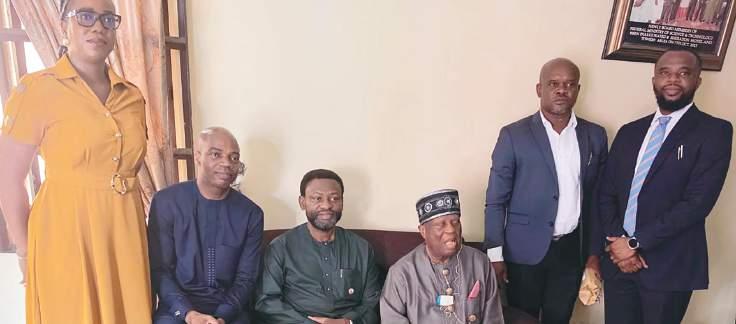
EMADEB MANAGEMENT TEAM’S VISIT TO AKWA IBOM...
L-R: Head, Human Resources Unit, Emadeb Energy, Mrs. Uduak Ugbodaga; Managing Director, Emadeb E&P, Dr. Segun Ogunsanya; Chief Executive Officer, Emadeb Energy Group, Mr. Debo Olujimi; Paramount Ruler of Eastern Obolo Local Government Area, HRM Chief Harry John Etetor; Chairman, Board of Trustees, Emadeb Eastern Obolo Ibeno Host Communities Development Trust, Mr. Dominic Ekpe; and Legal Adviser, Emadeb Energy Group, Mr. Jerry Achonwa, during the Emadeb management team’s visit to Akwa Ibom, on Monday
Customs Moves to Protect Local Industry, Confiscates N4.62bn Smuggled Goods in Ogun, N274m in Cross
Ogun command generates N259.7 million revenues in Q2
James Emejo in Abuja and James Sowole in Abeokuta
Acting Area Controller, Nigeria Customs Service (NCS), Ogun I Area Command, Mr. Oladapo Afeni, yesterday disclosed that the command confiscated 146 goods with the Duty Value Payment (DPV) of N4.62 billion in the second quarter of 2026.
Afeni, during a media briefing
at Idiroko, Ado-Odo/Ota Local Government Area of Ogun State, also said N259.7 million was realised as revenues from baggage assessments, auctions of perishable items, PMS, and other charges in the same review period, The revelation came on the day the service also stated that it had intensified efforts to protect domestic industries and support the country’s industrialisation drive
with the interception of prohibited imports valued at N273.7 million in Cross River State.
Addressing journalists at a media briefing in Calabar, Customs Area Controller, Cross River/Calabar Free Trade Zone/Akwa Ibom Area Command, Comptroller Giwa Dauda, said the seizure, which included 1,996 kegs of foreign refined vegetable oil and other prohibited items, underscored
the service’s determination to curb smuggling activities that threatened local manufacturing, discouraged investment, and undermined employment generation.
Dauda said the operation was part of sustained measures to shield indigenous industries from unfair competition posed by illegal imports.
He disclosed that officers of the Calabar command intercepted two 20-foot containers loaded with 1,996
Emadeb Exploration and Production (E&P) Limited, a subsidiary of Emadeb Energy Group, has reaffirmed its commitment to fulfilling all obligations to the Emadeb-Eastern Obolo-Ibeno Host Communities Development Trust (HCDT) in line with the Petroleum Industry Act (PIA), 2021.
As it advances its stakeholder engagement on its Ibom Field operations on PPL 236, the company noted that it would continue to uphold the highest standards of openness in its relations with the host community.
The assurance was given in Uyo by the Chief Executive Officer of Emadeb Energy Group, Mr Debo Olujimi, and the Managing Director of Emadeb E&P, Dr Segun Ogunsanya, during an inaugural engagement with members of the Board of Trustees of the HCDT.
The seven-member board of trustees chaired by Mr Dominic Ekpe, was inaugurated in April 2026 pursuant to the provisions of the PIA, with the meeting marking Emadeb E&P’s first formal engagement with the Trust since its establishment.
Speaking during the session, Olujimi said Emadeb E&P would
conduct its operations responsibly and in the best interest of the host communities of Eastern Obolo and Ibeno, Akwa Ibom State, and by extension the Federal Republic of Nigeria.
He pledged that the company would engage the Trust with integrity, transparency and an open mind, and sought the board’s cooperation in strengthening its administrative structures as the company finalises the requirements of its operational licence.
Olujimi said: “We know that what
we have come to do in Eastern Obolo and Ibeno communities is for the betterment of these communities, Akwa Ibom State and Nigeria. I want you to rest assured that Emadeb E&P will do the needful.
“Deep offshore exploration is a highly technical and capital-intensive endeavour, and by God’s grace we have successfully completed that phase. It is now time to work together in line with the plans we had already emplaced. We are all fully on board.”
Emadeb E&P reiterated that the host communities development trust
remains central to its community relations strategy and said it would continue to work closely with the board of trustees and host communities to ensure sustainable development and shared prosperity.
In his remarks, Chairman of the Board of Trustees, Ekpe, expressed appreciation to the CEO of Emadeb Energy Group for prioritising the engagement. He requested the company’s support for the Trust’s operational take-off, including the provision of administrative infrastructure and requisite funding.
kegs of imported vegetable oil along the Odukpani-Calabar Highway on June 14, 2026. According to him, the products, with a Duty Paid Value (DPV) of N195.5 million, were concealed in a truck intercepted during a routine patrolAfenioperation. also stated that NCS handed to the National Drug Law Enforcement Agency (NDLEA) 9,482 parcels of cannabis sativa, 62 sacks of raw marijuana, and 100 sachets of Tramadol of 10 pieces each (225mg).
Afeni gave further breakdown of seized goods as 2,807 bags of foreign parboiled rice 50kg each; 16,525 litres of premium motor spirit in kegs; 475 litres of diesel; 7,642 pieces of footwear; and 2,427 pneumatic tyres.
Other seized items were 63 sacks of foreign sugar;73 bales of second-hand clothing; 1 unit of used vehicles;10 bags of fertiliser (50kg each); 62 bags of imported flour; and 32 cartons of frozen product.
Apart from the seizures of items brought into the country in contravention of Nigeria’s extant laws, the acting controller disclosed that the command recorded a total export volume of 20,972 metric tons with Free On Board (FOB) value
River
of N1.04 billion.
He said the revenue collected during the review period showed a 238 per cent increase of collection compared with N76.8 million generated for the same period last year. He said, “The difference recorded was made possible as a result of resilience of officers in ensuring that importers and agents are made to adhere strictly to import/export guidelines in tandem with extant laws.
“The Command under my watch have remained relentless in enforcing government fiscal policies and trade guidelines.”
Afeni is Chairman of the Joint Border Security Committee, which unites Nigeria and Beninese security agencies including Nigeria Police, Department of State Services (DSS), Nigeria Immigration Service (NIS), Nigeria Security and Civil Defence Corps (NSCDC), National Drug Law Enforcement Agency (NDLEA), and Federal Road Safety Corps (FRSC).
He commended the cooperation among agencies.
He said, “I wish to commend the synergy we are receiving from sister agencies, opinion leaders, head of traditional institutions, media, eminent personalities and other law-abiding members of the public.
Tinubu Urges Africa to Turn Resource Wealth into Economic Power
Folalumi Alaran in Abuja
President Bola Ahmed Tinubu has urged African countries to end the long-standing practice of exporting raw materials while importing finished products, insisting that the continent must embrace local processing, value addition and industrialisation to transform its vast natural resources into sustainable economic prosperity.
Speaking at the opening of the 2026 African Natural Resources
and Energy Investment Summit (AFNIS) in Abuja, the President, represented by the Minister of Solid Minerals Development, Dr. Dele Alake, said Africa’s future prosperity depends on its ability to process its minerals locally, build industrial capacity and create value across the supply chain.
Held under the theme, “One Africa, One Resource Vision,” the summit brought together African leaders, policymakers, mining executives and international inves-
tors from the United States and China to chart a common strategy for unlocking the continent’s vast natural resource potential.
Tinubu said, for generations, Africa has been described by what lies beneath our soil, adding that the question before leaders today was whether Africa would finally turn its wealth into power.
The President argued that Africa must move beyond fragmented approaches to development and embrace a unified vision
that prioritises beneficiation, manufacturing and industrial growth.
According to him, the continent’s strategic reserves of critical minerals place Africa at the heart of the global energy transition, but sustainable economic gains would only come when African countries move up the value chain.
“There will be no global energy transition without Africa’s critical minerals,” he said. “The future will belong to those who create
value, not merely those who extract resources,” he added.
Highlighting Nigeria’s efforts to reposition its mining industry, Alake said the federal government had undertaken major reforms aimed at sanitising the sector, attracting investment and promoting localHeprocessing. disclosed that more than 10,000 dormant mineral titles had been revoked to curb speculation and make assets available to genuine investors.
Emmanuel Addeh in Abuja
MISS WORLD NIGERIA 2026, TAMUNOSOYE KARIBI GEORGE VISITS DIRI...
Governor of Bayelsa State, Senator Douye Diri (left), and Miss World Nigeria 2026, Tamunosoye Karibi
Falade: Train 7 Hits 90% Completion,
Generates 16,000 Jobs
NCDMB, NLNG advance local content
Emmanuel Addeh in Abuja and Blessing Ibunge in Port Harcourt
Managing Director and Chief Executive Officer of Nigeria LNG Limited, Mr Adeleye Falade, has confirmed that the ongoing construction of its Train 7 project has reached 90 percent and pre-commissioning activities had started.
He said plans are afoot to commission the new facility in 2027 and increase NLNG’s overall production capacity by 35 percent
Falade made the disclosure when he paid a courtesy visit to the Executive Secretary, Nigerian Content Development and Monitoring Board (NCDMB), Felix Omatsola Ogbe at the Board’s liaison office in Lagos, yesterday.
The achievement was contained in a statement jointly signed by the General Manager External Relations & Sustainable Development, NLNG, Sophia Horsfall, and the General Manager, Corporate Communications Division, NCDMB, Dr. Obinna Ezeobi, made available to journalists in Port Harcourt. During the visit, the leadership of the NCDMB and NLNG reaf-
firmed recommitment to deepen the existing close collaboration between the agencies, towards enhancing in-country value addition from operations of the gas processing and marketing company, for the benefit of the Nigerian economy.
Falade said the company remains focused on deepening Nigerian Content, strengthening indigenous capacity and retaining greater in-country value across its gas value chain.
He expressed delight that the Train 7 project had created direct employment opportunities for 16,000 persons on the site, reducing insecurity and impacting positively on the nation’s socio-economic stability.
He lauded the close collaboration between both entities, recalling that they pioneered many initiatives together for the benefit of the sector, affirming that such accomplishments would be surpassed under his leadership.
Falade assured that the NLNG remains committed to sustained engagement with NCDMB in support of Nigerian Content development, local capacity growth, and increased participation
ActionAid Faults
of Nigerian companies in the oil and gas value chain.
He said the company would continue to pursue partnerships that translate Nigeria’s gas resources into broader economic opportunities for businesses, professionals, service providers, and host communities.
“NLNG values its relationship with NCDMB and remains fully committed to the shared goal of strengthening Nigerian Content in the oil and gas industry.
“As a major player in Nige-
ria’s gas sector, we recognise our responsibility to support indigenous capacity, grow local supply chains, and ensure that our activities continue to deliver meaningful value to the Nigerian economy,” Falade said.
He further stated that the NLNG would sustain its focus on practical areas of collaboration with the Board, including vendor development, skills enhancement, technology transfer, local procurement, and value retention.
“Our commitment is to work
closely with the Board in a manner that is deliberate, measurable, and impactful.
“We want NLNG’s operations and partnerships to continue opening doors for Nigerian businesses, building competitive local capabilities, and supporting the long-term growth of Nigeria’s gas industry,” he added.
In his response, the Executive Secretary congratulated Falade on his appointment and promised that NCDMB would support him to succeed in his role.
He confirmed that NCDMB and NLNG share a relationship that was beyond regulator and operator, recalling how the Board and NLNG in June 2017 signed the first of its kind Service Level Agreement (SLA) on Nigerian Content project approval timelines and compliance, which later became a template for the oil and gas industry.
He further charged NLNG to enhance its support on the Brass Shipyard project, which was the capacity development initiative (CDI) on the Train 7 project.
The federal government has launched the National Poverty Intelligence Lab, which is targeted at addressing and reducing the poverty level of an estimated 140 million Nigerians living below the poverty line.
It was unveiled on Wednesday in Abuja by Minister of Humanitarian Affairs and Poverty Reduction, Dr. Bernard Doro.
The initiative, according to the minister, is expected to serve
The data-driven platform, which is in collaboration with Innovation for Poverty Action, is designed to strengthen, target, monitor, and evaluate the programme.
Onanuga’s Remarks, Says Hunger, Hardship Now Nigeria’s Daily Reality
Michael Olugbode in Abuja
ActionAid Nigeria (AAN) yesterday criticised recent remarks by Special Adviser to the President on Information and Strategy, Bayo Onanuga, accusing the presidency of normalising hunger and economic hardship as well as dismissing the daily struggles of millions of Nigerians.
The organisation stated that the presidential spokesman’s claim that he could not see the level of hunger Nigerians complained about, based on his personal observations and interactions with people around him.
ActionAid said Onaguga’s comments reflected a dangerous
disconnect from realities across the country.
In a statement issued in Abuja, ActionAid Nigeria described such remarks as careless and unsupported by evidence, insisting that the hardship confronting Nigerians is documented in official statistics and reflected in the experiences of communities across the country.
The organisation stated that although Onanuga questioned the extent of hunger in Nigeria, he acknowledged during the same interview that the prices of food items had risen significantly.
According to ActionAid, a crate of eggs that sold for about N600 a few years ago now costs between
N6,000 and N8,500, underscoring the severity of the cost-of-living crisis.
It said official figures from the National Bureau of Statistics showed that food inflation rose to 16.96 per cent year-on-year in May 2026, from 16.68 per cent in April, driven by increasing prices of staples, such as onions, maize, yam, cassava, tomatoes, pepper, wheat, and plantain.
ActionAid said the naira’s devaluation had eroded the purchasing power of workers and households, while labour groups repeatedly argued that incomes would need to rise substantially to restore the living standards Nigerians enjoyed about a decade ago.
The organisation maintained that communities it worked with across Nigeria, including women smallholder farmers, informal traders, and residents of conflict-affected and displaced communities, continued to report worsening conditions, with food, transportation, healthcare, and other basic necessities increasingly becoming unaffordable.
It stressed that the realities of hunger and hardship were not products of political propaganda or social media exaggeration but were evident in market prices, government inflation data, school enrolment figures, and the difficult choices families now made to survive.
as the central intelligence and evidence-gathering centre for the government’s anti-poverty interventions.
Speaking at the opening of a three-day workshop on the operationalisation of the lab in Abuja, Doro said the country could no longer rely on assumptions and fragmented interventions in tackling poverty.
According to him, Nigeria’s poverty challenge requires a new approach anchored on data, evidence and accountability.
He stated, “Recent estimates indicate that approximately 140 million Nigerians live below the poverty line.
“The scale and depth of the challenge is staggering, but it is surmountable.”
He added, “What this moment demands is not more of the same. It demands systems, intelligence, evidence-driven leadership and, above all, coordinated and accountable action.”
Doro described the National Poverty Intelligence Lab as the “intelligence backbone” of Nigeria’s poverty reduction architecture, saying it would provide the analytical support needed for policy formulation, programme implementation, resource allocation and performance assessment.
Doro stated, “For many years, our interventions have been driven by assumptions rather than evidence, sometimes by politics rather than data, and by silos rather than systems.”
He said, “The NPIL changes that. It gives us the analytical infrastructure to ask the right questions, find credible answers and hold ourselves accountable for results.”
The minister explained that the lab would support implementation of the One Humanitarian One Poverty Response System (OHOPRS), a framework developed by the ministry to harmonise humanitarian assistance, social protection programmes and poverty reduction initiatives under a unified structure.
He added, “Every household we reach through OHOPRS is a household we intend to graduate from vulnerability—not just today but permanently. That is the ambition. And the NPIL is the engine that will tell us whether we are getting there.”
Earlier, Country Representative of Innovations for Poverty Action, Mrs. Fumi Ayeni, said collaboration with the ministry would help policymak- ers better understand the needs of poor and vulnerable populations while reducing duplication in intervention programmes.
George, during the latter’s courtesy visit to Government House, Yenagoa, on Tuesday
Kuni Tyessi in Abuja
PwC Report Identifies Economic Volatility, Inflation, Taxation as Major Challenges for African Family Businesses
Dike Onwuamaeze
The ‘PwC Africa Family Business Survey 2025’ has identified economic volatility, tax challenges and changing consumer expectations and behaviour as global megatrends that had most significant impact on family businesses in Africa in 2025.
The report released yesterday stated that, “Africa family businesses are facing a more demanding operating environment, with economic volatility and tax challenges now among the most significant forces shaping strategic decisions.”
It stated that 66 per cent of the survey’s respondents noted that, “inflation and supply chain disruption have also had a meaningful impact on their business over the past year, above the global average of 58 per cent.
“At the same time, almost half (58 per cent) cite tax challenges, higher than the global average of
35 per cent,” while 53 per cent of respondent mentioned changing consumer expectations and behaviour as a challenge to their businesses against global average of 41 per cent.
According to Family Business Leader, West Market, PwC, Mr. Edward Gomado, “rising tax complexity and external uncertainty are reshaping the business landscape, but the continued growth of many African family businesses shows that resilience, discipline and long-term thinking remain powerful advantages.”
The report noted that governments are under increasing pressure to mobilise domestic revenue as financing gaps widen, debt service costs rise and traditional external funding becomes less reliable.
“In response, tax systems are becoming more dynamic, with reforms focused on broadening the tax base, strengthening enforcement, improving compliance, and digitising administration.
“This is evident across African markets, where tax reform remains active but varied. Nigeria has recently implemented a major tax overhaul, South Africa and Kenya are advancing revenue and compliance measures, while Ghana has rolled back selected taxes.
“The direction may differ, but tax is clearly emerging as a strategic business issue across the region.
“The significance goes beyond immediate cost pressures. Economic and tax uncertainty can shape how businesses invest, how quickly they move, and how confidently they plan. This elevates tax from a compliance issue to a strategic one.
“In Nigeria, for example, recent tax reforms mean that undistributed profits may be deemed distributed and subject to tax, directly affecting business outcomes,” it stated.
The report added that reputation could no longer be taken for granted as nearly a third of respondents (32
per cent) noted that their reputation feels somewhat or highly vulnerable in the current environment.
It stated that negative attention and public activism were cited as the leading threats, which suggested that, “reputation is no longer shaped only by what a business does, but also by how clearly it communicates its values, responds to external expectations and navigates an increasingly visible public landscape.”
The report further stated that 37 per cent of respondents stated that negative media coverage or public scrutiny was among factors that posed the greatest risk to reputation of family business in Africa.
PwC recommended that family businesses need to reframe conversations around the issues shaping long-term value, balancing a clear sense of purpose with the choices that drive resilience, growth and continuity.
This, according to the report
MBAH TO CRIMINALS: YOU CAN RUN, BUT CANNOT HIDE
Gideon Arinze in Enugu
Governor Peter Mbah of Enugu State says there is no more hiding place for criminals in the state as his administration has built the capacity to pre-empt, track down, and bring them to book.
Mbah sounded the warning on Wednesday during the commissioning of Centre for DNA Forensics and Criminal Investigation (CeDFoCI), a strategic partnership between Enugu State Government, Godfrey Okoye University, and Nigeria DNA Learning Centre, at the university’s complex, Ugwuomu, Nike, Enugu.
Attorney-General of the Federation (AGF) and Minister of Justice, Prince Lateef Fagbemi,
SAN; Inspector General of Police, Olatunji Disu; and Vice Chancellor of Godfrey Okoye University, Professor Christian Anieke, lauded Mbah’s strides in the security sector, describing the centre as a major contribution to national security and the justice system.
Mbah said while Enugu State was open to business, investment, and innovation, criminal elements intent on harming the land and the people will meet their waterloo in the state.
He stated, “So, Enugu is open to investors. Enugu is open to innovators. Enugu is open to people who want to build, create, and contribute. “But for those who seek to
undermine the peace and security of our people, the message is very simple: you can run, but you cannot hide.”
The governor described CeDFoCI as one of the most important investments of his administration in the state’s security architecture in line with his Citizens’ Charter. He said none of the ambitions in the charter would be possible without security.
The governor maintained that while his administration had significantly reduced crime, more work still needed to be done.
He stated, “That is why we continue to invest, continue to innovate, and continue to strengthen the systems that keep our people safe. That brings us to why we
are here today.
“The centre strengthens our ability to investigate crime, track criminals, support the work of law enforcement, and ensure that those who threaten the peace of our communities have fewer and fewer places to hide.
“So, to the criminals, I say this: every crime scene leaves a trace. And we can now track that trace and use it as evidence against you.”
Mbah stressed, “For too long, many crimes have gone unresolved because the tools did not exist to capture and prosecute you. Now they do.
“Therefore, if you intend to harm our people, if you intend to prey on our children, if you
included reviewing the relationships, structures and decisions that influence resilience, growth and continuity from partners and business processes to capital allocation, decision-making and value preservation across generations.
The report added: “Review your business ecosystem and operating model. Take a closer look at the partners, markets, relationships and business processes shaping your organisation.
“In a more visible and fragmented environment, these choices increasingly influence trust, reputation, resilience, and the ability to adapt at pace.
“The priority should be to ensure that both external relationships and internal processes are helping the business respond to change, rather than slowing execution or limiting flexibility.”
The PwC also recommended strengthening governance and decision-making by clarifying, “how
intend to threaten our communities, understand that the state now possesses capabilities that did not previously exist.
“This centre changes what is possible. It strengthens our ability to follow the evidence, identify those responsible, and support the work of law enforcement with world-class forensic science.”
Mbah stated that the emergence of CeDFoCI also came with responsibilities and new ways of doing things for Enugu residents.
He explained, “Henceforth, when crimes occur, keep a safe distance, promptly alert the authorities, and allow trained professionals to carry out their work.
“Every footprint, fingerprint,
ALL EYES ON STATE GOVTS AS SENATE PASSES TINUBU’S STATE POLICE AND TRUST FUND BILLS
mechanism for the Nigeria Police.
The passage of the state police bill set the stage for a nationwide shift from a centrally controlled policing system to a dual federal-state policing framework.
Senate Leader Opeyemi Bamidele, who led debate on the bill, said it represented one of the most important reforms in Nigeria’s democratic evolution, which would help to tackle insecurity and ensure a stronger federal structure.
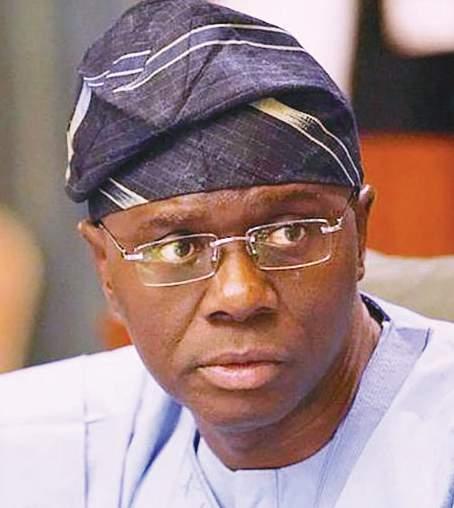
Lagos State Governor Babajide Sanwo-Olu hailed Tinubu on the passage of the bill, describing him as a “champion of true federalism”.
The proposal, which sought to amend the Constitution of the Federal Republic of Nigeria, will empower states to establish and operate their own police services, while retaining a Federal Police Service with overarching responsibility for national security, terrorism, organised crime, cybercrime, arms trafficking and other offences with interstate or international dimensions.
The bill, transmitted to the National Assembly by Tinubu, scaled a major legislative hurdle after senators considered and voted on its 26 clauses during a lengthy plenary.Individual lawmakers voted by raising up their hands with Clerk of the Senate coordinating the counting.
The passage of the bill marked a significant victory for advocates of police decentralisation who had long argued that Nigeria’s security challenges could no longer be effectively addressed through a single centrally controlled police
structure.
The senate proceedings attracted unusual interest from top government officials and state executives, leading to a procedural debate over whether non-members should be allowed into the chamber to witness deliberations.
The issue generated heated exchanges among lawmakers after the senate leader moved a motion to suspend Senate rules to permit selected officials to observe proceedings from within the chamber.
Several senators opposed the proposal, insisting on adherence to parliamentary procedure.
Following consultation among members of the senate leadership, a compromise was reached, allowing the visitors to observe proceedings directly, inside the chamber.
Among those who monitored the debate were Chief of Staff to the President, Hon. Femi Gbajabiamila; Governors Uba Sani of Kaduna State, Lucky Aiyedatiwa of Ondo State, and Dapo Abiodun of Ogun State; Attorney-General of the Federation and Minister of Justice, Lateef Fagbemi (SAN); and Attorneys-General of Kaduna, Ogun, and Ondo states.
Leading debate on the general principles of the bill, Bamidele described the proposal as one of the most consequential constitutional reforms undertaken since Nigeria’s democratic transition.
According to him, the current centralised policing structure has become increasingly overstretched by the country’s expanding security threats, including terrorism, banditry, kidnapping, communal conflicts,
organised crime, and cyber-related offences.
He stated that Nigeria’s vast geographical size, ethnic diversity, and varying security realities required a more flexible and responsive policing framework capable of addressing local challenges more effectively.
Bamidele said, “This Bill represents one of the most significant constitutional reforms in our nation’s democratic evolution.
“It addresses a long-standing national conversation on the structure, effectiveness, responsiveness and sustainability of policing in the Federal Republic of Nigeria.”
The senate leader explained that the proposed amendment would replace the existing constitutional provision establishing the Nigeria Police Force with a Federal Police Service and State Police Services.
Under the proposal, states would not automatically operate police services. Rather, each state would be required to enact its own law establishing a State Police Service and obtain certification that it met minimum national standards prescribed by the National Assembly.
He explained, “No state police service shall commence operations unless it has been established by a valid law of the House of Assembly and certified as meeting national minimum standards.”
Under the proposed framework, the Federal Police Service would continue to handle national security responsibilities, including counterterrorism operations, cybercrime investigations, border security, organised criminal networks, arms trafficking and interstate offences.
State police formations would focus primarily on local law enforcement duties, such as maintaining public order, enforcing state laws, preventing and detecting crimes within their jurisdictions, and protecting life and property.
Bamidele said one of the strongest features of the bill was the extensive safeguards inserted to prevent abuse of state police powers by political office holders.
According to him, governors would be constitutionally barred from deploying state police services for partisan, ethnic, religious, sectional or personal purposes.
“The bill expressly prohibits the use of police powers for partisan, ethnic, religious, sectional or personal purposes,” he stated.
He added that governors would also be prohibited from directing police authorities to target individuals, political parties, groups or associations unlawfully.
The bill further provides for the establishment of independent State Police Service Commissions in each state to oversee recruitment, promotions, discipline and general administration.
To ensure nationwide professionalism and uniformity, the National Assembly would be empowered to prescribe minimum standards covering recruitment, training, promotions, discipline, accountability, firearms management, use of force, complaints procedures, data management and professional conduct.
One of the most debated aspects of the proposal pertained to the circumstances under which the federal government could intervene
decisions are made across family, board and management, and whether governance structures are effectively supporting agility, alignment and accountability.
“Clearer decision rights can reduce friction, support smoother leadership transitions and help the business respond more confidently in a fast-changing environment.” It also advised family businesses to allocate capital and rewards with greater intent.
strand of hair, blood sample, or biological trace may contain crucial evidence. Once contaminated, such evidence may be lost.”
He said the centre, though located in Enugu State, remained open for use by relevant agencies, organisations, professionals, and governments beyond its borders.
“This facility may be located here, but its significance extends far beyond our borders,” he stated.
“It is our contribution to the quest for a justice system that is guided not by conjecture, but by evidence; not by suspicion, but by science,” the governor added.
He lauded President Bola Tinubu’s courageous policies, stating, “These reforms have allowed more funds to flow to states, enabling us to develop infrastructure at scale, including strengthening our security.
in the operations of a state police service.
Bamidele clarified that federal intervention would only occur under exceptional situations, including a breakdown of public order, operational collapse of a state police service, serious violations of fundamental rights, electoral intimidation or threats to national security.
According to him, such intervention would require written authorisation by the president and would be subject to Senate oversight as well as judicial review.
“The intervention must be limited in scope and duration and remain subject to constitutional safeguards,” he said.
The bill stipulated that where
Continued on page 35
Paragraph 26(6) of the Guidelines for the Conferment of the Rank of Senior Advocate of Nigeria and All Matters Pertaining to the Rank.
A statement by the Chief Registrar of the Supreme Court of Nigeria and Secretary, LPPC, Kabir Akanbi, disclosed yesterday that the suspension is pending the final determination of the disciplinary proceedings, presently before the Disciplinary and Ethics Sub-Committee of the LPPC and other proceedings.
“The suspension is intended to safeguard the integrity, dignity, and prestige of the Rank of Senior Advocate of Nigeria while due
“Again, through his recent transmission of the State Police Bill to the National Assembly, Mr. President boldly demonstrates his support for the devolution of policing responsibilities to states, and a clear appreciation of the realities of modern security management.”
Mbah said the partnership with Godfrey Okoye University was consistent with his administration’s broader vision to create an ecosystem where learning institutions were not isolated from society’s challenges but active participants in solving them.
He stated, “I commend the vice chancellor for nurturing an environment that is wholly conducive to learning and Professor George Ude, Founding Director of the Centre for DNA Forensics and Criminal Investigation, for his commitment
Continued on page 34
consideration is given to the matters under review.
“Accordingly, Chief Mike Ozekhome, shall refrain from parading himself, presenting himself, or otherwise holding himself out as a Senior Advocate of Nigeria pending the final determination of the disciplinary proceedings,” the statement said.
The LPPC noted that it remains committed to upholding the highest standards of professional ethics, integrity, and discipline within the legal profession and to ensuring that the rank of Senior Advocate of Nigeria continues to command public confidence and respect.
Minister of Finance, Taiwo Oyedele
SWEARING IN OF NEWLY ELECTED SENATORS...
L-R: Senators Olaka Nwogu (Rivers South East, PDP); Ikeje Asogwu (Enugu North, APC); President of the Senate, Godswill Akpabio; Senators Envulu Anza (Nasarawa North, APC); and Dayo Faduyile (Ondo South, APC), after the swearing in of newly elected senators, yesterday
FG to Manufacturers, Processors: Era of Diesel Generator as Primary Power Source Drawing to Close
Pledges total
privatisation of power sector Lagos: we pay more for diesel than we do for medical supplies energy makes possible”.
The federal government has assured Nigerian manufacturers, processors, logistics operators, and the entire business community that the era of relying on diesel generators as primary source of electricity was drawing to a close.
The assurance was given yesterday in Lagos by Minister of Power, Mr. Joseph Tegbe, in his keynote address at the Lagos Chamber of
Commerce and Industry’s (LCCI) “2026 Renewable Energy Outlook Conference”, with the theme, “Nigeria’s Energy Transition Agenda: Power Sector Transformation for Industrial Competitiveness.”
Tegbe stated that the challenges in the power sector’s value chain was 20 per cent technical and 80 per cent governance and commercial, which would require replication of the manner of reform that was carried out 25
years ago in the telecom sector in the power sector.
He said the government would privatise the entire segments of the power sector in the nearest future.
The minister stated, “I say to the manufacturers, the processors, the logistics operators, and the technology firms in this room: the era of the diesel generator as your primary power source is drawing to a close.”
He said the government was
building a Nigeria in which a manufacturer in Apapa, a data centre in Lekki, or a textile mill in Kano, “can source clean, reliable electricity at a competitive costreflective tariff; a Nigeria in which 277 gigawatts of installed capacity, predominantly renewable, powers homes, industries, hospitals, and digital infrastructure; a Nigeria that leads in population, resource endowment, and in the productivity and competitiveness that reliable
FG Pumps N217bn into Medical Education to Boost Healthcare, Curb Brain Drain
The federal government has invested over N217 billion in two years to overhaul medical education and healthcare training nationwide, aiming to position Nigeria as Africa’s hub for medical innovation.
Minister of Education, Dr. Tunji Alausa, announced the funding yesterday at the Inaugural International Conference of the Faculty of Basic Clinical Sciences, College of Medicine, University of Lagos.
“Breaking down the N217 billion investment, N97bn in 2025 was spent on Special High Impact Projects to expand training capacity in medical schools.
“N120.5bn was approved for 2026 and was earmarked for infrastructure upgrades, modern equipment, expanded teaching facilities, and improved learning environments across medical colleges.”
The minister also unveiled plans for nationwide Medical Simulation and Technology Centres to give students hands-on, simulation-based training that meets global standards.
The goal: improve clinical readiness before doctors face real patients.
Speaking on the conference theme, “Precision in Practice: Integrating Diagnostics, Therapeutics, and Clinical Insights for
Patient-Centered Care”, Alausa said Nigeria must align with global trends in artificial intelligence, genomics, digital pathology, and precision medicine.
“President Bola Ahmed Tinubu’s administration recognises that sustainable healthcare depends on deliberate investment in institutions that train our doctors, nurses, pharmacists, and scientists”.
“To back that up, FG has approved the National Research and Innovation Development Fund (NRIDF) to provide sustained financing for research and commercialization of discoveries. It will end the fragmentation in our research ecosystem by link-
Odinkalu Accuses Ojukwu Varsity Management of Subverting Justice
David-Chyddy Eleke in Awka
For the first time since his removal as the Chairman of the Governing Council of Chukwuemeka Odumegwu Ojukwu University (COOU), Prof. Chidi Anselm Odinkalu, has taken to his X handle to speak about leadership dispute in the institution. Odinkalu was recently removed and replaced as chairman of the council, with Governor Chukwuma Soludo charging the new chairman, Prof. Peter Onwughalu on proactiveness, a statement which many said inferred ineptitude on the part of
Odinkalu-led council.
The recent appointment of Prof. Kate Omenugha by Governor Soludo has been a subject of litigation, with one of those involved already challenging the action at the National Industrial Court.
But Odinkalu while reacting to a piece by the commissioner for information, Dr. Law Mefor, against him, accused the Anambra State Government and the university management of colluding to undermine the ongoing legal challenge over the appointment of the institution’s Vice-Chancellor.
Odinkalu, a former Chairman of the National Human Rights Commission, and a legal scholar said issues raised recently by the Anambra State Commissioner for Information, Dr. Law Mefor, regarding his tenure as Chairman of the university’s Governing Council were already the subject of litigation before the National Industrial Court of Nigeria (NICN). He said: “I’m one of the defendants in the suit, alongside Anambra State Governor Chukwuma Soludo, the state’s Attorney-General, the university and its Governing Council.
ing universities, institutes, and industry,” Alausa noted.
Alausa urged alumni, corporate bodies, and philanthropists to support the endowment to promote excellence in medical training.
The minister reaffirmed government’s commitment to “sustaining investments that strengthen healthcare training, advance scientific discovery, and position Nigeria as a leading hub for medical education in Africa.”
He encouraged the entire business community to swiftly embrace the advantages contained in the Electricity Act 2023 in order to escape the high cost of operating on diesel generators.
The minister pointed to “embedded generation, industrial mini-grids, renewable energy procurement agreements, and direct connections to renewable independent power producers that are now legally enabled under the Electricity Act 2023”, saying, “We encourage you to move swiftly. The competitive advantage belongs to those who act first.”
Tegbe said the Federal Ministry of Power could not, and did not intend to, deliver the transformation alone, even though the Energy Transition Office had mobilised over $3.6 billion in investment to date.
He said, “The updated Energy Transition and Investment Plan has mapped the precise capital requirements across the power, cooking, transport, industry, and oil and gas sectors, providing the detailed roadmap that institutional investors and development finance institutions require.
“But what we need from the Lagos Chamber is not only investment.
“We need advocacy. We need the private sector to participate actively in state electricity market consultations, ensuring that tariff frameworks, grid access rules, and renewable energy procurement mechanisms are commercially sound.”
He also called for patience calibrated by urgency because, “transformations of this magnitude— restructuring the electricity governance of a nation of over 220 million people— do not conclude in a single administration”. Tegbe stated, “But the foundations must be correct, and the momentum must be sustained. It is our collective responsibility to ensure that both conditions are met.
“We shall not pretend that the journey ahead is without difficulty. Grid instability, legacy debt of over N3 trillion, the metering gap, the coordination challenges of thirty-six subnational electricity markets represent real obstacles, and honest leadership demands that we name them clearly, even as we chart the path around them.”
Inflation Driving Women, Children into Exploitation, Female Lawyers Cry Out
The International Federation of Women Lawyers (FIDA), Nigeria, has warned that worsening economic conditions in the country are exposing millions of women and children to heightened risks of exploitation, trafficking and abuse.
This is just as the group has called on both the federal and state governments to intensify efforts towards the release of pupils and staff abducted by terrorists in Oyo, Borno and other states of the federation.
FIDA’s Country Vice President, Eliana Martins, while stating that economic hardship is exposing vulnerable families to trafficking, child labour and forced marriages,
called on governments at all levels to introduce measures that would protect vulnerable households.
Addressing delegates on Wednesday, at the opening of the association’s Second Quarter National Executive Council (NEC) Meeting in Abuja, Martins lamented that rising inflation, unemployment and poverty are forcing many families into desperate coping mechanisms with severe human rights implications.
She claimed that the soaring cost of living is increasing the prevalence of child labour, school dropouts, child marriage, trafficking and gender-based violence as struggling households grapple with the inability to afford food, education and healthcare.
“The increasing cost of living continues to place immense pressure on families, exposing women and children to heightened risks of exploitation and abuse,” she warned.
FIDA urged federal and state governments to implement targeted social protection programmes, expand food security initiatives and improve access to affordable healthcare and education to cushion the impact of the economic crisis.
The organisation stressed that unless meaningful relief measures are introduced, vulnerable populations—particularly women, children, persons with disabilities and displaced families—will continue to bear a disproportionate share of the country’s economic challenges.
PHOTO:
Alex Enumah in Abuja
Kuni Tyessi in Abuja
Dike Onwuamaeze
INAUGURATION CEREMONY OF 200KW SOLAR PV POWER SYSTEM 2...
L-R: Head of Programme, NESP, Duke Benjamin; Head of Development Cooperation, German Embassy, Dr. Karin Jansen; Director General/CEO, Standards Organisation of Nigeria (SON), Dr. Ifeanyi Chukwunonso; Acting Director General, Renewable Energy, Dr. Owolabi Sunday; Chairman, Standards Council of Nigeria, Hon. Yauza Ado Inuwa; Commissioner, Nigerian Electricity Regulatory Commission, Engr. Mohammed Imam; Head of Green and Digital Economy, EU Delegation to Nigeria and ECOWAS, Inga Stefanowicz; and Head of Cooperation, EU Delegation to Nigeria and ECOWAS, Massimo De Luca, at the commissioning ceremony of the 200KW Solar PV Power System held at the SON Laboratory Complex, Ogba, Lagos, yesterday
REA, EU, Germany, Deliver 505kWp Solar Mini-
Grid Plant to Power Five Lagos Communities
8,000 Epe residents, businesses, hospitals to benefit from first phase Agency targets scale up to 5mw 3.9m Nigerians connected with solar home systems, says minister
Five communities in Majoda, Epe Local Government Area of Lagos State, were yesterday connected to clean, reliable power as the Rural Electrification Agency (REA), European Union (EU), and German Government formally inaugurated a 505 kilowatts power (kW) interconnected solar mini-grid.
The agency also pledged to scale it to 5 megawatts (MW) to support Epe’s growing industrial base.
The project, delivered under the Interconnected Mini-Grid Acceleration Scheme (IMAS), will serve about 8,000 residents, businesses, schools, healthcare facilities, and commercial enterprises, cutting dependence on costly diesel and petrol generators and extending productive hours across the coastal community.
The benefitting communities are Odogbawojo, Odoshiwola, Odoayan, Ora, and Ibowon.
Speaking at the inauguration, REA Managing Director/Chief Executive Officer, Mr. Abba Aliyu, described the mini-grid as more than infrastructure.
Aliyu said, “Today, we are not simply commissioning a power project. We are commissioning economic opportunity, industrial productivity,
enterprise growth, and a sustainable future for the people of Epe.”
The REA boss confirmed that Epe was only the starting point, as the 505kwp project represented the first phase of its long-term vision.
Recognising the tremendous economic potential of the community, he said REA was already working towards the deployment of an additional 5 megawatts (MW) of renewable energy capacity within Epe and its surrounding economic clusters.
Aliyu stressed that IMAS proved that collaboration helped to greater results.
He stated, “Government alone cannot deliver universal energy access.
Development partners alone cannot achieve scale. The private sector alone cannot overcome every market barrier.
“Communities alone cannot finance major infrastructure. But when all stakeholders work together, transformation becomes possible.”
According to him, the federal government provided the needed policy, EU and Germany gave catalytic funding, private developers brought technical expertise, financiers provided capital, distribution companies (Discos) handled network integration, and the community provided social ownership,
which collectively led to the successful delivery of the project.
To Epe residents, Aliyu said, “This project belongs to you. We encourage you to protect it, utilize it productively, and leverage the opportunities it creates to grow businesses, expand economic activities, and improve living standards.”
He said the expansion will support agro-processing, cold-chain facilities,
digital enterprises and industrial activities to drive jobs and revenue.
In his remarks, Minister of Power, Joseph Tegbe, said over 1,000 mini-grids were currently under active development across the nation and that 3.9 million Nigerians had been reached with solar home systems under the World Bank-supported Distributed Access Recovery Scheme (DARES) initiative.
NGF Chair, Gov
He highlighted the 704kW hybrid mini-grid in Offa, serving 3,000 customers, and solar-housing projects in Katsina combining energy with peacebuilding.
Tegbe said the majoda mini-grid aligns with Tinubu’s Renewed Hope Agenda, which placed infrastructure, industrialisation, and poverty reduction at its core.
“None of these objectives can be
achieved without reliable and affordable electricity,” he said.
The minister said expected benefits for Majoda included improved electricity reliability, reduced diesel/petrol costs, lower energy expenditure for households and small and medium enterprises (SMEs), increased productivity, enhanced healthcare delivery, better learning outcomes in schools, reduced pollution, and job creation.
AbdulRazaq Elected FORAF President, Seeks Better Integrated Africa, Inclusive Growth
Nigeria Governors’ Forum (NGF) Chairman/Kwara State Governor AbdulRahman AbdulRazaq has been elected as the President of the Forum of African Regions (FORAF).
Governor AbdulRazaq was elected alongside four regional vice presidents for Central Africa, North Africa, East Africa, and Southern Africa.
The mandate of the Forum of Governors Regions/States of Africa is to accelerate socioeconomic development, deepen decentralisation and devolution, and position
subnational governments as key drivers of continental integration and sustainable development.
The election was held on Monday in Tangier, Morocco, on the sidelines of the UCLG World Congress.
“We congratulate His Excellency, Mr. AbdulRahman AbdulRazaq, Governor of Kwara State and chairman of the Nigeria Governors’ Forum, on his election as President of FORAF,” the body said on its website.
“He will be supported in this mission by the regional vice-presidents: Central Africa: Mr. Ousmanou Oumarou (Association of Regions of Cameroon); North Africa: Ms. Mbarka Bouaida (Association of
Regions of Morocco); East Africa: Mr. Peter Anyang’ Nyong’o (Kisumu County, Kenya); Southern Africa: Mr. Panyaza Lesufi (Gauteng Province, South Africa).
The body said it is poised for a renewed governance to amplify the voice of African regions and strengthen decentralised cooperation across the continent.
In an address at a session during the event, Governor AbdulRazaq called for improved synergies among African nations, including subnational governments, to deepen development and sustainable growth.
“It has often been observed that geography has constrained economic integration in parts of
Africa. However, history has also shown that visionary leadership, strategic investment, and regional cooperation can overcome geographi- cal barriers,” he said.
“Around the world, nations have reduced the limitations imposed by geography through infrastructure, transport corridors, canals, and other forms of connectivity that link people, markets, and opportunities.
“Africa has the capacity to do the same. By working together, investing in connectivity, and strengthening partnerships among our cities and regions, we can create sustainable linkages that support trade, innovation, environmental stewardship, and inclusive growth.
Okocha
The African Democratic Congress (ADC), has dismissed concerns over the silence of former Rivers State governor, Rotimi Amaechi, insisting that he remained the party’s vice-presidential candidate for the 2027 general election.
ADC National Publicity Secretary, Bolaji Abdullahi, said there was no crisis within the party and that Amaechi was under no obligation to publicly announce his acceptance of the nomination alongside the party’s presidential candidate, Atiku Abubakar.
Speaking on a television programme, Abdullahi questioned the
basis of the controversy, saying, “What do you want to hear? That he has accepted? Did he have a duty to announce that he has accepted?”
Amaechi was among the aspirants, who contested the ADC presidential primary but rejected Atiku Abubakar’s emergence as the party’s flagbearer after the exercise. However, shortly after the primary election, Atiku visited Amaechi, a move widely interpreted as part of efforts to reconcile party stakeholders and build consensus ahead of the 2027 election. Weeks later, the ADC announced Amaechi as Atiku’s running mate.
Since the announcement, the former Rivers governor has not made any public statement regarding his nomination as the party’s vice-presidential candidate, fuelling speculation over his position.
Addressing the issue, Abdullahi said the party followed due process before announcing Amaechi’s nomination, stressing that it was the responsibility of political parties, not candidates, to communicate such decisions.
“The party has announced that our running mate in 2027 is His Excellency Rotimi Amaechi. Did you hear anybody come out to say, ‘No, it’s not true, I’m not the running mate’?” he asked.
Food Items in Jigawa to Mark International Widows’ Day
Ibrahim Shuaibu in Dutse
The Police Officers’ Wives Association (POWA), Jigawa State Command, has provided financial assistance and food items to widows as part of activities marking the 2026 International Widows’ Day celebration.
The humanitarian outreach, held in Dutse on Wednesday, was organised in line with the directive of the National President of POWA, Chief Mrs. Mutiat Olufunmilola Disu, and aimed at promoting compassion,
inclusion and social welfare among vulnerable members of the police community.
Speaking during the event, the Chairperson of POWA in Jigawa State, represented by the association’s Secretary, Hajiya Fatimah Ibrahim, underscored the need to support widows and recognise their resilience despite the socio-economic challenges they face.
She described International Widows’ Day as an opportunity for society to reflect on its collec-
tive responsibility towards widows through empathy, care and practical assistance. According to her, the association remains committed to improving the welfare of widows and other vulnerable groups within the police community and beyond.
As part of the intervention, no fewer than 20 widows received relief materials, including spaghetti, groundnut oil and seasoning cubes, alongside cash support of N30,000 each to help cushion their daily needs.
PHOTO: SUNDAY ADIGUN
Peter Uzoho
Chuks
in Abuja
000 Epe residents, businesses, hospitals to benefit from first phase
as communities fall to repeated attacks, Plateau’s struggle over land, identity, and survival grows ever more urgent. yemi Kosoko examines issues behind the attacks and the battle for territory, security, and the future of Plateau state’s displaced people.
When gunmen stormed Kawel village in Bokkos Local Gov ernment Area shortly before midnight, residents were already accustomed to the sound of gunfire. What they were not prepared for was the scale of devastation that would follow. By dawn, no fewer than 25 people lay dead, homes were smouldering, and families were scattered across the surrounding bushes.
The attack carried out by suspected herdsmen was the latest in a long chain of violence that has turned Plateau’s once‑peaceful highlands into one of Nigeria’s most volatile flashpoints. It came just days after the killing of the District Head of Gwande, Saf Samuel Alaket, and months after the Christmas Eve massacres that left over 250 people dead.
But beneath the headlines lies a deeper, more complex crisis one shaped by land disputes, demographic shifts, security failures, competing narratives, and a humanitarian catastrophe that continues to expand.
Plateau’s conflict is often framed as farmer–herder clashes, but community leaders argue that the crisis has evolved far beyond that.
The Atakar, Berom, Irigwe, Mwagavwul, and Ron Youth Associations, in a joint press statement, allege a systematic pattern of land occupation and displacement. They claim that over 151 hamlets and villages across Bassa, Barkin Ladi, Riyom, Bokkos, and Mangu have been “annexed” by armed groups.
“There is a serious undercurrent to the unprecedented and well‑orchestrated terror attacks… with the principal motive of dis possessing us of our God‑given lands,” the statement read.
They further allege that some destroyed churches have been replaced with mosques, citing communities such as Rankum (Mahanga) and Kak in Riyom.
On the other side, the Miyetti Allah Cattle Breeders Association of Nigeria (MACBAN) insists that Fulani communities are also vic tims. In a February 2026 statement, the group
reported the killing of three herders in Barkin Ladi, accusing Berom youths of targeting their members.
“Our people are being targeted and killed with impunity… We demand protection and justice,” MACBAN stated.
These competing narratives each claiming victimhood have hardened distrust and deepened the cycle of reprisals.
Land remains the most explosive fault line.
Plateau’s fertile soils, mineral depos its, and temperate climate make it a prized territory. Communities argue that attacks often coincide with areas rich in cassiterite, columbite, fertile farmlands, and water sources.
In Gashish District, for example, dis placed residents say Fulani settlers now dominate local markets and transport routes, an economic shift they interpret as evidence of territorial takeover.
The youth associations’ document lists dozens of villages allegedly renamed or repopulated by new oc cupants. Whether all claims can be independently verified remains a subject for further investigation, but the perception of land loss is real and deeply felt.
Despite the presence of Operation
Safe Haven, the Nigerian Police, and local vigilante networks, attacks continue with alarming frequency.
Survivors of the Kawel attack say distress calls were made around midnight, yet the attackers operated for hours.
Security analysts argue that the terrain, proliferation of arms, and porous borders complicate enforcement. But communities insist that the state’s failure to protect them has emboldened attackers.
Plateau is one of Nigeria’s major producers of potatoes, vegetables, grains, and livestock. With farmers unable to access their lands, food prices have surged, and national food security is increasingly threatened.
Health facilities have not been spared. In Kawel, attackers invaded the Primary Health Care Centre, killing four people. In other communities, clinics have been burned or abandoned.
The psychological trauma especially among children is immeasurable.
Experts point to several overlapping driv ers why the violence persists amongst which include unresolved land ownership disputes, weak law enforcement and impunity as well as ethno‑religious tensions, climate‑driven migra tion and shrinking grazing routes, proliferation of small arms, political manipulation and elite interests.
Without addressing these root causes, each attack becomes a precursor to the next.
Plateau’s conflict is no longer a series of isolated attacks; it is a systemic crisis reshaping demographics, livelihoods, and inter‑communal relations. The longer displaced communities remain away from their lands, the harder reconciliation becomes.
Pathways to a Sustainable Solution! A transparent land and boundary audit with a state‑wide mapping of disputed lands, abandoned villages, and occupied territories conducted by neutral bodies, could help es tablish facts and guide restitution.
Strengthening security architecture by deploying more personnel to vulnerable corridors. Improve intelligence gathering and establish rapid‑response units in hotspots will also address the issue.
Dialogue platforms involving farmers, herders, traditional rulers, youth groups, and religious leaders must be revived and empowered.
Ending impunity is crucial. Arrests must lead to transparent trials, regardless of ethnicity or religion.
Governor Caleb Mutfwang’s administration has expressed willingness to return IDPs home, but communities insist this requires, rebuilding destroyed homes, clearing farmlands, provid ing security guarantees and restoring schools and clinics.
The youth associations have called for UN and international intervention. While sovereignty concerns remain, global partners can support on humanitarian relief, early‑warning systems, peacebuilding programs and technical support for land reforms.
Plateau’s conflict is no longer a series of isolated attacks; it is a systemic crisis reshaping demographics, livelihoods, and inter‑communal relations. The longer displaced communities remain away from their lands, the harder reconciliation becomes.
Yet, amid the despair, there are glimmers of hope. The late Imam Abdullahi Abubakar, who once sheltered over 200 Christians during a crisis remains a symbol of what Plateau can be when humanity triumphs over hatred. The question now is whether leaders, com munities, and the state can summon the courage to break the cycle.
Because for Plateau, the cost of inaction is already too high.
mutfwang
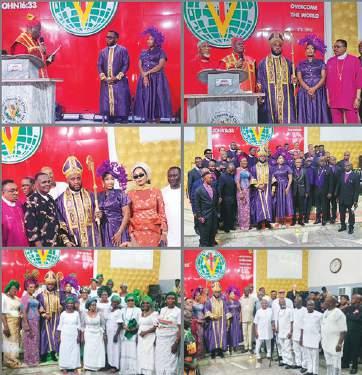
Dominion Mandate and National Renewal as UCC Consecrates Chimaobi Egbo as Bishop
A call for spiritual renewal, unity and a renewed commitment to evangelism dominated proceedings as leaders and members of the United Church of Christ (UCC) gathered in Enugu for the consecration and inauguration of Apostle John Chimaobi Egbo as the church's Bishop and General Overseer. The event also served as a platform for church leaders to challenge Christians to uphold integrity, influence society through godly leadership and play a more active role in shaping Nigeria's democratic future. Gideon Arinze reports
Nearly 28 years after it was publicly declared that he would one day lead the United Church of Christ (UCC), Apostle John Chimaobi Egbo was on Saturday, June 20, 2026, consecrated and inaugurated as the Bishop and General Overseer of the church in a colourful ceremony attended by worshippers, clerics, political leaders and dignitaries from across Nigeria and beyond.
The event, held at the packed Faith Cathedral, Fountain of Peace, Enugu, was presided over by the Presiding Bishop of The Redeemed Evangelical Mission (TREM), Bishop Mike Okonkwo, who described the occasion as a transition from the old to the new and a renewed mandate to advance Christ's mission.
Chimaobi, son of the church's founder, the late Apostle Samuel Egbo, was only 15 years old when it was declared in September 1998 that he would one day assume the church's highest leadership position. Twenty-eight years later, that declaration has become a reality.
Speaking at the ceremony, Okonkwo said the theme of the gathering, “Dominion Mandate: Taking the Mission for Christ,” reflected God's desire for the church to demonstrate His kingdom on earth through integrity, excellence and righteous living.
“God intends that the church must live the kingdom here on earth, and with that, it will translate into society. In the kingdom of God, things are done properly; there is integrity and excellence. If we say we are Christians, we are supposed to shine the light for others to see. And the light shines brightest where there is darkness,” he said.
He urged the new bishop to remain faithful to his divine calling and resist external influences.
“Remember that you belong to Christ and represent God who has called you—not politics and people. Stand autonomously and set yourself apart from those who would want to control you and determine how you operate outside of the Lord's calling.
“Destiny is attached to your name. Seek the grace of God, stay in the Scriptures, and do not get involved in all the theatrics and drama going on in the Christian world today,” he added.
Okonkwo expressed confidence that the UCC would continue to flourish.
“You must realize that nations, cities, and villages are waiting for you. Never let the devil intimidate you because your inauguration was determined even before the creation of the world,” he said.
Commitment to Restore Lost Glory
In his inaugural address, Bishop Chimaobi described his inauguration as more than a ceremonial assumption of office, calling it “a divine moment of reflection, restoration, and rededication” to the mandate God gave the church.
He noted that the church was built not on human wisdom, political influence, or worldly power, but on the principles of love, sacrifice, holiness, prayer, and total dependence on Christ. According to him, the church's journey has not been without challenges.
“We have experienced crises, misunderstandings, divisions, disappointments, and unfortunate events that hindered many efforts to open this church fully to the world as God intended. These crises weakened our structures, scattered
our strength, endangered our heritage of love, and slowed the fulfillment of the prophetic mandate upon this ministry,” he said.
However, he declared that a new season of rebuilding had begun.
“The God of restoration is calling us back to the foundations that made us great. We must restore the genuine love we once shared. We must restore unity among brethren. We must restore trust, sacrifice, humility, and spiritual discipline,” he said.
He stressed the importance of unity in fulfilling the church's mission.
“We cannot rebuild alone. We cannot fulfill destiny in division. We cannot carry dominion with bitterness. We cannot reach the nations without unity. Love is our foundation. Unity is our strength. Christ is our message.
“This is the time to heal wounds, reconcile hearts, and move forward together for the sake of the Kingdom. The future before us is greater than the pain behind us.”
Vision to Win One Billion Souls Bishop Chimaobi unveiled an ambitious vision for the church, pledging to build a Christ-centred global movement that would exercise godly dominion, transform societies, and bring one billion souls into the Kingdom of God by 2035.
“This vision is not ambition; it is a divine assignment that will require sacrifice, strategy, prayer, revival, evangelism, technology, discipleship, and global unity,” he said.
He called on bishops, pastors, elders, youths, women, workers, and members across the world to embrace the vision and play their roles in advancing the mission.
The new bishop also said he hoped to be remembered for touching lives, restoring peace within the church, and supporting widows.
“I know what it means to be a widow from my mother, who lost her husband almost three decades ago. I understand the challenges many widows face, and I remain committed to contributing to their welfare as much as I can,” he said.
Calls for Diligent Leadership
Church elders and guests at the event offered words of advice to the new bishop. Chairman of the Planning Committee, Senior Elder Ochiabuto Orji, urged him to lead with the fear of God, expressing confidence in the bishop's leadership capacity.
We expect a complete reform of the church,” Orji said “He must treat his subordinates equally and with a sense of belonging. He must always remember that he is a bishop for a purpose, which is to lead worshippers to God,”.
Another elder, Henry Okorie, advised
him to uphold the church's constitution and remain focused on his spiritual responsibilities. “He should not be distracted. He should face every challenge head-on, stay in the Scriptures, and maintain a strong fellowship with God because that is where his strength comes from,” Okorie said.
Former Minister of State for Mines and Steel Development, Hon. Uchechukwu Ogah, encouraged the Bishop to build on the foundation laid by his father and remain committed to his vision of reaching one billion people with the gospel by 2035.
Former Minister of State for Labour and Employment, Hon. Nkeiruka Onyejeocha, urged the church to continue contributing to nation-building through moral and spiritual development.
Chairman of Umunneochi Local Government Area of Abia State, Sunny Afurobi, said the late Apostle Egbo played a significant role in the spiritual growth and development of many people, urging Chimaobi to uphold his father's legacy. Describing his new role as a weighty responsibility, Afurobi charged him to inspire the younger generation to serve God and live lives marked by integrity, transparency and good character.
“It is a strong assignment. You have to inspire the younger generation to worship God and lead healthy, transparent and noble lives. I pray that God will give you the grace to lead according to His will. God will help you to always speak the truth,” he said.
Calls for Transparency and Accountability
The Secretary of the church said Bishop Chimaobi would be expected to institutionalise transparency and accountability in church administration, particularly among pastors and reverend pastors serving across different locations.
According to him, members also expect greater uniformity in the management of church affairs worldwide, including worship patterns and administrative processes.
“We want transparency and accountability in the administration of the church. We also want uniformity in the way church affairs are run globally, from the pattern of worship to administration. We want a renewed sense of unity,” he said.
He urged the new bishop to prioritise the welfare of church workers to enhance their commitment and effectiveness. “We also want him to prioritise the welfare of our workers so that they can become more dedicated to their duties,” he added.
The church secretary further said Bishop Chimaobi should introduce a reward system for workers who exemplify the church's values, as well as sanctions for those who violate its principles and norms.
Church's Role Ahead of 2027 Elections
Speaking on national issues, Bishop Okonkwo said the church has a critical role to play in providing civic education and helping citizens make informed political choices.
“The church is closest to the people at the grassroots. Many Christians are ignorant when it comes to politics, and that is why we continue to have people without the right qualities occupying leadership positions,” he said.
Clockwise: Bishop Chimaobi, his wife, Dr. Mrs. Nneoma Egbo; during his inauguration by Bishop Okonkwo of TREM; Bishop Chimaobi being presented to the church by Bishop Okonkwo; Bishop Chimaobi and wife with former Minister of State for Mines and Steel Development, Hon. Uchechukwu Ogah (immediate right); former Minister of state for Labour and Employment, Hon. Nkeiruka Onyejeocha (second right); MD/CEO of Mainland Oil and Gas Company Limited, Dr. Chris Odinaka Igwe; and others; Bishop Chimaobi and wife with wife of the founder of UCC, Mrs. Ijeoma Egbo in company of the clergy across UCC’s Districts; Bishop Chimaobi; his wife with mothers of the church and Mrs. Joy Umeh (third right); and the bishop with elders of the church
A NEW SOCIAL CONTRACT FOR WORKERS
The exit benefits scheme for retiring federal civil servants is a landmark intervention, reckons OMOLOLA OLOWORARAN
See page 21
IMPACT OF AUN ON NORTHERN NIGERIA MARGEE ENSIGN
recounts the challenge of leading a university in an impoverished community
See page 21
Insecurity has ravished and humiliated Nigeria enough. Let’s arrest it frontally now, writes MONDAY PHILIPS EKPE
THIS SCOURGING, INTRACTABLE TERROR
One of the most unfortunate fallouts of the reign of terror that has bedevilled Nigeria for close to two decades is its numbing effect on the populace. What used to scare us and elicit commensurate thoughts and actions to tackle it has somehow resulted in attitudes that range from denial to resignation, diffusion to helplessness and anxiety to phobia. And, at other times, to arguments over its proper categorisation and semantics. Just imagine why the sweat over the campaign by some individuals to remove the label of terrorism from bandits. As if we always need a situation in the magnitude of the 9/11 2001 attacks on the Twin Towers in New York, masterminded by Osama bin Laden in which thousands of people were massacred within minutes, to qualify for terrorism.
Introducing such trivialities can only complicate a matter that has literally brought the country to its knees. Call it terrorism, insurgency, kidnapping or banditry. The strain that binds them together is the impact on the people, particularly the unarmed. The practitioners of these evil trades are mostly wielders of arms and ammunitions, the types that even those authorised to monopolise the ownership of instruments of violence do not possess in good volume and quality. An average Nigerian wakes up in the morning and can no longer take his safety for granted.
It’s that bad. If our declared demography is to be believed, up to half of the population - a chunk of the youth segment - don’t know any other life outside managing to keep safe. If not from personal experiences or of those known to them, the news they’re constantly exposed to are crippling enough. And don’t doubt for a second the gravity of this pervasive insecurity or the concerns it has generated everywhere. It’s now common to hear some television anchors and reporters in the southern part of the country worry about the menace “getting too close” to their homes (comfort zones). Really? So, Damaturu and Maiduguri are not home enough?
Time was when bombings, wanton murders and wholesale destruction of towns and villages were classified by some persons as the preserve, the self-inflicted lot of the north, beginning from the northeast. But, to the discerning, there weren’t any strong grounds to embrace such myopic, sabotaging thoughts. For one, Nigeria is a single geographical entity. Even those who doubt and disparage its nationhood must come to terms, at least in their sober moments, with this “rude” reality. No physical borders between the states. And, certainly, no official encumbrances
of the movement of goods, including cattle, and human beings. It was, therefore, always going to be a matter of time for the criminalities to attain a nationwide spread if they were not confronted head-on.
The basis for this prediction is wellfounded and in our recent history. Take the abductions of people to press for ransom or some other blackmails. Many Nigerians would remember that this crime as a regular national pastime has its origins in the Niger Delta. Something that started ostensibly as a tool for corporate agitations was soon hijacked by the hoodlums there for filthy lucre. With time, kidnapping moved upwards, first to the south-east where its mercantile values were fully explored. By the time it got to the north, this nocuous vocation was received by more vicious criminals who treated life (they still do) as a casually dispensable item. Although kidnappings still take place in many parts of the nation, the ones up north have remained largely more organised, audacious, brutal and relentless.
The severity of this national dilemma demands that we can’t afford to politicise it any further. This sort of handling has its roots in the mischaracterisation that began during the administration of President Goodluck Jonathan when the crisis was believed in certain quarters to have been cooked by some northern interests to get rid of a president from the south. Curiously, such harmful opinions have begun to emerge. Since President Muhammadu Buhari, a northern, didn’t have respite while his administration lasted, what’s the impetus for that insinuation today? The duty to lead the country away from this destructive mindset rests on President Bola Tinubu. He shouldn’t blame the opposition now as he was in the vanguard of calling Jonathan’s government “clueless” in those days.
His Democracy Day speech this year is largely predictable except for one issue related to Nigerians’ cardinal need to stay alive and well. Hear his advice to
the reprehensible death professionals in our midst: “To bandits, kidnappers, and sponsors of terror: Surrender or face the full force of the Nigerian state. These windows of surrender will not remain open forever.” Ha! That is bland! Sir, at this point, advising these merchants of human blood shouldn’t be a part of your job description. Yours is to preside over their own elimination in order to sanitise Nigeria. The interminable engagements of our security operatives with them haven’t yielded the desired results. The felons are all over the social media displaying their victories freely. The souls of the officers and men who have been neutralised in the course of withstanding these odious elements and those of the hundreds of thousands of citizens sent to their early graves mustn’t be further traumatised with knee-jerk responses.
Actually, hearing that from the president makes him resemble someone pandering to people like Sheikh Abubakar Gumi who have been campaigning for negotiating with bandits, a position that hasn’t produced any meaningful outcomes and is never likely to. And to his compatriots, Tinubu declared: “No mercy will be shown to those who trade in the blood of Nigerians. At a time like this, let us not assign blame or point fingers. Crime has no ethnicity. We must stand united and be assured that the enemies of our nation shall soon be history. We will triumph over terror and continue to build a more prosperous nation.” A tiring presidential refrain that has survived Jonathan, Buhari and, now, Tinubu himself.
Excuses for the failure to combat these existential challenges have gone on for too long. Prominent among them is that our soldiers are faced with asymmetric war rather than the conventional one they are trained to prosecute. Their syllabuses and training ought to have since been reviewed to reflect the present realities that bully us unendingly with contempt. After all, ours isn’t the first country that harbours characters who hide behind religion to torment and subjugate others. Or cause massive havoc with other motivations. Talks of rejigging our security architecture have gone on forever. Promises to adequately equip and motivate the military personnel are broken records. Most Nigerians find the idea of reintegrating “repentant” terrorists into the society ridiculous and shameful. It’s time to prioritise workable solutions above politicking.
Dr Ekpe is a member of THISDAY Editorial Board X: @monday_ekpe2
The exit benefits scheme for retiring federal civil servants is a landmark intervention, reckons OMOLOLA OLOWORARAN
A NEW SOCIAL CONTRACT FOR WORKERS
Think of the teacher who spent three decades shaping young minds, the nurse who worked through countless difficult nights, the civil servant who gave a lifetime to public service. For each of them, retirement should arrive as a season of dignity, security and peace of mind, not as a descent into uncertainty. Nations are judged, in the end, not by how they treat their strongest citizens, but by how they honour those who have spent their working years in service and now depend on society’s promise of care in old age.
It is against this backdrop that the federal government’s recent approval of an Exit Benefits Scheme for retiring Federal Civil Servants stands as one of the most significant social protection measures introduced in recent years.
For the first time since the introduction of the Contributory Pension Scheme (CPS), retiring Federal Government workers will receive an additional retirement benefit equivalent to 100 per cent of their total annual emoluments upon retirement, alongside their accrued pension savings and retirement benefits under the CPS. Effective from 1st January 2026, the scheme applies to officers in treasury funded Ministries, Extra Ministerial Departments and Agencies who have completed at least ten years of service.
This is a landmark intervention. It strengthens retirement security, improves retirement outcomes and reinforces the fundamental objective of every pension system: ensuring that workers who have devoted their productive years to service can retire with confidence and dignity.
Importantly, this approval also settles, once and for all, a misconception that has persisted since the introduction of the CPS in 2004. The CPS was never designed to prevent employers from providing additional retirement benefits to their employees. Rather, it established a sustainable minimum framework upon which employers could build more generous retirement arrangements. The Pension Reform Act expressly permits employers to establish additional benefit schemes for their workforce. What the Federal Government has now done is demonstrate leadership by showing how that provision can be used to strengthen worker welfare and retirement security.
Just as importantly, this is a promise built to be kept. To safeguard the funds and guarantee transparency, a dedicated Exit Benefits Scheme Account is being maintained with the Central Bank of Nigeria, ring fenced for this single purpose and managed by the National Pension Commission as the sole repository of the funds.
The Office of the Accountant General of the Federation will transfer approved funds into that account for onward disbursement through retirees’ Pension Fund Administrators, who are directed to pay beneficiaries within ten working days. This architecture matters. It ensures the benefit is not left to the shifting pressures of the budget cycle, and that the retiring officer can plan with confidence, knowing the framework that protects their entitlement is institutional and accountable.
This is why the significance of the Exit Benefits Scheme extends far beyond the Federal Civil Service. It establishes an important national precedent. It sends a clear message that retirement protection should not end with monthly pensions alone, and it affirms that employers can and should do more to support workers who have spent decades contributing to organisational success and national development.
For this reason, state governments across Nigeria should carefully study this initiative and consider adopting similar arrangements for their workers. Many states have made remarkable progress in implementing the Contributory Pension Scheme. But retirement security is not merely about compliance with minimum statutory requirements. It is about creating outcomes that genuinely improve the quality of life of retirees. A retiring worker in Enugu, Kano, Lagos, Rivers, Abia or Yobe deserves the same opportunity to transition into retirement with dignity and financial security.
Likewise, Nigeria’s private sector should view this development not as a cost, but as an investment in people. The most successful organisations in the world recognise that workforce welfare does not end at retirement. Competitive retirement packages have become an important tool for attracting talent, retaining institutional knowledge and building organisational loyalty.
Oloworaran is the Director General of the National Pension Commission (PenCom)
MARGEE ENSIGN recounts the challenge of leading a university in an impoverished community
IMPACT OF AUN ON NORTHERN NIGERIA
I have had the challenge and privilege of leading universities on three continents: Africa, North America, and, most recently, Europe, at the American University in Bulgaria (AUBG). But I will never forget in a hurry my experiences at the American University of Nigeria, Yola.
The AUN, where I was president from 2010 to 2017 and then again from 2021 to 2022, is explicit about its mission to be “Africa’s development university” and to ensure that the local community and region, much of which is impoverished, benefit from university programs and projects.
At AUN, the mission necessarily drove how we developed curricula, recruited students and faculty, and explained ourselves not only to students and parents but to our skeptical and sometimes hostile host societies, which were unclear about and at times suspicious of the purpose of an American education. At AUN, for several years, our very survival depended on believing in, telling, and living a coherent and compelling story. As we were threatened by Boko Haram, a violent Islamist insurgent group whose Hausa name translates loosely as “Western education is evil,” the mutually supportive and trusting relationship we developed with our local community kept us safe and allowed us to live our development mission.
AUN was only six years old when I became president there. Situated in rural, desperately impoverished, largely Muslim northeastern Nigeria, AUN might not have survived financially or physically if we hadn’t put a community network in place before our crisis began. (We also took the precaution of hiring and training our own armed security force of more than six hundred people.)
In 2012, the Nigerian government removed the fuel subsidies it had been providing citizens. Nationwide strikes broke out. In response, AUN spearheaded the creation of the Adamawa Peace Initiative (API), bringing together local Muslim and Christian leaders, businesspeople, and youth leaders for the first time. We agreed on a set of values and goals that guided our work for five years.
Youth must be positively engaged. Religion is an instrument of peace. Women are the center of development. Education is the foundation of society. We agreed that these community leaders best understood the needs of our poor community. Then, based on their concerns, we agreed that our first project would focus on the most vulnerable youth. Through the creation of our Feed and Read program, we worked to reduce
hunger and increase literacy among children on the street (the Almajiri), who were easily recruited by Boko Haram, which was taking advantage of the national upheaval to become more powerful. We hired local women to cook a daily meal, and our students taught the children literacy and numeracy.
We also established the Peace through Sports program, which brought together youth from different cultural and religious backgrounds to play football. Most participants were identified by API members. Our Technology-Enhanced Learning for All (TELA) initiative helped teach more than twenty thousand internally displaced children how to read via our radio program. The curriculum for the radio program was developed in an AUN media class. In fact, all these efforts were fully integrated into newly established community-based university development courses, in which students, faculty, and sometimes staff identified a local problem — hunger, illiteracy, environmental degradation, poverty — and faculty then developed a curriculum focused on proposed solutions.
Additionally, our API members told us that local hospitals had unreliable internet service and that health care providers needed access to research on emerging diseases. In response, AUN started the Library on a Flash (Drive) program, through which our librarians uploaded the desired articles and books onto flash drives and then sent them out to hospitals and clinics in the region.
The American University of Nigeria granted scholarships to twenty-one young women who escaped Boko Haram militants.
Thus, even before Boko Haram intensified its rampage of terrorizing regional communities with bombings and kidnappings, we had developed strong and trusting relationships with local leaders. They were the ones to alert us about the intensifying threat of Boko Haram not far from us.
I will never forget the call in fall 2014 from the emir of Mubi, a city to the north of us: “Margee, can you please come and bring the API members with you?”
We all drove together in a bus, and when we arrived, we found a room full of about five hundred women and girls. I asked our translator, “Where are the boys and men?”
Ensign, a former President at American University of Nigeria, Yola, is currently a senior fellow at the Center for Civic Engagement at Bard College, USA.
Editor, Editorial Page PETER ISHAKA
Email peter.ishaka@thisdaylive.com
AS DOCTOR SUCCUMBS TO LASSA FEVER... All
stakeholders should do more to contain the scourge
The death of a medical doctor in Benue State following complications from Lassa fever should serve as another wake-up call on the need to tackle a preventable disease that kills hundreds of our nationals every year. According to the Benue State Commissioner for Health and Human Services, Paul Ejeh-Ogwuche, the deceased medical practitioner who worked with the AIDS Prevention Initiative in Nigeria, had battled the illness for over two weeks before his condition worsened. Meanwhile, the latest Case Fatality Rate (CFR) from the Nigeria Centre for Disease Control and Prevention (NCDC) reveals that death toll from the outbreak of Lassa fever in the country has climbed to over 200, with health authorities warning on increasing infections across several states.
lance and laboratory testing.”
Not only is it egregious that Nigerians die needlessly from a preventable disease like Lassa fever, what the latest figures indicate is that if indeed there have been any preventive strategies, they are not working. Early detection and prompt treatment remain critical to survival. But to contain the preventable disease that claims the lives of dozens of our citizens on an annual basis, individuals and authorities in the health sector need to do more work.
The public should be adequately enlightened on the dangers posed by rats in their homes
While we commiserate with the family of the deceased medical doctor, it is noteworthy that Lassa fever has been a serious health challenge in Nigeria since it was first diagnosed in Lassa (the village after which it was named) in Borno State in 1969. The symptoms include fever, sore throat, vomiting, back pain, cough, abdominal pain, and general body weakness about three weeks after exposure to the virus. The disease is primarily transmitted to humans through infected rats or through the bodily fluids of infected persons. Even though there have been efforts in the past to contain the scourge, the country has been witnessing frequent outbreaks in recent years. This, according to the World Health Organisation (WHO) “could be attributed to reduced response capacity in surveil-
EDITOR SHAKA MOMODU
DEPUTY EDITOR WALE OLALEYE
MANAGING DIRECTOR ENIOLA BELLO
DEPUTY MANAGING DIRECTOR ISRAEL IWEGBU
CHAIRMAN EDITORIAL BOARD OLUSEGUN ADENIYI
EDITOR NATION’S CAPITAL IYOBOSA UWUGIAREN
THE OMBUDSMAN KAYODE KOMOLAFE
EDITOR-IN-CHIEF/CHAIRMAN NDUKA OBAIGBENA
GROUP EXECUTIVE DIRECTORS ENIOLA BELLO, KAYODE KOMOLAFE, ISRAEL IWEGBU
DIVISIONAL DIRECTORS SHAKA MOMODU, PETER IWEGBU, ANTHONY OGEDENGBE
For that reason, steps should be taken by the government, at all levels, to emphasise routine infection prevention and control measures. Healthcare workers should be more careful to avoid contact with bodily fluids in the process of caring for sick persons. Besides, experts have advised that people should ensure their food is properly covered while regular handwashing should be adhered to always. The bush around the home should also be cleared regularly while windows and doors of the house should be closed, especially when it is nighttime. The public should be adequately enlightened on the dangers posed by rats in their homes.
With the enormous resources available to them now, authorities in the 36 states and 774 local government areas should be able to mount sensitive campaigns about the disease that is also endemic in many of our neigbouring countries.
We need concerted efforts from all stakeholders, but more especially the government. We hope the authorities will take both preventive and long-term measures so that we do not continue to lose our citizens to the virus that has for decades been an emblem of shame.
Letters in response to specific publications in THISDAY should be brief (150-300 words) and straight to the point. Interested readers may send such letters along with their contact details to opinion@thisdaylive.com. We also welcome comments and opinions on topical local, national and international issues provided they are well-written and should also not be longer than (750- 1000 words). They should be sent to opinion@thisdaylive. com along with photograph, email address and phone numbers of the writer.
Ahead of seismic general elections in Nigeria early next year, a couple of bye elections across the country have served as dress rehearsals for what should happen next year. The governorship election in Ekiti State and the senatorial election for Nasarawa North senatorial district should serve as interesting case studies.
In January 2027, Nigerians would have to choose again, for the first time in four years the direction their country should go. The choice made of President Bola Ahmed Tinubu in 2023 and of different political players in different positions across the country have largely defined the last three years. To say that Nigerians are not even remotely satisfied would be a major understatement.
The problem has always been that Nigerians have often made poor choices. While the choice of political leadership is deeply personal, it often comes with roaring ramifications for the collective and it is actually no rocket science. What should those who have to choose look for? Compassion and vision.
Unfortunately for Nigerians, many of their leaders have lacked compassion and vision choosing instead to employ a toxic mix of avarice and avoidance in confronting national issues.
Democracy has largely been led on a song and dance in Nigeria. Since the system of government made a triumphant return in 1999, Nigerians have savoured what they largely consider to be removed from military rule. Since 1999 a slew of elections have come and gone and a disturbing pattern of buying elections has emerged.
So entrenched has this pattern been that it is now common place to hear Nigerians openly say their votes are for sale ahead of elections in the country. This mindset and the misery that accompany it have become a curse in Nigeria.
On June 20, the good people of Nasarawa North Senatorial District and Ekiti State went to the polls. For the good people of Nasarawa North, what precipitated the poll was the death of Senator Godiya Akwashiki who until his demise was the senator representing the district at the Na-
tional Assembly. For Ekiti State, their governorship election remains staggered.
For the participants in the elections, it was an opportunity to fine-tune their voting instincts ahead of the major showdown next year. Despite allegations of vote buying that pervaded both elections, the good people of Nasarawa North Senatorial District, Ekiti State and Nigerians as a whole must resolve to do better.
Elections determine the course and direction of any country and votes are too precious to be sold for pittance no matter the temptation.
Vigilance is the price that Nigerians must pay if they are to break free from misrule and its many effects. It will begin from not just voting but making sure their votes count. This means that any form of vote buying must be rejected by Nigerians. This is crucial if things are to change in the country.
Ike Willie-Nwobu, Ikewilly9@gmail.com.
BUSINESS WORLD
RATES AS AT J UNE 24,2026
Expert Highlights Challenges of AI in Nigerian SMEs, Harps on Implementation
Stories by emma Okonji
Conversations around the implementation of Artificial Intelligence (AI) tools in Nigerian businesses, especially with Small and Medium Enterprises (SMEs), have always focused on high-level innovation.
But for many Nigerian SMEs, the priority is managing costs, and finding
sustainable ways to grow in a challenging economic environment.
Speaking on the matter in a chat with THISDAY, the Country Head, Zoho Nigeria, Mr. Kehinde Ogundare, said the difference in perspective explains why the global AI conversation, often shaped by assumptions about stable infrastructure, deep capital, and abundant technical
talent, frequently fails to address the realities facing Nigerian SMEs.
Ogundare stressed that for AI to truly contribute to Nigeria’s development, it must be adapted to the daily realities of the local business environment.
He outlined three strategic shifts that are essential for meaningful adoption to include: Moving beyond
capital expenses and transitioning to affordable, subscription-based models that allow SMEs to scale without heavy upfront investment.
“Secondly is to prioritise mobile-first infrastructure by developing AI tools that account for local infrastructure, ensuring they function effectively on low-bandwidth and
mobile-friendly interfaces. Thirdly is democratising development by using lowcode/no-code platforms to bridge the technical talent gap, empowering existing staff to build and manage operational solutions.
“This matters because Nigerian SMEs are not a peripheral concern. In 2024 alone, MSMEs contributed 46.32 per cent to Nigeria’s
GDP, accounting for 96.9 per cent of businesses and 87.9 per cent of employment. These businesses are the backbone of the Nigerian economy, and if AI is going to mean anything for Nigeria’s development, it has to work for them in the daily conditions they actually operate in,” Ogundare said.
The story continues online on www.thisdaylive.com
UN, ITU Plan Global Dialogue to Address AI-influenced Social, Economic Realities
In order to address AIinfluenced social and economic realities across the world, the United Nations (UN) and the International Telecommunications Union (ITU), are planning a global dialogue, scheduled to hold from July 6-7 2026 in Geneva, Switzerland.
Since Artificial intelligence (AI) gained large-scale global attention three and a half years ago, most countries have divided views about AI domination and widespread
human job displacement.
Since then, AI has accelerated, with new models and applications emerging faster than policymakers anywhere can keep up. While some countries are racing ahead, many others struggle to adjust to the new AI-influenced social and economic realities.
In order to address what many see as global challenge, the UN is bringing together governments, industry, academia, civil society and
international organisations for the first UN General Assembly-mandated Global Dialogue on AI Governance.
Speaking ahead of the dialogue, the Global Dialogue Co-Chair and Permanent Representative of El Salvador to the UN in New York, Egriselda López, said: “AI, as you know, is moving and advancing so rapidly, yet there are so many countries that are lagging behind and still don’t know how to make
good use of AI.”
Fellow Co-Chair and Permanent Representative of Estonia to the UN in New York, Rein Tammsaar, said:
“The global AI landscape is very fragmented.
While numerous governance-related discussions are happening, there is no place where all this would come together without the UN’s global reach.”
According to Tammsaar, the upcoming AI event is a
“dialogue of the dialogues.”
The Global Dialogue is supported by a joint secretariat comprising the International Telecommunication Union (ITU), the United Nations Educational, Scientific and Cultural Organization (UNESCO) and the UN’s Office of Digital and Emerging Technologies (ODET), with ITU and UNESCO serving as coordinating entities.
The AI dialogue forms part
Market data a s at Wednesday, June 24, 2026
of a comprehensive Digital Week in Geneva, a European UN hub, back-to-back with the annual AI for Good Global Summit and WSIS Forum organised by ITU. The Global Dialogue is set to highlight four main thematic clusters: AI opportunities and impacts, examining the societal, cultural, economic and technical implications of AI.
SUSTAINING PORT LOGISTICS FREE FLOW…
Managing Director/CEO, Nigerian Ports Authority (NPA) Dr. Abubakar Dantsoho (4th Right); Asst. Inspector General of Police (Maritime) AIG Nurat Okunade (4th Left); Rep. Commissioner of Transport Lagos, Mr. Ojowuro Olasunkanmi (2nd Right); Executive Director F&A NPA, Mrs Vivian Richard-Edet (3rd Right); Executive Director M&O, Olalekan Badmus (3rd Left); Secretary-General National Association of Government Approved Freight Forwarders (NAGAFF), Dr. Godfrey Nwosu (1st Right); General Manager Security, NPA, Mr. Anthony Edosomwan (2nd Left) and Federal Road Safety Corps (FRSC), Sector Commander Lagos, Corp Commander Ganiyu Hamzat (1st Left); during Port Stakeholders Meeting convened by the NPA to address issues of Jurisdictional Overlaps and extortion along Tincan and Apapa Ports access roads… recently
Fidelity Bank Empowers Exporters to Unlock AfCFTA Opportunities
Kayode Tokede
Fidelity Bank Plc has reaffirmed its commitment to supporting Nigeria’s economic diversification agenda through capacity building and export development, as it hosted the 19th edition of its Export Management Programme (EMP) at the Lagos Business School (LBS).
Tagged, “EMP 19,” the programme is an intense hands-on export management workshop, organized as a partnership between Fidelity Bank, Lagos Business School and Nigerian Export Promotion Council, brought together entrepreneurs, professionals, regulators
and aspiring exporters for intensive training designed to equip participants with the knowledge, skills and networks required to compete successfully in international markets.
Speaking at the closing ceremony, Divisional Head, Export and Agriculture, Fidelity Bank Plc, Isaiah Ndukwe, said the bank remains focused on empowering Nigerian businesses to leverage emerging opportunities under the African Continental Free Trade Area (AfCFTA) and expand the country’s non-oil export base.
“At Fidelity Bank, we recognise that capacity
building is critical to unlocking Nigeria’s export potential. Through the Export
Management Programme, we are equipping businesses with practical knowledge, market
intelligence and strategic insights required to compete successfully in regional and
global markets,” Ndukwe said. “As AfCFTA continues to open new frontiers for trade
Kapito: APM Terminals Apapa Major Enabler of Nigeria’s Export Trade
Digital solutions provider, Globacom, has expanded its “Borrow Me Credit” service, a strategic initiative designed to ensure that no subscriber is ever disconnected due to a
low or zero balance.
Globacom, in a statement in Lagos, said that the eligibility criteria for the service has been streamlined to provide instant airtime and data solutions to millions of active prepaid customers across the country. To ensure clarity for subscribers, the company has clearly outlined that while a service charge applies, the primary goal remains providing immediate relief during moments the customer has low balance.
Comms/e-Business
Okonji
Asst. Editor, Energy
Emmanuel Addeh
Asst. Editor, Money Market
Nume Ekeghe
Correspondents
KayodeTokede(CapitalMarkets)
James Emejo (Finance)
Ebere Nwoji (Insurance)
Reporter Peter Uzoho (Energy)
The enhanced “Borrow Me Credit” service now includes the unique ability for subscribers to “Borrow Special Data “and additionally “Borrow Airtime/Data for Others”. This allows Glo customers to act as a lifeline for friends and family members who may be out of reach or unable to recharge immediately, further strengthening the bonds of the Glo community through shared connectivity.
Nigeria’s largest container terminal, APM Terminals Apapa, has reaffirmed its position as a critical driver of the nation’s export growth, leveraging strategic investments, advanced technology and customerfocused solutions to enhance the competitiveness of Nigerian exports in the global marketplace.
Speaking at an Export Management Workshop organised by Lagos Business School in Lagos, the Chief Commercial Officer of APM Terminals Apapa, Westtar
Kapito, highlighted the terminal’s pivotal role in facilitating seamless trade and creating value for exporters across the country.
Delivering a presentation on, “The Role of APM Terminals in Facilitating Exports in Nigeria,” Kapito said the company’s sustained investments in infrastructure, equipment, technology and human capital have been deliberately designed to strengthen Nigeria’s trade ecosystem and support economic development.
PMI Study Links Project Success to Complexity Control, Urges Execution
Stories by Emma Okonji
A new global research from the Project Management Institute (PMI) has revealed that project complexity is emerging as a prominent threat to successful project delivery across sub-Saharan Africa.
According to PMI’s latest
The Minister of Power, Joseph Tegbe has declared that the projects being embarked on by the Rural Electrification Agency (REA) is measurably changing the lives of Nigerians across the country.
Delivering the keynote address at the official commissioning of a landmark
The 2026 STEM Africa Fest, which is in its sixth edition, is set to showcase technology skills, and digital innovation built around Science, Technology, Engineering and Mathematics (STEM).
Pulse of the Profession report tagged: ‘Driving Success in Complex Projects: From Navigating Tasks to Navigating Systems’, the report findings showed that projects are increasingly facing missed deadlines, decision bottlenecks, and pressure on teams as organisations race to deliver
Commissions
505kWp interconnected solar mini-grid project in the Eredo community of Epe, Lagos State, Tegbe hailed the leadership of the agency noting that the Agency has, in recent years, undergone a remarkable transformation.
“The REA has in recent years, undergone a remarkable transformation, a
transformation amid rapid change.
The report, based on insights from project professionals and senior leaders across 35 countries, showed that 81 per cent of project professionals globally believe projects have become more complex in recent years, with 37 per cent describing the increase as significant. According to the report, the increase in complexity is being driven by a combination of organisational, environmental, and human factors, including Artificial Intelligence (AI) adoption, shifting stakeholder expectations, economic volatility, and increasingly interconnected systems.
body of admirable mandate but modest delivery, into an institution that is genuinely, visibly, measurably changing lives across Nigeria.
Community by community, kilowatt by kilowatt, life by life. Dr. Abba Aliyu, your Agency, your team, and your developers deserve the gratitude of the nation,”
Tegbe said. The project, delivered under the Interconnected Mini-Grid Acceleration Scheme (IMAS), is a direct product of the Electricity Act 2023, which has decentralized electricity governance and opened the doors wide for private sector investments.
to Develop Critical Thinkers, Problem Solvers
Speaking at a press conference in Lagos to announce the event, the organisers said there would be up to eight learning labs lined up for pupils and students to have practical experiences
in Robotics, Virtual Reality (VR), Augmented Reality (AR), 3D Printing, Games, Drones Electronics, Coding and Artificial Intelligence (AI). Co-Founder at STEM Africa Fest, Jadesola Adedeji, said the
event would be designed to make Nigerian children have different learning experiences that are built around practical skills, that would help them to become critical thinkers and problem solvers.
Nigeria’s Oil Industry: More Companies, Fewer Barrels
Nigeria has been celebrating a remarkable transformation in its oil and gas company register with the number of upstream operators rising from less than 10 in 2010 to 117 today, while local content jumped from less than 5 per cent to the current 61 per cent. But this growth has not impacted the country’s oil production numbers as decline and stagnation still persist, Peter Uzoho writes
At a recent summit in Lagos, the Nigerian Content Development and Monitoring Board (NCDMB) revealed to industry stakeholders that the country now has 117 operating companies in the upstream sector of the country’s oil and gas industry, up from fewer than 10 in 2010.
The agency also disclosed that Service companies have surged to 11,764 and that Local content, which was less than five per cent in 2010, now stands at 61 per cent as of 2025.
Acting Manager, Midstream Monitoring at NCDMB, Mr. Patrick June, who reeled out the figures, credited the success to the Nigerian Oil and Gas Industry Content Development (NOGICD) Act of 2010, meaning that by all accounts, the Act has achieved its core mandate: putting Nigerians at the center of the value chain.
To the NCDMB, the numbers tell a success story: the 117 operating companies have created 11,934 direct jobs, while 11,764 service firms account for 129,240 jobs.
NCDMB’s database now captures hundreds of firms registered under the Joint Qualification System, 50 fabrication yards, 20 engineering design firms, and 122 manufacturing companies.
“Nigerian companies in the upstream sector, which were dominated by international and now national companies, were just less than 10. But as we speak, operating companies are about 117,” June said. “So, that is a significant improvement.”
Yet, while Nigeria celebrates the growth of its oil and gas company register, it has also been watching its production numbers decline or stagnate for nearly two decades. Current production hovers between 1.4 million and 1.7 million barrels per day including condensate, according to the recent monthly oil production report released by the Nigerian Upstream Petroleum Regulatory Commission (NUPRC) for May 2026. That is a far cry from 2005 and 2010, when fewer than 10 companies dominated the upstream and Nigeria produced 2.5 million bpd and 2.6 million bpd, respectively.
So, with more companies and fewer barrels, is Nigeria really making progress worth celebrating? The answer lies in the difference between licenses and capacity.
More Operators, less oil
The paradox that NCDMB’s data cannot hide is simple: while the number of license
holders has multiplied by more than 10, Nigeria’s crude oil output has stagnated and even declined. NUPRC data shows output averaged 1.70mbpd in May 2026, up from 1.48mbpd in February. That rebound is real, driven by pipeline security and reactivation of dormant wells. But it remains far below Nigeria’s Organisation of Petroleum Exporting Countries (OPEC) quota of 2.5mbpd and the 2.6mbpd achieved in 2010 when Shell, ExxonMobil, Chevron, TotalEnergies, ENI and NNPC called the shots.
Today, the 117 operators include five international oil companies (IOCs) --(Shell Nigeria Exploration and Production Company Limited (SNRPCo), Nigerian Agip Exploration Limited, Chevron Nigeria Limited, TotalEnergies EP Nigeria Limited and Esso Exploration and Production Nigeria Limited), over 100 Nigerian and international independent firms as well as marginal field operators.
NCDMB’s 61 per cent local content figure measures Nigerian participation, not Nigerian production efficiency.
Licensing Rounds Without Execution
This gap is magnified by Nigeria’s aggressive licensing strategy. NUPRC has conducted about four licensing rounds in the last five years, where oil blocks and marginal fields were given to a lot of companies, largely indigenous firms, but only few of those awardees have been able to make significant progress in optimising those resources.
The rounds were meant to deepen Nigerian participation and replace divesting IOCs. They succeeded in adding names to the operator register. But many awardees lacked the capital, technical expertise, and security capacity to move from signature bonus payment to first oil. A marginal field award is not a producing asset until wells are drilled, flowlines built, and export routes secured. For many of the new entrants, those steps stalled at the planning stage.
The result is a register filled with “license holders” rather than producers. While NCDMB celebrates 117 operating companies, NUPRC is racing to reactivate about 3,000
From Access to Capacity
There is no denying that the NOGICD Act of 2010 succeeded at its primary objective. It democratized access.
Divestments by IOCs transferred onshore and shallow-water assets to indigenous firms. Marginal field rounds created space for new entrants. NCDMB’s push forced operators to patronize Nigerian fabrication yards, engineering firms, and service companies.
dormant wells – many of them sitting on blocks awarded in recent rounds. The licensing process democratized access, but it did not create the conditions for execution.
AEDC, NAEDL Collaborate to Distribute 35,000 Metres in Nasarawa
Igbawase Ukumba in Lafia
The Managing Director Abuja Electricity Distribution Company (AEDC), Engr Chijioke Okwukenye, said the company in collaboration with Nasarawa Electricity Distribution Limited (NAEDL) is Distributing approximately 35,000 metres across Nasarawa State.
Okwukenye made this known in Keffi local government area of the state at a stakeholders engagement organized by NAEDL, a subsidiary of AEDC.
The theme of the engagement is, “Powering Nasarawa together: Shared responsibilities, shared solutions.”
According to AEDC
Managing Director, who was represented by the Chief Operations Officer of AEDC, Blessing Ogbe, the mass metering initiative will be entirely free of charge.
He added that the initiative will be rolled out across specifically identified areas thereby helping to eliminate arbitrary billing and better serve utility customers.
He however warned that energy theft must be efficiently tackled so as not to derail the efforts of electricity generating and distribution companies in their bid to supply and distribute constant electricity to residents of the state.
In her remarks, the Managing Director/ Chief Business Officer, Nasarawa Electricity Distribution
Limited (NAEDL), Mrs Veronica Abah, confirmed the collaboration with AEDC to deploy 35,000 metres to customers across the state.
“Currently for us, we have a total population of 233,807 customers. Out of this population, we have a total metered customer population of 175,321. Our current gap, which we call unmetered customers, is 58,486,” she said.
Also speaking, the Managing Director, Nasarawa State Electricity Regulatory Commission (NASERC), Engr Yakubu Loko, applauded the Nasarawa State government for enacting the Nasarawa State Electricity Law, which gives rights to the forming of Nasarawa Electricity Distribution Limited.
AMCRON Admitted as Member of Cross Reference
The Association of Media and Communication Researchers of Nigeria (AMCRON) has been admitted as a member of Crossref, the world’s largest registry of Digital Object Identifiers (DOIs) and metadata for scholarly research.
According to the President of AMCRON, Professor Eserinune McCarty Mojaye, “This means that all published works of AMCRON, including all articles published in its flagship journal (the Journal of Communication and Media Research, JCMR) will now be issued with
Crossref DOIs, and thus be connected with over 180 million other records from over 25,000 other member organisations from 167 countries.”
Mojaye disclosed that “AMCRON, as an organization, can now create Crossref DOIs for the content that we publish using our unique DOI prefix. In addition, each member of AMCRON can also receive their own set of personal user credentials from Crossref through us, to enable them register their own content with Crossref.”
Crossref, as the earliest adopter of DOIs
specialising in scholarly research, has become synonymous with DOIs especially with its vision to create the research nexus as a complete and robust network of relationships between objects, people, and institutions of scholarship.
Crossref facilitates an average of 1.4 billion DOI resolutions (clicks of a DOI link) every month, which is 93% of all DOI activity worldwide.
He added “We are pleased and proud to belong to the Crossref DOIs worldwide community.”
NECA to Lead Conversation on Impact of Economic Reforms
The Nigeria Employers’ Consultative Association (NECA) has announced that its 2026 Employers’ Summit will undertake a critical review of the impact of ongoing economic reforms on businesses, employment, investment, and national competitiveness.
The Summit, scheduled to be held in Abuja, will convene policymakers, business leaders, development partners, and key industry stakeholders to assess
progress, identify emerging challenges, and chart a sustainable path for Nigeria’s economic transformation.
Speaking ahead of the event, NECA Director-General, Mr. Adewale-Smatt Oyerinde, acknowledged the significance of recent reforms in addressing longstanding structural imbalances in the economy, while emphasizing the need for a clear assessment of their real-sector outcomes.
Oyerinde noted that businesses across sectors continue to grapple with persistent headwinds, including high energy costs, exchange rate volatility, inflationary pressures, infrastructure deficits, regulatory complexity, and weak consumer demand. He added that although some macroeconomic indicators show signs of improvement, many enterprises particularly Micro, Small and Medium Enterprises (MSMEs) remain under significant strain.
Creative Agency Appoints Isitua-Onukwu as CEO
The Board of TBWA/ Concept Unit, the Lagos-based creative agency within the TBWA Worldwide network, has announced the appointment of George Isitua-Onukwu as Chief Executive Officer, effective July 1, 2026. He succeeds Kelechi Nwosu, whose leadership established TBWA/ Concept Unit as one of Nigeria’s creative
agencies, known for bold work like the Proudly Made in Aba campaign and Spirit of Lagos project.
The incoming CEO, in a statement, said: “The appointment signals the next chapter in TBWA/ Concept Unit’s evolution. We’re expanding the Agency model. Under Nwosu, the agency began diversifying beyond traditional campaign work.”
“We are not abandoning the agency model. We are expanding it. Creativity remains our core product, but the future belongs to agencies that can turn creativity into assets, platforms, and businesses. Ideas should not only solve marketing problems; they should create economic value that compounds over time.”
Isitua-Onukwu said.
Djeno (Congo), Zafiro (Equatorial Guinea),
(Gabon), Iran Heavy (Islamic Republic
Iran), Basrah Medium (Iraq), Kuwait Export (Kuwait), Es Sider (Libya), Bonny Light (Nigeria), Arab Light (Saudi Arabia),
L-R: Chief Commercial Officer, APM Terminals Apapa, Westtar Kapito; Program Manager, Lagos Business School (LBS), Adenihum Bankole and LBS Export Program Coordinator, Professor Frank Ojadi at the LBS Workshop on Export Management in Lagos…recently
Stock Market Drops by N3.6trn on Profit-taking in BUA Cement
Kayode Tokede
The Nigerian stock market reversed two sessions of gains with a decline of N3.6 trillion as widespread profit-taking activities in BUA Cement (10 per cent drop), and 37 others.
The Nigerian Exchange Limited All-Share Index (NGX ASI) lost 5,668.65 basis points or 2.35 per cent to close at
235,074.54 basis points, while the Month-to-Date and Yearto-Date returns settled lower at -6.1per cent and +51.1per cent respectively.
Sectoral performance was bearish as the Industrial Goods (-8.3per cent), Insurance (-1.0per cent), Banking (-0.7per cent), Consumer Goods (-0.3per cent) and Oil & Gas (-0.1per cent) indices closed in negative territory.
Market breadth was broadly negative, as 38 decliners outpaced 17 advancers.
Skyway Aviation Handling Company emerged the highest price gainer of 9.92 per cent to close at N171.20, per share. International Energy Insurance followed with a gain of 9.66 per cent to close at N6.70, while Tantalizers rose by 6.98 per cent to close at N4.60, per share.
Omatek Ventures increased by 5.70 per cent to close at N2.04, while AIICO Insurance appreciated by 5.19 per cent to close at N4.26, per share.
On the other side, Dangote Cement, BUA Cement and Geregu Power led others on the losers’ chart with 10 per cent each to close at N963.00, N340.20 and N917.40 respectively, per share. Custodian Investment
followed with a decline of 9.97 per cent to close at N73.15, while Academy Press shed 9.88 per cent to close at N7.30, per share.
The total volume traded declined by 10.1 per cent to 488.04 million units, valued at N20.92 billion, and exchanged in 46,161 deals. Transactions in the shares of First Holdco led the activity with 57.388 million shares worth N3.516
trillion. Chams Holding Company followed with account of 42.302 million shares valued at N166.884 million, while Access Holdings traded 36.076 million shares valued at N831.068 million. Linkage Assurance traded 32.035 million shares worth N49.40 million, while Sterling Financial Holdings Company traded 29.392 million shares worth N224.475 million.
PRICES FOR SECURITIES TRADED AS OF JUNE 24/26
Babajide Sanwo-Olu at 61: A Legacy of Service to Lagos TRIBUTE
By Gboyega Akosile
Every public leader eventually arrives at a moment when the conversation changes. The debates of the day begin to give way to the judgement of history; power gradually yields to legacy. History, after all, is often kinder to reflection than it is to politics. It is in such moments that achievements acquire context, decisions invite deeper scrutiny and the true measure of leadership begins to emerge.
As Governor Babajide Sanwo-Olu marks his 61st birthday on June 25, he arrives at one of those moments. More than a personal milestone, it is his final birthday in office as Governor of Lagos State, offering Lagosians an opportunity to look beyond the daily rhythms of politics and reflect on a period of stewardship that has helped shape the trajectory of Africa’s most dynamic city.
Great cities are rarely transformed by a single administration. From Singapore’s rise as a global financial centre to the reinvention of Seoul and Dubai, history shows that urban success is the product of sustained vision carried across generations. Each administration inherits an unfinished chapter and leaves another for those who follow. Progress becomes meaningful when it survives political cycles and matures into institutions, infrastructure and opportunities that outlive those who initiated them.
The story of Lagos did not begin in 2019, nor will it end when the current administration concludes its assignment. Yet every governor is entrusted with a responsibility that extends beyond daily management. The office demands stewardship, the obligation to preserve momentum, strengthen institutions and prepare the city for opportunities that may not fully materialise until years after one has left office.
Few public offices on the continent carry responsibilities comparable to that of the Governor of Lagos State. At least, I know this first hand having worked closely with the man at the helm of affairs for almost eight years now. With a population larger than many African countries and an economy whose scale influences national outcomes, Lagos demands a delicate balance between managing present realities and preparing for future growth. The challenge is not merely to govern a city, but to sustain the momentum of a constantly evolving megacity whose aspirations continue to expand. It is not about managerial ability, power or control, it takes a lot of toll on emotional strength and maturity, the rare type that I have seen displayed by Mr. Sanwo-Olu on countless occasions. Public office, at its best, is an act of service. It requires a commitment to improving lives, widening opportunities and ensuring that growth translates into tangible benefits for citizens. For millions of Lagosians, governance is not experienced through policy documents or official pronouncements. It is experienced in the daily realities of movement, healthcare, education, enterprise and the confidence that tomorrow can be better than today. I dare say that my principal understands this very much as he passionately discharges on all points of action as encapsulated in his administration’s THEMES+ agenda. It is against this backdrop that the years since 2019 deserve consideration. The administration of Governor Sanwo-Olu came into office at a time that would soon test governments across the world. The outbreak of the COVID-19 pandemic placed extraordinary pressure on public institutions and exposed vulnerabilities even in some of the world’s most advanced societies. Lagos, as Africa’s largest urban centre, faced unique challenges. Yet amid uncertainty and disruption, governance remained focused on protecting lives, sustaining economic activity and strengthening the systems upon which millions depend.
There’s no better way to describe Governor SanwoOlu’s passion about Lagos than the picture I saw of him this week at the ongoing London Climate Summit. He provided not just the right perspective to the questions on the biggest energy, economic or climate-related pressure and how leaders around the world are managing them in their various jurisdictions, he did so with an uncommon degree of patriotism. To this and other topics raised at the summit, Governor Sanwo-Olu’s intervention set Lagos apart and placed her side by side the first world states at the global climate event.
Moments of crisis often define administrations more than moments of comfort. They demand calmness,
adaptability and the ability to inspire public confidence under difficult circumstances. In navigating those years, Sanwo-Olu’s government sought not only to manage an emergency but also to build capacities that would outlast the crisis itself, particularly in healthcare infrastructure, emergency response systems and institutional coordination.
As this final gubernatorial birthday beckons, the significance of the occasion lies not in the number being celebrated but in what the moment represents: an opportunity to reflect on service rendered and foundations laid for the future. It invites a broader assessment of how Lagos has evolved and how the lives of its people have been impacted during this period. History rarely remembers administrations for isolated projects. Rather, it remembers whether they altered the trajectory of a place. In Lagos, future assessments may point to the expansion of transportation infrastructure as one of the defining features of this era. The Blue and Red Rail Lines, investments in water transportation and extensive road development projects reflect more than engineering accomplishments. They represent an understanding that the competitiveness of a modern megacity depends largely on its ability to move people, goods and opportunities efficiently.
For countless workers, traders, entrepreneurs and families, infrastructure is not an abstract policy objective. It shapes productivity, influences opportunity and affects quality of life. Every effort to reduce travel time, improve connectivity and expand transportation options ultimately becomes an investment in people.
The same long-term thinking is evident in the administration’s emphasis on economic development and investment promotion. Through initiatives such as Invest Lagos, Mr. Sanwo-Olu’s administration has continued to position the state as a destination for enterprise, innovation and long-term capital. The attraction of investment commitments worth trillions of naira reflects growing confidence in Lagos as a place where ideas can be transformed into opportunities and opportunities into prosperity.
Similarly, the operationalisation of the Lekki Deep Sea Port, the advancement of the Fourth Mainland Bridge project and the ongoing work towards establishing
the Lagos International Financial Centre reveal an ambition that extends beyond the present. These initiatives are not merely projects for today; they are building blocks for the Lagos of tomorrow, a city seeking to strengthen its place as a regional hub for commerce, finance, logistics and innovation.
Perhaps the most enduring legacies, however, are not always the most visible nor brick and mortar.
While infrastructure often captures public attention, institutions sustain progress. The continued emphasis on economic reforms, investment promotion, digital governance and regulatory strengthening reflects an understanding that great cities are ultimately built on systems capable of outlasting individual administrations.
In this respect, part of the legacy being shaped by Governor Sanwo-Olu is not merely physical but institutional.
Beyond infrastructure and investment, the administration’s interventions in education, technology and innovation, youth development, entrepreneurship and social advancement underscore an important reality: the greatest asset of Lagos is its people. While roads, bridges and rail lines may become visible symbols of progress, the most enduring investments are often those made in human potential.
This philosophy found one of its most visible expressions in the education sector. The recent commissioning of the Tolu Schools Complex in Ajegunle by President Bola Ahmed Tinubu, recognised as one of the largest educational facilities in West Africa, reflected an ambitious vision for public education. Designed to accommodate more than 20,000 learners across multiple levels of study, the complex represented more than a physical structure; it symbolised a belief that every child, regardless of background or location, deserves access to quality learning environments capable of unlocking opportunity and aspiration.
The same commitment is evident in higher education.
The establishment of the Lagos State University of Education and the Lagos State University of Science and Technology expanded the state’s tertiary education landscape while creating specialised institutions dedicated to producing the teachers, innovators, scientists and technical professionals required for a
rapidly changing economy. Together with investments in school infrastructure, teacher development, digital learning initiatives and curriculum enhancement, these efforts reflected a broader understanding that the future competitiveness of Lagos will depend not only on the strength of its economy but also on the quality of its human capital.
Governor Sanwo-Olu’s administration’s peoplecentred approach is equally evident in healthcare, youth empowerment and enterprise development. Investments in healthcare infrastructure strengthened service delivery and public health preparedness, while programmes supporting entrepreneurship, innovation and skills development sought to equip a new generation of Lagosians with the tools needed to thrive in an increasingly competitive and technology-driven world. Perhaps this is where the conversation about legacy becomes most meaningful. Like I mentioned earlier, legacy is not measured in concrete and steel alone. It is measured in the confidence people derive from believing that their city is moving in the right direction. It is measured in opportunities created for young people, support provided to businesses, improvements in public services and the strength of institutions left behind for future generations. It is measured by whether citizens feel that progress, however gradual, remains possible.
Like every public leader, Governor Sanwo-Olu’s years in office have attracted scrutiny, criticism and differing interpretations. As I often say to colleagues or those we hold conversations along this line, such debates are inevitable in a democracy and particularly so in a city as vibrant, complex and demanding as Lagos. No administration satisfies every expectation, nor does any government completely resolve the challenges before it. Yet beyond the daily contest of opinions lies a broader question that history inevitably asks: did the city move forward, and were the lives of its people better served?
For many observers, the answer can be found in Lagos’ continuing transformation. The state remains a work in progress, but it is also a city that continues to expand its infrastructure, build a block at a time, deepen its institutions, attract investment and create new possibilities. In a rapidly changing world, sustaining that momentum is itself a significant achievement. Great leaders build projects. Enduring leaders build confidence in the future. Their most lasting contributions are not always the structures they leave behind, but the belief they inspire in what is possible. Through periods of challenge and opportunity alike, the defining ambition of the Sanwo-Olu administration has been to position Lagos not merely for the demands of today, but for the opportunities of tomorrow.
Ultimately, leadership finds its highest expression in service. Beyond policies and projects, it is measured by the opportunities created for ordinary citizens, the confidence inspired in communities and the belief that public institutions can improve lives. For many Lagosians, this may prove to be the most enduring measure of the Sanwo-Olu years.
The governor’s convoy will eventually slow. Official portraits will be replaced in a matter of months. New administration will emerge with fresh priorities and different ideas. Such is the rhythm of democratic governance. Yet cities remember. They remember periods that altered their trajectory. They remember leaders who widened the horizon of what seemed possible. They remember public servants who understood that power is temporary, but service endures.
As my boss, Mr. Babajide Sanwo-Olu celebrates his 61st birthday, his last in office as Governor of Lagos State, history has not yet delivered its final verdict. That judgement belongs to time. But even now, a broader picture is beginning to emerge. Beyond the politics of the moment, beyond the debates that accompany every administration, stands a record of service to a city of more than twenty three million people and an enduring belief in its future.
In the end, the most enduring measure of leadership is not the office occupied, but the difference made. And as Lagos continues its journey into the future, that may well become the lasting story of Babajide Sanwo-Olu’s stewardship, a chapter written not merely in policy or politics, but in service.
Happy birthday, dear BOS!
•Akosile is the Special Adviser to Governor Babajide Sanwo-Olu. 24th June, 2026.
Babajide Sanwo-Olu
Dr. Maureen Achebe: Advancing Sickle Cell Care, Health Equity in Africa
Dr. Maureen Okam Achebe is a leading haematologist, researcher and educator whose work is shaping the future of sickle cell disease care, iron deficiency treatment and health equity worldwide. She is Clinical Director of Hematology Services at Brigham and Women’s Hospital and Dana Farber Cancer Institute, and Associate Professor of Medicine and Global Health Equity at Harvard Medical School. A graduate of the University of Port Harcourt, Yale School of Medicine and Harvard T.H. Chan School of Public Health, Dr. Achebe specialises in sickle cell disease, iron deficiency and equitable healthcare delivery. She directs the Brigham and Women’s Hospital Comprehensive Sickle Cell Centre, overseeing the care of more than 200 adults living with the condition while leading clinical research and trials. Beyond her clinical work, she collaborates with the American Society of Hematology to expand haematology care globally, supports newborn screening initiatives for sickle cell disease across seven African countries through the Consortium on Newborn Screening in Africa (CONSA), and serves as Associate Director for Sickle Cell Disease Integration in the World Health Organisation’s PEN Plus programme. In this interview, amongst other things, she shares more on the future of sickle cell care across Africa. Chiemelie Ezeobi brings excerpts
What makes this launch a landmark moment for the future of sickle cell care across Africa?
The Africa CDC has unveiled a continental plan for sickle cell disease and other inherited disorders. And this marks a turning point in the fight against one of Africa’s most severe health challenges. It builds on work of the technical working group that was established in in April 2025. The technical working groups had clear terms of reference and a plan for development. The idea is that this is a plan that will successfully be rolled out across Africa. This is not a new problem in Africa, but what the Africa CDC has marshaled out gives us real hope that this will be successful in conquering or at least making significant strides in the treatment or management of sickle cell disease in Africa.
CONSA has screened nearly 175,000 newborns. Are there treatment systems currently strong enough to respond to newborns who test positive for sickle cell?
I’m hoping that we’re almost there. I don’t know that it is receiving the financial support that it deserves. It is a significant health scourge in sub-Saharan Africa. Therefore, it should be a major priority in funding. We are hopeful that the ministries will pay more attention to it and put more money towards it. I don’t think it is receiving the funds that it needs or that it deserves at this point. Hopefully, with Africa CDC, that will also encourage countries to prioritize sickle cell disease in their healthcare plans.
How important was the evidence generated by the American Society of Hematology’s CONSA programme in helping make the case for a continent-wide strategy?
The American Society of Haematology’s CONSA programme has worked with many partners and WHO Afro. The culmination
of many partners indicating how important sickle cell disease is for sub-Saharan Africa and indicating the importance of having a solution for the disease is believed to have influenced the Africa CDC to launch this continental plan.
CONSA has shown that largescale newborn screening is feasible across multiple African countries. What have been the most important lessons from that experience?
Well, the most important lessons have really - first, we are proud of our work. The most important lessons have been that the screening is possible. Early intervention, identifying babies that have sickle cell disease is possible, getting them into care is possible, coordination across countries is possible in a way
that it builds capacity both for clinicians and laboratory staff. We are collating data to show even more long term benefits of screening. Our CONSA is not a research study. It’s really an implementation project with the goal to integrate newborn screening into healthcare systems, specifically aligning the work of CONSA with national plans in a way that is sustainable, and in a way that significantly impacts outcomes of individuals with sickle cell disease, increasing lifespan, but also increasing workforce, and in a way that is financially viable or financially advantageous to the countries that implement screening.
Are some countries already emerging as models for sickle cell care in Africa?
There are countries around
Africa that have a higher burden for sickle cell disease. So I would say the countries that do have a higher burden of sickle cell disease are those that have paid more attention appropriately to sickle cell disease. I think the countries that we work in have all been models for what sickle cell disease care should be, and should be addressed. They are somewhat nuanced depending on where the prevalence is, whether it’s countrywide or whether it’s portions of the countries. They’ve all been models for different things - they haven’t necessarily done exactly the same thing, but have been models in ways that sickle cell disease can successfully be addressed in different countries.
How many lives could potentially be saved if early screening becomes widespread? The goal is for screening and early intervention to save over 95% of babies, as has been achieved in high-income countries. It is estimated that there are over 300,000 babies born with sickle cell disease in sub-Saharan Africa annually. Therefore, the expectation is that over 95% of those babies will be saved from under-5 mortality with screening and early intervention.
What would success look like over the next three to five years, and what indicators should journalists and the public watch to hold stakeholders accountable? Success could look like national plans for nationwide screening or for screening where there is definitely a high burden of sickle cell disease. And I say that because in some countries, the different portions of different parts of countries have significantly different prevalences of sickle cell disease. But success would look like all individuals with sickle cell disease being identified as newborns, and brought to care where they are afforded early intervention and a healthy life
Dr. Maureen Achebe
Beyond Politics: Why Hamzat Remains a Strong Contender for Lagos Governorship
By AbdulAzeez AbdulAzeez Olumide
In the race for political leadership, popularity often commands attention. Yet history repeatedly shows that the leaders who leave lasting legacies are not always the most visible; they are often those who possess the competence, experience, and capacity to translate vision into results.
As discussions surrounding the future leadership of Lagos State gather momentum, one name continues to feature prominently in political and governance circles: Dr. Kadri Obafemi Hamzat. The question is no longer whether he has the ambition to lead, but whether his record in public service provides sufficient justification for those who believe he is prepared for the state’s highest office.
So I say the question “ What exactly has Dr. Kadri Obafemi Hamzat done to justify being considered a strong contender for the governorship of Lagos State?” is a legitimate question. In every thriving democracy, those who seek leadership must be subjected to public scrutiny. Leadership is not an entitlement; it is a responsibility that must be earned through service, performance, and the ability to inspire confidence.
For Dr. Kadri Obafemi Hamzat, however, the answer lies not in campaign rhetoric or political slogans, but in a decades-long record of public service, administrative competence, and measurable contributions to the growth and development of Lagos State.
In an era where governance increasingly requires technical expertise alongside political leadership, Hamzat represents a unique blend of both worlds. His journey has been defined by academic excellence, private-sector experience, technological innovation, infrastructure development, and practical governance. Unlike many political actors whose credentials are largely built on electoral visibility, Hamzat’s profile has been shaped by years of solving complex governance challenges and delivering results across critical sectors.
One of the defining aspects of his public service career was his tenure as Commissioner for Science and Technology. Long before digital governance became a central theme in public administration, Hamzat championed reforms that transformed government operations through technology. Under his leadership, Lagos State became the first government institution in Africa to successfully deploy eleven modules of the Oracle Enterprise Resource Planning (ERP) system.
This was more than a technological achievement. It represented a major step toward transparency, accountability, and efficiency in public administration. The integration of government processes through technology significantly improved data management and helped eliminate the long-standing challenge of ghost workers within the state payroll system. It demonstrated an understanding that sustainable governance is built not only on policies but also on systems that ensure effective implementation.
His transition to the Ministry of Works and Infrastructure further showcased his versatility and leadership capacity. While technology had defined one phase of his service, infrastructure became the focus of another. During his tenure, Lagos witnessed the execution of landmark projects that continue to shape the state’s economic and physical landscape.
Among these was the delivery of the iconic Lekki-Ikoyi Link Bridge, Nigeria’s first cable-stayed bridge and one of the most recognisable symbols of modern Lagos. He
also played a pivotal role in infrastructure expansion across key economic corridors, including the Lekki-Epe axis, contributing to improved mobility, increased investment opportunities, and enhanced economic activities within the state.
These accomplishments reveal a recurring pattern throughout Hamzat’s public service career: a commitment to building systems, strengthening institutions, and delivering projects with long-term value.
Perhaps even more significant is his deep understanding of the complexities of governing Lagos State. Lagos is not merely another subnational entity within Nigeria. It is Africa’s leading commercial hub, home to a population larger than that of many African countries and an economy that continues to drive national growth.
Leading a state of such magnitude requires more than political popularity. It demands an understanding of public finance, urban planning, transportation systems, education, healthcare delivery, technology, security coordination, and economic development. These are competencies that are cultivated through years of practical governance experience.
As Deputy Governor, Dr. Hamzat has spent years at the centre of policy formulation, implementation, and strategic decision-making. Serving alongside Governor Babajide Sanwo-Olu, he has played an active
role in advancing the THEMES+ Agenda, contributing to initiatives that have transformed transportation, expanded educational opportunities, strengthened healthcare systems, and accelerated digital innovation.
The successful rollout of the Blue and Red Rail Lines, investments in road infrastructure, expansion of healthcare facilities, and continuous efforts to improve public service delivery all reflect the work of an administration in which Hamzat has been a critical stakeholder and contributor.
Beyond projects and policies, Hamzat has earned a reputation as one of the most intellectually grounded figures in Lagos politics. Trained as an engineer and recognised for his analytical approach to governance, he has consistently demonstrated an ability to approach public challenges through evidencebased solutions rather than political expediency. His leadership style reflects a preference for institution-building, strategic planning, and sustainable development.
Of course, experience alone does not automatically qualify anyone for higher office. Leadership also requires integrity, empathy, courage, vision, and the ability to unite people behind a common purpose. These qualities remain essential in any democratic society. However, vision without competence often remains unrealised. Ambition without capacity can become a burden on governance. The most effective leaders are those who combine
ideas with execution and aspiration with measurable outcomes.
As Lagos prepares for its next political chapter, citizens must look beyond personality politics and focus on leadership capacity. The challenges and opportunities facing the state require leaders who understand governance not merely as a platform for political relevance but as a responsibility that demands expertise, experience, and strategic thinking.
The debate, therefore, should not simply be about who desires to govern Lagos. It should be about who possesses the institutional knowledge, administrative competence, and proven record necessary to sustain progress and drive the state toward greater prosperity.
In that conversation, Dr. Kadri Obafemi Hamzat’s record presents a compelling case worthy of serious consideration.
For a state as important as Lagos, the choice of leadership should never be determined by who speaks the loudest or commands the biggest applause. It should be guided by who has demonstrated, through years of service and tangible impact, the capacity to build the future that Lagos deserves.
And on that score, Dr. Kadri Obafemi Hamzat remains a strong contender for the governorship of Lagos State.
•AbdulAzeez AbdulAzeez Olumide is a Fellow of the Lateef Jakande Leadership Academy
Dr. Hamzat
LEGAL PATHWAY FOR PROSECUTION OF PERPETRATORS OF SCHOOL RELATED GENDER
BASED VIOLENCE...
L-R: Assistant Director and Head, Gender Unit, Federal Ministry of Education, Apakasa Augustina; Head, Social and Gender Based Violence Response Unit, Federal Ministry of Justice, Yewande Gbola Awopetu; Gender Based Violence Policy and Strategy Development Specialist, End Sexual and Gender Based Violence in Nigeria (ESGBV) Programme, International IDEA, Melissa Omene; and Executive Director, Protect the Child Foundation, Elizabeth Achimugu, during the first training for school officials on the Standard Operating Procedure on a Legal Pathway for the Prosecution of Perpetrators of School Related Gender Based Violence, held in Abuja, on Tuesday
$2.5m Terrorism Financing: EFCC Files 12-Count Charge against Bello Bodejo
Controversy trails anti-graft agency’s prosecution of IIHL boss, Immanuel
Alex Enumah in Abuja and Wale Igbintade in Lagos
The Economic and Financial Crimes Commission (EFCC) is set to arraign Mr Bello Bodejo, over allegations bordering on terrorism financing and money laundering to the tune of $2.530 million.
This is following the filing of a 12-count charge on Monday, before the Federal High Court, Abuja, wherein Bodejo is been alleged to have received and had in his possession large sums of cash in foreign currency, “linked to proceeds of unlawful activities” in contravention of the Money Laundering( Prevention & Prohibition) Act, 2011.
A statement by the Head, Media and Publicity, EFCC, Mr Dele Oyewale, disclosed that Bodejo, alleged to be connected with Bauchi State Governor, Bala Mohammed, is expected to take his plea before the court in the coming days as the commission commences formal proceedings.
Bodejo was in count one of the charges alleged to have on or about January 11, 2022, in Abuja, knowingly and willfully, without lawful authority or excuse, accept a payment of the sum of $100,000 in physical currency from one Sa’idu Abubakar, a former Accountant-General of Bauchi State.
It said Abubakar is currently in the lawful custody of the Nigerian
Police Force, having exceeded the statutory cash transaction threshold of N5,000,000.00, prescribed under Section 1(a) of the Money Laundering (Prohibition) Act, 2011 (as amended) without routing the said transaction through a financial institution as required by law.
He was said to have thereby committed an offence contrary to Section 16(1)(d) of the Money Laundering Prohibition) Act, 2011 (as amended) and punishable under Section 16(2)(b) of the same Act.
He was in another count alleged to have on March 20, 2024, received $500,000 in physical cash from the same source, an amount said to have exceeded the legal cash transaction
threshold prescribed under the Money Laundering (Prevention and Prohibition) Act, 2022.
According to count 10, Bodejo allegedly took possession of $980,000 in Abuja on or about February 7, 2024, under circumstances in which he either knew, or reasonably ought to have known, that the funds were proceeds of unlawful activity, specifically money laundering.
The conduct allegedly constitutes an offence under Section 18(2)(d) of the Money Laundering (Prevention and Prohibition) Act, 2022, and is punishable under Section 18(3) of the same Act.
All the alleged offences are punishable under various provisions of the
Itsekiri Group Disputes Okpe’s Ownership
Claim on Sapele Based on 1943 Judgement
Itsekiri Grassroots Coalition (IGC), Sapele Chapter, has debunked claims by Okpe Union Worldwide Youth Wing that the ancient of Sapele belonged exclusively to Okpe.
The group argued that the recurring attempts by certain interests to present the 1943 West African Court of Appeal judgment as evidence of exclusive ownership of the entire Sapele town is legally and historically incorrect.
IGC was reacting to the position of the Coordinator of the Okpe Union Worldwide Youth Wing, Dr. Ereseyin Idolor, to insinuate that the ancient town of Sapele in Delta State, exclusively belong to Okpe based on the judgement.
But Coordinator of Itsekiri Grassroots Coalition (IGC) Sapele Chapter, Comrade Olayemi Uroye, in a statement issued yesterday maintained that the judgement was for a specific parcel of land and not the entire Sapele town
“The 1943 West African Court of Appeal judgment, concerned a specific parcel of land comprising approximately 510 acres formerly known as Sapele Township and did not adjudicate ownership over the entirety of present-day Sapele Local Government Area, nor did it extinguish
the historical and customary rights of Itsekiri communities outside that specific parcel. The principle of law is clear: a judgment applies to the subject matter actually litigated”, he said.
According to Comrade Uroye, the Itsekiri people were among the aboriginal inhabitants and foundational communities of Sapele, with deep-rooted historical, cultural, and ancestral ties to the area dating back to centuries.
He mentioned Obontie (Obotie), Ugbosien, Ogun-Aja-Ugbege, AjaImele, Arowun, Ogorode, Aja-Ojigwo, Uton-Iyatsere and Ugbekoko, as aboriginal Itsekiri communities in Sapele Local Government Area.
“These communities are not settlements established by migrants or recent arrivals. They are ancestral communities that form an integral part of the historical development of Sapele and its surrounding territories.
“Expanding a decision concerning a defined area into a claim of ownership over all lands within Sapele is a misrepresentation of both the judgment and the doctrine of res judicata.
“The existence of long-established Itsekiri communities such as Obotie, Ugbekoko, Ogun-Aja, Aja-Imele, and Aja-Ojigwo cannot be erased through political rhetoric or selective interpretations of legal history.
“Historical records predating and surrounding the events of 1894 clearly establish Itsekiri presence in and around Sapele. Contrary to narratives that portray the Itsekiri
as late arrivals or refugees, several nineteenth-century European and colonial records identify Sapele as part of the sphere of established Itsekiri settlements and activity”, he added.
Money Laundering (Prohibition) Act, 2011 (as amended), and the Money Laundering (Prevention and Prohibition) Act, 2022.
Meanwhile, controversy has continued to trail the prosecution of the Managing Director of Intermediate Investment Holdings Limited (IIHL), Mr. Ufoma Immanuel, by the EFCC, amid claims that the dispute at the centre of the case arose from a commercial transaction between business partners and is the subject of parallel proceedings in a foreign jurisdiction.
Immanuel, who is also the Managing Director of Chappal Energy, was arraigned alongside his company, IIHL, before Justice Mojisola Dada of the Special Offences Court in Ikeja, Lagos, on March 11, 2026.
The EFCC charged him on a two-count allegation bordering on obtaining by false pretence and forgery involving an investment transaction valued at $1.5 million.
The prosecution followed a petition reportedly submitted to the anti-graft agency by businessman Adebisi Adebutu, owner of R28 Holdings Limited. The dispute relates to a business arrangement
involving investment in IIHL and the acquisition of equity interests connected with the company’s operations and affiliated entities.
According to the EFCC, Immanuel allegedly induced Adebutu and R28 Holdings to invest $1.5 million in IIHL between April 2022 and October 2023 for purposes including investments in Chappal Petroleum Development Company Limited, business development costs in IIHL and capital calls in Chappal Energies Mauritius Limited.
The Commission further alleged that the defendant represented that the investment would entitle Adebutu and his company to reimbursement, a development capital fee of $2.25 million and a 22.4 per cent equity stake in IIHL.
The EFCC contended that those representations were false and formed part of the basis for the criminal charges.
In addition, the anti-corruption agency accused Immanuel of forging a term sheet by allegedly inserting the signatures of two individuals, Sheriff Oluwo and Olaniran Osatuyi, in order to induce the investment. Immanuel has denied wrongdoing.
Lafarge Unveils New Corporate Identity, Changes Name to HBM Nigeria Plc
Reinforces commitment to Nigeria’s industrial growth
Segun Awofadeji in Bauchi
A new chapter has begun for Lafarge Africa Plc as the company officially unveiled its new corporate identity and name - HBM Nigeria Plc.
The transition marks a significant milestone in the company’s transformation journey and strategic alignment with its new shareholder structure.
According to a Press release issued by Ginikanwa FrankDurugbor, Head, Corporate Affairs of the company, made available to journalists in Bauchi yesterday, the change to HBM Nigeria Plc reflects the company’s continued evolution as one of Nigeria’s leading building solutions providers, combining strong local roots with enhanced global
industrial collaboration.
The release stated that, the company reaffirmed the name change will not affect its operations, workforce, customers, shareholders, or its unwavering commitment to Nigeria’s economic growth and infrastructure development.
Speaking on the transition, the Group Managing Director/Chief Executive Officer, Lolu AladeAkinyemi, said the new identity signals a forward-looking phase for the company, driven by operational excellence, innovation, sustainability, and long-term value creation.
“HBM Nigeria Plc represents an exciting new chapter in our journey as a leading building solutions company. While our corporate identity is evolving, our commitment
to Nigeria remains unwavering. We remain focused on delivering quality cement, concrete, aggregates, and innovative building solutions that support infrastructure development, housing growth, and industrialisation.
“This transition positions us for the future while reinforcing the values of excellence, sustainability, customer satisfaction, and responsible business practices that have defined our legacy for decades,” Alade-Akinyemi said.
He explained the transition to HBM Nigeria Plc will be implemented through a structured, phased process across the company’s nationwide operations.
He added that employees, customers, shareholders, investors, host communities, and other stakeholders should expect seamless business
continuity, sustained investments across the country, and an even stronger focus on creating long-term economic and social value.
In his remarks, the Chairman of HBM Nigeria Plc, Gbenga Oyebode, said the transition is designed to position the company for enduring success while remaining true to the values and principles that have shaped its legacy over the decades.
Expressing the Board’s confidence in the new corporate identity, Oyebode said, “I would like to express my sincere appreciation to our shareholders for their continued trust, to the Board and Management for their leadership, and to our employees whose dedication and commitment continue to drive the company forward.
PHOTO: KINGSLEY ADEBOYE
Sylvester Idowu in Warri
MEMORANDUM OF UNDERSTANDING SIGNING BETWEEN NASENI AND CCB...
L-R: Executive Vice Chairman/CEO, National Agency for Science and Engineering Infrastructure (NASENI), Mr. Khalil Suleiman Halilu; Director General, Budget Office of the Federation, Alhaji Tanimu Yakubu Kurfi; and Chairman, Code of Conduct Bureau, Dr. Abdullahi Usman Bello, during the Memorandum of Understanding signing between NASENI and the Code of Conduct Bureau (CCB) at the NASENI Headquarters, Abuja, yesterday
APC Tightens Grip on Senate as Four New Senators Take Oath, Now Controls 88 Seats
Akpabio urges lawmakers
Sunday Aborisade in Abuja
All Progressives Congress (APC) has consolidated its overwhelming majority in the senate as four newly elected senators were sworn in following recent bye-elections conducted by Independent National Electoral Commission (INEC).
The inauguration of the lawmakers increased APC’s strength in the 109-member upper legislative chamber to 88 seats, reinforcing the ruling party’s dominance in the National Assembly.
The newly sworn-in senators were Asogwa Israel (Enugu North), Danladi Envulu-Anza (Nasarawa North), and Dayo Faduyile (Ondo South), all elected on the platform of APC.
The fourth senator, Olaka Nwogu, of Peoples Democratic Party (PDP),
represents Rivers South-East Senatorial District.
Administering the oath of office, Senate President Godswill Akpabio congratulated the lawmakers on their election and urged them to acquaint themselves with Senate Standing Orders and parliamentary procedures to enable them contribute effectively to legislative activities.
With the latest additions, the composition of the senate now stands as APC – 88 seats; African Democratic Congress (ADC) – 9; PDP – 5; Nigeria Democratic Congress (NDC) – 4; All Progressives Grand Alliance (APGA) – 1; Labour Party – 1; and Accord– 1.
Welcoming the lawmakers to the chamber, Akpabio described the senate as a prestigious institution, and encouraged them to approach
to master Senate rules, says chamber guided by procedure
their responsibilities with diligence and respect for established procedures.
“We welcome the senators-elect, who have come today to be sworn in as members of this elite club, the Senate of the Federal Republic of Nigeria,” he said.
The senate president stressed that the Standing Orders and copies of the constitution presented to the lawmakers were critical working documents that should guide their conduct and participation in legislative proceedings.
“The two documents presented to you are not meant for your shelves. They are provided so that you can follow proceedings seriously,” Akpabio said.
He advised the senators to familiarise themselves thoroughly with the rules governing debates, motions,
and other legislative engagements. Akpabio stated, “Please, do not jump up to speak if you do not know what the rules say. Whenever there is a motion and I ask for additional prayers, do not reopen the debate.
“Every organisation has its own body of rules and identity, and
we have ours here. Please, study the Senate Standing Orders and imbibe their contents so that you can contribute meaningfully, legally, and orderly to the proceedings of the senate.”
Akpabio reminded the lawmakers that decisions taken by the presiding officer were guided by the rules of the chamber and should not be taken personally.
“If you are ruled out of order by the senate president or the presiding officer, do not take offence. Know that we are guided by the rules,” he added.
Katsina Govt Denies Sponsoring Hajj for Bandits, Demands Evidence
Francis
Sardauna in Katsina
The Katsina State Government, has dismissed as false, allegations that it sponsored Hajj pilgrimage for bandit leaders or other criminal elements terrorising the state.
In a statement by the Commissioner for Internal Security and Home Affairs, Dr. Nasir Muazu, the government described the claims as baseless and politically motivated. Security expert, Dr. Bashir Kurfi, during a programme aired on a
Tinubu: Nigeria Laying Foundation for Prosperity Via Infrastructure
Deji Elumoye and Olawale Ajimotokan in Abuja
President Bola Tinubu yesterday explained that through the provision of critical infrastructure projects executed by his administration in the Federal Capital Territory (FCT) and beyond, his government is laying a foundation for Nigeria’s prosperity.
He therefore vowed that no community will be left behind under his watch, even as he said his administration is “building the nation of our dreams.”
Speaking on in Abuja when he inaugurated Phase 1 of the KujeGwagwalada Dual Carriage Way, the President, who was represented by Vice President Kashim Shettima, took full responsibility for the hardship occasioned by the ongoing reforms, assuring the citizens that they are designed to bring lasting prosperity.
“To all Nigerians: I know the reforms have been tough. The hard choices today are for a stronger tomorrow. From the city centre to the farthest satellite town, we are laying the foundation for prosperity.
“Do not give up on Nigeria. Stay with us. Support the Renewed
Hope Agenda. The results you are seeing here in Kuje-Gwagwalada are happening across the country,” he stated. According to him, the infrastructural development along the Kuje-Gwagwalada road is taking place across the nation.
He outlined the significance of the Kuje-Gwagwalada Dual Carriage Way, noting that the construction of the road, which had been a death trap for decades, is both economic and geographical.
He said: “For decades, this road was a death trap. Traders from Kuje, Gwagwalada, Kwali, and beyond lost time, goods, and sometimes lives while plying this route. Criminals thrived in the darkness. Students of our institutions here wasted hours in traffic. Farmers could not get their produce to market on time. That story ends today.
“This 7 kilometre dual carriageway with solar-powered street lights, pedestrian walkways, and proper drainage is more than a road. It is security. It is commerce. It is dignity. It is the economic corridor linking Abuja to three Area Councils and opening an exit route to southern Nigeria.”
The construction of the road, the President pointed out, has “unlocked the agricultural potential of the area, opened new residential layouts, and made it safer for mothers, students, and workers to move at any hour.”
He appealed to Nigerians to never give up on Nigeria, saying they must support his administration’s Renewed Hope Agenda in order to pull the country out of socio-economic challenges it was hitherto enmeshed in.
This, he declared, is Renewed Hope delivered to the doorsteps of the people in the satellite towns, just as he commended the Minister of the Federal Capital Territory (FCT), Nyesom Wike, for taking Renewed Hope to the grassroots.
“I gave you one instruction when I appointed you: “Make Abuja work for all Nigerians, not just for those in Maitama and Asokoro”. You have taken Renewed Hope to the grassroots. From judicial quarters in Katampe to roads in Kuje and Gwagwalada, you are proving that development must not be selective. You heard the cries of satellite communities, and you responded. That is leadership. Well done,” he told
the Minister.
He charged the direct beneficiaries of the infrastructure to protect the road from those who would attempt to build on the median or vandalise the solar lights, even as he urged the citizens to pay their taxes and ground rents, observing that “when government works and citizens cooperate, development moves faster.”
Earlier, the FCT Minister, Wike, said the FCT Administration under his watch had adopted a community engagement model in the selection and execution of projects across the territory, noting that the completion and inauguration of the road and other projects across the FCT are a manifestation of the model’s efficacy.
He acknowledged and commended the commitment of traditional rulers and stakeholders across the FCT who, according to him, are critical in the effective administration of the territory.
The Minister thanked Tinubu for what he termed his relentless support and commitment in the transformation of critical infrastructure across the territory through the FCT administration.
Also speaking, Minister of State for FCT, Dr Mariya Mahmoud, said the benefiting communities, people of Kuje, Gwagwalada and the entire FCT, remain grateful to Tinubu for his commitment to uplifting the state of infrastructure in the FCT, particularly in the satellite towns and communities.
In an overview of the project, the Coordinator of Satellite Town Development Department, Hon. Abdulkadir Zulkiflu, said the completion of the project marked a significant advancement in the present administration’s commitment to improving the state of infrastructure in the satellite towns and a fulfillment of the FCT minister’s efforts to uplift the wellbeing of people living in the satellite towns.
He said the inauguration of the project is a manifestation of a promise made and kept by the FCT administration under the leadership of the Minister, noting that the inauguration of the road project for use will improve economic as well as social activities in Kuje, Gwagwalada and environs, which aligns with the Renewed Hope Agenda of the Tinubu administration.
private television station, alleged that the administration of Governor Dikko Umaru Radda paid N10 million to sponsor Hajj pilgrimage for bandits.
But Muazu, in the statement, said the allegation that the state government sponsored Hajj for bandits was “entirely baseless, unfounded, and devoid of any factual basis.”
The statement said the allegation was a deliberate attempt to mislead the public and undermine efforts being made by the government and security agencies to tackle insecurity in the state. It quoted the government as challenging Kurfi and other people behind the allegations to provide credible evidence to support their claims or face the wrath of the law.
The statement read: “The Katsina State Government wishes to categorically refute and strongly condemn the false and misleading statement made by one Bashir Kurfi during a programme aired on Trust TV, in which he alleged that the state government sponsored Hajj pilgrimage for bandit leaders or any individuals involved in banditry and other criminal activities.
“Accordingly, the government challenges the purveyors of these allegations to substantiate their claims with credible and verifiable evidence.
“Failure to do so will leave the government with no option but to explore all lawful means available to protect its reputation and hold those responsible accountable for spreading false and defamatory information.”
MEDIA CHART BY GREENPLINTH AFRICA...
L-R: MD/CEO, ENVAP Consultancy Services Nigeria Limited, Dr. Adetokunbo Adedeji; Co-Founder/Vice President, GreenPlinth Africa, Dr. Victor Fodeke; Group CEO/President, GreenPlinth Africa, Dr. Olawale Akinwunmi; Emir of Nasarawa/President, Nasarawa Emirate Council/ Chairman of the Occasion, HRH, Alhaji Ibrahim Usman Jibril; and MD/CEO, Benue State Agricultural Development Company, Donald Aorkwagh Akule at the Special Media Chat, Strategic Project Implementation Management Retreat and Stakeholders Engagement on the 80Million Clean Cookstoves Project in Nigeria by GreenPlinth Africa, held in Lagos, yesterday
Atiku Decries El-Rufai’s Continued Detention, Warns Against Indirect Bail Denial Blasts
Tinubu over Onanuga’s comment that no hunger in Nigeria
Former Vice President Atiku Abubakar voiced concern over the continued detention of former Kaduna State Governor, Nasir El-Rufai, describing the bail conditions imposed on him as excessively stringent and potentially inconsistent with constitutional safeguards.
In a statement by his Senior Special Assistant on Public Communication, Phrank Shaibu, Atiku stated that bail should serve as a mechanism for protecting the presumption of innocence rather than becoming an indirect means of incarceration.
He maintained that conditions
attached to bail must be reasonable and attainable, warning that requirements that are difficult or impossible to meet effectively amount to a denial of bail.
According to him, the court’s insistence on conditions requiring a serving Grade Level 17 federal civil servant with verifiable property in high-value districts of
Abuja, alongside other stringent requirements, has raised concerns about whether the objective was to grant bail or make release unattainable.
Atiku stressed that the issue extended beyond El-Rufai’s personal circumstances, stressing that it touches on broader questions about the protection of
Femi Pedro Assumes Office in Australia as High Commissioner, Pledges Stronger Ties
Former Deputy Governor of Lagos State, Femi Pedro, has formally assumed office as Nigeria’s High Commissioner to Australia, pledging to deepen economic cooperation, boost trade and investment, and as well strengthen engagement with Nigerians living across Australia and the Pacific region.
Pedro officially commenced his diplomatic duties after presenting his Letters of Credence to Governor-General of Australia, Her Excellency, the Honourable Ms. Sam Mostyn AC, at a ceremony that marked the beginning of his tenure as Nigeria’s envoy to Australia, with concurrent
accreditation to New Zealand, Fiji, Solomon Islands, and other Oceanic states.
Describing the occasion as more than a ceremonial event, the envoy said his appointment represented a call to action aimed at expanding Nigeria’s footprint in one of the world’s most dynamic regions.
He stated that Nigeria and Australia enjoyed a growing relationship anchored on shared Commonwealth values and mutualPedrorespect. said both countries possessed enormous opportunities for collaboration in strategic sectors, including critical minerals, agricultural innovation, education, technology, and financial services.
MBF Backs Argungu Emir on
He said Nigeria was open for business and ready to forge stronger partnerships capable of delivering economic growth and mutual prosperity.
Pedro pledged to work closely with the Australian government and stakeholders across the Pacific to attract investments, promote educational cooperation, and encourage cultural exchanges that would benefit both nations.
He assured Nigerians residing in Australia and across the Oceania that the Nigerian mission under his leadership would remain accessible and responsive to their needs.
He said he was assuming office carrying not only the mandate of President Bola Tinubu but
Community Security, Seeks Hausa-Middle Belt Alliance
Kuni Tyessi in Abuja Middle Belt Forum (MBF) has endorsed the call by Emir of Argungu, Muhammad Samaila Mera, for organised community action against insecurity, describing it as a model for traditional rulers across Nigeria’s most terror-hit region. In a statement by its spokesman, Luka Binniyat, yesterday, MBF said it supported the emir, who recently urged his communities to become more organised to
confront terrorism, banditry, and kidnapping.
The forum stressed that the Middle Belt was the region most devastated by Boko Haram/ISWAP, bandits, and other armed groups. It listed 15 states and areas bearing the brunt, namely Plateau, Nasarawa, Benue, Niger, Kwara, Adamawa, Gombe, Kogi, Taraba, FCT, Southern Kaduna, Southern Kebbi, Southern Bauchi, Southern Borno, and Southern Yobe.
Binniyat stated, “The Middle Belt Forum has backed the Emir
of Argungu’s call for organised community defense against terrorism.
“MBF says the Middle Belt suffers most from bandit attacks and is seeking a new security and political alliance with Hausa communities before the 2027 elections. The group plans a summit to unite both regions against what it calls ‘domination of a minority’.
“We fully identify with the Emir’s concerns. We understand his frustration, fears and determination to protect his people.
also the hopes and aspirations of Nigerians at home and in the diaspora.
The High Commissioner disclosed that his diplomatic engagements would be guided by the Tinubu administration’s foreign policy doctrine anchored on the four pillars of Demography, Development, Diaspora, and Democracy, while also promoting the National Values Charter as part of efforts to project a positive image of Nigeria globally.
civil liberties and the rule of law in a democratic society.
He said, “The law is settled that an accused person remains innocent until proven guilty. Bail exists to preserve that constitutional protection. It was never designed to become a sophisticated instrument for punishment before conviction.”
Atiku, in another statement by Shaibu, condemned the presidency’s latest attempt to blame the media for the worsening insecurity and economic hardship in the country, describing it as a dangerous exercise in denial by an administration increasingly detached from the realities confronting ordinary Nigerians.
Atiku said it was both astonishing and insulting that at a time when millions of Nigerians were struggling to survive, the Tinubu administration had chosen to attack the messenger rather than confront the message.
He stated, “The latest comments from the Presidency reveal a disturbing disconnect between those who govern and the people they
govern. Nigerians are enduring one of the most difficult periods in our recent history.
“Yet, instead of acknowledging their pain and outlining practical solutions, the government is attempting to persuade citizens that what they see, hear, and experience every day is somehow an illusion created by the media.”
Atiku said Nigerians did not need journalists to tell them whether they were hungry.
He stated, “The father who goes to bed wondering how to provide the next meal for his family does not need a newspaper report to confirm hardship.
“The mother who now pays three or four times more for basic food items than she did two years ago does not require a television broadcast to understand inflation.
“The small business owner whose capital has been wiped out, the graduate trapped in unemployment, and the pensioner whose savings have become worthless do not need media interpretation to understand their circumstances.”
MBAH TO CRIMINALS: YOU CAN RUN, BUT CANNOT HIDE
to excellence and for lending his expertise to this project.”
Fagbemi said at the event, “The establishment of CeDFoCI places Enugu and Nigeria on the path of advanced jurisdictions that have integrated forensic science into the core of their security and justice architecture.
“This facility will significantly strengthen Nigeria’s forensic science capacity. It will equip law enforcement agencies with modern tools for criminal investigation, provide prosecutors with credible scientific evidence, assist the courts in reaching just outcomes, and improve the overall administration of criminal justice.
“Again, in an era when criminal enterprises are becoming increasingly sophisticated, security agencies must be equipped with equally sophisticated investigative capabilities.”
The IGP, while commending the state and university’s collaboration,
said CeDFoCI would strengthen the capacity and work of the Nigeria Police and build citizens’ confidence in the system.
He stated, “For the Nigeria Police Force, this centre represents enormous opportunities to strengthen investigations into homicide, kidnapping, terrorism, armed robbery, sexual offences, human trafficking, missing persons, and other grave crimes.
“This centre will equally provide opportunities for specialised training, scientific research, professional development, and knowledge exchange that will continue to improve investigative standards across our police formations.
“Citizens are more likely to trust the criminal justice system when investigations are transparent, impartial, and supported by credible evidence.”
Founding Director and Chairman of Board of Trustees of the DNA Learning Centre (DNALA), Professor
George Ude, said the institutions were established to, among others, ensure that criminal investigations in Nigeria were guided by scientific truth; support courts with reliable, defensible forensic findings; anchor justice in evidence rather than uncertainty; train law enforcement officers, forensic scientists, medical professionals, students, and early-career researchers; and advance research in forensic genetics, informatics, and molecular biology. In his goodwill message, Catholic Bishop of Enugu Diocese, Most Rev. Calistus Onaga, represented by Rev. Fr. Victor Eze, commended the collaboration between Godfrey Okoye University and Enugu State Government, stating that the task of nation-building cannot be left to government alone.
“While the Church forms conscience and provides moral values, the state provides the structure for justice and security,” he maintained.
Michael Olugbode in Abuja
Chuks Okocha in Abuja
PRESENTATION OF PRACTICE LICENCE TO NEW TAX PRACTITIONERS...
L-R: Chairman, Form Vetting Committee, Chartered Institute of Taxation of Nigeria (CITN), Mr. Lasisi Faseun; Deputy Vice President, Dr. Titilayo Fowokan; President/Chairman of Council, Mr. Innocent Ohagwa; Chairman, Membership and Professional Conduct Committee, Dr. Yemi Sanni; and Registrar/Chief Executive, Mrs. Afolake Oso, during the Chartered Institute of Taxation of Nigeria (CITN) official presentation of practice licences to new tax practitioners in Lagos, on Tuesday
Disu: Attacks on Schools Will Be Over Soon
Corruption, lack of patriotism threaten national security, says ex-DSS chief, Amachree
and
Inspector General of Police, Olatunji Disu, has assured Nigerians, especially parents, that the trend of attacks on schools would soon be a thing of the past, as the police have put in place measures to counter such incidents.
Disu said in Minna, Niger State, that part of the measures was “the activation of mechanisms aimed at protecting educational institutions and ensuring children continue their studies without intimidation”.
Addressing officers and men of Niger State Police Command,
through Deputy Inspector General of Police, North Central Zone, Alhaji Ishyaku Mohammed, Disu assured parents and guardians that the police high command “is on top of the menace of attacks on schools” leading to kidnap of children by bandits. He disclosed, “We have a School Protection Unit headed by a Chief Superintendent of Police, and we are providing all the necessary support.
“We have also outlined protocols for school owners to follow so that we can mitigate this madness of attacks on schools, very soon these attacks will be a thing of
the past.”
He also allayed the fears in the state that the Lakurawa terrorist group had invaded the state through Zuguruma town, saying the police are on top of the situation and have directed immediate intervention.
Mohammed said the IGP had deployed all DIGs to their respective geo-political zones to assess peculiar security challenges for immediate action
Disu appreciated officers and men of the force for their sacrifices and commitment to the fight against crime. He called on the public to support
security agencies with credible information and collective efforts to tackle criminality.
“The fight against crime is a collective responsibility, we need the support of all stakeholders and members of the public. Together, we will overcome these challenges,” he declared Niger State Commissioner of Police, Mr Abdullahi Elleman, told the DIG that the state’s vast landmass, difficult terrain, and extensive forests had continued to pose serious operational challenges to his men, especially in the Niger North Senatorial District.
Graft, Lack of Patriotism Threaten National Security, Says Ex-DSS Director, Amachree
A retired Director of the Department of State Services (DSS), Dennis Amachree, warned that corruption and lack of patriotism within Nigeria’s political class constituted grave threat to national security.
Amachree stated that political leaders had become active architects of instability, largely due to their failure to deliver the dividends of democracy to the populace in many instances. He made the assertions in a
book presented during the 40th anniversary of DSS, Nigeria’s principal domestic intelligence agency, established in 1986 following the dissolution of National Security Organisation (NSO). Its other successor agencies included National Intelligence Agency (NIA) and Defence Intelligence Agency (DIA). In the 348-page publication, titled, “DSS@40: My Journey Behind The Shield,” the author offered an insider’s account of decades of intelligence work, highlighting the challenges, sacrifices, and responsibilities involved in safeguarding national interests.
ALL EYES ON STATE GOVTS AS SENATE PASSES TINUBU’S STATE POLICE AND TRUST FUND BILLS
intervention became necessary, the Federal Police Service might temporarily assume operational control of a state police service until stability was restored.
However, the legislation required that such intervention be communicated to relevant authorities within 48 hours and remained open to challenge before the courts.
The proposal also introduced new procedures for police leadership appointments at both federal and state levels.
Under the bill, governors would appoint Commissioners of Police for their states based on recommendations from the National Police Council and subject to confirmation by their respective Houses of Assembly.
The commissioners would enjoy security of tenure and could only be removed after a fair hearing, recommendation by the National Police Council and approval by a two-thirds majority of the state legislature.
Similarly, the appointment of the Inspector-General of Police would require Senate confirmation, while removal from office would require a two-thirds resolution of the senate following recommendations from the National Police Council.
Seconding the bill, Chairman of Senate Committee on Power, Senator Enyinnaya Abaribe, said he was initially opposed to state police but had since changed his position because of the worsening security situation across the country.
Abaribe stated that the realities confronting Nigeria now demanded innovative solutions capable of ad- dressing local security challenges
moreFormereffectively.Sokoto
State Governor and Chairman of Senate Committee on Housing, Senator Aminu Tambuwal, also supported the proposal, saying he has consistently advocated state policing as a neces- sary component of Nigeria’s federal structure.
Chief Whip of the Senate, Senator Tahir Monguno, urged lawmakers to support the constitutional amend- ment, describing it as a practical response to the security pressures facing many parts of the federation.
President of the Senate, Godswill Akpabio, commended senators for what he described as painstaking and patriotic consideration of a historic piece of legislation.
Akpabio expressed confidence that the proposed reform would strengthen the fight against criminal- ity, terrorism, and banditry, while bringing policing closer to local communities.
House of Representatives had earlier passed the same legislation, and it is expected to be ratified by at least two-thirds of state Houses of Assembly.
The legislation would usher in a new era of policing in Nigeria, shifting significant security responsi- bilities to the states while preserving federal authority over matters of national importance.
The bill is expected to trigger intense debate across the country in the coming weeks as supporters hail it as a long-awaited solution to Nigeria’s security challenges.
But critics have continued to raise concerns about the possibility of political interference at the sub-national level.
For now, the senate action has moved further deliberations on state policing from theory to constitutional reality, opening a new chapter in Nigeria’s quest for a more effective and responsive security system.
Senate Passes Police Trust Fund Bill, Makes
Security Funding Permanent
Senate, also yesterday, passed the Nigeria Police Trust Fund (Repeal and Re-enactment) Bill, 2026, a legislation that removed the expiry clause contained in the existing law and made the Police Trust Fund a permanent funding mechanism for the Nigeria Police.
The Nigeria Police Trust Fund (Establishment) Act, 2019 contains a termination clause in Section 2(2), which stipulates that the fund shall operate for a period of six years from the date the Act came into force.
The provision further stated that the fund shall cease to exist at the expiration of the six-year period unless its lifespan was extended through an Act of the National Assembly.
Since the law was assented to on June 24, 2019, the fund was originally scheduled to expire in June 2025, unless renewed by lawmakers.
The rationale behind the sunset clause was to make the fund a timebound intervention mechanism for addressing critical funding gaps in the Nigeria Police.
The Act also provided a six- month winding-up period after expiration, during which the fund was required to settle its liabilities, conclude outstanding obligations,
and transfer any remaining assets to the Nigeria Police.
However, concerns over the sustainability of police funding prompted legislative efforts to extend or remove the sunset clause and make the fund a permanent institution.
The passage of the bill came after lawmakers considered and adopted the report of Senate Committee on Police Affairs, before approving the measure at Third Reading during plenary presided over by Senate President Godswill Akpabio.
The legislation sought to repeal the Nigeria Police Trust Fund (Establishment) Act, 2019 and replace it with a new legal framework designed to guarantee sustainable funding for police operations, training, procurement of security equipment, operational assets, and the welfare of officers and men of the force.
With Senate’s approval, the trust fund, which was originally established with a lifespan provi- sion under the 2019 Act, will now operate as a permanent intervention mechanism aimed at addressing the chronic funding challenges confronting the police.
Presenting the report of the committee, Chairman of Senate Committee on Police Affairs, Senator Abdulhamid Malam-Madori, said the proposed legislation was intended to strengthen accountability, transparency and efficiency in the management of resources allocated to the police.
Malam-Madori said the committee undertook extensive consultations with stakeholders, invited memoranda from the public,
and conducted a public hearing on June 2, before arriving at its recommendations.
He explained that the committee found compelling reasons to remove the sunset clause in the existing law in order to ensure uninterrupted funding for the police.
He said the committee recommended that the Nigeria Police Trust Fund should become a permanent mechanism for sup- porting the operational needs of the force through the enactment of the new legislation.
The committee also recommended the inclusion of anti-corruption safeguards in the governance structure of the fund as part of efforts to strengthen transparency and accountability in its Duringoperations.deliberation, lawmakers argued that a provision empower- ing the president to intervene upon written notification to relevant authorities should be subjected to additional legislative approval.
The senators said while the draft required the president to notify the National Assembly within 48 hours of any intervention, it did not expressly provide for parliamentary approval afterwards.
They proposed a procedure similar to that applicable in cases of state of emergency, where the National Assembly was required to approve executive action.
Following the consideration of all clauses, the senate resolved into Committee of the Whole and subsequently adopted the recom- mendations before approving the bill for Third Reading.
The clerk of the senate thereafter read the long title of the bill, after which it was passed.
Speaking after the passage of the legislation, Akpabio commended members of the Committee on Police Affairs for the expeditious consideration of the bill.
He also praised senators for their commitment and patience in scrutinising the legislation, despite the lengthy plenary session.
The senate president stated, “I thank my distinguished colleagues for their painstaking scrutiny of the bill and for their patriotism and patience in remaining in session from 11am until after 5pm to complete consideration of this important legislation.”
He also acknowledged the contributions of stakeholders and members of the public who participated in the legislative process through submissions and public hearings.Akpabio expressed confidence that the legislation would signifi- cantly improve the welfare and operational effectiveness of the Nigeria Police.
He said, “With this legislation, the welfare of officers and men of the Nigeria Police Force will be enhanced, operational efficiency will improve, and Nigerians will be safer.
“The challenges of banditry, ter- rorism and other forms of insecurity will be significantly reduced.”
He expressed optimism that Nigeria would ultimately overcome the security challenges confronting the“Icountry. believe Nigeria will overcome terrorism and banditry,” he added.
PHOTO: ETOP UKUTT
Linus Aleke in Abuja
Laleye Dipo in Minna
QLiFE FaMiLy CLiNiC dEdiCaTiON…
L-R: Founder, The Chair Centre Group, Ibukun Awosika; Lagos State Commissioner for Health, Prof. Akin Abayomi; Permanent Secretary, Lagos State Health Management Agency, Dr. Emmanuella Zamba; Senior Pastor of Trinity House, Pastor Ituah Ighodalo, during the re-launch and dedication ceremony of QLife Family Clinic in Lagos…yesterday
‘Bad Governance, Economic Hardship,
Pushing ‘W/Africa Back into Coup Cycle’
Kano PRP raises the alarm over insecurity, killings
sunday aborisade in abuja and ahmad sorondinki in Kano
A Professor of Political Science at the University of Ilorin, Prof. Emmanuel Ojo, has warned that West Africa is gradually sliding back into a dangerous cycle of coups and counter-coups as worsening governance failures, economic hardship and weak democratic institutions continue
to erode public confidence in civilian administrations.
Ojo sounded the warning yesterday while delivering the Fourth Annual Guest Lecture of the Department of Political Science and International Relations at Koladaisi University, Ibadan, titled, “Resurgence of Military Coups in Africa: A Prognosis.”
The political scientist, in his lecture, a copy of which was
EBSHIA Beneficiaries Endorse Nwifuru for Second Term
Benjamin Nworie in abakaliki
No fewer than 28,000 beneficiaries of the Ebonyi State Health Insurance Agency (EBSHIA) have endorsed the state Governor, Francis Nwifuru, for a second term in office.
The beneficiaries gathered at the Christian Ecumenical Centre before marching to the state township stadium, where they testified and further endorsed Nwifuru for a second term.
The Executive Secretary of EBSHIA, Dr. Divine Igwe, said the administration of Governor Nwifuru had redefined access to healthcare by ensuring that quality medical services are
no longer reserved for the privileged few.
He attributed the growth to sustained government investment in the health sector and increased public confidence in the state’s healthcare delivery system.
According to the executive secretary, “His Excellency has demonstrated beyond doubt that healthcare is not a privilege for the rich but a fundamental right of every citizen.
“The health insurance scheme has become one of the strongest pillars of the state’s healthcare system, providing financial protection and improved access to medical services for vulnerable households.”
LG Boss Lauds Abiodun, Yayi for Presidency Award
James sowole in
The Chairman of Abeokuta North Local Government Area in Ogun State, Dr. Lanre Oyegbola-Sodipo, has dedicated his Distinguished Public Service Award in Grassroots Development to the state Governor, Prince Dapo Abiodun, and Senator Solomon Olamilekan Adeola (Yayi), describing their support and commitment to development as instrumental to his achievements in office.
Receiving the award at the
Nigeria Public Service Lecture Series and Awards held in Abuja to mark the 2026 United Nations Public Service Day, OyegbolaSodipo said the recognition was a reflection of the enabling environment created by Abiodun and the developmental initiatives championed by Senator Adeola across Ogun State.
“This recognition is a reflection of the enabling environment provided by Governor Dapo Abiodun, whose administration continues to encourage excellence in public service,” he said.
obtained by THISDAY in Abuja, said the recent resurgence of military takeovers, particularly across the Sahel region, reflected growing public frustration over insecurity, poverty, unemployment and what many
citizens perceive as the failure of democratic governments to deliver tangible dividends of governance.
According to him, the inability of political leaders to provide effective and
people-centred governance has weakened the legitimacy of civilian rule and created fertile ground for military interventions.
He noted that although many African countries embraced
democratic governance following the retreat of military regimes during the third wave of democratisation, recent developments suggest that several of those gains are being reversed
Controversy Trails EFCC’s Prosecution of IIHL Boss Over Investment Dispute
Wale igbintade
Controversy has continued to trail the prosecution of the Managing Director of Intermediate Investment Holdings Limited (IIHL), Mr. Ufoma Joseph Immanuel, by the Economic and Financial Crimes Commission (EFCC), amid claims that the dispute
at the centre of the case arose from a commercial transaction between business partners and is the subject of parallel proceedings in a foreign jurisdiction.
Immanuel, who is also the Managing Director of Chappal Energy, was arraigned alongside his company, IIHL, before Justice Mojisola Dada
of the Special Offences Court in Ikeja, Lagos, on March 11, 2026.
The EFCC charged him on a two-count allegation bordering on obtaining by false pretence and forgery involving an investment transaction valued at $1.5 million.
The prosecution followed a petition reportedly submitted
to the anti-graft agency by businessman Adebisi Adebutu, owner of R28 Holdings Limited.
The dispute relates to a business arrangement involving investment in IIHL and the acquisition of equity interests connected with the company’s operations and affiliated entities.
Omisore’s Ally, Ismail, Vows to Boost Re- election of
Former chieftain of the All Progressives Congress (APC) and an ally of Senator Iyiola Omisore, Ismail Kolawole, who recently defected to the Accord Party, has promised to boost the reelection bid of Osun State Governor, Ademola Adeleke.
Kolawole had resigned from the AP, C, citing political
Nume Ekeghe
infidelity within the party.
He stated this at the general meeting of the Accord Party held in Ila Local Government Area of the state, where he was officially welcomed into the party.
Kolawole, a grassroots mobilizer and former member of the House of Representatives representing Ila Federal Constituency, said as a strong pillar in Omisore’s camp,
eTranzact International Plc has expanded its financial inclusion footprint in Ogun State with the onboarding of over 1,000 agents and the deployment of thousands of PocketMoni terminals across communities in Obafemi Owode Local Government Area of the state, bringing digital financial services closer to underserved residents.
he would use his influence in Ila LGA of Osun State to ensure Adeleke’s victory in the upcoming governorship election in the state.
Yesterday’s meeting was his first official appearance since joining the party, and party leaders and members were all present to receive him.
Kolawole also expressed his loyalty and commitment to the
The initiative, implemented through the company’s PocketMoni Business platform, is designed to broaden access to financial services at the grassroots while creating additional income opportunities for residents and small business owners.
Accord Party while promising to mobilise massively and ensure that Governor Adeleke returns for a second term.
He said he would do everything within his capacity to support the governor’s reelection and that all the people under his watch will vote for Accord in the forthcoming governorship election and other elections.
in Ogun
Executed in collaboration with the Zonal Community Development Committee (CDC), Obafemi Owode, the programme reflects eTranzact’s commitment to extending formal financial services beyond major cities and improving banking access in rural and semiurban communities.
UNFPA Donates to Benue, Reaffirms Support for Vulnerable Persons
George Okoh inMakurdi
The United Nations Population Fund (UNFPA), with support from the Government of Japan, has donated Inter-Agency Reproductive Health (IARH) kits and other humanitarian supplies to the Benue State Government to strengthen maternal and newborn healthcare, sexual and reproductive health services, and response to gender-based violence across the state.
100,000 vulnerable persons, particularly internally displaced persons (IDPs), women and girls affected by the humanitarian crisis in Benue.
The intervention, implemented through the Royal Heritage Health Foundation, is expected to benefit more than
Speaking during the official handover ceremony at the Benue State Emergency Management Agency (BENSEMA) headquarters in Makurdi, UNFPA Resident Representative in Nigeria, Muriel Mafico, described the reproductive health kits as “truly life-saving” and said the intervention represents more than the donation of medical supplies.
yinka KolawoleinOsogbo
abeokuta
A MESSAGE FROM THE KACHALA
In June 2019, the police command in Kaduna State arrested a Lance Corporal serving in one of the military units in Jaji Military Cantonment, allegedly for selling arms to kidnappers. A year later in 2020, the Conflict Armament Research (CAR), an international conflict research group, released a report that some of the weapons with which herdsmen and farmers fought were traced to “stockpiles of Nigerian defence and security forces”. Of the 148 different weapons discovered and analysed, according to the report, “Nigerianmanufactured small-calibre ammunition—including cartridges manufactured as recently as 2014—is the second-most prevalent type of ammunition in this data set.” It then concluded: “Four of the weapons in the data set were previously in service with Nigerian national defence and security forces. CAR has established this through formal tracing and the analysis of secondary marks applied to the weapons, which identify their users.”
What the foregoing suggests is that we learnt no lesson from Niger Delta where militancy was sustained for several years, essentially due to arms and ammunitions that were procured from official armouries. Breaking that syndicate helped in no small measure to weaken the capacity of the militants before the late President Umaru Musa Yar’Adua came up with the amnesty deal. In my book, ‘Power, Politics and Death’, I detailed a report of the Board of Inquiry convened by then Chief of Army Staff, the late Lt. General Luka Yusuf, which investigated huge theft of arms at 1 Base Ordnance Depot (1BODK), in Kaduna. The report concluded that “some of the soldiers involved in the theft of weapons actually escorted the stolen arms in uniform to their destination in Niger Delta.”
The investigation was itself spawned by allegation that an arms syndicate which involved some soldiers and officers of the Nigerian Army, had been breaking into the arms sheds in 1BODK, the Ordnance Sub Depot (OSD) in Jaji and the Ordnance Field Park (OFP) in Calabar to steal weapons. Some of the stolen arms and ammunition included among others, GPMGs, Sterling SMG, Bren LNG, AK 47 rifles, grenades, and rocket launchers, as well as several fragmentation jackets. At the end, about a dozen military officers were court-martialled and sentenced to various terms of imprisonment.
As an aside, without understanding the context of the Niger Delta amnesty deal by my late principal,
part of which I explained in my 2022 column, Tompolo and the Amnesty Deal – THISDAYLIVE, some Northern governors have been quick to offer all kinds of ‘amnesty’ packages to criminals. But even when Niger Delta militancy is completely different from the pure criminality that goes by the fanciful name of ‘banditry’, the Yar’Adua amnesty was preceded by a strong military offensive that left the militants with no option except they were prepared to die. The Niger Delta Amnesty deal was offered by the Nigerian State from a position of strength.
To address the current security challenges that we face as a nation, we need a firm resolve from the leadership, at all levels, and a coherent national policy. I stated this much in my column, ‘when the state kneels before the gun’, following the publicised meeting in Gemi Forest between chairman of Safana local government area in Katsina State, Abdullahi Sani Safana (alongside some traditional rulers) with bandits. If some government officials believe that offering ‘carrots’ to bandits is the solution while others believe in a law-and-order approach, the problem will continue to defy solution. Indeed, that approach has led to a situation in which many communities would rather deal directly with bandits for their survival with dire consequences.
Right now, about 50 residents from Magamin Diddi village in Maradun Local Government Area, Zamfara State, are in the hands of bandits. According to reports, following incessant attacks and desperate to access their farmlands during this raining season, these community elders went to the adjourning Muntsira forest to meet a bandit leader named Jammo. They have not returned home after more than two weeks. “They did not inform the authority before embarking on such dangerous step they have taken,” Zamfara State Governor, Dauda Lawal told BBC Hausa Service during the week. “They are on their own...who sent them to negotiate? It certainly was not the government. We have consistently stated that we do not support negotiations with terrorists.”
I plead with Governor Lawal not to abandon those Zamfara elders to their fate. If top government officials could go to these forests for meetings with bandit leaders, I don’t think the Zamfara elders should be criminalized for what turned out to be a desperate misadventure. But here is the bigger issue: If banditry has become so entrenched, it is
not only because of those who carry arms in the forest. On Monday, the US designated a Nigerian national and three companies operating in the country as alleged facilitators of financial activities linked to the Islamic State of Iraq and Syria (ISIS). That explains why Tsiga’s account of communication between abductors and external actors, especially references to procurement of ammunition, demands scrutiny. Who facilitates such access? Who benefits from its continuation? And why has it proven so difficult to dismantle these supply chains despite years of military operations?
THE ANGRY JUDGE
legal outcome and more on the language used by Justice Nwosu-Iheme. Should judges openly display such emotions in their judgments?
We must admit that judges are entitled to feel frustration because they are human beings, not machines. This is more so when they are confronted with conducts that undermine the administration of justice. Almost on daily basis, Judges in Nigeria encounter frivolous applications, abuse of court processes, and actions that consume valuable judicial time and resources. In such circumstances, irritation may occasionally find expression in judicial language. However, why this is understandable, the judicial office, in my view, demands a higher level of restraint because judges do more than resolve disputes; they embody the impartiality, dignity, and authority of the law itself.
The language of a judgment often carries almost as much weight as the decision it contains. A ruling may be legally impeccable, yet its impact and public acceptance can be diminished if readers perceive it as driven by emotion rather than careful reasoning. This concern is not merely theoretical. In her paper, ‘Shame, Angry Judges and Social Media Effect’, Professor Maxine Goodman of the South Texas College of Law, Houston posed the question: “What is it about judges and anger?” She observed that there are countless examples of judges losing their tempers and lashing out at lawyers, litigants, and court personnel. According to Goodman, some judicial outbursts are triggered by provocation, while others arise from the pressures of emotionally charged cases. Occasionally, however, judges appear to lose their composure without any obvious cause. More importantly, Goodman notes that public perceptions of fairness are often shaped
To answer those questions, what is required is not only operational response but structural interrogation of the ecosystem that sustains violence. The question Tsiga has raised albeit indirectly, is whether there exist, within the structure of state and society, actors who enable the persistence of armed violence for personal or political gain. And until that question is answered with courage and evidence, the country will continue to treat symptoms while ignoring the disease. It will also be difficult to rid our country of kidnappers, bandits, and sundry other criminal cartels.
not by the outcome of a case but by how individuals are treated throughout the process. This means that even where a decision is legally sound, harsh or emotional language may create an impression of partiality and undermine confidence in the institution.
In the present case, few would seriously dispute the Supreme Court’s decision to dismiss Danyaro’s application and sanction him. The legal correctness of the ruling appears difficult to challenge. The real debate concerns the language employed in expressing that decision. Critics argue that such strong words risk overshadowing the legal reasoning and shifting public attention away from the issues at stake toward the temperament of the judge. Supporters, however, contend that a forceful judicial rebuke is sometimes necessary to discourage irresponsible litigation and uphold professional standards within the legal profession.
The challenge, therefore, lies in balancing judicial humanity with restraint. Judges must be free to condemn conducts that threaten the integrity of the legal system, but they should do so in a manner that preserves public confidence in their neutrality. Firmness does not require hostility, and strong criticism need not become personal. Ultimately, the controversy surrounding Justice Nwosu-Iheme’s remarks serves as a reminder that judicial temperament is an essential component of the administration of justice because the authority of the court rests not only on the correctness of their decisions but also on the measured and impartial manner in which those decisions are delivered. Therefore, a judge’s words should command respect because of the strength of their reasoning. Not on the intensity of the emotion behind them.
Reuters: Trump Seeking Over $1.4bn Funding from Congress as Ebola Reaches France
The White House is planning to seek more than $1.4 billion in new funds from Congress to address the widening Ebola virus outbreak
as soon as yesterday, according to a Trump administration official.
The request, which is set to be included in a larger supplemental funding request, would include $800 million for humanitarian
crisis responses. That $800 million will fund a quarantine center in Kenya for Americans exposed to the virus as well as supplies, treatment, contact tracing, a regional logistics network and infection
control practices. It came as France confirmed its first case of Ebola - a doctor who had returned from a humanitarian mission in the Democratic Republic of Congo.
Oil Production: HOSCON Alleges Attempt to Sabotage Tantita Security
Seeks Tinubu’s intervention
Omon-Julius Onabu in Asaba
Host Communities of Nigeria (HOSCON), comprising oil and gas producing communities, has raised the alarm over alleged attempts by certain individuals to sabotage the operations of Tantita Security Services Nigeria Limited, particularly in the oil rich Niger Delta region.
HOSCON’s note of warning was contained in a letter addressed to President Bola Tinubu by its leadership, a copy of which was sighted by THISDAY in Asaba.
The letter signed by HRM Monday Whiskey, Ovie of Idjerhe Kingdom and Chairman of HOSCON, alerted the President to imminent crisis in the oil and gas sector if urgent steps were not taken to forestall it by checkmating
the alleged sinister acts of sabotage against the security organisation.
“We the leadership of the Host Communities of Nigeria (HOSCON) Producing Oil & Gas write to specifically draw your attention to a well planned and orchestrated plot by some influential cabal at the Nigeria National Petroleum Company Ltd to deliberately cause disorder in the Niger Delta.
“Our intelligence from highly placed sources both in Abuja and across the Niger Delta is that since the oil cabals/ bunkerers can no longer have their way in stealing crude oil in the region, they have perfected a new approach by deliberately starving the authorities of the hardworking Tantita Security Nigeria Limited of regular funding and thus creating unnecessary salary
delays and other operational activities being carried out in the day-to-day activities of the oil pipeline security giant.
“As a result, staff and subcontractors of the organisation have not been paid for almost four months running, thereby causing grumbling and threats to down tools by workers. We strongly condemn this new plot and believe that it cannot be true because the sacrifices/risk that the authorities of Tantita Security Services Ltd have taken to get to where they are will be made useless by some selfish cabals who do not mean well for our country.
“We trust that as a father of the nation, these findings by the leadership of the Oil & Gas production Communities in the country will be given very serious attention, as
delaying action could be an invitation to avoidable crises.
The people of the Niger Delta, the statement said, deeply appreciate the professionalism and competence of the Tantita Security Services, as the environment and ecosystems were in a sorry state before the coming on board of the firm.
“No interest of individuals or groups can be more important than that of the entire country. Now that we are fully aware of the antics of the NNPC authorities to deliberately delay payments of services already rendered by Tantita Security Services Ltd so that they can disorganise their operations, the leadership of HOSCON will keep exposing all the underhand working against the success of this all important project.
U.S. officials are also seeking $500 million in global health security funds they say are needed to prevent the virus from spreading to the United States. That funding would include disease surveillance, laboratory capacity, and cross-border coordination, and potential partnerships with multilateral organisations and the private sector, the official quoted by Reuters said.
Another $90 million would go to diplomatic efforts, including evacuations and transportation of U.S. citizens with the virus to treatment facilities, according to the official. The funding request was not previously reported.
Congo’s Ebola outbreak is linked to the rare Bundibugyo strain of the virus. It has infected more than 1,000 people and killed 267 - generating the largest number of confirmed cases within the first month of any episode of the disease, the World Health Organization said this week.
The request for funding comes as a doctor who recently returned to France from a humanitarian mission in the Democratic Republic of Congo tested positive for Ebola, marking the country’s first confirmed case linked to the current outbreak.
This is also the first Ebola case to have been confirmed in Europe, although an American doctor who tested positive in DR Congo was
treated at a German hospital last month.
DR Congo’s neighbour, Uganda, has also confirmed Ebola cases. The World Health Organisation (WHO) said 20 people are known to have been infected there and two deaths have been confirmed. France’s health ministry stressed that the risk to the population was “very low”. Likewise, WHO chief Tedros Adhanom Ghebreyesus said “the risk to the rest of the world is low” and that there was “no need to panic”.
Efforts are underway to trace people who may have been in contact with the doctor. Healthcare workers are especially at risk from Ebola, which is spread through bodily fluids. Last week WHO said 17 of the 75 health workers who had caught Ebola in DR Congo had died. The current Ebola outbreak was caused by the Bundibugyo species of the virus, for which there is currently no vaccine.
France has set up a “dedicated monitoring system” for aid workers returning from DR Congo, the health ministry said. According to both Africa’s Centres for Disease Control and Prevention (Africa CDC) and US public health authorities, the current Ebola outbreak has the potential to be one of the largest ever, BBC said.
Emmanuel Addeh in Abuja
Wike Expresses Outrage Over Super Eagles Absence from World Cup
Olawale Ajimotokan in Abuja
FCT Minister, Nyesom Wike, has expressed sadness over the nonqualification of Nigeria’s Super Eagles for the ongoing 2026 World Cup in the US, Canada and Mexico.
He expressed outrage yesterday when President Bola Tinubu commissioned the 7km Kuje-Gwagwalada dual carriageway.
Wike echoed his displeasure in his remarks, in response to the warm reception accorded former Super Eagles Captain, Joseph Yobo, who was part of his delegation.
The minister, told Vice President Shettima Kashim, who represented the President that the Nigerian public felt disgusted by the absence of the
RESULTS
national team at the expanded 48-team World Cup final, characterised by the gallantry of some of the African representatives, including Morocco, Ghana, Cape Verde, DR Congo and Ivory Coast.
Unfortunately, African power house, Nigeria failed to stamp it’s seventh appearance to the global football fiesta after Eagles were edged in the African playoffs final by DR Congo.
“Before I leave, yes, we have congratulated one of our stars, Joseph Yobo. Let me use the medium
through you to tell the Super Eagles, we are not happy. The moment they said ‘Super Eagles’, I said I won’t clap. Because I watch the World Cup and I see countries I’ve never heard before, qualifying to play World Cup. “I’m sitting down for hours, watching countries that I’ve never known. Nigerians, in this context, not less than 13 players of Nigerian ancestry, playing all over the world for other countries but here, we did not qualify. Yobo, go and tell them we are not happy,” Wike said.
Nigeria’s absence from the FIFA
World Cup is the third time this millennium that the Super Eagles will be missing the Mundial. Angola stopped Eagles from the 2006 edition in Germany.
The story was the same four years ago when Super Eagles were denied the chance to be at the first edition to be hosted by Qatar in the Middle East. Thunder struck again when DR Congo snatched the African ticket to the Intercontinental playoffs in Mexico last March. The Congolese qualified for the 2026 edition in North America with just one game played in Mexico.
Galatasaray Insist No
Deal, Snub N195bn Bid for Osimhen
Galatasaray have again rejected a record-breaking offer for Super Eagles striker Victor Osimhen.
According to Fotomac, agents have presented a bid of 125 million euros (about N195billion) for the striker on behalf of an unnamed club.
However, Galatasaray President, Dursan Ozbek, has insisted Osimhen is not for sale.
a important player, but his exit will leave a significant void in their attack.
Galatasaray have not been linked with many strikers yet, but they may soon add another Nigerian forward in Arokodare.
Galatasaray enthusiast, Burak Eren, reports yesterday that Osimhen wants Arokodare in Istanbul.
THURSDAY, JUNE 25
Group A: Czech Rep vs. Mexico (Mexico City),
Group A: South Africa vs. South Korea (Mexico)
Group E: Ecuador vs. Germany (East Rutherford, N.J.)
Group E: Curacao vs. Ivory Coast (Philadelphia)
Commonwealth Games: AFN Invites
29
Athletes to Camp for Final Preparations
Duro Ikhazuagbe
Determined to improve on the country’s showing at next month’s Commonwealth Games in Glasgow, Scotland, the Athletics Federation of Nigeria (AFN), yesterday unveiled the list of invited 29 athletes to the National Sports Commission’s CWG National Camp in Abuja for intense final preparations for the Games. The invited athletes made up of 14 male and 15 female were drawn from the result of the just concluded national trials at Yabatech Sports Complex in
Lagos and current records of other athletes who were not able to make it to the Lagos trials due to visa issues.
According to the Secretary-General of the Federation, Israel Inwang, the invited athletes are to report to the CWG camp in Abuja beginning from today, Thursday, 25th June, 2026. The athletics team to the 2026 Commonwealth Games will compete in 18 events across track and field including the three relays scheduled for the games- 4 × 100metres men, 4 × 100metres women and Mixed 4 × 400metres.
The invited athletes include; INVITED ATHLETES
*MALE
SPRINT(100m, 200m, 4 × 100m Relay)
Kanyisola Ajayi
Alaba Akintola
Ashe Favour
Chidera Ezeakor
Adekalu Fakorede
Okon Israel
Udodi Onwuzuruike
QUARTER MILE(400m, Mixed 4 × 400m Relay)
Samuel Ogazi
Edidiong Udo
Johnson Tyler
Ezekiel Nathaniel (400m Hurdles)
FIELD EVENTS
Chukwuebuka Enekwechi (Shot put)
Chinecherem Nnamdi (Javelin)
Jami Schlueter (Decathlon)
Day one of the 146th International Olympic Committee (IOC) Session has produced what many members described as a historic breakthrough for athletes, as International Olympic Committee President, Kirsty Coventry, unveiled a new athlete grant programme that will provide direct financial support to Olympians for the first time in Olympic history.
*WOMEN
SPRINT(100m, 200m, 4 × 100m Relay)
Blessing Ogundiran
Rosemary Chukwuma
Tima Godbless
Miracle Ezechukwu
Olayinka Olajide
Obi Chukwuka
Tobi Amusan (100m Hurdles)
QUARTER MILE(400m, Mixed 4 × 400m Relay)
Patience Okon-George
Ella Onojuvwevwo
Favour Onyah
Esther Joseph
FIELD EVENTS
Temitope Adesina (High Jump)
Ese Brume (Long Jump)
Jessica Oji (Shot Put)
Oyesade Olatoye (Hammer)
“We won’t sell him unless he wants he wants to leave,” he was quoted by Fotomacto have insisted.
He had earlier said the club did not buy the 2023 African Player of the Year from Napoli last summer to sell him.
Meanwhile, Osimhen is believed to have advised Galatasaray to sign another Super Eagles forward, Tolu Arokodare, as a backup front man for next season, Soccernet.ngreports.
The reigning Turkish champions are expected to part ways with Mauro Icardi this summer. The 33-year-old striker has been with Cimbom since 2023 and has been
The two Nigerian strikers share a good relationship. In fact, Osimhen is highly respected in the Super Eagles squad due to his quality and achievements; even Arokodare has previously cited the former Napoli man as an inspiration.
Arokodare is coming off a disappointing debut campaign at Wolves. He joined them from Belgian club Genk in a deal worth €26 million last summer, but he endured a tough season, contributing just six goals and two assists in 38 appearances. Wolves were relegated from the Premier League after finishing at the bottom of the table.
Prime Atlantic Squash Tourney Has Improved Players Quality, Says Ex-NSF Boss
The immediate past President of the Nigeria Squash Federation (NSF), Boye Oyerinde, has commended the steady improvement in the standard of play at the ongoing fourth edition of the Prime Atlantic Squash Tournament, describing the championship as a major platform for talent development.
Oyerinde spoke yesterday during the second round matches of the tournament holding at the squash courts of the Teslim Balogun Stadium.
He said the quality of matches and the development of young players had improved significantly compared to previous editions.
“The growth is evident for everyone to see.
The games are better, the players are getting better and it shows they are putting in the hard work in training.
“I am particularly impressed with the junior players. Some of them are very young, yet their level of play has improved remarkably from what we saw last year. It is fantastic and encouraging for the future of the sport,” Oyerinde said.
The former federation president
also underscored the importance of corporate sponsorship in sustaining the growth of squash in the country.
“Virtually everything we do in sports depends on sponsorship. It is always commendable when organisations identify with a sport and support its development.
“Such support encourages participation at all levels and helps create opportunities for players to improve and compete,” he said.
Also speaking, the tournament’s lead referee, Adebowale Oladeji, said the competition had witnessed a significant increase in both participation and playing standard. In some of qualifying matches for quarter-finals, Temiloluwa Adegoke defeated Sheu Muyideen 3-0, while Samuel Nduka-Uba won Abudusman Olanrewaju 3-0. According to him, junior players have emerged as major contenders in the senior categories, resulting in several surprises during the tournament.
The defending champion in both U 19 and Men-s category have qualified for the quarter-finals after defeating Monday Bright, Samson Asade progressd to the next game having defeated Daniel Elisa.
Speaking during the post-Session press conference yesterday, Coventry described the programme as a long-standing ambition rather than a reaction to recent criticism regarding athlete compensation.
“This is something I started looking into as soon as I came into office,”
$10K grant initiative, one of the headline outcomes of the IOC’s yearlong “Fit for the Future” consultation process, will offer eligible Olympians a grant of US$10,000 following participation in the Olympic Games. The scheme is backed by an initial commitment of US$140 million from the IOC’s Olympic Foundation and will not affect existing distributions to National Olympic Committees or International Federations.
Coventry explained. “We need to find direct ways to support athletes. At the end of the day, we found a way to directly support all Olympians, and that is a priority.” IOC Member and Chair of the IOC Athletes’ Commission, Pau Gasol, hailed the announcement as a defining moment for the Olympic Movement.
Super Eagles players finished as bronze medalists at the last AFCON in Morocco but are missing at the ongoing 2026 World Cup in North America
Kanyisola Ajayi is leading Nigerian sprinters to the Commonwealth Games camp in Abuja
Kunle Adewale
SPORTS
Morocco Fight Back to Beat Haiti, Secure Berth in Round of 32
Brazil also on same 7 points as Atlas Lions top Group C on goals difference
Morocco twice came from behind to beat Haiti 4-2 and secure their place in the Round of 32 at the ongoing 2026 FIFA World Cup.
The Atlas Lions endured a difficult first half in Atlanta, falling behind twice before showing character, quality and depth after the break to finish the group stage unbeaten.
Achraf Hakimi and Ismail Saibari scored before half-time to cancel out Haiti’s two goals, before substitutes Soufiane Rahimi and Yassine Jassim struck in the second half to complete the comeback.
The victory took Morocco to seven points in Group C, level with Brazil but behind the South Americans on better goal difference after defeating Scotland 3-0 last night.
That means Morocco finished second in the group and will now prepare for a knockout tie against the winners of Group F, with the Netherlands the likely opponents if they maintain top spot.
For African football, it was another major moment at the tournament as Morocco, semi-finalists in 2022, again
showed the resilience and tournament maturity that have made them one of the continent’s strongest teams.
Haiti stun Morocco early Morocco entered the match knowing qualification was within reach, but Haiti made a brave and aggressive start.
The Caribbean side took the lead in the 10th minute when Morocco
goalkeeper Yassine Bounou turned the ball into his own net after Lenny Joseph’s clever backheel attempt
caused confusion inside the area.
It was a historic moment for Haiti, marking their first World Cup goal since 1974.
Morocco responded by trying to control possession, with Bilal El Khannouss, Hakimi and Saibari increasingly involved in their attacking play.
The equaliser arrived in the 39th minute when Hakimi followed up after Haitian goalkeeper Johnny Placide failed to hold a dangerous
ball. The Paris Saint-Germain fullback reacted quickly, and the ball found its way into the net to bring Morocco level.
But Haiti refused to fold.
Four minutes later, Wilson Isidore restored their lead with a powerful strike from outside the penalty area, sending the ball into the corner of Bounou’s goal.
Saibari keeps Atlas Lions alive
Morocco needed a quick response, and Saibari delivered in first-half stoppage time.
Hakimi again played an important role, sending a low ball into the area for Saibari, who finished calmly to make it 2-2.
The goal changed the mood before half-time and prevented Morocco from going into the break under greater pressure.
The opening 45 minutes had been chaotic, with four goals and several momentum swings.
Haiti showed energy and ambition, but Morocco’s ability to respond twice demonstrated the mental strength that has become central to their identity.
Switzerland Beat Co-hosts Canada to Top Group B
Canada surrender home advantage as group runner up, move to LA
Switzerland sealed their place in the first knockout round of the 2026 World Cup by beating co-hosts Canada 2-1 to top Group B.
As a result, the Nati will face one of the third-placed teams from Group E, F, G, H, I or J at the same Vancouver stadium on 3 July.
For Canada, meanwhile, the defeat is still enough to earn them a place in the knockout round - for the first time in their history - as runners-up.
Goals from Ruben Vargas and Johan Manzambi in the opening 12 minutes of the second half in Vancouver were enough to clinch top spot and ensure Switzerland are only the third nation - alongside Argentina and France - to progress to the knockout rounds in each of the last four World Cups.
But by failing to win Group B, Jesse Marsch’s side have surrendered their home advantage and will now not play any more of their matches in Canada.
Their next match will come at the Los Angeles Stadium in California on 28 June when they will face the runners-up of Group A.
In a first half of few chances, it was
Qatar’s Madibo Gets Five-game Ban for Causing Kone Leg Break
at the World Cup.
Madibo, 29, was sent off during Qatar’s 6-0 defeat last Thursday following a foul which resulted in Kone sustaining a broken leg.
Switzerland - captained by Granit Xhaka on his 149th international appearance - who came closest to breaking the deadlock when Breel Embolo saw his effort from inside the area well saved by Maxime Crepeau.
Canada struggled to test their opponents and - even after hitting six past Qatar last week - could only manage three shots on target during a timid showing before the break.
The game exploded into life within a minute of the restart as Manzambi picked out Vargas with a cross to the back post, which the forward finished calmly to score his second goal of this summer’s finals.
Vancouver and was visited in hospital by Madibo.
Kone suffered fractures to both the tibia and fibula bones in his lower left leg and the former Watford midfielder will miss the rest of the tournament.
The 24-year-old, who now plays for Italian side Sassuolo, underwent surgery shortly after the gamein
FIFA’s disciplinary committee has now imposed a five-match suspension for serious foul play, which is subject to appeal.
Canada lost 2-1 to Switzerland in their final group game last night but still qualified for the last 32 as group runner up. Qatar on the other hand, lost 3-1 to Bosnia-Herzegovina to finish at the bottom of their Group B with just one point.
Switzerland scored what turned out to be the winner 11 minutes later when Manzambi finished from inside the area after some impressive hold-up play from Embolo.
Canada halved the deficit 14 minutes from time when substitute Promise David finished off a delightful team move - 76 seconds after his introduction - but it wasn’t enough to spark a fightback.
Morocco players celebrating their great comeback to beat Haiti to reach the Round of 32...last night
Qatar midfielder Assim Madibo has been given a five-match ban for his challenge on Canada’s Ismael Kone
2026 NIGERIAN-BRITISH CHAMBER OF COMMERCE ENERGY DAY...
L-R: President and Chairman of Council, Nigerian-British Chamber of Commerce (NBCC), Prince Abimbola Olashore; Special Adviser to the President on Oil and Gas, Mrs. Olu Arowolo Verheijen; and the Chairman, NBCC Energy Group, Mr. Taaj Shobayo at the NBCC Energy Day 2026 in Lagos….recently
OLUSEGUN ADENIYI
THE VERDICT
olusegun.adeniyi@thisdaylive.com
A Message from the Kachala
There is a detail buried in a press briefing in Kaduna last Thursday that I found rather troubling. It was offered by the former National Youth Service Corps (NYSC) Director General, Brigadier General Maharazu Tsiga (rtd). He was in the state to honour the memory of his late colleague, Major General Rabe Abubakar (rtd), who was abducted alongside his wife on 30 May 2026 in Katsina State but later died in captivity on 13 June. Tsiga had himself spent 56 harrowing days in the hands of bandits last year and in Kaduna, he shared a particular experience. While in captivity, according to Tsiga, he witnessed an early morning exchange in which a bandit leader, referred to as Kachala, received a phone call concerning the purchase of ammunition. Curious, Tsiga said he asked the bandit leader how such transactions were conducted and whether he could be involved. Tsiga was told, in clear terms, that being a retired officer, he was no use to bandits and that their business was with those who still occupy positions of authority.
That statement, if taken seriously, opens a window into the structure of Nigeria’s insecurity problem. It suggests that the machinery sustaining armed groups in parts of the country is not operating in isolation. It points to a network that extends beyond the forests and frontlines, into institutions and offices that are expected to uphold the law. But this is not the first time such insinuations have surfaced in public discourse. What is different here is the source—a retired general speaking from direct experience as a captive. This, of course, is not to malign our soldiers who daily make sacrifices to keep our nation secure; it is to admit that there are a few bad eggs within the system.
Over the years, Nigerians have asked difficult questions. How do criminal groups maintain access to sophisticated weapons? How do ransom payments move in such volumes without traceable consequences? How do these networks persist despite repeated military operations across affected regions? How come bandits invade some communities not long after troops leave? While Tsiga’s account does not answer these questions, it adds a disturbing layer that cannot be ignored. There is also the bitter irony to his revelation. Tsiga regained his freedom through contributions reportedly mobilised by colleagues, including many of the serving and retired officers who were with him in Kaduna last week. But the real concern is his confirmation of what many Nigerians have always whispered: there are insiders who trade in official arms and ammunitions with criminals.
On an issue like this, it may be important to add a caveat, especially because there are those who enjoy negative stories about our country. This is not a challenge peculiar to Nigeria. The only difference
is about accountability. In other countries, when such criminal behaviour is detected—and there are always efforts to stay ahead of the criminals—culprits are brought to justice. On 30 March this year, for
instance, a United States Marine was charged with stealing ammo and weapons, including a shoulder-fired missile system, and conspiring to sell them in his home state of Arizona. According to federal prosecutors, the officer used his position as a technical specialist at the School of Infantry West to steal at least one Javelin missile system, thousands of rounds of military-grade ammunition and other weapons-related material between February 2022 and November 2025.
While conducting ‘sting operations’ to detect such crimes and holding culprits accountable are the standard practice in most countries, that has not been the case in Nigeria and over the years, I have had to wade in on this vexatious issue with the most recent being ‘The Enemies Within’ (February 2020) and ‘An Army at Crossroads’ (May 2021). I wrote the latter following the arrest and parade by the Zamfara State Police Command of a notorious 30-year-old gun runner from Niger Republic, Shehu Ali Kachala. The suspect claimed he was importing the weapons into our country through the assistance of some unnamed Nigerian military personnel. He also said he had sold 450 rifles and 8000 live ammunitions to different criminal gangs in Zamfara, Kaduna, and Niger States. Two months earlier,
The Angry Judge
There is hardly any aspect of our society that does not come with its own peculiarities, and our judicial system is no exception.
One recurring challenge is the tendency by some lawyers—whether out of desperation, overzealousness, or poor judgment—to prolong litigation unnecessarily. Matters that have been concluded often find their way back into the courts through creative legal maneuvers. The situation becomes even more troubling when lawyers attempt to challenge decisions of the Supreme Court under the guise of seeking a review. In some instances, fresh proceedings are initiated at lower courts on matters that have already been conclusively settled by the apex court. Such conduct not only clogs the justice system but can also test the patience of judges who are expected to protect the finality and integrity of judicial decisions.
Yet, while such actions may understandably cause frustration, judges, in my view, must exercise restraints as frequent displays of anger can undermine the dignity of the courtroom and discourage those seeking justice. Yes, firmness is an essential judicial quality, but excessive hostility can also create an impression of bias, discourage open engagement, and ultimately
weaken public confidence in the fairness of legal proceedings.
This issue came into sharp focus on Monday when a Justice of the Supreme Court reserved unusually harsh words for S.M. Danyaro, a lawyer who had filed what was described as one of the most “thoughtless and irresponsible applications” ever brought before the court. The apex court not only dismissed the application but also ordered Danyaro to personally pay N50 million in costs, describing the filing as “vexatious, abusive and unprofessional.”
Although Justice Jamilu Tukur delivered the lead ruling, it was the concurring judgment of Justice Chioma Nwosu-Iheme that attracted widespread attention. In expressing her displeasure, she described Danyaro as “juvenile” and suggested that his application was so lacking in merit that it was “bereft of commonsense,” while questioning whether he (Danyaro) deserved to be called a legal practitioner.
The case originated from a Supreme Court judgment delivered on 4 June 2025, which nullified a Kebbi State High Court decision reinstating Al-Mustapha Jokolo as the 19th Emir of Gwandu. While the Court of Appeal had upheld the reinstatement, the Supreme Court, by a narrow three-to-two majority, ruled that
the Zamfara State Government announced that a Nigerian soldier and his girlfriend were caught supplying ammunition and military uniforms to armed bandits. The soldier was reportedly arrested through community-driven intelligence. Up till now, we still do not know how the two cases were resolved.
In September 2016, General Lucky Irabor, (who later became the Chief of Defence Staff but at that period, Theatre Commander in Maiduguri) said some soldiers were selling arms and ammunition to Boko Haram in what he described as “a betrayal of the Nigerian people”, even though he gave no further details. In November 2017, a State Security Service (SSS) Director, Mr Godwin N. Eteng, made chilling revelations before a House of Representatives Joint Committee investigating the influx of small arms and light weapons into the country. “We had a situation where in one of the armouries belonging to one of the armed forces, many pistols just got missing with quantities of ammunition and all the pistols are new. In the armoury, no place was broken into, but the weapons were missing,” Eteng told the lawmakers.
Jokolo had failed to comply with Section 5(4) of the Kebbi State Chiefs (Appointment and Deposition) Law. The provision requires an aggrieved party to first submit a formal complaint to the governor before commencing legal proceedings. It was this judgment that Danyaro sought to revisit through an application that ultimately drew the court’s ire. The controversy that followed has centred less on the