Zenith Clinches Dual Honours at 2026 Euromoney Awards, Emerges Africa’s Top Bank, Nigeria’s Best
Nume Ekeghe
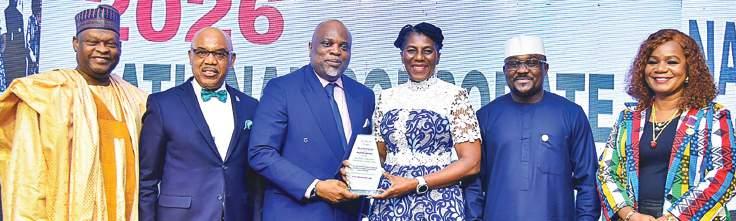
Zenith Bank Plc has been named
“Africa’s Best Bank” and “Nigeria’s Best Bank,” the latter for the second
www.thisdaylive.com
consecutive year, at the prestigious Euromoney Awards for Excellence 2026, clinching the biggest and most coveted national and continental awards in banking.
The awards were presented to the bank recently at The Peninsula London Hotel, London. This dual recognition was a testament to the bank’s sustained excellence in
financial performance, customer service, digital innovation, and its contribution to economic development across Nigeria and the wider African continent.
The Euromoney Awards for Excellence are among the most respected in the global financial industry, evaluating banks on criteria including strategy, profit-
ability, risk management, digital transformation and impact on stakeholders. Victory at the awards is regarded as a mark of the highest
Continued on page 8
Uzodimma: Southeast Governors Have Agreed to Work for President in 2027 Poll
Imo State Governor, Hope Uzodimma, has said the governors of the five South East states have resolved to work for President Bola Tinubu’s victory in next year’s election. He said they arrived at the decision based on verifiable facts of what Tinubu’s administration has done for the zone, against the propaganda certain politicians using the South East as template for
anti-government sentiment. Speaking during a meeting with members of the Imo State Elders Council and those of the Traditional Rulers Council at the New EXCO Chambers Government House
Owerri, Uzodimma, who is the Chairman of South East Governors Forum, said the governors have no doubt that President Tinubu has
Continued on page 8
Trump to Tinubu: US Stands Firmly with Nigeria Against Terrorism
Deji Elumoye in Abuja
United States President, Donald Trump, has hailed his Nigerian counterpart, Bola Tinubu, for his decisive leadership “on behalf of the Nigerian people to tackle the issues plaguing Nigeria, especially the violence affecting Christian communities”.
In a letter to Tinubu, dated July 6, 2026, Trump declared, “It is a true honour to stand with you in the fight against these terrorists and to make the Federal Republic of Nigeria stronger and more prosperous.”
According to a statement
Continued on page 8
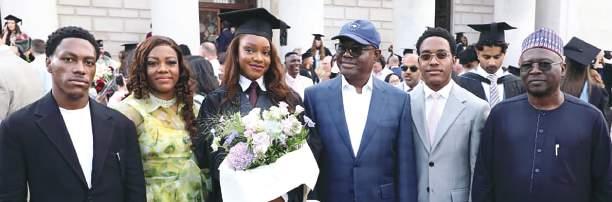
WIKE’S DAUGHTER GRADUATES FROM UNIVERSITY OF SOUTHAMPTON...
R-L: Adamawa State Governor, Ahmadu Umaru Fintiri; FCT Minister’s son, Joaquin; the FCT Minister, Barr. Nyesom Wike; his daughter, wife and son, Jazmyne, Justice Eberechi Suzzette Wike and Jordan respectively, during Jazmyne’s University of Southampton Bachelor of Laws ( Upper Second-Class Honours) graduation ceremony in Southampton, United Kingdom, yesterday
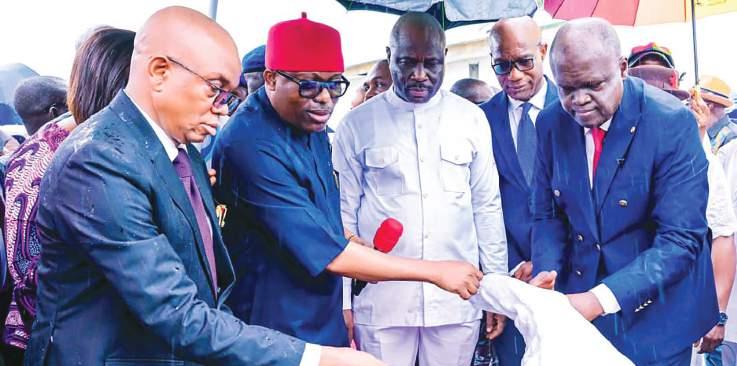
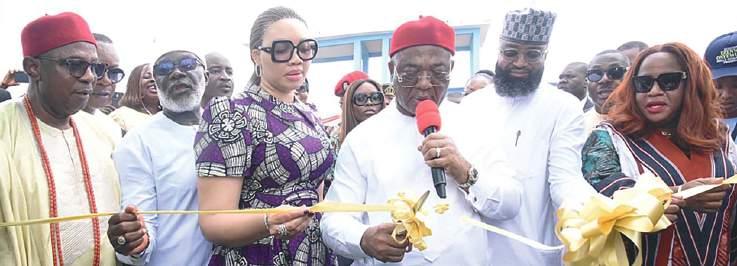
FUBARA UNVEILING COMMEMORATIVE PLAQUE OF THE COMMENCEMENT OF RIVEN MEDICAL INDUSTRIES PROJECT...
Governor of Rivers State, Sir Siminalayi Fubara ( 2nd left) unveiling the commemorative plaque of the commencement of the Riven Medical Industries Project, Port Harcourt on Wednesday.
Femi Otedola Buys Fresh N77.6bn Worth of First HoldCo Shares, Now Owns
Chairman of First HoldCo Plc, Femi Otedola, yesterday announced a fresh acquisition of 706.13 million ordinary shares worth approximately N77.6 billion in a single transaction on the Nigerian Exchange Limited (NGX).
The latest purchase further strengthens Otedola’s position in one of the Exchange’s strongestperforming banking stocks this year, with his combined shareholding now rising to 9,277,792,037 shares, representing 21.95 per cent of the company.
A regulatory filing submitted to the Nigerian Exchange shows that Calvados Global Services Limited, a company related to the First HoldCo chairman and significant shareholder, Otedola, acquired 706,131,179 ordinary shares of the company at N109.88 per share on July 22, 2026. The transaction was valued approximately N77.59 billion.
The filing classified the transaction as an initial notification of insider dealing, identifying Calvados Global Services Limited as “a company related to a significant shareholder – Mr. Olufemi Otedola”.
The purchase represents one of the largest disclosed insider acquisitions
on the Exchange this year.
The transaction comes amid a sustained rally in First HoldCo shares, supported by record profitability, improving asset quality, stronger capital adequacy, and growing investor confidence in the group’s transformation strategy.
The latest acquisition further reinforces Otedola’s long-term commitment to the financial institution he has helped to reposition over the past few years.
It comes just days after First HoldCo reported record half-year earnings and became the first Nigerian banking stock to surpass a N5 trillion market capitalisation milestone.
The latest acquisition also sparked speculation about Otedola’s long-term plans for First HoldCo. Historically, Otedola has maintained dominant ownership positions in companies where he has exercised strategic control. Before gradually reducing his stake in Geregu Power Plc, he owned approximately 78 per cent of the company.
Unlike many listed companies with concentrated ownership structures, First HoldCo has a broad shareholder base, with a free float of 56.59 per cent as of its latest half-year
financial statements.
Before Wednesday’s acquisition, First HoldCo’s June 30, 2026 shareholding disclosure showed Otedola held 3,251,346,245 shares directly and 6,026,445,792 shares indirectly, representing a combined 20.4% stake.
The additional 706.13 million shares acquired through Calvados Global Services Limited will increase Otedola’s combined economic interest
further, although the company’s next official shareholding disclosure will determine his exact post-transaction ownership percentage.
The insider purchase comes barely a day after First HoldCo became the first Nigerian banking stock to cross the N5 trillion market capitalisation milestone during intraday trading, cementing its position as the country’s most valuable listed banking institution.
The acquisition also comes against the backdrop of the group’s strongest financial performance on record.
For the six months ended June 30, 2026, First HoldCo reported a record pre-tax profit of N653.54 billion, representing an 83.5 per cent year-on-year increase from N356.15 billion recorded in the corresponding period of 2025.
The group posted interest income of N1.40 trillion, net interest income
of N879.13 billion, and net fee and commission income of N178.51 billion, alongside continued improvements in asset quality, capital adequacy, and operating efficiency.
The stock has emerged as one of the Nigerian Exchange’s standout performers in 2026 as investors continue to price in the company’s improved earnings outlook and stronger fundamentals.
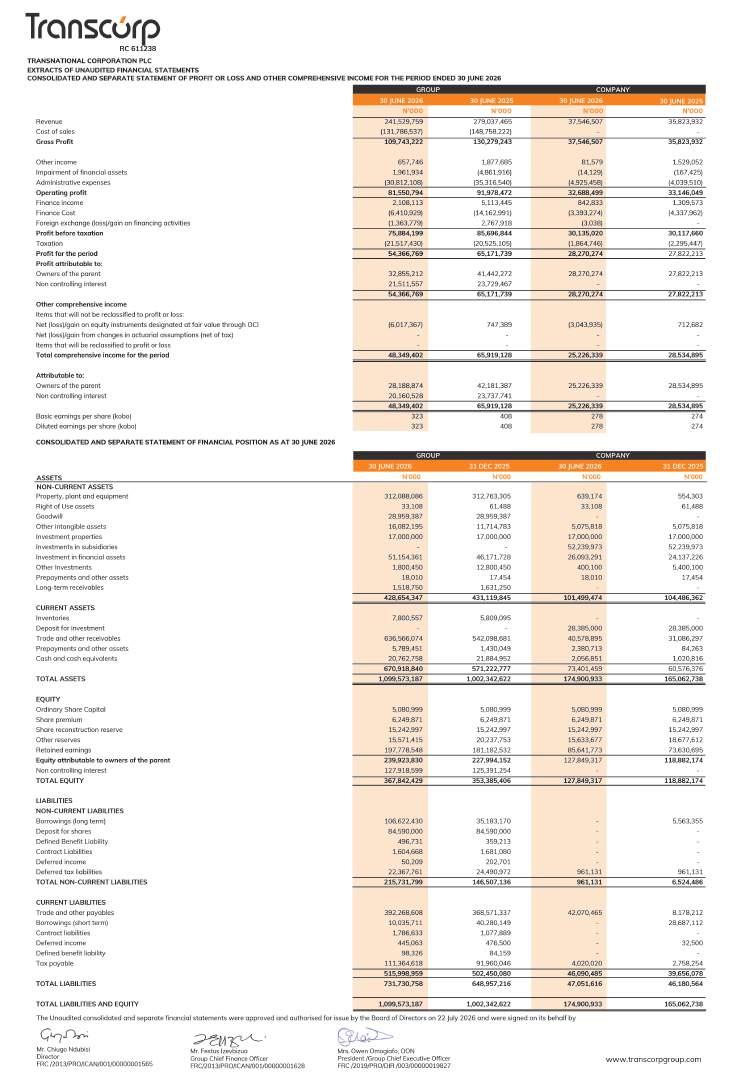
Transcorp Hotels Grows Half-year Profit to N13.7bn on Operational Efficiency
Oluchi Chibuzor
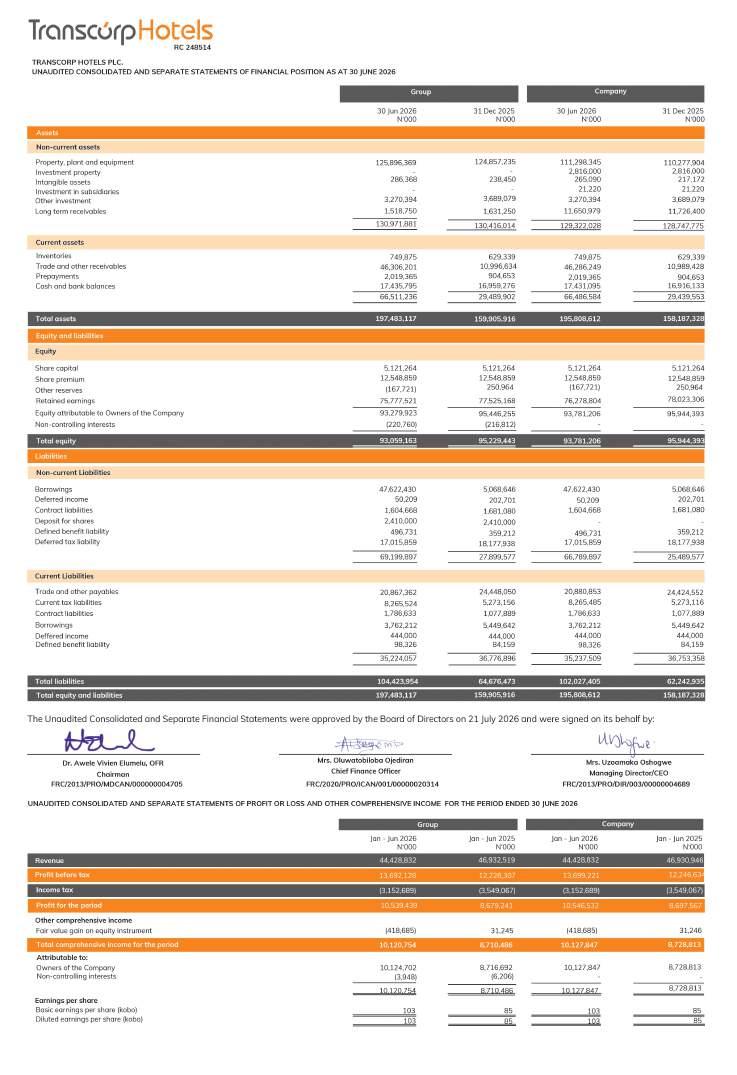
Transcorp Hotels Plc has sustained its strong earnings momentum, posting a 12 per cent increase in profit before tax (PBT) to N13.7 billion for the first half (H1) of 2026, underscoring the company’s resilience, disciplined cost management and operational excellence despite a moderation in revenue.
The hospitality subsidiary of Transnational Corporation Plc also recorded a 21 per cent growth in
profit after tax (PAT), which rose to N10.5 billion, from N8.7 billion in the corresponding period of 2025.
According to the company’s unaudited financial results for the period ended June 30, 2026, revenue stood at N44.4 billion compared with N46.9 billion in the same period last year, reflecting softer market demand in its international business segment.
Despite the marginal decline in revenue, the company improved its operating expense margin by three
Cambridge, UNILAG Identify 10 Locations for Urban Heat Research in Lagos
Esther
Oluku
A team of researchers from the University of Cambridge, UK, in partnership with the University of Lagos (UNILAG), will lead a consortium of stakeholders in a three-year research to identify the negative health risks of extreme heat across 10 selected settlements in Lagos.
The deliberation was reached at a stakeholders meeting where the University of Cambridge, University of Lagos, the Lagos State Government, Lagos Urban Development Initiative (LUDI), Lagos Metropolitan Area Transportation Authority (LAMATA) as well as other ministries and agencies of the Lagos state government agreed to collaborate towards reimagining a
cooler and healthier city which is the vision of the research themed ‘the Hotsteppers Project’ and is funded by Wellcome Trust.
Principal Investigator for the Hotsteppers Project and Chair, Global Public Health and Sustainable Urban Development at the University of Cambridge, Prof. Tolullah Oni, explained that the goal of the project is to spotlight the
health risks posed by heat exposure and co-design infrastructure as well as lifestyle interventions to support healthier lived experiences for human societies.
“Over the next three years, we want to spotlight how heat connects to health in Lagos, the experiences of people who are moving through transit hubs, and the heat risks.
percent, highlighting continued operational efficiency and prudent cost management.
Commenting on the performance, Managing Director/Chief Executive Officer of Transcorp Hotels Plc, Mrs. Uzoamaka Oshogwe, said the results reflected the resilience of the business and the disciplined execution of its growth strategy in a dynamic operating environment.
She explained: “Our H1 2026 performance reflects the resilience of our business and the disciplined execution of our strategy in a dynamic operating environment.
“While market conditions remained challenging, we continued to deliver strong profitability by staying focused on operational excellence, commercial agility and creating exceptional experiences for our guests.
“We remain committed to strengthening our market leadership, investing strategically in our business, and delivering sustainable long-term value for our shareholders.”
Also commenting, the Chief Finance Officer of Transcorp Hotels
Plc, Mr. Oluwatobiloba Ojediran, attributed the strong performance to disciplined financial management and operational execution.
“Our disciplined approach to cost management, revenue optimisation and operational execution delivered a 12 per cent increase in PBT to N13.7 billion, alongside a 21 per cent growth in profit after tax to N10.5 billion from N8.7 billion in the corresponding period of last year.
“These strong financial results reinforce the resilience of our business, provide a solid platform for sustainable growth and position us to continue investing strategically while delivering long-term value for our shareholders,” he said.
The company stated that the performance reinforces its position as one of Nigeria’s leading hospitality operators, driven by operational excellence, customercentric innovation and efficient resource management.
Beyond its financial performance, Transcorp Hotels said it continued to strengthen its portfolio of iconic hospitality and business assets.
Kayode Tokede
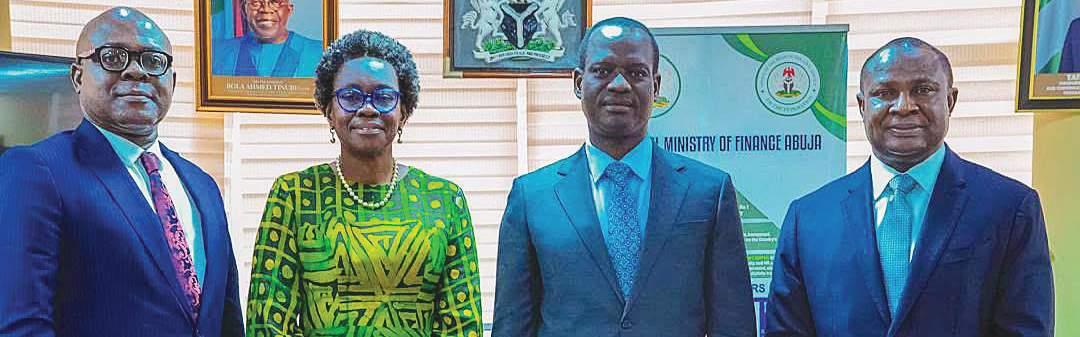
FUNKE ABOYADE LEADS NMRC TEAM TO MEET WITH TAIWO OYEDELE...
L-R: Mr. Arinze Adigwe, Non-Executive Director, NMRC; Ms. Olufunke Aboyade, SAN, Independent Non-Executive Director, NMRC; Mr. Taiwo Oyedele, Honourable Minister of Finance and Coordinating Minister of the Economy; and Mr. Kehinde Ogundimu, Managing Director/CEO, NMRC
Senate Grills CBN over Banking Reforms, Inflation, FX Policies, Demands Credit Expansion
Abiru: N4.65tn recapitalisation must boost productive sector lending Cardoso: Reforms strengthen economy, reserves hit $52.73bn Upper chamber moves to compel NNPCL, 41 MDAs to appear over revenue probe Committee chair alleges widespread revenue retention Akpabio: National Assembly’s constitutional powers to summon agencies not negotiable credit to agriculture, manufacturing, infrastructure, technology and small and medium enterprises.
The Senate yesterday subjected the Central Bank of Nigeria (CBN) to intense scrutiny over its monetary policy, banking sector recapitalisation, inflation management, foreign exchange reforms and financial operations.
Also yesterday, the Senate initiated moves to compel the Nigerian National Petroleum Company Limited (NNPCL) and about 40 other Ministries, Departments and Agencies (MDAs) to appear before its Committee on Finance over alleged failure to account for public revenues and persistent disregard for legislative invitations.
For the CBN, the Red Chamber insisted that the benefits of recent reforms must translate into increased credit to productive sectors of the economy rather than larger bank balance sheets.
The senators made the demand at
the statutory oversight session of the Senate Committee on Banking, Insurance and Other Financial Institutions.
The lawmakers also demanded explanations on the status of banks yet to meet the new recapitalisation requirements, persistent complaints over excessive bank charges, failed electronic transactions, cybersecurity, circulation of quality naira notes, financial inclusion and the apex bank’s audited financial statements.
The committee, chaired by Senator Mukhail Adetokunbo Abiru (Lagos East), equally questioned the sharp increase in the CBN’s liquidity sterilisation operations through Open Market Operations (OMO), rising operating expenses, monetary policy costs and the treatment of the bank’s operating surplus through the offsetting of the Federal Government’s Ways and Means advances instead of direct cash remittances.
CBN Governor, Mr. Olayemi Cardoso, however, defended the bank’s policy direction, maintaining that reforms introduced over the past three years had restored macroeconomic stability.
He also said the reforms had strengthened investor confidence, stabilised the foreign exchange market and positioned the economy for sustainable growth despite global economic uncertainties.
The engagement, held in accordance with the provisions of the CBN Act requiring the governor to brief the National Assembly twice yearly, was the committee’s first statutory interaction with the apex bank in 2026.
Cardoso appeared before the committee alongside the four Deputy Governors of the CBN— Lamido Yuguda (Financial System Stability), Philip Ikeazor (Economic Policy), Muhammad Sani Abdullahi (Corporate Services),
and Emem Usoro (Operations) — as well as directors of key departments.
In his opening remarks, Abiru acknowledged that the Nigerian economy had shown resilience despite a challenging global environment but stressed that recent improvements in macroeconomic indicators must begin to reflect in the real economy.
He recalled that inflation had declined to 15.06 per cent in February 2026, prompting the Monetary Policy Committee to reduce the Monetary Policy Rate from 27 per cent to 26.5 per cent before geopolitical tensions in the Middle East pushed inflation to 15.93 per cent in May.
Abiru commended the apex bank for stabilising the foreign exchange market, improving transparency and successfully implementing the banking recapitalisation programme.
He insisted that stronger banks must channel more affordable
Gov Sule says partnership will deliver more affordable houses
The Federal Mortgage Bank of Nigeria (FMBN) has disclosed that it has so far financed 1,590 housing units across Nasarawa State and disbursed over N9.5 billion in home renovation loans to 10,601 civil servants.
Managing Director and Chief Executive Officer of the bank, Shehu Osidi, revealed this while receiving the Governor of Nasarawa State, Abdullahi Sule, who was on a visit to the bank’s headquarters in Abuja.
Osidi said the interventions form part of FMBN’s partnership with the Nasarawa state government to expand access to affordable housing and improve the welfare of workers in the state.
“To date, the Federal Mortgage Bank of Nigeria has financed over 1,590 housing units across Nasarawa State. Beyond housing construction,
we have disbursed over N9.5 billion in home renovation loans to 10,601 civil servants in the state, enabling thousands of hardworking families to improve the quality of their homes,” Osidi said.
The FMBN boss added that the bank is financing mortgages for Nasarawa civil servants to acquire houses under the state government’s Owner-Occupier Housing Scheme.
“As of today, N94.7 million has been disbursed with respect to 29 beneficiaries under the scheme. Furthermore, the bank has refunded over N1.02 billion in National Housing Fund contributions to 5,462 retirees from Nasarawa State, ensuring that workers who faithfully contributed to the scheme received their benefits upon retirement,” he said.
According to him, the interventions demonstrate that the bank’s partnership with Nasarawa extends
beyond housing construction to improving the living conditions of residents, disclosing that construction at the Lafia site had reached an advanced stage, while work on other first-phase locations would commence before the end of the third quarter of the year.
In addition, Osidi reaffirmed the bank’s commitment to President Bola Tinubu’s Renewed Hope Housing Programme, noting that FMBN is funding housing projects nationwide and providing a N100 billion off-taker guarantee to support their delivery.
He highlighted the bank’s recent operational performance, revealing that National Housing Fund (NHF) collections rose from N103 billion in 2024 to a record N152.4 billion in 2025, representing more than 48 per cent growth over the previous highest annual collection.
He added that more than 300,000
new contributors had been enrolled into the NHF scheme in the past two years, while NHF refunds increased from N13.2 billion paid to 40,426 beneficiaries in 2023 to N15.6 billion paid to 55,068 beneficiaries in 2025.
Furthermore, he disclosed that the bank financed 6,911 affordable housing units in 2025, representing 96 per cent of its annual target of 7,200 units.
In an interview, Osidi described Nasarawa as one of FMBN’s strongest partners in housing development, recalling that Nasarawa was the first state to allocate land for the Renewed Hope Housing Project after Tinubu assumed office.
On his part, the Nasarawa State Governor, Sule, described FMBN as a dependable partner in the state’s development agenda and expressed confidence that the collaboration would deepen as Nasarawa continues to attract investments.
He warned that recapitalisation should not become an end in itself.
“Ultimately, the true measure of a stronger banking system lies not merely in larger balance sheets but in its capacity to mobilise savings efficiently and channel affordable credit to productive sectors of the economy,” he said.
Abiru expressed concern over reports indicating that private sector credit had moderated despite banks raising unprecedented levels of fresh capital.
“The expectation of businesses and indeed the Nigerian people is that stronger capital positions should naturally support increased lending to the economy rather than concentration in risk-free assets or short-term financial instruments,” he added.
The committee chairman said lawmakers also expected comprehensive explanations on the few banks yet to comply with the recapitalisation requirements, the regulatory framework for financial holding companies, consumer protection issues and the conditions necessary for further monetary easing.
He stressed that while the Senate supported stronger financial regulation, reforms must not impose excessive compliance costs capable of weakening the competitiveness of Nigerian financial institutions.
Abiru also praised the CBN for publishing its 2025 audited financial statements promptly but sought clarification on reports that outstanding OMO bills had risen from about N24.3 trillion in 2024 to N48.7 trillion in 2025.
“Our constitutional responsibility requires that we examine issues capable of affecting financial sector resilience and the broader Nigerian economy,” he said.
Responding, Cardoso assured lawmakers that every issue raised would be comprehensively addressed, insisting that the economy had continued to consolidate the gains recorded in 2025.
He said coordinated monetary and fiscal reforms had strengthened macroeconomic stability despite persistent global risks arising from geopolitical tensions, trade fragmentation and
supply chain disruptions.
The CBN Governor said, “When I last appeared before this distinguished committee in December 2025, I reported encouraging progress in inflation moderation, foreign exchange market stabilisation, external reserves accumulation, reform of market infrastructure and significant advances in the banking sector recapitalisation programme.
“I am pleased to report that the first half of 2026 witnessed the consolidation of many of those gains,” Cardoso said. According to him, inflation resumed its downward trajectory after a temporary increase triggered by the Middle East conflict, declining from 15.93 per cent in May to 15.91 per cent in June.
He said, “This outcome demonstrates the effectiveness of our monetary policy stance in containing second-round inflationary pressures and anchoring inflation expectations.
“We remain fully committed to restoring price stability and achieving single-digit inflation over the medium term,” he stated.
Cardoso also said the apex bank’s foreign exchange reforms had improved transparency, enhanced market confidence and strengthened liquidity.
He attributed the progress to the implementation of the fourth edition of the Foreign Exchange Manual, the Nigeria Foreign Exchange Code and the Electronic Foreign Exchange Matching System. According to him, the reforms had moderated speculative activities, stabilised the naira and improved investor confidence.
He disclosed that the average exchange rate appreciated to N1,375.40 to the dollar during the first half of 2026, while diaspora remittances through official channels rose from about $200 million to over $600 million monthly, with the bank targeting $1 billion monthly by the end of the year.
The CBN governor further revealed that Nigeria’s external reserves had climbed to $52.73 billion as of July 9, 2026.
On the banking recapitalisation programme, Cardoso described the exercise as one of the most successful in the country’s financial history.
Emmanuel Addeh in Abuja
Sunday Aborisade in Abuja
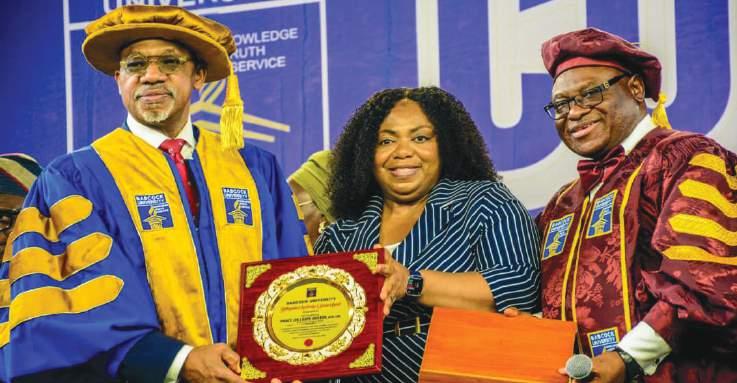
AT 15TH POSTGRADUATE CONVOCATION CEREMONY OF BABCOCK UNIVERSITY...
L-R: Ogun State Governor, Prince Dapo Abiodun; wife of the President/Vice-Chancellor, Babcock University, Prof. Folusho Ojewole, and the President/Vice Chancellor, Babcock University, Prof. Afolarin Olutunde Ojewole, at the presentation of a Distinguished Leadership and Service award to Governor Abiodun for his outstanding contributions to the advancement of education by Babcock University during the 15th postgraduate convocation ceremony for the award of degrees, prices and doctoral hooding at the institution on Tuesday
Dele Oye: N17.5trn Owed NNPC by FG Is Fuel Subsidy in Disguise
Says Nigeria running most expensive subsidy programme in history
Chairman of Alliance for Economic Research and Ethics Ltd/GTE, Dele Oye, has said the N17.5 trillion debt owed Nigerian National Petroleum Company Limited (NNPC) by the federal government is a disguised fuel subsidy.
The erstwhile President of Nigerian Association of Chambers of Commerce, Industry, Mines and Agriculture (NACCIMA), in a statement, said Nigeria was currently operating the most expensive subsidy programme in its history, despite the government’s claimed removal of fuel subsidy.
Oye, who is also the immediate past President of Organised Private Sector of Nigeria (OPSN), in the statement, said the huge liability, accumulated through what NNPC described as “energy security
expenses,” “under-recovery” and other receivables, represented a continuation of the subsidy regime under a different name.
He stated that the government’s 2023 announcement of fuel subsidy removal did not eliminate the financial burden but merely transformed it into an accounting arrangement that had placed additional pressure on public finances.
Oye said, “Nigeria is currently executing the most expensive subsidy programme in its history, yet almost no one is calling it by its true name.
“A N17.5 trillion liability has been accumulated in the shadows, hidden behind accounting terminologies designed to obscure rather than illuminate.
“This is not energy security; it is fiscal capture, the systematic transfer of public wealth through
mechanisms that evade democratic oversight. The Petroleum Industry Act was designed to dismantle such opaque structures, not to be weaponised to legitimise them.
“Three years after the declaration that ‘subsidy is gone’, the burden has never been heavier. It has merely been rebranded. And that, tragically, is the most expensive word game in Nigerian history.”
He said NNPC’s 2024 financial statements showed that the federation’s obligations to the company had risen to about N17.5 trillion, comprising energy security expenses, under-recovery claims, and other receivables.
Oye said the development raised concerns over transparency, accountability, and the sustainability of Nigeria’s petroleum policy.
He stated, “On May 29, 2023, President Bola Ahmed Tinubu stood before the nation and declared, with theatrical finality: ‘Subsidy is gone.’ It was a bold proclamation, one that signalled a definitive break from decades of fiscal haemorrhage.
“Yet, three years later, as the Nigerian National Petroleum Company Limited (NNPC) released its 2024 Consolidated and Separate Financial Statements, the numbers revealed a profoundly different reality.
Wireless Application Service Providers Association of Nigeria (WASPAN) has appealed the Federal High Court judgement that upheld key aspects of the regulatory powers of Federal Competition and Consumer Protection
GTCO, Experts Advocate Compassion, Inclusive Policies for People with Autism
Funmi Ogundare
Guaranty Trust Holding Company (GTCO), yesterday, called on Nigerians to embrace greater compassion, empathy and acceptance towards people living with autism and other neurodiverse conditions, stressing that understanding rather than hostility is key to building a more inclusive society.
in Action’, scheduled to hold on July 27 and 28, at Muson Centre, Lagos, the Chief Head of Corporate Communications, Oyinade Adegbite, said the organisation’s commitment to autism advocacy is driven by the need to bridge existing gaps in awareness and support.
“As long as that need exists, and for as long as we are capable and able, we will continue to show up,” she said, explaining that the conference is part of the organisa-
tion’s broader commitment to inclusion and social impact.
Adegbite noted that GTCO operates a non-discriminatory employment policy, with people living with different forms of disabilities represented within its workforce.
“We run a no-discriminatory hiring policy. We have people with physical disabilities and different disabilities. Inclusion is simply how we operate as an organisation,” she said.
Commission (FCCPC) over the digital consumer lending market.
WASPAN urged the Court of Appeal to set aside the decision and declare the commission’s Digital Economy and Online Non-Interest (DEON) Consumer Lending Regulations inapplicable to telecommunications operators.
In a Notice of Appeal dated July 21, 2026, the association, through its lead counsel, Oluwakemi Pinheiro, SAN, challenged the July 20, 2026 judgement delivered by Justice Ambrose Lewis-Allagoa, describing it as legally flawed and internally inconsistent.
WASPAN raised nine grounds of appeal, arguing that the trial court misinterpreted key provisions of the Federal Competition and Consumer Protection Act (FCCPA), 2018, and failed to give effect to the sector-specific regulatory powers vested exclusively in the Nigerian Communications Commission (NCC) under the Nigerian Communications Act, 2003.
The appeal followed the dismissal of WASPAN’s originating summons
challenging the validity of FCCPC’s DEON Consumer Lending Regulations.
Although the trial court held that FCCPC lacked licensing powers and could not assume NCC’s regulatory functions in the telecommunications industry, it, nevertheless, upheld the DEON regulations and dismissed the suit.
WASPAN argued that those findings were irreconcilable with the court’s final decision.
The association contended that the lower court erred in interpreting Section 2(1) of FCCPA as conferring economy-wide jurisdiction on FCCPC without giving effect to the qualifying phrase, “as may be indicated otherwise.”
According to WASPAN, that provision limits the commission’s authority where another law has vested regulatory powers in a sector-specific regulator.
It argued that Section 90 of the Nigerian Communications Act expressly granted NCC exclusive responsibility for promoting fair
competition and protecting consumers in the telecommunications sector, thereby excluding FCCPC from exercising overlapping regulatory authority.
WASPAN also challenged the trial court’s interpretation of Section 163 of FCCPA, insisting that the provision does not grant FCCPC unrestricted powers to make regulations across all commercial sectors.
Rather, it maintained that the commission’s regulation-making authority was confined to matters expressly provided for under the Act and could not be extended to regulate telecommunications operators through the DEON Consumer Lending Regulations.
The association further argued that Paragraph 7 of the DEON regulations unlawfully required its members to obtain FCCPC’s approval before providing consumer lending services. It maintained that the approval requirement effectively amounted to a licensing regime, despite the trial court’s finding that FCCPC had no statutory licensing powers.
Emmanuel Addeh in Abuja
LCCI: Nigeria Emerging as One of Africa’s Top Performers in FDI Attraction
Calls for more action from FCCPC in price regulation
Dike Onwuamaeze
The Lagos Chamber of Commerce and Industry (LCCI) has declared that Nigeria is emerging as one of Africa’s top performers in the attraction of Foreign Direct Investment (FDI), despite the geopolitical uncertainty bedevilling the global economy.
The declaration was made yesterday by President of LCCI, Mr. Leye Kupoluyi, in his address on the “State of the Economy”.
Kupoluyi also called on the Federal Competition and Consumer Protection Commission (FCCPC) “to be more vigilant on the price regulatory environment because we have had cases where oil marketers raised pump prices in line with international crude oil prices, but held on to current prices when international prices fell”.
He said, “Africa recorded a modest improvement in investment inflows, with Nigeria emerging as one of the continent’s top performers after FDI increased by 148.4 per cent to $4.01 billion in 2025, driven largely by oil and gas project finance.”
Though, the UNCTAD World Investment Report 2026 showed that global FDI remained below pre-pandemic levels due to geopolitical uncertainty, subdued cross-border mergers and acquisitions, and cautious investor sentiment.
Kupoluyi stated that the evolving global economic environment presented Nigeria with both opportunities and risks that underscored the need for flexible, agile, and forward-looking policies to preserve macroeconomic stability and strengthen long-term growth.
He pointed out that higher crude oil prices resulting from geopolitical tensions might temporarily boost export earnings, government revenue, and external reserves, but said prolonged disruptions could sustain inflation through higher energy, transportation, fertiliser, and import costs.
Kupoluyi, therefore, advised, “Nigeria should maintain a prudent, data-driven monetary policy to anchor inflation expectations while ensuring clear communication of policy to
strengthen market confidence.
“Fiscal policy should focus on rebuilding buffers through stronger domestic revenue mobilisation, improved public expenditure efficiency, and debt sustainability, while providing only temporary, well-targeted support to vulnerable households and businesses.”
He also advised, “Untargeted subsidies and price controls should be avoided, as they weaken price signals, increase fiscal costs, and discourage energy efficiency.”
Commenting on monetary policy, especially the retention of the Monetary Policy Rate (MPR) at 26.50 per cent by the Monetary Policy Committee (MPC) of the Central Bank of Nigeria (CBN), LCCI said this decision underscored CBN’s commitment to preserving price stability, anchoring inflation expectations, safeguarding exchange rate stability, and strengthening macroeconomic resilience amid heightened global uncertainty and external shocks.
It stated, “The decision to retain the key monetary policy parameters has
important implications for businesses and the broader Nigerian economy.
“By maintaining the MPR at 26.50 per cent, the MPC reaffirmed its commitment to preserving price and exchange rate stability while containing inflationary pressures, particularly those arising from external shocks and heightened global uncertainty.
“However, for businesses, the decision implies that borrowing costs will remain elevated in the near term, potentially constraining private sector investment, business expansion, and access to affordable credit, particularly for micro, small, and medium enterprises (MSMEs).”
The chamber added, “The sustained tight monetary stance is expected to support exchange rate stability, improve investor confidence, and reduce foreign exchange volatility, thereby enhancing business planning and reducing currency-related risks.
“For the Nigerian economy, the MPC’s decision reinforces macroeconomic stability by sustaining the disinflation process while maintaining
confidence in the financial system.
“Although higher interest rates may moderate economic growth in the short term by dampening private investment and consumer spending, they are expected to help contain inflation, strengthen external reserves, preserve exchange rate stability, and improve the economy’s resilience to global shocks.”
LCCI recommended complementary fiscal and structural reforms aimed at boosting domestic production, improving infrastructure, enhancing revenue mobilisation, and reducing the cost of doing business as essential to maximising the gains of MPC’s stance.
The president of LCCI also spoke on Nigeria’s rising debt profile, which he attributed to continued borrowing to finance fiscal deficits and the valuation impact of exchange rate movements on external debt.
He, however, said the current “higher crude oil prices and improved oil production in 2026 are expected to generate an oil revenue windfall” that could strengthen government
UZODIMMA: SOUTHEAST GOVERNORS HAVE AGREED TO WORK FOR PRESIDENT IN 2027 POLL
done well for the Zone compared to what the South East got before now from previous administrations.
“The attempt by certain politicians to use the South East as a stage for anti-government sentiment is most despicable. We need to match propaganda with facts,” Uzodimma, who is also Chairman of Progressives Governors’ Forum and Director General of Renewed Hope Ambassadors, said. He proceeded to reel out what the Tinubu administration has done
for the zone measured against what was on ground before now, and urged the people to be wary of the usual campaign rhetorics in the South East often woven around marginalisation.
“For the first time in Nigeria’s history, the South East has a Development Commission. President Tinubu signed the South East Development Commission Act into law on 24th July 2024. He signed the bill, inaugurated the board in February 2025, and the work began.
ZENITH CLINCHES DUAL HONOURS AT 2026
distinction in global banking.
A statement explained that this year’s edition attracted a record of over 770 entries from world-class financial institutions including HSBC, Morgan Stanley, Citibank, Barclays, Standard Bank and DBS Bank of Singapore.
Commenting on the awards, the Group Managing Director/ CEO of Zenith Bank Plc, Dame Dr. Adaora Umeoji, OON, said, “We are deeply honoured by these recognitions from Euromoney. Being recognised as Africa’s Best Bank and Nigeria’s Best Bank reflects the trust of our customers, the dedication of our unicorn workforce, and our unwavering commitment to building a truly African global financial institution.
“These awards inspire us to do even more to deliver superior value, drive financial inclusion, and support the growth of businesses across Africa.”
The GMD commended the regulators across the various jurisdictions where the bank has footprints for the enabling regulatory environment which has supported the Bank in achieving this feat.
She dedicated the award to the Founder of Zenith Bank Plc, Jim Ovia, CFR, thanking him for his vision and excellence which have been instrumental to the bank’s success.
Zenith Bank has continued to deliver strong financial results while accelerating investments in
technology, artificial intelligence, and digital banking solutions.
In the 2025 financial year, the bank grew gross earnings by six per cent year-on-year to N4.19 trillion and delivered profit after tax of N1.04 trillion, while reducing its non-performing loan ratio from 4.7 per cent to 3.8 per cent.
In keeping with its dividend policy, Zenith Bank rewarded its investors with a record-breaking total dividend of N10 per share (totaling N410.69 billion) for the 2025 financial year. This represents a 100 percent increase over N5 per share paid in 2024. The bank has also deepened its pan-African presence and expanded trade and transaction banking capabilities to connect businesses across key markets.
Euromoney is the leading authority for global banking and financial markets, and this latest recognition adds to Zenith Bank’s growing list of local and international accolades, and further cements its position as one of Africa’s leading financial institutions.
The bank’s track record of excellent performance has continued to earn the brand numerous awards, including being recognised as the Number One Bank in Nigeria by Tier-1 Capital for the seventeenth consecutive year in the 2026 Top 1000 World Banks Ranking, published by The Banker and “Nigeria’s Best Bank” at the Euromoney Awards for Excellence 2025. The bank was also awarded
No previous administration did this for the South East. Not one.
“On rail, the federal government inaugurated the Port Harcourt to Aba line in May 2024. Sixty-three kilometres of rehabilitated track now connect the South South directly to Abia State, carrying passengers five days a week.
“In November 2024, the section was formally handed over to the Nigerian Railway Corporation for full commercial operations. President Tinubu has since allocated
$3 billion to reconstruct the entire Eastern Rail Corridor, which will run from Port Harcourt through the South East to Maiduguri.
“On roads, the Tinubu administration is executing Phases 2A and 2B of the access roads to the Second Niger Bridge, a dual carriageway running from the Umunya-Ogbunike axis through Ogidi and Nkpor-Umuoji into Asaba, with seven bridges along its length.
“The President flagged off Phase
2B himself in March 2025. The APC government built the Second Niger Bridge. This administration is completing the network of roads that makes it economically useful to every community around it.
“This month, President Tinubu approved two further road projects that Anambra State Governor, Chukwuma Soludo, of the APGA, welcomed as ‘a turning point for Igboland.’ The first is the 108-kilometre Otuocha-Anam-Abaji Road, opening a direct corridor from
EUROMONEY AWARDS, EMERGES AFRICA’S TOP BANK, NIGERIA’S BEST
‘Bank of the Year (Nigeria)’ in The Banker’s Bank of the Year Awards for 2020, 2022, and 2024; Best Bank in Nigeria from 2020 to 2022, 2024 and 2025, in the Global Finance World’s Best Banks Awards; Best Bank for Digital Solutions in Nigeria in the Euromoney Awards 2023; and was listed in the World Finance Top 100 Global Companies in 2023.
Further recognitions include Best Commercial Bank, Nigeria for six consecutive years from 2021 to 2026 in the World Finance Banking Awards and Most Sustainable Bank, Nigeria in the International Banker 2023, 2024 and 2026 Banking Awards. Additionally, Zenith Bank has been acknowledged as the Best Corporate Governance Bank, Nigeria, in the World Finance
Corporate Governance Awards for five consecutive years from 2022 to 2026 and ‘Best in Corporate Governance’ Financial Services’ Africa for four consecutive years from 2020 to 2023 by the Ethical Boardroom.
The Bank’s commitment to excellence led to Zenith being also named the Most Valuable Banking Brand in Nigeria in The Banker’s Top 500 Banking Brands for 2020 and 2021, Bank of the Year 2023 to 2025 at the BusinessDay Banks and Other Financial Institutions (BAFI) Awards, and Retail Bank of the Year for three consecutive years from 2020 to 2022 and 2024 to 2025. The Bank also received the accolades of Best Commercial Bank, Nigeria and Best Innova-
tion in Retail Banking, Nigeria, in the International Banker 2022 Banking Awards, Bank of the Year 2024 by THISDAY Newspaper; Bank of the Year 2024 by New Telegraph Newspaper; and Best in MSME Trade Finance, 2023 by Nairametrics. The Bank’s Hybrid Offer was also adjudged ‘Rights Issue/Public Offer of the Year’ at the Nairametrics Capital Market Choice Awards 2025.
Zenith Bank has also earned several non-financial awards, including Most Responsible Organisation in Africa, Best Company in Transparency and Reporting and Best Company in Gender Equality and Women Empowerment at the SERAS CSR Awards Africa 2024.
Leye Kupoluyi
revenues, support external reserves, reduce borrowing requirements, and enhance exchange rate stability”. Kupoluyi said, “Consequently, the anticipated oil windfall should be used prudently to reduce debt, rebuild fiscal buffers, strengthen external reserves, and finance critical infrastructure rather than expand recurrent expenditure.”
He added, “Accelerating non-oil revenue mobilisation, improving tax administration, and enforcing fiscal discipline remain essential for long-term debt sustainability.”
While urging FCCPC to be more vigilant, the LCCI stated the need to study the dynamics at play and in order to secure the best deal for consumers and businesses against cases of price-fixing by local airlines during peak festive seasons.
Anambra into the North Central.
“The second is the 150-kilometre Oba-Nnewi-Uga-Ihube/Okigwe Junction Road, connecting Anambra and Imo States to the Enugu-Port Harcourt Expressway, with linkages into Abia State.
“These roads, this rail line, and this Commission are facts. You can drive on the roads. You can board the train. You can walk into the SEDC offices. The evidence is physical. To stand before South Easterners and urge them to resent a President who has given their zone this much attention is to insult their intelligence.
“And these are the dividends particular to the South East. They sit on top of everything the zone shares with every other Nigerian under this administration such as the determined effort to restore security, the student loans now putting thousands of young South Easterners through school, the higher allocations strengthening the finances of all five States in the Zone, and the fiscal reforms easing the cost of trade, among them, the cut in vehicle import duty from twenty per cent to ten on new vehicles and from fifteen to five on used ones. The South East eats from the national table like every other Nigerian. What has changed is that a place has now been set for it in particular.”
TRUMP TO TINUBU: US STANDS FIRMLY WITH NIGERIA AGAINST TERRORISM
released yesterday by presidential spokesperson, Bayo Onanuga, the US-Nigeria relationship flourished in recent times, with the two sides working closely in key areas, especially in tackling security challenges afflicting parts of Nigeria.
In November last year, Trump and Tinubu agreed to establish a Joint Working Group co-headed by the national security advisers of Nigeria and the United States. Through the work of the group, the two sides agreed on several steps, including training, intelligence sharing, and joint operations to roll back terrorist activities.
A highlight of the collaboration was the May 16 coordinated
attack on ISIS hideouts in the Lake Chad area, which led to the killing of the group’s top leader, Abubakar Al-Minoki, and many of his lieutenants
Last week, US Assistant Secretary of State for Africa, Frank Garcia, visited Abuja, where he held meetings with senior government officials and pledged to strengthen the cooperation between Abuja and Washington DC in security and other areas.
The three-paragraph letter from Trump to Tinubu read, “Dear Mr President, Thank you for your thoughtful letter. Your kind words mean a great deal to me, and I
appreciate your decisive leadership on behalf of the Nigerian people.
I applaud your resolve to tackle the issues plaguing your nation, especially the violence affecting Christian communities and it is a true honour to stand with you in the fight against terrorists and to make the Federal Republic of Nigeria stronger and more prosperous.
“The United States-Nigeria relationship is crucial at a time where conflict has spread across West Africa and around the world.
We both share a mutual goal of confronting terrorism in all its forms, and our historic USNigeria 2026 Defence Cooperation
Roadmap has established a robust framework to accomplish this feat.
“I am proud to have deployed the United States Special Operations Forces—among the most elite military units anywhere in the world—to equip the brave men and women in the Armed Forces of Nigeria with the skills, tools and intelligence they need to protect your homeland and ensure the safety and security of citizens, particularly those of faith who have been under attack. I look forward to our continued discussions over the course of my Presidency. Sincerely, Donald J. Trump, President of the United States of America.”
INTERACTIVE SESSION WITH GERMAN BUSINESS DELEGATION...
Gencos: Power Sector Debt May Hit N17.1trn by 2033 Despite Ongoing Bond Issuance
Nigeria’s electricity Generation Companies (Gencos) yesterday warned that the country’s power sector debt could balloon to about N17.11 trillion by 2033 despite the federal government’s ongoing Presidential Power Sector Debt Reduction Programme (PPSDRP), unless the structural causes of the market’s financial crisis are urgently addressed.
The warning was contained in a debt analysis and infographic released by the Association of Power Generation Companies (APGC), which
argued that while the government’s bond programme is a significant intervention, it addresses only a fraction of the mounting liabilities in the Nigerian Electricity Supply Industry (NESI).
According to the analysis, the estimated debt owed to Gencos had risen to about N7.66 trillion as of June 2026, with the N501 billion Series 1 bond representing only 7.37 per cent of the N6.8 trillion legacy debt accumulated between 2015 and 2024.
Even after the planned issuance of the Series 2 bond, the generation companies argued that only 25.46 per cent of the outstanding obligations
would be addressed, leaving about N5.07 trillion still uncovered.
The APGC noted that beyond the historical debt, the electricity market continues to accumulate fresh liabilities every month because Gencos are not receiving full payment for electricity supplied into the national grid.
Using Nigerian Bulk Electricity Trading (NBET) market data covering January to April 2026, the association stated that Gencos invoiced an average of N213.5 billion monthly but received only about N90.8 billion, translating to an average settlement rate of 42.52 per cent.
Specifically, the analysis showed
that Gencos billed N252.48 billion in January but were paid N113.21 billion, representing a settlement rate of 44.84 per cent. In February, invoices of N198.68 billion attracted payments of N79.58 billion or 40.05 per cent.
For March, invoices stood at N208.51 billion while only N86.75 billion was paid, giving a settlement rate of 41.60 per cent. In April, Gencos invoiced N194.31 billion but received N83.59 billion, representing 43.02 per cent settlement.
The figures indicated that the market recorded an average monthly revenue shortfall of N122.7 billion
during the four-month period.
According to the association, unless this payment gap is eliminated, new debts will continue accumulating at a pace that could overwhelm the current debt resolution programme.
Based on the prevailing trend, the APGC projected that the industry’s total debt could rise from N8.27 trillion in 2026 to N9.75 trillion in 2027, N11.22 trillion in 2028, N12.69 trillion in 2029, N14.16 trillion in 2030, N15.63 trillion in 2031, N17.11 trillion in 2033.
The analysis further showed that servicing the two bond series would itself come at a substantial cost.
Report: Cost of Cooking Jollof Rice Soars 624% in 10 Years as Climate, Insecurity Deepen Nigeria’s Food Crisis
Sunday Ehigiator
A report has indicated that the cost of preparing Nigeria’s most iconic meal, jollof rice, has risen by an alarming 624 per cent over the past decade, highlighting the deepening affordability crisis facing millions of households as climate change, insecurity, poor infrastructure and rising transport costs continue to strain the country’s food supply chain.
This was the central finding of the ‘SBM Jollof Index Q2 2026 Report’, titled ‘Rebasing, Redefining, and the Weather’s Toll on the Pot’, which revealed that the national average cost of cooking a standard pot of jollof rice climbed from N25,798 in July 2025 to N29,578 in June 2026, representing a 14.6 per cent increase within 12 months.
The report, which marked the second decade of the Jollof Index, also introduced a rebased methodology reflecting how Nigerians now actually cook, replacing turkey with chicken as the standard protein and adopting more precise ingredient measurements to better capture the realities of household consumption.
According to SBM Intelligence, the rebasing does not merely change the statistical baseline but paints a more realistic picture of the country’s
worsening food affordability crisis.
“The long-term trajectory is stark,” the report stated, noting that every geopolitical zone has experienced food cost increases exceeding 400 per cent since the index began tracking prices across Nigeria.
The Southwest recorded the steepest increase of 708.2 per cent, followed by the Northcentral at 567.3 per cent, South-South 489.9 per cent, Northeast 467.5 per cent, Southeast 441.3 per cent, and Northwest 428 per cent.
SBM observed that although Nigeria’s headline inflation has shown signs of easing, food inflation remains stubborn because the underlying drivers extend beyond monetary policy.
It identified insecurity in farming communities, deteriorating logistics, poor road infrastructure, climate-induced flooding, volatile exchange rates, transport costs and rising protein prices as the principal factors behind escalating food prices.
The report further noted that protein continues to account for the largest share of the cost of preparing jollof rice, making meat increasingly unaffordable for average households.
One of the report’s most striking findings was the growing disparity between food prices across Nigerian cities.
It revealed that the gap between the country’s cheapest and most expensive markets has widened significantly, underscoring increasing fragmentation in Nigeria’s food distribution network.
Calabar Municipal emerged as Nigeria’s most expensive market for cooking jollof rice at N34,750, while Awka remained the cheapest at N22,050, leaving a price difference of N12,700 between both cities.
Lagos recorded the sharpest increase nationwide. According to the report, the Trade Fair and Balogun markets experienced a 49.6 per cent rise within one year, climbing from N23,200 in July 2025 to N34,700 by June 2026.
SBM attributed the spike to Lagos’ role as Nigeria’s import gateway, where imported food ingredients, shipping costs, currency depreciation and rising fuel prices combine to exert upward pressure on food prices.
The report also linked the March 2026 fuel shock arising from tensions surrounding the Iran conflict to sharp monthly increases in Lagos food prices. While Lagos experienced dramatic increases, other regions recorded mixed outcomes.
Bauchi, once Nigeria’s most inflationary food market, witnessed a 16.7 per cent decline over the review period after improved harvests and better supply routes moderated prices.
Nevertheless, SBM cautioned that the decline represents only relative relief, as prices remain significantly higher than historical levels.
Kano recorded a comparatively modest increase of 5.3 per cent, while Awka and Onitsha remained Nigeria’s least expensive markets despite modest price increases.
The report devoted considerable attention to climate change, describing heavy rainfall as an increasingly powerful driver of food inflation.
According to SBM, flooding, delayed harvests, damaged farmlands, washed-out roads and rising transportation costs combined to create shortages of tomatoes, peppers and other highly perishable food items across virtually every region of the country.
The report found that Lagos consumers have increasingly substituted fresh tomatoes with carrot-based sauces, dried pepper and tomato paste, while households in Calabar, Port Harcourt, Ibadan, Kano and Abuja have similarly embraced cheaper alternatives due to supply shortages.
Bauchi witnessed some of the most severe tomato inflation, with prices reportedly rising by over 200 per cent in certain markets because of weather disruptions.
Across Nigeria, consumers are
increasingly replacing yam with potatoes, fresh pepper with dried alternatives, and premium proteins with crayfish, eggs or cow skin (ponmo), according to the report.
SBM warned that these substitutions represent survival strategies rather than improvements in household welfare.
The report argued that Nigeria’s food system lacks resilience because poor storage facilities, weak logistics infrastructure and limited insurance coverage leave farmers and traders vulnerable to every major weather event.
It noted that climate variability has transformed seasonal disruptions into recurring supply shocks capable of pushing up prices nationwide.
The report also presented testimonies from households in Kaduna and Kano, illustrating how ordinary Nigerians are coping with rising food costs. Respondents said bulk buying has become a luxury, with many households now purchasing ingredients only when needed because they can no longer afford large purchases.
Some respondents reported abandoning fresh tomatoes entirely in favour of sachet tomato paste, while others disclosed reducing the amount of seasoning, meat and vegetables used in cooking.
Under Series 1, a principal of N501 billion would attract about N387 billion in interest over seven years, bringing the total repayment obligation to N888 billion. Similarly, the proposed N1.23 trillion Series 2 bond would generate about N950.6 billion in interest, resulting in total repayments of approximately N2.18 trillion over the same period. Combined, both bond series would require total repayments of about N3.07 trillion over seven years.
The APGC stressed that while the debt resolution programme provides much needed liquidity relief, it does not resolve the structural weaknesses responsible for the market’s recurring financial deficits.
It pointed to an outstanding tariff shortfall of about N1.783 trillion recorded between April 2025 and April 2026 as further evidence that electricity tariffs remain below the actual cost of supplying power.
The association argued that unless tariffs become cost reflective or the government consistently funds the subsidy component, fresh debts would continue accumulating even as existing obligations are being repaid.
It therefore recommended a combination of reforms, including cost reflective tariffs, transparent billing and collection mechanisms, fully funded subsidies where government chooses to intervene, stronger enforcement of market performance obligations, and full implementation of the existing N4 trillion PPSDRP framework.
According to the APGC, the current bond programme should be viewed as an important first step rather than a complete solution to the sector’s liquidity crisis.
It warned that by the time the seven-year bond repayment programme ends in 2033, the industry could have accumulated liabilities exceeding the debts currently being addressed if the underlying market payment imbalance remains unresolved.
The association maintained that resolving Nigeria’s electricity market crisis would require coordinated action by government, regulators, market operators and investors to eliminate the recurring monthly payment shortfall and restore the financial sustainability of the power sector.
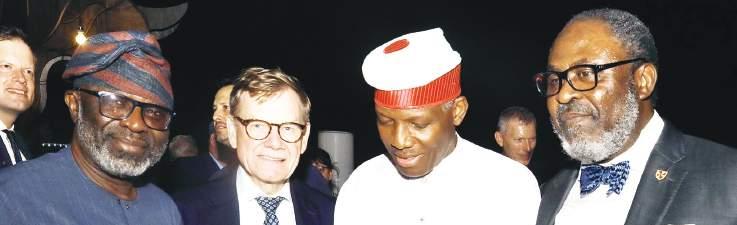
L-R: Managing Director, South West Development Commission, Dr. Charles Diji Akinola; German Federal Foreign Minister, Mr. Johann Wadephul; Oloni of Eti-Oni, Osun State, Kabiyesi Oba Dokun Thompson and Chief Gbola Akinola SAN, during an interactive session with the Business delegation that accompanied German Federal Foreign Minister on a visit to Nigeria in Lagos on Tuesday
PHOTO: ABIODUN AJALA
Emmanuel Addeh in Abuja
PERSPECTIVE
Africa’s Next Digital Investment Must Be in Institutions, Not Just Infrastructure
By Engr. Aliyu Yusuf Aboki
As the global community marks two decades of the World Summit on the Information Society (WSIS), attention is shifting from defining digital ambitions to delivering measurable outcomes. During the high-level WSIS Forum 2026 session, Africa’s Digital Roadmap to 2035: Implementing WSIS+20 Outcomes, Advancing Agenda 2063 and Accelerating Inclusive Digital Transformation, leaders from across the continent converged on a common message: Africa’s digital future will be determined not only by expanding connectivity, but by strengthening digital governance, investing in skills, financing resilient infrastructure, advancing artificial intelligence readiness and deepening regional cooperation. The discussion underscored that implementing the WSIS+20 outcomes requires coordinated action that aligns continental priorities with Agenda 2063 while ensuring that digital transformation creates tangible opportunities for citizens, businesses and communities across Africa.
That broader conversation reflects a reality increasingly recognised by regulators across the continent. While significant progress has been made in extending broadband networks and digital infrastructure, the next phase of Africa’s digital transformation will depend on the strength of the institutions that guide it. As digital technologies become embedded in every sector of the economy, from healthcare and education to finance, agriculture and public administration, regulatory institutions must be equipped to respond to emerging challenges, foster innovation and ensure that digital progress translates into inclusive economic and social development. Building institutional capacity is therefore no longer a complementary objective; it is fundamental to delivering meaningful connectivity and achieving Africa’s long-term digital ambitions.
Every time an African farmer receives a mobile payment, a truck crosses a border using digital customs systems, a nurse consults a specialist remotely, a student attends an online class, or an entrepreneur launches an online business, telecommunications is quietly powering an economic opportunity. It has become the invisible infrastructure that enables modern economies to function.
Today, mobile technologies and services contribute approximately US$240 billion to Africa’s economy, representing more than 8% of the continent’s GDP, while supporting millions of jobs directly and indirectly. The sector’s impact extends far beyond mobile network operators. It sustains mobile money agents, device retailers, software developers, digital entrepreneurs, logistics providers, content creators and thousands of small businesses whose livelihoods depend on reliable connectivity. More importantly, it enables almost every sector of the economy to become more productive and inclusive.
For much of the past two decades, digital transformation has rightly focused on expanding network coverage and connecting communities. While these priorities remain essential, the continent has reached a point where connectivity alone is no longer enough. The next phase of Africa’s digital transformation will depend on whether we build institutions that can transform connectivity into inclusive economic opportunity.
Telecommunications Is No Longer Just an ICT Issue
The digital economy is no longer confined to the ICT sector. It is the platform upon which every other sector increasingly depends.Healthcare is expanding through telemedicine, electronic health records and digital disease surveillance. Education is reaching learners through online platforms and digital classrooms. Agriculture is becoming more resilient through weather forecasting, digital extension services and access to market information. Manufacturers rely on connected supply chains, while financial services continue to deepen inclusion through mobile money and
digital payments. Governments are digitising public services, making them more efficient, transparent and accessible.
Even Africa’s electrification agenda is becoming increasingly dependent on digital infrastructure. Smart grids, renewable energy systems, remote monitoring, smart metering and rural electrification projects all require reliable telecommunications networks. As Africa accelerates investments in clean energy and industrialisation, digital infrastructure and energy infrastructure must increasingly be planned together rather than separately.
Africa’s Digital Economy Presents One of the World’s Greatest Investment Opportunities.
Home to the world’s youngest population, a rapidly expanding middle class and increasing demand for digital services, the continent is well positioned to become one of the fastest-growing digital markets globally.
Realising that opportunity, however, will require significant investment. Industry estimates suggest that approximately US$77 billion will be needed over the coming years to expand broadband infrastructure, modernise networks, strengthen fibre connectivity, deploy 4G and 5G, develop data centres and integrate emerging technologies such as satellite communications. Much of this investment is expected to be concentrated in Sub-Saharan Africa, where demand for digital services continues to accelerate.
For more than two decades, mobile operators have been among Africa’s largest long-term private investors. They have financed towers, fibre networks, international connectivity and increasingly advanced mobile technologies, often investing in areas where commercial returns take many years to materialise.
Maintaining this momentum requires predictable, transparent and investment-friendly regulatory environments. Investors seek confidence that markets will remain competitive, spectrum will be managed efficiently, regulations will evolve with technology and institutions will provide consistency over time. Strong regulatory institutions therefore become not only a governance imperative but an economic one.
The Next Digital Divide Is the Usage Gap
Across much of the continent, mobile broadband networks now reach the majority of the population. Yet connectivity alone does not guarantee participation in the digital economy.
Nearly 790 million people across Sub-Saharan Africa live within broadband coverage but still do not use mobile internet. The reasons are well known: smartphones remain unaffordable for many
households, devices are inaccessible, digital literacy remains uneven and locally relevant digital services are still developing. In many markets, the usage gap has become far larger than the remaining coverageClosinggap.this gap requires moving beyond traditional telecommunications policy. Affordable devices, innovative financing models, digital skills programmes, local digital content and inclusive public policies must become part of the digital infrastructure agenda. Meaningful connectivity is no longer measured simply by whether a network exists. It is measured by whether people can use digital technologies to improve their livelihoods, access education, receive healthcare, build businesses and participate fully in the digital economy.
Preparing Africa for the AI Economy
Artificial intelligence represents perhaps the most significant technological shift of our generation. It has enormous potential to improve healthcare, agriculture, education, financial services, disaster response and public administration. At the same time, it presents new regulatory questions around data governance, cybersecurity, consumer protection, ethics and competition.
Africa has an opportunity to participate not only as a consumer of AI technologies but as a contributor to their development. Ensuring that African languages, cultures and knowledge systems are represented within large language models is essential if AI is to serve the continent’s diverse societies effectively. Likewise, creating enabling regulatory environments that encourage innovation while safeguarding citizens will determine how successfully Africa harnesses AI for inclusive development.
Preparing for this future requires institutions that can anticipate technological change rather than simply react to it.
Learning Together, Growing Together
Across West, East, Central and Southern Africa, regulators are confronting remarkably similar challenges: managing spectrum, strengthening cybersecurity, regulating satellite services, promoting consumer protection, expanding meaningful connectivity and preparing for AI-enabled economies. Rather than solving these challenges independently, countries can accelerate progress by learning from one another. This is precisely the philosophy underpinning
the ICT Policy and Regulation – Institutional Strengthening (iPRIS) initiative. Since 2023, iPRIS has brought together African and European regulatory authorities through peer-to-peer learning, creating practical platforms where regulators exchange experience, develop strategic projects and strengthen institutional capacity. By progressively expanding its programmes in English, French and, from 2027, Portuguese, iPRIS is helping ensure that knowledge moves across linguistic boundaries, allowing successful regulatory practices to benefit countries throughout the continent. Diversity, equity and inclusion are also integrated throughout the programme, ensuring that digital transformation reflects the needs of all communities.
Regional Cooperation Delivers Results
Regional telecom regulatory organisations across Africa also have an increasingly important role in building integrated digital markets. At WATRA, we have witnessed how cooperation among regulators across ECOWAS member states can translate into tangible benefits for citizens and businesses. Working closely with ECOWAS, national regulatory authorities and development partners, WATRA has supported initiatives such as the ECOWAS Free Roaming Initiative, which is reducing communication barriers, lowering the cost of staying connected across borders and facilitating regional trade and mobility. Recent progress involving Benin, Senegal and Togo demonstrates how regulatory cooperation can directly improve the everyday experiences of citizens while strengthening regional integration. As emerging technologies continue to reshape markets, collaboration among regulators will become even more important. Whether addressing AI governance, satellite connectivity, cybersecurity or digital inclusion, shared learning enables countries to respond more quickly, avoid duplication and build stronger, future-ready institutions.
Building Africa’s Digital Future Together
Africa’s digital transformation is entering a defining decade. The continent has the talent, the entrepreneurial energy, the growing digital markets and the investment potential to become a leading force in the global digital economy. Realising that ambition will require continued investment in infrastructure, but equally in the institutions that govern it. Finally, multi-stakeholder collaboration will be the catalyst that turns ambition into impact. Governments, regulators, telecommunications operators, regional organisations, development partners, technology companies, academia and civil society all have a role to play in building an inclusive digital future. By aligning investment, policy, innovation and institutional capacity, Africa can accelerate meaningful connectivity, expand digital opportunities and ensure that no community is left behind. The continent’s greatest digital asset will not simply be its fibre networks, towers, satellites or data centres. It will be the strength of the institutions and partnerships that transform connectivity into opportunity, innovation into prosperity and technology into sustainable, inclusive development. Implementing the WSIS+20 outcomes provides an opportunity to translate global commitments into practical action that advances both the Sustainable Development Goals and Agenda 2063. Achieving these ambitions will depend on continued investment in infrastructure, institutions and people, underpinned by regional cooperation and strong partnerships across governments, regulators, industry, academia and civil society.
•Engr. Aliyu Yusuf Aboki is Executive Secretary, West Africa Telecommunications Regulators Assembly (WATRA)
Acting Group Politics Editor DEJI ELUMOYE
Email: deji.elumoye@thisdaylive.com
08033025611 sms only
Hamzat: My Plan is to Make Lagos Human Capital of the World
Deputy Governor of Lagos State and candidate of the all Progressives Congress for the 2027 gubernatorial election in the Centre of Excellence, Dr Kadri Obafemi Hamzat, in this interview reflects on his philosophy of leadership and governance, offering insights into the challenges and opportunities facing Lagos. He discusses issues ranging from infrastructure, housing and environmental sustainability to politics, urban development and the future of africa’s largest city, while outlining his vision for building a more resilient, inclusive and globally competitive Lagos. Excerpts:
You currently serve as Deputy Governor and have now emerged as your party’s governorship candidate. Many Lagosians have different perceptions of the role you hope to play if elected from next year. How do you define the role of a governor, and what leadership philosophy would guide your administration?
A - Well, thank you very much. The role of a governor is like that of the captain of a team. There are many experts who run a state, but the governor’s job is to captain that team, align expertise with vision, and guide delivery.
We have ministries implementing projects and policies, but the real question is: How does every policy affect the ordinary Lagosian? Whether we build a new hospital or clear drainage channels, how does it improve people’s lives?
That is the job of government—to ensure that everything we do, from budgeting to implementation, positively impacts the quality of life of our citizens. That is the responsibility of a governor, and it is something I take very seriously.
This administration has done a lot of work. You are familiar with the THEMES+ Agenda, which serves as the guiding framework for everything we do. We have undertaken many projects, but the truth is that no administration completes everything. Government is a continuum.
Our responsibility is to complete as much as possible and prepare the next administration to build on what we have done. We have a 25-year development master plan that extends to 2050. The objective is to ensure continuity, so that successive administrations can continue implementing that vision.
For example, we built the Blue Line and the Red Line rail projects. They are not yet fully completed. The Blue Line still needs to be extended, and eventually linked with the Red Line at Marina. Hopefully, a future administration will extend the Red Line from Ikeja to the airport. These are capital-intensive projects, but there are many other priorities as well. Our focus is to finish strong by completing ongoing projects
and putting policies in place so that the next administration can hit the ground running.
In practical terms, what are the key priorities you are presenting to Lagosians in your manifesto, and what should residents expect within your first four years in office?
Our manifesto is ready. It is a very comprehensive document—about 537 pages. There are many things we want to accomplish. At the moment, we are engaging market women, transport operators, artisans, professionals and experts to determine what should receive priority.
We are also costing every proposal. We are preparing one-year, two-year, three-year and four-year implementation plans, taking inflation and possible price variations into account.
For example, we want to ensure that at least 60 percent of Lagosians have access to potable water within the first two years. We are examining what it will cost to rehabilitate water reticulation systems. Many pipelines are old and damaged. Current estimates are around N97 billion, so we have to determine which projects should come first and how to mobilise the required capital.
Our manifesto covers education, healthcare, infrastructure and many other sectors. One thing we have observed is that many responsibilities need to be decentralised. More importantly, our
society needs to become better organised. That, in my view, is one of the greatest challenges facing not just Nigeria but much of West Africa. Whether you go to Accra, Lagos or Freetown, the same issues exist. We simply need to become more organised and make life more predictable. Take Lagos, for example. If my vehicle breaks down, I should not have people harassing me. Within the first six months of our administration, that is something we must address. It should not happen.
Beyond the big projects, we must organise our society better. We are currently installing solar-powered street lights across the state. But those projects must translate into tangible improvements in people’s lives. People should be able to move around safely at night. A thriving night-time economy depends on security and proper lighting.
One of our priorities is improving the way people live by ensuring security. We will invest whatever resources are necessary to strengthen security. Technology is already available, and we will build on the security architecture currently in place and expand it significantly.
We are also fortunate that discussions about state policing are gaining momentum. That would allow states to take greater responsibility for their own security. I grew up in Mushin. We knew who the troublemakers were. But if a police officer is posted from another state, such as Oyo, he may not know the community. A police officer from Mushin understands the environment and the people. Local knowledge is invaluable.
Well, as someone who also “Japa”, I look at it from that perspective. What we need to do - and it is part of our master plan - is to make lagos the human capital of the world. We must train more doctors, nurses and other healthcare professionals.
People worry that state police could be abused. But are we saying the current police system cannot be abused? Why should we focus only on potential negatives instead of the enormous benefits?
One reason Lagos has street signs across the state is that officers responding to emergencies often do not know the roads because they are unfamiliar with the city.
Someone who grew up in Mushin, Surulere or Ikoyi already knows those communities without needing directions. That local knowledge is extremely important, and I am pleased that the President is pushing the state policing conversation aggressively. Ultimately, security enhances quality of life.
Every project and every policy should answer one simple question: How does it improve the lives of citizens? If we cannot demonstrate measurable improvements in people’s quality of life, perhaps we should reconsider the project. For instance, I do not want anyone knocking on my car window while I am driving. I simply want to drive home peacefully. If I choose to help people, I should be able to do so voluntarily—not under pressure. We will enact appropriate laws and enforce them. This is standard practice around the world.
I remember visiting New York years ago, where people known as “squeegee men” would clean car windows at traffic lights without permission. The city eventually stopped the practice. I am not suggesting that we should criminalise poverty. Rather, I am saying people should be allowed to live their lives peacefully without feeling threatened or compelled while driving. That is the kind of organised society we want to build.
As I mentioned, our manifesto is extensive. We have already reduced it from about 537 pages to roughly 241 pages, and we are working on an even shorter version. The recurring theme throughout our discussions is simple: How do we make life easier and better for Lagosians?
NOTE:
Hamzat
As Senate Confirms Fasina as Ambassador Amid Tension and Public Outcry...
a routine ambassadorial confirmation turned into a dramatic Senate showdown recently as lawmakers fiercely debated constitutional rights, pending court cases and public perception before ultimately approving Professor abayomi Fasina’s nomination. Sunday Aborisade reports.
For close to an hour last Thursday, Nigeria’s Senate chamber ceased to be the orderly arena of legislative routine. Instead, it became the stage for one of the most gripping and emotionally charged debates witnessed in recent months, as senators locked horns over a question that pitched constitutional law against public perception, due process against public outrage, and parliamentary procedure against the demands of advocacy groups.
At the centre of the storm was the nomination of former Vice-Chancellor of the Federal University, Oye-Ekiti (FUOYE), Professor Abayomi Sunday Fasina, as a Non-Career Ambassador and High Commissioner of the Federal Republic of Nigeria.
By the time the dust settled, the Senate had overwhelmingly confirmed the nominee. But the journey to that decision unfolded in dramatic fashion, exposing rare disagreements among senior lawmakers and revealing the intensity with which the chamber grappled with allegations that remain the subject of ongoing court proceedings.
The tension had been building long before senators assembled for plenary.
Only two days earlier, women’s rights organisations and civil society groups had protested at the National Assembly, urging lawmakers to suspend Fasina’s confirmation pending the determination of legal actions arising from allegations of sexual misconduct, abuse of office and victimisation allegedly made by former female staff members of FUOYE.
That atmosphere inevitably followed senators into the chamber.
The proceedings began calmly enough.
Presenting the report of the Senate Committee on Foreign Affairs, Senator Simon Lalong, standing in for Committee Chairman Senator Mohammed Sani Bello, informed the Senate that the committee had thoroughly examined the nomination and carefully considered petitions submitted both against and in support of Fasina.
Lalong told the chamber that the committee’s findings showed that the allegations had previously been examined by relevant authorities.
According to him, the University’s Governing Council, the Nigeria Police Force and the Department of State Services had all cleared the nominee, while the committee found no basis to withhold its recommendation.
Lalong, therefore, urged the Senate to approve the nomination.
His recommendation had barely landed on the Order Paper before the atmosphere changed.
Former Edo State Governor and Senator representing Edo North, Adams Oshiomhole, slowly rose from his seat. The usually animated chamber fell noticeably quieter.
Speaking deliberately, Oshiomhole made it clear that he was not asking the Senate to pronounce Fasina guilty. Far from it, he acknowledged the constitutional presumption of innocence. But, he argued, public office also demanded public sensitivity. He reminded colleagues that women’s groups had openly challenged the nomination and that the allegations remained before the courts. For him, prudence required patience. Confirming the nominee before judicial determination, he warned, could send wrong signal to Nigerian women. His remarks immediately shifted the debate from routine confirmation proceedings to a broader conversation about justice, perception and institutional responsibility.
Before the chamber could fully absorb Oshiomhole’s intervention, another unexpected voice emerged.
Senator Cyril Fasuyi, representing Ekiti North, the constituency where FUOYE is located, and a member of the same committee that recommended Fasina’s confirmation, rose to speak. His intervention stunned many senators. Breaking ranks with his committee, Fasuyi disclosed that the matter had generated significant public attention in his constituency. He said one of the women involved had personally spoken with him about her experience and maintained that she had not received justice. Fasuyi warned that confirming the nominee immediately would be poorly received in Ekiti North and suggested that the Senate invite the complainant for further investigation through the appropriate committee.
His comments instantly changed the tempo of the debate. Members exchanged observations across the chamber. Some nodded in agreement. Others shook their heads. The calm rhythm of legislative business had given way to visible tension.
Lalong was quick to respond. He reminded senators that committees could only act on evidence formally placed before them.
According to him, no court documents or relevant judicial processes had been presented during the screening. He insisted that allegations, however serious, could not become substitutes for proof. Without a court judgment, he argued, the Senate had no legal basis to pronounce anyone guilty or deny constitutional rights.
The constitutional argument was then reinforced by Senate Chief Whip, Mohammed Monguno. Invoking Section 36(5) of the Constitution, Monguno reminded the chamber that every citizen enjoys the presumption of innocence until proven guilty by a competent court. The Senate, he argued, could not abandon that constitutional safeguard simply because allegations existed. To do otherwise, he warned, would amount to violating the very Constitution lawmakers had sworn to uphold.
Throughout the exchanges, Senate President, Godswill Akpabio carefully moderated proceedings, repeatedly cautioning senators against straying into matters already before the courts or beyond the mandate of the screening committee.
Responding directly to Fasuyi, Akpabio acknowledged that the senator claimed personal knowledge of one of the complainants but questioned why such information had not been formally presented during the committee’s work.
The Senate President stressed that committees exist precisely to investigate nominees on behalf of the chamber and that lawmakers must rely on their findings.
He observed that the complainant did not appear before the committee despite the opportunity to do so. What remained before the
The debate nevertheless illustrated the increasingly delicate balance lawmakers must strike between safeguarding constitutional rights and responding to public concerns in an era where allegations often attract intense public scrutiny long before the courts have spoken.
Senate, he said, was a report recommending confirmation after detailing the nominee’s qualifications and security clearances. Akpabio equally rejected suggestions that pending court cases should automatically suspend parliamentary action.
He maintained that adopting such an approach would contradict the constitutional presumption of innocence.
As the exchanges intensified, veteran lawmaker, Senator Abdul Ningi appealed for restraint. He urged colleagues not to allow emotions to overshadow parliamentary rules. According to him, Senate committees are constitutionally empowered to examine a nominee’s qualifications, competence and whether any legal disqualification exists. They are not investigative tribunals expected to determine unresolved allegations outside their mandate. He warned against allowing unproven accusations to permanently damage reputations, insisting that anyone dissatisfied retained the constitutional right to seek judicial remedies.
Ningi’s intervention also introduced another dramatic twist. Turning to Fasuyi, he reminded him that he had appended his signature to the committee’s report recommending confirmation. If he possessed additional information, Ningi wondered aloud, why had it not been brought before the committee or why had the complainant not appeared during the screening? The question appeared to place Fasuyi in an uncomfortable position.
Akpabio followed with a similar observation, reminding senators that the report before the chamber stated that the University’s Governing Council and the police had previously investigated the allegations and reached findings reflected in the committee’s recommendations. He repeatedly emphasised the importance of preserving the integrity of the committee system upon which legislative work depends.
As the debate dragged on, the atmosphere gradually softened.
Yet another moment during the debate briefly drew attention inside the chamber. In the course of responding to concerns raised during the discussion, Akpabio made a passing reference to a previously circulated social media video involving Senator Oshiomhole aboard an aircraft.
The Senate President remarked that the chamber had not treated such online material as the basis for any parliamentary action.
Akpabio
Oshiomhole
Fasina
FOCUS
2025 Licensing Round: NUPRC Moves to Rebuild Trust in Nigeria’s Oil Sector
The 2025 Licensing Round which culminated in a commercial bid conference last Tuesday in Abuja carried a responsibility beyond allocating acreage. It was an opportunity to show that Nigeria’s upstream petroleum regulatory culture is evolving, writes Emmanuel Addeh.
Following the announcement of Nigeria’s 2025 Licensing Round winners at the Commercial Bid Conference in Abuja, focus shifted to the companies awarded new petroleum assets.
Thirty-one companies secured 37 oil and gas blocks after a competitive process that drew 200 bids from 143 qualified companies, covering assets in the Niger Delta, deep offshore, and frontier basins.
These results are significant as the awarded assets are expected to add about 500 million barrels to Nigeria’s reserves and increase daily crude oil and condensate production by at least 300,000 barrels within three years. This supports the government’s goal of reaching 3 million barrels per day by 2030. Additionally, these assets will generate government revenue, foreign exchange, employment, technology transfer, and broader economic benefits.
However, the commercial awards represent only one aspect of the overall narrative. A more important question is whether Nigeria has shown it can allocate petroleum rights through a process that investors view as transparent, predictable, and credible. That question has followed every licensing exercise in Nigeria for decades.
For many years, licensing rounds were characterised as much by uncertainty as opportunity. Long intervals between bid rounds made planning difficult for investors, while concerns over discretionary decision-making and opaque processes often overshadowed the assets themselves. Even after the Petroleum Industry Act (PIA) established a clearer legal framework for acreage administration, confidence would ultimately depend not on legislation alone but on how consistently those principles were implemented in practice.
This objective was apparent from the beginning of the process. In her opening address to the Commercial Bid Conference, the Commission Chief Executive of the Nigerian Upstream Petroleum Regulatory Commission (NUPRC), Mrs. Oritsemeyiwa Eyesan, deliberately described the event not as the conclusion of a process, but as part of a longer institutional journey. “Today marks a significant milestone in our ongoing journey, which began eight months ago,” she told participants. “I intentionally refrain from calling it a climax, as this is not the conclusion,” she added. Instead of treating the licensing round as a standalone achievement, the Commission presented it as part of a efforts to reform how Nigeria manages
CommissionChiefExecutiveofNUPRC,MrsOritsemeyiwa Eyesan, delivering her keynote address at the 2025 LicensingRoundCommercialBidConferenceinAbuja.
petroleum opportunities. The focus was on ensuring that each stage, from registration to bid opening, followed published rules, met announced timelines, and could withstand public scrutiny.
That commitment was reflected in the way the exercise was conducted.
Participation requirements, technical criteria, and evaluation parameters were published in the Nigeria 2025 Licensing Round Guidelines before bidding began. Prospective bidders’ questions were addressed through a dedicated portal, webinars, a pre-bid conference, and structured engagement. Technical evaluations were completed before commercial bids opened, ensuring financial offers were only considered from bidders who demonstrated technical and operational capacity.
Perhaps most significantly, the commercial bid opening itself took place publicly before participants, with representatives of the Nigeria Extractive Industries Transparency Initiative (NEITI), relevant government ministries and other stakeholders observing the process.
For the Commission, this approach extended
beyond procedural requirements. “Allocating petroleum rights is a matter of public trust,” Eyesan said. “It requires a process that can withstand independent scrutiny,” she emphasised. This philosophy signifies a notable evolution in the relationship between regulators and investors.
In mature petroleum jurisdictions, transparency is not simply an anti-corruption measure. It is an investment signal. Exploration and production require long-term commitments, often spanning decades. Companies invest billions before production begins, so confidence in regulatory processes is nearly as important as geological potential. Investors need assurance that evaluation criteria are clear, consistently applied, and protected from arbitrary changes. The Commission aimed to reinforce investor confidence through active participation rather than rhetoric.
Nearly 300 companies initially expressed interest in the available acreage. After prequalification, 196 applicants advanced, and 143 companies submitted 200 technical and commercial bids for 37 of the 50 assets. Participants included established operators, indigenous firms, international investors, and new entrants to Nigeria’s upstream sector.
For the Commission, these figures reflected renewed confidence in both Nigeria’s geological potential and the credibility of the process through which opportunities were being allocated. “This validates our commitment to offering Nigerian opportunities on an equitable basis to all stakeholders,” Eyesan observed, adding that the breadth of participation demonstrated confidence in Nigeria’s upstream potential and suggested that efforts to improve the country’s competitiveness for investment capital were beginning to produce results.
The Commission’s approach to evaluating bids was also noteworthy. Rather than focusing solely on the size of the signature bonus, technical competence, proposed work programmes, financial capacity, execution capability and long-term value to government formed central components of the assessment. Commercial bids considered not only immediate payments but also work programme commitments and performance security.
“The winning bidder,” Eyesan explained, “will be the bidder with the highest weighted aggregate score and the bid that delivers the best overall long-term value to Government, not simply the highest immediate payment.”
Petroleum acreage creates little value simply by
changing ownership. Its contribution begins when exploration programmes commence, discoveries are appraised, development projects proceed, and production commences, the commission explained.
According to the NUPRC, successful bidders must satisfy post-award obligations prescribed under the Petroleum Industry Act, including payment of signature bonuses, provision of guarantees and execution of contractual documentation before Petroleum Prospecting Licences are formally granted. Those unable to satisfy these conditions within 90 days risk forfeiting their awards, with reserve bidders eligible to assume those positions. The Commission delivered a clear message to successful companies. “An award is not a trophy to be held,” Eyesan told bidders. “It is an obligation to invest, drill, develop and produce.”
This emphasis indicates a shift in regulatory thinking. Success is now increasingly measured by the speed at which acreage progresses from allocation to production, rather than by the number of licences awarded.
The significance of the 2025 Licensing Round therefore extends beyond the companies that were awarded assets. It represents an attempt by Nigeria’s upstream regulator to demonstrate that transparency, consistency and accountability are becoming embedded within the country’s acreage administration framework.
Whether that confidence deepens will ultimately depend not on a single licensing round but on whether these standards are sustained over time. Perhaps the clearest indication of that ambition came before the Commercial Bid Conference had even concluded.
In announcing that President Bola Tinubu had already approved the commencement of the Nigeria 2026 Licensing Round, the Commission signalled that licensing is intended to become a regular feature of Nigeria’s upstream investment landscape rather than an occasional event. Regular, predictable opportunities allow companies to plan exploration portfolios with greater certainty and reinforce the credibility that transparent processes are designed to build.
Ultimately, the most enduring legacy of the Nigeria 2025 Licensing Round may not be the list of companies that secured petroleum assets. Instead, it may be that investors gained greater confidence that the rules governing these opportunities are becoming clearer, more consistent, and more predictable than in previous licensing rounds.
FEaturEs Building the Future of Justice: The Wike Example
Beyond roads, bridges and other signature projects, the ongoing infrastructure renewal in the Federal Capital Territory is also extending to institutions that shape Nigeria's future. a mong them is the Nigerian Law School, where extensive rehabilitation and modernisation projects are redefining the learning environment for aspiring legal practitioners. In this report, Raheem Akingbolu examines how the infrastructure drive spearheaded by the Minister of the FCT, Nyesom Wike, is transforming the nation's foremost institution for legal education
There are moments in the life of an institution when new buildings represent far more than bricks, mortar and concrete. They become symbols of renewed purpose, fresh ambition and a determination to redefine the future. Such a moment unfolded recently at the Nigerian Law School Headquarters in Bwari, Abuja, where an impressive array of infrastructure projects transformed what could have been another routine government ceremony into a compelling statement about the future of legal education and judicial development in Nigeria.
By the time the day's engagements ended, ten newly completed staff quarters had been commissioned, the foundation laid for a state-of-the-art 2,500-capacity auditorium, twenty additional housing units approved, and the institution presented with its long-awaited Certificate of Occupancy after decades of operating without one. Earlier in the day, President Bola Ahmed Tinubu, represented by the Secretary to the Government of the Federation, Senator George Akume, had commissioned the new Body of Benchers Office Annex in Abuja, reinforcing an unmistakable message that investment in the legal profession has become an important element of the administration's institutional reform agenda.
For many observers, however, the significance of the occasion extended beyond the physical projects unveiled. It reflected an uncommon convergence of political will, institutional vision and administrative execution. More importantly, it demonstrated how purposeful leadership can reposition a strategic national institution whose influence reaches every courtroom, law firm and justice institution across the country.
The Nigerian Law School occupies a unique place in Nigeria's democratic architecture. Every lawyer called to the Nigerian Bar must first pass through its classrooms. It is where academic knowledge is refined into professional competence and where the ethical foundations of legal practice are strengthened. Any meaningful investment in the institution, therefore, transcends physical development; it becomes an investment in the quality of justice, governance, and the rule of law itself. That understanding shaped the interventions unveiled in Bwari.
Speaking through Senator Akume, President Tinubu situated the projects within the broader objectives of the Renewed Hope Agenda, emphasising that no nation can aspire to build a world-class justice system while neglecting the institutions responsible for producing its legal professionals. Providing quality accommodation for lecturers and administrators, expanding learning facilities, and modernising institutional infrastructure, he argued, are strategic investments in Nigeria's democratic future rather than routine construction projects.
The president's position reflects an increasingly visible policy direction.
additional housing units and reaffirmed his commitment to supporting the institution's digitisation agenda while ensuring that ongoing student hostel projects are completed on schedule. Those commitments resonated because they addressed longstanding institutional challenges rather than temporary concerns. Accommodation deficits, ageing infrastructure and growing pressure on facilities have remained recurring issues for years. The interventions therefore represent enduring solutions rather than symbolic gestures.
Across the Federal Capital Territory, major roads, bridges, public schools, healthcare facilities and institutional infrastructure are being delivered at an unprecedented pace under the leadership of the Minister of the Federal Capital Territory, Barrister Nyesom Wike. Beyond Abuja, similar investments in highways, rail, education and healthcare are redefining public infrastructure across the federation, signalling an administration that increasingly views infrastructure as a catalyst for economic growth and institutional renewal rather than simply a measure of physical development.
Nowhere was that philosophy more evident than at the Nigerian Law School.
For the Director-General, Dr Olugbemisola Titilayo Odusote, the projects represented the practical fulfilment of an ambitious agenda she has consistently championed since assuming office. Anchored on what she describes as an "Infrastructural Rebirth", her vision seeks not merely to renovate ageing facilities but to reposition the institution for the demands of twenty-first century legal education through improved infrastructure, enhanced staff welfare and comprehensive digitisation.
Vision, however, requires partnership to become a reality. That partnership came through the Federal Capital Territory Administration under Wike, whose tenure has become synonymous with rapid project execution and visible results. Rather than offering routine assurances, the Minister responded with practical interventions that are already reshaping the institution's landscape.
The commissioning of ten fully furnished four-bedroom staff quarters formed only one part of a broader development programme that includes two 300bed student hostels, the planned 3,000-seat auditorium, additional
residential accommodation and support for the digitisation of academic and administrative operations.
Perhaps the most symbolic achievement was the presentation of the Nigerian Law School's Certificate of Occupancy. For decades, the country's foremost institution for vocational legal education operated without one of the most important legal instruments governing land ownership. Resolving that anomaly not only strengthens the institution administratively but also carries fitting symbolism for an institution entrusted with teaching and defending the law.
Throughout the ceremony, appreciation for these interventions was unmistakable.
In her welcome address, Dr. Odusote described the projects as timely and transformative, observing that they would significantly improve staff welfare while reducing accommodation shortages that have challenged the institution for years. She paid glowing tribute to President Tinubu for sustaining investments in legal education and commended Wike for what she described as visionary leadership and unprecedented commitment to the Nigerian Law School.
Her remarks reflected the mood across the campus.
Away from the official podium, lecturers, administrators and other members of staff openly acknowledged what the interventions would mean for their daily lives and professional responsibilities. Decent accommodation, functional facilities and improved infrastructure are increasingly recognised as essential ingredients in attracting and retaining experienced professionals within public institutions at a time when many continue to seek opportunities elsewhere.
The Chairman of the Council of Legal Education, Chief Emeka Ngige, SAN, echoed similar sentiments, describing the interventions as invaluable contributions to legal education. Every improvement made to the Nigerian Law School, he observed, ultimately strengthens Nigeria's justice sector because every lawyer who appears before the nation's courts begins professional training within its walls.
Wike's response was characteristically decisive. Beyond commissioning the completed projects, he announced presidential approval for twenty
The events in Bwari also echoed another significant ceremony held earlier the same day. Commissioning the new Body of Benchers Office Annex, President Tinubu rejected suggestions that Executive investment in judicial infrastructure could compromise institutional independence. Rather, he insisted, it remains the constitutional responsibility of government to provide the environment within which justice can flourish efficiently and independently. That perspective provides important context for the Nigerian Law School projects. Buildings alone can not strengthen the rule of law, but institutions responsible for training legal professionals require facilities capable of supporting excellence. Comfortable accommodation encourages scholarships. Modern classrooms improve learning. Digital systems prepare lawyers for an increasingly technology-driven legal profession.
Perhaps the greatest lesson from Bwari lies in the value of purposeful collaboration.
Dr Odusote brought institutional vision. Wike supplied political will, administrative speed, and implementation. President Tinubu provided policy direction and sustained government support. Together, those elements produced tangible outcomes that many public institutions continue to struggle to achieve.
Ultimately, the significance of the projects extends beyond construction.
Roads connect places. Institutions shape nations. Every investment in the Nigerian Law School strengthens the quality of lawyers who will defend rights, interpret laws, advise businesses, resolve disputes, and sustain democratic governance for decades to come.
For Wike, the projects further reinforce a growing reputation for translating policy into visible development.
To Dr. Odusote, they represent a defining milestone in her determination to reposition Nigeria's foremost legal training institution.
For President Tinubu, they illustrate how the Renewed Hope Agenda is steadily extending beyond economic reforms into strategic investments that strengthen national institutions.
Long after the applause fades and the ceremonies become history, the true measure of success will not be the number of buildings commissioned. It will be found in the calibre of lawyers produced, the confidence inspired by stronger institutions and the quality of justice delivered to Nigerians.
If the momentum generated in Bwari is sustained, the day may well be remembered not simply for the infrastructure unveiled but for the future it helped to build.
L-R: The President of the Nigerian Bar Association, Mazi Afam Osigwe, SAN; FCT Minister, Nyesom Wike; Secretary to the Government of the Federation, Sen. George Akume, Minister of State, FCT, Dr. Mariya Bunkure; and DG of the Nigerian Law School, Dr. Olugbemisola Titilayo Odusote, during the inauguration
WHEN THE CBN SPEAKS, INVESTORS SEEK QUALITY
The MPC's decision is a reaffirmation of policy consistency in a period of economic uncertainty, contends SOLA ONI
Africa will gain immensely from the recent acquittal of a former Sierra Leonean leader, writes MONDAY PHILIPS EKPE
THE VINDICATION OF ERNEST KOROMA
BATTLE FOR KEBBI GOVERNMENT
HOUSE
DAHIRU HASSAN
KERA urges the people to use their good judgment See page 21
page 21
Year 2023 did not end exactly the way former Sierra Leonean President, His Excellency, Dr Ernest Bai Koroma, had anticipated. Out of the blues, allegation of a coup plot to violently unseat the government of President Julius Maada Bio was weaved around his neck. The investigations that followed didn’t unravel any concrete evidence against him. Yet, in the manner of what obtains in countries without strong, unbiased justice systems, it was clear that the legal processes could go wrong rapidly. That apprehension went outside the borders of the idyllic but beleaguered West African country. However, a timely relief, a “deus ex machina”, came his way in the form of a bail to seek medical attention in Nigeria. And last week, well over two years after that intervention, Dr Koroma received another good news. The Office of Sierra Leone’s Attorney General and Minister of Justice announced the termination of all the criminal charges raised against him. It derived its powers from the country’s Section 45 of the Criminal Procedure Act, 2024. The Information Minister of Sierra Leone, Chernor Bah, was reported to have told the BBC that the sudden u-turn occurred on health grounds. Whatever the rationale, the significance of the moment mustn’t be confined to narrow motivations and interpretations. An action capable of redefining and realigning an entire nation is now in motion. Sierra Leone is due for general elections in two years’ time. So, bringing the symbolic head of the main opposition party, All People’s Congress (APC), back to the country would indeed be a smart move by the government in power if it’s keen on demonstrating a commitment to cohesion, equity and electoral decency.
Yes, many analysts and observers continue to view the initial accusations against Koroma as phoney. But then, mistreatments and injuries inflicted for whatever reasons do happen and they won’t stop now. The latest government’s gesture, at least on the surface, shows that President Bio is magnanimous. Posterity may even give him flowers. Who knows? Koroma himself, in a statement on the discontinuation of his trial, has expressed his gratitude first to God, then to President Bio, and thereafter to other critical actors like the leadership of the Economic Community of West African States (ECOWAS), President Bola Tinubu of Nigeria and Nigeria’s National Security Adviser, Mallam Nuhu Ribadu. Koroma’s reaction reveals his acclaimed essence: a man at peace with himself, whose vision is propelled by an assurance of a brighter tomorrow. His words: “My faith has remained
anchored in His (God) providence and in the enduring conviction that peace, justice and reconciliation must always triumph over adversity… Our country has overcome far greater trials because we have always found the wisdom to place nation above self, to build bridges of understanding, strengthen the bonds that unite us and work together in pursuit of a stable and prosperous Sierra Leone for present and future generations…. I remain committed to every sincere effort that advances peace, strengthens our democracy and promotes the welfare of our people.”
That characteristic, manicured response isn’t surprising to persons who have followed the public life of the man who presided over Sierra Leone from 2007 to 2018. His personality was a huge factor in nurturing the country back to normalcy after its internecine 11-year Civil War that was officially proclaimed ended in January 2002 by the late President Ahmad Tejan Kabbah. In March 2014, the then Secretary General of the United Nations, Ban Ki-Moon, described Sierra Leone as one of the world’s sterling examples of post-war recovery and peaceful coexistence. To prove that the accolade wasn’t a fluke, at the end of Koroma’s tenure, the Global Peace Index declared the country as West Africa’s most tranquil nation and Africa’s third.
How many people remember that Sierra Leone was the continent’s fastest-growing economy in 2014? That feat succumbed to the morbid weight of Ebola pandemic which arrived at its shores in May that year, unfortunately. By the time it was pronounced over by the government in March 2016, the mass death harbinger had done its worst. Not to also mention the unprecedented and devastating mudslides that hit the capital in August 2017. The responsibility of steering the ship of state at those excruciating periods
statutorily rested on Koroma. That he shouldered it creditably and went on to conduct the elections which removed his own party from office shouldn’t ever be dismissed as inconsequential. That’s the signature of a true statesman.
Watching him in the dock in Freetown in January 2024 was, therefore, painful for many. In my column first published in THISDAY on January 18, 2024 titled, “The Travails of Ernest Bai Koroma”, I voiced out the concerns of many others. It reads in part: “It’s quite ironic that Koroma may indeed have become a victim of his own magnanimity and sense of fairness. Much of Africa is still not a continent where standard democratic practices thrive, where the fidelity of the ballot is a given. Incumbent presidents do manipulate elections and their outcomes, many times brazenly, to their advantage…. Koroma’s current tribulation could appear to be a fight for his own image and future but the ramifications extend beyond that. He has earned a respectable spot as a national, regional and continental icon, a status his rivals may have to live with for a long time….
“Time is running out. So much noise has been made about the effort of ECOWAS to get Koroma relocated to Abuja, Nigeria’s capital city, away from the dangerous moves going on in the country fondly called ‘Salone’ by its citizens. Call it safe-landing. Call it rescue from sharks and leviathans. Or a sincere step towards avoiding a very present possibility of Sierra Leone’s descent into anarchy. The regional body shouldn’t add this case to the embarrassing illustrations of its waning stature. Bio must be helped to act responsibly and presidentially.”
Thankfully, happy ending is in sight. Bio has listened to the voice of reason - belatedly or otherwise - and acted accordingly. Happily, Koroma’s story is progressing nicely once again. He’ll continue with his role as African Union (AU) and ECOWAS’ distinguished representative to various nations for electoral and other purposes, a position obtained through his excellent democratic pedigree. Now, as Sierra Leone’s only living ex-president who has demonstrated unimpeachable devotion to his country’s lasting growth, Koroma should be positioned to contribute more even on the global stage. For this respected moral compass and a member of Africa’s limited club of genuine elite democrats, the best could still be ahead.
Dr Ekpe is a member of THISDAY Editorial Board X: @monday_ekpe2
The MPC's decision is a reaffirmation of policy consistency in a period of economic uncertainty, contends SOLA ONI
WHEN THE CBN SPEAKS, INVESTORS SEEK QUALITY
One of my key takeaways from the 14th Annual BusinessDay CEO Forum on 16 July in Lagos was the Fireside Chat featuring Olayemi Cardoso, Governor of the Central Bank of Nigeria (CBN), moderated by Frank Aigbogun, Publisher and Editor-in-Chief of BusinessDay Media Limited. Cardoso revealed that although the CBN had expected to begin lowering interest rates after several months of disinflation, unexpected geopolitical shocks, particularly tensions arising from the conflict involving the United States and Iran necessitated a more cautious approach. That explanation effectively signalled that monetary easing was unlikely in the near term, making the Monetary Policy Committee's (MPC) decision to retain all policy parameters unsurprising.
The decision is far more than a routine monetary policy announcement. It reinforces the CBN's determination to prioritise inflation control and macroeconomic stability over short-term economic stimulus. For the capital market, it also signals a structural shift: the era when abundant liquidity lifted almost every asset is giving way to one in which corporate fundamentals, governance and disciplined investing will increasingly determine market winners.
The MPC retained the Monetary Policy Rate (MPR) at 26.5 per cent, the Cash Reserve Ratio (CRR) at 45 per cent for Deposit Money Banks, the Liquidity Ratio at 30 per cent and the asymmetric corridor at +50/-450 basis points around the MPR. Together, these measures reaffirm the Bank's tight monetary stance and indicate that restoring price stability and protecting the naira remain overriding priorities.
The implications extend well beyond the banking industry. Sustained high interest rates mean fixed-income instruments such as Treasury Bills and Federal Government Bonds will continue offering attractive risk-adjusted returns. Consequently, equity investments must compete against a much higher benchmark, forcing investors to become more selective. For the Nigerian Exchange Limited (NGX), this marks an important transition. Capital is likely to flow increasingly towards companies with resilient business models, consistent earnings, prudent financial management, sound corporate governance and reliable dividend records. Businesses unable to demonstrate these qualities may find it more difficult to attract investment or raise fresh capital.
The banking sector illustrates the delicate balance the MPC seeks to achieve. Higher interest rates generally strengthen banks' net interest margins, supporting profitability and share-
holder returns. However, the 45 per cent Cash Reserve Ratio continues to sterilise a substantial portion of bank deposits, limiting the capacity of banks to expand lending to businesses and households. This reflects the CBN's difficult task of containing inflation without unduly constraining economic activity.
Equally significant is the retention of the asymmetric corridor around the policy rate. With the MPR at 26.5 per cent, banks can borrow overnight from the CBN at 27.0 per cent, while excess deposits earn only 22.0 per cent. By offering lower returns on idle funds than it charges for short-term borrowing, the CBN discourages banks from warehousing liquidity and encourages more active participation in the interbank market, while maintaining overall monetary restraint. This policy environment also presents an opportunity for capital market regulators, particularly the Securities and Exchange Commission (SEC), NGX, Central Securities Clearing System (CSCS) and other market institutions. Rather than merely responding to policy developments, they should accelerate reforms that broaden investment opportunities and deepen the market.
Product innovation has become increasingly important in today’s capital market. Instruments such as Exchange-Traded Funds (ETFs), infrastructure funds, green bonds, municipal bonds, Sukuk, Real Estate Investment Trusts (REITs), and other structured products are gaining stronger regulatory support. Market operators should leverage this momentum to broaden the range of available asset classes and create more diverse investment opportunities.
A diversified market is inherently more resilient because it provides investors with multiple avenues for portfolio allocation under changing economic conditions.
Oni,
an Integrated Communications Strategist, Chartered Stockbroker, Commodities Broker and Capital Market Registrar, is the Chief Executive Officer, SofunixInvestment and Communications
DAHIRU HASSAN KERA urges the people to use their good judgment
BATTLE FOR KEBBI GOVERNMENT HOUSE
There's an African caution, perhaps even a prayer point, that says: may what happened before never happen again. For Kebbi State, this prayer has suddenly become a very urgent one against what appears to be a determined attempt to repeat on our state what was done to Nigeria.
On Wednesday, July 15, 2026, the Economic and Financial Crimes Commission (EFCC) secured the final forfeiture of 48 properties worth over ₦220 billion linked to a former Attorney-General of the Federation and Minister of Justice, Abubakar Malami, SAN, who is also seeking to become the next governor of Kebbi State. Among the forfeited assets are Rayhaan University in Kebbi State, including its Permanent Site, Temporary Site, Third Site, the Vice-Chancellor's residence and Rayhaan Radio, all located along Sani Abacha Bypass Road, Birnin Kebbi.
Justice Joyce Abdulmalik of the Federal High Court, Abuja, granted the final forfeiture after holding that the Commission had established that the properties were reasonably suspected to be proceeds of unlawful activities and were not acquired from lawful sources of income.
The list is staggering: a luxury duplex in Maitama; a massive three-storey building in Area 11, Garki; luxury hotels in Jabi and Maitama; multiple properties in Asokoro; commercial plazas in Abuja and Kano; hundreds of hectares of land along the Birnin Kebbi–Jega Road; residential houses, filling stations, warehouses, shopping complexes, factories, hotels, schools, mosques, supermarkets, staff quarters, printing presses, gardens and numerous other high-value assets spread across Abuja, Kano and Kebbi.
Also on the forfeiture list are Rayhaan Agro Allied Factory, Azbir Arena and its numerous business concerns, Al-Afiya Energy tanker garage, Rayhaan Security House, Amasdul Oil and Gas filling station, Zeennoor Hotel with its 131 rooms, Zeennoor Mosque and several other properties.
Whether one supports or opposes Malami politically, no honest observer can pretend this is an ordinary list of assets. It paints the picture of an empire whose ownership and source became the subject of judicial scrutiny, ending in a final forfeiture order.
Before anyone asks whether he was given a fair hearing, the answer is yes. Following the interim forfeiture order earlier granted by Justice Emeka Nwite, Malami, members of his family and several associates approached the court. They challenged the jurisdiction of the court, opposed the interim forfeiture order, urged that it be set aside and presented their arguments.
But, after considering those argu-
ments, the court still proceeded to grant the final forfeiture. That sequence of events is important because it demonstrates that this was not a verdict reached in the court of public opinion. There was a judicial process, legal representation, arguments from both sides and a final decision.
I deliberately took my time to list many of these properties and the legal battle not because I enjoy counting another man's assets or his travails, but because facts must be brutal and should never pander to emotions. I wanted to make sure no one is given the impression that the properties were social media rumours. The court proceedings were not gossip, nor was the legal challenge imaginary. They are all matters of public record.
This is also why I find it difficult to accept attempts to reduce everything to a narrative of political persecution. Every accused person is entitled to defend himself, but the public is equally entitled to examine judicial outcomes and ask difficult questions before handing over another public office.
Now, I think we must interrogate the manner of greed that makes one man to become associated with assets of this magnitude while millions of Nigerians struggle daily to feed their families?
And what manner of audacity allows a man carrying this level of baggage to look the people of Kebbi straight in the eye and ask them to entrust him with an even greater responsibility?
Public office is supposed to be a sacred trust. The office of the attorney general should inspire confidence, represent integrity and symbolise accountability.
So, when someone who occupied such an office becomes associated with proceedings that culminate in the forfeiture of assets, it inevitably raises serious questions about judgment, and suitability for future leadership. This conversation therefore goes beyond politics. It is about trust, cherished African values, but more importantly, it is about the future of Kebbi State.
Kera, a Journalist, writes from Abuja.
Editor, Editorial Page PETER ISHAKA
Email peter.ishaka@thisdaylive.com
TACKLING GROWING GENDER-BASED VIOLENCE
All stakeholders should do more to bring comfort to the violated
It is unfortunate that violence continues to manifest itself in new forms and trends against women and girls in Nigeria. The Minister of Women Affairs and Social Development, Imaan Sulaiman-Ibrahim, has revealed that Nigeria recorded 2,755 cases of gender-based and intimate partner violence within the first four months of 2026, averaging 23 reported cases daily, while only 4 per cent of reported cases reached legal accountability. “Females account for over 81 per cent of survivors and sexual violence constituting more than 82 per cent of reported abuses, particularly among adolescents aged 10 to 14 years,” Sulaiman-Ibrahim said to highlight the growing challenge of gender-based violence in the country.
We commend the proposed collaboration involving the ministry, the National Primary Health Care Development Agency (NPHCDA) and the ‘New Era Foundation’, an initiative of the First Lady, Mrs Oluremi Tinubu. The idea, according to reports, is to establish a ‘Patience Home’ that would offer survivors access to safe shelter, psychosocial support, healthcare services, legal assistance, rehabilitation, and economic empowerment opportunities. The ministry is expected to oversee day-to-day management, social services, legal support, advocacy, and empowerment programmes while the NPHCDA will coordinate healthcare delivery and quality assurance. The ‘New Era Foundation’ will provide the facility and infrastructure required for the home’s operations. The idea of establishing safe spaces across all the 774 local government areas and the deployment of ‘Women on Wheels’ mobile response units to provide trauma-informed care at the grassroots, is also laudable.
habilitation, and opportunities for reintegration. The United Nations and World Bank have consistently argued that gender-based violence transcends the limited perspective of physical abuse to the economic implications that hinder national development. About 42 per cent of Nigerian women are financially excluded compared to 35 for men, “while women hold less than 5 per cent of elected positions,” according to the UNWomen Country Representative Beatrice Eyom.
The idea of establishing safe spaces across all the 774 local government areas and the deployment of ‘Women on Wheels’ mobile response units to provide traumainformed care at the grassroots is laudable
AY
EDITOR SHAKA MOMODU
DEPUTY EDITOR WALE OLALEYE
MANAGING DIRECTOR ENIOLA BELLO
DEPUTY MANAGING DIRECTOR ISRAEL IWEGBU
CHAIRMAN EDITORIAL BOARD OLUSEGUN ADENIYI
EDITOR NATION’S CAPITAL IYOBOSA UWUGIAREN THE OMBUDSMAN KAYODE KOMOLAFE
T H I S D AY N E W S PA P E R S L I M I T E D
EDITOR-IN-CHIEF/CHAIRMAN NDUKA OBAIGBENA
GROUP EXECUTIVE DIRECTORS ENIOLA BELLO, KAYODE KOMOLAFE, ISRAEL IWEGBU
Even though serious offences in our law books, assault and battery are hardly ever perceived as crimes by many of our law enforcement agencies, unless the acts ultimately culminate in death. From physical and verbal abuse to rape and even murder, it is evident that relevant authorities in Nigeria are not doing enough to tackle this menace. While spousal abuse cuts across both sexes, women and girls are predominantly the victims in the country. Unfortunately, most of them rarely report the violence they endure, for fear of being stigmatised by the society.
The situation is compounded by the patriarchal interpretations within the dominant faiths in Nigeria which preach endurance. Inevitably, the victim and the abuser are usually advised to find a way to settle their differences, rather than make public the injury or the violence within. More disturbing is that complaints of violence and abuse (against family members) made at our police stations, where girls and women can summon the courage to do so, are often dismissed as domestic matters, especially where such violence occurs between spouses.
According to the NPHCDA Executive Director, Muyi Aina, GBV is not only a human rights issue but also a critical public health concern with far-reaching consequences on survivors’ physical, mental, reproductive, and socio-economic wellbeing. Indeed, survivors also need protection, psychosocial support, re-
DIVISIONAL DIRECTORS SHAKA MOMODU, PETER IWEGBU, ANTHONY OGEDENGBE
DIRECTOR, PRINTING PRODUCTION CHUKS ONWUDINJO TO SEND EMAIL: first name.surname@thisdaylive.com
Letters to the Editor
It is imperative that the authorities make more efforts to understand the underlying causes and dynamics of this growing violence, if only to redeem the stability of the family unit, and consequently, the larger society. We hope that the establishment of ‘Patience Home’ will become a model intervention for providing a comprehensive support system that restores dignity, promotes recovery, and empowers survivors of GBV to rebuild their lives free from violence and abuse.
Letters in response to specific publications in THISDAY should be brief (150-300 words) and straight to the point. Interested readers may send such letters along with their contact details to opinion@thisdaylive.com. We also welcome comments and opinions on topical local, national and international issues provided they are well-written and should also not be longer than (750- 1000 words). They should be sent to opinion@thisdaylive. com along with photograph, email address and phone numbers of the writer.
THE CASE FOR JAMILU GWAMNA IN GOMBE
Geographically, Gombe state is one of the most advantaged states in the northeast subregion of Nigeria. Centrally located, it shares borders with the other five states of Adamawa, Bauchi, Borno, Taraba and Yobe that formed the region. Carved out of the former Bauchi State by the late General Sani Abacha in 1996, Gombe, has, overtime transformed to become an economically and politically important state in Nigeria. It is, therefore, one of the states, political pundits watch, whenever elections are around the corner.
Thus, as usual, with the 2027 general elections only a few months away, it is all too clear that politically interesting times are ahead in the Jewel in the Savannah. Political parties’ primary elections have been concluded, and the main contenders are Isa Pantami of the PDP, Bello Bala Tinka of the ADC and Jamilu Isiaku Gwamna of the APC. Among the trio frontline contenders, Pantami is not as conversant as Tinka and Jamilu Gwamna with the Gombe state political terrain. The former minister
and Islamic cleric arrived on the political scene with an ICT background, academic and leadership experience from ATBU, Bauchi, NITDA and the Federal Ministry of Communications and Digital Economy.
Bello Bala Tinka is a well known name on the Gombe state political turf. A philanthropist and businessman, the ADC governorship flag bearer contested the Gombe North APC senatorial ticket in 2023. Unlike Tinka and Pantami, Jamilu Isiaku Gwamna has been an active political heavyweight in Gombe state since the return to democracy in 1999. Since 2003, the Sardaunan Gombe has contested the governorship position several times.
With a background in business, politics, and public service, Jamilu Gwamna has worked with Nigerian Bank of Commerce and Industry in Abeokuta and the Kaduna Aluminium Company where he rose to the position of the Group Chief Accountant. Thereafter, Sardauna founded Amstrade Ventures Limited to import and sell heavy earth moving equipment before subsequently becoming
the Executive Chairman of the Gombe State Water Board.
In November 2013, Gwamna became the Managing Director/Chief Executive Officer of the Kano Electricity Distribution Company (KEDCO) which covers Jigawa, Kano, and Katsina states. Thus, the business and public service giant brings to the Gombe state political turf a juxtaposition of corporate governance experience as well as exceptional business and administrative competence that could combine to translate into greater Gombe state if given the mandate at the polls next year.
Politically, when weighing the trio of Pantami, Tinka and Gwamna, the latter is not only more popular but also possesses broader political and economic networks that transcend the borders of both Gombe state and Nigeria. He is, therefore, strategically better positioned to govern Gombe state as the Jewel in the Savannah walks and works into the future.
Jarmajo, Bauchi
Mukhtar
BUSINESS WORLD
RATES AS AT J U Ly 22,2026
Stories by emma Okonji
A total of 1,716 subscribers from different telecom operator’s networks have ported from their initial service provider’s network to other service provider’s networks in the month of April this year in search of better service quality.
The porting trend in the telecommunications sector per mobile operator refers to the number of transactions whereby a mobile number is transferred from one service provider to another on the
request of a subscriber who wishes to change service provider while keeping the same telephone number.
According to the latest statistics on Mobile Number Portability (MNP) released by the Nigerian Communications Commission (NCC), seen by THISDAY, MTN maintained lead in the number of subscribers that ported into other networks, known as inward porting.
As at April this year, MTN alone recorded 1,051 subscribers that ported into
its network, out of the total 1,716 subscribers that ported into different networks (inward porting) in search of better service quality.
Airtel came second with 479 inward porting in April, followed by Globacom, which recorded 148 inward porting. Telecoms operators like T2 and VITEL recorded only 19 subscribers each that ported into their networks in April this year.
The statistics on MNP also showed that fewer subscribers ported out of the MTN network (outward
porting) in the same month of April this year, in search of better service quality, when compared with other network providers.
While MTN recorded 209 subscribers that left its network to other networks in April, Airtel lost 322 subscribers during the month of April.
According to the statistics, Globacom recoded 331 outward porting in April, while T2 recorded 854 outward porting, which was the highest in the month of April.
From the NCC’s statistics, MTN has maintained lead in inward porting in six consecutive months, while T2 has maintained lead in outward porting in six consecutive months.
For inward porting, MTN recorded 827 subscribers that ported into its network in November 2025, followed by Airtel, which recorded 282 inward porting. Globacom recorded 264 inward porting, while T2 recorded 14 inward porting and VITEL recorded only five inward porting.
In December 2025, MTN
recorded 964 inward porting, followed by Globacom, which recorded 217 inward porting, and Airtel recorded 206 inward porting. T2 and VITEL recorded six inward porting each in the same month. In January 2026, MTN recorded 740 inward porting, Airtel recorded 494 inward porting, Globacom recorded 215 inward porting, T2 recorded 12 inward porting, while VITEL recorded seven inward porting.
The story continues online on www.thisdaylive.com
Number Porting: MTN Maintains Lead as 1,716 Subscribers Port in One Month RMAFC, House C’ttee Move to Address Nigeria’s Macro Economic Challenges
Worried about the development where Nigeria’s macro economy is improving without making meaningful impact on the lives of Nigerians, the Revenue Mobilisation, Allocation and Fiscal Commission (RMAFC), in partnership with the House Committee on Finance, organised stakeholders strategic retreat in Lagos to address the anomaly.
Participants at the retreat identified some of the
challenges, which they said were largely driven by food inflation at 17.52 per cent on a year-on-year basis, caused by over-dependence on oil revenue and high cost of revenue collection by government agencies, among others.
According to them, the stakeholders strategic retreat, themed: ‘Beyond Collection: Revenue Mobilisation for Economic Growth-Building Strategies for Efficient Resource
Allocation’, seeks to identify Nigeria’s challenges, with a view to addressing them for the benefits of Nigerians.
In his welcome remarks, the Chairman, House Committee on Finance, James Faleke, said every Naira mobilised on Nigerian soil is a Naira owed to the Nigerian people, and must be well distributed and utilised to positively impact the Nigerian people.
“The lecture alone does
not build our roads, staff our hospitals, or lift our people out of hardship. It is allocation, discipline, transparent planning, and efficiency that turns revenue into mission. This commitment to historical revenue allocation to our states has remained a clear priority of government under President Bola Ahmed Tinubu and the figures affirmed to that.
“Federal revenue has
grown from $29.07 trillion to $88.91 trillion as of 2025, and every state has recorded positive growth in allocation.
No state, no constituency, no local government has been left behind. That is a record-holding fact. Our task in this retreat is to ask the harder questions and to find out if every Naira allocated is translated into value for our people,” Faleke said.
In his opening remarks, the Chairman of RMAFC,
Dr. Mohammed Bello Shehu, represented by a Commissioner at RMAFC, Kolawole Daniel Abimbola, said the Nigeria economy remained a critical stage where the demand for sustainable development, fiscal stability, and inclusive economic growth continued to increase amidst competitive pressures on public finances.
L–R: Senior Director & Head of EMEA Gas, LNG and Low Carbon Gas Consulting, S&P Global, Simon Wood; General Manager, Commercial, Falcon Corporation Limited, Olufemi Rufai; Group Managing Director, Levene Energies Limited, Nneka Arolwolo; General Manager, Commercial, NLNG, Engr. Timothy Fakrogha, and Head of the NNPC Gas Master Plan Implementation Assurance Team, NNPC Limited, Ekpei Ukam, following a plenary session at the Nigeria Oil and Gas (NOG) Conference held in Abuja… recently
Experts: Africa’s Infrastructure Opportunity Depends on Closing Execution Gap
Stories by Emma Okonji
Experts in project management have said Africa’s infrastructure opportunity will depend on closing the execution gap in order to translate capital into meaningful delivery of projects.
A professor of Project Management, Telfer School of Management, Lavagnon Ika, said the paradox of African infrastructure today is stark.
According to him, while the funding gap continues to dominate policy discourse, it is the execution gap, or more precisely, the challenge of translating capital into delivery, that is increasingly shaping development outcomes in Africa.
Also, the Managing Director, sub-Saharan Africa at Project Management Institute (PMI), George Asamani, in a statement released by the institute,
CLMI Visits Obasanjo Ahead of International Conference
As preparations gather momentum for the 2026 CLMI International Conference & Investiture, themed: ‘Powering African Trade and Entrepreneurship Through Smart Logistics’, the Courier and Logistics Management Institute (CLMI) has paid a courtesy visit to the former president of Nigeria, Chief Olusegun Obasanjo, who is the chairman of this year’s conference.
The visit underscores the strong and growing relationship between the
institute and former President Olusegun Obasanjo, one of Africa’s most respected statesmen, while reaffirming a shared commitment to advancing logistics, trade, and entrepreneurship across the continent.
The delegation, led by the Executive Chairman of CLMI, Prof. Simon Emeje; was accompanied by the CLMI Vice Chairman, Prof. Chizomam Ann Emeje; Registrar, CLMI, Mr. Kayode Jacobs and member of CLMP, Mr. Ogungbayi Amos
APRA Re-elects Officers into Executive Council
The General Assembly of the African Public Relations Association (APRA) has re-elected Mr. Arik Karani (Kenya), Professor Michele Mekeme (Cameroon), and Dr. Omoniyi Ibietan (Nigeria), as President, Vice President and Secretary General of the Association respectively.
The decision came as a resolution during the Association’s Annual General Meeting in Swakopmund, in the Republic of Namibia.
The re-election took place at the sidelines of the Effective Communicators Conference that was attended by Vice President
of the Republic of Namibia, Lucia Witbooi; the Vice President of the Republic of Botswana, Ndaba Gaolathe; Governor of the Erongo Region of Namibia, Hon. Natalia Goagoses; and Minister of Information and Communication Technology, Namibia. Hon. Emma Theofelus.
The General Assembly commended the Executive Council for its strong performance over the past two years, citing significant progress in strengthening national and regional public relations associations across the continent.
stated that across the continent, governments were becoming increasingly sophisticated at raising capital.
According to him, investment conferences are
attracting global attention, new financing vehicles are emerging, and ambitious infrastructure programmes are being announced with growing frequency. While this progress reflects growing
ambition across the continent, it should not obscure the scale of Africa’s remaining infrastructure gap.
The African Development Bank estimates the continent’s infrastructure financing needs at approximately $400 billion per year. The challenge is no longer solely about raising capital but also about ensuring that investment commitments translate into well-prepared,
Regulate Sustainability Reporting Not the Practice, FRC Urged
The Sustainability Professionals Institute of Nigeria (SPIN) has stressed the need for a clear distinction between sustainability practice and sustainability reporting. The institute has therefore called on the Financial Reporting Council of Nigeria (FRC) to regulate corporate reporting without positioning itself as the definer of sustainability practice or a competitor to
the professionals it regulates.
The institute, in a statement, said it remained concerned by a growing narrative that treats the two disclosure standards as though they were the whole of sustainability and a monopoly of the accounting profession, insisting they are not and that reporting is not the discipline.
According to the institute, sustainability encompasses governance, strategy,
environmental stewardship, climate resilience, biodiversity, human rights, labour practices, stakeholder engagement, responsible investment, the circular economy, community development and long-term value creation.
It further said reporting standards would provide a way to communicate aspects of that work, adding that they do not constitute it.
“Reporting is the final expression of sustainability performance. Organisations cannot credibly disclose what they have not first governed, measured, managed and improved. As Nigeria moves toward mandatory disclosure, our objective must be better sustainability performance, not merely better reports,” the SPIN statement said.
How Responsible Borrowing Can Help Reach Financial Goals
The Director, Enterprise Sales, FairMoney Business, Gloria Onosode, has advanced measures how responsible borrowing can help customers reach their financial goals.
According to her, for generations, conventional financial advice has treated debt like a trap- a final, desperate resort for emergency cash or a slippery slope
toward financial instability. She however said as Nigeria’s economic terrain evolved, such defensive mindset is already changing, adding that progressive business leaders, entrepreneurs, and forward-thinking individuals are realising that it can be an important financial tool for achieving personal or business objectives when used
responsibly and within one’s repayment capacity.
“To build a sustainable financial future, we must change our relationship with credit. Borrowing shouldn’t be a cycle of survival; it should form part of a broader financial plan designed to support sustainable growth.
The secret lies in masterfully understanding borrowing for
productive purposes and learning how to leverage purposeful borrowing to hit your most ambitious milestones.
At its core, the difference between constructive and destructive borrowing comes down to one fundamental principle: what does the cash do once it lands in your account?” Onosode said.
Firms Unveil Match Fund to Boost Women-owned Businesses
Women entrepreneurs in Nigeria are set to benefit from improved access to productive business equipment following the launch of the Happy Woman Match Fund, a new financing initiative introduced by Happy Woman Solutions
Limited in partnership with Mayden Microfinance Bank.
The programme is designed to bridge one of the biggest gaps confronting womenowned businesses—limited access to equipment needed to increase productivity, expand operations and improve profitability.
Speaking on the launch, the Chief Executive Officer of Happy Woman Solutions Limited, Mr. Kunle Erinle, described the initiative as another major step towards removing the financial barriers that prevent women entrepreneurs from scaling their businesses.
According to him, the organisation remains committed to creating practical solutions that empower women economically and promote sustainable entrepreneurship.
Girls in ICT Campaign Harps on Gender Support
The International Girls in ICT Day, organised by eBusiness Life Communication, under the theme: ‘AI for Development: Girls Shaping the Digital Future’, has stressed the need for society to help young girls participate actively in the growth, development and use of ICTs in order to
balance the gender disparity in the career field.
The event served as a strategic platform to inspire, mentor, and empower young girls to actively participate in the rapidly evolving digital economy.
In her welcome address, the convener and Chief Executive
Officer of e-Business Life Communication Limited, Mrs. Ufuoma Emuophedaro, underscored the transformative potential of women and girls in technology and stressed the urgent need to dismantle barriers limiting female participation in Science, Technology, Engineering and Mathematics (STEM) fields.
She highlighted the widening global ICT skills gap and emphasized that empowering girls with digital competencies is critical to socio-economic development, innovation, and inclusive growth.
Of nigeria’s artificial intelligence adoption, access
Beyond the hype of global access and adoption of Artificial Intelligence, experts have insisted that Nigeria’s AI future depends on adoption, not access, writes Emma Okonji
Experts and a Nigerian-born technologist and strategist are making a strong case that AI adoption, not access, will decide Nigeria’s future.
According to them, Nigerians have embraced AI faster than the rest of the world. Technologist, Tochi Kanu-Ivi, is of the view the harder, more valuable work begins after they first try it.
Each time Kanu-Ivi had a conversation with Nigerian professionals about artificial intelligence, she never asked whether they have tried it, because almost all of them have tried it.
“That question is settled. But the honest one is harder, which is has it actually changed how you work? For most people, the answer is still no,” Kanu-Ivi said in an interview from Houston, where she works as a Customer Success Manager at UiPath, guiding Fortune 500 companies through the messy work of putting new technology to use.
ThE SuppOrTing numbErS
Certain numbers have continued to back Kanu-Ivi’s framing. In a 2024 Google–Ipsos survey, 70 per cent of Nigerian respondents said they had used an AI application such as ChatGPT, Gemini or Claude in the previous year, compared with 48 per cent across the 21 countries surveyed. By the measure most commentators emphasise, exposure and initial use, Nigeria is not lagging, and in some respects, it is ahead.
What that statistic conceals, Tochi argues, is a second and far more consequential divide: the gap between people who have experimented with AI and organisations that have adopted it in ways that meaningfully improve productivity, service delivery or
employment outcomes.
ThE DiSTincTiOn
Globally, the World Economic Forum projects that AI and informationprocessing technologies could displace approximately nine million jobs while creating 11 million by 2030. In Nigeria, research from the International Finance Corporation estimates that roughly 28 million workers will need digital skills by the end of the decade.
But Kanu-Ivi said: “Awareness can be created in an afternoon workshop. Adoption cannot, and that is the part everyone underestimates.”
EmErging FramEwOrk
Kanu-Ivi’s response is a methodology she called EDITT — Empathise, Diagnose, Ideate, Test, Translate, which is a five-step approach aimed not at engineers but at the non-technical professional trying to make AI useful in an ordinary job. According to her, the framework begins by understanding a person’s actual work and fears, diagnoses the specific barrier in the way, generates realistic use cases, tests one in a low-risk two-week experiment, and ends by translating the result into measurable value the worker can show an employer. She has also published the framework as a free online self-assessment, which places a professional on a four-level readiness scale and generates a personalized 30-day plan. She is careful about what she claims for it. EDITT is published as “Version 0.1,” and she describes it as an emerging, field-informed framework. “I’d rather be honest that this is an early, practical framework that I’m still developing. It’s a tool for thinking, not a guarantee,” she said.
Aligning with Kanu-Ivi, an AI Advisor at Mithril Advisory, Chinaza Orji, who reviewed the framework, said that restraint is itself notable in a field crowded with absolute promises.
According to Orji, “The discipline I look for is whether an approach starts with the business problem or the shiny tool. This one starts with the problem and the person. That’s the right instinct, even at an early stage. The open question, as with any young framework, is evidence; whether it produces results across many real organisations, not just a few.”KanuIvi who did not dispute the point, said building that evidence remained precisely
the work ahead.
crEDibiliTy builT On implEmEnTaTiOn
Kanu-Ivi’s perspective comes from years spent working on enterprise technology adoption, particularly the less visible work that often determines whether a project succeeds. New technology may be available, but the real test is whether the people expected to use it actually change how they work. That focus has drawn recognition. Kanu-Ivi was named a 2026 finalist in ISG’s Women in Digital Awards, in the AI Champion category, and recognised among SuccessCOACHING’s 2025 Top 100 Customer Success Strategists, a list decided by direct voting among customer success professionals worldwide.
The track record informed a blunt critique of how many organisations approach AI.
According to Kanu-Ivi, “AI adoption fails when it’s treated as a software rollout. It’s an operating change. You have to understand the workflow, the people, the data, the risks, and the value before you decide what to automate. Skip that, and you get expensive pilots nobody uses.”
Managing Director of Haven Homes Nigeria, Ufuoma Ilesani, said the pressure was familiar. “There’s a real temptation to buy a tool because a competitor announced one. But the licence means nothing if the staff weren’t brought along and the data wasn’t ready. The hard part isn’t the enthusiasm. It’s the discipline between enthusiasm and outcome,” she said.
The story continues online on www.thisdaylive.com
GreenPath Africa Targets Talent Infrastructure to Power AfDB’s
Kayode Tokede
As the energy landscape faces a profound workforce paradox, GreenPath Africa said it targeted talent infrastructure to power African Development Bank’s (AfDB) Mission 300 in the continent.
According to rapport, the continent possesses 60 per cent of the world’s best renewable energy resources, yet it currently accounts for only two per cent of global jobs in the sector.
This disparity took center stage at a recent pan-African masterclass hosted by GreenPath Africa, where industry leaders outlined a roadmap to align local talent with massive upcoming investments, most notably the AfDB Mission 300.
To ensure this transition is led by a domestic workforce, GreenPath Africa is building what its Chief Executive Officer, Ayobami Adedinni describes as the “talent infrastructure” required to move people into the sector at scale. Since launching in January 2026, the organization has expanded its professional community to include members from 25 African countries.
A major component of this infrastructure is the upcoming Climate Careers Festival, scheduled for September 29th in Ibadan, Nigeria.
The festival is designed as a direct intervention to bridge the employment gap by connecting 500 pre-qualified students and professionals with
Mission 300, a joint initiative between the AfDB and the World Bank, aims to connect 300 million Africans to electricity by 2030 through renewable energy solutions.
employers. According to Adedinni, 25 job slots have already been confirmed for the event, which he described as the first of its kind in the West African region.
The masterclass, moderated by Oluwaseyi Alabi, an ESG Specialist, emphasized that achieving the goals of Mission 300 requires a diverse range of skills beyond traditional engineering. Tega Ishaya, a commercial development expert and lead at CSET Youth Nigeria, introduced the “CIVIC PRO” framework to help candidates position themselves for regional impact. Ishaya noted that the industry has a significant “bankability” gap, requiring professionals skilled in project finance, legal regularization, and ESG reporting to ensure large-scale projects reach completion.
LSF PR Wins Three IPRA Golden World Awards
International strategic communications agency LSF PR has won three categories at the 2026 International Public Relations Association (IPRA) Golden World Awards, receiving recognition for its work across capital markets communications, corporate reputation and brand strategy.
The awards recognise LSF PR’s work for UAC of Nigeria PLC and BIC, reflecting the agency’s expertise in advising organisations through complex corporate transactions, long-term reputation building and consumer PR.
LSF PR received the Financial Services & Investor Relations award for its capital markets communications programme supporting UAC of Nigeria PLC’s acquisition of CHI Limited from The
Coca-Cola Company, one of Nigeria’s most significant FMCG transactions in recent years.
The agency also received two awards for its work with BIC Nigeria, winning both the Reputation & Brand Management and Consumer Product PR categories. The recognised programme repositioned BIC from a product-familiar brand into a purposeled, multi-category FMCG business through an integrated communications strategy spanning corporate reputation, education, culture and consumer PR.
Commenting on the recognition, Founder and CEO of LSF PR, Bidemi Zakariyau Akande, said: “These awards reflect the
strength and standard of work we deliver for our clients. The programmes recognised this year span capital markets communications, corporate reputation and brand strategy, each requiring a different communications approach but the same commitment to strategic thinking and measurable business outcomes.”
Tolulope AkinAribisala, Managing Director, LSF PR Africa, added: “I am incredibly proud of the team behind this recognition. Every programme required thoughtful strategy, close collaboration and disciplined execution, whether supporting a major corporate transaction or strengthening the reputation of a global consumer brand.”
Olawale Elected President France-Nigeria Agribusiness Club
Olawale Ajimotokan in Abuja
The Franco-Nigerian Chamber of Commerce and Industry (FNCCI) has announced the appointment of Group CEO JR Farms, Rotimi Opeyemi Olawale, as the inaugural President of the France-Nigeria Agribusiness Club.
Olawale’s appointment was by unanimous vote of the club’s founding stakeholders and will serve a two-year term, with the option of renewal.
The France-Nigeria Agribusiness Club, established to coordinate and grow
agribusiness and agri-food collaboration between France and Nigeria, was officially unveiled in Lagos on July 9, 2016 by the Consul General of France, Laurent Favier, during the inaugural edition of the France-Nigeria Agribusiness Series.
The Director General of the FNCCI, Moses Umoru, said in a statement that the appointment followed a formal vote among the club’s founding partners, including the leadership of the FNCCI, Business France, and the French Embassy’s Regional Economic Department who referenced JR Farms Group’s standing as a leading Franco-
Nigerian agribusiness success story and a fitting symbol of the club’s mission.
Also, the Regional Agriculture Counsellor for Nigeria, Ghana and Cameroon at the French Embassy, Rachid Benlafquih, noted that JR Farms Group had been identified early in the club’s formation as a natural anchor for its leadership, given its track record as a Nigerian-French agribusiness.
The Country Director for Nigeria at Business France, Maxime Bieliaeff also reaffirmed his organisation’s commitment to supporting the club’s future activities.
Saharan Blend (Algeria), Djeno (Congo), Zafiro (Equatorial Guinea), Rabi Light (Gabon), Iran Heavy (Islamic Republic of Iran), Basrah Medium (Iraq), Kuwait Export (Kuwait), Es Sider (Libya), Bonny Light (Nigeria), Arab Light (Saudi Arabia), Murban (UAE) and Merey (Venezuela).
Stock Market Down N800bn on Losses in BUA Foods, Nestle
Kayode Tokede
The Nigerian stock market took a pause to its recent gains, closing lower as the overall capitalization declined by N800 billion on losses in BUA Foods (10 per cent), Nestle Nigerian Plc (-10.0per cent), and 25 others.
The Nigerian Exchange Limited All-Share Index (NGX ASI) dipped by
1,241.19 basis points or 0.50 per cent, to close at 245,418.37 basis points. Similarly, the overall market capitalisation value shed N800 billion to close at N158.319 trillion.
Sectoral performance was mixed as the Consumer Goods (-5.0per cent) index declined, while the Insurance (+1.6per cent), Banking (+1.5per cent) and Industrial Goods (+0.8per cent) indices advanced. The Oil & Gas
index closed flat. Investor sentiment was positive as 37 advancers outpaced 27 decliners. Cadbury Nigeria, TransNationwide Express and Unilever Nigeria recorded the highest price gain of 10 per cent each to close at N62.70, N3.08 and N137.50 respectively, per share.
Thomas Wyatt Nigeria followed with a gain of 9.95 per cent to close at N4.09,
while NASCON Allied Industries rose by 8.89 per cent to close at N196.00, per share.
On the other hand, Nestle Nigeria and BUA Foods led the losers’ chart by 10 per cent each to close at N2,812.50 and N845.10 respectively, while MeCure Industries followed with a decline of 9.94 per cent to close at N69.30, per share.
International Energy
Insurance shed 9.84 per cent to close at N4.40, while UACN lost 7.75 per cent to close at N184.45, per share.
The total volume traded rose by 34.34 per cent to 1.253 billion units, valued at N118.179 billion, and exchanged in 47,458 deals. Transactions in the shares of First Holdco topped the activity chart with 736.038 million shares valued at N80.812 billion. Access Holdings followed with 79.580 million shares worth N2.094 billion, while Guaranty Trust Holding Company (GTCO) traded 34.044 million shares valued at N4.419 billion. Mutual Benefits Assurance traded 24.361 million shares valued at N85.326 million, while Zenith Bank transacted 21.455 million shares worth N2.575 billion.
TRADED AS OF JULY 22/26
HealtH & lifestyle
E-MOTIVE: How a Gates-backed Intervention is Chipping Away at Nigeria’s Maternal Death Crisis
Every seven minutes, a Nigerian woman is estimated to die from complications related to pregnancy or childbirth, making the country the global epicentre of maternal mortality. While postpartum haemorrhage remains the single biggest killer of mothers, a simple, low-cost intervention backed by the Gates Foundation is beginning to change that grim reality. From dramatically improving the early detection and treatment of excessive bleeding after childbirth to delivering encouraging results in Kano State, the E-MOTIVE initiative is emerging as a promising model in Nigeria’s fight to reduce preventable maternal deaths. This report examines how the evidence-based intervention is reshaping maternal healthcare and why experts believe it could help reverse one of the country’s most persistent public health crises. Chiemelie Ezeobi reports
Nigeria carries the heaviest maternal death burden of any country on earth. Global estimates put the country’s maternal mortality ratio at 1,047 deaths per 100,000 live births, with roughly 8,200 maternal deaths a year and a share of 28–29 per cent of all maternal deaths recorded worldwide, despite Nigeria holding only a small fraction of the global population.
Some estimates put the annual toll closer to 75,000 deaths, which is about one every seven minutes as only 43 per cent of Nigerian births are attended by a skilled provider, and 59 per cent of deliveries still happen at home rather than in a health facility.
Postpartum haemorrhage (PPH), severe bleeding after childbirth, is the single leading cause of these deaths, responsible for an estimated 27 per cent of maternal deaths globally. It is also one of the most preventable, if caught early enough.
That premise is what sits behind E-MOTIVE, the Bill Gates Foundationfunded intervention now being credited with measurable declines in maternal deaths in the states where it has been rolled out.
What E-MOTIVE actually is
E-MOTIVE is not a new drug. It’s a change in clinical routine. It pairs a low-cost calibrated plastic drape, placed under a woman after delivery to objectively measure blood loss rather than relying on visual estimation, with a rapid, first-response treatment bundle: uterine massage, oxytocic drugs, tranexamic acid, IV fluids, examination, and escalation to higher care if needed (summarised by the acronym MOTIVE).
E-MOTIVE is one of the simplest innovations in maternal healthcare is helping health workers identify postpartum haemorrhage before it becomes fatal.
The E-MOTIVE protocol, now being implemented in several African countries, places early detection at the heart of preventing postpartum haemorrhage (PPH). Developed through research in countries with high maternal mortality rates, the protocol provides a set of evidence-based steps for managing excessive bleeding after childbirth.
The first step—represented by the letter “E” in E-MOTIVE—is early detection. According to the foundation, recognising PPH quickly is often difficult, particularly in overcrowded maternity wards and low-resource health facilities where electricity and advanced monitoring equipment may be unavailable. Delays in identifying dangerous blood loss can cost mothers their lives.
To address this challenge, the protocol recommends the use of the PPH drape, a simple but effective device that collects blood in a V-shaped plastic pouch marked with measurement indicators. Rather than relying on visual estimates, healthcare workers can accurately measure blood
loss in real time, enabling them to recognise excessive bleeding early and begin life-saving treatment without delay.
The approach was tested in a large, Gates Foundation-funded clusterrandomised trial (ClinicalTrials. gov: NCT04341662) conducted by the University of Birmingham with WHO’s reproductive health research arm (HRP).
The trial ran across 80 secondarylevel hospitals in Nigeria, Kenya, South Africa, and Tanzania, enrolling more than 210,000 women who underwent vaginal delivery.
What the Trial Found
The published results, since carried in The Lancet and reported by the research consortium, were striking: use of the calibrated drape lifted PPH detection rates from 51 per cent to 93 per cent.
Adherence to the WHO-recommended treatment bundle rose from 19 per to 91 cent. The combined intervention produced a 60 per cent reduction in severe PPH and its associated adverse outcomes (severe bleeding, laparotomy for bleeding, or death from bleeding).
Median blood loss, need for postpartum blood transfusion, and maternal deaths were all reduced in intervention hospitals compared with hospitals providing usual care.
A follow-up nested study within the trial also looked at how fast PPH was actually being caught on the ground.
In Nigeria and Tanzania, the median time from birth to PPH diagnosis was 15 minutes, faster than Kenya (17 minutes) and South Africa (30 minutes) and across all four countries, 96–100 per cent of haemorrhage cases were diagnosed within an hour of delivery.
From Trial to National Rollout
Following the trial results, Nigeria, through Kano and Bayero University’s African Center of Excellence for Population Health and Policy at Aminu Kano Teaching Hospital, became one of the implementation sites for scaling E-MOTIVE into routine care, under the Accelerating the Expanded Adoption of RMNCH Innovations and Health Reforms (AEARI) project.
It’s run by West and Central Africa Health Options (WCAHEALTH), supported by Technical Advice Connect (TAConnect), and funded by the Gates Foundation, spanning March 2024 to June 2026.
Kano was a deliberate target as the state is described by health officials as having the country’s highest number of maternal deaths by population, concentrated in roughly 18 of its local government areas.
Recent reported results from that Kano rollout, presented at a WCAHEALTH stakeholders’ workshop and separately
Nigeria carries the heaviest maternal death burden of any country on earth, accounting for about 28–29 per cent of maternal deaths recorded worldwide... The E-MOTIVE intervention produced a 60 per cent reduction in severe postpartum haemorrhage and its associated adverse outcomes
at the project’s learning and dissemination meeting where Kano State Commissioner for Health, Dr. Abubakar Labaran, said the state’s maternal mortality figure fell by about 50 cent, from 1,206 to 570 recorded cases, attributing the improvement to E-MOTIVE and the calibrated drape.
A separate WCAHEALTH presentation cited a decline from roughly 1,025 to about 937 per 100,000 live births.
In the target local government areas, WCAHEALTH’s Dr. Ofuoma Omo-Obi said 14,000 babies were delivered with zero maternal deaths; about 4,500 women received calibrated treatment drugs; and 507 women who developed postpartum haemorrhage were successfully treated, cases she said would very likely have been deaths before the programme.
The state government has procured 484 ambulances for its 484 primary healthcare centres to speed emergency transport for women in labour, and expanded free maternal healthcare commodities across those facilities.
Kano’s health commissioner said the state is targeting a further 25–30 per cent reduction over the next 18 months, with an eventual goal of zero maternal mortality within three to four years — a directive attributed to Governor Abba Kabir-Yusuf.
In May 2026, Coordinating Minister of Health and Social Welfare Prof. Ali Pate’s ministry launched the Nigeria Strategic Direction for Midwifery 2025–2030, aimed at expanding the skilled-birth-attendant workforce nationally, one of the structural gaps (57 per cent of births still lack a skilled attendant) that PPH-focused interventions alone can’t fix.
The Gates Foundation has also framed E-MOTIVE as part of a wider regional push, a similar rollout in Kenya’s Makueni County, using the same calibrated drape and bundle, has been folded into that country’s national maternal care guidelines. Federal and Gates Foundation officials meeting in Abuja in late 2025, under the Regional Think Tank on Accelerating Implementation for Maternal, Newborn, and Child Nutrition and Health (AIM MNCH), pointed to Kano’s reported drop in maternal deaths, cited there as falling from “over 1,000 to about 500” per 100,000 live births, as a model they want replicated in other states and countries.
Nigeria’s maternal mortality ratio last had a solid nationwide benchmark in the 2018 Nigeria Demographic and Health Survey, which put it at 512 per 100,000 live births nationally, already far above the global figures cited above, which reflect more recent WHO/UNICEF/UNFPA/World Bank modelled estimates (1,047 per 100,000). A fresh, nationally representative maternal mortality figure from the 2023–24 NDHS specifically for maternal deaths (as opposed to under-five mortality, which that survey shows falling from 132 to 102 per 1,000 live births). That gap matters: the state-level figures coming out of Kano are encouraging, but more definitely needs to be done.
A nurse manager demonstrates the use of a postpartum haemorrhage (PPH) drape at Makueni County Referral Hospital in Wote, Makueni County, Kenya.....
Photo: Gates Archive/Brian Otieno.
Gamin G Week
Edited by nseobonG okon-ekonG
Innovation Minister Tochukwu Udeh to Deliver Keynote Address at Enugu Gaming Conference 2026
Nigeria’s ambition to build a globally competitive digital economy will take centre stage later this month as the Honourable Minister of Innovation, Science and Technology, Dr Kingsley Tochukwu Udeh, has been confirmed as the Special Guest of Honour and keynote speaker at the Enugu Gaming Conference (EGC) 2026, scheduled for 29–30 July 2026 at the International Conference Centre (ICC), Enugu.
His participation marks a significant endorsement of the conference. It highlights the growing recognition of the gaming industry as a strategic driver of technological innovation, digital entrepreneurship and economic diversification in Nigeria.
Organised by Events Arcade Solutions Limited in partnership with the Enugu State Gaming and Lotteries Commission (ESGC), this year’s conference is themed ‘Code, Capital and Compliance: Unlocking Nigeria’s iGaming Tech Opportunity’. It will bring together policymakers, regulators, gaming operators, technology innovators, investors, legal experts, fintech leaders, entrepreneurs and development partners to examine how technology, investment and forward-looking regulation can unlock the next phase of growth for Nigeria’s digital gaming ecosystem.
Udeh is expected to deliver a keynote address exploring the critical role of innovation, science and technology in accelerating economic growth, strengthening indigenous technology development, nurturing digital entrepreneurship and positioning Nigeria as Africa’s leading hub for emerging technology industries.
His address comes at a pivotal moment as governments across Africa increasingly leverage innovation and digital transformation to expand economic opportunities, create high-value jobs and attract investment. The minister’s participation underscores the federal government’s commitment to supporting technology-enabled industries that can contribute meaningfully to Nigeria’s knowledge economy.
The conference will feature an impressive lineup of leading voices from across Africa’s gaming and technology ecosystem, including Peter Kesitilwe, Chief Executive Officer of the African iGaming Alliance, who
The future of gaming is technology-driven. From artificial intelligence and software engineering to cybersecurity, payment infrastructure, regulatory technology, blockchain and data analytics, innovation is transforming every aspect of the industry.
will facilitate the Government–Industry Roundtable; Jeremiah Maangi, Founder of iGaming Afrika (Kenya); Kelani Opeyemi Mercy, Co-founder and Lead of Isoftnova Technologies Limited; alongside regulators, compliance professionals, gaming technology developers, fintech executives, legal practitioners, startup founders, venture capital investors and other industry leaders shaping the future of Africa’s gaming sector.
Speaking ahead of the conference, the Executive Secretary and Chief Executive Officer of the Enugu State Gaming and Lotteries Commission, Prince Arinze Arum, described the Minister’s acceptance as a strong validation of the conference’s vision and growing national relevance.
“The participation of the Honourable Minister of Innovation, Science and
Technology reflects the increasing recognition of gaming technology as a strategic component of Nigeria’s digital economy,” Arum explained. “EGC2026 provides a unique platform where government, innovators, investors and industry leaders can collaborate to unlock new opportunities for technological advancement, investment, responsible regulation and sustainable economic growth.”
He noted that the conference is designed to bridge the gap between policy and innovation while showcasing Nigeria’s capacity to develop world-class digital solutions capable of competing on the global stage.
“The future of gaming is technologydriven. From artificial intelligence and software engineering to cybersecurity, payment infrastructure, regulatory technology, blockchain and data analytics, innovation is transforming every aspect of the industry. EGC2026 will convene the people, ideas and institutions driving this transformation and facilitate the conversations that will define the next chapter of Nigeria’s gaming industry,” stated Arum.
Over two days, participants will engage in keynote presentations, executive panel discussions, regulatory roundtables, technical masterclasses, exhibitions, high-level networking sessions and the highly anticipated Gaming Tech Startup Showcase, where emerging companies will demonstrate innovative solutions spanning
gaming software, digital payments, fraud prevention, responsible gaming, regulatory technology, artificial intelligence and other emerging digital services.
The conference is expected to attract delegates from government institutions, gaming regulatory authorities, licensed operators, technology companies, financial institutions, academia, development organisations, venture capital firms and international stakeholders, further strengthening Enugu’s emergence as a leading destination for innovation, investment and policy dialogue within Africa’s rapidly expanding digital gaming economy.
Registration for EGC2026 remains open to industry professionals, entrepreneurs, investors, technology innovators, students and other stakeholders interested in shaping the future of gaming, technology and digital innovation in Nigeria and across Africa.
Udeh a team from one of the leading lottery operators at the event
Prince arinze arum, executive secretary, enugu state Gaming Commission delivering his welcome address at the 2025 edition of eGC Cross section of participants and dignitaries at the 2025 eGC
nseobong okon-ekong
INVESTITURE CEREMONY OF ORIMOLADE AS THE 53RD PRESIDENT OF THE CIIN...
L-R: Chairman, House of Representatives Committee on Insurance and Actuarial Matters, Hon. Ahmadu Usman Jaha; immediate past President, Chartered Insurance Institute of Nigeria (CIIN), Mrs. Yetunde Ilori; Commissioner for Insurance,Mr. Olusegun Omosehin; President, CIIN, Mr. Akinjide Orimolade; his wife,Mrs. Adebanke Orimolade; Deputy Commissioner for Insurance, Finance and Administration, Mr. Ekerete Ola Gam-Ikon; and Deputy General Manager/Head of Business Development, Scib Nigeria and Company Limited, Mr.Gboyega Olanbiwoninu, during the Investiture ceremony of Mr Orimolade as the 53rd President of the CIIN, held in Lagos ... recently
Nigeria’s Oil Benchmark Tops $95
Amid Escalating Middle East Conflict
Attack a ship, get one bridge bombed, Trump tells Iran
Emmanuel Addeh in Abuja
The price of oil yesterday breached the $95 a barrel mark for the first time in six weeks as the escalating Middle East conflict threatened further disruption to global supplies.
Nigeria’s oil benchmark rose sharply on as renewed US-Iran aggression over the strait of Hormuz was compounded by Houthi threats to target vessels carrying Saudi oil through the Bab el-Mandeb strait.
Brent crude peaked at $126 a barrel in April during the conflict but had eased to as low as $71 at the start of July. The price has shot up again as the war has reignited in recent days, reaching $95.24 on yesterday before easing to $94.40 by the afternoon, up more than 3 per cent on the previous day.
As expected, the skyrocketing international crude prices are also affecting the pump price of fuel in Nigeria , especially in Abuja where petrol rates per litre have risen from around N1,155 to N1,350.
But the global oil price increase followed an 11th night of strikes on Iran, including on aircraft hangars and
drone storage sites, despite diplomatic efforts to salvage an interim ceasefire deal. Donald Trump said strikes would intensify in a war that has so far cost the $37.5 billion (£28 billion).
The jump in crude prices this month has marked the fastest increase since the US-Israeli attacks on Tehran first disrupted flows of Gulf exports via Hormuz in March, a UK Guardian stated.
It also threatens to put the market on track for oil prices of $120 a barrel by the end of the year unless exports via Hormuz restart, according to analysts at Goldman Sachs.
The head of the world’s energy watchdog, Fatih Birol, said on Tuesday that global oil markets had so far benefited from “cushioning fac- tors” but there was no room for complacency amid the escalation in hostilities.
The factors included the release of about 400m barrels of emergency oil and oil products held by International Energy Agency (IEA) members and the efforts of Saudi Arabia and the United Arab Emirates to continue exporting crude via alternative routes.
In addition, oil-producing countries
have increased their exports, while oil-hungry countries including China, the world’s biggest importer, have cut their purchases from the global oil market.
These factors have helped to keep oil prices from reaching the highs first feared at the start of the conflict, which led to what the IEA has described as the greatest ever supply disruption to the market.
The slowdown in oil buying has meant many of the world’s refineries have cut their production, leading
to supply concerns for fuels and chemicals. Even as Gulf crude exports increased during the ill-fated US-Iran ceasefire, the production of road fuels has remained weak, according to Birol.
“Refinery activity and product supplies have not picked up as much as crude deliveries, meaning that markets for refined oil products, including diesel and gasoline, are considerably tighter than those for crude,” he said.
While an increase in gas exports from the US and Canada helped to
offset about 70 per cent of the lost Gulf gas supply via the strait of Hormuz, availability is expected to remain tight in the run-up to winter as European buyers attempt to refill depleted gas storage facilities, Birol said.
He added that a “resolution to the ongoing conflict that includes a full and unconditional reopening of the strait of Hormuz” was essential to avoid “a further deterioration in global energy security”.
Trump threatened on Wednesday to destroy a bridge or power plant
each time Iran shoots at a ship in the strait of
With negotiations largely stalled, both sides have sought leverage by targeting civilian infrastructure. Iran has responded to US attacks by targeting energy infrastructure and desalination plants that provide drinking water in neighbouring Gulf countries.
International law generally prohibits such attacks unless the infrastructure is being used for military purposes.
The UN Secretary General, António Guterres, described them as unacceptable on Tuesday, the Guardian report said.
EU Disowns Fake Compensation Scheme Over Alleged Trapped
Michael Olugbode in Abuja
The European Union (EU) has warned the public against a fraudulent document circulating online which falsely claims that the bloc, in collaboration with the World Bank, is offering compensa- tion to individuals whose funds are allegedly trapped in banks
House to Probe Alleged N2bn Found in Mining Marshals Commander’s Account
Juliet Akoje in Abuja
The House of Representatives has resolved to investigate allegations of financial misconduct within the Mining Marshals, following reports that more than N2 billion was allegedly traced to the bank account of a State Commander of the unit.
The resolution was reached on Wednesday after the House adopted a motion sponsored by Hon. Abdulmaleek Danga seeking an investigation into the operations, funding structure, legal status, alleged corruption and reported compromise within the Mining Marshals.
Leading the debate on the motion, Danga recalled that the Federal Ministry of Solid Minerals Development, in partnership with the
Federal Ministry of Interior, established and inaugurated the Mining Marshals Corps on March 21, 2024.
He said the specialised security unit was made up of more than 2,200 personnel recruited from the Nigeria Security and Civil Defence Corps (NSCDC). According to him, the legal foundation for the establishment of the Mining Marshals was based on Section 3 of the NSCDC Act, in addition to the regulatory provisions of the Nigerian Minerals and Mining Act, 2007.
Danga explained that the Mining Marshals were primarily established to secure mining locations, combat illegal mining activities, tackle banditry in communities endowed with mineral resources and protect government
revenues accruing from the solid minerals industry.
However, he raised a concern that reports suggested that the unit had deviated from its original mandate.
He alleged that some personnel lacked adequate operational knowledge of the mining industry, leading to the wrongful arrest and harassment of legitimate holders of mineral titles, while such actions were allegedly presented to the public as successful operations against illegal miners.
The House, he added, was equally concerned about serious allegations of financial impropriety within the Mining Marshals, particularly reports that more than N2 billion had allegedly been discovered in the bank account of a State Commander of the unit.
Funds in West African Banks
and financial institutions across West Africa.
In a statement issued on Wednesday in Abuja, the EU Delegation to Nigeria and ECOWAS described the purported compensation programme as a scam, stressing that neither the European Union nor the World Bank is involved in any such initiative.
The fake document, fraudulently attributed to the Secretary-General of the Council of the European Union, Thérèse Blanchet, claimed that a special EU-World Bank recovery programme has been established to compensate citizens of Europe and other countries whose legally transferred funds
were allegedly withheld by banks in the region.
It also falsely stated that the EU Ambassador to Nigeria and ECOWAS has been mandated to supervise the compensation exercise and directs potential claimants to contact him for processing.
However, the EU categorically dismissed the claims, describing every aspect of the document as fabricated.
“The document in its entirety is a scam. The information and claims contained therein are false. The European Union is neither aware of any such bogus programme nor part of it,” the Delegation stated.
The EU further disclosed
that the email addresses and telephone numbers listed in the fraudulent document, purportedly belonging to Ms. Blanchet and the EU Ambassador to Nigeria and ECOWAS, Ambassador Gautier Mignot, are fake and are being used by fraudsters to deceive unsuspecting victims.
The Delegation urged members of the public to ignore the fraudulent claims and avoid engaging with anyone promoting the scheme.
It emphasized that all official announcements from the European Union Delegation to Nigeria and ECOWAS are published exclusively through its official website and verified social media platforms.
Air Peace in Strategic Partnership with Etihad Airways
West Africa’s largest airline, Air Peace, has entered into a strategic partnership with Abu Dhabi-based Etihad Airways, a move expected to improve international connectivity for its passengers and further strengthen its growing global presence.
The agreement will enable travellers to connect more easily from Nigeria through Etihad’s hub
in Abu Dhabi to several destinations across the Middle East, Asia, Europe and North America.
For Air Peace, the partnership is another milestone in its drive to expand beyond the African market by working with some of the world’s leading airlines.
It is also expected to offer passengers more travel options, smoother connections and greater
conven-ience.
The Etihad deal came on the heels of Air Peace’s expanding international alliances.
Earlier this year, the airline deepened its interline partnership with Emirates, allowing passengers to book seamless journeys on a single ticket and enjoy through-checked baggage across the networks of both carriers.
Hormuz.
INAUGURATION OF NASENI SKILLS ACQUISITION CENTRE...
Imo State Governor,
Human Traffickers Move Online, Recruit Youths into Global Scam Networks, NAPTIP, UNODC Warn
As Nigerian Navy hands over rescued victims of human trafficking to agency
National Agency for the Prohibition of Trafficking in Persons (NAPTIP) and United Nations Office on Drugs and Crime (UNODC) have raised fresh concerns over the rapid evolution of human trafficking into a technology-driven crime.
NAPTIP and UNODC warned that criminal syndicates were increasingly recruiting young Nigerians through fake online job offers and
forcing them into cyber-enabled fraud operations across the world.
In a related development, the Nigerian Navy handed over rescued victims of suspected human trafficking to NAPTIP, reinforcing inter-agency efforts to combat human trafficking, protect vulnerable persons, and ensure survivors receive the care, protection, and support required for their rehabilitation and reintegration intoThesociety.service also reaffirmed its commitment to tackling human
trafficking and other transnational organisedNAPTIPcrimes. and UNODC warned that rising youth unemployment, irregular migration, and the misuse of digital platforms were expanding the pool of vulnerable young people, urging governments to complement aggressive law enforcement with sustained investments in job creation, skills acquisition, and economic opportunities.
The warning came yesterday in Abuja, during a press conference
ahead of the 2026 World Day Against Trafficking in Persons, where stakeholders unveiled activities to mark the global observance on July 30 under the theme, “Trapped Behind the Scam.”
Addressing journalists, NAPTIP Director-General, Binta Adamu Bello, said human trafficking had undergone a dangerous transformation, moving beyond the familiar patterns of sexual exploitation, forced labour, and domestic servitude, into organised cybercrime powered by
Fubara Flags Off RIVEN Medical Industries, Backs Three-Month Delivery
As Rivers targets pharmaceutical manufacturing hub
Blessing Ibunge in Port Harcourt Rivers State Government, in partnership with Enbay Pharmaceutical Industries Limited, on Wednesday flagged off the construction of RIVEN Medical Industries project in Rumuosi, Obio/Akpor Local Government Area.
Governor Siminalayi Fubara, who performed the foundationlaying ceremony, described the project as a strategic investment that would reposition Rivers State as a leading pharmaceutical manufacturing hub, create employment opportunities, deepen industrialisation, and reduce Nigeria’s dependence on imported medical products.
Fubara expressed confidence that the first phase of the facility would become operational within three months.
The governor said his decision to support the initiative was informed by the company’s implementation timeline and its commitment to delivering results within a short period.
He stated, “I accepted to be part of this project because I saw the timeline for its execution. I am convinced that in the next three months, the first phase of
this project will be visible to the good people of Rivers State.”
He assured residents that the project would be completed as planned, stressing that it represents more than a ceremonial event but a deliberate effort to drive economic development.
According to him, the commencement of production of medical consumables and other pharmaceutical products in Rivers State would stimulate manufacturing, attract investors and buyers from across Nigeria and beyond, while transforming Obio/Akpor into a major economic hub.
Fubara stated, “When this project takes off, medical consumables and other products will begin to flow from Rivers State. People from other parts of the world can even come here to place orders.
“Employment will be created, our youths will be engaged, and several ancillary businesses will spring up around this facility.”
The governor urged the host community and other stakeholders to support the company, stating that peace and unity remain essential ingredients for sustainable development.
He stressed, “We cannot make progress in the face of disunity. The host community must ac-
commodate the company, while government will continue to provide the enabling environment for smooth operations. On behalf of the Rivers State Government, I assure you of our total support to ensure the success of this project.”
Managing Director and Chief Executive Officer of Enbay Pharmaceutical Industries Limited, Mr. Eniye Oweifie, described the
ground-breaking ceremony as the beginning of a new era for Rivers State and Nigeria’s pharmaceutical industry.
Oweifie said the project was conceived through a strategic partnership between the Rivers State government and Enbay Pharmaceutical Industries to promote industrial growth, innovation, and economic transformation.
social media, encrypted messaging applications, cryptocurrency, and artificial intelligence.
Bello said criminal syndicates now lured educated and highly skilled young Nigerians with promises of lucrative jobs in information technology, digital marketing, customer service, telecommunications, and cryptocurrency trading, only for the victims to discover on arrival abroad that the advertised jobs did not exist.
According to Bello, the victims have their passports confiscated, their freedom restricted, and are forced through violence, intimidation, debt bondage, and psychological coercion to carry out sophisticated online scams targeting unsuspecting victims around the world.
“The victims themselves become prisoners trapped behind computer screens, trapped behind false promises, trapped behind organised criminal networks, and trapped behind fear,” she said.
She disclosed that large criminal operations, commonly referred to as “fraud factories” or “scam hubs,” had proliferated across Myanmar, Cambodia, Thailand and Laos, where trafficked persons were forced to execute romance scams, cryptocurrency fraud, and fake investment schemes under brutal conditions.
Victims who failed to meet financial targets, she said, were subjected to torture, rape, solitary confinement, and, in some cases, organBelloharvesting. revealed that more than 300,000 people were trafficked into scam compounds across Southeast Asia every year, generating an estimated $64 billion in illicit revenue for criminal syndicates.
She warned that similar criminal operations were beginning to emerge in Nigeria and other African countries, where traffickers exploit social media platforms and online recruitment portals to deceive young people desperate for employment.
The NAPTIP boss said the agency rescued and repatriated over 300 victims of the emerging form of trafficking from neighbouring countries, including Ghana and Côte d’Ivoire, in 2025, while another 156 victims had been rescued since January this year through coordinated operations with international partners.
She added that NAPTIP’s Cyber Response Team had also dismantled several emerging scam centres across Nigeria where young people were allegedly being trained for cybercrime under names such as “Yahoo Plus,” “Yahoo Extra” and “Hustle Kingdom.”
NOTAP Moves to Turn Nigerian Research into Wealth, Partners NUJ to Drive Innovation Agenda
In a major push to unlock the economic value of scientific research and reduce Nigeria’s dependence on imported technologies, the National Office for Technology Acquisition and Promotion (NOTAP) has unveiled plans to commercialise research findings from Nigerian universities and research institutions through strategic partnerships with investors and industry players, a move expected to boost government revenue, create jobs and accelerate industrial development.
The Director-General of NOTAP, Dr. Obiageli Amadiobi, disclosed
the initiative while receiving the leadership of the Nigeria Union of Journalists (NUJ), FCT Council, during a courtesy visit to the agency’s headquarters in Abuja, where both organisations agreed to collaborate in promoting indigenous innovation, technology transfer and intellectual property awareness.
At the heart of the initiative is the National Technology and Innovation Summit, scheduled for October 7 and 8, 2026, at the Civic Centre, Lagos.
The summit will convene researchers, innovators, manufacturers, investors, financial institutions and the Bank of Industry to facilitate
the commercialisation of research outputs through strategic matchmaking.
Amadiobi said the initiative is designed to bridge the long-standing gap between research laboratories and the marketplace by connecting innovators with investors capable of transforming scientific discoveries into commercially viable products and services.
She noted that although Nigerian universities and research institutes have produced numerous groundbreaking innovations over the years, many have remained on the shelves because of inadequate funding, weak industry linkages
and the absence of effective commercialisation mechanisms.
According to her, NOTAP is determined to reverse that trend by ensuring that locally developed technologies attract investment, reach the market and contribute meaningfully to national economic growth.
She explained that the initiative aligns with the agency’s statutory mandate of promoting technology acquisition, encouraging indigenous innovation and facilitating technology transfer capable of enhancing Nigeria’s industrial competitiveness while generating employment and increasing national revenue.
Senator Hope Uzodimma (centre); his wife Chioma (3rd right); Senator Ezenwa Onyewuchi (2nd left); Executive Vice Chairman/CEO NASENI, Khalil Suleiman Halilu (2nd right); and others during the commissioning of NASENI Skills Acquisition Centre, Owerri on Tuesday
Michael Olugbode in Abuja
Michael Olugbode and Linus Aleke in Abuja
2026 NATIONAL CORPORATE GOVERNANCE SUMMIT...
L-R: Chairman, 2026 National Corporate Governance Summit, Kyari Abba Bukar; Chairman, Institute of Directors, Centre for Corporate Governance, Urum Eke; Representative of the Vice President of Nigeria/Special Adviser to the President, Economic Affairs, Dr. Tope Fasua; Chairman, Nigerian Breweries Plc, Juliet Anammah; Executive Secretary/ Chief Executive Officer, Financial Reporting Council of Nigeria, Rabiu Olowo and President, Chairman, Governing Council, Institute of Chartered Secretaries and Administrators of Nigeria, Uto Ukpanah, during the 2026 National Corporate Governance Summit themed Implementing Good Governance for Economic Acceleration: Consolidating Public/Private Sector Partnership held in Lagos on Tuesday
Akpabio: Tinubu Giving Insecurity Utmost
Attention, and He’s
Promised Lasting Relief
Defence industry elects new leadership to drive local arms production Reps call for national drone industrialisation policy to boost manufacturing capacity Troops intensify offensive against terrorist network, confirm killing of ISWAP chief photographer, foreign accomplices
Michael Olugbode, Sunday Aborisade Linus Aleke and Juliet Akoje in Abuja
Senate President Godswill Akpabio has assured Nigerians that the President Bola Tinubu was giving security utmost attention and that insecurity would soon become a thing of the past.
Akpabio, who gave the assurances while receiving members of the Ladies Golf Association of Nigeria, led by its National President, Dr. Lima Ahmed, on a courtesy visit to his office at the National Assembly in Abuja, said the government would overcome Nigeria’s security challenges, as the federal government has intensified efforts to restore peace across the country.
According to a statement issued by his Special Assistant on Media, Jackson Udom, the Senate President said the administration was according the security situation the highest priority, citing the recent rescue of abducted schoolchildren in Oyo State as evidence of the government’s determination to tackle insecurity.
“As Nigerians, we are all aware of the insecurity challenges confronting the country. President Bola Tinubu is giving the situation his utmost attention, and that is what led to the recent release of the schoolchildren who were abducted in Oyo State.
“The current administration is doing a whole lot, and I can assure you that
very soon, the issue of insecurity will become a thing of the past. Don’t rely on what you hear or see on social media because they do not reflect the true situation in the country,” he said.
Akpabio also spoke on women’s participation in politics, attributing the reluctance of many women to support female candidates during elections to the conduct of some women who had previously occupied public offices but failed to justify the confidence reposed in them.
He, however, reiterated his commitment to promoting women’s causes and pledged the support of the Senate for the forthcoming international ladies’ golf tournament scheduled to hold at the IBB International Golf and Country Club, Abuja.
Earlier, the National President of the Ladies Golf Association of Nigeria, Dr. Lima Ahmed, thanked Akpabio for granting the delegation audience and formally invited him to the international tournament. She also decorated the Senate President as the Grand Patron of the association in recognition of his support for the promotion of women’s sports and related initiatives.
Defence Industry Elects New Leadership to Drive Local Arms Production
The Defence Industry Association
of Nigeria (DIAN) has elected a new Executive Committee, promising to strengthen indigenous defence manufacturing, expand technology partnerships and accelerate the growth of the nation’s defence industrial base.
The development came at a time Nigeria had intensified efforts to reduce dependence on imported military hardware and build a self-reliant defence industry capable of supporting the operational needs of the Armed Forces and other security agencies confronting terrorism, banditry, kidnapping, oil theft and other emerging security threats.
Leading the newly elected Executive Committee is Maj. Gen. B.I. Alaya of the Defence Industries Corporation of Nigeria (DICON) as Chairman.
Other members included Alhaji Saifullahi Babangida of Vinicius Global Link Ltd as Vice Chairman, Ogonna Okonkwo of DICON-SMARTFIT Ltd as General Secretary, Otunba Adedotun Henry Bademosi of Phylote Nigeria Limited as Financial Secretary and Dr. Chuks Ekwueme of UNICCON Group of Companies as Treasurer.
There was also Sunday Akhigbe of White-Hat Consults Ltd as Welfare Secretary, Bem Ibrahim Garba of DICON Gray Insignia Nigeria Ltd as Publicity Secretary, and Charles Ibanga of X-Shield Solutions Company Limited as Assistant Financial Secretary.
Announcing the outcome of the
Kwankwaso Used NNPP as Bargaining Chip for Himself, Party Chairman, Major, Claims
Chuks
Okocha in Abuja
The National Chairman of the New Nigerian Peoples Party (NNPP), Agbo Gilbert Major, has accused a former Kano State governor, Rabi’u Kwankwaso of using the party as a bargaining chip for himself.
Major made the allegation when he appeared as a guest in an interview on Trust TV. Kwankwaso was the NNPP presidential candidate in the 2023 general election but is currently
the Vice-Presidential candidate of the Nigeria Democratic Congress (NDC) in next year’s elections.
Speaking during the interview, Major said, “As the image maker of the party, I was not part of what they were doing. And at a point I raised the alarm that it never appeared to me as if Kwankwaso was running for any election.
“He went to a few states when other candidates were campaigning. He went to a few states, and then he abandoned
the entire Southeast, the entire Southwest, and all of that.
“He only went to Kano. So it became clear to me that his interest was Kano, and then maybe part of Jigawa state and all of that. But the truth is that he only used the party as a bargaining chip for himself. That’s exactly what happened.
“We are still alive. We just concluded the uploading of our National Assembly candidates and our presidential candidate,” he said.
election in a statement by the General Secretary, Ogonna Okonkwo, the Association said the new leadership would provide strategic direction for Nigeria’s foremost body representing companies and organisations operating in the defence, security, aerospace and related industrial sectors.
Reps Seek National Drone Industrialisation Policy to Boost Manufacturing Capacity
The House of Representatives has called on the federal government to establish structured capital support for credible Nigerian drone manufacturing companies.
These included Beirech UAS, Terra Industries, Elites Group, Pro-force, and the Nigerian Air Force Institute of Technology (AFIT), to enable them expand their operations and attain the standards required for military
procurement.
The lawmakers proposed that funding support should be channelled through institutions such as the Bank of Industry (BoI), the Defence Industries Corporation of Nigeria (DICON), and other appropriate financing mechanisms.
The resolution followed the adoption of a motion titled: “The Need to Adopt a Strategic Drone Industrialisation Policy with a View to Strengthening Nigeria’s Defence Manufacturing Capacity,” sponsored by Hon. Ademorin Kuye yesterday.
Leading the debate on the motion, Kuye raised concerns over the persistent and changing security challenges confronting the country, including terrorism, banditry, kidnapping, insurgency, and pipeline vandalism.
He noted that these threats had continued to put significant pressure on the operational capabilities of the Nigerian Armed Forces and other
security agencies. The House observed that Nigeria has several key advantages that could position it as a major hub for drone technology.
Consequently, the House mandated its joint Committees on Defence, National Security and Intelligence, Science and Technology, and Industry and Commerce to formulate and adopt a National Drone Industrialisation Policy.
Troops Intensify Offensive Against Terrorist, Kill ISWAP Photographer, Foreign Allies
Troops of Operation Hadin Kai have intensified their offensive against terrorist groups in the North-east, recording a major breakthrough with the killing of the Islamic State West Africa Province (ISWAP)’s chief photographer and several foreign accomplices during a series of coordinated operations.
Atiku’s Allegations on Service-wide Vote Are Mischievous, APC Fires Back at Ex-VP
Adedayo Akinwale in Abuja
The All Progressives Congress (APC) has described the recent allegation by former Vice President Atiku Abubbakar that the 2026 budgetary Service-Wide Vote (SWV) was set aside to fund President Bola Tinubu’s 2027 reelection campaign as mischievous.
National Publicity Secretary of the party, Felix Morka, in a statement yesterday, said beyond the headline allegation, Atiku did not advance any facts to verify his sensational claim.
He stressed that the allegation was based purely on conjecture and calculated to inflame, mislead, and distract Nigerians from the visible and steady progress recorded under Tinubu’s administration.
Morka noted that the presidential candidate of the African
Democratic Congress (ADC) was haunted by the ghost of his sordid.
He added: “You would think that a former Vice President, a man with the longest-standing ambition to be president of Nigeria, would understand the concept and instrument of a “Service-Wide Vote”, an elementary principle of public finance.
“A Service-Wide Vote is a long-established and widely used budgetary mechanism designed to cater for government-wide obligations and unforeseen expenditures that arise after the annual budget has been passed.
“Similar contingency arrangements exist in virtually all major economies and democracies of the world. A Service-Wide Vote is not a secret fund or an illegal slush account, as Atiku has baselessly and recklessly alleged.”
Morka noted that as a serial presidential contestant, Atiku has never once articulated a clear vision or coherent plan for Nigeria’s development.
However, he said Atiku has remained a petty peddler of fake news and doomsday narratives, adding that, spewing baseless and inflammatory allegations without justification was utterly irresponsible and unbecoming of a former Vice President.
Morka said Nigerians were discerning enough to tell the difference between President Tinubu and the desperate candidates such as Atiku.
He maintained that Tinubu was busy transforming national challenges to national opportunities, and making big and unprecedented wins for our country.
10TH TAIWO AFOLABI ANNUAL MARITIME CONFERENCE...
L-R: Secretary/Legal Adviser, Lagos State Waterways Authority (LASWA), Oyindamola Ade-Alli; Chairman, Mercury Maritime Concessions Company Ltd (MMCC), Rear Admiral Andrew Okoja (Rtd.); Director, Reform & Blue Economy, Nigerian Maritime Administration and Safety Agency (NIMASA), representing the Director-General/CEO, Dr. Dayo Mobereola, Mrs. Nneka Obianjor; President, Maritime Forum, University of Lagos, Dare Tunde Damilola; Group Coordinating Director, SIFAX Group, Mrs. Wunmi Eniola-Jegede; and representative of the Dean, Faculty of Law, University of Lagos, Dr. Issa Adedokun, during the Maritime Forum, University of Lagos’ 10th Taiwo Afolabi Annual Maritime Conference, held in Lagos on Tuesday
Atiku’s Lobbyist Submits Records on Tinubu’s US Forfeiture to Trump, Congress
US president now aware of Nigerian leader’s alleged case, says Atiku’s aide
A Washington-based lobbying firm, Von Batten-Montague-York, L.C, has said it has started supplying US Department of Justice (DOJ) records regarding drug trafficking allegations against President Bola Tinubu to members of the Donald Trump administration, Congress, and senior congressional staff.
Von Batten-Montague-York was hired by Atiku Abubakar, presidential candidate of the African Democratic
Congress (ADC), in March under a 12-month, $1.2 million lobbying contract to help strengthen his reputational standing in the US, facilitate engagements with US officials and Congress, and counter what the contract describes as the Nigerian government’s lobbying narratives.
In a post on X, the firm said many within the US government were previously unaware of the DOJ’s allegations concerning Tinubu and that it intended to ensure that the complete collection of DOJ court
filings, a supporting affidavit, and related federal court decisions were brought to Trump’s attention.
“Following discussions with members of the @realDonaldTrump Administration, Congress, and senior congressional staff, we began providing more than 60 pages of @ TheJusticeDept documents concerning the DOJ’s allegations of Nigerian President Bola Ahmed Tinubu’s (@ officialABAT) alleged involvement in a heroin trafficking investigation spanning the late 1980s and early
1990s,” the firm wrote.
It made public a document titled: “Background and Chronology of the 1993 U.S. Department of Justice Heroin-Proceeds Forfeiture Case and the 2023 FOIA Litigation Concerning Alleged Heroin Trafficking from Nigeria to the United States Involving Bola Ahmed Tinubu, the current President of the Federal Republic of Nigeria.”
According to the document circulated by the firm, the US department of justice held that a Nigeria-based
Chinda
heroin trafficking organisation imported white heroin into the United States and transported it from Nigeria to Chicago, where it was distributed through the organisation’s members and associates.
The individuals identified in the government’s allegations, in United States v. Funds in Account No. 263226700 et al., No. 93 C 4483, were Bola Ahmed Tinubu, Adegboyega Mueez Akande, and Abiodun Agbele.
According to the document, between 1988 and 1991, federal investigators looked into a heroin trafficking organisation operating in the United States, and the government stated proceeds from the organisation were deposited into bank accounts in the United States owned and controlled by Tinubu.
The document further described Agbele as an associate whom Tinubu said he met through Akande, and that Tinubu admitted knowing Agbele and associating with him in both Nigeria and the United States.
The DOJ alleged Agbele sold heroin for the organisation before being arrested while selling heroin to an undercover law enforcement officer, and that he later cooperated with federal investigators.
The document stated that the DOJ filed the forfeiture case in 1993 in the U.S. district court for the Northern District of Illinois, seeking forfeiture of funds which they termed proceeds of heroin trafficking or property involved in money laundering.
Rivers State Governor, Siminalayi Fubara, has declared his support for President Bola Tinubu, and the All Progressives Congress (APC) governorship candidate in the State, Kingsley Chinda, ahead of the 2027 general election.
Fubara made the declaration during the foundation-laying ceremony of the RIVEN Medical Industries Project at Rumuosi, along the East-West Road in Abio/Akpor.
The governor disclosed that the hitherto contending political forces in the state have resolved their differences and resolved to work together in the interest of the peace and development of the state.
Fubara charged his teeming supporters across the state to, without prejudice to the past, join him in supporting the ambitions of Tinubu, Chinda and all the other candidates of the APC in Rivers State during the forthcoming elections.
“We have made peace in the state and I am supporting our Rainbow Coalition. President Bola
Fubara said as a loyal member of the APC, he has also become a member of the Rainbow Coalition, the political group put together by his predecessor and Minister of the Federal Capital Territory, Chief Nyesom Wike to advance the interests of the ruling party in Rivers State.
Ahmed Tinubu is our President, and O.K. Chinda is the governorship candidate I am supporting.
“Anybody who believes in me should support every candidate under the Rainbow Coalition,” the governor said.
Fubara also pledged not to be part of any action capable of causing disunity in the state, saying his focus was on sustaining peace and moving Rivers State forward.
“I’ve gone back to our family. So, please, whoever you are, give your total support to the Rainbow Coalition. We need to move forward. The time of war is over. It is time for peace and this peace is taking us to another level.
“I want this to be made clear to everybody. So, don’t go anywhere and say you’re supporting Fubara. No. No. No. My position is this: I have said it here and clearly for everyone to hear.
“If you’re not hearing we’ll, use cotton wool to clean your ears and let it enter well. I’m not party to anything that will bring any form of disunity in this state. I’ve done what I need to do and we are moving forward,” he said.
Tinubu, the document stated, was said to have opened multiple bank accounts that he owned and controlled, used to receive and transfer funds alleged to be proceeds of heroin trafficking.
The document described Akande as a longtime acquaintance of Tinubu, whom the DOJ alleged was the leader of the trafficking organisation, and who the government said provided the funds used by Tinubu to open one of the accounts.
The DOJ went on to seize the funds identified in the complaint, and the matter concluded through a negotiated civil forfeiture settlement, under which a portion of the funds was forfeited to the United States.
The document further traced subsequent efforts to obtain records relating to the case.
It stated that journalist Aaron Greenspan filed a Freedom of Information Act (FOIA) lawsuit in 2023, seeking records from multiple federal agencies related to the historical investigation.
Sunday
The Social Democratic Party (SDP), has intensified efforts to consolidate its leadership ahead of the 2027 general election by approaching the Court of Appeal to halt the enforcement of a Federal High Court judgment affecting its leadership and the nomination of its candidate for the 2026 Osun State governorship election.
It has also declared that the criminal prosecution of its expelled former
National Chairman, Alhaji Shehu Musa Gabam, was a demonstration of the party’s commitment to accountability. The twin developments came as the party insisted that it was determined to distinguish itself from other political parties by building a culture in which no individual, regardless of status, would be shielded from investigation or prosecution over alleged misconduct.
Speaking at the party’s national headquarters in Abuja, yesterday,
the National Chairman of the SDP, Professor Abubakar Sadiq Gombe, linked the party’s handling of its internal disputes to what he described as its broader vision for governance in 2027.
In documents filed before the Court of Appeal, Abuja Judicial Division, the SDP sought an order staying the execution of the June 24, 2026 judgment delivered by Justice M.G. Umar of the Federal High Court, Abuja, pending the determination of its appeal.
Segun Awofadeji in Bauchi
Supporters of Ambassador Yusuf Maitama Tuggar have declared support for former Governor Mohammed Abdullahi Abubakar, SAN, as the All Progressives Congress (APC) governorship candidate in Bauchi State ahead of the 2027 general election.
The group, which described itself as loyalists of the former Minister of Foreign Affairs, said it remained firmly in the APC and dismissed reports of a planned defection as false.
Addressing journalists at the Bauchi State Secretariat of the Nigeria Union of Journalists
(NUJ), yesterday, the group’s leader, Aminu Abdullahi, said no bloc of supporters of the former Minister of foreign affairs has resolved to leave the All Progressives Congress.
“We are his supporters, and he is one of the founding fathers of the APC. He led us from the CPC to the APC, and up to now, he remains in the APC,” Abdullahi said.
Tuggar contested the APC governorship ticket in the last primaries but lost to Abubakar.
“He contested for the party’s governorship ticket but Allah did not grant him victory. Instead, He gave the victory to Mohammed Abdullahi Abubakar, SAN.
“As his loyalists and as party members, we are not leaving the party because we have sacrificed so much to bring it to where it is today,” he said, adding that Tuggar has not directed any member to defect.
“He has never informed us that he is leaving the APC. He remains in the party, and we also remain in the party. Unfortunately, some people are using his name, telling the world that they are leaving the APC, and claiming to be his supporters.”
The group pledged to work for Abubakar’s success and for the victory of the APC in Bauchi in 2027.
Aborisade in Abuja
Chuks Okocha in Abuja
GRAND FINALE OF FUAP 3.0 CAREER SEMINAR...
L-R: Human Resource and Employer Brand Project Specialist, Unilever Nigeria Plc, Oreoluwa Dina; Programme Specialist, UNICEF Generation Unlimited Nigeria, Bharat Khundra: Future-X Unilever Campus (FUCAP) Ambassador, University of Lagos, Ifeoluwa Fadele; Representative of the Vice Chancellor, University of Lagos/Dean, Faculty of Management Sciences, Prof. Abdul-Hameed Sulaimon; Head, Corporate Affairs, Communications, and Sustainability, Unilever Nigeria Plc, Zainab Obagun; Assistant Internal Communications and Sustainability Manager, Unilever Nigeria Plc, Afomre Ubogu, and Skill Development and Youth Livelihoods Officer, UNICEF Generation Unlimited Nigeria (GenU 9JA), Emmanuel Bamidele during the grand finale of FUCAP 3.0 Career Seminar held at University of Lagos, Akoka, Lagos State on Tuesday
National Assembly Rejects Legal Fee Demand over Akpabio-Natasha Suit
Says Senate President’s Office, not Clerk, engaged law firm Declines liability, asks lawyers to seek payment from issuing office Ojukwu fumes, asks Clerk, Director of Legal Services to resign
Sunday Aborisade in Abuja
The National Assembly has formally rejected a demand for the payment of professional legal fees by the law firm of Ojukwu Chikaosolu & Co. over its representation in the legal dispute involving the Kogi Central senator, Natasha Akpoti-Uduaghan, insisting that Clerk to the National Assembly neither engaged nor authorised the firm to act on its behalf.
The legislature, in the communication obtained by THISDAY in Abuja on Wednesday, maintained that the law firm was instructed by Office of the President of the Senate, not Office of the Clerk, which, according to it, is the recognised administrative channel for engaging external solicitors to represent the National Assembly.
The position was conveyed in a pre-action response dated July 20, 2026, issued by Directorate of Legal Services on behalf of Clerk to the National Assembly, and addressed to Ojukwu Chikaosolu & Co.
It followed the firm’s demand for payment of professional fees allegedly incurred while representing Senate in Suit No. FHC/ABJ/CS/384/2025 involving Senator Natasha AkpotiUduaghan, Clerk to the National Assembly, and other parties.
The development triggered a sharp reaction from the lead counsel in the matter, Chief Chikaosolu Ojukwu, Senior Advocate of Nigeria (SAN),
who accused Clerk to the National Assembly and Director of Legal Services of undermining the authority of Senate President Godswill Akpabio by disclaiming responsibility for the legal brief.
Ojukwu, who represented the senate president and Senate in the highly publicised legal battle arising from Akpoti-Uduaghan’s suspension, in a telephone interview with THISDAY, called on both officials to resign. He described their conduct as an act of insubordination against the senate president, whom he said personally authorised his firm’s engagement.
In its response to the firm’s demand, the National Assembly said it carefully reviewed the request and accompanying documents but found no contractual or administrative relationship between the office of the clerk and the law firm.
The letter, signed by Principal Legislative Counsel, Obi Chidinma, for Clerk to the National Assembly, stated, “The Directorate of Legal Services of the National Assembly, acting on behalf of the Clerk to the National Assembly, did not issue any letter of engagement or instruction retaining your firm to represent the Senate in the above-mentioned matter.”
It explained that under the National Assembly’s administrative procedure, the engagement of external solicitors for legal representation on behalf of the institution was processed through
Directorate of Legal Services under the authority of Clerk to the National Assembly.
The legislature further referred to a “Letter of Instruction” dated March 14, 2025, which was attached to the firm’s demand for payment.
According to the response, the document originated from the office of the president of the senate and was signed by Chief of Staff to the Senate President rather than the office of the clerk.
The National Assembly’s letter read, “It was neither issued nor authorised by the Office of the Clerk
to the National Assembly. On that basis, the National Assembly declined liability for the professional fees being claimed.
“In the circumstances, the Office of the Clerk to the National Assembly is unable to accept liability for the professional fees claimed, there being no contractual or administrative relationship between your firm and the Office of the Clerk to the National Assembly in respect of the said engagement.”
The legislature consequently advised the law firm that if it believed any financial obligation existed pursu-
ant to the alleged letter of instruction, it should direct its demand to the office from which the instruction originated.
The correspondence was issued in response to a pre-action notice served on the National Assembly by the law firm under the Legislative Houses (Powers and Privileges) Act, 2017, the Constitution, and other applicable laws.
But reacting to the National Assembly’s position, in an interview with THISDAY, Ojukwu insisted that his firm’s engagement by the senate president was lawful and sufficient.
He argued that the clerk ought to have taken up any procedural concerns internally with the senate president instead of writing directly to his chambers.
According to the senior advocate, “The explanation from the clerk’s office is that any law firm representing the National Assembly in court should be engaged through the department of legal services and processed by the clerk’s office.
“My reaction is straightforward: the clerk of the National Assembly should resign. I am calling on him to resign.”
Senate Threatens Sanctions as MDAs Defy Resolutions, Ignore Oversight
The Senate on Wednesday escalated its confrontation with federal Ministries, Departments and Agencies (MDAs), threatening budgetary and disciplinary sanctions against institutions that ignore legislative resolutions and repeatedly fail to honour invitations to account for their activities.
The development came as the
Senate adopted a comprehensive report of its Committee on Legislative Compliance, which revealed that several resolutions passed between July 2023 and December 2025 on critical national issues, including road rehabilitation, disaster management, compensation for victims and public sector reforms, had either been delayed or completely ignored by the Executive and the affected agencies.
CJN Calls for Special Court Maritime Cases to Seek Faster Admiralty Justice
Abbas canvasses stronger collaboration to unlock maritime potentials
Kasim Sumaina in Abuja
In a related development, the Senate Committee on Sports Development warned it would seek disciplinary action against officials of the National Sports Commission (NSC) after the commission’s leadership failed to honour its invitation to explain issues relating to its finances and operations.
Presenting the Legislative Compliance Committee report during plenary, chairman of the committee, Senator Garba Maidoki (Kebbi South), lamented what he described as widespread disregard by MDAs for the constitutional oversight powers of the National Assembly.
the Senate in general,” Maidoki said. He further disclosed that several agencies had failed to implement resolutions on road rehabilitation and disaster management largely because funds for the projects were not provided in the budget.
Among the notable cases cited was the failure to implement the Senate’s resolution directing the federal government to compensate the family of two-year-old Eromonsele Omhonria, who was fatally injured by a stray bullet during an NDLEA operation in Delta State. According to the report, the NDLEA also failed to facilitate the child’s recommended medical treatment abroad because of funding constraints.
The Chief Justice of Nigeria (CJN), Justice Kudirat Kekere-Ekun, has called for a responsive, efficient and specialised system of admiralty justice capable of resolving maritime disputes in a timely and effective manner. The CJN disclosed that the maritime sector serves as a vital channel for the movement of goods and services, facilitates international trade, supports economic growth and contributes significantly to employment and national revenue.
and cross-border transactions.
Justice Kudirat Kekere-Ekun, while declaring the 18th International Maritime Seminar for Judges open Wednesday in Abuja, emphasised the importance of effective and prompt dispensation of admiralty justice, noting that maritime disputes often involve complex, time-sensitive
She stressed that delays in resolving such disputes could disrupt commercial operations, increase costs, undermine investor confidence and affect the smooth functioning of the maritime industry.
She therefore underscored the need for a responsive, efficient and specialised system of admiralty justice capable of resolving maritime disputes in a timely and effective manner.
Justice Kekere-Ekun also highlighted the importance of collaboration across jurisdictions, particularly given the inherently international nature of maritime commerce.
She noted that ships, cargoes, commercial transactions and maritime disputes frequently involve multiple countries and legal systems, making cooperation among courts, judicial officers, regulators, legal practitioners and other stakeholders essential.
He said the committee’s findings showed that implementation of Senate resolutions was frequently delayed while many agencies simply ignored requests for information on compliance.
“Implementation of Senate resolutions is often delayed and sometimes ignored. The Executive retains the final authority to issue directives for the implementation of Senate resolutions.
Many MDAs ignore the committee’s requests for compliance information, thereby disregarding the powers of the committee and
The committee equally faulted the Nigerian Railway Corporation for refusing to reinstate its former employee, Engineer Paddy Ukpe, despite repeated Senate interventions. Maidoki also observed that some lawmakers contributed to implementation challenges by sponsoring motions without adequate investigation or assigning responsibilities to agencies that lacked the statutory powers to execute the resolutions.
Sunday Aborisade in Abuja
BOOsTiNG diGiTaL LiTERaCy…
L-R: Director-General/CEO, Nigerian Communications Satellite Limited (NIGCOMSAT), Jane Egerton-Idehen; Managing Director/CEO, Nigerian Consumer Credit Corporation (CREDICORP), Uzoma Nwagba; Honourable Minister of Communications, Innovations and Digital Economy, Dr. Bosun Tijani; Executive Director(ED), Credit Operations & Portfolio Management, CREDICORP, Aisha Abdullahi, and (ED), Operations, CREDICORP, Olanike Kolawole, during the launch of the Credit for Laptops, Internet, Connectivity and Knowledge Digital Devices(C.L.I.C.K.D) programme in Abuja…recently
Security Forces Neutralis Four Suspected Bandits, Free Two Abducted Victims in Kwara
Hammed shittu in Ilorin
Security forces have reportedly eliminated four bandits and rescued two abduction victims in Aboki community of Kaiama local government.
The suspected terrorists on Tuesday night invaded the Aboki community in Kaiama Local Government Area of the state, shooting
sporadically that led to the killing of one person and abducted two persons of the area.
Following this ugly development, the security forces were said to have immediately mobilised their troops in order to decimate the attackers of the people of the town.
It was gathered that, five armed bandits were said to
HR Experts Advocate Strategic Workforce Reforms to Boost Resilience
The need to reposition human resource (HR) management as a strategic driver of business resilience, innovation and economic growth took centre stage at the 2026 HR Space Conference hosted by Caleb Business School (CBS), with experts calling for sweeping reforms to prepare organisations for the future of work.
The conference, held at Ikeja, Lagos with the theme “Reimagining HR for Business Resilience and Growth,” brought together HR practitioners, policymakers, business leaders and academics
from Nigeria and abroad. It was organised in collaboration with the Chartered Institute of Personnel Management of Nigeria (CIPM), the University of Cambridge, the Institute of Chartered Secretaries and Administrators of Nigeria (ICSAN), and the University of Greater Manchester.
Delivering the welcome address, the Vice-Chancellor of Caleb University, Prof. Olalekan Asikhia, described the conference as a timely intervention in response to growing economic uncertainty, technological disruption and increasing competition for talent.
Layi Abidoye Installed as 3rd District 9112 Governor
Rotarian Olayioye Abidoye has been officially installed as the third Governor of Rotary International District 9112 in Lagos. The memorable ceremony, attended by over 1,000 guests, marked a significant milestone just days after the new Rotary year began on 1 July.
Professor Toyin Ashiru chaired the occasion, while Yemi Shodimu, supported by Assistant Governor Adewale Abdul and Charter President Winifred Ebiye, masterfully handled the proceedings.
Immediate past District
Governor Rotarian Lanre Adedoyin called the event
to order, ensuring all Rotary protocols were observed with customary dignity.
She described the gathering as more than a simple change of leadership, stating: “Rotary is not about temporary gestures, but about projects, fellowships, relationships and leadership that outlive our tenure.”
His Majesty the Olona of Adaland, Oba Dr. Oyetunde Ojo, Ogunbodun I, offered royal blessings as Royal Father of the Day.
have attacked the community to kidnap people. Sources said that during the attack by the suspected bandits, one Alhaji Tukur was
said to have been kidnapped. Security forces, according to sources, were said to have neutralised four of the bandits, while one of them
escaped with gunshot injuries.
It was also learnt that Alhaji Tukur and another victim were freed without injuries.
The security forces have
significantly scaled up response time as government doubles down in the anti-kidnapping campaign nationwide.
NHRC Probes Alleged Rights Violations in Lagos Estate Demolition
Wale igbintade
The National Human Rights Commission (NHRC) has commenced an investigation into a petition filed by residents of Blue Roof Estate, Surulere Community, Alagbado in Lagos State, alleging human rights violations arising from the demolition of properties within the estate.
The petition, dated May 5, was submitted by counsel to the community, Akeem Aponmade, on behalf of the affected residents, and registered by the commission as Case No. C/2026/ CPR/1492/HQ.
In an acknowledgement letter, the NHRC confirmed receipt of the petition and assured the petitioners that
the allegations would be investigated in line with its constitutional and statutory mandate.
According to Aponmade, the petition alleged that between January 27 and February 26, a large group of persons entered the estate and carried out demolition activities that led to the destruction of homes,
perimeter fences and other structures.
He said the petition claimed that those involved in the exercise stated that they were acting pursuant to a court order on behalf of the Federal Housing Authority (FHA). However, he added that the FHA later issued a public disclaimer denying involvement in the demolition.
Experts Seek Stronger Alliance to Drive Nigeria’s Energy Transition
Leading energy experts, academics and industry players have urged the federal government to forge stronger collaboration with the private sector and universities to accelerate Nigeria’s energy transition, warning that weak implementation, rather than policy deficits, remains the biggest obstacle to transforming the country’s energy sector.
They argued that although Nigeria has developed several energy policies over the years, poor execution, regulatory uncertainty and inadequate investment have continued to undermine efforts to guarantee reliable electricity supply, expand gas infrastructure, and promote renewable energy.
The stakeholders spoke yesterday at the fourth Dr. Diran Fawibe Annual Lecture
organised by the International Energy Services Limited (IESL) in conjunction with the Centre for Petroleum, Energy Economics and Law (CPEEL) and the University of Ibadan.
Speaking on the theme: ‘Public-Private Energy Shift: Innovation, Investment, Implementation’, they maintained that Nigeria’s aspiration to build a resilient, competitive and sustainable
energy industry can only be achieved through coordinated action among government, industry and academia. Group Chairman of IESL and Chairman of the Board of Trustees of CPEEL, Dr. Diran Fawibe, described energy security as critical to industrialisation, economic growth, healthcare, education, employment generation and national competitiveness.
Insecurity: Defence Industry Elects New Leadership to Drive Arms Production
sunday Okobi andMichael Olugbodeinabuja
Against the backdrop of persistent insecurity and increasing calls for Nigeria to produce more of its military equipment locally, the Defence Industry Association of Nigeria (DIAN) has elected a new Executive Committee(EC), promising to strengthen indigenous defence manufacturing,
expand technology partnerships and accelerate the growth of the nation’s defence industrial base.
The development comes at a time when Nigeria is intensifying efforts to reduce dependence on imported military hardware and build a self-reliant defence industry capable of supporting the operational needs of the Armed Forces and other security agencies confronting terrorism, banditry,
kidnapping, oil theft and other emerging security threats.
Leading the newly elected EC is Maj. Gen. B.I. Alaya of the Defence Industries Corporation of Nigeria (DICON) as Chairman.
Other members include: Alhaji Saifullahi Babangida of Vinicius
Global Link Ltd as Vice Chairman; Ogonna Okonkwo of DICONSMARTFIT Ltd as General Secretary; Otunba Adedotun
Henry Bademosi of Phylote Nigeria Limited as Financial Secretary; Dr. Chuks Ekwueme of UNICCON Group of Companies as Treasurer; Sunday Akhigbe of White-Hat Consults Ltd as Welfare Secretary; Bem Ibrahim Garba of DICON Gray Insignia Nigeria Ltd as Publicity Secretary, and Charles Ibanga of X-Shield Solutions Company Limited as Assistant Financial Secretary.
NISA President, Adewumi, Wife Donate Doctors’ Quarters to Ekiti Hospital
Raheem akingbolu
Chairman of Equatorial Energy Company Limited and President of the Nigerian Indigenous Shipowners Association (NISA), Otunba Sola Adewumi, alongside his wife, Otun Eyesorun Kemi Adewumi,
will this week donate a newly constructed Doctors’ Residential Quarters to the State Specialist Hospital, Ikere-Ekiti.
The presentation ceremony, scheduled to take place within the hospital premises, is expected to attract a distinguished assembly of royal, political, and healthcare dignitaries, highlighting the importance of this philanthropic gesture to the community and the wider state.
The donated facility is intended to improve healthcare delivery by providing comfortable, adequate accommodation for medical practitioners serving at the hospital. It addresses a longstanding challenge of insufficient housing for healthcare professionals in underserved communities, a factor that has often hampered efforts to attract and retain skilled doctors.
James sowole in abeokuta
Glasgow Aglow with Pride as Team Nigeria, 73 Other Countries Kickoff 2026 Commonwealth Games
The 23rd edition of the Commonwealth Games will officially begin today in Glasgow, Scotland with Team Nigeria aiming to better her previous record at the multi-sport fiesta formerly known as the Empire Games. This will be the fourth edition that Scotland is hosting after the ones held in 1970, 1986, 2014 and now 2026. Glasgow 2026 will take place from July 23 to August 2, featuring about 3,000 athletes from 74 Commonwealth Games Associations competing for 215 gold medals across 10 sports.
According to the organisers, Glasgow 2026 promises an altogether brilliant Games, combining world class sport with a future focused vision delivered through the vibrant spirit
of the city.
Set within a concentrated eight mile corridor, the Games will feature 10 sports and six Para sports, across four iconic venues, including Scotstoun Stadium, the Scottish Event Campus (SEC), Glasgow International Arena and Tollcross International Swimming Centre.
Highlights include a record-breaking Para sport programme, the biggest Track Cycling, Swimming and 3x3 Basketball competitions in Commonwealth Games history, and the return of the Commonwealth Mile in Athletics.
And of course, traditional track & field events, boxing, judo, weightlifting, and the Para sports are Team Nigeria’s
TRANSFER NEWS
Wolves May Attract FIFA Sanctions After Arokodare’s Training Ground Drama
Wolverhampton Wanderers’ relationship with Super Eagles striker Tolu Arokodare has reached its lowest point after a dramatic confrontation at the club’s Compton Park training ground.
What began as a transfer disagreement has now turned into a disciplinary crisis that could even leave the Championship club facing problems under FIFA’s latest player protection rules.
The situation exploded when Arokodare reportedly refused to leave the training pitch after Wolves’ coaching staff instructed him not to train with the first team. His refusal forced club officials to cancel the entire first-team training session, bringing preparations to a complete halt.
According to reports, the incident has changed the atmosphere around the club.
“Understand Wolves training was cancelled yesterday following Tolu Arokodare’s refusal to leave the pitch when asked not to train with squad. Cesar Peixoto seemingly not tolerating ‘player power’ & poor discipline
levels. Extra security enforced today at Compton Park to make sure he was not at training ground. Arokodare will not be part of the squad travelling to Maidenhead United tomorrow night.”
Following the incident, Wolves reportedly increased security at Compton Park to stop the Nigerian striker from entering the training facilities. The club has also excluded him from first-team activities, while manager Cesar Peixoto has left him out of the squad travelling to face Maidenhead United in their next pre-season fixture.
Peixoto’s decision to leave Arokodare out of the club’s pre-season training camp in Portugal made it clear that he was no longer part of the manager’s plans. Wolves’ decision to bring back experienced striker Raul Jimenez further pushed the Nigerian down the attacking pecking order.
Arokodare has already informed Wolves that he wants to leave this summer. However, his departure has stalled because the club wants more than €20 million to recover most of the money they paid Genk.
Milan, Fiorentina Bologna Target Chukwueze as He Faces Uncertain Future at Milan
Following uncertainty over his future with AC Milan, rival Italian clubs, Fiorentina and Bologna have taken bold steps to sign Super Eagles winger, Samuel Chukwueze from the Rossoneri this summer.
The 27-year-old has been facing an uncertain future since returning to the Rossoneri following the end of his loan spell at Fulham.
Chukwueze joined the Premier League club on loan at the start of the 2025–26 season. Although he produced flashes of his quality during his time at Craven Cottage, Fulham decided against making the move permanent, leading to his return to AC Milan.
The Nigerian international has since attracted interest from Turkish Cup winners Trabzonspor. However, Chukwueze is reportedly not keen on a move to Turkey at this stage of his career.
Meanwhile, AC Milan’s new head coach Ruben Amorim has made it clear that he would like to keep the winger as part of his plans for next season. Despite that, interest in the former Villarreal star continues to grow. According to OneFootball, both
Fiorentina and Bologna are now actively exploring a move for Chukwueze before the summer transfer window closes.
Fiorentina have admired the Nigerian in the past and are now looking to strengthen their attack ahead of the new campaign. The Florence club are also monitoring another Super Eagles player as they continue their search for attacking reinforcements.
Bologna have also intensified their interest as they look to bolster their squad for next season. The Rossoblu see Chukwueze as a player capable of adding pace, creativity and experience to their attacking options.
Staying at AC Milan remains a realistic possibility, especially after Amorim publicly backed the Nigerian shortly after taking charge and hinted that he would be given the opportunity to impress during pre-season.
“Chukwueze will stay with us. We need players who know how to play one-on-one and he is capable of that. Saelemaekers too, he can play on the right or left”, Soccernet.ng reported.
strong areas of comparative advantage and will maximize these sports to better her previous outings.
After the country’s first batch of athletes stormed Glasgow from their training camp in Aberdeen earlier in the week, the rest of the team are booked to arrive today.
Expectedly, all eyes are on the Para weightlifters to lift the country, once again.
Before Team Nigeria departed Aberdeen for Glasgow, there was general consensus amongst the athletes and coaches that they have never had it so good in terms of the welfare package for athletes and their officials. There were increases across board in camp allowances and even what the athletes stand to get if they win medals.
Under the new incentive scheme, every athlete will earn $200 per day throughout the competition, while coaches will receive $250 daily, an
increase from the $150 and $200 paid respectively during the Birmingham 2022 Commonwealth Games.
The reward system for medal winners has also been significantly enhanced. Athletes who win gold medals will receive an immediate $3,000 cash prize, while silver and bronze medalists will earn $2,000 and $1,000 respectively. Coaches will also
be rewarded for every medal won by their athletes.
In addition, the Federal Government will pay performance bonuses directly into the bank accounts of medalists. Gold medalists will receive an extra $5,000, silver medalists $3,000, and bronze medalists $2,000.
With both incentives combined, a Nigerian athlete who wins a gold
medal stands to earn up to $8,000. To ease the financial burden of travelling to and from camp, the NSC has approved N500,000 for every athlete and official. The amount comprises N250,000 for transportation to the national camp in Abuja and another N250,000 to facilitate the early booking of return flights after the Games.
What all these monetary incentives are aimed at is to ensure that never again will Nigerian athletes complain of been shortchanged by officials of the sports commission and national federations.
In the Games preview of top stars expected to reach the podiums, Team Nigeria’s athletes featured prominently in most of the key sports. Team Nigeria’s female Captain Folashade Oluwafemiayo who is gunning for another Games’ gold after her World record feat four years ago in Birmingham, was listed as another potential world champions with another new record in the heavyweight category. The same for Rita Ferdinand, Esther Nworgu and Esther Onyema. However, action will not take place in tack and field until next week. Some of Nigeria’s strong 29-member athletics contingent at the 2026 Commonwealth have been giving semblances of what to expect in their various events at both the World Athletics Diamond League and other races around the world. World record holder, Tobi Amusan has never hidden her intention to defend her gold medal. Same as new boy, Kanyisola Ajaiyi. That lad has become a phenomenon, rewriting history books around. His rivalry with Jamaica’s world champions Oblique Seville has unexpectedly made him the man to beat over the 100m distance. The duo will definitely carry the rivalry into the Game with focus on Kanyisola to leave Glasgow with the gold medal. You never can tell if either Kenya’s Ferdinand Omanyala or Akanni Simbine of South Africa may stun the favorites for the gold.
Team Nigeria’s athletics team having 16 female and 13 male athletes, blending experienced campaigner super with exciting young talents is expected to make their mark in Glasgow with the likes of Samuel Ogazi, Chukwuebuka Enekwechi, Rosemary Chukwuma, Favour Ashe, Patience George, Ezekiel Nathaniel, Temitope Adeshina, Esther Joseph, Blessing Ogundiran, and rising stars Jessica Oji and Jami Schlueter, who recently switched their sporting allegiance to represent Nigeria.
Okpekpe Pays Nigerian Winners as Duniabacked Prize Money Reaches Athletes
Organisers of the Okpekpe International 10km Road Race have announced the payment of prize money to Nigerian winners of the 11th edition of the race, highlighting a development they said was significant in a country where athletes have often complained of delayed payments after road races.
The prize money, sponsored by Peter Dunia, a security expert and chief executive of security company Oceanwaves, was paid after the race held in May.
Dunia had personally presented dummy cheques to the winners immediately after the event, while the organisers have now publicly announced the completion of the payment
after the completion of international doping-control requirements.
The prize money was three million naira for first place, two million naira for second and one million naira for third in each gender category.
The organisers said the public announcement was intended to recognise the Nigerian athletes and demonstrate that their participation in the race was valued.
Nigerian runners competing in the event are provided accommodation and are recognised during different stages of the race, they said.
Although the athletes have yet to reach international elite standards, four Nigerian runners broke 31 minutes at
the 11th edition. Raymond Iliya Gyang ran 30:28, finishing 28 seconds outside the 30-minute mark.
‘We have noticed the significant improvement in the performances of Nigerian elite athletes and will continue to provide the enabling environment and the reward to encourage them,’ Okpekpe Race Director Zack Amodu said.
Amodu thanked Dunia and Oceanwaves for sponsoring the prize money.
‘This is very commendable and Dunia has proved that his company is not only helping to secure Nigeria but also secure the career of Nigerian road runners,’ he said.
He called on other individuals and companies to support the development of Nigerian athletes, saying greater investment could help athletes compete internationally, create employment and encourage more young people to take up sport.
Okpekpe was the first road race in West Africa to receive World Athletics label status and the first in the region to have its course measured by a World Athletics-accredited road race course measurer. The race has also met international requirements, including those relating to doping control, as organisers have established the event as a benchmark for road racing in the region.
Tolu Arokodare... his appearance at Wolves training may lead to FIFA section for the club
BART NNAJI, PALM WINE AND NIGERIA
in 1993, General Ibrahim Babangida appointed Nnaji to man the Federal Ministry of Science and Technology. While he took a leave of absence to return home, the moment the late General Sani Abacha seized power after just three months, Nnaji returned to his job in the United States.
At the University of Pittsburgh, Pennsylvania where he, in 1996, became the ALCOA Foundation Distinguished Professor of Engineering and subsequently, the William Kepler Whiteford Professor of Engineering, Nnaji was the Founding Director of the U.S. National Science Foundation (NSF) Center for e-Design. In 2000, he founded Geometric Power Limited that would become Nigeria’s first privately-owned power development company. Under President Goodluck Jonathan in 2010, Nnaji served as Special Adviser and Chairman of the Presidential Task Force on Power. He became Minister of Power in 2011, but resigned a year later. Among many awards, Nnaji is a Nigerian National Order of Merit (NNOM) winner. Meanwhile, the palm wine challenge initiated by Nnaji may be small in scale, but it springs from the same instinct that defines his scholarship:
Identify a neglected problem, refuse to accept it as inevitable, and then set about solving it. The Aba Integrated Power Project also began with an apparently simple question: How could one industrial city enjoy reliable electricity? Solving that problem demanded years of technical expertise and persistence against bureaucratic resistance. What eventually emerged has transformed the power supply in Aba and reshaped assumptions about what private enterprise could achieve in Nigeria’s electricity sector. I raise the Aba story deliberately, because it is also a caution. Nnaji’s power project worked, eventually, but took the better part of two decades, three changes of government, and more legal and bureaucratic sabotage than any Nigerian should have to survive. In case Nnaji intends to push the envelope on palm wine, I hope he is spared a repeat of such ordeals. If the three young winners who shared his N12 million prize purse can find a way to bring Nigeria’s palm wine tappers down to solid ground, they will have demonstrated that the country’s greatest breakthroughs may yet come from paying serious attention to the ordinary problems
we have lived with for far too long.
On a recent podcast, former Leicester City Football Club striker, Jamie Vardy narrated how his Nigerian teammates, Wilfred Ndidi and Kelechi Iheanacho would get knocks during matches, travel home and return with big tubs of ‘juju cream’ that worked for them. But the so-called ‘juju cream’, according to Ndidi, was the traditional shea butter (locally known as ‘Ori’). Many of us who grew up in the village can attest to the efficacy of ‘Ori’ as a soothing balm. And it’s from a tree (‘Igi Emi’ in Yoruba) that is everywhere in many of our rural communities. I highlight this because Nigeria is blessed with an abundance of natural resources waiting for critical thinkers who can make something of them. After resolving Nnaji an entire city’s power supply challenge, Nnaji is now trying to replicate that success with a rope, a tree, and the men who still climb it.
As a nation, we confront both large and small challenges with a superstitious mindset. We also explain away even the simplest of these challenges as an act of the divine, and above human intervention. And we remain enslaved to irrational traditions:
leave the palm wine tappers alone. Drink the wine and pour libation to the gods. Ask no questions! In contrast, what Nnaji teaches is the spirit of enquiry, experimentation, observation and inference to solve common problems. This is the critical distinction that stands out in the technologically advanced societies as opposed to those still trapped in primitive and archaic solutions.
Unfortunately, Nnaji’s experience of more than a quarter century trying to power a city and the hurdles he has had to overcome in the process says a great deal about our country. The lesson: Only the innovations that can make people instantly rich as in Fintech stand a chance of finding patronage and support from the authorities and our banks. That is perhaps also the only place where our religion of instant wealth and the miracle of science find a convergence. But it is not the way we will grow as a society. With the Aba power solution, Nnaji has demonstrated that scientific boldness can only thrive where innovation meets significant demand and economic opportunity. Will Nnaji also do that with palm wine?
Germany Pledges More Investment in Nigeria as Trade Volume Rises by 10%
Both nations seek deeper partnership in energy, tech, security
Michael Olugbode in Abuja
Nigeria and Germany yesterday reaffirmed their commitment to strengthening bilateral ties, with the European nation pledging additional investment in Africa’s most populous country.
Both countries also agreed to explore expanded cooperation in renewable energy, digital innovation, manufacturing, security and human capital development.
The commitment was made in Abuja during a bilateral meeting between Nigeria’s Minister of Foreign Affairs, Bianca Odumegwu-Ojukwu, and Germany’s Federal Minister for Foreign Affairs, Johann Wadephul.
Welcoming the German delegation, Odumegwu-Ojukwu described Germany as one of Nigeria’s most important strategic partners in Europe, noting that decades of cooperation between both countries had been built on mutual respect, trust and shared interests.
She said Nigeria-Germany relations had grown beyond traditional diplo-
macy to include trade and investment, development cooperation, renewable energy, education, vocational training, science and technology, migration, culture, peace and security.
“Germany has remained one of Nigeria’s most important strategic partners in Europe. Our bilateral relations extend beyond diplomacy to encompass trade and investment, development cooperation, renewable energy, education, vocational training, science and technology, migration, culture, peace and security,” the minister said.
She noted that the partnership had become increasingly important amid growing global challenges, including geopolitical tensions, terrorism, violent extremism, climate change, irregular migration, food insecurity and economic uncertainties.
According to her, Nigeria remains committed to deepening cooperation with Germany in ways that deliver practical benefits for citizens of both countries while contributing to regional and global stability.
She highlighted renewable energy,
artificial intelligence, critical minerals, manufacturing, agriculture, healthcare, infrastructure and the green economy as areas with significant opportunities for increased collaboration.
The minister also pointed to the Nigeria-Germany Bi-National Commission as a key platform for advancing bilateral relations, recalling that the 2025 session of the commission strengthened commitments to expanding cooperation across priority sectors.
She stressed the importance of continued international cooperation in addressing regional security threats, including terrorism, violent extremism, unconstitutional changes of government and transnational organised crime.
On economic cooperation, the foreign minister said Nigeria’s economic diplomacy remained a central pillar of its foreign policy under President Bola Ahmed Tinubu’s administration.
She urged increased German investment in Nigeria’s priority sectors, including renewable energy, manufacturing, critical minerals,
transport infrastructure, agriculture, digital technology and industrial development.
“As Africa’s largest economy and most populous nation, Nigeria remains committed to working closely with Germany in advancing peace, promoting inclusive economic growth and addressing common global challenges,” she said.
Germany on its part, reaffirmed its commitment to deepening economic and strategic ties with Nigeria,
I won’t bet against him! FG Launches YOUTHCRED to Fund 500,000 Young Entrepreneurs with Loans from N200,000 to N2m
The federal government on Wednesday launched YOUTHCRED for Entrepreneurs, a new credit scheme designed to support more than 500,000 young Nigerians with affordable financing to start and growThebusinesses. initiative was unveiled in Abuja by the Minister of Finance and Coordinating Minister of the Economy, Taiwo Oyedele. It will be implemented by the Nigerian Consumer Credit Corporation (CREDICORP).
Oyedele said YOUTHCRED is meant to address the financing challenges faced by young business owners. The programme will provide collateral-free loans ranging from N200,000 to N2 million to eligible Nigerians aged 18 to 35. According to him, loan approvals will be based on credit behavior, cash flow, and repayment capacity
rather than traditional requirements like incorporation, audited accounts, or collateral.
“More than 90 per cent of Nigeria’s MSMEs are micro enterprises built around individuals, the tailor, ride-hailing driver, fashion designer, caterer, content creator, mechanic, and young farmer. Many are excluded from formal finance. That is why we built this credit line for the individual, not just the entity.”
He urged beneficiaries to see the facility as a loan that must be repaid, warning that prompt repayment is critical to sustaining the programme for future applicants.
The minister said the scheme reflects the administration’s commitment to an inclusive economy and is central to its agenda of job creation, innovation, and strengthening the small business ecosystem.
Ministers of Budget and Economic Planning, Sen. Abubakar Bagudu; Youth Development, Ayodele
Olawande; and Women Affairs, Imaan Sulaiman-Ibrahim also endorsed the programme, describing it as a major step toward financial inclusion, youth empowerment and economic growth.
Uzoma Nwagba, MD/CEO of CREDICORP, said the corporation has already facilitated over N47 billion in consumer credit to more than 301,000 Nigerians in the last two years, with zero per cent non-performing loans.
He said YOUTHCRED is the third phase of CREDICORP’s youth credit rollout, following earlier phases for NYSC members and employed youths. The agency targets 500,000 beneficiaries this year and one million before year-end.
“Hardworking young Nigerians deserve structured credit, not charity,” Nwagba stated. “Every naira is tied to eligibility, repayment discipline and business growth, because when builders win, Nigeria wins.”
The Nigeria Deposit Insurance Cooperation NDIC has stepped up financial awareness campaign for young Nigerians to enhance their financial literacy, protect their bank deposits and other valuable assets from risks.
The Principal Manager, Communication and Public Affairs of NDIC, Mr. Toke Afolayan, stated this during the 2026 global money week, a financial awareness organised by NDIC for staff and students of Urban Model Secondary school, Abakaliki in Ebonyi state.
Afolayan noted that the program with the theme “small money talks”
promising increased investment in key sectors of the Nigerian economy as both countries mark over six decades of diplomatic relations.
German Foreign Minister, Wadephul, while describing the relationship between both countries as a longstanding strategic partnership that has existed for more than 65 years, recalled that Germany established its embassy in Lagos just three days after Nigeria gained independence in 1960.
He said Nigeria remained Ger-
many’s biggest European trading partner on a bilateral basis, noting that trade between the two countries recorded a 10 per cent increase in the previous year.
The German minister, who was accompanied by senior government officials and business representatives, said the Nigeria-Germany Business Forum would continue to serve as a platform for expanding commercial ties and attracting more German investors into Nigeria.
provided opportunity for NDIC to enlighten the students on the core mandate of the regulatory agency which includes protecting the depositors, promoting stability in the banking sector among others.
He further explained that the financial awareness program was to equip young people of school age with the right skills to make financial decisions including how to invest, save and allocate their money. According to Afolayan: “financial literacy is for you to acquire skills to make financial decisions. As you are sitting down here, if you acquire what we describe as financial literacy, you should be able to know which bank to put your money instead of
keeping your money in the house. If you acquire the skills, such decision will never be a problem for you”. He charged the students to imbibe what he described as “smart spending habit” by prudent spending, prioritising their needs and avoiding debts.
A senior manager in NDIC, Shehu Umar-Mohammed said the Cooperation also provides insurance cover to depositors in licensed banks and other financial institutions in the Nigeria and collaborate with CBN to facilitate merger or acquisition. He also assured them that the fear of losing financial deposits in the bank has become a thing of the past with the NDIC in place.
The Tunji Braithwaite Foundation (TBF) has issued an urgent public notice over what it describes as non compliance of the Nigerian Correctional Service (NCoS) with a Federal High Court order directing the medical evacuation of a detained man, Ufuoma Joseph Immanuel.
In a statement released on Monday, TBF said the Federal High Court, Lagos Division, granted an enrolled order on July 16, 2026, directing the immediate transfer of the 2nd applicant in Suit No. FHC/
LAG/FR/200/2026 from Kirikiri
Medium Security Custodial Centre to Lagos State University Teaching Hospital (LASUTH) for emergency medical evaluation and treatment. The foundation which intervened after receiving a complaint about the detainee’s deteriorating health, said the order remains unexecuted and the patient is still in critical condition.
TBF further alleged that legal counsel Christian Wogu, Esq., was denied access to his client at Kirikiri as of the morning of July 20, in apparent breach of the
constitutional right to legal access guaranteed under Section 36 of the 1999 Constitution.
The foundation also said family members reported attempts to move the detainee to medical facilities other than LASUTH, which would contravene the specific terms of the July 16 court order. To compel compliance, TBF said it filed emergency applications with the Federal High Court registry on July 20, including a Form 48 Notice of Consequences of Disobedience and a Motion Ex Parte for an Order to Show Cause.
Kuni Tyessi in Abuja
Esther Oluku
Benjamin Nworie in Abakaliki
18TH INTERNATIONAL MARITIME SEMINAR FOR JUDGES ORGANISED BY NIGERIAN SHIPPERS’ COUNCIL AND NJI...
L-R: Chairman of the Governing Board of Nigerian Shippers’ Council (NSC), Dr. Ibrahim Shehu Shema; Permanent Secretary, Federal Ministry of Marine and Blue Economy, Mrs. Fatima Mahmood; Minister of Marine and Blue Economy, Dr. Adegboyega Oyetola; Secretary to the Government of the Federation, Senator George Akume, and the Chief Justice of Nigeria, Justice Kudirat KekereEkun, at the 18th International Maritime Seminar for Judges organised by the Nigerian Shippers’ Council and the National Judicial Institute in Abuja, ... yesterday
OLUSEGUN ADENIYI
Bart Nnaji, Palm Wine and Nigeria
Imoderated a ‘fireside chat’ with former President Olusegun Obasanjo at the 70th birthday ceremony of Professor Bart Nnaji last Friday in Enugu. Nnaji is easily one of Nigeria’s foremost thinkers. But beyond the glitz and glamour at the occasion, the real highlight of his birthday was the competition he had set in motion ahead of the big day. Having noticed that the tribe of palm wine tappers were fast disappearing from his village, Nnaji—who loves the local alcoholic drink derived straight from nature—dared those bold enough to solve a problem that most of us have accepted for generations: How do we get wine out of the palm tree without putting a man’s life in the balance? It is one of those almost too ordinary dilemmas until you stop to think about it. Before palm wine reaches a calabash or bottle, somebody has almost certainly gone up a tree that can tower thirty, forty, or even sixty feet tall, with nothing more than a rope, bare feet, and suicidal nerve. It is a vocation that has injured and killed tappers for as long as anyone can remember. And it is also one that is going extinct. But having spent most of his career life in the laboratory, solving big problems, Nnaji has looked at this palm wine conundrum the way an engineer looks at everything: a design failure waiting for a fix. Why should harvesting palm wine still require a man struggling to defy the law of gravity?
In May this year, the ‘Bart Nnaji Innovation Challenge’ asked Nigeria’s engineers and backyard inventors for one thing: “Design a safe way to harvest palm wine without climbing trees. If you have an idea that blends creativity, engineering, practical thinking, and real-world impact, this is your shot.” By the time the winners were announced in Enugu last Friday, the competition had already made its point. Two men (Anthony Mbadiwe and Stephen Awotundun) shared the grand prize of N10 million, while a woman (Favour Ojowundu) received the runner-up award of N2 million. According to the Dean Emeritus, Graduate School of Engineering and Management at the USA Air Force Institute of Technology (AFIT), Dayton, Ohio, Professor Adedeji Badiru, who chaired the committee, there were 393 entries. Meanwhile, it is quite evident that Nnaji, like all modern thinkers, is not just interested in the theory of extracting palm wine without stress, there is a rewarding catch somewhere. But I don’t want to get ahead of myself.
Chaired by President Obasanjo, other notable Nigerians at Nnaji’s birthday celebration included the Emir of Kano, Muhammadu Sanusi II, who delivered the keynote speech that highlighted what Nnaji had to go through with the Aba power project and his own intervention, first as First Bank Managing Director and later as Central Bank of Nigeria (CBN) Governor. Also in attendance were former Anambra State Governor, Mr Peter Obi as well as
the Governor of Enugu, Mr Peter Mbah and his Abia counterpart, Dr Alex Otti. My friends, Tonye Cole and C. Don Adunuba were also among hundreds of other distinguished personalities from the business community, politics and the academia, including Dr Okey Ndibe, who reviewed the book, ‘Bart Nnaji: The Challenge of Facing the Future’, authored by Uzor Maxim Uzoatu. And the documentary, put together by Nnaji’s wife, Agatha, (a head turner in her days as Director of Sales for Abuja Sheraton Hotels in the early nineties when I was a young reporter), was simply brilliant. “In the laboratory, everything is logical,” Nnaji said while explaining
engineering. “If your mathematics is correct, the machine works.” But Nigeria, as I surmised in my interesting conversation with President Obasanjo at the session, does not work that way! And the trajectory of Nnaji’s company provides an eloquent testimony to that.
In his appreciation remarks, Nnaji alluded to the story of Red Bull as an inspiration for trying to “transform a traditional, high-risk practice” of palm wine tapping “into a safer, smarter, and more scalable enterprise.” That is not surprising. In her piece, ‘The Electrifying Story Behind Red Bull: A Global Phenomenon Rooted in an Unexpected Past’, freelance writer and content creator, Katie Wilde described how the energy drink came about as “a tale rooted in an entirely different culture, a unique blend of serendipity and marketing genius.”
It all started in 1982 when, during a trip to Thailand, an Austrian businessman, Dietrich Mateschitz, reportedly tried a local drink called ‘Krating Daeng’ after he was told it would revitalise him. A marketing executive for a German toothpaste company at the time, Mateschitz was astonished by the efficacy of the drink. Having seen a huge business potential, Mateschitz approached the proprietor, Chaleo Yoovidhya (son of Chinese immigrants) with the idea of adapting and marketing the drink to a global audience. Two years later, a deal was reached for a repackaged product with each partner holding a 49% stake and the remaining 2% reserved for Chaleo’s son, Chalerm. That’s how Red Bull was born with Mateschitz, deploying his marketing skills—as founding CEO—for what is
now a multi-billion-dollar company.
In Nigeria, many talk endlessly about innovation, but increasingly in the language of apps, venture capital and technology hubs. There is nothing inherently wrong with that. Those industries have transformed lives and created opportunities. Yet somewhere along the way, we have come to equate innovation almost exclusively with what happens on a screen. The country’s oldest problems remain just as deserving of ingenuity. The man who climbs a palm tree every morning is no less worthy of innovation than the customer waiting for a faster payment app. That perhaps explains why the palm wine tapping challenge feels so consistent with Nnaji’s life’s work.
A world-renowned scientist, Nnaji earned a Bachelor of Science degree in Physics from St John’s University, New York before proceeding to the Virginia Polytechnic Institute and University for his Masters and PhD in Engineering. Nnaji then followed up with a Post Doctorate Certificate in Artificial Intelligence (AI) and Robotics from the Massachusetts Institute of Technology (MIT). That was decades before AI became the defining trend! At the faculty of engineering, University of Massachusetts, Amherst, where Nnaji began his teaching career, he founded and became the first Director of the Automation and Robotics Laboratory. At age 36 in 1992, Nnaji became a full Professor of Mechanical and Industrial Engineering. In constituting the Interim National Government
FIFA World Cup and Our Football Shame!
Even before the 2026 World Cup final was played between Argentina and Spain last Sunday, many countries had already started preparing for the next edition in 2030. Germany has appointed the charismatic former Liverpool FC Manager, Jurgen Klopp as the national coach while in France, the iconic Zinedine Zidane is taking over from Didier Deschamps. The Italian Football Federation is also said to have opened discussions with former Manchester City manager, Pep Guardiola, generally regarded as the best in the business. What all these demonstrate is the importance most countries attach to international tournaments. Unfortunately, we cannot say the same thing about our football administration—even after missing the last two editions of the World Cup.
What’s most worrying is that we’ve hardly learnt any lesson from our experience. On 13 June 2013, a day after the 2014 World Cup Qualifier in Namibia, the
Super Eagles players refused to board their scheduled flight to Brazil for the FIFA Confederations Cup on grounds that the Nigeria Football Federation (NFF) offered to pay them $5,000 (as against $10,000) each as bonus for their victory over Kenya, in an earlier World Cup Qualifier and $2,500 (as against $5,000) for the draw against Namibia. With that, the players went on strike in Namibia, insisting they would not travel to Brazil unless the NFF paid each of them $15,000 for the two games. Yet as the 2013 Africa Cup of Nations (AFCON) winner, Nigeria was the continent’s sole representative at the FIFA Confederations tournament. Following the international embarrassment, the presidency intervened, but the players arrived late in Brazil and performed woefully at the tournament.
That ugly episode prompted the then National Sports Commission (NSC) Chairman/Minister, Mallam Bolaji Abdullahi, to set up a committee
to investigate the Bonus Row in Namibia. And he appointed me to chair it. Incidentally, the secretary of my committee, Mallam Shehu Dikko, is now the NSC Chairman/Minister. Other members included Bashorun Akin Osuntokun, Hon. Abdulkadir Nasir, Mr. Onochie Anibeze, Ms Aisha Falode and former Super Eagles player, Mallam Garba Lawal. The interactive sessions we held with many stakeholders, including a number of the players themselves, provided an inkling into the challenges of football administration in Nigeria. That such protests over ‘Bonus’ continue to recur, including during preparations for the 2025 AFCON and the April 2026 World Cup qualifiers match against Gabon in Morocco (which ended in defeat), indicate that nothing has changed.
The 2030 FIFA World Cup qualifiers are expected to start in the second half of 2027. If we fail to begin the planning now, then we are already planning for another failure!