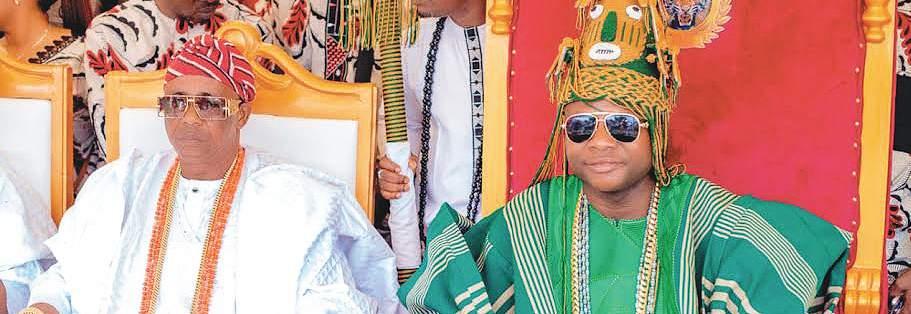
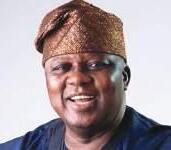
2027: How APC Ogun East Endorsed Dapo Abiodun as Consensus Candidate
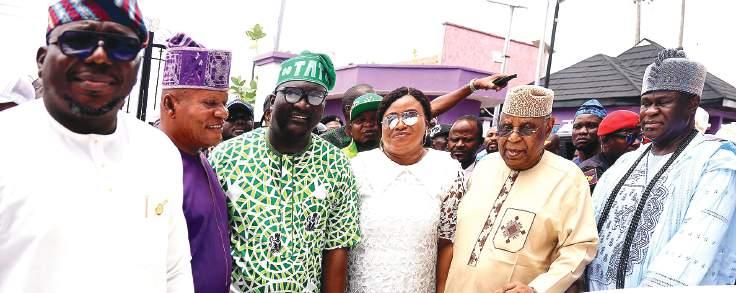
Leaders and stakeholders of All Progressives Congress (APC) in Ogun East Senatorial District have
www.thisdaylive.com
endorsed Governor Dapo Abiodun as their consensus candidate for the 2027 senatorial election.
The endorsement was announced at a well-attended
caucus meeting of APC held at Adeola Odutola Hall in Ijebu-Ode, bringing together a broad coalition of party leaders and grassroots representatives from across the district.
The political event was attended by stakeholders, including members of the Governor’s Advisory Council; former and serving local
government chairmen; past and present lawmakers at both state and national levels; councillors; ward chairmen from all wards in the district; as well as women
and youth leaders. Other leaders at the meeting were serving members of the National Assembly and the House
Continued on page 8
Adelabu Quits, Set to Focus on Oyo Governorship Ticket
Recommends creation of coordinating minister for energy Presidency: Edun, Dangiwa not sacked, they resigned voluntarily Deji Elumoye and Emmanuel Addeh in Abuja The Minister of Power, Chief Adebayo Adelabu yesterday formally tendered his resignation to President Bola Tinubu and proposed the establishment of a
Coordinating Minister for Energy to drive integrated reforms across Nigeria’s power, gas, and related sectors.
In a resignation letter dated April 22, 2026, and addressed to the Nigerian leader, Adelabu stated that his resignation will take
effect on April 30, 2026, to enable him to focus on his governorship ambition in Oyo State. He, however, emphasised that
Wike, Makinde, Mark Know Fate as Apex Court Reserves Verdict in PDP, ADC Crises
Opposition charges members to be hopeful Wike faction fixes prices for presidential, guber forms at N51m, N21m, primaries for May 18, 27
Court grants Turaki N100m bail for alleged false information Group accuses FCT minister, Anyanwu of copying APC’s election guidelines
James Sowole in Abeokuta
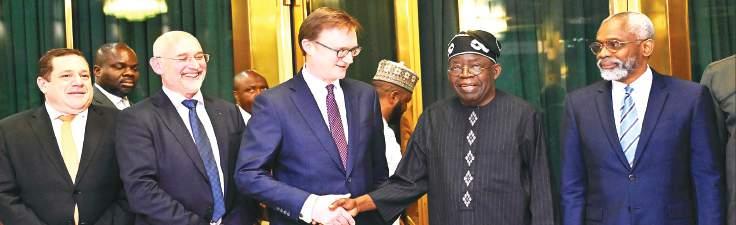
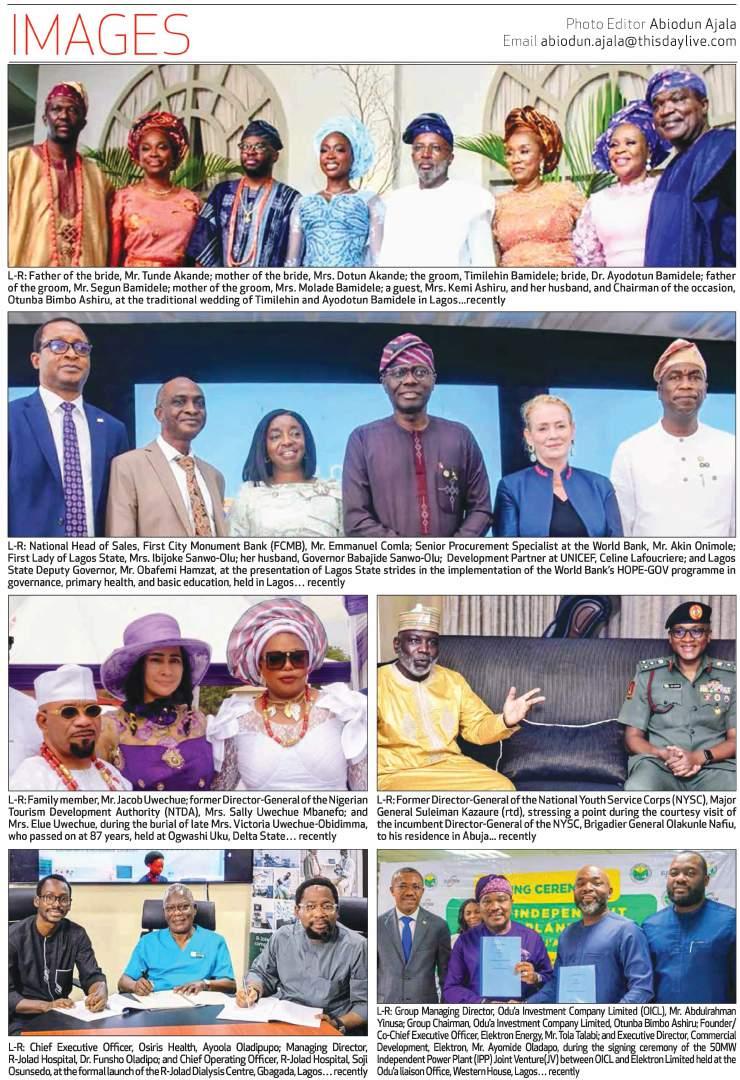
R-L: Chief of Staff to the President, Mr. Femi Gbajabiamila; President Bola
Commissioner to Nigeria, Mr. Richard Montgomery; Leader, British Airways Delegation, Mr. Colm Lacy; and Senior Manager, International Affairs, Mr. Alan Campbell, during the president’s audience with the British Airways delegation to celebrate the airline’s 90th anniversary of air service to
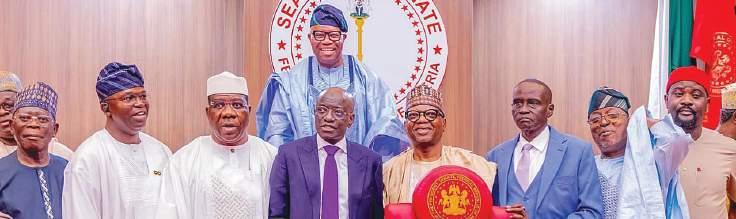
SENATORS WADADA AND NGWU JOIN APC...
L-R: Chairman, Senate Committee on Interior, Adams Oshiomhole; Chairman Senate Committee on Banking and Financial Institutions, Tokunbo Abiru; Senate Leader, Opeyemi Bamidele; President of the Senate, Godswill Akpabio (behind), Chairman, Senate Committee on Public Accounts, Aliyu Wadada; Chairman, Senate Committee on Finance, Sani Musa; Senate Whip, Tahir Monguno; Deputy Senate Leader, Lola Ashiru and Senator Osita Ngwu, during the defection of Wadada and Ngwu to the ruling All Progressives Congress (APC), yesterday on the floor of the Senate.
Financial Times: 34 Iran-linked Tankers Slip Past US Hormuz Blockade
Trump says Iran collapsing over America’s blockage of ports
Emmanuel Addeh in Abuja
At least 34 tankers with links to Iran have transited past the US blockade in the Strait of Hormuz in recent days, depite a blockade by the United States, a Financial Times report said yesterday.
However, President Donald Trump claimed that America ‘totally controls’ the Strait of Hormuz, that the blockade strategy had been a ‘tremendous success’ and that the embargo would not be lifted until a “final deal” with Iran was reached.
On April 13, the US imposed a blockade that was supposed to ‘completely halt’ economic trade going in and out of Iran by sea and those vessels carrying goods that could be used by Iran in the war against the US and Israel.
So far, only one container ship in the Gulf of Oman has been detained by US forces and one sanctioned tanker boarded in the Indo-Pacific. The US Central Command said on Tuesday that the American forces have “directed 28 vessels to turn around or return to port” since the start of the blockade.
But of the 34 ships that have circumvented the blockade, at least 19 are tankers linked to Iran that have exited the Gulf. The other 15 have entered the Gulf from the Arabian Sea, heading towards Iran, the report said.
Among the vessels that left, at least six were confirmed to be transporting Iranian crude oil, collectively carrying approximately 10.7 million barrels.
Given that Iranian oil generally trades at a discount to Brent crude because of international sanctions, a conservative estimate of $10 per barrel below market price would place the total revenue from these shipments at roughly $910 million.
One of the vessels, Dorena, which is an Iranian-flagged supertanker, transited past the US blockade after turning off the transponder, which is a device that signals location and identity, the report added.
According to Vortexa, which provides real-time data on global
waterborne oil and gas movements, the laden vessel left Iranian waters on April 17, after which two other oil tankers sailed past on April 20.
The Dorena then engaged in a ship-to-ship transfer of oil with another sanctioned vessel off the coast of Malaysia to mask the origin of oil.
Other sanctioned tankers have entered the Gulf from the Gulf of Oman, such as Murlikishan and Alicia, which were sanctioned by the US last year. These two ships crossed the Strait of Hormuz on April 14 and sailed to the norther end of the Gulf.
On April 18, Iran announced the control of the Strait of Hormuz has “reverted to its previous state” amid the continuing US naval blockade of
Iranian ports.
In a post on X, the Iranian Navy said that all transits require permission from the Islamic Revolutionary Guard Corps Navy and that civilian vessels are permitted to go only through Iran’s designated route and that military vessels are still prohibited from passing through.
Meanwhile, Trump claimed Wednesday that Iran was “collapsing financially” over the closure of the Strait of Hormuz, as Tehran’s Islamic Revolutionary Guard Corps attacked three ships in the vital waterway that is blockaded by both Washington and Tehran.
Trump’s comments came hours after he announced he was indefinitely
extending the two-week ceasefire with Iran, which had been conditioned on Iran lifting its blockade on the Strait of Hormuz. Iran last week briefly lifted its blockade following the Israel-Hezbollah ceasefire, but reversed course after the US said it would maintain the blockade it had imposed on Iran-linked shipping on April 13, five days into the truce.
“Iran is collapsing financially! They want the Strait of Hormuz opened immediately,” Trump wrote on Truth Social. The Islamic Republic is “starving for cash” and its military and police were “complaining that they are not getting paid,” he claimed.
According to Trump, Iran was “losing 500 million dollars a day”
because the US closure was preventing Tehran from taxing ships sailing through the Strait of Hormuz.
“They want it open so they can make $500 Million a day,” Trump wrote in a separate Truth Social post early Wednesday. Trump suggested the US blockade was crucial as leverage in negotiations with Iran, saying that if he agrees to reopen the Strait of Hormuz, “There can never be a deal with Iran, unless we blow up the rest of their country, their leaders included!”
Also, Secretary of US Treasury, Scott Bessent, said on X that the US blockade “directly targets the regime’s primary revenue lifelines” by constraining maritime trade.
Tinubu Makes New Board, Management Appointments for NECO, NBTE, Federal Poly, Shendam, National Library
Deji Elumoye in Abuja
President Bola Tinubu has made new appointments for the National Examination Council (NECO), National Board of Technical Education (NBTE), Federal Polytechnic in N’yak Shendam, Plateau State, and National Library of Nigeria, all institutions under the Federal Ministry of Education.
registrar, Professor Ibrahim Dantani Wushishi.
Tinubu, according to a statement issued by his Adviser on Information and Strategy, Bayo Onanuga, appointed Professor Modupe Adeola Adelabu as Chairman of Governing Board of NECO, and retained the current
Jonathan Visits Tinubu at State House
Deji Elumoye in Abuja
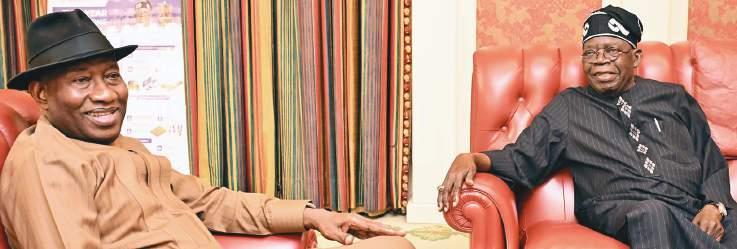
President Bola Tinubu on Wednesday played host to ex-President Goodluck Jonathan at State House, Abuja. The meeting, which began about 4pm on Wednesday at the first floor office of the president, was part of a pattern of consultations between the two leaders on West African political affairs and Nigeria’s continental engagements.
Jonathan’s visit was confirmed by presidential spokesperson, Bayo Onanuga, who posted photographs of the meeting on his X account, with a caption, “President Tinubu meets former President Goodluck Jonathan at the Villa.”
The photographs showed both men engaged in what appeared to be a relaxed discussion, with a “Two-Year Milestone” document visible in a corner of the president’s office. No official statement was issued on the substance of the discussions, but Wednesday’s meeting came five months after Jonathan’s last visit in November 2025.
Jonathan last visited State House in a similar capacity on November 29, 2025, barely hours after being airlifted out of Guinea Bissau following a coup staged by soldiers loyal to Brigadier-General Dinis Incanha.
Incanha had arrested incumbent
President Umaro Sissoco Embaló on November 26, a day before the electoral commission was to announce official results of the November 23 presidential election.
At the time, Jonathan had led the West African Elders Forum election observation mission and was evacuated on a jet reportedly provided by Ivorian President Alassane Ouattara.
Jonathan has spent much of his term after leaving office as President in 2025 serving as West Africa’s most active election observer and mediator, with assignments in Mali, The Gambia, Liberia and, most recently, Guinea-Bissau under the auspices of the West African Elders Forum.
Tinubu also appointed Dr. Bongfa Binfa as Rector, Federal Polytechnic, N’yak-Shendam, Plateau State; and renewed the tenure of Professor Chinwe Veronica Anunobi as Director/Chief Executive of the National Library of Nigeria.
For the chairmanship of NBTE, the president appointed Professor Babatunde Salako.
On April 10, 2026, Tinubu reappointed the incumbent executive secretary, Professr Idris M. Bugaje, for a second and final term of five years.
Adelabu, who chairs NECO, is a retired professor of educational administration who rose through the ranks to full professorship at the Obafemi Awolowo University.
She was Deputy Governor of Ekiti State (2013- 2014) and Chairman of NBTE between 2018 and 2021.
Salako, the new chair of NBTE, is a globally respected researcher with decades of experience in higher education, institutional governance and national policy leadership.
He previously served as DirectorGeneral of Nigerian Institute of
Medical Research (NIMR) from 2016 to 2024, a period during which the institute experienced significant revitalisation, enhanced research governance, expanded international collaborations, and improved infrastructure and research outputs.
Binfa, from Plateau State, succeeds Dr. Mukaila Zakari Ya’u, the pioneer Rector of the Federal Polytechnic, N’yak-Shendam, whose tenure expired on March 16, 2026.
The president approved the appointment of Binfa for a single term of five years, following the conclusion of the process for appointing a new Rector through a public advertisement in national dailies in September, 2025.
Binfa holds a Doctor of Philosophy (PhD) in Mechanical Engineering from Universiti Teknologi Malaysia.
Before this appointment, Binfa was Deputy Rector (Academic) at the Federal Polytechnic of Oil and Gas, Bonny. He was also a Lecturer in the Mechanical Engineering Department at the Federal Polytechnic, Idah. Tinubu approved the renewal
of the tenure of Anunobi as CEO of the National Library of Nigeria for a final term of five years. She was first appointed on September 2, 2021.
Since assuming office, Anunobi had led several institutional reforms aimed at repositioning the National Library as a modern technologydriven knowledge institution, including the development and operationalisation of the National Repository of Nigeria, the Newspaper and Magazine Locator, the Index and Abstract to Nigerian Newspapers, and the National Virtual Library of Nigeria.
She has also played a strategic role in advancing the long-awaited completion of the National Library Headquarters project and in initiating plans to migrate heritage collections from the 34 state branches to the new headquarters in Abuja.
The president expected that the renewal of her tenure would ensure continuity in the implementation of ongoing reforms, completion of the National Library Headquarters project, and execution of the 2025-2030 Strategic Plan of the institution.
PHOTO: SENATE PRESIDENT’S OFFICE
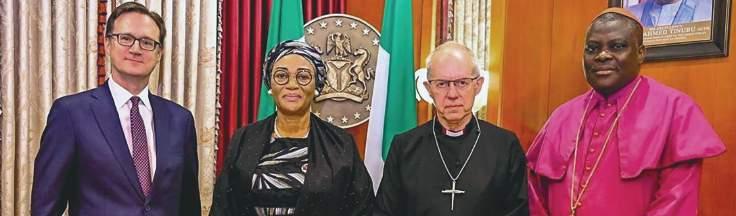
FORMER ARCHBISHOP OF CANTERBURY, JUSTIN WELBY VISITS REMI TINUBU...
L-R: British High Commissioner to Nigeria, Mr. Richard Montgomery; First Lady of Nigeria, Senator Oluremi Tinubu; former Archbishop of Canterbury, The
Honourable Justin Welby; and Executive Secretary, Nigerian Christian Pilgrim Commission and Chaplain, State House
courtesy visit to the First Lady at the Presidential Villa, Abuja, yesterday
and
Abuja,
Reverend
First Lady Flays Global Inaccurate Framing of Security Challenges Facing Nigeria
Says nations need to
get right perspective towards solving various challenges facing
of Canterbury in interfaith dialogue
Wife of the President, Senator Oluremi Tinubu has flayed global inaccurate framing of security challenges facing the Nigerian nation.
Speaking in Abuja on Wednesday during a meeting with the former
Archbishop of Canterbury, Rt Revd Justin Welby in her office at the State House, the First Lady pointed out that as serious efforts aimed at promoting peace and harmony among different interest groups in Nigeria continue, the global community must assist such efforts, first by refraining
them Engages ex-Archbishop
Meets communications and digital economy minister on girls in tech program
from inaccurate framing of security challenges in the country.
She appreciated the former Arch Bishop for pointing out that Nigeria’s challenges should be dealt with by Nigerians as they understand better their own peculiarities.
“Listening to one side of the story
and then concluding is a wrong approach to conflict resolution.
“Thank you for opening up this Interfaith Dialogue, and I believe that you should also invite not just the Christians and Muslims but also the Nigeria Security to the dialogue to know what they have been doing”.
IEA Forecasts 1.5m Bpd Oil Demand Cut in Q2, Pegs Nigeria’s Capacity at 1.42m Bpd
Emmanuel Addeh in Abuja
Global oil demand is set for a sharp contraction in the second quarter of 2026, with the International Energy Agency (IEA) projecting a decline of about 1.5 million barrels per day, the steepest drop since the Covid-19 pandemic disrupted fuel consumption worldwide.
In its latest report, the agency said global oil demand is now expected to contract by about 80,000 barrels per day on average in 2026, representing a sharp downward revision of 730,000 bpd compared to its previous forecast.
The IEA attributed the decline primarily to the ongoing conflict involving Iran, which has upended global energy markets, triggered supply shortages, and pushed prices sharply higher. Early
demand destruction has been most evident in the Middle East and Asia Pacific regions, particularly affecting products such as naphtha, liquefied petroleum gas (LPG), and jet fuel.
However, the agency warned that the impact is likely to spread globally as higher fuel prices and persistent scarcity force households, businesses, and industries to cut back on consumption.
On the supply side, the report highlighted an unprecedented disruption, with global oil output plunging by 10.1 million bpd in March to 97 million bpd. The decline was largely driven by continued attacks on energy in- frastructure in the Middle East and restrictions on tanker movements through the Strait of Hormuz, the report said.
Nigerian Academy of
Production among OPEC+ countries dropped sharply by 9.4 million bpd month-on-month to 42.4 million bpd, while non-OPEC+ output fell by 770,000 bpd to 54.7 million bpd, as declines in some regions offset gains in countries such as Brazil and the United States.
The disruption has also affected refining activity, with global crude processing volumes falling significantly due to limited feedstock availability and infrastructure damage. Refineries in the Middle East and Asia were forced to cut runs by about 6 million bpd in April, bringing total throughput down to 77.2 million bpd.
The IEA now expects global refinery runs to decline by an average of 1 million bpd in 2026, tightening product markets and pushing refining margins higher.
Engineering
Inducts Dangote as Honorary Fellow
Africa’s foremost industrialist, Aliko Dangote, will on Friday, April 25, 2026, be inducted as an Honorary Fellow of the Nigerian Academy of Engineering (NAE), in recognition of his contributions to engineering-driven industrial development.
The induction, scheduled as a high-profile event, is being organised by the President and Council of the academy, who described the honour as a
celebration of Dangote’s impact on large-scale industrial and infrastructure projects in Nigeria and across Africa.
The Nigerian Academy of Engineering, established in 1997, is the apex professional body for engineering in the country and serves as a strategic think-tank on science, technology and innovation. Its membership comprises distinguished Nigerian and international experts drawn from
diverse engineering disciplines and industry sectors.
The academy plays a critical advisory role to the Federal Government and private sector, providing policy guidance on engineering and technological matters aimed at driving national development and enhancing global competitiveness. It also offers a platform for professionals to pool expertise and develop solutions to complex national challenges.
Middle distillate margins, in particular, have surged to record levels.
Oil inventories have also come under pressure, with global observed stocks falling by 85 million barrels in March. Stocks outside the Middle East Gulf recorded the steepest drawdown, as restricted flows through the Strait of Hormuz disrupted supply chains.
At the same time, crude accumulation has increased within the Middle East due to limited export routes, while China has continued to build strategic reserves, adding about 40 million barrels during the period.
She stressed that the world must get the right perspective of the various challenges facing nations to be able to proffer appropriate solutions.
Mrs Tinubu seized the opportunity to commend the nation’s Armed Forces for all the gallantry and efforts they continue to put in regarding the nation’s security.
The First Lady also admonished the Church, not only in Nigeria but the world over to preach right so that people can live right.
In his remarks, Rt Revd Welby explained that he brings his experience to bear on a matter that not only borders on peace and security in Nigeria, but also reflect on the country’s image as a nation that safeguards freedom of worship.
He said a lot can be achieved for peace in Nigeria, building on the interfaith dialogue meeting, is being convened by the Global Forum for Peace, Abu Dhabi under the patronage of Sheikh Abdallah Bin Baya next week in London.
Welby explained that the dialogue will be inviting 12 Christians and 12 Muslims with the aim of having them listen well to each other and proffer workable solutions to interfaith conflicts, not only for Nigeria but all over the world.
“We want to contribute to what
President Bola Tinubu is doing to promote peace, interfaith wise. All we are after is enduring peace.
“I am here to smooth the way ahead of the Interfaith dialogue and make sure the meeting addresses all that it should”.
The Former Archbishop was accompanied on the visit by the British High Commissioner to Nigeria, Richard Montgomery.
The audience with the Archbishop of Canterbury came barely a month after a state visit by President Bola Tinubu, accompanied the First Lady to the United Kingdom, where sessions on interfaith dialogue and a church service at Lambeth Palace were part of the First Lady’s itinerary. Also on Wednesday, Mrs Tinubu also received in audience the Minister of Communications and Digital Economy, Dr Bosun Tijani who was in her office to brief her on progress made with the ministry’s Girls in Tech program.
Briefing newsmen after meeting with the First Lady, the minister said a dinner to showcase innovation and solutions built by participants of the Girls In Tech program is set to be hosted by the First Lady in Abuja. He also secured her nod as the face of a campaign to deepen internet penetration and connectivity in rural and riverine areas.
Moghalu to Speak at Harvard GEM26 Conference on Global Development
Renowned political economist and former Deputy Governor of the Central Bank of Nigeria, Kingsley Moghalu, is set to participate as a panelist at the 17th Global Empowerment Meeting (GEM26) hosted by the Harvard Kennedy School Center for International Development.
According to a statement issued yesterday by IGET Academy, the conference will hold from May 4 to 5, 2026, bringing together leading global thinkers, policymakers, and development practitioners to explore how international development can
be reimagined in the face of evolving geopolitical and economic realities.
Moghalu, founder and president of IGET Academy, will feature on Panel 2 titled “Doing Development Differently,” scheduled for May 5.
The session is expected to examine innovative approaches to growth, equity, and sustainability amid declining aid flows, volatile markets, and increasing geoeconomic fragmentation.
Organisers said the meeting will address one of the most pressing global questions: how to reshape development strategies to reflect current realities while ensuring inclusive and sustainable outcomes.
In their invitation,
contributions to economic governance and institutional development across Africa.
“Your leadership in advancing economic governance, institutional capacity, and policy innovation across Africa has helped shape important conversations about Africa’s role in the global economy,” they stated.
Responding, Moghalu described the platform as an opportunity to influence development thinking globally.
Right Reverend
Rt.
Villa,
Rt.
S. T. V. Adegbite, during Welby’s
PHOTO: GODWIN OMOIGUI
Sunday Ehigiator
CID Faculty Director, Asim Ijaz Khwaja, and Executive Director, Fatema Z. Sumar, highlighted Moghalu’s
Deji Elumoye in Abuja
Dangote to begin crude production amid supply shortages from NNPC
JONATHAN VISITS TINUBU...
former
Tinubu Pledges to Deepen Nigeria-UK Economic Ties
British Airways marks 90 years of air service to Nigeria
Deji Elumoye in Abuja
President Bola Tinubu has reaffirmed Nigeria’s commitment to deepening economic relations with the United Kingdom, particularly in the aviation sector and other mutually beneficial areas.
The President gave the assurance yesterday, when he met with a delegation from British Airways led by the British High Commissioner to Nigeria, Dr. Richard Montgomery and the Commercial Officer of British Airways, Mr. Colm Lacy, at the State House, Abuja.
Tinubu, while highlighting the longstanding and productive partnership between both countries, noted that Nigeria places great value on its strategic relationship with Britain.
The President particularly reflected on his very recent historic visit to the United Kingdom and the wonderful reception he received from the Royal family.
He assured the delegation that the partnership would continue to create opportunities for growth, investment, and shared prosperity.
According to the President: “It is a very great joy to share with you this afternoon. The transformation and strengthening of our relationship over the past 90 years is a milestone worthy of celebration. And I still relish the memory of my last visit to Great Britain and the wonderful reception I received from His Majesty King Charles III. I will forever cherish that memory.
“We also hold in high regard our relationship with His Majesty the King. His long-standing commitment to sustainability and to strengthening the Commonwealth, particularly the relationship between Nigeria and Great Britain, must continue to enhance
cooperation that aligns with our own national priorities.
“I assure you we will continue to do that, and this engagement confirmed the bilateral relations that we’ve enjoyed over the years. Our forebears wanted us to continue.”
Tinubu acknowledged the critical role of British Airways in fostering economic and people-to-people connections between Nigeria and the United Kingdom, saying that Nigeria was undergoing reforms to strengthen the economy and state institutions.
“Nigeria is still going through the reforms and transformation of our aviation industry and every aspect of our economy. We must meet global standards and encourage people-topeople connections while promoting the essence of trade and partnership in this sector.”
GTCO Food
The President further expressed appreciation to the British Government for the numerous business and investment opportunities extended to Nigeria over the years.
“We celebrate with you your remarkable 90 years of operation in Nigeria, and we hope we will continue to enhance and encourage that relationship for a stronger and more rewarding partnership”, he Tinubusaid. also informed the visitors that one of the earliest achievements of his administration was settling outstanding liabilities owed by airlines operating in Nigeria.
“You’ve seen that since I assumed office, the outstanding liabilities and other hiccups that are hindrances to our relationship are being resolved by the Central Bank of Nigeria, and we hope to strengthen all of that,” he said.
In his remarks, Colm Lacy chronicled the airways’ long-standing relationship with Nigeria, saying the airways have served generations of Nigerians for the past 90 years, helping in trade, investments and opportunities on both sides.
He said Nigeria was not just a destination for the airways, but a long-standing valued customer.”
His words: “Our relationship began in 1936 and has journeyed across generations. Nigeria is not simply a destination but a long-standing, most valued market in a country with which we share strong people-to-people, business, educational, and cultural ties.
“Every day our services support Nigerian entrepreneurs, students, families and tourists connecting from Nigeria to the United Kingdom and all over the world, helping in trade, investment and opportunities in both
directions”.
Lacy lauded Minister of Aviation and Aerospace Development, Festus Keyamo, the Nigerian Civil Aviation Authority and the Nigerian Airports Authority for their commitment and professionalism, which, according to him, has enhanced a credible and safe aviation in Nigeria.
He also commended the Central Bank of Nigeria for its commitment to resolving foreign exchange matters and restoring the confidence of foreign airlines operating in Nigeria.
Earlier, the Minister of Aviation and Aerospace Development told the gathering that British Airways now operates brand new aircraft on the London-Nigerian route.
Keyamo also said the airline had fully complied with the federal government’s policy to support local caterers by
serving local dishes on international outbound flights.
Also speaking, the UK High Commissioner to Nigeria, Richard Montgomery, expressed delight at the 90-year relationship between British Airways and Nigeria. The envoy also thanked the President for his successful state visit to the United Kingdom, during which several business agreements were signed to boost trade and economic ties between the two nations.
“I know that their Majesties, the King and the Queen, were delighted with the visit. And I hope that your excellency and your team feel satisfied about the substance, not just the ceremony, that some very big investment deals were agreed, including the rehabilitation of Lagos Ports, which we are delighted to support with financing and UK content,” he said.
& Drink Festival Returns Bigger, Better with 204 Stalls, N30m Merchant Loans, Celebration of ‘Everything Food
Mary Nnah
Bigger in size, louder on enterprise, and sharper on access, the GTCO Food and Drink Festival is staging a high-stakes return to Lagos as organisers frame the 9th edition around three pressure points: scale, financing, and fairness for small businesses.
Guaranty Trust Bank Holding Company Plc yesterday announced that the festival will run from May 1 to May 3, 2026 at the GTCentre, Oniru, with 204 free retail stalls, merchant loans of up to N30 million for vendors, and a theme that
insists on “Everything Food and Drink” as both cultural promise and economic test.
This was revealed during a press briefing held yesterday at the bank’s head office in Victoria Island, Lagos, to announce the forthcoming event.
Group CEO Segun Agbaje called the event “a living expression of what we stand for as an institution: innovation, opportunity, and enterprise that is accessible to all,” but it was Chief Communication Officer Oyinade Adegite who put financing at the center of the agenda, telling journalists that the bank’s support
does not end when the festival closes.
“So, if you have our POSs, you can get up to 30 million Naira... The loans are there for you to take... and it’s not just for food. We initially started with a food and fashion business, and it was subsidised, but it’s for all small businesses”, Adegite said, referencing an earlier “food and fashion loan... priced at 90 cents” that many vendors only embraced after the event.
The push for capital collides with older complaints about equity on the festival floor, after vendors at previous editions said peripheral
stalls left them “barricaded” from foot traffic while those in the main pavilion drew crowds.
Adegite said the team “took the lesson very quickly” when the problem surfaced, explaining that organisers reacted overnight to collapse barriers once they saw where “people are really coming here,” and promised, “Next time, we just made sure that it’s already open.”
Scale itself has become an issue, with the GTCentre’s 30,000 square meters of prime Lagos land described by Adegite as “big, big
and Drink’
value,” requiring a second, larger tent “just to accommodate people and to accommodate more vendors and more businesses.”
Yet that same pressure to be bigger is why expansion is off the table for now, despite calls to take the festival to Abuja or across West Africa.
“Expansion to a less scary area. Maybe West Africa... But in terms of expansion, maybe not now. First, it is difficult to maintain the quality and the standards,” Adegite said. He added that, “It’s just us, as always, bigger, better. Always bigger, better, always.”
Wema Bank Meets CBN’s Recapitalisation, Retains National Banking License
Bennett Oghifo
Wema Bank, Nigeria’s oldest indigenous national bank and pioneer of Africa’s first fully digital bank, ALAT, has successfully met and surpassed the Central Bank of Nigeria’s (CBN) recapitalisation requirements, reaffirming its status as a national bank.
This achievement represents
a critical milestone in the bank’s growth journey, reflecting its ability to meet regulatory expectations and its deliberate strategy to scale sustainably, strengthen its balance sheet, and reinforce its position within Nigeria’s banking sector. The milestone follows the bank’s successful completion of a N150 billion Rights Issue and an additional N50 billion special
placement in 2025, bringing its Total Qualifying Capital to N264.7 billion, well above the regulatory minimum.
This achievement was concluded six months ahead of the CBN’s stipulated deadline, further reinforcing the bank’s strong financial position, shareholder confidence, and long-term growth trajectory.
Earlier in April 2026, the
Central Bank of Nigeria also formally confirmed that Wema Bank, alongside 32 other financial institutions across international, national, and regional categories, had successfully concluded the recapitalisation process. Notably, Wema stands among only ten national banks that met and surpassed the minimum required capital threshold, thereby
sustaining its national banking license.
This milestone not only affirms regulatory compliance but also signals a new phase of accelerated growth for the bank; one defined by stronger capital base, increased capacity to support customers, and a reinforced position within Nigeria’s competitive banking landscape.
Commenting on the milestone, the Managing Director/Chief Executive Officer of Wema Bank, Moruf Oseni, stated, “The successful completion of our recapitalisation exercise is a defining moment for Wema Bank. It is a strong validation of our strategy, our performance, and the enduring confidence our shareholders and stakeholders have in our vision.
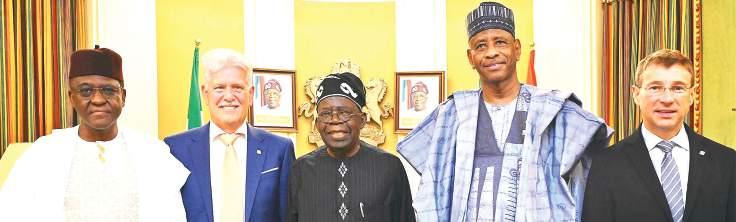
President Bola Ahmed Tinubu (R) and
President Dr. Goodluck Jonathan, during his meeting with the president at the Presidential Villa, Abuja, yesterday
PHOTO: STATE HOUSE
FAAC Disburses N2.036trn from N2.364trn Gross Federation Revenue for March
Ndubuisi Francis in Abuja
The Federation Account Allocation Committee (FAAC), Wednesday shared a total sum of N2.036 trillion to the three tiers of government from a gross revenue of N2.364 trillion for the month of March 2026.
The disbursement was made in Abuja at the monthly meeting of FAAC chaired by Minister of Finance and Coordinating Minister of the Economy, Taiwo Oyedele.
Citing a communique issued at the meeting, Head, Information and
Public Relations, Federal Ministry of Finance, Efe Ovuakporie, said from the total distributable revenue of N2.036 trillion, the federal government received N789.159 billion, states received N657.596 billion, while the local government councils got N468.826 billion. The oil-producing states received N120.759 billion as 13 per cent derivation revenue.
The total distributable revenue comprised N1.320 trillion from statutory revenue, N515.391 billion from Value Added Tax (VAT), and an augmentation of N200 billion.
A breakdown of the statutory revenue allocation showed the federal government received N632.260 billion, states received N320.691 billion, while the local government councils received N247.239 billion.
The sum of N120.759 billion was allocated as derivation revenue.
From the VAT pool of N515.391 billion, the federal government received N51.539 billion, the states received N283.465 billion, and the local government councils received N180.387 billion.
The federal government received
N105.360 billion, the states got N53.440 billion, and the local government councils received N41.200 billion from augmentation of N200 billion.
The communiqué indicated the gross statutory revenue for March 2026 stood at N1.699 trillion, representing an increase of N137.914 billion over the N1.561 trillion recorded in February 2026.
It further showed that gross VAT revenue for the month was N664.425 billion, reflecting a decrease of N4.025 billion compared to the
N668.450 billion recorded in the preceding month.
From the gross revenue, a total of N81.084 billion was deducted as cost of collection, while N246.872 billion was allocated for transfers, refunds, and savings.
In terms of revenue performance, Companies Income Tax (CIT), Capital Gains Tax (CGT), Stamp Duties, and Excise Duties recorded significant increases, while Petroleum Profit Tax (PPT), Hydrocarbon Tax, Oil and Gas Royalties, Import Duty, and Common External Tariff (CET)
WIKE, MAKINDE, MARK KNOW FATE AS APEX COURT RESERVES VERDICT IN PDP, ADC CRISES
Chuks Okocha and Alex Enumah in Abuja
The Supreme Court, yesterday, reserved judgements in the appeals filed by two major opposition political parties, Peoples Democratic Party (PDP) and African Democratic Congress (ADC), following their protracted leadership crises.
A five-member panel of justices of the apex court reserved the date for judgement in the different appeals shortly after lawyers representing parties adopted their processes as their briefs of argument for and against the appeals.
In the case of PDP, the battle is between a faction said to be loyal to Minister of the Federal Capital Territory (FCT), Nyesom Wike, and the mainstream led by Oyo State Governor ‘Seyi Makinde.
The legal battle stems from the conduct of the PDP national convention in Ibadan last year, which produced the
Tanimu Turaki-led national executive.
While Austin Nwachukwu and two other PDP chieftains had dragged the Ambassador Iliya Damagum-led national executive before Justice James Omotosho, over alleged noncompliance with the party’s guidelines as well as the Electoral Act in the conduct of the PDP convention, a former governor of Jigawa State, Sule Lamido, dragged the party before Justice Peter Lifu of the same Federal High Court, to challenge his exclusion from the convention.
In ADC, the battle is between the Senator David Mark national leadership and a former Deputy National Chairman of the party, Hon. Nafiu Bala Gombe.
The apex court had last week ordered accelerated hearing in all the appeals and fixed April 22, for hearing. At yesterday’s proceedings, when the appeal between the Turaki executive of PDP and Lamido was called, Paul Erokoro, SAN, who represented the appellant, urged the apex court to
allow the appeal and set aside the judgement of the Court of Appeal, which nullified the Ibadan convention on the grounds that the convention was held in disobedience to the orders of a Federal High Court.
However, Lamido through his lawyer, Ewere Aliemeke, urged the apex court to dismiss the appeal in its entirety for lack of merit.
The same plea was made by O. A. Adeyemi, who represented the Independent National Electoral Commission (INEC), and Chief Joseph Daudu, SAN, who represented the third to fifth Daudurespondents. urged the apex court to hold that the appeal did not fall within the spheres of internal matters of political parties.
In the other PDP matter against Nwachukwu and two others, Chief Chris Uche, SAN, who argued the appeal for PDP, submitted that the two lower courts granted orders against the
party’s convention without jurisdiction. Uche urged the apex court to set aside the two judgements and hold that the lower courts erred in assuming jurisdiction in the internal matters of PDP.
For ADC, Jibrin Okutepa, SAN, who represented Mark, in urging the court to allow the appeal, submitted that the apex court had in a March 21, 2025 judgement put an end to the issue before the court, when it held, “No court has jurisdiction to entertain cases bordering on internal affairs of politicalOkutepa,parties.”therefore, urged the apex court to allow the appeal and hold that the trial court lacked the jurisdiction to entertain a suit bordering on ADC’s internal matters.
Robert Emukpero, SAN, who represented the first respondent, Gombe, urged the apex court to reject the appeal and affirm the judgement of the lower court, which held that the
ADELABU QUITS, SET TO FOCUS ON OYO GOVERNORSHIP TICKET
requires stronger coordination at the highest level, including the appointment of a central authority to harmonise policy direction and execution.
In a statement in Abuja, the Special Adviser to the Minister on Strategic Communications and Media Relations, Bolaji Tunji, said the minister expressed deep appreciation to the President for the opportunity to serve, describing his tenure as a privilege to contribute to national development.
Adelabu noted that his decision aligned with the provisions of the Amended Electoral Act 2026, which precludes serving political office holders from contesting elections. He further disclosed that his gubernatorial aspiration dates back to 2016 during his tenure as Deputy Governor of the Central Bank of Nigeria (CBN).
In his three-page letter, the minister outlined key achievements recorded during his tenure, including the implementation of the Electricity Act 2023, which decentralised the electricity market and improved the investment climate.
He highlighted that peak power generation rose to over 6,000 megawatts, driven by the integration of the Zungeru Hydropower Plant and the rehabilitation of thermal power plants. Transmission capacity was also strengthened through grid upgrades under the Presidential Power Initiative.
He further cited notable improvements in the distribution segment, including enhanced regulatory oversight, improved revenue collection, and progress in reducing Aggregate Technical, Commercial and Collection (ATC&C) losses. Efforts to close the metering gap, he added, gained momentum through the Presidential Metering Initiative
(PMI) and the World Banksupported Distribution Sector Recovery Programme (DISREP).
On the financial front, Adelabu stated that tariff reforms and a N4 trillion debt restructuring programme increased market revenues from N1 trillion in 2023 to N2.3 trillion in 2025, restoring investor confidence and placing the sector on a path to sustainability.
Despite these gains, the minister acknowledged persistent challenges, including gas supply constraints, infrastructure vandalism, and the need for full commercialisation of the electricity value chain.
He therefore proposed key measures to sustain progress, including the implementation of cost-reflective tariffs with targeted subsidies, recapitalisation of distribution companies, accelerated nationwide metering, sustained transmission investments, and strengthened regulatory enforcement.
Adelabu recommended the creation of a Coordinating Minister for Energy to provide strategic oversight and ensure synergy across power, gas, water resources, and environmental sectors.
According to him, this approach is critical to improving gas supply for thermal generation, optimising hydroelectric resources, and accelerating renewable energy deployment.
Adelabu stated that he remains committed to ensuring a smooth and seamless handover process, while expressing gratitude to the President for the confidence and support extended to him throughout his tenure.
Part of his resignation letter seen by THISDAY read: “My decision to step down is informed by my intention to focus fully on my gubernatorial ambition in Oyo State. This aspiration, which dates
back to 2016 during my service as Deputy Governor of the Central Bank of Nigeria, ultimately led to my voluntary resignation from the Central Bank in 2018 in order to pursue the same goal.
“ In line with the provisions of the Amended Electoral Act 2026, which precludes political office holders from contesting elections, I consider it both appropriate and necessary to resign at this time.”
Earlier yesterday, Adelabu had indicated his intention to resign
of Assembly; past members of both the state and National Assembly; and members of the Elders Advisory Council.
Addressing the gathering, former Ogun East senator, Lekan Mustapha, and former Deputy Governor and Senator Gbenga Kaka said the decision to endorsement Abiodun was driven by a shared conviction that he possessed the capacity to represent the district effectively in the senate.
Mustapha said, “Party leaders would formally communicate the endorsement to the governor, including a commitment to purchase his nomination forms for the 2027 election.
“We will put a body together to deliver this message to our governor that he has been adopted as the consensus candidate.”
In his remarks, Secretary to the State Government, Mr Tokunbo Talabi, stated that the governor’s track record in governance and party cohesion made him deserving of the senate seat.
“This endorsement is historic and unanimous. It reflects the collective belief that Prince Dapo Abiodun is the right person for the position,” he stated.
from the Federal Executive Council (FEC) in the coming days after securing the approval of Tinubu to contest the 2027 governorship election in Oyo State.
The development followed a meeting between Adelabu and the president at the Presidential Villa, Abuja on Tuesday, where he also formally briefed him on his political ambition and presented a report on his stewardship in the
House of Representatives member, Femi Ogunbanwo, representing Odogbolu, Ijebu-Ode and Ijebu North East Federal Constituency, said the governor’s administration had fostered peace and development across the state, expressing confidence that he would attract more dividends of democracy to Ogun East at the national level.
Chairman of Sagamu Local Government Area, Hon. Afolabi Odulate, commended the governor’s performance and reiterated the district’s collective appeal for him to accept the senatorial bid.
The event witnessed participation from all 103 councillors across the nine local governments in Ogun East, alongside youth leaders and key grassroots mobilisers.
Prominent figures in attendance included former senators Gbenga Kaka and Lekan Mustapha, Ogun East APC Chairman Adedoyin Adeleke, and respected party elders, such as Kola Ogunjobi, Bayo Dayo, Durojaye, Pegba Otemolu, James Dina, and Osibote Aloran . Equally present were notable political figures and mobilisers, including Femi Nuberu, Yinka Adeleye, Jokotade Kasimawo, Toyin Jekami, Kuburat Arigbabu, Aremu Babatunde, Ojuroye, Taju-
case of the appellant was premature and dismissed it.
After taking arguments from all parties, Justice Mohammed Garba, who presided over the proceedings, announced that judgement was reserved to a date that would be communicated to parties.
The Turaki PDP had approached the apex court to challenge the judgement of the Court of Appeal, which nullified the Ibadan convention for being held in disobedience of a valid order of court.
Justice Peter Lifu of the Federal High Court, Abuja, had last year, in a judgement, restrained the Damagum-led National Working Committee (NWC) from proceeding with the convention slated for November 15 and 16, 2026, in Ibadan.
Lifu, in his judgement, ordered that the convention should not hold until an aspirant to the office of national chairman, Lamido, was given the opportunity to purchase interest and nomination forms to enable him participate in the convention for the election of national officers.
The party, however, went ahead to conduct the convention.
PDP had predicated its conduct of the convention on the fact that the court lacked the jurisdiction to stop the convention, as the issue brought before it was an internal matter of PDP, which no court had jurisdiction to delve into.
But the appellate court, last month, disagreed that the issue at the trial court was an internal affair of a political party, which courts could not entertain.
A three-member panel of the appel- late court subsequently nullified the outcome of the convention for being
deen Adedeko, Adefowora Akeem, Blessed Ogunsola, Ogunnde Razaki, and Sakiru Folorunso.
Members of the House of Representatives from the district — Adesola Elegbeji, Joseph Adegbesan, and Femi Ogunbanwo — also attended in solidarity, underscoring the widespread backing for the governor’s anticipated senatorial bid.
Meanwhile, Special Adviser to the Ogun State Governor on Media and Strategy, Kayode Akinmade, offered an explanation on why former governor of the state, Senator Gbenga Daniel, was denied entry at a meeting of the All Progressives Congress (APC) on Monday.
A video of Daniel, who addressed his supporters from the door of a Coaster bus at the venue of the meeting, has since gone viral.
But reacting to the Daniel’s claim that he was not allowed into the venue of the event, Akinmade said Daniel was not barred from the meeting.
Rather, he said the former governor refused to conform with security protocol at the venue of the meeting.
He said the protocol was that since it was a caucus meeting,
held in disobedience to the orders of the Federal High Court, Abuja. Dissatisfied, PDP approached the apex court, praying it to accept the appeal against the lower court judgement, set aside the judgement, and hold that the issue was an internal matter of PDP, which both the Court of Appeal and Federal High Court lacked jurisdiction to entertain.
In the ADC case, the appellate court had last month, while ruling in the appeal filed by the Mark-led leadership against the ruling of the Federal High Court, Abuja, ordered the maintenance of status quo ante bellum.
Based on the ruling, INEC withdrew the recognition accorded the Mark-led executive as authentic leadership of ADC.
Meanwhile, Justice Emeka Nwite declined to issue a restraining order against the Mark-led leadership but, instead, ordered the applicant to put the defendants on notice.
Reacting, Mark approached the ap- pellate court to challenge the jurisdiction of Nwite to entertain the suit by Gombe, in the first place.
Mark insisted that the trial court could not entertain the suit for being an internal matter of ADC.
PDP Charges Members to Keep Hope Alive
PDP told members not to lose hope, but to keep faith alive.
In a statement by PDP National Publicity Secretary, Ini Emeombong, the party said, “We charge all true and uncompromised PDP members to keep
only those invited were being allowed into the venue.
He said the message was passed across to Daniel by the security operatives, who asked him to either step out of the bus and walk along into the venue or take a car in which the occupants could be clearly seen.
Daniel was, however, said to have insisted on going into the venue of the meeting with the bus, a development Akinmade said led to the stalemate.
He added, “This is not the first time we are having this sort of scenario in Ogun State.
“An aspirant for Ogun West Senatorial District seat was prevented from attending a similar meeting in the state capital, Abeokuta, after insisting on going in with some uninvited people.
“Nobody could have stopped the former governor if he had complied with the security protocol.
“All he needed to have done was either come out of the bus or use a car the security people can see through to be sure he is the only one or with invited people.
“He would then just have signed the invited members register and go in for the meeting.”
declined. VAT receipts also recorded a marginal decrease.
Minister of Finance, Taiwo Oyedele
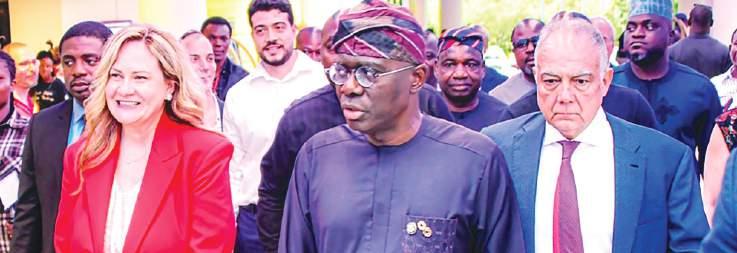
BOOK LAUNCH TITLED, THE WORLD AHEAD 2026...
L-R: Managing Director, CT Productions, Camelia Oros Tsarouchi; Governor of Lagos State, Mr Babajide Sanwo-Olu and Chairman, Flour Mills of Nigeria; John Coumantaros, during the book launch titled “The World Ahead 2026: Nigeria” by the Economist Group, held at the Eko Hotels and Suites, Victoria Island, Lagos, on Tuesday
Tinubu: FG Targeting Integrated, Digitallypowered Social Protection System
Says over 7.5m covered by Employees’ Compensation Scheme
President Bola Tinubu has said his administration is pursuing an objective to build an integrated and digitally enabled social protection system, where pensions, healthcare, employment support, social assistance, housing, and compensation programmes operate not in isolation, but as coordinated guarantees of social and economic security.
The president restated commitment of the federal government towards ensuring that every Nigerian worker is insulated from sudden economic ruins, workplace injury and assured of a dignified life after retirement.
He said that government was deliberately implementing reforms across various sectors and strengthening institutions that form the pillars of Nigeria’s evolving social security architecture
According to him, through the Nigeria Social Insurance Trust Fund, the federal government has fundamentally strengthened workplace injury protection, adding that over 7.5 million Nigerian employees are covered under the Employees’ Compensation Scheme.
According to him, programmes such as N-Power have provided skills development and employment opportunities to hundreds of thousands of young Nigerians, improving employability while supporting service delivery across education, agriculture, and community development sectors”.
“Our objective is clear: to move toward an integrated and digitally enabled social protection system, where pensions, healthcare, employment support, social assistance, housing, and compensation programmes
operate not in isolation, but as coordinated guarantees of social and economic security,” he said.
Tinubu said that through the efforts of the National Health Insurance Authority, access to affordable healthcare has continued to expand, with over 16 million Nigerians now enrolled under health insurance programmes, reducing catastrophic out-of-pocket medical expenses and improving healthcare access for vulnerable populations.
The president stated this at the opening of a two-day ISSA 2026 West Africa Seminar holding in Abuja, the nation’s capital with the theme: “Improving inclusiveness and accessibility of social security services through effective communication in West Africa.”
Represented by the Minister for Budget and National Planning, Senator Atiku Bagudu, President
Tinubu said that under the oversight of the National Pension Commission, over 10 million Nigerian workers are actively contributing to the Contributory Pension Scheme, with pension assets now exceeding N25 trillion.
He noted the success of the pension reform could be seen from “the trust, the hard-earned savings of Nigerian workers who now have confidence that after a lifetime of service, retirement will not mean hardship, uncertainty, or loss of dignity, but security and peace of mind.
Giving further insights on govern- ment’s Tinubu said that over the years, the NDE has empowered more than two million Nigerians through vocational training, entrepreneurship development, and job creation initiatives, equipping young people with skills not only to earn a living, but to build sustainable futures.
Witness Narrates How Persons Linked to Death of Arise TV Anchor, Sommie Maduagwu were Arrested
An Assistant Superintendent of Police and member of the Scorpion Squad, CID-FCT Command, Mr. Maxwell Eje, has narrated how some persons linked to the death of Arise News journalist and anchor Somtochukwu Maduagwu were arrested.
Eje, spoke on Tuesday at the High Court of the Federal Capital Territory (FCT) as the Third Prosecution Witness (PW3).
Somtochukwu’s death trailed a robbery incident last year at her apartment in Unique Estate, Katampe, Abuja.
According to the witness, the arrest of the defendants began with one Shamsu Hassan, who was said to had fled to Zaria, on September 30, after the robbery incident.
He said upon his arrest, Hassan admitted to the crime and agreed to cooperate with the authorities to disclose the hideout of other members of his gang.
Speaking further, the witness disclosed that Hassan then mentioned one Sani Surajo who was receiving
treatment at an unnamed hospital in Gosa, a suburb along the airport road in Abuja.
”Surajo was shocked at the sight of the security operatives of the Scorpion Squad at the hospital where he was receiving treatment”, the witness said, adding that, “He too agreed to cooperate and assist with useful information on the whereabouts of others who took part in the robbery”.
However, the testimony of ASP Maxwell Eje did not get to the point of cross examination as Dennis Abu, counsel for the seventh to eleventh defendants who also held brief for counsel to the first and third defendants had sought leave of the judge, Mohammed Idris, to meet a medical appointment.
This prompted an adjournment till Thursday 23 April for conclusion of the evidence in chief for the third prosecution witness and for cross examination.
The prosecution had earlier informed the court that he had two witnesses available at the start of Tuesday’s proceedings.
The FCT Police Commissioner had filed criminal charges against the 11 defendants bothering on conspiracy, armed robbery, and murder in connection with the September 29, 2025, armed robbery at Unique Apartments in Katampe, Abuja.
Recall that, “Sommie” Maduagwu and a security guard Barnabas Danlami had lost their lives during the robbery incident.
The trial began on February 10, 2026 after earlier delays due to the absence of defendants or other issues.
The first prosecution witness, Sani Yusuf, a civil engineer, a former resident of Unique Apartments, and the second, Fatou Toborteh, another former resident, have so far testified about the events of September 29.
Both described masked armed assailants raiding apartments but stated they could not identify any of the 11 defendants (who were masked during the attack).
The defendants are Shamsu Hassan, Sani Surajo, Hassan Isah, Abubakar Alkamu, Abdulsalam Saleh, and Suleiman Badamosi.
Others are Zaradeen Mohammed, Musa Umar ‘Aka’ Small, Mashikur Jamil, Suleiman Sani and Abubakar Usman.
He also said the Federal Ministry of Humanitarian Affairs and Poverty Reduction, targeted social intervention programmes continue to support vulnerable households through conditional cash transfers, food security initiatives, and livelihood support designed to cushion economic shocks.
The president charged the participants that the critical role of effective communication in social security intervention, adding that the true challenge lies in communication, an area where many institutions have struggled.
“Access does not automatically produce inclusion. Legislation alone does not create trust. A pension scheme fails if the market woman does not understand how to join it,” he said.
In his opening remarks at the event, the Minister of Labour and Employment, Dr. Mohammed Maigari Dingyadi, assured that the Federal Ministry of Labour and Employment remains committed to its constitutional mandate of formulating and implementing policies that safeguard the welfare of Nigerian workers.
Earlier while welcoming participants to the conference, Managing Director of NSITF, Barrister Oluwaseun Faleye, said that
addressing current challenges facing social security protection requires using innovation to strengthen governance, expand inclusion, and uphold human dignity.
He said that NSITF management has embarked on a progressive digital journey, moving away from fragmented, paper-based processes toward more integrated systems that enhance integrity, improve service delivery, and strengthen public confidence.
On the theme of the conference, Faleye said: “Our theme speaks directly to this moment, accessibility, effectiveness, inclusiveness, and the strategic use of digitisation in social security administration. These are not abstract ideals. They are practical measures of whether our institutions can keep pace with the changing lives and livelihoods of the people we exist to protect”.
In her paper, the Country Repre- sentative of the International Labour Organization (ILO), for Nigeria and West Africa Region, Ms. Vennessa Phala, listed some key challenges facing social security protection in Nigeria and other African countries to include limited coverage, low subscription level, concentrating on fractional population, poor institutional governance and low management capacity.
Q1 2026: Foreign, Domestic Investors Transact N4.15trn in Stocks
Tokede
With the growing fundamentalness of the stock market section of the Nigerian Exchange Limited (NGX), foreign and domestic investors’ transactions closed in the first quarter (Q1) 2026 at N4.15 trillion, which is about 86 per cent increase over N2.23 trillion in the first quarter (Q1) 2025.
According to the latest “domestic & foreign portfolio participation in equity trading” report of the NGX, domestic investors still outperformed Foreign Portfolio Investments (FPIs) amid numerous reforms that has seen the stock market cross the N140 trillion mark by capitalisation.
Over buying interest across key sectors and an improving macroeconomic outlook, the NGX sustained its positive sentiments in the Q1 of 2026 as investors posted a gain of N29.83 trillion.
According to data obtained from the NGX, the market capitalisation, which opened the year at N99.38 trillion, moved to N129.21 trillion by March 31, 2026, reflecting a remarkable increase of approximately N29 .83trillion within the period.
However, the report noted that domestic investors participation moved from 63.53 per cent in Q1 2025 to 86.94 per cent in Q1 2026, while foreign investors participation dropped to 13.06 per cent in Q1
2026 from 36.47 per cent in Q1 2025. The report revealed that out of the N4.15 trillion total transactions in Q1 2026, domestic investors transact an estimated N3.61 trillion in Q1 2026, representing an increase of 154.4 per cent when compared to N1.142 trillion in Q1 2025. For foreign investors, an estimated N541.99 trillion was transacted in Q1 2026, about a 33.4 per cent decline from N814.05 billion in Q1 2025. The report revealed that in the Q1 2026, indicated weak participation from foreign transactions. Foreign inflows dropped to N221.62 billion in Q1 2026,from N393.68billion in Q1 2025.
Kayode
Alex Enumah in Abuja
Onyebuchi Ezigbo in Abuja
STRATEGIC MEETING ON SAFEGUARDING MULTI-PARTY DEMOCRACY...
Human Rights Lawyer, Femi Falana, SAN (left), and former Presidential Candidate, Gbenga Olawepo-Hashim, during a strategic meeting on safeguarding multi-party democracy in Nigeria in Lagos on Tuesday
Diezani Denies Knowledge of $100,000 Cash Allegation as London Trial Intensifies
Distances
self from luxury spending, says associates handled payments without her involvement
Wale Igbintade
The trial of former Nigerian petroleum minister, Diezani Alison-Madueke, resumed on Day 24 at the Southwark Crown Court in London, with the alleged $100,000 cash delivery emerging as one of the most closely scrutinised issues of the day.
Alison-Madueke firmly denied any knowledge of the cash sum said to have been withdrawn and delivered to a property linked to her, insisting she only became aware of the allegation during disclosure in the ongoing proceedings.
“No, it was not for me,” she told the court when asked directly whether the $100,000 cash was intended for her use.
The prosecution has alleged that the cash withdrawal formed part of a wider pattern of indirect financial transactions linked to properties and luxury spending associated with the former minister.
However, Alison-Madueke rejected any connection to the funds, maintaining she had no involvement in the transaction or its delivery.
Proceedings began later than scheduled due to transport disruptions caused by a Tube strike, before moving into jury questions and continued cross-examination focused on financial
movements, cash transactions, and the use of intermediaries.
Alongside the $100,000 allegation, prosecutors also revisited claims involving luxury spending at Harrods, including high-value purchases and transactions said to be linked to businessman Kola Aluko and others.
Alison-Madueke accepted that a £1,400 Prada handbag was purchased for her but denied any knowledge or authorisation of several other transactions.
She maintained she did not direct payments and suggested that various associates may have acted independently.
“It didn’t have to be Aluko,” she said, adding that multiple individuals were involved in different arrangements at the time.
When questioned further, she said luxury items referenced in evidence could have been gifts or used by members of her extended family, noting that several people had access to the London residence under review.
A juror also raised concerns about why high-end items allegedly bought as gifts remained in her possession after she left public office.
In response, Alison-Madueke reiterated that the property was shared among family members
and that items found there could not automatically be attributed to her.
The prosecution also linked her travel history to financial events, suggesting that her presence in the United Kingdom in December 2011 coincided with the commencement of one of the transactions under scrutiny.
She, however, said she had no recollection of the specific arrangements.
Further questioning examined the role of intermediaries, including per-
sonal assistants and associates alleged to have processed payments across multiple credit cards and accounts.
Alison-Madueke said she did not manage such financial details and was not involved in reimbursement processes.
On property matters, she rejected claims that London residences referenced by the prosecution were acquired or maintained for her benefit or that of her family, describing her role as advisory rather than
operational.
The defence also relied on agreed facts concerning her driver, Gary Malcolm, clarifying his employment history and association with her.
She further explained that household expenses were handled through a combination of official and private arrangements.
As the hearing progressed, prosecutors relied heavily on documentary evidence including emails, invoices and transaction records, while Alison-
Madueke repeatedly stated that she could not recall detailed events from more than a decade ago without supporting documents.
The day’s proceedings underscored a central issue in the case: the prosecution’s reliance on indirect financial links and alleged cash movements, including the disputed $100,000, and the defence’s argument that such associations do not establish knowledge, control or wrongdoing.
The trial continues.
Ex-INEC REC Reveals 2026 Electoral Act Provisions that Could Undermine 2027 Election
Chuks Okocha in Abuja
A former Resident Electoral Commissioner, REC, of the Independent National Electoral Commission, INEC, Mike Igini, has raised fresh concerns over what he described as three “dangerous provisions” in the 2026 Electoral Act, warning that they could undermine the credibility of future elections, including the 2027 polls.
Speaking on Arise TV’s The Morning Show on Wednesday, Igini said his concerns emerged after a detailed
review of the new law, despite his earlier disengagement from electoral debates due to disappointment with developments in the system.
He noted that beyond earlier concerns about Section 60(3), he had identified additional provisions he believes pose significant risks to electoral integrity.
Igini pointed to Section 63 of the Act, alleging it allows presiding officers to accept ballot papers that do not bear INEC’s official marks or security features, provided they are “satisfied” with their authenticity. He
Keyamo: ICAO Rates Nigeria Aviation 91% in Safety
Sumaina Kasim in Abuja
The International Civil Aviation Organisation (ICAO) Coordinated Validation Mission (ICVM), has rated Nigeria aviation 91 per cent in aviation safety.
Announcing the news yesterday, the Minister of Aviation and Aerospace Development Festus Keyamo said this is one of the highest Nigeria has gotten in ICAO aviation rating.
He noted that all aviation agencies and airlines were audited and certified safe based on the findings of the ICAO visiting team.
The International Civil Aviation Organisation (ICAO) Coordinated Validation Mission (ICVM), had stated the on-site safety oversight audit in Nigeria last week and concluded on Wednesday.
The validation mission follows
the ICAO Universal Safety Oversight Audit Programme (USOAP) conducted between August and September 2023, in which Nigeria scored 70.12 per cent in Effective Implementation (EI).
The ICVM team lead, Mr. Jerome Patoreaux, had explained the team will collect, evaluate, and document evidence of Nigeria’s progress in implementing Corrective Action Plans (CAPs)
from the 2023 audit.
He said: “We have an ICAO team that is here and remotely here to collect, evaluate, and document the evidence of progress made by Nigeria in implementing its corrective action plans”.
While outlining the team’s oversight plan, Patoreaux warned against delays in submitting evidence of safety reforms.
argued that this introduces subjective discretion that could be exploited.
According to him, the use of the word “satisfied” revives a controversial clause previously contained in the 2010 Electoral Act, which was later removed after years of criticism.
Igini warned that such discretion could enable the use of unauthorised ballot papers during elections.
The ex-REC also raised concerns about Section 138, which deals with grounds for filing election petitions.
Igini said the provision suggests that actions or omissions contrary to INEC directives—but not explicitly against the Electoral Act—cannot be used as grounds to challenge election results.
He argued that this effectively shields electoral officers who fail to comply with INEC guidelines, noting that such directives are typically contained in the commission’s regulations.
Furthermore, Igini criticised Section 137, which he said removes the requirement to join electoral officers—such as presiding or returning officers—as respondents in election petitions involving allegations of misconduct.
He expressed concern that this provision could make it difficult to
hold individual officials accountable for alleged irregularities during elections.
He said: “You know I said I have not been interested in so many things because I’m so disappointed, but I decided and said let me go through the Electoral Act.
“I found that whereas the last intervention we had here were discussing about Section 60, subsection 3, where the act provided a proviso that will undermine the 2027 official elections.
“I have now found three more dangerous provisions, and I put them out, and I think that Nigeria can read it.
“First, let’s go to Section 63. Now, Section 63, which I just discovered, they have now reintroduced something very terrible. You can see it there that ballot paper that will be used for the 2027 election that does not bear the official marks and features, and security visions of INEC should be accepted by presiding officer.
“The Presiding Officer has now been given a discretion to now accept ballot paper, notwithstanding the absence of the official mark, and to count that ballot paper.
Email: deji.elumoye@thisdaylive.com
08033025611 sms only
Yilwatda: APC Formulating Guidelines for Primaries Ahead of 2027 Polls
National Chairman of the a ll Progressives Congress, Prof. Nentawe Yilwatda at a recent media interaction in a buja bares his mind on happenings in the ruling party ahead of the 2027 general elections in the country. Adedayo Akinwale brings excerpts.
Having returned to your position through consensus, what are the next steps for your party?
What should Nigerians and your members expect from your leadership? Already there is the insinuation in public space that your party is determined to impose a one party state, return the incumbent president back to power by all means possible and frustrate the opposition and even if possible, co-opt the judiciary to this conspiracy.
A - Let me thank Nigerians and thank specifically our party for the trust and belief that the governance we provided before our election. Specifically we want to thank Nigerians for the general support they have given us across the country in by-elections conducted, the support we are gaining across the country, our registration ramping up and from all sectors.
Let me start by looking at the party registration that we have. We have over 13 million. We are heading to 14 million registered members of the party, out of the number, people between the age of 18 and 35, formed roughly about 50 per cent of our members, 49. 6 per cent which means that we are the most youthful party in Nigeria. Youths are in our party. They are the driving force of our party. People between the age of 18 and 50, they formed roughly about 82 per cent of our members. People within my age category upward are just 18% of the membership of the party. It means, it is a party of the future. It’s a progressive party that the young people believe in and Nigerians also believe in. That’s number one.
Number two, in all the elections we have held recently, we have seen APC winning all of them. We had the FCT election, we won five out of six. We lost to PDP in one of them.
We won over 80 per cent of the councillorship. We’ve won elections across all the six geo-political zones. We won elections in the southwest in the by-election, we won elections in the south-south in the by-election, we won elections in the southeast in the by-election. We won elections also in the north - we won in the northeast, northwest and north-central. We’re the only party that has that kind of distribution. The only party that opposed us in the southeast is All Progressives Grand Alliance, ( APGA)
The only party that opposed us in Kano at that time was NNPP. They got one, we got one. But today, the governor is with us and most supporters are with us and even the PDP leaders in Kano, they have all defected. So, the numbers we’re having in Kano and most of the areas, it shows that we’re growing stronger every day. So our party is stronger, better, and more organised.
What are we looking up to do? Number one, we want to deepen internal democracy within the party, increase transparency. And to do that, we brought technology in - membership registration, membership verification, even the auditing of our membership. We have done that. That’s number one.
Number two today, INEC visited, we called them to visit us. We submitted our audited accounts to INEC last month and we asked INEC to come and visit us, audit us and verify our activities. INEC was in our office today, this morning ( Wednesday) They came in today. They verified what we were doing. They went through our books, went through our accounts, went through our activities, went through our operations and we’re waiting for them to give us our statement so that we can look for areas of weaknesses, areas of strength so we can work on them. This is what we’re doing as a party to ensure that within us, we have good governance within the party.
Then, our own congress that you saw, we implemented the law to the letter. Where we had crises, we withdrew and we set up internal conflict resolution mechanisms to resolve the
issues. We have the presidential team for that, and the party team for that. So, the party normally goes in first. If they can’t resolve it, they throw it to the national, to the presidential team and that has helped resolve all our internal issues near zero. These are the things we want to work on, we want to improve on.
But most importantly is to link governance to the party. So, we’re interacting, working with the governors. I met with the governors last month in Lagos. We reviewed what the governors are doing in their states, how we can improve governance at the state and local government. We have done the same thing with the president and the national assembly. I met with the national assembly last month. I was there to address all the caucus members of APC on what they are doing about the budget. What they are doing about internal mechanisms to strengthen governance at the national level. I met with the president on the same thing. I met with the ministers. It shows that we are not just running a party alone but we are also helping in improving governance while we run the party. So, these are things we are doing to ensure that we strengthen the party, prepare the party for the future. And that’s what you do as a party.
APC is swelling in rank by the day, you see a lot of governors pouring
in but the question is, how does a party manage its entrance vis-a-vis recent comments you made that your party members should mind the way they manage defectors. We want you to throw more light on that because it is a bit controversial. You know, we are managers as party leaders. Myself and other National Working Committee members, our job is to manage the interests of all the members, build an inclusive system. And when I made that statement, I didn’t make it in isolation. I said, all states must ensure that the defectors and the legacy members must be included in the leadership of the party. That’s number one. Number two, we said all tribes within the state must be included. If you have a state that has multiple tribes, you must make sure that all tribes in the state are included in the leadership of the party. Thirdly, if you are multi-religious, you have Christians and Muslims and traditionalists you must make sure you include all the people in the party. Then we said our party has youth as a driving force of the party. So accommodate youth, not just as youth leaders but as part of the leadership of the party and include women, not just as women leaders but as part of the leadership of the party across the country. So what we are trying to say is, build a party that accommodates everybody. A pan-Nigerian party that all tribes, all religions, all genders, all age categories can look at the party and it can appeal to them.
You don’t fear implosion?
No. If you watch our congresses, the opposi-
We are setting up our guidelines for the primaries that will elect our candidates for the elective positions. The same thing we are doing, we will publish it, we will publish the guidelines, we will set up internal teams that can manage conflicts in each of the states, that will monitor activities in each of the states.
tion said that after our congress, our party will collapse because of self-implosion. We were able to manage the interests of everybody. We were able to manage the interests of the governors, the National Assembly, the other citizens that are the members of the party. We did that and we did it equitably. Now, if you watch our congresses which we know it was driven by consensus, people that bought multiple forms they were all invited, they sat down and they agreed on a candidate. An agreement was written and they all signed to step down for a candidate of the group.
So, that’s what even helped us to arrive at the level of stability that you saw.
So if you look at the stability in the party now, it’s driven by the internal conflict resolution mechanism that we adopted as a party. I think no political party in Nigeria has our own internal conflict resolution mechanism. Right down to the wards, at the state, at the local government, at the national level we have conflict resolution mechanisms all through and we made it compulsory for all states to have conflict resolution mechanisms.
We asked them to form a team of elders that are not politically aligned for now, they don’t have any political interest to be part of that team. We did that at the national level. We did that at the local level. So if you talk about people like Bisi Akande, they are not contesting elections. If you look at people like Pius Anyim, all those elders in the party, they form this conflict resolution team. They are not aligned to any interest. They’ve seen it all, they are part of leadership. So this team is formed not just at the national level but all fragments from the state, local government, ward level, and it has helped us in managing the interests of everybody in the party. So that’s number one.
Number two, the issue of party supremacy. We have imposed our supremacy as a party, we’ve invited governors where we feel they are not doing well. We talk to them during the congresses. We’ve gone against the wishes of a lot of people at the highest level, from the National Assembly, governors. The party has gone against their interest in many states where we feel the interest of the people are not protected. So we’ve brought some level of stability by imposing this power that the party has over anybody who is within it. So, the constitution of the party has been followed in all our operations and the supremacy of the party especially has been imposed in all the states.
With the completion of the national convention of your party and election of members of the NWC, what are the structural changes members of your party in the 36 states and FCT should expect?
First, like I keep repeating, number one, we want to deepen internal democracy within the party and because of that we are going to maintain and improve on areas of weaknesses in terms of conflict resolution that we had. There were areas of grievances and in those states, we discovered that people went to court before we sat down with them, resolved issues and asked them to withdraw cases from court. So we need to improve on those areas of weaknesses, that is the conflict resolution mechanisms.
Number two, transparency, in terms of party primaries that will elect the House of Assembly, House of Representatives, the Senate, the governorship and the presidential candidates. We must make sure that we improve on transparency and having digital membership has helped us also because our members are verified.
yilwatda
GOJE, INUWA AND POLITICS OF GOMBE
ABDULAZIZ ISMA'IL
contends that the feud between the two is undermining the stability of the ruling party
The INEC boss is a man of integrity, writes TUNDE OLUSUNLE
ON JOASH OJO AMUPITAN
That the name Joash Ojo Amupitan has dominated the headlines in the past few weeks is saying the very obvious.
A WORKPLACE AND A REFORM ENGINE
The new NRS headquarters is a symbol of reforms, competence and results, argues YAKUBU DATI See page 21
The erudite Professor of Law and Senior Advocate of Nigeria, (SAN), has been in the eye of the storm since the organisation he chairs, the Independent National Electoral Commission, (INEC), derecognised the leadership of the African Democratic Congress, (ADC), April 2, 2026, Amupitan has become perhaps the most detested public officer by a section of the polity. INEC predicated its action on a subsisting suit which it averred was yet to adjudicate in the contestation for the authentic leadership of the ADC between an extant faction led by Nafiu Bala Gombe, and the substantive chairmanship of Senator David Mark.
This ran counter to the September 10, 2025 recognition of the very same David Mark and Rauf Aregbesola leadership of the ADC as uploaded on the Commission's website on the same day, when INEC was superintended by Prof Mamood Yakubu. Despite every effort to scuttle the national convention it had planned for Tuesday April 14, 2026, which bore every imprimatur of the state, the dominant David Mark faction of the ADC, rallied to a successful event within the grounds of an events centre in Abuja, with over 3000 delegates in attendance.
The Nafiu Bala Gombe splinter group, however, posted staring emptiness at its version scheduled for the expansive Moshood Abiola National Stadium, Abuja, exactly a week later on Tuesday April 21, 2026.
suggest tangible apprehension. While addressing a grouping of his supporters last week, Tinubu said loud and clear, that there was no scaring him, the *Jagaban,* from seeking a second mandate. Tinubu was turbanned *Jagaban,* which translates as "leader of warriors," back in February 2006, by the erstwhile Emir of Borgu, Niger State, Alhaji Haliru Dantoro. Both men served in Nigeria's Third Republic Senate between 1992 and 1993 and that honour was to cement their longstanding friendship and Tinubu’s political ascendancy. *Jagaban* ranks parri passu in public reference to Tinubu with his earlier title of *Asiwaju,* which means "leader" or "frontliner" with which he was invested by the former Oba of Lagos, *Kabiyesi* Adeyinka Oyekan II, back in 1992.
Given the boiling-point intensity of the national political temperature, just about eight months to the general elections, Amupitan being an appointee of the incumbent administration of President Bola Tinubu, has been fingered as a dispassionate umpire. He has been roundly abused, accused, vilified and vituperated as having been specifically procured to provide seamless and soft, sofa-landing for Tinubu in the January 16, 2027 presidential election. This comes as the ADC builds up into a robust coalition of some of Nigeria's most influential politicians who appeal to different zones, sub-zones, tendencies and persuasions, poised to challenge the ruling All Progressives Congress, (APC), in the forthcoming general polls scheduled for January and February 2027, respectively. That Amupitan bears sociocultural affinity to the President in our intrinsically ethnoreligiously suspicious society, has complicated widespread distrust.
Whereas the President sounds ultra-confident about the chances of his reelection, the actions and pronouncements of his lieutenants
Tinubu’s men have been fingered in the decimation of opposition parties as part of a grand strategy to weaken every opposition to his reelection quest in the coming months. His Chief of Staff, Femi Gbajabiamila, last weekend publicly admonished Leke Abejide, Chairman of the House of Representatives Committee on Customs and Excise, to remain in ADC to "fight them, scatter them, we like what you're doing," in reference to the mainstream David Mark ADC. Nyesom Wike, who worked against the presidential candidate of Peoples Democratic Party, (PDP), at the 2023 presidential election, former Vice President Atiku Abubakar and was overlooked as his running mate, is Tinubu’s Minister for the Federal Capital Territory, (FCT). His complicity in the discombobulation of the primordial PDP is public knowledge. Herein lies the trust deficit in Amupitan and INEC by the public, a perception which has instigated protests at home and abroad.
I feel competent to write about the Professor Joash Ojo Amupitan, SAN, who I've known for over 10 years now and who may actually be a victim of the very precocious office he presently holds. Thursday December 26, 2013, former Health Minister during the administration of President Olusegun Obasanjo, Professor Eyitayo Lambo constituted a think-tank of academics, technocrats and professionals from the
Yoruba-speaking Okun country in Kogi State. The inaugural meeting was held in Lambo's country home in Isanlu, headquarters of Yagba East council area of Kogi State. It included Emeritus Professor Olu Obafemi, recipient of the 2018 Nigerian National Order of Merit award, (NNOM); former AttorneyGeneral and Minister for Justice, Chief Bayo Ojo, SAN, CON; Pastor John Baiyeshea, SAN, and former General Officer Commanding (GOC), Third Armoured Division of the Nigerian Army, Major-General Julius Oshanupin. There were also former Commander, Technical Training Group, (TTG), of the Nigerian Airforce, Air Vice Marshal Kunle Awarun; Brigadier-General Abiodun Ayo; former Assistant DirectorGeneral of the Department of State Services, (DSS), Dr Toyin Akanle; former university scholar and frontline OkunAfenifere leader, Dr David Atte; energy expert, Engr Dan Kunle; former Health Commissioner in Kogi State, Dr Stephen Olorunfemi; former Director in the National Inland Waterways Authority, (NIWA), Lokoja, Dr Femi Ajisafe and former Director in the Federal Capital Territory Administration, (FCTA), Dr Ronke Bello. Former Chairman of the Kogi State All Farmers Association of Nigeria, (AFAN), Dr Tunde Arosanyin; former Director in the Tertiary Education Trust Fund, (TETFUND), Chief Femi Melefa, and former General Manager, Public Affairs, Federal Housing Authority, (FHA) Chief Tunde Ipinmisho, and a former Director in the National Health Insurance Scheme, (NHIS), Pastor Laja Abereoran, were equally members of the group.
Departed members of the OTT include Emeritus Professor of Economics and former President of the Nigerian Economic Society, (NES), Prof Olufemi Kayode; Emeritus President of the Okun Development Association, (ODA), Ambassador Babatunde Paul Fadumiyo and Emeritus Professor of Pathology, Albert Sunday Anjorin. There were also former Director-General of the Public Service Institute, (PSI), Dr Abdulganiyu Obatoyinbo; renowned development economist, Chief Samuel Kunle Adedoyin and former Rector of the Kogi State Polytechnic, Prof Idowu Ajibero, all of blessed memory. Such was the solidity of the membership of the Okun Think Tank, (OTT), who rank among the best species of elite humanity anywhere in the world. By and large, they were expected to be apolitical.
Olusunle, PhD, Fellow of the Association of Nigerian Authors, (FANA), teaches Creative Writing at the University of Abuja
The new NRS headquarters is a symbol of reforms, competence and results, argues YAKUBU DATI
A WORKPLACE AND A REFORM ENGINE
At a time when public confidence in government institutions is often tested, the unveiling of the new Nigeria Revenue Service (NRS) headquarters offers a compelling narrative of reform and renewal.
Under the leadership of Zacch Adedeji, the project is being positioned not just as a physical structure, but as a tangible expression of a broader transformation agenda within Nigeria’s revenue system.
The headquarters, located in Abuja, reflects a conscious effort to align infrastructure with institutional ambition. Modern in design and purpose-built for efficiency, the facility represents a shift from the fragmented and often outdated systems that have historically constrained public sector performance.
For Adedeji, it signals a new phase—one defined by structure, coordination, and a clear focus on results.
Due to its importance to the growth of the Nigerian economy, it is given that its headquarters should encompass modernity, hi tech, elegance, size, conduciveness and propensity for expansion.
Central to this narrative is reform. Since assuming office, Adedeji has emphasized the need to modernize tax administration through digitization, improved data management, and streamlined processes.
The new headquarters is expected to serve as a hub for these changes, fostering better collaboration across departments and enabling a more responsive approach to taxpayers. In this sense, the building becomes both a workplace and a reform engine.
Competence is another theme strongly associated with the project. In a governance environment where execution gaps are common, the
ABDULAZIZ ISMA'IL contends that the feud between the two is undermining the stability of the ruling party
GOJE, INUWA AND POLITICS OF GOMBE
Last month, the governor of Gombe State, Muhammad Inuwa Yahaya, hosted, or more correctly, orchestrated, a political con. Under the guise of civic engagement, selected individuals were invited to the Government House and made to stage what official channels later framed as a “quest for justice.” At the center of this carefully arranged spectacle was Senator Danjuma Goje.
But, everyone who understands the politics of Gombe knows that this was not an organic outcry. It bore all the hallmarks of a scripted performance where actors were carefully assembled, lines rehearsed, and a predetermined target identified. The objective was clearly to manufacture a narrative that would justify an ongoing political campaign against Goje, a man who, by all standards, remains one of the most influential figures in the political history of Gombe.
timely delivery of such a large-scale development stands out. Supporters argue that it reflects disciplined leadership and the ability to translate policy into action. While infrastructure alone cannot solve systemic challenges, it can create the conditions necessary for improved performance.
The emphasis on results is closely tied to the fiscal priorities of President Bola Tinubu’s administration. With Nigeria seeking to boost non-oil revenue and strengthen its economic base, the role of the NRS has become increasingly critical. A more efficient and credible revenue service is essential for funding public services, reducing reliance on borrowing, and supporting long-term development goals.
Yet, as with many public sector initiatives, the real measure of success lies beyond symbolism. The effectiveness of the new headquarters will ultimately be judged by its impact on revenue generation, taxpayer experience, and institutional transparency. If these areas show meaningful improvement, the project will stand as more than a symbol—it will be evidence of reform in action.
For now, the NRS headquarters represents a bold statement of intent. It underscores the possibility that with focused leadership and clear priorities, public institutions can evolve to meet the demands of a changing nation and can now, just like the NNPC, CBN, NCC and other key institutions of government have done, have a conducive and befitting structure to play the role it is supposed to on the economy.
Dati, chairman of Governing council of Federal Polytechnic, Ayede and a former commissioner in Plateau State, writes from Jos
Indeed, Inuwa Yahaya, was once a political godson of Danjuma Goje, who rose to prominence on the back of the latter’s formidable structure. It was Goje who provided the platform, the structure, and the political goodwill that propelled Yahaya into relevance. Yet, in what has now become a defining feature of his political trajectory, Yahaya has chosen to turn against his benefactor, igniting a fierce rivalry that has refused to abate.
Past attempts to shutdown Goje by Yahaya are well documented. First, there were calculated attempts to expel Goje from the All Progressives Congress (APC), a move that ultimately failed, as the courts intervened to reinstate his membership. Then, some elements believed to be working under the directive of people high in the government of Gombe State unleashed thugs to physically bar Goje from gaining access to Gombe town. After all these, one would have expected that the legal and moral setback would inspire a rethink. Instead, it appears to have hardened Yahaya's resolve on removing Goje from relevance, perhaps with some urgency now that his second tenure as governor is coming to an end and with it, the privileges of executive powers of state.
Recent events seem to support this position as Yahaya now seems singularly more driven by an obsession to politically neutralise Goje. Needless to say this obsession has gradually evolved into a distraction from governance and party cohesion.
First, a gathering involving some individuals from Yemaltu-Deba was staged, but events took an unexpected turn. A much larger and more representative group of sons and daughters from the same locality organised a counter-event, openly declaring their continued support for Goje. The contrast was like light and day. Where the government-sponsored gathering appeared contrived, the solidarity event appeared rather organic and carried the weight of authenticity.
While one would have expected this outcome to serve as a reality check, it instead triggered a recalibration. Having failed
to weaponise Yemaltu-Deba sentiment against Goje, Yahaya swiftly shifted his focus to Akko. In a familiar pattern, another group of so-called “leaders” was assembled and presented to the public as voices of reason. But their message was rather curious and strange. Where the Deba bloc rightly demanded that the Gombe Central senatorial seat be zoned to them, Akko leaders instead wanted it to be zoned out of Akko Local Government Area, a move that would effectively sideline Goje from future contention.
The interesting thing about the so-called Akko leaders, is that beneath the façade lies a profound contradiction. Many of these individuals now paraded as advocates for “equity” are themselves products of Goje’s political mentorship. Their rise in politics, their access to opportunity, and in many cases, their current relevance, can be traced directly to the influence and benevolence of the very man they now seek to displace. When you put everything together, it becomes very difficult not to view this as a theatre of betrayal, one orchestrated by a former protégé who appears determined to dismantle the very structure that nurtured him.
More puzzling, however, is the logic being advanced. Is it not curious that a local government area, home to a sitting senator widely regarded as effective in representation, would suddenly agitate to relinquish such a strategic advantage? What possible incentive could justify such a demand? What promises have been made behind closed doors that outweigh the tangible benefits of retaining a performing senator? If the senatorial seat is to be ceded, what is the compensatory arrangement? Is there a guarantee of greater political capital, or is this merely a gamble driven by elite manipulation? These are questions that demand honest answers.
At this point, Yahaya’s fixation on Goje’s senatorial seat has reached a critical threshold, making it necessary to interrogate the governor’s understanding of justice and equitable power sharing. Is justice, in his estimation, limited to the removal of Goje? Or is it a principle that should be applied consistently across all levels of political representation? For context, let us take a brief stroll down the recent political history of Gombe state.
Ismaíl writes from Gombe
Editor, Editorial Page PETER ISHAKA
Email peter.ishaka@thisdaylive.com
PROTECTION FOR NIGERIAN WRITERS
Piracy kills creativity. There is need to fight it
In commemoration of the 2026 World Book and Copyright Day, the World Literacy Foundation (WLF) will today in Lagos host an international event. Titled ‘Turning Pages, Changing Futures: Connecting Nigerian Stories, Literacy, and Education to the World,’ the event is expected to bring together educators, authors, publishers, policymakers, and other stakeholders to highlight the role of books and literacy in shaping educational opportunities for children and young people in the country. The whole idea, according to the WLF Senior Manager, Global Operations and Partnerships – UK and sub-Saharan Africa, Naomi Nwagboso, is to demonstrate “that sustainable, community-driven approaches can strengthen education outcomes for children and communities”.
The United Nations Educational, Scientific, and Cultural Organisation (UNESCO) in 1995 recognised April 23 every year as the World Book and Copyright Day, in honour of the day William Shakespeare, Miguel de Cervantes, Inca Garcilaso de la Vega, and several prominent authors died. “It is a time to celebrate the importance of reading, foster children’s growth as readers, and promote a lifelong love of literature and integration into the world of work,” UNESCO charges. “Through reading and the celebration of World Book and Copyright Day, 23 April, we can open ourselves to others despite the distance, and we can travel thanks to the imagination.”
property.
In Nigeria today, the publishing industry is not only suffering under the weight of piracy and other copyright abuses, but the return on investment is barely sufficient to guarantee its sustainability. There is need to fight the scourge of piracy that has become a serious epidemic in the country. Authors, publishers, producers and artistes spend a lot of time, money and effort to produce such intellectual works. Yet within a few hours, and with relatively cheap electronic equipment, the pirate, working from the comfort of their house, can make thousands of copies of such painstaking works. These unscrupulous characters thereafter sell the pirated works for a fraction of the price pegged by the authentic producer or author.
Through reading and the celebration of World Book and Copyright Day, we can open ourselves to others despite the distance, and we can travel thanks to the imagination
EDITOR SHAKA MOMODU
DEPUTY EDITOR WALE OLALEYE
MANAGING DIRECTOR ENIOLA BELLO
DEPUTY MANAGING DIRECTOR ISRAEL IWEGBU
CHAIRMAN EDITORIAL BOARD OLUSEGUN ADENIYI
EDITOR NATION’S CAPITAL IYOBOSA UWUGIAREN
THE OMBUDSMAN KAYODE KOMOLAFE
Despite the benefits that literary and artistic works have brought Nigeria, it is unfortunate that the creative and knowledge industries are increasingly being undervalued. And this is a country that has produced the late Chinua Achebe (author of the globally acclaimed 'Things Fall Apart'), Wole Soyinka, (the first African to win a Nobel prize in Literature as far back as 1986), and award-winning writers like Ben Okri and Chimamanda Adichie, among others. On such a day as this, it is important to advance the protection of intellectual
T H I S D AY N E W S PA P E R S L I M I T E D
EDITOR-IN-CHIEF/CHAIRMAN NDUKA OBAIGBENA
GROUP EXECUTIVE DIRECTORS ENIOLA BELLO, KAYODE KOMOLAFE, ISRAEL IWEGBU
DIVISIONAL DIRECTORS SHAKA MOMODU, PETER IWEGBU, ANTHONY OGEDENGBE
Apart from the huge financial losses incurred by the owners of these intellectual properties, nothing kills creativity as fast as piracy. More disturbing is that huge intellectual theft goes on daily in full public glare. Most of the people behind the crime are also known to the authorities. But they continue because there is no serious commitment to fighting piracy. Armed with ever-changing cutting-edge technology, the pirates appear to be one step ahead. Today, it is not uncommon to find several celebrated writers and artistes living in penury as pirates ride piggy-back on their intellectual works to fortune.
Understandably, the threats posed by the digital environment would easily overwhelm a copyright system that was designed for an analogue world. There is therefore the need for a total overhaul of the regulatory and administrative framework of our copyright system in line with global best practices and the country’s international obligations under the relevant treaties. To fight this scourge, we need to strengthen the enabling laws and seek more efficient ways to track and punish offenders. Also, the Nigeria Copyright Commission (NCC) should be better funded. Above all, the people also need more enlightenment on what damage they do to creativity when they patronise pirated works.
Letters in response to specific publications in THISDAY should be brief (150-300 words) and straight to the point. Interested readers may send such letters along with their contact details to opinion@thisdaylive.com. We also welcome comments and opinions on topical local, national and international issues provided they are well-written and should also not be longer than (750- 1000 words). They should be sent to opinion@thisdaylive. com along with photograph, email address and phone numbers of the writer.
INEC CHAIRMAN IN THE EYE OF THE STORM
The controversies surrounding INEC Chairman, Professor Joash Amupitan, over alleged links to an X (formerly Twitter) account have continued to generate widespread public attention and concern. At a time when trust in electoral institutions is paramount, any suggestion of partisanship at the highest level of the Independent National Electoral Commission (INEC) is bound to provoke intense scrutiny and debate.
Central to the unfolding issue are allegations linking the Chairman to a social media account reportedly used in the past to make partisan and politically suggestive posts. Though the claims have circulated widely across digital platforms, they remain unproven. Nevertheless, the persistence of these allegations has raised serious questions about neutrality, perception, and accountability in public office.
Professor Amupitan has consistently denied any connection to the controversial X account. His posi-
tion has been firm and unambiguous, maintaining that the allegations are false and intended to discredit his office. Supporters argue that in the absence of concrete evidence, such claims should be treated with caution rather than amplified.
A few days ago, INEC issued an official statement dismissing the allegations as baseless. According to the Commission, a forensic audit conducted on the matter concluded that the X account in question was fake and bore no connection to the Chairman. This declaration was intended to put the matter to rest and reassure the public of the Chairman’s integrity.
However, rather than ending the controversy, the statement appears to have opened new lines of inquiry. Many observers have pointed out that key details were omitted. Notably, INEC did not disclose the identity of the forensic audit firm responsible for the investigation, nor did it provide insight into the methodology
used to arrive at its conclusions.
Further concerns arise from the manner in which the findings were communicated. Questions have been raised as to why a supposedly independent forensic audit would be released using INEC letterhead and signed by an INEC official instead of the auditing firm itself. Such procedural inconsistencies have only deepened skepticism and fueled calls for greater transparency.
These unresolved issues point to a broader need for clarity and institutional accountability. In a democracy where electoral credibility is foundational, even the perception of bias can erode public confidence. It is therefore essential that concerns of this nature are addressed comprehensively and convincingly.
Tochukwu Jimo Obi, Obosi, Obodo Oma, Anambra State
WATRA Raises the Alarm over Threat to West Africa’s $150bn Digital Economy
Emma Okonji
The West African Telecommunications Regulators Assembly (WATRA), has raised the alarm over threat to West Africa’s digital economy that is contributing between $100 billion and $150 billion in economic activities annually, with strong growth prospects, citing a fragile foundation that is threatening its transformation.
Executive Secretary
of
WATRA, Mr. Aliyu Aboki, who raised the alarm during its International Submarine Cable Resilience Summit 2026 in Porto, Portugal, said the region, with a combined GDP of over $800 billion, and estimated to contribute between $100 billion and $150 billion in economic activities annually, is being threatened by weak infrastructure that is negatively affecting its transformation.
According to him, across the region, digital platforms are helping to overcome
long-standing infrastructure constraints, boost productivity, attract investment, and create jobs. He however said the transformation continued to rest on a fragile foundation based on a series of submarine cable disruptions along the West African coast that has exposed a critical vulnerability at the heart of West Africa’s digital economy.
Citing the submarine cable disruptions along the West African coast in 2024, Aboki said what made the West African disruption
different was its scale. He said multiple cables serving the region were affected simultaneously, sharply reducing available bandwidth and overwhelming existing redundancy.
At the Porto Summit, Aboki insisted that the discussion was particularly important for West Africa, where the digital economy is emerging as a powerful driver of growth—helping to overcome physical infrastructure gaps while creating new pathways for inclusion and opportunity.
According to him, without resilient connectivity, the momentum cannot be sustained. “Historically, resilience has been treated as a secondary consideration— something addressed after deployment rather than embedded at the point of investment. That approach is no longer tenable.
Across global discussions, including those involving the World Bank, there is growing recognition that digital infrastructure must be approached through the
lens of long-term risk and sustainability. Resilience shapes risk premiums, insurance costs, and financing decisions. Where it is poorly defined, it is treated as an additional cost. Where it is clearly linked to reduced downtime and operational continuity, it becomes a value proposition—one that can unlock capital. For underserved regions, this distinction is critical,” Aboki said.
Emma Okonji
Nigeria has dropped five places in the latest Africa’s Digital Rights Score Index report, where South Africa continues to lead for the second time in row, according to the 2025 Londa Report on the state of digital rights and inclusion in Africa, released by Paradigm Initiative, a pan-African non-profit organisation.
According to the report, South Africa has retained
its place as Africa’s leading digital rights-respecting country for the second time in a row, followed by Ghana, Namibia, Senegal, Egypt, Zambia, Kenya, Rwanda, Malawi, and Nigeria.
This was revealed at the Digital Rights and Inclusion Forum (DRIF26), in Abidjan, Côte d’Ivoire, where the report was officially launched.
The report revealed that the most improved countries in the ranking were Botswana and Egypt, which both
improved by over nine places. This was in contrast to countries like Nigeria and Cameroon, which both dropped by five and ten places, respectively. On the other hand, Mozambique, the Democratic Republic of Congo, and Sudan all dropped in the ranking, placing them among the bottom five in the list.
The report offered a comprehensive, data-driven assessment of internet freedoms, policy environments, and emerging digital rights
risks across the continent. It also provided an annual benchmark of progress and setbacks in digital rights protection, drawing on extensive country-level research and stakeholder engagement.
The report looked at 12 key indicators across Africa, such as Internet shutdowns; Inexistent laws, policies and other measures to promote universal, equitable, affordable and meaningful access to the internet; False News
Criminalisation; Sedition Legislation; Arbitrary arrests and harassments of the media, Human Rights Defenders (HRDs) and citizens; and Data Protection Legislation. Other indicators were Removal of online content by internet intermediaries without due process; Invasion of privacy of communications; Failure by the government to proactively disclose and disseminate information on digital technologies; AI and emerging technologies
national strategies; Adoption of specific child laws, policies and measures promoting children’s digital safety and privacy online; and Digital inclusion.
The launch of the Londa Report at the three-day forum was one of a series of strategic releases that highlighted the intersection between research, advocacy, and digital innovation within the African digital rights ecosystem.
L-R: CEO, Open Access Data Centres, Dr. Ayotunde Coker; CRO, Oxygen X, Daniel
Expert, Fast Credit, Yetunde Faulkner; Head, Learning and Development, FITC, Dr. Esther
&
Founder, Sparkle
Okwechime at the just concluded programme on the new CBN AI Anti-Money Laundering Guidelines and Its Requirements …recently
CEO,
FG Urged to Support Women-led Businesses to Achieve $1trn Economy
Stories by Emma Okonji
The Director, Enterprise Sales, FairMoney Business, Gloria Onosode, has called on the federal government to support the transition of women-led businesses from mere passive observers to primary growth drivers at the heart of the economy, in order to achieve her ambitious target of $1 trillion economy by 2030.
Citing the National Bureau of Statistics (NBS), which explained that the increased
IHS Restates
ownership rate of MSMEs by women represented a significant contribution to economic growth and job creation, Onosode said digital empowerment for these enterprises must move from being a social responsibility or gender support initiative to contribute to a broader economic development.
Commitment to Boost Connectivity with 15,000km Fibre Rollout
IHS, a global telecoms infrastructure company, has restated its commitment to boost connectivity in urban and rural communities, and support the growth of startups across the country, with its 15,000 km fibre rollout that was recently completed.
Chief Commercial Officer, IHS Nigeria, Mr. Akeem Adeshina, who gave the
assurance during the Ilorin Innovation Hub Demo Day in Kwara State, said the completed 15,000 km fibre rollout project embarked upon by IHS five years ago, would enhance internet connectivity for all Nigerians in the rural and urban areas, where the cable has been laid.
“Nigerians are already benefiting from the fibre cable
layout, through reliable and high-speed internet connectivity for browsing and staying connected online. The 15,000 km of fibre layout is different from the federal government’s 9,000 km of fibre layout that supports ‘Project Bridge’. We started building fiber as far back as five years ago and it is actually different from the federal government fibre project,” Adeshina.
UniCloud Africa, OADC Partner to Strengthen Digital Sovereignty
UniCloud Africa (UCA), the premier pan-African sovereign cloud platform, and Open Access Data Centres (OADC), one of the leading data centre companies in Africa, have signed a strategic partnership to accelerate Africa’s digital transformation and independence. Under the partnership, UniCloud Africa will host its enterprise-grade sovereign cloud and Artificial Intelligence (AI) infrastructure within OADC’s world-class,
carrier-neutral facilities in Nigeria, the Democratic Republic of Congo and South Africa.
Speaking about the initiative, CEO of UniCloud Africa, Dr. Krish Ranganath, said: “Our mission is to provide the definitive foundation for Africa’s digital and economic independence. By hosting our sovereign infrastructure within OADC’s world-class facilities, we are ensuring that African data remains on African soil. This partnership empowers our
clients with low-latency access, local currency billing, and the security of ISO-certified, incountry data management that is tailor-made for the continent’s unique requirements.”
CEO of OADC, Dr. Ayotunde Coker, said: “We firmly believe that fully localised cloud infrastructure is critical for economic growth and Africa’s digital future. OADC is committed to providing the essential building blocks for a truly unified African digital ecosystem.
NCC, CBN Sign MoU for Consumer Safety, Fraud Protection
The Nigerian Communications Commission (NCC) and the Central Bank of Nigeria (CBN) have signed a Memorandum of Understanding (MoU) to safeguard consumers against fraud while opening opportunities for them to leverage the potentials of the telecommunications and financial sectors.
The MoU was signed as NCC and CBN inaugurated a Joint Committee on Payment Systems and Consumer Protection and a Joint Committee on Telecoms Identity Risk Management System (TIRMS) Portal.
The Executive Vice Chairman and Chief Executive Officer of NCC, Dr. Aminu Maida
said the MoU would provide a structured framework for cooperation in critical areas including payment system integrity, fraud mitigation, digital inclusion, and the protection of consumers, micro, small and
medium-sized enterprises.
He said the MoU would translate into practical outcomes that would strengthen trust, deepen inclusion, and support a secure and resilient digital economy.
Forum Highlights Rising Demand for Global Mobility
Amid mounting economic pressures at home, Nigeria’s high net worth individuals are increasingly turning to global mobility and crossborder investment strategies to safeguard their wealth, signalling a shift in how the country’s affluent class approaches asset protection and long-term financial planning.
This was revealed in Lagos during the Global Wealth & Legacy Forum, hosted by Savory & Partners, where investors and financial advisors highlighted a steady rise in the use of residency and citizenship programmes as tools for diversification, flexibility, and long-term security.
Onosode who said this in a statement, insisted that to reach the $1 trillion GDP milestone, womenled businesses must be positioned to operate at a macroeconomic scale.
“This requires moving beyond subsistence trading and into the digital value chain. For instance,
a fashion designer in Aba through digital positioning can access broader markets and commercial networks and thereby facilitate better record-keeping and datadriven decision-making, supporting improved financial record keeping, which may be considered in credit assessments by financial institutions,” Onosode said.
According to her, FairMoney Microfinance Bank (MFB), contributes to the digital transitioning of small businesses in Nigeria, by providing tools specifically designed for the realities of the Nigerian entrepreneur. She explained that Nigerian women were among the most entrepreneurial globally, consistently defying structural barriers to build enterprises from the ground up.
Watts; Co-Founder
CTO, Startbutton, Kelechi Oti; Consumer Finance
Amoye;
MFB, Uzoma Dozie;
Izifin, Dr. Dumebi
A Mutual fund (Unit Trust) is an investment vehicle managed by a SEC (Securities and Exchange Commission) registered Fund Manager. Investors with similar objectives buy units of the Fund so that the Fund Manager can buy securities that willl generate their desired return. An ETF (Exchange Traded Fund) is a type of fund which owns the assets (shares of stock, bonds, oil futures, gold bars, foreign currency, etc.) and divides ownership of those assets into shares. Investors can buy these ‘shares’ on the
floor of the Nigerian Stock Exchange. A REIT (Real Estate Investment Trust) is an investment vehicle that allows both small and large investors to part-own real estate ventures (eg. Offices, Houses, Hospitals) in proportion to their investments. The assets are divided into shares that are traded on the Nigerian Stock Exchange.
GUIDE TO DATA:
Date: All fund prices are quoted in Naira as at 16 April 2026, unless otherwise stated.
FEaturEs Mutfwang's Relentless Efforts in Addressing Security Challenges in Plateau
Gyang Bere
Plateau State, often described as that Biblical city set on a hill that cannot be hidden, remains one of Nigeria’s proudest symbols. Known widely as the “Home of Peace and Tourism,” the state has continued to uphold its cherished identity despite years of adversity aimed at undermining its unity and distorting its shared cultural values.
Encouragingly, the people of the state have continued to demonstrate remarkable resilience by choosing unity over division.
They have sustained a tradition of hospitality, embraced peaceful coexistence, and remained steadfast in preserving their cultural heritage while working collectively towards development.
Amid these daunting challenges, Plateau State under the leadership of Governor Caleb Manasseh Mutfwang, has enjoyed people-centered leadership style, anchored on courage, compassion, and purposeful engagement.
His administration has shown strong and commendable commitment to fulfilling the social contract with the people through proactive and people-centred governance.
Following the recent tragic attack in Angwan Rukuba, Jos North Local Government Area and other rural communities, Governor Mutfwang displayed uncommon responsive and empathetic leadership.
Rather than remain distant from the people at a difficult time, he swiftly visited the scene to sympathies with the affected families and restore hope and confidence in the communities.
However, after addressing the tense situation in Angwan Rukuba, the Governor stepped out to personally engage residents, offering comfort and reassurance in a moment of grief.
In response to the incident, the Governor initiated a coordinated and multifaceted approach to prevent further escalation.
Emergency security meetings were promptly convened, bringing together traditional rulers, religious leaders, youth representatives, and other critical stakeholders.
These engagements were designed to restore trust, promote dialogue, support affected families, and reinforce peaceful coexistence across communities.
The Governor also took swift steps at the national level by briefing President Bola Ahmed Tinubu on the security situation. In a show of solidarity, the President later visited Jos to commiserate with affected families and reaffirm the Federal Government’s commitment to restoring peace.
He directed security agencies to ensure that perpetrators are apprehended and brought to justice, while also calling for the deployment of modern surveillance infrastructure, including digital cameras, within the Greater Jos Master Plan.
Implementation of these directives is ongoing. Arrests have reportedly been made, while relevant agencies continue investigations. The Federal Ministry of Humanitarian Affairs and Poverty Reduction is compiling data on affected persons for intervention, while collaborative efforts between the Plateau State Government with the Federal Ministry of Communications, Innovation and Digital Economy are underway to deploy digital surveillance systems.
Governor Mutfwang’s broader
security strategy has also placed emphasis on technology-driven solutions. The procurement and deployment of drones for surveillance in rural communities have enhanced early warning capabilities and improved responses to potential threats.
Though challenges remain, these interventions have contributed significantly to curbing attacks and strengthening security intelligence.
One of the major milestone of the administration on security is the revitalisation of Operation Rainbow, the state’s security outfit.
Previously seen as underperforming, the outfit has been restructured and strengthened with the recruitment of competent personnel to boost intelligence gathering and rapid response capacity.
Additionally, the establishment of the Plateau Activity Centre, equipped with modern security technology, has improved coordination among security agencies.
More than 300 operational vehicles have been refurbished, while motorcycles were procured to enhance mobility, particularly in hard-to-reach rural communities.
Recognising that security cannot be achieved through force alone, the administration has also prioritised nonkinetic approaches.
The reconstitution of the Plateau State Inter-Faith Advisory Council has encouraged dialogue, strengthened trust, and promoted mutual understanding among diverse religious and ethnic groups.
These combined efforts have yielded encouraging results, with the state
One thing remains clear: Governor Mutfwang has remained unwavering in his commitment to protecting lives and property, upholding the rule of law, and ensuring justice for all. His administration continues to demonstrate resolve in fulfilling its social contract and building a peaceful, united, and prosperous Plateau State
experiencing a period of relative peace and stability. The improved security climate has also positively impacted economic activities, particularly in the hospitality sector, where increased hotel occupancy reflects renewed confidence among visitors and investors, until the recent temporary setback.
In addressing the humanitarian consequences of violence, the government collaborated with the National Emergency Management Agency (NEMA) and the Plateau State Emergency Management Agency (SEMA) to provide relief materials to affected families. Support also came from well-meaning individuals, including Apostle Joshua Selman, who donated funds and relief materials to assist victims.
The state has further reinforced its peacebuilding efforts through initiatives such as the Good Governance, Peace, and Transformation Retreat with a themed, “Oneness for Wholesome: Transformation and Development.” The retreat brought together participants across faiths to promote unity, forgiveness, and a shared vision for a progressive Plateau State.
In a deft historic move, Governor Mutfwang also convened a strategic meeting with former governors and elder statesmen of Plateau State. This rare gathering focused on addressing the state’s security challenges and charting a path towards sustainable peace, unity, and development.
The discussions provided valuable insights and strengthened collective commitment to tackling the root causes of conflict while fostering long-term stability across the state.
All said, one thing remains clear: Governor Mutfwang has remained unwavering in his commitment to protecting lives and property, upholding the rule of law, and ensuring justice for all.
His administration continues to demonstrate resolve in fulfilling its social contract and building a peaceful, united, and prosperous Plateau State.
•Dr. Bere is the Director of Press and Public Affairs to the Executive Governor of Plateau State
Governor Mutfwang
Dr. Bere
From Open Defecation to Disease Prevention: Abule Egba Commuters Get a Health Lifeline
In Lagos, where 70 per cent of residents lack safely managed sanitation and open defecation continues to fuel outbreaks of cholera and typhoid, a single public toilet can function as a frontline health intervention. That is the commitment Reckitt Nigeria and MN Environmental Services are making in Abule Egba. Their newly commissioned facility, designed to serve 30,000 commuters each month, targets one of the city’s most overlooked drivers of disease: the absence of safe, dignified places to go. If it works, it could interrupt transmission chains before they even begin. Writes Mary Nnah
For the traders who wake before dawn to catch the first bus in Abule Egba, and for the students who spill out of danfos at dusk, the question used to be the same every day: where can I go?
In one of Lagos’ busiest transit corridors, the answer often meant an unlit corner, a hurried squat behind a stall, or simply holding it until the day’s work was done.
That daily gamble with dignity and disease shifted last week - a new public sanitation facility, commissioned by Reckitt Nigeria and built by MN Environmental Services, opened its doors to Abule Egba’s commuters.
More than brick and plumbing, the hub is a health intervention designed to serve over 30,000 people every month. It is also proof of a different way of solving Nigeria’s sanitation crisis: start with the people who live it.
The facility sits squarely in the middle of a national emergency. Over 179 million Nigerians lack access to basic sanitation, and an estimated 46 million still practise open defecation.
In Lagos, 70 per cent of residents do not have safely managed sanitation and 65 per cent lack basic hygiene services. The human cost shows up in clinic registers as cholera, typhoid, and diarrheal disease, and in growth charts as stunting and malnutrition in children weakened by repeated infections.
Data shows that these gaps contribute to high rates of waterborne illness, under-five mortality, and malnutrition linked to repeated infections. For years, interventions have lagged behind the problem.
Reckitt’s answer is the Catalyst Programme, a five-year global initiative to accelerate access to health and hygiene solutions. In Nigeria since 2023, it has backed 10 social entrepreneurs with mentorship, business training, and over N85 million in seed funding.
The model is deliberate: fund female and underrepresented founders who face systemic barriers, then plug them into a global community of practice across health, hygiene, and WASH sectors.
The Abule Egba facility is the first physical build from the 2025 cohort, delivered by MN Environmental Services, one of four health and hygiene enterprises selected this year. Co-founder, Jife Williams stood beside the tiled walls on commissioning day and put it plainly: “Access to clean and safe sanitation is a fundamental human right. This facility has been
designed to provide a hygienic, accessible, and well - managed environment for all users, and we are committed to ensuring its sustainability and proper maintenance.”
For her, maintenance is not an afterthought. It is public health. “Proper maintenance is critical to prevent facilities from becoming disease transmission points themselves,” she noted, addressing the reason many past projects fail.
The design choices tell the same story. The hub runs on a biodegradable waterless sanitation system that reduces groundwater contamination and limits vector breeding. Its modular build means it can be replicated across other communities.
Separatemale and female toilets and shower facilities give women and girls privacy for menstrual hygiene management, a detail that determines whether a facility gets used or avoided.
For the market woman who spends 12 hours by the roadside, or the schoolgirl changing buses after evening lessons, that separation lowers health risks and restores dignity.
This is not Reckitt writing a cheque from a distance. It is what Cassandra Uzo-Ogbugh, Head of External Communications, Media and Partnerships for Reckitt West and East Africa, called, “empowering the people within those communities.”
At the commissioning, she said, “We launched the Reckitt
Catalyst Programme to see projects exactly like this come to life. The fastest and most effective way to bring impact to underserved communities is to empower the people within those communities, those who understand the problem and know what solutions need to look like.”
She tied the effort to Reckitt’s Harpic brand and a wider goal: “Reckitt remains committed to expanding sanitation and hygiene access, reducing open defecation, and improving the lives of Nigerians. This facility is proof of what becomes possible when government, corporates, and local enterprises collaborate.”
That collaboration is literal. The project was delivered through a Public - Private Partnership with the Lagos Metropolitan Area Transport Authority (LAMATA).
“There is no organisation, government agency or institution that can fight these challenges alone. It requires collaboration across all sectors,” Williams said.
State officials turned out to signal that the model has policy backing. Dr Hassan Sanuth, Director of Sanitation Services at the Lagos State Ministry of Environmental Services & Water Resources, was present, alongside Hon Shobayo Kehinde, Vice Chairman of Agbado Oke Odo Local Council Development Area, representing Executive Chairman, Hon Abiodun Ishola Ejigbadero. Their presence, along with members of the Abule Egba community, underscored what the
commissioning meant: government support for WASH infrastructure that meets public health standards.
The health logic is straightforward. Reduced open defecation cuts community exposure to fecal-oral pathogens that cause stunting and chronic illness.
In a transit corridor where thousands mix daily, one clean, well-run facility can interrupt disease transmission chains at scale.
Improved sanitation access in transit corridors like Abule Egba helps interrupt disease transmission chains in densely populated urban settings, protecting commuter and resident health at scale.
For MN Environmental Services, the work does not end at the ribbon-cutting. Strengthening local enterprises, the Catalyst model argues, translates to more consistent maintenance of sanitation facilities. That is key to preventing the cycle where a new toilet becomes a new hazard.
And for the commuters of Abule Egba, the change is immediate and personal. A mother traveling with her child no longer has to weigh infection against desperation. A girl can manage her period without missing school. A trader can stay at his stall, healthy, for a full day’s trade.
The commissioning marks a milestone for Reckitt Catalyst in Nigeria, but its real test will be counted in sick days not taken, in hospital visits avoided, and in the quiet restoration of choice. As Williams put it, this is about a right, not a privilege. And for 30,000 people a month, that right now has an address.
L-R: Brand Manager, Harpic, Reckitt Nigeria, Ajayi Dolapo; Head of Department, Environmental Services, Agbado Oke Odo LCDA, Mrs Olubunmi Okeowo; Head, External Communications, Media and Partnerships, Reckitt SSA, Cassandra Uzo-Ogbugh; Director Sanitation Services, Lagos State Ministry of Environmental Services & Water Resources, Dr Hassan Sanuth; Vice Chairman, Agbado Oke Odo LCDA, Hon. Shobayo Kehinde; Co-founder, MN Environmental Services, Jife Williams; and Assistant Manager, Lamata Bus Terminal, Abule Egba, Mr Agoro at the commissioning of the Public Sanitation Facility in Abule-Egba, Lagos state
Mutual Benefit Delights Customer with Prompt Claims Payment
Ebere Nwoji
The words of former Commissioner for Insurance, Mr Fola Daniel, in which he said that the best advertisement any insurance company would do was to pay claims promptly, came true recently when a motor vehicle owner, Mr. Abdelhamid Abdelrahman took to the streets telling Nigerians to stop being sceptical about insurance that it works perfectly in Nigeria.
Abdelrahman, who was overwhelmed by the ease with which his claims was paid by Mutual Benefit Insurance on his damaged vehicle become the brand image of insurance companies, especially Mutual Benefit whom he described as an insurer per excellence.
“I use this opportunity to encourage Nigerians who remain sceptical
about insurance to reconsider their views.
Many people believe insurance does not work in Nigeria, but it does. When the time comes to make a claim and it is handled smoothly, then you know insurance truly works,” he said.
He urged Nigerians to embrace insurance insisting that the ease with which he collected claims for his vehicle which he insured with Mutual Benefit convinced him beyond reasonable doubt that insurance works in Nigeria. He praised the company for its prompt claims settlement and responsive customer service, describing his experience as proof that insurance works when handled by a reliable provider.
“Since then, I have felt that whenever I have a vehicle, I will always subscribe to their packages and services. Mutual Benefits may be
one of the oldest, but it is still one of the most responsive insurance companies in Nigeria. The company’s response to customers’ questions and feedback is very fast. I have no regrets partnering with them,” he stated.
Industry experts have repeatedly noted that prompt claims settlement remains one of the strongest indicators of trust and credibility in the insurance sector.
According to analysts, customers are more likely to retain policies, renew coverage and recommend insurers when claims are paid quickly and transparently.
They explained that efficient claims management not only provides financial relief during difficult times but also helps improve public perception of insurance as a dependable financial safety net.
FCMB Taps Cultural Economy to Drive Inclusion
Kayode Tokede
First City Monument Bank (FCMB) said it is positioning culture as an economic engine, leveraging platforms such as the Ibadan Cultural Festival to support small businesses, deepen inclusion, and connect local enterprises to broader markets.
As a lead partner in the festival organised by the Central Council of Ibadan Indigenes (CCII), the Bank said cultural gatherings are fast becoming viable commercial ecosystems, bringing together thousands of vendors, creatives, and service providers to drive real
economic activity.
Speaking at a press conference in Ibadan, FCMB’s Divisional Head of Corporate Affairs, Diran Olojo, said the Bank’s approach is to enable participation, support business growth, and capture transaction flows within these ecosystems.
“We see culture as a functioning marketplace. Events like this concentrate demand, talent, and enterprise in one place.
Our role is to help businesses plug into that, through access to finance, visibility, and the systems that support transactions and growth,” he said.
President-General
of the CCII, Ajeniyi Ajewole, said the festival has become both a cultural and economic platform.
“It drives tourism, supports local businesses, and creates an opportunity for Ibadan indigenes in the diaspora to return, reconnect, and contribute to the city’s growth,” he said.
Chairman of the Planning Committee, Mogaji Gbolagade Akere, said the 2026 edition is structured to strengthen Ibadan’s profile as a tourism and investment destination, with activities that combine cultural expression and economic engagement.
VFD Group Proposes N0.25 Dividend, Promises Stronger Return
Kayode Tokede
The Board of Directors of VFD Group Plc has proposed a final dividend of N0.25 per share, translating to an annualised return of 10per cent for shareholders who participated in the December 2025 rights issue at N10.00 per share.
The proposed dividend is subject to shareholder approval at the upcoming Annual General Meeting (AGM).
The board, therefore, maintains a balanced approach of rewarding shareholders in the short term, while retaining sufficient earnings to fund future growth and enhance overall valuation.
When VFD Group launched its rights
issue in late 2025, it provided shareholders with an opportunity to subscribe to new ordinary shares at N10.00 per share to support the Group’s next phase of expansion. In hindsight, this represented a highly attractive entry point.
“This is ultimately about trust and execution. Our shareholders backed us at a pivotal moment, and what we are demonstrating is our ability to convert that confidence into measurable value. Even before deploying the new capital, we are delivering strong returns,” said, Group Managing Director/ CEO, VFD Group, Nonso Okpala.
“Beyond this
performance, we are equally focused on consistency. Our ambition is to build a track record of disciplined and sustainable dividend payments, supported by strong earnings and long-term value creation,” said Okpala. Since the close of the rights issue, the group’s share price has appreciated to approximately N12, reflecting a 20 per cent gain year-to-date.
The Board of Directors proposed a final dividend of N0.25 (25 kobo) per ordinary share for the financial year ending 31 December 2025 which amounts to a total payout of approximately N3.2 billion representing a payout ratio of 32.2per cent.
The price of OPEC basket of twelve crudes stood at $63.14 a barrel on Monday,
L-R: Corporate Communications Specialist, Guinness Nigeria Plc, Olukemi Ogunsakin, Head, Corporate Communications, Sustainability and CSR, Owolawi Omotola; and CSR Associate, Erere Jakpor at the 7th Edition of The Industry Awards held in Lagos…recently SUNDAY ADIGUN
(ORB) is made up of the following: Saharan Blend (Algeria), Djeno (Congo), Zafiro (Equatorial Guinea), Rabi Light (Gabon), Iran Heavy (Islamic Republic of Iran), Basrah Medium (Iraq), Kuwait Export (Kuwait), Es Sider (Libya), Bonny Light (Nigeria), Arab Light (Saudi Arabia), Murban (UAE) and Merey (Venezuela). OPEC DAILY BASKET PRICE As At 24 t H n
Stock Market Advances by N861bn on Buy Interest in Blue-Chip Coys
Kayode Tokede
The Nigerian stock market, yesterday advanced by N861 billion boosted by buying interest that pushed market capitalisation above N141 trillion mark. Similarly the Nigerian Exchange Limited AllShare Index (NGX ASI)
gained 1,336.39 basis points or 0.61 per cent to close at 219,586.20 basis points.
Market breadth remained positive with 31 gainers outpacing 27 decliners. CAP, TransNationwide Express, UACN, Vitafoam Nigeria and Transcorp Hotels recorded the highest price gain of 10 per cent each to close at N110.00,
N7.92, N11.00, N143.00 and N223.30 respectively, per share.
NASCON Allied Industries followed with a gain of 9.85 per cent to close at N188.50, while Sovereign Trust Insurance rose by 9.52 per cent to close at N2.07, per share.
On the other hand, Neimeth International Pharmaceuticals led the losers’ chart by 10 per
cent to close at N9.00, per share. Abbey Mortgage Bank followed with a decline of 9.85 per cent to close at N5.95, while LivingTrust Mortgage Bank declined by 8.94 per cent to close at N3.36, per share.
Associated Bus Company lost 8.65 per cent to close at N5.70, while Haldane McCall declined by 6.23 per
cent to close at N3.61, per share.
The total volume traded declined by 18.85 per cent to 683.684 million units, valued at N36.167 billion, and exchanged in 51,694 deals. Transactions in the shares of First Holdco topped the activity chart with 76.644 million shares valued at N5.783 billion.
United Bank for Africa (UBA) followed with
55.258 million shares worth N2.833 billion, while Access Holdings traded 52.429 million shares valued at N1.621 billion.
Guaranty Trust Holding Company (GTCO) traded 37.386 million shares valued at N4.875 billion, while Japaul Gold & Ventures transacted 30.167 million shares worth N94.354 million.
PRICES FOR SECURITIES TRADED AS OF APRIL 22/26
As State Police Gather Momentum, We Must Fix Nigeria’s Security Architecture PERSPECTIVE
By Emmanuel Uzo Obi
Nigeria has finally arrived at a constitutional crossroads on policing.
The President has urged the 10th National Assembly to amend the 1999 Constitution to allow state police; the Senate leadership has promised to conclude the process; and the new Inspector-General of Police has inaugurated a committee to design a workable framework. What was once dismissed as heresy is now sitting on the legislative agenda.
Yet the central question remains unresolved: what exactly are we building?
Too much of the current debate swings between romanticism and fear. Proponents insist state police will magically solve insecurity; opponents warn that governors will convert them into private armies. Both sides are partly right—and both are incomplete.
Decentralized policing can only work if it is embedded in a clear national architecture: one that defines who does what, how they are trained, how they are supervised, and how citizens can hold them to account.
In my view, three big design choices will determine whether state police become a tool for safety or a weapon of impunity: (1) the relationship between Federal Police and State Police, (2) the integration of fire services, emergency medical services (EMS), and major institutions into a single public-safety system, and (3) whether policing becomes a true profession with time-limited certification, or remains a one-off job appointment.
Beyond
slogans: a tiered policing system
Despite its many dedicated officers, the current Nigeria Police Force is being asked to do too much with too little. It is expected to handle national security, terrorism, complex organized crime, traffic in remote local government areas, and disputes in university hostels. That model has clearly reached its limits.
The alternative is not to simply “add” state police on top of an unchanged federal behemoth. Nigeria needs a tiered system: a re-scoped Federal Police focused on federal and complex crime, and constitutionally established State Police responsible for internal security and community safety, with both sharing information and standards.
Functionally, the Federal Police should resemble an FBI-style agency—without unthinkingly copying it. Its main responsibilities should include counterterrorism, treason, piracy, complex financial and cybercrime, interstate trafficking, and offenses against federal institutions and elections. It should have advanced capabilities such as forensic labs, cyber units, data analytics, and joint task forces. However, it should not attempt to micromanage every patrol in each local government across 36 states.
State Police, by contrast, should serve as the primary day-to-day guardians: managing routine crime, traffic, and community safety, and enforcing state laws. They are the ones who can understand local languages, recognize local tensions, and build trust within neighborhoods. That is where quicker response times and improved intelligence will come from—if we get the structure right.
But state police must not become the private militia of any governor, just as federal police must not serve the political whims of any administration. The solution lies in constitutional design: independent State Police Service Commissions with staggered terms; clear federal standards on recruitment, training, and human rights; and federal oversight focused on standards and rights compliance, not day-to-day politics.
Public safety is more than police: 112, fire, EMS, and big institutions
Nigerians face insecurity not only during crimes but also when fire trucks never arrive, ambulances can’t find hospital beds, or when a mass-casualty crash on the highway turns into a mass funeral. No serious security reform ignores fire services and emergency medical care.
We already have building blocks. The
Inspector-General of Police, Tunji Disu
112-emergency number is active, and the Nigerian Communications Commission has established Emergency Communication Centres in several states. However, for most citizens, emergency response still means: “Call your relative who knows someone.” That needs to change.
A state police reform that overlooks 112 and ECCs will fail. We should seize this moment to create a truly integrated public-safety system.
• 112 as a single national number for police, fire, and EMS.
• Multi-agency Emergency Communication Centers in every state, equipped with computer-aided dispatch that displays and deploys police patrols, fire engines, and ambulances on the same screen.
• Standard operating procedures for road crashes, building fires, market fires, floods, and mass-casualty incidents.
Critically, universities, colleges, and large hospitals must be regarded as key critical sites within this system. Their security personnel and clinics serve as the first line of response, but they are not law enforcement; serious incidents must be managed by State or Federal Police. Teaching hospitals and tertiary hospitals should be integrated as referral centers in EMS plans and used for joint drills on mass-casualty and terrorism scenarios.
In other words, success isn’t just about how many officers we recruit, but also whether a citizen in trouble can dial 112 from anywhere and receive a quick, coordinated police–fire–EMS response.
Private security: from parallel universe to regulated partner
The reality is that middle-class and corporate Nigeria already “vote with their wallets” by paying heavily for private security guards, estate patrols, and CCTV networks. Yet this large sector often operates in a legal and operational grey zone: poorly trained, loosely supervised, and disconnected from formal law-enforcement.
If we are restructuring public safety, we must decide what we want from private security:
• Private guards and Public Safety Support Providers (PSSPs) should be explicitly recognized
in law as supportive entities without independent powers for criminal investigation or extended detention.
• The NSCDC must be empowered and resourced to raise standards, enforce licensing, and integrate private providers into state and federal plans.
• All major estates, malls, campuses, and industrial parks should have formal memoranda of understanding with State Police, specifying how CCTV feeds, alarms, and incident reports are shared.
Done right, private security becomes an extra layer of eyes and early warning—not a competing armed force.
Training and certification: turning policing into a real profession
Even the best constitutional design will fail if officers are trained in collapsing barracks with outdated curricula and no clear professional path. Recent reporting and federal statements have acknowledged that many Police Colleges are in deplorable condition and that training must be overhauled and digitalised.
Here, there is some good news. In 2025, the Nigeria Police Training Institutions Bill was signed into law, creating 48 specialised training institutions meant to meet international standards. This is a quiet but powerful reform. If we align it with state policing, we can finally move away from a purely paramilitary, barracks model toward a modern, mixed system:
• Regional academies that train Federal and State recruits together on core policing skills, then separate tracks for specialisation.
• Partnerships with universities and polytechnics to deliver accredited legal, ethical, and digital modules—similar to Basic Law Enforcement Training (BLET) programmes in US community colleges.
• Tactical modules (firearms, public-order, defensive tactics) delivered in secure police facilities, but not dictating the entire training experience.
Most crucially, we must stop treating police training as a one-time event. In many countries, officers hold time-limited professional certificates and must renew them every few years by completing
in-service training and maintaining good conduct. Nigeria should adopt a similar model:
• A three-year professional certificate for all Federal and State officers.
• Renewal only if officers complete mandatory training hours, remain fit, and have no serious, sustained misconduct.
• State-level Policing Standards and Certification Boards, operating under national norms, feed a central database so that decertified officers cannot quietly move from one state or agency to another. That one mechanism—decertification with national effect—might do more to curb abuse than any number of slogans.
The real risk is doing decentralization badly.
Critics of the state police are not imagining the risks. Nigeria’s history of politicized security is real, and the danger of state-level abuse cannot be dismissed. But the solution to these risks is not indefinite delay. Instead, the system must be properly designed, transparent, and anchored in constitutional, statutory, and institutional safeguards. If we simply create 36 copies of the current federal system, we will fail—perhaps catastrophically. But if we:
• Clearly separate federal and state roles,
• Integrate fire, EMS, universities, and hospitals into a 112-driven public-safety network,
• Regulate private security into a partnership,
• And professionalized officers through modern training and a three-year certification, Then, the state police can be a cornerstone of a safer, more responsive, and more accountable Nigeria.
We are already on the “long trek to state police,” as one analyst recently said. The question now is not whether we will arrive, but what kind of house we will find at the end: a house of law, rights, and service—or a house of fear. The architecture we choose in the coming months will determine that.
•Emmanuel Uzo Obi is a professor of cybersecurity and a public safety and security expert and writes from North Carolina.
Gamin G Week
Edited by nseobonG okon-ekonG
Africa’s Gaming Boom Outpacing Regulation, AGE 2026 Shows Why That Must Change
Damilola Atiri, Country Manager, Policy Vault, gives a front-row view of her participation as moderator on the panel that discussed ‘Confronting Unlicensed Operators: Protecting African Players and Public Revenue’, at the 2026 Africa Gaming Expo
Africa’s gaming industry is expanding at a pace that is beginning to outstrip the regulatory systems designed to govern it. Across jurisdictions, markets are deepening, digital access is widening, and player participation is rising. Yet, regulation, fragmented, uneven, and often reactive, continues to lag behind the very ecosystem it seeks to control.
The recently concluded Africa Gaming Expo (AGE) surfaced a defining reality: Africa’s gaming sector is approaching a regulatory inflection point. The question is no longer whether governments should regulate more, but whether they can regulate smarter.
As moderator of the session on ‘Confronting Unlicensed Operators: Protecting African Players and Public Revenue’, I had a front-row view into one of the industry’s most pressing challenges.
What stood out was not just the urgency
of the issue, but the depth of insight from panellists working across regulation, enforcement, and market operations.
A central theme that emerged, echoed by Bashir Are, Chief Executive Officer of the Lagos State Lotteries and Gaming Authority, was that regulation itself shapes market
behaviour. Overly restrictive regulatory environments can unintentionally push operators into informal or illegal channels. In attempting to tighten control, regulators may expand the very black markets they seek to eliminate.
At the same time, the risks of under-
The Race Between African Regulators and Betting Innovation
For decades, the African gaming landscape operated largely in the shadows as neighbourhood pool houses, informal betting slips, and unregulated street corners were witnessing a fast and fundamental change, writes Iyke Bede
Today, that picture has fundamentally shifted. Governments across the continent have successfully pulled the sector into the formal economy, establishing tax frameworks, digital monitoring systems, and dedicated licensing boards. However, now that the structures of formalisation are in place, a new and more complex problem has emerged: regulators are stuck in a defensive crouch. While they have mastered the basics of licensing, they are notably lacking in proactivity. They are reacting to a market that is already ten steps ahead, rather than defining its direction. This lack of proactivity is often blamed on the sheer speed of the sector’s growth. Robin Bennett, who heads Regulatory Compliance at the Western Cape Gambling and Racing Board, observes that the rapid expansion of online betting has created massive
constraints for those trying to stay ahead. In South Africa—one of the continent’s most mature markets—the challenge is no longer about bringing operators into the fold, but managing the explosion of digital access.
With many jurisdictions issuing a limitless number of licences to satisfy immediate revenue targets, the sheer scale of the market is becoming daunting. Bennett points out a sobering reality for any government body: the technology used by operators is usually miles ahead of the regulations. Whether it is high-frequency betting algorithms or the integration of complex digital payment systems, regulators are often forced to write laws for technologies they don’t fully understand.
This sentiment is echoed by Gossy Ukanwoke, Managing Director of KingMakers. He notes that innovation naturally outruns
the rulebook, particularly in the critical areas of responsible gaming and player protection.
In an era where data can predict a punter’s next move before they make it, the ethical guardrails are lagging behind the commercial ones.
While operators like KingMakers may implement their own measures to guide customers, Ukanwoke argues that regulators must set the pace.
“One area that I see is that regulations have to catch up on innovation as it concerns responsible gaming and player protection,” Ukanwoke says. “Operators will do what they will have to do to push punters to take the right steps. Regulators have to set the pace ahead of us — to tell us how to protect punters where we operate.”
The story continues online on www.thisdaylive.com
regulation are equally stark. Evidence shared during the session pointed to markets where unlicensed activity rivals, and in some cases exceeds, the formal sector, often with higher exposure to problem gambling and weaker consumer protections.
As highlighted by Moruntshi Kemorwale, the acting Chief Executive Officer of Gambling Authority Botswana, some jurisdictions are already experiencing illegal markets that significantly outpace regulated ones. This is not an isolated pattern. In prior engagements across African markets, including discussions in Botswana, similar dynamics have emerged in which gaps in regulatory design allow informal systems to scale faster than formal ones.
This underscores a central tension: regulation must mitigate risk while sustaining a viable legal market.
As Peter Emolemo, Chief Executive Officer of African iGaming Alliance (AiA), noted, the persistence of unlicensed operators is driven by a convergence of factors, including technology, fragmented regulatory systems, and strong commercial incentives. Addressing any one of these isolations is insufficient; the challenge is systemic.
Further reinforcing this balance, Cláudio Paulo, Deputy Director General of the Instituto de Supervisão de Jogos (ISJ), Angola, restated that while strong regulation is essential to mitigate risk, excessively high barriers to entry, whether through licensing costs or operational constraints, can discourage compliance and incentivise evasion.
L–R: Ridwan sorunke, Partner, Policy Vault; moruntshi kemorwale, Chief executive officer (acting), Gambling authority botswana; bashir are, Chief executive officer, Lagos state Lotteries & Gaming authority; Damilola atiri, Country manager and Principal Gaming Practice, Policy Vault; Cláudio Paulo, Deputy Director General, instituto de supervisão de Jogos (isJ), angola; Peter emolemo kesitilwe, Chief executive officer, african iGaming alliance (aia); adewale akande, Head of Legal and Chief Compliance officer, bet9ja; ikechukwu ofuani, Partner, Policy Vault after the panel discussion at the aGe conference
Participants at aGe 2026
JULIUS BERGER DELEGATION VISITS TINUBU...
R-L: Managing Director, Julius Berger Nigeria Plc, Dr. Peer Lubasch; Chairman, Julius Berger Nigeria Plc, Engr. Goni Sheikh; President Bola Ahmed
Vice Chairman, Julius Berger Nigeria Plc, Mr. George Marks; and Director, Administration, Julius Berger Nigeria Plc, Dr. Abdulaziz Isa Kaita, during the president’s
delegation at the Presidential Villa, Abuja, on Wednesday
Banks Subject to FCCPC Oversight in Matters of Consumer Rights Breaches, Court Declares
Tunji Bello welcomes ruling
A Federal High Court in Abuja
yesterday dismissed in its entirety, a suit by UBA Plc seeking to contest the jurisdiction of the Federal Competition and Consumer Protection Commission (FCCPC) in the banking industry.
The ruling represents a major boost for consumer rights advocacy in the banking sector.
In its ruling, presiding Justice James Omotosho affirmed the commission’s statutory authority to investigate consumer complaints involving banks and other financial institutions.
In the suit, FHC/ABJ/ CS/1972/2025, United Bank of Africa Plc sought to determine whether in light of Section 251 (1) (d) of the 1999 Constitution of the Federal Republic of Nigeria (as amended 2023) and Section 65(1)(a) of the Banks and Other Financial Institutions Act (BOFIA) 2020, the FCCPC could validly exercise jurisdiction over a commercial bank duly licensed by the Central Bank of Nigeria (CBN) and over any of its functions, acts, financial products, or financial services. In his judgement, Justice Omotosho
considered Sections 251 (1) (d) of the Constitution and 65(1)(a) of BOFIA, which the plaintiff had relied upon to challenge the Commission’s jurisdiction, and upheld the authority of the FCCPC in competition and consumer protection matters in the financial sector.
Consequently, UBA plc was fined N2m for “bringing a frivolous and unmeritorious case against the defendant”.
With respect to receiving and investigating consumer complaints, the court stressed that there is no other agency in Nigeria saddled with
this responsibility except the FCCPC. Omotosho said, “No portion of the Banks and Other Financial Institutions Act gives such powers to the Central Bank of Nigeria, nor does the Central Bank of Nigeria Act.
“The FCCPC (Defendant) is, therefore, the proper agency to investigate such consumer complaints.”
The judge therefore held that the FCCPC “is vested with statutory powers to inquire into Consumer Protection issues involving customers and banks.”
Omotosho cited Sections 1, 2, 17(e) and 104 of the Federal Competition
and Consumer Protection Act, 2018 (FCCPA), relating to the objectives, scope, investigative powers and application of the Commission’s mandate in matters concerning competition and consumer protection.
Section 104 of the FCCPC Act states that “Notwithstanding the provisions of any other law but subject to the provisions of the Constitution of the Federal Republic of Nigeria, in all matters relating to competition and consumer protection, the provisions of this Act shall override the provisions of any other law.”
Executive Vice Chairman/Chief
Oba of Benin Presides Over NOUN’s 15th Convocation, Seeks Inclusive Policies for 25,000 Graduates
The Chancellor of the National Open University of Nigeria (NOUN), His Royal Majesty, Omo N’Oba N’Edo, Uku Akpolokpolo, Oba Ewuare II, at the weekend presided over the institution’s 15th convocation ceremony, using the occasion to advocate stronger inclusive policies for graduates of the university’s open and distance learning system.
The ceremony in Abuja which brought together stakeholders, including top government officials, saw the graduation of nearly 25,000 students across undergraduate, postgraduate and doctoral levels.
In his address, the Oba of Benin described NOUN as a critical national vehicle for expanding access to higher education, noting that its founding objective of bridging admission gaps in conventional universities had been largely realised. He said the institution, with about 130 study centres nationwide, has evolved into what he termed a “national instrument of inclusion, equity and opportunity.”
While commending the university’s growth, the monarch drew attention to the need for sustained federal investment in infrastructure and technology, stressing that strengthening study centres across the country would enhance human capital development and national competitiveness.
A major focus of his remarks was the status of NOUN graduates within national frameworks, particularly the
issue of participation in the National Youth Service Corps (NYSC). The Chancellor observed that a growing number of NOUN students now fall within the service age bracket and have met all academic requirements comparable to their counterparts in conventional universities.
He expressed optimism that ongoing engagements with relevant authorities would yield policy adjustments that recognise the unique delivery model of open and distance learning, ensuring equal opportunities for all graduates to contribute to national development.
Addressing the graduates, the Oba urged them to uphold the values of discipline, resilience and lifelong learning, noting that their academic journey demonstrated that education is not confined by physical boundaries. He subsequently conferred degrees, diplomas and certificates on qualified candidates.
“You have demonstrated that learning transcends physical boundaries and flourishes wherever discipline, perseverance, and purpose are found,” the Chancellor stated. He charged the new alumni to serve as worthy ambassadors of the institution’s ideals, including integrity, resilience, inclusiveness, and the pursuit of lifelong learning.
The convocation also marked the first ceremony presided over by the university’s sixth Vice Chancellor, Prof. Uduma Oji Oduma, who assumed office recently.
In his address, tagged: “From
Learning to Leadership: Reimagining Education for Transforming the World,” Oduma outlined a five-year vision focused on institutional transformation, anchored on discipline, measurable outcomes and global relevance.
He highlighted recent technological strides, including the migration of the university’s systems to Amazon Web Services, which he said has
improved scalability, security and operational efficiency.
He disclosed that NOUN currently operates the largest single-instance ‘moodle-based’ learning management system in West Africa, supporting over 180,000 active users and delivering more than 2,000 courses perHesemester. added that the establishment of a modern data centre and the
consolidation of the university’s digital platforms have strengthened data governance and institutional identity.
According to him, these advancements, supported in part by interventions from the Tertiary Education Trust Fund (TETFund), underscore the university’s commitment to leveraging technology as the backbone of its mandate.
Executive of FCCPC, Mr. Tunji Bello, hailed the judgment, describing it as “a significant milestone in our advocacy for bank customers who have for long endured unfair treatment.”
In a statement issued by FCCPC Director, Corporate Affairs, Ondaje Ijagwu, he said the judgment provides judicial guidance on the complementary relationship between sector regulation and the consumer protection framework established under the FCCPA.
Bello stated that the decision reinforces confidence that consumers in every sector of the economy, including financial services, are entitled to accessible channels for complaint resolution and lawful redress.
He noted that the judgment is also significant for businesses, as it clarifies that regulatory accountability and consumer confidence are mutually reinforcing pillars of a healthy market environment.
According to him, the commission will continue to engage financial institutions and other service providers professionally, fairly, and in accordance with due process, while encouraging internal complaint resolution mechanisms that address consumer concerns promptly.
FG, PTF Sign MoU to Map, Digitalise Police Stations Nationwide
The federal government is to map and digitalise police stations across the country for better and effective policing.
The Minister of Communications, Innovation and Digital Economy, Dr. Bosun Tijani stated this after the signing of a Memorandum of Understanding (MoU) between the government and the Police Trust Fund, (PTF) on Wednesday, in Abuja.
He said, “As we all know, our president has invested significantly in trying to drive our economy forward. Some of the difficult decisions are solely for the purpose of trying to give us a future which is more productive for all of us. But without a proper police system, I know we all know the implications.
“With this partnership, we will end up doing something that I really like, which is map all the police stations in the country and be able to see how far they are from the point of presence of fiber optic network, which we call it POP in technology.
“For me, I think that is special because most of the time, these resources exist, but we don’t know that they exist. So, you may find a significant number of the police stations within reach of a fiber-based connectivity. So we first need to start with that and get that right.
“GBB (Galaxy Backbone) has fibre across Nigeria, which has been paid for by the government. If we do this mapping, we can then see which are the police stations already close to this point of presence and how do we connect them.
“That cable is going to have
what we call the point of presence in every ward of this country (over 7,000). If we do this mapping right, we can influence the design of that network to even say, perhaps, the point of presence should be close to the police station.”
On how the project will be funded, he said, funds and support are being provided by the World Bank and the European Union Tijani also noted that with the project, people will no longer have the issue of using an interpreter at the police stations.
“So we see a future where you go to a police station, you want to give your report, you just speak to a machine that captures what you’re saying and transcribes into a statement. And it can then play it back to user that you actually hear what you said before you then sign. I think there’s that fantastic
opportunity.
“We also thought about capacity building for our police officers as well to ensure that they can use that. So this is a robust partnership,” the minister said.
On how long the project will take, he said, “it will take probably the next 12 months, but we’re not going to deliver everything at the end of the 12 months. It’s going to be in phases.”
Providing further insight, he said, “the mapping is actually the longest part because it’s a technical assistant on that project bridge. So, we have to go through the process of putting that out, announcing for someone to apply that or do the GIS.”
In his remarks, the Executive Secretary of the PTF, Mohamed Sheidu said the event transcended just signing of a MoU.
Oghenevwede Ohwovoriole in Abuja
Emmanuel Addeh in Abuja
James Emejo in Abuja
Tinubu;
audience with the Julius Berger
PHOTO: STATE HOUSE.
CALL TO LOVE 15TH ANNIVERSARY AND LAUNCH OF THE AFFORDABLE AND INCLUSIVE EDUCATION...
Senate Directs Military Audit, Manhunt for Perpetrators of Killings in Borno, Benue
Seeks probe of Monguno, Benisheikh assaults Urges arrest of attackers, more deployments Abba Moro wants end to ransom payments, says killings have become too routine nationwide Warns against negotiating with terrorists, says it emboldens attackers Atiku blames corruption, misplaced priorities for poor security funding
Chuks Okocha and Sunday Aborisade in Abuja
Senate issued sweeping directives to Nigeria’s security heads yesterday, ordering a comprehensive military audit and nationwide manhunt for perpetrators of terror attacks following a fresh wave of violence that left soldiers and civilians dead in Borno and Benue states.
The resolutions, adopted after an extensive debate on the deteriorating security situation, underscored mounting anxiety within the National Assembly over what lawmakers described as a resurgence of coordinated attacks capable of undermining recent gains in counter-insurgency operations.
The resolutions came as former Vice President Atiku Abubakar once again called out the President Bola Tinubu administration for corruption, incompetence, misplaced priorities, and lack of sincerity in the handling of security issues.
Atiku was reacting to a Daily Trust report, which revealed that the Nigerian Army got only seven per cent of budget disbursement for security equipment in 2025.
Central to the senate’s position was a strong admonition by Minority Leader, Senator Abba Moro, who urged the federal government to immediately halt ransom payments and cease all forms of negotiation with terrorists and bandits.
Moro warned that such approach had only emboldened criminal groups and contributed to the persistence of violence across the country.
The upper chamber directed Chief of Defence Staff (CDS) and the service chiefs to undertake a full-scale operational and logistical audit of recent attacks on military formations in Monguno and Benisheikh in Borno State.
Lawmakers said the review should identify critical gaps in equipment, troop readiness, intelligence coordination, and rules of engagement, with the aim of strengthening the overall effectiveness of military operations.
Senate also mandated the CDS, Inspector-General of Police (IGP), and other security heads to coordinate efforts to track down and apprehend those responsible for deadly assaults on communities in Benue State.
It called for the immediate deployment of additional troops and the establishment of new security formations in vulnerable areas to prevent further attacks.
In a solemn moment, lawmakers observed a minute’s silence in honour of fallen soldiers and civilians, describing the recent incidents as a grave escalation of insecurity.
Leading the debate, Senator Mohammed Tahir Monguno warned that the attacks on Monguno, a key military garrison town, and Benisheikh, a strategic transit hub along the Damaturu–Maiduguri corridor, signalled a dangerous shift in insurgent tactics.
According to Monguno, the pattern of coordinated strikes suggests a deliberate attempt to weaken military strongholds and disrupt critical supply and humanitarian routes in the North-east.
“The incidents point to gaps that must be urgently addressed, particularly in operational preparedness and logistics,” he said, stressing the need for a rapid reassessment of ongoing military strategies.
Senate directed that the audit should not only evaluate the adequacy of military equipment and combat readiness but also ensure strict compliance with established rules of engagement and international humanitarian law.
Lawmakers also called for improved training of personnel, particularly in civilian protection, as well as thorough investigations into any allegations of civilian harm during operations.
Commending troops of Operation Hadin Kai for their resilience and sacrifices, the chamber urged the federal government to prioritise the welfare, motivation, and equipment of frontline personnel.
It pressed for intensified efforts to rescue over 400 women, children
and elderly persons reportedly held captive in Borno South since early March.
Attention also shifted to the worsening crisis in Benue State, where recurring attacks on rural communities had displaced residents, disrupted farming activities, and heightened fears about food security.
Raising the matter under urgent national importance, Moro described the killings in communities, such as Apa, Igah, and Ankpali, as persistent and deeply troubling.
He warned that the continued inability to secure life and property was eroding public confidence in government institutions.
“The frequency and brutality of these attacks clearly indicate a worsening security situation and raise serious concerns about the adequacy of current security measures,” he said.
He stated that negotiations and ransom payments had proven counterproductive, as they emboldened attackers and encouraged further violence.
“You do not negotiate with terrorists. You do not pay ransoms. You identify them and neutralise them. That is the global standard,” he said.
He lamented that killings had become routine across the country, often followed by official condemnations and symbolic gestures without decisive action.
Moro stated, “The issue of killings in Nigeria has become almost a daily occurrence. It has turned into a routine—observing one-minute silences, discussing military funding, and moving on.”
The lawmaker questioned why, despite years of confronting insurgency, banditry and kidnapping, the country had struggled to decisively end the threats.
He queried, “Why does insecurity continue unabated? Is it that, as a country, we are incapable of addressing it, even when the nature of these threats is well known?”
He also criticised what he described as a reactive posture
by security agencies, stating that interventions often occur only after attacks have been carried out.
Moro said, “In many cases, security personnel arrive after the damage has been done, recovering bodies instead of preventing the attacks. That raises serious concerns about intelligence gathering and proactive response.”
He decried the low rate of arrests and prosecutions, insisting that effective intelligence remains the cornerstone of modern security operations.
“Globally, intelligence gathering is key. It involves collecting information to prevent attacks and apprehend those responsible. Nigeria should not be an exception,” he stressed.
Citing repeated attacks in his Benue South constituency, Moro recalled how the people of Ankpali Ediku community suffered deadly assaults in both 2025 and 2026, despite the presence of security personnel after the initial incidents.
According to him, such recurrence underscores systemic weaknesses in both intelligence and operational execution.
He also warned about what he called a conciliatory posture towards criminal groups, saying it has emboldened them to escalate their attacks, including targeting military formations.
Moro said, “When a government appears to be yielding or negotiating with terrorists, it emboldens them. That is why they are now extending their attacks even to military targets.”
In his contribution, Senator Abdul Ningi proposed the temporary suspension of political activities in states facing persistent violence, stating that security stabilisation should take precedence.
“We must, as a matter of urgency, consider suspending political activities in areas experiencing constant attacks until insecurity is contained,” Ningi said.
He also demanded deeper legislative oversight of the military, insisting that National Assembly must be fully briefed on funding, procurement
processes and operational challenges.
Other lawmakers echoed concerns about the widening scope of insecurity, with Senator Diket Plang citing incidents in Plateau State as evidence that the crisis was spreading beyond traditional flashpoints.
Adopting his motion, the senate mandated its committees on defence, army, police and national security and intelligence to investigate the attacks in Benue and recommend sustainable solutions.
It also called on the National Emergency Management Agency (NEMA) and other relevant bodies to provide urgent humanitarian assistance to victims across affected states, including Benue, Niger, Kwara, and Borno.
The lawmakers further advocated long-term strategies to address recurring conflicts, including the implementation of ranching policies, land reforms, and structured conflict resolution mechanisms.
Responding to the debate, Deputy President of the Senate, Senator Barau Jibrin, acknowledged the scale of the challenge, stating that insecurity has taken on a regional dimension, affecting parts of West Africa.
Jibrin, however, assured that the Tinubu administration was taking steps to strengthen military capacity through increased funding and provision of critical equipment.
Senate reiterated the importance of community cooperation, urging citizens to support security agencies with timely and credible intelligence.
It also called on state governments, particularly Benue, to take greater responsibility for protecting lives and property.
Atiku Blames Corruption, Misplaced Priorities for Poor Security Funding
Former Vice President Atiku Abubakar criticised the Tinubu government for corruption, ineptitude, misplaced priorities, and insincerity in the handling of security issues in the country.
Reacting to a Daily Trust report,
which revealed that the army got only seven per cent of budget disbursement for security equipment in 2025, Atiku said the report was a scandalous indictment of an All Progressives Congress (APC) administration that had been paying lip service to Nigeria’s security challenges. According to him, seven per cent disbursement of funds for equipment is too low to deal with the grim realities in the battlefield.
The African Democratic Congress (ADC) chieftain stated, “A poorly equipped army can neither protect itself, nor the country it is supposed to serve. Lack of adequate funding compromises the security of our military forces and the country at large.
“Incompetence and corruption that cause lack of proper and timely disbursement of funds are the main enemies hindering the efforts to address security challenges.”
He reminded the government, “You cannot separate the recent high profile deaths of military commanders from the corruption, incompetence and lack of sincerity.
“Security challenges demand a sense of urgency in the disbursement of funds and the Tinubu administration should apologise to Nigerians for its own colossal incompetence and lethargy.
“Non-implementation of budgetary allocations have severe consequences for national security, but the government is behaving with cavalier indifference because it’s more obsessed with the 2027 elections than the security of the country.
“No country can afford to disburse just seven per cent for equipment purchase and expect its military to perform any magic.”
The Waziri Adamawa pointed out that a government that thrived on propaganda, rather than actual or objective scorecard, had no business seeking re-election.
“What will be Tinubu’s credible campaign issue in 2027?” Atiku asked.
L-R: Chairman, Prestige Assurance Plc, Mrs. Funmilayo Oyetunji; Board Member, Call To Love Initiative, Mrs. Olusola Akingbohungbe; Director, School Social Work Services, Ministry of Youth and Development, Lagos State, Mrs. Adesoye Oladipo; Founder, Call To Love Initiative, Ms. Omowunmi Akingbohungbe; Chief Executive Officer, Peak Performer Africa, Dr. Abiola Salami; Chief Executive Officer, Teach For Nigeria, Ms. Molade Adeniyi; and Global Education Expert, Mr. Tope Adenuga, at the Call To Love 15th Anniversary and launch of the Affordable and Inclusive Education Index (AIEI) in Lagos ... recently
STAKEHOLDERS MEETING ON THE REINTRODUCTION OF THE MONTHLY ENVIRONMENTAL SANITATION...
L-R: Member, Lagos State House of Assembly, Hon. Ladi Ajomale; Vice Chairman, Lagos West Senatorial District, All Progressives Congress, High Chief Sunday Aboyade; Executive Chairman, Ejigbo Local Council Development Area (LCDA), Aare Taoheed Adebayo Taiwo; Vice Chairman of the Council, Hon. Abimbola Nicholas Ike; former Chairman, All Progressives Congress, Lagos State, Chief Henry Ajomale; and the Osolo of Isolo, Oba Isa Abiodun Olakunle Faronbi Shekoni Mobadenle Arolagbade Alagbeji III, at the stakeholders meeting on the reintroduction of the monthly environmental sanitation exercise and presentation of official vehicles to political office holders, departments, and security agencies held at the Council Secretariat in Ejigbo, Lagos State, on Tuesday
APC Tightens Grip on Senate with Fresh Wave of Defections, Now Has 87 Senators Opposition reshuffles leadership roles
Sunday Aborisade in Abuja
The All Progressives Congress (APC), yesterday, strengthened its dominance in the Senate as a fresh wave of defections
power sector.
According to a statement on Wednesday in Abuja issued by the minister’s Special Adviser on Strategic Communications and Media Relations, Bolaji Tunji, Tinubu granted Adelabu his consent and blessing to pursue the Oyo governorship race.
It further disclosed that the minister explained the delay in exiting office, saying it was necessary to ensure stability in the power sector and sustain ongoing reforms before stepping down.
“In view of this development, Chief Adebayo Adelabu is expected to resign his position as minister of power in the coming days. The timing of his anticipated resignation reflects his commitment to addressing key sectoral challenges and ensuring continuity in ongoing reforms prior to exiting office.
“Notably, this includes efforts to stabilise the sector following recent declines in power generation due to gas supply constraints to power plants, ongoing pipeline repairs, and outstanding obligations to gas suppliers, as well as the need to secure the president’s approval for his intended resignation and gubernatorial aspiration in Oyo State,” the statement said.
Meanwhile, the Presidency yesterday clarified that former Finance Minister and Coordinating Minister of the Economy, Mr. Wale Edun and his Housing and Urban Development counterpart, Ahmed Musa Dangiwa, were not sacked from the cabinet of Tinubu. Rather, it said the duo voluntarily resigned from office.
from opposition parties pushed its membership to 87, further tilting the balance of power in the upper legislative chamber. The latest shift followed the formal defection of Senator
Presidential spokesperson, Bayo Onanuga, in a statement, explained that Edun duly tendered his resignation from office, citing health reasons, before Tinubu announced his replacement on Tuesday.
He added that Dangiwa had also resigned and thanked the President for the opportunity to serve on the Federal Executive Council (FEC).
According to the statement: “Edun, who clocked 70 on Monday and has battled recent ill health, fittingly submitted his resignation letter on his birthday, thanking the President for the opportunity to serve Nigeria.
“It has been a pleasure and privilege to serve your administration and the Renewed Hope Agenda”, his letter read. “Under your leadership, Nigeria has emerged stronger, more resilient and more internationally respected. I wish you and the administration every success in the future,” the ex-minister had written.
On Tuesday, before the Office of the Secretary of the Government of the Federation announced his departure from the Cabinet, Edun was said to have paid a valedictory visit to the President at the Villa.
He held an hour-long discussion with the president and then left to focus on his private businesses.
According to the statement, Tinubu had expressed appreciation to Edun and Dangiwa for their dedicated service and significant contributions to the administration’s economic reform programme and wished them continued success
Osita Ngwu from the Peoples Democratic Party (PDP) to the APC, a development that triggered a leadership adjustment within the minority caucus.
In response, the caucus an-
in their future endeavours.
In the same vein, the President urged the new Minister of Finance, Taiwo Oyedele, to consolidate ongoing reforms and advance the administration’s fiscal and economic objectives with renewed focus, discipline, and innovation.
Tinubu will shortly send the ministerial nominee for housing, Muttaqha Darma, also from Katsina, like Dangiwa, to the Senate for confirmation.
Dangiwa, an architect, previously served as the managing director of the Federal Mortgage Bank of Nigeria (FMBN) between 2015 and 2022, as well as Secretary to the Katsina State Government, before Tinubu appointed him as Housing Minister in August 2023.
Edun, an economist and investment banker, served as Lagos State Commissioner for Finance between 1999 and 2004, during the tenure of then Governor Bola Tinubu.
Before then, he worked from 1980 to 1986 at Chase Merchant Bank (later Continental) in Lagos. He joined the World Bank in September 1986 through the elite Young Professionals programme, where he worked on economic and financial packages for several countries in Latin America and the Caribbean.
In 1989, he co-founded Investment Banking & Trust Company Limited (now Stanbic IBTC) and served as executive director.
In 1994, he founded Denham Management Limited, which has since become the Chapelhill Denham Group. He served as chairman from 2008 to 2021.
nounced Senator Tony Nwoye of the African Democratic Congress (ADC) as the new Deputy Minority Whip.
The defection notice, conveyed in a letter and read during plenary by Senate President Godswill Akpabio, cited the protracted internal crisis within the PDP as the primary reason for Ngwu’s decision to leave the party.
The move was part of a broader pattern of defections that has continued to reshape the political configuration of the Senate, raising concerns about the shrinking strength of opposition parties and the implications for legislative checks and balances.
In a related development, Akpabio also informed lawmakers that a new chairman would soon be appointed for the Senate Public Accounts Committee
(PAC) following the resignation of Senator Aliyu Wadada from the Social Democratic Party (SDP) to join the APC.
The PAC chairmanship, by constitutional provision and parliamentary convention, is reserved for a member of the opposition.
Wadada’s exit from the SDP, therefore, necessitated a replacement from one of the remaining minority parties.
In his defection letter, Wadada attributed his decision to unresolved leadership disputes within the SDP, which he said had undermined the party’s unity and effectiveness as a platform for national development.
He further disclosed that he was persuaded to join the APC by the performance of his governor, who belonged to the ruling party.
Wadada noted that he had concluded all formalities for his defection at both ward and state levels as far back as August 2025, signalling that the move had been in the works for some time.
Also joining the APC was Senator Anthony Yaro, who defected from the PDP, further swelling the ruling party’s ranks. Reacting to the developments, Akpabio disclosed that the APC now commanded 87 seats in the Senate, adding that more lawmakers were in talks with him over plans to join the ruling party.
He said the current composition of the Senate reflected a growing alignment with the APC, which he attributed to internal challenges within opposition parties and the perceived performance of the ruling party at both federal and state levels.
Gov Yusuf Nominates Atiku’s Son-in-Law, Murtala Garo, as Kano’s Deputy Governor
Chuks Okocha in Abuja and Ahmad Sorondinki in Kano
Kano State Governor, Abba Yusuf, has transmitted the name of Murtala Sule Garo to the House of Assembly for screening and confirmation as the new deputy governor.
The nominee is the son-in-law of former Vice-President, Atiku Abubakar.
The position became vacant after Aminu Gwarzo resigned as deputy governor on March 27, 2026, and switched political camps following a fallout with Yusuf. Days before his resignation, the House of Assembly had moved to impeach Gwarzo over alleged gross misconduct, abuse of office, breach of public trust and financial
malfeasance.
After he left office, Yusuf alleged that Gwarzo had attempted to remove him from office.
In a statement by his Chief Press Secretary, Mustapha Muhammad, the governor said the nomination was in line with Section 191(3) of the 1999 Constitution (as amended), which empowered a governor to nominate a deputy governor when a vacancy exists.
“Following wide consultations with key stakeholders, the governor has requested the assembly to grant the necessary approval for Garo’s nomination.
“Forty-eight-year-old Murtala Sule Garo is a seasoned political administrator with over two decades of service in both elective and appointed positions.
“He has served as State Organising Secretary of his party, Special Adviser to the Kano State Governor, and elected Chairman of Kabo Local Government Area.
“He also served as Chairman of ALGON Kano, Commissioner for Local Government and Chieftaincy Affairs, and Deputy Governorship Candidate of the APC in the 2023 general election.”
Muhammad added that Garo’s nomination was part of efforts to strengthen governance and sustain effective service delivery in the state.
However, Speaker of the House of Assembly, Jibrin Falgore, announced the transmission of the governor’s letter on Wednesday and read it during a preliminary session.
ADELABU QUITS, SET TO FOCUS ON OYO GOVERNORSHIP TICKET
13TH AFRILAND PROPERTIES ANNUAL GENERAL MEETING...
L-R: Independent Non Executive Director, Afriland Properties Plc, Mrs. Olubunmi Akinremi; Non Executive Director, Mr. Ayodeji Adigun; Non Executive Director, Mrs. Agatha Obiekwugo; Managing Director and Chief Executive Officer, Mr. Azubike Emodi; Chairman, Board of Directors, Mr. Emmanuel Nnorom; Company Secretary, Mrs. Omomene Obanor; Executive Director, Mr. Olukayode Odebiyi; Non Executive Director, Mrs. Owen Omogiafo; and Non Executive Director, Mr. Obong Idiong, all of Afriland Properties Plc, at the company’s 13th Annual General Meeting held in Lagos, yesterday
Alleged Coup Plotters Arraigned, Remanded in DSS Custody
Court orders accelerated trial
A retired Major General, including a retired Navy Captain and four others accused of complicity in an alleged coup plot to overthrow the government of President Bola Tinubu, were yesterday arraigned in Abuja.
The six defendants: Major General Mohammed Ibrahim Gana (Rtd), Captain Erasmus Ochegobia Victor (Rtd), Inspector Ahmed Ibrahim, Zekeri Umoru, Bukar Kashim Goni and Abdulkadir Sani, however, pleaded not guilty to the 13-count charge read against them.
The trial judge, Justice Joyce Abdulmalik, who directed expeditious trail of the defendants, ordered that the defendants be remanded in the custody of the Department of State Service (DSS).
They have been in the custody of the Defense Intelligence Agency (DIA) since their arrest and denied access to any lawyer or family member.
They were brought before a court for the first time yesterday, with the 1st defendant, Gana, on a wheelchair.
Two days ago, the Office of the Attorney-General of the Federation (AGF) and Minister of Justice, filed
charges against the defendants; ac- cusing them of plotting to levy war against the Federal Republic of Nigeria to overthrow President Tinubu.
The alleged offence, according to the prosecution, ran contrary to and punishable under Section 37 (2) of the Criminal Code.
At the proceedings, the six defendants denied committing the alleged offences with which they wereFollowingcharged.their not guilty plea, the AGF applied for accelerated trial of the defendants.
This request was granted by the court and directed that the defendants be kept in custody of the DSS.
Justice Abdulmalik also declined oral applications for bail attempted by lawyers on behalf of their clients, order- ing them to file formal applications.
She subsequently adjourned till April 27, for commencement of trial, adding that their lawyers be allowed to access them for effective preparation of their defence in the charges against them.
Sunusi Musa, SAN, who repre- sented the 6th defendant, an Islamic cleric based in Zaria, thanked the AGF for requesting that the defendants be
Sundry Markets Limited has reinforced its commitment to strengthening Nigeria’s small business ecosystem with the successful hosting of its MSME Fair, tagged “Retail Ready 1.0,” where three emerging businesses secured a combined N10 million in grants to scale their operations.
The one-day event, held recently in Port Harcourt, brought together key stakeholders across the retail value chain, including representa- tives from Small and Medium Enterprises Development Agency of Nigeria, Bank of Industry, Access Bank, Standards Organisation of Nigeria, National Agency for Food and Drug Administration and Control, and United Bank for Africa.
The fair was designed as a
platform to equip micro, small, and medium enterprises (MSMEs) with the tools needed for sustainable growth, improved market access, and resilience amid prevailing economic challenges.
A highlight of the event was the “Retail Ready Pitch Competition,” where participating businesses showcased innovative products and growth potential before a panel of judges. At the end of the exercise, Zelden Foods Limited emerged as the top winner, clinching a N5 million grant, followed by Tahila Foods and Beverages Limited with N3 million, while Delectable Naturals secured N2 million.
The grants, sponsored by Sundry Markets Limited, are aimed at boosting production capacity, supporting expansion plans, and preparing the winners for integration into modern retail distribution channels.
remanded with the DSS.
The senior lawyer observed that the DSS had been very civil and respects the rights of his client since he was moved from the DIA where he claimed no one was allowed to access detainees.
their faith alive, in the unwavering hope that the apex court will deliver judgments that will preserve multi-party democracy and prevent the imminent enthronement of a one-party state.
“The Supreme Court has, at several times in the history of our non-linear democratic experience, remained the last hope of Nigeria and Nigerians, even in the face of immense pressure and unimaginable risk.”
According to Emeombong, “The appeals and cross-appeals arising from the judgements of the Court of Appeal, as well as those of the Federal High Court, Abuja Division, delivered by Justices Omotosho and Lifu, were heard today by the Supreme Court. The court has reserved judgement to a later date.
“It will be recalled that the Court of Appeal upheld the judgments of Justices Omotosho and Lifu of the Federal High Court, Abuja Division, and consequently nullified the convention of the Party held in Ibadan.”
Emeombong stated, “The court also upheld the suspension of A.K. Ajibade, SAN, and other former officers of the party, including Sen. Samuel Anyanwu.“Dissatisfied with the judgement, the party appealed to the Supreme Court, seeking, among other reliefs, a declaration that both the trial court and the Court of Appeal lacked jurisdiction to entertain the matter, same being a suit emanating from the internal affairs of the “Alsoparty.dissatisfied, the respondents (Sen. Samuel Anyanwu and others) filed a cross-appeal, seeking to set aside the decision of the court as it relates to the suspension of A.K. Ajibade, SAN, Sen. Samuel Anyanwu, and others.”
He explained that the Supreme Court heard the appeals, with all parties adopting their respective processes, and thereafter reserved judgement to a date to be communicated to counsel.
Wike-backed PDP Fixes Presidential Form at N51m, Governorship at N21m
A faction of PDP aligned with Wike pegged its presidential nomination and expression of interest forms at N51
The defendants in the charge marked: FHC/ABJ/CR/206/2026, were accused alongside former Bayelsa State governor, Timipre Sylva, who is said to be “at large” of money laundering linked to terrorism financing, treason, terrorism and failure
million and the governorship form at N21 million ahead of the 2027 elections.
The faction’s National Organising Secretary, Umar Bature, revealed the details in an election timetable released to journalists yesterday.
According to the schedule, the group plans to submit its membership register to INEC on April 21, 2026, and formally notify the commission of its primaries a dayThelater.document indicated that the cost of expression of interest form for all offices was N1 million, while nomination fees differed depending on the position being contested.
House of Assembly aspirants were to pay N2 million, House of Representatives N3 million, Senate N5 million, governorship N20 million, and presidential hopefuls N50 million.
The sale of forms was slated to commence on April 27 and end on May 4, with May 9 set as the deadline for submission of completed applications.
Screening for state Assembly, National Assembly, and governorship aspirants will take place on May 11, while presidential aspirants will be screened on May 12.
The presidential primary is scheduled for May 18, while governorship prima- ries will hold on May 27. Primaries for House of Representatives was fixed for May 21, Senate primaries May 23, and state Assembly primaries between May 21 and May 24.
All appeals were expected to be concluded by May 30, 2026.
Bature added that female aspirants would only be required to pay the expression of interest fee for their chosen positions.
Court Grants Turaki
N100m Bail
Justice Peter Kekemeke of the High Court of the Federal Capital Territory (FCT), Maitama, Abuja, yesterday, admitted Tanimu Turaki, SAN, to bail in the sum of N100million.
Kekemeke granted the defendant bail, shortly after his arraignment by the Inspector General (IG) of Police on allegations bordering on giving false information to the police.
According to the charge, the defen-
to disclose security intelligence.
According one of the counts, the defendants allegedly “conspired with one another to levy war against the state to overthrow the President of the Federal Republic of Nigeria,” an offence punishable under Section 37
dant committed the alleged offence through a petition on his letterhead, dated October 5, 2022, which he signed against one Saidi Mohammed Mainasara with intent to use the lawful power of the IGP to the injury or annoyance of the said Mainasara.
The offence is punishable under Section 140 of the Penal Code Law.
But he pleaded not guilty to the charge read against him.
Prosecution counsel, Usman Rabiu, then asked the court to give a date for the prosecution to commencement of trial.
Responding, Turaki’s lawyer, Abdulaziz Ibrahim, SAN, drew the court’s attention to three different motions they filed before the court, including the one seeking bail for the defendant, pending the hearing and determination of the case.
He cited various provisions of the law in support of the bail application, and urged the court to admit Turaki to bail on self-recognisance.
The defence counsel stated that Turaki was an elder statesman, a former minister of the Federal Republic of Nigeria and a respected community leader with various chieftaincy titles.
He added that Turaki, a legal practitioner of over 40 years’ practice, 20 of which he had been a Senior Advocate of Nigeria (SAN) and the authentic leader of PDP.
Opposing the application, the prosecution, while observing that bail was at the discretion of the court, urged the judge to consider the provisions of Section 162 of ACJA in doing so.
Ruling on the bail application, Kekemeke held that bail was not only granted at the discretion of the court but it was als a fundamental right
Theissue.judge held that though a bench warrant was issued by the court against the defendant but (Turaki) appeared in court before the warrant was executed, which made the court to eventually vacate the order.
The court held that the prosecution did not place sufficient reasons before the court for it not to grant the defendant bail and as such the court would grant bail to the defendant. Kekemeke, therefore, admitted
Subsection 2 of the Criminal Code. The prosecution further alleged that the defendants had prior knowledge of a planned treasonable act involving one Colonel Mohammed Alhassan Ma’aji and others but failed to alert authorities.
Turaki to bail in the sum of N100 million with one surety in like sum. The surety, according to the judge, had to be a SAN of not less than 20 years of practice or a lawyer of over 40 years of practice. He then adjourned the case to June 11 for hearing.
Group
Accuses Wike, Anyanwu of Copying APC 2027 Elections Time Table, Guidelines
A coalition of professional and political watchdog groups under the aegis of Opposition Watch Nigeria (OWN), expressed concern over the supposed 2027 election timetable and guidelines released by the Wike and Anyanwu-led faction of PDP.
It said the Wike-Anyanwu faction of PDP had clearly signalled that it was no longer operating as an opposition entity, but a secondary engine for the Tinubu-led APC. OWN said what Nigerians were witnessing was the formalisation of a political “holding company” by the Wike-Anyanwu faction, which aligned their timetable so precisely with the APC.
The group stated that upon a rigorous side-by-side analysis of the schedules, it had become clear that the Wike-Anyanwu group carried out a wholesale “copy-and-paste” of the timetable of the APC released about 48 hours ago on April 20, 2026.
A statement by the media coordina- tor of OWN, Aisha Bello, stated that the level of mirroring between the two documents transcended mere coincidence.
The statement said, “From the introduction, to the commencement of form sales to the specific sequencing of primaries for the Presidency and State Governorships, the Wike-Anyanwu timetable is an operational twin of the ruling party’s agenda.
“Mirrored Primaries: Both groups have effectively aligned their primary/ appeal windows for May 2026, ensuring that their internal political cycles do not conflict, but rather complement the APC’s transition strategy.
Alex Enumah in Abuja
WIKE, MAKINDE, MARK KNOW FATE AS APEX COURT RESERVES VERDICT IN PDP, ADC CRISES
PHOTO: SUNDAY ADIGUN.
CELEBRaTiNG THE CORONaTiON OF OBa disU-KOsOKO…
His Royal Majesty(HRM), Elekunpa of Ekunpa Kingdom, Oba Muritala Kayode Abu Disu-Kosoko, Arolagbade II(right), and HRM ) Oniba Ekun of Iba Kingdom, Oba Sulaimon
Ilufemiloye 1,during the three months Coronation Anniversary of Oba Disu-Kosoko held in Shibiri, Oto-Awori Local Government Council Development Area, Lagos…recently
Uba Sani: Democracy Under Threat Without Strong Rule of Law
Leaders, journalists, activists honour late Gani Fawihinmi
Wale igbintade
Political leaders, veteran journalists, academics, and civil rights advocates gathered in Lagos yesterday for the public presentation of ‘Gani Fawehinmi and the Nigerian Press’, a book that honours late human rights lawyer, Chief Gani Fawehinmi (SAN).
The event also served as a reflection on Nigeria’s democratic journey and
renewed calls for stronger judicial independence and democratic institutions.
Speakers at the ceremony warned that continued disregard for court decisions and growing distrust of judicial institutions could weaken the foundations of constitutional democracy.
In his remarks, Kaduna State Governor, Uba Sani, said Nigeria’s democracy risks gradual erosion if citizens
Salako Joins Guber Race, Vows to Tackle Insecurity in Kwara
The Global President of Offa Descendants Union (ODU), Dr. Azeez Muhydeen Salako, has joined the Kwara State gubernatorial race with a letter of intent presented to the state Chairman of All Progressives Congress (APC), Prince Sunday Fagbemi. His declaration has confirmed more struggle for the governorship ticket of the APC in the state, as more people are almost every week declaring interest in flying the party’s flag.
Salako, who sought to be the party’s consensus candidate,
hinted that it is his first time to contest for any political post, expressing confidence that he will be better off as the governor.
According to him, “Picking me as the consensus candidate will not create any problems for the party,” adding that “the progressive rule must be sustained.”
He lamented the poor security in the state, noting that the state was never like this before, and “we all know it is not the governor’s fault, the menace crawled in gradually to swallow the entire country. But we shall take care of this if given the opportunity.”
Regent Microfinance Bank Relocates Abuja Headquarters
Nume Ekeghe
Regent Microfinance Bank has announced the relocation of its headquarters to No. 2008, Herbert Macaulay Way, Wuse, Zone 5, Abuja, in its bid to improve capacity to deliver excellent service and expand access to digital financial services.
Stating that it is an ultramodern and full-service headquarters, the bank said the move is aimed at strengthening its operations while providing customers with more convenient and efficient banking experience, both in branch and through
its digital platforms.
Though most customers of the bank prefer to carry out banking via its digital channels, such as the RegentMobile App, some customers prefer human interactions, and the new headquarters will meet this need, to deepen commitment to customers.
Speaking on the development, the Managing Director of Regent Microfinance Bank, Dr. Idris Olugbesan, said the relocation reflects the bank’s commitment to meeting the evolving needs of customers in an increasingly digital economy.
and political actors persist in undermining the judiciary.
He described respect for the rule of law as the “bedrock of democratic stability.”
Drawing from Nigeria’s pro-
democracy history, Sani noted that many of the freedoms currently enjoyed were secured through prolonged legal battles led by activists who chose constitutional
engagement over unlawful resistance, even under military rule.
Recalling the post-June 12, 1993, political crisis, he described the period as a
defining moment in Nigeria’s democratic struggle, stressing that movements anchored by figures such as Fawehinmi pursued justice through the courts and civic advocacy.
APC Group Tackles Yari over Alleged Talks with Atiku, ADC
Onuminya innocent in sokoto
The All Progressives Congress (APC) National Unity Support Group has raised the alarm over reports that Senator Abdul’aziz Yari held a closeddoor meeting with former Vice President Atiku Abubakar and members of the African
Democratic Congress (ADC), describing the development as “troubling” for party loyalty.
In a statement issued yesterday, the group’s Zonal Coordinator, Dr. Haruna Sadauki, said the alleged engagement between the Zamfara lawmaker and key opposition figures risks undermining the unity and
cohesion of the APC.
The group cautioned Yari and other APC faithful against secret meetings with opposition leaders, warning that such moves could weaken the party’s progress and distract from the administration’s agenda.
According to the statement, the reported meeting appeared to be a “calculated attempt to
distract” from President Bola Ahmed Tinubu’s efforts to foster sustainable development and national unity.
It added that if the claims are true, the action would constitute a breach of the trust reposed in Yari by the president, and could prove politically damaging to the senator’s future within the party.
BAS Finance Disburses over N20bn to SMEs in Nigeria
ayodeji ake
BAS Finance, Nigeria’s emerging financial technology platform and a member of the BAS Group ecosystem, announced a landmark achievement of over N20 billion in loan disbursements to small and medium enterprises (SMEs).
According to the company, this exceptional milestone
reinforces its position as a transformative force in closing Nigeria’s persistent credit gap and driving inclusive economic growth.
Disbursing over N20 billion within a year reflects an unprecedented pace of financial inclusion, enabling thousands of micro, small, and medium enterprises (MSMEs) across Nigeria to access critical growth
capital. This rapid scaleup positions BAS Finance among the fastest-growing fintech lenders in the Nigerian market, setting a new benchmark for financial service delivery and entrepreneurial support.
Commenting on the development, the Managing Director/CEO, BAS Finance Company Limited, Adnan Kayode, said: “Achieving
N20 billion in disbursements is a testament to our conviction that MSMEs are the true drivers of structural economic growth in Nigeria. Our focus on streamlined access to affordable capital, combined with technology-driven efficiency, has allowed us to serve entrepreneurs faster and better than traditional financial institutions.
Contractor Denies Alleged Oil Asset Sabotage in N’Delta
Blessing ibunge in port harcourt
A pipeline surveillance contractor, Abili Integrated Services Limited, which protects a portion of oil assets in the Niger Delta, has denied allegations that its incompetent operations led to oil sabotage in the region.
At a press conference in Port Harcourt, Rivers State capital, the company explained that they are reliable and responsible security contractor in the Nigerian oil industry.
The company disclosed that they were engaged in 2021 by NAOC (now Oando) to provide security
for all oil assets operated by them (Oando) in the land areas comprising 12 local government areas in Rivers, Bayelsa, Imo and Delta States.
It explained further that it’s managing director(MD), Brown Edoghotu, was on legitimate duty at an oil spill scene sometime in the past in the region, not to sabotage oil
facility but inspect level attack on the asset, and wondered how he was linked to such incident in alleged viral video. Abili Ltd was reacting to a recent presentations made by Tantita Ltd, a company with the biggest oil protection contract with the federal government, at the National Assembly.
Gwamna Declares 2027 Gombe Guber Bid, Submits APC Letter of Intent
Dr. Jamil Isyaku Gwamna has formally declared his intention to contest the 2027 governorship election in Gombe State on the platform of the All Progressives Congress (APC), marking a significant early move in the state political landscape.
The governorship hopeful officially submitted his Letter of
Intent yesterday at both ward and local government levels in compliance with the party’s internal procedures.
Speaking at a brief ceremony held at the APC state secretariat in Gombe, Gwamna said his ambition is anchored on what he described as a “New Vision for Continuity and Sustainability.”
He explained that the vision seeks to consolidate existing achievements while introducing innovative policies aimed at long-term development, inclusive growth, and improved welfare for citizens.
The aspirant, popularly known as Sardaunan Gombe, pledged commitment to good governance, transparency, and people-oriented leadership. He outlined key priorities of his proposed administration to include peace and unity, economic expansion, youth and women empowerment, as well as sustainable infrastructure development.
Hammed shittu in ilorin
Adeshina Raji Ashade,
IS LAGOS STATE SHIELDING KILLERS?
handling of this case sends a dangerous message: that land is worth more than life in Lagos, and the machinery of justice in the state can be deployed to insulate the powerful from accountability.
If the DPP’s legal advice is allowed to stand unchallenged, it will become a template for impunity. Every land grabber in Lagos State will know that with the right lawyer and contacts, murder can be dressed up as self-defence and forensic evidence can be made to disappear between one government office and another. It is also worth noting that the police, for all their well-documented failings in Nigeria, have on this occasion stood firmly on the side of justice. CP Jimoh (as he then was) did not equivocate. The SCID did not back down. They dismissed the officers, completed a credible investigation, and challenged the DPP’s decision in writing. This is the kind of institutional integrity we demand of the police every day. When they deliver it, they deserve our acknowledgement, and support.
The irony is bitter: the institution we spend so much time criticising for extrajudicial violence is the one insisting on accountability, while the institution charged with upholding the law is the one shielding some alleged killers. If Governor Sanwo-Olu believes in the rule of law, and not the rule of land, he must take personal interest in this matter.
Of course, many of us are aware that Lagos has always had violent land grabbers. Two cases illustrate this challenge. The first is that of Ejigbadero, a rich, powerful and well-connected Lagos Chief who committed murder over a piece of land in Alimosho and was ultimately held accountable by the court. He paid the supreme penalty for his crime. That was in this same Nigeria in 1975 under the military. For young Nigerians who may not have heard about the Ejigbadero case, I leave them with the account by master story teller, Olanrewaju Akinsola, SAN, aka, Onigegewura: Reign of Terror — The
NEWS
Story of Ejigbadero, The King of Land Grabbers | by Onigegewura Blog | Medium
However, in another case, also in Lagos during the military, justice was perverted. On 25th March 1977, the late MKO Abiola acquired 400 acres of farmland in Ayobo which was registered on Page 24 in Volume 1620 in the Lagos Land Registry, as belonging to Radio Communication of Nigeria (RCN) and Abiola Farms, both subsidiary companies of the same man. Following Abiola’s incarceration during the ‘June 12’ struggle, some land grabbers started to encroach on the property. With that, Abiola Farms Limited appointed Alhaji Lamidi Bisiriyu as caretaker/agent for supervision and management of the farmland. Let me take the rest of the story from my recent book which chronicled events in that infamous era, ‘THE GHOST OF JUNE 12’: …At about 11 am. on 7 March 1995, Lamidi Bisiriyu, his three sons, Kazeem Bisiriyu, Musiliu Bisiriyu and
Waidi Bisiriyu as well as one Olu Owonikoko, Dr. G.O. Oyediji and other staff, had gone to the farm with a tractor to prepare for the new planting season. As the work was going on, some people, armed with arrows, knives, cutlasses and cudgels invaded the farm. They clobbered Bisiriyu to death, severely wounded Owonikoko, and several other farm hands. The attackers also burnt a bulldozer worth about N30 million. Fortunately, some staff members who managed to escape the mayhem, alerted Policemen at the Idimu Police Station and one of the assailants was nabbed about three kilometres from the crime scene while trying to escape. Two others were later arrested.
After detailed investigations, the three suspects were charged to court for murder on 7 July 1995 and the case file sent to the Lagos State Director of Public Prosecutions, (DPP). For several months, nothing happened, despite repeated visits to the DPP by the aggrieved Abiola Farm management. Then on Thursday, 11 January 1996, there
was a bizarre twist to the story. An Igbosere Magistrate Court quashed the charges against the accused people saying they had no case to answer.
In arriving at that decision, Chief Magistrate Abiola Oyefesobi relied on a legal advice from the DPP tendered in Court by prosecuting Police Inspector Albert Ebhota. In the advice dated 4 January 1996, DPP Bayo Manuwa said the accused persons committed no offence by killing Alhaji Lamidi Bisiriyu because they were defending their property. His words: “This incident arising from a dispute over land, it is my view that the suspects were exercising their right to the defence of their properties. In such a situation, a man is entitled even to kill in defence of his property. The learned authors of ARCHBOLD 29th Edition Page 892 to 894 states as follows: ‘But in defence of a man’s house, the owner or his family may kill a trespasser who forcibly dispossess him of it, in the same manner as he might by law kill in self-defence a man who attacks him personally; with this distinction however, that in defending his house, he need not retreat as in other cases of self-defence, for that would be giving up his house to his adversaries...’
“In the circumstances therefore, it is my considered view that the suspects were legally entitled to take all available steps in defence of their properties even if such steps resulted in the death of another. I therefore do not intend to prosecute any of the suspects with any offence and the holding charge against them should forthwith be dropped”.
There is a way in which the Lagos DPP advice of 1996 echoes that of the present case. There is also a way in which we can relate what happened at Abiola Farms 30 years ago to the Owode Onirin massacre of last year. Both raises a deeper question on whether the institutions of Lagos State exist to serve all citizens or only those who can afford legal cover, and if justice in Nigeria is a right or a privilege. The traders of Owode Onirin already know the answer. It is the rest of us that should be paying attention.
SGF: B’Haram is Systematically Degraded
Military air interdiction destroys 30 ISWAP boats in Lake Chad, eliminates many terrorists
IGP vows to equip police formations to respond to evolving security threats nationwide
Olawale Ajimotokan and Linus Aleke in Abuja
Secretary to the Government of the Federation (SGF), Senator George Akume, has said the security situation in the country has improved, with a significant degrading of the Boko Haram sect.
He made the assertion yesterday when he received members of the Renewed Hope Fulbe Campaign Organisation (RHFCO), a grassroots Fulani mobilisation platform, at his office in Abuja.
According to the SGF, the attacks of Boko Haram have become sporadic and ineffective following sustained military onslaughts, coupled with
the non-kinetic measures that have blunted the capacity of the terrorist elements.
He assured them that the country’s current security challenges were temporary, adding that the federal government was strengthening the nation’s defence architecture through the acquisition of more arms and ammunition, alongside improved operational strategies by security agencies.
“The problems we are having are temporary problems that will certainly go away. Things are already beginning to pick up,” Akume said.
Meanwhile, the visiting RHFCO has pledged total support for the re-election of President Bola Tinubu
and Vice-President Kashim Shettima in the 2027 general election.
The group led by its National Coordinator, Hon. Abdullahi Ahmad Tibbo, vowed to mobilise Fulani pastoralist communities across Nigeria to deliver massive votes for the administration.
“We hereby declare that the Fulbe are fully behind President Bola Ahmed Tinubu and Vice President Kashim Shettima for a second term. We will galvanize our people to deliver massive support at the polls,” Tibbo said.
Military Air Interdiction Destroys ISWAP Boats in Lake Chad, Eliminates Terrorists
The precision air interdiction
conducted by the Air Component of the Joint Task Force North-East, Operation Hadin Kai, has destroyed no fewer than 30 Islamic State West Africa Province (ISWAP) boats in the Lake Chad region, disrupted a key logistics hub along the waterways, and eliminated several terrorist fighters.
According to a statement by the Media Information Officer of the Joint Task Force (North-East), Operation Hadin Kai, Lieutenant Colonel Sani Uba, the troops carried out sustained offensive operations in the night of 21 and 22 of April 2026.
It said it delivered precision air strikes that dismantled ISWAP logistics networks along the Lake Chad waterways around the Kaniram
Abdulrahman Haske Declares for 2027
Adamawa
All arrangements have been concluded for the official declaration of Abdulrahman Bashir Haske’s intention to contest the 2027 Adamawa State gubernatorial election on the platform of the All Progressives Congress (APC).
Owing to this, a statement by Abdulgaffar Ahmed, the Publicity Secretary to Abdulrahman Haske, explained that the declaration rally has been scheduled for Saturday, April 25, 2026, at the Mahmud Ribadu Square, Yola, and was expected to attract an estimated 50,000 political stakeholders and supporters from across the state and beyond.
Attendees would include APC leaders and members, political allies
Governorship Race
across party lines, support groups, women and youth movements, and other well-meaning citizens who align with Haske’s vision for Adamawa.
“Observers describe the event as one of the most significant political gatherings in Adamawa State - and the wider North-East -in recent years.
The programme will also feature a formal endorsement of President Bola Ahmed Tinubu, for a second term in office, further reinforcing the rally’s state and national political significance.
“Central to the event will be the unveiling of Haske’s governing blueprint, the Adamawa A.R.I.S.E. Agenda, focused on: Accountable Governance, Resilient Economy, Inclusive Infrastructure, Sustainable
Environment & Social Development, Every Life Protected (Security).
The Adamawa A.R.I.S.E. Agenda is designed as a practical response to Adamawa’s pressing challenges, including a 75.4 per cent poverty rate, 87 per cent dependence on federal allocations, and escalating youth unemployment. Political analysts have noted that the rally may well shape the trajectory of what is widely regarded as Adamawa’s most consequential election in a generation,” the statement added.
A respected entrepreneur and philanthropist, Haske has steadily emerged as one of the most promising political figures in the state. In recent weeks, he has garnered extensive
endorsements from APC stakeholders and interest groups ahead of the 2027 governorship race.
During the recently concluded APC congresses in the state, prominent party leaders and members publicly endorsed Haske as their preferred governorship aspirant, describing him as a capable and forward-looking leader with a clear vision—one that builds on existing achievements while driving accelerated socio-economic transformation for Adamawa State.
The party leaders also called on the APC leadership in Adamawa to ensure a level playing field and a transparent internal democratic process that allows all party members to freely express their will.
Island axis in northern Borno State.
Acting on credible Intelligence, Surveillance and Reconnaissance (ISR) inputs, OPHK air assets maintained persistent aerial surveillance and confirmed the concentration of over 30 terrorist boats, alongside fighters coordinating movement and resupply activities.
Target validation and positive identification were carefully undertaken to ensure high targeting accuracy before engagement.
Following confirmation in line with the Rules of Engagement, the operation executed coordinated precision strikes that destroyed several boats and severely disrupted the terrorists’ logistics hub.
The strikes significantly degraded their mobility and ability to sustain operations.Real-time ISR further enabled follow-up strikes on fleeing and regrouping terrorists within nearby vegetation, resulting in the neutralisation of over 30 fighters.
Surviving elements were observed fleeing in disarray, indicating a breakdown in cohesion and command structure.
In a related engagement at Sowolwolo in the Sambisa Forest axis, additional precision-guided strikes were conducted following confirmed target acquisition with partners.
The strikes destroyed three terrorist gun trucks and neutralised further fighters within the vicinity.
Battle Damage Assessment (BDA), supported by post-strike intelligence, confirmed significant enemy losses, with indications of mass burial activities by ISWAP elements in the Mallam Fatori axis, further underscoring the
scale of attrition inflicted.
Ground forces have been exploiting the impact of the strikes to dominate adjoining areas and prevent any regrouping by fleeing terrorists.
Troops of the Nigerian Navy have overwhelmed terrorist fighters in gun duel, killing several insurgents and rescuing victims of forced abduction during operations under Operation Fansan Yamma in the North-West.
The Naval High Command disclosed that personnel deployed at the Forward Operating Base (FOB) Ibira responded effectively to emerging threats, demonstrating operational success against violent extremist elements.
The Director of Naval Information, Navy Captain Abiodum Folorunsho, said the Nigerian Navy has continued to show strong operational effectiveness in joint internal security operations, recording significant successes against terrorists and violent extremist groups.
He explained that, in a series of coordinated operations, naval troops carried out multiple engagements that led to the neutralisation of Violent Extremist Insurgents (VEIs) and the rescue of abducted victims.
According to him, “On 18 April 2026, troops deployed at FOB Ibira responded swiftly to distress calls after hearing gunshots along the Doka–Ibira axis.
“Upon rapid mobilisation, troops made contact with VEIs who opened fire. A decisive counter-fire forced the attackers to retreat, leaving their victims behind.”
Governor Sanwo-Olu
Osimhen’s Return Ends in Defeat for Galatasaray
Duro Ikhazuagbe
Victor Osimhen’s return from injury sideline was not a sweet tale last night as Galatasaray crashed
out of the Turkish Cup against Genclerbirligi.
The Super Eagles striker who has been on the sideline due to the injury he picked up on his forearm
during the UEFA Champions League Round of 16 clash with Liverpool at Anfield, was introduced to the Turkish Cup quarterfinal in the last 12 minutes with Galatasaray
already 2-0 down.
He was booked for protesting a call by the Centre Referee.
Osimhen’s absence saw him miss four league matches against
Man City Leapfrog Arsenal to Top of Premier League
Manchester City continued their charge towards the Premier League title with 1-0 victory at Turf Moor to move Pep Guardiola’s side top of the table and relegate Burnley back to the Championship.
City have hit form at the right time and are looking in ominous mood, clawing back nine points on
Arsenal in less than two weeks to narrowly climb to the summit on goals scored.
Guardiola’s men had not been in the number one spot since the opening week of the campaign, but an 11-game unbeaten streak has led to them overtaking the Gunners with five games left.
Top scorer Erling Haaland grabbed the opener after just five minutes, running clear following Jeremy Doku’s pass and dinking a delightful finish over the advancing Martin Dubravka, and he struck the post in the second half.
The visitors could have scored moments before but the excellent
Trabzonspor, Göztepe, Kocaelispor, and Gençlerbirlii, a period in which Galatasaray struggled for consistency.
His late introduction could not alter the outcome, as strikes from Fıratcan Üzüm and Adama Traoré sealed victory for the visitors.
Osimhen’s return however has provides a timely boost for manager Okan Buruk, whose side managed just two wins in four matches during
Rayan Cherki’s thumping effort was brilliantly tipped on to the crossbar by Dubravka.
City were being wasteful in front of goal, knowing goal difference could play a factor come May, with Nico O’Reilly’s header being batted out by Dubravka and Rayan Ait-Nouri blazing over after a fine team move.
Rosenior Sacked, McFarlane Steps in as Interim Chelsea Coach
Chelsea have sacked Head Coach Liam Rosenior after 106 days in charge of the club. Rosenior signed a five-and-a-half-year deal after arriving from French club Strasbourg, also owned by Chelseaco-owners Todd Boehly and Clearlake Capital.
‘South
In his absence, Calum McFarlane, has been asked to take over as interim manager until the end of the season.
McFarlane, who was Rosenior’s assistant, was in charge for a 1-1 draw against Manchester Cityand a defeat at Fulhamin January after previous
boss Enzo Maresca was sacked.
“As the club works to bring stability to the head coach position, we will undertake a process of self-reflection to make the right long-term appointment,” Chelseaadded.
Rosenior managed just 11 wins in
Africa Cup Tournament Aims to Promote Ties Through Sport, Enterprise’
The fourth edition of the South Africa Cup Golf Tournament is set to take place on Saturday, April 25, 2026, at the prestigious Ikoyi Club 1938, bringing together key stakeholders from Nigeria and South Africa in a unique convergence of sport, commerce, and diplomacy.
Organised by Crossflex International Limited, the tournament has evolved beyond a ceremonial sporting fixture into a high-impact economic platform designed to deepen bilateral trade, investment flow, and corporate collaboration between Africa’s two largest economies.
the striker’s absence. Before Osimhen’s injury setback, the 27-year-old was one of Galatasaray’s standout performers, registering 19 goals and seven assists in 29 appearances across all competitions. With the campaign nearing its conclusion, Osimhen will be aiming to quickly regain top form and play a decisive role in Galatasaray’s push for the domestic title.
Sadiq Umar’s Club Ranchers Bees Promoted to NPFL
Ranchers Bees, co-owned by Super Eagles striker, Sadiq Umar, yesterday won promotion to the Nigeria Premier Football League (NPFL).
The Kaduna-based club, who gave former Super Eagles World Cup star, Daniel Amokachi, his break to the senior national team, won NNL Conference D to gain promotion.
Despite losing 2-0 at relegated Gombe United yesterday, they finished with 20 points from 12 matches, two points more than closest rivals Adamawa United. Interestingly, all four clubs promoted to the top league this season are privately owned – Doma United, Inter Lagos, Sporting Lagos and Ranchers Bees.
OKPEKPE ROAD RACE:
Oshiomhole, Ahmed Named Ambassadors as 30-Day Countdown Begins
With 30 days to go before the World Athletics Gold Label Okpekpe International 10km Road Race, organisers have appointed former Edo State Governor, Comrade Adams Aliyu Oshiomhole, and Yasser Ahmed, as ambassadors for the event, underscoring its growing global stature.
Pamodzi Sports Marketing, promoter and organisers of the race, said the appointments reflect the men’s contributions to the credibility and success of the competition, which has become one of Africa’s premier road races.
23 matches across all competitions and Tuesday’s 3-0 defeat at Brightonwas Chelsea’s fifth consecutive league defeat without scoring, the club’s worst scoreless run since 1912.
Rosenior described the performance as “indefensible” and “unacceptable” after facing angry chants from Chelsea’s travelling supporters on the south coast.
Mike Itemuagbor, CEO of Pamodzi and race promoter, explained: “Ambassadors are chosen not just for their public stature but for their direct impact on the growth, sustainability, and international recognition of the Okpekpe race. Senator Oshiomhole and Mr. Ahmed, CEO of Premier Sports Timing embody those qualities, one through infrastructural vision, the other through technical excellence.”
Oshiomhole, a former governor
of Edo State and now a senator, is credited with enabling the race by building the road that gave birth to the event in 2013. Ahmed, CEO of Premier Sports Timing, has overseen precision timing since inception, ensuring fairness and international recognition of performances.
The race, scheduled for May 23 in Okpekpe town, Edo State, is one of just 40 Gold Label road races approved by World Athletics for 2026, and one of only three on the African continent. It holds the distinction of being the first in West Africa to earn Label status.
Kenya’s Daniel Simiu Ebenyo holds the men’s course record of 28:28, while another Kenya-born Kazakhstani, Caroline Chepkoech Kipkirui, set the women’s mark of 32:38 in 2023.
Beyond athletics, the Okpekpe race has transformed the rustic town into a global destination, showcasing the cultural and economic vibrancy of Edo North Senatorial District.
This year’s edition has attracted an impressive lineup of corporate partners, including; AB Inbev, ADL Solutions, Acutect support systems, Pepsi, frosty bite, C. Woermann, MTN, Guinea Insurance, South African Airways, Coca cola, VFD Group, IBRU, Marriot hotels, Adidas, African Energy Chamber, Walter Smith, EMSEE shipping line Ltd, Africa finance corporation, LATO, Neolife have committed to leveraging the event as a gateway for market expansion, brand visibility, and cross-border partnerships. Their participation underscores growing private-sector confidence in the Speaking on the growth and relevance of the tournament, the Chief Executive Officer of Crossflex International Limited, Tolu Adesemowo, noted:
and South Africa.
“What started as a golf tournament has transformed into a platform where businesses connect, ideas are exchanged, and real partnerships are formed. The increasing involvement of top-tier brands is a clear indication of the value it delivers.”
“This event is growing steadily and has become a powerful tool to foster economic integration between Nigeria
Also, South Africa’s Consul General in Lagos, Bobby Moore, reiterated the broader significance of the initiative: “The South Africa’s Cup Golf Tournament continues to demonstrate how sport can serve as a bridge for economic cooperation. Each edition opens new pathways for collaboration, strengthens investor confidence, and reinforces the enduring relationship between our two countries.”
The defeat led to the Blues slipping to seventh in the Premier League, seven points behind Liverpoolwho occupy the fifth and final Champions League spot.
“Liam has always conducted himself with the highest integrity and professionalism following his appointment midway through the season,” Chelseasaid.
“This has not been a decision the club has taken lightly, however recent results and performances have fallen below the necessary standards with still so much more to play for this season.”
Sources have told BBC Sport that Bournemouthmanager Andoni Iraola, Fulhamhead coach Marco Silva and former Dortmund boss Edin Terzic are under consideration as possible replacements for Rosenior.
Battle for Top Prize Heats up at National School Volleyball Championship
The quest for glory at the 2nd National School Volleyball Championship will reach fever pitch today, as teams from nine states clashed at the Teslim Balogun Stadium, Surulere.
Organised by the Nigeria School Sport Federation (NSSF) in partnership with the Nigeria Volleyball Federation (NVBF) and supported by the Lagos State Sports Commission (LSSC), the four-day tournament is designed to nurture talent and select athletes for the International School Sport Federation (ISF) World School Volleyball Championship in China, scheduled for July 1–10.
Contingents from Lagos, Ondo, Ekiti, Ogun, Oyo, Osun, Bayelsa, Adamawa, and Bauchi are competing in both boys’ and girls’ categories, with 28 teams formed — 18 boys’ squads and 10 girls’ squads. Hundreds of secondary school students have converged on the venue, bringing energy and passion to the second edition of the championship. NSSF President, Olabisi Joseph praised the enthusiasm of participating schools and reaffirmed the Federation’s commitment to building a strong pipeline of volleyball talent through the school system.
Erling Haaland (right) scored the lone goal winner yesterday as Manchester City defeated Burnley 1-0 to leapfrog Arsenal at the top of the English Premier League
CP TIJANI’S COURTESY VISIT TO LSSTF HEADQUARTERS...
L-R: Director, Administration, Lagos State Security Trust Fund (LSSTF), Mr. Adegbola Lewis; Executive Secretary and Chief Executive Officer, LSSTF, Dr. Ayo Ogunsan; Commissioner of Police, Lagos State Command, CP Tijani Fatai; Executive Assistant, LSSTF, Mrs. Adaobi Nwankwo; and Assistant Commissioner of Police, ACP Shittu of Lagos State Police Command, during CP Tijani’s courtesy visit to the LSSTF Headquarters, Alausa, Ikeja, yesterday
OLUSEGUN ADENIYI
Is Lagos State Shielding Killers?
The Owode Onirin saga is one that should trouble every Nigerian who still believes in the possibility of justice, especially for the ordinary citizens. On 27th August 2025, a day the traders of that sprawling motor spare parts market now call ‘Black Wednesday’, six men were shot dead in broad daylight during the enforcement of a disputed land claim. The police officers who pulled the triggers were brought all the way from Nasarawa State by a property developer, one Abiodun Ariori, who was acting as agent for a Lagos family claiming ownership of the land. What has followed since that bloody day is a study in institutional cynicism.
The then Lagos State Commissioner of Police, Moshood Olohundare Jimoh, did what any responsible police chief should do. He ordered an investigation, following which four police officers (Inspectors Musa Bala and Ahmed Abass, and Corporals Ibrahim Kasimu and Ibrahim Garba) were arrested and dismissed from service. After completing their probe, the police also obtained autopsy reports from the Lagos State University Teaching Hospital and ballistic examination findings from the Force Criminal Investigation Department (FCID). Both reportedly linked the suspects to the killings. “This matter has not been swept under the carpet. Nobody can stop us from ensuring that justice is done,” Jimoh told the media last month, shortly before he was elevated to the position of an Assistant Inspector General of Police.
Then the Lagos State Directorate of Public Prosecutions (DPP) entered the picture. And everything fell apart. According to a legal advice
dated 3rd March 2026 signed by the DPP, Babajide Martins, there was no prima facie case against any of the suspects. The officers, in the judgment of Martins, acted in self-defence. The DPP then took the extraordinary step of blaming the police for failing to provide forensic evidence; autopsy reports, ballistic analysis, and firearm examination necessary to sustain charges. On that basis, all charges of felony and involuntary manslaughter under the Criminal Law of Lagos State were withdrawn. The suspects walked free!
olusegun.adeniyi@thisdaylive.com Continued
Now, this is where the matter gets interesting. In
a letter dated 5th March 2026, the officer in charge of the State Criminal Investigation Department, DCP Dayo Akinbisehin wrote back to the DPP, insisting that pieces of evidence were submitted. And they were compelling enough to secure conviction of the suspects at trial. He urged the DPP to reconsider his decision. But Martins, who was on Monday elevated to the position of Permanent Secretary (Director, State Counsel) by Governor Babajide Sanwo-Olu, ignored the counsel in what has become an extraordinary situation: the police pushing for the prosecution of their own dismissed officers, and the state’s chief prosecutor blocking the path to court. In the long history of police-state relations in Nigeria, this is a rare inversion of roles, and it tells us something about how powerful the interest being protected must be.
The DPP’s finding that the officers were “attacked by a mob” conveniently erases the circumstances under which the violence erupted in the first place: armed police personnel, imported all the way from Nasarawa state, descended on a Lagos market to enforce a contested land claim. The traders resisted. And they were killed for it. What manner of selfdefence ends with six traders dead and several others injured?
The Centre for Human and Socio-Economic Rights has called for the removal of Lagos State Attorney General, Lawal Pedro, SAN, alleging that his office emboldened the lawlessness that led to the massacre. Ariori’s own lawyer has publicly stated that the land dispute was discussed at a stakeholders’ meeting chaired by Pedro, who reportedly told the traders that their allocation letters did not amount
Remembering Olawale Banmore
When my cousin, Dr Olawale Banmore, (until his death the Managing Director of Staco Insurance) received his prostate cancer diagnosis in 2019, some close friends expected him to retreat from public life and focus solely on treatment and recovery. Instead, Wale did something extraordinary: he enrolled in a doctoral programme and threw himself into researching an issue that had long troubled him about the pervasive mistrust between Nigerians and their insurance providers. And he completed the manuscript knowing he might not see its impact. Based on Wale’s conviction that ideas outlive us, many of his friends, led by Biodun Ladepo, Wale Jegede, as well as Taiwo and Yinka Oni have rallied to publish the book. It will be publicly presented next Tuesday in Lagos at a ceremony
to be chaired by Mr Mohammed Kari, Wazirin Bauchi and former Commissioner for Insurance/ CEO of NAICOM. The keynote speaker is no other than Mr Babatunde Raji Fashola, SAN, while Dr Reuben Abati, FNAL will be the book reviewer. It is indeed remarkable that even as he underwent treatment, Wale remained consumed by a singular question: why does Nigeria’s insurance industry, operating in Africa’s largest economy, remain a sleeping giant? His answer, meticulously documented in the book, ‘The Claims Advantage: How Smart Insurance Firms Win and Keep Customers.’, is both simple and profound: trust is earned at the claims counter. Not at the sales desk.
At the end, Wale’s book is both an academic treatise on insurance claims management as well as a testament to the indomitable spirit of a man
who refused to let illness define his final chapter. The book will be his legacy.
to legal ownership. If this is true, it raises serious questions about the impartiality of the ministry of justice on this matter.
Meanwhile, the six men (Bamidele Dare Mufutau, Adebayo Adewale Mathew, Adeoye Taiye, Abraham Idowu Temilola, Akinboye Oluwaseyi Olamilekan, and Akeem Aderemi Adeoye) whose bodies had been held at the mortuary for months were finally laid to rest two weeks ago in Ikorodu where the grief was compounded by rage. Morufat Oyedeji, sister to one of the victims, said her brother was just trying to make a living when he was brutally mowed down. Bamidele Arewa, a widow with two young children, pleaded with the government not to let her husband’s death be in vain. These are not abstract appeals. They are the cries of people who have lost everything and now confront a system that seems determined to pretend nothing happened.
Credit must go to Mr Femi Falana, SAN, who has refused to let this matter die. Falana’s response to the DPP’s decision was measured but firm: his legal team would submit additional evidence, and civil suits for compensation would follow. “The issue of the unlawful killing of the six unarmed traders will be pursued to its logical conclusion in the interest of justice,” he said. But even as we commend Falana, the larger indictment remains. The
Shola Oshunkeye @70
reporter with special eyes for human interest stories, it is difficult to believe that Mr Shola Oshunkeye has joined the Septuagenarian Club. A role model for many of us, Oshunkeye is what most people would describe as a ‘perfect gentleman’. I wish him long life and good health.