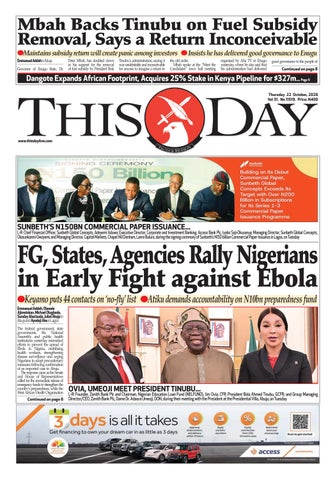
Mbah Backs Tinubu on Fuel Subsidy Removal, Says a Return Inconceivable Maintains subsidy return will create panic among investors Emmanuel Addeh in Abuja Governor of Enugu State, Dr.
Peter Mbah, has doubled down in his support for the removal of fuel subsidy by President Bola
Tinubu’s administration, saying it was undebatable and inconceivable for anyone to imagine a return to
Insists he has delivered good governance to Enugu
the old order. Mbah spoke at the “Meet the Candidates” town hall meeting
organised by Afia TV in Enugu yesterday, where he also said that his administration had delivered
good governance to the people of Continued on page 8
Dangote Expands African Footprint, Acquires 25% Stake in Kenya Pipeline for $327m... Page 5 Thursday 22 October, 2026 Vol 31. No 11519. Price: N400
www.thisdaylive.com TR
UT H
& RE A S O
N
SUNBETH’S N150BN COMMERCIAL PAPER ISSUANCE...
L-R: Chief Financial Officer, Sunbeth Global Concepts, Adeyemi Aduwo; Executive Director, Corporate and Investment Banking, Access Bank Plc, Iyabo Soji-Okusanya; Managing Director, Sunbeth Global Concepts, Olasunkanmi Owoyemi; and Managing Director, Capital Markets, Chapel Hill Denham, Lanre Buluro, during the signing ceremony of Sunbeth’s N150 billion Commercial Paper Issuance in Lagos, on Tuesday
FG, States, Agencies Rally Nigerians in Early Fight against Ebola Keyamo puts 44 contacts on ‘no-fly’ list
Atiku demands accountability on N10bn preparedness fund
Emmanuel Addeh, Olawale Ajimotokan, Michael Olugbode, Sunday Aborisade, Juliet Akoje in Abuja and Ayodeji Ake in Lagos The federal government, state governments, the National Assembly and public health institutions yesterday intensified efforts to prevent the spread of Ebola in Nigeria, mobilising health workers, strengthening disease surveillance and urging Nigerians to adopt precautionary measures following confirmation of an imported case in Abuja. The response came as the Senate and House of Representatives called for the immediate release of emergency funds to strengthen the country’s preparedness, while the West African Health Organisation Continued on page 8
OVIA, UMEOJI MEET PRESIDENT TINUBU...
L-R: Founder, Zenith Bank Plc and Chairman, Nigerian Education Loan Fund (NELFUND), Jim Ovia, CFR; President Bola Ahmed Tinubu, GCFR; and Group Managing Director/CEO, Zenith Bank Plc, Dame Dr. Adaora Umeoji, OON, during their meeting with the President at the Presidential Villa, Abuja, on Tuesday
2
THURSDAY, OCTOBER 22, t T H I S D AY
THURSDAY, OCTOBER 22, t T H I S D AY
3
4
THURSDAY, OCTOBER 22, t T H I S D AY
5
THISDAY • THURSDAY, OCTOBER 22, 2026
Group News Editor: Goddy Egene Email: Goddy.egene@thisdaylive.com, 0803 350 6821, 0807 401 0580
NEWS
LEEMON IKPEA VISITS PRESIDENT TINUBU...
Group Chairman/CEO, Lee Engineering Group and Allied Companies Limited, Chief Leemon Ikpea (L) with President Bola Ahmed Tinubu, during Chief Ikpea’s courtesy visit to the president at Aso Rock Presidential Villa on Tuesday
Dangote Expands African Footprint, Acquires 25% Stake in Kenya Pipeline for $327m Eyes new projects in Djibouti, Ethiopia, Cameroon, Namibia Dismisses energy transition, says oil will retain relevance Reiterates call for protection of local industries Second ship delivers equipment at Dangote’s $16bn Kenya refinery Emmanuel Addeh in Abuja Africa’s richest man, Aliko Dangote, has acquired a 25 per cent stake in Kenya Pipeline Company (KPC) in a deal valued at approximately $327.4 million, deepening his investments in East Africa’s petroleum industry as he advances plans to build a $16 billion refinery in Kenya. Dangote disclosed the acquisition yesterday at the Financial Times Africa Summit in London, confirming that his business interests had bought a significant stake in the company responsible for transporting petroleum products across Kenya and into neighbouring markets. “We bought 25 per cent of their pipeline network for the distribution of petroleum products,” he said of the transaction which involved the purchase of approximately 4.5 billion shares, according to a report released by the Nairobi Securities Exchange on Monday. The acquisition comes as the Nigerian industrialist pushes ahead with plans to establish a 700,000-barrelper-day refinery at Lamu, on Kenya’s Indian Ocean coast. The project, which broke ground on September 30, is estimated to cost between $16 billion and $17 billion, with completion targeted for around 2030. The refinery is modelled on Dangote’s existing 700,000-barrel-per-day facility in the Lekki area of Lagos, which has become a major component of his expanding interests in refining and petrochemicals.
Kenya Pipeline Company operates critical infrastructure connecting petroleum import facilities along the coast to inland consumption centres, making it a strategic component of the country’s fuel supply chain. Established in 1973 and commencing commercial operations in 1978, the company operates a pipeline network spanning approximately 1,342 kilometres, supported by storage depots, pumping stations and loading facilities. Its infrastructure also facilitates petroleum distribution to other East African countries. The latest transaction gives Dangote a substantial interest in the infrastructure through which petroleum products can be moved from coastal import terminals to inland markets, alongside his proposed investment in domestic refining capacity. “We are going very aggressively with that,” he said at the Financial Times London event. Distribution of oil products is central to his strategy, he said. In a further indication of the growing links between Dangote’s investments and Kenya’s energy ambitions, the Kenyan government has also expressed interest in taking an equity stake in the proposed Lamu refinery through its National Infrastructure Fund (NIF). President William Ruto announced the plan at the refinery’s groundbreaking ceremony in September, describing the proposed investment as part of efforts to increase Kenya’s participation
in major industrial and infrastructure projects. Dangote’s latest acquisition extends his interests beyond refining into the transportation infrastructure required to distribute petroleum products across East Africa, potentially positioning his business group to participate in multiple stages of the region’s petroleum value chain. The Kenyan pipeline company was state-owned until the government floated 65 per cent of its shares earlier
this year. Dangote’s plans represent an ambitious attempt to build an integrated African refining, storage and distribution business, with Kenya serving as a regional hub for east Africa and Namibia for southern Africa. Kenya Pipeline’s 1,300km network transports diesel, petrol and jet fuel from the port of Mombasa across Kenya, supplying both the domestic market and neighbouring countries
Nigeria’s cocoa bean exports to the United States rose by 554.4 per cent to $142 million in 2025, from $21.7 million recorded in 2024, amid growing demand for the commodity and efforts to strengthen the country’s non-oil export earnings. The United States Mission in Nigeria disclosed the figures in a post on its official Facebook page on Tuesday, describing the development as evidence of increasing demand for Nigerian cocoa in the American market.
“US demand for Nigerian cocoa is booming. Cocoa bean exports to the United States jumped from $21.7 million in 2024 to $142 million in 2025,” the mission said. It added that trade between both countries also benefited Nigeria through American agricultural exports, noting that wheat accounted for 67 per cent of US agricultural exports to Nigeria. The mission described the relationship as “fair, two-way trade that works for farmers, businesses, and families on both sides of the Atlantic.” The increase comes as Nigeria
million litre “tank farm” after a groundbreaking early next month. A second storage facility in Djibouti would supply Ethiopia, he added. The company’s founder also said he was “finalising plans” for another storage facility in Cameroon, West Africa. Besides, Dangote rejected any suggestion that he should be investing in renewables instead of oil refining, saying events in Iran had proved his strategy right.
Akpabio Seeks Deeper Legislative Ties with UK, Woos British Investors Senate President calls for expanded parliamentary exchanges Says Nigeria offers profitable investment opportunities Sunday Aborisade in Abuja President of the Senate, Godswill Akpabio, has called for deeper legislative cooperation between Nigeria and the United Kingdom, urging both countries to expand parliamentary exchanges and share legislative experiences to strengthen their longstanding bilateral relationship. Akpabio made the call on Wednesday in Abuja when the British High Commissioner to Nigeria, Mr. Peter Vowles, paid him a courtesy visit at his office.
The senate president said the historical, economic, and diplomatic ties between the two countries provided a strong foundation for expanding cooperation, particularly between the National Assembly and the British Parliament. He said Nigeria had much to learn from the British parliamentary system, and advocated more exchange programmes to strengthen legislative capacity and deepen institutional collaboration. Akpabio said, “The history of Nigeria will not be complete without
Nigeria’s Cocoa Exports to US Jump 554% to $142m in 2025 Sunday Ehigiator
including Uganda, the Democratic Republic of Congo, South Sudan and Rwanda. In Namibia, Dangote plans to build fuel storage tanks that would more than triple the capacity of the country’s existing national storage facility. The Atlantic port of Walvis Bay provides a gateway to inland markets including Zambia, Botswana and Zimbabwe, as well as South Africa. Dangote said his company would begin work on the 330
seeks to diversify its sources of foreign exchange earnings, revive agricultural production and expand local processing to retain more economic value from its commodities. However, industry challenges, including ageing cocoa plantations, limited access to affordable financing, declining productivity and inadequate domestic processing capacity, continue to constrain the sector. Many Nigerian cocoa trees are between 20 and 40 years old, while the average cocoa farmer is about 60 years old, raising concerns about
the sustainability of production and the participation of younger farmers. Smallholder farmers also face high borrowing costs, inadequate access to fertilisers and pesticides, poor-quality seedlings and limited access to affordable agricultural financing. Nigeria’s limited processing capacity has also restricted the economic benefits it derives from cocoa, with more than 80 per cent of its cocoa historically exported in raw form, limiting opportunities for industrial development, job creation and value addition.
the United Kingdom. For us in Nigeria, London is like a second home. “This permeates into the economic sphere and trade, and we would like to deepen the relationship in the area of legislation because we have a lot to learn from you.” Akpabio stated that parliamentary exchanges were already taking place, with members of the British House of Commons occasionally visiting Nigeria to observe legislative proceedings, while Nigerian National Assembly committees had also visited the British House of Lords and House of Commons. He called for more structured and sustained exchanges between the two legislatures, stressing that such engagements would enable lawmakers to learn from one another and strengthen parliamentary institutions. Akpabio stated, “Today, we have, once in a while, visits from the House of Commons to observe our proceedings. Our committees here, too, have had occasions to visit the British House of Lords and House of Commons. “Whatever it is, we have a lot to learn from you.” He added, “We want to deepen our relationship. We want to be able to have a lot of exchange programmes that will enable us to learn more and expand the relationship between the
Nigerian parliament as a whole and the United Kingdom in the area of legislation.” Akpabio also underscored the importance of sustaining the historical relationship between both countries, citing the strategic role Nigeria plays in Africa’s economic and security affairs. He commended King Charles III for the hospitality extended to President Bola Tinubu and members of his delegation during their recent state visit to the United Kingdom. Akpabio said, “The King was very nice to us. He recognises till today the importance of Nigeria, not just in terms of population but the strategic importance of Nigeria to the economy and security of the entire Africa.” He stated that the relationship between Nigeria and the United Kingdom should be sustained and strengthened for the mutual benefit of both countries. The senate president used the meeting to appeal to British investors to explore opportunities in Nigeria’s oil and mining, and other sectors of the economy. He urged the British High Commissioner to convey to investors in the United Kingdom that Nigeria offered opportunities for profitable investments, citing improvements in the country’s business environment and the ability of investors to repatriate their funds.
6
THURSDAY, OCTOBER 22, 2026 • THISDAY
NEWS
COURTESY CALL ON THE SENATE PRESIDENT BY THE UK ENVOY...
L-R: Senators Diket Plang and Asuquo Ekpenyong; Senate Whip, Tahir Monguno; United Kingdom High Commissioner to Nigeria, Peter Vowless; President of the Senate, Godswill Akpabio; Senate Minority Leader, Abba Moro; Senators Ali Ndume, Umar Sadiq and Ekong Sampson, during a courtesy call on the senate president by the UK envoy, yesterday PHOTO: SENATE PRESIDENT’S OFFICE
PANDEF Youth Wing Seeks Reversal of Planned Rerouting of Coastal Road Felix Omoh-Asun in Benin City Pan Niger Delta Forum (PANDEF) National Youth Wing has demanded the immediate cancellation of Ondo/ East-West reroute of the Lagos-Calabar Coastal Highway, and return to the original coastal alignment. The PANDEF youth wing made the demand yesterday in Benin City. National Youth Leader, PANDEF National Youth Wing, DonBen
Donyegha, while addressing a press conference, described the federal government’s decision to redesign and divert the LagosCalabar Coastal Highway away from its original coastal alignment and link it, instead, to the existing East-West Highway via Ondo into Edo State, as a betrayal. Donyegha said, “This is not an engineering tweak. It is a fundamental betrayal of the project’s purpose and
of the littoral oil-bearing communities whose lands generate the overwhelming bulk of Nigeria’s wealth.” Minister of Works, Dave Umahi, had publicly quoted President Bola Tinubu as directing the diversion and passage of the coastal highway through the existing East-West road. Umahi justified the change by citing difficult terrain, deep pits, and cost in sections covering parts of Ogun and Ondo states.
He later clarified that the 750-kilometre project is “not abandoned” and that surveys continued elsewhere did not erase the clear directive or the practical effect of large stretches of the original coastal corridor. He said the communities that sit on the corridor were not being cut off. But PANDEF said the communities, which were denied the highway, were the very ones hosting oil production for decades, and which
had endured pollution, gas flaring, and underdevelopment, and continue to supply the resources that keep the Nigerian economy afloat. “Rerouting the project inland via the chronically failed East-West Road to avoid the coast is the opposite of what was promised and what justice requires,” the PANDEF youth wing stated. It added, “Engineering challenges and costs are real in the Niger Delta;
Odebiyi: Risk Management Critical to Tinubu’s $1tn Economic Target
Former senator urges Nigerians to support economic reforms Says sound governance, accountability key to sustainable growth
Sunday Aborisade in Abuja Senator Tolu Odebiyi has identified effective risk management, sound governance, and institutional accountability as critical to President Bola Tinubu’s ambition to grow Nigeria’s economy to $1 trillion, warning that the target would require disciplined implementation of policies and prudent management of national resources. Odebiyi, according to a statement by his media office on Wednesday, spoke in Lagos while delivering his acceptance speech after receiving the Honorary Fellow Chartered Risk Manager (HFCRM) award from the Chartered Risk Management Institute of Nigeria. He said risk management must become an integral part of the country’s economic transformation agenda. He commended Tinubu for pursuing the ambitious economic target and initiatives aimed at attracting investment, strengthening institutions, and creating opportunities for sustainable growth. The former lawmaker, however, stressed that achieving the $1 trillion target would require more than bold policies and ambitious projections, insisting that effective risk management must underpin government programmes, infrastructure development, public expenditure, and private-sector investments. “Risk management must be at the heart of this transformation,” he declared. Odebiyi spoke during the award ceremony held at Oriental Hotel,
Lagos, on October 15. He urged Nigerians to remain focused and steadfast in supporting the country’s economic transformation, stating that sustainable progress would depend on collective commitment, accountability, and the determination to translate government policies into tangible improvements in citizens’ living conditions. According to him, effective risk management would help protect public resources, improve project delivery, strengthen investor confidence, reduce waste, and ensure that investments generate measurable economic returns. He identified energy, agriculture, manufacturing, mining, technology, financial services, and infrastructure as critical sectors that must drive Nigeria’s economic expansion. Odebiyi said investments in those sectors must be supported by systematic risk assessment, efficient resource allocation, and measures to strengthen resilience against economic shocks. He cautioned against treating risk management as a mere compliance requirement, stating that it should, instead, serve as a strategic instrument for achieving national development objectives. “For our $1 trillion economic ambition to become a sustainable reality, risk management must move beyond a compliance requirement and become a strategic instrument of national development,” he said. The former senator explained that incorporating risk management into government budgeting, major capital
projects, public-private partnerships, corporate governance, and the administration of national assets would strengthen accountability and improve returns on public expenditure. He said the country’s economic transformation would be more sustainable if government institutions and private-sector operators systematically identified potential threats to their investments and developed strategies to mitigate them before they undermined project outcomes. Odebiyi also emphasised the importance of building institutional capacity to identify and manage financial, economic, environmental, technological, and governance risks confronting Nigeria. He stated that the increasing complexity of the challenges made it imperative for the country to develop a pool of professionals equipped with the requisite technical expertise, integrity, and ethical standards to support effective decision-making. Reflecting on his contribution to the establishment of the Chartered Risk Management Institute of Nigeria, Odebiyi recalled that he initiated the bill that laid the foundation for the institute’s statutory recognition during his tenure in the senate. He said his intervention was motivated by the conviction that risk management was too important to Nigeria’s development to operate without a clearly defined statutory framework and professional recognition. The institute subsequently received its charter under Act No.
39 of 2022, providing a formal legal foundation for the advancement of professional risk management in Nigeria. Odebiyi urged the institute to consolidate its position as a centre of excellence for risk management in Africa through professional education, research, certification, adherence to ethical standards, and stronger collaboration with government institutions and private-sector organisations. He said developing a new generation of competent risk management professionals would help improve policy implementation, strengthen
institutional performance, and enhance Nigeria’s competitiveness in the global economy. According to him, professional risk managers have an important role to play in ensuring that public institutions and businesses anticipate potential challenges, make informed decisions, and deploy resources in ways that support long-term economic stability. He added that embedding risk management principles across the public and private sectors would help Nigeria better navigate economic uncertainties while maximising opportunities for growth.
they have always been. That should never be an excuse to abandon the coastal communities that bear the heaviest burden of oil extraction and environmental pollution. “Previous administrations neglected the region’s connectivity. So this administration’s decision to proceed with a coastal highway was widely welcomed in the Niger Delta, precisely, because it was expected to finally serve the littoral states and communities. Diverting it now re-opens the old wound of exclusion.” The youth chapter presented some demands to the Tinubu government to avoid crisis in the Niger Delta. The group asked for the immediate cancellation of the directive to divert the highway onto the East-West Road via Ondo State, and full reversion to the original coastal alignment across all affected sections. It also called for transparent, documented engagement with host communities, state governments, and regional stakeholders before any further major realignment decisions; and public confirmation that every littoral oil-bearing community originally intended to be served by the highway will still be served by a proper coastal route. It group said, “The East-West Road has been a symbol of neglect and broken promises for decades. Upgrading portions of it is welcome as a separate, complementary project. It cannot be used as a substitute that effectively bypasses the coastal communities this signature project was meant to open up.”
JAMB to Test Critical Thinking, Problemsolving Skills in UTME, Says Registrar Kuni Tyessi in Abuja The Joint Admissions and Matriculation Board (JAMB) has said it will no longer assess candidates on textbook knowledge alone, saying plans are underway to test critical thinking and life skills in the UTME. Registrar of JAMB, Professor Segun Aina, said a committee led by psychometrician Professpr Boniface Nworgu, was working out how to measure reasoning, decision-making, and problem-solving as part of admission requirements. Aina spoke yesterday at the board’s Abuja Zonal Office during an interaction with UTME candidates as part of its 2026 Customer Week.
He said professionals, like doctors, need sound judgment and understanding of consequences beyond technical knowledge, and universities needed to know if candidates could apply knowledge to real-life situations. He stressed that the proposal was still under consideration, adding that if approved, JAMB would set up a panel of experts to develop the implementation framework. Aina stated that JAMB will not replace academic requirements, but complement them. He also said JAMB was reforming its operations to “build trust and reduce trauma” for candidates. Aina said, “Candidates will now get detailed admission status updates
instead of vague ‘not admitted’ or ‘admission in progress’ messages. “Easier update of phone numbers and email addresses when candidates lose access to old contacts. “Stronger collaboration with NIMC to allow legitimate correction of names and personal data, while blocking identity fraud. Fraudulent attempts will attract legal action.” Aina said his administration was consolidating reforms started by his predecessor, Professor Ishaq Oloyede, particularly in technology deployment. He defended the harmonised exam timetable, saying though it shortens preparation time, it ensures timely release of results for admission.
7
THISDAY • THURSDAY, OCTOBER 22, 2026
NEWS
2026 CLIMATE ACTION AND GREEN INVESTMENT SUMMIT...
L-R: Representative of the Speaker of the House of Representatives/ Chairman House Committee on Climate Change, Hon. Kama Nkem Kama; Minister of Culture, Art and Creative Economy, Hannatu Musawa; Director General, Nigerian Climate Council, Mrs. Tenioye Majekodunmi; Katsina State Governor, Malam Dikko Umaru Radda; Executive Secretary, Nigeria Investment promotion Council (NIPC), Aisha Rimi; and Head of Office, North West, UNDP, Asraf Usman, at the Katsina State 2nd Climate Action and Green Investment Summit 2026 in Abuja, yesterday PHOTO: ENOCK REUBEN
Shettima to States: End Dependence on FG, Unlock Electricity Investment Proposes national peer review framework to accelerate Electricity Act implementation Deji Elumoye in Abuja Vice President Kashim Shettima yesterday charged state governments to take full advantage of the Electricity Act 2023 by establishing functional electricity markets, attracting private investment, and ending their dependence on the federal government for solutions to local power challenges. Shettima said Nigeria’s ambition to build a competitive industrial economy would remain constrained unless electricity reforms translated into reliable power for businesses, households, and public institutions across the country. He made the comments while declaring open the National Stakeholders’ Workshop on the Electricity Act 2023 at the Banquet Hall of State House, Abuja. The workshop, with the theme, “Unlocking the Opportunities of the Electricity Act 2023 for Sustainable Energy Development and Economic Growth in Nigeria,” brought together federal and state institutions, regulators, and other stakeholders to review the implementation of the legislation. Represented by Deputy Chief of Staff to the President, Senator Ibrahim Hassan Hadejia, the vice
president said the act had created an opportunity to decentralise electricity governance and enable states to develop power markets suited to their economic needs and available resources. He said, “The act empowers states to develop and regulate intrastate electricity markets within the applicable constitutional and statutory framework. The size, diversity and endowments of this nation demand this decentralisation. “Electricity supply must become a shared responsibility, pursued with innovation and accountability across the federation. Our States must shed the habit of waiting for Abuja to provide every answer.” Shettima identified the country’s diverse energy resources as a major opportunity for expanding electricity access, citing solar potential in Sokoto, Borno and Katsina, gas resources in Delta, Rivers and Bayelsa, and hydroelectric opportunities in Niger and Kebbi. He urged states to translate the advantages into investments capable of powering agriculture, manufacturing, healthcare and education. The vice president, however, warned that legislation alone would not guarantee improved
electricity supply, calling on states yet to establish their regulatory institutions to begin the process without delay. He stated, “Legislation cannot implement itself. States yet to act must begin their legislative and institutional preparations promptly. “They need to establish functional electricity regulatory bodies with technical competence and capacity.” To strengthen implementation, Shettima proposed a National
Alt Bank has completed migration to MIZAN, a core banking platform purpose-built for Islamic and noninterest banking, ending its reliance on systems originally designed for conventional banking. The bank said the move solves a long-standing infrastructure gap in non-interest finance, where products run on distinct contractual structures, asset-backed relationships and profitsharing models that conventional cores struggle to process without workarounds. Managing Director/CEO, Hassan Yusuf, said non-interest banking can no longer be forced to speak the
language of conventional banking technology. “The more non-interest banking grows, the more important it becomes that the infrastructure underneath it understands what makes the model different. We should not have to continuously translate non-interest banking into the language of systems designed for something else. “MIZAN gives us an operating foundation closer to the principles, structures and ambitions of the institution we are building” Yusuf said. Developed by Peerless, the MIZAN platform supports contractbased financing, asset-backed transac-
access. “No state needs to purchase with failure the knowledge another state has already acquired,” he said. According to him, annual voluntary reviews should identify implementation challenges, facilitate technical assistance and promote practical solutions without undermining the constitutional powers of states. The vice president also emphasised the importance of private sector participation, stating
that government funding alone cannot meet Nigeria’s electricity infrastructure requirements. He said, “Government cannot finance this transformation from the treasury alone; private capital must arrive with technology and expertise. “Transparent licencing, predictable regulation, commercially viable markets, investment safeguards and credible dispute resolution will earn investors’ confidence.”
SON Certifies 17,866 Products Manufactured by 8,634 Companies Under MANCAP Scheme Dike Onwuamaeze The Director General of Standard Organisation of Nigeria (SON), Dr. Ifeanyi Chukwunonso Okeke, has revealed that the organisation has certified and revalidated of 17,866 products manufactured by 8,634 Nigerian companies under its Mandatory Conformity Assessment Programme (MANCAP). Okeke revealed this yesterday in Lagos, in his speech at the, “2026 National MANCAP Quality Award Ceremony,” and the 20th anniversary
Alt Bank Dumps Conventional Core Banking System, Migrates to Islamic Finance-Built MIZAN Platform Kuni Tyessi in Abuja
Electricity Reform Peer Review and Implementation Framework involving the Nigerian Electricity Regulatory Commission (NERC), Federal Ministry of Power, Nigeria Governors’ Forum (NGF), and state electricity regulators. He explained that the proposed voluntary framework would allow states to exchange experiences, strengthen regulatory institutions, and assess progress in market development, investment readiness, consumer protection and electricity
tions, profit sharing and distribution, with built-in audit controls and digital integration. alt bank says it will enable simpler processes, faster product development and more responsive customer service. The migration builds on the bank’s earlier 2026 admission into the International Islamic Financial Market (IIFM), the global body that sets standards for Islamic finance documentation and market practices. “If this industry is going to achieve its potential, it cannot remain dependent on workarounds. The standards must mature. The products must mature. The infrastructure must mature. We intend to be part of making that happen,” Yusuf added.
celebration of MANCAP. He explained: “The impact of MANCAP is reflected in its growth. In its first year of implementation, the scheme certified 1,930 products from 458 companies. “Today, certifications and revalidations stand at 17,866 products from 8,634 companies. “These figures demonstrate the scheme’s contribution to quality assurance and the development of Nigeria’s manufacturing sector.” He said MANCAP took effect on January 1, 2006, in line with the enabling Act of the SON in a bid to promote fair competition among locally manufactured products, protect consumers’ rights to quality products and value for money,
and support the diversification of Nigeria’s economy. “As SON’s flagship mandatory product certification scheme for locally manufactured products, it ensures that products meet the requirements of relevant Nigerian Industrial Standards (NIS), helping to prevent the production and sale of substandard and unsafe products while strengthening confidence in Made-in-Nigeria products,” Okeke said. He explained that the, “Annual National MANCAP Quality Award,” which was instituted this year, recognised “companies that have demonstrated resilience in compliance and consistently maintained their certifications over 10, 15 and
20 years. “Under the theme, ‘Building Trust in Quality and Safety Ecosystem,’ this ceremony celebrates manufacturers whose commitment to quality promotes consumer confidence, industrial growth and the competitiveness of Nigerian products.” The Director General said “as we celebrate 20 years of MANCAP, we must look ahead to a future in which quality becomes a defining characteristic of Nigerian manufacturing.” He assured that SON will continue to strengthen conformity assessment, support manufacturers and promote an environment where Nigerian products can compete confidently in local and international markets.
Zainab Shinkafi-Bagudu Makes History as First African to Lead Global Cancer Body Kuni Tyessi in Abuja Nigeria has made history on the global health stage as Dr. Zainab Shinkafi-Bagudu becomes the first African and first Nigerian to lead the world’s foremost cancer control organisation. The paediatrician, cancer advocate and founder of Medicaid Cancer Foundation has assumed office as President of the Union for International Cancer Control (UICC) for the 2026–2028 term.
The UICC is one of the world’s leading international bodies dedicated to advancing cancer control, prevention, treatment and care. The Nigerian Cancer Society (NCS) announced the historic milestone in Abuja, describing it as a proud moment for Nigeria, Africa and the global cancer community. In a statement signed by the NCS President, Prof. Abidemi Omonisi while congratulating Dr. Shinkafi-Bagudu, said her inauguration is the culmination
of years of dedicated service, strategic leadership and tireless advocacy for equitable access to cancer prevention, early detection, diagnosis, treatment and care. He reiterated that as a paediatrician and founder of Medicaid Cancer Foundation, Dr. Shinkafi-Bagudu has championed cancer awareness, patient support, resource mobilisation and stronger cancer policies to address critical gaps in cancer services in Nigeria.
8
THURSDAY, OCTOBER 22, 2026 • THISDAY
EIGHT
FG: Why Nigeria Must Pool AI Computing Capacity with African Nations Tijani identifies electricity, connectivity as constraints to AI development Luminate puts Nigeria’s cloud infrastructure dependence at $850m Emmanuel Addeh in Abuja The federal government has called for the pooling of artificial intelligence (AI) computing capacity among African countries, including Nigeria, Rwanda, Senegal and Kenya, as part of efforts to overcome the continent’s infrastructure constraints and compete in the rapidly evolving global AI economy. The Minister of Communications, Innovation and Digital Economy, Dr Bosun Tijani, said this would support the development and deployment of large language models that individual countries might not have sufficient capacity to run independently. Tijani, who was represented by the National Director of the National Centre for Artificial Intelligence and Robotics (NCAIR), Dr Olubunmi Ajala, spoke at the ‘Build 2026 Conference’ in Abuja yesterday. The two-day Build 2026 Conference was convened by the Nigeria AI Collective which brings together civil society, academia, policymakers, innovators and other participants to advance the safe, ethical and inclusive development of AI in Nigeria. The AI Collective is funded by Luminate, AI Collaborative, Ford Foundation and MacArthur Foundation, and is
managed by the Lagos Business School (LBS), Data Science Nigeria (DSN), the Centre for Journalism, Innovation and Development (CJID) and NCAIR, and is led by the Policy Innovation Centre (PIC), which coordinates its policy engagement. Other speakers at the conference included: The President of the MacArthur Foundation, John Palfrey; Dean and Professor of Information Systems at Lagos Business School and Pan-Atlantic University, Prof. Olayinka David-West as well as the Executive Director, CJID, Akintunde Babatunde, among others. Tijani stressed that infrastructure remained one of the most significant obstacles to Nigeria’s AI ambitions, despite progress in developing a national strategy, building local expertise, training talent and encouraging the use of open-source models. He explained that the proposed approach would enable Nigeria to connect its Graphics Processing Units (GPUs) with computing resources in other African countries, allowing researchers and developers to aggregate capacity for more demanding AI tasks. “What we’re proposing and we know is that it’s possible for us to have a little AI scaling up. …We are proposing to have a GPU, but this GPU
should not only serve all. It’s possible for us to connect our GPU to the GPU funded by the Gates Foundation in Rwanda. Same with Senegal and in Kenya,” he said. Tijani added: “So if you want to build a large language model or you want to build something big, Nigerian capacity might not be big enough, but we could aggregate this for all of us, and you’ll be able to do what you want to do,” he stressed. He said the arrangement could help African countries overcome the limitations of developing expensive computing infrastructure independently, while creating opportunities for regional cooperation in AI research, model development and deployment. The minister further identified electricity, internet connectivity, cloud infrastructure and advanced computer chips as major challenges facing the sector, warning that the pace of technological change and global competition for computing equipment could leave countries such as Nigeria perpetually behind without deliberate investment and cooperation. He said Nigeria was already working on some of these constraints, including a proposed regional data park project involving Nigeria and Togo, which
he said would leverage available electricity capacity. On connectivity, Ajala said about 20 million Nigerians remained unconnected, while the government was pursuing a fibre infrastructure initiative intended to expand broadband access across the country. He also highlighted the difficulty of securing advanced AI chipsets, noting that technology changes every few months and that global demand for the equipment was placing pressure on supply. In her keynote address, the Chief Executive Officer of Luminate, Melanie Hui, warned that Nigeria’s dependence on foreign cloud infrastructure was costing the country an estimated $850 million annually, underscoring the economic consequences of Africa’s limited control over critical layers of the global AI value chain. Hui said Africa’s position in the global AI economy would depend not merely on access to technology but on whether countries could influence how it was developed, governed and used, and retain a fair share of the resulting economic value. “The research we commissioned estimates that this dependency costs Nigeria around $850 million each year,” she said, referring to the country’s reli-
ance on cloud infrastructure provided by a handful of foreign companies. Hui said the most powerful AI models depended on computer chips, cloud computing, data centres, electricity, water, data and highly skilled labour, with control over these resources translating into economic and political power. She warned that without a deliberate strategy, African countries risked remaining consumers of technology developed elsewhere, suppliers of raw data, sources of critical minerals and providers of low-paid labour in an AI economy controlled by a small number of companies and countries. In her remarks, the Executive Director of the Policy Innovation Centre (PIC), Dr Osasuyi Dirisu, said the Nigeria AI Collective was established to promote an ethical and inclusive AI ecosystem by bringing together stakeholders working across academia, innovation, agriculture, security, climate and other sectors. Dirisu said AI should be regarded as an enabler for solving real problems and advancing social development, rather than an end in itself. She stressed the need to develop local talent and digital skills, particularly as Nigeria grappled with concerns that AI adoption could displace workers.
Bosun Tijani With Nigeria’s large and youthful population, she said, developing the skills required for emerging digital jobs would be critical to preparing young people for changes in the labour market. Dirisu also pointed to the role of the CJID, a member of the Collective, in addressing misinformation, disinformation and deepfakes through election monitoring, journalist training and public awareness initiatives. Also speaking, Chief Executive Officer of Data Science Nigeria, Dr Olubayo Adekanbi, similarly urged Nigerians to acquire AI skills, arguing that the technology could improve productivity and create new forms of employment even as it changes existing jobs. Adekanbi said the impact of AI should be assessed by weighing the jobs and tasks it might displace against the new opportunities it could create and the productivity gains it could deliver.
FG, STATES, AGENCIES RALLY NIGERIANS IN EARLY FIGHT AGAINST EBOLA (WAHO) stepped up regional surveillance and coordination. Besides, the Nigerian Supreme Council for Islamic Affairs (NSCIA) urged persons suspected of infection to stay away from congregational prayers pending medical assessment. In the same vein, former Vice President Atiku Abubakar, has demanded accountability for the N10 billion reportedly approved for Ebola preparedness, questioning how much had been released and how the money had been spent. Health authorities have identified 44 contacts linked to the confirmed case and are tracing them for monitoring and appropriate medical intervention, as public health officials warn that early detection, contact tracing and strict infection prevention measures are critical to preventing further transmission. Also, the Nigeria Centre for Disease Control and Prevention (NCDC) yesterday convened its first Incident Management Meeting following the official declaration of the outbreak, bringing together its leadership and key partners to coordinate response activities. The development has prompted heightened vigilance across states, with Niger State placing public and private health facilities on alert and directing them to report suspected cases immediately. Medical experts have also urged Nigerians to avoid unnecessary physical contact, practise regular handwashing and seek prompt medical attention if they develop symptoms or suspect exposure.
FG Assures Nigerians of Containment Strategies The Presidential Task Force on Ebola Preparedness, Virus Disease Preparedness and Emerging Public Health Threats yesterday evening assured Nigerians it can handle Ebola disease recently discovered in the country. Chairman of the Task Force
and Chief of Staff to the President, Femi Gbajabiamila, said this while speaking to newsmen after the group’s emergency meeting at the State House, Abuja. Gbajabiamila said the Task Force has been working behind the scenes since it was inaugurated in June this year adding that this informed why it was easy to detect the index case discovered yesterday. “It’s very important to note this. Since the issue of Ebola came up in June, there have been about 44, 000 flights in and out of Nigeria. So, it’s because of what the Ministry of Health, the task force and all the agencies have been doing. All hands have been on deck. “The passenger with the disease showed no symptoms, which came four days after the woman got into Abuja, and it was the identification
process and the protocols that were put in place that enabled the quick identification. That also speaks to the country’s capacity and ability to deal with this disease as best as we can,” he added. He assured Nigerians that the Task Force would strengthen whatever needed strengthening, the protocols, and ensure more rigorous enforcement moving forward. “The Task Force is on top of it. NCDC is on top of it; everyone is on deck. We must build community trust and avoid panic, but it’s also important to state clearly that this is a collaborative effort between the government and the people,” he stated. Also speaking, Coordinating Minister of Health and Social Welfare, Prof. Ali Pate, said Nigeria
has competent health authorities, including private hospital operators and agencies, Immigration, Aviation, Interior, and subnational actors, who have put surveillance systems in place across the country, ready to respond. “We have been conducting contact tracing diligently and isolating those contacts of the index imported case in this country. We will continue to do that, and we want to reassure Nigerians that the federal government, alongside its technical partners, the World Health Organisation, the Africa Centre for Disease Control, and our own Nigeria Centre for Disease Control, have activated the incident management system across the various pillars. “They are working day and night diligently, and our hospital
capabilities are also activated, such that we can aim to contain this case, as has been the case in other countries, but we will not relent. Our population should respect public health directives. “Most of our states have adequate response plans. We have the resources, and we’re mobilising those capabilities. And we’re also confident that if we continue on this path, we should be able to dent this outbreak,” he stated. He further urged citizens to avoid misinformation while combating the virus. “The key also for the population is to avoid spreading misinformation or baseless rumours, which can cause unnecessary panic. The Task Force leadership has met. WHO and Africa CDC are working closely with the team.
“In addition to our exceptional public health physicians who had successfully tamed this virus in 2014, and had contributed to other countries, we are confident that if we continue in this direction, we will emerge from this crisis in a much stronger place,” Pate assured.
Senate Demands Immediate Release of Emergency Funds The Senate yesterday called on the federal government to release emergency funds from the Service Wide Vote to strengthen Nigeria’s disease surveillance and response system, following confirmation of the Ebola case in Abuja. The upper chamber, however, rejected a proposal for relevant Senate committees to visit major Continued on page 43
MBAH BACKS TINUBU ON FUEL SUBSIDY REMOVAL, SAYS A RETURN INCONCEIVABLE the state across all sectors. He described it as a pathetic misconception of the country’s situation and the direction it was headed for anyone to talk about the reintroduction of fuel subsidy. “If you reintroduce fuel subsidy today, we will lose ten times whatever we are currently trying to gain in terms of the removal of subsidy. The poverty rate that you are going to experience will be very high because the naira would be automatically devalued. “We cannot go back to subsidy. And I do not think it is in the interest of the country for us to even debate that. “Again, we should not even debate it because we do not want to send a signal to prospective investors that we are contemplating it. That would take us back. It is going to create panic in the system. It is going to get investors to pull back. “Those that are coming in today to invest in that sector will become jittery. So, it is not even a subject to debate. It is something that we have moved on from, and we should be
thinking about how to ensure that the natural benefits cascade to the households, create jobs and generate wealth for our people,” he said. He said the nation should focus on how to further encourage private capital to flow, noting the growth the nation had experienced in the stock exchange space. He added that Tinubu’s policies had stabilised the macro indicators, thus encouraging foreign direct investment. “You can see quite a lot of funds coming into our country, not just portfolio investments, but also direct investments. It is also going to strengthen because the macro indicators are right,” he stated. Mbah maintained that whereas fuel subsidy removal enables the government to target the less privileged, fuel subsidy as earlier practised benefited the rich more. “By the way, I do not think the subsidy we practised before the President removed it was even the right one for the country because even the people we were looking at benefiting from it were only
insignificantly benefiting from it. It was largely beneficial to our wealthy folks. “But now, you can almost notice that the government is doing that in targeting the poor, using proceeds from subsidy removal. The government is aggressive on cash transfers. There is also the programme where the government is targeting 1,000 persons per ward across the entire country to be able to provide seed capital for them to become productive,” he added. Meanwhile, on his stewardship so far, Mbah said his administration had kept faith with the people of Enugu State, delivering good governance across all sectors in line with his campaign manifesto. He said the people of the state only needed to imagine where the state was before his inauguration as governor and where it is currently headed. “Let us imagine the Enugu we knew four years ago. Let us just imagine an Enugu without Hotel Presidential. Let us imagine an Enugu without the International
Conference Centre. Let us imagine an Enugu without Enugu Air. Let us imagine Enugu without the transport terminals, the 268 Smart Green Schools, 260 Type 2 Primary Healthcare Centres. “You do not want them to imagine an Enugu without the International Hospital. You do not want them to imagine an Enugu without the CNG buses, the Nigergas. I think the list is endless. “But I even think that we can stretch that imagination further because the work ahead will be more profound. Just imagine an Enugu where our children are receiving education that prepares them for the world because they have been imbued with evolving 21st-century skills. Imagine again an Enugu where you do not have any part of the city with an unpaved road. “Also, imagine an Enugu in four years’ time that generates 660 megawatts of electricity; where we are able to provide 24-hour power supply; where you cannot come into your house and have the light off; and where people can run their busi-
nesses for a whole week without worrying about the cost of diesel. “Just imagine an Enugu where you generate electricity and the people of Enugu are buying that at 120 naira because they own the coal that feeds the power plant. “Imagine an Enugu where you now have to ride, not just on our CNG buses, but you have the monorail that can take you from point A to point B. Imagine an Enugu where you can fly from here to the United Kingdom, to the United States and other parts of the world,” he stressed. Mbah urged the people to keep faith with the journey of greatness, growth and development, defending the gains of his first term and guaranteeing the promises of his second term by working for his re-election. “If these imaginations capture our fancy, then we have a duty to fight for it. We do have a duty to continue to make sure that the bar does not come down and that the standard we have set in Enugu is sustained,” he noted.
9
THISDAY • THURSDAY, OCTOBER 22, 2026
NEWS
COURTESY VISIT BY TRANSCORP HILTON OFFICIALS TO ARISE NEWS...
L-R: Director of Sales, Transcorp Hilton, Abuja, Daniel Ekun; Chief of Staff to the Chairman, THISDAY/ ARISE Media Group, Fauziya Ali Mohammed; Senior Sales Executive, Transcorp Hilton, Abuja, Bridget Donaldson-Odia; General Manager, Sales, Advertising and Special Projects, ARISE News Channel, Yemisi Steven-Dare; and Director of Strategy, ARISE News Channel, Abdulmuizz Bello, during the courtesy visit of Transcorp Hilton officials to Arise News in Lagos on Tuesday PHOTO: ETOP UKUTT
US Orders Its Diplomats to Leave Saudi Arabia Amid Houthi Attacks Oil price continues climb, exceeds $110 per barrel Emmanuel Addeh in Abuja The US State Department has ordered some diplomats and family members to depart from its missions in Saudi Arabia, as it is planning to move out family members from a number of other US missions in the Gulf, US officials told Reuters.
State Department spokesperson Tommy Pigott said in a post on X that the department ordered the departure of “non-emergency US government employees and their family members in Saudi Arabia only” amid attacks by the Iran-aligned Houthis in Yemen on civilian targets in the country. Washington had returned some
diplomatic personnel to the region in recent months after many were pulled out when Tehran launched retaliatory attacks on US facilities after the US-Israeli war on Iran began in late February. “Iranian-supported Houthis have increasingly engaged in hostilities against Saudi Arabia, including attacks on civilian airports and
other critical infrastructure resulting in civilian casualties and severe travel disruptions,” Pigott said. Four US officials told Reuters that US missions in other Gulf states would also be ordering family members to leave. Pigott did not address changes to other missions outside Saudi Arabia. The US embassy in Riyadh is-
N100bn Loan: Makinde Bent on Bankrupting Oyo to Fund Elections, Says Alli Campaign Organisation The Senator Sharafadeen Alli Campaign Organisation (SSACO) has condemned Governor Seyi Makinde’s decision to proceed with securing a fresh N100 billion loan, despite earlier warnings against reckless borrowing in the twilight of his administration, describing the development as an alarming demonstration of fiscal irresponsibility and political desperation. SSACO, in a statement by Bisi Oladele, Director of Media and Publicity, said the speed with which the approval was granted by the state House of Assembly was indicative of a deliberate attempt to bankrupt the state for the incoming administration and mortgage the future of the state. “There is no doubt that the proposed borrowing was not driven by any genuine developmental consideration but by a desperate political agenda to finance the 2027 elections and sustain Governor Makinde’s increasingly uncertain
political ambition. The governor’s determination to plunge Oyo State further into debt, even as his administration approaches its terminal date, raises serious questions about his intentions and the financial burden he is preparing to leave behind for the incoming government,” the statement said. According to SSACO, Governor Makinde has become increasingly conscious of the political reality that his presidential ambition, if pursued, stands little chance of electoral success, while his preferred successor equally faces the prospect of overwhelming rejection by the people of the state. In the words of SSACO: “Governor Makinde knows his presidential ambition is a political misadventure waiting to happen. He also knows that the political stooge he is desperately trying to impose on the people of Oyo State cannot win the governorship election.
“Rather than accept these realities and concentrate on finishing his tenure responsibly, he appears determined to mortgage the future of our state to finance an electoral project that is destined to fail. “We are convinced that this N100 billion loan is not about building roads, improving hospitals, strengthening education or creating jobs. We suspect that it is about financing elections, sustaining a collapsing political structure and prosecuting the governor’s desperate succession agenda at the expense of generations of Oyo State citizens. “The SSACO is more than convinced that the governor’s latest borrowing initiative reflects growing desperation within an administration increasingly confronted by political uncertainty, declining public confidence and the steady erosion of its support base. “The economic justification for
2027: Gombe Agog for Tinubu as Yahaya Reaffirms His Commitment to APC Victory Segun Awofadeji in Gombe Gombe State Governor, Alhaji Muhammadu Yahaya, has declared Gombe State firmly behind President Bola Tinubu’s re-election bid in 2027, pledging to deploy the state’s formidable political machinery and grassroots mobilisation networks to secure victory for the president and All Progressives Congress (APC) at all levels. Yahaya attributed Gombe people’s
support for Tinubu to the federal government’s development interventions in the state, particularly in agriculture, livestock development, infrastructure, health, energy and other strategic sectors of the economy. He spoke yesterday at the inauguration of the Gombe State chapter of the PBAT Door-to-Door Movement, where 26 campaign vehicles donated by the movement were presented to strengthen
grassroots mobilisation and expand APC’s political reach across the state. Expressing appreciation to Tinubu for his administration’s commitment to Gombe State’s socio-economic development, the governor singled out the federal government’s support for the Livestock and Agro-Development Zone in the state, and the ongoing construction of the Gombe-Biu Super Highway as landmark interventions with far-reaching economic implications.
obtaining another N100 billion loan at a time when the state is already grappling with substantial debt obligations and when the administration has barely seven months left in office is questionable.” It criticized the Oyo State House of Assembly for offering itself as a willing tool to endorse the governor’s borrowing requests without demonstrating sufficient independence or subjecting the proposals to rigorous public scrutiny. “The House of Assembly must understand that its constitutional responsibility is to protect the interests of the people, not merely to provide legislative cover for the financial excesses of the executive.
sued a security alert on Wednesday about possible further attacks by the Houthis on Saudi Arabia, after recent deadly strikes including on Riyadh’s airport. Meanwhile, oil prices climbed Wednesday as worries over Middle East supply disruptions kept the market on edge, with attacks on tankers near the Strait of Hormuz and Saudi energy facilities denting sentiment. Brent crude futures gained 1.22 per cent $110.13 a barrel, while U.S. West Texas Intermediate crude rose 1.11 per cent to $98.92 a barrel. Iran’s Revolutionary Guards said that naval mines had prevented three tankers attempting to pass through the Strait of Hormuz using routes Tehran deemed unauthorized. “Two violating oil tankers were set ablaze and halted due to the explosion of mines planted by the brave sailors of the IRGC Navy at an illegal crossing point in the southern part of the Strait of Hormuz,” IRGC said in a statement published on their official Sepah News website. Adding to regional worries, Yemen’s Houthi militants claimed responsibility on Monday for strikes targeting Saudi Aramco facilities in Yanbu, the Shaybah
oilfield and airports in Riyadh and Abha. The escalating tensions have also sent global oil shipping costs soaring, adding another layer of pressure to energy markets, a CNBC report said. The global average crude freight rate has surged above $20 per barrel, compared with just $3 a year earlier, according to a Goldman Sachs report published Tuesday. While rates have eased slightly in recent days, they remain roughly seven times higher than a year ago. Goldman estimated that war-risk premiums associated with crossing the Strait of Hormuz accounted for about $7 of the $20 year-onyear increase in average crude freight rates, while ship-to-ship transfers outside the Persian Gulf contributed another $4. The investment bank warned that elevated shipping costs could widen price differences between crude grades, squeeze refiners’ profit margins and ultimately push up refined fuel prices. “High freight costs have weighed particularly heavily on Asian refineries’ net margins, threatening their refined product output, which could then raise global refined product prices,” Goldman Sachs analysts wrote.
NELFUND Brought Relief to Thousands of Students in Nigeria, Says Unilorin Pro-chancellor, Aluko Hammed Shittu in Ilorin Pro-chancellor of the University of Ilorin (UNILORIN) Mr. Abiodun J. Aluko, yesterday said the introduction of the Nigerian Education Loan Fund (NELFUND) has brought relief to thousands of students in the country. Aluko stated this in Ilorin yesterday at the 41st convocation ceremonies of 16,125 graduates of Unilorin. Aluko also expressed his excitement by the sustained intervention of TETFund in infrastructure and research. He however maintained that sustained investment in research remained essential to consolidating
the gains recorded by Nigerian universities. The Pro-Chancellor, also the council chair of the institution, celebrated UNILORIN’s improved international rankings, describing them as evidence of deliberate efforts to strengthen research output, academic visibility, citations and the quality of teaching and learning. According to him, the university rose from 37th position in Nigeria in the previous year to fifth position in the 2026–2027 U.S. News and World Report Best Global Universities Rankings. He added the institution ranked first in Nigeria and 18th in Africa in Aquaculture under the 2026 SCImago
Institutions Rankings. “This giant leap is not by luck. It is the result of deliberate focus on research output, academic visibility, citations, and the quality of our staff and students,” Aluko said. He noted that the institution, which began about five decades ago with 200 students and a handful of staff operating from a temporary site, had grown into one of Nigeria’s most sought-after universities, with more than 50,000 students. Reflecting on the university’s golden jubilee celebrated in November 2025, the council chairman said its core values of integrity, discipline and excellence had continued to guide its development.
10
THURSDAY, OCTOBER 22, t T H I S D AY
THURSDAY, OCTOBER 22, t T H I S D AY
11
12
THURSDAY, OCTOBER 22, t T H I S D AY
2027 NNPC/RENAISSANCE JV SABBATICAL AND POSTGRADUATE RESEARCH INTERNSHIP PROGRAMME Renaissance Africa Energy Company Limited (Renaissance), operator of the Nigerian National Petroleum Company Limited (NNPC), Renaissance, TotalEnergies and Agip Energy and Natural Resources Joint Venture (Renaissance JV), invites applications from suitably qualified candidates to apply for the 2027 Sabbatical and Postgraduate Research Internship Programme.
POSTGRADUATE RESEARCH INTERNSHIP FOR UNIVERSITY STUDENTS The Postgraduate Research Internship provides opportunities for Nigerian postgraduate students (MSc, M.Phil., and PhD) to gain industry-related work experience and conduct topical research within Renaissance Africa Energy Company Limited. Duration: 12 Months (Non-renewable)
TEAMS / DISCIPLINES: / / /
/
Environment: Impact Assessment and Environmental Compliance Monitoring. Occupational Health: Health Promotion; and Epidemiology / Statistics. Pipeline Availability: PhD candidate in Mechanical Engineering, Chemical. Engineering, Materials Engineering, or Oil & Gas Engineering, with at least three (3) years of pipeline engineering experience in design, construction, or integrity assessment. Exploration: PhD Intern - Geology / Geophysics, AI in exploration workflow.
METHOD OF APPLICATION All applications and supporting documents should be sent to universityrelations@renaissanceafrica.com with the relevant Team/Discipline clearly stated as the email subject. Applications from candidates should consist of the following: i. Application letter stating team/discipline of interest. ii. Curriculum vitae including contact phone number, email address, and contact information of three referees. iii. For sabbatical position, a titled, one page summary of how the candidate intends to add value to the Renaissance business during the 12 months sabbatical. iv. For the Research Internship position, a proposal including: study background, technical objectives, methodology, data required and expected outcome. Note: » » »
SABBATICAL ATTACHMENT FOR UNIVERSITY LECTURERS
»
The sabbatical attachment offers University lecturers from the rank of Senior Lecturer and above, opportunity to undertake research and other activities that will contribute to Renaissance Africa Energy Company Limited’s business objectives. It also provides an avenue to acquire industry-related experience and contribute to teaching and research activities at the Renaissance JV Centres of Excellence (CoEs). Duration: 12 Months (Non-renewable)
TEAMS / DISCIPLINES: Environment: Impact Assessment and Biodiversity, Environmental Toxicology, Air Quality Assessment, Hydrobiology, Water Chemistry, Hydrogeology, Ecology, etc. / Corporate Relations: Social Performance (Social Impact Assessment and Management). / Corporate Relations: Host Community Development Trust (HCDT)/ Stakeholder Relations. / Community Health: Consultant Community Health, Obstetrics & Gynecology, and Pediatrics. / Nigerian Content Development: A Professor in any Engineering Discipline with interest in either Process or Project Engineering. / NNPC/Renaissance-JV Centre of Excellence in Geosciences and Petroleum Engineering, University of Benin, Benin City: Geology, Geophysics, and Petroleum Engineering. / NNPC/Renaissance-JV Centre of Excellence in Marine and Offshore Engineering, Rivers State University, Nkpolu-Oroworukwo, Port Harcourt: Marine/Offshore Engineering and Naval Architecture. Exploration: Geology / Geophysics, AI in exploration workflow. /
» »
Applications open on 19 October 2026 and close on 2 November 2026. Renaissance and Its Joint Venture partners DO NOT DEMAND PAYMENT FROM APPLICANTS. The application is entirely FREE of charge. Renaissance and Its Joint Venture partners DO NOT ASSIGN ‘Representatives’/‘Agents’ to assist applicants’ process applications. Applications from persons who have previously participated in the programme will not be considered. Application letter without Team/Discipline of interest clearly stated will NOT be considered. Applications received after the deadline will not be considered and ONLY shortlisted applicants will be contacted. DATA PROTECTION NOTICE
D D D D
D D
D
D
D
Data Protection Notice. The Renaissance Africa Energy Company Limited is committed to data privacy. Processing of Personal Data Collected by NNPC/Renaissance-JV. Personal data collected by The Renaissance African Energy Company Limited, Operator of the NNPC/Renaissance /TotalEnergies/AENR Joint Venture will be used exclusively for the purpose of selection of candidates. The information will not be used for an incompatible purpose. Renaissance is the Controller for the processing of your personal data and will not use your personal data for direct marketing purposes. In the event the personal data needs to be processed by, transferred to, or exchanged with a third party, appropriate contractual safeguards will be put in place to ensure that the third party will take adequate measures to safeguard the privacy of the data. As a data subject, you have the right to object to the processing of your personal data on legitimate compelling grounds except when it is processed to comply with a legal obligation or is to be used for a purpose for which you have given your implied consent. The Renaissance Africa Energy Company Limited, Operator of the NNPC/ Renaissance/TotalEnergies/AENR Joint Venture will only retain the data for as long as it is necessary to serve the purpose of collection or to the extent necessary to comply with applicable law or to protect the rights Itself, affiliates, Joint venture or the data subject concerned. We have implemented technology and policies with the objective of protecting your privacy from unauthorised access and improper use. For inquiries or concern, please contact: university-relations@renaissanceafrica.com
Renaissance Africa Energy Company Limited
www.renaissanceafrica.com
@renaissance_afr
Energy for people and planet...
THURSDAY, OCTOBER 22, t T H I S D AY
13
14
THURSDAY, OCTOBER 22, t T H I S D AY
THURSDAY, OCTOBER 22, t T H I S D AY
15
16
THURSDAY, OCTOBER 22, t T H I S D AY
THURSDAY, OCTOBER 22, t T H I S D AY
17
18
THURSDAY, OCTOBER 22, t T H I S D AY
THURSDAY, OCTOBER 22, t T H I S D AY
19
1
T H I S D AY THURSDAY OCTOBER 22, 2026 20 TR
UT H
& RE A S O
N
opinion@thisdaylive.com
www.thisdaylive.com
REWARD FOR FAITH AND SERVICE The CAN award is an endorsement of a leadership that places service and responsibility in governance, reckons EGBEDI ODEDE AKPOBOME
See page 21
MATAWALLE'S UNCHARTED TERRITORY The Defence Minister has added an entrepreneurship dimension to the Presidential campaign, doling out POS devices to 3,700 beneficiaries nationwide, and more, writes JACK OKUDE
See page 21
EDITORIAL
ADDRESSING THE WAVE OF RITUAL KILLINGS
See page 22
Thursday October 22, 2026 Vol 27. No 11511
The problem can be resolved by stronger revenue mobilisation, transparent and disciplined borrowing, argues FELIX OLADEJI
NIGERIA AND THE DEBT BURDEN
1LJHULD¶V SXEOLF ¿QDQFH GHEDWH KDV UHDFKHG D SRLQW ZKHUH WKH LQWHUSUHWDWLRQ RI HFRQRPLF LQGLFDWRUV PDWWHUV DOPRVW DV PXFK DV WKH LQGLFDWRUV WKHPVHOYHV :KHQ WKH :RUOG %DQN UHSRUWHG WKDW IHGHUDO JRYHUQPHQW LQWHUHVW SD\PHQWV DPRXQWHG WR SHU FHQW RI UHYHQXH LQ WKH ¿UVW KDOI RI WKH ¿JXUH UDLVHG DQ XQFRPIRUWDEOH TXHVWLRQ DERXW WKH JRYHUQPHQW¶V FDSDFLW\ WR ¿QDQFH LWV REOLJDWLRQV ZLWKRXW FRQVWUDLQLQJ RWKHU SXEOLF SULRULWLHV 7KH )HGHUDO *RYHUQPHQW¶V VXEVHTXHQW REMHFWLRQ ZKLFK DUJXHG WKDW WKH FDOFXODWLRQ LQFOXGHG GHEW VHUYLFHG RQ EHKDOI RI VWDWH JRYHUQPHQWV DQG FRPSDUHG LW ZLWK DQ LQFRPSOHWH UHYHQXH EDVH LQWURGXFHG DQ LPSRUWDQW TXDOL¿FDWLRQ <HW WKH GLVDJUHHPHQW VKRXOG QRW EH UHGXFHG WR D FRQWHVW RYHU ZKLFK LQVWLWXWLRQ KDV SUHVHQWHG WKH PRUH SHUVXDVLYH VWDWLVWLF 7KH PRUH FRQVHTXHQWLDO TXHVWLRQ LV ZKHWKHU 1LJHULD LV JHQHUDWLQJ HQRXJK UHYHQXH WR VHUYLFH LWV REOLJDWLRQV ZKLOH ¿QDQFLQJ WKH LQIUDVWUXFWXUH SXEOLF VHUYLFHV DQG SURGXFWLYH LQYHVWPHQWV UHTXLUHG WR LPSURYH OLYLQJ VWDQGDUGV 7KH GLVSXWH IROORZHG WKH :RUOG %DQN¶V 2FWREHU 1LJHULD 'HYHORSPHQW 8SGDWH ZKLFK UHSRUWHG WKDW LQWHUHVW SD\PHQWV URVH WR ଂ WULOOLRQ LQ WKH ¿UVW KDOI RI IURP ଂ WULOOLRQ LQ WKH FRUUHVSRQGLQJ SHULRG RI )HGHUDO UHYHQXH LQFUHDVHG RYHU WKH VDPH SHULRG ULVLQJ IURP ଂ WULOOLRQ WR ଂ WULOOLRQ +RZHYHU WKH EDQN¶V ¿JXUHV LQGLFDWHG WKDW LQWHUHVW SD\PHQWV H[FHHGHG UHSRUWHG IHGHUDO UHYHQXH E\ DSSUR[LPDWHO\ ଂ WULOOLRQ ,Q UHVSRQVH WKH )HGHUDO 0LQLVWU\ RI )LQDQFH DUJXHG WKDW WKH FDOFXODWLRQ ZDV PLVOHDGLQJ EHFDXVH WKH LQWHUHVW ¿JXUH LQFOXGHG GHEW VHUYLFHG E\ WKH )HGHUDO *RYHUQPHQW RQ EHKDOI RI RWKHU WLHUV RI JRYHUQPHQW LQFOXGLQJ H[WHUQDO ORDQV WR VWDWHV ,W DOVR PDLQWDLQHG WKDW WKH UHYHQXH ¿JXUH H[FOXGHG VRPH LQGHSHQGHQW UHYHQXH HDUQHG E\ JRYHUQPHQW DJHQFLHV DQG HQWHUSULVHV EXW QRW \HW UHPLWWHG WR WKH 7UHDVXU\ ZKLOH IDLOLQJ WR DFFRXQW DGHTXDWHO\ IRU WKH VHDVRQDO WLPLQJ RI FHUWDLQ WD[ UHFHLSWV 7KHVH REMHFWLRQV GHVHUYH VHULRXV FRQVLGHUDWLRQ $ ¿VFDO UDWLR LV RQO\ DV PHDQLQJIXO DV WKH FRQVLVWHQF\ RI WKH ¿JXUHV XVHG WR FDOFXODWH LW &RPSDULQJ REOLJDWLRQV WKDW FRYHU VHYHUDO OHYHOV RI JRYHUQPHQW ZLWK UHYHQXH DWWULEXWHG WR RQO\ RQH OHYHO FDQ SURGXFH D GLVWRUWHG SLFWXUH RI WKH UHOHYDQW JRYHUQPHQW¶V ¿QDQFLDO SRVLWLRQ 6LPLODUO\ D VL[ PRQWK DVVHVVPHQW PD\ QRW FDSWXUH WKH IXOO SDWWHUQ RI DQQXDO UHYHQXH FROOHFWLRQ SDUWLFXODUO\ ZKHUH VWDWXWRU\ SD\PHQW VFKHGXOHV FRQFHQWUDWH VRPH UHFHLSWV LQ WKH VHFRQG KDOI RI WKH \HDU 7KH
0LQLVWU\ LV WKHUHIRUH ULJKW WR LQVLVW WKDW GHEW LQGLFDWRUV VKRXOG EH LQWHUSUHWHG LQ FRQWH[W UDWKHU WKDQ SUHVHQWHG DV GH¿QLWLYH HYLGHQFH RI ¿VFDO GLVWUHVV +RZHYHU LGHQWLI\LQJ ZHDNQHVVHV LQ D SDUWLFXODU FDOFXODWLRQ GRHV QRW HOLPLQDWH WKH XQGHUO\LQJ ¿VFDO FKDOOHQJH 7KH UHSRUWHG ଂ WULOOLRQ LQ LQWHUHVW SD\PHQWV UHPDLQV VLJQL¿FDQW HYHQ DV WKH JRYHUQPHQW GLVSXWHV WKH EDVLV IRU H[SUHVVLQJ LW DV D SHUFHQWDJH RI UHYHQXH 7KH IDFW WKDW UHYHQXH URVH WR ଂ WULOOLRQ LV DOVR LPSRUWDQW EXW WKH LQFUHDVH GRHV QRW DXWRPDWLFDOO\ HVWDEOLVK WKDW WKH JRYHUQPHQW KDV DFKLHYHG D FRPIRUWDEOH ¿VFDO SRVLWLRQ 7KH DSSURSULDWH UHVSRQVH LV WR FODULI\ WKH ¿JXUHV SXEOLVK D FRQVLVWHQW DOWHUQDWLYH FDOFXODWLRQ DQG H[SODLQ ZKDW WKH UHVXOWLQJ QXPEHUV PHDQ IRU WKH JRYHUQPHQW¶V FDSDFLW\ WR PHHW LWV REOLJDWLRQV 'LVSXWLQJ DQ LQGLFDWRU VKRXOG LQLWLDWH D PRUH ULJRURXV DVVHVVPHQW QRW EULQJ WKH GHEDWH WR DQ HQG 7KH GLVWLQFWLRQ LV SDUWLFXODUO\ LPSRUWDQW EHFDXVH GHEW VXVWDLQDELOLW\ FDQQRW EH DVVHVVHG WKURXJK WKH VL]H RI SXEOLF GHEW DORQH $ FRXQWU\ PD\ FDUU\ D UHODWLYHO\ PRGHUDWH GHEW VWRFN DQG VWLOO H[SHULHQFH FRQVLGHUDEOH ¿VFDO SUHVVXUH LI LWV UHYHQXH LV WRR ZHDN WR VHUYLFH WKDW GHEW FRPIRUWDEO\ &RQYHUVHO\ D FRXQWU\ ZLWK D ODUJHU GHEW VWRFN PD\ EH EHWWHU SRVLWLRQHG WR PHHW LWV REOLJDWLRQV LI LW KDV D EURDGHU DQG PRUH SURGXFWLYH UHYHQXH EDVH 7KH UHODWLRQVKLS EHWZHHQ GHEW FRVWV DQG UHYHQXH WKHUHIRUH R൵HUV DQ LPSRUWDQW PHDVXUH RI ¿VFDO ÀH[LELOLW\ DOWKRXJK LW PXVW EH FRQVLGHUHG DORQJVLGH WKH PDWXULW\ RI REOLJDWLRQV ERUURZLQJ FRVWV WKH FXUUHQF\ FRPSRVLWLRQ RI GHEW HFRQRPLF JURZWK DQG WKH JRYHUQPHQW¶V EURDGHU H[SHQGLWXUH FRPPLWPHQWV )RU 1LJHULD WKLV PDNHV UHYHQXH PRELOLVDWLRQ FHQWUDO WR WKH GHEW GHEDWH 7KH FRXQWU\¶V FKDOOHQJH LV QRW VLPSO\ WKDW LW RZHV PRQH\ EXW WKDW WKH UHVRXUFHV DYDLODEOH WR WKH JRYHUQPHQW UHPDLQ FRQVWUDLQHG UHODWLYH WR WKH VFDOH RI LWV UHVSRQVLELOLWLHV ,QWHUHVW SD\PHQWV FRPSHWH ZLWK VSHQGLQJ RQ URDGV HOHFWULFLW\ HGXFDWLRQ KHDOWKFDUH VHFXULW\ DQG VRFLDO SURWHFWLRQ :KHQ GHEW FRVWV
DEVRUE D ODUJH VKDUH RI DYDLODEOH UHYHQXH WKH JRYHUQPHQW KDV OHVV URRP WR ¿QDQFH WKHVH SULRULWLHV ZLWKRXW LQFUHDVLQJ ERUURZLQJ DFFXPXODWLQJ SD\PHQW REOLJDWLRQV RU UHGXFLQJ RWKHU H[SHQGLWXUH 7KH UHVXOWLQJ SUHVVXUH FDQ SHUVLVW HYHQ ZKHQ WKH JRYHUQPHQW UHPDLQV OHJDOO\ HQWLWOHG WR ERUURZ DQG FRQWLQXHV WR PHHW LWV FRQWUDFWXDO REOLJDWLRQV 7KLV LV ZK\ WKH JRYHUQPHQW¶V HPSKDVLV RQ LPSURYLQJ UHYHQXH FROOHFWLRQ LV UHOHYDQW EXW VKRXOG EH DVVHVVHG DJDLQVW WKH SDFH DW ZKLFK LQWHUHVW FRVWV DUH ULVLQJ $FFRUGLQJ WR WKH )LQDQFH 0LQLVWU\ IHGHUDO UHYHQXH LQFUHDVHG E\ SHU FHQW EHWZHHQ WKH ¿UVW KDOYHV RI DQG ZKLOH LQWHUHVW SD\PHQWV URVH E\ SHU FHQW 2Q WKH VDPH FDOFXODWLRQ WKH LQWHUHVW WR UHYHQXH UDWLR GHFOLQHG IURP SHU FHQW WR SHU FHQW DQG WKH GL൵HUHQFH EHWZHHQ LQWHUHVW SD\PHQWV DQG UHYHQXH QDUURZHG IURP ଂ WULOOLRQ WR ଂ WULOOLRQ 7KHVH ¿JXUHV VXJJHVW DQ LPSURYHPHQW LQ WKH UHODWLRQVKLS EHWZHHQ UHYHQXH DQG LQWHUHVW FRVWV RYHU WKH SHULRG 7KH\ VKRXOG QRW EH GLVPLVVHG VLPSO\ EHFDXVH WKH UDWLR UHPDLQV HOHYDWHG 1HYHUWKHOHVV WKH GLUHFWLRQ RI FKDQJH DQG WKH OHYHO RI ¿VFDO SUHVVXUH DUH VHSDUDWH TXHVWLRQV 5HYHQXH JURZLQJ IDVWHU WKDQ LQWHUHVW SD\PHQWV LV HQFRXUDJLQJ EXW LW GRHV QRW HVWDEOLVK WKDW WKH JRYHUQPHQW KDV VX൶FLHQW ¿VFDO VSDFH $ KRXVHKROG ZKRVH LQFRPH JURZV IDVWHU WKDQ LWV GHEW SD\PHQWV PD\ EH LPSURYLQJ LWV ¿QDQFLDO SRVLWLRQ ZKLOH VWLOO VWUXJJOLQJ WR FRYHU HVVHQWLDO H[SHQVHV 7KH VDPH SULQFLSOH DSSOLHV WR SXEOLF ¿QDQFH 7KH UHOHYDQW TXHVWLRQ LV QRW RQO\ ZKHWKHU WKH UDWLR LV GHFOLQLQJ EXW ZKHWKHU LW LV IDOOLQJ WRZDUGV D OHYHO WKDW DOORZV WKH JRYHUQPHQW WR ¿QDQFH LWV UHVSRQVLELOLWLHV ZLWKRXW H[FHVVLYH GHSHQGHQFH RQ ERUURZLQJ RU SHUVLVWHQW WUDGH R൵V DJDLQVW HVVHQWLDO H[SHQGLWXUH 7KH JRYHUQPHQW DOVR DUJXHV WKDW WKH ¿UVW KDOI UDWLR VKRXOG QRW EH WUHDWHG DV D GH¿QLWLYH PHDVXUH RI DQQXDO GHEW VXVWDLQDELOLW\ 7KLV LV D OHJLWLPDWH FDXWLRQ $ VL[ PRQWK VQDSVKRW FDQ EH GLVWRUWHG E\ WKH WLPLQJ RI UHYHQXH FROOHFWLRQ DQG GHEW SD\PHQWV DQG D FRPSOHWH DVVHVVPHQW VKRXOG FRQVLGHU WKH HQWLUH ¿VFDO \HDU 7KH 0LQLVWU\ KDV FLWHG WKH :RUOG %DQN¶V SURMHFWLRQ WKDW 1LJHULD¶V WRWDO GHEW VHUYLFH FRYHULQJ ERWK LQWHUHVW DQG SULQFLSDO UHSD\PHQWV ZLOO DPRXQW WR SHU FHQW RI UHYHQXH LQ Oladeji is an incoming PhD student in the Department of English at Texas A&M University, where his research interests include African literature and security governance.
T H I S D AY
321
THURSDAY OCTOBER 22, 2026
The CAN award is an endorsement of a leadership that places service and responsibility in governance, reckons EGBEDI ODEDE AKPOBOME
The Defence Minister has added an entrepreneurship dimension to the Presidential campaign, doling out POS devices to 3,700 beneficiaries nationwide, and more, writes JACK OKUDE
REWARD FOR FAITH AND SERVICE
MATAWALLE'S UNCHARTED TERRITORY
The Christian Association of Nigeria's (CAN) decision to honour Delta State Governor, Sheriff Oborevwori, with its prestigious Christian Icon Award is more than a ceremonial recognition of a public office holder. It is a significant endorsement of a leadership philosophy that places service, integrity, compassion and responsibility at the heart of governance. The award offers an opportunity to reflect on the values behind the honour and how they connect with his administration's performance through the MORE Agenda. For Oborevwori, an elder in the Living Faith Church, popularly known as Winners Chapel, led by Bishop David Oyedepo, the recognition carries a special significance. It brings together two important dimensions of his public life: his Christian faith and his responsibility as the chief executive of Delta State. Yet, beyond the personal satisfaction of receiving an award from the country's foremost Christian umbrella organisation, the real value of this recognition lies in the questions it raises about leadership, public service and the relationship between professed values and practical governance. What does it mean to be recognised as a Christian icon while occupying one of the most demanding political offices in Nigeria? And how does such recognition relate to the expectations of the people whose mandate a leader has been entrusted with? These are questions that make CAN's award particularly noteworthy. Last Saturday, CAN, through its President, His Eminence, Most Rev. Daniel C. Okoh, presented the award to Oborevwori during the organisation's 50th anniversary celebration at the National Christian Centre, Abuja. The occasion itself was significant. Five decades of CAN's existence represent a long history of Christian engagement with Nigeria's national development, interfaith relations, public morality and the pursuit of a more peaceful and cohesive society. Against this background, CAN's decision to honour Oborevwori as a Christian icon should not be treated as an ordinary addition to the growing collection of awards presented to political leaders. According to Dr Okoh, the recognition is reserved for distinguished leaders who demonstrate excellence, integrity, commitment to nation-building and the values of faith and service in their political engagements. He also highlighted Oborevwori's contributions to national development through public service, describing his approach as one anchored on compassion, integrity and ethical leadership. These are weighty attributes. They speak to the standards by which public leadership ought to be assessed, partic-
ularly in a political environment where citizens increasingly demand accountability, purposeful governance and tangible improvements in their living conditions. The award, therefore, presents an opportunity to examine how the principles identified by CAN relate to Oborevwori's stewardship of Delta State. For the governor, the MORE Agenda provides the framework through which that question can be considered. Since assuming office, Oborevwori has pursued his administration's MORE Agenda, built around Meaningful Development, Opportunities for All, Realistic Reforms and Enhanced Peace and Security. The agenda represents his administration's stated commitment to addressing the development needs of Delta State while creating opportunities for its people and sustaining the peace necessary for economic and social progress. Its significance lies not merely in the political slogan but in the responsibility to translate its promises into policies, projects and programmes that improve people's lives. This is where the relationship between CAN's recognition and the governor's performance becomes particularly important. Christian leadership, properly understood, is not simply about church attendance, religious titles or public declarations of faith. It is also about the practical demonstration of values through decisions and actions that affect other people. Compassion, for instance, becomes meaningful when public policies respond to the needs of vulnerable citizens. Integrity finds expression in responsible management of public resources. Ethical leadership is demonstrated through fairness, accountability and respect for the dignity of every citizen, regardless of political affiliation, ethnic background or religious belief. Similarly, commitment to nation-building requires leaders to look beyond immediate political interests and work towards a society in which people can live in peace, pursue their ambitions and benefit from development. These are the standards against which the MORE Agenda must continually be measured. Akpobome, a Civil Engineer and Community Leader, writes from Effurun, Delta State
The President Bola Tinubu re-election campaign trail has revved to life across the nation. Among the many pulleys keeping the machine running is the Tinubu Again Movement (TAM), a grassroots and support structure founded by Minister of Defence (State), Dr. Bello Matawalle. Needless restating that Matawalle is among the most fervid supporters of Tinubu. Every moment with him, he speaks of Tinubu as Nigeria’s most courageous leader since the 4th Republic. He makes you see Tinubu in an entirely different perspective as a modern era visionary leader. Now, this same Matawalle is backing his word with actions. Politics is not in sloganeering, it is in action. Winning election is not achieved by social media presence and trends. It’s by actual engagements with the people, the electorate. Everywhere in the world, no politician has ever won an election via the optics of social media or virtual world acceptance. It is your connection with the populace through direct engagements that helps you win the people’s votes. Matawalle understands this. To give his Tinubu Again engine the gas to power through the wards and homes across the nation just to sell Tinubu’s achievements and explain to Nigerians why the president deserves re-election, he has taken practical steps to reach the people and sustain the connection. Recently, Matawalle rolled out over 1,000 campaign vehicles all immersed in All Progressives Congress (APC) colours, bearing President Tinubu’s image with the message, TINUBU AGAIN 2027. The vehicles are meant for movement and to boost logistics among the campaigners and volunteers. Tinubu Again Movement (TAM) is not an elite club, but a grassroots mobilisation machine that moves on the path never before charted even by the opposition. Matawalle, a veteran in politics and the art of politicking, knows where the votes are. He knows the real voters. They are persons in the lower rung of the ladder of life; not persons who sit at home and sip coffee and wine on every election day; not persons who buzz on social media all day, every day, but do not have their permanent voter’s card. And not also those who, though, have acquired their voter’ card but are far removed from their voting centres. Such make the most noise on social media like clanging cymbal beating out of tune in an orchestra. Matawalle understands that beyond rallies and the razzmatazz of media blitz, campaign trails and slogans, the real campaign is in direct engagement with the real voters. To achieve this, campaigners and volunteers will need mobility to reach the people and take the message to them – ward to ward, door to door. He did not stop at mobility of the campaigners, Matawalle has added an entrepreneurship dimension to the
basket; handing out 3,700 POS devices to 3,700 beneficiaries nationwide with each state and the FCT getting 100 devices each. The enterprise boost also comes with N200,000 grant (not loan) to each POS operator. A kind of starter pack. This is not a promissory note. It’s empowerment; and a reliable stream of income for the beneficiaries. Matawalle’s Tinubu Again message is simple: Tell Nigerians what Tinubu has been doing to keep Nigerians safe; the exploits of Defence Industries Corporation of Nigeria (DICON) and how Tinubu has given the corporation the enablement to produce arms, ammunition and other military equipment locally. Simply put: sell Tinubu’s defence record to the people. The story is worth re-telling here. On Wednesday, July 29, 2026, Matawalle, was in Kaduna to inaugurate the DICON Institute of Technology. The trip was without fanfare but it was loud on implications for President Tinubu’s iron-cast resolve to fight and overawe insecurity in the country. The institute was established as part of the Federal Government’s efforts to achieve self-reliance in defence production through the building and sustenance of a viable military industrial complex within the country. The institute will not only provide the requisite technical expertise for the design, development and sustenance of platforms and systems critical for the security of the nation, it will significantly reduce Nigeria’s reliance on foreign sources for critical defence capabilities including technical capacities and relevant 21st century skill sets for the nation’s security personnel. For decades, Nigeria has relied on foreign technical and technological assistance to defend its territorial integrity and ensure internal security for the citizenry. This has obvious implications on the sovereignty of the nation. It has also over the years put enormous pressure on the naira as all the imported arms and ammunition including high-end military hardware and training of security personnel overseas are procured with forex. Okude, communication strategist, writes from Abuja
22 4
T H I S D AY THURSDAY OCTOBER 22, 2026
EDITORIAL
Editor, Editorial Page PETER ISHAKA Email peter.ishaka@thisdaylive.com
ADDRESSING THE WAVE OF RITUAL KILLINGS
I
Security agencies should go after the criminals
n two separate incidents, the Kwara State Police Commissioner, Adekimi Ojo, last ZHHN FRQ¿UPHG WKH DUUHVW RI IRXU VXVSHFWV RYHU PLVVLQJ KXPDQ SDUWV ,Q WKH ¿UVW LQFLGHQW WZR VXVSHFWV ZHUH DUUHVWHG RYHU WKH DOOHJHG H[KXPDWLRQ RI JUDYHV DQG UHPRYDO RI KXPDQ KHDGV IURP EXULHG ERGLHV DW D FHPHWHU\ LQ 2PXSR ,IHORGXQ ORFDO JRYHUQPHQW DUHD RI WKH VWDWH ,Q WKH VHFRQG LQFLGHQW LQ ,ORULQ WKH VWDWH FDSLWDO WKH VXVSHFWV ZHUH IRXQG LQ SRVVHVVLRQ RI KXPDQ KDQGV IRU DOOHJHG PRQH\ PDNLQJ ULWXDOV ,W LV WKH ODWHVW LQ WKH EL]DUUH FDVHV LQ ZKLFK ULWXDO NLOOLQJ KDV EHFRPH D EXVLQHVV DPRQJ D JURZLQJ QXPEHU RI SHRSOH ZKR EHOLHYH PRQH\ FRXOG EH KDUYHVWHG IURP ERG\ SDUWV DQG RUJDQV 7KH FRQFHUQ LV WKDW WKHUH KDYH EHHQ QXPHURXV VXFK FDVHV ZLWK QRWKLQJ HYHU KHDUG DERXW ZKDW KDSSHQHG WR WKH VXVSHFWV DUUHVWHG E\ WKH SROLFH 'ULYHQ ODUJHO\ E\ LJQRUDQFH DQG SRYHUW\ WKH EL]DUUH SUDFWLFH RI NLOOLQJ IRU ULWXDOV KDV EHFRPH FRPPRQSODFH LQ 1LJHULD 6R rampant is the crime that LQ PDQ\ ODUJH FRVPRSROLWDQ FLWLHV OLNH /DJRV ,EDGDQ (QXJX DQG 3RUW +DUFRXUW WKHUH LV D JURZLQJ JURXS RI GHVSHUDGRHV PXUGHULQJ LQQRFHQW SHRSOH SDUWLFXODUO\ ZRPHQ FKLOGUHQ DQG VRPHWLPHV WKH SK\VLFDOO\ FKDOOHQJHG IRU ULWXDO SXUSRVHV 7KHVH PXUGHUHUV VRPHWLPHV FDOOHG KHDGKXQWHUV JR WR DQ\ H[WHQW LQ VHDUFK RI ERG\ SDUWV SDUWLFXODUO\ WKH KHDG DQG VH[XDO RUJDQV IRU PRQH\ PDNLQJ ULWXDOV ,QGHHG WKH LQFLGHQFH RI ULWXDO NLOOLQJV LV VDLG WR DFFRXQW IRU D ODUJH QXPEHU RI PLVVLQJ SHRSOH LQ WKH FRXQWU\ 7R FRPSRXQG WKH FKDOOHQJH PDQ\ \RXQJ SHRSOH LQFOXGLQJ VWXGHQWV RI WHUWLDU\ LQVWLWXWLRQV LQ WKH FRXQWU\ DUH QRZ LQYROYHG LQ WKHVH ULWXDO NLOOLQJV LQ ZKDW LV FDOOHG µ<DKRR 3OXV¶ ,Q UHFHQW \HDUV GR]HQV RI XQVXVSHFWLQJ JLUOV KDYH PHW WKHLU XQWLPHO\ GHDWKV LQ WKH KDQGV RI WKHVH NLOOHUV ZKR RIWHQ OXUH WKHP ZLWK HQWLFLQJ SURPLVHV (YHQ WKRXJK WKH
EHOLHI ODFNV FRPPRQ VHQVH SHUSHWUDWRUV LQGXOJH LQ WKHVH EHVWLDO DFWV IRU WKH SXUSRVH RI PDNLQJ ³LQVWDQW ZHDOWK´ RU ZKDW VRPH KDYH DSWO\ GXEEHG ³EORRG PRQH\´ $FFRUGLQJ WR WKH UHVHDUFK RQFH FRQGXFWHG E\ DQ 1*2 WKH :HVW $IULFDQ 1HWZRUN IRU 3HDFH %XLOGLQJ 1LJHULD UHFRUGHG ULWXDO UHODWHG GHDWKV EHWZHHQ DQG $PRQJ WKH YLFWLPV RI WKRVH EHVWLDO NLOOLQJV ZHUH ZRPHQ DQG FKLOGUHQ LQ FDVHV DFURVV VWDWHV 0HDQZKLOH QRERG\ KDV EHHQ DEOH WR SURYH WKDW WKHVH VDFUL¿FHV GRQH DW WKH LQVWUXFWLRQ RI VRPH FUDIW\ WUDGLWLRQDO PHGLFLQH SUDFWLWLRQHUV DQG ZLWFK GRFWRUV FDQ DFWXDOO\ FDWDSXOW SHRSOH IURP SHQXU\ LQWR LQVWDQW ZHDOWK $W OHDVW IRU QRZ WKHUH LV QR VLQJOH SHUVRQ WKDW FDQ EH QDPHG WR KDYH EHFRPH ULFK EHFDXVH RI KXPDQ VDFUL¿FHV H[FHSW WKH FKDUDFWHUV LQ VRPH 1ROO\ZRRG PRYLHV 6R WR WKDW H[WHQW ULWXDO NLOOLQJ UHPDLQV ODUJHO\ D FULPH GULYHQ E\ LJQRUDQFH DQG SRYHUW\ %XW LQ D QDWLRQ ZKHUH VXSHUVWLWLRQ UHLJQV WKH RUJ\ RI YLROHQFH WR JHW WKHVH DVVRUWHG ERG\ SDUWV UHPDLQV XQDEDWHG +RZHYHU ZKDW LV YHU\ FOHDU LV WKDW WKLV LV D ODZ DQG RUGHU IDLOXUH ,QGHHG WKH LQFUHDVLQJ FDVHV RI DEGXFWLRQ DQG NLOOLQJ RI LQQRFHQW PHQ ZRPHQ and children is a poignant reminder that the poOLFH DQG WKH RWKHU VHFXULW\ DJHQFLHV KDYH QRW VHQW D IRUFHIXO PHVVDJH RQ ZKDW DZDLWV WKH SHUSHWUDWRUV RI VXFK D PRVW KHLQRXV FULPH 7KH ODUJHO\ LQGL൵HUHQW WUHDWPHQW WR WKRVH FDXJKW KDV PRUH RU OHVV HQFRXUDJHG WKH FRPPLWPHQW RI PRUH FULPH 7KLV LV WKHUHIRUH DQ LVVXH WKDW WKH UHOHYDQW DXWKRULWLHV KDYH WR GHDO ZLWK TXLFNO\ :KHQ VXVSHFWV DUH DUUHVWHG IRU WKLV FULPH WKH\ PXVW EH EURXJKW WR FRXUW DQG GLOLJHQWO\ SURVHFXWHG 7KHUH LV DOVR DQ XUJHQW QHHG IRU HQOLJKWHQPHQW FDPSDLJQV WR SXW D OLH WR WKH HUURQHRXV EHOLHI WKDW PRQH\ FDQ JURZ RXW RI KXPDQ ERG\ SDUWV ,W LV WLPH ZH SXW DQ HQG WR WKHVH EDUEDULF NLOOLQJV
The incidence of ritual killings is said to account for a large number of missing people in the country T H I S D AY EDITOR SHAKA MOMODU DEPUTY EDITOR WALE OLALEYE MANAGING DIRECTOR ENIOLA BELLO DEPUTY MANAGING DIRECTOR ISRAEL IWEGBU CHAIRMAN EDITORIAL BOARD OLUSEGUN ADENIYI EDITOR NATION’S CAPITAL IYOBOSA UWUGIAREN THE OMBUDSMAN KAYODE KOMOLAFE
T H I S D AY N E W S PA P E R S L I M I T E D EDITOR-IN-CHIEF/CHAIRMAN NDUKA OBAIGBENA GROUP EXECUTIVE DIRECTORS ENIOLA BELLO, KAYODE KOMOLAFE, ISRAEL IWEGBU DIVISIONAL DIRECTORS SHAKA MOMODU, PETER IWEGBU, ANTHONY OGEDENGBE DEPUTY DIVISIONAL DIRECTOR OJOGUN VICTOR DANBOYI SNR. ASSOCIATE DIRECTOR ERIC OJEH ASSOCIATE DIRECTOR PATRICK EIMIUHI CONTROLLERS ABIMBOLA TAIWO, UCHENNA DIBIAGWU, NDUKA MOSERI DIRECTOR, PRINTING PRODUCTION CHUKS ONWUDINJO TO SEND EMAIL: first name.surname@thisdaylive.com
Letters to the Editor Letters in response to specific publications in THISDAY should be brief (150-300 words) and straight to the point. Interested readers may send such letters along with their contact details to opinion@thisdaylive.com. We also welcome comments and opinions on topical local, national and international issues provided they are well-written and should also not be longer than (750- 1000 words). They should be sent to opinion@thisdaylive.com along with photograph, email address and phone numbers of the writer.
LETTERS
THE OLUKU TANKER EXPLOSION
2Q 2FWREHU D SHWURO WDQNHU IHOO DW 2OXNX 0DUNHW DORQJ /DJRV %HQLQ ([SUHVVZD\ VSLOOLQJ LWV FRQWHQWV 0DQ\ SHRSOH WURRSHG WR WKH VFHQH WR VFDYHQJH IRU VSLOOHG SHWURO $QG D IHZ KRXUV ODWHU WKH WDQNHU EXUVW LQWR ÀDPHV 7KH LQIHUQR GHVWUR\HG PDUNHW VWDOOV JRRGV VHYHUDO YHKLFOHV $FFRUGLQJ WR PHGLD UHSRUW DERXW IRXU SHRSOH ZHUH NLOOHG ZKLOH PDQ\ PRUH VXVWDLQHG YDU\LQJ GHJUHHV RI LQMXULHV 0HGLD UHSRUWV KDYH LW WKDW VHYHUDO KRXUV DIWHU WKH FRQÀDJUDWLRQ WKH (GR 6WDWH (PHUJHQF\ 0DQDJHPHQW $JHQF\ (GR6(0$ DUULYHG WKH VFHQH DQG VHFXULW\ RSHUDWLYHV FRUGRQHG R൵ WKH DUHD WR SUHYHQW IXUWKHU H[SRVXUH 7DQNHU H[SORVLRQ WUDJHGLHV DUH WURXEOLQJ PRUH VR DV WKH\ DUH SUHYHQWDEOH 2൶FLDO )56& UHFRUG KDV LW WKDW EHWZHHQ DQG QRZ 1LJHULD KDV UHFRUGHG RYHU FDVHV RI IXHO WDQNHU H[SORVLRQV UHVXOWLQJ LQ DW OHDVW IDWDOLWLHV DFURVV WKH FRXQWU\ $QG WKH WUDJHG\ KDV EHFRPH PRUH IUHTXHQW LQ WKLV HUD RI IXHO VXEVLG\ UHPRYDO WKDW
KDV H[SRQHQWLDOO\ SXVKHG XS WKH SULFHV RI SHWUROHXP SURGXFWV ,Q WKHUH ZHUH FDVHV RI IXHO WDQNHU H[SORVLRQV ZLWK IDWDOLWLHV ,Q WKHUH ZHUH DOVR LQFLGHQWV RI WDQNHU H[SORVLRQV UHVXOWLQJ LQ GHDWKV ,Q DERXW FDVHV ZHUH UHFRUGHG EHWZHHQ -DQXDU\ DQG 0DUFK UHVXOWLQJ LQ GHDWKV 7KLV \HDU DSDUW IURP WKH 2OXNX H[SORVLRQ ZH KDG RWKHU IRXU LQFLGHQWV ,Q 0DUFK D JDV WDQNHU H[SORVLRQ RFFXUUHG DW 6DQJRWHGR $MDK DORQJ WKH /HNNL (SH ([SUHVVZD\ NLOOLQJ WZR SHRSOH DQG GHVWUR\LQJ PXOWLSOH DGMRLQLQJ VKRSV ZDUHKRXVHV DQG SRZHU JULG LQVWDOODWLRQ ,Q $XJXVW D IXOO\ ORDGHG GLHVHO WDQNHU FROOLGHG ZLWK D KHDY\ WUXFN FDUU\LQJ EDJV RI DQLPDO IHHGV WULJJHULQJ D PDVVLYH ¿UH WKDW NLOOHG WZR SHRSOH DQG LQMXUHG WZR RWKHUV LQ $JX $ZND DUHD DORQJ WKH (QXJX 2QLWVKD ([SUHVVZD\ 2Q 6HSWHPEHU D SHWURO WDQNHU FROOLGHG ZLWK D KHDY\ GXW\ WUXFN DORQJ $LUSRUW 5RDG LQ WKH %DGR DUHD RI 6RNRWR VSLOOLQJ LWV FRQWHQWV EXW WKH WLPHO\
DUULYDO RI WKH 1DWLRQDO (PHUJHQF\ 0DQDJHPHQW $JHQF\ 1(0$ IRUHVWDOOHG D GLVDVWHU $QG RQ 6XQGD\ 2FWREHU D IXHO ODGHQ WDQNHU FROOLGHG ZLWK D VWDWLRQDU\ WUXFN LQ IURQW RI WKH 2GXNSDQL /RFDO *RYHUQPHQW $UHD KHDGTXDUWHUV UHVXOWLQJ LQ WZR IDWDOLWLHV DQG GHVWUXFWLRQ RI SURSHUW\ ([SHUWV KDYH LGHQWL¿HG IDFWRUV VXFK DV ODFN RI SLSHOLQH LQIUDVWUXFWXUH EDG URDGV LQDGHTXDWH WUXFN PDLQWHQDQFH SRRU UHJXODWRU\ RYHUVLJKW ODFN RI SXQLVKPHQW IRU R൵HQGHUV DV UHDVRQV IRU WKHVH LQFHVVDQW DFFLGHQWV %XW PXFK PRUH IXQGDPHQWDOO\ HFRQRPLF KDUGVKLS LV IRUFLQJ SHRSOH LQWR WKH KLJKO\ GDQJHURXV SUDFWLFH RI VFRRSLQJ VSLOOHG IXHO IURP IDOOHQ WDQNHUV ,W LV QRW LJQRUDQFH EXW GHVSHUDWLRQ IRU VXUYLYDO WKDW KDV PDGH WKH SHRSOH ORVH VLJKW RI WKH LQKHUHQW GDQJHU RI WDPSHULQJ ZLWK KLJKO\ LQÀDPPDEOH SURGXFWV OLNH SHWURO Hajia Hadiza Mohammed, Actress, social activist, politician, London, UK
T H I S D AY ˾ THURSDAY, OCTOBER 22, 2026
23
BUSINESSWORLD R A T E S MONEY MARKET
A S
A T
REPO
Group Business Editor Eromosele Abiodun Email oriarehu.eromosele@thisdaylive.com
08056356325
O C T O B E R
S & P INDEX
2 1 , 2 0 2 6
S & P INDEX
EXCHANGE RATE
OPR
25.34%
CALL
23.25%
INDEX LEVEL
595.26
1/4 TO DATE
0.24%
N1,383.00 / 1 US DOLLAR*
OVERNIGHT
25.18%
1-MONTH
21.37%
1-DAY
0.10%
YEAR TO DATE
-10.99%
*AS AT WED., OCTOBER 21, 2026
3-MONTH
22.41%
MONTH-TO-DATE
0.24%
With 197.4m Subscriptions, 91% Teledensity, Nigeria Draws Close to 200m Active Subscribers
Emma Okonji Nigeria is close to hitting the 200 million active telecom subscribers record, following an improvement in its telecoms subscriber number that reached 197,416,694 with a teledensity of 91.07 per cent as at August 2026, statistics released by the Nigerian Communications Commission (NCC) has revealed. Teledensity, in telecoms parlance, is described as the number of active telephone connections per 100 inhabitants living within an area and is expressed as
a percentage figure. According to the statistics, which THISDAY obtained from the website of NCC, as at January 2026, telecoms subscriptions data was 182,225,258 with a teledensity of 84.06 per cent. But there was an improved growth in the number of telecoms subscriptions in February 2026, which increased to 184,603,928, with a teledensity of 85.16 per cent. There was an additional growth in March 2026 to reach 185,718,018, with a teledensity of 85.67 per cent. In April 2026, Nigeria
recorded another growth in telecoms subscriptions, which reached 188,009,171, with a teledensity of 86.73 per cent. In May 2026, telecoms subscription number increased again to reach 189,675,650, with a teledensity of 87.50 per cent. The growth trajectory continued in June 2026, as telecoms subscriptions reached 192,232,120, with a teledensity of 88.67 per cent. In July 2026, Nigeria’s telecoms subscription number increased again to 195,108,814, with a teledensity of 90 per cent, before reaching
197,416,694 subscriptions with a teledensity of 91.07 per cent in August 2026. According to NCC’s statistics, the growth in telecoms subscriptions is spurred by MTN Nigeria, which recorded as high as 102,556,735 subscribers on its network, with a clear leading market share of 52.01 per cent as at August 2026, making it the biggest telecoms operator in Nigeria by subscription and network infrastructure expansion. Airtel came next with 67,420,650 subscribers recorded in August 2026, with
a market share of 34.19 per cent, making it the second biggest telecoms operator in Nigeria by subscription. Globacom followed with 23,583,253 subscribers as of August 2026, with a market share of 11.96 per cent, making it the third biggest telecoms operator in Nigeria by subscription. Globacom joined Nigeria’s telecoms market two years after MTN and Airtel have rolled out their services across various states of the country. Globacom however commenced its commercial rollout service in 2003 with per second billing system, a
development that changed the game in the telecoms sector from per minute to per second billing system, and it has remained operational till date. Next to Globacom, is T2, the last entrant into Nigeria’s telecoms space, which rolled out its commercial services, seven years after MTN and Airtel had rolled out their telecoms’ services in 2001. T2, according to NCC’s statistics, recorded 3,613,801 subscribers with a market share of 1.83 per cent as at August 2026. The story continues online on www.thisdaylive.com
Dantsoho: Cyber Attacks Pose Growing Threat to African Ports, Trade Eromosele Abiodun The Managing Director of the Nigerian Ports Authority (NPA), Dr Abubakar Dantsoho has called for stronger cybersecurity measures, regional intelligence sharing and common digital standards across African ports to thwart the growing threat of cyberattacks to port operations, international trade and economic stability. Speaking at the African Ports Conference in Casablanca, Morocco, Dantsoho cited cyber incidents involving South Africa’s Transnet, the Port of Nagoya in Japan
and DP World terminals in Australia as examples of how attacks on digital infrastructure could disrupt port operations and international commerce. Dantsoho, who is also the President of the Port Management Association of West and Central Africa (PMAWCA), warned that the increasing adoption of digital technologies and artificial intelligence (AI) in port operations could expose African countries to significant economic disruptions if cybersecurity is not treated as an integral part of maritime security. He said cyberattacks on
port infrastructure were no longer merely information technology problems but threats capable of interrupting trade, disrupting cargo movement and undermining the reliability of maritime supply chains. “In July 2021, a cyberattack on Transnet forced South Africa’s container terminals to declare force majeure. In 2023, cyber incidents disrupted the Port of Nagoya and DP World terminals across Australia for days. These were not merely IT problems. They were interruptions to trade,” he said. He stressed that the
digital transformation of African ports must be accompanied by adequate security arrangements to protect operational systems, cargo information, revenue collection and the exchange of data among port stakeholders. According to him, although artificial intelligence can improve efficiency and decision-making, cybersecurity remains fundamental to ensuring that ports can continue to function during attempts to compromise their systems. “AI can help a port work more intelligently, but cybersecurity protects
its ability to work at all,” Dantsoho said. Dantsoho who is the Vice President of International Association of Ports and Harbors (IAPH) African Reguon, warned that the growing interconnection of port systems, government agencies, shipping companies, terminal operators and other service providers could create vulnerabilities if appropriate safeguards were not implemented. Dantsoho particularly cautioned against allowing digital platforms designed to simplify trade procedures to become single points of failure
capable of disrupting entire port communities. “A single window must not become a single point of failure,” he said. He outlined five principles for strengthening cybersecurity at Nigerian ports, including integrating cyber protection into broader port security arrangements, separating operational technology from administrative networks, establishing security requirements for connected partners, testing recovery systems and training personnel to identify and report threats. The story continues online on www.thisdaylive.com
M A R K E T D ATA A S AT W E D N E S D AY, O C T O B E R 2 1 , 2 0 2 6 BONDS DESCRIPTION Price Yield Change Updated Time (%) October ^13.98 230.00 21, 2026 96.21 16.98 FEB-2028 ^21.00 20105.35 16.90 0.00 October MAR-2028 21, 2026 ^19.30 170.06 October 104.53 17.05 21, 2026 APR-2029 ^14.55 26October 95.28 16.80 0.00 APR-2029 21, 2026 ^18.50 21October 104.48 17.02 -0.12 FEB-2031 21, 2026
BILLS MATURITY NTB 8-Oct26 NTB 5-Nov26 NTB 3-Dec26 NTB 7-Jan27 NTB 4-Feb27
Discount Yield
CPS
Change (%) Updated Time
MATURITY
17.00
17.30
0.00 October 21, 2026
17.30
17.85
0.00 October 21, 2026
17.79
18.63
0.00 October 21, 2026
18.54
19.83
0.00 October 21, 2026
19.83
0.00 October 21, 2026
HAAI CP X 7-SEP-26 PCLL CP V 25-SEP-26 AGRO CP IV 7-DEC-26 DAIL CP II 26-NOV-26 JVIL CP XXIV 29-DEC-26
17.10
Discount Yield 22.85
22.92
22.79
23.12
22.80
24.25
21.22
22.32
22.20
23.91
CLEARED NAIRA-SETTLED NDFS Change (%)
Updated Time
-0.01 October 21, 2026 0.00 October 21, 2026 0.01 October 21, 2026 0.00 October 21, 2026 0.01 October 21, 2026
CONTRACT TENOR Contract (MONTH)
Current Rate ($/₦)
Updated Time
–
–
–
–
–
–
–
–
–
–
–
–
–
–
–
–
–
–
–
–
24
THURSDAY, OCTOBER 22, 2026 ˾ T H I S D AY
BUSINESSWORLD
NEWS
MAKING AFRICAN PORTS SMARTER…
L-R: Secretary General Port Management Association of West & Central Africa (PMAWCA) Mr Jean Marie Koffi; Director General, Sierra Leone Ports, Dr Yankuba Askia Biu; President of PMAWCA and Managing Director of the Nigerian Ports Authority (NPA), Dr Abubakar Dantsoho and Director General, Centre de Recherche et de Formation CRF , Dr William Odah at the ongoing African Ports Conference (COPAF 2026) in Casablanca Morocco.
FG, SATH to Develop Tech Innovation Ecosystem for Global Competitiveness Stories by Emma Okonji The federal government, through the National Information Technology Development Agency (NITDA) and the SATH Foundation, is collaborating with industry stakeholders to develop technology innovation ecosystem for Nigeria that will form a benchmark for global competitiveness in the technology space. Driven by NITDA, and with a committee already put in place to enhance the
initiative, NITDA, in Lagos, presented a pilot report of the committee’s TechOutlook 2026, which covered five key sectors that include: Financial Services, Telecommunications, Commerce & Trade, Government Services and Healthcare. Speaking during the TechOutlook 2026 pilot report presentation in Lagos, the Director General of NITDA, Kashifu Inuwa Abdullahi, stressed the need for Nigeria to develop its own technology innovation
Foundation Signs Global Online Safety Alliance in Moscow Ndukwe Kalu Foundation (NKF) that is promoting online safety in Nigeria, has signed an agreement with the Joint Global Alliance for the Online Safety Initiative. The international initiative convened by the Russian government, brings together leading stakeholders from across the world to advance online
Group Business Editor Eromosele Abiodun Deputy Business Editor Chinedu Eze Comms/e-Business Editor Emma Okonji Asst. Editor, Energy Emmanuel Addeh Asst. Editor, Money Market Nume Ekeghe Correspondents KayodeTokede(CapitalMarkets) James Emejo (Finance) Ebere Nwoji (Insurance) Reporter Peter Uzoho (Energy)
safety and strengthen child protection in the digital environment. The signing ceremony took place at Gorky Park, Moscow, on 9 October 2026, alongside activities bringing together international stakeholders committed to developing collaborative approaches to making the internet safer for users across countries. The Executive Director of the Ndukwe Kalu Foundation (NKF), Agbenu Erica Okibe, signed behalf of the foundation. Okibe’s participation represents an important step in NKF’s growing international engagement on child online protection, digital safety and internet governance. NKF is a Special Purpose Vehicle established by the Nigeria Internet Registration Association (NiRA), the organisation responsible for managing Nigeria’s .ng country-code Top-Level Domain.
ecosystem that would identify existing technology gaps in the select sectors and provide insights that would redirect government policy, boost technology innovation and attract investors’ interest. “Nigeria needs to develop a globally competitive innovation ecosystem, because we cannot build
a globally competitive innovation ecosystem on assumptions, or on data guessing or relying on international estimation, industry reports, and individual successes. Nigeria needs to build ecosystem intelligence, technology intelligence, to drive global competitiveness. Such tech
ecosystem will help investors to easily identify opportunities for investment. It will help government to redirect policies. It will help innovators to identify emerging technologies and challenges that need solutions,” Abdullahi said. Chairman, SATH Foundation, Collins
Onuegbu, in his welcome address, said the idea behind TechOutlook was to build a national platform where the people shaping Nigeria’s technology future could meet each year, take an honest look at where we are, anticipate what is coming, and agree on the priorities that require us to act together.
Stakeholders Push for Integrated Infrastructure to Boost Rural Connectivity Stakeholders in Nigeria’s telecommunications and digital infrastructure sectors have called for a shift from network coverage to actual usage as efforts intensify to extend meaningful connectivity to rural and underserved communities. The call was made at the second edition of the
Rural Connectivity Summit, organised by Business Metrics Limited in Lagos. At the summit, regulators, government agencies, telecom operators, infrastructure providers, satellite companies, technology firms, investors and other industry stakeholders examined the financing,
power, infrastructure and policy challenges limiting rural connectivity. In his Keynote address, the Managing Director and Chief Executive Officer of Rural Electrification Agency (REA), Abba Aliyu, disclosed the large size of Nigeria’s base stations and the volume of diesel consumed.
According to him, “Across the digital sector, when you are talking about rural base stations and rural connectivity, we have about over 11,000 rural base stations. And it’s estimated that over 40 million litres of diesel are consumed every month on powering a lot of these rural base stations.”
NCC Insists on Strengthening Compliance for SIM-enabled Devices The Nigerian Communications Commission (NCC), further to its earlier announcement on strengthening type approval compliance for SIM-enabled devices in Nigeria, has reiterated its commitment in ensuring full compliance of the process. The commission, in a statement signed by its Director of Public
Affairs, Nnenna Ukoha, called on Original Equipment Manufacturers (OEMs), Original Device Manufacturers (ODMs), importers, distributors, dealers and retailers, to maintain statutory and regulatory obligations under the Nigerian Communications Act 2003, the Type Approval
Regulations 2024 and the Type Approval Business Rules 2024. In the statement, NCC reminded all stakeholders involved in the manufacture, importation, supply and sale of SIM-enabled devices, of their compliance requirements on Type Approval, Device Verification, Existing Stock, and New Imports.
NCC warned that all device models intended for importation, assembly and distribution or sale in Nigeria must have obtained the required NCC Type Approval, adding that the requirement is outlined in Section 132 of the Nigerian Communications Act 2003 and Regulation 4 in the Type Approval Regulations 2024.
Maida, Others to Speak on Africa’s Digital Economy at AfriTECH Forum The Executive Vice Chairman and Chief Executive Officer of the Nigerian Communications Commission (NCC), Dr. Aminu Maida, will lead a lineup of technology industry leaders at the sixth edition of the Africa Tech Alliance Forum (AfriTECH), scheduled for November 13 in Lagos.
The event will bring together policymakers, investors, technology executives and founders to examine opportunities and challenges shaping Africa’s digital economy. Themed: ‘The Next $1 Trillion Opportunity: Building Africa Through Technology’,
the AfriTECH 6.0 forum will focus on the infrastructure, investment, policy and innovation required to translate Africa’s digital potential into sustainable economic growth. Maida will be joined by the Chairman of the Association of Licensed
Te l e c o m m u n i c a t i o n s Operators of Nigeria (ALTON), Gbenga Adebayo; the Chief Executive Officer of Digital Realty Nigeria, Ikechukwu Nnamani; and President of Institute of Software Practitioners of Nigeria (ISPON), James Agada.
25
THURSDAY, OCTOBER 22, 2026 ˾ T H I S D AY
BUSINESSWORLD
INTERVIEW
Ewalefoh: Faster Approvals, Stronger Oversight, Political Will Driving Nigeria’s PPP Infrastructure Investment Two years into his tenure as Director-General of the Infrastructure Concession Regulatory Commission, Dr. Jobson Oseodion Ewelafoh believes private-sector investment is critical to bridging Nigeria’s huge infrastructure deficit, particularly in energy and transportation. In this interview with Tokunbo Adedoja and James Emejo, he discusses reforms to streamline public-private partnership (PPP) approvals, strengthen regulatory oversight and boost investor confidence. Ewalefoh explains how the Commission is addressing contractual risks, protecting public assets and balancing investors’ returns with affordability for citizens. He also highlights investment opportunities in power and transportation, the potential of unsolicited proposals and prospects for cross-border infrastructure development across West Africa. Excerpts Two years in the saddle as Director General of ICRC, has there been challenges? ell, two years in the saddle I would say has not been easy, and easy. I will say it has not been easy because the work we have to do is very challenging and demanding. Mr. President was very clear on the assignment he gave me when I was appointed and that is to use innovative financing to accelerate our infrastructure projects in Nigeria. And we all know the deficits we have is much; as you all know. All the reports – the Nigerian Infrastructure Masterplan reports, World Bank and other development institutions, have highlighted the scale of the challenge. As at three years ago, one report estimated that between 2023 and 2046, Nigeria would require about $2.3 trillion to bridge infrastructure gap. And it went ahead to say we would require $100 billion yearly in our budget to build infrastructure. If you check the budget trajectory we’ve had over the last four to five years, you will see that our budget had been less than $50 billion. That means we have more than half of this infrastructure left unattended to through the budget. What that tells you is that the only way to bridge this gap is to leverage on the financing potential of the private sector. And that report went further to say that the areas that require the financing the most is in energy and transportation; in energy alone, we require about $759 billion and $579 billion in the transport sector. Definitely, government alone cannot do it. And that is the essence of ICRC and I think that is one thing I was charged to come and do here. I say challenging because the fiscal space is tight right now. And when we came on board, that was at the beginning of the liberalisation of the foreign exchange regime, same time, we had the removal of fuel subsidy and so the economy was trying to balance itself. There were lots of apprehension among investors and financiers about what was going to be the impact of this policy on their investments? But what we did was that we were able to allay their fears. Mr. President was able to put measure in place that ensured the right balancing of these policies were created on time. Investors can now forecast, and can now plan with specific exchange rate in mind when doing their assumptions and calculations. That has made things easier for us. And when I said easy also, I don’t think in the history of this country until now, we have the support of the President who wants to leverage the financing of the private-sector. Mr. President has given all the support we need. In doing so, when I took a memo to him and said sir, he should decentralize approval for public-private partnerships, because before now, every approval for PPP projects, whether N1 billion or N200 billion, must go to Federal Executive Council (FEC). But I approached the president and said, “why don’t we look at ways of making PPPs more interesting and attractive to the private sector?” And he charged me to come up with ideas. When I resumed, we came up with a sixpoint agenda which clearly aimed to clearly to remove some of the barriers we had identified. Before now, timeline to finish a project takes about two years if you are fast. We removed
to understand that our laws are not merely enacted; they are meant to be observed and enforced. I believe these two things have helped us achieve many of the objectives the government has set out to accomplish over the past few years. One has helped us move forward, while the other has strengthened the framework for infrastructure development.
W
Ewalefoh
the barriers and we increased turnaround time. I then found out that one of the things we needed to do was that – ICRC don’t own these projects, we are only regulators. The initiation of these projects must start with MDAs. But what did we find? Most MDAs were reluctant to embrace PPP as alternative for financing infrastructure projects. So, when I came up with the six-point agenda, I approached the MDAs, met with them individually and I had sessions with them trying to let them know that gone are the days. We have rejigged our processes, we have increased the ease of doing business and faster approach. And I will tell you that clearly, they understood us immediately and they bought into the idea. After that, I approached Mr. president and said one other barrier that we need to remove is thresholds – that all projects must go to FEC; we want decentralization of powers and he equally agreed with us. And the reasons that actually made us to come up with this was that we have social infrastructure, economic infrastructure including ports, transportation that are selfsustaining. We have social infrastructure that are near to the people like schools, health and housing – that you cannot run purely on commercial terms. So, to attract investors into that space, we needed to remove the thresholds because the president created the thresholds for us, of N10 billion and N20 billion. For projects below N10 billion, approval was delegated to the relevant MDAs. What this has done for us, essentially, is to increase participation in the sector. For example, if you want to install an MRI machine in a hospital, the project could
cost less than N5 billion. You have to go all the way to FEC. No. But what did Mr President do? Mr President said we should create a project approval board in place of FEC. If you want to build a student’s hotel, say 100 to 200 bedrooms, it is less than N10 billion and you go to FEC? So, with this threshold that president has brought in, it has made PPPs attractive in the social sector. By broadening the scope of participation, we can attract more people into the sector. With that support, I think my job has become easier. That was why I said it is easy but challenging. But with the kind of President we have, work became easier because we have his support. One of the fears investors have had in the past was policy summersault and that a change of government could affect projects and agreements. Investors worry about whether the government will honour its commitments. But the President has set an example. Since he came on board, he has never canceled any PPPs projects. Rather, when there are challenges, he will say let the parties sit down and renegotiate or find a way to address those concerns. That has improved investor confidence with what we do at ICRC. We are now approaching an election period. Before now, no investor will talk to you and they will be waiting to see what happens. They feel there would be a change in policy and agreement and that the agreement could be cancelled. But we have been able to create that assurance and allay those fears, and that we are a country that respects rule of law and sanctity of contracts. We want them
The President has directed that all PPPs, regardless of the name under which they are structured, should pass through the ICRC. What prompted the need for this directive, and how will the Commission ensure compliance across government? You will recall that before the ICRC board was inaugurated in August 2008, we had the ICRC Act of 2005. The board was inaugurated in August 2008, and the institution began its work in that period. Prior to that, a lot of initiatives had taken place in the PPP space, and many contracts had been signed and consummated. However, we realised that there was no uniform standard. There were insufficient transparency and no third eye or independent oversight in some cases. Government had been committed in those agreements in one way or the other. The government therefore felt that there was a need for a uniformity of standards form of contract. We cannot have you call a project a lease and another says it is a concession and another says it is a PPP. And whether you like it or not, the person that has the authority to bind the government is the contractor. The only way we can get out of it as a country is if we establish a fraud. One project might be called a project agreement, another a lease, another a concession, and another a payment arrangement. Different names and structures were being used. One example is the case of P&ID. P&ID never passed through ICRC…I am not saying we have fraudulent contracts in MDAs because I cannot allege that but we have means of compliance in best practices and risk-sharing. Everything in a public-private partnership involves the allocation of risks. In PPPs, the general principle is that the party best positioned to manage a particular risk should bear that risk. Therefore, when we review agreements, we must ensure that this principle is properly entrenched. If you transfer a risk to the government when the private sector is better placed to manage it, the government ultimately bears the consequences. The structure of the agreement must therefore reflect the appropriate allocation of risks. We noticed this mismatch in most of the contracts that were signed by MDAs, some out of ignorance. In some cases, this has happened out of ignorance. Before now, I do not think we had sufficiently developed the commercial expertise and understanding required to assess these agreements properly. That is part of what our action plan is addressing through advocacy and capacitybuilding. It is part of our responsibility to guide, regulate, support, advocate, supervise and monitor PPP projects. What we do is not to wait until money has Continued on page 27
T H I S D AY ˾ THURSDAY, OCTOBER 22, 2026
26
BUSINESSWORLD
E-BUSINESS
As CBN Begins Data Migration, Local Hosting Emma Okonji commends the Central Bank of Nigeria for kickstarting the process of migrating its payments transaction data currently being hosted outside of the country, with the intent to host such data in Nigeria to ensure national data sovereignty
T
he Central Bank of Nigeria (CBN), on June 15, 2026, issued a circular requiring financial institutions and fintech companies operating in Nigeria to migrate their payments transaction data generated within Nigeria, but stored and hosted outside of Nigeria. The circular mandated all financial institutions and fintech companies to migrate such data back to Nigeria for local hosting and management in Nigeria with full compliance set for 1st of January, 2027. Since the circular was issued, not many fintech companies saw the need for data migration. They are of the view that it will not be possible to migrate such data back to Nigeria, for fear of losing sensitive data in the process of migration. Some are skeptical, raising further fears about insecurity in the country, and the possibility of losing sensitive data to national insecurity. While some financial institutions doubt the competency of local data centres in Nigeria to host their sensitive payments transaction data in Nigeria, others are planning to migrate only few data back to Nigeria, and still keep the bulk of their application data running outside of Nigeria, just to obey the CBN’s directive. But the CBN, last week in Lagos, issued a policy statement during the ‘CloudReady Nigeria Financial Services Roundtable’, organised by Africa Hyperscalers, warning that the January 1, 2027 deadline for data migration and localisation was not negotiable and that it would not extend the compliance date beyond the January 1, 2027 deadline. CBN however surprised operators, when it said as a regulator, it also had some of its sensitive payments transaction data currently being hosted outside of Nigeria, but that it has commenced the process of migrating such data back to Nigeria, to be hosted locally in Nigeria.
CBN Directive/Warning
Four months after CBN issued a circular, directing all financial institutions and fintech companies to migrate their payments transaction data to Nigeria for local hosting, the financial sector regulator, last week in Lagos, reaffirmed its decision to begin the enforcement process to ensure full compliance of the directive. According to CBN, the January 1, 2027 deadline remains unchanged. The Director, Payments Systems Supervision Department, Central Bank of Nigeria (CBN), Dr. Rakiya Opemi Yusuf, said this in her welcome address, during the ‘CloudReady Nigeria Financial Services Roundtable’, organised by Africa Hyperscalers. According to Yusuf, who was represented by the Assistant Director, Payments Systems Supervision Department at CBN, Mr. Babatunde Ajiboye, “Our task is to ensure proper implementation of the directive of the CBN
for local data storage and management of payment transaction data into practical, reliable implementation. The CBN circular of June 15, 2026 requires payment transaction data generated within Nigeria to be stored and managed in Nigeria with full compliance set for 1st of January, 2027.” Yusuf said: “The compliance date hasn’t changed. It’s 1st of January, 2027. So, while you go about your implementation, you must know that it has to address the full data lifecycle from creation through processing and storage to eventual disposal. This calls for a complete data audit. The practical sequence is to audit and classify the data, agree on the local architecture and contracts, then mitigate, test, and independently verify completion.”
CBN Surprise Move
The CBN has sent a shocker to all financial data processing companies that still host their data outside of Nigeria, when it threw the first shot on data localisation, as the financial regulator used itself as an example to drive home its message of compliance. Speaking at a panel session during the ‘CloudReady Nigeria Financial Services Roundtable, moderated by the Chief Executive Officer, Open Access Data Centres (OADC), Dr. Ayotunde Coker, the Assistant Director, Payments Systems Supervision Department at CBN, Mr. Babatunde Ajiboye, said: “First, let me say that the Central Bank of Nigeria is not isolated to the circular that was released in June. Most of you will be well aware that CBN itself also has quite a lot of data, which are being hosted by partners that are not necessarily in Nigeria. So, the directive is not only for operators. It’s also for the regulator, and we have put in place, very stringent processes towards meeting a timeline that we have set for everyone else. So maybe from an expectation point of view, we expect that the same zeal and diligence that the CBN has put in as a regulator and also as an entity to abide by the tenets of that circular, is what other operators would want to put in place as well.” According to Ajiboye, the CBN has heard quite a lot of comments from data operators in terms of being apprehensive, but some eager to comply. He however said such apprehension was a reflection of who their partners are, adding that there is nothing difficult to meet up with the deadline in terms of data migration. “We are not unaware that in the process of migration, there will be a number of issues. But those issues can be dealt with on a case-by-case basis. That doesn’t mean
there will be an extension to the deadline. The January 1, 2027 deadline is sacrosanct and will not be changed. And I believe the CBN has shown that in the last three years, that when it says something, it meant it. So, there won’t be any extension,” Ajiboye said, adding that CBN will not listen to excuses from operators who may fail to comply with the directive. He further said that CBN would begin review of the directive by January 1, 2027, to see what the level of compliance will be.
Operator’s View Point
Speaking at a fireside chart moderated by the Executive Director, Africa Hyperscalers, Mr. Temitope Osunrinde, during the ‘CloudReady Nigeria Financial Services Roundtable’, the Chief Enterprise Business Officer, MTN Nigeria, Lynda Saint-Nwafor, stressed the need for competence and resilience of local data hosting companies to effectively accommodate sensitive data locally. Addressing the issues of capability and competency within Nigeria, especially in addressing the expected influx of data localisation in Nigeria, she said: “From an MTN perspective, given our evolution into different aspects, we started out initially as a pure telecoms provider. So, we provided connectivity, but subsequently, we provided fintech services, alongside telecommunications services, and data services and we later moved into cloud services and of course we are moving into even systems integration because we believe that we are sitting in a small section of technology for everybody. Based on our expansion move, I can confidently say that MTN has the capacity and competence to manage and host data locally in Nigeria, and I say this with a sense of humility.” According to her, MTN Nigeria has trained Nigerians to manage very complex engineering environments in MTN. “We have local experts, local engineers managing hundreds of terabytes of data on a daily basis. We have the infrastructure, with thousands of servers spread over 12 data centres in Nigeria, and these are managed by Nigerians,” Saint-Nwafor further said. She advised Data Centre
operators in Nigeria to open up the markets for what needs to come, insisting that the demand for local data hosting will increase, following the CBN’s directive. The people who have already made the investments in Data Centre operations who have paid the price, should be given the opportunity to host data locally, based on capability and competence. Therefore, payments transaction data companies must believe in the local Data Centre operators that have the capacity and competence because there are two things that are required: Believing in the country, and believing in the markets. The first thing is the capacity to make the investment and the willingness to make that investment, Saint-Nwafor said. She also stressed the need for scalability of local Data Centre operators in order to attract and maintain the supply ecosystem.
Operators’ Readiness
Speaking at the forum about the readiness of Data Centre operators to host data locally in the country, CEO, Open Access Data Centres, Ayotunde Coker, said OADC has the capability to host more data in its facilities. According to him, OADC has attained the Payment Card Industry Data Security Standard (PCI DSS) certification, with the edge infrastructure and can combine all of these together to create an edge capability that enables interconnectivity. “So, it’s not just what the CBN has directed, because the banks and enterprise financial services and other financial services companies, are our clients and we have to treat clients with discipline to enable them to deliver services to their end customers. The story continues online on www.thisdaylive.com
27
T H I S D AY ˾ THURSDAY, OCTOBER 22, 2026
BUSINESSWORLD
NEWS
EWALEFOH: FASTER APPROVALS, STRONGER OVERSIGHT, POLITICAL WILL DRIVING NIGERIA’S PPP INFRASTRUCTURE INVESTMENT been spent before identifying mistakes. Through our advocacy and review processes, we try to identify problems early and help the MDAs ensure that the right projects PPP agreements are properly structured and consummated. From our reviews, we have identified these problems. Everything we do is guided by the law, including Section 1 of the ICRC Act. Any ministry, department, agency or government institution entering into a PPP project, project financing arrangement or joint venture any other form of public-private partnership must comply with the applicable legal and regulatory framework. It does not matter whether the arrangement is called a joint venture, a concession, a PPP or something else. It must comply with the ICRC Act. The substance of the arrangement matters more than the name given to it. If it is a public-private partnership arrangement, the applicable requirements must be followed. We have also focused on fiscal risks because we cannot simply allow contracts to proceed without considering their implications for the government. An MDA may have the authority to undertake a project, but it does not operate independently of the federal government. It is an agency of the government and must act within the law. If an agreement is not properly structured, it can create a crisis. Remember a case in Ogun State when the state government signed a contract with Chinese firms. But when the agreement crystalizes, federal government assets were to be held responsible. Following these experiences, we have emphasised proper screening, transparency, and due diligence purpose. The Ministry of Finance came up with a circular that says any PPP arrangement that does not comply with ICRC requirements and law is null and void. Government was very clear on that. We have communicated this position to the relevant MDAs as part of the
institutional support provided by the ICRC. This has helped redirect many MDAs to the ICRC to ensure that their proposed PPP arrangements are properly reviewed. What we do at ICRC is to ensure that risks are properly shared. We are also working to improve compliance and consistency in the implementation of these requirements. I believe awareness remains a major challenge. Many people do not fully understand the implications of the arrangements they enter into. Government agencies may not always appreciate the risks and liabilities that can arise from such agreements. Sometimes, the problem is a lack of knowledge. But once the financial implications become apparent, the consequences can be serious. That was what motivated the government to issue the circular directing all MDAs to comply with the established requirements. Otherwise, an agreement may not receive the necessary recognition or approval. The circular was important because some agencies did not understand the requirements. They were not putting the appropriate safeguards in place, and that was creating problems. Nigeria has had several PPPs that attracted controversy, litigation or public criticism. What lessons has the ICRC learnt from past failures, and what safeguards now exist to prevent a repeat? Let me say this that globally not only in Nigeria, PPPs are complex transactions. At the time you begin a project, most of the time, you are working on assumptions and studies. You may have assessed the risks and considered how the project would work. But when the contract is signed and the project enters the operational stage, many other issues can arise. The bottom line in many of these controversies is that the risks were not properly identified and allocated under the PPP agreement. When we assess projects and determine how
risks should be allocated among the parties, we must consider the possibility of litigation and other problems that could arise during the life of the contract. Some of these problems result from force majeure provisions and the failure to properly anticipate and allocate risks. In Nigeria, as I have said, many of these challenges arise from poorly structured contracts, a lack of understanding of the contracts and their implications. If you understand the different sectors and the requirements of each, you will appreciate that each project presents its own challenges. We are also seeing new developments and approaches in this area. As a country, one of the reasons the ICRC exists is to address these mistakes and ensure that they are not repeated. I can give you an example. When the power privatization started. ICRC was not in place. The ports concessions, there were even no Acts, the Act they used was the NPA Act. Our law was passed 2005. so many of the agreements we inherited had been prepared under earlier arrangements or without sufficiently developed standards. So, most of the PPPs you see were badly structured. Even if a project will go wrong there should be safeguards in the contracts to address it. There should be provisions that address it. Even in force majeure, provisions should be in the contract on how you handle such things. And the beauty is this; some of those contracts that were signed then and had issues, some of them don’t have provisions for amendments. So, following those mistakes, when we came on board, we always insist that for every contract signed, there must be periodic reviews and there must be room for amendment, and the amendment can be triggered by either party to the contract. The story continues online on www.thisdaylive.com
OffChart NXT Startup Challenge Set to Deepen African Tech Ecosystem Startup South, a startup ecosystem development and advocacy organisation, is set to further deepen the startup and technology ecosystem across Africa, starting from Nigeria, with its 2026 OffChart NXT Startup Challenge.
Speaking during a webinar about the 2026 OffChart NXT Startup Challenge, which opens today in Port Harcourt, the Regional Head, Southsouth at NITDA, Mr. Priye Itonyo, said the federal government, through
NITDA, is fully in support of the 2026 OffChart NXT Startup Challenge because government wants to see that the tech sector, driven by startups, grows in Nigeria. “Part of our mandate is to have interventions
like this and to support what they are doing. So, our goal is to see that we create the right environment for it to thrive. The easiest way to grow a nation is develop technology skills among its citizens
Konga Announces Nigeria’s Biggest Retail Event Konga, Nigeria’s e-commerce company is set to unveil the 2026 edition of its legendary Yakata sales festival, a month-long shopping phenomenon that has evolved from a
mere discount event into a critical economic intervention for millions of Nigerian households. “This is not a marketing gimmick; it is economic practicality at scale. This
year’s event has been teased to begin from November 1st, industry watchers anticipate that Konga Yakata 2026 will raise the bar yet again. Expect deeper discounts, expanded product categories even at
Konga retail stores, enhanced payment flexibility through KongaPay, and sameday delivery powered by KongaNow,” the e-commerce company said in a statement.
Speakers, Panelists for ‘Top 50 Men of Impact 2026’ Unveiled The Industry Newspaper Limited has unveiled the lineup of panelists, speakers and the moderator for the second edition of its flagship leadership event, The Industry Top 50 Men of Impact 2026.
The event, themed: ‘Responsibility & Impact: The Role of Men as Builders of Brands, Businesses, and Society’, is scheduled to hold in Lagos, in November 2026. Now in its second
edition, The Industry Top 50 Men of Impact is an annual roll of honour celebrating 50 distinguished Nigerian men who have demonstrated exceptional leadership in building enduring brands, thriving
businesses, and a better society. This year’s edition will feature two sessions: a one-hour high-level panel discussion and the official presentation of certificates to the 50 honorees.
T H I S D AY ˾ THURSDAY OCTOBER 22, 2026
28
POLITICS
Acting Group Politics Editor DEJI ELUMOYE Email: deji.elumoye@thisdaylive.com 08033025611 SMS ONLY
Pa Fasoranti: Exit of a Titan of Awolowo’s Political Tradition
Fidelis David writes that the demise of the Leader of Pan Yoruba socio-political group, Afenifere, Pa Reuben Fasoranti, has marked the fading of one of the last living links to a political generation whose convictions were forged before independence and tested through the turbulence of the First Republic, Civil War, military dictatorship, the June 12, 1993 election struggle and nearly three decades of uninterrupted civil rule.
W
hen Afenifere leader, Pa Reuben Famuyide Fasoranti died peacefully at his Akure residence on Tuesday, at the age of 100, Nigeria lost more than an elder statesman. Born on May 11, 1926, in Uso, Ondo State, Fasoranti lived through virtually every defining chapter of modern Nigerian history. Yet, while the country’s political landscape underwent repeated transformations, he remained associated with a tradition of politics rooted in the philosophy of late sage, Chief Obafemi Awolowo: disciplined leadership, social welfare, educational advancement, justice and a federal structure that accommodates the country’s diversity. His death, therefore, is not simply the loss of a centenarian. It is the departure of a custodian of Awoism whose political influence extended from Ondo State to the wider Yoruba nation and the national struggle for democratic governance. The head of the Awolowo family and Chairman of African Newspapers of Nigeria Plc, Ambassador Olatokunbo Awolowo- Dosumu, captured the historical significance of his passing when she described him as one of the last titans of the political tradition established by her father. “With his departure, we have lost, in a very real sense, the last of the titans of the Awolowo political tradition,” she said. Fasoranti’s political story did not begin in a party office or government house. It began in the classroom, where he developed the discipline and commitment to public service that would later define his political career. After his early education in Uso, he attended Ondo Boys’ High School and Yaba Higher College before proceeding to the University College, Ibadan. His academic journey later took him to the University of Hull in the United Kingdom, where he obtained a postgraduate diploma in education, and Macquarie University in Australia, where he earned a master’s degree in education administration and school management. As a teacher and principal, Fasoranti served in institutions including Ondo Boys’ High School, Oyemekun Grammar School and Iju/Itaogbolu Grammar School. He subsequently established Omolere Nursery and Primary School and Akure High School, extending his contribution to education beyond formal public service. Former Secretary to the Government of the Federation, Chief Olu Falae, who described Fasoranti as an in-law and a close associate of more than 60 years, recalled his generosity towards children from disadvantaged backgrounds. As founding principal of Iju/Itaogbolu Grammar School, Falae said, Fasoranti admitted pupils whose parents could not afford their fees and allowed them to complete their education on credit, with the opportunity to repay later. That commitment offers a window into the philosophy that shaped his public life: education was not merely a personal achievement but a social instrument for expanding opportunity. Fasoranti’s political identity was inseparable from Awolowo’s progressive tradition. From the Action Group to the Unity Party of Nigeria, he remained committed to a political philosophy that placed education, healthcare and social welfare at the centre of governance. His most prominent executive assignment came between 1979 and 1983, when he served as Commissioner for Finance under the administration of the late Governor Michael Adekunle Ajasin in the old Ondo State. The period was associated with the implementation of Awolowo-inspired social programmes, particularly free education and free healthcare, which sought to make essential services acces-
Pa Fasoranti
sible regardless of social status. Fasoranti’s role in the administration placed him at the intersection of ideology and public finance, where the ideals of progressive governance had to be translated into policies and expenditure decisions. His political relevance was not necessarily built on occupying the highest elective offices. Rather, it rested on his place within a network of ideological actors who helped sustain the progressive tradition across successive political generations. Former Ondo State Governor, Dr Olusegun Mimiko, described him as a man whose politics was defined by fidelity to principle rather than personal ambition. “Never for once were personal ambition or greed markers of his leadership philosophy or direction; it was all about fidelity to principle and an abiding concern for the future of the nation,” Mimiko said. That assessment captures the central paradox of Fasoranti’s political life: he exercised considerable influence without becoming a president, governor or elected legislator. Fasoranti’s place in Nigeria’s political history extended beyond the administration of public institutions. During
the struggle against military rule, particularly following the annulment of the June 12, 1993 presidential election, he became associated with the pro-democracy movement and the resistance to military dictatorship. His involvement in the National Democratic Coalition (NADECO) placed him within a broad coalition of political leaders and activists demanding the restoration of democratic rule. The period was dangerous for those who challenged the military establishment. Fasoranti reportedly survived an assassination attempt in 1996 during the dictatorship of General Sani Abacha. His significance in that struggle lie in the continuity he represented between Awolowo’s generation of political activism and the campaign to restore civilian government. For a man who had witnessed independence and the collapse of the First Republic, the return to democracy was not an abstract constitutional ideal. It was part of a lifelong engagement with the question of how Nigeria should be governed. Fasoranti’s influence reached another defining phase in November 2008, when he emerged as leader of Afenifere following the death of Pa Abraham Adesanya. For 18 years, he occupied the organisation’s most influential leadership position, navigating disagreements over leadership, political alliances and the direction of Yoruba politics. Under his leadership, Afenifere continued to advocate restructuring, true federalism, devolution of powers, resource control and a
Nevertheless, Pa Fasoranti’s longevity, discipline and association with the progressive tradition gave him a distinctive place in Nigeria’s political history. At 100, he had witnessed the rise and fall of political movements, the triumphs and disappointments of democratic government, and the persistent struggle to define the Nigerian federation.
governance system that would give federating units greater responsibility over their affairs. Yet his tenure was not without controversy. The organisation experienced deep divisions, particularly over leadership and political alignments, culminating in rival tendencies associated with Fasoranti and Chief Ayo Adebanjo. In 2021, Fasoranti appointed Adebanjo as acting leader and Oba Oladipo Olaitan as deputy leader while retaining his position as substantive national leader. The divisions became more politically consequential during the 2023 presidential election, when Fasoranti’s endorsement of former Lagos State Governor, Asiwaju Bola Tinubu exposed differences within the Yoruba socio-political establishment over whether to support the eventual president or maintain a different political position. His relationship with Tinubu was rooted in the broader progressive political family, but the endorsement demonstrated that ideological affinity did not automatically translate into consensus within Afenifere. President Tinubu, in his condolence message, recalled visiting Fasoranti in Akure in 2022 to inform him of his presidential ambition. “Pa Fasoranti told me I would be President in his lifetime, and God answered his prayer,” Tinubu said. The president described him as one of the last great titans of Awolowo’s progressive family, praising his discipline, integrity and commitment to true federalism. The relationship reinforced Fasoranti’s standing as a political patriarch whose counsel carried weight beyond Ondo State. However, it also illustrated the delicate balance between preserving ideological traditions and navigating the practical realities of electoral politics. In July 2019, Fasoranti suffered a devastating personal tragedy when his daughter, Mrs Funke Olakunrin, was killed by gunmen along the Ondo-Ore Expressway. The killing provoked widespread outrage and renewed national debate about insecurity, particularly attacks on travellers and the vulnerability of communities across the country. For Fasoranti, the tragedy brought the national security crisis into his immediate family. It also sharpened public attention on concerns about the protection of citizens and the effectiveness of Nigeria’s security architecture. His advocacy for restructuring and a more responsive federation acquired renewed urgency amid national conversations about state policing, regional security arrangements and the distribution of constitutional powers. The incident became one of the most painful chapters in a life otherwise celebrated for longevity, discipline and public service. Fasoranti’s death now raises an uncomfortable question for Afenifere and the wider Yoruba political establishment: who now possesses the moral authority, historical experience and political reach to occupy the space he’s leaving behind? The challenge is not simply to identify a successor to an organisational title. It is to rebuild cohesion in a movement that has experienced divisions over leadership and electoral choices, while preserving its historic commitment to restructuring and social justice. His long tenure gave him a stature that cannot easily be transferred through an appointment. The next generation of leaders will have to earn legitimacy through their conduct, ideological consistency and capacity to unite competing interests. NOTE: Interested readers should continue in the online edition on www.thisdaylive.com
29
T H I S D AY ˾ THURSDAY OCTOBER 22, 2026
POLITICS
When Shettima Remembers: A Lesson in Unscripted Humanity Rahma Abdulmajid captures the carefully managed armour of Vice President Kashim Shettima, stripping away sterile state protocol, partisan politics, and grandstand podiums to expose the raw human anatomy beneath the leader during his encounter with a longtime friend in New Delhi, India.
H
istory is obsessed with the theatre of power. It immortalizes the roaring stadiums, the blinding camera flashes, and the hollow majesty of choreographed handshakes—but real control operates in the shadows. True, transformative leadership is never born on a brightly lit stage. It is forged in the shadows, deep within the quiet, unscripted margins where teleprompters go dark and the roaring crowds fall silent. When the glittering costume of power is violently stripped away, only two things can remain: a hollow, echoing emptiness, or the raw, unvarnished force of pure humanity. New Delhi was buzzing on day two of the BRICS summit. Inside the Nigerian Embassy, the energy turned electric as Vice President Kashim Shettima arrived for a brief courtesy visit. A roaring, joyous crowd of resident Nigerians had gathered, transforming the venue into an impromptu homecoming. Excitement hung thick in the air, punctuated by rising chants and the endless, rapid-fire click of camera shutters capturing every handshake and smile. Yet beneath that surface warmth, a subtle tension shifted the room. While everyone else basked in the moment, the Vice President’s gaze fractured. His eyes darted from face to face with a sharp, urgent intensity, searching for something vital that the rest of us had completely overlooked. It was contagious. Soon, it wasn’t just his security detail on high alert. Even those of us in his inner circle found ourselves scanning the room, hunting for whatever phantom danger our principal was so desperately trying to find. Even inside the private quarters meant for his rest, there was no escape from the search. The moment the commotion outside died down, his voice sliced through the polite small talk. “Where is Mr. Prakash?” The embassy officials froze, trapped in a heavy, bewildered silence. They traded blank stares, hunting for the name in their memories. Then, understand-
Vice President Kashim Shettima (right) and his longtime Indian friend, Prakash, in New Delhi, India recently
ing clicked. He spoke again, steady and firm. “Mr. Prakash,” he said. “The embassy driver. Is he still here?” Within minutes, Mr. Prakash appeared. He was an elderly, humble Indian man, his weathered face and traditional mourning haircut bearing the unmistakable scars of a life battered by time. Though he held nothing more than a modest driver’s job at an African embassy, he carried a crushing mountain of obligations alone on his narrow shoulders. He approached, his fragile gaze holding the look of someone who had just stumbled upon long-lost family. The Vice President had just sat
down to his welcome meal when he spotted Prakash. In an instant, protocol and plate were forgotten. He stood straight back up, greeting Prakash with a deep reverence that hushed the entire room. “Mr. Prakash, how have you been?” he said warmly. “Thank you for everything.” Then, turning to the rest of us as if to permanently etch the man’s dignity into our minds, he explained, “He drove me around years ago during my visit to India as governor.” What followed was uniquely disarming: he began inquiring about Mr. Prakash’s family by name. He remembered vivid details from a brief encounter years ago—the kind of trivial history most leaders cast aside. When Prakash, with trembling hands,
pulled out a worn-out phone, desperate for a photograph to mark the improbable reunion, my principal left his meal once more and threw an arm around him like an old, dear friend. In that moment, he posed not as a Vice President, but simply as a man with his brother. But it wasn’t the cameras that stole my breath that afternoon. It was what happened after the lenses lowered—away from the flashing lights and prying eyes. Without announcement or applause, Shettima slipped a hand into his pocket, scooped out a generous wad of cash, and tucked it quietly into Mr. Prakash’s coat. No aides were instructed. No media were invited. It was an act born purely out of kindness, deep empathy, and raw humanity. When language threatened to build a wall—because Prakash speaks little English and the Vice President speaks no Hindi—compassion found its own dialect. He switched effortlessly to Hausa, a Nigerian local language, not for Prakash to understand literally, but to universalise the moment, to say in a tongue he knows best what the heart knows in every language: “Mene ne amfanin nasarar rayuwa idan baka taimaka wa wanda yake bukatar taimakonka ba?” Translated in English, this means, “What is the benefit of success in life if you do not help those who need your help?” What I witnessed did not surprise me, but it deeply enriched my soul. You see, I too am a Prakash in the Vice President’s world. Over the past three years of working by his side, no living soul has recognised the heavy reality of my life like he has. When my husband died serving our nation, I was left to carry the immense weight of raising our children alone. Yet, His Excellency truly sees that sacrifice, honouring the burden I bear every single day. -Abdulmajid, a media assistant to the Vice President, writes from Abuja. NOTE: Interested readers should continue in the online edition on www.thisdaylive.com
Yayi, 2027 and a Victory Foretold Recent Developments regarding the 2027 Elections, are pointing in different directions. Remi Adefulu, posits that for Ogun All Progressives Congress Governorship Candidate, Senator Olamilekan Adeola, victory is in sight going by his overwhelming acceptance and projects delivery across the state.
I
n the nation’s history, Ogun state has always held a pride of place in terms of human and natural endowments. Consequently, Ogun continues to earn a position of pre-eminence among its peers in all spheres of national life. For instance, it is on record that Ogun state has the highest number of universities in the country and the list keeps growing by the day. What do you expect from a state that produced the late sage, Chief Jeremiah Obafemi Awolowo, whose vision of free education became a game changer that remains unrivaled till date? When you mention Ogun state, the world remembers Africa’s first Nobel laureate, Prof Wole Soyinka, Tai Solarin, Fela Anikulapo-Kuti, Beko Ransome-Kuti, Chief Adeola Odutola, Dr Olikoye Ransome-Kuti, M.K.O Abiola, Ernest Shonekan, Anthony Joshua and many more. These and more have earned the state world acclaim, devoting their God-given endowments to the upliftment of environments they found themselves – music, sports, academia, business, medicine, et al Many are therefore worried by the state of politicking exhibited by the camp of the opposition in the state in recent times and a dent on the highly revered state is to say the least an understatement. This is largely because, over the years, Ogun politics has always been a marketplace of ideas, where opposing camps engage themselves in an intellectual contest in wooing the electorate, selling lofty programmes and ideas. Though politics is never devoid of brickbats, in Ogun, the people are always the ultimate
The intention was to drastically reduce APC governorship candidate, Senator Adeola (Yayi) in the eyes of Ogun people, especially the electorate ahead of the 2027 general elections. In this connection, they reeled out all manner of lies, including alleging that Senator Adeola is from Ekiti, and not from Yewa in Ogun state. Rather than engaging them in propaganda, the guber hopeful has been replying them through impactful programmes across the length and breadth of Ogun state. Yayi’s “ITESIWAJU Agenda” which he recently unveiled to the people of the state as the pillars on which his administration would operate is not new after all. These are things he has used his current office to spread by way of impactful projects across the state. For the first time in the history of the Gateway state, a senator positively impacted all the 20 local governments in the state in less than four years. In an amazing fashion, Yayi has delivered schools, roads, hospitals, vocational centres, markets and empowered the youths, women, the poor and the elderly. It is one of the reasons he has run a very effective campaign where projects have been his major selling point and putting him miles ahead of his opponents.
Adeola
-Adefulu writes from Lagos. winners as candidates try to outshine themselves in a robust battle for elective positions. However, Peoples Democratic Party
in the Gateway State brought political matters to an all-time low by virtually dragging politics in the mud through their vicious propaganda machinery.
NOTE: Interested readers should continue in the online edition on www.thisdaylive.com
30
T H I S D AY ˾ THURSDAY, OCTOBER 22, 2026
FEATURES
Group Features Editor: Chiemelie Ezeobi Email chiemelie.ezeobi@thisdaylive.com,
Seven Days in Captivity: The Unanswered Questions Over Abducted 20 Youth Corpers
The abduction of 20 prospective NYSC members on the Owerri–Onitsha Expressway, the reported ₦1 billion ransom demand, their release or rescue plus allegations of payments running into millions, raise critical questions about security, accountability and the fight against kidnapping in Nigeria, Tony Icheku reports
T
he abduction of 20 prospective NYSC members on the Owerri– Onitsha Expressway, the reported N1 billion ransom demand, their release or rescue plus allegations of payments running into millions, raise critical questions about security, accountability and the fight against kidnapping in Nigeria, Tony Icheku reports Thursday October 1, 2026 Nigeria's national day became a national embarrassing day as gunmen choosed that day to kidnap 20 prospective members of the National Youth Service Corps (NYSC) travelling from Ibadan, Oyo State towards Abia and Akwa Ibom States to fulfil a national obligation. The young graduates going to their orientation camps for the compulsory one year national service never reached their destinations until seven days later when they were rescued from or released by their captors. What followed was seven days of fear, uncertainty, desperate negotiations and an intensive security response. The kidnappers reportedly demanded 50 million for each victim, putting their initial collective ransom demand at 1 billion On October 7, the police announced that all 20 prospective corps members had been rescued through a coordinated operation involving security agencies. But the circumstances surrounding the release have generated a new controversy. While the police credited sustained security pressure for securing the victims' freedom, some parents subsequently alleged that they raised and paid millions of naira to the kidnappers. One mother who spoke to News Central Television said her family eventually paid 6 million to secure her son's release. The two accounts - from the Police and the mother of one of the victims are yet to be reconciled. The victims are free, but the central questions remain: What precisely secured their release? Was ransom paid? If it was, how much changed hands, who received the money, and what role, if any, did the payments play in the outcome? Equally important, where are the perpetrators, and what has been done to prevent another group of young Nigerians from suffering the same fate? These are questions that demand more than congratulatory statements. They require evidence, transparency and a credible investigation. The prospective youth Corpers were reportedly abducted early morning on October 1, when gunmen intercepted the two buses carrying them from Ibadan. The buses reportedly had 30 passengers listed on their manifests. Ten passengers plus the driver of the vehicle belonging to Akwa Ibom State Transport Service allegedly escaped The Imo State Police Command later confirmed the incident and said search-andrescue operations had commenced. On Saturday October 3, Channels Television reported that the kidnappers had demanded 50 million for each victim, amounting to 1 billion for the 20 abducted prospective corps members. The abductors reportedly communicated with parents through the mobile phones of some of the captives. The families were given a 24-hour ultimatum. As public concern mounted, the police said efforts were under way to locate the kidnappers and rescue the victims. On Sunday October 4, Channels Television reported that Imo State Commissioner of Police
The suspects arrested and arraigned by the DSS
Audu Bosso had disclosed that security operatives had located the suspected camp where the abductees were being held. According to the Commissioner, drone surveillance had helped identify the location, but operatives could not immediately advance because intelligence indicated that improvised explosive devices had been planted around the camp. The police explained that the presence of such explosives presents a serious operational obstacle, as an assault on a suspected location containing explosives could endanger both the captives and the personnel attempting to rescue them What was not made public is how exactly the security agencies established the likely location of the captives? What intelligence supported that assessment? How was the reported explosive threat evaluated? What operational options were considered, and how were the risks to the hostages weighed against the need to apprehend the kidnappers? The Inspector-General of Police also sent Deputy Inspector General of Police, Operations, DIG Shehu Nadada to Owerri to coordinate aspects of the response. Reports identified the Department of State Services, military personnel, officers of the NSCDC as the security arms collaborating with the Police in the search-and-rescue effort. Finally, on Wednesday October 7, the Police announced that the 20 abducted prospective corps members had been rescued. The Police, Force Headquarters, Abuja in a statement titled "Police, Sister Security Agencies Rescue 20 Abducted Prospective NYSC Corps Members In Imo" announced that the 20 prospective NYSC corps members were rescued in collaboration with sister security agencies The statement signed by Mr Ani Iniedu, Force Public Relations, Force Headquarters, Abuja stated that the victims were rescued at Amakohia Ubi village, on the outskirts of Owerri, Imo State capital. According to the Police, the victims were subsequently taken to a medical
facility in Owerri, where they received medical attention. The NYSC DirectorGeneral, Brigadier-General Olakunle Oluseye Nafiu, also visited the victims at the facility. The most consequential issues emerging from the incident concerns whether ransom was paid before the victims regained their freedom, or the Police rescued the victims Perhaps in response, on Thursday October 8, Channels Television reported that Imo State Commissioner of Police Audu Bosso as saying that he was unaware of any ransom payment. The commissioner attributed the release to pressure mounted by security agencies, which had combed areas believed to be associated with the kidnappers. His position was that the security operation had forced the abductors to release the captives. Imo State Governor Hope Uzodimma also commended the security agencies and described the response as a coordinated effort. However, the announcement did not, in itself, resolve every question surrounding the victims' release. There was no comprehensive chronology of the final operation, no report that any suspects had been arrested. No explaination was forthcoming whether the victims were found, released under pressure, or handed over following negotiations or recovered through a combination of circumstances. However, an account by one of the victim’s mother provides a separate account of how families negotiated with the abductors and paid ransoms for the release of their loved ones. In an interview granted to newsmen, Alirat Wahab, the mother of one of the abducted prospective corps members, described how her family raised money to meet the kidnappers' demands. According to Wahab, the kidnappers initially demanded N50 million for her son. After negotiations, the amount was eventually reduced, and her family reportedly paid N6 million. She said relatives, friends and other contributors helped raise the money,
while the family also borrowed to make up the balance. Wahab further alleged that representatives of the affected families travelled to Imo State with the money and were instructed to convert it into dollars rather than transfer it directly through a bank account. Her account suggested that the ransom arrangements involved coordination among affected families and representatives who travelled to deliver the money Perhaps the statement by the Police Commissioner's requires careful interpretation. Did he mean that he was unaware of a ransom payment? Or is he claiming ignorance of independently verified evidence that payment occurred. If money was paid, the Police should establish the amount, the recipients, the method of delivery and the relationship between the payment and the release. If no ransom was paid, the authorities should explain the implications of the parents' accounts. If ransom was paid while security operations were under way, the investigation should establish whether the payment occurred independently of those operations or formed part of a broader sequence of negotiations and pressure. Wahab's reported account describes money being raised through family contributions and borrowing. It also refers to arrangements for representatives to travel to Imo State and convert the money into dollars. Wahab's account offers the Police clues to establish the amounts raised, the dates on which contributions were received, the individuals who coordinated the collections and the identities of those who travelled to deliver the funds. From her account the Police could further establish whether relevant financial records exist. These could include lawful access to bank transfers, cash withdrawals, contribution records, communications relating to the collection of funds and evidence of foreigncurrency conversion. The Police can also interview the representatives who allegedly travelled to Imo State. Their accounts could help establish where they went, whom they met, whether money changed hands and what happened immediately before the victims were released. The communications between the alleged kidnappers and the families offers the Police more clues. The reported use of the victims' mobile phones could be significant in reconstructing the sequence of negotiations. Further questions seeking answers include whether intermediaries were involved and, if so, whether they were acting under duress, assisting the families, facilitating negotiations or participating in criminal activity. However, the available evidence does not establish the total amount paid by all families. Nor does it establish whether every family paid the same amount or whether some victims were released under different circumstances. Perhaps the most important outstanding security question is whether those responsible have been identified and arrested. The police announced the victims' rescue and said efforts were continuing to apprehend the perpetrators. While a successful rescue is a critical outcome, it does not automatically dismantle the criminal network responsible for the abduction. If the perpetrators remain at large, they may retain the capacity to attack other travellers, abduct additional victims or operate in other locations.
31
T H I S D AY ˾ THURSDAY, OCTOBER 22, 2026
FEATURES
How Zubby Michael is Taking Nollywood Fame to Global Fragrance Market Nollywood actor and producer Zubby Michael is taking his entrepreneurial ambitions beyond the movie industry with the launch of AYIRAH GOLD, a luxury fragrance brand targeting the global perfume market. With five fragrance varieties, encouraging early sales and plans for international expansion within five years, the actor is seeking to turn his passion for perfumes into a sustainable business venture. Royce Okolie writes
H
aving conquered the Nigerian movie industry and established himself as one of Nollywood’s most celebrated personalities, actor and producer Zubby Michael is taking his entrepreneurial ambitions to another level with the unveiling of AYIRAH GOLD, a luxury fragrance brand designed to compete in the global perfume market. With impressive early sales, an expanding product portfolio and an ambitious five-year international growth plan, the Nollywood superstar is demonstrating that his influence extends far beyond the silver screen. For many years, Azubuike Michael Egwu, popularly known as Zubby Michael, has remained one of the most recognisable faces in Nigeria’s entertainment industry, captivating millions of movie lovers with his energetic performances, distinctive personality and remarkable interpretation of diverse characters. From his commanding presence in blockbuster Nollywood productions to his growing influence as a producer and businessman, Zubby Michael has consistently demonstrated an ability to reinvent himself while maintaining his relevance in an increasingly competitive entertainment industry. Today, however, the celebrated actor is writing an entirely different script, one that has little to do with movie cameras, directors or dramatic performances. His latest ambition is to build a globally competitive luxury fragrance empire under the brand name AYIRAH GOLD, marking another significant milestone in his transition from entertainment stardom to entrepreneurship. The brand was officially unveiled at an exclusive ceremony held at the prestigious Vintano Hotel, where distinguished personalities from the entertainment, sports, real estate and corporate sectors gathered to celebrate the actor’s latest business venture. The glamorous occasion attracted several notable personalities, including former Super Eagles midfielder, Ogenyi Onazi; former Big Brother Naija winner, Kingsley Oritsetimeyin; Group Managing Director of Ziloc Properties, Sir Obrien Ufondu; Dr. Harvey Ugochukwu Igboanugo; alongside prominent investors, business executives, entertainment personalities and media representatives. Beyond the glamour associated with the gathering, the occasion represented the formal introduction of an ambitious Nigerian-owned fragrance brand seeking to establish a strong presence in the country’s growing beauty and lifestyle market before expanding internationally. Turning Personal Passion into Business Opportunity Speaking during the unveiling, Zubby Michael revealed that his decision to venture into the fragrance industry was inspired by something deeply personal: his longstanding love for smelling good. For the actor, perfumes have always represented an important aspect of personal grooming, confidence, sophistication and individual expression. Rather than remain merely a consumer of luxury fragrances, he decided to transform that passion into a business capable of creating value and appealing to customers beyond his immediate fan base. According to him, AYIRAH GOLD was conceived with the vision of developing premium fragrances that combine elegance, quality and distinctive appeal while meeting the expectations of increasingly sophisticated consumers. The Nollywood star explained that the brand reflects his appreciation for excellence and his
AYIRAH GOLD to explore additional opportunities within the beauty and lifestyle market, creating room for product innovation, wider distribution and increased customer engagement. For the actor, the objective is to build a comprehensive lifestyle brand whose products become associated with confidence, sophistication and everyday luxury.
Zubby Michael with guests at the launch of the fragrance
determination to establish a business that would remain relevant long after the applause associated with his acting career. His entry into the fragrance industry also reflects a growing trend among successful entertainers who are increasingly leveraging their popularity, commercial influence and understanding of consumer behaviour to establish businesses in fashion, beauty, hospitality and other lifestyle sectors. However, Michael appears determined to position AYIRAH GOLD as more than another celebrity-endorsed product. His ambition is to develop a sustainable business with a recognisable identity, reliable distribution network, consistent product quality and the capacity to compete with established international fragrance brands. Impressive Market Acceptance One of the most remarkable revelations during the unveiling was the actor’s disclosure that an entire container of AYIRAH GOLD fragrances sold out within four days. The development, according to Michael, represents an encouraging indication of the brand’s commercial potential and the growing interest among consumers. For a newly introduced fragrance brand operating in a highly competitive market dominated by established international manufacturers, such early acceptance could provide a valuable foundation for future expansion. Michael expressed appreciation to customers, distributors, business associates and supporters who have embraced the products, noting that their confidence in the brand had further strengthened his determination to build a successful enterprise. While celebrity influence can generate initial consumer interest, sustaining demand in the fragrance industry requires consistent quality, customer satisfaction, effective marketing and the ability to develop products that encourage repeat purchases. These are among the considerations that will ultimately determine AYIRAH GOLD’s long-term competitiveness. For Michael, the encouraging sales performance represents the beginning of a much bigger business journey. International Production, Nigerian Ambition Providing insight into the brand’s production arrangements, the actor
disclosed that AYIRAH GOLD fragrances are currently manufactured outside Nigeria, while packaging materials are sourced from Turkey. He explained that the decision was influenced by the need to maintain premium production standards and deliver products capable of meeting international consumer expectations. According to him, quality remains central to the company’s business philosophy, particularly as the brand seeks to establish credibility in a market where fragrance composition, packaging, longevity and customer experience influence purchasing decisions. Nevertheless, Michael expressed optimism that AYIRAH GOLD would eventually establish manufacturing operations in Nigeria as the business expands. Such a development, he noted, would enable the company to contribute more directly to local industrial development, employment generation and economic growth. The actor’s long-term vision reflects the growing aspirations of Nigerian entrepreneurs who seek to move beyond importation and distribution towards local production and international brand ownership. With the appropriate infrastructure, technical expertise, investment and supportive government policies, locally owned fragrance businesses could potentially contribute to Nigeria’s expanding beauty and personal care industry. Five Fragrances, One Luxury Identity At the heart of AYIRAH GOLD’s market proposition is a collection of fragrances designed to appeal to different personalities, preferences and lifestyles. The brand currently features five varieties: Royalty, Essence, Fresh, Bloom and Intense. Each fragrance is intended to offer a distinctive experience, giving customers the freedom to select products that complement their individual tastes and personal style. The collection also reflects the company’s intention to appeal to a broad consumer audience rather than restrict itself to a single fragrance category. By introducing multiple varieties under one brand identity, AYIRAH GOLD is positioning itself to attract customers seeking different fragrance experiences while maintaining a consistent luxury image. Beyond perfumes, Michael disclosed plans to introduce premium body oils and other personal care products as part of the company’s broader diversification strategy. The proposed expansion would enable
A Five-Year Vision for Global Recognition Although AYIRAH GOLD is still in its early stages, Michael is already looking beyond the Nigerian market. During the unveiling, he expressed confidence that the brand could become globally recognised within the next five years. The ambition reflects his determination to transform a personal passion into an internationally competitive business capable of attracting customers across Africa, Europe, America and other markets. Achieving such a milestone would require strategic investment, effective distribution partnerships, strong brand positioning, consistent product development and compliance with the regulatory requirements of different international markets. Nevertheless, Michael believes that Nigerian entrepreneurs possess the creativity, resilience and determination required to compete successfully on the global stage. His confidence is also rooted in the increasing international visibility of Nigerian entertainment, fashion, music and lifestyle brands, which have continued to attract attention beyond the African continent. By leveraging his established public profile while investing in product quality and business development, the Nollywood star hopes to create a brand that can eventually stand independently of his celebrity status. Calling for Government Support Beyond discussing the commercial prospects of AYIRAH GOLD, Michael used the occasion to appeal to the Federal Government to introduce more business-friendly policies that would encourage entrepreneurship and support indigenous enterprises. He specifically highlighted the challenges associated with importation, stressing the importance of creating an enabling environment for Nigerian businesses seeking to establish themselves in competitive industries. The actor maintained that policies designed to reduce unnecessary operational difficulties and encourage investment would enable more entrepreneurs to expand their businesses, create jobs and contribute to national economic development. His position reflects broader concerns among Nigerian business owners regarding production costs, access to foreign exchange, importation procedures, infrastructure and the overall cost of doing business. For emerging brands such as AYIRAH GOLD, addressing these challenges could make a significant difference in their ability to compete effectively with international products. Beyond the Movie Screens Zubby Michael’s latest business venture represents another example of the evolving relationship between entertainment and entrepreneurship in Nigeria. Over the years, the country’s creative industry has produced influential personalities whose commercial activities increasingly extend into real estate, fashion, hospitality, technology and consumer products.
32
T H I S D AY ˾ THURSDAY, OCTOBER 22, 2026
BUSINESS/MONEYGUIDE
Abbey Bank Target Growth Amidst Commencement of Commercial Banking Kayode Tokede ËØÎ Oluchi Chibuzor
Abbey Bank Plc has said it is targeting growth following approval by the Central Bank of Nigeria (CBN) to convert to a regional commercial bank. Formerly known as Abbey Mortgage Bank Plc, the bank said the commencement of commercial banking in the fourth quarter of 2026 is a milestone that marks a significant evolution for the institution, building on more than three decades of experience in mortgage financing, real estate development and customer-focused financial services. Commenting on the Bank’s transformation, its Managing Director/ Chief Executive Officer, Mobolaji Adewumi, said, their ambition is to make banking more accessible, responsive and relevant to the aspirations of individuals, families and businesses. According to him, “The year 2026 represents a defining moment in the history of Abbey. Our approval to transition to commercial banking is a testament to the work invested in building this institution and the confidence placed in us by our regulators, shareholders, customers and employees.
“We are building on more than three decades of experience, particularly in mortgage banking and real estate finance, while preparing to serve a broader range of financial needs. Our ambition is to make banking more accessible, more responsive and more relevant to the aspirations of individuals, families and businesses. “As we prepare for the commencement of commercial banking operations, our focus remains on delivering a seamless transition, strengthening our capabilities and ensuring that our customers continue to experience the trust, service and commitment that define Abbey. Our next chapter is about creating more possibilities for the people and businesses we serve.” He stressed that as the bank advances its transition towards the commencement of commercial banking operations in the fourth quarter of 2026, it is strengthening its institutional capabilities, refreshing its brand identity, enhancing its digital infrastructure and preparing to serve a broader range of customers across retail, business and corporate banking. “The transition represents more than a change in licence or
name. It signals Abbey’s ambition to expand access to financial services, deepen customer relationships and create greater opportunities for individuals, businesses and communities. It also builds on years of experience in mortgage banking and real estate finance, providing a foundation for the Bank to broaden its capabilities and pursue new opportunities within Nigeria’s financial services sector,” he stressed. He noted that Abbey’s transformation is underpinned by a focus on financial resilience, sustainable growth and capital strengthening. “The Bank recorded strong financial momentum in 2025, with pre-tax profit rising to N3.12 billion from N1.22 billion in 2024. This performance provides an important foundation as the institution prepares for the opportunities and responsibilities associated with commercial banking. Digital banking remains a central pillar of Abbey’s strategy to make financial services more accessible, convenient and responsive to customers’ everyday needs,” he said. As part of its commercial banking preparations, Abbey is also advancing technology
MARKET INDICATORS MONEY AND CREDIT STATISTICS (MILLION NAIRA) October 2025
Month
Money Supply (M3)
119,037,577.07
-- CBN Bills Held by Money Holding Sectors
9,291.49
Money Supply (M2)
119,028,285.58
Quasi Money
79,681,419.97
-- Narrow Money (M1)
39,346,865.60
---- Currency Outside Banks
4,646,794.28
---- Demand Deposits
34,700,071.33
Net Foreign Assets (NFA)
34,804,442.84
Net Domestic Assets(NDA)
84,233,134.23
-- Net Domestic Credit (NDC)
99,199,655.08
---- Credit to Government (Net)
24,787,980.96
---- Memo: Credit to Govt. (Net) less FMA
0.00
---- Memo: Fed. and Mirror Accounts (FMA)
0.00
---- Credit to Private Sector (CPS)
74,411,674.12
--Other Assets Net
2,603,854.03
Reserve Money (Base Money)
36,641,142.21
--Currency in Circulation
5,057,881.01
--Banks Reserves
TeamApt Wins Financial Ecosystem Innovator of theYear Award Nume Ekeghe TeamApt Limited, a licensed switching and processing company and a subsidiary of Moniepoint Inc., has been named Financial Ecosystem Innovator of the Year at the 2026 BusinessDay Banks and Other Financial Institutions (BAFI) Awards, in recognition of its growing role in Nigeria’s financial services industry. The award highlights the
company’s contribution to the infrastructure underpinning Nigeria’s financial ecosystem, supporting banks and other financial institutions in processing transactions and expanding access to financial services. Commenting on the recognition, TeamApt’s Managing Director and Chief Executive O f f i c e r, Dennis Ajalie, said the award re f l ected the collective
efforts of the company’s employees and the trust placed in its infrastructure by financial institutions and partners. “This recognition belongs to every team member at TeamApt and to the banks, financial institutions and partners who trust our infrastructure every day. For more than ten years, we have focused on building rails that are reliable, secure and ready to scale, ” he said.
inDrive Remains Ride-hailing Platform With Lowest Commission
inDrive, a global mobility and delivery services platform, has said that it notes with concern the ongoing conversation around ride-hailing fares, driver welfare, and commission fees in Nigeria’s ride-hailing sector. As a company, inDrive remains committed to supporting drivers through low service fees, improved earning opportunities, welfare partnerships and sustained engagement with our driver community. “We still charge the lowest commission fee in
the industry. The decision to offer a reduced commission is intended to cushion the impact of the current economic situation on drivers and enable them to retain a greater share of their earnings. “We must state that the approach to maximising driver earnings and extensive welfare extends beyond lower commission fees. Through our Comfort module, drivers with eligible vehicles manufactured from 2008 onwards can benefit from a 30 per cent fare increase
on qualifying trips. This provides additional earning opportunities for drivers while giving passengers access to more mobility options. “Beyond that, through our partnerships with Heala and MyCover, the company is currently working to improve drivers’ access to healthcare and insurance-related services. All these initiatives reflect our commitment to addressing drivers’ broader welfare needs and creating a more supportive experience on the inDrive platform,” its said.
31,583,261.21
--Special Intervention Reserves
284,361.95
˾ ÙßÜÍÏ ̋
Money Market Indicators (in Percentage) Month
October 2025
Inter-Bank Call Rate
October 2025
Minimum Rediscount Rate (MRR) Monetary Policy Rate (MPR)
27.00
Treasury Bill Rate
15.07
Savings Deposit Rate
7.43
1 Month Deposit Rate
11.37
3 Months Deposit Rate
11.32
6 Months Deposit Rate
11.12
12 Months Deposit Rate
11.78
Prime Lending rate
18.89
Maximum Lending Rate
29.56
NSE MARKET INDEX CAP
0.75%(52%YoY)
Index
0.9% (29%Y/D) ˾ ÙØÏÞËÜã ÙÖÓÍã ËÞÏ ̋ Ͱ͵ϱ
OPEC DAILY BASKET PRICE AS AT 24TH NOVEMBER , 2025
The price of OPEC basket of twelve crudes stood at $63.14 a barrel on Monday, according to OPEC Secretariat calculations. The OPEC Reference Basket of Crudes (ORB) is made up of the following: Saharan Blend (Algeria), Djeno (Congo), Zafiro (Equatorial Guinea), Rabi Light (Gabon), Iran Heavy (Islamic Republic of Iran), Basrah Medium (Iraq), Kuwait Export (Kuwait), Es Sider (Libya), Bonny Light (Nigeria), Arab Light (Saudi Arabia), Murban (UAE) and Merey (Venezuela).
33
T H I S D AY ˾ THURSDAY, OCTOBER 22, 2026
MARKET NEWS
AVA Capital Posts N2.63bn Profit Before Tax in Nine Months Kaode Tokede
AVA Capital Plc yesterday announced its unaudited profit before tax of N2.63 billion for the nine-month ended September 30, 2026. The Group on the Nigerian Exchange Limited (NGX) said its revenue rose to N5.87 billion, reflecting the expanded scale of the company’s
operations as an integrated financial services group. For the period under review, the Group recorded profit after tax of N1.84 billion and a profit before tax margin of 44.8per cent. Total assets stood at N94.43 billion as of September 30, 2026 from N19.14 billion reported in the full year ended December 31, 2025. The results mark AVA Capital’s first nine-month reporting period as a
P R I C E S MAIN BOARD
F O R DEALS
combined group, comprising AVA Capital Plc, AVA Global Asset Managers Limited, AVA Trustees Limited and AVA Securities Limited. Client Investment Funds stood at N77.79 billion as of September 30, 2026, compared with N9.24 billion at the end of 2025, reflecting strong growth in the Group’s asset management business. Commenting on the performance,Managing
S E C U R I T I E S MARKET PRICE
QUANTITY TRADED
Director/Chief Executive Officer of AVA Capital, Kayode Fadahunsi in a statement said: “Our first nine-month results as a combined Group demonstrate the strength of our operating model and the opportunities ahead. “We delivered N2.63 billion in profit before tax at a margin of 44.8per cent, while maintaining costs at 39.9per cent of income. The third quarter contributed
T R A D E D
VALUE TRADED ( N )
MAIN BOARD
A S
O F
N1.17 billion to profit before tax, while Client Investment Funds grew to N77.79 billion. “We are not building AVA simply to be the biggest in the room; we are building it to be the most trusted. Our focus remains on disciplined execution, operational efficiency and lasting client relationships, while creating sustainable value for shareholders.” The Group’s nine-month
O CTO B E R DEALS
revenue comprised N4.05 billion in interest income, N1.26billion in fees and commission income, and N558.93 million in other income. At the Company level, revenue increased to N1.99 billion, compared with N511.70 million in the corresponding period of 2025. Profit before tax rose to N1.35 billion from N232.81 million, while profit after tax increased to N942.35 million from N162.96 million.
2 1 / 2 6
MARKET PRICE
QUANTITY TRADED
VALUE TRADED ( N)
THURSDAY, OCTOBER 22, t T H I S D AY
34
MARKET NEWS A Mutual fund (Unit Trust) is an investment vehicle managed by a SEC (Securities and Exchange Commission) registered Fund Manager. Investors with similar objectives buy units of the Fund so that the Fund Manager can buy securities that willl generate their desired return. An ETF (Exchange Traded Fund) is a type of fund which owns the assets (shares of stock, bonds, oil futures, gold bars, foreign currency, etc.) and divides ownership of those assets into shares. Investors can buy these ‘shares’ on the
floor of the Nigerian Stock Exchange. A REIT (Real Estate Investment Trust) is an investment vehicle that allows both small and large investors to part-own real estate ventures (eg. Offices, Houses, Hospitals) in proportion to their investments. The assets are divided into shares that are traded on the Nigerian Stock Exchange. GUIDE TO DATA: Date: All fund prices are quoted in Naira as at 19th October 2026, unless otherwise stated.
Offer price: The price at which units of a trust or ETF are bought by investors. Bid Price: The price at which Investors redeem (sell) units of a trust or ETF. Yield/Total Return: Denotes the total return an investor would have earned on his investment. Money Market Funds report Yield while others report Year- to-date Total Return. NAV: Is value per share of the real estate assets held by a REIT on a specific date.
DAILY PRICE LIST FOR MUTUAL FUNDS, REITS and ETFS MUTUAL FUNDS / UNIT TRUSTS AFRINVEST ASSET MANAGEMENT LTD aaml@afrinvest.com Web: www.afrinvest.com; Tel: +234 818 885 6757 Fund Name Bid Price Offer Price Yield / T-Rtn Afrinvest Equity Fund 887.30 894.02 43.36% Nigeria International Debt Fund 428.92 428.92 11.84% Afrinvest Plutus Fund 100.00 100.00 15.32% Afrinvest Dollar Fund 119.93 119.93 6.45% Afrinvest Halal Fund(AHF) 117.35 117.35 12.91% Web: www.alphamorgan.com, Tel: +2347018898523 Fund Name Bid Price Offer Price Yield / T-Rtn ALPHA MORGAN BALANCED FUND 3,292.90 3,315.35 49.89% AIICO CAPITAL LTD ammf@aiicocapital.com Web: www.aiicocapital.com, Tel: +234-1-2792974 Fund Name Bid Price Offer Price Yield / T-Rtn AIICO Money Market Fund 100.00 100.00 0.00% AIICO Balanced Fund 9.83 10.02 25.36% AIICO Eurobond Fund 110.00 110.00 0.00% Web:www.anchoriaam.com, Tel: 08166830267; 08036814510; 08028419180 Fund Name Bid Price Offer Price Yield / T-Rtn Anchoria Money Market 100.00 100.00 17.70% Anchoria Equity Fund 1.87 1.87 11.81% Anchoria Fixed Income Fund 565.21 573.41 38.13% ARM INVESTMENT MANAGERS LTD enquiries@arminvestmentcenter.com info@anchoriaam.com Web: www.arm.com.ng; Tel: 0700 CALLARM (0700 225 5276) Fund Name Bid Price Offer Price Yield / T-Rtn ARM Aggressive Growth Fund 1.00 1.00 16.59% ARM Discovery Balanced Fund 1.25 1.25 4.73% ARM Ethical Fund 1.46 1.46 12.56% ARM Eurobond Fund 1.31 1.31 13.25% ARM Fixed Income Fund 1.24 1.24 13.73% ARM Short Term Bond Fund 1.08 1.08 4.97% ARM Shariah Fixed Income Fund 1.07 1.07 4.34% ARM Short Term Eurobond Fund 72.55 74.74 36.99% ARM Specialized Dollar Fund 1,427.66 1,470.71 35.31% ARM Money Market Fund 147.15 151.59 41.31% AVA GLOBAL ASSET MANAGERS LIMITED info@avacapitalgroup.com Web: www.avacapitalgroup.com; Tel 08069294653 Fund Name Bid Price Offer Price Yield / T-Rtn 122.44 122.44 7.50% AVA GAM Fixed Income Dollar Fund 1,430.03 1430.03 21.15% AVA GAM Fixed Income (Naira) Fund 1.00 1.00 16.50% AVA GAM Money Market Fund AXA MANSARD INVESTMENTS LIMITED investmentcare@axamansard.com Web: www.axamansard.com; Tel: +2341-4488482 Fund Name Bid Price Offer Price Yield / T-Rtn 358.08 358.08 43.08% AXA Mansard Equity Income Fund 1.00 1.00 15.96% AXA Mansard Money Market Fund CAPITAL EXPRESS ASSET AND TRUST LIMITED info@capitalexpressassetandtrust.com Web: www.capitalexpressassetandtrust.com; Tel: +234 803 307 5048 Fund Name Bid Price Offer Price Yield / T-Rtn 0.00 0.00 0.00 CEAT Fixed Income Fund 0.00 0.00 0.00 Capital Express Balanced Fund(Formerly: Union Trustees Mixed Fund) CARDINALSTONE ASSET MANAGEMENT LIMITED mutualfunds@cardinalstone.com Web: www.cardinalstoneassetmanagement.com; Tel: +234 (1) 710 0433 4 Fund Name Bid Price Offer Price Yield / T-Rtn 1.15 1.15 13.00% CardinalStone Fixed Income Alpha Fund 1.24 1.24 4.91% CardinalStone Dollar Fund 2.88 2.92 60.82% CardinalStone Equity Fund 1.78 1.79 46.67% CardinalStone Balanced Fund 1.00 1.00 20.68% CardinalStone Money Market Fund CHAPELHILL DENHAM MANAGEMENT LTD investmentmanagement@chapelhilldenham.com Web: www.chapelhilldenham.com, Tel: +234 461 0691 Fund Name Bid Price Offer Price Yield / T-Rtn Chapel Hill Denham Money Market Fund 100.00 100.00 18.05% Nigeria Bond Fund 115.55 116.51 6.60% Nigeria Dollar Income Fund 1.08 1.09 -0.54% 73.21 73.30 54.63% Paramount Equity Fund CORDROS ASSET MANAGEMENT LIMITED assetmgtteam@cordros.com Web: www.cordros.com, Tel: 019036947 Fund Name Bid Price Offer Price Yield / T-Rtn Cordros Money Market Fund 100.00 100.00 15.96% 118.20 118.20 11.86% Cordros Fixed Income Fund 131.91 131.91 14.33% Cordros Halal Fixed Income Fund Cordros Dollar Fund ($) 119.05 119.05 6.11% Cordros Milestone Fund 306.54 308.69 36.84% CORONATION ASSETS MANAGEMENT investment@coronationam.com Web:www.coronationam.com, Tel: 012366215 Fund Name Bid Price Offer Price Yield / T-Rtn Coronation Money Market Fund 1.00 1.00 20.35% Coronation Balanced Fund 2.77 2.82 40.22% Coronation Fixed Income Fund 1.63 1.63 11.39% Coronation Dollar Fund 1.10 1.10 12.53% Coronation Premium Fixed Income Fund 1.02 1.02 3.29% CFG Asset Management Limited Portfoliomanagers@cfgafrica.com Web:https://cfgafrica.com/cfg-am/ , Tel: 02018870020 Fund Name Bid Price Offer Price Yield / T-Rtn CFG Ethical Fund 1,301.50 1,301.50 20.79% CFG AM Naira Fixed Income Fund 1,119.65 1,119.65 15.02% CFG AM Fixed Income Dollar Fund 107.79 107.79 6.38% mutualfundng@ecobank.com EDC FUNDS MANAGEMENT LIMITED Web: www.ecobank.com Tel: 012265281 Fund Name Bid Price Offer Price Yield / T-Rtn EDC Nigeria Money Market Fund 0.00 0.00 0.00 EDC Nigeria Balanced Fund 0.00 0.00 0.00 EDC Nigeria Halal Fund 0.00 0.00 0.00 EMERGING AFRICA ASSET MANAGEMENT LIMITED assetmanagement@emergingafricafroup.com Web:www.emergingafricagroup.com/emerging-africa-asset-management-limited/, Tel: 08039492594 Fund Name Bid Price Offer Price Yield / T-Rtn Emerging Africa Money Market Fund 0.00 0.00 0.00 Emerging Africa Bond Fund 0.00 0.00 0.00 Emerging Africa Balanced Diversity Fund 0.00 0.00 0.00 Emerging Africa Eurobond Fund 0.00 0.00 0.00 Emerging Africa Halal Fund 0.00 0.00 0.00 FBNQUEST ASSETS MANAGEMENT LIMITED invest@fbnquest.com Web: www.fbnquest.com/asset-management; Tel: +234-81 0082 0082 Fund Name Bid Price Offer Price Yield / T-Rtn First Asset Money Market Fund 0.00 0.00 0.00 First Asset Bond Fund 0.00 0.00 0.00 First Asset Dollar Fund 0.00 0.00 0.00 First Asset Halal Fund 0.00 0.00 0.00 First Asset Specialised Dollar Fund 0.00 0.00 0.00 First Asset Balanced Fund 0.00 0.00 0.00 First Asset Smart Beta Equity Fund 0.00 0.00 0.00 First Asset Blended Dollar Fund 0.00 0.00 0.00 FCMB ASSET MANAGEMENT LIMITED FCMBAMhelpdesk@fcmb.com Web: www.fcmbassetmanagement.com; Tel: +234 1 462 2596 Fund Name Bid Price Offer Price Yield / T-Rtn FCMBAM Money Market Fund 0.00 0.00 0.00 FCMBAM USD Bond Fund 0.00 0.00 0.00 FCMBAM Debt Fund 0.00 0.00 0.00 FCMBAM Equity Fund 0.00 0.00 0.00 FCMB-TLG Private Debt Fund 0.00 0.00 0.00 FSL ASSET MANAGEMENT LIMITED Adeniran.Daniel@fsl.ng Web: https://www.fsl.ng/asset-management ; Tel: +2348062727759 Fund Name Bid Price Offer Price Yield / T-Rtn FSL Money Market Fund 0.00 0.00 0.00 FSL Euro Bond 0.00 0.00 0.00 FIRST ALLY ASSET MANAGEMENT LIMITED blossom.omojughare@first-ally.com Web: https://first-allyasset.com/ ; Tel: +2348023217850 Fund Name Bid Price Offer Price Yield / T-Rtn FAAM Money Market Fund 1.00 1.00 17.81%
FSDH ASSET MANAGEMENT LTD coralfunds@fsdhgroup.com Web: www.fsdhaml.com; Tel: 01-270 4884-5; 01-280 9740-1 Fund Name Bid Price Offer Price Yield / T-Rtn Coral income fund 5,169.47 5,169.47 10.96% Coral money market fund 100.00 100.00 16.49% FSDH HALAL FUND 1,466.59 1,466.59 13.37% FSDH dollar fund 1.41 1.41 7.06% Coral Balanced Fund 14,459.41 14,564.48 36.84% HILLCREST CAPITAL MANAGEMENT dabbey@hillcrestcapmgt.com Web: https://hillcrestcapmgt.com/; Tel: +2348075144540, 0214540094 Fund Name Bid Price Offer Price Yield / T-Rtn Hillcrest Balanced Fund 0.00 0.00 0.00 LOTUS CAPITAL LTD fincon@lotuscapitallimited.com Web: www.lotuscapitallimited.com; Tel: +234 1-291 4626 / +234 1-291 4624 Fund Name Bid Price Offer Price Yield / T-Rtn LOTUS HALAL FIXED INCOME FUND 1,303.20 1,303.20 12.90% LOTUS HALAL INVESTMENT FUND 3.86 3.93 39.13% LOTUS HALAL EQUITY EXCHANGE TRADED FUND 95.66 105.73 63.14% LOTUS WAQF ENDOWMENT FUND 1,557.43 1,557.43 35.58% MERISTEM WEALTH MANAGEMENT LTD info@meristemwealth.com Web: www.meristemwealth.com/funds/; Tel: +2348028496012 Fund Name Bid Price Offer Price Yield / T-Rtn Meristem Equity Market Fund 0.00 0.00 0.00 Meristem Value ETF 0.00 0.00 0.00 Meristem Growth ETF 0.00 0.00 0.00 Meristem Fixed Income Fund 0.00 0.00 0.00 Meristem Dollar Income Fund 0.00 0.00 0.00 Meristem Money Market Mutual Fund 0.00 0.00 0.00 MANGO ASSET MANAGEMENT jetadafe@mangoam.com Web:https://mangoam.com/; Tel: +234 7030839517 Fund Name Bid Price Offer Price Yield / T-Rtn Mango Naira Money Market Fund 1.00 1.00 16.45% NORRENBERGER INVESTMENT AND CAPITAL MANAGEMENT LIMITED
enquiries@norrenberger.com
Web: www.norrenberger.com, Tel: +234 (0) 908 781 2026 Fund Name Bid Price Offer Price Yield / T-Rtn Norrenberger Money Market Fund (NMMF) 100.00 100.00 18% Norrenberger Islamic Fund (NIF) 107.83 107.83 18% NORRENBERGER DOLLAR FUND (NDF)-----($) 104.66 104.66 11% NORRENBERGER TURBO FUND (NTF)-----(N) 108.91 108.91 14% PAC ASSET MANAGEMENT LTD info@pacassetmanagement.com Web: www.pacassetmanagement.com/mutualfunds; Tel: +234 1 271 8632 Fund Name Bid Price Offer Price Yield / T-Rtn PACAM Balanced Fund 0.00 0.00 0.00 PACAM Fixed Income Fund 0.00 0.00 0.00 PACAM Money Market Fund 0.00 0.00 0.00 PACAM Equity Fund 0.00 0.00 0.00 PACAM EuroBond Fund 0.00 0.00 0.00 SCM CAPITAL ASSET MANAGEMENT LIMITED info@scmcapitalng.com Web: www.scmcapitalng.com; Tel: +234 1-280 2226,+234 1- 280 2227 Fund Name Bid Price Offer Price Yield / T-Rtn The Frontier Fund 304.52 312.67 82.0% SFS CAPITAL NIGERIA LTD investments@sfsnigeria.com Web: www.sfsnigeria.com, Tel: +234 (01) 2801400 Fund Name Bid Price Offer Price Yield / T-Rtn SFS Fixed Income Fund 1.12 1.12 16.53% SFS REIT 341.08 341.08 1.65% UH REIT/SFS 152.77 152.77 5.13% UPDC REIT 21.15 21.15 0.00% STANBIC IBTC ASSET MANAGEMENT LTD assetmanagement@stanbicibtc.com Web: www.stanbicibtcassetmanagement.com; Tel: +234 1 280 1266; 0700 MUTUALFUNDS Fund Name Bid Price Offer Price Yield / T-Rtn Stanbic IBTC Money Market Fund Stanbic IBTC Guaranteed Investment Fund Stanbic IBTC Bond Fund Stanbic IBTC Dollar Fund (USD) Stanbic IBTC Shariah Fixed Income Fund Stanbic IBTC Enhanced Short-Term Fixed Income Fund Stanbic IBTC Balanced Fund Stanbic IBTC ETF 30 Fund Stanbic IBTC Ethical Fund Stanbic IBTC Imaan Fund Stanbic IBTC Nigerian Equity Fund SIAML Pension ETF 40 Stanbic IBTC Aggressive Fund Stanbic IBTC Conservative Fund
STL ASSET MANAGEMENT LIMITED Web: WWW.STLASSETMGT.COM; Tel: 8136115170 Fund Name STL MONEY MARKET FUND STL BALANCED FUND STL DOLLAR FUND
UNITED CAPITAL ASSET MANAGEMENT LTD Web: www.unitedcapitalplcgroup.com; Tel: +234 01-6317876 Fund Name United Capital Money Market Fund United Capital Sukuk Fund United Capital Fixed Income Fund United Capital Nigerian Eurobond Fund United Capital Global Fixed Income Fund United Capital Stable Income Fund United Capital Equity Fund United Capital Balanced Fund United Capital Wealth for Women Fund United Capital Children Investment Fund VETIVA FUND MANAGERS LTD Web: www.vetiva.com; Tel: +234 1 453 0697 Fund Name Vetiva Banking Exchange Traded Fund Vetiva Consumer Goods Exchange Traded Fund Vetiva Griffin 30 Exchange Traded Fund Vetiva Money Market Fund Vetiva Industrial Goods Exchange Traded Fund Vetiva S&P Nigeria Sovereign Bond Exchange Traded Fund Vetiva USD Fixed Income Fund QUANTUM ZENITH ASSET MANAGEMENT & INVESTMENTS LTD Web: www.quantumzenith.com.ng; Tel: +234 1-2784219 Fund Name Zenith Balanced Strategy Fund Zenith Income Fund Zenith Income Fund Zenith Money Market Fund ZEDCREST INVESTMENT MANAGER LIMITED Web: www.zedcrestwealth.com; Tel: +2348075881240 Fund Name Zedcrest Money Market Fund Zedcrest Fixed Inocme Fund Zedcrest Dollar Fund Zedcrest Equity Fund REITS Fund Name SFS REIT UPDC REIT
1.00 405.99 265.18 1.72 162.83 183.85 13,632.06 501.53 6.79 1,457.03 60,792.60 726.15 17,417.36 11,270.18
1.00 405.99 265.18 1.72 162.83 183.85 13,752.11 510.08 6.88 1,476.48 61,584.52 738.66 17,616.35 11,321.45
16.45% 6.86% 2.87% 2.96% 12.57% 13.22% 41.32% 61.37% 51.89% 3197.00% -27.52% 76.11% 37.07% 20.09%
jemenike@stlassetmgt.com Bid Price 0.00 0.00 0.00
Offer Price Yield / T-Rtn 0.00 0.00 0.00 0.00 0.00 0.00 unitedcapitalplcgroup.com
Bid Price 0.00 0.00 0.00 0.00 0.00 0.00 0.00 0.00 0.00 0.00
Offer Price Yield / T-Rtn 0.00 0.00 0.00 0.00 0.00 0.00 0.00 0.00 0.00 0.00 0.00 0.00 0.00 0.00 0.00 0.00 0.00 0.00 0.00 0.00 funds@vetiva.com
Bid Price Offer Price Yield / T-Rtn N89.68 N89.78 46.08% N24.92 N25.02 53.38% N40.25 N40.35 2.95% N101.31 N101.51 58.29% N149.51 N151.51 3.47% N1.00 N1.00 17.58% 1.17 1.17 0.77% service@quantumzenithasset.com.ng Bid Price Offer Price Yield / T-Rtn 0.00 0.00 0.00 0.00 0.00 0.00 0.00 0.00 0.00 0.00 0.00 0.00 investmentoperations@zedcrest.com Bid Price N1.00 N1.51 1.58 2.01
Offer Price N1.00 N1.51 1.58 2.03
Yield / T-Rtn 18.63% 13.03% 8.01% 97.16%
NAV Per Share
Yield / T-Rtn
21.15
0.00%
0.00
0.00%
The value of investments and the income from them may fall as well as rise. Past performance is a guide and not an indication of future returns. Fund prices published in this edition are also available on each fund manager’s website and FMAN’s website at www.fman.com.ng. Fund prices are supplied by the operator of the relevant fund and are published for information purposes only.
35
T H I S D AY ˾ THURSDAY, OCTOBER 22, 2026
HEALTH & LIFESTYLE
Group Features Editor: Chiemelie Ezeobi Email chiemelie.ezeobi@thisdaylive.com, Tel: 07010510430
MedicalTourism: How Weekly Robotic Surgery in Lagos is Saving Nigeria $20,000 Per Patient What was meant to mark one year of robotic surgery turned into a larger story: a human audit of Nigeria’s medical tourism burden and how it is being solved at home, one scarless operation at a time. With prostate cancer still the most common cancer in Nigerian men and thousands spending $15,000 to $20,000 abroad for treatment, a Lagos hospital’s weekly robotic surgery programme is proving that lives once turned away elsewhere can now be saved here, while keeping millions in foreign exchange within the country. Writes MARY NNAH
J
oseph Adie Ogar was in his 40s in 2012, working at the National Assembly, when he began waking up to urinate frequently. He went to the clinic at the Assembly, was referred to a hospital in Asokoro, then, on his sister’s advice, to National Hospital. The doctor was surprised at his age. He asked him to repeat the tests. They confirmed it: prostate cancer. The treatment was surgery. The warning around him was different - that after such surgery, he would lose his sexual function. Fear around prostate surgery in Nigeria often outlives the cancer itself. Ogar became Nigeria’s first Laparoscopic Radical Prostatectomy in 2012. The operation was performed at Kelina Hospital during a training visit by Dr. Mahesh Desai, then President of Société Internationale d’Urologie, who came because Kelina had the equipment no other hospital had. All urologists in Nigeria were invited for the training. Only 14 came. Fourteen years later, Ogar sat in a press conference in Lagos on October 10, 2026, called to mark one year of robotic surgery. He sat healthy, without medication for the condition since 2012, without radiotherapy or chemotherapy, going only for regular PSA checks - his last about 5.0 and with his family life intact. “I am alive, I have a wife, and I am grateful that I can continue to enjoy my life with her,” he said. He still remembers the fear that nearly stopped him. “I told the doctor I would rather die than lose my sexual life,” he confessed, but the doctor reassured him, operated, and kept calling after the operation until Ogar told him he was completely fine. That fear is why medical tourism thrives. That survival is why it does not have to. The press conference had the full leadership of Kelina: President, Dr. Celsus Ukelina Undie; Chairman of the Board, Dr. Ifeanyi Anago; board members; Chief Medical Director for Abuja, Dr. Kelechi Nedosa; Chief Medical Director for Lagos, Dr. Ibukun Adeyinka; consultants; management and staff. October is Cancer Awareness Month, and prostate cancer is the most common cancer affecting men in Nigeria. Undie said the day was to review one year of robotics, thank patients who trusted them - many young people who returned to healthy lives without physical limitations and thank God for helping them this far. The numbers behind the thanks were presented by Dr. Undie and by Dr. Doose Doo, Company Secretary and Head of Corporate Governance. Kelina has now performed more than 7,000 surgeries, approaching 8,000. The caseload includes diabetic patients, patients in heart failure and kidney failure, patients who came on stretchers and in wheelchairs, and patients rejected elsewhere. For 15 years, it recorded no deaths in its operating theatre, keeping mortality at 0.0007 percent. That record was broken only after 15 years. In 2025 alone, 212 prostate surgeries using robotic, Holmium Laser Enucleation of the Prostate (HoLEP, and laparoscopic techniques - the highest volume in Nigeria. Over 800 HoLEP surgeries in eight years, meaning over 100 per year, because Nigerians have chosen it over TURP. Only laser and open surgery can take out prostates of any size, but HoLEP has no wound on the skin, no scar, less bleeding, lower transfusion rate, less pain, shorter admission, and easier return to work.
Cross-section of stakeholders at the press briefing marking one year of robotic surgery at Kelina Hospital, Lagos
According to American Urological Association and European Association of Urology guidelines, TURP should be limited to prostates smaller than 100g. HoLEP has no size limitation. Since September 2025, over 50 robotic radical prostatectomies. Kelina is the first hospital in Africa to acquire the EDGE MP1000 surgical robot and the first completely Nigerian-based team doing Robot-Assisted Radical Prostatectomy regularly since June 2026. It is today the only hospital in Nigeria doing robotic surgery every week. Two were done last week. One done two days before the briefing was already on his feet in the ward, eating without restriction, waiting for discharge, exercising vigorously until staff had to advise him to slow down. Since June 2026, no robotic prostate cancer patient has required blood transfusion. One patient came with packed cell volume of 49 percent and left the theatre at 43 percent. More than 50 percent of urology patients are discharged within 24 hours. These efficiencies are the economic argument against medical tourism, and the second patient in the room illustrates it. Temilola Oke first came to Kelina around 2014 or 2015. At that time, Kelina operated only in Abuja. She travelled from Lagos to Abuja for large kidney stones and had a procedure. Afterward, doctors found a congenital abnormality, an obstruction preventing urine from draining properly from her kidney, present from birth, that would permanently damage the kidney if not corrected. Previously, correction meant open surgery and a large abdominal scar. She was told in 2015. She refused. “I was reluctant to undergo the operation because I thought it would leave me with a large scar on my abdomen,” she said. In 2018, she returned and became Nigeria’s first Laparoscopic Pyeloplasty. She takes no medication for it today, only unrelated supplements, and she is well. Kelina said she was one reason management decided to come to Lagos, as several patients were coming to Abuja from Lagos for minimally invasive surgery. The third story, narrated by Dr. Adeyinka, is the starkest. A man arrived with a urinary bladder filled with blood clots, in kidney failure and on dialysis, in heart failure with an ejection fraction of about 30 percent, dependent on oxygen, and bleeding severely. For 15 years he needed surgery, and other hospitals rejected him as unfit.” His relatives in America advised him to come to Kelina,” Adeyinka said. “When he arrived, we knew that without surgery, he
would likely die. Although the procedure carried significant risks, it offered him a chance of survival. “The team worked him up carefully and performed emergency HoLEP between 1 a.m. and 5 a.m.” He survived and is alive today, living a healthy life and completely free from kidney failure,” Adeyinka said. These are not patients who could have flown abroad for $15,000 to $20,000. They are patients who would have died at home if the capacity did not exist at home. Dr. Nedosa presented another first that defines the issue. A patient had kidney cancer. One kidney was removed for cancer in India about 10 years earlier. The remaining kidney - a solitary kidney - later developed cancer. If removed, he would need dialysis two or three times a week for life or a transplant, but transplant patients need immunosuppression to prevent rejection, and immunosuppression suppresses the body from fighting cancer, so cancer patients do not do well with transplantation. “The only chance he had was a partial nephrectomy. In other words, nearly half of the remaining kidney would have to be taken out, along with the cancer, for him to continue to live. That was exactly what we did,” Undie explained. Kelina performed Nigeria’s first Laparoscopic Partial Nephrectomy in a solitary kidney in 2025. The patient is alive today, not on dialysis, with only a quarter of the overall kidney volume he was given by God. In 2025, Kelina also performed what it records as Nigeria’s first Robotic Radical Nephrectomy on a medical doctor who had kidney cancer and did not want any other method apart from robotic surgery. Dr. Nedosa placed these in a chain of Nigerian firsts that built local capacity to stop travel: First PCNL in Nigeria in 2011, a minimally invasive procedure for large kidney stones where other methods fail apart from open surgery. To do it, Kelina acquired special equipment including ultrasonic, pneumatic, and laser lithotripsy machines and the Swiss Lithoclast Master, the first ever in Nigeria, which breaks stones and sucks particles at the same time - probably the best machine ever made for huge stones. Since 2011, kidney stones of all sizes and locations, and bladder stones, have been treated here. For Kelina Hospital, the list of Nigerian firsts is long, and each was presented with dates: First laser lithotripsy for kidney stones by a purely Nigerian team in February 2012, after the first laser was acquired by
a private hospital in 2010. Foreign specialists initially assisted with training, but the Nigerian team developed expertise independently to perform it alone. First Transurethral Bipolar Enucleation of the Prostate in 2012 during Desai’s visit. First tubeless supracostal PCNL in 2013, a more difficult method done without nephrostomy tubes, going above the ribs and risking lung or pleura damage, with results presented at the Nigerian Association of Urological Surgeons AGM in Ibadan. First Mini-PCNL in 2013 utilising very tiny instruments that leave little or no mark; for stones, flexible endoscopy cannot reach where standard PCNL is not necessary, also presented in Ibadan. First Laparoscopic Radical Prostatectomy in 2012 - Ogar’s case. First Laparoscopic Pyeloplasty in 2018 - Temilola’s case. First HoLEP in 2018 after sending a urologist to Europe for training due to patient demand. Now, first robotic cases in 2025 and a weekly robotic programme from June 2026. Undie, answering questions on why mark one year and whether robotics can replace conventional surgery, said robotics is actually easier than laparoscopic in many respects, and laparoscopic is less invasive than open. Many surgeons have practiced for over 35 years when most procedures were open because technology and equipment were not available. Patients began asking for minimally invasive procedures unavailable locally, forcing many to travel abroad. Their needs challenged Kelina to develop services. “Robotic surgery has several advantages, although the equipment is expensive, the required skills are not widely available, and the training can be demanding. Once the necessary skills are acquired, however, the procedures can be easier to perform than some other surgical methods,” he said. The patient two days before ate the same day and moved the next day. Robotic surgery offers three-dimensional vision, improved precision, and instruments that minimize hand tremor. But no surgical method is perfect. Kidney stones need a laser or PCNL. Kelina uses several techniques - endoscopic, laparoscopic, laser, robotic — depending on condition. Robotic is particularly useful for prostate cancer. Dr. Obiwuru clarified volumes: most common is HoLEP, then prostate cancer and kidney stone surgery, plus gallstones, general surgery, and gynaecological surgery. Urology remains the heart of operations because most senior surgeons are urologists. Total over 7,000, approaching 8,000, with some losses over 18 years but none in theatre for the first 15 years. On foreign exchange, he gave the reference that now defines the headline: where he trained abroad, treatment cost $15,000 to $20,000 per patient. Using that figure, savings can be estimated, though the actual amount depends on procedure, hospital, and travel. At $15,000, 7,000 patients is $105 million. At $20,000, $140 million - before flights, visas, and hotels. Kelina has received Federal Government recognition for curbing medical tourism: Pioneer Status in Minimally Invasive Surgery in 2012 from the Nigerian Investment Promotion Council and Federal Ministry of Industry, Trade and Investment - first hospital in Nigeria to receive it - plus support through the Ministry of Finance with concessions and discounts on the import of specialised equipment not readily available elsewhere. The story continues online on www.thisdaylive.com
36
THURSDAY, OCTOBER 22, t T H I S D AY
L-R: Non-Executive Director, RMB Nigeria Asset Management Limited, Yetunde Ogunremi; Head of Marketing and Communications, RMB Nigeria, ‘Shola Ogunyemi; Chief Executive Officer, RMB Nigeria Asset Management Limited, Kike Mesubi; immediate-past CEO, Ecobank Nigeria, Patrick Akinwuntan; Head of Business Development, RMB Nigeria Asset Management Limited, Kikelomo Olukoya; and Non-Executive Director, RMB Nigeria Asset Management Limited, Nadia Zakari, during the presentation of the award of ‘Excellence in Investment Management’ to RMB at the 2026 Banks and Other Financial Institutions (BAFI) Awards, held in Lagos…recently
L-R: MART Group staff, Mr. Oluwole Ogunsola; MART Embryologist, Dr. Joshua Olaseide; African Federation of Fertility Societies (AFFS) and Association of Fertility and Reproductive Health (AFRH) Conference participant, Ms. Funmi Jatto; President, International Federation of Fertility Societies (IFFS), Marcus Horton; MART Chairman, Prof. Oladapo; MART IVF Specialists, Ms. Joy Iniobong; and medical practitioners, Dr. Olaitan Shote and Dr. Kofo Eseigbe, at the AFFS and AFRH conference held in Lagos…recently
L-R: Software Developer, IXPL, Francis-Akinolu Ayomide; Social Media Strategist, IXPL, Adediran Oluwabunmi; Director, IXPL, Jegede Olayiwola; Director, IXPL, Owolabi Mustapha; Product Manager, IXPL, Omolayo Ajibola; and Business Lead, IXPL, Arayi-Ayana Otseoriselaju, during the official launch of IXPL Limited in Lagos recently
L-R: Gombe State All Progressives Congress (APC) governorship candidate for the 2027 elections, Jamilu Gwamna; state Governor, Mohammadu Inuwa Yahaya; and representative of Chief Government Ekpemupolo(Tompolo), the grand patron of PBAT Door-to-Door Campaign and Managing Director of Tantita Security Services Nigeria Limited, Chief Kestin Pondi, during the PBAT Door-to-Door rally and distribution of campaign vehicles and materials in Gombe, Gombe State…recently
L-R: General Counsel/Human Resources Director, AXA Mansard Insurance Plc, Omowunmi Mabel Adewusi; Chief Executive Officer, AXA Mansard Insurance Plc, Kunle Ahmed; Chairman, AXA Mansard, Kola Adeshina; Chief Executive Officer, AXA Mansard Health, Tope Adeniyi; and Independent Non-Executive Director, AXA Mansard Insurance, Mrs. Abiola Bada, during AXA Mansard’s 34th Annual General Meeting (AGM) in Lagos…recently
T H I S D AY • THURSDAY, OCTOBER 22, 2026
37
ANALYSIS
Buratai’s Command Legacy: The Search for Defence Accountability By Louis Achi
N
igeria’s national security conversation has once again brought retired Lieutenant General Tukur Yusufu Buratai, former Chief of Army Staff (COAS), into the fray. His latest intervention on the controversial $1 billion defence procurement fund raises questions that go beyond his personal reputation. The various talking points here are usually - who controlled the money, who executed the procurement, who was responsible for accounting for it, and why has the controversy endured years after it first surfaced? Speaking on Monday, October 12, 2026, at a conference organised by the Defence Correspondents Association of Nigeria (DECAN) in Abuja, General Buratai categorically denied personally handling any part of the $1 billion approved by the National Economic Council (NEC) for defence procurement during his tenure. “Not a single dollar of that fund passed through my hands or through the accounts of the Nigerian Army, Navy, or Air Force,” he unequivocally declared. According to the former army chief, the funds were released directly to the Ministry of Defence, which managed the procurement process. He described the allegations surrounding the money as politically motivated, tracing their emergence to the 2019 election period, when opposition figures alleged the allocation had been diverted for electoral purposes. For good measure, he also maintained the federal government had refuted those allegations at the time. Buratai’s intervention is significant not simply because it challenges a long-running accusation against a former military chief, but because it places the controversy squarely before the institution he identifies as the custodian of the relevant procurement records. An allegation is not a finding. The appropriate response, therefore, is neither to pronounce Buratai guilty by repetition. It is to establish the documentary record, identify the officials and institutions responsible for each stage of the transaction, and distinguish what has been demonstrated from what remains unproven. The central issue is the institutional pathway through which the defence allocation moved. Buratai’s clarification establishes that the NEC approved the fund, the Ministry of Defence received it, and neither he personally nor the accounts of the three armed services served as the channel through which it passed. This clarification fairly establishes the COAS’s operational responsibilities and the ministry’s financial and procurement responsibilities. Buratai himself has argued that the Ministry of Defence should explain how the money was spent and which contracts were awarded. He said the controversy persisted because the institution that managed the funds remained silent while service chiefs absorbed public criticism. That complaint identifies a genuine accountability problem if the relevant records have not been adequately disclosed. Where several institutions share responsibility for national defence, an absence of clarity about financial control can leave the wrong officials carrying blame while the actual decision-making chain remains obscured. Yet the ministry’s responsibility to account for the funds should not be interpreted as automatically settling every question about the conduct of other officials involved in the broader procurement process. Financial responsibility, operational requirements, procurement authorisation, contract supervision and equipment acceptance may involve different actors. The evidence must establish who did what. Buratai’s assertion that the controversy was politically motivated is noteworthy. The political environment in which an allegation emerges can help explain its timing, intensity and possible motivations. For his accusers or traducers, repetition in political speeches, newspaper commentary or social media does not transform an allegation into an established fact. A serious accusation involving public money must be supported by documentary evidence, credible investigative findings or judicial determinations where applicable. On the information contained in Buratai’s latest public statement and the reports of his address, no new documentary audit of the $1 billion has been presented. His account therefore constitutes an
Buratai
important clarification of his position, while the full financial trail remains the essential evidence needed to resolve the wider controversy. This is important for both accountability and fairness. Public officials should not be insulated from scrutiny, but neither should they be condemned by accusation alone. This principle is especially important in defence procurement, where the sums are substantial, the equipment is strategically sensitive and the consequences of false accusation can be severe. Any serious examination of Buratai’s legacy must extend beyond the $1 billion controversy to the circumstances in which he led the Nigerian Army. Appointed Chief of Army Staff in July 2015, Buratai served until January 2021, according to the Nigerian Army’s official record. His tenure coincided with a period in which Nigeria faced the continuing Boko Haram insurgency in the North-East, attacks on military formations, mass-casualty terrorist violence and the wider challenge of adapting the Army to a complex internal security environment. He inherited an institution engaged in a demanding campaign against an insurgency that had already inflicted immense damage on communities, displaced civilians and tested the limits of Nigeria’s conventional military response. The military task was not simply to capture territory or inflict battlefield losses. It involved protecting civilians, securing routes, restoring access to affected communities, supporting civil authorities and sustaining operational pressure against an adversary that frequently relied on asymmetric tactics. Buratai’s stewardship must be assessed against these realities. The proper questions are whether operational capabilities improved, whether troops were adequately equipped and supported, whether command and intelligence arrangements became more effective, whether territory and communities were made safer, and whether military operations produced durable security gains. A balanced assessment can recognise operational achievements without claiming that the insurgency
was conclusively defeated. It can acknowledge the scale of the challenge without treating the challenge itself as proof of success. Buratai’s tenure, like that of any army chief who leads during a prolonged conflict, should be evaluated through measurable outcomes rather than personal narratives of triumph or failure. A recurring weakness in public debate about the Nigerian military is the tendency to reduce institutional outcomes to the reputation of an individual commander. A chief of army staff exercises considerable authority over operational priorities, command arrangements, training and the administration of the Army. Yet the Army operates within a wider defence structure involving the presidency, the Ministry of Defence, Defence Headquarters, the other services, intelligence organisations, procurement agencies and the National Assembly. The military’s capacity to execute its mission depends on the coordination of these institutions. The Army may identify an operational requirement, while a procurement authority determines the contractual process and a separate financial structure releases the funds. Equipment must then be delivered, inspected, accepted, maintained and deployed. Failures at any stage can undermine battlefield effectiveness. This institutional complexity does not remove command responsibility. It makes the identification of responsibility more precise. If a former army chief did not personally receive or control a particular allocation, that fact would be important to determining his financial exposure. It would not necessarily answer every question about whether the Army’s requirements were properly communicated, whether equipment specifications met operational needs or whether supplied equipment was suitable for the intended mission. Conversely, the fact that a commander was in office when a controversial allocation was approved does not establish that he diverted the money. This is a key factor that should guide the assessment of Buratai’s stewardship. Responsibility must follow
evidence, authority and actual involvement - not simply proximity to an event. Perhaps the most important element of Buratai’s latest address is his call for a Defence Procurement Transparency Portal. The proposal is worth serious consideration because defence procurement has to reconcile two legitimate demands. One is the public’s right to know how public money is spent and the second is the state’s obligation to protect sensitive information that could compromise military operations. These obligations are not inherently contradictory. A properly designed portal could publish nonsensitive summaries of approved procurement programmes, contract values, contracting entities, broad equipment categories, delivery milestones and aggregate implementation data. It could also disclose the status of contracts, including whether scheduled deliveries had been completed, delayed or subjected to formal review. Information whose disclosure would expose operational vulnerabilities, classified capabilities, intelligence sources or sensitive deployment details could remain protected under clearly defined rules. The critical safeguard would be independent oversight. A transparency platform should not become a discretionary public-relations instrument controlled entirely by the same institutions whose spending it is intended to illuminate. The National Assembly, the Auditor-General, appropriate procurement oversight bodies and authorised independent reviewers should have access to the records necessary to verify public disclosures. A useful portal would also distinguish between a contract being awarded, money being paid, equipment being delivered and equipment being accepted after inspection. These are different stages, and confusing them can create a misleading impression of implementation. Applied to the $1 billion controversy, such a system could help establish the chain of accountability from approval to delivery. Buratai’s proposal thus raises a question that extends beyond his own case. For instance, why should the country repeatedly struggle to reconstruct the history of major defence allocations years after the money was approved? The most constructive response to the controversy would be a consolidated account of the $1 billion allocation, prepared from verifiable primary records. Such an account should identify the approval, the receiving institution, the relevant financial transactions, the procurement decisions, the contractors, the equipment ordered, the delivery status and the institutions responsible for verification. Where information must remain classified, an authorised independent body should be able to examine it and report on compliance without exposing sensitive operational details. Such an exercise would serve several purposes at once. It would protect individuals against unsupported accusations, strengthen the public’s ability to scrutinise defence expenditure, identify institutional weaknesses and help prevent similar controversies in the future. It would also establish a more reliable basis for evaluating the former COAS’s stewardship. Buratai’s legacy cannot be reduced to a single financial controversy. His command record must be examined through the operational circumstances of the period, the capabilities developed, the outcomes achieved, the limitations exposed and the standards of accountability maintained. The same applies to the $1 billion question. The central issue is not whether Buratai’s supporters or critics can produce the more forceful political narrative. It is whether the relevant institutions can establish the facts. General Buratai’s latest statement places the Ministry of Defence at the centre of the financial accountability question. It also places the spotlight on a longstanding weakness in public administration. This is because when institutional responsibilities overlap and records are not sufficiently accessible, controversy can outlive the transactions that produced it. In the final analysis, the reputation of a former army chief should not be determined by the volume of allegations against him. And the integrity of Nigeria’s defence system should not depend on who occupies the office when a controversy erupts. It should rest on institutions capable of recording, explaining and independently verifying how public resources are used in the service of national security.
38
THURSDAY, OCTOBER 22, t T H I S D AY
GAMINGWEEK Edited by NSEOBONG OKON-EKONG | gamingweek1117@gmail.com | Tel: 08114495324
LSLGA Links Lottery Regulation to Social Devt Via Sponsorship of 2026 Governor’s Cup Regatta The Lagos State Lotteries and Gaming Authority (LSLGA) has reinforced its commitment to social development by sponsoring the 2026 Lagos Yacht Club Governor’s Cup Regatta, showing how responsible lottery and gaming regulation can support sports, tourism, and community development. Nseobong Okon-Ekong reports
Bashir Are (2nd left is with leaders of the Lagos Yacht Club
T
he event, held on October 17 at the Lagos Yacht Club, Onikan, Lagos, brought together sailing enthusiasts, corporate stakeholders, and members of the maritime community. The sponsorship reflects the LSLGA’s broader public-interest responsibilities beyond regulating lottery and gaming activities. These include promoting compliance, protecting consumers and supporting initiatives that contribute
Celebrating team members
to the social and economic development importance of preserving sporting traditions of Lagos State. that form part of the state’s cultural heritage. Speaking at the event, the Chief Are also identified Lagos’ coastline, lagoons, Executive Officer of the LSLGA, Bashir creeks and waterways as valuable resources Abiola Are, highlighted the importance of for developing aquatic sports and expanding partnerships between public institutions tourism-related economic activities. and established sporting organisations in He called for sustained investment promoting youth engagement, tourism in sporting infrastructure, greater and recreational opportunities. private-sector participation and increased He noted that the Lagos Yacht Club’s opportunities for young people to nearly 90-year history and the continued participate in water-based sports. staging of the Governor’s Cup reflect the According to him, supporting competitions
such as the Governor’s Cup can promote recreational activities while creating opportunities for related sectors, including hospitality, tourism and marine services. LSLGA’s participation in the event aligns with the Lagos government’s development priorities under Governor Babajide Sanwo-Olu, particularly in tourism, entertainment, youth development and economic growth. The story continues online on www.thisdaylive.com
GoLotto Seeks to Introduce American-Style Esports Takes Centre Stage as Nigeria Unveils AfCFTA L o t t e r y E x p e r i e n c e t o N i g e r i a Esports & Gaming Pavilion for CANEX WKND 2026 The Nigerian lottery market is seeing continued interest in technology-driven products, retail distribution and transparent gaming operations. Nseobong Okon-Ekong reports that First Equity Global Investment Limited (FEGIL), through its GoLotto platform, is seeking to introduce an American-style lottery experience that combines digital access with physical retail channels The initiative forms part of FEGIL’s broader gaming operations, which also include Betcamp, its sports betting brand. According to the company’s Chief Gaming Officer, Ifiok Albert, the development of both platforms involves product strategy, technology, customer experience and responsible gaming practices. GoLotto is being developed to provide Nigerians with access to lottery draws through a combination of digital channels and physical retail outlets. A key component of the planned operation is the deployment of lottery terminals, including handheld and desktop devices, to support transactions and agent operations. The company is also pursuing partnerships with supermarket chains and other retail outlets to expand its distribution network. The approach is intended to make lottery services available through familiar retail locations while maintaining digital access Albert for customers. Transparency is central to lottery operations, establish procedures to support result integrity. particularly in how draws are conducted and “Our goal is to give Nigerians greater how results are determined. For operators, visibility into the draw process and confidence establishing public confidence requires clear that results are determined fairly,” the GoLotto procedures, reliable systems and appropriate boss said. safeguards against interference. The story continues online on Albert said GoLotto intends to provide www.thisdaylive.com public access to draw information and
Nseobong Okon-Ekong writes that the inclusion of esports signals a shift in how Africa defines culture
The Esports Federation of Nigeria (EFN) has officially invited stakeholders, creators and gamers to the *AfCFTA Esports & Gaming Pavilion* at the *Creative Africa Nexus Weekend (CANEX WKND) 2026*, scheduled to hold between November *5 and 8* at the *Wole Soyinka Centre for Cultural & Creative Arts, National Theatre Complex, Iganmu, Lagos*. It is a landmark moment. For the first time, competitive gaming will have a dedicated pavilion inside Africa’s largest gathering of creative and cultural industries. CANEX WKND 2026 is hosted by the *African Export-Import Bank (Afreximbank)*, in partnership with the *Federal Government Maikori of Nigeria, the African Union Commission and the AfCFTA Secretariat*. The four-day the inclusion of esports signals a shift in event will bring together creatives, investors, how Africa defines culture. policymakers, financiers and buyers from The story continues online on www.thisdaylive.com across Africa, the Caribbean and the diaspora to connect talent with finance, markets and commercial opportunities. Held under the theme *“One People, United in Culture, Creating for the World: From FESTAC ’77 to CANEX’27,”* the programme is designed to support the development, commercialisation and expansion of Africa’s creative industries. 5a34 While the wider programme will feature the CANEX Finance Summit and Deal Room, CANEX Shorts Film Competition, Jollof Wars, Music Factory, Fashion Show, Mega Concert and the much-anticipated Legends Football Match at Onikan Stadium,
39
THISDAY • THURSDAY, OCTOBER 22, 2026
NEWS
COURTESY VISIT TO NDLEA...
L-R: Chairman/Chief Executive Officer of the National Drug Law Enforcement Agency (NDLEA) Brig Gen Mohamed Buba Marwa (Rtd); Miss Ijanada Lucas who presented the visiting United States Deputy Assistant Secretary Michael Gonzales with flower bouquet; and Ms Jennifer Dumitt of the US Bureau of International Narcotics and Law Enforcement (INL) when Gonzales led a delegation on a visit to NDLEA headquarters in Abuja on Tuesday
Africa Must Close Gap Between Evidence Generated on Substance Use, Policy Decisions, Says UNODC ECOWAS: West Africa no longer just transit hub, but growing consumer market for drugs Adedayo Akinwale in Abuja The United Nations Office on Drugs and Crime (UNODC) has said that Africa must close the gap between evidence generated on substance use and the decisions made by governments, warning the disconnect has serious policy and human consequences. The UNODC Country Representative in Nigeria, Dr. Akanidomo Ibanga, stated this on Wednesday in Abuja at the 16th Biennial International Conference on “Drugs, Alcohol and Society in Africa”, organised by the Centre for Research and Information on Substance Abuse (CRISA) in partnership with the Economic Community of West African States (ECOWAS). The two-day event was themed: “Substance Use Research and Data Systems in Africa; Advances, Relevance and Challenges.” He questioned the value of research that does not influence decisions, data that is never used, and policies not informed by evidence, saying they are questions about lives, government priorities and the future of substance use response in Africa. Akanidomo noted: “Africa does not lack researchers. We do not lack expertise. We do not lack institutions capable of generating knowledge. What we must continue to confront is the gap between the evidence we generate and the decisions we make.
“And that gap has consequences. When we do not know who is using which substances, where the greatest risks are emerging, who is being left behind, or whether our interventions are working, we are not simply dealing with a data problem. “We are dealing with a policy problem, a public health problem and, ultimately, a human problem.” Akanidomo maintained that the relevance of substance use research should not be measured by the number of surveys conducted or reports published, but by what changes because of it, including whether it helps governments allocate resources, identify underserved populations, reveal effectiveness of prevention programmes, and improve access to treatment. According to him, Research must not end when a report is launched. That is often where its most important work should begin. That evidence must reach decision-makers, service institutions, affected communities and professionals. Akanidomo therefore called for reliable national data that reflects African contexts, saying Nigeria and other African countries must not be invisible in the global evidence base and should not have to make critical decisions using evidence that does not reflect their populations. Also, the Commissioner for
Human Development and Social Affairs, ECOWAS Commission, Prof. Nassirou Bako-Arifari lamented that West Africa was shifting from being merely a transit hub for illicit drugs to becoming a growing consumer market, with serious socio-economic, public health and security implications. Bako-Arifari who was represented by Head of ECOWAS Drug Prevention and Control Division, Dr. Daniel Amankwaah, said drug abuse, illicit trafficking and related crimes constitute severe challenges across several nations, including ECOWAS Member States. He cited the recently validated West African Epidemiology Network on Drug Use (WENDU)
Report (2025) which underscored growing public health concerns associated with substance use in the region. Bako-Arifari added: “Key highlights of the WENDU report - which will be presented shortly - indicate that West Africa is shifting from being merely a transit hub to becoming a growing consumer market.” He pointed out the changing dynamics demand enhanced international cooperation, improved treatment infrastructure and effective alternatives to incarceration. To this end, he said the ECOWAS drug prevention and control program continued to prioritize expansion of drug
Chancellor of the Diocesan Board of Awka Diocese of the Church of Nigeria, Anglican Communion, Barr. B.E.I Nwofor, has rejected his purported removal by Supervising Bishop of the diocese, Rt. Revd. Samuel Ezeofor. Primate of the Church, Most Revd. Dr. Henry Ndukuba, had last week
ordered the Bishop of Awka Diocese, Most Revd. Dr. Alexander Chibuzo Ibezim, to proceed on six months suspension, over allegation bothering on sales of church properties. In his stead, the Primate named the Bishop of Aguata Diocese, Rt. Revd. Samuel Ezeofor, as Supervising Bishop of Awka Diocese within the period. Ezeofor in his first attempt at
away from a purely punitive response toward a compassionate, rehabilitative approach. Bako-Arifari explained that another vital area of progress is the advancement of Alternatives to Incarceration (ATI), noting that traditional punitive measures often fail to address root causes of substance abuse. “In line with this global best practice, ECOWAS has made significant strides since 2024 by advancing ATI frameworks that prioritize treatment, rehabilitation, and social reintegration. Through targeted pilot projects, ATI training has been successfully implemented in Ghana, Togo, Lagos, and the Republic of Benin,” he said.
NLC Pickets Abuja Construction Firm Over Alleged Anti-labour Practices Onyebuchi Ezigbo in Abuja The Nigeria Labour Congress (NLC) in conjunction with National Union of Civil Engineering Construction Furniture and Wood Workers (NUCECFWW) on Wednesday picketed Wizchino Engineering Company Limited in Abuja over complaints ranging from poor welfare to anti-union practices. They also accused the management of denying workers
fundamental right to belong to trade unions of their choice and subjecting them to slave labour conditions. The aggrieved workers who arrived the premises of the firm in company of top officials of NLC blocked the entrance chanting solidarity songs with placards thereby stalling normal activities. Addressing journalists during picketing, National President of NUCECFWW, Comrade Stephen
Anglican Church Crisis: Chancellor Rejects Supervising Bishop’s Removal, Demands Apology David-Chyddy Eleke in Awka
treatment and rehabilitation centers across Member States. “As of September 2026, 12 drug treatment and rehabilitation centers in 10 Member States have completed renovations and received essential equipment upgrades to improve access to care for people with drug use disorders,” he said. Bako-Arifari said that over 300 health and allied professionals have been trained as master trainers in their respective countries to champion evidence-based substance abuse prevention and treatment. According to him, the initiatives reflect a deliberate strategic shift by the Commission - moving
taking over the diocese announced the removal of the Chancellor of the Diocesan Board of the church, Barr. B.E.I Nwofor for allegedly siding with suspended Bishop Ibezim. But in a letter of reply to his suspension by Ezeofor, Nwofor insisted there was no office known to the church’s law as Supervising Bishop, on which strength he wrote the letter removing him as Chancellor.
Nwofor also resisted the Bishop, asking for an apology for using unprintable words on him in the said suspension letter. In his letter, Nwofor said: “Your letter dated Saturday, October 17, 2026 entitled cremoval as the Chancellor of the Diocese of Awka (Anglican Diocese)” is libelous as it was deliberately designed to tarnish my reputation.
Okoro, said the company has refused to recognise trade union activities and obey conditions of service for construction industry. “We are here in respect of our workers in Wizchino, popularly known as WE. They have been doing series of work in various places in all parts of country. In Delta State they refused to support trade union activity and we picketed them and we organised them,” Okoro said. He said after picketing in Delta, the company complied with National Joint Industrial Council (NJIC) conditions and allowed union leaders, but the Abuja office has continued to flout law. According to him, the union wrote several letters and visited the company severally but the management ignored correspondence and at times chased workers with mobile police. “We have written letters, copied many agencies, but they refused. They will ignore our letters. Sometimes they will chase us out with mobile police, intimidating Nigerian workers. There is need
for us to sit down around table. Let them obey the condition of service made for construction workers as enshrined by law,” he said. Okoro alleged the company lacks basic safety and welfare provisions, leading to death of two workers. “We lost about two workers here. Because there is no health care. They don’t have a clinic. No registered clinic that a worker can run to in case of emergency. You can hardly see safety shoes, no helmet, no hand gloves. You can’t be working like this in the construction industry,” he said. He said the firm collects major government contracts without considering workers welfare. “They are collecting major contract from government. And you can’t collect such contract without first considering that workers have welfare,” he said. Okoro said construction workers have right to freedom of association and to belong to NUCECFWW as an affiliate of NLC, stressing he will not watch members suffer without a condition of service.
40
THURSDAY, OCTOBER 22, 2026 • THISDAY
NEWS
SPECIAL LEGISLATIVE OVERSIGHT AND PUBLIC HEARING ON NEITI...
L-R: Senator Ede Dafinone, member Senate Committee on Public Accounts; Senator Habib Mustapha, member Senate Committee on Public Accounts and Chairman, Senate Committee on Public Accounts, Senator Ibrahim Dagwambo, during a special legislative oversight and Public Hearing on the Nigeria Extractive Industries (NEITI) held in Abuja, yesterday PHOTO: JULIUS ATOI
Baba-Ahmed: Tinubu a Failure, Has Nothing New to Tell Nigerians PRP chairman says insecurity, hunger worsening Faults economic reforms, argues tough decisions hurting Nigerians Emmanuel Addeh in Abuja The National Chairman of the Peoples Redemption Party (PRP), Hakeem Baba-Ahmed, yesterday described President Bola Tinubu as a failure, arguing that worsening insecurity and economic hardship have left the administration with little to show Nigerians ahead of the 2027 general election.
Baba-Ahmed, who spoke on Channels Television’s Politics Today, also questioned Tinubu’s reported plan to limit his campaign appearances, insisting that the president should personally meet Nigerians to explain his policies and the hardship they have endured since he assumed office in May 2023. “Tinubu inherited Nigeria, but what has he done with it? He
inherited a poor country; he inherited weak institutions; he inherited poverty and insecurity. We don’t blame him, but he’s been in power for three and a half years. He is a failure,” he said. The PRP chairman challenged the president to explain why Nigerians were experiencing greater hardship despite the administration’s economic reforms and repeated claims of progress, arguing that the effects
of government policies on ordinary citizens could not be dismissed with economic statistics. “Why doesn’t Tinubu commit himself to say, I will. I have the energy, I have the intention, I want to see Nigerians, I want Nigerians to see me, I want them to hear me explain why they are more hungry,” Baba-Ahmed said. Asked about the president’s
2027: Igbo Group Dismisses Soludo, Wike’s Tinubu Endorsements, Backs Obi Sunday Aborisade in Abuja
The Igbo Agenda Dialogue (IAD) has dismissed the political endorsements of President Bola Tinubu by Anambra State governor, Prof. Chukwuma Soludo and the Minister of the Federal Capital Territory (FCT), Nyesom Wike, declaring its support for the Nigeria Democratic Congress (NDC) presidential candidate, Mr. Peter Obi, ahead of the January 16, 2027 presidential election. The group also condemned ethnic sentiments against Igbo presidential aspirants, insisting that Nigeria’s political history demonstrates that voters can
transcend ethnic and regional considerations when choosing their leaders. The IAD made its position known on Wednesday in Abuja during a press conference at which its National Chairman, Chief Chekwas Okorie, announced the organisation’s endorsement of Obi and his running mate, Senator Rabiu Musa Kwankwaso, for the forthcoming election. Responding to questions about Soludo’s comments and Wike’s declaration of support for Tinubu, Okorie said the organisation would not allow the political positions of individual officeholders to distract it from its campaign for Obi.
“We have decided that it would be a major distraction to focus on Governor Soludo personally or begin responding to his antics, given the challenges ahead of us,” he said. Okorie, who described himself as the founder of the All Progressives Grand Alliance (APGA), recalled that Soludo and Obi had both emerged from the party, notwithstanding their different political affiliations and positions. He said the IAD had previously reminded Soludo of their shared political history, adding that the organisation would rather concentrate on mobilising voters than engage in exchanges with
political leaders. “We believe his current position is driven by a personal grievance. Consequently, we do not intend to waste our time engaging him further because the task before us is far greater than any individual,” Okorie said. The IAD chairman also challenged Soludo to demonstrate the electoral strength of his position in Anambra State during the presidential election.
Tinubu Felicitates Oba of Benin On The Arewa youths have called on President Bola Tinubu to imHis 10th Anniversary On The Throne mediately suspend the Executive Vice President, Downstream, of President Bola Tinubu has rejoiced with the Oba of Benin, Omo N’Oba N’Edo, Uku Akpolopolo, on the 10th anniversary of ascending the throne of his forefathers. He described the first class monarch as an embodiment of enduring dignity, culture and historical consciousness that reflects his people and, indeed, Nigerians. Tinubu, in the nine-paragraph
tribute to the Oba stated, inter alia: “On behalf of my wife and the Federal Government, I heartily congratulate His Royal Majesty, Oba of Benin, Ewuare II, CFR, Omo N’Oba N’Edo, Uku Akpolokpolo, on his 10th anniversary on the throne of his forefathers and his 73rd birthday on October 20. “I celebrate His Royal Majesty, an embodiment of enduring dignity, culture, and a historical consciousness that reflects his people and,
indeed, Nigerians. “Your Majesty, this is no ordinary milestone. It is a celebration of ten years of royal stewardship, service, and an unwavering commitment to preserving the heritage and traditions that define the Benin people. “or a decade, you have continued to demonstrate your leadership by sustaining the dignity of the Royal institution and inspiring confidence.
decisions, a tough decision doesn’t have to be a good decision,” he said. He questioned the reach and effectiveness of the government’s intervention programmes, particularly loans, against the backdrop of children unable to attend school because of insecurity in parts of the country. “You talk about creating loans, that’s good, but do you know how many millions of children that can’t go to school under Tinubu’s watch in this country? Children who live in territories taken over by bandits, kidnappers, and who can’t go to school at all?” he asked. On security, the PRP chairman alleged that the situation had deteriorated under the current administration, while dismissing the government’s presentation of economic indicators as inadequate evidence that Nigerians were better off. “Security has gotten considerably worse, it has never been worse like this. All these things you mentioned, this is the propaganda. Unfortunately, for Tinubu, Nigerians are not going to buy it. Children are not going to school, life is more insecure, life is harder,” he added.
Arewa Youths Demand Suspension of NNPCL Executive Vice President, Dagazau Amid House Probe Adedayo Akinwale in Abuja
Deji Elumoye in Abuja
reported intention to campaign in only a few locations, he replied: “Yes, he has nothing to say to them, I’m telling you, he has nothing to say to Nigerians.” He further questioned the administration’s decision to leave campaign activities to its representatives, saying the president could not justify staying in Abuja to govern when, in his view, the government had failed to address the country’s challenges over the past three and a half years. “The reason why he said, go, gentlemen, go and campaign for me. I will stay here in Abuja and run the country. You’re running the country now? For three and a half years, you didn’t run the country, now you remember that you are here to run the country?” he said. Baba-Ahmed also criticised the administration’s economic policies, arguing that difficult decisions were not necessarily good decisions, particularly when their immediate consequences included higher living costs and deeper poverty. “He (Tinubu) made some tough decisions but they were anti-people
the Nigerian National Petroleum Company Limited (NNPCL), Dr. Mumuni Dagazau, to allow for an independent, transparent and credible investigation into allegations of abuse of office against him. The call by the group followed the commencement of preliminary investigations by the House of Representatives Committee on Petroleum Resources (Downstream) into two petitions bordering on alleged misconduct and regulatory
concerns in Nigeria’s downstream petroleum sector. The Chairman of the House Committee, Hon. Ikenga Ugochinyere, had disclosed during a technical briefing marking the conclusion of Downstream Week 2026 that the Committee had constituted two separate sub-committees to conduct preliminary investigations into the petitions and submit their findings to the main Committee for consideration and further legislative action. However, the group in a statement issued Wednesday by its Convener, Kabiru Yusuf, said he considered the development a serious matter that demands accountability, transparency
and respect for due process. While acknowledging that the allegations remain subject to investigation and that Dagazau is entitled to the presumption of innocence, the group maintained that public confidence in the NNPCL and the wider petroleum industry must not be undermined by any perception of interference, institutional protection or lack of accountability. Yusuf noted: “We therefore call on President Bola Ahmed Tinubu to immediately suspend Dr. Dagazau pending the outcome of the investigation or ensure that appropriate administrative measures are taken to guarantee that the process proceeds without interference.
41
THISDAY • THURSDAY, OCTOBER 22, 2026
NEWS
4TH EDITION OF RENEWED HOPE BACK-TO-SCHOOL PROJECT...
L-R: Onimole of Lagos, High Chief Razaq Abolaji; Ojon of Lagos, High Chief Tajudeen Abisogun; Director-General of the Lagos State All Progressives Congress (APC) Campaign Council for the 2027 General Elections, Senator Musiliu Obanikoro; Representative of Lagos State Deputy Governor, /Deputy Governorship Candidate for Lagos State, Princess Sonayon-James; Member of Lagos State House of Assembly, representing Lagos Island Constituency I, Princess Omolara Oyekan-Olumegbon; Opeluwa Onido of Lagos, High Chief Abdul-Lateef Aderibigbe Ajose; and representative of Lagos State Permanent Secretary, Ministry of Basic Education/ Director, Basic Education Services, Mrs. Bosede Adumasi, at the 4th Edition of the Renewed Hope Back-toSchool Project by Princess Omolara Oyekan-Olumegbon, held at Dr. Teslim Elias Primary School, Oja Oba, Isale Eko, Lagos Island... recently
Opposition Parties Close to Consensus Candidacy to Unseat Tinubu, Declares G100 Coalition inaugurates legal, media committees to advance negotiations Chuks Okocha in Abuja Opposition leaders on the platform of G-100 coalition have intensified efforts to produce a consensus presidential candidate to challenge President Bola Tinubu in the 2027 general election. They expressed confidence that ongoing negotiations had made significant progress. At a strategic meeting that inaugurated two committees yesterday in Abuja, the coalition, which included African Democratic Congress (ADC), Nigeria Democratic Congress (NDC), Peoples Redemption Party (PRP), Social Democratic Party (SDP), Peoples Democratic Party (PDP), and Allied Peoples Movement (APM), had national chairmen and some other representatives of the parties physically in attendance. The presidential candidates being considered are Atiku Abubakar, Peter Obi, Donald Duke, and Adewale Adebayo, among others. Speaking during the inauguration, National Chairman of SDP, Professor Sadiq Umar Abubakar Gombe, who inaugurated the legal and media committees, charged the two teams to provide the structures needed to advance negotiations and address issues that could affect cooperation among the participating parties. Gombe acknowledged that
party leaders had been engaging presidential hopefuls, while the candidates themselves had also begun discussions on possible cooperation before the end of the year. “Our ambition is to present a candidate that can defeat APC and form the next government,” he said, adding, “And we’re making very good progress.” Gombe stated that the responses from participating parties and presidential candidates had encouraged the coalition. He expressed confidence that outstanding issues would be resolved before the 2027 general election. The inauguration of the committees marked a fresh step in the coalition’s attempt to move beyond discussions towards a structured arrangement for presenting a common presidential candidate against the ruling All Progressive Congress (APC). Although no candidate-selection formula has been announced, the negotiations are expected to address how the parties and their leading presidential hopefuls can agree on a common candidate and establish the framework for sustaining their alliance. Gombe said the coalition was moving from political intentions to a structured process, warning that its success would depend on
discipline, precision and unity. He stated, “Today, we take a deliberate step from intention to structure. The work of this coalition will be judged not only by the strength of our convictions, but by the discipline, precision, and unity with which we carry it out.” He described the legal and media committees as the backbone of the coalition’s efforts to establish an effective framework for cooperation. The legal committee, comprising national legal advisers of the participating parties and other senior legal representatives, is expected to examine the legal and constitutional implications of the proposed alliance. Its responsibilities include reviewing outstanding legal challenges confronting the parties, examining the actions of the Independent National
Minister of State for Defence, Dr. Bello Matawalle, has donated vehicles to eight members of Zamfara State House of Assembly, who recently returned to All Progressives Congress (APC). The vehicles, according to Matawalle, were meant to facilitate the lawmakers’ return to Zamfara State and enable them to resume full political engagements in their constituencies. The gesture came ahead of the 2027 general election and was seen as part of efforts to strengthen the party’s structure at the grassroots in the state. It was gathered that the intervention followed President Bola Tinubu’s
directive, urging the lawmakers to return to the state and work towards strengthening unity and cohesion within the Zamfara APC. Matawalle, a former governor of Zamfara State, was said to have ordered the immediate release of the vehicles to ease the transportation challenges of the lawmakers and support their political activities. Presenting the vehicles on behalf of the minister, Managing Director of the Nigerian Agricultural Insurance Corporation (NAIC), Mr. Yazid Shehu Danfulani, described the gesture as consistent with Matawalle’s commitment to unity and understanding among stakeholders. Danfulani said the minister has remained committed to ensuring
secretaries and spokespersons of the presidential campaign councils of participating parties, will coordinate joint messaging, media engagements, and public announcements. It is also expected to establish procedures for authorising joint statements, ensure consistency in the coalition’s public positions, and consult the legal committee on sensitive constitutional and legal matters. Gombe charged members of both committees to work within their assigned mandates, coordinate their activities, and report regularly to the coalition leadership. Beyond the negotiations over a common candidate, Gombe said the coalition was responding to the need for credible political alternatives amid mounting concerns over the
country’s economic and security challenges. He identified persistent insecurity, rising living costs, unemployment, and declining purchasing power as major problems confronting Nigerians, insisting that the performance of the Tinubu administration should remain subject to public scrutiny. “Any decision concerning the continuation of the present administration under President Bola Ahmed Tinubu must be assessed against its record, its policy outcomes, and its capacity to address the country’s pressing problems,” he said. According to him, no administration should be beyond scrutiny, while political office should not be treated as an entitlement rather than a responsibility entrusted by the electorate.
Major General Julius Osifo Assumes Office as MPB Chairman, Pledges Prompt Payment of Military Pensions Sunday Ehigiator Major General Julius Ehioze Osifo has assumed office as Chairman of the Military Pensions Board (MPB), pledging to ensure prompt, seamless and less bureaucratic
2027: Matawalle GiftsVehicles to Eight Zamfara Lawmakers Who Returned to APC Onuminya Innocent
Electoral Commission (INEC) in relation to relevant Supreme Court judgements, and advising on lawful options available to the coalition. The committee will also vet working-group documents and negotiated agreements, identify potential legal risks, recommend safeguards, and establish disputeresolution mechanisms before any coalition agreement is adopted. Gombe cautioned members against overlooking legal issues that could undermine months of negotiations. He said, “We cannot afford surprises. A single overlooked clause can undo months of honest negotiation.” He urged committee members to demonstrate thoroughness, candour, and independent judgment. The media and publicity committee, comprising national publicity
political stability and cohesion within the APC family in Zamfara State. He stated that the donation of the vehicles was aimed at empowering the lawmakers to reconnect with their constituents and mobilise support for the party. Party stakeholders in Zamfara viewed the gesture as part of ongoing efforts to consolidate the reconciliation process between the lawmakers and the minister. They said the move would further deepen trust and reinforce the renewed unity within the state chapter of APC after months of internal disagreements. Speaking on behalf of his colleagues, Hon. Aliyu Kagara thanked Matawalle for the gesture and assured of their loyalty to the party.
payment of pensions, gratuities, arrears and death benefits to retired and discharged military personnel and families of deceased service members. Osifo made the pledge yesterday during the Board’s handing-over and taking-over ceremony, assuring military retirees and families of fallen personnel that their welfare would be a priority under his leadership. He said his administration would focus on ensuring that eligible beneficiaries receive their entitlements promptly while maintaining safeguards against payments to unauthorised persons. “My mission statement will be anchored on leading a Board that will prioritize all ways and means to ensure payments are prompt, accessed with seamless ease, less cumbersome, less beaucratic but with an overriding commitment to ensuring only the rightful recipients get their due entitlements.” He added that “under my watch as Chairman, MPB our veterans and family members of deceased personnel will have cause to smile.” The new chairman identified the deployment of modern technology, proactive identification of beneficiaries in collaboration with the military services, prompt
processing of benefits and stronger engagement with stakeholders as key strategies for achieving the objectives. He also pledged to improve the capacity of Board personnel through practical, results-oriented training while upholding high ethical and professional standards. Osifo said his vision was to strengthen the institution’s technical capacity to improve pension administration and service delivery. “My desired end state is to reposition the MPB to be technically proficient towards the optimization of my vision of prompt and seamless payments to veterans and families of fallen heroes,” he stated. On staff welfare, the chairman said he would provide a fair and supportive working environment to enable military and civilian personnel to develop their skills and contribute meaningfully to the Board’s mandate. “While I demand your commitment and dedication to duty, I assure you that as your commander, l will be fair and equitable to all. I will provide a level playing field and strive to create an environment for all to enhance their capacity and fully develop their potentials,” he said. Osifo brings experience in
military finance, administration and strategic leadership to the position. Before his appointment, he served as Director-General of the Nigerian Army Finance Corporation. He previously served as Deputy Director of Accounts at the Military Pensions Board in 2018, giving him prior experience in the institution. His military career also includes appointments as Registrar, Deputy Commandant and Commandant of the Nigerian Army School of Finance and Administration, as well as Director of Finance at the Nigerian Armed Forces Resettlement Centre, Oshodi. He was also the pioneer Chief J8 of Joint Task Force Operation HADIN KAI in Maiduguri. Between 2012 and 2015, Osifo served as Deputy Defence Attaché at the Embassy of Nigeria in Washington, DC, where he contributed to efforts to strengthen defence relations between Nigeria and the United States. Academically, he holds a bachelor’s degree in Economics, a master’s degree in Economics from the University of Jos and a PhD in Finance. His doctoral research examined defence budgeting and military operational capacity in Africa, with evidence from Nigeria.
42
THURSDAY, OCTOBER 22, 2026 • THISDAY
NEWS
TUBERCULOSIS AWARENESS CAMPAIGN AND SCREENING PROGRAMME...
L-R: Wife of Executive Chairman, Ikoyi Obalende LCDA and Ikoyi - Obalende TB Ambassador, Mrs. Ireayo Oladunjoye; Chairman Ikoyi-Obalende LCDA, Hon. Bola Oladunjoye; wife of the Lagos State Governor and the State TB Ambassador, Dr. Claudiana Ibijoke Sanwo-Olu; Permanent Secretary, Lagos State Health District III, Dr. Monsurat Adeleke; and Chairman, Lagos State TB Steering Committee, Dr. Abimbola Mabogunje, during the Tuberculosis Awareness Campaign and Screening Programme held at the Obalende Bus Terminal, Obalende, Lagos... recently
Shettima, Akpabio, Daniel, Mimiko, Hamzat, Adeyeye, Others Mourn Fasoranti Hail his legacy of democratic struggle Nigeria lost a century of wisdom, principled leadership, says vice president Ex-Ondo gov grieves over Uduaghan Deji Elumoye, Sunday Aborisade in Abuja, James Sowole in Abeokuta and Fidelis David in Akure Vice President Kashim Shettima has expressed sorrow over the passing of Leader of Afenifere, Pa Reuben Famuyide Fasoranti, describing his departure as the end of a remarkable chapter in Nigeria’s political and democratic history. Mourning, too, President of the Senate, Godswill Akpabio, paid glowing tributes to Pa Fasoranti, describing him as a patriot, whose contributions to Nigeria’s democratic development would endure beyond his lifetime. In the same spirit, former governor of Ogun State, Otunba Gbenga Daniel, expressed sorrow over the passing of the Afenifere national leader, describing his death at the age of 100 as a monumental loss to Yorubaland and Nigeria. Former governor of Ondo State, Dr Olusegun Mimiko, said the death of Pa Fasoranti marked the end of an
era of principle, integrity, and selfless service in Nigeria’s political history, Lagos State Deputy Governor and All Progressives Congress (APC) governorship candidate, Dr. Kadri Obafemi Hamzat, who expressed sorrow over Pa Fasoranti’s death, said he was a respected voice in the nation’s political arena. Similarly, Chairman of the SouthWest Agenda for Asiwaju (SWAGA’23), Senator Dayo Adeyeye, hailed the legacy of the deceased, especially his support for President Bola Tinubu in 2023. At the same time, Minister of Youth Development, Ayodele Olawande, mourned the elder statesman’s passing, describing him as a towering figure whose legacy would inspire generations. The vice president, in a condolence message, said the late patriarch, who passed on at the age of 100 belonged to a generation of leaders, who understood that public service was a lifelong obligation to society. He said Fasoranti’s century-long
journey reflected the struggles, sacrifices, and aspirations that shaped modern Nigeria. Shettima extended his sympathies to the Fasoranti family, the leadership and members of Afenifere, the government and people of Ondo State, and the entire Yoruba nation. He stated, “There are men who live through history, and there are those whose lives become part of history itself. Pa Reuben Fasoranti belonged to the latter. For a hundred years, he witnessed the changing fortunes of our nation, yet remained steadfast in his convictions and commitment to the common good. “Baba’s passing reminds us that the true measure of a life is neither the number of years lived nor the offices occupied, but the values transmitted, the people inspired and the institutions strengthened along the way.” The vice president described the late elder statesman as a custodian of political memory whose contributions to education, democratic governance, and progressive politics transcended
regional boundaries. Shettima stated that while Pa Fasoranti’s longevity was extraordinary, his passing would remain deeply painful to those who knew him as a father, grandfather, mentor, and trusted counsellor. He said, “Even a hundred years cannot exhaust the love of a family or prepare the heart for the final departure of a cherished patriarch. Those who loved Baba will miss the familiar voice, the reassuring presence and the wisdom that no public tribute can fully capture. “Yet, there is consolation in knowing that a life devoted to service does not end with its final breath. It continues in the character of those it shaped, the convictions it inspired and the memories that give succeeding generations a sense of belonging.” The vice president said Pa Fasoranti’s legacy should encourage Nigerians to preserve the values of dialogue, mutual respect, and responsible citizenship, particularly in moments of political disagreement.
Senate Mourns Uduaghan, Recalls Role in Niger Delta Amnesty, Regional Integration Akpabio, Oshiomhole, Nwoko, others highlight his legacy Sunday Aborisade in Abuja Senate, yesterday, paid tribute to former governor of Delta State, Emmanuel Uduaghan, recalling his contributions to peace-building in the Niger Delta, regional economic integration, and the development of healthcare and infrastructure during his eight-year administration. President of the Senate, Godswill Akpabio, highlighted Uduaghan’s role in the BRACED Commission, a regional development initiative involving Bayelsa, Rivers, Akwa Ibom, Cross River, Edo and Delta states, as well as his participation in efforts by South-south governors to address militancy in the Niger Delta. Akpabio said the former governor worked with other governors in the region and the administration of former President Umaru Yar’Adua
towards the amnesty initiative that helped restore relative peace in the oil-producing communities. The senate’s tributes followed a motion by Senator Joel-Onowakpo Thomas (Delta South) and co-sponsored by Senators Ned Nwoko (Delta North), Ede Dafinone (Delta Central), and Natasha AkpotiUduaghan (Kogi Central), following the death of the former governor on October 19. He was 71. Lawmakers who contributed to the debate highlighted Uduaghan’s record in healthcare delivery, education, transportation, and economic diversification, describing his years in public service as significant to the development of Delta State and the wider South-south region. Moving the motion, Thomas described the deceased as a distinguished medical practitioner,
statesman, and public servant whose eight years as governor left an imprint on the political, social, and economic development of Delta State. Thomas said Uduaghan’s medical background shaped his administration’s emphasis on healthcare, particularly through programmes that provided free medical services to pregnant women, nursing mothers and children under five. He also cited investments in the Delta State University Teaching Hospital, Oghara, and initiatives aimed at improving education, including the rehabilitation of public schools, the Edu-My-Child programme, scholarships, and assistance for students taking public examinations. On infrastructure, the senator listed road construction, transportation
projects, and the development of Asaba International Airport among the major initiatives undertaken during Uduaghan’s administration. He added that the former governor’s Delta Beyond Oil agenda sought to reduce the state’s dependence on crude oil revenue by encouraging agriculture, tourism and the growth of small and medium-scale enterprises. Contributing to the debate, Dafinone said the late governor’s legacy should be assessed by the lives he touched through public service. “Public service is marked by the number of lives touched in service, and there is no doubt that in his eight years as governor, his position as Secretary to the State Government and Commissioner for Health, our late governor touched very many lives,” he said.
He prayed for the peaceful repose of the late patriarch’s soul and divine comfort for his family and all who mourn him.
Godswill Akpabio Akpabio, in a condolence message, said Nigeria had lost a distinguished elder statesman whose life exemplified integrity, courage, selflessness, and an unwavering commitment to public service. He described the late Afenifere leader’s death as a profound loss to his family, the Yoruba nation, and the country, stating that Fasoranti belonged to a generation of Nigerians whose contributions helped shape the country’s political and democratic evolution. The senate president said Fasoranti’s influence transcended ethnic and political boundaries, adding that his commitment to democratic ideals, social justice, and principled leadership remains relevant to Nigeria’s quest for national progress. He stated, “Pa Reuben Fasoranti was one of those rare elder statesmen whose lives embodied the wisdom of experience and the strength of conviction. “His passing is a painful loss, not only to his immediate family and the Yoruba people, but also to the entire Nigerian nation. “At 100, Baba Fasoranti leaves behind an enduring legacy of service, courage and fidelity to his convictions. “His life reminds us that true leadership is measured not merely by the positions we occupy, but by the values we uphold, the people we serve and the positive impact we leave on society.” Akpabio added that the late Afenifere leader’s century-long life was a testament to the enduring value of service and fidelity to personal convictions
Gbenga Daniel Daniel, who had long regarded the centenarian as a father figure and moral compass, stated that Baba Fasoranti lived a century defined by integrity, courage, and unwavering service to the progressive cause. Reflecting on their personal bond, Daniel recalled his visit to Pa Fasoranti’s residence in 2019
to commiserate with him over the tragic murder of his daughter, Funke Olakunrin, where he praised the nonagenarian for his resilience and for continuing to provide much-needed leadership for the Yoruba race despite personal grief. Describing him as one of the few remaining leaders truly passionate about national existence, Daniel also remembered Pa Fasoranti as the embodiment of the Omoluabi ethos.
Olusegun Mimiko Mimiko said Pa Fasoranti’s passing marked the end of an era of principle, integrity and selfless service in Nigeria’s political history, Mimiko, who described Fasoranti as more than an elder statesman, said he was a custodian of political tradition and a devoted disciple of the late nationalist leader, Chief Obafemi Awolowo. He said Fasoranti’s life embodied discipline, integrity, courage and service, adding that his record as an educationist, administrator, politician, Afenifere leader and pro-democracy activist distinguished him across generations. Mimiko, who governed Ondo State between 2009 and 2017, recalled that Fasoranti served as Commissioner for Finance under the administration of the late Governor Michael Ajasin, describing the period as a defining expression of his commitment to public probity and responsible governance. According to him, the late elder statesman’s leadership of Afenifere reflected his conviction that politics must be anchored on principle and directed towards the welfare of the people, with particular emphasis on social justice, good governance, federalism, and the advancement of the Yoruba nation within a united Nigeria. Mimiko said, “Never for once were personal ambition or greed markers of his leadership philosophy or direction; it was all about fidelity to principle and an abiding concern for the future of the nation. “For us in Ondo State, his passing is a profound loss. We have lost a father figure whose long life connected our political present to some of the most consequential chapters of our collective history.”
43
THISDAY • THURSDAY, OCTOBER 22, 2026
NEWS
RETREAT FOR DANGOTE CEMENT DRIVERS: EVERY JOURNEY MUST END SAFELY...
L-R: Head, HSE Transport- Nigeria and Pan-Africa, Dangote Cement, Ebere Okonkwo; Head, Transport Operations, Dangote Cement, Ibese, James David; Group Chief HSSE & Sustainability Officer, Dangote Industries Limited, James Adenuga; Chief Manufacturing Officer, Dangote Cement, Mr Sunil Mahajan; Group Managing Director, Dangote Cement, Mr. Arvind Pathak; Aboro of ibeseland, Oba Rotimi Mulero; and Head of Transport, Dangote Cement, Mr. Murilo Silva, during the retreat held for the Dangote Cement drivers in Ibese ... recently
Tinubu Felicitates Kwankwaso at 70, Says He’s a Friend and Progressive Politician Hails his contributions to nation, as Obi, NDC vow to rescue Nigeria, celebrate ally Deji Elumoye and Sunday Aborisade in Abuja President Bola Tinubu has rejoiced with the vice presidential candidate of Nigeria Democratic Congress (NDC), Rabiu Kwankwaso, on his 70th birthday, describing him as his friend and progressive politician. Tinubu acknowledged the contributions of Kwankwaso, whom he described as an influential figure, in different capacities, as ex-governor of Kano State, and ex-defence minister and former Senator. Tinubu, in a seven-paragraph tribute, stated, “My warm congratulations to my friend, Dr Rabiu Musa Kwankwaso, former Governor of Kano State, one-time Minister of Defence and former Senator representing Kano Central Senatorial District, on his 70th birthday on October 21, 2026. “Senator Kwankwaso and I have longstanding association, dating back to our time in the National Assembly in 1992, he in the House of Representatives and I in the Senate, and later in 1999 when we
both emerged as governors of our respective states. “As members of the Class of ‘99 Governors, we both played pivotal roles in laying the foundation for the democracy the nation enjoys today. “Shaped by different political choices, our political paths differed until we coalesced in 2013 to form the All Progressives Congress. Since then, history and service have kept us intertwined. “I must acknowledge Senator Kwankwaso’s immense contributions to Kano State and Nigeria as a two-term Governor, former Minister of Defence, former Senator, former presidential candidate, and now a presidential running mate. “Senator Kwankwaso remains an influential figure and a progressive politician. That we are in different political parties and competing on different platforms in the January 2027 election will not remove my affection for Senator Kwankwaso. “As the former governor marks this milestone, I wish him good health, personal fulfilment, and many more
years of engagement in the nation’s democratic process.”
Obi, NDC Celebrate Kwankwaso, Vow to Rescue Nigeria from APC in 2027 Elections Presidential candidate of NDC, Peter Obi, and the party’s leadership celebrated Kwankwaso on his 70th birthday, describing him as an experienced public servant and a key partner in their quest to transform Nigeria. In a separate birthday tribute, Obi expressed confidence in his partnership with the former Kano State governor, saying their shared commitment to national development could help rescue the country from the consequences of poor governance. NDC also praised Kwankwaso’s record in public service, citing his experience in the legislature, the executive arm of government, and Kano State politics as important assets to the party’s presidential ticket ahead of the 2027 general election. Obi said their relationship had
deepened through conversations and a shared determination to build a country that offers opportunities to all Nigerians. He stated, “With the passage of time, I have come to appreciate the bond between us deeply, the many conversations we have shared, and the common commitment to Nigeria that continues to shape our service. “As you mark your 70th birthday on October 21, I honour not only an accomplished public servant but also a very dear elder brother, friend, and partner whose life has been dedicated to serving our people.” Obi said Kwankwaso’s career had taken him through the legislature, the Federal Executive Council, the governorship of Kano State, and other responsibilities in national public life. According to Obi, those experiences represent decades of engagement with the Nigerian people and provide a foundation for continued service to the country. The NDC presidential candidate said, “Turning seventy is not merely a significant milestone; it is a moment
to look back with gratitude on a life devoted to service, the wisdom gained through experience, and the opportunities that remain ahead. “As we continue to hope for and work toward a better Nigeria, I remain grateful for our partnership, and for our shared conviction that our nation can become a place where no child is deprived of opportunity, no family is left in poverty, and every Nigerian can live with dignity, security, and hope. “My dear brother, may God bless you with renewed strength, good health, wisdom, and many more productive years. May the years ahead be filled with peace, fulfilment, and the satisfaction of seeing the values we cherish take firmer root across our nation.” In its statement, NDC, through its National Chairman, Senator Cleopas Moses, congratulated Kwankwaso on behalf of the party’s National Executive Committee, National Working Committee, members, and supporters in Nigeria and the diaspora. The party described the former Kano State governor as a symbol
of courage, progressive politics, and people-centred leadership. It said his record in Kano State and his service at the national level had established him as an influential figure in Nigerian politics. “At 70, you remain a towering symbol of courage, selfless service, progressive politics, and peoplecentered leadership,” the party said. NDC recalled Kwankwaso’s tenure as governor of Kano State, where he promoted the Kwankwasiyya political philosophy, and his service as a senator, minister, and national political leader. It stated that his experience and grassroots support had strengthened the party’s presidential ticket, which pairs him with Obi. “As our vice presidential candidate, you have brought uncommon energy, loyalty, capacity, and grassroots appeal to the Obi-Kwankwaso (OK) ticket,” the statement said. The party added that Kwankwaso remained a dependable partner in its campaign to build a new Nigeria that works for all citizens.
FG, STATES, AGENCIES RALLY NIGERIANS IN EARLY FIGHT AGAINST EBOLA international entry points to assess the country’s preparedness, after Senate President Godswill Akpabio questioned the necessity of the exercise and raised concerns about exposing lawmakers to possible infection. The resolutions followed a motion sponsored by Senator Francis Faduyile, representing Ondo South, who called for mandatory health screening at international airports, seaports and designated land borders to prevent the spread of Ebola and other epidemic-prone diseases. Faduyile, a professor of medicine, warned that Nigeria could not afford to take chances with its public health infrastructure, particularly as the strain responsible for the outbreak had no approved vaccine. He urged the Federal Ministry of Health and Social Welfare, NCDC and Port Health Services to enforce compulsory screening for international arrivals, including health declaration forms, temperature checks and symptom assessments. He also advocated enhanced
screening for travellers who had visited or transited through affected areas within the preceding 21 days, irrespective of their nationality or country of departure. The senator called for the provision of trained port health officers, thermal scanners, personal protective equipment and properly equipped isolation rooms at entry points, while urging the Federal Airports Authority of Nigeria and the Nigeria Immigration Service to ensure that adequate personnel and facilities were available. He further recommended the establishment of functional isolation and treatment centres in all 36 states and the Federal Capital Territory, alongside stronger contact tracing and surveillance mechanisms. Faduyile also called for a review of the Quarantine Act of 1926 to bring the legislation in line with contemporary public health realities and the International Health Regulations. He proposed that Senate committees on Health, Primary Healthcare, Development and
Disease Control, Aviation, Interior, and Appropriations visit major entry points and submit a report within four weeks. However, Akpabio opposed the proposed visits, questioning whether lawmakers needed to travel to the entry points when the immediate priority was to strengthen the agencies responsible for disease surveillance and control. The Senate President subsequently put the proposal to a vote, with the majority of lawmakers rejecting the visits while retaining support for measures to strengthen the country’s response. Contributing to the debate, Senator Ekong Sampson, representing Akwa Ibom South, stressed the need to strengthen Nigeria’s health system to protect citizens against Ebola and other epidemic-prone diseases. Senator Sadiq Umar, representing Kwara North, called for the deployment of appropriate technology to improve contact tracing, while Senator Adamu Aliero, representing Kebbi Central, urged the federal
government to release emergency resources without waiting for previously approved budgetary allocations to become available. Senator Tahir Monguno, representing Borno North, also supported calls to amend the Quarantine Act.
House Seeks Strategic Action The House of Representatives has called on the federal government to immediately mobilise public and private health agencies across the country and place them on high alert following a reported Ebola Virus Disease (EVD) case involving a woman who arrived in Abuja from Uganda. The call followed a motion of urgent national importance sponsored by Hon. Amobi Ogah on October 21, 2026 seeking stronger preventive and emergency medical measures to curb the spread of the disease in Nigeria. Ogah expressed concern over the reported case which he said was confirmed on Tuesday, October
20, 2026 involving a woman who arrived from Uganda and tested positive for the virus in Abuja. The lawmakers noted that Ebola Virus Disease is a severe and potentially fatal infectious disease that requires prompt detection, effective infection prevention and control measures and coordinated public health interventions to prevent transmission and save lives. They warned that delays in identifying suspected cases, conducting appropriate laboratory investigations, isolating confirmed cases, tracing contacts and providing timely medical care could increase the risk of transmission and place additional pressure on Nigeria’s healthcare system. The House further expressed concern that inadequate public awareness, insufficient infection prevention and control supplies, gaps in healthcare workers’ preparedness and limited emergency response capacity could undermine efforts to prevent and contain the outbreak. It emphasised the critical roles
of the Federal Ministry of Health and Social Welfare, the NCDC, the Federal Ministry of Agriculture and Food Security, state ministries of health, port health authorities and other relevant stakeholders in strengthening the country’s epidemic preparedness and response mechanisms. The lawmaker also acknowledged the importance of collaboration with the World Health Organisation (WHO) and other relevant international and regional public health institutions to ensure that Nigeria’s preventive and emergency response measures are guided by current scientific evidence and international health regulations. Consequently, the House resolved to mandate the federal government to immediately mobilise all relevant private, state and federal health agencies and place them on high alert to contain the disease. It also urged the federal government, through the Ministry Continued on page 44
44
THURSDAY, OCTOBER 22, 2026 • THISDAY
NEWS
MAJOR GENERAL OSIFO TAKES OVER AS MPB CHAIRMAN...
R-L: Major General Julius E. Osifo, new Chairman Military Pensions Board, taking over from his predecessor, Air Vice Marshal Mikhail Abdulraheen at the handing and taking over ceremony at the Board Office in Abuja, on Wednesday
FG, STATES, AGENCIES RALLY NIGERIANS IN EARLY FIGHT AGAINST EBOLA of Finance, to urgently release all outstanding appropriated funds to relevant health agencies to enable them to effectively discharge their responsibilities. In another resolution, the lawmakers urged the Federal Ministry of Health and Social Welfare and the NCDC to immediately assess the funding expected to be released in order to strengthen Nigeria’s preparedness and response capacity against the disease, in line with current epidemiological evidence and public health guidance.
Atiku Demands Accountability for N10bn Fund Former Vice President Atiku has demanded a detailed account of the N10 billion approved for Ebola preparedness, alleging that Nigeria’s response to the confirmed case has exposed gaps in surveillance, emergency funding and the protection of healthcare workers. In a statement issued by Phrank Shaibu, Director of Strategic Communication of the African Democratic Congress (ADC) Presidential Campaign Council, Atiku called on President Bola Tinubu’s administration to disclose how much of the announced funding had been released, the dates of disbursement, contracts awarded, beneficiaries and items delivered. “Ebola is a grave public health threat. Nigerians deserve urgent action, competent leadership and the truth,” he said. “Where is the money? Publish the amount actually disbursed, the dates of payment, every contract awarded, every recipient and every item delivered,” Atiku added. He argued that announcing emergency funding was insufficient without verifiable evidence of disbursement and utilisation, calling for a formal audit to establish how the money had been spent. The former vice president also questioned the timeline of the reported case, alleging that the patient arrived in Nigeria on October 5, developed symptoms on October 7 and sought treatment at a private hospital on October 11, while the government publicly confirmed the case on October 20. He demanded explanations about the handling of the 44 contacts reportedly associated with the case and alleged that private healthcare workers lacked adequate protective equipment. Atiku also questioned the leadership structure of the response, recalling that Tinubu announced a
Presidential Task Force chaired by his Chief of Staff, Femi Gbajabiamila, in June. He maintained that medical experts, including epidemiologists, doctors and public health professionals, should lead the technical response, with the authority and resources required to manage the outbreak. The former vice president further alleged that the Minister of Health’s planned press conference was intended to discourage Nigerians from attending campaign rallies and participating in voting. He warned that the outbreak could worsen economic pressures if the response disrupted movement, livelihoods and commercial activities.
WAHO, NCDC Step Up Surveillance The West African Health Organisation (WAHO) has intensified regional disease surveillance and coordination among West African countries following the confirmation of the imported Ebola case in Abuja, amid concerns about possible cross-border transmission. The ECOWAS health institution disclosed that Nigerian authorities confirmed the case on October 20, involving a woman who had recently arrived from Uganda. According to WAHO, the patient developed symptoms on October 7 and received treatment at a private health facility in Abuja on October 11, before laboratory tests confirmed the infection on October 20. The organisation said it was monitoring the situation in collaboration with the NCDC, national health authorities and regional epidemiological surveillance mechanisms. As part of the response, WAHO yesterday held a briefing with directors of the National Public Health Institutes of ECOWAS member states to reinforce regional vigilance and coordination. It stressed that early detection, prompt notification of suspected cases, effective epidemiological surveillance and coordination among health services were critical to containing epidemic-prone diseases. The organisation advised the public to wash their hands frequently with soap and clean water or use alcohol-based hand sanitisers. It also urged Nigerians to avoid direct contact with the blood and other bodily fluids of sick or deceased persons, as well as contaminated clothing, bedding
and personal belongings. WAHO warned against handling the bodies of people who died from suspected causes, recommending that safe and dignified burials be conducted by trained teams. It further advised against handling or consuming bushmeat and cautioned against contact with sick or dead animals, including bats and primates, urging people to ensure that meat was thoroughly cooked. People experiencing symptoms consistent with Ebola, including sudden fever, severe fatigue, body aches, vomiting, diarrhoea or bleeding, were advised to contact or seek assistance from a health facility immediately. WAHO also urged travellers to avoid non-essential journeys to affected areas and comply with official health guidance where travel was unavoidable. Warning against misinformation during public health emergencies, the organisation urged Nigerians to rely on official sources and refrain from circulating rumours or unverified reports. It reaffirmed its commitment to working with the health ministries of ECOWAS member states and technical and financial partners to strengthen regional health security. The organisation said its specialised Regional Centre for Surveillance and Disease Control, based in Abuja, would continue monitoring developments and sharing relevant information in coordination with the appropriate health authorities. Besides, the NCDC yesterday convened its first Incident Management Meeting following the official declaration of the outbreak in Nigeria. The meeting brought together the agency’s leadership and key partners to align response efforts as the Incident Action Plan was being finalised. NCDC teams were also conducting case management and response activities, with emphasis on enhanced surveillance, contact tracing, infection prevention and control, and coordinated risk communication. The measures are intended to strengthen the detection and management of suspected cases, identify people who may have been exposed to the virus and limit potential transmission. The agency reaffirmed its commitment to a timely, coordinated and evidence-based response, stressing the importance of collaboration among stakeholders.
WHO Urges Nigeria, Others to Strengthen Measures
The World Health Organisation (WHO), has advised countries in Africa to strengthen control measures, including case investigation, contact tracing, infection prevention and control. This followed reported import of Ebola into Nigeria’s federal capital territory, Abuja. WHO said it was working closely with, “partners and health authorities to strengthen control measures, including case investigation, contact tracing, infection prevention and control, and provision of essential supplies including personal protective equipment for health workers. In a statement, the organisation urged all countries in the region to sustain a high level of readiness as the outbreak in the Democratic Republic of the Congo continues to evolve. “Kenya has reported nine cases linked to an imported case in recent weeks. Countries should maintain strong disease surveillance and rapid alert investigation, ensure laboratories can safely test suspected cases, keep rapid response and clinical teams ready for immediate activation, reinforce infection prevention and control in both public and private health facilities, and pre-position essential supplies, while actively engaging with communities. “They should also heighten monitoring at points of entry, with response plans in place. Sustained readiness is essential to detect cases early, prevent onward transmission and protect health workers and communities. “WHO advises against any restriction of travel to, or trade with, affected countries, and continues to closely monitor and, where necessary, verify travel and trade measures in relation to this event. “WHO risk assessment is being regularly reassessed, to incorporate the latest developments related to this event.”
NSCIA Bars Suspected Ebola Carriers from Prayers The Nigerian Supreme Council for Islamic Affairs (NSCIA) has urged persons suspected of Ebola infection to refrain from attending congregational prayers pending medical assessment, as part of measures to prevent the spread of the disease. The council, under the leadership of its President General and Sultan of Sokoto, Alhaji Muhammad Sa’ad Abubakar, made the call in a public
health advisory issued yesterday following the reported laboratory confirmation of an Ebola case in the Federal Capital Territory. In the advisory signed by the NSCIA Secretary General, Prof. Is-haq Oloyede, the council urged Muslims to comply with medical guidance and prioritise the preservation of life. It called on chief imams, Islamic scholars, state councils for Islamic affairs and Muslim organisations to intensify public awareness through Friday sermons, religious gatherings and community engagements. The council also advised anyone experiencing symptoms associated with Ebola, particularly following possible exposure, to seek prompt medical attention and avoid close contact with others while awaiting professional guidance. It warned that Ebola could spread through direct contact with the blood or bodily fluids of infected persons who had developed symptoms, contaminated materials or the bodies of people who had died from the disease. The NSCIA identified fever, severe headache, weakness, muscle pain, vomiting, diarrhoea and, in some cases, unexplained bleeding as symptoms requiring attention. It urged Nigerians to wash their hands regularly, avoid contact with suspected cases and promptly report suspected infections to the appropriate health authorities. The council also called on the federal and state governments to strengthen disease surveillance, contact tracing, public enlightenment and healthcare facility preparedness, while ensuring adequate protection for health workers and timely dissemination of accurate information. Emphasising the religious basis for the measures, the NSCIA said the preservation of life, known in Islamic jurisprudence as Hifz alNafs, was one of the fundamental objectives of Islamic law. It referenced Qur’an 2:195, which cautions against throwing oneself into destruction, and recalled the Prophet Muhammad’s guidance on precautions during infectious disease outbreaks. The council urged the public to avoid spreading unverified information and to refrain from stigmatising affected individuals and their families. It reaffirmed its readiness to mobilise mosques, Islamic organisations and community leaders nationwide to support public health education and disease prevention. The NSCIA urged Nigerians to remain calm and act responsibly,
stressing that faith, prayer and appropriate medical care were complementary in responding to public health emergencies.
Expert Urges Nigerians to Avoid Physical Contact President of the Academy of Medical Sciences, Prof. Oladapo Ashiru, yesterday urged Nigerians to avoid handshakes and hugs, maintain strict personal hygiene and promptly report suspected cases to prevent the spread of Ebola. Ashiru made the call during an interview with Arise News, where he described the situation as serious but manageable, stressing that public awareness, early detection and strict adherence to infection prevention measures would be critical to containing the threat. He recalled Nigeria’s successful response to the 2014 Ebola outbreak in Lagos, saying the country could draw on that experience to prevent further transmission. “It can be managed. And the way we manage this depends on how we respond to this situation,” he said. “We successfully managed this in 2014 when there was an index case in Lagos, and it was critically managed and contained,” he added. Ashiru said the circumstances surrounding the current infection, including whether it occurred during transit or originated from Uganda, remained unclear. “Right now, we have one case confirmed in Abuja. Whether in transit or from Uganda, we don’t know,” he said. He explained that Ebola differed from COVID-19 because it was not airborne and was primarily transmitted through direct contact with the blood and other bodily fluids of an infected person. “In the case of Ebola, the difference between Ebola and COVID-19 is that Ebola is not airborne, whereas COVID-19 is airborne,” he said. He identified contact with the bodily fluids or secretions of an infected person, particularly after symptoms developed, as a major route of transmission. “The major way you can get it is by contacting the body fluid or secretions of somebody showing the signs of Ebola,” he said. The medical expert advised Nigerians to suspend customary greetings involving physical contact, including handshakes and hugs, while preventive measures were strengthened. “This is a time for Nigerians, as the Academy of Medical Sciences has stressed, to refrain from shaking hands and hugging,” he said.
45
THURSDAY OCTOBER 22, 2026 ˾ T H I S D AY
NEWS
NGX GROUP NAMED AFRICA’S BEST EXCHANGE…
L-R: Group Chief Finance and Investment Officer, Nigerian Exchange Group (NGX Group), Bayo Opatade; Head, Group Communications and Partnerships, NGX Group, Clifford Akpolo, and Head of Capital Markets, Euromoney, Laurie McAughtry, at the Euromoney Markets Awards 2026 where NGX Group was named Africa’s Best Exchange in London…recently
Udenta Proposes Sovereign Commission to Prevent Post-election Crisis Chuks Okocha in Abuja A pro-democracy activist and founding National Secretary of the Alliance for Democracy (AD), Professor Udenta O. Udenta, has proposed the establishment of a Sovereign Commission for Democratic Sustainability and National Stability to address Nigeria’s political tensions and
prevent elections from triggering national crises. In a statement, Udenta argued that the challenge ahead of the 2027 general election goes beyond who emerges president, stressing that the country must prioritise national unity and democratic stability over individual political ambitions. For example, he said
that while he is a fervent Peter Obi supporter and will vote for him, there are other players who will drive this project with him that are supporters of President
The presidential candidate of the Peoples Redemption Party (PRP), Donald Duke, has said the disappearance of Nigeria’s middle class reflects the deepening economic crisis in the country, warning that widespread poverty, aspiration of the people for unemployment and insecurity their improved livelihoods.” He said its successful implementation would depend on prudent resource Ibrahim Oyewale inLokoja management, accountability and disciplined public A first-class traditional ruler expenditure, underscoring and the Chairman of Lokoja his administration’s Traditional Council in Kogi State, determination to translate the Maigari, Alhaji Ibrahim Kabir, its social contract with Maikarfi IV, has appealed to the the people into tangible federal government to revert to improvements in their living the era of technical education conditions. The proposed budget, and Technical Colleges to tackle valued at precisely youth unemployment. N987,808,089,235.92, represents an increase of approximately 2.57 per cent MichaelOlugbodeinAbuja over the 2026 budget.
The Mbaise Secondary School Old Boys’ Association (MSSOBA) has fixed January 4 and 5, 2027, for the Platinum Jubilee celebration to mark the 70th anniversary of the school’s founding. Announcing the plan at a press briefing last weekend in the newly reconstructed dining hall of the school, the Chairman of the Central Planning Committee, Chief Eddy Anyanwu, outlined a series of activities lined up for the event with its theme: ‘Restore, Renew and Reimagine Mbaise Secondary School’. Chief Anyanwu said the
He stressed that “Nigeria’s survival must matter more than the fortunes of any politician,” because “Nigeria is not temporary.”
are pushing the nation towards state failure. Duke, who spoke in an interview, said many Nigerians who previously considered themselves financially stable, were now struggling to meet their basic needs, leaving them vulnerable to economic shocks and emergencies. He argued that the country’s
economic difficulties had been compounded by shrinking businesses, inadequate job opportunities and a rapidly expanding population that the economy could no longer adequately support. “The so-called middle class does not really exist anymore. Many of those we call middle class are only surviving from
day-to-day. Let there be one serious emergency and they crumble,” he said. The former Cross River State governor said the widening gap between the wealthy and the poor was an indication that Nigeria’s economy was failing to provide the conditions necessary for a decent standard of living.
Kogi Monarch Tasks FG on Technical Education to Tackle Unemployment The royal father, who made this call while speaking at the opening ceremony of the National Agency Science and Engineering Infrastructure NASENI Training and Empowerment programme in Lokoja yesterday, pointed out that in those days, the technical colleges were producing middlelevel manpower as technicians,
noting that the graduates were at best against the backdrop of the present-day graduates of higher institutions who solely relied on the certificate and remained unemployed for several years. The Maigari, who was represented by a high chief, the Mattawalli of Lokoja, Alhaji Adamu Mohammed, recalled that the students of
Lokoja Technical College were helping to repair cars, were good at carpentry and electrical works, and other skills. He, therefore, urged the federal government to revive technical education, which he said did not require higher qualifications, to reduce the high tide of youth unemployment in the country.
APC Deploys Diaspora Network to Fight Anti-Tinubu Narratives
All Progressives Congress Mbaise Secondary School Old Boys The (APC) has unveiled an mobilisation and Set to Mark 70th Anniversary international media offensive to defend
Amby Uneze inOwerri
that “elections cannot, by themselves, build trust or guarantee stability,” adding that the critical question is “what becomes of the nation the day after?”
Donald Duke: Nigeria’s Vanishing Middle Class Exposes Deepening Economic Crisis
Ayodeji Ake
Gov Otu Presents N987.8bn 2027 Budget Cross River State Governor, Bassey Otu, yesterday presented a proposed N987.8 billion budget for the 2027 fiscal year to the state House of Assembly, christening it the ‘Budget of Consolidation and Renewed Hope’, and reaffirming his administration’s commitment to sustainable development, fiscal discipline, and inclusive economic growth. Presenting the estimates in Calabar, Otu described the budget as more than an aggregation of figures, characterising it as “a solemn and sacred pact laden with the trust, expectation and
Tinubu, former Vice President Atiku Abubakar, Gov Seyi Makinde, and the other presidential candidates. He further asserted
celebration is not only meant to commemorate seven decades of the institution’s existence. It is also intended to rally alumni, government, communities, the private sector and other stakeholders behind the comprehensive renewal of a school that helped shape the intellectual and social development of Mbaise and the wider society. He recalled that the school was founded in 1956 by the County Council at a time when communities and local authorities increasingly saw formal education as an indispensable instrument of social advancement and economic progress.
President Bola Tinubu’s economic policies, counter negative narratives about his administration, and rally support for his re-election in 2027, targeting Nigerians living across major countries in Africa, Europe,
Asia, the Middle East and North America. Under the plan, the party intends to activate its overseas chapters, deploy coordinated digital advocacy, establish a rapid-response mechanism to challenge misinformation, mobilise diaspora funding and encourage voter participation at home as it seeks to shape public perception of Tinubu’s first term ahead of
the presidential election. The Director of the PBAT/ APC 2027 Presidential Campaign Council (PCC) Directorate of Diaspora Mobilisation, Hon. Abike Dabiri-Erewa, unveiled the strategy at a press briefing in Abuja, describing Nigerians abroad as an influential constituency whose financial contributions, professional expertise and international networks could
be harnessed to support the administration. The initiative signals the APC’s determination to make the diaspora an organised component of its re-election campaign, using Nigerians’ connections with relatives, communities and professional networks abroad to communicate the government’s position on its economic reforms and development agenda.
Police Confirm 10 Deaths in Rivers’ Boat Mishap Blessing Ibunge inPort Harcourt
The Rivers State Police Command has confirmed an incident involving a boat that capsized in Kula Kingdom, Akuku-Iri Local Government Area of the state, where 10 people were reportedly killed.
The state police spokesperson, ASP Agabe Karborlo, said investigations were ongoing to establish the exact number of casualties and the circumstances surrounding the incident. “The Rivers State Police Command is aware of the incident in Kula Kingdom, Akuku-Toru Local Government
Area of Rivers State, which reportedly resulted in the loss of lives. Investigation is ongoing to ascertain the exact number of casualties and the circumstances surrounding the incident,” she said. The incident reportedly occurred last Tuesday evening amid tensions over the planned
recovery of a vessel, Anambra Basin FSO, and a dispute involving allegations of oil pollution in the community. Community sources alleged that residents had opposed the removal of the vessel over concerns about the environmental impact of a reported oil spill.
46
THURSDAY, OCTOBER 22, 2026 • THISDAY
THURSDAYSPORTS
Group Sports Editor: Duro Ikhazuagbe Email: duro.ikhazuagbe@thisdaylive.com
0811 181 3083 SMS ONLY
Osimhen Ends Goals Drought at Lille, as Galatasaray Bounce Back to Winning Ways Marvelous David Nigerian striker, Victor Osimhen, scored his first goal in nine months yesterday as Galatasaray secured an impressive 4-2 victory over Lille in the UEFA Champions League League phase on Wednesday evening at the Stade Pierre-Mauroy in France. The Super Eagles forward found the net in the second half to help the Turkish champions claim a crucial victory in a thrilling encounter that produced six goals. Galatasaray made a bright start when Yunus Akgün opened the scoring in the second minute. However, Lille responded through Soriba Diaoune, who scored twice to put the hosts ahead 2-1. Aleksey Batrakov restored parity for Galatasaray in the 44th minute,
C H A M P I O N S L E AG U E ensuring both sides went into the break level at 2-2. The visitors regained the lead in the 52nd minute when Lucas Torreira’s header resulted in an own goal by Lille goalkeeper Berke Özer, putting Galatasaray ahead 3-2. Osimhen then delivered the decisive moment in the 61st minute, finding the back of the net to extend Galatasaray’s advantage to 4-2 and strengthen their control of the contest. The Nigerian striker’s goal proved particularly important as Galatasaray look forward to revive their Champions League campaign following defeats in their opening European fixtures. Osimhen’s performance also
carried extra significance because he previously played for Lille during the 2019/20 season, scoring 18 goals in 38 appearances before moving to Napoli. His return to familiar surroundings provided an additional storyline, but the forward made his mark for the visiting side when it mattered most. The victory represents a valuable result for Galatasaray as they seek to improve their position in the Champions League league phase, while Lille will be disappointed after surrendering their advantage. With Osimhen contributing to the four-goal performance, Galatasaray will hope to build on the result as they face Stuttgart in their next Champions League game.
RESULTS UCL Como 4-1Man Utd Lille 2-4 Galatasaray Aston Villa 3-1 Viking B’Munich 2-2 Arsenal Betis 1-0 Feyenoord C’Brugge 3-0 Lens Inter 1-0. Shakhtar R’Madrid RB Leipzig Sporting 2-3. LASK
TODAY Europa League A’Amenia v Az Alkmaar D’Zagreb v Nijmegen Ferencvaros v Torrense Juventus v Rennes Poznan v Sunderland OFI Crete v Leverkusen Royale Union vs H Beer Sheva Celje vs Salzburg
Como Humiliate Man Utd, Put Carrick’s Job on the Line Manchester United suffered one of the worst European nights in their history against Como to pile the pressure on beleaguered boss Michael Carrick. Eight days after conceding in the first minute to Atletico Madrid, United’s defences were breached after 118 seconds as brilliant Argentina playmaker Nico Paz scored the first of his double. It meant United became the first English team in history to concede in the first two minutes of consecutive major European matches, something no-one at Old Trafford wants to be associated with. When United last won the Champions League in 2008, Como were in Serie D. It is a measure of the different directions the respective
clubs are heading in that this was about as comprehensive a victory and as one-sided a match as it is possible to imagine. Paz scored twice, and set up Tasos Douvikas in between, before Jacobo Ramon powered home a header for number four. At one stage it looked as if United may equal another unwanted record - their heaviest ever European defeat was a 5-0 loss to Portuguese side Sporting in 1964. Skipper Bruno Fernandes was replaced by Joshua Zirkzee midway through the second half after Matheus Cunha and Andrey Santos - £110mworth of Ineos signings - were taken off at half-time.
Ikoyi Club Confirms 14 Schools for NNPC-SNEPCo Inter- school Swimming
Victor Osimhen...ends nine-month goals drought at his former club Lille in northern France yesterday
Friends Host Memorial Golf Tourney for Bode Agusto Friends and associates of the late renowned financial expert, Bode Agusto, will gather at the golf, section of Ikoyi Club 1938, on Thursday, October 22, 2026, for a memorial charity golf tournament organised under the auspices of The Friends of Bode Agusto Foundation (FOBA). The event, is designed to celebrate Agusto’s life, professional accomplishments and enduring commitment to causes that positively impact society. Chairman of the Organising Committee and former Captain of the Golf Section of Ikoyi Club 1938, Tony Onwu, said the response from the golfing community reflects the high regard in which Agusto was held. “We are delighted that so many of
Bode’s friends within and outside the golfing community have embraced the opportunity to celebrate his legacy. Beyond his outstanding professional accomplishments, he built relationships and touched lives, and this tournament gives us an opportunity to remember him through a game and community he cherished,” Onwu said. Agusto, who served as the Pioneer Budget Director of the Federation from 2003 to 2007, was one of Nigeria’s most respected financial and economic minds. He was also the founder of Agusto & Co., Nigeria’s first credit rating agency, and played a significant role in strengthening financial analysis, fiscal discipline and corporate governance in the country.
The event is supported by leading institutions including the Central Bank of Nigeria, Zenith Bank, Investment One, FSDH Merchant Bank, Nigeria Exchange Group, Guaranty Trust Bank, First Bank Group, ARM HoldCo, PwC Nigeria, Agusto & Co. and other respected corporate partners. Chairman of the FOBA Management Committee, Tayo Babalakin, said the Foundation is committed to preserving Agusto’s legacy by supporting initiatives aligned with the values and causes that mattered to him. “The Friends of Bode Agusto Foundation is focused on creating meaningful and sustainable impact in areas Bode cared deeply about. These
include education, healthcare, youth empowerment, sports development and initiatives capable of strengthening communities. We believe the most fitting way to preserve his memory is to continue supporting causes that improve lives and create opportunities for others,” Babalakin said. Organisers say interest in the memorial tournament has been impressive, with more than 120 golfers are expected to tee off despite the event holding on a weekday. The strong turnout is expected to make the tournament both a celebration of friendship and a fitting sporting tribute to a man whose contributions left a lasting imprint on Nigeria’s financial and public sectors.
The forthcoming NNPC-SNEPCo competition is fast gathering momentum as 14 schools have been confirmed registered for the event billed to take place at the swimming pool section of Ikoyi Club 1938 on Saturday October 24. This edition of the competition is the 3rd in the series and the organisers have promised to make it better than the previous events. Temple Schools registered 32 swimmers with 86 entries, Team Grange School has 31 swimmers with 94 entries, Corona Schools will come with 31 swimmers with 64 entries while Riverbank School registered 23 swimmers with 50 entries.
St. Saviours School Ikoyi will be at the event with 22 swimmers, LFLP Swim will attend with 17 swimmers, Meadow Hall School registered 17 swimmers, AVI-CENNA International School will compete with 16 swimmers just as ESL will present 16 swimmers. Other registered schools are Lagoon and Whitesands Schools with 11 swimmers, The Learning Place with 9 swimmers, TFS CHAMPS with 7 swimmers, Dowen College Lagos with 3 swimmers and Attwool Sunflower School with just two swimmers. The Chairman of the Ikoyi Club Swimming Section, Akin Onabolu, told our correspondent on Wednesday that all was set for the competition.
Modern Equipment Arrives for GCU Relays As the Countdown to the 8th
Edition of the Annual Government College Ughelli, GCU Relays begin, modern equipment that would facilitate the technical delivery of the Meet have arrived, just as the President General, Worldwide, GCUOBA, HRM Albert Akpomudje SAN, has given firm assurances of a hitch-free and Celebratory 2026 Feast of Secondary Schools Athletics Challenge. Specifically, the latest and most modern Electronic Starting Gun would be deployed alongside the Timetronics photo finish equipment
owned by the Delta State Sports Commission. World Athletics Technical Official to the Youth Olympics, Commodore Omatseye Nesiama, Rtd disclosed that the Electronic Starting Gun, has huge advantage over the traditional starting Guns which dispersed pellets. “Besides saving on pellets, the Electronic Starting Gun has a higher accuracy rate in synchronising with the Timetronics. Thus ensuring a most efficient returns on timing, at the finish line” Nesiama said.
16 Teams Set for Spires 5-Aside State Championship Showdown All is now set for the highly anticipated 3rd edition of the Spires 5-Aside Naija Street Soccer Tournament in Lagos. The championship schedule for kick-off on Tuesday October, 27th at the Stables Sports Ground off Bode Thomas Surulere will converge the top 16 teams across the five divisions of Lagos. The official draw ceremony for this year’s tournament was held on Tuesday at the Spires headquarters located at the CIBN building in Victoria Island. Group A housed Orion & Leon FC, The Crown FC, Smiller All
Champions, and Blood & Sand Football club. The teams to battle in group B are Chekas United, Greater Tomorrow, Prodigy FC, and Diamond FC. In group C, we have ASD Academy, Ango Sports Club, Wasola FC, and Emaljus FC. The defending champions White Tigers leads the teams in group D, which includes New Generation FC, Alphas FC, as well as all Saints Football Club. The initiator of the tournament, Dr. Bankole Allibay, who joined the ceremony virtually from the United in his remarks said this year’s
event is strategically designed to empower young people beyond their footballing abilities. In his words: “We the 3rd edition, we are setting out on achieve more with this young people beyond football, hence we have expanded the Sports Meet-tech component to empower even more participants.” “After a week long intensive training in the various tech skills, Spires in collaboration with our partners IHS will be given out fifty (50) brand new laptops to selected participants to aid their drive in the ICT industry” Allibay added.
R-L: Initiator of the Spires 5-Aside Naija Street Soccer Tournament, Dr Bankole Allibay; Chairman of the Lagos FA, Gafar Liameed and other guests, and representatives of clubs for the state final showdown of the 2026 Spires 5-Aside football tournament media parley in Lagos ...on Tuesday
T H I S D AY • THURSDAY, OCTOBER 22, 2026
47
BACK PAGE CONTINUATION GHANA READ THE FINE PRINT, DID WE? the conclusions reached at that session which had the then Health Ministers and other stakeholders, including representatives of the World Bank and World Health Organisation (WHO) in attendance? What is particularly more instructive is that barely seven weeks after Nigeria pledged some $3 billion in new health spending to a foreign partner, the Coordinating Minister of Health and Social Welfare, Prof. Muhammad Ali Pate, told the House of Representatives Committee on Healthcare Services during the 2026 budget defence that only N36 million of the N218 billion appropriated for capital projects by his ministry in 2025 was released. That is less than 0.02 per cent. The minister blamed the cash planning system of the Office of the Accountant-General of the Federation and delays in counterpart contributions. Yet this is the same treasury on which we are now relying to honour commitments to a partner that has written into the specimen agreement that any failure on our part could lead it to change its planned assistance or terminate the arrangement altogether! Then there is the matter of framing. According to the statement issued by the US Mission, the MoU was negotiated in connection with reforms by the Nigerian government “to prioritise the protection of Christian populations from extremist violence”. About $200 million is dedicated to more than 900 Christian faith-based health facilities. Washington also retains the right to pause or terminate programmes that do not align with American national interests,
and has said it expects Nigeria to make measurable progress against religiously motivated violence targeting Christian communities. Faith-based hospitals have served Nigerians of every creed for generations, and nobody should begrudge them support. But we should recall that when President Donald Trump designated Nigeria a ‘Country of Particular Concern’ on 31 October 2025 over alleged genocide against Christians, our government rejected the claim as not reflecting the reality on the ground. Some of us also echoed that position. Seven weeks later, the same government put our signature to a health agreement anchored, at least in Washington’s telling, on that same narrative. Nigeria is, of course, not alone. Kenya was the first to sign, in Washington on 4 December 2025. When questions arose about the data provisions, President William Ruto assured his compatriots that the Attorney-General had gone through the agreement “with a toothcomb”. Within a week, the High Court suspended the data-sharing components on a petition by the Consumers Federation of Kenya, and the Ministry of Health was compelled by public pressure to publish the 37-page document. Zimbabwe reportedly broke off talks on a $367 million offer on grounds of sovereignty, while Zambia’s Foreign Minister confirmed that Washington had sought to link its health money to a critical minerals deal. By the State Department’s own count, 35 countries have now signed these agreements, 24 of them in Africa. My country is one of them!
What this American ‘health compact’ has exposed is that our officials do not process document before they append their signature on behalf of the rest of us. Nobody asks what happens to our data after the money runs out or who owns the vaccine developed from a sample collected in Kano or Calabar or Ibadan. And then, did anyone care about whether the treasury can actually find the counterpart funds being pledged? Those who drafted the template in Washington knew exactly what they wanted. Those who signed on our side didn’t seem to know what they were giving away. That is how we end up with contracts that are skewed against our own people. What distinguished Ghana in this instance was process. A ministry read the document and flagged the offending clauses. Then the cabinet deliberated. And the Executive Director of Ghana’s Data Protection Commission, Arnold Kavaarpuo, was reportedly part of the negotiating team. Nigeria has a Data Protection Act enacted in 2023 and a Nigeria Data Protection Commission established under it. Was the commission consulted before we agreed to share health data and biological samples with a foreign government? Did the Federal Executive Council deliberate on the MoU? What role did the office of the Attorney-General of the Federation play? These are not rhetorical questions. Nigerians deserve answers. Rigour, incidentally, has its reward. At a recent town hall meeting in Goaso, Ahafo Region, Mahama disclosed that the Americans have since come back, asking to sit down with Ghana to discuss the
objectionable clauses with a view to amending or removing them. When you read the fine print and say no with reasons, you are taken seriously. When you sign whatever is placed before you, others will take advantage. To be fair, Washington is entitled to pursue its interests. What we signed is called ‘America First’, so there was no pretense about that. Let me also add that not every demand for data is sinister and there is merit in the argument that a country taking ownership of its health financing should be prepared to account for outcomes. But a partnership worthy of the name must be between parties who have both read what they are signing and conclude it’s in the interest of their respective countries. So, what is to be done? The federal government should publish the full text of the MoU and the specimen sharing agreement. Where the terms are plainly one-sided, as the termination clause is, we should do what Ghana has shown to be possible: return to the table. And going forward, no official should sign any agreement that touches the medical records of Nigerians, their biological samples, or the authority of the National Agency for Food and Drug Administration and Control (NAFDAC). At the end, the humiliation Mahama spoke about in New York was not really in what Washington asked for. It was in the assumption that African leaders would sign anything put before them without questioning. Sadly, in too many of our capitals, including Abuja, that assumption has been proved right.
NEWS
Akume: North-south Power Rotation Good for National Unity Olawale Ajimotokan in Abuja The Secretary to the Government of the Federation (SGF), Senator George Akume, has urged political stakeholders to respect the Northsouth power rotation arrangement, saying the principle is essential to Nigeria’s national stability, fairness and democratic consolidation. He made this known yesterday in Abuja when he received a delegation from the Order of the Knights of St. Mulumba (KSM), Nigeria, led by its
Supreme Knight, Sir Steve Adehi. Akume said the arrangement, which emerged from consultations among political leaders ahead of the return to civilian rule in 1999, remained an important framework for promoting national cohesion and ensuring equitable distribution of political power between the two regions. The SGF recalled that political leaders, who met in Kaduna in 1999 had agreed that presidential power should alternate between the North
and the South in eight-year cycles, beginning with the South, as part of efforts to address concerns about political exclusion and strengthen national unity. He explained that the arrangement was conceived to promote political balance, build mutual trust and safeguard the country’s territorial integrity by ensuring that neither region felt permanently excluded from the nation’s highest political office. Akume insisted that power rotation should not be regarded as a tempo-
Umahi Seeks Support for Tinubu’s Second Term Bid, Cites Infrastructure Drive Emmanuel Addeh in Abuja The Minister of Works, David Umahi, has urged Nigerians to support President Bola Tinubu’s second term bid, arguing that continuity in leadership would sustain the administration’s infrastructure drive and consolidate the gains of its economic reforms. Umahi made the call at a town hall meeting in Kano, ahead of the commissioning of major road projects in the state, including outstanding works on Section I, Lot 1 (Zaria-Kano) of the AbujaKaduna-Zaria-Kano Expressway, the ministry said in a statement. The minister, who also called for the re-election of Kano State Governor, Abba Yusuf, said the federal government’s infrastructure investments and difficult economic decisions were laying the foundation for sustainable growth and prosperity. “The worst is over. The darkest part of the morning is the dawn. We are moving into prosperity as a result of the hard decisions occasioned by the reforms,” he said. He identified the removal of petroleum subsidy and other economic policy changes as necessary measures to reposition the Nigerian economy, urging citizens to remain patient as the benefits of
the reforms increasingly translated into development projects across the country. Umahi also dismissed the perception that the South-east was opposed to Tinubu’s administration, reaffirming the region’s commitment to national unity and calling for support for the president’s secondterm ambition. The minister commended Yusuf for his leadership, particularly his efforts to promote peace, unity and inclusive governance, while praising the state’s environmental sanitation standards. “I am yet to see another state that is beating Kano in cleanliness. In all the streets we passed through, you could pick a pin,” Umahi said. He attributed the level of cleanliness to purposeful leadership and the effective use of public resources, adding that Kano’s example reflected the standard of environmental responsibility and governance Nigerians deserved. Umahi also praised the governor for bringing together political leaders, former governors, prominent indigenes and other stakeholders, describing the gesture as evidence of mutual respect and a commitment to the collective progress of the state. He urged Kano residents to support Yusuf’s second-term bid, arguing that continuity would help
sustain the governor’s development initiatives and strengthen the state’s contribution to national progress. The minister further advocated greater representation of engineers in leadership positions, saying their technical expertise, professional training and problem-solving abilities could improve governance and infrastructure delivery. He expressed appreciation for the peaceful atmosphere and unity he witnessed in Kano, noting that the experience had positively influenced his perception of the state and prompted him to reconsider his departure date. Earlier, Yusuf commended the federal government for its infrastructure investments, particularly the road projects expected to improve transportation, connectivity and economic activities in Kano and the wider North-west region. The governor described the scheduled commissioning of outstanding works on the Zaria-Kano section of the AbujaKaduna-Zaria-Kano Expressway as a significant milestone in the country’s infrastructure development. He thanked Tinubu for the interventions and other support extended to Kano State, expressing optimism that the commissioning ceremony would be successful.
rary political convenience but as a fundamental political understanding anchored on fairness, mutual respect and national stability. He also expressed concern over attempts by Northern aspirants to contest the presidency before the completion of the South’s current eight-year cycle, insisting that the established sequence should be respected. According to him, following the eight-year administration of former President Muhammadu Buhari, the current presidential tenure held by a Southerner should be allowed to run its course in accordance with the principle of alternating power between the two regions. He argued that respecting the ar-
rangement would reinforce confidence in the democratic process and help sustain the understanding among Nigeria’s diverse political and regional interests. Akume further emphasised the need for greater collaboration among the federal, state and local governments to address the country’s economic and social challenges, noting that ongoing reforms and development initiatives should be assessed against both immediate economic realities and long-term national objectives. He commended the Order of the Knights of St. Mulumba for its charitable interventions aimed at improving the welfare of vulnerable Nigerians. Earlier, Adehi said the organisation
had undertaken several humanitarian initiatives, including supporting medical treatment for patients, assisting inmates with outstanding financial obligations to facilitate their release from correctional facilities, providing boreholes, renovating schools and supporting hospitals. He explained that the interventions were informed by the recognition that the government alone could not address the numerous social and economic challenges facing the country. He also urged greater collaboration between government and private organisations through philanthropy, partnerships and community-based initiatives to alleviate poverty and improve living conditions
Fertiliser Summit: Experts Proffer Measures to Boost Food Security Agricultural experts, researchers and policymakers have called for greater investment in soil intelligence, digital technology and crop-specific fertiliser recommendations to improve farm productivity and strengthen food security in Nigeria. The call was made at the 2026 Nigeria Fertiliser Summit on Phosphorus and Food Security, held in Abuja, where more than 280 participants from across the agricultural sector examined ways to improve nutrient management and ensure farmers obtain better returns from fertiliser application. The summit was organised by the Institute of Agricultural Research and Training (IAR&T), Obafemi Awolowo University, in partnership with the Fertiliser Producers and Suppliers Association of Nigeria (FEPSAN) and the Fertiliser and Inputs Support Services Department of the federal ministry of agriculture and food security. Speaking at the opening session, the Minister of Agriculture
and Food Security, Senator Aliyu Abdullahi, represented by the Director of Agricultural Land and Climate Change Management Services in the ministry, Mr Oshadiya Olanipekun, emphasised the importance of soil data, soil testing and crop-specific fertiliser recommendations in improving farmers’ productivity. He also acknowledged the contribution of the Regional Hub for Fertiliser and Soil Health for West Africa and the Sahel, noting that collaboration with the initiative would enable Nigeria to benefit from regional expertise and technical support for site-specific fertiliser recommendations. Similarly, the Vice Chancellor of Obafemi Awolowo University, Prof. A.S. Bamire, said improving agricultural productivity required more than increased fertiliser application, stressing the importance of responsible nutrient management, research, innovation and stronger partnerships. A member of IAR&T and one
of the summit organisers, Prof. Vincent Aduramigba-Modupe, said agricultural transformation depended on applying the appropriate nutrients in the right quantities and under suitable conditions. “Improving crop productivity is not only about applying fertilizer. It is about ensuring the right nutrient is applied in the right amount, at the right place, and under the right conditions,” he said. Participants identified soil intelligence as a critical component of efforts to improve fertiliseruse efficiency, highlighting the importance of digital soil maps, soil information systems, laboratory services, site-specific nutrient recommendations and digital advisory tools. A visiting scientist with the Regional Hub and Professor of Soil Science at Bayero University, Kano, Prof. Jibrin Mohammed Jibrin, described soil intelligence as fundamental to achieving food security.
T H I S D AY • THURSDAY, OCTOBER 22, 2026
Price: N400
BACK PAGE LEAD PHOTOGRAPH
SANWO-OLU AS LEAD SPEAKER AT ICAN 56TH ANNUAL CONFERENCE...
L-R: 1st Deputy Vice President, Institute of Chartered Accountants of Nigeria (ICAN) Council, Chief Oye Akinsulire; Chairman, Nigeria Revenue Service, Dr Zacch Adedeji; Vice President, ICAN Council, Dr Etofolam Osuji; Senator Ibikunle Amosun; President and Chairman of Council, ICAN, Hajia Queensley Sofuratu Seghosime; Governor of Lagos State, Mr. Babajide Sanwo-Olu; President , International Federation of Accountants, IFAC, Mr Jean Leon Marie Del Bouquot; Senator Felix Bajomo; immediate past president, Mallam Haurna Yahaya; 2nd Deputy Vice President, Mr Tajudeen Olayinka and Registrar/Chief Executive, Dr Musibau Olasunkanmi, during the ICAN 56th Annual Accountants Conference themed ‘Beyond Numbers: Strengthening the Economy, Securing the Nation’ at the BAT International Conference Centre, Abuja, on Tuesday
OLUSEGUNADENIYI THE VERDICT
olusegun.adeniyi@thisdaylive.com
Ghana Read the Fine Print, Did We?
O
n 25th September, while in New York for the 81st session of the United Nations General Assembly, President John Dramani Mahama of Ghana was a guest at the Council on Foreign Relations. Asked how his country had been coping since Washington shut down the United States Agency for International Development (USAID), Mahama gave a very revealing response. After USAID closed, according to Mahama, the US returned with a ‘Health Compact’ meant to replace some of the lost funding. In line with established procedure, Ghana’s Ministry of Health studied the document and prepared a Cabinet Information Paper. By the time it got to Cabinet, several clauses had been flagged. Ghana was to give the United States its pathogen profile, essentially a catalogue of diseases endemic in the country. Ghana was to make available the medical records of citizens. Ghana was to commit a specified sum of its own money as counterpart funding. And medicines and medical products brought into the country under the programme would be beyond the inspection of Ghana’s Food and Drugs Authority (FDA)! Chuckling, Mahama said he had never seen his Cabinet throw out any document as fast as it threw out the American ‘Health Compact’. The Minister of Health was then directed to convey the rejection to the US Ambassador in Ghana. “It was humiliating,” Mahama told his American audience, before posing the question: “Who takes another country’s medical records?” The episode recounted by Mahama happened in
Ali Pate April this year, with Reuters reporting at the time that Accra had walked away from a deal under which Washington would provide about $109 million over five years. What was new in Mahama’s New York account was how the decision was reached. Unfortunately, the same document that Accra considered humiliating in many of its essentials appears to be the one Abuja signed without a murmur. On 19 December 2025, Nigeria and the US signed a five-year bilateral health Memorandum of Understanding (MoU) under what Washington calls the ‘America First Global Health Strategy’. The US is to provide about $2.1 billion while Nigeria
commits nearly $3 billion in new domestic health spending, a contribution the US Mission advertised as the largest co-investment made by any country under the strategy. At the time, the federal government spoke of a ‘landmark’ agreement to strengthen health security without disclosing its content. It took a report by Daily Trust, after the newspaper sighted a copy, for Nigerians to learn some of what had been signed on their behalf. One, Nigeria is to begin sharing specimens, samples, sequencing data and related information on novel and emerging infectious diseases within five days of a request from the US government. Two, Nigeria consents to Washington passing these materials on to non-government American entities that develop diagnostics and medical countermeasures. Three, should a vaccine or drug emerge primarily from our samples, the US promises to prioritise Nigeria’s access, but only if funds are available and the law allows. And should Nigeria decide to terminate the agreement, the document is explicit that termination “shall NOT affect the use by the U.S. Government” of whatever has already been shared. The money also tells its own story. For surveillance and outbreak response, the US is putting in about $20.9 million while Nigeria provides about $238 million. In other words, we will bear more than 90 per cent of the cost of building the very surveillance system whose harvest we have agreed to ship across the Atlantic within five days of a request. Nigeria has also committed to rolling out electronic health records in every health facility by 2030, starting with 20 per cent of facilities this
year, and to funding 57,816 frontline health workers between 2028 and 2030, while the Americans pay for 64,240 from 2026 to 2029. On 3rd December 2021, at the invitation of the Federal Ministry of Health, I moderated a Special National Council on Health session with the theme, ‘Health and the Economy – Role of Vaccines’. It was held to apply the lessons learnt from the Covid-19 pandemic at a period when the role of vaccines and its deployment was in conversation. The concept note that I was given before the session quoted an unpublished brief by the Africa Centers for Disease Control (Africa CDC), revealing that the continent accounts for 25% of the global vaccine consumption, “yet, only 1% of the 12 million vaccine doses used annually are produced in the region”. Meanwhile, Nigeria was not even listed among the five identified vaccine value chain countries with capacity for downstream manufacturing, with health authorities pledging to change that narrative. How does this American ‘Health Compact’ fit into Continued on page 47
Ladbone @ 80
Goodnight, Auntie Bimbo
T
he death of Pastor Abimbola Ajayi has hit some of us very hard. As the Head Usher for the ‘Apapa Family’ of the Redeemed Christian Church of God (RCCG) from the late nineties to the turn of the Millennium, auntie Bimbo (as most of us called her) saw the role not as a position of authority but purely for service. With that disposition, she led by example, ministering through humility, personal integrity and an uncompromising commitment to excellence. But her influence was beyond ‘Apapa Family’. Even though the late Pastor Adetokunbo Abayomi Olorunnimbe was the RCCG National Head Usher at the time, because of his other commitments as Secretary to the General Overseer, Pastor E.A. Adeboye, auntie Bimbo was effectively in charge of ushering during the Conventions, Congresses, Holy Ghost Nights and other national programmes. In the process, she delegated responsibilities to many of us with her quiet authority. David Henshaw,
Auntie Bimbo Tokunbo Talabi, Kayode Alaka, Paddy Ezekiel, Fred Okuagba, Seye Kosoko, Muyiwa Adeyemo
(Lemurex), Sola Fagbire, Kunle Ojo, Jide Taiwo, Osa Ezekiel, Olaoluwa Debayo-Doherty, Felix Ummuna, Abraham Adaji, Derinsola Salau, Funsho Onifade, Akeem Olayiwola, Muyiwa Adeboye (‘Our Lord, Bishop’), Elizabeth Afolabi and many others who are now Pastors in their own rights were members of this core group who drew inspiration from auntie Bimbo’s selfless leadership. An architect by profession, Auntie Bimbo was not only kind but also had a gracious attitude which helped to inspire a sense of community within the RCCG ushering department in those days while teaching us to put the needs of others before our own. As Gideon Kyegh, one of the younger ushers at the time, wrote in his tribute on a WhatsApp platform in auntie Bimbo’s memory, “We drove your car, slept in your house, spent endless nights with you in Camp, marked the beams in the auditorium with you…your impact is beyond measure.” May God comfort the family she left behind.
Lade Bonuola
O
ne of Nigeria’s finest journalists and a respected newspaper manager, Mr Lade Bonuola, will today mark his 80th birthday in Lagos with a book launch. Ladbone, as he is fondly called, has had an exceptional career spanning almost six decades. From his days at Daily Times where he was Features Editor, and authored the influential column, ‘Caught Out’, to The Guardian where he was the founding Editor (and later, Managing Director), ladbone remains one of the most respected veterans of this business and a role model for many of us. I wish him happy birthday, long life and good health.
Printed and Published in Lagos by THISDAY Newspapers Limited. Lagos: 35 Creek Road, Apapa, Lagos. Abuja: Plot 1, Sector Centre B, Jabi Business District, Solomon Lar Way, Jabi North East, Abuja . All Correspondence to POBox 54749, Ikoyi, Lagos. EMAIL: editor@thisdaylive.com, info@thisdaylive.com. TELEPHONE Lagos: 0802 2924721-2, 08022924485. Abuja: Tel: 08155555292, 08155555929 24/7 ADVERTISING HOT LINES: 0811 181 3085, 0811 181 3086, 0811 181 3087, 0811 181 3088, 0811 181 3089, 0811 181 3090. ENQUIRIES & BOOKING: adsbooking@thisdaylive.com (ISSN 1117-871X)