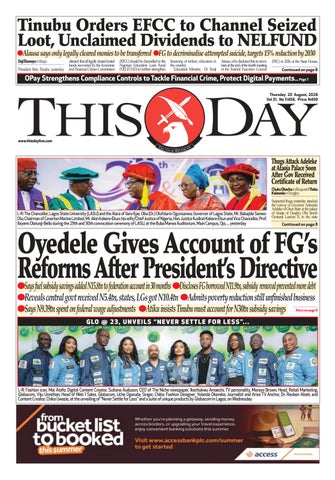
Tinubu Orders EFCC to Channel Seized Loot, Unclaimed Dividends to NELFUND Alausa says only legally cleared monies to be transferred FG to decriminalise attempted suicide, targets 15% reduction by 2030
Deji Elumoye in Abuja President Bola Tinubu yesterday
directed that all legally cleared looted funds recovered by the Economic and Financial Crimes Commission
(EFCC) should be channelled to the Nigerian Education Loan Fund (NELFUND) to further strengthen
financing of tertiary education in the country. Education Minister, Dr Tunji
Alausa, who disclosed this to newsmen at the end of the fourth meeting of the Federal Executive Council
(FEC) in 2026 at the State House, Continued on page 8
OPay Strengthens Compliance Controls to Tackle Financial Crime, Protect Digital Payments... Page 7 Thursday 20 August, 2026 Vol 31. No 11456. Price: N400
www.thisdaylive.com TR
UT H
& RE A S O
N
Thugs Attack Adeleke at Ataoja Palace Soon After Gov Received Certificate of Return Chuks Okocha in Abuja and Yinka Kolawole in Osogbo
L-R: The Chancellor, Lagos State University (LASU) and the Alara of Ilara-Epe, Oba (Dr.) Olufolarin Ogunsanwo; Governor of Lagos State, Mr. Babajide SanwoOlu; Chairman of Caverton Marine Limited, Mr. Akin Kekere-Ekun; his wife/Chief Justice of Nigeria, Hon. Justice Kudirat Kekere-Ekun and Vice Chancellor, Prof. Ibiyemi Olatunji-Bello during the 29th and 30th convocation ceremony of LASU, at the Buba Marwa Auditorium, Main Campus, Ojo, ... yesterday
Suspected thugs yesterday attacked the convoy of Governor Ademola Adeleke of Osun State at the palace of Ataoja of Osogbo, Oba Jimoh Oyetunji Laaroye II, in the state Continued on page 8
Oyedele Gives Account of FG’s Reforms After President’s Directive Says fuel subsidy savings added N15.8tn to federation account in 30 months Discloses FG borrowed N11.9tn, subsidy removal prevented more debt Reveals central govt received N5.4tn, states, LGs got N10.4tn Admits poverty reduction still unfinished business Says N9.39tn spent on federal wage adjustments Atiku insists Tinubu must account for N30tn subsidy savings
Story on page 8
G LO @ 2 3 , U N V E I L S “ N E V E R S E T T L E F O R L E S S ”. . .
L-R: Fashion icon, Mai Atafo; Digital Content Creator, Sultana Auduson; CEO of The Niche newspaper, Ikechukwu Amaechi; TV personality, Morayo Brown; Head, Retail Marketing, Globacom, Viju Unnithan; Head of Web 1 Sales, Globacom, Uche Ogwuda; Singer, Chike; Fashion Designer, Yolanda Okereke; Journalist and Arise TV Anchor, Dr. Reuben Abati; and Content Creator, Chika Uwazie, at the unveiling of “Never Settle for Less” and a suite of unique products by Globacom in Lagos, on Wednesday
2
THUSDAY AUGUST 20, 2026 • T H I S D AY
THURSDAY AUGUST 20, 2026 • T H I S D AY
3
4
THUSDAY AUGUST 20, 2026 • T H I S D AY
5
THISDAY • THURSDAY, AUGUST 20, 2026
Group News Editor: Goddy Egene Email: Goddy.egene@thisdaylive.com, 0803 350 6821, 0807 401 0580
NEWS
ADELEKE RECEIVING CERTIFICATE OF RETURN...
Governor Ademola Adeleke (R) receiving the Certificate of Return yesterday at the INEC Office from Professor Kunle Ajayi, a National Commissioner at the Independent National Electoral Commission (INEC) representing the South-West, and currently supervises electoral activities in Ogun, Ondo, and Osun States
NUPRC: Tinubu’s New Executive Order Can Unlock Additional 1m Bpd Says only 24% of oil output, 19% of gas currently produced deep offshore NMDPRA: Regulatory certainty key to attracting investment
Emmanuel Addeh in Abuja and Peter Uzoho in Lagos The Nigerian Upstream Petroleum Regulatory Commission (NUPRC) has disclosed that the Deep Offshore Oil and Gas Project Incentives (Tax Remission) Executive Order 2026 recently signed by President Bola Tinubu has the potential not only to unlock $50 billion in investments but can also create an additional one million barrels per day of crude oil and condensate from deep offshore fields. The Executive Commissioner, Development and Production of the NUPRC, Enorense Amadasu, said this on NTA during an interview, a statement by the agency’s spokesman, Eniola Akinkuotu, stated yesterday.
Also, the Chief Executive of the Nigerian Midstream and Downstream Petroleum Regulatory Authority (NMDPRA), Umar Rabiu, has said regulatory certainty is critical to attracting and retaining long-term investment in Nigeria’s midstream and downstream petroleum sectors. Amadasu explained that the reform establishes a transparent, rulesbased investment framework capable of supporting the next generation of deep offshore developments. He noted that presently, Nigeria produces about 1.7 million bpd of crude oil and condensate but deep offshore accounts for just about 24 per cent of total oil production and19 per cent of gas. “We are on the right path all thanks to Mr. President. It will be
a huge leap. As of today, we have mined over 4.6 billion barrels from deep offshore assets. In cargo terms that is about 5,000 tankers,” he said, adding that this new framework now creates greater opportunities in the deep offshore. Amadasu noted that with Field Development Plans (FDPs) running into billions of dollars already approved by the NUPRC, the executive order will encourage International Oil Companies (IOCs) to make quicker Final Investment Decisions (FIDs). “So, where will these volumes be coming from? Nine of these projects have approved FDPs so the next step expected is the FID in the near to midterm. The $10bn Bonga South will come in 2027 and
within the next four to five years, we are expecting almost an additional one million barrels additional per day,” he stated. According to the executive commissioner, the executive order also presents an opportunity for other sectors like the marine economy which will need to expand Nigeria’s logistics/marine base so the country can sustain the volume of deep offshore projects being expected. “It aims to make Nigeria the regional hub for deep offshore projects,” Amadasu said. Other benefits of the executive order as explained by Amadasu include: growth in reserves, technological/skills transfer and new jobs. Meanwhile, the Chief Executive of the NMDPRA, Rabiu, has said
regulatory certainty is critical to attracting and retaining long-term investment in Nigeria’s midstream and downstream petroleum sectors. Rabiu, who made the assertion in a post on his social media handles yesterday, said investors were generally prepared to manage commercial risks but found regulatory uncertainty considerably more difficult to accommodate when making investment decisions. He said government efforts to provide fiscal incentives, financing support and policy reforms could achieve little if investors remained uncertain about how regulations would be applied in practice. According to him, investors need confidence that rules are clear, regulatory decisions are consistent
and approval processes are predictable before committing capital to long-term projects. Rabiu said the Petroleum Industry Act (PIA) had established a strong legal and regulatory framework for Nigeria’s petroleum industry, anchored on transparency, competition and accountability. He said the responsibility of the NMDPRA was to ensure that those principles were reflected in its day-to-day regulatory activities. Having spent almost three decades on the commercial and operational side of the downstream petroleum industry before joining the Authority, Rabiu said he understood the concerns that investors typically consider before committing funds to major projects.
Tinubu Names Olumuyiwa Enitan as Africa Eyes $4bn Investment Pipeline at US Summit Head of Civil Service of the Federation Targets $500m in signed deals across six strategic sectors Takes over from Didi Walson-Jack on Aug 27
Deji Elumoye in Abuja President Bola Tinubu has appointed Mr. Abel Olumuyiwa Enitan as Head of the Civil Service of the Federation, effective August 27, 2026. According to a release issued on Wednesday by presidential spokesperson, Bayo Onanuga, Enitan succeeds Mrs. Didi Esther Walson-Jack, who will retire soon from the Federal Civil Service upon attaining the statutory retirement age of 60. Enitan, from Osun State, who is the most senior Permanent Secretary in the Federal Civil Service, had served as Permanent Secretary for seven years and seven months, working at Ministry of Police Affairs, Ministry
of Humanitarian Affairs, and Office of the Vice President. The new appointee, who is currently Permanent Secretary in the Federal Ministry of Education, brings considerable institutional experience and a deep understanding of the workings of the Federal Civil Service to his new responsibility. Tinubu expressed his profound appreciation to Walson-Jack for her distinguished service to the nation and for the reforms, impact, and innovations witnessed in the civil service during her tenure. The president wished her a fulfilling and successful life after service and conveyed the country’s gratitude for her years of dedicated and impactful public service.
Emmanuel Addeh in Abuja
About $4 billion in African investment opportunities will be presented to global institutional investors at the Africa Business Investment Summit scheduled for August 27 and 28 in Washington, DC, as businesses and governments seek to attract fresh capital beyond traditional developed markets. The two day summit, organised by the Millennium Excellence Foundation, will hold at MGM National Harbor and is targeting $500 million in signed Memoranda of Understanding (MoUs) and Letters of Intent across six strategic sectors, a statement by the organisers said yesterday. The event is expected to bring together institutional investors, private equity and private credit firms, development finance institutions,
multilateral organisations, blended finance institutions, sovereign representatives, policymakers, family offices and business executives. The summit will open with a Royal Keynote by the Asantehene and its patron, His Majesty Otumfuo Osei Tutu II, the statement explained. High level participants expected at the event include Ghana’s Vice President, Jane Naana Opoku Agyemang; Minister of Finance, Cassiel Ato Baah Forson; Governor of the Bank of Ghana, Johnson Pandit Asiama; Ghana’s Ambassador to the United States, Victor Emmanuel Smith; and Lagos State Governor, Babajide Sanwo Olu. Private sector participants confirmed for the summit include Co Founder of Sahara Group, Tonye Cole; Founder and Chief Executive Officer of Flutterwave, Olugbenga Agboola; actor, diaspora advocate
and Co-founder of Full Circle Africa, Boris Kodjoe. Also expected are: Former President of the Export Import Bank of the United States, Reta Jo Lewis; Co-founder and Chairman of Africa Capital, Thomas Svanikier; Founder and Chief Executive Officer of Next Narrative Africa Fund, Akunna Cook; and Founder and Chief Executive Officer of Sand Technologies, Fred Swaniker. President of the Millennium Excellence Foundation, Nana Agyeman Prempeh, said changing market fundamentals were making African investment opportunities increasingly attractive to global investors. “The fundamentals have changed,” Prempeh said, noting that stronger institutions, blended finance and policy reforms had helped to de risk projects and
improve their risk adjusted returns. He said the market was only beginning to recognise the shift in Africa’s investment landscape. The summit will focus on infrastructure, mining, natural resources, agriculture, manufacturing, technology, energy, critical minerals, fintech, health technology and the creative economy. The first day, themed: “Unlocking Africa’s Century: A Diaspora Mandate”, will bring together senior government officials and policymakers to discuss the political and institutional framework required to unlock investment. Discussions will include ways of moving diaspora capital beyond remittances, Africa’s position in the global critical minerals supply chain and the intersection between energy infrastructure and the United States Africa partnership.
6
THURSDAY, AUGUST 20, 2026 • THISDAY
NEWS
INDUSTRIAL AND COMPETITIVENESS FORUM ORGANISED BY THE NESG...
L-R: Acting Country Director, World Bank, Mr Taimur Samad; CEO, Nigerian Economic Summit Group (NESG), Dr. Tayo Aduloju; Deputy Chief Economist and Head, Economic Transformation and Competitiveness, NESG, Dr. Wilson Erumebor; Professor of Economics, University of Oxford, Prof. Stefan Dercon; Chairman, NESG, Mr. Niyi Yusuf; and Group Managing Director, Flour Mills of Nigeria Plc and Vice Chairman I, NESG, Mr. Omoboyede Olusanya, at the Industrial and Competitiveness Forum organised by the NESG in Lagos, yesterday
Presidency: Nigeria Needs Women’s Full Participation to Build $1trn Economy Says women’s inclusion not charity but growth strategy FG unveils four platforms to close gender finance gap, targets 4.5m women through empowerment programme
Deji Elumoye in Abuja The presidency yesterday warned that Nigeria’s ambition to build a $1 trillion economy could not be achieved without the full economic participation of women. Vice President Kashim Shettima made the assertion while declaring open the Second National Gender Inclusion Conference, #SheIsIncluded 2026.
As part of efforts enhance women’s economic participation, the federal government said it had unveiled four strategic platforms to bridge the gender gap in financial inclusion and turn women’s economic potential into enterprise, jobs, and sustainable growth. Minister of Women Affairs and Social Development, Hajiya Imaan Sulaiman-Ibrahim, who disclosed this at the conference, said the scheme had
been expanded to target 4.5 women nationwide. The event held at Banquet Hall of State House, Abuja, was organised by Presidential Committee on Economic Inclusion in the Office of the Vice President, with the theme, “Designing for Delivery: From Financial Inclusion to Economic Transformation for the Nigerian Woman.” Shettima, who was represented
by Special Adviser to the President on Special Duties (Office of the Vice President), Dr. Aliyu Modibbo, insisted that the $1 trillion economic ambition of the administration of President Bola Tinubu will remain out of reach if women continued to face structural barriers to finance, markets, skills, and other opportunities. He stated, “We have set our sights on a one-trillion-dollar economy. But
Akume Rebukes Ministers, MDAs, Others over Non-compliance with Requirements for Foreign Trips Olawale Ajimotokan in Abuja Secretary to the Government of the Federation (SGF), Senator George Akume, has expressed outrage with some members of the cabinet, heads of Ministries, Departments and Agencies (MDAs), boards, committees, and other public officials for embarking on official foreign trips without obtaining prior approval from Office of the Secretary to the Government of the Federation (OSGF). Akume said this was contrary to extant government directives and established administrative procedures regulating official travels outside the country. He made the observation in a circular with Ref. No. PRS59648/S.13/ TI/335, dated August 13, 2026, and
addressed to Chief of Staff to the President, Deputy Chief of Staff to the Vice President, Ministers/Ministers of State, Head of the Civil Service of the Federation, National Security Adviser, and Economic Adviser to the President, among others. He said some of the cabinet members and other federal appointees had habitually discountenanced several circulars issued over the years by the government to regulate official foreign travels, with a view to promoting accountability, fiscal discipline, and effective coordination of government business. Akume referenced several of the circulars arbitrarily disregarded by political appointees. They include: Circular Ref. PRS080/
ADM/GEN/I dated September 18, 2023 on Guidelines for Official Travels by Cabinet Members, Heads of Agencies and Public Officials; Circular Ref. SGF.6/S.2/X/542 dated March 31 2015 on Guidelines for Official Trips by Chairmen of Federal Government Committees, Boards of Corporations and Government-Owned Companies; Circular Ref. SGF.6/S.2/XI/774 dated September 27, 2017 on Additional Cost Control Measures to Guide Foreign Trips by Ministers and Senior Government Officials. Others include Circular Ref. SGF.59662/S.7/III dated March 8, 2018 on Observed Indifferent Adherence to Extant Regulations Guiding the Conduct of Foreign Trips by Public Officials; and Circular Ref. SGF/
OPO/1/S.3/XII/155 dated November 20, 2012 on Further Cost-Cutting Measures and Fiscal Prudence on Travel by Cabinet Members. Akume said, “Despite these directives, instances of non-compliance continue to be recorded. This trend undermines government’s efforts to ensure proper coordination, accountability, transparency, prudent management of public resources and effective monitoring of official foreign engagements undertaken on behalf of the Federal Government of Nigeria.
what kind of economy can we build if half of our people cannot participate fully in creating it?” Shettima outlined measures to move women from financial exclusion to productive economic participation. According to him, only 47 per cent of Nigerian women have formal financial accounts, compared with 58 per cent of men, describing the disparity as millions of women whose businesses lack access to affordable capital and whose entrepreneurial potential remain largely untapped. Shettima said evidence showed that Nigeria’s economic output could be significantly higher if women participated equally in the economy, insisting that investing in women is a growth strategy, not an act of charity. “The question is no longer whether we can afford to invest in women; it is whether we can afford not to. Our answer is no!” he declared. The vice president said the federal government was moving from policy declarations to an “architecture of delivery” through initiatives designed to connect women and young people to skills, capital, markets, and emerging economic opportunities. Among the initiatives, he cited the National Income Activation Initiative and Women in Energy Partnership
with the World Bank, which was positioning women to participate as entrepreneurs, engineers, investors, and leaders in the energy transition. Shettima cautioned, however, against measuring progress through national averages alone, saying aggregate figures can conceal the continued exclusion of women in rural communities. He challenged policymakers and programme implementers to identify who was being reached, who remained excluded, what interventions were working, and who should be held accountable when programmes failed. “That is the difference between announcing inclusion and governing for it,” he said, urging financial institutions, fintech companies, investors, and development partners to treat genderintentional finance as a viable market rather than concessionary charity. “Women’s enterprises are demand; their savings are capital; their ideas are innovation,” the vice president stated. He challenged state governments to measure success not merely by the number of women enrolled in programmes but by businesses expanded, jobs created, and households whose resilience improved. “Inclusion must be measured by changed lives, not attendance registers,” the vice president said.
Humanitarian Day: 1,932 Killed in 3 Months, as IHSD Launches News Networks in Abuja
tell the story. Displacement, food will train leaders on ethical leaderTyessi in Abuja insecurity and climate-related ship and inclusivity. NSITF Intensifies Nationwide Kuni It will also feature the launch With over 1,932 persons killed in emergencies continue to drive Nigeria’s North-east in the last humanitarian needs across Nigeria. of Origa’s book, “Materialism and Workplace Safety Campaign three months alone, humanitar- “But the bigger data gap is in Humanitarianism”, which analyses Onyebuchi Ezigbo in Abuja The Nigeria Social Insurance Trust Fund (NSITF) said it has embarked on nationwide campaign to promote workplace safety, with stakeholder engagements currently taking place in Bauchi, Jos and Kaduna. The programme, tagged “Programme on Safety Regulations, Policies and Standards,” is being organised by the Fund’s Health, Safety and Environment (HSE)
Department to raise awareness among employers on the importance of Occupational Safety and Health (OSH) and strengthen capacity for safer workplaces across the country. It said the engagements which is expected to end on today was designed to deepen stakeholders’ understanding of OSH frameworks, challenges and opportunities in Nigeria, while promoting the integration of workplace safety into national development and organisational
strategies. According to a statement from NSITF signed by Head of Corporate Affairs, Alexandra Mede, the programme also seeks to build participants’ capacity to develop and implement effective OSH policies, encourage collaboration among stakeholders, expose employers to emerging safety technologies and innovations, and strengthen practical skills in risk prevention, incident investigation and safety leadership.
ian operations in the region are under severe strain, the Institute for Humanitarian Studies and Social Development (IHSD), has said. Speaking at a World Humanitarian Day 2026 press briefing in Abuja on Tuesday, IHSD Registrar/ CEO, Dr. Francis Origa, said the figure from United Nations data underscored why this year’s global theme, “The Time for Consequence is Now,” #ActForHumanity must move beyond rhetoric to action. Origa stated, “The numbers
capacity. We are losing aid workers and failing to professionalise response.” To address that, the institute called on government and private sector stakeholders to increase financing for humanitarian needs, stating that most projects collapse after the pilot stage due to lack of patient capital and long-term structures. IHSD fixed its 16th Annual Humanitarian Public Lecture for Saturday, August 22, saying the event, with UNITAR-CIFAL Nigeria,
the correlation between material wealth and declining humanitarian values. IHSD also launched a nationwide Honorary Humanitarian Ambassadors Network with the Legal Aid Council of Nigeria. The network is designed to integrate paralegal services into grassroots humanitarian action, with the target of embedding access to justice, human rights, and dignity in communities currently underserved by formal systems.
7
THISDAY • THURSDAY, AUGUST 20, 2026
NEWS
AT A-ONE DAY COMPLIANCE WORKSHOP FOR INDUSTRIAL AND COMMERCIAL FACILITIES IN LAGOS...
L-R: Lead Consultant/CEO of TPHG Technologies Limited, Dr. Mofoluso Fagbeja; General Manager, Lagos State Environmental Protection Agency (LASEPA) , Dr. Tunde Ajayi; Director, Monitoring and Compliance Unit, LASEPA, Ms. Yetunde Omiwale; and the Managing Consultant, Finsbury Heinz Limited, Engr. Jamiu Badmos, at a-One Day Compliance Workshop for Industrial and Commercial Facilities in Lagos State with the theme: Operational Excellence: Data- Driven Compliance and Environmental Responsibility, held at the Adeyemi Bero Auditorium, Alausa, Lagos, yesterday
OPay Strengthens Compliance Controls to Tackle Financial Crime, Protect Digital Payments Sunday Ehigiator OPay has strengthened its compliance and risk-management systems with the deployment of artificial intelligence (AI), big data, and real-time transaction monitoring to prevent financial crime, and enhance the security of digital payments in Nigeria. The fintech company reported it had blocked more than one million fake identities and deployed thousands of real-time risk controls as part of efforts to protect consumers, merchants, and the wider digital economy. The company said the approach to compliance had become a core part of its operations as digital payments increasingly supported everyday economic activities, including receiving money, paying suppliers, settling bills, and running businesses. It said it had spent three years independently developing an Anti-Money Laundering and Counter-Terrorist Financing (AML/ CFT) risk-control and compliance system, benchmarking its approach against global fintech practices while retaining full intellectual property rights over the system. The system combines AI, big data, and real-time transaction monitoring to identify and respond to suspicious activities within milliseconds. “Stop financial crime before
it causes harm while protecting legitimate customers and businesses,” the company said, outlining the objective of the system. OPay said its approach went beyond detecting suspicious transactions after they had occurred, stressing that greater emphasis is placed on prevention and real-time intervention. It said its risk-control system currently used more than 5,000 monitoring and blocking rules and over 10,000 risk-feature profiles to assess transaction behaviour and identify potential threats. “Where suspicious activity is detected and verified, the system can intervene immediately by blocking transactions or, where appropriate, freezing and permanently suspending accounts,” the company said. According to OPay, the controls have helped keep its transaction fraud rate below 0.001 per cent. The company said preventing suspicious transactions before funds moved through the system could reduce losses, protect legitimate users, and make digital payment channels more difficult for criminal networks to exploit. On identity-related fraud, OPay said it had developed digital identity verification and live facial detection capabilities to detect identity forgery and impersonation. It said more than one million fake
identities had been blocked, while its facial live-detection system blocked tens of thousands of attack attempts every day. OPay stated, “These controls provide an important first line of defence,” the company said, adding that preventing suspicious identities from entering the financial system reduces opportunities for fraud, impersonation and money laundering.
The Alternative Bank says Nigeria’s biggest healthcare challenge is not a lack of ideas, but the absence of capital, partnerships, and delivery structures to scale those ideas beyond pilot projects. Speaking at the 2026 Insights Learning Forum in Abuja, Chukwuemeka Agada, Divisional Head of Commercial Banking at The Alternative Bank, said many health innovations stall after the pilot stage because they are not built for long-term financing. “Good ideas do not become health systems by themselves,” Agada said. “They need patient capital, credible partners, and structures that can move them from pilot sites into communities
where people need care.” He noted that projects serving low-income and underserved communities require financing models that link capital to real assets, share risk, and support long-term delivery. According to him, non-interest finance offers one viable route to fund health projects that are both impactful and financially sustainable. “Healthcare will not scale on goodwill alone,” he added. “We need capital that understands the problem, partners who can execute, and structures that make the solution last beyond the first funding cycle.” The two-day forum, convened by eHealth Africa in partnership with The Dala Group, brought together
company said. It explained that once a risk was verified, the system could trigger immediate intervention, a capability it described as increasingly important as financial crime became more organised and criminals continuously changed their tactics. It added that the ability to analyse large volumes of data and respond in real time could help financial
institutions identify threats earlier. Beyond technology, OPay said the ultimate objective of its compliance framework was to protect consumers and legitimate businesses. It stated, “Consumers need confidence that their money, accounts and personal information are protected. “Merchants need payment systems that allow them to transact without unnecessary exposure to fraud.”
NERC Tells New Board to Reset Kaduna Disco in 12 Months Transfers oversight of Akwa Ibom electricity market to AKSERC
Emmanuel Addeh in Abuja
The Nigerian Electricity Regulatory Commission (NERC) has directed the newly constituted Interim Board of Special Directors of Kaduna Electricity Distribution Plc (KAEDC) to reset the troubled electricity distribution company and return it to a sustainable growth path within 12 months. The Commission also announced the transfer of regulatory oversight of the electricity market in Akwa Ibom State from the federal regulator to the Akwa Ibom State Electricity Regulatory Commission (AKSERC), in line with the
AltBank: Healthcare in Nigeria Won’t Scale without Patient Capital, Strong Partnerships Kuni Tyessi in Abuja
It also said its compliance framework used AI and data analysis to identify unusual behaviour, with a client reporting centre and large AI models and intelligent-agent technology integrated into its risk-control processes. “These tools support automated analysis of information and help identify account patterns that may signal suspicious activity,” the
government officials, funders, health-tech innovators, and development organisations to discuss how to move digital health solutions into wider systems. Participants highlighted persistent gaps in infrastructure, data, funding, and last-mile delivery as key barriers to adoption, especially in rural and underserved areas. At the closing session, Solomon Okonkwo, Head of Corporate Social Investment at The Alternative Bank, said financial inclusion must translate to real opportunities for communities. “Finance must connect to real needs,” Okonkwo said. “When we talk about inclusion, we are talking about access, dignity, and the ability of communities to take part in economic growth.”
amended Constitution of the Federal Republic of Nigeria and the Electricity Act 2023, as amended. The two interventions are part of broader regulatory measures aimed at improving the performance of the electricity market and strengthening state level participation in the sector. Speaking at the meeting with the new board, NERC Chairman, Dr Musiliu Oseni, charged the new KAEDC leadership and Interim Administrator to deliver immediate and measurable improvements in the company’s operations. Oseni recalled that NERC had undertaken a similar intervention in 2024, which led to significant improvements in the performance of the distribution company before its former investors subsequently resumed control.
“We expect a lot from you, and the Administrator will bring you up to speed to ensure that you meet the target within one year. Most importantly, we want to begin to see progress immediately,” he said. He identified KAEDC’s high Aggregate Technical, Commercial and Collection (ATC&C) losses and significant metering deficit as two of the most critical challenges requiring urgent intervention. Also speaking at the meeting, the Director General of the Bureau of Public Enterprises (BPE), Ayo Gbeleyi, drew the board’s attention to the various metering programmes available to KAEDC, urging the management to take advantage of the initiatives to close the metering gap across its franchise area. NERC Commissioner for Legal,
Licensing and Compliance, Dafe Akpeneye, said the members of the Special Board were selected based on their professional expertise and relevant skills required to address the challenges confronting the DisCo. The Chairman of the board, Dr Abdullahi Garba, pledged that the board would work closely with NERC and BPE to resolve outstanding issues, strengthen KAEDC’s operational and financial performance and ultimately make the company viable, saleable and a model for improved performance in the Nigerian Electricity Supply Industry. The board was also tasked with demonstrating measurable improvements in KAEDC’s performance, ensuring prudent and effective utilisation of funds and deploying its collective expertise to restore the company’s market performance.
Expert Pushes for Policies to Control Tobacco Intake among Nigerians Emma Okonji A public health advocate and consultant with the Lagos State Ministry of Health, Godswill Iboma, has called on governments at the federal and state levels to come up with policies that will control tobacco intake among Nigerians, insisting that tobacco has no clinical benefits and can lead to preventable death. According to him, every few years, Sweden captures global attention in
public health, not necessarily because it has solved a problem, but because it has approached it differently. “Sweden has become one of the most closely studied case studies in tobacco, having reduced its daily smoking rate down to roughly five per cent, among the lowest recorded anywhere in Europe, where the regional average sits closer to 24 per cent. “For researchers and policymakers, however, the significance goes beyond the statistic itself. The more useful
question is how Sweden reached the point, what factors contributed to the decline, and what lessons, if any, can responsibly be drawn from its experience,” Iboma said in a statement. He explained that Sweden’s decline in smoking is generally attributed to a long-running combination of measures, including sustained tobacco-control policies, public education, restrictions on smoking in public spaces, and the availability of regulated smoke-free nicotine products.
8
THURSDAY, AUGUST 20, 2026 • THISDAY
EIGHT
PENGASSAN: Frequent Alterations to PIA May Erode Investors’ Confidence Urges support for local refining, workers’ welfare TotalEnergies: Nigeria needs to turn oil reforms into bankable projects
Onyebuchi Ezigbo in Abuja and Peter Uzoho in Lagos The Petroleum and Natural Gas Senior Staff Association of Nigeria (PENGASSAN) yesterday cautioned against subjecting the Petroleum Industry Act (PIA) to frequent alterations, saying that such measures may have negative impact on efforts to attract fresh investments into the country’s oil and gas industry. It cited the removal of some fiscal provisions and moving them to the Nigeria Revenue Act, describing the development as appalling and capable of eroding investors’ confidence in the sector. The association also said serious consideration should be given to efforts at promoting local refining of products and protection of interests and welfare of workers in the oil and gas industry. PENGASSAN President, Festus Osifo, who spoke yesterday, at the 5th Labour
and Energy Summit in Abuja, faulted the use of executive orders by the federal government to amend provisions of the petroleum law. The PIA was passed in 2021 by the National Assembly and signed into law on August 16, 2021. The new law affected the legal, fiscal, and regulatory framework of Nigeria’s oil and gas sector and led to the creation of a commercialised limited liability company (NNPC Ltd) out of the old Nigerian National Petroleum Corporation (NNPC). Osifo said the capital-intensive nature of the oil and gas industry makes it necessary for government to exercise caution in tinkering with the laws governing the sector. Osifo said rather than instill confidence or promote stability, frequent alterations “amplify uncertainty and disruption in the sector”. “Host-communities need confidence.
Governments need sustainable revenues. Nigerians need an industry that translates our enormous hydrocarbon resources into economic prosperity. “For this to happen, our regulatory environment must be predictable, transparent, efficient and fair to all. The PIA of 2021 represented a significant milestone after decades of attempts to reform the industry. “Five years into its implementation, however, we have seen considerable alterations to the framework, including the removal of some fiscal provisions and their movement to the Nigeria Revenue Act, as well as the use of an executive order to amend provisions of the law,” Osifo lamented. The PENGASSAN President urged government to implement policies that support local refining of petroleum products, including expansion of Liquefied Natural Gas (LNG), Compressed Natural Gas (CNG) should be encouraged.
Osifo said two principal petroleum regulators - the NUPRC for the upstream operations and the NMDPRA for the midstream and downstream - currently exist under the PIA, alongside several other federal and state institutions, whose statutory responsibilities intersect with oil and gas operations. He said the main challenge was not in the number of institutions, but their efficiency in the delivery of their mandates. “When responsibilities overlap, operators should not be subjected to repetitive approvals, multiple inspections or conflicting directives. Regulation must provide oversight without creating avoidable due decreases. “Regulation should never become an obstacle to investment, but Nigeria should investment become an excuse for weak standards. “There must be a balance. As an association, we remain particularly
concerned about the human consequences of regulatory and commercial decisions,” he said. Osifo also said serious consideration should be given to protection of interests and welfare of workers in the oil and gas industry. “Licencing and assets may change hands, but workers are not commodities to be discarded at will. When major acquisitions and divestments occur, jobs are crude benefits. Pensions, collective bargaining agreements and other established life of workers must be protected,” he said. Osifo cautioned against abuse of expatriate quota provision in the petroleum sector, adding that such should not become a mechanism for replacing qualified Nigerians with foreign personnel in jobs for which local capacity exists. According to him, the Nigerian Content Framework requires succession
OYEDELE GIVES ACCOUNT OF FG’S REFORMS AFTER PRESIDENT’S DIRECTIVE
Deji Elumoye, Chuks Okocha and Ndubuisi Francis in Abuja
The Minister of Finance and Coordinating Minister of the Economy, Taiwo Oyedele, yesterday acted on President Bola Tinubu’s directive that Nigerians be updated on the gains of his administration’s economic reforms, revealing that a total of N15.8 trillion was paid into the Federation Account between June 2023 and December 2025 as proceeds of subsidy removal. Of the amount, he disclosed that the federal government got N5.4 trillion within the period, while the 36 states and 774 local governments received N10.4 trillion. He also stated that the federal
government borrowed N11.9 trillion between June 2023 and December 2025, noting that the amount would have been significantly higher without the fiscal space created by its economic reforms. Oyedele’s public disclosure came hours after Tinubu declared that Nigerians deserved to know the gains of the economic reforms introduced by his administration over the past three years. The President, therefore, directed the Minister of Finance and Coordinating Minister of the Economy, to provide an account of the government’s reform scorecard to Nigerians. The reforms, which began with some of the administration’s most
far-reaching policy decisions, including the removal of the petrol subsidy and the unification of the foreign exchange market, have significantly altered the structure of the Nigerian economy. While the government has argued that the measures were necessary to strengthen public finances, attract investment and place the economy on a more sustainable footing, they have also imposed considerable pressures on households and businesses through higher energy costs, inflation and increased operating expenses. The administration has subsequently pursued measures to boost government revenue, improve tax administration, reduce fiscal leakages and strengthen the country’s fiscal position. It has
also introduced measures aimed at attracting private capital, improving the business environment and reducing the economy’s dependence on oil revenues. Tinubu, who traced the history of the reforms in a statement posted on his verified X handle, @officialABAT, said the government had a responsibility to explain both the gains and costs associated with the policies. “When we began this journey of reform in 2023, I promised that the difficult decisions we were making would serve the purpose of building an economy that works better for you and a country that is stronger for our children. “Today, your government presents the reforms scorecard. It sets out what
TINUBU ORDERS EFCC TO CHANNEL SEIZED LOOT, UNCLAIMED DIVIDENDS TO NELFUND Abuja, added that the President also directed that funds in the Unclaimed Dividends Trust Fund and the Dormant Accounts Trust Fund be mobilised for NELFUND, subject to compliance with the laws establishing the two funds. The minister, who described the President’s directives as a major boost for Nigerian students, clarified that the issue concerning EFCC recoveries applies strictly to liquid funds that have been legally recovered and are no longer subject to litigation. Alausa stated that the President further directed the Attorney General of the Federation and Minister of Justice, Minister of Finance, Ministry of Education, the Debt Management Office (DMO) and other relevant agencies to work out the legal and operational framework for transferring the affected funds. According to him, the Attorney General would also work with the EFCC Chairman to identify recovered funds that are legally available for transfer. “The President was very clear, not seized properties, all recovered looted funds, liquid funds, recovered by the EFCC will now be transferred to NELFUND,” he clarified. He explained that government would similarly examine the existing legislation governing the Unclaimed Dividends Trust Fund and Dormant Accounts Trust Fund to determine the appropriate legal steps required to make the resources available to NELFUND. Alausa added that the President was specific that only funds free of legal issues would be affected by the directive. He stressed: “Every single fund that is still subject to a legal
challenge will not be part of the money that will be transferred to NELFUND. The funds that will be transferred will be all cleared funds, unencumbered funds that were looted, funds that legally belonged to Nigeria, to Nigerians”. The minister said the President considered education one of the most productive uses to which recovered public funds could be put, especially as the administration seeks to build the human capital required to drive its ambition of growing Nigeria into a $1 trillion economy. The decision, he said, is aimed at putting NELFUND on a sustainable financial footing as demand for the student loan scheme continues to expand. Alausa explained that more than 1.2 million Nigerian students are currently benefiting from NELFUND, adding that the Fund has disbursed more than N93 billion as upkeep allowances to students in federal and state-owned public institutions. The minister said more than N250 billion had also been disbursed as institutional fees to public tertiary institutions across the country. “The education of our children cannot wait; it is of utmost importance to him (President), and he will do anything and everything to protect the future of every single Nigerian child, every single Nigerian student,” the minister stated. Alausa described the student loan programme as a fulfilment of one of President’s campaign promises to broaden access to tertiary education irrespective of students’ financial backgrounds. FEC also approved an augmentation of about N118.31 billion for the
completion of the long-abandoned National Library of Nigeria headquarters complex in Abuja, as well as about N37 billion for its furnishing. Alausa said the National Library project, started on April 29, 2006 and originally scheduled for completion within two years, had remained abandoned since work stopped in October 2008. The President, he explained, had directed the ministry to mobilise resources to revive the project, including funding sourced through the Tertiary Education Trust Fund (TETFund). Alausa also acknowledged
contribution of First Lady Senator Oluremi Tinubu, who had requested that gifts for her birthday be directed towards completion of the National Library. According to him, the initiative raised about N25 billion towards the project. “The council today approved the augmentation of existing contract for the completion of the construction of National Library of Nigeria headquarters building complex in Abuja”, he said, adding that the government hoped construction Continued on page 34
our reforms have achieved, what they have cost us, and the greater costs and harms we have prevented by acting when we did,” he stated. The President therefore directed Oyedele to give Nigerians an account of the reforms and explain the figures behind the government’s policies. According to him, Nigerians are entitled to know the extent to which the reforms had changed the economy and affected their daily lives. “You deserve to see the numbers. You deserve to know what has changed and what these reforms mean for you, your family, your business and our country. This is your government. This is your country. This is our account to you,” he added. But despite the federal government’s disclosures, former Vice President and presidential candidate of the African Democratic Congress (ADC), Atiku Abubakar, yesterday challenged Tinubu to account for approximately N30 trillion in Federation revenues, deductions, savings and transfers requiring transparent reconciliation, saying the latest July 2026 Federation Account figures showed that the troubling pattern has continued. However, speaking in Abuja, at a press conference with the theme: “Nigeria’s Reforms Scorecard: The Benefits and Harms Prevented,” Oyedele said the briefing was designed not to declare a victory, but to give an account. He noted that in the past three years,
Festus Osifo plans, understudies and deliberate naturalisation of expatriate positions. He said the federal government must ensure that relevant legislations and policies guiding operations in the oil and gas sector especially those dealing with local content are adhered to by stakeholders.
the administration of Tinubu embarked on major reforms to address age-long economic challenges. He cited the reforms as the removal of a fuel subsidy that was quietly bankrupting the country, as well as the unification of an exchange rate system that had become a source of arbitrage, distortion and corruption rather than stability. He said: “What we are discussing today runs in four parts, and I would encourage you to read all four before you write a word. The first is a full account of how the resources were raised and spent. The second sets out, in plain terms, 10 ways these reforms have benefited average Nigerians, and 10 harms they prevented. “The third is the scorecard itself - twenty-five indicators comparing where we are with the reforms to where we would have been without them. And the fourth is an appendix with the underlying figures, so that anyone - you, your editors, independent analysts - can check our arithmetic and our methodology, rather than simply take our word for it.” According to him, between June 2023 and December 2025, subsidy savings mobilised N15.8 trillion in resources for the Federation. Of this, N5.4 trillion was received by the federal government, while N10.4 trillion was shared to states and local governments, he said. However, he noted that the federal Continued on page 36
THUGS ATTACK ADELEKE AT ATAOJA PALACE SOON AFTER GOV RECEIVED CERTIFICATE OF RETURN capital, shortly after the governor received his Certificate of Return from the Independent National Electoral Commission (INEC). Osun State Police Command, last night, said it had commenced a full-scale investigation into the incident, which involved shooting and killing, by “suspected hoodlums at Itaolokan area of Osogbo”. Police Public Relations Officer (PPRO), DSP Abiodun Ojelabi, announced this in a statement. Meanwhile, Adeleke’s Certificate of Return was presented to him by Professor Kunle Ajayi, the National Commissioner representing the Southwest, and currently supervising electoral activities in Ogun, Ondo, and Osun states. Speaking after the presentation ceremony, Adeleke said his family, through the Springtime Development Foundation, would provide full scholarships up to university level for the children and dependants of those who lost their lives in the violent incidents that preceded the August
15 governorship election in the state. In a related development, Governor Abdullahi Sule of Nasarawa State said All Progressives Congress (APC) lost the governorship election in Osun State due to the activities of “Abuja politicians” who descended on the state days before the poll. Sule stated this at a press briefing in Lafia. However, Nigeria Civil Society Situation Room urged all stakeholders to build on the positive lessons from the Osun State election. In its final statement after the election, the group also advised that identified weaknesses from the exercise should be urgently addressed. Eye witnesses said regarding the attack on Adeleke that after leaving the INEC office in Osogbo, he was sighted about 3:15pm as his convoy of about 30 vehicles passed through the Olaiya axis of the state capital. He was said to be on his way to the palace of the Ataoja of Osogbo to formally present his Certificate of Return to the monarch and express his appreciation following his victory
at the governorship election. Sources informed THISDAY that suspected hoodlums, who learnt of the governor’s planned visit to the palace, had been loitering around the Oja-Oba/Ita-Olookan area ahead of his arrival. It was learnt that the attackers arrived in an unregistered Sienna bus and positioned themselves around the area while Adeleke was at the palace of the Ataoja. Sources said the governor had barely concluded his visit and was preparing to leave the palace when security personnel reportedly noticed suspicious movements around the area. According to the sources, Adeleke was advised not to leave through the same entrance he had entered the palace, apparently, as a precautionary measure. The governor subsequently exited through another route and entered his official vehicle. It was shortly after he entered the vehicle that the suspected hoodlums
opened fire, firing sporadic gunshots into the air and throwing the area into panic. The development created a tense situation around the palace as security personnel attached to the governor immediately engaged the attackers in an attempt to protect Adeleke and members of his entourage. Sources said the governor’s security details engaged the suspected hoodlums for several minutes, during which the governor and his convoy were temporarily prevented from leaving the area. The sources, who disclosed the development to THISDAY, described the situation as a brief hostage-like standoff, as the governor remained within the secured convoy while his security personnel battled to push back the attackers. The hoodlums reportedly fled the scene after they were overpowered by the governor’s security details. It was equally gathered that the Continued on page 37
9
THISDAY • THURSDAY, AUGUST 20, 2026
NEWS
REMI TINUBU ADMIRING A PORTRAIT OF HERSELF BY A 10-YEAR OLD BOY...
L-R: Ogun State Governor, Prince Dapo Abiodun; First Lady of Nigeria, Senator Oluremi Tinubu; 10year- old artist; and Wife of Ogun State Governor, Mrs. Bamidele Abiodun, after the young boy presented a portrait to the First Lady and she announced a N10 million donation for his education after she flagged off the South West National Community Food Bank Program in Abeokuta on Tuesday, August 18, 2026
Ezekwesili Demands Termination of FG’s £746m Ports Deal with UK Expresses concern over opacity of procurement processes Insists Lagos ports do not need sovereign debt to be rehabilitated
Emmanuel Addeh in Abuja Former Minister of Education and Solid Minerals, Obiageli Ezekwesili, Tuesday called on President Bola Tinubu to terminate the £746 million ports financing deal signed between Nigeria and the United Kingdom, describing it as opaque
and potentially detrimental to the country’s fiscal future. Ezekwesili, who raised the alarm about 152 days after the agreement was signed by Tinubu at Windsor Castle, said neither the Nigerian nor British government had publicly disclosed the terms of the deal, including its interest rate, repayment schedule and
other key financial details. The deal was signed during Tinubu’s state visit to the UK in March 2026, and was intended to finance the refurbishment of two of Nigeria’s major ports, the Lagos Port Complex, Apapa, and the Tin Can Island Port Complex, as part of efforts to modernise port infrastructure
and improve cargo handling and operational efficiency. But in a statement titled: “President Tinubu, Terminate the Dodgy £746 Million Ports Deal”, Ezekwesili said neither the Nigerian government nor its UK counterpart has disclosed the terms of the agreement. According to her, the lack of
UN Members Urged to Commit $15bn Annually to Prevent Future Pandemics Emmanuel Addeh in Abuja
UN Member States have been urged to commit to a stronger political declaration on pandemic prevention, preparedness and response, including increased international financing of $15 billion annually, amid warnings that the next global health emergency could emerge at any time. The call was made yesterday by the Friends of the Pandemic Prevention, Preparedness and Response (PPPR) high-level meeting, ahead of the UN meeting on pandemic prevention, preparedness and response scheduled for September. The group said the next pandemic threat could emerge in any country and spread across
regions within days, stressing that no government could protect its population from future pandemics without relying on other countries to strengthen their own preparedness. In a statement, the group said UN Member States must ensure that the outcome political declaration builds on commitments made during the COVID-19 pandemic rather than weakening them. It recalled the G20 Rome Declaration of 2021, which endorsed collective action on global health, adequate financing for pandemic prevention, preparedness and response, as well as equitable access to vaccines, diagnostics, therapeutics and other medical countermeasures.
The group also cited the call by world leaders in 2021 for a stronger international health architecture, noting that future pandemics and other major health emergencies would require global cooperation because “no single government or multilateral agency can address this threat alone.” Co-Chair of the Independent Panel for Pandemic Preparedness and Response, Helen Clark, and a member of The Elders, said the negotiations over the 2026 political declaration should be guided by whether they would make the promise of “never again” a reality. “As UN Member States consider next drafts of the political declaration, they must ask themselves: will the text make the pledge of ‘never
again’ a reality? Is it upholding the principles of multilateralism, solidarity and equity?” she said. On financing, the group recalled the findings of the high-level independent panel on financing the global commons for pandemic preparedness and response, commissioned by the G20 in 2021. The panel had estimated that international financing for pandemic prevention and preparedness needed to rise by $15 billion annually, with sustained investments in subsequent years.
transparency was particularly troubling against the backdrop of Nigeria’s rising public debt and mounting debt-servicing burden. Ezekwesili maintained that Nigeria’s public debt had risen from N87 trillion in May 2023 to more than N152 trillion, while debt service was consuming more than 60 per cent of government revenues. She also criticised the administration’s borrowing programme, stressing that annual borrowing had risen to almost N50 trillion, driven in part by a $21.45 billion external borrowing plan approved by the National Assembly. On the ports financing agreement, she said at least £236 million was contractually reserved for British suppliers, while British Steel had secured a £70 million contract which it described as one of the largest in its history. “Nigeria borrowed the money that British companies will harvest the contracts and Nigerians will repay the debt,” she said, questioning why the interest rate and repayment timeline had not been made public. Ezekwesili said civil society organisations, including BudgIT, as well as opposition parties, had demanded disclosure of the agreement
but had yet to receive substantive responses. She identified three major concerns with the transaction, beginning with what she described as currency risk. According to her, the loan was denominated in pounds sterling and benchmarked to a floating dollar rate, while repayment would ultimately be made from a Nigerian economy whose currency had lost significant value since 2023. She also raised concerns about the procurement process, particularly the reported involvement of ITB Nigeria, a company she said was owned by Gilbert Chagoury, whom she described as a close associate of Tinubu. Ezekwesili, who recalled that she was involved in Nigeria’s public procurement reforms, questioned whether the contractor was selected through a competitive process and demanded evidence of the involvement of the Bureau for Public Procurement and the publication of the evaluation criteria. “Credible reporting identifies ITB Nigeria, a company owned by Gilbert Chagoury who is publicly identified as a bosom friend of President Tinubu, as the primary contractor without the due process of competitive tender,” she alleged.
Eno Cautions Citizens Against Inflammatory Statements that Could Divide State The governor stressed that the including the deputy governor and
Okon Bassey in Uyo
commitment chief delivery advisor, come from Women’s Group Condemns Impeachment Akwa Ibom State Governor, Pastor administration’s to the “Akwa Ibom United” different senatorial districts and parts Eno, has cautioned indigenes philosophy was reflected in the of the state. The governor emphasised that of the state against initiating and spread of government projects, of Bayelsa’s Only Female Council Chairman Umo circulating narratives capable of appointments and opportunities his administration had not allowed Sunday Aborisade in Abuja
The Women for 35% Initiative of the AJU Morgan Elumelu Foundation has condemned the impeachment of the Executive Chairman of Sagbama Local Government Area of Bayelsa State, Hon. Mrs. Alice Tangi Allen. The group described the development, which occurred on Tuesday, as a disturbing setback for women’s participation in Nigerian politics. Allen, who was elected on the
platform of the Peoples Democratic Party (PDP) and sworn in on May 29, 2024, was the only female among the eight elected local government chairmen in Bayelsa State. In a statement signed by the founder of the foundation and Convener of the Women for 35% Initiative, Ambassador AJU Elumelu, the organisation alleged that Allen had faced intimidation, pressure and political harassment
over her reported refusal to defect from the PDP to the ruling All Progressives Congress (APC). The foundation said it had refrained from making public comments while monitoring developments, hoping that dialogue and respect for democratic principles would resolve the dispute. It, however, expressed concern that the situation had eventually culminated in the chairman’s impeachment.
creating division among the people. Eno gave the warning at the Victor Attah International Airport, Uyo, after arriving from Mirabel, Quebec, Canada, where he had gone for the pre-delivery inspection of the latest aircraft acquired by Ibom Air. He called on Akwa Ibomites to disregard claims capable of stirring ethnic or political sentiments, urging them to remain united and committed to the collective advancement of the state.
across the 31 local government areas of the state. He stated, “This state moves as one. Previous leaders had led the state as one. Since I came on board, I have deepened the Akwa Ibom United mantra, and we are operating as one all around.” Eno said the broad representation within his administration was evidence of the inclusive approach being adopted in governance, stating that key government officials,
ethnic origin to determine how individuals were treated or the opportunities available to them, describing attempts to portray the state as divided as distractions from the work of government. “I don’t think I have ever defined anybody by where they come from. So, I ask Akwa Ibomites to ignore all of those things. There is nothing like division anywhere. People just want to distract government,” the governor declared.
10
THUSDAY AUGUST 20, 2026 • T H I S D AY
THURSDAY AUGUST 20, 2026 • T H I S D AY
11
12
THUSDAY AUGUST 20, 2026 • T H I S D AY
PRESIDENTIAL WORKING GROUP
ON THE NATIONAL POLICING BILL EXTENSION OF DEADLINE FOR SUBMISSION OF MEMORANDA AND POSITION PAPERS Background The Presidential Working Group has commenced work on the National Policing Bill which is meant to translate the constitutional amendment establishing a dual police structure, comprising the Federal Police Service and State Police Services, into a final, implementation-ready draft National Policing Bill for handover to the Federal Ministry of Justice. Please be informed that the deadline for the submission of Memoranda and Position Papers has been extended.
The new deadline is 21st August 2026 at 5:00 p.m. (WAT).
This extension is intended to ensure that all stakeholders have the opportunity to present their inputs. Submission Guidelines and Deadline All submissions must be made through the official portal at nationalpolicingbill.com, in PDF format and OSCOLA referencing style as set out below, on or before 21st August 2026 at 5:00 p.m. (WAT). Submissions received after the deadline may not be considered. Submissions made by any channel other than the official portal will not be accepted. Memoranda and position papers should: l Not exceed ten (10) pages, excluding annexes, and be submitted in English; l Be submitted as a single PDF document, with any supporting annexes clearly labelled, paginated and merged into the same file: l Use OSCOLA (Oxford University Standard for Citation of Legal Authorities) referencing throughout, including for citations to legislation, case law, official reports and secondary sources; l State the submitting institution or individual, designation, and contact details; l Disclose any institutional or professional interest relevant to the subject matter of the submission. l Submissions are encouraged on any of the themes as outlined on the official portal, nationalpolicingbill.com. Respondents need not address every theme; focused, well-substantiated submissions on one or two themes are preferred to broad but general commentary. Enquiries Further information on this Call, including guidance on the submission portal and referencing requirements, is available at nationalpolicingbill.com or send an email to submissions@nationalpolicingbill.com
Signed:
Nnadubem Moghalu
Senior Special Assistant to the President (Planning and Research) Secretary, Presidential Working Group on the National Policing Bill
THIURSDAY AUGUST 20, 2026 • T H I S D AY
13
14
THUSDAY AUGUST 20, 2026 • T H I S D AY
THURSDAY AUGUST 20, 2026 • T H I S D AY
15
16
THUSDAY AUGUST 20, 2026 • T H I S D AY
THURSDAY AUGUST 20, 2026 • T H I S D AY
17
18
THUSDAY AUGUST 20, 2026 • T H I S D AY
THURSDAY AUGUST 20, 2026 • T H I S D AY
19
T H I S D AY THURSDAY AUGUST 20, 2026 20 TR
UT H
& RE A S O
Thursday August 20, 2026 Vol 27. No 11448
N
opinion@thisdaylive.com
www.thisdaylive.com
UNIVERSITIES AS ORPHANS AND BASTARDS
Another major strike is imminent unless government wakes up to their responsibilities, contends JEFF GODWIN DOKI STOP
PUBLIC UNIVERSITIES
PUBLIC UNIVERSITIES
PUBLIC UNIVERSITIES PUBLIC UNIVERSITIES
PUBLIC UNIVERSITIES
See page 21
LESS NOISE, MORE IMPACT
Kabir Masari is a bridge between the Presidency, party stakeholders, elected officials and other influential actors, writes ADE SAMUEL
See page 21
EDITORIAL
THE UNENDING SCOURGE OF MALARIA
See page 22
1
Culture needs heirs, not enemies, argues K BOLANLE ATI-JOHN
‘WE DO NOT HAVE TO BE THE SAME TO BELONG’
There is a particular sadness in watching peoples who could enrich one another retreat behind walls of suspicion. They may live on the same street in Lagos, trade in the same market in Kano, or study in the same classroom in Jos, yet remain separated by inherited stories about who can be trusted and who must be feared. The tragedy is not that they are different. Difference is one of humanity’s great endowments. The tragedy begins when difference is taught as danger, when memory becomes a prison, and when belonging is defined by whom it excludes. We do not have to speak the same language or practise the same customs to recognise one another as members of a shared home. The desire to belong is among the deepest of human needs. We draw strength from familiar names, languages, foods, faiths, and ceremonies. A Yoruba child learning the proverbs through which elders compress experience into wisdom, an Igbo apprentice discovering that enterprise carries obligations to community, a Hausa girl mastering an inherited craft, or an Ijaw boy learning the stories of the creeks is joined to a chain of memory beyond a single lifetime. But belonging becomes dangerous when it requires an outsider, when affection for our own community depends on contempt for another. We can love our ancestral home without despising the neighbour’s home. Culture needs heirs, not enemies. Much of what Nigerians fear about one another is not discovered through encounter but inherited through narration. Children first meet other peoples in the words spoken around them: a joke about an accent, a warning about a surname, a story repeatedly told, long before personal experience begins. One person’s wrongdoing is then attributed to an entire people, while the same conduct by someone from our own community is treated as an individual failure. By the time the child meets the supposed stranger, imagination has already supplied a verdict. No child is born knowing which Nigerian name to fear; fear must first be placed there. This suspicion is not inherited only in whispers; it can also be amplified in public, whenever communal wounds are turned into rivalries and belonging into a claim that one people must lose for another to gain. The categories of “indigene” and “settler,” often used to
determine who fully belongs and who may access education, employment, or opportunity, show how easily an accident of ancestry becomes a permanent verdict. Genuine grievances deserve to be heard. Grievance ceases to serve justice, however, when it hardens into a standing instruction to distrust. Not every inherited fear is imaginary. Nigerian communities carry memories of civil war, massacres, displacement, and moments when neighbours failed to protect one another. Such memories should not be erased; they preserve truth and warn against the return of cruelty. Yet memory betrays its purpose when descendants are assigned permanent guilt for acts they did not commit. No child enters the world answerable for crimes committed before birth; later generations inherit a responsibility to learn what happened and repair what lies within reach, but responsibility is not inherited guilt. Healing is not amnesia; it is the refusal to let yesterday’s injury govern every relationship tomorrow. Nigeria is not alone in this struggle: from Rwanda to South Africa, African societies have had to decide whether memory will serve as a teacher or become a jailer. There is nothing noble in loving one’s heritage only by declaring another inferior. Healthy pride preserves language, craftsmanship, ceremony, and moral memory. The bronze traditions of Benin, the indigo dyeing of Kano, the uli artistry of the Igbo, and the boatbuilding knowledge of riverine communities do not compete for recognition; each enlarges what is available to all. Supremacy, by contrast, arranges people into a hierarchy with its own kind at the summit. Secure cultures do not fear encounter; insecure ones build walls and call them purity. Pride says, “This is what we bring.” Supremacy says, “Only what
we bring has value.” Beyond Africa, the histories of Europe and Asia remind us that no civilisation is naturally immune to that temptation. No single people in Nigeria contains the entire repertoire of human wisdom or beauty. Our foods carry histories of movement, our music crosses linguistic borders, and our cities are built by hands drawn from every region. Daily life quietly disproves the mythology of separation: a patient in Ibadan entrusts her life to a doctor from Borno, a trader in Kano depends on goods from Aba, and an engineer from Enugu works beside a technician from Sokoto. Shared labour reveals what stereotypes conceal; the stranger known only by an accent becomes a colleague, neighbour, and friend. Peaceful coexistence asks more of us than the reluctant tolerance of people we have decided never to understand. Tolerance may mean merely enduring another’s presence; harmony requires curiosity, reciprocal respect, and the willingness to defend another community’s dignity. It permits disagreement without dehumanisation, cultural confidence without domination, and remembrance without collective condemnation. A Nigerian does not demonstrate loyalty to a community by remaining silent when one of its members wrongs another. Coexistence becomes genuine when another people’s safety matters to us even when our own is not threatened. Every generation receives an inheritance of identity, but it must decide which parts deserve to be passed on. We transmit culture through language, names, ceremonies, and memory, and we decide whether our children inherit unresolved suspicions too. A child should know the beauty of an ancestral language without learning to mock another accent. A family can preserve the memory of past injury without assigning an enemy to a child not yet born. The highest form of ancestral fidelity is to preserve what gives life while refusing what causes injury. We do not honour our ancestors by inheriting their enemies. Rear Admiral Ati-John (Rtd) psc(+) fdc(+) is a Distinguished Fellow of the National Defence College, Abuja, and writes from Lagos.
T H I S D AY
321
THURSDAY AUGUST 20, 2026
Kabir Masari is a bridge between the Presidency, party stakeholders, elected officials and other influential actors, writes ADE SAMUEL
Another major strike is imminent unless government wakes up to their responsibilities, contends JEFF GODWIN DOKI
LESS NOISE, MORE IMPACT
UNIVERSITIES AS ORPHANS AND BASTARDS
Every successful presidency depends not only on the vision of the elected leader but also on the quality of those entrusted with translating that vision into political reality. While ministers formulate policies and agencies execute programmes, political advisers perform a different but equally important function. They help maintain relationships, manage competing interests, anticipate political risks and ensure that governance remains connected to the realities of party politics. Within President Bola Ahmed Tinubu's administration, Ibrahim Kabir Masari occupies one of those strategic positions. The office of Senior Special Assistant to the President on Political and Other Matters is not one that naturally attracts public attention. Its work is largely conducted away from television cameras and newspaper headlines. Yet in Nigeria's political system, where coalition-building, consultation and consensus are indispensable, such roles can carry considerable influence. The effectiveness of the office often lies not in public visibility but in the ability to foster dialogue, reduce tensions and support the political stability needed for governance. Masari first came into national prominence during the 2023 presidential election when he served as placeholder for the then APC presidential candidate Asiwaju Bola Ahmed Tinubu before his name was officially submitted to INEC as the candidate of APC, even though he has been his friend for over 30 years. The arrangement was a strategic and temporary measure that enabled the party to comply with electoral requirements while broader consultations continued. By accepting the responsibility, Masari demonstrated political maturity, loyalty and an understanding that party strategy sometimes requires personal sacrifice. His conduct throughout the process reflected discipline and a commitment to the collective interest, qualities that further strengthened President Tinubu's confidence in his judgment and
earned him recognition as one of the President's trusted political allies. His subsequent appointment into the Presidency suggested that President Tinubu valued his political experience and organisational abilities. While much of Masari's day-to-day work remains outside the public domain, political advisers generally serve as bridges between the Presidency, party stakeholders, elected officials and other influential actors. In a country as politically diverse as Nigeria, that function can be essential to sustaining dialogue and managing expectations. President Tinubu's political career has long been associated with coalition-building and the cultivation of political networks. From his years as Governor of Lagos State to his emergence as President, his style has often relied on assembling teams of trusted allies with different areas of expertise. Political advisers are part of that broader architecture. Their role is not to replace elected leaders but to provide strategic counsel and help navigate the complexities of governance. Nigeria's political environment presents unique challenges. Regional interests, party dynamics, legislative negotiations and competing policy priorities all require continuous engagement. Governments pursuing ambitious reforms must not only implement policies but also build sufficient political support to sustain them. This makes political management almost as important as policy management. Against that backdrop, the value of experienced political advisers becomes more apparent. Effective advisers help identify emerging political concerns before they develop into larger problems. They encourage dialogue among stakeholders and help maintain cohesion within governing coalitions. These responsibilities are often invisible to the public, but they can influence the broader political climate. Like every political appointment, the work of presidential advisers should also be viewed through the lens of accountability. Their success should not be measured by proximity to power alone but by whether their contributions strengthen democratic governance, improve communication between government and stakeholders, and help create an environment in which public institutions can function effectively. Healthy democracies benefit when political advisers facilitate consensus while respecting institutional processes. As attention gradually shifts toward the evolving political landscape and the approach to future electoral cycles, advisers who understand party structures, political negotiation and coalition management are likely to remain important figures within the administration. Samuel writes from Abuja
It is no exaggeration to say that the crisis in Nigeria’s Tertiary education sector is a political one. And a quick look at the serial and cyclical crisis in Nigerian universities leaves no one in doubt that this is not an educational problem at all. It is a political crisis and it is a crisis of a ruling elite that has no use for public education because its own children do not attend public schools in Nigeria. Since the 1970s and 1980s crude militarism and authoritarianism, employing other violent tactics like coercion, intimidation, arrests and harassment, ensured that Agreements and MoUs signed with the Academic Staff of Universities were designed, even from the very beginning, to be violated. This trend has continued till this day and it has become part of the governance culture whether under military or civilian regimes. For close to four decades now the Nigerian state has waged a silent war against public education. And this war is a deliberate strategy: Underfunding, non-payment of salaries and allowances, refusal to honor agreements-- all of these have become deliberate policy to keep Nigerian citizens ignorant so that they can easily be manipulated and ruled. Recall that the ASUU- FGN Agreement which was signed in December, 2025 started in 2006 and stretched to 2009. In 2009, the FGN signed the agreement with ASUU made up of all Federal and State Universities. The Government team was headed by Chief Gamaliel Onosode while ASUU was represented by Dr. Abdullahi Sule who was later replaced by Prof. Ukachukwu Awuzie, himself a Professor from a State University in Nigeria. Over the years, ASUU made series of efforts to get the government to renegotiate this very agreement. The efforts of ASUU bore some kind of fruit in March, 2017 when the government constituted a committee to renegotiate the 2009 Agreement. The first attempt was by the committee headed by Wale Babalakin which was botched and replaced by the committees of Jibril Munzali and Emeritus Prof. Nimi Briggs. At the end of the day, it was the Agreement submitted by the Alhaji Yayale Ahmed committee in February, 2025 that was renegotiated and signed in December 2025. Then on January 14, 2026, the FGN decided to publicly unveil the agreement in Abuja with much mumbo-jumbo and fanfare that smacked of hypocrisy and deceit. When has the signing of an agreement become some national victory? But let’s be clear on this point. The 2025 Agreement is not a gift to ASUU. Rather, the agreement is a minimal, belated recognition of the rot in the university system. More worrisome is the fact that the Nigerian government has failed to implement that minimal
STOP
PUBLIC UNIVERSITIES
PUBLIC UNIVERSITIES
PUBLIC UNIVERSITIES PUBLIC UNIVERSITIES
PUBLIC UNIVERSITIES
component. But again, the failure of the government to implement the 2025 Agreement tells us everything about the contempt with which it holds education. But here is the real irony: Nigeria hosts 312 universities (77 federal, 67 state, and 168 private) but the number of illiterate citizens in the country is on the rise every day and even among the literate many can merely read while only a few can think. State universities are the most tragic victims in Nigeria because they are at the mercy of Governors who see them as constituency projects to be commissioned and abandoned. State universities do not have autonomy. Another way of putting this is to say that state universities are election projects and not institutions. A university whose Vice Chancellor is appointed by a Governor, whose budget is determined by a Commissioner and whose Governing Council can be dissolved by fiat is not a university. It is a parastatal. It is rather unfortunate that the university has become a place where the logic of primitive accumulation and predation plays itself out. There is an obvious case of predation in all these. Deliberate underfunding, decay and rot on university campuses and incessant ASUU strikes are not accidents. They have become policy and a governing culture. To put it bluntly the ruling elite is engaged in a systematic destruction of public education. The deliberate plan is to avoid building institutions that can challenge them. Very recently, more than 20 State and some Federal universities have threatened to embark on strike action if their demands are not met. And as at the time of writing this piece many State universities in Nigeria are on strike because of the non-implementation of the 2025 Agreement. But why are their demands not met? It is simply because States and Federal governments starve universities of funds and blame lecturers and students when standards fall. Except States and Federal governments in Nigeria wake up to their social responsibilities we may experience another strike action in the coming days. Prof Doki writes from University of Jos
22 4
T H I S D AY THURSDAY AUGUST 20, 2026
EDITORIAL
Editor, Editorial Page PETER ISHAKA Email peter.ishaka@thisdaylive.com
THE UNENDING SCOURGE OF MALARIA All the stakeholders should do more to ensure the disease is eradicated
M
osquitoes may be small, according to the World Health Organisation (WHO), but they are responsible for spreading some of the deadliest diseases known to humankind. With Nigeria among the 11 countries that carry approximately 70 per cent of the global burden of malaria, the 2026 World Mosquito Day being marked today is another reminder to the health authorities in Nigeria that malaria is still one battle that needs to be won, even when gains have been made in recent years. Today also presents another opportunity for stakeholders to reflect on the 2024 Yaounde Declaration which expressed “unwavering commitment to the accelerated reduction of malaria mortality.” The World Mosquito Day commemorates the discovery made in 1897 by a British doctor, Ronald Ross, who identified pigmented malaria parasites inside the stomach tissue of a female Anopheles mosquito that had fed on an infected patient. It was his finding that proved, for the first time, that mosquitoes transmit malaria between humans. And Ross, then an army surgeon working in India, went on to win the Nobel Prize in 1902 for this discovery. Authorities have at different times revealed that malaria contributes about 25 to 30 per cent of childhood mortality and about 60 per cent of hospital attendance in Nigeria. It is also a major cause of absenteeism in schools, markets, and workplaces, as well as a significant out-of-pocket expense for most households. And with the environmental conditions and associated ailments, which have all combined to make malaria a scourge for both the young and old, the statistics of death from the disease remain startling. Malaria is a mosquito-borne infectious disease. Symptoms typically include fever, fatigue, vomitting and headaches. In severe cases, it can cause yel-
low skin, seizures, coma, or death, as it is the case in Nigeria. Experts believe the number of Malaria death could be reduced drastically if Nigerians stopped embracing the disease as part of their lifestyle. Preventive measures include keeping a clean environment, removing stagnant water, consistent use of insecticide-treated nets, and proper diagnosis before treatment. Not only does malaria continue to directly endanger not only the health of the people, but it also perpetuates a vicious cycle of inequity. However, the situation is not all bleaks. The World Bank has revealed that over the past decade, 11 African countries have reduced confirmed malaria cases by more than 50 per cent. The bank has also reported steady progress in Nigeria. The National Malaria Control Programme is moving to increase access to malaria prevention, treatment service, and community mobilisation so as to reduce the burden of the disease. However, combating Malaria requires multifaceted actions and partnerships involving public and private, international and civil society sectors. In March 2024, the Yaounde Declaration was signed by Ministers of Health in Africa. The pledge is to provide stronger leadership and increased domestic funding for malaria control programmes. They also expressed their commitment “to hold each other and our countries accountable for the commitments outlined in this declaration.” The federal government in 2023 approved the WHO-recommended R21/Matrix-M vaccine for the prevention of clinical malaria in children from five months to 36 months of age. It is adjudged to be 80 per cent effective. To the extent that defeating malaria is critical to ending poverty and improving maternal and child health, Nigeria cannot afford to lag. As we join other countries to mark the 2026 World Mosquito Day, the hope is that health authorities will adopt the best possible strategy in dealing with the challenge.
Malaria is a major cause of absenteeism in schools, markets, and workplaces, as well as a significant outof-pocket expense for most households T H I S D AY
EDITOR SHAKA MOMODU DEPUTY EDITOR WALE OLALEYE MANAGING DIRECTOR ENIOLA BELLO DEPUTY MANAGING DIRECTOR ISRAEL IWEGBU CHAIRMAN EDITORIAL BOARD OLUSEGUN ADENIYI EDITOR NATION’S CAPITAL IYOBOSA UWUGIAREN THE OMBUDSMAN KAYODE KOMOLAFE
T H I S D AY N E W S PA P E R S L I M I T E D
EDITOR-IN-CHIEF/CHAIRMAN NDUKA OBAIGBENA GROUP EXECUTIVE DIRECTORS ENIOLA BELLO, KAYODE KOMOLAFE, ISRAEL IWEGBU DIVISIONAL DIRECTORS SHAKA MOMODU, PETER IWEGBU, ANTHONY OGEDENGBE DEPUTY DIVISIONAL DIRECTOR OJOGUN VICTOR DANBOYI SNR. ASSOCIATE DIRECTOR ERIC OJEH ASSOCIATE DIRECTOR PATRICK EIMIUHI CONTROLLERS ABIMBOLA TAIWO, UCHENNA DIBIAGWU, NDUKA MOSERI DIRECTOR, PRINTING PRODUCTION CHUKS ONWUDINJO TO SEND EMAIL: first name.surname@thisdaylive.com
Letters to the Editor Letters in response to specific publications in THISDAY should be brief (150-300 words) and straight to the point. Interested readers may send such letters along with their contact details to opinion@thisdaylive.com. We also welcome comments and opinions on topical local, national and international issues provided they are well-written and should also not be longer than (750- 1000 words). They should be sent to opinion@thisdaylive.com along with photograph, email address and phone numbers of the writer.
LETTERS
BUILDING PARTNERSHIPS FOR A NEW CULTURAL ERA
Change is an inevitable part of every professional journey. For Executive Assistants, few transitions are as significant as moving from supporting one executive to partnering with another, particularly within a more dynamic, fast-paced organizational culture. While such a transition may feel daunting, it also presents an opportunity for growth, greater impact, and continued professional development. But it must start with embracing the shift. Every executive brings a unique leadership style, set of priorities, and expectations. As trusted business partners, executive assistants play a pivotal role in adapting to these differences while maintaining the high standards of support that contribute to executive success. The key to a successful transition lies in balancing continuity with adaptability. While the experience gained from supporting a previous executive provides a strong foundation, it is equally important to remain open to new ways of working, communicating, and collaborating. The first step in building a successful partnership is
gaining a clear understanding of the new executive’s preferences and working style. This includes learning how they communicate, make decisions, manage priorities, and engage with stakeholders. Taking time to observe patterns, ask thoughtful questions, and seek regular feedback helps establish trust and alignment early in the relationship. The more effectively an Executive Assistant understands their executive’s needs, the more proactive, strategic, and impactful their support becomes. Organizations with dynamic cultures often operate at a faster pace, embrace innovation, and encourage greater collaboration across teams. In these environments, agility becomes a critical skill. Executive assistants may find themselves managing rapidly changing priorities, coordinating cross-functional initiatives, and supporting executives who expect timely access to information, insights, and solutions. Success in this setting requires flexibility, resilience, and a willingness to embrace change rather than resist it. Strong professional relationships are essential during
any transition. Connecting with key stakeholders, members of the leadership team, and fellow Executive Assistants provides valuable insight into the organization’s culture, dynamics, and expectations. These relationships not only enhance day-to-day effectiveness but also position the Executive Assistant as a trusted connector who facilitates communication, collaboration, and alignment across the business. In a fast-moving environment, the most effective Executive Assistants anticipate needs before they arise. Rather than simply responding to requests, they identify potential challenges, prepare executives for upcoming decisions, and implement systems that improve efficiency. However, every proactive approach should be aligned with the executive’s leadership style, preferences, and working patterns. Precious Momife-Emechebe, Chartered Executive Assistant in a Lagos-based multinational company
THURSDAY AUGUST 20, 2026 • T H I S D AY
23
24
T H I S D AY • THURSday AUGUST 20, 2026
Politics
Acting Group Politics Editor DEJI ELUMOYE Email: deji.elumoye@thisdaylive.com 08033025611 sms only
Kefas–Ibrahim Ticket and Taraba’s Emerging Political Consensus
In a democratic culture where political selections are often interpreted through the narrow prisms of electoral arithmetic, zoning arrangements and elite bargaining, the gracious choice of APC’s National DeputyWomen Leader, Hajiya Zainab Ibrahim as Taraba’s State Governor’s preference as running mate for 2027 election represents the fusion of executive experience with grassroots credibility, visionary leadership. Jonathan Eze writes.
Kefas
Ibrahim
I
n a political environment often characterised by loud rhetoric, shifting loyalties and intense personal ambitions, a few public figures have built their reputations on consistency rather than controversy. Among this category is Hajiya (Dr.) Zainab Abubakar Ibrahim of Taraba State, whose political journey has increasingly become a reference point in discussions about disciplined party service, women-focused leadership and grassroots mobilisation. Having served for years, and still serving as the Deputy National Women Leader of the All Progressives Congress (APC), Hajiya Ibrahim has quietly but steadily established herself as one of the party’s
most dependable female leaders. Beyond the title, however, lies a political career defined by loyalty, humility, humanitarian service and an uncommon willingness to place institutional interests above personal ambition. Loyalty as Political Capital Perhaps the most defining feature of Hajiya Ibrahim’s political life is her unwavering loyalty to both her party and its leadership. In an era when defections and political realignments have become almost routine, she has remained firmly committed to the APC while working across different administrations
and party structures. Loyalty, in her case, has never appeared transactional. Rather than using political appointments merely as stepping stones, she has consistently invested her energy in strengthening party structures, mobilising women and expanding grassroots participation. Her emergence as Deputy National Women Leader was itself a recognition of years of organisational work, particularly in women mobilisation and political inclusion. Since assuming office, she has continued to support successive party programmes while maintaining cordial relationships with leaders across different tendencies within the APC.
Such consistency explains why many party faithful describe her not merely as a political office holder but as a stabilising force within the women’s wing of the APC. Champion of Women Without Seeking Personal Glory Across Nigeria, conversations about women’s political participation frequently mention the need for leaders who actively create opportunities for others instead of simply occupying positions themselves. Observers argue that Hajiya Ibrahim belongs to this latter category. NOTE: Interested readers should continue in the online edition on www.thisdaylive.com
Anambra: Zoning Re-echoes as LG Polls Draw Near
David-Chyddy Eleke reports that as local government elections draw near in Anambra state, the debate on the need to strengthen zoning in the state has been further reechoed.
O
n August 29, 2026, less than two weeks from now, eligible voters in Anambra state will go to polls to elect chairmen and councillors for the 21 local government areas of the state. Eight months back, the state had also successfully concluded a governorship election where the incumbent, Prof Chukwuma Soludo was reelected and had since been sworn in. This month’s election brings to the fore once more the unwritten zoning system for political offices that exists in the state which has remained very potent in every election year. Though the pact can be termed a gentleman’s agreement that ensures rotation of power among the three senatorial zones in the state, but it has proven to cure a lot of nuisance associated with politicking, especially multiplicity of candidates, violence and waste of resources. While the pact was first pronounced by Mr Peter Obi the former governor of the state, who stamped his feet strongly on the ground and insisted on producing a successor from Anambra North, the pact which has continued to determine the zone of successive governor afterwards seems to have been taken a notch further by the administration of Prof Chukwuma Soludo, especially with the coming local government election. THISDAY gathered that during the primary election of the All Progressives Grand Alli-
Soludo
ance (APGA) for the local government election which was held in February, Soludo who monitored the process keenly ensured that zoning arrangements were adhered to in local
government areas where such already exist, while new ones were entrenched. As the state looks forward to producing a new set of leaders at the local government level, the need for adherence to the already
existing system which has fostered so much peace and harmony cannot be over emphasized. Already, with the success the arrangement has so far brought in Anambra, many are already calling for a further deepening of the system through micro zoning to accommodate areas where people have hardly had a shot at power. Proponents of this idea believe that it could help address perceived injustice and marginalization, while also fostering development in places where indigenes have not had the opportunity of calling the shot. For example, Mr Anayo Ezeigwe, a public affairs analyst told our correspondent that: “The zoning arrangement we enjoy in Anambra today has removed the tigbuo zogbuo (violent) aspect of politicking in our state. People like me believe that because of the expensive nature of politics generally and especially in Anambra, certain parts of the state would have dominated its politics because of their wealth. “For example, do you think Anambra South or Central would have ever conceded power to Anambra North if it was not for Peter Obi that insisted on ensuring it was the turn of Anambra North to be governor, after the south and central have had their shots? NOTE: Interested readers should continue in the online edition on www.thisdaylive.com
25
T H I S D AY • Thursday, August 20, 2026
BUSINESSWORLD R A T E S MONEY MARKET
A S
REPO
A T
Group Business Editor Eromosele Abiodun Email oriarehu.eromosele@thisdaylive.com
08056356325
A ugust
S & P INDEX
1 9 , 2 0 2 6
S & P INDEX
EXCHANGE RATE
OPR
25.34%
CALL
23.25%
INDEX LEVEL
595.26
1/4 to daTE
0.24%
N1,383.00 / 1 US DOLLAR*
OVERNIGHT
25.18%
1-MONTH
21.37%
1-DAY
0.10%
YEAR TO DATE
-10.99%
*AS AT Wed., August 19, 2026
3-MONTH
22.41%
MONTH-TO-DATE
0.24%
4G Market Penetration Slides as Telcos Move to Boost 5G Utilisation
Stories by Emma Okonji After maintaining market penetration lead with high subscriber utilisation across networks for close to four years, the market penetration of 4G suddenly dropped to 54.30 per cent in the month of May 2026, after attaining 54.41 per cent in April 2026, statistics released by the Nigerian Communications Commission (NCC), has revealed. Before recording a slight market penetration drop in May this year, 4G had maintained a steady lead in
market penetration for close to four years, since the launch of 5G in Nigeria in 2022. As at December 2025, 4G penetration was 52.95 per cent, 2G penetration was 37.37 per cent, 3G penetration was 5.91 per cent, while 5G penetration was just 3.77 per cent, according to the NCC’s statistics, which THISDAY obtained from its website. The statistics showed that 4G continued to lead in January 2026 with an increased market penetration of 53.41 per cent, followed by 2G with a market penetration of 36.97 per cent and 3G with
a market penetration of 5.67 per cent, while 5G had market penetration of 3.94 per cent. In February 2026, 4G also maintained the lead position with a market penetration of 53.59 per cent, followed by 2G with a market penetration of 36.87 per cent and 3G with a market penetration of 5.49 per cent, while 5G had market penetration of 4.06 per cent. In March 2026, 4G again, maintained the lead position with a market penetration of 53.76 per cent, followed by 2G with a market penetration of 36.74 per cent and 3G with a market penetration of 5.30 per
cent, while 5G had market penetration of 4.20 per cent. In April 2026, 4G market penetration reached its peak with 54.41 per cent, followed by 2G with a market penetration of 35.93 per cent and 3G with a market penetration of 5.32 per cent, while 5G had market penetration of 4.34 per cent. In May 2026, 4G market penetration dropped for the first time since 2022 after the commercial launch of 5G, to 54.30 per cent, followed by 2G with a market penetration of 36.12 per cent and 3G with a market penetration of 5.10
per cent, while 5G had an increased market penetration of 4.49 per cent, up from 4.34 per cent market penetration it had in April 2026. During the commercial launch of the fifth-generation technology (5G) in September 2022 by MTN and in June 2023 by Airtel, both operators had boasted that 5G would overtake the existing 2G, 3G and 4G technologies within a space of one year because it would enable much faster speeds and lower latency, giving customers near-instant access to connectivity and downloads that would take
seconds, instead of minutes. But contrary to the operators’ views, 4G remained the most widely utilised technology among telecoms subscribers, a feat it maintained for close to four years, before its market penetration and utilisation dropped for the first time in May 2026. This was just as telecoms operators intensified efforts to boost the utilisation of 5G among telecoms subscribers. The story continues online on www.thisdaylive.com
NBC Outlines Opportunities for Film Producers Under Digital Switch Over Initiative The National Broadcasting Commission (NBC) has outlined opportunities and responsibilities for film producers as Nigeria advances its Digital Switch Over (DSO) programme across the country. Head of the DSO Office at the NBC, Clementine Usman-Wamba, who presented the details in Lagos during a seminar themed: ‘Film Producers: Building & Sustainability,’ described the Digital Switch Over as more than a technical
transition from analogue to digital broadcasting. She said it is a cultural and economic transformation intended to expand access, improve content quality and grow Nigeria’s creative economy. According to her, the initiative aims for universal access through hybrid satellite and IP delivery, culturally relevant programming and significant economic gains, such as an estimated N5 trillion contribution to GDP, the
creation of 2.7 million jobs by 2030 and a $100 billion revenue potential. She highlighted key opportunities for producers to include the NBC’s 60 per cent local content mandate on FreeTV channels, which is expected to increase demand for productions in Yoruba, Hausa, Igbo and other Nigerian languages. “Producers can also monetise content through the FreeTV App marketplace via advertising, sponsorships
and merchandising. More than 90 movies are already available on the Video-onDemand service, which is currently in a free testing phase, with monetisation features planned for a later stage,” Usman-Wamba said. According to her, the NBC’s ViewTrack audience measurement system, which the commission says delivers 94 per cent accuracy, will give producers real-time data on viewer behaviour. “In addition, six regional
studios are being established in Lagos, Abuja, Port Harcourt, Enugu, Kano and Benin to enable content creation closer to local communities. The transition from Free-to-View to Freeto-Air is expected to remove encryption barriers, expand reach and reduce distribution costs for producers,” UsmanWamba further said. She also noted challenges that producers must address, including piracy, infrastructure gaps in
rural areas and the need to maintain high production standards in a competitive digital market. She therefore urged film producers to adopt digital tools and analytics, partner with the NBC and view their work as contributing to national development. “Producers are at the heart of the DSO journey, and your creativity will define the success of Nigeria’s digital future,” Usman-Wamba said.
M a r k e t d ata A s at W e d n e s d ay, A u g u s t 1 9 , 2 0 2 6 BONDS Description Price Yield Change Updated Time (%) ^13.98 23August 95.03 17.58 0.00 19, 2026 FEB-2028 August ^21.00 20104.61 17.67 0.00 19, 2026 MAR-2028 ^19.30 17August 102.64 18.00 0.00 APR-2029 19, 2026 ^14.55 26August 92.75 17.92 0.00 APR-2029 19, 2026 ^18.50 21August 101.38 18.02 -0.12 19, FEB-2031 2026
BILLS Maturity NTB 6-Aug26 NTB 3-Sep26 NTB 8-Oct26 NTB 5-Nov26 NTB 3-Dec26
Discount Yield
CPs
Change (%) Updated Time
Maturity
16.22
16.43
August -0.01 19, 2026
16.25
16.67
August -0.01 19, 2026
16.21
16.90
August -0.01 19, 2026
16.50
17.45
August 0.00 19, 2026
18.13
August -0.01 19, 2026
DANS CP XVI 14-JUL-26 HAAI CP X 7-SEP-26 PCLL CP V 25-SEP-26 AGRO CP IV 7-DEC-26 UACN CP II 16-JUL-26
16.89
Discount Yield 20.62
20.69
21.97
22.80
21.63
22.69
21.28
23.34
18.60
18.67
CLEARED NAIRA-SETTLED NDFS Change (%)
Updated Time
August 0.00 19, 2026 August -0.01 19, 2026 August -0.01 19, 2026 August -0.23 19, 2026 August -0.01 19, 2026
Contract Tenor Contract (Month)
Current Rate ($/₦)
Updated Time
–
–
–
–
–
–
–
–
–
–
–
–
–
–
–
–
–
–
–
–
26
Thursday, August 20, 2026 • T H I S D AY
BUSINESSWORLD
NEWS
NBC Outlines Opportunities for Film Producers Under Digital Switch Over Initiative
FG Unveils National Digital Cloud Policy to Boost Infrastructure Oghenevwede Ohwovoriole The federal government has unveiled a national digital cloud policy that will establish a comprehensive national framework to enhance governance and internalisation of Nigeria s cloud infrastructure ecosystem. The Minister of Communications, Innovation and Digital Economy, Dr. Bosun Tijani, who disclosed this in a statement said the nation’s national policy on cloud infrastructure ecosystem would enhance the nation’s digital governance and growth.
“The Policy represents a major component of the federal government’s broader digital economy agenda and provides a coordinated framework to attract investment into cloud and data centre infrastructure, position Nigeria as a regional digital services and hosting hub, modernise government service delivery, strengthen indigenous digital capability, and establish proportionate safeguards for government and regulated data. “At its core, the National Digital Cloud Policy seeks to translate Nigeria’s significant domestic market, expanding
Anambra Govt to Digitise Governance, SMEs by 2030 Stories by Emma Okonji
Anambra State government has unveiled strategies to digitise governance across the state and to integrate the state’s small and medium-sized enterprises (SMEs) into the formal
Group Business Editor Eromosele Abiodun Deputy Business Editor Chinedu Eze Comms/e-Business Editor Emma Okonji Asst. Editor, Energy Emmanuel Addeh Asst. Editor, Money Market Nume Ekeghe Correspondents KayodeTokede(CapitalMarkets) James Emejo (Finance) Ebere Nwoji (Insurance) Reporter Peter Uzoho (Energy)
digital economy by 2030. Driven by the Anambra State ICT Agency under its “2.0” phase, the strategies represent a shift from building basic digital infrastructure to using technology as a core mechanism for public service delivery, business formalisation and economic development. The Managing Director and Chief Executive Officer of the Anambra State ICT Agency, Chukwuemeka Fred Agbata, who disclosed the plans during a virtual press conference, said the agency would enable citizens to access an increasing number of government services through the OneGov platform without having to physically visit government offices. A major component of the strategy is the transformation of government websites from information portals into transactional platforms where citizens and businesses can initiate and complete government processes online.
broadband infrastructure, international connectivity and growing technology talent base into increased investment, local infrastructure capacity, jobs and digital service exports,” Tijani said. According to the statement, the policy establishes four priorities: Investment and market development;
Regional digital services exports: Government cloud transformation; and Digital sovereignty and security, establishing clear, proportionate and riskbased requirements for the protection, residency and control of defined categories of government and regulated data.
A central feature of the policy is the use of government’s collective purchasing power to accelerate domestic infrastructure investment. Under the wholeof-government aggregation framework. Government will aggregate demand for cloud capacity from multiple registered providers and
provide shared government cloud services. “The approach is designed to reduce duplicated expenditure, secure better commercial terms for Government and create predictable anchor demand capable of supporting longterm private investment in Nigerian digital infrastructure.
Digital Encode to Mitigate Successful AI-driven Cyberattacks with DEPAS AI Worried about the frequency of accelerated cyberattacks on organisations, largely driven by Artificial Intelligence (AI) tools that have hugely defrauded organisations globally, Digital Encode, has launched DEPAS AI, its fully autonomous enterprise penetration testing platform to counter such attacks. Known as Digital Encode Penetration Autonomous System (DEPAS), the platform was developed in Nigeria to address sophisticated local
and global cyberattacks on ogranisations. The platform was developed to shift organisations from periodic manual assessments, to continuous autonomous cyber resilience. Speaking at a press conference in Lagos to announce DEPAS AI platform, the Chief Visionary Officer at Digital Encode, Prof. Adewale Peter Obadare, said the platform was designed to deploy a team of specialised AI security agents that
operate concurrently across an organisation’s entire attack surface. According to him, an agentic coordinator orchestrates the operation, maintains full context of the system under test, analyzes results in real time, and releases followup agents to ensure deep coverage. “Every finding is then independently reproduced by a verification agent to eliminate false positives. A proprietary chain-builder
also maps individual vulnerabilities into high-impact attack chains, revealing how adversaries could exploit them in sequence. DEPAS AI autonomously tests enterprise-bespoke applications, web applications, APIs, mobile applications, Backend systems, cloud environments, and network/ IP infrastructure, because AI is now being weaponised by attackers to move faster than human teams can respond,” Obadare said.
Firms Partner to Advance Sovereign AI, Cloud Solutions across Africa
Analytics Intelligence, a leading provider of artificial intelligence and data analytics solutions, has entered into a strategic partnership with Open Access Data Centres (OADC), a WIOCC Group company, to develop sovereign AI and cloud solutions that enable African enterprises to deploy secure, scalable, and locally hosted AI infrastructure.
The partnership brings together Analytics Intelligence’s enterprise AI platform and advanced analytics capabilities with OADC’s growing network of edge data centres across Africa. Together, the two organisations are bringing to the market integrated NeoCloud solutions that simplify AI adoption while addressing
the increasing demand for data sovereignty, regulatory compliance and highperformance infrastructure across the continent. Speaking about the partnership, Founder and CEO of Analytics Intelligence, David Edoja, said: “Africa’s AI future depends on more than powerful technology; it depends on infrastructure that
is secure, resilient, and built for the realities of our markets. With OADC, we’re putting enterprise-grade AI and the compute power behind it directly into the hands of African organisations, helping them innovate with confidence while keeping their data where it belongs, on the continent and under their control.”
AfCFTA Chieftain to Lead PMI Global Summit Management Institute (PMI) integration will depend on continental ambition into real
Africa’s trade integration agenda takes centre stage in September as the SecretaryGeneral of the African Continental Free Trade Area (AfCFTA), Mr. Wamkele Mene, headlines the PMI Global Summit Series in Cape Town, South Africa. Hosted by Project
sub-Saharan Africa, the summit will bring together government, development finance, energy, tech and infrastructure leaders under one mandate: Africa Delivers M.O.R.E. Together. According to organisers of the summit, Africa’s
how well Africa connects with markets, moves goods and people, powers economies and makes it easier to do business across borders. “Behind all of these is the ability to deliver — having the right institutions, skills and project capability to turn
progress,” the organisers said in a statement, adding that Cape Town Summit will move from policy to practice with leaders tackling Africa’s most critical delivery challenges, such as Energy, Digital Trade, Infrastructure, and AI & the Future.
THURSDAY AUGUST 20, 2026 • T H I S D AY
27
28
MARCH 11, AUGUST 2026 • T H I S2026 D AY TWEDNESDAY, H I S D AY • THURSday, 20,
business/MOnEYGUIDE
‘Cardoso’s Bold Reforms Set Stage for Nigeria’s Next Economic Chapter’ Igbawase Ukumba in Lafia The Acting Director, Corporate Communications and Investor Relations Department, Central Bank of Nigeria (CBN), Hakama Sidi-Ali has stated that over the past 34 months, the Governor of the CBN, Olayemi Cardoso led bold reforms to establish the muchneeded foundation for Nigeria’s next economic phase, promoting inclusive growth and job creation to alleviate poverty. She stated this in Lafia, the Nasarawa State capital during a Fair organised by the Apex Bank, which had participants from across various sectors of the state in attendance. She said Nigeria’s foreign reserves remained above $52.5 billion as of July 17, 2026, marking a 17-year high and surpassing the CBN’s yearly target. The feat, she said, was supported by sustained inflows and renewed
investor confidence and participation across asset classes in Nigeria. Sidi-Ali mentioned some of the reforms to include, the unification and greater transparency of the foreign exchange market; successful banking sector recapitalisation, which according to her,” has fundamentally strengthened the resilience, capacity and competitiveness of the Nigerian banking industry.” “Others are the launch of the non-resident BVN to connect Nigerians abroad with local banking services; the B-Match System for forex trading; unveiling of the Nigeria Payments System Vision 2028 (PSV 2028); and introduction of a 75% Cash Reserve Ratio (CRR) on non-Treasury Single Account (TSA) public sector deposits to enhance liquidity management and curb inflationary risks, among other reforms. “The latest data from the National Bureau of Statistics indicate that headline inflation fell
slightty from 15.91% in June to 15.43% in July 2026. Core and food inflation also eased over the same period, reflecting the effects of disciplined monetary tightening, exchange-rate unification, and improved market transparency,” she explained. Speaking on the theme of the Fair: “Driving Alternative Payment Channels as Tools for Financial Inclusion, Growth and Accelerated Economic Development,” she said it was carefully chosen to highlight the connections that drive critical activities for the desired monetary, price and financial system stability, which is at the heart of the Central Bank of Nigeria. On her part, the Branch Controller, CBN Lafia, Njideka Nwabukwu said one of the key objectives of the fair is to enlighten the public about various initiatives of the Central Bank of Nigeria, while also providing a platform for valuable feedback to help the bank improve its service delivery and policy implementation.
Moniepoint MFB Launch Campaign to Boost Savings Nume Ekeghe
M o n i e p o i n t Microfinance Bank has launched an enhanced savings product line alongside a new campaign, “One Step Ahead,” featuring Nollywood actress and filmmaker, Funke Akindele, popularly known as Jenifa. The campaign seeks to encourage Nigerians to build stronger savings habits by providing flexible savings options designed around different financial goals and cash-flow needs. The bank in a statement noted that the initiative comes amid economic uncertainties and growing demand for
simpler and more flexible ways to save, particularly as individuals and businesses seek to build financial resilience while working towards their financial goals. According to Moniepoint, its customer survey showed that unexpected expenses accounted for 72.8 per cent of disruptions to savings, while irregular income affected 51 per cent of savers. The bank said the findings informed its decision to offer savings products that combine competitive returns with flexibility, allowing customers to access their funds when necessary without completely losing the benefits of
saving. Speaking on the campaign, Managing Director, Moniepoint Microfinance Bank, Babatunde Olofin, said the new savings solutions were developed to address the challenges customers face in building and maintaining savings. “These innovative savings solutions were developed specifically to ease customer pain points. Our ecosystem gives everyone the flexibility to grow their money and access it whenever they need it, combined with some of the best rates in the market an offering that is truly unique,” he said.
SageCLE Advocates Ethics as Backbone to Business Sustainability Oluchi Chibuzor
The Sage Center for Leadership Excellence (SageCLE) has advocated for the need for entrepreneurs and business owners to embrace ethics as the backbone for sustainability. Speaking at an event in Lagos, the Founder, SageCLE, Mr. Mutiu Sunmonu, acknowledged the need for leaders to embrace ethics as a core backbone for sustainability. The event, which focused on strengthening leadership and organisational excellence across Africa, Sunmonu , said is all dedicated to help entrepreneurs and business leaders gain clarity on the challenges affecting growth and performance of their
enterprise. According to him, ” So, over time I have seen that leadership is something that you really need to go into very deeply and consciously. Otherwise, we’ll see people missing their way. So, those things have made a lot of impact on me, that personal preferences should not be confused with your leadership ability. And it’s one of the things I believe I have to impact on people.” Speaking also, the Executive Director, SageCLE, Dr. Chinwe said that leadership without ethics is just performance. According to her, “A nation or business is built on integrity, ethics and accountability. And part of the reason why I personally believe that Nigeria is not
as far as we could be is because we haven’t taught this in schools. “At SageCLE, we have a project where we will be going to schools to talk about ethics because our mean age is about 19. S o, I think this is critical to the foundation of our economy if we’re going to be competitive.” He stressed the need to mentor younger generations on integrity and ethics adding, “There are billionaires who don’t make noise, and people who build real business. What we need to do is to excite the younger ones to have a sense of direction. They have the brainpower but they need a sense of direction and sustenance and mentoring hence my reason for supporting SageCLE.”
MARKET INDICATORS MONEY AND CREDIT STATISTICS (MILLION NAIRA) October 2025
Month
Money Supply (M3)
119,037,577.07
-- CBN Bills Held by Money Holding Sectors
9,291.49
Money Supply (M2)
119,028,285.58
Quasi Money
79,681,419.97
-- Narrow Money (M1)
39,346,865.60
---- Currency Outside Banks
4,646,794.28
---- Demand Deposits
34,700,071.33
Net Foreign Assets (NFA)
34,804,442.84
Net Domestic Assets(NDA)
84,233,134.23
-- Net Domestic Credit (NDC)
99,199,655.08
---- Credit to Government (Net)
24,787,980.96
---- Memo: Credit to Govt. (Net) less FMA
0.00
---- Memo: Fed. and Mirror Accounts (FMA)
0.00
---- Credit to Private Sector (CPS)
74,411,674.12
--Other Assets Net
2,603,854.03
Reserve Money (Base Money)
36,641,142.21
--Currency in Circulation
5,057,881.01
--Banks Reserves
31,583,261.21
--Special Intervention Reserves
284,361.95 • Source - CBN
Money Market Indicators (in Percentage) Month
October 2025
Inter-Bank Call Rate
October 2025
Minimum Rediscount Rate (MRR) Monetary Policy Rate (MPR)
27.00
Treasury Bill Rate
15.07
Savings Deposit Rate
7.43
1 Month Deposit Rate
11.37
3 Months Deposit Rate
11.32
6 Months Deposit Rate
11.12
12 Months Deposit Rate
11.78
Prime Lending rate
18.89
Maximum Lending Rate
29.56
NSE MARKET INDEX CAP
0.75%(52%YoY)
Index
0.9% (29%Y/D) • Monetary Policy Rate - 27%
OPEC DAILY BASKET PRICE As At 24TH NOVEMBER , 2025
The price of OPEC basket of twelve crudes stood at $63.14 a barrel on Monday, according to OPEC Secretariat calculations. The OPEC Reference Basket of Crudes (ORB) is made up of the following: Saharan Blend (Algeria), Djeno (Congo), Zafiro (Equatorial Guinea), Rabi Light (Gabon), Iran Heavy (Islamic Republic of Iran), Basrah Medium (Iraq), Kuwait Export (Kuwait), Es Sider (Libya), Bonny Light (Nigeria), Arab Light (Saudi Arabia), Murban (UAE) and Merey (Venezuela).
29
T H I S D AY • THURSday, AUGUST 20, 2026
mARKET NEWS
Profit-taking Persists as Stock Market Sheds N555.7bn
Kayode Tokede
The domestic stock market yesterday dropped by N555.7 billion to sustain its down momentum for the third consecutive trading session this week. Capital market analysts attributed the downward in domestic stock market to lucrative yield in money instruments.
Specifically, the market capitalisation that opened for trading at N155.973 trillion the previous day, dropped by N555.7 billion or 0.36per cent to close at N155.417 trillion. This week alone the market capitalisation has dropped by N1.21 trillion from N156.624 trillion to close at N155.417 trillion. Consequently, the Nigerian Exchange Limited All–tShare
P R I C E S MaiN Board
Index (NGX ASI) closed for trading at 240,750.47basis points, about 860.76basis points or 0.36 per cent decline from 241,611.23 basis points the stock market opened for trading as the Month-to-Date and Year-to-Date returns settled at 1.9per cent and +54.7per cent, respectively. Sectoral performance was mixed as the NGX Oil & Gas (-4.6per cent), Insurance (-0.9per cent), and NGX
F O R
S E C U R I T I E S
DEALS
Market Price
quantity traded
Consumer Goods (-0.3per cent) indices declined, while the NGX Banking (+0.5per cent) index advanced. The NGX Industrial Goods index closed flat. However, the N555.7 billion drop was driven by investors’ profit–taking in Aradel Holdings Plc, Guaranty Trust Holding Company Plc (GTCO), and Ecobank Transnational Incorporated Plc. Following the decline in the
T R A D E D
value traded ( N )
MaiN Board
A S
O F
benchmark index, investor sentiment remained relatively flat with 27 stocks recorded gains, and declined. Haldane McCall recorded the highest price gain of 10 per cent to close at N3.52, per share. Wapic Insurance Pllc followed with a gain of 8.44 per cent to close at N2.44, while UACN Plc appreciated by 6.56 per cent to close at N177.85, per share. AVA Capital Plc appreciated
A U G U ST DEALS
by 6.29 per cent to close at N7.60 per share, while Caverton Plc rose by 5.32 per cent to close at N4.95 kobo, per share. On the other hand, International Energy Insurance led the losers’ chart by 10 per cent to close at N4.77, per share. Aradel Holdings followed with a decline of 9.99 per cent to close at N1,374.20, while Universal Insurance Plc lost 9.41 per cent to close at N0.77, per share.
1 9 / 2 6 Market Price
quantity traded
value traded ( N)
T H I S D AY • THURSday, AUGUST 20, 2026
30
FEatures
Group Features Editor: Chiemelie Ezeobi Email chiemelie.ezeobi@thisdaylive.com,
Kashifu Inuwa: Pushing National Sovereign Cloud to Position Nigeria as Digital Gateway for West, Central Africa
For Director-General, National Information Technology Development Agency (NITDA), Dr. Kashifu Inuwa, the vision behind Nigeria’s newly signed National Sovereign Cloud initiative was designed to strengthen the country’s digital self-determination, localise critical infrastructure and position Nigeria as a digital gateway for West and Central Africa. In this interview, he also addressed the need to build local cloud capacity, reduce capital flight, create jobs and make digital services more affordable for Nigerians, as well as the safeguards being put in place to ensure resilience, cybersecurity and digital trust. Precious Ugwuzor brings excerpts Can you give us a broad overview of the vision that led to the National Sovereign Cloud initiative signed recently? What was the driving condition o keep it simple, the vision is to develop capacity for digital self-determination. This journey started in 2019 when we issued the “Cloud First policy”. At the time, every ministry and MDA was building its own silo data center. The operational cost was huge. So in 2019, we came up with a policy to discourage MDAs from building silo data centers and instead use cloud services. Cloud is cheaper, easier, and you can scale quickly. With on-premise infrastructure, you have to replace everything when it reaches end-of-life.
T
What was the idea? The idea was to let government agencies stop spending money building technology and instead patronise data center providers — both local and international. We also had a local content policy that encouraged government agencies to keep data in-country and grow the local ecosystem. But what happened after the Cloud First policy was that people just moved straight to public cloud. It was easier. The problem is, we need to encourage building the local ecosystem. How should it be looked at? Look at it this way: Africa missed out on the 1st, 2nd, and 3rd industrial revolutions not because we lacked resources or human capital, but because of a lack of institutional and legal frameworks. 1st Industrial Revolution: Africa provided human capital for labor and raw materials, but we didn’t build factories. 2nd Industrial Revolution: Africa was a big market with mineral resources, but we didn’t build industries. 3rd Industrial Revolution: We provided talent and consumed technology. We were always at the receiving end. Now we’re in the 4th Industrial Revolution, which is data-driven. Everything is about data. The next wave of growth is digital transformation. We’ve built the communication infrastructure, but the content and services matter too. How would you describe the metrics? Today, more than 85 per cent of Nigeria’s workload is on public cloud. And more than 85 per cent of internet traffic between Africa and America is for content. Content we create locally travels all the way abroad to be consumed. Imagine localizing that content. The innovation and economic activities we could create. You reviewed it? Yes, we reviewed it. People were going to public cloud and getting waivers. Big tech companies would come, get a 2-year waiver, and that was it. We started asking: Where is your roadmap to localize infrastructure in Nigeria? They’d say: There’s no data
The Director-General, National Information Technology Development Agency (NITDA) flanked by members of the newly formed committee for the implementation of the National Sovereign Cloud Initiative during the signing of the Memorandum of Understanding ceremony held recently at the Agency’s Head office in Abuja
center that meets the specification. So I challenged our local data center providers: Why can’t you meet the requirements for hyperscalers to collocate with you? Some hyperscalers already have a “region” or “zone” in Nigeria, but they weren’t actively using it.
about protectionism or shutting out big cloud providers. It’s about asking them to come and build with us in Nigeria. Because our lives depend on this infrastructure — life-saving services, transactional services. We can’t afford downtime from submarine cable cuts.
What was their response? We brought hyperscalers and local providers into a room for a 2-day summit. We asked the hard questions. At the end, it looked like the issue was lack of policy and regulatory clarity. Nobody would give a direct answer.
What then is the big picture? The big picture is to build a digital triangle in Nigeria for resilience and service assurance. If one location fails, traffic can fail over to another. This will also position Nigeria as the digital gateway for West and Central Africa
So, your response was? So we set up a “Technical Working Group” with both local providers and hyperscalers. The co-chairs were one local provider and one hyperscaler. The mandate: deliver this for the nation. If we don’t do it, the next generation will ask why we failed. We set up the committee in November 2024 after the summit. We had validation in February 2025. It took over a year. Early this year we had a validation workshop with all stakeholders — regulators, government institutions, etc. After collecting inputs, it took another 5 months to refine. We ended up with 3 documents.
For the average Nigerian, what’s in this for them? Think of it like building refineries for fuel. Before, we depended on imported petrol — long queues, capital flight. Today, ask an average Nigerian what they spend their last cash on: most will say “data”. Some buy data instead of food. But that data is used to consume services that cost money, often paid in dollars. Imagine paying for all those platforms in Naira, with no capital flight. Imagine jobs being created in Nigeria. Nigerians building content locally. Nigerians providing talent to work with content creators. And we’re building big hyperscale data centers — the “data refineries” — which will create jobs.
What were the documents? Policy Framework Guideline– data classification, policy, etc. Technical Service Provider Guideline – minimum requirements and certifications to provide cloud services. Digital Quality Assurance Guideline – to ensure we meet sovereign requirements. Is the sovereign cloud protectionism-inclined? For us, the sovereign cloud is not
How does this initiative close the infrastructure gap? What is government/NITDA providing for local data centers? We have a strategy with “6 pillars”: Policy and Regulatory Instrument – gives the legal backing for MDAs to “cloudify.” Creates demand for local providers and sets standards and certification requirements. Two,
Funding and Investment– incentives to unlock local funds. Example: NSIA invested in Cassava to build local infrastructure. Others can do the same. Three is Infrastructure – addressed through policy. Four, Skills/Talent – we’ve worked with the Ministry of Education to make digital skills mandatory. Universities are now teaching AI, cloud, cybersecurity. Five, Innovation and Local Content – like what CBN did with cashless policy that birthed fintech. We need the same in other sectors. Example: the new Office of Digital Health Technology. Six is Cybersecurity and Digital Trust– people must trust the technology to use it. What makes it cheaper for a Nigerian startup to host locally vs AWS, etc? NITDA and Galaxy Backbone are signing an MoU to make cloud services cheaper for startups, and payable in Naira. It’s also about market dynamics — demand and supply. Right now, lack of competition means hyperscalers set their own price. With local competition and capacity, prices will naturally drop. People will go where it’s cheaper. For the wider market, the “Sovereign Cloud Governance Committee” will recommend incentives: possible subsidized capacity, procurement preferences, tax relief. Some of these are beyond NITDA, so we’ll work with other regulators. Hosting locally has historically been more expensive. If local capacity remains expensive, are MDAs still bound by Cloud First? Cloud First is policy, so everyone is bound to comply. But our goal is not to take away public cloud. It’s to get hyperscalers to localise. And we’re already seeing interest — some have reached out on how to achieve that.
31
T H I S D AY • Thursday, August 20, 2026
GamingWeek Edited by Nseobong Okon-Ekong | gamingweek1117@gmail.com | Tel: 08114495324
Nigeria Must Stop Importing Its Odds, Exporting I ts Royalties, Say s I nnova t ion M in is t e r TR
UTH
& R E ASO
N
At the Enugu Gaming Conference 2026, Minister of Innovation, Science and Technology Dr Kingsley Tochukwu Udeh challenged Nigeria’s gaming industry to confront its dependence on imported technology, measure the billions potentially leaving the country in licence fees and royalties, and begin building the systems that power the sector at home. Nseobong Okon-Ekong reports
L-R: Peace Nwankpa, Olubiyi Williams, Blessing Arowosegbe and Pius Okigbo Jr
Prince Arinze Arum, Executive Secretary Enugu State Gaming Commission (left) and Prof Peter Ogbobe, DG of PRODA, Enugu
T
he most provocative question at the Enugu Gaming Conference 2026 did not come from a gaming operator, regulator or investor. It came from the Minister of Innovation, Science and Technology, Dr Kingsley Tochukwu Udeh. “How much does this sector remit abroad each year in platform licence fees, data feeds and royalties?” he asked. Then came the uncomfortable admission. “I cannot tell you today, and I would be surprised if anyone in this hall could tell me with confidence either.” The question, delivered as part of the Minister’s keynote address at the two-day conference in Enugu, went beyond the familiar conversations about taxation, regulation, responsible gaming and market expansion. It forced the industry to confront a less discussed dimension of its rapid growth: who owns the technology beneath Nigeria’s gaming economy, and how much does the country pay to access it? The minister’s address, delivered by the Director-General of the Project Development Institute (PRODA), Enugu, Prof Peter Ogbobe, placed technology at the centre of the gaming industry’s next phase of development. “Almost every line of code beneath this industry touches on my mandate,” Udeh declared. “The platform your sportsbook runs, the licence you pay for that platform and the foreign exchange you send abroad to pay for it. The research that could replace it. The young engineer in Nsukka or Awka who could write the replacement. The player protection system that will decide whether this industry keeps the public’s confidence or loses it.” For an industry that has become one of the most visible components of Nigeria’s digital economy, the minister’s intervention offered a different way of
Rahman Luknan (left) and his colleagues from Betwinner Enugu State Gaming Commission. “Bring your figure. Let the Commission gather it from its licensees and let us set the two numbers beside each other,” he challenged. “If they agree, we would have settled a question that has been argued on assertion for years. If they differ, that gap will be the most useful thing this conference produces.” The significance of the exercise, he argued, is that Nigeria cannot intelligently discuss replacing imported technology without first understanding the scale and cost of what it currently imports. “You cannot build a case for making something you never priced,” he said. Yomi Oketope, President, Slot and Gaming Machine Operators of Nigeria
From imported software to Nigerian solutions
Ehizojie Ohioweje, MD, Stateside Bank
Nseobong Okon-Ekong (left) and Nkopane Tshehla
looking at growth. The issue, he suggested, is no longer simply how large the gaming market can become, but how much of the technology supporting that market can be owned, developed and commercialised within Nigeria. “The states decide who may operate it,” Udeh said. “This ministry stands on the question of what you operate, who built it and where the money goes when you pay for it. I do not regard that as a small question.”
The foreign technology question At the heart of the minister’s argument is the technology transfer agreement. According to Udeh, whenever a Nigerian sportsbook uses a foreign provider for its sportsbook engine, odds or data feeds, casino integration, risk management system or certification services, the arrangement potentially constitutes a technology transfer agreement requiring registration with the
National Office of Technology Acquisition and Promotion (NOTAP). He pointed to Section 8 of the NOTAP Act, noting that where such an agreement is not registered, the fees and royalties payable under it cannot be remitted to the foreign party through the Central Bank of Nigeria or a licensed Nigerian bank. “NOTAP already sits on the foreign exchange pipeline of this ministry,” he said. “It holds something of value to you and something of value to this country, a record of what Nigeria is buying from whom at what price.” But the minister acknowledged a significant information gap. “What NOTAP holds is the registered agreements and the fees contracted under them, which is a floor rather than a full account,” he explained. “A floor is still a great deal more than nothing.” His proposal was straightforward: put the data held by NOTAP alongside information gathered from gaming operators and the
The minister’s intervention also exposed the tension between the sophistication of Nigeria’s gaming market and the relatively limited indigenous technology infrastructure supporting it. The modern gaming ecosystem depends on a complex chain of technologies: sportsbook engines, payment systems, odds feeds, fraud detection tools, customer verification systems, risk engines, casino integrations, geolocation systems and player-protection platforms. Many are sourced from international technology companies. Udeh does not advocate abruptly shutting out foreign providers. “I am not asking anyone here to stop licensing foreign technology,” he said. “That would be unserious. I am asking that we measure it honestly, and then agree what it would cost to build some of it here.” The story continues online on www.thisdaylive.com
32
THURSDAY, AUGUST 20, 2026 • THISDAY
NEWS
2026 LASDRI TRAIN-THE-TRAINER WORKSHOP...
L-R: Corporate Relations and Legal Director, Guinness Nigeria, Mr. Rotimi Odusola; General Manager, Lagos State Drivers’ Institute, Mrs. Afusat Abike Tiamiyu; Lagos State Commissioner of Transportation, Hon. Oluwaseun Osiyemi; Permanent Secretary, Lagos State Ministry of Transportation, Mr. Olawale Musa; and AGADSON Lagos Chapter Representative and Grand Patron, Elder Yusuf Oladipo, at the 2026 LASDRI Train-the-Trainer Workshop, where Guinness Nigeria reinforced its commitment to road safety, continuous driver education, responsible drinking and the message to never drink and drive
Gov Sanwo-Olu Gifts N40m to Best Graduating Students at LASU’s Combined Convocation Ceremony
Charges graduands to be good ambassadors Dangote, Kekere-Ekun, Adesola receive honorary doctorate degrees, as VC gives farewell speech
Funmi Ogundare and Jessica Erobomhan Governor of Lagos State, and Visitor of Lagos State University (LASU), Mr. Babajide Sanwo-Olu, on Wednesday announced a cash gift of N20 million each for the Best Graduating Student of the 2024/2025 and 2025/2026 sessions. Sanwo-Olu announced the cash gifts during the 29th and 30th Combined Convocation ceremonies of LASU, held at Buba Marwa Auditorium, Main Campus, Ojo, on Wednesday. The beneficiaries were Ayilara Lawal Olawale (2024/2025 Session), who graduated with a First Class Honour of CGPA 4.96 in Project Management Technology, and Adebanjo Samuel Oluolamide (2025/2026 Session), who graduated with a First Class Honour with 4.97 CGPA in Aerospace Engineering. The convocation also featured the conferment of honorary degrees on distinguished Nigerians, including Aliko Dangote, Akin Kekere-Ekun, and Bola Adesola. The governor charged the 20,604 graduands of LASU to be good ambassadors of the state-owned institution, Lagos State, and Nigeria. He urged them to deploy their knowledge, character, and courage to solve problems and contribute meaningfully to society. Sanwo-Olu, who described the ceremony as his sixth and final convocation as Visitor to the Lagos State University, said the occasion
marked both a celebration of LASU’s achievements and his farewell to the university community. He stated, “Some of you crossed this stage carrying stories that only your families know. You traded in the morning and read at night. You studied by phone light when the power failed. You buried loved ones in the middle of a semester and still returned to sit your examinations. “Your certificates are not merely
earned; they are testimonies. When you rise today, rise for every version of yourself that wanted to quit and did not. “You remind us that in this University, learning has no ceiling. To you falls a special duty: expand the frontiers of knowledge, mentor those coming behind you, and keep scholarship in the service of human progress.” Reflecting on LASU’s growth, SanwoOlu said the university, established over
Ebere Nwoji
Persistent failure to submit its audited financial statements for the past seven years, a lack of approved financial statements since 2019, among others, were some of the reasons NICON Insurance Limited did not make the list of companies that met the minimum requirement for insurance sector recapitalisation, TaHISDAY has learnt. The exercise recently concluded by National Insurance Commission (NAICOM) showed that the company with its sister firm, Nigerian Reinsurance Corporation, were among some
non-recapitalised insurance firms currently facing risk of liquidation. The exercise commenced July 2025 and ended July 31, 2026. After the exercise, NAICOM issued new operating licenses first to 43 insurance and reinsurance firms it adjudged fit, and later released names of additional seven insurance firms it said had submitted their recapitalisation documents with evidence of payment of all required fees before the July 31 deadline. The firms were said to have had their papers on the tables of appointed auditors for review before the deadline, before the regulator gave the auditors
Directs immediate processing of CATA arrears, addresses ASUU demands Gombe State Governor and Visitor to Gombe State University, Alhaji Muhammadu Inuwa Yahaya, has approved an additional N148.762 million monthly subvention to the institution to facilitate the full implementation of the Enhanced Salary Structure, known as the Consolidated Academic Tool Allowance (CATA), effective from October 2026. The Secretary to the State Government (SSG), Professor Ibrahim Abubakar Njodi, who conveyed the governor’s approval, said the measure was part of the governor’s commit-
thousand young people choosing LASU first, above every other institution in this country. “Times Higher Education has ranked LASU the best state university, and the fourth-best university overall, in Nigeria. For four consecutive years, from 2022 to 2025, LASU has been rated the best university in West Africa on the UI GreenMetric World University Ranking, and she serves the world as Co-Chair of the United
Nations Academic Impact Hub for Affordable and Clean Energy. “And now, LASU has been selected as the sole South-West home of the TETFund Three Billion Naira Centre for Artificial Intelligence, Robotics and Cyber Sciences — placing this University at the very frontier of the technologies that will define this century. Excellence is no longer something LASU aspires to. Excellence is now something LASU is asked to explain.”
Investigation: Why NICON, Nigerian Re, Others Missed Recapitalisation Deadline
Gov Inuwa Yahaya Approves N148.76m Monthly Subvention Increase for Gombe State University Segun Awofadeji in Gombe
40 years ago by the administration of the late Alhaji Lateef Kayode Jakande, and founded on the vision of making university education accessible to Lagos residents, had since grown into a major university, recording significant achievements in student demand, rankings and research. He said, “For two years running — 2025 and 2026 — this university has been the most subscribed in the whole of Nigeria, with more than eighty-four
ment to addressing concerns arising from the 2025 Federal Government of Nigeria-ASUU Agreement. According to him, the enhanced subvention, which stands at 56 per cent, will strengthen the university’s capacity to meet its obligations to staff and enable it to make adequate budgetary provisions for the implementation of the new salary structure in the 2026 Supplementary Budget, scheduled for consideration by the Gombe State House of Assembly in September. Governor Inuwa Yahaya has also directed the University Management to immediately commence the neces-
sary processes for the payment of outstanding CATA arrears. In addition to the CATA implementation, the governor has directed the University Management to explore internal measures for the progressive settlement of other outstanding staff obligations, including arrears of the 25 per cent and 35 per cent wage awards; minimum wage; and Earned Academic Allowances. The government’s approach is to address these obligations in phases, while taking into account the financial sustainability of the university and the need to maintain uninterrupted academic activities.
additional 14 days to verify their books. The commission had marked some non-compliant firms for liquidation, including NICON Insurance and Nigeria Reinsurance Corporation. THISDAY’s checks revealed that some of the firms left out had cases of arrears of non-compliance with the stipulated rules guiding operators in the insurance sector. However it was gathered that a company like Universal Insurance, which was doing relatively well, prior to the recapitalisation deadline, engaged in serious merger discussions with another firm and was too sure that the merger talks would scale through until the last minute when the merger partner suddenly found a foreign investor. The foreign firm, according to findings, invested heavily in its operations, enabling the firm to make
the recapitalisation requirements on a stand-alone basis and automatically abandoning the merger talks with Universal Insurance. It was gathered that at the time this happened, it was too late for Universal Insurance to start making fresh arrangements on how to scale through the recapitalisation hurdle before the deadline. For NICON Insurance and Nigeria Reinsurance Corporation, THISDAY checks showed that the companies had been enmeshed in various alleged regulatory infractions dating back to 2019. NICON Insurance, it was learnt, had not had audited financial statements since 2019 and at the point of the recapitalisation exercise, the company did not have the required 2024 approved audited financial statement, with its financial information remaining significantly outdated.
That made determination of the company’s actual financial position impossible by either the regulator or any auditor, THISDAY gathered. THISDAY further learnt that the company consistently failed to submit required monthly recapitalisation progress reports within stipulated timelines and failed to meet several other regulatory obligations. It was also gathered that in July 2026, NICON claimed a capital injection of approximately N20 billion. However, when it was requested to submit updated minimum capital requirement computations, identify its investor, pay capital verification fee, as well as provide evidence of transfer of recapitalisation proceeds into the dedicated CBN escrow account, it declined to comply with the requirement to move the claimed capital into the recapitalisation escrow account.
2027: NYSC DG Warns Corps Members Against Political Campaign Francis Sardauna in Katsina The Director-General of the National Youth Service Corps, Brig. Gen. Olakunle Nafiu, has urged corps members to maintain political neutrality and refrain from using their NYSC identity or social media platforms to campaign for political parties or candidates. He reminded the corps members that they were required to remain politically neutral and must not use
their NYSC identity or social media platforms to campaign for political parties and their candidates. Nafiu, who gave the warning on Wednesday during his working visit to the 2026 Batch ‘B’ Stream II Orientation Course at the NYSC Permanent Orientation Camp in Katsina, also warned the corps members against spreading misinformation and AI-generated content on their social media platforms. He urged corps members to verify
information before sharing or reposting content on social media, noting that advances in artificial intelligence had made it increasingly difficult to distinguish genuine photographs and videos from manipulated materials. He said: “As corps members, you are not permitted to campaign for any political party or candidate. If your social media activities are traced to political promotion while wearing the NYSC identity, appropriate action will be taken.
33
THISDAY • THURSDAY, AUGUST 20, 2026
NEWS
SENSITISATION PROGRAMME...
L-R: Deputy Director, Administration and Human Resources, Lagos State Ministry of Tourism, Arts and Culture, Mrs. Olabimpe Ojikutu; representative of Lagos State Permanent Secretary/Director, Administration and Human Resources, Ministry of Tourism, Arts and Culture, Mr. Taoreed Dosunmu; Director Commercial, Lagos State Consumer Protection Agency, Mrs. Ashaye Folasade; and Assistant Director, Legal Unit, Lagos State Ministry of Tourism, Arts and Culture, Mrs. Eunice Ibitola, during a sensitisation programme for staff of the Lagos State Ministry of Tourism, Arts and Culture, held at the Ministry’s Conference Room, Alausa, Ikeja, yesterday
Regional Leaders End Three-Day Meeting in Abuja, Propose National Rebirth Commission to Drive Constitutional Restructuring Demand 17 autonomous regions, regional police, 80% revenue retention Seek end to over-centralisation, call for national constitutional dialogue Say restructuring will preserve Nigeria’s unity, strengthen peace, security, development
Sunday Aborisade in Abuja Regional leaders and concerned citizens from across Nigeria have ended a threeday meeting in Abuja with a call for the Federal Government to establish a National Rebirth Commission to drive a comprehensive constitutional restructuring of the country. The leaders, who met under the aegis
of the Concerned Citizens Assembly at NICON Luxury Hotel, Abuja, from Monday to yesterday, Wednesday, said the proposed commission should coordinate negotiations among the Federal Government, proposed regions and other stakeholders towards the emergence of a new federal constitutional framework. In a communiqué issued and read by the Convener of the Concerned Citizens
Assembly, Deacon Owolabi Oladejo, at the end of the meeting, the leaders also proposed the restructuring of Nigeria into 17 autonomous federated regions, with substantial powers over their internal affairs, regional constitutions, regional policing and control of resources generated within their territories. The assembly said the restructuring was necessary to address what it
described as the excessive centralisation of political and economic powers at the centre, which it argued had undermined effective governance, security, accountability and development. It declared: “The present structure of Nigeria requires fundamental reform if the country is to achieve sustainable peace, security, development and accountable governance.”
CNS Inducts New Security Patrol Vessel in Delta Vessel provided by SEEPCO
Sylvester Idowu in Warri
The Chief of the Naval Staff (CNS), Vice Admiral Idi Abbas has Inducted a new security patrol vessel, SSVKALI 3, provided by Sterling Oil Exploration and Energy Production Company Nigeria Limited (SEEPCO) to strengthen maritime security and protect off-shore national assets. The induction ceremony took place on Tuesday evening at Yade Barge, Niger River Bank, Asemoku Jetty, Okpai, Ndokwa East Local Government Area of Delta State. The SSV-KALI 3 is the first of 10 private maritime logistics vessels to be provided by SEEPCO under a Memorandum of Agreement with the Nigerian Navy. Under the arrangement, the
company will provide the vessels, while the Navy will deploy personnel aboard them for maritime security operations. The next-generation vessel was designed for coastal and sea surveillance, interdiction, antipiracy operations and maritime law enforcement. It incorporates advanced technology and robust engineering, with emphasis on adaptability, endurance and safety, and is designed to meet modern naval security requirements while complying with classification society standards and advanced shipyard specifications. Chief of Naval Staff, Vice Admiral Idi Abbas said the induction of SSV-KALI marked the operationalisation of a partnership between
the Nigerian Navy and Sterling Oil Exploration and Energy Production Company Limited (SEEPCO) to strengthen maritime security He noted that strategic maritime security was essential to sustaining private investment, protecting critical energy infrastructure and promoting Nigeria’s economic growth. The CNS, who was accompanied by Commander Nigerian Navy Ship Delta (NNS Delta), Warri, Commodore Shehu Mohammed Tasiu said the partnership demonstrates how collaboration between government and the private sector can combine their respective strengths to secure Nigeria’s maritime domain and protect assets critical to the nation’s economic prosperity. “Strategic collaboration of this
nature allows both sectors to combine their comparative strengths without compromising statutory authority or corporate responsibility,” Vice Admiral Abbas said. He said the protection of offshore assets had become more than a commercial necessity because disruptions to crude oil production could affect government revenue, investor confidence and national development. The Naval Boss noted that securing the country’s offshore domain was an essential component of Nigeria’s economic security and a prerequisite for the sustainable growth of the Blue Economy.
The leaders, however, stressed that their proposal was not aimed at breaking up Nigeria, but at establishing a stronger federation in which the constituent regions would enjoy substantial autonomy while remaining part of one sovereign country. The Communique read in part, “Restructuring is not a programme for the disintegration of Nigeria,” the assembly stated, adding that the proposed federal arrangement would “preserve Nigeria as one sovereign country while allowing its constituent regions sufficient autonomy to govern themselves according to their circumstances, aspirations and constitutional choices.” The proposed National Rebirth Commission, according to the communiqué, would have a broad constitutional and transitional mandate to facilitate the implementation of the restructuring proposals. The commission would coordinate the constitutional restructuring process, facilitate negotiations between the proposed regions and the Federal Government, resolve outstanding territorial questions and organise referendums where negotiated settlements prove impossible. It would also develop the framework for the transition to autonomous regional
governance, coordinate the preparation of federal and regional constitutional instruments and facilitate the transition to fiscal federalism and regional security arrangements. The assembly further proposed that the commission should establish a Truth, Reconciliation, Unity and Equity Department as part of efforts to address historical grievances and promote national cohesion. It said the commission should comprise persons of “recognised competence, integrity, independence and national standing” and operate transparently. The leaders proposed 17 autonomous regions: Akwa Ibom, Ane Igala, ApaAgba, Bendel, Caliphate, Cross River, Gurara, Hausa, Igbo, Ijaw, Kanem, Lower Benue, Niger, Plateau, Rivers, Savannah and Yoruba regions. The assembly said the Plateau-Gurara proposal had been divided into Plateau Region and Gurara Region, while the application for Apa-Agba Region was approved, bringing the total number of proposed regions to 17. It cautioned, however, that the final determination of regional boundaries must be based on consent, territorial contiguity, economic viability, cultural affinity and constitutional principles.
Military Urges Veterans to Embrace Health Insurance as Foundation Provides Free Medical Outreach to Personnel, Widows
Humanitarian Day at Cobi Makaranta show our appreciation for their Aleke in Abuja Community, Guzape District, Abuja. service and sacrifice, as well as for Katsina Begins Distribution of 90,000 Linus The outreach was jointly organised the health workers who dedicate The military has urged retired military personnel, wounded-in-action person- by the Ashlee Momoh Foundation, their time, expertise and skills to Bags of Grains to Vulnerable Households nel,in defence and widows of veterans who died Defence Health Maintenance Limited, the wellbeing of all. “At Defence Health Maintenance of the nation to register the Nigerian Red Cross, the Federal Francis Sardauna in Katsina
The Katsina State Government has commenced the distribution of 90,000 bags of 100kg grains to vulnerable households facing economic hardship across the 34 Local Government Areas of the state. While flagging off the disbursement at Kaita Local Government Secretariat on Wednesday, Governor Dikko Umaru Radda directed officials handling the exercise to ensure equity,
transparency and accountability. He explained that the humanitarian nature of the grain intervention requires that political, personal, social or other considerations must not prevent deserving citizens across the state’s 361 wards from benefiting. He noted the government interventions must reach those for whom they were intended, adding that his administration had learned from challenges encountered during previous distributions and had taken
steps to improve the system. Governor Radda said: “I wish to emphasize that government intervention of this nature must be handled with the highest sense of responsibility. “The objective is humanitarian and developmental and therefore, consideration of personal relationship, societal status and other interests shall not prevent assistance from reaching the desired citizens of our state.
with Defence Health Maintenance Limited (DHML) to access primary, secondary and tertiary healthcare services free of charge. The General Manager, Medical Services, Defence Health Maintenance Limited, Dr. Brenda Chukwufunanya Isikekpei, made the call during a free medical outreach for serving and retired military personnel and their families, widows of veterans, and members of the public, held in commemoration of the 2026 World
Ministry of Budget and Economic Planning, and the Federal Ministry of Health and Social Welfare. Dr. Isikekpei, a Consultant Public Health Physician, said, “We are celebrating this day together because it reminds us that no one should be left behind when we talk about healthcare and dignity. Today, we celebrate our veterans and the widows of our fallen heroes. “We recognise their sacrifices to our nation, and we are here to
Limited, we provide access to healthcare for these individuals, and we encourage them to register with us. We are committed to catering to the healthcare needs of retired military personnel. “The government has made provision for their healthcare through Defence Health Maintenance Limited, and we want to ensure that all eligible beneficiaries are registered and able to access the health services available to them.
34
THURSDAY, AUGUST 20, 2026 • THISDAY
NEWS
NEMA DG, ZUBAIDA UMAR, HONOURED...
L-R: The Governor of Zamfara State, Dr. Dauda Lawal; National Chairman of the All Progressives Congress, Prof. Nentawe Yilwatda; Director General, National Emergency Management Agency (NEMA), Mrs. Zubaida Umar; former Governor of Zamfara State, Senator Abdulaziz Yari; and Minister of Information and National Orientation, Alhaji Mohammed Idris at the 8th Annual Lecture and Award of Blueprint Newspapers held in Abuja on Tuesday
Army Moves Tactical Headquarters to Mangu as GOC Starts Operation Hard Nut Police arrest mastermind of Bi Mper attack Retired military personnel protest delay implementation of pension adjustment
Linus Aleke in Abuja and Yemi Kosoko in Jos The Nigerian Army has intensified security operations in Plateau State following Tuesday’s deadly assault on Bi Mper community in Mangu Local Government Area, where 25 people were killed. In a decisive move, the General Officer Commanding (GOC) 3 Division and Commander Operation ENDURING PEACE, Major General Maxwell Dangana, has relocated his
tactical headquarters to Mangu for two weeks to directly oversee a new military push codenamed Operation Hard Nut. Addressing troops at the Mangu Local Government Council headquarters, General Dangana said the operation aims to flush out terrorists and criminal elements responsible for repeated attacks in the area and assured residents that the Army was fully committed to restoring peace and stability. “My tactical headquarters is
here. I’m going to be here to have a close view of what is happening and be able to have an on the spot assessment, and anyone that comes to disturb the peace here will be removed.” He said. Dangana disclosed that the Chief of Army Staff has approved the deployment of additional troops, equipment, and operational enablers to support the mission. He told soldiers they have all necessary resources to confront attackers and secure communities
across Mangu. He also issued firm instructions to troops to act decisively against armed threats. “Anybody that fires at you, fire at him.” In a related development, the Plateau State Police Command, has arrested one suspect believed to be the mastermind of the Bi Mper attack. Police spokesperson, SP Alfred Alabo, said investigations were progressing and efforts were underway to track down other perpetrators. “Efforts are ongoing to apprehend
other suspects and bring all those responsible to justice,” he said. CEO of the Beacon for Human Rights Development Initiative and an indigene of Mangu, Comrade Jerry Datin, condemned the attack and described the tense aftermath as worrisome.
Retired Military Personnel Protest Delay Implementation of Pension Adjustment
Meanwhile, retired military
personnel, yesterday, protested against delayed alleged in the implementation of consequential pension adjustments, while security operatives comprising military and police personnel barricaded the Ministry of Defence in Abuja to prevent military pensioners from assembling for a the protest. The military pensioners, who planned to converge in front of the ministry, were stopped from gathering at the location as security personnel were deployed to the area.
TINUBU ORDERS EFCC TO CHANNEL SEIZED LOOT, UNCLAIMED DIVIDENDS TO NELFUND would resume within the next few months. Alausa said FEC also approved the establishment of the Nigerian Academy for the Gifted and Talented, which would emerge from the transformation of the existing Suleja Academy. He explained that Suleja Academy was established to identify and nurture exceptionally gifted Nigerian children but had over the years operated largely like one of the Federal Government Colleges, preventing it from fully achieving its original mandate. Under the proposed arrangement, the institution would become an autonomous academy with its own governing structure and diversified sources of funding, including federal appropriation, endowments and gifts. According to the minister, the academy would identify gifted children across the country and provide an environment in which their abilities could be developed for innovation and national development. FEC consequently approved the preparation of an executive bill by the Attorney-General of the Federation for transmission to the National Assembly to give legal effect to the transformation. “We have to look for every single genius in this country and bring them in, nurture them, and let them help create the Nigeria of tomorrow”, Alausa stated. Also on Wednesday, the federal government hinted of plans to decriminalise attempted suicide in Nigeria, targeting a 15 per cent reduction in suicide cases by 2030 as part of efforts to shift the country’s response to mental health challenges from punishment to care
and support. Coordinating Minister of Health and Social Welfare, Prof. Ali Pate, told reporters that FEC approved an amendment to the National Mental Health Act to remove the criminalisation of attempted suicide. According to him, the move was designed to end the application of colonial-era laws under which people who attempted suicide could be arrested and prosecuted, despite often requiring medical and psychological intervention. He said the existing legal framework treated people experiencing severe psychological distress as offenders rather than persons in need of care. “Within the context of those colonial-era laws, you can arrest them and, in fact, prosecute them for breaking the law. While these are people who are actually ill, it is like getting somebody who has tuberculosis and saying, ‘Why did you have tuberculosis? “So, it is changing the paradigm to one whereby they require care and support if there is an attempted suicide. Hopefully, that will reduce episodes of suicides that are successful or even attempted,” he pointed out. Pate said the government’s target was to achieve a 15 per cent reduction in suicide cases by 2030. According to him, the proposed amendment followed extensive consultations involving mental health advocates, the Attorney-General’s Office, the Ministry of Justice, the Ministry of Health and Social Welfare, as well as a task force established to work on the issue. His words: “After extensive deliberation, including by mental health advocates, there was consensus to
actually make this amendment. “With the Attorney General’s Office, Ministry of Justice, ourselves and the task force that was set up, and with the support of the National Assembly, we think this bill will make a major difference from a public health perspective and help us deal with the burden of mental ill health that afflicts many Nigerians.” He said the amendment, having received FEC approval, would now be transmitted to the National Assembly for legislative action. Pate said the reform was also intended to address the inconsistency between the criminal justice framework and the National Mental Health Act, 2021, which provides for supportive care, protection and treatment for people at risk of self-harm. The Minister said the World Health Organisation estimates that suicide accounts for more than 7,000 deaths annually in Nigeria, with about 300,000 suicide attempts recorded each year. He added that more than 450,000 Nigerians require psychosocial support annually, underscoring the need for a public health response rather than criminal sanctions. Pate also spoke the procurement processes for the major projects approved for the National Hospital, Abuja, and the National Institute for Cancer Research and Treatment (NICRAT). According to him, the funds for the projects had been appropriated by the National Assembly and were being managed through the relevant institutions. The projects, he explained, were not domiciled directly in the Federal Ministry of Health and Social Welfare
but were being implemented through NICRAT and the National Hospital. He said the institutions followed due process and obtained the necessary clearances through competitive procurement procedures overseen by the Bureau of Public Procurement (BPP). “They looked at companies that have the capability for specialised construction of hospital and health infrastructure that can be able to do it within the timeframe allotted.” Pate added that the procurement criteria and processes remained open to scrutiny, stressing that FEC reviewed the contracts without objection from the BPP and received assurances that the contractors had the capacity to execute the projects. The minister described the investments as unprecedented against the backdrop of what he called Nigeria’s historical underinvestment in health infrastructure. “This is unprecedented because, to be honest, Nigeria has not invested significantly or seriously in health infrastructure. “You go to many of our facilities every day; people are complaining. So, you need to make that leap of faith to get the resources appropriated, which has been done. “Now the challenge will be to secure the financing before you commit a contractor. But that contractor has to have the capability.” Pate said the increased investment in health infrastructure was part of a broader effort to reverse years of neglect that had left many primary healthcare centres and general hospitals with dilapidated infrastructure and inadequate equipment. He noted that while government routinely committed hundreds of billions of naira to road infrastruc-
ture because of its importance to economic growth, comparable investments in health had historically been lacking. “If you look at roads, there are hundreds of billions that are being awarded every day for roads, and they are very necessary for the economic growth of this country. But when it comes to investing in health, we’re not used to those major investments,” Pate said. “Now we’re beginning to change that, and thanks to Mr President, as you hear from the Minister of Finance, as our economy continues to grow and as revenue continues to grow, inevitably we need to be spending more on health.” The minister attributed the historical neglect of the health sector at both federal and state levels partly to inadequate government revenue. “When we did not have the revenue, health had oftentimes been neglected, both by the federal government as well as states. “When you go to primary healthcare centres or general hospitals, you tended to see decrepit infrastructure and no equipment. But these are things that we have to fix as a people,” he said. Pate said the Federal Government was now committed to ensuring that approved resources were effectively deployed to transform the National Hospital and deliver a befitting cancer treatment and research centre at NICRAT. “So now we are on that path, and so long as the resources are available, our goal is to ensure that they are executed, and that Nigerians can be able to see the transformation of the National Hospital as well as a befitting cancer centre here at NICRAT.”
According to Pate, FEC approved a dramatic overhaul of the National Hospital, Abuja, involving major new infrastructure and specialised clinical facilities. He said the hospital, established about 25 years ago with a vision of becoming a quaternary healthcare centre, had not received the scale of infrastructural and equipment investment necessary to realise that objective. According to him, the new approvals are in line with President Tinubu’s directive for bold investments in health infrastructure and equipment. Among the approvals is the construction of a new administrative and management block at the National Hospital at a cost of about N18.74 billion, awarded to Visible Construction Limited. Council also approved the construction of modular clinics and theatres for different medical specialties at the hospital at a cost of about N64.92 billion. Pate said the investment was necessary because much of the National Hospital’s existing infrastructure had become outdated and was no longer befitting of a major national referral institution in the Federal Capital Territory. “We need a modern National Hospital here in Abuja, where Nigerians from all over the country can be served, but also folks here in Abuja and the Federal Capital Territory can have a befitting place to receive the services”, he said. Council further approved the construction of a high-end wing at the National Hospital at a cost of N103 billion, with a completion Continued on page 35
35
THISDAY • THURSDAY, AUGUST 20, 2026
NEWS
SOUVENIR FROM BENEFICIARIES OF THE STATE’S FOREIGN SCHOLARSHIP...
L-R: Borno State Governor, Babagana Umara Zulum, flanked by the Commissioner of Education, Engr. Lawan Abba Wakilbe, receiving a souvenir from the beneficiaries of the state’s foreign scholarship in Maiduguri on Wednesday
Tinubu Appoints Adviser on Homeland Security, Famadewa, Head for 5-year Plan C’ttee members include NSA, defence minister, defence chief, service chiefs, DG DSS, DG NIA, has 90 days to submit its report Deji Elumoye in Abuja President Bola Tinubu has approved the immediate preparation of a comprehensive National Threat Assessment and a rolling five-year Strategic Defence Operations Plan to strengthen coordination across Nigeria’s defence, intelligence, and security capabilities. Presidential spokesperson, Bayo Onanuga, in a statement, disclosed that Special Adviser on Homeland
Security to the President, MajorGeneral Adeyinka A. Famadewa, would coordinate and provide secretarial support for a nine-man committee the president constituted to draft the strategic defence operations plan. Other members of the committee include National Security Adviser (NSA), Malam Nuhu Ribadu; Minister of Defence, General Christopher Musa; Minister of State for Defence, Alhaji Bello Muhammad Matawalle;
Chief of Defence Staff, General Olufemi Oluyede; Chief of Army Staff, Lt. General Waidi Shaibu; Chief of Air Staff, Air Marshal Sunday Kelvin Aneke; and Chief of Naval Staff, Vice Admiral Idi Abbas. Director-General of Department of State Services (DSS), Tosin Ajayi, and Director-General of National Intelligence Agency (NIA), Ambassador Muhammed Muhammed, are also members. Tinubu gave the directive
yesterday at the Federal Executive Council meeting at State House, Abuja. He stressed the need for a coherent framework to respond to evolving security threats nationwide. The president said the new framework would provide a common understanding of the threats facing the country, the operational objectives to be achieved, and the capabilities required to address them. According to him, recent security successes, including the rescue of
pupils and teachers abducted in Oriire Local Government Area of Oyo State, demonstrated the importance of improved coordination among defence, security, and intelligence agencies. “The operation demonstrated what can be achieved when our agencies work together with a clear objective and the necessary intelligence,” the president said. Tinubu stated that operational requirements were currently often
considered individually, without sufficient reference to an agreed national threat assessment or unified medium-term plan, making coordination more difficult and limiting the efficient deployment of resources. He said the National Threat Assessment would identify the principal threats facing the country, determine their relative urgency, and establish operational objectives for addressing them.
TINUBU ORDERS EFCC TO CHANNEL SEIZED LOOT, UNCLAIMED DIVIDENDS TO NELFUND period of 24 months. Another N69 billion contract was approved for the construction of a Neuroscience Institute at the hospital. Pate said the Neuroscience Institute would provide dedicated infrastructure for neurosurgical, radiological, interventional and rehabilitative services required by patients suffering from strokes, brain tumours and other conditions affecting the brain and nervous system. He said the scale of the investment reflected the administration’s determination to reverse years of inadequate funding of healthcare infrastructure. “Ultimately, quality healthcare is not cheap. To have the healthcare system we need, Nigeria has to invest in it”, Pate said. According to him, the cumulative investment approved for the National Hospital by the Tinubu administration represents an unprecedented intervention compared with what had been invested in the institution over much of its existence. FEC also approved the development of a flagship National Institute for Cancer Research and Treatment facility as part of the government’s efforts to expand cancer research, treatment, innovation and capacity building. Pate recalled that the President had earlier approved the develop-
ment and upgrading of world-class cancer centres, with three facilities in Katsina, Benin and Enugu already completed. He said the latest approval would establish a major national institution dedicated to cancer research and treatment under the National Institute for Cancer Research and Treatment (NICRAT). Council approved the design, construction, furnishing, equipping, supervision and commissioning of the centre at a cost of about N302.3 billion, with a completion period of 36 months. The contract was awarded to CBC Global Civil and Building Construction Nigeria Limited. Pate said appropriations for the project had been provided through the 2025 and 2026 budgets, while the procurement processes for both the cancer institute and National Hospital projects went through the Bureau of Public Procurement. In another briefing, Minister of Innovation, Science and Technology, Mr. Kingsley Udeh, said implementing the revised National Biotechnology Policy 2026, will position Nigeria to harness opportunities presented by the global bio-economy, enhance national competitiveness, attract investment, strengthen food and nutrition security, and accelerate sustainable economic growth. He added that FEC approved the
adoption and implementation of the policy as the national framework for the development, application, regulation, and commercialization of biotechnology in Nigeria. According to him, the policy was approved to enable the country become a member of the Global Bioenergy Partnership through signing the attached Global Bioenergy Partnership Terms of Reference. He said FEC approved designating the Energy Commission of Nigeria as the lead implementing agency for the Nigeria Bioenergy Partnership. The council also approved periodic reporting on implementation progress through the Ministry of Innovation, Science and Technology as the coordinating ministry. FEC also approved a comprehensive forensic audit of the Federal Government’s payroll, accounting and administrative systems as part of a fresh drive to uncover ghost workers, fake government agencies and other forms of payroll fraud. The move followed revelations that about N9.5 trillion had been allocated to incremental salary and allowance payments, a figure the Federal Government said was significant enough to warrant a thorough review of the systems through which personnel and wage-related expenditures are processed.
Minister of Finance and Coordinating Minister of the Economy, Taiwo Oyedele, told newsmen that a major component of the exercise would be a comprehensive review of the Integrated Personnel and Payroll Information System (IPPIS) to identify ghost workers, fraudulent personnel records and other irregularities. The objective, he explained, was to ensure that government salaries and allowances were paid only to legitimate civil servants while protecting public funds from leakages. According to the minister, the government’s wage bill has come under increased scrutiny because of the scale of resources committed to salaries and allowances. He said eliminating fraudulent personnel and tightening payroll controls would help reduce unnecessary financial pressures, improve fiscal management and ensure that public resources were deployed to genuine government functions. Oyedele also disclosed that the Council considered a serious administrative and security breach involving the creation of fake agencies within the federal government. He said unauthorised individuals had succeeded in creating a fraudulent entity that obtained both administrative and Treasury Single Account (TSA) codes, although no funds were eventually disbursed
to the fake agency. The minister described the incident as a collective failure of government systems, noting that it exposed vulnerabilities in both administrative and accounting processes. He said the development came to light following an investigation by the Independent Corrupt Practices and Other Related Offences Commission (ICPC), which submitted its findings to President Tinubu. According to Oyedele, the ICPC investigation showed that the fraud went beyond a purported presidential welfare system, with the existence of a fake Presidential Foreign Intervention Promotion Council and other fictitious agencies also uncovered. He said the findings prompted the President to direct the AttorneyGeneral of the Federation and Minister of Justice, in collaboration with the Minister of Finance, to engage professional audit firms to conduct a forensic evaluation of the affected systems. Oyedele said the exercise would identify existing loopholes, establish how unauthorised entities were able to obtain government codes and recommend measures to prevent a recurrence. “The objective is to identify existing lapses, plug vulnerabilities and prevent future occurrences of
such national embarrassments by strengthening oversight across all governmental institutions”. He stressed that the fact that the fake entities had obtained official administrative and TSA codes, even without receiving government funds, represented a major vulnerability that could not be ignored. According to him, the forensic audit would therefore go beyond the specific fraudulent entities already identified to examine the broader systems and processes that made the breach possible. Oyedele further disclosed that the government was concerned that some of the weaknesses uncovered might have existed for longer than the tenure of the present administration. “There is a concern that these systemic vulnerabilities may have existed for longer than the current administration’s tenure.” The minister, however, said the government would allow the forensic audit to establish the full extent of the lapses and determine appropriate corrective measures. The exercise, he said, would complement ongoing efforts to clean up the Federal Government’s payroll, strengthen accountability and ensure that only legitimate personnel and properly constituted government institutions have access to official administrative and financial systems.
36
THURSDAY, AUGUST 20, 2026 • THISDAY
NEWS
FLAG-OFF OF SECOND TENURE BID OF PRESIDENT TINUBU BY THE SOUTH-SOUTH ZONE...
L-R: Chairman of the event, Chief Lambert Ototo; Bayelsa State Chairman, All Progressives Congress, Hon. Warman Ogoriba; South-South Coordinator, PBAT Door To Door Movement, Reuben Wilson; Governor of Bayelsa State, Senator Douye Diri; Deputy Governor, Peter Akpe; immediate past APC State Chairman, Dr. Dennis Otiotio; and the state coordinator, Hon. Charles Daniel, during the flag-off of the second tenure bid of President Bola Tinubu by the South-South zone of the PBAT Door To Door Movement in Yenagoa, yesterday
Peter Obi Urges Nigerians to Choose Competence over Propaganda in 2027 Polls Says next 150 days must be about scrutinising records, ideas, character Sunday Aborisade in Abuja Presidential candidate of the Nigeria Democratic Congress (NDC), Mr Peter Obi, has urged Nigerians to scrutinise the records, ideas and character of all presidential candidates before making their choice in 2027. A statement from his Media Office described Obi as a “candidate of conscience.” The statement signed by his
spokesman, Idris Zekeri Jnr, said the 150-day campaign period should not be reduced to rallies, slogans and political propaganda, but should provide Nigerians with an opportunity to interrogate the capacity of the candidates seeking to lead the country. The statement was issued in line with Section 98(1) of the 2026 Electoral Act, which provides for the commencement of the presidential campaign on August 19, 2026, ahead
of the January 16, 2027 poll. According to the statement, the forthcoming election represents more than a contest for political power, insisting that Nigerians would effectively be choosing between “old habits of waste, division and broken promises” and a new direction anchored on competence, accountability, productivity and hope. The media office said Obi’s political identity had been defined by prudence, fiscal discipline and
public accountability, adding that his campaign would focus on transforming Nigeria from a consumption-driven economy to a productive one. It said the former Anambra State governor would also campaign on reducing the cost of governance, strengthening education and healthcare, improving national security and expanding economic opportunities for young Nigerians. “Peter Obi enters this campaign
not as a champion of one tribe, one religion, or one region but as a Nigerian seeking judgement based on his record, ideas, and vision,” the statement said. It added that Obi had consistently maintained that leadership should be measured by competence, capacity, character, compassion and commitment rather than ethnicity, religion or political entitlement. The media office, therefore, challenged Nigerians to use the 150-day
OYEDELE GIVES ACCOUNT OF FG’S REFORMS AFTER PRESIDENT’S DIRECTIVE
government approximately had N20.4 trillion in incremental resources during the reference period, while additional expenditures incurred by the government during the same period amounted to approximately N30.64 trillion. “So the additional borrowing taken for that period of time from June 2023 to December 2025 amounted to N11.9 trillion, a figure that would have been far higher and economically destabilising without the fiscal space the reforms created,” he said. “Altogether, the federal government’s incremental resources over the period came to N20.4 trillion. That money did not sit idle - it partly funded incremental expenses of N30.64 trillion. “Of this, N9.39 trillion went to wage adjustments, minimum wage increases and allowances for public servants; N9.37 trillion went to external debt service made necessary by exchange rate depreciation; and N6.5 trillion went into strategic infrastructure – making the top three expenditure lines. “Every naira of this is accounted for, and the breakdown is in the scorecard we are releasing today. Put another way: of the N20.4 trillion, 58 per cent came from borrowing, 27 per cent from subsidy savings, and 15 per cent from other revenue. “Against total incremental spending of N30.64 trillion, two-thirds was funded by these new resources, while the remaining third - about N10 trillion - came from the existing revenue base, despite ending the excessive printing of naira. “That, in itself, is evidence of improved public financial management. And it is instructive that the single largest expenditure line - wage adjustments, at N9.39 trillion - outstripped the federal government’s entire savings from subsidy removal. “This is evidence that the reform
was never introduced for revenue purposes, but to address entrenched corruption in an artificially managed fuel subsidy and foreign exchange market,” Oyedele said. The minister debunked the dominant impression that subsidy removal created a large pool of cash available to the federal government, stating that rather it reduced a major fiscal burden and the amount of additional borrowing that would otherwise have been required. “In addition, the federal government earned incremental independent revenue of N3.1 trillion - principally remittances from government-owned entities while N11.9 trillion came from incremental borrowing, a figure that would have been far higher, and economically destabilising, without the fiscal space the reforms created,” he said. On what the reforms averted, Oyedele stated that it was harder to see what did not happen, but explained that in May 2023, a total of 27 states could not reliably pay salaries. No such state exists currently, he observed, adding that on the pre-reform trajectory, government’s estimate was that no fewer than 30 states would be in that position by now, translating to a majority of the federation. On another score, Oyedele observed that the official exchange rate premium over the parallel market, once above 60 per cent, is now under 5 per cent. If left unaddressed, he said government’s projection was that it would be above 150 per cent, with the naira simply unavailable at any official rate for most Nigerians and businesses. He added that the legacy Ways and Means stock, which stood at N30 trillion has been curtailed rather than left to double. While not painting an all-rosy picture, on the flip side, the minister
however, pointed out that since the reforms kicked in, the Monetary Policy Rate (MPR) had risen from 18.5 per cent to 26.5 per cent “plainly as the cost of stabilisation, not a hidden win.” He also noted that the pump price of premium motor spirit (PMS) has risen from roughly N185 a litre to between N1,100 and N1,400. “That is a major felt cost, and I will not stand here and tell you otherwise. What I will say is what the counterfactual shows: on the pre-reform path, petrol would likely be simultaneously unavailable at the old official price and trading above N3,000 on the black market - a worse cost, paid in scarcity as well as money, with nothing gained in return,” Oyedele said. He also painted what he described a candid assessment on food and household welfare, saying this remains work in progress, as food inflation has eased from 24.82 per cent to 17.52 per cent as at June 2026. “But poverty and household welfare recovery is still classified in our own scorecard as unfinished business, not a victory lap,” he stated. On the current standing of the economy, Oyedele explained that headline inflation has eased to 15.91 per cent as of June 2026, down from 22.41 per cent at the May 2023 baseline. He further alluded to gross foreign reserves standing at $52.5 billion, up from around $35 billion, while net reserves moved from roughly $3 billion to $34.8 billion. Describing that as “a far more meaningful measure of our actual buffer,” the minister also observed that the stock market has grown from about N31 trillion to roughly N150 trillion in capitalisation, even as real GDP growth has strengthened to 3.89 per cent, against a baseline of 2.31 per cent.
Oyedele stated that the scorecard was a mid-course account, and not the finish line, adding that government will stay the course of reforms, and accelerate how to translate the macro gains into meaningful impact for every household. According to him, “Implementation of the Nigeria Tax Act will continue, with further fiscal reforms addressing challenges in our budgeting, reporting and accountability systems. We expect the tax-to-GDP ratio to keep climbing as the harmonised system takes hold. “On prices, our goal over the medium term is to keep pushing headline inflation toward single digits, without ever going back to the distortionary subsidies that got us into this position in the first place. “On investment, we intend to keep the exchange rate unified and predictable, because predictability, more than any single incentive package, is what is now drawing capital back into our country. “We will improve the quality and priority of spending in the most impactful areas. And on the areas this scorecard honestly marks as unfinished business - poverty and household welfare chief among them - the next phase of our work is squarely about translating macroeconomic stability into relief that households actually feel: expanding cash transfers to the most vulnerable, deepening agricultural interventions to bring food prices down further, and working with states and local governments to ensure that shared prosperity is delivered from Abuja to every state and every ward in all 774 local government councils.” He called for constructive criticism of the government, when necessary. Meanwhile, Atiku, in a statement issued by his Senior Special Assistant
on Public Communication, Phrank Shaibu, said his earlier reconciliation of published Federation Account figures had identified approximately N28 trillion requiring explanation up to June 2026, but the July figures have raised fresh questions and pushed the cumulative amount requiring proper public accounting towards N30 trillion. “The question President Tinubu must answer remains painfully simple: Where is the money?” Atiku said. “For July 2026, gross statutory revenue stood at N4.359 trillion, while the Federation Account Allocation Committee approved a total distribution of N3.007 trillion to the federal government, 36 states and 774 local government councils.” Atiku said the July figures were further evidence that Nigerians deserve a comprehensive reconciliation of the enormous revenues flowing into the Federation Account and the deductions made before distribution. “The madness continues. Month after month, trillions of naira enter the Federation accounts, and month after month enormous amounts are removed under different classifications before the balance is distributed. “Our reconciliation previously identified approximately N28 trillion requiring explanation up to June 2026. July shows that the pattern has continued. The cumulative amount of Federation revenues, deductions, savings, transfers and related funds requiring transparent reconciliation is now approaching N30 trillion. “If the Tinubu administration disputes that figure, the answer is not another press statement. Publish the ledger.” The former Vice President recalled that in January 2024, N2.068 trillion was reported as available revenue, but only N1.149 trillion was distributed. In
campaign period to interrogate the promises of every presidential candidate and determine who possessed the capacity to address the country’s economic hardship, insecurity, unemployment and institutional weaknesses. It said Obi’s central message was the restoration of trust between government and citizens through transparency, responsible management of public resources and investment in productive sectors. June 2025, N4.232 trillion was available, while N1.818 trillion was shared. By June 2026, N4.501 trillion was reported as available, but only N2.551 trillion was distributed. “These are not accounting footnotes. This is the wealth of the Nigerian people. These are also government figures, not ours. The accounts are in the custody of the government, not the opposition. Therefore, the burden is on President Tinubu and his administration to tell Nigerians what happened to their money. “Government cannot demand that citizens prove what happened to public funds whose collection, custody, deductions and disbursement are exclusively under its control. Publish the accounts, identify every deduction and beneficiary, show the transfers, show the savings, show the balances and show the dates.” Atiku said the administration must particularly account for the revenues and fiscal gains arising from the removal of petroleum and energy subsidies, noting that Nigerians were specifically promised that the painful reforms would release resources for development. “President Tinubu did not ask Nigerians to endure the agony of subsidy removal so that the proceeds could become unexplained stashed funds beyond public scrutiny. “The savings and additional revenues generated by these reforms belong to the Nigerian people. They are not the private reserves of the Presidency or any government agency. “Where is the subsidy-removal windfall?” Atiku said such resources should have been visibly invested in transformative projects that directly improve the lives and productive capacity of Nigerians.
37
THISDAY • THURSDAY, AUGUST 20, 2026
NEWS
INAUGURATION OF PROJECTS AT ELECHI AMADI POLYTECHNIC, RUMUOLA...
L-R: Secretary to the Rivers State Government, Dr. Dagogo Wokoma; Deputy Governor, Prof Ngozi Odu, Governor of Rivers State, Mr. Siminalayi Fubara; Chairman, Obio/Akpor LGA, Dr. Gift Worlu; and former Deputy Governor, Engr Tele Ikuru, during the inauguration of projects at Elechi Amadi Polytechnic, Rumuola, yesterday
Banks’ Trade Lending Jumps 34.7% to N6.29 Trillion, Manufacturing Credit Falls 12.3% Oil sector lending weakens to N10.58trn in March
Nume Ekeghe Deposit money banks significantly increased financing to trade and commerce in the first quarter of 2026, even as lending to manufacturing and oil and gas declined, highlighting a shift in the distribution of bank credit
across key sectors of the economy. Data from the Central Bank of Nigeria’s (CBN) Q1 2026 Statistical Bulletin showed that credit to trade and general commerce rose by 34.6 per cent from N4.67 trillion in January to N6.29 trillion in March. The N1.62 trillion increase made
trade and general commerce the strongest-growing major sector during the three-month period. Credit to the sector rose sharply from N4.67 trillion in January to N5.54 trillion in February before climbing further to N6.29 trillion in March. The March figure represented an
increase of about N750 billion, or 13.5 per cent, from the February level. The expansion in trade financing came alongside increased lending to construction and power, while some major productive sectors recorded contractions. The report also showed that credit
THUGS ATTACK ADELEKE AT ATAOJA PALACE SOON AFTER GOV RECEIVED CERTIFICATE OF RETURN
exchange of gunfire resulted in damage to the gate of Ataoja’s palace.
Adeleke Receives His Certificate of Return
Adeleke received his Certificate of Return from INEC following his victory at the August 15 governorship election. The certificate was presented to him by National Commissioner representing the South-west, Professor Kunle Ajayi. Speaking after the presentation, the governor stated, “It is deeply painful that any family should have to bury a loved one because of politics. “No election, political office or ambition is worth the life of a single citizen.” He said, “The Adeleke family, through the Springtime Development Foundation, will provide full scholarships up to university level for the children and dependants of those who lost their lives.” Adeleke stressed, “Even in victory, we must be sober in reflection. Citizens were injured, properties and livelihoods were destroyed, and, most painfully, precious lives were lost. “This certificate does not belong to Ademola Adeleke alone. It belongs to the people of Osun State: our workers, market men and women, youths, traditional and religious leaders, and every citizen who participated in this democratic process. I am deeply humbled by the confidence you have renewed in me. “We remember Ezekiel Olapade, Aderogba Ajayi, Remi Abass, Kolade Eluyera, and every other victim of electoral violence. Regardless of political affiliation, they were first our brothers, sisters and fellow citizens. To their families, your pain is our pain, and your loved ones will never be reduced to mere statistics.” He stated, “Today is not merely about the presentation of a Certificate of Return. It is a moment of gratitude, reflection and appreciation to the people of Osun State who stood firm for democracy.” Adeleke disclosed, “Osun State
Government will also establish a N500 million Election Violence Victims Endowment Fund to support verified victims and affected families. “A Verification and Relief Committee, chaired by the Speaker of the Osun State House of Assembly, Rt. Hon. Adewale Olumide Egbedun, will oversee the transparent identification of victims and equitable distribution of support. “This is not a political intervention. It is a humanitarian responsibility. No eligible victim will be excluded because of political affiliation, religion, ethnicity, gender or social status. In grief, there is no political party. In our common humanity, we are one people.” The governor declared, “My dear people of Osun State, I receive this Certificate of Return not as a trophy or a weapon against anyone, but as a renewed contract with you. The election is over. The campaign is over. The contest is over. Now is the time to govern, unite, heal and build. “To those who voted for me, I thank you. To those who voted for another candidate, I thank you for participating in our democracy. I remain Governor to all, and together we must place Osun State above politics.” He said, “We shall continue to advance infrastructure, healthcare, education, workers’ welfare, youth empowerment and economic development, with accountability, inclusion and transparency. “You have given me another opportunity to serve, and I accept this responsibility with humility. I will work harder. I will listen more. I will do more.”
Police Commence Investigation into Shooting Incident, Murder in Osogbo
Osun State Police Command, last night, commenced a full-scale investigation into the shooting incident that occurred in Osogbo. In a statement by the PPRO, DSP Abiodun Ojelabi, the police said, “On
Wednesday, 19th August 2026, at about 1600hrs, the command received information that one Tajudeen Yusuf, male, aged 60 years, of Oke-Ayepe area, Osogbo, was shot by suspected hoodlums at Itaolokan area of Osogbo. “Preliminary investigation revealed that earlier in the day, the Executive Governor of Osun State, Senator Ademola Adeleke, accompanied by his nephew, David Adeleke, popularly known as Davido, paid a courtesy visit to the Ataoja of Osogbo, Oba Jimoh Olanipekun, at the palace. “Immediately after the visit, one Adebayo Taoreed, popularly known as ‘Small Rugged’, an ex-convict, a suspected notorious thug, and a member of Eiye Confraternity, allegedly, attempted to gain access to Davido but was resisted by members of his security team. “The ensuing confrontation reportedly attracted other suspected gang members in the vicinity, who temporarily blocked the entrance to the palace and obstructed the movement, the convoy eventually left the area safely.” The police added, “Shortly afterwards, the suspected gang members reportedly departed the vicinity and, however, on their way, they allegedly shot Tajudeen Yusuf at Itaolokan area of Osogbo. “Upon receiving the information, the police immediately mobilised a patrol team to the scene, where the victim was found lying in a pool of blood. He was promptly rushed to the University Teaching Hospital, Osogbo, for medical attention. Unfortunately, he was pronounced dead by the doctors on duty.” Ojelabi said the police command had intensified efforts to identify, apprehend, and bring the fleeing suspects to justice. He stated, “The Commissioner of Police (Election), Osun State Command, CP Samuel Etaifo, strongly condemns the dastardly act and assures members of the public that the command will deploy all available resources to apprehend those responsible.
“The command, therefore, urges anyone with useful information that could assist the investigation to promptly approach the nearest police station or contact the command through its official channels. Members of the public are also advised to remain calm and refrain from taking the law into their own hands.”
Abuja Politicians Responsible for APC’s Defeat in Osun Poll, Declares Governor Sule
Nasarawa State Governor, Abdullahi Sule, said APC lost the August 15 governorship election in Osun because of those he labelled “Abuja politicians”. Sule spoke during a press briefing in Lafia, where he emphasised the importance of incumbency in any state.
to construction rose from N2.14 trillion in January to N2.65 trillion in March, representing an increase of 24.2 per cent. Power and energy lending also increased by 23.7 per cent, from N1.30 trillion in January to N1.61 trillion at the end of March. The finance, insurance and capital market sector recorded a more moderate expansion, with credit rising from N9.03 trillion in January to N9.80 trillion in March. This represented an increase of N768 billion, or 8.5 per cent, over the period. Credit to the sector stood at N9.16 trillion in February before accelerating to N9.80 trillion in March. Agricultural lending also recorded growth, although at a slower pace, rising by about four per cent from January to March. The increase in lending to these sectors, however, contrasted with a decline in credit to manufacturing, one of the key productive segments of the economy. Manufacturing credit fell from N6.57 trillion in January to N5.77 trillion in March, representing a decline of about N807 billion, or 12.3 per cent. Oil and gas lending also weakened during the quarter, falling from N10.91 trillion in January to N10.71 trillion
in February and further to N10.58 trillion in March. The N335 billion reduction represented a decline of about 3.1 per cent between January and March. The contraction in oil and gas lending was notable given the sector’s position as one of the largest recipients of bank credit. Despite the decline, oil and gas remained the largest credit exposure among the sectors highlighted in the data, with outstanding loans of N10.58 trillion at the end of March. The finance, insurance and capital market sector followed with N9.80 trillion, while trade and general commerce stood at N6.29 trillion and manufacturing at N5.77 trillion. Government credit also recorded a mixed trend during the quarter as banks’ credit to government stood at N3.45 trillion in January, declined to N3.26 trillion in February and recovered to N3.38 trillion in March. Despite the March rebound, government credit remained about N70 billion below its January level. The contrasting movements across sectors suggest that the expansion in bank lending during the first quarter was not broad-based. Rather, credit growth was concentrated in sectors such as trade, construction, power and finance, while manufacturing and oil and gas recorded declines.
Stop Treating Elections as War, Do-or-Die Affair, ADC Chairman, David Mark, Tells Politicians
Chuks Okocha in Abuja
National Chairman of African Democratic Congress (ADC), Senator David Mark, has warned political actors against turning elections into a do-or-die contest, saying the credibility of the 2027 general election must be non-negotiable. Speaking in Abuja while receiving a delegation from the International Republican Institute (IRI), headquartered in the United States, on a pre-election assessment mission, Mark said Nigerians must be allowed to choose their leaders freely, without violence, intimidation, manipulation, or the abuse of state institutions. The warning came against the backdrop of the violence recorded during the recent Osun State governorship election, where no fewer than 30 people were reportedly killed. Mark said such incidents should have no place in a democratic contest. He stated, “Elections should not be treated as war or a do-or-die affair.
They should be a democratic process through which citizens freely choose their leaders and advance their aspirations for development and a better quality of life.” He said ADC was particularly concerned about the abuse of the electoral process by those in power and, increasingly, by non-state actors, stressing that the party wants to contest elections in an environment where every vote counts and legitimate mandates are respected. Mark stated, “For us in the ADC, the credibility of the 2027 elections must be non-negotiable. We expect the electoral process to be transparent, inclusive, peaceful, and free from manipulation, intimidation and the abuse of state institutions.” Mark welcomed IRI’s engagement with political parties, civil society organisations, and other stakeholders, saying ADC is prepared to openly share its experiences and concerns as preparations for the 2027 polls gather pace.
Responding, African Regional Director of IRI, Jenai Cox, said the institute was in Nigeria to assess preparations for the 2027 elections and hear directly from stakeholders about the challenges ahead. Cox stated, “IRI is here conducting a pre-election assessment mission. Our objective of this mission is to assess the preparations of the 2027 general election that will take place.” She disclosed that members of the mission had recently been in Osun State to observe the off-cycle governorship election, while a smaller delegation also visited Ekiti. She said IRI had been observing elections in Nigeria since the return to democratic rule in 1999, jointly with the National Democratic Institute (NDI), and would conclude its current assessment at the end of the week. According to her, the mission would subsequently make recommendations based on its observations from the off-cycle elections and consultations with stakeholders in Abuja.
38
THURSDAYSPORTS
THURSDAY, AUGUST 20, 2026 • THISDAY
Group Sports Editor: Duro Ikhazuagbe Email: duro.ikhazuagbe@thisdaylive.com
0811 181 3083 SMS ONLY
Senate Summons NFF, NSC over Nigeria’s Football Crisis Demands to know why Tinubu’s incentives, increased sports budget have failed to halt poor results
Sunday Aborisade in Abuja
The Senate Committee on Sports has summoned the leadership of the Nigeria Football Federation (NFF) and the National Sports Commission (NSC) for an emergency meeting over the worsening fortunes of Nigeria’s national football teams. The committee expressed concern over the Super Eagles’ failure to qualify for the 2026 FIFA World Cup and the Super Falcons’ inability to secure qualification for the 2027 FIFA Women’s World Cup in Brazil. The emergency meeting with the Chairman of the NSC, Shehu Dikko, and President of the NFF, Ibrahim Musa Gusau, was presided over by the Chairman of the Senate Committee on Sports, Senator Abdul Ningi (Bauchi Central). In a statement late yesterday evening Ningi said the session was convened at the prompting of the President of the Senate, Senator Godswill Akpabio, who demanded an explanation for the declining fortunes of Nigerian sports, particularly football. Ningi said the meeting was preparatory to a comprehensive briefing he would give the Senate when it resumes next month on the state of sports and football in the country and measures being taken to reverse the trend. He said, “I have the authority of the Senate President on this very important meeting, who recently asked me, ‘Senator Ningi, what is happening in sports, what is happening in football’? “So this meeting was a preamble to the explanation I will offer the Senate when it reconvenes next month on the state of sports and, in particular, football in Nigeria today and steps
being taken to reposition it for better results,” he said. The senator said the meeting also sought to bridge the gap between the NSC and NFF, stressing that both institutions must work together if Nigeria is to regain its position on the global football stage. He said, “I called them to close ranks, that is, the Nigerian Football Federation and the National Sports Commission, because as it is today, they are wide apart,” Ningi said.
“They are heading for a meeting probably in the Villa. So, for now, it’s work in progress,” he added. Ningi said the Senate was particularly concerned that the poor performances of the national teams had persisted despite what he described as unprecedented motivational support from President Bola Tinubu for athletes, players and sports officials. He recalled that the federal government had, for years, failed to provide
comparable financial incentives to sportsmen and women, but noted that the Tinubu administration had introduced substantial rewards in an effort to motivate the national teams. “Recall, in a very long time, the government never compensated sportsmen and women, but the president, in his magnanimity, dished out a hundred thousand dollars each to players and officials. “And what more will you need from a nation that is battling with the
FIRE ON THE MOUNTAIN....
R-L: Chairman of the National Sports Commission, Malam Shehu Dikko, Super Eagles Head Coach, Eric Chelle and NFF President, Ibrahim Gusau during the Unity Cup tournament in London...recently. Now, the uproar that followed the failures of the country’s senior men and women’s teams to qualify for the FIFA World Cups has warranted the National Assembly to summon both Dikko and Gusau.
TRANSFER NEWS
efforts on Konsa and have now struck a deal for the player with Villa. The 28-year-old, who joined the Villans in July 2019, has made 286 appearances over the past seven seasons. Konsa featured 48 times last term in all competitions, scoring two goals
and contributing one assist, as Unai Emery’s side lifted the Europa League and finished fourth in the Premier League to secure Champions League football for 2026-27. Konsa has not featured at all during Aston Villa’s pre season, including the 2 1 defeat to Paris St Germain in the UEFA Super Cup, after Emery gave him four weeks off following the World Cup.
Tosin Adarabioyo...tipped to replace Arsenal-bound Ezri at Aston Villa.
“I thought the president has done all that he could in motivating them. And also, as the chairman of the Senate committee, I’ve also seen that the president has almost quadrupled the budget of the sports ministry,” Ningi said.
Owumi: NFF, NPFL Organising Preseason Tournament to Prep Clubs for CAF Competitions A major objective of the ongoing Nigeria Premier Football League (NPFL) Preseason Tournament in Jos, Plateau State is to provide the country’s representatives in CAF Clubs competitions, the match conditioning for effective participation. Chief Operating Officer of the NPFL, Prince Davidson Owumi told the media shortly after the fixtures draw on Tuesday that the league and the Nigeria Football Federation (NFF) resolved to provide the platform as a support for the individual programs of the clubs. “Considering that our season would be commencing a few days to the CAF Club matches, the NFF and NPFL resolved that it would benefit the clubs to have their players participate in a competitive tournament to further deepen their fitness and cohesion”, Owumi explained. League champions, Rangers International and runners-up, Rivers United alongside Federation Cup winners, El-Kanemi Warriors are in Jos
Adarabioyo Considered as Replacement for Arsenal Bound Konsa Aston Villa have identified Chelsea centre-back Tosin Adarabioyo as a potential replacement for Ezri Konsa, who is expected to complete a move to Premier League champions Arsenal in the coming days, according to Sky Sports UK. Transfer market expert, David Ornstein, reported yesterday that Arsenal have agreed a £51 million deal plus add-ons to sign Aston Villa defender Ezri Konsa, who said goodbye to his teammates on Wednesday and he is scheduled to undergo his medical today. Tosin is among the candidates the Europa League winners are considering to replace Konsa, who was a key player for England at the 2026 World Cup, featuring in all eight of the Three Lions’ matches and scoring one goal. Chelsea have plenty of options in defence and are looking to trim their squad, with Tosin now considered surplus to requirements despite playing a prominent role in pre-season. BBC Sport revealed last week that Arsenal had reopened talks with Villa over a deal for Konsa but still fell short of reaching an agreement. The Gunners then appeared to pivot to Bayer Leverkusen’s Jarell Quansah. However, Arsenal refocused their
lives of over 220 million Nigerians?” The lawmaker also noted that the federal government had significantly increased funding for the sports sector, making it difficult to attribute the teams’ poor performances solely to inadequate financial motivation.
to participate in the tournament that also features two wild cards from the host state, Plateau United and Mighty Jets. Katsina United had a late call up to replace Shooting Stars. Owumi said that the fixtures have been tailored to provide the continental competition clubs a guaranteed four matches from the round-rubbing state to the finals. “We acknowledge the support of the NFF in securing the buy-in of the Plateau State Government to host the tournament, and it is our expectations to see the clubs and their players take advantage of the platform to fine-tune their match preparations and plans going into the competition”, declared Owumi. Rivers United, Plateau United, El-Kanemi Warriors and Mighty Jets featured on Matchday 1 on Wednesday while El-Kanemi Warriors play Katsina United and Rangers play Rivers United on Matchday 2 on Thursday.
Gloria Samuel Humbles Holland-based Junior as Players Battle for S’final Places NNPC-SNEPCO JUNIOR TENNIS The 2026 NNPC- SNEPCO Junior Tennis Championship gathered full steam Wednesday as players tried to position themselves to fight for semifinal places. In the absence of Mofi Atilola and Goodnews Aina who have been excluded from the ITA Junior Circuit tournaments, Gloria Samuel from the Ekiti-based LEKMAK Tennis Academy is the favourite to win the Girls 16s event and she proved it in her second round-robin match. Coming up against Emmanuella Ogualu, Nigerian-born Netherlandbased aspiring tennis pro, Samuel contained the hard-hitting 15-year-
old to have scores at 4-4 before peeling off to a 9-4 win. Oguala and Samuel are expected to emerge from the group for semifinal matches against Bisola Ogunkolade and Success Godwin from the other group. The boys 16s has Heman Afaramai as the star player and he confirmed his rating with a 9-1 win over Favour Ekong. Joel Michael, Yahaya Isa and Dami Agunbiade are tipped to emerge for the semifinals planned for Friday. The competition also features Boys and Girls 14s and 12s.
LSTTA Monthly Lacklustre Dolphins Lose Second Game in Reformed Zenith Bank League’s Atlantic Conference Cadet Tourney Gets Aug 23 Date It was the second loss in four games for the defending champion of the Zenith Bank/Nigeria Basketball Federation Women League after succumbing to a 77-40 points loss to Victoria Queens in the First Phase of the Atlantic Conference currently ongoing at the Indoor Sports Hall of the National Stadium, Surulere, Lagos. Playing the second game of the Day 4, it was a total whitewash from the debutant, taking all the quarters in a dominant fashion. After starting the phase with a
59-46 points defeat of First Deep Water, the defending champion lost their second game 58-28 points to Bayelsa Blue Whales before a hard fought 58-43 points against IGP Queens. With Wednesday’s victory, Victoria Queens have won three of their four games after defeating IGP Queens, Bayelsa Blue Whales, with their only defeat coming against MFM. Earlier on Wednesday, First Bank continued their flawless performance in Lagos, beating Bayelsa Blue Whales 50-39 points to record their fourth
victory of the phase while IGP Queens continued their losing run in the phase, succumbing to a 57-53 points loss to Royal Aces. Meanwhile, in the Savannah Conference, it has all been about the Customs Women Basketball team and Air Warriors, as they both have won all their games played so far in the conference. Customs defeated Titans 62-51 points in their first game before another straight victory in their second game, defeating Nasarawa Amazons 72-40 points.
The Lagos State Table Tennis Association (LSTTA) is bringing back its monthly cadet tournament on Saturday, August 23, at the Lagos Country Club in Ikeja. The revival marks a renewed push to discover and nurture young talents across the state, giving them the chance to grow through consistent competition. For LSTTA Chairman Tunji Lawal, the decision was simple: talent alone is never enough. “Players need regular competition to develop and fulfil their potential,” he explained.
The monthly event, he believes, will help young athletes build confidence, sharpen their match temperament, and gain valuable experience from an early age. Lawal pointed to success stories like Matthew Kuti, Muiz Adegoke, and Sultan Agunbiade—players who rose through similar developmental structures before breaking into the national team. Their journeys, he said, prove the importance of providing a steady platform rather than waiting for the occasional major championship.
T H I S D AY • THURSDAY, AUGUST 20, 2026
39
BACK PAGE CONTINUATION BEYOND FRANK OMENKA’S MOONLIGHT TALES State Governor, Chief Cornelius Olatunji Adebayo (who died last year) in his rented three-bedroom flat in Surulere, Lagos. I was then an Assistant Editor at Sunday Concord with Mr Tunji Bello (currently the Chief Executive Officer of the Federal Competition and Consumer Protection Commission), as the Editor. A prominent NADECO member, Adebayo—who later served as a Minister under President Olusegun Obasanjo—had been arrested along with the late Chief Anthony Enahoro, and detained first in Abuja and then later in Calabar Prison for eight months. A few weeks after regaining freedom, Adebayo was forewarned that Abacha’s gunmen were after him, so he fled the country, first to Abidjan, Cote D’Ivoire before he eventually ended up in Canada where he took up asylum. It was while in Abidjan that his Personal Assistant, the late Mr Jonathan Olalere Laiyemo, visited him. On the way back to Nigeria, Laiyemo was arrested at the Seme border by security people who found all the letters he (Adebayo) wrote to NADECO/Afenifere colleagues (Chiefs Abraham Adesanya, Ayo Adebanjo and Olanihun Ajayi, who are now of blessed memories) and family members, including me. I was also to deliver the other letters. That was how I entered Omenka’s frame. However, contrary to Omenka’s claim, I have
never shared my DMI experience in any of my books. But it is true that he neither hit me nor did I see him or any of his men physically assault anybody throughout the period I was at their office. Eight years ago, on the 20th anniversary of the death of General Sani Abacha, and one year to the 2019 general election in which the late President Muhammadu Buhari was seeking a second term, I used that memorable encounter with Omenka to make a critical point. That point is as valid today as it was eight years ago: …As an assistant editor at Sunday Concord, I was arrested around 3am in October 1996 by truckloads of soldiers who were shocked to see a “small boy” and became sympathetic the moment they realized I was a journalist (they told me they thought I was a ‘419’ kingpin since no reason was given them for the arrest). Dumped at the DMI dungeon in Apapa at that ungodly time of the day, I did not get to meet the much-dreaded DMI Director, Col Frank Omenka until around 5pm to endure verbal abuse, bullying and threats in the name of interrogation that lasted five days. While I will tell my story if I live long enough to write a biography, I can never forget that, right in my presence, a man was hurled into the room to whom Omenka threatened: “I will detain you here tonight and organise some boys to
go and rape your wife at home.” After the distraught man had been dragged away, Omenka now turned to me. “I will let you go home tonight but you must come back tomorrow with everything you have ever written, including your latest piece where you compared General Abacha with Idi Amin. Meanwhile, greet your wife for me.” When I replied that I was not married, he countered: “I know that already. But you have a fiancée who is undergoing her youth service in Ogun State.” Seeing how shocked I was, Omenka pressed his advantage. “I know everything about you. You are a lucky boy because my instruction before I left office yesterday was that my men should arrest and dump you in the underground cell for two months before bringing you to me but when I came this morning and I saw you asleep on the sofa, I had pity on you. But don’t push your luck because, as you must be aware, I stammer and I am already provoked. Since you are a small boy, maybe I can still mend you. And if I cannot, I will make your mother to weep over you…” NOTE: In that same column of eight years ago, ’20 Years after Abacha: Lest we Forget,’ this was my conclusion: Given the internal contradictions that have led to convulsions within the ruling APC, the orgy of violence in certain theatres across the country and the manner
in which institutions of state are now being used to fight personal battles, there are genuine reasons to be apprehensive as democracy loses its meaning when mob passion or crude coercion overwhelms the rule of law and public decency. Yet, if there is any lesson we must learn from the Abacha era, it is that when the security and law enforcement institutions become extensions of the political agenda of the incumbent and the political elite cannot see beyond its narrow interests, the society can never advance or be peaceful. As we therefore approach the 2019 general election, with the security agencies preoccupied with regime protection, at a time a cult of personality has effectively been built around the president by an uncritical mob, the answer to the question Abacha posed to our system (before the divine intervention of 8th June 1988) lies in the people not letting down their guards. Eternal vigilance, as the old saying goes, is the price of liberty! ENDNOTE: I wrote the foregoing on 7th June 2018, and I hope some people would still get the message as they plot their ‘rehearsals’ for the 2027 general election. To Colonel Frank Omenka, please accept my sympathy. This ‘small boy’ has since moved on with his life. But no matter how hard you try, you cannot rewrite history!
NEWS
FG Okays N610bn Highway Projects, 600 Housing Units For Armed Forces Clears reconstruction, rehabilitation, PPP concessions for major roads
Deji Elumoye in Abuja
The Federal Government on Wednesday approved contracts and public-private partnership (PPP) concessions valued at over N610 billion for major road infrastructure projects nationwide. It also okayed the purchase of 600 four-bedroom terrace duplexes in Abuja for personnel of the Armed Forces. Minister of State for Works, Bello Goronyo, who disclosed this to newsmen after the Federal Executive Council (FEC) meeting at the State House, Abuja, explained that the approvals cover the reconstruction, rehabilitation and upgrading of major federal roads, alongside concessions aimed at mobilising
private-sector investment for the development and operation of critical road infrastructure. He added that FEC also approved the direct purchase of the 600 housing units at Bristol City Development, Life Camp, Abuja, as part of the Federal Government’s programme to improve the welfare of military personnel through the provision of decent accommodation. The Minister said the highways approvals were part of the Tinubu government efforts to speed up the rehabilitation and expansion of the nation’s road network while increasingly leveraging private-sector capital and expertise through PPP arrangements. The Council, Goronyo said, ratified the award of a N159.826
billion contract for the reconstruction of the Ado-Ekiti–Iyin–Aramoko– Itawure–Osun State border road to Messrs CBC Global Civil & Building Construction Nigeria Limited. According to him, the contract sum, which includes 7.5 per cent Value Added Tax (VAT), has a completion period of two years FEC also ratified the award of a N54.118 billion variation/change order for the rehabilitation of the road project earlier presented to the Council, as part of efforts to address changes in the scope and cost of the work. Goronyo said the approvals reflected the Federal Government’s determination to tackle longstanding infrastructure deficits on strategic federal highways and improve
Sources: Geregu Has Paid N6bn to Bond Investors after Default Geregu Power Plc has paid N6.03 billion owed investors under its N40.09 billion Series 1 Senior Unsecured Bond, according to sources familiar with the transaction, weeks after the company defaulted on scheduled interest and principal payments. Specifically, the payment, which amounts to N6,026,093,363.10, brings some relief to investors and could ease concerns that had mounted in the capital market following the company’s failure to meet its debt obligations when due. Sources close to the matter confirmed the payment, although Geregu Power had yet to make a public announcement on the development as of the time of this report last night. The development comes after FMDQ Securities Exchange classified the seven year bond as being in credit default following the non payment of its eighth semi annual coupon and fourth scheduled principal repayment. The bond was issued on July 28, 2022, at a fixed interest rate of 14.5 per cent under Geregu Power’s N100 billion debt issuance programme and is due to mature on July 28,
2029. The default had triggered concerns among investors and analysts over Geregu Power’s liquidity position and its ability to service its obligations amid a sharp deterioration in its financial performance. The company’s unaudited results for the six months ended June 30, 2026, showed that revenue plunged by about 78.7 per cent year on year to N18.66 billion, from N87.63 billion in the corresponding period of 2025. Profit after tax also fell by about 88 per cent to N2.54 billion, compared with N20.27 billion a year earlier. The sharp decline was particularly pronounced in the second quarter, when revenue fell to just N419.1 million from N55.87 billion in the same quarter of 2025. The weak performance was linked largely to reduced generation and operational constraints, including a major turbine maintenance programme that significantly affected the company’s generating capacity and cash flows. Reports indicate that Geregu incurred about N61.47 billion on the major turbine maintenance programme.
The bond crisis subsequently deepened when Agusto & Co withdrew the A minus rating previously assigned to Geregu Power and its N40.09 billion Series 1 bond. The rating agency cited the payment default as well as concerns over the reliability of information available for its credit assessment. Agusto disclosed that Geregu’s management had informed it that previously issued financial statements were undergoing an independent verification process. Geregu Power, in response to the growing concerns, said it had commenced a comprehensive review of its financial obligations and corporate records, including its transactions, liabilities, operational commitments, financing arrangements and other financial obligations, while assuring stakeholders of an orderly resolution. It also replaced the chief executive of the organisation. The latest payment therefore represents a significant development in the unfolding bond dispute, particularly because the N40.09 billion represents the total issue size and not the amount that had fallen due for payment.
connectivity between states and economic centres. Beyond conventional contract awards, the Council considered and approved PPP arrangements designed to bring private financing and operational expertise into the development, rehabilitation and maintenance of federal highways. He said the PPP concessions were intended to reduce the pressure of road infrastructure development on public finances while ensuring that important transport corridors received the investment required to bring them to acceptable standards. The Minister explained that the Federal Government was pursuing a combination of direct budgetary funding and private-sector participation to close the country’s infrastructure gap, particularly at a time when the cost of road construction and rehabilitation had risen substantially. The concessions would allow private investors to finance, develop,
operate and maintain designated road infrastructure under agreed terms, while ownership of the assets remained with the Federal Government. According to the Minister, the road projects considered by the Council cut across different parts of the country and are expected to improve mobility, reduce travel time and vehicle operating costs and facilitate the movement of agricultural produce, manufactured goods and other commodities. The government also expects improved highways to strengthen interstate commerce and enhance access to markets and communities along the affected corridors. Goronyo said the Ministry of Works would continue to ensure proper supervision of the projects and compliance with the specifications and timelines approved by the Council. Also briefing, Housing and Urban Development Minister,
Dr Muttaqha Rabe Darma, said FEC approved a memorandum presented by his ministry seeking approval for the direct purchase of 600 four-bedroom terrace duplexes at Bristol City Development, Life Camp, Abuja. According to him, the houses are to be allocated to personnel of the Armed Forces as part of President Tinubu’s commitment to improving the welfare and living conditions of servicemen and women. The Minister described housing as a critical element of the welfare package for military personnel, stressing that providing suitable accommodation would contribute to the government’s broader efforts to improve conditions of service in the Armed Forces. Darma said the latest approval was a continuation of the administration’s housing intervention for military personnel and followed an earlier approval granted by the Council last year.
No Basis for Transfer of Your Case to Another Judge, Kaduna CJ Tells el-Rufai Directs Justice Khobo to determine case in accordance with law and fairness
Alex Enumah in Abuja
The Chief Judge (CJ) of Kaduna State, Justice Muhammad Tukur Aliyu, has declined to transfer the criminal case against former governor, Mallam Nasir el-Rufai to another judge for fresh trial. The Chief predicated his refusal on the grounds that there is no basis to take away the case file from Justice Darius Hyet Khobo of the Kaduna State High Court, before whom the former governor is standing trial. Justice Aliyu, in an internal letter dated August 19 and sighted by Thisday, subsequently ordered the trial judge to proceed with the trial and determine it in line with the law and with fairness. el-Rufai is standing trial on a nine-count amended charge dated 10 April 2026, bordering on alleged advance-fee-fraud and corrupt-practices offences. Although he pleaded not guilty but has remain in custody of the Independent Corrupt Practices and other related offences Commission (ICPC),
since his arrest and the subsequent refusal of his bail applications, by Justice Khobo. The refusal of Justice Khobo to grant him bail, pending the determination of the case, however prompted his petitions to the CJ, citing alleged bias and predetermination to convict the defendant. While the first petition was written on June 30, by el-Rufai’s team of lawyers led by Ubong Akpan, the former governor and a chieftain of the African Democratic Congress (ADC), personally wrote the second dated July 6. However, after due consideration of the petitions the CJ stated that he found no reason to invoke his administration powers to transfer the case to another judge. “I have studied and considered the petitions dated June 30, 2026 and July 6, 2026, respectively submitted by Counsel for the Defendant and the Defendant, as well as Your Lordship’s responses to the said petitions dated July 16, 2026.
“Pursuant to the powers conferred on me under Section 111(1}+{4) of the Kaduna State Administration of Criminal Justice Law, 2017, a body of three (3) reputable legal! practitioners was constituted to investigate the petitions and submit its report. The committee submitted its report yesterday, August 18, 2026. “The Committee found no basis for the exercise of my administrative powers to transfer the matter from Your Lordship to another Judge of the High Court of Justice, Kaduna State. “Accordingly, Your Lordship shall proceed with the hearing and determination of the matter in accordance with the law and fairness”, the letter addressed to Justice Khobo read in part. The former had on July 6, personally wrote the CJ requesting the transfer of charge NO. KDOH/KAD/ ICPC/01/2026 — Federal Republic of Nigeria v. Mallam Nasir el-Rufai - from Justice Darius Hyet Khobo to any other Judge of the High Court of Justice, Kaduna State.
T H I S D AY • THURSDAY, AUGUST 20, 2026
Price: N400
BACK PAGE LEAD PHOTOGRAPH
FEDERAL EXECUTIVE COUNCIL MEETING...
Minister of Budget and National Planning, Senator Abubakar Atiku Bagudu (left), with Minister of Education, Dr. Tunji Alausa, during the Federal Executive Council meeting held at the Presidential Villa, Abuja... yesterday PHOTO: GODWIN OMOIGUI.
OLUSEGUNADENIYI THE VERDICT olusegun.adeniyi@thisdaylive.com
Osun: The Cost of a ‘Rehearsal’ T he biggest losers in the Osun State gubernatorial election are the All Progressives Congress (APC) National Chairman, Prof. Nentawe Yilwatda and the Minister of Marine and Blue Economy, Mr Adegboyega Oyetola. For Yilwatda, his 276-member campaign council of “political heavyweights” was crushed by the dancing feet of Governor Ademola Adeleke. Despite boasting that the contest would end like “a trailer facing a Keke (bicycle)”, he was humbled by Osun voters. Had Yillwatda listened to his own Special Adviser on Media and Strategy, Abimbola Tooki, he would have known that Oyetola and his proxy candidate, Mr Bola Oyebamiji (a respected professional in his own right) were no match for the ‘Ajobiewe’ of Ede. But now that the election has been lost and won, we should all be worried by what transpired in Osun State. By the conventional indicators Nigeria uses to evaluate electoral success, the process appeared to have delivered. Votes were cast and properly counted. And the winner was determined by daybreak. But the more consequential question is what the election required in human, institutional, and material terms, and whether the Nigerian state is prepared to account for those costs. The first cost is measured in lives. Let’s begin with the dead. On 12 August, three days before the election, Ayegbo Oluwadele was shot near a family compound in Esa-Oke, Obokun Local Government Area. On 6 July, Timilehin Oni, a 19-year-old who would have been participating in his first governorship election, was shot dead in Ijebu-Jesa. These deaths were not isolated incidents; they formed part of a wider pattern of election-related violence reported across a state where a serving Senator introduced a new refrain, ‘Pi pa ni o’ which literally translates into a license to kill political opponents. How many lives were lost to the election? Here we arrive at the first scandal. The Kimpact Development Initiative recorded 73 election-related incidents and 29 deaths. YIAGA Africa’s Samson Itodo placed the death toll above 35. The Nigeria Police Force reported at least 30 politically motivated killings, while the Centre for Journalism Innovation and Development recorded 18. The APC reported ten members killed; the Accord Party reported fifteen. The disparity reveals a serious weakness in Nigeria’s capacity to document electoral violence. The country can record electoral outcomes with extraordinary precision while failing to establish, with comparable certainty, how many citizens died in the same electoral process. Votes are subjected to meticulous enumeration while deaths are reduced to competing estimates. No one should pretend that this was a crime by one political party. Members of the two major political camps were among the dead, while both have faced allegations of mobilizing or arming young people for political purposes. Let’s now consider what it took to hold the ring. For a single electoral day in a single state, approximately
Prof. Nentawe Yilwatda 25,310 security personnel were deployed: 15,000 police officers, 10,210 personnel from the Nigeria Security and Civil Defence Corps (NSCDC), and over 100 Economic and Financial Crimes Commission (EFCC) operatives. A Deputy Inspector-General of Police was deployed to coordinate operations while 30 Police Commissioners were assigned across the state’s 30 local government areas. Helicopters and drones were used for surveillance. The Army restricted movement into and within the state from midnight, with exemptions for essential services and voters. Even if we ignore the enormous financial cost involved at a period most Nigerians struggle to eke
out a living, the scale of this deployment amounted to roughly seven security personnel for every polling unit and approximately one security officer for every 40 votes eventually cast. Meanwhile, farmers in several states face insecurity on routes to their fields; and travellers along major corridors remain exposed to kidnapping and other forms of violence. The issue is therefore not the availability of state capacity to address the challenge of insecurity. It is about the allocation of that capacity. Osun demonstrated what the Nigerian state can accomplish when political stakes are sufficiently high. The unresolved question is why comparable urgency is not consistently applied to the protection of citizens outside electoral periods. Then there was the ‘migration’. In the final week of the campaign, senior political figures from across the federation converged in Osogbo. No fewer than six APC Governors were in Osun State with their retinue of aides. The senate president and his deputy were also on ground along with numerous National Assembly members. These actors exercised considerable influence over the campaign environment, despite the fact that none was an eligible voter in Osun State. But here is the lesson of it all: The full weight of the APC federal might was placed on one side of a scale, and the scale did not move: the margin of victory, 66,252 votes, was more than twice the 28,344 by which the same man won in 2022! And then the money. Reports from across the state put the going rate at between N20,000 and N50,000 for a vote, with agents of both leading parties named. Consider what that means. In a state where roughly 1.9 million people live in multidimensional poverty and nearly 297,000 children of primary school age are
not in any classroom, the highest out-of-school rate in the entire South-West, the ballots for who governs for the next four years were battered. This is not intended to diminish the legitimacy of the mandate but rather to place it within its social context. A functioning electoral democracy requires citizens to participate without being induced, political actors to compete within established rules, and the state to protect citizens without selectively concentrating security capacity around political events. Now to the crux of the matter. The APC National Chairman told us three weeks ago what Osun gubernatorial election represents. It was, in his own framing, a ‘rehearsal’ for the 2027 general election. I took Yilwatda at his word in this column exactly two weeks ago, Osun Polls as Tinubu’s Litmus Test – THISDAYLIVE. And I take him at his word now. We have seen the ‘rehearsal’. Twenty-nine dead, or thirty-five, or eighteen, we still cannot say. Scores of others injured. Twenty-five thousand security personnel deployed. Votes traded openly like a commodity. For the 2027 general election, we do not want to see a repeat of such ‘rehearsal.’ The ballot box was invented so that the transfer of power could be settled by counting votes rather than breaking heads. That was the entire bargain of democracy. In Osun State, we ran both systems at once. We counted the votes and we broke the heads. Yet, until the political class can be persuaded that the first makes the second unnecessary, we are conducting a census of who is willing to die for other men’s ambition. And then holding a vote afterwards to make it official. A democracy that compels citizens to count the body bags after counting the votes is imperiled.
Beyond Frank Omenka’s Moonlight Tales
I
cannot count the number of people who have forwarded to me the interview granted by Colonel Frank Omenka, where he made copious references to me. In the first part, he said: “There are many approaches to interrogation. It depends on the condition. I didn’t touch anybody with the ones I used. There’s this boy, Olusegun Adeniyi. He’s a pressman like you people. When I took over the Security Group, I think he had been invited before I took over. But he came. I looked at him. I said, such a small boy. He came there because he was arrested for being a courier for one Cornelius Adebayo or something. I said, don’t do this. This is not good. When he left, what did he do? He wrote a book, saying that I was hostile to him. Yes, people are mad because they suffered.” In another part, he said: “When Olusegun Adeniyi was released, I begged him not to do anything that had to do with being a courier or a drug peddler,
Col Frank Omenka carrying cocaine or something. Don’t put yourself in trouble. I said, go. Come back tomorrow by 10
o’clock. Ask him. As he was about to go, I just said, just one minute. Please come back. Don’t put us in trouble. In any case, if you don’t come back, we are going to arrest this person. I gave a name that we had done a job on before. He sat down in my office, sweating. I said, no, you can just go. Tomorrow, come back around 10 A.M. The next day, he came back before 10. The person whose name I gave I think must be the wife, or the girlfriend then. He sat down. So, he came early. He wasn’t detained. Ask him whether he was detained in my office.” In yet another part of the interview, Omenka again made allusion to me: “This other boy, Adeniyi, I think he was doing courier job for, not NADECO per se, but for the agitators.” My encounter with Omenka happened 30 years ago when I was living with Second Republic Kwara Continued on page 39
Printed and Published in Lagos by THISDAY Newspapers Limited. Lagos: 35 Creek Road, Apapa, Lagos. Abuja: Plot 1, Sector Centre B, Jabi Business District, Solomon Lar Way, Jabi North East, Abuja . All Correspondence to POBox 54749, Ikoyi, Lagos. EMAIL: editor@thisdaylive.com, info@thisdaylive.com. TELEPHONE Lagos: 0802 2924721-2, 08022924485. Abuja: Tel: 08155555292, 08155555929 24/7 ADVERTISING HOT LINES: 0811 181 3085, 0811 181 3086, 0811 181 3087, 0811 181 3088, 0811 181 3089, 0811 181 3090. ENQUIRIES & BOOKING: adsbooking@thisdaylive.com (ISSN 1117-871X)