Tinubu Signs Executive Order on Direct Remittance of Oil Revenues to Federation
Account
Stops NNPC from collecting, managing 30% exploration fund Suspends payment of gas flare penalty to MDGIF
Establishes implementation committee for effective execution FG to undertake review of PIA
President Bola Tinubu yesterday issued an executive order to safeguard and enhance oil and gas revenues for the Federation, curb wasteful spending, eliminate duplicative structures in the critical
sector of the national economy, and redirect resources for the benefit of the Nigerian people.
www.thisdaylive.com
The President, according to a release issued by his Adviser on Information and Strategy, Bayo Continued on page 8
Onanuga, signed the Order in pursu-
INEC: Vote Buying Won’t Be Tolerated in FCT Poll, Asks EFCC, ICPC to Make Arrest
Electoral Law According to the APC: Signed, Sealed, Delivered
Tinubu declares amendment not about
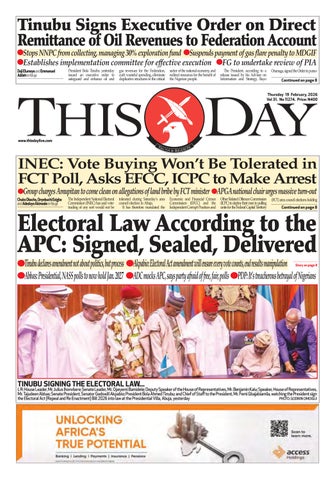
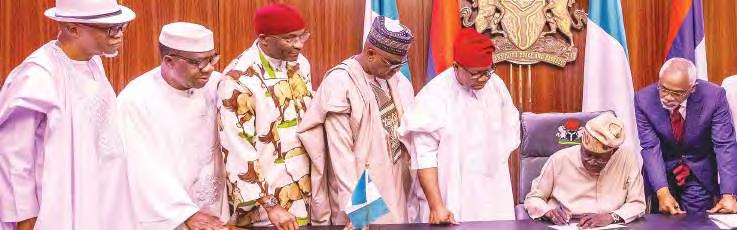
TINUBU
SIGNING THE ELECTORAL
LAW...
L R: House Leader, Mr. Julius Ihonvbere; Senate Leader, Mr. Opeyemi Bamidele; Deputy Speaker of the House of Representatives, Mr. Benjamin Kalu; Speaker, House of Representatives, Mr. Tajudeen Abbas; Senate President, Senator Godswill Akpabio; President Bola Ahmed Tinubu; and Chief of Staff to the President, Mr. Femi Gbajabiamila, watching the President sign the Electoral Act (Repeal and Re Enactment) Bill 2026 into law at the Presidential Villa, Abuja, yesterday
Deji Elumoye and Emmanuel Addeh in Abuja
PHOTO: GODWIN OMOIGUI
Chuks Okocha, Onyebuchi Ezigbo and Adedayo Akinwale in Abuja
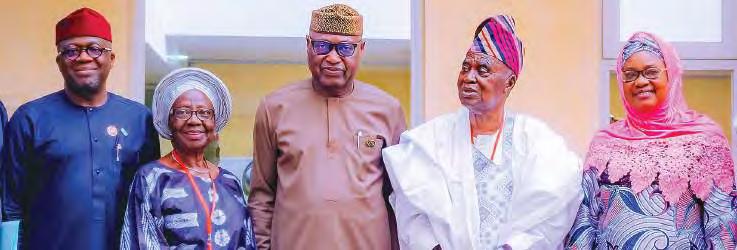
AFENIFERE LEADERS VISIT EKITI GOVERNOR...
L-R: Chief of Staff to the Governor, Mr.Niyi Adebayo; Vice Chairman, Afenifere, Ekiti State Chapter, Chief (Mrs) Ronke Okusanya; Ekiti State Governor, Mr. Biodun Oyebanji; Chairman, Afenifere, Elder Yemi Alade; and Secretary to the State Government, Prof Habibat Adubiaro, during a courtesy visit by the leaders of Afenifere to the governor’s office in Ado-Ekiti...recently
NCDMB Insists on 1% Nigerian Content Levy Remittance By Oil Firms Amid Resistance
Says access to approvals, services dependent on payment certificate
Peter Uzoho
The Nigerian Content Development and Monitoring Board (NCDMB) has reminded operators, contractors, and service companies in the upstream sector of the Nigerian oil and gas industry of their mandatory obligation to remit the one percent Nigerian Content Development Fund (NCDF) levy into the bank accounts officially designated by the Board.
In a statement issued yesterday in Yenagoa, signed by the Board’s General Manager, Corporate Communications, Dr. Obinna Ezeobi, the Executive Secretary of NCDMB, Felix Ogbe, explained that the NCDF was established under Section 104 of the Nigerian Oil and Gas Industry Content Development (NOGICD) Act, 2010, as a dedicated fund for the development of Nigerian content in the oil and gas industry.
The NCDMB has been complaining that some oil firms, especially indigenous Nigerian companies, which are the direct beneficiaries of the levy, have been refusing to pay it.
But in their reactions, however,
the indigenous companies have alleged that NCDMB was using some part of the fund on projects that do not support the growth of local capacity in the oil and gas sector.
But in the statement, Ogbe reiterated that covered entities in the Local Content Act were bound to remit one percent one per cent of the value of every upstream contract, adding that NCDMB was vested with the exclusive authority for the management and administration of the fund.
He stated that funds generated
under the NCDF are deployed to support indigenous oil and gas contractors and service companies, to finance capacity development and training in the industry, to enable access to affordable finance for indigenous participation, and to drive sustainable growth across the oil and gas value chain.
Ogbe clarified further that, “the NCDF is a ring-fenced statutory development fund created by a specific Act of the National Assembly,” adding that “it is not classified as federal government revenue payable into the
Consolidated Revenue Fund and its collection and administration are expressly governed by Section 104 of the NOGICD Act.”
He stressed that all remittances of the one percent NCDF levy must be made strictly into the accounts officially designated by the NCDMB, pointing out that, “any remittance made outside the accounts formally designated by the NCDMB “shall not be recognised as valid payment of the one percent NCDF Levy under the Act.”
He urged companies to ensure strict compliance and to seek
clarification from the Board where necessary prior to effecting any remittance.
The executive secretary assured industry stakeholders that the Board remains committed to transparency, accountability, and the effective utilisation of the Fund for the growth and sustainability of Nigerian Content in the oil and gas industry.
Furthermore, the NCDMB announced that obtaining the Nigerian Content Development Fund Compliance Certificate (NCFCC) has become a key
requirement for accessing the Board’s regulatory services and approvals.
The NCDF Compliance Certificate is issued to companies to confirm their full compliance with statutory obligation to remit one per cent of the value of every contract awarded in the upstream sector of the oil and gas industry. The Board stated that “without a valid NCDF Compliance Certificate, access to regulatory documents, certifications, approvals, and clearances issued by NCDMB shall not be granted.”
In Cairo, Cardoso Seeks Climate-resilient Growth in Africa
James Emejo in Abuja and Nume Ekeghe in Lagos
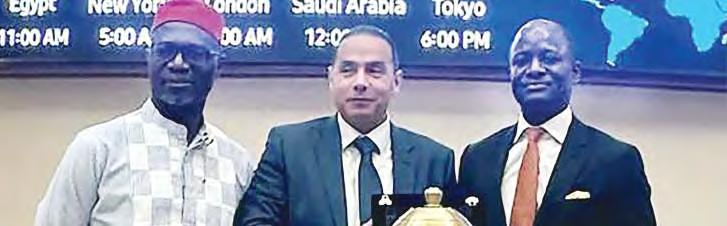
Governor of Central Bank of Nigeria (CBN), Mr. Olayemi Cardoso, said Africa must grow, industrialise, create jobs, expand opportunities, and lift millions out of poverty, while building climate resilience. Cardoso said this in his keynote speech at the Egypt 30by30 Programme, recently organised by Central Bank of Egypt
and International Finance Corporation (IFC).
He said the collaborative ambition behind the 30by30 initiative embodied a shared continental vision that Africa’s future must be resilient, climate-aware, and economically sustainable.
Cardoso stated that through closer collaboration with Central Bank of Egypt and partners across World Bank Group, CBN was dedicated
NCC Seeks Stakeholders’ Inputs on National Telecoms Policy Review
Nigerian Communications Commission (NCC) has called on interested industry stakeholders to make written submissions to the commission on the ongoing review of National Telecommunications Policy (NTP) 2000.
NCC said the consultation paper had been published on the commission’s website. It set Friday, March 20, 2026, as the deadline for all submissions.
The consultation process, in exercise of the commission’s functions under the Nigerian Communications Act (NCA), 2003, and upon the activation
of the provisions of Section 24 (1) of the Act on conducting consultative processes for the review of policies, is the first step in the public consultation process to guide the review of the subsisting NTP 2000. The review of NTP followed the inauguration of a Ministerial Steering Committee (MSC) and a Ministerial Technical Committee (MTC) by Minister of Communications, Innovation and Digital Economy, Dr. Bosun Tijani, to commence the process of reviewing NTP 2000.
The policy review will also align with the minister’s Strategic Blueprint – Accelerating Our
Collective Prosperity through Technical Efficiency – which states that the ministry will drive the review of Telecoms Policy to account for core issues, such as spectrum management, universal access, broadband penetration, net neutrality, and quality of service (QoS).
The consultation process and its outcome will support the work of MSC and Implementation Committee (IC) in coming up with a reviewed policy that will meet the current challenges of the communications sector and keep up with the rapid and dynamic changes since the current NTP was issued 25 years ago.
to building a resilient, risk-aware financial framework, advancing green finance, strengthening cross-border cooperation, and positioning Africa, not just to withstand shocks, but also to thrive in a changing global economy.
In a statement, Cardoso also emphasised that resilience began with credibility.
He said, “In Nigeria, disciplined and transparent reforms are strengthening macroeconomic fundamentals and boosting confidence in the financial system, laying the groundwork for sustainable growth.
“To build resilient financial systems,
we must anchor our economies on trustworthy institutions, credible policies, transparent markets, and risk-aware innovation.”
Cardoso added, “Climate risk is financial risk. It affects sovereign ratings, cost of capital, inflation dynamics, food security, insurance markets, and fiscal sustainability.”
The CBN governor stated that Africa contributed the least to climate change, yet bore some of its highest costs.
He stated that Africa also offered some of the world’s greatest opportunities in renewable energy capacity, biodiversity, a young population, and
rapidly evolving financial markets.
Cardoso said, “To seize these opportunities, we must innovate for resilience, not as isolated nations, but as a continent.
“By working together deliberately, transparently, and with unwavering commitment, we can build the resilient, sustainable, and inclusive financial systems that Africa needs not only to withstand future shocks but also to thrive in the decades ahead.”
The engagement underscored a defining imperative for the continent: Africa’s financial future depends on a dual commitment to stability and sustainability, the statement added.
Rockefeller Foundation, Others to Scale Modern Cooking Technologies in Africa
Emmanuel Addeh in Abuja
The Rockefeller Foundation, Global Energy Alliance, Clean Cooking Alliance, and Energy Corps yesterday launched the Clean Cooking Accelerator Initiative to expand access to modern cooking technologies in Africa. This was announced at the High-Level Dialogue on Advancing Energy Access and Cooking Solutions during the
International Energy Agency’s (IEA) 2026 Ministerial, chaired by IEA Executive Director Dr. Fatih Birol, Kenya’s Minister of Energy and Petroleum James Opiyo Wandayi, U.S. Secretary of Energy Christopher Wright, and Norway’s Minister of Energy Terje Lien Aasland.
The Initiative, a statement said, reflects the organisations’ renewed commitment to advancing universal access to clean cooking
to help improve health, save lives, empower women and children, create local jobs, reduce forest degradation, and build economic opportunity.
Approximately 1 billion people in Africa rely on traditional fuels such as wood and charcoal, contributing to household air pollution that the World Health Organization (WHO) associates with more than 810,000 premature deaths annually.
Emma Okonji
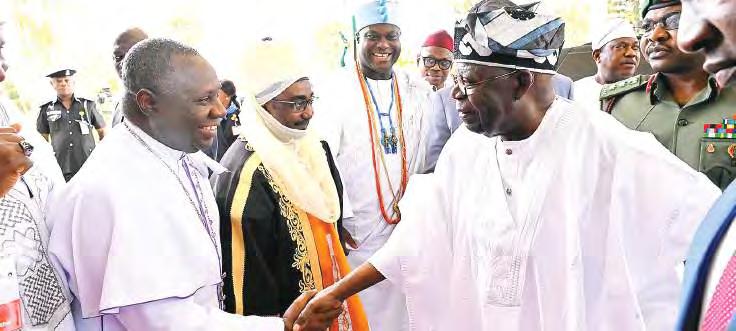
NATIONAL TRADITIONAL AND RELIGIOUS LEADERS SUMMIT ON HEALTH...
R-L: President Bola Ahmed Tinubu; Ooni of Ife, Oba Adeyeye Enitan Ogunwusi, Ojaja II; Emir of Zazzau, Ambassador Ahmed Nuhu Bamalli; and President of the Christian Association of Nigeria (CAN), Archbishop Daniel Okoh, during the National Traditional and Religious Leaders Summit on Health at the Conference Centre of the Presidential Villa, Abuja, on Tuesday
After Two Nights with EFCC, ICPC Takes Former Kaduna Governor, El-Rufai, into Custody
Alex Enumah in Abuja
Temporary relief eluded former Kaduna State Governor and chieftain of African Democratic Congress (ADC), Mallam Nasiru El-Rufai, as Independent Corrupt Practices and Other Related Offences Commission (ICPC) took him into custody yesterday night, upon his release by Economic and Financial Crimes Commission (EFCC).
El-Rufai had been in the custody of EFCC since Monday morning, when he honoured the commission’s
invitation to respond to corruption allegations levelled against his administration.
The state Assembly had petitioned anti-corruption agencies to investigate El-Rufai over alleged fraud and misappropriation of state funds to the tune of over N423 billion. Others, too, including rights activists and Abuja-based lawyer, Mr Deji Adeyanju, had last week called on EFCC and others anti-graft agencies to probe El-Rufai for, allegedly, engaging in financial misconduct, abuse of office,
releasing funds to bandits while holding the office of Governor of Kaduna State.
The former governor had resisted an attempt by security operatives to arrest him last Thursday at Nnamdi Azikiwe International Airport, Abuja, on his return to the country, demanding a formal letter of invitation, before his visit to the headquarters of the anti-graft agency two days ago.
After spending two nights with EFCC investigators, THISDAY learnt that El-Rufai might have
been granted administrative bail. However, he was immediately taken into custody by ICPC, which had earlier invited him, also, in respect of corruption allegations.
A statement by ICPC on Wednesday night disclosed that El-Rufai was with them as at the close of work on Wednesday.
Head, Media and Public Communications /spokesperson of ICPC, John Odey, who issued the statement, disclosed that the former governor was being held in connection with investigation.
FG to Review Acquisition of IHS Towers By MTN
The federal government is to review the acquisition of IHS towers by the MTN Group, the Minister of Communications, Innovation and Digital Economy, Dr. Bosun Tijani, has disclosed.
In a statement which he personally signed, yesterday, the Minister noted that the telecommunications sector was very sensitive to national security.
“Given the strategic importance of telecommunications infrastructure to national security, economic growth, financial services, innovation, social inclusion, and to ensure strategic ac-
tions by private sector operators are in line with the market development agenda under the renewed hope policy directions of the President, the ministry will undertake a thorough assessment of this development in collaboration with the relevant regulatory authorities to review its impact on the sector.
“Our objective is clear: to ensure that any market consolidation or structural changes protect consumers, safeguard investments, and preserve the long-term sustainability of the sector.”
According to him, the government remained committed to maintaining a stable, transparent, and forward-looking policy
environment that keeps Nigeria’s telecommunications industry on a strong and sustainable path, in alignment with broader vision of building a robust digital economy.
He also said the Federal Ministry of Communications, Innovation and Digital Economy noted recent developments in the Nigerian telecommunications sector regarding the acquisition of IHS towers by MTN Group.
“Over the past two years, under the leadership of President Bola Ahmed Tinubu, this administration has taken deliberate steps to stabilise and strengthen the telecommunications sector as a critical pillar of Nigeria’s digital economy.
Group
“Through policy clarity, regulatory support, and sustained engagement with industry stakeholders, government has prioritised long-term sustainability, investor confidence, and improved sector performance.
“Recent financial results announced by key operators indicate a return to improved profitability, increased investment in telecoms infrastructure and operational stability across the sector,” he said.
This progress, he said, reflected the resilience of the industry and the impact of reforms aimed at ensuring its viability and capacity to continue delivering meaningful connectivity to Nigerians.
The statement read, “The Independent Corrupt Practices and Other Related Offences Commission (ICPC) writes to state that Malam Nasiru El-Rufai, the former governor of Kaduna State, is in our custody as at close of work today, Wednesday, the 18th day of February, 2026.
“Malam Nasiru El-Rufai is in the custody of the commission in connection with investigations.”
Department of State Service (DSS) had on Monday filed a three-count charge bordering on alleged cybercrime offences against El-Rufai before a Federal High Court in Abuja.
He was accused of unlawfully wiretapping the phone lines of National Security Adviser (NSA), Mr Nuhu Ribadu.
El-Rufai, following his attempted arrest at Nnamdi Azikiwe International Airport, Abuja, had accused the NSA of orchestrating his arrest.
In a series of interviews granted after the airport drama, El-Rufai claimed knowledge of a conversation where Ribadu gave the order for his arrest. Following his claim, the federal government, dragged him to court for engaging in cybercrime offences.
In the three-count charge, DSS accused El-Rufai of unlawful interception of the phone communications of Ribadu.
The criminal charge filed at Abuja Division of the Federal
High Court was marked: FCT/ ABJ/CR/99/2026.
The agency, in the charge, cited the statements made by the ADC chieftain during a live interview on Arise TV’s Prime Time programme on February 13, 2026, in Abuja. According to the charge filed by M. E. Ernest on behalf of DSS, El-Rufai, 65, admitted during the broadcast that he was aware of some persons who had intercepted the private phone communications of the NSA.
The federal government claimed that the alleged act amounted to a serious breach of Nigeria’s cybercrime and communications laws and posed a threat to public safety and national security. Court documents further alleged that the former governor not only acknowledged those who carried out the interception but also failed to report them to relevant security agencies, despite being aware of the alleged offence.
DSS also claimed that the unlawful use of technical equipment to intercept the NSA’s communications compromised national security and created reasonable apprehension of insecurity among Nigerians. The charge was predicated on the provisions of the Cybercrimes (Prohibition, Prevention, etc.) (Amendment) Act, 2024, as well as the Nigerian Communications Act, 2003.
Sani Flags Off Distribution of 600 Transformers, 10,000 Solar Street Lights
boost economic activities and strengthen small and medium enterprises across the state.
Speaking yesterday at the flag-off of Phase 1 of the distribution of 600 transformers and 10,000 solar-powered
streetlights across the 23 local government areas of the state, Sani stressed the importance of reliable power supply to development. He said, “Without reliable power, development is stunted, security is weakened, and opportunity is constrained.”
Sani added, “We are enabling welders, tailors, cold-room operators, ICT hubs, and manufacturers to operate
with dignity and predictability. We are sending a clear message that access to energy must no longer be the privilege of a few urban centres but the right of every community.”
According to him, electricity is not a luxury but the bloodstream of modern society.
The governor pointed out that electricity powered hospitals and preserved vaccines, lit classrooms and
expanded the horizons of children, as well as, “drives our industries, irrigates our farms, and sustains the small businesses that form the backbone of our economy”.
Sani said since assumption of office about three years ago, his administration had completed some abandoned power projects and initiated new ones.
he stated, “In the health sector,
under the previously stalled IndianExim Bank initiative, we completed solar mini-grid installations in 190 out of 225 Primary Health Care Centres, delivering 1.35 megawatts of clean energy.
“We restored 32 abandoned systems; 21 in PHCs and 11 in General Hospitals. The result has been tangible: improved service delivery and a measurable reduction in maternal and child mortality.”
The governor disclosed that his administration had “completed the long-abandoned 2x60MVA, 132/33kV Substation at the Green Economic Zone in Maraban Jos”. According to him, the substation is an industrial catalyst that “unlocks investment potential, stimulates manufacturing, and positions Kaduna as a competitive economic hub”.
PHOTO: GODWIN OMOIGUI
John Shiklam in Kaduna Governor of Kaduna State, Senator Uba Sani, has said the central focus of his electrification drive is to
Oghenevwede Ohwovoriole in Abuja
NIGERIAN BREWERIES DISTRIBUTORS AWARD...
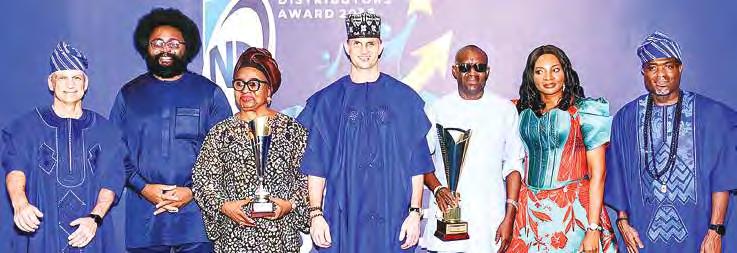
L-R: Supply Chain Director, Nigerian Breweries Plc, Federico Agressi; Director, Cobil Logistique Integree Limited, Obiora Iloanusi; Managing Director, Cobil Logistique Integree Limited, Okwuoma Iloanusi(National Champion-Transport Partner); Managing Director, NB Plc, Thibaut Boidin; Managing Director, MacDen Communications Limited, Dennis Okorie(National Revenue Champion); Wife of MD, MacDen Communications Limited, Adaobi Okorie, and Sales Director, NB Plc, Emmanuel Oriakhi, during the 2025 Distributors award with the theme “Unlocking Growth Together” and held in Lagos recently
NARTO: Deployment of CNG-powered Vehicles Reduced Transport Costs by 30%
Lauds Dangote for massive investment in local refining Strikes deal with Lagos on funding, acquisition of trucks
Emmanuel Addeh in Abuja
The Nigerian Association of Road Transport Owners (NARTO) has listed benefits from its partnership with the Presidential Compressed Natural Gas Initiative (PCNGI), stressing that deploying CNG-powered vehicles has reduced transportation for its members by at least 30 per cent.
Speaking at the 2026 Annual General Meeting (AGM) of NARTO in Abuja, the National President, Alhaji Yusuf Othman, said the collaboration led to the deployment of new fleets to strengthen its transport capacity.
These, he said, included 20 units of 14-seater CNG/petrol buses, five units of 56-seater hybrid CNG/Diesel buses, and three units of 46-seater CNG/diesel engine buses.
Othman added that the vehicles are currently working on interstate and intra-city shuttle services across the country, contributing meaningfully to safer, cleaner, and more affordable mass transportation, as well as reducing transportation costs by over 30 percent.
He revealed that NARTO has also received assurances from the presidential initiative that additional buses will soon be allocated to the association.
“Our partnership with the Presidential Initiative on Compressed Natural Gas (PiCNG) has brought enormous opportunities to the association. Notably, we successfully received and deployed new fleets to strengthen our transport capacity. These include 20 units of 14-seater CNG/Petrol buses, five units of 56-seater hybrid CNG/diesel buses, and three units of 46-seater CNG/ diesel engine buses.
“These vehicles are currently deployed for interstate and intracity shuttle services across the country, contributing meaningfully to safer, cleaner, and more affordable mass transportation, as well as reducing transportation costs by over 30 per cent.
“I am glad to inform this distinguished gathering that we have also received assurances from PCNGI that additional buses will soon be allocated to our association,” he stated during the event.
Othman said the AGM provided the association with an important opportunity to reflect on its journey in the year 2025, to take stock of the progress, candidly examine the challenges, and chart a clear and realistic path forward for NARTO.
He commended President Bola Tinubu for his unwavering support to the transport sector through the CNG initiative. He also extolled the President for the remarkable strides recorded in road construction and rehabilitation across the country. Othman stressed that as direct beneficiaries of these projects, NARTO expressed profound gratitude to Tinubu. He called on members and other
road users to obey traffic regulations, particularly approved axle load limits, in order to preserve these roads for long-term sustainability and the collective good.
Similarly, Othman commended the Dangote Group for his patriotic investment in the Nigerian economy, culminating in the construction of the world’s largest single refinery and the importation of about 4,000
trucks to support the local distribution of petroleum products nationwide. He said the initiative will undoubtedly boost local refining capacity, improve product availability, and create employment opportunities for thousands of Nigerians.
While commending the role of the Nigerian Midstream and Downstream Petroleum Regulatory Authority (NMDPRA), NARTO said
it hoped it will continue to ensure the viability of the sector through fair pricing mechanisms that make petroleum transportation sustainable and profitable.
Othman said the association has also made remarkable progress in strengthening collaborations with key security and law-enforcement agencies to enhance safety and security on the roads.
TotalEnergies Outlines Strategy for Nigeria’s Oil, Gas Production Growth, Electricity Expansion
TotalEnergies EP Nigeria Limited, the upstream arm of TotalEnergies companies in Nigeria, has reaffirmed its commitment to expanding Nigeria’s energy supply through a strong focus on growing the country’s oil and gas production and expanding electricity generation while reducing the carbon intensity of its operations.
Managing Director and Chief Executive Officer of TotalEnergies, Matthieu Bouyer, disclosed this during a panel session titled “Capi-
talising on Africa’s Global Upstream Momentum” at the just-ended 9th Nigeria International Energy Summit (NIES) 2026 in Abuja, where industry leaders examined investment trends and opportunities across the continent’s oil and gas sector.
In a statement signed by TotalEnergies’ Country Communication Manager in Nigeria, Dr. Charles Ebereonwu, Bouyer said TotalEnergies’ strategy in Nigeria was built around two core pillars: growing oil and gas production and expanding electricity generation through
integrated power solutions, in line with the company’s global ambition of delivering more energy with less emission.
“Our strategy is about growing energy as a whole,” Bouyer said, noting that Nigeria remains a key market within TotalEnergies’ global portfolio and continues to compete with other countries for upstream investment capital.
Bouyer explained that the company’s immediate priority was maximising value from its existing assets, spanning onshore gas and
Dangote Supports 3,704 Students in Refinery, Fertiliser Host Communities
Peter Uzoho
The Aliko Dangote Foundation, in collaboration with Dangote Petroleum Refinery and Dangote Fertiliser Limited, has distributed school uniforms, bags, sandals, and writing materials to primary school pupils in their host communities in Ibeju Lekki, Lagos State, as part of its education support programme.
A statement by Dangote Group said a total of 1,323 pupils, including children with special needs, benefited from the five-day distribution exercise under the first phase of the intervention.
The beneficiary schools included Local Government Primary School, Ilege; Okunraye Community Primary School, Idotun Community
Primary School, Olomowewe Community Primary School and Lekki Community Primary School. The foundation said the programme would also extend to secondary schools, bringing the total number of beneficiaries to 3,704. In addition, the foundation said scholarships would be awarded to 443 students, including 33 in tertiary institutions, alongside vocational training programmes for youths in the host communities.
The Managing Director and Chief Executive Officer of Aliko Dangote Foundation, Zouera Youssoufou, stated that the initiative reflects the vision of its founder, Aliko Dangote to invest in education and nurture future
leaders.
“We believe education remains the most powerful tool for transforming lives and communities.
“This intervention is not just about uniforms, bags or writing materials. It is about giving every pupil in our host communities a fair opportunity to learn and succeed by reducing the burden on parents.
“Our commitment is long-term. By investing in these children today, we are investing in future leaders who will shape Nigeria’s tomorrow,” she said.
Speaking on the broader scope of the intervention, the Head, Social Performance of Dangote Petroleum Refinery and Petrochemicals, Mojisola Ogunleye, said education remains a key
pillar of the company’s community development strategy.
She disclosed that 3,704 students across four secondary schools and five primary schools are benefiting from the first phase of the programme, adding that the second phase would include scholarships and the distribution of textbooks and additional learning materials.
Ogunleye added that 443 students have been selected for scholarships, comprising 33 university students and 410 secondary school students.
“In addition, 22 community youths with SSCE have been upskilled and trained in the City & Guilds Certification Programme in Electrical Engineering, Levels
1, 2 and 3 and will be officially presented their certificates issued by the institution from London,” she said
In her reaction, the Head Teacher of Local Government Primary School, Ilege, Mrs. Adenigba Margaret Aderemi, commended the Foundation for the intervention, noting that many pupils previously struggled with inadequate learning materials and worn-out uniforms.
She said the gesture would improve enrolment and classroom participation, explaining that some children had dropped out due to the embarrassment of wearing torn uniforms, while others engaged in menial jobs to afford basic school supplies.
offshore oil and gas developments. He highlighted the recently sanctioned Ubeta Gas project, which was designed to deliver up to 300 million cubic feet of gas per day, alongside several additional projects currently under evaluation.
On sustainability, Bouyer disclosed that TotalEnergies eliminated routine gas flaring across all its Nigerian operations since 2023, marking a major milestone in its emissions reduction programme.
He said that the company has deployed advanced methane detection technologies, including its own proprietary technology AUSEA, which was developed to monitor emissions in real time and enable rapid intervention.
In addition to the deployment of AUSEA, Bouyer added that TotalEnergies EP Nigeria Limited has also installed 2,500 Permanent Emission Monitoring Systems (PEMPs) across all its production sites in Nigeria.
He also announced plans to commission a five megawatt (5MW) solar power plant at oil mining lease (OML) 58 to supply electricity to the Ubeta Gas Project, describing it as one of the world’s first near net zero gas developments.
Bouyer underscored the importance of partnerships with Nigerian companies, describing collaboration with local operators as critical to accelerating project delivery and unlocking value for the broader economy.
Peter Uzoho
LCCI, CPPE: Current Inflation Outcome Suggests Transition from Acceleration to Disinflation Phase
Price stability still lacking
Dike Onwuamaeze
Lagos Chamber of Commerce and Industry (LCCI) and Centre for the Promotion of Private Enterprise (CPPE) have described the inflation data for January 2026 as a transition from an acceleration phase to a disinflation phase, but not yet to price stability.
LCCI and CPPE made the assertion in different press statements that described their views on the latest inflation data released by National Bureau of Statistics (NBS), which indicated a marginal moderation in headline inflation.
The data showed that headline inflation declined to 15.10 per cent year-on-year, compared with 27.61 per cent in January 2025 and 15.15 per cent in December 2025.
Month-on-month, also, inflation turned negative at −2.88 per cent,
indicating an actual easing in the general price level relative to December 2025.
According to the LCCI, “From a business-cycle perspective, the current inflation outcome suggests a transition from an acceleration phase to a disinflation phase, but not yet to price stability.”
For CPPE, “These indicators suggest the emergence of real disinflation rather than temporary price volatility.” It added that it was “the emergence of real disinflation rather than temporary price volatility”.
Director General of LCCI, Dr. Chinyere Almona, said yesterday that the outcome reflected an easing in short-term price momentum, which LCCI considered to be disinflationary, but fragile.
Almona said, “The chamber characterises the latest inflation
outcome as a disinflationary signal rather than a structural turning point.
“The moderation reflects temporary alignment of food supply recovery, exchange rate stability, and energy price calm, reinforced by base effects.
“While this improves near-term business confidence, inflation remains structurally elevated and vulnerable to supply and foreign exchange shocks.”
She stressed, “From a decomposition standpoint, the slowdown is largely attributable to food price deceleration, exchange rate appreciation, and relative stability in domestic energy prices.”
Almona said, “The reduction in food inflation reflects improved post-harvest supply conditions and demand normalization after the festive period. Exchange rate
gains moderated imported inflation and FX-pass-through into the core basket, while stable PMS pricing reduced second-round transport and logistics effects.
“These developments jointly lowered headline pressure in the short run and improved inflation expectations at the margin.”
She also said the economy was vulnerable to upside inflation risks from food supply disruptions, climate variability, insecurity in agricultural belts, oil price volatility, and renewed exchange rate pressure.
‘Consequently, the present moderation should be interpreted as a temporary easing of inflationary momentum, not yet a convergence toward a low and stable inflation regime,” Almona stated.
Advising the private sector, Almona said the current environment “supports tactical planning rather
than strategic risk-taking, pending stronger confirmation of sustained disinflation”.
LCCI said policy credibility in 2026 will depend not on headline inflation prints alone, but on the speed with which Nigeria converted cyclical disinflation into structural price stability through productivity, logistics efficiency, and macroeconomic coordination.
Chief Executive Officer of CPPE, Dr. Muda Yusuf, said January’s inflation data represented “an important macroeconomic shift with implications for household welfare, agricultural income sustainability, monetary policy direction, and private-sector investment strategy”.
Yusuf stated, “Nigeria’s January 2026 inflation outcomes signal a meaningful transition toward macroeconomic stabilisation, driven primarily by declining food
ELECTORAL LAW ACCORDING TO THE APC: SIGNED, SEALED, DELIVERED
Deji Elumoye, Chuks Okocha, Sunday Aborisade in Abuja and Sunday Ehigiator in Lagos
The amendment of the Electoral Act was officially completed yesterday, as President Bola Tinubu signed into law the 2022 Electoral Act Amendment Bill. Despite a groundswell of public outcry and bold antagonism by various interests, Tinubu rose stoutly in defence of the controversial bill, as he assented to it.
The president, who spoke at a brief ceremony in his office at State House, during which he gave his assent for the bill to become an Act, submitted that after every election cycle, “We owe Nigerians an honest look at what worked and what must work better.
“That is how serious democracies behave, and our laws must grow with experience.”
He emphasised that the country’s laws must grow with experience by closing gaps and strengthening procedures.
He stated, “Today, I signed the final amendments to the 2022 Electoral Act into law. These amendments are not about politics. They are about process.
“They are about closing gaps, strengthening procedures, and providing greater clarity to those who conduct and participate in our elections.
“When citizens walk into a polling unit, they must do so with confidence. When results are declared, they must be trusted. That confidence is built deliberately, and not by chance.”
He added, “I sincerely thank the National Assembly for its cooperation and sense of national responsibility in bringing this process to a successful conclusion.
“Our responsibility remains to keep improving the system so that the people’s will is expressed clearly, peacefully, and credibly. The work of strengthening our democracy continues, and we shall not relent.”
Speaking with newsmen after the ceremony, Senate President Godswill Akpabio said the Electoral Act 2026 (Amendment) would ensure that every Nigerian vote counted.
Akpabio said, “At the end, Nigerians will benefit a lot from future elections. Every vote will now count.”
He stressed that the federal lawmakers did a thorough job that would stand the test of time.
According to him, “A lot of provisions in the amended act will definitely make Nigerians very happy. We did a very thorough job, very painstaking. We took cognizance of the peculiarities of the country.
INEC: VOTE BUYING WON’T BE TOLERATED IN FCT POLL, ASKS EFCC, ICPC TO MAKE ARREST
on Saturday.
The electoral umpire added that any individual found buying or selling votes would be apprehended and dealt with in accordance with the law, insisting it would not tolerate vote trading.
INEC Chairman, Prof. Joash Amupitan stated this yesterday in Abuja at a stakeholders’ meeting ahead of the elections.
“There is, however, one issue that must be addressed directly, and that is vote trading or vote buying. The Commission has given an express mandate to the Economic and Financial Crimes Commission and the Independent Corrupt Practices and Other Related Offences Commission to deploy their personnel to polling units.
“Any individual found buying or selling votes will be apprehended and dealt with in accordance with the law. Vote trading undermines the sanctity of the ballot and erodes public confidence in democratic institutions. It must not be tolerated,” he stated.
He said the engagement provided an important opportunity for open and constructive discussion as election day approached, stressing that the conduct of credible elections was a shared responsibility.
Amupitan noted that Saturday’s election would involve 1,680,315 registered voters, who would cast their ballots in 2,822 polling units spread across the six Area Councils of
FCT, namely: Abaji, Abuja Municipal Area Council, Bwari, Gwagwalada, Kuje and Kwali.
He stressed that a total of 570 candidates were contesting for the positions of Chairmen and Vice-Chairmen as well as 62 Councillorship seats, comprising 10 wards each in five Area Councils and 12 wards in the Abuja Municipal Area Council. The chairman said these figures underscored the scale of the exercise and the responsibility placed upon all of us to ensure its success.
Amupitan pointed out that the FCT Area Council election remained the only local government election conducted by INEC.
According to him, “Over the years, it has become a reference point for Local Government elections conducted by State Independent Electoral Commissions, particularly because of the diversity reflected in its outcomes.
“The credibility of this process has strengthened confidence in grassroots democracy. As we approach Saturday, 21st February 2026, we must collectively resolve to raise the bar even higher.”
Amupitan revealed that the Commission has accredited 89 domestic and foreign observer groups to observe the election, while 700 journalists representing 72 domestic and foreign media organisations have been accredited to cover the process.
He further disclosed that the Bimodal Voter Accreditation System
has been upgraded and would be deployed in all 2,822 polling units for voter accreditation, and results would be uploaded to the INEC Result Viewing Portal in accordance with established procedures.
The chairman added that all the required BVAS devices for the polling units, including those for the 195 split polling units, as well as the additional five per cent backup, have been thoroughly tested and fully charged for deployment on election day.
Earlier, FCT Resident Electoral Commissioner (REC), Mallam Aminu Idris, said the Commission was re-displaying the register at polling units to help voters identify their voting locations ahead of Saturday’s poll, addressing challenges observed during the 2022 elections due to voter migration.
Also, the Secretary of Inter-Party Advisory Council (IPAC), FCT chapter, Adama Yahaya commended INEC’s transparency and reaffirmed political parties’ commitment to peaceful and credible elections.
APGA Chairman Urges Massive Turn-out
The National Chairman of the All Progressives Grand Alliance (APGA), Chief Sly Ezeokenwa, has called on residents of the Federal Capital Territory, Abuja, to come out en masse this Saturday to participate
“We didn’t allow too much outside interference, and we’re very patriotic in our submissions, and at the end, we believe strongly that what the president has just assented into act of parliament will make for a better election in the future.
“It will also lead to prosperity and will also lead to transparency of the electoral process. At the end, Nigerians will benefit a lot from future elections, every vote will now count.”
Akpabio said the agitation by Nigerians for mandatory electronic transmission of results was accommodated in the new Act.
He stated, “Well, I think all Nigerians wanted was that in the IRev portal, which is a kind of viewing centre of the outcome of most of the polling unit results that they would like to see that transmitted electronically.
“We have included that in the amendment that has just been signed into act of parliament. But we also took cognisance of areas where there
may not be any network, where there may not be communication capacities and availability.
“And we said, since the polling unit result comes in from ECA, which is signed by the presiding officer, signed by the agents, and signed in the presence of security agents, copies are given to all. Then we can use that as the primary source of collation at that unit.”
Akpabio said, “And then, of course, we transmit it, even if there is no network at that time, once we step out of there, maybe towards the ward centre or the local government centre, it will drop into the IRev and people will still be able to view.
“The implication of that is that if what is eventually collated at the next centre is different from what is in the IRev, Nigerians will be able to compare whether the election result had been tampered with.
“And for us, that had always been the problem in the country, that once
prices and supported by easing core inflation.
“The development is positive for household welfare, consumption recovery, and investment confidence, but presents downside risks for farm incomes and rural economic sustainability.
“The central policy priority is therefore to consolidate disinflation while protecting agricultural productivity and rural livelihoods.
election result leaves a polling unit, it will be tampered with or mutilated, that has been eliminated today.
“So we are satisfied that we have met the aspiration of Nigerians that the issue of real time also comes in once you transmit, even if there is no network at that time, once you go to where there is network, it will still drop.”
The senate president stressed, “So eventually everything will still be shown. We are happy and satisfied that we have been able to interpret the intentions and the yearnings of majority of Nigerians, not those who are politically motivated.
“And I always say, no matter what we did in the last two years, we went to retreat in Lagos, we went to retreat, everywhere. Those things were just mere consultations, the final outcome of what was amended happens in the plenaries of both chambers.
“And we felt in the last one month
TINUBU SIGNS EXECUTIVE ORDER ON DIRECT REMITTANCE OF OIL REVENUES TO FEDERATION ACCOUNT
ance of Section 5 of the Constitution of the Federal Republic of Nigeria (as amended).
Besides, the statement noted that the Order was based on the constitution, which vests ownership, control, and derivative rights in all minerals, mineral oils, and natural gas in, under, and upon any land in Nigeria, including its territorial waters and Exclusive Economic Zone (EEZ) in the federal government.
In the same vein, it stated that the directive seeks to restore the constitutional revenue entitlements of the federal, state, and local governments, which were taken away in 2021 by the Petroleum Industry Act (PIA), explaining that the PIA created structural and legal channels through which substantial federation revenues are lost through deductions, sundry charges, and fees.
Under the current PIA framework, NNPC retains 30 per cent of the Federation’s oil revenues as a management fee on profit oil and profit gas derived from Production Sharing Contracts (PSCs), profit sharing contracts, and Risk Service Contracts (RSCs).
In addition, the company retains 20 per cent of its profits to cover working capital and future investments.
Given the existing 20 per cent retention, the government stated that the additional 30 per cent
management fee is considered unjustified, as the retained earnings are already sufficient to support the functions NNPC performs under these contracts.
NNPC Limited also retains another 30 per cent of its profit oil and profit gas under the production sharing, profit sharing, and risk service contracts, as the Frontier Exploration Fund (FEF) under sections 9(4) and (5) of the PIA.
A fund of this size, being devoted to speculative exploration, according to the release, risks accumulating large idle cash balances, which would encourage inefficient exploration spending, at a time when government resources are urgently needed for core national priorities, including security, education, healthcare, and energy transition investments.
For the Midstream and Downstream Gas Infrastructure Fund (MDGIF) under Section 52(7)(d) PIA, funded by the collection of gas flaring penalties provided under Section 104, it stated that the PIA has already established a dedicated Environmental Remediation Fund, administered by the Nigerian Upstream Petroleum Regulatory Commission (NUPRC), specifically designed to fund the rehabilitation of communities negatively impacted by upstream petroleum operations, including gas flaring.
Furthermore, it argued that Section 103 already imposes a fee on lessees to contribute to this fund for precisely this purpose.
“All these deductions far exceed global norms and effectively divert more than two-thirds of potential remittances to the Federation Account. The continuing decline in net oil revenue inflows is largely attributable to these deductions and fragmented oversight under the current PIA architecture.
“The Executive Order aims to resolve, among others, the duplicative 30 per cent deduction for profit sharing arrangements by addressing overlapping and redundant provisions across all relevant laws and regulatory instruments under the PIA framework and NNPC Limited’s governing structure. The objective is to eliminate unjustified multiple layers of deductions that erode revenues that ought to accrue to the Federation Account, enabling the three tiers of government to pursue critical national priorities.
“The President has identified structural concerns regarding the continued role of NNPC Limited as a concessionaire under Production Sharing Contract arrangements. The existing framework, which allows the company to influence operating
DG, LCCI, Dr. Chinyere Almona
INAUGURATION OF ABDUL SAMAD RABIU CUSTOMS SERVICE HOSPITAL...
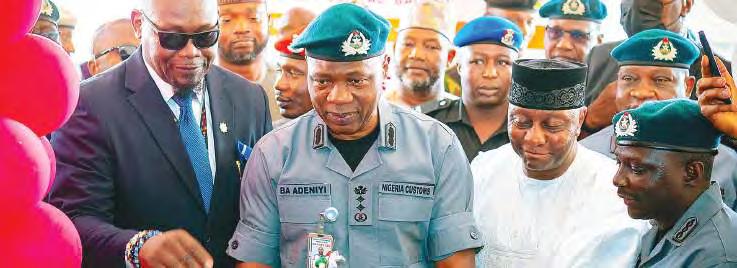
L-R: Managing Director and Chief Executive Officer, ASR Africa, Dr. Ubon Udoh; Comptroller General of Customs, Nigeria Customs Service, Mr. Bashir A. Adeniyi; Secretary to the State Government, representing the Bauchi State Governor, Alhaji Aminu Hammayo; and Deputy Comptroller and Zonal Medical Director, Bauchi Zone D, Dr. Rimi Garba, during the inauguration of the state of the art Abdul Samad Rabiu Nigeria Customs Service Hospital in Bauchi, on Tuesday
ASR Africa, Customs Inaugurate Abdul
Samad Rabiu Nigeria Customs Hospital
The Abdul Samad Rabiu Africa Initiative (ASR Africa) and the Nigeria Customs Service (NCS) have inaugurated the Abdul Samad Rabiu Nigeria Customs Service Hospital in Yelwa Tudu, Bauchi State, Nigeria.
The 30-bed healthcare facility, donated by ASR Africa, was upgraded to a 60-bedded reference hospital under ASR Africa’s Security Sector
Support Grant (SSSG) Scheme in partnership with the Nigeria Customs Service.
A statement yesterday, explained that the action formed part of ASR Africa’s ongoing commitment to strengthening healthcare infrastructure within security formations and host communities in Nigeria.
The ACG of NCS Bauchi Zone ‘D’ Command, ACG CG Ogbonna,
during his address, said: “The completion and the commissioning of the hospital facility donated by ASR Africa mark a significant milestone in the history of NCS and underscore its commitment to the welfare of its officers and host community”.
The Zonal Medical Director and Deputy Comptroller of Customs for the Zone, Dr. Rimi
Garba, in his speech, stated that the hospital facility offers seven clinical departments, comprising obstetrics & gynaecology, pediatrics, surgery, internal medicine, dentistry, pharmacy, and medical laboratory, with each equipped to provide top-of-the-range medical service.
Speaking at the event, the MD/ CEO of ASR Africa, Dr. Ubon Udoh, reaffirmed ASR Africa’s
Tinubu, German Chancellor Merz Pledge Improved Collaboration on Security, Power
President Bola Tinubu and German Chancellor Friedrich Merz have resolved to improve bilateral relations between their two countries and to strengthen collaboration in the security, power, and railway sectors.
In a telephone conversation that lasted for about 10minutes on Wednesday afternoon from 2.01pm to 2.10pm, the two leaders
also expressed their willingness to cooperate in creative arts and skill development.
According to a release issued by presidential spokesperson, Bayo Onanuga, President Tinubu and the German Chancellor spoke on the Presidential Power Initiative, during which the Nigerian leader indicated that the country would require assistance with power transmission.
The German Chancellor pledged that Siemens would be ready to assist in that regard, while Deutsche Bank would be willing to finance the project.
The two leaders also expressed worry over the situation in the Sahel region. President Tinubu called for the supply of used helicopters to help in intelligence reconnaissance in the region.
“The Sahel corridor is bad and
Providus, Unity Banks Merger
Nume Ekeghe
The proposed merger between Unity Bank Plc and Providus Bank Limited is steadily moving towards completion, following shareholder approval and strong regulatory backing.
Unity Bank, in a statement, said following the recently held CourtOrdered Meeting and endorsement, the merger and business combination between Unity Bank Plc and Providus Bank Limited remained firmly on course.
Last year, Central Bank of Nigeria (CBN) backed the merger between the two lenders, with a pivotal financial accommodation to support the transaction. The merger also received a further boost with a “no objection” nod from Securities and Exchange Commission (SEC).
The development positions the
combined entity among the 21 banks that have satisfied the apex bank’s new capital threshold for national banking operations. Through the proposed merger, the combined capital base of Unity Bank and Providus Bank exceeds N200 billion, which is the minimum requirement to retain a national banking licence under CBN’s recapitalisation framework. The transaction marks a significant milestone in strengthening the financial stability and long-term competitiveness of the enlarged institution.
Following CBN’s approval, shareholders of both banks overwhelmingly endorsed the merger at their respective Extraordinary General Meetings held in September 2025, where the merger was formally adopted.
The transaction had since pro-
gressed with additional regulatory clearances from SEC and other relevant authorities. Integration activities between the two institutions are currently underway, with the final court sanction expected to conclude the process.
Managing Director and Chief Executive Officer of Unity Bank, Ebenezer Kolawole, described the development as a defining moment for the institution, adding that the complementary strengths and unique advantages of the Unity Bank and Providus Bank merger place the new entity on a strong footing to create and leverage opportunities in the market.
Kolawole stated, “This milestone underscores our commitment to building a stronger, more resilient bank that can deliver greater value to our customers and stakeholders.
needs our support. Intelligence support reconnaissance is needed,” Tinubu said.
Diplomatic relations between Nigeria and Germany have been in place for up to 65 years.
Merz said his country, Germany is eagerly awaiting the arrival of Nigeria’s new ambassador to Germany.
He also spoke about the importance of the arts and called for the establishment of the Great Museum of African Arts.
commitment to delivering sustainable, impact-driven interventions across health, education, and social development sectors.
He added that the partnership with the NCS was built on the Chairman of ASR Africa, Alhaji Abdul Samad Rabiu’s understanding that “…there can be no meaningful development without an environment that is safe and secure. This facility will not only serve the Nigeria Customs Service personnel, but the host community and other security agencies in the State will be beneficiaries.”
Udoh added that the ASR Africa team would continue to engage with NCS long after the project commissioning to ensure accountability, proper maintenance, and the facility’s long-term impact.
While giving his remarks, the Comptroller General of the NCS, Bashir A. Adeniyi, expressed appreciation to ASR Africa and its founder, Rabiu, for his generosity and partnership in the enhancement of the welfare of its personnel and, by extension, the host community.
He added that this donation has been the largest donation NCS has received from a single
organization, promising that NCS, under his watch, will ensure proper maintenance of the facility to meet the needs of its personnel and others.
In his goodwill message, the representative of the host community, Hon. Tanko Dutse, thanked Rabiu, for his philanthropic gesture towards his constituency, as this will grant them better and closer access to affordable healthcare. He also appreciated the Comptroller General of Customs, for keeping to his commitment to ensure the delivery of projects that will continue to impact the community for generations to come.
The commissioning of the Abdul Samad Rabiu Nigeria Customs Service Hospital underscores ASR Africa’s growing footprint in healthcare delivery nationwide and its collaborative approach with public institutions to address critical service gaps. The Abdul Samad Rabiu Nigerian Customs Service Reference Hospital is expected to improve access to essential healthcare services in Bauchi State and reduce pressure on existing public health facilities within the region.
The federal government has inaugurated the nine-man Joint Project Management Committee (JPMC) for the First Nigeria International Oil Spill Summit and Expo (NIOSS).
The committee as well as the unveiling of its official logo and the formal commencement of preparations for the international conference was inaugurated yesterday by the Secretary to the Government of the Federation, Senator George Akume.
Akume, represented by the Permanent Secretary, General Services Office, in the Office of the Secretary to the Government of the Federation, Dr. Ibrahim Abubakar Kana, stated the initiative spearheaded by the National Oil Spill Detection
and Response Agency (NOSDRA) in collaboration with Green Clean Innovation Hub Limited (GCHI), was in response to the numerous reported cases of oil spillage with its attendant consequences on the lives of the affected communities, which cannot be overlooked.
He noted the initiative came at a critical moment in Nigeria’s environmental and economic history, adding for decades, the nation had borne the heavy burden of oil spill incidents, with over one thousand reported cases annually and an estimated 13 million barrels of crude oil spilled over time.
“The dire consequences, including environmental degradation, biodiversity loss, destruction of livelihoods, public health challenges, and significant economic setbacks are far too grave
to ignore”, he said. He urged the committee to discharge its responsibility with professionalism, patriotism and a strong sense of purpose, assuring that the NIOSS will strengthen national and sub-national oil spill preparedness and response capacity; foster innovation, technology transfer and investment in environmental protection among government, industry, host communities, academia, and international partners; and demonstrate Nigeria’s leadership in oil spill response, coastal restoration, and climate action. The committee, with a clear mandate to ensure transparency, coordination, accountability, and the timely delivery of all components of NIOSS, has Mr. Ifiok Abba (Representing OSGF) as the Chairman.
Deji Elumoye in Abuja
Olawale Ajimotokan in Abuja
FEaturEs Disquiet in Katsina Over N155bn Agro-housing Scheme
Francis Sardauna writes that a proposal to build 3,750 housing units in Radda and Kankia, under a public–private partnership between the Katsina State Government and COSMOS Residential City Nigeria Limited, has triggered controversy across the state
The proposed construction of 3,750 housing units in Charanchi and Kankia Local Government Areas of Katsina State has sparked public debate, with critics questioning the project’s location, funding structure and perceived political undertones.
The housing initiative, unveiled through a public–private partnership (PPP) involving the Katsina State Government and COSMOS Residential City Nigeria Limited, is designed as an aqua-agro residential scheme.
Under the housing project, beneficiaries are expected to receive houses alongside training and support in agriculture-related activities such as fish farming and vegetable cultivation, with pathways to eventual home ownership.
Officially, the project involves the construction of 2,500 housing units in Kankia Local Government Area and 1,250 units in Radda, a community in Charanchi Local Government Area, totalling 3,750 under an innovative agro-residential model valued at N155 billion.
With a completion period of 16 months to two years, the housing project will combine modern housing units with backyard fish farming and vegetable gardens in every home, creating sustainable livelihoods for beneficiaries.
The prospective beneficiaries, who will be selected across the 34 local government areas, are expected to earn N200,000 monthly, with compulsory savings of between N50,000 and N70,000 to gradually offset investors’ costs, after which the houses and farms will become their personal property within a period of three to five years.
Controversy over Allocation and Political Undertones
However, the project has attracted controversy largely because Radda is the hometown of Governor Dikko Umaru Radda, while Kankia is linked to the Federal Minister of Housing and Urban Development, Ahmed Musa Dangiwa.
Pundits, civil society organisations and opposition circles argue that the choice of locations suggests favouritism and raises questions about equity in the distribution of development projects and economic empowerment across the state.
For pundits, situating a major housing development in the governor’s community, no matter how well-intentioned, creates an optics problem in a state with 34 local government areas, many of which face severe infrastructure deficits and security challenges.
They argued that constructing 1,250 housing units in a “small town” like Radda has fed into a familiar Nigerian narrative that power attracts projects. They further opined that Governor Radda has taken juicy projects, including the Special Model Smart School, to his ancestral home.
Even though Kankia, the second project site where 2,500 housing units would be built, dilutes this perception to some extent, the symbolism of Radda has proven difficult to ignore because of what the pundits termed the frequent award of contracts to the community by the governor.
Funding Concerns and Government Response
Furthermore, there are claims across the board that the 3,750 housing units project would cost the state government N155 billion and thousands of hectares of land, prompting concerns over fiscal responsibility at a time of economic hardship and security challenges that have rendered thousands of Katsina citizens homeless.
But the state government has countered these claims, clarifying that the N155 billion represents the total projected investment by COSMOS Residential City Nigeria Limited, not a budgetary allocation by the Governor Radda-led APC administration.
Refuting the claims at a press conference in Katsina, the state’s Head of Service, Alhaji Falalu Bawale, said the project is not funded by state coffers, insisting that it is a privately financed initiative in which the state’s role is limited to land provision, facilitation and policy support.
Describing such reports as misleading and inaccurate, Bawale explained that the project will not cost the state government “any kobo”, adding, however, that the project would be extended to Funtua and Daura senatorial districts of the state.
He clarified that the locations of the project were proposed by the private developer based on land availability, agricultural suitability and logistical considerations, not political favouritism.
He further disclosed that the beneficiaries of the housing project would be drawn from all the 34 local government areas of the state and would be trained in modern agriculture and aquaculture techniques.
Bawale said, “We have seen recently some comments indicating that the Katsina State Government is about to spend some billions of naira to construct 3,750 houses. It is not true. The arrangement is not a construction
contract and it does not require the state government to spend a kobo.”
“The investors are coming with a proposal to develop housing and agriculture simultaneously, train participants, pay them monthly salaries, and recoup their investment through the sale of agricultural produce.”
Persistent Public Scepticism
Despite clarifications and assurances from the state government on the first-of-its-kind agro-housing project in Katsina, public scepticism remains, fuelled by past experiences with large housing projects that failed to meet expectations.
For instance, the Coalition of Civil Society Organisations in the state has rejected the selection of Radda and Kankia for the construction of the 3,750 housing units, describing the choice of the two areas as unjustifiable and potentially wasteful.
Civil Society Pushback
In an exclusive interview with THISDAY, the Chairman of the Coalition, AbdulRahman Abdullahi, said no clear justification had been provided by the government for concentrating such a massive investment in only two communities.
Describing Katsina as an agrarian state, Abdullahi questioned the rationale behind siting 1,250 houses in Radda and 2,500 in Kankia, asking who would eventually occupy the houses.
“How many people in Radda and Kankia are without houses? How many of them are farmers who truly need this kind of intervention?” he asked, warning that poor planning could result in abandoned or underutilised structures.
He further cautioned that the project could repeat past mistakes, citing the housing estates initiated and
implemented during the administration of former Governor Ibrahim Shema, popularly known as “Shema Quarters”.
“In some local governments, those houses were poorly located due to sentiment and selfish interests. In places like Zakka, Danmusa and Yantumaki, many of the houses are now dilapidated, unoccupied, with roofs blown off and walls cracked because the projects were not sited appropriately,” he recalled.
Calls for Equitable Distribution
He argued that the N155 billion earmarked for the 3,750 housing units project could have a wider impact if evenly distributed across the 34 local government areas of the state.
“If you divide N155 billion by the 34 local government areas, each local government would benefit to the tune of about N4.5 billion. Similarly, if the 3,750 houses are shared among the 34 LGAs, each would get at least 110 housing units. That way, more people would benefit from the project.
“This investment is too huge to be restricted to Radda and Kankia alone. The government should rethink the approach and ensure the project is implemented across the 34 local government areas to avoid repeating past failures,” he added.
Abdullahi stressed that large-scale housing projects have multiplier effects and should therefore be planned in a way that ensures equitable distribution and maximum benefit to residents across the state.
According to him, the criteria for selecting Radda and Kankia remain unclear, whether in terms of population size, agricultural relevance or security considerations.
“We have not seen any justification for the selection of these communities — in terms of population, farming activities or even insecurity. If the idea is to address insecurity or resettle displaced persons, how does concentrating the project in only two communities achieve that?” he queried.
Support, Doubts and Unanswered Questions
Meanwhile, supporters of the project argue that the integrated housingagriculture model is precisely the kind of innovation northern states like Katsina need to tackle poverty, unemployment, boost food production and discourage rural–urban migration.
But as the debate continues, observers say the controversy underscores broader national concerns over transparency in public–private partnerships and the need to balance development initiatives with public trust.
They question whether the project’s design aligns with on-the-ground realities and whether the projected monthly incomes from small-scale agriculture are realistic, how beneficiaries will cope with market fluctuations and climate risks, and what happens if the model fails to deliver promised returns.
There are also concerns about beneficiary selection. Who qualifies for these houses? How transparent will the process be? Will access be genuinely statewide as proclaimed by the government, or will proximity and political connections play a role?
Governor Dikko Umaru Radda
Pivotal Role of Army Finance Corps in Sustaining Operational Effectiveness, Troops Morale
As the Nigerian Army confronts insurgency, banditry and other security threats nationwide, operational success increasingly depends on systems beyond the battlefield. Central to this effort is the Nigerian Army Finance Corps, whose stewardship of salaries, allowances, welfare and accountability directly impacts troop morale, discipline and combat readiness.These themes were highlighted in Lagos during the recent Corps’West African Social Activities (WASA) 2025 and a Pulling-Out Ceremony honouring past commanders and retired generals, underscoring the enduring link between finance, tradition and operational effectiveness. Chiemelie Ezeobi reports
In modern warfare, victories are no longer determined by firepower alone. Behind every successful operation lies a complex web of planning, accountability, welfare and morale. For the Nigerian Army (NA), this silent backbone is anchored in institutions that rarely make headlines but decisively shape outcomes on the battlefield. Chief among them is the Nigerian Army Finance Corps (NAFC).
As the Army confronts insurgency, banditry, kidnapping and terrorism across multiple theatres, the importance of sound financial stewardship has never been more pronounced. Salaries paid on time, allowances settled beyond deadlines, welfare schemes sustained and training properly funded all translate directly into motivation, discipline and operational effectiveness. It is within this context that the Army Finance Corps continues to assert itself as a strategic enabler of Nigeria’s war effort.
Recent events in Lagos like the West African Social Activities (WASA) 2025 and a grand Pulling-Out Ceremony for retired generals and past commanders, offered a rare window into how finance, tradition and institutional memory combine to keep the Nigerian Army resilient.
WASA 2025: Finance at the Heart of Operational Effectiveness
The reflections took concrete form on February 7, 2026, at the Headquarters Command Finance Office Football Field, Arakan Cantonment, Apapa, where the Army Finance Corps marked its West African Social Activities (WASA) 2025.
The Chief of Army Staff (COAS), Lieutenant General Waidi Shaibu, commended the Corps for its pivotal role in sustaining operational effectiveness, troop morale and institutional accountability. Represented by the Commander Corps of Signals, Major General Mohammed Abdullahi, the COAS described WASA as a cherished tradition that reinforces unity, camaraderie and esprit de corps within the Nigerian Army.
Reflecting on the past year, Shaibu noted that 2025 was marked by intense security challenges, including insurgency, banditry, kidnapping and terrorism. He stressed that officers and soldiers responded with courage, resilience and professionalism in defence of Nigeria’s sovereignty.
He disclosed that the Nigerian Army is expected to take delivery of additional helicopters, unmanned aerial systems and other combat enablers in 2026, aimed at strengthening operational capacity across theatres of operation nationwide.
According to him, these planned enhancements are anchored on his command philosophy of transforming the Nigerian Army into a more professional, adaptable, combat-ready and resilient force capable of operating effectively within a joint and multi-agency environment.
Accountability as a Combat Enabler
Shaibu particularly applauded the Finance Corps for sustaining a transparent, prudent and efficient financial architecture despite resource constraints, noting that its record of accountability and sound stewardship has remained critical to operational success and training outcomes.
In a force where morale is directly linked to welfare, he said the Corps’ consistency in managing funds and entitlements has strengthened confidence across formations and commands.
He also paid tribute to the families and spouses of officers and soldiers, acknowledging their sacrifices and steadfast support, which enable troops to remain focused on demanding duties, assured of stability on the home front.
Stock-taking a Successful Financial Year
Earlier in his opening remarks, the Chief of Accounts and Budget, Major General Taofik Sidick, welcomed guests and traced the historical roots of WASA from wartime thanksgiving rituals to its present role as a socio-cultural and stock-taking event celebrating the completion of annual activities.
Sidick reported that the Corps achieved near-total success in 2025, with salaries and allowances fully paid up to December, operational allowances settled beyond yearend, and all financial obligations, including welfare packages, insurance premiums and loan schemes, fully discharged.
He added that the Corps conducted extensive training in line with the COAS Training Directive, with emphasis on professionalism, digital transformation and financial responsiveness, recording landmark achievements in unit training, senior noncommissioned officers’ development and inter-agency collaboration.
While celebrating these successes, Sidick urged sober reflection for fallen colleagues lost to operations, accidents and illness. He expressed gratitude to the COAS, past leaders, organising committees, families and partner agencies, and called on officers and soldiers to remain focused on advancing
professionalism and digital innovation in support of Nigeria’s territorial integrity.
Honouring the Past, Preserving the Future
The themes of stewardship and legacy were reinforced a day earlier, on February 6, 2026, when the Nigerian Army Finance Corps staged a colourful Pulling-Out Ceremony in honour of past Corps Commanders and retired generals at the Nigerian Army School of Signals Parade Ground, Apapa.
The ceremony, rich in military pageantry, brought together serving and retired senior officers from the Nigerian Army, Navy and Air Force, underscoring the prestige and institutional relevance of the Finance Corps. A total of 15 officers and 152 soldiers participated, with 148 troops forming an impressive parade.
The retired senior officers include; Major General Kl Yusuf, Major General AA Fayemiwo, Major General J Mohammed, Major General RN Ochei, Major General MO Ihanuwaze, Major General M Galadima, Major General SA Gumel, Brigadier General EA Obona, Brigadier General AS Maikano, and Brigadier General MK Baba-Mallam.
In his valedictory address before his pulling out, then Chief of Accounts and Budgets, Army, Major General K.I. Yusuf, described the ceremony as one of the most dignified
and memorable parades in the history of the Corps. He said the military’s unwavering commitment to tradition remained the backbone of its discipline, ethos and enduring identity.
Yusuf noted that retirement was a moment of reflection marked by pride, gratitude and fulfilment. Recalling years of sacrifice, long nights and demanding assignments, he stressed that those experiences shaped officers and prepared them for leadership and responsibility.
He expressed appreciation to the Chief of Army Staff for his consistent support to the Corps and for approving the resources that ensured the success of the ceremony, while also commending the coordinating team for delivering what he described as a flawless and historic parade.
Urging serving officers to sustain the legacy, Yusuf charged the next generation to uphold discipline, professionalism and excellence, stressing that commanders across formations would continue to rely on the Corps for sound financial counsel critical to operational success. As the final salute was taken, he thanked colleagues, families and friends for their unwavering support, describing the Corps as not just a place of work but a family, and assuring that the honourees would remain proud ambassadors of the Nigerian Army Finance Corps even in retirement.
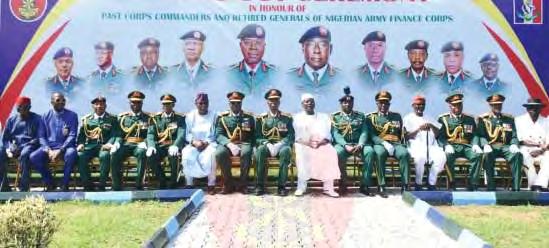
t he retired senior officers Major General Kl Yusuf, Major General aa fay emiwo, Major General J Mohammed, Major General r N Ochei, Major General MO Ihanuwaze, Major General M Galadima, Major General sa Gumel, Brigadier General ea Obona, Brigadier General as Maikano, and Brigadier General MK Baba-Mallam with Chief of accounts and Budget, Major General taofik s idick; and former COas , Lieutenant General Yusuf Yahaya, during the pulling out ceremony
Major General s idick (third right); Mr. Nonso Okpala, GMD/C e O, V f D Group (second right); and Major General Julius Osifo, Director General of the Nigerian a rmy f inance Corporation (far right) with other senior officers at the recently held Wasa
Electronic transmission of results while preserving a legal fallback is best for the country, argues MAGNUS ONYIBE
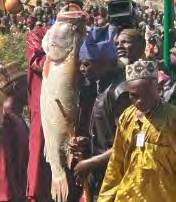
KEBBI'S BLEND OF TRADITION AND MODERNITY
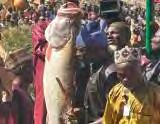
The Argungun Festival is a celebration of culture, innovation, and prosperity, writes ABDULLAHI IDRIS ZURU
See page 21
A
NATION WHERE ANYTHING GOES BONIFACE CHIZEA argues the need to tackle the impunity in the country
page 21
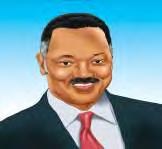
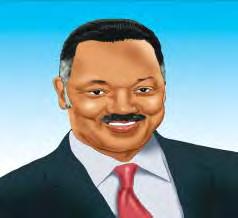
A WREATH FOR JESSE JACKSON
REAL-TIME ELECTRONIC TRANSMISSION OF RESULTS
With the release of the 2027 general elections timetable by the Independent National Electoral Commission (INEC), Nigeria has once again been thrust into a familiar but unresolved debate: should election results be transmitted exclusively and immediately by electronic means?
The agitation has been led largely by opposition politicians and civil society groups who insist that only real-time electronic transmission can safeguard electoral integrity. The 10th Senate, however, has been cast as the villain for initially rejecting—and later cautiously approving—this demand with an important caveat.
On 9 February, Peter Obi led protesters to the National Assembly to pressure lawmakers to reverse their opposition to immediate electronic transmission. The following day, Rotimi Amaechi staged a similar protest. Before the demonstrations could gain momentum, the Senate amended Clause 60(3) of the proposed Electoral Act 2026, approving electronic transmission of results to INEC’s IReV portal.
Crucially, however, lawmakers retained a fallback provision: where internet connectivity or technology fails, the senior INEC official at a polling unit may rely on results recorded on Form EC8A.
That safeguard has infuriated protesters, who demand exclusive electronic transmission without exception. But this absolutist position raises a more troubling question: what happens to voters in polling units—particularly across at least nine states—where poor connectivity makes real-time transmission impossible?
Nigeria’s electoral history shows that result manipulation often occurs during the physical movement from polling units to collation centres. That reality explains public enthusiasm for electronic transmission. Yet refusing to recognise Form EC8A as a lawful fallback risks something worse: the outright disenfranchisement of voters whose results cannot be transmitted instantly through no fault of theirs.
It is puzzling that seasoned politicians such as Atiku Abubakar, Obi, and Amaechi—veterans of multiple elections—would champion a system that could invalidate legitimate votes and invite endless post-election litigation. Civil society activists and ordinary citizens may overlook this danger, but experienced political actors should know better.
The Senate’s compromise does not weaken electoral integrity; it strengthens it. By allowing electronic transmission while preserving a legal fallback, lawmakers
have closed a dangerous loophole that could otherwise plunge the 2027 elections into chaos.
Reforms must protect democracy, not sacrifice voters on the altar of technological idealism. Ignoring foreseeable infrastructure failures is not progress—it is recklessness. In trying to cure malaria, Nigeria must not create cancer.
While it is true that fewer Nigerians are exercising their right to vote, the statistics from the 2023 general elections are instructive. Of the approximately 93 million registered voters, about 87 million collected their Permanent Voter Cards (PVCs), yet only around 30 millions actually voted.
Some commentators have attributed this poor turnout to a lack of trust in the electoral system, arguing that it is the primary cause of voter apathy. That explanation, however, may not be entirely accurate. Many Nigerians obtained their voter cards primarily as a means of national identification and to avoid being excluded from government programmes or activities that may require possession of a PVC.
Another significant factor is electionday violence. The grim statistics of violence recorded during elections—when thugs are unleashed by rival political parties— are frightening enough to deter many Nigerians from venturing out to cast their ballots.
Some proponents of real-time electronic transmission of election results argue that online banking transactions are conducted seamlessly across the country. However, a counterargument exists: the data required for a simple bank transfer is far less than what is needed to transmit comprehensive election results in real time. Comparing bank transfers to the real-time transmission of election results is therefore akin to comparing apples and oranges.
In fact, we all know the number of times we record ATM transfer failures and banks
advise customers to fill out complaint forms which often take a couple of days to be resolved.
Who in Nigeria has not been informed by their bank that the 'network is down'?
Furthermore, it is unhelpful that advocates of real-time electronic transmission often assume technology to be flawless and all-sufficient. Hackers abound in Nigeria and everywhere. If falling back on form EC8A is not an option what stops those determined to rig the election from procuring hacking technology to achieve the same goal? Even the Democratic National Committee (DNC) platform was broken into presumably by the Russians to hurt Hillary Clinton when she ran against incumbent President Donald Trump. Incidentally, according to Senator Nwanbonyi—the most vocal defender of the fallback provision using Form EC8A— the Electoral Act 2022 does not even contain the term “electronic transmission.”
The 10th Senate has, however, inserted it into the proposed new Act in the interest of transparency. It will prevent the repetition of the situation whereby after the 2023 elections the courts stated that IReV and electronic transmission contained in INEC rules were not recognized because they were not captured in the Electoral Act 2022.
The controversial clause—mandating INEC to fall back on results recorded on Form EC8A where poor internet connectivity prevents immediate transmission to the IReV portal—is the bone of contention. Yet this provision appears to be a long-term safeguard designed to avert legal disputes that could arise if the amended electoral law recognises only results transmitted electronically in real time, thereby excluding those recorded on Form EC8A. What happens to votes from polling units where electronic transmission is impossible due to poor internet access?
The insistence by opposition politicians and activists that the proposed Electoral Act 2026 should recognise only electronically transmitted results—without any fallback—could jeopardise the entire electoral process. Such a position is likely to trigger prolonged legal battles by voters who may be disenfranchised if their votes, though duly recorded on Form EC8A, fail to appear on the INEC Results Viewing (IReV) portal due to technical limitations.
Onyibe, an entrepreneur, public policy analyst, author, democracy advocate, development strategist, is a former Commissioner in the Delta State
The Argungun Festival is a celebration of culture, innovation, and prosperity,
writes ABDULLAHI IDRIS ZURU
KEBBI'S BLEND OF TRADITION AND MODERNITY
The 2026 Argungun Fishing Festival, held from February 11-14, has cemented Kebbi State's position as a premier tourism destination in West Africa.
Governor Nasir Idris' visionary leadership was on full display as the state showcased its rich cultural heritage, attracting dignitaries, investors, and tourists from far and wide. The festival was a vibrant celebration of Kebbi's traditions, with colorful displays of agricultural products, livestock, and solid minerals.
President Bola Ahmed Tinubu, governors, traditional rulers, and business tycoons graced the occasion, praising Governor Idris' efforts in transforming Kebbi into a tourism hub. The event was a testament to the state's growing reputation as a premier destination for unique and immersive African cultural experiences.
The festival showcased Kebbi's abundant resources, including gold, iron ore, and limestone, offering a range of investment opportunities in agriculture, solid minerals, and tourism. Governor Idris' administration has been working tirelessly to attract investors, and the event saw significant interest from local and international investors.
The organizing committee, led by Deputy Governor Senator Umar Abubakar Tafida, worked hard to upgrade facilities and structures in Argungun, the host town. The result was a seamless and enjoyable experience for visitors, with modern amenities and comfortable accommodations.
The festival generated significant revenue for the state, creating jobs and improving the quality of life for residents. Local businesses and entrepreneurs capitalized on the influx of visitors, boosting hospitality growth and economic activity.
The Argungun Festival has become a symbol of cultural pride and innovation, showcasing Kebbi's unique blend of tradition and modernity. The event featured contemporary entertainment, fishing competitions, and exhibitions, creating economic opportunities and boosting local hospitality.
Governor Idris' forward-thinking policies have encouraged local businesses and communities to invest in showcasing their rich cultural heritage while embracing comfortable, contemporary amenities. The state's strategic location, skilled workforce, and investor-friendly policies make it an attractive destination for tourists and investors alike.
The festival's success is a testament to Governor Idris' commitment to
positioning Kebbi as a center of innovation and opportunity in West Africa. The state's unique blend of tradition and modernity has put it on the global tourism map, attracting visitors and investors from far and wide.
The Argungun Festival is not just a celebration of culture, but a celebration of opportunity, innovation, and prosperity. With Governor Idris at the helm, Kebbi is poised to become a major player on the global tourism stage, attracting visitors and investors from far and wide
The festival also featured a range of cultural performances, including traditional music and dance, showcasing the rich cultural heritage of Kebbi State. Visitors were treated to a variety of local cuisine, including delicious dishes made from fresh fish and other seafood.
The event was also an opportunity for local artists to showcase their work, with many selling their crafts and artworks to visitors. The festival provided a platform for local entrepreneurs to promote their products and services, creating new business opportunities and partnerships.
Kebbi State's tourism sector is expected to receive a significant boost from the festival, with many visitors planning to return and explore more of what the state has to offer. The state's government is committed to developing the tourism sector, with plans to invest in infrastructure and promote sustainable tourism practices.
The success of the festival has also put a spotlight on Kebbi State's rich cultural heritage, highlighting the importance of preserving and promoting traditional customs and practices. The state's government is working to promote cultural exchange programs and collaborations with other states and countries to further showcase Kebbi's unique cultural identity.
Zuru is a special adviser to Governor Nasir Idris' on communication and strategy
BONIFACE CHIZEA argues the need to tackle the impunity in the country
A NATION WHERE ANYTHING GOES
I don't know how many of us elites are as concerned about the state of our country, Nigeria, as I am! It does not appear that anything is working well. And the impunity in the land, along with primitive acquisition of wealth, are walking on all fours.
I just viewed the video of the out of this world palace that belonged to Uche Secondus. Not too long ago, I also watched that of Senator Sekibo. We were also all staggered to see the extent of real estate acquisition made by the immediate past Attorney General of the Federation and Minister for Justice as he is confronted by EFCC as they make their enquiry.
It is as if the politicians are in competition to display obscene wealth. But nobody seems worried about the overall optics. What business or investments gave them such humongous amounts of money to own such palaces in the midst of abject poverty and deep misery amongst a generality of our longsuffering population?
It is about time we girded our loins to wrestle corruption in this land to a stand still. And it is not rocket science to achieve that. We just need determined leadership to be able to do so. But we must accept the fact that corruption at current levels would never foster the desired level of development.
We have just witnessed the national grid collapse twice in four days! Where else do you find such horrendous developments? And we are mouthing the target of one trillion dollar economy by the year 2030! How do we find the productivity to achieve that goal? We must, therefore, be jokers who are simply daydreaming to be targeting this objective considering the prevalent circumstances in the country?
We have been on the matter of tax reforms for some time now. Yes, Nigeria has one of the lowest tax to GDP ratios, and therefore, the urgency of a review can not be over emphasised. But most of us believe that what was needed was to get more people into the tax net. There are many people who should be paying tax but who are currently not doing so, particularly in the large informal sectors of the economy.
But no one ever believed that considering the current hardship across the land that anyone would have the conscience to inflict increased tax pains on anybody. In fact, we looked forward to an amelioration as an attempt is made to end the incident of multiple taxation on the citizens. But what do we have on our hands? How could it happen in a democracy that the version of the tax in circulation is different from what was approved by the National Assembly? What is happening here? Are we running someone's private estate? And how do we elevate such criminality to the level of state craft?
I believe that the commencement of the reforms must be put on hold for now until we achieve the buy-in of all
stakeholders.
How many of us followed closely matters arising from the recent ambassadorial nominations? Sixty eight persons were cleared by the Senate committee to be sent as ambassadors. In fact but for Donald Trump's intervention, we were not in a hurry to address such mundane matters!
But the posting has begun slowly but selectively. The person posted to Turkey, who was later dropped, we were told was because it was discovered that he was not amongst those earlier screened! How can? Who is in charge here? How come all these several embarrassing reversals come out from the presidency? Have there been any consequences so far for this show of shame? Even the personal integrity of one of those now sent is seriously in question, but he has nevertheless been sent as our representative! Does anyone really care?
Let's look at the untoward development of the planned move to a one party state in a democracy! The extent of the defections is baffling as it is unheard of. We have never witnessed anything like that before in this country. This is definitely an attempt to make the outcome of 2027 elections predictable.
Why should we not have stringent guidelines that must be followed before such defections are accepted? May be we have them, but in this particular instance, the gatekeepers are the beneficiaries and therefore thoroughly compromised and therefore left with no choice but to look the other way. But we can not have democracy without a viable opposition. It makes a mockery of the very concept of a democracy.
Regrettably, with this development, accountability is made redundant, and impunity is given increased leeway to thrive, and corruption is given further impetus and the nation's aspirations for development then compromised. There must be a return to the drawing board to make such defections difficult to undertake in the future. It makes Nigeria a laughing stock amongst the comity of nations and must therefore be brought to an end.
Dr Chizea is a management consultant
Editor, Editorial Page PETER ISHAKA
Email peter.ishaka@thisdaylive.com
A WREATH FOR JESSE JACKSON
Jesse Jackson, civil rights activist, politician and priest, dies at 84
The passage of the American civil rights icon, Mr Jesse Jackson, is a globally significant event. In his life’s work, Jackson became a symbol of black civil rights activism and quest for inclusiveness in America’s badly segregated society. The fulfilment of his struggle came with the election of Mr Barack Obama as the first black president in the United States. It therefore came as no surprise that Jackson, along with other prominent black elite like Andrew Young, Al Sharpton, Oprah Winfrey and late John Lewis, broke into tears of joy at the first inauguration of Obama who then went on to win re-election four years later.
In his tribute, President Bola Tinubu has, most appropriately, described Jackson as a servant-leader who fought for the dignity of black people, the oppressed and the voiceless in the United States and across the world.
The irony of Jackson’s life is that he passed on at a moment in American history when the White House is occupied by a president whose views and policies have divided the nation along racial lines
“As a student in the United States in the 1970s, I lived in Chicago, the same city where Reverend Jackson fought the most important battles against injustice,” said Tinubu who described the deceased civil rights icon as a great friend of Nigeria and Africa and a formidable voice against apartheid in South Africa.
“I witnessed firsthand how, as a faithful servant of God and humanity, he pointed the arc of American society to the great promise of the American dream.”
A priest by calling, Jackson followed in the tradition of activism blazed by Rev. Martin Luther King Jr to whom he was a close associate. He was also a colleague of other leading lights of the civil rights movement. Throughout his life, Jackson stood out in his oratorical flourish and sharp intellect. Starting as a member of the Southern Christian Leadership Conference (SCLC) founded by Martin Luther King, Jackson was present during the 1968 assassi-
T H I S D AY
EDITOR SHAKA MOMODU
DEPUTY EDITOR WALE OLALEYE
MANAGING DIRECTOR ENIOLA BELLO
DEPUTY MANAGING DIRECTOR ISRAEL IWEGBU
CHAIRMAN EDITORIAL BOARD OLUSEGUN ADENIYI
EDITOR NATION’S CAPITAL IYOBOSA UWUGIAREN
THE OMBUDSMAN KAYODE KOMOLAFE
T H I S D AY N E W S PA P E R S L I M I T E D
EDITOR-IN-CHIEF/CHAIRMAN NDUKA OBAIGBENA
GROUP EXECUTIVE DIRECTORS ENIOLA BELLO, KAYODE KOMOLAFE, ISRAEL IWEGBU
DIVISIONAL DIRECTORS SHAKA MOMODU, PETER IWEGBU, ANTHONY OGEDENGBE
nation of the former. He then led the Chicago branch of Operation Breadbasket before establishing Operation PUSH (People United to Save Humanity). After King’s assassination, Jackson came to occupy a preeminent position that combined political activism with the fight for the civil rights of black Americans. From his Chicago base, Jackson was for several years a powerhouse of sorts. Subsequently, he moved his base to New York from where he took shots at the highest political office in the country. In 1984 and 1988, Jackson sought the Democratic presidential ticket. Although he lost on both occasions, Jackson became the first African American to mount a serious presidential challenge within a major platform, securing in the process millions of votes that would pave the way for future politicians like Obama and Kamala Harris.
Born in Greenville, South Carolina, Jackson was ordained in 1968 and received a Master of Divinity in 2000. But he never at any period restricted himself to the pulpit. He had global appeal and presence and used both on many occasions to play diplomatic roles for his country. For instance, Jackson helped to negotiate the release of American hostages in Serbia, Iraq, Syria and Cuba while President Bill Clinton appointed him America’s envoy to Africa. But despite his political efforts, Jackson was better recognised as a leading civil rights figure throughout his life and he played the role with distinction. The irony of Jackson’s life is that he passed on at a moment in American history when the White House is occupied by a president whose views and policies have divided the nation along racial lines. He has therefore bowed out at a period when his kind of civil rights activism is in increasing demand. Yet it must be acknowledged that when the moment called him to serve his nation and race, the late Mr Jesse Jackson answered boldly. May God comfort the family he left behind.
Letters in response to specific publications in THISDAY should be brief (150-300 words) and straight to the point. Interested readers may send such letters along with their contact details to opinion@thisdaylive.com. We also welcome comments and opinions on topical local, national and international issues provided they are well-written and should also not be longer than (750- 1000 words). They should be sent to opinion@thisdaylive. com along with photograph, email address and phone numbers of the writer.
IT'S THE POWER SECTOR, STUPID!
One person is mourning the loss of a damaged TV. Another is packing out rotten food from a freezer that has not seen steady light in days. A family is treating heat rashes because the fan won’t work, and the heat is unprecedented. A small business owner is calculating how much of her profit has gone toward powering the generator. An artisan sits idle because there is no power to run his tools. A company diverts expansion funds to diesel.
The title of this piece is deliberate. Those who know, know. I won’t insult your intelligence with a history lesson. The point is, we keep dancing around the obvious while the obvious keeps messing with us.
It is the power sector. And until we confront it head-on, everything else is cosmetic.
During the campaign, aspirant Bola Ahmed Tinubu promised improved power supply. In 2025, President Tinubu assured delegates from Siemens that electricity reforms would move faster. Since then? Crickets.
Meanwhile, supply keeps dipping. Voltage swings. Entire feeders collapse without warning. National grid collapses! In a previous piece, I called out the rot across the entire value chain and how unbearable it has become. Still, crickets. It’s worse off!
The power value chain is in a shambles. DISCOs are emperors unto themselves. GENCOs are owed billions. Transmission is fragile. Nigerians are paying the price.
It goes without saying that if power works, a huge chunk of our productivity problem disappears. Barbers, welders, tailors, cold-room operators, SMEs, corporations, large enterprises, et al, give them steady electricity and watch the economy breathe. Instead, we are running a generator economy. Diesel is swallowing profits. Fuel is eating school fees.
Not everyone can afford solar panels like the President’s Aso Villa. Most Nigerians live at the mercy of erratic supply that damages appliances and kills businesses.
Some of us supported this administration because we believed it had the spine to take on hard reforms. Yes, tough decisions have been made in other sectors, and it's beginning to pay off. But power cannot remain the weak link. It cannot be the constant embarrassment.
If the minister is the problem, show him the door! If DISCO licenses need to be reviewed, review them. If debts must be restructured, restructure them. If contracts are stalling progress, revisit them. Whatever needs to give, let it give.
We are tired of excuses. We are tired of darkness. We are tired of generators drowning out conversation in our own homes.
Fix the power sector. Fix the value chain. Fix whatever is broken. Nigerians have endured epileptic supply for decades. Enough of this rubbish!
The Chief Information Officer of MTN Nigeria, Shoyinka Shodunke, has advanced reasons why Africa, despite its youthful population that is highly digitally savvy, cannot lead in the ongoing fourth digital revolution.
According to him, Africa as a continent, is still struggling with the challenges of weak leadership and legacy mindsets, insisting that Africa, giving its huge population and determination to learn new things, has a rare opportunity to lead and
participate in the global fourth digital revolution, provided it overcomes hesitation, legacy mindsets, and weak leadership.
Shodunke said this in Lagos at the Tech Revolution Africa 2.0 Conference, during a keynote session themed: ‘The Digital Economy Forecast for 2026’.
Shodunke referenced Africa’s historical experience with past industrial revolutions, and warned against the tendency of repeating old mistakes.
“Africa was completely missing from the first
industrial revolution. In the second, we were only providers of raw materials, and in the third, we were merely consumers. When Africa hesitated in the first, second and third revolutions, Africa lost out, and history punished Africa,” he said.
Shodunke stressed that the fourth digital revolution presents a different reality, driven by data, cloud computing, and talent rather than heavy capital investments.
“The inputs today are data, cloud, and talent. The factory now sits in the cloud.
For the very first time, Africa has an opportunity not just to participate, but to lead, because the playing field has changed,” he further stated.
He identified leadership, rather than capital or talent, as the biggest challenge facing Africa’s digital future. According to him, “Our biggest risk is not lack of capital or talent; it is weak leadership.”
He however said: “This is not a time for comfort or committee meetings. It is a time for bold leadership that is willing to disrupt legacy products, legacy revenues,
and legacy mindsets.”
Using MTN Nigeria as a case study, he noted that the company has moved beyond basic connectivity into cloud services, fintech, and Artificial Intelligence (AI). According to him, connectivity and data have become commodities, and the real value is in building intelligence on top of those commodities, where winners in this digital era will emerge.
He therefore urged African youths and innovators to act decisively and take advantage of its youthful tech savvy
population, to lead digital revolution from Africa. He said: “History does not reward those who wait to be convinced. The time to act is now. Africa must not be left behind again; this time, we can set the trend for the fourth digital generation.” While noting the visible growth of the platform, the transformation and revolution that have been carried out within a year, Shodunke commended the conference conveners for building a strong ecosystem for technology conversations in Africa.
Emma Okonji
The Chief Executive Officer, Internet Xchange Point of Nigeria (IXPN), Mr. Mohammed Rudman has advised all Internet Service Providers (ISPs) and large enterprises to acquire the Autonomous System Number (ASN) in order to have global visibility and local network resilience that will help them serve their customers better.
Rudman gave the advice at a technology forum in
Lagos while presenting a paper themed: ‘Internet Connectivity, Visibility And Network Resilience’.
He described Autonomous System Number (ASN) as a unique identifier that is assigned to a network that share a single and defined routing policy for easy network identification and resilience in a global tech space.
According to him, “ASN offers global identity, network resilience and flexibility that
allow service providers to have multiple interfaces and be able to connect to multiple service providers. Without ASN, it will be extremely difficult for ISPs and large enterprises to connect to two or more service providers. The beauty of multiple connections is that service providers can easily switch to other networks and continue to offer resilient services without downtime, if there is service disruption like fibre cut on one network.”
So ASN gives service providers better network resilience, and it also enables global identity for the world to have access to different networks that are managed by local ISPs. It also offers opportunity for expansion to multiple locations because if you’re in one location and you’re using MTN, you can also be in another location while using Airtel. But without ASN, it will be extremely difficult to achieve, Rudman further said.
Emphasising the importance of network resilience with ASN, Rudman said if by chance there was a destruction caused by fibre cut, like what happened in 2024, the ISP would be able to route its customers to other networks, without the customers experiencing any form of downtime, since the ASN allows ISPs to connect to multiple operators.
Rudman also stressed the need for domestication of internet traffic generated
in Nigeria, in order to encourage local hosting of data in the country.
“Local data gathering and storage have improved tremendously in Nigeria, considering how internet data was generated and accessed in the past years. In 2011, the internet traffic recorded was very minimal, and by 2015, it was only four gigabits per second. By 2020, it was only 200 gigabits.”
Izomor: Tinubu Has Restored Investors’ Confidence in Oil and Gas Sector
In this interview with Ejiofor Alike , the Managing Director and Chief Executive Officer of MG Vowgas Limited, Mr. Godwin Izomor speaks on the company’s huge investments in local capacity development, negative impact of absence of steel rolling mill on Nigeria’s industrialisation drive and how President Bola Tinubu’s administration has created the enabling environment that made foreign investors trust Nigeria again, among others. Excerpts
Other Nigerian indigenous companies are complaining of lack of jobs; they are complaining that their multi-million-dollar facilities are idle. But your company is building more facilities. What is motivating you to embark on these new investments?
The secret behind our investments is delivering good jobs to our clients; a good job brings another work. If you do good work, it will give you another job because the oil and gas industry is a highly technical area and not everybody can survive in that area, especially in fabrication. It’s highly capital intensive; it’s highly technical. So, for you to invest to survive in that place, you must be conscious of the fact that you must know the in-depth of fabrication. Fabrication is not just welding.
We are the only company in Nigeria that have ASME (American Society of Mechanical Engineers) certification. We are the only Nigerian indigenous company that has ASME certification. All the other indigenous companies that have ASME certification got the certification when they were still foreign companies. They later localized themselves and became indigenous companies. We are the only truly indigenous company that has ASME certification.
Others were foreign companies that later localised themselves. MG Vowgas is the first indigenous and the only indigenous company that has been able to sustain their stamp over the years. We have sustained our stamp and our stamp is renewed every three years. The other companies do not.
Again, we have what we call a welding management system. It’s only issued by ISO International Standard. And we are the only company that has it today. It used to be MG Vowgas and Saipem, but Saipem is no longer in Nigeria today. So, we are the only company that has it.
During the late President Muhammadu Buhari’s administration, foreign investors did not make major investments in Nigeria; they claimed that they were waiting for the Petroleum Industry Act (PIA). The only major project that was launched was the NLNG Train 7. There were no jobs in the oil and gas industry and they blamed the non-passage of the Petroleum Industry Bill (PIB). Now that the industry has the PIA, what has changed now that President Bola Tinubu is in power?
We can give credit to the government of President Bola Tinubu. In the oil and gas industry, he has done excellently. If there is any area that we can give
credit to this government, it’s the oil and gas industry.
The international oil companies (IOCs) are launching new projects. Shell has launched the Bonga North and is launching the Bonga South West. How are these projects going to impact Nigerian indigenous companies?
It’s a good development. And all Nigerian companies - we must support the government to encourage the IOCs to do more investments in the oil and gas industry. The oil and gas industry is a critical area that has a way of circulating and retaining the benefits of any project within the Nigerian economy. If one company wins a project, many 10 Nigerian indigenous companies can be beneficiaries of the same project.
If we get it right in oil and gas, it will circulate and create multiplier effects in the economy.
The benefits will spread to the banks; it will spread to the small and medium companies operating within Nigeria. So, the government has captured that. President Bola Tinubu understands that area and his administration is making efforts to create the enabling environment.
The Petroleum Industry Act (PIA) is not a perfect document. That is why he has given some concessions to the international oil companies
(IOCs) to bring more money. Nigerian indigenous companies do not have robust funds to invest heavily in the oil and gas industry. We must rely on international companies.
Lack of a functional steel rolling mill has been identified as a major factor militating against Nigeria’s industrialisation. How does it affect the oil and gas industry?
Lack of a steel rolling mill is a major challenge in the oil and gas industry. Nigeria cannot industrialise as a nation without a functional steel rolling mill. Steel rolling mills are a critical component for any nation to industrialise.
President Tinubu’s administration should look into it very critically. I expect the government to mandate the Nigerian Content Development and Monitoring Board (NCDMB) to utilize the Local Content Fund and partner with local or international companies to build a new steel rolling mill – different from the Ajaokuta Steel Complex because Ajaokuta is entangled with so many problems.
Let the Nigerian government consider setting up another rolling mill. The Local Content Fund can be used to pay for the government’s equity in a new rolling mill.
We need a steel rolling mill in
Nigeria to realise our industrialization drive. We have a lot of fabrication yards in the country that can fabricate important components of heavy machinery and equipment.
But the cost of importing steel into the country is very prohibitive. Some foreign companies are destroying the Nigerian economy by making sure that Ajaokuta doesn’t work so that Nigeria will continue to depend on importation of steel from other countries.
You can imagine how much we spend annually on steel importation – about $4billion.
If we can spend $4billion annually to import steel, why can’t we build a steel rolling mill? We must look inwards for a solution to this problem.
What other things do you recommend that President Tinubu’s administration should do to encourage more indigenous investments in the oil and gas industry?
This administration is already doing what it should do to encourage investments by giving incentives to foreign companies to invest in the oil and gas industry. I must give it to President Tinubu that he has a strong knowledge of the industry and he has worked hard to create the enabling environment for investors to trust Nigeria again. He has restored the confidence of investors in Nigeria’s oil and gas industry. Do not forget that for eight years of the late President Muhammadu Buhari’s administration, no international oil company invested in the oil and gas industry because Buhari’s administration was not ready to give any concession to investors to bring money into the country. Every investor wants to take his money to a place he will earn adequate returns on investment. President Tinubu is making concessions to encourage foreign investors.
When are we expecting the commissioning of your ongoing projects?
We are going to invite the Nigerian Content Development and Monitoring Board (NCDMB) and some media houses for a tour of our different facilities between April and June. They will tour our Onne facility, the Warri facility, and then our expansion project in our main facility in Port Harcourt.
So, you are also building one in Onne, apart from the Port Harcourt facility?
Yes, we are building a new one in Onne, right now. Two projects are ongoing, simultaneously - the Onne and Warri facilities.
Izomor
Driving Personal Pension Plan
Recent licensing of the first accredited pension agent by the National Pension Commission has been described as the right tool for achieving mass inclusion of informal sector operators into pension scheme, writes Ebere Nwoji
Recently, the National Pension Commission (PenCom) licensed the first officially accredited pension agent with the primary purpose of expanding pension coverage to millions of Nigerian workers in the informal sector, still outside pension coverage.
The premier pension agent named Awabah, is expected to collect micro-contributions and build confidence in the pension system.
“They will take pensions to markets, villages, motor parks, farms, and workshops,” said the Director General PenCom Omolola Oloworaran.
According to the PenCom DG, the accredited pension agent, which regulation was introduced in September last year is designed to bridge the gap between pension fund managers and Nigerian workers, especially those of informal sector.
This latest move by PenCom to sweep millions of Nigerian informal sector workers into pension net has been commended and described as a positive response towards salvaging Nigerian micro business operators, artisans, and other self-employed workers from old age poverty.
It was also described as a step in the right direction towards pushing pension fund managers into joining force with the commission in marketing the contributory pension scheme and growing pension assets from the present figure of N27 .45 trillion to huge investible funds well above the present figure.
CPS / PFAs
For over 20 years since the establishment of the Contributory Pension Scheme by PenCom, Pension Fund Managers (PFAs) who were supposed to be at the fore front of marketing the scheme to Nigerian workers have not done so. Rather, they have been enjoying the compulsory regulation driving the CPS. Indeed, going by their modus operandi, it will not be over statement to say that the PFAs do not have marketers and where they have, their marketers are
passive and lacked the aggressiveness with which every marketer with new product uses to push products to the target market.
Suffice it to say that within these 22 years; the pension sector has experimented the CPS, the PFAs have been spoon- fed by PenCom, the regulator who does everything for them.
Indeed, the N27 trillion assets that has accrued from the scheme can be said to have freely flowed into their volt due to the compulsory nature of CPS for formal sector workers.
The operators face the first competition that compelled them to embark on competitive marketing in November 2020, when the commission kicked off pension transfer window which allows RSA account holders to transfer their contributions from one PFA to another in line with section 13 of the Pension Reform Act 2014.This compelled the PFAs to engage in aggressive marketing and improve on their services to customers.
With the licensing of the first pension agent, PFAs will now witness more competition and grabbing of businesses from each other through these agents. What this means is that any PFA that thinks that it is business as usual and decides to remain in its comfort zone waiting for business to freely roll into its zone will be undone by the stiff competition that will ensue.
Industry stakeholders said the sector needed this nature of competition if they must tap into the huge potential in the informal sector market.
Indeed, the operators need to engage as many pension agents as the insurance sector at this critical time to be able to bring millions of Nigeria informal sector operators under pension coverage.
The story continues online on www.thisdaylive.com
Mobereola: Charting New Course for Nigeria’s Maritime Future
Osagie Edward highlights how strategic reforms, international partnerships, and digital innovation are transforming Nigeria’s maritime sector
When Dr. Dayo Mobereola assumed leadership of the Nigerian Maritime Administration and Safety Agency (NIMASA) on March 22nd 2024, he inherited a sector burdened by legacy challenges, from training backlogs and regulatory gaps to an international reputation marred by security concerns and punitive insurance premiums. Two years later, the agency is emerging as a continental leader in maritime innovation, regulatory enforcement, and global advocacy. Through a combination of aggressive capacity development, strategic international diplomacy, and digital transformation, NIMASA is positioning Nigeria not just as a regional maritime power, but as a model for African maritime governance in the 21st century.
Building Human Capital
At the heart of NIMASA’s transformation is an unwavering commitment to developing Nigeria’s maritime workforce. The agency has tackled head-on the longstanding backlog in the Nigerian Seafarers Development Programme (NSDP), aggressively clearing sea-time training delays that had frustrated countless aspiring maritime professionals.
In a historic first for 2025, Mobereola personally attended the Maritime Academy of Nigeria (MAN) graduation ceremony, a symbolic gesture that underscored the agency’s renewed commitment to training pipelines. This wasn’t mere ceremonial attendance; it reflected a fundamental shift in how NIMASA views its role in workforce development.
The numbers tell the story: over 235 cadets have been sent to premier maritime institutions in India and Greece for training as Licensed Deck and Engine Officers. Meanwhile, NIMASA has integrated cutting-edge technology for verifying Certificates of Competency (CoC),
streamlining the seafarer licensing process and bringing it in line with international STCW (Standards of Training, Certification and Watchkeeping) requirements. But Mobereola’s vision extends beyond external training. Recognizing that institutional excellence begins at home, NIMASA has implemented comprehensive staff welfare programs, including structured training initiatives, performance-based promotions, and reward systems designed to enhance internal professionalism and operational efficiency.
The results? Nigeria’s election to Category C of the International Maritime Organization (IMO) Council for the 2026–2027 biennium, a major milestone reflecting global confidence in NIMASA’s administrative reforms and a testament to the agency’s growing international stature.
IMO Council Victory
Nigeria’s election into the IMO Council on Friday, November 28, 2025, during the IMO General Assembly in London, stands
out as a defining achievement for NIMASA under Mobereola. The victory, led by the Honourable Minister of Marine and Blue Economy, Dr. Adegboyega Oyetola, marked Nigeria’s triumphant return to the council after more than a decade.
Describing the outcome as a landmark endorsement of Nigeria’s maritime reforms, Dr. Oyetola credited over twelve months of intensive diplomatic shuttles, sustained advocacy, and coordinated stakeholder engagement involving NIMASA and other national institutions. He noted that Nigeria’s improved maritime security architecture and reforms in the Gulf of Guinea played a decisive role in restoring global confidence.
This attracted Presidential Commendation for the apex regulatory agency as President Bola Ahmed Tinubu formally commended the management of NIMASA, describing the achievement as a strong affirmation of Nigeria’s growing influence in global maritime governance.
Modernizing Maritime Labour
In June 2025, at the Day of the Seafarer celebration in Port Harcourt, the Federal Government launched the Maritime Labour E-Platform, a digital solution described by Honourable Minister Adegboyega Oyetola as a transformative tool for labour administration. The platform represents more than technological upgrade; it’s a fundamental reimagining of how Nigeria manages its maritime workforce. Building on the success of the 2022 dockworkers registration initiative, the E-Platform creates a modern, integrated system for registering and verifying seafarers, dockworkers, employers, and other stakeholders.
Mobereola
THI s DAy • THURS DaY FEBRUa RY 19, 2026
Acting Group Politics Editor DEJI ELUMOYE
Email: deji.elumoye@thisdaylive.com
08033025611 sms only
Abuja’s Area Council Polls: Integrity of INEC is on Ballot
Iyobosa Uwugiaren argues the real victory of the abuja’s area Council elections scheduled for this Saturday will not be measured by which party controls different area Councils. But whether Nigerians — across party lines — accept the process as fair, positing that the integrity of Professor Joash Ojo amupitan-led Independent National Electoral Commission is on the ballot.
On the surface, this Saturday Area Council elections in the Federal Capital Territory, Abuja appear predictable — another local government contest in the country’s packed democratic calendar.
But underneath the procedural calm lies a deeper national significance. These elections are not merely about who governs AMAC, Bwari, Gwagwalada, Kuje, Abaji or Kwali.
They are, in effect, a referendum on the institutional credibility of the Independent National Electoral Commission (INEC) and, by extension, the integrity of its chairman, Professor Joash Ojo Amupitan (SAN), whom many people had described as “Mr. Integrity.’’
And now, the elections carry an added stratum of political sensitivity. Minister of the Federal Capital Territory, Nyesom Wike, recently declared that he would not support individuals who are “against the President” to win political office in the FCT.
In a country’s highly charged political environment, that statement echoes far beyond partisan grandiloquence. It introduces a critical question: Can an election conducted in the federal capital be protected from executive political influence?
Abuja is not just another administrative zone. It is the seat of federal power. What happens - politically in the FCT carries symbolic weight across the federation.
Local government elections typically invite modest attention. But when a powerful Minister openly frames the election in loyalty terms — aligning victory with support for President Bola Tinubu — the stakes heighten. The contest shifts from grassroots governance to a perceived loyalty test within national power politics.
In such a setting, the burden on INEC multiplies. It must not only administer the process proficiently; it must demonstrate visible independence from the political rhetoric surrounding it.
There is nothing unusual about active political actor, like Wike campaigning energetically. But when a powerful federal appointee signals that political loyalty to the President should determine electoral outcomes, it hones public examination of the electoral umpire.
The concern is not whether politicians express preferences — they always do. The concern is whether state machinery, perception of influence, or administrative structures could tilt the playing field.
In democracies, perception often shapes legitimacy as much as evidence. For INEC, therefore, the Abuja’s council elections now represent more than a test of logistics. They are a test of the INEC distance from executive politics.
In electoral politics, symbolism often dwarfs scale. And there is no more symbolic terrain than the Federal Capital Territory. What happens in Abuja does not stay in Abuja. It echoes across the federation.
But, why does this election matters beyond local governance? Local government elections traditionally attract lower turnout and limited national attention.
Yet Abuja’s Area Councils occupy a peculiar constitutional and political space. As the seat of federal power, the FCT is not just another administrative unit; it is Nigeria’s democratic display case. A credible election in the capital indicates administrative discipline. A defective one broadcasts institutional weakness.
At a time when public trust in electoral institutions remains fragile, even minor operational lapses risk magnification.
Technology failures, delayed logistics, inconsistent enforcement of rules — each becomes a test of credibility.
In this context, the coming polls represent more than civic routine. They are a problem-solving exercise for INEC’s preparedness ahead of the 2027 general elections, more far-reaching contests.
Indeed, every election tests two dimensions of credibility: competence and neutrality. Competence concerns logistics — timely deployment of materials, proper accreditation through BVAS, transparent collation and prompt result uploads. These are mechanical yet fundamental indicators of institutional seriousness.
Neutrality, however, is more delicate. It speaks to equal application of rules, transparent handling of candidate eligibility, and the absence of perceived partisan alignment.
In Nigeria’s political climate, perception is often as significant
as proof. An election can meet procedural benchmarks and still suffer reputational damage if key stakeholders feel excluded or unfairly treated.
For the INEC chairman, therefore, the challenge is dual: deliver administrative efficiency, while guarding institutional impartiality.
There are three possible outcomes — and their consequences in the Saturday elections.
First, if polling units open on time, BVAS performs reliably, results are uploaded seamlessly, and disputes remain within legal channels, the political effect would be stabilising. Such an outcome would demonstrate INEC learning. It would suggest that electoral reforms — particularly technological safeguards — are gaining operational development.
Most importantly, it would strengthen confidence ahead of 2027. Political actors would be compelled to shift focus from delegitimising INEC to organising effectively at the grassroots. In this scenario, the chairman’s leadership gains credibility. The narrative shifts from misgiving to cautious assurance.
The real victory will not be measured by which party controls the Area Councils. It will be measured by whether n igerians — across party lines — accept the process as fair. In the end, elections test more than candidates. They test institutions. And in Abuja, the integrity of the I n EC and by extension, its leadership, is on the ballot.
Second, a more probable outcome lies in the middle ground: logistical delays in some councils, minor technical failures, patchy result uploads. Here, the damage would not be disastrous — but it would be swelling. Opposition parties would amplify every lapse. Social media activists would amplify isolated incidents. Civil society groups would question preparedness.
Even if no violence erupts and courts handle disputes, repeated minor failures could reinforce a troubling narrative: not necessarily bias, but bureaucratic fragility. Institutional trust rarely collapses overnight. It erodes gradually, through tolerated ineffectiveness.
Third, the most destabilising scenario would involve widespread allegations of selective enforcement of rules, or technological breakdowns in politically strategic councils like AMAC.
In such a case, the election ceases to be local. It becomes national theatre. Abuja protests carry diplomatic visibility. Allegations of bias in the capital would ripple outward, strengthening partisan suspicion ahead of the next general elections.
This is where Professor Amupitan leadership is most tested — not in perfect conditions, but in moments of penetrating scrutiny.
INEC has invested heavily in technology in the past, particularly the Bimodal Voter Accreditation System (BVAS) and digital result transmission platforms. But technology is only as credible as its implementation.
If devices malfunction or uploads stall without clear communication, suspicion quickly fills the information vacuum. Transparency in explaining technical issues will be as important as resolving them. Silence breeds conspiracy. Clarity restores confidence.
The Federal Capital Territory carries diplomatic, security, and political sensitivity. Even minor unrest attracts national headlines. Therefore, safe polling units, orderly collation centres, and peaceful post-election conduct will signal that electoral democracy in Nigeria can function without coercion or chaos. Where voters feel secure, legitimacy expands. Where fear lingers, turnout shrinks — and democracy weakens quietly.
At the end of the day, the significance of the Abuja Area Council elections go beyond personalities. It touches on a deeper concern: Can Nigeria’s electoral system reliably produce outcomes perceived as fair?
Democracy does not require perfection. It requires credibility. If the coming polls are transparent and competently managed, they could mark a subtle but meaningful shift in Nigeria’s electoral trajectory — from persistent doubt toward cautious institutional rebuilding.
If they falter, however, the consequences may not be instant disruption. They may instead reinforce the slow-burning distrust that keeps voters disengaged and fuels political polarisation.
The Abuja Area Council elections are modest in scope but immense in symbolism. For INEC’s leadership, this is not simply another administrative exercise. It is a credibility checkpoint.
The real victory will not be measured by which party controls the Area Councils. It will be measured by whether Nigerians — across party lines — accept the process as fair.
In the end, elections test more than candidates. They test institutions. And in Abuja, the integrity of the INEC and by extension, its leadership, is on the ballot.
Amupitan
Olarewaju: Synergy Between Presidency and N’Assembly in Nation’s Best Interest
Senior Special a ssistant to the President on National a ssembly Matters, in charge of matters relating to the House of Representatives, Hon. Ibrahim Kunle Olarewaju, in this interview speaks on the relationship between the national assembly and Presidency under the current administration. Raheem Akingbolu brings excerpts.
It has been about two and a half years now that you have been the go-between the Presidency and the National Assembly, how has the experience been? It has been exciting and full of experiences. I would also say it has been a learning process. My experience in the last few years has given me a practical understanding of the saying of the president that one should continue to learn and gain knowledge until he or she reaches mastery.
As a former member of the House of Representatives, I used to think I already had enough understanding of National Assembly and parliamentary matters, but coming into this position has since taken me through various learning processes and showed me that there is still much more to learn. I thank God for the opportunity.
I have been able to interact with key players in Nigerian politics, both in the parliament and the executive, and I have seen practically how government activities work, how decisions are taken, and how those decisions eventually become legislation. To put it succinctly, it has been quite exciting.
There is a perception that the current National Assembly is a“rubber stamp”to the president. How would you respond to that?
I was expecting that question and I smiled when you asked because it is not new. Even when I was in the parliament, we were called ‘rubber stamps’, and those before us were also given the same tag.
Let me put it this way, I think Nigerians want a better economy, growth, and performance, yet they also want to see the President and the parliament constantly fighting. Can you please name one country where the executive and legislature fight endlessly and still move forward.
When the Presidency and the Senate under the leadership of the late President Muhammadu Buhari and Senator Bukola Saraki repectively were at loggerheads, what progress did Nigeria record during that period? Fighting between the two arms does not help the country.
What I think we should be concerned about and be happy about is that the background and the pedigree of major actors in both arms of government contributed to the chummy relationship between them. President Tinubu was a former senator. His wife was a former senator. The Vice President is a former senator. The Chief of Staff is a former Speaker. And the Senate President was a former governor. These experiences dictate the nature of their relationship. It makes it easier to manage issues within the parliament before they escalate into crises.
Recently, the House of Representatives refused to sit for some days over genuine demands concerning payments to local contractors. They met with the President, explanations were given, solutions were found, and payments were made. That is how governance should work.
How would you assess the president’s performance so far?
Without missing words, I would say the President is doing excellently well, especially in the area of infrastructure, economic management and security matters. Nigerians often fail to look at where we were coming from. In the area of infrastructural development, there is hardly any part of the country that has not experienced new road construction and other developmental projects. Also, perhaps because of the background of President Tinubu as a financial expert, he has created a good economic blueprint for Nigeria.
To appreciate President Tinubu’s contribution to security, we may need to take a trip back to former President Goodluck
Jonathan era. During that period, there were a series of bombings in the Federal Capital Territory, including the one that happened near the Police Headquarters. Today, we must give credit to the Nigerian Army and the coordination between the Army and the Air Force, down to other security networks in the country.
Unfortunately, today, some incidents are exaggerated by the naysayers who ordinarily don’t expect anything good from this administration. When soldiers are killed, social media amplifies it, but when terrorists are neutralized, nobody talks about it. We should stop celebrating negativity.
I liaise regularly with security chiefs, and I can tell you that many reports circulating are not accurate. There are improvements, even if challenges still exist.
I saw recently that the dollar dropped to about N1,340 from around N1,500, yet only a few people celebrated it. Why do we focus only
on negative news?
The dollar is a major global currency, and the United States protects it aggressively. Despite this, Nigeria’s economy is gradually improving. We should celebrate progress where it exists.
Let’s come to Ekiti State. How would you describe the performance of Governor Abiodun Oyebanji?
The blind can see and the deaf can hear. Governor Oyebanji is simple, focused, and working quietly. Roads that were once nightmares are now passable. Bridges are being completed. Projects are visible across the state.
People from different political backgrounds, even former opponents, openly commend his performance. That speaks volumes.
Does he deserve a second term?
Not just a second term. If the constitution allows it and he shows interest in contesting again, I will lead the campaign. One of the beauties of Governor Oyebanji’s approach
I think Nigerians want a better economy, growth, and performance, yet they also want to see the President and the parliament constantly fighting. Can you please name one country where the executive and legislature fight endlessly and still move forward.
to governance is that he has demystified the office of the governor. When someone is doing well, let us say it as it is.
Some people accuse the All Progressives Congress of trying to turn Nigeria into a one-party state through defections. Can you defend this?
As the President said, it is not his duty to organize opposition parties. If a party cannot manage its own affairs, that is its problem. Tinubu has always expanded his political base by bringing friends and opponents together. Nobody is being forced to join the APC. People are leaving some parties because those parties are weak and disorganized. Politics allows free entry and free exit. Those who want to join us are welcome, and those who want to leave have the right to do so.
Can you highlight some of your achievements in office as a former lawmaker?
One of my greatest achievements is human capital development. I helped young people secure federal jobs and sponsored some abroad.
I executed tangible projects such as road construction, civic centers, libraries, classrooms across several communities, solar street lighting, and empowerment programs every three months.
I provided a mobile clinic and ambulances to support healthcare delivery and organized ICT and AI training for youths, providing laptops and data support. I also organized a security summit to address insecurity in communities. What gives me the most fulfillment is that my constituents appreciate these efforts. That is what truly matters.
Olarewaju
APMT: Consistent Economic Policy Key to Unlocking Nigeria’s Investment Potential
Eromosele Abiodun
Conversations around Nigeria’s investment climate gained renewed momentum following insights shared at the European Business Chamber Nigeria (Eurocham) Annual Conference and Expo, where business leaders underscored the need for predictable economic regulations to sustain investor confidence and unlock long‑term capital commitments.
Speaking at the roundtable on European Business Perspectives in Nigeria, APM Terminals Nigeria CEO, Frederik Klinke, emphasised that while recent reforms have created cautious optimism, consistency remains the decisive factor for long term investment.
“Nigeria has enormous potential and recent reforms show promise. But potential alone is not enough,” Klinke said. “Only consistent
implementation—not just policy announcements—will build the predictability investors require to commit capital with confidence.”
He noted that recent improvements in macroeconomic stability, especially in the foreign exchange market, have supported growth. “Having an exchange rate that you can rely on is crucial for us as a business. Our ability to invest is hinged on the reliability of the currency,” he said, adding that more predictable economic regulations would strengthen investment decisions.
Speaking, Chairman of the Senate Committee on Capital Markets, Senator Osita Izunaso, highlighted the strong performance of Nigeria’s equities market, which delivered returns of over 50 per cent in 2025.
He described the capital market’s performance as a “signal to the world that Nigeria is gradually emerging
as a credible destination for capital,” noting that the market had played a strategic role in recapitalising the banking and insurance sectors, raising over N3 trillion in the process.
Eurocham Nigeria President, Yann Gilbert, examined the broader geopolitical environment, noting that global pressures were forcing both governments and businesses to rethink how they operate. “In moments like this, resilience does not come from standing alone,” he said. “It comes from staying with close, trusted partners, building alliances and remaining agile in the face of uncertainty.”
Eurocham Nigeria, a private sector led body representing European companies, continues to push for reforms that strengthen the business environment and deepen economic cooperation between Nigeria and Europe.
Interswitch Simplifies UTME, Direct Entry ePIN Payments Nationwide
Emma Okonji
As registrations for the 2026 Unified Tertiary Matriculation Examination (UTME) and Direct Entry examinations continue across Nigeria, Interswitch, one of Africa’s leading integrated payments and digital commerce companies, is simplifying the process for prospective candidates by providing secure, reliable, and widely accessible payment channels for the purchase of UTME ePINs.
Purchasing an ePIN is one of the earliest and
most critical steps in the registration process for Joint Admission and Matriculation Board (JAMB) examinations. Given the time sensitive nature of the registration window and the volume of transactions involved, dependable payment platforms are essential to helping candidates proceed smoothly without delays or challenges. Speaking on Interswitch’s role in supporting the registration process, Divisional Head, Growth Marketing (Merchants & Ecosystem), Interswitch,
Olawale Akanbi, said the company remained committed to simplifying access to education through trusted payment solutions;
“At Interswitch, we understand how critical the UTME registration process is for millions of Nigerian students and their families. By providing secure, trusted, and widely accessible payment channels for JAMB ePIN purchases, we are helping candidates complete their registration with confidence and focus on preparing for their examinations,” Akanbi said.
SanlamAllianz General Insurance has announced the appointment of Mrs. Jacqueline Uche Agweh, as its substantive Managing Director/Chief Executive Officer.
The company said the appointment took effect from February 11,2026.
It further said the new CEO, brought over three decades of deep industry experience cutting across underwriting, claims management, reinsurance, insurance broking, life assurance, and technical operations.
The underwriting firm in a statement to this effect signed by its Group Head, Strategy, Marketing and Corporate Communications, Customer Relations, Chris Ekwonwa, said her appointment marked a significant milestone in the company’s commitment to strengthening leadership capacity and enhancing operational excellence within Nigeria’s insurance sector”, the company stated.
According to the statement, prior to her appointment, Agweh served as Executive Director, Technical Operations at SanlamAllianz General Insurance. She previously held senior management roles at FBN General Insurance (now Sanlam General Insurance), Oasis Insurance Plc, Kelsan Insurance Brokers Limited, ACEN Insurance Co. Limited, and other leading institutions within the industry.
Stanbic IBTC Insurance Wins Institutional Excellence Award
Ebere Nwoji
Stanbic IBTC Insurance, a subsidiary of Stanbic IBTC Holdings, was recently recognised as one of Nigeria’s top performing insurers, winning the Life Insurance category at the 2025 Risk Analyst Insurance Brokers Performance Review Awards.
Speaking on the award, Chief Executive Officer of Stanbic IBTC, Akinjide Orimolade, said Stanbic IBTC Insurance Ltd’s recognition reflected its operational discipline, prompt claims settlement. “At Stanbic IBTC Insurance, trust is built through reliable performance, timely claims settlement, and service that supports
customers when it matters most. This recognition reflects the quality of service we provide for our clients and partners. We are honoured to receive this accolade and will continue to raise standards across the industry, “he stated. Also speaking, Chief Executive of Stanbic IBTC Holdings, Chuma Nwokocha, said
L-R: Chief Executive Officer, APM Terminals Nigeria, Frederik Klinke; Chairman, Senate Committee on Capital Markets, Senator Osita Izunaso and General Manager, Eurocham Nigeria, Chigozie Okwara at the European Business Chamber Nigeria (Eurocham) Annual Conference and Expo held in Lagos…recently.
The price of OPEC basket of twelve crudes stood at $63.14 a barrel on Monday, according to OPEC Secretariat calculations.
The OPEC Reference Basket of Crudes (ORB) is made up of the following: Saharan Blend (Algeria), Djeno (Congo), Zafiro (Equatorial Guinea), Rabi Light (Gabon), Iran Heavy (Islamic Republic of Iran), Basrah Medium (Iraq), Kuwait Export (Kuwait), Es Sider (Libya), Bonny Light (Nigeria), Arab Light (Saudi Arabia), Murban (UAE) and Merey (Venezuela).
OPEC DAILY BASKET PRICE As AT 24TH n OV e M be R , 2025
Sterling HoldCo Commences N88.1bn Share Allotment after Successful Public Offer
Kayode Tokede
Sterling Financial Holdings Company Plc has announced the commencement of the allotment process for its 2025 Public Offer of 12,581,000,000 ordinary shares of 50 kobo each at N7.00 per share.
The estimated N88.1 billion allotment is on the backdrop of the earlier receipt of final
approval from the Central Bank of Nigeria (CBN) and the recent clearance by the Securities & Exchange Commission (SEC).
The allotment process, which begins immediately, marks the continuation of a disciplined, multi-year capital-raising programme that has positioned the Group as one of the fastestgrowing financial institutions in the region.
The Public Offer, which opened on September 15, 2025,
attracted strong participation from the investing public, with the Company receiving 18,280 applications for 16,839,524,401 ordinary shares valued at approximately N117.88 billion.
Following a thorough verification process, valid applications were received from 18,276 shareholders for a total of 13,812,239,000 ordinary shares. This represents a subscription level of 109.79per cent and reflects sustained confidence
in Sterling HoldCo’s strategic direction, governance, and long-term growth prospects. In line with the guidelines set out in the offer prospectus, the Group confirmed that all valid applications will be allotted in full. Every investor who complied with the terms of the offer will receive all the shares for which they applied. A very small number of applications were not processed or were partially rejected due to non-
compliance with the offer terms, including duplicate payments and failure to meet the minimum subscription requirement of 1,000 units or its multiples, as stipulated in the offer documents.
The Public Offer forms part of a broader capitalraising programme designed to enable Sterling HoldCo expand credit responsibly, accelerate innovation, and
provide sustained support to businesses and households across Nigeria. In addition to strengthening the capital buffers of its banking subsidiaries, Sterling HoldCo will inject N10 billion into SterlingFI Wealth Management Limited, its asset management subsidiary, in line with the revised minimum capital requirements for Capital Market Operators issued by the SEC in January 2026.
PSHAN Spotlights Champions for Change, Pushes for Sustainable Health Investment and Nationwide PHC
Each year, the Private Sector Health Alliance of Nigeria (PSHAN) brings together changemakers from the public and private sectors to recognise contributions that strengthen healthcare access and systems nationwide. Chiemelie Ezeobi writes that beyond celebrating those achievements, PSHAN also called for sustainable investments to bridge funding gaps, stronger partnerships and data-driven collaboration for resilient health systems, and the adoption of Primary Healthcare Facilities to reach the national target of 774 adopted PHCs
Over the years, the Private Sector Health Alliance of Nigeria (PSHAN) has maintained a rigorous standard in recognising merit-based achievements rather than influence or inducement through its awards platform where it honours individuals, organisations, and institutions driving transformative change, innovation, and leadership within Nigeria’s healthcare sector.
Beyond this, the body has built a reputation for supporting innovative partnerships and financing mechanisms that directly address gaps in maternal, newborn, and child healthcare systems.
Champions for Change: Spotlighting Innovation and Impact
The theme for the 2025 edition of the PSHAN Annual Awards was “Champions for Change: Celebrating Impact“ and it brought together individuals, organisations, changemakers, innovators and initiatives advancing healthcare outcomes and catalysing change, shaping stronger systems, expanding access, and transforming lives.
The 2025 PSHAN Annual Awards recognised contributions across five major categories, 25 subcategories, and a special MVP category for exceptional leadership, innovation, and impact in healthcare.
The Healthcare Equity & Access Award was presented to Abia State, while the Healthcare Policy Champion Award was conferred on the Basic Health Care Provision Fund (BHCPF). The Maternal Equity Advancement Award went to the Federal Ministry of Health and Social Welfare (FMOH&SW), and the Sustainability in Healthcare Award was awarded to the Rural Electrification Agency (REA).
The Outstanding Health Investigation Award was presented to Damilola Ayeni of the Foundation for Investigative Journalism, and the Community Health Impact Award was given to the Women Friendly Initiative (WFI).
Dr. Hadiza Shehu Galadanci received the Healthcare Leadership Award, while the Outstanding Medical Practitioner Award was presented to Dr. Zainab Shinkafi-Bagudu, and the Medical Practitioner Hall of Fame Award went to Dr. Benjamin Anyanwu.
The Community Health Champion of the Year Award was awarded to Amb. Dr. Joy Audu, and the Award for Outstanding Philanthropy was conferred on General T. Y. Danjuma. The Healthcare Innovation Award was given to Drugstoc, while the Healthcare Social Responsibility Award went to Fidelity Bank, and the Health Partnership of the Year Award was awarded to the African Development Bank.
The Private Sector Health Champion Award was presented to Zenith Bank, the 2025 PSHAN MVP Award was conferred on the World Health Organisation (WHO), Nigeria; PSHAN Health Journalism Excellence Award 2025 was presented to Chiemelie
Ezeobi; and Dr. Ayodele Renner of the Noisy Paediatrician bagged the Health Influencer of the year.
PSHAN’s Mission and Impact
The Private Sector Health Alliance of Nigeria is a non-profit organisation that pools private sector resources and expertise to complement the efforts of government and implementing partners to improve health outcomes. Over the years, PSHAN has built a reputation for supporting innovative partnerships and financing mechanisms that directly address gaps in maternal, newborn, and child healthcare systems.
Since its establishment, PSHAN has championed partnerships between government, businesses, and development partners to accelerate progress toward Universal Health Coverage. Initiatives such as the Adopta-Primary Healthcare Centre Programme, innovative health
financing collaborations, and privatesector-led solutions have strengthened healthcare access and delivery across the country, particularly in underserved communities.
Underscoring Import of Collaboration in Driving Healthcare Progress
The PSHAN Annual Awards 2025 was successfully held virtually on November 14, 2025, and it brought together government leaders, global health experts, philanthropists, and corporate executives, underscoring the importance of collaboration in driving healthcare progress.
Key highlights of the ceremony included the recognition of PSHAN’s ongoing commitment to better health for all Nigerians, transcending physical boundaries through collaboration, innovation, and shared vision for health equity.
Speakers including Mr. Jim Ovia, Board Chairman, PSHAN; Dr Tinuola Akinbolagbe, MD/CEO PSHAN; Mr. Aigboje Aig-Imoukhuede, Chairman, Access Holdings and Mrs. Ofovwe
Aig-Imoukhuede, Vice Chair, AigImoukhuede Foundation; Dr. Chikwe hekweazu, Assistant Director-General, WHO; Dr Salma Anas-Ibrahim, Special Advisor to the President on Health; Ms. Zouera Youssoufou, MD/CEO, Aliko Dangote Foundation; Mr. Tola Adeyemi, MD, KPMG West Africa; and Mr. Nonso Okpala, GMD/CEO, VFD Group, shared insights on the importance of innovation, collaboration, and strategic investment in transforming healthcare systems and strengthening national health resilience.
They also emphasised on the private sector’s critical role in supporting national health reforms, including Primary Healthcare Revitalisation, Health Security Preparedness, and the RMNCH Initiative.
It was another opportunity to celebrate the Adopt-a-HealthcareFacility Programme (ADHFP) as a transformative model for improving primary healthcare across Nigeria, with notable contributions from partners such as the MTN Foundation and Aig-Imoukhuede Foundation.
L-R: Mr. Jim Ovia, Board Chairman, PSHAN; Dr Tinuola Akinbolagbe - MD/CEO PSHAN; Mr. Aigboje Aig-Imoukhuede, Chairman, Access Holdings and Mrs. Ofovwe Aig-Imoukhuede, Vice Chair, Aig-Imoukhuede Foundation; Dr. Chikwe hekweazu, Assistant Director-General, WHO; Dr Salma Anas-Ibrahim, Special Advisor to the President on Health; Ms. Zouera Youssoufou, MD/CEO, Aliko Dangote Foundation; Mr. Tola Adeyemi, MD, KPMG West Africa; and Mr. Nonso Okpala, GMD/ CEO, VFD Group
Some of the awardees with PSHAN staff
Gamin G Week
Edited by nseobonG okon-ekonG
Who Blinks First as Enugu State Takes on Bet9ja?
Nseobong Okon-Ekong writes that a high-stakes regulatory duel is unfolding in Enugu, where the Enugu State Gaming and Lotto Commission has shuttered the retail outlets of Bet9ja, accusing the betting giant of breaching state gaming laws
Aregulatory storm is brewing in the South-East as the Enugu State Gaming and Lotto Commission (ESGC) squares off against one of the country’s biggest betting brands, Bet9ja. At stake is more than the reopening of retail betting shops shuttered across Enugu State since February 9, 2026. The dispute strikes at the heart of how gaming revenues are assessed, how far state regulatory powers extend, and whether nationwide operators can ringfence earnings along state lines. What began as an enforcement action over taxes and compliance has quickly escalated into a defining legal contest over revenue attribution, regulatory authority, and the balance of power between state oversight and nationwide gaming operators in Nigeria.
The enforcement action
In a formal clarification signed by its Executive Secretary/CEO, Prince Arinze Arum, the ESGC insisted that its regulatory shutdown of Bet9ja’s operations was neither arbitrary nor political. Rather, the Commission described the move as a lawful enforcement action following what it called “persistent and deliberate violations” of the Enugu State Gaming Law.
According to the commission, the alleged infractions date back to 2024 and include refusal to grant access to backend systems for transaction verification, unilateral tax declarations outside the state’s statutory Gross Gaming Revenue (GGR) framework, failure to
display mandatory ESGC approval signage at retail outlets, and failure to submit required documentation for licensing and continued operations.
“No operator is above the law,” the commission stated. “Regulatory compliance is mandatory. Transparency is mandatory. Proper licensing is mandatory.”
The ESGC argues that without backend access, it cannot independently verify the true volume of gaming transactions conducted within Enugu State. In its view, such access is central to safeguarding state revenue, ensuring fairness among operators, and maintaining regulatory integrity.
Bet9ja pushes back
Bet9ja, operated by KC Gaming Networks Limited, has rejected the Commission’s claims. Its CEO, Dr Ayo Ojuroye, maintains that the company has operated lawfully in Nigeria for over 12 years and does not owe Enugu any legitimate taxes or levies.
“Bet9ja has always operated within the law. We do not owe any legitimate taxes or levies to Enugu State,” Ojuroye stated, restating that the company has made repeated attempts to resolve the matter through dialogue.
The company’s central argument focuses on revenue attribution. Bet9ja contends that any state-level charges should apply only to earnings generated within Enugu, not to revenues derived from activities in other states processed through centralised systems.
This distinction is crucial in a modern gaming ecosystem where transactions may be digitally processed, pooled, and reconciled across multiple jurisdictions. For operators
like Bet9ja, which run both retail and online platforms nationwide, determining the “place” where revenue is generated can be legally and technically complex.
The GGR question
At the core of the dispute lies the interpretation of GGR, the industry-standard metric for calculating operator earnings. GGR typically represents the total amount wagered minus winnings paid out to customers.
The ESGC maintains that Enugu law clearly establishes a statutory GGR computation process that all compliant operators follow. It alleges that Bet9ja instead made unilateral tax assessments, bypassing the commission’s methodology.
Bet9ja, however, appears to argue that only the portion of GGR attributable to Enugu-based activity should fall within the commission’s tax net. From its perspective, extending calculations beyond the state’s actual economic footprint amounts to regulatory overreach.
The legal battle, therefore, may hinge on whether the courts agree with the Commission’s broad interpretation of oversight authority or with Bet9ja’s narrower, location-specific revenue model.
The curious silence of industry bodies
Perhaps as intriguing as the dispute itself is the conspicuous silence of the industry’s umbrella associations. Bodies such as the Federation of States Gaming Regulators of Nigeria (FSGRN) and the Association of Nigerian Bookmakers (ANB) have, at
least publicly, refrained from issuing strong statements on the matter.
The FSGRN, which exists to promote coordination among state regulators and foster regulatory coherence nationwide, might have been expected to articulate a collective position, either in support of Enugu’s enforcement stance or to clarify broader policy principles. Similarly, the ANB, representing the interests of licensed bookmakers, has not publicly rallied around one of its most prominent members, nor called for structured mediation.
Industry watchers suggest several possible explanations: behind-the-scenes diplomacy, caution pending judicial pronouncements, or internal divisions over regulatory interpretation. Yet the absence of a visible, unifying voice at such a critical juncture has raised eyebrows. In a sector striving for maturity, investor confidence, and public trust, silence can sometimes speak as loudly as protest.
The story continues online on www.thisdaylive.com
Hon. kunle soname, Chairman, kC Gaming, owners of bet9ja
Gift Tuadibofa, executive secretary, association of nigerian bookmakers
bashir are, mD/Ceo, Lagos state Lottery and Gaming authority and Chairman of Federation of states Gaming Regulators of nigeria
Prince arinze arum, executive secretary, enugu state Lottery and Lotto Commission
CJN Laments Blanket Corruption Allegations against Judiciary
Alex Enumah in Abuja
Chief Justice of Nigeria (CJN), Justice Kudirat Kekere-Ekun, has condemned what she described as “blanket allegations of corruption” being deployed of recent against the judiciary.
While admitting that judges and justices were not infallible in the course of their judicial duties, Kekere-Ekun warned that tagging the entire judiciary as corrupt had a way of weakening the institution and hurting the integrity of a lot of judges and justices, who had been labouring faithfully in the discharge of their duties.
She spoke Wednesday shortly after 14 new judges of the Federal High Court took their oaths of office, at the headquarters of the Supreme Court, Abuja.
Kekere-Ekun stated, “In recent times, there has been a troubling pattern of broad, sweeping attacks against the Judiciary. It has become fashionable in some quarters to deploy blanket allegations of corruption against the institution as a whole.
“While constructive criticism is legitimate in a constitutional democ-
racy, indiscriminate denunciation is neither fair nor responsible. Such sweeping generalisations wound deeply.”
She lamented that the critics did not merely criticise decisions, but cast aspersions on the integrity of men and women who had lived honourably, laboured faithfully, and discharged their duties with unblemished records.
The CJN warned, “When corruption is alleged without specificity, without evidence, and without recourse to established complaint mechanisms, the damage is collective. It erodes public trust, weakens institutional authority, and unjustly stains reputations built over decades of sacrifice.
“A judge who has served with integrity should not be made to stand under a cloud created by reckless rhetoric.
“Let me be clear: the judiciary does not claim infallibility. Where misconduct is established, it will be addressed firmly and transparently.
“The National Judicial Council remains vigilant and will not hesitate to discipline any judicial officer found wanting. Accountability is indispensable to judicial
independence.
“But independence itself must be protected from careless assault. Criticism must be responsible. Allegations must be evidence-based. Institutions must not be casually delegitimised, for when confidence in the courts collapses, the rule of law itself is imperilled.”
She challenged the new judges to be fair, bold, thorough in the
discharge of their duties because the Federal High Court occupied a pivotal place in the judicial architecture.
The CJN said, “By constitutional design, it exercises jurisdiction over matters that directly shape the economic, political, and regulatory life of the nation including revenue, banking, maritime affairs, intellectual property, and other
complex commercial disputes.
“Your decisions will resonate far beyond the courtroom. They will influence markets, institutions, public confidence, and, in many instances, the stability of governance itself.”
She stated that as part of efforts to increase public confidence in the judiciary, the authorities of the judiciary had taken steps to
strengthen its evaluation mechanisms to ensure that merit, integrity, competence, and temperament were the governing criteria for the employment of judicial officers.
According to the CJN, “In addition to structured peer and professional feedback and comprehensive background integrity checks, the process now incorporates a formal mechanism for public participation.
Court Freezes FDGS Energy Assets Over $7.9m,
N399m
Keystone Bank Debt
Wale Igbintade
A Federal High Court sitting in Lagos has granted sweeping interim orders freezing the assets and operations of FDGS Energy Group of Companies Limited over an alleged indebtedness of $7,999,405.19 and N399,893,550.44 to Keystone Bank Limited.
Justice Ambrose Lewis-Allagoa made the orders following an ex parte application filed on behalf of the Plaintiffs/Applicants by
Lack of N211m Budgetary Provision Grounds MOUAU 13th Convocation
Boniface Okoro in Umuahia
Amid uncertainties surrounding the postponed 13th Convocation of Michael Okpara University of Agriculture, Umudike (MOUAU), the Pro-Chancellor, Comrade Fidelis Ede, has revealed the event, proposed to gulp N211 million, had no budgetary provision.
The University Senate had planned the 13th convocation to hold in December last year, but it was put on hold, less than a month to the ceremony.
The Vice Chancellor, Prof. Maduebibisi Ofo Iwe, who would have presided over the ceremony but would be exiting office next month,
in a terse statement notifying the public of the development, said “the 13th convocation ceremony of the university approved earlier to hold from December 10 to 13, 2025 has been put on hold until further notice, adding that a new date would be announced later.
He said the varsity’s Senate regrets inconveniences the development may cause graduands and apologized to invited important guests the disruptions must have caused them.
Also in a statement intended to douse growing tension being generated by the postponement, the Head of Public Relations of the university, Dr. Ubadire Agua,
disclosed the Vice Chancellor, on November 4, 2025, reported to the Senate that the Chairman of the Governing Council had put all activities of the 13th Convocation Ceremony on hold, pending when the Council meets to consider the budget and decide on new dates for the event.
The statement added that although the directive of the Chairman of Council was received in Senate with mixed feelings, Prof. Iwe had cautioned that it should not create disaffection or cause any form of distractions in the university, especially as his administration transits to a new one.
Mofesomo Tayo-Oyetibo, SAN, who also moved the motion before the court.
The suit, marked FHC/L/ CS/2567/2025, lists FDGS Energy Group of Companies Limited (in receivership) and its Receiver/ Manager, Mr. Paul Mgbeoma, as Plaintiffs/Applicants, while Chijioke Arinze Onyeagba and Tijjani Ahmad Aliyu, identified as current directors of the company, are named as defendants.
Lewis-Allagoa, in his ruling, granted an interim injunction restraining the defendants, their agents, or privies from interfering with the Receiver/Manager in the
discharge of his statutory functions over the company’s assets.
The court restrained the defendants from entering into or remaining in possession of the company’s assets and offices now under receivership, collecting proceeds, income, or receivables due to the company, removing, dissipating, selling, leasing, or otherwise dealing with the company’s assets, and accessing any funds standing to the credit of the company in any financial institution up to the amount allegedly owed to Keystone Bank.
Lewis-Allagoa also ordered all banks and financial institutions
served with the order to file, within seven days, affidavits disclosing sums standing to the credit of the company, along with relevant account statements.
In addition, the court directed the Inspector-General of Police, Commissioner of Police for Lagos State, and other law enforcement agencies, including Interpol units of the Nigeria Police, to assist the Receiver/Manager in enforcing the orders and maintaining law and order in relation to the company’s assets.
The matter was adjourned to March 10, 2026, for hearing of the Motion on Notice.
A chieftain of the African Democratic Congress (ADC) and governorship candidate of the party in the Anambra 2025 election, Mr. John Chuma Nwosu, has commended the security partnership between Nigeria and the United States, which is aimed at wiping out insurgents.
The ICT expert and CEO of foremost tech-based company, Jetlink Group, described it as a timely step toward
strengthening the country’s counterterrorism capacity.
Nwosu spoke to journalists on Wednesday against the backdrop of the recent announcement by the Defence Headquarters (DHQ) confirming the arrival of about 100 United States military personnel and associated equipment at the Bauchi Airfield. The Director of Defence Information, Maj.-Gen. Samaila Uba, had disclosed in a statement that the U.S. personnel are technical specialists serving strictly
in advisory and training capacities, not as combat forces.
Nwosu while speaking to journalists said: “The partnership underscores the growing importance of technologydriven security architecture in modern warfare.
“In the contemporary security environment, technological superiority plays a decisive role in intelligence gathering, surveillance, and operational efficiency. Any nation that neglects this reality places its citizens at risk.
Ms. Fatima Idris; Chief of Staff, Aquarian Consult, Mr. Serumun Ubwa; Head of Corporate Services, Aquarian
Gowon;
Project Development Manager, Aquarian Consult, Mr. Chivegunum Okparaolu, during a press briefing on the 2026 Aquarian
Afri Caribbean Investment Summit in Abuja, yesterday
PHOTO: KINGSLEY ADEBOYE
EMERGENCY CAPACITY BUILDING OF INFORMAL FOOD AND WATER VENDORS AND WASTE WORKERS...
L-R: Special Adviser to the Lagos State Government on SDGs, Dr. Oreoluwa Finni; General Manager, Lagos State Environmental Protection Agency (LASEPA), Dr. Tunde Ajayi; Lagos State Commissioner for the Environment and Water Resources, Mr. Tokunbo Wahab; Japanese Ambassador to Nigeria, His Excellency, Mr. Hideo Suzuki; and Director and UNIDO Representative to Nigeria and ECOWAS, Mr. Philbert Johnson, at the project completion and achievements dissemination event for Project 240236, titled “Emergency Capacity Building of Informal Food and Water Vendors and Waste Workers in Flood Affected Lagos to Combat Cholera Outbreaks”, organised by LASEPA and UNIDO, in Ikeja, Lagos, on Tuesday
ADC Chieftain Drags FHC CJ, Tsoho, Justice
Abdulmalik to Court over Alleged Bias
Seeks order directing judge to desist from further hearing of ADC’s case
National Welfare Secretary of African Democratic Congress (ADC), Nkemakolam Ukandu, has dragged Chief Judge of the Federal High Court (FHC), Justice John Tsoho; a judge of the FHC, Abuja, Justice Joyce Abdulmalik; and a Court Bailiff, Moses Bentu, to a High Court of the Federal Capital Territory (FCT) over alleged bias in the hearing of
the party’s case at the court.
The claimant is specifically asking the FCT High Court to void the reassignment of a suit, marked FHC/ABJ/CS/1331/2025, by Tsoho to Abdulmalik, for being in disobedience of an order of the FCT High Court.
The claimant is also challenging the continued hearing of the case by a faction of ADC, led by Dumebi Kachikwu, by Abdulmalik over
alleged manifest bias.
Kachikwu, Adikwu Elias, Etimbuk Umoh, Muhammad Khala, and Alakum William had sued Independent National Electoral Commission (INEC), ADC, Chief Ralph Nwosu, Senator David Mark, and Ogbeni Rauf Aregbesola, over the leadership of ADC.
Following an application in July last year, Abdulmalik had joined the claimant as the sixth respondent
in the suit marked FHC/ABJ/ CS/1331/2025.
Ukandu stated that problems started when the judge came down heavily on his counsel at the proceedings of October 23, 2025 for not filing response to the originating summons served on him barely 24 hours by plaintiffs’ counsel and then abridged time of response from 30 days to seven, including Saturday and Sunday.
Mobile Force Squadrons to Boost Operational Readiness
The Inspector General of Police, Kayode Egbetokun, has disclosed that the Nigeria Police Force has expanded its Mobile Force with the creation of six additional squadrons, increasing the number nationwide from 74 to 80.
The move was aimed at strengthening operational readiness.
The IGP explained that the expansion was intended to enhance rapid response capability and provide improved tactical support in addressing high-risk security situations wherever they occur across the country.
Beyond the Mobile Force expansion, Egbetokun revealed that new Area Commands and Divisions have also been established across the federation to bring policing closer to communities, improve command efficiency and strengthen coverage in rapidly growing and strategically important locations.
The Inspector-General made these remarks while receiving members of the Committee of Retired Inspectors-General of Police during a solidarity visit to his office at Louis Edet House in Abuja.
Highlighting broader institutional reforms, Egbetokun noted that one of the key structural changes under
his leadership was the elevation of the Intelligence Unit to full departmental status.
According to him, the upgrade reflects the critical role intelligence plays in modern policing and proactive crime prevention.
He further announced the establishment of a new tactical formation, the Special Intervention Squad, which he said has already recorded measurable successes in several states where it has been deployed for targeted operations.
“Beyond operational reforms, we are placing renewed emphasis on professionalism, ethics and discipline as the foundation of effective polic-
ing,” he stated.
The IGP added that weekly training sessions focusing on policing ethics, professional conduct and service standards have now been made compulsory at the State Command level to continuously build capacity and enhance officers’ performance.
He also reaffirmed his commitment to boosting morale and ensuring institutional justice through a transparent and merit-based personnel management system within the Force.
Ukandu averred in a 42-paragraph statement of claim, “The claimant being dissatisfied with the ruling, petitioned the second defendant against the said ruling and demanded for a transfer of his case to another judge on grounds of manifest bias/grave likelihood of bias on the part of the court against the claimant.
“The claimant thereafter filed a Notice of Appeal, compiled and transmitted Record of Appeal and the appeal entered at the Court of Appeal, Abuja Division.
“In addition, the Court of Appeal, Abuja Division, has given March 2, 2026 for the hearing of the claimant’s application.”
He lamented that the CJ, in a letter dated November 7, 2025, and addressed to the claimant’s counsel, directed the court to proceed with the hearing of the matter, despite a pending appeal at the Court of Appeal, a development that led the claimant to file an action against the second defendant in suit No: FCT/ HC/CV/4684/2025: Nkemakolam Ukandu VS. Justice James Tsoho and two others, “wherein the 2nd defendant was directed to maintain status qou in Suit No: FHC/ABJ/ CS/1331/2025: Dumebi Kachikwu and four others & VS. INEC and
five others.”
Ukandu contended that despite the pendency of the matter and the order of the FCT High Court, which directed the second defendant to maintain staus quo in Suit No: FHC/ ABJ/CS/1331/2025, the second defendant, in disobedience to the said order, went ahead and reassigned Suit No: FHC/ABJ/CS/1331/2025 to the first defendant.
The reliefs he sought in the suit marked: FCT/HC/CV/619/26 and filed February 12, included a declaration that the reassignment of suit No: FHC/ABJ/CS/1331/2025 ... by the second defendant to the first defendant “is unlawful, null and void and of no effects whatsoever as the order of reassignment by the 2nd defendant was made in flagrant disobedience to the order of the High Court of the Federal Capital Territory, Abuja, wherein the 2nd defendant was directed to maintain status quo in Suit No: FHC/ABJ/ CS/1331/2025”.
The claimant is also seeking for an order of court setting aside the order of reassignment in Suit No: FHC/ABJ/CS/1331/2025 by the 2nd defendant to the 1st defendant ... for being an order made by the second defendant in flagrant disobedience to the order of the FCT High Court.
Karimi: Military Reorganisation Key
to Defeating
The Senator representing Kogi West Senatorial District and Senate Chairman Committee on Services, Senator Sunday Karimi, has assured Nigerians that the recent reorganisation of the nation’s military apparatus by President Bola Tinubu and the continued rejigging of operational strategies would yield fruit sooner than later.
Karimi, gave this assurance in a statement issued and signed by his Media officer, Busayo Tosin, a copy of which was made available to journalists in Lokoja, yesterday.
Insurgency
He argued that the recent spike in insecurity was not unrelated to the 2027 general elections.
“Security operations are proceeding simultaneously in Kwara, Nasarawa, Plateau, Benue, and Taraba States where President Bola Tinubu, through the Chief of Army Staff, Lieutenant-General Waidi Shaibu, has deployed special battalions.
“Nonetheless, kidnappers, murderers and terrorists continue to fester in parts of the country, leaving trails of anguish, blood and devastation.
“Despite these concurrent security operations, a terrorist group in Kwara State at the weekend paraded about 200
captives from a recent vicious attack on Woro community in Kaiama local government area in northern Kwara State.
“In response to written threats by terrorist groups, residents of parts of Kwara South are migrating from their homes and farmlands.”
The Chairman Senate Committee on Services argued that there was a nexus between the forthcoming general polls and the unabating insecurity in the country, alleging that certain interests and tendencies had resolved to continue to make the country ungovernable with the ultimate aim of disrupting the forthcoming general elections.
A Lagos-based businessman, Adesiyan Kayode Olayinka, was yesterday arraigned before Justice Chukwujekwu Aneke of the Federal High Court in Lagos over an alleged N230 million foreign exchange investment fraud said to have involved the use of an Artificial Intelligence (AI)-cloned image of Labour Party’s 2023 presidential candidate, Peter Obi. Olayinka was docked on a sixcount charge filed by the Federal Republic of Nigeria bordering on conspiracy, obtaining money by false pretence, fraudulent advertisement and stealing, contrary to the provi-
sions of the Advance Fee Fraud and Other Related Offences Act, 2016, and the Criminal Code Act.
After the charges were read to him in open court, the defendant pleaded not guilty to all six counts.
Following the plea, the prosecution applied for a definite trial date and urged the court to remand the defendant in a Nigeria Correctional Service facility pending the conclusion of trial.
In response, defence counsel informed the court that a summons for bail had already been filed and served on the prosecution. He urged the court to hear the bail application.
When Justice Aneke sought the
prosecution’s position on the bail request, the prosecutor stated there was no objection to the application but asked the court to fix a clear date for trial.
While moving the bail application, defence counsel told the court that the motion, dated and filed on February 17, 2026, was supported by a 16-paragraph affidavit sworn to by the defendant’s wife. He urged the court to admit his client to bail on liberal terms.
In a brief ruling, Justice Aneke ordered that the defendant be remanded at the Nigeria Correctional Service facility, Ikoyi, and adjourned ruling on the bail application to February 25, 2026.
Ibrahim Oyewale in Lokoja
Wale Igbintade
Linus Aleke in Abuja
Alex Enumah in Abuja
OPENING CEREMONY OF A 3 DAY WORKSHOP FOR INTERNAL AUDITORS IN LAGOS STATE...
L-R: Chief Business Officer, Arkounting Professional Services,
Gov Kefas: I Don’t Have Any Rift with TY Danjuma
Says
ex-defence
chief remains a father figure Declares his defection to APC is neither controversial nor financially induced Promises to deliver Taraba for Tinubu in 2027
Governor Agbu Kefas of Taraba State has disclosed that he has no rift with elder statesman and former defence minister, Lt General Theophilus Yakubu Danjuma (rtd).
Kefas also insisted that his defection from Peoples Democratic Party (PDP) to All Progressives Congress (APC) was neither controversial nor financially induced.
Kefas spoke with newsmen on Wednesday after a closed-door meeting with President Bola Tinubu at State House, Abuja.
He described Danjuma as a father figure whose counsel and goodwill remained intact, despite his political realignment, stressing that there has never been any misunderstanding
between them.
The governor said, “I don’t have any problem with TY Danjuma; he is my father. Since we started politics, nothing has ever come between us. People just speculate, but there is no issue at all.”
The governor explained that his recent visit to the retired three-star general was personal and symbolic, aimed at appreciation and reaffirmation of their long-standing bond, which was strengthened by their shared military background and years of association.
According to him, although Danjuma is not a member of any political party, he was duly informed before his move to APC and gave his blessing.
“Before I defected, I secured his approval. He assured me of
his support whenever I need it,” Kefas said.
The governor also dismissed insinuations that financial inducement influenced his defection to the ruling party, describing such claims as baseless.
“Nobody gave me money to defect to the APC,” Kefas said,
stressing that his decision was driven by conviction and strategic considerations for Taraba’s development, not pecuniary benefits.
He expressed satisfaction with his new political platform, saying he is optimistic of the opportunities it presents for deeper engagement with the federal government.
The Taraba governor further declared his readiness to deliver Taraba State for Tinubu in the 2027 presidential election, citing what he described as improvements in security and governance outcomes across key sectors.
“Delivering Taraba will not be difficult because our policies are already impacting the grassroots,” he said. Kefas disclosed that his meeting with the president centred on security, agriculture, and the welfare of Taraba residents, as well as strategies to strengthen collaboration between the state and the federal government.
FG Closes Site as 37 Miners Die in Plateau Toxic Gas Exposure Incident
The Minister of Solid Minerals Development, Dr Dele Alake, has
INEC: VOTE BUYING WON’T BE TOLERATED IN FCT POLL, ASKS EFCC, ICPC TO MAKE ARREST
in the Area Council Elections.
He also urged the residents to vote for candidates of APGA, whom he described as the true drivers of grassroots development and people oriented governance.
In a statement by his Special Adviser on Media and Publicity, Tony Olisa Mbeki, the chairman noted that the forthcoming election is historically significant as it represents the first local council poll to be conducted following the landmark Supreme Court judgment granting financial autonomy to Local Government Councils across Nigeria. According to him, the decision has restored the constitutional vision of a functional third tier of government, thereby placing enormous responsibility on voters to elect competent leaders who would manage resources transparently and deliver meaningful development directly to communities.
He stated that APGA remained ideologically committed to inclusive governance, community based development, youth empowerment,
infrastructure renewal, and economic opportunities for ordinary citizens.
Group Tasks INEC Chaiman to Come Clean on Allegations of Land Bribe by FCT Minister
A pressure group, Opposition Watch Nigeria (OWN), has called on the Chairman of the Independent National Electoral Commission (INEC), Professor Joash Ojo Amupitan, SAN, to come clean regarding allegations of a land bribe involving the Minister of the Federal Capital Territory (FCT), Chief Nyesom Wike. In a statement by its Media Coordinator, Aisha Bello, the group said the alleged bribe was reportedly intended to ensure the Commission did not recognise the Turaki-led, duly elected National Working Committee (NWC) of the Peoples Democratic Party (PDP).
According to Aisha Bello, “We call on Prof. Amupitan to address allegations that he secretly visited the FCT Minister under the cover of night in December 2025.
“It is alleged that during this meeting, he received directives to frustrate the Turaki-led NWC and was subsequently allocated a prime plot of land in the sprawling Asokoro District of Abuja, with a promise that the property would be developed for him.
“Prof. Amupitan must also clarify allegations that this property bribe is part of a ‘well-oiled deal’ driving scandalous efforts by INEC, under his watch, to instigate a crisis within the PDP.
“These efforts involve attempting to recognize and foist a Wike-backed renegade group on the party, in clear violation of the PDP Constitution, the Electoral Act 2022, and the 1999 Constitution (as amended).
“This alleged deal is reported to be the motive behind the INEC Chairman convening a controversial meeting of “PDP Stakeholders,” where he attempted to grant legitimacy to the Wike-backed group over the Turaki-led NWC elected at the party’s National Convention in Ibadan,” Aisha Bello stated.
ordered the closure of areas covered by Mining Licence 11810 operated by Solid Unit Nigeria Limited, owned by Abdullahi Dan-China in Zuraq, Wase Local Government of Plateau State, following the death of villagers allegedly mining in pit containing gaseous emissions.
In a condolence call to Governor Caleb Mutfwang, Alake sympathised with him over the loss of the innocent citizens who died while trying to earn a living.
Alake urged the governor to convey his deep sorrow and solidarity with the people of Wase over the irreparable loss, a statement by the Special Assistant on Media to the Minister of Solid Minerals Development, Segun Tomori, stated.
The minister said he has dispatched a team of officials and investigators led by Permanent Secretary, Yusuf Yabo, to probe the remote and immediate causes of the incident and recommend sanctions.
The team also includes experts in mining, environmental compliance and artisanal cooperatives. The minister is co-ordinating the team and the support services to ensure effective management of the situation.
The actions, according to the statement, were taken as preliminary reports indicated that the company ceded the pit where the incident took place to
the community to mine following agitations by villagers for empowerment.
It was gathered that the area was an abandoned Lead site with the stored mineral prone to emissions of sulphuric oxide. Unaware of the poisonous nature of the emissions, the villagers reportedly engaged in extraction while inhaling the gaseous substance.
ML 11810 lies between longitudes 10.34.45, and 10.35.50 and latitudes 9.13.45, 9.14.40. The minister promised to make further disclosures as investigations continue.
Earlier, a major mining disaster was reported to have struck Zurak, where at least 37 miners were feared dead and about 25 others hospitalised following a suspected toxic gas exposure inside an underground tunnel.
The incident occurred in the early hours of Tuesday, prompting widespread alarm and renewed scrutiny of unsafe mining practices in the region. Confirming the tragedy, the Wase Youth Leader, Shafi Sambo, said he was alerted at dawn after miners raised distress calls from the site.
“It happened at a mining site in Company Zurak, Wase Local Government. We got information that the miners dug deep into the ground and were exposed to a gas that killed 37 of them instantly,”
Sambo said. He added that several survivors were rescued and rushed to nearby hospitals for urgent treatment, though the exact number of those affected remains uncertain. Sambo explained the miners were extracting zinc on behalf of a company locally known as Dan China, believed to be a Chinese owned mining firm operating in the area. The specific mineral being mined at the time of the incident has not been officially confirmed.
The Media Information Officer of Operation Enduring Peace, Captain Chinonso Polycarp Oteh, confirmed that troops responded swiftly after receiving a distress call.
According to the officer, troops “quickly mobilised to the scene to assist other sister security agencies in cordoning off the general area and evacuating the victims to a nearby health facility.”
The military presence has since helped secure the site, preventing further access and reducing the risk of additional exposure to the suspected toxic fumes, he said.
The tragedy has intensified public concern over the safety of artisanal and company backed mining operations in Plateau State, particularly in rural communities where ventilation, emergency preparedness, and regulatory oversight are often inadequate.
Dr. Olusola Olowoyeye; Special Adviser to the Lagos State Governor on Internal Audit, Dr. Mrs. Oyeyemi Ayoola, FCA; and Lagos State Permanent Secretary, Office of Internal Audit, Mrs. Monsurat Titilope Alaka, at the opening ceremony of a 3 day workshop for Internal Auditors in Lagos State… recently
Deji Elumoye in Abuja
Emmanuel Addeh in Abuja and Yemi Kosoko in Jos
ONIRU BUSINESS AND CULTURAL DAY...
L-R: Special Adviser to Nigeria’s Minister of Industry, Trade and Investment, Mrs. Efe Barber; Comptroller of Immigration, Lagos State Command, Mr. Chris Onajinrin; His Royal Majesty, the Oniru of Iru Kingdom, Oba Abdulwasiu Lawal; Deputy Governor, Lagos State, Dr. Obafemi Hamzat; Wife of the Oniru of Iru Kingdom, Olori Mariam Lawal; and Commissioner for Commerce, Cooperatives, Trade and Investment, Mrs. Folashade Ambrose Medebem, during the Iru Business Network Oniru Business and Cultural Day held at the Oniru
recently
In Lent, Ramadan Message, Tinubu Urges Prayers for Nation’s Progress and Security
Atiku, Yilwatda,
Akpabio, Obi, Sanwo-Olu, Abiodun, Okpebholo, Ododo, others welcome Ramadan, Lent CAN president says Nigeria needs action, not just policies
abstinence from food and drink, stressing the need for kindness, forgiveness, good deeds, and love for humanity.
empathy and compassion towards the poor, thereby motivating both Christians and Muslims towards charity.
President Bola Tinubu has called on Nigerians to pray for the country’s progress and security during this year’s Lent and Ramadan season.
In a message, yesterday, to commemorate the commencement of Lent and Ramadan among Christians and Muslim faithful, the president also charged Nigerians to always promote peace, unity and stability of the nation.
Tinubu in a seven-paragraph message, stated, “With profound reverence to God Almighty, I greet the Christian and Muslim faithful on the solemn occasions of Lent and Ramadan.
“This year, Lent and Ramadan begin on the same day. This is not a common occurrence, and it reminds us that as a people of faith, we share a lot in common and are one people under God.
“For Christians, the Lenten season is a time for fasting, abstinence, and penitence, following Jesus Christ’s example in the wilderness before His crucifixion, which brought salvation to mankind.
“For Muslims, Ramadan is a hallowed season that reflects total submission to God Almighty and His command of sacrifice, devotion, service, and communal love and giving.
“It marks one of the five pillars of Islam. Beyond the obligatory fasting, Ramadan calls for deep spiritual reflection in obedience to Islam’s injunctions.
“As a nation and as a people, I urge us, as we embark on these important observances, to ensure good neighbourliness, promote peace, unity, and stability, and pray for the progress and security of our nation.
“Let us live by the good precepts of our faiths and be honourable in our duty to God and fellow humans. I pray that the lessons, blessings, and joys of these sacred seasons abide with us always.”
Also, at the opening of 2026 Tafsir, Tinubu urged citizens of all faiths to support efforts toward national stability.
Speaking at the State House Mosque, he noted that Ramadan coincided with the Christian season of Lent, describing the overlap as a reminder of shared values of sacrifice, discipline, prayer, and self-denial.
Tinubu said fasting should go beyond
He called on Nigerians, irrespective of religious affiliation, to continue praying for peace and to support ongoing efforts to tackle terrorism, banditry, and other security challenges.
In his address, Chief Imam of the State House Mosque, Abdulwahid Suleiman, thanked Allah for granting the faithful the opportunity to witness another blessed month of Ramadan, the month in which the Holy Qur’an was revealed.
Suleiman expressed gratitude to Tinubu for his leadership and wished him a peaceful and successful Ramadan. He prayed that Allah would forgive His servants during the sacred month and decree goodness for them throughout the year.
The Chief Imam also prayed for divine guidance for the President and his principal officers, asking Allah to grant them wisdom in leadership, good health, and strength.
He further prayed for peace, stability, and improved well being for all Nigerians.
Atiku Welcomes Ramadan, Lent
A former Vice-President of Nigeria and a chieftain of the African Democratic Congress (ADC), Atiku Abubakar, has congratulated Christians and Muslims on the commencement of the Lent season and Ramadan, respectively.
The Christian and Muslim season of fasting began yesterday, Wednesday, February 18.
Atiku said with the announcement of the sighting of the moon by His Eminence Muhammad Sa’ad Abubakar, the Sultan of Sokoto, as represented by the Shehu of Borno, HRH Alhaji (Dr.) Abubakar Ibn Umar Garbai Al-Amin El-Kanemi, Muslims in Nigeria should embark on Ramadan fasting.
“The holy month of Ramadan has come again and it is a moment that enjoins us to be steadfast in good deeds, more than before.
“The Almighty Allah has commanded us to embark on mandatory fasting in this holy month and it is a season that calls us to more piety, worship and sacrifice.”
He noted that apart from being a period of spiritual and physical purification and self-restraint, it would foster
He observed that it was a pleasant coincidence for the season of sacrifice for both Christians and Muslims to be commencing on the same day, and wished both Christians and Muslims a rewarding spiritual exercise.
“It is, therefore, incumbent on the well-to-do in the society to extend charity to the less privileged and those who have limited means to fulfill the obligations of this season of sacrifice,” Atiku said.
Yilwatda: Ramadan, Lent Divine Reminder of Essence of Nation’s Peaceful Coexistence
The National Chairman of the All Progressives Congress (APC), Prof. Nentawe Yilwatda, has said Ramadan fasting and the Lent period were divine reminder that regardless of religious affiliation, peaceful coexistence was not optional but essential to national progress and stability.
Yilwatda in a statement by his Special Adviser on Media and Communications Strategy, Abimbola Tooki, described the twin sacred seasons as deeply significant periods of fasting, reflection, sacrifice, and spiritual renewal for Nigerians of both faiths.
He noted that it was profoundly instructive, and richly symbolic, that Ramadan and Lent were beginning on the same day, describing the rare convergence as a powerful message to the nation.
According to him, “It is a divine reminder that Nigerians are one people, brothers and sisters bound by a shared destiny, regardless of religious affiliation, and that peaceful coexistence is not optional but essential to national progress and stability.”
Yilwatda stressed that both Ramadan and Lent emphasised common values such as discipline, compassion, humility, love for one another, and service to humanity.
Akpabio Charges Muslims to Pray for Peace, Embrace Compassion at Ramadan
President of the Senate, Godswill Akpabio, has called on the Muslim faithful to dedicate the sacred period to prayers for peace and to deepen acts of compassion and understanding. In a goodwill message to mark the
start of the fasting season, Akpabio urged the Muslim ummah to seize the opportunity of Ramadan for spiritual reflection, renewal and national cohesion.
The message, signed by his Special Adviser on Media and Publicity, Hon. Eseme Eyiboh, conveyed the Senate President’s warm felicitations to Muslims in Nigeria and across the globe.
“As the Muslim community prepares to observe the holy month of Ramadan, I extend my warmest greetings and felicitations to all Muslims in Nigeria and around the world,” he said.
Akpabio described Ramadan as a sacred season that offers a unique opportunity for self-improvement and rededication to the values of faith, sacrifice and service to humanity.
He encouraged adherents to use the period not only for fasting and prayers, but also to strengthen bonds of unity and mutual respect among citizens.
Sanwo-Olu Greets Muslims, Christians for Ramadan, Lent Lagos State Governor, Mr. Babajide
Sanwo-Olu, has celebrated with Christians and Muslims on the commencement of this year’s Lenten and Ramadan fasting season.
Sanwo-Olu, in a statement by his Special Adviser on Media and Publicity, Mr. Gboyega Akosile, greeted Christians and Muslims for Lent and Ramadan, urging them to use the fasting period to seek the face of God in prayers.
The governor enjoins Nigerians and Lagosians in particular to be more steadfast in prayers to God against many untoward occurrences in the country and seek advancement of our shared peace and prosperity.
“I congratulate Lagosians and Nigerians, especially Christians and Muslims, for the celebration of this year’s Lent and Ramadan. The fasting period is very significant to Christian and Muslim faithful across the world. It teaches abstinence from worldly pleasures, steadfastness in prayers and total submission to the will of God.
“I believe strongly that the start of these two major religions’ activities on
the same day is not a mere coincidence but God’s design for our nation and the entire world for peace and stability.
“Lent and Ramadan are important seasons in the Christian and Islamic calendars. It is a period when the adherents are expected to fast and seek God’s intervention in the affairs of man. The season teaches us the significance of abstinence for the sake of seeking God’s grace, mercy and forgiveness.
“As we join the rest of the world in observing this year’s Lent and Ramadan, I enjoin Lagosians and Nigerians, especially Christians and Muslims, to be more steadfast in prayers to God against any forms of evil occurrences in our land.
“Let us be good to one another. We should be tolerant and be of good behaviour to one another. Let us continue to offer prayers for continued peace, unity and stability in Lagos and Nigeria at large,” he said.
Continued on page 39
TINUBU SIGNS EXECUTIVE ORDER ON DIRECT REMITTANCE OF OIL REVENUES TO FEDERATION ACCOUNT
costs while simultaneously functioning as a commercial entity, creates potential competitive distortions and undermines its transition into a fully commercial operator as envisioned under the PIA.
“The Executive Order, therefore, introduces immediate measures to curb leakages, enhance transparency, eliminate duplicative structures, and reposition NNPC Limited strictly as a commercial enterprise, while safeguarding the Federation’s interests,” the statement explained.
In rolling out the order, the President affirmed that the reforms are of urgent national importance, given their implications for national budgeting, debt sustainability, economic stability, and the overall well-being of Nigerians.
Tinubu noted that his administration will also undertake a comprehensive review of the PIA in consultation with relevant stakeholders to address identified fiscal and structural anomalies.
According to the Presidential Executive Order, which has been officially gazetted, NNPC Limited will no longer collect and manage the
30 per cent frontier exploration fund.
According to Tinubu, the NNPC will ensure that the 30 per cent profit from oil and gas from production sharing, profit sharing, and risk service contracts currently earmarked for the frontier exploration fund is henceforth transferred to the Federation Account.
NNPC, he said, will no longer be entitled to the 30 per cent management fee on profit oil and profit gas revenues, which should go to the federation account.
In the same vein, all operators/ contractors of oil and gas assets held under a production sharing contract shall, from the date of the Executive Order, which is February 13, 2026, pay royalty oil, tax oil, profit oil, profit gas, and any other interest howsoever described which is due to the government of the federation directly to the Federation Account.
Tinubu has also suspended payments of the Gas Flare Penalty into the MDGIF, saying that the commission will henceforth pay proceeds from all penalties imposed on operators for flaring gas into the Federation Account and cease
payment of such proceeds into the Fund.
“All expenditure from the MDGIF shall be conducted in line with extant public procurement laws, policies and regulations,” Tinubu stated. Furthermore, the President approved the constitution of a joint project team to execute integrated petroleum operations. The Commission shall serve as the interface with licensees and lessees in respect of integrated operations where upstream and midstream petroleum operations are fully combined.
Members of the committee include: The Minister of Finance and Coordinating Minister of the Economy, the Attorney-General of the Federation and Minister of Justice, the Minister of Budget and National Planning and the Minister of State, Petroleum Resources (Oil). Other members of the Committee are: The Chairman, Nigeria Revenue Service (NRS); a Representative of the Ministry of Justice; the Special Adviser to the President on Energy; and the Director-General, Budget Office of the Federation, which will provide a secretariat to the committee.
Palace, Lagos…
Deji Elumoye, Chuks Okocha, Michael Olugbode, Adedayo Akinwale, Sunday Aborisade, Kuni Tyessi in Abuja, Felix Omoh-Asun in Benin, Ibrahim Oyewale in Lokoja
MALARIA ELIMINATION AND TUBERCULOSIS DIAGNOSTIC SCALE UP IN LAGOS...
L-R: National Coordinator, National Malaria Elimination Programme (NMEP), Dr. Nnenna Ogbulafor; Senior Special Assistant to the Governor on Health, Dr. Oluwatoni Adeyemi; Special Adviser to the Governor on Health, Dr. Mrs. Kemi Ogunyemi; Secretary to the State Government, Mrs. Abimbola Salu Hundeyin; Lagos State Commissioner for Health, Prof. Akin Abayomi; Chairman, House Committee on Infectious Diseases, Rt. Hon. Amobi Ogah; and Chief Growth Officer, Maisha Meds, Dr. Olamide Okulaja, at the Malaria Elimination and Tuberculosis Diagnostic Scale Up in Lagos State, tagged “Malaria and Tuberculosis: A Dual Disease Elimination Agenda for Lagos State”, held at the Marriott Hotel, Ikeja, Lagos, yesterday
I Didn’t Order Thugs to Assault Ondo Party Chairman, Adetimehin, States Aiyedatiwa
Elders condemn assault, say it shames party
Fidelis
Ondo State Governor, Lucky Aiyedatiwa, has denied allegations that he ordered thugs to disrupt a stakeholders’ meeting of the All Progressives Congress (APC) in Akure, insisting that the violence was caused by miscreants backing rival aspirants.
Violence erupted at the secretariat on Tuesday after thugs armed with sticks, machetes and other dangerous
objects, stormed the premises suddenly, threatened and chase party members out of the building.
Those attacked included State Caretaker Chairman, Ade Adetimehin, Success Thorukerijo, former member, Ondo State House of Assembly, Otito Atikase, Commissioner representing Ondo State on the Board of the Niger Delta Development Commission (NDDC) Sola Ajisafe, Mrs Olamide Falana among others.
However, Aiyedatiwa who spoke late
Tuesday night after leading party leaders from across the state to a rescheduled stakeholders’ meeting with members of the congress committees from the national secretariat at the party secretariat in Akure denied his involvement in the assault on the party leaders.
The governor’s clarification followed claims by Adetimehin, that hoodlums who assaulted him and other party leaders and disrupted the earlier gathering acted on the directive of the state
government.
Giving account of what transpired, Aiyedatiwa said the earlier disturbance occurred because the meeting had been fixed without proper coordination and was later shifted on his advice.
“At about 11 a.m., I got a call from the party chairman that there was going to be a stakeholders’ meeting, which I approved. But I told them it should be fixed for 2 p.m. because I was attending the 50th birthday of one
of our stakeholders, who is a cabinet member,” the governor said.
He explained that as governor, he usually attended all such meetings alongside the Speaker and the Deputy Governor.
“Normally, we have stakeholders’ meetings and I am always in attendance, together with the Speaker and the Deputy Governor. But this one was an impromptu meeting because of the ward and local government congresses.”
ELECTORAL LAW ACCORDING TO THE APC: SIGNED, SEALED, DELIVERED that we have done a lot, and we, even the senate, for instance, we sacrificed even the holidays.”
Akpabio disclosed, “The speaker of the House of Representatives had to call back members who were on a bit of a break from plenaries, from budget sessions, to come back and undertake this all important national assignment.
“That’s why I said we are very satisfied that going forward, we are going to have more transparent election. This has never happened since 1960. We have never had electronic transmission of result in any of our laws.
“We never even recognise the IRev in the 2022 Act. All those things are now there, and at the end of the day, more powers are given to political parties that they should decide who their candidates are.
“Above all, participatory democracy, more inclusiveness. Members of different political parties are now allowed to do direct primaries. That means you can choose the person you want during delegate selection.
“Of course, one person can write the list and then just submit, but this time around, the members who are in the political party will stand up and vote for their candidates and the candidates of their choices.”
Akpabio explained, “And, of course, there are others you need to read, because if I stay here to tell you everything, it will lead to controversy again in the social media.
“Because I can tell you that some people don’t understand that it is not even good that in an election, you have five people contesting, one person scores, out of 300,000 votes, one person scores 290,000 and then, for one reason or the other, he’s disqualified by the court, and then the person who scored 1,000, who is not popularly elected, will now be declared a winner.
“All those things are eliminated. We have now recommended that where such a case happens, then
they should call for another election, and that also comes even with the governor’s election, where somebody who scores the second highest vote may not meet the 2/3 of the spread of the requirements in local government and to be declared a winner.
“No, we don’t want that kind of situation. We want something that will help Nigerians to truly elect their leaders.”
Tinubu had also stated, “The essence of democracy is to have very solid brainstorming discussions committed to national development, nation-building, and the stability of the nation.
“It is time that we have confidence in our system. No matter how good the system is, it’s managed by the people, promoted by the people, and the people finalise the results.”
Speaking on the “controversy” preceding the passage of the new electoral law, Tinubu affirmed that humans still had a significant role to play in finalising results, as computers could not do everything, given that many aspects of the voting process were still largely manual.
He stated, “And when you look at the crux of various arguments, maybe Nigerians should question our broadband capability. How technically sound are we today? How technically sound will we be tomorrow in answering the call, whether in real time or not?
“And as long as you appear personally as a manual voter in any polling booth, a ballot paper is given to you manually. You decide in a corner and fingerprint the person you choose. You cast your vote without hindrance or interference.
“Ballots are subsequently counted manually. It’s just the arithmetic accuracy that is entered into it from easy thinking. It is still manual, essentially.
“The transmission of that manual result is what we’re looking at. And we need to avoid glitches, interference, and unnecessary hacking in this age
of computer inquisitiveness. Nigeria will be there.”
Speaker of House of Representatives, Hon. Tajudeen Abbas, disclosed that with the review of some provisions of the electoral bill by the National Assembly, the presidential and National Assembly polls will now hold in January, not February, 2027.
He told reporters, “I think the senate president has said most of the things that we have done yesterday during the amendment exercise.
“However, there is one area that I’m sure he forgot to mention, and that is the number of days notice, which was earlier in the 2022 Act, 360 days.
“Now we have seen the wisdom to reduce it to 300 days, and this will inadvertently translate to holding the presidential and National Assembly elections in January 2027, and that will technically avoid conducting election during month of Ramadan of 2027.
“I think this is another piece of legislation that the National Assembly has introduced to avoid voter apathy in the next general election.”
ADC Mocks APC, Says It Fears Credible Elections, in Spite of Having Almost All Governors
African Democratic Congress (ADC) accused the ruling All Progressives Congress (APC) of undermining Nigeria’s democracy following the passage of the Electoral Act Amendment Bill by the National Assembly.
ADC spokesperson, Bolaji Abdullahi, warned that the ruling party’s actions could threaten democratic norms.
In a post on X, Abdullahi alleged that despite having almost all state governors under its control, APC remained reluctant to allow genuinely free and fair elections.
PDP: It’s Treacherous Betrayal of Nigerians
Peoples Democratic Party (PDP) described the amendment of the
electoral act by the National Assembly as a huge betrayal of Nigerians.
In a statement by National Publicity Secretary of PDP, Ini Ememobong, the party said the anti-democratic stance of the senate and the sudden somersault by House of Representatives on the amendment of the Electoral Act 2022, specifically on the mandatory electronic transmission of election results from the polling units, was an act of treachery against the Nigerian electorate.
Ememobong stated, ‘’This is a huge betrayal of the collective trust of Nigerians, who unambiguously expressed their overwhelming demand for the electronic transmission of results. This betrayal is most painful because it strikes the core of democracy, electoral sanctity.
‘’The shocking aspect of the whole drama is the brazen manner in which the legislators acted - they clearly showed disdain for the Nigerian people who voted them into office by openly challenging the supremacy of the voters.”
The statement said, ‘’The excuses advanced for inserting this obnoxious proviso are weak, illogical, and insulting to the intelligence of Nigerians. When lawmakers begin to dilute transparency mechanisms ahead of elections, only one conclusion is rational: there is a calculated attempt to create room for electoral manipulation.
‘’By this act, the National Assembly has violated the foundation of legislative representation, which is anchored on mirroring the wishes of the majority of their constituents. This is a painful betrayal, which the people will certainly repay in equal, if not heavier measures.’’
Ememobong added that the restriction of party primaries to Direct and Consensus methods constitut-ed an intrusion into the internal affairs of political parties.
He said, ‘’The Supreme Court has consistently affirmed that political parties possess autonomy in managing their internal processes. This provision
is, therefore, ultra vires, and the attempt to constrict political parties is condemnable.
‘’Additionally, If the ruling party truly believes it enjoys the support it claims, it should welcome every mechanism that guarantees transparency. Their shameless support for this anomaly shows their fear of impending defeat in a free and fair election.”
PDP said, ‘’It is most shameful that a party that demanded electronic voting in 2015 is now unwilling and unprepared to have electronic transmission of results-this is a crying shame.
‘’Finally, we call on all Nigerians, the organised labour and civil society organisations to use all lawful means to express their displeasure on the anti-democratic actions of our National Assembly, in the hope that they will reconsider their position.
“This hard-won democracy must not be allowed to suffer decline in the hands of retrogressive politicians, masking as legislators.’’
PDP slammed Tinubu for hurriedly assenting to the new electoral act, despite the widespread criticisms from political parties and Nigerians.
Ememobong, said, ‘’The hurried grant of a presidential assent to the contentious bill as passed by both chambers of the National Assembly, despite the widespread opposition by Nigerians, is a confirmation of the fact that this was a well-choreographed drama by the APC.
‘’The party’s fear of the inevitable defeat from a free and fair election is palpable and they are unable to conceal it again. This is indeed a sad day for democracy. The Nigerian people have been dealt a bad card, which existentially threatens democracy.’’
Emomobong said the president had shown his inability to rise above partisanship in the art of governance.
Presiding Electoral Officers Open to Danger, Says Igini on Consequences of Bill
According to the governor, trouble started when some persons began gathering around the secretariat before the agreed time.
“Later, I got a call that there were some problems around the party secretariat. I immediately asked that the Commissioner of Police be contacted, and I also called him myself so that security operatives would be deployed to protect the place, because I was going to attend the meeting.”
Former Resident Electoral Commissioner of Independent National Electoral Commission (INEC), Mike Igini, warned that the controversial Electoral Act amendment bill, assented to by Tinubu, could endanger the lives of presiding officers during the 2027 general election.
Igini raised the concern while speaking on “The Morning Show” on Arise Television.
According to him, the proposed changes can reintroduce a system similar to the former “Incident Form,” particularly in situations where election officials claim there is no network connectivity for electronic transmission of results.
He warned that such a scenario could create tension at polling units, especially where voters were able to confirm network availability on their mobile devices while a presiding officer insisted otherwise.
Igini said this could expose presiding officers, who are mostly members of the National Youth Service Corps, to potential danger from aggrieved voters.
He stated that the children of the political elite were not the ones deployed to polling units, but rather youth corps members who bore the brunt of election day responsibilities.
The former INEC commissioner also referenced past elections, alleging that there had been cases of collusion involving electoral officials, including incidents where serial numbers of election result sheets were compromised.
He questioned how authorities would determine authentic results in cases where duplicated serial numbers were uploaded to INEC’s Result Viewing Portal (iReV).
Igini stated, “The consequence, the danger of what has been passed is that we are bringing back what they call ‘incident form’. This is another version of incident form because there will be no network.
David in Akure
BOOK REadiNG…
NAS Calls for Reform of Criminal Justice System in Nigeria
Blessing ibunge in Port harcourt
The National Association of Seadogs (NAS), Olympus Marino Deck, Port Harcourt, Rivers State, has tasked the federal government with the reform of the administration of the criminal justice system that protects the citizens
and positively promotes the nation’s integrity.
Speaking during the association humanitarian visit at the Maximum Correctional Facility in Port Harcourt yesterday, a former Capoon of the Deck, Mr. Ken Henshaw, stated that due to a dilapidated criminal justice system, over
APC Ward Congress Begins in Kwara
Hammed shittu in Ilorin
The leadership of the All Progressives Congress (APC) in Kwara State may have adopted aan ffirmation method to retain most of the incumbent party executives across the 193 wards in the state.
Already, the party’s ward congress commenced yesterday across the state.
yesterday that the party leadership also believes that it will go a long way in keeping the flag flying ahead of the next elections, except ina few areas where zoning and other peculiarities took the centre stage.
The exercise was supervised by the representative of the national secretariat of the party from Abuja.
70 percent of inmates have overstayed in the facility more than they should, even if they were convicted. He noted there’s a need for the government to focus attention on the correctional facilities across the country and ensure the rehabilitation of the structures, including
the well-being of the inmates.
Henshaw stated that: “It is terrible that we are here and everybody is going about their business, getting married, having children, and 70 percent of the people (of 3,000 people) are innocent of any crime. It’s
a very bad system. It’s a poor system. And beyond this, the federal government will take action to ensure that this is addressed.
“Some people here have stayed in this prison longer than they should have, even if they were convicted of the crime that they are accused of. So, when they are accused of a crime, the maximum sentence is three years, but they have been here for eight years awaiting trial. It’s an unfair system, and no society can claim modernity or civilisation if we let things like this happen.”
COAS Advocates Sustainable Policy for Veterans
The Chief of Army Staff (COAS), Lieutenant General Waidi Shaibu, has called for the development of sustainable policy frameworks capable of delivering lasting welfare support for military veterans, stressing that their postservice wellbeing must be backed by deliberate legislation, predictable funding and coordinated institutional structures.
the sacrifices made by officers and soldiers — many of whom served in complex and high-risk operational theatres across the country — must be matched with resilient post-service support systems that reflect national gratitude and strategic foresight.
According to a statement by the Acting Director of Army Public Relations, Colonel Apollonia Anele, the Army Chief, observed that the true strength of a professional military institution lies not only in its operational effectiveness but also in the dignity and care extended to those who have completed their service.
The development, it was gathered, was due to the superlative performances of the executive at the party’s ward levels in the state.
Sources close to the party told journalists in Ilorin
When THISDAY visited some of the wards in the state yesterday, thousands of party members and stalwarts came out in large numbers to be part of the party’s ward congresses.
He also emphasised that
The COAS made the call while receiving the Chairperson of the National Council of the Nigerian Legion, Ms Grace Morenike Henry, during a courtesy visit to Army Headquarters in Abuja.
COHI, MSSN-NIJ Hold PreRamadan Medical Outreach
The Council of Higher Institutions (COHI), MSSN Lagos, in collaboration with MSSN-NIJ, has successfully organised a landmark preRamadan medical outreach at the Nigerian Institute of Journalism, Ogba, Lagos. The outreach catered to about 70 beneficiaries, cutting across Muslims and nonMuslims, in a show of unity and shared humanity. The initiative provided free basic medical services including vital checks, blood pressure measurements, Hepatitis B screening, random blood sugar testing, and other routine health assessments.
Participants also received free medical consultations, with
medications administered where necessary. The outreach extended beyond students, as several women (Ummus) from the surrounding community also benefited from the programme.
Speaking at the event, the Amir of MSSN-NIJ, Yusuf Sodiq, expressed heartfelt appreciation to the COHI Coordinator, Abdulqudus Ajenifuja, for his exemplary leadership and unwavering support toward Muslim students at NIJ. He pledged that the outreach would become an annual initiative, building on the positive legacy of past MSSN-NIJ administrations.
Kuni Tyessi in abuja
The Joint Admissions and Matriculation Board (JAMB) has announced that the vending of e-PINs for the 2026 Unified Tertiary Matriculation Examination (UTME) will close at midnight on Thursday, February 26, 2026.
According to the Board, candidates who have obtained their e-PINs
must complete registration at accredited centres by Saturday, February 28, 2026. JAMB disclosed that over 1.5 million candidates have registered so far. As of Wednesday, February 17, 2026, the Board had successfully processed more than 1.5 million applications. Despite a daily registration capacity of 100,000 candidates, centres nationwide are
david-Chyddy Eleke in awka
An early morning fire outbreak yesterday gutted Electric Appliances Market in Nnewi, Nnewi North Local Government area of Anambra, destroying property worth millions of naira.
It was gathered that the fire started at about 9:00
a.m, while the fire service promptly deployed its men and equipment to the scene to contain the situation.
The Chief Fire Officer of Anambra Fire Service, Mr Chukwudi Chiketa, who made this known to journalists, explained that the inferno affected just five shops situated in a one storey-building which was
operating at only about 30 per cent capacity, indicating that many prospective candidates are yet to register.
The examination body emphasised that there will be no extension of the registration deadline, noting that its calendar is coordinated with other national examination bodies.
JAMB urged candidates
He argued that Nigeria must strengthen and expand its existing frameworks to ensure that retired personnel transition into civilian life with stability, purpose and protection from socioeconomic hardship.
Describing veterans as strategic national assets, the COAS encouraged retired personnel to remain actively engaged in national development.
Lieutenant General Shaibu noted that leading military institutions around the world have institutionalised comprehensive veterans’ welfare systems supported by clear legislation and guaranteed funding.
L-R: Former Senior Special Assistant to late President Muhammadu Buhari on Media and Publicity, Mallam Garba Shehu; Former Minister of Information and Culture, Alhaji Lai Muhammed, and Moderator/CEO, Dusk Dialogue, Mr. Hanafi Abubakar, during a book reading of “Headlines and Soundbites: Media Moments That Define An Administration” written by Muhammed in Abuaj…recently JAMB
to obtain their e-PINs before the vending deadline and proceed immediately to registration centres, warning that last-minute delays could lead to avoidable challenges.
“The Board wishes to clearly state that there will be no extension of the registration deadline,” JAMB said. “Candidates are therefore strongly advised to act now.”
Early Morning Fire Guts Electric Appliances Market in Nnewi
housing electronics and electrical appliances.
He said: “The affected building is a one storey building, the inferno affected about five shops upstairs, which contain electronics and parts.
“The good part of it is that it has been controlled and there was no loss of life, a lot of shops upstairs and downstairs
were saved,” he said. He noted that the cause of the fire incident was yet to be ascertained, calling on residents to always exercise care and be fire conscious.
The fire chief also advised traders on the need for every store owners to acquire fire extinguisher to serve as a precaution before the arrival of the fire service.
Linus aleke in abuja
Lookman, Onyedika Score in Brugge, Atlético Six-goal Thriller
Duro Ikhazuagbe
Ademola Lookman scored his first UEFA Champions League goal for Atletico Madrid last night while his fellow Super Eagles teammate, Raphael Onyedika, was also on target as hosts Club Brugge and the Spanish visitors to Belgium played out a thrilling 3-3 draw.
After Julián Alvarez converted a penalty in the eighth minute to put Atlético ahead, Lookman made it 2-0 for the Spanish side in first half stoppage time when he got his knee to the ball.
The goal is now Lookman’s third in all competitions for his new Spanish club.
Club Brugge howeverrallied after the break with Raphael Onyedika and Nicolo Tresoldi drawing them level 2-2.
Joel Ordonez’s own goal threatened to undo their efforts until Christos Tzolis drove in an 89th-minute equaliser to round off a see-saw contest 3-3 ahead of the second leg in Madrid on Tuesday, 24 February (20:00 GMT), with the winners facing Liverpool or Tottenham in the last 16
The visitors had made the perfect start, with Alvarez converting from the spot after home full-back
RESULTS
Qarabag 1-6 Newcastle
Bodo/Glimt 3-1 Inter
C’Brugge 3-3 Atlético
Olympiacos 0-2 Leverkusen
EUROPA LEAGUE
Brann v Bologna
Di’Zagreb v Genk
Fenerbache v Nottingham
PAOK v Celta Vigo
Celtic v Stuttgart
Lille v C’Zvezda
Ludogorets v Ferencvaros
Pana’kos v Plzen
CHAMPIONS LEAGUE PLAYOFFS
Joaquin Seys mistimed a defensive clearance and was penalised for handling in his own box.
When Lookman bundled in on his European debut for Atletico moments before the interval, against a Club Brugge side he faced while an Atalanta player in September, Diego Simeone’s side looked on course for a comfortable victory.
However, Nigeria international Onyedika prodded in just after the restart to bring the hosts back into the contest.
And when the impressive Tresoldi levelled on the hour mark, getting across his marker to steer the ball past away goalkeeper Jan Oblak, they looked favourites to
complete a remarkable turnaround. It was certainly no more than Club Brugge deserved with Onyedika twice going close in the first period, when Atletico were guilty of sitting back after going a goal ahead.
Simeone, who had watched his side thrash Barcelona then disappoint in a 3-0 defeat by Rayo Vallecano, looked far from amused in his technical area but the introduction of Alexander
Ademola Lookman (right) scored his first UEFA Champions League goal for Atlético Madrid in the 3-3 draw with hosts Club Brugge...last night
Sanwo-Olu Charges Newly Inaugurated LSSTF Board on Sports Renaissance
Governor Babajide Sanwo-Olu of Lagos State, on Wednesday, February 18, tasked the newly inaugurated board of the Lagos State Sports Trust Fund (LSSTF) to deploy resources toward the growth and development of grassroots sports, school sports, and other sporting activities across the state’s divisions.
The LSSTF board is chaired by former Commissioner for Sports and Youth Development and current President of the African Table Tennis Federation (ITTF Africa), Enitan Oshodi, with Olaposi Agunbiade serving as Executive Secretary/CEO. Other members include Olabode Agoro, Adeniyi Adekoya, Gbolahan Onibuje, Jubril Gawat, Kikelomo Bolarinwa, Olayemi Sarumi, Lekan Fatodu, Moshood Ajide, and Engr. Ibrahim Adigun, Chairman of the Chairmen of LGs/LCDAs.
Speaking during the inauguration at Lagos House, Marina, Gov-
ernor Sanwo-Olu urged the board to leverage their contacts, skills, and professional backgrounds to build a robust sports institution for Lagos.
“The mandate is straightforward — to support funding in sports and establish strong institutions for today and future generations. I implore you to deploy resources into grassroots and school sports,
and to enhance facilities across our divisions. This quasi-body can also reach out to the private sector, drawing on government experience to attract wider support,” he said.
In his remarks, Oshodi emphasized the board’s priority of creating pathways for raising funds to support sports infrastructure and development.
“The Lagos State Government
is spending a lot on sports, but in a megacity of over 20 million people, it is never enough. We need facilities to support athletes, and the private sector’s involvement is crucial. With the capacity of this board, we are confident of securing that support. Our short-term goal is success, but our long-term vision is sustainable sports development in Lagos,” he noted.
helped shift the
towards his team.
The Norway international hit the woodwork within four minutes of replacing Antoine Griezmann and went close with another effort
unerring finish.
NPFL: Violence Erupts in Ilorin as Rivers Utd Hold Kwara Utd
The Nigeria Premier Football League (NPFL) Match-day 22 rescheduled fixture between Kwara United and Rivers United ended 1-1 but the hosts fans turned the Ilorin Stadium into war zone last night.
The Afonja Warriors led from the lone strike by Samsudeen Mohammed from the 32nd till the added minutes. David Sholumade was gifted a rebound by Kwara goalkeeper and he wasted no time in tucking it into the net for the visitors from Port Harcourt to have a share of the spoil.
But it was a bitter pill for the home fans to shallow. They descended on the match officials and Rivers United’s team members inside the stadium. Dangerous objects flew in the space. By the time the fracas was over, Rivers United General Manager, Chief Okey Kpalukwu, was bloodied. He was beaten to a pulp with blood gushing from his face.
A decision is expected to be reached by the leadership of the NPFL as soon as they receive the Match Commissioner’s report.
Of late, matches in the Nigerian
topflight have been ending in fracases with the home teams fined heavily and also banished to other venues.
Katsina United, Kano Pillars, 3SC, Akwa United and others have been sanctioned severally mostly because of their fans’ misconducts at games.
Teams Trickle into Benin as NDG Draw Holds Today
All athletes, officials and other functionaries of the 2nd Niger Delta Games are expected in Benin, Edo State from today even as the organisers announced that the draws will hold at the Samuel Ogbemudia Stadium Media Centre.
Fred Edoreh, the Project Director said Thursday, February 18 is the official arrival date of state contingents and competion officials.
“We have everything in place to receive Athletes and their Coaches at the Benson Idahosa University (BIU) where hostels have been made ready for them.
“We are satisfied with the facilities in the hostels which will offer the young athletes a good experience and perhaps stimulate them to good performances”, Edoreh stated.
Chairman of the Technical
Age Restriction Removed from Spires 5-Aside
Organisers of the Spires 5-Aside Naija Street Soccer Tournament, have removed the age restrictions for players to compete in the 2026 edition.
Speaking at a media briefing in Lagos midweek, officials of the tournament stressed that the removal of the restriction was necessary to allow all teams have equal chances of fielding
players that they believe can win the trophy for them.
“There will be no age restriction at this edition. It has been lifted to expand the scope of participants beyond the ages of 19 years and above,” observed the team official.
Meanwhile, the Divisional Qualifiers for the 2026 edition of the Spires 5-Aside Naija Street Soccer Tournament will get on
the way in April across the five divisions in Lagos state according to the organizers.
Roadmap for the new season was unveiled with significant expansion in players’ empowerment beyond the pitch.
To compete at this year’s event, the teams who must be affiliated to the Lagos State Football Association through their respective
Committee for the games, Enefiok Udo-Obong, confirmed that the draw ceremony will essentially be for the ball games.
“There is no seeding, all states are rated equal and the procedure for draws of individual events will be determined during a technical meeting scheduled for late Wednesday at the VIP box of the Samuel Ogbemudia Stadium”, explained Enefiok, Olympic gold medallist and the Technical Adviser to the Royal Saudi Arabia Athletics.
The technical meeting was attended by all the technical heads of each of the 16 sports events listed for the games.
The nine states participating states will be pooled to determine the fixtures which will schedule the four games for each gameday.
Tournament Season 3
Divisional Football Association (DFA’s) are to register for the tournament via official website wwwspires5aside.ng with effect from Wednesday 18th February.
The Tech-Meet-Sports initiative, which was introduced in 2025, will be sustained with further collaboration with Tech professionals to train the players on modern skills outside their football career.
They include artificial intelligence, machine learning, Coding, Graphics designs, amongst others.
The initiator of the event, Dr. Bankole Alibay, who gave his remarks virtual from the United States, said they hope to build on the successes of the previous editions as they continue to improve on the standard of the tournament.
Sorloth
momentum back
before pressuring Ordonez to turn into this own net. Club Brugge were not to be denied though, with Greek international Tzolis rescuing a draw with an
Chief Okey Kpalukwu.....Rivers United FC General Manager was bloodied in the ensuing fracas at Ilorin Stadium on Wednesday evening
TIME OUT WITH GENERALS IN UMUAHIA
Men who were trained in some of the best military institutions in the world. Men who commanded brigades, divisions, and entire theatres of operation. Men who understand the Nigerian terrain and the informal power structures that no satellite image can capture. Yet at a period we are at war on multiple fronts, we ignore the institutional knowledge, strategic experience, and the leadership capacity of these men.
In most countries, the investment made in training military leadership does not expire at the point of retirement. That knowledge is a national asset. In Rwanda, for instance, retired military officers are embedded in everything; from agricultural development programmes to district governance structures. That is because President Paul Kagame understands that the discipline, logistics thinking, and capacity to execute under pressure which hallmark military training can be deployed for the greater good of the country.
In Nigeria, we retire our generals, organize elaborate send-forth, and wave them goodbye. Some find their way into politics, which is its own conversation. A few receive appointments into the boards of private security companies. The vast majority simply disappear with their knowledge untapped. General Ihejirika himself is instructive as an example. He is an Ahmadu Bello University (ABU) Zaria graduate of Quantity Survey whose military career spanned critical periods in our nation’s security evolution, from internal security operations to counter-insurgency campaigns. He was COAS during one of the most operationally demanding periods in Nigeria’s post-civil war history. The campaign to retake territories seized
by Boko Haram, the internal reorganization of an army that had grown comfortable and complacent etc. These are not lessons that can be extracted from a PowerPoint presentation or a policy brief written by someone who has never fired a shot. They live in the man who I understand is now a farmer in his village. And in the men who served alongside him but are now in retirement, wondering whether the country they spent their youth defending still has any use for them.
I thought about all this as I watched Ihejirika receive tributes in Umuahia. Here is a man whose institutional memory of the Nigerian military and its operational challenges is irreplaceable. Yet the formal architecture of the Nigerian state has no structured mechanism to draw on that experience. We have no equivalent of the US Army War College’s Senior Fellow programme, where retired officers continue to contribute to strategic doctrine. We have no National Security Council advisory framework that systematically incorporates retired military leadership into threat assessment and conflict prevention. The Defence College in Abuja remains primarily a pre-retirement filing station rather than a true centre for strategic thinking that bridges serving and retired expertise.
Yes, I am aware of the complexities. There are genuine concerns about deploying retired military officers in advisory roles in active conflict environments. Questions of accountability and the risk of militarizing the civic space are not frivolous. But the alternative is a structured waste of capacity at precisely the moment when Nigeria can least afford it. What I therefore propose is a conversation that Nigeria’s policymakers appear unwilling to
have. It would require a National Human Resource Audit of retired senior military personnel, their specializations, areas of operational experience, language capacities, and regional knowledge. It would require the creation of formal advisory frameworks at both federal and state levels that draw on this expertise in a structured and accountable ways. It would require, perhaps most fundamentally, a shift in how Nigeria’s political class thinks about military expertise. Not as a threat to be managed through pension and distance, but as a resource to be deployed in service of national survival. These propositions are not radical. Most serious countries feature existing versions of it. What should embarrass us is that we continue not to. Nigeria is not short of problems. But it is also, if we would only look honestly, not as short of solutions as we pretend. Some of those solutions are sitting in retirement. The question is whether this country will ever find the wisdom, and the political will to knock on their doors, especially at a period we are thinking of restructuring the police for each of the 36 states to have their own formation. In terms of training and doctrine, considering the security challenges we now grapple with, these retired Generals would be useful to any serious governor who desires to create enduring security outfits for their states.
Overall, I considered my trip to Abia State quite eventful. On arrival in Owerri last Thursday, we all left for Umuahia in a convoy of long buses. The same on our way back last Saturday. Throughout both journeys, Ihejirika was the topic as retired military officers spoke glowingly about his kindness, professionalism, eye for talent and pan-Nigerian
disposition. I paid attention to the testimonies of these retired Generals. Even though Ihejirika and his wife have two children (both male) who are now successful young men in their own right, former NYSC Director General, Major General Johnson Bamidele Olawumi (rtd) who coordinated the Umuahia event reminded me last Saturday that Ihejirika has many other ‘children’ in different parts of Nigeria. “Even my family members know that General Ihejirika is like a father to me,” declared Olawumi who is currently a member of THISDAY editorial board. I also knew the risk Ihejirika took to save the career of my friend, Brigadier General Mustapha Dennis Onoyiveta (rtd) when power mongers were baying for blood just because he (Mustapha) remained loyal (as ADC) to the late President Umaru Musa Yar’Adua at a most difficult period in our country’s history. In a recent interview, Ihejirika recounted how he resisted the pressure to terminate Mustapha’s career. “I explained that this officer was one of the best among his peers and I said No. I called for his file and saw that it was excellent, and nobody had written a petition against him. But it was a tough one.” It was indeed a decision that could have cost Ihejirika his job as COAS considering how desperate some people were to deal with the ‘Yar’Adua Cabal’ at the time. But he stood by his principles. Interestingly, I have never had any personal encounter with Iherijika beyond occasionally meeting him at events. And we didn’t even have an opportunity to interact throughout my stay in Umuahia last weekend. Let me therefore wish him good health and many more years of active service to his fatherland.
N6tn Debt: Gencos Deserve Pity, Not Castigation, APGC Tells NLC
FG assures of improved performance in power sector Adelabu: Power ministry received zero capital allocation in 2025
Emmanuel Addeh
The Association of Power Generation Companies (APGC) has responded to a recent statement made by the President of the Nigeria Labour Congress (NLC), Joe Ajaero, concerning the state of the nation’s power sector, stressing that rather than flak, the Generation Companies (Gencos) deserve pity.
The APGC in a statement in Abuja, stated that characterising the activities of the Gencos as ‘institutionalised extortion’ and ‘a phantom subsidy, was a a misrepresentation of the facts and a disservice to the ongoing efforts to stabilise Nigeria’s electricity supply industry.
Obi: It’s Rare Spiritual Convergence to Cherish, Revere
Presidential hopeful, Peter Obi, has reacted to the significant coincidence of Christians and Muslims beginning their fasting and absentance religious obligations on the same day.
Writing on X handle, the former Anambra State governor, said, “Today, Wednesday, February 18, 2026, marks a moment of extraordinary spiritual convergence in Nigeria — a nation richly blessed by God with abundant resources, yet long hindered by poor leadership. For the first time in many years, the Christian season of Lent and the Muslim holy month of Ramadan begin on the same day.
“This rare coincidence is far more than a meeting of dates; it is a powerful symbol of shared sacrifice, reflection, and the possibility of national renewal at a time when our collective identity has been strained by ineffective governance.
‘’It is striking that both sacred seasons are marked by fasting, prayer, and thanksgiving. We may therefore see this convergence as what might fittingly be called a ‘Double Fast’ — a divine invitation to transcend our differences and rediscover our shared humanity.
“As millions of Nigerians — Christians and Muslims alike, from North to South — abstain from food and drink,
Signed by the APGC Chief Executive Officer, Joy Ogaji, the organisation, while acknowledging the frustrations of Nigerians regarding the unstable power supply, firmly rejected the NLC’s characterisation of the sector’s challenges.
“To label the legitimate operations of power firms as ‘robbery’ and a ‘grand deception’ is a simplistic and inflammatory narrative that ignores the complex realities of the industry. We also strongly refute the insinuation that the proposed government support for the sector is a clandestine plan to ‘settle the boys’ ahead of elections.
“Such a claim is baseless, offensive to the professionals working tirelessly in
or devote themselves to forty days of penance and prayer, we are united in a single purpose: to seek the mercy of the Almighty for the healing of our land.
“This rare coincidence, this shared season of fasting, calls for intensified prayer against the insecurity and economic hardship confronting our country. But prayer alone is not enough; it must be paired with action.
‘’It urges us toward charity for the vulnerable, forgiveness of one another, and the self-discipline both faiths commend. Many will rightly see this period as a necessary spiritual reset for our troubled nation.
“Let this season become a time of deep spiritual engagement. May our hunger remind us of our neighbours’ suffering, and may our prayers stand as a shield over our nation. May our sacrifices be accepted, and may this unique alignment usher in a lasting era of peace and unity across Nigeria.
“A Holy Lent and Ramadan Kareem to all. With our prayers and shared resolve, a New Nigeria is Possible,” he said.
Abiodun Salutes Muslim, Christian Faithful
Ogun State Governor, Dapo Abiodun, has congratulated Muslim and Christian faithful in the state on the commencement of the Ramadan and Lenten fasts, describing the season
the sector and undermines the critical liquidity interventions needed to keep the lights on. It may be necessary for the NLC and its co-travellers to identify the robbers and those engaged in the deception.
“But it certainly cannot be the Gencos who are working around the clock to ensure that electricity is generated in spite of the huge challenges associated with the business,” the APGC stated.
The group said it was worried that in an attempt to remain relevant, the NLC has forced itself into an area where it lacks the requisite competence.
The truth, according to the APGC, is that the power sector, over a decade after privatisation, remains hamstrung
as a period of spiritual renewal and rejuvenation.
In a statement in Abeokuta, the governor said abstinence from food and worldly pleasures reflected a deep desire to draw closer to God, seek divine guidance, and pray for the growth and development of families, communities, Ogun State and Nigeria as a whole.
Abiodun noted that it was particularly significant that both Ramadan and Lent began around the same period, stressing that the coincidence underscored the shared values of faith, sacrifice, charity and good works among Muslims and Christians.
According to him, the prayers and supplications offered during the fasting season would strengthen Ogun State and the nation spiritually.
“As a people, we are bound by deep faith in God, and the fasting period represents a moment of reconnection with God and spiritual blessings.
“The modest achievements we have made in the last six years plus have been made possible through your prayers, support and good wishes.
“As the Ramadan and Lenten fast goes on, please be assured of our administration’s renewed determination to deliver the dividends of democracy and build a prosperous future for all of us.
“We shall not fail you. I urge continued prayer for the country, for the Presidency, and for Ogun and other
by severe liquidity challenges, which is visibly clear to everyone but calls for clarification too on the issues.
“This write-up is against the backdrop of the news trending in the sector, that Gencos are fraudulent, hence require auditors and legal experts to investigate them for requesting their unpaid and accumulated receivables for power/electricity generated and consumed but not paid for.
“ Should the NLC and any other institution find it necessary, let it be known that Gencos’ books are ready for any forensic examination that they can be subjected to. It is a fact that Gencos, who are entitled to about 60 per cent of the market receivables following
states, so that we can all live in divine joy and assurance.”
Mbah Preaches Love, Peaceful Coexistence as Christians, Muslims Begin Their Fasting
Enugu State Governor, Dr. Peter Mbah, has enjoined Nigerians of both faiths to see the unique convergence as a divine call to embrace values that promote unity, love, service and peaceful co-existence.
Mbah noted that such remarkable coincidence was a reminder that while paths of worship might differ, Nigerians remained united in values of faith, sacrifice, compassion, and devotion to God espoused by the two religions.
This was contained in his message to the people of the state and Nigerians earlier on Ash Wednesday and while also fielding questions from newsmen after a Holy Mass to usher in the Lenten season at the Government House Chapel, Enugu.
“Lent calls Christians to prayer, fasting, penitence, almsgiving, and renewed commitment to love and service. Ramadan invites Muslims into a month of fasting, reflection, charity, and spiritual discipline.
“Both seasons teach restraint, deepen empathy for the less privileged, and strengthen our resolve to live in righteousness and peace” Mbah stated.
He also described Ash Wednesday
their invoiced energy bills, face the greatest risk in the electricity value chain with an outstanding unpaid invoice of now over N6 trillion.
“Gencos deserve pity and not castigation, ridicule and victimisation. Trying to smear their image with such baseless and unfounded allegations is not only unfair but misleading to the Nigerian populace. It is giving the impression that the sector is not regulated, and that electricity market participants can do as they please unchecked,” the APGC stated.
Meanwhile, the Minister of Power, Adebayo Adelabu has said despite zero allocation in the 2025 capital budget, this did not stop the ministry from
and Lent as a season of sober reflections and cutting down on excesses, as man must ultimately return to dust.
“Ash Wednesday is also a reminder that we are from dust, and to dust we must return. So, for me, I think it is also a time for us to reflect on our actions and be a better version of who we are as leaders, as workers, as team players.
Okpebholo: Ramadan, Lent at Same Time is Divine Call for Unity, Prayers for Nigeria
Edo State Governor, Monday Okpebholo, has called on the Moslems and Christians to pray for the unity of the country.
The governor described the simultaneous commencement of the holy month of Ramadan by the Muslim Ummah and the Lenten season by Christians as a significant and spiritually symbolic moment for Nigeria. He noted that the coincidence of these sacred seasons offered a rare opportunity for collective reflection, unity, and renewed commitment to the values of faith, sacrifice, love, and peaceful coexistence.
The governor called on Muslims observing Ramadan and Christians marking Lent to use the solemn period of fasting and prayer to seek God’s intervention in the affairs of Edo State and Nigeria at large. He urged both faith communities
performing its functions of providing electricity to Nigerians. He also disclosed that the federal government would avoid the fiscal error that hampered the implementation of the 2025 capital budget as it affects the ministry, assuring that despite the challenges, there would be better performance in the sector. The minister made this known during the budget defence of his ministry before the Senate Committee on Power at the National Assembly, Abuja, where he lamented that the non-release of the capital funds slowed down activities across ministries, agencies and departments, but assured that it would not happen to the 2026 budget.
to pray fervently for national unity, economic stability, security, and lasting peace across the country.
Ododo Seeks Religious Tolerance, Vigilance, Peaceful Coexistence
Kogi State Governor, Usman Ododo, has urged residents to uphold religious tolerance, remain vigilant, and foster peaceful coexistence as Muslims and Catholics begin the holy seasons of Ramadan and Lent.
In a statement by his Special Adviser on Media, Ismaila Isah, the governor described Ramadan and Lent as sacred periods of fasting, prayer, reflection, and spiritual rejuvenation for Muslims and Catholics respectively.
According to the Governor, “the holy seasons of Ramadan and Lent offer an opportunity for believers to strengthen their relationship with Almighty God and reaffirm commitment to the values of compassion, charity, humility, sacrifice, and self-discipline.”
Ododo urged faithful of both religions to use this period to pray for sustained peace, stability, and development in Kogi State and Nigeria at large. He reaffirmed his administration’s commitment to protecting freedom of worship and promoting peaceful coexistence among people of different faiths across the state.
in Abuja
A STRATEGIC VISIT TO EGYPTIAN EXCHANGE...
L–R: Dr. Emomotimi Agama, Director General, Securities and Exchange Commission (SEC); Dr. Islam Azzam, Chairman, The Egyptian Exchange (EGX) and Mr. Temi Popoola, Group Managing Director/CEO, Nigerian Exchange Group (NGX Group) during a strategic visit to Egyptian Exchange (EGX), Cairo ... recently
OLUSEGUN ADENIYI
THE VERDICT
olusegun.adeniyi@thisdaylive.com
Time Out with Generals in Umuahia
On 26 November 2012, I was the lead speaker at the annual Chief of Army Staff Conference in Asaba, Delta State. I spoke on ‘Terrorism and Inter-Agency Coordination in Nigeria’. While congratulating me later that night, one of the Generals ‘confessed’ that when some of them learnt about my invitation, they kicked against ‘a small boy’ coming to address them at such an important conference. But then Chief of Army Staff (COAS), Lt General Azubuike Ihejirika, according to him, insisted that if the committee considered me good enough for the conference, why should it matter that I was ‘a small boy’. So, when I was contacted to moderate the lecture being organised for Ihejirika’s 70th birthday in Umuahia last Friday, I didn’t hesitate to accept the invitation.
With the theme, ‘Leading Nigeria Forward: Strategies for Security and National Cohesion’, the keynote speaker was former Kaduna State Governor Ahmed Makarfi, who incidentally attended Federal Government College (FGC), Enugu from 1973 to 1978 and had some of his old classmates around to welcome him to Umuahia. At the ceremony chaired by former Foreign Affairs Minister, Major General Ike Nwachukwu (rtd), the discussants were Vice Admiral Dele Joseph Ezeoba (rtd), a former
Chief of the Naval Staff, Major General Ashimiyu Olaniyi (rtd), a former Nigerian ambassador to Pakistan with concurrent accreditation to Afghanistan, and Dr. Elelenta Nwabuisi Elele, an engineering mathematician with 31 years experience in the United States military. While Makarfi’s intervention dwelt on the leadership gaps, institutional failures and societal fractures that have brought us to the
Vickie Irabor’s Worthy Example
On 28th May 2023, Mrs Vickie Anwuli Irabor launched her book, ‘The Journey of a Military Wife’, at a period her husband, General Lucky Irabor was still serving as Chief of Defence Staff. When I learnt that some retired military officers were angry with the book, I went to look for it and eventually got a copy. Although it was apparent that the book wasn’t subjected to any editorial process, it nonetheless contained a lot of relevant information about the Nigerian Army that researchers would find useful. But I also noticed what riled the retired military officers and wrote about it. Below is a paragraph from my column at the time:
According to Mrs Irabor, most retired military officers exhibit certain behavioural traits after their tour of duty, and she warned their wives to be fully prepared: “Furthermore, since the tension and absenteeism which the job brought to the family is gone, nights would be free so military wives must prepare!” (emphasis hers). And then the punchline: “While this may sound like a joke, some retired military wives during an interview revealed that the sex life of retired officers get to another level because the military job and its tension is no more there, so all they do is sex!” (Again, the emphasis is her’s). While
I plead with the retired Generals to see the lighter side of the ‘revelation’, I also hope Mrs Irabor is ready for a serious ‘battle’ in the bedroom once her husband retires.
At the Sam Mbawke airport, Owerri, last Saturday, I met a visibly angry Mrs Irabor as I exchanged pleasantries with her husband. “You know what you did”, she told me calmly when I tried to extend my greetings to her. But I was surprised by what she said next. “I have republished the book and would like to give you a copy.” A few hours later, I was at the Congress Hall of Transcorp Hilton where she was directing a musical play, ‘Soldier’s Heart’ that was staged last Sunday. She gave me a copy of the book and flipping through, I discovered it has been properly edited, taking into account my criticisms.
A legal practitioner who attended University of Benin and Northern University, Dhaka, Bangladesh, with three Masters in management and finance law, as well as in conflict, security and development, Mrs Vickie Anwuli Irabor has demonstrated that it can be ennobling when we learn from mistakes and make course correction. And with that, I can now gladly recommend her book, ‘The Journey of a Military Wife.’
current state of national insecurity, what struck me most was the sheer number of retired army Generals in Umuahia. But I shouldn’t get ahead of myself.
Thanks to Governor Alex Otti, the Abia that I met last weekend was quite different from the one I experienced 11 years ago when I last visited and on which I wrote a column, ‘The Road to Arochukwu’ which rankled a few people in the state at the time. In July 2015, I had visited the state to attend the burial of the late Mrs Lydia Okoronkwo, a member of our church who until her death worked at the National Primary Healthcare Development Agency (NPHDA) in Abuja. “While I lack the words to describe what we experienced, I can say that it (Ohafia to Arochukwu) is indeed the worst road I have ever travelled in this country,” I wrote in the column under reference. “I still cannot understand the criminal neglect of the road to Arochukwu, a popular and historic town that one has heard so much about. To worsen matters, screaming billboards along the way read ‘Ochendo is working’! For the uninitiated, Ochendo is the political nickname of the former Abia Governor (now Senator) T.A. Orji, who spent eight years in power in the state. It is almost as if Orji’s handlers were mocking Arochukwu people.”
The same ‘treacherous stretch’ of 30 kilometres that took us more than two hours to navigate
in July 2015 now takes less than 15 minutes to drive through on an asphalted road that was commissioned last Friday. Meanwhile, everyone I encountered in Umuahia spoke glowingly of Otti and the evidence is there to see, especially in the area of road infrastructure. Though I have also heard what his administration is doing in the education and health sectors. Once a landscape of neglect and despair, Abia State is gradually being transformed into a beacon of hope, progress and tangible results by Otti. But that’s not the issue for today.
At Ihejirika’s birthday ceremony in Umuahia, I counted almost a hundred retired Generals. They included four former Chiefs of Army Staff (Alexander Ogomudia, Abdulrahman Bello Dambazau, Farouk Yahaya and Ihejirika himself), three former Chiefs of Defence Staff (Leo Irabor, Christopher Musa and Ogomudia), a former Chief of Air Staff (Mohammed Dikko Umar) and a former Chief of Naval Staff in Ezeoba. Of course, there were dozens of retired Army Major Generals/Brigadier Generals, Air Vice Marshalls/Commodores and Naval Vice Admirals/ Rear Admirals in attendance.
In recent days, I have ruminated over how we allowed these military men, some who retired in their forties and fifties, to practically go to waste.
Ita-Giwa @ 80
Senator Florence Ita-Giwa, who clocks 80 today, has had a remarkable life and career. A United Kingdom trained nurse who set out early in the world of business by representing a number of multinational pharmaceutical firms in Nigeria, Ita-Giwa was elected into the House of Representatives during the ill-fated Third Republic under General Ibrahim Babangida between 1992 and 1993. She was also elected Senator for Cross River South in 1999 on the platform of the nowdefunct All Peoples Party (APP). She left the Senate in 2003 after which she served as Special Adviser on National Assembly Matters, first to President Olusegun Obasanjo and then to the late President Umaru Musa Yar’Adua.
Without doubt, Ita-Giwa has, in her own quiet way, broken many glass ceilings in promotion of the rights of women and in defence of the vulnerable of our society who include her own kinsmen in the Bakassi Peninsula, now ceded to Cameroun. On a personal note, I had several opportunities in the past to interact with Ita-Giwa. Especially when she was living in Apapa, Lagos where THISDAY
operational headquarters is located. And I found her a very wonderful woman with incredible sense of humour. As she joins the Octogenarian Club today, I can only wish her long life and good health. Happy birthday, Mama Bakassi!