Tinubu Seeks N43.56 Trillion Budget Reset to End Multiple Spending Cycles To present 2026 budget to National Assembly tomorrow Sunday Aborisade and Adedayo Akinwale in Abuja
President Bola Tinubu yesterday asked the National Assembly to consider and pass a fresh
Edun, Bagudu, others to appear before senate committee on appropriations today
N43.56 trillion Appropriation (Repeal and Re-enactment Bill-2) for the 2024–2025 fiscal period,
in a move aimed at ending the simultaneous implementation of multiple budgets within a single
fiscal year, and strengthening accountability in public finance management.
Meanwhile, Tinubu will on Continued on page 31
TIME Africa Honours Sanwo-Olu for Infrastructure Drive, Urban Transformation in Lagos State... Page 31 Thursday 18 December, 2025 Vol 30. No 11211. Price: N400
www.thisdaylive.com TR
UT H
& RE A S O
N
ONSA: We’ve Not Provided Arms to Any Socio-cultural Organisation, Claim is False Explains why restrictions are placed on sensitive security information from media
Linus Aleke in Abuja
Office of the National Security
Adviser (ONSA), yesterday, refuted report that it provided arms to some socio-cultural
organisation, insisting that the claims were false. It, however, explained that
restrictions placed on the disclosure of certain securityrelated information were neces-
sary to safeguard personnel and prevent the compromise of ongoing counter-terrorism
operations across the country. Continued on page 12
In Sudden Turn of Events, FG Announces Resignation of NMDPRA, NUPRC CEOs Saidu Mohammed heads downstream/midstream, Oritsemeyiwa Eyesan leads upstream Tinubu seeks Senate’s confirmation for new picks NBA demands probe despite Ahmed’s resignation Deji Elumoye and Emmanuel Addeh in Abuja and Wale Igbintade in Lagos
In an unexpected turn of events, the Presidency yesterday announced the resignation of the Chief Executive Officer of the Nigerian Midstream and Downstream Petroleum Regulatory Authority (NMDPRA),
Farouk Ahmed, as well as the his counterpart at the Nigerian Upstream Petroleum Regulatory Commission (NUPRC), Gbenga Komolafe. In their place, President Bola Tinubu asked the Senate to approve the nominations of two new chief executives Continued on page 12
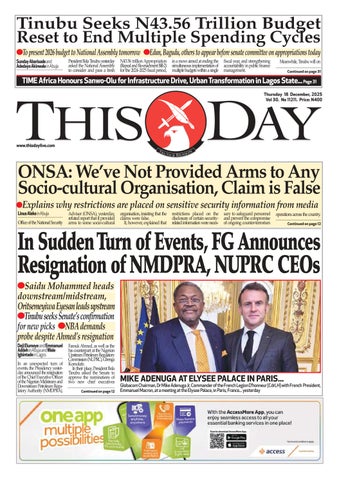
MIKE ADENUGA AT ELYSEE PALACE IN PARIS...
Globacom Chairman, Dr Mike Adenuga Jr, Commander of the French Legion D’honneur (CdrLH) with French President, Emmanuel Macron, at a meeting at the Elysee Palace, in Paris, France... yesterday
2
THURSDAY, DECEMBER 18, 2025 • T H I S D AY
THURSDAY, DECEMBER 18, 2025 • T H I S D AY
3
4
THURSDAY, DECEMBER 18, 2025 • T H I S D AY
5
THISDAY • THURSDAY, DECEMBER 18, 2025
Group News Editor: Goddy Egene Email: Goddy.egene@thisdaylive.com, 0803 350 6821, 0807 401 0580
NEWS
SIGNING CEREMONY OF $100 MILLION “DRIVE TO OWN” VEHICLE FINANCING SCHEME...
L-R: UBA-GAC Partnership 6: Group Managing Director/CEO, United Bank for Africa (UBA) and, Chairman, LagRide, Chief Diana Chen, flagged by LagRide drivers, at the signing ceremony and launching of $100 Million “Drive to Own” Vehicle Financing Scheme, strengthening smart mobility, driver asset ownership of over 3,500 cars, financed by UBA, in partnership with Lagos State Government and LagRide, held in Lagos on Tuesday.
IsDB Board Approves $1.365bn to Expand Abidjan– Lagos Road, Spur Infrastructure in 12 Countries Sunday Okobi
The Board of Executive Directors of the Islamic Development Bank (IsDB) has approved a new package of projects totalling approximately $1.365 billion for 12 member countries. The board, chaired by IsDB President, Dr. Muhammad Al Jasser, the 363rd BED, endorsed 14 operations that supported development projects covering renewable energy and cross-border power links, key transport corridors, water security and agriculture, as well as education and health services. The IsDB, in a statement, said the approvals were aimed at strengthening economic resilience, improving access to essential services, and advancing progress towards the attainment of the Sustainable Development Goals (SDGs). According to the statement made available to THISDAY yesterday by IsDB Communication Director, Ahmed Abu Ghazeleh,
“In the transport sector, major financings include EUR306.89 million for Benin’s Godomey–Ouidah–Hillacondji Road Capacity Expansion and Upgrading Project, aiming to strengthen a strategic section of the Abidjan–Lagos corridor.” It added that Côte d’Ivoire would receive EUR200 million in financing, which will be allocated to upgrade the Tafiré–Ferkessédougou section of the A3 highway, improving a key route that serves trade and mobility between central and northern regions and neighbouring landlocked countries. The statement added, “Also, Bahrain will receive US$180.72 million for the King Faisal Highway Upgrade Project in Manama that will eventually ease congestion and improve urban mobility, while Lebanon will benefit from US$13.50 million to construct the Bqerqasha Diversion and upgrade the Bqerqasha–Bcharre road, improving access and road
safety for local communities. “In the energy sector, Uzbekistan will benefit from a total of US$110 million for the Samarkand I and Samarkand II utility-scale solar photovoltaic and battery storage projects, which will add large solar capacity and storage to the national grid.” It said, “Mauritania, meanwhile, will receive EUR55.19 million for the Mauritania–Mali Electricity
Interconnection and related solar power plants, linking the two power systems and supplying cleaner, more reliable electricity to communities such as Aweinat and Nema. “In addition, several approvals directly address water stress and food security. In Morocco, IsDB has approved EUR188.82 million for the Mitigating Water Stress Project to finance dams and related works that secure water
A gubernatorial aspirant for the 2026 Ekiti State Governorship Election, Engineer Kayode Ojo, has commended the commencement of commercial flight operations at the newly commissioned Ekiti State Agro-Allied and Cargo Airport. In a press statement yesterday, Ojo hailed the launch of commercial services as a significant milestone for Ekiti
State, promising to unlock immense economic potential, enhance connectivity, and attract investment. Ojo, a former Chairman of the Governing Councils for the Federal University, Oye-Ekiti, and who until September 26, 2025 was the Pro-Chancellor of the University of Nigeria, Nsukka, however, strongly criticised the Ekiti State Government’s reported denial of his involvement in the airport project’s
to the Freetown WASH and Aquatic Environment Revamping Project to improve water and sanitation services in Greater Freetown and restore key watershed areas. “Cameroon will receive EUR36.66 million for the Sustainable Irrigation and Agricultural Value Chain Development Project, which will support climate-resilient irrigation, better inputs, and improved rural infrastructure.
Charles Odii: SMEDAN Has Mobilised N12bn Funding for MSMEs at Affordable Rates Says new policy framework underway by Q1 2026, plans skills acquisition for prison inmates
James Emejo in Abuja
Director-General, Small and Medium Enterprises Development Agency of Nigeria (SMEDAN), Mr. Charles Odii, yesterday disclosed that the agency had so far mobilised over N12 billion in affordable financing for MSMEs through
strategic partnerships with public and private sector institutions. Odii said through the funding SMEDAN had improved access to capital nationwide. He said SMEDAN had also created over 90,162 new jobs across various sectors of the economy in the first quarter
Ojo Commends Ekiti Airport’s Commercial Flights, Faults Denial of His Input Bennett Oghifo
supplies and transfer surplus water from northern basins to more stressed regions in the south. “The country will also receive EUR18.23 million for the Inland Aquaculture Value Chain Development Project to expand inland fish farming and create new income and employment opportunities.” The IsDB board stated, “Sierra Leone will receive EUR25.93 million allocated
development. He stated, “The realisation of the Agro-Allied and Cargo Airport project, and the sight of commercial planes touching down and taking off, is a moment of pride for every Ekiti son and daughter. “It represents a critical piece of infrastructure that will serve as a catalyst for economic growth, especially in agro-allied industries and tourism.” While questioning the
State Government’s denial of his contribution towards the construction of the Fire Station worth millions of naira and his intention to support development of other landmark structures at the airport and other projects within the state, the APC governorship aspirant expressed deep disappointment and bewilderment that such a denial and antidevelopment approach could deter interested investors.
of the year (Q1 2025). Speaking to journalists on the achievements of the agency under his watch, Odii said a new National MSME policy was expected to be unveiled in the first quarter of next year (Q1 2026), adding that SMEDAN will continue to engage stakeholders and provide links for people to share their experiences on the policies they want to see. Odii further disclosed plans to train soon-to-be-released prison inmates for between six months and a year. He said, “Many of them have complained to us that because of the stigma of having gone to prison, many people don’t want to touch them. And so, we are also trying to put some policies in place to ensure that these people can also get employed again. “So, one of our criteria that we are setting up is that we are hoping our small businesses will be able to take them and make them employable.” He said a lot of cheap
funding at single digit interest will be catalysed for MSMEs next year. Odii stated, “Last time we checked, approximately 500,000 small businesses had accessed this funding. What we want is to increase this drastically. We want to push those numbers somewhere above five million, so that it can accurately reflect the percentage of small businesses that exist in Nigeria.” He said the agency will also focus on capacity development for small businesses, adding, “If you ask all the banks today, they will tell you that there is money for small businesses. And they will also say that small businesses are not well equipped enough to unlock access to this funding.” Odii stated that over 18,339 nano businesses had accessed grants under the Conditional Grant Scheme, supporting their transition into the formal sector through targeted training and access to financial services, including bank account opening to deepen financial inclusion.
6
THURSDAY, DECEMBER 18, 2025 • THISDAY
NEWS
MOU SIGNING CEREMONY BETWEEN BOI AND NHIA...
Director General /Chief Executive Officer, National Health Insurance Authority (NHIA), Dr Kelechi Ohiri, Managing Director/CEO Bank of industry (BOI), Dr Olasupo Olusi, at MOU signing ceremony between BOI and NHIA aimed at facilitating enrolment of BOI funded beneficiaries, their employees, Micro, Small and Medium Enterprises (MSMEs), cooperatives and individual entrepreneurs into NHIA health insurance schemes, while integration health insurance compliance into BOI’s loan application and disbursement processes on Tuesday in Lagos
NEC Constitutes 10-man Committee to Fasttrack Implementation of Livestock Development Shettima: enduring, nationally accepted solutions to farmer-herder crisis will guarantee food security
Deji Elumoye in Abuja National Economic Council (NEC) on Wednesday constituted a committee on livestock development to expedite the implementation of livestock production policies in Nigeria. Chairman of NEC, Vice President Kashim Shettima, declared that a practical, enduring, and nationally accepted solution to the farmer-herder crisis will guarantee food security in the country.
The NEC committee on Livestock Development, which was constituted during the 155th virtual meeting of the council, according to a release issued by Media Assistant to the Vice President, Stanley Nkwocha, will work in collaboration with other stakeholders. The committee has one member representing each of the six geo-political zones, comprising Bauchi for Northeast, Niger for North-central, Ondo for South-west, Imo
for South-east, Cross River for South-south region, and Kebbi for North-west. Other members of the committee include the Ministers of Livestock Development; Agriculture and Food Security; and Budget and Economic Planning; as well as Senior Special Assistant to the President on Agribusiness (Office of the Vice President). The council directed the committee to, among other things, review the recommendations
of the Presidential Livestock Reform Committee and the proposal of Ministry of Livestock Development as well as identify interested states for the implementation of the programme. President Bola Tinubu had at the Federal Executive Council meeting on December 10 directed NEC to work in collaboration with the Ministry of Livestock Development, to come up with a roadmap for the transformation of Nigeria`s livestock industry.
The ministry worked on the proposal, which was presented at the meeting for NEC’s endorsement, in the bid to transform Nigeria’s livestock sector into a modern, peaceful, and profitable engine of national development. Earlier, in his opening address, the chairman of NEC, Shettima, stated that while food security was a moral obligation to the citizens, it could only be guaranteed by practical, enduring, and nationally accepted solutions to
Senate Concludes Amendment to 69-Year-Old Audit Act Concurs to Institute of Economists of Nigeria Bill
Sunday Aborisade
Senate, Wednesday, concluded amendment to Audit Ordinance of 1956, which if eventually assented to, would herald an entirely new audit regime christened Federal Audit Service Bill, 2025. The concurrence bill was presented on Wednesday by Leader of the Senate, Senator Opeyemi Bamidele, at the plenary for consideration with a view to strength-ening the country’s public accounts
management. The bill, originally introduced in the House of Repre-sentatives as the Federal Audit Service Bill, 2025, was designed to repeal the extant Audit Ordinance of 1956, an archaic legislation enacted by the British colonial administration 69 years ago. When eventually assented to by President Bola Tinubu, Bamidele stated that the bill would culminate in the establishment of Federal Audit Service and Fed-eral Audit Board, as well as strengthen the powers,
in-dependence, and functions of the Auditor-General for the Federation. Bamidele explained that the bill sought to replace the outdated framework with a modern, robust, and fit-forpurpose legal regime, which aligned Nigeria’s pub-lic audit system with international best practices. He said, “The need to repeal the Audit Ordinance Act of 1958 cannot be over-emphasised. That Ordinance is a pre-independence legislation enacted for a colonial
administrative structure and is grossly inadequate for Nigeria’s present constitutional democracy, complex public finance architecture, and modern accountabil-ity standards. “It does not sufficiently guarantee institutional inde-pendence, operational autonomy, or the enforcement powers required of a supreme audit institution
in a contemporary governance system. “This bill therefore seeks to replace that outdated framework with a modern, robust, and fitfor-purpose legal regime that aligns Nigeria’s public audit system with international best practices, including the principles of transparency, accountability, and fiscal respon-sibility.
the farmer-herder crisis. He said, “We must acknowledge with absolute regret the deep distrust created by this violence, born out of a trade and an ancestral practice that ought to have remained a central pillar of our food security and rural economy. The loss of lives, the destruction of homes, and the devastation of farmlands must end. “We cannot perform a task as fundamental as feeding ourselves unless we find an enduring, practical, and nationally accepted solution to the farmer herder crisis. Food security is a moral obligation to our people.” Shettima identified mismanagement of long-standing tensions between farmers and herders as the cause of “the conflicts that have strained the ancestral bonds of communities across Nigeria”. He regretted that what started “as a challenge of coexistence gradually hardened into cycles of violence that were allowed to persist for far too long without a durable solution.
World Bank Approves Additional Funding for SPESSE
and the National Universi- Excellence across Nigeria’s NECA Commends FG’s Suspension of KuniTyessi inAbuja ties Commission, NUC, geopolitical zones, the project World Bank has ap- SPESSE was conceived to has steadily bridged this gap, Proposed Ban on Sachet-packaged Alcohol The proved additional financing address a long-standing producing a new generation Dike Onwuamaeze
The Director-General of the Nigeria Employers’ Consultative Association (NECA), Mr. Adewale-Smatt Oyerinde, has commended the federal government for suspending enforcement of the proposed ban on sachet alcohol and 200ml PET bottle products until the conclusion of consultations and
the issuance of a final policy directive. Oyerinde gave the compensation yesterday in a press statement he issued in Lagos. His commendation followed the directive issued by the Office of the Secretary to the Government of the Federation (OSGF) due to the concerns raised by the House of Representatives Committee on Food and Drugs
Administration and Control. He noted the suspension respected existing National Assembly resolutions and restores regulatory clarity. He also welcomed the OSGF’s clarification that any enforcement action taken by NAFDAC or any other agency without its clearance is invalid and should be disregarded by the public.
for Nigeria’s Sustainable Procurement, Environmental and Social Standards Enhancement, SPESSE, project. The funding approval follows the Bank’s satisfactory rating of the project to drive critical manpower gaps in procurement, environmental and social standards. Supported by the Federal Government, the World Bank
challenge in both the public and private sectors which include the shortage of skilled professionals and the absence of structured academic and professional pathways in procurement, environmental safeguards and social standards. Through coordinated training programmes anchored by six Centres of
of professionals equipped to operate in line with global best practices. The mission was led by the Bank’s Task Team Leader, Ishtiak Siddique, alongside the National Project Coordinator, Dr Joshua Atah of the NUC. According to the mission’s Aide Memoire, SPESSE has recorded “significant progress” since the last review.
THURSDAY, DECEMBER 18, 2025 • T H I S D AY
7
8
THURSDAY, DECEMBER 18, 2025 • THISDAY
NEWS
PRESENTATION OF THE REPORT OF THE OSUN STATE PRIMARY ELECTION COMMITTEE...
L-R: National Chairman of the All Progressives Congress (APC), Prof. Nentawe Yilwatda; Governor of Edo State and Chairman of the Committee, Senator Monday Okpebholo; and former Governor of Kogi State, Mr. Yahaya Bello, during the presentation of the report of the Osun State Primary Election Committee to the Chairman of the party
Lagos-Calabar Coastal Road: Umahi Replies Abaribe, Asks Him to Study Procurement Act
Lagos section of multi-trillion-naira road reaches 85% completion Minister says no need for Biafra agitation
Emmanuel Addeh in Abuja Minister of Works, David Umahi, yesterday responded to Senator Enyinnaya Abaribe over his criticism of the multitrillion Lagos-Calabar coastal road, urging him to study the Procurement Act. Umahi, who stated this during a press conference in Abuja,
maintained that due process was followed in the award of the Lagos–Calabar coastal highway project, dismissing allegations of procurement violations. The minister defended the federal government’s infrastructure projects, particularly in the South-east, describing the claims by Abaribe as an attack
Chinese Investors Hail Osun Infrastructure Growth as Adeleke, Owa of Ijeshaland Speak on Industrialization Plans Yinka Kolawole in Osogbo
A group of Chinese investors from mainland China and Hong Kong on Tuesday evening applauded the rapid infrastructural growth across Osun towns and cities, describing the development as “a booster to industrialization, economic growth and communal prosperity” The investors numbering 22 from various sectors such as water processing, food processing to electric vehicles conveyed their review through the head of the team, Nancy Chi
of Yuanfar International at a dinner hosted at the Government House and attended by Governor Ademola Adeleke, his deputy, Prince Kola Adewusi, the Owa Obokun of Ijeshaland, His Imperial Majesty, Oba Adesuyi Haastrup among others. The leader of the delegation added: “There is a saying in Chinese language. If you want to build and spread wealth, if you want economic growth, build roads. That is the secret of China’s development. The Osun governor understands this reality.
on his integrity. He stressed that all statutory requirements, including Environmental and Social Impact Assessment (ESIA), were met. Umahi stated, “There are three categories of procurement recognised by the Procurement Act. I want Senator Abaribe to go and study it and come back to tell Nigerians whether there was any infringement in the Lagos–Calabar coastal highway.” The minister said the project was openly advertised, subjected to stakeholder engagement, and certified after
an internationally recognised ESIA process. He added that international financiers later adjudged the project “properly packaged, of very high quality, and even undervalued”. “The project was so credible that when it was presented to foreign financial institutions, it was oversubscribed by over $100 million,” Umahi pointed out. On project delivery, the minister disclosed that section one of the Lagos coastal road had reached about 85 per cent completion and would soon be opened to traffic. He said
the second section was also progressing steadily, while procurement processes were ongoing for other segments. Umahi highlighted what he described as renewed federal presence in the South-east under President Bola Tinubu, citing major road, bridge, power, and security projects across the zone. “There was a time the South-east was totally excluded. That has changed. Today, the president has included us, and that inclusion is real and visible,” he said. He listed projects, such as
the Enugu–Onitsha expressway, Enugu–Port Harcourt road, Second Niger Bridge bypass, Abakaliki–Enugu road, and several flyovers and bridges, saying many have either been completed or are at advanced stages. Umahi stated that increased federal support to states had boosted performance at the sub-national level, pointing to Abia State, as an example. “The performance you see at the state level is possible because the federal government released more funds to governors,” he said.
Sanwo-Olu, Tambuwal, Daniels, Okiro, Utomi, Others Hail NiDCC as Strategic Bilateral Partner Oluchi Chibuzor
Governor Babajide Sanwo-Olu of Lagos State, former Speaker of House of Representative, Aminu Tambuwal, former Governor of Ogun State, Gbenga Daniels and others have both stressed the need for the country to leverage the recently inaugurated Nigerians in Diaspora Chamber of Commerce, (NiDCC) as a strategic bilateral investment
partner. Speaking at the grand launch of NiDCC in Lagos, yesterday, Sanwo-Olu noted that for growth to occur there must be synergy between private and public sector. The governor, represented by his Senior Special Assistant on Diaspora and Foreign Relations, Jermaine Sanwo-Olu, said they are looking forward to working with the chamber.
According to him, “Growth occurs when the private sector partners with the public sector to bring about national or subnational development, and now the diaspora, too, is contributing towards that. So, we’re looking forward to working with them. “The diaspora are very important to us, most especially in the real estate sector. “So, we as a government are
creating the enabling environment, and the diaspora have seen that, they can trust us, they know that Lagos is very secure, so they bring their investments here, and we’re ready for them.” Delivering her keynote address, the President of NiDCC Patience Ofure-Key said the chamber aims to bridge the gaps by creating a linkage between Nigerians living abroad and the institutions in the country.
THURSDAY, DECEMBER 18, 2025 • T H I S D AY
9
10
THURSDAY, DECEMBER 18, 2025 • T H I S D AY
THURSDAY, DECEMBER 18, 2025 • T H I S D AY
11
12
THURSDAY, DECEMBER 18, 2025 • THISDAY
TWELVE
Nonye Ayeni: FG to Clear Funding Obstacles for Women Exporters, First Tranche of $50m WEIDE Fund to Be Disbursed Q1 2026 James Emejo in Abuja
The Executive Director/Chief Executive, Nigerian Export Promotion Council (NEPC), Nonye Ayeni, yesterday assured beneficiaries of the $50 million Women Exporters in the Digital Economy (WEIDE) Fund that the first tranche of grants under the programme will be disbursed in the first quarter of 2026, following the completion of ongoing capacity-building and compliance processes. Speaking at a Town Hall Meeting for beneficiaries of the Fund in Abuja, she reaffirmed
the council’s commitment to addressing the persistent challenges confronting women in global trade, particularly access to finance. She acknowledged that several women find it difficult to access credit, adding that the council remained determined to address the constraints moving forward. Ayeni noted that the programme goes beyond grants to address real financing gaps. However, she said, “While funding is important, the real focus is on skills; financial literacy, bookkeeping, tax
compliance, and strategic business planning—areas often overlooked but essential for sustainability.” She said training will continue alongside grant disbursement, noting that “This is deliberate. We do not want a situation where participants only complete training and wait passively for grants. The Women in Export Programme (WEP) team will closely monitor progress, track what coaches are teaching, and ensure participants fully benefit from the programme.” Ayeni said moving forward, the “WEP team will work
closely with all participants to ensure they maximise the full benefits of this initiative. This programme is competitive and selective, and it should not be taken for granted. “The opportunity to access training, certification, mentorship, and markets is rare and valuable. Some participants may receive grants, others may not—but every participant must take advantage of the full programme, especially market access opportunities. Progress will be monitored, outcomes evaluated, and lessons documented.”
“This is a powerful and strategic programme. It is good for the country, good for women, and good for the growth of non-oil exports.” The NEPC chief executive also said the $50 million WEIDE Fund, a global initiative by the WTO and ITC to empower women-led businesses in developing countries, especially Nigeria, by providing training, finance, and market access for digital trade The programme seeks to help women exporters grow from small enterprises to global players through support like grants
Nonye Ayeni and mentorship, as seen in its launch phase benefiting 146 Nigerian women entrepreneurs.
IN SUDDEN TURN OF EVENTS, FG ANNOUNCES RESIGNATION OF NMDPRA, NUPRC CEOS
for the NMDPRA and the NUPRC, namely: Saidu Aliyu Mohammed and Oritsemeyiwa Eyesan respectively. Both officials who ‘resigned’ left their positions ahead of the expiry of their tenures next year, having been appointed in 2021 by former President Muhammadu Buhari to lead the two regulatory agencies created by the Petroleum Industry Act (PIA). Specifically, the Presidency made the announcement shortly after meeting behind closed doors with the embattled erstwhile CEO of the NMDPRA, Ahmed, at the State House, Abuja. The meeting took place against the backdrop of mounting allegations against the former petroleum regula-
tor, Ahmed, by renowned industrialist and President of Dangote Group, Alhaji Aliko Dangote. Ahmed who arrived at the State House at about 5:30pm left the President’s first floor office in less than 30 minutes at about 5.55 pm and refused to speak with newsmen as he exited the Villa offering no comment on the allegations or the outcome of his meeting with the President, THISDAY observed. Dangote in recent times has been locked in a public dispute over Nigeria’s downstream petroleum regulator and the future of domestic refining, with Africa’s richest person accusing him of sleaze and economic sabotage as well as undermining local refining capacity in Nigeria.
Dangote maintained that the continued issuance of import licences for petroleum products, despite in-country capacity was frustrating domestic refiners and entrenching dependence on imports. He further alleged that the NMDPRA was colluding with international traders and oil importers to the detriment of local operators, a charge the regulatory chief had yet to publicly address before his removal, and for which he had been invited by federal lawmakers.
Besides, the billionaire businessman raised personal allegations against the NMDPRA chief, claiming that Ahmed was living beyond his legitimate means and claiming that four of his children attend secondary schools in Switzerland at a cost running into about $7 million. Dangote argued that such expenditure raised questions about potential conflicts of interest and the integrity of regulatory oversight in the downstream petroleum sector, and eventually submitted a petition to the Independent
line with Part III, Sections 4, 5 and 6 of the Terrorism Prevention and Prohibition Act, 2022, the NCTC, under the ONSA, has continued to coordinate and support law enforcement, security and intelligence agencies in combating all forms of terrorism nationwide. He noted that Nigeria’s counterterrorism efforts, guided by the National Counter Terrorism Strategy (NACTEST), combined kinetic and non-kinetic measures. A key aspect of the kinetic approach, he said, was the deployment of hybrid forces that bring together regular security personnel and trained irregular auxiliaries, including hunters and vigilante elements, particularly in difficult terrains such as forests. The statement recalled that the model was successfully applied in the North East through the engagement of the Civilian Joint Task Force (CJTF), made up of trained civilian volunteers who supported the Armed Forces in operations against Boko Haram. The same framework, it added, currently informed
Continued on page 33
investment confidence, community development, and international engagement. Under him, Nigeria’s active drilling rig counts surged from just eight in 2021 to almost 70 by October 2025, reflecting renewed exploration and production interest. The regulatory environment has fostered investment approval and capital inflows, with dozens of Field Development Plans (FDPs) worth billions of dollars sanctioned, boosting Nigeria’s Continued on page 35
Profiles of New Oil Sector Regulatory Chiefs
Emmanuel Addeh in Abuja
ONSA: WE’VE NOT PROVIDED ARMS TO ANY SOCIO-CULTURAL ORGANISATION, CLAIM IS FALSE This position was contained in a statement by the Head of Strategic Communications at the National Counter Terrorism Centre, Office of the National Security Adviser (NCTC-ONSA), Mr. Abu Michael, in response to recent media reports published by some online platforms on security operations, particularly in forested areas of Kwara State. Urging the public to ignore unverified reports that misrepresented conducts of security operations, the ONSA said, “For the avoidance of doubt, the federal government and its agencies are not conducting kinetic operations with any socio-cultural groups. “Claims that the Office of the National Security Adviser has provided arms to any socio-cultural organisation are false and should be disregarded,” the statement stated. According to the statement, the reports pushing the claims had prompted the need to clarify the nature and scope of current counter-terrorism activities, which were being carefully coordinated to address threats posed by bandits, criminals and terrorist groups. Michael explained that, in
Corrupt Practices and Other Related Offences Commission (ICPC), calling for Ahmed’s arrest, investigation and prosecution. Perhaps, even more shocking was the ‘resignation’ of the NUPRC chief, Komolafe, the pioneer head of the upstream commission since 2021, with an initial term of five years, which was expected to run out next year. Komolafe’s tenure has been marked by a series of reforms, touching on regulatory transparency, industry performance,
Saidu
Saidu Aliyu Mohammed (NMDPRA) Born on July 17, 1957 in Gombe, Mohammed attended the North-East College of Arts and Science (NECAS) in Maiduguri and Government Secondary School in Gombe. He holds a Bachelor of Engineering degree in Chemical Engineering from the Ahmadu Bello University (ABU), Zaria. His career at the Nigerian National Petroleum Company Ltd (NNPC), then a corporation, included several strategic leadership roles, such as Managing Director of the Nigerian Gas Company (NGC) and the Kaduna Refining and Petrochemical Company (KRPC). In 2016, he was appointed Group Executive Director/Chief Operating Officer of the Gas & Power Directorate, a position he held until his retirement in 2019. He’s a professional with over 37 years of service in the oil and Gas industry. He was pivotal to the formulation of the Nigerian Gas Master Plan and the establishment of the West African Gas Pipeline Authority (WAGPA) and implementation of the Escravos – Lagos Pipeline System (ELPS) Expansion and
the Ajaokuta–Kaduna–Kano (AKK) Gas Pipeline project. Mohammed served as Nigeria’s representative on the Executive Board of the Gas Exporting Countries Forum (GECF) and was Chairman of the Board of Directors for the West African Gas Pipeline Company (WAPCo) and N-Gas (Bermuda), and as a board member for Nigeria LNG Limited. He was also the Chairman/CEO of GasXperts Nigeria Limited and served as an Independent Director on the Board of Asharami Energy Limited. Mohammed is a COREN registered engineer, a Fellow of both the Nigerian Society of Engineers (NSE) and Fellow and was a past President of the Nigerian Society of Chemical Engineers (NSChE) as well as the Nigeria Gas Association (NGA). He is a member of the Nigerian Institute of Management (NIM) and the Institute of Directors (IoD).
Oritse
Oritsemeyiwa Amanor itsewo Eyesan (NUPRC) Oritsemeyiwa Eyesan is a senior Nigerian petroleum sector professional with more than 30 years of experience spanning upstream investment management, corporate strategy,
fiscal negotiations and energy-sector reform. Her last key public office before now was as the Executive Vice President, Upstream, of the NNPC. Prior to that, Eyesan was Chief Strategy and Sustainability Officer at NNPC Limited. In that role, she functioned as the corporation’s principal strategist, leading major commercial negotiations and providing oversight for joint entitlement models governing renewed deepwater Production Sharing Contracts (PSCs) She also supported strategic initiatives aimed at unlocking significant value for NNPC Limited while advancing ESG and sustainability frameworks. Earlier, Eyesan served as Group General Manager, Corporate Planning and Strategy at NNPC, where she coordinated long-term corporate strategy, budgeting, capital allocation and performance monitoring across the group. She was closely involved in government-facing strategic and commercial engagements that supported the enactment of the Petroleum Industry Act and the transition of NNPC into a fully commercial entity. Her career foundation was built at the National Petroleum Investment Management Services (NAPIMS), where she rose through several senior roles, including General Manager, Planning. At NAPIMS, she led planning and budgeting for joint ventures and production sharing contracts and was a key negotiator in the settlement of longstanding cash-call arrears with international oil companies, saving Nigeria over one billion dollars and restoring investor confidence. Eyesan holds a Bachelor of Education degree in Economics from the University of Benin and attended Federal Government College, Warri. She has completed executive training at the Wharton School and other international energy and management programmes.
THURSDAY, DECEMBER 18, 2025 • T H I S D AY
13
14
SOStainabilityWeekly
THURSDAY, DECEMBER 18, 2025 • THISDAY
Edited by Oke Epia | e-mail: sostainability01@gmail.com | Whatsapp: +234 8034000706
Washing and hushing
The Lagos-Calabar coastal highway: Hidden costs that must be paid up now
N
igeria’s push to close its infrastructure gap has entered a decisive phase. Across the country, large-scale projects are being advanced as symbols of renewal, economic integration, and national progress. Among them, the Lagos–Calabar Coastal Highway stands out, not only for its scale and ambition, but for what it represents: a test case for how Nigeria delivers complex infrastructure in an era of climate risk, social scrutiny, and heightened governance expectations. The project is widely framed as a transformative response to decades of underinvestment in connectivity and trade corridors, and in intent, that framing is understandable. Yet history shows that infrastructure ambition alone does not confer legitimacy. The credibility of major public works is shaped as much by process as by purpose. When delivery is prioritised over due diligence and accountability, projects often accumulate long-term environmental, social, and fiscal liabilities that dilute their promised benefits. This matters because infrastructure decisions are largely irreversible. Choices made early, around route selection, environmental safeguards, resettlement frameworks, and oversight mechanisms, define outcomes for decades. Governance, therefore, is not a procedural formality but the means through which public interest is protected and trust is earned. In this edition of SOStainability Weekly, we take a deep dive into the Lagos–Calabar Coastal Highway, examining whether its execution aligns with sound governance and ESG principles, or whether gaps in approval, transparency, and social safeguards risk undermining its long-term sustainability. Key context: The project lifecycle benchmark Globally, large-scale infrastructure projects follow a broadly accepted lifecycle designed to balance development objectives with risk management, public accountability, and long-term sustainability. This sequencing is not arbitrary. It reflects decades of experience showing that when decisions are taken in the wrong order, costs escalate, disputes multiply, and public confidence erodes. At the front end, projects begin with conception and alternatives analysis, where economic rationale, route options, and design choices are tested against environmental, social, and technical constraints. This is followed by the preparation of an Environmental and Social Impact Assessment (ESIA), which identifies potential risks and proposes mitigation measures. Crucially, the ESIA is then subjected to public consultation and stakeholder validation, allowing affected communities, experts, and stakeholders to interrogate assumptions, highlight blind spots, and influence final design choices. Only after this process is complete does formal approval occur, typically accompanied by enforceable conditions that define what can be built, how impacts must be managed, and how compliance will be monitored. Construction and mobilisation follow approval, not precede it, alongside continuous monitoring, reporting, and regulatory enforcement. This lifecycle exists to protect all parties involved. It provides clarity for contractors, safeguards for communities, and credibility for government. When this sequence is compressed or blurred or even ignored, governance weakens, accountability becomes diffuse, and projects become more vulnerable to social conflict and long-term risk. A draft ESIA only begs the questions At the centre of the Lagos–Calabar Coastal Highway debate is a procedural tension that warrants careful consideration. Official statements from the Federal Ministry of Environment confirm that the Ministry of Works applied for the project’s Environmental and Social Impact Assessment (ESIA) in December 2023 and subsequently received a preliminary impact assessment certification for site clearance and compensation scoping. The environment ministry said this certification was deliberately issued in phases, reflecting the scale and complexity of the 700-kilometre project.
•President Bola Tinubu
•Gilbert Chagoury
•David Umahi, Minister of Works
This clarification is important, but it does not resolve the governance question that appears unresolved. Preliminary certification for site clearance and compensation enumeration is not equivalent to full ESIA approval. In regulatory terms, it authorises limited, preparatory activities while impact assessment, mitigation design, and validation processes continue. It does not constitute final consent for broad construction, nor does it replace the requirement for a completed ESIA with publicly disclosed approval conditions, compliance thresholds, and enforcement mechanisms. Checks by SOStainability only revealed a draft ESIA posted on the website of the environment ministry. This distinction matters because a draft or phased ESIA signals that environmental and social risks are still being assessed and refined. Yet alongside this phased approval process, visible project actions have included demolition notices, compensation verification, and early works that, in the public perception, resemble substantive project execution. While government officials have consistently stated that due process is being followed, the absence of a consolidated, publicly accessible record detailing what is approved at each phase, and under what conditions, creates room for confusion and mistrust. Consultation gaps further complicate this fault line. Engagements referenced by the Ministry of Works have largely focused on compensation logistics, rather than the broader ESG dimensions that meaningful consultation is expected to influence, including route alternatives, biodiversity protection, climate resilience measures, grievance mechanisms, and long-term livelihood restoration. Where
consultation occurs alongside phased approvals and advancing activity, but after key design decisions appear fixed, participation risks becoming perfunctory rather than substantive. Taken together, phased preliminary clearances, compensation-focused consultations, and visible early works expose a sequencing challenge. Approval is the point at which accountability crystallises. Without a final, publicly disclosed ESIA approval and a clear articulation of its conditions, neither affected communities nor independent observers have a reliable baseline and benchmark against which to assess compliance. For a project of this scale and sensitivity, this is not a technical nuance, but a material governance issue with long-term implications for legitimacy, trust, and sustainability.
evidence of wrongdoing, they have amplified perception risks around political proximity and commercial interest in one of Nigeria’s most consequential infrastructure investments. In projects of this magnitude, perception and trust are themselves governance issues. Against this backdrop, transparency and disclosure become critical safeguards. Hitech’s website does reference the LCCH and includes documents such as a Non-Technical Summary of the ESIA Study for Section 1 and a Supplementary ESIA Study. Their availability indicates some level of disclosure, but it does not resolve the deeper governance questions the project raises. The publication of summaries or supplementary studies does not clarify whether the ESIA has reached final approval, what conditions, if any, are attached to such approval, or how public comments from the draft stage were addressed. Nor do these documents substitute for regular, decision-grade reporting on environmental performance, social safeguards, or compliance monitoring. More broadly, there is little evidence of systematic public reporting on construction milestones, environmental monitoring results, community engagement outcomes, or grievance resolution. There is no standalone ESG or sustainability reporting aligned with recognised international frameworks, and no visible mechanism for independent assurance. These contractor-level gaps are compounded by fragmented regulatory communication, leaving stakeholders without a single, authoritative source of truth on approval status, permissible scope of works, or enforcement actions. In this environment, opacity, whether intentional or incidental, erodes social licence, fuels speculation, and transfers governance risk from institutions to communities. For the LCCH, restoring credibility will depend not only on engineering delivery, but on transparent, verifiable disclosure that meets the expectations of a project with national, environmental, and social significance. Social dislocation, compensation, and the question of equity Recent actions by the Federal Government underscore that the social impacts of the Lagos– Calabar Coastal Highway are no longer abstract. The inauguration of a federal compensation verification committee, mandated to review and compensate landowners affected by the project, confirms that displacement is both anticipated and underway. Official statements have referenced hundreds of affected properties, with assurances that verified claims will be paid swiftly by the contractor once documentation is completed. This provides clarity on the government’s intent to manage displacement through a formal compensation process.
What the contractor discloses is key to project health Hitech Construction Company Limited sits at the centre of the Lagos–Calabar Coastal Highway project and, by extension, at the centre of public scrutiny surrounding its governance. Established in 1988, Hitech operates as part of the construction arm of the Chagoury Group, founded by Lebanese-Nigerian businessman, Gilbert Chagoury, and has delivered several high-profile infrastructure projects, particularly in Lagos. Its selection as lead contractor for the first phase of the LCCH has nonetheless attracted heightened attention, driven by the scale of the contract, the absence of an open competitive tender, and the long-standing relationship between the Chagoury family and the Tinubu political establishment. While reported offshore business links involving family members do not necessarily constitute
The story continues online on www.thisdaylive.com
15
THISDAY • THURSDAY, DECEMBER 18, 2025
SOStainabilityWeekly Edited by Oke Epia | e-mail: sostainability01@gmail.com | Whatsapp: +234 8034000706
Trends and Threads Nigeria’s NDC 3.0: Whither Progress for Agriculture, Forestry, and Land Use?
N
igeria’s agricultural lands and forests are far more than economic resources; they are the backbone of the country’s food security, employment, culture, and climate stability. With the submission of its Third Nationally Determined Contribution (NDC 3.0) under the Paris Agreement in September 2025, Nigeria placed the Agriculture and Land Use sector at the center of its climate strategy. This sector, encompassing crops, livestock, forests, and soils, not only contributes significantly to greenhouse gas emissions but also offers one of the most promising opportunities for emission reductions and resilience building. It is an arena where national policies, community practices, and international partnerships converge, shaping both the present livelihoods of millions of Nigerians and the long-term health of the environment. Why agriculture and land use is central to NDC 3.0 NDC 3.0 commits Nigeria to reducing overall greenhouse gas emissions by 29 percent below business-as-usual by 2030 and 32 percent by 2035, with a pathway toward net zero by 2060. Within these targets, the Agriculture and Land Use sector, particularly the component addressing land use, land-use change, and forestry (LULUCF), is expected to deliver 74 percent (nearly three-quarters) of total emission reductions by 2030. For context, the agriculture sector contributes 2.1 Mt C02 emissions, and the LULUCF sub-sector has a mitigation potential of 347.9 Mt CO2 emissions. In simpler terms, this means that farming in Nigeria produces some climate-warming emissions, but the country’s land and forest can remove far more carbon from the atmosphere than farming produces if they are properly protected and restored. This is why the NDC3.0 places strong emphasis on stopping deforestation, restoring degraded land, and expanding climate-smart land
•Sen. Abubakar Kyari, Minister of Agriculture and Food Security
•Idi Maiha, Minister of Livestock Development
use. This also means that Nigeria’s greatest climate gains lie not only in reducing farm emissions but in protecting and restoring forests and land, which can deliver far larger emission reductions. Agriculture remains a central part of Nigeria’s economy, employing millions and contributing around 23 percent of the Gross Domestic Product (GDP). Yet much of the land is vulnerable to the impacts of climate change, with desertification creeping across the northern regions and soil fertility declining in many rural areas. At the same time, forests, which play a crucial role in absorbing carbon dioxide and regulating local climates, have been lost at alarming rates over decades, diminishing the land’s capacity to act as a carbon sink. NDC 3.0 recognizes these dual challenges, emphasizing not only emission reductions but also interventions that strengthen resilience, restore degraded land, and improve livelihoods.
Forest Degradation (REDD+) mechanism plays a pivotal role. REDD+ is an international framework that provides incentives for countries to protect forests, restore degraded landscapes, and improve sustainable forest management. Nigeria’s plans to restore and protect about 162,000 hectares of degraded forest land and strengthen forest reserves across the country are an effort supported by the scaling up of the national REDD+ strategy, which aims to reduce emissions from deforestation and forest degradation while supporting local communities. Through these actions, the land use and forestry sector alone is expected to contribute nearly 74 percent of Nigeria’s total conditional emission reductions by 2030, making it the most important sector in the NDC. Nigeria pledges to reduce deforestation rates by at least 60 percent by 2030, an ambitious target that goes beyond environmental rhetoric. Protecting forests safeguards carbon stores, prevents soil erosion, maintains watersheds, and preserves biodiversity. In this regard, the country commits to massive tree-planting initiatives, aiming to plant millions of trees annually, particularly in degraded areas, settlements,
•Hon. David Zacharias, Chairman, House of Rep Committee on Safety Standards and Regulations
•Hon. Nkiru Onyejeocha, Minister of State for Labour and Employmen
This bill seeks to close those gaps and establish a harmonised national safety architecture,” the speaker was quoted as saying while chairman of the committee on safety standards and regulations, Mr. David Zacharias, described the hearing as “a historic milestone for Nigeria. After years of persistent advocacy from safety professionals, organised labour, industry leaders, and concerned citizens, the Occupational Safety
and Health Bill now stands before the public for consideration. The bill provides clearer duties for employers and employees, stronger enforcement powers for inspectors, mandatory reporting systems, improved penalties, and nationwide safety information management.”
Responsible parties: Are institutions ready to deliver on the targets? Achieving the ambitious goals of the NDC 3.0 is not a task for farmers alone; it demands coordinated leadership, clear mandates, and accountable institutions. At the forefront is the Federal Ministry of Agriculture and Food Security, tasked with implementing climate-smart farming practices and ensuring soils are productive and resilient. Complementing this is the Federal Ministry of Environment, responsible for forest protection, implementing REDD+ programmes, and overseeing sustainable land-use policies. The National Agency for the Great Green Wall plays a critical role in mobilizing tree planting, restoring degraded northern lands, and linking local communities to broader national and global climate targets. The Ministry of Livestock Development, which drives sustainable livestock management, is expected to cut methane emissions. Supporting these are technical institutions like the National Agricultural Research Institute and the National Agricultural Seeds Council, providing research, innovation, and quality inputs for resilient farming. State governments and local authorities are equally vital, as they handle on-the-ground implementation, land use planning, and mediation between farmers and herders. Together, these institutions are meant to form a coordinated network capable of meeting NDC 3.0’s targets. But the question remains: are these bodies equipped, coordinated, and accountable enough to deliver on the targets of NDC 3.0? Are there robust mechanisms for transparency, monitoring, and public reporting to ensure that commitments don’t remain promises on paper? How will they track progress, manage resources, and engage communities to meet emission reduction and restoration goals? SOStainability will keep a keen eye on these entities and others in a bid to stimulate accountability for the climate and communities.
The story continues online on www.thisdaylive.com
The story continues online on www.thisdaylive.com
REDD+ and the fight for forest restoration Central to Nigeria’s strategy is forest protection and restoration, where the Reducing Emissions from Deforestation and
Spotlight As Reps reform occupational safety laws
A
significant shift is occurring in Nigeria’s occupational safety space. Last week, the House of Representatives convened a public hearing to review existing laws and propose changes to protect workers from avoidable hazards in the workplace. The focus was on the occupational health and safety bill, referred to the House committees on safety standards and regulations, and labour, employment, and productivity. As noted by Speaker Tajudeen Abbas, while declaring the hearing open, “across several industries, workers still face hazards that undermine their dignity and productivity. Many of these tragedies are preventable,” highlighting “recurring dangers such as unsafe scaffolding, collapsing structures, harmful chemicals, toxic gases, offshore risks, and poorly maintained machinery—especially in construction, manufacturing, agriculture, and oil and gas,” according to a story on Parliament Reports. “The current system suffers from outdated regulations, weak enforcement, and inadequate institutional frameworks.
and along farm boundaries. Beyond stopping forest loss, Nigeria is also focused on bringing trees back. NDC 3.0 commits to planting about 25 million trees and expanding forests through reforestation and afforestation covering around 250,000 hectares. These trees are more than symbolic gestures; they are living infrastructure that supports soil health, provides shade, and contributes to local economies through sustainable timber and non-timber products. Agriculture: Linking restoration with livelihood NDC 3.0 also foregrounds the transformation of agricultural practices to reduce emissions while increasing productivity. Methane emissions from livestock, rice paddies, and burning crop residues are significant contributors to Nigeria’s agricultural greenhouse gas profile. By promoting innovative cultivation techniques, improving livestock management, and composting agricultural residues, the plan seeks to enhance soil carbon storage, reduce emissions, and make farms more resilient to extreme weather. These practices are not abstract recommendations; they are actionable pathways that, if adopted widely, could fundamentally reshape the interaction between agriculture and climate in Nigeria. Equally important is the restoration of landscapes and forest ecosystems. NDC 3.0 emphasizes not only reforestation but also the protection of existing forests and mangrove ecosystems, which serve as critical carbon sinks and natural coastal defenses. The Great Green Wall initiative, coordinated nationally by the National Agency for the Great Green Wall, exemplifies a transnational effort to reclaim degraded lands, reduce desertification, and provide sustainable livelihoods in northern Nigeria. This initiative highlights how Nigeria can leverage both local knowledge and international cooperation to achieve climate and development goals simultaneously.
16
T H I s D Ay • THURSDaY DECEMBER 18, 2025
Politics
Acting Group Politics Editor DEJI ELUMOYE Email: deji.elumoye@thisdaylive.com 08033025611 sms only
The Unusual Convoy on Lagos Road
The moment the video surfaced, Nigerians instinctively reached for the language of shock. Some saw a convoy so bloated it felt like a nation trembling beneath its weight. Many simply recognised a procession of priviledge that turned an ordinary Ikoyi street in Lagos into a stage for power. In all of it, Nigeria witnessed a spectacle that refused to pass quietly, a spectacle that demanded to be named, examined and confronted. Adedayo Adejobi writes.
soyinka
T
he video opens in the sort of way modern scandals often do, without ceremony, without buildup, without a narrator to warn that one is stepping into the theatre of the absurd. The camera’s lens settles on an Ikoyi street in Lagos that should by all logic be uneventful. A few cars idle, with passers-bye and their usual Lagosian indifference. Then a convoy lumbers into view, a procession so swollen with muscle and firepower that it resembles a travelling fortress rather than the movement of a private citizen. The atmosphere vibrates with the sort of swagger that only raw, unexamined privilege can produce. In that moment a calm street becomes a stage, and the actors arrive armed to the teeth. Anyone watching the clip is struck not merely by the size of the security contingent but by the audacity of the choreography. The armed officers fan out with the confidence of a military presence that has long forgotten the concept of proportion. Their gait is purposeful. Their weapons gleam with the suggestion that this exercise is something they have rehearsed many times. The viewer, regardless of political persuasion, is left with a single, uncomfortable realisation. Something here is not simply unnecessary, it is fundamentally wrong. The figure at the centre of this theatre is a private individual whose public lineage apparently grants access to something that looks very much like a personal battalion. It is not the identity that alarms, it is the scale. It is the peculiar arrogance of a security convoy that behaves as though the pavement belongs exclusively to it. It is the sense that the state’s monopoly on force has been quietly repurposed into a family heirloom. It takes no expert in Nigerian history to understand why this struck a nerve in a country long scarred by the excesses of the powerful. Yet what sharpened the public reaction was the involvement, however incidental, of Wole Soyinka. The Nobel laureate has built a life on confronting power, on challenging its pretensions, on refusing to bow even when the stakes were mortal. For decades he has been the nation’s moral barometer, a restless conscience in human form.
seyi Tinubu
In the viral moment, he saw what many Nigerians saw, but he felt compelled to comment with a clarity that only someone who has lived through the grim consequences of unrestrained force can muster. From Soyinka’s vantage, the incident is not amusing or outlandish. It is symptomatic. It fits into a worrying pattern that he has spent half a century warning against. There is a familiar cadence to the spectacle. Power draped in the garments of excess. Public institutions bent into improbable shapes to serve private comfort. Security personnel behaving as though they owe loyalty to bloodlines rather than constitutions. Soyinka’s reaction in the aftermath was a mixture of shock and civic irritation, the sort one reserves for a leak in a dam that everyone else insists is merely a decorative fountain. The video itself plays like satire, but unfortunately it is non-fiction. The sheer density of armed men patrolling around a single civilian is almost comical until one remembers that weapons in Nigeria rarely appear without consequence. In a country where ordinary citizens plead for better policing, better response to kidnappings, better community safety, the parade of rifles and body armour
around one young man reads like a provocation. It reads as a message that security is a commodity with a premium price tag, and the rest of the country must make do with whatever crumbs remain. The implications of this moment ripple far beyond that Lagos street. What the viewer witnesses is no less than the distortion of democratic architecture. When state security is seen to be deployed around private individuals on a scale that rivals official presidential protection, it signals a breakdown in the chain of accountability. It also suggests a political culture in which proximity to power becomes a substitute for legitimate entitlement. The state becomes a family estate and the machinery of coercion becomes an ornament. Soyinka’s reaction captures the gravity of the moment. He is not speaking merely as a cultural icon, nor as a renowned intellectual. He is speaking as a citizen disturbed by the visible betrayal of a principle he regards as foundational. In his world, there is a sacred boundary between public force and private indulgence. The video suggests that this boundary is eroding, and eroding publicly. Watching the clip, one observes the theatricality of the convoy. Cars glide in a tightly controlled formation. Officers step with practised swagger. It feels less like a security deployment and more like a monarch’s parade. The absurdity becomes clear when one stops
soyinka’s reaction captures the gravity of the moment. He is not speaking merely as a cultural icon, nor as a renowned intellectual. He is speaking as a citizen disturbed by the visible betrayal of a principle he regards as foundational. In his world, there is a sacred boundary between public force and private indulgence. The video suggests that this boundary is eroding, and eroding publicly.
to ask why such firepower is necessary for a simple movement through a metropolitan area. There is no threat assessment provided. No context that rationalises this militarised procession. What remains is the inescapable sense of overcompensation, the peculiar insecurity of priviledge that demands attention at the end of a rifle barrel. The video also becomes a cultural lens. It reveals how political power in Nigeria often expresses itself through physical intimidation. The desire to project importance through a mass of armed escorts is neither new nor unique, but in the era of viral evidence it is becoming increasingly indefensible. Every camera phone in the hands of an ordinary citizen is now a witness to excess, and every upload is an instant indictment. This convoy, in all its theatrical splendour, is now a permanent digital artefact. It will resurface again and again whenever the country debates the balance of power and entitlement. In the broader national psyche, this sort of spectacle cultivates resentment. Nigerians do not object to legitimate security for genuine threats. They object to the weaponisation of public resources for the exclusive benefit of individuals who already sit at the pinnacle of priviledge. They object because they see neighbours kidnapped without response, communities terrorised without rescue, and families mourning victims of violent crime that an overstretched police force struggles to solve. Against this reality, the sight of a convoy overflowing with armed men feels obscene. Viewed in this context, Soyinka’s irritation becomes almost prophetic. He has lived long enough to recognise that societies do not collapse overnight. They crumble through small erosions of public trust, through the normalisation of impunity, through the casual acceptance of inequality that becomes embedded in daily life. If this kind of convoy is allowed to become routine, it signals a nation drifting into a future where power answers only to itself. NOTE: Interested readers should continue in the online edition on www.thisdaylive.com
THISDAY • THURSDAY, DECEMBER 18, 2025
17
POLITY
Brazen Arrogance and Dangerous Assault on Democracy in Benue State
By Iyorwuese Hagher
O
n 13th December 2025, the Tiv nation celebrated Tiv Day, a day of joy and festivities for all Tiv people worldwide. President Ahmed Bola Tinubu instructed his trusted friend and political ally of many decades, Senator George Akume, CON, Secretary to the Government of the Federation (SGF), to represent him at the celebration. The President’s message of solidarity with the Tiv people was clear, passionate, and deeply resonant. I was a member of this presidential delegation alongside the Honourable serving cabinet minister, Professor Joseph Utsev, Minister of Water Resources, and a distinguished Tiv elder, my fellow Second Republic Senator Jack Tilley-Gyado; serving members of the National Assembly, Hon. Asema Achado and Hon. Terseer Ugbor; as well as Dr Pius Akuta and Dr Matthias Byuan, and Christopher Tarka Tiv sons holding high offices in the administration. We departed Abuja on a presidential flight that landed in Makurdi. We were all dressed in various styles and shades, highlighting Tiv culture. We looked forward to a joyful celebration and warm welcome among our brothers and sisters, as well as to relishing the honours conferred by the Tiv Traditional Council through traditional titles with diverse appellations. However, as soon as we landed at Makurdi airport, the Benue State Government and the Tiv Traditional Councils’ welcome party and festivities for the President’s envoy and delegation were absent. Instead, we faced a chilling and shocking display of arrogance, lawlessness, and violent intolerance in our state. What I saw on Saturday remains one of the most disturbing episodes in Nigeria’s recent political history. Apart from representing the President, Senator George Akume is not only the highest-ranking federal officer from Benue and a founding member of the party, but also a two-term Governor of Benue State, a three-term Senator, and a former minister. His current position is the highest any Benue person has ever held in any Nigerian Government. Moreover, he is a longstanding political benefactor to the succeeding governors of the state and to many within its political structure, including being at the forefront of the platform that elected Governor Hyacinth Alia. By every standard of civility, culture, and political hierarchy, the SGF deserved a respectful and dignified reception. All members of the delegation, both individually and collectively, are the very pinnacle of Tiv society and form part of the national and global elite. What we received was not a welcome but a humiliation. From the moment of arrival, it was clear that the Governor of Benue State, Reverend Father Dr Chief Hyacinth Alia, either failed or refused to offer the basic courtesy expected of his office. Based on his past actions, it was apparent that the Governor orchestrated the humiliation of the presidential delegation through a bold display of unwarranted political arrogance. Instead of a warm welcome, the Governor’s reception party was hostile,
Prof. Iyorwuese Hagher
verbally abusive, and contemptuous. They sang derisive chants of “No Alia, No Benue,” a slogan weaponised to insult and diminish the SGF in full public view. It was an act of arrogance so brazen that it stunned members of the delegation. The SGF and his delegation, along with supporters, moved into their waiting vehicles to avoid escalation of chaos. We were compelled to flee from the hostile mob and make our way to Gboko, the venue of the Tiv Day celebration, in the hope that the cultural setting would restore calm. However, the situation worsened. A much larger, more aggressive crowd surged towards the area where the SGF was seated. Meanwhile, his delegation, the Honourable Minister, and Members of the National Assembly either shared seats, sat precariously on armrests, or stood, gazing at the rapidly unfolding, volatile, and frightening atmosphere. In the chaos, I saw a horrifying act. A member of the Governor’s mob, shouting “No Alia No Benue”, drew a knife and stabbed a youth who was begging for calm. The young man fell to the ground,
wounded, as panic spread. The celebration ground turned into what could only be described as a battlefield — noisy, hostile, and completely out of control. Even the reading of the Presidential address was not spared from this disgrace. As the SGF attempted to deliver the message of Mr President, the mob surged forward onto the stage, drowning his voice with aggressive drumming, hissing, and animalistic howling. It was a deliberate attempt to silence not only the SGF but also President Tinubu himself. In this tense and perilous environment, members of the delegation were targeted individually. I was personally pursued by some miscreants chanting their maddening refrain, “No Alia No Benue.” Fearing for my life, I escaped into a parked bus as I watched the SGF and other members being evacuated from the arena to safety by the military. In the chaos, I missed the Presidential convoy, which managed to break free and return to the airport in Makurdi for an emergency departure back to Abuja. Stranded and shaken, I had to spend the night in Makurdi under tense circumstances
and could only return to Abuja by road the following day, 14th December. This incident I witnessed is not merely an embarrassing moment for Benue State; it is a matter of national concern. It signifies a grave insult to the office of the Secretary of the Government of the Federation and the Presidency. It reflects a troubling tolerance and a disturbing admiration by the Benue Government for political intimidation, mob violence, and abuse of power within Benue State. Governor Alia alone should accept responsibility and acknowledge the hostile environment that allowed this disgrace. Leadership requires restraint, respect for institutions, and safeguarding guests, regardless of political differences. The incidents in Makurdi and Gboko were failures of leadership and tarnish Benue State’s reputation. Benue State and Nigeria cannot afford to normalise such dangerous intolerance. I have decided to speak out because all lovers of democracy must condemn the treatment meted out to the SGF and the Presidential delegation in the strongest terms in the interest of democracy, unity, and national stability. Finally, as one of Nigeria’s longest-serving and most senior politicians, intellectuals, and diplomats from 1977 to 2025, I have paid my dues and earned the right to state the following: a. To His Excellency Rev. Fr. Dr. Chief Hyacinth Alia (whom I have never met in person), I have nonetheless observed your administration with deep concern: the firm grip on the State House of Assembly, the political contagion and manipulation of traditional institutions, and your involvement in conduct you should be ashamed of, such as failing to control your fiercely violent supporters and threatening to use witchcraft on people. However, nothing in your playbook of toxic leadership surpasses your ongoing, unwarranted cruelty towards the SGF, in an attempt to establish dominance. Everyone knows that the SGF’s unforgivable sin in your eyes was aiding your rise to become governor of Benue State when you were a complete outsider to the APC platform. b. IF THIS DESPERATION, WHICH I HAVE SEEN YOU DISPLAY AGAINST THE BENUE STATE POLITICAL LEADERS AND PEOPLE, IS AIMED AT BECOMING A ONE-TERM GOVERNOR, THEN YOU HAVE JUST ACHIEVED YOUR GOAL AND EARNED THE PASS MARK. c. To His Royal Highness the Tor Tiv, I would like to let you know that you hold a royal, revered and prestigious stool of our ancestor Takuruku Anyam Azenga. Please do not desecrate it with political partisanship. It is deeply troubling. Please redress, Your Majesty. d. To the SGF, I implore you to listen to yourself in the Bible’s parable of the Sower you gave in your Tiv Day speech. You are the Sower who sowed on hard ground, the stony ground and the thorny ground. But the next seed you will sow will be in the good and fertile ground. Do not despair, the best is yet to come. A word is enough for the wise. •Sen. Amb. Prof. Iyorwuese Hagher, OON.
18
T H I S D AY • THURSDay, DECEMBER 18, 2025
FEaturEs
Group Features Editor: Chiemelie Ezeobi Email chiemelie.ezeobi@thisdaylive.com,
In Three Cities, One Festive Glow, Maltina Lights Up Christmas Across Nigeria Across Nigeria, Christmas is more than a date on the calendar; it is a season of warmth, shared moments and communal joy. This year, Maltina brought that spirit alive in spectacular fashion, spreading festive cheer across three major cities with iconic light-up installations that transformed public spaces into glowing hubs of celebration, togetherness and holiday magic. Victoria Ojiako reports
Tomike Adeoye, brand Ambassador, Maltina
Oshamo, Musician
Maltina Lagos Light up
L-R Trade Marketing Execution Manager, Nigerian Breweries Plc, Josiah Akinola_ L - R Non-Executive Director, Nigerian Breweries Plc, Ibrahim Puri; Senior Brand Brand Manager, Maltina, Clementina Kayode_ Head of Marketing Communications, Manager, Maltina, Daniella Ogunsanya_ Company Secretary & Legal Director, Nigerian Breweries Plc, Uaboi Agbebaku_ Portfolio Nigerian Breweries Plc, Sandra Amachree_ Portfo
L - R Mrs. Olufunmilayo Mary Odebiyi, Nigerian Breweries Plc Distributor, Adeleke Mary O. Ventures_ Seun Akinwale, Brewery Manager Ibadan, Nigerian Breweries Plc_ Lucky Oiwoh, Zonal Business Manager West
A
s Nigerians embraced the warmth and nostalgia of the Christmas season, Maltina brought the spirit of togetherness to life by illuminating major city centres with vibrant festive installations. Through its “Live the Season” Light-Up celebrations, the brand transformed public spaces in Lagos, Abuja and Ibadan into glowing symbols of joy, community and shared moments. Across Nigeria, Christmas is a cherished cultural moment filled with community, generosity, and cheer. It is a season of homecoming, when families gather to rediscover the joy of simple shared moments and create memories that carry them into the new year. This year, Maltina stepped right into the heart of the season, lighting up Lagos, Abuja, and Ibadan with a remarkable Light-Up celebration that invited everyone to “Live the Season.” It formed part of the Nigerian Breweries Legendary Christmas campaign, created to spark happiness and strengthen community connection during the yuletide period. Hosted on November 30th in Lagos and Abuja, and on December 4th in Ibadan, the installations didn’t just mark the start of December festivities. They also echoed Maltina’s long-standing promise of nourishment, happiness, and togetherness. For decades, the brand has enriched Nigerian families through its signature malt drink and the uplifting experiences
L - R Representative of the Honorable Commissioner for Tourism, Arts and Culture, Mrs. Ola. Adeyinka Aroyewun at the grand kick-off of Maltina's Light Up ceremony held in Ikeja, Lagos on Sunday, November 30th
that surround it, making Maltina a staple at Christmas gatherings and everyday moments alike. The “Live the Season” Light-Up experience built on that legacy by transforming each host city into a vibrant expression of beauty and connection. Government representatives, traditional leaders, creators, celebrities, industry partners, and families gathered in large numbers to witness their cities come alive with light, colour, and festive energy. In Lagos, beloved personalities Tomike Adeoye and Priscilla Mkambala joined the celebrations at Allianz Media Garden, Ikeja, adding warmth to a night filled with music, community, and dazzling neon displays. Residents embraced the experience wholeheartedly, turning the venue into a lively atmosphere of laughter, dance, and Christmas cheer. In Abuja, the Light up held at the stretch of Adetokunbo Ademola Crescent Wuse delivered its own unforgettable spectacle. Known for its calm ambience and rich cultural diversity, the capital burst into brilliance under Maltina’s festive glow, creating memorable moments for residents and visitors alike. In Ibadan, the Light-Up was rooted in authenticity and community spirit. The ancient city, celebrated for its cultural heritage and vibrant people, welcomed
the installation with excitement. Influencer and Brand Ambassador, Oluwabukunmi Adeaga-Ilori (KieKie), alongside musician Oshamo, joined the celebrations, blending tradition with contemporary fun through several bus surprises that resonated strongly with residents. The unveiling took place at Shoprite Roundabout in Ibadan, with the official switch-on point set at the setback beside the park. His Excellency, the Governor of Oyo State, Engr. Oluseyi Makinde; Finance Director, Nigerian Breweries Plc, Maria Karaseva; Brewery Manager, Ibadan, Seun Akinwale; Zonal Business Manager (West), Lucky Oiwoh; Oyo State Commissioner for Culture and Tourism, Hon. Dr. Wasiu Olatunbosun; and Sampson Oloche, Portfolio Manager, Beyond Beer, Nigerian Breweries Plc, performed the symbolic Christmas light switch-on. The moment was accompanied by confetti and pyro effects. A standout feature was the unveiling of the Maltina Happiness Train, introduced as a core highlight of this year’s celebration and set to begin its city-wide tour, spreading even more nourishing happiness. Across all three cities, Maltina’s “Live the Season” Light-Up served as a reminder that even in challenging times, there is always room for joy and celebration. With bright neon
lights, glowing Christmas trees, colourful streetlights, and beautifully decorated brand touchpoints, the installations created an atmosphere that felt both magical and grounding. Speaking about what inspired the Light-Up installations, Elohor Olumide-Awe, Head, Non-Alcoholic Portfolio, Nigerian Breweries Plc, said, “Christmas is a time for warmth, giving, and togetherness. A moment when families gather, neighbours reconnect, and communities come alive again. At Maltina, we believe the season is best lived through shared moments, and this year we are extending that feeling into the public spaces that define the Nigerian Christmas experience.” This year’s Maltina Light-Up was more than a celebration. It was a reminder that Christmas is lived in the moments shared with the people we love and the happiness we create together. As the festivities continue, Maltina is adding even more cheer through its sponsorship of the Tropical Wonderland taking place at Eko Hotel & Suites, Lagos, from 20 December to 2 January. With the city glowing through the holidays, Maltina invites everyone to step out, enjoy the installations, and make moments worth remembering. Families and friends are encouraged to explore the displays, snap a bright photo or short video, and tag @ maltina using #LivetheSeasonwithMaltina for a chance to win exciting prizes.
19
T H I S D AY • THURSDay, DECEMBER 18, 2025
features
Rt Rev. Ebenezer Ajayi Adewole: Charting a New Episcopal Vision as Pioneer Bishop of Lagos South-West Diocese The ascendance of Rt Rev. Ebenezer Ajayi Adewole to Bishop, Lagos South-West Diocese, marks a pivotal point in his over 25 years canonical journey in the Church of Nigeria Anglican Communion. Esther Oluku writes that his enthronement as the pioneer bishop and the inauguration of the diocese of Lagos South-West signifies a strategic move by of the Church of Nigeria to bring the episcopacy closer to the people
I
t was moment great cheer as congregants, members of the clergy of the church of Nigeria, Anglican Communion, state actors and industry leaders across the country converged to witness the historic event of the enthronement of Rt. Rev. Ebenezer Ajayi Adewole. The event which took place on 25th November 2025, at Cathedral Church of the Pentecost, Festac, Lagos, also doubled as the inauguration of the Lagos South-West Diocese. The Lagos South West Diocese, is one of the 15 new dioceses added to the Church of Nigeria Anglican Communion. Under the guidance of the House of Bishops, the National Church approved the creation of 15 new dioceses to better respond to the emerging needs of population growth, expanding urban communities, and evolving pastoral demands. Among the new dioceses is the Lagos South-West with Bishop Adewole being consecrated on the 9th of November, alongside other new bishops to provide leadership to these newly created jurisdictions. The Governor of Lagos state, Mr. Babajide Sanwo-Olu, while hailing the leadership of the church for this strategic and significant step explained that the church’s vision aligns with the vision of the state in addressing population growth and urban expansion, ensuring that new urban communities are catered. Sanwo-Olu who was represented by the Secretary to the State Government, Mrs. Bimbola Salu-Hundeyin, added that establishment of this diocese comes at a significant time for both the Church and Nigerian state. Congratulating the Bishop and offering words of encouragement, the Governor said: “With today’s inauguration, a new chapter begins, one that promises renewed energy, stronger structures, wider outreach, and an expanded mission field across the startling corridor of our city. As Governor, I offer my heartfelt congratulations to Bishop Adewole on this esteemed appointment. Your calling is indeed affirmed by God and His Church, making the way for you to lead with grace and wisdom. “I have full confidence that in line with the cherished traditions of the Church that you will prioritise spiritual growth, community involvement, youth and women development, and local empowerment. Our prayers as a state and support are with you every step of the way.” While this event marks a steady and momentous rise in the Bishop’s over 25-year canonical journey, the enthronement service which served as his first engagement with congregants in the new diocese laid a clear vision for his leadership. Adewole’s over 25-Year canonical journey The Rt Rev. Ebenezer Ajayi Adewole born on October 12, 1971, to parents of Ondo origin, perhaps did not start out in his youth towards becoming a priest. Having acquired a Bachelors of Science degree in Finance in 1995, the young
L-r: Very rev James Odedeji, Bishop of Lagos West Diocese; newly enthroned Bishop of Lagos south-West, rt rev ebenezer adewole; and his wife, Dr Mercy adewole, at the inauguration of the Lagos south-West Diocese and enthronement of rt. rev adewole as Lord Bishop of the Diocese in Lagos…recently
Adewole joined the National Youth Service Corp to serve as Commerce teacher at the College of Education, Gumek, Jigawa until 1996 from where he proceeded to join the Ondo state government hoping to pursue a promising career in the civil service. In spite of a bright and promising future in the civil service, Adewole resigned his engagement at the civil service and yielded to the call of ministry completing his Diploma in Theology and Religious studies from the Archbishop Vining College of Theology in 2001. In the same year, he became a Dean and was ordained priest in 2002. Since his call to priesthood, Adewole has served in various stations across Osun and Lagos state steadily rising through the ranks. He served as Assistant Priest, St John’s Anglican Church, Ifon-Osun (2001-2002); Vicar, St Thomas Anglican church (2002 to 2003); Assistant Priest at All Saints Cathedral (2003-2010)) rising to become Archdeacon. He became an honorary Canon in 2007; installed Statutory Canon in 2008 and preferred Archdeacon in 2009. He was Vicar and Archdeacon at St Paul’s Anglican church from 2010 to 2014 before being transfered to the Diocese of Lagos West where he served at Vicar at St. John’s the Evangelist’s Church, Akowonjo (2014). Between 2014 and 2016, he served as the Vicar, St John’s Anglican Church Satelite town and Administrator of Satelite Achdeaconry. He was appointed Vicar of the Anglican Church of the Ascension in 2016 and Administrator of the Opebi Archdeaconry between 2016 and 2020. In December 2020, he was appointed Dean, Archbishop Vining Memorial church, Ikeja, Lagos holding this position until his election as Bishop to head the newly created Diocese
of Lagos South-West. Laying the Vision for the New Diocese For many who attended the enthronement service, it was not just an announcement of a new era but a declaration of the purpose as leader of the diocese. His sermon, titled “Write the Vision” culled from Habbakuk 2:2, spelt out his vision simply: to preach the gospel of Christ to the uttermost part of the earth. “The vision of our own episcopacy as revealed by the Lord is to spread the gospel to all the world beginning from us by the power of the Holy Spirit according to the gospel of Acts chapter 1 verse 8,” he said. Adewole stated that the church will preach the gospel using every means possible to reach all humanity. To achieve this vision, he explained that the diocese will deploy a mission hinged on the acronym PAGE. This acronym represents four key areas of focus: Proclaiming the gospel of Christ through rigorous mission, evangelism and church planting; Aggressive discipleship through structured bible study, scriptural education and fervent prayers; Growing and empowering of various sub groups in the church to discover their potentials and gifts with view to maximize it by using them to benefit others and the world at large; and Engagement with government at all levels in other to ensure that sociopolitical programmes that government put in place be deployed to enrich the people in our communities. He stated that the diocese will open up engagement with government explaining that while the church holds some level of impact in the community, the impact of government far supercedes any impact the church
can make. “We will engage the government because the church may not be able to make the scale of impact that the government can make. In order to achieve this synergy with government, we will have the Justice, Peace and Community Development department in our diocese.” A charge to godliness and charity While charging congregants to godliness and charitable living, he explained that beyond knowing what God wants the church to do, congregants should also ask for God’s help to be the person that God wants them to be. He insisted that God will never give a person what to do without making the person who he wants the person to be. He called on congregants to work towards becoming people of saving and living faith in God, lead a lifestyle of holiness and embrace charity with one another. Towards an era of church and state partnership The enthronement of the pioneer Bishop of Lagos South-West, Bishop Ajayi Adewole, signals an era of strategic partnership in the body of Christ and the significance of collaboration between the state and the church at a time of increasing wave of violence against the Christendom. By choosing engagement with the government, the Bishop sets the example of an open yet firm commitment to engage state actors towards advancing the socioeconomic wellbeing of the christian community to the end of sustaining peaceful relations between the state and the church. While the vision of spreading the gospel of Christ is clear, the pathway to achieving this mission is even more crucial with the bishop’s charge calling congregants to an era of spiritual awakening for the present and eternal good.
T H I S D AY THURSDAY DECEMBER 18, 2025 20 TR
UT H
& RE A S O
N
This accomplished scholar, university administrator and public servant has left behind huge, definitive legacies, writes MONDAY PHILIPS EKPE
GAS FLARE COMMERCIALISATION
See page 21
BETWEEN FIRS AND FRANCE DGFIP
DANIEL ADAJI argues that the MoU is not evidence of surrendered sovereignty
See page 21
EDITORIAL
OF MIGRATION AND DESPERATION
See page 22
1
opinion@thisdaylive.com
www.thisdaylive.com
Besides economic gains, it is a breath of fresh air for communities and oil firms, writes AKPANDEM JAMES
Thursday December 18, 2025 Vol 27. No 11217
FAREWELL, PROFESSOR ADAMU BAIKIE
Aoiri Obaigbo, a distinguished alumnus of the University of Benin, Benin City (Uniben) couldn’t have captured the quintessential Professor Adamu Baikie better on his Facebook account: “We nor go gree o/ We nor go gree/ Adamu Baike/ We nor go gree! Don’t ask me why we were chanting at Ekenwan Campus, we, students of the greatest, of the greatest, greatest Uniben. It was probably in 1984, and I have forgotten what we were sounding so fierce about. In those days, we didn’t need the rubber stamp gavel of Akpabio to trigger ‘Aluta’ songs and dance of a forest. We shall pluck leaves and stir some dust. “Then a rumour blew in that Professor Baikie had driven into our campus. Someone shouted, ‘Lock the gate, lock the gate!’ He should have kept his mouth shut. Division sprang up. ‘For what?’ ‘Is he a prisoner?’ Whether we shut or do not shut the gate, the campus belonged to Adamu Baikie. In the evening, students were enthusiastic about how he mounted something and spoke nicely to the students. If I were Leo Oronsaye, I would have captured my first vice chancellor on a dais talking nicely to irate young men and women. Now that he has passed, I remember him more vividly standing elevated.” Courageous. Empathetic. Charming. Disarming…. I had my undergraduate education at Uniben in the 1980s under two vice chancellors, namely Baikie and, later, Professor Grace Alele Williams. Writing this tribute to the former exactly on the 93rd posthumous birthday of the latter accentuates my nostalgia. Professor Alele Williams who encountered plenty of storms left behind several indelible achievements nonetheless. And Baikie, known more as northern Nigeria’s first professor of education, gave an enduring account of himself against all odds. Those two great Nigerians were true barrier breakers. Coming from the north at a time when it could only boast of very few professors, Baikie knew that it would take more than his curriculum vitae to convince the people down south that he merited that appointment. On her part, Alele Williams was acutely aware that the gender-galvanised prejudices which had so far probably hindered women from attaining that position in Africa and elsewhere were not cosmetic and would not be dethroned by a mere feminine mystique. She was instantly confronted by a university community that couldn’t figure out quickly why it was its own lot to host that novelty.
Part of Professor Williams’ initial problems was that her leadership style was constantly compared with Baikie’s who had earned his own flowers - after surmounting some primordial hurdles - as a worthy, competent and admirable helmsman. Again, Alele’s travails couldn’t be divorced from the shock of having a woman call the shots in an unfamiliar terrain. But, thankfully, by every decent standard, both education majors became Uniben legends, having successfully defeated the demons of their time and left the nation’s last of the first-generation universities better than they met it. Baikie’s career is a classic grass-tograce narrative. Born in Zaria in 1931, his father who worked at some point with some Christian missionaries latter became a storekeeper with Nigerian Railway Corporation. The young Adamu attended primary, middle schools and teacher training college in Zaria; travelled to Gusau to teach after his Grade III; returned to Zaria in 1953 for his Grade II and became a headmaster afterwards; finished his first tertiary schooling in 1962 and was promptly recruited by Ahmadu Bello University (ABU) Zaria as a graduate-in-training and sent to America for postgraduate studies with the support of United States Agency for International Development (USAID). And returned to ABU to lecture before heading back to the US. A PhD was in his bag by the time he journeyed home in December 1969 to head ABU’s education department the following year. There, professorship came his way in 1971 at 40 years. ABU was the only university in the north then, and Baikie only had professors like Ishaya Audu, Iya Abubakar and Umaru Shehu as his seniors from the same region. His Uniben posting in 1978 wasn’t anywhere in his imagination. So, accepting it wasn’t easy. But he already had in-built mechanisms to checkmate negativity and
self-defeat. That mindset propelled him to also scale the challenges in his next two vice chancellorships at the National University of Lesotho (1988-1996) and Nasarawa State University, Keffi (20012009), and the other less prominent offices he held throughout his active years on earth. Baikie truly lived a life of selfless service and devotion. His interview with Daily Trust, published on February 19, 2017, revealed a bit about his well-groomed personality: “You must work very hard to prove yourself. My first test was to go to Benin, a place I had never been to. In all the places I served as vice chancellor I put three things into my head, namely God, the North and my family. These were my guiding principles. I worked to make sure I did not disappoint the people who sent me there and the people I represented. How would I face my people, particularly my family, if they heard that I stole money somewhere? So, I went all out to give my best.” Another personal recollection of his college days provides a window into his illustrious past: “There was absolutely no issue of religion, tribe or any other sentiment. I was responsible for ensuring that the allowances were paid. I was the one who checked the list, and if I certified the list, the payment would be made. There was no discrimination at all. I can remember that when there was a strike at the College, Sardauna (Ahmadu Bello) came down to Zaria with his top ministers and asked for the leader of the northern students. And I was the one.” Here was a Christian from the north east whose father had made Zaria and Kano his home, proudly flying the flag of the then heavily educationally disadvantaged part of Nigeria. Quite sadly, however, the north that the late titan spoke glowingly about appears to have faded away. The one north that the late Sardauna forged so wisely has since been decimated mainly by the regional leaders who took over from him. It’s reassuring though that true to his stable character, Baikie’s faith in his region and country stood unshaken till his last breath. Obaigbo is right. Even in death, the holder of the Commander of the Order of the Niger (CON) stands uplifted and unconquered by the numerous vicissitudes that are threatening to bring the nation to its knees. Dr Ekpe is a member of THISDAY Editorial Board
T H I S D AY
321
THURSDAY DECEMBER 18, 2025
Besides economic gains, it is a breath of fresh air for communities and oil firms, writes AKPANDEM JAMES
GAS FLARE COMMERCIALISATION
For decades, the sight of roaring flames lighting up the night sky in Nigeria’s Niger Delta has been both a symbol of oil wealth and a reminder of environmental neglect. Gas flaring, long treated as an unavoidable by-product of crude oil production, has inflicted deep scars on host communities, degraded ecosystems, endangered public health and strained relations between oil producers and their hosts. Over time, these tensions contributed significantly to operational disruptions, community unrest and the eventual decision by some international oil companies to divest from onshore oil production in the region. At the heart of this long-standing conflict lies environmental degradation, with gas flaring as one of its most visible and damaging manifestations. Beyond the obvious pollution of air, soil and water, flaring has been linked to respiratory illnesses, acid rain and heightened safety risks for communities living near oil facilities. For Nigeria, whose economy depends heavily on hydrocarbon revenues for foreign exchange earnings, the consequences extended beyond the Niger Delta, affecting national output, investor confidence and energy security. These challenges formed part of the critical concerns addressed by the Petroleum Industry Act (PIA) 2021, a landmark reform that redefined the regulatory and commercial framework of Nigeria’s petroleum sector. Sections 104 to 108 of the Act introduced a comprehensive regime for prohibiting, penalising, measuring, managing and ultimately eliminating the flaring of natural gas during petroleum operations. This marked a decisive break from the Associated Gas Re-injection Act (AGRA) of 1979, which had permitted routine flaring with ministerial approval once operators submitted gas re-injection plans. In practice, the old regime inadvertently encouraged flaring. Penalties for non-compliance were relatively low and often cheaper for operators than investing in gas utilisation infrastructure. The result was decades of routine flaring, with enormous environmental costs and lost economic value. The PIA reversed this logic by making flaring increasingly unattractive while creating clear incentives for gas capture and utilisation. It also streamlined milestone approvals for gas flare elimination facilities, ranging from concept design and front-end engineering design to detailed engineering approvals and final permits to operate, thus providing regulatory clarity and predictability for investors. With the coming into effect of the PIA in August 2021 and the subsequent inauguration of the Nigerian Upstream Petroleum Regulatory Commission (NUPRC) in October
2021, Nigeria’s foremost upstream regulator, decisive steps were taken to confront what had become an Achilles heel of the petroleum sector. Central to this effort were clear regulatory guidelines and the relaunch of the Nigerian Gas Flare Commercialisation Programme (NGFCP) in September 2022. The NGFCP was conceived as a market-driven solution to a decades-old environmental and economic problem. Its core objective is to transform flare gas from a long-standing liability into a valuable economic asset capable of driving industrial growth, strengthening energy security and significantly improving the sector’s environmental credentials. Rather than viewing flared gas as waste, the programme treats it as feedstock for power generation, LPG, petrochemicals and other gas-based industries. According to the Commission Chief Executive, Engr. Gbenga Komolafe, the ambition is nothing short of transformational. “The target was to end a decades-long challenge and replace it with a wealth-generating, climate-positive opportunity,” he said. By allocating flare sites to competent third-party developers through a transparent and competitive process, Nigeria has activated what he describes as a globally innovative commercial model—one in which waste is converted into value and environmental challenges give way to investment opportunities. The scale of the programme is significant. The NGFCP targets 49 flare sites across land, swamp and shallow offshore terrains, with aggregate flare volumes estimated at between 250 and 300 million standard cubic feet of gas per day by 2027. Individual sites range from 0.5 to 30 mmscf/d, offering opportunities for both small modular projects and larger gas utilisation schemes. Supported by the fiscal incentives embedded in the PIA, the programme is expected to attract up to $7.2 billion in investment capital while delivering annual emissions reductions of between six and seven million tonnes of CO₂ equivalent. James is a Fellow of the Nigerian Guild of Editors and member Governing Board of the Nigerian Institute of Journalists, Lagos
DANIEL ADAJI argues that the MoU is not evidence of surrendered sovereignty
BETWEEN FIRS AND FRANCE DGFIP The Memorandum of Understanding (MoU) signed between Nigeria’s Federal Inland Revenue Service (FIRS) and France’s Direction Générale des Finances Publiques (DGFiP) recently, has triggered intense public debate, not because tax cooperation is unusual, but because taxation sits at the very heart of state power. The MoU signed on December 10, 2025, is coming nearly six weeks to the formal transition into the Nigeria Revenue Service which would take off in January 2026. The bone of contention here is whether the agreement represents a prudent effort to modernise Nigeria’s tax administration or a strategic misstep that could expose the country’s fiscal architecture to undue foreign influence. Understanding the controversy requires dissecting the content of the pact as clarified by the federal government in a document dated December 12, 2025, from the deeper structural fears driving public resistance. The federal government maintains that the MoU is a standard technical cooperation framework focused strictly on capacity building and institutional learning. According to FIRS, the agreement does not grant France access to Nigerian taxpayer data, digital platforms, enforcement systems, or operational infrastructure. Existing Nigerian laws on data protection, cybersecurity, and national sovereignty remain fully applicable, and the MoU does not override them in any form. “The MoU is a standard globally recognized cooperation framework focused sole on technical assistance and capacity building. It does not grant France access to Nigeria taxpayer data, digital systems or any element of our operational infrastructure. All existing Nigerian laws on data protection, cybersecurity and sovereignty remain fully applicable and strictly enforced. The NRS like it predecessor FIRS places the highest premium on national security and maintains rigorous standard for the protection of all tax information," the FIRS stated. From the government’s perspective, the partnership is advisory and nonintrusive. DGFiP is positioned as a source of technical knowledge, drawing on its long institutional experience in digital tax administration, compliance management, governance, and public finance. The arrangement, FIRS argues, mirrors similar cooperation agreements signed globally by tax authorities seeking to adopt international best practices, particularly in an era of increasingly complex crossborder financial flows. The government also stresses that the MoU does not displace Nigerian technology providers or outsource core functions. Local institutions and fintech firms remain central to Nigeria’s tax ecosystem, while the transition from FIRS to the Nigeria Revenue Service (NRS) is being managed under Nigerian control. In this framing, the agreement is not a surrender of capacity but an attempt to
strengthen it. Despite the official clarification, public anxiety has remained intense. This is not merely the result of misunderstanding but reflects deeper concerns about sovereignty, power, and historical experience. Nigerians home and abroad have taken to the social media to criticize this new move. On Facebook, Kholawole Prince Adebayor stated “Your FIRS dey sign MoU with France, country other African nations are sending away. Another user, Olalo Ayo Ayo Ajayi noted “Nigeria is walking into a one chance that will shock many generations. Let’s be clear, France is not an innocent country.” Ibrahim Rufai Buhari stated “I warned about this situation nine months ago.” One post on X formerl (Twitter), a user posted “The truth is, this data can reveal key financial patterns and give France visibility into our economy. Once it leaves, we can’t get it back, putting our national economic sovereignty at risk.” It added “This MoU could compromise our control over our revenue system, expose sensitive economic data, and weaken Nigeria’s fiscal independence. We are big enough to manage our own tax system and employ our own experts. This deal should be paused or renegotiated to protect Nigerian taxpayers and safeguard the sovereignty of our economy.” Tax systems are strategic assets. Beyond revenue collection, they reveal the inner structure of an economy: who generates wealth, who avoids obligations, which sectors thrive, and how political and commercial networks intersect. Even limited advisory exposure, if poorly bounded, can create informational advantages over time. This reality explains why tax administration partnerships attract far more scrutiny than other forms of technical cooperation. France’s historical role in Africa further complicates perceptions. Its deep involvement in the fiscal, monetary, and administrative systems of Francophone West Africa has left a legacy of distrust. While Nigeria is not part of the CFA zone, the fear is not about formal arrangements alone but about patterns of influence that often begin as technical assistance and evolve into structural dependence. Adaji, a tax expert, writes from Abuja
22 4
T H I S D AY
THURSDAY DECEMBER 18, 2025
EDITORIAL
Editor, Editorial Page PETER ISHAKA Email peter.ishaka@thisdaylive.com
T
OF MIGRATION AND DESPERATION Government should do more by providing opportunities at home
his year’s theme for the International Migrants Day, ‘My Great Story: Cultures and Development’, sounds as a mirage to many of our young people who risk everything for what most often turns out to be nightmares. But the recent Memorandum of Understanding (MoU) between the International Organisation for Migration (IOM) and the Bank of Agriculture Limited (BOA) to strengthen access to sustainable livelihoods for migrants and displaced persons across the country, is a step in the right direction. “This partnership reflects our shared commitment to advancing sustainable solutions for migrants and communities,” said Ugochi Daniels of BOA. “By linking migration management with development financing, we can create inclusive economic opportunities that empower people to rebuild their lives, contribute to local economies, and reduce aid dependency.” Unfortunately, while there are serious discussions across the world about the growing challenge of young people on the continent who continue to embark on what has become suicide journeys, leaders in Africa are still living in denial. On a daily basis, thousands of children from the continent risk death as they flee their own countries where opportunities are shrinking by the day. Beyond the fact that the figure keeps rising, it is also a notorious fact that many of those people are merely compounding their miseries because what awaits many of them on the other shores are no longer opportunities but detention, most often under subhuman conditions. We hope that the partnership between the BOA and the IOM will yield tangible results. As we have argued in the past, it is important to interrogate the conditions that create the desperation to leave the country for unknown destinations. Today, we live in a country where many are not only poor but cannot find jobs. Factories
are closing down and selling their warehouses to promoters of religious organisations while several businesses are shut down or moving out of the country, some due to lack of electricity. In the circumstance, vibrant young men and women are leaving the country to embark on journeys which for many of them tragically end at sea. There is also a criminal dimension to the problem with some unscrupulous Nigerians now recruiting from their villages and towns young girls with the promise of securing for them good jobs abroad only to turn them to prostitutes. There are chilling statistics which suggest that human trafficking has become one of the biggest money-making businesses after drug trafficking. Today, our country is regarded not only as a transit route for this illegal trade but also a source as well as a destination with children and young adults, especially of the womenfolk, now becoming merchandise for what has become a cross-border crime. While we condemn human trafficking, we are of the strong belief that a demonstration of political will to diligently prosecute offenders would serve as deterrent to those engaged in the nefarious trade, irrespective of their social status. There is also a need for a sustained sensitisation of Nigerians, especially in rural areas, on the dangers posed by ‘good Samaritans’ who offer better lives for children away from the watchful eyes of their parents and guardians. However, the biggest challenge is a mindset issue as there are many young men and women who believe they can only make it abroad and will do anything to travel outside the shores of the country. So, apart from remaking the socio-economic structures of the country, that is also an issue the authorities must deal with. But the first task is to provide opportunities at home for our teeming population of young people. On a day such as this, that should be the resolve of all stakeholders if our migrants are to ever come up with any ‘great stories.’
There are chilling statistics which suggest that human trafficking has become one of the biggest money-making businesses after drug trafficking T H I S D AY
EDITOR SHAKA MOMODU DEPUTY EDITOR WALE OLALEYE MANAGING DIRECTOR ENIOLA BELLO DEPUTY MANAGING DIRECTOR ISRAEL IWEGBU CHAIRMAN EDITORIAL BOARD OLUSEGUN ADENIYI EDITOR NATION’S CAPITAL IYOBOSA UWUGIAREN THE OMBUDSMAN KAYODE KOMOLAFE
T H I S D AY N E W S PA P E R S L I M I T E D
EDITOR-IN-CHIEF/CHAIRMAN NDUKA OBAIGBENA GROUP EXECUTIVE DIRECTORS ENIOLA BELLO, KAYODE KOMOLAFE, ISRAEL IWEGBU DIVISIONAL DIRECTORS SHAKA MOMODU, PETER IWEGBU, ANTHONY OGEDENGBE DEPUTY DIVISIONAL DIRECTOR OJOGUN VICTOR DANBOYI SNR. ASSOCIATE DIRECTOR ERIC OJEH ASSOCIATE DIRECTOR PATRICK EIMIUHI CONTROLLERS ABIMBOLA TAIWO, UCHENNA DIBIAGWU, NDUKA MOSERI DIRECTOR, PRINTING PRODUCTION CHUKS ONWUDINJO TO SEND EMAIL: first name.surname@thisdaylive.com
Letters to the Editor Letters in response to specific publications in THISDAY should be brief (150-300 words) and straight to the point. Interested readers may send such letters along with their contact details to opinion@thisdaylive.com. We also welcome comments and opinions on topical local, national and international issues provided they are well-written and should also not be longer than (750- 1000 words). They should be sent to opinion@thisdaylive. com along with photograph, email address and phone numbers of the writer.
LETTERS
THE DEPLORABLE CONDITION OF ADIYAN ROAD
I write to commend our able Governor Dapo Abiodun of Ogun State about his giant development strides since he assumed the state's mantle of leadership. I will also use this opportunity to call on him to extend his kind gestures on roads infrastructural developments to Adiyan, Ifo LGA, Ogun State. Why Adiyan road? It's a matter of fact that the Adiyan road, if constructed, links Kara, near Berger on Lagos /Ibadan Expressway and it also links Shiun, via Abeokuta and many other numerous satellite towns. This devel-
opment will greatly relieve Sango Ota/Ojodu/ Berger dual carriageway for travellers going to Ibadan and beyond from Sango Ota to Giwa Junction axis. It will also relieve the Lagos/ Abeokuta expressway of its chaotic traffic situation. I am quite aware that the construction will gulp a lot of financial resources but the government can privatise and toll the road to recover the cost over time. Moses Oluwatusin, Toronto, Ontario Canada
SOCIAL CONVENTIONS President Trump has written about Rob Reiner's passing and its cause "...due to the anger he caused others through his massive, unyielding, and incurable affliction with a mind crippling disease known as TRUMP DERANGEMENT SYNDROME..." what ever happened to the social convention of either speaking well of those who have passed or saying nothing. He also spoke poorly about the war hero, John McCain, “He’s not a
war hero. He was a war hero because he was captured. I like people who weren’t captured." There are diverse options about President Trump, although not amongst his sycophantic Cabinet. It will be interesting to see how history and his obituaries portray him. Be the best you can and look for the best in everyone else. Dennis Fitzgerald, Melbourne, Australia
23
T H I S D AY • ThURSDAy, DECEmbER 18, 2025
BUSINESSWORLD R A T E S MONEY MARKET
A S
A T
REPO
Group Business Editor Eromosele Abiodun Email oriarehu.eromosele@thisdaylive.com
08056356325
D E C E m b E R
S & P INDEX
1 7 , 2 0 2 5
S & P INDEX
EXCHANGE RATE
OPR
25.34%
CALL
23.25%
INDEX LEVEL
595.26
1/4 TO DATE
0.24%
N1,473 / 1 US DOLLAR*
OVERNIGHT
25.18%
1-MONTH
21.37%
1-DAY
0.10%
YEAR TO DATE
-10.99%
*AS AT WED., DECEmbER 17, 2025
3-MONTH
22.41%
MONTH-TO-DATE
0.24%
With 49.89% Broadband Penetration, Nigeria May Not Attain 70% 2025 Target
Emma Okonji Recent statistics on broadband penetration and subscriptions, released by the Nigerian Communications Commission (NCC), has exposed the inability of Nigeria to attain the 70 per cent broadband penetration target by the end of December 2025. Nigeria had an ambitious plan, enshrined in its National Broadband Plan (NBP 20202025) to attain broadband penetration level of 70 per cent by the end of December 2025, but such hope may have been dashed, based on the recent statistics about Nigeria’s broadband penetration level,
which stood at 49.89 per cent as at October 2025, as released recently by the NCC. With Nigeria’s broadband penetration level currently at 49.89 per cent, it will take a miracle to attain 70 per cent penetration level in less than two weeks to the end of 2025. NCC had in 2023, reassured Nigerians that the country would attain 50 per cent broadband penetration threshold by the end of 2023, and possibly surpass the 70 per cent target before the end of 2025. NCC’s assurance was based on the contributions of telecommunication’s sector to the nation’s gross
domestic product (GDP), which increased significantly to 16 per cent in Q2 2023, coupled with the various regulatory interventions of the NCC. Telecoms’ contributions however dropped to 9.2 per cent in Q2, 2025. According to the NCC data, broadband penetration level stood at 49.89 per cent with 108 million broadband subscriptions as at October 2025. A breakdown showed that in April 2025, broadband penetration level was 48.15 per cent with 104 million broadband subscriptions. In May 2025, broadband penetration level increased to
48.81 per cent, with increased broadband subscriptions to reach 105.8 million. The figures however dropped slightly in June 2025 to 48.78 per cent broadband penetration level and 105.7 million broadband subscriptions, with a further drop in July 2025 to 48.01 per cent and 104 million in broadband penetration and in broadband subscriptions respectively. The figures increased again in August 2025, to reach 48.81 per cent broadband penetration level and 105 million broadband subscriptions, with a further increase in September 2025
to reach 49.34 per cent broadband penetration level and 106 million broadband subscriptions, before reaching 49.89 per cent broadband penetration level with 108 million broadband subscriptions in October 2025. Responding to industry stakeholders concerns over the slow growth rate of broadband penetration, the Chairman, Association of Licensed Telecoms Operators of Nigeria (ALTON), Gbenga Adebayo, told THISDAY in a telephone interview, that the current investments and expansion of telecoms facilities would help to further deepen broadband penetration
and subscriptions. He however said such significant investments would be visible by 2026. According to Adebayo, “To achieve rapid growth in broadband penetration, the sector needs ubiquitous broadband connectivity, and more fibre optic cable connections from the shores of the sea in Nigeria to the hinterlands where there is high demand for broadband connectivity. We also need more upgrades of cell sites that are formerly on microwave and we need more fibre-tothe-home connectivity, and all these have been factored into the current investment plan.”
Manufacturers Win as FG Halts Enforcement Measures on Sachet Alcohol Ban Stories by Raheem Akingbolu
After several months of consistent campaigns, manufacturers of alcoholic beverage in the country may have triumphed as the federal government has directed an immediate suspension of all actions and enforcement measures related to the proposed ban on sachet alcohol products by the National Agency for Food
and Drug Administration and Control (NAFDAC), pending the outcome of consultations and a final directive. In a statement, the office of the Secretary to the Government of the Federation (SGF) said it received an official correspondence from the House of Representatives Committee on Food and Drugs Administration and Control, dated November 13, 2025, regarding the planned enforcement of the ban.
The letter, signed by the committee’s Deputy Chairman, Uchenna Harris Okonkwo drew attention to existing resolutions of the National Assembly on the matter. According to the statement, the correspondence is currently being reviewed by the SGF in line with its statutory coordinating role as Chairman of the Cabinet Secretariat. Consequently, the SGF directed that all decisions, actions, or enforcement related
to the sachet alcohol ban be put on hold pending the conclusion of consultations and the issuance of a final directive by the office. The statement further clarified that any enforcement action taken by NAFDAC or any other agency without due clearance and resolution by the SGF should be disregarded by the public, as such actions would be considered invalid until a final decision is officially communicated.
The SGF assured Nigerians that relevant legislative resolutions, economic implications, public health concerns and broader national interest considerations are being carefully examined to arrive at a balanced and lawful outcome. It added that the public would be duly informed once a final position on the matter is reached. The statement was signed by Terrence Kuanum, Special
Adviser on Public Affairs, Office of the Secretary to the Government of the Federation, and dated December 15, 2025. The debate over the ban began quietly but deliberately years ago and rooted in growing public health anxieties over the unchecked spread of ultra-cheap alcohol sold in small sachets and PET bottles, which regulators said had become widely accessible to minors and vulnerable groups.
M a r k e t d ata a s at t u e s d ay, d e C e M b e r 1 7 , 2 0 2 5 BONDS DESCRIPTION Price ^16.2884 17mAR-2027 ^19.94 20mAR-2027 ^13.98 23FEb-2028 ^21.00 20mAR-2028 ^14.55 26APR-2029
99.30 103.32 94.63 107.25 105.20
Change Updated Time (%) 16.85 0.00 December 17, 2025 16.81 0.00 December 17, 2025 16.99 0.01 December 17, 2025 16.95 0.00 December 17, 2025 17.15 0.15 December 17, 2025
Yield
BILLS MATURITY NTb 8-Jan26 NTb 5-Feb26 NTb 5-mar26 NTb 9-Apr26 NTb 7-may26
Discount Yield
CPS
Change (%) Updated Time
MATURITY EULL CP IX 18-JAN-26 SKIS CP XV 23-JAN-26 VAAG CP XII 2-FEb-26 DANC CP XXI 11-mAR-26 NEVE CP II 3-APR-26
15.61
15.81
-0.01 December 17, 2025
15.15
15.47
-0.01 December 17, 2025
15.19
15.70
-0.01 December 17, 2025
16.56
16.41
0.26 December 17, 2025
15.76
16.78
0.25 December 17, 2025
Discount Yield
CLEARED NAIRA-SETTLED NDFS Change (%)
Updated Time
22.00
0.00 December 17, 2025
21.93
22.42
22.38
23.04
-0.01 December 17, 2025 -0.01 December 17, 2025 0.00 December 17, 2025 0.04 December 17, 2025
21.58
18.01
18.79
18.89
20.00
CONTRACT Current TENOR Contract Rate ($/₦) (MONTH) NGUS DEC 13m – 30 2026 NGUS JAN 14m – 27 2027 NGUS FEb 15m – 24 2027 NGUS mAR 16m – 31 2027 NGUS APR 17m – 28 2027
Updated Time
December 17, 2025 December 17, 2025 December 17, 2025 December 17, 2025 December 17, 2025
24
ThURSDay, DECEmBER 18, 2025 • T H I S D AY
BUSINESSWORLD
NEWS L-R: Executive Director, Maritime Labour and Cabotage Services, Nigeria Maritime Administration and Safety Agency (NIMASA), Jibril Abba; Director General of NIMASA, Dr Dayo Mobereola and Executive Director, Finance and Administration, Chudi Offodile holding up the International Maritime Organisation, IMO Flag during a surprise reception organised by staff of the agency to commemorate Nigeria’s recent election into the Category C Council of the IMO at the NIMASA headquarters in Lagos… recently
Champion Breweries to Expand Pan-African Growth With On-going N16bn Rights Issue
Kayode Tokede
The management of Champion Breweries Plc has revealed that its ongoing N16 billion rights issue will support its strategic acquisition of the Bullet brand portfolio and strengthen its pan-African growth platform. The offer comprises 994,221,766 shares at N16.00 per share, which opened on November 24, 2025, and closes on January 5, 2026. The shares remain available for subscription to existing shareholders as of the qualification date of September 4, 2025. The company stated that this capital raise marks the first phase of it’s strategic funding plan to support the proposed acquisition of the Bullet brand portfolio (subject to regulatory approval) to
strengthen its pan-African growth platform. It added that the net proceeds from the rights issue would be applied towards partial payment for the settlement of the acquisition of all brand assets and intellectual property of the Bullet range of ready-to-drink beverages. Speaking, the Managing Director, Champion Breweries, Dr Inalegwu Adoga, in a statement said, “we are pleased with the progress of our rights issue and the strong engagement from our shareholder community. “This exercise allows existing investors to participate directly in Champion’s next chapter, combining nearly 50 years of heritage with a fast-growing pan-African platform.” On his part, the Group Managing Director, EnjoyCorp,
David Butler in a statement added that, “This rights issue reflects Champion’s
continued commitment to disciplined, sustainable growth. The Bullet asset
carve-out structure will provide immediate scale and FX earnings without heavy
upfront investment. Our existing shareholders remain central to this transition.”
Stories by Ebere Nwoji
solutions designed for the 2025 NIA Innovation Lab Demo-Day. The start-ups showcased their solutions to insurers, investors, and industry leaders for potential adoption, partnership and investment at the Insurers
House, Victoria Island, Lagos. In his welcome address, the NIA Chairman, Mr Kunle Ahmed, said that the gathering was not only to showcase ground-breaking ideas but also to reaffirm the insurance industry’s unwavering commitment to
innovation as the cornerstone of its future. Ahmed, who is also the Managing Director, AXA Mansard Insurance Plc, represented by the NIA Deputy Chairperson and Managing Director, REX Insurance Limited.
Technology Innovators Display Solutions at NIA Innovation Lab Demo-day The Nigerian Insurers Association (NIA) has unveiled four innovators, namely: Bunce, Mycover. ai, Riwe Technologies and SEAMFIX as finalists to pitch their improved
Firm Launches App to Transform Digital Insurance Access in Nigeria
Brokerage firm, FSL Insurance Brokers Limited, has launched a new mobile and web application tagged, “FSL Insure”. The firm said the app was designed to simplify, modernise, and expand access to insurance products for individuals
and businesses nationwide. Speaking on the development FSL Managing Director, Adeyinka Falade, said the innovative platform had received full regulatory approval from the National Insurance Commission (NAICOM), adding that this reinforces
FSL’s commitment to compliance, transparency, and customer protection. “These capabilities were enabled through our technical partnership with Safam Digital, the developer of the application, we are digitalising the insurance space and creating access to many as well as placing
protection directly in the hands of Nigerians,” he stated. According to him, this platform represents the brokerage firm’s vision to drive financial inclusion, deepen insurance penetration, and deliver smarter, faster service to its clients.
the champion of the 2025 Insurance Super Cup tournament. This is the first time the underwriting firm appeared in the tournament. Entering the competition as debutants and underdogs,
of spirited performances, culminating in a dramatic final showdown against two-time title holder AXA Mansard Insurance. Following the victory, a celebratory reception was
Dr. Samuel Ogbodu commended the team’s exceptional grit, strategy, and unity. He underscored the attributes as being perfectly aligned with the core tenets of the company’s
but the spirit of SUNU: disciplined, focused, and built on teamwork. We are proud of what the team has accomplished and what it represents for our brand,” Ogbodu stated.
Firm Expands Product Offering to Support Nigeria’s Insurance Firm’s Team Clinches Trophy At 2025 Insurance Tournament The SUNU Assurance SUNU Assurance’s hosted at the company’s corporate culture. Team recently Football Team stunned head office, where the “This victory reflects not F i n a n c i a l I n c l u s i o n Football made history by emerging the league with a series Managing Director/CEO, just sporting excellence, Emma Okonji
FairMoney Microfinance Bank, a digital financial services provider in the Nigerian fintech space, is spearheading a significant paradigm shift in the country’s digital finance sector, moving beyond its foundational digital
Group Business Editor Eromosele abiodun Deputy Business Editor Chinedu Eze Comms/e-Business Editor Emma Okonji Asst. Editor, Energy Emmanuel addeh Asst. Editor, Money Market Nume Ekeghe Correspondents KayodeTokede(CapitalMarkets) James Emejo (Finance) Ebere Nwoji (Insurance) Reporter Peter Uzoho (Energy)
lending services to champion comprehensive financial inclusion and full financial identity for the masses. While instant credit remains a vital service, the bank, which began as a digital lending platform in 2017, is now positioning itself as a full-service financial ecosystem. The strategic evolution directly addresses Nigeria’s critical financial exclusion challenge as described in the Enhancing Financial Innovation & Access (EFInA) Financial Services Access Survey 2023 reports that nearly one in four Nigerian adults remains excluded from formal financial services. Following the acquisition of a Microfinance Banking License in 2021, FairMoney rapidly expanded its offerings. According to its Managing Director, Henry Obiekea, the bank was established with a singular mission: to help underbanked and unbanked users in Africa, Nigeria inclusive, access financial services.
Underwriting Firm Unveils New Identity
AIICO Insurance Plc, recently unveiled its refreshed brand identity, marking a significant milestone in its evolution as one of Nigeria’s most trusted and established insurance institutions. The brand refresh signals renewed energy, youthfulness and innovation, while reinforcing
the company’s longstanding commitment to trust, reliability and exceptional customer experience. Speaking at the unveiling, the Managing Director/ Chief Executive Officer of AIICO Insurance Plc., Mr. Babatunde Fajemirokun, described the brand refresh
as both a strategic and cultural shift for the organisation. “Today’s unveiling represents more than a new look; it represents a renewed mind-set. “We have refreshed our identity to reflect the vibrancy, resilience and forward momentum of our
brand.” Also commenting on the unveiling, the Chief Digital and Information Officer (CDIO), Mr. Olusanjo Shodimu, emphasised the brand’s alignment with AIICO’s digital transformation and innovation agenda.
Operational Capital Base: Firm Visits NA I C O M The Board and Executive Management of Guinea Insurance Plc has paid a courtesy visit to the National Insurance Commission (NAICOM) to discuss regulatory developments, industry trends, and
the company’s ongoing initiatives to strengthen operational capacity and improve customer experience across all touchpoints. Speaking during the engagement, the Chairman of Guinea
Insurance board, Mr. Temitope Borishade, noted that the visit aligns with Guinea Insurance’s commitment to deepen collaboration with the regulator, enhance transparency, ensure compliance,
and sustain growth. He emphasised that the company’s preparedness and capital strengthening efforts positioned it to serve its customers, shareholders, and partners with even greater effectiveness.
25
T H I S D AY • THURSDAY, DECEMBER 18, 2025
MARKET NEWS A Mutual fund (Unit Trust) is an investment vehicle managed by a SEC (Securities and Exchange Commission) registered Fund Manager. Investors with similar objectives buy units of the Fund so that the Fund Manager can buy securities that willl generate their desired return. An ETF (Exchange Traded Fund) is a type of fund which owns the assets (shares of stock, bonds, oil futures, gold bars, foreign currency, etc.) and divides ownership of those assets into shares. Investors can buy these ‘shares’ on the
floor of the Nigerian Stock Exchange. A REIT (Real Estate Investment Trust) is an investment vehicle that allows both small and large investors to part-own real estate ventures (eg. Offices, Houses, Hospitals) in proportion to their investments. The assets are divided into shares that are traded on the Nigerian Stock Exchange. GUIDE TO DATA: Date: All fund prices are quoted in Naira as at 16 December 2025, unless otherwise stated.
Offer price: The price at which units of a trust or ETF are bought by investors. Bid Price: The price at which Investors redeem (sell) units of a trust or ETF. Yield/Total Return: Denotes the total return an investor would have earned on his investment. Money Market Funds report Yield while others report Year- to-date Total Return. NAV: Is value per share of the real estate assets held by a REIT on a specific date.
DAILY PRICE LIST FOR MUTUAL FUNDS, REITS and ETFS MUTUAL FUNDS / UNIT TRUSTS
AFRINVEST ASSET MANAGEMENT LTD aaml@afrinvest.com Web: www.afrinvest.com; Tel: +234 818 885 6757 Fund Name Bid Price Offer Price Yield / T-Rtn Afrinvest Equity Fund 0.00 0.00 0.00 Afrinvest Plutus Fund 0.00 0.00 0.00 Nigeria International Debt Fund 0.00 0.00 0.00 Afrinvest Dollar Fund 0.00 0.00 0.00 AIICO CAPITAL LTD ammf@aiicocapital.com Web: www.aiicocapital.com, Tel: +234-1-2792974 Fund Name Bid Price Offer Price Yield / T-Rtn AIICO Money Market Fund 100.00 100.00 19.10% AIICO Balanced Fund 7.68 7.78 34.43% AIICO Eurobond Fund 100.00 100.00 7.83% Web:www.anchoriaam.com, Tel: 08166830267; 08036814510; 08028419180 Fund Name Bid Price Offer Price Yield / T-Rtn Anchoria Money Market 100.00 100.00 18.25% Anchoria Equity Fund 1.66 1.66 26.70% Anchoria Fixed Income Fund 396.84 401.44 53.56% ARM INVESTMENT MANAGERS LTD enquiries@arminvestmentcenter.com Web: www.arm.com.ng; Tel: 0700 CALLARM (0700 225 5276) Fund Name Bid Price Offer Price Yield / T-Rtn ARM Aggressive Growth Fund 51.71 53.27 45.84% ARM Discovery Balanced Fund 1,040.90info@anchoriaam.com 1,072.28 30.95% ARM Ethical Fund 102.88 105.99 50.04% ARM Eurobond Fund 1.23 1.23 10.98% ARM Fixed Income Fund 1.37 1.37 20.46% ARM Short Term Bond Fund 1.21 1.21 17.27% ARM Shariah Fixed Income Fund 1.14 1.14 13.42% ARM Short Term Eurobond Fund 1.05 1.05 5.09% ARM Specialized Dollar Fund 1.04 1.04 4.55% ARM Money Market Fund 1.00 1.00 18.15% AVA GLOBAL ASSET MANAGERS LIMITED info@avacapitalgroup.com Web: www.avacapitalgroup.com; Tel 08069294653 Fund Name Bid Price Offer Price Yield / T-Rtn 120.40 120.4 16.51% AVA GAM Fixed Income Dollar Fund 1,259.23 1259.23 18.04% AVA GAM Fixed Income (Naira) Fund 1.00 1.00 16.24% AVA GAM Money Market Fund AXA MANSARD INVESTMENTS LIMITED investmentcare@axamansard.com Web: www.axamansard.com; Tel: +2341-4488482 Fund Name Bid Price Offer Price Yield / T-Rtn 0.00 0.00 0.00% AXA Mansard Equity Income Fund 0.00 0.00 0.00% AXA Mansard Money Market Fund CAPITAL EXPRESS ASSET AND TRUST LIMITED info@capitalexpressassetandtrust.com Web: www.capitalexpressassetandtrust.com; Tel: +234 803 307 5048 Fund Name Bid Price Offer Price Yield / T-Rtn 0.00 0.00 0.00 CEAT Fixed Income Fund 0.00 0.00 0.00 Capital Express Balanced Fund(Formerly: Union Trustees Mixed Fund) CARDINALSTONE ASSET MANAGEMENT LIMITED mutualfunds@cardinalstone.com Web: www.cardinalstoneassetmanagement.com; Tel: +234 (1) 710 0433 4 Fund Name Bid Price Offer Price Yield / T-Rtn 1.08 1.08 13.59% CardinalStone Fixed Income Alpha Fund 1.11 1.11 10.50% CardinalStone Dollar Fund 1.77 1.79 49.62% CardinalStone Equity Fund 1.19 1.20 19.14% CardinalStone Balanced Fund 1.00 1.00 20.40% CardinalStone Money Market Fund CHAPELHILL DENHAM MANAGEMENT LTD investmentmanagement@chapelhilldenham.com Web: www.chapelhilldenham.com, Tel: +234 461 0691 Fund Name Bid Price Offer Price Yield / T-Rtn Chapel Hill Denham Money Market Fund 0.00 0.00 0.00 Nigeria Bond Fund 0.00 0.00 0.00 Paramount Equity Fund 0.00 0.00 0.00 CORDROS ASSET MANAGEMENT LIMITED assetmgtteam@cordros.com Web: www.cordros.com, Tel: 019036947 Fund Name Bid Price Offer Price Yield / T-Rtn Cordros Money Market Fund 100.00 100.00 17.03% 111.70 111.70 12.71% Cordros Fixed Income Fund 122.16 122.16 11.81% Cordros Halal Fixed Income Fund Cordros Dollar Fund ($) 118.55 118.55 7.00% Cordros Milestone Fund 229.92 231.63 24.78% CORONATION ASSETS MANAGEMENT investment@coronationam.com Web:www.coronationam.com, Tel: 012366215 Fund Name Bid Price Offer Price Yield / T-Rtn Coronation Money Market Fund 1.00 1.00 17.17% Coronation Balanced Fund 2.09 2.13 27.18% Coronation Fixed Income Fund 1.50 1.50 9.57% EDC FUNDS MANAGEMENT LIMITED mutualfundng@ecobank.com Web: www.ecobank.com Tel: 012265281 Fund Name Bid Price Offer Price Yield / T-Rtn EDC Nigeria Money Market Fund 0.00 0.00 0.00 EDC Nigeria Balanced Fund 0.00 0.00 0.00 EDC Nigeria Halal Fund 0.00 0.00 0.00 EMERGING AFRICA ASSET MANAGEMENT LIMITED assetmanagement@emergingafricafroup.com Web:www.emergingafricagroup.com/emerging-africa-asset-management-limited/, Tel: 08039492594 Fund Name Bid Price Offer Price Yield / T-Rtn Emerging Africa Money Market Fund 0.00 0.00 0.00 Emerging Africa Bond Fund 0.00 0.00 0.00 Emerging Africa Balanced Diversity Fund 0.00 0.00 0.00 Emerging Africa Eurobond Fund 0.00 0.00 0.00 Emerging Africa Halal Fund 0.00 0.00 0.00 FBNQUEST ASSETS MANAGEMENT LIMITED invest@fbnquest.com Web: www.fbnquest.com/asset-management; Tel: +234-81 0082 0082 Fund Name Bid Price Offer Price Yield / T-Rtn FBN Money Market Fund 100 100 16.83% FBN Bond Fund 1661.45 1661.45 10.96% FBN Dollar Fund 127.47 127.47 7.21% FBN Halal Fund 141.44 141.44 13.33% FBN Specialized Dollar Fund 124.26 124.26 7.76% FBN Blended Dollar Fund 420.49 424.44 42.82% FBN Balanced Fund 0 0 51.22% FBN Smart Beta Equity Fund 111.87 111.87 11.87% FCMB ASSET MANAGEMENT LIMITED fcmbamhelpdesk@fcmb.com Web: www.fcmbassetmanagement.com; Tel: +234 1 462 2596 Fund Name Bid Price Offer Price Yield / T-Rtn Legacy Money Market Fund (LMMF) 1.00 1.00 0.00% Legacy Debt Fund (LDF) 1.48 1.48 7.21% Legacy Equity Fund (LEF) 3.60 3.61 -0.79% Legacy USD Bond Fund (LUBF) 5.41 5.52 44.81% FCMB-TLG Private Debt Fund 0.00 0.00 0.00% FSL ASSET MANAGEMENT LIMITED Adeniran.Daniel@fsl.ng Web: https://www.fsl.ng/asset-management ; Tel: +2348062727759 Fund Name Bid Price Offer Price Yield / T-Rtn FSL Money Market Fund 0.00 0.00 0.00 FSL Euro Bond 0.00 0.00 0.00 FIRST ALLY ASSET MANAGEMENT LIMITED blossom.omojughare@first-ally.com Web: https://first-allyasset.com/ ; Tel: +2348023217850 Fund Name Bid Price Offer Price Yield / T-Rtn FAAM Money Market Fund 1.00 1.00 19.45% FSDH ASSET MANAGEMENT LTD coralfunds@fsdhgroup.com Web: www.fsdhaml.com; Tel: 01-270 4884-5; 01-280 9740-1 Fund Name Bid Price Offer Price Yield / T-Rtn Coral income fund 4,729.91 4,729.91 8.22% Coral money market fund 100.00 100.00 17.65% FSDH HALAL FUND 1,318.66 1,318.66 11.57%
FSDH dollar fund 1.33 1.33 6.05% Coral Balanced Fund 11,103.15 11,186.11 47.24% HILLCREST CAPITAL MANAGEMENT dabbey@hillcrestcapmgt.com Web: https://hillcrestcapmgt.com/; Tel: +2348075144540, 0214540094 Fund Name Bid Price Offer Price Yield / T-Rtn Hillcrest Balanced Fund 0.00 0.00 0.00 LOTUS CAPITAL LTD fincon@lotuscapitallimited.com Web: www.lotuscapitallimited.com; Tel: +234 1-291 4626 / +234 1-291 4624 Fund Name Bid Price Offer Price Yield / T-Rtn LOTUS HALAL FIXED INCOME FUND 1,294.49 1,294.49 14.53% LOTUS HALAL INVESTMENT FUND 2.91 2.97 34.90% LOTUS HALAL EQUITY EXCHANGE TRADED FUND 57.30 63.34 80.29% LOTUS WAQF ENDOWMENT FUND 1,223.60 1,223.60 10.52% MERISTEM WEALTH MANAGEMENT LTD info@meristemwealth.com Web: www.meristemwealth.com/funds/; Tel: +2348028496012 Fund Name Bid Price Offer Price Yield / T-Rtn Meristem Equity Market Fund 0.00 0.00 0.00 Meristem Value ETF 0.00 0.00 0.00 Meristem Growth ETF 0.00 0.00 0.00 Meristem Fixed Income Fund 0.00 0.00 0.00 Meristem Dollar Income Fund 0.00 0.00 0.00 Meristem Money Market Mutual Fund 0.00 0.00 0.00 MANGO ASSET MANAGEMENT jetadafe@mangoam.com Web:https://mangoam.com/; Tel: +234 7030839517 Fund Name Bid Price Offer Price Yield / T-Rtn Mango Naira Money Market Fund 1.00 1.00 17.24% NORRENBERGER INVESTMENT AND CAPITAL MANAGEMENT LIMITED
enquiries@norrenberger.com
Web: www.norrenberger.com, Tel: +234 (0) 908 781 2026 Fund Name Bid Price Offer Price Yield / T-Rtn Norrenberger Money Market Fund (NMMF) 0.00 0.00 0.00 Norrenberger Islamic Fund (NIF) 0.00 0.00 0.00 NORRENBERGER DOLLAR FUND (NDF)-----($) 0.00 0.00 0.00 NORRENBERGER TURBO FUND (NTF)-----(N) 0.00 0.00 0.00 PAC ASSET MANAGEMENT LTD info@pacassetmanagement.com Web: www.pacassetmanagement.com/mutualfunds; Tel: +234 1 271 8632 Fund Name Bid Price Offer Price Yield / T-Rtn PACAM Balanced Fund 10.00 10.00 18.27 PACAM Fixed Income Fund 11.88 12.57 -1.95% PACAM Money Market Fund 3.49 3.56 33.44% PACAM Equity Fund 1.96 2.04 40.91% PACAM EuroBond Fund 152.96 159.02 11.85% SCM CAPITAL ASSET MANAGEMENT LIMITED info@scmcapitalng.com Web: www.scmcapitalng.com; Tel: +234 1-280 2226,+234 1- 280 2227 Fund Name Bid Price Offer Price Yield / T-Rtn The Frontier Fund 0.00 0.00 0.00 SFS CAPITAL NIGERIA LTD investments@sfsnigeria.com Web: www.sfsnigeria.com, Tel: +234 (01) 2801400 Fund Name Bid Price Offer Price Yield / T-Rtn 1.14 1.14 17.04% SFS Fixed Income Fund 171.24 171.24 23.17% SFS REIT 62.64 62.64 20.84% UH REIT/SFS STANBIC IBTC ASSET MANAGEMENT LTD assetmanagement@stanbicibtc.com Web: www.stanbicibtcassetmanagement.com; Tel: +234 1 280 1266; 0700 MUTUALFUNDS Fund Name Bid Price Offer Price Yield / T-Rtn Stanbic IBTC Money Market Fund Stanbic IBTC Bond Fund Stanbic IBTC Dollar Fund (USD) Stanbic IBTC Shariah Fixed Income Fund Stanbic IBTC Enhanced Short-Term Fixed Income Fund Stanbic IBTC Absolute Fund UPDC REIT Stanbic IBTC Balanced Fund Stanbic IBTC ETF 30 Fund Stanbic IBTC Ethical Fund Stanbic IBTC Guaranteed Investment Fund Stanbic IBTC Imaan Fund Stanbic IBTC Nigerian Equity Fund SIAML Pension ETF 40 Stanbic IBTC Aggressive Fund Stanbic IBTC Conservative Fund
STL ASSET MANAGEMENT LIMITED Web: WWW.STLASSETMGT.COM; Tel: 8136115170 Fund Name STL MONEY MARKET FUND STL BALANCED FUND STL DOLLAR FUND
UNITED CAPITAL ASSET MANAGEMENT LTD Web: www.unitedcapitalplcgroup.com; Tel: +234 01-6317876 Fund Name United Capital Money Market Fund United Capital Sukuk Fund United Capital Fixed Income Fund United Capital Nigerian Eurobond Fund United Capital Global Fixed Income Fund United Capital Stable Income Fund United Capital Equity Fund United Capital Balanced Fund United Capital Wealth for Women Fund United Capital Children Investment Fund VETIVA FUND MANAGERS LTD Web: www.vetiva.com; Tel: +234 1 453 0697 Fund Name Vetiva Banking Exchange Traded Fund Vetiva Consumer Goods Exchange Traded Fund Vetiva Griffin 30 Exchange Traded Fund Vetiva Money Market Fund Vetiva Industrial Goods Exchange Traded Fund Vetiva S&P Nigeria Sovereign Bond Exchange Traded Fund Vetiva USD Fixed Income Fund QUANTUM ZENITH ASSET MANAGEMENT & INVESTMENTS LTD Web: www.quantumzenith.com.ng; Tel: +234 1-2784219 Fund Name Zenith Balanced Strategy Fund Zenith Income Fund Zenith Income Fund Zenith Money Market Fund ZEDCREST INVESTMENT MANAGER LIMITED Web: www.zedcrestwealth.com; Tel: +2348075881240 Fund Name Zedcrest Money Market Fund Zedcrest Fixed Inocme Fund Zedcrest Dollar Fund REITS Fund Name SFS REIT UPDC REIT
0.00 0.00 0.00 0.00 0.00 0.00 0.00 0.00 0.00 0.00 0.00 0.00 0.00 0.00 0.00 0.00
0.00 0.00 0.00 0.00 0.00 0.00 0.00 0.00 0.00 0.00 0.00 0.00 0.00 0.00 0.00 0.00
0.00 0.00 0.00 0.00 0.00 0.00 0.00 0.00 0.00 0.00 0.00 0.00 0.00 0.00
0.00 0.00 jemenike@stlassetmgt.com
Bid Price 100.00 1,415.23 112.54
Offer Price Yield / T-Rtn 100.00 20.29% 1,435.66 42.54% 112.54 12.54% unitedcapitalplcgroup.com
Bid Price 1.00 1.22 1.97 124.50 1.25 128.16 1.90 2.21 1.77 1.13
Offer Price Yield / T-Rtn 1.00 15.92% 1.22 13.83% 1.97 10.14% 124.50 9.38% 1.25 4.51% 128.16 5.43% 1.92 45.70% 2.23 32.04% 1.78 36.67% 1.13 13.26% funds@vetiva.com
Bid Price Offer Price Yield / T-Rtn 14.28 14.38 28.44% 35.41 35.51 103.49% 53.97 54.17 77.23% 1.00 1.00 17.65% 55.10 55.30 48.15% 142.50 144.50 1.95% 1.00 1.00 17.65% service@quantumzenithasset.com.ng Bid Price Offer Price Yield / T-Rtn 34.00 34.41 59.88% 40.05 40.42 50.41% 30.82 30.82 10.47% 1.00 1.00 17.86% investmentoperations@zedcrest.com Bid Price 0.00 0.00 0.00
Offer Price 0.00 0.00 0.00
Yield / T-Rtn 0.00 0.00 0.00
NAV Per Share
Yield / T-Rtn
0.00
0.00%
9,279.50
35.98%
The value of investments and the income from them may fall as well as rise. Past performance is a guide and not an indication of future returns. Fund prices published in this edition are also available on each fund manager’s website and FMAN’s website at www.fman.com.ng. Fund prices are supplied by the operator of the relevant fund and are published for information purposes only.
26
T H I S D AY • tHuRsDAY, DeCeMbeR 18, 2025
business/MOneYGuiDe
Microsoft to Boost Nigeria’s Digital Transformation, Empowers 350,000 with AI Skills
Emma Okonji
In a bid to further drive federal government’s initiative in training Nigerians with digital skills in preparation for global digital skills job, Microsoft, in collaboration with the Federal Government of Nigeria, Data Science Nigeria, and Lagos Business School, has announced a major milestone in its Artificial Intelligence (AI) National Skills Initiative (AINSI). Announcing the milestone in Lagos on Tuesday, Microsoft said it has trained more than 350,000 Nigerians with AI skills through the AINSI programme, an achievement that builds on Microsoft’s longstanding partnership with the government, which has delivered digital training to over four million people since 2021. The milestone, according to Microsoft, underscores Nigeria’s commitment to inclusive, technology-
driven growth and reflects strong progress in preparing individuals and organisations to thrive in the digital economy. Speaking during the announcement, the General Manager, Microsoft Nigeria and Ghana, Abideen Yusuf, said: “Nigeria cannot afford to wait. AI is reshaping every sector, and the countries that move fastest on skills will lead. We must equip people now, at scale and with intent, so the immense opportunity presented by AI doesn’t pass us by.” Dean, Lagos Business School, Olayinka DavidWest, said: “AI skilling is no longer optional for Nigeria’s digital future—it is the foundation of our competitiveness. At Lagos Business School, we believe that equipping leaders and citizens with AI capabilities is essential for driving inclusive growth, innovation, and national transformation.” CEO/Founder, Data
Science Nigeria, Dr. Bayo Adekanmbi, said: “Our collaboration with Microsoft has demonstrated that AI readiness requires coordinated investment across every stakeholder group — government, developers, educators, and communities. By building capacity for evidencedriven governance, responsible innovation, classroom integration, and community adoption, we are laying the foundation for a globally competitive workforce. True digital transformation happens when the entire ecosystem moves forward together.” Launched in January, the second phase of the Nigeria skilling programme, under Microsoft’s AINSI, aims to reach one million citizens over three years, strengthening Nigeria’s AI capability and national competitiveness. AINSI is helping drive a range of different programmes designed to embed AI skills across every sector of the economy.
Alakija Delivers Medical Research, Training Hospital to UNIOSUN Nigeria took a decisive step towards strengthening its healthcare and medical education infrastructure on Monday with the commissioning of the Modupe and Folorunso Alakija Medical Research and Training Hospital at Osun State University. The 250-bed state-ofthe-art specialist facility was donated by Mr Modupe Folarin Alakija and Folorunso Alakija and delivered through Famfa Oil Limited. The project is widely regarded as a major private sector intervention aimed at advancing medical training, research, and specialist healthcare delivery in the country. Former Vice President of
Nigeria, Prof. Yemi Osinbajo SAN, who performed the commissioning, commended the donors for their commitment to national development. He described the hospital as a clear demonstration of how private leadership can strengthen public institutions and contribute meaningfully to improved health outcomes. Speaking at the ceremony, Co-Donor and Chancellor of Osun State University, Apostle Dr Folorunso Alakija, traced the evolution of the project to a paediatric hospital concept initiated in November 2018. She explained that the vision later expanded into a comprehensive medical research and training hospital
in response to the growing healthcare needs of the university and the nation. She stated that the hospital was conceived to address gaps in specialised care, research capacity, and medical manpower development, while also contributing to efforts to curb medical tourism. In his speech, Vice Chancellor of Osun State University, Prof. Odunayo Clement Adebooye, described the hospital as a transformational addition to the institution. He said it would provide the clinical depth required to train high-quality medical professionals and strengthen research focused on Africa’s unique health challenges.
ATWAP Vow to Protect Members’ Businesses in Rivers Blessing Ibunge in Port Harcourt
The Association of Table Water Producers of Nigeria (ATWAP), Rivers State Chapter, has declared its resolve to stop the incessant harassment of their members’ operational vehicles and extortion in the State. Chairman of the association, Okey Okafor, made the declaration shortly after the inauguration of their new executive members in Port Harcourt. He also hinted of his administration’s drive to stop the proliferation of associations in the
state and congregate all into one body for easier coordination of activities. “There’s only one vision outside other visions; to tear down the multiple associations in Rivers State and bring all to one body. There’s a new focus and a new drive to do it. We want to stop, by every means, institutional harassment of our vehicles on the road,” he said. Speaking with journalists after officially inaugurating the officials, National President of ATWAP, Clementina Ativie, advised them to work with the fear of God. “My charge to the officials of ATWAP,
Rivers State Chapter, is that they should work with the fear of God; protect the interest of our members and make sure that you uphold the value of the water industry,” she said. Nine officials were inaugurated to run ATWAP, Rivers State Chapter, for the next four years. They include: Okey Okafor, chairman, Samuel Thompson, vice chairman 1, Allen Steppy, vice chairman 2, Christiana Ndukube, assistant secretary, Seun Oladipo, financial secretary, Gloria Utu, treasurer, Rosemary Walter, public relations officer, Ifeoma Nwaogaga, welfare officer and Samuel Akpan, provost 1.
L-R: Executive Director Famfa Oil Limited, Folarin Alakija; Managing Director Famfa Oil Limited, Dele Alakija; Former Vice President Prof. Yemi Osinbajo SAN; Co Donor and Vice Chairman Famfa Oil Limited, Folorunso Alakija; Executive Director Famfa Oil Limited, Rotimi Alakija; Donor and Chairman Famfa Oil Limited,Mr Modupe Folarin Alakija and Deputy Managing Director Famfa Oil Limited, Ladi Alakija during the commissioning of the Modupe and Folorunso Alakija Medical Research and Training Hospital at Osun State University...recently
MARKET INDICATORS MONEY AND CREDIT STATISTICS (MiLLiOn nAiRA) October 2025
Month
Money Supply (M3)
119,037,577.07
-- Cbn bills Held by Money Holding sectors
9,291.49
Money supply (M2)
119,028,285.58
Quasi Money
79,681,419.97
-- narrow Money (M1)
39,346,865.60
---- Currency Outside Banks
4,646,794.28
---- Demand Deposits
34,700,071.33
Net Foreign Assets (NFA)
34,804,442.84
Net Domestic Assets(NDA)
84,233,134.23
-- Net Domestic Credit (NDC)
99,199,655.08
---- Credit to Government (Net)
24,787,980.96
---- Memo: Credit to Govt. (Net) less FMA
0.00
---- Memo: Fed. and Mirror Accounts (FMA)
0.00
---- Credit to Private Sector (CPS)
74,411,674.12
--Other Assets Net
2,603,854.03
Reserve Money (Base Money)
36,641,142.21
--Currency in Circulation
5,057,881.01
--Banks Reserves
31,583,261.21
--Special Intervention Reserves
284,361.95 • Source - CBN
Money Market Indicators (in Percentage) Month
October 2025
Inter-Bank Call Rate
October 2025
Minimum Rediscount Rate (MRR) Monetary Policy Rate (MPR)
27.00
Treasury Bill Rate
15.07
Savings Deposit Rate
7.43
1 Month Deposit Rate
11.37
3 Months Deposit Rate
11.32
6 Months Deposit Rate
11.12
12 Months Deposit Rate
11.78
Prime Lending rate
18.89
Maximum Lending Rate
29.56
NSE MARKET INDEX CAP
0.75%(52%YoY)
Index
0.9% (29%Y/D) • Monetary Policy Rate - 27%
OPEC DAILY BASKET PRICE As At 24tH nOVeMbeR , 2025
The price of OPEC basket of twelve crudes stood at $63.14 a barrel on Monday, according to OPEC Secretariat calculations. The OPEC Reference Basket of Crudes (ORB) is made up of the following: Saharan Blend (Algeria), Djeno (Congo), Zafiro (Equatorial Guinea), Rabi Light (Gabon), Iran Heavy (Islamic Republic of Iran), Basrah Medium (Iraq), Kuwait Export (Kuwait), Es Sider (Libya), Bonny Light (Nigeria), Arab Light (Saudi Arabia), Murban (UAE) and Merey (Venezuela).
27
T H I S D AY • THURSDAy, DECEmBER 18, 2025
mARKET NEWS
Stock Market Maintains Positive Momentum, Adds N244bn Kayode Tokede
The Nigerian stock market yesterday closed on a positive note, as renewed buying interest in financial institutions stocks, sustained gains from the previous trading activities. The Nigerian Exchange Limited All-Share Index ((NGX ASI) rose by 383.71 basis points or 0.26 per cent,
to close at 149,842.82 basis points to bring the Monthto-Date and Year-to-Date returns at +4.4per cent and +45.6per cent, respectively. Similarly, the overall market capitalisation value gained N244 billion to close at N95.525 trillion. Market sentiment was bullish, with 38 advancing stocks outweighing 23 declining counters. Prestige Assurance, Veritas Kapital
P R I C E S MAIN BOARD
F O R DEALS
Assurance, First HoldCo and Lasaco Assurance recorded the highest price gain of 10 per cent each to close at N1.65, N1.76, N39.60 and N2.75 respectively, per share. MeCure Industries followed with a gain of 9.92 per cent to close at N50.40, while Linkage Assurance rose by 9.70 per cent to close at N1.81, per share.
S E C U R I T I E S MARKET PRICE
qUANTITy TRADED
On the other hand, LivingTrust Mortgage Bank led the losers’ chart by 10 per cent to close at N3.15, per share. International Energy Insurance followed with a decline of 9.92 per cent to close at N2.27, while McNichols declined by 6.90 per cent to close at N2.97, per share. Omatek Ventures shed 6.84 per cent to close at N1.09, while Chams
T R A D E D
vALUE TRADED ( N )
MAIN BOARD
A S
O F
Holding Company lost 6.41 per cent to close at N2.92, per share. The total volume of trade increased by 477.38 per cent to 5.925 billion units, valued at N216.194 billion, and exchanged in 25,205 deals. Transactions in the shares of Ecobank Transnational Incorporated (ETI) topped the activity chart with 5.249 billion shares valued at N168.658
billion. First HoldCo followed with 108.145 million shares worth N4.214 billion, while Sterling Financial Holdings Company traded 87.311 million shares valued at N606.157 million. FCMB Group traded 74.277 million shares valued at N783.564 million, while Access Holdings transacted 41.508 million shares worth N841.359 million.
D E C E M B E R / 1 7 / 2 5 DEALS
MARKET PRICE
qUANTITy TRADED
vALUE TRADED ( N)
28
T H I S D AY • THURSday dECEMBER 18, 2025
Education Ensuring Autonomy: Shielding Exam Bodies from Legislative, Other External Influences
Kuni Tyessi writes that Nigeria’s examination bodies occupy a central nexus that is non-negotiable and remains an integral place in the country’s educational landscape, and should be encouraged to thrive.
B
odies like the Joint Admissions and Matriculation Board (JAMB), the West African Examinations Council (WAEC), the National Examinations Council (NECO), and the National Business and Technical Examinations Board (NABTEB) are not mere offices and lacklustre agencies. They are custodians of standards, gatekeepers of merit, and guarantors of credibility in the nation’s learning, admission and certification processes. Their mandates, clearly spelt out in the laws establishing them, are designed to protect national educational goals through fair, transparent and standardised assessment of learners. However, growing evidence suggests that external interference, particularly from political actors, now threatens to undermine these critical roles in sustaining the country’s educational standards. Assessment, placement and certification Each public examination body derives its authority from specific establishment acts. NABTEB, for instance, was created under Decree 70, now Act 70, while NECO was established in 1999 to conduct the Senior School Certificate Examination (SSCE). JAMB’s mandate includes administering the Unified Tertiary Matriculation Examination (UTME), coordinating admissions into tertiary institutions, and managing a national admissions database. WAEC, operating as a regional body, conducts the West African Senior School Certificate Examination (WASSCE) and issues certificates recognised across Englishspeaking West Africa and internationally. Despite differences in names, their core func-
Students writing an examination
tions come together in designing and administering examinations, certifying competencies, ensuring standardisation and quality assurance, disseminating critical admissions and assessment information, and continuously improving assessment methods. Collectively, these bodies form the bedrock upon which the country measures student readiness for higher education, vocational training, and participation in a competitive, knowledge-driven global economy. On the other hand, the National
Board for Educational Measurement, a professional body tasked with overseeing assessment processes, validating test standardisation, and ensuring that both traditional and performancebased assessments meet accepted benchmarks, provides the necessary support to these agencies. Its role emphasises the seriousness with which assessment integrity ought to be treated in a modern education system. Why the stakes are high The job of examination bodies has become more complex in recent years. Beyond admin-
istering millions of scripts annually across a vast and diverse country, they are engaged in an unrelenting battle against examination malpractice. Exam fraud has evolved from just impersonation into a sophisticated, technologydriven enterprise involving parents, tutorial centres, schools, and even some computer-based test (CBT) operators. In response, these agencies have been forced to invest heavily in technology and logistics. In 2019, NECO procured 8,000 biometric machines and 20 Toyota Hilux vans at a cost exceeding N800 million to curb impersonation and improve examination monitoring. Yet, the challenge persists. During the 2025 SSCE, NECO identified 38 schools across 13 states involved in mass cheating, while nine supervisors in states including Rivers, Niger, the FCT, Kano, and Osun were recommended for blacklisting for offences ranging from aiding malpractice to unruly behaviour and insubordination. Similarly, JAMB has continued to upgrade its systems, embracing multi-layered technology built on detection, deterrence and prevention. A special committee on examination infractions recommended deploying artificial intelligence to address increasingly sophisticated fraud patterns. The committee warned that malpractice was becoming dangerously normalised, aided by weak legal provisions and the complicity of multiple stakeholders. NOTE: Interested readers should continue in the online edition on www.thisdaylive.com
Ballsbridge University Chancellor Urges Graduates to Make Impact Uchechukwu Nnaike
The Chancellor of Ballsbridge University, Prof. Idahosa Charles, has challenged graduates of the institution to use their degrees to make a difference in their communities, professions and nations. He stated this at the 2025 joint convocation/ induction ceremony of Ballsbridge University, where 37 students bagged first degrees; 19 graduated with MSc/MBA, while 11 obtained PhD/DBA in different fields of study. Charles, who was represented by Dr Marius Ahonon, Registrar of ESCAE-Benin, also advised the graduates to embrace technology, innovation and global competition. He promised that the university will continue to champion education that transforms lives; education that is global in perspective, but rooted in human values. “Our mission is not only to produce graduates with degrees, but citizens with purpose, empathy and vision. Go into the world and make a difference in your communities, in your professions, and in your nations,” Charles stated.
The chancellor also urged the graduates to be creators, not just job seekers, and solution builders, not complainers. In his remarks, the Pro-Chancellor, Prof. Joel Abba, said that the occasion was more than a ceremony, but a renaissance of intellect, a symphony of achievements and a testament to human resilience and determination. “You came as seekers of knowledge; today, you ascend as ambassadors of wisdom and virtue. Through diligence and devotion, you have transformed challenges into chapters of triumph. Carry your knowledge as a lantern that leads; your character as a compass that guides; and your integrity as a crown that dignifies,” Abba added. He reminded the graduates that the world beyond awaits their impact as a panacea, and that they should let their intellect inspire innovation, their compassion build communities, and their courage confront injustice. “As ambassadors of Ballsbridge
University and ICM-UK, go forth as torchbearers of truth, pioneers of progress, and guardians of moral excellence,” Abba said. He described the university and the institute as citadels of learning, where excellence is not
merely pursued but personified. Chairman of the event, Prof. Amusa Adetunji, stressed that the university is not recognised by structure or facilities, but by students’ performance and research outcomes.
Professors Abba and Amusa; Dr. Marius, Dr. Ahonon, Dr. Ezeogu, and graduates at the ceremony
FUNAAB Deputy Registrar, Alawode, Appointed Registrar at McPherson University The Federal University of Agriculture, Abeokuta (FUNAAB), has again affirmed its reputation as a fertile training ground for higher education leaders, following the appointment of its Deputy Registrar, Mrs. Emilomo Alawode, as the third substantive Registrar of McPherson University (McU), Seriki-Sotayo, Ogun State. Alawode was appointed by the Board of Trustees of McPherson University, underscoring the growing national recognition of FUNAAB’s administrative depth and its consistent grooming of principal officers for universities across Nigeria. A seasoned university administrator, Alawode brings to her new role decades of rich professional experience spanning academic administration, human resource management, governance, public relations, and media engagement. Notably, she was the pioneer Visiting Deputy Registrar at McPherson University in 2012, where she played a pivotal role in laying the institution’s administrative foundation, strengthening
staff coordination and student records management systems. During that period, she also established the university’s first official news bulletin, ‘MCU Echo’, setting the benchmark for structured internal and external communication. At FUNAAB, Alawode has served across several strategic units of the University Registry, managing over 17,500 students and 3,500 staff records during key academic sessions. Her introduction of digital administrative tools improved operational efficiency by over 60 per cent, reinforcing FUNAAB’s standing as a forward-looking institution committed to innovation and best practices in university governance. She has also worked closely with the Senate and Governing Council of both universities, contributing significantly to policy formulation, institutional reforms
and effective governance. As Head of the Academic Staff Establishment Unit at FUNAAB, she pioneered the deployment of e-meeting folders for the Appointments and Promotions Committee, reducing paper usage, minimising delays, and enhancing administrative efficiency. She also served, at two different times, as substantive Head of the Directorate of Public Relations at FUNAAB, where she redesigned the University Bulletin, achieving over 40 per cent growth in readership and engagement. Her leadership in strategic communication contributed to the university’s multiple national awards, while she also laid the foundation for FUNAAB’s official presence on social media platforms, including Facebook and X (formerly Twitter). An accomplished scholar and lifelong learner, Alawode holds two master’s degrees in International Communication from Leeds Beckett University, United Kingdom, and Vilnius University, Lithuania. She earned a combined
first degree in Classics and Linguistics from the University of Ibadan. Currently pursuing doctoral studies, her research explores how digital literacy and online platforms empower women in the informal economy. Beyond the Nigerian university system, she has distinguished herself globally as a technology advocate, educator and mentor. She is a former Volunteer Director of Women Who Code, Barcelona; an educator with SheAI, and a part-time lecturer at the Swiss School of Management, Barcelona. She is also a member of several reputable professional bodies, including the International Academic Forum (IAFOR), Professional Women’s Network Global, Association of University Administrators (AUA), and the Chartered Institute of Public Relations (CIPR), and a fellow of the Netherlands Universities Foundation for International Cooperation (NUFFIC), the Internet Society, and the Institute of Corporate Administration of Nigeria.
THURSDAY, DECEMBER 18, 2025 • T H I S D AY
29
L-R: RCCG members, Olufemi Aduwo, Mrs. Nike Shobowale, Mr. Akin Akinyosoye, Mr. Lanre Akintonwa, Hon. Tunde Odunsi, and AVM Benjamin Obadan (rtd) during the African Christmas carol of the Redeemed Christian Church of God (RCCG), Salvation Centre in Ikeja, Lagos...recently
L-R: Group Chief Executive Officer/ Founder, Moniepoint Inc, Tosin Eniolorunda, and President Bola Ahmed Tinubu, after a closed-door meeting at the Presidential Villa in Abuja... recently
L-R: Convener, The Industry Women Conference/Publisher, The Industry Newspaper, Goddie Ofose; Founder/Chief Executive Officer, The Recharge Life Centre, Allen OseEdiale; Founder/CEO, Ladybird Advertising/Industry Amazon 2025, Bunmi Oke; and veteran TV Presenter/Producer, Bimbo Oloyede, at the third edition of the Industry Women Conference/Changemaker Award held at the Radisson Blu Hotel in Ikeja, Lagos…recently
L-R: Children of the deceased, Mr. Oluwasegun Ojemuyiwa (Barrister at Law), Mrs. Abiodun Keshinro, Rev. Mrs. Modupe Kappo, Pastor Mrs. Abosede Olusesan-Odunsi, Pastor Tola Ojemuyiwa, and Mr. Tolulope Ojemuyiwa (PRO, Nigerian Institute of Journalism), during the thanksgiving funeral service of their mother, late Madam Grace Olorunloni Adebimpe Ojemuyiwa in Lagos...recently
L-R: Senior Medical Officer 2, Sura Primary Healthcare Centre (PHC), Dr. Johnson Omobolanle; Head of Unit, Lagos Island East Local Government Area, Dr. Onose Adeleye; Chief Operating Officer, UAC of Nigeria Plc, Queenette Durosinmi-Etti; and Officer-in-Charge, Sura PHC, Mrs. Ayorinde Odunola Cecelia, at the Healthy Little Ones Project organised by UAC of Nigeria Plc, held at the Sura Primary Healthcare Centre, Lagos Island... recently
L-R: Executive Director, Abdul Metro Group, Mrs. Marita Ayodele-Abdul; Senior Special Adviser on Public Affairs to the Chairman of Eti-Osa Local Government Area, Mr. Kunle Ajayi; Managing Director, Abdul Metro Group, Dr Adekunle Abdul; and Home Loan Manager, Stanbic IBTC Bank, Mrs. Lawson Sontonye, during the Metro Realtor's Hangout in Lagos... recently
30
THURSDAY, DECEMBER 18, 2025 • T H I S D AY
31
THISDAY • THURSDAY, DECEMBER 18, 2025
NEWS
DURING TINUBU’S MEETING WITH LEADERSHIP OF NLC TO AVERT INSECURITY PROTEST...
President Bola Ahmed Tinubu in an audience with NLC leaders and TUC leader, led by NLC President, Comrade Joe Ajaero. With them are: Kebbi State Governor, Nasir Idris; Imo State Governor, Hope Uzodimma; Edo State Governor, Senator Monday Okpebholo; Minister of State Labour and Employment, Nkeiruka Onyejeocha and other members of labour Union during the meeting on proposed protest by the NLC Union at the presidential Villa Abuja..... Tuesday Night.
TIME Africa Honours Sanwo-Olu for Infrastructure Drive, Urban Transformation in Lagos State Emmanuel Addeh in Abuja
Governor Babajide Sanwo-Olu of Lagos State has received the 2025 TIME Africa Special Recognition Award in acknowledgment of his administration’s delivery of large-scale infrastructure, transport reforms, and economic modernisation in Africa’s largest city. TIME Africa said the award
recognised Lagos’ progress under Sanwo-Olu in addressing long-standing urban challenges through sustained investment in transportation, roads, healthcare, education, digital infrastructure, and governance reforms, describing the state as a reference point for African megacity management. In its citation, TIME Africa stated that managing Lagos,
home to more than 24 million people, required structural and long-term solutions rather than incremental interventions. The organisation said the Sanwo-Olu administration had pursued such an approach through its T.H.E.M.E.S.+ development agenda, which integrates transportation, health, education, economic growth, security and governance.
The TIME citation stated, “What Lagos has achieved in the past six years is not simply incremental improvement; it is structural and generational. And, increasingly, it offers a continent-wide roadmap for how African megacities can transition from overburdened to future-ready.” A major highlight of the award ceremony was the
launch and operation of the Lagos Rail Mass Transit system, beginning with the Blue Line. The electric-powered rail line, it said, had moved millions of passengers since its commissioning, providing an alternative to road transport and easing congestion on major corridors. TIME Africa described the project as one of the most significant urban
Fish Consumption: Current Production Level Below Annual Estimate of 3.6m Metric Tons, Oyetola Laments Kasim Sumaina in Abuja
The Minister of Marine and Blue Economy, Adegboyega Oyetola, Wednesday in Abuja said that despite rise in local fish production from 1.1 million to 1.4 million metric tons in year, 2025, the current production level remains below Nigeria’s annual consumption estimate of 3.6 million metric tons. He disclosed that, though the estimate reflects efforts to boost domestic output, reduce imports, and enhance
food security, there’s need to boost local fish production, reduce Nigeria’s dependence on imports, and strengthen food security. The Minister, stated this while speaking at the 4th Quarter 2025 Citizens/ Stakeholders’ Engagement Meeting of the ministry. Oyetola reaffirmed the federal government’s commitment to repositioning fisheries and aquaculture as key drivers of economic diversification, job creation, and food security under the
Renewed Hope Agenda of President Bola Ahmed Tinubu. According to him, “The growth recorded in the fisheries and aquaculture subsector reflects targeted interventions by the federal government aimed at strengthening local capacity, improving coordination, deploying appropriate technologies, and enhancing sectoral planning. “In the area of fisheries and aquaculture, we are working deliberately and with unique agency to boost local fish production, reduce our
dependence on imports, and strengthen food security. I’m pleased to report that local fish production has increased from 1.1 million metric tons to 1.4 million metric tons so far this year.” To further accelerate growth, he explained the ministry has commenced engagements with relevant financial institutions to provide single-digit interest loans to fish farmers nationwide. While acknowledging the current production level remains below Nigeria’s annual
TINUBU SEEKS N43.56TRN BUDGET RESET TO END MULTIPLE SPENDING CYCLES Friday present the 2026 Appropriation Bill to a joint session of the National Assembly. This was disclosed in a statement issued by Clerk to the National Assembly, Kamoru Ogunlana, and signed on his behalf by Secretary, Human Resources and Staff Development, Essien Eyo Essien. The statement came as a member of the House of Representatives, Hon. Abdussamad Dasuki, yesterday, raised the alarm over alleged alteration of the tax bills passed by the National Assembly. In a letter to both chambers of the National Assembly,
Tinubu said the proposed legislation would reset the federal budgeting framework, consolidate emergency expenditures undertaken in the national interest, and ensure what he described as “unprecedentedly high” capital performance for the 2024 and 2025 fiscal years. A breakdown of the proposed legislation showed that it sought authorisation to draw a total of N43,561,041,744,507 from the Consolidated Revenue Fund of the Federation. Of this amount, N1.74 trillion was earmarked for statutory transfers, N8.27 trillion for debt service, N11.27 trillion
for recurrent (non-debt) expenditure, while N22.28 trillion was allocated to capital expenditure and development fund contributions. The figures underscored the administration’s renewed emphasis on infrastructure development and growthenhancing investments as key drivers of economic recovery and stability. Tinubu explained that the reworked budget framework would provide an orderly and constitutionally grounded mechanism for consolidating critical, time-sensitive expenditures already incurred
in response to emergency exigencies, including those related to national security and the welfare of citizens. According to him, the initiative strikes a balance between responsiveness to urgent national needs and adherence to fiscal discipline, while also closing loopholes that have historically undermined effective budget implementation. Beyond the headline allocations, the president outlined far-reaching safeguards embedded in the bill to tighten spending controls and enhance Continued on page 36
consumption estimate of 3.6 million metric tons, the progress achieved demonstrates growing momentum in the sector and a clear pathway toward self-sufficiency.
transport achievements in West Africa in recent decades. Beyond rail, the organisation cited the scale of road construction and rehabilitation under the current administration. It stressed that since 2019, Lagos had completed 172 roads, while an additional 61 roads and five bridges were commissioned in 2025. Key projects, according to the organisation, included link bridges, access roads in fast-growing districts, such as Lekki, Ikorodu, and Epe, and ongoing work on the Lagos–Badagry Expressway, a major regional trade route. TIME Africa emphasised that the projects were implemented across multiple local councils, including historically underserved areas, rather than concentrated in high-income districts.
Union Bank Honours Employee Excellence at Annual UBER Awards Nume Ekeghe
Union Bank of Nigeria celebrated excellence across its workforce as it hosted the annual Union Bank Employee Recognition (UBER) Awards ceremony honouring outstanding staff whose dedication, innovation, and customer centricity embody the institution’s core values. The ceremony, held in Lagos recently, brought together members of the Board of Directors, senior management, award nominees and staff to recognise employees whose performance and commitment have continued to shape the bank’s growth and service delivery. The event underscored Union Bank’s 108-year tradition of rewarding excellence, with honourees acknowledged
for demonstrating the bank’s core values through dedication, teamwork, innovation and a strong customer-centric ethos. The ceremony themed The Constellation edition, showcased three distinct categories of awards: CEO Awards recognising Stellar Efficiency, Aurora for Most Innovative Staff, and Vega for Customer Centricity; alongside Performance Based Awards including Solis for Business Deal of the Year, Galaxy for Highest Total Income, Optimus for Highest CASA Contributors Non-Sales, and Velox for Highest Incremental CASA Average. These accolades reflect Union Bank’s commitment to acknowledging diverse forms of excellence that drive organisational success.
32
THURSDAY, DECEMBER 18, 2025 • THISDAY
NEWS
UNVEILING OF THE UNGA80, NEW YORK HIGH-LEVEL ROUNDTABLE REPORT ON UNLOCKING OPPORTUNITIES IN THE GULF OF GUINEA...
L-R: Mr. Solomon Ewanehi, Chief Executive Officer, Solewant Group; Amb. Zainab Ali Ko-toko, former Executive Secretary, CISSA, AU; Amb. Oma Djebah, former Nigeria’s Ambas-sador to Thailand and Convener of the Roundtable; Amb. Janet Olisa, former Nigerian Ambassador to Jamaica; Prof. Ibrahim Agboola Gambari, former Under-Secretary-General of the United Nations and erstwhile Minister of Foreign Affairs; Hajiya Nana Aisha Gambo; Admiral Awwal Gambo, 21st Indigenous Chief of the Naval Staff, Nigerian Navy; Amb. Mohammed Bello Abioye, former Nigerian Ambassador to Pakistan and Co-Convener; and Engr. Jani Ibrahim, National President, NACCIMA, during the event at Transcorp, Abuja
Osinbajo: N34 Billion Folorunsho Alakija Hospital Facility at UniOsun will Discourage Medical Tourism Yinka Kolawole in Osogbo
Former vice president, Professor Yemi Osinbajo, has said the N34 billion Modupe and Folorunso Alakija Medical Research and Training Hospital built for Osun State University would help to discourage medical tourism in the country. Osun State Governor, Ademola Adeleke; Osinbajo; National Secretary of African Democratic Congress (ADC), Rauf Aregbesola; and Prince Olagunsoye Oyinlola were at the commissioning of the hospital built for Osun State University, recently. It would be recalled that the foundation of the hospital was laid in 2018 and Vice Chancellor of the institution, Professor Clement Adebooye, disclosed that UniOsun will have the best teaching hospital in Nigeria, courtesy of their Chancellor, Apostle (Dr) Folorunso Alakija, who
had donated the over N34 billion complex. In his remarks at the commissioning, Osinbajo said the facility will make the institution stand out as a monument to life, and a sanctuary of healing, and forge for the next generation of African medical excellence. He recalled that the facility was not for contemporary health care and research alone but as a hospital designed for the future of netizens in Africa with a 250-bed capacity. According to him, “This Hospital represents promise and potential. At a time when our regions still send too many patients abroad for advance care, this institution points in a different direction. “A future where care is delivered closer to home, medical professionals are trained to global standards within our Africa and research to relevant to African reality are conducted by African
scientists on African soil. “We sustain the investment in people partnership and research. This hospital has the potential to evolve into the leading regional health centre, serving not only Nigeria but Africa has a whole.” Adeleke stressed that the facility was first of its kind in Africa, which must be
protected and promoted. He praised the philanthropic gesture of Alakija, saying the business mogul opened the vistas of opportunity by donating the all-in-one facility for the usage of everyone, including global communities. Vice Chancellor of the University, Clement Adebooye, pleaded with
the institution’s Governing Council to ensure that people who will be appointed to run and work in the hospital were responsible and responsive to lead with dignity and total commitment. Mrs. Alakija said she was driven by a vision to revolutionise healthcare in Nigeria, and following
extensive consultations with reputable international medical experts, architects, and project engineers. She stated, “We conceived a hospital that would end medical tourism overseas, improve the wellness of Nigerians, and serve as a training centre for core health professionals.
Reject Elite Plots to Divide Nigeria Ahead 2027, NIPR President Warns
Canvasses national unity, narrative rebranding As institute unveils sweeping programmes to rebuild Nigeria’s reputation Sunday Aborisade in Abuja
The President and Chairman of Council of the Nigerian Institute of Public Relations (NIPR), Dr. Ike Neliaku, has urged Nigerians to resist attempts by some members of the
UN, Other Partners, Endorse Abia’s 25-year Development Plan
elite to sow seeds of disunity and exploit ethnic and religious differences for selfish interests as the country moves towards the 2027 general elections. Addressing journalists during a media interface in Abuja, Neliaku cautioned that ethnicism and religious bigotry had become dangerous tools in the hands of political actors bent on weakening national cohesion.
He stressed that Nigerians must rise above primordial sentiments to safeguard the nation’s future. Neliaku said, “We must never allow our ethnicism to define who we are. We are bigger than where we come from. We are Nigerians first. “Divisions along ethnic and religious lines had been deliberately programmed to keep citizens perpetually at
odds with one another.” According to him, Nigeria’s diversity, often portrayed as a problem, is in fact one of its greatest strengths if properly harnessed. He noted that other countries with similar diversity had succeeded by placing national identity above sub-national loyalties, citing Rwanda as an example of deliberate nation-building.
Senate Pushes for State Police, Tech-Driven the United Nations Develop- and unveiled, is a dynamic Overhaul as Antidote to Nigeria’s Insecurity ment Programme and other document that captures our
As Gov Otti unveils plan, assures of sustainability
Boniface Okoro in Umuahia The transformation of Abia State will henceforth be patterned after a 25-year Development Plan designed to take the state to the totem pole of economic well-being and development. The document, officially unveiled by the state governor, Dr. Alex Otti, Tuesday, after he had signed into law a bill that would guarantee the plan’s sustainability, has received the endorsement by
development partners. Unveiling the plan expected to last from 2025 to 2050, at the International Conference Centre, Umuahia, the governor described it as a holistic development framework upon which the state’s policy direction and resource allocation outlook would be evaluated. “The 25-Year Abia State Development Plan, which we have signed into law
resource advantages as a state, our current position on the development ladder, and where we hope to be in the next 25 years as we commit ourselves to certain decision pathways with respect to public sector spending, effective governance paradigm, process strengthening and consistency in building the competencies of our people and institutions,” Dr. Otti said.
Sunday Aborisade in Abuja
The Senate, yesterday, stepped toward reshaping Nigeria’s security framework and endorsed far-reaching recommendations that included the establishment of state police, a move to intelligence-driven operations and massive deployment of technology to stem the country’s worsening insecurity. The resolutions followed the adoption of the report of the Senate Ad-hoc Committee
on National Security Summit, presented at plenary by the Chairman of the panel and Senate Leader, Senator Opeyemi Bamidele. The session was presided over by the Senate President, Senator Godswill Akpabio, while all the committee’s observations and recommendations were unanimously carried by lawmakers. Presenting the report, Bamidele said stakeholders across the six geopolitical zones applauded the National
Assembly for convening the security summit. He described it as a bold legislative intervention in the face of rising violence that has become a national concern requiring urgent, collective solutions. The committee observed that Nigeria’s current security architecture is largely reactive rather than preventive, leaving the country to confront 21stcentury crimes with outdated tools.
33
THISDAY • THURSDAY, DECEMBER 18, 2025
NEWS
LAUNCH OF TOTALENERGIES TEMC+ CARD IN LAGOS...
L-R: Project Manager, TemC+, TotalEnergies, Mr. Osarobo Aigbogun; General Manager, Retail and Cards, TotalEnergies, Alhaji Abdullahi Umar; Network Development and Opti-misation Manager, TotalEnergies, Mr. Samir Mrad; and Card Business Manager, To-talEnergies, Ms. Ngozi Akpenyi, at the launch of the TotalEnergies TemC+ Card in Lagos, on Tuesday PHOTO: SUNDAY ADIGUN
NLC: Over 2,295 Teachers Killed by Boko Haram, Bandits Since 2009 Lists solutions to lingering insecurity
Onyebuchi Ezigbo in Abuja
Nigeria Labour Congress (NLC) has said over 2,295 teachers have been killed by Boko Haram and bandits since 2009, while more than 19,000 of them were displaced in Borno, Yobe, and
Adamawa states. The labour movement, which held a nationwide protest, suggested 10 measures that could be implemented by the federal government to address the security challenge confronting Nigeria.
Hundreds of workers from affiliate unions of NLC, including Okada (motorcycle) riders thronged the headquarters of the labour movement as early as 7am to commence the protest march around the Federal Secretariat area and the National Assembly
complex in Abuja. Addressing the workers and other stakeholders, Deputy General Secretary of NLC, Ishmail Bello, said the federal government must do something urgently to arrest the growing state of insecurity in the country.
AbdulRazaq Seeks Collective Stakeholders’ Collaboration to Tackle Activities of Bandits in Kwara Hammed Shittu in Ilorin
Governor AbdulRahman AbdulRazaq of Kwara State yesterday stressed the need for various security agencies, government officials and local communities to synergize together to tackle the activities of bandits across the state. Speaking in Ilorin while declaring open the Kwara State Police Security Summit, themed “Taking Back Our Communities: The Police-Public-Partnership
Against Violent Crime,” the governor opined, “it is through a stronger collaboration among these agencies that can ensure effective policing and sustain peace across the state”. Governor AbdulRazaq, at the event by his Special Adviser and Counsellor, Alhaji Sa’adudeen Salahu, said security remained a top priority of his administration, stressing that deliberate investments had been made to support security agencies in curbing crime and
criminality. According to him, the government had also adopted preventive measures by addressing socio-economic factors linked to insecurity, particularly youth unemployment. “We are committed to supporting security agencies in the fight against crimes and criminality in Kwara State. “This includes providing employment opportunities to about 10,000 youths to reduce idleness and, by extension,
crime in the society,” he said. The governor commended security agencies in the state for their contributions to maintaining law and order and expressed appreciation to President Bola Tinubu and the Office of the National Security Adviser for prioritising the security of lives and property in Kwara State and across the country.
hybrid deployment in parts of the North West and North Central zones and has recorded notable successes in degrading the operational capabilities of criminals and terrorist groups. Michael stressed that the situation in Kwara State was not different, but clarified that some media reports on the operations were inaccurate and misleading. He explained that the limited information available to the public was deliberate, given the sensitive nature of
the operations and the need to protect troops and auxiliary forces from unnecessary exposure. He further clarified that all hybrid personnel involved in counter-terrorism operations were recruited directly by authorised security and intelligence agencies, following strict due diligence, and that all operations were conducted in line with the law and established standard operating procedures. He, therefore, urged the public to ignore unverified
reports that misrepresent the conduct of security operations, while advising the media to exercise restraint and professionalism in reporting security matters. The NCTC also called on journalists to protect sensitive security information and to seek clarification through designated official spokespersons when in doubt, reaffirming its commitment to an open-door policy aimed at deepening public and stakeholder understanding of Nigeria’s counter-terrorism efforts.
Kasim Sumaina in Abuja
Bello said government must ensure that students and their teachers were protected and schools were secured from attacks by criminals. He statd, “Students should be protected, that is all we are saying. Our constitution guarantees that. All the government needs to do is to bring all the powers and the machinery of governance to ensure that all the ungoverned spaces in our country are recovered immediately. “They should ensure that all our schools are protected, so that our children can go back to school. Ensure that everybody who has meted with this undercut the economy are fished out and punished, jailed and sent to prison.” He said the state of insecurity had negatively affected the economy and social lives of Nigerians. Millions of Nigerians have been displaced from their
homes and dislocated from their means of livelihood, he said. Bello stated, “Many farmers in the country are unable to go to their farms as armed terrorists, bandits and militants have taken over their farmlands. “Those who can undertake some farming activities do so under a cruel regime of extortion in the form of heavy protection fees to criminals “Also, affected are medical and health workers, nurses, local government workers, teachers, petty traders etc.” In suggesting the way forward, NLC said the federal government should try and enforce Chapter Two of the 1999 Constitution and make its provisions justiciable. It called for the convening of a Citizens Dialogue on the Nigeria of our dream, with the outcome informing necessary constitutional and sundry legal framework reforms and adjustments.
THISDAY Correspondent Wins PenCom’s ONSA: WE’VE NOT PROVIDED ARMS TO ANY SOCIOMaiden Media Excellence Award CULTURAL ORGANISATION, CLAIM IS FALSE THISDAY Business Correspondent, James Emejo has emerged winner of the maiden 2025 National Pension Commission (PenCom) Excellence Award for Journalism. The award which covered January to December 2025, is based on verifiable evidence of consistency, accuracy, prominence, and analytical depth in pension-related reporting. The award presented by the
Director General, PenCom, Ms. Omolola Oloworaran, at the annual media conference in Abuja, particularly referenced the reporter’s “exceptional professionalism, accuracy, and analytical insight”. The commission said, “His reports are distinguished by clarity, factual precision, and thoughtful interpretation of complex pension policies and reforms”, achieved through sustained and in-depth coverage of the National Pension Commission, the Contributory
Pension Scheme, and the broader pension industry. PenCom stressed that “This award is presented in recognition of a journalist whose work has consistently elevated public understanding of Nigeria’s pension system. “Beyond reporting events, his work provides context and perspective, helping contributors, retirees, and stakeholders understand the impact of pension reforms on their lives and on the national economy.
34
THURSDAY, DECEMBER 18, 2025 • THISDAY
NEWS
THE VOICE ACHIEVERS AWARD...
R-L: Chairman of the Local Organising Committee of The Voice Achievers Award, Mr. John Odiboh; Mrs. Temitope Abegunde; the award recipient, Mr. Olamide Abegunde; CEO, The Voice Achievers Award, Ambassador Elvis Iruh; Mr. Valentine Shomoye; and Mr. Dare Shobodu, all celebrating with the Voice Achievers awardee in Lagos... recently
Lack of Funding, Others Delaying Over 100 Power Projects, TCN Tells House Panel Juliet Akoje in Abuja
Transmission Company of Nigeria (TCN) has disclosed to the House of Representatives Ad-hoc Committee probing spending in the power sector that insufficient funding, rightof-way challenges, vandalism, insecurity, and other constraints have slowed or stalled the completion of more than 100 power transmission projects across the country. The disclosure was made by TCN’s Managing Director and Chief Executive Officer, Engr. Sule Abdulaziz, during the committee’s resumed investigative hearing yesterday. Abdulaziz told lawmakers that despite having multiple capital-intensive projects requiring billions of naira to reach full completion, TCN’s annual budgetary allocation did not exceed N2 billion, a situation he said made timely project delivery impossible. He explained that, unlike road projects, where completed sections could be put to use even when construction was ongoing, power transmission projects could not operate or deliver value unless they were completed 100 per cent. The TCN boss further revealed that the company was
locked in persistent disputes with several state governments over right-of-way issues. He stated that individuals frequently erected buildings directly under or along transmission line corridors, obstructing the siting and installation of electricity infrastructure. He added that state governments were currently demanding about N3 trillion from TCN in ground rents and compensation payments. According to him, many states are being influenced by consultants to view TCN projects as revenue-generating opportunities, leading to intense pressure on the company to pay compensations and ground rents that have accumulated into trillions of naira. Abdulaziz also told the committee that, in several cases, compensation claims exceeded the actual cost of the projects themselves. He disclosed that electricity Distribution Companies (DisCos) currently owed TCN more than N450 billion, debts he said remained largely unpaid, while government power subsidies continued to affect the company’s revenue flow. He informed the lawmakers that insecurity, vandalism and deliberate acts of sabotage had
undermined project execution across the country. According to him, insurgents have repeatedly brought down electricity transmission towers in areas plagued by insecurity, while economic saboteurs vandalise critical power infrastructure elsewhere. He said such attacks significantly delayed operations and project completion, as damaged infrastructure often took months to repair at enormous cost, with little indication that the attacks would stop. While addressing the committee on the age and status of ongoing projects, Abdulaziz stated that funding remained TCN’s most critical challenge,
stressing that several projects currently under execution are initiated as far back as 2001. He explained that many of those projects, now over two decades old, remained unfinished because of inadequate funding, adding that plans to complete some by December cannot be realised due to lack of financial support. He further disclosed that TCN was currently handling between 100 and 120 ongoing projects nationwide and would require approximately N2 trillion to complete them. Following the presentation by the TCN management and other officials, the chairman of the ad-hoc committee, Hon. Ibrahim
Al-Mustapha Aliyu, said the panel would conduct on-thespot assessments of selected power projects to independently verify their status and enable the House to make informed recommendations aimed at stabilising the power sector. Aliyu stated that the committee would also visit generating companies and some distribution company projects, adding that such engagements could begin as early as January, possibly even before commencement of full physical assessments. He proposed the formation of a five-member technical committee to enhance engagement with TCN officials, stressing that the transmission company occupies
Malami’s Team Alleges Threat to Safety After EFCC Searches Ex-AGF’s Offices, Home said the actions raised “grave Onuminya Innocent
Staff members of the former Attorney General of the Federation and Minister of Justice, Abubakar Malami, SAN, have alleged threat to their safety after operatives of the Economic and Financial Crimes Commission (EFCC) descended on their offices and
private residences of Malami in Abuja and Kebbi State. The unannounced raids, which targeted documents linked to Chapter 9 of the Justice Ayo Salami Judicial Commission of Inquiry Report, have been described by Malami’s office as “coordinated intimidation” and a direct response to a recent public
call for the EFCC chairman’s recusal. Malami’s office, in a press release, stated that the raids came “immediately after the release of our statement addressing Chapter 9 of the Salami Report.” Signed by Malami’s Special Assistant on Media, Mohammed Bello Doka, the statement
THISDAY Alumni Mourn Marketing Edge Publisher, John Ajayi
Sunday Ehigiator
The THISDAY Alumni Association has expressed deep sorrow over the death of the founder and publisher of Marketing Edge, Mr. John Ajayi, describing his passing as a major loss to the Nigerian media and integrated marketing communications (IMC) industry. Ajayi died three days ago at the age of 62. In a condolence statement
issued yesterday by the President of the Association, Dr. Tony Onyima, the alumni body said Ajayi’s death was “a significant blow to the Nigerian Guild of Editors, the Nigerian media, and the Integrated Marketing Communications industry.” On behalf of members of the association, Dr. Onyima conveyed heartfelt condolences to the management and staff of Marketing Edge, noting the association had lost
a pivotal position in the power value chain. According to him, without a strengthened and expanded transmission network, increased power generation alone would be meaningless, as electricity cannot be effectively delivered to consumers. He stated that the issues raised by TCN highlighted the need for stronger collaboration between the federal and state governments, particularly now that electricity had been placed on the concurrent legislative list, making it easier to foster cooperation with states to resolve obstacles hindering transmission line expansion and project execution.
“a colleague, a brother, and a shining example of what is possible when talent meets tenacity.” He recalled that “Ajayi was an esteemed member of the THISDAY family, where he distinguished himself as a gifted journalist, serving first as a Staff Writer and later as State House Correspondent.” According to Onyima, “Ajayi brought uncommon diligence, depth and innovation to his assignments, and
was instrumental in anchoring the Media Page at THISDAY; an initiative that reflected his foresight and passion for raising industry standards. “We remain proud that part of his illustrious journey was nurtured within the THISDAY newsroom,” Onyima said. The association also highlighted Ajayi’s decision in 2003 to establish Marketing Edge, a move described as bold and visionary at the time.
Onyima noted that “from a modest beginning, Ajayi built a pioneering, multi-channel publication that expanded the frontiers of brand journalism and emerged as a leading voice in Nigeria’s marketing and advertising landscape. “His audacity, industry knowledge and leadership transformed Marketing Edge into a platform that informed, inspired and nurtured generations of IMC practitioners,” the statement read.
concerns about intimidation, retaliation, and the safety of our staff and of Abubakar Malami, SAN. “We consider this development deeply alarming. Coming on the heels of a public call for the EFCC Chairman’s recusal on grounds of bias arising from Chapter 9, these raids raise grave concerns about intimidation, retaliation, and the safety of our staff and of Abubakar Malami, SAN.” The office warned that any harm to its personnel or to Malami would be “solely attributable to this pattern of conduct.” It also urged Nigerians and the media to question the timing and authority behind the searches, asking why the raids occurred immediately after the public reference to Chapter 9, what legal warrant justified the focus on that chapter, and why secrecy was preferred over due process.
35
THISDAY • THURSDAY, DECEMBER 18, 2025
NEWS
INAUGURATION OF OLUDOLAPO IBUKUN AKINKUGBE ACADEMY...
L-R: Mr. Yinka Akinkugbe; Amb. Nimi Akinkugbe; Chairman, Board of Directors, FrieslandCampina WAMCO Nigeria Plc, Mr. Yinka Sanni; Mr. Dayo Akinkugbe; Non-Executive Director, FrieslandCampina, Mrs. Oyinkan Ade-Ajayi; and Mr. Kunle Akinkugbe, at the formal inauguration of the Chief Oludolapo Ibukun Akinkugbe Academy, held at the dairy company’s headquarters in Lagos, yesterday
We’ve Realised Our Mistakes and Willing to Make Amends, Turaki Begs Party Members Pledges there’ll be no more impunity, cutting of corners, imposition in the party This moment calls for healing, says Wabara
Chuks Okocha in Abuja The National Chairman of the Peoples Democratic Party(PDP), Kabiru Tanimu Turaki, SAN, has said, the leadership of the party has realised the mistakes it made and was willing to make amends in the interest of peace, unity and
reconciliation. He called on all warring camps in the party to sheathe swords and reconcile their differences for the overall interest of the party. According to Turaki, who spoke at the party’s BoT meeting yesterday in Abuja, ‘’We have realised the mistakes we made and we
are now willing to make amends, not only with our members, but indeed with all Nigerians. And so what we are saying on behalf of the PDP family to Nigerians, you knew us, you trusted us. ‘’We made mistakes but we are waking up from the slumber. We are now ready to correct those
mistakes. We call on you to trust us again. ‘’For us in PDP, every person matters because our strength lies not in the who and who that is in our party, but in the large membership that we have at the grassroots. And that is why PDP is people’s democratic party.
“And if this is a party that belongs to the people, then it is our desire, Your Excellencies, distinguished ladies and gentlemen, to take this party back to the people. I’ve said that and reiterated that henceforth, the voice of Nigerian people will count in PDP.
‘’We call on you, Nigerians to give us that benefit of doubt and I assure you on behalf of the new leadership of this party, that we are going to do things differently. We will listen to you. We will understand your body language. And then we will do what you want.
IN SUDDEN TURN OF EVENTS, FG ANNOUNCES RESIGNATION OF NMDPRA, NUPRC CEOS
energy infrastructure and production potential. He also oversaw the development and implementation of key regulatory frameworks, leading to the reduction of crude theft as well as expansion of the Host Community Development Trust framework, channeling funds into community infrastructure and social services. However, a statement by the Special Adviser to the President on Information and Strategy, Bayo Onanuga, stated that the two new nominees are seasoned professionals in the oil and gas industry. Following the ‘resignations’ the President has, therefore, asked the Senate to confirm the nominations of the two new chief executives to fill the positions, requesting expedited confirmation of Eyesan as CEO of NUPRC and Mohammed as head of the NMDPRA. Oritsemeyiwa Eyesan, a graduate of Economics from the University of Benin, spent nearly 33 years with the Nigerian National Petroleum Company Limited (NNPC) and its subsidiaries. She retired as Executive Vice President, Upstream between 2023 and 2024, and previously served as Group General Manager, Corporate Planning and Strategy at NNPC from 2019 to 2023. On the other hand, Saidu Mohammed, born in 1957 in Gombe, graduated from Ahmadu Bello University
in 1981 with a Bachelor’s in Chemical Engineering. Coincidentally, he was also announced yesterday as an independent non-executive director at Seplat Energy. His prior roles include Managing Director of Kaduna Refining and Petrochemical Company and Nigerian Gas Company, as well as Chair of the boards of West African Gas Pipeline Company, Nigeria LNG subsidiaries, and NNPC Retail. He also served as Group Executive Director/Chief Operating Officer, Gas & Power Directorate, where, according to the Presidency, he provided strategic leadership for major gas projects and policy frameworks, including the Gas Masterplan, Gas Network Code, and contributions to the Petroleum Industry Act (PIA). Mohammed, the statement said, played a pivotal role in delivering key projects such as the Escravos–Lagos Pipeline Expansion, the Ajaokuta–Kaduna–Kano (AKK) Gas Pipeline, and Nigeria LNG Train, the statement stressed.
NBA Demands Probe Despite Ahmed’s Resignation
Also yesterday, the President of the Nigerian Bar Association (NBA), Afam Osigwe (SAN), insisted that serious allegations, including forgery and false
asset declarations, must be thoroughly investigated and should not be allowed to end with the resignation or removal of a public officer. Osigwe made the remarks in the wake of the resignation of Ahmed, following corruption allegations levelled against him by the Chairman of the Dangote Group, Dangote. Speaking during on Channels TV Politics Today, the NBA president warned that allowing high-profile officials to quietly leave office without accountability weakens institutions and entrenches a culture of impunity. He stressed that resignation does not amount to exoneration and must not be treated as closure. “Allegations of this nature are too weighty to be used merely as tools for political expediency or administrative convenience. Once such claims are made, there is a public duty to investigate them to their logical conclusion, either to clear the individual’s name or to establish guilt based on credible evidence,” Osigwe said. He added: “We have said this before in similar cases. When weighty allegations such as forgery or false declarations are raised, there ought to be an investigation. People should present documents, and where others are complicit, they too should be held accountable.” Osigwe cautioned against a pattern in which allegations surface, a resignation follows,
and public interest fades without any transparent inquiry. Such an approach, he noted, creates the impression that allegations are weaponised simply to remove someone from office, after which no one genuinely seeks the truth. He emphasised that accountability processes must be driven by a sincere desire to uphold the rule of law, not by political manoeuvring or attempts to give one party an advantage in regulatory or commercial disputes. Politicising serious accusations, he warned, reduces them to power plays and undermines public confidence in governance and justice. While declining to take sides in the specific controversy, Osigwe said perceptions of corruption can sometimes be as damaging as proven misconduct, making it all the more important for allegations to be properly examined. Failure to investigate, he added, harms not only the individuals involved but also the credibility of public institutions. “Building strong institutions requires consistency, transparency, and follow-through in handling allegations against public officers. This is how institutions are built and how we prevent such issues from recurring,” he said. Osigwe maintained that Nigeria’s anti-corruption efforts would remain superficial unless allegations are followed
by credible investigations and, where necessary, prosecution. He stressed that accountability must go beyond symbolic gestures to demonstrable outcomes.
Dispute Threatens Nigeria’s Economic Sovereignty, Agbakoba Warns
Meanwhile, a former NBA President, Olisa Agbakoba (SAN), has warned that the ongoing dispute between Dangote Petroleum Refinery and the NMDPRA goes beyond a commercial or regulatory disagreement, raising fundamental questions about Nigeria’s economic sovereignty and constitutional management of its hydrocarbon resources. In a press statement issued yesterday, titled: “The Dangote Refinery–NMDPRA Dispute: Beyond Commercial Disagreement to Questions of Economic Sovereignty”, Agbakoba said the impasse highlights deeper contradictions in Nigeria’s petroleum governance framework. According to the statement, the controversy surrounding Africa’s largest refinery, built at an estimated cost of $20 billion—reveals a striking paradox: Nigeria now has world-class refining capacity yet remains heavily dependent on imported petroleum products. He noted that a private investor has delivered infrastructure
long absent in the country but now faces regulatory obstacles from an authority whose mandate includes promoting efficiency, investment, and growth in the downstream sector. “The issue at stake transcends commercial disagreement,” the statement said, describing the situation as one that strikes “at the heart of a fundamental development question: the sovereignty of Nigeria’s governance process over its hydrocarbon resources.” Agbakoba criticised policy inconsistencies, particularly the reported difficulty domestic refineries face in securing crude oil feedstock while licenses for imported refined products continue to be issued. He argued that such outcomes undermine local value addition, sustain foreign exchange pressures, and entrench Nigeria’s long-standing dependence on fuel imports. He warned that the dispute reflects a broader structural problem in Nigeria’s oil sector, described as continued reliance on a “Contract Oil” model. Under this system, crude oil is largely treated as an export commodity, while refining, job creation, and industrial development are outsourced to foreign economies. As a result, Nigeria exports raw crude only to import refined products at premium prices, perpetuating economic dependency and denying the country the full benefits of its natural resources.
36
THURSDAY, DECEMBER 18, 2025 • THISDAY
NEWS
FORMER BOTSWANA PRESIDENT AT EKITI AIRPORT...
L-R: Vice President/ Executive Director, Government and External Affairs, Cavista Holdings, Olumide Olayomi; Former President of Botswana, Dr. Mokgweetsi Masisi; Chairman, Cavista Holdings, John Olajide, and General Manager, Glocient Hospitality, Mr. Lanre Balogun, during the arrival of President Masisi at the Ekiti International Cargo Airport, Ekiti State…recently
Makinde: We Need Elite Consensus to Move Nigeria Forward, I’ve No Plan to Join APC Adedayo Akinwale in Abuja Oyo State Governor, ‘Seyi Makinde, has declared that there is the need for Nigeria’s elite to reach a consensus on how best to move the country forward. He challenged the ruling class to identify the challenges the country was faced with and design appropriate solutions, which must discourage the
winner-takes-all approach. This was as he has ruled out joining the ruling All Progressives Congress (APC) ahead of the 2027 elections. The governor said this on Wednesday, at the launch of a book by a former Minister of Information, Alhaji Lai Mohammed, entitled ‘Headlines & Soundbites: Media Moments That Defined An Administration,’ held at the Shehu Musa
Yar’Adua Centre, Abuja. He said ordinary Nigerians had arrived at a consensus that they wanted to be Nigerians, but that the elite had been the ones dividing the country along ethnic, religious, political and other lines. Makinde added that those who negotiated Nigeria’s independence chose federalism and multi-party democracy because they were imperative
for the country’s multi-ethnic status. “My experience is that ordinary Nigerians already have a consensus that they want to be Nigerians. But the elite, we the elite, are the ones dividing the country because we have ambitions. ‘Oh, he’s Muslim, he’s Christian, he is Fulani’ and all that. “So, I came here to say, well, this book, I know the
author, he is a Nigerian that will attract all sorts of people across the divide. And that is why I am here. I am not in APC, and I am not about porting to APC either. “So, because we have here Nigerians from across the divide, I believe we need elite consensus, just like Professor Afolabi (former Head of the Civil Service of the Federation, who delivered the keynote ad-
TINUBU SEEKS N43.56TRN BUDGET RESET TO END MULTIPLE SPENDING CYCLES transparency. These include the strict application of released funds to purposes specified in the budget schedules, clear limits on virement without the prior approval of the National Assembly, and well-defined conditions for corrigenda where genuine errors could threaten implementation. The bill also provides for the separate recording of excess revenue, with its expenditure restricted strictly to acts or approvals of the National Assembly. In addition, it reinforces due-process compliance and mandates periodic reporting on fund releases, agency-generated revenues, and external assistance. Tinubu said the measures were designed to deepen transparency, strengthen legislative oversight, and restore public confidence in the budget process, which had often been criticised for weak implementation and limited accountability. The proposal was expected to attract rigorous scrutiny in both chambers of the National Assembly, especially against the backdrop of mounting fiscal pressures, rising debt service obligations, and the government’s determination to accelerate capital spending as a catalyst for economic growth. In the senate, the bill was considered and passed for second reading after the president’s
letter was read at plenary by the senate president. Subsequently, the upper chamber referred the legislation to Senate Committee on Appropriation for further legislative work, with a directive to report back to plenary as soon as practicable. The upper chamber disclosed that it had directed Minister of Finance and Coordinating Minister of the Economy, Mr. Olawale Edun; Minister of Budget and National Planning, Senator Atiku Bagudu; and Chairman, Federal Inland Revenue Service (FIRS), Dr. Zacch Adedeji, among others, to appear before Senate Committee on Appropriations today to provide further clarification on the proposed expenditure plan. Leading the debate on the amendment, Leader of the Senate, Senator Opeyemi Bamidele, explained the essence of the proposal, saying it is not merely procedural, but structural and reform-driven. Bamidele stated that the bill sought “to repeal and re-enact the existing appropriation framework to bring an end to the unhealthy practice of running multiple budget cycles concurrently”. He pointed out diverse explanations, which established that such a practice had historically undermined budget clarity, weakened fiscal discipline, and blurred accountability across ministries, departments and agencies.
He also stated that the amendment bill sought to provide a clear, grounded, and orderly appropriation mechanism that enabled the government to lawfully consolidate, regularise, and appropriate expenditures that were critical, time-sensitive, and unavoidable, particularly those undertaken in response to emergency exigencies. Describing the proposal as a careful balance between responsiveness and responsibility, Bamidele explained that the amendment was designed to ensure that urgent public spending did not erode legislative oversight or fiscal prudence. He added that the bill reinforced the collective wellbeing of Nigerians by ensuring that expenditures aimed at safeguarding national security, social stability, and economic continuity were not left in legal or administrative uncertainty. Bamidele also observed that the bill showed a clear provision that virement might only be effected with the prior approval of the National Assembly, thereby preventing unilateral budgetary reallocations; He stated that the provisions “collectively reaffirm the power of the purse vested in the legislature and ensure that executive flexibility does not translate into fiscal opacity or abuse”. The senate leader added, regarding the proposal, “They
deepen trust in public finance administration and reassure Nigerians that every naira appropriated is traceable, justified, and lawfully spent. “The repeal and re-enactment of the Appropriation Act, as proposed, therefore represents a necessary legislative intervention to consolidate past actions, clarify ambiguities, and provide a stronger statutory foundation for present and future budget implementation.” After Bamidele’s lead debate, the senate, presided by Deputy President of the Senate, Senator Barau Jibrin, passed the appropriation bill to Second Reading. Jibrin, consequent upon the approval, referred the bill to Senate Committee on Appropriation under the chairmanship of Senator Solomon Adeola, and mandated it to report back to the plenary within two days. In the House of Representatives, after reading the letter, Deputy Speaker, Hon. Benjamin Kalu, who chaired the session, ruled that the letter was considered as First Reading, and directed Majority Leader, Hon. Julius Ihonvbere, to move that the bill should be read for the second time. Kalu’s ruling, however, did not go down well with many lawmakers, as they demanded that members should be given copies of the president’s letter before it could be passed for
Second Reading. The bill was subsequently referred to the House Committee on Appropriation for further legislative action.
Tinubu to Unveil 2026 Budget Before National Assembly Friday
Tinubu will on Friday present the 2026 Appropriation Bill to a joint session of the National Assembly. A statement by Clerk to the National Assembly, Kamoru Ogunlana, signed on his behalf by Secretary, Human Resources and Staff Development, Essien Eyo Essien, said the president will lay the proposed 2026 budget before the joint sitting at 2pm. The clerk directed all accredited persons to be at their duty posts by 11am, warning that latecomers would be denied access to the National Assembly Complex due to security arrangements. The statement also advised non-accredited persons to stay away from the complex on the day of the budget presentation. In addition, staff members, except the GNA, DENA, Clerk of the Senate, Clerk of the House of Representatives, and their deputies, were instructed to park their vehicles at designated areas within the annex or the new car park by the National Assembly gate.
dress) mentioned. We need elite consensus on how to move forward. But I will leave you with just one thing to ponder. “He said here that Nigeria’s independence was negotiated under a certain condition. Of course, federalism was settled in that negotiation, multi-party democracy was settled in that negotiation. And Prof also said civil war came, and we went towards a unitary arrangement. The clerk stressed the need for strict compliance with the directives by all concerned.
House Member, Dasuki, Raises Alarm, Alleges Tax Law Alteration
A member of the House of Representatives, Hon. Abdussamad Dasuki, yesterday, raised the alarm over alleged alteration of the tax bills passed by the National Assembly. Dasuki, while speaking under matter of privileges at plenary yesterday, drew the attention of his colleague to the gazetted copy of the new tax laws in circulation that differed in some clauses from the harmonised version passed by Senate and House. Describing the development as a breach of the constitution, the lawmaker called on the House to revisit the version passed. He stated, “I’m here today because my privilege has been breached as a member of this all-important House. Mr. Speaker, Honourable colleagues, we passed the tax laws (bills) on this floor. I took my time in the last three days to look at the gazetted copy. “I also looked at the votes and proceedings of the House of Representatives, and also went an extra mile to look at the votes and proceedings of the Senate, which were harmonised
37
THURSday DECEmber 18, 2025 • T H i s d ay
NEWS
PREPARING FOR ONIRU BUSINESS AND CULTURAL DAY…
L-R: Egyptian Community Ambassador, Chief Michael Tawadrous; Aro of Iru Land, Chief Alapafuja Lukman; Oniru of Iru Land, His Royal Majesty, Oba Abdulwasiu Omogbolahan Lawal, Abisogun II, and Honourable Commissioner, Ministry of Commerce, Cooperatives, Trade and Investment (MCCTI), Folashade Bada Ambrose, and Permanent Secretary, MCCTI, Mr. Tunde Onigbanjo, at press briefing in Lagos on the launch of the Iru Business Network and the maiden edition of the Oniru Business & Cultural Day in Lagos…yesterday
NLC Protests Rising Insecurity in Ekiti, Kano, Demands Urgent Action Gbenga Sodeinde, Ado-Ekiti and Ahmad Sorondinki in Kano
The Nigeria Labour Congress (NLC) Ekiti State Kano chapters yesterday joined their counterparts across the country in a solidarity protest against the rising
wave of insecurity in Nigeria. The protest, which took place in Ado-Ekiti, was led by the Ekiti State Chairman of the NLC, Comrade Kolapo Olatunde, who called on both the Federal and State Governments to take urgent and decisive
steps to address worsening security challenges nationwide. Similarly, the representative of the NLC president in Kano,
Sokoto State Governor, Dr Ahmed Aliyu, yesterday presented the state’s 2026 budget proposal to the state House of Assembly. Governor Aliyu expressed gratitude to Allah for another milestone in the state’s quest for a stronger, united and prosperous state. He extended thanks to the Speaker, honourable members, and the people of Sokoto State for their support, which he credited
of the union. Addressing workers and journalists during the peaceful demonstration in Ado-Ekiti, Olatunde said the continued loss
of lives and destruction of property across the country had become unacceptable, stressing that Nigerians deserve to live and work in safety.
Gunmen Kill 12 Miners in Fresh Attack in Plateau Police: Anambra has recorded crime reduction
Seriki Adinoyi in Jos and David-Chyddy Eleke in Awka
Sokoto Unveils N758.7 bn Budget for 2026 Twelve miners were with achieving over reportedly killed when Onuminya Innocent in Sokoto
Comrade Muttaqa Yusha’u, told the protesters that the rally was organised in line with the resolution of the National Executive Council(NEC)
65 percent implementation of the 2025 budget. He highlighted the administration’s achievements over the past year, saying that security is gradually improving, with formerly inaccessible areas now open for agricultural and commercial activity. “The state procured and distributed more than 270 patrol vehicles and 500 motorcycles to security agencies, established the Sokoto State Community Guard Corps with 40 Hilux vans and 700 motorcycles.
gunmen suspected to be Fulani militias stormed a mining site in Ratoso Fan District of Barkin
new executive members in Port Harcourt. He also hinted of his administration’s drive to stop the proliferation of associations in the state and congregate all into one body for easier coordination of activities. “There is only one vision outside other visions; to tear down the multiple associations in Rivers State and bring all to one body. There’s a new focus and a new drive to do it.”
SUSTAIN, has launched an innovative skilled labour mobility programme to connect young Nigerian professionals in Science, Technology, Engineering, and Mathematics (STEM)
Ladi Local Government Area of Plateau state. The incident, according to residents of the community, occurred on Tuesday night when the attackers stormed the site while the victims were engaged in mining activities, and opened
fire of them. Reacting to the attack, Berom Educational and Cultural Organisation (BECO) said many other persons are still missing following the attack. BECO chairman, Dallang Davott, who confirmed the incident,
said the gunmen attacked the miners while they were engaging in mining activity on Tuesday night. He said: “The number of those missing are yet to be ascertained because the incident happened in the night.”
‘Electoral Fraud Breeds Leadership Failure’ Sunday Aborisade in Abuja
A former senator and governance advocate, Senator Ikechukwu Obiora, yesterday warned that Nigeria’s persistent leadership crisis is a direct product of decades of electoral failure,
arguing that credible and accountable leaders cannot emerge from compromised electoral processes. Obiora spoke in Abuja at the launch of Leadership 365, a new book by renowned leadership scholar and motivational speaker, Prof. Linus Okorie, where
he traced the country’s governance challenges to the early normalisation of electoral malpractice after independence. According to him, Nigeria’s political system laid a faulty foundation by turning elections into tools of manipulation rather than authentic expressions of the
people’s will, a trend he said has endured across successive political eras. Obiora said: “The foundations of today’s systemic crisis were laid when elections became instruments of manipulation instead of platforms for popular choice.”
Opensfields Job Opportunities for Young Nigerians in Europe ATWAP Vow to Protect SUSTAIN with career exchange among Nigeria, “Participants will receive Sunday Okobi opportunities in Europe. Germany, and Ireland. comprehensive preparatory Businesses in Rivers An Implemented by Seefar They stated that under training to ensure a organisation,
Blessing Ibunge in Port Harcourt
The Association of Table Water Producers of Nigeria (ATWAP), Rivers State Chapter, has declared its resolve to stop the incessant harassment of their members’ operational vehicles and extortion in the state. Chairman of the association, Okey Okafor, made the declaration shortly after the inauguration of their
and co-funded by the European Union through ICMPD’s Migration Partnership Facility (MPF), the initiative, the organisers said, strengthens talent and knowledge
the framework of the project, up to 240 participants will be selected to take part and matched with STEM jobs in Germany and Ireland. According to a statement,
smooth transition and support their integration. This includes soft skills training, cultural orientation and career guidance to help them excel in their new roles.
Lagos Estate Residents Decry Alleged Mosque Construction Mary Nnah
A contentious issue is brewing in the Abdullahi Adamu Estate in Obalende, Ikoyi, Lagos State, where Muslim residents have allegedly constructed a mosque on the estate car
park and recreational area, sparking tensions among residents. According to sources, the construction, which began in January 2023, was initially halted by the Lagos State Physical Planning Permit Authority (LASPPPA)
after residents objected to the development. However, despite the controversy, the Muslim residents, led by Naziru Abubakar and Ibrahim Ismaila Gwarzo, allegedly obtained approval for the mosque using a forged
letter purportedly written by the estate Executive Council (EXCO). The estate leadership has petitioned the state government to intervene and demolish the mosque, citing violations of the estate master plan and property rights.
38
THURSDAY, DECEMBER 18, 2025 • T H I S D AY
BACK PAGE CONTINUATION DANGOTE, FAROUK AHMED AND NIGERIA subsidies for American manufacturing. Unfortunately, here we are, a nation that imports virtually everything, including toothpicks, potentially undermining an investor who sought to build local capacity in our most strategic industry. Yes, I am aware that the name Dangote divides opinions. And I do not believe that bullying a regulator, as Dangote successfully did by using his might, is fair. But I also believe that this controversy speaks more to fundamental questions about Nigeria’s economic future than the business model of one man. Do we want to create jobs for our teeming youth population or are we content to remain a consumption economy? Should we protect and nurture local investors or conspire to run them out of business? Whether Farouk Ahmed jumped or he was pushed is irrelevant. The fact remains that he is not out. But there must still be an investigation to clear the air and restore confidence in our institutions—and I am talking about regulatory
Engr Farouk Ahmed oversight and not the charge of scandalous school fees for some privileged children. If there is merit to Dangote’s claims of sabotage,
vested interests, or regulatory capture, Nigerians deserve to know. The Chinese did not build their industrial might by undermining their own manufacturers. The Americans didn’t become an economic superpower by frustrating domestic production. Even our smaller African neighbours like Rwanda and Ethiopia have demonstrated that purposeful industrial policy requires a measure of protectionism. In my column of July 2024 (https://www. thisdaylive.com/index.php/2024/07/11/ dangotes-big-bet-on-gasoline/), I highlighted some of the contentious issues between Dangote Refinery and regulatory authorities. But I also argued that there should really be no need for a fight if the primary responsibility of critical stakeholders in the sector is to advance the public good. In the age of Trump, the achievements of businesses owned by citizens must reflect a sense of national pride and a measure of support against foreign competitors. I do not presume to know the full facts in the fight between Dangote and Farouk Ahmed
and will not be surprised if there are things both of them are not telling us. When it comes to powerful men, even matters that originate from ‘The Other Room’ could trigger a lot of hoopla. But this could also be a fight over principle. Perhaps there were legitimate regulatory concerns that justify every action taken by Farouk Ahmed and NMDPRA. Perhaps Dangote’s frustrations misinterpret standard regulatory practice. Perhaps Ahmed was using his regulatory power to sabotage Dangote’s refinery. Perhaps the truth lies somewhere in between. But there is a point we should never ignore: On this issue, our national interest is also at stake. Every serious nation makes a choice: build your productive capacity or remain forever dependent. Even if there are differences between Dangote and the regulators, efforts should be made to resolve them. No responsible government should work for the failure of a $20 billion project that adds considerable value to the economy in countless ways.
NEWS
Oloworaran Reels Out Milestones in Pension Reform, Says N4.04bn Recovered, N233bn Clearance Certificates Issued Vows to defend retirement security firmly, warns compliance, service excellence not optional
James Emejo in Abuja
The Director General, National Pension Commission (PenCom), Ms. Omolola Oloworaran, has rolled out the drums to celebrate tangible achievements from ongoing pension reforms in the country. Speaking at the Pension Revolution Summit and the 2025 Media Conference, with the theme, “A 365-Day Scorecard” in Abuja, she revealed that total pension recoveries had reached N4.04 billion compared to N1.44 billion for 2024. This represented an increase of over 180 per cent. The PenCom DG particularly noted that N2.06 billion was recovered in the third quarter of the year (Q3 2025) alone, representing about 150 per cent of total recoveries 2024. Similarly, she said following recent reforms conveyed through a decisive compliance circular in the second quarter of the year, pension clearance certificates issuance increased to about N233 billion, far exceeding the average of preceding quarters - a modest quarterly average of about N150 billion. She said, “This clearly
demonstrates that when compliance is tied to real economic consequences, behaviour changes.” Oloworaran also vowed that PenCom will continue to pension rights of Nigerians, noting that “Retirement security is not a privilege. It is a right. And PenCom will defend it firmly and fairly”. She warned all licensed pension operators that while innovation is not optional, compliance to industry regulations as well as service excellence were mandatory. She said, “Today’s summit is therefore, not a celebration alone. It is a review, a reckoning, and a recommitment. Our reforms are built on dialogue, data, and discipline, not isolation. “As we move into the next phase of the pension revolution, our focus remains clear: to expand coverage, deepen trust, improve investment outcomes, strengthen supervision, and protect retirees. “To our licensed operators, thank you for your cooperation. But let me be clear. Innovation is not optional. Compliance is not optional. Service excellence is not optional.”
The PenCom DG, expressed her gratitude to President Bola Tinubu, for the confidence and responsibility entrusted to her to serve Nigeria’s pensioners and active contributors. She said, “About one year ago, I was confirmed as Director General of the National Pension Commission with a clear mandate: to rebuild trust, expand coverage, strengthen governance, and move the Contributory Pension Scheme firmly into its next phase. “I am proud to say that this past year has been defined by bold decisions, structural
reforms, and measurable impact. “We formally launched Pension Revolution 2.0, the most comprehensive reform agenda in the Nigerian pension industry since 2004. This was not cosmetic reform. It was structural. It brought together new regulations, stronger supervision, governance reforms, digital transformation, and industry realignment, all designed to future- proof the pension system and position it as a pillar of national stability and long-term development.”
A chieftain of the Peoples Democratic Party (PDP), Dr. Gbenga Hashim, has said he was not intimidated by alleged legal and political manoeuvres aimed at weakening opposition parties, saying no party can monopolise power in Nigeria. In a statement, yesterday,
he insisted that Nigeria’s multiparty democracy remains firmly rooted, adding that he was “not intimidated by the legal and political subterfuges sponsored by the ruling All Progressives Congress (APC).” He said Nigeria’s political history showed that no individual or party had ever succeeded in monopolising
paid has now been paid. In addition, zero waiting time for the payment of accrued pension rights was restored with effect from July 2025. “Today, retirees receive their benefits when due, not months or years later. To further enhance benefit adequacy, we introduced Pension Boost 1.0, which has already added N2.68 billion to monthly pension payments for CPS retirees. “These are not just numbers. They are meals on tables, medicines purchased, and dignity preserved.”
AfDB Raises $11bn, Exceeds $8.9bn 2022 Replenishment Emmanuel Addeh in Abuja
The African Development Bank (AfDB) raised $11 billion for its fund that lends money to lowincome countries on favourable terms, it said, surpassing the previous replenishment round’s figure but falling short of its initial target. Officials at AfDB had initially aimed to raise $25 billion for
the African Development Fund (ADF), which is replenished every three years, after raising $8.9 billion in 2022. The AfDB, Africa’s biggest development lender, made the announcement after a two-day donor pledging conference in London, which was overshadowed by waning U.S. engagement with the continent. “In one of the most difficult
No Party Can Monopolise Power in Nigeria, Says Olawepo-Hashim as APC Dominates ohn Shiklam in Kaduna
She said, “One of the most historic milestones of the year was the Presidential approval and disbursement of #758 billion to settle outstanding pension liabilities. This unprecedented intervention sent a clear and powerful signal that Nigeria honours its promises to its workers and retirees. “We also cleared longstanding pension increase backlogs for Federal Government treasury-funded retirees, some dating as far back as 2007. What many believed would never be
power, noting that pluralism had been central to the country’s democratic evolution since independence. “Nigeria has always been committed to multiparty democracy. Even in the First Republic, political power was never concentrated in the hands of one man or one party,” he said
He recalled that in the first Republic, despite the dominance of the Northern Peoples Congress (NPC) under the late Sir Ahmadu Bello, other political movements such as Aminu NEPU (Northern Elements Progressives Union), Middle Belt Congress (MBC) and Borno Peoples Union wielded considerable influence.
global environments for development finance, our partners chose ambition over retrenchment, and investment over inertia,” Sidi Ould Tah, AfDB’s President, said in a statement. Some 19 African nations, including Kenya, Zambia and Ivory Coast, made their first ever contributions to the fund, AfDB said, with African member states of the bank pledging $182.7 million. The AfDB’s statement did not disclose whether the U.S. pledged any funding. The U.S. government has not commented. The Donald Trump administration pulled a $197 million funding tranche for the ADF in May, casting doubts about U.S. commitment in future fundraising. The ADF has provided $45 billion to 37 low-income African countries since 1972, financing irrigation, roads and electricity projects. Unlike the AfDB’s main lending window,
which carries higher interest rates and stricter conditions, the ADF offers grants and concessional loans with repayment periods exceeding 20 years. Its role has grown as heavy debt burdens, shrinking aid and tighter global capital markets limit governments’ access to finance. The funds raised from the donor conference, which was co-hosted by Britain and Ghana, came from a total of 43 partners, the lender said. The Arab Bank for Economic Development in Africa (BADEA) pledged $800 million, AfDB said, while the OPEC Fund for International Development pledged $2 billion, a Reuters report said. AfDB has been seeking contributors to the fund after the U.S. pullback, cultivating new donor states, reviewing its charter to allow for the raising of $5 billion of seed funding from capital markets each cycle, and tapping philanthropic organisations.
39
THISDAY • THURSDAY, DECEMBER 18, 2025
THURSDAYSPORTS
Group Sports Editor: Duro Ikhazuagbe Email: duro.ikhazuagbe@thisdaylive.com
0811 181 3083 SMS ONLY
Ahmed Musa Retires from Super Eagles After 15 Years Service to Nigeria Duro Ikhazuagbe
Nigeria’s most capped footballer, Ahmed Musa, 33, yesterday announced his retirement from international duty with the Super Eagles. The Kano Pillars winger who returned to the Nigerian domestic topflight NPFL for his third stint after sojourn in Europe and the Middle East as a professional footballer, won a record 111 caps with the Super Eagles spanning over 15 years. Musa announced his retire-
ment from the Super Eagles on Wednesday via his social media account on X (formerly Twitter). In an emotional post, Musa began: “I wore this badge with pride for 15 years. “From a 17-year-old boy answering every call to becoming the most capped Super Eagle with 111 appearances. AFCON champion. Nigeria’s highest World Cup goalscorer. Captain. Servant. Believer. The now former Super Eagles Captain, continued:
“I gave everything. Thank you, Nigeria… my heart will always beat green.” The former Leicester City winger reflected on his humble beginnings, recalling how his national team journey began when he was simultaneously invited to the U-20, U-23, and senior Super Eagles teams. “Playing 111 matches for my country is something I hold with deep respect. To become the most capped player in the history of Nigerian football is a great honour. Every time I wore the jersey, I understood
the responsibility that came with it.” The pacy winger was an integral part of the squad that won the 2013 Africa Cup of Nations in Johannesburg, South Africa and also made history the following year at the World Cup in Brazil. Musa became the first Super Eagles player to score two goals in a World Cup match when he stunned Argentina with his brilliance in Porto Alegre. He repeated the feat at the next edition of the World Cup in Russia in 2018 when he
similarly netted two goals against Iceland In Musa’s estimation, these two feats (AFCON Win and the two goals against Argentina and Iceland) remain moments to treasure for life. “Winning the 2013 AFCON will always stand out. That team showed what it meant to play for Nigeria. “Scoring at the World Cup, against Argentina and Iceland, are memories I will always carry with me. To score four goals at the World Cup and be Nigeria’s highest goalscorer
Ahmed Musa...time to say goodbye to Super Eagles on that stage is something I am truly grateful for.”
NFF to Miss N15.2bn for Eagles Failure to Qualify for World Cup Duro Ikhazuagbe
million for teams finishing between 33rd and 48th place. The entire prize money on Nigeria Football Federation (NFF) officials will rue why offer up till the final match is the Super Eagles failed to a record USD 655million. Teams reaching the Round qualify for the 2026 World Cup after reading the amount FIFA of 16 will earn USD 15 million, unveiled as prize money for all while those advancing to the the 48 teams to feature in the quarter-finals will collect USD tournament scheduled to hold 19 million. The champions will in USA, Canada and Mexico receive USD 50 million, with runners-up pocketing USD 33 next summer. According to FIFA, every of million. Just like it happened four the 48 teams that will feature at the Mundial is guaranteed a years ago when Super Eagles minimum sum of USD 10.5mil- similarly failed to reach the first lion (about N15.2billion). It is World Cup in the Middle East, the least to take home by the the NFF missed all the goodies teams that fail to go beyond the that were on offer in Qatar 2022. For a federation that rely group stage. A breakdown of the prize majorly on the handouts from money shows that every one FIFA, missing the 2026 World of the 48 teams that qualified Cup will be another pain in for the expanded World Cup the finances of the NFF. The in North America will receive funds would have gone along USD 1.5 million in preparation way to support national team funds, in addition to a minimum programmes, grassroots developparticipation payout of USD 9 ment and administrative costs.
BetKing Offers Fans a Shot at AFCON 2025 Experience As Africa counts down to the highly anticipated AFCON 2025tournament in Morocco, leading sports entertainment brand, BetKing, has unveiled a country-wide fan campaign tagged “Feel It First in Morocco.” The initiative aims to give football lovers an opportunity to experience the thrill of AFCON like never before and all it takes is just N5,000. According to a statement issued yesterday, BetKing is giving fans the chance to win an all-expense-paid trip to Morocco to witness the AFCON Final live. “Stake a minimum of N5,000 on BetKing Sports or Virtuals, and you could feel the AFCON vibe LIVE in Morocco,” observed the AFCON promo. BetKing also announced its first confirmed winner, Samuel Dairo,who will be travelling to
Morocco in January to watch the tournament’s final match live. Samuel obtained his international passport two years ago with the hope of one day travelling outside Nigeria, although the opportunity never materialized until now. Through the first campaign draw, he has been selected as one of the fans who will enjoy the AFCON experience directly from the stadium in Morocco. Speaking on the campaign,Head of Marketing at BetKing, Nengi Akinola, said:“AFCON is a unifying force across the continent, and this campaign allows our customers to experience that unity and excitement firsthand. Samuel’s selection marks the beginning of a series of rewards we have lined up for football fans as we countdown to the tournament.”
FOOTBALL LEGENDS HONOURED....
Prof. Pius Deji Olanrewaju, President/Chairman in Council of the Chartered Institute of Bankers of Nigeria (CIBN) (centre) flanked by top officials of the body and some of Nigeria’s finest retired footballers honoured at a special Evening of Praise 7.0 in its Victoria Island secretariat... recently
CIBN Honours Nigeria’s Football Legends With ‘Evening of Praise 7.0’ The Chartered Institute of Bankers of Nigeria (CIBN) elegantly extended its corporate social responsibility beyond the financial sector at its annual end-of-year event, the Evening of Praise 7.0. Under the theme “Symphony of Gratitude,” and led by its esteemed Council members, the Institute dedicated a
special segment to recognizing the indelible contributions of former Nigerian football internationals. The event was presided over by the Institute’s President/ Chairman of Council, Prof. Pius Deji Olanrewaju, alongside key figures including the 1st Vice President, Dr. Dele Alabi; the 2nd Vice President, Dr. (Mrs)
Mojisola Asieru-Sweet; Past President Dr. Bayo Olugbemi; and the Registrar & Chief Executive, Mr. Akin Morakinyo. Their presence underscored the Institute’s profound commitment to honouring national heroes who have shaped the country’s cultural and sporting heritage. This thoughtful initiative was
met with deep appreciation by the esteemed ex-internationals, who were led by Engr. Waidi Akanni. The celebrated legends included Henry Nwosu (MON), Victor Agali, Godwin Okpara, Wasiu Ipaye, Friday Elaho, Friday Ekpo, Benson Edema, Loveday Omoruyi, Franklin Howard, Taiwo Oloyede, and Monday Kanu.
M4STVAppoints Anthony Uyah as Managing Director/COO M4STV, the vibrant multimedia platform for news, entertainment, sports, hospitality, and health, has announced the appointment of Anthony Uyah as its Managing Director and Chief Operating Officer. Ujah’s arrival marks a significant step in the company’s mission to elevate content quality, expand digital reach, and strengthen its technological backbone. Uyah, a 1990 graduate
of Mechanical Engineering from Obafemi Awolowo University, brings more than three decades of deep technical expertise, broadcast engineering mastery, and executive leadership to M4STV. His professional development spans advanced training in TCP/IP administration, transmitter maintenance, satellite systems, link optimization, Cisco networking, and business analytics at the
University of Cambridge’s Judge Business School, a blend of technical and strategic skills that positions him uniquely for the demands of modern media operations. His career began at MG Communications Systems Limited in 1991, where he managed satellite systems across the Eastern Zone. In 1992, he joined DAAR Communications PLC and quickly became a central figure in the evolution of Nigeria’s private
broadcasting landscape. He contributed to the birth of Ray Power 100FM, the country’s first private radio station, and played a defining role in the launch of Africa Independent Television (AIT) in 1996. Uyah helped expand Ray Power and AIT’s terrestrial networks across Ghana, Sierra Leone, the Americas, Europe, and Asia, demonstrating his capacity to build and scale broadcast infrastructure across continents.
THISDAY • THURSDAY, DECEMBER 18, 2025
Price: N400
BACK PAGE LEAD PHOTOGRAPH
INTERACTIVE SESSION WITH SENATE COMMITTEE ON NORTH-WEST DEVELOPMENT COMMISSION...
L-:R: Vice-Chairman Senate, North-West Development Commission, Senator Muntari Danduste; Chairman, House of Representative, Abubakar Gunmi and Chairman Senate, of the Commission, Senator Babaginda Hussaini during an interactive Session between the Management of the Commission and the Senate Committee on North-West Development Commission held in Abuja ... yesterday PHOTO: JULIUS ATOI.
OLUSEGUNADENIYI THE VERDICT olusegun.adeniyi@thisdaylive.com
Dangote, Farouk Ahmed and Nigeria T he Nigerian National Petroleum Company Limited (NNPC Ltd) General Manager for Strategic Communications, Ms. Onyi Sunday, insisted I speak at a capacity-building session for members of the media/PR team. So, I was at their headquarters in Abuja last Thursday where a few managers from other departments joined in. During the interactions that followed my presentation, I told them that a lack of transparency and accountability still defines oil sector operations in Nigeria. Of course, there was pushback as the officials attempted to enlighten me on the several industry changes, especially following the enactment of the Petroleum Industry Act (PIA) of 2021, which led to the introduction of new regulatory and fiscal frameworks. However, Farouk Ahmed who was until yesterday the Chief Executive Officer of Nigerian Midstream and Downstream Petroleum Regulatory Authority (NMDPRA), has put a spotlight on the critical sector. The president of Dangote Industries Limited, Alhaji Aliko Dangote, who has had a long-drawn battle with Ahmed, wrote the authorities, calling for a probe of how a public official could allegedly be paying $5 million (that’s more than N7 billion) for his children’s school fees. And after a meeting with President Bola Tinubu yesterday, Ahmed reportedly resigned along with the CEO of the Nigeria Upstream Petroleum Regulatory Commission (NUPRC), Gbenga Komolafe. Incidentally, shortly before that dramatic resignation, Ahmed had released a statement, expressing eagerness to clear his name on the “wild and spurious allegations made against me and my family and the frenzy it has generated.” Now that he is out of office, the former NMDPRA helmsman can face his accuser. When it comes to damaging allegations like these, whoever asserts must prove. Besides, it is possible to accuse Dangote of sour grapes, especially since he became a ‘whistle blower’ only after his refinery ran into regulatory roadblocks. But this does not detract from the fact that no sector exemplifies the failure of Nigeria more than the oil and gas industry. For me, here is the key issue: In an era when the United States President Donald Trump has made economic nationalism a cornerstone of his
Alhaji Aliko Dangote second-term agenda, Nigeria finds itself grappling with a peculiar paradox. We mouth the right
rhetoric while undermining the very industrial capacity that could anchor our own economic sovereignty. The specifics of the Dangote Refinery conundrum are well-documented. A $20 billion investment that promises to refine 650,000 barrels of crude oil daily, potentially ending Nigeria’s humiliating dependence on imported refined petroleum products, has faced a gauntlet of regulatory bottlenecks that even the most charitable observer would find curious. Several questions beg for answers. First, why would a nation that has spent an estimated $25 billion on refinery rehabilitation over two decades with nothing to show for it, appear less than enthusiastic about a functional private sector alternative? Second, what explains the unusual public statements from regulatory officials that appear designed to undermine market confidence in the product of an indigenous company? In most jurisdictions that prioritize industrial development, regulators work quietly
with local producers to address concerns. The choice to wage these battles in the public square therefore raises questions about motivation. The irony of our moment is noteworthy. For decades, we have been exporting crude oil while incurring substantial costs to import petrol and petrochemicals. This heavy dependence on imports has led to a host of economic and social issues, including the closure of numerous local industries, job losses, and a strain on the national currency and foreign reserves. While Nigeria debates whether to support its own industrial champion, the same America that has spent decades lecturing the developing world about free markets, now openly prioritizes domestic production, imposes tariffs to protect local industries, and makes no apology for these policies. The Inflation Reduction Act and the CHIPS Act represent hundreds of billions in Continued on page 38
Seven Years of NFI School
L
ast Friday, the Not Forgotten Initiative (NFI) School, established in Asokoro by my wife, to offer free education to indigent children in Kpaduma Hills, marked its 7th anniversary. It has been a remarkable journey of faith with the support of hand-lifters, some of whom I identified on this page five years ago, Amatala and Other ‘Unforgotten’ Children – THISDAYLIVE. By a remarkable coincidence, the Swedish Ambassador to Nigeria, Her Excellency Anna Westerholm, chose last Friday to visit the school for the reading of a Pidgin edition of Pippi Longstocking—a fictional character created by Swedish author Astrid Lindgren—to the pupils. The ambassador’s visit brought laughter, excitement, and a beautiful cultural exchange that the children will for long remember. The growth of NFI from 14 pupils and one teacher at inception in December 2018 to 165 children and young adults supported by 13 teachers and six support staff is a powerful testament to what can happen when compassion is matched with discipline and perseverance.
Her Excellency, Anna Westerholm, Swedish Ambassador to Nigeria But I must specially recognise Waziri and Sandra Adio, Dr Kole Shettima, Ms Koyinsola Olukoya, Mr Folorunsho (Foli) Coker, Mrs Stella Uzo and the late Mr Ferdinand Agu who from Day-One told my wife that she has embarked on something worthwhile and never wavered in their support and encouragement. What began
as a modest response to the educational needs of children on Kpaduma Hills has evolved into a structured, accountable institution providing not just education, but also nourishment, safety, emotional support, and dignity to those who would otherwise be excluded. With all these children fed one meal a day, my wife has taught me lessons about how prudent management of scarce resources can go a long way in making a difference in the lives of many people. Meanwhile, the Swedish Ambassador’s visit and how she interacted with the children, including choosing to sit on the floor, remind us that education is more than classrooms and textbooks; it is also about exposure, affirmation and genuine commitment. As NFI reflects on seven years of impact, we remain deeply grateful to the partners, friends, and supporters whose generosity has sustained this journey. Their unwavering support and belief in the power of education continue to transform lives and build futures—one child at a time. And to Mrs Oluwatosin Adeniyi, all I can say is, Congratulations. Well done!
Printed and Published in Lagos by THISDAY Newspapers Limited. Lagos: 35 Creek Road, Apapa, Lagos. Abuja: Plot 1, Sector Centre B, Jabi Business District, Solomon Lar Way, Jabi North East, Abuja . All Correspondence to POBox 54749, Ikoyi, Lagos. EMAIL: editor@thisdaylive.com, info@thisdaylive.com. TELEPHONE Lagos: 0802 2924721-2, 08022924485. Abuja: Tel: 08155555292, 08155555929 24/7 ADVERTISING HOT LINES: 0811 181 3085, 0811 181 3086, 0811 181 3087, 0811 181 3088, 0811 181 3089, 0811 181 3090. ENQUIRIES & BOOKING: adsbooking@thisdaylive.com (ISSN 1117-871X)