Tinubu to Deloitte Africa: Nigeria’s Economy is on Steady
Deji Elumoye in Abuja President Bola Tinubu has done a
Deji Elumoye in Abuja President Bola Tinubu has done a




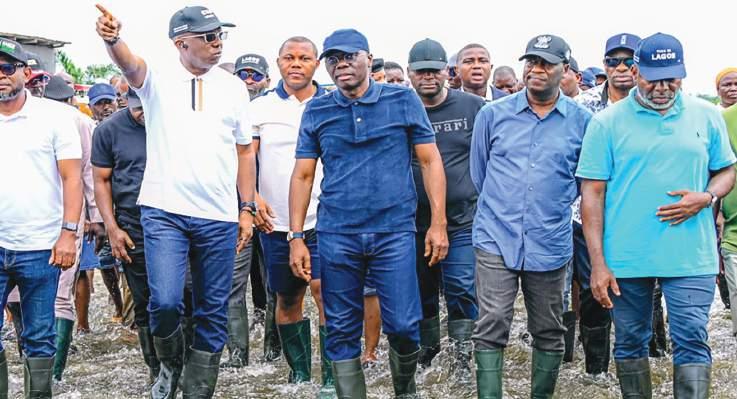
L-R: Commissioner for the Environment and Water Resources, Tokunbo Wahab; Lagos State Governor, Babajide Sanwo-Olu; Deputy Governor, Obafemi Hamzat; and Permanent Secretary, Office of Drainage Services and Water Resources, Engr. Mahmood Adegbite, during an inspection of flood-affected communities following heavy rainfall in Lagos, on Wednesday
Urge government to guarantee adequate crude supply to all refiners Say Dangote’s pricing of products in dollars highlight single supplier risks
The Petroleum Products Retail Outlets Owners Association of Nigeria (PETROAN) yesterday called on the federal government to immediately restore the country’s state-owned refineries to full commercial operation, arguing that a competitive refining landscape is critical to ensuring price stability, strengthening energy security and reducing pressure on the naira.
The association also urged the government to guarantee adequate crude oil supply to all domestic refiners, saying Nigeria’s downstream petroleum market should not depend on the fortunes or pricing decisions of a single refinery.
In a statement yesterday, PETROAN President, Dr. Billy GillisHarry, said while the association supports the deregulation of the downstream sector and respects the commercial decisions of all licensed refinery operators, including the Dangote Petroleum Refinery, the structure of the market requires urgent attention.
According to him, the recent decision by the Dangote refinery to price petroleum products in United States dollars highlighted the risks associated with having a market dominated by a single supplier.
He argued that marketers earn revenue in naira and would be exposed to exchange rate volatility if forced to source foreign exchange to purchase products, with the attendant impact on pump prices.
Gillis-Harry maintained that although pricing in dollars was a legitimate commercial decision, Nigeria required a diversified supply base to shield consumers and the economy from currency shocks and supply disruptions.
Drawing comparisons with countries such as Mexico and Indonesia, he noted that both nations introduced reforms to reduce dependence on dominant refining entities and encourage competition, adding that the common lesson from global experience is that markets built around a single supplier remain vulnerable to instability.
“The recent move by Dangote
Petroleum Refinery to price its products in United States dollars was, on its face, a commercial choice within a company’s rights. But it has done something more consequential than adjusting an invoice. It has exposed, with unusual clarity, what happens when a domestic market’s price mechanism becomes dependent on a single actor’s exchange-rate calculus,” the organisation argued.
Gillis-Harry stressed that refining capacity alone does not guarantee competition, insisting that multiple refiners operating within the same market provide the checks and balances necessary for efficient price discovery and consumer protection.
The PETROAN president therefore called for the temporary resumption of operations at the Port Harcourt, Warri and Kaduna refineries pending the conclusion of discussions on their long-term rehabilitation, describing the move as a practical bridge towards a more competitive refining industry rather than a substitute for broader reforms.
According to him, even partial production from the governmentowned refineries would improve supply, moderate pricing behaviour and strengthen Nigeria’s energy security by reducing reliance on a single refining source.
Ibezim-Ohaeri: Issues affecting not-for-profit operations being addressed Most NPOs don’t pose terrorism financing risk, says UN rapporteur
Emmanuel Addeh and Aminat Hassan in Abuja
The Economic and Financial Crimes Commission (EFCC) yesterday said Nigeria’s nationwide terrorism financing risk assessment of Non-profit Organisations (NPOs) has enabled authorities to identify the small number of organisations vulnerable to abuse by terrorist financiers.
The anti-graft agency stated that it has further ensured that the overwhelming majority of legitimate charities and civil society groups
Michael Olugbode in Abuja
French President Emmanuel Macron will pay a state visit to Nigeria later this year, French Ambassador to Nigeria Marc Fonbaustier announced on Tuesday, unveiling what is expected to be a major milestone in the rapidly expanding strategic partnership between the two countries.
The announcement, made during France’s National Day celebration in Abuja, comes two years after President Bola Ahmed Tinubu’s state visit to Paris and signals a renewed push by both nations to deepen cooperation in trade, security, agriculture, culture and regional stability.
are not subjected to unnecessary regulatory restrictions, while the exercise has strengthened the country’s anti-money laundering and counter-terrorist financing framework.
Africa.
The EFCC Chairman, Olanipekun Olukoyede, who spoke at the Third Africa High-Level Civil Society Anti-Money Laundering and Counter-Terrorist Financing (AML/ CFT) Conference in Abuja, said the assessment marked a shift from assumptions about the sector to a targeted, evidence-based understanding of terrorist financing risks.
“I am pleased and honoured to announce that, two years after President Bola Ahmed Tinubu’s State Visit to Paris, the President of the French Republic, Emmanuel Macron, will travel to Nigeria for another State Visit this fall,” the ambassador said.
Addressing senior Nigerian government officials, governors, lawmakers, diplomats and business leaders, the ambassador disclosed that President Macron’s visit would provide an opportunity for both leaders to review progress made under the Nigeria-France roadmap and chart a new course for bilateral relations.
The conference, themed: “Implementing FATF Recommendation 8 Correctly: Practices, Lessons Learned and Opportunities for Reform,” brought together regulators, financial intelligence units, law enforcement agencies, development partners and civil society leaders from across
Represented by the Director of the Special Control Unit Against Money Laundering (SCUML), Harry Erin, Olukoyede said the assessment was undertaken through collaboration involving the EFCC, SCUML, the Nigerian Financial Intelligence Unit (NFIU), the Office of the National Security Adviser, the Corporate Affairs Commission (CAC) and civil society organisations. According to him, the process was distinguished by extensive consultation, technical rigour and active participation by the non-profit community, enabling Nigeria to identify organisations genuinely vulnerable to terrorist financing while ensuring that the overwhelming majority of legitimate organisations continue to operate without unnecessary regulatory burdens.
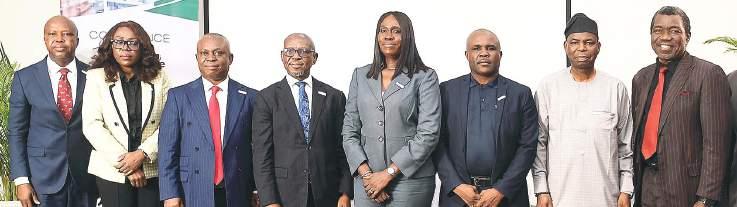
L-R: Chairman, Research Committee, Compliance Institute, Nigeria, Taiwo Sanusi; Chair-man, Technology Committee, Compliance Institute, Nigeria, Abigail Duopama-Obomanu; newly elected President, Compliance Institute, Nigeria, Wence Nwoga; Immediate Past President, Compliance Institute, Nigeria, Pattison Boleigha; Registrar/CEO, Compliance Institute, Nigeria, Bawo Egbakhumeh; Chairman, Programmes Committee, Compliance Institute, Nigeria, Obinna Okafor; Director, Compliance Institute, Nigeria, Dr Buno Nduka; and Director, Compliance Institute, Nigeria, Uchenna Uwechia, at the institute’s 2026 An-nual General Meeting held in Lagos
Declares stronger indigenous manufacturers vital for competitive economy
Shareholders approve N504bn dividend as company targets higher capacity, new product lines to boost food security, others
Chairman of BUA Foods Plc, Alhaji Abdul Samad Rabiu, yesterday said the company’s aggressive expansion drive was aimed at supporting the country’s long-term economic growth.
He said the company’s responsibility transcends generating returns for shareholders to building a stronger indigenous industrial base capable of competing globally. Rabiu spoke at the company’s
2025 Annual General Meeting (AGM) in Abuja, where shareholders also approved a final dividend of N504 billion alongside other statutory resolutions, commending its positive financial performance amid local and global headwinds.
He said the company’s next phase of growth was designed to strengthen competition, deepen local manufacturing, create jobs and contribute to national development by expanding domestic production capacity.
He stressed that while the company remained proud of its financial performance, its broader ambition was to help build a more competitive food manufacturing industry that would support Nigeria’s industrialisation agenda. He said, “We have a responsibility not only to create value for shareholders, but also to help build a stronger, more competitive industry that contributes to Nigeria’s long-term growth.”
According to him, the philosophy
underpins one of the largest expansion programmes in the company’s history, adding that once ongoing projects are completed next year, BUA Foods would emerge as the largest player in its sector in Nigeria. He, however, maintained that the expansion was not driven by a desire for size alone but by the conviction that greater scale would enable the company to compete more effectively while delivering wider benefits to consumers, investors and the economy.
Insists external auditors must defend figures they certified, not defer to NNPC Lawmakers reject confidentiality claim, invoke constitutional oversight powers
The Senate Public Accounts Committee on Wednesday issued a one-week ultimatum to the external auditors of the Nigerian National Petroleum Company Limited (NNPC Ltd.) to provide a comprehensive breakdown of more than N210 trillion recorded as receivables and payables in the company’s audited financial statements, insisting that the figures remain unexplained and cannot be left unreconciled.
The committee, chaired by Senator Ibrahim Dankwambo, ruled that the auditors must produce the schedules, working papers and supporting documentation used in certifying the accounts, stressing that they could not shift responsibility to NNPC after endorsing the financial statements.
The disputed figures comprise about N107 trillion classified as receivables and another N103 trillion recorded as payables in the company’s audited accounts.
The hearing became tense after representatives of the external audit firm informed lawmakers that the detailed schedules requested formed part of their working papers and that they would require about two weeks to retrieve the documents.
The request was firmly rejected by the committee.
Dankwambo questioned why the auditors could not immediately produce documents supporting figures they had already certified.
“When you have figures in the financial statements, there must be supporting schedules showing how those figures were arrived at. If you already have them in your working papers, why do you need to go back before presenting them to this committee?” he asked.
The auditors argued that NNPC Ltd. remained their client and that explanations regarding the figures should ordinarily come from the company.
They recalled that during an earlier appearance before the committee, it had been agreed that NNPC officials would explain the entries contained in the financial statements.
The lawmakers, however, rejected the position, maintaining that the auditors were before the Senate in their independent professional capacity and were obligated to defend the audit opinions they issued.
Senator Abdul Ningi cited Sections 88 and 89 of the 1999 Constitution (as amended), saying the National Assembly possesses extensive investigative powers to summon individuals and organisations and compel the production of documents relevant to its inquiries.
“The Constitution empowers this
committee to invite any person and request any document necessary for our investigation.
“You are before this committee as independent auditors. Do not tell us you must first seek permission from your client before complying with the lawful request of Parliament,” Ningi said.
Also speaking, Senator Adams Oshiomhole reminded the auditors that the controversy over the figures arose directly from the audit they conducted.
“The alarms were raised because of the work you people performed. These figures came from your audit. Therefore, you cannot tell this committee that you must consult your principal before responding.
“You are responsible for your audit work and must answer questions arising from it,” he said.
Another lawmaker warned that the inability of the auditors to produce supporting schedules cast doubt on the integrity of the audit exercise.
The Senator said, “If you cannot produce the detailed schedules supporting these figures, then it raises serious questions about whether the audit work was actually done.
“If it was done, the supporting documentation should already exist. We believe 48 hours should even be sufficient, but certainly not an indefinite period,” the senator said.
The committee also faulted the continued inability of both NNPC Ltd. and its auditors to reconcile the receivables and payables.
Dankwambo noted that although NNPC officials had repeatedly claimed that the figures related largely to joint venture cash calls and payments, they had failed to identify the specific transactions or counterparties involved.
He noted that four companies currently control almost 90 per cent of the market, with BUA Foods remaining the only indigenous Nigerian company among the leading operators. Rabiu pointed out that stronger competition would improve efficiency, stimulate innovation and enhance value creation across the industry.
He said, “Our objective is straightforward: to build sufficient scale to compete effectively with every player in the market. We believe Nigeria benefits when there are strong indigenous companies capable of competing at the highest level, investing for the long term and challenging established market positions.”
“That is the logic behind our expansion. We are increasing capacity, strengthening our competitive position, and building a business that can compete on equal terms with anyone in the industry. A more competitive industry is ultimately a healthier industry, and that is good for consumers, good for investors, and good for Nigeria.
“Our history demonstrates what is possible when competition is driven by efficiency, transparency, and strong execution. When BUA listed five years ago, we were significantly smaller than some of
the more established players in the industry. Yet despite our smaller size, we consistently delivered stronger profitability and better returns.
“That performance was not an accident. It was the result of efficient operations, disciplined management, prudent capital allocation, and a relentless focus on execution.”
The BUA chairman said the expansion programme would strengthen the company’s competitive position while helping to build a healthier industry capable of delivering better outcomes for consumers and investors.
According to him, Nigeria stands to gain when local businesses continue to invest, expand operations, develop local capacity and reinvest earnings into the domestic economy.
Rabiu explained that the company’s growth journey had demonstrated that operational efficiency, transparency and disciplined management remained more important than size.
Regaling in the company’s listing five years ago, he said BUA Foods had consistently outperformed some larger competitors despite operating on a smaller scale. He attributed that performance to prudent capital allocation, efficient operations and strong execution rather than market dominance.
Alex Enumah in Abuja
The Chief Executive Officer of the Nigerian Financial Intelligence Unit (NFIU) and, Nigeria’s National Correspondent to the Inter-Governmental Action Group Against Money Laundering in West Africa (GIABA), Hafsat Abubakar Bakari, will on October 6, champion the launch of the Nigeria Chapter of the Women in Anti-Money Laundering, Countering the Financing of Terrorism and Counter-Proliferation Financing (AML/CFT/CPF) Network.
The initiative, according to the NFIU underscores Nigeria’s commitment to promoting women’s leadership, professional development and collaboration across the AML/CFT/CPF community.
The launch which aligns with the global Women in AML/CFT/CPF movement was established during the Financial Action Task Force (FATF) Singapore Presidency and significantly expanded under the Presidency of Elisa de Anda Madrazo of Mexico.
The Network has become an important platform for empowering women professionals by promoting mentorship, knowledge sharing, leadership development and professional excellence.
Speaking on the initiative, Hafsat Abubakar Bakari noted that women have made significant contributions across Nigeria’s AML/CFT/CPF landscape, not only within government institutions but also in the private sector.
She observed that from financial intelligence, investigations, regulation and supervision to compliance, risk management, legal advisory, financial services, fintech innovation and corporate governance, women continue to play a strategic role in strengthening Nigeria’s financial integrity framework and advancing the fight against financial crime.
“The Women in AML/CFT/CPF Network will provide a platform for experienced professionals in both public and private sectors, to mentor the next generation, encourage greater collaboration across institutions and ensure that more women are equipped to take on leadership roles in shaping the future of financial integrity and security in the AML/CFT/CPF ecosystem,” she said.

L-R: Senior Director, People, Africa and Middle East, The HEINEKEN Company, Benjamin Gatland; Managing Director/CEO, Nigerian Breweries Plc, Thibaut Boidin; Managing Direc-tor, J. Ogungbola and Sons, Prince Jimoh Ogungbola; Outgoing Human Resources Director, Nigerian Breweries Plc, Grace Omo-Lamai; and President, Africa and Middle East, The HEINEKEN Company, Guillaume Duverdier, during a trade visit to Bodija Market, Iba-dan...recently
Ekpo reiterates Nigeria’s plan to deploy gas as transition fuel NCCC: Methane emissions reduction now economic imperative
Emmanuel Addeh in Abuja
The federal government has inaugurated the Joint Decarbonisation Working Group (JDWG) for Nigeria’s oil and gas sector, reaffirming its commitment to end routine gas flaring by 2030 while positioning natural gas as the country’s transition fuel in pursuit of industrial growth and lower carbon emissions.
Speaking at the inauguration in Abuja, the Minister of State for Petroleum Resources (Gas), Ekperikpe Ekpo, said the working group would provide a coordinated platform for government institutions, regulators, industry operators and development partners to drive decarbonisation initiatives across the petroleum industry without undermining Nigeria’s economic development aspirations.
Ekpo stressed that the inaugura- tion marked “far more than a launch” of another committee, describing it as a landmark initiative designed to strengthen institutional collaboration and ensure that Nigeria’s industrial sector remains globally competitive while pursuing sustainability goals.
“Nigeria is blessed with sig-
nificant volumes of natural gas resources. Natural gas remains Nigeria’s transition fuel and our objective under the Renewed Hope Agenda is clear. We have committed ourselves to transforming this abundant resource into industrial growth, expanding energy access, employment opportunities, cleaner cooking solutions, increased domestic utilisation and greater prosperity for our people,” he said.
According to the minister, decarbonisation has evolved beyond an environmental obligation into an economic necessity as investors increasingly consider carbon performance in making investment decisions.
“Today, decarbonisation has become far more than an environmental obligation. It is now an economic imperative, an investment imperative and a competitiveness imperative. If we are to remain a preferred destination for responsible energy investment, we must continue building institutions, policies and regulatory systems that inspire confidence while preserving our sovereign rights to utilise our natural resources for national growth,” Ekpo stated.
He reaffirmed Nigeria’s support for global efforts to reduce methane emissions from fossil fuel operations, maintaining that climate ambition must progress alongside economic development. Ekpo insisted that no developing nation should be compelled to choose between poverty reduction and environmental protection.
“Our objective is clear. Climate ambition must go hand in hand with development ambition. No
country should be forced to choose between lifting its people out of poverty and protecting the environment. Nigeria will continue to pursue both,” he added.
The minister explained that the newly inaugurated working group would strengthen policy coordination, improve measurement, monitoring, reporting and verification systems, support implementation of existing regulations, facilitate technology
deployment and improve access to climate finance and carbon markets.
Addressing members of the working group, Ekpo said they had been entrusted with responsibilities that extend beyond holding meetings or preparing reports.
Also speaking, the Director General of the National Council on Climate Change (NCCC), Dr. Tenioye Majekodunmi, described
methane emissions reduction as one of the fastest and most costeffective measures available to improve Nigeria’s environmental performance while strengthening the competitiveness of its oil and gas industry.
According to her, global markets are increasingly rewarding cleaner production methods, making decarbonisation essential for Nigeria’s long-term economic relevance.
Esther Oluku
With projections that Africa’s commercial printing industry could reach an all-time high of $235 million by 2031, stakeholders in Nigeria’s commercial printing sector will convene at the 2026 FLEXOEDGE Conference to chart the course towards its actualisation.
Themed “Investing Smart in Flexo: Securing Long-Term Value,” the conference is expected to attract participants from across the print and
The National Identity Management Commission (NIMC) has assumed responsibility as Nigeria’s designated certification authority for electronic signatures, a move expected to strengthen the security of digital transactions and deepen the federal government’s digital transformation agenda.
Director-General of NIMC, Engr. Abisoye Coker-Odusote, disclosed this on Wednesday in Abuja, saying recent legislation had expanded the commission’s mandate beyond identity management to include digital trust services and authentication.
She said the new role would
provide the legal and technical framework for trusted electronic signatures, reduce identity fraud, strengthen cybersecurity and improve confidence in digital transactions across both the public and private sectors.
Coker-Odusote described digital identity as the backbone of digital governance, warning that countries without robust digital public infrastructure would continue to face inefficiencies in public service delivery, financial vulnerabilities and digital exclusion.
She added that a trusted digital identity ecosystem would strengthen social intervention programmes, improve service delivery, enhance
investor confidence and support security agencies in tackling cybercrime and financial crimes. Calling for stronger collaboration among government institutions, financial institutions, telecommunications operators and the private sector, she said public trust would determine the success of Nigeria’s digital economy.
Speaking at the summit, President of the Information Technology Association of Nigeria (ITAN), Dr. Lare Emmanuel Ayoola, said wider deployment of digital technologies across ministries, departments and agencies could drastically reduce the time required to process government services while improving efficiency and transparency.
packaging value chain, provide a platform for networking, knowledge exchange and discussions on the future of flexographic printing, packaging innovation, automation, sustainability and industrial growth across Africa.
Convener of the conference and Technical Director, Randomsoft Limited, Kunle Ogunjobi, stated that the conference is designed to move the industry beyond discussions toward practical implementation that delivers measurable business value for stakeholders across Africa.
“FLEXOEDGE 2026 is about engaging with the decision-makers who are shaping the future of Africa’s print and packaging industry. It
offers opportunities for meaningful conversations and long-term partnerships,” he said
According to him, Africa’s print and packaging sector is entering a defining period driven by rapid growth in manufacturing, food processing, pharmaceuticals, beverages and consumer goods, and increase in cross-border trade, all of which depend on efficient, high-quality and sustainable packaging solutions.
“Our vision is for the conference to become a movement that accelerates innovation, develops talent, attracts investment and positions Africa as a globally competitive hub for print and packaging excellence,” he said. He noted that as brands increas-
ingly demand higher print quality, shorter turnaround times, greater production consistency, environmentally responsible packaging, and internationally compliant standards, making investment in modern equipment, skilled personnel and efficient production processes are essential for long-term success. Chief Executive Officer, VIP Systems Group, Germany, Guenter Franz, said smarter investments in technology and innovation would be critical to improving Africa’s print and packaging competitiveness, urging industry players to embrace modern production systems and stronger collaboration across the value chain.
Chinedu Eze
Nigeria’s leading carrier, Air Peace Limited has disclosed that one of its Airbus A320 aircraft sustained significant damage on the ground at the Murtala Muhammed Airport Terminal 1 (MMA1), Lagos.
The incident happened when a Nigerian Aviation Handling Company (NAHCO) baggage conveyor belt vehicle crashed
into the aircraft’s engine shortly after the completion of Flight P47427 from Kano and the safe disembarkation of passengers on Tuesday.
The ground handling equipment belonging to and operated by NAHCO tore into the aircraft and, as such, rendering the aircraft totally unserviceable.
“This unfortunate incident has significantly impacted our operations, as the aircraft was
rostered to operate multiple flights within our network over the coming days. Consequently, several scheduled services will experience delays, while some may regrettably be cancelled as we work to mitigate the disruption through fleet adjustments,” the airline said in a statement. The airline apologised to its passengers whose travel plans may be affected by this unforeseen ground handling incident.
James Emejo and Deborah Adekoya in Abuja
The Consumer Price Index (CPI), which measures the rate of change in prices of goods and services, moderated marginally to 15.91 per cent in June from 15.93 per cent recorded in May, the National Bureau of Statistics (NBS) said yesterday.
The slight moderation marked the first decline in headline inflation after three consecutive monthly increases, suggesting that while overall inflationary pressures remained largely elevated, though the pace of price increases eased marginally during the review period.
According to the CPI report for the period under review, month-on-month, headline inflation also slowed to 1.66 per cent in June from 1.75 per cent in May, indicating that the average price level continued to rise but at a slower pace than in the preceding month.
According to the statistical agency, the CPI index rose to 143.0 points in June from 140.7 in May, reflecting a 2.3-point increase in the general price level.
Average annual headline inflation for the 12 months ending June 2026 stood at 18.03 per cent, representing a sharp decline from 30.44 per cent recorded in the corresponding period of 2025.
Food inflation however, rose to 17.52 per cent year-on-year in June from 16.96 per cent in May, although it remained significantly lower than the 25.41 per cent recorded in June 2025.
The NBS attributed the movement in food prices to increases in the average prices of crayfish, fresh pepper, tomatoes, dried green peas, yam flour, water yam, beef, banana, cassava flour, cowpea, garri, Irish potatoes and yam tubers, among others.
Month-on-month, food inflation accelerated sharply to 3.75 per cent in June from 2.98 per cent in May, indicating stronger food price pressures during the month.
The average annual food inflation
rate for the 12 months ending June 2026 stood at 16.42 per cent compared to 31.93 per cent recorded in June 2025.
Core inflation, which excludes the prices of volatile agricultural produce and energy, stood at 15.92 per cent year-on-year in June compared to 25.41 per cent in the corresponding month of last year.
Month-on-month, however, core inflation moderated to 1.66 per cent from 1.94 per cent in May, suggesting easing pressures from non-food components of the inflation basket.
The average 12-month core inflation rate stood at 18.82 per cent, lower than the 26.88 per cent recorded in June 2025.
Urban inflation stood at 16.08 per cent year-on-year in June while month-on-month urban inflation rose slightly to 2.13 per cent from 1.99 per cent in May.
The average annual urban inflation rate for the 12 months ending June 2026 was 17.51 per cent compared to 31.64 per cent recorded a year earlier.
Similarly, rural inflation stood at 15.48 per cent year-on-year in June while month-on-month rural inflation slowed sharply to 0.52 per cent from 1.17 per cent recorded in May.
The average annual rural inflation rate for the 12-month period ended June 2026 was 17.54 per cent, lower than the 27.65 per cent reported in June 2025.
At the state level, year-on-year headline inflation was highest in Niger
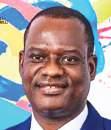
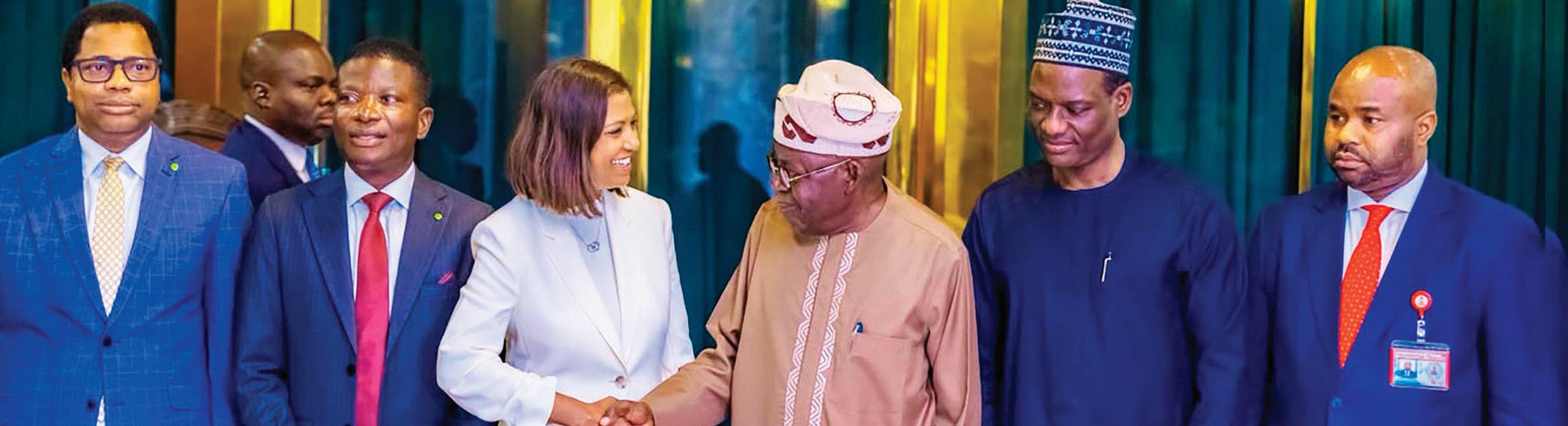
Taiwo Oyedele, Minister of Finance and Coordinating Minister of the Economy
at 42.23 per cent, followed by Kogi 41.59 per cent, and the Federal Capital Territory (Abuja) at 39.91 per cent.
Adedayo Akinwale and Sunday Aborisade in Abuja
Leader of the Senate, Senator Opeyemi Bamidele, yesterday, said funding of the proposed state police services should be established as a first-line charge in the 1999 Constitution, stressing that it is the only way to protect it from possible interference by state governors.
Bamidele insisted that financial autonomy was key to prevention of political interference and protection of the integrity of the new policing structure.
Similarly, Speaker of the House of Representatives, Hon. Tajudeen Abbas, said a proper funding mechanism must be well spelt out before the
establishment of state police.
Bamidele, who also served as Vice Chairman of the Senate Committee on Review of the 1999 Constitution, warned that without constitutionally guaranteed funding, the proposed state police could become vulnerable not only to manipulation by governors but also to undue influence from powerful business interests, cabals, and criminal networks.
The senate leader made the remarks while responding to concerns raised by stakeholders over the proposed constitutional amendment seeking to establish state police, according to a statement by his Directorate of Media and Public Affairs.
He acknowledged that the reserva-
tions expressed by Nigerians over the proposal were legitimate and deserved careful consideration.
According to him, “Nearly all the public concerns on the state police proposal are well founded and, obviously, cannot be swept under the carpet considering their weight and enormity.”
Bamidele stated that many of the concerns stemmed from Nigeria’s experience during the First Republic, when the 1960 and 1963 constitutions empowered regional governments to establish their own police forces, a development that was widely criticised for political abuse.
He, however, assured Nigerians that the National Assembly was building robust constitutional safeguards
to ensure that the proposed state police system operated independently, professionally, and in the public interest
He disclosed that lawmakers were considering a multi-layered framework that would guarantee discipline among personnel, institutional independence, and fiscal autonomy.
Central to the proposal, he said, was a constitutional provision making the funding of state police services a first-line charge, similar to the financial arrangement already guaranteed for the judiciary.
Bamidele explained that under the current constitutional framework, the judiciary enjoyed financial independence because its statutory
Fatima Binta Zubairu concurring, allowed the appeal and struck out the suit for want of jurisdiction.
The appeal, marked CA/ IB/110/2026, was filed by Mr. Aham Ejelam, SAN; Ibrahim Aliyu Nasarawa; Muhammad M. Nuhu; Uju Okafor.; and Ume Maduka., against Chief Gabriel Ojo Adekunle Ijalana; the Incorporated Trustees of the Nigerian Bar Association (NBA); Mazi Afam Josiah Osigwe, SAN; the Body of Benchers; and the Attorney-General of the Federation (AGF), in his capacity as Chairman of the General Council of the Bar.
Also listed among the respondents were Ibrahim Lawal; Raymond Oki; and Omotan Olusola Ogunmodede.
The appeal challenged the March 4, 2026 ruling of Justice G.A. Opayinka of the Oyo State High Court, which granted an ex parte interim injunction restraining the appellants from acting as members of the Electoral Committee of the Nigerian Bar Association (ECNBA) or taking further steps towards conducting the 2026 NBA National Officers’ Election.
The suit was instituted by the 1st to 4th respondents through an originating summons seeking the interpretation of provisions of the 2025 amended NBA Constitution relating to the composition of the ECNBA and certain provisions of the Legal Practitioners Act.
Delivering the lead judgment, Justice Umaru reiterated that jurisdiction is the foundation of every judicial proceeding.
“Jurisdiction remains the
lifeblood of every judicial proceeding. It is elementary that where a Court lacks jurisdiction, every step taken in the proceedings, no matter how well conducted, amounts to a nullity. Jurisdiction is therefore the threshold issue which must be resolved before a Court can validly exercise any judicial authority,” he held.
The appellate court agreed with the appellants that the dispute centred on the interpretation of the NBA Constitution, the governing instrument of an incorporated trustee registered under the Companies and Allied Matters Act (CAMA), and therefore fell within the exclusive jurisdiction of the Federal High Court under Section 251 of the Constitution.
The court held that the respondents were not merely challenging administrative actions but were questioning appointments made under the NBA Constitution, making the dispute one relating to the governance of an incorporated body.
It consequently held that the Oyo State High Court lacked jurisdiction and that all proceedings and orders made in the suit, including the interim injunction, were null and void.
The Court of Appeal also held that the suit was wrongly filed in Oyo State, despite the fact that the appointments in dispute were made during a National Executive Council meeting in Benin City, Edo State, while the appellants performed their official duties in Abuja.
Describing the action as a classic case of forum shopping,
the court ruled that the choice of the Ibadan Judicial Division amounted to an abuse of court process.
The court further held that the 1st to 4th respondents lacked the requisite locus standi because they were neither aspirants nor candidates in the NBA election and failed to demonstrate that they had suffered any personal legal injury arising from the appointments they challenged.
It also ruled that the respondents failed to comply with Article 21 of the NBA Constitution, which
over three years, with growing plaudits for positive development and growth indicators.
According to Tinubu: “We are following the example of Deloitte’s greatness to change things from the foundation, building the necessary future for our people.
“Yes, reforms are difficult. It has not been a McDonald’s customer relationship but a harvester of good things, if implemented well, and that is what we are about.
“Thank you for your partnership in paying attention to what we are doing here, as we have heard from the Minister of Finance about the fiscal, revenue and tax reforms that have taken place and are moving the nation forward.
“The reforms on revenue will continue to stimulate growth. And the effect of the reform? Yes, some issues are difficult to take the bitter medicine, but it is working well. For the economy, Nigeria is making serious foundational progress.”
The President, at the meeting,
requires disputes concerning the affairs of the association to first be referred to the NBA Dispute Resolution Committee before recourse to the courts.
The appellate court equally faulted the ex parte injunction granted by the lower court, holding that it effectively granted the substantive reliefs sought before the appellants had an opportunity to be heard, contrary to settled principles governing interlocutory reliefs and the constitutional right to fair hearing.
Continued on page 35
which was also attended by the Minister of Finance, Taiwo Oyedele and Chairman of the Nigerian Revenue Service, Zacch Adedeji, said the reforms had stimulated the economy, strengthened the fiscal and revenue sectors, repositioned financial institutions, and prepared the country to be more globally relevant and competitive.
Tinubu urged Deloitte Africa to improve its impact on the Nigerian economy by training and recruiting the dynamic youth population.
His words: “The family of Deloitte; you just reminded me of my cradle years in accountancy and where I cut my childhood accounting teeth in Chicago. Deloitte has a good training programme, and I believe you will continue to reflect that.”
Earlier, Minister of Finance and Coordinating Minister of the Economy, Taiwo Oyedele, who spoke on the reforms and impact, urged the leadership of the accounting and business firm to
allocations were charged directly on the Consolidated Revenue Fund, thereby insulating it from executive interference.
He stated, “The funding of the judiciary is provided for in the 1999 Constitution. The Chief Justice of Nigeria, for instance, does not have to take her file to the President for approval on every procurement, unlike a minister or any member of the Federal Executive Council that must secure presidential approval to spend any money.
“That is why we call it a first-line charge. In other words, the Commissioner of Police and the State Police Service Commission must have a guaranteed source of funds provided for in the constitution in such a way that the police chief will not be subject to the whims and caprices of a state governor.”
He stressed that financial independence would prevent situations where governors could withhold funds from state police commands simply because they disagreed with operational decisions.
Bamidele stated, “Part of the critical issue we must resolve in amending the 1999 Constitution is to guarantee the financial independence of state police services. It should not be left entirely to the discretion of a governor whether he wants to fund the state police service or not.
“If a state police service is not responding well to the directives of a governor, he may choose not to fund it. We must prevent such a situation.
focus on building capacity among the youth.
The President also received commendations from Deloitte Africa for the ongoing financial and fiscal reforms in the country and was encouraged to pursue a stronger partnership that supports investments, youth training, and employment.
CEO of Deloitte Africa, Redfearn, said the global organisation is primarily focused on digital and business transformation, with over 500,000 employees worldwide working across various roles and locations, including over 6,000 in Africa.
She said the accountancy firm’s revenue was $74 billion in 2025.
“We are before you to say that we want to serve. We have a local team on the ground that is ready, as well as the global firm, to support you and support your administration as you lead the country,’’ Redfearn said.
Chief Executive Officer of Deloitte West Africa, Yomi Olugbenro, as-
“We are, therefore, under the obligation to make provision for a certain percentage of a state’s budget specifically for the operations of state police services.
“Access to funds must be clearly spelt out.”
The senate leader also assured Nigerians that the constitutional amendment process would produce a state police system that will be accountable to the people while addressing genuine concerns raised by stakeholders.
He stated that creating state police without adequate and guaranteed funding would defeat the objective of improving internal security across the federation.
Bamidele further explained that the constitutional review sought to transfer policing powers from Exclusive Legislative List to Concurrent Legislative List, thereby empowering state governments to establish and operate their own police services alongside the Nigeria Police.
While fears over political interference had dominated public debate on the proposal, Bamidele cautioned that the risks went beyond politicians. He stated, “Those who expressed concerns only talked of political abuse. But it is more than political abuse. If a state police service is not well funded, it is not only political actors that can abuse state police services.
“Business class can also abuse it. Some other organisations, even
Continued on page 36
sured the President of the firm’s support for the reforms.
“We do what we do because of the philosophy that our Africa CEOs talk about – making an impact that matters. Where we are at the moment, we believe that the ground has been solidly laid. There is a need to truly extract more value and deliver the dividends of democracy to ordinary Nigerians on the street. The bigger work is really about how to cascade some of those big reforms further down.
“We do believe that with the capabilities that the firm has all over the world, with the half a million people that our CEO spoke about, we have used cases, examples, experiences of how we supported nations all around the world, so Nigeria will definitely benefit from those experiences.
“So that is why we are here, and we welcome the invitation that you may grant us as to where exactly you want us to support you,’’ he further said.


16,
Acting Group Politics Editor DEJI ELUMOYE
Email: deji.elumoye@thisdaylive.com
08033025611 sms only
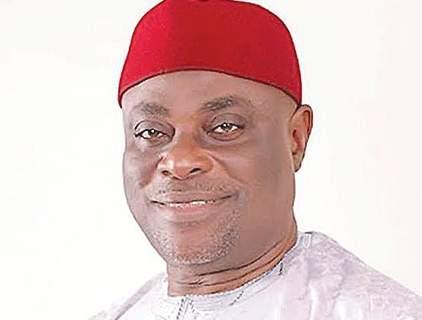
as immediate past National Chairman of the all Progressives Grand alliance, Chief Ikechukwu Oye clocks 70 on July 18, onyebuchi Ezigbo writes on his momentous contributions to politics and humanity.
For 70 years, Dr. Victor Ikechukwu Oye (Ozonkpu) has lived a life of purpose, love, service, and impact. He has traversed through academics, business and politics.
As a respected politician and former National Chairman of All Progressives Grand Alliance, he has played a significant role in shaping the political landscape of Anambra and Nigeria at large, earning the respect of allies and opponents alike through his vision, courage, and dedication to public service.
Above all, he is a man whose influence extends far beyond titles and achievements—a leader whose greatest legacy is found in the lives he has inspired, the values he has upheld, and the family and community he continues to nurture.
In the political terrain where I came to know him as a key player, Ozonkpu as he’s fondly called by his friends is a very pragmatic and resourceful politician. Oye found himself on the saddle as APGA national chairman at a time the party was facing perhaps it’s most turbulent times with an intra-party crisis that almost threatened it’s existence as a political organization. He exhibited courage and political sagacity in handling the affairs of APGA to ensure that the party not only survived the turbulence but was able to field candidates and won elections across the country. Most importantly, Oye played motivating role, galvanizing support for the party, rallying and inspiring young, ambitious politicians to vie for offices.
To his credit, APGA became the third biggest political party in Nigeria not just on paper but in terms of influence and number of elective offices the party was able to win across the country. For the first time, under his able leadership, APGA secured victories in states outside it’s traditional stronghold of Anambra and the South East. Through his efforts, the party won elections
in states such as Taraba, Federal Capital Territory (FCT), Benue and Niger. The party did well in elections in the FCT, regarded as country’s nerve centre, winning council seats in Gwagwalada Area Council.
The immediate past national chairman of APGA fought very hard to sustain the party and in the process made appreciable progress both in electoral
successes and in growing the resources and assets of the party. It is on record that under his watch, APGA wielded political influence outside of the party’s traditional strong base of South East. For example, the party was able to expand its scope and grew it’s membership in states like Imo, Abia, Bayesla, Niger, Taraba, Adamawa, Benue, Ebonyi and the FCT . In terms of repositioning and strengthening the party, Oye also did very well. Under his regime,
APGA became the first of the three major political parties in the country to acquire a befitting structure both for its national headquarters in Abuja and the South East zonal headquarters in Awka, Anambra state.
Speaking about his days as APGA national chairman, Oye said : “It has not been easy, this job is the most difficult job anybody can do. Twenty fours, seven days of the week you are working. Even while you are sleeping, you are working unless you don’t want to achieve positive results”.
With over 45 years spent in politics, Oye said his journey in politics has been quite energy sapping and turbulent but that he is happy he was able to touch people’s lives in some positive ways.
An advocate of good governance, Oye ensured that the APGA-controlled government in Anambra state continued to deliver on the core promise of accountability and pursuit of people-oriented governance.
A devout christian, Oye was brought up in the Catholic tradition. As he once reflected in an interview, “I had my baptism when I was just three months old, my first holy communion when I was 16 years old, my confirmation at the age of 18”.
Shortly after, Oye enrolled in the Catholic Church seminary where he had his secondary school education and would have become a priest at the age of 25 but he didn’t make it. However, it was not a wasted effort as Oye took with him the wisdom and rare discipline that can only be found among the God’s annointed. He gave a testimony about it saying, “My seminary training helped to shape my life because it was strictly life of discipline”.
NOTE: Interested readers should continue in the online edition on www.thisdaylive.com
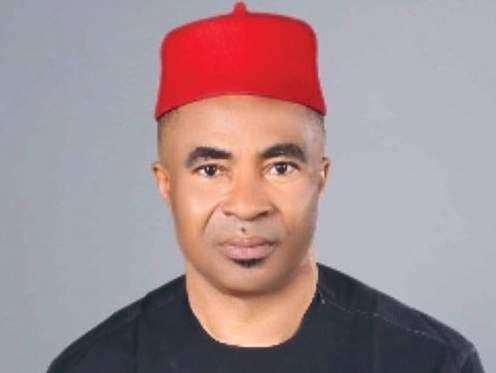
Amby Uneze writes on the need for Mbaise sub-zone to use its position of strength to support Sir Basil Maduka towards 2027 Imo East Senatorial seat.
Politics is not merely about winning elections; it is about securing the future of a people. Every election presents an opportunity for communities to make strategic choices that will shape their place in history. For the people of Mbaise sub-zone in Owerri Senatorial zone of Imo State, the 2027 senatorial election offers one such defining moment.
This is not simply about supporting a political party. It is about asking a fundamental question: When history presents an opportunity for justice, equity and representation, do we seize it or do we postpone it?
Ahiazu/Ezinihitte Federal Constituency has watched the Imo East (Owerri zone) Senate seat rotate among other federal constituencies. It remains the only federal constituency in Owerri zone that has not produced a senator since the return to democratic rule in 1999. The principles of equity and fair representation demand giving the constituency an opportunity now.
The principle of zoning has become an established feature of Nigerian politics. While not always written into law, it has often served as a practical mechanism for promoting inclusion, reducing political exclusion, and strengthening confidence among diverse communities. Communities that feel fairly represented are more likely to participate actively in governance and support democratic institutions.
Against this backdrop, the time has come for Ahiazu / Ezinihitte Federal Constituency to produce the next senator for Owerri zone. This conversation is not about entitlement. It is about fairness.
Recently, different political conversations have emerged regarding the future political leadership of Owerri zone. Various stakeholders have expressed differing opinions on zoning and succession. Regardless of these differences, one lesson remains clear: political opportunities are strongest when they are secured through
democratic participation rather than left to uncertain future arrangements. Governor Hope Uzodimma has publicly spoken about the future political direction of the state, and many people have welcomed those assurances. Yet, as citizens, the people also should understand that politics evolves and that circumstances change. Throughout Nigeria’s democratic history, communities have sometimes seen political expectations fulfilled and, at
most times, disappointed.
For that reason, Mbaise people should approach the future with optimism but also with strategic realism. Rather than relying solely on expectations of what may happen years from now, this election offers an opportunity that is immediate and tangible.
The Senate seat is before the people. Luckily enough the candidate’s name who is the son of the soil is on the ballot. The decision belongs to the voters. You people should not chase shadow with the full anticipation for the governorship
election.
Supporting Sir Basil Maduka, therefore, should not simply be viewed through the lens of party politics. It can also be understood as an opportunity for Mbaise people to strengthen their voice within Nigeria’s National Assembly while continuing to pursue the broader political aspirations.
Political influence grows through representation. Communities that consistently occupy strategic offices often negotiate from positions of greater confidence and visibility. That is why many believe Mbaise must negotiate from a position of strength rather than from hope alone.
Fortunately, the discussion is not only about zoning. It is also about the quality of the candidate.
Maduka has built a reputation in business as the Chief Executive Officer of Virgin Group, with interests in the oil and gas sector. Beyond business, he is widely recognised in campaign materials and media reports for philanthropy, youth empowerment, scholarships, support for women, medical outreach programmes, and community development initiatives across Imo State.
During his public engagements, Maduka has consistently highlighted youth employment, entrepreneurship, wealth creation, accessible representation, and economic empowerment as priorities he intends to pursue if elected. He has also pledged to remain accessible to constituents and to use legislative office to expand opportunities for young people and local communities. His supporters frequently describe him as a businessman who understands investment, job creation, and private-sector development. They also point to his longstanding involvement in grassroots politics and his record of community engagement as qualities that would strengthen his representation of Owerri zone.
NOTE: Interested readers should continue in the online edition on www.thisdaylive.com
After decades of operating under one of the most recognisable names in Nigeria’s building materials industry, Lafarge Africa Plc has entered a new era with its transition to HBM Nigeria Plc. More than a corporate rebranding, the move reflects the company’s strategic evolution under a new shareholder structure and its renewed commitment to driving industrialisation, infrastructure development and sustainable growth in Nigeria. Chiemelie Ezeobi writes
For decades, the Lafarge name has been synonymous with cement production and some of Nigeria’s most iconic infrastructure projects. Now, the company is turning a new page.
In a landmark move that signals both continuity and transformation, Lafarge Africa Plc has officially become HBM Nigeria Plc, unveiling a new corporate identity that reflects its evolution under a new shareholder structure while reaffirming its commitment to Nigeria’s industrial growth.
Far from being merely a change of name, the transition represents the company’s strategic repositioning as a leading building solutions provider with stronger global industrial collaboration through its parent company, Huaxin Building Materials Group, while maintaining its deep local roots and long-standing investments in Nigeria.
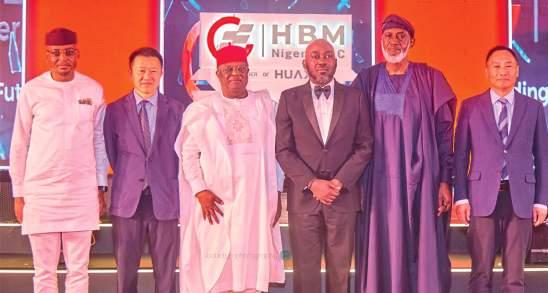
The unveiling, held in Lagos, brought together government officials, traditional rulers, captains of industry, shareholders and other stakeholders, underscoring the significance of the company’s latest milestone.
According to the Group Managing Director and Chief Executive Officer, Lolu Alade-Akinyemi, the new corporate identity signals the beginning of a new era driven by operational excellence, innovation, sustainability and long-term value creation.
He emphasised that although the Lafarge name is giving way to HBM Nigeria Plc, the company’s core mission remains unchanged.
“HBM Nigeria Plc represents an exciting new chapter in our journey as a leading building solutions company. While our corporate identity is evolving, our commitment to Nigeria remains unwavering.
“We remain focused on delivering quality cement, concrete, aggregates, and innovative building solutions that support infrastructure development, housing growth, and industrialisation.
“ This transition positions us for the future while reinforcing the values of excellence, sustainability, customer satisfaction, and responsible business practices that have defined our legacy for decades,” Alade-Akinyemi said.
He disclosed that the transition would be implemented through a structured and phased process across the company’s nationwide operations, assuring employees, customers, shareholders, investors, host communities and other stakeholders of seamless business continuity.
According to him, stakeholders should also expect sustained
investments across the country and an even stronger commitment to creating long-term economic and social value.
Building on a Strong Legacy
For the company’s Board, the new identity is designed not to erase the past but to build on it.
Chairman of HBM Nigeria Plc, Gbenga Oyebode, said the transition positions the company for enduring success while remaining true to the values that have defined its operations over the decades.
“I would like to express my sincere appreciation to our shareholders for their continued trust, to the Board and Management for their leadership, and to our employees whose dedication and commitment continue to drive the company forward.
“We are confident that HBM Nigeria Plc will continue to create sustainable value for shareholders, strengthen stakeholder trust, and deliver on its long-term ambitions,” Oyebode said.
His remarks reflected the company’s determination to reassure investors and stakeholders that while its identity is changing, its commitment to quality, integrity and responsible business practices remains intact.
Backing Nigeria’s Infrastructure Agenda
The company’s contributions to national development also received
strong endorsement from the Minister of Works, David Umahi, who praised its role in delivering infrastructure projects across the country.
Highlighting the company’s support for the Federal Government’s infrastructure agenda, Umahi said: “I can talk about Lafarge for a whole day because we have come a long way. Though the company is very strict and of high integrity, I can say that their products are impeccable.”
His comments underscored the reputation the company has built over the years as a trusted supplier of construction materials for critical national projects.
The event attracted a distinguished audience, including the Deputy Governor of Cross River State, Rt. Hon. Peter Odey; the representative of the Lagos State Governor, Olufemi Daramola; and the representative of the Ogun State Governor, Tokunbo Talabi.
Traditional rulers from Cross River, Gombe and Ogun states, former and current board members, members of the company’s executive committee, captains of industry and other stakeholders also attended the unveiling.
Although the corporate identity has officially changed, the company said the rollout of branding assets, operational integration and
customer-facing communications will continue progressively across all touchpoints to ensure consistency, business continuity and a seamless experience for customers and stakeholders.
Now operating as HBM Nigeria Plc, the company remains one of Nigeria’s foremost building solutions providers and a member of the Huaxin Building Materials Group, a globally recognised construction materials manufacturer founded in 1907 and headquartered in Wuhan, China.
Listed on the Nigerian Exchange Limited (NGX), HBM Nigeria Plc has one of the widest operational footprints in Nigeria, with cement manufacturing plants in Ewekoro and Sagamu in Ogun State, Ashaka in Gombe State and Mfamosing in Cross River State, alongside Ready-Mix operations in Lagos, Abuja and Port Harcourt.
With an installed cement production capacity of 10.5 million tonnes per annum, the company continues to supply cement, concrete, aggregates and innovative building solutions for projects ranging from individual homes to major infrastructure developments.
As HBM Nigeria Plc begins its next chapter, the message from its leadership is clear: while the name has changed, the company’s commitment to building Nigeria’s future remains as solid as the foundations it has helped lay for decades.


State police will deepen Nigeria’s federalism, argues BASHIR ARE
21
gives a vivid account of infrastructural despair in Oke Ogbe, Badagry, Lagos
MONDAY PHILIPS EKPE writes that Nigeria’s national youth service needs wellconsidered reforms, not capricious changes
Federal Government’s recent pronouncement of its plan to reform the National Youth Service Corps (NYSC) has generated mixed reactions, understandably. The decision is not surprising, coming from an administration that loves to be seen as reform-minded. On a good day, attempts at introducing changes, especially result-oriented ones, are progressive and should be supported by those who care for advancement. But these are unusual times. Nigerians have had to live more with flamboyant rhetoric and serially broken promises than actual desirable deliverables.
Scepticism about government’s intentions and capacity to transform the NYSC into a more actualised programme has, therefore, come to me naturally, like countless other compatriots. For one, the youth scheme is too important to be sent to a surgical ward after what seems to be the government waking up from the wrong side of the bed. Some sort of a fire-brigade operation. In coming up with this bogus idea only less than one year to the end of its term in office, President Bola Tinubu’s government has acted like some of its predecessors. Presidents and governors assume power and start conducting the affairs of state as if their re-election is a given. Soon, “Four Plus Four; Go on Straight; No shaking” billboards will spring up nationwide.
It’s certain that Tinubu and his team are not ready for any meaningful shot at transforming this enduring, impactful national institution that has existed for 53 years. Even without the whistle, politicking has begun in the race towards next year’s general election. Politics has since taken the front seat. And good governance - that dream of lovers of democracy - is jaundiced. So, initiating such a momentous exercise at this time is, at best, insincere.

Nothing demonstrates the low quality of thought invested in this idea than the Freudian slip of the Minister of State for Youth Development, Ayodele Olawande, the other day when he excitedly informed his audience of the plan to replace the corps’ khaki dressing with “adire”, a fabric designed and used mostly by people from the western part of the country. Of course, a nation already divided along ethnic, regional and religious lines has no difficulty in rising against the very concept. Although the minister later tried to correct himself,

the message had already gone out to the agitated public that the move to reform the national service might be another wild imagination which, if not properly interrogated, could scale through our weak legislative processes and become law. Not being alarmist here. We haven’t forgotten. Changing the country’s national anthem to the old one once existed mainly in the mind of President Tinubu. But in a matter of hours, it was railroaded through the National Assembly successfully.
This new attempt needn’t suffer the same fate. When General Yakubu Gowon’s regime conceived the NYSC three years after the Nigerian Civil War, it was aimed at fostering unity, integration and cohesion. It was meant to further the cause of the then Federal Military Government’s post-war programme of Reconciliation, Rehabilitation and Reconstruction. Young men and women, fresh from tertiary academic institutions, would be ready tools in facilitating the healing of a severely traumatised and brutalised nation. That was the starting point and, somehow, even with the hurdles the service has encountered, it has also recorded remarkable wins down the years at both individual and group levels.
Many marriages owe their origins to NYSC. Lasting friendships too. People have relocated to areas they never thought of before their national assignments. Better appreciation of other people’s cultures in numerous instances is also traceable to the one-year experience. Prejudices have fallen off some persons who had held them closely like badges. Much needed community development projects have been embarked upon by energetic, purposeful corps members, many times with minimal external assistance. And many other pluses.
Some of the experiences I had inside the Orientation Camp of the National Youth Service Corps (NYSC) at the Federal College of Education in Pankshin, Plateau State and my primary assignment have remained fresh nearly four decades after. They have strengthened my faith in it. Camping then lasted about eight weeks and the monthly “allowee” was N200/250. While at the camp, rain fell substantially and intermittently and even obstructed some of the activities. One day, a simple but instructive incident occurred. In a gathering of about seven, one corps member from the western part of the country exclaimed, “Ha! rain de fall for north?” (Does rain fall in the north?). What happened next looked choreographed. One by one, everyone walked away from the young man who had only expressed his surprise. Difficult to say exactly what that snub did to him. But he was clearly a victim of stark ignorance and myopic views about his own country. For a graduate who ought to know at least a bit better, that wasn’t funny. Yet another episode opened me up to the layers of prejudices that had, and still have unfortunately, mentally enslaved Nigerians to the detriment of mutual respect and national harmony. A colleague from the south visited the camp clinic. He needed solution for his chest pain. By his personal account to me, he couldn’t get them from the two youth corps doctors whom he first approached. Eventually, it was a graduate of University of Maiduguri, a northerner, who attended to him satisfactorily. For him, that encounter was a critical learning curve, a gamechanger.
The benefits derivable from the scheme are indeed priceless and shouldn’t be toyed with. It’s welcoming that the government is not warming up to scrap it. The official statement on the rationale for the announced intent to tinker with the service reads in part: “The issue of safety of corps members, infrastructural deficits, and the broader question about the relevance of the scheme in an increasingly dynamic socio-economic landscape are some of the challenges faced.
Dr Ekpe is a member of THISDAY Editorial Board
X: @monday_ekpe2
State police will deepen Nigeria’s federalism, argues BASHIR ARE

Nigeria stands once again at a constitutional crossroads. Decades after independence, the country still governs itself through a federal structure that was never permitted to mature on its own terms. The debate this article addresses is not whether Nigeria should add more layers of government, but whether it will finally complete the unfinished project of true federalism, beginning with the devolution of policing, the area where the mismatch between constitutional responsibility and operational authority is most dangerous and most costly in human lives.
Nigeria does not need new constitutional bureaucracy. It needs a return to the fundamental principles of federalism upon which successful and diverse nations have built stable democracies: a federal government confined to genuinely national functions, States exercising real constitutional authority over the services that most directly affect their residents, and local governments guaranteed genuine autonomy at the grassroots.
Nigeria's federalism problem is not a design flaw waiting to be discovered; it is an inheritance. The 1963 Republican Constitution governed a genuine federation of four regions—Northern, Eastern, Western, and Mid-Western—each with its own constitution, judiciary, civil service, and police, and with substantial constitutional control over its own natural and human resources. That federal architecture was not gradually eroded but deliberately dismantled by the military. General Aguiyi-Ironsi's Unification Decree No. 34 of 1966 declared that Nigeria would cease to be a federation and become a unitary republic, abolishing the regions outright and merging the regional civil services into a single National Public Service.
Although the military government that followed under General Gowon restored the outward label of federalism and replaced the four regions with twelve states in 1967, the underlying command structure remained that of a military hierarchy: state governments answerable to a central military authority, state budgets subject to central approval, and an exclusive federal legislative list steadily widened at the expense of what had previously been regional or concurrent competence. Nigeria never fully reversed this transition. The 1979 Constitution, drafted while the military still held power and supervised the transition to civilian rule, did not restore the pre-1966 federal balance; it consolidated the centralisation achieved under military rule, moving numerous subject areas that had been concurrent or regional under the 1960 and 1963 Constitutions into the Federal Government's exclusive competence. The 1999 Constitution, itself substantially a re-enactment of the
1979 text produced by another outgoing military government, carried this unitary architecture into Nigeria's current Fourth Republic, dressed in federal vocabulary, but built on a unitary foundation. This is the deeper argument beneath every reform proposed in this article. Nigeria's recurring federalism debates often proceed as though the country must choose between federal ideals and practical governance. In truth, Nigeria has rarely been permitted to test genuine federalism against its own scale and diversity since 1966; what it has tested, continuously and to poor effect, is a unitary system wearing federal clothing.
A structural analogy is useful here. A twenty-storey building and a bungalow are not the same design merely scaled up or down, they are different buildings, governed by entirely different structural requirements. A bungalow's foundation, beam sizes, and load paths would fail catastrophically under a twenty-storey structure raised upon them; a twenty-storey foundation poured beneath a bungalow, conversely, is needless and wasteful. Governance follows the same structural logic. A small, relatively homogeneous polity can function adequately under a centralised, unitary command structure. A country of Nigeria's scale and heterogeneity — over 200 million people, hundreds of ethnic and linguistic groups, multiple major religions, and 36 states spanning vastly different economies, security challenges, and social realities — requires a structurally federal architecture: one engineered from the foundation upward to bear the load of genuine diversity, not a unitary frame with federal signage bolted on top. Since 1966, Nigeria has in essence built the bungalow's foundation and then tried to raise a twenty-storey federation on top of it. The recurring cracks which include agitation over restructuring, resource control, and above all state policing are not proof that federalism is unsuited to Nigeria. They are the structural cracks of a design mismatch between the scale of the country and the architecture of its governance.
Bashir Are is the Chief Executive Officer of the Lagos State Lotteries and Gaming Authority (LSLGA)
G.OLORUNLOGBON gives a vivid account of infrastructural despair in Oke
Ogbe, Badagry, Lagos
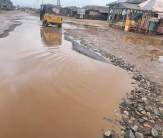
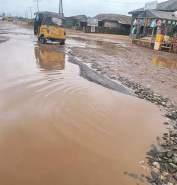
While the Lagos State Government frequently broadcasts its plans for mega-city infrastructure and sweeping coastal highways, a completely different reality exists for the residents of the Oke Ogbe community in the Olorunda LCDA of Badagry. Here, time seems to have stood still. As a resident who wakes up every morning to navigate this treacherous terrain, I can attest that the state of the 2.9-kilometre Oke Ogbe Link Road is no longer just a public works failure—it is an economic and humanitarian crisis.
Originally awarded for construction over a decade ago under the Fashola administration, the road was supposed to take a mere six months to complete. Instead, it has been abandoned to the elements. Today, what should be a vital artery connecting 14 communities to the Badagry Expressway is a graveyard of stagnant floodwaters, aggressive weed growth, and decaying concrete blocks. To escape this isolation, our community was forced to build a makeshift wooden bridge across a swamp—a fragile lifeline that serves as our only gateway to the outside world.
The economic toll of this isolation is staggering and wide-reaching. Oke Ogbe is no longer just a village of farmers and fishermen; it has grown into a bustling community housing civil servants, corporate professionals, traders, and skilled artisans who must commute daily to various parts of Lagos. But how do you sustain a career or a business when commercial vehicles refuse to ply your road? Private car owners face constant, expensive mechanical breakdowns from the terrain, while others must rely on motorcycle operators who hike fares exorbitantly just to brave the mud. From the farmer watching produce rot to the professional arriving at the office covered in mud, the economic life of every single resident is being systematically drained. Beyond the economic strain, this infrastructure failure has turned Oke Ogbe into a death trap. The community has no hospitals, and our only local health center is a ghost of a facility— hardly functional and almost always locked. When medical emergencies strike, pregnant women in labour and critically ill children are forced to brave the same flooded, treacherous terrain to access quality healthcare outside the community. Avoidable deaths have become a tragic norm here simply because ambulances and vehicles cannot get in, and residents cannot get out in time. Just recently, our community was thrown into mourning when a man lost his balance, toppled over the fragile wooden barrier of our makeshift bridge, and drowned in the swamp before he could be rescued. This is no longer just about inconvenience; our
lives are being cut short by negligence.
The crisis extends heavily to our children, whose education has become a logistical nightmare. Compounding the disaster of the road is a glaring systemic failure: Oke Ogbe has no government public school. This leaves parents with few, painful options. Those who can afford the extra financial burden enroll their children in local private schools within the community. However, families who cannot afford private tuition are left at the mercy of the elements. Their children must either trek to the government school in Ipara or other neighboring areas.
Right now, with heavy rains submerging the area, secondary school students are forced to wade through hip-deep, trash-filled, stagnant water just to link up with the Lagos-Badagry Expressway. Others risk their safety daily crossing over our slippery, makeshift wooden bridge to reach schools outside the community. They arrive at their classrooms soaked, exhausted, and exposed to severe health hazards like waterborne diseases. For many families, spending over N1,500 daily on transport in this harsh economic climate is a breaking point, forcing many parents to keep their children at home entirely during peak flooding.
What makes this situation deeply painful is the bitter irony of our political relevance. During election seasons, politicians and party officials suddenly find their way into Oke Ogbe. They brave the very mud they refuse to fix, flashing smiles, making grand promises, and soliciting our votes. We are treated as a vital electorate when ballots need to be cast. Yet, as soon as the election cycles end and power is secured, the gates shut. The promises evaporate, and we are immediately relegated to a forgotten village, abandoned to survive the swamp on our own until the next political season approaches.
Olorunlogbon is a resident and professional living in the Oke Ogbe community, Badagry
Editor, Editorial Page PETER
ISHAKA
Email peter.ishaka@thisdaylive.com
The authorities must do more to prevent mass starvation
More than 17 million people across nine conflict-hit states in northern Nigeria face severe hunger, according to the United Nations World Food Programme (WFP).
The UN agency has warned on how violence and funding cuts are driving food insecurity to its worst level in nearly a decade. Borno State, the epicentre of the Boko Haram insurgency, has more than three million people who are acutely food insecure, including more than 750,000 facing severe hunger conditions. "When people lose access to food, the risks of displacement, exploitation and instability increase," said WFP regional director for West and Central Africa, Kinday Samba, who added that violence was spreading across a wider area and forcing people from farmland.
For years, the Food and Agriculture Organisation (FAO) and the UNWFP have warned repeatedly that millions of Nigerians are at the risk of hunger as prices of foodstuff skyrocket. Recent data compiled by an international e-commerce organisation also revealed that the average Nigerian household spends about 60 per cent of its income on food, one of the highest in the world. But the situation in the Northeast states, especially Borno, Adamawa and Yobe, has always posed more challenges because of the brutal insurgency that has decimated the region for almost two decades.

nation of Humanitarian Affairs (OCHA) in Nigeria, Trond Jensen. “Over the past year, dozens of farmers have lost their lives, and others have been abducted or injured while eking out a living outside the security perimeters of Borno’s garrison towns due to limited farming lands and few or no livelihood options.”
The WFP findings underline the deepening humanitarian cost of insecurity in a region where armed groups have displaced communities, kept farmers from their fields, and restricted aid access. The crisis, according to the food agency, isworsening during the lean season, when households typically exhaust foodstocks before the next harvest. With the fear of malnutrition for millions of children (and mothers) who are deprived of a healthy and productive life, the situation is already dire. We therefore urge authorities, at all levels, to work towards alleviating the problem of hunger in the country.
The situation in the Northeast states, especially Borno, Adamawa and Yobe, has always posed more challenges because of the brutal insurgency that has decimated the region for almost two decades
EDITOR SHAKA MOMODU
DEPUTY EDITOR WALE
OLALEYE
Insecurity in many rural communities in Nigeria has made it practically difficult for farmers to engage in agricultural production optimally, thus affecting productivity and largely causing market disruptions with attendant food price shocks. Available projections from Cadre Harmonisé, an initiative focused on food and nutrition analysis, indicate a high level of desperation, especially in the North. “People have been forced to adopt negative coping mechanisms such as survival sex and child labour to stay alive,” according to the head of the Office for the Coordi-
MANAGING DIRECTOR ENIOLA BELLO
DEPUTY MANAGING DIRECTOR ISRAEL IWEGBU
CHAIRMAN EDITORIAL BOARD OLUSEGUN ADENIYI
EDITOR NATION’S CAPITAL IYOBOSA UWUGIAREN THE OMBUDSMAN KAYODE KOMOLAFE
T H I S D AY N E W S PA P E R S L I M I T E D
EDITOR-IN-CHIEF/CHAIRMAN NDUKA OBAIGBENA
GROUP EXECUTIVE DIRECTORS ENIOLA BELLO, KAYODE KOMOLAFE, ISRAEL IWEGBU
DIVISIONAL DIRECTORS SHAKA MOMODU, PETER IWEGBU, ANTHONY OGEDENGBE
DEPUTY DIVISIONAL DIRECTOR OJOGUN VICTOR DANBOYI
SNR. ASSOCIATE DIRECTOR ERIC OJEH
ASSOCIATE DIRECTOR PATRICK EIMIUHI
CONTROLLERS ABIMBOLA TAIWO, UCHENNA DIBIAGWU, NDUKA MOSERI
DIRECTOR, PRINTING PRODUCTION CHUKS ONWUDINJO
Even before the latest WFP warning, the last National Bureau of Statistics (NBS) report titled, ‘Nigeria General Household Survey (Wave 5)’ revealed that approximately two out of three households indicated being unable to eat healthy, nutritious or preferred foods because of lack of money. Similarly, 63.8 per cent of households ate only a few kinds of food due to lack of money; 62.4 per cent were worried about not having enough food to eat, and 60.5 per cent ate less than they thought they should. Between Waves 4 and 5 surveys (conducted three years apart), the proportion of households that reported being worried about not having enough food to eat because of lack of money increased from 36.9 per cent to 62.4 per cent. Between then and now, the only change is perhaps that the situation has got worse.
It is a notorious fact that food inflation and attendant food prices have escalated in the last three years not only in the north but across the country with hunger now a daily vocabulary. This is a challenge that should compel urgent attention by authorities at all levels in Nigeria.
Letters in response to specific publications in THISDAY should be brief (150-300 words) and straight to the point. Interested readers may send such letters along with their contact details to opinion@thisdaylive.com. We also welcome comments and opinions on topical local, national and international issues provided they are well-written and should also not be longer than (750- 1000 words). They should be sent to opinion@thisdaylive. com along with photograph, email address and phone numbers of the writer.
In some parts of the country, kidnapping has become seemingly intractable such that kidnapping gangs are becoming so emboldened and daring. Kidnap-for-ransom is becoming a significant security challenge which needs to be tackled with concrete efforts and determination on the part of the government.
While the North is generally considered as the epicentre of abductions, kidnapping operations in the SouthEast tend to be slightly different. Kidnapping operations in the South-East are mostly commercially inclined with high-net-worth individuals, travellers, and members of the clergy being the targets in most instances.
As disclosed by SBM Intelligence in a new security report, not less than 257 people were kidnapped in Nigeria’s South-East between July 2024 and June 2025. The report further revealed that out of N1.005bn in ransom demanded by the kidnappers in the South-East
over the period, the kidnappers got only N157.55m. In the case of the kidnapping of Reverend Father Gerald Ohaeri of Nsukka Diocese (Enugu) in December 2024, it was stated that N40m was reportedly paid. Whereas in the case of a Catholic engineer in the Nimo community, Njikoka local government area of Anambra State, who was kidnapped in November 2024, N50m was demanded by his abductors.
An ugly trend has gradually enveloped the kidnapping menace such that paying of ransom no longer guarantees the safe release of the abductees. The abductors have stepped up their game and now engage in wasting the lives of their abductees, even after receiving the requested ransom. The case in point is that of Mr. Charles Nwolisa, a high-profile business man, who was shot at Unubi in Anambra State in 2023 by his abductors after collecting the ransom they demanded. Mr.
Nwolisa, who was left in a pool of blood, was subsequently rushed to a nearby hospital by some passers-by. Following this ugly experience, Mr. Nwolisa, like so many of his kind, has fled the country in 2024, vowing never to return to the country since his life is no longer safe and secure.
But, for how long will he and others like him, who are the targets of kidnappers, continue to desert their country due to the activities of kidnappers? We are therefore calling on the government, which principal obligation is to secure the lives and properties of the citizenry, to urgently tackle this ugly menace of kidnapping in the country.
Benjamin Nwolisa,
Franco-Nigerian Educational and Socio-Cultural Organisation, Lagos
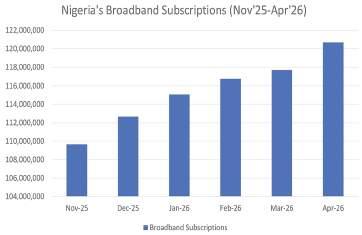
Seven months after the December 2025 deadline for achieving 70 per cent broadband penetration as outlined in the Nigerian National Broadband Plan (2020-2025), the country is still far from achieving the set target.
The five-year broadband policy had an ambiguous target to achieve 70 per cent broadband coverage for 90 per cent of the Nigerian population, with minimum download speeds of 25
megabyte per second (Mbps) in urban areas and 10 Mbps in rural areas.
But as at April this year, Nigeria’s broadband penetration stood at 55.67 per cent, with approximately 120.7 million active broadband subscriptions, which is still a far cry from achieving the 70 per cent broadband target.
Despite the country’s inability to meet the set broadband target in December 2025, the Nigerian telecoms sector however recoded steady
growth in broadband penetration and subscription in 12 consecutive months, according to the latest statistics released by the Nigerian Communications Commission (NCC).
From July 2025 to July 2026, the sector recorded continuous increase in broadband penetration level and active number of broadband subscriptions.
The statistics, which THISDAY obtained from the official website of NCC, showed that as at July 2025, broadband penetration was
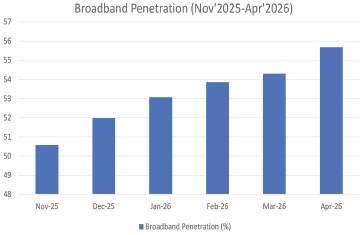
48.01 per cent, with 104 million active broadband subscriptions. The figures however increased to 48.81 per cent broadband penetration level with 105 million active broadband subscriptions as at August 2025.
As at September 2025, broadband penetration also increased to 49.34 per cent with 106 million active broadband subscriptions.
In October 2025, broadband penetration increased again to 49.89 per cent with 108 million active broadband
subscriptions.
In November 2025, the telecoms sector also recorded increase in broadband penetration and active broadband subscriptions to reach 50.58 per cent penetration level and 109 million active subscriptions.
In December 2025, there was another increase in broadband penetration, which reached 51.97 per cent penetration level with a subsequent increase in broadband subscriber number, which reached 112 million active broadband
subscriptions.
The NCC statistics also showed that in January 2026, the telecoms sector recorded increase in broadband penetration to reach 53.07 per cent penetration level, with a subsequent increase in active broadband subscription of 115 million.
In February 2026, broadband penetration increased again to 53.86 per cent, with a subsequent increase in active broadband subscription of 116 million.
The story continues online on www.thisdaylive.com
Emma Okonji with Agency Report
The International Telecommunication Union (ITU), the United Nations agency for digital technologies, is focused on building trust in Artificial Intelligence (AI) behaviour and identity with its global standards initiative.
The new initiative seeks to develop frameworks for trusted digital identity and to ensure that the behaviour of AI agents remains trustworthy and accountable throughout their lifecycle.
The new ITU Focus Group
on Trust and Identity for Humans and Agentic AI, announced the initiative at the just concluded AI for Good Global Summit in Geneva, Switzerland.
The initiative is coming at a time that AI is evolving rapidly beyond assistive tools and increasingly into autonomous agents acting on behalf of people.
While agentic AI promises major gains in productivity, it also introduces new risks ranging from autonomous agents impersonating people and organisations, to taking unauthorised actions across
interconnected systems.
The ITU Focus Group seeks to address the challenges by developing frameworks that preserve meaningful human control for tasks such as executing financial transactions and operating critical infrastructure.
Speaking about the initiative, ITU Secretary-General Doreen Bogdan-Martin, said: “The future of AI depends on trust. As AI becomes more autonomous, we need to work together across industry, governments, academia and civil society to ensure the greatest possible confidence
in AI systems.”
According to ITU Focus Group, the ability to establish an agent’s identity and whether its behaviour can be trusted becomes critical, especially as AI systems plan and act with growing independence
“Increasingly, AI agents need to identify and authenticate one another. Just as importantly, their decisions and actions must remain accountable, controllable and trustworthy. Identity systems establish who is acting, while trustworthiness determines whether that
actor is reliable. Together they provide the foundation for safe interaction between humans and autonomous AI systems.
“The Focus Group will address the challenges of trust management for people and AI agents, the overall trustworthiness of agentic AI systems, and ways to strengthen confidence in how AI agents behave while retaining authority over their actions,” the group said.
Focus Group Co-Chair, Debora Comparin, said: “AI agents will soon negotiate, transact and make decisions
on our behalf. Before that future becomes reality, we need common international foundations that establish who these agents are, when they can be trusted, and how people will remain in control. That is the challenge this Focus Group has been created to address.”
Focus Group Co-Chair, Amir Banifatemi, also said: “Agentic AI introduces a new class of digital actors that will increasingly collaborate with people and one another.

L-R: Executive Director, OANDO Plc and Chairperson, FITC Sustainability & ESG Conference Planning Committee, Ayotola Jagun; Co-Founder, Wealth4lmpact, Ndidi Okonkwo NWUNELI; Professor of Strategic Mgt, Lagos Business School, Pan-Atlantic University, Prof. Chris Ogbechie; Chairman, MTN Foundation, Mosunmola Belo-Olusoga; Chairman Odu’a Investment Company Limited, Otunba Bimbo ASHIRU and MD/CEO, FITC, Converner, FITC
Sustainability & ESG Conference, Dr. Chizor Malize at the just concluded FITC Sustainability & ESG Conference in Lagos… recently
The federal government has called on employers of labour in Nigeria to advance the safety and wellbeing of Nigerian workers by upholding global best practices in line with provisions of the international labour laws.
The call was made in Lagos by the Minister of Labour and Employment, Mr. Muhammadu Maigari Dingyadi, at the 69th Annual General Meeting of the Nigeria Employers Consultative Association (NECA).
Dingyadi stated that as the federal government continues to implement reforms aimed at attracting investment and improving the country’s
business environment, the private sector employers should play a key role in closing unemployment gaps with close attention being paid to upholding the highest international labour standard.
He said: “As government continues to implement reforms aimed at attracting investment and improving the business environment, employers equally have a responsibility to uphold the highest standards of corporate governance, comply with labour laws and honour the principles of decent work. Respect for workers’ rights and business competitiveness are complementary objectives
Mobile Security Architecture for Campus Surveillance
Stories by Emma Okonji
Babcock University, has installed state-of-the-art mobile security system at the university campus, designed for 24 hours security surveillance within and around the campus, including the forest zone around the university environment.
The mobile security architecture has drone and a central control room located inside New Horizons Building in the Department of Computer Science, with large screen for visibility and monitoring purposes.
that reinforce one another.
“The federal government recognises that employers are indispensable partners in national development. However, sustainable business
success must continue to be built upon respect for the dignity of labour.”
In his opening remarks, the President of NECA, Mr. Ifeanyi Okoye, explained that
Group Business Editor
Eromosele Abiodun
Deputy Business Editor
Chinedu Eze
Comms/e-Business Editor
Emma Okonji
Asst. Editor, Energy
Emmanuel Addeh
Asst. Editor, Money Market
Nume Ekeghe
Correspondents
KayodeTokede(CapitalMarkets)
James Emejo (Finance)
Ebere Nwoji (Insurance)
Reporter
Peter Uzoho (Energy)
Speaking at the formal presentation of the mobile security architecture to the university, the CEO, New Horizons, Mr. Tim Akano, said the security gadgets were donated to the university, based on the long-standing partnership between the university and New Horizons.
According to him, the donation is part of New Horizons’ contribution to address insecurity on campus. He said New Horizons would train security personnel of the university and thereafter handover the control of the security architecture entirely to the university authority.
while challenges of unstable power supply, technological disruptions, and insecurity persists, NECA is optimistic that sustained implementation of reforms, particularly in the
power sector, has the potential to significantly reduce the cost of doing business and enhance the competitiveness of Nigerian enterprises over the medium term.
As Nigeria’s new industrial policy enters its critical implementation phase, private sector leaders have emphasized that data-driven accountability and sustained execution will be the defining factors in its success.
The call was made during a high-level panel at the recently concluded
Nigeria Employers Consultative Association (NECA) Employers’ Summit, which brought together policymakers, business leaders, and industry stakeholders to assess progress on economic reforms. The panel, titled, “Nigeria’s Industrial Policy: Implications for Industrial Development, Trade and
Investment Promotion,” was moderated by Ms. Nancy Illoh-Nnaji, Anchor and Producer of MoneyLine on AIT.
Speaking, the DirectorGeneral, Manufacturers Association of Nigeria (MAN), Mr. Segun Ajayi-Kadir, described the industrial policy as a
landmark achievement. “This is the most comprehensive industrial policy we’ve ever had since independence. It clearly outlines the areas we need to focus upon to transform our industrial landscape,” he said, confirming that a public scorecard review is expected in the first week of July.
The host communities of Halkin E&P OML 46 Atala, Azagbene in Ekeremor local government area and Ezetu in Southern Ijaw local government area, both in Bayelsa State, have commended the Nigerian Upstream Petroleum Regulatory Commission (NUPRC) for its implementation of the 2021 Petroleum Industry Act (PIA).
The commendation by the communities in the oil-rich state was in response to the recent judgment of the Federal Court of Appeal in Port
Harcourt reaffirming Halkin Exploration and Production Limited as the legal owner and operator of the Atala Marginal Oil Filed (OML 46).
A three-member panel led by Justice Mohammed Ibrahim Sirajo JCA, alongside Justice I.M.
Sanni JCA and Justice Elejo Eneche JCA, had dismissed an appeal brought by Bayelsa Oil Company Limited, describing it as unmeritorious, and awarded the cost of N1 million against the appellant, and in favour of the 1st, 2nd, 3rd, and 4th defendants.
Yellow Card, the largest licensed stablecoin-based infrastructure provider operating across over 60 countries globally, including Nigeria and over 20 countries in Africa, has been nominated for multiple awards at the Morgans Governance,
Globacom has reaffirmed its commitment to rewarding excellence, loyalty and strategic partnership by honouring 115 of its highest-performing business partners with millions of Naira in cash, brand-new vehicles and other valuable prizes at the 2026 Glo Partners’
Risk Management, and Compliance (GRC) Financial Crime Awards 2026 (Africa Edition).
The nominations include “Organisational Excellence in Governance, Risk, and Compliance Award.”
The Morgans GRC &
Reward Gala.
Held in Eko Hotel & Suites, Victoria Island, Lagos, the event celebrated dealers whose outstanding performances between January and June 2026 significantly contributed to the company’s continued
Financial Crime Prevention Awards recognise individuals and organisations that are setting the benchmark for excellence in governance, risk management, compliance, cybersecurity, fraud prevention, and the fight against financial crime across
growth and market leadership.
Speaking at the event, Globacom’s Cluster Head, Lagos 2, Abdul Rasaq Ande, described the gala as a celebration of the enduring partnership, shared vision and collaborative spirit that
Africa. The awards, which celebrate leaders who are strengthening trust, resilience, and accountability within the financial services ecosystem, were founded in 2020 and have expanded beyond Africa to Europe and other parts of the world.
have remained central to Globacom’s remarkable journey over the past twentythree years.
“Our partners have, over the years, been the bedrock of the Globacom ecosystem, and their success is our success,” Ande said.
Dan Kunle
Your Excellency,
Good afternoon sir
Nearly half a century ago, Nigeria embarked on one of the boldest industrial projects ever conceived on the African continent.
The Ajaokuta Steel Company Limited was never intended to be just another government enterprise.
It was designed to become the backbone of Nigeria’s industrial economy, the foundation upon which railways, bridges, refineries, power stations, automobiles, heavy machinery, defence equipment, construction materials, oil and gas infrastructure and thousands of manufacturing businesses would depend.
It represented more than iron and steel. It represented national ambition. It represented economic independence. It represented Nigeria’s determination to build an industrial economy capable of competing with the rest of the world.
Few national projects have carried greater expectations.
Unfortunately, few have produced greater disappointment than the Aluminium Smelting Company of Nigeria (ALSCON) in Akwa Ibom State, the Delta Steel Company in Aladja, NAFCON in Port Harcourt, and the NNPC refineries.
Today, after forty-seven years, Ajaokuta no longer represents Nigeria’s industrial future.
These failed projects represent one of the longest-running failures of public-sector industrial policy anywhere in Africa.
Mr President, sir, this letter is not another appeal to revive Ajaokuta and NIOMCO.
Nigeria has listened to that promise since 1979.
From 1979 to 1983 the largest contract awarding centers in Africa was Ajaokuta and Abuja Federal Capital Territory development. Even though Abuja as the new capital of Nigeria is today a reality but we are yet to evaluate the economic value or otherwise to Nigerians but Ajaokuta has definitely not added any socioeconomic development value to our country.
This is an appeal to do something far more relevant and decisive on Ajaokuta and NIOMCO.
Bring forty-seven years of uncertainty to a decisive end.
Where is the iron and steel?
NIOMCO in Itakpe, 65 KM away from Ajaokuta steel complex with a connecting standard gauge railway infrastructure to evacuate beneficiated iron ore as feedstock to Ajaokuta and probably Alaja steel complex in Delta state.
Iron ore, feedstock have never been fully produced and delivered to Ajaokuta steel complex till date nor Alaja steel complex in Delta state.
The Ajaokuta steel company therefore has not been able to blast its uncompleted furnace. It has never ever produced liquid steel, rather it has produced more speeches, promises, hopes and visitations.
The Ajaokuta steel complex has never been able to agglomerate all the raw materials from limestone to manganese to cooking coal to ball clay to acid and ETC for steel production.
The four rolling mills within the Ajaokuta steel complex were partially completed and operated at great loss and they have remained
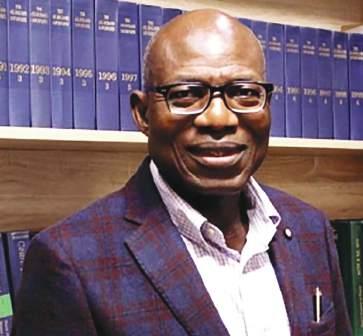
ever stranded.
Memoranda after memoranda, technical committees have all failed to produce steel from the complex
For almost five decades, Nigerians have been told that Ajaokuta is almost ready.
Almost completed.
Almost operational.
Almost revived.
Almost producing.
Almost attracting investors.
Almost becoming Africa’s industrial giant.
Yet after all these years, Nigeria still cannot point to sustained commercial steel production from Ajaokuta.
Instead, successive administrations have celebrated meetings instead of manufacturing, announcements instead of output, negotiations instead of production and promises instead of performance.
No private company would survive under such circumstances.
No shareholder would continue financing an enterprise whose principal product remained expectation rather than production.
The government should not apply a lower standard simply because the enterprise belongs to the state but this seems to be the same characteristic across all federal governments owned enterprises in Nigeria. Thus the justification for privatization and divestment.
The question before the federal government of Nigeria is therefore remarkably simple - Where is the iron and steel?
Until that question is honestly answered, every discussion about Ajaokuta risks becoming another exercise in postponement.
Dreams abandoned
The greatest tragedy of Ajaokuta and NIOMCO is not the abandoned plants. It is the abandoned generation.
When construction began, Nigeria identified many of its brightest young
engineers and technical specialists and sent them abroad for advanced training in methurgy and steel making - in countries including the former Soviet Union and India.
Those young men and women returned home believing they would help build one of Africa’s largest integrated steel industries.
They prepared themselves for careers that would shape Nigeria’s industrial future. That future never arrived.
Many of those pioneers have since passed away.
Others are now elderly.
Many retired without ever practising the profession for which they were specially trained.
Some spent entire careers waiting for a project that never truly came alive. Their story is rarely told. What gratuity and pension did they earn compared to their peers that joined NNPC and CBN.
Mr President, I think we need to revisit gratuities and pensions to all these great Nigerians that their talents were wasted in such federal government home projects across Nigeria for fairness and equity.
Nigeria did not merely waste billions of naira.
It wasted talent.
It wasted knowledge.
It wasted experience.
It wasted an entire generation of industrial professionals whose skills should have transformed our industrial landscape.
No financial audit can fully measure this colossal loss.
Has failure become normal in Nigeria?
Mr President, sir, incomplete construction and abandoned federal government projects across Nigeria remain one of the greatest problems and embarrassment. It is because such failures have gradually become an acceptable norm.
Every administration inherits the projects.
Aluminum Smelters Company in Akwa
Ibom completed but non operational over dispute of ownership till date.
The Nabilla hydro project, the Brass and OK LNG, the railway projects and government owned refineries across Nigeria.
Every administration allocates fresh public funds but never enough to make meaningful progress.
Every administration announces another revival programme.
Every administration searches for another foreign technical partner.
Every administration assures Nigerians that steel production is finally within reach.
Then government changes.
The cycle begins again.
The project moves from one administration to another, not as a functioning industrial enterprise, but as a political inheritance no government wishes to resolve permanently.
Forty-seven years later, Ajaokuta Steel has become something it was never designed to be except if my generation were deceived by our forefathers.
It has become a permanent government programme for preserving hope without production.
That is not industrial policy.
It is an institutionalised indecision and failure.
The wrong debate
For decades, Nigeria has asked the wrong question.
The debate has always been: “How do we revive Ajaokuta?”
That is no longer the question that should confront your administration, sir.
The proper question is far more fundamental. Should Ajaokuta Steel Company Limited and NIOMCO continue to exist in its present form?
Everything I have seen over the years leads me to one unavoidable conclusion.
In 1995 I personally organized a management workshop for the top leaders of Ajaokuta Steel company on how to reengineer the steel complex and optimize all the units that were partially completed but that exercise yielded no tangible results.
The answer is therefore NO.
This is not because Nigeria no longer requires iron and steel.
Nor is it because industrialisation has become less important.
On the contrary, Nigeria needs industrialisation today more than at any time in its history. China and India have taken the global lead in iron, steel and aluminum production.
But industrialisation should never become hostage to one corporate structure that has repeatedly failed to justify its continued existence.
The objectives were never to preserve Ajaokuta and NIOMCO
The objectives were to produce iron and steel in Nigeria.
Those are not the same thing.
Ajaokuta and NIOMCO were meant to be vehicles. They were never to become just a destination for government dignitaries to visit and make promises.
The sunk-cost trap
One argument is repeatedly advanced whenever fundamental reform is proposed. Nigeria has already invested too much to stop.
Nigeria and other African countries risk losing access to billions of dollars in global investment unless companies strengthen their Environmental, Social and Governance (ESG) disclosures, the Director-General of the Securities and Exchange Commission (SEC), Dr Emomotimi Agama, has warned.
Agama issued the warning at the FITC Sustainability & ESG Conference 2026 held recently in Lagos, where business leaders, policymakers, regulators, investors and development partners gathered to chart pathways for accelerating sustainable development across Africa.
Speaking during a special address at the conference, Agama said sustainability reporting had evolved beyond regulatory compliance into a strategic business necessity, noting that global investors are increasingly directing capital towards organisations with transparent governance structures and robust ESG frameworks.
He warned that companies failing to improve the quality of their sustainability disclosures could find themselves excluded from growing international investment flows.
“Nigerian companies that fail to strengthen their Environmental, Social and Governance disclosures risk missing significant global capital flows as investors increasingly prioritise transparency, responsible governance and sustainable business practices,” Agama said.
Held under the theme, ‘Building a Sustainable Africa: Integrating
Environmental Stewardship, Social Impact, and Strong Governance for a Prosperous Future’, the conference examined how sustainability and ESG principles can drive investment, institutional resilience and inclusive development across the continent.
Managing Director and Chief Executive Officer of FITC, Dr Chizor Malize, described sustainability and ESG as strategic drivers of competitiveness rather than optional corporate initiatives.
According to her, organisations and nations that integrate environmental stewardship, social investment and strong governance into their decision-making processes will be better positioned to attract investment, manage risks and create long-term prosperity.
“Sustainability and ESG have evolved from corporate responsibility initiatives to strategic drivers of competitiveness, resilience and long-term value creation. Africa’s future will be determined not by the magnitude of its challenges but by the quality of leadership and the decisions made today.”
Delivering the opening address, Chairman of the Advisory Board of the FITC Sustainability & ESG Institute, Prof. Fabian Ajogwu (SAN), called for urgent and coordinated climate action, describing environmental stewardship as one of the defining leadership responsibilities of this generation.
He said climate change was no longer solely an environmental issue but a strategic economic challenge with profound implications for businesses and
governments.
According to Ajogwu, “leaders must embed sustainability into corporate strategy, institutional governance and national development planning.” He stressed that “protecting Africa’s natural capital is fundamental to securing long-term economic resilience and prosperity.”
The conference also highlighted the importance of sustainable finance in supporting Africa’s transition to a low-carbon and climateresilient economy.
Representing the Deputy Governor of the Central Bank of Nigeria (Economic Policy), Mr Philip Ikeazor, Mr. Mike Ononugbo said environmental stewardship remained essential for protecting Africa’s natural resources while sustaining economic growth.
He noted that initiatives such as the Africa Carbon Market Initiative and the Green Climate Fund could help bridge the continent’s significant climate financing gap.
According to him, “green finance provides an important mechanism for directing investment towards renewable energy, climate-resilient infrastructure, lowcarbon technologies and environmentally sustainable enterprises.”
He identified green bonds, sustainabilitylinked loans and green equity as critical financial instruments capable of mobilising the capital required to accelerate Africa’s green transition and strengthen long-term economic resilience.
Delivering the keynote address, Chairman of the MTN Foundation, Mrs Mosun Belo-Olusoga, challenged African leaders to reposition sustainability and ESG as the continent’s blueprint for long-term prosperity.
Emma Okonji
The Sustainability Professionals Institute of Nigeria (SPIN) has inducted 79 new members during its 2026 Cohort 6 induction ceremony in Lagos. The event marked a significant milestone in the institute’s journey to redefine and professionalise sustainability practice in Nigeria. The induction ceremony brought together professionals from various sectors alongside institutional members including Access Bank, ARM, ARRIDEX, Dangote Cement, FirstBank, IHS,
Lotus Bank, Mainstream Energy Solutions, Oando, and Seplat Energy.
In his keynote address, Chairperson of SPIN’s Scientific Committee and Professor of Accounting and Corporate Governance at the University of Nottingham, Professor Emmanuel Adegbite, challenged inductees to move beyond compliance toward stewardship. He emphasised that African contexts would not simply replicate imported governance models but must develop frameworks that reflect local institutional realities.
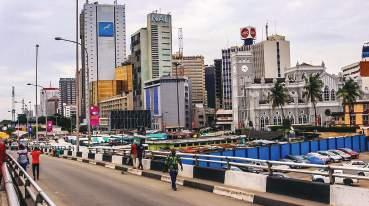
“Disclosures only transcend into accountability when they are underpinned by good governance. Ambitions will remain just ambition if they are not underpinned by governance,” Adegbite said.
President of SPIN, Professor Kenneth Amaeshi, reflected on the institute’s remarkable growth from its founding visionaries to over 400 members. According to him, “Sustainability is a movement. It is a way of life, a mindset, and not about checking a box. It is lived, and those who live it will be known by their fruits.”
Kayode Tokede
The Chartered Institute of Stockbrokers (CIS) and the Association of Securities Dealing Houses of Nigeria (ASHON) have commended the decision of S&P Dow Jones Indices to place Nigeria on its 2027 Watchlist for potential reclassification from a Standalone Market to a Frontier Market.
This was contained in a joint position paper released and jointly signed by the President of the CIS, Fiona Ahimie, and the Chairman of ASHON, Sehinde Adenagbe.
In its latest Country Classification Review, S&P DJI noted that the “Nigerian regulatory environment has modernised to improve transparency, enforcement, and market integrity.”
However, the index provider
added that “consistency in policy application and operational resilience are required for reclassification,” prompting the decision to monitor developments closely through 2026.
In the statement obtained by THISDAY, the two capital market bodies described the development as a “significant endorsement of the farreaching reforms undertaken within the Nigerian capital
market” and noted that it “underscores the growing confidence of the international investment community in the country’s evolving market architecture.”
According to the market operators, S&P DJI’s decision reflects “increasing recognition of the sustained efforts of market regulators, infrastructure providers, dealing members, and other key stakeholders to
strengthen market integrity, enhance operational efficiency, deepen liquidity, and align Nigeria’s capital market with internationally accepted standards and global best practices.”
They added that the step “affirms the effectiveness of ongoing initiatives aimed at improving market accessibility, transparency, investor protection, and overall competitiveness,
thereby positioning Nigeria as an increasingly attractive destination for both domestic and foreign portfolio investment.”
Reacting to this, the CIS and ASHON observed that the assessment “demonstrates that Nigeria’s reforms are being positively acknowledged while also identifying areas requiring sustained implementation before a final reclassification decision is made.”
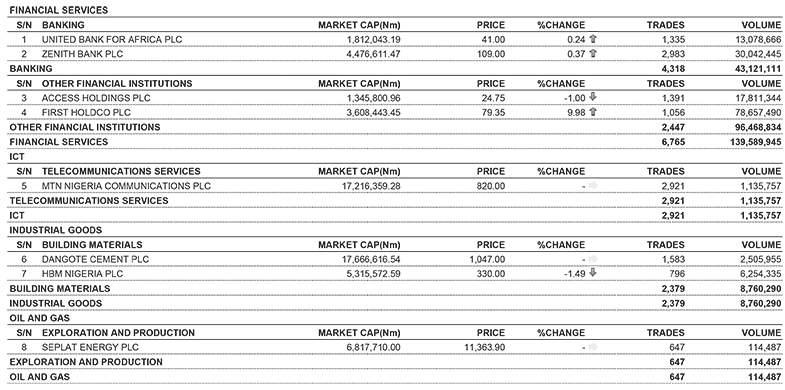
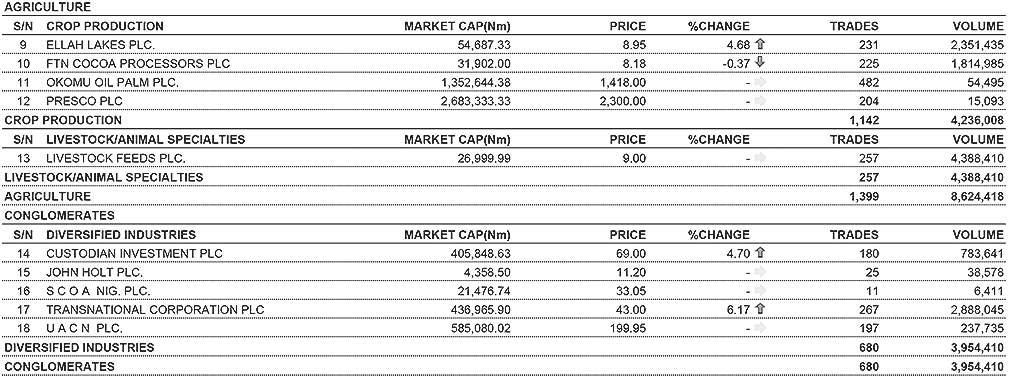
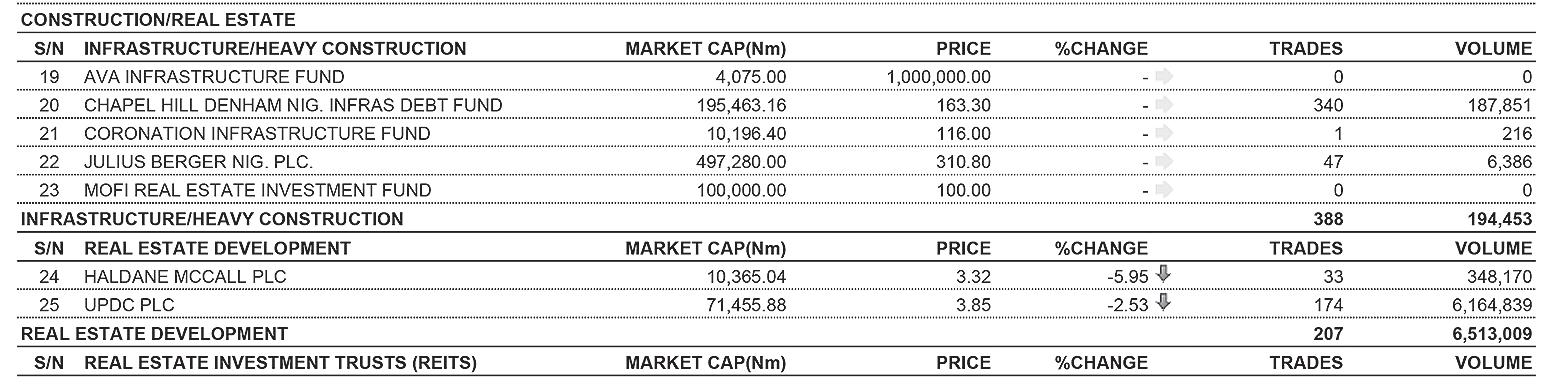
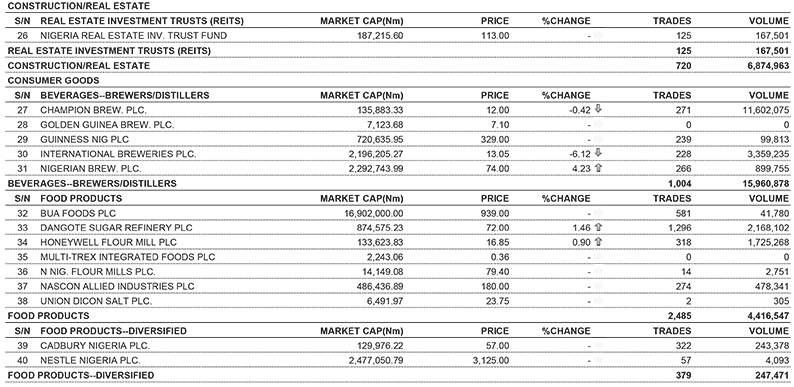
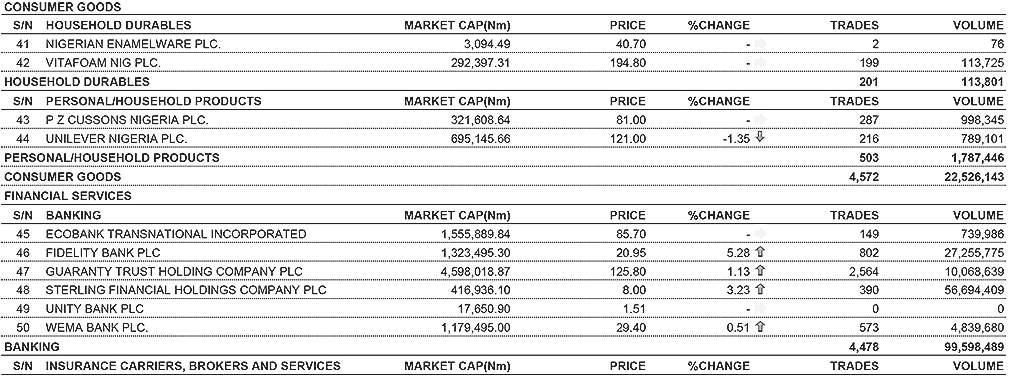
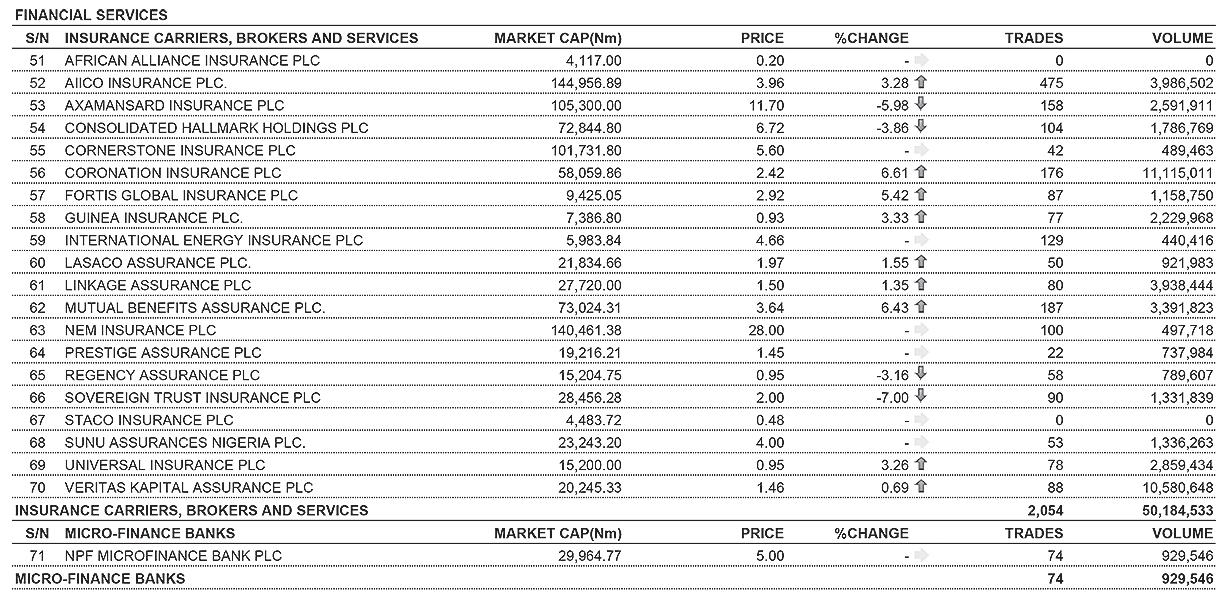

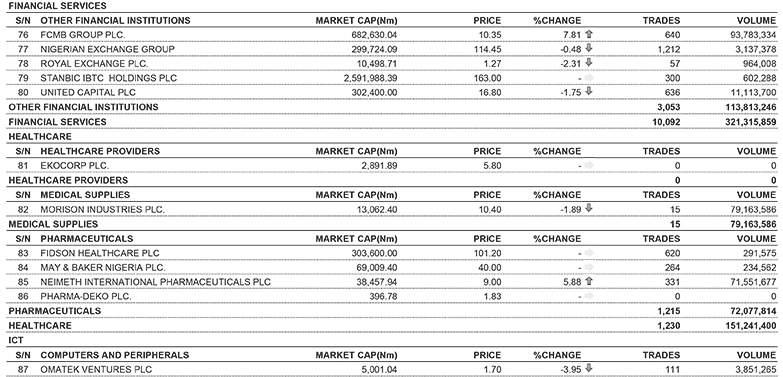
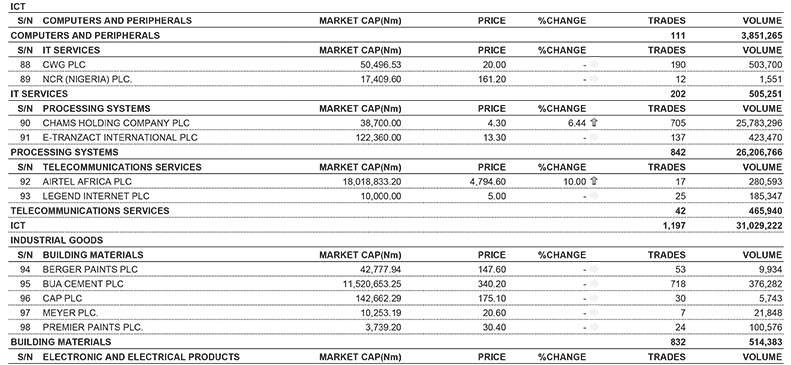
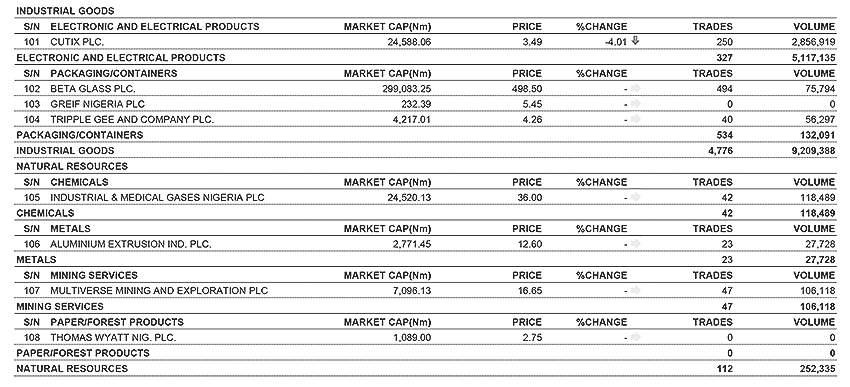
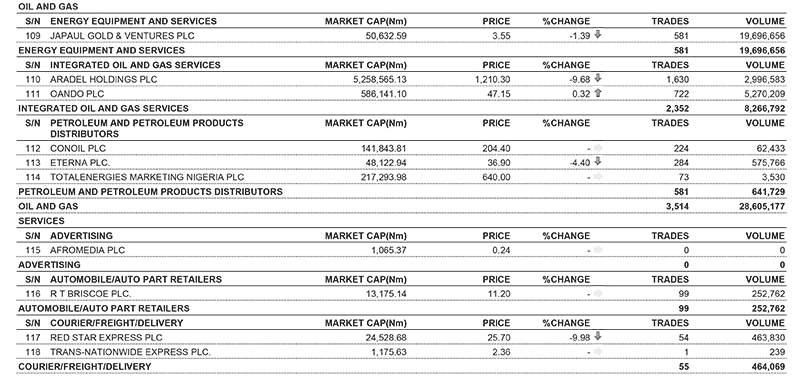
A Mutual fund (Unit Trust) is an investment vehicle managed by a SEC (Securities and Exchange Commission) registered Fund Manager. Investors with similar objectives buy units of the Fund so that the Fund Manager can buy securities that willl generate their desired return.
An ETF (Exchange Traded Fund) is a type of fund which owns the assets (shares of stock, bonds, oil futures, gold bars, foreign currency, etc.) and divides ownership of those assets into shares. Investors can buy these ‘shares’ on the
floor of the Nigerian Stock Exchange.
A REIT (Real Estate Investment Trust) is an investment vehicle that allows both small and large investors to part-own real estate ventures (eg. Offices, Houses, Hospitals) in proportion to their investments. The assets are divided into shares that are traded on the Nigerian Stock Exchange.
GUIDE TO DATA:
Date: All fund prices are quoted in Naira as at 14th July 2026, unless otherwise stated.
Denotes the
Six months after taking over the leadership of the Nigerian Upstream Petroleum Regulatory Commission (NUPRC), Mrs. Oritsemeyiwa Eyesan is beginning to put her stamp on an institution central to Nigeria’s ambition of restoring oil production, attracting investment and strengthening regulatory credibility, writes Emmanuel Addeh
The success of Nigeria’s 2025 licensing round cannot be measured only by the number of bids received but also by the quality of entities which participated. Alongside Nigerian indigenous companies, the exercise attracted significant interest from International Oil Companies (IOCs) and, for the first time, meaningful participation from international independents.
Without doubt, these companies bring deepwater expertise, frontier capital and global operating experience, having traditionally favoured jurisdictions with more predictable regulatory environments.
For the NUPRC Commission Chief Executive, Oritsemeyiwa Eyesan, the participation itself sends a strong message. “The level of participation tells me people have faith in the industry,” she says. “Not just Nigerian companies, IOCs and International Independents. That is a signal. The question now is whether we build on it and that depends entirely on whether the regulatory environment continues to move in the direction we have set,” she adds.
The commission believes recent production figures reinforce that confidence. Nigeria’s upstream production data for June 2026 showed combined crude oil and condensate output of 1.735 million barrels per day, representing 104 per cent of the country’s Organisation of Petroleum Exporting Countries (OPEC) crude production quota of 1.5 million barrels per day and the highest production level recorded since April 2020.
The steady improvement over recent months has been attributed by the commission to improved operational stability, successful completion of scheduled maintenance activities and the absence of major infrastructure disruptions.
Gas production has also continued to strengthen. Output reached 7.93 billion cubic feet per day in May, compared with 7.88 bcf/d recorded in the corresponding period of 2025 and 7.95 bcf/d produced in June. For the first time, in May Non-associated Gas production, at 3.98 bcf/d, slightly exceeded associated gas production, reflecting growing investment in dedicated gas projects.
Besides, in May domestic gas supply climbed to a record 2.18 bcf/d, while gas flaring declined to 0.57 bcf/d, representing 6.9 per cent of total production, in line with Nigeria’s commitment to eliminate routine gas flaring by 2030.
For Eyesan, the figures represent something beyond production growth. “This is not only a production story. It is a story about an industry beginning to serve the country it sits inside, more gas reaching Nigerian homes, Nigerian industry, Nigerian power. The numbers matter. What they represent matters more,” she enthuses.
Eyesan assumed office after three decades with the Nigerian National Petroleum Company Limited (NNPC), where she served as Executive Vice President, Upstream, Chief Strategy and Sustainability Officer and previously led efforts that doubled one of the company’s upstream subsidiaries’ production from 150,000 barrels per day to 300,000 barrels per day. She also played a central role in resolving the long-running Production Sharing Contract dispute.
That operational background provided a clear understanding of the concerns investors and operators have about regulatory systems.
Although the Petroleum Industry Act (PIA) established a modern legal framework for the industry, she recognised that legislation alone

would not transform the sector. What remained was the need to build predictable regulation, quicker decision making, stronger governance and institutional credibility capable of translating policy into investor confidence.
“Policy is only relevant in a functional industry,” she told the sector in her first address as chief executive. “Effective policy relies on a robust industry. And steering the sector towards strength, resilience, and forward-thinking progress depends on collective participation,” Eyesan says.
Those objectives have been driven through three priorities introduced immediately after she assumed office: production optimisation and revenue growth, regulatory predictability and speed, and safe, well-governed, sustainable operations.
One of the earliest initiatives was the establishment of the CCE-Operators Leadership Forum, bringing together NNPC Limited, the Oil Producers Trade Section (OPTS), the Independent Petroleum Producers Group (IPPG) and other operators every month to review approval timelines, production restoration efforts and infrastructure integrity.
The commission has also accelerated its digital transformation programme, covering correspondence, permitting, reporting and financial systems, while introducing a 90-day programme to fast-track field development plans, well interventions and rig mobilisation.
Unlocking New Exploration
The commission has also focused attention on expanding Nigeria’s future resource base.
In March, it signed the PEL5 agreement with
SeaSeis Geophysical Limited and TGS to undertake broadband 3D seismic acquisition across 11,700 square kilometres offshore the Eastern Niger Delta, covering water depths of between 400 and 2,800 metres.
The survey is expected to generate higher-quality geological data to support future exploration and investment decisions.
“Exploration is fundamentally driven by confidence in data and processes,” Eyesan said at the signing. “PEL5 is about ensuring that the subsurface case for Nigeria’s offshore acreage is made as compellingly as it can be and that investors have the data quality they need to make decisions with confidence,” she added.
For the NUPRC, reducing regulatory bottlenecks has become another key focus. The commission is working with the Nigerian Nuclear Regulatory Authority (NNRA) to harmonise overlapping regulatory requirements through a single-window approach that would eliminate duplicate submissions across government agencies.
“When you have multiple laws, you will likely have higher costs because each law comes with its own fees and charges,” Eyesan says. “The only way to safeguard investments is to reduce the cost of operating here,” she emphasises. Building Institutional Credibility
Efforts to strengthen transparency have also attracted recognition. During a visit to the commission in June, the Statistician General of the Federation, Adeyemi Adeniran, commended NUPRC for improving transparency in oil and gas data publication and acknowledged the importance of the commission’s data to the compilation of
Nigeria’s Gross Domestic Product statistics. For a regulator seeking to build investor confidence, such recognition reinforces its efforts to improve institutional credibility.
Nigeria’s production targets of 2 million barrels per day by 2027 and 3 million barrels per day by 2030 remain central to the commission’s agenda. The commission believes achieving those targets will require attracting more international investment, particularly into deepwater developments where capital requirements and technical complexity remain high.
“We are rushing against time,” she says. “If we are serious about ramping up production, we cannot rely solely on in-country resources. We need to bring in people who have done this at scale internationally and be honest about whether our processes are designed to attract them,” she explains.
The commission adds that it is therefore positioning the 2026 licensing round to attract greater participation from international independent operators while indigenous companies continue expanding their presence in shallow water assets.
Climate
The regulatory reforms extend beyond production. The NUPRC has directed upstream operators to migrate to measurement-based methane and greenhouse gas reporting by January 2027, replacing estimation-based reporting with verified scientific measurements.
The initiative supports Nigeria’s net zero target for 2060, its commitment to reduce methane emissions by 60 per cent by 2035 and its Nationally Determined Contribution (NDC) obligations under the Paris Agreement. It also strengthens the Measurement, Reporting and Verification (MRV) framework increasingly required by climate-conscious investors.
The commission is also finalising service level agreements that will publicly define regulatory timelines and establish formal performance commitments to industry participants.
Beyond regulation, the the industry’s long-term success depends on rebuilding technical capacity.
“In the years following the PIA, the industry contracted. Investment pulled back, activity slowed, and the pipeline of people being built for the sector’s technical and operational demands shrank. Growing production is not only about acreage and capital.
“It is about the people who can execute at the level this ambition requires. The commission has a role in rebuilding that pipeline and intends to play it with the same seriousness we bring to everything else,” she points out.
When Eyesan assumed office, she said her performance would be judged not by the number of policies introduced but by measurable outcomes for Nigerians.
Six months later, rising production, renewed investor interest, stronger stakeholder engagement, improved transparency and ongoing regulatory reforms suggest that progress is being made.
Although Cpchallenges remain, particularly as Nigeria pursues ambitious production targets, but the commission’s focus on predictability, accountability and institutional credibility is gradually reshaping perceptions of the country’s upstream oil and gas sector.
With the current momentum driven by the upstream regulator, Nigeria’s capacity to compete for global upstream investment in the years ahead, might just be on the right track.
Edited by nseobonG okon-ekonG |
Nseobong Okon-Ekong reports that the fifth edition of BetKing Cares provided an opportunity for Gossy Ukanwoke, Managing Director and Chief Executive Officer of BetKing, to redefine what corporate leadership means by translating business success into healthcare access, maternal support, food relief, and life-changing interventions for thousands of vulnerable Nigerians, setting a new benchmark for responsible leadership in Africa’s gaming and entertainment industry

That philosophy lies at the heart of BetKing Cares, the company’s flagship employee-led corporate social responsibility initiative, which this year celebrated its fifth edition with one of its most impactful nationwide outreach campaigns yet.
In an industry often defined by market share, innovation, technology, and commercial performance, Gossy Ukanwoke, Managing Director of KingMakers and CEO of BetKing, is quietly redefining what leadership should look like. Beyond growing a successful business, he is championing a vision in which corporate success is measured not only by revenue and expansion, but by the lives a company touches and the communities it empowers.
Branded the ‘Month of Good’, the 2026 campaign extended across Lagos, Abuja, Abia, and Calabar, bringing critical healthcare services, maternal support, nutrition, food relief, clothing donations, and other essential interventions to thousands of Nigerians. It was a coordinated effort that reflected a simple but powerful belief: that businesses have a responsibility to create value far beyond their balance sheets. Behind the statistics lies a more profound story—that of a leader who understands that corporate influence achieves its highest purpose when it is used to solve real human problems. Across many communities in Nigeria, access to quality healthcare, maternal services, nutritious food, and basic medical support remains a daily struggle. Rather than waiting for people to find help, BetKing Cares brings help directly to those who need it most. Under Ukanwoke’s leadership, corporate responsibility has become proactive rather than symbolic, practical rather than performative.
One of the defining pillars of this year’s intervention was maternal healthcare.


applauding
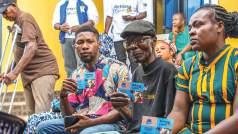
beneficiaries
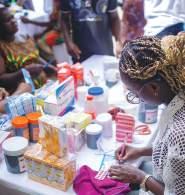
More than 500 pregnant women received prenatal consultations, essential medications, nutritional support, hygiene kits, and health education designed to improve maternal and child wellbeing.
For many of these women, the intervention represented far more than a charitable donation. It provided access to healthcare that might otherwise have remained out of reach. It offered reassurance during pregnancy, restored dignity, and reinforced the message that no woman should face motherhood without support.
The campaign also addressed immediate household needs through the distribution of food packs, clothing, and other essential relief materials to vulnerable families across the participating communities. What distinguishes the initiative is that it is driven by BetKing employees themselves, who volunteer their time and energy to deliver impact on the ground.
This employee-led model has become a defining feature of BetKing Cares, reflecting an organisational culture that Ukanwoke
has deliberately nurtured—one where giving back is not confined to a corporate department but embraced as a shared responsibility across the company.
Over five editions, BetKing Cares has evolved beyond the traditional idea of corporate social responsibility. Under Ukanwoke’s leadership, it has become a practical expression of responsible business—demonstrating that a gaming and entertainment company can be a force for social good while continuing to thrive commercially.
It challenges long-held assumptions about the industry’s role in society and offers a compelling example of how commercial success and community development can reinforce, rather than compete with, one another.
Reflecting on the campaign, Ukanwoke said, “BetKing Cares represents our belief that business success must translate into meaningful social impact. As leaders, we have a responsibility to use our platforms not only to grow industries but to uplift
people. That is the kind of legacy we are building at BetKing—one rooted in access, dignity, and sustainable community impact.” His words capture a broader leadership philosophy—one that sees business not simply as an engine for economic growth, but as a platform for improving lives.
Ultimately, Ukanwoke’s leadership offers a compelling reminder that the most enduring corporate legacies are built not only through market leadership but through service to society. By combining commercial ambition with compassion, innovation with inclusion, and business growth with community investment, he is helping to shape a future in which corporate success is measured as much by lives transformed as by profits earned.
As expectations around corporate responsibility continue to evolve across Africa, Ukanwoke is helping to establish a new benchmark for executive leadership within the gaming and entertainment industry. At a time when stakeholders increasingly expect businesses to demonstrate purpose alongside profitability, his approach illustrates that meaningful impact cannot exist on the margins of strategy. It must be woven into the very fabric of how organisations operate.
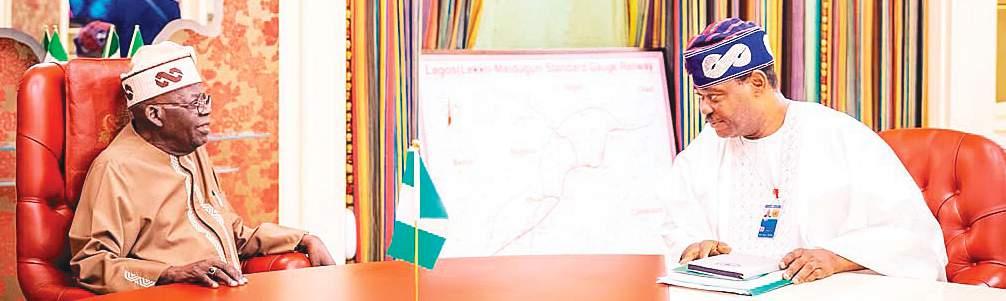
JIMOH IBRAHIM BRIEFS TINUBU ON HIS
Nigeria
Representative and Chairman
Committee
The House of Representatives Committee on Finance has directed the Nigeria Customs Service (NCS) to provide a detailed report on the approximately N34 trillion worth of import duty waivers granted in 2025.
The lawmakers requested a comprehensive breakdown showing the beneficiaries of the waivers, the legal framework under which they were approved, and the specific purposes they were intended to serve.
The directive was issued on Tuesday by the Chairman of the Committee, Hon. James Abiodun Faleke, when the management of the Nigeria Customs Service appeared before the panel during the National Assembly’s ongoing
revenue monitoring and oversight exercise.
Faleke explained the Committee was not opposed to the federal government’s policy of granting import duty waivers but insisted the National Assembly had a constitutional obligation to ensure that such concessions were awarded transparently and in a manner that advances the country’s economic interests.
He stated that lawmakers were particularly interested in identifying the beneficiaries of the waivers and determining whether the concessions achieved the objectives for which they were granted.
According to Faleke, while granting waivers is a legitimate economic policy, there must be accountability regarding those who benefit from them and the
intended outcomes.
He said waivers granted on products such as medical supplies and agricultural commodities are understandable because they are designed to support economic growth and ease the burden on citizens.
He noted that agricultural waivers, for instance, are expected to reduce food prices. However, he stressed that the Committee wanted full disclosure of all beneficiaries of the N34 trillion waivers.
The Committee also raised concerns over what it described as inconsistencies in the revenue figures presented by the Nigeria Customs Service despite the agency consistently surpassing its annual revenue targets.
Faleke observed that although
Customs had recorded remarkable revenue performance, the financial documents submitted to the Committee failed to clearly account for the sources of the additional revenue generated above the approved targets.
He maintained that proper accountability required the Service to provide a detailed month-by-month breakdown of its revenue collections and explain the fluctuations recorded during theTheyear.Committee Chairman said lawmakers could not commend the agency’s performance because its financial records were not properly reconciled.
While acknowledging Customs’ commitment to transparency, he insisted that the agency must explain how the excess revenue
Nigeria’s Permanent Representative to the United Nations, Ambassador Jimoh Ibrahim has disclosed that President Bola Tinubu would attend the United Nations General Assembly (UNGA) slated for September this year.
According to him, the President would be sitting in the front row alongside President of the United States of America (US), Donald Trump and other world leaders.
The envoy, who spoke with newsmen on Wednesday evening after meeting with the President at the State House, Abuja said Tinubu will be specifically speaking to the world body on his administration’s reforms and the imperativeness of border policing in West Africa to curtail terrorism in the sub region.
Asked the purpose of his visit to the seat of government, Ibrahim said “I came in from New York to speak with the president as chairman of the United Nations Budget Committee, and in preparation for UNGA
“So, the president, I can tell you, has generously agreed to attend the UNGA meeting of the United Nations. It’s significant because Mr. President has a speech to give to the whole world about his reform success in Nigeria, and that has been stated
for for September. So Nigeria will be effectively in UNGA. There are side meetings, side event meetings for Mr. President to attend, which includes a generation of power, power issues that have to do with energy.
“You know, so there’s a side event meeting. There’s another side event meeting on education, as well as hospital management, which we put in place for Mr. President to attend. But we don’t want to crowd his itineraries, so we discuss that graciously. The President was able to give us his word. Now he will come to UNGA this September.
“That’s very amazing. The president also reflected his commitment to border policing, so this time around, the President will be working with the United Nations to look into the West Africa border.
“So the border is porous. So a lot of peacekeeping effort is coming in here. I can assure you, from what we discussed, the president is going to put a lot of efforts in border policing for West African countries, and I don’t want to let the cat out of the bag, but I can tell you that some things are coming for the good of Nigeria in the time of border policing, West Africa border policing, and he gave specific directive on what to do instantly, and I will be going back to the UN to also inform everyone about the concern
to take West Africa as a case study of border policing and ensure that our security is well guaranteed. So border policing will be fine. These are the kind of things that the UN is established for.
“You know, as far as we are concerned, we look at that. West Africa border policing is very important, and President is very committed. And the UN, I can assure
you, will give support in respect of West Africa border policing.”
On whether the President would be having a one-on-one with the American President at the UNGA meeting, Ibrahim said: “We won’t be able to tell you that, but I can tell you clearly that President Tinubu will be sitting very, very close to Donald Trump in the front row of the United Nations General Assembly.
was generated. He pointed out that some months reflected lower-thanexpected collections while others recorded significant increases, adding that the Committee required detailed explanations to accurately assess the agency’s performance.
Deputy Chairman of the Committee, Hon. Saidu Mohammed Abdullahi, argued that the federal government should review upward the revenue targets assigned to its agencies, particularly major revenue-generating institutions like the Nigeria Customs Service.
He noted that Customs had repeatedly exceeded its annual revenue targets, demonstrating that the agency possessed greater revenue-generating capacity than the benchmarks currently assigned to it.
Abdullahi expressed the belief that the agency was capable of generating far more revenue if given more ambitious targets.
He recalled that Customs exceeded its N5 trillion target in 2024 by generating N6.1 trillion and also surpassed its approximately N6 trillion target in 2025 by recording N7.2 trillion.
According to him, setting higher expectations would encourage even stronger performance.
Responding to the lawmakers, the Comptroller-General of Customs, Bashir Adeniyi, represented by the Deputy Comptroller-General in charge
of Finance, Administration and Technical Services, Kikelomo Adeola, clarified that the Nigeria Customs Service has no authority to approve import duty waivers. She explained the Service only implements waiver approvals issued by the Federal Ministry of Finance in line with existing laws and government policies.
Speaking on trade facilitation, Adeola advocated the establishment of inland dry ports across the country, describing them as vital infrastructure that would ease congestion at seaports and improve the efficiency of cargo clearance.
She encouraged state governments to invest in inland dry ports, explaining that containers destined for such facilities could be moved directly from the seaports for examination, thereby reducing pressure on the nation’s ports and promoting smoother trade activities across the states.
On concerns surrounding delays in cargo clearance, Adeola informed the Committee that Customs scanners across the country were largely operational, except for a few units currently undergoing repairs.
However, a member of the Committee, Hon. Ifeanyi Uzokwe, urged the Customs management to discipline officers responsible for operating the scanners whenever negligence results in equipment failure or operational delays.
Olugbode
The Economic Community of West African States (ECOWAS) has concluded a three-day meeting of its Committee of Administration and Finance in Freetown, with recommendations from the deliberations expected to contribute to decisions on strengthening the governance, financial management and institutional effectiveness of the regional organisation.
The 39th meeting of the Committee, held from July 12 to 14, 2026, brought together representatives of ECOWAS member states and Community institutions to examine critical administrative and financial
issues affecting the organisation.
The meeting formed part of a series of statutory engagements leading to the 69th Ordinary Session of the ECOWAS Authority of Heads of State and Government scheduled to take place in Freetown on July 19. The Committee considered issues relating to the administration and financial management of the Community, institutional performance and the effective implementation of ECOWAS programmes. Its recommendations are expected to be forwarded to the ECOWAS Council of Ministers for further consideration as part of the preparations for the summit of regional leaders.
The conclusion of the meeting comes at a critical moment for ECOWAS, which is facing a combination of political, security and economic challenges that have placed renewed pressure on the regional integration project.
Persistent insecurity, political instability, economic difficulties and divisions over the future of regional cooperation have continued to test the capacity of the regional bloc to maintain cohesion and deliver on its objectives.
The withdrawal of Mali, Burkina Faso and Niger from ECOWAS has further complicated the regional landscape and intensified discussions about the future of West
African integration and the role of the organisation in addressing political and security challenges.
Against this backdrop, the Committee’s focus on administration, finance and institutional effectiveness assumed wider significance, with the quality of ECOWAS governance increasingly linked to the organisation’s ability to implement decisions, manage resources responsibly and respond effectively to regional crises. The Vice-President of the ECOWAS Commission, Damtien Tchintchibidja, stressed the importance of translating the organisation’s ambitions into measurable results as ECOWAS reflects on five decades of regional integration.
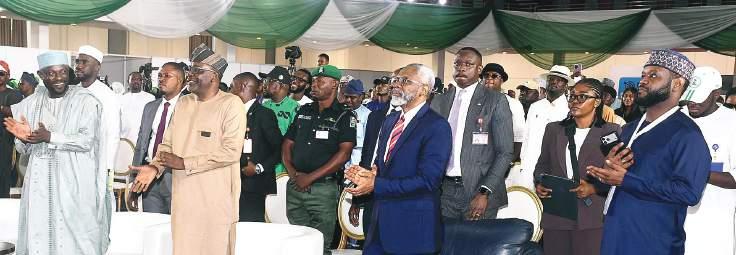
L-R:
NiDCOM, NTDA forge strategic alliance to transform tourism assets, project Nigeria’s positive image globally
Michael Olugbode in Abuja
Nigeria has begun a fresh push to harness its vast tourism potential and the resources of its global diaspora as part of a broader strategy to reshape the country’s international image, attract investment and create jobs.
The initiative emerged from a strategic partnership between the Nigerians in Diaspora Commission (NiDCOM) and the Nigerian Tourism Development Authority (NTDA), with both agencies agreeing to work together to rebrand the nation’s tourism assets and position the sector as a major instrument of economic development and cultural diplomacy.
The partnership was unveiled in Abuja on Wednesday during a strategic meeting between the Chairman/Chief Executive Officer of NiDCOM, Hon. Abike DabiriErewa, and the Director-General of the NTDA, Dr. Olayiwola Awakan.
The meeting came against the backdrop of growing concerns over Nigeria’s failure to fully convert its vast cultural, historical and natural attractions into sustainable economic opportunities, despite the country’s enormous tourism potential.
Dabiri-Erewa said the country could no longer afford to allow its
tourism assets and national story to be defined largely by outsiders or negative international narratives.
She said Nigeria must take ownership of its story, rebrand its tourism destinations and deliberately project the country’s positive identity to the world.
According to her, the collaboration between NiDCOM and the NTDA would strengthen the link between Nigeria’s tourism industry and the millions of Nigerians and people of Nigerian descent living across the world.
She said the diaspora represented not only a source of remittances but also a vast reservoir of investment capital, professional expertise, global networks and cultural influence that could be deployed to transform the nation’s tourism sector.
Dabiri-Erewa emphasised the need to develop and promote tourism assets across the 36 states and the Federal Capital Territory, arguing that a coordinated approach would encourage domestic tourism while creating opportunities for international visitors.
She drew particular attention to the historic Badagry Door of Return Festival, which reconnects members of the African diaspora with the
homeland of their ancestors and the painful history of the transatlantic slave trade.
The NiDCOM chief described the experience as one that carries deep spiritual, emotional, psychological, economic and historical significance.
“It is a spiritual, emotional, psychological, economic and historical experience. It cuts deep into their psyche as many shed tears as they pass through the slave routes,” she
said.
For her, the emotional power of such historical sites represents an enormous opportunity for Nigeria to use tourism not only to generate revenue but also to promote healing, cultural reconnection and a deeper relationship with the global African community.
She urged the NTDA to sustain strategic partnerships with relevant government institutions, private-
sector operators and diaspora communities, stressing that Nigerians must become the principal narrators of the Nigerian story.
“We must take ownership of our national narrative,” she said in substance, insisting that the country’s international image could not be transformed without a deliberate effort by Nigerians themselves to tell their own stories.
The NTDA Director-General,
Awakan, said the agency was committed to repositioning Nigeria’s tourism assets and making them competitive with destinations around the world.
He said Nigeria possessed abundant cultural, historical and natural attractions but needed a comprehensive strategy to upgrade the assets, improve visitor experience and create an efficient tourism ecosystem.
Kuni Tyessi in Abuja
The Minister of State for Education, Prof. Suwaiba Ahmad, has expressed satisfaction with the conduct of the National Examinations Council (NECO) Computer-Based Test (CBT) Senior School Certificate Examination, Ahmad, while monitoring the ongoing examination at Redeemers Teap School and Anglican Girls’ Grammar School on Wednesday in Abuja, described the exercise as
a major step towards eliminating examination malpractice.
She said feedback from candidates at both centres indicated that most of them preferred the CBT format to the traditional paper-based examination.
According to her, the candidates also confirmed that they experienced no technical glitches and that the examinations commenced on schedule.
”I spoke with a lot of the students and most of them said
they prefer the CBT examination.
”They also confirmed that they had not seen the examination questions before the test and that each candidate answered a different set of questions randomly.
”The CBT makes communication between candidates impossible and is one of the best ways of tackling examination malpractice,” she said.
The minister said the successful deployment of CBT represented significant progress in the educa-
Ibrahim Oyewale in Lokoja
As part of efforts to strengthen the relationship with Corps members, the National Youth Service Corps (NYSC) has called for stronger collaboration among governments, corps employers and other stakeholders to improve the welfare and workplace experience of corps members across the country.
The Director-General of the scheme, Brig.-Gen. Olakunle Nafiu, made the call in a keynote address delivered on his behalf by Mr. Maxwell Isa at the 2026 NYSC Corps Employers’ Workshop held on in Lokoja yesterday.
Nafiu explained that that the effective collaboration remained critical to the successful implementation of
the objectives of the NYSC Scheme.
He emphasized the workshop, themed “Fine-Tuning Stakeholders’ Collaboration to Enhance Corps Members’ Welfare and Workplace Experience,” provided an opportunity to strengthen existing partnerships and explore innovative approaches to improving corps members’ welfare and workplace experience.
According to him, the success of the NYSC depends largely on effective collaboration among stakeholders, noting that while the Scheme mobilizes deploys and supervises corps members, employers play a crucial role in creating a conducive environment for productive and rewarding service.
The NYSC boss explained
that the workplace remained the primary platform for corps members to acquire practical experience, develop professional competence and contribute meaningfully to national development.
He urged employers to assign corps members responsibilities that align with their qualifications and capabilities while providing mentorship, supervision and opportunities for professional growth.
The DG also reminded employers of their statutory obligations under the NYSC Act, including providing accommodation or allowance in lieu, transportation support where applicable, ensuring corps members’ welfare and security, granting time for Community Development Service (CDS) activities and facilitating
participation in official NYSC programmes.
He stressed that corps members’ welfare extends beyond physical needs to include safety, mental well-being, inclusion, professional development and protection from discrimination, exploitation, harassment and abuse.
Nafiu noted that the rapidly evolving workplace required corps members to develop critical thinking, adaptability, communication, teamwork, leadership and digital skills, urging employers to expose them to practical learning experiences that would improve their employability beyond the service year.
He reaffirmed the commitment of the NYSC management to strengthening engagement
with employers through regular monitoring, feedback mechanisms and collaborative problem-solving initiatives to improve service delivery nationwide.
Earlier, the Kogi State Coordinator of the NYSC, Mrs. Tochi ChrisMoneke, said the workshop’s theme reflected the shared responsibility of all stakeholders in ensuring corps members enjoyed rewarding service experiences.
Mrs. Chris-Moneke said that while the NYSC provided the platform and personnel, it was within public institutions, private organisations, educational institutions and nongovernmental organisations that corps members acquired professional skills, gained workplace experience and contributed to national unity.
tion sector, adding that government would only proceed with full transition after ensuring adequate infrastructure nationwide.
”We will not begin the full transition until we have everything in place because we do not want to put any student at a disadvantage.
”We are working with the National Assembly, state governors, private partners and other stakeholders to provide the facilities required for a seamless nationwide transition,” she said.
Ahmad added the adoption of CBT would ultimately improve the quality of education by promoting merit and integrity in examinations.
Also speaking, the Registrar of NECO, Prof. Ibrahim Wushishi, said the council recorded no technical hitch since the commencement of the examination.
”They assured me that since the commencement of this year’s examination, they did not experience any technical glitch. The exams were ready, they started on time, no hiccups, no network problems, nothing like that.”
He disclosed that 1,378,048 candidates registered for this year’s Senior School Certificate Examination, with female candidates slightly outnumbering their male counterparts. According to him, the increasing participation of girls reflects the impact of government policies promoting the girl-child education.
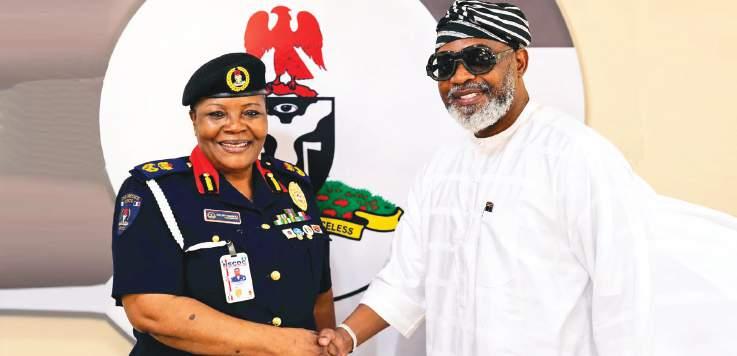
Ogun State Commandant of the Nigeria Security and Civil Defence Corps (NSCDC), Com-mandant Remilekun Omolade Ekundayo, MLCJ, mSPSP (left), receives the Executive Con-sultant to the Ogun State Governor on Strategic Communication and Chairman of the South-West Games, Akogun Lanre Alfred, during a courtesy visit to the NSCDC Ogun State Command Headquarters in Abeokuta...recently
Says food security top priority of govt Hails South-south for not relying only on oil wealth, abandoning food production to other regions
Regional devt minister lauds initiative Ogbuku declares region shifting from crude oil dependence to commercially-driven agribusiness
Deji Elumoye and James Emejo in Abuja
Vice President Kashim Shettima, yesterday, launched a $500 million Niger Delta Agricultural Investment Fund, describing it as a laudable development for a nation whose foundation was built on agrarian economy and whose soil paid its bills before the discovery of oil.
Shettima said Nigeria could not afford to take the promise of an agricultural boom for granted, stating that while nations survive on many resources,
they endure because they can feed themselves.
He spoke in Abuja at the Niger Delta Agricultural Development and Investment Summit jointly convened by his office and Niger Delta Development Commission (NDDC).
The vice president pointed out that the agriculture was not only the foundation of civilisation but also the first guarantee of political stability.
According to him, “Before a people raise cities, they must learn to feed them,
and before a state earns the loyalty of its citizens, it must secure their daily bread.”
Underscoring the significance of agriculture to Nigeria, he said, “The groundnut pyramids of the North, the cocoa estates of the West, and the palm produce of the East and the Delta financed our earliest schools and hospitals and underwrote the young institutions of a new republic.”
Shettima regretted that the oil boom came with an ease that “dulled the industry of the cutlass”, teaching the
The Police Service Commission (PSC) has released the names of successful applicants recruited into the Nigeria Police Force as Police Constables, marking the conclusion of the recruitment exercise for 50,000 personnel aimed at strengthening the country’s security architecture.
In a statement by the Commission’s Head of Protocol and Public Relations, Mr. Torty Njoku Kalu, the PSC said the exercise was conducted through a comprehensive, inclusive, equitable and transparent process in collaboration with key stakeholders, including the Nigeria Police Force, the Federal Character Commission, the Ministry of Police Affairs, state career and counselling departments, and the Police Community Relations Committee.
The Commission advised all candidates who participated in the recently concluded written examination to log on to the official recruitment portal to check their recruitment status. It added that
successful applicants would also receive notifications through the email addresses and telephone numbers provided during the application process.
According to the Commission, successful candidates are expected to report to their designated Police Training Institutions on dates and at times to be communicated for medical examination and documentation.
It warned that candidates who fail to report within the stipulated period would be deemed to have declined the offer, while those who do not pass the medical examination conducted by the Police Medical Team upon resumption of training would be declared medically unfit and withdrawn from the exercise.
Meanwhile, the Chairman of the Commission, retired Deputy Inspector-General of Police Hashimu Salihu Argungu, expressed appreciation to President Bola Ahmed Tinubu for approving the recruitment of 50,000 Police
Constables as part of efforts to bolster the nation’s security.
Argungu urged the successful candidates to regard their recruitment as a call to national service and to discharge their duties with dignity, integrity and an unwavering commitment to ensuring a safer and more secure Nigeria.
country that once fed itself to, instead,
“import what its own soil could grow”.
He applauded the Nigerian Delta region for the Agriculture Investment Fund Initiative, saying, “What makes this vision inspiring is that it arises from a region that could have rested on its oil wealth and left feeding the nation to other hands.
“The Niger Delta has, instead, chosen to return to an identity older than crude itself, for the palm oil of these creeks fuelled the commerce of continents long before the first barrel was drilled. It has chosen to transform this region, feed the nation, and attract the world.”
Officially flagging off the fund, the vice president said, “This is where philosophy must give way to action.
The Niger Delta Agricultural Investment Fund of $500 million, which we launch today, is a commercial, returns-driven vehicle spanning the value chain, from aquaculture and palm oil to cassava, cocoa, rice, horticulture, marine resources, and livestock.
“Around it, we coordinate the commitments already pledged by the World Bank, the African Development
Bank, the Islamic Development Bank, the European Bank for Reconstruction and Development, and our private and commercial financiers.
“Above both stands the Niger Delta Agricultural Development and Investment Council, which I am honoured to chair, with the NDDC as its Secretariat. Beneath it lies a demand-side strategy preparing bankable projects across all nine mandate states.”
Shettima explained why on assumption of office in 2023, “President Bola Tinubu placed food security among the earliest priorities” of his administration.
He said the idea was driven by the understanding that “nations that lose control of their food eventually surrender control of their future”.
Shettima stated, “His July 2023 declaration of a state of emergency shifted our national approach from the boardroom to the ground, across production, market stabilisation, and food access.
“This is why mechanisation has been the centrepiece of the drive, and why the administration launched the Renewed Hope Agricultural Mechanisa-
tion Programme for 10,000 tractors over five years, alongside local assembly plants, and in parallel with the John Deere Tractorisation Programme, the Greener Hope Project, and the Green Imperative Programme.”
The vice president said the outcomes had continued to speak for themselves, with the sustained dedication of Minister of Agriculture and Food Security, Senator Abubakar Kyari, through which he said the administration had seen the prices of several essential food commodities fall, by as much as 50 per cent.
He implored investors, development partners, and state governors to treat the summit “as the start of an obligation rather than the end of a ceremony”.
The vice president declared, “The fund is launched, the commitments are aligned, the council is constituted, and the pipeline awaits your conviction.”
Earlier, Minister of Regional Development, Abubakar Momoh, said due to its potential for job creation and improvement in lives and livelihoods, the current administration placed agriculture at the heart of Nigeria’s economic transformation.
Blessing Ibunge in Port Harcourt
The Hydrocarbon Pollution Remediation Project (HYPREP) has commenced orientation for 300 Ogoni youths selected for a six-month professional mud logging training, describing the programme as a strategic effort to equip indigenous youths with globally recognised technical skills for employment in the oil and gas industry.
Speaking at the orientation programme held in Bori, Khana Local Government Area of Rivers State, HYPREP Project Coordina-
tor, Prof. Nenibarini Zabbey, said the beneficiaries emerged through a transparent and merit-based selection process.
Represented by the Head of Livelihood and Sustainable Development, Mrs. Josephine Nzidee, the HYPREP PC explained that, more than 17,000 applicants indicated interest in the programme, while over 10,000 candidates completed the verification process and sat for the Computer-Based Test (CBT), with only 300 eventually selected.
“We had over 17,000 persons apply for this training and more than 10,000
were verified and sat for the CBT examination. The 300 beneficiaries were selected transparently on merit from across Ogoniland,” he said.
Zabbey urged the trainees to take advantage of what he described as a rare opportunity, noting that many qualified applicants could not secure a place in the programme.
“This is a rare opportunity. Somebody else would have appreciated sitting where you are today. You succeeded because you passed through every stage of the process.
Take this training seriously so you can position yourselves for opportunities
in Rivers State, Nigeria and beyond,” Zabbey stated.
He explained that the training would last six months and would focus largely on practical field exercises, warning that absenteeism could affect participants’ performance and eligibility for support provided by HYPREP.
“The training is hands-on, with minimal classroom sessions. Missing practical classes means missing critical knowledge because such sessions will not be repeated. Attendance is compulsory, and transport reimbursement will only be available to trainees who attend classes,” he added.
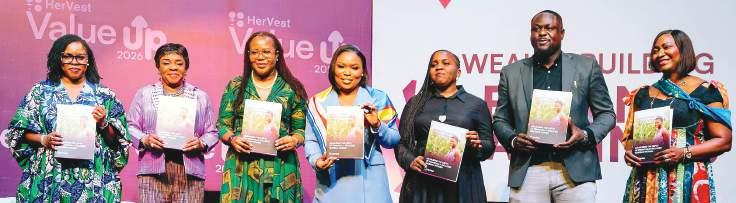
L-R: Hon. Commissioner for Agriculture and Food Systems, Lagos State, Abisola Olusanya; Co-founder of WIMBIZ and Social Policy Advocate, Adeola Azeez; Professor of Information Systems and Dean of the Lagos Business School, Professor Olayinka David-West, Co-founder and CEO of Hervest, Solape Akinpelu; Head, Gender Banking (One Woman), Sterling Bank, Ezinne Nwokafor; Head of Agency Banking and Financial Inclusion, Wema Bank, Victor Olojo, and SVP, Business Development, FSDH Asset Management, Margaret Agbonlahor at the presentation of HerVest Financial Inclusion Report 2026 and unveiling of Dara AI, an AI powered financial assistant app to help women make better financial decisions...recently
Commends security agencies over successful rescue of abducted schoolchildren Advances health sector governance reforms Army, DECAN extol troops’ sacrifice in protecting Nigerians, safeguarding territory NAF expresses displeasure over citizens’ indirect support for terrorist propaganda, unwitting spread of fear Ningi seeks prosecution of suspected abductors of Oyo pupils, teachers
Segun Awofadeji in Bauchi, Sunday Aborisade and Linus Aleke in Abuja
Senate, yesterday, approved a N50 million intervention fund for the families of five persons who lost their lives during the military operation that secured the freedom of 39 abducted schoolchildren and seven teachers in Oriire Local Government Area of Oyo State. It described the deceased as national heroes, who paid the ultimate price in service to the country.
Relatedly, Nigerian Army (NA) and Defence Correspondents’ Association of Nigeria (DECAN) praised the sacrifices of troops deployed across various theatres of operation. They urged Nigerians to support those protecting the citizens and safeguarding the country, and not demoralise them through negative narratives.
Acting Director of Army Public Relations, Colonel Appolonia Anele, made the appeal while receiving the executive members of DECAN during a courtesy visit to Army Headquarters in Abuja.
Director of Public Relations and Information, Nigerian Air Force (NAF), Air Commodore Ehimen Ejodame, speaking at the event, cautioned the public against aiding terrorist propaganda through sharing of unverified content that caused fear.
Meanwhile, the senator for Bauchi Central Senatorial District, Abdul Ahmed Ningi, called for the immediate prosecution of suspects arrested in connection with the abduction of pupils and teachers in Oyo State, warning that any delay could fuel public suspicion.
The upper chamber resolved that each of the five bereaved families should receive N10 million to support the welfare of the children and other dependants left behind by the fallen security personnel and teachers.
The approval followed Senate’s adoption, a day earlier, of a motion commending the successful rescue operation and paying tribute to the security operatives and teachers, who lost their lives after the victims had spent about 56 days in captivity.
Those who died during the operation were identified as Lieutenant F.A. Isaac of the Nigerian Army, Private Silas Musa of the 81 Battalion of the
Nigerian Army, Sergeant Abena John Jerome of the Nigeria Police, and two teachers who reportedly remained with the abducted pupils throughout their ordeal before they were killed by the kidnappers.
Announcing Senate’s decision during plenary, Senate President Godswill Akpabio commended President Bola Tinubu and the country’s security services for the successful operation.
Akpabio said the rescue demonstrated what coordinated intelligence gathering and inter-agency collaboration could achieve.
He said, “We have applauded the government and the security agencies, and we pray that similar efforts will be extended to every part of the country where Nigerians remain in captivity.”
Akpabio specifically praised Tinubu, Chief of Army Staff, Director-General of Department of State Services (DSS), Inspector-General of Police, Minister of Defence, and other security agencies for coordinating the operation that secured the freedom of the abducted children and teachers.
He stated that while the operation ended successfully, the country paid a painful price with the loss of three security personnel and two teachers.
According to him, “An Army lieutenant, a private soldier and a police sergeant lost their lives during the operation, while two teachers who remained with the abducted children in captivity were also murdered by the kidnappers.”
Explaining the rationale behind Senate’s intervention, Akpabio said the donation was intended to cushion the hardship faced by the families of the deceased and provide some relief for the dependants they left behind.
“The Senate has resolved to donate N50 million, with N10 million to each of the five families, to augment the upkeep of the children and dependents left behind by these heroes,” he said.
He subsequently directed Senate Leader, Senator Opeyemi Bamidele, to coordinate the presentation of the cheques to the affected families.
The donation stemmed from resolutions adopted by the Senate on Tuesday following debate on a motion sponsored by Bamidele, who described the May 15 abduction as “a disturbing expansion of organised criminal activities” into the South-west.
Bamidele recalled that the incident sent shock waves across the country and heightened concerns over the safety of schools and rural communities.
He said Tinubu immediately directed security agencies to deploy every lawful resource to rescue the victims, leading to an intensive intelligence-driven operation that culminated in the successful rescue on July 10.
According to him, the operation neutralised several members of the criminal gang and led to the arrest of eight suspected terrorists.
“The successful rescue has restored hope and confidence among Nigerians, particularly parents and school communities,” Bamidele said.
The senate also urged the federal government to provide comprehensive medical treatment and full welfare support for Lance Corporal Adamu Hussain of the 81 Battalion of the Nigerian Army, who sustained severe injuries while reportedly shielding the abducted children from gunfire during the rescue mission.
The lawmakers called on the federal government to sustain the momentum by intensifying military operations against kidnappers, terrorists, and other criminal groups through the deployment of advanced surveillance technology, modern equipment, and
enhanced intelligence capabilities.
Senate also passed for Second Reading three Executive Bills aimed at reforming the governance structures of major health regulatory institutions by reducing the size of their governing boards to improve efficiency and cut administrative costs.
The proposed legislation included Pharmacy Council of Nigeria (Establishment) Amendment Bill, 2026; Nursing and Midwifery Registration Amendment Bill, 2026; and Radiographers Registration Amendment Bill, 2026.
Leading debate on the bills, Bamidele said the proposals resulted from a comprehensive review undertaken by Office of the Attorney-General of the Federation, in collaboration with Federal Ministry of Health and Social Welfare.
He explained that the reforms were designed to establish leaner and more efficient governing boards with clearly defined responsibilities, strengthen corporate governance, improve institutional oversight, and allow management teams to concentrate more on healthcare delivery.
The senate leader explained, “These reforms are in line with the federal government’s public sector reform agenda aimed at reducing waste, promoting fiscal discipline and ensuring value for money.
“The savings arising from reduced administrative costs will be redirected to medical infrastructure, modern equipment, healthcare personnel, research and expanded access to quality healthcare for Nigerians.”
He maintained that the proposed amendments would not diminish the statutory responsibilities of the affected agencies but would modernise their governance structures in line with international best practices and harmonise board compositions across federal health institutions.
The bills received overwhelming support from senators, who stated that smaller governing boards would reduce bureaucratic bottlenecks, improve decision-making, and free more public resources for healthcare services and capital projects.
The senate unanimously passed the three bills for Second Reading and referred them to the relevant committee for further legislative action.
Earlier during plenary, Akpabio dismissed a fresh constitutional point of order challenging the defection of Senator Maidoki from All Progressives Congress (APC) to African Democratic Congress (ADC), stating that the matter had already been determined by the upper chamber and could not be reopened.
The senate also adopted, without debate, the Conference Committee Report on the National Assembly Service Commission Amendment Bill, 2026, after harmonising differences between the versions earlier passed by both chambers of the National Assembly.
Army, DECAN Extol Troops’ Sacrifice in Protecting Nigerians, Safeguarding Territory Nigerian Army (NA) and the Defence Correspondents’ Association of Nigeria (DECAN) praised the sacrifices of troops deployed across various theatres of operation in the country.
They urged Nigerians to support personnel protecting lives and safeguarding the nation’s territorial integrity, instead of undermining their morale through negative and misleading social media narratives.
Acting Director of Army Public Relations, Colonel Appolonia Anele, made the appeal while receiving the executive members of DECAN during a courtesy visit to Army Headquarters in Abuja.
Anele said the growing spread of misinformation and disinformation on social media had become a major national security challenge.
Sunday Aborisade in Abuja
Senate Minority Leader, Senator Abba Moro, yesterday, raised the alarm over renewed fatal attacks on communities in Benue South Senatorial District, warning that residents may be compelled to defend themselves if government at all levels continues to fail in their constitutional duty to protect life and property.
Raising the issue under Orders 41 and 51 of the Senate Standing Orders as a matter of urgent public importance, Moro disclosed that about 20 people, including children, were killed in coordinated attacks
on communities in Benue South within the last 72 hours.
The senator rejected attempts to describe the violence as farmer-herder clashes, insisting that the attacks have evolved into an organised campaign aimed at displacing indigenous communities and taking over their ancestral lands.
According to him, the latest killings followed a disturbing pattern of sustained assaults on vulnerable communities.
Moro recalled that Utukpitu community was attacked on a Friday, while two persons were killed in Akpachi, Uboju District of Otukpo Local Government Area
onHeSunday.added that another attack occurred on Tuesday, July 14, in the Ondo community, also in Uboju, where two more residents lost their lives.
Moro said the latest incidents came barely three months after he moved a similar motion before the senate, describing Benue South as a region under siege.
He lamented that innocent Nigerians were now being murdered in their homes without provocation.
“People wake up at 5am to the sound of gunshots, and before long, a sizeable number of innocent people have been killed,” he said.
The lawmaker revealed that security intelligence had reportedly warned authorities about an impending attack a week before the latest massacre.
According to him, the paramount ruler of Idoma Kingdom received intelligence that Otukonobi community would be attacked and immediately alerted the Commissioner of Police.
Moro said the police commissioner reportedly expressed frustration that he had been unable to reach the state governor, despite repeated attempts.
“Seven days later, the community was attacked and lives were lost,” he said.
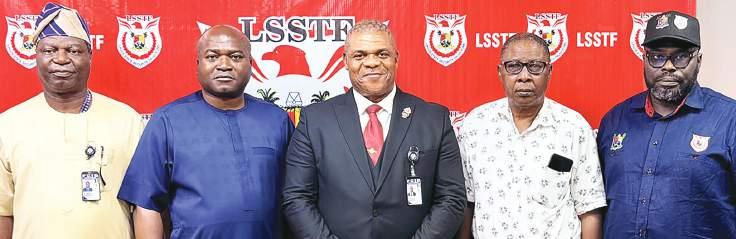
L-R: Commissioner of Police, CP Finance and Administration, Force CID Annex Alagbon, CP Olusegun Omosanyin; Executive Secretary/CEO, Lagos State Security Trust Fund, LSSTF, Dr. Ayodele Ogunsan; Assistant Inspector General of Police, AIG Force CID Annex Alagbon, AIG Simeon U. Akpanudom; CP Anti Human Trafficking Unit, FCID Annex Alagbon, CP Agans Irabor and Director, LSSTF, Mr. Adegbola Lewis during the working visit of AIG FCID Annex Alagbon to the LSSTF’s ES/CEO, Ogunsan and donation of 50 Bulletproof vests, 50 Ballistic Helmets and 50 Strike Plate to FCID Alagbon by LSSTF at the LSSTF’s Headquarters Alausa Secretariat Ikeja on Tuesday
Chuks Okocha in Abuja
Presidential candidate of African Democratic Congress (ADC), Atiku Abubakar, has raised the alarm over an alleged allocation of N6.44 billion for the 2026 World Cup, which Nigeria did not qualify for and was not participating in.
Atiku also said there was a sinister plot by the President Bola Tinubu administration to manipulate the narrative surrounding the controversial Presidential Foreign Investment Promotion Council
(PFIPC) scandal, shield government officials from scrutiny, and redirect blame towards the political opposition.
In a statement by his Senior Special Assistant on Public Communication, Phrank Shaibu, “Atiku specifically drew attention to the allocation of N6.44 billion for a ‘Special Presidential Support Group for the 2026 World Cup Qualifiers’, despite Nigeria having already been eliminated from the qualification process in November 2025—about one month before the 2026 budget
was presented to and considered by the National Assembly.”
The former vice president questioned, “How does a serious government budget N6.44 billion for presidential support for World Cup qualifiers after the country had already been eliminated?
“What competition was the money intended to support? Who inserted the provision, who approved it and who was expected to benefit from an expenditure whose stated purpose had already ceased to exist?”
Linking the development to the phantom Presidential Foreign Investment Promotion Council (PFIPC) scandal, Atiku described the recent arrest of the self-styled DirectorGeneral of the PFIPC, Adeniyi Adeyemi, as a calculated move to extract statements that could be deployed to implicate opposition figures rather than uncover the full truth behind the scandal.
Atiku said the PFIPC controversy could not be reduced to the alleged actions of Adeyemi alone.
According to him, “The weightier
Chuks Okocha in Abuja Labour Party (LP) and Peoples Democratic Party (PDP), yesterday, insisted that their candidates for the 20127 general election were fully uploaded to the website of Independent National Electoral Commission (INEC), as required by law, and in line with the commission’s guidelines INEC had, through one of its national commissioners, Haruna Mohammed, listed LP and PDP as some of the political parties that were yet to upload their candidates for the 2027 general election.
But reacting, the national publicity secretaries of LP and the PDP insisted that their candidates were fully uploaded to the authorised INEC website.
First to react was National Publicity of LP, Ken Asogwa, who said, “I wish to categorically state that Labour Party successfully completed the upload of the names of all its duly nominated candidates for the presidential and National Assembly elections ahead of the closure of the Independent National Electoral Commission (INEC) nomination portal on 14th July, 2026.”
Asogwa stated, “Our attention has been drawn to media reports in certain quarters alleging that the Party failed to upload the names of its presidential and vice presidential candidates before the expiration of the INEC deadline.
“This claim is patently false,
misleading, and exists only in the imagination of the purveyors of that fake news.
“For the avoidance of doubt, the Labour Party successfully uploaded the names of its presidential and vice presidential candidates on 10th July, 2026, four clear days before the close of the INEC nomination window on 14th July, 2026. The process was completed seamlessly and in full compliance with the Commission’s guidelines.
“It is, however, disturbing that a media organisation would publish such a weighty and misleading report without making the slightest effort to verify the information with the leadership of the Labour Party, particularly when the story
was purportedly sourced from an anonymous INEC official.
“This raises legitimate questions about the professional responsibility of the media organisation concerned and whether the publication was intended to serve some ulterior political objective rather than the public interest.”
Asogwa added, “In any event, INEC has already published its timetable for the release of the final list of validly nominated candidates for the 2027 General Elections. Once the commission makes the publication, Nigerians will clearly see the names of all duly nominated candidates of the various political parties, including those of the Labour Party, thereby putting this baseless misinformation
to rest.
“We, therefore, urge our teeming members, supporters and the general public to disregard the fake report in its entirety. It bears all the hallmarks of idle beer parlour gossip masquerading as journalism.
“Those who have become unsettled by the renewed strength, growing acceptance and increasing momentum of the Labour Party should channel their energies into preparing for the electoral contest ahead rather than resorting to crude propaganda and discredited tactics.”
In a similar vein, National Publicity Secretary of PDP, Haruna Jungudo, said in a statement that it fully updated all its candidates as required by law.
Chuks Okocha in Abuja
African Democratic Congress (ADC) said it was disturbed by the unresolved circumstances surrounding the death of Ms. Mary Habila, who reportedly died within the residence of the Honourable Minister of Works, Senator David Umahi.
ADC said the incident called for public inquiry because, ‘’Every Nigerian life matters. But when
a citizen dies in the home of a serving cabinet minister, the matter immediately transcends private tragedy and becomes a question of public accountability.’’
In a statement by its National Publicity Secretary, Bolaji Abdullahi, ADC said, ‘’The only acceptable response in a constitutional democracy is a thorough, transparent and independent investigation that commands public confidence.
‘’The explanations offered so
far have done little to answer the questions that continue to trouble Nigerians. What exactly was the nature of Ms. Habila’s official assignment? Why was she residing in the Minister’s private residence? What were the precise circumstances leading to her death?
‘’What have investigators established so far? These are legitimate questions that can only be answered by facts and evidence, not assurances.”
scandal is how an organisation that the presidency now claims was fictitious or non-existent allegedly penetrated the highest levels of government, obtained diplomatic recognition and accreditation, recruited more than 300 personnel, secured office accommodation at the National Secretariat, and reportedly received budgetary allocations, including an alleged N1.3 billion provision in the 2026 Appropriation Act.”
He maintained that such extensive operations could not have occurred without either active official collaboration or a catastrophic breakdown of oversight across multiple government institutions.
He stated, “The scandal is not merely that one man allegedly impersonated public authority. The greater scandal is that the Tinubu administration allegedly opened the doors of the Nigerian state to him, allowed him to acquire the appearance and privileges of official legitimacy and permitted him to interact with institutions and diplomatic interests in the name of the federal government.”
Atiku added that the PFIPC controversy must also be viewed against the wider background of what he described as mind-boggling profligacy and questionable
appropriations embedded in the 2026 federal budget.
He described the allocation as not merely an example of poor judgment but also a damning indictment of the integrity of the budgeting process. He said it reinforced public suspicion that the national budget had become a warehouse for dubious expenditure, fiscal waste, and allocations without any defensible public purpose. Atiku stressed that those were allegations requiring independent, transparent, and impartial investigation.
He said the PFIPC scandal had become a major embarrassment to Nigeria’s international reputation and warned that it must not be swept under the carpet, like several other unresolved controversies, including the Humanitarian Affairs Ministry scandal, questions surrounding refinery rehabilitation expenditure, and various disputed budgetary allocations.
He stated, “The Tinubu administration has a peculiar proclivity for propaganda, and we are reliably informed that there are plans to twist the facts of the PFIPC scandal, absolve those within the government who ought to answer questions and manufacture a politically convenient story against the opposition.”
In a separate concurring judgment, Justice Kenneth Ikechukwu Amadi made a significant pronouncement on the constitutional powers of the Attorney-General of the Federation, holding that the office cannot issue directives to courts in pending cases.
According to him “The question that now begs for an answer is whether the office of the Honourable Attorney-General of the Federation can give any directive—that is, an order or instruction in a matter pending before this Court or any other court... The obvious answer is certainly no. To allow that will certainly enable that office to usurp and interfere with matters before the courts.”
Justice Amadi also criticised
the conduct of counsel to the 1st to 4th respondents for refusing to adopt their brief of argument despite being present in court. He described the conduct as “a blatant disregard for the established procedure governing appellate proceedings” and held that a brief of argument acquires legal effect only upon adoption. Consequently, he struck out the respondents’ brief and held that the appeal remained unchallenged by the 1st to 4th respondents. Allowing the appeal, the Court of Appeal declared the proceedings and interim injunction granted by the Oyo State High Court on March 4, 2026, null and void, struck out Suit No. I/221/2026 for want of jurisdiction, and made no order as to costs.

L-R: Technical Assistant to the Managing Director/CEO, Aradel Holdings Plc, Mr. George Ipadeola; Chief of Staff to the MD/CEO, Aradel Holdings Plc, Mojisola Iyamabo; Managing Director/ CEO, Aradel Holdings Plc,Mr. Adegbite Falade; Special Adviser to the President on Energy,
and
Chuks Okocha in Abuja
Allied Peoples Movement (APM) said the outburst by leaders of All Progressives Congress (APC), including top APC government officials and senators, against the call by Governor Seyi Makinde of Oyo State for international investigation to unravel the truth behind the kidnap of schoolchildren and their teachers in the state raised suspicion of complicity in very high places.
In a statement by its National Publicity Secretary, Abubakar Yusuf, APM urged Nigerians to note that only those unquieted by guilt and complicity, for which they were afraid of probe,
would become panicky, irrational and desperate to suppress the truth by speaking against genuine efforts to unravel the facts.
Yusuf said Makinde’s demand for international probe on this act of terrorism against Nigerians did not undermine the sovereignty of Nigeria, as claimed by APC leaders. He said, rather, it reinforced Nigeria’s sovereignty in the global arena by strengthening its collaboration with international partners in the fight against terrorism, an international crime against humanity.
According to APM, “Our presidential candidate was clear and unambiguous in his call for
Chuks Okocha in Abuja
The vice presidential candidate of Nigeria Democratic Congress (NDC), Rabiu Kwankwaso, says people of the north and Southeast share a bond that should be strengthened, adding the Igbo are not enemies of the north.
Speaking in an interview published by BBC Igbo, yesterday, Kwankwaso said Nigeria’s political leaders had over the years demonstrated the importance of reconciliation and inclusion after the civil war.
Kwankwaso said, “We have to forgive ourselves. We have to work together as a family. South-east has been our ally, our friends, over the years.”
The former Kano State governor cited the alliance between the defunct Northern People’s Congress (NPC) and the National Council of Nigerian Citizens (NCNC) during the First Republic, which was led by prominent leaders, like Nnamdi Azikiwe.
He stated that the late President Shehu Shagari, leaders of the National Party of Nigeria (NPN), and politicians from the South-east, worked together in the Second Republic.
“During our own time, or the time of our fathers, grandfathers in politics — in the First Republic —
you could see the NPC then, which is mainly a northern political party, had an alliance with the NCNC, headed by Nnamdi Azikiwe,” the ex-minister added.
He explained, “Even in the Second Republic, you could see our leaders, Shagari and co, of course, went coincidentally to the South-east and even Anambra State, even Azikiwe himself from Anambra State, and so on and so forth. So our leaders had foresight.
“The civil war was finished in 1970. In 1978 and 1979, when democracy came back, the first thing they said was, ‘Look, they are not our enemies. Let’s prove to them. Let’s bring them. Let’s work together.’
“Our leaders of the First Republic worked together with them, and that’s how they brought Alex Ekwueme to be the vice president.”
Kwankwaso said Ekwueme was a friend of the north, recalling that he attended the former vice president’s burial in Oko, Anambra State.
“I went to Oko, the hometown. I was there during Alex Ekwueme’s burial. Throughout his life, he was our friend. It’s only that democracy was truncated,” he said.
Kwankwaso also pointed to the return of Biafran leader Chukwuemeka Odumegwu Ojukwu from exile and his participation in the politics of that era.
truth when he said, ‘The circumstances surrounding this incident are sufficiently grave and unusual to warrant independent scrutiny beyond our domestic institutions.
“’I therefore, with a full sense of responsibility as the Executive Governor of Oyo State, call on the appropriate international human rights organisations and accountability mechanisms, including those within the United Nations system, to closely examine the facts surrounding this abduction and the circumstances of its resolution.
“’Such scrutiny is not intended to undermine our institutions; rather, it
criminals or cabals, can abuse state police service because it is a question of ‘he who pays the piper dictates the tune’.
“If a state police service is not well funded by any means, we have a situation where it may as well be a highway to nowhere. That is one thing all of us must prevent.”
Bamidele maintained that the National Assembly remained committed to delivering a constitutional framework that would strengthen security while safeguarding the operational independence and accountability of state police services.
Funding for State Police Must Be Clearly Spelt Out Before Kick Off, Declares Abbas
Speaker of the House of Representatives, Hon. Tajudeen Abbas, said a proper funding mechanism must be well spelt out before the establishment of state police.
Speaking in Abuja at the National Security Roundtable session as part of the NASS Open Week 2026, Abbas suggested measures to be put in place for the actualisation of a better decentralised police structure in Nigeria.
He stated, “First, the National Minimum Standards Act must come before the first state police issue a single directive: standards first, structures after.
is intended to reinforce confidence, ensure that the truth is established, and that every person found to bear responsibility, regardless of office, influence, or affiliation, is held accountable.’
“Such call for external intervention is not new in our collaborative synergy with international bodies in the fight against terrorism.
“Nigerians can recall that President Bola Ahmed Tinubu had in various international for a, including the United Nations General Assembly (UNGA), called for international collaboration in the fight against terrorism in Nigeria, especially in the areas of aid, intelligence gathering, and sharing,
“Third, we must settle the question of money from the very beginning, whether through a dedicated policing fund, through shared services, or through federal support that is tied firmly to standards, so that no state creates a police force it cannot pay, and no unpaid officer becomes a threat to the citizen he has sworn to protect.”
The speaker commended President Bola Tinubu for leading the move to decentralise the current Nigeria Police and create state police.
According to him, “For the first time in our history, a sitting president has made state police a central part of national reform. President Tinubu has done so not with words alone, but with a bill that now sits before the National Assembly.”
In addition to minimum policing standards, phased creation of police across states, and funding options before establishment, Abbas stated, “Let me begin with a word of appreciation, because it is deserved. President Bola Ahmed Tinubu has done what many leaders talked about for 30 years, but few dared to attempt.
among others.”
APM explained, “Particularly, in June 2024 President Tinubu in meeting with officials of the Federal Bureau of Investigation (FBI) also called for such collaboration from this foreign crime investigation body.
“Nigerians now wonder why APC leaders, if indeed they have nothing to hide, will suddenly become frenetic, agitated and sleepless because Governor Makinde is demanding for the truth, a demand which is resonating with all Nigerians of good consciences across the country.
“Perhaps APC leaders have something to tell Nigerians regarding their party’s reported connection with bandits. This is especially against the backdrop of earlier confession by a former APC leader that the party’s leaders imported terrorist elements from neighbouring countries as political mercenaries in the build-up to the 2015 general elections.”
do so, the speaker stated that “money by itself is not a strategy”.
He said, “We must legislate for a modern, shared criminal and biometric database so that a suspect known in one state is not a stranger in the next. We must connect our agencies into one network of intelligence so that they work together instead of apart.
“We must build, in law, the architecture for inter-agency coordination and intelligence-sharing. We must legislate for technology, safe schools, border security, and the welfare and equipment of the officer at the checkpoint. And we must use our oversight to ensure accountability at all times.”
Abbas said a country as large and varied as Nigeria could not be policed forever by one central force run from the capital.
He stressed that more than 200 million people lived across forests, farmlands, and borders, saying that a single force cannot know every community or watch every road.
The statement said, “Instead of their unwarranted attack on Governor Makinde for seeking the truth, Nigerians expected leaders, like Senator Adams Oshiomhole and the Secretary to the Government of the Federation (SGF), Senator George Akume, to be on the vanguard of the quest for truth.”
bill had the same fears, and they answered it. A state appoints its Commissioner of Police on the recommendation of the National Police Council.
“The state assembly must confirm that appointment, and only a twothirds majority of the Assembly can remove the officer, and, even then, only for good cause.
“If a state police breaks down, or falls into the wrong hands, or turns against the very people it should protect, the constitution allows the federal police to step in.
“But it allows this only in defined situations, only in writing, only for a limited period, with notice to the governor and to the National Assembly within 48 hours, and always subject to the courts.
“No such step may dissolve a state police or suspend a state’s elected institutions. These are the safeguards that will keep the reform honest.”
Abbas added that local security problems needed local knowledge, local presence, and local accountability.
He stressed that policing worked best when the people who protected a community actually belonged to it, and that was the confidence that the reform was meant to rebuild.
“Second, we should move stepby-step, state-by-state, learning as Germany and Canada learned, rather than switching on 36 new forces on the same day.
“He has sent this Parliament an Executive Bill to amend the constitution and to allow for State Police Services. It takes conviction to bring the most sensitive question in our federation before the whole country, and it takes humility to place that question in the hands of the legislature and the people. For that, this House thanks him.”
While stating that the National Assembly had funded security agencies year after year, and it will continue to
The speaker said he understood the “reasonable” concerns of many people in the state police discourse, especially the fears that police could become the private army of a governor or a political godfather.
“The people who drafted this
Citing the examples of Germany, Canada, and the United States, and how they decentralised their police structures, Abbas called for a proper study of the various models and how the systems could work for Nigeria. He stated, “From all of these examples, one lesson keeps returning. Local policing succeeds only where national standards, shared information, and firm accountability hold it together.
“Where those are missing, a police force can become a danger to the very people it was created to protect. Let us take what is strong in these models, and let us avoid what has failed in them.” SENATE

L-R (front row): Executive Director, African Methane Mitigation Network, Mr. Stanley Opara; Director, Planning and Research, Ministry of Petroleum Resources, Mrs. Kemi Yusuff; Minister of State Petroleum Resources (Gas), Dr. Ekperikpe Ekpo; Chairman, House of Representatives Committee on Climate Change, Hon. Kama Nkemkama; Deputy Ambassador, German Embassy in Nigeria, Johannes Lehne; Dr. Asmau Jibril; Technical Assistant, Legal, to the Gas Minister, Ms. Soki Soberekon, and other committee members during the inauguration of the Joint Decarbonisation Working Group for the Oil and Gas Sector in Abuja… yesterday
alex Enumah inabujaand ibrahim Oyewale inlokoja
A few days after President Bola Tinubu transmitted the 2026 Criminal Justice Reform Bill to the National Assembly, the Centre for Socio-Legal Studies (CSLS) has called on relevant authorities to ensure that the administration of criminal justice in the country responds effectively to the realities
of the day.
While the new bill seeks to repeal and re-enact the Administration of Criminal Justice Ac, (ACJA), the CSLS urged that efforts should be geared towards ensuring that the new laws are able to curtail new forms of criminality in the country.
The centre gave the charge at a one-day capacity-building
Olawale ajimotokan in abuja
Two persons have died of Rabies outbreak caused by a rabid dog bite in Abuja.
The Director of Veterinary Services in the secretariat, Dr Karnak Dandam, confirmed the incident in Abuja, yesterday.
The two rabies fatalities were reported in Gwagwalada and in Kwali Area Councils of the FCT out of eight cases that were recorded in two area councils.
Dandam said measures were already taken to curb the spread and asked residents to report dog bites.
Following the outbreak, the Agriculture and Rural Development Secretariat of the Federal Capital Territory Administration (FCTA) has urged residents of the territory to vaccinate their dogs and cats.
Dandam said rabies is a deadly viral disease that attacks the central nervous system and transmitted through the bite of an infected dog or cat.
He listed the symptoms of rabies in humans to include fever, headache, fatigue, and pain or tingling at the site of the bite, followed by anxiety, confusion, hallucinations and barking like a dog.
Ebere Nwoji
Outgoing President of the Chartered Insurance Institute of Nigeria (CIIN), Mrs. Yetunde Olubunmi Ilori, has said that her vigorously pursued EPIC agenda has widely spread insurance education and awareness to Nigerians at all levels including youths in secondary and tertiary institutions of learning and even primary school pupils.
Ilori, who spoke at a virtual press conference with members of the Nigerian Association of Insurance and Pension Editors (NAIPE) ahead of her valedictory ceremony
and the institute’s Annual General Meeting, in Lagos said she was leaving office fulfilled, having pursued an ambitious vision anchored on her EPIC agenda.
She said EPIC means Education, Professionalism, Institutional and Individual Recognition, and Capacity Building.
Reflecting on what she described as a transformative two-year administration driven by education, professionalism, industry collaboration and landmark reforms, Ilori said her tenure had laid a solid foundation for the continued growth of Nigeria’s insurance industry.
workshop it organised for stakeholders in the justice sector.
The workshop tagged: ‘Emerging Trends on the Administration of Criminal Justice Act/Administration of Criminal Justice Laws
Development ’ had in attendance representatives of the judiciary, Ministries of Justice, law enforcement agencies, the Nigerian Correctional Service, Administration of Criminal Justice Monitoring
Committees (ACJMCs), Civil Society Organisations (CSOs), development partners, academia, among others.
In his welcome address, President of the CSLS, Prof Yemi Akinseye-George (SAN),
who noted that the ACJA, 2015, and the ACJLs enacted by the states of the federation have been remarkably successful, pointed out that since crimes keep evolving, the laws should not remain static.
sunday Ehigiator
Former Ogun State Commissioner for Commerce and Industry and Convener of the Duke’s Masterclass, Otunba Bimbola Ashiru, has unveiled the Duke’s Masterclass as a high-level leadership platform designed to
strengthen governance, improve strategic communication and promote reputation management across Nigeria’s public and private sectors.
Ashiru, who is also the Otunba Adeona Fusigboye of Ijebu Land, said the initiative seeks to equip decision makers with
global best practices that would enhance institutional performance, crisis management and leadership effectiveness.
Speaking in an interview ahead of the programme, he said the Masterclass was conceived to bring together accomplished global leaders and professionals
with proven records of excellence to share practical insights with policymakers, corporate executives and senior public officials.
“The purpose of the Masterclass, as the name implies, is the top level of learning, trying to educate people on how things should be done,” he said.
Michael Olugbode in abuja
Nigeria has taken a major step towards eliminating international verification challenges associated with its passports after successfully importing all its Country Signing Certificate Authorities (CSCAs) into the International Civil Aviation Organisation
(ICAO) Public Key Directory (PKD).
The milestone, achieved under the President Bola Ahmed Tinubu-led Federal Government through the Ministry of Interior headed by Hon. Olubunmi Tunji-Ojo, is expected to strengthen the global authentication of Nigerian passports and
improve the seamless verification of the country’s electronic travel documents at international border control points.
The successful importation of Nigeria’s existing CSCAs into the ICAO PKD was formally marked at the ICAO Headquarters in Montreal, Canada, on Monday, July 13, 2026.
The exercise was led by the Comptroller-General of the Nigeria Immigration Service (NIS), Kemi Nandap, and was undertaken primarily to resolve passive authentication challenges previously encountered by some holders of Nigerian passports at selected foreign border control points.
Funmi Ogundare
A Professor of Community Medicine at Obafemi Awolowo University (OAU), Ile-Ife, Kayode Thadius Ijadunola, yesterday warned that Nigeria’s worsening health workforce crisis now poses a serious threat to the country’s health security and
sustainable development, calling for sweeping reforms to avert a collapse of the healthcare system.
Ijadunola gave the warning while delivering the fifth Oladipo Akinkugbe distinguished lecture of the University of Medical Sciences (UNIMED), Ondo State, titled: ‘Reimagining the Nigerian Healthcare System: Leadership,
Research and Innovation for the Future’.
He identified the mass migration of healthcare professionals and the retirement of experienced personnel as a double depletion that is weakening healthcare delivery and eroding future leadership capacity in the sector.
He described the trend as an existential threat to the country’s health system, stressing that only bold policy reforms, sustained investment and coordinated action by governments, healthcare institutions, development partners and other stakeholders could reverse the situation.
Raheem akingbolu
Bogo Beverages has inaugurated a new 80,000-capacity manufacturing plant in Ikorodu, Lagos, following a N20 billion investment aimed at expanding its footprint in Nigeria’s fast-growing beverage industry.
The inauguration ceremony attracted government officials, business leaders, distributors and members of the host community, highlighting the significance of what the company described as one of
the largest single investments in Nigeria’s beverage manufacturing sector this year.
According to the management of the company, the new facility will produce a wide range of beverages, including carbonated soft drinks, fruit juices, spirits, bitters and bottled water. It explained that the integrated manufacturing hub positions Bogo Beverages to compete simultaneously across five major beverage categories while strengthening its production capacity and nationwide market presence.
Duro Ikhazuagbe
Lionel Messi inspired Argentina to fight back from a goal down to beat England 2-1 last night at the Mercedes-Benz Stadium in Atlanta to set up 2026 World Cup final against Spain on Sunday.
Like the South Americans did against Egypt in the Last 16 when
they were two goals down with barely 10 minutes to end of the game but went on to score three goals in 11 minutes to progress, the Albiceleste conjured two goals in five minutes to end England’s dream of the cup coming back home after 60 years. The cup holders who won their
third title in Qatar four years ago, were almost on their way home, eliminated by England when they launched a late rally in the dying stages to cancel out Anthony Gordon’s lead for the Three Lions. But as so often in this tournament, it was England-based Chelsea player,
Fernandez, that levelled the scores with a stunning shot from 20 yards in the 85th minute. Fernandez latched on Messi’s cross from deep inside England’s left back to rifle home the leveler. Few minutes later, substitute Manchester United’s Lautaro Martinez sealed off the win for Coach Lionel Scaloni’s side with his powerful header that flew beyond

Former junior international striker, Chinwendu Ihezuo, has admitted that the 14th edition of the Women Africa Cup of Nations (WAFCON) finals taking place in Morocco between July 26 and August 16 will be much tougher than the last competition held in the same North African Kingdom a year ago.
However, she believes the Super Falcons have the magic to pull the chestnut out of the fire and secure a ticket to the 2027 FIFA Women’s World Cup while retaining the trophy.
“This tournament will be tougher,
much tougher. Last year, there was no FIFA Women’s World Cup ticket to fight for. When the first blast of the whistle goes on 26th July, the focus of all the teams will be on the World Cup ticket. As defending champions, we cannot afford to be over-confident.
“However, I believe in the team that we have, the oneness amongst us, our hard work, and the courage that keeps us going. We are not only going for a World Cup ticket but
also to retain the Cup.”
Speaking about the injury that had sidelined her for some time now, Ihezuo, who plays her club football for Pachuca Tuzas in Mexico, declared that she is now fully fit and ready to help the Super Falcons clinch a record-extending 11th Women AFCON title.
“God has been great and I give Him all the glory. I am now healed and fully-recovered. Presently, my Club is in pre-season, but I am ready to fly to Morocco and team up with the Super Falcons of Africa to make Nigeria proud.”
the reach of Jordan Pickford in goal for England in the second minute of the seven minutes stoppage time.
Despite Messi not scoring more than a goal or assist in 11 straight World Cup games dating back to 2022, his influence largely contributed to Argentina reaching the final to defend their title.
England’s failure to hold onto to their lead means the 1966 world champions’ wait for a second World Cup final appearance goes on.
In 2018 in Russia, England similarly lost 1-2 to Croatia in the semifinal stage.
Even as the Three Lions missed qualifying for the final, Pickford’s heroics in the early part of the game
must be commended.
Coach Thomas Tuchel’s wrong substitutions and his not plugging England’s leaking left back, contributed to the fall of the Three Lions. Tuchel has himself to blame for resorting to defending their one goal lead instead of throwing more men into his attack that would have slowed down the rage of the South Americans upfront.
Argentina’s clash with Spain in East Rutherford, New Jersey, will be the first World Cup final between the reigning champions of Europe and South America and the first time the two top teams in the FIFA rankings have contested the final since rankings were introduced in 1992.
Arsenal Forward, Trossard, Joins Besiktas for £15.3m
Belgium forward Leandro Trossard has joined Turkish side Besiktas from Arsenalon a three-year contract.
The 31-year-old has been signed for 18m euros (£15.3m) - paid in six equal instalments over three years - and his deal also includes a further one-year option.
On Tuesday, he was given permission to travel to Istanbul to undergo a medical after a transfer fee was agreed.
Trossard was under contract until 2027 with Arsenal, having joined from
Brighton for £21m plus add-onsin January 2023. He scored 36 goals and registered 34 assists in 174 appearances for the Gunners, helping Mikel Arteta’s side win last season’s Premier League title. Trossard was a key player, starting in the Champions League final defeat by Paris St-Germain and 21 times in the league.
He also started all six games at this summer’s World Cup, scoring twice, as Belgium reached the quarter-finals before losing to Spain.
Bournemouthare in talks with Benfica to sign Portugal defender Antonio Silva as a replacement for Marcos Senesi.
The Cherries have targeted the 22-year-old following Senesi’s decision to leaveon a free transfer and join Tottenham Hotspur.
Silva is seen as a good ball-playing replacement for the Argentina centreback, although Benfica have paused further progression in the talks as they look to get through Europa League qualifying.
The Portuguese club face St Gallen in Switzerland on 23 July, with the
return a week later in Lisbon.
Silva has been a regular for Benfica since breaking into the first team in 2022 and has featured in the Champions League, Europa League and Club World Cup.
He has 20 caps and was in Portugal’s squads for the 2022 World Cup and Euro 2024 but was not selected by Roberto Martinez for this summer’s tournament.
Silva would become Bournemouth’s second signing of the summer after the arrival of striker Alvaro Rodriguez from Elche in a deal worth up to £25.7m.
Sunderlandhave signed Belgium defender Thomas Meunier on a two-year deal following his departure from French side Lille.
signing of the season after the departures of forward Eliezer Mayendaand midfielder Dan Neil.
“We are delighted to welcome Thomas to Sunderland,” said director of football Florent Ghisolfi.
Nigeria’s U20 boys, Flying Eagles, have been drawn to play Ghana’s Black Satellites, Togo’s Junior Sparrow Hawks and Burkina Faso’s Young Stallions in the group phase of this year’s West Africa Football Union (WAFU) B U20 Championship to be hosted by Cote d’Ivoire. The draw conducted on Wednesday put the Flying Eagles and their opponents in Group B, while hosts Cote d’Ivoire, Benin Republic and Niger Republic make up Group A.
his charges will depart the country on Monday next week, with 23 players who are focused on making the country proud by winning one of WAFU B’s two tickets to next year’s U20 Africa Cup of Nations scheduled for Ghana.
Head Coach Abdu Maikaba and
Nigeria’s Flying Eagles,
seven-time African champions and two-time FIFA World Cup silver-medallists, are the defending champions of the WAFU B U20 Championship, having defeated Ghana’s Satellites 2-1 in the final of the last edition of the competition in Lome in 2024.
The 34-year-old has made more than 550 senior club appearances and previously had spells with Club Brugge, Paris St-Germain, where he won three league titles, Borussia Dortmund and Turkish side Trabzonspor. He also has 83 international caps and played for Belgium at the 2026 World Cup.
Meunier is the Black Cats’ first
“From the moment we started speaking, we felt he had a very positive feeling about the club.
“Throughout his career he has consistently performed at the highest level, representing some of Europe’s biggest clubs, and Belgium on the international stage.”
federal government leaner and the states fatter, the former cannot continue to hold on to the enormous resources that have encouraged some smart people to be establishing ‘fake’ agencies for themselves! Going by the current revenue sharing formula, the federal government receives 52.68%, the 36 States receive 26.72%, and the 774 local governments receive 20.60%. In practical terms, that boils down to an average of 0.7% of all federally collected revenue for each state!
Therefore, if we must restore the principle of a federal constitution, and that seems to be the agenda of Tinubu, then there is an urgent need to also match the functional responsibilities of each tier with the requisite resources. And the only way that can be done is to rethink the current revenue sharing formula which is no longer fit for purpose. Incidentally, as Lagos State Governor between 1999 and 2007, Tinubu was strident in canvassing the idea of shifting the balance of revenue allocation in favour of the states and local governments. He also made it a campaign issue while seeking the presidency.
In his 80-page manifesto, ‘Renewed Hope 2023 – Action Plan for a Better Nigeria’ released shortly after he became the ruling All Progressives Congress (APC) presidential candidate in July 2022, Tinubu argued that much powers and resources have been concentrated at the federal level hence the
urgent necessity for a review. “More funds should be allocated to the States and Local Governments so that they can better address local concerns and fulfil their expanded constitutional obligations to the people,” according to Tinubu, who wagered that “state governments are closer to the people and must be more responsive to local needs and aspirations.” If elected, Tinubu promised to “embark on a review of the federation revenue allocation system to recalibrate the division of funds amongst the three tiers of Government: Federal, State and Local.”
Now Tinubu must walk his talk!
Yes, I am aware of the fears being expressed about ceding more powers and resources to the governors, and they are genuine. In my 1st October 2017 Platform Nigeria presentation, ‘A Nation on the Edge: Which Way Nigeria?’, I raised this same fear that many are expressing: “As things stand in Nigeria today, accountability diminishes as you move from the centre to the other units: states and local governments. For instance, no president in Nigeria can get away with half of what governors do, almost as of right, in their states where there are neither checks nor balances,” I told the audience. “The speakers of the state houses of assembly are more or less errand boys who serve and are removed at the pleasure of governors. The logical result is that the promise
of good governance embedded in the theory of decentralization that many Nigerians now clamour for will still be delivered in the breach if there is no change in the behaviour of the political actors.” While we will come back to this conversation,
and it is very important that we do, the reality of the moment is that the federal government cannot continue to devolve more powers to the states and still hold on to the lion’s share of the nation’s financial resources. That is not federalism!
But what is even more interesting is that with the way our budget works, I could easily have proposed hosting “the first annual conference of African presidential spokesmen” (you find many of such conferences in the budget) so I could spend hundreds of millions of Naira buying vehicles. Or I could have located the presidential media centre in my village in Kwara State and say it would be for the training of journalists who cover State House! In Nigeria, you can rationalise anything and that explains how public officials locate projects in their villages even when such decisions make no real sense...
ENDNOTE: I wrote the foregoing 13 years ago and nothing seems to have changed since then. But we cannot continue to run our country this way. To restore the integrity of the Nigerian State and its institutions, as I argued last week, we need structural reforms that include strengthening budget scrutiny and ensuring that no individual or office is too big to escape accountability. But last Thursday, as he does almost every week, founder and chairman of
Proshare, (a leading financial information hub in Nigeria), Olufemi Awoyemi, mni, sent the message below, which I believe sums up everything I was saying in that column: “Dear Segun, here is my take on your column of this morning and I will keep it short: The first scam often does no more than open the way. The greater danger lies in the second and third level deception that normally follows. But none is worse than a cover-up by any party involved. Someone is always going to snitch or get greedy. Responsible institutions carry a duty to understand the weaknesses that allowed the first deception and to take deliberate steps to close them. Every system has gaps, and some people will exploit them for as long as those gaps remain. They must be identified and their advantage taken away. In the end, greed and fear tend to deliver only a temporary advantage, and they often lead those who rely on them to their own undoing.”
Let those who have ears...
The Federal Mortgage Bank of Nigeria (FMBN) yesterday disclosed that it financed 6,911 housing units in 2025, a 300 per cent increase from the 2,165 units delivered in 2024.
The bank also announced that it had stepped up efforts to expand access to affordable housing through strategic partnerships and new financing products targeted at low income and informal sector workers.
Managing Director and Chief Executive of FMBN, Shehu Osidi, spoke in Abuja during the 2026 FMBN Day at the Africa International Housing Show (AIHS), where he said collaboration had become indispensable to addressing Nigeria’s huge housing deficit.
Speaking on the theme: “Leveraging Partnerships for Sustainable Affordable Housing for Low Income and Informal Workers,” Osidi stressed that the government alone could not bridge the country’s housing gap, particularly for informal workers who make up more than two thirds of Nigeria’s workforce but remain
largely excluded from conventional mortgage finance. According to him, many Nigerians in the informal sector have irregular income patterns, lack the documentation required by commercial lenders and are unable to meet the equity contribution demanded under traditional mortgage arrangements, making tailored financing solutions imperative. He stated that the bank’s achievements over the past year were driven by partnerships with the Federal Ministry of Housing and Urban Development, the National Assembly, the Central Bank of Nigeria (CBN), the Nigeria Deposit Insurance Corporation (NDIC), state governments, organised labour, developers, Primary Mortgage Banks, cooperative societies and development finance institutions.
Osidi noted that project loan disbursements rose sharply from N31.5 billion in 2024 to N79 billion in 2025, describing it as one of the highest levels of construction financing ever provided by the bank. He added that the investments had created thousands of jobs for artisans, engineers,
architects, quantity surveyors, suppliers, transporters and other players across the housing value chain.
He said the bank also expanded access to its mortgage products, with regular National Housing Fund (NHF) mortgage disbursements increasing to N8.2 billion, representing a 38 per cent rise over the previous year.
Under its Rent to Own scheme, Osidi said 367 beneficiaries obtained homes valued at more than N7.1 billion, while the Home Renovation Loan programme recorded its highest ever performance, with N13.8 billion disbursed to 15,290 beneficiaries, an 86 per cent increase from 2024.
The FMBN boss further revealed that NHF refund payments rose to N15.6 billion in 2025, benefiting 55,068 contributors, compared with 44,333 beneficiaries in the previous year, while loan recoveries almost doubled from N14 billion to N27.3 billion.
According to him, the bank is currently financing 3,139 housing units under President Bola Tinubu’s Renewed Hope Housing Programme through construction financing of N27
Adedayo Akinwale in Abuja
The Independent National Electoral Commission (INEC) has announced that a total of 2,436,275 eligible Nigerians have been registered in Phase III, week nine of the ongoing Continuous Voter Registration (CVR) exercise.
INEC revealed that the data released was the physical and online completed registration exercise as of July 10, 2026.
The commission stated that the CVR exercise had been suspended in Osun State due to the forthcoming governorship election in line with Section 9(6) of the Electoral Act 2022. It explained that the data was a preliminary figure pending the clean up during the period
for claims and objections by the citizens followed by the deployment of Automated Biodata Identification System (ABIS).
The data showed that the figure comprised 823,324 completed online registrations and 1,612,951 physical registrations completed across the country.
The data revealed that 1,278,444 female representing 52.48 per cent successfully completed the registration process, while 1,157,831 males accounted for 47.52 per cent during the period under review.
The age distribution released showed that a total of 1,644,885 registrants, representing 67.52 per cent between 18 and 34 years old have completed their registration. Similarly, middle-aged Nige-
rians between 35 and 49 years accounted for 527,882 registrations or 21.67 per cent, while 240,816 elderly people, 50 and 69 years old, registered, representing 9.88 perThecent.data also indicated that old people from age 70 and above accounted for 22,692 registrations, representing 0.93 per cent of the total.
In the same vein, a total of 576,682 students, representing 23.67 per cent, registered, while a total of 513,004 business owners, representing 21.06 per cent, registered.
Farmers and fishermen recorded 417,806 registrations or 17.15 per cent, while housewives accounted for 389,841 registrations, representing 16 per cent.
billion for the Ibeju Lekki project in Lagos, N19.9 billion for Karsana in Abuja, N10 billion for Port Harcourt and N7.8 billion for Enugu. Osidi said renewed confidence in the National Housing Fund Scheme was reflected in the decision of the Oyo State Government to rejoin the scheme after 27 years and the signing of a Memorandum of Agreement by the Kano State Government to return after more than two decades outside the programme.
He also announced that FMBN had developed new products to widen financial inclusion, including a Non Interest Mortgage Product, a Diaspora NHF Mortgage and a Rent Assistance Loan.
In addition, he disclosed that the bank was formalising a partnership with the Federal Government Staff Housing Loans Board to provide multiple mortgage options for federal civil servants covering home ownership, renovation, rent support and incremental housing development.
Osidi reiterated that sustainable affordable housing could only be achieved through stronger collaboration among governments, financial institutions, developers, investors, regulators, labour unions and cooperative societies, while calling for innovative financing models capable of meeting the needs of millions of Nigerians in the informal economy.
He reaffirmed FMBN’s commitment
Segun Awofadeji in Gombe
Chairman of Peoples Democratic Party (PDP) Elders Committee and former Secretary to the Gombe State Government (SSG), Alhaji Bala Magaji, has resigned from PDP and concluded arrangements to formally join the ruling All Progressives Congress (APC).
The influential elder statesman met with Gombe State Governor, Alhaji Muhammadu Yahaya, at Government House, Gombe, in
to ensuring that affordable housing becomes accessible not only to workers in formal employment but also to artisans, traders, farmers, transport operators, small business owners and other self-employed Nigerians who contribute significantly to the nation’s economy.
“Today, Nigeria faces an estimated housing deficit running into millions of units, with the burden falling disproportionately on low-income earners and the informal sector, which constitutes well over two-third of our nation’s workforce. Ironically, these are the very Nigerians who contribute immensely to national productivity yet remain the most financially excluded from formal housing finance systems.
“Many Nigerians have irregular income patterns. Many lack formal documentation demanded by conventional lenders. Many cannot accumulate the sizable equity contributions required to access traditional mortgage finance. Yet these Nigerians deserve decent homes. They deserve access to affordable mortgage products designed around their realities rather than around conventional banking assumptions.
“Unfortunately, this challenge cannot be solved by the government alone. Neither can it be solved by financial institutions acting in isolation. It requires deliberate collaboration among government, housing finance institutions, developers, state governments,
organised labour, cooperative societies, development finance institutions and the private sector.
“Partnership, therefore, is no longer optional. It has become the most sustainable pathway towards achieving affordable housing at scale. The choice of today’s theme and the discussions intended to be generated from it are therefore deliberate,” Osidi maintained.
Osidi stated that the Bank has not only sustained that momentum but has significantly exceeded many of the milestones it had set for itself.
One of the strategic priorities of the current management, he said, has also been to ensure that mortgage finance becomes more accessible, more inclusive and more responsive to the realities of Nigerians.
Accordingly, he explained that the bank recorded significant improvements across all its housing finance products.
“Regular NHF mortgage disbursements increased to N8.2 billion, representing a 38 per cent increase over the previous year. Our Rent-toOwn product continued to provide opportunities for Nigerians with 367 beneficiaries accessing homes valued at over N7.1 billion.
“Similarly, our Home Renovation Loan recorded unprecedented growth. In 2025, we disbursed a record N13.8 billion to 15,290 beneficiaries, representing an 86 per cent increase over the previous year,” the FMBN CEO stated.
company with APC governorship candidate, Dr. Jamilu Gwamna, where he perfected plans for his formal defection.
During the meeting, yesterday, Magaji praised Yahaya’s visionary leadership, inclusive style of governance and impressive developmental strides, describing his performance in office as a major factor behind his decision. His resignation was conveyed in a letter addressed to Chairman of PDP in Dawaki Ward, Gombe Local Government Area.
In the letter, the former SSG expressed appreciation to PDP for the opportunity to serve in various capacities since 2003. However, he said the prevailing circumstances within the party no longer aligned with his convictions and expectations.
Quoting the maxim, “Conscience is an open wound; only truth can heal it,” Magaji announced his resignation not only as a member of PDP but also as Chairman of the party’s Elders Committee, with immediate effect.
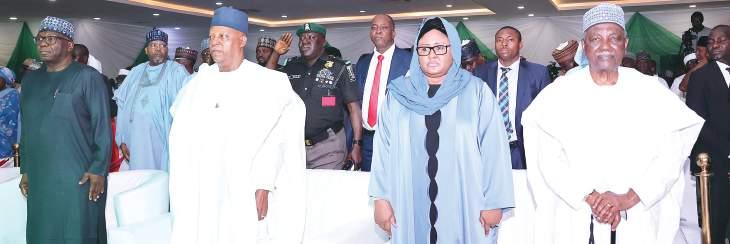
L-R: Kwara State Governor, Mr AbdulRahman AbdulRazaq; Vice-President Kashim Shettima; Former First Lady Aisha Buhari and Former Head of State Yakubu Gowon at the 1st year remembrance, prayers and supplication for the late President Muhammadu Buhari at the Nigerian Army International Conference Centre, Abuja... on Tuesday

The idea of decentralising the Nigeria Police Force (NPF) and Nigeria Correctional Service (NCS) by moving the two items from the Exclusive List of the constitution to the Concurrent List started under the late President Muhammadu Buhari. But perhaps because of the urgency of the moment, it has received greater impetus under the administration of President Bola Tinubu who is even pushing the envelope further. And for six hours last Thursday in Abuja, critical stakeholders in our country gathered to discuss the proposed idea of creating ‘state police’ at a session convened by THISDAY/ARISE Television chairman, Prince Nduka Obiagbena. While the contributions were insightful, it was Governor Chukwuma Soludo of Anambra State who flagged the real elephant in the room: the revenue allocation formula. “If we are devolving powers, we must also devolve resources,” Soludo said in the course of his intervention.
Considering that the National Assembly is yet to come up with a final bill on ‘state police’, my comment will have to wait, but the issue of funding is crucial; and it cannot work the way some of the lawmakers envision it. Any paternalistic approach that gives Abuja a say in how each state funds its police in the name of ‘guardrails’ would defeat the whole essence of devolving powers. But I would rather hold my powder on this issue until we see the final bill. Meanwhile, since we inhabit a country where everything revolves around the ‘national cake’ which I once surmised no one is interested in baking, ‘Revenue allocation formula’ refers to the methods by which all the money that accrue to the federation account (which used to be basically rent from oil) is shared between the constituent units: federal, state and local governments in Nigeria. It all started in precolonial Nigeria in 1946 when Sir Arthur Richard established the first Revenue Allocation Commission, headed by Sydney Phillipson. The 1952 constitution that followed their work came up with the allocation formula that has provided a guide for subsequent regimes. I recently found an interesting April/June 1996 Central Bank of Nigeria (CBN) publication online. Titled, ‘Fiscal Federalism: Revenue Allocation for Economic Development in Nigeria’, it was authored by a Mr T.O. Okunrounmu, then Deputy Director, Fiscal Analysis Division, Research Department of CBN, Lagos. The study, as he wrote, “evaluates the historical development of revenue allocation systems, principles and formulas adopted in Nigeria between 1946 when the regional administration and political units were established, and 1979 when the military temporarily withdrew for a civilian regime.”
While Okunrounmu’s thesis provides insights into the political economy of the revenue sharing
formula at different epochs, it is also evident that nothing much has changed in terms of resource allocation between the federal government and other constituent units in the last half century. In 1980, for instance, the federal government received 55%, States 34%, local governments, 8%, special funds, 2.5%, and FCT, 2.5%. While the federal government and local government retained its 55% and 10% respectively in 1987, that for the states was reduced to 32.5%. But aside a special fund of 2.5%, two new components were introduced: Development of mineral producing areas (1.5%) and general ecology (1%). From the 1990 arrangement to that of 1993 and 1995, the federal government merely created new components whenever it ‘reduced’ its share from the pool, with no tangible increase in the allocations for both the states and local governments.
By ending the wasteful regime of subsidy in the downstream sector of the petroleum industry and unifying the foreign exchange market, more
revenues now accrue to all tiers under the current administration, at least in nominal volume. But when you factor in the purchasing power and foreign exchange rates, the quantum, in real term, is not that much, even when the power dynamics are changing. With the power sector reform that has ceded the control and regulation of electricity markets, states can now generate, transmit, and distribute electricity to address their needs. The federal government has also embraced the decentralization of rail networks, enabling states to pursue localized transit projects and public-private partnerships. Overall, the Tinubu administration is actively promoting legislative and constitutional efforts aimed at devolving more powers to the 36 states and ultimately to the 774 local governments as well. But, as Soludo quite rightly pointed out, when you devolve all these powers to make the
The embattled Director General of the ‘fictitious’ Presidential Foreign Intervention Promotion Council, Prince Adeniyi Adeyemi, has been taken into custody. But shortly before his arrest, Adeyemi had doubled down on his allegations against the Chief of Staff to the President, Mr Femi Gbajabiamila. President Tinubu, as I wrote last week, has a decision to make on how his office is being dragged into the mud on this scandal. It is also important that Adeyemi be given all his rights under the law. But in my column last week which dwelt on the critical issues, I made it clear that anybody with sufficient clout, or ‘smart’ enough to know how Abuja works, can get any amount they want into our budget. I find it rather surprising that some readers would interpret that to mean ‘trivialising’ the N1.3 billion budgetary allocation for a ‘fake’ agency. That is perhaps because they have not followed my previous writings on our national budgets, which I also referenced in the same piece. In that regard, I want to rehash the opening paragraphs from my 28 November 2013 column, ‘The Illusion of Budget Performance’, which was based on my personal experience to highlight this problem before I conclude with the summation of a friend:
It was just about three weeks after I assumed office as Spokesman to the late President Umaru Musa Yar’Adua
in 2007 when I received a memo from the office of the Permanent Secretary, State House; seeking the input of my department for the 2008 budget that was under preparation. Because both the Deputy Director and the Assistant Director for Information in my office were people I knew way back from my days as a State House Correspondent, I always deferred to their experience and wise counsel. For that reason, it was easy for me to learn very fast about how government works. The explanation for the memo was that I had the power to initiate project(s) that would be accommodated in the national budget.
At that period, I really had no idea on what my budgetary input should be, and it took two other reminders for me to come up with one. Having been in Katsina with the president about three times by then, the idea I had was to build a presidential media centre in the state capital that would also include broadcasting facilities so that in the event that we were there and the president needed to address the nation, we would not have to rush back to Abuja. I left the details concerning the project and subsequent follow up with the State House budget office to my staff and I forgot about it. But several months later, in May 2008, I received a visitor in my office who turned out to be a contractor. His mission was simple: to see how he could handle the building of the presidential media centre in Katsina that was already in the 2008 Appropriation Act under my department!
My discussion with the contractor was as interesting as it was sad for it revealed a lot; not only about the (mis)management of public expenditure, but also about what we call budgets in our country. However, by then, it had dawned on me that for some inexplicable reasons, the late president preferred returning back to Abuja same day whenever we went to Katsina. Only on rare occasions did we spend more than a day. Besides, I was dealing with a principal who actually hated making any broadcast because, as he would say rather cynically, “this is not America”. So I had decided not to build what would amount to a wasteful monument in Katsina even though there was monetary provision for it in the budget.
Perhaps because of that experience, I paid more attention to the “envelope system” on which our annual national budget revolves; and I learned several lessons about the culture of waste that we have institutionalized. That experience also made me to realize that all this talk about percentages of budget performance (or implementation) is utterly meaningless. For instance, that I didn’t undertake to build a media centre in Katsina quite naturally necessitated returning the money to the treasury by December 2008 but that could only have reflected negatively on “budget performance” that is predicated essentially on the amount of money spent from the entire sum appropriated for the fiscal year.