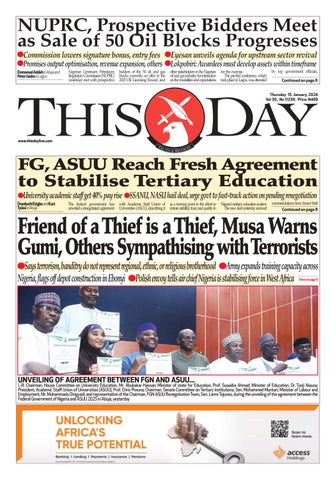
NUPRC, Prospective Bidders Meet as Sale of 50 Oil Blocks Progresses Commission lowers signature bonus, entry fees Eyesan unveils agenda for upstream sector revival Promises output optimisation, revenue expansion, others Lokpobiri: Awardees must develop assets within timeframe
Emmanuel Addeh in Abuja and Peter Uzoho in Lagos
Nigerian Upstream Petroleum Regulatory Commission (NUPRC) yesterday met with prospective
bidders of the 50 oil and gas blocks currently on offer in the 2025 Oil Licensing Round, and
other stakeholders in the Nigerian oil and gas industry for interaction on the modalities and expectations
for the exercise. The pre-bid conference, which took place in Lagos, was attended
by top government officials, Continued on page 8
Thursday 15 January, 2026 Vol 30. No 11239. Price: N400
www.thisdaylive.com TR
UT H
& RE A S O
N
FG, ASUU Reach Fresh Agreement to Stabilise Tertiary Education University academic staff get 40% pay rise SSANU, NASU hail deal, urge govt to fast-track action on pending renegotiation
Onyebuchi Ezigbo and Kuni Tyessi in Abuja
The federal government has unveiled a renegotiated agreement
with Academic Staff Union of Universities (ASUU), describing it
as a turning point in the effort to restore stability, trust, and quality in
Nigeria’s tertiary education system. The new deal yesterday received
commendations from Senior Staff Continued on page 8
Friend of a Thief is a Thief, Musa Warns Gumi, Others Sympathising with Terrorists
Says terrorism, banditry do not represent regional, ethnic, or religious brotherhood Army expands training capacity across Nigeria, flags off depot construction in Ebonyi Polish envoy tells air chief Nigeria is stabilising force in West Africa Story on page 8
UNVEILING OF AGREEMENT BETWEEN FGN AND ASUU...
L-R: Chairman, House Committee on University Education, Mr. Abubakar Hassan; Minister of state for Education, Prof. Suwaiba Ahmad; Minister of Education, Dr. Tunji Alausa; President, Academic Staff Union of Universities (ASUU), Prof. Chris Piwuna; Chairman, Senate Committee on Tertiary Institutions, Sen. Mohammed Muntari; Minister of Labour and Employment, Mr. Muhammadu Dingyadi; and representative of the Chairman, FGN ASUU Renegotiation Team, Sen. Lanre Tejuoso, during the unveiling of the agreement between the Federal Government of Nigeria and ASUU 2025 in Abuja, yesterday
2
THURSday, JANUARY 15, 2026 • T H I S D AY
THURSday, JANUARY 15 , 2026 • T H I S D AY
3
4
THURSday, JANUARY 15, 2026 • T H I S D AY
5
THISDAY • THURSDAY, JANUARY 15, 2026
Group News Editor: Goddy Egene Email: Goddy.egene@thisdaylive.com, 0803 350 6821, 0807 401 0580
NEWS
POPE PRAYS FOR LEEMON IKPEA...
Pope Leo XIV (left), and Founder/Chairman, Lee Engineering Group, Dr. Leemon Ikpea CON, JP, during a visit by Ikpea to the Vatican, Rome, for prayers for the prosperity of his business and the Nigerian nation in 2026 ....yesterday
After Failed Chappal Deal, TotalEnergies to Sell 10% of Nigerian Stake to New Buyer
Emmanuel Addeh in Abuja and Peter Uzoho in Lagos
French major, TotalEnergies, yesterday announced that it had signed a Sale and Purchase Agreement (SPA)
to sell its 10 per cent non-operated stake in the Nigerian onshore oil asset formerly owned by SPDC, now renamed Renaissance. The asset will now be sold to Vaaris, it said. The transaction is
coming after a failed sale last year to Mauritius-based Chappal Energies. Last year, the Nigerian Upstream Petroleum Regulatory Commission (NUPRC) said it had blocked Total’s initial $860 million deal with Chappal
Energies for the SPDC stakes, due to the buyer’s inability to eventually raise the needed funds. “The ministerial consent was accompanied by certain financial obligations to the Nigerian people
China Posts Record $1.2tn Trade Surplus Despite Trump’s Tariff Exports to Africa jump 25.8%
Emmanuel Addeh in Abuja
China yesterday reported a record trade surplus of nearly $1.2 trillion in 2025, led by booming exports to non-U.S. markets as producers looked to build global scale to fend off sustained pressure from the Trump administration. A push by policymakers for Chinese firms to diversify beyond the world’s top consumer market by shifting focus to Southeast Asia, Africa and Latin America paid dividends, cushioning the economy against U.S. tariffs and intensifying trade, technology and geopolitical frictions since President Donald Trump returned to the White House last year. Heading into 2026, the challenges for Beijing are plenty, including deflecting concerns from an increasing number of global capitals about China’s trade practices and overcapacity, as well as their overreliance on key Chinese products. One of the key questions facing policymakers is for how long the $19 trillion economy can continue to counteract a property slump and sluggish domestic demand
by shipping ever cheaper goods to other markets, a report by Reuters said, The manufacturing juggernaut’s full-year trade surplus came in at $1.189 trillion - a figure on par with the GDP of a top-20 economy globally like Saudi Arabia - customs data showed on Wednesday, having broken the trillion-dollar ceiling for the first time in November. “With more diversified trading partners, (China’s) ability to withstand risks has been significantly enhanced,” Wang Jun, a vice minister at China’s customs administration, said at a press briefing following the data release. Outbound shipments from the world’s second-biggest economy grew 6.6 per cent in value terms year-on-year in December, compared with a 5.9 per cent increase in November. Economists polled by Reuters had expected a 3.0 per cent increase. Imports were up 5.7 per cent, after a 1.9 per cent bump the month earlier and also beat a forecast for a 0.9 per cent uptick. China’s yuan held steady
following the upbeat data even as equity investors welcomed the forecast-beating numbers. The benchmark Shanghai Composite index and blue-chip index both rose more than 1 per cent in morning deals. The Asian powerhouse economy’s monthly trade surpluses exceeded $100 billion seven times last year, partially underpinned by a weakened yuan, up from just once in 2024, underscoring that Trump’s actions have barely dented China’s broader trade with the wider world even if he has curbed U.S.-bound shipments. Exports to the U.S. slumped 20 per cent in dollar terms in 2025, while imports from the world’s top economy were down 14.6 per cent . Chinese factories managed to make inroads in other markets, with exports to Africa jumping 25.8 per cent and those to the ASEAN bloc of Southeast Asian nations up 13.4 per cent . EU-bound shipments grew 8.4 per cent. Besides, China’s rare-earth exports in 2025 surged to their highest level since at least 2014, even as Beijing began curbing shipments of several medium
to heavy elements from April - a move analysts saw as an effort to showcase its leverage over Washington while negotiators wrangled over soybean purchases, a potential Boeing aircraft deal and the fate of TikTok’s U.S. operations. The world’s top agricultural importer purchased a record volume of soybeans in 2025, buoyed by a sharp increase in shipments from South America, with Chinese buyers holding off from U.S. crops for much of the year as trade tensions lingered. Economists expect China to continue gaining global market share this year, helped by Chinese firms setting up overseas production hubs that provide lower-tariff access to the United States and the European Union, as well as by strong demand for lower-grade chips and other electronics. Beijing, however, has shown signs of recognising it must moderate its industrial largesse if it is to sustain its success, and address the image problem outsized exports are causing. Last week, it scrapped subsidy-like export tax rebates for its solar industry, a long-standing point of friction with EU states.
with strict deadlines. However, both parties failed to meet their financial commitments after repeated extensions, forcing the commission to cancel the deal,” the NUPRC said at the time. But yesterday’s statement from TotalEnergies said the fresh deal with Vaaris includes stakes in three other licences producing mainly gas for Nigeria LNG, in which it will retain full economic interest. “TotalEnergies announces that its subsidiary TotalEnergies EP Nigeria has signed a Sale and Purchase Agreement (SPA) with Vaaris for the sale of its 10 per cent non-operated interest in the Renaissance JV licenses in Nigeria. “The Renaissance JV, formerly known as the SPDC JV, is an unincorporated joint venture between Nigerian National Petroleum Corporation Ltd (55 per cent), Renaissance Africa Energy Company Ltd (30 per cent, operator), TotalEnergies EP Nigeria (10 per cent) and Agip Energy and Natural Resources Nigeria (5 per cent), which holds 18 licenses in the Niger Delta. “Under the agreement signed with Vaaris, TotalEnergies EP Nigeria will sell to Vaaris its 10 per cent participating interest and all its rights and obligations in 15 licenses of Renaissance JV, which are producing mainly oil. “Production from these licenses represented approximately 16,000 barrels equivalent per day in company share in 2025. TotalEnergies EP Nigeria will also transfer to Vaaris its 10 per cent participating interest in the 3 other licenses of Renaissance JV which are producing mainly gas (OML 23, OML 28 and OML 77), while TotalEnergies will retain full economic interest in these licenses which currently
account for 50 per cent of Nigeria LNG gas supply,” the statement added. However, the French major noted that the deal is still subject to approval by Nigerian regulators. “Closing is subject to customary conditions, including regulatory approvals,” it stressed. TotalEnergies has been present in Nigeria for more than 60 years and employs today more than 1,800 people across different business segments. Nigeria is one of the main contributing countries to TotalEnergies’ hydrocarbon production with 209,000 bpd produced in 2024. The company also operates an extensive distribution network which includes about 540 service stations in the country. In all its operations, TotalEnergies said it is particularly attentive to the socio-economic development of the country and is committed to working with local communities. Renaissance Africa Energy Company Limited is a consortium of four Nigerian independent energy companies, including FIRST E&P, Aradel Holdings, Waltersmith and ND Western, as well as one international oil company, Petrolin. Renaissance came to the limelight when it bought the formerly SPDC oil and gas assets at a record $2.4 billion consideration in December 2024. TotalEnergies continues its portfolio reshuffling in Nigeria after key milestones achieved in 2025, focusing on operated assets: entry in Petroleum Prospecting Licenses (PPL)2000/2001 offshore exploration in August 2025, the increase of stakes in Oil Prospecting License (OPL)257 and the sale of non-operated Oil Mining Lease (OML)118 both in November 2025.
6
THURSDAY, JANUARY 15, 2026 • THISDAY
NEWS
OUR CHILDREN, OUR FUTURE...
Honourable Speaker, Enugu Children’s Parliament, Miss Chimamanda Amobi, presents a copy of “The Nigerian Child 2025,” a publication of UNICEF Nigeria, to the governor of Enugu State, Dr. Peter Mbah, during an advocacy visit to Government House, Enugu, Tuesday.
Commodities Market Upbeat Amid Potential N21bn Gold Listing on LCFE Kian Smith FZE’s offer lowers entry barrier, broadens participation across retail, institutional investors seeking exposure to hard assets Listing may unleash potential in other mineral assets, improve investor confidence, deepen liquidity in commodities ecosystem
James Emejo in Abuja
The Nigerian commodities market has received a major boost following the decision of Kian Smith FZE to list gold bars valued at over N21 billion on the Lagos Commodities and Futures Exchange (LCFE). The transaction symbolises growing confidence in structured
commodities trading and the country’s ability to host globally compliant precious metal instruments as gold becomes one of the market’s most strategic assets in recent times. According to “The Unknown Nigeria” on blogspot.com, the listing will begin with 100 kilogrammes of gold, segmented into one kilogram
London Bullion Market Association certified bars. However, the real innovation lies in how the product is structured. Rather than limiting participation to large-ticket investors, the gold will be tradable in fractions as small as 100 grams. This significantly lowers the barrier to entry and broadens
participation across retail and institutional investors seeking exposure to hard assets. From a market design perspective, the transaction reflects an increasing emphasis on transparency, custody, and risk management. Each gold bar is insured, independently verified, and stored in professionally managed vaults,
Court Hears How Alleged Scam Syndicate Moved Billions Through Fake Gaming Firms Wale Igbintade
An operative of the Economic and Financial Crimes Commission (EFCC), Rasheeda Chindaya, yesterday told a Lagos State Special Offences Court sitting in Ikeja how Friday Audu, alleged to be the Nigerian mastermind behind a vast international cryptocurrency investment and romance scams, coordinated activities that led to the arrest of 792 suspects in December 2024. Chindaya testified before Justice Rahman Oshodi as the trial of Audu continued. Audu is standing trial alongside Genting International Ltd on an amended eight-count charge bordering on forgery, impersonation, possession of fraudulent documents, and computer-related fraud. The EFCC said the December 2024 operation, conducted across multiple locations, led to the arrest of 792 suspects - 193 foreigners and 599 Nigerians, believed to be members of a sophisticated cybercrime syndicate involved in cryptocurrency investment fraud, money laundering, computer-related fraud, and romance scams. Led in evidence by prosecution counsel, Bilikisu Buhari, Chindaya outlined the findings of the Commission’s investigations. She told the court that Genting International Ltd was initially
incorporated with Nasiru Barau and Yakubu as directors, holding share capital of N10 million and N18 million respectively. Both directors were removed in 2025 and replaced by one Ifeanyi, who held N12 million in shares, and one Matthew, who held N18 million. According to the witness, Genting International Ltd was presented as a gaming company. However, investigations revealed that the Bank Verification Number (BVN) linked to the company’s bank accounts belonged to Friday Audu. She said the BVN was connected to about 10 corporate accounts involving several vendors. Further investigations uncovered financial links between Genting International Ltd and other companies, including YENGJIEPENG, BT8 Housing Nigeria Limited, and BNN Construction Limited. Chindaya told the court that letters of investigation sent to several banks confirmed that Genting operated accounts with balances running into billions of naira, including a peak balance of about N34 billion at one point. Some inflows, she added, were traced to Bureau De Change operators and entities such as Truly Reality and Garuba. She said Audu was the sole signatory to Genting International Ltd’s bank accounts.
Documents obtained from the bank included a request dated August for an increase in the company’s transaction limit and a board resolution appointing Audu as the sole signatory. According to the witness, funds were routinely transferred from Genting’s accounts to Bureau De Change operators for conversion into USDT cryptocurrency through digital wallets. One such wallet, created in May
2024, had its last transaction in October 2024 and reportedly received about N97 million, which was traced to Genting’s Union Bank account. Chindaya further testified that Audu personally received about N74 million, paid into his personal account and later traced to his FCMB account. The funds were allegedly used to furnish his office and cover expenses, including furniture purchases and diesel.
addressing long-standing concerns around authenticity, storage, and counterparty risk that have historically constrained gold trading in Nigeria’s informal markets. Listing the gold on an organised exchange further introduces price discovery, standardisation, and regulatory oversight - key ingredients for scaling commodities markets. However, timing remains crucial in the attractiveness of the offering - gold has sustained a long-term upward valuation trajectory, reinforcing its position as a hedge against inflation, currency volatility, and global economic uncertainty. Prices have climbed from about $1,800 per ounce in 2000 to currently about $4,450, with market forecasts projecting further upside toward the $5,000–$6,000 range within the year. In this context, structured access to gold becomes less of a speculative play and more of a portfolio stabilisation strategy, the blog further noted. The transaction also highlights the evolving maturity of the coun-
try’s financial infrastructure; the integration of a compliant supply chain, an exchange-based trading platform, and a regulated banking settlement process demonstrates how commodities can be embedded into the broader capital market framework. The alignment is particularly important for attracting institutional capital, which typically demands clear governance, custody assurance, and settlement certainty before allocating funds to alternative assets, it noted. Beyond gold itself, the listing has wider implications for Nigeria’s solid minerals agenda as successful execution could pave the way for similar listings across other mineral assets, helping to formalise trading, improve investor confidence, and deepen liquidity in the commodities ecosystem. The blog further stated that the development could strengthen the country’s positioning as a regional hub for structured commodities trading, capable of hosting globally benchmarked instruments.
Oando Grows Local Talent with 60 New OGAP Recruits Emmanuel Addeh in Abuja
Oando Plc, one of Africa’s leading indigenous energy solutions providers, yesterday welcomed a new cohort of 60 young professionals into its Graduate Acceleration Programme (OGAP), marking a significant milestone in the company’s effort to build sustainable talent for Nigeria’s energy sector. Since commencing its graduate development programme over a decade ago, Oando said it had played a deliberate role in grooming young professionals and developing energy leaders across technical, commercial, and corporate functions. In a statement, the company stated that the programme is rooted in the understanding that the oil and gas industry is highly specialised, with many roles requiring prior
exposure that is often unavailable to fresh graduates. “Historically, knowledge transfer within Nigeria’s oil and gas industry was largely driven by structured local content initiatives reinforced by the Nigerian Oil and Gas Industry Content Development Act of 2010. These initiatives played a critical role in empowering indigenous companies and building local expertise, contributing to today’s industry landscape where local operators account for a significant share of national production. “As indigenous leadership has expanded, Oando has recognised the need to move beyond passive knowledge transfer by deliberately equipping the next generation with the technical and professional capabilities required to sustain industry growth,” Oando stated.
OGAP, the company said, was designed as Oando’s response to this reality, moving beyond passive knowledge transfer to a structured, hands-on model that equips young Nigerians with the experience, mentorship, and competencies required to thrive in the energy sector. Several graduates who began their careers through Oando’s graduate and trainee programmes, according to the energy firm, have since progressed into mid and senior-level roles, contributing meaningfully to the company’s operations and leadership pipeline. Kanyinsola Mba, General Manager, Human Capital Management & Services at Oando Energy Resources, said the programme was intentionally designed to close this experience gap. “The energy sector is highly
specialised, and many roles require prior exposure that most graduates simply do not have. OGAP was created to bridge that gap by giving young Nigerians structured, hands-on experience, building their competence while preparing them for growth and long-term careers in the industry,” she said. Mba added that the programme goes beyond meeting internal workforce needs. “By investing in young people from diverse backgrounds, we are not only strengthening our talent pipeline, we are contributing to skills development, job creation, and long-term economic resilience,” she said. The 2026 cohort, Oando said, reflects its inclusive approach to talent development, drawing participants from diverse academic disciplines and social backgrounds.
7
THISDAY • THURSDAY, JANUARY 15, 2026
NEWS
NEW YEAR OPENING PRAYER...
L-R: Lead Pastor, Streams of Joy Ministries (NSPPD), Pastor Jerry Eze; Executive Governor of Delta State, His Excellency, RT Hon. Sheriff Oborevwori and Chairman of Cubana Group, Chief (Dr.) Obinna Iyiegbu (Obi Cubana) during the New Year Opening Prayer held at the Cubana Millennium City Asaba, Delta State...recently. PHOTO: CUBANA GROUP
Shettima Hails Massachusetts Tech Institute’s Impact on Global Innovation Ecosystem Canvasses closer ranks among African entrepreneurs for full harnessing of continent’s huge potentials
Deji Elumoye in Abuja Vice President Kashim Shettima on Wednesday lauded the transformative impact of the Massachusetts Institute of Technology (MIT) on the global entrepreneurship and innovation ecosystem that has raised over $1.5 billion dollars and created over 30,000 direct jobs in 20 years. He, however, urged African entrepreneurs to close ranks in order to fully harness the continent’s huge potentials, leveraging MIT’s resource mobilization network and job creation opportunities. Vice President made the remarks while playing host to a delegation from Kuo Sharper Foundry Fellowship 2025-2026 led by MIT’s Executive Director for the Kuo Sharper Centre for Prosperity and Entrepreneurship, Dina Sherif, at the State House, Abuja. Shettima called for unity of purpose among African professionals and entrepreneurs, saying
“Africa is the new frontier and future belongs to the continent but its people must unite to transform potentials into tangible results that impact lives and livelihoods. “Africa is blessed with enormous human and material resources but its people must fuse into one to benefit from the tremendous opportunities that abound across the continent,” he stated. He disclosed that President Bola Tinubu is daring to leverage available opportunities in Nigeria to transform the entire economy, noting that “President Tinubu is not afraid of taking bold decisions that will reposition Nigeria’s economy and better the lives of the livelihoods of the people.” Earlier in her remarks, leader of the team, Sherif, said the delegation was at the Presidential Villa to brief the Vice President on the activities of MIT’s Kuo Sharper Centre for Prosperity and Entrepreneurship, assuring that the Centre is dedicated to “fueling
the engine of entrepreneurship across the world”. She noted that the team was in Nigeria in view of the Kuo Sharper Foundry Fellowship
The Director-General and Chief Executive Officer of the Nigerian Meteorological Agency (NiMet), Professor Charles Anosike, Wednesday inspected and inaugurated the Agency’s Meteorological Data Rescue Project, a major step toward preserving Nigeria’s climate heritage and strengthening its scientific capacity. The project is designed to secure invaluable historical weather and climate records, some dating back to the 19th century, which were previously at risk of permanent loss. Speaking during the event at NiMet headquarters in Abuja, Anosike said: “These include handwritten observation logs, ship
logs, and early instrumental records that extend Nigeria’s climate history beyond the digital era and fill critical gaps in existing archives.” The NiMet DG asserted that by systematically recovering, preserving, and digitising fragile paper records and old media, the Data Rescue Project safeguards Nigeria’s analogue climate history and ensures its long-term accessibility. He added the rescued data will support improved climate modelling, enhanced forecasting, disaster risk reduction, and more informed policymaking, while providing essential historical context for understanding present and future weather patterns. He further described the initiative as a strategic investment in
significance of collaboration among African startups, noting that Nigeria is a leading country, as evidenced in the progress recorded by startups
across the continent. She further assured of improved support for African-based startups from the centre through its various initiatives.
Alternative Bank Signals Strong 2026 Growth Push as Non-Interest Banking Gains Momentum Kuni Tyessi in Abuja
The Alternative Bank (AltBank) has unveiled a growth and impact agenda for 2026, positioning non-interest banking (NIB) as key driver of financial inclusion, ethical finance and sector-focused development in Nigeria. Speaking during an interview on Islamic Finance Viewpoint, Executive Director for South, Korede Demola-Adeniyi, said the non-interest banking sector remains significantly under-
Climate Heritage: Anosike Inaugurates NiMet Meteorological Data Rescue Project Kasim Sumaina in Abuja
programme, which, according to her, has helped to entrench the spirit of entrepreneurship across the continent. Sherif underscored the
Nigeria’s future, stating the project goes beyond archiving, transforming historical data into a scientific foundation for climate resilience, sustainable development planning, and advanced meteorological services. He said: “This initiative aligns with global best practices of the World Meteorological Organization (WMO) and reflects NiMet’s commitment to modernisation and digital transformation under the Renewed Hope Agenda of President Bola Ahmed Tinubu, GCFR. “It also strengthens Nigeria’s contribution to global climate science by making historical atmospheric data available for modern analysis and decisionmaking.
penetrated, accounting for just 1.7 per cent of Nigeria’s total banking assets as at 2024, despite growing demand for ethical and value-based financial services. She noted that while the industry recorded modest growth in 2025, deeper advocacy, public education and product innovation are required to unlock its full potential. “Non-interest banking is not niche banking. It is ethical banking designed for inclusion. We are not selling to Muslims alone. We are offering a value proposition that works for everyone,” Demola-Adeniyi said. With increased capital and clearer regulation expected to shape the sector in the new year, she expressed confidence that non-interest banks would assume a more prominent role in Nigeria’s economic
transformation. According to her, AltBank’s growth strategy for 2026 will prioritise sectors with strong developmental impact, including healthcare, education, agriculture, renewable energy and transportation. She added the Bank is also exploring structured participation in the creative economy through partnerships, while remaining fully compliant with non-interest banking principles. “These are sectors that shape lives and livelihoods. Our responsibility is to design financing structures that solve real problems, not just disburse funds,” she said. Addressing concerns over perceived over-collateralisation in non-interest banking, Demola-Adeniyi explained that the NIB model is partnership-driven rather than interest-based, requiring
transparency and shared risk between banks and customers. She stressed the importance of sustained public education to improve understanding of how non-interest banking structures work and the benefits they offer. “The NIB model demands honesty and collaboration. When customers understand that the Bank is a partner, not just a lender, trust deepens and outcomes improve,” she said. AltBank currently operates more than 130 branches and service locations nationwide, largely through strategic partnerships. The Bank plans to scale this footprint to as many as 500 locations, alongside intensified financial literacy programmes and agent empowerment initiatives aimed at deepening inclusion and expanding access to ethical financial services across the country.
Nigeria Records 215 Deaths from Lassa Fever Onyebuchi Ezigbo in Abuja The Nigeria Centre for Disease Control and Prevention (NCDC) has revealed that Nigeria cumulatively recorded a total: 1148 confirmed cases of Lassa Fever with 215 deaths. In its latest situation report on Lassa Fever epidemic for Week 52 (22nd - 28th December, 2025) NCDC said that there were 1148 confirmed cases resulting in 215 deaths.
The total number of confirmed cases increased from 21 in Epi week 51 to 27 in Epi week 52. The cases were reported in Ondo, Bauchi, Ebonyi, Nasarawa and Taraba state. According to the situation report, the number of suspected and confirmed cases had decreased compared to that reported at the same period in 2024. The report stated that, “Cumulative for week 52 (2025) total: 1148 confirmed cases, 215 deaths, Case
Fatality Rate (CFR) 18.7 percent (higher than 16.3 percent same period in 2024). 22 states have recorded at least one confirmed case across 107 LGAs. 89 percent of confirmed cases are from Ondo, Bauchi, Taraba and Edo State. NCDC said the predominant age group affected by Lassa Fever is 21- 30 years. It also confirmed that no new healthcare worker was affected this week.
8
THURSDAY, JANUARY 15, 2026 • THISDAY
EIGHT
US Suspends Processing of All Visas for Nigeria, 74 Other Countries Indefinitely Freeze to take effect from January 21 Epstein: House Republicans to hold the Clintons in contempt
Emmanuel Addeh in Abuja
The US State Department has said it is pausing all visa processing for 75 countries in an effort to crack down on applicants deemed likely to become a public charge or persons considered to rely primarily on public assistance for their living expenses. A State Department memo, seen first by Fox News Digital, directed consular officers to refuse visas under existing law while the department reassesses screening and vetting procedures. The countries include Nigeria, Somalia, Russia, Afghanistan, Brazil, Iran, Iraq, Egypt, Thailand, Yemen and many others. The pause will begin January 21 and will continue indefinitely until the department conducts a reas-
sessment of visa processing. In November 2025, a State Department cable sent to posts around the globe instructed consular officers to enforce sweeping new screening rules under the so-called “public charge” provision of immigration law. The guidance instructed consular officers to deny visas to applicants deemed likely to rely on public benefits, weighing a wide range of factors including health, age, English proficiency, finances and even potential need for long-term medical care. Older or overweight applicants could be denied, along with those who had any past use of government cash assistance or institutionalisation, it stated. “The State Department will use its long-standing authority
to deem ineligible potential immigrants who would become a public charge on the United States and exploit the generosity of the American people,” State Department spokesperson Tommy Piggott said in a statement. “Immigration from these 75 countries will be paused while the State Department reassess immigration processing procedures to prevent the entry of foreign nationals who would take welfare and public benefits,” Piggott added. While the public charge provision has existed for decades, enforcement has varied widely across administrations, with consular officers historically given broad discretion in applying the standard. Exceptions to the new pause will be “very limited” and only allowed after an applicant
has cleared public charge considerations. A 2022 version of the public charge rule under the Joe Biden administration had limited the scope of benefits considered — primarily to cash assistance and long-term institutional care — excluding programmes like the Supplemental Nutrition Assistance Programme, the federal supplemental nutrition programme for women, infants and children, known as WIC, Medicaid or housing vouchers. The Immigration and Nationality Act has long permitted consular officers to deem applicants inadmissible on public charge grounds, but President Donald Trump in 2019 expanded the definition to include a broader range of public benefits. That expansion was challenged in court, with portions
ultimately blocked before being rescinded by the Biden administration. Meanwhile, the House Oversight Committee will seek to hold former Secretary of State Hillary Clinton in contempt of Congress after she did not appear for a scheduled deposition as part of the Republican-led panel’s investigation into Jeffrey Epstein, committee Chairman James Comer announced Wednesday. The move comes a day after Comer said the committee would seek to hold former President Bill Clinton in contempt for failing to appear for his scheduled deposition on Tuesday, NBC News reported. “We’re going to hold both Clintons in criminal contempt of Congress,” Comer told reporters Wednesday morning. The Oversight Committee
FRIEND OF A THIEF IS A THIEF, MUSA WARNS GUMI, OTHERS SYMPATHISING WITH TERRORISTS
Linus Aleke in Abuja and Blessing Ibunge in Port Harcourt
Minister of Defence, General Christopher Musa (rtd), has warned Sheikh Ahmed Gumi and others sympathetic to terrorists and bandits to stop their subversive endeavour, saying, “a friend of a thief is a thief.” Musa cautioned against providing overt or covert support to criminal elements seeking to destabilise the country. Speaking yesterday during an official visit to Maiduguri, the
minister said those engaged in acts of terrorism and banditry did not represent any form of regional, ethnic, or religious brotherhood. The warning came as as the Nigerian Army said it had taken a significant step towards strengthening its manpower development and national security framework with the construction of a new training depot at Amasiri-Edda, located within Afikpo and Edda local government areas of Ebonyi State. In another development,
Poland identified Nigeria as a key pillar of stability in West Africa, acknowledging the decisive role played by the Nigerian Armed Forces in counter-insurgency operations and regional security initiatives. Musa explained that his remarks were deliberate and purposeful, not merely symbolic. He stressed that Nigerians must refrain from supporting or justifying criminal activities in any form. He said the warning directly responded to narratives previously advanced by Sheikh
Gumi, who had referred to bandits hiding in forests as “our brothers” and suggested that society could not function without them. Musa made a distinction between compassion and complicity, stating that while empathy for fellow citizens is important, excusing or normalising terrorism only emboldens criminal networks. He said the criminal groups had ravaged communities, displaced thousands of families, and claimed countless innocent lives across the country.
FG, ASUU REACH FRESH AGREEMENT TO STABILISE TERTIARY EDUCATION
Association of Nigerian Universities (SSANU) and Non-Academic Staff Union of Universities and Allied Institutions (NASU). Minister of Education, Dr. Tunji Alausa, at the presentation of the agreement in Abuja, yesterday, said it reflected the commitment of President Bola Tinubu to accessible, quality and uninterrupted academic calendars. Alausa said Tinubu took personal ownership for resolving long-standing disputes that had affected the university system for decades. He explained that under the new structure, professors would receive an additional N1.8 million per annum, amounting to about N140,000 monthly, while academic readers would receive N840,000 per annum, or N70,000 monthly. “For decades, unresolved remuneration concerns, welfare gaps, and recurring industrial disputes disrupted academic calendars, undermined staff morale, and threatened the future of our young people. “Under the leadership of President Bola Tinubu, we deliberately chose dialogue over discord, reform over delay, and resolution over rhetoric,” he said. He explained that a key provision of the agreement was the review of the remuneration package of academic staff in federal tertiary institutions, as approved by National Salaries, Income and Wages Commission, with effect from Jan. 1, 2026. Alausa said the emoluments of university academic staff had been
reviewed upward by 40 per cent to improve morale, enhance service delivery, boost global competitiveness and curb brain drain. According to him, the 40 per cent review was represented through a consolidated academic tools allowance, which is peculiar to university academic staff and forms part of the salary structure. The minister said the consolidated academic tools allowance would cover journal publications, conference participation, internet access, learned society membership, and book allowances. He said this was essential for effective teaching, research, and global academic competitiveness. Alausa added that nine hitherto earned academic allowances had been clearly structured, made transparent, and tied strictly to duties performed to promote productivity, accountability and fairness. He also announced the introduction of a new professorial credit allowance, describing it as the first of its kind approved by the federal government. According to him, the allowance applies strictly to full-time professors and academic readers in universities, in recognition of their heavy scholarly, administrative, and research responsibilities. The minister said the allowance was designed to support research coordination, academic documentation, correspondence, and administrative efficiency, enabling senior academics to focus more on teaching, mentorship, innovation and knowledge production.
He stated that the government had already commenced implementation of the agreement, saying a circular directing the full implementation of the wages component has been issued by National Salaries, Income and Wages Commission. He said the circular, dated December 30, 2025, was released to ensure the agreement took effect from January 1, 2026, in line with the government’s commitment. ASUU President, Professor Chris Pinuwa, recalled that the 2009 agreement, which was due for
renegotiation in 2012, experienced prolonged delay. Pinuwa said the 2025 agreement was the outcome of a renegotiation process initiated in 2017 to revitalise Nigeria’s university system. According to him, several renegotiation committees were constituted between 2017 and 2022 under successive administrations, including those chaired by Wale Babalakin, Munzali Jibrin, and Nimi Briggs, but none produced a collective bargaining agreement. Continued on page 34
He emphasised that portraying bandits as “brothers” neither reduced violence nor promoted peace; rather, it legitimised criminal behaviour and undermined ongoing national security efforts. The defence minister warned that terrorism did not thrive on weapons alone but also on moral and rhetorical cover. He stressed that individuals, who defended, excused, or shielded criminals—whether through words, influence, or silence—must recognise that they shared responsibility for the consequences of such actions. Musa stated that Nigeria could not defeat terrorism and banditry while dangerous narratives blurred the line between victims and perpetrators. In matters of national security, he stated that neutrality was not an option, adding, “The choice is clear. Stand with the law and the nation, or be counted among those enabling criminality.”
Army Expands Training Capacity, Constructing Training Depot in Afikpo
Nigerian Army took a significant step towards strengthening
US President Donald Trump will vote on both contempt measures next Wednesday and then go bring them to the House floor,” he said. The committee had negotiated in good faith with the Clintons’ attorneys for five months, Comer said. “We have bent over backwards,” he said. manpower development and national security framework with the construction of a new training depot at Amasiri-Edda, in Afikpo and Edda local government areas of Ebonyi State. The initiative formed part of the army’s broader effort to expand training capacity across the country in line with the directive of President Bola Tinubu, to reinforce Nigeria’s security architecture through inclusive and equitable military development. In a statement by Acting Director of Army Public Relations, Colonel Apollonia Anele, the ground-breaking ceremony for the new facility held Tuesday, and it was performed by Governor of Ebonyi State, Dr Francis Ogbonna Nwifuru. Speaking at the event, Nwifuru expressed deep appreciation to Tinubu and Chief of Army Staff (COAS), Lieutenant-General Waidi Shaibu, for approving the establishment of the training depot in Ebonyi State. He described the project as a milestone that would not Continued on page 35
NUPRC, PROSPECTIVE BIDDERS MEET AS SALE OF 50 OIL BLOCKS PROGRESSES members of the Oil Producers last couple of years and it has to work our assets.” commission’s chief executive Eyesan further announced said government incentives were Trade Section (OPTS), Independent been enabled primarily by the Petroleum Producers Group PIA. today we are witnessing a major policy shift aimed at beginning to deliver results. She (IPPG), emerging players, and one of the benefits of the PIA. reducing barriers to entry into stated that several Final Investment other major stakeholders in the With the advent of the PIA, if the sector. Decisions (FIDs) had been reached, She said, “The minister alluded which were expected to influence you do not work your block, it oil and gas industry. At the event, Chief Execu- will be taken from you and many that the cost to entry was hitherto the ongoing bidding process. tive of NUPRC, Oritsemeyiwa of the assets on offer today are prohibitive and we are happy to On unlocking gas resources, announce that His Excellency, Eyesan said numerous incentives Eyesan, announced a reduction recovered as fallow fields. “We need to appreciate the President Bola Ahmed Tinubu given for gas were yielding fruit, in entry costs for the licensing round, including a revision of federal government and the has graciously approved a revision adding that a number of FIDs have the signature bonus and other founding fathers of the PIA for of the signature bonus. In addition been taken and will also come pre–first oil fees, as part of ongoing this great job that they have done to the revised signature bonus, to play in the ongoing bidding the commission has also adjusted process. She said the 2025 licensreforms to attract investment into for us.” According to her, lessons from several charges payable by bidders ing round underscored Nigeria’s Nigeria’s upstream sector. Eyesan, who spoke on the previous licensing rounds have before first oil. determination to emerge as the “Furthermore, we have also preferred investment destination theme, “Growing Upstream informed the 2025 licensing round Investment in Nigeria Through with a renewed focus on attracting tweaked a number of the fees that in the energy sector. Licensing Round: The Bid Process capable investors in the 50 assets bidders will be expected to pay “I believe the industry today prior to first oil. These are some is practically demonstrating that and the Opportunities,” explained on offer. Eyesan said, “One of the of the reforms. Today we have the we are moving to becoming the that the commission had recorded significant progress over the last things that we have taken into tax act and it also ties with the preferred investment destination, few years, largely due to the cognisance is the feedback from reform to enable the industry forge with the number of indigenous implementation of the Petroleum the prior bidding process and ahead and achieve the government companies that are now producers like the minister alluded to in objective of growth expansion as having increased astronomically,” Industry Act (PIA). She stated, “The commission his remark, we are looking for well as economic sustainability.” Continued on page 36 On gas development, the has made a lot of strides in the technically competent operators
9
THISDAY • THURSDAY, JANUARY 15, 2026
NEWS
30TH ANNIVERSARY OF WESCOSA IBADAN...
L-R: Vice President, Wesley College of Science Elekuro Ibadan Alumni 95 Set, Pastor Olamide Ogunmola; Outgoing President Mrs. Olanike Mustapha; New President, Mr. Izegaegbe Ozoya, Welfare Officer 11, Mrs Opeyemi Adeyefa and Public Relations Officer ( PRO) Mr. Sunday Osunrayi, during the handing over ceremony at the 30th anniversary WESCOSA 95 Set Alumni in Ibadan ... recently
Nestoil, Neconde Reject ‘False, Misleading’ Reports on Supreme Court Proceedings Say apex court declared no winners, losers in lenders’ dispute Deny rift with lawyers, allege attempts to intimidate counsel Nestoil Nigeria Limited and Neconde Energy Limited have dismissed what they described as false and misleading narratives circulating in sections of the print and online media over an ongoing legal dispute involving a consortium of lenders, insisting that the Supreme Court has not reached any decision on the merits of the case. In a statement issued on January 13, 2026, the management of both companies said their attention had been drawn to sponsored reports and viral posts purporting to interpret proceedings at the Supreme
Court held on January 12, 2026, as conclusive. They stressed that the apex court neither declared any party a winner or loser nor made any adverse remarks against any of the parties involved. The companies explained that the dispute originated from a suit filed by a consortium of lenders at the Federal High Court, Lagos Judicial Division. However, proceedings at that court, they explained, have been stayed following ex-parte orders obtained from the Court of Appeal by the same lenders that instituted the action.
Besides, Nestoil and Neconde said they would refrain from commenting on the substance of the matter out of respect for the Supreme Court and the ongoing judicial process. “The attention of Nestoil Nigeria Limited (Nestoil) and Neconde Energy Limited (Neconde) has been drawn to various sponsored posts in the print and online media relating to the outcome of proceedings at the Supreme Court on 12th January, 2026, in respect of a suit initiated/ originated on behalf of a consortium of lenders at the Federal High Court, Lagos Judicial Division.
“The proceedings at the said Federal High Court have been stayed by ex-parte orders obtained from the Court of Appeal by the same lenders that initiated the suit. As a mark of respect for the Supreme Court and responsibility, we will refrain from making comments in respect of the ongoing proceedings where the Supreme Court has neither declared any party winner or loser, nor did it make any negative remark or decision about any of the parties before it,” the statement stressed. But despite this restraint, the companies said it had become
FG Moves to Ensure Steady Power Supply to Health Facilities Nationwide Onyebuchi Ezigbo in Abuja The federal government has inaugurated a 24-member Inter-Agency Technical Committee (IATC) to drive the implementation of the Nigeria Power for Health Initiative (NPHI) - an initiative aimed at ensuring reliable and sustainable electricity supply across health facilities nationwide A statement signed by the Director, Information and Public Relations, Mr. Alaba Balogun, said the objective of the new drive is to achieve at least 30 per cent renewable-powered healthcare delivery by the end of 2027. The statement quoted the Minister of State for Health and Social Welfare, Dr. Iziaq Adekunle Salako, as describing the initiative as a critical pillar of President Bola Ahmed Tinubu’s health and human capital development agenda. Speaking during the inauguration of the committee on Tuesday in Abuja, Salako said the IATC would provide the technical backbone required to translate political commitment into measurable outcomes in the health sector.
Under its terms of reference, the Minister of State will lead technical activities for the sustainable electrification of health facilities, develop a national action plan, review project proposals, engage stakeholders, conduct technical analyses and report quarterly to the Inter-Ministerial Steering Committee. Salako noted the NPHI journey began in March 2025 with a national stakeholders’ dialogue involving government agencies, the private sector and development partners, which culminated in a communique approved by President Tinubu. The minister said the subsequent establishment of an Inter-Ministerial Steering Committee provided the political leverage, while the newly inaugurated technical committee would ensure technical rigour, coordination and sustainability. “The technical committee is where the real work happens. You will analyse, review and ensure technical relevance and adherence in every intervention we undertake. Without energy, our health facilities cannot function effectively, from vaccine storage
to surgeries and emergency care. “Even when we’re doing procedures, when we’re in theater performing surgeries, when we’re taking deliveries in labor rooms, all these require availability of energy,” he said. Salako reaffirmed the government’s commitment to its pledge that by the end of 2027, at least 30 per cent of Nigeria’s health facilities would operate with uninterrupted and clean energy, leveraging solar, gas-powered and other renewable solutions. According to him, achieving this target is central to reducing preventable deaths, improving maternal and child health outcomes, restoring public confidence in the health system and reversing medical tourism. Salako also acknowledged the support of development partners, particularly the World Bank and the Global Fund, describing their contributions as vital to scaling up investment and technical support for the initiative. Earlier, the Minister of Power, Chief Adebayo Adelabu, represented by the Permanent Secretary of the Ministry, Alhaji Mahmuda
Mamman, said the inauguration of the IATC marked a decisive step towards integrating energy planning into health sector infrastructure. He stressed that reliable electricity is fundamental to quality healthcare delivery, from diagnostics and emergency services to safe working conditions for health professionals.
necessary to address what they termed deliberate falsehoods being peddled in the public space. They specifically denied insinuations suggesting misunderstandings, rifts, or untrue demands involving their legal representatives, describing such claims as unfounded and misleading. According to the statement, associated insinuations in the reports were also rejected, with the companies alleging that the sponsors of the narratives were obvious. They noted that attacks on their retained Senior Counsel had become a recurring feature following court proceedings related to the dispute, which they characterised as calculated attempts to intimidate, blackmail, or discourage their legal team. Nestoil and Neconde said they remained satisfied with the quality of legal representation they have received since the disputes were initiated by some lenders in October 2025, noting that the matters are currently pending before different courts across the country. They described their counsel as providing distinctive and stellar representation. The companies reaffirmed their confidence in the Nigerian
judiciary and said their trust in, and alignment with, their external Senior Counsel remained unshaken as the legal processes continue. “It is however compelling that we debunk the falsehood of any misunderstanding, rift or untrue demands from our lawyers currently being peddled in certain quarters and viral posts/messages. The associated insinuations in the posts are also denied. “The sponsors of these falsehoods are obvious, and attacks on our respected Senior Counsel now tend to be a recurring feature in the wake of Court proceedings in respect of this dispute in what seems to be calculated attempts to intimidate, blackmail and discourage the eminent team of Counsel engaged by our Companies. “Nestoil and Neconde appreciate the distinctive and stellar quality of legal representation they have received since these disputes were initiated by some lenders in Court in October, 2025, and which are now pending across different Courts in Nigeria. Our abiding faith in the Judiciary remains intact. Our fidelity to, trust in and alignment with our retained external Senior Counsel also remain unperturbed,” the companies added.
Sanwo-Olu Sympathises with Ex-GOCOP President, Chigbo, Over Sister’s Death Governor Babajide Sanwo-Olu of Lagos State has expressed heartfelt condolences to the immediate past president of the Guild of Corporate Online Publishers (GOCOP), Maureen Chigbo, and her family over the demise of her elder sister and an Abuja-based lawyer, Barr. (Mrs.) Nwamaka Chigbo. Governor Sanwo-Olu described the death of Mrs. Nwamaka Chigbo, who was reported to have died at the hands of yet-to-be-identified kidnappers in the Federal Capital Territory, Abuja, on January 5, as
a colossal loss to the deceased’s family and legal profession and Nigeria. The governor in a statement issued on Wednesday by his Special Adviser on Media and Publicity, Mr. Gboyega Akosile, sympathised with the entire family, friends, clients and associates of the deceased, who was a former President of the Catholic Lawyers Association, Abuja. Governor Sanwo-Olu also sent his condolences to the Nigerian Bar Association (NBA), the International Federation of Women Lawyers
(FIDA), the Global Association of Female Lawyers (GAFA) and the Catholic Lawyers Association over the death of one of their active members. He said: “It is with a deep sense of sorrow that I commiserate with the President of the Guild of Corporate Online Publishers (GOCOP), Maureen Chigbo, and her family on the passing of her elder sister, Barr. (Mrs.) Nwamaka Chigbo. I also sympathise with legal practitioners in the country over the death of one of their members.
10
THURSday, JANUARY 15, 2026 • T H I S D AY
THURSday, JANUARY 15 , 2026 • T H I S D AY
11
12
THURSday, JANUARY 15, 2026 • T H I S D AY
THURSday, JANUARY 15 , 2026 • T H I S D AY
13
14
THURSday, JANUARY 15, 2026 • T H I S D AY
THURSday, JANUARY 15 , 2026 • T H I S D AY
15
16
THURSday, JANUARY 15, 2026 • T H I S D AY
17
T H I s D Ay • THURSDaY JaNUaRY 15, 2026
Politics
Acting Group Politics Editor DEJI ELUMOYE Email: deji.elumoye@thisdaylive.com 08033025611 sms only
Raji: How Tinubu Demystified Cabal System in Aso Rock
Bolaji Rilwan Raji, a multi-sector entrepreneur, is the Founder of the New Dawn forWomen and Community Intervention Initiative and Convener of the Game Changer Group, platforms focused on empowerment, leadership, and social impact. In this interview, Raji shares insights on political leadership, governance, power dynamics, and Nigeria’s evolving democratic experience. Wale Igbintade brings excerpts.
A
s an insider in the corridors of power, how will you describe political leadership, governance and job delivery in Nigeria? Nigeria’s political leadership evolved from pre- and post-colonial eras. After independence, Chief Obafemi Awolowo (AG, South West), Sir Ahmadu Bello (NPC, North), and Chief Nnamdi Azikiwe (NCNC, East) emerged as key figures. These leaders ushered in the First Republic, with Azikiwe as ceremonial President, Balewa as Prime Minister, and Awolowo as opposition leader. Each region prioritised different policies: the South West focused on education, agriculture, and infrastructure; the South East on agriculture, commerce, and infrastructure; and the North on agriculture and infrastructure. Healthy developmental rivalries led to job creation. However, political tensions escalated, contributing to the collapse of the First Republic in the 1966 military coup. Subsequent military rule stagnated political development, hindering leadership and governance. Currently, President Bola Tinubu’s leadership has revitalised political leadership, governance, and job creation. Nigerians are sweet-talked during campaigns, but the story is always different when politicians are giving mandates to work. Politics is unfortunately perceived as a business rather than a service, prioritising profit over purpose through marketing strategies. While blame is unproductive, local communities should learn from the prioritising President’s leadership and governance to guide the selection of future political leaders, achieving the renewed hope agenda. As an insider from 1993, what would
Ndubuisi Kanu. Yoruba Generals Adeyinka Adebayo and Alani Akinrinade were also present. General Akinrinade and Colonel Kangiwa can still verify this account. At 28, I accompanied my uncle, Alhaji Tajudeen Cole, to this meeting. I questioned why Buhari and Kangiwa, both Fulani, advocated for June 12’s validation, while Generals Babangida and Abacha, who annulled the election, were not Fulani. Yet, many Nigerians, particularly Yorubas, still hold the Fulani responsible for the annulment.
Raji
you say shaped the annulment of the 1993 presidential election of late Chief MKO Abiola, and who are the unknown characters in the plot? June 12 remains a significant and troubling event in Nigerian history. I have long sought answers regarding its annulment, drawing on my involvement in Hope 93, accounts from key figures, and extensive research. No explanation seemed satisfactory until the President’s renewed hope
agenda, which I now see as a divine answer. I recall a meeting at former President Olusegun Obasanjo’s Otta Farm, where he invited top retired military officers, political leaders, and religious figures. At the meeting, Obasanjo conveyed the military’s rejection of Chief Moshood Abiola, creating a stunned silence. General Muhammadu Buhari challenged Obasanjo, asking who these dissenting Generals were and affirming Abiola’s victory and acceptability to him. He then left the meeting in protest, followed by Colonel Umar Kangiwa, Admirals Ebitu Ukiwe and
The election was described as the freest in the country. What roles did the Yorubas and others involved play to validate the election? The annulment of June 12 was a deeply painful period for Yorubaland, surpassing even Chief Obafemi Awolowo’s imprisonment in the First Republic. Many Yoruba people, both politicians and non-politicians, viewed it as an existential threat, igniting a fierce determination reminiscent of the old Oyo Empire. Prominent elders, including Chief Adekunle Ajasin, Chief Abraham Adesanya, Chief Bola Ige, Prof. Wole Soyinka, Dr. Beko Ransome-Kuti, Prof. Bolaji Akinyemi, Chief Wahab Dosunmu, Chief Cornelius Adebayo, Chief Reuben Fasoranti, Chief Olu Falae, Chief Ayo Opadokun, Bishop Bolanle Onigbogi, Generals Adeyinka Adebayo and Alani Akinrinade, Chief Gani Fawehinmi, Chief Fredrick Fasehun, Ashiwaju Bola Tinubu (President), Femi Falana, Bayo Onanuga, Wale Osun, Femi Ojodu, Yinka Odumakin, and Dele Momodu, among others, led the charge, alongside youth vanguards like Aare Gani Adams. NOTE: Interested readers should continue in the online edition on www.thisdaylive.com
Ademulegun: 60Years Search for Disclosure for an Unsung Hero
Sixty years after the murder of the Commander of 1st Brigade, Nigerian army, Kaduna, Brigadier Samuel ademulegun, and his pregnant wife, Latifat, the family is unrelenting in their demand for the circumstances surrounding his death and final resting place, Wale Igbintade writes.
C
ommander of 1st Brigade, Nigerian Army, Kaduna, Brigadier Samuel Ademulegun, was murdered in cold blood on January 15, 1966, defending his beloved country, Nigeria. Some of the circumstances surrounding his untimely death has been documented by historians and other writers. What has not been adequately captured however is the fact that 60 long years after this distinguished Nigerian Army one-star General, alongside his eight month pregnant wife, Latifat Feyisitan Ademulegun, were killed by the coup plotters in his bedroom, his surviving children are yet to be told where the remains of their brave father, their beloved mother and their unborn sibling, were buried. For the three surviving children, Gbenga, Solape and Adegoke, especially the two youngest ones, who were in the same room with their parents that bloody night, and who, as six and four years old children respectively, witnessed the brutal killing of their loved parents, it has been 60 years of deep agony as they desperately seek to, at least, know where their parents’ graves are. The Ademulegun family’s search for the burial site of their loved ones did not start today. In fact, it has been a frustrating search that has lasted for 60 years of agony and disappointment.
surviving children, Solape, who witnessed their killings said: “You know that my parents, “Brigadier Samuel Ademulegun and his wife, Mrs Latifat Feyisitan Ademulegun, were both killed in the January 15th 1966 coup in Kaduna. For 60 years now, we have sought answers to many questions from those in authority. The most saddening being the fact that we do not know where they, our parents, were buried. “The years have since gone by and three, out of our father’s six children, have passed away. So, there are just three of us left. To this end, we want to honour our parents; we want to celebrate their gallant and heroic lives. Even when there’s still no disclosure and our hearts still bleed”.
Ademulegun
Commenting on their pains and frustration over the years, and confirming their resolve never to stop remembering their beloved parents now and in the future, one of the
The Night of Blood Brigadier Ademulegun was murdered in his bedroom at his well guarded official residence at No 1, Kashim Ibrahim Road, Kaduna, on January 15, 1966, at about 2.05am, by a team of Nigerian soldiers from Nigerian Army’s Division, Kaduna, which he commanded then, and led by a young officer, Major Timothy Onwuatuegwu, who he knew and called by his first name. It all looked like a bizarre tragic drama in the genre of the absurd. Time was 2.05 am and Brigadier Ademulegun in his bedroom attires and his
eight months pregnant wife, Latifat, had retired to their bedroom. With them in the room then, were two of their six children, Solape, 6, and Adegoke, 4. In another room within the house was Bankole, 13. Early morning harmattan breeze must have become cold enough to conquer the usual Kaduna burning heat in this time of the year. It was in this relaxed setting that heavily armed soldiers from Brigadier Ademulegun’s own command, invaded his well guarded house in Kaduna. As we all know, Brigadier Ademulegun was a first class Nigerian soldier and the second most senior military officer after Major General Aguiyi Ironsi. His Army number was N3, being the third commissioned officer in Nigeria, after Bassey and Ironsi. As an officer of that stature, Brigadier Ademulegun, according to reports, was “the most protected personality in the whole of Northern Nigeria then. “He was even more protected than the Premier and Governor of the Northern Region then. His guards, drawn from the 3rd Infantry Battalion, guarded not only the inside and outside of his compound but also his main house,” the reports said. NOTE: Interested readers should continue in the online edition on www.thisdaylive.com
18
THURSday, JANUARY 15, 2026 • T H I S D AY
FEatures
Group Features Editor: Chiemelie Ezeobi Email chiemelie.ezeobi@thisdaylive.com,
WASA and the Nigerian Army’s Tradition of Renewal, Unity and Regimental Spirit
The West African Social Activities (WASA), a long standing Nigerian Army tradition dating back to the era of the West African Frontier Force, serves as an annual platform for strengthening unity, morale and regimental spirit among troops and their families. This tradition was upheld last week when Headquarters 81 Division Nigerian Army, Nigerian Army Engineers and 9 Brigade hosted the Combined WASA 2025 at the TA Lagbaja Cantonment, Ikeja, Lagos, marking the close of the Army’s 2025 operational year. Chiemelie Ezeobi reports
L-R: Chief of Staff to the Governor, Mr. Tayo Ayinde, representing Lagos State Governor, Mr Babajide Sanwo-Olu, with the General Officer Commanding 81 Division Nigerian Army, Major General Farouk Minjiyawa
The GOC and his wife with the special guest of honour inspecting the dishes for the cooking competition
A dancing troupe
The highly competitive tug of war
W
ithin the Nigerian Army, the West African Social Activities, popularly known as WASA, occupies a place far deeper than ceremony. Rooted in history, WASA dates back to the era of the West African Frontier Force, when it was introduced as a unifying end of year tradition for troops drawn from different regions, cultures and backgrounds. Over time, the celebration evolved into an institutional custom designed to foster unity, camaraderie and esprit de corps among soldiers and their families. It also became a deliberate pause at the close of the military year, allowing personnel to unwind after months of operational deployments, training cycles and internal security engagements. For the Nigerian Army, WASA serves three core purposes: strengthening regimentation and discipline through shared tradition, reinforcing the bond between soldiers and their families, and building trust between military formations and their host communities. Beyond relaxation, it is a morale building mechanism that prepares troops mentally and socially for renewed operational demands in the coming year. This enduring significance was on full display in Lagos on Saturday, January 10, 2026, when Headquarters 81 Division Nigerian Army, in collaboration with the Nigerian Army Engineers and 9 Brigade, hosted the Combined West African Social Activities
(WASA) 2025 at the TA Lagbaja Cantonment, Ikeja. Lagos WASA 2025 The Lagos edition brought together senior serving and retired military officers, soldiers and their families, sister security agencies, government officials, captains of industry, as well as traditional and community leaders, reflecting WASA’s inclusive spirit and its role as a bridge between the military and civilian society. Speaking as the Special Guest of Honour, the Lagos State Governor, Mr Babajide Sanwo-Olu, represented by the Chief of Staff to the Governor, Mr Tayo Akinmade Ayinde, commended the Nigerian Army, particularly the 81 Division, for its unwavering commitment to peace and security across the state. He noted that troops across the country have remained fully engaged throughout the year in counter terrorism, counter insurgency and internal security operations, alongside intensive training programmes, parades, workshops and administrative responsibilities. According to the Governor, such an operational tempo makes moments of rest not optional but essential. “The WASA celebration provides a befitting conclusion to the year’s demanding activities. It allows our gallant troops to relax,
celebrate their achievements, and share joy with their loved ones after months of selfless service,” he said. Governor Sanwo-Olu reaffirmed the Lagos State Government’s commitment to supporting the Nigerian Army and other security agencies to enable them operate more effectively, particularly under the auspices of Operation MESA. He described WASA as an enduring cultural legacy dating back to the era of the West African Frontier Force, noting that it continues to promote unity, camaraderie and a strong sense of belonging among troops and their families. He also expressed appreciation to the President and Commander in Chief of the Armed Forces, President Bola Ahmed Tinubu, for his unwavering support to the Armed Forces in line with the Renewed Hope Agenda, which has enabled the Nigerian Army to discharge its constitutional responsibilities more effectively. Operational Year in Review Earlier in his welcome remarks, the General Officer Commanding 81 Division Nigerian Army, Major General Farouk Mijinyawa, described WASA as a cherished tradition marking the end of the year ’s activities within the Nigerian Army. He commended officers and soldiers of the Division for their
dedication and hard work over the past twelve months in achieving both collective and individually assigned tasks. Major General Mijinyawa noted that WASA, as part of Nigerian Army customs and traditions, promotes regimentation and strengthens the bond of unity among personnel and their families. Congratulating the Division on a successful 2025, he highlighted notable achievements, particularly the effective conduct of all training activities outlined in the Nigerian Army Training Directive for the year, as well as the successful hosting of four major Army Headquarters level activities. He further disclosed that in December 2025, the Division, acting on directives from Army Headquarters, swiftly and professionally deployed troops to support the Republic of Benin in line with the ECOWAS Protocol, commending the collective efforts of all formations and units under the Division. The event featured awards to outstanding soldiers, exhibitions of Nigerian cultural and traditional cuisines and attire, cultural performances, comedy displays, a tug of war competition, the lowering of the National Flag and the lighting of the bonfire, formally bringing WASA 2025 to a close. For the Nigerian Army, the message was consistent with tradition: morale is not separate from mission success. It is part of it.
THURSday, JANUARY 15, 2026 • T H I S D AY
19
features
AVM Ilo Charts New Course for Training and Improved Welfare in NAFRC Chiemelie Ezeobi
T
he newly appointed Commandant of the Nigerian Armed Forces Resettlement Centre (NAFRC), Air Vice Marshal Nnaemeka Ignatius Ilo, who assumed office on December 15, 2026 as the 42nd commandant of the NAFRC, has affirmed his commitment to improving the quality of training, addressing infrastructural gaps, and strengthening operational efficiency across the centre. The commandant made this known during his familiarisation tour of NAFRC recently. The tour was undertaken to assess facilities, interact with personnel, and identify areas requiring immediate and long-term intervention in line with the centre’s resettlement and vocational training mandate. AVM Ilo stated that his leadership would prioritise the creation of a conducive learning environment for participants, improvement of workshop capacity, and the delivery of practical and relevant training that adequately prepares retiring personnel for reintegration into civil life after six months of intensive vocational AVM Nnaemeka Ilo, the 42nd commandant of the Armed Forces Resettlement Centre inspecting the quarter command and entrepreneurial training. positioning of the Directorate close to leather works, ceramics, foundry, He further disclosed plans to conduct a across relevant workshops to expose the workshops for effective monitoring fabrication, welding, plumbing, comparative analysis of similar resettlement participants to mechanised operations and coordination of training activities. waste management, photography, and and rehabilitation centres outside the and current industry practices Major General Olatunji in his brief events management. others are, the country. The commandant concluded the two-day noted that the training curriculum, agricultural wing, training battalion, According to him, the initiative would tour by reaffirming his commitment to was due for review as the last medical centre, ICT centre, and the provide first hand exposure to international improving infrastructure, strengthening comprehensive review was carried out management wing. best practices, to enable the centre benchmark the quality of training, and enhancing in 2022 and is now due for another AVM Ilo also emphasised the need its operations, and support the adoption staff welfare across the centre. update to reflect current realities to improve the learning environment, of innovative ideas to further improve the He assured personnel that observations and evolving vocational demands. by providing visual and instructional standard of training in NAFRC. made during the familiarisation tour The commandant thereafter aids for training, to effectively deliver The familiarisation tour commenced would be translated into actionable inspected several workshops quality training for retiring personnel at the Directorate of Training, where the plans aimed at repositioning NAFRC as across the centre, as including of the armed forces. commandant was briefed by the Director a leading resettlement and vocational automobile, auto-mechanic, weaving He added that the centre will be of Training, Major General IO Olatunji, on training institution. and textile, carpentry, woodwork, fitted with modern training equipment the structure, responsibilities, and strategic
Ede:Youth-led Businesses Will Define the Next Phase of Global Economic Growth
Last November, Founder of agribusiness start-up, Scratop, Ruth Ede, was one of the first place winners at the YouthADAPT Solutions Challenge in Brazil. As she reflects on her entrepreneurial journey and the future of innovation globally, she notes that youth-led businesses will define the next phase of global economic growth. Esther Oluku reports
W
hen Ruth Ede, Founder and Chief Executive Officer of Scratop Nigeria Limited, a for-profit, sustainability-driven agribusiness that converts biowaste into high-quality organic fertilizers and soil solutions, clinched the first place position at the YouthADAPT Solutions Challenge in Brazil last year, it was not just another recognition of talent but a testament that work rooted in local realities, such as biowaste, soil degradation, and the needs of small holder farmers, can attract continental and international attention. The YouthADAPT Solutions Challenge is a 12-months Africa focused climate solution challenge receiving applications from youth-led micro, small and medium scale enterprises who are building innovative solutions to strengthen the continent's adaptation against climate shocks. Ede, a native of Ohaji in Imo State, Nigeria, holds a Distinction in Agricultural Extension Management from the Federal College of Land Resources and Technology, was the best graduating student in the Department of Agricultural Education at Micheal Okpara University of Agriculture, Umudike, and is currently a Mastercard Foundation Graduate Certificate
Scholar studying Global Management, Entrepreneurship, and Innovation at Arizona State University. Speaking on her journey to global recognition, she said; "I grew up in a food crop production household after my family relocated to Imo State following the demolition of our home in Abuja, and I was trained through farm proceeds. This experience shaped my understanding of agriculture." Having started out on a clearly
??
defined path towards becoming a professor, she explained that her career choice changed when she encountered the Bold Business for a Better Planet Competition for Universities. That experience, she said, introduced her to entrepreneurship allowing her to practically implement her research. "Everything changed when I encountered the Bold Business for a Better Planet Competition for Universities. It helped me realize that I fit better into the entrepreneurship space, one that challenged me to contribute more meaningfully to shaping the future of our food system. "Entrepreneurship gave me the freedom to design practical solutions to problems I had witnessed firsthand, including poor soil health, rising fertilizer costs, unsustainable biowaste management, and declining food quality." Before winning the YouthADAPT Solutions Challenge 2025, Ede has won several other awards some of which include the AYUTE Nigeria award valued at USD 20,000, 2024; Nigeria's Overall Winner and Global Runner up of the Eatsafe Global Challenge, Denmark, 2022; Africa Green Female Award in 2021; and the third place winner of the Ugwumba Enterprise Challenge, 2020. She stated that these awards
strengthen her responsibility to scale impact, inspire other young people, while demonstrating that sustainability, profitability, and purpose can coexist in business. "I see these recognitions not merely as personal achievements, but as validation that African-led and agriculture-focused solutions can compete on a global stage," she said. "It is deeply fulfilling to know that work rooted in local realities, such as biowaste, soil degradation, and the needs of small holder farmers, can attract continental and international attention. "The future is extremely promising. African youth are no longer just job seekers; we are solution builders, innovators, and system changers. With the right access to finance, enabling policies, mentorship, and markets, youth-led enterprises will drive transformation across agriculture, climate action, technology, manufacturing, and other sectors. "In Nigeria, across Africa, and globally, youth-led businesses will define the next phase of economic growth by creating solutions that are locally relevant, climate-smart, and globally competitive. The key is to continue investing in young founders and trusting them with the future they are already building."
T H I S D AY THURSDAY JANUARY 15, 2026 20 TR
UT H
& RE A S O
Thursday January 15, 2026 Vol 27. No 11238
N
opinion@thisdaylive.com
www.thisdaylive.com
ABIODUN OLUWADARE argues that while external security cooperation may offer short-term advantages, its long-term implications for sovereignty and democratic accountability are far from neutral
UBA SANI AT 55 EMMANUEL MUSA writes that Governor Sani exemplifies a life of conviction, courage and service
See page 21
URBAN RENEWAL AS PREVENTIVE HEALTH Urban renewal in Aba is transforming the city into a healthier environment, argues PAT ONUKWULI
See page 21
EDITORIAL
JUSTICE FOR TIMOTHY DANIEL
See page 22
1
WHAT A U.S.- NIGERIA SECURITY PACT COULD MEAN FOR SOVEREIGNTY In recent weeks, public discourse in Nigeria has been animated by reports and speculation surrounding alleged United States military actions in the country’s northwest, reportedly based on an understanding between Washington and Abuja. Beyond the initial excitement or alarm, such claims have generated, the more important question is not whether foreign firepower was deployed, but what the geopolitical and economic implications of deepened U.S.–Nigeria security cooperation would mean for Nigeria’s long-term sovereignty, regional standing, and internal security architecture. History suggests that no major power, least of all the United States, engages in security partnerships without strategic calculation. International relations are not governed by charity, sentiment, or goodwill alone; they are shaped by interests, leverage, and long-term advantage. Any serious analysis of a potential U.S.–Nigeria security arrangement must therefore move beyond surface narratives and interrogate what may lie beneath the formal language of “partnership,” “assistance,” or “counterterrorism cooperation.” Power, Security, and the Logic of Interests The United States is the most powerful military actor in the international system, but it is also one of the most interestdriven. Its security engagements abroad are rarely pro bono. They are typically embedded in wider strategic objectives, access, influence, intelligence, economic leverage, or geopolitical positioning. Nigeria, as Africa’s most populous country and one of its largest economies, occupies a strategic location in the Gulf of Guinea and West Africa. It sits at the crossroads of regional security challenges: terrorism in the Sahel, maritime insecurity in the Atlantic, energy politics, and greatpower competition increasingly playing out across Africa. From Washington’s perspective, Nigeria is not merely a counterterrorism partner; it is a strategic node. This does not automatically make cooperation harmful. States routinely partner for mutual benefit. The danger arises when asymmetries of power allow one party to shape outcomes disproportionately, often in ways that only become visible over time. Security Assistance and the Price of Dependency One of the central risks of relying heavily on external military assistance is the gradual erosion of strategic autonomy. When foreign intelligence, logistics, training, or operational capabilities become deeply embedded in a country’s
security system, decision-making can subtly shift. What begins as assistance can evolve into dependence. Nigeria’s security challenges, terrorism, banditry, separatist agitations, and organised crime are real and severe. Yet history shows that external military solutions rarely resolve fundamentally political and socio-economic problems. Where foreign powers dominate security responses, local institutions often weaken rather than strengthen. The architecture of Nigeria’s security sector must therefore be interrogated: would deeper U.S. involvement enhance indigenous capacity, or would it entrench a model where critical intelligence, surveillance, and strike capabilities remain externally controlled? The longterm consequences of the latter would be profound. Lessons from History: Selective Engagement and Strategic Withdrawal The global record of U.S. engagement offers sobering lessons. History offers instructive parallels. The United States has repeatedly demonstrated that its commitment to crises abroad is conditional, selective, and interest-based. This pattern reflects a broader strategic ethos: the U.S. engages where interests are clear and costs predictable, and retreats where outcomes are uncertain or public support wanes. The Somali example, where strategic gains remain elusive despite years of involvement, illustrates the limits of a militarised model unsupported by robust political and development frameworks. It serves as a cautionary tale for countries like Nigeria, where public expectations may outstrip diplomatic realities. In Liberia, despite historical ties, the U.S. response to the early stages of political collapse was hesitant, allowing the crisis to spiral into prolonged civil war before limited intervention occurred. In southern Africa, U.S. policy during the Angolan War of Independence and the apartheid era was shaped less by
humanitarian considerations than by Cold War calculations. Support, opposition, or indifference shifted as global strategic priorities changed. These precedents underline a critical reality: alliances are not guarantees. When interests diverge, even long-standing relationships can be recalibrated or abandoned. Nigeria must therefore ask not only what assistance it might receive today, but what vulnerabilities it might inherit tomorrow. Geopolitics in an Age of Global Competition Across West Africa, the U.S.–Nigeria security dialogue has centred on terrorism and extremist violence. Washington frames its assistance as intelligence sharing, precision strikes, and capacity building within the parameters of respect for Nigerian sovereignty. Nigeria’s Foreign Ministry has emphasised mutual commitments to regional stability, human rights, and the strengthening of domestic security institutions. Yet strategic partnerships are rarely limited to the language of cooperation. They are embedded in the geopolitical contest for influence among great powers, particularly in regions rich with natural resources, growing markets, and strategic corridors. Nigeria sits squarely in this context, as Africa’s most populous state, a leading oil exporter, and a key player in regional economic integration. Its appeal to global powers is therefore not abstract; it is rooted in strategic calculations that go far beyond counterterrorism. Therefore, any U.S.–Nigeria security arrangement must also be understood within the context of intensifying global competition. Africa is no longer a peripheral theatre; it is a contested space where the United States, China, Russia, and other powers pursue influence through infrastructure, arms sales, security cooperation, and diplomacy. A closer military alignment with Washington may affect Nigeria’s relations with other global actors. Strategic nonalignment, long a pillar of Nigeria’s foreign policy tradition, could be strained. Economic partnerships, defence procurement options, and diplomatic flexibility may narrow as security ties deepen. Geopolitics is rarely zero-sum in theory, but it often becomes so in practice when security commitments harden into expectations of loyalty. Oluwadare is a Professor of Political Science, Nigerian Defence Academy, Kaduna
T H I S D AY
321
THURSDAY JANUARY 15, 2026
EMMANUEL MUSA writes that Governor Sani exemplifies a life of conviction, courage and service
UBA SANI AT 55
At 55, the Governor of Kaduna State, Senator Uba Sani, stands as one of Nigeria’s most compelling examples of how principled activism can evolve into purposeful governance. His life journey spanning civil society advocacy, pro-democracy struggles, legislative service and executive leadership, reflects an uncommon consistency of values anchored on justice, inclusion and the dignity of the ordinary Nigerian. Governor Uba Sani’s story is not merely about political success; it is about conviction. Long before he assumed public office, he was deeply immersed in Nigeria’s struggle for democracy, human rights and accountable governance. As a young activist, he emerged during one of the most turbulent periods in the nation’s history, the era of military dictatorship, when courage was scarce and the cost of dissent was high. Uba Sani was a prominent figure within Nigeria’s vibrant civil society space in the 1990s, where he aligned with progressive forces demanding an end to military rule. He was actively involved in the National Democratic Coalition (NADECO), the umbrella body that coordinated resistance against authoritarianism following the annulment of the June 12, 1993 presidential election. At great personal risk, Uba Sani worked alongside other pro-democracy campaigners to mobilise public opinion, document abuses and sustain pressure for the restoration of democratic governance. He was part of a generation of activists who believed that Nigeria deserved a system rooted in popular will, rule of law and civil liberties. Arrests, intimidation and uncertainty did not deter him; instead, they strengthened his resolve that governance must ultimately serve the people. Those years shaped his worldview. They instilled in him a deep sensitivity to marginalisation, injustice and the dangers of exclusion—lessons that continue to define his leadership style today. For Uba Sani, democracy was never an abstract ideal; it was a lived struggle. With the return to civil rule in 1999, Uba Sani transitioned seamlessly from activism into structured public service. His election into the National Assembly marked a new phase—one where advocacy translated into policy, and ideals found expression in legislation. As a Senator representing Kaduna Central, Uba Sani distinguished himself as a thoughtful lawmaker committed to national cohesion, security sector reform and social justice. He used the Senate floor to speak for communities affected by violence, poverty and displacement, particularly in northern Nigeria. His interventions were often informed by grassroots realities rather than political expediency. His legislative years further burnished his reputation as a bridge-builder— someone capable of engaging across political, ethnic and religious lines. This ca-
pacity for dialogue would later become one of his most defining assets as governor of a state as diverse and complex as Kaduna. When Uba Sani assumed office as Governor, he inherited a state grappling with deep-seated challenges: insecurity, mistrust among communities, economic hardship and the aftershocks of years of social fragmentation. Many wondered whether anyone could heal such wounds. Yet, drawing from his civil society background and democratic ethos, Governor Uba Sani approached governance not as conquest, but as consensus-building. One of his earliest priorities was security—not just through force of arms, but through reconciliation, dialogue and community engagement. The Kaduna Peace Model, which emphasises conflict resolution, stakeholder engagement and trust-building, has since helped reopen farmlands, restore livelihoods and bring displaced families back home. His administration recognised that sustainable peace cannot exist without justice, equity and opportunity. Under his leadership, Kaduna has witnessed deliberate efforts to reintegrate affected communities, address historical grievances and foster coexistence. Governor Uba Sani’s governance philosophy is rooted in the belief that development must be people-centred. This has reflected strongly in his budgetary priorities, where capital expenditure consistently outweighs recurrent spending—signalling a commitment to infrastructure, education, healthcare and rural development. In education, his administration has reopened hundreds of schools previously shut due to insecurity, returned thousands of out-of-school children to classrooms and invested heavily in classrooms, teacher training and vocational education. He understands that education is not merely a sector, but the foundation upon which peace and prosperity are built. Healthcare has also received significant attention, with the upgrade of primary healthcare centres, renovation of general hospitals and the commissioning of specialised medical facilities. These interventions have expanded access to quality healthcare, particularly for rural and vulnerable populations.
Musa writes from Kaduna State
Urban renewal in Aba is transforming the city into a healthier environment, argues PAT ONUKWULI
URBAN RENEWAL AS PREVENTIVE HEALTH
Urban development in Nigeria is usually discussed in the language of contracts, budgets, and politics. Yet its most decisive consequence is seldom framed this way: it shapes who falls ill, who survives emergencies, and who dies prematurely. Long before a patient meets a doctor, the city has already written part of their medical history. Roads, drains, markets, waste systems and lighting quietly determine whether disease will spread or retreat, whether accidents will maim or be averted, whether life will be prolonged or cut short. From a moral philosophical standpoint, this imposes an ethical burden on governance. Since Aristotle, politics has been understood as a practical science ordered toward the good life, not merely the power struggle. A state that tolerates environments that predictably generate avoidable illness and injury is not simply inefficient; it is morally deficient. It fails in the primary obligation of authority: the duty to organise society in ways that protect and enhance human flourishing. For decades, Aba’s renowned commercial energy coexisted with severe infrastructural decay. Badly damaged roads slowed emergency responses, increased traffic holdups, and made everyday road travel dangerous. Blocked drainage produced stagnant pools that sustained malaria and allowed floodwater to mix with sewage, fuelling cholera and typhoid. Chaotic markets and refuse dumps expose traders and consumers to food-borne and respiratory diseases. They were not matters of chance, but embedded conditions that silently generated suffering. However, since 2023, the urban renewal programme under Governor Alex Otti has begun to reverse this landscape, with effects that are as much medical as they are economic. The reconstruction of major arteries such as Port Harcourt Road, Aba– Owerri Road, Asa Road and Faulks Road has improved traffic flow, reduced accidentprone surfaces and shortened travel time to health facilities. In emergencies, minutes are the difference between life and death. Safer roads also mean fewer crashes and less long-term disability. Asphalt, in this sense, becomes an instrument of injury prevention. Drainage rehabilitation and flood control across the Aba commercial hub represent another layer of population-level medicine. By desilting channels, rebuilding culverts, and managing stormwater, the city is dismantling the ecological niches where mosquitoes breed and epidemics incubate. Fewer stagnant pools translate into lower malaria transmission. Keeping floodwater from mixing with sewage interrupts the pathways of cholera, typhoid and other water-borne infections that typically surge during the rains. Concrete channels and properly graded roads thus perform the quiet labour of epidemiology. Market reorganisation and sanitation in Ariaria, Ekeoha and other commercial centres address a further determinant of
health: food safety and air quality. Structured waste collection and the reduction of open dumping and burning cut down on smoke and particulate pollution, protecting residents from chronic respiratory disease and childhood asthma. Improved hygiene in trading spaces reduces exposure to diarrhoeal illnesses, which still account for a significant share of preventable mortality. Street lighting, often treated as a purely security measure, also reduces nighttime accidents and the psychological stress associated with unsafe public spaces. Visibility, order and cleanliness are not luxuries; they are conditions of bodily safety. Taken together, these interventions exemplify what public health calls upstream prevention. Instead of waiting for disease and injury to occur and then responding with drugs and surgery, the city itself is being redesigned to block the environmental routes through which harm travels. Roads become safety systems. Drains become anti-malarial infrastructure. Waste management becomes respiratory protection. Markets become controlled food environments. Urban planning, in this framework, functions as large-scale, pre-emptive medicine. There is a useful classical parallel. In Greek mythology, Asclepius, the god of healing, worked not only through remedies but through the restoration of harmony between human beings and their surroundings. His sanctuaries were built around clean water, ordered spaces and quiet groves, because health was understood as balance, not merely the absence of symptoms. Modern cities, too, require such a balance. When water flows properly, waste is contained, movement is safe and public space is orderly, disease retreats. Governance then assumes the character of a healing art. The economic implications reinforce the moral argument. Prevention is cheaper than a cure. Every malaria episode averted through drainage saves households the cost of treatment and lost income. Dr. Onukwuli is a legal scholar and public affairs analyst. Email: patonukwuli2003@yahoo.co.uk
22 4
T H I S D AY
THURSDAY JANUARY 15, 2026
EDITORIAL
Editor, Editorial Page PETER ISHAKA Email peter.ishaka@thisdaylive.com
JUSTICE FOR TIMOTHY DANIEL The killer of Timothy Daniel should be fished out and brought to book
A
s with many families during Christmas season, Timothy Daniel, 13, and his parents travelled to his hometown in Ette, Ikot Abasi Local Government Area of Akwa Ibom State to celebrate and welcome the new year. On the night of 31st December 2025, the family members went to a church in Ette to thank God for the fading year and commit 2026 into His hands. In the early hours of the new year, Timothy and the sibling reportedly stepped out to urinate in the open space separating the church from the neighbouring staff quarters of an oil and gas firm. That choice cost the JSS-2 student of Bensona International School, Borokiri, Port Harcourt, Rivers State his life. An innocuous comment by Daniel’s 15 -year -old sister, Miracle, reportedly infuriated one of the guard soldiers watching over the staff quarters and shot Daniel dead in an unprovoked attack that triggered public outrage. Even though the family reported the case to the police, and the Nigerian Army Cantonment 6 Battalion Wellington Basi Barracks, nobody has been held accountable. Authorities in the military must investigate the death of an innocent boy, fish out the soldier responsible and bring him to justice. That is the least we expect on this matter. While we commiserate with the family of Daniel over their loss, his death follows a pattern of similar occurrences where security forces end up killing civilians they swore to protect. Indeed, extrajudicial killings by security personnel is commonplace and have been well documented across several decades. They shoot and kill protesters, groups, or innocent individuals, and on some rare cases, even turn guns on themselves. For instance, a trigger-happy police sergeant attached to the Elelenwo Police Division shot a 38-year-old man, Abiodun Jimoh, in Elelen-
wo community, in the Obio/Akpor Local Government Area of Rivers State on 19th December 2020. The incident happened when a Police unit arrested the deceased and his younger brother, Ismail Jimoh, while they were returning from a party. “The officer that shot my brother was drunk because I could smell alcohol on him,” said Jimoh in a case that has some semblance with Daniel’s, but yet to be resolved. “He refused to let us go, saying we must enter the cell. Other four officers were telling him to let us go, but he refused to listen.” In June 2021, the Enugu State Police Command confirmed that a police inspector killed five people, while leaving four others critically injured in an arbitrary shooting at the office of a lottery company. The state’s commissioner of police ordered an investigation to unravel the circumstances surrounding the case but nothing has been heard years after. Similarly, a 31-year-old motorcyclist, Saheed Olabomi, was shot by a police Sergeant escorting a high-ranking police chief in Osogbo, Osun State. And in another costly exercise in the careless handling of the gun, a Police officer attached to the Panti Division shot and killed an 18-year-old lady, during a raid in Surulere, Lagos. Last April, Ernest Ochowechi Owoicho, a father of two, was reportedly tortured to death by military officers under ‘Operation Whirl Stroke’ in Benue State. As it is, after years of a promise by successive administrations to reform the security sector, nothing essentially has changed. Personnel of the army, police, civil defence, state security service and other agencies are still shooting at defenseless Nigerians at will. This is despite Section 33 of the Nigerian Constitution which guarantees the right to life. While we therefore urge authorities in the country to put an end to these criminal practices by those who ordinarily should uphold the law, it is important to ensure that the solider who killed Timothy Daniel is brought to justice.
Authorities in the military must investigate the death of an innocent boy, fish out the soldier responsible and bring him to justice T H I S D AY
EDITOR SHAKA MOMODU DEPUTY EDITOR WALE OLALEYE MANAGING DIRECTOR ENIOLA BELLO DEPUTY MANAGING DIRECTOR ISRAEL IWEGBU CHAIRMAN EDITORIAL BOARD OLUSEGUN ADENIYI EDITOR NATION’S CAPITAL IYOBOSA UWUGIAREN THE OMBUDSMAN KAYODE KOMOLAFE
T H I S D AY N E W S PA P E R S L I M I T E D
EDITOR-IN-CHIEF/CHAIRMAN NDUKA OBAIGBENA GROUP EXECUTIVE DIRECTORS ENIOLA BELLO, KAYODE KOMOLAFE, ISRAEL IWEGBU DIVISIONAL DIRECTORS SHAKA MOMODU, PETER IWEGBU, ANTHONY OGEDENGBE DEPUTY DIVISIONAL DIRECTOR OJOGUN VICTOR DANBOYI SNR. ASSOCIATE DIRECTOR ERIC OJEH ASSOCIATE DIRECTOR PATRICK EIMIUHI CONTROLLERS ABIMBOLA TAIWO, UCHENNA DIBIAGWU, NDUKA MOSERI DIRECTOR, PRINTING PRODUCTION CHUKS ONWUDINJO TO SEND EMAIL: first name.surname@thisdaylive.com
Letters to the Editor Letters in response to specific publications in THISDAY should be brief (150-300 words) and straight to the point. Interested readers may send such letters along with their contact details to opinion@thisdaylive.com. We also welcome comments and opinions on topical local, national and international issues provided they are well-written and should also not be longer than (750- 1000 words). They should be sent to opinion@thisdaylive. com along with photograph, email address and phone numbers of the writer.
LETTERS AVOIDING IMMINENT WATER SUPPLY SHORTAGE IN FCT Water is life, and the FCT Water Board, the government utility organisation saddled with the responsibility of providing safe, adequate and affordable water supply service to Abuja, can be said to be one of the best potable water providers not only in Nigeria but also across the sub-region. Hence the growing agitation over the state of the fear of imminent water scarcity being experienced and which has triggered another round of panic among the residents in the Abuja City Centre and several satellite towns. As 2026 rolled in, FCT residents were looking forward to improved services and nothing has prepared them for the ongoing water shortage and are now grappling with disruptions in water supply due to challenges mainly with the Lower Usuma Dam, located in Ushafa, Bwari Area Council of the FCT. Lower Usuma Dam is a key water source for the city. Located on the River Usuma, it has a reservoir capacity of 120 million litres of raw, untreated water, and is crucial for supplying Abuja residents. Some of the challenges facing the FCT Water Board in-
clude the non-desilting of the Lower Usuma Dam, which unfortunately has never been done since its inception in the 1980s. Also, the non transfer of raw water from Gurara Dam, which hitherto had been done on a monthly basis, has dwindled to once a year, and since October 2025 there has been no transfer of potable water. Therefore in terms of volume of water, the dam is currently operating at half its capacity. Another tragedy is that water from the Lower Usuma Dam that is meant for the Water Treatment Plants, which are integral to the production and distribution of potable water across Abuja and its environs, is currently being diverted by the SCC, thus reducing the plants required capacity. It is very likely that this present water crisis will deepen as a result of the inefficiency of the plants, which are currently producing below their installed capacity. The contract was awarded for their rehabilitation to Messrs SCC Nigeria Limited.
Again, the Abuja Electricity Distribution Company (AEDC), for the first time in history, has pitched the Lower Usuma Dam into darkness due to the what it described as the non-payment of utility bill to it by the FCT Administration. Similarly, AEDC has already commenced disconnection of electricity to other critical FCT facilities like the Bwari General Hospital. In a bid to recover their money AEDC had disconnected them from power source, thereby making it impossible for the Lower Usman Dam to operate. After the electricity supply was disconnected early this year, the FCT Water Board resorted to powering the turbines at the Lower Usuma Dam with two diesel-powered generators but the generators cannot effectively power the turbines, one of which has already packed up, thus reducing the production of potable water to less than 40% presently. Aliyu H. Abubakar, Garki, Abuja
23
T H I S D AY • Thursday, January 15, 2026
BUSINESSWORLD R A T E S MONEY MARKET
A S
A T
REPO
Group Business Editor Eromosele Abiodun Email oriarehu.eromosele@thisdaylive.com
08056356325
J a n u ar y
S & P INDEX
1 4 , 2 0 2 6
S & P INDEX
EXCHANGE RATE
OPR
25.34%
CALL
23.25%
INDEX LEVEL
595.26
1/4 to daTE
0.24%
N1,475 / 1 US DOLLAR*
OVERNIGHT
25.18%
1-MONTH
21.37%
1-DAY
0.10%
YEAR TO DATE
-10.99%
*AS AT Wed., January 14, 2026
3-MONTH
22.41%
MONTH-TO-DATE
0.24%
Concern Mounts over Market Dominance as NCC Begins Study on Industry Competition
Emma Okonji Smaller operators in the Nigerian telecoms sector have raised the concern over market dominance by the big operators, a development they said could stifle growth of small telecoms operators, if appropriate regulatory measures were not taken. They therefore called on the Nigerian Communications Commission (NCC) to put regulatory measures in place that would enable both the big and the small operators co-exist profitably in the Nigerian telecoms space. Industry statistics shows
that MTN and Airtel dominate Nigeria’s telecom market, controlling over 86 per cent market share, with MTN alone controlling 51-52 per cent market share and Airtel about 34 per cent, followed by Glo with 12 per cent and T2 with two per cent, while smaller operators still struggle to gain market share. The smaller operators raised the concern on Tuesday in Lagos, at the stakeholders’ forum on the study on the level of competition in the Nigerian telecoms industry organised by the NCC. Executive Director, Broadbased Communications
Limited, Mr. Chidi Ibisi, who spoke on behalf of the smaller operators said: “We understand the market dynamics in the telecoms sector and we understand those driving undue competition in the telecoms space. We know that the big players have invested heavily in the telecoms industry and they want the larger chunk of the market at all cost, but there is need for a level playing-ground between the small operators and the big operators in order to help smaller operators to operate and survive, and this can only be achieved through
a calculated regulatory framework for the telecoms industry.” Ibisi made this known to NCC and its partner, PricewaterhouseCoopers (PwC) that is responsible for the conduct and data analysis of the study, and advised PwC to consider the smaller operators in its final recommendation to NCC, after concluding the 12 to 14 weeks study. Partner and Public Sector Lead at PwC Nigeria, Mary Iwelumo, who led the PwC team, assured smaller operators of objectivity and fairness of
the study, adding that the study, which is centered on industry competition for voice and data connectivity in the telecoms industry, is not intended to expose the operations of the telecoms industry, but to ensure better service delivery to consumers of telecoms services. According to her, telecoms operators are declaring yearly increase in subscriber number, but experiencing steady decline in the Average Revenue Per User (ARPU), a development, she said, would also be addressed in the study. She therefore called on
telecoms operators to comply with early submission of information that will help the PwC team in the study. In her opening remarks, Head Competition & Tariff at the Policy, Competition and Economic Analysis Department of NCC, Mrs. Omotayo Mohammed, said the telecoms industry, which contributed about 9.1 per cent to national GDP as at Q3 2025, remained a critical enabler of growth, inclusion, innovation and service delivery across all sectors of the economy. The story continues online on www.thisdaylive.com
Expert: Technology-enabled Banking Will Boost Nigeria’s Digital Transformation Goal Emma Okonji
Managing Director, FairMoney Microfinance Bank, Mr. Henry Obiekea, has stressed the need for technology enabled banking across all financial institutions in the country, insisting that the deployment of technology in financial service delivery will accelerate Nigeria’s digital transformation goal. Obiekea, who said this in his 2026 Outlook for the Fintech industry, explained that
Nigeria would be a defining moment in 2026, should there be close collaboration between financial institutions and the Fintech players, coupled with the rapid adoption of emerging technologies by the banks. According to him, after several years of bold macroeconomic adjustments, including foreign exchange unification and structural reforms, the country is moving from stabilization into expansion.
“With the Central Bank of Nigeria restoring confidence in the Naira and foreign reserves reaching a five-year high of over $45 billion, the next phase of growth will be shaped by how effectively Nigerians can participate in the formal financial system, and technology-enabled banking is playing a critical role in this transition. Commercial banks remain the backbone of the system, providing balance sheet strength,
regulatory depth, and long-term capital essential for national development. In a country of over 220 million people, physical access alone cannot deliver financial inclusion at scale. “Mobile-first and digitally delivered financial services are bridging this gap. By extending regulated banking beyond physical locations into everyday devices, licensed microfinance banks and other regulated institutions are bringing
millions of Nigerians into the formal economy. This approach helped in pushing formal financial inclusion to over 64 per cent in 2025, ensuring the last mile is no longer excluded,” Obiekea said. In his view, achieving the federal government’s target of a N1 trillion dollar GDP by 2036 requires efficient capital flow. He said: “In the first quarter of 2025 alone, Nigeria recorded over N295 trillion in electronic
payment transactions. Faster, secure financial infrastructure supports modern commerce, strengthens trade, and improves overall economic productivity. “Micro, small, and medium-scale enterprises, which contribute nearly 48 percent of GDP, are central to this growth. Technology-driven banking models are helping to close long-standing credit gaps.” The story continues online on www.thisdaylive.com
M a r k e t d ata A s at W e d n e s d ay, J a n u a r y 1 4 , 2 0 2 6 BONDS Description Price Yield Change Updated Time (%) ^16.2884 17January 99.24 16.95 0.00 14, 2026 MAR-2027 January ^19.94 20102.00 17.89 0.00 14, 2026 MAR-2027 ^13.98 23January 94.94 16.90 0.00 FEB-2028 14, 2026 ^21.00 20January 107.42 16.74 0.00 MAR-2028 14, 2026 ^14.55 26January 103.58 17.76 0.00 14, APR-2029 2026
BILLS Maturity NTB 5-Feb26 NTB 5-Mar26 NTB 9-Apr26 NTB 7-May26 NTB 4-Jun26
Discount Yield
CPs
Change (%) Updated Time
Maturity
15.55
15.70
January 0.00 14, 2026
15.70
16.04
January -0.01 14, 2026
16.04
16.66
January 0.12 14, 2026
16.54
17.43
January -0.01 14, 2026
17.60
January 0.70 14, 2026
EULL CP IX 18-JAN-26 SKIS CP XV 23-JAN-26 VAAG CP XII 2-FEB-26 DANC CP XXI 11-MAR-26 NEVE CP II 3-APR-26
16.48
Discount Yield 21.50
21.55
21.99
22.11
22.72
22.99
19.26
19.84
19.90
20.79
CLEARED NAIRA-SETTLED NDFS Change (%)
Updated Time
January -0.09 14, 2026 January -0.08 14, 2026 January -0.05 14, 2026 January 0.06 14, 2026 January 0.12 14, 2026
Contract Current Tenor Contract Rate ($/₦) (Month) NGUS JAN 13M – 27 2027 NGUS FEB 14M – 24 2027 NGUS MAR 15M – 31 2027 NGUS APR 16M – 28 2027 NGUS MAY 17M – 26 2027
Updated Time
January 14, 2026 January 14, 2026 January 14, 2026 January 14, 2026 January 14, 2026
24
T H I S D AY • Thursday, January 15, 2026
BUSINESSWORLD
INSURANCE
Growing Insurance via NIIRA Implementation NIIRA 2025, Nigeria’s new insurance legislation commences fully this year. Ebere Nwoji posits that implementation of the law will address the challenge of slow growth and development of the insurance sector
W
ith the passage of the Nigeria Insurance Industry Reform Act (NIIRA2025), the Insurance sector operators are confronted with the challenge of taking their destiny by their hands in terms of working for growth, development and meaningful contributions of the sector to Nigeria’s gross domestic products (GDP). Until this is achieved, the insurance sector and its operators will continue to suffer the protracted look down and negative regard by the public as the poor cousin of bank, an image it has been struggling to free itself from for decades. Before now, operators have always projected the problem of weak legislation and low capital as their stumbling block, calling on successive governments to avail the sector with new law insisting that most of the contents of the insurance act 2003 have been overtaken by events; so, could not drive the growth of the industry. But with the emergence of NIIRA 2025, and its attendant Risk Base Capital increase initiative, the sector now has its growth and developmental gate thrown wide open for exploits. Much now rest on the operators’ shoulders to explore the opportunity of the new legislation and uninterruptible recapitalisation initiative of the regulator to ascend greater height. As of December 2025, insurance contributions to the nation’s GDP hovered below 1 per cent. Whereas the National Bureau of Statistics (NBS) in its Q2 and Q3 2025 reports of financial sector performance and contributions to the economy said that Nigerian banking sector (Finance & Insurance) contributed significantly to GDP, with 4.57 per cent in nominal terms in Q2 2025, a jump from prior periods. The report said in Q1 2025 in terms of capital inflows, the banking sector attracted over half (around 55.44 per cent) of total capital imported into Nigeria, amounting to $3.1 billion of the $5.6 billion total. According to the NBS report, the banking sector showed strong growth, particularly in Q2 2025, driven by increased financial activities and investor confidence. It said the banking sector’s stability was maintained by the Central Bank of Nigeria (CBN) oversight, even as policy stances eased to support domestic growth. According to NBS report, the Nigerian pension sector’s assets were valued at approximately N26.09 trillion, as at September 2025. By November, it has grown to N27.052 trillion. This, according to NBS, accounted for 7.1 per cent of the 2024 GDP. The NBS said this typically reports on the broader finance and insurance sector’s contribution to GDP, not the pension sector in isolation. The total pension assets under management (AUM) reached N26.66 trillion as of October 2025, thus marking a significant 21.63 per cent increase year-on-year. In terms of pension contributions to GDP, total pension assets accounted for approximately 7.1 per cent of Nigeria’s 2024 GDP, highlighting the industry’s growth but also its potential for further penetration. The NBS report said combined finance and insurance sector, which includes pension activities, recorded a robust 16.13 per cent year-on-year growth in the second quarter of 2025. Though the NBS often merges contributions of banking, insurance and pension sectors together as contributions of finance services
sector of the economy, obviously insurance stands as the least contributor. Positioning the insurance sector as the poor cousin of the bank.
Insurance sector and new act
But with the new act, the insurance sector can break up every obstacle and toe the path of growth starting from this current year which is the first year of implementation of the new act. So, suffice it to say that the insurance sector this year is faced with the challenge of bringing to practical reality the implementation of the NIIRA 2025. Industry analysts said the sector’s ability to confront and address this challenge by carefully abiding by the stipulations of the law determines its direction of movement in the new business year and beyond under the new regulation. Topping the list of number of issues addressed by NIIRA 2025, which the industry operators must start implementing this year is the issue of claims settlement. The industry operators, experts said, must demonstrate their willingness and determination to lead members of the public in compliance with the new insurance law starting from attitudinal change towards claims settlement. Indeed, claims settlement is one of the key areas NIIRA 2025 focused attention. The law was intentional about seeing the issue of non-settlement of claims addressed in the industry. The Chairman Nigeria Insurers Association (NIA), Mr Kunle Ahmed, speaking on tackling problem of claims settlement in the industry said the association would through technology end the era of claims fraud and controversy over claims payment between the industry and insuring public by exploring the possibility of digital collation and tracking of claims payment to delight customers and reduce insurance fraud. Also, going by what the insurance commissioner said the industry will from 2025 account
presentation cease from reflecting figures of unpaid claims in their accounts book. This was after the Commissioner for Insurance, Mr Olusegun Ayo Omosehin, had initially declared that the industry has zero tolerance to non settlement of claims.
Analysts’ view
As business activities kick off for the year, insurance sector analysts said both the regulator and operators must address the claims issue in the industry in line with the position of the law by implementing the punishment spelt out by the law against non-claims paying firms. They also said both the insurance underwriters and the regulator must abide by the position of the new law concerning remittance of premium by brokers. “Insurance underwriters must treat brokers who fail to remit premium paid to him by the insured within the stated time as stated by the law,” the analysts said. Section 61 of the NIIRA 2025 mandates that brokers must remit collected premiums to insurers within 20 working days or 30 calendar days, whichever is later, from either the date of receipt of the premium or the effective date of cover. Concerning the “No Premium, No Cover” rule, the Act reinforces the “No Premium, No Cover” principle (Section 60), meaning that insurance coverage is not valid until the advance premium has been paid and remitted to the insurer. The law says Insurers who provide cover without receiving the premium face significant penalties. On issue of insurance funds, the law said that brokers are required to maintain a dedicated clients’ account for all premiums collected and claims payments, ensuring that client funds are not mixed with the broker’s operational funds. NIIRA 2025 states that brokers who fail to comply with the remittance timeline face several penalties such as payment of the net premium with interest at a
rate of 2 percent above the Central Bank of Nigeria’s Minimum Rediscount Rate. It recommended a penalty of N500,000 or twice the value of the commission earned, whichever is higher. It further said brokers must submit audited statements and revenue accounts to the National Insurance Commission (NAICOM) annually (by June 30th), and the auditor’s report must confirm that all collected premiums have been properly remitted to insurers. These rules were designed to ensure greater transparency and accountability, protect the insured’s funds, and foster a more reliable insurance market in Nigeria. During the 2026 business year which is the first year of the regime of the new insurance legislation, insurance underwriters and the regulator must demonstrate willingness to implement the new law by treating every actor in insurance business chain according to what the new law says. A situation where insurance underwriter fails to expose brokers withholding his premium more than the 20 or 30 days permitted by the new law for the purpose of retaining the brokers patronage in subsequent times will make the law non-effective and is capable of returning the entire industry back to square one despite the new law. At the launch of the Nigeria Insurers Association’s tech lab at the insurers’ house, one of the insurance underwriters who spoke to THISDAY on their e NIIRA 2025 said as happy as underwriters were for the new Act, the problem is implementation and willingness on the part of the insurers themselves to allow the new law take its course. Obviously, the underwriter was speaking from personal experience and this has identified the need for NAICOM to gird its belt tighter for the purpose of ensuring that implementation of NIIRA 2025 is effected to the later at all cost effect from this year irrespective of the consequences on any insurance underwriter, broker or government agency. This is the only way insurance sector will regain its lost glory and pride of place among other arms of the finance services sector of the economy.
25
T H I S D AY • THURSDAY, JANUARY 15, 2026
MARKET NEWS A Mutual fund (Unit Trust) is an investment vehicle managed by a SEC (Securities and Exchange Commission) registered Fund Manager. Investors with similar objectives buy units of the Fund so that the Fund Manager can buy securities that willl generate their desired return. An ETF (Exchange Traded Fund) is a type of fund which owns the assets (shares of stock, bonds, oil futures, gold bars, foreign currency, etc.) and divides ownership of those assets into shares. Investors can buy these ‘shares’ on the
floor of the Nigerian Stock Exchange. A REIT (Real Estate Investment Trust) is an investment vehicle that allows both small and large investors to part-own real estate ventures (eg. Offices, Houses, Hospitals) in proportion to their investments. The assets are divided into shares that are traded on the Nigerian Stock Exchange. GUIDE TO DATA: Date: All fund prices are quoted in Naira as at 09 January 2026, unless otherwise stated.
Offer price: The price at which units of a trust or ETF are bought by investors. Bid Price: The price at which Investors redeem (sell) units of a trust or ETF. Yield/Total Return: Denotes the total return an investor would have earned on his investment. Money Market Funds report Yield while others report Year- to-date Total Return. NAV: Is value per share of the real estate assets held by a REIT on a specific date.
DAILY PRICE LIST FOR MUTUAL FUNDS, REITS and ETFS MUTUAL FUNDS / UNIT TRUSTS
AFRINVEST ASSET MANAGEMENT LTD aaml@afrinvest.com Web: www.afrinvest.com; Tel: +234 818 885 6757 Fund Name Bid Price Offer Price Yield / T-Rtn Afrinvest Equity Fund 0.00 0.00 0.00 Afrinvest Plutus Fund 0.00 0.00 0.00 Nigeria International Debt Fund 0.00 0.00 0.00 Afrinvest Dollar Fund 0.00 0.00 0.00 ALPHA MORGAN CAPITAL MANAGERS LTD mutualfund@alphamorgan.com Web: www.alphamorgan.com, Tel: +2347018898523 Fund Name Bid Price Offer Price Yield / T-Rtn ALPHA MORGAN BALANCED FUND 2,286.91 2,300.71 4.05% AIICO CAPITAL LTD ammf@aiicocapital.com Web: www.aiicocapital.com, Tel: +234-1-2792974 Fund Name Bid Price Offer Price Yield / T-Rtn AIICO Money Market Fund 100.00 100.00 17.99% AIICO Balanced Fund 8.05 8.16 2.60% AIICO Eurobond Fund 100.20 100.20 0.19% Web:www.anchoriaam.com, Tel: 08166830267; 08036814510; 08028419180 Fund Name Bid Price Offer Price Yield / T-Rtn Anchoria Money Market 100.00 100.00 16.26% Anchoria Equity Fund 1.65 1.65 26.52% Anchoria Fixed Income Fund 438.95 444.31 69.91% ARM INVESTMENT MANAGERS LTD enquiries@arminvestmentcenter.com info@anchoriaam.com Web: www.arm.com.ng; Tel: 0700 CALLARM (0700 225 5276) Fund Name Bid Price Offer Price Yield / T-Rtn ARM Aggressive Growth Fund 55.12 56.78 4.07% ARM Discovery Balanced Fund 1,078.91 1,111.44 1.66% ARM Ethical Fund 108.63 111.91 4.32% ARM Eurobond Fund 1.21 1.21 61.10% ARM Fixed Income Fund 1.33 1.33 127.22% ARM Short Term Bond Fund 1.19 1.19 113.82% ARM Shariah Fixed Income Fund 1.14 1.14 14.91% ARM Short Term Eurobond Fund 1.05 1.05 4.13% ARM Specialized Dollar Fund 1.04 1.04 0.00% ARM Money Market Fund 1.00 1.00 17.80% AVA GLOBAL ASSET MANAGERS LIMITED info@avacapitalgroup.com Web: www.avacapitalgroup.com; Tel 08069294653 Fund Name Bid Price Offer Price Yield / T-Rtn 121.83 121.83 1.34% AVA GAM Fixed Income Dollar Fund 1,269.32 1269.32 10.00% AVA GAM Fixed Income (Naira) Fund 1.00 1.00 16.20% AVA GAM Money Market Fund AXA MANSARD INVESTMENTS LIMITED investmentcare@axamansard.com Web: www.axamansard.com; Tel: +2341-4488482 Fund Name Bid Price Offer Price Yield / T-Rtn 0.00 0.00 0.00 AXA Mansard Equity Income Fund 0.00 0.00 0.00 AXA Mansard Money Market Fund CAPITAL EXPRESS ASSET AND TRUST LIMITED info@capitalexpressassetandtrust.com Web: www.capitalexpressassetandtrust.com; Tel: +234 803 307 5048 Fund Name Bid Price Offer Price Yield / T-Rtn 2.75 2.75 11.36% CEAT Fixed Income Fund 6.19 6.34 36.09% Capital Express Balanced Fund(Formerly: Union Trustees Mixed Fund) CARDINALSTONE ASSET MANAGEMENT LIMITED mutualfunds@cardinalstone.com Web: www.cardinalstoneassetmanagement.com; Tel: +234 (1) 710 0433 4 Fund Name Bid Price Offer Price Yield / T-Rtn 1.08 1.08 -0.31% CardinalStone Fixed Income Alpha Fund 1.24 1.24 -0.97% CardinalStone Dollar Fund 1.94 1.96 4.57% CardinalStone Equity Fund 1.29 1.30 3.71% CardinalStone Balanced Fund 1.00 1.00 17.76% CardinalStone Money Market Fund CHAPELHILL DENHAM MANAGEMENT LTD investmentmanagement@chapelhilldenham.com Web: www.chapelhilldenham.com, Tel: +234 461 0691 Fund Name Bid Price Offer Price Yield / T-Rtn Chapel Hill Denham Money Market Fund 0.00 0.00 0.00 Nigeria Bond Fund 0.00 0.00 0.00 Paramount Equity Fund 0.00 0.00 0.00 CORDROS ASSET MANAGEMENT LIMITED assetmgtteam@cordros.com Web: www.cordros.com, Tel: 019036947 Fund Name Bid Price Offer Price Yield / T-Rtn Cordros Money Market Fund 100.00 100.00 16.48% 112.35 112.35 11.58% Cordros Fixed Income Fund 122.95 122.95 12.91% Cordros Halal Fixed Income Fund Cordros Dollar Fund ($) 119.05 119.05 5.80% Cordros Milestone Fund 239.61 241.49 3.77% CORONATION ASSETS MANAGEMENT investment@coronationam.com Web:www.coronationam.com, Tel: 012366215 Fund Name Bid Price Offer Price Yield / T-Rtn Coronation Money Market Fund 1.00 1.00 16.46% Coronation Balanced Fund 2.18 2.22 2.76% Coronation Fixed Income Fund 1.50 1.50 0.29% EDC FUNDS MANAGEMENT LIMITED mutualfundng@ecobank.com Web: www.ecobank.com Tel: 012265281 Fund Name Bid Price Offer Price Yield / T-Rtn EDC Nigeria Money Market Fund 0.00 0.00 0.00 EDC Nigeria Balanced Fund 0.00 0.00 0.00 EDC Nigeria Halal Fund 0.00 0.00 0.00 EMERGING AFRICA ASSET MANAGEMENT LIMITED assetmanagement@emergingafricafroup.com Web:www.emergingafricagroup.com/emerging-africa-asset-management-limited/, Tel: 08039492594 Fund Name Bid Price Offer Price Yield / T-Rtn Emerging Africa Money Market Fund 0.00 0.00 0.00 Emerging Africa Bond Fund 0.00 0.00 0.00 Emerging Africa Balanced Diversity Fund 0.00 0.00 0.00 Emerging Africa Eurobond Fund 0.00 0.00 0.00 Emerging Africa Halal Fund 0.00 0.00 0.00 FBNQUEST ASSETS MANAGEMENT LIMITED invest@fbnquest.com Web: www.fbnquest.com/asset-management; Tel: +234-81 0082 0082 Fund Name Bid Price Offer Price Yield / T-Rtn First Asset Money Market Fund 100 100 16.21% First Asset Bond Fund 1670.77 1670.77 11.06% First Asset Dollar Fund 128.16 128.16 7.25% First Asset Halal Fund 142.87 142.87 13.91% First Asset Specialised Dollar Fund 124.94 124.94 7.64% First Asset Balanced Fund 446.05 450.46 4.14% First Asset Smart Beta Equity Fund 475.84 482.59 17.17% First Asset Blended Dollar Fund 110.89 110.89 0.81% FCMB ASSET MANAGEMENT LIMITED fcmbamhelpdesk@fcmb.com Web: www.fcmbassetmanagement.com; Tel: +234 1 462 2596 Fund Name Bid Price Offer Price Yield / T-Rtn Legacy Money Market Fund (LMMF) 1.00 1.00 0.00% Legacy Debt Fund (LDF) 1.48 1.48 6.46% Legacy Equity Fund (LEF) 3.61 3.63 -0.35% Legacy USD Bond Fund (LUBF) 5.82 5.95 54.81% FCMB-TLG Private Debt Fund 0.00 0.00 0.00% FSL ASSET MANAGEMENT LIMITED Adeniran.Daniel@fsl.ng Web: https://www.fsl.ng/asset-management ; Tel: +2348062727759 Fund Name Bid Price Offer Price Yield / T-Rtn FSL Money Market Fund 0.00 0.00 0.00 FSL Euro Bond 0.00 0.00 0.00 FIRST ALLY ASSET MANAGEMENT LIMITED blossom.omojughare@first-ally.com Web: https://first-allyasset.com/ ; Tel: +2348023217850 Fund Name Bid Price Offer Price Yield / T-Rtn FAAM Money Market Fund 1.00 1.00 17.30% FSDH ASSET MANAGEMENT LTD coralfunds@fsdhgroup.com Web: www.fsdhaml.com; Tel: 01-270 4884-5; 01-280 9740-1 Fund Name Bid Price Offer Price Yield / T-Rtn Coral income fund 4,765.15 4,765.15 11.99%
Coral money market fund 100.00 100.00 15.89% FSDH HALAL FUND 1,328.18 1,328.18 11.43% FSDH dollar fund 1.34 1.34 7.49% Coral Balanced Fund 11,544.60 11,634.49 153.78% HILLCREST CAPITAL MANAGEMENT dabbey@hillcrestcapmgt.com Web: https://hillcrestcapmgt.com/; Tel: +2348075144540, 0214540094 Fund Name Bid Price Offer Price Yield / T-Rtn Hillcrest Balanced Fund 0.00 0.00 0.00 LOTUS CAPITAL LTD fincon@lotuscapitallimited.com Web: www.lotuscapitallimited.com; Tel: +234 1-291 4626 / +234 1-291 4624 Fund Name Bid Price Offer Price Yield / T-Rtn LOTUS HALAL FIXED INCOME FUND 1,304.57 1,304.57 0.29% LOTUS HALAL INVESTMENT FUND 3.05 3.10 3.05% LOTUS HALAL EQUITY EXCHANGE TRADED FUND 62.25 68.80 6.15% LOTUS WAQF ENDOWMENT FUND 1,270.19 1,270.19 1.83% MERISTEM WEALTH MANAGEMENT LTD info@meristemwealth.com Web: www.meristemwealth.com/funds/; Tel: +2348028496012 Fund Name Bid Price Offer Price Yield / T-Rtn Meristem Equity Market Fund 0.00 0.00 0.00 Meristem Value ETF 0.00 0.00 0.00 Meristem Growth ETF 0.00 0.00 0.00 Meristem Fixed Income Fund 0.00 0.00 0.00 Meristem Dollar Income Fund 0.00 0.00 0.00 Meristem Money Market Mutual Fund 0.00 0.00 0.00 MANGO ASSET MANAGEMENT jetadafe@mangoam.com Web:https://mangoam.com/; Tel: +234 7030839517 Fund Name Bid Price Offer Price Yield / T-Rtn Mango Naira Money Market Fund 1.00 1.00 16.50% NORRENBERGER INVESTMENT AND CAPITAL MANAGEMENT LIMITED
enquiries@norrenberger.com
Web: www.norrenberger.com, Tel: +234 (0) 908 781 2026 Fund Name Bid Price Offer Price Yield / T-Rtn Norrenberger Money Market Fund (NMMF) 0.00 0.00 0.00 Norrenberger Islamic Fund (NIF) 0.00 0.00 0.00 NORRENBERGER DOLLAR FUND (NDF)-----($) 0.00 0.00 0.00 NORRENBERGER TURBO FUND (NTF)-----(N) 0.00 0.00 0.00 PAC ASSET MANAGEMENT LTD info@pacassetmanagement.com Web: www.pacassetmanagement.com/mutualfunds; Tel: +234 1 271 8632 Fund Name Bid Price Offer Price Yield / T-Rtn PACAM Balanced Fund 10.00 10.00 15.81 PACAM Fixed Income Fund 11.97 12.70 -0.16% PACAM Money Market Fund 3.51 3.58 4.18% PACAM Equity Fund 2.06 2.14 -0.24% PACAM EuroBond Fund 165.37 171.59 7.12% SCM CAPITAL ASSET MANAGEMENT LIMITED info@scmcapitalng.com Web: www.scmcapitalng.com; Tel: +234 1-280 2226,+234 1- 280 2227 Fund Name Bid Price Offer Price Yield / T-Rtn The Frontier Fund 0.00 0.00 0.00 SFS CAPITAL NIGERIA LTD investments@sfsnigeria.com Web: www.sfsnigeria.com, Tel: +234 (01) 2801400 Fund Name Bid Price Offer Price Yield / T-Rtn SFS Fixed Income Fund 0.00 0.00 0.00 SFS REIT 0.00 0.00 0.00 UH REIT/SFS 0.00 0.00 0.00 STANBIC IBTC ASSET MANAGEMENT LTD assetmanagement@stanbicibtc.com Web: www.stanbicibtcassetmanagement.com; Tel: +234 1 280 1266; 0700 MUTUALFUNDS Fund Name Bid Price Offer Price Yield / T-Rtn Stanbic IBTC Money Market Fund Stanbic IBTC Bond Fund Stanbic IBTC Dollar Fund (USD) Stanbic IBTC Shariah Fixed Income Fund Stanbic IBTC Enhanced Short-Term Fixed Income Fund Stanbic IBTC Absolute Fund UPDC REIT Stanbic IBTC Balanced Fund Stanbic IBTC ETF 30 Fund Stanbic IBTC Ethical Fund Stanbic IBTC Guaranteed Investment Fund Stanbic IBTC Imaan Fund Stanbic IBTC Nigerian Equity Fund SIAML Pension ETF 40 Stanbic IBTC Aggressive Fund Stanbic IBTC Conservative Fund
STL ASSET MANAGEMENT LIMITED Web: WWW.STLASSETMGT.COM; Tel: 8136115170 Fund Name STL MONEY MARKET FUND STL BALANCED FUND STL DOLLAR FUND
UNITED CAPITAL ASSET MANAGEMENT LTD Web: www.unitedcapitalplcgroup.com; Tel: +234 01-6317876 Fund Name United Capital Money Market Fund United Capital Sukuk Fund United Capital Fixed Income Fund United Capital Nigerian Eurobond Fund United Capital Global Fixed Income Fund United Capital Stable Income Fund United Capital Equity Fund United Capital Balanced Fund United Capital Wealth for Women Fund United Capital Children Investment Fund VETIVA FUND MANAGERS LTD Web: www.vetiva.com; Tel: +234 1 453 0697 Fund Name Vetiva Banking Exchange Traded Fund Vetiva Consumer Goods Exchange Traded Fund Vetiva Griffin 30 Exchange Traded Fund Vetiva Money Market Fund Vetiva Industrial Goods Exchange Traded Fund Vetiva S&P Nigeria Sovereign Bond Exchange Traded Fund Vetiva USD Fixed Income Fund QUANTUM ZENITH ASSET MANAGEMENT & INVESTMENTS LTD Web: www.quantumzenith.com.ng; Tel: +234 1-2784219 Fund Name Zenith Balanced Strategy Fund Zenith Income Fund Zenith Income Fund Zenith Money Market Fund ZEDCREST INVESTMENT MANAGER LIMITED Web: www.zedcrestwealth.com; Tel: +2348075881240 Fund Name Zedcrest Money Market Fund Zedcrest Fixed Inocme Fund Zedcrest Dollar Fund REITS Fund Name SFS REIT UPDC REIT
0.00 0.00 0.00 0.00 0.00 0.00 0.00 0.00 0.00 0.00 0.00 0.00 0.00 0.00 0.00 0.00
0.00 0.00 0.00 0.00 0.00 0.00 0.00 0.00 0.00 0.00 0.00 0.00 0.00 0.00 0.00 0.00
0.00 0.00 0.00 0.00 0.00 0.00 0.00 0.00 0.00 0.00 0.00 0.00 0.00 0.00
0.00 0.00 jemenike@stlassetmgt.com
Bid Price 0.00 0.00 0.00
Offer Price Yield / T-Rtn 0.00 0.00 0.00 0.00 0.00 0.00 unitedcapitalplcgroup.com
Bid Price 1.00 1.22 1.98 124.95 1.25 129.44 2.02 2.31 1.85 1.18
Offer Price Yield / T-Rtn 1.00 15.31% 1.22 -21.43% 1.98 7.59% 124.95 5.80% 1.25 5.85% 129.44 14.42% 2.04 5.23% 2.33 4.20% 1.87 3.63% 1.18 5.53% funds@vetiva.com
Bid Price Offer Price Yield / T-Rtn 15.94 16.04 28.44% 40.89 40.90 103.49% 58.34 58.54 77.23% 1.00 1.00 16.88% 59.36 59.56 48.15% 144.93 146.93 1.95% 1.00 1.00 16.88% service@quantumzenithasset.com.ng Bid Price Offer Price Yield / T-Rtn 36.20 36.64 6.69% 42.05 42.46 5.16% 31.34 31.34 3.39% 1.00 1.00 16.79% investmentoperations@zedcrest.com Bid Price 0.00 0.00 0.00
Offer Price 0.00 0.00 0.00
Yield / T-Rtn 0.00 0.00 0.00
NAV Per Share
Yield / T-Rtn
0.00
0.00%
9,523.60
1.05%
The value of investments and the income from them may fall as well as rise. Past performance is a guide and not an indication of future returns. Fund prices published in this edition are also available on each fund manager’s website and FMAN’s website at www.fman.com.ng. Fund prices are supplied by the operator of the relevant fund and are published for information purposes only.
26
thursday, JANUARY 15, 2026 • T H I S D AY
business/MOnEYGUIDE
AI Founders, Developers to Converge in Lagos for AI Conference
Stories by Emma Okonji
As Africa stands at the threshold of a digital revolution, Carbon AI has officially announced the AI in Action 2026 conference in Lagos. In a statement, the convener of AI in Action 2026 and CEO of Carbon AI, Debola Ibiyode, disclosed that the AI in Action 2026 conference would aim to move beyond the typical industry hype to focus on practical, homegrown innovation under the theme: ‘Driving Productivity, Innovation, and Sustainability— Building the Future in AI Together’. “AI in Action 2026 is
designed as a high-impact platform where deep-tech innovation meets realworld application. The conference will specifically explore how Large Language Models (LLMs), Agentic AI Frameworks, and Generative AI can be harnessed to power Africa’s transformation,” Ibiyode noted in the statement. She also emphasised that the time for mere discussion has passed, stressing that AI in Action 2026 is for people who want to do more than just talk about AI; it’s for those ready to build, apply, and lead. “We aren’t chasing hype or funding; we are chasing
real impact. Our mission is to empower budding founders to turn ideas into deployable solutions while championing responsible AI adoption that creates measurable social and economic change across the continent,” she added. The statement explains that the conference features a curated experience designed to foster genuine collaboration. “Africa’s digital revolution must be homegrown. Whether you’re building solutions, shaping policy, or mentoring young innovators, this is your platform. Together, we’re not just discussing the future, we’re building it,” Ibiyode added.
ISOC Nigeria Hits Major Milestones in 2025, Doubles Membership The Internet Society (ISOC) Nigeria Chapter has recorded a landmark year of growth, doubled its membership base and expanded its digital literacy footprint across 24 states. In a stewardship account released by the Chapter President, Kunle Olorundare, the organisation detailed its 2025 performance, highlighting a strategic shift towards inclusivity, online safety, Internet Insight & Innovation as well as, Open & Trust Worthy Internet, bolstering ISOC Nigeria global leadership reputation in internet governance. Under Olorundare’s leadership, the chapter’s
membership surged from 3,000 to over 6,000 members in 2025, which is a 100 per cent growth that is attributed to a decentralization strategy that expanded the chapter’s presence into Nigeria’s six geopolitical zones. According to the report, the chapter saw a significant boost in its programmatic reach across several key sectors. The “Girls in ICT” initiative expanded from reaching 600 girls in six regions in 2024 to 2,000 girls across 24 states in 2025. Additionally, the number of strategic programmes aligned with the ISOC 2025 Action Plan grew from 35 to 55. Efforts
toward a more secure digital environment also intensified, as projects focused on online safety increased from 16 to 23. Nigeria solidified its position as a global trendsetter in internet governance with the introduction of the “SIG Readout,” a new model for the School on Internet Governance (SIG) that is expected to be adopted by international chapters. “We have focused on quality and alignment over mere volume. As we journey into 2026, we enter the final lap of this administration, proud of our impact within the internet governance space in Nigeria, Africa, and the world,” Olorundare stated.
Firms to Reward 10,000 Nigerians with N100m
Premier Cool, Nigeria’s leading antibacterial cooling bar soap, has announced the launch of its nationwide consumer promotion, “10K for 10K”, in partnership with a payment firm, Nigeria’s leading digital bank. The promo is designed to reward 10,000 Nigerians with N10,000, amounting to a total of N100 million in cash rewards paid instantly via PalmPay wallets. Running from January 12 to April 11, 2026, 111 winners will emerge daily throughout the three months. Speaking on the campaign, the MD PZ Cussons Africa, Mr. Oghale Elueni, said: “At a time when financial pressure is real for many households, the promo is our way of easing the load and refreshing Nigerians, emotionally and financially, with a brand they already know
and trust. Participation is straightforward, and reward is instant on your PalmPay wallet.” According to Elueni, consumers can take part in three easy steps: Buy a promo-coded pack of Premier Cool 110g (Ultimate or Black) and unwrap to reveal a unique code inside; Scan the QR code on the pack, which leads directly to the campaign microsite and the PalmPay app; and Enter the unique code on PalmPay for an instant draw and a chance to win N10,000 instantly. New PalmPay users participating in the campaign will also enjoy a welcome bonus of up to N5,550, further reinforcing PalmPay’s commitment to delivering practical value and smarter everyday banking. Also speaking at the launch, Managing Director of PalmPay Nigeria, Chika
Nwosu, noted that the campaign would reflect PalmPay’s commitment to delivering real, everyday value to Nigerians. “By partnering with a brand that families have trusted for decades, we are reinforcing our promise of smarter banking that supports daily living, saving, and financial growth,” Nwosu said. According to him, Premier Cool understands the value of loyalty and believes freshness should come with real rewards. With the “10K for 10K Promo” in partnership with PalmPay, Premier Cool reinforces its commitment to consumers through meaningful engagement, proving that staying fresh pays. With decades of heritage under PZ Cussons, Premier Cool remains a symbol of reliability, family wellbeing, and consistent quality in Nigerian homes, Nwosu further sad.
The Decade of Gas Coordinating Director Mr Ed Ubong recently visited the newly appointed Authority Chief Executive(ACE) of the NMDPRA, Saidu Aliyu Mohammed in Abuja...recently
MARKET INDICATORS MONEY AND CREDIT STATISTICS (MILLION NAIRA) October 2025
Month
Money Supply (M3)
119,037,577.07
-- CBN Bills Held by Money Holding Sectors
9,291.49
Money Supply (M2)
119,028,285.58
Quasi Money
79,681,419.97
-- Narrow Money (M1)
39,346,865.60
---- Currency Outside Banks
4,646,794.28
---- Demand Deposits
34,700,071.33
Net Foreign Assets (NFA)
34,804,442.84
Net Domestic Assets(NDA)
84,233,134.23
-- Net Domestic Credit (NDC)
99,199,655.08
---- Credit to Government (Net)
24,787,980.96
---- Memo: Credit to Govt. (Net) less FMA
0.00
---- Memo: Fed. and Mirror Accounts (FMA)
0.00
---- Credit to Private Sector (CPS)
74,411,674.12
--Other Assets Net
2,603,854.03
Reserve Money (Base Money)
36,641,142.21
--Currency in Circulation
5,057,881.01
--Banks Reserves
31,583,261.21
--Special Intervention Reserves
284,361.95 • Source - CBN
Money Market Indicators (in Percentage) Month
October 2025
Inter-Bank Call Rate
October 2025
Minimum Rediscount Rate (MRR) Monetary Policy Rate (MPR)
27.00
Treasury Bill Rate
15.07
Savings Deposit Rate
7.43
1 Month Deposit Rate
11.37
3 Months Deposit Rate
11.32
6 Months Deposit Rate
11.12
12 Months Deposit Rate
11.78
Prime Lending rate
18.89
Maximum Lending Rate
29.56
NSE MARKET INDEX CAP
0.75%(52%YoY)
Index
0.9% (29%Y/D) • Monetary Policy Rate - 27%
OPEC DAILY BASKET PRICE As At 24TH NOVEMBER , 2025
The price of OPEC basket of twelve crudes stood at $63.14 a barrel on Monday, according to OPEC Secretariat calculations. The OPEC Reference Basket of Crudes (ORB) is made up of the following: Saharan Blend (Algeria), Djeno (Congo), Zafiro (Equatorial Guinea), Rabi Light (Gabon), Iran Heavy (Islamic Republic of Iran), Basrah Medium (Iraq), Kuwait Export (Kuwait), Es Sider (Libya), Bonny Light (Nigeria), Arab Light (Saudi Arabia), Murban (UAE) and Merey (Venezuela).
27
thursday, JANUARY 15, 2026 • T H I S D AY
mARKET NEWS
NGX Confirms Listing of 3.156bn UBA Shares, Deepening Liquidity, Market Cap Kayode Tokede The Nigerian Exchange Limited (NGX) has admitted an additional 3.16 billion ordinary shares of United Bank for Africa (UBA) Plc, to its Daily Official List, signalling a major enhancement of the bank’s market capitalisation whilst also deepening liquidity on the capital market.
The NGX noted this in a confirmatory letter to the bank, dated January 12, 2026, and signed by Head, Issuer Regulation Department at NGX, Godstime Iwenkehai, who explained that the additional shares were listed following the successful conclusion of UBA’s recent rights issuance exercise. “Following the submission of all post-
P R I C E S MaiN Board
F O R DEALS
approval documents, please be informed that United Bank for Africa Plc’s Rights Issue of 3,156,869,665 ordinary shares of 50 Kobo each at N50.00 per share on the basis of one new ordinary share for every 13 ordinary shares held were formally listed on the Daily Official List of Nigerian Exchange Limited (NGX) on , Monday, 12 January 2026”, Iwenkehai
S E C U R I T I E S Market Price
quantity traded
stated in the letter. UBA’s Group Managing Director/CEO, Oliver Alawuba, who received the letter, commended the confirmation adding that the move underscores robust investor confidence in the bank’s capitalisation strategy and future prospects. “We welcome the formal confirmation from NGX on the listing of our rights issue shares. This successful transaction reflects strong
T R A D E D
value traded ( N )
MaiN Board
A S
O F
investor confidence in UBA’s financial strength, governance, and growth strategy. Needless to say that the additional capital will further support our Pan-African and global expansion, and enhance our capacity to deliver sustainable value to all stakeholders,” Alawuba stated. In November 2024, the bank had raised N239 billion, which elevated its capital base to N355
J A N UA RY DEALS
billion at that time, while the recently concluded rights issue has injected an additional N158 billion, bringing the bank’s total capital to N513 billion. This latest influx means UBA’s qualifying capital base now surpasses the N500 billion requirement by the Central Bank of Nigeria (CBN), thereby exceeding the recapitalisation minimum for banks with international authorisation.
/ 1 4 / 2 6 Market Price
quantity traded
value traded ( N)
28
T H I S D AY • THURSday, JANUARY 15, 2026
Health & lifestyle
Group Features Editor: Chiemelie Ezeobi Email chiemelie.ezeobi@thisdaylive.com, Tel: 07010510430
In 2026, Abuja Charts Path to Healthier, Greener and More Resilient Capital City
Abuja, Nigeria’s model capital, is taking bold steps to build on its health and environmental systems as it navigates 2026 and beyond. Under the guidance of the Renewed Hope Agenda of President Bola Ahmed Tinubu and the leadership of Barrister Chief Nyesom Wike, the Health Services and Environment Secretariat (HSES) is implementing long term strategies to strengthen emergency care, advance women’s health, expand access to services, and integrate sustainability across the Federal Capital Territory. For the HSES Mandate Secretary, Dr. Adedolapo Fasawe, these initiatives are channeled towards building a healthier, greener, and more resilient capital. Chiemelie Ezeobi reports
W
hen Abuja was conceived as a model capital, it was in an orderly, inclusive, and forward-looking manner, which is what continues to shape the long term health and environmental priorities of the Federal Capital Territory (FCT) as it looks beyond 2026 and into the next phase of system consolidation and growth. For the Health Services and Environment Secretariat (HSES), the responsibility is not merely to deliver projects, but to ensure that health systems and environmental safeguards mature into enduring public assets. “Our responsibility is to ensure that Abuja’s health system and environment reflect the vision of a modern capital—resilient, equitable, and responsive to the needs of all residents, especially the most vulnerable,” Dr. Adedolapo Fasawe, the Mandate Secretary of the Health Services and Environment Secretariat (HSES), said. Guided by the Renewed Hope Agenda of President Bola Ahmed Tinubu and the policy direction of the FCT Administration under the leadership of Barrister Chief Nyesom Wike, the Secretariat has focused on turning intent into impact. This 2026, the emphasis is increasingly on sustainability by ensuring that reforms already introduced are strengthened, expanded, and fully embedded within the system. Saving Lives Through Emergency and Critical Care Investments Emergency and critical care remain central to Abuja’s health goals for 2026 and beyond. Fully functional oxygen plants established at Maitama, Asokoro, Bwari, and Abaji Hospitals have laid the foundation for stronger intensive care capacity across the Territory. These facilities are expected to continue reducing avoidable deaths and supporting advanced clinical care as service demand increases. “At the core of any functional health system is the ability to save lives at critical moments,” Dr. Fasawe said. “Our investments in oxygen production and emergency response are designed to ensure that no patient is left without lifesaving support.” The revitalisation of the FCT Emergency Medical System, supported by the provision of 12 ambulances, has significantly improved response times across the Territory. Looking ahead, these assets form part of a broader emergency preparedness framework anchored by the fully operational Public Health Emergency Operations Centre. The Centre strengthens readiness for disease outbreaks and public health emergencies, positioning the FCT to respond swiftly and in a coordinated manner as population density and health risks grow. Advancing Women’s Health and Protecting the Vulnerable Women’s health remains a central pillar of the FCT’s long term health agenda. The inauguration of a 20-bed Vesico Vaginal Fistula Centre at Gwarimpa Hospital represents a commitment to sustained, specialised care for women who have endured prolonged suffering. The Centre is positioned not as a one off intervention, but as a permanent
FCT Minister, Nyesom Wike
component of the Territory’s secondary healthcare services. “This facility restores dignity and provides hope to women who have lived with preventable conditions for far too long,” Dr. Fasawe said. Similarly, the inauguration of the first Colposcopy Centre in any FCTA public hospital at Wuse Hospital strengthens cervical cancer prevention and control. As the FCT looks beyond 2026, early detection and preventive care for women are expected to play an increasing role in reducing long term disease burden. Complementing these specialised services are targeted social protection measures. Over 10,000 sterile delivery kits and insecticide treated nets have been distributed to pregnant women, while nutritional support continues for people living with HIV/AIDS. These interventions, Dr. Fasawe said, are designed to protect those most at risk while strengthening overall population health outcomes. Expanding Access, Affordability, and Community Outreach Expanding access to healthcare remains a defining objective for the coming years. The FCT has exceeded the presidential mandate of enrolling 25,000 new health insurance beneficiaries annually by 85 per cent, with pregnant women and indigent residents enrolled into the Federal Health Insurance Scheme. This achievement establishes a strong base for deeper insurance penetration as the system matures. “Access must be affordable and close to the people,” Dr. Fasawe said. “Health insurance is one of the most effective tools for protecting families from financial hardship.” Preventive care has been strengthened through Project 10 Million, where screening targets were surpassed by 40,000, enabling early detection of hypertension and diabetes. These gains are expected to reduce long term complications and pressure on tertiary
MS, HSES, Dr Fasawe
facilities. Community outreach remains a core delivery strategy. Through the Renewed Hope Medical Missions in Kuje and Bwari, over 10,000 patients received free treatment, while 225 surgeries were conducted at no cost. The Renewed Hope Medical Palliative Initiative further supported 1,500 vulnerable patients with free medicines and essential supplies. In addition, all 14 FCTA owned district and general hospitals now operate Electronic Health Record systems. The next phase will make the system interoperable, allowing patient records and services to be accessed across facilities. “This is about continuity of care,” Dr. Fasawe said. “Once registered in one hospital, patients should be seamlessly served across the system.” Strengthening the Health Workforce and Primary Health Care Foundation A resilient health system depends on a motivated workforce. Salary arrears owed to 2023 health recruits have been cleared, the CONHESS upward review implemented, and 43 call rooms renovated and furnished. Recruitment across all cadres is ongoing, ensuring that staffing keeps pace with service expansion. Medical residency training has been strengthened through prompt payment of Medical Residency Training allowances, sponsorship of examinations, and improved pass rates, earning national recognition. Training capacity has also been expanded with the upgrade of the FCT School of Nursing and Midwifery to a College. “Our health workers are indispensable,” Dr. Fasawe said. “Investing in their welfare and training directly improves patient care.” Primary Health Care (PHC) remains the backbone of the system. Through restructuring the FCT Primary Health Care Board, increased funding, and investments in frontline facilities, including staff accommodation for 24 hour service delivery, inmunisation coverage improved from 41 per cent to 46 per cent. An ongoing pilot of Telemedicine Services, with a memorandum of understanding already signed, will be rolled out in 100
PHC facilities across the FCT. The initiative is designed to extend specialist care to underserved and vulnerable populations. Linking Health, Environment, and System Sustainability Health and environment are inseparable components of sustainable development. In partnership with IHS Towers, 5,000 free gas cylinders and burners are being distributed to pregnant women and vulnerable households, reducing indoor air pollution caused by firewood and kerosene use. “Environmental interventions are public health interventions,” Dr. Fasawe said. Tree planting initiatives with the U.S. and Irish Embassies, alongside pollution control measures, reinforce efforts to build a greener Abuja. At the system level, sustainability is being pursued through renewed Public Private Partnerships, strengthened referral pathways using modern communication tools, a 50 per cent annual increase in the capital health budget, and over ₦1 billion in counterpart funding for malaria, immunisation, and strategic health projects. Looking ahead to what 2026 unfolds, the IMPACT Project will upgrade 20 PHC facilities to Tier 2 status. In parallel, the Islamic Development Bank supported FCT Strategic Healthcare Development Project will deliver seven new PHCs, the first College of Health Technology, the first Infectious Disease Hospital, the first Institute of Biomedical Sciences, and upgrades to 150 existing PHCs. A Clear Direction for 2026 Taken together, these achievements and forward looking investments reflect a firm commitment to building a health system that is accessible, resilient, and environmentally sustainable. “The work continues,” Dr. Fasawe said, “but the direction is unmistakable.” For the FCT, 2026 and beyond will have the focus remain on consolidating gains, expanding access, and ensuring that health and environmental systems serve present and future generations. The results, increasingly visible, affirm a capital city steadily delivering on the promise of renewed hope.
29
T H I S D AY • Thursday, January 15, 2026
GaminGWeek Edited by nseobonG okon-ekonG | gamingweek1117@gmail.com | Tel: 08114495324
From Frontier to Prominence: How Africa Gaming Expo is Rewriting Africa’s Gaming Story
TR
UTH
& R E ASO
N
As preparations intensify for AGE Lagos 2026, its Chief Executive Officer, Mr Charles Ekundayo, speaks with rare clarity to Nseobong Okon-Ekong about an industry in transition—one moving decisively “from frontier to prominence”. In this wideranging conversation, Ekundayo reflects on AGE’s evolution, the ambitions shaping its third edition, and why Africa is now ready to set its own gaming agenda on the global stage
W
hen Mr Charles Ekundayo, Chief Executive Officer of Africa Gaming Expo (AGE), speaks about Africa’s gaming industry, there is no hint of hesitation or understatement. His language is confident, deliberate, and rooted in a clear sense of history. For Ekundayo, Africa is no longer waiting at the fringes of the global gaming ecosystem—it is stepping decisively into the spotlight. That conviction is at the heart of AGE Lagos 2026, the third edition of the continent’s flagship gaming and fintech expo. “The overarching theme for the third edition of AGE is ‘Africa’s Gaming Market: Frontier to Prominence’,” Ekundayo explains. “The theme reflects the transition of Africa
from an emerging gaming market to a major force in the global gaming ecosystem.” According to him, the theme is both a reflection and a declaration. “It speaks to the growth trajectory of Africa’s gaming market over time, its maturity, and of course, it is also a reflection of the progression of Africa Gaming Expo itself,” he says.
Building a pan-African industry community AGE did not stumble into relevance. From the outset, Ekundayo says, the vision was intentional and unapologetically Pan-African. global gaming and fintech leaders, operators, “At inception, we were deliberate about regulators, investors, innovators, test labs, creating a yearly Pan-African industry and stakeholders would converge.” The goal, Ekundayo adds, went far community,” he notes. “A space where
GamblePause: Confronting Gambling Harm in Africa, One Community at a Time
The organisation’s growing influence was recently underscored by its appointment as Clarion Gaming’s Safer Gambling Charity Partner, writes Nseobong Okon-Ekong
As Africa’s gaming and betting markets expand at unprecedented speed, a quieter but no less urgent movement is gaining momentum alongside them—one focused on responsibility, recovery, and human impact. At the forefront of this movement is GamblePause, an independent social impact organisation committed to reducing gambling-related harm across the continent. Founded by Ladipo Abiose Akolade, GamblePause is steadily emerging as a critical voice in Africa’s safer gambling ecosystem, combining lived experience with structured intervention and policy engagement. “I launched GamblePause having personally experienced gambling-related harm for nine years,” Akolade says, grounding the organisation’s mission in hard-earned insight. “Our mission is to promote safer gambling behaviours, raise awareness of gambling-related harm, and provide accessible education, counselling, and rehabilitation pathways—particularly for vulnerable populations.” The story continues online on www.thisdaylive.com
beyond networking, saying, “We wanted to bring together global gaming stakeholders on the African continent to dissect the African gaming market, with the view of setting what can be called the African gaming agenda.” That ambition has steadily materialised. “Over the years, AGE has evolved into Africa’s premier gaming and fintech expo,” Ekundayo says with measured pride. “With a sense of accomplishment and modesty, AGE is now by far the largest yearly gathering of gaming stakeholders on the continent.” The metrics back him up. “The quality of speakers and panellists is second to none,” he states. “The number of exhibitors and delegates at AGE 2025 doubled that of AGE 2024, and for us, that is a clear indication of the acceptance and growth of AGE.” The story continues online on www.thisdaylive.com
Top – Ladipo abiose akolade (right) and Hauwa Uthman bottom Taiyelolu abiri (right) and babatunde makanjuola
ADVISORY: +18 PERSONS UNDER 18 MUST NOT PARTICIPATE IN BETTING, GAMING OR LOTTERY ACTIVITY
30
THURSDAY, JANUARY 15, 2026 • THISDAY
SOStainabilityWeekly Edited by Oke Epia | e-mail: sostainability01@gmail.com | Whatsapp: +234 8034000706
Trends and Threads
Climate Accountability and the Agency of Citizenship C
limate action in Nigeria has been largely framed as a government responsibility designed by policymakers, funded through development finance and annual budgets, explained by experts, and implemented by institutions. This framing has consequences. When responsibility is consistently projected outward, ownership weakens inward. Climate action begins to feel like a public programme rather than a shared duty for citizens and by citizens. As a result, individual and community participation remains passive, not because people are unaware of environmental challenges, but because the fight against them has never truly felt personal. When climate damage happens, it does not stop at government offices; it reaches homes, schools, markets, and places of worship, among other personal and communal spaces. While the role of government is critical, meaningful progress will stall and be fragile unless communities, individuals, and civil society actively take ownership of climate action. And that includes the demand for accountability from duty bearers.
Policies count…so do active citizenship
There is no denying that the greatest share of responsibility for climate action rests with the government. Governments have the authority to make laws, allocate funding, regulate industries, and represent the country in global climate negotiations. The Climate Change Act of 2021 established a legal framework for climate governance and created the National Council on Climate Change, giving the government the mandate to coordinate national climate efforts, drive adaptation and mitigation strategies, and manage climate finance. This places Nigeria among countries that have formally recognized climate action as a national priority. But even the strongest policies fail when citizens are disconnected from implementation. Climate action that remains confined to policy documents, press statements, and elite discussions will never be strong enough to confront a problem that touches every community differently. The truth is, the government can set direction, but communities determine impact. Low public participation in climate action can easily be interpreted as apathy. In reality, it is more accurately a reflection of lived experience. In countries like Nigeria, where daily life is shaped by economic pressure, insecurity, and unreliable public services, people are conditioned to prioritize survival over long-term collective causes. A more pungent reality, however, is climate change affects people locally, not abstractly. Flooding in Bayelsa is different from desertification in Katsina. Gully erosion in Anambra does not look the same as coastal erosion in Lagos. These differences mean that solutions must be rooted in local knowledge and community participation. When climate action is left entirely to the government, three problems arise. First, response becomes slow, often delayed by bureaucracy and competing priorities. Second, solutions may not reflect local realities. And third, citizens become passive victims instead of active problem-solvers. Waiting for government action alone also weakens accountability.
commitment. Individuals can adopt simple but meaningful practices —responsible waste disposal, reduced use of single-use plastics, energy conservation, tree planting, and environmental cleanliness. Communities can organize sanitation days, protect green spaces, support sustainable farming, and discourage harmful environmental practices. More importantly, citizens must engage. Attend town halls. Ask questions. Participate in local planning discussions. Climate policies are strongest when shaped by the people they are meant to protect. Community participation turns climate action from an external obligation into a shared mission. • Omotenioye Majekodunmi, DG, NCCC
• Mallam Lanre Issa-Onilu, DG, NOA
When people feel disconnected from climate decisions, they are less likely to ask questions, track progress, or demand results. This allows poor implementation to thrive.
coordinated action. These efforts amplify community voices, strengthen oversight, and push climate action beyond rhetoric. The most powerful climate actions often start small and close to home. Communities are not powerless; they are pivotal. When residents organize to clear blocked drainages before the rainy season, they reduce flood risk. When farmers adopt climate-smart practices, they protect food supply. When schools plant trees, they improve air quality and teach responsibility. When households reduce waste and avoid burning refuse, they protect public health. These actions may seem modest, but multiplied across thousands of communities, they become transformative. Climate action is not only about big infrastructure projects or international funding. It is about everyday choices, local cooperation, and collective discipline. Climate responsibility does not require expertise or wealth; it requires
Climate change and civil society
Over the years, some civil society organizations have done commendable work in advocacy, education, and mobilization. However, advocacy alone is no longer enough. Nigeria’s climate reality demands a shift from awareness to implementation. NGOs must continue to educate, but also work with communities to execute practical solutions: tree planting that survives beyond photo-ops, waste systems that actually function, and community adaptation plans that respond to real risks. Recent coalitions such as climate justice movements across Nigeria show what is possible when civil society moves beyond isolated campaigns to
Climate policies that recognize collective action
Nigeria’s legal and policy frameworks on climate change do more than assign responsibility to government institutions: they also provide legal recognition for public participation, multi‑stakeholder collaboration, and collective engagement in climate action. An important policy framework is the National Climate Change Action Plan, which mandates mechanisms for public engagement and stakeholder involvement in climate responses. Under Section 20 of the Climate Change Act, the National Climate Change Council is legally required to prepare and publish a public engagement strategy each year to inform citizens about climate actions and to encourage their contribution to achieving national climate goals. The law also allows for involvement of civil society organizations, academia, NGOs, and private sector stakeholders in developing and implementing the Action Plan, reinforcing the importance of broad‑based participation. The National Action Plan on Gender and Climate Change for Nigeria (2020) further strengthens the collective framework by explicitly calling for increased participation of diverse groups including women, youth, farmers, and vulnerable populations in climate policy design, decision‑making, monitoring, and implementation at all levels. This plan emphasizes that effective climate response must integrate voices beyond government officials to be equitable and effective. Government entities like the National Orientation Agency (NOA) have a key role in citizen engagement on climate change. Together, these frameworks represent Nigeria’s legal recognition that climate action must go beyond institutional leadership; it must engage citizens, communities, and diverse voices in shaping, implementing, and sustaining shared climate solutions. We must not fail to remember that climate change is not selective. It does not ask who voted for whom or who wrote which policy. It affects everyone, especially the most vulnerable. The future Nigeria needs cannot be built by the government alone, nor by NGOs in isolation, nor by communities acting independently. It requires a partnership where leadership, accountability, and action are shared, and climate action begins when citizens stop waiting and start participating. The question is no longer whether climate change is our problem. It is whether we are ready to accept that the solution is also ours.
31
THISDAY • THURSDAY, JANUARY 15, 2026
SOStainabilityWeekly Edited by Oke Epia | e-mail: sostainability01@gmail.com | Whatsapp: +234 8034000706
Washing and Hushing
The Detail is in the Label, Stupid!
O
ftentimes, people do not pay attention to product labels. Except for certain items that require precision in purchasing and use, labels are overlooked by consumers who are satisfied with the look and feel of their purchase. The assurance hitherto provided by advertising and marketing appears to suffice. Good enough, regulation is helping to tackle false claims and other unethical practices in product advertising, although this has become more expedient in the realm of sustainability, especially environmental stewardship. While consumer protection in advertising and direct marketing is within the scope of regulation, the same is not obvious when it comes to the seemingly innocuous messaging contained in product labels. This is common for clothing, fast-moving consumer goods, and other wares that are increasingly susceptible to subtle greenwashing claims. Have you noticed those certification claims on clothing labels? Have you taken a moment to consider the claims of responsible sourcing vaguely made on that designer label? Or those claims of carbon offsetting made to hype net-zero credentials? Or that stamp of
• Tunji Bello, CEO FCCPC
• Olalekan Fadolapo, Registrar of APCON
chest-thumping, trumpeting philanthropy and social responsibility in some distant land? As the drive for sustainability
increasingly influences industry standards and practices, the lure for false claims becomes stronger. And because there is more scrutiny
on advertising, the use of labels becomes a ready alternative to brandish questionable credentials. Sustainable Development Goal 12 on responsible consumption and production puts pressure on producers and consumers to consider circularity and frugality in their production and purchase of products. Labels convey compressed but important information about product content, context, and claims. In today’s world of information overload, it is easy and convenient to overlook these non-conspicuous stick-ons. Ironically, this is one tendency that allows incorrect or false claims about products to go unchallenged. And this is how greenwashing escapes attention and the scrutiny and accountability it deserves. Deceptive marketing, vague messaging, fake certifications, or exaggeration of environmental and social credentials, including raw materials sourcing, product life cycle, and manufacturer’s responsibility, can cleverly be conveyed in labels. It is like in creative accounting, where the misdemeanour is hidden in a maze of details and diversionary tactics. Resorting to labels becomes a ready alternative as advertising increasingly comes under ethical scrutiny. This is why entities that have responsibility for safeguarding the interests of the consumer, like the Federal Competition and Consumer Protection Commission (FCCPC), need to engage in anti-greenwashing measures.
Spotlight
Gap Between Environmental Harm and Protection
M
ost Nigerians have grown accustomed to seeing plastic litter piled in drains, oil films on rivers, and dusty haze over cities. These environmental hazards have become almost ordinary, so familiar that many citizens regard them as acceptable. People tend to treat pollution and environmental protection as someone else’s problem, even though the consequences are felt directly in their communities, homes, and fields. However, the uncomfortable truth is that Nigeria has numerous environmental laws and agencies responsible for protecting water, air, and land; yet, pollution continues unabated. The real challenge, therefore, lies not in the absence of laws, but in why those laws fail to produce cleaner rivers, fresher air, and healthier land.
Legal frameworks in limbo
Nigeria’s legal framework for environmental protection is both broad and detailed, reflecting decades of policy effort to anticipate, manage, and prevent environmental harm. Central among these legal instruments is the National Environmental Standards and Regulations Enforcement Agency (NESREA) Act of 2007, which empowers NESREA to enforce environmental standards, monitor compliance, and regulate pollution across sectors, including water, air, waste, and ecosystem health. Another important law is the Environmental Impact Assessment (EIA) Act of 1992, one of the earliest federal frameworks designed to ensure that development projects undergo scrutiny before they are implemented. The EIA process requires developers to assess potential environmental impacts on water sources, agricultural land, and air quality and identify necessary mitigation before work begins. The purpose is to protect communities from harmful development outcomes. The National Oil Spill Detection and Response Agency (NOSDRA) Act of 2006 provides a specialized legal and institutional response to oil pollution, particularly in the Niger Delta region. NOSDRA coordinates the National Oil Spill Contingency Plan and mobilizes response teams when spills occur, working at least in theory with both governmental and community stakeholders to contain, report, and remediate incidents. Alongside these sector‑specific laws are other statutes, such as the Harmful Waste (Special
Criminal Provisions) Act, which criminalizes the importation, dumping, and trafficking of hazardous waste that harms human health or the environment; and the Oil in Navigable Waters Act, which regulates discharges from vessels to prevent pollution of waterways used for transportation and fishing. Broader environmental protections are also found in the National Policy on the Environment, which sets out principles for sustainable resource use, conservation, and public participation in environmental management. The policy emphasizes that environmental resources: water, forests, land, and air are national assets whose protection depends on law, cooperation, and shared responsibility. The Water Resources Act governs the use and protection of surface and groundwater, aiming to ensure the reliability and safety of water supplies. The Forests Act and related wildlife conservation instruments are designed to manage and conserve forests and biodiversity, reducing harm from deforestation. Meanwhile, various state‑level environmental laws and regulations support local oversight and enforcement of national standards. Together, these laws create a legal framework intended to protect the environment comprehensively from landfills to oil fields, rivers to forests, from industrial smokestacks to coastal waters.
The gap between law and practice
On paper, this tapestry of laws and agencies should translate into clean water, fertile land, and clear air. NESREA and NOSDRA are supposed to monitor
• Innocent Barikor, DG of NESREA
and enforce compliance, the EIA Act is meant to prevent harm before it occurs, and other statutes are meant to fill the gaps where specific harms arise. In reality, however, enforcement is inconsistent, haphazard, and ineffective. Agencies are often constrained by limited budgets, and capacity gaps. Overlapping mandates between federal and state agencies sometimes lead to confusion over who is responsible for what, weakening oversight and allowing polluters to exploit regulatory gaps or delays. Despite the EIA requirement meant to stop harmful projects before they begin, many impact assessments are either superficial or conducted after project approval. This means that communities are left to bear environmental harm that should have been anticipated and mitigated. With NOSDRA, the intent is to coordinate oil spill response across industry, government, and local communities, but repeated spills, including ruptures of pipelines continue to devastate rivers and farmlands. Cleanup and remediation often come much later, sometimes only after international media attention, underlining a lack of transparency, effective monitoring, and regulatory follow‑through. In urban areas, emissions from generators, traffic congestion, and industrial activity create smog and degrade air quality, yet air pollution standards exist only weakly on the ground. Waste dumping into drains and waterways continues despite regulations, and hazardous substances are sometimes handled without regard for required safety and disposal practices.
• Emeka Woke, DG NOSDRA
Water, air, and land under siege
The consequences of weak enforcement are not abstract. Rivers in the Niger Delta and other parts of the country are tainted with oil and industrial waste, making water unsafe for fishing, drinking, or even washing. Municipal and industrial wastes discharged with little or no treatment harm aquatic life and disrupt food supplies that communities depend on. Air pollution from generators, flares, and vehicles contributes to respiratory illness in cities and towns, affecting school attendance and overall public health. In rural areas, farmlands once fertile are rendered less productive because crude oil contamination and erosion have damaged soil structure and nutrient content. Despite the many laws meant to protect Nigeria’s environment, daily life across the country tells a different story: one of ongoing pollution, frequent enforcement headlines, and communities still struggling under environmental strain. For example, gas flaring from an oil and gas processing plant draws attention to the persistent release of pollutants into the air and local environment. This kind of continuous gas flaring is more than a nuisance; it poses long‑term health risks and reflects how regulatory controls struggle to keep pace with industrial activity. Excessive soot and particulate pollution have transformed parts of Port Harcourt, once known as the “Garden City,” into one of the most air‑polluted cities in southern Nigeria. Reports have linked this degradation to activities including illegal refining, emissions from industrial operations, and informal combustion practices, underscoring how air quality can deteriorate when enforcement is weak or inconsistent. At the regulatory level, Nigeria’s enforcement agencies occasionally succeed in holding violators to account, though inconsistently. In recent months, NESREA enforcement activities have led to the shutting down dozens of facilities across the country for failing to comply with environmental requirements such as conducting Environmental Impact Assessments, maintaining effluent treatment systems, or holding necessary permits. These actions show that when laws are actively applied, they can disrupt harmful operations, but they also reveal just how widespread non‑compliance remains. Taken together, these topical issues remind us that laws alone do not translate into clean environments — enforcement, monitoring, and public engagement must work in tandem to protect the natural resources that sustain everyday life.
The story continues online on www.thisdaylive.com
32
THURSDAY, JANUARY 15, 2026 • THISDAY
NEWS
OTOVWODO FLYOVER FLAG OFF EVENT...
L-R: Delta State Governor, Sheriff Oborevwori in a handshake with the Managing Director, Julius Berger Nigeria PLC, Engr Dr. Peer Lubasch. Right, is the Regional Manager, Region South East, Engr. Friedrich Wieser at the Otovwodo Flyover flag off event, on Monday
NCC Grants Amazon’s Kuiper, BeetleSat Seven Years Internet Licence to Operate in Nigeria
Emma Okonji
In order to strengthen internet connectivity via satellite and to boost competition among existing internet service providers in Nigeria, the Nigerian Communications Commission (NCC) has licensed two additional global internet service providers, Amazon’s Project Kuiper, and BeetleSat-1. Amazon Leo, formerly Project Kuiper, is Amazon’s Low Earth Orbit (LEO) satellite network, designed to provide fast, reliable internet to customers and communities beyond the reach of existing networks, while BeetleSat (formerly NSLComm) is an international company with strong ties to both Israel and Spain, and its corporate structure involves multiple countries, building a Low Earth Orbit (LEO) constellation of 250 satellites to provide high-throughput, low-latency, satellite internet, cellular backhaul, and mobility services globally. NCC granted both global internet operators seven-year licence each to operate in Nigeria from February 28, 2026, to February 28, 2033. According to information THIS-
DAY obtained from the official website of NCC, both operators were granted Ka-Band for their frequency band operations, and the licence is renewable after the seven years expiration. The NCC’s landing permit authorises Project Kuiper to operate its space segment in Nigeria as part of a global constellation of up to 3,236 satellites. According to the NCC, the approval aligns with global best practices and reflects Nigeria’s willingness to open its satellite communications market to next-generation broadband providers. The permit positions Project Kuiper to provide satellite internet services over Nigerian territory and sets the stage for intensified competition with Starlink, currently the most visible Low-Earth Orbit (LEO) satellite internet provider in the country. The permit also gives Amazon LEO and BeetleSat-1, the legal certainty to invest in ground infrastructure, local partnerships, and enterprise contracts, while giving Nigeria a wider market opportunity to play in space internet service delivery, where Starlink currently operates.
Analysts see the incursion of international satellite internet service providers into Nigeria, as a good development that will shape pricing dynamics, accelerate service rollouts, and force incumbents to raise performance standards across the satellite broadband ecosystem. Spokesperson for the Amazon team in Africa, who confirmed
25 underaged girls working as sex workers have been rescued from a hotel in Aguleri, Anambra East Local Government Area. The girls in a video posted online by an indigene of the area confessed that they were trafficked into Anambra from Ebonyi State to serve as prostitutes. In the video, some of the girls also confessed to having been brought into the state
extends high-speed satellite broadband to moving platforms, including aircraft, ships, trains, and vehicles. These systems rely on sophisticated antennas that can track satellites in real time while in motion, making them critical for aviation and maritime connectivity as well as logistics and transport sectors.
Cote d’Ivoire, Ethiopia, Nigeria, Guinea, S’Africa, DR Congo shine The 9th edition of the All Africa Music Awards (AFRIMA) once again proved why it is regarded as Africa’s biggest music awards platform, as artistes, delegates and industry stakeholders from at least 48 African countries came together in Lagos, Nigeria, to celebrate the continent’s rich and diverse musical excellence. The 9th AFRIMA held from January 7 to 11, 2026, in an atmosphere of unity, colour
Anambra govt condemns act, orders investigation by persons they referred to as their madams, from Akwa Ibom, Abia and Niger States. One of the survivors who identified herself as Divine, a 14-year-old girl said she was brought in by a woman who met her and her cousin in Abakiliki and offered to get them a job in Anambra State. “She told us if we would like to travel to Anambra and work. I agreed and said maybe when I come here, I can be sending money to my family. She took me and my cousin and her friend here.
Sea (ESAS). FSS enables broadband connectivity between satellites and fixed ground stations, such as homes, enterprises, telecom base stations, and government facilities. This is the core service behind satellite home internet and enterprise backhaul. MSS, by contrast, is designed for mobility and resilience. ESIM
9th AFRIMA: Africa Under One Roof as Delegates, Artistes from 48 Countries Participate
25 Underage Girls Trafficked into Anambra from Ebonyi Rescued from Prostitution David-Chyddy Eleke in Awka
the licence approval and the plans to enter the Nigerian market, said: “We don’t have any information to share beyond what is publicly available at this time.” The landing permit enables Amazon Kuiper to offer three categories of satellite services in Nigeria: Fixed Satellite Service (FSS), Mobile Satellite Service (MSS), and Earth Stations at
“When we came here, she told us the work, but we said we cannot do it that we will go back, but there said we will have to work for the transport they used to bring us here. “Since then, we have been trying to escape, but they have not allowed us. We once escaped and they caught us. Even when we are in our period, they used to give us cotton wool to clean our private part, so that blood won’t stain the men or stain the bedsheet,” the girl narrated.
and creativity with winners emerging from West, East, North, Central, Southern Africa and in the diaspora. This widespread success further showed the platform is a true platform for the whole continent, AFRIMA President and Executive Producer, Mr. Mike Dada, said. “AFRIMA is not just about giving awards. It is about bringing Africa together under one roof to celebrate our stories, culture and future through music,” he said. “I am happy that we had delegates from at least 48 countries, including 1,216 artistes, delegates and production team members. Looking at the winners, all regions
of Africa are represented, showing the growth of our music industry. Artistes from South Africa, Côte d’Ivoire, Algeria and Ethiopia were among those who led in the major categories.” Cote d’Ivoire recorded multiple wins, with Milo and Morijah taking the male and female African Inspirational categories, Didi B emerging as Best African Lyricist or Rapper, and Team Paiya winning Best African Duo, Group or Band. From Ethiopia, Haddinqo won Best African Jazz, Weeha claimed Best African Dance/Choreography, while Veronica Adane won Best African Traditional. Guinea celebrated Manamba Kanté as
Best African Pop and Takana Zion as Best African Reggae, Ragga & Dancehall. Benin’s Axel Merryl won Best African Contemporary, while Senegal’s Bakhaw Dioum was named Songwriter of the Year. Algeria produced winners in DJ Moh Green (Best African DJ) and Izlan (Best African Rock), while Rwanda’s Element Eleéh and Mugisha Fred Robinson won Producer of the Year. In East Africa, Jux (Tanzania) won Best Male Artiste, while Fole X claimed Best African Video of the Year for “Ololufe”. Denise from Madagascar won Best Female Artiste in Eastern Africa.
Late Bayelsa Deputy Gov for Burial Jan 30 The remains of the late Deputy Governor of Bayelsa State, Senator Lawrence Ewhrudjakpo, will be interred on January 30, 2026. Governor Douye Diri disclosed this on Wednesday during the 179th state executive council meeting in Government House, Yenagoa. Senator Ewhrudjakpo died on December 11, 2025 at the age of 60. Governor Diri said following the setting up of a committee headed by the Secretary to the State Government, Prof. Nimibofa
Ayawei, Senator Ewhrudjakpo’s four-day funeral programme would commence on January 27 with sporting activities. He stated that a Day of Tributes would hold on January 28 at the DSP Alamieyeseigha Memorial Banquet Hall in Yenagoa while on January 29, a two-part special valedictory session would take place at the State High Court Complex, Yenagoa, and the Executive Council Chambers in Government House. On January 30, a requiem mass
in his honour will be held at the St. Paul’s Catholic Church, Ofoni Community in Sagbama Local Government Area, before his interment. He said: “Today, 14th of January, we want to use this opportunity to announce the funeral dates of our departed deputy governor. “You are aware that at the last Exco meeting, I announced the constitution of the funeral committee headed by the Secretary to the State Government.
33
THISDAY • THURSDAY, JANUARY 15, 2026
NEWS
PEAK BREAKFAST CAFE ACTIVATION...
L-R: Nigerian actress, Ms. Wunmi Toriola; Chief Executive Officer, Nusiral Ventures, Mrs. Nasirat Abdulraufu; and Senior Brand Manager, Peak, Ms. Monisola Kassim, during the Peak Breakfast Cafe activation held at Ojuwoye Market, Mushin, Lagos…recently
NJC Recommends Appointment of Joseph Oyewole as Supreme Court Justice Extends appointment of Imo State Acting CJ
Alex Enumah in Abuja
The National Judicial Council (NJC), has recommended the appointment of Justice Joseph Oyewole as a Justice of the Supreme Court of Nigeria. Besides Oyewole, the council also recommended the appointment of 35 other candidates for various judicial offices across
the country. According to a statement from the Deputy Director of Information, NJC, Mrs. Kemi Babalola-Ogedengbe, council took the decision at its 110th Meeting held on January 13, 2026, and presided over by, the Chief Justice of Nigeria (CJN), Justice Kudirat Olatokunbo Kekere-Ekun.
Justice Oyewole is currently the presiding Justice of the Court of Appeal, Enugu Division. Meanwhile, the council approved 27 candidates for appointment as Judges of various High Courts, with six coming from Borno State; four from Niger; one each from Benue and Taraba; six from Plateau; four from Delta and five from
Ekiti States. Babalola-Ogedengbe stated the recommendations followed a rigorous screening process, including the consideration of public complaints and interviews conducted by a sevenmember Interview Committee, in line with the 2023 Revised NJC Guidelines and Procedural Rules for the Appointment of
INEC Publishes Register of 1,680,315 Voters in FCT Area Council Election Resumes CVR exercise in Anambra
Adedayo Akinwale in Abuja
Ahead of the February 21, 2026 Federal Capital Territory (FCT) Area Council Election, the Independent National Electoral Commission (INEC), has published and presented the revised Register of Voters with the total number of 1,680,315 registered voters. The presentation took place in Abuja, yesterday, during a stakeholders’ meeting with political parties, where the Resident Electoral Commissioner (REC) for the FCT, Mallam Aminu Idris, described the exercise as a critical constitutional requirement in the
Commission’s preparations for the election. He recalled that INEC resumed the nationwide CVR exercise on August 18, 2025, beginning with online pre-registration and followed by physical registration nationwide from September 29, 2025. Idris explained that, in compliance with Section 9(6) of the Electoral Act, 2022, the CVR was suspended in the FCT on October 12, 2025, to allow the Commission revise the Register of Voters for the Area Council Election. He noted: “The revision process, carried out pursuant to Section 10(6) of the Electoral Act, involved
biometric deduplication of the register, its display for claims and objections, and the compilation of a supplementary list arising from the exercise.” He noted that the revised register now superseded all previous registers. Idris disclosed that the total number of registered voters in the FCT increased from 1,570,307 recorded in 2023 to 1,680,315, adding that detailed statistics were made available to political parties at the meeting. He further briefed stakeholders on the Commission’s level of preparedness for the February 21, 2026, Area Council Election, which
would fill 62 councillorship seats and six chairmanship positions across the FCT. Meanwhile, INEC has resumed the Continuous Voter Registration exercise in Anambra State. The CVR exercise was suspended on July 20, 2025, to enable the Commission clean up the voters’ register, as well as produce and distribute Permanent Voter Cards (PVCs) ahead of the November 8, 2025, governorship election in the state.
Judicial Officers. The statement however revealed the council recommended extension of the appointment of the Acting Chief Judge of Imo State, Justice I. O. Agugua by three months just as it called on the Governor of Imo State to immediately commence the process of constituting the State Judicial Service Commission, to enable the appointment of a substantive Chief Judge of Imo State. “The NJC stressed the imperative of prompt appointment of the substantive Chief Judge to ensure stability, safeguard judicial independence, and promote the effective administration of justice in the State”, Babalola-Ogedengbe stated. She also noted the NJC cleared the Chief Judge of Osun State, Justice Oyebola Adepele Ojo, of all allegations bordering on financial recklessness, diversion of funds, and judicial misconduct, adding that the council took the decision after considering and upholding the report of a three-member Investigation Committee constituted to probe
several petitions filed against the Chief Judge. In a related development, the National Judicial Council has dismissed a petition filed against a Judge of the Delta State High Court, Justice Gentu Timi, over allegations of professional misconduct arising from a chieftaincy dispute. The petition, filed by Prince Mbanefo Nwoko (KSC), accused the Judge of misapplication of the law and abuse of court process in a dispute concerning the ancient stool of IdumujeUgboko. However, before the three-member Investigation Committee of the Council could commence sitting, the petitioner formally withdrew the petition on February 17, 2025, citing the resolution of the dispute following the presentation of the staff of office by the Delta State Governor, Sheriff Oborevwori, to his client. Meanwhile, the Council has reversed the one-year suspension without pay earlier imposed on Justice Jane Inyang of the Court of Appeal, Uyo Division.
Outrage as Anambra Masquerade Wreaks Havoc, Police Confirm Arrest, Detention
because of its destructive ades in the community who Edo NDLEA Apprehends 462 Drug David-Chyddy Eleke in Awka over, seemed to know its strength, tendencies. Multiple videos circulat- and ran as far as their legs There is outrage over the Suspects, Seizes 207,595kg Drugs In 2025 outing of a masquerade ing online showed how could carry them. In yet two others, the from Awgbu Community in the masquerade unleashed Felix Omoh-Asun in Benin
The Edo State Command of the National Drug Law Enforcement Agency (NDLEA) apprehended 462 suspected drug traffickers, seizing 207 595.54kg of illicit drugs in the year 2025. The State Commander of the anti-narcotics agency, Commander of Narcotics, Mitchell Ofoyeju, gave the statistics while addressing journalists in Benin City, the Edo State
capital, yesterday. Giving a breakdown of seizures, the commander said cannabis sativa was the largest haul with a total of 207, 206.08 kg out of the overall of 207,595.54 kg seized. According to him, other seizures include cocaine - 0.0601 kg, heroin - 0.029 kg, methamphetamine - 1.50103 kg, psychotropic substances - 183.0699 kg and codeine-based syrup - 204.8 litres.
Ofoyeju described the command’s achievement as a substantial leap in intelligenceled operations, effective legal prosecution, and drug demand reduction initiatives. “In the year under review, a total of 462 suspected drug traffickers were apprehended, comprising 309 males and 153 females. These arrests were a direct result of several targeted operations aimed at curbing the drug trade in the state,” he said.
Orumba North Local Government Area of Anambra State, during a burial ceremony on Monday. This is coming as police has confirmed the arrest of the masquerade and have taken it into custody. The masquerade which has been identified by indigenes of the community as Agaba is said to be famed, and fiery, and only appears after 6:30pm, when ceremonies are already
violence both on passersby, indigenes and even celebrants on Monday. In one of the videos, the masquerade jumped on the podium at an event and started destroying public address systems owned by the master of ceremony who has been identified as Onowu; an indigene of the community who also stood up to him. In another, the masquerade chased other smaller masquer-
masquerade pushed down two men who were riding peacefully on their motorcycles. One of them and old man, and the other a young man hit his head in a parked car and many suspect that he sustained a fatal injury. Meanwhile there have been debates as to the propriety of the actions of the masquerade, with some people blaming the Master of Ceremony who resisted it in one of the videos.
34
THURSDAY, JANUARY 15, 2026 • THISDAY
NEWS
PRESS CONFERENCE ON LAUNCH OF BITMARTE.COM...
L-R: Legal Adviser, Spingrock Group, Mrs. Amaka Onaibre; Chief Executive Officer, Spingrock Group and BitMART, Dr. Eke U. Eke; and Business Manager/Chief Operations Officer, Spingrock Group, Mrs. Tolu Ogungbade, during the press conference on the launch of Bitmarte.com, an online shopping platform by Bitmarte Cbit Industries Limited, held in Victoria Island, Lagos…recently
Four Wike’s Loyalists in Rivers Assembly Reject Impeachment Moves Against Fubara Seek caution in action against gov, deputy Monarchs begin process for lasting solution
Blessing Ibunge in Port Harcourt Barely 24 hours after two members of the Rivers State House of Assembly loyal to the Minister of the FCT, Nyesom Wike, rescinded their positions on the impeachment of Governor Siminalayi Fubara, and his deputy, Prof Ngozi Odu, another two lawmakers have toed the same
path, appealing to their colleagues to withdraw the process. The 27 lawmakers of the assembly led by the Speaker, Martins Amaehwule, had on January 8, 2025 adopted an impeachment notice against Fubara and his deputy, over alleged misappropriation of state funds. The motion was sponsored by
Court Fixes Jan 23 for PDP Leadership Case Turaki asks court to stay suit against his NWC Chuks Okocha and Alex Enumah in Abuja The Federal High Court in Abuja, has fixed January 23, 2026, for hearing of the application for stay of further proceedings filed by the Kabiru Turaki-led Peoples Democratic Party, PDP, against a suit instituted by a faction of the party in the camp of the Federal Capital Territory Minister, Nyesom Wike. Justice Joyce Abdulmalik adjourned the matter to the date to allow counsel for plaintiffs, Dr Onyechi Ikpeazu, SAN, respond to the motion for stay. The Wike-led PDP and its acting National Chairman, Alhaji Mohammed Abdulrahman, alongside Senator Samuel Anyanwu, the factional National Secretary, had filed the suit. The plaintiffs, in the suit marked: FHC/ABJ/CS/2501/2025, had sought an order of injunction, restraining the Turaki-led leadership (5th to 25 defendants) from parading themselves as representatives of the PDP in any capacity whatsoever. They also prayed the court to stop the police and Department of State Services, DSS, from allowing the Turaki-led leadership access to the party’s national secretariat at Wadara Plaza in Abuja. In addition, they sought an order of injunction, restraining the the Independent National Electoral Commission, INEC, from accepting any other office address or any other
address from the Turaki-led leadership as the PDP’s office address other than as already contained in the commission’s records, among other reliefs. The plaintiffs prayed the court to declare that INEC, the police and the DSS were constitutionally bound to enforce and give full effect to the decisions of the Federal High Court in the judgments and rulings delivered by Justice James Omotosho and Justice Peter Lifu. Justice Abdulmalik had earlier granted an ex-parte motion brought by the plaintiffs directing parties not to take any action pending the hearing and determination of the suit. Following the order, the Turakiled PDP challenged the decision at the Court of Appeal. They also filed an application for the court to stay proceedings in the suit pending the decision of the Appeal Court. The Turaki-led leadership, through their lawyer, equally filed a motion on notice asking Justice Abdulmalik to recuse herself from the case. They argued that there existed a reasonable and well-founded apprehension of likelihood of bias against them in the manner the suit had been handled by the judge. Justice Abdulmalik had, on December 5, 2025, adjourned the matter to January 14 to allow parties regularise their processes and for hearing of all pending applications and the substantive suit.
the Deputy Speaker, Dumle Maol, and another member, mandating an investigation into the governor’s financial and administrative actions. A few days after the Speaker directed that the impeachment notice should be served on the governor and his deputy, two of the lawmakers, the Minority Leader, Sylvanus Nwankwo, representing Omuma State Constituency, and Peter Abbey of Degema State Constituency, kicked against the process. The duo attributed their position to appeals from respected political figures both within and outside the state, who advised the assembly to pursue peaceful and constructive means of resolving the crisis rather than pressing ahead with impeachment proceedings. However, yesterday, two more lawmakers, mainly females, publicly stood down and appealed to their colleagues to also withdraw the process. The lawmakers, Barile Nwakoh, who represents Khana Constituency I, and Emilia Amadi of Obio/Akpor
Constituency II (Wike’s LGA), called for caution and dialogue and cautioned that pursuing impeachment could further heighten political tension in the state and distract from governance and legislative responsibilities. They urged their colleagues to embrace dialogue, reconciliation and constitutional restraint in resolving the ongoing political disagreements. Nwakoh reportedly stressed that the stability of Rivers State should remain paramount, noting that impeachment was a grave constitutional step that should only be considered as a last resort and not as a tool for deepening political divisions. She also called on lawmakers to reflect on the broader implications of their actions on governance, security and public confidence in democratic institutions. Amadi, on her part, sued for calm and unity within the House, arguing that the interests of Rivers people would be better served through cooperation between the executive and legislative arms of government.
She emphasised the need for lawmakers to prioritise peace and development over prolonged political confrontation. With the current development, 23 lawmakers, including the Speaker, Amaewhule, were yet to review their stand on the impeachment. Meanwhile, the Rivers State Council of Traditional Rulers have set up a 9-man committee over the protracted political situation in the state. In a press release by Chairmen of the Council, His Majesty, Chike Amadi Worlu-Wodo, yesterday, identified His Majesty, (Dr.) Suanu Baridam, as Chairman and His Majesty, Nwachukwu Nnam Obi as co-Chairman. The monarch explained that the committee was expected to interface with relevant stakeholders with a view to proffering sustainable and enduring solutions to peace in the State. “The Rivers State Council of Traditional Rulers has set up a 9-Man Committee to mediate in
the protracted political situation in the state. The Committee which has His Majesty, (Dr.) Suanu T. Y. Baridam, as Chairman and His Majesty, Eze Barr. Nwachukwu Nnam Obi, as Co-Chairman. “Other members of the Committee include, His Majesty, Eze Uchechukwu Isaiah-Elikwu, His Majesty, Eze Leslie Eke, His Majesty Dr. Samuel Amaechi, His Majesty Dr. Felix Otuwarikpo, His Majesty, Eze Barr. Onyekachi Amaonwu, HRH King Agolia Aboko and HRH Eze Nwankwo Nwankwo, with Barr. Darlington Owiriwa as Secretary. “In view of the sensitive nature of the issues before the public, we appeal to supporters of all factions, social media enthusiasts and the general public to moderate their comments in order not to escalate the situation.” The monarch who is the Eze Oha Apara IV, Apara Kingdom, urged citizens of the state and other external bodies to refrain from acts likely to cause a breach of the peace in the State.
FG, ASUU REACH FRESH AGREEMENT TO STABILISE TERTIARY EDUCATION
Pinuwa said the current administration inaugurated a new renegotiation committee chaired by Alhaji Yayale Ahmed in October 2024, and an agreement was reached about 14 months later. He stated that the agreement focused on conditions of service, funding, university autonomy and academic freedom, as well as other systemic reforms aimed at reversing decay, curbing brain drain and repositioning universities for national development. Pinuwa commended Ahmed and members of the renegotiation team, Alausa, and Tinubu for their commitment to concluding the renegotiation process. While expressing satisfaction with the successful collective bargaining process, Pinuwa said there were still unresolved issues affecting the university system, particularly persistent government interference in university autonomy. He stated, “As we are here with joy for a successful collective
bargaining between ASUU and the federal government, we need to note that there are still pending issues, which are more internal. “This issue is dragging the progress and survival of the university system: the government’s persistent encroachment into the autonomy of the universities. “University autonomy is universally recognised as a cornerstone of a functional higher education system. “In Nigeria, although university autonomy is recognised in principle and partially entrenched in law, its practical implementation remains weak.”
SSANU, NASU Hail Deal with ASUU, Urge Fast-tracking of Ongoing Negotiation
SSANU and NASU commended the federal government for reaching a new deal with ASUU. The two university-based unions, however, called on the federal
government to expedite action on the pending renegotiation with them. They warned that any further delay after the signing of the agreement with ASUU would be tantamount to a clear invitation to chaos and the distortion of industrial peace. In a statement jointly signed by the president of Joint Action Committee (JAC) of NASU and SSANU, Mohammed Haruna Ibrahim and General Secretary of NASU, Peters Adeyemi, the unions described the federal government’s agreement with ASUU as a milestone after a series of failed negotiations. The unions said, in a statement,”JAC of SSANU and NASU extends its felicitations to our sister Union ASUU, on the milestone achieved today, January 14, 2025, as it signs what appears to be an elusive agreement with the federal government for improved working conditions for its members. “JAC of NASU and SSANU
remains committed to the entrenchment of industrial harmony and sustainable communities in our universities, and calls on the federal government to ensure expedited action in the ongoing renegotiation with NASU and SSANU, as any further delay after the signing of today’s agreement with our sister Union would be tantamount to a clear invitation to chaos, and the distortion of industrial peace which we have continued to maintain despite government’s continued insensitivity to the university system and the gruesome conditions under which our members are made to work.” SSANU and NASU stated further that the timely conclusion of the ongoing renegotiation with NASU and SSANU would avert the breakdown of industrial peace and harmony in the system. “We hereby advise the federal government not to stir the hornet’s nest through any form of delay tactics,” they said.
35
THISDAY • THURSDAY, JANUARY 15, 2026
NEWS
VOLUNTARY BLOOD DONATION CAMPAIGN TO COMMEMORATE BLOOD AWARENESS MONTH...
L-R: Executive Secretary, Lagos State Blood Transfusion Service, Dr. Bodunrin Osikomaiya; Senior Special Assistant to Lagos State Governor on Health, Dr. Oluwatoni Adeyemi; and a voluntary Blood donor, Mr. Mohammed Asalejo, at the Voluntary Blood donation campaign to commemorate year 2026 Blood Awareness Month held in Ikeja, Lagos on Tuesday
Dangote Refinery Assures Nigerians of Fuel Price Stability, NGX Listing Says fuel scarcity gone with subsidy
Peter Uzoho The Dangote Refinery has assured Nigerians of continuous stability in the price of petroleum products in the domestic market, adding that its plan to list on the Nigerian Exchange to give t citizens ownership opportunity remains on course. The 650,000 barrels per day refinery has also reaffirmed its commitment to supplying Nigerians with premium quality petrol that meets global standards, in line with its vision of ensuring energy security for Nigeria and Africa.
The Managing Director and Chief Executive Officer of Dangote Refinery, Mr. David Bird, gave the assurance yesterday during his first press briefing at the refinery complex in Lagos. Bird emphasised the facility’s advanced design and operational flexibility, which have enabled sustained high output even during scheduled maintenance. “Dangote Refinery delivers world-class fuels meeting Euro V specifications to the Nigerian market, marking a decisive shift from the era of substandard imports. Our ability to export
refined petrol to Europe and jet fuel to the Middle East underscores the quality and global competitiveness of our products,” Bird stated. “With our scale, efficiency, and product quality, we are positioned to compete globally while meeting Nigeria’s domestic needs. This investment fundamentally transforms Nigeria’s energy, industrial, and economic landscape”, he added. He said the refinery operates a 24-hour loading system with capacity to evacuate over 1,000 trucks daily, ensuring uninter-
rupted nationwide distribution. He said daily petrol offtake at the refinery has at times exceeded 52 million litres, reflecting strong market demand and improved logistics efficiency. Despite global price fluctuations, Bird noted that increased domestic refining capacity has shielded Nigeria from extreme volatility in international crude and product markets, helping maintain relatively stable pump prices. He also highlighted the crude-for-naira arrangement as a strategic measure to conserve foreign exchange and support
naira stability. Looking ahead, Bird revealed plans for a major expansion within three years, alongside investments in petrochemicals such as polypropylene, base oils, and liquefied petroleum gas (LPG). He added that preparations were underway to list a portion of the refinery on the Nigerian Stock Exchange, enabling Nigerians to participate directly in its ownership. Describing the project as a “continent-building investment,” Bird expressed pride in its transformative impact:
FRIEND OF A THIEF IS A THIEF, MUSA WARNS GUMI, OTHERS SYMPATHISING WITH TERRORISTS
only enhance recruitment opportunities but also encourage greater participation of youths from Ebonyi State and the wider South-east region in the service of the nation through the Nigerian Army. The governor further stated that the presence of the training depot would contribute positively to peace, security and socio-economic development within the state, while strengthening ties between the military and host communities. Representing the COAS, General Officer Commanding 82 Division, Nigerian Army, and Commander, Joint Task Force South-East, Operation Udo Ka, Major-General Oluremi Fadairo, commended the host communities for their cooperation and support. Fadairo explained that the establishment of the additional depot aligned with the president’s vision of ensuring fair distribution of military infrastructure and promoting inclusive national representation within the armed forces. He emphasised that the new depot would create expanded opportunities for youths in
the South-east to enlist in the Nigerian Army and serve the country with pride. In a related development, General Officer Commanding 6 Division, Nigerian Army, MajorGeneral Emmanuel Emekah, reiterated the commitment of the army towards better living condition and other welfare packages for the soldiers. The GOC made the assertion during the inauguration of 12 flats of Corporal Below Quarters refurbished by the Commander, 6 Military Intelligence Brigade (MIB), Brigadier-General, David Umaru, at the Port Harcourt Barracks, in Rivers State. Emekah said the action conformed with the command philosophy of the COAS. He stated the COAS had consistently approved the provision of better accommodation for soldiers across divisions in the army, adding that commanders under him are toeing same path Emekah, who is also Commander, Land Component of Operation Delta Safe, said the refurbished accommodation blocks would boost the morale of the soldiers and reflect in their
service delivery to the nation.
Nigeria is Stabilising Force in West Africa, Polish Envoy Tells Air Chief
Poland said Nigeria was a critical pillar of stability in West Africa, acknowledging the decisive role Nigeria has played in counter-insurgency operations and regional security initiatives. The position was articulated by Polish Ambassador to Nigeria, Mr. Michał Cygan, during an official visit to Chief of the Air Staff (CAS), Air Marshal Sunday Kelvin Aneke, at the Nigerian Air Force Headquarters in Abuja. The development was disclosed in a statement by Director of Public Relations and Information, Nigerian Air Force, Air Commodore Ehimen Ejodame. The ambassador praised the professionalism, resilience, and operational effectiveness of the Nigerian Armed Forces, stating that Nigeria’s sustained security engagements and strategic leadership continue to make a significant contribution to
peace and stability across the West African sub-region. He expressed Poland’s interest in deepening bilateral defence relations with Nigeria through practical and mutually beneficial cooperation tailored to Nigeria’s security priorities. According to Cygan, Nigeria’s central role in regional security architecture underscores the importance of enhanced collaboration, particularly in areas that support counter-terrorism and counter-insurgency efforts. Responding, Aneke emphasised the growing importance of strategic international partnerships in addressing contemporary and asymmetric security threats. He reaffirmed the Nigerian Air Force’s commitment to leveraging cooperation with friendly nations to strengthen operational effectiveness, improve capacity development, and promote intelligence and information sharing in support of national security objectives. The CAS also reiterated the service’s readiness to engage in partnerships that delivered tangible outcomes, enhanced counter-insurgency capabilities,
and contributed to both regional and global security.
Ochetoha K’Idoma Demands Decisive Military Action After Akpa Otobi Attack
The apex socio-cultural organisation of the Idoma Nation, Ochetoha K’Idoma, charged the federal government to take decisive military action following a deadly attack on Akpa Otobi community in Benue State, which claimed four, including a serving member of the Nigerian Armed Forces. In a press statement, President-General of the group, Professor Yakubu A. Ochefu, and is Secretary-General, Dr Paul Edeh, condemned what they described as “a brutal and unprovoked attack” carried out in the early hours of January 13, 2026. According to an emergency situation report issued by the Benue State Civil Protection Guards at the Benue South Headquarters, suspected armed herdsmen invaded Akpa Otobi and adjoining settlements, opening fire indiscriminately at a local provision shop while
“It’s no exaggeration to say this is a continent-building project. I arrived in August and stand on the shoulders of giants who have achieved incredible milestones to turn this part of Lagos into what has the potential to become a world-scale industrial hub”, he noted. Bird confirmed that the refinery is now focused on stabilisation and ramping up capacity. He said the facility delivered more than 50 million litres of products per day in the second half of 2025, occasionally exceeding 52 million litres. attempting to procure supplies for persons held captive in nearby forests. Ochetoha K’Idoma said the circumstances surrounding the attack showed clearly that it was neither accidental nor spontaneous. The statement read, “It is evident that this was not a random criminal act but a deliberate and calculated operation carried out with full knowledge of the terrain, reflecting the growing boldness of armed groups operating within our homeland.” According to the organisation, those killed included a former local government councillor known for grassroots leadership and community service, as well as a serving member of the Nigerian Armed Forces, who was on authorised leave at the time of the attack. Ochetoha K’Idoma warned about the wider national implications of the killing of a serving soldier, which it said constituted a direct challenge to the authority, credibility, and sovereign responsibility of the Federal Republic of Nigeria.
36
THURSDAY, JANUARY 15, 2026 • THISDAY
NEWS
OFFICIAL DECORATION OF NOLLYWOOD ACTRESS AS FIREFIGHTER...
L-R: Controller General, Federal Fire Service, Mr. Olumode Samuel Adeyemi; Nollywood actress and firefighter, Ms. Grace Agbo; and Public Relations Officer, Federal Fire Service, DCF Paul Abraham, during the official decoration of Agbo as Deputy Superintendent of Fire in Abuja…recently
PDP Declares FG’s $9 Million PR Contract to Aster Legal in US Defective and Deceptive It’s scandalous, indefensible, says ADC HURIWA infers it’s senseless waste of funds
Chuks Okocha in Abuja The Peoples Democratic Party, PDP has condemned the $9 million public relations contract awarded to Aster Legal for lobbying against allegations of Christians genocide as defective and deceptive. Also, the African Democratic Congress (ADC), while describing the move as an attempt to launder its image abroad in spite of worsening insecurity and economic hardship, said it was scandalous and indefensible. At the same time, the Human Rights Writers Association of Nigeria (HURIWA), has criticised the hiring of lobbyist group to communicate the federal government protection of Christians efforts to the United States as a senseless waste of public funds. The PDP, which sought further clarification from the presidency on a contract to be renewed every six months, asked to know if the amount was budgeted and why was it done through a private law firm. The PDP, in a statement by the National Publicity Secretary, Ini Ememobong, said the news that the Nigerian government has, through Aster Legal, contracted the services of DCI Group (a Public Affairs and lobbying firm) in the United States to “assist the Nigerian government in communicating its actions to protect Nigerian Christian communities…” is defective and deceptive. ‘’This revelation is as disturbing as it is shameful that a government with a full Ministry of Information and a litany of media aides will be paying a foreign firm to launder its image. ‘’This is a clear indication that the president does not have confidence in the Ministry of Information and his media aides, whereas the Ministry of Information is manned by a seasoned professionals led by a Public Relations expert-who has in the last few years exhibited maturity and responsibility in
the management of government information. “Furthermore, we seek clarification from the presidency on the following: Was this contract budgeted for in the 2025 budget? Why was it done through a private law firm and not the Federal Ministry of Justice? ‘’What are the duties of the Information and Public Relations officers in the diplomatic missions abroad? What are the Key Performance Indicators for this contract?’’ the party sought to know. Additionally, Ememobong, said, “We remind the APC-led federal government that no lobbying or strategic communication firm can create narratives that will replace the lived experiences of the people, in contemporary times, where the world is a global village. ‘’If the Tinubu administration is desirous of changing the perception of the country abroad, it should invest more in the security of lives and property, not in deceptive communication. The undeniable truth is that Nigerians have not felt this insecure, even during the civil war. ‘’The president should be more interested in ensuring that all Nigerians, irrespective of religion, are safe and free to worship God in their chosen way, and that mass killings are reduced to the barest minimum. When these feats are achieved, Nigerians will reflect safety, and that will concomitantly dictate the global perception of Nigerians. ‘’Finally, we call on the president to reduce his administration’s appetite for easy public validation through ephemeral optics and rather concentrate on the hard task of providing sustainable solutions to the nation’s primary challenge – insecurity,’’ the PDP stressed
ADC: It’s Scandalous and Indefensible
The ADC, has condemned the Tinubu administration for approving a $9 million contract
for US lobbying services, describing the move as scandalous and indefensible. The party, in a statement by its National Publicity Secretary, Mallam Bolaji Abdullahi, stated that the expenditure reflected misplaced priorities, especially
at a time when thousands of citizens had been killed and millions couldbarely afford basic necessities, arguing that no amount of paid lobbying could mask the government’s failure to protect lives and property.
The ADC condemned the Tinubu administration for deploying scarce public resources to launder its battered image abroad instead of addressing the deepening security and economic crises at home, as reported in recent disclosures
on the federal government’s $9 million lobbying contract in the United States. According to the spokesman of the ADC, ‘’No government in Africa has ever committed such an obscene sum to a short-term public relations exercise.
NUPRC, PROSPECTIVE BIDDERS MEET AS SALE OF 50 OIL BLOCKS PROGRESSES One Million Barrels, and we must safety, host community outcomes, “while we harmonise our own Eyesan said. She reaffirmed the commis- achieve it. It is not the time to and encourage decarbonisation internal processes to eliminate sion’s commitment to building play games. We are ready, the through safe, governed and conflicting regulatory actions and reduce friction.” a sustainable industry, stating that federal government is ready. sustainable operations. According to her, “Going She revealed that NUPRC’s NUPRC will continue to develop The future of Nigeria depends the sector as a complete ecosystem on what we are doing today.” forward, the commission will be internal transformation programme Separately, Eyesan, in a meet- measured on the following key through a project management that supports investors, service providers, and financiers alike. ing with oil and gas operators, success metrics: Faster, predictable office was in-flight, pledging to In his remarks, Minister of unveiled her agenda for the regulatory approvals, higher, more provide more details on this in secure and sustainable production, the coming days. State for Petroleum Resources country’s upstream sector. The NUPRC chief also (Oil), Heineken Lokpobiri, A statement from the com- credible licensing and disciplined said the bidding process had a mission’s Head, Media and acreage performance, world-class convened a “CCE–Operators robust framework that showed Strategic Communication, HSE (Health, Safety and Environ- Leadership Forum for monthly a commitment to transparency Eniola Akinkuotu, said the vision ment) and process safety outcomes, engagement”. The participants and accountability in Nigeria’s rested on three pillars, namely, trusted measurement, transparency, included all operators (includupstream sector. production optimisation and governance and data integrity.” ing NNPC), OPTS, IPPG, and Lokpobiri said, “The licensing revenue expansion; regulatory The NUPRC chief executive emerging players. round presents a clear opportu- predictability and speed; and promised that under her leaderShe said the meeting will focus nity for investors and operators to safe, governed and sustainable ship, the commission will enhance on approval timelines, producparticipate in Nigeria’s petroleum operations. She said this aligned regulatory efficiency and predict- tion restoration, infrastructure industry. Let me make it clear with President Bola Tinubu’s ability by publishing Service Level integrity, and gas monetisation from the beginning that these Renewed Hope Agenda and his Agreements (SLAs) for all major and development. This is expected assets should not be taken as plan to hit a production target approvals. to enable NUPRC to identify mere status symbols for people of two million barrels per day The timeline to production, systemic bottlenecks and provide (bpd) by 2027 and three million she said, will be reduced through greater predictability. to say, ‘I have a license.’” He said most people had bpd by 2030. Eyesan stressed the need to improactive discussions regarding all The NUPRC boss unveiled necessary approvals, implementa- prove hydrocarbon accounting and held assets for 20 years without developing them, adding, “We her agenda on January 14 at a tion of stage-gate processes, and measurement by tracking every give you licensing to operate stakeholders’ meeting in Lagos, mutual agreement on timelines barrel produced and promptly within a given time frame, and the statement added. addressing discrepancies or losses. with the commission. Eyesan said the commission it doesn’t belong to you.” On host communities, she Eyesan said, “Stakeholders are Lokpobiri added, “Our ap- planned to increase production encouraged to submit their projects encouraged all operators to proach today is firmly anchored and expand revenue through the for consideration. For matured liaise with the commission “as on the PIA. So far, NUPRC has recovery of shut-in volumes with opportunities, please, submit we plan first engagement with complied with the extant provi- economic value, arresting decline, your request latest by the end host community leaders to sions of Section 73 of the PIA, reducing losses, and accelerating of Q1, 2026. This would provide a reaffirm commitment to HCDT which are conditions precedent time-to-first oil—without increasing simplified and holistic framework (Host Community Development burdens or transaction cost. She that creates obligations for both Trust) implementation”. for the granting of licenses.” Eyesan said, “The commisBesides, the minister said PIA said that had already begun by operators and the commission.” She stated that the commission sion going forward will issue did not provide for asset changes recently “turning on the light” will launch a digital workflow for quarterly progress reports. Let’s or refund of bidding fees and in a long shut-in asset. According to Eyesan, regulatory permitting, reporting and data therefore bring all high impact signature bonuses. Chairman, Senate Committee predictability and speed can be submissions. shut in fields for approval. On NUPRC added that NUPRC the commission’s part, a 90-day on Upstream, Senator Eteng achieved by running regulation Williams, during his goodwill like a service, enforcing rules will work with the industry to programme to fast-track approvmessage, said the commission transparently, and making quick identify capacity gaps and develop als for near-ready FDPs, well tiered intervention in the most interventions, rig mobilisation had the backing of legislators time-bound decisions. Eyesan stated that she planned critical areas with immediate and other quick-win opportunities in the licensing round process. Williams said, “We have Project to strengthen governance, process impact on regulatory efficiency, have commenced.”
37
thursday january 15, 2026 • T H i s d ay
NEWS
HAPPY 60th BIRTHDAY…
L-R: Governor Sheriff Oborevwori of Delta State; Mrs Ese Egukawhore, her husband and Chairman of Dewayles Group of Companies, High Chief Victor Wayles Egukawhore , his second wife, Mrs. Betty Egukawhore, and Chief Tunde Smooth, during the celebration of the 60th birthday of Chief Egukawhore in Okpolo-Enhwe, Delta State…recently
Obidients Urge Otti to Join ADC, Resolve to Thwart Former Governors’ Plan to Retake Abia in 2027
Boniface Okoro in Umuahia
The Obidient Movement, Abia State chapter, has called on the state Governor, Dr. Alex Otti, to immediately join the African Democratic Congress (ADC) to enjoy the bloc vote of the group in the 2027 general election. The group made the call
during a press briefing in Umuahia, the state capital, on January 14, 2026, where it stated its resolve to resist the plot by influential politicians in the state to unseat Governor Otti in 2027. The briefing was held against the backdrop of the recent threat by three former Abia State governors
and their allies, that they would win the state for All Progressives Congress (APC) and for President Bola Ahmed Tinubu; as well as Senator Orji Uzor Kalu’s follow-up boast that
Otti would be a one-term governor. While the group urged Abians to rally behind Otti for bringing good governance to the state, a scarce commodity during the era of the past
governors, they advised Otti to pitch his political tent with their leader, Mr. Peter Obi, to enable members of the Obidient Movement in Abia State to deliver their block votes to him in 2027.
Urging the governor not be distracted by the gathering of the former state governors, the Abia Obidients told Otti to “remain steadfast, focused, and continue to deliver on your mandate.
Emmanuel Ugwu-Nwogo in Enugu
a press conference in Enugu, saying that time has come for the Igbo ethnic nationality to maximise their population and take their political destiny in their own hands. He also announced plans by the group to embark on a robust campaign to get at least 35 million Igbos of voting age within and outside the South-east zone register and vote in the forthcoming 2027 general election. “We have resolved to mount
a robust and sustainable machinery to arouse Igbo political consciousness to take our destiny in our own hands within the context of Nigeria’s extant laws and constitution. “We have further resolved that never again will the votes of the vast Igbo voting population in Nigeria be taken for granted and without conditionalities,” he said. Okorie, who was flanked by other executives of IAD,
explained that the nonpartisan, prodemocracy of the Igbo people in Nigeria and the Diaspora came about because of the need to “reset the Igbo political engagement He announced that the first ever Igbo Political Charter would be unveiled in April at the first ever Igbo Political Summit scheduled to hold in Enugu, the regional/political capital of the South-east zone and Ndigbo in general.
Speaking during the visit, the chiefs expressed deep satisfaction with the governor’s performance, declaring that Ile-Ife has never had it this good in terms of infrastructure and government presence. Oba Adediwura Idowu, the Obalufe of Ife, who spoke on behalf of the delegation, applauded Governor Adeleke
for his people-centred leadership and visible achievements across the state. He stated that the people of Ile-Ife are proud of the governor’s accomplishments in the last three years and have collectively resolved to throw their full weight behind him by endorsing him for second term. According to the Obalufe, the level of development witnessed
so far is a clear indication that the governor will do even more if given the opportunity to serve a second term. The palace chiefs also expressed their appreciation to Governor Adeleke for sustaining a cordial and respectful relationship with the Ooni of Ife, whom they described as the father of the entire Yoruba race.
result of widespread spiritual decay. Revealing the powerful prophecies shared with journalists recently in Lagos, Oluwumi emphasised that the root cause of the ongoing bloodshed is humanity’s failure to worship God as He has commanded. “Go and listen to the recent
prophecy. It said they will kill my people because they lack power, knowledge, and focus. The majority of the church, as well as the majority of the worship centres,s have become dens of wolves. Many who you call Christians don’t even know Christ. They don’t know God. God has not appeared to them,” the cleric said.
The cleric’s message pointed to the troubling reality that violence is not confined to Christians alone. “Not only arethey being killed. As they were killing Christians, other people were dying too,” he said, highlighting the indiscriminate nature of the violence that has gripped the region.
2027: Group Initiates Process to Birth Igbo Political Charter
Oborevwori Gifts Delta Athesocio-political organisation, Igbo Agenda Dialogue(IAD) has initiated Monarchs 65 SUVs said while presenting the a process that would, for the Omon-Julius Onabu in Asaba
In what he described as a gesture of appreciation of their invaluable contribution towards the oiling of the machinery of good governance in the state and the nation, Governor Sheriff Oborevwori of Delta State yesterday presented 65 Sports Utility Vehicles (SUVs) to traditional rulers across the state. =“The place of the traditional institutions to peace, unity and sustainable development needs no overemphasis,” the governor
brand new SUVs to the recipients and members of the Delta State Council of Traditional Rulers in Asaba. =He said that the vehicles, including 60 Prado jeeps and five Toyota Land Cruisers, were meant to ease movement of the royal fathers. =Describing the occasion as “a very important and symbolic day in the life of this administration,” Oborevwori said that the beneficiaries represent “a special class of leaders whose contributions to governance are critical, but often understated.”
first time ever, birth a broadbased political agenda that would shape the political behaviour of Ndigbo in 2027 and beyond. The Convener/Chairman of IAD, Chief Chekwas Okorie, made this known yesterday at
Ooni of Ife Palace Chiefs Commend Adeleke’s Devt Strides Yinka KolawoleinOsogbo
All 16 palace chiefs of the Ooni of Ife have paid a courtesy visit to the Governor of Osun State, Senator Ademola Adeleke, at the Government house where they commended him for the remarkable developmental strides recorded under his administration.
Chiaka Ben-Obi Gets Isi Ihite‑Owerri Traditional Title Cleric Warns of Widespread Destruction, Wants Return to True Worship
Sunday Okobi
The Managing Partner and Chief Executive Officer of Proven Performance Limited, Chief (Mrs.) Chiaka Ben‑Obi, has been conferred as the Adadiohanma of Isi Ihite‑Owerri in Orlu community of Imo State. She received the chieftaincy title recently at the Ezeoha Palace, Isi Ihite‑Owerri in Orlu Local Government Area in the state. The honour was formally announced in a letter signed by the Ezeoha, Obi of Isi Ihite‑Owerri, Eze Damian Emeka Obianigwe (KSM), who praised Ben‑Obi’s outstanding contributions, selfless service, and far‑reaching impact on the
community and humanity at large. Eze Obianigwe noted in the letter that the recognition reflects Ben-Obi’s legacy of excellence, humility, and dedication to community development. The letter read in parts: “This honour is in recognition of your exceptional contributions, distinguished service, and the enduring impact you have made, not only on the lives of the people of Isi lhiteowerri but also in advancing the broader cause of humanity.” Eze Obianigwe emphasised that Ben-Obi’s integrity had not gone unnoticed, stating that: “We, as a people, celebrate and immortalise your name through this traditional honour.”
Ayodeji Ake
A renowned cleric and President of Christ For Souls Ministries, Prophet Odedoyin Oluwumi, has issued a stark warning about the escalating violence in northern Nigeria, asserting that not only Christians but people of all faiths are being killed as a
Former LP Guber Candidate, Pela Energises ADC Delta Central Sylvester Idowu in Warri
Former Labour Party (LP) gubernatorial candidate in Delta State, Kawhariebie Kenny Pela, has rallied members of the African Democratic Congress (ADC) Delta Central chapter as part of moves to strengthen the
party’s grassroots structures and chart a bold path towards the 2027 elections. The strategic meeting held yesterday at Oginibo in Ughelli South Local Government Area attracted key ADC leaders, including the Delta Central Vice Chairman, Sir Obus Dogor,
Hon. Julius Efeni Akpovoka and other ADC leaders in Delta Central, alongside local government areas and wards chairmen from across the senatorial district. The gathering focused on reviewing party executive performances and implementing necessary
replacements to sharpen the party machinery ahead of critical polls. Addressing the ADC members, Pela emphasised the pivotal role of polling units in electoral victories and urged the attendees to intensify ward-level engagements.
38
THURSDAY, JANUARY 15, 2026 • T H I S D AY
BACK PAGE CONTINUATION THE UNRAVELLING OF ‘KWANKWASIYYA’ smartest of them. “He always plans well ahead peasants; if occasion demands, he easily blends of others. He is tenacious and persevering. Above and becomes one.” all, he is exceptionally grounded in the etiquette ssAs Dr Akilu Sani Indabawa, who served as of local politics, as a full-time practitioner. He Director-General of the Kwankwaso/Ganduje always stoops to conquer whenever necessary, re-election campaign during the 2015 general with sufficient ease and fake humility,” Anwar election, told me on Monday, Anwar is now wrote. “His political strategy for mobilization, one of the African Democratic Congress (ADC) recruitment, and retention is consistent with his leaders in Kano State. So, it is understandable unique character...He is an elite by social status; that he is very critical of Kwankwaso. But I have but speaks and understands the language of only taken the bits from his piece that I consider
relevant to understanding contemporary Kano politics. Stripped of all pretences, ‘Kwankwasiyya Movement’ was not found on any ideological grounds. It is another byword for godfatherism. That explains why Kwankwaso surrendered so easily (some would say, cheaply) to the ‘pressure’ from supporters, including his son-in-law he helped instal as governor. But while Abba Yusuf may have joined the APC and is now under the wings of ‘Gandujiyya’—from where dollars can flow freely
into his re-election campaigns—this may just be the end of a chapter. Despite his current travails, any politician who writes off Kwankwaso in Kano will be doing so at their own peril. With all the permutations and calculations going on regarding the 2027 general election amid the unresolved power struggle over the traditional institution, Kano remains a state to watch in the coming weeks and months. I just hope the drama we are about to witness will be devoid of violence.
WHEN BANDITS BECOME ‘PRISONERS OF WAR’ being led by somebody. So, they have many Let me state here for the record that I am leaders, many camps and if you’re negotiating open to all options that would bring peace to with camps A and B and don’t negotiate with Katsina State. But the suggestion that anybody camps C and D, it will not bring any lasting can appeal to the conscience of criminals is peace,” said Radda. “Even if you negotiate with ludicrous. If they had any, they wouldn’t be the leaders, the other leaders may not necessarily in the business. Perhaps more troubling is what comply with the directives of the leader. So that this Katsina experiment portends for Nigeria’s is what makes the negotiation very difficult. That security architecture. If other states adopt this is why I said I would never go into negotiations model, then we have effectively surrendered the with any criminal at the point of weakness.” monopoly of violence that defines statehood itself.
Besides, the fact that some governors subscribe to this policy of appeasement and others don’t have given these criminals the leverage to divide and plunder as they now do across the country. Then the pertinent questions: What message does it send when courts are asked to release suspects mid-trial because bandits demand it? What becomes of the families who have lost loved ones to these criminals, only to watch the state broker their freedom?
Justice delayed may be justice denied, but justice abandoned for expediency is the death of the rule of law itself. The Katsina State Government cannot have it both ways. Either these 70 individuals are criminals who should face the full weight of the law, or they are legitimate actors in a conflict who deserve negotiated settlement. By choosing the latter, the government has written a blank cheque that every criminal enterprise in Nigeria will be eager to cash.
NEWS
Sanwo-Olu, Makinde, Ambode, Osoba, Others Celebrate Ex-Lagos First Lady at 70
Lagos State Governor, Mr Babajide Sanwo-Olu; his Oyo State counterpart, Seyi Makinde; former Governors Akinwunmi Ambode (Lagos), Olusegun Osoba (Ogun), Olagunsoye Oyinlola (Osun) and Adeniyi Adebayo (Ekiti); and other dignitaries, Tuesday, celebrated a former First Lady of Ogun, Ondo and Lagos states, Senator Fatimat Raji-Rasaki, on her 70th birthday anniversary. They showered praises on the former Chairman of the Senate Committee on Tourism and wife of ex-Military Governor of Ogun, Ondo
and Lagos States, Brigadier-General Raji Rasaki (rtd), during her 70th birthday service and unveiling of the foundation of the former lawmaker held in Victoria Island, Lagos. The event, which also marked the 50th wedding anniversary of Senator Rasaki, who represented Ado Ekiti/Irepodun-Ifelodun Federal Constituency from 2007 to 2011, was attended by former and serving political leaders and military officers, traditional and religious leaders and captains of industries. During the service, Makinde read the second lesson, while
Pastor Tunde Bakare of Citadel Church of God preached at the event, which was well attended by families, friends, associates and well-wishers of the Rasaki family. Sanwo-Olu described Senator Rasaki as a committed public servant, who empowered the less privileged through her foundation. Sanwo-Olu, who was represented by the Secretary to the Lagos State Government, Mrs Abimbola SaluHundeyin, commended the ex-First Lady for empowering women to strengthen families, noting that strong families were the foundation of a
resilient society. He also expressed profound gratitude to the celebrant for her sacrifices to the service of Lagos State and Nigeria at large, praising her remarkable contributions to governance, politics, and community development. Sanwo-Olu described her as a trailblazer and distinguished public servant, noting that Senator Rasaki has demonstrated an unwavering commitment to public service, advocating for fairness, inclusion, and development. Giving glory to God for sparing
her life, the celebrant, who was supported on stage by her husband, thanked Nigerians for celebrating with her and pledged not to relent in giving back to the society. She appreciated God for His grace, mercy and love, which shaped her life and destiny positively for a greater purpose. She also praised God for His grace and fulfilment in her marriage and for teaching
her and her husband love, patience, forgiveness and unity. “God’s love paved the way for my calling and career. By divine guidance, He built and positioned me in leadership and political service, not for personal gain but as a platform to serve humanity. He entrusted me with influence to give back to the community and be a voice for positive change,” she said.
Lai Mohammed: How I Helped Tinubu Win 2023 Presidential Eko Disco Appoints Peters, Joseph-Condotti Poll Via Strategic Comms Chairman, CEO as New Board Takes over Firm Chuks Okocha in Abuja
Peter Uzoho
Eko Electricity Distribution Company Plc (EKEDC) has announced a significant leadership transition as Transgrid Enerco takes over the board of the utility firm following its recent successful acquisition of a 60 per cent stake of the company previously held by West Power and Gas Limited (WPG). Owing to this, the power distribution company yesterday announced the appointment of Olubunmi Peters as the new Chairman of the Board of EKEDC and Wola Joseph-Condotti as acting Chief Executive Officer. In a statement signed by its General Manager, Corporate Communications & Strategy, Babatunde Lasaki, EKEDC said the previous board constituted by the previous majority shareholder, West Power and Gas Limited (WPG), led by Chairman, Dere Otubu, has resigned. The company said the resignation gave way to the new board headed by Peters. Other members of the board include Prof. George Nwangwu, Faruk Aliyu, Kolapo Joseph and Rasheed Olaoluwa, while Ayo Gbeleyi remains as the Director representing the Bureau of Public Enterprise (BPE). In a similar vein, EKEDC announced that Rekhiat Momoh has stepped down from her position as Chief Executive Officer. “The new Board of Directors has, subsequently, appointed Wola Joseph-Condotti as Interim CEO, effective immediately, reflecting the Board’s confidence in her leadership capability, deep institutional knowledge, and clear focus on operational continuity, growth, and stakeholder satisfaction,” the statement added. It further noted that Momoh’s tenure as CEO was marked by notable contributions to EKEDC’s operational
development and service delivery improvements across the company’s franchise areas. The Board extended its appreciation for her dedicated service and leadership during her time at the helm of the organisation. “We thank Rekhiat Momoh for her commitment to EKEDC and her efforts in advancing our mission to provide reliable electricity distribution services to our customers,” the new chairman of EKEDC, Peters, was quoted to have said. “We wish her well in her future endeavours.” Wola brings extensive experience in the power sector and a deep understanding of EKEDC’s operations to this role, with a clear mandate to consolidate gains, strengthen execution, and foster a unified, high-performance culture centered on customer satisfaction, innovation, staff engagement, and sustainable growth”, he noted. Before this, Joseph-Condotti served as Group Managing Director and Chief Executive Officer of West Power & Gas Limited, the previous parent company of EKEDC, and other related companies with diverse interests across the energy sector, a role that he has now stepped down from for this new role. She is a widely-recognised thought leader in the energy sector, with a strong focus on renewable energy, sustainability, and carbon markets. According to the statement, the new CEO is also known for aligning people, strategy, and performance to deliver measurable business outcomes. Joseph-Condotti had earlier served as the pioneer Chief Legal Officer & Company Secretariat at EKEDC, and held various key positions, including Head of Regulatory Compliance and Chief Human Resources and Administration Officer. She holds a law degree from the
University of Ibadan, an LLM from Harvard Law School, and an MBA from INSEAD Business School. Her achievements have earned her numerous awards, including being listed among the top 100 General Counsels by the Legal 500 GC Powerlist: Nigeria, 2024. Under her leadership, the statement pointed out that, EKEDC remains committed to enhancing service delivery, improving infrastructure, fostering collaboration across teams, and maintaining strong, trust-based relationships with customers, staff, regulators, and other stakeholders. “I am honored to serve as acting CEO during this period. EKEDC has a talented team, and I look forward to working together to continue our progress in delivering quality electricity
distribution services to homes and businesses across our coverage area”, Joseph-Condotti stated. Speaking on the appointment, the new Board Chairman, Peters added: “We are confident that we have made the right choice in Wola’s appointment. In selecting our interim CEO, we were particularly mindful to identify outstanding professionals with complementary and mutually reinforcing skill sets.’’ The chairman further stated that, “the appointment also re-articulates our commitment to put our stakeholders first with the confidence in the value that this new leadership team brings to bear on behalf of the Board, customers and employees, even as we strive to continually provide excellent services to our customers.”
A former Minister of Information and Culture, Alhaji Lai Mohammed, has explained how strategic communication helped secure President Bola Tinubu’s victory in the 2023 general election. Lai Mohammed disclosed this in his recently inaugurated book, “Headlines and Sound bites: Media Moments that Defined an Administration”, which chronicled his experiences as a minister under the late President Muhammadu Buhari’s administration. He said the All Progressives Congress (APC) faced an opposition-driven narrative that the Buhari administration had failed and had no achievements to present to voters. The former minister described the claim as false and deliberately crafted to weaken the ruling party ahead of the polls.
Mohammed noted that although ministers were barred from open campaigning, he adopted a subtle approach focused on facts and performance. He said his ministry countered misinformation by publicly documenting and defending the Buhari administration’s achievements. According to him, central to the strategy was the launch of the ‘PMB Administration Scorecard Series’ in October 2022, where ministers presented evidence-based reports of their sectoral accomplishments under media scrutiny. The former minister stated that the effort was supported by documentaries, publications, and an online portal released shortly before the elections. Mohammed said the approach reshaped public discourse, put the opposition on the defensive, and reinforced the APC’s campaign message, ultimately contributing to Tinubu’s electoral success.
FG Hails COAS, Others at AFCRD 2026
Linus Aleke in Abuja
The federal government has celebrated serving personnel and veterans of the Nigerian Army with a series of prestigious awards, recognising their gallantry, sacrifice, innovation, exemplary leadership and enduring contributions to national development. The honours were presented at the 2026 Armed Forces Celebration and Remembrance Day (AFCRD) Gala Night, held Tuesday at the Banquet Hall of the State House, Abuja. The event brought together senior government officials, military leaders, veterans and families of fallen heroes in a solemn yet celebratory atmosphere. In a statement, the Acting Director of Army Public Relations, Colonel Apollonia Anele, disclosed that the Chief of Army Staff (COAS), Lieutenant General Waidi Shaibu, was among
the distinguished recipients. He received the Service and Sacrifice Award in recognition of his selfless service and decisive leadership in counter-insurgency and internal security operations across multiple theatres. Also honoured with the Service and Sacrifice Award were the Theatre Commander, Operation Hadin Kai, Major General Abdulsalami Enesi Abubakar, and the former General Officer Commanding, 81 Division, Nigerian Army, Lagos, Major General Faruk Mijinyawa, for their exceptional operational leadership and unwavering dedication to duty. Highlighting acts of bravery on the battlefield, Brigadier General Musa Uba received the Gallantry Award for his exceptional courage and front-line leadership during counter-insurgency operations in Borno State. Similarly, Brigadier General Usman
Ahmad was presented with the Mission Success Award for his critical role in repelling repeated terrorist attacks and sustaining operational effectiveness under intense pressure. In the area of military innovation, Colonel Ibrahim Mohammed Gero was honoured with the Innovation Award for designing and deploying a redesigned ballistic gunboat that significantly enhanced operational capability in support of Operation Delta Safe. Posthumous awards were also presented in recognition of fallen officers whose service left an indelible mark on national security. Late Colonel B. Umaru received the Intelligence, Surveillance and Reconnaissance (ISR) Excellence Award for outstanding intelligence leadership during Operation Hadin Kai, while late Lieutenant Colonel Thomas Ebisingha
Alari was honoured with the Fallen Heroes Award for his gallantry and pivotal role in major counter-terrorism operations in the North-East. In the veterans’ category, former Chief of Army Staff, Lieutenant General Tukur Yusuf Buratai (rtd), was presented with the Legacy (Service and Sacrifice) Award in recognition of the reforms and expansion of operational capacity recorded during his tenure between 2015 and 2021, as well as his subsequent diplomatic service as Nigeria’s Ambassador to the Republic of Benin. Brigadier General Sani Kukasheka Usman (rtd) was also celebrated with the Sentinel of Freedom Award for his contributions to strategic military communication, peacekeeping operations and sustained advocacy for veterans’ welfare, national security and civic values.
39
THISDAY • THURSDAY, JANUARY 15, 2026
THURSDAYSPORTS
Group Sports Editor: Duro Ikhazuagbe Email: duro.ikhazuagbe@thisdaylive.com
0811 181 3083 SMS ONLY
Super Eagles Dream of Winning AFCON 2025 Ends in Shootouts Defeat Duro Ikhazuagbe in Rabat
The penalty taken by Samuel Chukwueze in Super Eagles 2-4 shootouts defeat by hosts Morocco,will go down in Nigeria football history as the most lackadaisical ever played by a player wearing the senior national team colours. With scored deadlocked goalless in 120 minutes, the AC Milan player on loan at Fulham, stepped forward and played a tepid tap that Morocco goalkeeper stopped from going into his net with relative ease. Bruno Onyemaechi’s kick was no less better. It lacked the fire power that would have allowed it sail beyond the goal line after goalkeeper Bounou had left his line and only had to dive back to stop it. Although Morocco lost a kick in the shootouts, there were urgency and. force in the only one parred out by Stanley Nwabali. The defeat was a hard pill for Nigerians inside the impossing Mohammed. VI Sports Complex to swallow and only took consolation in Nigeria still have the chance to take on Egypt in the. Third place match. Youssef En-Nesyri stroked the winning spot-kick into the bottom-left corner after Yassine Bounou saved from Samuel Chukwueze and Bruno Onyemaechi. In a game of few chances a shootout looked a likely outcome from early in proceedings. Tournament top scorer Brahim Diaz squandered Morocco’s best opening just before the half hour, misjudging a header from Achraf Hakimi’s right-wing cross, with the Real Madrid forward’s effort coming more off his shoulder. Nigeria’s star forwards Victor Osimhen and Ademola Lookman were left to feed off scraps all evening, with Lookman’s first-half drive from just outside the penalty area easily saved. The result means Walid Regragui’s side have reached their first Afcon final since 2004,
as they bid to lift the trophy for the first time since 1976. The Atlas Lions will remain in the capital for Sunday’s final (19:00 GMT) - where they will face Senegal, who beat Egypt 1-0in Wednesday’s first semi-final. Morocco are now unbeaten in 26 matches - a run stretching back to their last-16 exit at the 2023 Afcon. But this is only their second Afcon final - having won the
1976 tournament via a final group phase and lost to Tunisia in 2004 - which explains why the fans in the Prince Moulay Abdellah Stadium, and across the country, are so desperate to see their team claim the title on home soil. For more than a decade, King Mohammed VI has pumped huge amounts of money into Moroccan football, using it as a tool for cultural and societal
change. Having impressed the world by becoming the first African nation to reach a World Cup semi-final at Qatar 2022, being crowned continental champions is the final piece of the puzzle. Just like the quarter-final win over Cameroon,the atmosphere inside this newly renovated stadium was frenzied. But unlike the game against the Indomitable Lions, Nigeria’s
more experienced side were able to soak up the early pressure and limit their hosts’ opportunities. Fulham defender Calvin Bassey in particular was outstanding for Eric Chelle’s side, despite picking up a harsh yellow card in the 33rd minute after his hand caught Diaz in the face - a booking that would have meant missing the final through suspension. As well as his misjudged header, Diaz curled an early effort
Caption Calvin Bassey (left) did his best but not good enough to see Super Eagles beat Morocco
Even in Defeat, BUA Rewards Super Eagles with $500,000 Chairman of BUA, Alhaji Abdul Samad Rabiu, has decided to reward Super Eagles players with the promised 500,000 USD despite their inability to beat hosts Morocco to reach the final of the 2025 Africa Cup
of Nations. Nigeria lost 4-2 to Morocco in penalty shootouts after regulation and Extra Time deadlocked goalless in Rabat last night. The duo of Samuel Chukwueze and Bruno Onyemae-
chi lost their spot kicks in the ensuing shootouts after 120 minutes of top flightfootball inside the Mohamed VI Sports Complex in Rabat. The BUA chairman said in an official statement issued shortly after the semi final
defeat of the Super Eagles. “You fought with your hearts, gave your all, and showed true courage and determination on the pitch. Though it wasn’t meant to be this time, you have made every Nigerian proud.
Mane Destroys Salah’s AFCON Dream Again For Mohamed Salah, it was a familiar feeling of anguish on the international stage. The Liverpool forward looked on in dismay and disbelief as the referee’s whistle sounded at the Grand Stade de Tangier on Wednesday night and consigned Egypt to a 1-0 defeat at the hands of Senegalin the 2025 Africa Cup of Nations semi-final.
wide of Stanley Nwabali’s goal, having cut in from the right flank, while the keeper also made a good block at his near post after Ismael Saibari did well to juggle the ball and fashion a pocket of space for himself. Chances were at even more of a premium after half-time, which might explain the huge appeals for a penalty when captain Hakimi fired a shot towards goal that hit Bassey’s arm.
In a stale and largely uneventful affair in Morocco, it was Sadio Mane’s thumping effort 12 minutes from time that was enough to secure Senegal’s place in Sunday’s final. This was not in the script for Salah nor Egypt, who arrived in Morocco last month openly targeting a first Afcon title since 2010. Speaking to BBC World Service after the game,
Mane said of his former Liverpool team-mate: “It is not easy for him - but still best of luck. “He did everything to carry his team until now. Unfortunately one of us had to [lose]. I’m happy [to be] in the final.” For Salah, the sight of Mane - with whom he reportedly had an indifferent relationship with at Anfield - soaking up glory
on the international stage, while he suffered hurt, has been one that has become all too familiar in recent years. In the 2021 Afcon final,Mane - still at Liverpool with Salah - scored the decisive spot-kick to upset Egypt and clinch his nation’s maiden title. A couple of months later, when the two sides met in a two-legged tie for a
place at the 2022 World Cup, it was Mane again who converted the winning penalty in the shootout to seal his side’s place at the Qatar showpieceafter Salah had blazed his effort over the bar. Now, nearly four years on, this dispiriting loss - after a timid and uninspiring performance from his side in the last-four tie - will cut just as deep for Salah.
“Sometimes, even our best efforts don’t bring the outcome we hope for, but the spirit, passion, and unity you displayed are what truly matter. You left everything on the field, and that is worthy of celebration. “As a token of appreciation for your remarkable journey and effort, I am still going ahead to fulfill the pledge of $500,000 USD. This is in recognition of your hard work, dedication, and the joy you have brought to our nation, “ observed the BUA chairman. He therefore urged the players to “Keep your heads high, Super Eagles - the experience, lessons, and spirit will fuel even greater success next time. Nigeria will always be proud of you, and we believe in your future victories!” concludes the oil and gas billionaire.
T H I S D AY • THURSDAY, JANUARY 15, 2026
Price: N400
BACK PAGE LEAD PHOTOGRAPH
DANGOTE REFINERY MANAGING DIRECTOR MEETS THE PRESS...
L-R: Group Chief Brand and Communications Officer, Dangote Industries Limited, Mr. Anthony Chiejina; Chief Human Resources Officer, Dangote Petroleum Refinery, Ms. Gloria Byamugisha; Managing Director/Chief Executive Officer, Dangote Petroleum Refinery, Mr. David Bird; and Head, Administration, Dangote Petroleum Refinery, Mr. Musa Bala, during the Managing Director’s meeting with the press on the operations of Dangote Refinery in Lekki, Lagos, yesterday PHOTO: SUNDAY ADIGUN
OLUSEGUNADENIYI The Unravelling of ‘Kwankwasiyya’ THE VERDICT olusegun.adeniyi@thisdaylive.com
I
visited Kano in May 2012 at the instance of my friend, Mohammed Jamu, a longstanding disciple of then Governor Rabiu Musa Kwankwaso. On arrival, I went straight for an audience with Kwankwaso whom I had known since the aborted Third Republic in the early nineties when he served as Deputy Speaker of the House of Representatives. In my column on 31st May 2012 titled, ‘My Worry About Kwankwasiyya’, I highlighted what I considered the achievements of Kwankwaso as governor of Kano State. But I ended the piece on this cautionary note: “...For all his efforts, the cult of personality that Kwankwaso is building around himself in Kano is not only dangerous, but also antithetical to the kind of values he wants to project. Before I left Abuja for Kano, Jamu had implored me to wear a flowing white babariga and a red cap (the signature dress for Kwankwaso and his supporters) and I decided to humour him. Since I had no red cap, Jamu brought one along when he picked me up at the airport and with that I was fully kitted as a ‘Kwankwasiyya’ as the governor’s supporters are called. When I reached the government house, I noticed that almost everyone was dressed like me. There are also some young boys under the auspices of ‘Kwankwasiyya Movement’ who patrol the streets. Given our recent experience as a nation, that could become a breeding ground for something sinister, especially at election times. While I sincerely believe Kwankwaso is doing well in Kano, he stands the risk of subverting all his efforts if he doesn’t tame the ego that brought about the idea of ‘Kwankwasiyya’. Conventional history teaches that leaders who are venerated and idolized while in office are almost always remembered in unflattering terms when they leave, no matter their achievements...” On Tuesday, Kwankwaso released a short video message through his Facebook page, practically collapsing the structure on which he contested the 2023 presidential election into that of the ruling All Progressives Congress (APC). This dramatic, even curious, capitulation from a street-smart politician can only be surmised as a ‘hostile takeover’ of the ‘Kwankwasiyya Movement’ by the emerging ‘Gandijuyya Movement’, where a certain Abdullahi Ganduje is the supremo. “Several of our supporters who currently hold political appointments, as well as members of the State Assembly, have reached out to me in distress,” Kwankwaso lamented in Hausa, while accusing his estranged former deputy and successor, Ganduje, as the man putting pressure on his supporters to defect to the ruling party. “After consulting closely with my associates, we agreed, purely in the interest of easing tension and protecting the well-being of our supporters, that anyone who is asked to sign such documents should do so.” That declaration by Kwankwaso opens the
Governor Rabiu Musa Kwankwaso door for Governor Abba Kabir Yusuf and many other elected officials in the state to leave the All Nigeria Peoples Party (ANPP) and join the APC. When that happens, the era of ‘Kwankwasiyya
Movement’ in Kano politics may have come to an end. Right now, Kwankwaso’s presidential ambition may also be over since his bargaining power is completely eroded should he choose to go with the opposition. But how did ‘Kwankwasiyya’ unravel so quickly? In his long paper, ‘From Sawaba to Asara: The Evolution of Commercial Politics in Kano,’ Anwalu Anwar—a scholar and political operative in the state who was a special adviser to the late Ghali Umar NaAbba as Speaker of the House of Representatives—dissected the similarities and differences between the Northern Elements Progressive Union (NEPU) and Peoples Redemption Party (PRP)—both led by the late Aminu Kano in the First and Second Republics—and the ‘Kwankwasiyya Movement’. While Aminu Kano’s politics were purely ideological, according to Anwar, Kwankwaso has encouraged the “degeneration of radical traditions into electoral entrepreneurship” that is rooted in creating a cult of personality around himself. In the process, Anwar further argues, Kwankwaso has also replaced the “old slogans of emancipation” with “clientelist
chants” that serve his personal/political purpose even when the movement built around his person “has no ideological blueprint or a manual for the transformation of society.” Anwar likens the ‘Kwankwasiyya Movement’ to “The Buhari Organization (TBO) of yesteryears which had a single indivisible objective: to achieve the exclusive ambition of the leader in total disregard for the aspirations, expectations, and deserved benefits to his followers,” while also arguing that within the group, there are “no open discussions on any subject relating to fairness and justice in the distribution of positions, which are at best allocated arbitrarily (by Kwankwaso) among those whose faith in the charade is not in doubt...” The trio of Kwankwaso, Ganduje and Ibrahim Shekarau, each of whom served as governor for two terms, “encapsulate the arc of Kano’s transformation from an ideological vanguard to a commercial theatre” under the current dispensation which commenced in 1999. But Anwar also contends that Kwankwaso remains the Continued on page 38
When Bandits Become ‘Prisoners of War’
T
here is something profoundly disturbing about a government that finds itself negotiating the release of accused criminals, including those already standing trial in a federal high court, as a precondition for peace. Yet this is precisely what is going on in Katsina State where 70 suspected bandits facing trial for heinous crimes; including murder, rape, and kidnapping are soon to be released. Because, according to the state commissioner for Internal Security and Home Affairs, Nasir Muazu, “All over the world, after wars, prisoner exchanges usually take place.” It’s obvious that the commissioner does not understand who a prisoner of war is, as outlined by the Geneva Convention. Neither does the governor who sent him on this dangerous errand. By elevating these opportunistic criminals to the status of negotiating partners, complete with formal peace accords and exchange of ‘prisoners’, we do not merely legitimize their enterprise; we subsidize it with impunity. Besides, is this ‘war’ really over when innocent villagers continue to be abducted and killed every day in the same state? The men, women and children whose freedoms are being negotiated with pampered criminals who go by the fanciful name of ‘bandits’ were taken from their homes for financial (and sometimes
Katsina State Governor, Dikko Umaru Radda also) sexual exploitation. They were not combatants. So, the notion of them being exchanged for criminals as PoWs is not only warped but dangerous. The government’s defence of this decision is even more troubling. We are told that this release is necessary to sustain peace agreements with “repentant bandits” and that it has already yielded the freedom of 1,000 abducted persons across 15 local government areas. This
is nothing but capitulation dressed up in the language of conflict resolution. Having written several columns on the security challenge in Katsina State and all the futile efforts to reach ‘agreement’ with bandits, including the most recent one, When the State Kneels Before the Gun – THISDAYLIVE, I understand the desperation that may have led to this idea. But I am concerned about the implications of these ‘agreements’. When criminals discover that kidnapping provides leverage to free their captured colleagues, there is no longer any incentive to abandon this nefarious vocation. That perhaps explains why several of the communities are still being attacked. In May 2024, Governor Radda described the banditry in his state as “a business venture for the criminals and a business venture for some people who are in government and some people who are in the security outfits and some people who are responsible for the day-to-day activities of their people.” It is therefore perplexing that his government is now negotiating with these same criminals despite what he once described as the futility of such exercise. “In Katsina, we have more than 100 different camps that are
Continued on page 38
Printed and Published in Lagos by THISDAY Newspapers Limited. Lagos: 35 Creek Road, Apapa, Lagos. Abuja: Plot 1, Sector Centre B, Jabi Business District, Solomon Lar Way, Jabi North East, Abuja . All Correspondence to POBox 54749, Ikoyi, Lagos. EMAIL: editor@thisdaylive.com, info@thisdaylive.com. TELEPHONE Lagos: 0802 2924721-2, 08022924485. Abuja: Tel: 08155555292, 08155555929 24/7 ADVERTISING HOT LINES: 0811 181 3085, 0811 181 3086, 0811 181 3087, 0811 181 3088, 0811 181 3089, 0811 181 3090. ENQUIRIES & BOOKING: adsbooking@thisdaylive.com (ISSN 1117-871X)