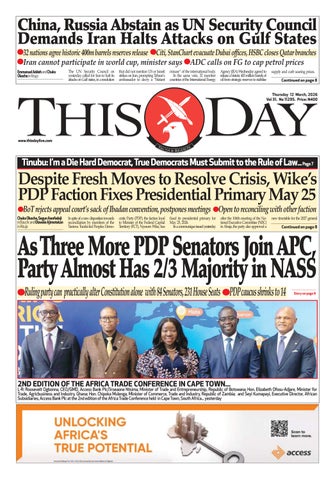
China, Russia Abstain as UN Security Council Demands Iran Halts Attacks on Gulf States
32 nations agree historic 400m barrels reserves release Citi, StanChart evacuate Dubai offices, HSBC closes Qatar branches Iran cannot participate in world cup, minister says ADC calls on FG to cap petrol prices
The UN Security Council on yesterday called for Iran to halt its attacks on Gulf states, in a resolution
that did not mention US or Israeli strikes on Iran, prompting Tehran’s ambassador to decry a “blatant
misuse” of the international body. In the same vein, 32 member countries of the International Energy
www.thisdaylive.com
Despite Fresh Moves to Resolve Crisis, Wike’s PDP Faction Fixes Presidential Primary May 25
BoT rejects appeal court’s sack of Ibadan convention, postpones
In spite of a new disposition towards reconciliation by members of the Tanimu Turaki-led Peoples Democratic Party (PDP), the faction loyal to Minister of the Federal Capital Territory (FCT), Nyesom Wike, has
its presidential primary for May 25, 2026. In a communique issued yesterday
the 106th meeting of the National Executive Committee (NEC) in Abuja, the party also approved a
As Three More PDP Senators Join APC, Party Almost Has 2/3 Majority in NASS
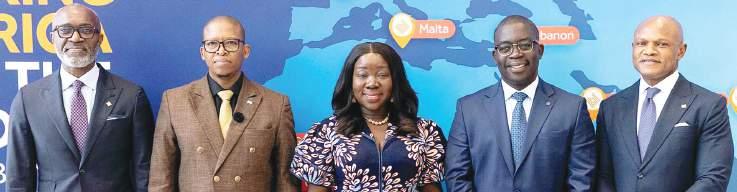
2ND EDITION OF THE AFRICA TRADE CONFERENCE IN CAPE TOWN...
L-R: Roosevelt Ogbonna, CEO/GMD, Access Bank Plc;Tiroeaone Ntsima, Minister of Trade and Entrepreneurship, Republic of Botswana; Hon. Elizabeth Ofosu-Adjare, Minister for Trade, Agricbusiness and Industry, Ghana; Hon. Chipoka Mulenga, Minister of Commerce, Trade and Industry, Republic of Zambia; and Seyi Kumapayi, Executive Director, African Subsidiaries, Access Bank Plc at the 2nd edition of the Africa Trade Conference held in Cape Town, South Africa... yesterday
Emmanuel Addeh and Chuks Okocha in Abuja
Chuks Okocha, Segun Awofadeji in Bauchi and Olawale Ajimotokan in Abuja
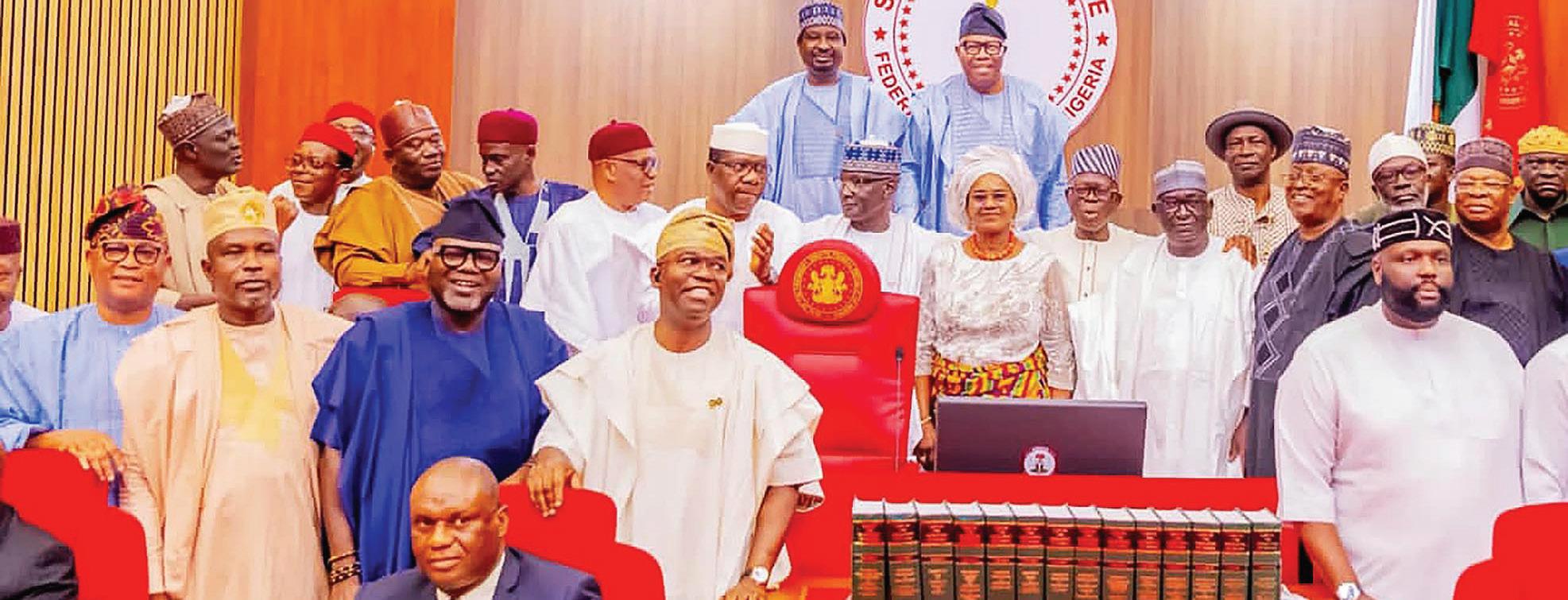
THREE MORE SENATORS DEFECT TO APC...
President of the Senate, Godswill Akpabio, and Deputy Senate President, Jibrin Barau (back
senators to the ruling All Progressives Congress (APC), on the floor of the Senate, yesterday
Dangote: NMDPRA Still Issuing Fuel Import Licences Despite Claims to
the Contrary
Insists refinery can meet Nigeria’s fuel demand, supply 75m litres daily Yusuf Tuggar: Why oil producers must invest in Nigeria
Emmanuel Addeh in Abuja
President of the Dangote Industries Limited (DIL), Aliko Dangote, yesterday maintained that Nigeria’s downstream regulator is still issuing licences for the importation of petrol despite public claims to the contrary, warning that the practice could undermine the operations of his refinery and jeopardise Nigeria’s energy security.
Dangote said the continued importation of refined petroleum products into Nigeria was hurting the petroleum refinery, which he insisted has the capacity to meet the country’s entire fuel demand.
Speaking exclusively with THISDAY, the billionaire businessman stated that although the refinery can produce up to 75 million litres of petrol daily, some market participants were still bringing in imported products into the country, a situation he said may ultimately affect the country’s energy security.
According to him, the persistence of import licences contradicts official assurances by the Nigerian Midstream and Downstream Petroleum Regulatory Authority (NMDPRA) that fuel importation would be limited once domestic
refining capacity improves.
He added that while his refinery had begun exporting refined petroleum products to other markets, importers were still bringing fuel into Nigeria and engaging in practices that distort the domestic market.
“They are still issuing licences despite that we can meet the demand. They are still killing us with importation. They are importing and we are exporting. Yes, we can do 75 million litres, but they are still back-loading,”
Dangote, Africa’s richest person told THISDAY.
Dangote was speaking against the backdrop of the downstream regulator saying that it had stopped issuing new licences for the importation of petrol because domestic refining is now meeting a significant share of Nigeria’s demand.
According to the regulator, the decision aligned with the provisions of the Petroleum Industry Act (PIA) which allows the issuance of fuel import licences only when local production is insufficient to meet national consumption.
The agency explained that no new petrol import licences were issued this 2026, as supply from
domestic refineries, particularly the Dangote Petroleum Refinery, was considered adequate to support the local market.
But the statement contradicted NMDPRA’s latest data for January 2026, which showed that 24.8 million of imported petrol was consumed daily that month.
However, in February, imported petrol consumed in Nigeria fell significantly to 3 million litres per day.
The NMDPRA maintained that import permits will only be reintroduced if there is a shortfall in domestic production, stressing that the policy is intended to
strengthen local refining capacity and reduce Nigeria’s dependence on imported fuel.
But Dangote further alleged that many of the companies importing petrol into the country do not have retail outlets or filling stations, suggesting that some of the imported volumes were being diverted or smuggled after arriving in Nigeria.
The businessman warned that if the situation continues, it could replicate the challenges faced by local agricultural producers in Nigeria’s rice industry, where he said local farmers were undermined by unchecked imports.
Sanwo-Olu Inaugurates Electrification Projects in Badagry Border Communities
Says state strategically positioned to regulate, expand electricity supply
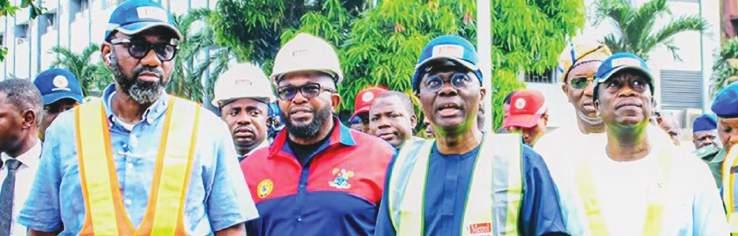
Governor Babajide Olusola Sanwo-Olu of Lagos State today commissioned electrification projects in the Badagry axis, saying that investments in such projects will be of lasting benefit to the people.
The projects being commissioned include three HC Tower Crossings, the newly rehabilitated 33KV distribution lines along the Gaji-Seme, Owode-Apa corridors, and the connection of fifty-one transformer substations.
These represent a deliberate intervention by the state government to address the longstanding
As CBN Dep Gov
electricity challenges in the axis.
Speaking at the event, the governor, represented by the deputy governor, Dr. Kadri Obafemi Hamzat, stated the government is not merely commissioning power infrastructure, but restoring confidence, unlocking opportunities, and bringing lasting relief to communities that have long awaited improved electricity supply in the area.
Sanwo-Olu added the intervention aligns strongly with the THEMES+ Development Agenda of the current administration, particularly the commitment to expanding energy access and building resilient infrastructure
that supports economic growth across every part of Lagos State.
“This intervention aligns strongly with our THEMES+ Development Agenda, particularly our commitment to expanding energy access and building resilient infrastructure that supports economic growth across every part of Lagos State, and with the recent inauguration of the Board of the Lagos State Electricity Regulatory Commission, Lagos is positioning itself to regulate and expand electricity supply more effectively, ensuring that infrastructure investments such as this deliver lasting benefits to our people,” he said.
The governor noted that beyond providing electricity, the project represents an opportunity for traders to extend their business hours, artisans and small manufacturers to increase productivity, schools and healthcare facilities to function more effectively, and families to enjoy a better quality of life.
“With the recent inauguration of the Board of the Lagos State Electricity Regulatory Commission, Lagos is positioning itself to regulate and expand electricity supply more effectively, ensuring that infrastructure investments such as this deliver lasting benefits to our people.”
PenCom Targets Informal Sector Women in Enugu with Pension Inclusion Drive Tinubu Nominates Lamido
President Bola Tinubu has approved the appointment of Lamido Abubakar Yuguda as Deputy Governor of the Central Bank of Nigeria (CBN), subject to confirmation by Senate.
According to a statement issued on Wednesday by presidential spokesperson, Bayo Onanuga, the appointment is in accordance with Section 8(1) of the Central Bank of Nigeria Act, 2007. Yuguda’s nomination followed the recent appointment of the erstwhile Deputy Governor, Mr Bala Bello, as Special Adviser to the President on Political Economy. The president charged them to discharge their responsibilities with renewed dedication, professionalism, and commitment to Nigeria’s economic stability and growth. Yuguda’s last public post was as Director-General of Securities and Exchange Commission (SEC), a position he held from 2020 to 2024. He is an alumnus of Ahmadu Bello University, where he graduated in 1983 with a B.Sc. in Accountancy. In 1991, he obtained a master’s degree in Money, Banking
and Finance from the University of Birmingham, United Kingdom. Yuguda, a Fellow of the Institute of Chartered Accountants of Nigeria (ICAN) and a CFA charterholder, began his career in 1984 at the Central Bank of Nigeria (CBN) as a Senior Supervisor in the Foreign Operations Department. He also worked as an economist in the Africa Department of the International Monetary Fund from 1997 to 2001, when he returned to the CBN. He retired from the CBN in 2016, after serving as Director of the Reserve Management Department for six years.
Gideon Arinze in Enugu
The National Pension Commission (PenCom) has launched a campaign to encourage women working in the informal sector in Enugu State to enroll in the Personal Pension Plan (PPP).
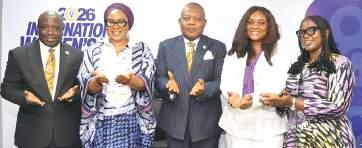
Speaking during the launch yesterday, as part of activities for the 2026 celebration of International Women’s Day, Commissioner, Inspectorate (South East) of PENCOM, Samuel Uwandu, said that the
initiative is designed to help women, who are largely excluded from formal retirement savings system to secure financial stability in old age through small but consistent savings.
He noted that about 96 percent of employed women in Nigeria operate in the informal sector, adding that without structured pension savings, many of them face financial vulnerability in old age and often depend on family support or informal arrangements
for survival. “The IWD PPP Inclusion Campaign is therefore designed to address this coverage gap by creating awareness and encouraging women to begin saving for retirement through a flexible and accessible pension platform,” he said.
To encourage participation during the campaign period, he said that PenCom has introduced a one-time matching contribution incentive supported by development partners and donors.
row), during the defection of three Peoples Democratic Party (PDP)
PHOTO: SENATE PRESIDENT’S OFFICE.
Deji Elumoye in Abuja
COURTESY VISIT OF MISS NIGERIA BOARD...
L–R: Personal Assistant to the Chairman, Miss Kate Okpo; Lagos State Commissioner for Tourism, Arts and Culture, Mrs. Toke Benson-Awoyinka; renowned actress, filmmaker and Chairman of the Miss Nigeria Board, Rita Dominic-Anosike; Executive Business Manager, Miss Nigeria Board, Mercy Sunday-Umoren; and Deputy Director, Tourism, Mrs. Olajumoke James, during a courtesy visit of the Miss Nigeria Board to the Commissioner’s office in Alausa, Ikeja… recently
Senate Confirms Taiwo Oyedele as Minister of State for Finance
The Senate yesterday confirmed the nomination of Taiwo Oyedele as Minister of State for Finance after a screening session in which the renowned tax expert pledged to pursue fiscal reforms aimed at improving government revenue, ensuring realistic budgeting and strengthening the country’s economic management framework.
Oyedele, a former Chairman of the Presidential Fiscal Policy and Tax Reforms Committee, was confirmed after lawmakers expressed confidence in his competence, experience and track record in fiscal policy reform.
He replaces Doris Uzoka-Anite
as Minister of State for Finance.
During the screening, the nominee highlighted his modest upbringing and extensive academic and professional background, describing his nomination as an opportunity to serve the country.
He told the Senate that his academic journey began in community schools before he proceeded to tertiary institutions in Nigeria and abroad.
According to him, he attended Community Comprehensive High School in Ikare Akoko, where he graduated as the best student and won a N500 scholarship that enabled him to complete his secondary school examinations.
He later studied at the Federal Polytechnic and Yaba College of Technology, where he obtained a Higher National Diploma before earning a Bachelor of Science degree in Accounting from Oxford Brookes University in the United Kingdom. Oyedele also attended executive programmes at Harvard University, Yale University, the London School of Economics and Political Science, and the Gordon Institute of Business Science.
Beyond his academic accomplishments, Oyedele said his passion for teaching had led him to serve as a professor of practice at Markhoff University while also lecturing at the Lagos Business School and the
University of Lagos.
He explained that prior to his recent role advising the federal government on fiscal reforms, he had built a distinguished career in the private sector.
Oyedele disclosed that he rose through the ranks at PricewaterhouseCoopers (PwC), one of the world’s leading consulting firms, where he served as Africa Tax Leader and Policy Leader with responsibility for over 20 countries.
He said his work in international tax policy and economic reforms across more than 180 countries prepared him for the task of contributing to Nigeria’s economic transformation.
Relocate Your Overseas Factories to Nigeria, FG Tells Manufacturers
The federal government has tasked importers at the Lagos International Trade Fair Complex (LITFC) who have manufacturing firms abroad to relocate them to Nigeria.
This task was delivered yesterday in Lagos by the Minister of Industry, Trade and Industry, Dr. Jumoke Oduwole, during an interactive session she had with traders and business owners at the LITFC.
Oduwole said the volume of trading going on at the LITFC is certainly the biggest in West Africa and contributing significantly to growing the gross domestic product (GDP) of Nigeria.
The minister said: “Many of you are industrialists. And we know that. Some of you own factories elsewhere. You cannot be enriching other countries (I will not mention names) and giving jobs to others when you can do it here.
“So we are going to help you and partner with you for your backward integration. So that you are not manufacturing somewhere and bringing them here to sell to our people. You should be manufacturing here,
and selling here and exporting to other countries.
“And we will partner with you to make it work. Because you have the experience.”
She said the federal government was ready to provide necessary assistance that would enable some of the traders to formalise their businesses.
Oduwole said the mere fact that trading was a highly informal sector could not be ascribed to a lack of sophistication.
She added: “I used to be a lecturer at the University of Lagos. And I did some research around here once.
“And I know that some of you prefer to fly under the radar. But you are moving billions of Naira internationally while preferring to stay under the radar. But you cannot make us feel that your informality means that you are small. You are not.
“And we know that you are not. And it shows in the figures. So that is an informality that is begging for formality and we will work with you on that.”
The minister assured the traders that President Bola Ahmed Tinubu is concerned about their welfare
and improving their ease of doing business.
She added that the government would look into their complaints on poor infrastructure and concerning 22 roadblocks they encounter between the ports and the LITFC and another four checkpoints on the Badagary Road to Republic of Benin.
“We are not going to leave you
alone from the federal level. I’m taking this message back. And so Mr. President is being fully briefed,” the minister said.
In his remarks, the Chairman of the Board of Trustees, Balogun Business Association, LITFC, Mr. Okechukwu Ezeibe, said traders were afflicted with high cost of doing business, which they transfer to the larger economy.
The nominee told lawmakers that over the past two and a half years, the presidential fiscal policy committee he led had developed several reform initiatives, including four major tax reform laws recently passed by the National Assembly. He commended the legislature for its support, noting that the reforms would modernise Nigeria’s fiscal framework and improve revenue generation.
According to him, beyond taxation, the committee had also worked on initiatives to increase revenue from government assets, government-owned enterprises and investments, while also improving how public funds are spent.
However, Oyedele acknowledged that public trust in government spending remained a critical challenge.
“One of the most frequent questions Nigerians ask is that when they pay taxes, what assurance do they have that the money will be used for the right purpose,” he said, describing the concern as legitimate and one the government must address.
During the interactive session, lawmakers raised questions on issues ranging from solid minerals development to capital budget implementation and fiscal policy coordination.
Responding to concerns raised by the Deputy Senate President,
Jibrin Barau, on low revenue from the solid minerals sector, Oyedele said Nigeria had historically focused too heavily on taxation and oil and gas, while neglecting other potential sources of revenue.
He identified policy uncertainty as the major impediment discouraging investors from the solid minerals sector.
According to him, providing policy stability and legislative guarantees could unlock investment and significantly increase revenue from the sector.
He cited the example of the Nigerian Liquefied Natural Gas project, where legislative backing helped restore investor confidence and enabled expansion.
Oyedele said a similar approach could be adopted for the solid minerals industry, adding that the Ministry of Finance would collaborate with the Ministry of Solid Minerals Development to create an enabling policy environment for investors.
On the persistent challenge of poor implementation of capital projects due to funding constraints, the nominee noted that Nigeria’s budgets had often been overly ambitious compared to actual revenue. He observed that the federal and state governments currently finance nearly half of their budgets through deficit borrowing, a situation he described as unsustainable.
US, UK Partner Nigerian Group to Promote Peace Building Initiatives
Onyebuchi Ezigbo in Abuja
United States and United Kingdom international development agencies, in collaboration with Conflict Research Network West Africa (CORN), unveiled a digital platform that will help track various peace-building initiatives in the country, including efforts of state and non-state actors involved in the conflict resolution.
The intervention, supported by international and local development partners, including Foreign, Commonwealth and Development Office (FCDO), United States Agency
for International Development (USAID), and Nigeria Partnership for Peace-building and Development Initiative (NPAID), among others, is designed to provide greater visibility to conflict resolution efforts through the documentation, archiving, and systematic mapping of peace actions and peace-building initiatives across Nigeria.
It also seeks to aggregate structured data on peace actors, initiatives, and peace-related events across Nigeria, designed to make peace effort visible, connected, searchable, and learnable.
The unveiling of the digital platform, which attracted major stakeholders within the peacebuilding and advocacy ecosystem, explored the role of religious leaders, traditional rulers, women and youths in peace-building and conflict resolution in Nigeria.
Speaking during the unveiling of the platform, known as Nigerian Peace Web, on Wednesday, Executive Director, Conflict Research Network West Africa, Dr. Timpreye Felix Allison, said while incidents of violence and insecurity in Nigeria were widely reported, peace and
conflict resolution efforts remained undocumented, disconnected, and often too invisible.
Allison stated, “The starting point for today is simple but profound. Nigeria’s conflict landscape is visible; its peace is not.
“Across the country, community mediators, faith leaders, women’s networks, youth groups, traditional authorities, and state peace agencies work every day to prevent violence and manage tensions.
“However, much of that work remains undocumented, disconnected, and often too invisible.”
Dike Onwuamaeze
Sunday Aborisade in Abuja
UNILEVER INTERNATIONAL WOMEN’S DAY...
L–R: Head of Corporate Affairs, Communications and Sustainability, Unilever Nigeria Plc, Zainab Obagun; Non-Executive Director, Unilever Nigeria Plc, Adenike Ogunlesi; Managing Director, Unilever Nigeria Plc, Tobi Adeniyi; Filmmaker and Founder, Greoh Studios, Jadesola Osiberu; and Founder, Herconomy, Ifedayo DurosinmiEtti, during the International Women’s Day celebration themed “Give to Gain” #InHerElement organised by Unilever Nigeria Plc and held in Lagos on Monday
Tinubu: I’m a Die Hard Democrat, True Democrats Must Submit to the Rule of Law
Doubles down on electoral act amid IPAC’s concerns, says he had no choice
Deji Elumoye in Abuja
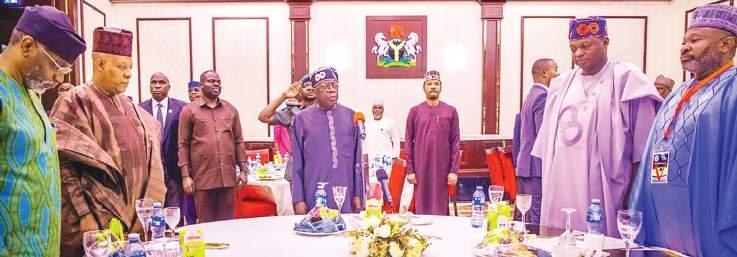
President Bola Tinubu, last night, at a parley with fellow politicians described himself as a die-hard democrat, adding that politicians as true democrats must always submit to the rule of law.
He spoke while addressing leaders of the All Progressives Congress (APC) Executives and National Working Committee (NWC), as well as the Inter-Party Advisory Council (IPAC) during the interfaith breaking of fasts at the State House, Abuja.
The president declared: “I followed the leadership destiny that God has done and chosen for me. There’s no doubt about that. I’m a die-hard democrat, and I follow that belief wholeheartedly, committedly, to a united country; Nigeria. That principle and that philosophy will live and die with me.”
Tinubu traced his democratic credentials through decades of political struggle, including detention, exile, and the formation of the National Democratic Coalition (NADECO) during past military regime of late General Sani Abacha
According to him, “We are all democrats and we all subscribed to this democracy voluntarily, willingly, and we’ve been at it selflessly in the last 26 years. Some of us have the
bruises from it, struggling for it. We went to detention, we protested... We went on exile and all of that. We formed NADECO. We got here.”
Tinubu stressed that his commitment to democratic ideals was not merely political positioning but a deeply held personal philosophy.
Speaking directly to IPAC National Chairman, Yusuf Dantalle, the president stressed that party membership must remain voluntary, even when it brings persecution.
“We are all democrats, voluntarily – party alliances, party ideologies or no ideology, party boat, party platform, in whichever form – it’s voluntary. Be persecuted for it. So, no threat from any democrat,” he said.
Tinubu’s remarks came against the backdrop of significant controversy surrounding the Electoral Act 2026, which he signed into law on February 18 after it passed the National Assembly with an overwhelming majority.
The legislation drew criticisms from opposition parties and civil society groups over provisions including the optional electronic transmission of results and new requirements for party membership registers.
“The Rule of Law must prevail in any democracy. Yes, Rule of Law. Majority will have their say and their way, and minority will have their say and might not have their way.
That is the sweetness, the essence of democracy,” president stated.
He urged political actors to engage in intellectual debate rather than confrontation: “Argue it, debate it intellectually, interrogate each other, honestly and sincerely, but we are committed to the same thing, peace and stability of the country, and we adhere to it.”
Speaking to his decision to sign the Electoral Act amendments, he acknowledged IPAC’s con-cerns and at the same time, defended his actions as constitutionally necessary.
The new law, among others, mandates direct or consensus primaries, abolishing delegate voting, requires digital membership registers submitted 21 days before primaries, and restricts courts from stopping electoral processes.
“That I signed the Electoral Act, I
have no choice. I don’t want to throw the country into turmoil of argument. There is an overwhelming majority by the National Assembly that passed the law.
“If I have serious question or reservation about it, I would have raised it. But I have none. I submitted myself to the principle of Rule of Law, democracy. I signed, the rest is history. We’ll meet at the polls.”
Tinubu noted that he had been in opposition himself for years without threatening anyone except “military junta,” and expected others to show similar restraint.
“I’m a registered voter. I’m on the same platform with you, or not, I’m going to stick to my platform. When it was against me years past, I toed the line,” he said.
The president struck a conciliatory
but firm tone, acknowledging that political competition could be bruising but must remain within democratic bounds.
“The game is sweet only when you are winning. It’s alright we must accommodate one another, we must help one another. We must strengthen the platform. But democracy is it? Yes, there must be peace, stability and commitment to Rule of Law,” he observed.
Earlier, Dantalle, had praised Tinubu as a “listening father and an inclusive president” but raised several concerns about the new Electoral Act.
He revealed that IPAC had previously worked behind closed doors with INEC to prevent democracy from being derailed during the 2023 election collation process.
Dantalle specifically appealed for
reconsideration of three provisions: the 21-day deadline for submitting membership registers with mandatory National Identification Numbers, which would disenfranchise many voters; the removal of indirect primaries, which disadvantaged smaller parties with limited resources; and the withdrawal of government subventions to political parties.
“We are not saying give us money to go and spend, no, but prudently what we can use to take care of administration of our political parties. You are a product of multi-party democracy, Your Excellency,” he pleaded. Dantalle also requested federal assistance to relocate IPAC from its current “rented apartment”, noting that the council had buried many potential crises to allow the president to focus on governance.
Agora Policy Rallies Critical Stakeholders to Discuss Impact of Tinubu’s Macroeconomic Reforms
Ndubuisi Francis in Abuja
Nigerian think-tank, Agora Policy, will Thursday convene a meeting of critical stakeholders to deliberate on how to sustain, deepen, and
improve the key economic reforms of the President Bola Tinubu administration.
Slated for Yar’Adua Centre, Abuja, the event, organised in partnership with Nigerian Eco-
$17m Loan Dispute: Court Reaffirms Order Halting Criminal Allegations Against Sterling Bank Executives
Wale Igbintade
Justice Daniel Osiagor of the Federal High Court in Lagos has reaffirmed an earlier order restraining parties from taking further steps in respect of criminal allegations made against Sterling Bank Limited and some of its top executives, pending the determination of a substantive suit before the court.
The judge reiterated the order yesterday, when the matter, Suit No. FHC/L/CS/158/2025, between Sterling Bank Limited and five others as plaintiffs, and the House of Representatives and four others as defendants, came
up at the Lagos Judicial Division. At the hearing, Femi Falana, SAN, and Funmi Falana, SAN appeared for Sterling Bank and the other plaintiffs, L.M. Alozie, SAN, represented the 4th defendant, while Sylvester Azubuike appeared for the 5th defendant.
Other defendants were represented by their respective counsel.
Justice Osiagor restated the subsisting order directing that no further steps should be taken in furtherance of the criminal allegations against the bank and its officials until the substantive suit challenging the actions of
the defendants is determined.
The court subsequently adjourned the matter to May 11, 2026, for further proceedings.
The suit was filed by Sterling Bank Limited, Sterling Holding Company, and some executives of the bank to challenge the powers of the House of Representatives Committee on Public Petitions to investigate issues arising from a banker–customer dispute between the bank and Miden Systems Limited and its principal, Dr. Innocent Brendan Usoro.
According to the plaintiffs, the dispute arose from a loan facility of about $17,079,000 granted to Miden Systems Limited in 2009.
The bank stated the facility was later restructured after the borrowers allegedly failed to meet their repayment obligations.
Following the alleged default, Sterling Bank commenced recovery proceedings which culminated in a consent judgment of the Federal High Court, where the borrowers reportedly admitted liability in the sum of about $31.3 million.
Despite the subsisting judgment and other pending court proceedings relating to the debt, the plaintiffs alleged that petitions were later filed before the House of Representatives Committee on Public Petitions.
nomic Summit Group (NESG), will bring together senior officials from government, private sector, civil society, academia, media, thinktanks, and development agencies to examine the implications of Nigeria’s ongoing reform agenda and identify practical pathways to consolidate macroeconomic gains, while minimising adverse social impacts.
Themed, “Sustaining and Deepening Economic Reforms in Nigeria,” the dialogue is organised with support from Nigeria Economic Stability and Transformation (NEST) programme, an initiative of the UK Government’s Foreign Commonwealth and Development Office (FCDO).
The major highlight of the event will be a panel session featuring Deputy Governor (Economic Policy) Central Bank of Nigeria (CBN), Dr. Muhammad Sani Abdullahi; Special Adviser to the President on Finance and the Economy, Ms. Sanyade Okoli; Country Director, CARE International Nigeria, Dr. Hussaini Abdu; Director-General, Lagos Chamber of Commerce and Industry (LCCI), Dr. Chinyere
Almona; and Senior Economist for Nigeria at the World Bank Group, Dr. Samer Matta. According to Agora Policy, the meeting will be hosted by the anchor of “The Global Business Report” on Arise News, Mr. Rotus Oddiri.
The panel session will be preceded by a presentation of the highlights of a new study by Agora Policy on the impact of some of the economic reforms, produced with the support of NEST.
The panel session will be followed by an interactive session with the high-level audience.
The dialogue is designed to undertake an objective stock-take of the economic reforms introduced by the Tinubu administration. It will provide an opportunity for key stakeholders to constructively deliberate on how to sustain and improve the current reforms and lay a strong foundation for the next wave of reforms.
The meeting is one of the activities designed to deepen consensus, trust, and inclusion in reform design and implementation in the country.
Nigeria Receives Long-Acting Injectable Lenacapavir for HIV Prevention
Onyebuchi Ezigbo in Abuja
The National AIDS, Viral Hepatitis and STIs Control Programme (NASCP), an agency of the Federal Ministry of Health and Social Welfare (FMOHSW) has confirmed the arrival of Long-Acting Injectable Lenacapavir (LEN) for pre-exposure Prophylaxis (PrEP) in Nigeria.
A statement by the Coordinator of NASCP, Dr. Adebobola Bashorun, said the drug was
received on Tuesday.
It said that the procurement of HIV drug was approved by the Coordinating Minister of Health and Social Welfare, and facilitated by the Global Fund.
“This represents a major advancement in the country’s HIV prevention efforts and further strengthens Nigeria’s commitment to expanding innovative HIV prevention options.
“The introduction of Lenacapavir for PrEP marks a significant
step towards broadening the range of prevention choices available to individuals at risk of HIV infection,” it said
NASCP said that as a long-acting injectable option, LEN PrEP has the potential to improve adherence and expand access to effective HIV prevention services for populations that may face challenges with daily oral prevention options.
“The arrival of LEN PrEP reflects Nigeria’s continued dedi-
cation to leveraging innovation and evidence-based interventions to accelerate progress toward epidemic control.
“By expanding prevention options and strengthening service delivery, the country is taking decisive steps to reduce new HIV infections and improve health outcomes for communities across Nigeria.
“NASCP, in collaboration with partners and stakeholders, will work to ensure the safe introduc-
tion, strategic deployment, and effective integration of Lenacapavir into the national HIV prevention options. The rollout will support ongoing efforts to increase access to prevention services while reinforcing Nigeria’s broader HIV response.
“NASCP remains committed to advancing equitable access to HIV prevention, testing, treatment, and care services. The arrival of LongActing Injectable Lenacapavir is a clear demonstration of Nigeria’s
resolve to scale up innovative solutions and strengthen the fight against HIV,” it said.
AS THREE MORE PDP SENATORS JOIN APC, PARTY ALMOST HAS 2/3 MAJORITY IN NASS
Sunday Aborisade in Abuja
Nigeria’s ruling All Progressives Congress (APC) has almost effectively secured the parliamentary numbers required to alter the country’s constitution without relying heavily on opposition support, consolidating an overwhelming majority in the National Assembly.
With 84 senators and 231 seats in the House of Representatives, the party has already crossed the critical two-thirds threshold needed to push through constitutional amendments in the Senate, placing extraordinary legislative power in the hands of the governing party, which now has 31 governors nationwide.
The development marks one of the most dramatic shifts in Nigeria’s parliamentary balance in recent years, effectively giving the APC the numerical strength to determine the direction of constitutional reforms within the legislature.
The consolidation of power
became even more pronounced in the Senate after three additional lawmakers defected from the Peoples Democratic Party (PDP), further shrinking the opposition’s caucus to just 14 senators. The latest defections underscore the deepening crisis within the PDP and indeed the opposition parties, and highlight the accelerating erosion of their influence in the upper chamber.
With the numbers now firmly in its favour, the APC holds the capacity to drive constitutional alterations through the National Assembly largely on its own. Although constitutional amendments must still pass through other procedural stages, including concurrence by state assemblies, the ruling party’s dominance at the federal legislature as well as State Assemblies, significantly strengthens its ability to shape the outcome of the process.
Specifically, the APC yesterday strengthened its dominance in the
Senate as three more PDP) senators defected to the governing party, totalling 84 senators for the ruling APC.
Unfortunately, this development which seemed to have excited the APC leadership carries with it an albatross for the nation’s democracy, leaving the opposition with no say whatsoever at all in critical state matters.
To take or make any significant constitutional decisions, the senate requires 73 of its members, sometimes requiring a collaboration with the opposition parties.
However, with the 84 senators to the credit of the APC, the party is not just in a vantage position, it can by itself alter the constitution without recourse to the opposition all because of the power of its current number strength.
The latest development has pushed the APC’s strength in the Senate to 84 members while its membership in the 360-seat
CHINA, RUSSIA ABSTAIN AS UN SECURITY COUNCIL DEMANDS IRAN HALTS ATTACKS ON GULF STATES
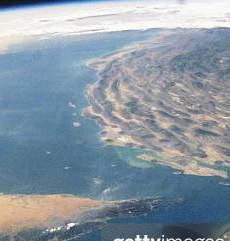
The coordinated action came amid escalating tensions in the Strait of Hormuz, financial institutions evacuating Gulf offices, and Iran’s new supreme leader reported lightly injured in recent attacks, underscoring the far-reaching consequences of the conflict.
Besides, Washington signaled it is not finished militarily, cautioning Tehran of further consequences even as major banks, including Citi and Standard Chartered, evacuated staff from Dubai, while HSBC closed branches in Qatar to safeguard operations amid rising regional instability.
Amid the turmoil, Tehran also announced that Iran would be unable to participate in the upcoming FIFA World Cup, highlighting the widening social and economic impact of the conflict.
UN Security Council Demands Iran Stops Attacks on Gulf States
The UN Security Council on yesterday called for Iran to halt its attacks on Gulf states, in a resolution that did not mention US or Israeli strikes on Iran, prompting Tehran’s ambassador to decry a “blatant misuse” of the international body.
Veto-holders China and Russia both abstained from the Security Council vote, angered that the resolution did not acknowledge US-Israeli hostility towards Iran.
The resolution, passed by 13 votes with two abstentions, “demands the immediate cessation of all attacks by the Islamic Republic of Iran against Bahrain, Kuwait, Oman, Qatar, Saudi Arabia, the United Arab Emirates, and Jordan.”
It also condemned any actions or threats by the Islamic Republic
of Iran aimed at closing, obstructing, or otherwise interfering with international navigation through the Strait of Hormuz.
Iran has repeatedly struck Gulf states in retaliation to US-Israeli attacks that killed Iranian supreme leader Ayatollah Ali Khamenei and continues to pummel Iranian sites.
The Islamic republic has also fired on commercial ships passing through the Strait of Hormuz, a crucial sea passage for the global fuel trade, in a bid to inflict pain on the global economy, AFP reported.
The UN ambassador of Bahrain, Jamal Fares Alrowaiei, who introduced the resolution sponsored by 135 countries, said its passing reflected the Gulf’s key role in the global economy.
“This is why ensuring the security of this region is not merely a regional matter, it is a common international responsibility that is closely linked to the stability of the global economy and energy security,” Alrowaiei told the Security Council.
However, veto-holders China and Russia both abstained from the Security Council vote, angered that the resolution did not acknowledge US-Israeli hostility towards Iran.
Iranian ambassador Amir Saeid Iravani said adoption of the text represented a “blatant misuse of the Security Council mandate in pursuit of the political agendas” of the United States and Israel.
“Let me make it clear, this resolution is a manifest injustice against my country, the main victim of a clear act of aggression,” he said.
The United States, which backed the text, said its adoption reflected a broad condemnation of Iranian strikes.
“Iran’s strategy of sowing chaos, of trying to hold their neighbours
hostage, trying to shake the resolve of the region, has clearly backfired, as shown by this vote today,” said US ambassador Mike Waltz.
32 IEA Nations Agree to Release 400m Barrels of Oil from Reserves
The IEA 32 member countries yesterday agreed to release 400
election.
After deliberating on issues concerning the party and the current political developments within its structures, NEC resolved that the submission of membership register must be carried out by April 10, 2026. It fixed State Assembly primaries for May 2, 2026; National Assembly primaries, May 9, 2026; and governorship primaries, May 16, 2026.
NEC approved the conduct of zonal congresses scheduled to take place in a fortnight, as part of the party’s orderly progression towards the national convention as well as the national convention sub-committees
It emphasised the urgent need for reconciliation, unity, and collective responsibility among leaders and stakeholders of the party, stressing that the strength of the PDP lay in its ability to resolve internal disagreements through dialogue, mutual respect, and adherence to party structures.
It urged all parties involved in disputes within the party to embrace reconciliation and refrain from pursuing further litigation, particularly any move to proceed to the Supreme Court, in the overriding interest
House of Representatives has risen to about 231 lawmakers, giving the ruling party overwhelming control of the federal legislature, since it would only need nine opposition legislators at that level to pass critical bills. THISDAY’s checks showed that the lower chamber will require 240 legislators to achieve a two third majority.
With this configuration, the APC now holds a dominant majority, placing it in a comfortable position to push through executivesponsored legislation, including constitutional amendments, fiscal and appropriation bills, and other key government policies.
The President of the Senate, Godswill Akpabio, announced the latest defections during plenary after reading the letters submitted by the lawmakers.
The defecting senators were Amos Yunana (Adamawa North), Aminu Iya Abbas (Adamawa Central), and Ikra Aliyu Bilbis (Zamfara Central).
Their movement to the ruling party came barely 24 hours after Ipalibo Banigo (Rivers West) also defected from the PDP to the APC.
The latest defections reduced PDP’s strength in the Senate from 17 to 14 members, while the APC increased its tally from 81 to 84 senators, further widening the gap between the ruling party and the opposition in the upper legislative chamber.
The Senate currently has 106 serving members instead of the constitutionally required 109,
of unity, stability, and the future of the party.
NEC also reaffirmed preparations for the forthcoming National Convention scheduled for March 29-30, where a new National Working Committee (NWC) would be elected in accordance with the constitution of the party.
NEC urged all organs and stakeholders of the party to commence the necessary preparations for the 2027 elections and ensure strict adherence to the approved timetable and all relevant statutory provisions.
Earlier, Chairman, National Caretaker Committee, Alhaji Abdulrahman Mohammed, urged restraint among its members, saying the proclivity for legal battles must give way to genuine reconciliation and party consolidation.
Mohammed said the recent judicial outcomes should serve as a final signal for members to sheathe their swords.
He stated, “The court has spoken once again that the rule of law must prevail in our party’s internal affairs. I want to call on all party stakeholders, leaders to unite ourselves for the betterment of our party. Enough of
following the deaths of Godiya Akwashiki (Nasarawa North), Okechukwu Ezea (Enugu North), and Barinada Mpigi (Rivers South East).
Despite the vacancies, political analysts say the APC’s numerical advantage gives it overwhelming legislative leverage, particularly on bills that require special majority votes.
In the House of Representatives, the ruling party has also strengthened its position following months of defections by lawmakers from opposition parties. Current records indicate that the APC now controls about 231 seats in the 360-member chamber, representing more than 64 per cent of the total membership.
The PDP currently holds about 83 seats, while the Labour Party has 22 lawmakers in the House.
Other parties represented in the House included the New Nigeria Peoples Party (NNPP) with 15 members, the All Progressives Grand Alliance (APGA) with five seats, the Social Democratic Party (SDP) with two seats, the African Democratic Congress (ADC) and the Young Progressives Party (YPP) with one seat each.
At the inauguration of the 10th National Assembly in June 2023, the political balance in the House was far more fragmented. The APC had 162 seats at the time, while the PDP controlled 102 seats.
The Labour Party (LP) had 34 lawmakers, the NNPP held 18 seats, APGA had four members, while the ADC and SDP each had two
litigations that will delay our activities towards the 2027 general election.”
BoT Rejects Appeal Court’s Sack of Ibadan Convention, Postpones Meetings
Board of Trustees (BoT) of Peoples Democratic Party (PDP), after a twoday meeting, rejected the Court of Appeal judgement that nullified the Ibadan national convention.
BoT said that it would set up a reconciliation committee to interface with the National Caretaker Committee, a group loyal to Wike. Reading the communique after another meeting with the Tanimu Turaki-led National Working Committee, the chairman of the PDP BoT, Senator Adolphus Wabara, said, “After a thorough consideration of all issues relating to the leadership of the PDP, especially in the light of the Monday, March 9th 2026 Judgment of the Court of Appeal, the Board of Trustees (BoT) convened an Expanded Emergency Meeting which held on Tuesday, 10th and Wednesday, 11th March, 2026 and resolved as follows: ‘’The BoT disagrees with the judgment of the Court of Appeal,
members, and the YPP had one.
However, sustained crosscarpeting by lawmakers, mostly from the PDP, Labour Party and NNPP, has significantly strengthened the APC dominance in the chamber.
In the Senate, the shift in political alignment has also been dramatic. While the APC now holds 84 seats, the PDP has dropped sharply from its initial 36 senators at the inauguration of the 10th Assembly to just 14 members. Other parties have also witnessed significant changes.
The Labour Party, which began the assembly with eight senators, currently has no representation in the chamber, while the NNPP retains only one seat, down from two.
Similarly, the SDP has lost its two seats in the Senate, but the ADC now holds five seats despite starting the 10th Assembly without any representation.
A newly registered political platform, the Nigeria Democratic Congress (NDC) also has one senator in the person of Seriake Dickson (Bayelsa West), while APGA retains one seat in the chamber.
Speaking on the development, Akpabio described the wave of defections as unprecedented since Nigeria gained independence in 1960.
He said the current political realignment represented a reversal of what occurred during the 8th Senate in 2018 when the APC
which pronounced an invalidation of the November 15th to 16th 2025 National Convention that produced the Kabiru Tanimu Turaki-led National Working Committee of our party. The BoT is awaiting the advice of our lawyers on the way forward in this regard.
‘’The BoT is disturbed by the avoidable internal leadership disputes and wrangling leading to damaging litigations with consequential detrimental effect on the unity and smooth running of the PDP as the major opposition party in the country.
‘’The board, however, acknowledges and resolved to explore the window provided by the Court of Appeal, Ibadan Division for reconciliation within the party.’’ Wabara added that BoT was conscious of the interest and aspiration of its members, who were desirous of contesting various positions in the 2027 general election.
He stated, ‘’Conscious of the onus on the BoT as the conscience and third highest leadership organ of the party, the board is resolved to take immediate steps to reconcile all stakeholders, put an end to all
Dr. Adebobola Bashorun
SANWO-OLU TOURS ONGOING CONSTRUCTION OF THE LAGOS GEOGRAPHICAL INFORMATION SYSTEM...
L-R: Contractor in charge of project, Arc. Adelaja Adeniyi; Lagos State Head of Service, Mr. Olabode Agoro; Governor Babajide Sanwo-Olu and his deputy, Dr. Obafemi Hamzat, during the Governor’s inspection of the ongoing construction of the Lagos State Geographical Information System Centre at Alausa, Ikeja, on Tuesday
Nonye Ayeni: Nigeria Cannot Achieve Sustainable
Non-oil Export Without Women Participation
Seeks
to boost agro export to UK, unveils procedure handbooks
Onyebuchi Ezigbo and James Emejo in Abuja
Executive Director/Chief Executive, Nigerian Export Promotion Council (NEPC), Nonye Ayeni, has declared that the country could not achieve sustainable non-oil export growth without the full participation of women.
Ayeni also reaffirmed the council’s commitment to boost agro exports to the United Kingdom.
Similarly, Managing Director, Nigeria Social Insurance Trust Fund (NSITF), Mr. Oluwaseun Faleye, described women empowerment as both an economic and social necessity.
Faleye while acknowledging contributions of Nigerian women to national development, lamented that many women still faced barriers limiting their access to opportunities.
Ayeni spoke at NEPC’s Her Showcase 2.0 event in Abuja, where she unveiled two export procedure handbooks – “Exporting to Great Britain
in Agric Food Sector” and another on “Cosmetics Sector” – to celebrate the International Women’s Day 2025.
She said the publications will ensure that women exporters, in particular, were well equipped to compete seamlessly and easily in Great Britain.
Quoting PwC 2024 report, Ayeni stated that Small and Medium-sized Enterprises (SMEs) made up about 96 per cent of businesses in Nigeria, while about 32 per cent of them were women-led.
She said, “We see that women play a vital role in our economy.
It is, therefore, imperative that as a country, our SMEs are empowered to take advantage of the immense opportunities that technology and globalisation present to businesses, particularly SMEs.
“These books are very rich and robust and cover areas, like preparing businesses for export, especially, to Great Britain. It covers product and production requirements, custom related
NSITF MD: Empowering
procedures, transport and logistics, proof of origin and the likes. With these, our women exporters are well equipped to compete seamlessly and easily in Great Britain.”
Ayeni added, “If you want to create generational wealth, you invest in a woman. Women are made of sterner stuff. Our strength is not usually loud, but it has the force of a dynamite that can break barriers and move mountains.
“A shout out to all the women that refused to walk within the boundaries set for them but rather dared to dream big dreams and dared to take bold steps.
“Therefore, as we embark on this journey of discovery and growth, we remain steadfast in our commitment to excellence, innovation, and inclusivity.
“By working together and embracing the spirit of collaboration, we can achieve remarkable success and ensure that Nigerian women-led businesses continue to shine on the global stage.”
She explained that the 2025 IWD
theme, “Give to Gain,” reflected NEPC’s commitment to empowering women to transcend traditional physical boundaries and achieve global success in the world of trade.
women, a social necessity, access to opportunities limited with the International Trade Centre (ITC), provided training, market access opportunities, and connections to international buyers for thousands of women exporters.
The NEPC executive director said, “It is, therefore, our firm belief in the council that empowering women is a strategic investment for building stronger nations. We have been doing that in our various initiatives, programmes, and interventions.”
According to her, “Programmes like the SheTrades and WEIDE fund, among others, are targeted at improving business opportunities for women.
“It is worthy of note that the council’s collaboration with ITC on the WEIDE fund programme, 146 women-led businesses were selected, are currently undergoing training and will soon be given grants ranging from five thousand to thirty thousand dollars ($5,000 – $30,000).
“The council strengthened the SheTrades Nigeria Hub, in collaboration
In a major push to expand economic opportunities and reduce poverty, Plateau State Governor, Caleb Manasseh Mutfwang, has signed a Memorandum of Understanding (MoU) with Bank of Industry (BOI) to establish a N4 billion matching fund dedicated to strengthening Micro, Small and Medium Enterprises (MSMEs) across the state.
The agreement, sealed on Tuesday at Old Government House, Rayfield, Jos, commits both Plateau State Government and BOI to contribute N2 billion each.
The fund is expected to provide affordable financing to small businesses and stimulate economic activities across all 17 local government areas of the state.
Mutfwang, who signed on behalf of the state government, described the initiative as a deliberate intervention to expand livelihood opportunities, promote enterprise development, and tackle poverty particularly among women and young people.
He stated, “This is a significant
milestone in our efforts to build a resilient and inclusive economy that aligns with the vision of Mr. President to grow Nigeria into a one trillion dollar economy,” referencing President Bola Tinubu’s economic agenda.
The governor stated that Plateau State held “significant potential” and will continue to contribute meaningfully to national development. He explained that the fund would support equipment acquisition and working capital needs, enabling businesses to scale operations, create jobs, and strengthen local value chains.
He said, “We want to increase Plateau State’s contribution to the national GDP, and the most effective way to achieve this is by stimulating business growth.”
The governor added, “We will identify innovative and enterprising businesses across the state, with particular focus on women and young people, ensuring that no part of Plateau is left behind.”
Managing Director of BOI, Olasupo Olusi, who signed on
behalf of the bank, commended Mutfwang for what he described as a visionary step towards
empowering entrepreneurs and fostering sustainable economic development.
“Since its inception, over 5,000 women-led businesses have joined the hub community, benefiting from tailored capacity building and coaching. This collaboration has helped women become export-ready, participate in global fairs, and integrate digital tools into their businesses.”
Ayeni stated, “Through NEPC’s Go Global, Go for Certification initiative, the Council facilitated and fully sponsored export certification (HACCP, ISO, FDA, Global G.A.P.) for MSMEs, particularly women-owned enterprises, at no cost to them. These certifications are signals of trust in international markets and have directly improved market access, reduced rejection rates, and enhanced buyer confidence.”
However, the NSITF MD who spoke at an event marking the International Women’s Day yesterday in Abuja, gave assurance of the fund’s commitment to promoting a safe workplace for women and all workers.
He said, “Empowering women is not simply a moral obligation--it is an economic and social necessity.”
He described the theme of the 2026 commemoration, “Empowering Women: The Path to Equal Rights and Social Justice,” as both timely
and significant.
A statement signed by the Deputy General Manager Corporate Affairs Alex Mede quoted Faleye as saying that, “When women are empowered with equal opportunities, fair wages, safe working conditions, and access to social protection, societies, they become more stronger and economies grow more resilient”.
The NSITF boss commended the Women Commission for consistency in championing the “cause of women within the labour movement and doe creating a platform that amplifies the voices, concerns, and aspirations of women across our workplaces and communities.’
The MD urged a reaffirmation of commitment by stakeholders to “building a future where every woman has opportunity to work in a safe environment, earn a fair income, and participate fully in decision-making processes that shaped our economy and society.”
Also speaking at the occasion, the President-General, Trade Union Congress, Festus Osifo, said, “Women remain pivotal contributors to our workplaces, our communities, and our nation’s progress.”
He lamented the inequalities facing women, noting that TUC have taken bold steps to end inequalities and to institutionalize gender inclusion in all it’s activities.
Punch MD, Adeyeye Joseph, Joins World Editors Forum Board
Sunday Ehigiator
The Editor-in-Chief and Managing Director of Punch Newspapers, Adeyeye Joseph, has been appointed to the board of the World Editors Forum, a global body of newsroom leaders within the World Association of News Publishers.
The appointment, announced yesterday in London, brings Joseph’s more than 25 years of journalism experience to the leadership of the international forum that connects editors and media executives across the world.
Joseph has overseen a significant digital transformation at Punch, helping to expand the organisation’s reach while strengthening newsroom capacity and improving commercial sustainability.
Welcoming the appointment, President of the World Editors Forum and Editorin-Chief of The Globe and Mail, David Walmsley, said Joseph’s experience would enrich the forum’s global conversations.
“We are delighted to welcome Adeyeye to the board. He brings valuable experience and perspective from a region of the world that is often underrepresented in our discussions,” Walmsley said.
Also reacting, Chief Executive Officer of WAN-IFRA, Stig Ørskov, described Punch as a respected voice in Nigeria’s media landscape.
“PUNCH has long been a trusted voice in the Nigerian media landscape, and we are thrilled to welcome Adeyeye Joseph to the World Editors Forum board. His insights and expertise will be invaluable in helping the World Editors Forum better serve the needs of editors and publishers around the world,” Ørskov said.
Joseph currently leads Punch Newspapers, widely regarded as one of Nigeria’s leading print and digital media organisations. Earlier in his career, he served as Editor of The PUNCH and Saturday PUNCH, where he supervised
Yemi Kosoko in Jos
Joseph Adeyeye
INTER-FAITH BREAKING OF FAST...
L-R: Chief of Staff to the President, Femi Gbajabiamila; Vice President Kashim Shettima; President Bola Ahmed Tinubu; National Chairman of the All Progressives Congress (APC), Prof. Nentawe Yilwatda and the National Chairman of the Inter-Party Advisory Council (IPAC), Yusuf Dantalle, during the inter-faith breaking of fast with members of the National Working Committee of the All Progressives Congress (APC) and the leadership of the Inter-Party Advisory Council (IPAC) at the State House, Abuja. Wednesday
Support Group Backs Tinubu’s Re-election,
Urges Ambode’s Return to Lagos Govt House
Sunday Ehigiator
A political support group, Tinubu/ Ambode Patriots, has thrown its weight behind the re-election of President Bola Ahmed Tinubu and called for the return of former Lagos State governor, Akinwunmi Ambode, to the Lagos State Government House in the next election cycle.
The group made its position known during a meeting of its members held recently in Ikeja, where it also urged party stakeholders and residents to support what it described as a “tested leadership combination” for national and state development.
Speaking at the meeting, the Coordinator of the group, Mr. Dare Dada, said the leadership credentials of President Tinubu at the national level and the track record of Ambode during his tenure as governor of Lagos State make them the most suitable choices to sustain development and accelerate progress.
According to him, the group had already begun strengthening its grassroots structures across Lagos State to ensure widespread mobilisation and support ahead of the elections.
“We are convinced beyond
doubt that the re-election of President Bola Ahmed Tinubu is in the best interest of Nigeria. His administration has taken bold and necessary steps aimed at repositioning the country’s economy and governance structure for long-term stability and growth,” Dada said.
“At the same time, Lagos State needs a tested and proven administrator like former Governor Akinwunmi Ambode to return to Alausa. His record in office speaks clearly for him, and we believe his return will further accelerate development in the state,” he added.
Dada stressed that Lagos requires experienced leadership at a critical time when sustaining the momentum of development remains essential.
“Lagos does not need a neophyte at this critical time. What the state requires is somebody with the experience and expertise to consolidate on the work already done by the All Progressives Congress-led government and also complement the efforts of the Federal Government,” he said.
He noted that many residents still recall the developmental strides recorded during Ambode’s administration between 2015 and 2019, particularly in the areas of
infrastructure and security.
According to him, the clamour for the former governor’s return continues to grow among residents who believe his leadership brought visible transformation to the state.
“Across Lagos today, many residents still speak about the achievements of Governor Ambode during his first tenure.
From massive road construction to improved security architecture
and infrastructural renewal, his administration left visible footprints across the state,” Dada said.
“Lagosians are yearning for his return because they believe he understands the vision of a modern Lagos and possesses the competence and administrative capacity to drive it further. That is why many stakeholders are urging the All Progressives Congress to field the Epe-born
politician again.”
The group’s coordinator also called on its senatorial coordinators, local government coordinators and ward leaders across Lagos State to begin early mobilisation efforts at the grassroots.
“Our coordinators at the senatorial, local government and ward levels must go back to the grassroots and begin the work of mobilisation. This is what we have
always done as a support group, and we must do it again with greater commitment,” he said. Dada further urged members to actively engage residents, market leaders, youth groups and community stakeholders across the state to explain why President Tinubu at the national level and Ambode in Lagos represent the best leadership combination for sustained progress.
Abuja Doctor, John Abebe, Arraigned over Alleged IVF Fraud, Embryo Sales, Gets N5m
Alex Enumah in Abuja
An Abuja-based medical practitioner, John Abebe, was on Wednesday arraigned on a three-count charge of fraud and criminal conspiracy. Abebe was arraigned alongside his hospital, Joje Abebe Hospital Limited, before Justice A. A. Fashola of High Court of the Federal Capital Territory (FCT), Jabi, Abuja.
In the three-count charge filed against him by the federal government, Abebe was also accused of unlawful disclosure of confidential medical records, and sale of a couple’s embryos.
The Students’ Union Government (SUG) of the College of Nursing Sciences, Nnamdi Azikiwe University Teaching Hospital (NAUTH), Nnewi, has disowned students who took to protest at the school gate on Tuesday over hike in tuition fee.
The students who carried placards at the school gate in Nnewi had lamented the astronomical increase in their tuition from N95,000 to N580,000.
But the student’s union leadership of the institution in a press release made available to journalists by the president, Comrade Chukwuelue Chisom M., said the body knew nothing of the protest and was not
part of it.
Chukwuelue said the body had already reached the management of the institution about the hike in tuition, and had already received a favourable answer about a roundtable discussion to facilitate adjustment, when it heard of the protest by students.
A press release by the president read: “The SUG leadership formally communicated the concerns and apprehensions of students to the Management of NAUTH in order to seek clarity and possible reconsideration regarding aspects of the newly introduced fee structure.
“We took the responsible steps to engage the appropriate authorities of the institution. During this engagement,
the Management acknowledged the concerns presented by the Students’ Union and assured the leadership that the matter had been taken seriously.
“We were informed that a panel would be constituted by the Hospital Management and the Board of the College to carefully review the issues raised regarding the fee adjustment and make appropriate recommendations.
“In the interest of responsible leadership, institutional respect, and constructive dialogue, the Students’ Union Government accepted the assurances given by the management and resolved to allow the constituted panel and the appropriate administrative processes the opportunity to review the matter.
He was alleged to have unlawfully released the confidential medical records of Mrs. Mary Manga and her husband to the public without her consent — an offence said to contravene Section 29 of the National Health Act 2014.
In addition to the alleged breach of medical confidentiality, prosecutors claimed that between January and May 2025, Abebe, described as Chief Consultant Obstetrician and Gynaecologist, deceived and defrauded the couple of N19 million under the pretext of being a specialist in In Vitro Fertilisation (IVF).
The charge alleged that he collected the money for treatment and converted it to personal use, an offence punishable under Section 1 of the Advance Fee Fraud and Other Related Offences Act, 2006.
Most disturbing among the allega- tions was the claim that the doctor sold the couple’s fully developed embryos to other patients, a development that if proven could mark one of the most scandalous fertility-related cases in the country’s recent history.
When the charges were read to him, Abebe and Joje Abebe Hospital Limited pleaded not guilty, following which their lawyer, Marvin Omorogbe, applied for his bail.
Since prosecuting counsel, Joseph Wada, did not oppose the bail, Fashola, subsequently, granted the defendant bail in the sum of N5 million with a reliable surety in like sum.
The surety must be a professional working with a responsible and verifiable organisation, the court held.
The matter has been adjourned to April 2, 2026 for trial.
Bail
Count one read, “That you 1. John Onuwabhagbe Abebe ‘M’ 54 years, 2. Joje Abebe Fertility Centre Limited, being a Chief Consultant Obstetrician & Gynecologist/Medical Doctor of Joje Abebe Hospital Limited, head office located at No. 0140, Bamanga Tukur Street, Zone E, Apo Legislative Quarters, Gudu District, FCT, Abuja, within the Abuja Judicial Division, while you were in custody of Mr. & Mrs. Mary Manga’s medical records concerning their health welfare and their production status on or before 6th August 2025, at FCT, Abuja, without their authorisation or consent abused your office and released their secret medical record to members of the public as a result you render the victim the exposure to be traumatised and yet to recover from the shock, contrary to your oath of allegiance.
PSC Unveils Roadmap for Implementation of State Police
Linus Aleke in Abuja
The Police Service Commission (PSC) has unveiled a roadmap for the implementation of State Police in Nigeria, calling for a careful review of the foundational issues affecting the Nigeria Police Force as the nation moves toward establishing state policing structures.
The Chairman of the PSC, DIG Hashimu Salihu Argungu (rtd), made the call when he received the Committee for the Implementation
of State Police, led by Professor Olu Ogunsakin, during a working visit to the Commission’s headquarters in Abuja.
According to the PSC’s Head of Protocol and Public Affairs, Torty Njoku Kalu, the delegation sought to leverage the institutional memory and expertise of the PSC Board, recognising its central role in the country’s policing landscape.
Professor Ogunsakin described the task before the Committee as monumental, stressing the need for
guidance from the PSC. “We cannot do it alone without tapping into the wisdom of the PSC. We are here to benefit from your knowledge to review the landscape, structure, and foundation that will assist the Nigeria Police Force moving forward,” he said, describing DIG Argungu as a “fountain of knowledge.”
In response, DIG Argungu presented a detailed, step-by-step approach for actualising effective state policing.
David-Chyddy Eleke in Awka
in loving memory of
S
With love from your:
Wife: Mrs Abioye Kusamotu
Children: Ayodele Musibau & Jummai Kusamotu, Olatunde Kusamotu, Olakunle & Feranmi Kusamotu, Dr Olubukola & Yemi Elegbede, Dr Adebola and Dr Taiwo Sonoiki
Grandchildren: Olaoluwa and Obaoluwa Elegbede, Tirenioluwa and Inioluwa Sonoiki, Araoluwa and Oluwalonimi Kusamotu, Ayomikun and Ishbel Kusamotu
GUINNESS CELEBRATES 2026 INTERNATIONAL WOMEN’S DAY...
L–R: HR Director, Guinness Nigeria, Ayodeji Ajibola; IT Professional, Folorunsho Aliu; Managing Director/CEO, Guinness Nigeria, Girish Sharma; National Consultant, UN Women, Hansatu Adegbite and Corporate Relations Director & Company Secretary, Guinness Nigeria, Rotimi Odusola during the International Women’s Day 2026 celebration themed “Give to Gain: How We Create Value by Lifting Women,” held at Guinness Nigeria Headquarters in Lagos ....recently
Senate Rejects Bid to Stop ICPC from Tracking Fed Projects, Alarmed over Renewed Boko Haram Attacks in Borno
Lawmakers mourn slain soldiers, urge military to intensify counter-insurgency operations
Sunday Aborisade in Abuja Senate on Wednesday rejected moves to halt the tracking of federal constituency projects by Independent Corrupt Practices and Other Related Offences Commission (ICPC).
It also raised fresh concerns over the resurgence of Boko Haram attacks in parts of Borno State.
The development followed a heated procedural debate during plenary, when a motion by Senator
Orji Uzor Kalu, seeking to stop the anti-corruption agency from monitoring projects executed by contractors across the country, was challenged by several senators, who insisted that ICPC was acting within its statutory mandate.
Kalu argued that the anti-graft agency was usurping the powers of the relevant committees of the National Assembly by its action.
Leader of the Senate, Senator Opeyemi Bamidele, however,
disagreed with Kalu, and argued strongly against the proposal, stressing that the commission has the legal authority to track projects in the interest of accountability and transparency.
Bamidele disclosed that constituency projects facilitated by many lawmakers, including himself and Senate President, Godswill Akpabio, had been subjected to monitoring by ICPC without any objection.
He said, “Mr. President, distin-
guished colleagues, the ICPC has the mandate to track projects. Even as the Leader of the Senate, my projects are being tracked in my constituency.
“Many of our colleagues here know that their projects are also being monitored. There is nothing for anyone to worry about because these are projects meant for the benefit of our constituents.”
Bamidele maintained that attempting to stop the anti-graft
The Nigeria Police Force has arrested 32 suspected bandits during coordinated operations targeting criminal networks operating within forest corridors and rural communities in Kwara State.
The arrests followed sustained intelligence-led operations carried out by operatives of the Kwara State Police Command in collaboration with detectives from the Intelligence Response Team (IRT).
During an operational visit to Kaiama, the Inspector-General of Police, Olatunji Rilwan Disu, commended officers of the command for their role in dismantling the criminal network linked to kidnapping, cattle
2027:
rustling and other violent crimes in the area.
According to a statement issued by the Police Public Relations Officer of the command, Adetoun Ejire-Adeyemi, the suspects were apprehended during coordinated raids on criminal hideouts located in forest areas around Awi, Kaiama, Patigi, Gbugbu, Tsaraji and Babanla.
“The arrests were made during sustained intelligence-led operations targeting criminal networks operating within forest corridors and rural communities across the state,” the statement said.
It added that investigations revealed the suspects belonged to different gangs using forests around the affected communities
as operational hideouts.
“Investigations revealed that the suspects belong to different gangs using forests around Awi, Kaiama, Patigi, Gbugbu, Tsaraji and Babanla as operational hideouts,” the statement added.
Police said two foreign nationals from the Niger Republic were among those arrested and are suspected of collaborating with local bandit groups in cross-border criminal activities.
Items recovered during the raids include four AK-47 rifles, 38 rounds of live ammunition, five walkietalkie communication devices and a camouflage hydration backpack believed to have been used by the criminals to coordinate attacks and evade security patrols.
App Launched to Fight Fake
The statement further disclosed that another suspect, Umar Mohammed, from Jos in Plateau State, was arrested for allegedly supplying communication devices to the bandits.
“Further investigations also led to the arrest of Umar Mohammed, a suspect from Jos in Plateau State, alleged to have supplied communication devices to bandits, alongside other individuals suspected of providing logistics and support to the criminal network,” the police said.
agency from carrying out its statutory responsibilities would undermine transparency in the management of public funds.
He also raised procedural objections to the motion, and said it was defective because it had not been properly seconded and had not followed the appropriate rules governing motions brought under Orders 41 and 51 of the Senate Standing Orders.
Bamidele said since the motion lacked a seconder and did not secure prior consent from the chamber before being introduced, it could not stand for debate.
“To the extent that it was not properly seconded and the necessary consent was not sought before presentation, the motion cannot stand,” he said, adding that the issue should instead be handled administratively if there were genuine concerns about the tracking process.
Deputy Senate President Jibrin Barau, who initially presided the plenary before the arrival of Akpabio, backed the position, stressing that ICPC’s monitoring activities are essential to ensure that contractors executed projects funded with public resources.
The senate president subsequently
ruled that the matter should be handled administratively rather than debated on the floor, effectively shutting down the attempt to stop the commission from continuing with the project-tracking exercise. Meanwhile, the upper chamber also expressed deep concern over renewed insurgent attacks on military formations and communities in Borno State.
The senate observed a minute of silence in honour of soldiers who lost their lives during a recent attack by suspected insurgents on a Nigerian Army base in Kukawa Local Government Area of the state.
The motion, moved by Senate Chief Whip, Senator Mohammed Monguno, said the attack occurred in the early hours of March 9, 2026, when insurgents launched a coordinated assault on the military formation, engaging troops in a fierce gun battle that reportedly lasted about 24 hours.
The lawmakers stated with sadness that the attack led to the death of Lieutenant-Colonel Umar Farouk, described as a key figure in the restoration of civil authority in Kukawa after the town was previously overrun by Boko Haram insurgents.
well as ensure that professionalism is upheld.
News, Misinformation against Tinubu Nigeria Launches ICPC-backed Committee to Professionalise Real Estate Sector
Alex Enumah in Abuja
An Artificial Intelligence (AI) Application (App) called “BAT-BOT AI” has been launched to combat fake news and misinformation that may surround President Bola Tinubu’s re-election bid ahead of the 2027 general elections. The AI App introduced by a Nigerian technology expert, Gunu Usman, is presently functional on various social media platforms
such as WhatsApp, X (Twitter); and Telegram, amongst others. During the launch of the App on Wednesday in Abuja, Usman, who is also the founder of LYT24 Technologies, disclosed that the objective is to ensure that facts travel faster than falsehood.
According to him, the rapid spread of misinformation, disinformation, deepfakes, hate speech, and manipulated narratives targeting the administration, the
All Progressives Congress (APC), and national institutions, presents significant risks to democratic stability and public trust.
Usman explained that his team designed the BAT-BOT AI (Bola Ahmed Tinubu AI-Bot) to support public access to verified information and counter the spread of fake news and misinformation, adding that the app is a sovereign AI-powered civic information and fact-verification platform.
A joint committee between the Independent Corrupt Practices and Other Related Offences Commission ICPC, and the Institute of Mortgage Brokers and Lenders of Nigeria, IMBLN a real estate body has been Inaugurated at the commission towards sanitizing the real estate sector.
Executive Secretary of ICPC, Clifford Oparaodu while inaugurating the committee in Abuja on Wednesday, said the anti-graft commission, through the collaboration, will deal with cases of malpractice and the presence of unqualified actors within the industry and will identify as
He said another important area of collaboration will be curriculum development, particularly modules on anti-fraud, anti-money laundering and related issues.
“You are all aware that the property and construction sectors can sometimes be vulnerable to money-laundering activities. By anticipating these challenges, we can work together to strengthen safeguards within the industry.
“There are also areas of research and reporting, as well as training and knowledge sharing. These are additional areas where, alongside the initiatives you already have,
we believe collaboration will help reinforce the values and objectives that we all stand for”, Oparaodu noted.
He noted the commission prioritizes among others, database development and intelligencesharing platforms, advocacy and TV awareness campaigns for officials and professionals, curriculum development with anti-fraud and anti-money-laundering modules, plus research, reporting, and training. Co-chair of the committee and head of programme of IMBLN, Dr. Victor Ivoke said the inauguration caps a five-year push to sanitise Nigeria’s property and mortgage sector.
Kuni Tyessi in Abuja
Acting Group Politics Editor DEJI ELUMOYE
Email: deji.elumoye@thisdaylive.com
08033025611 sms only
2027: S’East Challenge and Obi’s Quest for Presidency
Chuks okocha writes on the interest of the South East geo-political zone ahead of the next general elections in the country and former Governor of anambra state, Peter Obi’s quest to be President in 2027.
Two seemingly unconnected events that occurred last Tuesday may ultimately shape the political fate of the presidential candidate of the Labour Party during the 2023 general elections, Peter Obi and the broader quest for a South-East presidency in 2027.
One took place in a courtroom and it concerned the registration of the All Democratic Alliance (ADA). The other occurred in a social gathering where former Vice President, Atiku Abubakar met with influential figures from the South-East zone.
At first glance, the two events appear unrelated. Yet within the intricate logic of Nigerian politics, where institutions, personalities and regional aspirations intersect, their implications may converge in ways that determine the trajectory of the 2027 presidential contest.
ADA is a political association that applied to the Independent National Electoral Commission (INEC) for registration as a political party. The initiative was primarily sponsored by the National Opposition Coalition. Insiders within the coalition disclosed that the opposition had agreed on a two-pronged strategy: first, to fuse into an existing political party; and second, to simultaneously pursue the registration of a brand-new platform. Hence, the adoption of the African Democratic Congress (ADC) and the parallel attempt to register the All Democratic Alliance.
Within the coalition, however, strategic preferences diverged. Atiku Abubakar and a host of other senior opposition figures favoured immediate fusion into the ADC. Others - among them, somewhat opaquely, Peter Obi - preferred the creation of the ADA, where all entrants could join as co-equal founders without the baggage of pre-existing litigations, factional histories or ideological frictions.
Once this dual approach was agreed upon,
both sides went to work. On June 19, 2025, an Expression of Interest letter to register the ADA was written and submitted to INEC. The chairman and secretary of the coalition’s registration committee were Rotimi Amaechi and Dr. Umar Ardo respectively. The committee subsequently
nominated the chairman one Mr. Ricketts and Hon. Elayo as secretary of the association who formally signed the letter to INEC.
Meanwhile, on July 2, 2025, Atiku Abubakar, David Mark, Rauf Aregbesola and a large majority of opposition leaders - excluding Obi - joined the ADC as the coalition’s operational political platform.
Thereafter, both sides became increasingly active, each working feverishly toward achieving its preferred objective. Yet relations between the two tendencies soon became strained. Accusations of sabotage and counter-accusations of insubordination reportedly circulated within coalition circles, reflecting the deeper strategic divergence between those seeking to consolidate around an existing party and those who preferred building an entirely new political vehicle.
Ultimately, on 3 October, 2025, the coalition resolved to pull out of the ADA project following a crucial meeting of its national caucus. The spokesman of the Opposition Coalition and National Publicity Secretary of the ADC, Mr. Bolaji Abdullahi, issued a press statement declaring: “The coalition, having adopted the ADC as its official political platform for the off-season and general elections, has equally officially withdrawn from pushing for the registration of the All Democratic Alliance (ADA).”
The statement called on all members associated with the ADA effort to move over to the ADC. Many complied, including Amaechi as well as the protem chairman and secretary of the ADA. The announcement was widely reported by the media.
However, Obi did not immediately join the ADC. In the meantime, the registration process for the ADA continued, with Dr. Umar Ardo actively championing the effort. Thus, to all intents and purposes, the alliance between the two strategic camps had effectively ended. By 18 December, 2025, however, INEC formally declined the registration of ADA, forcing its leadership to go to court against INEC. On 31 December, Obi eventually joined the ADC.
NOTE: Interested readers should continue in the online edition on www.thisdaylive.com
Amadi: New Face of People-Driven Leadership in Mbaitoli/Ikeduru
at just 31, akarachi Etinosa amadi is emerging as one of the youngest voices reshaping leadership in Nigeria’s House of Representatives. Juliet Akoje reports.
In a political environment where constituents increasingly demand results, accessibility, and measurable impact from their representatives, one name has steadily risen as a symbol of responsive leadership in Imo State’s Mbaitoli/Ikeduru Federal Constituency: Akarachi Etinosa Amadi. Young, energetic, and deeply rooted in the communities he represents, Hon. Akarachi Etinosa Amadi has distinguished himself in the House of Representatives through a leadership style that blends grassroots engagement with practical development initiatives and bold education programmes.
Since his election into the National Assembly, Amadi has demonstrated remarkable legislative productivity, sponsoring an impressive 38 bills addressing critical areas such as youth empowerment, economic development, education, infrastructure, and governance reforms.
From expanding educational opportunities to addressing community infrastructure needs, his tenure reflects a growing commitment to people-centered governance.
Beyond legislative debates and policy advocacy in Abuja, Amadi has become widely known in Mbaitoli and Ikeduru for initiatives that directly impact the everyday lives of his constituents.
His programmes particularly in education, youth empowerment, and community infrastructure have continued to generate conversation in the media space while reinforcing his reputation as a lawmaker focused on tangible outcomes.
Investing in Education: Free JAMB Enrolment Initiative
At the heart of Amadi’s community development philosophy lies a firm belief that education remains the most powerful tool for transforming societies.
It is this conviction that inspired the now popular Free JAMB Enrolment Programme, an initiative that has steadily grown in scale and impact since its introduction. Now in its fifth edition, the programme continues to serve as a lifeline for families across Mbaitoli and Ikeduru who struggle with the financial demands of higher educa-
tion admission processes.
Tagged “2026 Free JAMB Enrolment – Investing in Our Future,” the initiative provides eligible students within the federal constituency with completely free registration for the Joint Admissions and Matriculation Board examination.
But the programme goes beyond merely paying examination fees, it is designed as a pathway to long-term academic opportunity.
Under the scheme, students who score 200 and above in the examination automatically become eligible for fully funded scholarships into federal and state universities across Nigeria.
The scholarship component covers tuition and essential academic support, effectively removing the financial barriers that often prevent talented students from pursuing higher education.
For many families, this intervention represents the difference between a child’s dream ending at secondary school or continuing into university.
To ensure that access to the programme remains inclusive and community-driven, registration forms are distributed through multiple grassroots channels.
Parents and guardians can obtain forms from President Generals within their respective autonomous communities, while Catholic and Anglican churches across Mbaitoli and Ikeduru also serve as distribution centers.
This decentralized approach guarantees that even families in rural areas can participate easily without traveling long distances.
According to Hon. Amadi, the initiative is about more than examinations and about creating real opportunities for our young people and has repeatedly emphasized in public engagements.
By investing in education, he believes the constituency is simultaneously investing in its future leadership, economic growth, and social stability.
For many young beneficiaries, the programme has already become a stepping stone toward achieving dreams that once seemed distant.
NOTE:
Amadi
How CBAAC, Ogidi Studios Mobilised the Creative Industry to Reshape ECD through Positive Storytelling
The Centre for Black and African Arts and Civilisation (CBAAC) and Ogidi Studios, with support from the World Bank, recently launched the Creative Industries Coalition for Early Childhood Development (ECD) to place Nigerian children at the centre of the country’s cultural imagination and human capital development. Chiemelie Ezeobi writes that at the launch, creative industry leaders, government officials and development partners how storytelling, culture and digital media can strengthen ECD
At a time when conversations about Nigeria’s future increasingly centre on human capital development, stakeholders gathered in Lagos to explore a new frontier: the role of storytelling, culture and entertainment in shaping the nation’s youngest citizens.
This is because Nigeria’s creative sector is increasingly being recognised as a powerful force beyond entertainment, with the potential to shape social values, influence caregiving practices and support national development goals.
The event, held recently at Ogidi Studios in Lekki, marked the formal launch of the Creative Industries Coalition for Early Childhood Development (ECD), a strategic initiative designed to place Nigerian children at the centre of national development.
Held in collaboration with partners including the World Bank as the technical supporter of the ECD, the gathering brought together stakeholders from Nigeria’s creative industries, public institutions and development community to examine how cultural production can strengthen early childhood development outcomes.
Participants included Barr. Hannatu Musa Musawa, Minister of Art, Culture, Tourism and the Creative Economy (represented); keynote speaker Fadekemi Olumide Aluko, actress and educationist; media personality Mimi Onalaja; Dr. Ritgak Tilley Gyado, Lead of Early Years Programme at the World Bank Group; Kolawole Fashola, Chief Operations Officer of Ogidi Studios; rapper and producer MI Abaga; Hollywood Nigerian actor Gbenga Akinnagbe; actress and former Rivers State Special Adviser on Youth Affairs, Hilda Dokubo; and award winning music producer and creative director, Cobhams Asuquo.
Storytelling as a Tool for Development
Central to the dialogue was the recognition that storytelling has long shaped values, identity and social behaviour in African societies. Director General of CBAAC, Hon. Aisha Adamu Augie, emphasised that African civilisation understood the importance of early childhood development long before modern education frameworks emerged.
“Our ancestors never separated art from life, or culture from child rearing,” she said.
“All across Africa, from the Yoruba Ile Ife, the Igbo Uli traditions, the Hausa griot storytelling circles, the Akan adinkra symbols, the Zulu praise poetry and the Swahili coast lullabies, the first classroom was never a building. It was our mother’s lap, our father’s drum, our grandmother’s folktale, village masquerades, town criers and tales by moonlight.”
Augie noted that early childhood development had always been embedded in African cultural practice even before formal nursery education systems were introduced.
“African civilisation has always known that the first five years decide everything,” she said. “The brain that will one day design empires, compose symphonies, or lead nations is wired between conception and age five exactly as science now confirms.”
Creative Sector and the Need to Shape Healthier Environments for Children
While the cultural foundations exist, speakers acknowledged that Nigeria faces significant challenges in early childhood development. Augie highlighted statistics that underscore the urgency of the issue.
“Nigeria carries one of the highest burdens of stunting in the world 40 per cent,” she said. “Only 43.5 per cent of our children reach age appropriate developmental milestones and only 37 per cent attend early childhood programmes.”
“These statistics show we have stolen futures,” she added, noting that Nigeria’s rapidly growing population makes the issue even more pressing.
“As a nation marching toward 375 million people by 2050, we risk turning our greatest asset our youthful population into a liability instead of the demographic dividend Africa has waited for.”
It is against this backdrop that the creative sector is being called upon to contribute to shaping healthier environments for children.
“The same creative genius that gave the world Things Fall Apart, Lion King rhythms, Afrobeats that make the globe dance, and Nollywood that tells our stories louder than any government broadcast is now being summoned not only to entertain, but also to heal, teach and rebuild the Nigerian and African child,” Augie said.
Entertainers
as Agents of Change
The newly launched Creative Industries Coalition seeks to mobilise storytellers, filmmakers, musicians and other cultural producers as partners in national development.
Through film, music, animation, comedy and digital storytelling, the initiative aims to promote positive caregiving practices, strengthen early learning environments and reshape social norms around parenting and childhood.
Augie stressed that culture remains one of the most powerful tools for shaping behaviour and social attitudes.
“Culture cannot remain a decoration,” she said. “It is the most powerful behaviour change and social norms transformation instrument ever invented. Music reaches where policy cannot. Animation speaks to the heart where
statistics fail. Comedy disarms resistance where lectures bore.”
She added that the coalition would encourage creative professionals to help reframe caregiving as a national responsibility. “We are not asking our entertainers to abandon their craft,” she said. “We are asking you to remember whose shoulders you stand on.”
Harnessing Creative Infrastructure and Animation at Ogidi Studios
The role of creative infrastructure in advancing early childhood development was also highlighted during the event.
Head of Legal at Ogidi Studios, Yemisi Falaye, described the facility as a hub designed to support diverse forms of cultural production.
“Ogidi Studios is a world class creative facility that is designed to cater for music, film, animation and content creation,” she said, noting that some audio production for Black Panther was recorded at the Lagos based studio.
Falaye emphasised the influence of animation in shaping children’s perceptions and behaviour. “Usually, animation is the easiest way to reach a child. Children pick from what they see. Children grow with what they see,” she said.
She added that the studio deliberately produces family friendly content aimed at nurturing positive values and supporting the development of well rounded children.
Falaye also noted that early childhood, spanning pregnancy through the first few years of life, lays the foundation for brain development, learning, behaviour and future productivity.
Reimagining the Nigerian Child
Delivering the keynote address titled “The Nigerian Child in Our National Imagination,” actress and educationist Fadekemi Olumide challenged participants to rethink how society perceives children.
“When Nigeria dreams of itself does it see its children? Not as background noise. Not as comic relief. Not as victims of hardship. Does it see its children as central characters in our national imagination?” she asked.
Drawing from her experience running an early years centre, she illustrated how storytelling can shape children’s thinking and social understanding.
She recounted a storytime session with children aged two to five in which discussions unexpectedly touched on issues such as migration and cooperation.
“In thirty minutes, children aged between two and five had explored immigration policy, resource allocation,
democratic decision making and collective responsibility all thanks to effective, intentional storytelling. In that moment, I watched international cooperation being negotiated by toddlers without ego, without headlines, without press conferences.”
She stressed that early childhood plays a decisive role in shaping a nation’s future. “Research shows that over 90 per cent of brain development occurs before age five,” she said. “If early childhood development is indeed the foundation of human capital, then storytelling and cultural education cannot remain peripheral.”
Building a Coalition for the Future
Beyond the event itself, organisers say the coalition represents the beginning of a broader effort to strengthen collaboration between the creative sector and development institutions. The initiative aims to promote positive family practices, mobilise creative partnerships and celebrate the role of culture and creativity in building strong foundations for Nigeria’s next generation
Participants noted that creative content produced through film, television, music, literature and digital media can influence parenting behaviour, nutrition practices, social expectations and children’s aspirations.
The gathering also highlighted how Nigeria’s rich storytelling heritage can be adapted to modern digital platforms to reach younger audiences.
For the organisers, formalising partnerships between government institutions, creative professionals, researchers and development partners will be critical to expanding early childhood development initiatives across the country.
This was reiterated by Director of Research and Publications at CBAAC, Mr. Adesegun Dosumu, who emphasised that safeguarding Africa’s cultural identity while embracing technological change is crucial, said “Whatever will become tomorrow, starts today”.
Dosumu described early childhood as a crucial period for character formation and cognitive development, noting that traditional values and skills were once naturally transmitted within families and communities. He added that these cultural foundations can still be integrated into today’s technology driven world, making investment in children both timely and essential. With commitments made at the gathering, Augie captured the spirit of the movement in her closing message.
“The ancestors are watching. The children are listening. Africa is calling. Let us rise, create and mobilise. For every child deserves to grow up knowing that their culture believes in them, invests in them and celebrates them from the very first day of life.”
L-R: Director Research and Publication CBAAC, Adesegun Dosumu; Director General, Hon Aisha Adamu Augie; Chief Legal Ogidi Studio, Yemisi Falaye; and Chief Operations Officer, Ogidi Studio, Kolawole Fashola, during a press briefing on Creative Industries Coalition for Early Childhood Development in Lagos
L-R: Lead, Early Years Program, World Bank, Dr. RITGAK Tilley-Gyado; DG CBAAC, Hon. Aisha Adamu Augie; Nollywood actress and Frm SA on Youth, Rivers State Government, Hon. Hilda Dokubo; and keynote speaker, Fadekemi Olumide, during a Creative Industry Coalition for Early Childhood Development in Lagos
AMR Benchmark Lauds Progress Against Superbugs but Urges Faster Action to Strengthen Access and Health Systems
Five years after the release of its previous Antimicrobial Resistance (AMR) Benchmark, the Access to Medicine Foundation has in its 2026 report identified pockets of progress in pharmaceutical companies’ efforts to tackle deadly superbugs. However, the report warns that drug resistance is still advancing faster than the global response, underscoring the urgent need to expand innovation, improve access to antibiotics and apply effective strategies across more medicines and more countries. For Africa, where infectious diseases remain widespread and access to treatment is uneven, the findings highlight the growing urgency for stronger health systems, better access to medicines and accelerated implementation of national AMR action plans to prevent the continent from bearing a disproportionate share of the crisis.
Chiemelie Ezeobi reports
The global fight against drug resistant infections has recorded pockets of progress from some pharmaceutical companies, but experts warn that time is running out as antimicrobial resistance (AMR) continues to outpace global efforts to contain it.
Five years after the release of its previous report, the 2026 Antimicrobial Resistance Benchmark by the Access to Medicine Foundation highlights promising initiatives by several pharmaceutical companies to develop new treatments and improve access to existing antibiotics. However, the report also underscores a worrying decline in overall industry performance since the 2021 Benchmark.
The stakes are high. More than one million people die each year as a direct result of drug resistant infections, while antimicrobial resistance contributes to more than four million deaths globally. By 2050, projections show that direct deaths from AMR could rise to nearly two million annually, while total deaths linked to the crisis could exceed eight million.
For Africa, where infectious diseases remain prevalent and health systems often face funding and infrastructure challenges, the consequences could be particularly severe if urgent action is not taken.
Despite the alarming outlook, the report emphasises that AMR is not an insurmountable challenge. “We can tilt the battle against superbugs in humanity’s favour. Our findings show practical approaches that can ramp up progress on all fronts,” said Jayasree K. Iyer, CEO of the Access to Medicine Foundation.
Thin Pipeline of New Antibiotics Raises Alarm
One of the biggest challenges in the fight against AMR remains the lack of new antimicrobial medicines being developed.
The 2026 Benchmark assessed the efforts of 25 pharmaceutical companies, comprising seven large research based companies, ten generic medicine manufacturers and eight small and medium sized enterprises (SMEs).
Although the pharmaceutical industry plays a central role in addressing antimicrobial resistance, the report reveals that the antimicrobial pipelines of large research based companies have declined by 35 per cent since the previous Benchmark.
This decline has left smaller biotechnology companies increasingly responsible for innovation in the field. The eight SMEs included in the Benchmark now account for almost a quarter of all antimicrobial pipeline projects currently under development. Despite limited resources and global reach, these companies are helping to sustain research into new antibiotics while several large pharmaceutical companies scale back investments in infectious disease research.
Still, the report identifies seven late stage antimicrobial projects with genuine
innovation and the potential to overcome resistance. These projects come from large research based companies GSK, Otsuka and Shionogi, as well as SMEs BioVersys, F2G, Innoviva and Venatorx.
Some of these medicines have recently secured regulatory approval, offering a measure of hope in the global fight against superbugs.
Breakthrough Treatments Offer Glimmers of Hope
One of the most notable innovations highlighted in the Benchmark is GSK’s gepotidacin, a new antibiotic targeting uncomplicated urinary tract infections (UTIs).
UTIs are among the most common bacterial infections globally, with approximately 150 million people developing a UTI every year. Studies also show that between 50 and 60 per cent of women worldwide will experience a UTI during their lifetime.
Gepotidacin represents the first new oral antibiotic class for uncomplicated UTIs in nearly 30 years. During the Benchmark’s analysis period, the drug was approved for treating uncomplicated UTIs and uncomplicated gonorrhoea. Its approval coincided with Innoviva’s zoliflodacin, marking the first introduction of new oral treatment options for gonorrhoea in decades.
The breakthrough is particularly significant because gonorrhoea affects around 82 million people annually and has developed resistance to nearly every antibiotic class used to treat it.
These advances demonstrate that it is possible to turn the tide against drug resistant infections. However, experts warn that the pace of innovation must accelerate to keep up with growing resistance.
Access Gaps Leave African Children Vulnerable Beyond the challenge of developing
new antibiotics lies another urgent problem: access to existing treatments.
The Benchmark finds that the availability of antibiotics in low and middle income countries (LMICs) is often inadequate, especially when it comes to medicines suitable for children.
Children are more vulnerable to infections, yet child friendly formulations of antibiotics can take years to be approved after new medicines are introduced.
As a result, many children receive suboptimal treatment, increasing the likelihood that infections persist and resistant bacteria emerge.
Among companies with paediatric formulations on the market, five stand out for registering these medicines more widely than their peers. These companies are Aurobindo, GSK, Hikma, Sandoz and Teva.
On average, they register their child friendly formulations in about 50 to 70 per cent of the LMICs where they register their other off patent antimicrobial medicines.
However, major gaps remain across Africa given that In 17 countries in sub Saharan Africa, the Benchmark found that no child friendly versions of the analysed antibiotic products had been registered by any of the companies assessed.
African Governments Must Strengthen National AMR Plans
Experts say Africa must urgently strengthen policies and health system responses to avoid falling further behind in the fight against antimicrobial resistance.
“African governments and health systems should prioritise the implementation of national AMR action plans. That includes identifying sustainable financing mechanisms to fund these plans and ensuring strong collaboration across sectors, following the One Health approach, particularly with the animal health and environmental sectors.”
The One Health approach recognises the close links between human health, animal health and environmental factors in the emergence
and spread of antimicrobial resistance. In many African countries, antibiotics are widely used in agriculture and livestock production, increasing the risk that resistant bacteria develop and spread between animals, humans and the environment.
Early Collaboration Needed to Bring New Medicines to Africa
As promising antimicrobial products begin to emerge from research pipelines, experts say early collaboration between pharmaceutical companies, governments and health systems will be essential.
“As many projects are now coming out of the pipeline, especially the innovative and promising ones we have highlighted in the report, it will be important to start collaborations earlier. Early engagement can help ensure that new products are successfully integrated into markets.
“This means companies must think ahead about procurement pathways, reimbursement mechanisms, and market shaping strategies that will allow these products to be sustainably adopted into health systems.”
Without such planning, there is a risk that new antibiotics will reach wealthier markets first, leaving many low income regions, including parts of Africa, without access to life saving treatments.
Coordinated Action Needed Across the Pharmaceutical Value Chain
The Benchmark also highlights some progress in areas such as responsible antibiotic manufacturing and improved monitoring of how medicines reach patients.
For the first time, the report assessed how generic medicine manufacturers track patient reach. Six of the ten generic companies evaluated were found to monitor patient reach across almost all the antibiotic and antifungal products analysed.
Nevertheless, overall industry performance across both large research based companies and generic manufacturers has declined since the 2021 Benchmark.
Although companies such as GSK and Aurobindo remain leading performers compared with their peers, and Japan’s Shionogi shows the strongest progress across several areas, experts say far more action is needed.
“From R&D through manufacturing, to access and stewardship and measuring real world patient reach, the Benchmark illustrates the potential for companies to develop more comprehensive approaches. But we need intensified, industry wide action,” said Claudia Martínez, Director of Research at the Access to Medicine Foundation. By highlighting where companies are performing strongly and where progress must accelerate, the AMR Benchmark seeks to guide the pharmaceutical industry, governments and global health partners in ensuring the sustainable development, supply and responsible use of antibiotics.
For Africa, the message is clear: without stronger policies, better access to medicines and improved health systems, the continent risks facing the worst consequences of the growing global superbug crisis.
L-R: Jayasree K. Iyer, Chief Executive OfficervAccess to Medicine Foundation and Claudia Martínez, Director of Research at the Access to Medicinev Foundation
Report: Investing in Women-led Creative Enterprises
Create Jobs, Boost Growth across Africa
As the world celebrates 2026 International Women’s Day (IWD), Boston Consulting Group (BCG), has stressed the need for investment in women-led creative enterprise to boost job creation and growth across Africa.
BCG said Africa’s creative industry, spanning fashion, design, music, film and digital content, valued at $59 billion, is a growing market, but still underexploited.
BCG said this in its latest report themed: ‘Africa’s Next Growth Frontier-Empowering Women in the Creative
Industries’, where it explained the need for Africa to scale up her creative economy, in order to unlock substantial economic value and export growth, with women at the forefront of creation, innovation and entrepreneurship.
“While Africa’s creative economy is currently valued at around $59 billion, representing under-three per cent of the $2 trillion global creative sector, the opportunity ahead is substantial. Doubling Africa’s share to six per cent by 2030 could lift creative exports to between $150 and $160 billion, catalysing
broad-based economic transformation,” the report said.
According to the report, Africa is home to the world’s youngest and fastest growing population, with nearly 890 million people under the age of 25.
Against this backdrop, the report further said that Africa’s growth narrative is shifting from a reliance on extractive industries to a creativity led economy in which women play a central role.
The report highlighted four mutually reinforcing growth engines reshaping Africa’s creative economy and
accelerating its trajectory to include: digital acceleration; cultural Intellectual Property (IP); the global diaspora, and the continent’s young and growing population.
The identified forces, according to the report, are expanding market reach, enabling new business models, and increasing global demand for African creative products and experiences, with women playing central roles across value chains.
According to the report, the four growth drivers are converging in powerful ways. A youthful population is creating a large,
dynamic base of creators and consumers. Rapid smartphone adoption and improved broadband access have enabled 300 to 400 million Africans (about 40 per cent of the population) to actively engage with social media, giving creators direct access to global audiences.
This, the report further said, would be amplified by a unique tapestry of cultural intellectual property, brought to life through Africa’s rich design, storytelling, and aesthetic traditions that are making waves internationally.
Giving details of the report, Managing Director and Senior
Partner/Head of BCG Africa, Lisa Ivers, said: “Africa has long been celebrated for its abundant natural resources, holding over 30 per cent of the world’s mineral reserves. Yet, despite this wealth, much of the value has historically been lost to minimal local processing and exports of raw materials. Unlike extractive industries, Africa’s creative economy offers a model rooted in agency, innovation, and shared prosperity. We are witnessing a shift in how value is created, distributed, and experienced.
Emma Okonji
Microsoft Chief Security Advisor for Africa, Kerissa Varma, has said Africa’s healthcare sector is facing serious cyberattacks, occasioned by the challenges of under-resourced environments, uneven distribution of resources and massive demand for healthcare services.
Varma, who said this in a statement, explained that the healthcare industry in
Africa, particularly in the public sector, “is working with legacy systems, fragmented infrastructure, and underfunded IT teams, all of which combine to make the sector an easy target for unscrupulous bad actors in the cyberspace.”
The expert said: “Many medical institutions are adopting open-source Artificial Intelligence (AI) tools for diagnostics and patient management. While cost-effective, these
platforms often lack enterprise-grade security, leaving sensitive data exposed. Combined with fragmented storage of paper and electronic patient records – often unencrypted and scattered across multiple systems – the risk of breaches multiplies.”
According to her, medical records are also a premium target for cybercriminals. “In the United States of America, researchers found that
patient records, insurance details, and research data fetch premium prices on the dark web – up to 10 times higher than financial data, according to cybersecurity analysts. A single stolen medical record can sell for between $260 and $310, compared to between $30–$50 for a credit card, because unlike credit cards, medical records never expire and medical information cannot be easily changed, making
it useful for years,” Varma further said.
Microsoft believes cybersecurity needs to be embedded into every technology implementation. This should be a key priority, especially with sensitive medical data and operations, the expert added, insisting that while doctors fight to save lives, cybercriminals are infiltrating hospitals, laboratories, and clinics, turning life-saving environments into digital
battlegrounds. Giving details about the growing epidemic, Varma referenced the DirectorGeneral, World Health Organisation, Tedros Adhanom Ghebreyesus, who said: “At best, these attacks cause disruption and financial loss. At worst, they undermine trust in the health systems on which people depend, and even cause patient harm and death.”
Emma Okonji
Balancing Extraction and Ecosystem revival: t he n ext Frontier in r esponsible Mining
Onwusa Benson Olayinka
The global transition to clean energy is quietly reshaping the mining industry, with demand for critical minerals and rare earth elements, which are essential for battery storage, electric vehicles, wind turbines, and solar technologies, rising rapidly.
According to the International Energy Agency (IEA), demand for minerals used in clean energy technologies could more than quadruple by 2040 as governments accelerate the shift from fossil fuels, pledge to expand renewable energy capacity, and increase their share of global generation from 30 per cent in 2022 to 60 per cent by 2030.
This surge in demand places extractive industries under unprecedented scrutiny. Once largely judged by output, mining companies are now increasingly assessed on how responsibly they manage the ecosystems in which they operate. As production expands, so do the environmental complexities surrounding land use, water resources and biodiversity. With the United Nations Decade on Ecosystem Restoration, a rallying call for the protection and revival of ecosystems worldwide, approaching its final point, the challenge facing the sector is clear: how to balance resource extraction with credible ecosystem recovery.
Balancing Extraction and rEvival: thE Srol ModEl
As climate risks intensify and the timeline for the UN Sustainable Development Goals narrows, the real test for the mining sector becomes less about compliance and more about execution: how can operators turn ambition into measurable environmental impact? At Segilola Resources Operating Limited, Nigeria’s first large-scale gold mine, we approach environmental stewardship as a life-of-mine commitment, integrating restoration
into every stage of operations rather than treating it as a phase-specific task. Before extraction, we conduct detailed Environmental and Social Impact Assessments (ESIAs) and baseline studies, establishing a “No Net Loss” strategy to safeguard biodiversity. During operations, we deploy real-time monitoring and materiality-led mitigation plans to manage energy, emissions, and waste. Post-extraction, closure plans are embedded into current operations, ensuring land reclamation and stabilisation occur concurrently with mining rather
than as an afterthought. This proactive stance mitigates long-term liabilities and strengthens our Social Licence to Operate (SLO).
Water management exemplifies our approach, prompting programs such as the Water Reclamation Project, where we maximise resource circularity, significantly reducing freshwater withdrawal and alleviating water stress in our host communities. In 2024, our total water demand was 1,479.3 ML, yet we withdrew only 337.6 ML of fresh water. The remaining 77 per cent, over 1,141 ML, was reclaimed and reused from our Tailings Management Facility, significantly reducing stress on local water resources. Similarly, we preserve topsoil and reintroduce indigenous species and cash crops for immediate vegetative regeneration, providing ecological benefits even before closure. Adaptive management has been key, with our environmental and production teams collaborating continuously and adjusting strategies in real time to balance operational efficiency with evolving ecological realities.
WhEn rEStoration iS not Enough
Even the most robust restoration cannot fully compensate for economic disruption in host communities. That’s why our Livelihood Restoration Programs (LRPs) go beyond aid to create self-sustaining enterprises. Launched in 2021 after a detailed needs assessment, these programs focus on viable, community-driven ventures. For instance, our Ifesowapo Cooperative Society fish farm produced 18,500 kg of fish in 2024, generating $42,461 and empowering 45 ProjectAffected Persons (PAPs). Our Agbelere market garden yielded over 20,000 kg of vegetables, generating nearly $8,000. In
2025, we further strengthened agricultural resilience by donating 28,400 high-yield cocoa seedlings and 2,100 oil palm seedlings, along with fertilisers, pesticides and other essential farming inputs, to Project-Affected Persons (PAPs) across the three host communities. These initiatives reduce reliance on aid, build local capacity, and generate economic stability, all of which are crucial for long-term community support and a robust social licence to operate.
FuturE oF SuccESSFul EnvironMEntal StEWardShip
Success requires rigorous, data-driven monitoring to track emissions, energy, water use, waste, and biodiversity. So, we combine daily internal tracking with quarterly audits from third-party experts and regulators to ensure transparency and accountability. Through these practices, environmental stewardship and social impact are no longer side projects; they are core business imperatives. In 2024, our water reclamation rate reached 77 per cent, and by 2026, we aim for 90 per cent. We have also reduced emissions intensity by 57 per cent between 2021 and 2025 (from 1.15 tCO2-e/oz to 0.49 tCO2-e/oz), positioning us favourably for future carbon credit markets. Combined with our LRPs, these measures enhance operational resilience while delivering tangible benefits to communities.
Ultimately, the future of responsible mining will be measured not only by the minerals extracted but by the net-positive environmental and economic impact it leaves behind. Achieving this requires holistic planning, integrating sustainability into core operations, and a shared commitment to ensuring that extraction today does not compromise the livelihoods and ecosystems of tomorrow. • Onwusa Benson Olayinka is the Sustainability officer, Segilola Resources Operating Limited (SROL)
agencies Move to Strengthen Early Warnings in nigerian healthcare Sector
Stories by Emma Okonji
The National Early Warning Services for Health (WISER) workshop has been organised by key agencies in Lagos, to further strengthen early warnings on climate change in the Nigerian healthcare sector.
The workshop is sequel to the federal government’s publication on the third Nationally Determined Contribution (NDC 3.0) in 2025, which called for the need to deliver a national integrated climate change, health and environmental early warning system with implementation in at least 18 states by 2030.
Speaking at the workshop, Head of Health at the British High Commission in Abuja, Juliet Whitley, said: “Nigeria is leading the way in developing an early warning system that will better enable its health sector to prepare for and respond to extreme weather. The UK is proud to support
Nigeria’s commitment to building a health system that is more resilient to climate change.”
Director and Head of Climate Change and Environmental Health Division, Federal Ministry of Health and Social Welfare, Dr. Zakariya Mohammed, stated: “With the integration of health considerations into Nigeria’s recently submitted NDC 3.0,
this workshop provides an excellent starting point for collaborative efforts toward establishing an operational early warning system for climate and health in Nigeria.”
Chief Disaster Risk Reduction Officer and Climate Change Desk Officer at NEMA, Isa Abulkasir, said; “As Nigeria integrates health into its NDC 3.0 framework, this workshop offers a timely
opportunity to advance our collaborative efforts toward a climate-resilient health system. NEMA is committed to leveraging climate information and early warning systems to mitigate health risks, enhance community resilience, and reduce the impact of climate-sensitive diseases and disasters—building a safer, more resilient future for all Nigerians.”
a irtel Foundation awards Scholarships to u ndergraduates SaBrE awards africa 2026 appoints adeteye Jury Member
Airtel Africa Foundation has inducted the first Nigerian cohort of the Airtel Africa Tech Fellowship that offers fully paid scholarships for students pursuing undergraduate courses in science, technology, engineering and mathematics across the continent.
During a ceremony held at Airtel Nigeria headquarters in Lagos, Airtel Africa Foundation’s Chairman, Dr. Segun Ogunsanya, alongside Airtel Nigeria’s CEO, Dinesh Balsingh, presented the fullride scholarship awards to 70 students from universities across Nigeria.
In his address, Ogunsanya
emphasised the need for initiatives such as the Airtel Africa Foundation’s undergraduate tech scholarship for the future of the continent.
The Airtel Africa Foundation Chairman said: “True legacy is not measured by the awards we win or the volume of SIM cards we sell; it is measured by the lives we save, the people we feed, and the students we support when the line between success and failure is at its thinnest. At the Airtel Africa Foundation, we believe that lifting people out of poverty is the ultimate benchmark of a great company.
The Head of Brands & Marketing Communications at Wema Bank, Mabel Adeteye has been appointed as a jury member for the 2026 SABRE Awards Africa, one of the most prestigious honours in global public relations, reputation, and engagement. The SABRE Awards, organised by PRovoke Media, celebrate superior achievement in strategic communications across Africa and beyond.
As part of a distinguished panel of senior communication professionals representing both corporate and agency leadership across the continent, Adeteye will contribute her
deep expertise to evaluating campaigns that exemplify excellence in creativity,
strategic impact, and business outcomes. This year’s jury selection reflects the growing sophistication of African PR and its increasing influence on global best practice.
“Over the years, I have had the privilege of serving on different juries across communications and marketing platforms. Each experience comes with responsibility, but this one felt different. The SABRE Awards remain one of the most respected global benchmarks for strategic communications. African communications is evolving beyond execution into true strategic leadership
where insight, culture, business outcomes, and societal impact connect,” said Mabel Adeteye.
With more than 15 years of experience leading highimpact communications, brand strategy, and stakeholder engagement at Wema Bank and other major organisations, Adeteye’s leadership reflects both deep market insight and forward-thinking reputation practice. Her appointment signals a broader recognition of African communicators not only as contributors but as architects of global PR excellence.
Olayinka
Adelekan: Banking Sector Recapitalisation Will Boost Economic Stability
Managing Director of Agusto & Co, Mrs. Yinka Adelekan speaks on the significance of the banking sector recapitalisation exercise for financial system stability, expansion, and macro-economic resilience. Raheem Akingbolu brings the excerpts.
The theme of this year’s Agusto & Co. Economic Roundtable suggests that Nigeria’s banking recapitalisation exercise is nearing completion. From your perspective, why is this moment significant for the Nigerian economy?
The financial intermediation role of the banking industry (the industry) makes it a catalyst for economic activities. The recapitalisation exercise has strengthened the banking industry’s capacity to extend credits by providing the necessary capital buffer. In addition, the Industry’s ability to absorb shocks from volatilities and uncertainties has increased, based on the enlarged capital base. This has enabled the banks to resolve some strained legacy assets.
We believe the termination of the regulatory forbearance in June 2025 and the ongoing portfolio clean-up by some banks would have been difficult without the recapitalisation exercise.
Similarly, the recapitalisation exercise has strengthened the profile of Nigerian banks in the international financial scene. The recapitalisation exercise coincided with the retreat of some global banks from the African market and created opportunities for stronger pan-African financial institutions, particularly with the ongoing initiatives to connect African economies via the African Continental Free Trade Agreement (AfCTA).
We also anticipate expansion beyond the continent as Nigerian banks leverage the ongoing change in the world economic order to expand to more global economic hubs. Thus, international expansion is featured prominently in the use of proceeds by the commercial banks with international authorisation
Agusto & Co. projects that the industry could raise close to N4 trillion under the current recapitalisation exercise.
Beyond the quantum of capital, what structural safeguards are necessary to ensure that stronger capital truly translates into sustainable growth?
Additional capital injected into the industry has strengthened the ability of the banks to absorb risks and support the planned expansion of the Nigerian economy. Beyond capital, strengthening corporate governance and the
risk environment is necessary to support the anticipated growth.
The 2009 banking industry crisis was accentuated by the weak risk management framework of some banks, despite the capital injection between 2003 and 2007. We anticipate a surge in the size of the banks in the near term based on the enlarged capital base. Thus, a more robust risk management framework is needed, especially addressing cyberthreats given the growing digitalisation. In addition, approximately 35% of the banks in the country commenced operations in the last five years, with limited occurrence of events that tested the resilience of their risk management framework.
What implication does a stronger banking system has for key sectors such as infrastructure, manufacturing, SMEs, and consumer markets?
The steep naira depreciation over the last three years has raised the working capital needs of manufacturing companies. The uptick in demand for goods produced
in the country and the need to replace fixed assets have exacerbated the funding needs of manufacturing firms. In our view, the manufacturing industry will benefit significantly from the recapitalisation exercise.
Over the years, exposure to the manufacturing sector has typically been the second largest exposure in the banking industry’s loan book. We expect this trend to continue after the recapitalisation exercise.
Small and medium-scale enterprises (SMEs) account for over 90 per cent of registered businesses in Nigeria and represent about 50% of the GDP, yet this segment represents less than eight per cnt of the banking industry’s loan book.
We believe the banking industry will explore lending opportunities in the SME segment as part of the initiatives to grow the loan book and generate sufficient returns for shareholders.
Nigeria’s infrastructure stock is estimated at 30% of GDP, significantly lower than the 70 per cent recommended by the World Bank. Thus, circa $100 billion annual investment is needed to close the infrastructure gap, particularly given the 2.5% population growth rate. However, infrastructure projects are long-term in nature, while the funding of the banking industry is short-term in nature. Thus, we do not anticipate a significant exposure to infrastructure development to avoid funding mismatch. Governance, supervision, and risk management are critical pillars. What role should regulators and boards play in ensuring recapitalisation strengthens systemic stability rather than amplifying systemic risk?
Weak risk management framework and poor governance contributed to the 2009 banking crisis despite the capital buffer emanating from the 2004 capital raising exercise. We note positively the relatively stronger risk management framework in the banking industry on the back of various regulatory directives. Inputs from the relatively more developed markets where some banks now operate have
also strengthened the risk environment in the industry.
Nonetheless, we anticipate the introduction of more complex products and transactions as the banks explore opportunities for additional profit to bolster returns to shareholders. The existing risk management framework may also not be sufficient for the expected expansion of the asset base.
Thus, we anticipate a periodic review of the risk environment and the governance framework based on the business risks of each bank. We also expect a more proactive regulatory review to ensure the adequacy of the Industry’s risk environment.
In today’s macro-economic environment, marked by volatility and reform, how important is policy coordination between fiscal authorities, the Central Bank, and financial regulators in maximising the benefits of recapitalisation?
A stable fiscal environment and a predictable economy are necessary for businesses to thrive. Coordination between the fiscal and monetary authorities is mandatory for a suitable operating environment for businesses. Reducing the multiple and at times conflicting regulatory directives of the various tiers of governments is also important for businesses to thrive. Given that businesses dominate the loan book of banks, creating a favourable business environment is necessary to maximise returns and keep impaired credits low. We believe the various reforms to strengthen the private sector’s role in the economy will support businesses and optimise the benefits of the recapitalisation exercise.
From Agusto & Co.’s analytical standpoint, what early warning indicators should stakeholders monitor to assess whether this recapitalisation cycle is delivering on its promise?
The ongoing recapitalisation exercise was regulatory-driven. However, each bank has explored the available opportunities and the associated risks before establishing the proposed use of the capital raising proceeds.
The story continues online on www.thisdaylive.com
Firm Launches Africa’s First AI Grant Intelligence Platform
The platform aims to address one of the biggest barriers organisations across Africa face in accessing grant funding: the time, cost,
Grant Master, a Nigeria-based grant intelligence company, has launched Grant Wizard, an AI-powered platform designed to help African non-profits, startups, and social enterprises discover funding opportunities and generate grant proposals in minutes.
and complexity involved in preparing competitive applications.
CEO and Co-founder of Grant Master, Olugbenga Ogunbowale, said: “Across Africa, we see incredible
Google Rolls Out Local Language Support for AI Search
Google has expanded language support for its AI Search features, AI Overviews and AI Mode, to include Yorùbá and Hausa. The update allows speakers of both Nigerian languages to utilise AIpowered Search experiences in their mother tongue for quick summaries and conversational exploration. The expansion is part of a broader effort to make Artificial Intelligence (AI) more inclusive across the continent, with support
now extending to a total of 13 African languages. Giving details of the local language update, Communications & Public Affairs Manager, West Africa, Google, Mr. Taiwo Kola-Ogunlade, said: “Building a truly global Search goes far beyond translation — it requires a nuanced understanding of local information. With the advanced multimodal and reasoning capabilities
of our custom version of Gemini in Search, we’ve made huge strides in language understanding, so our most advanced AI search capabilities are locally relevant and useful in each new language we support.”
The 13 languages now supported across Africa include Afrikaans, Akan, Amharic, Hausa, Kinyarwanda, Afaan Oromoo, Somali, Sesotho, Kiswahili, Setswana, Wolof, Yorùbá, and isiZulu.
ideas and impactful organisations that struggle to access funding simply because the grant application process is complex and resource-intensive. Grant Wizard was built to simplify
The Beer Sectoral Group (BSG), a member of the Manufacturers Association of Nigeria (MAN) has announced the appointment of Managing Director/CEO of Nigerian Breweries Plc, Mr. Thibaut Boidin, as Chairman of the BSG, effective March 5, 2026. Boidin succeeds Mr. Carlos Coutino, who previously served as BSG Chairman. The Beer Sectoral Group represents Nigeria’s brewing companies and
that process by combining artificial intelligence with the methodology we have developed through years of supporting grant applicants.”
CEO of Crop2Cash, Michael Ogundare, said: “Access to
serves as a unified platform for engagement with government, regulators, and key stakeholders on policy, regulation, and sector-wide development.
In his capacity as BSG Chairman, Boidin is collaborating closely with the Board of CEOs to provide strategic leadership for the group to advance critical industry priorities, including shaping sustainable category growth.
the right grant intelligence can make a significant difference for growing organizations. Tools like Grant Wizard can help more African founders and nonprofits compete effectively for global funding.”
Commenting on his appointment, Boidin said: “I am honoured by the confidence reposed in me by my industry peers. With over three million jobs in the value chain, the beer sector has a critical role to play in Nigeria’s manufacturing and economic ecosystem through investment, local value creation, responsible consumption, and sustainable contribution to government revenue.”
Adelekan
TOPE FASORANTI
highlights the implications of the Gulf conflict on Nigeria's economy
THE MIRAGE OF GREAT-POWER PROTECTION
Africa’s long-term stability will depend less on the promises of distant powers, but more on its own institutions and leadership, argues OUMAROU SANOU
A WINDFALL WITH A STING
See page 21
A JUDGE IS NOT ABOVE INVESTIGATION
Judges in Nigeria should stand up for their actions, contends CHIDI ANSELM ODINKALU
The hostilities in the Gulf Region have delivered a classic terms-of-trade shock to Nigeria. Brent crude was trading at about $73 per barrel on the eve of the conflict. It moved above $84 within days, climbed into the low 90s by the end of the week, and on Monday, 9 March, surged above $117, briefly touching about $119.50 intraday. Shipping through the Strait of Hormuz, which normally carries about one-fifth of global oil and gas flows, has been severely disrupted. Attacks on major energy infrastructure in Saudi Arabia and Qatar have forced QatarEnergy to declare force majeure on liquefied natural gas (LNG) exports. JPMorgan has warned that Brent could reach $120 if disruption persists. For Nigeria, which exports crude but is not yet self-sufficient in refined petroleum products, the transmission channels of this shock run in opposite directions. The same event that lifts export earnings also drives up domestic fuel costs and inflationary pressure across the wider economy.
There is an unmistakable sense of deja vu about this moment. The oil shocks of 1973, 1979, and 1990, and the 2007 to 2008 commodity boom, all produced fiscal windfalls for Nigeria. Yet none translated into durable buffers or deep structural reform. Windfalls were largely spent rather than saved, and when prices eventually fell, the country was left exposed. That history should shape today's response. Higher oil prices will help Nigeria in the short term. The real question is whether the country will finally use a temporary gain to reduce a permanent vulnerability.
The pass-through to domestic retail prices has been rapid. Dangote Petroleum Refinery raised its ex-depot gantry price for Premium Motor Spirit (PMS) from N774 to N874 per litre on 2 March. By 8 March, the gantry price had risen again to N995 per litre. Nigerian National Petroleum Company Limited (NNPC) retail outlets in Abuja moved to around N960 per litre, while pump prices at some stations moved above N1,000 per litre.
logistics chain is functioning properly and that scarcity is not being worsened by speculative behaviour at a moment when household budgets are already under pressure.
The wider macroeconomic risk lies in inflation. Energy costs affect almost every part of Nigeria's supply chain: transport, food distribution, cold-chain logistics, small-scale manufacturing and back-up power generation. A sharp rise in PMS and diesel prices feeds into the broader price level through cost-push inflation, compressing real incomes and weakening consumer demand.
Nigeria's 2026 federal budget is benchmarked at $64.85 per barrel, with a crude production assumption of 1.84 million barrels per day. With Brent now well above that benchmark, the fiscal effect is clearly positive. Even after allowing for production costs, royalties and joint venture obligations, the directional benefit to Federation Account Allocation Committee (FAAC) allocations, federal account balances and foreign exchange inflows is real. CardinalStone Research has projected revenue growth of between 12.5 per cent and 57.2 per cent for Nigerian oil producers if average prices range from $70 to $100 per barrel across 2026. Nigerian crude grades, including Bonny Light, are priced off Brent, so a disruption thousands of miles away still lifts the reference price on every barrel Nigeria sells.
That said, the gain should not be overstated. Higher prices help, but Nigeria does not automatically capture the full gross uplift as fiscal revenue, especially if production remains below official targets. The net gain is real but narrower than the headline price movement suggests.
In a deregulated market, refiners and importers price on replacement cost and import parity, not on the historical cost of old inventory. That explains part of the speed of the adjustment. Even so, the concentration of supply in a small number of hands means the authorities cannot be indifferent to questions of market power. Deregulation works best when competition is credible. Without that, consumers can face the discipline of the market without the protections it offers.
According to data from the Nigerian Midstream and Downstream Petroleum Regulatory Authority (NMDPRA) for January 2026, Dangote supplied about 61.78 per cent of PMS consumed in Nigeria that month, while imports accounted for roughly 38.22 per cent. Nigeria is better positioned than a year earlier, but it is still not insulated from shocks in the international oil market.
Reports from Nigeria's downstream market indicate the re-emergence of fuel queues in some locations, especially where buyers expect another round of price increases. Some operators may be withholding supply in anticipation of higher replacement costs, though that would require regulatory verification. Supply anxiety is self-fulfilling: once consumers begin buying ahead of expected price hikes, queues lengthen, and the market tightens further.
That is why the NMDPRA needs to move quickly. Its role is not to reverse deregulation, but to ensure that the
This comes at a delicate time. Nigeria's inflation picture had improved enough through 2025 to raise the prospect of a more measured monetary stance. A renewed fuel-price shock now complicates that path. The Central Bank of Nigeria (CBN)'s Monetary Policy Committee faces a familiar problem: inflationary pressures from the supply side alongside weaker real activity. That is a stagflationary risk. In that setting, rate cuts become harder to justify, and it would be antithetical to price stability for fiscal authorities to compound matters by spending the windfall freely into the domestic economy. Nigeria's net foreign exchange reserves rose to $34.8 billion by the end of 2025, while gross reserves reached $50.45 billion in February 2026. That stronger buffer is valuable, but it should be protected, not treated as an invitation to relax.
Nigeria is not without precedent here. The Excess Crude Account (ECA) was established in 2004 to save oil revenues above the budget benchmark. At its height, it accumulated close to $20 billion and provided an important cushion during the 2008 global financial crisis. But the account was gradually depleted amid political pressure and disputes over revenue sharing. By the time the next major oilprice downturn arrived, much of the buffer had already gone.
That history carries a direct lesson. Building countercyclical buffers from the present windfall will not happen by rhetoric alone. It will require genuine political consensus across the federation. Federal, state and local authorities need to accept that a portion of above-benchmark revenues should be set aside rather than immediately shared and spent. That is never easy in Nigeria's fiscal politics. But without that discipline, the country will once again consume a temporary gain and preserve the underlying weakness.
Dr Fasoranti is an Economist, Banker, and Enterprise Transformation Strategist
Africa’s long-term stability will depend less on the promises of distant powers, but more on its own institutions and leadership, argues OUMAROU
SANOU
THE MIRAGE OF GREAT-POWER PROTECTION
The world appears once again on edge. Tensions in the Middle East involving Iran, Israel and the United States have revived familiar questions about the limits of power, alliances, and survival in an increasingly volatile global order. Yet beyond the immediate theatre of conflict lies a deeper lesson; one that Africa, particularly the junta-led states of the Sahel, would do well to reflect upon.
Recent events in Syria and the mounting pressures faced by countries like Iran and Venezuela demonstrate a hard geopolitical truth: reliance on great powers for protection can often prove illusory. When crises escalate or strategic calculations change, even the most vocal allies may offer little more than rhetorical solidarity.
This is a reality that resonates strongly in today’s Sahel, where Mali, Burkina Faso, and Niger, the core of the Alliance of Sahel States (AES), have pivoted sharply toward Moscow while distancing themselves from traditional Western partners and regional institutions such as ECOWAS.
There is nothing inherently wrong with sovereign nations pursuing partnerships with global powers. States must engage the world pragmatically to advance their interests. The danger arises when such alignments become ideological crusades that corner countries into rigid geopolitical camps. History suggests that when great-power rivalries intensify, smaller states risk becoming pawns rather than partners.
The experiences of Iran and Venezuela offer a cautionary example. Both countries have positioned themselves as defiant challengers to Western influence, often invoking anti-imperialist rhetoric to consolidate domestic authority. Yet when sanctions tightened and internal crises deepened, the much-touted backing of powerful allies such as Russia and China proved limited in practice. Diplomatic statements and symbolic gestures rarely translate into decisive rescue when the strategic costs are high.
In many respects, the Sahel is becoming the newest chessboard in the unfolding rivalry between Russia and the West. The region’s fragile states, struggling with terrorism, economic distress, and weak institutions, now find themselves at the intersection of competing geopolitical interests.
For the juntas governing Mali, Burkina Faso, and Niger, the embrace of Moscow has been framed as a break from Western paternalism. Yet the strategic risks of relying too heavily on a single external partner are significant. Unlike Iran and Venezuela, which possess vast oil resources that cushion the impact of sanctions and economic isolation, the Sahelian economies lack such buffers.
The limits of anti-Western posturing are therefore far sharper in this context. Iran and Venezuela at least had economic leverage and decades of state infrastruc-
A
ture before confronting global pressure. The Sahel’s military regimes do not enjoy similar advantages. Betting national stability on geopolitical confrontation without economic resilience could prove far more destabilising.
The presence of Russian-linked security contractors, from Wagner’s earlier operations to successor entities such as Redut, illustrates another dimension of the challenge. These deployments offer short-term tactical support but rarely substitute for strong national armies, effective governance, and regional cooperation. Security outsourced to foreign actors tends to be transactional rather than transformational.
Yet the deeper issue goes beyond any single partnership. Africa’s geopolitical dilemma is not simply about Russia, the West, or China. It reflects a recurring pattern in which African states seek external protectors rather than invest in internal strength.
From colonial dependency to Cold War alignments and today’s renewed great-power competition, the continent has often oscillated between competing patrons. Rejecting Western influence only to embrace Russian or Chinese influence does not constitute genuine liberation; it merely replaces one form of dependency with another.
What Africa needs instead is strategic autonomy. For the Sahel, this moment of geopolitical turbulence could become an opportunity to rethink its development trajectory. Strengthening governance, rebuilding public institutions, and addressing the root causes of insecurity: corruption, marginalisation, and economic exclusion, would offer far more durable stability than reliance on external military support.
Coups, after all, are symptoms of governance failure, not solutions to it. The region’s demographic reality makes this urgency even greater. With one of the youngest populations in the world, the Sahel cannot afford the economic stagnation that often accompanies geopolitical isolation. If instability persists, the consequences will be felt not only within the region but across West Africa and beyond through migration, economic disruption, and expanding insecurity.
Sanou is a social critic, Pan-African observer and researcher focusing on governance, security, and political transitions in the Sahel. sanououmarou386@gmail.com
Judges in Nigeria should stand up for their actions, contends CHIDI ANSELM
JUDGE IS
ODINKALU
NOT ABOVE INVESTIGATION
“Judge not, that you be not judged. For with what judgment you judge, you will be judged….”
Bible, Matthew 7:1-2 (NKJV)
In the first six months of 1986, Nigeria’s Supreme Court delivered two judgments with far reaching consequences for the lives and careers of two senior judges of the High Court. If the facts were to recur today, forty years later, neither of these cases would come to trial. This fact says a lot about how the standards of judicial conduct and ethics as well as accountability for both have evolved – for worse – over the intervening period.
Donald Ikomi was a judge and Chairman of the Armed Robbery and Firearms Tribunal of Bendel State whentogether with his cook, Reuben Udoh, and one Martins Ekezoka - he was arraigned in December 1985 on a charge of murder.
The case began on 5 July 1985, when Reuben Udoh discovered on the premises of 3 Obeahon Avenue in Benin GRA where Justice Ikomi lived, the remains of the Police Orderly to the judge, Uanlie Agbede. Parts of the body were missing. A post-mortem later revealed that the cause of death was “strangulation and excessive blood loss.”
At the time of the murder, Justice Ikomi was presiding over the trial of Kingsley Eweka, a member of the infamous robbery gang of Lawrence Anini. The coincidence was not immediately apparent to an undiscerning public, caught in the unusual maelstrom of a judge under suspicion for a heinous crime. In November 1985, citing a need “to uphold the dignity of the judiciary”, Ibrahim Babangida’s military regime relieved Justice Ikomi of his judicial appointment.
The following month, on 11 December 1985, the Attorney-General secured permission from the High Court for his trial to begin. In May 1986, the Supreme Court presided over by Anthony Aniagolu threw its not inconsiderable weight behind that decision.
Following a ten-day trial, on 15 July 1985, the High Court of Bendel State discharged and acquitted Justice Ikomi (and his co-defendants). His daughter, Timeyin Baiyekusi, would later reveal that her dad was framed by George Iyamu, a Deputy Superintendent of Police, who “had already succumbed to pressure from (Lawrence) Anini to help ‘kill’ the case (against Kingsley Eweka) in the armed robbery and firearms tribunal headed by Justice Ikomi.”
Earlier in January 1986, a full panel of the Supreme Court presided over by Chief Justice Ayo Irikefe, overturned the conviction of Paul Anyebe, a judge of the High Court of Benue State, on charges of illegal possession of firearms.
Following his conviction by the lower court, the Advisory Judicial Committee (AJC), the predecessor to the National Judicial Council (NJC), had Justice Anyebe relieved of his judgeship. He was, however, reinstated after his acquittal,
retiring thereafter as an honorable judge. These two cases showcased the immense challenges associated with accountability for allegations of serious malfeasance against judges. On the positive side, justice was served. Justice Ikomi, in particular, received full exoneration and his family and children retrieved their name with pride and honour. However, his life was ransacked. Born on 14 September 1935, Donald Ikomi died on 11 January 1992. It is difficult not to believe that the circumstances surrounding his trial for murder that he did not commit assuredly contributed to his untimely death at the age of 56.
Both Justice Anyebe and Justice Ikomi had impeccable judicial reputations before their respective ordeals. Yet, rather remarkably, no one suggested then that their office, status, or reputations afforded them immunity against the charges.
In the past week, echoes of aspects of the controversy around accountability of judges in Nigeria have returned as the Code of Conduct Bureau has reportedly begun an investigation into asset declaration compliance by the serving Chief Judge of the Federal High Court, John Tsoho. This followed a report that he had “violated Nigeria’s Code of Conduct law by failing to declare some of his bank accounts in his asset declaration form.” The undeclared assets reportedly included accounts in different banks denominated in both the Naira and in foreign currencies.
Following upon this report, the President of the Nigerian Bar Association (NBA), Afam Osigwe, a Senior Advocate of Nigeria (SAN), reportedly wrote to the Chairman of the CCB to tell him that “the bureau lacked constitutional authority” to investigate John Tsoho.
Backing up their president, three branches of the NBA in Benue State followed up in similar language to assert immunity from investigation for John Tsoho, asserting that the CCB “lacks the constitutional authority to summon a sitting Chief Judge. It is settled law that only the National Judicial Council can investigate or discipline a serving judicial officer.” John Tsoho comes from Benue State.
A lawyer and a teacher, Odinkalu can be reached at chidi.odinkalu@tufts.edu
Editor, Editorial Page PETER
ISHAKA
Email peter.ishaka@thisdaylive.com
HEALTHCARE AND THE KIDNEY
The authorities could do more on this health emergency
Kidney, the organ that helps to filter waste products from the blood and regulates electrolyte balance and red blood cell production, is vital for human survival. Yet it is an organ most Nigerians know little or nothing about. This is because renal failure does not attract the kind of attention focused on medical issues like malaria, HIV/AIDS and tuberculosis despite the fact that a chunk of the population is afflicted by this disease that claims scores of lives on a daily basis. The theme for today’s 2026 World Kidney Day could therefore not have been more apt: “Kidney Health for All: Caring for People, Protecting the Planet”. Until now, renal failure was viewed as an elitist ailment because it was largely associated with the rich and a certain lifestyle characterised by unchecked appetite for processed foods and consumption of alcohol. But since post-mortem examinations are hardly performed on the causes of the death for poor people, such presumption hides the actual reality. Today, this silent epidemic now cuts across all social strata due to a number of factors some of which include the scourge of fake drugs, unregulated or long-term use of anti-inflammatory drugs and antibiotics, inadequate enlightenment and lack of periodic medical check-ups.
ing in feet and ankles, muscle
The leading causes of the disease are varied, ranging from high blood pressure, diabetes, sickle cell and kidney infection. According to experts, other predisposing factors include obesity, untreated microbial infections, HIV, tuberculosis, hepatitis, and malaria. Smoking, toxicity due to long- term use of herbal concoctions as well as long- term use of skin whitening creams, and abuse of analgesics had also been linked to the development of kidney disease. Unfortunately, even when the disease now ravages the country, there have been no sustainable awareness campaigns by health authorities, particularly on preventive measures that will help contain the scourge.
Available statistics indicate that more than 25 million Nigerians are suffering from various stages of kidney-related diseases
T H I S D AY
EDITOR SHAKA MOMODU
DEPUTY EDITOR WALE OLALEYE
MANAGING DIRECTOR ENIOLA BELLO
DEPUTY MANAGING DIRECTOR ISRAEL IWEGBU
CHAIRMAN EDITORIAL BOARD OLUSEGUN ADENIYI
EDITOR NATION’S CAPITAL IYOBOSA UWUGIAREN THE OMBUDSMAN KAYODE KOMOLAFE
With the rising incidence of renal failure in the country, available statistics indicate that more than 25 million Nigerians are suffering from various stages of kidney-related diseases. This affliction plagues all age grades with as high as nine per cent of children on admission reported to be victims of renal failure. The disease could go undetected in the early stages because of lack of obvious symptoms. But at a later stage, referred to as endstage kidney disease (ESKD), or end-stage renal disease (ESRD), the signs become obvious as unfiltered waste builds up in the body. These come in the form of frequent or infrequent urination, shortness of breath, swell-
T H I S D AY N E W S PA P E R S L I M I T E D
EDITOR-IN-CHIEF/CHAIRMAN NDUKA OBAIGBENA
GROUP EXECUTIVE DIRECTORS ENIOLA BELLO, KAYODE KOMOLAFE, ISRAEL IWEGBU
DIVISIONAL DIRECTORS SHAKA MOMODU, PETER IWEGBU, ANTHONY OGEDENGBE
We call on government and other stakeholders to rise to this new threat against the wellbeing of Nigerians. The starting point should be investment in preventive healthcare, which should include massive public enlightenment on the likely causes of renal-related diseases. Emphasis should also be placed on periodic medical tests as early detection could help check further deterioration. Besides, government should tackle the menace of fake drugs, and check the unregulated sale and consumption of herbal mixtures publicly displayed at motor parks, workplaces and even residential areas. The chemical composition of most of these herbal drugs are not only unknown, there are no proven tests to determine their side effects.
While we hope that National Agency for Food and Drug Administration and Control (NAFDAC) will wake up to its responsibility in this regard, much more importantly, there is an urgent need for proper funding of the health sector. This calls for the expansion of medical infrastructure across the country and the need for capacity building to cope with this new threat. Policy measures that would encourage massive private sector investment in the health sector, especially in the area of establishing world class medical centers, should be initiated.
Letters in response to specific publications in THISDAY should be brief (150-300 words) and straight to the point. Interested readers may send such letters along with their contact details to opinion@thisdaylive.com. We also welcome comments and opinions on topical local, national and international issues provided they are well-written and should also not be longer than (750- 1000 words). They should be sent to opinion@thisdaylive. com along with photograph, email address and phone numbers of the writer.
NASS, MDAS, AND CORRUPT
This is to commend the act of leadership demonstrated by the leadership of both the Senate and the House of Representatives for standing firm to investigate various MDAs and Commissions in order to make things work smoothly and to ensure projects execution so that Nigerians at the grassroots enjoy the dividends of democracy.
Notably, we support the recent investigation, findings and actions by NASS Appropriation Committee, Finance Committee, Petroleum Committee and Committee on the fight against corruption, among others.
We are fully in support of the calls by National Assembly through the Appropriation Committee to some Ministers to resign due to non performance and incompetency especially in Budget and Economic Planning Ministry, where the Committee found zero release of funds for capital component of the 2025 budget, which jeopardized all economic
PRACTICES
activities in the country.
We also identify and fully support continuous investigation and possible prosecution of all persons involved in any corrupt practices, and siphoning public funds. We are aware of the National Assembly’s efforts in the investigation of more than N210 trillion in the petroleum sector. We appeal that no stone should be left unturned.
We call on all Nigerians, individuals and groups, especially NGOs, CBOs, CSOs and FBOs to rally behind the National Assembly and provide them unflinching support in the discharge of its constitutional powers, especially now that the leadership of the National Assembly means business in their quest for legislative reforms for national development.
Comr. Usman Mohammed Anache, National Chairman, Grassroot Advocacy for Peace and Good Governance, Abuja
NOBLE IGNOBEL PRIZE AND TRUMP
If you want to meet a real Nobel Prize winner, not one who was 'given' one from a winner then your best chance is at the IgNobel presentations. Many of the IgNobel awards are given out by real Nobel winners.
For those that haven't heard of these before, they are awarded "For achievements that first make people LAUGH then make them THINK". They are obviously rather quirky with the 2024 peace prize given for research on the feasibility of housing live pigeons inside missiles to guide the flight paths of the missiles. It is all a bit of fun while making people think but now the IgNobel prizes have left America and gone to Zurich. The reason given is "During the past year, it has become unsafe for our guests to visit the country." The current immigration issues in America and the ICE activities would make most hesitant in even considering a visit. My letters to the editor have not all, actually none have, praised President Trump so I am also going to wait until he has retired before I visit America again. If you want to investigate the awards further google Sir Andre Geim who is the only one to win the IgNobel and Nobel prizes. His work on levitating frogs using magnetism is quite interesting.
Dennis Fitzgerald, Melbourne, Australia
G AM i NG W EE k
Edited by NsEOBONG OkON-EkONG
IWD: Nigerian Women Redefining Leadership in Gaming Industry
Every year on March 8, the world marks International Women’s Day, a global observance that celebrates the achievements of women while advocating for greater gender equality across industries and societies. In Nigeria’s rapidly growing gaming and sports betting sector, the occasion offers an opportunity to spotlight the women who are reshaping a field once dominated by men, writes Nseobong Okon-Ekong
From regulation and legal advisory to corporate leadership, philanthropy and industry advocacy, professionals such as Fadeke Akeju, Bimpe Akingba, Ada Cuomo, Maha Otu, Gift Tuadibofa, Adetoun Adeyemi, and Olajumoke Odudimu are helping redefine leadership
in Nigeria’s gaming ecosystem.
A changing landscape in a growing industry
Nigeria’s gaming sector, which includes sports betting, lotteries and digital gaming platforms, has grown dramatically over the past decade, driven
largely by mobile technology, digital payments and a youthful population. Yet for much of its early development, leadership in the sector was overwhelmingly male. Today, that narrative is steadily changing as women take up key positions in regulation, policy advocacy, corporate strategy and social responsibility.
Spade Nigeria Hands Out Big Wins in #DriveTheReward Giveaway
Nseobong Okon-Ekong
Spade, one of Nigeria’s fastest‑growing betting brands, has marked a major milestone by rewarding winners of its #DriveTheReward giveaway. The campaign, which ran from February 1 to February 28, 2026 offered players the chance to win standout prizes and Spade has now rewarded all three winners, with
the grand prize car set for official handover.
Grand winner, Oluwatobiloba Daniel won a Changchang car and N2,500,000, making the moment unforgettable. First runner Up, Toheeb Sulaimon took home an iPhone 17 Pro Max and N1,500,000. Second runner Up: Olawale Opeoluwa pocketed N1,000,000 and a PS5.
“The #DriveTheReward campaign was all
about rewarding our players in style — and that’s exactly what we did,” said Adegoke Adekunle, Operations Lead. “The strong participation in this raffle draw reflects the growing confidence our customers have in our brand, despite being relatively new in the market.
Their rise reflects a broader global trend recognised during International Women’s Day: women are increasingly influencing industries that were historically closed to them.
Women driving regulatory and legal frameworks
One of the pioneers of gaming law in Nigeria is Fadeke Akeju, a legal practitioner whose work has significantly shaped the sector’s regulatory landscape.
During her tenure as Board Secretary and Legal Adviser at the Lagos State Lotteries Board, she played a key role in developing compliance structures and licensing procedures for gaming operators in Lagos State.
The story continues online on www.thisdaylive.com The story continues online on www.thisdaylive.com
Fadeke Akeju Bimpe Akingba
Ada Cuomo Maha Otu
Gift Tuadibofa Adetoun Adeyemi Olajumoke Odudimu
Panelists Highlight Women’s Potential in Financial Market Growth
Kayode Tokede
Panelists at the Chartered Institute of Stockbrokers’ (CIS) International Women’s Day 2026 celebration have emphasised the growing influence of women in Nigeria’s financial markets. The event brought together industry professionals, regulators, and stakeholders under the theme, “Give to Gain – Women Empowering Women Through Capital, Advisory & Investment,” with discussions focused on “Why Women Must Own the Capital Conversation.”
Speakers stressed the need for women to adopt long-term investment perspectives and increase participation in strategic
partnerships to reduce the risks associated with single-owner enterprises. They encouraged female leaders to leverage innovation and pursue diverse opportunities to attract capital for business growth.
The panel featured the CEO of Nigeria Exchange Limited (NGX), Jude Chiemeka; Group Head, Gender Business at the Bank of Industry, Adebola Oruma; Co-founder of Drug Aid Africa Initiative, Lilian Olubi; Principal Consultant at Prinsult Global Consulting, Raliat Oyetunde and CEO of Awabah, Tunji Andrews. The discussion was moderated by Simisola Ojumu, Managing Director of Regius Asset Management.
Participants highlighted women’s increasing contributions to capital formation, investment decision-making, and financial leadership in Nigeria’s markets.
In his welcome remarks, CIS 13th President and Chairman, Oluropo Dada, commended women for their pivotal role in market development and their exemplary service to the capital market. The event also drew top leadership from the Institute, including 1st and 2nd Vice Presidents Fiona Ahimie and Dr. Akeem Oyewale, Registrar and CEO Ayo Adeonipekun, Member Board of Fellows Elizabeth Ebi, and Council Member Elile Olutimayin.
SanlamAllianz Nigeria Pays Over N77bn Claims in 2025
Ebere Nwoji
SanlamAllianz Nigeria group, comprising of SanlamAllianz Life Insurance and its subsidiary, SanlamAllianz General Insurance, said it paid a total claims in excess of N77 billion across its Life and General Insurance businesses for the 2025 financial year.
With this, the company is reaffirming its financial strength and commitment to policyholders amid sustain macroeconomic pressures.
Chief Executive Officer, SanlamAllianz Life, Tunde Mimiko said the performance underscored the company’s role as a reliable risk partner and
reflects the strength of the Sanlam Allianz joint venture, which combined African market leadership with global insurance expertise.
Mimiko said the increase reflected elevated claims costs driven by Nigeria’s 2025 macroeconomic environment, including inflationary pressures impacting benefit pay-outs analysts medical-related claims across the industry.
He said despite this, the Life business delivered strong top-line growth, with Gross Written Premium (GWP) rising to N81.39 billion in 2025, up from N60.86 billion in 2024, a significant 33.7 percent year-on-year increase.
Mimiko said Life Business, results reflect
disciplined growth and an unwavering commitment to the company’s policyholders.
Also speaking, the CEO General Insurance Business, Jacqueline Agwew, said “The true measure of an insurance company is its ability to pay claims efficiently and transparently. Our unaudited 2025 performance demonstrates operational strength and financial resilience. As part of the SanlamAllianz joint venture, we leverage global underwriting standards, strong capital backing, and deep local expertise to ensure individuals and businesses remain protected against uncertainty.”
Big Bull is The Gold Standard of Rice
Rice is the one meal Nigerians enjoy almost every day, yet somehow, it still feels special each time it is served. It is the everyday delicacy that never loses its celebratory magic. From family lunches to festive gatherings, from quick weekday plates to grand weekend feasts, rice holds a permanent place on our tables and in our hearts. And because Nigerians across all ages, locations, and social classes consume rice, one truth becomes undeniable, the health, well-being, and satisfaction of Nigerians must always come first.
One rice brand that rises above the rest in the market is Big Bull Rice. Big Bull Rice is the grain that stands tall in a crowded market, the choice that consumers return to over and over again. It isn’t by chance, but by consistency, and commitment to excellence.
Its grains are long, firm, and beautifully uniform. When cooked, they are non-sticky, stone-free, rich in fiber, with an impressive swelling index that delights families and chefs alike.
Big Bull Rice has mastered convenience just as well as quality. No two households are alike, and the brand understands this deeply. This is why Big Bull Rice appears in diverse consumer pack sizes, 2.25kg, 5kg, 10kg, 25kg, and 50kg, each one delivering the same taste, quality, and nutritional value Nigerians trust. According to a loyal consumer, Shola Dairo, “Big Bull Rice is so intentional about its consumers that every purchase I make feels truly worth it. For the health of my children, the holographic seal gives me peace of mind, especially with all the counterfeits out there.
The quality is unmatched, it swells beautifully, is stone-free, and cooks perfectly whether it is for a family meal or a large gathering. It has never failed me and that is why it remains the only rice I trust for my home.”
Chief Marketing Officer at TGI Group, Probal Bhattacharya, said, “Big Bull Rice is trust sealed in every pack, quality in every grain, and bonding in every meal. Our consumers trust that they will receive the same values, the same nutrition, and the same premium experience, no matter the pack size they choose. The holographic seal in every Big Bull Rice pack stands as a beacon of authenticity and assurance. Our commitment remains to uphold a gold standard that Nigerian households deserve and can always rely on.”
is made up of the
L-R: Registrar/Chief Executive, Chartered Institute of Stockbrokers (CIS), Ayo Adeonipekun; Principal Consultant, Prinsult Global Consulting, Raliat Oyetunde; 13th President and Chairman of Council, (CIS), Oluropo Dada; 2st Vice Chairman, Mrs. Fiona Ahimie and Group Head, Gender Business, Bank of Industry (BoI), Adebola Oruma, during the 2026 International Women’s Day held at the Nigeria Exchange Group, Lagos…recently
The price of OPEC basket of twelve crudes stood at $63.14 a barrel on Monday, according to OPEC Secretariat calculations.
The OPEC Reference Basket of Crudes (ORB)
following: Saharan Blend (Algeria), Djeno (Congo), Zafiro (Equatorial Guinea), Rabi Light (Gabon), Iran Heavy (Islamic Republic of Iran), Basrah Medium (Iraq), Kuwait Export (Kuwait), Es Sider (Libya), Bonny Light (Nigeria), Arab Light (Saudi Arabia), Murban (UAE) and Merey (Venezuela). OPEC DAILY BASKET PRICE As At 24 t H n OV e M be R , 2025
Stock Market Down N107.6bn on Profit-taking in Dangote Cement, Others
Kayode Tokede
Investors’ profit-taking continued on the Nigerian Exchange Limited (NGX) yesterday as loses in Dangote Cement Plc, Presco Plc and 38 others lowered the market capitalisation by N107.6billion.
The stock price of Dangote Cement dropped by 0.61
per cent or N5.00 per share from N815.00 it opened for trading too close at N810.00 per share. Consequently, the market value of the cement producing company declined by N84.4 billion in one-day. With the 0.61 per cent drop in Dangote Cement, the market capitalisation declined by N107.6 billion to close at N125.75 trillion from N125.857 trillion when the stock market opened for
trading.
Also, the NGX All-Share Index depreciated by 167.57 basis points or 0.09 per cent to close at 195,898.54 basis points from 196,066.11 basis points, with the Month-toDate and Year-to-Date returns settling at +1.6per cent and +25.9per cent, respectively.
The NGX Insurance Index and NGX Consumer Goods dipped by 0.4 per cent, respectively and NGX Oil
& Gas Index was down by 0.1 per cent, while the NGX Industrial Goods index advanced by 1.4per cent.
The NGX Banking Index closed flat. As measured by market breadth, market sentiment was negative (0.7x), as 39 stocks lost relative to 29 gainers.
Presco dropped by 10 per cent to close at N2,083.90 per share, followed by UACN that declined by
9..97 per cent to close at N104.25 per share.
Morison down by 9.94 per cent to N10.87 per share, while Living Trust depreciated by 9.91 per cent too close for trading at N4.82 per share. In addition to the top five losers was SCOA when its stock price declined by 9.86 per cent to N25.15 per share.
From the stock market gainers table, NGX Group
advanced by 10 per cent to close at N186.45 per share as Premier Paints gained 9.92 per cent to close at N19.40per share.
Omatek appreciated by 8.95 per cent to close at N2.80 per share, while the stock price of Prestige increased by 8.39 per cent to close at N1.68 per share. HMCall also rose by 6.67 per cent to N4.00 per share.
PRICES FOR SECURITIES TRADED AS OF MARCH 11/26
PRESENTATION OF GARRI PROCESSING MACHINES TO OWODE OJA COMMUNITY...
L–R: Chief Imam of Owode Oja, Mallam Jimoh Adu; Baale of Owode Oja, Mallam Kuranga Yakub; Chief Press Secretary to the Kwara State Governor, Rafiu Ajakaye; one of the workers at the garri processing factory in Owode Oja, Fauzat Abdulganiy; and Yusuf Lukman, during the presentation of garri processing machines to the community in Owode Oja, Asa LGA, on Wednesday
India, Others Reject Tinubu’s
Envoys over Tenure Concerns
Michael Olugbode in Abuja
Fresh diplomatic hurdles have emerged for Nigeria after some of President Bola Ahmed Tinubu’s newly appointed ambassadors reportedly faced rejection from some host countries.
Some of the countries the new envoys had faced huddles, it was learnt, included India, a country where exist a rule that an administration is not accepted to send ambassador when it has less than two years of reign.
A source with the Ministry of Foreign Affairs, who could not confirm the situation, however revealed that in actuality such rule exists in some countries.
Sources within Nigeria’s presidency and foreign service disclosed
that several countries had been reluctant to grant agrément—the formal diplomatic approval required before an ambassador can assume duty—to some of the envoys recently posted by the government.
It was reported that India signalled its refusal to accept Nigeria’s ambassador-designate to New Delhi, Muhammad Dahiru, citing a diplomatic practice that discouraged the acceptance of ambassadors from governments with less than two years left in office.
Officials familiar with the negotiations said the Asian country was exercising its discretionary powers to decline the posting, noting that such policies were designed to avoid frequent diplomatic changes when a new government comes into power.
The development came shortly after President Tinubu approved the deployment of about 65 ambassadors to Nigeria’s diplomatic missions worldwide, nearly two years after the administration recalled envoys appointed by the previous government.
However, diplomatic sources indicated that signals from New Delhi and other capitals suggested
that some of the nominations might face resistance because the ambassadors might serve for only a short period before Nigeria’s next election cycle.
Under international diplomatic practice, a host country must formally approve a nominated envoy before he or she couldbe accredited. Without that approval—known as agrément—the envoy could not
assume official duties.
Officials said the reluctance from some countries was not necessarily about the qualifications of the nominees but rather concerned about the limited time they might remain in office before a possible change of government in Nigeria.
The situation has raised fresh concerns about Nigeria’s diplomatic strategy, especially as
the government moved to fully restore ambassadorial representation across key missions after months of vacancies.
When contracted to confirm the situation, the spokesperson of the Ministry of Foreign Affairs, Kimiebi Ebienfa, said he was not aware that such happened.
He said, “I have no information on that.”
House Amends 2026 Electoral Act, Proposes N10m Fine, Jail
Adedayo Akinwale in Abuja
The House of Representatives, has amended the 2026 Electoral
El-Rufai in ICPC’s Custody Till March 19
Alex Enumah in Abuja
A former Governor of Kaduna State, Mallam Nasir el-Rufai, is to remain in custody of the Independent Corrupt Practices and Other Related Offences Commission (ICPC), till March 19, 2026, pending his arraignment on corruption charges or release on administrative bail.
This was sequel to an order of court directing the anti-corruption agency to continue to keep him in custody over investigation of corruption allegations.
The ICPC had on February 18, arrested El-Rufai, with the view of interrogating him on series of petitions lodged against him at the commission.
His arrest was immediately after his release from the custody of the Economic and Financial Crimes Commission (EFCC), which had on February 16, taken the chieftain of the African Democratic Congress (ADC) into custody over similar corruption allegations.
After his arrest on February 18, the ICPC, the following day obtained a remand order for 14 days, which expired on March 5, 2026.
However, the alleged refusal of El-Rufai to “cooperate” with investigators of the commission within the duration of the first remand order might have necessitated the request for another remand order, which would now expire on March 19, 2026.
By this time, it was believed that the commission would have concluded its investigation and either filed charges against the former governor or granted him administrative bail.
Besides, the anti-corruption agencies, the Department of State Service (DSS), was seeking the prosecution of El-Rufai over alleged wiretapping of the communications of the National Security Adviser (NSA), Mallam Nuhu Ribadu. El-Rufai’s arraignment at the Federal High Court, Abuja, was stalled last week due to his detention by the ICPC.
THISDAY learnt that Magistrate Okechukwu John Akweke of a Magistrate Court in Bwari, Abuja, had on March 5, renewed the earlier one of February 19, approving the detention of El-Rufai for another
14 days, pending the conclusion of investigations.
The extension of the remand order was sequel to an application brought and argued by ICPC’s lawyer, Osuobeni Akponimisingha.
The lawyer had specifically sought, “An order of this Honourable Court issuing a remand warrant against the Respondent (NASIR AHMAD EL-RUFAI) in favour of the Applicant i.e. Independent Corrupt Practices and other Related Offences Commission (ICPC) to detain the Respondent (NASIR AHMAD EL-RUFAI) in its custody for another fourteen (14) days pending conclusion of investigation activities on allegations of Money Laundering/abuse of office.”
In a short ruling, the Magistrate ordered that: Application granted as prayed.
“That the Applicant i.e. the Independent Corrupt Practices and other Related Offences Commission ICPC is hereby ordered to re-detain the Respondent (NASIR AHMAD EL-RUFAI) for additional 14 days to enable the commission conclude investigation activities.”
for Dual Party Membership
Act to prohibit individuals from holding the membership card of more than one political party at the same time just a few weeks after President Bola Tinubu signed it into law.
The move by the Green Chamber came amid growing concerns over cases of politicians allegedly maintaining links with multiple political parties.
The proposed amendment introduced three new subsections to Section 77 of the Act, which deals with political party membership.
The provision stated that
any individual discovered to be registered in more than one political party at the same time would have such memberships declared invalid.
Under the new amendment, anyone found guilty of belonging to multiple political parties simultaneously could face a fine of N10m, a maximum prison term of two years, or both.
“A person shall not be registered as a member of more than one political party at the same time.
“Where it is established that a person is registered as a member
of more than one political party at the same time, such dual membership shall be void, and the person shall cease to be recognised as a valid member of any political party pending regularisation in accordance with the provisions of this Act and the constitution of the political party concerned.
“A person who knowingly registers or maintains membership in more than one political party at the same time commits an offence and is liable on conviction to a fine of N10m or to imprisonment for a term of two years, or both.”
AS THREE MORE PDP SENATORS JOIN APC, PARTY ALMOST HAS 2/3 MAJORITY IN NASS
lost several lawmakers to the PDP, including the then Senate President, Bukola Saraki.
Akpabio said, “To me, what is happening now between PDP and APC senators is more like a one-all draw.
“In 2018 during the 8th National Assembly, about 30 senators defected from APC to PDP in a single day. Now, during the 10th National Assembly, PDP senators are the ones defecting in large numbers to the APC.”
He attributed the trend to the economic and governance reforms introduced by President Bola Tinubu, which he said had stabilised the nation’s economy.
Senate Leader, Opeyemi Bamidele, said the influx of lawmakers into the ruling party demonstrated growing confidence in the administration of Tinubu.
According to him, the defecting lawmakers were responding to what they see as positive governance signals from the federal government.
“The defectors are not daft. They can see that something is working in the country for the good of all Nigerians, and they want to be part of the process within the APC caucus,” Bamidele said.
Political observers have concluded that the current party configuration in the National Assembly significantly strengthened
the ruling party’s legislative leverage.
They noted that with its commanding majority in both chambers, the APC was well-positioned to secure the votes required to pass executive-sponsored legislation, including amendments to the Constitution, fiscal measures and other critical policy proposals.
Analysts have, however, raised concerns that the continued wave of defections might weaken the influence of opposition parties in the National Assembly and reduce the level of parliamentary scrutiny of government policies as the country gradually moves toward the 2027 general election.
TRANSFORMATIONAL LEADERSHIP CONFERENCE 2026...
L–R: Director of Communication and Marketing, Opeyemi Shola-Michael; Training Director and Chief Operating Officer, Felix Fahuwa; President and Chief Executive Officer, Vision International Christian Ministry (VICM), Francis Oluwabi; and Board Member, VICM, and Vice Chairman, Transformational Leadership Conference 2026 Planning Committee, Rev. Benson Osieme, at the media briefing on the forthcoming 25th anniversary of Vision International Christian Ministries and the Transformational Leadership Conference 2026 in Isheri North GRA, Ogun State, yesterday
Musa: We’ll Treat Terrorists’ Collaborators
as One, They Will Be Prosecuted as Well
House urges security to deepen operation in Ekiti Naval chief orders field commanders to intensify operations to secure Nigeria
Bandits kill 14, injure dozens in fresh Katsina attacks General Laka: IEDs still major threat to counter-terrorism operations in North-east within the community as “Mummy Isaac”, was reportedly killed during an attack.
Minister of Defence, General Christopher Musa (rtd.), has warned that anyone aiding terrorist groups in the country would be treated as terrorists and prosecuted like them under the law.
Speaking yesterday in Abuja during a strategic meeting with the country’s service chiefs, Musa said the federal government would no longer tolerate individuals who provided any form of assistance to insurgents or criminal groups threatening national security.
According to him, those who supply intelligence, logistics, shelter, or other forms of support to terrorists are just as guilty as the perpetrators of violence themselves.
“A friend of a thief is a thief,” the minister said, stressing that security agencies have been directed to intensify operations, not only against terrorists, but also against their collaborators.
He stated that the approach was necessary to weaken the networks that sustain the activities of insurgents and restore lasting peace to communities affected by violence across the country.
Musa acknowledged that the armed forces had recorded some casualties in recent operations, but insisted that terrorist groups and bandits suffered greater losses.
He said, “We are aware that we have lost some personnel, but the terrorists and bandits are taking more casualties. We are eliminating more of their commanders and destroying their assets, and we will continue to do so.”
The defence minister also urged the media to exercise caution in reporting security issues, warning that broadcasting terrorist propaganda materials, including videos circulating on social media, can inadvertently aid their agenda.
He stated, “When these videos and images are widely shared, they provide terrorists with the publicity they seek and can also demoralise our troops.
“We, therefore, appeal to the media to remain professional and avoid allowing their platforms to be used to spread terrorist propaganda.”
Musa reassured Nigerians that the armed forces and other security agencies were working closely together to tackle insecurity nationwide.
He congratulated the newly appointed Inspector-General of Police and pledged strong collaboration to strengthen ongoing operations.
He further thanked President Bola Tinubu, the National Assembly, governors, and other stakeholders for their continued support to the military.
Calling for greater public cooperation, Musa urged citizens to remain vigilant and promptly report suspicious
activities to security agencies.
“Security is a collective responsibility,” he said, add-ing, “When you see something that is not right, report it immediately. Together, we will overcome these challenges and ensure that Nigeria remains safe and secure.”
Ekiti: House Asks Security to Increase Operations
House of Representatives called on the federal government, Nigerian Army, and other security agencies to immediately intensify security operations in Ekiti State.
The green chamber said the call became imperative following the escalating insecurity in Oke-Ako, Ipao, Irele, Itapaji, Iyemero, and neighbouring communities in the state.
The House also called on the Office of the National Security Adviser to coordinate a joint security operation involving relevant federal security agencies to identify and dismantle criminal camps operating within the forests around the Ekiti–Kogi–Kwara border axis.
The resolution of the House followed the adoption of a motion moved at plenary on Wednesday by Hon. Akintunde Rotimi.
Rotimi decried the growing wave of kidnappings, killings, and violent
attacks in several communities within Ekiti North 1 (Ikole/Oye) Federal Constituency, particularly within the Oke-Ako, Ipao, Irele, Itapaji, Iyemero, and Ijowa axis of Ikole Local Government Area.
He stated that recent reports of kidnapping incidents along the OkeAko/Ipao/Irele corridor, where criminal elements operating from nearby forests had abducted residents, farmers, and travellers, had created widespread fear and insecurity among the local population.
Rotimi recalled that in late February 2026, a middle-aged woman was reportedly abducted, sexually assaulted, and killed by kidnappers in the Ajoni area, after which the perpetrators allegedly demanded a ransom of N1.5 million together with illicit drugs and other unusual items before releasing the victim’s remains.
He narrated that during attempts by members of the community to negotiate or deliver ransom in connection with the incident, more individuals were reportedly abducted by the same criminal group, further escalating tension and insecurity within the affected communities in Ekiti State.
Rotimi cited several attacks on farmers within the Irele axis, where residents had been abducted from their farmlands, and in one instance an elderly woman popularly known
In its resolution, the House, “Urges the federal government, through the Nigeria Police Force, the Nigerian Army, and other relevant security agencies, to immediately intensify security operations in the Oke-Ako, Ipao, Irele, Itapaji, Iyemero and neighbouring communities in Ikole Local Government Area of Ekiti State.
“Calls on the Office of the National Security Adviser to coordinate a joint security operation involving relevant federal security agencies to identify and dismantle criminal camps operating within the forests around the Ekiti–Kogi–Kwara border axis.
“Mandates the House Committees on Defence, Army, Police Affairs, and National Security and Intelligence to engage with the relevant security agencies to ascertain the steps being taken to address the situation and report back to the House within four weeks.
“Urges security agencies to strengthen intelligence-gathering and surveillance operations within the affected communities and surrounding forests in order to prevent further attacks.”
Intensify Naval Operations to Secure Nigeria, Abbas Orders Field Commanders
Maritime Strategy. Folorunsho explained that the meeting followed an extensive operational tour by the naval chief to various formations and units, where he interacted with personnel and consulted with key stakeholders to improve operational efficiency.
He said the initiative aligned with the CNS’s vision of building a modern, agile, and professional naval force capable of protecting Nigeria’s maritime interests, while working closely with other security agencies to achieve national security objectives. Abbas commended the operational achievements recorded under the navy’s flagship operation, Operation Delta Sentinel, as well as other ongoing maritime security operations.
Bandits Kill 14, Injure Dozens in Fresh Katsina Attacks
About 14 persons were, reportedly, killed and several others injured following two separate attacks by suspected bandits in Dandume and Musawa local government areas of Katsina State.
The attacks, which occurred on Tuesday evening at Dansoda and Jikamshi communities, threw the affected areas into panic, as gunmen reportedly opened fire on residents and looted property.
DESPITE FRESH MOVES TO RESOLVE CRISIS, WIKE’S PDP FACTION FIXES PRESIDENTIAL PRIMARY MAY 25 disputes and restore the party to good political health, particularly to enable the PDP field candidates in the 2027 general election.
‘’The BoT constitutes a special committee to immediately interface with the legal teams and any other stakeholders to foster reconciliation within the party.
‘’The board acknowledges the support, loyalty and solidarity of Nigerians towards the PDP as further evidenced in the ongoing nationwide e-registration of members.
Wabara stated, ‘’The BoT, therefore, calls on all leaders and members of our party to jettison all personal and group interests and come together as one family in the overall interest of our Party and the wellbeing of millions of Nigerians whose hope are anchored on the PDP.
‘’The BoT commends the efforts of our governors, Governor Bala Mohammed of Bauchi State and Governor Seyi Makinde of Oyo State, for their commitment and steadfastness towards the party and wellbeing of all Nigerians.”
The BoT chairman said, ‘’The
“Reports from the field indicate daily registration of members in their millions. The unprecedented surge to our Party despite the challenges, underscores the standing of the PDP as the party of choice for majority of Nigerians ahead of the 2027 general elections.”
BoT, pursuant to Section 32 of the constitution of the PDP (as amended in 2017), unanimously approved the appointment of Dr. Muazu Babangida Aliyu as the secretary of the board.
‘’The BoT urges Nigerians not to be dispirited but remain hopeful as the PDP works hard in repositioning itself for the task of salvaging our nation from the stranglehold of the All Progressives Congress (APC).’’
Wabara said the names of the reconciliation committee members that would interface with the Abdurahman Mohammed group would be announced later.
Meanwhile, National Secretary of PDP, Ambassador Taofeek Arapaja, announced the suspension of the
national caucus, Board of Trustees, and NEC meetings of the party.
In a statement, Arapaja, said, ‘’The three meetings were earlier scheduled to hold Thursday in Abuja.
‘’In furtherance of the decision of the Board of Trustees of the Peoples Democratic Party, in pursuit of reconciliation within the party, we announce the postponement of the meetings of the National Caucus, Board of Trustees, and National Executive Committee of our party earlier scheduled for this week until further notice.”
Arapaja said, ‘’This decision is to demonstrate utmost good faith in the court-advised reconciliation process. We apologise for any inconvenience this postponement may cause.’’
Chief of the Naval Staff (CNS), Vice Admiral Idi Abbas, directed commanders of Nigerian Navy commands, units, and establishments to intensify naval operations in order to safeguard Nigeria’s territorial integrity and curb criminal activities within the country’s maritime domain.
The directive was given during a strategic meeting at Naval Headquarters in Abuja with Flag Officers Commanding, as well as commanders of tri-service operations, operational bases, and logistics groups.
A statement by Acting Director of Naval Information, Captain Abiodun Folorunsho, said the engagement formed part of efforts by the CNS, four months after assuming office, to reposition and strengthen naval operations across all areas in line with Nigerian Navy’s Total Spectrum
A resident of Dansoda, Kabir Adamu, who confirmed the attack to journalists yesterday, said the marauding bandits invaded the agrarian community about 8pm and killed 11 people on the spot.
Adamu said many people were sitting outside their homes and under trees relaxing when the gunmen suddenly invaded the community, shooting sporadically.
He added that when the attackers left, residents came out of hiding and discovered that 11 people had been killed, while 13 sustained injuries during the attack.
“People ran in different directions to escape the attack, but some of the bandits shot directly at fleeing residents, leading to the death of 11 people. They left 13 other people with gunshot wounds,” he said.
Adedayo Akinwale, Linus Aleke in Abuja and Francis Sardauna in Katsina
INAUGURATION OF EKITI APC 2026 GOVERNORSHIP ELECTION CAMPAIGN COUNCIL...
L-R: Chairman, Senate Committee on Establishment and Public Services, Senator Cyril Fasuyi; Leader of the Senate/Chairman, Ekiti APC 2026 Governorship Election Campaign Council, Senator Opeyemi Bamidele; Ekiti State Governor/governorship/flagbearer of APC in Ekiti State and Vice Chairman, House of Representatives Committee on Air Force. Hon. Adeniyi Ojuawo after the inauguration of the Ekiti APC 2026 Governorship Election Campaign Council in Ado Ekiti, Ekiti State … Monday
Borno: Nigerian Military Reclaims Ngoshe Base
Muhammad Kabiru in Maiduguri
The Nigerian military has said it has recaptured its base in Ngoshe town, Gwoza Local government area of Borno State, hitherto an-
nexed by Boko Haram/ISWAP terrorists.
The operation, which was conducted in collaboration with members of the Civilian Joint Task Force (CJTF), local vigilantes and
hunters took place yesterday.
The forward operation base was overrun by the Boko Haram terrorists on March 3, 2026, killing 14 soldiers and unspecified number of civilians during the attack.
The terrorists reportedly abducted over 100 women and children and bowed to change the name of the village to Islam Caliphate and vowed to observe Eid-el-fitr there.
“It’s troops from the brigade Gwoza that mobilised and recaptured Ngoshe after engaging the insurgents in a pierce gun battle.
“Clearance operations are still going on to safeguard the general
areas,” said a top security source. He called on the local people in Pulka and other surroundings villages to provide the troops with credible information that would assist them in their operations.
CHINA, RUSSIA ABSTAIN AS UN SECURITY COUNCIL DEMANDS IRAN HALTS ATTACKS ON GULF STATES
million barrels of oil to address the Iran war supply disruption, a development that is likely to have limited impact on rising global energy prices.
It is the largest release of emergency stockpiles in the history of the IEA, which draws members from advanced economies in Europe, North America and northeast Asia. Japan said earlier it will release oil stockpiles as early as next week.
The organisation is tasked with maintaining global energy security. It was founded in 1974 in response to the oil embargo imposed by Arab producers over US support for Israel during the 1973 Arab-Israeli war.
“The conflict in the Middle East is having significant impacts on global oil and gas markets, with major implications for energy security, energy affordability and the global economy for oil,” IEA Executive Director, Fatih Birol, said in remarks broadcast from the group’s headquarters in Paris.
“I can now announce that IEA countries have unanimously decided to launch the largest-ever release of emergency oil stocks in our agency’s history,” Birol said. IEA members currently hold more than 1.2 billion barrels of public emergency oil stocks, with a further 600 million barrels of industry stocks held under government obligation.
The IEA chief said the release is designed to address the immediate impacts of the supply disruption. But tanker traffic must resume through the Strait of Hormuz to bring stable oil and gas flows back to the global market, Birol said.
The IEA chief painted a dire picture of the situation. Middle East producers are cutting production and refinery operations are disrupted with major implications for diesel and jet fuel supplies in particular, Birol said. Attacks continue to damage energy and energy-related infrastructure,
he said.
Oil prices have been extremely volatile since the outbreak of the Iran war on February 28, with global benchmark Brent crude rallying to nearly $120 a barrel at the start of the week, before falling back to around $90.
Mojtaba, Iran’s New Leader Wounded, Says Official
Also, an Iranian official told Reuters that the country’s new leader, Mojtaba Khamenei, had been lightly wounded early in the war, when airstrikes killed his father, mother, wife and a son. He has not appeared in public or issued any direct message since the war began.
Khamenei has not been seen by Iranians, or issued any public statement or message, since his selection on Sunday by a clerical assembly and is widely rumoured to have been wounded in the Israeli and U.S. strikes.
Seen as a hardliner close to the Islamic Revolutionary Guards Corps, Khamenei was the leading contender to succeed his father Ayatollah Ali Khamenei, who was killed in the first wave of strikes on February 28.
The official did not give details about when Khamenei was injured or why he had not made any statement to the public since his appointment.
The first air strikes in the war were aimed at decapitating Iran’s leadership, and besides his father, they killed Khamenei’s mother, sister and wife, state television said.
“His Eminence Ayatollah Seyyed Mojtaba Khamenei is today the heir to the blood of his martyred father, his martyred mother, his martyred sister and his martyred wife,” a news anchor read out on state television, using Khamenei’s full titles and honorifics.
“He, who is a janbaz of the Ramadan War, inherits the path of the
proud and steadfast martyrs of this land,” the anchor added, using an Iranian term for a wounded veteran, and the name Iranian officials have given the current conflict because it is happening during Islam’s fasting month.
Israel’s intelligence assessment is that Khamenei was lightly wounded and that is why he has not been seen in public, a senior Israeli official told Reuters.
Citigroup and Standard Chartered have begun evacuating their Dubai offices, telling staff to work from home instead, sources said on Wednesday, as banks step up precautions after Iran threatened Gulf banking interests linked to the US and Israel.
US financial giant Citigroup told its staff to evacuate offices in the Dubai International Financial Centre (DIFC) and Dubai’s Oud Metha neighbourhood, a memo sent to employees which was seen by Reuters showed, telling them to work from home until further notice.
A spokesperson for the bank said it was continuing to take measures to keep staff safe and had contingency plans in place to ensure business continuity.
Britain’s StanChart has a large presence in the United Arab Emirates, with Dubai now a major financial hub for leading international lenders including JPMorgan and HSBC as well as law firms and asset managers.
Separately, HSBC has closed all branches in Qatar until further notice, according to a customer notice, saying the measure was to ensure the safety of staff and customers.
The moves came after a spokesperson for Tehran’s Khatam al-Anbiya military command headquarters said
on Wednesday that Iran will target economic and banking interests linked to the US and Israel in the region, after an attack on an Iranian bank.
Iran Cannot Participate in World Cup, Minister Says
Iran cannot participate in the 2026 World Cup after co-host the US launched airstrikes alongside Israel, Sports Minister Ahmad Donyamali said on Wednesday. The attacks killed the Islamic Republic’s Supreme Leader Ayatollah Ali Khamenei and triggered a region-wide conflict.
“Considering that this corrupt regime has assassinated our leader, under no circumstances can we participate in the World Cup,” the minister told state television. The 48-team World Cup will be held in the US, Mexico and Canada from June 11 to July 19.
“Our children are not safe and, fundamentally, such conditions for participation do not exist,” Donyamali said.
“Given the malicious actions they have carried out against Iran, they have forced two wars on us over eight or nine months and have killed and martyred thousands of our people. Therefore, we certainly cannot have such a presence,” he added.
Earlier, FIFA President Gianni Infantino said he had met the US President Donald Trump, who told him he welcomed Iran’s participation in the World Cup.
Iran Begins Selective Passage of Oil Ships
Bangladesh-flagged ships carrying oil will get a safe passage through the Strait of Hormuz, a Bangladeshi media report said Tuesday, as regional tensions in the Middle East threaten global energy supplies.
The development came after
a meeting on Monday between Bangladeshi Energy Minister Iqbal Hasan Mahmud Tuku and Jalil Rahimi Jahanabadi, the Iranian ambassador in Dhaka, according to the daily The Business Standard.
During the meeting, the Iranian envoy asked Bangladeshi authorities to provide advance information about its fuel-carrying vessels bound for the strategic waterway, the report said, citing officials.
The arrangement comes as Bangladesh faces mounting pressure on its energy supply chain following disruptions in global fuel markets linked to escalating conflict in the Middle East.
Bangladesh lacks significant strategic oil reserves, relying largely on limited operational storage and immediate imports to meet its energy needs.
Authorities have ordered the closure of educational institutions nationwide as part of emergency steps aimed at conserving fuel and electricity, making Bangladesh one of the first countries to take such measures following the energy shock.
Trump Says ‘We’re Not Finished Yet’ in Iran
Speaking to reporters outside the White House, US President Donald Trump is asked what it will take for the war in Iran to end. “More of the same,” he answers. “And we’ll see how that all comes out.”
“They’ve lost their navy. They’ve lost their air force. They have no anti-aircraft apparatus at all. They have no radar. Their leaders are gone. And we could do a lot worse.”
He said that the US has hit Iran “harder than virtually any country in history has been hit”, but, he added, “we’re not finished yet”.
ADC Calls for Immediate Cap on Petrol Prices
The African Democratic Congress (ADC) has called on the federal government to introduce a temporary cap on petrol prices to prevent further increases that it says are worsening the cost-of-living crisis for millions of Nigerians.
In a statement signed by its National Publicity Secretary, Mallam Bolaji Abdullahi, the party said while global oil market volatility linked to the crisis in the Middle East may be contributing to the latest price hikes, the government must act to protect citizens from the impact.
The ADC also urged the introduction of targeted palliatives for low-income Nigerians and criticised the Federal Government’s plan to distribute 100,000 CNG conversion kits, noting that the figure represents less than one percent of Nigeria’s over 11 million vehicles and questioning the limited availability of CNG refuelling stations across the country.
The ADC further called on the government to immediately introduce a temporary and time-bound cap on petrol prices to prevent further increases that continue to push the cost of living beyond the reach of millions of Nigerians.
Abdullahi said that recent hikes in petrol prices reflect rising volatility in global oil markets, driven in part by the ongoing crisis in the Middle East. However, the party said it believed that external shocks cannot justify allowing fuel prices to spiral without restraint in an already fragile economy, one that continues to reel from the consequences of the Tinubu-led APC government’s abrupt removal of the fuel subsidy.
‘’For everyday Nigerians, petrol determines the price of food, transportation, and survival. When petrol rises, everything else rises with it. This is why the African Democratic Congress urges the Federal Government to take urgent action to stabilize petrol prices.
Photo
L-R: Chairman, Senate Committee on Establishment and Public Services, Senator Cyril Fasuyi; Managing Director/Chief Executive, Federal Housing Authority, Hon. Oyetunde Ojo; Leader of the Senate/Chairman, Ekiti State APC 2026 Governorship Election Campaign Council, Senator Opeyemi Bamidele; Chairman, Board of Nigeria Port Authority, Senator Dayo Adeyeye; and Vice Chairman, House of Representatives Committee on Air Force, Hon. Adeniyi Ojuawo, after the inauguration of the Ekiti State APC 2026 Governorship Election Campaign Council in Ado Ekiti, Ekiti State… recently
Vice President, Mergers and Acquisitions,
Jeremiah Umar, during a courtesy visit by the Public Accounts Committee of the House of Representatives to the Governor’s Office in Abere, Osogbo, Osun State... recently
L-R: Rotary International District 9111 Governor-elect, Bukola Bakare; past District Governor and Learning Facilitator, Bola Oyebade; Coordinator Presidents-elect Seminar, Efedi Jellily; and President 2026-2027 Rotary Club of Ewutuntun, Oswald Ikegbulam, during the Rotary District 9111 Presidents-elect Learning Seminar (PELS) held at Festival Hotel, Festac in Lagos... recently
Ondo State Commissioner for Women Affairs, Dr. Seun
Managing Director/CEO of Agbeyewa Farms and Matna Foods, Mr. Oska
State Commissioner for Agriculture, Hon Olaleye Akinola; and Ondo State Commissioner for Youth and Sports Development, Hon. Segun Omoyofunmmi, during their visit to Matna Foods factory in Ogbese, Akure, Ondo State... recently
L-R:
Bosede Osamaye;
Seyi Aiyeleso; Ondo
The Inneh of Owa Kingdom in Delta State, Chief Nkemchor Okwuokenye (middle), with the Senior Special Assistant to Delta State Governor on Media, Prince Victor Efeizomor (left); and a prominent son of the kingdom, Prince Frank Jegbefume (right), during a press conference to announce the forthcoming 88th birthday celebration of the Owa monarch, His Majesty Dr. Emmanuel Efeizomor, in Owa Oyibu, Ika North-East Local Government Area of Delta
L-R: Chairman, Public Accounts, House of Representatives, Hon. Bamidele Salam; Osun State Governor, Senator Ademola Adeleke; and Deputy Chairman, Public Accounts, House of Representatives, Hon.
L-R:
Moniepoint Inc, Peter Oriaifo; Managing Editor, TechCabal, Ifeduyi Oyesanmi; and Group Head, Core Operations, TeamApt Limited, Tolulope Obianwu, during a panel session on Moniepoint at the Africa Tech Summit held in Nairobi, Kenya... recently
disCOURaGiNG UNdERaGE dRiNKiNG…
L–R: Human Resources Manager, Intercontinental Distillers Limited and Team Lead, IDL Amazons, Mrs. Bertina Bamgbose; representative of the Education Officer, Ado-Odo/Ota 1, Mrs. Olusola Falana; Vice Principal, Iganmode Grammar School, Ota, Mrs. Deborah Owohfasa; Quality Assurance Manager, IDL, Mrs. Ngozi Mbonuike, and Head of School, Iganmode Grammar School, Mrs. Olutayo Adekanmbi, during the Student Empowerment Initiative organised by IDL Amazons to discourage underage drinking and substance abuse in Ota, Ogun State...recently
Amotekun Nabs 70 Suspects as Govt Bans Use of Motorcycles in Ondo
Fidelis david in akure
The Ondo State Security Network Agency, known as Amotekun, has arrested 70 suspects across the state, including 18 alleged kidnappers, as part of intensified operations aimed at curbing criminal activities in the state.
The state Commander of Amotekun, Adetunji Adeleye, who disclosed this yesterday
while parading the suspects at the corps headquarters in Akure, explained that the suspects were arrested for a range of offences, including kidnapping, human trafficking, violation of antigrazing regulations, and other criminal activities threatening public peace.
According to him, the suspects were picked up during coordinated security operations
conducted across the 18 local government areas of Ondo State, as the corps intensified its crackdown on criminal elements operating within forests and urban communities.
He said: “Today, I am parading 70 suspects. Out of these 70, 39 were arrested for breaking the law and order, while 18 are suspected kidnappers arrested across the
state. We also have one suspect linked to anti-grazing violations, one for human trafficking, and 11 arrested on court-related cases.”
The Amotekun commander noted that many of the suspects
had already been identified by victims of kidnapping and other crimes during preliminary investigations, stressing that the corps would ensure all those involved face justice.
N’ Delta Coalition Urges Tinubu to Decentralise Pipeline Contracts
ayodeji ake
individuals.
Alleged Fraud: EFCC Arrests Edo Monarch,
Felix Omoh-asun in Benin
The Okuokpellagbe of Okpella in Etsako East Local Government Area, HRM, Michael Sado and one Patrick Omkhagbo, have been arrested by the Economic and Financial Crimes Commission (EFCC) for alleged fraudulent activities.
They were reported to have been arrested following a petition to the Benin Zonal Directorate of the anti-graft agency.
A. O. Osagie & Associates, counsel to the Ukhomuyo Council of Village Heads, was said to have written
Other
the petition on behalf of the community to the EFCC which led to their arrest.
A source in the Benin Zonal office of the EFCC confirmed their arrest.
The source said that while their arrest remains a routine practice based on the petition against them, the outcome of their interrogation would determine the next step to be taken.
The EFCC source added: “I can confirm the arrest of the duo, which remains a routine practice based on the petition against them. The outcome of their interrogation will determine the next step to be taken.”
Chief Victor Fagbemi Passes On
Founder of Citimark Carriers and Skylimit Courier Nigeria Limited and elder statesman, Chief Victor Adedoyin Fagbemi, has passed on to eternal glory.
According to a statement, the Ekiti state-born philanthropist, who died on Saturday, January 24, 2026, at the age of 81, was known for his selflessness, forthrightness, humility, generosity, and community service. An accomplished son of Emure-Ekiti, the late Aro of Oshodi, Lagos State, and Bobagunwa of Itapa, Ekiti, made invaluable
contributions to nation building in various capacities in Lagos and Ekiti states. Widely known as “Energy” in political circles, the late Chief Fagbemi was a key political figure in Aboru, Lagos State. He was honoured with the prestigious titles of Chairman, Community leader, and Bashorun of Aboru during his lifetime. The late pioneer president of the Dynamic Club, EmureEkiti, lived a purposeful life, leaving behind a legacy rooted in discipline, integrity, and service to God and humanity.
Some Niger Delta leaders under the aegis of Coalition of Niger Delta Ethnic Nationalities (CNDEN), has urged President Bola Ahmed Tinubu to decentralise pipeline protection contracts across different communities so as not to concentrate those contracts in the hands of few
According to them, not decentralising pipeline protection contracts along sphere of influence in the region was likely going to breed another armed struggle as the signs were already evident and would negatively impact on the struggling economy.
The group in a statement by its officials who represent
diverse ethnic nationalities of the region, noted that pipeline protection contracts should be given to major stakeholders across the region.
The statement read: “The CNDEN wishes to draw President Bola Ahmed Tinubu’s attention to the growing concerns surrounding the monopolisation of pipeline protection contracts in the Niger
Delta by a narrow group of individuals.
“It is important to clarify that no Niger Delta person is calling for the revocation of the pipelines surveillance contract. Instead, all concerned Niger Deltans are advocating decentralisation to ensure accountability, equal representation and fairness for all stakeholders in the region.
NAICOM: No Extension of July 2026 Recapitalisation Deadline
Ebere Nwoji
Insurance Sector regulatory authority, National Insurance Commission(NAICOM), has said that no single insurance firm has crossed the recapitalisation huddle. NAICOM also said it would not extend the deadline of July 31,2026 given to insurance
firms to recapitalise their businesses.
The Commissioner for Insurance, Mr Olusegun Ayo Omosehin, stated this yesterday in Lagos while addressing the media on the activities of the commission and update on the recapitalisation exercise.
Omosehin, however, said no less than 20
insurance underwriting firms have officially written the commission on their recapitalisation efforts informing the commission that they were ready for verification.
He said given this information, his office had assigned verifiers to look into their books and report back to
his office within a timeframe of three weeks.
In his response to journalists’ question on the possibility of grace period for the exercise to enable firms to comply and remain alive in business, Omosehin said the July 31st recapitalisation deadline was sacrosanct and would not be shifted for any reason.
CSDON Takes Outreach to Lagos Girls Correctional Centre
sunday Ehigiator
The Centre for Social Development and Outreach Network (CSDON) yesterday took its humanitarian outreach programme, with the theme: ‘Hope Has No Bars’, to the Special Correctional Centre for Girls in Idi-Araba, Lagos, where it offered support and
encouragement to young inmates while donating essential items and educational assistance.
The initiative, according to organisers, is aimed at restoring hope among the girls and supporting their rehabilitation through practical assistance and motivational engagement.
Speaking during the outreach on behalf of CSDON’s Patron, Mrs. Onari Duke, the organisation’s Project Manager, Mrs. Robin Oderinde, said the programme reflects the organisation’s commitment to uplifting vulnerable women, girls,s and children, particularly those in correctional care.
According to her, the theme of the outreach underscores the belief that while the girls may be physically confined, their hopes, dreams, and future possibilities remain limitless.
“Sometimes in life, people find themselves in places they never imagined. Circumstances change, mistakes happen, and challenges arise.”
Inner Wheel Empowers Widows, Urges Support among Women
The International Inner Wheel District 911 has empowered five indigent widows as part of activities marking the 2026 International Women’s Day (IWD) celebration in Lagos. The empowerment programme, themed: “Give to Gain,” took place at the Rotary Centre, Ladoke Akintola Road, GRA Ikeja, Lagos.
Beneficiaries of the initiative were Esther Durojaiye, Ayinke Adeyemi, M. Nwachukwu, Toyin Adeniran, and Sade Oladipo, who received financial and material support to improve their livelihoods.
Nwachukwu received a sewing machine, while Adeniran was given a generator.
Organisers said the
programme reflects the organisation’s commitment to supporting vulnerable members of society and strengthening communities through targeted interventions.
A former Deputy Governor of Lagos State, Alhaja Sinatu Ojikutu, who was represented by Dr. Maria Gomes, reflected on the progress made by
women despite historical discrimination.
Ojikutu said: “On this occasion of the observance of the International Women’s Day globally and specifically by the Inner Wheel District 911 Nigeria, I want us to be grateful for our present situation and cast our minds back to when women were regarded and treated evilly.
MTN NIGERIA’S TRILLION NAIRA PROFIT AND THE LESSONS OF 25 YEARS…
controversy when the NCC announced that CIL’s payment for the $265 million had not arrived at Chase Manhattan in New York, bankers for the Central Bank of Nigeria (CBN).
This narrative was immediately countered by CIL. After winning the auction and before the payment deadline, according to the company, it raised a query about the frequency offered which was already the subject of litigation involving a previous licensee. “When you begin from day one with a frequency that is encumbered, that puts you at a disadvantage with your competitors,” a spokesman for CIL said. For such a successful exercise, the CIL controversy over payment was an unfortunate fall-out. Meanwhile, each of the licence winners was expected to commence operations within three months from the auction date. Each was also expected to install at least 30,000 lines within one year of operation.
The federal government dangled incentives to the new licensees to encourage investment and quick rollout of services. These incentives included pioneer status, reduction of import duties on telecommunication equipment and tax exemptions. With Adenuga’s CIL edged out, ECONET in perpetual disarray and M-TEL clueless as to what to do with its licence, MTN Nigeria ran a virtual monopoly while telling Nigerians that it was impossible to do per second billing for subscribers. The story, however, changed when Globacom eventually entered the market after winning the bid for the second national operator license and rolled out its mobile service under the Glo brand in August 2003. But that is a story on its Globacomown.Executive Director, Special Project Mike Jituboh, has explained how the misfortune of CIL ended with the triumph of Glo. “A day after winning one of the three GSM licenses, a CIL team led by Dr. Adenuga headed for Paris for negotiations with BNP Paribas. After several days of protracted negotiations, agreement was reached on the terms and conditions for a loan facility of $265 million for paying the balance of the GSM license,” Jitubor said in his recollection of events at that period. “The deadline for making payment was 5pm of 9th February 2001 and on that fateful day all was set for a transfer by swift instruction when word came in from our colleagues in Lagos that the frequency allocated to CIL was the same frequency that had been allocated to and being used by Motophone. The latter was in court to challenge the government’s withdrawal of the frequency.”
With its assigned frequency under litigation and the deadline for payment approaching, according to Jitubor, CIL management was confronted with a difficult situation that required quick action: “We decided to make payment with the condition that the money should be released after the government gives CIL an indemnity to cover the possibility of Motophone winning its suit and retaining the litigious frequency. Consequently, payment of $265 million was made by BNP Paribas before the deadline hour on 9th February 2001, directly to the designated account at JP Morgan Chase, New York, along with the aforementioned condition.”
The federal government rejected the condition that was placed on the payment and cancelled the CIL license. But the story did not end there, as Jitubor would later recollect: “Eventually we won the bid for the Second National Carrier Licence and launched Glo mobile. Ironically the same erstwhile litigious frequency was given to Globacom along with the indemnity that had been denied CIL.”
I have in the past written on the critical role Adenuga played in the sector, especially given the widely believed cynicism at the time that a Nigerian could not run a successful telecoms company. It is all the more remarkable that Adenuga succeeded where the federal government failed with MTEL that was handed a free license (0804). Given the disproportionally high population of young people in Nigeria, it is also noteworthy that Globacom has since inception kept that demographics in focus while developing its sponsorships and promotions. From putting a lie to the claim that per second billing was impossible in Nigeria to crashing the prohibitive cost of acquiring a GSM line to bringing down the cost of airtime, Adenuga, from Day One, positioned Globacom to play a disruptive role in the telecoms sector to the benefit of Nigerians.
The story of Econet Wireless has been more interesting. Although the company was the first GSM operator to go live in Nigeria, there were signs of trouble from the outset--even before it started changing its management and name. In fact, the company has had its name changed so many times along with different management
companies that it soon became the butt of jokes in the investment world. The question that arises is why such a promising enterprise unravelled so quickly. In 2015, Masiyiwa chose a blog post to reveal the dark side of the investment climate in Nigeria while making serious allegations against certain individuals. “To participate in the bid, you not only had to raise money, but there had to be a member of the bidding consortium who was an experienced GSM operator,” Masiyiwa wrote. “Econet Wireless met the requirements because of its experience in Zimbabwe and Botswana. Our Nigerian partners, which included state governments, local banks and high net worth individuals, were financial investors. The largest shareholder had only 10%. That was the written agreement.”
Masiyiwa said he managed to assemble a consortium of 22 investors to put up the money needed to bid. “Our shareholders were all Nigerian, mostly institutional investors including leading banks and two state governments, Lagos State and Delta State. The license cost us $285 million and was the most expensive licence ever issued in Africa at the time. This was 2001... Econet Wireless Nigeria had only 5% of the shares, but that was fine because it was 5% ownership of a very big pie.” As the ‘technical partner and operator, according to Masiyiwa, “Econet was the company with the expertise to build and operate such a business. Our financial investors recognised this, and also allowed us to receive 3% of the turnover as our fees. This was standard practice in the industry.” Having launched two days before MTN, that put ECONET at an advantage. “Customers were pouring in. We were number one in the market with an estimated 57% market share. Then came the fateful day when I was told that our company must pay a total of $9 million in bribes to senior politicians (in state government) who had facilitated the raising of the money to pay for the license.”
Masiyiwa claimed he refused to authorise the illegal payments. “Meeting after meeting was held to try to get me to agree, but I would not. The money would not be paid as long as Econet was the operator and I had signing authority.”
Refusal to yield to the bribe demand, according to Masiyiwa, led to the problem. “The shareholders met and voted Econet Wireless Nigeria out of management. They cancelled our management contract.” Following the exit of Econet, a South African mobile operator, Vodacom, was brought in. But it lasted only a few months before crisis set in again and the name was changed to VMobile with Vee Networks as operators. Two years later, the company was acquired by Celtel owned by Mo Ibrahim, who took a 65% stake. At some point, the Zain Group took ownership of the network before it became Airtel, after acquisition by Airtel Africa, the continent’s unit of Bharti Airtel of India....
ENDNOTE:
I leave the other parts of the chapter for whenever I decide to publish the book but the last 25 years in the telecoms sector has been revolutionary. In the early days between 2001 and 2003, owning a mobile phone line was considered something of a status symbol, a privilege reserved for the political class, bankers and the nouveau riche. Prices of simple handsets were well beyond the reach of ordinary people. In fact, MTN, a dominant service supplier at the time, boasted
about the “impossibility” of per second billing for calls. It took the entrance of Globacom late in 2003 to change that narrative. Many would also recall having to walk to different locations, including climbing trees, just to be sure of connecting to mobile service.
However, over the years, mobile operators have invested heavily in infrastructure development, erecting cell towers, laying fibre-optic cables, and establishing distribution channels to ensure nationwide coverage. Today, to say that the advent of telecoms has spurred economic growth and entrepreneurship in Nigeria is an understatement. Small businesses have flourished as mobile phones become essential tools for conducting transactions, marketing products, and accessing financial services. Mobile banking services, which rode on the rails built by mobile networks, pioneered by new generation banks, has also revolutionised the banking industry, providing convenient and secure access to financial services for millions of unbanked Nigerians.
Now, what are the lessons, especially for the power sector?
In 2001, when Nigeria auctioned its GSM licenses, the country had fewer than 400,000 working telephone lines serving a population of about 120 million people at the time. Today, Nigeria has more than 226 million mobile subscriptions and over 150 million internet users. By contrast, electricity supply has not experienced any transformation despite the billions of dollars invested by the government. Nigeria’s installed power generation capacity is officially about 13,000 megawatts, yet actual average generation delivered to the grid often fluctuates between 3,500 and 5,000 megawatts for a population now exceeding 220 million people. So, what can we take from this?
First, credible and transparent market entry matters. The GSM auction of January 2001 was globally acclaimed because it was competitive and transparent. Investors knew the rules, trusted the process and were willing to commit significant capital as a result. The telecom auction also raised $855 million in license fees alone in 2001 and immediately triggered billions of dollars in follow-on infrastructure investment. In contrast, despite the privatization of power generation and distribution companies in 2013 for about $2.5 billion, the electricity market has struggled to attract comparable levels of sustained private investment due to market uncertainties, tariff disputes, and liquidity challenges within the sector. The less said about that exercise, which was anything but transparent, the better. What this shows very clearly is that sectors where entry processes are opaque will struggle to attract serious long-term investors. For Nigeria’s power sector, credibility of procurement, concession and licensing processes remains a foundational requirement for sustainable investment.
Second, regulatory independence and institutional clarity are critical. The NCC emerged as a respected regulator because it was allowed to function with professionalism and relative autonomy by the Obasanjo administration. This created confidence among investors that the rules of the game would not shift arbitrarily. Over the last two decades, this regulatory credibility has helped the telecom sector to attract more than $75 billion in cumulative investment. The power sector, however, continues to face a persistent
liquidity crisis estimated at over N4 trillion in unpaid obligations across generation companies, distribution companies and gas suppliers. This is an indication of deeper structural challenges in the electricity market where regulatory decisions are frequently politicised. Therefore, strengthening institutional independence may be one of the most important reforms needed to unlock investment in the power sector.
Third, competition drives efficiency and consumer welfare. MTN Nigeria initially enjoyed significant market dominance, but the eventual entry of Globacom introduced competition that dramatically reduced prices, expanded access and improved service delivery. The lesson here is simple: monopolies rarely innovate. When properly regulated, effective competition is often the strongest protection for consumers. Unlike telecoms where multiple operators compete nationwide, electricity distribution in Nigeria remains geographically monopolistic. Each of the eleven distribution companies controls a regional franchise area, leaving consumers with no alternative supplier even when service delivery is poor. This structural limitation has made it more difficult for competition to drive improvements in service quality. We also witness this same problem in some other sectors of our economy where market monopoly reigns, at the detriment of Nigerian consumers.
Fourth, the role of government should be limited to enabling markets, not operating them. The experience of NITEL and M-TEL demonstrated the limits of state-run commercial enterprises in fast-moving technology sectors. Motivated by efficiency and profitability, the private sector has expanded the network far beyond what government could have achieved alone. Today, Nigeria has more than 41,000 telecom towers and extensive fibre-optic networks built almost entirely with private capital. In the electricity sector, however, the federal government still bears a significant financial burden through tariff subsidies and market support interventions estimated at hundreds of billions of naira annually to keep the system functioning. Notwithstanding, Nigerians continue to live in darkness.
In sectors such as power generation, transmission infrastructure, and even rail development, we as a country must increasingly adopt models where government sets the framework while private capital drives expansion. The country’s entire grid-based electricity generation averaging around 4,000 to 5,000 MW, is roughly comparable to the capacity of a single large metropolitan utility system in some major global cities. Yet our estimated electricity demand already exceeds 100,000 MW and is expected to grow rapidly with population and industrialization.
Fifth, policy consistency and investment protection matter enormously. The GSM investors committed hundreds of millions of dollars upfront because the reform signals from government were clear and sustained. Investors could forecast their growth and plan long term. By contrast, electricity sector investors often face uncertainty around tariff adjustments, payment guarantees and gas supply arrangements. These risks increase the cost of capital and discourage the scale of long-term infrastructure investment required to transform the sector. In sectors where policies change abruptly or contractual commitments are not respected, capital inevitably becomes scarce and expensive.
Finally, infrastructure transformation requires patience and scale. The telecom revolution did not happen overnight. It required billions of dollars of cumulative investment over two decades. But the enabling policy environment ensured that investors were willing to take a long view. Industry estimates suggest that Nigeria would require between $100 billion and $150 billion in electricity sector investments over the next two decades to achieve reliable nationwide power supply and close the massive energy deficit currently constraining economic growth. Unfortunately, there is nothing to suggest that we are ready.
I have always believed that President Obasanjo deserves more credit than he gets from the telecoms reform. A quarter century later, it remains one of the most successful economic reforms in Africa. The challenge before policymakers today is whether the same principles, transparent markets, strong institutions, competition, and private capital can be replicated in other critical sectors of the economy. I am one of those who believe that if these lessons are applied with enough commitment and discipline, the transformation witnessed in telecommunications could very well be repeated in power, transport, and digital infrastructure for the prosperity of Nigeria.
Obasanjo
Adenuga
HEAD OF SERVICE VISITS SENATE PRESIDENT...
L-R: Head of Service of the Federation, Mrs Esther Didi Walson Jack; President of the Senate, Godswill Akpabio; Deputy Senate President, Jibrin Barau and Senate Leader, Opeyemi Bamidele, during the visit of the Head of Service to the Senate President, yesterday.
OLUSEGUN ADENIYI
MTN Nigeria’s Trillion Naira Profit and the Lessons of 25 Years…
At the 2016 edition of the International Telecommunication Union (ITU) annual ‘Telecom World’ held in Bangkok, Thailand, then Kaduna State Governor, Mallam Nasir El-Rufai shared the story of the difficulty encountered in selling Nigeria’s liberalised telecommunications industry to international investors. According to El-Rufai, who was the Bureau of Public Enterprise (BPE) Director-General between 1999 and 2003, Nigeria was so desperate to secure a foreign investor that we actually offered Vodafone a Digital Mobile License (DML) at a symbolic value of one dollar. Yes! $1.00. But the British Multinational telecommunications company rejected the offer, reportedly because their market analysis revealed that our population lacked the purchasing power to pay for GSM services!
On reflection, it must have taken a certain kind of nerve for MTN, a South African telecoms company, to bet on Nigeria in 2001. First, our electricity sector had already gained notoriety for incessant grid collapses in the transmission of the meagre megawatts being generated at the time. On that score alone, operators knew they would have to generate their own power supply to provide services, in addition to investing in other infrastructure, like cell sites. The regulatory landscape was also quite hazy in a country where public officials were renowned for looking for ‘what to eat’. For any rational investor, this was the definition of a high-risk territory. Yet MTN weighed the pros and cons and concluded that the Nigerian market was tantalising enough to prompt making the plunge.
For sure, Nigeria had (still has) Africa’s largest population, a vibrant entrepreneurial spirit, and millions of people eager to get connected. These were the prospects upon which the South Africa telecoms group took the gamble to spin off its local subsidiary, MTN Nigeria 25 years ago. And it has paid off tremendously. Last week, the company announced a revenue of $3.62 billion (N5.20tn) and profit after tax of $773 million (N1.11tn) in the year 2025. Even the most optimistic of their investors could not have foreseen that when the GSM auction was conducted in 2001. Two weeks ago, a friend reminded me that Nigeria is marking the 25th anniversary of mobile telephony without any appreciation of how we got here and the lessons that could still serve us in other sectors. That is the background to today’s column, which may read more like a special report.
Beyond the impressive financial performance of telecom operators like MTN, it is important that we examine the policy architecture and catalysts in both the private and public sectors that made this transformation possible. The success of the ‘telecoms revolution’ did not happen by accident; it was the product of deliberate institutional choices, transparent market design, and regulatory discipline. These lessons remain highly relevant for sectors that continue to struggle in Nigeria today, most notably the power sector.
But before I conclude with a number of lessons learned, I offer excerpts from my unpublished book, “25 Defining Issues in 25 years of civil rule in Nigeria (1999 to 2024).” A particular chapter
deals with the reform of the telecoms sector and young Nigerians who were not around in 2001 need to know where we have come from. Because the question remains as to whether we can replicate the same story in the power sector where despite the public investment of billions of dollars in the last 26 years, the federal government has been unable to generate more than mere megawatts of excuses and darkness. It is therefore little surprise that the current Minister of Power, Bayo Adelabu is being subjected to mockery on social media. Among several other titles, he has been ‘coronated’ as ‘His Imperial Majesty and The Lord of Darkness.’ But let’s begin with the story of the reforms of the telecoms sector as captured in my uncompleted book.
==================================
Between 1984 and 1999, Nigerians were told by some of the military leaders of the era, including those who have become prominent under the current political dispensation, that telephone service was “not for the poor.” And our people accepted their fate without questioning that dismissive assumption. Although the late General Sani Abacha’s government issued 12 mobile telephony licenses, nine of which were GSM licenses, and granted approvals for 21 others (covering local, regional and national operators), the licensees were seeking either to sell these licenses or waiting for regulatory clarity before making any investment in the sector.
This was the situation until 29 May 1999 when a new democratic government was ushered in with President Olusegun Obasanjo at the helm. Five months in office, the Obasanjo administration in October 1999 published a new ‘National Policy on Telecommunications’ which emphasised the
MTN Nigeria initially enjoyed significant market dominance, but the eventual entry of Globacom introduced competition that dramatically reduced prices, expanded access and improved service delivery. The lesson here is simple: When properly regulated, effective competition is often the strongest protection for consumers. Unlike telecoms where multiple operators compete nationwide, electricity distribution in Nigeria remains geographically monopolistic, leaving consumers with no alternative supplier even when service delivery is poor.
need for reform and private sector investment. The short-term objective was the attainment of 1.2 million mobile lines within two years. “There shall not be more than 4 digital National Cellular Operators for an initial period of 5 years”, according to the national policy which also stated that “the modalities for appointing the carriers shall be competitive and transparent”. In December 1999, the National Communication Commission (NCC) placed adverts in some Nigerian newspapers inviting expressions of interest in not more than four national GSM licences, with a proposed cost of USD100 million each. This attempt involved the then Communica- tions Minister as head of an inter-ministerial committee. It featured a two-stage process: a pre-qualification stage, where interested parties had to satisfy technical, financial, probity and compliance checks; and a bidding stage. But the entire process was cancelled on 28 February 2000, following serious allegations of unwholesome practices.Thereafter, then NCC Executive Vice Chairman, Dr Ernest Ndukwe, was directed by President Obasanjo to oversee a public auction that would be supported by international consultants. The processes put in place culminated in the 19 January 2001 GSM auction in Abuja where there were five bidders: South African-backed MTN Nigeria Communications; Econet Wireless led by a Zimbabwean businessman, Strive Masiyiwa; Communications Investment Limited (CIL) by Dr Mike Adenuga Jnr; United Network Consortium led by Orascom Telecom (Egypt), in partnership with United Bank for Africa (UBA); and MSI International of Sudanese-British billionaire, Mr Mo Ibrahim. The auction lasted three days and the final bid price for each licence was US$285 million. At the end, US$855 million was generated from the auctions following a process globally acclaimed as very transparent. It earned Nigerian accolades from the international media. Following the successful auction process, each of the three winners and M-TEL, (subsidiary of the government-owned NITEL for which the fourth slot had been reserved) was required to pay the same licence fee of $285 million. Before the auction, each bidder had paid a non-refundable deposit of $20 million so they were only required to pay the balance of $265 million within two weeks. But by the deadline of 9 February 2001, what started as a seamless process exploded in