Oyedele Hails Innovation, Institutional Transformation as NRS Unveils Rev360 Platform to Boost Revenue Administration
Adedeji: platform will strengthen voluntary compliance, make tax processes less burdensome, predictable for businesses, individuals
Emejo in Abuja Minister of Finance and Coordi-
www.thisdaylive.com
Atiku, NEF: It’s Time FG Declared Security Emergency to Empower War Commanders
Ex-VP says attacks on schools may cripple education, stall development
DAY 3
Renewed Hope FCT:
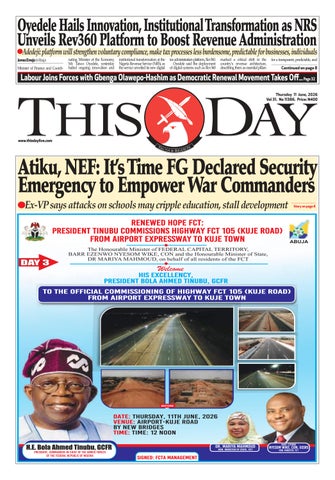
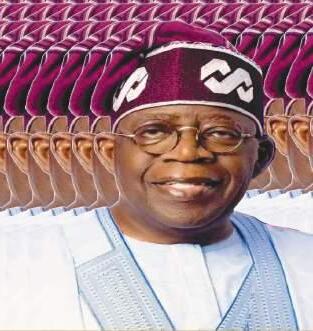
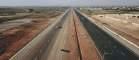
President Tinubu Commissions Highway FCT 105 (Kuje Road) from Airport Expressway to Kuje Town
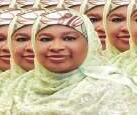
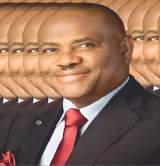
The Honourable Minister of FEDERAL CAPITAL TERRITORY, BARR EZENWO NYESOM WIKE, CON and the Honourable Minister of State, DR MARIYA MAHMOUD, on behalf of all residents of the FCT
W elcome His Excellency, President Bola Ahmed Tinubu, GCFR
To the Official Commissioning of Highway FCT 105 (Kuje Road) from Airport Expressway to Kuje Town
Date: THURSDAY, 11th June, 2026 Airport-Kuje Road Venue: by New Bridges Time: 12 noon Time:
James
ABUJA
COMMISSIONING OF THE ARTERIAL ROAD N5 FROM LIFE CAMP JUNCTION TO RING ROAD III...
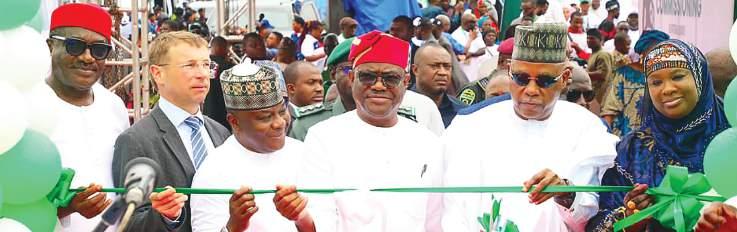
R-L Minister of State, FCT, Dr Mariya Mahmoud, Vice President Shettima, FCT Minister Barr Nyesom Wike, Chairman, House of Representatives committee on the FCT, Hon Muktar Aliyu Betara, Managing Director, Julius Berger, Engr Peer Lubasch and Senator Mao Ohuabunwa during the commissioning of the Arterial Road N5 from Life Camp Junction to Ring Road III, in Abuja on Wednesday
Senate Passes Receivables Financing Bill to Unlock
Sunday Aborisade in Abuja
The Senate yesterday passed the Factoring Assignment and Receivables Financing Bill, 2026, opening the door for Nigerian micro, small and medium enterprises to tap into a continental debt factoring market worth over $50 billion from which the country currently captures less than one per cent.
The upper chamber concurred with the House of Representatives on the proposed legislation, which establishes a legal and regulatory framework for debt factoring, a financing mechanism that allows businesses to convert unpaid invoices and credit sales into immediate working capital without resorting to conventional bank loans.
Leading the debate, Senate Leader Opeyemi Bamidele, said the legislation would create an enabling environment for alternative financing and strengthen liquidity for businesses nationwide.
“The Factoring Assignment and Receivable Financing Bill 2026 seeks to create a regulatory framework that would facilitate the development
of debt factoring as an alternative means of financing for domestic and international trade in Nigeria and provide an enabling environment for it to thrive,” Bamidele explained.
He added that the bill defines the framework governing factoring contracts between sellers and financiers, clearly setting out the rights and obligations of all parties involved.
The proposed legislation’s commercial significance was sharpened by the intervention of Senator Adetokunbo Abiru (Lagos East), Chairman of the Senate Committee on Banking, Insurance and Other Financial Institutions, who described the legislation as a critical lifeline for small businesses suffocating under liquidity constraints.
Abiru told the chamber that African factoring, driven significantly by the African Export-Import Bank (Afreximbank), had grown into a market exceeding $50 billion, yet Nigeria, Africa’s largest economy, remained a marginal player.
He said, “The size of that market today is in excess of $50 billion, and
Nigeria’s share is under one per cent.”
He noted that Egypt and Morocco had already reaped substantial gains from factoring frameworks similar to what the bill proposes.
“Passing this legislation will support our MSMEs in converting
credit sales into cash without resorting to conventional borrowing arrangements,” Abiru added.
In practical terms, the law would allow businesses holding unpaid invoices to sell those receivables to a factoring company in exchange
for immediate cash, easing the cash flow pressures that have long stunted growth among small enterprises.
The bill also modernises the legal architecture governing commercial transactions and is expected to enhance Nigeria’s competitiveness
in regional and global trade. Following unanimous support from lawmakers, the bill was subjected to clause-by-clause consideration in the Committee of the Whole before being passed and forwarded for presidential assent.
Tinubu Committed to Scalable Social Protection System with Measurable Results, Says Shettima
Ahmad Sorondinki in Kano
Vice President Kashim Shettima said President Bola Tinubu was committed to building a scalable social protection system that will deliver measurable results for vulnerable citizens across the country.
Shettima made the declaration on Wednesday in Kano at a policy dialogue organised by North-West Governors’ Forum, with support from European Union and United Nations Children’s Fund (UNICEF).
The forum had the theme,
Shettima Lauds ProFuturo Foundation, Kukah Centre Partnership on Digital Education For Vulnerable Communities
Deji Elumoye in Abuja
Vice President Kashim Shettima has hailed the partnership between the Kukah Centre and ProFuturo Foundation in support of quality digital education, especially in vulnerable communities across the country.
Shettima said the initiative for digital education aligned with the country’s quest for skills education through the National Council on Skills and the Renewed Hope Agenda of the administration of President Bola Tinubu.
He spoke on Wednesday, when he received a delegation from the Kukah Centre and ProFuturo Foundation, led by Bishop Matthew Kukah, on a courtesy visit, at State House, Abuja.
The vice president, who was earlier briefed on the successes recorded in the digital education initiative of ProFuturo Foundation in Nigeria, expressed fulfilment with the feat
attained in school enrolment as well as quality of training and teaching since the commencement of the partnership in 2017.
He stated that though a lot had been achieved over the past years, there were still more grounds to be covered, given Nigeria’s growing population.
Shettima proposed an interface between the implementing partners of the digital education initiative and critical stakeholders, such as National Board for Technical Education (NABTE), Industrial Training Fund (ITF), Federal Ministry of Education, and Universal Basic Education Commission (UBEC).
He said the interaction was to facilitate the cross-pollination of ideas that could help produce robust solutions to the issue of school enrolment in Nigeria.
The vice president also assured the delegation of his desire to introduce
the ProFuturo initiative to the National Economic Council (NEC) for the purpose of digitising the Universal Basic Education Boards across the country.
Earlier, Founder of the Kukah Centre and leader of the delegation, Kukah, said the delegation was at the Presidential Villa to show solidarity with the administration of President Bola Tinubu in the area of digital education.
He stated that Shettima’s commitment to the digital education initiative across the country was a demonstration of critical leadership necessary to proper Nigeria for the next phase of global development anchored on digital skills.
In his remarks, Deputy Director to the President of ProFuturo Foundation, Mr Albert Martinez, said implementation of the initiative in Nigeria was supported by a combination of strong local capability and commitment as well as dedicated political leadership.
“Setting the Political Agenda for Reducing Multidimensional Poverty Through Scaled Social Protection Systems and Innovative Financing.”
Shettima, represented by Deputy President of the Senate, Senator Jibrin Barau, said the government will work closely with states, traditional institutions, religious leaders, communities, and development partners to achieve the objective.
He stressed that hope must be properly organised, financed, delivered, and measured.
The vice president added that a credible and sustainable social protection framework required data-driven planning, adequate funding, and strong collaboration with all levels of government and community structures to ensure no one was left behind.
Shettima stated, “This dialogue
Onyebuchi Ezigbo in Abuja President of Nigeria Labour Congress (NLC), Comrade Joe Ajaero, has said organised labour would not relent in its resistance to injustice by employers and exposure of every violation of International Labour Organisation (ILO) convention by government.
Ajaero spoke at a ceremony in Oslo, Norway, yesterday, as recipient of the 2026 Arthur Svensson International Award. He said the award would serve as launch pad for more vigorous struggle for workers’ welfare in Nigeria.
He stated, “Let me sound it clearly and let it echo in every corner of
could not have come at a more consequential moment. Poverty is no longer defined only by the absence of income.
“It is the child who cannot read at 10, the mother who approaches childbirth with fear, the household unsure of tomorrow’s food, and the young mind outside the classroom while the world races towards artificial intelligence, biotechnology, advanced manufacturing, and a knowledge economy that will not wait for those who hesitate.”
Shettima added, “The measure of our leadership will not be the elegance of our speeches, but the number of children whose lives are changed by our decisions, the mothers who survive, the girls who remain in school, the families that no longer fall into ruin because a shock arrived, and the region
this hall and across the boardrooms in the world; the ruling class does not give you freedom.
“You take it; bloody-knuckled, with your lungs full of tear gas and your heart full of rage. At the back of our mind remains the cries and the pains of oppressed Nigerian workers. And we leave here with a promise; We will not rest; the Nigeria Labour Congress will not rest.
“We will deepen our organising among informal economy workers, platform economy workers, and the unemployed. We will resist every anti-labour law. We will expose every violation of ILO conventions. And we will win, because history is on our side.”
that converts its population from a burden of need into an army of talent, enterprise, and innovation.”
In her remarks, UNICEF representative in Nigeria, Wafaa Elfadil Saeed Abdelatef, said the focus must be implementation and scale.
Abdelatef stated, “Evidence from government data and previous speakers shows Nigeria is blessed with a vibrant private sector that is central to delivering results.
“The private sector is engaged beyond corporate social responsibility, investing in jobs and skills because young people are the future employers and customers.”
Abdelatef added that financing was critical. He said while government could not do it alone, domestic financing was key to closing the gap.
Speaking on his ordeal as a union leader, Ajaero said his journey since 2023 had been harrowing, adding that he has been “abducted, detained and brutalised by the government for insisting on the implementation of an agreement that protects the rights of workers”. He stated, “I stand before you today not as a man, but as a symbol, a true symbol of millions of Nigerian workers, who wake up every morning not just to the smell of tear gas, the sound of sirens, and the cold silence of a state that preys on its own people but who go to work hungry and come back hungrier more emasculated than before they left for work.
RENEWED HOPE AMBASSADORS RETREAT FOR NATIONAL MOBILIZATION...
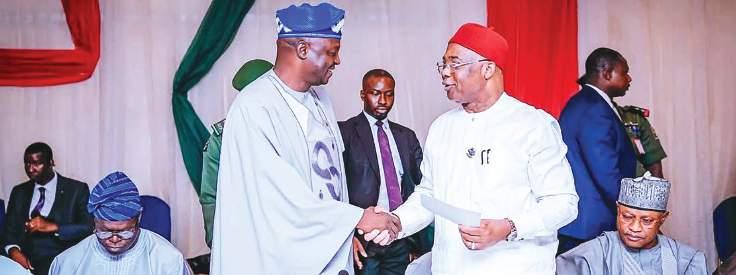
L-R: National Secretary of All Progressives Congress, Ajibola Basiru; National Chairman, Nentawe Yiltwada; Imo State Governor and Director General, Renewed Hope Ambassadors, Hope Uzodimma and Kaduna State Governor, Uba Sani at the Renewed Hope Ambassadors Retreat for National Mobilization in Abuja... yesterday
At Petroleum Ministry’s Retreat, Lokpobiri Says
Tinubu Raised Oil Output by 80%
Minister pushes for aggressive exploration, seeks reserves
Emmanuel Addeh in Abuja
The Minister of State for Petroleum Resources (Oil), Heineken Lokpobiri, yesterday said that Nigeria’s crude and condensate production has risen by about 80 per cent since President Bola Tinubu assumed office in May 2023, recalling that it was barely 1 million barrels per day three years ago.
Lokpobiri also charged officials of the ministry to develop a clear framework for expanding Nigeria’s hydrocarbon reserves through aggressive exploration and data-driven investment strategies.
Speaking at the ministry’s 2026 Ministerial Retreat in Abuja, themed: “Driving Institutional Performance
and Accountability in the Nigerian Petroleum Sector for Sustainable National Development,” Lokpobiri stated that oil and condensate production has now jumped to about 1.8 million bpd.
Admitting that the sector was not where it ought to be yet, far from the 2.5 million bpd production target, the oil minister explained that Nigeria has only explored a fraction of its oil and gas potential despite possessing vast hydrocarbon resources.
“When I was appointed, I was given the mandate to go and ensure we ramp up production. And at that time our production was barely about a million barrels. Today, we are doing approximately 1.8 mil-
expansion
lion bpd. That is over 80 per cent improvement… But I also want to tell you that we are not where we want to be,” he pointed out.
According to the minister, Nigeria currently holds about 37 billion barrels of crude oil reserves and over 209 trillion cubic feet of gas, figures he described as largely unchanged over the past two decades.
“What I am demanding from the permanent secretary and the directors is a clear framework on how we can explore all our basins and build on our reserves,” Lokpobiri said.
He lamented that successive administrations had failed to undertake comprehensive seismic studies aimed at discovering new
Says
oil and gas deposits, stressing that the Tinubu administration was committed to reversing the trend.
“For over 30 years, no government has been able to do proper seismic with a view to discovering more barrels of oil and more gas to add to our reserves. But this government is committed and willing to do that,” he said.
The minister said Nigeria was strategically positioned to benefit from evolving global energy dynamics and noted that the country’s oil and gas sector was witnessing renewed investor confidence following reforms introduced by the federal government.
He attributed the growing ‘influx’ of investments to policy
Fire Erupts in National Assembly, Prompt Response Averts Major Disaster
Blaze started in senate committee room shortly after NDDC board screening No casualties, documents or valuables lost Senators coordinate emergency response to contain spread
A fire outbreak on Wednesday disrupted activities in a section of the Senate wing of the National Assembly complex in Abuja, raising concerns over safety within the nation’s legislative headquarters before it was swiftly contained by emergency responders.
The incident occurred shortly after the Senate Committee on the Niger Delta Development Commission (NDDC) concluded the screening of Zainab Marwa as the North-East representative on the commission’s board.
The fire reportedly started in the kitchen area attached to Hearing Room 107, where the screening exercise had taken place.
Witnesses said smoke billowed from the area, prompting lawmakers, legislative staff and visitors in the vicinity to evacuate to safer locations as efforts were immediately initiated to contain the fire.
The quick response prevented the blaze from spreading to adjoining offices and other sections of the sprawling National Assembly complex.
No casualties were recorded in the incident, while officials confirmed that no sensitive documents, equipment or other valuable property were damaged.
Chairman of the Senate Committee on the NDDC, Senator Asuquo Ekpenyong, and Senator Salihu Mustapha, who represents Kwara Central Senatorial District, remained at the scene throughout the
Sources within the National Assembly said the blaze was believed to have been triggered by the explosion of a microwave oven that had been left unattended in the kitchen compartment of the committee room.
emergency response and coordinated efforts that helped bring the situation under control.
The fire was eventually extinguished, restoring calm to the area and averting what could have de-
Kuni Tyessi in Abuja
The Alternative Bank has stepped up its climate action drive by formally partnering the Federal Ministry of Environment on the commemoration of World Environment Day.
This was disclosed during the 2026 World Environment Day celebration in Abuja by the Ministry’s Director of Planning, Research and Statistics, Babagana Bukar.
The event also marked the
past administrations failed to undertake major seismic studies reforms and efforts to create a more attractive business environment for operators. “Recall that we are getting an unprecedented influx of investors into Nigeria after the reforms undertaken by this government,” he stated.
Lokpobiri also noted improvements in the country’s external reserves, which he said had risen above $50 billion for the first time in 17 years. “Our reserves are now over $50 billion, and that is the highest in 17 years. These gains are a result of the bold reforms and decisions taken by this administra- tion,” he stressed.
The minister observed that global conversations on energy were gradually shifting from energy transition to energy mix, creating fresh opportunities for oil and gas-producing nations such as Nigeria.
He urged civil servants in the ministry to strengthen institutional performance and accountability, describing the civil service as critical to achieving the government’s objective of unlocking energy and natural resources for sustainable development. “No society or country can succeed without a strong and vibrant civil service,” Lokpobiri said.
veloped into a more serious incident within the legislative complex.
The management of the nation’s apex legislative institution had yet to make an official statement on the matter at the time of filing this report.
Earlier, the Permanent Secretary of the Ministry of Petroleum Resources, Patience Oyekunle, said the retreat was designed to strengthen performance management, improve reporting capabilities and enhance
accountability across the ministry and its agencies.
“It is an opportunity to deepen our understanding of performance management requirements, strengthen our reporting capabilities, exchange ideas, review our progress, identify challenges, and collectively develop practical solutions that will enhance institutions effectively,” she stated.
Also speaking, the Director of Planning, Research and Statistics, Kemi Ahmed-Yusuf, said the ministry was working towards achieving key deliverables, including increasing crude oil production to 3 million bpd, boosting gas supply, improving petroleum product availability and strengthening local content development.
Although the Petroleum Industry Act (PIA) has laid the framework for the operation of the industry, Ahmed-Yusuf noted that citizens were still asking if this has translated to better performances, less wastages, and real development.
Besides, the Executive Secretary of the Petroleum Technology Training Fund (PTDF), Prof. Shehu Aliyu, represented by Waziri Laisu, Deputy General Manager, Special Programmes Unit, emphasised that governments are increasingly measured, not merely by policies formulated, but by quality of implementation, the efficiency of institutions and the tangible outcomes delivered to citizens.
Alternative Bank Deepens Investment in Climate Action
federal government’s official launch of the National Tree Planting Campaign, targeting 20 billion trees across Nigeria by 2030.
“The Alternative Bank is the first bank to partner with the Ministry on the commemoration of World Environment Day,” Bukar said.
“Whenever we think environment, they think environment. When we speak environment, they speak environment. We are aligned in our vision and objectives.”
Speaking at the event, Head of Business Enablement at The
Alternative Bank, Maryam Mohammed, outlined the bank’s expanding green finance portfolio, which currently supports more than 2,120 electric tricycles on Nigerian roads and includes the country’s first women-owned electric tricycle scheme.
According to her, the bank also offers dedicated products for solar home systems and other clean energy solutions, promotes recycling through its Waste Banc initiative, and is developing financial products to support
tree-planting and afforestation projects.
“Our role is to provide financial support and create financing opportunities for initiatives such as these. We also provide a platform for SMEs and businesses operating within the environmental and sustainability sectors,” Mohammed said.
Environment Minister Balarabe Abbas Lawal called the target achievable before raising the bar himself. “We can do much more,” he said.
Sunday Aborisade in Abuja
SANWO-OLU RECEIVES CONSULATE GENERAL, KINGDOM OF THE NETHERLANDS...
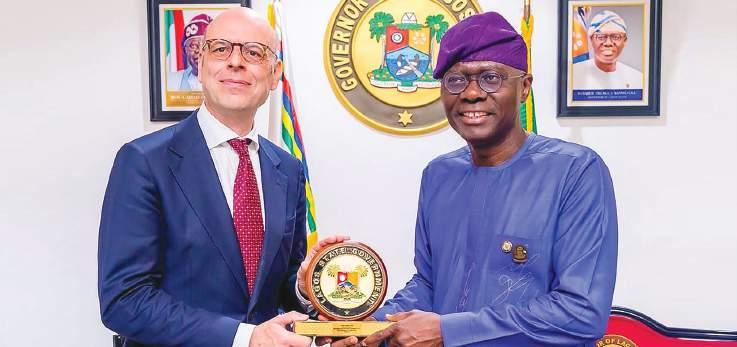
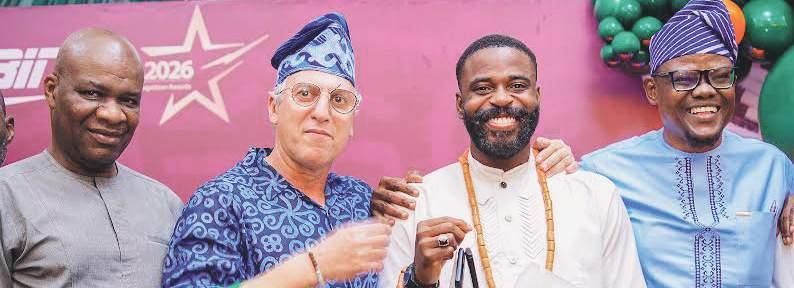
Consul General of the Netherlands in Lagos, Mr. Michel Deelen (left), receiving a Lagos State government plaque from the Governor, Mr. Babajide Sanwo-Olu, during a courtesy call at the Lagos House, Marina ... yesterday
The governor of Gombe State and secretary of the Renewed Hope Ambassadors (RHA), Alhaji Muhammadu Inuwa Yahaya has mounted a strong defence of President Bola Ahmed Tinubu’s economic reforms, declaring the administration’s bold policy decisions are already laying the foundation for national recovery despite prevailing economic challenges.
Governor Inuwa Yahaya spoke at the opening of the Renewed Hope Ambassadors’ Retreat in Abuja Wednesday, where political leaders, grassroots mobilizers, civic engagement advocates and party faithful gathered to strategise on deepening public engagement with the policies and programmes of the Tinubu administration ahead of the 2027 general elections.
The Renewed Hope Ambassadors (RHA) is a nationwide civic engagement movement dedicated to bridging the gap between government reforms and citizen understanding across Nigeria.
Addressing participants at the retreat, Governor Inuwa Yahaya described President Tinubu as a courageous and visionary leader
who chose to confront Nigeria’s long-standing structural and economic problems instead of postponing difficult decisions for political convenience.
“Mr. President has undertaken bold reforms that many leaders before him avoided. These reforms have been difficult, requiring great sacrifice. But they are already bearing fruits in the form of a more disciplined fiscal environment, renewed investor confidence and the steady rebuilding of our national institutions.”
He maintained that although the reforms may come with short-term pains, they remain necessary steps towards rescuing Nigeria from years of economic distortions, unsustainable spending patterns and systemic inefficiencies that hindered national growth and development.
The governor also warned against deliberate and coordinated campaign of misinformation aimed at discrediting the administration and undermining public confidence in the achievements recorded under President Tinubu.
“We must never allow the opposition to define the narrative.
Our job is to meet falsehood with facts, despair with data and
cynicism with the undeniable evidence of progress.”
Governor Inuwa Yahaya urged the RHA members to intensify grassroots engagement and aggressively communicate the achievements and long-term objectives of the Tinubu administration across communities nationwide.
According to him, many Nigerians are yet to fully appreciate the strategic vision behind the ongoing reforms and the long-term benefits they are designed to deliver for future generations.
He stressed that the Renewed
Hope Ambassadors would play a pivotal role in shaping public engagement ahead of the 2027 general elections, describing mobilization as critical to sustaining the administration’s political momentum and consolidating support nationwide.
“Nigeria is in a race against time as the 2027 general election is fast approaching. Mobilization is the engine that will power our Renewed Hope Agenda to victory and beyond.”
The Gombe governor explained the retreat was conceived as a
strategic platform for data-driven political planning, voter engagement and practical mobilization rather than a routine political gathering dominated by speeches and slogans.
Governor Inuwa Yahaya described the RHA as a strategic political force that would serve as the “engine room” of the Renewed Hope movement as preparations intensify ahead of the 2027 elections.
Declaring the retreat open, the National Chairman of the All Progressives Congress (APC), Professor Nentawe Yilwatda, charged the Renewed Hope Ambassadors to
remain focused, disciplined and constructive in their engagements with Nigerians, stressing the movement represents a strategic national mission to communicate the successes of the Tinubu administration and reconnect citizens with the objectives of governance.
Professor Yilwatda said the Renewed Hope Ambassadors must take responsibility for presenting government policies, reforms and achievements truthfully, clearly and in language that ordinary Nigerians can easily understand and relate with.
Experts Seek New Financing Architecture to Unlock Private Investment in Africa’s Water, Sanitation Sector
Michael Olugbode in Abuja
Development experts and stakeholders in the Water, Sanitation and Hygiene (WASH) sector have called for a fundamental overhaul of the financing architecture underpinning water and sanitation services across Africa, arguing the continent’s persistent infrastructure deficit is not primarily a funding problem but
an institutional failure that continues to discourage private investment. This position is contained in a concept note proposing the establishment of a Private Sector Engagement Platform (PSEP) under the WASH Finance Foundation, designed to bridge the gap between governments, investors and technical partners in the delivery of water and sanitation infrastructure.
Commercialise Research, Barau Charges Universities, Donates Bus to North West Varsity
Says institutions must turn innovations into revenue streams Insists human capital, not natural resources, drives modern development
Sunday Aborisade in Abuja
Deputy President of the Senate, Senator Jibrin Barau, on Wednesday challenged Nigerian universities and other tertiary institutions to commercialise research findings and innovations as a strategy for boosting internally generated revenue and reducing dependence on government funding. Barau said higher institutions in the country must emulate leading global
universities that converted research outcomes into commercially viable products and services, thereby creating wealth, supporting innovation, and contributing significantly to national development.
He spoke in Abuja while receiving the management of North West University, Kano, led by its ViceChancellor, Professor Amina Bayero.
According to a statement issued by his Special Adviser on Media and
Publicity, Ismail Mudashir, Barau urged university administrators to place greater emphasis on research, innovation, and industry partnerships capable of generating sustainable income for their institutions.
He said, “Do not leave innovations in laboratories or bookshelves. Patent them and create value from them.
“Top global institutions, like Harvard, MIT, and Cornell, leverage research, collaborate with industries,
and generate revenue through innovation.
“I encourage you to adopt this model.”
The deputy senate president, who chaired Senate Committee on Tertiary Institutions and TETFund during the Eighth Senate, stressed that the development and sustainability of universities required collective support from stakeholders beyond government.
According to the document, despite significant advances in technology, engineering and global development financing, more than 600 million Africans still lack access to reliable and safe water, while nearly twice that number are without basic sanitation services.
The note argues that the challenge is not caused by a lack of capital or technical expertise, but by the absence of the institutional structures required to channel existing resources into sustainable infrastructure projects.
“The gap is not a funding problem. It is an architecture problem,” the document stated, stressing that while capital, technology and political commitment exist, they remain disconnected by weak regulatory frameworks, inadequate investment structures and the absence of commercially viable market conditions.
The authors noted that achieving Sustainable Development Goal 6, which seeks universal access to safe water and sanitation by 2030, requires an estimated $114 billion in annual investment globally—far beyond what can be financed through official development assistance alone.
They argued that attracting private investment has become unavoidable if African countries are to meet growing demand for water and sanitation services. Nigeria, according to the concept note, presents one of the continent’s largest untapped opportunities, with its sanitation economy projected to reach $26 billion by 2030. Yet much of this potential remains unrealised because investors face significant barriers ranging from regulatory uncertainty to weak revenue frameworks and limited access to risk mitigation instruments. The proposed Private Sector Engagement Platform is envisioned as a neutral institution that would help create bankable projects, standardise investment frameworks and facilitate collaboration among governments, financiers and private operators. The document draws lessons from sectors such as telecommunications, energy, healthcare and affordable housing, which successfully attracted billions of dollars in private capital after governments established clear regulatory environments and commercially viable investment frameworks.
Dangote Adds $6.5bn to
$36.5bn in Bloomberg Billionaires
Foundation distributes rice to ogun host communities
Emmanuel Addeh in Abuja and Sunday Ehigiator in Lagos
Africa’s richest man, Aliko Dangote, has added about $6.5 billion to his personal fortune since the beginning of 2026, pushing his net worth to approximately $36.5 billion and reinforcing his position as the continent’s wealthiest individual.
According to data from the Bloomberg Billionaires Index, Dangote’s wealth has risen by about 22 per cent this year, driven largely by the growing value of his industrial assets, particularly the sprawling Dangote Petroleum Refinery as well as strong performance from his cement business.
The latest ranking placed the Nigerian billionaire at number 61
among the world’s richest people, with Bloomberg estimating his fortune at $36.5 billion as of June 10, 2026, up by about $6.53 billion year-to-date. The remarkable increase comes as the billionaire industrialist continues to reap the benefits of years of investment in manufacturing, cement production, fertiliser and refining.
Bloomberg identified the Dangote Refinery, Africa’s largest petroleum refinery, as the single biggest contributor to his wealth. The 650,000 barrelsper-day facility, which commenced operations in early 2024 after more than a decade of planning and construction, is currently valued by Bloomberg at roughly $20 billion based on its construction cost.
Dangote owns a 92.3 per cent stake in the refinery, making it the largest component of his net worth, the report said.Bloomberg’s assessment suggested that the refinery’s valuation remains conservative because it is based on investment cost rather than potential market value.
The refinery has rapidly emerged as one of the most strategic industrial assets on the continent, helping to reduce Nigeria’s dependence on imported petroleum products while expanding exports of refined products to international markets.
According to the report, in addition to the refinery, Dangote’s fortune is supported by his controlling interests in several listed companies, including
Dangote Cement, Dangote Sugar Refinery and NASCON Allied Industries. Bloomberg estimates that Dangote owns approximately 86 per cent of Dangote Cement, Nigeria’s largest cement producer and one of Africa’s biggest manufacturing companies. The group also maintains interests in fertiliser production, food manufacturing, agriculture and packaging.
The billionaire’s fertiliser business, which has the capacity to produce up to 2.8 million tonnes of urea annually, also contributes significantly to his wealth. Bloomberg noted that the asset is valued using a net present value methodology based on assumed utilisation rates.
“Africa’s richest person controls
Dangote Industries, a closely held conglomerate. The Lagos, Nigeria-based company owns sub-Saharan Africa’s biggest cement producer, Dangote Cement, and the continent’s largest oil refinery. It also has interests in sugar, salt, oil, fertiliser and packaged food,” the Bloomberg index added.
The latest surge in Dangote’s wealth underscores the growing influence of industrial manufacturing and value addition in Africa’s largest economy. Analysts have pointed to the refinery’s commencement of operations as a major turning point in the valuation of Dangote’s business empire.
Born in Kano in 1957, Dangote built his fortune from a modest trading business established with a loan from
Atiku, NEF: It’s Time FG Declared
Worth
his uncle after graduating from Egypt’s Al-Azhar University. Over the decades, he transformed the enterprise into the Dangote Group, one of Africa’s largest industrial conglomerates. Today, the group’s publicly traded
Security Emergency to Empower War Commanders
Ex-VP says attacks on schools may cripple education, stall development
Situation poses serious threat to nation’s stability, economic wellbeing, group maintains Falana, Falz, CSOs declare nationwide June 12 protest over insecurity, hardship Elder statesman, Umar Ajiya, expresses concern
Chuks Okocha in Abuja and Wale Igbintade in Lagos
Presidential candidate of African Democratic Congress (ADC), Atiku Abubakar, has told the federal government to declare emergency in security to empower commanders with more freedom to act decisively and proactively against terrorists and other criminal elements.
Atiku decried the worsening insecurity in Nigeria, and expressed concern that terrorists and bandits’ attacks were now targeted not only at wasting precious human lives, but also crippling the country’s education.
Northern Elders Forum (NEF) also called on President Bola Tinubu to declare a national security emergency, warning that escalating violence, kidnappings, and bandit attacks across the country pose a serious threat to Nigeria’s stability and economic wellbeing.
The calls came as a coalition of civil society organisations, labour activists, youth groups, community associations, and concerned citizens declared June 12, Nigeria’s Democracy Day, a day of nationwide protest and mass action against worsening insecurity, widespread hunger, and deepening economic hardship across theAtcountry. the same time, an elder statesman, Umar Ajiya, raised concerns over Nigeria’s worsening security situation. Ajiya warned that the country’s persistent insecurity could escalate into a national crisis if citizens failed to actively support government’s efforts to tackle the menace.
Atiku raised the concern yesterday following the latest attack on Government Secondary School, Iluke Bunu, Kabba-Bunu Local Government Area of Kogi State, in which three persons, including the vice principal of the school, were killed while several students were abducted.
About 90 schoolchildren were on May 15 abducted in Oriire, Oyo State, and Mussa, Borno State, while the principal in the Oriire school beheaded.
Atiku said he was worried that there was a pattern in the attacks aimed at crippling the education sector and consequently stalling development strides.
The former vice president called for the declaration of emergency on security in Nigeria, stating that the state of emergency on security does not include the suspension of elected officials of states.
According to the Waziri Adamawa, the latest attack on a school in Kogi State was a direct threat to education and a colossal national embarrassment that demanded urgent and drastic action.
“It is high time the federal government declared a statement of emergency to empower commanders with more freedom to act decisively and proactively with these monsters in the county,” Atiku said.
He added, “I am not in any way calling for the removal of elected officials, but rather advocating for commanders to have freer hand to protect their battlefield decisions from political interference.”
He explained, “Nigeria is facing worsening insecurity that demands extraordinary measures, including state of emergency.
“Learning can only take place in a safe environment and terrorist attacks on schools are increasingly making our schools dangerous places.
“Worse still, the anxiety and trauma that follow terrorist attacks on schools will inevitably make the school environment unsafe for both students and teachers.”
Atiku said, “Under no circumstances should we allow terrorists or bandits to destroy our way of life and stop our children from going to school.”
According to him, “A terrorist attack on one school is a threat to schools elsewhere across the country because of its domino-effect.”
As part of the drastic measures to address the security challenges, Atiku advocated the establishment of national guards made up of retired veterans to complement the efforts of the military and police, which he said were overstretched and
under-manned.
He also called for improved human intelligence on terrorist movements and greater community vigilance, explaining, “Our communities have a great role to play in information sharing and eternal vigilance.”
NEF Urges Tinubu to Declare National Security Emergency over Rising Insecurity
Northern Elders Forum (NEF) called on President Bola Tinubu to declare a national security emergency. NEF warned that escalating violence, kidnappings, and bandit attacks across the country posed a serious threat to Nigeria’s stability and economic wellbeing.
In a statement, yesterday, the forum’s spokesperson, Abubakar Jiddere, described the current security situation as unprecedented, saying criminal activities have continued to spread across several parts of the country, leaving millions of Nigerians vulnerable.
The forum expressed concern over what it termed the government’s inability to adequately safeguard life and property. It said communities in states, including Zamfara, Katsina, Kaduna, Niger, Plateau, Benue, Kogi, Kwara, Borno, Oyo, Edo, Enugu and Imo, remained under threat from bandits, kidnappers and other armed groups.
business-friendly tax environment.
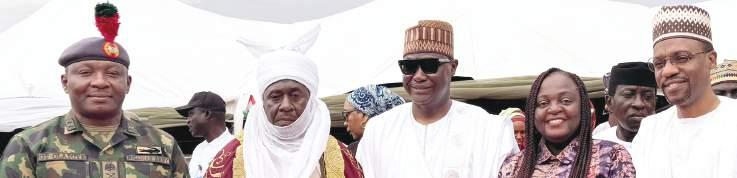
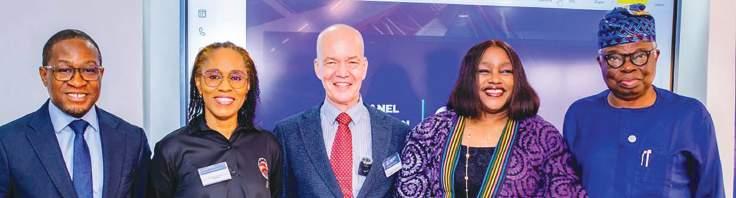
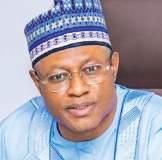
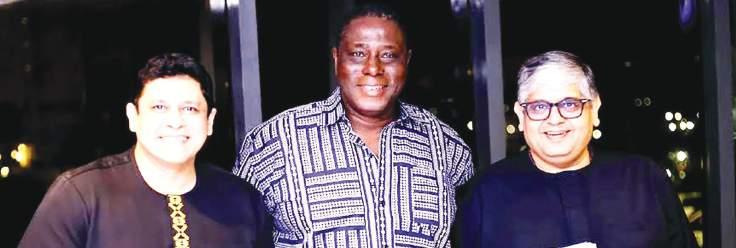
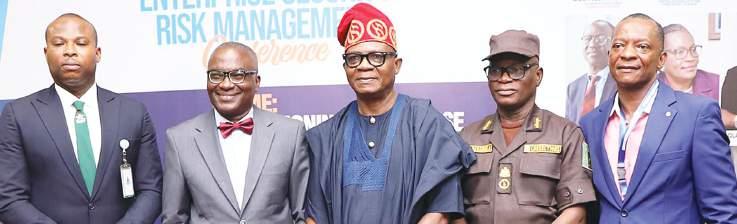
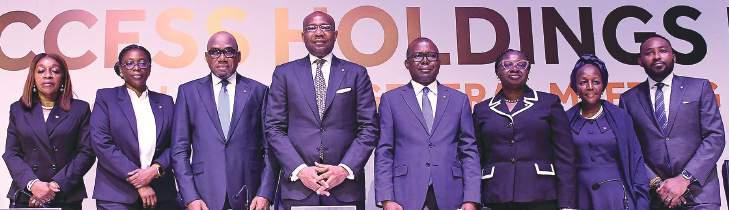
Executive Chairman, NRS, Dr. Zacch Adedeji, described Rev360 as a transformational leap that signalled a fundamental redefinition of the agency’s identity and operating model.
Adedeji said the platform was expected to strengthen revenue administration by bolstering voluntary compliance and making tax processes less burdensome, and more predictable for businesses and individuals.
Speaking at the launch, Oyedele
According to NEF, kidnapping- for-ransom has evolved into a sophisticated criminal enterprise driven by weak law enforcement, porous borders, illegal arms proliferation, and inadequate intelligence coordination among security agencies.
The group warned that the security crisis was having far-reaching economic and social consequences, including declining agricultural output, displacement of farming communities, disruption of education, weakening rural economies, and rising poverty levels.
Citing Section 14(2)(b) of the 1999 Constitution, which states that the security and welfare of the people shall be the primary purpose of government, the forum questioned why many citizens were increasingly being forced to defend themselves against criminal elements.
The group also expressed concern over reports of inadequate security presence in vulnerable communities, delayed responses to distress calls, and limited prosecution of suspected perpetrators of violent crimes.
NEF called on the federal government to investigate illegal mining activities and other forms of illicit resource exploitation, allegedly, linked to insecurity in some parts of the country. It said criminal networks often flourished where governance and oversight were weak.
As part of its recommendations,
stated that technology-driven tax administration had become central to modern economies.
He stressed that Rev360 would enhance the ease of doing business, improve investor confidence, and support the federal government’s broader economic reform agenda.
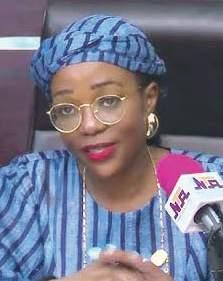
Represented by Permanent Secretary, Federal Ministry of Finance, Mr. Mohammed Danjuma, Oyedele stated that the transformation aligned with efforts to build a more efficient and accountable revenue ecosystem capable of
the forum urged the government to strengthen intelligence-sharing among security agencies, intensify operations against kidnapping and banditry networks, prosecute sponsors and financiers of violent groups, conduct comprehensive audits of illegal mining activities, improve protection for farming communities and schools, and ensure greater accountability in the management of security funds.
Describing the security challenge as a national emergency rather than a regional problem, the forum warned that continued violence could undermine public confidence in government institutions and hinder economic development.
“The time for assurances has passed. The time for measurable action is now,” the statement said.
Falana, Falz, CSOs Declare
Nationwide June 12 Protest Over Insecurity, Hardship
A coalition of civil society organisations, labour activists, youth groups, community associations and concerned Nigerians declared June 12, Nigeria’s Democracy Day, a day of nationwide protest and mass action against worsening insecurity, widespread hunger, and deepening economic hardship across the country.
The coalition included prominent human rights activist, Femi Falana
sustaining long-term national development.
In his remarks, Adedeji said NRS was no longer a mere accounting or compliance-focused institution, but had increasingly become a technology-driven organisation designed to anticipate, integrate, and respond to the needs of a modern economy.
He stated, “It is not for us to merely imagine the future—we are building it.”
He explained that Rev360 represented a deliberate move to
(SAN); his son, a musician and activist, Folarin Falana (Falz); Committee for the Defence of Human Rights (CDHR); Joint Action Front (JAF); Youth Rights Campaign (YRC), and several other groups.
They accused the federal government of failing to address the security and economic challenges confronting millions of Nigerians.
In a statement, yesterday, the coalition said there was little for ordinary Nigerians to celebrate on Democracy Day, as many citizens continued to grapple with insecurity, poverty, inflation, and declining living standards.
According to the groups, communities across the country remain under constant threat from terrorists, bandits, kidnappers, and other criminal elements, who continued to operate with impunity, despite repeated assurances from government authorities that insecurity was being tackled.
The coalition expressed solidarity with families, who had lost loved ones to terrorism, banditry, and kidnapping. It called for immediate government action to secure the release of Nigerians currently being held captive by criminal groups in various parts of the country.
The statement mentioned victims of abductions in Oyo, Borno, Katsina, Kwara, Ekiti, Zamfara, Kaduna, and
unify fragmented tax processes into a single integrated ecosystem covering registration, filing, payment, compliance management, reporting, and taxpayer support.
Adedeji said the platform would improve transparency, strengthen compliance management, enhance service delivery, and reduce inefficiencies that had historically characterised tax administration. According to him, the platform has become a key pillar
Alhaji Aliko Dangote
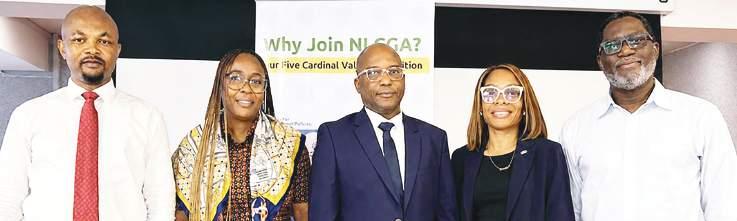
SWEARING IN CEREMONY OF THE NEW EXECUTIVE BOARD MEMBERS FOR NLCGA...
L-R: 2nd Vice President, Mr. Mark Imoisili; 1st Vice President, Mrs. Joy Shaiyen; President, Mr. Ladi Falola; Treasurer, Mrs. Isioma Martins and Deputy President, Mr. Femi Fanoiki during the swearing in ceremony of the new Executive Board members for the Nigeria Liquefied and Compressed Gases Association (NLCGA) at the 16th AGM of the Association in Lagos...recently
Tinubu: Nation’s Capital’ll Reflect Nigeria’s Growing Population, Economic Aspirations and National Identity
Pledges to sustain infrastructure delivery across FCT, inaugurates Abuja arterial road N5
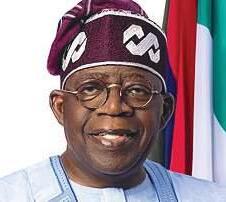
President Bola Tinubu on Wednesday assured that the Federal Capital Territory (FCT) will evolve into a capital city that reflect the country’s growing population, economic aspirations, and national identity.
Tinubu reiterated his administration’s commitment to infrastructure-led development, stating that improved transport connectivity in Abuja is expected to reduce logistics costs, encourage investment and support job creation.
The president made the assertion in Abuja when he inaugurated the full-scope development of Arterial Road N5, Obafemi Awolowo Way, connecting Life Camp Junction to Ring Road III in Dape District, Abuja.
The president, who was represented by Vice President Kashim Shettima, described infrastructure as a measure of national seriousness and state capacity.
According to Tinubu, government would continue to invest in strategic projects that improve connectivity, support economic activity and restore public confidence in governance.
He stated, “Infrastructure is the measure by which every civilised nation announces its seriousness.
“No capital can carry the weight of national ambition if its arteries are blocked by neglect, excuses and abandoned promises.”
The president assured that his administration remained determined to transform Abuja into a capital city capable of matching the ambitions of the federation and serving as a model of planned urban development.
He stated, “We will never rest until we have made the Federal Capital
Territory not only a functional seat of government, but a capital worthy of our federation, our growing population and the dreams that brought Abuja into being.”
Tinubu said the road infrastructure inherited by his administration required sustained intervention, pointing out that the government has maintained continuity in construction and rehabilitation efforts without interruption.
He said, “There has been no break, no pause and no retreat in the construction and rehabilitation of the roads we inherited. That is
FOH-10NG to Hold 40th Anniversary Lecture on Substance Abuse, Addiction
Sunday Ehigiator
The Fountain of Hope Society 10NG (FOH 10NG) has announced plans to host its 40th Anniversary Lecture focused on tackling the growing challenge of substance abuse and addiction in Nigeria, particularly among young people.
The lecture, themed ‘Overcoming the Scourge of Substance Abuse and Addiction: The Role of the Church in Prevention and Rehabilitation’, is scheduled to hold on Thursday, June 11, 2026, at the Archbishop Vining Memorial Church Cathedral, Oba Akinjobi Road, GRA, Ikeja, Lagos, beginning at 9:00 a.m.
According to the organisers, the event will bring together mental
health professionals, addiction experts, church leaders, law enforcement agencies, youth organisations and other stakeholders to deliberate on practical strategies for prevention, rehabilitation and recovery.Speaking ahead of the event, President of FOH-10NG, Tunde Alabi, said the theme was chosen as part of the society’s commitment to addressing pressing societal issues.
“As FOH 10NG marks its 40th anniversary this year, we consider it not only a Christian duty, but also part of our responsibility to contribute meaningfully to emerging and contemporary issues, to address the raging scourge of substance abuse and addiction
which cuts across all facets of society.
“It is particularly a concern to us to stem the tide of this rampaging scourge by sensitising the youth to its dangers and consequences and, therefore, the necessity of avoidance, while also addressing solutions for those already ensnared by the problem.
“The lecture shall address, among others, the roles of the Church, medical practitioners, law enforcement agencies and youth bodies, not just in sensitisation, but in providing practical solutions to overcome the scourge.”
The anniversary lecture will feature presentations from leading professionals in mental health,
Tompolo Calls for Calm Amid Warri Delineation Protests
Sylvester Idowu in Warri
Chairman of Tantita Security Services Nigeria Limited (TSSNL), High Chief Government Oweizide Ekpemupolo, popularly known as Tompolo, has appealed for peace and restraint following the ongoing protests by women and youths occupying oil and gas facilities in parts of Delta State.
Tompolo, who is the IbeEbidouwei of Ijaw nation, in a statement issued personally last
Tuesday night, urged all parties involved in the dispute to embrace dialogue and avoid any form of violence.
The protests, which began on June 8, saw women and youths from several communities occupy oil and gas installations in the Escravos and Warri River areas over issues relating to the ward delineation exercise in Warri Federal Constituency.
Tompolo said many Nigerians had expressed concern about the
situation and called for a peaceful resolution, adding that he shared the same position.
According to him, the Ijaw people have always been known for their peaceful nature and should not allow the current situation to degenerate into violence.
He noted that the dispute arose from concerns over the Independent National Electoral Commission’s (INEC) handling of the ward delineation process in Warri Federal Constituency.
addiction management and drug control.
Among the speakers is Dr. Jumoke Koyejo, Consultant Addiction Psychiatrist at the Federal Neuropsychiatric Hospital, Yaba, Lagos, who will deliver a presentation titled “Substance Use: The Killer Habit.”
Also scheduled to speak is Professor Olurotimi Coker of the Mental Health Unit, Babcock University, Ilishan-Remo, Ogun State, who will address the conference theme.
why we have ended the tradition of abandoned projects and restored faith in the power of government to finish what it starts.”
Speaking on the Dape District section of Arterial Road N5, the president said the project was conceived, funded, and completed under the current administration following its award to Julius Berger with a 15-month execution timeline after its flag-off in October 2024.
He said the completion of the project demonstrated a deliberate departure from a culture in which public infrastructure became trapped in prolonged delays and repeated budget cycles.
“In the past, projects like this became permanent budget items with ten or fifteen years of excuses. Under this administration, that era is over,” he stated.
Tinubu commended Minister of the Federal Capital Territory, Nyesom Wike, for driving infrastructure execution across the capital city and praised the contractor for delivering according to expectation.
“The minister has shown what happens when political will meets accountability. We fund projects to see results, not to hear explanations for failure,” Tinubu said.
He described the newly completed road as more than a transport corridor, stating that it serves as an economic asset capable of improving mobility
and reducing productivity losses associated with congestion.
He said for years, Life Camp Junction represented a major traffic bottleneck that imposed significant time and economic costs on residents and businesses.
“With the completion of this N5 corridor, we are delivering the seamless district connectivity envisioned in the Abuja Master Plan,” he stated.
According to him, the corridor now creates faster connections across Dape, Karmo, Gwarinpa I, Kado, Idu and Mbora while also improving access to the Idu Industrial District.
Tinubu stressed that infrastructure sustainability required shared responsibility between government and citizens.
Calling on residents and businesses benefiting from the development, he urged greater compliance with tax obligations and land-related payments to strengthen the capacity of the FCT administration to deliver more projects. The president also appealed to traditional rulers, community leaders, and residents to protect public infrastructure and prevent vandalism.
Earlier, Minister of FCT, Nyesom Wike, applauded Tinubu’s support for efforts to improve the state of infrastructure in FCT, particularly in the satellite towns, and taking governance closer to the people of the territory, urging more support for the administration.
NPA Director, Expresses Concern Over Withdrawal of Armoured Vehicles in Osun by Adeleke’s Govt for Over 1 Year
The Executive Director, Marine and Operations at Nigerian Port Authority (NPA), Engr. Olalekan Badmus has decried the withdrawal of armoured vehicles from strategic flash points in Osun State by Governor Ademola Adeleke for over one year.
Speaking in Osogbo, the Director noted that despite rising security challenges in Osun State, the vehicles have remained out of service while the government failed to give tangible excuse for keeping them out of circulation. Badmus remarked that continuous hoarding of the services of
armoured vehicles for operatives may impede the operations to tackle any aggression by bandits, kidnappers and marauders especially at a time when the border states are experiencing security issues.
He however commended the All Progressives Congress (APC) led council executives for providing patrol vans for security agencies, noting it will strengthen safety of lives and property at the grassroots. According to him “You know what is happening in Oyo State, our boundary, the step taken by the APC-led council executives at the local level. You see that our party is concerned to ensure that security agencies respond promptly
in case, we are actually prepared for it.”
He urged: “I am using this opportunity to beg the state government, the armored vehicles that had been in existence, which were put in strategic locations in the state for safety by the APC government in the past, should be provided back, government should not hoard these vehicles at the critical time.
He remarked that, “The armoured vehicles were taken away by the incumbent government without explanation claiming they are refurbishing it. This is over 1 and half years that they have been withdrawn from circulation…”
Yinka Kolawole in Osogbo
Deji Elumoye in Abuja
Email: deji.elumoye@thisdaylive.com
08033025611 sms only
As Tinubu Reshapes Nigeria’s Trajectory through Targeted Reforms...
President Bola Tinubu’s administration is, three years on, quietly but steadily reshaping Nigeria’s trajectory through targeted reforms aimed at strengthening security, revitalising production and restoring national confidence, writes l inus Aleke
Three years into the administration of President Bola Tinubu, public assessments of his stewardship continue to generate intense debate. Such scrutiny is both inevitable and healthy in a democracy as diverse and complex as Nigeria. However, beyond partisan rhetoric and the daily torrent of political criticism, a broader examination of developments across key sectors reveals a record of notable progress. From security and crude oil production to agriculture and education, the administration has embarked on reforms that are gradually altering the landscape of governance and national development.
When President Tinubu assumed office in May 2023, he inherited a daunting security environment. The country was grappling with terrorism in the North-East, banditry in the North-West, separatist violence in parts of the South-East, widespread kidnapping and criminality across several regions, as well as large-scale crude oil theft in the Niger Delta.
Faced with these multifaceted threats, the administration moved to strengthen the nation’s security architecture, recognising that sustainable economic growth and national prosperity cannot thrive in an atmosphere of insecurity. Enhanced intelligence gathering, increased funding for military operations, improved inter-agency collaboration and the acquisition of modern security assets became central pillars of the government’s response.
The outcome of these efforts, according to military authorities, have been visible across various theatres of operation. Speaking on the achievements recorded by the Armed Forces of Nigeria, Director of Defence Media Operations, Major General Michael Onoja, stated: “The operational outcomes recorded across all theatres of operation during the period constitute an irrefutable and resounding testament to the strategic clarity, combat effectiveness, and institutional resolve of the Armed Forces of Nigeria. From the sustained neutralisation of Boko Haram/ISWAP formations in the North East and the interdiction of bandit networks across the North West, to the rescue of over a hundred kidnapped civilians across the North Central, the dismantling of illegal arms manufacturing networks, the seizure of sophisticated oil-theft convoys in the South South, and the systematic degradation of separatist criminal elements in the South East, the AFN has demonstrated a comprehensive and growing operational capability that decisively engages the full spectrum of threats confronting the country. Overall, 317 terrorists/criminals were neutralised, 314 suspects were arrested, 221 civilians were rescued, 18 terrorists surrendered, 93 arms were recovered, three illegal refining sites were destroyed while 21,910 litres of assorted petroleum products were recovered.”
Beyond these specific operational outcomes, figures released by the Defence Headquarters indicate that thousands of terrorists and criminal elements have been neutralised, arrested or compelled to surrender during sustained military offensives. Security agencies have also rescued thousands of kidnapped victims and dismantled numerous criminal networks across the country. Although serious security challenges remain, the armed forces have maintained relentless pressure on groups that once operated with alarming impunity and controlled extensive territories.
The impact of these efforts can also be seen in Nigeria’s position on global security indices. According to the Global Terrorism Index, Nigeria’s ranking improved considerably between 2020 and 2024. While the country moved from eighth position in 2024 to sixth in 2025, it remains in a significantly better position than during the period when it ranked among the three or four countries most affected by terrorism worldwide. This suggests that despite periodic setbacks, the overall trajectory has been more positive than is often portrayed.
Nowhere is the nexus between security and economic development more apparent than
in the oil and gas sector. For years, crude oil theft, pipeline vandalism and sabotage deprived the country of billions of dollars in revenue while undermining investor confidence. Sophisticated criminal networks and local collaborators orchestrated the large-scale theft of crude oil, creating one of the most damaging economic leakages in Nigeria’s history.
Against this backdrop, the administration intensified efforts to protect critical oil infrastructure. Through coordinated action involving security agencies, private surveillance contractors and local stakeholders, illegal bunkering activities have been significantly curtailed in key production areas. The result has been a steady recovery in crude oil output.
Providing insight into this development, the General Officer Commanding 6 Division, Nigerian Army, and Land Component Commander of the Joint Task Force, South South, Operation Delta Safe, Major General Emmanuel Emekah, disclosed that the improved security situation had enabled crude oil production to rebound to approximately 2.2 million barrels per day.
Speaking during a Defence Correspondents’ visit to the Area of Responsibility of Operation Delta Safe, Major General Emekah reaffirmed the military’s commitment to supporting the Federal Government’s target of achieving daily crude oil production of three million barrels by 2027.
He noted that the security situation in the Niger Delta had improved substantially, allowing residents of riverine communities to resume fishing and
other legitimate economic activities without fear.
“The Niger Delta remains the backbone of Nigeria’s economy, and the performance of the oil and gas sector is a critical indicator of our operational effectiveness,” he said.
According to him, since assuming command on 24 January 2025, Operation Delta Safe had not recorded any incident of violent pipeline vandalism within its area of responsibility.
Major General Emekah stated: “Before this period, crude oil production hovered between 1.4 million and 1.5 million barrels per day. However, following a presidential directive to boost output, production rose steadily to about 2.2 million barrels per day by December 2025. We are working assiduously to sustain and further improve on this figure.”
He further disclosed that from January, 2025 to date, no oil company operating within the area had reported any pipeline breach resulting from vandalism.
Available data from the Organisation of the Petroleum Exporting Countries (OPEC) and the Nigerian Upstream Petroleum Regulatory Commission reinforce this narrative, showing that Nigeria’s oil output has improved compared with previous years, when production frequently fell below expectations because of theft and operational disruptions. Increased production has strengthened government revenues, enhanced foreign exchange earnings and reinforced Nigeria’s standing in the global energy market.
The improvement in security has also helped restore investor confidence. Major investment commitments worth billions of dollars have been announced for offshore and deep-water projects, underscoring growing faith in the government’s efforts to provide a stable, secure and investment-friendly operating environment.
As nigeria continues its journey towards stability, prosperity and national renewal, the achievements recorded by Tinubu administration over the past three years suggest that the country may indeed be moving steadily towards a more secure, productive and hopeful future.
Commenting on these developments, Minister of Marine and Blue Economy, Adegboyega Oyetola, observed that the significance of such investments extends well beyond the oil and gas sector.
According to him, these investments are not only vital for expanding oil and gas production but are equally important for strengthening the broader blue economy through port development, maritime services, local content participation and job creation. He added that growing investor interest reflects improved regulatory clarity and the government’s sustained efforts to create a secure, efficient and investment-friendly maritime environment. Beyond the energy sector, the administration has sought to reposition agriculture as a critical driver of economic growth, food security and rural development. Given the sector’s strategic importance to national prosperity, agriculture has remained a key component of the government’s broader economic vision.
As the largest employer of labour in Nigeria, the sector plays a crucial role in livelihoods and economic stability. Through targeted interventions, support programmes and expanded access to financing, the government has sought to boost productivity and strengthen domestic food production. Attention has also been directed towards improving agricultural value chains, encouraging mechanisation and supporting smallholder farmers who remain central to the sector’s success.
Although rising food prices continue to impose considerable pressure on households, the structural reforms currently underway cannot be ignored. The administration’s emphasis on expanding cultivation, supporting farmers and reducing dependence on food imports reflects a long-term strategy aimed at achieving sustainable food security. International institutions, including the World Bank and the Food and Agriculture Organisation, have consistently highlighted the importance of such measures in addressing agricultural productivity challenges across developing economies.
The administration has also sought to make a lasting impact in the education sector. For decades, financial constraints have limited access to tertiary education, forcing many talented young Nigerians either to abandon their studies or endure significant hardship in pursuit of academic advancement.
The establishment of the Nigerian Education Loan Fund (NELFUND) represents one of the administration’s most significant interventions in this regard. For the first time, large numbers of students can access structured financial support to pursue higher education and vocational training without the immediate burden of tuition costs. The scheme has already benefited hundreds of thousands of students and has the potential to become one of the most transformative educational reforms in Nigeria’s recent history.
Beyond student financing, the government has also demonstrated a commitment to strengthening technical and vocational education. This reflects an understanding that modern economies require practical skills, innovation and entrepreneurship alongside conventional academic qualifications. By expanding educational opportunities and investing in human capital development, the administration is helping to lay the foundation for a more competitive and productive workforce.
Critics of the administration often point to the economic hardships associated with major policy reforms, particularly the removal of fuel subsidies and the unification of foreign exchange rates. Such concerns are understandable and merit serious consideration. Millions of Nigerians continue to contend with inflationary pressures and a rising cost of living, realities that cannot be dismissed.
Tinubu
FEaturEs
How Akada Children's Book Festival is Celebrating African Creativity through Storytelling
For eight years, the Akada Children's Book Festival has brought children, parents, teachers, exhibitors and book lovers together in a celebration of African creativity expressed through children's picture books. The eighth edition, held on 23 May 2026 in Lagos, was themed "Big Dreams, Bold Stories". Esther Oluku reports that the event is crystallising into a movement aimed at reviving reading among children in a fast moving digital age
On Saturday, 23 May 2026, 19 tents stood inside the courtyard of Rugby School, Lagos, as hundreds of participants gathered to celebrate one cause — books. Not just books, but Nigerian authored children's storybooks.
To the left of the entrance stood a tent tagged International Council for Young Authors, displaying books written by children aged five to 17. On the right, five tents housed books and games. There was a tent where people could sip and paint, another where two students were bent over a game of Scrabble, and yet another where science themed games were being played.
On the far right of the entrance, under the bright sun, stood a tent with food: popcorn, ice cream, fresh juice and the signature Nigerian party menu — jollof rice. Although the event would continue into the evening, each tent presented an opportunity to discover exciting books, play educational games, learn a Nigerian language and enrich the learning experience of children.
From being an annual event curated to connect lovers of children's picture books with works written by indigenous authors, the Akada Children's Book Festival has grown into a movement quietly pushing the frontiers of learning by inspiring children to return to the art of reading.
How the Journey Began
According to the event's convener, Olubunmi Aboderin-Talabi, the festival began as an avenue to connect parents, teachers and guardians with age appropriate children's picture books as a first step towards reviving reading culture among children and addressing the gap between Nigerian authors and the market for children's picture books.
She explained that while subject books are a basic requirement for school age children, the goal was to inspire a natural inclination towards reading.
She added that this can be achieved when children are introduced to age appropriate
texts and images that connect with their understanding.
"To inspire a love of reading, you have to give them something that they'll find interesting. If you give them a textbook, they will read it because they have to, but you want them to read because they want to. You want them to get into this habit of reading because it's the fun thing to do, it's a natural thing to do.
"Words alone won't attract and retain their attention. They need images, they need beautifully illustrated stories, and that is what has led to having this festival, so that other authors like myself would have a platform to showcase," she said.
By creating picture storybooks that reflect local realities, she noted that children see reading as a fun activity and are inspired to believe in the authenticity of their cultural heritage.
"Back in 2019 when we started, there were very few children's picture books that featured children who looked like us or our children. Most of the picture books available in our market were from abroad, and there's nothing wrong with that, but there's also a place for books that are made by us, featuring children who look like us and our children, because if you're only showing children things that are from abroad, they may think that other cultures are better, or they may undervalue themselves or their culture.
"So we started off by saying, look, there are some really good children's picture book writers in Nigeria. Let's find a way to get them to be heard, let's give them a platform to talk about their books, to read their books, and so on and so forth.
"With Akada Festival, we are improving access to age appropriate storybooks and also helping self published authors find a way of reaching their customers," she said.
Inspiring Cultural Pride While activities ran concurrently
across all the tents in the courtyard, a nursery was made available for nursing mothers in the main building. The Baby Lounge Event Crèche ensured that mothers and their babies were properly registered and that sleeping babies were closely monitored.
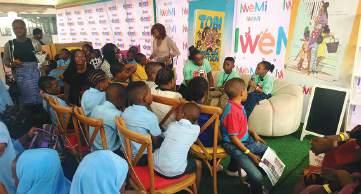
Although many of the books presented were written in English, more than 30 children sat under the Pop Up Library tent at about 12.30 p.m. to listen to Aunty Sola Ojikutu Njoku read the Yoruba book Labalaba Alaba ati Aja Ayo. Their attention remained fixed as she asked questions during the session.
"Aja Ayo ga. Do you all know what it means?" asked Aunty Sola. "That boy at the back, come. Do you know what it means? Come and tell me."
"Ayo's dog is tall," the boy replied.
"Well done," Aunty Sola remarked, while showing the group the illustration to demonstrate that the dog was indeed tall.
When Aunty Sola read the next sentence, "Aja Ayo sanra," all the children in the tent wanted to answer.
"Hold on, I have someone who wants to answer me. Do you speak Yoruba?" she asked the boy.
The boy shook his head.
"Ayo's dog is fat," he responded to the cheers of the other children.
The session continued until about 1.00 p.m., after which the children moved on to other activities. For many of them, one thing was clear: they had learnt new Yoruba words, with the session subtly encouraging them to take ownership of and pride in their indigenous culture.
What Participants Had to Say
Attendees who spoke with THISDAY had positive things to say about the event.
For Ifeoluwa Dayo Aduradola, the festival was a celebration of creativity and an opportunity to inspire the younger generation.
"This is the fourth Akada Festival I've attended," she said. "I was here last year as a guest author to read to the children, but today I'm here because my daughter is a young author and she's going to be
on the panel."
"It is one of the most fulfilling things for me and it just shows that I am doing a good job. I'm a writer myself, and watching her grow to take on something that I do so effortlessly shows me that I am doing well. It's just a wonderful experience," she said.
For nine year old Oluwatoke Aduradola, author of the book Up and Down, the message was to be fearless in the pursuit of one's dreams.
For children her age who would also like to become writers, she advised: "They should write their books and they should not be afraid of showing everybody."
A teacher who attended the event, Mrs. Ajibade Kehinde, expressed optimism that the experience would remain with the children.
"The event is an opportunity for children to network with each other. We hope that what they have learnt and experienced here today will stay with them, help them in their learning and make them understand the world better," she said.
For educational technology company STEM METS, its General Manager, Human Resources and Operations, Zena Amiengheme, explained that the event provides a veritable platform for students who are passionate about technology to learn work ready skills from a young age.
Akada Children's Book Festival and the Future
While the event drew to a close in Lagos last Saturday, its impact —the possibilities that could emerge from children who can confidently and effectively express themselves — will continue to live on in the hearts of participants until the next edition and beyond.
Perhaps by the next edition, some participants, such as 11 year old Tiwatope Oloye, author of One Picture, Many Colours, may have written their own books. Some may even be writing their second or third.
In embracing the advice of nine year old Oluwatoke Aduradola, a new generation of young writers may be documenting Nigerian stories, one children's picture storybook at a time.
Sola Ojikutu Njoku Reading "Labalaba Alaba ati Aja Ayo" to a group of children at the eighth edition of the Akada Children's Book Festival which held in Lagos...recently
Foluke Oyeleye presenting a Certificate of Appreciation to 11-year-old Tiwatope Oloye, the author of "One Picture, Many Colours," after their panel session at the eighth Akada Children's Book Festival which held in Lagos...recently
A Mutual fund (Unit Trust) is an investment vehicle managed by a SEC (Securities and Exchange Commission) registered Fund Manager. Investors with similar objectives buy units of the Fund so that the Fund Manager can buy securities that willl generate their desired return.
An ETF (Exchange Traded Fund) is a type of fund which owns the assets (shares of stock, bonds, oil futures, gold bars, foreign currency, etc.) and divides ownership of those assets into shares. Investors can buy these ‘shares’ on the
floor of the Nigerian Stock Exchange. A REIT (Real Estate Investment Trust) is an investment vehicle that allows both small and large investors to part-own real estate ventures (eg. Offices, Houses, Hospitals) in proportion to their investments. The assets are divided into shares that are traded on the Nigerian Stock Exchange.
GUIDE TO DATA:
Date: All fund prices are quoted in Naira as at 3rd June 2026, unless otherwise stated.
TRAVAILS OF NIGERIAN SKILLED WORKERS IN THE UK
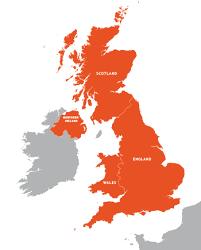
A Parliament that uses sovereignty to retrospectively destroy the rights of law abiding migrants has abused that sovereignty, contends EDDIE ONYEKA
See page 21
AU’S STRATEGIC OPTIONS FOR SUDAN’S REINSTATEMENT
The AU must move beyond the binary of strict suspension or unconditional recognition, argues SAMI ABDELHALIM SAEED
See page 21
EDITORIAL
Democracy Day can only make sense if the nation learns and adapts its historical significance adequately, writes MONDAY PHILIPS EKPE
LOST LESSONS OF JUNE 12
Ask Nigerians what they think about the current system of government that was warmly welcomed back on May 29, 1999. Those who witnessed it would most likely express their disillusionment. Those born within this Fourth Republic, especially the Gen Z, would either be lost for the right words or spew out some invectives and then return to their phones – social media – for succour. What else do they turn to, anyway? They live with the consequences of government’s underperformance daily and find it hard to imagine that the country wasn’t always this discomfiting and inhibiting. They practically know no other life.
But the real tragedy of our own variant of democracy is not just that its dividends have remained largely elusive, what one of its finest moments is begging to teach us has been ignored for too long. For the record, Nigeria had always marked May 29 as Democracy Day since 2000 before the government of President Muhammadu Buhari changed it to June 12 in honour of the presidential election of 1993 believed to be the nation’s freest and fairest which was won by Chief Moshood Abiola but was annulled by the then Military President Ibrahim Babangida. In trying to right that wrong, Buhari officially declared Chief Abiola the winner, awarded him the highest national honour and effected the date change.
Many people saw those moves differently, however. To them, the former leader was only pandering to the sentiments and agitations of western Nigeria, Abiola’s home base, to secure crucial votes in his 2019 re-election bid. Anyway, scheming and politics are regular bed-mates. But as I’ve argued elsewhere, the justifications for shifting democracy’s commemoration date from the anniversary of the last exit of soldiers from political power under such a partisan atmosphere may later wear off and give way to resentment, if not widespread noncompliance. Here’s why. As momentous as June 12 is, it hasn’t been properly established as a true national monument, a moment in which the fault lines that are still trying to crush the Nigerian spirit melted in the face of the country’s unanimous and overriding hunger for a return to civil rule.
Another catalyst for the decisive, popular resolve demonstrated 33 years ago was the very personality of Abiola. There was something about his mass appeal which swept across Nigeria like frankincense. Here was a billionaire, easily among Nigeria’s richest and one of its most colourful, who refused to lose touch with the downtrodden. I still
wonder whenever I pass through Toyin Street in Ikeja, Lagos what made the place suitable for his residence when he could comfortably acquire luxuriant, palatial homes in Ikoyi, Victoria Island and elsewhere. His campaign tagged “Hope 93” was simply magical. Both rich and poor queued up from Lagos to Sokoto, Maiduguri to Calabar, to press their thumbs into the Social Democratic Party (SDP) spaces on the ballot papers. No Moslem-Moslem ticket dichotomy. No my-turn, your-turn syndrome.
There’s a whole lot to unpack about June 12, if not for the sake of the old who may have taken an eternal stand, it could be for those who were then either unborn or mature enough to digest that historic period. Political historians should be interested in how a true national mandate quickly became minimised to a regional one. What made Abiola succeed where Chief Obafemi Awolowo, arguably the west’s most revered leader, failed. How such an ambitious, monumental, albeit aborted, occasion was reduced to an “injustice” done to a section of the federation. Sadly, that sentiment seems to have attached itself permanently to this somewhat sacred date. The nation appears to have squandered a chance to forge genuine nationhood based on the positives of that election. Something could unravel down the line that might challenge the suitability or credibility of the official date to celebrate our democracy.
A little here and a little there, the quest for rotational presidency began during the legendary democratic struggle of the 1990s like Siamese twins. The immediate beneficiary of that circumstantial blackmail, the People’s Democratic Party (PDP), made a kill of the sentiment and rode on it to power; an attitude that has now degenerated to entitlement, otherwise called “emilokan” or “awalokan”. Never mind that rotation hasn’t yet found
its way into the constitution. It’s already etched on the psyche of many Nigerians. If only that would lead us to a desirable destination. No one is sure that it will. What is certain is that, in a metaphysical sense, Nigerians are still in search of an Abiola figure, someone truly loved by majority of the people for his humanity, vision and drive. A nationalist devoid of known myopic inclinations and practices.
Fast forward to the present. Three decades are long enough to move any individual, institution or country either upwards or downwards in any index of development. The fear, uncertainties and authoritarianism experienced during military incursions into government left Nigerians with no viable options than go for democracy. They had gone through colonial rule. Endured the foibles and excesses of the First Republic politicians which ultimately resulted in the coup of 1966. Watched the shortcomings of the administration of Alhaji Shehu Shagari that served as the pretext for the comeback of the khaki boys. Were almost overcome by the recklessness and dictatorship of jackboot leaderships from December 1983 to 1999. General Abdulsalam Abubakar’s hand-over to President Olusegun Obasanjo on May 29, 1999 couldn’t have come at a better time. A huge relief that has been going southwards, unfortunately.
One doesn’t need to be a sceptic or pessimist to wonder whether what obtains now is worth celebrating. But then, the very concept of perfection is otherworldly. Meaning, the way forward will always be fraught with challenges. Luckily, our past wasn’t always despicable. So, to make progress, learn from June 12 we must. Nigerians are capable of setting their differences aside and speaking with one voice. The present election umpire can exhibit probity. Public perception is indispensable here. The political class can display maturity in this game against all odds. Alhaji Bashir Tofa, Abiola’s opponent who accepted the result without drama and one of the most unappreciated leading lights of that era, deserves to be emulated by the opposition.
Away from grandstanding and belabouring his role in the restoration of our democracy, President Bola Tinubu should lead the way in ensuring that Abiola and indeed the rest slain heroes did not pay the ultimate price in vain.
Dr Ekpe is a member of THISDAY Editorial Board
X: @monday_ekpe2
A Parliament that uses sovereignty to retrospectively destroy the rights of law abiding migrants has abused that sovereignty, contends EDDIE ONYEKA
TRAVAILS OF NIGERIAN SKILLED WORKERS IN THE UK
The reverberations arising from the Church of England’s apology for its historic complicity in the transatlantic slave trade continues to resonate across the world. In acknowledging its role in what it described as a “shameful past,” the Church expressed profound remorse for a “vile and disgusting sin” and committed itself to “acts of repentance, remembrance, reconciliation and renewal.”
Yet, as one national institution seeks to confront the moral burden of history, the British government is on the verge of committing the egregious moral wrong of taking away the accrued rights and expectations of thousands of migrants by changing the rules in the middle of the game.
Skilled workers in the United Kingdom- and thousands of them are Nigerians- currently have a five- year route to settlement.
The Government has announced a new immigration policy that would dramatically extend the qualifying periods for settlement for skilled workers from five years to 10 or 15 and intends to apply this law retrospectively to those already on the five- year route. If enacted, this law would represent a profound departure from the long-established principles of constitutional law, legal certainty, rule of law, human rights, rule against retrospectivity, fairness, and responsible governance. If passed, lawful migrants who had planned their lives on the fiveyear route would go through a harrowing period of “indefinite uncertainty” before they are able, if ever, to apply for settlement. If passed, this law may open a floodgate for potentially endless shifts of the goalposts in the middle of the immigration journey thereby rendering any legitimate expectation of eventual arrival to the settlement destination a pipe dream. It would mean that the government can, at any time, renege from its obligations under an existing law by simply enacting a countermanding law. There will surely be a concomitant uncertainty whether the extended period would not be further extended in line with shifting political winds. There is no assurance that the settlement scheme would not be abolished entirely and applied retrospectively against migrants who are already on the way. After all, some opposition parties are already calling for the abolition of the scheme in its entirety. The extended period is not all. The conditions under which the migrant must live during this period paints a picture that does not elevate human dignity. He is tied to the same employer and loses his status if he changes employment or is dismissed. He cannot change his role. He cannot negotiate his salary. He loses his status if his employer loses their sponsorship licence. He cannot work for more than 20 hours a week in a supplementary employment. He has only 60 days to secure a new spon-
sorship if he needs to switch employment. Having served the entire stipulated period, he is still not free. He cannot apply for settlement unless he provides a letter from the same employer to confirm that they are still willing to employ him for the foreseeable future. The threat to remove him from the UK comes from all angles and he is restrained from exercising his full humanity. And what about the immigration costs which run into tens of thousands of pounds, and leaving him in a state of perpetual indebtedness?
The living realities of many skilled workers raise profound questions about whether the immigration framework creates conditions that may, in certain circumstances, approach the legal concepts of servitude or forced labour. Many families arrive at the point of employment having sold off all assets back home to raise money and already crushed beneath a mountain of debt. Working, paying taxes, having no benefits, on a low wage, facing all the vagaries of the often discriminatory work place, the migrant is in a straitjacket, having as his only hope the expectation that he will be able to regain his life and liberty after five years. And now, that hope is under a threat.
The idea to change the rules in the middle of the game is against the doctrine of legitimate expectation. It holds that where a public authority makes a clear and unambiguous representation to an identifiable group who rely on it to their detriment, it is an abuse of power to resile from that representation without compelling justification. The High Court had strongly affirmed this principle in HSMP Forum Ltd v SSHD [2008] EWHC 664 (Admin), where it held that retrospective application of new settlement rules to those who had already made their home in the UK “on a clear understanding of the criteria that would apply to them in the future is, in our view, indisputably retrospective in effect” — and unlawful. The government did not appeal. This is settled law.
The current settlement proposal is analytically indistinguishable from this cited case— and worse. That case altered qualifying criteria; this proposal doubles or trebles the qualifying period itself.
We are aware that the doctrine of legiti-
The AU must move beyond the binary of strict suspension or unconditional recognition, argues SAMI ABDELHALIM SAEED
AU’S STRATEGIC OPTIONS FOR SUDAN’S REINSTATEMENT
Following the military coup in Sudan on October 25th, 2021, led by General Abdel Fattah al-Burhan, the Commander-in-Chief of the Sudan Armed Forces (SAF), who dissolved the transitional government and declared a state of emergency, the African Union (AU) suspended Sudan's membership on October 27, 2021. As of February 2026, the AU Peace and Security Council (PSC) has reaffirmed that the suspension remains in effect until a democratic transitional government is restored in the country. The AU faces a critical challenge as it seeks to balance its policy of “Zero Tolerance” against unconstitutional changes of government with the urgent and pressing needs of the continent’s peace and security. As AU-PSC considers a spectrum of diplomatic strategies, from strict compliance to constitutional frameworks and pragmatic, incremental normalisation with the de facto government, the status of Sudan’s membership is a pivotal test of the AU’s capacity to uphold its core principles amid a profound internal armed conflict and humanitarian crisis. Given the importance of peace and the maintenance of constitutionalism in Sudan, this article offers alternatives for policymakers at the national and AU levels. It draws on the case of Sudan to inform policy reforms, with a focus on political pragmatism.
Maintaining Sudan’s suspension upholds the AU’s principles but limits its capacity for effective peacebuilding. This isolation creates a strategic dilemma, as the AU-PSC loses influence on other mediation efforts and lacks sufficient on-theground monitoring. Similar challenges have occurred in Mali, where the AU’s focus on constitutionalism has conflicted with broader peace and security goals. By excluding Sudan’s de facto authorities, the AU cannot facilitate inclusive dialogue or coordinate regional security efforts, thereby prioritising constitutional principles over practical mediation.
The worsening humanitarian crisis in Sudan is increasing instability across the already fragile sub-Saharan region. The African Union’s peacebuilding strategy for Sudan remains unclear. Although the AU has engaged diplomatically with the de facto government, these efforts have not eased the ongoing humanitarian emergency.
The AU has several distinct options for navigating the restoration of Sudan's membership while balancing legal mandates with regional stability.
First, the AU’s PSC upholds the principles of the USG, ACDEG, and the Lomé Declaration, applies a step-by-step approach to diplomacy, and limits Sudan's membership to technical committees. To restore its membership in the AU, Sudan must adhere to the AU's "Zero Tolerance" policy for Unconstitutional Changes of Government (UCG). In fact, this is the current situation as the Council applied this option at its February 2026 meeting. The AU demands an immediate and permanent ceasefire between the SAF
and RSF, followed by an inclusive, Sudanese-led national dialogue to establish a civilian transitional authority. This approach rejects legitimising the 2021 military coup and recognises the current government in Port Sudan as a de facto authority, aligning with the United Nations’ stance.
The AU’s PSC strongly condemned the role of the national military in the ongoing human rights violations and confirmed that Sudan’s suspension will remain in place until a democratic transitional authority is restored in the country. Although Sudan’s Prime Minister Kamil Idris proposed a ceasefire monitored by the UN, the AU, and the Arab League, the AU rejected the proposal because it did not include a process to establish a civilian-led government.
Second, the AU might establish formal procedures to legitimise Sudan’s current military leadership. In such an attempt, the organisation might consider a strategy similar to its reinstatement of Egypt’s membership in June 2014, following the 2013 military coup against President Mohamed Mursi. In Egypt’s case, the suspension was lifted after a transitional roadmap, including a new constitution and scheduled elections, which were deemed sufficient to restore constitutional order. This precedent may help Sudan persuade the AU to restore its membership. However, criticised the AU's decision regarding Egypt as overly lenient and primarily focused on maintaining stability for a major member state. The AU may find this approach preferable, as it upholds constitutional standards in Africa while addressing peacebuilding and security. However, the situation in Sudan remains a major security challenge in the Horn of Africa, sub-Saharan Africa and Central Africa. The African Union's decision to readmit Egypt in 2014 was widely criticised, with some arguing that it prioritised political interests over democratic development. Additionally, this option to legalise the current military leadership in Sudan faces legal obstacles, including Article 25(4) of ACDEG, which provides that coup perpetrators cannot participate in elections to restore constitutional order.
Dr Saeed is an African constitutional expert and rule-of-law scholar with over 15 years of experience advising United Nations missions on peacebuilding and legal reforms in post-conflict environments
Editor, Editorial Page PETER ISHAKA
Email peter.ishaka@thisdaylive.com
THE REIGN OF KIDNAPPERS
All stakeholders should do more to contain the scourge
Across the country today, the act of kidnapping for ransom has become a growing industry. From ordinary citizens to businessmen and traditional rulers, nobody is safe. Many of the victims have also been killed even when their families paid the demanded ransom for their release. The kidnappers have no regard for age, class or personality as what matters to them is the perceived ransom value of their victims. But many also will point to the way the Oyo State police command rescued Olaide Adegoke John-Paul and her 12-year-old twin sons and arrested four suspected members of the gang linked to their abduction as evidence that when prominent people are involved, the security personnel almost always deliver. John-Paul is a younger sister to the former Minister of Power, Adebayo Adelabu.
Today, many Nigerians can no longer move around freely or even spend quality time with their family without the psychological fear of the dreaded kidnapper lurking around the corner. The concomitant effect of all this is that while citizens live in perpetual fear, investors take their businesses elsewhere. Meanwhile, when this whole madness started, the targets were rich businessmen, politicians, and other well-heeled professionals. But kidnappers have since come to the lower bracket. So prevalent is the crime that the African Insurance Organisation (AIO) once designated Nigeria as the global capital for kidnap for ransom, having overtaken countries like Colombia and Mexico that were hitherto front-runners. The crime has also become a thriving industry with a network of support staff.
cantile logic among the kidnappers must be that the abduction of school children is bound to attract huge attention and sympathy, which could in turn translate to heftier ransoms. The danger in allowing this state of affairs to continue, as we have repeatedly warned, is to encourage recourse to self-help by citizens with dire implications.
Today, most Nigerians can no longer move around freely or even spend quality time with their family without the psychological fear of the dreaded kidnapper lurking around the corner
T H I S D AY
EDITOR SHAKA MOMODU
DEPUTY EDITOR WALE OLALEYE
MANAGING DIRECTOR ENIOLA BELLO
DEPUTY MANAGING DIRECTOR ISRAEL IWEGBU
CHAIRMAN EDITORIAL BOARD OLUSEGUN ADENIYI
EDITOR NATION’S CAPITAL IYOBOSA UWUGIAREN
THE OMBUDSMAN KAYODE KOMOLAFE T H I S D AY N E W S PA P E R S L I M I T E D
EDITOR-IN-CHIEF/CHAIRMAN NDUKA OBAIGBENA
GROUP EXECUTIVE DIRECTORS ENIOLA BELLO, KAYODE KOMOLAFE, ISRAEL IWEGBU
DIVISIONAL DIRECTORS SHAKA MOMODU, PETER IWEGBU, ANTHONY OGEDENGBE
Kidnappings, killings and loss of materials and man-hours have become recurrent features on most of the highways. Since a drive through many of the nation’s major roads is now a nightmare, many spots have also become convenient operating centres for kidnappers who lay siege to unsuspecting motorists and other road users. A large country that depends mainly on road transportation for the movement of commodities and persons seems to have surrendered the sector to the tyranny of some unconscionable individuals. But perhaps more worrisome is that too often, even when the security agencies are involved in the rescue bids of kidnapped persons, ransoms are still paid, after which the victims are then abandoned by their abductors for law enforcement agents to “rescue and recover”.
We must, however, highlight the fact that our various communities have a critical role to play in tackling this problem. Kidnappers are not ghosts. They are human beings and they live within communities. Therefore, members of our various communities must realise they have a critical role to play in providing useful information to security agencies that should also begin to act more promptly.
To compound the challenge, even families of senior police and military personnel (retired and serving) now pay ransom to kidnappers. Particularly disturbing is the ease with which these kidnappers now target schools. The governing mer-
DIRECTOR, PRINTING PRODUCTION CHUKS ONWUDINJO TO SEND EMAIL: first name.surname@thisdaylive.com
Letters to the Editor
With the increasing sophistication of valued added services offered by communication networks, especially the tracking system, we wonder why it is so difficult for the police to monitor the calls being made by these criminals during negotiations for ransom. But whatever may be the case, we call on security agents to redouble their efforts in dealing with this dangerous phenomenon that is fast turning the country into a huge jungle.
Letters in response to specific publications in THISDAY should be brief (150-300 words) and straight to the point. Interested readers may send such letters along with their contact details to opinion@thisdaylive.com. We also welcome comments and opinions on topical local, national and international issues provided they are well-written and should also not be longer than (750- 1000 words). They should be sent to opinion@thisdaylive. com along with photograph, email address and phone numbers of the writer.
NIGERIA AND THE 2026 HAJJ EXERCISE
I participated in the 2026 Hajj exercise as a stakeholder nominee of Hajia Aishat Obi, NAHCON Commissioner representing the South-East, and writes from personal observation of the pilgrimage operations. The 2026 Hajj pilgrimage will remain one of the most memorable experiences for Nigerian pilgrims and stakeholders, not only for its spiritual significance but also for the remarkable improvement in organization, welfare delivery, and coordination witnessed throughout the exercise. From my firsthand experience, this year’s operation reflects one of the most efficient Hajj management performances in recent years.
Our delegation departed Nigeria on 13 May 2026 and returned on 5 June 2026 after the successful completion of all Hajj rites. From departure to return, the entire process demonstrated improved logistics, better
coordination, and stronger oversight by the National Hajj Commission of Nigeria. The airlift operations were particularly well managed, with orderly departures and smooth returns that ensured pilgrims were treated with dignity and reduced stress.
As a stakeholder nominated through Hajia Obi, I was able to observe the entire process closely. I remain grateful for her role in facilitating my participation. She did not only nominate me but also supported me personally during a period when I faced financial difficulty in processing my passport. That intervention made it possible for me to undertake this journey and witness firsthand the improvements under the leadership of Ambassador Ismail Abba Yusuf, Chairman and Chief Executive Officer of NAHCON.
One of the most visible improvements this year was in accommodation arrangements. Pilgrims were
generally housed in better-organized facilities, with improved access to essential services and more coordinated supervision. While Hajj operations naturally come with logistical challenges, the level of orderliness and responsiveness recorded this year was a clear improvement compared to previous years. Food logistics also recorded significant progress. Feeding thousands of pilgrims daily is a complex task, yet meals were distributed more efficiently and on time. Pilgrims experienced fewer disruptions, and the overall system of food distribution reflected better planning and execution. This improvement contributed significantly to the comfort and wellbeing of pilgrims throughout the pilgrimage.
Alhaji Musa Wada, just back from Makkah
BUSINESS WORLD
RATES AS AT J UNE 10,2026
Report: AI-first Telcos Will Lead Africa, Unlock Next Wave of Fintech Growth
Okonji
A report released by Boston Consulting Group (BCG), has predicted that African telecoms operators can have significant breakthrough and lead the continent by adopting the API-driven and AI-first models that will unlock the next wave of fintech growth.
Tagged: ‘Telco Value Creators Report’, the research report explained that the rise of Artificial Intelligence (AI) would be a game-changer for the telecoms sector, but advised that the executive leadership teams would need
to take some bold steps to maximise value out of the technology.
According to latest BCG Report, the sector is experiencing a ‘Great Recovery’. After years of stagnation, median Total Shareholder Return (TSR) has climbed to nine per cent, comfortably outstripping the cost of equity.
While developed-market giants struggle with legacy debt and regulatory saturation, emerging market telcos are proving that they are not just infrastructure players, but they are growth engines that have
been able to embrace fintech integration and empower consumers to transact.
The BCG research clarified that the era of “AI as an IT project” is dead, insisting that the top value creators of 2026 have moved toward becoming AI-First Telcos.
The report described an AI-first telco as an organisation where Artificial Intelligence is the foundational layer of the operating model, rather than a “bolt-on” feature. It is a shift from using AI to fix problems (reactive) to using AI to reimagine the business.
Analysing the report,
Associate Director, TMT Practice at BCG, Kitso Lemo, who authored the report, said: “In an AI-first model, the network self-optimises in realtime based on predictive traffic patterns, marketing offers are generated individually for every subscriber based on behavioural data, and “Network-as-a-Service” becomes a reality, allowing businesses to dial bandwidth up or down as easily as they manage a cloud subscription.”
According to Lemo, the opportunity for Emerging Market telcos is that while they have shown agility
to move beyond pure infrastructure plays, they have also done so on legacy technology. On the African continent approximately 80 per cent of transactions remain driven by USSD technology as opposed to first world App infrastructure which is more in line with the expectations of the young generation known as the ‘Digital Native’. This is creating an artificial ceiling. Through API’s telcos can integrate their technology with third party technology suppliers allowing for integration with the likes of financial services
products. Integrated products become strategic levers – not just buzzwords.
“In managing the transition, leadership teams should adopt a 10/20/70 framework: only 10 per cent of effort should go to algorithms, 20 per cent to technology and data infrastructure, and a full 70 per cent to people and process transformation. This is critical because African telco leadership teams often overindex on the technology buy and under-invest in change management,” Lemo said.
The story continues online on www.thisdaylive.com
eromosele abiodun
The Nigerian Maritime Administration and Safety Agency (NIMASA) has reaffirmed its commitment to strengthening seafarers’ documentation and maritime digitalization.
The agency stated this during a four-day study visit by officials of the Gambia Maritime Administration (GMA) to NIMASA.
The visit underscored the importance of regional collaboration in advancing efficient, secure, and globally
compliant seafarer certification systems.
The Executive Director, Operations of NIMASA, Engr. Fatai Taiye Adeyemi, who represented the Director General of NIMASA, Dr. Dayo Mobereola, described the visit as a reflection of the strong relationship between Nigeria and The Gambia and the growing collaboration between both maritime administrations and, by extension, both countries.
According to him, such engagements provide valuable opportunities for
knowledge sharing and capacity development within Africa’s maritime sector.
“We are delighted to share our experiences in digitalizing seafarers’ documentation and certification processes. The decision by our Gambian colleagues to choose NIMASA for this study visit is a recognition of the progress Nigeria has made in maritime administration and human capacity development. There is always something to learn from one another. Such engagements strengthen regional cooperation and help
build a more efficient and globally competitive maritime sector across Africa,” Adeyemi said.
He noted that the progress recorded by NIMASA in digital transformation, maritime administration, and human capacity development has been significantly driven by the policy direction and unwavering support of the Federal Ministry of Marine and Blue Economy under the leadership of Adegboyega Oyetola.
During the programme, NIMASA and officials
of the Gambia Maritime Administration engaged on procedures for the issuance of seafarers’ medical certificates, conduct of examinations, issuance of Certificates of Proficiency, and measures put in place to enhance the credibility, integrity, and international acceptability of Nigeria’s seafarers’ certification system.
Leader of the Gambian delegation and Manager, Ship Registry and Seafarers Affairs at the GMA, Mr. Falu Sey, said NIMASA was selected because of Nigeria’s strides
in maritime development, digital transformation, and leadership in advancing the Blue Economy.
“We chose NIMASA because of the significant strides Nigeria has made in maritime development and digital transformation. The practical demonstrations and technical sessions have provided valuable insights that will support our efforts to strengthen maritime administration and improve service delivery in The Gambia.
Market data a s at Wednesday, June 10, 2026 The story continues online
emma
Stakeholders: Nigeria Cannot Build Its Digital Future on Borrowed Domain Name
Stories by Emma Okonji
Worried about the high rate at which Nigerians patronise foreign domain names in the digital space, coupled with the high volume of data hosting outside the shores of Nigeria, industry stakeholders have warned against the implications, which they described as detrimental to Nigeria’s growth in the cyberspace.
The stakeholders gave the warning during the Tech Convergence Forum, organised by the Nigerian Internet Registration Association (NiRA) in Abuja.
Themed: ‘Strengthening Nigeria’s Digital Independence:
The Role of Policy, Digital Identity, and .ng for Economic Growth’, the Tech Convergence 3.0 Forum insisted that it was time for Nigeria to own, govern, and aggressively expand its digital identity without further delay.
Among the conference’s most sobering disclosures was the revelation that Nigeria loses an estimated $850 million annually by failing to fully leverage its own digital identity infrastructure.
In his welcome address, President of NiRA, Mr. Adesola Akinsaya, called on Nigerians to begin to consider .ng domain name as their identity in cyberspace, which must be prioritised above foreign domain
Investors Urged to Unlock Lagos Business Potential, Opportunities
The Federal Government of Nigeria and the Lagos State Government, in collaboration with the Commonwealth Enterprise and Investment Council, have called on international and local investors to consider investing in Lagos, where there are investment opportunities and business growth.
They made the call at the just concluded Invest Lagos 3.0 Summit, held in Lagos
and attracted investors, business leaders and financial institutions from within and outside of the country.
Speaking during the opening ceremony on Monday, the Minister of Finance and Coordinating Minister of the Economy, Mr. Taiwo Oyedele, commended the Commonwealth Enterprise and Investment Council and other partners for collaborating with Lagos State on its third investment summit.
names.
“Digital independence does not mean isolation from the global internet. It means a secure, resilient, and competitive digital ecosystem that gives Nigeria
Group Business Editor
Eromosele Abiodun
Deputy Business Editor
Chinedu Eze
Comms/e-Business Editor
Emma Okonji
Asst. Editor, Energy
Emmanuel Addeh
Asst. Editor, Money Market
Nume Ekeghe
Correspondents
KayodeTokede(CapitalMarkets)
James Emejo (Finance)
Ebere Nwoji (Insurance)
Reporter
Peter Uzoho (Energy)
According to him, for decades, the conversation around investing in Nigeria focused almost exclusively on the federal government, adding that the narrative is beginning to change with the involvement of Invest Lagos Summit.
In his welcome address, Lagos State Governor, Babajide Sanwo-Olu, expressed confidence in the type of investments that the summit would attract. According to him, the summit will be judged as successful, by the concrete investment deals that will come out of the summit that will create jobs, transform life.
greater control over its data, infrastructure, digital identity system, and online presence,” Akinsaya said.
Chairman, Senate Committee on ICT and Cybersecurity,
Senator Shuaib Afolabi Salisu, who delivered the keynote address, made reference to the US-China tech war, the EU’s battles with Apple and Google over COVID contact-tracing
sovereignty, and Israel’s use of digital infrastructure in warfare. Based on his analogy, he referred to Nigeria’s .ng domain not as a registration technicality but as a matter of national security.
Emiko Appointed Interim Chairman of DBI Governing Board
The Board of the Nigerian Communications Commission (NCC) has appointed Princess Oforitsenere Emiko as interim Chairman of the governing board of the Digital Bridge Institute (DBI), a move that is designed to reposition the institute for the next era of
Nigeria’s communications sector and digital economy.
According to a statement released by NCC, and signed by its Director, Public Affairs, Nnenna Ukoha, Emiko will be joined on the board by the Executive Commissioner, Technical Services, Abraham Oshadami, and the Executive
Commissioner, Stakeholder Management, Ms. Rimini Makama, who joined as interim Board members.
“The interim leadership will work alongside the President/CEO, Mr. David Daser, and the remaining board members whose tenures are unexpired, to drive the Institute’s transformation. The repositioned Institute will concentrate on five areas: Education and Training, Research and Development, Innovation, Economic Impact and Growth, and Emerging Policy and Regulation,” the statement added.
Advisory Issued on Widespread Cybersecurity
Digital Encode Limited, a leading information security and governance, risk, and compliance (GRC) advisory firm, has issued an urgent cybersecurity advisory following a surge in security breaches affecting financial institutions, government agencies, fintechs, and other organisations across Nigeria.
Cyber threat actors have recently exposed data purportedly from both private
and public institutions in Nigeria, underscoring the growing need for stronger cybersecurity frameworks, proactive threat monitoring, and coordinated incident response measures.
But Digital Encode’s advisory highlights a troubling pattern: most recent cyber incidents are not driven by sophisticated zero-day exploits, but by preventable weaknesses in
basic security configurations, credential management, and operational controls.
According to the advisory signed by the Chief Visionary Officer of Digital Encode Limited, Professor Obadare Adewale Peter, attackers are increasingly exploiting misconfigured systems and publicly exposed assets, such as unsecured databases, open cloud storage buckets, leaked API keys, and critical servers
Breaches
exposed to the internet, many of which are easily discoverable through open repositories, cloud indexing tools, and even dark web marketplaces.
The advisory outlines critical areas of concern, including publicly accessible cloud storage exposing sensitive customer and operational data; hardcoded secrets in web and mobile applications.
Firm Deepens Support for Federal Revenue Collection
Interswitch has reinforced its role in supporting federal government revenue collection through its continued participation as a Payment Service Solution Provider (PSSP) on the Revenue Assurance and Optimization Platform (RevOP).
Speaking on the
The Vice President, Monnify Payment Gateway, Damilare Ogunnaike has said Monnify is designed to operate seamlessly without challenges like failed transactions, delayed confirmation and lack of value for money transferred, describing it as the preferred payment platform for Nigeria’s digital businesses.
development, Managing Director, INCLUSIO at Interswitch, Muyiwa Asagba, said the company remained committed to supporting government-led financial reforms through secure and efficient payment solutions.
“Interswitch is proud to continue supporting the Federal Government’s drive
Statistics showed that in 2025, Monnify processed N25 trillion in transactions, about $18 billion, representing a 38 per cent increase from 2023.
“The growth came during a period when Nigerian businesses were dealing with currency volatility, rising costs, and increasing pressure on infrastructure
toward greater transparency and efficiency in public revenue management. Our role on the RevOP platform reflects our commitment to delivering secure, seamless, and compliant payment infrastructure that enables all stakeholders to meet their obligations with confidence,” he said.
to perform consistently. Monnify did not just handle that demand, it grew within it. It became more relied on when reliability mattered most,” Ogunnaike said in a statement.
According to him, “Monnify sits within TeamApt, the technology infrastructure arm of Moniepoint. Monnify is its
Interswitch’s continued role on the platform builds on its longstanding experience in supporting critical national payment infrastructure and collaborating with regulatory and financial institutions to drive digital transformation across Nigeria’s public sector.
payment gateway service built for businesses that need to collect and disburse money at scale. Its customer base reflects the breadth of Nigeria’s digital economy. On the fintech side, companies like PiggyVest, Cowrywise, Bamboo, Rise, and Nomba are part of the platform’s ecosystem.
L-R: Commandant, Nigerian Defence Academy, Major General Oluyemi Olatoye; Chiroma Zazzau, Shehu Tijjani; President and Chief Executive Officer, Africa Finance Corporation, Samaila Zubairu; CEO, Sterling One Foundation, Olapeju Ibekwe and Commissioner for Environment, Kaduna State, Abubakar Buba, at the One Million Trees Planting Initiative launched at the Nigerian Defence Academy, Kaduna State… recently
Omosehin: Africa Insurance Market Commands $68bn Premium Pool
Stories by Ebere Nwoji
Commissioner for Insurance, Mr Ayo Olusegun Omosehin, has said that despite the recorded gap in Africa’s insurance penetration, the continent commands an estimated $68 billion premium pool, signalling strong underlying demand where access exists.
Omosehin who spoke in a high-level panel discussion at the 52nd African Insurance Organisation Conference in Cairo Egypt, challenged the regional Insurance leaders to see Africa’s low insurance penetration problem as a multi- billion- dollar opportunity rather than limitation.
“The gap is not about willingness to pay, it is about our ability to design and distribute products that reach people where they are,” Omosehin stated.
The regional insurance leaders admitted that distribution failure, not lack
of demand was the primary driver of low insurance penetration in the region pointing out that traditional agent-based models have failed to reach up to 90 percent of the addressable population, particularly in rural and informal sectors.
The discussion panellists emphasised that scaling insurance across Africa required a shift to mobile-first distribution, embedded insurance models, communitybased delivery channels and digital Infrastructure unlocking access.
They noted that Africa’s rapidly expanding digital ecosystem was enabling this transformation as over 500 million mobile subscribers, more than 350 million mobile wallets as platforms provided readymade infrastructure for low-cost, scalable insurance distribution and claims payments.
The panel highlighted the importance of regulatory
AIICO Insurance Shareholders
Approve 12 kobo Dividends
AIICO Insurance Shareholders have approved payment of 12 kobo dividends per share, amounting to N4.39 billion to investors of the company.
The shareholders passed the resolution at the 2026 Annual General Meeting of the company held in Lagos.
The shareholders said with the payment of such dividend at this critical time, AIICO Insurance has reinforced its position as a leading player among Nigeria’s insurance and financial services providers.
They said it also marked a significant evolution in the company’s governance structure. The meeting appointed three accomplished professionals to the AIICO board as non-executive directors.
Commenting on the outcomes of the meeting, AIICO Managing Director, Mr. Babatunde Fajemirokun, stated: “We are grateful to our shareholders and investors for their continued confidence and support. Their trust remains a strong validation of our strategic direction and the progress we are making as a business. The strengthening of our board reflects our deliberate commitment to robust governance, disciplined oversight, and long-term value creation. With the depth of experience and diversity now represented at the board level, we are well-positioned to enhance the quality of our decision-making and sustain our leadership in the market.
evolution in unlocking growth, particularly transitioning from rulebased to principles-based
supervision, implementing risk-based capital frameworks, expanding regulatory sandboxes for innovation.
United Capital Expands into East Africa, Secures Rwanda, Ethiopia Licence
Kayode Tokede
United Capital Plc said it has achieved a major milestone in its continental expansion strategy with the successful acquisition of investment banking licences in Ethiopia and Rwanda. With these approvals, United Capital becomes the first foreign institution licensed to provide investment banking services in Ethiopia, covering financial advisory services, securities brokerage and portfolio management, marking a significant
milestone in the development of the country’s emerging capital market ecosystem.
The licence enables the Group to establish operations in Ethiopia and participate in capital market activities, supporting market development while expanding access to its range of financial and investment solutions across the region.
According to the Ethiopian Capital Market Authority, the approval followed a comprehensive regulatory review process involving multiple
government institutions and extensive cross-market due diligence.
This milestone comes shortly after the Group secured regulatory approval from the Capital Market Authority [CMA] to provide Trust Services, Investment Banking and Portfolio Management Services in Rwanda; further reinforcing its strategic footprint across East and Central Africa.
Commenting on the development, Group Chief Executive Officer of United
Capital Group, Peter Ashade, in a statement said: “Ethiopia and Rwanda represent two of Africa’s most significant growth opportunities, and we are pleased to receive these licences at an important moment in the region’s capital market development journey. The region’s strategic location as an international trade route connecting Africa and the East, a large youthful workforce, and ongoing reforms are expected to continue attracting foreign investment.”
Sovereign Trust Meets NAICOM’s N1.5bn Statutory Deposit Deadline
Sovereign Trust Insurance Plc (the Company), said it has successfully fulfilled the statutory deposit of N1.5 billion as a non-life insurance company to the Central Bank of Nigeria(CBN), in compliance with the directive by the National Insurance Commission, (NAICOM), to all insurance companies to make statutory deposit of 10 percent of regulatory minimum capital with the Central Bank of Nigeria (CBN).
The underwriting firm said it made the deposit before the
deadline of May 31, 2026, adding that the achievement marked a significant milestone in the company’s ongoing recapitalisation programme and further demonstrated its commitment to maintaining a strong financial foundation.
The company’s Managing
Director/Chief Executive Officer Dr. Lucas Durojaiye, said the new capital would enhance policyholder protection, and compliance with all regulatory requirements governing the Nigerian Insurance Industry.
SanlamAllianz Nigeria, comprising SanlamAllianz Life Insurance and SanlamAllianz General Insurance, said it successfully hosted the third edition of its annual Children’s Day Funfair at Garden City Amusement Park, Port Harcourt, Rivers State.
Speaking on the annual
outing, Group Head, Strategy, Marketing & Corporate Communications, SanllamAllianz, Chris Ekwonwa, said the event, which has become an annual tradition for the organisation and has previously been held in Lagos and Abuja, was designed to create a joyful atmosphere where
Leadway Kicks off 2026 Schools Initiative in
Leadway Group has announced the commencement of the fourth edition of its flagship “Pages to Places” school outreach initiative.
This year’s edition of the programme commenced on June 3, 2026.
The group said the programme would be implemented in six key locations in Nigeria, cutting across Lagos, Warri, Ekiti, Port Harcourt, Kaduna, and
Six States
Abuja, reaching public primary schools with critical educational resources designed to promote literacy and learning.
This year’s edition has positioned the Pages to Places initiative of Leadway as motivator of children’s education career . It has also stood as a cornerstone of its commitment to improving educational outcomes and expanding opportunities for young Nigerians.
children could relax, play, and celebrate their special day through a variety of games, recreational activities, entertainment, and exciting surprises.
On the importance of the
initiative, he reaffirmed the company’s commitment to creating meaningful experiences that positively impact communities and strengthen relationships with families.
L-R: Partner, Udo Udoma & Belo-Osagie (UUBO), Godson Ogheneochuko; Partner, UUBO, Lolade Ososami; CEO, Construction Kaiser Limited, Stefan Euchenhofer; Managing Partner, UUBO, Jumoke Lambo and President/Chairman of Council, Lagos Chamber of Commerce & Industry (LCCI), Leye Kupoluyi, at the inaugural UUBO Policy Breakfast Session in Lagos…recently
The Green Ledger: Tracking Nigeria’s Carbon Billions and Minions (1)
There is a quiet revolution happening in Nigeria’s policy corridors. It does not announce itself with fanfare on the evening news; it does not trend on social media the way petrol prices do, and it is not discussed at the local markets; yet, if the government’s projections are to be believed, it could be worth more to this country than the annual budget of several states combined. We are talking about Nigeria’s carbon market, a system designed to monetise the country’s vast forests, clean energy projects, and land use practices by converting greenhouse gas emissions reductions into tradeable credits sold to polluters at home and abroad.
President Bola Tinubu unveiled the Nigeria Carbon Market Activation Policy (NCMAP) in March 2025. The government’s own estimates put the potential at between $2.5 billion and $3 billion annually by 2030, alongside the creation of 600,000 to 2.3 million green jobs. Those are extraordinary numbers. They are also, at this moment, largely aspirational because the architecture needed to deliver them, while increasingly taking shape on paper, is still largely missing in practice. Worse, the people who stand to benefit most- Nigeria’s rural communities, smallholder farmers, and forest-dependent populations who have almost no idea this market exists or that it could transform their livelihoods.
This article is the beginning of a series into Nigeria’s carbon market ecosystem, beginning with the National Carbon Market Framework: what it says, who is supposed to do what, where meaningful progress appears to have been made, and where there are gaping gaps that, if not urgently addressed, could turn a generational opportunity into yet another forlorn hope.
The responsible entities and why they matter
The National Council on Climate Change (NCCC): The NCCC is chaired by the President of the Federal Republic, with the Vice President serving as Deputy Chair. It includes the Ministers of Environment, Petroleum Resources, Finance, Agriculture and Rural Development, Power, Industry, Trade and Investment, and others. Its Secretariat, headed by a Director-General, is the operational arm responsible for day-to-day implementation of the mandate of the council, which includes: overseeing Nigeria’s Nationally Determined Contributions (NDCs), coordinating the carbon budget, carbon credit approvals, and operationalization. It is also obligated under the Climate Change Act to partner with civil society organizations, promote climate education, and report annually to the National Assembly on the state of Nigeria’s climate change activities. In terms of delivery, the NCCC has taken
some notable steps since its establishment in 2022. The finalization of the NCMAP in 2025 and unveiling of the National Carbon Market Framework (NCMF) are key examples. But the NCCC has also been hobbled by several factors, including being off the national budget until October 2025, when a presidential directive resolved the problem. What it now does with its budget is another question. There are also questions about inclusion and engagement of relevant stakeholders, including government ministries and agencies germane to the green economy. Details governing how project developers obtain approvals are not readily available to the public. Without clear, published procedures, the carbon market faces uncertainty that deters investors and opens the door to opaque arrangements. The NCCC must address these barriers without delays: It must, for instance, publish the complete No-Objection procedures for project approvals and release a publicly accessible, machine-readable national carbon registry. It must also produce and widely circulate annual reports to the National Assembly as required by law. A billion-dollar market cannot be governed in the dark.
The Federal Ministry of Industry, Trade and Investment (FMITI): This ministry plays a pivotal role in Nigeria’s carbon economy that often goes under the radar. At the sidelines of the 79th United Nations General Assembly in September 2024, it was the ministry’s Permanent Secretary, Ambassador Nura Rimi, who stood before the world and announced the NCMAP, pledging that the ministry would ensure the policy includes specific incentives to drive industrial growth and trade, creating a business-friendly environment for private sector engagement. There seems to be a structural irony here that deserves scrutiny. The FMITI supervises the Financial Reporting Council of Nigeria (FRC), which is the body responsible for mandating and standardizing sustainability disclosures by Nigerian companies, including the oil and gas companies whose emissions are directly relevant to the carbon market. The Africa Policy Research Institute (APRI), in a July 2025 report, noted that despite Nigeria’s climate commitments and policies, the FMITI has only minimally incorporated climate objectives into trade and industry policies, highlighting an urgent need for alignment and coherence. In plain terms: it would appear that the ministry
that is meant to make Nigeria an attractive destination for carbon investment has not fully integrated climate logic into its own operations. It is imperative for the ministry to now publish a clear industry-facing guide on how businesses can participate in Nigeria’s carbon market. It must also strengthen the link between its industrial promotion mandate and the green economy while ensuring that the FRC’s sustainability reporting roadmap is adequately resourced and enforced.
The Financial Reporting Council of Nigeria (FRC): The Financial Reporting Council (FRC) of Nigeria, established under the FRC Act of 2011, is Nigeria’s primary body for developing and publishing accounting and financial reporting standards for public and private entities. In recent years, the FRC has taken important steps toward sustainability reporting — steps that have a direct bearing on the integrity of the carbon market. In 2023, the FRC published a Roadmap for the Adoption of ISSB (International Sustainability Standards Board) Standards in Nigeria. The amended 2026 roadmap further institutionalizes this by introducing Sustainability Reporting Guidance (SRG 1) and a National Digital Platform for sustainability disclosures. In April 2026, the FRC spotlighted early adopters of ISSB sustainability disclosure standards across banking, oil and gas, telecommunications, insurance, and consumer goods, as a positive signal. But there is a critical structural gap that the FRC must confront directly. Research published as recently as 2025 has found that FRC sustainability disclosures are not linked to the National GHG Registry, and the Nigerian Exchange Group’s ESG reporting systems are not connected to carbon credit Monitoring, Reporting, and Verification (MRV) systems. Most climate disclosures are still published in PDFs rather than machine-readable formats. This is not a minor technical problem; it is a fundamental integrity risk. If you cannot verify the emissions reductions underlying a carbon credit because the data systems do not talk to each other, the entire market’s credibility is called into question. The FRC must mandate machine-readable sustainability disclosures and integrate its sustainability reporting systems with the National GHG Registry. It must also make ESG disclosures for oil and gas companies compulsory, not voluntary.
The Nigerian Upstream Petroleum Regulatory Commission (NUPRC): The Nigerian Upstream Petroleum Regulatory Commission (NUPRC), established under the Petroleum Industry Act 2021, regulates upstream oil and gas operations in Nigeria. Given that the oil and gas sector is a major source of greenhouse gas emissions in the country, the NUPRC sits at a critical intersection between Nigeria’s fossil fuel economy and its carbon market ambitions. In April 2026, the NUPRC issued a landmark directive requiring all upstream oil and gas companies to implement systems for measuring, reporting, and verifying methane and greenhouse gas (GHG) emissions.
•Jumoke Oduwole, Minister of Industry Trade and Investment
• Oritsemeyiwa Eyesan, NUPRC CEO
• Omotenioye Majekodunmi, DG NCCC
• Rabiu Olowo, FRC Executive Secretary
• Professor Innocent Bariate Barikor, NESREA DG
How States Measure up for Transition Opportunities (1)
The race for a secure and economically prosperous Nigeria will not be won at the centre alone. States that can turn their natural resources, human capital, and policy vision into engines of a low-carbon and inclusive economy are sure to play an integral role.
For decades, discussions about economic prosperity in Nigeria revolved around crude oil. States were often judged by the size of federal allocations they received or the volume of hydrocarbons beneath their soil. Today, however, a different reality is emerging. As the world gradually moves towards cleaner energy systems, climate-resilient industries, digital economies, sustainable agriculture, and green infrastructure, the question is no longer whether transition is happening. The question is which states are prepared to seize the opportunities it presents.
Nigeria’s Energy Transition Plan seeks to achieve net-zero emissions by 2060 while simultaneously addressing poverty, unemployment, and energy access challenges. The plan estimates that the transition could create as many as 840,000 jobs by 2060, lift 100 million Nigerians out of poverty, and unlock hundreds of billions of dollars in investments across power, transportation, industry, cooking energy, and oil and gas value chains.
Yet the opportunities embedded within this transition will not be distributed equally. Some states possess natural advantages, stronger institutions, greater economic diversification, and better infrastructure. Others remain trapped in old economic models, weak revenue bases, and governance challenges that may leave them behind. The transition story of Nigeria, therefore, is ultimately a story of states.
Flakes and Flaks
Understanding the New Opportunity Landscape Transition opportunities extend far beyond renewable energy. They include solar manufacturing, clean cooking solutions, electric mobility, sustainable agriculture, green mining, climate-smart infrastructure, carbon markets, agro-processing, ecosystem restoration, and green industrialization. The 2024 Energy Transition Plan projects significant growth in renewable energy deployment, with solar power expected to become the dominant source of electricity generation over the coming decades. Renewable energy technologies are projected to account for over 80 percent of generation capacity by 2050, with solar capacity reaching unprecedented levels.
This creates a new economic geography. States with abundant solar irradiation, hydropower resources, agricultural residues, strategic transport corridors, and industrial clusters stand to gain enormously. The transition will therefore create winners and losers not because some states are naturally disadvantaged, but because some are moving faster than others.
Lagos: The Clear Front-Runner No discussion of transition readiness can begin anywhere other than Lagos. Although Lagos possesses limited renewable energy resources compared to many northern states, it compensates through economic strength, innovation ecosystems, infrastructure, financial services, and policy experimentation.
NZIP and the Fancy ‘Plan’ Fatigue
Acommon bane of public policy and governance in Nigeria is the availability (sometimes the multiplicity) of plans without action. There have always been national development plans – some with bogus slogans and appealing acronyms. Many of them end up gathering dust on the shelves of government offices. This bad habit must be avoided when addressing the climate crisis and in our approach to the burgeoning green economy.
Recently, the National Council on Climate Change (NCCC) launched the Net Zero Investment Plan (NZIP) with support from the Government of Germany. For context, the 2024 Nigeria Energy Transition and Investment Plan is regarded by stakeholders as a very detailed and technically grounded roadmap for Nigeria’s climate economy. Because there appears to be no publicly accessible NZIP document on the NCCC’s website or other government repositories, it is impossible to make a comparison. What is worth noting, however, is that the ETIP, developed with support from the United Nations’ Sustainable Energy for All (SEforAll), provides sector-by-sector modelling, investment estimates, technology pathways, and policy recommendations. What is also clear is that Nigeria cannot achieve its net-zero ambition without attracting large-scale domestic and international capital. Any cogent and plausible plan that focuses on creating an enabling environment for climate investments, de-risking projects, strengthening carbon markets, and
directing private finance into renewable energy, clean transport, sustainable agriculture, and other low-carbon sectors must be followed through with diligent implementation and not duplication. For further context, the ETIP models pathways across power, transport, industry, cooking, hydrogen, and oil and gas. The plan projects universal electricity access, large-scale deployment of solar power, electrification of transport, adoption of green hydrogen in industry, and a gradual phase-out of high-emission technologies. A key strength of the ETIP is that it quantifies the transition.
It estimates that Nigeria would require about $1.37 trillion in cumulative investments between 2020 and 2060, representing roughly $500 billion above a business-as-usual pathway. The plan further argues that these investments would generate approximately $686 billion in fuel-cost savings, making the transition economically attractive over the long term. The ETIP even projects that although the oil and gas sector could lose around 110,000 jobs by 2050, the broader transition could create approximately 840,000 additional jobs, particularly in power and transport. The ETIP assumes a significant role for natural gas during the transition period, particularly in power generation and industry, before hydrogen and other low-carbon technologies become dominant. So, what are the new elements the NZIP is bringing on board? Would the concerned authorities please publish the NZIP for clarity? No need to begin a journey that leads to avoidable fatigue.
Lagos remains Nigeria’s largest internally generated revenue economy, generating over ₦1.26 trillion in IGR according to recent National Bureau of Statistics data.This fiscal strength gives the state a unique advantage in financing climate infrastructure, mass transit systems, electric mobility projects, green buildings, and distributed renewable energy solutions. More importantly, Lagos has demonstrated a willingness to experiment. Investments in bus rapid transit systems, water transportation, waste-to-value initiatives, and urban resilience programmes indicate that the state understands the economic implications of climate adaptation and low-carbon growth. In the transition economy, capital follows confidence. Lagos currently enjoys the highest level of investor confidence among Nigerian states.
Niger State: Nigeria’s Renewable Energy Giant If Lagos leads through finance and innovation, Niger State leads through natural resource endowment. Few states possess Niger’s strategic advantages. The state hosts major hydropower assets and occupies a critical position in Nigeria’s electricity ecosystem. Investment authorities describe Niger as the “Power State of Nigeria,” with enormous opportunities across hydropower generation, transmission, irrigation-linked energy systems, and renewable infrastructure. As Nigeria seeks to expand hydropower alongside solar energy, Niger State could become one of the country’s most important energy transition hubs. And beyond electricity generation, the state also possesses vast agricultural land suitable for climate-smart agriculture, bioenergy production, and agro-processing industries. The challenge for Niger is not opportunity but execution.
Kaduna: Manufacturing and Industrial Transition Potential
Kaduna occupies a unique position within Nigeria’s industrial geography. Its proximity to major northern markets, relatively developed industrial base, transportation links, and growing technology ecosystem place it among states with significant transition prospects. The state’s opportunities lie less in energy production and more in industrial decarbonization. As global markets increasingly demand low-carbon products and sustainable supply chains, Kaduna could position itself as a manufacturing centre powered by cleaner energy systems. Its agricultural value chains also create opportunities for biomass energy, sustainable agro-processing, and climate-resilient food systems.
What is happening in Nigeria is a cancer that has become malignant, with pustules everywhere—in Edo, Rivers and Lagos—and it is growing. Such impunity sends a chilling message to workers and trade union representatives throughout Nigeria and undermines the protection guaranteed under Article 1 of Convention No. 98. As it stands, internal mechanisms for redress have failed, necessitating external intervention.”
–Joe Ajaero, President of the Nigeria Labour Congress (NLC), addressing delegates at the the 114th International Labour Conference in Geneva, recently.
• Governor Babajide Sanwo-Olu, Lagos State
• Governor Mohammed Umar Bago, Niger State
• Governor Uba Sani, Kaduna State
• Majekodunmi, DG NCCC
AfCFTATargets $250bn Intra-African Trade, Lauds LASG on Digital Transformation
Omolabake Fasogbon
The Secretary-General of the African Continental Free Trade Area (AfCFTA), Wamkele Mene disclosed that, the continental trade bloc is on course to achieve an annual intraAfrican trade volume of $250 billion in the current year.
Speaking at the ‘Invest Lagos Conference, Mene disclosed that, IntraAfrican trade is projected to reach $250billion in 2026, up from $220 billion recorded in 2025, reflecting growing implementation of the AfCFTA agreement across the continent.
He noted that, 50 African countries are currently implementing the agreement and that all the protocols underpinning the trade pact have been concluded, creating a stronger foundation for economic integration and regional
commerce.
According to him, Africa must accelerate efforts to deepen trade among its countries as global economic challenges continue to limit access to traditional export markets.
“Many African countries have lost market share in key international markets and face increasing trade barriers. We have to build a strong domestic market within Africa because our future growth lies here on the continent,” he said.
Mene highlighted how external shocks, including the COVID-19 pandemic, the Russia-Ukraine conflict and geopolitical tensions in the Middle East, exposed Africa’s vulnerability to global supply chain disruptions and import dependence.
He stressed that, strengthening intraAfrican trade would help the continent become
more resilient to future economic shocks.
He identified high trade finance costs, inadequate transport infrastructure, logistics bottlenecks and restrictions on the movement of people as some of the major barriers limiting trade growth across Africa.
He revealed that, transporting goods between Lagos and Abidjan, a distance of about 1,080 kilometres, can take up to 17 days due to multiple checkpoints and borderrelated challenges.
Mene also called for wider adoption of visafree policies and visaon-arrival arrangements for African business travellers, noting that, easier movement of entrepreneurs and investors would significantly boost trade and investment across the continent.
EandC Leads asTransaction Counsel on $60m Coffee Deal with JR Farms
Leading African commercial law firm
EandC Legal has advised Nigeria’s JR Farms Group on a landmark $60 million publicprivate partnership coffee concession agreement with the Government of Liberia aimed at revitalising the country’s coffee industry and expanding agricultural investment.
The deal, sealed on Monday in Monrovia, Liberia, is projected to attract more than $60 million in longterm investment into Liberia’s coffee sector while boosting export expansion, rural economic development and large-scale job creation.
The 20-year concession agreement was executed
through Liberia’s Ministry of Agriculture and formally signed by the country’s Minister of Agriculture, Dr. J. Alexander Nuetah, and the Founder and Group Chief Executive Officer of JR Farms Group, Mr. Rotimi Olawale.
EandC Legal acted as lead transaction counsel on the crossborder investment deal, advising on the legal, regulatory and commercial structures underpinning the partnership.
Speaking on the transaction, Founder and Lead Partner of EandC Legal, Omoruyi “Uyilaw” Edoigiawerie, described the agreement as a major example of how strategic legal advisory services
can drive economic transformation across Africa.
“This transaction exemplifies the transformative power of strategic publicprivate collaboration in unlocking Africa’s economic potential,” Edoigiawerie said.
Liberia’s Minister of Agriculture, Dr. Nuetah, described the partnership as a major opportunity to revive the country’s coffee sector and improve livelihoods in rural communities.
Founder and Chief Executive Officer of JR Farms Group, Olawale Rotimi Oyeyemi, said the agreement aligned with the company’s broader vision of repositioning Africa as a global coffee powerhouse.
UBA Foundation Marks World Environment Day 2 with Tree-planting
Kayode Tokede
In commemoration of World Environment Day 2026, the UBA Foundation, the Corporate Social Responsibility arm of United Bank for Africa (UBA) Group, has reinforced its commitment to environmental sustainability through a tree-planting exercise at two of Lagos’ most historic educational institutions - King’s College, Lagos, and CMS Grammar School, Bariga.
The exercise marks the commencement of the Foundation’s 2026 Tree Planting for Sustainability Initiative, which is being implemented across selected schools in Nigeria to
promote environmental consciousness among young people and encourage climatepositive action.
Speaking during the exercise at CMS Grammar School, Managing Director/ CEO, UBA Foundation, Bola Atta, described the initiative as a strategic investment in the future.
“We want young people to understand that the environment needs our collective support and protection. Through initiatives like this, we are encouraging the next generation to embrace sustainable practices that will help create healthier communities and a better future for all,” she said.
Atta explained that the choice of King’s College and CMS
Liberia
Grammar School was deliberate, reflecting both institutions’ rich heritage and their capacity to sustain the initiative over time.
Speaking at the event, UBA’s Group Chief Risk Officer, Awele Ajibola, emphasized the importance of proactive environmental stewardship in addressing climate-related risks.
“At UBA, initiatives like this demonstrate our commitment to the environment and the communities we serve. Climate change presents real and growing risks, and as a responsible financial institution, we recognise our role in driving positive environmental action and sustainable development,” Ajibola stated.
Dr
OPEC Reference Basket of Crudes (ORB)
following: Saharan Blend (Algeria), Djeno (Congo), Zafiro (Equatorial Guinea), Rabi Light (Gabon), Iran Heavy (Islamic Republic of Iran), Basrah Medium (Iraq), Kuwait Export (Kuwait), Es Sider (Libya), Bonny Light (Nigeria), Arab Light (Saudi Arabia), Murban (UAE) and Merey (Venezuela).
DAILY BASKET PRICE As At 24 t H n OV e M be R , 2025
L-R:
Minister of Agriculture,
Alexander Nuteh; Chief Executive Officer, JR Farms Group, Mr Olawale Rotimi; Assistant Minister/Chief of Staff Liberian, Ministry of Foreign Affairs, Saran Kaba Jones and Associate EandC Legal, Ibukunoluwa Okunola, during the signing of public-private partnership coffee concession agreement in Monrovia…recently
Access Holdings Pins Non-payment of Dividend on Regulatory Compliance
Kayode Tokede
Access Holdings Plc, yesterday in Lagos, blamed regulatory compliance to Central Bank of Nigeria (CBN) for its inability to pay dividend to shareholders for the 2025 financial year.
Chairman of the group, Mr Aigboje Aig-Imoukhuede, disclosed this while speaking at the 4th Annual General Meeting
(AGM) of the company. He stressed that the Group took a prudent decision to accelerate the recognition of legacy exposures and exit regulatory forbearance positions, resulting in elevated impairment charges.
This, he explained, reflects a clear strategic choice to prioritise balance sheet strength and longterm resilience over short-term earnings optimisation.
The group delivered profit before tax of N1.01 trillion in 2025 from N867.02 billion in 2024, underscoring the strength of its diversified platform and expanding earnings base across key markets. Total assets grew to N51.56 trillion in 2025 from N41.5 trillion in 2024, with customer deposits increasing strongly, reflecting sustained franchise momentum and deepening customer trust.
The group, however, reaffirmed its strategic transition toward long-term value creation, balance sheet resilience, and disciplined growth, even as it navigates a dynamic and evolving operating environment.
He emphasised that the defining test of a financial institution is not merely its capacity for growth, but its ability to grow profitably, sustainably, and with discipline over time.
He noted that Access Holdings’ performance in 2025 reflects a deliberate approach to strengthening the institution’s long-term fundamentals while maintaining strong financial results.
“Periods of volatility often reveal more about an institution than periods of uninterrupted growth. Our focus remains on building a business that is not only growing but improving
in the quality and sustainability of its earnings,” he stated. Aig-Imoukhuede, while speaking to journalists at the Post AGM lauded ongoing economic reforms by the President Bola Tinubu led administration, describing the restoration of macroeconomic stability as a critical foundation for investment, business growth and long-term economic development.
PRICES FOR SECURITIES TRADED AS OF JUNE 10/26
Gamin G Week
Edited by nseobonG okon-ekonG |
World Cup Fever Set to Drive Surge in Nigeria’s Gaming Industry, But Playing Responsibly Remains Critical
The kick-off of the World Cup comes with a challenge for Nigeria’s gaming industry to balance commercial opportunity with consumer responsibility—ensuring that the excitement of the world’s biggest football tournament does not overshadow the importance of informed and responsible play, writes Nseobong Okon-Ekong
Although the Nigerian flag will not fly as the FIFA World Cup starts today, the country’s sports betting industry is bracing for what could become one of its most lucrative periods in recent years.
For betting operators, major football tournaments are more than sporting spectacles; they are commercial opportunities capable of driving significant increases in customer activity, transaction volumes, advertising spending, and brand visibility.
Across the country, millions of football fans are expected to follow every match, analyse team performances, and make predictions on outcomes, creating a surge in engagement for licensed betting platforms.
The competition among operators is also expected to intensify. From bonus offers and loyalty rewards to prediction games and aggressive marketing campaigns, betting companies will be deploying a range of customer acquisition and retention strategies in a battle for market share. Historically, global football events such as the World Cup, the
UEFA European Championship and the Africa Cup of Nations have provided betting brands with some of their most effective opportunities to attract new customers and strengthen existing relationships.
For Nigeria’s gaming industry, the World Cup represents a major economic moment. Increased betting activity often translates into higher revenues for operators, increased advertising expenditure for media organisations, greater transaction volumes for payment providers, and heightened commercial activity across the broader
GAMINGWEEK Nominated for Recognition as Gamble Alert Holds Responsible Gaming Symposium Today
nseobong okon-ekong
Nigeria’s leading gambling harm prevention and responsible gaming advocacy organisation, Gamble Alert, is set to host the Responsible Gaming Symposium 2026 today at D’ Podium International Event Centre, Ikeja, Lagos.
The symposium, themed ‘Building Accountability: Strengthening Africa’s Model for Player Protection’, will convene regulators, policymakers, gaming operators, mental health professionals, researchers, and civil society stakeholders to examine critical issues surrounding responsible gaming, consumer protection, and gambling-related harm across the continent.
Over the years, Gamble Alert has established itself as a leading voice in gambling harm education, research, treatment, advocacy, and player protection. The non-profit organisation’s interventions span public
awareness campaigns, behavioural health support, capacity-building programmes, and community-based initiatives designed to prevent gambling-related harm while supporting affected individuals and families.
Led by gambling harm prevention advocate Fisayo Oke, the organisation has consistently championed conversations about safer gaming practices and evidence-based policy interventions within Nigeria’s rapidly growing gaming ecosystem.
As concerns about player safety, responsible gaming, and ethical industry practices continue to gain prominence across Africa, the symposium aims to provide a strategic platform for stakeholders to explore sustainable approaches to regulation, prevention, and consumer protection.
The 2026 edition will feature keynote presentations, expert panel discussions, interactive workshops, and breakout
sessions focusing on emerging regulatory frameworks, responsible gaming standards, industry accountability, and innovative tools for mitigating gambling-related risks.
The event comes at a time when African gaming markets are experiencing significant growth, prompting renewed calls for stronger safeguards to protect vulnerable consumers while promoting sustainable industry development.
Meanwhile, GAMINGWEEK has been nominated for recognition at the symposium for its contribution to information gathering, industry reporting, public education, and knowledge dissemination within Nigeria’s gaming sector.
The recognition highlights the publication’s role in advancing informed discourse on industry developments, regulation, responsible gaming, and consumer protection issues within the broader gambling ecosystem.
sports entertainment ecosystem.
Yet beneath the excitement and commercial optimism lies a more sobering reality. Major football tournaments have also become periods when many bettors pursue ambitious wagers in search of life-changing winnings. While some emerge with memorable victories, many others experience losses that serve as a reminder that betting outcomes remain inherently uncertain.
As football fever grips the nation, industry stakeholders and responsible gaming advocates are urging consumers to approach betting with discipline and realistic expectations. The most enduring principle of responsible gaming remains as relevant as ever: never bet more than you can afford to lose.
Nigeria’s sports betting industry is preparing for what is traditionally one of its busiest periods.
Major international football tournaments have long been economic windfalls for betting operators, media companies, broadcasters, payment service providers, and sports marketing agencies. For sports betting companies, few events command the attention, passion, and consumer engagement generated by the World Cup.
Industry observers expect betting activity to rise significantly during the tournament as millions of football enthusiasts follow matches, debate predictions, and seek to test their knowledge of the game. The World Cup’s unique appeal lies in its ability to attract not only regular bettors but also casual football fans who may participate occasionally during major competitions.
Over the years, football betting brands have become some of the most visible sponsors of sporting events globally. From stadium advertising and television commercials to digital campaigns and celebrity endorsements, operators have invested heavily in positioning themselves at the centre of football culture.
In Nigeria, leading operators are expected to deploy a wide range of customer acquisition and retention strategies throughout the tournament. Enhanced odds, prediction contests, loyalty rewards, free-to-play games, promotional campaigns, and other customer engagement initiatives are likely to dominate the marketing landscape as operators compete for visibility and customer loyalty.
The battle for consumer attention is expected to be particularly intense as brands seek to distinguish themselves in an increasingly competitive market. Industry leaders and emerging operators alike understand that the World Cup presents a rare opportunity to attract new customers and strengthen relationships with existing ones.
Nigeria’s sports betting industry has evolved into a significant component of the country’s digital economy. The sector supports thousands of direct and indirect jobs across technology, customer service, marketing, compliance, media production, software development, and payment processing.
The story
BOOK LAUNCH AND INAUGURAL LEADERSHIP AND STRATEGY SALON FOR BUSINESS LEADERS....
L-R: Managing Director/CEO, Guinness Nigeria, Mr. Girish Sharma; author of BeachHead, Dr. Rotimi Olaniyan; and Executive Director/Managing Director, Consumer Business, Tolaram, Mr. Deepak Singhal, at the book launch and inaugural gathering of Dr. Olaniyan’s Leadership and Strategy Salon for business leaders held at EbonyLife Place, Lagos... recently
Keyamo Pledges Thorough Probe of Aircraft Which Flew Without Clearance
All four crew members safe, says NCAA Aircraft grounded, flight crew placed under regulatory review
Minister of Aviation and Aerospace Development, Festus Keyamo (SAN), yesterday pledged a thorough investigation into the circumstances surrounding a private aircraft that departed an improvised landing site near Asaba without obtaining regulatory approval or air traffic control clearance.
Keyamo, in a post, stated that he had spoken with relevant security agencies and had been assured that the crew were in their custody and they were assisting them with the investigation.
According to Keyamo, the aircraft eventually landed safely on a concrete road still under construction in the Ogwashi-Uku area near Asaba at about 7:43 a.m. local time. He said all occupants safely exited the aircraft and were transported to Asaba by road, with no injuries recorded.
However, the minister expressed concern that the aircraft subsequently departed the location and returned to Lagos without securing the necessary approvals from aviation authorities.
Describing the development as a serious breach of aviation regulations and security procedures, the minister said the federal government would
Enugu
ensure that all aspects of the incident were thoroughly investigated and appropriate sanctions imposed where necessary.
As part of immediate regulatory actions, the Nigeria Civil Aviation Authority (NCAA), he said, grounded the aircraft upon its arrival in Lagos pending the outcome of investigations.
The NCAA, Keyamo explained, has also placed the flight under regulatory review and commenced inquiries into both the circumstances that led to the initial occurrence and the subsequent unauthorized departure.
Keyamo disclosed that the aviation regulator was working with relevant stakeholders, including the aircraft operator and the Nigerian Airspace Management Agency (NAMA), to establish the full facts surrounding the incident.
“I have received reports of the private aircraft that conducted a missed approach at approximately 07:43 am local time this morning whilst attempting to land at the Asaba airport and ended up landing on a concrete road still under construction in the Ogwashi-Uku area, near Asaba.
Happily, eye witnesses at the scene indicate that all occupants safely exited the aircraft and were transported to Asaba by road.
“The aircraft had four (4) crew
members on board and there were no injuries to them. I am also informed that the aircraft subsequently departed the location at approximately 11:02 GMT and returned to Lagos without obtaining the requisite regulatory approval. I also understand that Air Traffic Control was notified only after the aircraft had become airborne. In other words, the aircraft had no clearance to take off again,” he stated.
In view of these, Keyamo stated that the authorities were taking the necessary actions, including a detailed review of the operator’s airworthiness,
maintenance, operational and flight records as part of their statutory oversight responsibilities.
Meanwhile, the NCAA yesterday confirmed that all four crew members aboard a privately operated aircraft that executed a missed approach while attempting to land in Asaba, Delta State, were safe.
The NCAA in a statement disclosed that it had received preliminary reports concerning the incident involving the aircraft in the vicinity of Asaba, confirming that no injuries to the crew members had been reported.
According to the Authority, the aircraft subsequently landed on a roadway in the Ogwashi-Uku area near Asaba, stressing that reports received from personnel at the scene indicated that all occupants safely exited the aircraft and were transported to Asaba by road.
Regarding the aircraft’s movement, the Authority stated that preliminary information available to it indicated that the aircraft later departed the location at approximately 1102 GMT and returned to Lagos without obtaining the requisite regulatory approval.
“The Authority has also been informed that Air Traffic Control was notified only after the aircraft had become airborne. This action constitutes a violation of the Nigeria Civil Aviation Regulations (Nig. CARs) and is currently under investigation by the Authority,” the NCAA said. In the statement issued by the Director of Public Affairs and Consumer Protection, Michael Achimugu, the NCAA stated: “Upon its arrival in Lagos, the NCAA immediately grounded the aircraft pending the outcome of its investigation.
Electoral Act Direct Primary Clause Triggered NDC Disputes, Dickson Declares
The National Leader of the Nigeria Democratic Congress (NDC), Senator Seriake Dickson, has attributed the disputes and controversies that trailed the party’s recent primaries to the Electoral Act Amendment Bill, which made direct primaries
compulsory for political parties.
He, however, added that the provision has overstretched party structures and created avoidable internal tensions.
Dickson, who spoke on Arise News Night, yesterday, said the legal requirements for direct primaries, though well-intentioned, has proven difficult to implement,
Partners PEBES, Pledges Commitment to Sustaining Conducive Business Environment
Stakeholders laud Mbah for impactful reforms for business growth
Emmanuel Ugwu-Nwogo in Umuahia
The Enugu State Government has assured the business community that the remarkable improvement in business climate in the state would be sustained through appropriate regulatory frameworks, infrastructural development and regular engagements of stakeholders.
The assurance was given by the Commissioner for Trade, Investment and Industry, Dr. Sam Ogbu-Nwobodo at the Nationwide State Engagement Tour and Townhall Meeting of the Presidential Enabling Business Environment Council(PEBEC) held at Hotel Presidential, Enugu.
He stated that Ease of Doing Business remains a shared priority across ministries, departments and agencies (MDAs) under the leadership of Governor Peter Mbah hence the need to create and sustain a business-friendly environment.
According to him, the Mbah administration has unwavering commitment to creating a businessfriendly environment that supports enterprise growth, attracts investment, and generates sustainable economic opportunities for residents. Ogbu-Nwobodo remains open to candid contributions and constructive feedback from stakeholders on the impact of the ongoing reforms,
and existing challenges to enable government fine-tune its policies as the need arises.
He said that the outcome of the engagement would be carefully documented and translated into actionable policies and regulatory improvements to strengthen Enugu’s business environment and advance Governor Mbah’s vision of building a $30 billion economy.
In his remarks, the Managing Director of the Enugu State Investment Development Authority (ESIDA), Dr. Kenechukwu Nnamani, reaffirmed government’s commitment to fostering a competitive and investment-friendly ecosystem.
He said that this goal would be achieved “through continuous reforms, institutional efficiency, digital innovation, and sustained stakeholder engagement”.
The engagement, which was aimed at advancing business environment reforms brought together representatives of the OPS, business associations, investors, development partners, and government agencies.
With the PEBEC team led by Gabriel Ohiemi providing technical guidance, the participants reviewed ongoing business environment reforms, identified regulatory bottlenecks, and explored practical solutions for improving the ease of doing business in Enugu State. Says
especially for new and fast-growing political parties such as the NDC.
He said, “The challenges we are seeing are not peculiar to the NDC. They are a direct consequence of the Electoral Act’s imposition of mandatory direct primaries.
“Even established parties with deeper structures and resources are struggling with the logistics, disputes, and litigation that follow such exercises.”
He explained that the party’s rapid expansion, combined with the statutory requirement for allinclusive participation in candidate selection, created operational bottlenecks that led to multiple and sometimes conflicting outcomes in various states.
Dickson said, “What the law has done is to transfer enormous logistical responsibility to political parties without corresponding support or flexibility.
“When you conduct direct primaries across a fast-growing membership base, you will inevitably have disputes and competing claims.”
Despite the challenges, the former Bayelsa State governor insisted that the NDC remained stable and focused, stressing that the leadership was actively resolving disputes arising from the primaries
before submitting final lists to the Independent National Electoral Commission (INEC).
He said, “There is no crisis in the NDC. What we are managing is the reality of rapid growth under a rigid electoral framework. We have put in place internal mechanisms to review complaints and ensure fairness in the final outcome.”
Dickson maintained that allegations of monetisation of party tickets were unfounded, insisting that nominations were strictly based on party processes and merit.
He said, “The NDC does not sell tickets. Nobody has paid money to me or to the leadership in exchange for nominations. What we expect from aspirants is commitment and capacity, not cash transactions.”
Specifically cautioning supporters of Peter Obi and Rabiu Kwankwaso, Dickson urged them to avoid disparaging the party’s leadership or undermining its cohesion on social media and in public discourse.
“Supporters must be disciplined. Disparaging the leadership of the NDC weakens the very platform their preferred candidates depend. We welcome robust engagement, but not attacks that threaten internal unity,” he said.
Emmanuel Addeh and Kasim Sumaina in Abuja
Sunday Aborisade and Alex Enumah in Abuja
INAUGURATION OF ARRIDEX OMNIFACTORY IN LAGOS...
L-R: Commonwealth Enterprise and Investment Council (CWEIC) Country Director, Obinna Anyanwu; Chief Executive Officer (CEO), Arridex Group, Kayode Adeleke; Chief Executive Officer (CEO), Commonwealth Enterprise and Investment Council (CWEIC), Samantha Cohen; Executive Governor, Lagos State, Babajide Sanwo-Olu; and the Honourable Commissioner, Lagos State Ministry of Commerce, Cooperatives, Trade and Investment, Folashade Ambrose-Medebem at the commissioning of the Arridex Omnifactory held in Lagos….yesterday
Labour Joins Forces with Gbenga Olawepo-Hashim as Democratic Renewal Movement Takes Off
Organised labour, civil society leaders, politicians, youth groups, women leaders, and pro-democracy advocates on Wednesday joined forces with Accord Party presidential candidate, Dr. Gbenga Olawepo-Hashim, as the Movement for Democratic Renewal (MDR) was formally launched in Abuja.
The event drew hundreds of participants from across the country, united by a shared commitment to strengthening democratic institutions, promoting good governance, and expanding citizen participation.
Speaking on behalf of the President of the Nigeria Labour Congress (NLC), Comrade Joe Ajaero, the Chairman
of the NLC FCT Council, Dr. Steven Nabayi, said organised labour was working with Hashim because of his credibility, integrity, and long-standing commitment to democratic practice in Nigeria.
He said Labour recognised him as a partner in advancing democratic values and protecting workers’ interests.
“We actually need such a movement because things are not going the right way in the country. Nigerians need good governance, and wherever we see initiatives to promote good governance, we are part of it,” Nabayi said.
The launch featured labour leaders, civil society representatives, youth
Nigeria, China Deepen Cultural, Media, Tech Ties as Dialogue of Civilisations Takes Centre Stage
Michael Olugbode in Abuja
Nigeria and China have reaffirmed their commitment to strengthening cooperation in culture, media, science and technology, with officials from both countries emphasizing dialogue, mutual respect and people-to-people exchanges as critical pillars for building stronger bilateral relations and fostering global understanding.
The commitment was reiterated on Wednesday in Abuja during the celebration of the International Day for Dialogue of Civilisations and the opening of the exhibition, Fan, Charm and Ink Fragrance: The Cultural Resonance of Traditional Calligraphy and Tang Dynasty Virtual Reality, hosted by the China Cultural Centre in Nigeria.
The event brought together diplomats, government officials, media executives, academics, students
and cultural enthusiasts to explore how traditional heritage and modern technology can be combined to strengthen understanding among peoples and nations.
Speaking at the ceremony, Cultural Counselor of the Chinese Embassy and Director of the China Cultural Centre in Nigeria, Yang Jianxing, described the exhibition as a practical demonstration of how ancient traditions can be preserved and promoted through modern innovation.
According to him, the project combines traditional Chinese calligraphy, painting and seal carving with immersive virtual reality experiences that allow visitors to engage directly with China’s cultural heritage.
He noted the exhibition features works by young artists from leading Chinese institutions, including the China Academy of Art and the Cen-
tral Academy of Fine Arts, while the virtual reality component transports participants into the world of ancient Chinese poetry and literature through interactive technology.
Yang said the initiative was designed to promote cultural exchange and mutual learning between Nigeria and China, particularly at a time when both countries are marking the 55th anniversary of diplomatic relations and the China-Africa Year of People-to-People Exchanges.
He highlighted recent economic initiatives aimed at strengthening China-Africa relations, including China’s implementation of zero-tariff measures for 53 African countries with diplomatic relations with Beijing, including Nigeria.
The cultural diplomat stressed that dialogue among civilisations has become increasingly important in a world facing growing divisions,
NBC DG, Border C’ttee Chair Meet in Abuja, Seek Collaboration to Tackle Insecurity
Emmanuel
Addeh in Abuja
The Director General of the National Boundary Commission (NBC), Adamu Adaji, has received members of the committee reviewing Nigeria’s Border Management System at the commission’s headquarters in Abuja, as part of collaboration to tackle insecurity. The committee was established by the Minister of Defence, Gen. Christopher Musa, to strengthen Nigeria’s border management
architecture in line with current security realities, a statement by the Head of Information, Press and Public Relations Unit at NBC, Chinwe Udouwem, said.
In his welcome address, Adaji commended the minister’s efforts towards enhancing national security through strategic border governance reforms and reaffirmed the commission’s commitment to supporting the committee’s assignment.
He emphasised that effective border governance remains vital
to safeguarding Nigeria’s territorial integrity, promoting peaceful inter-state relations, and addressing emerging security threats such as terrorism, arms trafficking, irregular migration, transnational crimes, and climate-induced displacement.
The director general further stressed the need for a comprehensive and collaborative approach involving security agencies, border communities, sub-national governments, traditional institutions, and regional partners.
conflicts and mistrust, noting that cultural engagement remains one of the most effective tools for fostering peace and cooperation.
The Permanent Secretary of the Federal Ministry of Innovation, Science and Technology, Muktar Yawale Muhammad, echoed similar sentiments, describing Nigeria-China relations as a strategic partnership that extends beyond culture into technology, innovation and scientific development.
He said Nigeria, as Africa’s most populous nation, stands to benefit significantly from deeper engagement with China in areas that drive economic growth and improve human welfare.
organisations, women groups, and political stakeholders who pledged support for democratic renewal and national development.
Addressing the gathering, Hashim said the Movement for Democratic Renewal was established to defend democracy, strengthen institutions, and ensure governance remains responsive to ordinary Nigerians.
He commended workers, youth groups, women leaders, and civil society actors for their commitment to democratic values and nation-building.
“Our democracy should be truly representative through free and fair elections. Workers must not be left behind,” Hashim said.
He warned that rising inflation and naira depreciation were eroding workers’ earnings, noting that wage increases lose value when purchasing power continues to fall.
He proposed policies to stabilise the currency, boost productivity, expand local production, and strengthen energy security through increased domestic refining capacity.
Hashim also urged deeper collaboration between labour, civil society, and true progressive political forces, saying organised labour has always played a central role in Nigeria’s democratic struggles.
“Labour and true progressive
leaders must continue to work hand in hand to protect democracy and advance the interests of the people,” he said.
He further raised concerns over insecurity, calling for stronger protection of lives and property across the country.
According to organisers, MDR is a coalition of trade unionists, political actors, civil society groups, and citizens committed to democratic inclusion, electoral integrity, social justice, constitutionalism, and the rule of law.
They said the movement was launched in response to concerns over shrinking civic space, weakening institutions, and declining public confidence in the electoral process. Organisers expressed confidence that the initiative would strengthen democratic accountability and contribute to a more inclusive, secure, and prosperous Nigeria.
Dr. Gbenga Hashim and the NLC President, Comrade Joe Ajero are CoChairmen of the Newly launched Movement for Democratic Renewal (MDR).
Representatives of Industrial Unions attended the Launch while the Acting General Secretary of the Nigeria Labour Congress Comrade Denja Yaqub gave the vote of thanks.
Court Remands Blessing CEO Over Alleged N13 Million Scam, Forged Medical Report
Wale Igbintade
Justice Yellim Bogoro of the Federal High Court in Ikoyi, Lagos, has ordered the remand of controversial social media influencer and selfacclaimed relationship therapist, Blessing Nkiruka Okoro, popularly known as Blessing CEO, in the custody of the Nigerian Correctional Service (NCoS), Ikoyi, pending the commencement of her trial on September 24, 2026.
Blessing CEO was arraigned yesterday by the Economic and Financial Crimes Commission (EFCC) on a six-count charge bordering on obtaining money by false pretence, forgery, possession of
false documents, fraudulent conversion, concealment, and retention of proceeds of unlawful activities.
According to the EFCC, the defendant allegedly obtained N13 million from unsuspecting members of the public by falsely claiming she had been diagnosed with a terminal illness, including breast cancer, and soliciting financial assistance.
When the matter came up for arraignment, EFCC counsel H.U. Kofanaisa informed the court that the Commission had filed a six-count charge against the defendant and requested that the charges be read to her for the purpose of taking her plea.
The court granted the application,
and the charges were read to the defendant, who pleaded not guilty to all six counts.
In the charge, the EFCC alleged that Blessing CEO fraudulently obtained N13 million from unsuspecting citizens by falsely representing that she had been diagnosed with a terminal illness, specifically a left breast lump and invasive ductal carcinoma with lobular features.
The anti-graft agency further accused her of forging a medical document titled “Histopathology/ Cytopathology Report,” purportedly issued by Xinus Medical Diagnostics, and using the document to gain financial advantage from members of the public.
PHOTO: SUNDAY ADIGUN
ENTERPRISE SECURITY RISK MANAGEMENT CONFERENCE...
L-R: Acting Customs Area Controller, Kirikiri Lighter Terminal (KLT) Command representing the Comptroller General of Customs, Bolaji Lukman Adigun; Director General, Association of Enterprise Risk Management Professionals (AERMP), Dr. Olayinka Odutola; Chairman of the Occasion, Rear Admiral Kenneth Ati-John Rtd; Controller of Correctional Centre Lagos State Command representing the Controller General of the Nigerian Correctional Service, George Daramola; and Deputy Director, Lagos State Safety Commission who represented Lagos Deputy Governor, Engr. Festus Todowede, during the inaugural Enterprise Security Risk Management Conference organised by AERMP in Lagos... recently
Yilwatda: Tinubu’s Economic Policies Have Returned Nigeria to Stronger Growth Paths
There’s coordinated campaign of disinformation by opposition, says Yahaya President’s sterling performance will earn him second term, Uzodimma declares
Adedayo Akinwale in Abuja
National Chairman of All Progressives Congress (APC), Professor Nentawe Yilwatda, says the economic policies of President Bola Tinubu have returned the country to a stronger growth trajectory. Yilwatda stated this yesterday in Abuja at a workshop dedicated to developing a strategic communication framework for disseminating the achievements of the Renewed Hope administration of President Bola Tinubu
According to him, independent international institutions have also acknowledged improvements in macroeconomic stability and fiscal management.
At the same time, major credit rating agencies upgraded Nigeria’s sovereign ratings, citing improvements in external balances, foreign exchange management, fiscal performance, and investor confidence.
Yilwatda stated that the role of the Renewed Hope Ambassadors had become increasingly important in an era where information travelled fast, misinformation travelled faster, and facts sometimes struggled to
catch up.
He stressed that the workshop was a strategic mission about ensuring that Nigerians had access to accurate information about the bold reforms, transformative policies, and unprecedented investments being undertaken by Tinubu to reposition the country for sustainable prosperity.
The chairman recalled that when Tinubu assumed office in May 2023, he inherited an economy facing significant structural challenges, adding that the fiscal burden of fuel subsidies had become unsustainable.
Yilwatda emphasised that while multiple exchange rate windows distorted the market, revenue leakages weakened government finances, and investor confidence declined, while public debt servicing consumed a substantial portion of government revenues.
He stated, “Faced with these realities, President Tinubu chose courage over convenience and he made bold reforms aimed at long-term national prosperity over short-term political comfort.
“Today, three years into this administration, the results of those
difficult but necessary decisions are beginning to emerge. Nigeria’s economy has returned to a stronger growth trajectory.
“Independent international institutions have acknowledged improvements in macroeconomic stability and fiscal management.
“Major credit rating agencies have upgraded Nigeria’s sovereign ratings, citing improvements in external balances, foreign exchange management, fiscal performance, and investor confidence.”
Yilwatda added, “Our foreign reserves have strengthened considerably compared to the situation inherited in 2023 (over $50 Billion).
“Government revenues have
expanded significantly due to improved tax administration, transparency, and the elimination of wasteful subsidies.
“States and local governments are receiving increased allocations, enabling greater investment in development projects and social services. Example of three APC governors.”
Yilwatda stated, “Most importantly, confidence in the Nigerian economy is returning. Investors who once sat on the sidelines are now taking a fresh look at Nigeria. Shell that was pulling investment are committing a fresh $20 billion into our economy.
“Domestic and international investments are increasing across
critical sectors including energy, manufacturing, agriculture, technology, telecommunications, and infrastructure. We recorded a trade surplus of N7.55 trillion in the first quarter of 2026.”
On his part, Secretary, Renewed Hope Ambassadors, and Governor of Gombe State, Inuwa Yahaya, said they must never allow the opposition to define the narrative.
According to him, “It is clear that there is a coordinated campaign of disinformation that is designed to sow despair and distort the truth. Our job is to meet falsehood with facts, despair with data, and cynicism with the undeniable evidence of progress.
“We must go out there and sell
Mr. President not as a perfect man, but as a courageous leader who is making the difficult decisions that will secure Nigeria’s future. That is our mandate. That is our sacred duty.” Governor of Imo State and Director-General of the Renewed Hope Ambassadors, Senator Hope Uzodimma, said Tinubu’s performance in office would earn him a second term in the 2027 general election.
Uzodimma, who is also Chairman of Progressives Governors’ Forum, urged members of the organisation to intensify grassroots mobilisation and take the message of the administration’s achievements to communities across the country.
Akpabio to APC: Our Members Panicking over Delayed List of Successful Candidates
Adedayo Akinwale in Abuja
President of the Senate, Godswill Akpabio, said All Progressives
Congress (APC) lawmakers in the National Assembly were beginning to panic over the delayed release of the list of successful candidates
HAILS INNOVATION, INSTITUTIONAL TRANSFORMATION AS NRS UNVEILS REV360 PLATFORM TO BOOST REVENUE ADMINISTRATION
in the service’s transition to Tax Administration 3.0, which prioritises automation, real-time data visibility, and enhanced taxpayer experience.
The NRS chairman stressed that the platform was designed not only for operational efficiency but also to reshape the relationship between tax authorities and taxpayers.
He said, “It is about building a system where taxpayers can interact seamlessly, where compliance is simplified, and where transparency becomes the default.”
NRS Executive Director, Medium and Emerging Taxpayers Group, Mrs. Bolaji Akintola, said Rev360 was developed in response to evolving expectations of taxpayers, particularly businesses operating in increasingly digital and fast-paced environments.
Akintola explained that modern enterprises—ranging from start-ups to professional service firms—now expected public institutions to
deliver services with the same speed, transparency, and convenience available in the private sector.
According to her, the solution responds directly to the expectations by simplifying key taxpayer processes, including on-boarding, filing, payments, compliance management, and support services.
She added that the platform would provide taxpayers with improved visibility over their obligations, stronger engagement channels, and more efficient support systems, ultimately, creating a more collaborative relationship between taxpayers and the revenue authority.
Chief of Staff to the NRS chairman, Mr. Tayo Koleosho, described the platform as a major driver of institutional transformation and improved revenue performance.
Koleosho said Rev360 was expected to enhance voluntary compliance by reducing administrative complexity and making tax
processes more natural for users.
Koleosho also emphasised the importance of data in modern tax administration, stating that the system would provide critical insights to support policy formulation, improve decision-making, and strengthen the overall efficiency of revenue collection.
He added that the reform was not merely technological but also cultural, and aimed at transforming how institutions interacted with taxpayers and how compliance was achieved.
In his presentation, Executive Director, Technology, NRS, Mr. Iniabasi Akpan, said Rev360 was designed as a fully integrated ecosystem rather than a standalone application.
Akpan explained that the system connected all taxpayer touchpoints into a unified platform, enabling real-time visibility, improved workflow management, and
enhanced operational coordination across departments.
He said the platform reflected a shift from fragmented systems to a single 360-degree view of taxpayer interactions, enabling better service delivery and stronger institutional responsiveness.
Akpan stated that the solution supported improved taxpayer experience by consolidating key functions such as registration, filing, payments, reporting, and compliance monitoring into one seamless interface.
According to him, the platform also strengthens institutional intelligence by enabling data-driven insights that support both operational efficiency and policy development.
The service reiterated its commitment to innovation, institutional reform, and continuous improvement, as it advanced towards a more modern, transparent, and data-driven revenue administration system.
that would fly the party’s flag in the 2027 elections.
The APC leadership is yet to release the list of successful candidates after the House of Representatives and Senate primary elections on May 18 and 19, respectively.
Speaking at the inauguration of the National Campaign Council for the Ekiti governorship election, in Abuja, Akpabio pleaded with the National Working Committee (NWC) of the party to carry them along, saying most of his colleagues have developed “hypertension” as their fates hung in the balance
He stated, “I’m only pleading with the party that when they bring out their final list, then they need to show that they are carrying all of us along. When the working committee meets, and brings out their final list, outside the committee, or the names of the people contesting the election, some of my people are having hypertension.”
National Chairman of APC, Professor Nentawe Yilwatda, commended Ekiti State Governor Biodun Oyebanji for his performance, saying he is one of the party’s best candidates for this election.
Yilwatda said the ruling party was building an inclusive campaign council.
Governor Uba Sani of Kaduna State recalled that Oyebanji, in 2022, won the governorship election with 187,557 votes, defeating his closest rival by a margin of over 104,000 votes.
Sani added that the ruling party was targeting an increase of over 100 per cent in the number of votes for Oyebanji and a margin of no less than 500,000 votes over his closest rival, saying this is not just a numerical target.
Sani stated, “It symbolises our commitment to ensuring that the voice of the people is amplified and their trust in good governance is rewarded.
“I am pleased to announce that we have established effective campaign structures across all 16 local government areas and 177 wards in Ekiti State.
“This grassroots engagement is foundational to our strategy, ensuring that every citizen is reached, heard, and mobilised for this crucial election.
“Our campaign will not merely be a series of rallies; it will be a movement that resonates with the aspirations of the people. The path ahead is made lighter by the progressive reforms of our former chairman.”
GRAND FINALE OF 2026 INTER TERTIARY INSTITUTIONS’ ENVIRONMENTAL SUMMIT 2.0...
L-R: Permanent Secretary, Ministry of Tertiary Education, Mr. Adeniran Kasali; Director of News, TVC Communications, Mr. Babajide Otitoju; Dr. Ibrahim Oyewole of Trinity University , General Manager, Lagos State Environmental Protection Agency (LASEPA), Dr. Babatunde Ajayi; Year 2026 Inter- Tertiary Institutions’ Environmental Summit Debate competition over all winner, Miss. Fajana Mary of Lagos State University, the Competition Lead Judge and former Vice Chancellor, Lagos State University, Professor Olanrewaju Adigun Fagbohun and Director, Partnership, Grants Management and Innovations, LASEPA, Mrs. Olabisi Shonibare, at the presentation of best winner award Prize to Fajana at the Grand Finale of the Year 2026 Inter Tertiary Institutions’ Environmental Summit 2.0 with the theme : Combatting Transboundary Pollution in Lagos State- A State level intervention or National Effort? held at the Adeyemi Bero Auditorium Secretariat , Ikeja on Tuesday
Again, Senate Orders Kyari’s Arrest Over N210 Trillion Audit Queries
Oshiomhole, ex-NNPC finance chief clash as probe intensifies Former CFO insists no funds missing, says disputed figure exceeds company’s total revenue
The Senate Public Accounts Committee (SPAC) yesterday ordered the arrest of former Group Chief Executive Officer of the Nigerian National Petroleum Company Limited (NNPCL), Mele Kyari, over his repeated failure to appear before lawmakers investigating audit queries linked to an alleged N210 trillion in unaccounted funds. The dramatic decision came amid a heated confrontation between
companies account for a substantial share of the market capitalisation of the Nigerian stock market, while its privately held businesses span cement, sugar, salt, fertiliser, petrochemicals and food processing.
The sharp rise in Dangote’s net worth this year has widened the gap between him and other African billionaires, cementing his dominance atop the continent’s wealth rankings.
With his fortune now approaching the $40 billion mark, further appreciation in the value of the refinery and continued growth in his listed companies, could propel him even higher in the global billionaire rankings in the coming months.
Elsewhere, Elon Musk remained at the top of the billionaires chart with $707 billion, followed by Larry Page, who has a net worth of $310 billion, Sergey Brin, who has $288 billion and Jeff Bezos, with a net worth of $265 billion.
Meanwhile, thousands of residents in host communities of Dangote Cement Plc in Ogun State have received bags of rice from the Aliko Dangote Foundation (ADF) as part of efforts to cushion the effects of economic hardship and rising food prices on vulnerable households.
The distribution, which is taking place in communities around the company’s cement plants in Ibese, Itori and Ijebu-Igbo, forms part of the Foundation’s National Food Intervention Programme designed to support low-income families, the elderly and other vulnerable groups across the country.
The initiative, now an annual event,
former Edo State Governor and Senator representing Edo North, Adams Oshiomhole, and former NNPCL Chief Financial Officer, Umar Ajiya Isa, who appeared before the committee to defend the company’s financial records.
The committee, chaired by Senator Ibrahim Hassan Dankwambo, resolved to issue a warrant compelling Kyari’s appearance after lawmakers expressed frustration over what they described as his persistent disregard for invitations
will see thousands of 10kg bags of rice distributed to beneficiaries from 17 host communities in Ibese and 36 communities in Itori and Ijebu-Igbo.
Speaking during the exercise, Chief Executive Officer of the Aliko Dangote Foundation, Zouera Youssoufou, represented by the Foundation’s Head of Operations, Victor Ejiro, said the intervention reflects the organisation’s commitment to food security and poverty alleviation.
He said: “This intervention is designed to provide immediate relief to households grappling with high food prices. As a socially responsible organisation, we recognise the importance of supporting our host communities beyond business operations.”
Youssoufou added that the Foundation was mindful of the economic realities facing many Nigerians and would continue to support communities through targeted interventions.
“At the Aliko Dangote Foundation, we recognise the current economic realities facing many Nigerian households. This intervention is aimed at providing immediate relief while reinforcing our long-standing commitment to the wellbeing of our host communities,” he stated.
According to him, sustainable development extends beyond business operations and requires deliberate efforts to strengthen community resilience.
“We understand the difficulties families are facing at this time. This support is our way of standing with our communities and ensuring that no household is left behind during these challenging times. Sustainable
extended by the panel.
The committee is probing 19 audit queries raised by the Office of the Auditor-General for the Federation concerning NNPCL’s financial operations between 2017 and 2023.
Moving the motion for Kyari’s arrest, Senator Victor Umeh (Anambra Central) said the former NNPCL boss had failed to honour invitations for more than a year despite the gravity of the issues under investigation.
development goes beyond business operations.
“Through this programme, we are strengthening community resilience and contributing to national efforts to improve food access and social stability,” he said.
At the Ibese distribution centre, the Aboro of Ibeseland, Oba Rotimi Oluseyi Mulero, lauded the gesture, describing it as an “Operation Feed the Families” initiative.
“On behalf of our people, I extend our profound gratitude to the Aliko Dangote Foundation for this timely and commendable gesture. At a time when many families are facing economic challenges, this distribution of food items will go a long way in alleviating hardship within our communities,” the monarch said.
He added: “We appreciate Dangote Group not only as a business partner but as a responsible corporate citizen that continues to demonstrate genuine concern for the wellbeing of its host communities. We pray that this partnership continues to flourish for the benefit of all.”
Similarly, the Olu of Itori, Oba Abdulfatai Akorede Akamo, expressed appreciation to Aliko Dangote and the Foundation for supporting residents during a difficult period.
“This support has come at a very critical time for our people. Many households are under pressure, and this intervention will bring relief and hope to families,” he said.
The monarch added: “We thank Alhaji Aliko Dangote and his Foundation for remembering the grassroots and standing by us in times of need.
According to him, the allegations involve trillions of naira at a time the country was grappling with economic challenges and mounting debt obligations.
Although Senators Tony Nwoye (Anambra North) and Saliu Mustapha (Kwara Central) informed the committee that Kyari was reportedly receiving medical treatment in Germany, several lawmakers insisted that only documented evidence could justify his absence.
BILLIONAIRES INDEX
We are deeply grateful for this act of kindness. May the Almighty bless the Dangote Group and increase its capacity to continue doing good for humanity.”
Several community leaders and beneficiaries also commended the initiative, noting that it came at a time when many households were struggling with inflation and rising living costs.
To ensure transparency and fairness, local coordinators worked with community representatives to supervise the distribution process and guarantee that the food items reached intended beneficiaries.
Deputy Chairman of the committee, Senator Peter Nwaebonyi (Ebonyi North), said the panel had already granted enough opportunities for Kyari to appear voluntarily.
“This is the ninth time this committee is meeting on the audit queries. The time has come for the committee to exercise its powers and ensure his appearance,” he said.
Oshiomhole backed the motion, arguing that the National Assembly must demonstrate its constitutional authority regardless of the status of those being investigated.
He maintained that the committee could not allow any public official to evade accountability on matters involving huge sums of public funds.
Following a voice vote, Dankwambo ruled that the warrant be issued and transmitted through the appropriate legislative channels for execution.
“Anywhere Mele Kyari may be, he should be arrested and brought before this committee,” the chairman declared.
The hearing later shifted focus to Ajiya, who strongly disputed widespread claims that NNPCL could not account for N210 trillion.
The former CFO told lawmakers
that no money was missing and described the figure as mathematically impossible when compared with the company’s earnings during the period under review.
According to him, NNPCL generated approximately N54.5 trillion in total revenue between 2017 and 2023, making allegations of N210 trillion in missing funds unsustainable.
“To be clear, if money had gone missing during our tenure, we would not have had the confidence to publish audited accounts,” Ajiya said.
He also dismissed claims that N5.8 billion was spent to register NNPC Limited, insisting that the actual cost was N2.9 billion paid to government agencies, including the Corporate Affairs Commission and the Federal Inland Revenue Service.
Ajiya urged lawmakers to verify the records directly from the relevant agencies and warned that unsubstantiated allegations could damage Nigeria’s international reputation and credit profile. He further called for a forensic investigation to establish the facts and identify anyone responsible for wrongdoing, if any existed.
Umahi Warns Non-performing Contractors, Exonerates Tinubu from Project Delays
Emmanuel Addeh in Abuja
The Minister of Works, David Umahi, has issued a warning to contractors handling federal government road projects, urging them to fulfil their contractual obligations and eliminate the factors that give rise to unwar- ranted criticism of the administration of President Bola Tinubu.
Speaking during an inspection tour of ongoing road and bridge projects in Kogi and Edo States, the minister expressed dissatisfaction with the pace of work on some sections of the Abuja-Lokoja dual carriageway and the dualisation of Obajana Junction-Benin Road.
According to a in Abuja state-
ment by the Director, Information and Public Relations, Mohammed Ahmed, Umahi stated that due to funding constraints, the scope of one of the sections of the AbujaLokoja road had to be reduced from 49.28 kilometres to 28 kilometres to concentrate available resources on the most critical portions.
“I am very sad with what I saw on the ground. What was reported to us is not reflected in the actual work being done,” the minister observed.
Umahi reiterated the ministry’s directive that no section of the federal highway should remain closed for more than 14 days during construction. He subsequently
issued an ultimatum to the affected contractor to complete the required section within the stipulated period or risk termination of the contract. He also issued a 72-hour ultimatum to GELD Construction Company, handling one of the sections, to effectively utilise funds already released to demonstrate visible progress on the project. The minister mentioned that a substantial percentage of Nigeria’s federal road network had deteriorated before the advent of the present administration, stressing that Tinubu inherited enormous infrastructure challenges but has continued to make significant strides to restore and modernise the nation’s road sector.
L-R: Chairman, Senate Committee on Banking and other Financial Institutions; Tokunbo Abiru; Chairman, Senate Committee on Appropriations and Ogun APC Govenorship Candidate, Solomon Adeola; National Secretary, Ajibola Bashiru; Ogun State Governor, Dapo Abiodun; President of the Senate, Godswill Akpabio; Chairman, Governors’ Forum and Governor of Kwara State, AbdulRazaq Abdulraman; Edo State Governor, Monday Okpebholo and Senate Leader, Opeyemi Bamidele, after the inauguration of the National Campaign Council of
All Progressives Congress( APC) for Ekiti governorship election in Abuja... yesterday
Troops Neutralise Bandit, Foil Abduction of Pupils in Kogi School, Vice Principal Killed
Edo closes schools as DSS warns of attacks Moro alleges Benue South under siege after armed herders behead constituent
Reps member seeks probe as Bauchi farmers/ herders clash claims nine FG, EU launch fresh crackdown as abuse, violence threaten Nigerian schools’ safety
School, Aharha-Bunu, was killed alongside two other persons.
Troops of the Nigeria Army, yesterday, neutralised a bandit, who, along with his accomplices, attempted to invaded a community in Kogi State and abduct schoolchildren.
The armed bandits, however, killed Vice Principal of Government Secondary School, Aharha Bunu, and two others after attacking schools at Iluke and its environs in Kabba/Bunu Local Government Area.
THISDAY gathered that Iluke community came under attack by armed bandits on the morning of June 10, as they attempted to abduct students writing their West African Senior School Certificate Examination (WASSCE).
It was learned that the major target of the attack was UBE, Iluke Bunu, where students were sitting for their WAEC examination at the time of the invasion.
During the assault, one Mr. Gani Anifowose, who was identified as Vice Principal of Government Secondary
ATIKU,
NEF:
IT’S
But troops of the Nigerian Army stationed at Suku-Kiri Bunu, a nearby community, swiftly responded to the distress call, arrived in Iluke Bunu, and successfully foiled what could have resulted in the mass abduction of students and staff of the school.
Kabba-Bunu Local Government Area confirmed the attack, while residents continued to express concerns over the growing insecurity in the area.
It was gathered that in the ensuing confrontation, one of the bandits was neutralised by the troops, while the remaining attackers fled the scene.
Kogi State Government said it received with deep sadness the report of the attack by criminal elements who disguised in military uniforms in a desperate attempt to deceive residents and perpetrate their evil act.
Edo Education Ministry Closes Schools as DSS Warns of Possible Abduction of Pupils
Department of State Services (DSS)
warned of possible mass abduction of schoolchildren in Edo, forcing the state government to shut down some schools.
DSS raised the alarm about an alleged plot by suspected bandits to carry out a mass abduction in parts of Edo State, particularly within Edo North Senatorial District.
A security intelligence memo dated June 5, 2026, and addressed to Edo State Commandant of the Nigerian Security and Civil Defence Corps (NSCDC), indicated that security operatives intercepted communications between two suspected bandits identified as Bawa and Nuhu.
According to the document, the suspects allegedly discussed plans to target schoolchildren after previous attempts to kidnap wealthy individuals failed to yield the financial returns they expected.
The memo stated that the suspects believed that abducting pupils and students would attract greater government attention and increase the chances of securing substantial ransom payments and other concessions.
TIME FG DECLARED SECURITY EMERGENCY TO EMPOWER WAR COMMANDERS
Niger states, as well as other parts of the federation affected by kidnapping and related crimes.
“The Nigerian people deserve a pro-people government that places the protection of lives and property at the core of governance,” the coalition said.
The groups lamented that despite years of official assurances that insecurity was being defeated, attacks on communities continued unabated while farmers, students and ordinary citizens remained vulnerable.
They stated that several communities had been repeatedly attacked, while schools remained under threat, farmers were unable to safely access their farmlands, and many highways across the country had become increasingly unsafe.
Ajiya Urges Citizens to Support Govt to Fight Insecurity Before it Degenerates
An elder statesman, Umar Ajiya, raised concerns over Nigeria’s wors-
ening security situation, warning that the country’s persistent insecurity could escalate into a national crisis if citizens fail to actively support attempts by government to tackle the menace.
In a statement, Ajiya said Nigeria had been grappling with multiple security challenges for more than two decades, ranging from insurgency by Boko Haram to widespread kidnapping, banditry, cattle rustling, and other violent crimes that had continued to threaten national stability and economic growth.
According to him, while the federal government and several state governments have made consider- able efforts to address the situation, it has become increasingly evident that government’s intervention alone cannot solve the problem.
He stressed that every responsible citizen had a role to play by providing credible intelligence, contributing resources where possible, and offering constructive ideas and advice to support security agencies.
Ajiya emphasised that history
had repeatedly shown that when the majority of law-abiding citizens remained silent in the face of growing societal challenges, such problems often worsened and became more difficult to resolve.
He stated, “Throughout history, the failure of the good majority to speak up has allowed systemic issues to thrive, whether in civic life or spiritual matters. If this trend continues, Nigeria stands the risk of a national meltdown that Africa cannot swallow.”
The elder statesman said the gravity of the current security challenges compelled him, as a concerned private citizen, to propose a number of policy options and practical solutions that government authorities might consider in their efforts to restore peace and security across the country.
Among his recommendations was the need for adequate and timely funding of security agencies, backed by measurable Key Performance Indicators (KPIs), and accountability mechanisms to ensure efficient utilisation of resources.
The intelligence report further disclosed that one Emmanuel Momidu, 25, was apprehended on June 4 while allegedly carrying out surveillance around Makeke Secondary School in Makeke community, Akoko-Edo Local Government Area of the state.
DSS stated that the suspect’s activities raised concerns about possible preparations for the planned operation.
Consequently, the security agency advised relevant authorities to strengthen security around schools and educational institutions across the state, with special attention on Edo North.
The memo, which was signed by B. Agada, recommended the deployment of additional security personnel to vulnerable schools and communities, as well as enhanced collaboration among security agencies, local vigilante groups, and hunters.
It also called for intensified patrols and surveillance operations in identified vulnerable areas to forestall any attempt by criminal elements to execute the alleged plot.
A circular from Edo Ministry of Education ordered the temporary closure of some schools in the state.
The circular with reference number: MOE/PS/CIR/001, and dated June, 9, 2026, addressed to the principals, Ososo Grammar School, Ososo; Ososo Comprehensive High School, Ososo; Makeke Secondary School, Makeke, all in Akoko Edo Local Government Area of the state, advised a temporary closure of the schools.
The memo was signed by Permanent Secretary, Ministry of Education, Edo State, Enodolomwanyi Otamere.
Titled, “Temporary Closure of Schools Due to Security Concerns,” the circular stated in part,
“The Ministry of Education has received intelligence reports and advisories from relevant security agencies regarding credible threats to the safety of students, staff, and school communities in some parts of Akoko Edo Local Government Area.
“Consequently, and in line with Government’s commitment to the protection of lives and property, approval has been granted for the temporary closure of the following schools with immediate effect: Ososo Grammar School, Ososo; Ososo Comprehensive High School, Ososo; and Makeke Secondary School, Makeke.
“Accordingly, all academic and non-academic activities in the affected schools are hereby suspended with immediate effect and shall remain so until further notice from the Ministry.”
The Edo State government also said yesterday that it was making security issues top priority considering the level of insecurity in the country.
Commissioner for Public Safety and Security, Festus Ebea, said the state government was not resting on its oars in tackling insecurity in the state.
In a joint press briefing with Commissioner for Information and Strategy, Kassim Afegbua, and Commissioner for Transport, Saturday Iyalekhue, Ebea stated that in the attempts to tackle insecurity in the state over 1,000 forest guards had been deployed to secure communities.
He said the state government had engaged 500 guards to secure the bushes across the state while the federal government recently approved additional 500, totalling 1,000.
Moro Alleges Benue South Under Siege as Armed Herders Behead Constituent
Senate Minority Leader, Abba Moro, said Benue South Senatorial District was under siege after armed herders beheaded a constituent and fled with the head.
Moro raised the alarm in a personal explanation on the floor of the senate, identifying the victim as Mr. Ujema Emi, a public health worker, who was ambushed and killed at the Ubube Road Junction in the Ikobi area.
“One of my constituents, Ujema Emi, a public health worker, was murdered in cold blood. Ujema Emi was reportedly ambushed, killed and beheaded. The severed head was taken away by the assailants,” Moro told his colleagues.
The senator described the Ubube Junction axis, along the Ikobi-Ulegapa road, as one of several flashpoints where suspected armed herders frequently attacked commuters and residents, warning that the situation has deteriorated beyond the capacity of local security structures.
“Benue South is literally under siege,” he declared.
Moro accused Benue State Government of indifference to the suffering of affected communities.
“Unfortunately, the Benue State
government appears indifferent to the plight of my people,” he said.
Reps Seek Probe as FarmersHerders Clash Claims Nine in Bauchi
House of Representatives called for a thorough investigation into the recent farmers-herders clash in Lanzai and Dosho communities of Darazo Local Government Area of Bauchi State, which reportedly left nine persons dead. The resolution followed the adoption of a motion of urgent public importance sponsored by the member representing Darazo/Ganjuwa Federal Constituency, Mansur Manu Soro.
Moving the motion, Soro said the violence, which occurred last Wednesday, led to the death of nine persons, injuries to several residents, destruction of property, and the burning of about 50 residential huts.
He said the incident had displaced many families and exposed women, children, and the elderly to severe humanitarian conditions.
The lawmaker expressed concern over the recurring nature of farmersherders conflicts across the country, stating that such clashes continue to threaten national security, agricultural productivity, and economic development.
He said, “The incident has displaced numerous families, exposed vulnerable persons including women, children and the elderly to severe humanitarian conditions and heightened tension among affected communities.”
Soro stressed the need for swift intervention by security agencies and humanitarian organisations to prevent further escalation of the crisis and restore confidence among residents.
He also warned that failure to investigate the violence and bring perpetrators to justice could encourage reprisals and further attacks.
FG, EU Launch Fresh Crackdown as Abuse, Violence Threaten Nigerian Schools’ Safety Schools across Nigeria are becoming unsafe environments where children face abuse, exploitation, and violence, prompting fresh intervention by the federal government and international partners to strengthen accountability and justice for survivors.
the
PHOTO: SENATE PRESIDENT’S OFFICE.
Michael Olugbode, Sunday Aborisade in Abuja Segun Awofadeji in Bauchi, Ibrahim Oyewale in Lokoja and Felix Omoh-Asun in Benin
EGBiN POWER’s EMPLOyEEs RECOGNiTiON aWaRds…
L-R: Chief Technical Officer, Egbin Power Limited, Sikiru Gbadamosi; Managing Director/CEO, Mokhtar Bounour; Winner of Top Performer Award Employee Recognition Awards (ERA) 2026, Amos Oshanugo, and Acting Head of Human Resources, Ololade Shin-Aba, during the presentation of the grand prize of a Chery Tiggo 2 Pro SUV at Egbin Power plant, Ikorodu, Lagos...recently
INEC Announces Restoration of Suppressed Constituencies in Benue, Delta, Jigawa, Kogi
adedayo akinwale in abuja
The Independent National Electoral Commission (INEC) has announced the restoration of some suppressed constituencies in Benue, Delta, Jigawa and Kogi States following the judgement of courts INEC National Commissioner and Chairman Information and Voter Education Committee, Mohammed Haruna, in a statement issued yesterday
said the Commission has fixed the 16th-25th June, 2026 for the conduct of political party primaries in the restored constituencies.
He said: “Pursuant to the Judgment of the Courts directing the restoration of some suppressed Constituencies in Benue, Delta, Jigawa and Kogi States, and in line with the powers conferred on the Commission by the Constitution of the Federal Republic of Nigeria, 1999 (as amended) and the Electoral
Adeleke Appreciates Massive EndorsementIjesaland
yinka Kolawole in Osogbo
Governor Ademola Adeleke has applauded the massive outpouring of support for his re- election by the people of Ijesa North Federal Constituency, saying the Osun All Progressives Congress (APC) has become highly unpopular among Osun people. Speaking yesterday at the launching of 10,000 Imole canvassers organised by Ijesa North Federal Constituency House of Representatives Accord candidate, Hon Pelumi Olajengbesi in Ijebu-jesa, the governor said the massive presence of Ijesa people at the rally proved that Accord has
The Dekina Old Boys Association(DOBA), Lagos Chapter, will hold its second Annual General Meeting (AGM) on June 12, 2026, as members gather for stock taking, to strengthen brotherhood, and to map out concrete support for both their alma mater and one another.
The AGM comes at a time when many alumni are navigating Nigeria’s economic realities, from rising living costs to a tough job market.
It is against this backdrop that DOBA Lagos said the
become stronger despite the defection of some lawmakers.
Commending the Ijesa people for keeping faith with his administration and the Accord, the governor applauded Hon Olajengbesi for pulling a strong show under Accord leaders from the zone, calling the candidate a David destined to defeat all Goliath in the opposition party.
The governor, who noted that APC is scared of the overwhelming strength of Accord across the state and is daily becoming desperate due to its rejection by the people, warned that no amount of violence can change the love of the people for Accord.
meeting will go beyond ceremonial speeches to focus on practical outcomes for members and for Dekina College.
Speakers at the congennial meeting, who are alumni of the great and prestigious institution include Senior Simon Ilabija Okpanachi, 1968 set and Headboy of the set, as well as the grand patron of DOBA, Lagos Chapter, professor Isah Momoh of Salem University, Lokoja and Navy Capt. Solomon Musa Ochidi (Rtd), Chairman of DOBA,Lagos Chapter, among others.
Act, 2026, the Commission has restored the following State Constituencies:
“Benue state - Nyamatsor, Ukum Afia, Konshisha III (Shangev-Tiev), Makurdi III (South East), and Gboko III State Constituencies.
“Delta State - Aniocha North II, Ika North East II, Sapele II,
Ethiope West II, Warri South West II, and Warri North II State Constituencies.
“Jigawa state - Aujara State Constituency. Kogi stateAdavi East, Eika, Ajaokuta North, Bassa-Komu, Dekina To wn & District, ljumu II, Kabba-Bunu II, Koton Karfe II, Igalao gwa, and Ogugu
State Constituencies.
“To facilitate the participation of the restored constituencies in the 2027 general election, particularly with respect to the nomination of candidates by political parties, the commission has fixed the 16th to 25th June, 2026 for the conduct of political party primaries in the restored constituencies.” Haruna noted that for the avoidance of doubt all other timelines and activities contained in the already published revised Timetable and Schedule of Activities for the 2027 general election shall apply to the restored constituencies.
Kingsley Moghalu Joins Bluecode Africa as Advisory Board Chairman
sunday Ehigiator
Former Deputy Governor of the Central Bank of Nigeria, Professor Kingsley Chiedu Moghalu, has been appointed Chairman of the Advisory Board of Bluecode Payments Nigeria Limited, as the European payments infrastructure company formally expands its operations into the Nigerian market.
Bluecode Africa, backed by leading United States and European institutional investors, announced the appointment on Tuesday,
describing it as a strategic move that underscores its commitment to supporting Nigeria’s evolving payments ecosystem.
The appointment was jointly announced by Chris Pirkner and Odin Krismayr, who described the move as a key governance decision for the company’s operations in Nigeria and across Africa.
Moghalu, who served as Deputy Governor of the Central Bank of Nigeria between 2009 and 2014, oversaw the Financial System Stability and Operations Directorates
during his tenure. He was also credited with leading the introduction of the Bank Verification Number (BVN), a unique banking identifier that enrolled millions of users, simplified Know Your Customer (KYC) procedures and contributed significantly to improving financial inclusion in Nigeria.
Speaking on his appointment, Moghalu said Nigeria requires interoperable payment infrastructure rather than additional payment applications.
segun James
A Lagos State Miscellaneous Court has sentenced 279 persons, including five females who were picked from various locations in Lagos, to various terms of Imprisonment.
The convicts were arrested between Saturday and Sunday following a raid on known areas of operation by hoodlums and miscreants in the state.
The operation was carried out by men of the Lagos Neighbourhood Safety Agency (LNSA).
The convicts were said to be hoodlums, thieves, drug addicts, and miscreants operating under various bridges and known dark spots.
According to the General Manager of the Safety Agency, Prince Ifalade Oyekan, most of the convicts have no known
“Nigeria does not need more payment apps. It needs infrastructure that makes every app work together. Bluecode Africa has built exactly that: rails that connect Nigeria’s financial institutions to each other and to the world without displacing any of them. I return to this space because the mission is right and the moment is right,” he said.
Commenting on the appointment, Chief Executive Officer of Bluecode Payments Nigeria Limited, Davidson Regha, said the company had spent the last three years building its infrastructure in Nigeria.
Court Jails 279 Arrested Miscreants, Petty Thieves in Lagos
place of abode, with some of them operating under bridges, markets, and parks, thereby posing a risk to Lagosians.
Oyekan lamented that their activities are so nefarious that, following the successful raid, the Corp will be collaborating with the police and other security agencies in a bid to rid the state of their nuisance.
He said most of those arrested were caught in
the Lekki area, where they have been known to attack motorists at night while also dispossessing them of their property at gunpoint.
“Lagos will no longer tolerate their activities. We have to protect our people. The majority of them are from the North who have come to Lagos for the first time. They believe that once they get here, they will survive,” Oyekan concluded.
Lagos APC Aspirants Fault Attempt to Link Speaker Obasa to Protest
A coalition of aspirants in the recently concluded All Progressives Congress (APC) primaries has denounced what it described as a “malicious and distracting attempt” to link the Speaker of the Lagos State House of Assembly, Rt. Hon. Dr. Mudashiru Obasa, to the peaceful protests staged last week over the party’s primaries.
In a statement signed by prominent party figures and released to the press yesterday, the group insisted that the demonstration was a spontaneous expression of dissatisfaction by aspirants and their supporters across Lagos State.
The statement was signed by, among others: Hon. Seye Oladejo (Mushin); Hon. Kolawole Taiwo (Ajeromi-
Ifelodun); Hon. Noheem Adams (Eti-Osa); Hon. Stephen Ogundipe (Oshodi); Hon. Apata Samuel (Somolu); Hon. David Doherty (AmuwoOdofin); Hon. Ganiyu Egunjobi (Agege), and Hon. Ganiyu Ayuba (Alimosho).
The aspirants stressed that the protest was driven by genuine grievances and not by any sponsorship.
“To suggest that thousands
of committed APC members and supporters required sponsorship before voicing their frustrations is insulting to their intelligence and dismissive of their legitimate concerns,” the statement declared. According to the group, the protesters raised issues of alleged manipulation, distortion of results, cheating, and disregard for party guidelines during the primaries.
John Terry Admits Nigeria’s Super Eagles Big Miss from 2026 World Cup
Duro Ikhazuagbe
Former Chelsea and England Captain, John Terry, insisted yesterday that Nigeria’s Super Eagles will be a big miss at the 2026 FIFA World Cup kicking off today with co-host Mexico taking on South Africa in the opening game.
Speaking yesterday in a virtual media round table, JT, as he’s fondly called at Stamford Bridge, stressed that the World Cup without the likes of Nigeria and Cameroon that have become football powerhouses in the African continent will certainly be a big miss.
“Nigeria will be a big miss. This is a World Cup for participants who haven’t had the opportunity to play in the tournament. I would have loved to see the top team, like Nigeria, be there because they’ve got some great individuals,” observed John Terry who played alongside Nigeria’s John Mikel Obi at Chelsea.
He admitted that the Mikel is upset
with the non qualification of the Super Eagles for the World Cup jointly hosted by USA, Mexico and Canada with ten teams representing Africa for the first time in a 48-team format.
“I know (Mikel) Obi is very upset
that they (Super Eagles) are not there. It means he can’t do more commentating on the World Cup. That’s why he was upset,” revealed the former captain of England’s Three Lions.
JT is widely known for criticizing
England manager, Thomas Tuchel’s World Cup picks.
Terry claimed that 11 players in the England World Cup squad are not good enough to be in the list.
In May, Tuchel released a 26-man squad to represent the Three Lions at the World Cup, leaving out big names like Harry Maguire, Phil Foden and Cole Palmer.
According to him, “I actually disagree, in terms of the players that Tuchel has not picked for this World Cup,” Terry stated on Piers Morgan Uncensored.
“Harry Maguire, being one, the first one. For me, he is a better player than Dan Burn. Luke Shaw is another one at left back. We are looking at Nico O’Reilly playing there.
“Cole Palmer is the next big decision as well. So I think Tuchel has got it wrong in three or four big decisions on the pitch.
“I don’t think Djed Spence is the
Ronaldo Fires Blanks as Portugal End Eagles 12-match Unbeaten Run
Duro Ikhazuagbe
World Cup-bound Portugal last night ended Super Eagles’ 12-match unbeaten run after they defeated Nigeria 2-1 in a final warm-up game in Leira.
Ranked as the fifth best team in the world and having Cristiano Ronaldo in their fold, the Seleção das Quinas took the lead after 23 minutes through Chelsea star Pedro Neto.
But Eagles ranked 21 places below Portugal in the FIFA Rankings, drew level in the 39th minute through Jerome Akor. Fisayo Dele-Bashiru contributed the assist. Substitute Francisco Conceicao however got the winner for the hosts in the 75th minute.
Portugal will on Wednesday open their 2026 World Cup campaign against DR Congo that stopped Nigeria from qualifying for the Mundial via penalty shootouts last November.
On a day that Alex Iwobi earned his 100th cap in Nigeria green and white colours, the Portuguese didn’t allow room for celebrations for the former Arsenal star.
Just before kick-off, Chairman of the National Sports Commission, Mallam Shehu Dikko and NFF Executive Committee member Sharif Rabiu Inuwa presented a special framed shirt to midfielder Iwobi to mark the occasion of his 100th appearance for the Super Eagles.
Ronaldo, one of the greatest individuals to have played the game, led the Seleção das Quinas out onto the turf of the Estádio Dr Magalhães Pessoa, but the home team and crowd soon realised that the three-time African champions were not in any mood to simply turn up and be dazzled.
Super Eagles Calvin Bassey (right) battling Cristiano Ronaldo for ball possession during last night’s international friendly in Leira. The hosts won 2-1
Ronaldo missed with only goalkeeper Maduka Okoye to beat in the 9th minute, but at the other end, Akor Adams also missed as he dragged his shot a little too wide to the left.
Neto however steered Portugal in front as he fired a grounder past Okoye from close range, after a pass by Diogo Dalot as das Quinas broke forward again in the 23rd minute. Ten minutes later, Okoye spectacularly saved a fierce shot by Bruno Fernandes, and just a minute after, Ronaldo missed
Nigeria kept probing. The fit-fight Akor contested an aerial ball close to the centre circle and tipped the ball away from two Portuguese defenders, ran to his left to await delivery by Fisayo Dele-Bashiru, and blasted past Diogo Costa for Nigeria’s leveller with 37 minutes gone.
In the second half, Okoye made a double save from João Félix, in the 48th and 49th minutes. Five-time Ballon d’Or winner Ronaldo also continued his search for a goal, but he failed to connect well from a cross in the 50th minute.
On the hour, Coach Éric Chelle made a number of changes, bringing in Abdullahi Bewene, Zaidu Sanusi, Terem Moffi, Raphael Onyedika and Frank Onyeka. This appeared to rejuvenate Nigeria’s game, and they were once more pushing forward with elan, as Ronaldo exited in the 65th minute without the goal he wanted so much.
With 15 minutes left, Çonceicao got the winner for the das Quinas, firing home after cutting in from the right and with Okoye’s sight somewhat impaired.
future for England, for me. I just think you need to have your best players there. When I look at it, I am looking at the team now, there is probably 14, 15 starters.
“When I look at the rest (11 players) of the squad around me, I am not sure they are going to push the players who are going to be playing,” observed the Chelsea legend.
For the next couple of days, John
16 Years After, Tshabalala Recalls His Goal as Mexico, South Africa Kickoff the Party
Sixteen years exactly today, South Africa became the first country in the continent to host and kick off the 2010 FIFA World Cup in Johannesburg’s Soccer City.
On that cold June 11 afternoon in 2010, Siphiwe Tshabalala’s left boot sent a rocket into the top corner of Mexico net at Soccer City for the first goal of the tournament.
It wasn’t just a goal. It was Goal for South Africa! Goal for all of Africa!”
Exactly 16 years later, South Africa and Mexico are locked to face each other once again in a World Cup opening fixture. This time it is the Mexicans who as co-host of the 2026 edition, are taking on Bafana Bafana at the 87,523 capacity Estadio Banorte in Mexico City.
For Tshabalala, the eventual 1-1 draw with Mexico 16 years ago,felt like a win.
“It was very exciting. I didn’t expect it—it felt like a moment of déjà vu, almost like a return leg in Mexico,” Tshabalala told SuperSport during the week.
“I am really looking forward to the match. It is the kind of game that will attract a lot of attention and excitement, with high expectations. We will go into the game as underdogs, which means there will be more pressure on Mexico to deliver. However, I am strongly optimistic that we can cause an upset.
“I have had many highlights in my career, but the World Cup stands out as one of the most significant experiences. He insisted that nothing compares with the World Cup.
“There is nothing bigger than the FIFA World Cup; it is the biggest stage in football. To have the opportunity to play, perform well, and even score while the world is watching is truly remarkable. I hope one of our players gets to experience that feeling.”
Looking at the wider global landscape, Shabalala expects the traditional powerhouses like Spain, France, and England to challenge, but he has a keen eye on romantic endings and African disruption.
FIXTURES
TODAY June 11
Mexico v South Africa (8pm)
FRIDAY June 12
S’Korea v Czech (3am)
Canada v Bosnia & Herz 8pm
SATURDAY June 13
USA v Paraguay (2am)
Qatar v Switzerland (8pm)
Brazil v Morocco (11pm)
SUNDAY June 14
Haiti v Scotland (2am)
Australia v Turkey (5am)
Germany v Curaçao (6pm)
Netherlands v Japan (9pm)
Continental Hotels Nigeria Unveils World Cup Watch Party Series Across
Charles Ajunwa
As football fever sweeps across Nigeria, Continental Hotels has announced its exclusive FIFA World Cup 2026 viewing experiences, designed to elevate the thrill of the beautiful game.
Mr. Richard Mutanda, Cluster Director of Sales and Marketing, expressed his enthusiasm about the initiative: “We wanted to create an unparalleled destination for football fans to celebrate the World Cup. Our brand-new giant
US Official Claims Banned Somali Referee Had Links to ‘Terror Organisation’
Somali referee Omar Artan was denied entry to the United States because of his “association with suspected members of terror organisations”, says a US official.
The 34-year-old – Africa’s referee of the year in 2025 – was set to be the first Somali to referee at a World Cup finals but was denied entryat Miami International Airport on Monday despite holding a diplomatic passport and a single entry US visa. Somalia is one of 12 several countries on a travel ban list introduced by President Donald Trump. Artan arrived back in Somalia on Wednesday.
Lagos, Abuja
LED screens, combined with worldclass hospitality, themed experiences, and engaging activities, guarantee that whether you’re here for one match or the entire tournament, you’ll make memories that last a lifetime. Come experience every goal, every cheer, and every victory with us.”
A Trump administration source said: “This individual was seeking admission to the United States. Upon further inspection by CBP (Custom and Border Protection), derogatory information, including association with suspected members of terror organisations, was discovered making the traveller ineligible for admission to the United States under the Immigration and Nationality Act (INA).
complete an expedited removal under 8235 of the INA.
“President Trump’s administration will not allow any security threat to enter our country - full stop.”
“The traveller was refused admission and given immigration forms that provide the section of law used to
BBC Sport approached Artan for comment. He told the New York Timeson Tuesday that he was questioned by border officials over his links to Somali militant groupAl
Shababand had told them he knew nothing about the group.
Upon landing at Aden Adde International Airport in Mogadishu, he was greeted by government officials and representatives of the Somali Football Federation, as well as fellow referees and local residents, before meeting president Hassan Sheikh Mohamud at the Presidential Palace.
From June 11 to July 19, 2026, guests and fans will be immersed in every heart-stopping moment of the tournament on state-of-the-art giant LED screens set within luxurious, immersive environments at Lagos Continental and Abuja Continental. At Abuja Continental, the excitement reaches new heights with the outdoor stadium ambiance at the Pool Bar. The venue transforms into Nigeria’s largest outdoor viewing arena, featuring a massive 10-meter by 6-meter outdoor LED screen prominently displayed against the iconic terracotta blades facade. Fans can enjoy live screenings of all 48 matches in daylight-visible clarity, creating an electrifying atmosphere that captures the essence of the pitch.
Terry is going to be part of the Super Sport’s World Cup pundit live from South Africa. Along with the likes of former Chelsea Manager, Roberto Di Matteo, former Arsenal and Man City player, Bacary Sagna, former Ghana star, Asamoah Gyan and former Arsenal and Ivory Coast Star, Salomon Kalou Will join a host of other in dissecting all the 104 matches to be played in North America this summer for SuperSport.
Chairman of the NSC, Malam Shehu Dikko (right) and NFF Board Member, Sharif Rabiu Inuwa presenting a specially framed shirt to Alex Iwobi to mark his 100 caps for Nigeria... last night
When Will An African Team Win the FIFA World Cup?
“If there’s something I want to see before God takes me to heaven or hell it would be great to see an African nation win (the World Cup), because this is a tournament that we all love passionately in Africa.”
Sunday Oliseh was part of the first African team to win football gold at the Olympics, helping Nigeria make history at the Atlanta 1996 Games, but the 51-year-old is still waiting to see that achievement matched at the FIFA World Cup.
There have been 22 editions of the global showpiece since 1930, and in that time 49 sides have represented the continent, taken from 13 countries, yet Africa has produced just one semi-finalist.
That historic landmark came four years ago at Qatar 2022, when Morocco broke new groundfor the world’s second-largest and second most populous continent.
It means the apocryphal prediction made by Brazil’s three-time World Cup winner Pele, who said in the 1970s that an African nation would get their hands on the trophy by the year 2000, has still not come to pass.
The big question is: how much longer will we have to wait? BBC Africa Sportshere details all past attempts:
Africa had three quarter-finalists - Cameroon in 1990, Senegal in 2002 and Ghana in 2010 - before Morocco upset Belgium, Spain and Portugal on their way to the last four in Qatar.
The one thing underpinning the North Africans’ success has been long-term investment backed by
the country’s King Mohammed VI.
An academy and $65m (£48.7m) training complex, both bearing his name, opened in 2009 and 2019 respectively and have helped the Atlas Lions establish themselves as Africa’s top-ranked side.
“Morocco has created a blueprint of how it can be done, which is years and years of investing in grassroots football and academies,” former Nigeria captain William Troost-Ekong told BBC Sport Africa.
“It starts with structure, with planning. Investment (is) very, very important.
“It has to be something that comes from federations being supported from a governmental level.
“Morocco have invested not just money but also time and effort, with a clear idea of how they can progress. The facilities they have, the consistency throughout their age groups, I think that’s the only blueprint you can follow.”
The Confederation of African Football (CAF), for its part, has been attempting to boost the coffers of national federations and club sides by increasing prize money for the Africa Cup of Nations (AFCON) and its top continental club competitions, as well as investing in schools championships.
“An African country will be champions of the world,” CAF President Patrice Motsepe predicted.
“That is what we are working towards, that’s what we are investing in and we are confident it will happen.”
Claude Le Roy, who managed Cameroon at the 1998 World Cup and has coached five other African nations, says investing in youth will
reap long-term benefits.
“If you want to permanently have high-level national teams in Africa, you need to work with youth categories,” the 78-year-old said.
“That’s the base of everything.”
Africa has previously been held back by its lack of representation at the finals, with colonialism restricting opportunities before a raft of countries declared independence in the 1950s and 60s.
Egypt, in 1934, were the continent’s sole competitor in the first eight editions of the tournament - and Africa boycotted the 1966 finals after Fifa announced it would not have a direct qualifier for that year’s World Cup in England.
The continent sent one side to the 1970, 1974 and 1978 finals - as opposed to at least nine from Europe and three
from South America.
Two slots were available from 1982, three in 1994 and five from 1998 onwards when the tournament expanded to 32 teams.
Six competed in 2010 when South Africa hosted, but this year’s 48-team finals in Canada, Mexico and the United States will see the continent’s biggest ever contingent with nine automatic qualifiers as well as DR Congo, who progressed through the inter-confederation play-offs.
South Africa captain Ronwen Williams, who will lead his team in the tournament’s opening match in Mexico City, believes this year’s World Cup will be “a wonderful moment” for the African game.
“We’ve been on the rise - the leagues, CAF’, the (African) Champions League, Afcon,” he told the BBC.
“Everything has improved immensely. For so many countries to go out and compete at the highest level, it’s amazing.”
With 37 wins from 162 previous World Cup matches, Williams and Troost-Ekong believe increased representation, and the change in format which sees two-thirds of teams progressing through the group stage, will be a big positive for improving Africa’s record.
Meanwhile, Morocco’s exploits in Qatar have inspired footballers from across the continent that reaching at least the last four is achievable.
“What Morocco did, that was the start for us as Africans to believe that we can (go far),” Bafana Bafana goalkeeper Williams said.
“It starts with that belief, and then you need to go out and perform.”
Having the right mindset is also crucial, according to Senegal forward Iliman Ndiaye.
“I wouldn’t even bother packing my suitcase and travelling to the World Cup if it’s not to win it,” he told Newsday on the BBC World Service.
“I don’t play these tournaments to just be a tourist.
“What Morocco did at the last World Cup should give all African teams inspiration.” Senegal were beaten on the now abandoned golden goal law in 2002, while Africa would have had its first semi-finalist back in 2010 had Ghana striker Asamoah Gyan not smashed his penalty onto the Uruguay crossbar at the end of extra-time in their quarter-final, with the West Africans then eliminated on spot-kicks. Finally, Morocco and Senegal, ranked eighth and 14th in the world respectively, offer Africa’s best hope of upsetting the European and South American powerhouses, but both have tricky groups.
The African 10: Carrying the Hopes of a Continent
This tournament marks a historic chapter with Africa’s largest representation ever on the world stage.
All the 10 African Teams:
• Algeria
• Cabo Verde
• Côte d’Ivoire
• Egypt • Ghana
• Morocco
• Senegal
• South Africa
• Tunisia • DR Congo
Some of The 48 Teams Going for The Battles In North America
The 2026 FIFA World Cup kicking off on Thursday is going to be biggest football tournament the world has ever seen, with a whopping 48 nations starting out on the journey across North America in the expanded format. Will the familiar names come to the fore in the latter rounds or can one of the dark horse or new competing nations spring a shock?
Livescore here ranked every nation going into the greatest global football show of them all.
1. SPAIN
The current European kingpins, Luis de la Fuente has a superb mix of youth and experience with the prodigious Lamine Yamal to the fore.
2. FRANCE
Didier Deschamps’ swansong with Les Bleussees the 2022 finalists boasting superb attack containing Kylian Mbappe, Desire Doue, Ousmane Dembele, Michael Olise and Rayan Cherki. Will they gel?
3. BRAZIL
Carlo Ancelotti is a serial winner and has the task of ending a 24-year World Cup drought. His Brazil side could be very traditional with a vast array of attacking flair in front of a solid defensive core.
4. ARGENTINA
Lionel Messi finally won the World Cup in Qatar and will turn 39 during this tournament. Manager Lionel Scaloni remains in situ, but much will depend on how much the GOAT has left in
the tank.
5. GERMANY
Julian Nagelsmann is rebuilding the German brand after successive group stage exits at the World Cup and he has lots of attacking talent as well as Manuel Neuer coming out of retirement in goal.
6. PORTUGAL
Roberto Martinez could not draw the best from a golden generation in Belgium, but now has a solid cast in Portugal, including the irrepressible Cristiano Ronaldo. Less might be more for the talisman if the manager can implement it.
7. ENGLAND
The Three Lions have turned to a German leader. Thomas Tuchel has made some big decisions in naming his squad. Harry Kane’s form will be key and England have the creative flair to supply him. Defensive concerns persist against the elite.
8. NETHERLANDS
Boss Ronald Koeman has been told a semi-final is the minimum expectation for the Oranje Gang. They were free-scoring in qualifying and mean at the back, but they perhaps lack a world-class centre-forward.
9. COLOMBIA
Wins over Brazil and Argentina in qualifying highlighted Colombia’s big-game readiness. Nestor Lorenzo must hope for a consistent run, with Luis Diaz set to be their lethal weapon this summer.
10. URUGUAY
Marcelo Bielsa is on the touchline and his troops are unlikely to be found wanting for desire. The excellent Federico Valverde marshals the midfield, but they need striker Darwin Nunez to blow hot.
11. NORWAY
Norway averaged five goals a game during qualifying. Martin Odegaard is
the creator in chief and Erling Haaland could make hay in his first World Cup as Norway return to this stage for the first time since 1998.
12. CROATIA
A rich World Cup pedigree in recent times, Zlatko Dalic’s side shouldn’t be underestimated. Time waits for no player and, at 40, can Luka Modric inspire another deep run?
13. BELGIUM
Kevin De Bruyne remains, but Belgium’s golden generation has largely been and gone without ever threatening to fulfil their star potential. Straightforward group on paper.
14. SENEGAL
First past the post at the Africa Cup of Nations earlier this year, it was a win shrouded in controversy. Senegal draw their talent from Europe’s elite leagues and the Teranga Lions will be no pushovers.
15. EGYPT
Three-time African champions this century but this is just Egypt’s second World Cup appearance. Mohamed Salah is the go-to man and in Hamza Abdelkarim they have a teenage goalscorer of real potential.
16. JAPAN
The Samurai Blue will aim to break new ground by winning a World Cup knockout tie. Kaoru Mitoma’s injury absence is a worry, but in Daizen Maeda they have a forward with an unparalleled work ethic.
17. SWITZERLAND
Murat Yakin’s side qualified with real ease and have a favourable group containing hosts Canada, Qatar and Bosnia and Herzegovina. They have not won a knockout World Cup game in the modern era but may end that wait.
18. ECUADOR
Plucky and economical, they finished second behind Argentina in qualifying, scoring just 14 times in 18 games and leaking a miserly five. Defenders Willian
19. MEXICO
The
20. IVORY COAST
They came through qualifying unbeaten and their pre-tournament win over France illustrates the probability Les Elephants have a great chance to go beyond the group stage for the first time.
21. TURKEY
It took a play-off for Vincenzo Montella to end Turkey’s 24-year World Cup absence, but Group D looks very appealing and Arda Guler and Kenan Yildiz are superb attacking talents.
22. AUSTRIA
Another side back on the global stage for the first time since 1998, boss Ralf Rangnick has an organised and aggressive counter pressing game plan but perhaps lacks a standout performer.
23. PARAGUAY
Another South American outfit with economy at their core. In 18 qualifying games, they conceded only 10 goals and scored 14.
24. MOROCCO
They shocked everyone by reaching the semi-finals four years ago and could be a danger again, but boss Mohamed Ouahbi has only been in charge since the spring.
Morocco’s Atlas Lions...were first African team to reach semi final in Qatar four years ago
All the Teams
Pacho and Piero Hincapie started in the Champions League final.
co-hosts are sure to create a fervent atmosphere, but Javier Aguirre’s squad must prove they can cope with that home pressure. Talented teen Gilberto Mora is one to watch.
JONATHAN: RETURN OF THE SHOE LENDERS
be weaker than it was in 2022 when the prize on offer, however improbable, was at least the ticket of the ruling party. What is on offer now is not even the PDP that governed Nigeria for 16 unbroken years. It is a faction of the PDP—one bloc in a party that has split into warring camps. What, then, are the realistic scenarios should Jonathan decide to accept the ‘nomination’? I see three, and not one of them ends well. The first is that he runs on the faction’s ticket and loses, as a divided party splitting its own vote must lose to an incumbent with the structure of government behind him. That outcome would convert a revered former president into a defeated also-ran, the spoiler whom some online people now uncharitably allege is being encouraged into the contest just to “divide the votes.” The second is that the courts could settle the constitutional question against him and end the adventure.
Section 137(3) of the 1999 Constitution (the Fourth Alteration signed into law on 11 June 2018 by the late President Muhammadu Buhari), provides that “a person who was sworn-in to complete the term for which another person was elected as President, shall not be elected to such office for more than a single term.” Jonathan was sworn in to complete the term of the late President Umaru Yar’Adua, and then won a term of his own in 2011. The argument that he is ineligible to contest again has been dismissed by the Federal High Court and the case is now at the Appeal Court. Nobody knows how that will end. Besides, the PDP faction offering him their tattered umbrella is also standing on shaky legal ground.
The third, and the one his persuaders are quietly praying for, is that Jonathan runs and wins. And it is this third scenario, paradoxically, that exposes the entire enterprise for what it is. We all know why a one-term candidate is attractive to the Jonathan persuaders. The next four years, the faction’s spokesman tells us, must be years of
“healing, restoration, patience and nation building.” There is a further insult folded into this packaging, and it, too, is a recycled garment. The faction insists that Jonathan’s running is “not his ambition but a call from the people.” Translation: Jonathan will be nothing but a caretaker. They are therefore not offering him a presidency. They are offering him a lease, and a contested one at that, on a property they intend to repossess. Jonathan will be given a seat that can only be warmed, but never owned.
This then brings me, finally, to the only thing in this sordid affair that truly matters. And that is what the persuaders are most willing to spend: Jonathan’s legacy. We should be honest about what Jonathan’s standing today actually rests upon. It does not rest on the record of his administration, which Nigerians remember with the same mixture of affection and frustration they reserve for most of their leaders. It rests principally on a single moment. In the early afternoon of 31 March 2015, with the votes turning against him, then incumbent President Jonathan picked up a telephone, congratulated his opponent before the final declaration, and said the words that have followed him around the world ever since: that his ambition was not worth the blood of any Nigerian. That concession did for Jonathan what five years in power as president had not. It made him a global statesman. That precisely is why he is being invited to observe elections in other countries and mediate other people’s crises. Jonathan is, today, the patron saint of the graceful exit.
That reputation is what the 2027 shoe lenders are asking Jonathan to wager. And they are asking him to wager it not on a noble cause but on a doomed candidacy, advanced by a fragment of a collapsing party. There is something close to cruelty in this. The man who is celebrated worldwide for knowing when to leave is being tempted to
claw his way back through the backdoor, his flag carried in by a proxy because, one suspects, some part of him already knows that these are not his shoes. I hope, for his sake and for ours, that Jonathan resists. Some legacies are best left as they were written, and that one was written well. Now, let me address the persuaders directly, as I have done before. If the call were truly from Nigerians, and not from a small circle of desperate politicians who see in this former president a convenient tool rather than a leader, it would not be staged in a borrowed living room with the principal absent. Finally, let me also address the former president, a man for whom I have tremendous respect right from our days together at the Villa (he as vice president; me as presidential spokesman) when he fondly addressed me by two pet names: ‘Media Guru’ and ‘Focus Nigeria’ (there’s a story behind that):
Your Excellency, the most presidential thing you can do in 2027 is what you ultimately did in 2023. And it is the same thing the barefoot dancer did in the parable earlier referenced: refuse the borrowed shoes. Decline the adventure, not by silence or the studied ambiguity of “I will consult,” but clearly, so that no one can use your name as a banner while you are looking the other way. Yes, Nigeria could use a healer and unifying figure right now as many people suggest when your name comes up. But a contested faction of a dying party is not the instrument of healing, and a campaign that ends in defeat or in court is not the vehicle of legacy. The dancer’s dignity lies precisely in his bare feet. So, please take this from someone who means well for you: Some shoes are not worth the wearing, however grand the names of those pressing them upon you. Your power, such as it remains, is moral, not electoral. It is the authority of the man who left well. Spend it on the country if you wish but please, do not let it be spent on you.
ABDULSALAMI ABUBAKAR AND THE ABACHA LOOT
QUESTION
For the first time, Abubakar has provided another angle to this heist because, as he said, the notion of Abacha as a thief was strange to him. He shared stories of how Abacha had demonstrated frugality in the management of funds belonging to the army. “When I was Chief of Defence Staff, Abacha would sometimes call me to his office for us to sit down and do proper costing before releasing money for the military. He hated waste. Sometimes he would bring out his calculator before releasing money for the purchase of equipment for the military. That was the Abacha I knew,” Abubakar wrote. Explaining what he learnt about ‘Abacha loot’ after leaving office, Abubakar said he was told that his deceased predecessor took those monies out of the country in the event of sanctions on Nigeria by Western countries. “He was said to have been so advised by Colonel Muammar Ghadafi, the Libyan leader who faced heavy sanctions from the West. He reportedly advised Abacha that if Western powers froze Nigeria’s assets, his government would be stranded if he did not have funds abroad,” Abubakar wrote while also adding a caveat: “I honestly cannot confirm or deny these explanations. But I would be lying to say I thought of Abacha as a thief. Unfortunately, he didn’t put some of us into confidence on what he was doing. Perhaps it would have been a different story...”
Given the demographics of Nigeria, it is likely that more than 70 percent of our current population were not witnesses to the events recorded by General Abdulsalami Abubakar. That is why his memoir, and that of other military leaders of his generation, are significant historical assets. Whatever readers may make of their claims, what is not in doubt is that these memoirs provide context into some of the critical epochs and decisions that brought our country to its current trajectory.
Relief as PenCom Proposes Amendments to PRA to Address Low Pension for Police Officers, Others
Police pension unveils whatsApp platform to
The National Pension Commission (PenCom) has initiated moves to address shortfalls in retirement benefits under the Contributory Pension Scheme (CPS), with specific proposal to improve pension outcomes for police officers and other and other civil servant retirees.
This followed successive reviews of the Pension Reform Act (PRA) that revealed that earlier contribution benchmarks had become inadequate in meeting long-term retirement obligations.
The move is expected to douse current police retirees’ appetite to
exit the CPS on account of low pension compared to their peers.
But pension is only a function of salary earned while in service - meaning that if a worker is paid poorly, this also impacts on their pension outcome.
Director General, PenCom, Ms. Omolola Oloworaran, at the pension conference last December, vowed to take up the issue of low pension for police officers.
This came as acting Managing Director/Chief Executive, NPF Pensions Limited, Mr. Muhammad Dutse, yesterday unveiled a new WhatsApp-based service platform aimed at improving
improve pensioners’ access to RSA services, boost transparency
access to pension information, strengthening communication with retirees, and enhancing transparency in the management of Retirement Savings Accounts (RSAs) across the country.
Dutse said pension remained a function of salary, explaining that initial assumptions under the PRA—based on a 7.5 per cent contribution from employees and government—were later found to be insufficient after years of implementation.
He stated that after subsequent adjustment that raised contributions to about 10 per cent, further assessments over time had again shown
that the structure still falls short of ensuring sustainable retirement income for workers.
He said, “Another 10 years later, we realised that that is also not adequate. And that’s what is affecting our retirees today.”
According to him, there’s currently a proposal by PenCom to the federal government to “take care of these gaps” and reposition the system to deliver more sustainable pension outcomes once implemented.
Under the proposal, contributions would be raised from 10 per cent to 15 per cent during the period of service, a move expected to
EFCC: Governorship Aspirants Spent N30bn in Primary Elections Ahead of 2027
Hammed Shittu in Ilorin
Chairman of the Economic and Financial Crimes Commission (EFCC), Mr. Ola Olukoyede, yesterday, revealed that, some governorship aspirants in Nigeria spent between N20 billion and N30 billion to secure electoral victory during the just concluded political parties primaries elections in the country.
He however, warned that the trend posed a serious threat to democratic governance and fuels corruption in public office.
Olukoyede made the revelation in Ilorin, Kwara State capital while delivering the inaugural High-Level Guest Speakers’
Series organised by the Centre for Peace and Strategic Studies (CPSS), University of Ilorin.
The theme of the event “Derisking and Mobilising Critical Stakeholders for Peaceful and Credible 2027 Elections in Nigeria”, he said huge financial resources deployed during elections often compelled elected officials to divert public funds after assuming office in a bid to recover their investments.
Olukoyede said the huge financial outlay required to win elections often created pressure on public office holders to divert public funds after assuming office, citing an example of what it required to win a governorship
election.
He said the EFCC remained committed to tackling vote-buying and other forms of financial inducement capable of undermining the integrity of Nigeria’s electoral process.
“The commercialisation of votes weakens the foundation of good governance because it compromises the political recruitment process. Leaders who buy their way into office are more likely to focus on recovering their investments rather than serving the public interest,” he said.
Olukoyede revealed that the anti-graft agency made several arrests across the country over vote-buying and related electoral
offences, with a number of convictions already secured, noting also that those prosecuted included politicians, electoral officials and ordinary citizens found culpable of electoral misconduct.
The EFCC chairman warned that impunity in the electoral process could undermine democracy and national stability, stressing that there must be no sacred cows in the enforcement of electoral laws.
He also disclosed that the commission planned to deploy drones and other technological tools to strengthen election monitoring ahead of the 2027 general election, particularly in tracking vote-buying and financial inducements at polling units.
strengthen RSAs and improve future benefits for officers.
It was further learnt that the PRA is currently being reviewed to address the welfare of police officers under the CPS.
Dutse added that Police Pension Committee had already engaged relevant authorities with a proposal to increase monthly pension contributions for police personnel.
The objective he said, was to ensure that, within a few years, retirees are better able to rely on their RSA balances without requiring additional government augmentation.
He said, “That will, in the near future—five to something years later—the RSA will be able to take care of their professional needs without having to go to government to augment what the RSA will do.”
The proposed amendment to the PRA will also address any other gaps in the legislation.
He further expressed optimism that ongoing reviews and consultations would ultimately produce stronger policy outcomes capable of improving retirement security across the public service.
However, on the WhatsApp initiative, Dutse said the platform was designed to bridge longstanding service delivery gaps and bring pension services closer to beneficiaries, many of whom are spread across different parts of the country.
He noted that the complexity of pension administration, rising cost of living, and challenges in accessing timely information had made it necessary for the institution
to adopt more efficient digital tools to support retirees. According to him, the WhatsApp platform is expected to serve as a key interface between pensioners and the pension administration system, allowing users to access essential services without physical visits to offices.
He told THISDAY, “We try to move along with that challenge so that we will make it easy for our clients to access the information we are going to work on,” adding that the initiative was part of broader efforts to modernise service delivery. He explained that the platform would provide pensioners with real-time access to key information, including RSA balances, RSA account statements, fund performance updates.
He said, “Clients will be able to check their RSA balance system, download RSA statements, check fund performance, and view daily unit prices,” noting that these features were central to improving transparency and user experience.”
He said the the platform would also enable pensioners to monitor data relating to their accounts, while ensuring that operations remain compliant with national data protection regulations. The NPF Pension boss stressed that while the system would provide broad access to information, strict security architecture had been put in place to protect sensitive data and prevent unauthorised access. He said, “If you are not authorised, you can only get basic information. You cannot get any confidential information concerning our clients.”
James Emejo in Abuja
ANNUAL GENERAL MEETING OF ACCESS HOLDINGS PLC...
L-R: Director, Access Holdings Plc, Ibironke Adeyemi; Executive Director, Bolaji Agbede; Group Chief Executive Officer, Innocent Ike; Chairman, Aigboje Aig-Imoukhuede; Company Secretary, Sunday Ekwochi; Director, Ojinika Olaghere; Director, Fatimah Bello-Ismail, and Executive Director, Lanre Bamisebi, at the 4th Annual General Meeting of Access Holdings Plc, in Lagos…yesterday
OLUSEGUN ADENIYI
THE VERDICT
olusegun.adeniyi@thisdaylive.com
Jonathan: Return of the Shoe Lenders
Twelve days ago, at a private residence in Abuja, a faction of what remains of the Peoples Democratic Party (PDP) gathered to affirm former President Goodluck Jonathan as its candidate for the 2027 presidential election. Even when Jonathan was nowhere near the bizarre proceedings, his name has since been sent to the Independent National Electoral Commission (INEC) and lavishly published as their presidential candidate. And without publicly accepting or declining the nomination, Jonathan has, in the most literal sense I can conjure, left other people to dance in his shoes.
Regular readers of this column will recognise the choreography, because I have written about it before. Twice, in fact. On 9 February 2011, in a piece titled The Borrowed Shoes, I deployed Tunde Kelani’s film, ‘Agogo Eewo’ (The Gong of Taboo), to illustrate my point about a president and the
men who claimed to have made him. It recounts the allegory of a poor but gifted dancer who goes
to a competition in borrowed shoes. The lenders, sensing their leverage, begin to distract and torment him in the middle of his performance. At the end, he does the only dignified thing by kicking off the borrowed shoes and dancing barefoot. The crowd is so moved by this act of defiance that they begin, spontaneously, to offer him their own shoes. The moral, as I wrote then, is that a leader must choose between self-serving shoe lenders and the people, while the shoes that come with strings will inevitably be used to pull down the dancer.
I returned to that allegory in 2022, ahead of the last election, in a column, Jonathan and the 2023 Shoe Lenders – THISDAYLIVE. The occasion was almost identical to the present one. Placard-carrying “supporters” had besieged the former president’s office, demanding that he declare for the 2023 race. And there were whispers, never quite denied, that the plan was for him to run on the platform of
the All Progressives Congress (APC)—the very party that had spent the better part of a decade demonising him. I wrote then, quoting Franklin Roosevelt, that “in politics, nothing happens by accident; if it does, you can bet it was planned that way.” The placard-bearers, in other words, were not acting on their own initiative. At the end, Jonathan did not contest while the APC ticket, and ultimately the presidency, went to Bola Tinubu. The shoe lenders folded their banners and went home, and the republic moved on. Today, as it was four years ago, Jonathan has not officially thrown his hat into the ring for 2027. All the talk remains, for now, speculation built around a ceremony he chose not to grace with his presence. But should Jonathan eventually decide to dance to the tune of the persuaders, his situation will
Continued on page 39
Abdulsalami Abubakar and the Abacha Loot Question
Former Head of State, General Abdulsalami Abubakar, will be 84 on Saturday. And he has decided to use the occasion for the public presentation of his autobiography, ‘Call of Duty’. Last Friday, I received his invitation along with an advance copy of the book which he autographed for me with kind words. Published by CableBooks, the book is quite insightful, as one would expect. But it is also evident that the General did not want to offend anybody, hence, even those to whom he imputed unsavoury roles and actions—like members of the ‘kitchen cabinet’ around the late General Sani Abacha—are not named.
But the book does contain very rich insights. The author addressed such issues as the military coups in Nigeria, including the ones that toppled both the First and Second Republics, and shared his civil war experience as a battalion commander. He also provides insights on the June 12 election fiasco and the aftermath, how he (Abubakar) was
tricked to Aso Rock on the morning of 8 June 1998 on the pretext that he had been summoned by Abacha who, unknown to him, was already dead,
the drama of being locked inside the Number One office from outside and how he later emerged as Head of State. Abubakar also narrates his own side regarding the death of Abiola, as well as the transition to civil rule that brought about the current dispensation.
In documenting his experience and observations of Nigerian politics, Abubakar concludes that it is the people who allow themselves to be used as pawns in the hands of politicians who may disagree in public but dine and wine together in private. He related stories from the First, Second and (aborted) Third Republics to back his position that “Nigerian politicians, irrespective of their parties or political camps are a tribe on their own. They know where they meet,” he explained. A most bizarre chapter 15 in the book, “My ‘Mad Friend’ in Enugu”, chronicles how he (Abubakar) struck an enduring friendship with a mentally challenged man on the streets of Enugu who became almost like a guardian angel.
Altogether, Abubakar has given readers an enjoyable story that is also well told. But one aspect of the book that may generate considerable interest is regarding what is now glibly called ‘Abacha loot’, which the London Economist once described as ‘a case of direct stealing’. It is also an issue on which I have written several columns. As I recall in a 2014 piece, on 13 July 1998, just about five weeks after he became Head of State, Abubakar had instituted the Special Investigation Panel (SIP) to establish “cases of swindled public funds and recover same back to the federal government coffers”. Within a matter of days, the panel had secured records from the Central Bank of Nigeria (CBN) which revealed that between November 1994 and July 1998, Abacha had taken directly from the apex bank a staggering $2,263,520,497 in cash withdrawals, travelers cheques and telegraphic transfers, in the name of “security vote”.