...NOT IN THISDAY STYLE? THEN YOU’RE NOT IN STYLE TR
UT H
& RE A S O
N
SUNDAY, AUGUST 30, 2026
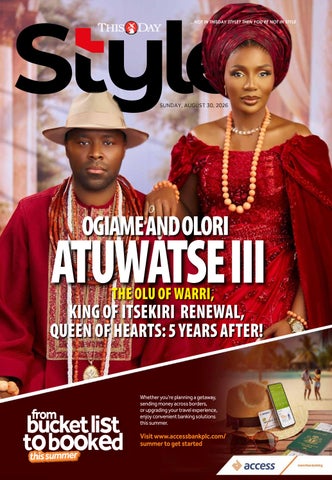
OGIAME AND OLORI
ATUWATSE III THE OLU OF WARRI,
KING OF ITSEKIRI RENEWAL, QUEEN OF HEARTS: 5 YEARS AFTER!
bucket list tthoissubmoo e k d mer from
Whether you're planning a getaway, sending money across borders, or upgrading your travel experience, enjoy convenient banking solutions this summer.
Visit www.accessbankplc.com/ summer to get started 1
Sunday, August 30, 2026 Vol. 22, No. 11429
Sunday, August 30, 2026 Vol. 22, No. 11429
EDITOR’S LETTER
COVER NOTE
ALTERNATIVE PACKSHOTS HYGGE SCENT DIFFUSER
EXECUTIVE EDITOR
14
14
F
ive years ago, when Ogiame Atuwatse III ascended the throne as the 21st Olu of Warri, he made a call that would become particularly significant at this milestone: he asked Itsekiris in the diaspora to develop a consistent rhythm of returning home. This August, they did. From across Nigeria and the diaspora, sons and daughters of Iwere returned to Warri Kingdom as the Olu marked the fifth anniversary of his coronation.
Lifestyle & Fashion
4
10
20
S yle
A Good Scent Can Change the Mood of a Room
3
Itsekiri Global Homecoming Takes the Nation by Storm
4
Dolly Parton: 10 Moments That Made an Icon
6
EXECUTIVE EDITOR KONYE NWABOGOR
Odio Mimonet Unveils a New Identity at 30
8
DEPUTY EXECUTIVE EDITOR OLUFUNKE BABS-KUFEJI
TR
UT H
& RE A SO
N
08111847087
08111847086
Ruth Kadiri is Architecting Nollywood’s Billion-View Era
10
What to Wear When the Invitation Says “Chic”
20
CONTRIBUTOR EBIYEKON DORCAS DIO
Beauty Treatments to Book in Your 30s, 40s and 50s
22
DIRECTOR, PRINT PRODUCTION CHUKS ONWUDINJO
ASSISTANT EDITOR YINKA OLATUNBOSUN
Life, Legacy and the Long Game
H
ey guys, we are officially heading into September, the last month of the third quarter—crazy, right? I know. However, it does feel like a good enough reason for a life audit. Not the serious, spreadsheet kind. More like: what has been taking most of your energy lately, and has it been worth it? I’m particularly interested in the people part. We talk endlessly about investing in ourselves, our careers, health, money, dreams, but relationships deserve investment too. Good ones don’t survive on affection alone. They need time, effort, attention and the occasional inconvenience. Show up. Make the call. Remember the important thing they told you three weeks ago. Celebrate people loudly and be generous with your time when you can. And while we are at it, there is nothing wrong with expecting some of that energy back. Reciprocity may not sound terribly romantic, but constantly pouring into people who arrive with empty cups and no intention of refilling yours is exhausting. Give generously, certainly, but give as good as you get. Which brings me, strangely enough, to Dolly Parton. News of her death this week at 80 travelled quickly, followed almost immediately by stories, photographs, songs and memories from a career that stretched more than six decades. But beyond the music, the rhinestones, the wigs, and that wonderfully self-aware sense of humour, she was a woman who understood something about giving back. Her philanthropy, particularly the Imagination Library she founded to provide free books to children, became almost as much a part of the Dolly story as the songs. There is something instructive in that. Success tells us what you achieved; legacy tells us what remained useful to other people because you were here. Dolly built an extraordinary career, but she also built beyond herself. That distinction matters. And if legacy is partly about what survives you, longevity is about knowing how to keep what you have built alive. Thirty years after Odio Mimonet began, the Nigerian fashion house is choosing reinvention over simply celebrating the milestone. There is a new brand identity, a new logo and a sharper visual language, with a logomark inspired by the arched colonnades of Obafemi Awolowo University. It is an interesting move for a house with three decades of history because established brands can easily become overly protective of the very things that made them successful. But perhaps that is the real trick to building anything that lasts: knowing what must never change and what absolutely should. There is plenty more in this week’s issue, so I’ll leave you to it. September arrives on Tuesday, which means we still have four months to make something interesting out of 2026. No pressure, of course. But January was eight months ago, so perhaps a little pressure.
Printed by Ups Digitals Ltd, Abuja; 08057025005; info@upsdigitals.com
@thisdaystyle |
No candle is powerful enough to disguise a room that needs cleaning. In fact, fragrance layered over stale air, cooking smells or dampness can make things worse. Open the windows when you can, wash soft furnishings regularly, empty bins, keep bathrooms dry and pay attention to curtains, rugs and sofas, which tend to hold onto smells. In our weather, ventilation matters even more. A home that smells fresh before you add fragrance gives you a much better starting point.
There is no reason your entire house should smell exactly the same. Think of fragrance almost like decorating: what works beautifully in the bedroom may feel completely wrong in the kitchen. Citrus, herbs and clean green notes work well in kitchens because they feel crisp and fresh. Living rooms can take warmer, more welcoming fragrances such as amber, sandalwood, vanilla, fig or subtle florals. Bedrooms are lovely with lavender, musk, jasmine or soft woody scents, while bathrooms are perfect for eucalyptus, mint, citrus and fresh linen notes. You are creating a mood, not simply making the room “smell nice.”
Choose Your Method
ELECTRIC DIFFUSER
@thisdaystyleon | www.thisdaystyle.ng
Start With a Properly Clean House
Give Different Rooms Different Personalities
08077092196
Love,
2
A GOOD SCENT CAN CHANGE THE MOOD OF A ROOM
You know those homes you walk into and immediately think, this smells good? Not overpowering, not like someone emptied a bottle of air freshener five minutes before you arrived, but a lovely scent that seems to belong to the space. It is warm, inviting and memorable. We spend so much time thinking about how our homes look — the furniture, lighting, art, cushions, flowers — but fragrance can do just as much for a room. The right scent can make a bedroom feel calmer, a living room more welcoming, and even a freshly cleaned kitchen somehow feel cleaner. The trick is knowing how to use it.
LAYERING FRAGRANCE THROUGH SIMPLE DÉCOR ELEMENTS
Candles may get all the attention, but they are only one option. Reed diffusers are brilliant for maintaining a gentle fragrance throughout the day without any effort. Room sprays give an instant hit and are particularly useful just before guests arrive. Essential-oil diffusers allow you to experiment with different
combinations, while incense can give a room a deeper, more atmospheric scent. There are also wax melts, scented sachets for wardrobes and drawers, linen sprays for bedding and even fragranced cleaning products. The best-smelling homes often use a combination rather than relying on one enormous candle to do all the work.
Learn the Art of Layering
This is where things become interesting. Just as you might layer perfume on the body, you can build fragrance around the home. Perhaps your living room has a sandalwood diffuser, while you occasionally burn a candle with amber and vanilla notes. Your cushions might carry the faintest trace of a complementary linen spray. None should compete for attention; they should simply sit well together. Stick within the same fragrance family or choose notes that naturally complement one another. Rose, oud, amber and musk can work beautifully together, for instance, while citrus pairs well with herbs and green notes.
Pay Attention to the Entrance
Your entrance is the first impression of your home, and scent reaches people before they have had time to admire anything else. A diffuser near the doorway or a discreet room spray can create that immediate sense of welcome. This is a good place for something distinctive — perhaps bergamot, neroli, amber, oud or a sophisticated woody scent.
Don’t Forget Fabrics
Fabric holds fragrance wonderfully, which makes linen sprays one of the easiest ways to make a home smell good. A light mist over curtains, cushions, throws and bedding can linger far longer than spraying fragrance into the air. Freshly changed sheets with a soft linen, lavender or musk scent are particularly satisfying. Spray lightly, though, and always check that the product is suitable for the fabric first.
Know When Enough Is Enough
The biggest mistake with home fragrance is assuming more must be better. It rarely is. Your nose quickly becomes accustomed to scents you live with every day, so you may stop noticing your diffuser even when everyone else can smell it perfectly. A beautifully scented home should reveal itself gradually. You notice something fresh when you enter, perhaps something warmer in the living room and something softer when you get into bed.
3
Sunday, August 30, 2026 Vol. 22, No. 11429
Sunday, August 30, 2026 Vol. 22, No. 11429
ITSEKIRI GLOBAL HOMECOMING TAKES THE NATION BY STORM
W
hen His Majesty, Ògíamè Atuwatse III, CFR, the Olu of Warri, ascended the throne five years ago, he called on sons and THE ITSEKIRI GLOBAL HOMECOMING BOAT FOR THE ROYAL REGATTA daughters of Iwere across the world to return home and lend their capacity to a new era of royal renaissance. Last week, that call came full circle with the inaugural Itsekiri Global Homecoming (IGHC). Held as part of the Olu’s 5th coronation anniversary, the seven-day celebration transformed Warri into an epicentre of culture, fashion, commerce, global connections and royal grandeur, drawing delegates from Australia, the UK, the US, South Africa, France, Ireland and across Nigeria. Powered by the Royal Order of Iwere (ROI), activities included private museum tours at the Olu Palace, an economic development forum with the Royal Iwere Foundation, Falcorp Mangrove and Ijala Royal Cemetery eco-tours, and a spectacular royal boat regatta. IGHC Steering Committee Chairperson Tara Fela-Durotoye (ROI) described the gathering as a strategic homecoming designed to reconnect generations, unlock global enterprise and position Itsekiri heritage on the world stage. With support from ROI Secretary and Steering Committee Leader Ade Mabo (ROI), the event is already generating interest for next year, positioning IGHC as an annual pilgrimage of culture, luxury and collective progress.
EBIYEMI JEMIDE
ADE MABO, AND EHI ADE-MABO
OLU OF WARRI AT THE MAIN CORONATION ANNIVERSARY DAY
L-R SISAN AREYENKA, MAJOR MEJEBI AND CHIBIE LOUIS-OKOYE
4
L-R OMAWUMI OGBE, AND FAROOQ OREAGBA
NEO AKPOFURE
OLORI ATUWATSE III AT THE CORONATION ANNIVERSARY
HELEN DIABO
UTI ELLU
UTI NWACHUKWU
TOBE OGEH WITH A DELEGATE
TARA FELA-DUROTOYE AND TAYMESAN EMMANUEL
TONY DABOR
OTI UKUBEYINJE
VENITA AKPOFURE
ORITSEGBUBEMI OGBOBINE
WEYINMI OGHOLAJA
CHIBIE LOUIS-OKOYE
TOMAMA AKA DATWARRI GIRL
ORITSEMINOMI OGBE
SHOLA JOHNSON
5
Sunday, August 30, 2026 Vol. 22, No. 11429
Sunday, August 30, 2026 Vol. 22, No. 11429
the deal reportedly required Dolly to surrender half of her publishing rights. She refused. It was an extraordinarily consequential decision.
DOLLY PARTON:
7. Whitney Houston Changes Everything Nearly two decades after Dolly first recorded I Will Always Love You, Whitney Houston turned it into a global phenomenon. Houston’s 1992 recording for The Bodyguard became one of the biggest-selling singles of all time. Because Dolly had held on to her songwriting and publishing interests, its success also generated enormous income for her. There is something wonderfully fullcircle about it. The song Dolly wrote because she had the courage to leave one professional relationship became vastly more valuable because she later had the courage to walk away from another deal. She would later speak warmly about Whitney and the extraordinary new life she gave the song.
10 MOMENTS THAT MADE AN ICON
Dolly Parton was never just a country singer. She was a songwriter of astonishing instinct, a movie star, businesswoman, philanthropist and one of the most recognisable women in popular culture. The blonde wigs, rhinestones, tiny waists and towering heels made her instantly identifiable, but behind the spectacle was a woman who understood talent, ownership and longevity remarkably well. Following her death at 80, the tributes have inevitably returned to the songs: Jolene, 9 to 5, Coat of Many Colours and, of course, I Will Always Love You. But Dolly’s legacy is bigger than any one record. Over six decades, she built a career that crossed country, pop, film, fashion and business without ever sanding down the Tennessee girl at its centre. Here are ten moments that help explain how Dolly Parton became Dolly Parton. By Yinka Olatunbosun
1. From the Smoky Mountains to Nashville
Dolly Rebecca Parton was born in 1946, one of 12 children raised in a small cabin in rural Tennessee. Money was scarce, but music was everywhere. She sang in church, performed on local radio and television as a child and began recording while still young. The poverty of her childhood would later become material for her songwriting rather than something she tried to erase. Coat of Many Colours, inspired by a coat her mother made for her from scraps of fabric, turned a deeply personal childhood memory into one of her most beloved songs. In 1964, the day after graduating from high school, she moved to Nashville. She was 18 and determined to become a songwriter.
2. The Porter Wagoner Years Her big break came when country star Porter Wagoner invited her to join his television programme in 1967. Their musical partnership made Dolly a familiar face across America, but eventually she wanted a career beyond the duo.
6
Leaving Wagoner became one of the pivotal decisions of her life. Rather than deliver a lengthy explanation, Dolly did what she did best: she wrote a song. That song was I Will Always Love You, released in 1974 as an affectionate farewell to her mentor. It reached No. 1 on the country chart and would eventually become one of the most famous compositions in popular music.
3. The Day That Gave Us ‘Jolene’ and ‘I Will Always Love You’
Few facts illustrate Dolly’s songwriting gift better than the story that she wrote Jolene and I Will Always Love You around the same period, famously recalling that she believed they may even have been written on the same day. The songs could hardly be more different. One is a desperate plea to a beautiful romantic rival; the other is a tender goodbye. Yet both possess the quality that defined Dolly’s writing: simple language carrying enormous emotion. Across her career, she wrote thousands of songs. The glamour may have attracted attention, but songwriting was always the
foundation. a natural comic actress while the film’s title song became a Before personal branding became crossover smash. With its instantly an industry, Dolly understood the recognisable typewriter-like power of having a look nobody could rhythm and lyrics about workplace mistake for anyone else’s. frustrations, 9 to 5 became an She has often spoken about anthem far beyond the film. being fascinated as a child by a More movie roles followed, including flamboyantly dressed woman in The Best Little Whorehouse in Texas her hometown whom other people and Steel Magnolias. Dolly had considered inappropriate. Young crossed into mainstream American Dolly thought she was beautiful. entertainment without abandoning Years later came the enormous the accent, humour or exaggerated blonde wigs, long nails, dramatic glamour that made her distinctive. makeup, rhinestones, fitted dresses and vertiginous heels. 6. Dollywood Proves Dolly Rather than allowing people to Means Business embarrass her about looking “too Perhaps one of the smartest things much”, Dolly joined in on the joke. Dolly did with fame was take some Her famous line — “It costs a lot of it home. of money to look this cheap” — In 1986, Dollywood opened in revealed how knowingly the whole Pigeon Forge, Tennessee, near thing was constructed. where she grew up. What could She wasn’t dressing to be fashionable. She was dressing to be easily have been another celebrity vanity project became a major tourist Dolly. attraction and an important employer in East Tennessee. 5. When Hollywood Came It also revealed another side of Dolly: Calling the shrewd businesswoman hiding in By 1980, Dolly was already a country plain sight behind the rhinestones. superstar. Then 9 to 5 introduced Her instincts around ownership another Dolly to the world. were equally important. When Elvis Starring alongside Jane Fonda Presley’s team expressed interest and Lily Tomlin, she proved herself in recording I Will Always Love You,
4. Creating the Dolly Look
8. Rhinestones Become a Fashion Language
Dolly never treated fashion as an attempt to appear tasteful to other people. That was precisely what made her stylish. Through decades of changing trends, she remained committed to her own visual vocabulary: sequins, fringe, crystals, plunging necklines, exaggerated hair and body-conscious silhouettes. From television appearances and film premieres to the Grammys and, eventually, her induction into the Rock & Roll Hall of Fame, she dressed for the occasion without ever disappearing inside it. Today, when celebrities are encouraged to develop instantly recognisable “aesthetics”, Dolly’s wardrobe looks remarkably ahead of its time. She understood that consistency could become
iconography.
9. Turning Fame Into Something Useful
For all the jokes, glamour and enormous commercial success, Dolly’s philanthropy became one of the most consequential parts of her public life. She founded the Imagination Library in 1995 in honour of her father, who could not read or write. The programme began by providing free books to children in her home county and eventually expanded internationally, distributing millions of books to young children. After devastating wildfires hit East Tennessee in 2016, her My People Fund provided financial assistance to affected families. In 2020, she donated $1 million to Vanderbilt University Medical Center for COVID-19 research; part of that research supported work connected to the Moderna vaccine. Dolly rarely made generosity feel like a performance. For her, success seemed most valuable when it could travel beyond the person who achieved it.
10. The Private Love Story Behind a Very Public Woman
There was one significant part of Dolly’s life she largely kept away from the spectacle: her marriage. She met Carl Dean outside a Nashville laundromat shortly after arriving in the city. They married in 1966 and remained together until his death in 2025. While his wife became one of the most famous women in America, Dean chose an almost completely private life. The contrast somehow suited them. Dolly could belong to millions of fans and still have a part of herself that did not. Their marriage lasted nearly six decades, through tours, movies, businesses, awards, rumours and every incarnation of the woman the world knew simply as Dolly.
7
Sunday, August 30, 2026 Vol. 22, No. 11429
T
hirty years after it first began shaping its own distinctive vision of Nigerian luxury, Odio Mimonet is entering a new era. The fashion house, founded by designer Odio Oseni, has unveiled a new brand identity designed to reflect both where it comes from and where it intends to go next. Launched in Lagos on August 19, the rebrand introduces a new logomark, logotype and colour system, giving the three-decade-old label a refreshed visual language as it sets its sights more firmly on the international market. Rather than look outside Nigeria for inspiration, the house turned to one of the country’s most recognisable examples of modernist architecture. The new logomark takes its form from the arched colonnades of Obafemi Awolowo University, whose campus is regarded as an important example of Tropical Modernism in postindependence Nigeria. Look closely, and there is more going on. The shape resembles an inverted crown, while the letters M-I-M, drawn from the Mimonet name, are worked into the design. It is a clever meeting of architecture, fashion and identity, with the crown motif speaking to the confidence and cultural authority that have long been part of the Odio Mimonet aesthetic. The house has also introduced a bespoke typeface created specifically for the brand, alongside Sun Red,
8
now designated as its signature colour. Bold and unmistakable, the shade is intended to capture what Odio Mimonet describes as “playful elegance, contemporary luxury, and cultivated individuality.” For followers of the brand, those qualities will be familiar. Over three decades, Odio Mimonet has developed a recognisable design language built around dramatic silhouettes, rich textiles, colour, intricate embellishment and a distinctly feminine sense of presence. Oseni has also consistently looked to Nigerian dress traditions, interpreting them for women in ways that feel contemporary rather than nostalgic. Among her most notable contributions is her reinterpretation of the traditionally masculine Agbada as the Bubu, transforming ideas of volume, authority, and ceremonial dressing into an elegant silhouette for women. It is an approach that captures much of what has sustained the label: respect for heritage without being constrained by it. The brand itself began from Oseni’s frustration with clothes that did not adequately consider women’s bodies, proportions or personalities. Her answer was to build a house around women as they actually are, creating clothes intended to celebrate rather than diminish their presence. Three decades later, that philosophy remains intact. What has changed is the framework around it.
Sunday, August 30, 2026 Vol. 22, No. 11429
ODIO MIMONET UNVEILS A NEW IDENTITY AT 30
9
Sunday, August 30, 2026 Vol. 22, No. 11429
In the ever-evolving world of African entertainment, where relevance can be fleeting, Ruth Kadiri has built an enduring digital ecosystem that is redefining how African stories are created, distributed and consumed around the world. Today, she is far more than a Nollywood star. She is one of the continent’s most influential filmmaker-entrepreneurs, with a digital empire spanning RuthKadiri247 and FrenchTV247, platforms that together command more than 5.6 million subscribers. Perhaps most impressively, her content has shattered glass ceilings and is on track to reach a combined one billion views, a milestone that places her in the top 1% of digital creators. By embracing YouTube long before it became the industry’s preferred distribution channel, Kadiri has transformed herself from filmmaker to media powerhouse, proving that African creators can own not only their stories, but also their audiences. This year has marked yet another defining chapter. From taking the stage at Cannes Lions, where she spoke on the future of African storytelling and announced her 2026 Francophone Tour, to continuing her mission of connecting audiences across linguistic and cultural borders, Kadiri is demonstrating that the future of African cinema is collaborative, borderless and unapologetically global. In this exclusive conversation she reflects on leadership, creativity, building a billion-view business, the importance of rest, staying authentic in an industry that never slows down, and the legacy she hopes to leave for the next generation of African storytellers. You embraced YouTube long before it became the industry’s preferred platform today. What do you see as the next big shift for African film distribution? The biggest shift is ownership. Digital platforms are reshaping distribution, even though they’re not replacing cinemas entirely. For years, many filmmakers waited for international distributors to decide whether their stories deserved a global audience. Today, that’s changing. Creators are building their own distribution networks and reaching audiences directly. We’re also becoming more confident in telling our stories exactly as they are, without worrying about external validation. Visibility is greater than ever, and with nothing more than a smartphone, data, and the right mindset, African creators can build truly global businesses.
Sunday, August 30, 2026 Vol. 22, No. 11429
Above all, I’m loyal and kind. And yes... I can be a little petty sometimes. (Laughs.) When the cameras stop rolling, what does the perfect day off look like for you? Sleep. Honestly, that’s my luxury. It’s funny because when I’m working, I work like a machine. My mind never really switches off. But the moment production ends, my body completely shuts down. When I finally get time to myself, I just want to sleep. I can stay in bed all day and be perfectly happy doing absolutely nothing. It’s like I live two completely different lives.
ruth
KADIRI
ARCHITECTING NOLLYWOOD’S BILLION-VIEW ERA
What’s the biggest misconception people have about your life and career? People see millions of views and automatically assume they know your business. The reality is that building a YouTube filmmaking business is very different from traditional film distribution. You’re constantly creating while also analysing data, studying audience behaviour and making business decisions in real time. Sometimes you’re not just a filmmaker; you become a data analyst too. It’s mentally demanding, and there are so many assumptions about income, success and lifestyle that simply aren’t based on reality. What’s your go-to comfort-meetschic look when you’re directing for long hours? Comfort always wins. I love wearing clothes that allow me to move freely, but one thing about me is that if you spend enough time around me on set, you’ll probably find me walking around barefoot. At least once or twice a day, the shoes have to come off. (Laughs.) That’s probably the real Ruth Kadiri. Earlier this year, you spent a month
filming in Cape Town with a cross-cultural cast. Why is it important for African stories to be told in diverse locations, and what did filming there add to your storytelling? We’re one Africa, and YouTube has shown us that our stories are watched far beyond Nigeria. For me, filming in different parts of the continent is about expanding the visual language of African storytelling and showing audiences the richness and diversity that exists across Africa. Cape Town offered incredible landscapes, beautiful weather, exceptional locations and a vibrant culture that naturally became part of the stories we were telling. Bringing together talent from different countries also enriched the creative process. Everyone brought something unique, and that made the stories even stronger. I believe the future of African storytelling lies in collaboration. The more we work together across borders, the more authentic and globally competitive our stories become. Our diversity is one of our greatest strengths, and I hope we continue creating more opportunities for filmmakers, actors and creatives to move freely, collaborate more intentionally and tell stories that reflect the full richness of our continent. That’s how we’ll build an industry that truly belongs to all of Africa and can compete globally. What can audiences expect from Ruth Kadiri before the year comes to a close? We’re continuing to expand across markets and audiences, so there’s a lot happening behind the scenes. The focus remains on telling bigger stories, building stronger collaborations across Africa and creating content that reaches even more people globally. It’s an exciting season, and I think audiences will see that reflected in what’s coming next. How do you switch off and recharge creatively? For me, rest is giving my mind permission to slow down. That doesn’t happen often because I’m always thinking about stories, productions or new ideas. But whenever I truly disconnect, I allow myself to rest completely. That’s usually when creativity finds me again. You’ve remained remarkably authentic despite your success. How do you stay grounded? Self-awareness has always been important to me. I know who I am, and I don’t feel the need to become someone else because of success. Family also keeps me grounded. At the end of the day, the industry can change, but the people who truly know you remind you of what really matters. What legacy do you hope to leave for the next generation of African storytellers? I want the next generation to know that they don’t need permission to dream globally. The tools exist today for African creators to build audiences, businesses and legacies on their own terms. If my journey proves anything, it’s that our stories have value, our voices matter, and the world is ready to listen.
In June, you spoke at Cannes Lions and announced your 2026 Francophone Tour during the YouTube Creators Club. What did that moment mean to you? It was an incredibly special moment because it reinforced something I’ve always believed: that African stories belong on the world’s biggest stages. Speaking at Cannes Lions wasn’t just a personal milestone; it was an opportunity to represent African storytellers and show how far we’ve come as an industry. But what made it even more meaningful was announcing my 2026 Francophone Tour at the YouTube Creators Club. As someone who has built such a significant part of my filmmaking journey on YouTube, making that announcement in a space created by YouTube felt incredibly symbolic. I’m grateful to the YouTube team for opening their doors to creators like me and for creating opportunities that celebrate and amplify African voices. It was a beautiful experience, and I felt genuinely welcomed and supported. The Francophone Tour itself is part of a much bigger vision to connect audiences across Africa, bridge language barriers and continue building an ecosystem where African stories travel freely across the continent and beyond. Moments like that remind me that we’re no longer just participating in global conversations; we’re helping shape them. You lead with remarkable calm on set and in business. Where does that quiet confidence come from? I think it starts with clarity. Beyond that, I’m honestly not sure there’s a formula. I simply show up and do what needs to be done. I trust my instincts, stay focused on the work and lead with authenticity. Off camera, how would you describe Ruth Kadiri in three words? Authentic. Grounded. Intentional. I think I have a real girl-next-door vibe, but once people get to know me, they realise I’m very direct and never afraid to speak my mind. I’m private but not secretive, business-minded, self-aware and deeply family-oriented.
10
11
Sunday, August 30, 2026 Vol. 22, No. 11429
Sunday, August 30, 2026 Vol. 22, No. 11429
bucket list tthois sb oo e k d ummer from
Whether you're planning a getaway, sending money across borders, or upgrading your travel experience, enjoy convenient banking solutions this summer.
Visit www.accessbankplc.com/ summer to get started
12
13
Sunday, August 30, 2026 Vol. 22, No. 11429
OGIAME AND OLORI
ATUWATSE III THE OLU OF WARRI
KING OF ITSEKIRI RENEWAL, QUEEN OF HEARTS: 5 YEARS AFTER!
F
COVER
COVER
Sunday, August 30, 2026 Vol. 22, No. 11429
BY KONYE CHELSEA NWABOGOR
ive years ago, when Ogiame Atuwatse III ascended the throne as the 21st Olu of Warri, he made a call that would become particularly significant at this milestone: he asked Itsekiris in the diaspora to develop a consistent rhythm of returning home. This August, they did. From across Nigeria and the diaspora, sons and daughters of Iwere returned to Warri Kingdom as the Olu marked the fifth anniversary of his coronation. At the heart of the celebrations was the inaugural Itsekiri Global Homecoming, a seven-day gathering conceived as more than an opportunity to celebrate. It was about reconnecting with culture, community, and, perhaps most importantly, the future of Iwere. It was a fitting way to mark five years of a reign that has consistently tried to find common ground between tradition and modernity. When Ogiame Atuwatse III was crowned on August 21, 2021, he became the youngest monarch in the more than 500-year history of Warri Kingdom. Educated in the United States and coming to the throne with experience outside the traditional institution, he represented a new generation of leadership while inheriting one of Nigeria’s oldest and most historically significant monarchies. The years since have seen the Palace place considerable attention on education, enterprise, healthcare, culture and opportunities for young people, while strengthening connections between the Kingdom and an increasingly global Itsekiri community. Alongside him, Olori Atuwatse III has developed her own considerable body of work, particularly around women, children and entrepreneurship. Through initiatives including EstablishHER, her advocacy has increasingly focused on giving women access not simply to assistance, but to the tools and opportunities to build sustainable livelihoods. The fifth coronation anniversary brought much of that work, and the thinking behind it, into focus. Held under the theme “Global Homecoming – Celebrating Our Cultural Renaissance, Unity and Transformational Progress,” the wider tenday anniversary combined the splendour expected of an ancient kingdom with conversations about where Iwere goes next. There was homage paying, music, traditional ceremonies, sporting activities, thanksgiving and the spectacular Royal Regatta. But alongside the colour and ceremony were the Itsekiri Development Forum, the Queen’s Business Conference, cultural and historical excursions and opportunities for Itsekiris at home and abroad to connect professionally and economically. Perhaps that was the most important point of the Homecoming. Returning home was never intended to end with celebration. It was also an invitation to participate. Five years is, of course, only a small chapter in the life of a centuries-old throne. But it is enough time to look back, take stock and begin asking what comes next. For Ogiame Atuwatse III and Olori Atuwatse III, this anniversary offered exactly that moment. With the celebrations over and the first Global Homecoming now part of Iwere history, Konye Chelsea Nwabogor speaks with the royal couple about the last five years, leadership and legacy, reconnecting a global Itsekiri community with home, and their hopes for the next chapter of Warri Kingdom.
14
15
HIS MAJESTY, OGIAME ATUWATSE III, CFR, THE OLU OF WARRI Your Majesty, five years ago you ascended the throne with a very clear sense of the kind of Warri Kingdom you wanted to build. Looking back now, what are you most proud of, and where do you feel there is still work to be done? I would rather speak in terms of gratitude than pride. First, I am most grateful for God’s faithfulness, because when I look back over these five years, I can see His leading all along the journey. After that, I am grateful for our people. We developed a plan in consultation with our people, and we created the forums and programmes through which we would execute that plan. Yet I know that your best intentions can fall flat if the people do not buy in. Our people’s response has been largely positive, and there has been real enthusiasm because they are willing to see things change for everyone’s good. As for what remains, the work of development is never finished. Even if everything around us became a utopia today, humans are made in such a way that we would soon be asking what the next thing is. So, I do not think about this in terms of arriving somewhere. There is still so much to do in every regard, from the mental emancipation and upskilling of our people to breaking socio-cultural barriers, so the development we are working hard to attract will be better appreciated and put to good use. We are also working hard to attract investment into our region. The Itsekiri Global Homecoming brings together Itsekiris from home and across the diaspora. Beyond the celebration and pageantry, what would you like it to achieve for Iwere in practical terms? Five years ago, we put out a call for our people to come home, and they have started to respond. Our people in the diaspora have a great deal to contribute in terms of networks, experience, and expertise. We want all of that to complement the efforts already underway at home. We want to build Iwere Land with them. But I don’t want the Homecoming to be seen only through that lens. There is also something to be said for simply having stronger relationships with all our people, wherever they are. For any parent, even when your children leave home, you want to remain connected to them. You want to keep partnering with them for the legacy you share. That is why I will keep calling out to the global Itsekiri community, “Come home.” Your reign has placed considerable emphasis on reconnecting the Itsekiri people with their culture while also presenting Iwere to a much wider world. How do you preserve what must never change while allowing the Kingdom to evolve with the times? Our heritage has given us much that is worth holding on to. Our customs, art forms, language, and ceremony all carry meaning that the world can learn from and enjoy as much as we do. I am a proud keeper of that inheritance. I am also an advocate for purpose and progress, and I do not think those two positions are in conflict. We love and value our traditions, and we appreciate our ancestors’ efforts because they have brought us this far. However, tradition is not the same as purpose. It is an aid to purpose. Purpose concerns direction. It keeps our actions, aims, and targets in focus, and it drives us to commit to our daily plans and long-term goals, which our traditions support. If we accord more sentiment to tradition and not enough focus to purpose, we will keep producing the same old results, and we risk preserving the past at the expense of the future. Doing things differently from how we did them in the past requires the humility and boldness to challenge ourselves in truth, not sentiment. We should be constantly evaluating our traditions to see where our culture needs improvement and evolution. What must never change is who we are. How we express it in each generation is another matter entirely. You have spoken about unity not only within the Itsekiri nation but among the different communities that share Warri. What do you believe traditional leadership can do today to strengthen that
16
Sunday, August 30, 2026 Vol. 22, No. 11429
sense of common purpose? Traditional leadership is the natural and spiritual rallying point of our people. A great deal flows from that head, all the way down through the body. So when we take positive action toward genuine development in this metropolitan area, it becomes easier to overcome the sentiments that would otherwise stall it. Modern development and culture are not in conflict. They can be brought together, and the forging of that hybrid is work that belongs to the traditional institution. That is where I believe our greatest contribution lies. I want to say clearly that everything we do in my Kingdom is for our own benefit and for the benefit of the communities around us.
COVER
COVER
Sunday, August 30, 2026 Vol. 22, No. 11429
When you think about the next five years of your reign, what would you most like to see change in the everyday lives of your people, particularly the younger generation? The children in our Love Gardens today are five-, six-, ten-yearolds. They are planting produce, nurturing, harvesting, and selling them. In five years, they will be teenagers who already know that they can produce something of value through the work of their own hands. That is a different teenager from the one who has only ever been told to wait for handouts. Some of the children on our scholarships will be leaving secondary school and entering university, and many of them will be the first in their families to do so. The young people coming through our STEM and enterprise programmes will be building things and running businesses rather than looking for who will employ them. The women who come into EstablishHER today with a small trade will have had five years to grow it, and I expect many of them to be employing other people by then. In short, Warri people and communities will be contributors, at home and wherever else they find themselves. What I want underneath all of that is for all of our people to be filled with real hope, and to have real avenues to fulfil their potential, while remaining proud of their heritage, their identity and their culture. From that place, I want to see them design and engineer things, inventions and solutions that add value to our society and improve our prospects as a people.
17
Sunday, August 30, 2026 Vol. 22, No. 11429
HER ROYAL MAJESTY, OLORI ATUWATSE III QUEEN CONSORT OF WARRI KINGDOM Your Royal Majesty, the last five years have changed your life as much as they have marked a new chapter for the Kingdom. How have you personally grown into the role of Olori, and what has surprised you most about it? From day one, His Majesty and I committed to using our roles to serve our people. But it’s one thing to know that going in, and another to start the work and realise how much there truly is to do. For me, as Olori, that meant orienting my life around advancing our people and our continent as a whole because I realised it is not enough to seek the development of our Kingdom alone. We must seek the growth of all, as that is the only way to truly sustain and scale impact. I have grown in selflessness and wisdom, and the years have taught me my capacity to lean into the purpose God has given me, show His love through service, and change things. I have been pleasantly surprised by the power of individual determination coupled with collective wisdom and action. When I think about how much impact we’ve made from health outreaches to skills training, education, and more, I am grateful and encouraged. Much of your work has centred on women, children, education and enterprise. What have your interactions with women across the Kingdom taught you about what they need most — not just in terms of assistance, but opportunity? I have always known our women are capable; they are the backbone of families, communities, and our economy. The research tells us that plainly enough. However, knowing something from research and getting to know individual women very well are two very different experiences. From my interactions, I have seen that what they need most is support that centres them, not the supporter, because their realities are complex and vary from one community to the next. For example, when the Foundation asked the people of Ologbotsere what they
18
needed, they told us they needed education for their children. Their old school was run-down, so we built them a new one. Across Warri, our women did not want handouts; they simply wanted to be empowered to build for themselves. That’s exactly what we did through EstablishHER, which trains and upskills them. I’ve seen the remarkable things our women have achieved with that support, with many of them starting or scaling businesses, and some going on to mentor and create opportunities for others. Our women want long-term solutions for themselves, their children, and the generations after them, so our goal is to be enablers by providing infrastructure, skills training, healthcare, and other resources that create opportunities and enable them to take advantage of them. The Itsekiri Global Homecoming is also about giving younger Itsekiris and those in the diaspora a stronger connection to where they come from. How do you make heritage meaningful to a generation whose lives may be increasingly removed from home? His Majesty and I are custodians of our culture by virtue of position and because we genuinely love our history and our heritage. There is so much in it to love, so much to be proud of, and so much still to grow. That is why it matters to us that every Itsekiri person, young or old, at home or abroad, is conscious of the fact that this Kingdom belongs to all of us. Some of our people come home at different times to visit family, while others seldom have the
opportunity to. The Homecoming gave us all a reason to be home at the same time, to gather, and to enjoy our culture and heritage together. For many who saw the progress being made, it also renewed their desire to contribute. So, we make our heritage meaningful by showing it and giving it the reverence and meaning it has always held. That works for our own people, and judging by how non-indigenous people responded to what they saw, it works well beyond them too. You and His Majesty have worked together on initiatives that extend beyond the Palace, including the Royal Iwere Foundation and Elevate Africa. How do you balance being partners in marriage with being partners in a much larger vision of service and impact? Sharing a vision has improved both our marriage and our service. When you work toward the same goal, you understand each other’s commitments without needing to explain them, and you act together to achieve more than either could alone. The Royal Iwere Foundation began at home with our own people in the Kingdom. Elevate Africa followed, when it became clear that what we were learning in Warri could benefit the whole continent. There has never been much to balance. Whatever we are building, we build it first as husband and wife, then as partners in service and impact. I am grateful for that every day.
COVER
COVER
Sunday, August 30, 2026 Vol. 22, No. 11429
Five years into this journey, what are you most proud of when you look at His Majesty’s reign — and what are you personally hoping the next five years will allow you to accomplish for the women, children and communities of Iwere? What I am most proud of is our people and their commitment to the development of this Kingdom. The eagerness with which many of them have embraced programmes that help them grow is heartwarming, and I am also proud of the impact that we have made over these five years. For the next five years, I am hoping for scale. More infrastructure, more skills development, and more work on mindset development, which matters every bit as much as the other two. I want to start seeing greater fruit from the seeds we’ve sown in our women, children, and communities across the different Royal Iwere Foundation programmes. I know we will, because as our children grow in knowledge, our women and youth in skills, and our communities in dignity and economic strength, the whole of Warri rises to a greater future.
19
Sunday, August 30, 2026 Vol. 22, No. 11429
Sunday, August 30, 2026 Vol. 22, No. 11429
And when in doubt, Google the venue. Seeing the space will quickly tell you whether the outfit in your hand is doing too much — or nowhere near enough. The venue usually tells you more than the dress code does.
A Great Dress Rarely Fails
There is a reason we keep returning to dresses when we don’t know what to wear: they solve most of the outfit in one go. Choose one with something interesting about it — a beautiful neckline, draping, an unusual sleeve, a great colour or a flattering silhouette. It doesn’t need to be new, tight, short or covered in embellishment. The best option is usually the dress that makes you stand a little straighter when you put it on.
Yes, You Can Wear Jeans
Depending on the event, absolutely. But the jeans need good supporting actors. Dark straight-leg or wide-leg denim with a beautiful blouse, fitted top or sharp blazer can easily pass the chic test. Add good shoes, jewellery and a proper evening bag, and you’re there. Distressed jeans, an everyday T-shirt and the flats you wore to the supermarket? Different invitation.
WHAT TO WEAR WHEN THE INVITATION SAYS “CHIC” You get an invitation. Date, time, venue — all perfectly clear. Then you reach the dress code: Chic. Okay. But what exactly are we wearing? “Chic” is one of those dress codes that sounds helpful until you actually have to get dressed. Black tie, we understand. Cocktail gives us something to work with. Traditional is straightforward enough. Chic could mean a silk dress and heels, a beautifully cut trouser suit or even jeans with the right blazer. What it really means is: look stylish, polished and appropriate for where you’re going. Not casual, not red-carpet, and definitely not like you tried on everything in your wardrobe at once. 20
RITA DOMINIC ANOSIKE
Start With Where You’re Going
The venue is your biggest clue. A chic birthday dinner at a restaurant in Victoria Island requires something different from a chic garden party at 2pm. For brunch, think a great midi dress, a smart co-ord or wide-leg trousers with an interesting top. At night, you can go sharper or sexier — a fitted dress, elegant jumpsuit, silk skirt or tailored trousers.
No, Heels Are Not Compulsory
This one deserves saying because too many feet have suffered in the name of fashion. Slingbacks, kitten heels, elegant mules, embellished flats and even the right loafers can work. Choose according to the outfit and, importantly, the event. If you know you’ll be standing for four hours, plan accordingly. Taking your shoes off under the table before the main course is not particularly chic.
Coming Straight From Work? Change Three Things
There isn’t always time to go home and start again. If you’re heading straight from the office, start the day in good trousers, a skirt or a simple dress. Before you leave, change your shoes, bag and jewellery. Add lipstick, loosen your hair or slick it back, and suddenly the sensible 10am outfit has somewhere to be at 8pm. Keeping a pair of evening shoes and statement earrings in the car has saved more social lives than we acknowledge.
Let One Thing Do the Talking
Chic doesn’t automatically mean feminine dresses and heels. Sometimes the woman in perfectly cut trousers and a fabulous top is the best-dressed person in the room. Try wide-leg trousers with a fitted top, a waistcoat worn as a top, or a sharp suit with barely-there sandals. An oversized blazer over something slinky underneath also works beautifully. The important thing is fit. Clothes don’t have to be expensive to look good, but they do need to sit properly.
Especially in Lagos, there can be a temptation to wear the dress, earrings, necklace, statement bag, embellished shoes and possibly a small chandelier on your head for good measure. Resist. If the dress is dramatic, let it have its moment. If you’re wearing enormous earrings, perhaps the necklace can stay home. The same applies to designer pieces. The logo belt, monogram bag, statement shoes and oversized sunglasses don’t all need to attend the same party. Chic usually has a focal point. Choose yours.
African Prints Absolutely Count
And When in Doubt, Slightly Overdress
Tailoring Is Your Friend
OMOWUNMI DADA
and a statement bag joining the conversation.
Ankara, adire and other African textiles aren’t reserved for weddings or invitations that say “traditional.” A contemporary Ankara dress, an adire skirt with a crisp shirt or beautifully tailored print trousers can look incredibly chic. The trick is not to make everything compete. If the fabric is already colourful and busy, you probably don’t need enormous earrings, embellished shoes
There are few feelings worse than walking into a room and immediately realising everyone understood the assignment except you. If you genuinely can’t gauge the event, err slightly on the polished side. Choose the nicer dress, carry the smaller bag, add the jewellery and make an effort with your hair. You can always take off the blazer or remove an earring.
IFEOMA ODOGWU
SASHA
ANGEL ANOSIKE
FUNMBI OGUNBANWO
21
Sunday, August 30, 2026 Vol. 22, No. 11429
Sunday, August 30, 2026 Vol. 22, No. 11429
L-R, 30S -MIMI ONALAJA, IDIA AISIEN, BOLANLE OLUKANNI
50S -KAREN KOSHONI
40S-MONICA AWE ETUK
LASER HAIR REMOVAL
BEAUTY TREATMENTS TO BOOK IN YOUR 30S, 40S AND 50S Beauty treatments used to be fairly straightforward: book a facial, get a good scrub, maybe try a peel and go home glowing. Now there is a treatment for practically every pore, line and patch of pigmentation. Hydrafacials, microneedling, LED therapy, lasers, radiofrequency, skin boosters — even figuring out what to book can feel like work. But good skin at any age is not about doing everything. It is about knowing what your skin actually needs. For Black skin, that conversation is particularly important. Hyperpigmentation, acne marks, uneven tone and texture are often bigger concerns than wrinkles, and some aggressive treatments can actually make pigmentation worse. So before allowing anyone near your face with a machine, needle or acid, make sure they understand melanin-rich skin. With that established, here is what may be worth putting on your beauty calendar.
In Your 30s: Maintain And Correct
Your thirties are a good time to get serious about maintenance. You are protecting what you already have while dealing with lingering acne marks, pigmentation, congestion and texture.
Hydrafacials and DeepCleansing Facials
If your skin is looking dull, congested or simply in need of a reset, start here. Hydrafacials cleanse, exfoliate and hydrate without significant downtime, which explains why they have become such a beauty-clinic favourite. They are also brilliant before weddings, birthdays, holidays or any occasion when you would like your makeup to sit particularly well. Just remember that a facial is maintenance, not magic.
Chemical Peels
For stubborn dark spots, postacne marks and uneven tone, a
22
professionally selected chemical peel can be useful. The emphasis is on professionally selected. Darker skin is more prone to post-inflammatory hyperpigmentation, so this is not the time to chase the strongest peel available. A gentle, appropriate treatment done consistently will usually serve you better than one dramatic session.
Microneedling
Those acne scars that refused to leave your twenties? Microneedling may finally persuade them to move along. It is also used to improve uneven texture and the appearance of enlarged pores by stimulating the skin’s natural repair response and collagen production. Results are gradual, so think of it as a course rather than a quick preparty fix.
Laser Hair Removal
Anyone who regularly battles shaving bumps, ingrown hairs or endless waxing appointments will understand the appeal. Laser hair
removal can significantly reduce unwanted hair over a series of sessions. For Black skin, however, the type of laser matters, so always ask whether the equipment is suitable for darker skin tones.
In Your 40s: Strengthen And Stimulate Forty does not mean your face suddenly needs rescuing. Far from it. But skin changes gradually, and this is a good decade to pay more attention to collagen, hydration, firmness and pigmentation while continuing the basics that already work.
RF Microneedling
Radiofrequency microneedling combines tiny needles with radiofrequency energy to encourage collagen production deeper within the skin. It can help with texture, acne scarring and mild loss of firmness without dramatically changing your face. For someone beginning to notice
that their skin doesn’t feel quite as firm as it once did, this can be a more sensible place to start than anything drastic.
spending serious money correcting pigmentation and then heading straight back into the Lagos sun unprotected.
LED Light Therapy
Not every effective treatment has to involve peeling, needles or days spent hiding indoors. LED light therapy uses different wavelengths of light to target concerns such as inflammation and acne and to support overall skin health. It is gentle, requires no downtime and works particularly well as an add-on to other professional treatments.
Non-Invasive Skin Tightening
If firmness is becoming a concern, radiofrequency and ultrasoundbased treatments can stimulate collagen without surgery or injectables. The changes are generally gradual rather than dramatic — which, for many women, is exactly the appeal.
Targeted Pigmentation Treatments
Melasma, sun exposure, hormonal changes and old acne marks can make pigmentation more noticeable in your forties. The solution may be a combination of professional peels, dermatologist-prescribed products or carefully selected laser treatments. And please, sunscreen remains non-negotiable. There is little point
DARK-SKIN-LASER-TREATMENTS
CHEMICAL PEELS
In Your 50s: Restore And Rejuvenate By your fifties, hormonal changes can affect hydration, elasticity and collagen levels. Skin may become drier and thinner, and pigmentation or changes in texture may become more noticeable. The answer is not
to declare war on every line. It is to give the skin more of what it now needs.
Collagen-Stimulating Treatments
Professional radiofrequency, ultrasound-based procedures and other collagen-focused treatments can help improve firmness and skin quality over time. They work best for women looking for gradual rejuvenation rather than an entirely different face.
Hydration and SkinBoosting Treatments
For persistent dryness and skin that has lost some of its bounce, professional hydration treatments can make a real difference. Depending on your preferences, this might mean intensive facials or dermatologist-recommended skin-boosting treatments designed
HYDRAFACIAL
primarily to improve hydration and texture.
Advanced Facials and Gentle Resurfacing
Do not underestimate a very good facial. At 50, regular professional exfoliation, hydration and carefully selected resurfacing treatments can keep skin looking fresh and polished. More aggressive is not automatically more effective.
And What About Injectables?
If Botox or fillers are something you are curious about, your fifties may be the point at which you choose to have that conversation with a qualified aesthetic doctor. They are still entirely optional. Plenty of women will never want them, and looking good does not require a completely line-free face.
MICRONEEDLING
23
Sunday, August 30, 2026 Vol. 22, No. 11429
漀 琀 攀 洀 漀 挀 氀 攀 圀 最 渀 椀 栀 琀 礀 爀 攀 䔀瘀
一䔀嘀䔀刀 匀䔀吀吀䰀䔀 䘀伀刀 䰀䔀匀匀 24