THISDAY STYLE MAGAZINE 26TH APRIL 2026

Page 1


THE CARD THAT SEES & REWARDS

COVER

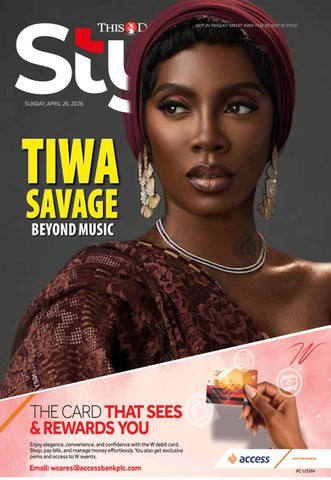
rom her early days in the UK, studying at Berklee College of Music and working behind the scenes as a songwriter and background vocalist for artists like Mary J. Blige and Whitney Houston to her return to Nigeria at a time when the modern Afrobeats movement was still taking shape, Tiwa Savage’s career has been defined by timing, instinct, and a clear understanding of where the culture was headed.When she signed with Mavin Records under Don Jazzy, it placed her at the heart of a new era in Nigerian music, one that would go on to dominate global charts, festivals, and conversations. Over the years, she has moved seamlessly between sounds and markets.

Lifestyle & Fashion

EDITOR’S LETTER

There’s something very telling about what people choose to do when they’ve already done enough. Some people slow down. Some disappear a little. And then there are those who start building things that don’t centre them at all.

That’s where this week’s cover feature sits.

Tiwa Savage has had the kind of career that speaks for itself: the hits, the global reach, the staying power. But what feels more interesting right now is this shift into something more structural. The Tiwa Savage Foundation, in partnership with Berklee College of Music, isn’t just another celebrity-led initiative. It’s deliberate. It’s practical. And more importantly, it’s sustainable. There’s a difference between giving back and creating access. One is generous. The other changes outcomes.

What she’s doing here is simple in theory but not always easy in practice: building the same kind of pathway she once had access to and making sure it exists for someone else. Not just inspiration, not just visibility, but actual tools. Real exposure. Proper training. The kind of thing that moves people forward in a way that lasts. It’s thoughtful. It’s necessary. And it feels like the right kind of evolution.

You should read the interview.

Somewhere else in this issue, we’re asking a very different question. Why are modern relationships so confusing? Because they are. What used to feel relatively clear has turned into something far more layered: talking stages that go on indefinitely, connections that never quite get defined, people circling each other without ever really deciding anything.

It’s not that people don’t want love. If anything, people want it deeply. But there’s a hesitation now, a fear of getting it wrong, or choosing too quickly, or choosing at all. So everything lingers in this almost-space. Not quite something, not quite nothing.

That piece is honest in a way like. It doesn’t try to fix it. It just says, “This is where we are.” Read that too. And before I go, this is my weekly check-in, just to ask if you’re good.

Because beyond everything we talk about, there’s real life. The part that isn’t curated, explained, or turned into a talking point. The pressure, the expectations, that constant feeling that you should be doing more than you are. It builds quietly, and if you’re not careful, everything starts to feel heavier than it should.

So consider this a gentle pause. A reminder, for you and for me, that not everything has to be a race. Not every phase needs to be optimised or explained. You’re allowed to enjoy your life while you’re figuring it out. Properly enjoy it, even.

So… are you good?

You can usually tell within the first few seconds.

Not from the clothes exactly, but from everything around them. The watch. The shoes. The belt. The sunglasses that either finish the look or quietly ruin it. It’s rarely loud, but it’s always clear. Some men understand this instinctively. Others think style is about buying more, wearing more, and showing more. It isn’t. It’s about getting the small things right, consistently. There’s a reason some men walk into a room and get a certain kind of respect before they speak. It’s not always about what they’re wearing. It’s how well everything is finished. You can be in the simplest outfit, plain shirt, tailored trousers, but if your accessories are right, you already look intentional. And intention is what people read as style. This is where the real markers are. Not what you spent, but how well you put things together.

The Watch: Quiet Confidence A good watch doesn’t try to convince anyone of anything. It just sits there, doing its job, while quietly pulling everything together.

The mistake is thinking it needs to be loud to be noticed. It doesn’t. Clean dials, proper proportions, and a strap that actually suits the watch will always win over something oversized and flashy. It should feel like it belongs on your wrist, not like you’re borrowing someone else’s lifestyle. The best watches don’t beg for attention, but they get it anyway. They suggest taste, not effort.

The Shoes: No Excuses Here

If there’s one place you cannot cut corners, it’s your shoes. They tell the truth immediately. You can’t hide scuffed leather, dusty sneakers, or soles that have clearly seen better days. People notice even if they don’t say anything. And yes, women definitely notice. Clean, well-kept shoes signal discipline. They say you pay attention, that you take care of your things, and by extension, yourself. It doesn’t matter if they’re designer or not. Condition is everything.

A great outfit can be undone by bad shoes. The reverse is also true—good shoes can carry a simple look.

The Belt: Small but Serious The belt is where a lot of men get lazy, and it shows. It’s not supposed to be the star of the outfit, but it shouldn’t feel like an afterthought either. It should match your shoes, not just in colour, but in tone and finish. A sleek black belt with polished black shoes. A rich brown with brown leather. Simple. Oversized buckles, peeling leather, or belts that have clearly overstayed their welcome will throw everything off. It’s a small detail, but it says a lot about how much you’re paying attention.

The Bag: The New Power Move Men’s bags have quietly become one of the clearest indicators of personal style. Whether it’s a structured leather briefcase, a clean tote, or a wellmade crossbody, your bag says a lot before you even set it down. It shows how you move, whether you’re organised, whether you carry yourself with a bit of thought. A good bag should feel practical but elevated. No unnecessary logos, no tired fabric, no overstuffing. It should hold what you need without looking like it’s struggling. It’s one of those things people don’t always consciously clock, but they register it.

The Sunglasses: Controlled Energy Sunglasses can go very wrong, very quickly. The right pair sharpens your entire look. The wrong pair turns it into something else entirely. It’s less about trends and more about proportion, what actually suits your face, your style, your overall energy. Classic shapes tend to work because they don’t date easily. Black, tortoiseshell, subtle metal frames. Nothing that feels like a costume. Good sunglasses don’t scream. They frame.

The Extras: Where It All Comes Together

Then there are the quieter details, your wallet, your cufflinks, even how your jewellery is worn, if you wear any at all. A bulky, overstuffed wallet ruins clean tailoring. Cheap metal that has lost its colour does you no favours. Too many accessories at once start to feel like confusion, not style. The point is restraint. Knowing when to stop. Knowing that not everything needs to be on display at once.

EXECUTIVE EDITOR

BIC NIGERIA CELEBRATES GROWTH AND PARTNERSHIP AT 2026 DISTRIBUTOR

GALA NIGHT AND AWARD CEREMONY

BIC, a global leader in stationery, lighters, and shavers, brought together its sales teams, distributor partners, and leadership in Lagos for its 2026 Distributor Gala Night and Award Ceremony: an evening dedicated to recognising the partnerships driving BIC’s growth across Nigeria.

The event celebrated the strength of BIC’s distributor network, which supports thousands of retail touchpoints nationwide, enabling the company to reach consumers across urban, semi-urban, and underserved communities while supporting businesses across wholesale, logistics, and informal retail channels.

The Gala also served as an opportunity for BIC’s leadership and distributor partners to connect and reflect on shared progress. It was an evening that reinforced the collaborative spirit at the heart of BIC Nigeria’s commercial strategy, one built on trust, shared ambition, and a common commitment to expanding access to quality everyday products.

High-performing distributor partners were recognised for their outstanding contributions to market expansion and nationwide reach, reflecting BIC’s belief that sustained growth is built on strong local collaboration and shared accountability.

For BIC Nigeria, the night was more than a celebration. It was a reaffirmation of its long-term commitment to Nigeria’s economy and the partners powering its progress.

L-R -TAIWO SHOLUADE, CHINEDU OBOSI, ABDERAHMANE FALL, AKINTUNDE MUSILIU, ANTHONY AMAHWE AND OLAJIDE LAWAL
L-R -PATRICK BELLO; GEOFFROY BICH; FOLUKE FEMI-SANDA; CHINEDU OBOSI ABDERAHMANE FALL
L-R- CHINEDU OBOSI; ABDERAHMANE FALL; GBENGA ASHIPA; ANTHONY AMAHWE; OYAREKHUA OSHOMAH
FOLAKE OLUFEMI AND ALADE ISAAC
PETER AJAKAIYE AND ANTHONY AMAHWE
L-R - CHINEDU OBOSI; GEOFFROY BICH; MOSHOOD OLAWALE KAREEM; PETER AJAKAIYE
L-R -CHINEDU OBOSI; FOLUKE FEMI-SANDA; SEGUN AKINGBILE; ALADE ISAAC
-OLUFEMI FUNMILAYO; TAIWO SHOLUADE OLUWAKEMI AKANNI
L-R -CHINEDU OBOSI; GEOFFROY BICH; JAMIU OLOLA; PETER AJAKAIYE

LIKE YOURSELF AGAIN DRESSING A CASE FOR

1. You stop letting trends make the final decision

Trends aren’t the problem; relying on them is.

There’s nothing wrong with noticing what’s new or even wanting to try it. But when every outfit starts to feel like a reaction to something you saw online, you lose your footing. Dressing like yourself means trends become optional, not instructional. You take what aligns, leave what doesn’t, and move on without feeling like you missed something important.

2. You build from what already works

Your real style isn’t aspirational, it’s proven.

It lives in the pieces you wear without thinking twice. The dress that always lands. The trousers that somehow work for everything.

The shirt you reach for when you don’t want to second-guess yourself. Instead of constantly trying to discover something new, you start refining what’s already there. Over time, your wardrobe becomes less about experimentation and more about clarity.

3. You simplify how you put outfits together

Not every look needs to be styled within an inch of its life.

There’s a quiet confidence in outfits that don’t try too hard. One strong piece, worn well, often does more than five competing elements. You stop layering for the sake of it. Accessories become intentional rather than excessive. And the result is something that feels complete without feeling forced.

4. You dress for your actual day

There’s a difference between an outfit that looks good in theory and one that works in real life.

Dressing like yourself means your lifestyle becomes the reference point again. Where you’re going, how long you’ll be out, what your day will actually require of you. The outfit isn’t just about the first impression; it holds up hours later, when you’re sitting, moving, living in it.

5. You prioritise comfort without sacrificing presence

Comfort used to be treated like a compromise. Now, it’s part of the standard.

But this isn’t about defaulting to the easiest option. It’s about choosing pieces that feel good and look considered. Fabrics that move, cuts that don’t restrict, silhouettes that allow you to exist fully in your body. When something feels right, it shows there’s a natural ease that can’t be styled into an outfit.

6. You get comfortable repeating outfits

Style isn’t built on constant newness; it’s built on familiarity. There’s a quiet confidence in wearing something more than once, in different ways, without feeling the need to explain it. The more you repeat pieces, the more they start to feel like yours. They settle into your life. And that repetition is what gives your wardrobe a sense of identity.

7. You become more selective about what you add

You stop buying for moments and start buying for your life. Impulse loses its appeal when you realise how quickly it fades. Instead, you start asking better questions. Will this work with what I already own? Will I reach for it on an ordinary day? Does it feel like me, not just today, but later? If the answer isn’t clear, it doesn’t stay.

8. You stop trying to look like everything at once

This is where most people get lost. Trying to embody every aesthetic at the same time often leaves you looking like a collection of references rather than a person with a clear point of view. Dressing like yourself means choosing direction over variety. You don’t need to explore every version of style—just the one that makes sense for you.

9. You trust your instinct more than outside validation

Not everything needs a second opinion.

At some point, you start to recognise what works without needing confirmation, from trends, from social media, even from people around you. If it feels right, that’s usually enough. And that kind of certainty doesn’t come from getting it perfect, it comes from paying attention.

IFY OSAKWE AND AINA FADINA
OMO AKEJU
PATRICIA OBOZUWA
NICOLE CHIKWE
SAMANTHA DIMKA
TOLU DEMUREN

BEAUTY WHILE YOU SLEEP: THE HABITS THAT REALLY MATTER

There’s a version of you that exists after 10pm. The makeup is off, the wig is coming off gently or not so gently, and the day is finally done. It’s tempting to do the bare minimum and fall into bed. But this is the window where your skin is most receptive, and what you do here shows up very clearly the next morning. Night routines don’t need to be long or complicated. They just need to be consistent and intentional.

Take Your Makeup Off Properly

Face wipes don’t count as a full cleanse, no matter how convenient they feel. Makeup, sunscreen and Lagos dust need more than a quick swipe. Start with an oilbased cleanser or micellar water to break everything down, then follow with a gentle face wash. Clean skin is the foundation of everything else.

Cleanse, Even If You Didn’t Wear Makeup

It’s easy to skip this step when your face looks “clean,” but your skin collects sweat, oil and environmental buildup throughout the day. Sleeping with that on your face is a quiet way to invite breakouts and dullness. A simple cleanse resets your skin.

Use Targeted Treatments, Not Everything at Once

Nighttime is when actives do their best work. Whether it’s a chemical exfoliant, a retinol or a treatment for breakouts, this is the time to use it. The key is restraint. You don’t need to use everything in one night. Pay attention to what your skin actually needs and rotate accordingly.

Hydrate Like You Mean It

After cleansing and treatments, your skin needs moisture. A good moisturiser helps repair the skin barrier and prevents overnight dryness. If your skin leans dry, this is also a good time for a richer cream or a facial oil to seal everything in.

Don’t

Forget Your Lips and Eyes

It’s easy to focus on your face and ignore the details. A simple lip balm before bed keeps your lips soft and prevents that dry, cracked look. The eye area also benefits from a light cream or gel to keep it smooth and hydrated.

Tie Up and Protect Your Hair

Your skin isn’t the only thing that benefits from a night routine. Wrapping your hair in a satin scarf or using a silk bonnet reduces breakage and keeps styles intact. Cotton pillowcases can be rough, so switching to satin or silk makes a noticeable difference over time.

Keep Your Pillowcase Clean

You can have the best routine and still struggle if your pillowcase is holding onto oil, sweat and product buildup. Changing it regularly is one of the simplest ways to support clearer skin.

Hands Off Your Face

Late-night scrolling often comes with unconscious face touching or picking at spots. It’s tempting, but it usually makes things worse. Let your products do their job.

Get Enough Sleep

No product can fully replace rest. Skin repairs itself while you sleep, and consistently cutting that time short will show up on your face. Think of sleep as part of your beauty routine, not separate from it.

SCENTED

AND

INTENTIONAL: WOMEN

WHO SMELL GOOD DON’T DO THESE THINGS

Smelling good is not luck, and it is not reserved for people with shelves full of expensive perfumes. It is a habit, built on small, consistent choices that work together. The women who always smell fresh and inviting understand that fragrance is only one part of the equation. Skin, clothes, and daily routines all play a role. It is less about doing more and more about doing the right things well. If you have ever wondered why some women always seem to carry a soft, lasting scent wherever they go, it often comes down to what they avoid as much as what they do.

They Don’t Have Dry Skin

Fragrance clings better to well-moisturised skin. Dry skin tends to absorb scent quickly, making it fade faster than it should. Women who smell good understand this, so they prioritise hydration. Body oils, creams, and lotions become part of their routine, especially right after a shower. This creates a soft base that helps hold onto fragrance for longer. It also gives the skin a natural, clean scent even before perfume is added. Smooth, hydrated skin is the quiet foundation of a lasting fragrance.

They Don’t Shower Only Once Per Day

Smelling fresh all day sometimes requires more than one shower, especially in warm climates or after long, active days. Women who are particular about how they smell are not rigid with their routines. If needed, they freshen up in the evening or after being outdoors for hours. It is not always about a full shower, sometimes a quick rinse or targeted cleanup makes all the difference. Staying clean throughout the day keeps your scent from becoming stale and allows any fragrance you wear to sit better on your body.

They Don’t Use One Fragrance Alone, They Layer Scents

Relying on a single perfume often falls flat or fades too quickly. Women who consistently smell good understand that lasting scent comes from layering. They build from the base up, starting with a scented body wash, followed by a moisturiser or oil, then finishing with a complementary perfume. Each step adds depth and helps the fragrance last longer on the skin. The result is a more rounded, noticeable scent that still feels soft and natural. It is not overpowering, it is intentional, and it lingers in the best way.

They Don’t Keep Fragrances They Don’t Like

Holding on to perfumes that do not suit you or that you no longer enjoy only adds clutter

to your routine. Women who smell good are intentional about their scents. They choose fragrances that feel right for them and suit their lifestyle. This makes it easier to wear them confidently and consistently. When you genuinely like how you smell, it shows in how you carry yourself. A signature scent, or a small rotation of favourites, always works better than a crowded shelf of unused bottles.

They Don’t Spray Perfume Haphazardly

There is a method to applying perfume. Spraying randomly or excessively does not make a scent last longer, it can make it overwhelming. Women who get it right apply fragrance to pulse points like the wrists, neck, and behind the ears. Some also lightly mist their clothes or hair for a softer, lingering effect. The goal is to smell inviting, not overpowering. A wellplaced fragrance should be discovered, not announced the moment you walk into a room.

They Don’t Neglect Their Clothes

Your clothes carry scent just as much as your skin does. If they are not properly washed, dried, and stored, they can hold onto unwanted odours. Women who smell good pay attention to their laundry. Clean fabrics, fresh storage, and even lightly scented detergents or fabric sprays all contribute to an overall pleasant smell. It is difficult to maintain a good fragrance if your clothes are working against you. Fresh clothes help your perfume shine instead of competing with it.

They Don’t Leave

Smelling Good To Chance

Ultimately, smelling good is intentional. It is not something that happens by accident. From the products you use in the shower to the fragrance you choose before stepping out, every step matters. Women who always smell good have a routine they trust. They reapply when needed, carry small touch-ups, and pay attention to how their scent wears throughout the day. It is this level of awareness and care that keeps them consistently fresh, no matter the time or place.

OZINNA ANUMUDU
AYODEJI AWONUGA
TOKE MAKINWA

Sam Onyemelukwe’s name may not always lead the headlines, but his fingerprints are everywhere across the global rise of Afrobeats, the expansion of African youth culture into mainstream international consciousness, and the steady building of platforms that have given the continent’s creatives both visibility and legitimacy.

From early days at The Walt Disney Company to shaping youth culture at MTV, and eventually steering the West African arm of TRACE into a global powerhouse, Onyemelukwe has operated with a kind of quiet precision that the industry often underestimates until it looks back. But perhaps what defines him most is perspective. At a time when African culture is being consumed at an unprecedented rate globally, Onyemelukwe is less interested in the applause and more concerned with what sits behind it: ownership, structure, and longevity. The work, as he sees it, is not just about exporting sound, but about building an ecosystem that ensures those sounds and the people behind them can thrive sustainably.

ONYEMELUKWE sam

IN CONVERSATION WITH A CULTURAL CATALYST

Speaking with Yinka Olatubosun, he reflects on the early instincts that led him to take a chance on Trace West Africa, the moments that signalled Afrobeats was no longer just a local movement, and why the future of the creative industry will depend less on hype and more on how well it is built. themselves and our family. My mom wanted to go back to the US to study, and followed her and finished my secondary school there. went to the University of Southern California for Fine Arts. I also got involved in the music industry there.

My first job was at Walt Disney during my art school days, which led me into the music industry. At which point was the promoter for KUSH, a music collective that had Lara, George, TY Bello, Emem and Dapo.

You remember that song, “Let’s live together”? I helped to make that one of the number one songs in the country at the time. And that’s how got back into what was happening on the ground in Naija, that’s how I got reintroduced to the entertainment industry and Nigeria.

showing and celebrating that.

You have been relatively quiet when it comes to taking credit for your contribution to the Afrobeats’ global visibility. What milestones have you witnessed Afrobeats achieve since Trace West Africa came through?

I know it’s not about me; it was much bigger than that. And for me, standing on a red carpet and being celebrated, first of all, is not my personal style. Anybody who’s read about me before or knows me knows that I’d rather drink beer and sit around with my friends. But I’m lucky to have been in a position to positively influence the industry. From our humble beginnings of one or two channels back in 2010/2011, we now have 30 channels that broadcast in 180 countries. We have a music distribution platform that has over 7000 artists that are represented. But have taken it even further than that. For me, have evolved into an advisor within the industry. connect investors and funds with exciting, viable, investable assets in the entertainment industry, with some of the biggest names. And many of these young, talented creatives sometimes need the business sense and structure behind it.

You have been associated with several youth empowerment initiatives. What’s the rationale behind these?

Young Africans have so much talent, so much drive. They are thirsty and hungry for opportunities and success. And in my small way, I wanted to be able to open up some of these opportunities, connecting people and plugging them into that creative industry.

We worked on the campaign called “Alt-Ctrl” that is Alternate-Control Academy because we want to shift the base of control when it comes to sexual violence and raising our girl child and our young men to having self-respect and respect for the boundaries of others.

What do you think is responsible for Nigeria’s music’s soaring popularity in the Western landscape?

think it’s actually a much more complicated issue than just our music soaring. The West- they want new things all the time. That’s what feeds capitalist culture. In Africa, we’re part of a larger community right.

Ultimately, they’ve come back to the well of you know, human culture, which is Africa, to the depth of music, to where culture developed.

It’s circling back around to the beauty of Africa. Nigeria has led that charge, and there’s a hunger for things, not just in music and culture.

Critics say music videos are the major culprits of the wrong perception of women. What has been the inner watchdog in you to ensure that bringing commercial music doesn’t erode acceptable broadcast standards?

We stick to the rules. We help form the rules we engage with the Nigerian Broadcast Commission. With the Advertising Regulation Committee of Nigeria and so many others to ensure that, as an industry, we’re doing what is right by our youth. I believe it’s easy to fall into hypocrisy. I usually ask the question, “What’s the music you enjoyed in the 60s, 70s and 80s?”

Certainly, the industry is selling sex, which is something that the entire world does, and that didn’t start today. You know, the allure of beautiful women, you know, expensive watches, and fast cars is attractive to everybody. Why shouldn’t our people have something to aspire to? We are a materialistic society, so we can’t lie that we’re not. don’t think it’s a moral issue. I think it’s a reflection of society,, but we do mind the rules, and don’t want to corrupt our precious youth.

How would you describe your personal style?

Well, I’m extremely casual. You mean my personal fashion style when I’m out and about? If you leave me on my own, like to wear a wrapper and t-shirts and be very okay with slippers; sitting around the house, but I do love the fashion and style that a lot of our young designers are doing, so of course, pick up on a few cool things. I’m a bit boring, I’m a bit traditional, but, you know, I got style, baby.

How do you balance your time for work with family responsibilities?

don’t believe there’s any industry or any work that’s not demanding. Media certainly is, and for me, how I balance that is, as get older, and evolve as a human being. I try to build an organisation around me that suits that. I have a core team at my business that call the fantastic four: my HR, my finance, my sales and production. I don’t take on too much responsibility.

You started your career in the media with Walt Disney, later MTV. Why was it important to have Trace TV West Africa at that time?

I was about to leave MTV, and really thought about coming out of the industry completely. I thought about it deeply, reflected, and then decided to give one last try because Trace TV, to me, represented an opportunity to put our industry on the world stage. It was an international brand with just two channels. The channel I was managing was the second channel of Trace, and it was important because Afrobeats and Nigerian culture were vibing, and I truly felt there was something special to be done.

Could you tell us a little bit about your background?

I’m Nigerian; my mother’s American. She came to Nigeria in the 60s in the US Peace Corps. My dad, of blessed memory, was a wonderful human being. The first electrical engineer of ECN at the time. And did my primary and secondary school here in Nigeria, but my dad and mom had struggled hard to make a life for

Why was it important to consciously tell African stories through the media?

Trace is seen as one of the strong developers of the industry and a key player.

For me, it is critically important that we have evolved beyond music because the world has changed. Everybody has their own media device, and everybody can be a media company just by broadcasting on YouTube, Twitter, TikTok, or wherever.

For those reasons, and even more importantly, because of the power of our African spirit, because we, as Nigerians, don’t back down, because we, as Nigerians, are proud, and we’ve propelled our culture and our lifestyle everywhere in the world. No matter what is happening back at home, no matter the struggles, we’re still proud and loud, and I needed us to show every part of that, not just the music. The music goes with owambe, and the owambe goes with the celebration of life. I knew that the world was hungry for everything African and everything Nigerian, and wanted to be at the forefront of sharing,

have my mind freed up. I don’t micromanage, don’t get into the details. I bring on the smartest people can find and empower them to do the best work they can do and put a structure around it.

When you look at the future of Nigeria, especially in the creative media sector, what do you see?

Well, see a really bright future. It doesn’t mean that the entertainment industry is going to lift our entire economy, nor is it going to give jobs to everybody. You know, there are needs far beyond entertainment and the creative industry, but think the Nigerian creative industry is rising to the challenge to meet the demands and global interest we’re seeing. Over time, we will see billiondollar companies here in Nigeria, from some of our young creatives. We’re going to see incredible things in the future.

As a serial entrepreneur, what’s in the offing?

I’m lucky to have had the chance to engage with a large number of Nigerians and the Diaspora’s biggest investors and to understand their interest in investing in the creative industry. We’re not going to compete with Google tomorrow. We’re not going to compete with TikTok and YouTube, but we’re partnering with them as well as record labels and movie studios. We can upskill and start to own more of the value chain.

There’s a lot of incredible young people making content music podcasts, writing, so we can continue to build our industry, create more and more companies of consequence and build that into an ecosystem that the whole industry rises. And everybody becomes more prosperous, because that’s what we need in our country.

Enjoy elegance, convenience and confidence with the W debit card. Shop, pay bills and manage money effortlessly. You also get exclusive perks and access to W events

BEYOND MUSIC!

rom her early days in the UK, studying at Berklee College of Music and working behind the scenes as a songwriter and background vocalist for artists like Mary J. Blige and Whitney Houston to her return to Nigeria at a time when the modern Afrobeats movement was still taking shape, Tiwa Savage’s career has been defined by timing, instinct, and a clear understanding of where the culture was headed. When she signed with Mavin Records under Don Jazzy, it placed her at the heart of a new era in Nigerian music, one that would go on to dominate global charts, festivals, and conversations. Over the years, she has moved seamlessly between sounds and markets, collaborating across continents while maintaining a distinct identity rooted in Africa. Few artists have managed that balance with the same consistency.

But if her career has shown anything, it is that longevity is rarely about staying in one place. It is about knowing when to shift and, more importantly, why.

launch of the Tiwa Savage Foundation, in partnership with Berklee College of Music, marks one of those shifts. On paper, it is an initiative designed to train emerging African creatives across performance, songwriting, production, and the business of music. In practice, it feels like something more considered. It draws directly from her own journey, from formal training to real-world industry experience and translates that into something structured, accessible, and, crucially, scalable.

Because, for all the global success of Afrobeats, the reality behind the scenes is more complex. The industry has produced stars at an impressive rate, but the ecosystem, producers, sound engineers, and business infrastructure have not always evolved at the same pace. It is a gap she has experienced from both sides: as a young creative trying to find her footing, and as an established artist navigating the demands of an industry still building itself in real

This is where the Foundation situates itself. This is not a vanity extension of a successful career. If anything, it is a natural progression, one that reflects not just where she is, but what she has seen along the way. In this conversation with Yinka Olatubosun, she speaks not just as an artist, but as someone thinking carefully about structure, sustainability, and what it means to create opportunity that outlives you.

Congratulations, Tiwa, on the launch of your Foundation. Was there a defining moment in your career that made you realise it was time to build something beyond music, and why did this feel like the right moment to finally take that step?

Thank you very much. Music has been my life for over two decades, and one of the most transformative moments in my journey was receiving a scholarship to study at Berklee College of Music. That experience completely expanded my understanding of music. I was taught all aspects of the music industry, including performance, songwriting, film scoring, mixing engineering, and the business of music. Being in that environment showed me that when talent is supported with the right education and exposure, great things happen.

Building this Foundation has been a dream of mine since graduated from Berklee, and my team and I have been working on it for well over 5 years. The idea was born from a deep desire to give African students the same kind of opportunity I received, which essentially changed my life.

Going right in, how much of your personal experience would you say shaped the direction and structure of the Foundation?

My entire experience at Berklee shaped the Foundation significantly. Studying there exposed me to the full ecosystem of music, songwriting, production, music business, scoring, publishing, and the technical side of how global hits are created and distributed. It helped me understand that sustainable success in music is built on knowledge, structure, and collaboration, not just talent. That perspective influenced the Foundation’s direction to ensure that African students are not only developing creatively but also gaining the technical and strategic tools needed to compete globally.

I wanted the programme to reflect the reality of the modern music industry, which is diverse, innovative, and increasingly influenced by technology.

What made Berklee the right partner for this, and what does this collaboration represent for African music education?

Berklee College of Music is the world’s number 1 contemporary music school. When I received a scholarship about 20 years ago, it opened doors for me and broadened my understanding of what a music career could look like beyond being an artist. Berklee created an environment for me as an African artist that was not only able to learn genres like jazz, classical, R&B, gospel, things I wasn’t fully exposed to before, but at the same time, not lose my identity and my African roots.

This collaboration is about creating the same opportunity I was given, but scaling it so more young Africans can benefit. It allows us to create a bridge between African talent and world-class education. It represents access, exposure, and the chance for African students to develop skills that position them not just as participants in the global industry, but as leaders within it.

How does this programme differ from the more traditional forms of music mentorship we’ve seen in Nigeria?

Traditional mentorship is great, and this programme is designed as an educational pipeline. Participants will gain exposure to areas such as music production, songwriting, scoring, publishing, music business, sound design, and emerging fields like AI in music.

We are not only preparing artists. We are preparing industry leaders who can build sustainable careers and contribute to the long-term growth of African music as an economic force.

You’re not just focusing on artists, but on the entire ecosystem — production, business, and technical skills. Why was that important to you?

One of the biggest lessons from my education was that music is not just about the artist we see on stage. Behind every successful record is a network of professionals shaping the sound, protecting the intellectual property, building strategy, and creating opportunities.

I wanted the Foundation to reflect that reality by exposing students to the full spectrum of careers within music —

production, songwriting, sound engineering, business, scoring, and emerging fields like music technology and AI. By developing expertise across the ecosystem, we ensure that African talent is represented at every level of the global industry.

Some participants may advance to Berklee while others continue their journey within Nigeria. How does the Foundation plan to track its progress and measure long-term success?

Success will be measured both qualitatively and quantitatively. We will track academic progress, especially for students who end up receiving the full scholarship to attend Berklee in Boston to pursue their undergraduate degree.

However, long-term success is not only about individual achievements. It is about how participants go on to impact the wider industry, create jobs, and inspire others.

We are building a network of alumni who will continue to support one another, ensuring the impact multiplies over time.

This already feels like a legacy project. What structures are you putting in place to ensure sustainability beyond the initial cohorts?

Sustainability is built into the structure of the Foundation through partnerships, strategic funding models, and long-term educational collaborations.

We are also creating governance frameworks that allow the Foundation to operate independently of any single individual. The vision is to build an institution that continues to evolve and support future generations long after the founding cohort. Eventually, my dream is to build an actual Berklee flagship school here in Nigeria and expand across the whole of Africa.

On the scholarship pathways, what key performance indicators will determine who progresses to the next level?

Progression will be based on a combination of academic performance, creative output, commitment, collaboration, and leadership potential.

We are looking for individuals who not only demonstrate talent but also discipline, curiosity, and the willingness to contribute positively to the ecosystem.

Is there a roadmap to expand this programme to other African cities, or will it remain centred in Lagos for now?

Yes, that’s the plan. Lagos is a natural starting point because it is one of the cultural capitals of African music, and it is also my hometown. Like I said, the long-term vision is pan-African. Talent exists in every corner of the continent, and the goal is to eventually create access points across multiple African cities, ensuring that geography is not a limitation to opportunity.

Do you see yourself eventually stepping back from music to focus more on initiatives like this, or will both continue to run side by side?

No. Never. I will sing till the very end, just like many of the great legends I admire who are still performing till today. This Foundation is not a departure from music; it is an extension of it. Both will continue side by side because creating impact within the industry is just as meaningful to me as creating music.

If you could give your younger self one piece of advice before stepping into the industry, what would it be? would tell my younger self that your journey will not always follow the timeline you expect, but every season has purpose. Stay curious, stay disciplined, and never allow anyone else’s pace to define your value. Longevity is built on growth, not comparison.

You’ve had a career that has evolved across continents, sounds, and eras of African music. At this stage of your journey, what does success look like to you now?

Success now is about impact. It is about creating pathways that make the journey easier for the next generation than it was for mine.

For me, success is seeing the Tiwa Savage Music Foundation as a fully-fledged brick-and-mortar building here in Lagos—a place where students from all over the world will come for a world-class education in music.

Beyond the charts and accolades, what has this journey taught you about yourself?

This journey has really shown me that I’m resilient, patient, and how strong my faith in God really is. It has shown me that purpose often reveals itself gradually, through both victories and challenges.

WHAT’S HAPPENING TO OUR

HAIRLINES?

8 THINGS YOUR EDGES ARE TRYING TO TELL YOU

1. “If it hurts, it’s already doing damage.”

Let’s start with the most obvious and the most ignored. Pain is not part of the process. That tight, pulling feeling when your braids are fresh, or your ponytail is snatched into place? That’s tension at work. And tension, when repeated often enough, weakens the hair at the root. The idea that “it will loosen in a few days” is exactly how the damage begins.

2. “Your edges are thinning, and you’re calling it ‘slow growth.’”

We’ve all said it at some point: “My edges just grow slowly.” But thinning edges and slow growth are not the same thing. If your hairline looks less dense than it used to, or your baby hairs have quietly disappeared, that’s not just time; it’s a sign that something has shifted.

3. “Protective styles aren’t always protective.”

Braids, weaves, wigs, they’re staples for a reason. They’re convenient, versatile, and in many cases, necessary. But the word “protective” only applies when the hair is actually protected. Tight installs, heavy extensions, and wearing the same style back-to-back without a break defeat the purpose entirely. Protection without recovery isn’t protection, it’s pressure.

4. “It’s not just tension, your products might be working against you.”

We don’t talk enough about this. Relaxers, strong edge controls, heavy gels, and even certain adhesives can weaken the hairline over time, especially when used frequently. That slick finish might look good in the moment, but if your edges are constantly being pulled, glued, and coated, they’re under more stress than you think.

5. “Your wigs are doing a little too much.”

Wigs have changed everything. The versatility, the ease, the switch-up, it’s unmatched. But constant use, especially with strong adhesives, can take a toll on your edges. The issue isn’t the wig itself; it’s the repeated glue, the tension at the hairline, and the removal process. If your edges never get a break, they eventually stop keeping up.

6. “You’re treating the symptoms, not the cause.”

This is where most routines fall short. Oils, serums, DIY remedies, we love them, and they have their place. But no product can outwork constant tension. You can massage your scalp every night, but if you’re installing tight braids the next morning, the cycle continues. Real change starts with how you handle your hair, not just what you apply to it.

7. “Not all hair loss is traction alopecia.”

Here’s where it gets more nuanced. Thinning edges aren’t always about styling. Stress, hormonal changes, and postpartum shedding can all affect your hairline, too. Which is why paying attention matters. If the pattern feels unusual or sudden, it’s worth looking beyond your styling habits.

8. “Catch it early, and you can turn it around.”

This is the part that matters most. In its early stages, traction alopecia is often reversible. Reduce the tension, looser styles, fewer high-stress installs, less manipulation and your follicles have a chance to recover. From there, targeted treatments can help support regrowth. Leave it too long, and the damage becomes harder to undo.

Let’s talk about edges, the real ones, not the perfectly sculpted versions you see on Instagram. The ones that used to be fuller. The ones that now need a little more effort to lie right. The ones you’ve been side-eyeing in certain lighting but haven’t fully addressed. Because something is happening. Quietly, gradually, and to more women than we admit. For many, it comes down to Traction alopecia, a form of hair loss caused by repeated tension on the hair over time. Not illness. Not genetics. Just the cumulative effect of how we’ve been styling our hair. And the thing about traction alopecia is that it doesn’t arrive dramatically. It gives you signs. Small ones. The kind you can ignore until you can’t. Here’s what your hairline might already be trying to tell you:

SALMON SPERM SKINCARE: WHAT IT DOES, HOW TO USE IT, AND IF IT’S WORTH IT

If you’ve heard the phrase “salmon sperm skincare” and paused, you’re not alone. It sounds like the kind of thing designed to provoke a reaction first and explain itself later. But behind the name is something far more clinical and increasingly credible. What’s actually being used is PDRN (polydeoxyribonucleotide), a purified form of DNA derived from salmon and refined for use in skincare. Less shocking than it sounds, once you get past the headline. And lately, it’s everywhere. What started quietly in dermatology clinics has begun to slip into mainstream beauty conversations, showing up in serums, post-treatment ampoules, and even facials. It’s the kind of ingredient that doesn’t announce itself loudly but keeps resurfacing in conversations about skin repair, regeneration, and that slightly elusive “healthy skin” look. The rise feels less like a trend cycle and more like a slow, steady endorsement, from professionals first, and now from everyone else. So what exactly does it do, and why has it found its way from aesthetic treatments into everyday routines?

What it actually is (without the theatrics)

Despite the name, this isn’t a case of anything literal being applied to the skin. PDRN is a highly refined DNA extract, broken down into fragments that can support skin repair and regeneration. Salmon is used because its DNA structure is remarkably compatible with human skin, which makes it particularly effective and well-tolerated when applied or injected. It’s clinical, not cosmetic in origin. And that distinction matters.

What it does for the skin

This is where the interest lies.

Unlike traditional skincare that focuses on surface-level results, PDRN works at a deeper, regenerative level. The aim is not to transform your face overnight, but to improve the overall behaviour of your skin over time.

Its benefits are typically linked to: improved collagen production, leading to firmer skin, enhanced elasticity and smoother texture better hydration and a strengthened skin barrier reduced inflammation, particularly in stressed or post-treatment skin

In essence, it’s less about glow in the immediate sense, and more about long-term skin quality, the kind that doesn’t need explaining.

Why it’s suddenly everywhere

While it may feel like a new arrival, this has been building for some time.

PDRN has long been used in medical settings, particularly in wound healing and tissue repair. Its transition into aesthetics was gradual, largely driven by the Korean skincare industry’s focus on regeneration rather than quick fixes.

Now, as global beauty shifts towards subtlety, skin that looks healthy rather than treated, it fits neatly into the conversation. It has also been quietly adopted in high-end aesthetic circles, where the focus has moved from obvious enhancement to skin that simply looks expensive.

The different ways to use it

This is where the distinction becomes important. In-clinic treatments

This is where PDRN performs at its strongest. Delivered through injectables or paired with treatments like microneedling, it works directly within the skin.

The results tend to be more visible, with improved texture, better elasticity, and an overall refinement that develops over time. It’s less dramatic than traditional injectables, but arguably more sophisticated in its effect.

Serums and topical products

For those not inclined towards clinic treatments, there are now serums and ampoules that

incorporate PDRN. These tend to focus on: hydration

gradual smoothing of texture supporting the skin’s repair process

Topical formulas support the skin on a surface level, but they don’t replicate the depth or speed of in-clinic treatments. The results are more subtle, but with consistent use, they can contribute to healthier-looking skin.

Who it’s best suited for

This isn’t a one-size-fits-all solution, nor is it intended to be.

It tends to suit:

skin that feels dull or depleted early signs of ageing post-acne or sensitised skin those more interested in refinement than transformation

If your focus is skin quality rather than quick, visible change, it makes sense.

The Reality Check

For all the interest it’s generating, it’s worth being measured.

This is not a miracle ingredient. Topical products, in particular, require time and consistency before results become noticeable. And while the science is promising, especially in medical contexts, its long-term cosmetic impact is still being explored. As ever, formulation matters. Not every product will deliver the same results.

As with any advanced treatment, particularly injectables, it’s important that it’s carried out by a qualified professional. Those with fish allergies are also generally advised to avoid it altogether.

So, is it worth it?

That depends entirely on expectations.

If you’re looking for gradual improvement skin that feels stronger, smoother, more balanced, then it’s worth considering, particularly as part of a broader routine.

If you’re expecting immediate transformation, you’ll likely be disappointed.

The Real Takeaway

Salmon DNA skincare is less about novelty and more about direction.

Beauty is becoming quieter, more technical, more focused on how skin functions rather than how dramatically it can be altered. Treatments like this sit comfortably within that shift, less about intervention, more about support.

It’s no longer about whether something sounds unusual.

At this point, that hardly matters.

The real question is whether, over time, it actually delivers.

SOFT GLAM

IS BACK, HERE’S HOW TO GET IT RIGHT

Soft glam is having a moment again, but this time it isn’t trying to prove anything. After years of heavy contour, ultra-matte finishes, and makeup that only really made sense on social media, beauty has quietly recalibrated. Faces are softer. Skin looks like skin again. Makeup feels wearable, something that works in daylight, in conversation, and across long, real days. Soft glam sits in that in-between space. Not bare-faced, not full beat. Just polished, balanced, and easy to live in. Getting it right, though, is more precise than it looks.

1. Start with skin that’s already doing the work

Soft glam doesn’t hide the skin; it depends on it.

Clean, well-hydrated skin makes everything else sit better. A good moisturiser is essential, and if you like a bit of glow, a subtle radiance base underneath helps. Nothing too reflective. Just enough to give the skin a healthy finish before makeup even begins.

2. Keep your base light and strategic

Skip the instinct to cover everything.

Apply foundation where you need it and build gradually. The aim is to even out the complexion while still letting your natural skin show through. Pair that with targeted concealer under the eyes, around the nose, on any uneven spots. It should look fresh, not perfected.

3. Add warmth, not structure

This is where restraint matters most.

Contour and bronzer should feel soft and believable. Cream formulas blend seamlessly, but powders work just as well if applied lightly. Focus on gentle warmth and subtle definition rather than sculpting sharp lines. If it looks obvious, soften it.

4. Let blush carry the face

Blush brings everything to life. Peach, soft pink, muted rose tones that mimic a natural flush.

Place it where your skin would naturally warm up and blend it into the rest of your base. Done well, it makes the entire face look more awake and put together.

5. Keep the eyes simple and diffused

You don’t need complicated layering here.

One or two neutral shades, browns, taupes, soft golds blended well, will do more than a full eye look. Focus on soft edges rather than precision. A lightly smudged liner along the lash line adds depth without making it feel heavy. The effect should be subtle, not dramatic.

6. Choose lashes and brows with a lighter hand

Both should enhance, not dominate.

Lashes work best when they’re wispy and natural-looking, whether it’s mascara or falsies.

Brows should be brushed into place and filled lightly where

needed. Avoid over-defining the shape.

Too much structure here can throw off the entire balance.

7. Go for lips that feel effortless

Soft glam doesn’t rely on statement lips.

Nude tones, soft browns, roses, peaches, something easy to wear and easy to touch up. Satin finishes, glosses, and balms all work well. Skip anything too dry or overly lined. It should feel comfortable, not precise.

8. Blend until everything sits together

This is what pulls the look together.

No harsh lines, no visible transitions, no obvious placement. Everything should sit into the skin rather than on top of it. If anything stands out too much, soften it.

9. Check the balance before you leave

Nothing should compete for attention.

If one feature feels too strong, pull something else back. Soft glam works because everything is in proportion, skin, eyes, lips, all working together.

FILA AND THE MAN:

THE MESSAGE IN THE TILT

In Yoruba culture, the fila is more than a finishing touch. It frames the face, completes the agbada, and quietly signals mood, identity and sometimes status. There is no rigid rulebook, but how you wear it still says something. And yes, the women are watching, reading the tilt, the angle and the attitude to decide exactly what kind of man you are before you even say a word.

Tilted to the Left – The Classic Gentleman

This is the most traditional and widely accepted tilt. Slightly to the left, neat and controlled, it reads as respectful and culturally grounded. It’s the man who understands the assignment and doesn’t need to prove anything.

In popular culture, it’s also often read as a subtle nod to being married, a man who is settled and sure of himself.

Tilted to the Right – The Stylish Rebel

Less traditional, more expressive. A right tilt often feels like a deliberate choice, the kind of man who plays with convention. Think confident, a bit fashion-forward, and not afraid to stand out at owambes. It’s also commonly associated with being single, a man still very much in the game.

Straight Up – The NoNonsense Man

Worn upright with little or no tilt, the fila here is all about structure. It suggests discipline, seriousness and a certain authority. There’s a fine line here, it can read as pride, even a touch of arrogance or boldness, depending on the attitude of the man wearing it. Clean, simple, and direct.

Pulled Forward – The Quiet Force

When the fila tilts forward, it signals confidence and ambition with a quieter edge. It suggests readiness, a man who knows his direction but doesn’t need to announce it. Slightly mysterious, composed, and present without trying to dominate the room.

Tilted to the Left

WHY

ARE MODERN RELATIONSHIPS SO CONFUSING?

You can speak to someone every day, share parts of your life, build routines, create a sense of closeness that feels unmistakably real and still have no idea what, exactly, you are to each other.

That, more than anything else, is what defines modern relationships. Not the absence of connection, but the absence of clarity.

There was a time when relationships, for all their imperfections, followed a more recognisable rhythm. People expressed interest, intentions were stated sometimes clumsily, sometimes too early, but stated nonetheless. You knew when you were dating. You knew when things were serious. There were markers, however flawed, that gave people a sense of direction. Now, everything feels far less certain.

People can talk every day, see each other regularly, share emotional intimacy, even meet each other’s friends and still hesitate when asked the simplest question: So, what exactly is this? It is not unusual anymore to be deeply involved in something that looks, feels, and functions like a relationship, yet remains

choice, or more accurately, the perception of endless choice.

Dating apps, social media, and even everyday online interactions have expanded the pool of potential partners in a way that feels limitless. On the surface, this should make relationships easier. In reality, it often does the opposite.

When options feel infinite, decisions become heavier.

Psychologist Barry Schwartz described this years ago: “The more options there are, the easier it is to regret anything at all that is disappointing about the option you chose.” Applied to modern relationships, this creates a quiet hesitation. Committing to one person begins to feel like closing the door on countless other possibilities, even if those possibilities are largely imagined. So instead, people delay. They keep things open. They stay in a space where nothing is fully confirmed, and therefore nothing can fully be lost.

there can be a different kind of pressure: to maintain control, not appear overly emotional, not define things too early. Both sides end up negotiating perception rather than expressing reality. The result is a kind of emotional stalemate. Two people, both invested, both cautious, both waiting for the other to make the first definitive move. Language itself has adapted to accommodate this uncertainty. Terms like “situationship,” “vibes,” and “no pressure” have become part of everyday dating vocabulary. They sound casual, almost harmless, but they often function as placeholders, ways to describe something real without fully acknowledging it.

technically undefined. It is not that love has become rare. It is that it has become harder to locate.

Part of the confusion lies in the shift from defined relationships to interpreted ones. Instead of asking direct questions, people now rely on reading meaning into behaviour.

A “good morning” text becomes a sign of interest. Consistency is taken as commitment. Delayed replies spark anxiety. Everything is analysed, decoded, and quietly internalised.

Layered onto this is a growing culture of emotional selfprotection. People are more aware of boundaries, more cautious with their time and feelings, more reluctant to invest deeply without certainty. On the surface, this looks like progress. In practice, it can sometimes translate into avoidance.

A relationship can exist in practice, communication, intimacy, and consistency, while still being described in terms that keep it conveniently undefined. It works. Until it doesn’t. Because eventually, reality interrupts the illusion. One person starts to want more. The other hesitates. The question “What are we?” arrives, and suddenly what felt effortless becomes complicated.

As relationship therapist Esther Perel once observed, “We are more connected than ever, but we have never been more unsure of where we stand with each other.”

It sounds contradictory, but it is exactly where modern dating sits: high interaction, low certainty. Technology has played a major role in shaping this dynamic. It has made communication constant, but intention optional. You can be in touch with someone throughout the day without ever having a conversation that requires emotional accountability. Messages are exchanged, attention is given, but clarity is deferred.

In many ways, communication has increased, but honesty has become negotiable. Then there is the question of

Instead of risking vulnerability, people manage their emotions carefully. They avoid saying too much too soon. They soften their language. They hide intention behind phrases like “let’s just see how it goes,” not always because they mean it, but because it feels safer than stating something definite.

No one wants to be the one who cares more.

No one wants to appear too eager, too available, too invested.

So people perform a version of detachment, even when they are not detached at all. And in doing so, they create the very ambiguity they claim to dislike.

For women especially, this ambiguity often comes with an added layer of emotional labour.

There is an expectation to be patient, understanding, and flexible to allow things to unfold naturally while receiving very little clarity in return. For men,

Modern relationships are not confusing because people have forgotten how to connect. If anything, people are connecting more than ever, faster, deeper, and with an ease that would have been unimaginable a decade ago. What has changed is the willingness to define that connection. Or rather, the growing comfort with leaving it undefined. And maybe that is where the confusion really lives. Not in the beginning, not in the uncertainty of getting to know someone, but in the decision to keep something undefined long after it has clearly become something.

Because people are not confused about what they feel nearly as often as they claim to be. They are conflicted about what to do with it.

So things linger. Conversations stretch. Connections deepen without direction. And two people who might actually want the same thing end up carefully orbiting each other, neither willing to say it first, both hoping the other will make it easier.

Until eventually, something gives. It always does.

Not loudly. Not dramatically. Just quietly, in the way things end when no one ever really started them.

And if nothing is ever said? Well… then it was never confusing.

Tilted to the right
forward tilt
ADEBOLA-WILLIAMS
TUNDE ONAKOYA
Tilted to the right

Turn static files into dynamic content formats.

Create a flipbook