...NOT IN THISDAY STYLE? THEN YOU’RE NOT IN STYLE TR
UT H
& RE A S O
N
SUNDAY, AUGUST 16, 2026
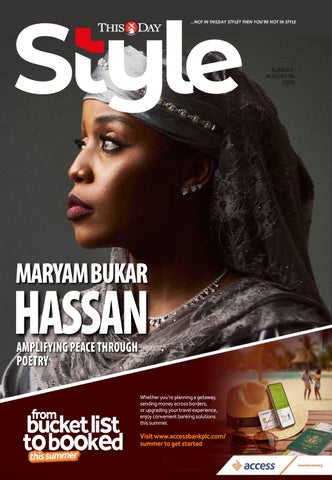
MARYAM BUKAR
HASSAN AMPLIFYING PEACE THROUGH POETRY
bucket list tthoissubmoo e k d mer from
Whether you're planning a getaway, sending money across borders, or upgrading your travel experience, enjoy convenient banking solutions this summer.
Visit www.accessbankplc.com/ summer to get started 1
Sunday, August 16, 2026 Vol. 22, No. 11415
Sunday, August 16, 2026 Vol. 22, No. 11415
EDITOR’S LETTER
COVER NOTE
Wearing Your Hair Too Tight
A snatched ponytail looks fantastic. So do tiny braids and a perfectly laid frontal. Your hairline, however, may have a different opinion. Repeated tension on the same areas can weaken hair and contribute to traction alopecia, particularly around the temples and edges. The danger is that it happens gradually. You notice a little thinning, cover it with another style and continue until the difference becomes difficult to ignore. Rotate your hairstyles, ask for less tension around delicate areas and take pain seriously.
EXECUTIVE EDITOR
14 14
G
lobally known by her pen name, Alhanislam, Maryam Bukar Hassan is an acclaimed Nigerian performance poet, spoken-word artist, storytelling consultant, and social entrepreneur. Born on December 25, 1996, in Kaduna State with roots in Biu, Borno State, she holds a Bachelor of Science degree in Information Technology from Radford University College in Ghana.
Lifestyle & Fashion
4
6
3 Fashion’s Most Reliable 4 Outfit Formulas What Your Handbag Reveals 6 About Your Lifestyle Is Your Lifestyle Growing 7 Faster Than Your Income? The New Rules of 8 Showing Skin Great Skin After 40: What Actually Changes 10 Opinion: Maybe Looking Your Age Isn’t Such a Bad Thing 11 What Makes a Restaurant Worth Going Back To? 18 AI Has Become Everyone’s Unofficial Personal Assistant 20 WARIF: From Silence to Strength: Ogenekaro’s Journey of Hope and Healing. 21 The Interior Pieces Actually Worth Spending Money On 22 What Your Hairstylist Wishes You Would Stop Doing
2
10
S yle TR
UT H
& RE A SO
N
EXECUTIVE EDITOR KONYE NWABOGOR 08111847087
DEPUTY EXECUTIVE EDITOR OLUFUNKE BABS-KUFEJI 08111847086
ASSISTANT EDITOR YINKA OLATUNBOSUN CONTRIBUTOR EBIYEKON DORCAS DIO DIRECTOR, PRINT PRODUCTION CHUKS ONWUDINJO
Printed by Ups Digitals Ltd, Abuja; 08057025005; info@upsdigitals.com
Life Lately
I
have a theory that one of the strangest things about adulthood is how quickly the goalposts move. You finally get to a place you once wanted to be, only to discover that your idea of a good life has moved on without consulting you. And that really is inevitable. As we grow, so do our expectations. We want better experiences, more comfort, more freedom and, ideally, the ability to say yes to certain things without mentally calculating what that yes will cost. The life that felt aspirational five years ago may simply feel normal today. Our tastes evolve, our priorities change, and, somewhere along the way, our income has to keep pace with both. That is what got us thinking about “Is Your Lifestyle Growing Faster Than Your Income?”, which I hope you’ll read this week. Cutting back has its place, but you cannot save your way into every version of the life you want. Sometimes you have to expand. Learn more. Ask for more. Create something. Take yourself more seriously professionally. If your lifestyle is outpacing your income, perhaps the answer isn’t automatically a smaller life. Of course, the next question is how much more we can possibly fit into already busy days. Enter AI. Something that felt futuristic not very long ago has quietly become an everyday assistant. Need to make sense of a complicated document? Ask AI. Plan a holiday? AI. Organise your thoughts before a meeting? AI again. In “AI Has Become Everyone’s Unofficial Personal Assistant,” we look at how to make it genuinely useful without becoming dependent on it. The real skill is knowing what to hand over and what to keep for yourself. Let technology save you time; don’t let it take over the thinking you should still be doing. And what exactly are we saving all this time for if we don’t occasionally enjoy it? A long lunch. Dinner with friends. Trying that restaurant everyone has been talking about. Although eating out has made me realise how little the actual food sometimes determines whether I return. You can eat something delicious and still leave thinking, never again. Service matters. Warmth matters. Consistency matters. So does feeling welcome rather than merely accommodated. “What Makes a Restaurant Worth Going Back To?” gets into all of that this week. Have a read and see if you agree. And that’s life lately: constantly deciding what deserves more of us and what deserves less; our money, our time, our attention and even our brainpower. Anyway, enough about all of that. How is August treating you? How are your people? How is love? And how are you doing mentally, underneath the work, responsibilities and endless things that need sorting out? I hope you’re happy. And if you haven’t been lately, I hope something shifts soon. Have a beautiful weekend. See the people you love, eat something delicious, laugh plenty and make some time for yourself. Everything else can wait until Monday.
08077092196
Love,
@thisdaystyle |
@thisdaystyleon | www.thisdaystyle.ng
Going From Protective Style to Protective Style
WHAT YOUR HAIRSTYLIST WISHES YOU WOULD STOP DOING You can buy the expensive shampoo, sleep in a satin bonnet and have a standing appointment with one of the best hairstylists in town, but if certain habits remain part of your routine, your hair may still refuse to cooperate. The frustrating thing about hair damage is that it is not always caused by one dramatic mistake. More often, it is the small things we do repeatedly: another tight ponytail, another week under the wig, a little too much heat, rough detangling when we are in a hurry. Individually, they seem harmless. Over time, they add up. And while your hairstylist can trim, treat, braid, install and rescue, there is only so much that can be fixed in one appointment. If healthier, fuller hair is the goal, these are some habits worth reconsidering.
Braids out on Friday, wig installed on Saturday. We call them protective styles, but they are only protective when the hair underneath is actually being protected. Constant installations with no meaningful breaks can lead to repeated tension, manipulation, and very little opportunity to properly assess the condition of your hair and scalp. Give your hair breathing room between styles. Wash it thoroughly, condition it, detangle carefully and pay attention to what is happening before covering it again.
Overdoing Edge Control
Our collective commitment to perfectly laid edges deserves to be studied. The combination of strong gels, repeated brushing and tight styling can be particularly unforgiving on the finest hairs around the hairline. You do not have to abandon edge control completely, but every hairstyle does not require baby hairs
sculpted into submission. Use less product, avoid aggressive brushing and occasionally allow your edges to simply exist.
Using Too Much Heat
Heat damage rarely announces itself after one blow-dry. It creeps in. Frequent blow-drying, straightening and curling at very high temperatures can leave hair dry and prone to breakage. Natural hair may also gradually lose some of its curl pattern. Use heat protectant, reduce the temperature where possible and avoid repeatedly passing hot tools over the same section.
Keeping Braids and Weaves Too Long
We know why it happens. The style still looks good, life is busy and taking it down means immediately having to decide what to do next. But stretching an installation far beyond its useful life can lead to excessive build-up, tangling and matting at the roots. Then comes the aggressive takedown, where perfectly healthy hair is lost simply because everything has become tangled together. A protective style should make maintaining your hair easier, not create another problem to solve later.
Treating Oil as Moisture
Dry hair? Add oil. Itchy scalp? Add oil. Braids looking tired? Somehow, more oil. Oil has its place, but it does not hydrate hair on its own. Depending on your hair and routine, piling heavy oils and butters onto already dry hair can simply leave you with dry hair covered in product. Focus on proper cleansing and conditioning, and use products according to what your hair actually needs rather than automatically reaching for another bottle of oil.
Ignoring Your Ends
We become very attached to length, even when the final few inches are hanging on purely through determination. Split ends, thinning, and badly damaged ends can make otherwise healthy hair look sparse and difficult to style. Regular trims help maintain shape, reduce tangling and prevent you from spending months protecting length that is not serving you. Healthy-looking hair will almost always beat longer hair with exhausted ends.
3
Sunday, August 16, 2026 Vol. 22, No. 11415
Sunday, August 16, 2026 Vol. 22, No. 11415
FASHION’S MOST RELIABLE OUTFIT FORMULAS Getting dressed should be one of the easier parts of the day. Yet somehow, a wardrobe full of clothes can still produce the familiar conclusion: I have absolutely nothing to wear. Usually, the problem is not a lack of clothes. It is a lack of combinations you trust. Stylish people often have these combinations without even realising it. A particular trouser shape they always wear with fitted tops. The dress-and-shoe combination that works whenever an invitation arrives. The jacket they throw over almost anything when an outfit needs rescuing. They may experiment with fashion, but underneath all that experimentation are a few dependable formulas doing most of the work. Think of them as wardrobe shortcuts. Not uniforms, exactly, but combinations that leave plenty of room for personality. Here are some worth keeping on rotation.
MAZZI ODU
When proportions are right, an outfit barely needs explanation. A voluminous midi or maxi skirt paired with a close-fitting top is one of those combinations. The skirt provides movement and drama; the top keeps everything controlled. It can go from Sunday lunch to a fashion event simply by changing the fabric and accessories. A white tank with a dramatic skirt feels modern. A fitted black top with an embellished version feels instantly eveningready. It also photographs extremely well, which, whether we admit it or not, occasionally matters.
ELIZABETH PAM
4
MONICA-AWE-ETUK
Jeans + A Proper Shirt + A Really Good Shoe
IFY OKOYE
IFEOMA NWOBU
Something Oversized + Something Precise
Yes, jeans and a shirt have existed forever. That is precisely the point. The difference between ordinary and excellent is in the choices. The jeans should have a silhouette that feels current and flattering; the shirt should have some character: oversized, striped, crisp, cropped or slightly undone. Then forget the safe shoe. Try a pointed mule, an embellished flat, a kitten heel, a loafer, or something unexpected. It is the outfit equivalent of looking like you made an effort without actually suffering for it.
KATE HENSHAW
Some of the best outfit formulas do not come from copying whatever is currently circulating online. Ankara, adire and aso oke become especially interesting when treated simply as beautiful textiles rather than automatically being pushed towards traditional occasionwear. An adire shirt with tailored trousers. An aso oke mini with a plain tank. Ankara trousers with an oversized white shirt. A beautifully cut jacket in a familiar indigenous fabric worn with denim. The formula works because the fabric brings history, colour and texture while the silhouette keeps things firmly in the present.
Co-ords remain one of fashion’s greatest cheats. When two pieces already belong together, half the styling decision has been made for you. The trick is stopping the Outfit from looking too “set.” Break things up with accessories that have a completely different mood. A polished coord with sporty sunglasses. Linen with metallic shoes. A colourful printed set with a structured leather bag. And, of course, each piece gets another life separately.
There is something wonderfully grownup about knowing when to leave a dress alone. A long, clean column dress does not need five competing ideas around it. Choose one excellent addition instead: sculptural earrings, an oversized cuff, a fabulous bag or dramatic shoes. It is an easy formula for dinners, gallery openings, holidays and those invitations with mysteriously vague dress codes.
Every wardrobe needs at least one accessory that stands out. Take the most straightforward Outfit you own— black dress, jeans and a tank, white shirt and trousers—and add the bag that is too colourful, too embellished, unusually shaped or just slightly absurd. It is especially useful on days when there is no energy for “styling.” The Outfit can remain sensible while the accessory has all the personality.
Full Skirt + Fitted Top
Matching Separates + Contrasting Accessories
The Column Dress + One Serious Accessory
Simple Outfit + Statement Bag
Traditional Textile + Modern Silhouette
Fashion loves proportion, and this is one of its most dependable tricks. An oversized blazer with fitted pants. A huge shirt with narrow trousers. A loose kaftan-style top with a sharp pencil skirt. Baggy jeans with a tiny knit. The contrast makes the Outfit feel intentional. When everything is oversized, clothes can swallow you. When everything is tight, the look can feel overly considered. Putting one relaxed shape against one controlled shape creates tension, and tension makes clothes interesting.
IFEOMA ODOGWU
The Hero Piece + Almost Nothing Else
This may be the most important formula of all. When one piece is spectacular, allow it to be spectacular. The feathered skirt does not need an equally dramatic blouse. The architectural jacket does not need enormous jewellery, statement shoes and a competing handbag. The beautifully printed dress does not require every accessory in your wardrobe. Start with the hero and build quietly around it.
MICHELLE ADEPOJU
5
Sunday, August 16, 2026 Vol. 22, No. 11415
Sunday, August 16, 2026 Vol. 22, No. 11415
WHAT YOUR HANDBAG REVEALS ABOUT YOUR LIFESTYLE
BALENCIAGA
Long before you introduce yourself, your handbag has already made an impression. It may seem like just another accessory, but it often says more about your lifestyle than you realise. Is it practical or polished? Minimal or overflowing? Timeless or trend-driven? The bag you carry every day quietly reflects how you move through life. Of course, there’s no right or wrong choice. A handbag isn’t a personality test. But the styles we’re naturally drawn to often mirror our routines, priorities and personal taste. The most stylish women understand this. They don’t buy a bag simply because it’s fashionable. They choose one that suits the way they live. By Funke Babs-Kufeji
The Structured Tote
If your everyday companion is a structured leather tote, chances are you appreciate order and preparation. It’s the bag of women who like to have everything within reach, from a laptop and notebook to sunglasses, chargers and a water bottle. It works just as well in the office as it does at an airport lounge, making it a favourite for professionals and frequent travellers. Pic - Funke Adepoju & Hermes Birkin 25 Handbag
HERMES BIRKIN
The Crossbody Bag
Practical without sacrificing style, the crossbody is perfect for women who are always on the move. Whether you’re running errands, meeting friends for lunch or exploring a new city, it keeps your hands free while carrying
LOUIS VUITTON NEVER FULL
ZASHADU
DOYIN AKINYELURE & BALENCIAGA HOUR GLASS TOP HANDLE BAG IJEOMA BALOGUN & ZASHADU
6
FUNKE ADEPOJU & HERMES BIRKIN 25 HANDBAG
THE CROSSBODY BAG
just the essentials. It’s proof that convenience and elegance can exist in the same outfit.
The Top-Handle Bag
Classic, refined and always polished, the top-handle handbag has a timeless appeal. Women who favour this style often lean towards tailored clothing, understated accessories and pieces that never date. It may not hold your entire life, but it certainly elevates almost every outfit. Pic - Doyin Akinyelure & Balenciaga Hour Glass Top Handle Bag
The Oversized Carryall
Some women believe it’s better to be overprepared than caught without something they need. If your handbag contains everything from snacks and makeup to an umbrella and a spare phone charger, you’re not alone. The oversized carryall suits women with busy schedules who move from one commitment to the next without going home in between. Pic - Louis Vuitton Neverfull Gm
The Mini Bag
Small in size but big on style, the mini bag is all about travelling light. Phone, cards, lipstick and keys. That’s all it holds, and for many women, that’s enough. It’s perfect for evenings out, weddings and occasions where simplicity feels refreshing. Pic - Ijeoma Balogun & Zashadu
It’s Not Just About the Bag
The condition of your handbag speaks just as loudly as the style itself. A beautiful bag loses its appeal when it’s overstuffed, stained or worn out. Taking a few minutes to empty old receipts, organise the contents and clean the exterior can instantly make it feel new again. It’s also worth remembering that quality doesn’t always mean designer. A well-made leather or faux leather bag in a timeless design will often outlast several trend-driven purchases. Neutral shades such as black, tan, chocolate brown, cream and navy offer the greatest versatility, pairing effortlessly with almost everything in your wardrobe. The smartest wardrobes aren’t filled with dozens of handbags. Instead, they’re built around a handful of styles that suit different occasions and stand the test of time. A structured tote for work, a crossbody for everyday wear, an elegant top-handle bag for meetings, a relaxed carryall for busy days and a smaller bag for evenings are often all you need.
IS YOUR LIFESTYLE GROWING FASTER THAN YOUR INCOME? There is a particular kind of financial trouble that does not look like trouble at all. You are earning more than you did a few years ago. You are not exactly broke. Your bills get paid, you go out, you travel occasionally, you buy nice things, and, from the outside, life looks pretty good. Yet somehow, money never seems to stay. A salary increase comes, and within months, you are wondering how you ever survived on your old income. Welcome to lifestyle inflation. It happens when your spending rises alongside your earnings, sometimes even faster. The more money you make, the more expensive your version of normal becomes. The problem is not enjoying your money. You should. The problem begins when every increase in income immediately becomes an upgrade in lifestyle. So, how do you stop your lifestyle from swallowing everything you earn?
Find Out What Your Life Really Costs
Forget your salary for a moment. How much does it actually cost to be you every month? Not just rent, food and transport. Add school fees, staff, beauty appointments, clothes, subscriptions, family obligations, restaurants, weekends out, data, deliveries and travel averaged across the year. Then include all those random transfers and small expenses that somehow never make it into your mental budget. That number is your real lifestyle cost. If maintaining your current life consumes almost everything you reliably earn, you have very little room for anything to go wrong. More importantly, you have very little money left to actually build wealth.
Be Careful What You Commit To Every Month
Some expensive decisions disappear after you pay for them. Others move in permanently. A holiday may cost a fortune, but eventually you come home. A bigger apartment brings higher rent, service charges, more furniture and possibly more staff. An upgraded car can mean higher
insurance, maintenance and fuel costs. Add memberships, instalment payments and other recurring expenses, and suddenly your monthly minimum has climbed dramatically. Before making a major lifestyle upgrade, calculate what it will cost you to maintain, not simply what it costs to acquire.
Stop Letting Other People Set Your Spending
Lifestyle inflation is often social. Your friends start travelling differently. Dinner moves to more expensive restaurants. Birthdays become productions. Everyone appears to be changing cars. Weddings now involve flights, hotels, asoebi, glam and gifts. Before long, spending a ridiculous amount on a weekend you were not particularly excited about begins to feel completely normal. Then there is social media, where someone is always on holiday, unboxing something expensive or recommending a “must-have” that costs half your salary. Other people’s normal does not have to become yours. You can love your friends and still say no. You can attend some things and skip others. You can admire someone’s lifestyle without trying to finance your own
another long-term goal. Then, by all means, enjoy some of the increase. The idea is not to pretend you never got a raise. It is to make sure your future gets one too.
Watch the “I Deserve It” Spending
You probably do deserve nice things. The problem is that “I deserve it” can justify almost anything. A stressful week deserves dinner. A promotion deserves a handbag. A difficult month deserves a holiday. Surviving Monday apparently deserves something in an online shopping cart. There is nothing wrong with treating yourself. But when treats become your standard response to stress, boredom, achievement and disappointment, they stop being treats and become a spending habit. Enjoy your money deliberately, not emotionally.
Try a One-Month Spending Reset
version of it.
Just Because You Can Pay for It Doesn’t Mean You Can Afford It
This distinction can change the way you spend. Having enough money in your account to buy something does not automatically mean you can afford it. If buying that bag, phone, holiday or piece of furniture means touching savings meant for something else, postponing an important payment or waiting anxiously for your next salary, then technically you could pay for it. You could not comfortably afford it. For bigger non-essential purchases, ask yourself what your finances will look like after you pay.
Don’t Let Every Raise Become More Spending
A promotion should not automatically require a new car. When your income increases, decide what happens to the extra money before your lifestyle claims it. Increase your savings. Invest more. Build your emergency fund. Pay down debt. Put money towards property, retirement or
If you suspect your lifestyle has become too expensive, give yourself one month to find out what you actually value. Do not turn it into a miserable no-spend challenge. Simply strip away the unnecessary extras. Cook more. Shop less. Use what you already own. Reduce deliveries and eating out. Check every subscription and automatic payment. Stay away from casual online shopping. At the end of the month, notice what you genuinely missed. Bring those things back. The rest may have simply become habits you were paying for.
Sometimes You Actually Need to Earn More
There is only so much cutting back anyone can do. Sometimes your lifestyle is not particularly extravagant. Rent has gone up. Food costs more. School fees have increased. Transport is more expensive. Family responsibilities have grown, and the same salary simply does not stretch as far as it once did. At that point, the solution cannot always be another budgeting trick. It may be time to negotiate your salary, increase your rates, look for a better-paying role, grow your business, develop another income stream or find ways to make your existing skills more valuable. Because personal finance cannot always be solved by spending less.
7
Sunday, August 16, 2026 Vol. 22, No. 11415
Sunday, August 16, 2026 Vol. 22, No. 11415
THE NEW RULES OF SHOWING SKIN
it isn’t entirely useless. An outfit usually benefits from contrast. A micro mini looks great with a roomy shirt or strong jacket. A tiny top feels more deliberate with relaxed trousers. A plunging dress becomes cooler when everything else—hair, jewellery, shoes—is kept relatively uncomplicated. That doesn’t mean you cannot wear a mini skirt and a crop top together. Of course you can. It simply means the rest of the styling has to earn its keep. Sometimes the difference between “that’s a lot” and “she looks amazing” is literally the jacket.
There was a time when showing skin came with fairly predictable instructions. If the skirt was short, the top stayed covered. If the neckline plunged, the hemline behaved. Legs or cleavage, never both. And somewhere in the background was always the suggestion that revealing too much meant you had somehow failed the elegance test. Fashion has moved on. These days, showing skin is less about how much is on display and more about how the entire look comes together. A completely sheer dress can somehow look sophisticated, while a relatively modest outfit can feel far more provocative. A backless gown can be sexier than a plunging neckline. A tiny skirt worn with an oversized blazer can look sharper than a knee-length bodycon dress. The new rules are really about proportion, intention and knowing when to stop.
Fit has become even more important.
CHIOMA IKOKWU
HENRIETTA ITEPU
The less fabric you’re wearing, the more important the fabric that remains becomes. A cut-out in the wrong place, a neckline you keep pulling up, or a mini dress you cannot walk in comfortably will ruin the effect very quickly. The best revealing clothes tend to look surprisingly secure. Before leaving home, sit down. Walk around. Bend over. Raise your arms. Take a photograph with flash. If you’re going to spend the evening adjusting the dress every three minutes, it isn’t the dress. Looking sexy is considerably easier when you’re not fighting your clothes.
FIA
Where you’re going still counts
Instagram has perhaps convinced us that every outfit belongs everywhere. It doesn’t. The barelythere dress that is perfect for a birthday dinner may feel ridiculous at someone’s traditional wedding. Your spectacular cut-out gown might work beautifully at a fashion event and make absolutely no sense at a corporate dinner. This isn’t about dressing “respectably.” It is simply about Skin doesn’t have to mean Mesh tops, transparent skirts, lace reading the room. dresses and barely-there fabrics Personal style doesn’t disappear cleavage. are now being styled for dinners, because you considered the For years, “sexy dressing” was parties and even daytime. The occasion. almost automatically associated trick is what sits underneath them. with cleavage and short hemlines. A sheer black skirt over good Now, some of fashion’s best Your body doesn’t need briefs and a crisp shirt can look skin moments are happening incredibly polished. A transparent permission. elsewhere. An exposed back. A Perhaps the best thing about blouse over a beautiful bra can flash of waist through a cut-out. the current approach to showing work with tailored trousers. A Bare shoulders. A high slit that skin is that the old body rules are lace dress becomes completely only reveals the leg when you slowly becoming irrelevant. different depending on whether move. A shirt unbuttoned just You do not need a flat stomach to you wear it over lingerie, a enough. Even the small strip of wear a crop top. Bigger breasts skin between a low-rise skirt and a bodysuit or a slip. do not automatically make a simple tank can change the mood Think of the layer underneath low neckline inappropriate. as part of the outfit rather than of an outfit. It feels less obvious, Thick thighs are not a reason to something you hope nobody which is probably why it often avoid minis. And turning 40, 50 notices. feels more interesting. or 60 does not suddenly mean shoulders, legs and cleavage must Balance still matters, just retire from public life. Sheer is officially part of differently. Dress for your actual body, not the the wardrobe The old “legs or boobs” rule feels body fashion once told you was Sheer clothing has escaped the dated, but the thinking behind allowed to wear certain things. red carpet.
FRUCHE
TOKE MAKINWA
8
9
Sunday, August 16, 2026 Vol. 22, No. 11415
Sunday, August 16, 2026 Vol. 22, No. 11415
OPI NION @thisdaystyle |
@thisdaystyleon |
www.thisdaystyle.ng
BY FUNKE-BABS KUFEJI
GREAT SKIN AFTER 40: WHAT ACTUALLY CHANGES So, what is actually worth doing?
LAURA EDEOGHON, AGBANI DAREGO , ELOHOR ELIZABETH
Your 40s can be a funny time for your skin. The routine that worked perfectly for years may suddenly stop delivering. Your face feels drier, pigmentation takes longer to fade, a late night shows up more than it used to, and you may find yourself looking at products you once ignored and wondering whether you need them now. The truth is, skin does change after 40. Collagen production slows, cell turnover becomes less efficient, the skin can lose moisture more easily, and hormonal changes may affect everything from texture to breakouts. Add decades of sun exposure, and some of the changes you notice now have actually been years in the making. None of this means great skin is behind you, far from it. But this is often the point when skincare needs to become a little more considered. Not necessarily more expensive or complicated, just better suited to what your skin needs now.
Don’t Forget Your Eyes, Neck and Hands
The face gets all the expensive skincare while the neck and hands are expected to age gracefully on their own. Take your moisturiser and sunscreen down your neck and chest and put SPF on the backs of your hands. The eye area also becomes drier with age, so keeping it moisturised can make it look smoother. You don’t necessarily need an expensive eye cream; a gentle moisturiser may work perfectly well. THE ORDINARY RETINOID
BRUSH - ON SUNSCREEN
Make Sunscreen NonNegotiable
You can spend a small fortune on serums and treatments, but sunscreen remains one of the smartest things you can do for your skin. Daily UV exposure contributes to pigmentation, collagen breakdown and changes in texture, and yes, darker skin tones need protection too. Use a broad-spectrum SPF 30 or higher every morning, including on your neck, chest and hands. If dark spots are a concern, consistency is particularly important. There is little point trying to fade pigmentation at night while allowing UV exposure to encourage it again during the day.
Retinoids Deserve Their Reputation
If you are going to invest your patience in one active ingredient, retinoids are a good place to
10
BONDI SANDS SUNSCREEN
CLEANSER
start. They can help improve fine lines, texture, uneven tone and the appearance of sun damage over time. The key word is slowly. Start with a lower-strength retinol two or three nights a week and gradually increase. Follow with a good moisturiser and pay attention to how your skin responds. Red, peeling, painfully irritated skin isn’t the goal.
Upgrade Your Moisturiser
The barely-there gel cream you loved at 30 may simply not cut it anymore. Skin often becomes drier with age, and hormonal shifts can make the difference even more noticeable. Look for moisturisers containing ceramides, glycerin, hyaluronic acid or squalane to support hydration and the skin barrier. And don’t be afraid of a richer night cream simply because you once had oily skin. Your skin type isn’t a lifetime contract.
ONO BELLO
Cleanse More Gently
That squeaky-clean feeling is not necessarily something to celebrate. Harsh cleansers and excessive washing can strip the skin of oils it increasingly needs. A gentle cleanser that removes makeup, sunscreen and the day’s grime without leaving your face tight is usually enough. You may even find that simply rinsing with water or using a very gentle cleanser in the morning works better if your skin has become dry or sensitive.
Exfoliate Less, Not More
There is a temptation to attack dullness with every acid available. Resist it. As skin becomes drier or more sensitive, constant exfoliation can leave it irritated rather than glowing. A gentle chemical exfoliant once or twice a week may be all you need. Be especially careful about piling acids, scrubs and retinoids into the same routine.
Y
ou can be perfectly happy with your face until someone points out something you apparently need to fix. The faint lines around your eyes. The grey hairs multiplying at your temples. The jawline that isn’t quite where it was ten years ago. Suddenly, things you barely noticed have names, treatments and entire industries devoted to making them
younger women anymore; we are comparing ourselves with digitally improved versions of women our own age. Skin is blurred, waists are adjusted, faces are lifted and under-eye bags disappear with a swipe. Even video filters have become sophisticated enough to follow our faces while we move. The strangest part is when we begin comparing the person in the mirror disappear. with the person on our own Instagram page. Ageing has become strangely difficult to do without commentary. Perhaps the better question isn’t how young we can continue to look, but There is always something new we are supposed to be correcting. Botox how good we can continue to look as ourselves. before the wrinkles arrive. Treatments to tighten what has started to soften. There is a difference. Serums promising to turn back the clock. Hair colour at the first sight of A woman in her 40s doesn’t need to look 25 to be beautiful. A woman grey. Even photographs are routinely filtered until the person staring back in her 50s doesn’t need a completely line-free forehead to be attractive. at us looks vaguely familiar but noticeably younger. And reaching 60 shouldn’t require an explanation for why your face has None of this means there is anything wrong with wanting to look good. changed since you were 35. Taking care of your skin, exercising, eating well, colouring your hair or Of course, ageing naturally doesn’t have to mean abandoning vanity either. having a treatment can all be personal choices. The question is when There is a slightly irritating tendency to suggest that accepting age means looking after yourself quietly turns into an endless attempt to erase every throwing away the retinol, cancelling your hair appointment and embracing visible sign that you’ve lived. every grey hair with spiritual enthusiasm. It doesn’t. Because somewhere in all this anti-ageing, we seem to have forgotten You can love Botox. You can colour your hair. You can have a facelift if you what actually comes with age. want one. You can spend far too much money on skincare and thoroughly Experience. Confidence. Perspective. Knowing who you are. Knowing enjoy doing it. The point isn’t that women should stop trying to look what you will tolerate and, perhaps more importantly, what you won’t.
MAYBE LOOKING YOUR AGE ISN’T SUCH A BAD THING
Your Lifestyle Will Show Up on Your Face
By 40, the skin tends to be less forgiving of consistently poor sleep, dehydration, smoking, excessive alcohol and a diet lacking in nutrients. No green juice is going to erase a wrinkle, but enough protein, fruits and vegetables, healthy fats, regular exercise and decent sleep support overall skin health. Stress matters too. There is a reason a difficult month sometimes seems to announce itself on your face.
Know When to Call in the Professionals
Skincare has limits, and that’s perfectly fine. A dermatologist can help with persistent acne, pigmentation, rosacea, unusual sensitivity or any new or changing skin lesion. Professional treatments such as chemical peels, microneedling and certain laser procedures may also be worth exploring with a qualified practitioner.
Yet physically, we are constantly being encouraged to travel in the opposite direction. A 45-year-old woman is complimented because she could “pass for 30.” Someone in her 50s is told she looks amazing because she “hasn’t aged.” The compliment is well intended, but the message underneath it is interesting: looking your actual age is somehow less desirable. It is particularly exhausting for women because the goalposts keep moving. First, you are supposed to be beautiful. Then slim. Then fit but not too muscular. Then youthful. Then naturally youthful, because looking as though you’ve had too much work done is also frowned upon. So you are expected to age without appearing to age and, ideally, without anyone being able to tell how you managed it. That’s quite an assignment. Social media hasn’t helped. We aren’t simply comparing ourselves with
younger. It is that looking younger shouldn’t become the only acceptable way to look good. There is something incredibly elegant about a woman who has figured out what works for her now rather than trying desperately to recreate herself from twenty years ago. Healthy skin. Great hair. Clothes that fit beautifully. A strong body. Good posture. Energy. Confidence. None of these requires pretending time hasn’t passed. And perhaps that is where our definition of ageing well needs to change. Instead of being impressed that someone “doesn’t look her age,” maybe the bigger compliment is that she looks fantastic, full stop. Because getting older will change your face. It will change your body. It may change the way you dress, what you care about and certainly how much nonsense you are prepared to tolerate. Not all of those changes need fixing. Some of them are actually the perks.
11
Sunday, August 16, 2026 Vol. 22, No. 11415
Sunday, August 16, 2026 Vol. 22, No. 11415
bucket list tthois sb oo e k d ummer from
Whether you're planning a getaway, sending money across borders, or upgrading your travel experience, enjoy convenient banking solutions this summer.
Visit www.accessbankplc.com/ summer to get started
12
13
UT H
& RE A SO
N
COVER
Sunday, August 16, 2026 Vol. 22, No. 11415
Sunday, August 16, 2026 Vol. 22, No. 11415
MARYAM BUKAR
HASSAN
AMPLIFYING PEACE THROUGH POETRY
COVER
TR
G
BY YINKA OLATUBOSUN
lobally known by her pen name, Alhanislam, Maryam Bukar Hassan is an acclaimed Nigerian performance poet, spoken-word artist, storytelling consultant, and social entrepreneur. Born on December 25, 1996, in Kaduna State with roots in Biu, Borno State, she holds a Bachelor of Science degree in Information Technology from Radford University College in Ghana. Renowned for her dynamic stage presence and emotionally charged poetry, Maryam fuses art with activism to champion gender equality, peacebuilding, maternal health, and youth empowerment. She is the founder of True My Voice, a community initiative and UN SDG Action Award finalist designed to train young poets and creatives in digital advocacy and storytelling. In July 2025, Maryam became the United Nations’ Global Advocate for Peace for the UN Peace and Security Pillar. Over her career, she has performed on major international platforms—including the UN General Assembly, COP28, and the World Bank Youth Summit—and released spoken word albums such as In the Heart of Silence (2017) and Layers (2021). Named one of the 100 Most Reputable Africans, she continues to stand as a leading contemporary voice for young African women and creative changemakers across the continent. In this interview with Yinka Olatunbosun she opens up about her craft, identity and how she represents the voice of the unheard.
Your stage name, Alhanislam, carries a powerful presence. How did you arrive at this identity, and how does it shape the person you become when you step onto the stage? Alhanislam was born from two things that have always shaped me: sound and faith. “Alhan” means melodies, and for me, poetry has always been a form of music, a way of carrying emotions, memories, and truths. Over time, the name became more than a stage identity; it became a responsibility. Islam is peace, and that understanding is deeply woven into how I carry my name and my voice. When I step onto a stage as Alhanislam, I don’t become someone else. If anything, I become more myself. The stage gives me permission to speak the truths that many people carry silently. It reminds me that my voice is not just mine; it belongs to every girl who has been overlooked, every community that has endured hardship, and every person searching for hope. The name keeps me grounded in purpose. Spoken word relies as much on rhythm, silence, and tone as it does on text. When you compose a piece, do you write for the page first, or do you hear the spoken performance in your head right from the start? Most of my poems arrive as sound before they become words on a page. I often hear the rhythm first: the pauses, the breath, the emotion hidden between sentences. Sometimes a single line stays with me for days before I write it down. Spoken words are deeply oral, and I think my upbringing contributed to that. I grew up around storytelling traditions where meaning wasn’t just in what was said, but in how it was said. So when I write, I’m already imagining the audience. I’m thinking about where silence should sit, where a voice should tremble, and where a line should land. The page is important, but the performance is often
14
15 15
COVER
living in my mind from the very beginning. Your poetry frequently navigates heavy themes like trauma, loss, and resilience. How do you protect your emotional health while repeatedly stepping into those deep, painful spaces for performance? I’ve learned that healing and storytelling must coexist. In the beginning, I thought I had to carry every story alone. Over time, I realised that vulnerability without boundaries can become exhausting. Today, I prioritise rest, reflection, prayer, and meaningful conversations with people I trust. I also remind myself that I am a storyteller, not a saviour. My role is to create space for difficult conversations, not to carry the weight of every pain I speak about. What keeps me going is witnessing how stories create connection. When someone tells me a poem that made them feel seen or helped them process something difficult, it reminds me that even painful stories can become pathways to healing. Many of your performances blend English with Hausa, nuance, and Northern Nigerian cultural texture. How do you balance staying deeply rooted in local storytelling while connecting with international audiences? I’ve never believed that authenticity limits global relevance. In fact, I think the more honest we are about where we come from, the more people connect with us. Whether I am performing in Kaduna, New York, or Geneva, I bring my full self into the room. The language may differ, but emotions are universal. Love, grief, hope, belonging, and resilience transcend geography. I often say that people don’t need to understand every word to understand the heart of a story. By remaining rooted in my culture, I am not creating distance from global audiences. I am inviting them into a world they may never have experienced otherwise. You’ve spoken about the profound impact of growing up between Borno and Kaduna, witnessing the reality of conflict early in life. What are some of those early influences that shaped your voice as a writer? Growing up between Borno and Kaduna exposed me to both the beauty and the fragility of community. I witnessed how conflict can disrupt lives, but I also witnessed extraordinary resilience. Some of my earliest memories are of people finding ways to continue loving, learning, and dreaming despite uncertainty. Those experiences taught me that stories are powerful. They preserve memory, restore dignity, and challenge the narratives that often reduce people to statistics. My voice as a writer was shaped by ordinary people, the mothers, teachers, children, and community leaders whose courage rarely makes headlines but deserves to be remembered. In previous reflections, you mentioned that poetry lives in spaces where you feel at peace. Where or what is “home” for you today, and how does that space fuel your output? Home has become less about a physical place and more about a feeling. It is wherever I can be fully present with myself, my faith, and the people I love. Sometimes, home is a quiet room with a notebook. Sometimes, it is a conversation with family. Sometimes, it is a gathering where stories are exchanged freely. Peace creates room for creativity, and creativity helps me make sense of the world. No matter where I am, I carry fragments of Borno, Kaduna, and every community that has shaped me. Those memories continue to nourish my work and remind me why storytelling matters. Northern Nigerian women in performance arts often face unique societal expectations. What hurdles have you encountered as a visible female spoken word artist from the region, and how have you navigated them? Like many women, I have had to navigate assumptions about what I should or should not be. There have been moments when people questioned whether a young Northern woman should occupy public spaces so visibly or speak so boldly. What helped me navigate those challenges was clarity of purpose. I understood early that representation matters. Every time a young girl sees someone who looks like her using her voice confidently, new possibilities become imaginable. I’ve also been fortunate to have people who believed in my journey. Rather than allowing limitations to define me, I chose to let my work speak for itself. Over time, excellence becomes its own response. Being appointed as the United Nations’ first Global Advocate for Peace is a historic milestone. What does this position
16
Sunday, August 16, 2026 Vol. 22, No. 11415
mean to you personally, and how do you plan to leverage it to drive positive change? The appointment is both an honour and a responsibility. Personally, it represents the possibility that voices from communities often overlooked can shape global conversations. As the first United Nations Global Advocate for Peace, I see my role as a bridge between policy and people. Peace cannot remain an abstract concept discussed only in conference rooms. It must be translated into everyday realities: access to education, dignity, inclusion, dialogue, and opportunity. I hope to use this platform to amplify youth voices, support peacebuilding initiatives, promote social cohesion, and encourage storytelling as a tool for understanding. Lasting peace is built when people feel seen, heard, and valued. In what ways do you believe spoken word poetry can help in resolving conflict or fostering peace where policy talks sometimes fail? Policy can shape systems, but stories shape hearts. Both are necessary. One of the strengths of spoken word is its ability to humanise experiences that might otherwise feel distant. A poem can help someone see themselves in another person’s story. It can create empathy where there was once misunderstanding. Peacebuilding begins with listening. Poetry creates opportunities for people to listen deeply, not just to facts, but to emotions, memories, and shared humanity. Sometimes that emotional connection opens doors that formal negotiations alone cannot.
COVER
Sunday, August 16, 2026 Vol. 22, No. 11415
You have performed at major global political forums, including the African Union and the UN. How do you approach performing in front of world leaders compared to performing in intimate community spaces? The audience may change, but my intention remains the same: to tell the truth with honesty and compassion. When I’m performing before world leaders, I recognise the influence they hold and the importance of speaking with clarity. But I never want the stage to make me forget the people whose stories inspired the poem. Community spaces are different because the connection feels immediate and personal. Still, both spaces matter. In one room, a poem might influence policy conversations. In another, it might help someone feel understood. Neither impact is more important than the other. Gender-based violence and girl-child education are central issues in your platform. What is one misconception about young women in West Africa that you constantly work to shatter through your art? One misconception is that young women are merely beneficiaries of change rather than leaders of change. Across West Africa, I meet brilliant young women who are entrepreneurs, artists, researchers, organisers, and innovators. They are not waiting for permission to contribute; they are already shaping their communities in meaningful ways. Through my art, I try to tell stories that reflect their strength, intelligence, and agency. The goal is not simply to inspire young women, but to challenge the narratives that underestimate them. The African spoken word scene has grown exponentially over the past decade. What infrastructure is still missing for emerging poets across the continent? Talent is abundant across Africa. What many emerging poets need is access. We need more sustainable funding opportunities, stronger creative institutions, literary residencies, mentorship networks, publishing pathways, and platforms that allow artists to earn a living from their craft. We also need greater investment in documenting and archiving our stories. Africa has no shortage of voices. The challenge is creating systems that help those voices thrive, travel, and endure. If you could put together a dream creative collaboration— whether with a musician, visual artist, or fellow poet—who would be on that list and why? I am drawn to collaborators who are deeply committed to storytelling and social impact. People whose work not only entertains but also invites reflection. If I could dream freely, I would love collaborations that bring together poetry, music, film, and visual art to tell stories about identity, memory, peace, and belonging. The names matter less than the intention behind the work. The most meaningful collaborations are the ones that leave people feeling more connected to themselves and to each other. Those are the kinds of creative partnerships that excite me most.
17
Sunday, August 16, 2026 Vol. 22, No. 11415
Sunday, August 16, 2026 Vol. 22, No. 11415
strange attitude once reservations become difficult to get. The hostess becomes terrifying, the door feels like an immigration checkpoint, and guests somehow start feeling grateful to have been admitted into a restaurant where they are about to spend their own money. Exclusivity can be attractive. Arrogance rarely is.
About Those Photo Policies…
QUAYS LAGOS
GRAS
WAKAME IS AN UPMARKET
WHAT MAKES A RESTAURANT WORTH GOING BACK TO?
Please Respect the Reservation Too
Reservations should make dining easier, not introduce another layer of anxiety. There is nothing wrong with asking guests to arrive on time, especially in a busy restaurant. But if customers lose their table after being 15 minutes late, the restaurant should probably show similar respect for time when they arrive punctually. Being seated 40 minutes after your reservation is not charming. Neither is discovering halfway through dinner that your table has a strict two-hour limit when nobody mentioned it beforehand. If there are seating times, deposits, minimum spends or cancellation policies, say so clearly when the booking is made.
In Lagos, going out to eat can require a surprising amount of commitment. You have fought traffic, found an outfit, made a reservation, possibly sent a deposit, navigated parking and finally arrived hungry. By the time you sit down, the restaurant has one job: make all that effort feel worth it. And that is where the difference between a restaurant everybody is talking about and one people actually return to becomes obvious. A beautiful space can get you through the door once. Instagram can create a waiting list. Influencers can make one particular corner of the restaurant instantly recognisable. But repeat customers are harder to win. After the pictures have been taken and the hype has moved on, people come back for the experience.
The Food Has to Be Good — and Consistently So
Nothing kills a favourite restaurant faster than inconsistency. You order something incredible on your first visit, recommend it enthusiastically to everyone, return with friends, and suddenly it tastes completely different. Now you are sitting there defending your recommendation. A good restaurant builds trust. The seafood
18
pasta you loved last month should still be excellent tonight. The suya should not depend on who is in the kitchen. Neither should your favourite cocktail arrive perfect on Friday and suspiciously watery on Sunday. And please, if half the menu is unavailable, tell us before we spend 15 minutes deciding what to eat. Few things are more irritating than hearing “Sorry, we don’t have that” three orders in a row.
Now, this is where Lagos restaurants and their customers occasionally enter a small cold war. People take pictures when they go out. Particularly in a city where dinner is often also an occasion. Someone has dressed up, it is a birthday, friends are together, the lighting is good, and yes, somebody wants a photograph. Restaurants are absolutely entitled to have boundaries. Nobody needs a 45-minute photoshoot blocking the staircase while hungry diners squeeze past. Ring lights, tripods and full production teams are understandably different from normal dining photography. But there has to be some common sense. If guests cannot take a quick photograph at their own table without being reprimanded, the policy starts affecting the experience. It is even more confusing when the restaurant itself has been designed within an inch of its life: dramatic lighting, beautiful bathrooms, art, flowers, mirrors, and interiors clearly intended to be noticed. Create a beautiful restaurant, and people will want to photograph themselves in it. That should hardly come as a surprise.
Service Can Make or Ruin Everything
Good service is not about having someone standing two feet away from your table all evening. It is about attentiveness. Bring the menu. Know what is on it. Check on the table. Bring drinks before the food. Notice when someone has been trying to get your attention for ten minutes. Most importantly, make people feel welcome. Some popular restaurants develop a
Parking Is Part of the Experience
This may not appear on the menu, but in Lagos it absolutely counts. Nothing takes the shine off dinner like circling Victoria Island looking GRAS
SANCHAN ELEGUSHI AND CHIDERA UDEH
for somewhere to park, being directed into a questionable corner or finishing a lovely evening only to discover your car has been blocked by three others. A restaurant does not necessarily need a huge private car park. But if parking is difficult, there should be a sensible system. Good valet service, clear directions and staff who actually know where cars are being kept can make an enormous difference.
The Bill Shouldn’t Contain Plot Twists
People will pay for good food. Lagos has certainly proved that. But expensive and worth it are not the same thing. Tiny portions, average food and premium pricing are already irritating enough. Add unexplained service charges, taxes and extras, and suddenly everybody at the table is examining the receipt like forensic accountants. Tell customers what things cost. Make portions sensible for the type of restaurant you run. And if you are charging luxury prices, the food, service and environment should feel luxurious too.
Comfort Matters More Than We Admit
You can have the most beautiful restaurant in Lagos, but if the air conditioning is struggling, nobody cares about the imported marble. Comfort is part of hospitality. The music should allow conversation. Chairs should survive a two-hour dinner. Bathrooms should remain clean throughout the night. There should be enough staff when the restaurant is full. And in a city where power interruptions are a reality, guests should barely notice when something switches over. These details may not make Instagram, but they are exactly the things people remember.
How You Handle a Bad Night Matters
Every restaurant will eventually get something wrong. The steak is overcooked. An order disappears. A waiter forgets a drink. The kitchen is overwhelmed. Customers are often more understanding than businesses imagine when somebody simply acknowledges the problem and fixes it. What turns an inconvenience into a reason never to return is the argument afterwards. A manager explaining for ten minutes why your food isn’t actually cold will rarely improve its temperature.
19
Sunday, August 16, 2026 Vol. 22, No. 11415
Sunday, August 16, 2026 Vol. 22, No. 11415
THE
AI HAS BECOME EVERYONE’S UNOFFICIAL PERSONAL ASSISTANT
SURVIV
The real skill is knowing what to hand over—and what to keep for yourself. Somewhere between asking AI to rewrite an awkward email and getting it to plan a holiday, we quietly acquired personal assistants. AI can organise your week, summarise reports, create meal plans, prepare you for interviews, compare products and suggest what to pack. It can turn messy notes into something useful or figure out dinner from whatever is left in your fridge. Using AI well is also knowing what you shouldn’t ask it to do. AI should make life easier. It shouldn’t start living it for you.
BY DR. KEMI DASILVA-IBRU AND GLORIA JOACQUIM
WARIF SURVIVOR STORIES
Dear Reader, Welcome to the WARIF Survivor Stories Series, a monthly feature where stories of survivors of rape and sexual violence are shared to motivate and encourage survivors to speak their truth without the fear of judgment or stigmatisation and to educate the public on the sheer magnitude of this problem in our society. The Women at Risk International Foundation (WARIF) is a non-profit organisation set up in response to the extremely high incidence of rape, sexual violence, and human trafficking of young girls and women in our society. WARIF is tackling this issue through a holistic approach that covers health, education, and community service initiatives. WARIF aids survivors of rape and sexual violence through the WARIF Centre - a haven where trained professionals are present full-time, 6 days a week, including public holidays, to offer immediate medical care, forensic medical examinations, psychosocial counselling, and welfare services which include shelter, legal aid, and vocational skills training. These services are provided FREE of charge to any survivor who walks into the Centre.
FROM SILENCE TO STRENGTH: OGENEKARO’S JOURNEY OF HOPE AND HEALING.
Give It Better Instructions
Ask, “Help me save money,” and you will get generic advice. Give it your income, expenses, savings target and deadline, and the answer becomes useful. At work, don’t simply say, “Write a presentation.” Explain the audience, objective, length and essential information. Then correct it, ask follow-ups and request alternatives.
Give It the Work That Wastes Your Time
This is where AI earns its imaginary salary. Let it organise notes, create packing lists, structure schedules, compare information, summarise reports or break projects into smaller tasks. Use AI to clear the clutter that prevents you from thinking, rather than asking it to think for you.
Every Industry Is Finding Its Version of AI
In media, AI helps with transcripts, research and editing. Fashion, retail and finance can analyse trends, inventory, customers and data. Teachers and students can use it
20
for learning, lawyers for research, healthcare for administration and imaging, and governments for data and public services. But the rule remains: support, not surrender. Journalists must verify stories. Doctors need judgement. Lawyers remain responsible for advice. Teachers still need to teach. Designers still need taste. Decisions about jobs, healthcare or justice should never become unquestioned algorithmic outputs.
Don’t Use It to Fake What You Don’t Know
AI can make you sound knowledgeable about something you barely understand, until someone asks a follow-up question. Students may produce betterlooking assignments while learning less; professionals who outsource every sentence may weaken their communication skills. Ask it to explain, critique and improve your work. Use AI to build your abilities, not hide the absence of them.
Make It Disagree With You
Ask AI for weaknesses in your plan, to argue the opposite side of a decision or to predict a difficult
client’s objections. Otherwise, it can become a sophisticated yes-man. A good assistant shouldn’t tell you every idea is brilliant.
healthcare and finance, where bad assumptions affect real people. Polished does not always mean correct.
Never Confuse Confidence With Accuracy
Protect Your Privacy
AI can be spectacularly, confidently wrong. It can give incorrect dates, invent sources, misunderstand context or present outdated information as fact. That barely matters with outfit advice. It matters enormously with health, money, law, politics, research or someone’s reputation. Verify anything important. Check original sources and dates. Where professional expertise matters, use a professional. AI can help you understand what to ask your doctor, lawyer or financial adviser; it should not automatically replace them.
Remember That AI Has Blind Spots
AI can reproduce human biases and stereotypes, or misunderstand a Nigerian business environment, cultural reference or social reality. This matters in hiring, education,
Avoid sharing passwords, banking details, confidential company information, sensitive documents or private information about others. Remove identifying details where possible and understand the tool’s privacy policies. Convenience should not make us careless.
And Please, Keep Thinking for Yourself
Perhaps the biggest danger is us becoming too comfortable outsourcing ordinary thought. You don’t need AI to decide every outfit, write every birthday message, settle disagreements, interpret dating texts or tell you what to think. It can draft an apology; you still need to mean it. It can suggest a difficult conversation; you still need to have it. Knowing how to use AI will become a basic professional and life skill. But being good at it means knowing what deserves automation and what deserves your attention.
R
M
y name is Ogenekaro (name changed to protect my identity), and I am a 20-year-old woman. This is my story. I lost both of my parents at a very young age and was raised by my late father’s elder brother and his wife. They loved and cared for me as though I were their own daughter, and I have always called them “Dad” and “Mom.” After I was unable to pass all my WAEC subjects on my first attempt, my guardians enrolled me in a secondary school so I could rewrite my examinations. The school’s director, whom I will call Mr Ade, was a close family friend. Because of the trust my family placed in him, I never imagined he would become the person who would betray that trust in the most devastating way. Since I lived far from the school, I stayed with my aunt, who lived much closer. A few weeks after I resumed, Mr Ade began giving me special attention. Eventually, he asked me to be in a relationship with him, promising to help me excel academically if I accepted. I rejected his advances. Alongside my studies, I ran a small online clothing business. One day, Mr Ade ordered several shirts and asked me to deliver them personally to his residence. Believing it was a normal business transaction, I went to his house. After we spoke for a while, he began touching me inappropriately. I pleaded with him to stop and told him I was a virgin, but he ignored my pleas. He sexually assaulted me. Afterwards, he begged me not to tell anyone. He promised to marry me someday and warned me that my guardians would never believe my story. He also threatened to harm me if I disclosed what had happened. Terrified and confused, I remained silent. The abuse did not end that day. He repeatedly manipulated and pressured me into returning to his house. Over time, he coerced me into sending nude photographs and videos of myself. When I expressed fear or resisted his demands, he used those images to blackmail me. He threatened to send them to my guardians and falsely claim that I had tried to seduce him if I refused to comply. After every assault, he reminded me never to tell anyone. Although he constantly instructed me to delete our conversations, I secretly kept copies of our messages and protected them with a password without his knowledge. Those messages became the only evidence I had of the abuse, threats, and manipulation I endured.
As the months passed, I became consumed by fear, shame, and despair. I withdrew from everyone around me and struggled with overwhelming suicidal thoughts. My aunt noticed the dramatic change in my behaviour and repeatedly asked what was wrong, but I could not bring myself to speak. Eventually, I reached my breaking point. I left behind a note asking my family not to look for me, left my phone at home, and went to stay with a childhood friend. While trying to understand what had happened, my aunt found my phone and discovered several password-protected conversations. Using the password I had written in my note, she accessed the messages and uncovered the evidence of the abuse, including his threats and the explicit images he had coerced me into sending. Realising where I was likely to be, my family found me safely at my friend’s house. My guardians were devastated that someone they had trusted so completely had taken advantage of me. They immediately reported the matter to the police. The police referred me to the WARIF Centre, where I received comprehensive medical care, psychosocial counselling, and other support services free of charge. When I first arrived at WARIF, I felt broken, hopeless, and overwhelmed by trauma. My counsellor listened to me without judgment and continually reminded me that what had happened was not my fault. Through counselling, I learned healthy coping strategies that helped me process my trauma, rebuild my confidence, and gradually regain my sense of self-worth. I also began attending WARIF’s monthly Group Therapy Sessions, where I met other survivors. Sharing our experiences in a safe, supportive, and confidential environment reminded me that I was not alone. Together, we encouraged one another, found strength in our shared resilience, and celebrated every step of our healing journeys. Although my court case is still ongoing, I remain hopeful that justice will be served. Despite everything I experienced, I refused to let my story define my future. I rewrote my WAEC examinations at another centre, passed with excellent results, and gained admission to study Pharmacy at university. Today, I am in my second year and maintaining a first-class GPA. Looking back, I know my healing journey would not have been possible without the care, compassion, and unwavering support I received at WARIF. The dedication and professionalism of the counsellors, medical team, staff, and management restored my hope when I had completely lost the will to live. Today, I choose to focus not only on what I survived, but on who I have become because I refused to give up. My story is one of pain, resilience, healing, and hope. It is proof that, with the right support, survivors can reclaim their lives, pursue their dreams, and find the strength to keep moving forward. To the entire WARIF family, thank you for believing in me when I could no longer believe in myself. You gave me hope when I had none, and for that, I will always be grateful.
* Real name of the Survivor changed for confidentiality
Dear Survivor, please know that you are not alone, and it is not your fault. Help is available. If you have been raped or know someone who has, please visit us at: The WARIF Centre 6, Turton Street, off Thorburn Avenue, Sabo, Yaba, or call our 24-hour confidential helpline on 0800-9210-0009.
21
Sunday, August 16, 2026 Vol. 22, No. 11415
Sunday, August 16, 2026 Vol. 22, No. 11415
This is where patience pays. Rather than buying an imitation antique because you need something immediately, wait for the right piece. Markets, dealers, family homes and travels can turn up furniture you would never find in a conventional showroom.
THE INTERIOR PIECES ACTUALLY WORTH SPENDING MONEY ON
Hardware and Fittings
Decorating a home can quickly become an expensive exercise. There is always a more beautiful tile, a more luxurious fabric, a better finish and a designer version of something you were perfectly happy buying for half the price five minutes ago. But a great home isn’t necessarily one where everything is expensive. In fact, spending heavily on every single thing can leave a space looking more like a showroom than somewhere anyone actually lives. The smarter approach is knowing where the money makes a difference. Some things can be bought inexpensively, enjoyed for a few years and replaced without much thought. Others change the entire character of a room, improve with age or are difficult and costly to redo. Those are the pieces worth opening your wallet for.
This is the splurge nobody gets excited about until the cheap alternative starts peeling. Door handles, taps, shower fittings, cabinet pulls, and hinges are small details, but you interact with them constantly. They are also surprisingly effective at making cabinetry and bathrooms feel more considered. Good hardware has weight to it. It feels solid in the hand and tends to age far more gracefully. Brass, bronze, stainless steel and other quality finishes can even develop character over time. It is a relatively small detail with an outsized effect.
Something Made Just for You
Perhaps the best thing to spend money on is something nobody else can buy. Commissioning a local designer, artist or craftsperson to make a dining table, screen, headboard, cabinet, sculpture or other piece specifically for your home gives the space something no trend can replicate: individuality. It can also be an opportunity to use Nigerian materials and craftsmanship in a contemporary way rather than defaulting to whatever is currently popular internationally.
Statement Lighting
Lighting is one of the quickest ways to tell whether a room has really been considered. You can have beautiful furniture and incredible art, but put everything under one harsh overhead light and somehow none of it looks quite as good. This is why a striking light fixture is worth the splurge. Think sculptural pendants over a dining table, an oversized chandelier in an entrance hall, beautiful wall sconces or a floor lamp that could almost pass for a piece of sculpture.
Original Art
There is a big difference between buying something because an empty wall needs filling and buying art because you genuinely want to live with it. Original art brings personality into a home in a way mass-produced décor rarely can. And “original” does not have to mean wildly expensive. There is an exciting pool of Nigerian and African painters, photographers and mixed-media artists producing work at different price points. .
22
Bespoke Joinery
Built-ins aren’t the sexiest thing to spend money on until you see them done properly. A beautifully designed library wall, fitted bar, media unit, wardrobe or storage system can completely alter a room because it feels like part of the architecture rather than furniture pushed against it. This is one area where precision matters. Bad joinery announces itself through uneven doors, awkward proportions and cheap finishes. Good joinery almost disappears into the room. It also solves one of the biggest problems in otherwise beautiful homes: where to put all the things real life comes with.
Something Old
One of the easiest ways to give a home character is to introduce something that wasn’t made yesterday. A vintage console, antique cabinet, old carved stool, beautiful chest or chair with a little history can break up the perfection of a newly decorated space. It also prevents the dreaded “I bought the entire room in one afternoon” effect.
23
Sunday, August 16, 2026 Vol. 22, No. 11415
24